WO2016143802A1 - 樹脂組成物、積層構造体及びその製造方法 - Google Patents
樹脂組成物、積層構造体及びその製造方法 Download PDFInfo
- Publication number
- WO2016143802A1 WO2016143802A1 PCT/JP2016/057252 JP2016057252W WO2016143802A1 WO 2016143802 A1 WO2016143802 A1 WO 2016143802A1 JP 2016057252 W JP2016057252 W JP 2016057252W WO 2016143802 A1 WO2016143802 A1 WO 2016143802A1
- Authority
- WO
- WIPO (PCT)
- Prior art keywords
- resin
- additive
- resin composition
- layer
- metal layer
- Prior art date
- Legal status (The legal status is an assumption and is not a legal conclusion. Google has not performed a legal analysis and makes no representation as to the accuracy of the status listed.)
- Ceased
Links
- FPVUWZFFEGYCGB-UHFFFAOYSA-N Cc1nnc(S)[s]1 Chemical compound Cc1nnc(S)[s]1 FPVUWZFFEGYCGB-UHFFFAOYSA-N 0.000 description 1
- MLOXIXGLIZLPDP-UHFFFAOYSA-N Nc1nc(C#N)c(C#N)[nH]1 Chemical compound Nc1nc(C#N)c(C#N)[nH]1 MLOXIXGLIZLPDP-UHFFFAOYSA-N 0.000 description 1
- MIHADVKEHAFNPG-UHFFFAOYSA-N Nc1ncc([N+]([O-])=O)[s]1 Chemical compound Nc1ncc([N+]([O-])=O)[s]1 MIHADVKEHAFNPG-UHFFFAOYSA-N 0.000 description 1
- GDGIVSREGUOIJZ-UHFFFAOYSA-N Nc1nnc(S)[s]1 Chemical compound Nc1nnc(S)[s]1 GDGIVSREGUOIJZ-UHFFFAOYSA-N 0.000 description 1
- QUKGLNCXGVWCJX-UHFFFAOYSA-N Nc1nnc[s]1 Chemical compound Nc1nnc[s]1 QUKGLNCXGVWCJX-UHFFFAOYSA-N 0.000 description 1
- BIGYLAKFCGVRAN-UHFFFAOYSA-N Sc1nnc(S)[s]1 Chemical compound Sc1nnc(S)[s]1 BIGYLAKFCGVRAN-UHFFFAOYSA-N 0.000 description 1
Images


Classifications
-
- B—PERFORMING OPERATIONS; TRANSPORTING
- B32—LAYERED PRODUCTS
- B32B—LAYERED PRODUCTS, i.e. PRODUCTS BUILT-UP OF STRATA OF FLAT OR NON-FLAT, e.g. CELLULAR OR HONEYCOMB, FORM
- B32B15/00—Layered products comprising a layer of metal
- B32B15/04—Layered products comprising a layer of metal comprising metal as the main or only constituent of a layer, which is next to another layer of the same or of a different material
- B32B15/08—Layered products comprising a layer of metal comprising metal as the main or only constituent of a layer, which is next to another layer of the same or of a different material of synthetic resin
-
- C—CHEMISTRY; METALLURGY
- C08—ORGANIC MACROMOLECULAR COMPOUNDS; THEIR PREPARATION OR CHEMICAL WORKING-UP; COMPOSITIONS BASED THEREON
- C08K—Use of inorganic or non-macromolecular organic substances as compounding ingredients
- C08K5/00—Use of organic ingredients
-
- C—CHEMISTRY; METALLURGY
- C08—ORGANIC MACROMOLECULAR COMPOUNDS; THEIR PREPARATION OR CHEMICAL WORKING-UP; COMPOSITIONS BASED THEREON
- C08L—COMPOSITIONS OF MACROMOLECULAR COMPOUNDS
- C08L101/00—Compositions of unspecified macromolecular compounds
Definitions
- the present invention relates to a resin composition, a laminated structure, and a method for producing the same.
- Electrical wires, printed circuit boards, and the like which are constituent elements of electric devices and automobiles, are laminated structures including a metal layer and a resin layer laminated on at least a part of the metal layer. These laminated structures are required to have excellent adhesion between the metal layer and the resin layer and are difficult to delaminate.
- Examples of methods that satisfy the above requirements include a method of forming a surface treatment layer on a metal layer and a method of forming a primer layer between a metal layer and a resin layer. There is also a method of forming a resin layer with a resin composition containing an additive (adhesion improver) having an effect of improving adhesion to a metal layer.
- a resin composition containing a thiol compound such as cetyl mercaptan or a polysulfide polymer as an additive has been proposed (see Japanese Patent Application Laid-Open Nos. 08-218007 and 2011-192514).
- a resin composition containing a thiol compound such as pentaerythritol tetrakis as an additive has been proposed (see Japanese Patent Application Publication No. 2014/024767).
- the additive promotes the elution of the metal component from the metal layer and the diffusion to the resin layer.
- the metal is formed by the precipitation of the diffused metal component in the resin layer. Particles are formed, and the metal particles improve the adhesion between the metal layer and the resin layer.
- JP 08-218007 A JP 2011-192514 A Special table 2014/024767 gazette
- the above conventional resin composition has a relatively large difference in adhesion improving effect even if it is an additive having relatively similar structure and physical properties, and the resin that is formed unless a laminated structure is actually formed. It is difficult to predict the adhesion of the layer to the metal layer. Furthermore, the types of additives that have been confirmed to be excellent in adhesion improving action remain relatively few. As a result, it is difficult for the conventional resin composition to improve the adhesion of the resin layer to be formed to the metal layer and to select the additive according to the application.
- the present invention has been made based on the above circumstances, and an object thereof is to provide a resin composition in which the selection of an additive suitable for the application and the improvement in the adhesion of the formed resin layer to the metal layer are easy. To do.
- a resin composition according to one embodiment of the present invention made to solve the above problems is a resin composition containing a synthetic resin and an additive, and uses the AM1 (Austin Model 1) method of the additive.
- the energy level of the lowest unoccupied orbit calculated by semi-empirical molecular orbital calculation is ⁇ 0.2 eV or less.
- a resin composition according to another aspect of the present invention which has been made to solve the above problems, is a resin composition containing a synthetic resin and an additive, and the reduction potential of the additive is -1. 20V or more and ⁇ 0.30V or less.
- a laminated structure according to still another aspect of the present invention made to solve the above problems is a laminated structure including a metal layer and a resin layer laminated on at least a part of the surface of the metal layer.
- the resin layer is formed of a resin composition containing a synthetic resin and an additive, and the energy level of the lowest unoccupied orbit calculated by semi-empirical molecular orbital calculation using the AM1 method of the additive is ⁇ 0. 2 eV or less.
- a laminated structure according to still another aspect of the present invention made to solve the above problems is a laminated structure including a metal layer and a resin layer laminated on at least a part of the surface of the metal layer.
- the resin layer is formed of a resin composition containing a synthetic resin and an additive, and the reduction potential of the additive is from ⁇ 1.20 V to ⁇ 0.30 V.
- a method for manufacturing a laminated structure includes a laminated structure comprising a metal layer and a resin layer laminated on at least a part of the surface of the metal layer.
- a method of coating at least a part of the surface of the metal layer with a resin composition, the resin composition containing a synthetic resin and an additive, and using the AM1 method of the additive The energy level of the lowest unoccupied orbit calculated by semi-empirical molecular orbital calculation is ⁇ 0.2 eV or less.
- a method for manufacturing a laminated structure includes a laminated structure comprising a metal layer and a resin layer laminated on at least a part of the surface of the metal layer.
- lowest orbit means the lowest energy level among molecular orbitals not occupied by electrons.
- the resin composition according to one embodiment of the present invention is easy to select an additive according to the use and to improve the adhesion of the formed resin layer to the metal layer.
- the laminated structure according to another aspect of the present invention is excellent in adhesion between the resin layer and the metal layer.
- the manufacturing method of the laminated structure which concerns on another aspect of this invention can provide the laminated structure excellent in the adhesiveness of a resin layer and a metal layer easily and reliably.
- the resin composition according to one aspect of the present invention is a resin composition containing a synthetic resin and an additive, and is the lowest free orbit calculated by semi-empirical molecular orbital calculation using the AM1 method of the additive. Has an energy level of ⁇ 0.2 eV or less.
- the resin composition contains a synthetic resin and an additive, and the energy level of the lowest unoccupied orbit calculated by semiempirical molecular orbital calculation using the AM1 method of the additive is ⁇ 0.2 eV or less. Thereby, it is excellent in the adhesiveness with respect to the metal layer of the resin layer formed.
- various additives can be used for the resin composition as long as the lowest unoccupied energy level is ⁇ 0.2 eV or less, and the minimum unoccupied energy level can be easily calculated from the structural formula of the additive. it can. Therefore, in the resin composition, it is easy to select an additive suitable for the application and to improve the adhesion of the formed resin layer to the metal layer.
- the reason why the resin layer formed from the resin composition is excellent in adhesion to the metal layer is not clear, but can be inferred as follows, for example. That is, when the energy level of the lowest empty orbit is negative, energy is released by accepting electrons, and when it is positive, energy is absorbed by accepting electrons, and as the value is smaller, electrons are accepted. It means that it becomes easy to become an anion. Therefore, in the resin composition, the energy level of the lowest orbital of the additive to be contained is ⁇ 0.2 eV or less, so that the metal component is oxidized by the oxidation (cationization) of the metal layer when forming the resin layer. Elution and diffusion into the resin layer are promoted, and as a result, metal particles are formed in the resin layer.
- the metal particles have effects such as strengthening of the resin layer by chemical cross-linking of the resin, relaxation of discontinuity of physical properties such as thermal expansion coefficient and Young's modulus of the resin layer near the interface with the metal layer.
- the metal particles have the same density as the resin layer and density equalization by preferential precipitation in a relatively low density region, and the unevenness of the metal layer surface is increased by high density aggregation near the interface with the metal layer. It also has an effect such as generation of an anchor effect. As a result, it is thought that the said resin composition can improve the adhesiveness with respect to the metal layer of the resin layer formed by this metal particle.
- the content of the additive with respect to 100 parts by mass of the synthetic resin is preferably 0.1 parts by mass or more and 10 parts by mass or less.
- the adhesiveness with respect to the metal layer of the resin layer formed can be improved more by making content of the additive with respect to 100 mass parts of synthetic resins into the said specific range.
- the above additive may be a substituted or unsubstituted heterocyclic compound.
- Heterocyclic compounds have a relatively low energy level in the lowest orbital. Therefore, by making the additive a substituted or unsubstituted heterocyclic compound, the energy level of the lowest vacant orbit becomes easy to be in the above range, and as a result, the adhesion of the formed resin layer to the metal layer is further improved. it can.
- the “heterocyclic compound” means a cyclic compound in which atoms other than carbon are contained in the atoms constituting the ring.
- the heterocyclic compound may have an amino group, a thiol group, or a combination thereof.
- a compound having an amino group, a thiol group, or a combination thereof has a relatively low energy level of the lowest vacant orbit. Therefore, when the heterocyclic compound has an amino group, a thiol group, or a combination thereof, it becomes easier to lower the energy level of the lowest vacant orbit, and as a result, the adhesion of the formed resin layer to the metal layer Can be improved more.
- the synthetic resin may include a resin having a polar group.
- the adhesiveness with respect to the metal layer of the resin layer formed can be improved more because synthetic resin contains resin which has a polar group.
- the “resin having a polar group” may be a resin having a polar group in the main chain or a resin having a polar group in the side chain.
- the resin having the polar group may be polyimide, polyesterimide, polyester, polyamideimide, phenoxy resin, or a combination thereof.
- the adhesiveness with respect to the metal layer of the resin layer formed can be improved more by making resin which has a polar group into a polyimide, polyesterimide, polyester, polyamideimide, phenoxy resin, or these combination.
- polyimide includes polyimide precursors such as polyamic acid.
- the resin composition according to another embodiment of the present invention is a resin composition containing a synthetic resin and an additive, and the reduction potential of the additive is from ⁇ 1.20 V to ⁇ 0.30 V.
- the resin composition contains a synthetic resin and an additive, and when the reduction potential of the additive is in the above range, the resin layer to be formed has excellent adhesion to the metal layer.
- the said resin composition can use various additives, as long as a reduction potential is the said range.
- the reduction potential can be easily measured by using a solution of the above additive alone. Therefore, in the resin composition, it is easy to select an additive suitable for the application and to improve the adhesion of the formed resin layer to the metal layer.
- the reason why the adhesion of the resin layer formed to the metal layer can be improved by setting the reduction potential of the additive in the above range is not clear, but can be inferred as follows, for example.
- the resin composition has a reduction potential of the additive that is relatively high in the above range (small absolute value), so that the lowest orbital energy level value of the additive is ⁇ 0.2 eV or less.
- the acceptance of electrons by the additive can be promoted.
- elution of the metal component due to oxidation (cationization) of the metal layer during formation of the resin layer and diffusion to the resin layer can be promoted, and metal particles can be formed in the resin layer.
- the “reduction potential” is a value calculated from a cyclic voltammogram measured using a solution of a single additive as a sample, using a platinum electrode as a working electrode and a counter electrode, and using a silver / silver chloride electrode as a reference electrode.
- a laminated structure according to still another aspect of the present invention is a laminated structure including a metal layer and a resin layer laminated on at least a part of the surface of the metal layer, wherein the resin layer includes a synthetic resin and an additive.
- the energy level of the lowest unoccupied orbit calculated by the semi-empirical molecular orbital calculation using the AM1 method of the additive is ⁇ 0.2 eV or less.
- the laminated structure has excellent adhesion between the metal layer and the resin layer because the resin layer is formed of the resin composition.
- the main component of the metal layer is preferably copper.
- the adhesiveness of a metal layer and a resin layer can be improved more by using copper as the main component of a metal layer.
- a metal layer can be suitably used as a conductor.
- the “main component” is a component having the largest content, for example, a component having a content of 50% by mass or more.
- a laminated structure according to still another aspect of the present invention is a laminated structure including a metal layer and a resin layer laminated on at least a part of the surface of the metal layer, wherein the resin layer includes a synthetic resin and an additive. Formed by a resin composition containing an additive, and the reduction potential of the additive is from ⁇ 1.20 V to ⁇ 0.30 V.
- the laminated structure has excellent adhesion between the metal layer and the resin layer because the resin layer is formed of the resin composition described above.
- the manufacturing method of the laminated structure which concerns on another aspect of this invention is a manufacturing method of a laminated structure provided with the metal layer and the resin layer laminated
- the energy level of the lowest empty orbit is ⁇ 0.2 eV or less.
- the method for producing a laminated structure can easily and reliably provide a laminated structure having excellent adhesion between the metal layer and the resin layer.
- the manufacturing method of the laminated structure which concerns on another aspect of this invention is a manufacturing method of a laminated structure provided with the metal layer and the resin layer laminated
- the method for producing a laminated structure can easily and reliably provide a laminated structure having excellent adhesion between the metal layer and the resin layer.
- the resin composition contains a synthetic resin and an additive.
- the said resin composition may contain another arbitrary component in the range which does not impair the effect of this invention.
- the synthetic resin is a base resin of the resin composition.
- the synthetic resin may be a resin having a polar group or a resin not having a polar group. As this polar group, the group containing the hetero atom mentioned later etc. are mentioned, for example. Synthetic resins can be used singly or in combination of two or more.
- the resin having a polar group examples include epoxy resins such as polyimide, polyamideimide, polyester, polyesterimide, and phenoxy resin, melamine resin, polyvinyl chloride, and a copolymer of an olefin and a polar monomer.
- Polyimide is a resin having an imide bond (imide group) in the molecule.
- Polyimide is obtained, for example, by polycondensation reaction of a tetracarboxylic acid or anhydride thereof as an acid component and a diamine compound as an amine component in a reaction solvent, and dehydrating and ring-closing the resulting polyimide precursor by heating or the like. be able to.
- tetracarboxylic acid or anhydride thereof examples include pyromellitic dianhydride, 3,3 ′, 4,4′-benzophenone tetracarboxylic dianhydride, benzene-1,2,3,4-tetracarboxylic acid.
- Carboxylic dianhydride Cyclopentane-1,2,3,4-tetracarboxylic dianhydride and other alicyclic acid anhydrides; Pyrazine-2,3,5,6-tetracarboxylic dianhydride and the like And heterocyclic derivatives.
- the tetracarboxylic acid or anhydride thereof is preferably tetracarboxylic dianhydride, more preferably aromatic tetracarboxylic dianhydride, and still more preferably pyromellitic dianhydride.
- the said tetracarboxylic acid or its anhydride can be used individually by 1 type or in combination of 2 or more types.
- diamine compound examples include 2,2-di (p-aminophenyl) -6,6′-bisbenzoxazole, p-phenylenediamine, m-phenylenediamine, 4,4′-diaminodiphenylpropane, 2,2 -Bis [4- (4-aminophenoxy) phenyl] propane, 4,4'-diaminodiphenyl sulfone, 4,4'-diaminodiphenyl ether, benzidine, 4,4 ''-diamino-p-terphenyl, p-bis Aromatic diamines such as (2-methyl-4-aminopentyl) benzene, 1,5-diaminonaphthalene, 2,4-diaminotoluene, m-xylene-2,5-diamine, m-xylylenediamine; piperazine, methylene Aliphatic diamines such as diamine, ethylenediamine,
- the lower limit of the molar ratio of the tetracarboxylic acid or anhydride thereof to the diamine compound in the polycondensation reaction is, for example, 4.8: 5.2.
- the upper limit of the ratio is, for example, 5.2: 4.8.
- the reaction solvent may be a polar solvent or a nonpolar solvent.
- the polar solvent include ketone solvents such as acetone, methyl ethyl ketone, methyl isobutyl ketone, and cyclohexanone; ester solvents such as methyl acetate, ethyl acetate, butyl acetate, and diethyl oxalate; diethyl ether, ethylene glycol dimethyl ether, diethylene glycol monomethyl ether Ether solvents such as diethylene glycol dimethyl ether and tetrahydrofuran; halogenated hydrocarbon solvents such as dichloromethane and chlorobenzene; phenol solvents such as cresol and chlorophenol; tertiary amine solvents such as pyridine; N-methyl-2-pyrrolidone, N, N-dimethylacetamide, N, N-dimethylformamide, dimethyl sulfoxide, tetramethylurea, hex
- nonpolar solvent examples include hydrocarbon solvents such as hexane, heptane, benzene, toluene, and xylene. Of these, polar solvents are preferred as the reaction solvent, and N-methyl-2-pyrrolidone is more preferred.
- the said reaction solvent can be used individually by 1 type or in combination of 2 or more types.
- Examples of the polycondensation reaction method include a step of mixing the reaction solution by stirring at room temperature (15 ° C. or more and 25 ° C. or less) (mixing step) and a step of heating while stirring (heating step).
- the lower limit of the mixing time is, for example, 30 minutes.
- the upper limit of the mixing time is, for example, 2 hours.
- the upper limit of the heating temperature is, for example, 90 ° C.
- the upper limit of the heating time is, for example, 40 hours.
- Polyamideimide is a resin having an amide bond (amide group) and an imide bond in the molecule.
- Polyamideimide can be obtained, for example, by reacting a tricarboxylic acid anhydride with a polyvalent isocyanate compound in an organic solvent.
- Polyesterimide is a resin having an ester bond (ester group) and an imide bond in the molecule.
- the polyesterimide can be obtained, for example, by reacting imidodicarboxylic acid, which is a reaction product of tricarboxylic acid anhydride and diamine, with a polyhydric alcohol.
- Examples of the polyesterimide include “EH402-45” manufactured by Dainichi Seika Co., Ltd.
- Polyester is a resin having an ester bond in the molecule.
- the polyester can be obtained by reacting a polyvalent carboxylic acid with a polyhydric alcohol.
- the polyester may be a modified polyester such as an alkyd resin.
- An epoxy resin is a resin having an epoxy group in the molecule.
- the epoxy resin can be obtained, for example, by reacting a bisphenol compound with a compound having an epoxy group and a halogen atom such as epihalohydrin.
- the phenoxy resin refers to an epoxy resin obtained by reacting a bisphenol compound and an epihalohydrin with a relatively large molecular weight (degree of polymerization).
- the phenoxy resin include bisphenol A type phenoxy resin obtained from bisphenol A and epihalohydrin, bisphenol S type phenoxy resin obtained from bisphenol S and epihalohydrin, and the like.
- bisphenol A type phenoxy resin for example, “YP-50” manufactured by Tohto Kasei Co., Ltd.
- YP-50 manufactured by Tohto Kasei Co., Ltd.
- Melamine resin is a resin made from melamine and formaldehyde.
- the melamine resin can be obtained by condensing melamine and formaldehyde under alkaline conditions, and further polycondensing the obtained methylol melamine by heating or the like.
- Polyvinyl chloride is a resin having a chlorine atom in the molecule. Polyvinyl chloride can be obtained by addition polymerization of chloroethylene.
- Examples of the copolymer of an olefin and a polar monomer include a copolymer of an olefin such as ethylene, propylene, and 1-butene with a polar monomer such as vinyl acetate, (meth) acrylic acid, and ethyl acrylate.
- Examples of the resin having no polar group include polyolefin.
- a polyolefin is a resin containing an olefin as a monomer.
- Examples of the polyolefin include polyethylene (ethylene homopolymer), polypropylene (propylene homopolymer), polybutene-1 (1-butene homopolymer), ethylene-propylene copolymer, ethylene-1-butene copolymer, and ethylene.
- the synthetic resin resins having a polar group are preferable, polyimide, polyester, polyesterimide, polyamideimide, phenoxy resin or a combination thereof is more preferable, and a mixed resin of polyimideimide and phenoxy resin and polyimide are further included.
- the synthetic resin is a mixed resin of polyesterimide and phenoxy resin
- the lower limit of the mass ratio of polyesterimide and phenoxy resin is, for example, 10:90, preferably 30:70, more preferably 60:40, 70:30 is more preferable.
- the upper limit of the ratio is, for example, 99: 1, preferably 90:10, and more preferably 80:20. When the said ratio is smaller than the said minimum or exceeds the said upper limit, there exists a possibility that it may be difficult to improve the adhesiveness with respect to the metal layer of the resin layer formed.
- the lower limit of the content of the synthetic resin in the solid content of the resin composition is preferably 80% by mass, more preferably 90% by mass, further preferably 95% by mass, and particularly preferably 98% by mass.
- the upper limit of the content of the synthetic resin in the solid content of the resin composition is preferably 99.9% by mass, and more preferably 99.5% by mass.
- the additive improves the adhesion of the resin layer formed from the resin composition to the metal layer, and the energy level of the lowest unoccupied orbit calculated by semiempirical molecular orbital calculation using the AM1 method is ⁇ 0. 2 eV or less.
- An additive can be used individually by 1 type or in combination of 2 or more types.
- the energy level of the lowest unoccupied orbit by semi-empirical molecular orbital calculation using the AM1 method is the electronic state based on the vacuum level using molecular activation calculation software (for example, MOPAC6 built in “Winnstar” of Crossability Inc.) It is obtained by the calculation of Note that the energy level does not necessarily match the actual measurement value due to the calculation accuracy, and the sign may be positive. However, the smaller the value, the easier it is to become an anion, that is, another metal layer or the like. It means that the molecule is easily cationized.
- molecular activation calculation software for example, MOPAC6 built in “Winnstar” of Crossability Inc.
- the lower limit of the energy level of the lowest empty orbit calculated by semi-empirical molecular orbital calculation using the AM1 method of the additive is preferably ⁇ 2.0 eV, more preferably ⁇ 1.7 eV, and ⁇ 1.5 eV. Further preferred.
- the upper limit of the energy level of the lowest orbit is ⁇ 0.2 eV, preferably ⁇ 0.5 eV, more preferably ⁇ 0.6 eV, further preferably ⁇ 1.0 eV, and ⁇ 1.2 eV. Particularly preferred.
- the type of additive that satisfies the characteristics is limited, and it may be difficult to select an additive that meets the application.
- the energy level of the lowest unoccupied orbit exceeds the upper limit, there is a possibility that elution of the metal component from the metal layer becomes insufficient when forming the resin layer.
- the lower limit of the energy level of the highest occupied orbit calculated by the semi-empirical molecular orbital calculation using the AM1 method of the additive is preferably ⁇ 10 eV, more preferably ⁇ 9.6 eV, and further ⁇ 9.5 eV. preferable.
- the upper limit of the energy level of the highest occupied orbital is preferably ⁇ 8.0 eV, more preferably ⁇ 8.5 eV, and even more preferably ⁇ 8.6 eV.
- the “highest occupied orbit” refers to the highest energy level among molecular orbitals occupied by electrons.
- the “highest occupied orbit energy level” means that the smaller the value, the less likely it is to become a cation.
- the lower limit of the difference between the energy level of the lowest unoccupied orbit calculated by the semi-empirical molecular orbital calculation using the additive AM1 method and the energy level of the highest occupied orbital is preferably 7.2 eV. 8 eV is more preferable.
- the upper limit of the difference between the energy level of the lowest unoccupied orbit and the energy level of the highest occupied orbit is preferably 9.0 eV, and more preferably 8.9 eV.
- the energy level of the lowest orbit and the energy level of the highest occupied orbit means a value obtained by subtracting the energy level of the highest occupied orbit from the energy level of the lowest empty orbit.
- the lower limit of the reduction potential of the additive is preferably -1.20V, more preferably -1.10V.
- the upper limit of the reduction potential is preferably ⁇ 0.30 V, more preferably ⁇ 0.40 V.
- the above additives usually contain heteroatoms.
- the hetero atom contained in the additive include a nitrogen atom, a sulfur atom, an oxygen atom, a bromine atom, and a combination thereof.
- a nitrogen atom, a sulfur atom, an oxygen atom or a combination thereof is preferable.
- a nitrogen atom, a sulfur atom or a combination thereof is more preferable.
- the “hetero atom” refers to an atom other than a carbon atom and a hydrogen atom.
- the lower limit of the number of heteroatoms contained in the additive is preferably 3, and more preferably 4.
- the upper limit of the number of heteroatoms contained in the additive is not particularly limited, but is, for example, 8.
- Examples of the additive containing a hetero atom include a compound having a group containing a hetero atom, a substituted or unsubstituted heterocyclic compound, and the like.
- the heterocyclic compound may be a monocyclic heterocyclic compound or a polycyclic heterocyclic compound, but a monocyclic heterocyclic compound is preferred.
- Examples of the group containing a hetero atom include a group containing a nitrogen atom such as an amino group, a cyano group, a nitro group, a cyano group, an amide group, an imide group, and an isocyanate group; Groups containing sulfur atoms such as thiol groups, thioether groups, sulfo groups; A group containing an oxygen atom such as a hydroxyl group, an ether group, an ester group, a carboxy group, a carbonyl group, an epoxy group; Halogen atoms such as bromine atoms; And a group containing a halogen atom such as a halogenated alkyl group.
- a nitrogen atom such as an amino group, a cyano group, a nitro group, a cyano group, an amide group, an imide group, and an isocyanate group
- Groups containing sulfur atoms such as thiol groups, thioether groups, s
- a group containing a hetero atom among them, a group containing a nitrogen atom, a group containing a sulfur atom and a group containing an oxygen atom are more preferable, and an amino group, a thiol group, a cyano group, a nitro group, or a combination thereof is further included. An amino group, a thiol group, or a combination thereof is particularly preferable.
- Examples of the unsubstituted heterocyclic compound include nitrogen-containing heterocyclic compounds such as azolidine, azinan, imidazolidine, azole, pyridine, imidazoline, imidazole, pyrazole, triazole, phenazine, and the like; Sulfur-containing heterocyclic compounds such as thiolane, thiane, thiophene, thiazole; Oxygen-containing heterocyclic compounds such as oxolane, oxane, oxole, pyran; And heterocyclic compounds containing two or more heteroatoms such as thiazole, thiadiazole, oxazole, benzothiazole, phenoxathiin and the like.
- a heterocyclic compound containing a nitrogen atom, a sulfur atom or a combination thereof is preferable among them, and at least two or more heteroatoms selected from the group consisting of a nitrogen atom and a sulfur atom are used.
- the heterocyclic compound containing is more preferable, the unsaturated heterocyclic compound containing at least 2 or more hetero atoms selected from the group consisting of a nitrogen atom and a sulfur atom is more preferable, and thiadiazole, imidazole, and thiazole are particularly preferable.
- Examples of the substituted heterocyclic compound include compounds in which part or all of the hydrogen atoms of the unsubstituted heterocyclic compound are substituted with substituents.
- substituents the group containing the said hetero atom, an alkyl group, etc. are mentioned, for example.
- the alkyl group include a methyl group, an ethyl group, a propyl group, and a butyl group. Among these, a methyl group is preferable.
- Examples of the substituted heterocyclic compound include 5-methyl-1,3,4-thiadiazole-2-thiol represented by the following formula (A1) and 2,5-dimercapto- represented by the following formula (A2).
- a substituted or unsubstituted heterocyclic compound is preferable, a heterocyclic compound having an amino group, a thiol group, or a combination thereof is more preferable, and 5-methyl-1,3,4-thiadiazole-2- Thiol, 2,5-dimercapto-1,3,4-thiadiazole, 2-amino-5-mercapto-1,3,4-thiadiazole, 2-amino-1,3,4-thiadiazole, 2-amino-4, More preferred are 5-dicyano-1H-imidazole and 2-amino-5-nitrothiazole.
- the lower limit of the molecular weight of the additive is preferably 50, more preferably 80, and even more preferably 90.
- the upper limit of the molecular weight of the additive is preferably 2,000, more preferably 1,000, still more preferably 500, and particularly preferably 200.
- the molecular weight of the additive is smaller than the above lower limit, the adhesion of the formed resin layer to the metal layer may be insufficient.
- the molecular weight of the additive exceeds the above upper limit, the dispersion of the additive in the formed resin layer may be insufficient.
- the lower limit of the additive content in the resin composition is preferably 0.1 parts by weight, more preferably 0.5 parts by weight, and even more preferably 0.7 parts by weight with respect to 100 parts by weight of the synthetic resin.
- the upper limit of the content of the additive in the resin composition is preferably 10 parts by mass, more preferably 3 parts by mass, and still more preferably 1.5 parts by mass with respect to 100 parts by mass of the synthetic resin.
- optional ingredients examples include solvents, curing agents, pigments, dyes, inorganic fillers, organic fillers, lubricants, flame retardants, flame retardant aids, antioxidants, and leveling agents.
- the solvent improves the applicability of the resin composition.
- the solvent is not particularly limited as long as it can dissolve or disperse the synthetic resin, additives, and other optional components contained as necessary.
- the reaction solvent exemplified in the polymerization reaction of the polyimide precursor described above Etc. Of these, N-methyl-2-pyrrolidone and cresol are preferred as the solvent.
- the reaction solvent may be used as the solvent for the resin composition.
- a solvent can be used individually by 1 type or in combination of 2 or more types.
- the lower limit of the solid content concentration of the resin composition is preferably 5% by mass, and more preferably 10% by mass.
- concentration of the said resin composition 80 mass% is preferable and 60 mass% is more preferable. If the solid content concentration of the resin composition is smaller than the lower limit, it may be difficult to form the resin layer. On the other hand, when the solid content concentration of the resin composition exceeds the above upper limit, applicability may be reduced.
- the curing agent cures the resin layer formed by the resin composition.
- the curing agent can be appropriately selected according to the type of the synthetic resin, and examples thereof include an isocyanate curing agent, a melamine compound, a silane coupling agent, and a titanate coupling agent.
- curing agent can be used individually by 1 type or in combination of 2 or more types.
- isocyanate curing agent examples include aromatic diisocyanates such as tolylene diisocyanate (TDI), p-phenylene diisocyanate, and naphthalene diisocyanate; Aliphatic diisocyanates having 3 to 12 carbon atoms such as hexamethylene diisocyanate (HDI), 2,2,4-trimethylhexane diisocyanate, lysine diisocyanate; 1,4-cyclohexane diisocyanate (CDI), isophorone diisocyanate (IPDI), 4,4′-dicyclohexylmethane diisocyanate (hydrogenated MDI), methylcyclohexane diisocyanate, isopropylidene dicyclohexyl-4,4′-diisocyanate, 1, 3-di (isocyanatomethyl) cyclohexane (hydrogenated XDI), hydrogenated TDI, 2,5-bis (isosin
- the melamine compound examples include methyl melamine, butylated melamine, methylolated melamine, butyrolated melamine and the like.
- the melamine compound can be suitably used when the resin composition contains a synthetic resin having a group capable of reacting with an amine such as a hydroxyl group, a carboxy group, or an epoxy group at the terminal.
- titanium alkoxides such as tetrapropyl titanate, tetraisopropyl titanate, tetramethyl titanate, tetrabutyl titanate, and tetrahexyl titanate can be used as a curing agent.
- the lower limit of the content of the curing agent is, for example, 1 part by mass with respect to 100 parts by mass of the synthetic resin.
- curing agent it is 20 mass parts with respect to 100 mass parts of synthetic resins, for example.
- the method of adding the additive to the synthetic resin or the like in the mixing step is not particularly limited, and a method of adding the additive as it is to the synthetic resin or the like may be used.
- the additive previously dissolved in an organic solvent is added to the synthetic resin or the like.
- the method of adding may be used.
- the synthetic resin and the additive are mixed uniformly in the production of the resin composition. It is preferable to do. From this viewpoint, as a method for adding the additive, a method in which an additive previously dissolved in an organic solvent compatible with the synthetic resin is added to the synthetic resin or the like is preferable.
- the organic solvent in which the additive is dissolved in advance is preferably the same as the organic solvent in which the synthetic resin is dissolved.
- the lower limit of the concentration of the additive is not particularly limited, but is preferably 0.1% by mass, and more preferably 1% by mass.
- the upper limit of the concentration of the additive is not particularly limited, but is preferably 50% by mass, and more preferably 20% by mass.
- the resin composition it is easy to select an additive suitable for the use and to improve the adhesion of the formed resin layer to the metal layer. Therefore, the resin composition can be suitably used for varnishes, adhesives, primer paints, and the like.
- the resin composition according to the second embodiment contains a synthetic resin and an additive, and the reduction potential of the additive is from ⁇ 1.20 V to ⁇ 0.30 V.
- the resin composition can be the same as that of the first embodiment except that the additive having a reduction potential in the above range is used.
- the low energy level of the lowest unoccupied orbit and the high reduction potential are both indices indicating that electrons are easily received and reduced.
- the energy level of the lowest orbital mentioned above is a value at the absolute zero of a molecule isolated in a vacuum
- the reduction potential indicating the value at room temperature of a molecular assembly solvated in a solution is a prerequisite. Are different from each other, and do not always match the actual measurement values due to calculation accuracy. For this reason, the energy level of the lowest orbit and the reduction potential are not completely correlated.
- the lower limit of the reduction potential of the additive is -1.20V, preferably -1.10V.
- the upper limit of the reduction potential is ⁇ 0.30V, preferably ⁇ 0.40V.
- the lower limit of the energy level of the lowest empty orbit calculated by semi-empirical molecular orbital calculation using the AM1 method of the additive is preferably ⁇ 2.0 eV, more preferably ⁇ 1.7 eV, and ⁇ 1.5 eV. Further preferred.
- the upper limit of the energy level of the lowest unoccupied orbit is preferably ⁇ 0.2 eV, more preferably ⁇ 0.5 eV, further preferably ⁇ 0.6 eV, particularly preferably ⁇ 1.0 eV, and ⁇ 1.2 eV. Is more particularly preferred.
- the type of additive that satisfies the characteristics is limited, and it may be difficult to select an additive that meets the application.
- the energy level of the lowest unoccupied orbit exceeds the upper limit, there is a possibility that elution of the metal component from the metal layer becomes insufficient when forming the resin layer.
- the resin composition it is easy to select an additive suitable for the use and to improve the adhesion of the formed resin layer to the metal layer. Therefore, the resin composition can be suitably used for varnishes, adhesives, primer paints, and the like.
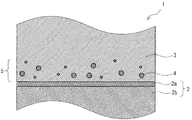
- the laminated structure 1 of FIG. 1 includes a conductor 2 as a metal layer and a resin layer 3 that covers the surface of the conductor 2. That is, the laminated structure 1 includes a metal layer and a resin layer 3 that is directly laminated on the surface of the metal layer.
- the laminated structure 1 can be suitably used as an insulated wire.
- Examples of the main component of the conductor 2 include copper, iron, aluminum, silver, gold, and alloys thereof. Among these, copper is preferable. By using copper as the main component of the conductor 2, it is possible to improve the adhesion between the conductor 2 and the resin layer 3, and the balance between cost and conductivity.
- the cross-sectional shape of the conductor 2 is not particularly limited, and examples thereof include a circle, a rectangle, and a rectangle.
- the size of the cross section of the conductor 2 is not particularly limited, but when the cross section of the conductor 2 is circular, the lower limit of the average diameter is, for example, 0.2 mm.
- the upper limit of the average diameter is, for example, 3.0 mm.
- when making the cross-sectional shape of the conductor 2 into a square as a minimum of the average length of one side, it is 0.05 mm, for example.
- the upper limit of the average length of one side is, for example, 5.0 mm.
- the conductor 2 usually has an oxide layer 2 a on the surface side and a non-oxidation layer 2 b inside the oxide layer 2.
- the oxide layer 2 a is formed of a metal oxide that is the main component of the conductor 2. Although it does not specifically limit as a minimum of the average thickness of the oxide layer 2a, For example, it is 1 nm. On the other hand, the upper limit of the average thickness of the oxide layer 2a is, for example, 100 nm.
- the resin layer 3 is formed of the resin composition. Since the resin composition has been described above, the description thereof is omitted here.
- metal particles 4 are dispersed in the vicinity of the interface with the conductor 2.
- the region where the resin layer 3 substantially contains the metal particles 4 is the interface vicinity region 5 within an average distance of 800 nm from the surface of the conductor 2.
- the resin layer 3 functions as an insulating layer and / or protective layer for the conductor 2.
- the resin layer 3 may be a single layer or a plurality of layers. Although it does not specifically limit as a minimum of the average thickness of the resin layer 3, For example, it is 20 micrometers. On the other hand, the upper limit of the average thickness of the resin layer 3 is not particularly limited, but is, for example, 100 ⁇ m.
- both the resin composition according to the first embodiment and the resin composition according to the second embodiment can be used.
- the metal particles 4 are dispersed in the resin layer 3.
- the metal particles 4 are particles formed by precipitation of metal components that are eluted from the conductor 2 and diffused into the resin layer 3. Therefore, the main component of the metal particles 4 is substantially the same as the main component metal of the conductor 2 or its oxide.
- the metal component may be eluted from the oxidized layer 2a or may be eluted from the non-oxidized layer 2b.
- the surface of the metal particle 4 may be oxidized.
- the lower limit of the average particle diameter of the metal particles 4 is not particularly limited, but is preferably 1 nm and more preferably 5 nm.
- the upper limit of the average particle diameter of the metal particles 4 is not particularly limited, but is preferably 50 nm, and more preferably 30 nm.
- the adhesion with the conductor 2 may be reduced due to non-uniform density of the resin layer 3 or the like.
- the “average particle size” of the metal particles 4 is a value measured by the following method. That is, the laminated structure 1 is cut so that the conductor 2 and the resin layer 3 are exposed, the cut surface is mechanically polished, and then ion beam processing is performed.
- the above cut surface is photographed at a magnification of, for example, 50,000 times using a scanning electron microscope, a side of 800 nm in the thickness direction from the interface with the conductor 2 in the resin layer 3, and a side of 2,290 nm orthogonal to this side
- An image of a rectangular area having The average value of the longest widths of any 10 or more particles in this image is defined as the average particle diameter of the metal particles 4.
- an image of a rectangular area that has a side in contact with the interface between the resin layer 3 and the conductor 2 and has the maximum area is used.
- the content of the metal particles 4 in the resin layer 3 is inclined in the thickness direction so that it is larger near the interface with the conductor 2 and smaller near the outer surface.
- the adhesiveness between the conductor 2 and the resin layer 3 is further improved by inclining in the thickness direction so that the content of the metal particles 4 in the resin layer 3 increases toward the vicinity of the interface with the conductor 2.
- desired characteristics such as insulation and processability can be easily exhibited.
- the discontinuity relaxation effect of physical characteristics such as the thermal expansion coefficient and Young's modulus of the resin layer 3 in the vicinity of the interface with the conductor 2 by the metal particles 4 can be further improved.
- the lower limit of the content of the metal particles 4 in the interface vicinity region 5 is preferably 90% by volume and more preferably 99% by volume with respect to the content of all the metal particles 4 contained in the resin layer 3.
- the “content” of the metal particles 4 refers to a value obtained by measuring the occupation area ratio of the metal particles 4 in a cross-sectional image taken by a scanning electron microscope and taking the 3/2 power.
- region 5 As a minimum of the content rate of the metal particle 4 in the interface vicinity area
- the manufacturing method of the laminated structure 1 in FIG. 1 includes a step of covering the surface of the conductor 2 as a metal layer with the resin composition (covering step).
- the resin composition both the resin composition according to the first embodiment and the resin composition according to the second embodiment can be used.
- the surface of the conductor 2 is covered with the resin composition.
- a method of coating the surface of the conductor 2 with the resin composition for example, a step of applying the resin composition to the surface of the conductor 2 as a metal layer (coating step), and the resin composition applied The method etc. which have the process (heating process) of heating are mentioned.
- the resin composition is applied to the surface of the conductor 2.
- a method for applying the resin composition to the surface of the conductor 2 include a method in which the resin composition is made into a varnish and is applied by a coating apparatus including a varnish tank storing the varnish and a coating die. . According to this method, the varnish adheres to the surface of the conductor 2 by inserting the conductor 2 through the varnish tank, and then the varnish is applied to a substantially uniform thickness by passing the coating die.
- the surface treatment method include a method of applying a surface treatment agent containing the above-described additive and solvent, which can be used for the resin composition, to the surface of the conductor 2 and then drying.
- a surface treatment agent containing the above-described additive and solvent which can be used for the resin composition
- the adhesiveness with respect to the conductor 2 of the resin layer 3 formed with the said resin composition can be improved more reliably by surface-treating the conductor 2 using the said surface treating agent.
- content of the said additive in the said surface treating agent it can be 0.1 mass% or more and 10 mass% or less, for example.
- the coated resin composition is heated.
- the elution of the main component metal of the conductor 2 and the diffusion to the coating layer (resin layer 3) are promoted, and as a result, the formation of metal particles by the precipitation of the diffused metal component on the resin layer 3 is promoted.
- the said resin composition contains a polyimide precursor, a polyimide is formed by dehydration ring closure of this polyimide precursor.
- Examples of the heating method include a method in which a long cylindrical heating furnace is disposed in the traveling direction of the conductor 2 to indirectly heat the conductor 2.
- the method for indirectly heating is not particularly limited, and examples thereof include conventionally known methods such as hot air heating, infrared heating, and high frequency heating.
- the lower limit of the heating temperature is preferably 200 ° C.
- the upper limit of the heating temperature is preferably 400 ° C.
- the lower limit of the heating time is preferably 5 minutes.
- the upper limit of the heating time is preferably 1 hour.
- the heating time is smaller than the lower limit, the formation of the resin layer 3 may be insufficient.
- the heating time exceeds the upper limit, the insulating properties of the resin layer 3, the adhesion between the resin layer 3 and the conductor 2, and productivity may be reduced.
- the manufacturing method of the laminated structure 1 usually repeats the coating process a plurality of times. Thus, it becomes easy to make resin layer 3 desired thickness by repeating a covering process in multiple times.
- the hole diameter of the coating die may be adjusted to gradually increase according to the number of repetitions.
- the resin component contained in a varnish may be changed when the resin layer 3 of fixed thickness is obtained, and the resin layer 3 which consists of several layers from which a main component differs may be formed.
- it can select suitably as a minimum of the repetition frequency of the coating process for each layer, it is 2 times, for example.
- the upper limit of the number of repetitions can be selected as appropriate, for example, 20 times.
- the laminated structure 1 is excellent in the adhesion between the conductor 2 and the resin layer 3. Moreover, the manufacturing method of the said laminated structure 1 can provide the said laminated structure 1 easily and reliably.
- [Laminated structure] 3 includes a conductive pattern 6 as a metal layer, a base film 7 laminated on one surface of the conductive pattern 6, and an adhesive directly laminated on the other surface of the conductive pattern 6.
- a resin layer 13 as a layer and a cover film 8 laminated on the other surface of the conductive pattern 6 via the resin layer 13 are provided. That is, the laminated structure 11 includes a metal layer and a resin layer 13 that is directly laminated on the surface of the metal layer.
- the laminated structure 11 can be suitably used as a flexible printed circuit board or the like.
- the conductive pattern 6 constitutes a circuit of the laminated structure 11.
- Examples of the main component of the conductive pattern 6 include the same as the main component of the conductor 2 described above.
- the conductive pattern 6 usually has an oxide layer on the surface side and a non-oxidized layer inside the oxide layer. Since the oxide layer and the non-oxide layer are the same as the oxide layer 2a and the non-oxide layer 2b of the multilayer structure 1 in FIG. 2, description thereof is omitted here.
- the lower limit of the average thickness of the conductive pattern 6 is, for example, 2 ⁇ m.
- the upper limit of the average thickness of the conductive pattern 6 is, for example, 100 ⁇ m.
- the base film 7 and the cover film 8 are not particularly limited, and conventionally known insulating films can be used.
- the upper limit of the average thickness is, for example, 200 ⁇ m.
- the resin layer 13 functions as an adhesive layer that bonds the conductive pattern 6 and the cover film 8 together.
- the resin layer 13 is formed of the resin composition.
- the metal particles 4 are dispersed in the vicinity of the interface with the conductive pattern 6.
- description is abbreviate
- As the resin composition both the resin composition according to the first embodiment and the resin composition according to the second embodiment can be used.
- the lower limit of the average thickness of the resin layer 13 is preferably 5 ⁇ m and more preferably 10 ⁇ m.
- the upper limit of the average thickness of the resin layer 13 is preferably 100 ⁇ m, and more preferably 75 ⁇ m.
- the adhesive strength between the cover film 8 and the conductive pattern 6 may be insufficient.
- the average thickness of the resin layer 13 exceeds the above upper limit, voids are formed due to vaporization of the residual solvent in the resin layer 13 during soldering or the like by a reflow furnace at the time of manufacturing the laminated structure 11, and peeling There is a risk of strength reduction and appearance defects.
- the manufacturing method of the laminated structure 11 of FIG. 3 includes a step of covering the surface of the conductive pattern 6 as a metal layer with the resin composition (covering step).
- the resin composition both the resin composition according to the first embodiment and the resin composition according to the second embodiment can be used.
- the covering step the surface of the conductive pattern 6 is covered with the resin composition.
- a method of covering the surface of the conductive pattern 6 with the resin composition for example, a step of laminating the resin layer 13 formed of the resin composition on one surface of the conductive pattern 6 (lamination step), and the laminated layer
- the method etc. which have the process (heating process) of heating a resin composition are mentioned.
- the resin layer 13 formed of the resin composition is laminated on one surface of the conductive pattern 6.
- a method of laminating the resin layer 13 on one surface of the conductive pattern 6 for example, the first laminated structure including the conductive pattern 6 and the base film 7 laminated on one surface of the conductive pattern 6, and the resin layer 13 and a step of preparing a second laminated structure including a cover film 8 laminated on one surface of the resin layer 13, a conductive pattern 6 of the first laminated structure, and a resin of the second laminated structure
- a method including a step of directly laminating the resin layer 13 on the conductive pattern 6 by laminating the layer 13 opposite to the layer 13 may be used.
- the first laminated structure can be obtained by, for example, a method of laminating a metal film on the base film 7 and etching the metal film.
- a 2nd laminated structure can be obtained by the method etc. which apply the said resin composition to the cover film 8, for example.
- a method of laminating the resin layer 13 on the conductive pattern 6 in this step it is not limited to the above-described method.
- Heating process In this step, the resin composition laminated on one surface of the conductive pattern 6 is heated. By this heating, the elution of the main component metal of the conductive pattern 6 and the diffusion into the resin layer 13 are promoted, and as a result, the formation of the metal particles 4 by the precipitation of the diffused metal component in the resin layer 13 is promoted. Moreover, when the said resin composition contains a polyimide precursor, a polyimide is formed by dehydration ring closure of this polyimide precursor.
- the heating method examples include a method of indirectly heating the laminated structure 11 in a heating furnace.
- the lower limit of the heating temperature is preferably 200 ° C.
- the upper limit of the heating temperature is preferably 400 ° C.
- the lower limit of the heating time is preferably 30 minutes.
- the upper limit of the heating time is preferably 2 hours. When the heating time is smaller than the lower limit, the formation of the resin layer 3 may be insufficient. On the other hand, when the heating time exceeds the upper limit, productivity may be reduced.
- the atmosphere during heating is preferably an inert gas atmosphere.
- the heating step may include a step (preliminary drying step) of predrying the resin composition laminated on one surface of the conductive pattern 6 before the heating.
- the preliminary drying method include a method of heating at a temperature equal to or lower than the above heating temperature in an inert atmosphere such as a nitrogen atmosphere.
- the upper limit of the heating temperature is, for example, 150 ° C.
- the heating time is, for example, 120 minutes.
- the heating temperature may be changed midway. By volatilizing the volatile component of the resin composition in advance by the preliminary drying step, it is possible to suppress the generation of bubbles in the resin layer 13.
- the production method of the resin composition is not limited to the production method of the above-described embodiment.
- a method of adding an additive to a polymerization reaction solution before or during polymerization of a synthetic resin, a synthetic resin and an additive in an open roll And a kneading method using a kneader such as a kneader or a twin-screw mixing extruder.
- the resin layer may be laminated on at least a part of the surface of the metal layer.
- other layers may be further laminated outside the resin layer.
- the other layer may be a resin layer formed of the resin composition, a resin layer formed of another resin composition, or a metal layer. .
- the metal layer may not have electrical conductivity. Moreover, it does not specifically limit as a shape of a metal layer, Various shapes, such as plate shape and foil shape, are mentioned.
- the shape of the metal layer is a foil shape
- the lower limit of the average thickness is, for example, 10 ⁇ m.
- the upper limit of the average thickness is, for example, 100 ⁇ m.
- the production method of the laminated structure is not limited to the production method of the above embodiment, for example, a method of extruding the resin composition on the surface of the metal layer using an extruder, a bar coater on the surface of the metal layer, A method of applying the resin composition using a doctor blade or the like, a step of molding the resin composition into a sheet, a step of disposing the resin composition in the form of a sheet on the surface of the metal layer, and the resin composition And a method including a step of adhering the material by pressure heating.
- the laminated structure is a flexible printed circuit board, it is not limited to one in which only one conductive pattern is formed as in the above-described embodiment, and is a double-sided printed circuit board or multilayer printed circuit board in which two or more conductive patterns are formed. There may be.
- the laminated structure as a flexible printed board includes a conductive pattern as a metal layer, a base film laminated on one surface of the conductive pattern, and a resin layer directly laminated on the other surface of the conductive pattern. It is not necessary to provide a cover film.
- the method for producing the laminated structure includes, for example, a step of applying the resin composition to the surface of the first laminated structure on which the conductive pattern is formed, and a step of heating the resin composition. Methods and the like.
- the adhesion of the resin layer formed of the resin composition other than the resin composition to the metal layer is improved. You can also.
- the reduction potential of the additive used in this example was measured by the following method. Specifically, 10 mg of a sample was dissolved in 5 ml of a 0.1 mol / L acetonitrile solution of tetrabutylammonium tetrafluoroborate prepared in advance under an inert atmosphere, and then argon bubbling was performed in the atmosphere. was measured.
- Polyesterimide varnish (“EH402-45” manufactured by Dainichi Seika Co., Ltd.) was diluted with cresol to obtain a polyesterimide solution having a polyesterimide content of 30% by mass.
- This polyesterimide solution, bisphenol A type phenoxy resin (“YP-50” manufactured by Toto Kasei Co., Ltd.) and the additives shown in Table 1 below were mixed at a solid content ratio of 75: 25: 1 and stirred for 1 hour.
- Resin composition No. 12-No. 17 was produced. Further, the polyesterimide resin solution and the bisphenol A type phenoxy resin were mixed at a solid content ratio of 75:25 and stirred for 1 hour. 18 was produced.
- Resin composition No. 1-No. 10 and no. 12-No. The names and structural formulas of the additives used for the preparation of 17 are shown below.
- Table 1 shows the energy levels of the lowest empty orbit of the additive calculated by the following method. In Table 1, “-” indicates that the corresponding component was not used. The “LUMO level” indicates the energy level of the lowest empty orbit. The “HOMO level” indicates the energy level of the highest occupied orbit. “Phr” represents a part by mass with respect to 100 parts by mass of the synthetic resin. “EI / Ph” indicates a mixed resin of polyesterimide and phenoxy resin.
- Laminated structure No. 1-No. Two notches having a length of about 2 cm are put in 18 at intervals of about 0.5 mm, and one end of the resin layer between the two notches is turned with tweezers, and a thermomechanical tester (“TMA: The resin layer was subjected to a 180 ° peel test using “mechanical analysis”), and the peel strength (N / cm) was measured.
- the peel strength of 18 was measured under the condition of no heat treatment (normal state). When the peel strength is 8 (N / cm) or more, it can be judged as good, and when it is less than 8 (N / cm), it can be judged as bad.
- the laminated structure formed by No. 15 gave good results with respect to peel strength.
- Resin composition No. 1-No. The laminate structure formed by 6 remained excellent in peel strength even after heat treatment.
- the laminated structure formed by No. 17 did not give good results with respect to peel strength.
- the resin composition according to one embodiment of the present invention can easily improve the adhesion of the resin layer to be formed to the metal layer and the selection of an additive according to the application.
- the laminated structure according to another aspect of the present invention is excellent in adhesion between the resin layer and the metal layer.
- the manufacturing method of the laminated structure which concerns on another aspect of this invention can provide the laminated structure excellent in the adhesiveness of a resin layer and a metal layer easily and reliably.
Landscapes
- Chemical & Material Sciences (AREA)
- Health & Medical Sciences (AREA)
- Chemical Kinetics & Catalysis (AREA)
- Medicinal Chemistry (AREA)
- Polymers & Plastics (AREA)
- Organic Chemistry (AREA)
- Laminated Bodies (AREA)
- Compositions Of Macromolecular Compounds (AREA)
Abstract
用途に合わせた添加剤の選択、及び形成される樹脂層の金属層に対する密着性向上が容易な樹脂組成物の提供を目的とする。本発明の一態様に係る樹脂組成物は、合成樹脂と添加剤とを含有する樹脂組成物であって、上記添加剤のAM1法を用いた半経験的分子軌道計算により算出される最低空軌道のエネルギー準位が-0.2eV以下である。合成樹脂100質量部に対する添加剤の含有量としては、0.1質量部以上10質量部以下が好ましい。添加剤が、置換又は非置換のヘテロ環式化合物であるとよい。ヘテロ環式化合物が、アミノ基、チオール基又はこれらの組み合わせを有するとよい。合成樹脂が、極性基を有する樹脂を含むとよい。極性基を有する樹脂が、ポリイミド、ポリエステルイミド、ポリエステル、ポリアミドイミド、フェノキシ樹脂又はこれらの組み合わせであるとよい。
Description
本発明は、樹脂組成物、積層構造体及びその製造方法に関する。
電気機器、自動車等の構成要素である電線、プリント基板などは、金属層とこの金属層の少なくとも一部に積層される樹脂層とを備える積層構造体である。これらの積層構造体には、金属層と樹脂層との密着性に優れ、層間剥離し難いことが要求される。
上記要求を満たす方法として、例えば金属層に表面処理層を形成する方法、金属層と樹脂層との間にプライマー層を形成する方法等がある。また、金属層に対する密着性向上作用を有する添加剤(密着性向上剤)を含有する樹脂組成物により樹脂層を形成する方法もある。この樹脂組成物として、例えば添加剤としてセチルメルカプタン等のチオール化合物やポリサルファイドポリマーを含有するものが提案されている(特開平08-218007号公報及び特開2011-192514号公報参照)。
また、別の樹脂組成物として、添加剤としてペンタエリストールテトラキス等のチオール化合物を含有するものが提案されている(特表2014/024767号公報参照)。この樹脂組成物は、樹脂層を形成する際に上記添加剤が金属層からの金属成分の溶出及び樹脂層への拡散を促進し、その結果、樹脂層に上記拡散した金属成分の析出による金属粒子が形成され、この金属粒子が金属層と樹脂層との密着性を向上するとしている。
しかし、上記従来の樹脂組成物は、構造及び物性が比較的類似する添加剤であっても密着性向上作用には比較的大きな差異があり、実際に積層構造体を形成しない限り形成される樹脂層の金属層に対する密着性が予測し難い。さらに、密着性向上作用に優れることが確認されている添加剤の種類は、比較的少数に留まる。その結果、上記従来の樹脂組成物は、用途に合わせた添加剤の選択、及び形成される樹脂層の金属層に対する密着性向上が困難である。
本発明は、上記事情に基づいてなされたものであり、用途に合わせた添加剤の選択、及び形成される樹脂層の金属層に対する密着性向上が容易な樹脂組成物を提供することを目的とする。
上記課題を解決するためになされた本発明の一態様に係る樹脂組成物は、合成樹脂と添加剤とを含有する樹脂組成物であって、上記添加剤のAM1(Austin Model 1)法を用いた半経験的分子軌道計算により算出される最低空軌道のエネルギー準位が-0.2eV以下である。
また、上記課題を解決するためになされた本発明の別の態様に係る樹脂組成物は、合成樹脂と添加剤とを含有する樹脂組成物であって、上記添加剤の還元電位が-1.20V以上-0.30V以下である。
上記課題を解決するためになされた本発明のさらに別の態様に係る積層構造体は、金属層とこの金属層の少なくとも一部の表面に積層される樹脂層とを備える積層構造体であって、上記樹脂層が合成樹脂及び添加剤を含有する樹脂組成物により形成され、上記添加剤のAM1法を用いた半経験的分子軌道計算により算出される最低空軌道のエネルギー準位が-0.2eV以下である。
上記課題を解決するためになされた本発明のさらに別の態様に係る積層構造体は、金属層とこの金属層の少なくとも一部の表面に積層される樹脂層とを備える積層構造体であって、上記樹脂層が合成樹脂及び添加剤を含有する樹脂組成物により形成され、上記添加剤の還元電位が-1.20V以上-0.30V以下である。
上記課題を解決するためになされた本発明のさらに別の態様に係る積層構造体の製造方法は、金属層とこの金属層の少なくとも一部の表面に積層される樹脂層とを備える積層構造体の製造方法であって、上記金属層の少なくとも一部の表面を樹脂組成物で被覆する工程を備え、上記樹脂組成物が合成樹脂及び添加剤を含有し、上記添加剤のAM1法を用いた半経験的分子軌道計算により算出される最低空軌道のエネルギー準位が-0.2eV以下である。
上記課題を解決するためになされた本発明のさらに別の態様に係る積層構造体の製造方法は、金属層とこの金属層の少なくとも一部の表面に積層される樹脂層とを備える積層構造体の製造方法であって、上記金属層の少なくとも一部の表面を樹脂組成物で被覆する工程を備え、上記樹脂組成物が合成樹脂及び添加剤を含有し、上記添加剤の還元電位が-1.20V以上-0.30V以下である。
ここで「最低空軌道」とは、電子に占有されていない分子軌道のうち最もエネルギー準位の低いものをいう。
本発明の一態様に係る樹脂組成物は、用途に合わせた添加剤の選択、及び形成される樹脂層の金属層に対する密着性向上が容易である。本発明の別の態様に係る積層構造体は、樹脂層と金属層との密着性に優れる。本発明のさらに別の態様に係る積層構造体の製造方法は、樹脂層と金属層との密着性に優れる積層構造体を容易かつ確実に提供できる。
[本発明の実施形態の説明]
本発明の一態様に係る樹脂組成物は、合成樹脂と添加剤とを含有する樹脂組成物であって、上記添加剤のAM1法を用いた半経験的分子軌道計算により算出される最低空軌道のエネルギー準位が-0.2eV以下である。
本発明の一態様に係る樹脂組成物は、合成樹脂と添加剤とを含有する樹脂組成物であって、上記添加剤のAM1法を用いた半経験的分子軌道計算により算出される最低空軌道のエネルギー準位が-0.2eV以下である。
当該樹脂組成物は、合成樹脂と添加剤とを含有し、上記添加剤のAM1法を用いた半経験的分子軌道計算により算出される最低空軌道のエネルギー準位が-0.2eV以下であることで、形成される樹脂層の金属層に対する密着性に優れる。また、当該樹脂組成物は、最低空軌道のエネルギー準位が-0.2eV以下である限り様々な添加剤を使用でき、さらに最低空軌道のエネルギー準位は添加剤の構造式から容易に算出できる。そのため、当該樹脂組成物は、用途に合わせた添加剤の選択、及び形成される樹脂層の金属層に対する密着性向上が容易である。当該樹脂組成物により形成される樹脂層が金属層に対する密着性に優れる理由は明確ではないが、例えば以下のように推察できる。すなわち、最低空軌道のエネルギー準位は、負の値である場合は電子の受容によりエネルギーを放出し、正の値である場合は電子の受容によりエネルギーを吸収し、値が小さいほど電子を受容して陰イオンになり易いことを意味する。そのため、当該樹脂組成物は、含有する添加剤の最低空軌道のエネルギー準位の値が-0.2eV以下であることで樹脂層形成の際に金属層の酸化(陽イオン化)による金属成分の溶出及び樹脂層への拡散を促進し、その結果、上記樹脂層に金属粒子を形成する。ここで、この金属粒子は、樹脂の化学的架橋による樹脂層の結合強化、金属層との界面付近における樹脂層の熱膨張係数、ヤング率等の物理的特性の不連続性緩和などの効果を有する。さらに、この金属粒子は、樹脂層の高密度化及び比較的低密度領域での優先的析出による密度均等化、金属層との界面付近での高密度凝集による金属層表面の凹凸増大と同様のアンカー効果発生などの効果も有する。その結果、当該樹脂組成物は、この金属粒子により、形成される樹脂層の金属層に対する密着性を向上できると考えられる。
上記合成樹脂100質量部に対する添加剤の含有量としては、0.1質量部以上10質量部以下が好ましい。このように、合成樹脂100質量部に対する添加剤の含有量を上記特定範囲とすることで、形成される樹脂層の金属層に対する密着性をより向上できる。
上記添加剤が、置換又は非置換のヘテロ環式化合物であるとよい。ヘテロ環式化合物は、最低空軌道のエネルギー準位が比較的小さい。そのため、添加剤を置換又は非置換のヘテロ環式化合物とすることで、最低空軌道のエネルギー準位を上記範囲とし易くなり、その結果、形成される樹脂層の金属層に対する密着性をより向上できる。ここで「ヘテロ環式化合物」とは、環式化合物のうち、環を構成する原子に炭素以外の原子が含まれているものをいう。
上記ヘテロ環式化合物が、アミノ基、チオール基又はこれらの組み合わせを有するとよい。アミノ基、チオール基又はこれらの組み合わせを有する化合物は、最低空軌道のエネルギー準位が比較的小さい。そのため、上記ヘテロ環式化合物がアミノ基、チオール基又はこれらの組み合わせを有することで、最低空軌道のエネルギー準位をより低下させ易くなり、その結果、形成される樹脂層の金属層に対する密着性をより向上できる。
上記合成樹脂が、極性基を有する樹脂を含むとよい。このように、合成樹脂が極性基を有する樹脂を含むことで、形成される樹脂層の金属層に対する密着性をより向上できる。ここで「極性基を有する樹脂」とは、主鎖に極性基を有する樹脂でもよく、側鎖に極性基を有する樹脂でも良い。
上記極性基を有する樹脂が、ポリイミド、ポリエステルイミド、ポリエステル、ポリアミドイミド、フェノキシ樹脂又はこれらの組み合わせであるとよい。このように、極性基を有する樹脂をポリイミド、ポリエステルイミド、ポリエステル、ポリアミドイミド、フェノキシ樹脂又はこれらの組み合わせとすることで、形成される樹脂層の金属層に対する密着性をより向上できる。ここで「ポリイミド」とは、ポリアミド酸等のポリイミド前駆体も含む。
本発明の別の態様に係る樹脂組成物は、合成樹脂と添加剤とを含有する樹脂組成物であって、上記添加剤の還元電位が-1.20V以上-0.30V以下である。
当該樹脂組成物は、合成樹脂と添加剤とを含有し、上記添加剤の還元電位が上記範囲であることで、形成される樹脂層の金属層に対する密着性に優れる。また、当該樹脂組成物は、還元電位が上記範囲である限り、様々な添加剤を使用できる。さらに、還元電位は上記添加剤単体の溶液を用いることで容易に測定できる。そのため、当該樹脂組成物は、用途に合わせた添加剤の選択、及び形成される樹脂層の金属層に対する密着性向上が容易である。上記添加剤の還元電位を上記範囲とすることで形成される樹脂層の金属層に対する密着性を向上できる理由は明確ではないが、例えば以下のように推察できる。すなわち、上記添加剤は、還元電位が高い場合、つまり還元電位の絶対値が小さい場合、電子を受容して陰イオンになり易いことを意味する。そのため、当該樹脂組成物は、上記添加剤の還元電位を上記範囲と比較的高く(絶対値を小さく)することで、上記添加剤の最低空軌道のエネルギー準位の値を-0.2eV以下とした場合と同様に、上記添加剤による電子の受容を促進できる。その結果、樹脂層形成の際の金属層の酸化(陽イオン化)による金属成分の溶出及び樹脂層への拡散を促進し、上記樹脂層に金属粒子を形成できる。これにより、上述した金属粒子による上記樹脂層の金属層に対する密着性の向上効果を発揮できると考えられる。ここで「還元電位」とは、添加剤単体の溶液を試料とし、作用極及び対極に白金電極を用い、参照極に銀/塩化銀電極を用いて測定したサイクリックボルタモグラムから算出される値をいう。
本発明のさらに別の態様に係る積層構造体は、金属層とこの金属層の少なくとも一部の表面に積層される樹脂層とを備える積層構造体であって、上記樹脂層が合成樹脂及び添加剤を含有する樹脂組成物により形成され、上記添加剤のAM1法を用いた半経験的分子軌道計算により算出される最低空軌道のエネルギー準位が-0.2eV以下である。
当該積層構造体は、樹脂層が当該樹脂組成物により形成されるため、金属層と樹脂層との密着性に優れる。
上記金属層の主成分が銅であるとよい。このように、金属層の主成分を銅とすることで、金属層と樹脂層との密着性をより向上できる。また、銅はコストと導電性とのバランスに優れるため、金属層を導体として好適に用いることができる。ここで「主成分」とは、最も含有量が多い成分であり、例えば含有量が50質量%以上の成分をいう。
本発明のさらに別の態様に係る積層構造体は、金属層とこの金属層の少なくとも一部の表面に積層される樹脂層とを備える積層構造体であって、上記樹脂層が合成樹脂及び添加剤を含有する樹脂組成物により形成され、上記添加剤の還元電位が-1.20V以上-0.30V以下である。
当該積層構造体は、樹脂層が上述の樹脂組成物により形成されるため、金属層と樹脂層との密着性に優れる。
本発明のさらに別の態様に係る積層構造体の製造方法は、金属層とこの金属層の少なくとも一部の表面に積層される樹脂層とを備える積層構造体の製造方法であって、上記金属層の少なくとも一部の表面を樹脂組成物で被覆する工程を備え、上記樹脂組成物が合成樹脂及び添加剤を含有し、上記添加剤のAM1法を用いた半経験的分子軌道計算により算出される最低空軌道のエネルギー準位が-0.2eV以下である。
当該積層構造体の製造方法は、金属層と樹脂層との密着性に優れる積層構造体を容易かつ確実に提供できる。
本発明のさらに別の態様に係る積層構造体の製造方法は、金属層とこの金属層の少なくとも一部の表面に積層される樹脂層とを備える積層構造体の製造方法であって、上記金属層の少なくとも一部の表面を樹脂組成物で被覆する工程を備え、上記樹脂組成物が合成樹脂及び添加剤を含有し、上記添加剤の還元電位が-1.20V以上-0.30V以下である。
当該積層構造体の製造方法は、金属層と樹脂層との密着性に優れる積層構造体を容易かつ確実に提供できる。
[本発明の実施形態の詳細]
以下、本発明の実施形態に係る樹脂組成物、積層構造体及びその製造方法について適宜図面を参照しつつ詳説する。
以下、本発明の実施形態に係る樹脂組成物、積層構造体及びその製造方法について適宜図面を参照しつつ詳説する。
<第1実施形態>
[樹脂組成物]
当該樹脂組成物は、合成樹脂と添加剤とを含有する。当該樹脂組成物は、本発明の効果を損なわない範囲においてその他の任意成分を含有してもよい。
[樹脂組成物]
当該樹脂組成物は、合成樹脂と添加剤とを含有する。当該樹脂組成物は、本発明の効果を損なわない範囲においてその他の任意成分を含有してもよい。
(合成樹脂)
合成樹脂は、当該樹脂組成物のベース樹脂である。合成樹脂としては、極性基を有する樹脂でもよく、極性基を有さない樹脂でもよい。この極性基としては、例えば後述するヘテロ原子を含む基等が挙げられる。合成樹脂は、1種単独で又は2種以上を組み合わせて用いることができる。
合成樹脂は、当該樹脂組成物のベース樹脂である。合成樹脂としては、極性基を有する樹脂でもよく、極性基を有さない樹脂でもよい。この極性基としては、例えば後述するヘテロ原子を含む基等が挙げられる。合成樹脂は、1種単独で又は2種以上を組み合わせて用いることができる。
極性基を有する樹脂としては、例えばポリイミド、ポリアミドイミド、ポリエステル、ポリエステルイミド、フェノキシ樹脂等のエポキシ樹脂、メラミン樹脂、ポリ塩化ビニル、オレフィンと極性モノマーとの共重合体などが挙げられる。
ポリイミドとは、分子内にイミド結合(イミド基)を有する樹脂である。ポリイミドは、例えば酸成分としてのテトラカルボン酸又はその無水物と、アミン成分としてのジアミン化合物とを反応溶媒中で重縮合反応させ、得られたポリイミド前駆体を加熱等により脱水閉環させることにより得ることができる。
上記テトラカルボン酸又はその無水物としては、例えばピロメリット酸二無水物、3,3’,4,4’-ベンゾフェノンテトラカルボン酸二無水物、ベンゼン-1,2,3,4-テトラカルボン酸二無水物、ナフタレン-2,3,6,7-テトラカルボン酸二無水物、3,3’,4,4’-ジフェニルテトラカルボン酸二無水物、2,2’’,3,3’’-p-テルフェニルテトラカルボン酸二無水物、2,2-ビス(2,3-ジカルボキシフェニル)-プロパン二無水物、ビス(2,3-ジカルボキシフェニル)エーテル二無水物、ビス(2,3-ジカルボキシフェニル)メタン二無水物、3,3’,4,4’-ジフェニルスルホンテトラカルボン酸二無水物、ビス(2,3-ジカルボキシフェニル)スルホン二無水物、1,1-ビス(2,3-ジカルボキシフェニル)エタン二無水物、ペリレン-3,4,9,10-テトラカルボン酸二無水物、フェナンスレン-1,2,7,8-テトラカルボン酸二無水物等の芳香族テトラカルボン酸二無水物;シクロペンタン-1,2,3,4-テトラカルボン酸二無水物等の脂環式酸無水物;ピラジン-2,3,5,6-テトラカルボン酸二無水物等の複素環誘導体などが挙げられる。上記テトラカルボン酸又はその無水物としては、これらの中でテトラカルボン酸二無水物が好ましく、芳香族テトラカルボン酸二無水物がより好ましく、ピロメリット酸二無水物がさらに好ましい。上記テトラカルボン酸又はその無水物は、1種単独で又は2種以上を組み合わせて用いることができる。
上記ジアミン化合物としては、例えば2,2-ジ(p-アミノフェニル)-6,6’-ビスベンゾオキサゾール、p-フェニレンジアミン、m-フェニレンジアミン、4,4’-ジアミノジフェニルプロパン、2,2-ビス[4-(4-アミノフェノキシ)フェニル]プロパン、4,4’-ジアミノジフェニルスルホン、4,4’-ジアミノジフェニルエーテル、ベンジジン、4,4’’-ジアミノ-p-テルフェニル、p-ビス(2-メチル-4-アミノペンチル)ベンゼン、1,5-ジアミノナフタレン、2,4-ジアミノトルエン、m-キシレン-2,5-ジアミン、m-キシリレンジアミン等の芳香族ジアミン;ピペラジン、メチレンジアミン、エチレンジアミン、テトラメチレンジアミン等の脂肪族ジアミンなどが挙げられる。上記ジアミン化合物としては、これらの中で芳香族ジアミンが好ましく、4,4’-ジアミノジフェニルエーテルがより好ましい。上記ジアミン化合物は、1種単独で又は2種以上を組み合わせて用いることができる。
上記重縮合反応における上記テトラカルボン酸又はその無水物とジアミン化合物とのモル比の下限としては、例えば4.8:5.2である。一方、上記比の上限としては、例えば5.2:4.8である。上記比が上記下限より小さい場合、又は上記上限を超える場合、ポリイミドの分子量が低下するおそれがある。
上記反応溶媒としては、極性溶媒でもよく、非極性溶媒でもよい。上記極性溶媒としては、例えばアセトン、メチルエチルケトン、メチルイソブチルケトン、シクロへキサノン等のケトン溶媒;酢酸メチル、酢酸エチル、酢酸ブチル、シュウ酸ジエチル等のエステル溶媒;ジエチルエーテル、エチレングリコールジメチルエーテル、ジエチレングリコールモノメチルエーテル、ジエチレングリコールジメチルエーテル、テトラヒドロフラン等のエーテル溶媒;ジクロロメタン、クロルベンゼン等のハロゲン化炭化水素溶媒;クレゾール、クロルフェノール等のフェノール溶媒;ピリジン等の第3級アミン溶媒;N-メチル-2-ピロリドン、N,N-ジメチルアセトアミド、N,N-ジメチルホルムアミド、ジメチルスルホキシド、テトラメチル尿素、ヘキサエチルリン酸トリアミド、γ-ブチロラクトンなどが挙げられる。上記非極性溶媒としては、例えばヘキサン、ヘプタン、ベンゼン、トルエン、キシレン等の炭化水素溶媒などが挙げられる。上記反応溶媒としては、これらの中で極性溶媒が好ましく、N-メチル-2-ピロリドンがより好ましい。上記反応溶媒は、1種単独で又は2種以上を組み合わせて用いることができる。
上記重縮合反応の方法としては、例えば室温下(15℃以上25℃以下)での攪拌により反応溶液を混合する工程(混合工程)、及び攪拌しながら加熱する工程(加熱工程)を有する方法等が挙げられる。上記混合時間の下限としては、例えば30分である。一方、上記混合時間の上限としては、例えば2時間である。また、上記加熱温度の下限としては、例えば40℃である。一方、上記加熱温度の上限としては、例えば90℃である。また、上記加熱時間の下限としては、例えば1時間である。一方、上記加熱時間の上限としては、例えば40時間である。また、上記混合工程及び加熱工程は、窒素雰囲気下等の不活性雰囲気下で行うことが好ましい。
ポリアミドイミドとは、分子内にアミド結合(アミド基)及びイミド結合を有する樹脂である。ポリアミドイミドは、例えば有機溶媒中でトリカルボン酸無水物と、多価イソシアネート化合物とを反応させて得ることができる。
ポリエステルイミドとは、分子内にエステル結合(エステル基)及びイミド結合を有する樹脂である。ポリエステルイミドは、例えばトリカルボン酸無水物とジアミンとの反応生成物であるイミドジカルボン酸と多価アルコールとを反応させて得ることができる。ポリエステルイミドとしては、例えば大日精化社の「EH402-45」が挙げられる。
ポリエステルとは、分子内にエステル結合を有する樹脂である。ポリエステルは、多価カルボン酸と多価アルコールとを反応させて得ることができる。なお、ポリエステルは、例えばアルキド樹脂等の変性ポリエステルであってもよい。
エポキシ樹脂とは、分子内にエポキシ基を有する樹脂である。エポキシ樹脂は、例えばビスフェノール化合物とエピハロヒドリン等のエポキシ基及びハロゲン原子を有する化合物とを反応させて得ることができる。
フェノキシ樹脂とは、ビスフェノール化合物とエピハロヒドリンとを反応させて得られるエポキシ樹脂のうち、分子量(重合度)の比較的大きいものをいう。このフェノキシ樹脂としては、ビスフェノールAとエピハロヒドリンとから得られるビスフェノールA型フェノキシ樹脂、ビスフェノールSとエピハロヒドリンとから得られるビスフェノールS型フェノキシ樹脂等が挙げられる。フェノキシ樹脂としては、これらの中でビスフェノールA型フェノキシ樹脂(例えば東都化成社の「YP-50」)が好ましい。
メラミン樹脂とは、メラミンとホルムアルデヒドとを原料とする樹脂である。メラミン樹脂は、メラミンとホルムアルデヒドとをアルカリ条件下で縮合させ、得られたメチロールメラミンをさらに加熱等により重縮合することで得ることができる。
ポリ塩化ビニルとは、分子内に塩素原子を有する樹脂である。ポリ塩化ビニルは、クロロエチレンの付加重合により得ることができる。
オレフィンと極性モノマーとの共重合体としては、例えばエチレン、プロピレン、1-ブテン等のオレフィンと酢酸ビニル、(メタ)アクリル酸、エチルアクリレート等の極性モノマーとの共重合体などが挙げられる。
極性基を有さない樹脂としては、例えばポリオレフィン等が挙げられる。ポリオレフィンとは、オレフィンをモノマーとして含む樹脂である。ポリオレフィンとしては、例えばポリエチレン(エチレン単独重合体)、ポリプロピレン(プロピレン単独重合体)、ポリブテン-1(1-ブテン単独重合体)、エチレン-プロピレン共重合体、エチレン-1-ブテン共重合体、エチレン-4-メチル-1-ペンテン共重合体、エチレン-1-ヘキセン共重合体、エチレン-1-オクテン共重合体、プロピレン-1-ブテン共重合体、プロピレン-エチレン-1-ブテン共重合体、プロピレン-4-メチル-1-ペンテン共重合体等が挙げられる。
合成樹脂としては、これらの中で極性基を有する樹脂が好ましく、ポリイミド、ポリエステル、ポリエステルイミド、ポリアミドイミド、フェノキシ樹脂又はこれらの組み合わせがより好ましく、ポリエステルイミドとフェノキシ樹脂との混合樹脂及びポリイミドがさらに好ましい。合成樹脂がポリエステルイミドとフェノキシ樹脂との混合樹脂である場合、ポリエステルイミドとフェノキシ樹脂との質量比の下限としては、例えば10:90であり、30:70が好ましく、60:40がより好ましく、70:30がさらに好ましい。一方、上記比の上限としては、例えば99:1であり、90:10が好ましく、80:20がより好ましい。上記比が上記下限より小さい場合、又は上記上限を超える場合、形成される樹脂層の金属層に対する密着性を向上し難いおそれがある。
当該樹脂組成物の固形分における合成樹脂の含有量の下限としては、80質量%が好ましく、90質量%がより好ましく、95質量%がさらに好ましく、98質量%が特に好ましい。一方、当該樹脂組成物の固形分における合成樹脂の含有量の上限としては、99.9質量%が好ましく、99.5質量%がより好ましい。合成樹脂の含有量が上記下限より小さい場合、形成される樹脂層の機械的強度等が不十分となるおそれがある。逆に、合成樹脂の含有量が上記上限を超える場合、添加剤等の他の成分の含有量が不十分となるおそれがある。
(添加剤)
添加剤は、当該樹脂組成物により形成される樹脂層の金属層に対する密着性を向上し、AM1法を用いた半経験的分子軌道計算により算出される最低空軌道のエネルギー準位が-0.2eV以下である。添加剤は、1種単独で又は2種以上を組み合わせて用いることができる。
添加剤は、当該樹脂組成物により形成される樹脂層の金属層に対する密着性を向上し、AM1法を用いた半経験的分子軌道計算により算出される最低空軌道のエネルギー準位が-0.2eV以下である。添加剤は、1種単独で又は2種以上を組み合わせて用いることができる。
AM1法を用いた半経験的分子軌道計算による最低空軌道のエネルギー準位は、分子起動計算ソフト(例えばクロスアビリティ社の「Winmostar」内蔵のMOPAC6)を用いた真空準位を基準とする電子状態の計算により求められる。なお、上記エネルギー準位は、計算精度の関係で実測値とは必ずしも一致せず、符号がプラスとなる場合もあるが、値が小さいほど陰イオンになり易いこと、すなわち金属層等の他の分子を陽イオン化し易いことを意味する。
添加剤のAM1法を用いた半経験的分子軌道計算により算出される最低空軌道のエネルギー準位の下限としては、-2.0eVが好ましく、-1.7eVがより好ましく、-1.5eVがさらに好ましい。一方、上記最低空軌道のエネルギー準位の上限としては、-0.2eVであり、-0.5eVが好ましく、-0.6eVがより好ましく、-1.0eVがさらに好ましく、-1.2eVが特に好ましい。上記最低空軌道のエネルギー準位が上記下限より小さい場合、特性を満たす添加剤の種類が限定され、用途に合わせた添加剤の選択が困難となるおそれがある。逆に、上記最低空軌道のエネルギー準位が上記上限を超える場合、樹脂層を形成する際に金属層からの金属成分の溶出が不十分となるおそれがある。
添加剤のAM1法を用いた半経験的分子軌道計算により算出される最高被占軌道のエネルギー準位の下限としては、-10eVが好ましく、-9.6eVがより好ましく、-9.5eVがさらに好ましい。一方、上記最高被占軌道のエネルギー準位の上限としては、-8.0eVが好ましく、-8.5eVがより好ましく、-8.6eVがさらに好ましい。上記最高被占軌道のエネルギー準位が上記下限より小さい場合、形成される樹脂層の金属層に対する密着性が不十分となるおそれがある。逆に、上記最高被占軌道のエネルギー準位が上記上限を超える場合、特性を満たす添加剤の種類が限定され、用途に合わせた添加剤の選択が困難となるおそれがある。ここで「最高被占軌道」とは、電子に占有されている分子軌道のうち最もエネルギー準位の高いものをいう。「最高被占軌道のエネルギー準位」は、値が小さいほど陽イオンになり難いことを意味する。
添加剤のAM1法を用いた半経験的分子軌道計算により算出される最低空軌道のエネルギー準位と最高被占軌道のエネルギー準位との差の下限としては、7.2eVが好ましく、7.8eVがより好ましい。一方、上記最低空軌道のエネルギー準位と最高被占軌道のエネルギー準位との差の上限としては、9.0eVが好ましく、8.9eVがより好ましい。上記最低空軌道のエネルギー準位と最高被占軌道のエネルギー準位との差が上記下限より小さい場合、特性を満たす添加剤の種類が限定され、用途に合わせた添加剤の選択が困難となるおそれがある。逆に、上記最低空軌道のエネルギー準位と最高被占軌道のエネルギー準位との差が上記上限を超える場合、形成される樹脂層の金属層に対する密着性が不十分となるおそれがある。ここで「最低空軌道のエネルギー準位と最高被占軌道のエネルギー準位」とは、最低空軌道のエネルギー準位から最高被占軌道のエネルギー準位を引いた値のことをいう。
上記添加剤の還元電位の下限としては、-1.20Vが好ましく、-1.10Vがより好ましい。一方、上記還元電位の上限としては、-0.30Vが好ましく、-0.40Vがより好ましい。上記還元電位が上記下限より小さい場合、樹脂層を形成する際に金属層からの金属成分の溶出が不十分となるおそれがある。逆に、上記還元電位が上記上限を超える場合、特性を満たす添加剤の種類が限定され、用途に合わせた添加剤の選択が困難となるおそれや、場合によっては添加剤自体の安定性が劣るおそれがある。
上記添加剤は、通常ヘテロ原子を含む。この添加剤が含むヘテロ原子としては、例えば窒素原子、硫黄原子、酸素原子、臭素原子、これらの組み合わせ等が挙げられ、これらの中で窒素原子、硫黄原子、酸素原子又はこれらの組み合わせが好ましく、窒素原子、硫黄原子又はこれらの組み合わせがより好ましい。ここで「ヘテロ原子」とは、炭素原子及び水素原子以外の原子をいう。
添加剤がヘテロ原子を含む場合、添加剤が含むヘテロ原子の数の下限としては、3が好ましく、4がより好ましい。一方、添加剤が含むヘテロ原子の数の上限としては、特に限定されないが、例えば8である。添加剤が含むヘテロ原子の数が上記下限より小さい場合、最低空軌道のエネルギー準位を上記特定範囲とすることが困難である。
ヘテロ原子を含む添加剤としては、例えばヘテロ原子を含む基を有する化合物、置換又は非置換のヘテロ環式化合物等が挙げられる。へテロ環式化合物としては、単環のヘテロ環式化合物でもよく、多環のヘテロ環式化合物でもよいが、単環のヘテロ環式化合物が好ましい。
ヘテロ原子を含む基としては、例えば
アミノ基、シアノ基、ニトロ基、シアノ基、アミド基、イミド基、イソシアネート基等の窒素原子を含む基;
チオール基、チオエーテル基、スルホ基等の硫黄原子を含む基;
水酸基、エーテル基、エステル基、カルボキシ基、カルボニル基、エポキシ基等の酸素原子を含む基;
臭素原子等のハロゲン原子;
ハロゲン化アルキル基等のハロゲン原子を含む基などが挙げられる。ヘテロ原子を含む基としては、これらの中で窒素原子を含む基、硫黄原子を含む基及び酸素原子を含む基がより好ましく、アミノ基、チオール基、シアノ基、ニトロ基又はこれらの組み合わせがさらに好ましく、アミノ基、チオール基又はこれらの組み合わせが特に好ましい。
アミノ基、シアノ基、ニトロ基、シアノ基、アミド基、イミド基、イソシアネート基等の窒素原子を含む基;
チオール基、チオエーテル基、スルホ基等の硫黄原子を含む基;
水酸基、エーテル基、エステル基、カルボキシ基、カルボニル基、エポキシ基等の酸素原子を含む基;
臭素原子等のハロゲン原子;
ハロゲン化アルキル基等のハロゲン原子を含む基などが挙げられる。ヘテロ原子を含む基としては、これらの中で窒素原子を含む基、硫黄原子を含む基及び酸素原子を含む基がより好ましく、アミノ基、チオール基、シアノ基、ニトロ基又はこれらの組み合わせがさらに好ましく、アミノ基、チオール基又はこれらの組み合わせが特に好ましい。
非置換のヘテロ環式化合物としては、例えば
アゾリジン、アジナン、イミダゾリジン、アゾール、ピリジン、イミダゾリン、イミダゾール、ピラゾール、トリアゾール、フェナジン等の含窒素ヘテロ環式化合物;
チオラン、チアン、チオフェン、チアゾール等の含硫黄ヘテロ環式化合物;
オキソラン、オキサン、オキソール、ピラン等の含酸素へテロ環式化合物;
チアゾール、チアジアゾール、オキサゾール、ベンゾチアゾール、フェノキサチイン等の2種以上のヘテロ原子を含むヘテロ環式化合物などが挙げられる。非置換のヘテロ環式化合物としては、これらの中で窒素原子、硫黄原子又はこれらの組み合わせを含むヘテロ環式化合物が好ましく、窒素原子及び硫黄原子からなる群より選ばれる少なくとも2以上のヘテロ原子を含むヘテロ環式化合物がより好ましく、窒素原子及び硫黄原子からなる群より選ばれる少なくとも2以上のヘテロ原子を含む不飽和のヘテロ環式化合物がさらに好ましく、チアジアゾール、イミダゾール及びチアゾールが特に好ましい。
置換のヘテロ環式化合物としては、例えば上記非置換のヘテロ環式化合物の有する水素原子の一部又は全部を置換基で置換した化合物等が挙げられる。上記置換基としては、例えば上記へテロ原子を含む基、アルキル基等が挙げられる。アルキル基としては、例えばメチル基、エチル基、プロピル基、ブチル基等が挙げられ、これらの中でメチル基が好ましい。
置換のヘテロ環式化合物としては、例えば下記式(A1)で表される5-メチル-1,3,4-チアジアゾール-2-チオール、下記式(A2)で表される2,5-ジメルカプト-1,3,4-チアジアゾール、下記式(A3)で表される2-アミノ-5-メルカプト-1,3,4-チアジアゾール、下記式(A4)で表される2-アミノ-1,3,4-チアジアゾール、下記式(A5)で表される2-アミノ-4,5-ジシアノ-1H-イミダゾール、下記式(A6)で表される2-アミノ-5-ニトロチアゾールなどが挙げられる。
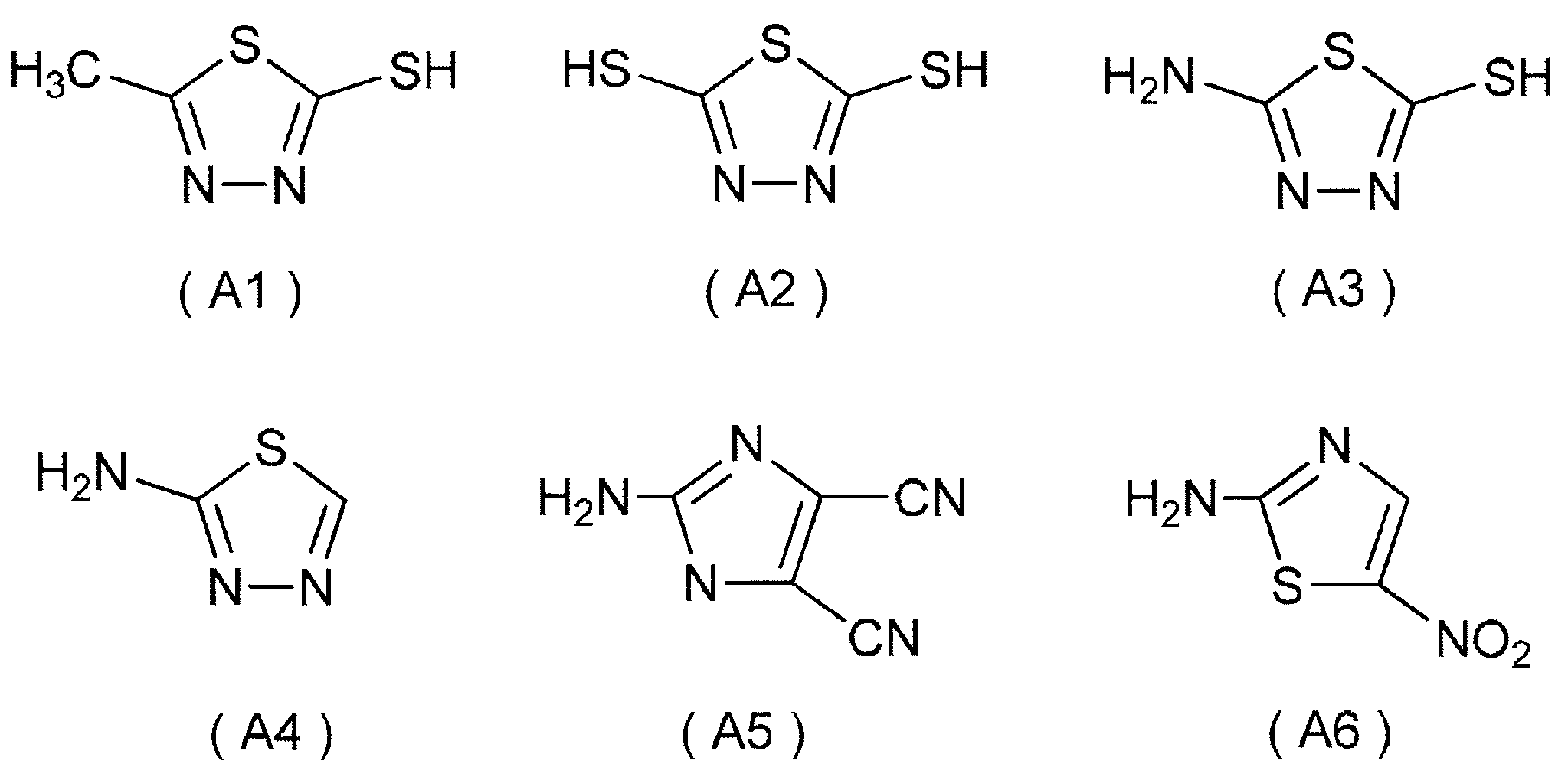
添加剤としては、置換又は非置換のヘテロ環式化合物が好ましく、アミノ基、チオール基又はこれらの組み合わせを有するヘテロ環式化合物がより好ましく、5-メチル-1,3,4-チアジアゾール-2-チオール、2,5-ジメルカプト-1,3,4-チアジアゾール、2-アミノ-5-メルカプト-1,3,4-チアジアゾール、2-アミノ-1,3,4-チアジアゾール、2-アミノ-4,5-ジシアノ-1H-イミダゾール及び2-アミノ-5-ニトロチアゾールがさらに好ましい。
添加剤の分子量の下限としては、50が好ましく、80がより好ましく、90がさらに好ましい。一方、添加剤の分子量の上限としては、2,000が好ましく、1,000がより好ましく、500がさらに好ましく、200が特に好ましい。添加剤の分子量が上記下限より小さい場合、形成される樹脂層の金属層に対する密着性が不十分となるおそれがある。逆に、添加剤の分子量が上記上限を超える場合、形成される樹脂層における添加剤の分散が不十分となるおそれがある。
当該樹脂組成物における添加剤の含有量の下限としては、合成樹脂100質量部に対し、0.1質量部が好ましく、0.5質量部がより好ましく、0.7質量部がさらに好ましい。一方、当該樹脂組成物における添加剤の含有量の上限としては、合成樹脂100質量部に対し、10質量部が好ましく、3質量部がより好ましく、1.5質量部がさらに好ましい。添加剤の含有量が上記下限より小さい場合、形成される樹脂層の金属層に対する密着性が低下するおそれがある。逆に、添加剤の含有量が上記上限を超える場合、当該樹脂組成物の金属層に対する密着性がかえって低下するおそれや製造コストが上昇するおそれがある。
〔その他の任意成分〕
その他の任意成分としては、例えば溶媒、硬化剤、顔料、染料、無機フィラー、有機フィラー、潤滑剤、難燃剤、難燃助剤、酸化防止剤、レベリング剤等が挙げられる。
その他の任意成分としては、例えば溶媒、硬化剤、顔料、染料、無機フィラー、有機フィラー、潤滑剤、難燃剤、難燃助剤、酸化防止剤、レベリング剤等が挙げられる。
溶媒は、当該樹脂組成物の塗布性等を向上する。溶媒としては、合成樹脂、添加剤及び必要に応じて含有されるその他の任意成分を溶解又は分散可能なものであれば特に限定されないが、例えば上述のポリイミド前駆体の重合反応で例示した反応溶媒等が挙げられる。溶媒としては、これらの中でN-メチル-2-ピロリドン及びクレゾールが好ましい。なお、合成樹脂が重合反応に用いた反応溶媒に溶解又は分散している場合、上記反応溶媒を当該樹脂組成物の溶媒としてもよい。溶媒は、1種単独で又は2種以上を組み合わせて用いることができる。
当該樹脂組成物が溶媒を含有する場合、当該樹脂組成物の固形分濃度の下限としては、5質量%が好ましく、10質量%がより好ましい。また、当該樹脂組成物の固形分濃度の上限としては、80質量%が好ましく、60質量%がより好ましい。当該樹脂組成物の固形分濃度が上記下限より小さい場合、樹脂層の形成が困難となるおそれがある。一方、当該樹脂組成物の固形分濃度が上記上限を超える場合、塗布性低下のおそれがある。
硬化剤は、当該樹脂組成物により形成される樹脂層を硬化する。硬化剤としては、合成樹脂の種類等に合わせ適宜選択可能であるが、例えばイソシアネート系硬化剤、メラミン化合物、シランカップリング剤、チタネートカップリング剤等が挙げられる。硬化剤は、1種単独で又は2種以上を組み合わせて用いることができる。
イソシアネート系硬化剤としては、例えば
トリレンジイソシアネート(TDI)、p-フェニレンジイソシアネート、ナフタレンジイソシアネート等の芳香族ジイソシアネート;
ヘキサメチレンジイソシアネート(HDI)、2,2,4-トリメチルへキサンジイソシアネート、リジンジイソシアネート等の炭素数3~12の脂肪族ジイソシアネート;
1,4-シクロへキサンジイソシアネート(CDI)、イソホロンジイソシアネート(IPDI)、4,4’-ジシクロヘキシルメタンジイソシアネート(水添MDI)、メ
チルシクロへキサンジイソシアネート、イソプロピデンジシクロヘキシル-4,4’-ジイソシアネート、1,3-ジ(イソシアナトメチル)シクロへキサン(水添XDI)、水添TDI、2,5-ビス(イソシナトメチル)-ビシクロ[2.2.1]ヘプタン、2,6-ビス(イソシナトメチル)-ビシクロ[2.2.1]ヘプタン等の炭素数5~18の脂環式ジイソシアネート;
キシリレンジイソシアネート(XDI)、テトラメチルキシリレンジイソシアネート(TMXDI)等の芳香環を有する脂肪族ジイソシアネート;
これらのジイソシアネート化合物が含むイソシアネート基をブロック剤でブロックしたブロックイソシアネートなどが挙げられる。
メラミン化合物としては、例えばメチルメラミン、ブチル化メラミン、メチロール化メラミン、ブチロール化メラミン等が挙げられる。メラミン化合物は、当該樹脂組成物が末端に水酸基、カルボキシ基、エポキシ基等のアミンと反応可能な基を有する合成樹脂を含有する場合に好適に用いることができる。
また、当該樹脂組成物が水酸基を有する合成樹脂を含有する場合、テトラプロピルチタネート、テトライソプロピルチタネート、テトラメチルチタネート、テトラブチルチタネート、テトラヘキシルチタネート等のチタンアルコキシドを硬化剤として用いることもできる。
当該樹脂組成物が硬化剤を含有する場合、硬化剤の含有量の下限としては、合成樹脂100質量部に対し、例えば1質量部である。一方、硬化剤の含有量の上限としては、合成樹脂100質量部に対し、例えば20質量部である。
[樹脂組成物の製造方法]
当該樹脂組成物の製造方法としては、特に限定されないが、例えば合成樹脂、添加剤、及び必要に応じて含有されるその他の任意成分を混合する工程(混合工程)、及びこの混合物を攪拌する工程(攪拌工程)を備える方法等が挙げられる。上記攪拌工程における攪拌時間の下限としては、特に限定されないが、例えば30分である。一方、攪拌時間の上限としては、特に限定されないが、例えば2時間である。
当該樹脂組成物の製造方法としては、特に限定されないが、例えば合成樹脂、添加剤、及び必要に応じて含有されるその他の任意成分を混合する工程(混合工程)、及びこの混合物を攪拌する工程(攪拌工程)を備える方法等が挙げられる。上記攪拌工程における攪拌時間の下限としては、特に限定されないが、例えば30分である。一方、攪拌時間の上限としては、特に限定されないが、例えば2時間である。
上記混合工程で添加剤を合成樹脂等に添加する方法としては、特に限定されず、添加剤をそのまま合成樹脂等に添加する方法でもよく、有機溶媒に予め溶解させた添加剤を合成樹脂等に添加する方法でもよい。ここで、当該樹脂組成物により形成される樹脂層の金属層に対する密着性を効果的かつ部位ごとに均等に向上させるためには、当該樹脂組成物の製造において合成樹脂及び添加剤を均一に混合することが好ましい。この観点から、添加剤の添加方法としては、合成樹脂と相溶性の良い有機溶媒に予め溶解させた添加剤を合成樹脂等に添加する方法が好ましい。また、合成樹脂が有機溶媒に溶解している場合、添加剤を予め溶解させる有機溶媒としては、上記合成樹脂が溶解している有機溶媒と同一のものが好ましい。添加剤を有機溶媒に予め溶解させる場合、上記添加剤の濃度の下限としては、特に限定されないが、0.1質量%が好ましく、1質量%がより好ましい。一方、上記添加剤の濃度の上限としては、特に限定されないが、50質量%が好ましく、20質量%がより好ましい。
[利点]
当該樹脂組成物は、用途に合わせた添加剤の選択、及び形成される樹脂層の金属層に対する密着性向上が容易である。そのため、当該樹脂組成物は、ワニス、接着剤、プライマー塗料等に好適に用いることができる。
当該樹脂組成物は、用途に合わせた添加剤の選択、及び形成される樹脂層の金属層に対する密着性向上が容易である。そのため、当該樹脂組成物は、ワニス、接着剤、プライマー塗料等に好適に用いることができる。
<第2実施形態>
[樹脂組成物]
第2実施形態に係る当該樹脂組成物は、合成樹脂及び添加剤を含有し、上記添加剤の還元電位が-1.20V以上-0.30V以下である。当該樹脂組成物は、添加剤として還元電位が上記範囲のものを用いる以外は、第1実施形態と同様とすることができる。なお、上述の最低空軌道のエネルギー準位の低さと、還元電位の高さ(絶対値の小ささ)とは、共に電子を受容して還元されやすいことを示す指標である。但し、上述の最低空軌道のエネルギー準位は、真空中孤立した分子の絶対零度での値であるため、溶液中で溶媒和した分子集合体の室温での値を示す還元電位とは前提条件が異なり、また計算精度の関係で実測値と必ずしも一致しない。そのため、上述の最低空軌道のエネルギー準位と還元電位とは、完全に相関するわけではない。
上記添加剤の還元電位の下限としては、-1.20Vであり、-1.10Vが好ましい。一方、上記還元電位の上限としては、-0.30Vであり、-0.40Vが好ましい。上記還元電位が上記下限より小さい場合、樹脂層を形成する際に金属層からの金属成分の溶出が不十分となるおそれがある。逆に、上記還元電位が上記上限を超える場合、特性を満たす添加剤の種類が限定され、用途に合わせた添加剤の選択が困難となるおそれや、場合によっては添加剤自体の安定性が劣るおそれがある。
添加剤のAM1法を用いた半経験的分子軌道計算により算出される最低空軌道のエネルギー準位の下限としては、-2.0eVが好ましく、-1.7eVがより好ましく、-1.5eVがさらに好ましい。一方、上記最低空軌道のエネルギー準位の上限としては、-0.2eVが好ましく、-0.5eVがより好ましく、-0.6eVがさらに好ましく、-1.0eVが特に好ましく、-1.2eVがさらに特に好ましい。上記最低空軌道のエネルギー準位が上記下限より小さい場合、特性を満たす添加剤の種類が限定され、用途に合わせた添加剤の選択が困難となるおそれがある。逆に、上記最低空軌道のエネルギー準位が上記上限を超える場合、樹脂層を形成する際に金属層からの金属成分の溶出が不十分となるおそれがある。
[利点]
当該樹脂組成物は、用途に合わせた添加剤の選択、及び形成される樹脂層の金属層に対する密着性向上が容易である。そのため、当該樹脂組成物は、ワニス、接着剤、プライマー塗料等に好適に用いることができる。
当該樹脂組成物は、用途に合わせた添加剤の選択、及び形成される樹脂層の金属層に対する密着性向上が容易である。そのため、当該樹脂組成物は、ワニス、接着剤、プライマー塗料等に好適に用いることができる。
<第3実施形態>
[積層構造体]
図1の当該積層構造体1は、金属層としての導体2と、この導体2の表面を被覆する樹脂層3とを備える。すなわち、当該積層構造体1は、金属層と、この金属層の表面に直接積層される樹脂層3とを備える。当該積層構造体1は、絶縁電線として好適に用いることができる。
[積層構造体]
図1の当該積層構造体1は、金属層としての導体2と、この導体2の表面を被覆する樹脂層3とを備える。すなわち、当該積層構造体1は、金属層と、この金属層の表面に直接積層される樹脂層3とを備える。当該積層構造体1は、絶縁電線として好適に用いることができる。
(導体)
導体2の主成分としては、銅、鉄、アルミニウム、銀、金、これらの合金等が挙げられ、これらの中で銅が好ましい。導体2の主成分を銅とすることで、導体2と樹脂層3との密着性、及びコストと導電性とのバランスを向上できる。
導体2の主成分としては、銅、鉄、アルミニウム、銀、金、これらの合金等が挙げられ、これらの中で銅が好ましい。導体2の主成分を銅とすることで、導体2と樹脂層3との密着性、及びコストと導電性とのバランスを向上できる。
導体2の断面形状としては、特に限定されないが、例えば円形、方形、矩形等が挙げられる。また、導体2の断面の大きさは、特に限定されないが、導体2の断面形状を円形とする場合、平均径の下限としては、例えば0.2mmである。一方、平均径の上限としては、例えば3.0mmである。また、導体2の断面形状を方形とする場合、一辺の平均長さの下限としては、例えば0.05mmである。一方、一辺の平均長さの上限としては、例えば5.0mmである。
図2に示すように、導体2は、通常表面側の酸化層2a、及び酸化層2よりも内側の非酸化層2bを有する。この酸化層2aは、導体2の主成分である金属の酸化物により形成される。酸化層2aの平均厚みの下限としては、特に限定されないが、例えば1nmである。一方、酸化層2aの平均厚みの上限としては、例えば100nmである。
(樹脂層)
樹脂層3は、当該樹脂組成物により形成される。当該樹脂組成物については、上述で説明しているため、ここでは説明を省略する。樹脂層3は、導体2との界面付近に金属粒子4が分散している。樹脂層3が金属粒子4を実質的に含有する領域は、導体2の表面から平均距離800nm以内の界面近傍領域5である。樹脂層3は、導体2の絶縁層及び/又は保護層として機能する。樹脂層3は、単層でもよく、複数層でもよい。樹脂層3の平均厚みの下限としては、特に限定されないが、例えば20μmである。一方、樹脂層3の平均厚みの上限としては、特に限定されないが、例えば100μmである。当該樹脂組成物としては、第1実施形態に係る当該樹脂組成物及び第2実施形態に係る当該樹脂組成物の両方を用いることができる。
樹脂層3は、当該樹脂組成物により形成される。当該樹脂組成物については、上述で説明しているため、ここでは説明を省略する。樹脂層3は、導体2との界面付近に金属粒子4が分散している。樹脂層3が金属粒子4を実質的に含有する領域は、導体2の表面から平均距離800nm以内の界面近傍領域5である。樹脂層3は、導体2の絶縁層及び/又は保護層として機能する。樹脂層3は、単層でもよく、複数層でもよい。樹脂層3の平均厚みの下限としては、特に限定されないが、例えば20μmである。一方、樹脂層3の平均厚みの上限としては、特に限定されないが、例えば100μmである。当該樹脂組成物としては、第1実施形態に係る当該樹脂組成物及び第2実施形態に係る当該樹脂組成物の両方を用いることができる。
(金属粒子)
金属粒子4は、樹脂層3に分散する。金属粒子4は、導体2から溶出し、樹脂層3に拡散した金属成分の析出により形成される粒子である。そのため、金属粒子4の主成分は、導体2の主成分の金属又はその酸化物と実質的に同一である。なお、上記金属成分としては、酸化層2aから溶出したものであってもよく、非酸化層2bから溶出したものであってもよい。また、金属粒子4は、表面が酸化されていてもよい。
金属粒子4は、樹脂層3に分散する。金属粒子4は、導体2から溶出し、樹脂層3に拡散した金属成分の析出により形成される粒子である。そのため、金属粒子4の主成分は、導体2の主成分の金属又はその酸化物と実質的に同一である。なお、上記金属成分としては、酸化層2aから溶出したものであってもよく、非酸化層2bから溶出したものであってもよい。また、金属粒子4は、表面が酸化されていてもよい。
金属粒子4の平均粒子径の下限としては、特に限定されないが、1nmが好ましく、5nmがより好ましい。一方、金属粒子4の平均粒子径の上限としては、特に限定されないが、50nmが好ましく、30nmがより好ましい。金属粒子4の平均粒子径を上記範囲とすることで、導体2と樹脂層3との密着性をより向上できる。金属粒子4の平均粒子径が上記下限より小さい場合、上述の金属粒子4による樹脂の化学的架橋等の効果が不十分となり、導体2と樹脂層3との密着性が低下するおそれがある。逆に、金属粒子4の平均粒子径が上記上限を超える場合、樹脂層3の密度の不均一化などにより導体2との密着性低下のおそれがある。なお、金属粒子4の「平均粒子径」は、以下の方法によって測定される値をいう。すなわち、導体2及び樹脂層3を露出させるように当該積層構造体1を切断し、切断面を機械研磨した後、イオンビーム加工を行う。走査型電子顕微鏡を用いて例えば50,000倍で上記切断面を撮影し、樹脂層3のうち導体2との界面から厚さ方向に800nmの辺と、この辺と直交する2,290nmの辺とを有する矩形領域の画像を得る。この画像中の任意の10以上の粒子のそれぞれの最長幅の平均値を金属粒子4の平均粒子径とする。なお、上記切断面の面積が小さいため上記領域を確保できない場合、樹脂層3と導体2との界面に接する辺を有し、かつ面積が最大となる矩形領域の画像を用いるものとする。
樹脂層3における金属粒子4の含有率は、導体2との界面付近ほど大きく、外面付近ほど小さくなるように厚さ方向に傾斜していることが好ましい。このように、樹脂層3における金属粒子4の含有率が導体2との界面付近ほど大きくなるように厚さ方向に傾斜していることで、導体2と樹脂層3との密着性をより向上でき、かつ絶縁性、加工適性等の所望の特性を発揮させ易くなる。また、上述の金属粒子4による導体2との界面付近における樹脂層3の熱膨張係数、ヤング率などの物理的特性の不連続性緩和効果をより向上できる。
界面近傍領域5における金属粒子4の含有量の下限としては、樹脂層3が含有する全金属粒子4の含有量に対し、90体積%が好ましく、99体積%がより好ましい。界面近傍領域5における金属粒子4の含有量が上記下限より小さい場合、導体2と樹脂層3との密着性が不十分となり、また樹脂層3の外面付近に金属粒子4が分散することによる絶縁性、加工適性等の低下のおそれがある。なお、金属粒子4の「含有量」は、走査型電子顕微鏡により撮影される断面画像において金属粒子4の占有面積率を測定し、3/2乗した値をいう。
界面近傍領域5における金属粒子4の含有率の下限としては、0.005体積%が好ましく、0.01体積%がより好ましい。一方、界面近傍領域5における金属粒子4の含有率の上限としては、1体積%が好ましく、0.2体積%がより好ましい。界面近傍領域5における金属粒子4の含有率を上記範囲とすることで、導体2と樹脂層3との密着性をより向上できる。界面近傍領域5における金属粒子4の含有率が上記下限より小さい場合、上述の金属粒子4による樹脂の化学的架橋等の効果が不十分となり、導体2と樹脂層3との密着性が低下するおそれがある。逆に、界面近傍領域5における金属粒子4の含有率が上記上限を超える場合、密度の不均一化や樹脂成分の減少により導体2と樹脂層3との密着性低下のおそれがある。
[積層構造体の製造方法]
図1の当該積層構造体1の製造方法は、金属層としての導体2の表面を当該樹脂組成物で被覆する工程(被覆工程)を備える。当該樹脂組成物としては、第1実施形態に係る当該樹脂組成物及び第2実施形態に係る当該樹脂組成物の両方を用いることができる。
図1の当該積層構造体1の製造方法は、金属層としての導体2の表面を当該樹脂組成物で被覆する工程(被覆工程)を備える。当該樹脂組成物としては、第1実施形態に係る当該樹脂組成物及び第2実施形態に係る当該樹脂組成物の両方を用いることができる。
(被覆工程)
本工程は、導体2の表面を当該樹脂組成物で被覆する。導体2の表面を当該樹脂組成物で被覆する方法としては、例えば金属層としての導体2の表面に当該樹脂組成物を塗工する工程(塗工工程)、及び塗工した当該樹脂組成物を加熱する工程(加熱工程)を有する方法等が挙げられる。
本工程は、導体2の表面を当該樹脂組成物で被覆する。導体2の表面を当該樹脂組成物で被覆する方法としては、例えば金属層としての導体2の表面に当該樹脂組成物を塗工する工程(塗工工程)、及び塗工した当該樹脂組成物を加熱する工程(加熱工程)を有する方法等が挙げられる。
(塗工工程)
本工程は、導体2の表面に当該樹脂組成物を塗工する。導体2の表面に当該樹脂組成物を塗工する方法としては、例えば当該樹脂組成物をワニス状とし、このワニスを貯留したワニス槽と塗布ダイスとを備える塗布装置により塗布する方法等が挙げられる。この方法によれば、導体2がワニス槽内を挿通することでワニスが導体2の表面に付着し、その後塗布ダイスを通過させることでワニスが略均一な厚みに塗工される。
本工程は、導体2の表面に当該樹脂組成物を塗工する。導体2の表面に当該樹脂組成物を塗工する方法としては、例えば当該樹脂組成物をワニス状とし、このワニスを貯留したワニス槽と塗布ダイスとを備える塗布装置により塗布する方法等が挙げられる。この方法によれば、導体2がワニス槽内を挿通することでワニスが導体2の表面に付着し、その後塗布ダイスを通過させることでワニスが略均一な厚みに塗工される。
なお、本工程の前に、導体2に表面処理を行ってもよい。この表面処理の方法としては、例えば当該樹脂組成物に用いることのできる上記添加剤及び溶媒を含有する表面処理剤を導体2の表面に塗布した後、乾燥させる方法等が挙げられる。このように、上記表面処理剤を用いて導体2を表面処理することで、当該樹脂組成物により形成される樹脂層3の導体2に対する密着性をより確実に向上できる。上記表面処理剤における上記添加剤の含有量としては、例えば0.1質量%以上10質量%以下とすることができる。
(加熱工程)
本工程は、塗工した当該樹脂組成物を加熱する。この加熱により、導体2の主成分の金属の溶出及び塗工層(樹脂層3)への拡散を促進し、その結果、樹脂層3に上記拡散した金属成分の析出による金属粒子の形成を促進する。また、当該樹脂組成物がポリイミド前駆体を含有する場合、このポリイミド前駆体の脱水閉環によりポリイミドが形成される。
本工程は、塗工した当該樹脂組成物を加熱する。この加熱により、導体2の主成分の金属の溶出及び塗工層(樹脂層3)への拡散を促進し、その結果、樹脂層3に上記拡散した金属成分の析出による金属粒子の形成を促進する。また、当該樹脂組成物がポリイミド前駆体を含有する場合、このポリイミド前駆体の脱水閉環によりポリイミドが形成される。
加熱方法としては、例えば導体2の走行方向に長い筒状の加熱炉を配設し、導体2を間接的に加熱する方法等が挙げられる。間接的に加熱する方法としては、特に限定されないが、例えば熱風加熱、赤外線加熱、高周波加熱等の従来公知の方法が挙げられる。上記加熱温度の下限としては、200℃が好ましい。一方、上記加熱温度の上限としては、400℃が好ましい。上記加熱温度が上記下限より小さい場合、加熱時間の増加による生産性低下のおそれがある。逆に、上記加熱温度が上記上限を超える場合、導体2や樹脂層3の機械的強度等の低下のおそれがある。上記加熱時間の下限としては、5分が好ましい。一方、上記加熱時間の上限としては、1時間が好ましい。上記加熱時間が上記下限より小さい場合、樹脂層3の形成が不十分となるおそれがある。逆に、上記加熱時間が上記上限を超える場合、樹脂層3の絶縁特性、樹脂層3と導体2との密着性や生産性が低下するおそれがある。
当該積層構造体1の製造方法は、通常被覆工程を複数回繰り返す。このように、被覆工程を複数回繰り返すことで、樹脂層3を所望の厚みにし易くなる。被覆工程を複数回繰り返す場合、繰り返し回数にあわせて塗布ダイスの孔径を徐々に大きくなるように調整するとよい。また、一定の厚みの樹脂層3が得られた時点でワニスに含まれる樹脂成分を変更し、主成分の異なる複数の層からなる樹脂層3を形成してもよい。なお、各層ごとの被覆工程の繰り返し回数の下限としては、適宜選択可能であるが、例えば2回である。一方、上記繰り返し回数の上限としては、適宜選択可能であるが、例えば20回である。
<利点>
当該積層構造体1は、導体2と樹脂層3との密着性に優れる。また、当該積層構造体1の製造方法は、当該積層構造体1を容易かつ確実に提供できる。
当該積層構造体1は、導体2と樹脂層3との密着性に優れる。また、当該積層構造体1の製造方法は、当該積層構造体1を容易かつ確実に提供できる。
<第4実施形態>
[積層構造体]
図3の当該積層構造体11は、金属層としての導電パターン6と、この導電パターン6の一方の面に積層されるベースフィルム7と、導電パターン6の他方の面に直接積層される接着剤層としての樹脂層13と、導電パターン6の他方の面に樹脂層13を介して積層されるカバーフィルム8とを備える。すなわち、当該積層構造体11は、金属層と、この金属層の表面に直接積層される樹脂層13とを備える。当該積層構造体11は、フレキシブルプリント基板等として好適に用いることができる。
[積層構造体]
図3の当該積層構造体11は、金属層としての導電パターン6と、この導電パターン6の一方の面に積層されるベースフィルム7と、導電パターン6の他方の面に直接積層される接着剤層としての樹脂層13と、導電パターン6の他方の面に樹脂層13を介して積層されるカバーフィルム8とを備える。すなわち、当該積層構造体11は、金属層と、この金属層の表面に直接積層される樹脂層13とを備える。当該積層構造体11は、フレキシブルプリント基板等として好適に用いることができる。
(導電パターン)
導電パターン6は、当該積層構造体11の回路を構成する。導電パターン6の主成分としては、上述の導体2の主成分と同様のもの等が挙げられる。導電パターン6は、通常表面側の酸化層、及び酸化層よりも内側の非酸化層を有する。この酸化層及び非酸化層については、図2の当該積層構造体1の酸化層2a及び非酸化層2bと同様であるため、ここでは説明を省略する。
導電パターン6は、当該積層構造体11の回路を構成する。導電パターン6の主成分としては、上述の導体2の主成分と同様のもの等が挙げられる。導電パターン6は、通常表面側の酸化層、及び酸化層よりも内側の非酸化層を有する。この酸化層及び非酸化層については、図2の当該積層構造体1の酸化層2a及び非酸化層2bと同様であるため、ここでは説明を省略する。
導電パターン6の平均厚みの下限としては、例えば2μmである。一方、導電パターン6の平均厚みの上限としては、例えば100μmである。導電パターン6の平均厚みが上記下限より小さい場合、導電パターン6の強度及び電気伝導性の低下のおそれがある。逆に、導電パターン6の平均厚みが上記上限を超える場合、当該積層構造体11の平均厚みが過剰となるおそれがある。
(ベースフィルム及びカバーフィルム)
ベースフィルム7及びカバーフィルム8としては、特に限定されず、従来公知の絶縁フィルムを用いることができる。ベースフィルム7及びカバーフィルム8の平均厚みの下限としては、例えば3μmである。一方、上記平均厚みの上限としては、例えば200μmである。
ベースフィルム7及びカバーフィルム8としては、特に限定されず、従来公知の絶縁フィルムを用いることができる。ベースフィルム7及びカバーフィルム8の平均厚みの下限としては、例えば3μmである。一方、上記平均厚みの上限としては、例えば200μmである。
(樹脂層)
樹脂層13は、導電パターン6とカバーフィルム8とを接着する接着剤層として機能する。樹脂層13は、当該樹脂組成物により形成される。樹脂層13は、導電パターン6との界面付近に金属粒子4が分散している。当該樹脂組成物及び金属粒子4については、上述で説明しているため、ここでは説明を省略する。当該樹脂組成物としては、第1実施形態に係る当該樹脂組成物及び第2実施形態に係る当該樹脂組成物の両方を用いることができる。
樹脂層13は、導電パターン6とカバーフィルム8とを接着する接着剤層として機能する。樹脂層13は、当該樹脂組成物により形成される。樹脂層13は、導電パターン6との界面付近に金属粒子4が分散している。当該樹脂組成物及び金属粒子4については、上述で説明しているため、ここでは説明を省略する。当該樹脂組成物としては、第1実施形態に係る当該樹脂組成物及び第2実施形態に係る当該樹脂組成物の両方を用いることができる。
樹脂層13の平均厚みの下限としては、5μmが好ましく、10μmがより好ましい。一方、樹脂層13の平均厚みの上限としては、100μmが好ましく、75μmがより好ましい。樹脂層13の平均厚みが上記下限より小さい場合、カバーフィルム8と導電パターン6との接着強度が不十分となるおそれがある。逆に、樹脂層13の平均厚みが上記上限を超える場合、当該積層構造体11の製造時におけるリフロー炉による半田付け等の際に樹脂層13中の残留溶媒の気化によりボイドが形成され、剥離強度低下や外観不良等を生じるおそれがある。
[積層構造体の製造方法]
図3の当該積層構造体11の製造方法は、金属層としての導電パターン6の表面を当該樹脂組成物で被覆する工程(被覆工程)を備える。当該樹脂組成物としては、第1実施形態に係る当該樹脂組成物及び第2実施形態に係る当該樹脂組成物の両方を用いることができる。
図3の当該積層構造体11の製造方法は、金属層としての導電パターン6の表面を当該樹脂組成物で被覆する工程(被覆工程)を備える。当該樹脂組成物としては、第1実施形態に係る当該樹脂組成物及び第2実施形態に係る当該樹脂組成物の両方を用いることができる。
(被覆工程)
被覆工程は、導電パターン6の表面を当該樹脂組成物で被覆する。導電パターン6の表面を当該樹脂組成物で被覆する方法としては、例えば当該樹脂組成物により形成される樹脂層13を導電パターン6の一方の面に積層する工程(積層工程)、及び積層した当該樹脂組成物を加熱する工程(加熱工程)を有する方法等が挙げられる。
被覆工程は、導電パターン6の表面を当該樹脂組成物で被覆する。導電パターン6の表面を当該樹脂組成物で被覆する方法としては、例えば当該樹脂組成物により形成される樹脂層13を導電パターン6の一方の面に積層する工程(積層工程)、及び積層した当該樹脂組成物を加熱する工程(加熱工程)を有する方法等が挙げられる。
(積層工程)
本工程は、当該樹脂組成物により形成される樹脂層13を導電パターン6の一方の面に積層する。樹脂層13を導電パターン6の一方の面に積層する方法としては、例えば導電パターン6、及びこの導電パターン6の一方の面に積層されるベースフィルム7を備える第1積層構造体と、樹脂層13、及びこの樹脂層13の一方の面に積層されるカバーフィルム8を備える第2積層構造体とを用意する工程、並びに第1積層構造体の導電パターン6と、第2積層構造体の樹脂層13とを対向配設させてから積層することにより、樹脂層13を導電パターン6に直接積層する工程を備える方法等が挙げられる。第1積層構造体は、例えばベースフィルム7に金属膜を積層し、この金属膜をエッチングする方法等により得ることができる。また、第2積層構造体は、例えばカバーフィルム8に当該樹脂組成物を塗工する方法等により得ることができる。なお、本工程で樹脂層13を導電パターン6に積層する方法としては、上述の方法に限定されず、例えばベースフィルム7、導電パターン6、樹脂層13、カバーフィルム8をこの順番で積層する方法等でもよい。
本工程は、当該樹脂組成物により形成される樹脂層13を導電パターン6の一方の面に積層する。樹脂層13を導電パターン6の一方の面に積層する方法としては、例えば導電パターン6、及びこの導電パターン6の一方の面に積層されるベースフィルム7を備える第1積層構造体と、樹脂層13、及びこの樹脂層13の一方の面に積層されるカバーフィルム8を備える第2積層構造体とを用意する工程、並びに第1積層構造体の導電パターン6と、第2積層構造体の樹脂層13とを対向配設させてから積層することにより、樹脂層13を導電パターン6に直接積層する工程を備える方法等が挙げられる。第1積層構造体は、例えばベースフィルム7に金属膜を積層し、この金属膜をエッチングする方法等により得ることができる。また、第2積層構造体は、例えばカバーフィルム8に当該樹脂組成物を塗工する方法等により得ることができる。なお、本工程で樹脂層13を導電パターン6に積層する方法としては、上述の方法に限定されず、例えばベースフィルム7、導電パターン6、樹脂層13、カバーフィルム8をこの順番で積層する方法等でもよい。
(加熱工程)
本工程は、導電パターン6の一方の面に積層した当該樹脂組成物を加熱する。この加熱により、導電パターン6の主成分の金属の溶出及び樹脂層13への拡散を促進し、その結果、樹脂層13に上記拡散した金属成分の析出による金属粒子4の形成を促進する。また、当該樹脂組成物がポリイミド前駆体を含有する場合、このポリイミド前駆体の脱水閉環によりポリイミドが形成される。
本工程は、導電パターン6の一方の面に積層した当該樹脂組成物を加熱する。この加熱により、導電パターン6の主成分の金属の溶出及び樹脂層13への拡散を促進し、その結果、樹脂層13に上記拡散した金属成分の析出による金属粒子4の形成を促進する。また、当該樹脂組成物がポリイミド前駆体を含有する場合、このポリイミド前駆体の脱水閉環によりポリイミドが形成される。
加熱方法としては、例えば加熱炉で当該積層構造体11を間接的に加熱する方法等が挙げられる。間接的に加熱する方法としては、第3実施形態と同様の方法が挙げられる。上記加熱温度の下限としては、200℃が好ましい。一方、上記加熱温度の上限としては、400℃が好ましい。上記加熱温度が上記下限より小さい場合、加熱時間の増加による生産性低下のおそれがある。逆に、上記加熱温度が上記上限を超える場合、導電パターン6や樹脂層13の機械的強度等の低下のおそれがある。上記加熱時間の下限としては、30分が好ましい。一方、上記加熱時間の上限としては、2時間が好ましい。上記加熱時間が上記下限より小さい場合、樹脂層3の形成が不十分となるおそれがある。逆に、上記加熱時間が上記上限を超える場合、生産性低下のおそれがある。また、加熱時の雰囲気は不活性ガス雰囲気下であることが好ましい。
加熱工程は、上記加熱を行う前に、導電パターン6の一方の面に積層した当該樹脂組成物を予備乾燥する工程(予備乾燥工程)を有してもよい。予備乾燥する方法としては、例えば窒素雰囲気下等の不活性雰囲気下で上記加熱温度以下の温度で加熱する方法等が挙げられる。予備乾燥における加熱温度の下限としては、例えば40℃である。一方、上記加熱温度の上限としては、例えば150℃である。また、予備乾燥における加熱時間の下限としては、例えば20分である。一方、上記加熱時間の上限としては、例えば120分である。なお、予備乾燥工程においては、途中で加熱温度を変更してもよい。予備乾燥工程により当該樹脂組成物の揮発性成分を事前に揮発させることで、樹脂層13の気泡の発生等を抑制できる。
<利点>
当該積層構造体11は、導電パターン6と樹脂層13との密着性に優れるため、様々な形状に折り曲げて用いても層間剥離が生じ難い。
当該積層構造体11は、導電パターン6と樹脂層13との密着性に優れるため、様々な形状に折り曲げて用いても層間剥離が生じ難い。
[その他の実施形態]
今回開示された実施の形態は全ての点で例示であって制限的なものではないと考えられるべきである。本発明の範囲は、上記実施形態の構成に限定されるものではなく、特許請求の範囲によって示され、特許請求の範囲と均等の意味及び範囲内での全ての変更が含まれることが意図される。
今回開示された実施の形態は全ての点で例示であって制限的なものではないと考えられるべきである。本発明の範囲は、上記実施形態の構成に限定されるものではなく、特許請求の範囲によって示され、特許請求の範囲と均等の意味及び範囲内での全ての変更が含まれることが意図される。
当該樹脂組成物の製造方法としては、上記実施形態の製造方法には限定されず、例えば合成樹脂の重合前又は重合中に重合反応溶液に添加剤を加える方法、合成樹脂及び添加剤をオープンロール、ニーダー、2軸混合押出機等の混練機を用いて混練する方法等が挙げられる。
当該積層構造体において、樹脂層は金属層の少なくとも一部の表面に積層されていればよい。また、当該積層構造体において、樹脂層の外側にその他の層をさらに積層してもよい。当該積層構造体がその他の層をさらに備える場合、その他の層としては、当該樹脂組成物により形成される樹脂層でもよく、他の樹脂組成物により形成される樹脂層でもよく、金属層でもよい。
当該積層構造体において、金属層は電気伝導性を有さなくてもよい。また、金属層の形状としては、特に限定されず、板状、箔状等の様々な形状が挙げられる。金属層の形状が箔状の場合、平均厚みの下限としては、例えば10μmである。一方、上記平均厚みの上限としては、例えば100μmである。
当該積層構造体の製造方法としては、上記実施形態の製造方法に限定されず、例えば押出機を用いて金属層の表面に当該樹脂組成物を押出成型する方法、金属層の表面にバーコーター、ドクターブレード等を用いて当該樹脂組成物を塗布する方法、当該樹脂組成物をシート状に成型する工程、金属層の表面にシート状の当該樹脂組成物を配設する工程、及び当該樹脂組成物を加圧加熱により接着する工程を備える方法などが挙げられる。
当該積層構造体がフレキシブルプリント基板である場合、上記実施形態のように導電パターンが1層のみ形成されるものに限定されず、導電パターンが2層以上形成された両面プリント基板や多層プリント基板であってもよい。また、フレキシブルプリント基板としての当該積層構造体は、金属層としての導電パターンと、この導電パターンの一方の面に積層されるベースフィルムと、上記導電パターンの他方の面に直接積層される樹脂層のみを備え、カバーフィルムを備えなくてもよい。この場合、当該積層構造体の製造方法としては、例えば上記第1積層構造体の導電パターンが形成された面に当該樹脂組成物を塗工する工程、及び当該樹脂組成物を加熱する工程を備える方法等が挙げられる。
なお、第3実施形態で説明した表面処理剤で金属層に表面処理を行うことにより、当該樹脂組成物以外の他の樹脂組成物により形成される樹脂層の上記金属層に対する密着性を向上することもできる。
以下、実施例によって本発明の一態様に係る樹脂組成物、積層構造体及びその製造方法をさらに具体的に説明するが、本発明は以下の製造例に限定されるものではない。
なお、本実施例に用いた添加剤の還元電位は、以下の方法で測定した。すなわち、不活性雰囲気下で試料10mgを予め調製したテトラフルオロホウ酸テトラブチルアンモニウムの0.1mol/Lアセトニトリル溶液5mlに溶解後、大気中でアルゴンバブリングし、アルゴンフロー下、下記条件でサイクリックボルタモグラムを測定した。
装置名:オートラボ社の「ポテンショスタット/ガルバノスタット PGSTAT302」
スイープ速度:0.1V/s
作用極:白金電極
対極:白金電極
参照極:銀/塩化銀電極(飽和KCl溶液)
この測定で得られたサイクリックボルタモグラムから読み取った正電圧方向及び負電圧方向のスキャン時の電流ピーク電位をフェロセンの酸化還元電位(Fc/Fc+)を基準として補正し、それぞれのスキャン時の還元側ピーク電位の平均値を試料の還元電位とした。
装置名:オートラボ社の「ポテンショスタット/ガルバノスタット PGSTAT302」
スイープ速度:0.1V/s
作用極:白金電極
対極:白金電極
参照極:銀/塩化銀電極(飽和KCl溶液)
この測定で得られたサイクリックボルタモグラムから読み取った正電圧方向及び負電圧方向のスキャン時の電流ピーク電位をフェロセンの酸化還元電位(Fc/Fc+)を基準として補正し、それぞれのスキャン時の還元側ピーク電位の平均値を試料の還元電位とした。
[樹脂組成物No.1~No.11の製造]
4,4’-ジアミノジフェニルエーテル94.3gをN-メチル-2-ピロリドン803gに溶解させた後、ピロメリット酸二無水物102.7gを加えた。次いで、窒素雰囲気下、25℃で上記反応溶液を1時間撹拌し、その後60℃に昇温し、20時間撹拌した。攪拌後、上記溶液を冷却し、ポリイミド前駆体溶液とした。このポリイミド前駆体溶液に下記表1に示す添加剤2gを加え、さらに1時間撹拌し、樹脂組成物No.1~No.10を製造した。また、上記ポリイミド前駆体溶液に添加剤を加えなかったものを樹脂組成物No.11とした。
4,4’-ジアミノジフェニルエーテル94.3gをN-メチル-2-ピロリドン803gに溶解させた後、ピロメリット酸二無水物102.7gを加えた。次いで、窒素雰囲気下、25℃で上記反応溶液を1時間撹拌し、その後60℃に昇温し、20時間撹拌した。攪拌後、上記溶液を冷却し、ポリイミド前駆体溶液とした。このポリイミド前駆体溶液に下記表1に示す添加剤2gを加え、さらに1時間撹拌し、樹脂組成物No.1~No.10を製造した。また、上記ポリイミド前駆体溶液に添加剤を加えなかったものを樹脂組成物No.11とした。
[樹脂組成物No.12~No.18の製造]
ポリエステルイミドワニス(大日精化社の「EH402-45」)をクレゾールで希釈し、ポリエステルイミド含有率30質量%のポリエステルイミド溶液とした。このポリエステルイミド溶液、ビスフェノールA型フェノキシ樹脂(東都化成社の「YP-50」)、及び下記表1に示す添加剤を固形分比で75:25:1の割合で混合し、1時間撹拌し、樹脂組成物No.12~No.17を製造した。また、ポリエステルイミド樹脂溶液、及びビスフェノールA型フェノキシ樹脂を固形分比で75:25の割合で混合し、1時間攪拌し、樹脂組成物No.18を製造した。
ポリエステルイミドワニス(大日精化社の「EH402-45」)をクレゾールで希釈し、ポリエステルイミド含有率30質量%のポリエステルイミド溶液とした。このポリエステルイミド溶液、ビスフェノールA型フェノキシ樹脂(東都化成社の「YP-50」)、及び下記表1に示す添加剤を固形分比で75:25:1の割合で混合し、1時間撹拌し、樹脂組成物No.12~No.17を製造した。また、ポリエステルイミド樹脂溶液、及びビスフェノールA型フェノキシ樹脂を固形分比で75:25の割合で混合し、1時間攪拌し、樹脂組成物No.18を製造した。
樹脂組成物No.1~No.10及びNo.12~No.17の調製に用いた添加剤の名称及び構造式を以下に示す。
添加剤(A1):5-メチル-1,3,4-チアジアゾール-2-チオール
添加剤(A2):2,5-ジメルカプト-1,3,4-チアジアゾール
添加剤(A3):2-アミノ-5-メルカプト-1,3,4-チアジアゾール
添加剤(A4):2-アミノ-1,3,4-チアジアゾール
添加剤(A5):2-アミノ-4,5-ジシアノ-1H-イミダゾール
添加剤(A6):2-アミノ-5-ニトロチアゾール
添加剤(B1):1,2,4-トリアゾール-3-チオール
添加剤(B2):3-アミノ-5-メルカプト-1,2,4-トリアゾール
添加剤(B3):2-アミノチアゾール
添加剤(B4):2-メルカプト-1-メチルイミダゾール
添加剤(A2):2,5-ジメルカプト-1,3,4-チアジアゾール
添加剤(A3):2-アミノ-5-メルカプト-1,3,4-チアジアゾール
添加剤(A4):2-アミノ-1,3,4-チアジアゾール
添加剤(A5):2-アミノ-4,5-ジシアノ-1H-イミダゾール
添加剤(A6):2-アミノ-5-ニトロチアゾール
添加剤(B1):1,2,4-トリアゾール-3-チオール
添加剤(B2):3-アミノ-5-メルカプト-1,2,4-トリアゾール
添加剤(B3):2-アミノチアゾール
添加剤(B4):2-メルカプト-1-メチルイミダゾール
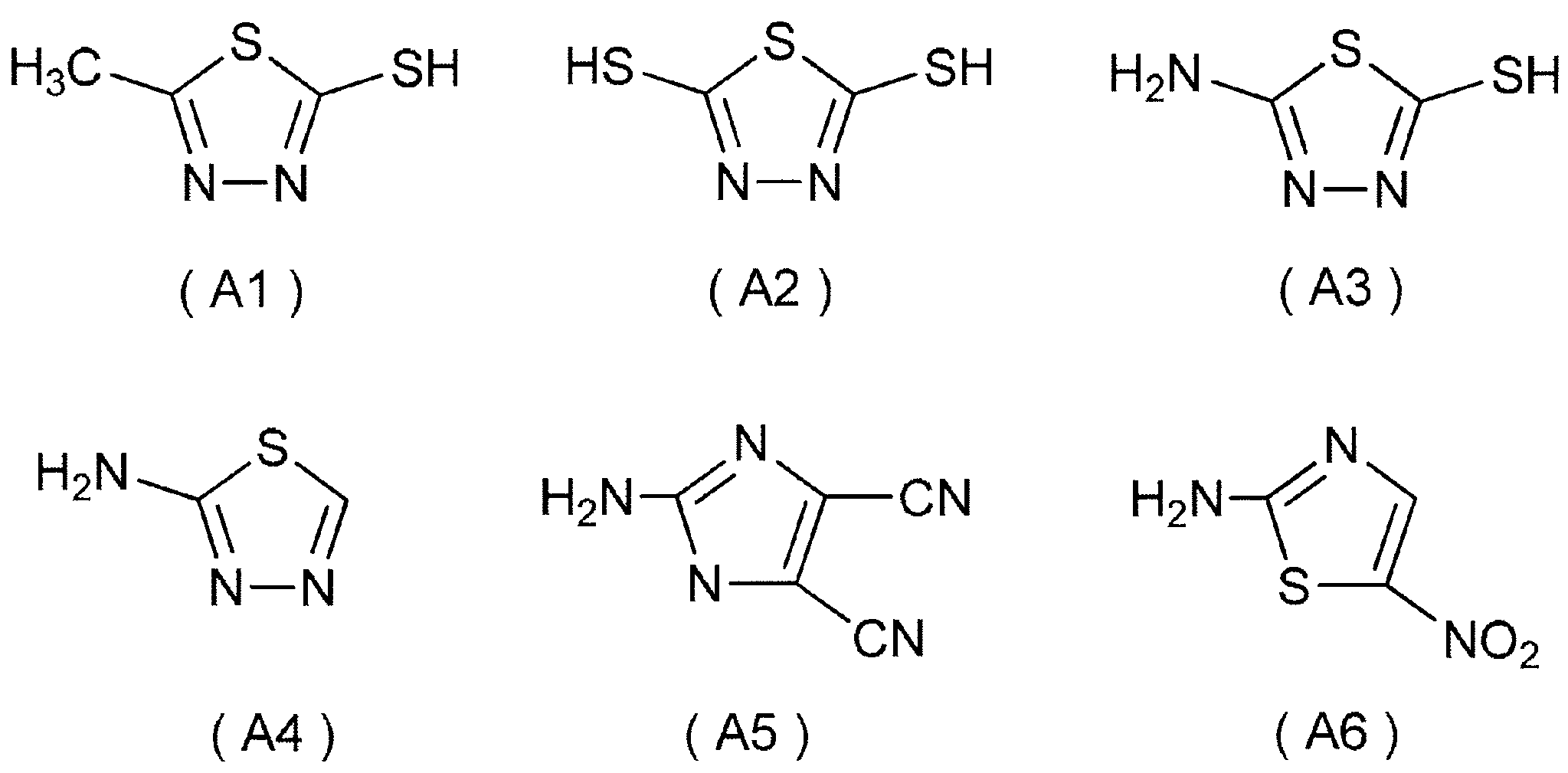
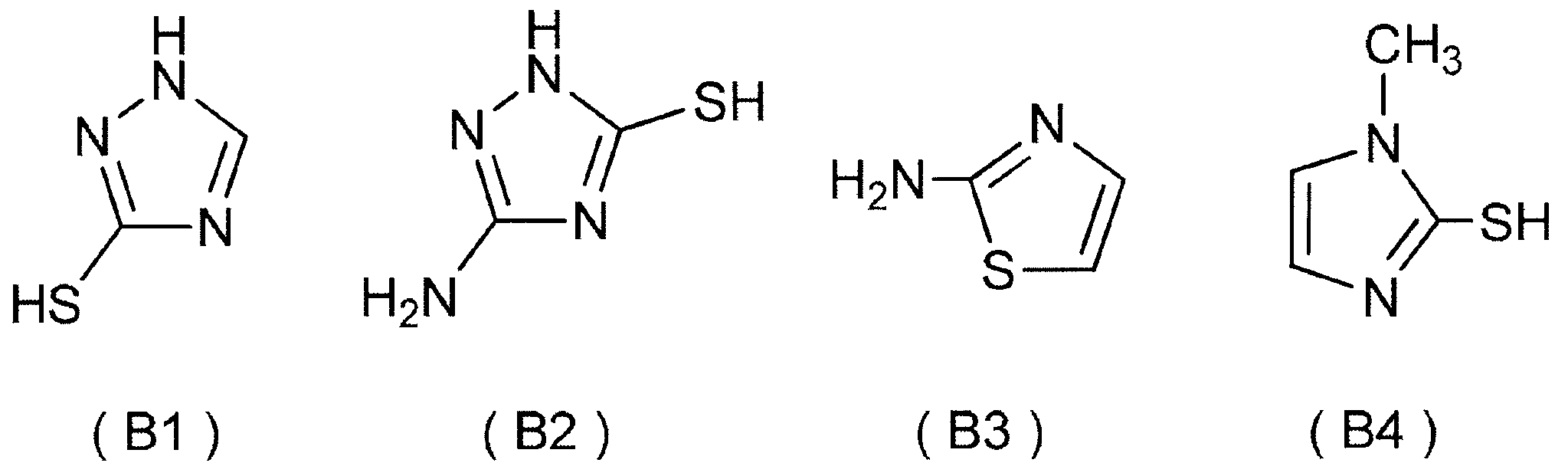
[積層構造体No.1~No.18の製造]
平均厚み35μmの電解銅箔の光沢面に、ドクターブレードを用いて樹脂組成物No.1~No.18を塗布した後、窒素雰囲気下において、50℃で30分間、さらに120℃で60分間予備乾燥した。次いで、300℃で60分間加熱することにより、樹脂層と銅箔との積層構造体No.1~No.18を製造した。
平均厚み35μmの電解銅箔の光沢面に、ドクターブレードを用いて樹脂組成物No.1~No.18を塗布した後、窒素雰囲気下において、50℃で30分間、さらに120℃で60分間予備乾燥した。次いで、300℃で60分間加熱することにより、樹脂層と銅箔との積層構造体No.1~No.18を製造した。
<評価>
積層構造体No.1~No.18について以下に示す180°剥離試験によって金属層と樹脂層との密着性を評価した。これらの評価結果を表1に示す。また、表1には、以下の方法により算出した添加剤の最低空軌道のエネルギー準位を合わせて示す。なお、表1において、「-」は該当成分を使用しなかったことを示す。「LUMO準位」は、最低空軌道のエネルギー準位を示す。「HOMO準位」は、最高被占軌道のエネルギー準位を示す。「phr」は、合成樹脂100質量部に対する質量部を示す。「EI/Ph」はポリエステルイミド及びフェノキシ樹脂の混合樹脂を示す。
積層構造体No.1~No.18について以下に示す180°剥離試験によって金属層と樹脂層との密着性を評価した。これらの評価結果を表1に示す。また、表1には、以下の方法により算出した添加剤の最低空軌道のエネルギー準位を合わせて示す。なお、表1において、「-」は該当成分を使用しなかったことを示す。「LUMO準位」は、最低空軌道のエネルギー準位を示す。「HOMO準位」は、最高被占軌道のエネルギー準位を示す。「phr」は、合成樹脂100質量部に対する質量部を示す。「EI/Ph」はポリエステルイミド及びフェノキシ樹脂の混合樹脂を示す。
(180°剥離試験)
積層構造体No.1~No.18に長さ約2cmの2本の切れ込みを約0.5mm間隔で入れ、2本の切れ込みの間の樹脂層の一端をピンセットでめくって、熱機械試験機(セイコー電子社の「TMA:サーマルメカニカルアナルシス」)を用いて樹脂層の180°剥離試験を行い、ピール強度(N/cm)を測定した。積層構造体No.1~No.11のピール強度は、熱処理無し(常態)、大気下において160℃で30分の加熱処理後、及び大気下において160℃で60分の加熱処理後の各条件で測定した。また、積層構造体No.12~No.18のピール強度は、熱処理無し(常態)の条件で測定した。ピール強度は、8(N/cm)以上の場合は良好、8(N/cm)未満の場合は不良と判断できる。
積層構造体No.1~No.18に長さ約2cmの2本の切れ込みを約0.5mm間隔で入れ、2本の切れ込みの間の樹脂層の一端をピンセットでめくって、熱機械試験機(セイコー電子社の「TMA:サーマルメカニカルアナルシス」)を用いて樹脂層の180°剥離試験を行い、ピール強度(N/cm)を測定した。積層構造体No.1~No.11のピール強度は、熱処理無し(常態)、大気下において160℃で30分の加熱処理後、及び大気下において160℃で60分の加熱処理後の各条件で測定した。また、積層構造体No.12~No.18のピール強度は、熱処理無し(常態)の条件で測定した。ピール強度は、8(N/cm)以上の場合は良好、8(N/cm)未満の場合は不良と判断できる。
添加剤のAM1法を用いた半経験的分子軌道計算により算出される最低空軌道及び最高被占軌道のエネルギー準位は、分子起動計算ソフト(クロスアビリティ社の「Winmostar」内蔵のMOPAC6)を用いた電子状態の計算により求めた。
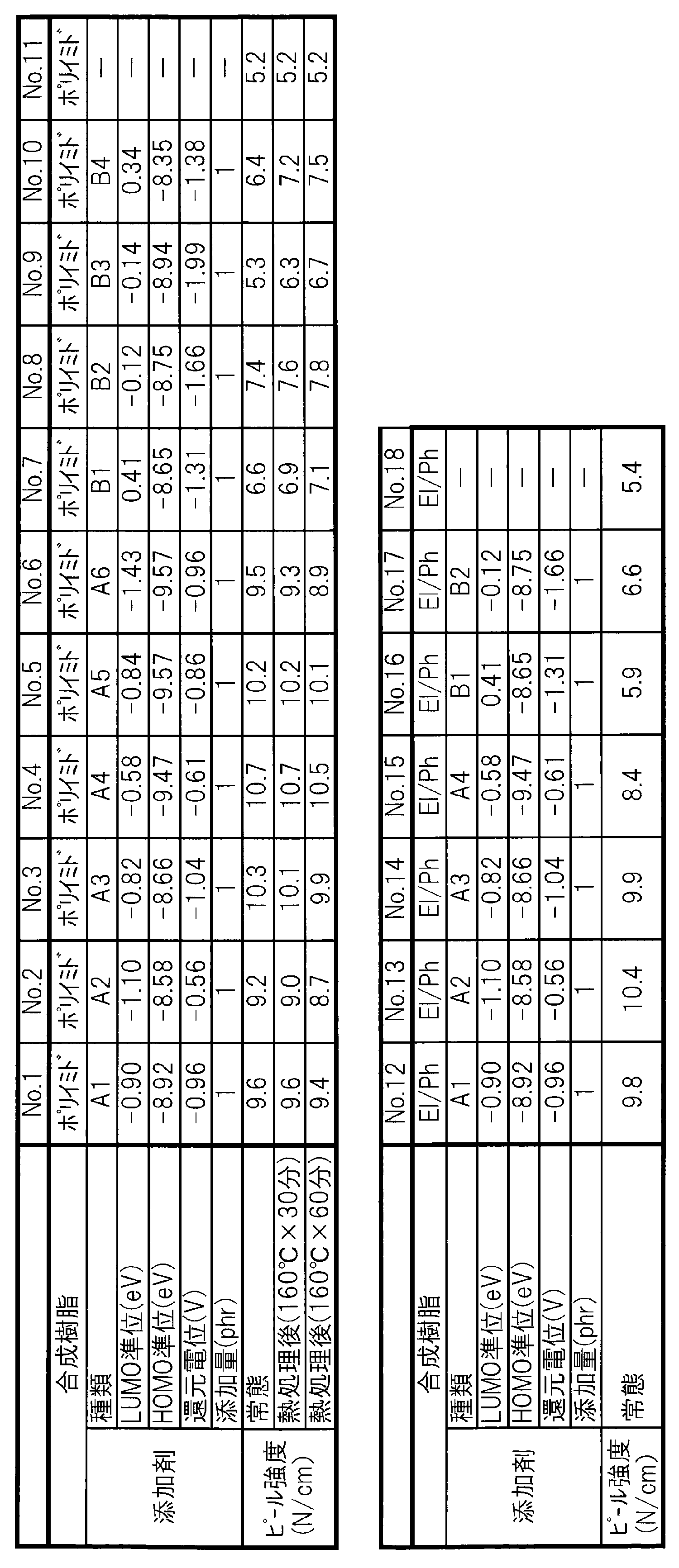
表1に示すように、最低空軌道のエネルギー準位が-0.2eV以下の添加剤を含有する樹脂組成物No.1~No.6及びNo.12~No.15により形成される積層構造体は、ピール強度について良好な結果が得られた。また、樹脂組成物No.1~No.6により形成される積層構造体は、熱処理後においてもピール強度が良好なままであった。一方、添加剤を含有しない樹脂組成物No.11及びNo.18と、最低空軌道のエネルギー準位が-0.2eVを超える添加剤を含有する樹脂組成物No.7~No.10及びNo.16~No.17とにより形成される積層構造体は、ピール強度について良好な結果が得られなかった。
さらに、表1に示すように、還元電位が-1.20V以上-0.30V以下の添加剤を含有する樹脂組成物No.1~No.6及びNo.12~No.15により形成される積層構造体は、ピール強度について良好な結果が得られた。また、樹脂組成物No.1~No.6により形成される積層構造体は、熱処理後においてもピール強度が良好なままであった。一方、添加剤を含有しない樹脂組成物No.11及びNo.18と、還元電位が-1.20V未満の添加剤を含有する樹脂組成物No.7~No.10及びNo.16~No.17とにより形成される積層構造体は、ピール強度について良好な結果が得られなかった。
以上のように、本発明の一態様に係る樹脂組成物は、用途に合わせた添加剤の選択、及び形成される樹脂層の金属層に対する密着性向上が容易である。本発明の別の態様に係る積層構造体は、樹脂層と金属層との密着性に優れる。本発明のさらに別の態様に係る積層構造体の製造方法は、樹脂層と金属層との密着性に優れる積層構造体を容易かつ確実に提供できる。
1、11 積層構造体
2 導体
2a 酸化層
2b 非酸化層
3、13 樹脂層
4 金属粒子
5 界面近傍領域
6 導電パターン
7 ベースフィルム
8 カバーフィルム
2 導体
2a 酸化層
2b 非酸化層
3、13 樹脂層
4 金属粒子
5 界面近傍領域
6 導電パターン
7 ベースフィルム
8 カバーフィルム
Claims (12)
- 合成樹脂と添加剤とを含有する樹脂組成物であって、
上記添加剤のAM1法を用いた半経験的分子軌道計算により算出される最低空軌道のエネルギー準位が-0.2eV以下である樹脂組成物。 - 上記合成樹脂100質量部に対する添加剤の含有量が、0.1質量部以上10質量部以下である請求項1に記載の樹脂組成物。
- 上記添加剤が、置換又は非置換のヘテロ環式化合物である請求項1又は請求項2に記載の樹脂組成物。
- 上記ヘテロ環式化合物が、アミノ基、チオール基又はこれらの組み合わせを有する請求項3に記載の樹脂組成物。
- 上記合成樹脂が、極性基を有する樹脂を含む請求項1から請求項4のいずれか1項に記載の樹脂組成物。
- 上記極性基を有する樹脂が、ポリイミド、ポリエステルイミド、ポリエステル、ポリアミドイミド、フェノキシ樹脂又はこれらの組み合わせである請求項5に記載の樹脂組成物。
- 合成樹脂と添加剤とを含有する樹脂組成物であって、
上記添加剤の還元電位が-1.20V以上-0.30V以下である樹脂組成物。 - 金属層とこの金属層の少なくとも一部の表面に積層される樹脂層とを備える積層構造体であって、
上記樹脂層が合成樹脂及び添加剤を含有する樹脂組成物により形成され、
上記添加剤のAM1法を用いた半経験的分子軌道計算により算出される最低空軌道のエネルギー準位が-0.2eV以下である積層構造体。 - 上記金属層の主成分が銅である請求項8に記載の積層構造体。
- 金属層とこの金属層の少なくとも一部の表面に積層される樹脂層とを備える積層構造体であって、
上記樹脂層が合成樹脂及び添加剤を含有する樹脂組成物により形成され、
上記添加剤の還元電位が-1.20V以上-0.30V以下である積層構造体。 - 金属層とこの金属層の少なくとも一部の表面に積層される樹脂層とを備える積層構造体の製造方法であって、
上記金属層の少なくとも一部の表面を樹脂組成物で被覆する工程を備え、
上記樹脂組成物が合成樹脂及び添加剤を含有し、
上記添加剤のAM1法を用いた半経験的分子軌道計算により算出される最低空軌道のエネルギー準位が-0.2eV以下である積層構造体の製造方法。 - 金属層とこの金属層の少なくとも一部の表面に積層される樹脂層とを備える積層構造体の製造方法であって、
上記金属層の少なくとも一部の表面を樹脂組成物で被覆する工程を備え、
上記樹脂組成物が合成樹脂及び添加剤を含有し、
上記添加剤の還元電位が-1.20V以上-0.30V以下である積層構造体の製造方法。
Priority Applications (2)
| Application Number | Priority Date | Filing Date | Title |
|---|---|---|---|
| JP2017505362A JPWO2016143802A1 (ja) | 2015-03-09 | 2016-03-08 | 樹脂組成物、積層構造体及びその製造方法 |
| CN201680014598.7A CN107429069A (zh) | 2015-03-09 | 2016-03-08 | 树脂组合物、层叠结构体及其制造方法 |
Applications Claiming Priority (2)
| Application Number | Priority Date | Filing Date | Title |
|---|---|---|---|
| JP2015-046518 | 2015-03-09 | ||
| JP2015046518 | 2015-03-09 |
Publications (1)
| Publication Number | Publication Date |
|---|---|
| WO2016143802A1 true WO2016143802A1 (ja) | 2016-09-15 |
Family
ID=56879586
Family Applications (1)
| Application Number | Title | Priority Date | Filing Date |
|---|---|---|---|
| PCT/JP2016/057252 Ceased WO2016143802A1 (ja) | 2015-03-09 | 2016-03-08 | 樹脂組成物、積層構造体及びその製造方法 |
Country Status (3)
| Country | Link |
|---|---|
| JP (1) | JPWO2016143802A1 (ja) |
| CN (1) | CN107429069A (ja) |
| WO (1) | WO2016143802A1 (ja) |
Citations (7)
| Publication number | Priority date | Publication date | Assignee | Title |
|---|---|---|---|---|
| JPH024880A (ja) * | 1988-06-21 | 1990-01-09 | Hitachi Chem Co Ltd | 銅被覆用耐熱性樹脂組成物 |
| JPH08218007A (ja) * | 1995-02-09 | 1996-08-27 | Sumitomo Electric Ind Ltd | 絶縁塗料およびそれを用いた絶縁電線 |
| JP2003160730A (ja) * | 2001-11-28 | 2003-06-06 | Hitachi Chem Co Ltd | 耐熱性樹脂組成物、塗料及びエナメル線 |
| JP2006127958A (ja) * | 2004-10-29 | 2006-05-18 | Hitachi Chem Co Ltd | 電気絶縁用樹脂組成物及びエナメル線 |
| JP2009511305A (ja) * | 2006-02-06 | 2009-03-19 | エルジー・ケム・リミテッド | チップオンフィルム用銅張積層板 |
| JP2011028005A (ja) * | 2009-07-27 | 2011-02-10 | Sumitomo Electric Ind Ltd | ネガ型感光性樹脂組成物及びそれを用いたポリイミド樹脂膜、フレキシブルプリント配線板 |
| WO2014024767A1 (ja) * | 2012-08-09 | 2014-02-13 | 住友電気工業株式会社 | 絶縁電線及びそれを用いた電機コイル |
-
2016
- 2016-03-08 JP JP2017505362A patent/JPWO2016143802A1/ja active Pending
- 2016-03-08 WO PCT/JP2016/057252 patent/WO2016143802A1/ja not_active Ceased
- 2016-03-08 CN CN201680014598.7A patent/CN107429069A/zh not_active Withdrawn
Patent Citations (7)
| Publication number | Priority date | Publication date | Assignee | Title |
|---|---|---|---|---|
| JPH024880A (ja) * | 1988-06-21 | 1990-01-09 | Hitachi Chem Co Ltd | 銅被覆用耐熱性樹脂組成物 |
| JPH08218007A (ja) * | 1995-02-09 | 1996-08-27 | Sumitomo Electric Ind Ltd | 絶縁塗料およびそれを用いた絶縁電線 |
| JP2003160730A (ja) * | 2001-11-28 | 2003-06-06 | Hitachi Chem Co Ltd | 耐熱性樹脂組成物、塗料及びエナメル線 |
| JP2006127958A (ja) * | 2004-10-29 | 2006-05-18 | Hitachi Chem Co Ltd | 電気絶縁用樹脂組成物及びエナメル線 |
| JP2009511305A (ja) * | 2006-02-06 | 2009-03-19 | エルジー・ケム・リミテッド | チップオンフィルム用銅張積層板 |
| JP2011028005A (ja) * | 2009-07-27 | 2011-02-10 | Sumitomo Electric Ind Ltd | ネガ型感光性樹脂組成物及びそれを用いたポリイミド樹脂膜、フレキシブルプリント配線板 |
| WO2014024767A1 (ja) * | 2012-08-09 | 2014-02-13 | 住友電気工業株式会社 | 絶縁電線及びそれを用いた電機コイル |
Also Published As
| Publication number | Publication date |
|---|---|
| JPWO2016143802A1 (ja) | 2017-12-28 |
| CN107429069A (zh) | 2017-12-01 |
Similar Documents
| Publication | Publication Date | Title |
|---|---|---|
| JP5015591B2 (ja) | エポキシ樹脂組成物 | |
| JP5892282B1 (ja) | 導電性接着剤、導電性接着シート、および配線デバイス | |
| TW200844205A (en) | Adhesive composition and adhesive sheet using the same | |
| TWI657110B (zh) | 無鹵樹脂組合物以及由其製備的膠膜、覆蓋膜和覆銅板 | |
| JP5896006B2 (ja) | 変性ポリアミドイミド樹脂、電気絶縁材料、絶縁層の耐絶縁破壊性向上方法及び絶縁電線 | |
| KR20170081466A (ko) | 전자파 차폐 필름 및 이의 제조 방법 | |
| JP5109374B2 (ja) | ポリアミドイミド樹脂溶液とその製造方法、樹脂組成物及び塗料組成物 | |
| US11890853B2 (en) | Resin layered product, dielectric layer, metal foil with resin, capacitor element, and printed wiring board with built-in capacitor | |
| JP7144414B2 (ja) | 無電解めっき下地膜形成用組成物 | |
| US20220186377A1 (en) | Electroless plating undercoat film | |
| JP6874281B2 (ja) | 熱硬化性樹脂組成物、プリプレグ、積層板、プリント配線板及び半導体パッケージ | |
| JP2017101197A (ja) | ポリアミドイミド樹脂組成物及び塗料 | |
| JPWO2016143802A1 (ja) | 樹脂組成物、積層構造体及びその製造方法 | |
| JP2019011415A (ja) | 熱硬化性樹脂組成物、プリプレグ、積層板、プリント配線板及び高速通信対応モジュール | |
| US20220411630A1 (en) | Resin composition, layered body including resin composition layer, layered body, flexible copper-clad laminate, flexible flat cable, and electromagnetic wave shielding film | |
| CN107613628B (zh) | 电磁波屏蔽材料 | |
| WO2016009873A1 (ja) | 導電性塗膜の製造方法及び導電性塗膜 | |
| JP2019137813A (ja) | 熱硬化性樹脂組成物、プリプレグ、積層板、プリント配線板及び高速通信対応モジュール | |
| TWI885006B (zh) | 樹脂組成物、樹脂組成物之硬化物、樹脂薄片、印刷配線板、可撓性基板及半導體裝置 | |
| JP2012000947A (ja) | セラミック系絶縁層と金属層との積層体及び当該積層体の製造方法 | |
| JP7251482B2 (ja) | 熱硬化性樹脂組成物、層間絶縁用樹脂フィルム、複合フィルム、プリント配線板及び半導体パッケージ | |
| JP2004335764A (ja) | 誘電体膜およびその製造方法 | |
| TWI650338B (zh) | 硬化性組成物、使用該組成物之硬化膜及被覆膜 | |
| TWI623569B (zh) | 各向異性導電膜和使用其的顯示裝置 | |
| TW201026750A (en) | Polyamideimine resin, adhesive agent composition using said resin, ink for printing circuit substrate using said adhesive agent composition, covering film, adhesive sheet and printing circuit substrate |
Legal Events
| Date | Code | Title | Description |
|---|---|---|---|
| 121 | Ep: the epo has been informed by wipo that ep was designated in this application |
Ref document number: 16761770 Country of ref document: EP Kind code of ref document: A1 |
|
| DPE2 | Request for preliminary examination filed before expiration of 19th month from priority date (pct application filed from 20040101) | ||
| ENP | Entry into the national phase |
Ref document number: 2017505362 Country of ref document: JP Kind code of ref document: A |
|
| NENP | Non-entry into the national phase |
Ref country code: DE |
|
| 122 | Ep: pct application non-entry in european phase |
Ref document number: 16761770 Country of ref document: EP Kind code of ref document: A1 |