WO2016143680A1 - マトリックスメタロプロテアーゼ産生抑制剤 - Google Patents
マトリックスメタロプロテアーゼ産生抑制剤 Download PDFInfo
- Publication number
- WO2016143680A1 WO2016143680A1 PCT/JP2016/056704 JP2016056704W WO2016143680A1 WO 2016143680 A1 WO2016143680 A1 WO 2016143680A1 JP 2016056704 W JP2016056704 W JP 2016056704W WO 2016143680 A1 WO2016143680 A1 WO 2016143680A1
- Authority
- WO
- WIPO (PCT)
- Prior art keywords
- mmp
- production
- skin
- production inhibitor
- inhibitor according
- Prior art date
- Legal status (The legal status is an assumption and is not a legal conclusion. Google has not performed a legal analysis and makes no representation as to the accuracy of the status listed.)
- Ceased
Links
Images
Classifications
-
- A—HUMAN NECESSITIES
- A61—MEDICAL OR VETERINARY SCIENCE; HYGIENE
- A61K—PREPARATIONS FOR MEDICAL, DENTAL OR TOILETRY PURPOSES
- A61K8/00—Cosmetics or similar toiletry preparations
- A61K8/18—Cosmetics or similar toiletry preparations characterised by the composition
- A61K8/96—Cosmetics or similar toiletry preparations characterised by the composition containing materials, or derivatives thereof of undetermined constitution
- A61K8/97—Cosmetics or similar toiletry preparations characterised by the composition containing materials, or derivatives thereof of undetermined constitution from algae, fungi, lichens or plants; from derivatives thereof
- A61K8/9783—Angiosperms [Magnoliophyta]
- A61K8/9789—Magnoliopsida [dicotyledons]
-
- A—HUMAN NECESSITIES
- A61—MEDICAL OR VETERINARY SCIENCE; HYGIENE
- A61K—PREPARATIONS FOR MEDICAL, DENTAL OR TOILETRY PURPOSES
- A61K36/00—Medicinal preparations of undetermined constitution containing material from algae, lichens, fungi or plants, or derivatives thereof, e.g. traditional herbal medicines
- A61K36/18—Magnoliophyta (angiosperms)
- A61K36/185—Magnoliopsida (dicotyledons)
- A61K36/48—Fabaceae or Leguminosae (Pea or Legume family); Caesalpiniaceae; Mimosaceae; Papilionaceae
-
- A—HUMAN NECESSITIES
- A61—MEDICAL OR VETERINARY SCIENCE; HYGIENE
- A61K—PREPARATIONS FOR MEDICAL, DENTAL OR TOILETRY PURPOSES
- A61K36/00—Medicinal preparations of undetermined constitution containing material from algae, lichens, fungi or plants, or derivatives thereof, e.g. traditional herbal medicines
- A61K36/18—Magnoliophyta (angiosperms)
- A61K36/185—Magnoliopsida (dicotyledons)
- A61K36/81—Solanaceae (Potato family), e.g. tobacco, nightshade, tomato, belladonna, capsicum or jimsonweed
-
- A—HUMAN NECESSITIES
- A61—MEDICAL OR VETERINARY SCIENCE; HYGIENE
- A61P—SPECIFIC THERAPEUTIC ACTIVITY OF CHEMICAL COMPOUNDS OR MEDICINAL PREPARATIONS
- A61P17/00—Drugs for dermatological disorders
-
- A—HUMAN NECESSITIES
- A61—MEDICAL OR VETERINARY SCIENCE; HYGIENE
- A61P—SPECIFIC THERAPEUTIC ACTIVITY OF CHEMICAL COMPOUNDS OR MEDICINAL PREPARATIONS
- A61P17/00—Drugs for dermatological disorders
- A61P17/16—Emollients or protectives, e.g. against radiation
-
- A—HUMAN NECESSITIES
- A61—MEDICAL OR VETERINARY SCIENCE; HYGIENE
- A61P—SPECIFIC THERAPEUTIC ACTIVITY OF CHEMICAL COMPOUNDS OR MEDICINAL PREPARATIONS
- A61P17/00—Drugs for dermatological disorders
- A61P17/18—Antioxidants, e.g. antiradicals
-
- A—HUMAN NECESSITIES
- A61—MEDICAL OR VETERINARY SCIENCE; HYGIENE
- A61P—SPECIFIC THERAPEUTIC ACTIVITY OF CHEMICAL COMPOUNDS OR MEDICINAL PREPARATIONS
- A61P43/00—Drugs for specific purposes, not provided for in groups A61P1/00-A61P41/00
-
- A—HUMAN NECESSITIES
- A61—MEDICAL OR VETERINARY SCIENCE; HYGIENE
- A61Q—SPECIFIC USE OF COSMETICS OR SIMILAR TOILETRY PREPARATIONS
- A61Q17/00—Barrier preparations; Preparations brought into direct contact with the skin for affording protection against external influences, e.g. sunlight, X-rays or other harmful rays, corrosive materials, bacteria or insect stings
- A61Q17/04—Topical preparations for affording protection against sunlight or other radiation; Topical sun tanning preparations
Definitions
- the present invention relates to a novel matrix metalloprotease production inhibitor and a skin external preparation containing the inhibitor.
- the skin is composed of the stratum corneum, epidermis, basement membrane, and dermis from the outside.
- the dermis is filled with cellular components and a macromolecular network called the extracellular matrix produced by these cells.
- cellular components are fibroblasts, macrophages, mast cells, vascular and nerve constituent cells, and as extracellular matrix, fibrous proteins such as collagen and elastin, and polysaccharides such as hyaluronic acid and proteoglycan The existence of such is known.
- Collagen fibers as an extracellular matrix are said to account for about 70% of the dry weight of the dermis, and play an important role in maintaining the firmness and elasticity of the skin.
- MMP Matrix metalloproteinase
- MMP-1 degrades the triple helical structure of type I collagen
- MMP-2 and MMP-9 degrade type IV collagen and gelatin that constitute the basement membrane.
- MMP not only controls metabolism of the dermal extracellular matrix, but is also deeply involved in cell moistening and activation of physiologically active molecules such as cytokines, and has been reported to be associated with various diseases. .
- MMP is excessively produced by exposure to ultraviolet rays and various inflammations, and that the MMP decomposes and denatures collagen and elastin, causing skin wrinkles and sagging.
- Patent Documents 1 and 2 Based on these backgrounds, various studies have been conducted from the viewpoint of MMP control, and many plant extracts that inhibit the activity of MMP have been reported (Patent Documents 1 and 2). Furthermore, an MMP-1 production inhibitor comprising a yeast culture solution as an active ingredient (Patent Document 3), which is intended to inhibit enzyme production itself and radically inhibit the action of MMP, a compound having a sulfhydryl group, and An MMP-1 production inhibitor comprising a compound having a disulfide bond as an active ingredient (Patent Document 4) has been reported.
- PPAR peroxisome proliferator-activated receptor
- UVA ultraviolet rays that affect the dermis
- JJSLSM Nichirei Medical Journal
- Non-Patent Document 1 directly irradiates dermal-derived fibroblasts with UVB, which is different from the environment in which the skin is exposed to UVB. That is, it is not known that the ligand agent of PPAR ⁇ suppresses the production of MMP-1 that can occur in a normal environment.
- An object of the present invention is to provide an inhibitor of MMP-1 production.
- the inventors of the present application have searched for various materials and started to find an activity that suppresses MMP-1 production. As a result, it was found that a plant extract prepared from a specific plant effectively suppresses MMP-1 production. Based on these findings, the present invention has been completed.
- the present invention provides the following. (1) An MMP-1 production inhibitor containing, as an active ingredient, one or more plant extracts selected from the group consisting of Ashwagandha, Passiflora, and Harienju. (2) The MMP-1 production inhibitor according to (1), wherein the plant extract is a plant extract extracted using a solvent. (3) The MMP-1 production inhibitor according to (2), wherein the solvent is a solvent containing alcohol. (4) The MMP-1 production inhibitor according to any one of (1) to (3), which is applied before or after the production of MMP-1 is started. (5) The MMP-1 production inhibitor according to any one of (1) to (4), wherein the MMP-1 is produced by cells constituting the skin. (6) The MMP-1 production inhibitor according to (5), wherein the cells are dermal fibroblasts.
- a skin external preparation comprising the MMP-1 production inhibitor according to any one of (1) to (9).
- a non-medical treatment method for skin comprising applying the MMP-1 production inhibitor according to any one of (1) to (12) or the skin external preparation according to (13).
- MMP-1 production of MMP-1 can be remarkably suppressed by using an extract obtained from specific plants such as Ashwagandha, Passiflora, and Hariendu.
- an inhibitory effect also effectively acted on the induction of MMP-1 production under normal circumstances such as UV exposure and inflammation, which was found by the inventors of the present application.
- degradation of the extracellular matrix of the dermis caused by MMP-1 production, particularly collagen is suppressed, and an excellent antiaging effect is exhibited. That is, the skin external preparation excellent in the antiaging effect is provided.
- agents such as whitening agents, antioxidants, anti-inflammatory agents, cell activators, humectants, UV inhibitors, etc.
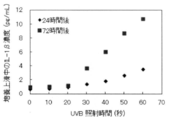
- FIG. 1 shows the production of IL-1 ⁇ by epidermal keratinocytes irradiated with UVB. Confluent human epidermal keratinocytes were irradiated with UVB for 0-60 seconds, and the concentration of IL-1 ⁇ in the medium after 24 hours ( ⁇ ) and 72 hours ( ⁇ ) was quantified.
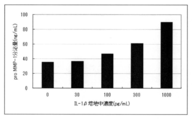
- FIG. 2 shows MMP-1 production by dermal fibroblasts in the presence of IL- ⁇ . Confluent human dermal fibroblasts were treated with IL-1 ⁇ for 24 hours, and proMMP-1 in the medium was quantified to obtain the amount of MMP-1 produced.
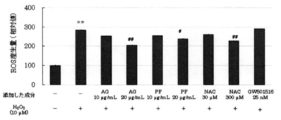
- FIG. 3 shows the effect of plant extracts on the suppression of reactive oxygen species (ROS) production induced by hydrogen peroxide.
- ROS reactive oxygen species
- the present invention provides an MMP-1 production inhibitor containing a plant extract as an active ingredient.
- the plant extract means a plant-derived extract capable of suppressing the production of MMP-1.
- the plant used as the raw material of the plant extract is selected from the group consisting of Ashwagandha (Whithania somnifera), Passiflora incarnata, and Harienju (Robinia pseudoacasia) found by screening for various plants. It can be a seed or two or more. Hereinafter, each plant will be described.
- Ashwagandha is a solanaceous plant whose leaves and roots have long been used as a long-lived drug Sarayan in the traditional Indian medicine Ayurveda.
- a root can be preferably used.
- Passiflora is a plant belonging to Passifloridae, and its aerial part is said to be passion flower. In Europe, it is an herb used for nerve anxiety and insomnia.
- the above-ground part can be preferably used.
- Harienju is a leguminous plant also called false acacia, and preferably uses flowers in the present invention.
- the plant used as a raw material for the plant extract used in the present invention is preferably the site described above for each plant, but is not limited to this, and is not limited to this, but buds, flowers, fruits, pericarps, seeds, leaves All parts such as branches, trunks, bark, roots, root barks, aerial parts and whole grasses can be used. Moreover, in addition to the above-mentioned preferable site
- the raw material plant body can be raw or dried, and can be used after processing such as pulverization, shredding, and powdering, if necessary. Moreover, you may use what can be obtained as a crude drug.
- a plant extract can be obtained by directly extracting from a plant as a raw material using a solvent.
- the extraction solvent is not particularly limited, but water, alcohol, liquid polyhydric alcohol (eg, 1,3-butylene glycol, propylene glycol, glycerin, etc.), ketones (eg, acetone, methyl ethyl ketone), esters (eg, ethyl acetate) And butyl acetate).
- the alcohol is preferably a lower alcohol having 1 to 4 carbon atoms, and examples thereof include methanol, ethanol, propanol, and butanol.
- These extraction solvents can be used alone or in combination of two or more. Further, the solvent used in the present invention may contain any other component as long as the extraction efficiency of the obtained plant extract and the MMP-1 production inhibitory action are not significantly impaired.
- a plant extract can be obtained by treating a plant as a raw material with a solvent containing alcohol.
- concentration of alcohol is not particularly limited as long as the obtained plant extract has an effect of suppressing MMP-1 production.
- concentration of the alcohol in the extraction solvent is about 10 to 100% by volume, preferably about 10 to 70% by volume.
- an aqueous alcohol solution can be preferably used.
- ethanol is preferably used as the alcohol from the viewpoint of safety.
- the extraction method of a raw material plant is not specifically limited, According to a well-known means, it can set suitably as desired.
- the solvent may be brought into contact with the raw material plant by immersing the raw material plant in the solvent, and may be stored at rest, stirred or refluxed as necessary.
- the extraction temperature is not particularly limited, and may be set as appropriate according to the temperature of the solvent. However, from the viewpoint of operation, the extraction temperature can be made lower than the boiling point of the solvent.
- conditions, such as pressurization and pressure reduction can also be set as needed.
- the extraction time may be appropriately set depending on the type of plant material used, the type of extraction solvent, the amount used, and the like.
- the amount used can usually be 1 to 1000 times, preferably 1 to 100 times, and more preferably 1 to 10 times, relative to 1 part by weight of the starting plant, and the extraction time is usually about 10 minutes to It can be about 1 month, preferably about 10 minutes to 7 days.
- the amount used can usually be 1 to 1000 times, preferably 1 to 100 times, and more preferably 1 to 10 times the 1 part by weight of the raw material.
- the time is usually about 10 minutes to 7 days, preferably about 10 minutes to 1 day, and more preferably about 10 minutes to 1 hour.
- the plant extract of the present invention is separated from the extraction residue after the above extraction operation to be in the form of an extract.
- a known method can be used, for example, filtration, centrifugation, or the like can be used.
- the above extract may be used as it is.
- the extract may be concentrated or dried (concentrated and dried product) as necessary from various viewpoints such as adjustment of MMP-1 production inhibitory action, ease of transport, and ease of storage. This may be used. Concentration can be performed under normal pressure or reduced pressure, and the volume of the resulting concentrate may be adjusted to about 10 to 50% by volume, preferably about 10 to 30% by volume of the volume of the extract before concentration. .
- the dried product can be obtained by drying the extract under reduced pressure and removing the solvent.
- the plant extract can also be prepared by a method other than the method using the solvent described above. For example, steam distillation, carbon dioxide extraction using supercritical extraction technology, and further obtained by adding a solvent to the squeezed liquid (squeezed) and / or residue obtained after performing the squeezing treatment,
- the compressed liquid itself is also included in the definition of the plant extract of the present invention.
- the plant extract of this invention may fractionate and refine the active ingredient by column chromatography etc. as needed.
- the MMP-1 production inhibitor of the present invention can be applied to any target from which MMP-1 is produced, thereby inhibiting MMP-1 production.
- suppression of MMP-1 production is not limited to complete suppression of MMP-1 production, but partial suppression of MMP-1 production such as suppression of excessive MMP-1 production. Is enough.
- subject means a mammal, preferably a human.
- the tissue in which MMP-1 is produced is not limited, but can be exemplified by skin. Therefore, the MMP-1 production inhibitor of the present invention can be applied to the suppression of MMP-1 production in the skin.
- the skin is composed of the stratum corneum, epidermis, basement membrane, and dermis, but MMP-1 is mainly produced in the dermis. Therefore, the MMP-1 production inhibitor of the present invention can be applied to suppress MMP-1 production in the dermis.
- MMP-1 production in the dermis is performed by cells present in the dermis. Therefore, the MMP-1 production inhibitor of the present invention can be applied to suppress MMP-1 production by cells existing in the dermis.
- the cells that produce MMP-1 in the dermis are mainly fibroblasts. Therefore, the MMP-1 production inhibitor of the present invention can be applied to suppress MMP-1 production by fibroblasts present in the dermis.
- MMP-1 is constantly produced and is involved in dermal metabolic control.
- MMP-1 is excessively produced by stimulation and is also known to be involved in various diseases.
- stimulation is illustrated regarding skin, an ultraviolet-ray, inflammation, etc. will be mentioned. Therefore, the MMP-1 production inhibitor of the present invention can be applied to suppress MMP-1 production in the dermis induced by ultraviolet exposure of the skin or inflammation of the skin.
- UVA and UVB having different wavelengths is known as ultraviolet rays. It is believed that UVA passes through the epidermis to reach the dermis and acts on the dermal fibroblasts to induce the production of MMP-1.
- the MMP-1 production inhibitor of the present invention can be preferably applied to suppress MMP-1 production in the dermis induced by exposure of the skin to UVB.
- Non-Patent Document 1 The effect of UVB exposure on MMP-1 production is reported in Non-Patent Document 1.
- a study has been conducted in which UVB is directly irradiated to dermal fibroblasts.
- UVB hardly reaches the dermis, and therefore the report of Non-Patent Document 1 reflects the conditions under which the skin is exposed to UVB in a normal environment. I can't say that.
- skin epidermal cells for example, epidermal keratinocytes
- IL-1 ⁇ and ROS by UVB exposure. It was further found that exogenous IL-1 ⁇ stimulates MMP-1 production by dermal fibroblasts.
- MMP-1 production inhibitor of the present application can be applied to suppress MMP-1 production in the dermis mediated by IL-1 ⁇ and / or ROS produced by UVB exposure of the skin.
- the IL-1 ⁇ and / or ROS are produced by epidermal cells, and examples of the epidermal cells include epidermal keratinocytes.
- the timing for applying the MMP-1 production inhibitor of the present invention is not particularly limited. For example, if the MMP-1 production inhibitor of the present invention is applied before the production of MMP-1 is started, the production of MMP-1 can be inhibited prophylactically. As another example, if the MMP-1 production inhibitor of the present invention is applied after the production of MMP-1 is started, the degree of MMP-1 production can be suppressed. Such an MMP-1 production inhibitory action can prevent the degradation of collagen, particularly type I collagen.
- the MMP-1 production inhibitor of the present invention may be applied by any method as long as the MMP-1 production inhibitory effect is exhibited.
- the inhibitor can be applied by applying, pasting, spraying, or the like.
- the inhibitor can be applied by subcutaneous injection.
- the application amount of the inhibitor may be an amount effective for suppressing the production of MMP-1.
- the inhibitor may be applied once a day or may be divided into several times.
- the application period can be one day or more.
- the person skilled in the art considers the state (age, gender, symptom, etc.) of the subject (for example, human) to which the inhibitor is applied, and other circumstances, and applies the appropriate amount, number of applications, and application period of the inhibitor. Can be determined.
- MMP-1 production inhibitor of the present invention is not limited, it can be applied to the prevention or improvement of skin aging.
- MMP-1 is involved in the degradation or degeneration of the extracellular matrix through the degradation of type I collagen in the skin. Degradation or degeneration of the extracellular matrix of the skin causes skin wrinkles and sagging. Since the MMP-1 production inhibitor of the present invention can inhibit MMP-1 production, it can be applied to, for example, prevention or improvement of skin wrinkles or sagging.
- an external preparation for skin containing the MMP-1 production inhibitor described above is provided.
- the said skin external preparation is not limited, It can apply to prevention or improvement of skin aging, and prevention or improvement of skin wrinkles or sagging.
- the application of the external preparation for skin of the present invention may be performed by any method as long as the effect of suppressing the production of MMP-1 is exhibited.
- the external preparation for skin can be applied by applying, pasting or spraying the skin.
- it can be applied by injecting the external preparation for skin subcutaneously.
- the application amount of the external preparation for skin may be an amount effective for suppressing the production of MMP-1.
- the application of the external preparation for skin may be performed once a day or may be divided into several times. The application period may be one day or more.
- the person skilled in the art considers the state (age, sex, symptoms, etc.) of the subject (for example, human) to which the external preparation for skin is applied, and other circumstances, Application period can be determined.
- the skin external preparation of the present invention may further contain an acceptable base material.
- an acceptable base material a component permitted to be used for humans and animals can be cited as a preferred example.
- the base material is not particularly limited as long as it does not significantly impair the action of inhibiting MMP-1 production.
- vitamins such as vitamin E and vitamin C, water, alcohol, sugar, excipient, disintegrant, binder, abundant Agent, emulsifier, tonicity agent (isotonic agent), buffer, solubilizer, preservative, absorption enhancer, stabilizer, antioxidant, colorant, flavoring agent, fragrance, coagulant, pH adjuster , Thickeners, extract powders, crude drugs, various powders, chelating agents, inorganic salts, oils, surfactants, blood circulation promoters, antibacterial / bactericidal agents, various animal / plant / microbe extracts, and the like. From these substrates, those suitable for the intended use can be selected and used.
- the external preparation for skin of the present invention can be in an appropriate form according to the intended use mode.
- the said external preparation for skin when using the said external preparation for skin as cosmetics, it can be made into forms, such as a milky lotion, cream, a lotion, a pack, a film, a washing
- the skin external preparation of this invention when using the skin external preparation of this invention as a pharmaceutical, it can be made into forms, such as an emulsion, cream, aqueous solution, an adhesive agent, a film, a washing
- the external preparation for skin of the present invention may be used in combination with an additional component having an action of suppressing the production of MMP-1.
- additional component include a whitening agent, an antioxidant, an anti-inflammatory agent, a cell activator, a moisturizing agent, and an ultraviolet ray preventing agent.
- using in combination means not only that the additional component is blended in the external preparation for skin of the present invention, but also that the additional component is configured differently from the external preparation for skin of the present invention. It also includes applying the additional ingredients before, after, or simultaneously with applying the agent.
- the present invention provides the use of a plant extract in the manufacture of an MMP-1 production inhibitor.
- the present invention further provides the use of an MMP-1 production inhibitor in the manufacture of an external preparation for skin.
- the present invention also provides a non-medical skin treatment method comprising applying the MMP-1 production inhibitor of the present invention to the skin of a subject in need thereof.
- the MMP-1 production inhibitor, the plant extract, the external preparation for skin, and the aspect of the object are as described above.
- non-medical as used herein is not intended for medical treatment such as treatment of illness or disease, but prevents or improves appearance aging, such as wrinkles and sagging. Therefore, a cosmetic or cosmetic treatment such as beautifying the appearance of the skin or keeping the beauty is intended.
- MMP-1 was produced in dermal fibroblasts by the presence of IL-1 ⁇ . MMP-1 production increased with the concentration of IL-1 ⁇ . Considering these results together with the results of Test Example 1, when the skin is exposed to UVB, IL-1 ⁇ is produced by epidermal keratinocytes, and the IL-1 ⁇ is produced by dermal fibroblasts. Suggests a series of processes in which the MMP-1 degrades collagen.
- Preparation Example 1 Preparation of plant-derived extracts Eight types of plants selected by screening for various plants were extracted with ethanol to obtain extracts. Each crushed product of Ashwagandha, Passiflora, Harienju, Sakuna, Goryomodoki, Anise, Japanese cabbage, and elderberry is soaked in 70 vol% ethanol of 10 (w / v) times the weight and stirred once a day at room temperature. The operation was added and extracted for 7 days. Thereafter, the residue was removed by filtration to obtain an extract. The extract was concentrated and then freeze-dried to obtain an ethanol extract of each plant. The plant extract was used in this example.
- Dermal fibroblasts were seeded in a 24-well plate and cultured at 37 ° C. in a carbon dioxide concentration of 5 vol% until confluence. The following ingredients were then added: PPAR ⁇ ligand agent GW501516 (manufactured by EnzoLife Science) dissolved in DMSO, • Plant extracts prepared from each of the 8 plants dissolved in DMSO (see Preparation Example 1), or • No addition (DMSO solution only). The concentration of the added component in the culture solution was 25 nM for GW501516, 10 ⁇ g / mL for plant extracts, and 0.1% for DMSO. After culturing for 24 hours, IL-1 ⁇ was added to the medium at a final concentration of 100 pg / mL.
- IL-1 ⁇ was not added to a part of the well to which only the DMSO solution was added, and this was used as a control. After culturing for 48 hours, the culture supernatant was collected, and proMMP-1 secreted into the medium was quantified to obtain the amount of MMP-1 produced. ProMMP-1 was quantified using a quantitative ELISA Kit (manufactured by R & D Systems) according to the attached instructions. The quantitative results were shown as relative values (%) with the amount of MMP-1 production as a control being 100% (Table 1).
- the amount of MMP-1 produced was approximately 220% (2.2 times the control).
- the production amount of MMP-1 was 165.2 ⁇ 6.8%. From this, it was confirmed that the production of MMP-1 by IL-1 ⁇ is suppressed by GW501516.
- Test Example 4 MMP-1 production inhibitory effect by plant extracts In Test Example 3, three types of plant extracts that were confirmed to suppress MMP-1 production were further examined.
- the test was performed under the same conditions as in Test Example 3 except that the concentrations of these plant extracts in the medium were 2.5 ⁇ g / mL, 5 ⁇ g / mL, and 10 ⁇ g / mL.
- the production amount of MMP-1 was shown as a relative value (%) with the production amount of MMP-1 as a control being 100% (Table 2).
- MMP-1 production by dermal fibroblasts via inflammatory cytokines produced by skin cells exposed to UVB in skin exposed to ultraviolet light in a normal environment is effectively improved by the present invention. It was found to be suppressed.
- Dermal fibroblasts were seeded in a 24-well plate and cultured at 37 ° C. in a carbon dioxide concentration of 5 vol% until confluence. The following ingredients were then added: -Antioxidant N-acetylcysteine (manufactured by Nacalai Tesque) dissolved in DMSO, PPAR ⁇ ligand agent GW501516 (manufactured by EnzoLife Science) dissolved in DMSO, • Plant extract dissolved in DMSO (see Preparation Example 1) or • No addition (DMSO solution only).
- the concentrations of the added components in the culture were 30 ⁇ M and 300 ⁇ M for N-acetylcysteine, 25 nM for GW501516, 10 ⁇ g / mL and 20 ⁇ g / mL for plant extracts, and 0.1% for DMSO.
- the medium was replaced with a new medium, hydrogen peroxide was added to the medium at a final concentration of 10 ⁇ M, and the intracellular reactive oxygen species level after 10 minutes was quantified to obtain ROS production.
- ROS was quantified by using a DCFDA assay kit (Abcam) according to the attached instructions.
- H 2 O 2 was not added to a part of the well to which only the DMSO solution was added, and this was used as a control. The quantitative results were shown as relative values (%) with the amount of ROS production for the control as 100% (FIG. 3).
- Hyeon Ho Kim et al show that when human skin is exposed to ultraviolet light, hydrogen peroxide is rapidly and significantly produced, and elevated ROS It has been implicated in the activation of the signal cascade (MAPK) and as a result it induces the production of MMP-1.
- MMP-1 signal cascade
- an antioxidant such as N-acetylcysteine may capture ROS and interfere with the activation of the cascade, thereby suppressing the production of MMP-1.
- Ashwagandha and Passiflorum also suppress the production of MMP-1 by suppressing the production of ROS induced by hydrogen peroxide.
Landscapes
- Health & Medical Sciences (AREA)
- Life Sciences & Earth Sciences (AREA)
- Animal Behavior & Ethology (AREA)
- Veterinary Medicine (AREA)
- Public Health (AREA)
- General Health & Medical Sciences (AREA)
- Natural Medicines & Medicinal Plants (AREA)
- Engineering & Computer Science (AREA)
- Chemical & Material Sciences (AREA)
- Medicinal Chemistry (AREA)
- Pharmacology & Pharmacy (AREA)
- Nuclear Medicine, Radiotherapy & Molecular Imaging (AREA)
- Microbiology (AREA)
- General Chemical & Material Sciences (AREA)
- Chemical Kinetics & Catalysis (AREA)
- Bioinformatics & Cheminformatics (AREA)
- Dermatology (AREA)
- Epidemiology (AREA)
- Biotechnology (AREA)
- Botany (AREA)
- Organic Chemistry (AREA)
- Mycology (AREA)
- Birds (AREA)
- Alternative & Traditional Medicine (AREA)
- Medical Informatics (AREA)
- Biochemistry (AREA)
- Toxicology (AREA)
- Cosmetics (AREA)
- Medicines Containing Plant Substances (AREA)
Abstract
MMP-1産生の抑制剤を提供することを目的とする。 アシュワガンダ、トケイソウ、及びハリエンジュからなる群から選択される1又は2以上の植物抽出物を有効成分として含有するMMP-1産生抑制剤。
Description
本発明は、新規なマトリックスメタロプロテアーゼ産生抑制剤及び当該抑制剤を含む皮膚外用剤に関する。
皮膚は外側から角層、表皮、基底膜、及び真皮より構成されている。真皮は、細胞成分と、これらの細胞が産生する細胞外マトリックスと呼ばれる巨大分子の網目構造によって満たされている。細胞成分として、線維芽細胞、マクロファージ、肥満細胞、血管や神経の構成細胞の存在が知られており、細胞外マトリックスとして、コラーゲンやエラスチン等の線維性タンパク質、及びヒアルロン酸やプロテオグリカン等の多糖類などの存在が知られている。細胞外マトリックスとしてのコラーゲン線維は、真皮の乾燥重量の約70%を占めると言われており、皮膚のハリや弾力の維持に重要な役割を担っている。コラーゲン分子には20種類のサブタイプが存在するが、真皮に存在するコラーゲン線維の大部分はI型コラーゲンである。
マトリックスメタロプロテアーゼ(Matrix Metalloproteinase:以下、「MMP」とする。)は、細胞外マトリックスの分解代謝に関与するタンパク質分解酵素である。MMPは、分子構造や基質特異性などの観点から、いくつかのサブタイプに分類されている。例えば、MMP-1はI型コラーゲンの3重螺旋構造を分解し、MMP-2やMMP-9は基底膜を構成するIV型コラーゲンやゼラチンを分解する。MMPは真皮細胞外マトリックスの代謝をコントロールしているだけでなく、細胞の湿潤やサイトカイン等の生理活性分子の活性化にも深く関与しており、種々の疾患との関連性が報告されている。とりわけ皮膚においては、紫外線曝露や様々な炎症によりMMPが過剰に産生され、当該MMPがコラーゲンやエラスチンを分解・変性し、皮膚のシワやたるみの原因になることが明らかになっている。
これらの背景のもと、MMPの制御という観点から様々な検討が行われており、MMPの活性を阻害する植物抽出物などが多く報告されている(特許文献1及び2)。さらに、酵素の産生そのものを抑制し、MMPの作用を根本的に抑制することを意図した、酵母培養液を有効成分とするMMP-1産生抑制剤(特許文献3)、スルフヒドリル基を有する化合物及びジスルフィド結合を有する化合物を有効成分とするMMP-1産生抑制剤(特許文献4)などが報告されている。一方、近年、脂質や糖代謝を維持する遺伝子群の発現制御を担う核内受容体であるペルオキシソーム増殖剤応答性受容体(Peroxisome Proliferator-activated receptor、以下、「PPAR」とする。)のサブタイプの1つであるPPARδのアゴニストが、線維芽細胞においてUVB曝露によるMMP-1の産生を抑制することが示唆されている(非特許文献1)。
SA Ham et al: Journal of Investigative Dermatology 133, 2593-2600 (2013)
しかしながら、「UVBまでの短波長紫外線は真皮までほとんど透過しないため、真皮へ影響する紫外線は主にUVAである」(今川孝太郎他、「光が皮膚に与える影響」、日レ医誌(JJSLSM)第32巻第4号(2012)、第448頁22~24行)と記載されているように、通常の環境下において、皮膚が紫外線に曝露されたとしても、UVAを除くそのほとんどは真皮に到達することができないと考えられている。したがって、通常の環境下での真皮線維芽細胞によるMMP-1の産生は、真皮線維芽細胞に対するUVAの直接的な作用か、又はUVBに曝露された皮膚細胞により産生される炎症性サイトカインや活性酸素種(ROS)を介した間接的な作用によるものと考えられている。非特許文献1は、真皮由来の線維芽細胞にUVBを直接照射するものであり、皮膚がUVBに曝露される環境とは異なる。即ち、PPARδのリガンド剤が、通常の環境下で起こり得るMMP-1の産生を抑制することは、知られていない。本発明は、MMP-1産生の抑制剤を提供することを目的とする。
以上の事情の下、本願の発明者らは、様々な素材を探索し、MMP-1産生を抑制する活性を見出すことに着手した。その結果、特定の植物より調製した植物抽出物が、MMP-1産生を効果的に抑制することが判明した。かかる知見に基づいて、本発明を完成させた。
本発明は、以下を提供する。
(1)アシュワガンダ、トケイソウ、及びハリエンジュからなる群から選択される1又は2以上の植物抽出物を有効成分として含有するMMP-1産生抑制剤。
(2)前記植物抽出物が溶媒を用いて抽出された植物抽出物である、(1)に記載のMMP-1産生抑制剤。
(3)前記溶媒がアルコールを含む溶媒である、(2)に記載のMMP-1産生抑制剤。
(4)前記MMP-1の産生が開始される前又は開始された後に適用する、(1)~(3)のいずれかに記載のMMP-1産生抑制剤。
(5)前記MMP-1が皮膚を構成する細胞により産生される、(1)~(4)のいずれかに記載のMMP-1産生抑制剤。
(6)前記細胞が真皮線維芽細胞である、(5)に記載のMMP-1産生抑制剤。
(7)前記MMP-1の産生が紫外線への曝露又は炎症に起因する、(1)~(6)のいずれかに記載のMMP-1産生抑制剤。
(8)前記紫外線がUVBである、(7)に記載のMMP-1産生抑制剤。
(9)表皮に適用する、(1)~(8)のいずれかに記載のMMP-1産生抑制剤。
(10)皮下に適用する、(1)~(8)のいずれかに記載のMMP-1産生抑制剤。
(11)皮膚の老化を予防又は改善するために用いられる、(1)~(10)のいずれかに記載のMMP-1産生抑制剤。
(12)前記皮膚の老化がシワ又はたるみである、(11)に記載のMMP-1産生抑制剤。
(13)(1)~(9)のいずれかに記載のMMP-1産生抑制剤を含む皮膚外用剤。
(14)皮膚外用剤の製造における、(1)~(9)のいずれかに記載のMMP-1産生阻害剤の使用。
(15)(1)~(12)のいずれかに記載のMMP-1産生抑制剤又は(13)に記載の皮膚外用剤を適用することを含んでなる、皮膚の非医療的な処置方法。
(1)アシュワガンダ、トケイソウ、及びハリエンジュからなる群から選択される1又は2以上の植物抽出物を有効成分として含有するMMP-1産生抑制剤。
(2)前記植物抽出物が溶媒を用いて抽出された植物抽出物である、(1)に記載のMMP-1産生抑制剤。
(3)前記溶媒がアルコールを含む溶媒である、(2)に記載のMMP-1産生抑制剤。
(4)前記MMP-1の産生が開始される前又は開始された後に適用する、(1)~(3)のいずれかに記載のMMP-1産生抑制剤。
(5)前記MMP-1が皮膚を構成する細胞により産生される、(1)~(4)のいずれかに記載のMMP-1産生抑制剤。
(6)前記細胞が真皮線維芽細胞である、(5)に記載のMMP-1産生抑制剤。
(7)前記MMP-1の産生が紫外線への曝露又は炎症に起因する、(1)~(6)のいずれかに記載のMMP-1産生抑制剤。
(8)前記紫外線がUVBである、(7)に記載のMMP-1産生抑制剤。
(9)表皮に適用する、(1)~(8)のいずれかに記載のMMP-1産生抑制剤。
(10)皮下に適用する、(1)~(8)のいずれかに記載のMMP-1産生抑制剤。
(11)皮膚の老化を予防又は改善するために用いられる、(1)~(10)のいずれかに記載のMMP-1産生抑制剤。
(12)前記皮膚の老化がシワ又はたるみである、(11)に記載のMMP-1産生抑制剤。
(13)(1)~(9)のいずれかに記載のMMP-1産生抑制剤を含む皮膚外用剤。
(14)皮膚外用剤の製造における、(1)~(9)のいずれかに記載のMMP-1産生阻害剤の使用。
(15)(1)~(12)のいずれかに記載のMMP-1産生抑制剤又は(13)に記載の皮膚外用剤を適用することを含んでなる、皮膚の非医療的な処置方法。
本発明によれば、アシュワガンダ、トケイソウ、ハリエンジュという特定の植物より得られる抽出物を用いることにより、MMP-1産生を顕著に抑制することが可能となる。このような抑制効果は、本願の発明者により見い出された、紫外線曝露や炎症のような通常の環境下でのMMP-1産生の誘導に対しても効果的に作用した。本発明によれば、MMP-1産生に起因する真皮の細胞外マトリックス、特にコラーゲンの分解が抑制され、優れた老化防止効果が発揮される。即ち、老化防止効果に優れた皮膚外用剤が提供される。これに他の薬剤、例えば美白剤や抗酸化剤、抗炎症剤、細胞賦活剤、保湿剤、紫外線防止剤等を組み合わせることにより、更に高い老化防止効果が期待できる。上記のような優れた効果は、先行技術から予測することはできない。
<MMP-1産生抑制剤>
本発明は、植物抽出物を有効成分として含有する、MMP-1産生抑制剤を提供する。
本発明は、植物抽出物を有効成分として含有する、MMP-1産生抑制剤を提供する。
本発明において、植物抽出物とは、MMP-1の産生を抑制することのできる植物由来の抽出物を意味する。当該植物抽出物の原料となる植物は、様々な植物を対象とするスクリーニングにより見いだされた、アシュワガンダ(Withania somnifera)、トケイソウ(Passiflora incarnata)、及びハリエンジュ(Robinia pseudoacasia)からなる群から選択される1種又は2種以上とすることができる。以下、各植物について説明する。
アシュワガンダは、ナス科の植物であり、その葉や根はインドの伝統医療アーユルヴェーダで長寿の薬サラヤンとして古くから用いられている。本発明において、好ましくは根を用いることができる。トケイソウは、トケイソウ科の植物であり、その地上部はパッションフラワーといわれ、ヨーロッパでは神経不安や不眠症などに用いられるハーブである。本発明において好ましくは地上部を用いることができる。ハリエンジュは、ニセアカシアとも呼ばれるマメ科の植物であり、本発明においては好ましくは花を用いる。
本発明で使用する植物抽出物の原料として用いる植物は、各植物について上記で説明した部位を用いることが好ましいが、これに制限されるものでなく、蕾、花、果実、果皮、種子、葉、枝、幹、樹皮、根、根皮、地上部、全草など全ての部位を使用することができる。また、上述の好ましい部位に加えて、上記の全ての内容から選択される1種又は2種以上を併せて用いてもよい。
原料となる植物体は、生又は乾燥したものを用いることができ、必要により、粉砕、細切、粉末化等の加工をして用いることができる。また生薬として入手可能なものはそれを用いてもよい。
植物抽出物は、原料となる植物から溶媒を用いて直接抽出することで得ることができる。当該抽出溶媒としては、特に限定されないが、水、アルコール、液状多価アルコール(例えば1,3-ブチレングリコール、プロピレングリコール、グリセリン等)、ケトン類(例えばアセトン、メチルエチルケトン)、エステル類(例えば酢酸エチル、酢酸ブチル等)などが挙げられる。ここで、アルコールとして、炭素数が1~4の低級アルコールが好ましく、メタノール、エタノール、プロパノール、ブタノール等を例示することができる。これらの抽出溶媒は、単独で用いることができるし、2種以上を混合して用いることもできる。また、本発明において用いる溶媒には、得られる植物抽出物の抽出効率やMMP-1産生抑制作用が大きく損なわれない限り、任意の他の成分を含んでいてもよい。
溶媒による植物抽出物の調製の一態様として、原料となる植物をアルコールを含む溶媒で処理することにより、植物抽出物を得ることが挙げられる。アルコールの濃度は、得られる植物抽出物がMMP-1産生を抑制する効果を有する限り、特に制限されない。抽出溶媒中におけるアルコールの濃度は、約10~100容量%、好ましくは約10~70容量%である。アルコールを含む溶媒としては、アルコール水溶液を好適に用いることができる。本発明においては、安全性の観点から、アルコールとしてエタノールを用いることが好ましい。
原料植物の抽出方法は、特に限定されるものではないが、公知の手段に従い、所望に応じて適宜設定することができる。例えば、溶媒中に原料植物を浸漬すること等によって溶媒を原料植物と接触させ、必要に応じ、静置保存、攪拌、又は加熱還流してもよい。抽出温度は、特に制限されるものではなく、溶媒の温度に応じて適宜設定すればよいが、操作上の観点から、溶媒の沸点以下とすることができる。また、必要に応じて、加圧や減圧等の条件を設定することもできる。
抽出時間は、用いる植物原料の種類や抽出溶媒の種類及び使用量等により適宜設定すればよい。その使用量は、通常、原料植物1重量部に対して1~1000倍、好ましくは1~100倍、さらに好ましくは1~10倍とすることができ、抽出時間は、通常、約10分~1ヶ月程度、好ましくは10分~7日程度とすることができる。また、溶媒として熱水を用いる場合、その使用量は、通常、原料1重量部に対して1~1000倍、好ましくは1~100倍、さらに好ましくは1~10倍とすることができ、抽出時間は、通常、約10分~7日程度、好ましくは10分~1日程度、さらに好ましくは10分~1時間程度とすることができる。
本発明の植物抽出物は、上記の抽出操作の後、抽出残渣を分離して抽出液の形態とする。この分離手段としては、公知の方法を用いることができ、例えば濾過、遠心分離などを用いることができる。本発明においては、上記抽出液のまま使用してもよい。或いは、MMP-1産生抑制作用の調整、輸送の簡便性、又は保存の簡便性等の様々な観点から、必要に応じて、前記抽出液の濃縮物又は乾燥物(濃縮乾固物)を得、これを使用してもよい。濃縮は常圧又は減圧下で行うことができ、得られる濃縮液の容積を、濃縮前の抽出液の容積の約10~50容量%、好ましくは約10~30容量%に調整してもよい。乾固物は、抽出液を減圧下で乾燥させ、溶媒を除去することによって得ることができる。
また、植物抽出物は、上記した溶媒を用いる方法以外の方法によって調製することもできる。例えば、水蒸気蒸留や、超臨界抽出技術を用いた二酸化炭素抽出、さらには圧搾処理を施した後に得られる圧搾液(搾汁)および/又は残渣に溶媒を加えて抽出することで得られるもの、前記の圧搾液そのものも、本発明の植物抽出物の定義に含まれる。また、本発明の植物抽出物は、必要に応じ、カラムクロマトグラフィー等でその活性成分を分画精製してもよい。
本発明のMMP-1産生抑制剤は、MMP-1が産生されるいずれの対象に適用することができ、それによりMMP-1の産生を抑制する。ここで、MMP-1産生抑制とは、MMP-1の産生を完全に抑制することに限定されるものではなく、MMP-1の過剰産生を抑制するなどのMMP-1産生の部分的な抑制で足りるものとする。本明細書において「対象」とは、哺乳動物を意味し、好ましくはヒトである。
MMP-1が産生される組織は、限定されないが、皮膚を例示することができる。よって、本発明のMMP-1産生抑制剤は、皮膚におけるMMP-1の産生の抑制に適用することができる。そして、皮膚は、角層、表皮、基底膜、及び真皮から構成されるが、MMP-1は主として真皮において産生される。よって、本発明のMMP-1産生抑制剤は、真皮におけるMMP-1の産生を抑制するために適用することができる。更に、真皮におけるMMP-1の産生は、真皮に存在する細胞により行われる。よって、本発明のMMP-1産生抑制剤は、真皮に存在する細胞によるMMP-1の産生を抑制するために適用することができる。また、真皮においてMMP-1を産生する細胞は主として線維芽細胞である。よって、本発明のMMP-1産生抑制剤は、真皮に存在する線維芽細胞によるMMP-1の産生を抑制するために適用することができる。
皮膚において、MMP-1は定常的に産生され、真皮の代謝制御に関与している。一方、MMP-1は、刺激によって過剰に産生され、様々な疾患に関与することも知られている。ここで、刺激とは、皮膚に関して例示するとすれば、紫外線及び炎症等が挙げられる。よって、本発明のMMP-1産生抑制剤は、皮膚の紫外線曝露又は皮膚の炎症により誘導される、真皮におけるMMP-1産生を抑制するために適用することができる。ここで、紫外線として、波長の異なるUVAとUVBの存在が知られている。UVAは表皮を通過して真皮にまで到達し、真皮の線維芽細胞に作用してMMP-1の産生を誘導すると考えられている。一方、UVBは、真皮にほとんど到達しないため、真皮の線維芽細胞に直接作用してMMP-1産生を誘導することはできないと考えられている。即ち、皮膚がUVBに曝露されることにより、真皮でのMMP-1の産生が誘導されるとすれば、更なる別の因子が関与していることが示唆される。本発明のMMP-1産生抑制剤は、皮膚のUVBへの曝露により誘導される、真皮におけるMMP-1産生を抑制するために好ましく適用することができる。
UVB曝露によるMMP-1産生への影響は、非特許文献1に報告されている。当該報告では、UVBを真皮の線維芽細胞に直接照射した検討がなされている。しかし、上記で説明したように、UVBを皮膚に照射したとしても、UVBは真皮へはほとんど到達しないため、非特許文献1の報告は通常の環境下において皮膚がUVBに曝露される条件を反映しているとはいえない。一方、本願の発明者は、UVB曝露により皮膚の表皮細胞(例えば、表皮角化細胞)がIL-1β及びROSを産生することを見出した。更に、外因性のIL-1βが、真皮の線維芽細胞によるMMP-1産生を刺激することも見出した。また、皮膚においてROSが発生すると、MMP-1の産生を誘導するシグナルカスケード(MAPK)が活性化されることが知られている(Hyeon Ho Kim et al, Journal of Lipid Research 46, 1712-1720(2005))。これらの事項から、皮膚がUVBに曝露された場合、表皮細胞によりIL-1β及び/又はROSが産生され、当該IL-1β及び/又はROSが真皮の線維芽細胞によるMMP-1の産生を誘導することが示唆された。よって、本願のMMP-1産生抑制剤は、皮膚のUVB曝露により産生されるIL-1β及び/又はROSが媒介する真皮でのMMP-1産生を抑制するために適用することができる。そして、当該IL-1β及び/又はROSは表皮細胞により産生されたものであり、当該表皮細胞として表皮角化細胞が例示される。
本発明のMMP-1産生抑制剤を適用する時期は特に制限されない。例えば、MMP-1の産生が開始される前に本発明のMMP-1産生抑制剤を適用すれば、MMP-1の産生を予防的に抑制することができる。別の例として、MMP-1の産生が開始された後に本発明のMMP-1産生抑制剤を適用すれば、MMP-1産生の程度を抑えることができる。このようなMMP-1の産生抑制作用によって、コラーゲン、特にI型コラーゲンの分解を防ぐことができる。
本発明のMMP-1産生抑制剤の適用は、MMP-1の産生抑制効果が発揮される態様であれば、いずれの方法で行ってもよい。好ましくは、例えば、当該抑制剤を、塗布、貼付け、又は噴霧すること等により適用することができる。別の好ましい例として、当該抑制剤を皮下に注入することにより適用することもできる。しかし、これらの例に限定されるものではない。当該抑制剤の適用量は、MMP-1の産生を抑制するために有効な量であればよい。当該抑制剤の適用は、1日1回としてもよいし、数回に分けてもよい。また、適用期間は1日又はそれ以上の日数とすることができる。当業者は、当該抑制剤を適用する対象(例えば、ヒト)の状態(年齢、性別、症状など)、及びその他の事情を考慮し、当該抑制剤の適切な適用量、適用回数、及び適用期間を決定することができる。
本発明のMMP-1産生抑制剤は、限定されないが、皮膚の老化の予防又は改善に適用することができる。MMP-1は、皮膚のI型コラーゲンの分解を介して、細胞外マトリックスの分解又は変性に関与する。皮膚の細胞外マトリックスの分解又は変性は、皮膚のシワやたるみの原因となる。本発明のMMP-1産生抑制剤は、MMP-1の産生を抑制することができるため、例えば、皮膚のシワ又はたるみの予防又は改善に適用することができる。
<皮膚外用剤>
本発明によれば、上記で説明したMMP-1産生抑制剤を含有する皮膚外用剤が提供される。当該皮膚外用剤は、限定されないが、皮膚の老化の予防又は改善、並びに皮膚のシワ又はたるみの予防又は改善に適用することができる。
本発明によれば、上記で説明したMMP-1産生抑制剤を含有する皮膚外用剤が提供される。当該皮膚外用剤は、限定されないが、皮膚の老化の予防又は改善、並びに皮膚のシワ又はたるみの予防又は改善に適用することができる。
本発明の皮膚外用剤の適用は、MMP-1の産生抑制効果が発揮される態様であれば、いずれの方法で行ってもよい。好ましくは、例えば、当該皮膚外用剤を、皮膚に塗布、貼付け、又は噴霧すること等により適用することができる。別の好ましい例として、当該皮膚外用剤を皮下に注入することにより適用することもできる。しかし、これらの例に限定されるものではない。当該皮膚外用剤の適用量は、MMP-1の産生を抑制するために有効な量であればよい。当該皮膚外用剤の適用は、1日1回としてもよいし、数回に分けてもよい。また、適用期間は1日又はそれ以上の日数としてもよい。当業者は、当該皮膚外用剤を適用する対象(例えば、ヒト)の状態(年齢、性別、症状など)、及びその他の事情を考慮し、当該皮膚外用剤の適切な適用量、適用回数、及び適用期間を決定することができる。
本発明の皮膚外用剤は、許容される基材を更に含んでもよい。ここで、許容される基材としては、ヒトや動物に対する使用が許容されている成分を好ましい例として挙げることができる。当該基材は、MMP-1産生抑制作用を著しく損なわないものであればよく、例えば、ビタミンE及びビタミンC等のビタミン類、水、アルコール、糖類、賦形剤、崩壊剤、結合剤、潤沢剤、乳化剤、緊張化剤(等張化剤)、緩衝剤、溶解補助剤、防腐剤、吸収促進剤、安定化剤、抗酸化剤、着色剤、矯味剤、香料、凝固剤、pH調整剤、増粘剤、エキス粉末、生薬、各種粉黛、キレート剤、無機塩、油剤、界面活性剤、血行促進剤、抗菌・殺菌剤、各種動植物・微生物抽出物等が挙げられる。これらの基材から、意図する使用態様に適切なものを選択し、使用することができる。例えば、本発明の皮膚外用剤を化粧料とする場合、上記の基材から化粧料や医薬部外品において使用可能なものを選択し、配合することができる。例えば、本発明の皮膚外用剤を医薬品とする場合、上記の基材から外用医薬品において使用可能なものを選択し、配合することができる。
本発明の皮膚外用剤は、意図する使用態様に則して適切な形態とすることができる。例えば、当該皮膚外用剤を化粧料として用いる場合、乳液、クリーム、化粧水、パック、フィルム、洗浄料、ファンデーション、軟膏、エアゾール等の形態にすることができる。別の例として、本発明の皮膚外用剤を医薬品として用いる場合、乳液、クリーム、水溶液、貼付け剤、フィルム、洗浄料、軟膏、エアゾール等の形態にすることができる。
本発明の皮膚外用剤は、MMP-1の産生を抑制する作用を有する追加の成分と組み合わせて用いてもよい。当該追加の成分としては、例えば、美白剤、抗酸化剤、抗炎症剤、細胞賦活剤、保湿剤、紫外線防止剤等が挙げられる。ここで、組み合わせて用いるとは、当該追加の成分を本発明の皮膚外用剤に配合することだけでなく、当該追加の成分を本発明の皮膚外用剤と別の構成とし、本発明の皮膚外用剤を適用する前、後、又は同時に当該追加の成分を適用することも含む。
<その他>
本発明は、MMP-1産生抑制剤の製造における、植物抽出物の使用を提供する。本発明は、皮膚外用剤の製造における、MMP-1産生抑制剤の使用を更に提供する。本発明は、また、必要とする対象の皮膚に本発明のMMP-1産生抑制剤を適用することを含んでなる、非医療的な皮膚の処置方法を提供する。ここで、当該MMP-1産生抑制剤、植物抽出物、皮膚外用剤、及び対象の態様については、上述した通りである。そして、本明細書でいう「非医療的」とは、病気や疾患の治療等の医療的な処置を目的とするものではなく、外観上の老化、例えば、シワやたるみなどを予防又は改善することにより、皮膚の外観を美しくしたり、美しさを保つなどの化粧上又は美容上の処置を意図する。
本発明は、MMP-1産生抑制剤の製造における、植物抽出物の使用を提供する。本発明は、皮膚外用剤の製造における、MMP-1産生抑制剤の使用を更に提供する。本発明は、また、必要とする対象の皮膚に本発明のMMP-1産生抑制剤を適用することを含んでなる、非医療的な皮膚の処置方法を提供する。ここで、当該MMP-1産生抑制剤、植物抽出物、皮膚外用剤、及び対象の態様については、上述した通りである。そして、本明細書でいう「非医療的」とは、病気や疾患の治療等の医療的な処置を目的とするものではなく、外観上の老化、例えば、シワやたるみなどを予防又は改善することにより、皮膚の外観を美しくしたり、美しさを保つなどの化粧上又は美容上の処置を意図する。
本実施例において、具体例を挙げて本発明を更に説明する。本実施例は、本発明の範囲を限定することを意図するものではない。
[試験例1]UVB照射による表皮角化細胞によるIL-1βの産生
成人由来正常ヒト表皮角化細胞(NHEK-AD、クラボウ株式会社より購入)を用いて、UVBによる表皮角化細胞でのIL-1βの産生について評価した。35mmの培養ディッシュに細胞を播種し、37℃、二酸化炭素濃度5vol%中にてコンフルエントになるまで培養した。0.130mJ/cm2のUVBを0~60秒間細胞に照射した。UVB照射後24時間及び72時間の培地から培養上清を回収し、培地中に分泌されたIL-1βを定量した。IL-1β定量ELISA kit(R&D Systems社製)を用い、添付された説明書に従って、IL-1βの定量を行った(図1)。
成人由来正常ヒト表皮角化細胞(NHEK-AD、クラボウ株式会社より購入)を用いて、UVBによる表皮角化細胞でのIL-1βの産生について評価した。35mmの培養ディッシュに細胞を播種し、37℃、二酸化炭素濃度5vol%中にてコンフルエントになるまで培養した。0.130mJ/cm2のUVBを0~60秒間細胞に照射した。UVB照射後24時間及び72時間の培地から培養上清を回収し、培地中に分泌されたIL-1βを定量した。IL-1β定量ELISA kit(R&D Systems社製)を用い、添付された説明書に従って、IL-1βの定量を行った(図1)。
表皮角化細胞によるIL-1βの産生量は、UVBの照射時間が長くなるにつれて、増加することが示された。特に、UVBの照射時間が20秒を超えた場合、IL-1βの産生量が増加することが明確になった。このような傾向は、UVB照射後24時間及び72時間のいずれにおいても観察された。また、UVB照射後72時間において、より多くのIL-1βが蓄積していることが示された。
[試験例2]IL-βによる真皮線維芽細胞によるMMP-1の産生
新生児由来正常ヒト皮膚線維芽細胞(NHDF-NB、クラボウ株式会社より購入)を真皮線維芽細胞として用いて、MMP-1の産生量を指標に検討を行った。24ウェルプレートに真皮線維芽細胞を播種し、37℃、二酸化炭素濃度5vol%中にてコンフルエントになるまで培養した。IL-1βを最終濃度で0、30、100、300、1000pg/mLとなるように培地に添加し、24時間培養した。培養後、培養上清を回収し、培地中に分泌されたproMMP-1を定量した。定量ELISA Kit(R&D Systems社製)を用い、添付された説明書に従って、proMMP-1の定量を行い(図2)、MMP-1の産生量とした。
新生児由来正常ヒト皮膚線維芽細胞(NHDF-NB、クラボウ株式会社より購入)を真皮線維芽細胞として用いて、MMP-1の産生量を指標に検討を行った。24ウェルプレートに真皮線維芽細胞を播種し、37℃、二酸化炭素濃度5vol%中にてコンフルエントになるまで培養した。IL-1βを最終濃度で0、30、100、300、1000pg/mLとなるように培地に添加し、24時間培養した。培養後、培養上清を回収し、培地中に分泌されたproMMP-1を定量した。定量ELISA Kit(R&D Systems社製)を用い、添付された説明書に従って、proMMP-1の定量を行い(図2)、MMP-1の産生量とした。
この結果より、IL-1βの存在により、真皮線維芽細胞においてMMP-1が産生することが示された。MMP-1の産生量は、IL-1βの濃度に伴って増加した。この結果と試験例1の結果を併せて考えると、皮膚がUVBに曝露されると、表皮角化細胞によりIL-1βが産生され、当該IL-1βが真皮線維芽細胞によるMMP-1の産生を誘導し、当該MMP-1がコラーゲンを分解するという一連のプロセスが示唆される。
[調製例1]植物由来の抽出物の調製
様々な植物を対象とするスクリーニングにより選択した8種の植物をエタノール抽出し、抽出物を得た。アシュワガンダ、トケイソウ、ハリエンジュ、サクナ、ギョリュウモドキ、アニス、セキガイチャ、及びセイヨウニワトコの破砕物それぞれを、重量の10(w/v)倍量の70容量%エタノールに浸し、室温下、1日1回攪拌操作を加えて7日間抽出した。その後、濾過により残渣を除去し、抽出液を得た。当該抽出液を濃縮後、凍結乾燥することにより各植物のエタノール抽出物を得た。当該植物抽出物を本実施例で用いた。
様々な植物を対象とするスクリーニングにより選択した8種の植物をエタノール抽出し、抽出物を得た。アシュワガンダ、トケイソウ、ハリエンジュ、サクナ、ギョリュウモドキ、アニス、セキガイチャ、及びセイヨウニワトコの破砕物それぞれを、重量の10(w/v)倍量の70容量%エタノールに浸し、室温下、1日1回攪拌操作を加えて7日間抽出した。その後、濾過により残渣を除去し、抽出液を得た。当該抽出液を濃縮後、凍結乾燥することにより各植物のエタノール抽出物を得た。当該植物抽出物を本実施例で用いた。
[試験例3]MMP-1産生抑制効果
MMP-1産生の抑制における植物由来の抽出物の効果について検討した。PPARδリガンド剤をポジティブコントロールとして、同様に検討した。新生児由来正常ヒト皮膚線維芽細胞(NHDF-NB、クラボウ株式会社より購入)を真皮線維芽細胞として用いて、MMP-1の産生量を指標として検討を行った。
MMP-1産生の抑制における植物由来の抽出物の効果について検討した。PPARδリガンド剤をポジティブコントロールとして、同様に検討した。新生児由来正常ヒト皮膚線維芽細胞(NHDF-NB、クラボウ株式会社より購入)を真皮線維芽細胞として用いて、MMP-1の産生量を指標として検討を行った。
24ウェルプレートに真皮線維芽細胞を播種し、37℃、二酸化炭素濃度5vol%中にてコンフルエントになるまで培養した。その後、以下の成分を添加した:
・DMSOに溶解されたPPARδリガンド剤GW501516(EnzoLife Science社製)、
・DMSOに溶解された8種の植物それぞれより調製した植物抽出物(調製例1を参照)、又は
・添加なし(DMSO溶液のみ)。
添加した成分の培養液中の濃度は、GW501516に関しては25nM、植物抽出物に関しては10μg/mL、DMSOに関しては0.1%とした。24時間培養した後、IL-1βを最終濃度100pg/mLで培地に添加した。ここで、DMSO溶液のみを添加したウェルの一部にはIL-1βを添加しないものとし、これをコントロールとした。48時間培養後、培養上清を回収し、培地中に分泌されたproMMP-1を定量し、MMP-1の産生量とした。proMMP-1の定量は、定量ELISA Kit(R&D Systems社製)を用い、添付された説明書に従って行った。定量結果は、コントロールについてのMMP-1の産生量を100%とする相対値(%)として示した(表1)。
・DMSOに溶解されたPPARδリガンド剤GW501516(EnzoLife Science社製)、
・DMSOに溶解された8種の植物それぞれより調製した植物抽出物(調製例1を参照)、又は
・添加なし(DMSO溶液のみ)。
添加した成分の培養液中の濃度は、GW501516に関しては25nM、植物抽出物に関しては10μg/mL、DMSOに関しては0.1%とした。24時間培養した後、IL-1βを最終濃度100pg/mLで培地に添加した。ここで、DMSO溶液のみを添加したウェルの一部にはIL-1βを添加しないものとし、これをコントロールとした。48時間培養後、培養上清を回収し、培地中に分泌されたproMMP-1を定量し、MMP-1の産生量とした。proMMP-1の定量は、定量ELISA Kit(R&D Systems社製)を用い、添付された説明書に従って行った。定量結果は、コントロールについてのMMP-1の産生量を100%とする相対値(%)として示した(表1)。

真皮線維芽細胞にIL-1βのみを添加すると、MMP-1の産生量は、およそ220%(コントロールの2.2倍)となった。そして、IL-1βを添加する前にGW501516で細胞を処理した場合、MMP-1の産生量は、165.2±6.8%となった。このことから、IL-1βによるMMP-1の産生が、GW501516により抑制されることが確認された。
一方、本試験に供した8種類の植物由来の抽出物のうち、サクナ、ギョリュウモドキ、アニス、セキガイチャ、及びセイヨウニワトコより調製した5種類の植物抽出物で細胞を処理した場合、IL-1βのみを添加したものに比べて、MMP-1の産生量は却って高くなることが示された。これに対して、アシュワガンダ、トケイソウ、及びハリエンジュから調製した3種類の植物抽出物で細胞を処理した場合、IL-1βによるMMP-1の産生が強く抑制された。これら3種類の植物抽出物で処理した場合のMMP-1の産生量はそれぞれ、147.1±1.5%、200.2±1.3%、及び205.6±1.8%であり、IL-1βのみを添加したものに比べて大幅に抑制された。とりわけ、アシュワガンダより調製した植物抽出物によるMMP-1産生の抑制効果は、GW501516による効果をも上回ることが確認された。試験に供した植物抽出物の中で、アシュワガンダ、トケイソウ、及びハリエンジュから調製した3種類の植物抽出物のみがMMP-1の産生を強く抑制することは、全くの予想外であった。
[試験例4]植物抽出物によるMMP-1産生抑制効果
試験例3において、MMP-1産生を抑制することが確認された3種類の植物抽出物について、更に検討した。
試験例3において、MMP-1産生を抑制することが確認された3種類の植物抽出物について、更に検討した。
これらの植物抽出物の培地中の濃度を2.5μg/mL、5μg/mL、及び10μg/mLとする以外は、試験例3と同様の条件で試験した。MMP-1の産生量は、コントロールについてのMMP-1の産生量を100%とする相対値(%)として示した(表2)。
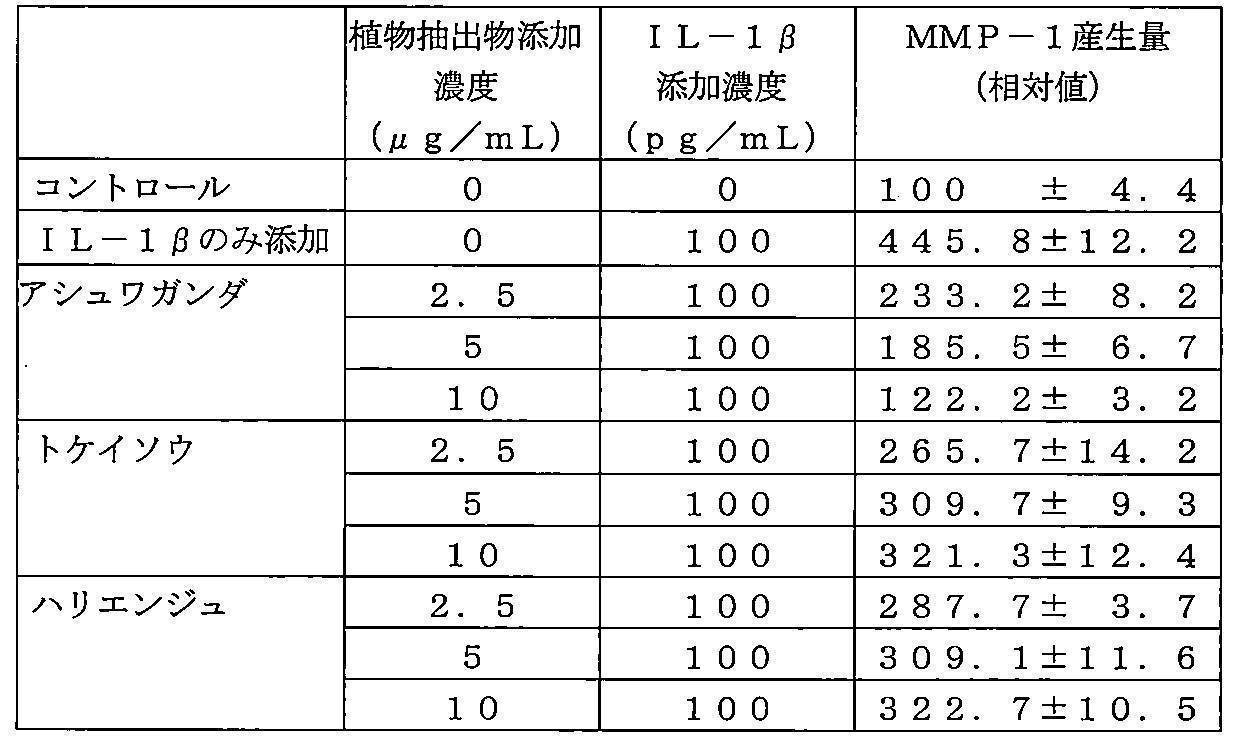
真皮線維芽細胞にIL-1βのみを添加すると、MMP-1の産生量は、およそ446%(コントロールの4.5倍に増加)となった。そして、本試験に供した3種類の植物抽出物はいずれも、試験した全ての濃度において、MMP-1の産生を顕著に抑制した。これらの結果から、アシュワガンダ、トケイソウ、及びハリエンジュより調製される植物抽出物は、優れたMMP-1産生抑制効果を有することが示された。
以上より、通常の環境下で紫外線に曝露された皮膚において、UVBに曝露された皮膚細胞により産生される炎症性サイトカインを介する真皮線維芽細胞によるMMP-1の産生は、本発明により効果的に抑制されることが判明した。
[試験例5]過酸化水素(H2O2)により誘導される活性酸素種(ROS)の産生抑制に対する植物抽出物の効果
ヒトの皮膚をUVBに曝露すると、過酸化水素(H2O2)が発生することが知られている(Hyeon Ho Kim et al, Journal of Lipid Research 46, 1712-1720(2005))。本試験においては、過酸化水素の刺激による活性酸素種(ROS)の産生、及び植物抽出物によるROSの産生抑制について検討を行った。
ヒトの皮膚をUVBに曝露すると、過酸化水素(H2O2)が発生することが知られている(Hyeon Ho Kim et al, Journal of Lipid Research 46, 1712-1720(2005))。本試験においては、過酸化水素の刺激による活性酸素種(ROS)の産生、及び植物抽出物によるROSの産生抑制について検討を行った。
24ウェルプレートに真皮線維芽細胞を播種し、37℃、二酸化炭素濃度5vol%中にてコンフルエントになるまで培養した。
その後、以下の成分を添加した:
・DMSOに溶解された抗酸化剤N-アセチルシステイン(ナカライテスク社製)、
・DMSOに溶解されたPPARδリガンド剤GW501516(EnzoLife Science社製)、
・DMSOに溶解された植物抽出物(調製例1を参照)、又は
・添加なし(DMSO溶液のみ)。
添加した成分の培養液中の濃度は、N-アセチルシステインに関しては30μM及び300μM、GW501516に関しては25nM、植物抽出物に関しては10μg/mL及び20μg/mLとし、DMSOに関しては0.1%とした。24時間培養した後、新しい培地に交換し、過酸化水素を最終濃度10μMで培地に添加し、10分後の細胞内の活性酸素種レベルを定量し、ROS産生量とした。ROSの定量は、DCFDAアッセイキット(Abcam社製)を添付された説明書に従って使用することにより行った。DMSO溶液のみを添加したウェルの一部にはH2O2を添加しないものとし、これをコントロールとした。定量結果は、コントロールについてのROS産生量を100%とする相対値(%)として示した(図3)。
その後、以下の成分を添加した:
・DMSOに溶解された抗酸化剤N-アセチルシステイン(ナカライテスク社製)、
・DMSOに溶解されたPPARδリガンド剤GW501516(EnzoLife Science社製)、
・DMSOに溶解された植物抽出物(調製例1を参照)、又は
・添加なし(DMSO溶液のみ)。
添加した成分の培養液中の濃度は、N-アセチルシステインに関しては30μM及び300μM、GW501516に関しては25nM、植物抽出物に関しては10μg/mL及び20μg/mLとし、DMSOに関しては0.1%とした。24時間培養した後、新しい培地に交換し、過酸化水素を最終濃度10μMで培地に添加し、10分後の細胞内の活性酸素種レベルを定量し、ROS産生量とした。ROSの定量は、DCFDAアッセイキット(Abcam社製)を添付された説明書に従って使用することにより行った。DMSO溶液のみを添加したウェルの一部にはH2O2を添加しないものとし、これをコントロールとした。定量結果は、コントロールについてのROS産生量を100%とする相対値(%)として示した(図3)。
成分を添加せず、過酸化水素を添加した細胞とコントロールの結果から、過酸化水素で細胞を刺激することによって、ROSの産生が誘導されることが確認された。そして、成分を添加せず、過酸化水素を添加した細胞についての結果と比較することにより、次の事項が示された:
・アシュワガンダの抽出物及びトケイソウの抽出物により、ROSの産生が抑制された。いずれの抽出物も、20μg/mlの添加により、ROSの産生を有意に抑制した;
・抗酸化剤として知られるN-アセチルシステインによっても、ROSの産生が抑制された。300μMの添加量において、ROSの産生を有意に抑制した。なお、GW501516は、ROSの産生抑制効果を示さなかった。
・アシュワガンダの抽出物及びトケイソウの抽出物により、ROSの産生が抑制された。いずれの抽出物も、20μg/mlの添加により、ROSの産生を有意に抑制した;
・抗酸化剤として知られるN-アセチルシステインによっても、ROSの産生が抑制された。300μMの添加量において、ROSの産生を有意に抑制した。なお、GW501516は、ROSの産生抑制効果を示さなかった。
以上より、アシュワガンダの抽出物及びトケイソウの抽出物は、過酸化水素の刺激により誘導されるROSの産生を抑制することが明らかとなった。その効果は、抗酸化剤として知られるN-アセチルシステインの効果に匹敵する又はそれ以上である。
Hyeon Ho Kimら(Journal of Lipid Research 46, 1712-1720(2005))には、ヒトの皮膚が紫外線に曝露されると、過酸化水素が迅速かつ有意に産生されること、そして上昇したROSがシグナルカスケード(MAPK)の活性化に関与し、結果としてMMP-1の産生を誘導することが示唆されている。ここでは、更に、N-アセチルシステイン等の抗酸化剤がROSを捕捉し、当該カスケードの活性化に干渉することにより、MMP-1の産生を抑制する可能性も教示されている。これらの事項を上記の結果と併せて考えると、アシュワガンダ及びトケイソウは、過酸化水素により誘導されるROSの産生を抑制することによっても、MMP-1の産生を抑制することが示唆される。
Claims (15)
- アシュワガンダ、トケイソウ、及びハリエンジュからなる群から選択される1又は2以上の植物抽出物を有効成分として含有するMMP-1産生抑制剤。
- 前記植物抽出物が溶媒を用いて抽出された植物抽出物である、請求項1に記載のMMP-1産生抑制剤。
- 前記溶媒がアルコールを含む溶媒である、請求項2に記載のMMP-1産生抑制剤。
- 前記MMP-1の産生が開始される前又は開始された後に適用する、請求項1~3のいずれか1項に記載のMMP-1産生抑制剤。
- 前記MMP-1が皮膚を構成する細胞により産生される、請求項1~4のいずれか1項に記載のMMP-1産生抑制剤。
- 前記細胞が真皮線維芽細胞である、請求項5に記載のMMP-1産生抑制剤。
- 前記MMP-1の産生が紫外線への曝露又は炎症に起因する、請求項1~6のいずれか1項に記載のMMP-1産生抑制剤。
- 前記紫外線がUVBである、請求項7に記載のMMP-1産生抑制剤。
- 表皮に適用する、請求項1~8のいずれか1項に記載のMMP-1産生抑制剤。
- 皮下に適用する、請求項1~8のいずれか1項に記載のMMP-1産生抑制剤。
- 皮膚の老化を予防又は改善するために用いられる、請求項1~10のいずれか1項に記載のMMP-1産生抑制剤。
- 前記皮膚の老化がシワ又はたるみである、請求項11に記載のMMP-1産生抑制剤。
- 請求項1~9のいずれか1項に記載のMMP-1産生抑制剤を含む皮膚外用剤。
- 皮膚外用剤の製造における、請求項1~9のいずれか1項に記載のMMP-1産生阻害剤の使用。
- 請求項1~12のいずれか1項に記載のMMP-1産生抑制剤又は請求項14に記載の皮膚外用剤を適用することを含んでなる、皮膚の非医療的な処置方法。
Priority Applications (2)
| Application Number | Priority Date | Filing Date | Title |
|---|---|---|---|
| JP2017505292A JP6877332B2 (ja) | 2015-03-06 | 2016-03-04 | マトリックスメタロプロテアーゼ産生抑制剤 |
| CN201680013909.8A CN107427542A (zh) | 2015-03-06 | 2016-03-04 | 基质金属蛋白酶产生抑制剂 |
Applications Claiming Priority (4)
| Application Number | Priority Date | Filing Date | Title |
|---|---|---|---|
| JP2015-044851 | 2015-03-06 | ||
| JP2015044851 | 2015-03-06 | ||
| JP2015-185298 | 2015-09-18 | ||
| JP2015185298 | 2015-09-18 |
Publications (1)
| Publication Number | Publication Date |
|---|---|
| WO2016143680A1 true WO2016143680A1 (ja) | 2016-09-15 |
Family
ID=56879526
Family Applications (1)
| Application Number | Title | Priority Date | Filing Date |
|---|---|---|---|
| PCT/JP2016/056704 Ceased WO2016143680A1 (ja) | 2015-03-06 | 2016-03-04 | マトリックスメタロプロテアーゼ産生抑制剤 |
Country Status (4)
| Country | Link |
|---|---|
| JP (1) | JP6877332B2 (ja) |
| CN (1) | CN107427542A (ja) |
| TW (1) | TWI748944B (ja) |
| WO (1) | WO2016143680A1 (ja) |
Citations (6)
| Publication number | Priority date | Publication date | Assignee | Title |
|---|---|---|---|---|
| JP2001058951A (ja) * | 1999-06-15 | 2001-03-06 | Shiseido Co Ltd | 美白用皮膚外用剤 |
| JP2003048812A (ja) * | 2001-07-31 | 2003-02-21 | Koei Kogyo Kk | エラスターゼ阻害剤及び抗老化用化粧料 |
| WO2009014315A1 (en) * | 2007-07-26 | 2009-01-29 | Korea Institute Of Science And Technology | A composition that is comprising extracts, fractions or isolated single compounds of robinia pseudo-acacia var. umbraculifera |
| JP2010083849A (ja) * | 2008-10-02 | 2010-04-15 | Tokiwa Shokubutsu Kagaku Kenkyusho:Kk | 皮膚外用剤 |
| KR20110001538A (ko) * | 2009-06-30 | 2011-01-06 | 한국콜마 주식회사 | 항산화 및 미백 활성을 갖는 꽃 혼합 추출물 및 그 추출방법 및 그 꽃 혼합 추출물을 함유하는 화장료 조성물 |
| WO2014043861A1 (en) * | 2012-09-19 | 2014-03-27 | Yeou-Ping Tsao | Use of pedf-derived polypeptides for preventing and/or ameliorating skin aging |
Family Cites Families (4)
| Publication number | Priority date | Publication date | Assignee | Title |
|---|---|---|---|---|
| US6514538B1 (en) * | 1999-06-15 | 2003-02-04 | Shiseido Company, Ltd. | External preparations for skin whitening |
| JP2002332224A (ja) * | 2001-03-06 | 2002-11-22 | Kose Corp | 老化防止用皮膚外用剤および老化防止用皮膚外用剤組成物 |
| EP1541037A1 (de) * | 2003-12-04 | 2005-06-15 | Cognis Deutschland GmbH & Co. KG | Zubereitung zur oralen Aufnahme enthaltend Extrakte von Passiflora incarnata |
| JP5970148B2 (ja) * | 2008-09-12 | 2016-08-17 | 丸善製薬株式会社 | チロシナーゼ活性阻害剤、メラニン産生抑制剤、及びSCFmRNA発現抑制剤 |
-
2016
- 2016-03-04 WO PCT/JP2016/056704 patent/WO2016143680A1/ja not_active Ceased
- 2016-03-04 CN CN201680013909.8A patent/CN107427542A/zh active Pending
- 2016-03-04 JP JP2017505292A patent/JP6877332B2/ja active Active
- 2016-03-04 TW TW105106740A patent/TWI748944B/zh active
Patent Citations (6)
| Publication number | Priority date | Publication date | Assignee | Title |
|---|---|---|---|---|
| JP2001058951A (ja) * | 1999-06-15 | 2001-03-06 | Shiseido Co Ltd | 美白用皮膚外用剤 |
| JP2003048812A (ja) * | 2001-07-31 | 2003-02-21 | Koei Kogyo Kk | エラスターゼ阻害剤及び抗老化用化粧料 |
| WO2009014315A1 (en) * | 2007-07-26 | 2009-01-29 | Korea Institute Of Science And Technology | A composition that is comprising extracts, fractions or isolated single compounds of robinia pseudo-acacia var. umbraculifera |
| JP2010083849A (ja) * | 2008-10-02 | 2010-04-15 | Tokiwa Shokubutsu Kagaku Kenkyusho:Kk | 皮膚外用剤 |
| KR20110001538A (ko) * | 2009-06-30 | 2011-01-06 | 한국콜마 주식회사 | 항산화 및 미백 활성을 갖는 꽃 혼합 추출물 및 그 추출방법 및 그 꽃 혼합 추출물을 함유하는 화장료 조성물 |
| WO2014043861A1 (en) * | 2012-09-19 | 2014-03-27 | Yeou-Ping Tsao | Use of pedf-derived polypeptides for preventing and/or ameliorating skin aging |
Also Published As
| Publication number | Publication date |
|---|---|
| TW201701895A (zh) | 2017-01-16 |
| TWI748944B (zh) | 2021-12-11 |
| JP6877332B2 (ja) | 2021-05-26 |
| CN107427542A (zh) | 2017-12-01 |
| JPWO2016143680A1 (ja) | 2017-12-21 |
Similar Documents
| Publication | Publication Date | Title |
|---|---|---|
| JP5122060B2 (ja) | 抗老化剤 | |
| US20110212041A1 (en) | Skin-Whitening Agent, Anti-Aging Agent and Skin-Care Cosmetic Agent | |
| CN102421412B (zh) | 含有日本扁柏多糖的皮肤外用组合物 | |
| CN102370591A (zh) | 石榴皮提取方法及其提取物的应用 | |
| KR20220166356A (ko) | 모링가 페레그리나 종자 케이크의 추출물, 이의 제조 방법 및 화장품 또는 뉴트리코스메틱 조성물에서의 이의 용도 | |
| Baldi et al. | Synergistic use of bioactive agents for the management of different skin conditions: an overview of biological activities. | |
| Itsarasook et al. | Artocarpin-enriched extract reverses collagen metabolism in UV-exposed fibroblasts | |
| JP2008184440A (ja) | 紫外線細胞障害改善用皮膚外用剤 | |
| JP2008285422A (ja) | Dna損傷抑制剤及びグルタチオン産生促進剤 | |
| JP2012162487A (ja) | 美白剤、抗老化剤及び皮膚化粧料 | |
| CN103948529A (zh) | 一种含番茄果肉提取物的化妆品组合物 | |
| KR102226179B1 (ko) | 항노화 화장료 조성물 | |
| KR20190036388A (ko) | 해죽순 추출물을 함유하는 화장료 조성물 | |
| KR101220903B1 (ko) | 피부주름개선용 피부외용제 조성물 | |
| KR100369578B1 (ko) | 주름개선효과가있는생약추출물을함유하는화장료 | |
| KR101876617B1 (ko) | 호랑가시나무 추출물을 함유하는 지방세포 분화 촉진용 조성물 | |
| JP6877332B2 (ja) | マトリックスメタロプロテアーゼ産生抑制剤 | |
| Yarovaya et al. | Anti-inflammatory activity of grape seed extract as a natural sun protection enhancer for broad-spectrum sunscreen | |
| JP5769448B2 (ja) | Dna修復促進剤及び皮膚外用剤 | |
| KR20140141188A (ko) | 풋감 추출물을 함유하는 피부 외용제 조성물 | |
| HK1240858A1 (en) | Matrix metalloproteinase production inhibitor | |
| KR102288977B1 (ko) | 팔각회향 추출물 또는 트랜스 아네톨을 함유하는 주름 개선용 화장료 조성물 | |
| KR102956139B1 (ko) | 열충격단백질의 활성화를 통해 열노화를 방지하는 항주름, 항산화 및 피부 세포보호용 화장료 조성물 | |
| KR20210038024A (ko) | 녹나무(樟腦木) 추출물을 함유하는 미백용 조성물 | |
| KR102848387B1 (ko) | 바쿠치올을 포함하는, 피부 개선용 화장료 조성물 |
Legal Events
| Date | Code | Title | Description |
|---|---|---|---|
| 121 | Ep: the epo has been informed by wipo that ep was designated in this application |
Ref document number: 16761650 Country of ref document: EP Kind code of ref document: A1 |
|
| ENP | Entry into the national phase |
Ref document number: 2017505292 Country of ref document: JP Kind code of ref document: A |
|
| NENP | Non-entry into the national phase |
Ref country code: DE |
|
| 122 | Ep: pct application non-entry in european phase |
Ref document number: 16761650 Country of ref document: EP Kind code of ref document: A1 |