WO2016143651A1 - 油水分離材および油水分離方法 - Google Patents
油水分離材および油水分離方法 Download PDFInfo
- Publication number
- WO2016143651A1 WO2016143651A1 PCT/JP2016/056543 JP2016056543W WO2016143651A1 WO 2016143651 A1 WO2016143651 A1 WO 2016143651A1 JP 2016056543 W JP2016056543 W JP 2016056543W WO 2016143651 A1 WO2016143651 A1 WO 2016143651A1
- Authority
- WO
- WIPO (PCT)
- Prior art keywords
- water
- oil
- group
- composite particles
- particles
- Prior art date
- Legal status (The legal status is an assumption and is not a legal conclusion. Google has not performed a legal analysis and makes no representation as to the accuracy of the status listed.)
- Ceased
Links
Images





Definitions
- the present invention relates to an oil / water separator and an oil / water separation method.
- Fluorine compounds can be expected to be applied to paints and cosmetics, taking advantage of their water / oil repellency, oxygen permeability, and low refractive index. However, since the fluorine-based compound has too high water and oil repellency, it is difficult to maintain dispersion stability with respect to the non-fluorine raw material.
- Fluorine compounds that exhibit high oil repellency in air have the disadvantage that the oil repellency disappears in water and the oil spreads wet.
- wastewater containing oil is a major cause of environmental pollution and is required to be treated appropriately.
- methods such as stationary separation such as specific gravity separation, centrifugal separation, and adsorption separation are used for oil-water separation treatment.
- Patent Documents 1 to 3 have previously proposed various new functional materials using fluoroalkyl group-containing oligomers and imparting excellent characteristics resulting from the fluoroalkyl group-containing oligomers (eg, Patent Documents 1 to 3). reference).
- Non-Patent Document 1 the present inventors previously proposed composite particles obtained by complexing polytetrafluoroethylene (also referred to as “PTFE”) particles with a fluoroalkyl group-containing oligomer (see Non-Patent Document 1).
- PTFE polytetrafluoroethylene
- the inventors of the present invention have prepared a condensate obtained by condensing a fluoroalkyl group-containing oligomer having an alkoxysilyl group represented by the following general formula (1) and a composite particle containing a specific component, which contains water and oil. It can be suitably used as an oil / water separator that separates water and oil from the liquid. Furthermore, it has been found that water and oil emulsions can be suitably used as an oil / water separator, and the present invention has been completed.
- an object of the present invention is to provide an oil / water separation material and an oil / water separation method capable of separating water and oil from a mixed liquid containing water and oil.
- the first invention to be provided by the present invention is an oil-water separator using composite particles
- the composite particle includes a condensate of a fluoroalkyl group-containing oligomer having an alkoxysilyl group represented by the following general formula (1) and any one of the following components (A) to (C): It is an oil-water separator.
- a second invention to be provided by the present invention is an oil-water separation method characterized by bringing a mixed liquid containing water and oil into contact with the oil-water separator of the first invention.
- a third invention to be provided by the present invention is an oil-water separation method characterized by bringing an emulsion containing water and oil into contact with the oil-water separator of the first invention.
- water and oil can be separated from a mixed solution containing water and oil, and further, water and oil can be separated from an emulsion containing water and oil.
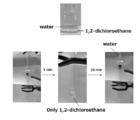
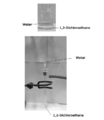
- FIG. 3 is a photograph when a mixed liquid of 1,2-dichloroethane and water is separated using filter paper modified with the composite particles of the present invention in Evaluation 1 of Embodiment 1.
- FIG. 3 is a photograph when a mixed liquid of 1,2-dichloroethane and water is separated using filter paper modified with the composite particles of the present invention in Evaluation 1 of Embodiment 1.
- FIG. The photograph of the column for chromatography actually used for separation in Evaluation 2 of Embodiment 1.
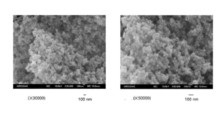
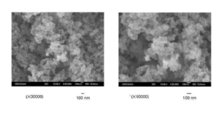
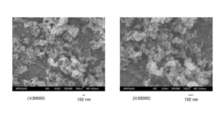
- 6 is an SEM photograph of the composite particle sample obtained in Example 6 of Embodiment 2.
- FIG. 10 is an SEM photograph of the composite particle sample obtained in Example 7 of Embodiment 2.
- FIG. 10 is an SEM photograph of the composite particle sample obtained in Example 8 of Embodiment 2.
- the oil-water separator according to the present invention is a condensate obtained by condensing a fluoroalkyl group-containing oligo having an alkoxysilyl group represented by the following general formula (1) (hereinafter also referred to as “fluoroalkyl group-containing oligomer”). And (A) talc and crosslinked polystyrene, (B) condensate of methyltrimethoxysilane, and (C) composite particles containing one component selected from polytetrafluoroethylene particles. It is.
- R 1 and R 2 may be the same group or different groups
- Y in R 1 and R 2 represents a hydrogen atom, a fluorine atom or a chlorine atom
- p and q are integers of 0 to 10
- R 3 , R 4 and R 5 may be the same or different
- R 3 , R 4 and R 5 are linear or branched alkyl groups having 1 to 5 carbon atoms.
- M is an integer of 2 to 3.
- Embodiment 1 Composite particles containing a fluoroalkyl group-containing oligomer and the component (A).
- Embodiment 2 Composite particles containing a fluoroalkyl group-containing oligomer and the component (B).
- Embodiment 3 Composite particles containing a fluoroalkyl group-containing oligomer and the component (C).
- the condensate of the fluoroalkyl group-containing oligomer represented by the general formula (1) is mainly used for imparting excellent water repellency to the oil / water separator of the present invention.
- Examples of the linear or branched alkyl group having 1 to 5 carbon atoms represented by R 3 , R 4 and R 5 in the general formula (1) include a methyl group, an ethyl group, a propyl group, a butyl group, and a pentyl group.
- R 1 and R 2 — (CF 2 ) pY group, or —CF (CF 3 ) — [OCF 2 CF (CF 3 )] q—OC 3 F 7 group p and q is 0 to 10, preferably 0 to 3.
- R 1 and R 2 are preferably —CF (CF 3 ) OC 3 F 7 .
- the fluoroalkyl group-containing oligomer represented by the general formula (1) is produced, for example, by reacting a trialkoxyvinylsilane such as trimethoxyvinylsilane with a fluoroalkanoyl peroxide (for example, JP-A-2002-338691, JP, 2010-77383, A).
- a fluoroalkanoyl peroxide for example, JP-A-2002-338691, JP, 2010-77383, A.
- Talc (Mg 3 Si 4 O 10 (OH) 2 ) according to the component (A) of Embodiment 1 is a component that mainly imparts excellent lipophilicity to the oil-water separator of the present invention.
- the talc it is preferable to use a fine talc from the viewpoint of producing fine composite particles, and the average particle size determined by the dynamic light scattering method is preferably 5 to 1000 nm, and preferably 20 to 500 nm. In the present invention, a commercially available talc can be suitably used.
- the crosslinked polystyrene according to the component (A) of Embodiment 1 is used for imparting durability to a solvent and excellent oil / water separation ability to the oil / water separator of the present invention.
- cross-linked polystyrene means monovinyl aromatic compounds such as styrene, vinyl xylene, vinyl naphthalene, chloromethyl styrene, and polyvinyl aromatic compounds such as divinyl benzene, divinyl toluene, divinyl xylene, divinyl naphthalene, trivinyl benzene, and the like. Is a cross-linked copolymer.
- the physical properties of the crosslinked polystyrene it is preferable to use fine ones from the viewpoint of producing fine composite particles.
- Fine crosslinked polystyrene is often agglomerated and it is difficult to measure the particle size of primary particles, but the average particle size of secondary particles obtained by a laser light scattering method is 0.1 to 500 ⁇ m, The thickness is preferably 5 to 200 ⁇ m.
- a commercially available product can be suitably used as the crosslinked polystyrene.
- the composite particle according to Embodiment 1 is a reaction raw material solution containing 1 to 500 mg, preferably 20 to 300 mg of talc and 5 to 800 mg, preferably 10 to 500 mg of crosslinkable polystyrene, in terms of a value converted to 100 mg of a fluoroalkyl group-containing oligomer. And is obtained by a reaction step of hydrolyzing the alkoxysilyl group of the fluoroalkyl group-containing oligomer, it is excellent in lipophilicity and water repellency, and further in durability and oil-water separation ability. It is preferable from the viewpoint.
- methyltrimethoxysilane (b) is different from tetraethoxysilane (TEOS), which is a tetrafunctional alkoxysilane, and ⁇ Si—O—. Since the methyl group is directly substituted on the main chain, the function of the organic group can be expressed in the ⁇ Si—O— network even after the hydrolysis / condensation reaction.
- TEOS tetraethoxysilane
- ⁇ Si—O— tetraethoxysilane
- methyltrimethoxysilane (b) can be used without particular limitation on physical properties and the like as long as it is industrially available.
- the condensate of methyltrimethoxysilane is used to impart excellent lipophilicity to the oil-water separator according to the present invention while maintaining excellent water repellency due to the fluoroalkyl group-containing oligomer. .
- the composite particles according to Embodiment 2 use a reaction raw material solution containing 0.01 to 10 ml, preferably 0.05 to 5 ml of methyltrimethoxysilane (b) in terms of a value converted to 100 mg of a fluoroalkyl group-containing oligomer. It is preferable that it is obtained by a reaction step in which an alkyl group-containing oligomer and methyltrimethoxysilane are hydrolyzed from the viewpoint of being excellent in lipophilicity and water repellency, and further excellent in oil / water separation ability.
- the polytetrafluoroethylene particles according to the component (C) of Embodiment 3 are not particularly limited as long as they are industrially available, but are fine from the viewpoint of producing fine composite particles (1).
- the average particle size determined by the dynamic light scattering method is 10 to 2000 nm, preferably 50 to 1000 nm.
- commercially available polytetrafluoroethylene particles can be suitably used.
- the composite particle according to Embodiment 3 is a value converted to 300 mg of a fluoroalkyl group-containing oligomer, and a reaction raw material solution containing 10 to 1000 mg, preferably 20 to 500 mg of polytetrafluoroethylene particles is used. It is preferable that it is obtained by a reaction step in which a decomposition reaction is performed, from the viewpoint of being excellent in lipophilicity and water repellency and further excellent in oil / water separation ability.
- the composite particles of Embodiments 1 to 3 when the composite particles of Embodiments 1 to 3 further contain silica particles (D) to form composite particles, the oil / water separation performance can be improved.
- the silica particles (D) that can be used are, for example, those produced by particle growth from sodium silicate or active silicic acid solution, those produced using an organic silicon compound as a raw material, fumed silica, silica gel, etc. There are no particular restrictions on the porous silica.
- the average particle diameter of the silica particles (D) is 1 to 500 ⁇ m, preferably 3 to 100 ⁇ m. When the average particle diameter of the silica particles (D) is within the above range, the dispersibility of the composite particles in a solvent, a resin material, a base material, or the like is improved.
- the composite particle further containing silica particles is a value converted to 300 mg of fluoroalkyl group-containing oligomer, and a reaction raw material solution containing 10 to 1000 mg, preferably 50 to 500 mg of silica particles (D) is used. It is preferable that it is obtained by a reaction step in which the contained oligomer is hydrolyzed from the viewpoint of being excellent in lipophilicity and water repellency and further improving oil-water separation ability.
- the average particle diameter determined by the dynamic light scattering method is preferably 0.05 to 500 ⁇ m, preferably 0.1 to 300 ⁇ m.
- the average particle diameter is within the above range, it is preferable in terms of good dispersibility in various dispersion solvents, resin materials, various base materials and the like.
- the composite particles used in the present invention include a fluoroalkyl group-containing oligomer having an alkoxysilyl group represented by the general formula (1), (A) talc and crosslinked polystyrene, (b) methyltrimethoxysilane, and (C). It can manufacture by adding the catalyst chosen from an acid or an alkali in the reaction raw material solution containing the component chosen from a polytetrafluoroethylene particle, and performing a hydrolysis reaction of this fluoroalkyl group containing oligomer.
- the composite particle according to Embodiment 1 is a reaction raw material solution containing 1 to 500 mg, preferably 20 to 300 mg of talc and 5 to 800 mg, preferably 10 to 500 mg of crosslinkable polystyrene, in terms of a value converted to 100 mg of a fluoroalkyl group-containing oligomer. It is preferable to carry out the hydrolysis reaction of the alkoxysilyl group of the fluoroalkyl group-containing oligomer from the viewpoint of obtaining a product having excellent lipophilicity and water repellency, and having excellent durability and oil-water separation ability.
- the composite particles according to Embodiment 2 use a reaction raw material solution containing 0.01 to 10 ml, preferably 0.05 to 5 ml of methyltrimethoxysilane (b) in terms of a value converted to 100 mg of a fluoroalkyl group-containing oligomer. It is preferable to carry out a hydrolysis reaction between the alkyl group-containing oligomer and methyltrimethoxysilane from the viewpoint of obtaining a product having excellent lipophilicity and water repellency and also excellent oil / water separation ability.
- the composite particle according to Embodiment 3 is a value converted to 300 mg of a fluoroalkyl group-containing oligomer, and a reaction raw material solution containing 10 to 1000 mg, preferably 20 to 500 mg of polytetrafluoroethylene particles is used. It is preferable to carry out the decomposition reaction from the viewpoint of obtaining a product that is excellent in lipophilicity and water repellency and further excellent in oil-water separation ability.
- the composite particle further containing silica particles (D) is a value converted to 300 mg of fluoroalkyl group-containing oligomer, and a reaction raw material solution containing 10 to 1000 mg, preferably 50 to 500 mg of silica particles (D) is used. It is preferable to carry out the hydrolysis reaction of the alkyl group-containing oligomer from the viewpoint of being excellent in lipophilicity and water repellency and further improving oil-water separation ability.
- reaction solvent for the reaction step a solvent that can dissolve the fluoroalkyl group-containing oligomer and is inert to the raw material components is used.
- solvent for the reaction step for example, lower alcohols such as methanol, ethanol and isopropyl alcohol are preferably used.
- the acid or alkali added to the reaction raw material solution is not particularly limited as long as it can hydrolyze alkoxysilane.
- the alkali includes ammonium hydroxide, sodium hydroxide or water.
- examples include potassium oxide
- examples of the acid include sulfuric acid, hydrochloric acid, nitric acid, and acetic acid. From the viewpoint of high reactivity, ammonium hydroxide or hydrochloric acid is preferable, and ammonium hydroxide is particularly preferable.
- the mixing amount of the acid or alkali added to the reaction raw material solution is not particularly limited and is appropriately selected.
- the reaction temperature when the alkoxysilane is hydrolyzed by mixing an acid or alkali with the reaction raw material solution is ⁇ 5 to 50 ° C., preferably 0 to 30 ° C. If the reaction temperature is less than ⁇ 5 ° C., the hydrolysis rate of the alkoxysilane becomes too slow, so that the reaction efficiency is poor, and if it exceeds 50 ° C., the dispersion stability of the composite particles tends to be lowered.
- the reaction time when the reaction raw material solution is mixed with an acid or an alkali for hydrolysis is not particularly limited and is appropriately selected, but is preferably 1 to 72 hours, particularly preferably 1 to 24 hours. It is.
- the hydrolysis reaction can be further continued in the presence of a base as necessary for the purpose of improving the yield.
- the base examples include ammonia, ethylenediamine, ammonium carbonate, ammonium hydrogen carbonate, ammonium formate, ammonium acetate, sodium carbonate, sodium hydrogen carbonate, and the like. is there.
- the mixing amount of the base added to the reaction raw material solution is not particularly limited and is appropriately selected.
- the reaction temperature at the time of hydrolysis by mixing a base with the reaction raw material solution is 20 to 100 ° C., preferably 50 to 100 ° C.
- the reaction time is 1 hour or more, preferably 1 to 10 hours.
- the reaction liquid containing the composite particles after completion of the reaction is used as it is as a modifying liquid for modifying the base material with the composite particles and using it as an oil-water separator, as will be described later. I can do it.
- the oil / water separator according to the present invention uses the composite particles. Water and oil can be separated by bringing the oil / water separator according to the present invention into contact with a mixed liquid containing water and oil.
- the composite particles can be used, for example, as an oil / water separator by the following two methods. (1) A method of modifying a base material insoluble in water with the composite particles. (2) A method in which the composite particle itself is used as a filter medium as it is.
- an inorganic substance or an organic substance that is insoluble in water can be used as the base material according to (1).
- the inorganic substance include glass fiber, silica, silica gel, alumina, slag wool, molecular sieve, zeolite, activated carbon, diatomaceous earth, sand, asbestos and the like.
- the organic substance may be a natural polymer or a synthetic polymer. Examples of the natural polymer include cellulose, wool, cotton, silk and the like.
- Examples of synthetic polymers include condensation-type or addition-type polymer polymers such as polyurethane, polyethylene terephthalate, nylon, and polycarbonate, and ethylenically unsaturated polymer polymers such as polyethylene, polypropylene, vinyl chloride, and vinyl acetate. It is done.
- the shape of the substrate is not particularly limited, and examples thereof include strips, sponges, ribbons, fibrils, webs, mats, cottons, and nonwovens.
- a commercially available filter paper or the like may be used as a base material for modifying.
- the pore diameter of the filter paper is preferably 5 ⁇ m or less, preferably 0.1 to 3 ⁇ m from the viewpoint of efficient oil-water separation.
- the method for modifying the substrate with the composite particles is not particularly limited as long as the method can fix or carry the composite particles on the surface or inside of the substrate.
- a base material is brought into contact with a dispersion in which the composite particles are dispersed at a concentration of 0.1 to 50 wt% and then dried.
- the contact between the dispersion and the substrate can be performed by a method of immersing the substrate in the dispersion, a method of spraying the substrate by spraying, a method of applying the dispersion to the substrate, or the like.
- the reaction liquid containing the composite particles after the completion of the reaction may be used as it is.
- FIG. 1 is a schematic view showing an embodiment in the case where a mixed liquid of water and oil is separated using a filter paper modified with composite particles.
- a simple separation system (A) comprising a column (1b) and a modified filter paper (1a) is provided, and the modified filter paper (1a) is modified with the composite particles.
- the mixed liquid (1) of water and oil charged into the column (1b) comes into contact with the modified filter paper (1a). Since oil (1 ′) passes through the modified filter paper (1a) and water cannot pass through the modified filter paper (1a), water and oil can be separated. If necessary, the separation operation can be performed under pressure or under reduced pressure in order to increase the separation efficiency. In this case, the oil (1 ′) may first pass through the modified filter paper (1a), and then the water may be delayed by the strong external force to pass through the modified filter paper (1a). Before elution, water and oil can be separated through the filter paper (1a) modified by means such as finishing the oil-water separation operation.
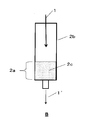
- FIG. 2 is a schematic view showing one embodiment in the case where a mixed liquid of water and oil is separated using the composite particles as a filter medium.
- a simple separation system including a filter medium layer (2a) including a column (2b) and a filter medium (2c).
- the column (2b) is filled with the composite particles as a filter medium (2c) to form a filter medium layer (2a).
- the filter medium (2c) and the mixed liquid can be brought into contact with each other. Since oil (1 ′) passes through the filter medium layer (2a) and water cannot pass through the filter medium layer (2a), water and oil can be separated. If necessary, the separation operation can be performed under reduced pressure in order to increase the separation efficiency.
- the layer which filled the filter aid in the upper part and / or lower part of the filter medium (2a) can be provided if necessary.
- the filter aid that can be used is not particularly limited and a wide variety of known ones can be used.
- the mixed liquid of water and oil to be treated with the oil / water separator according to the present invention may be in a solution state or an emulsion.
- the oil / water separator according to the present invention can be used for, for example, treatment of wastewater containing oil, means for separating or purifying water and oil at production sites in various industrial fields, and the like.
- VM fluoroalkyl group-containing oligomer sample
- GPC gel permeation chromatography
- VM 100 mg was dissolved in 5 ml of methanol solution, 100 mg of talc (Asada Flour Mills average particle size; 131 nm) and cross-linked polystyrene in the amount shown in Table 2 (Tokyo Chemical Industry average particle size: 92 ⁇ m) were added, Next, a 25 wt% aqueous ammonia solution (2 ml) was added, and the mixture was stirred with a magnetic stirrer at room temperature (25 ° C.) for 1 hour to obtain a reaction solution sample.
- the solvent was removed from the reaction solution sample under reduced pressure, and the resulting crude product was dispersed in methanol overnight. Subsequently, the target product was separated as a solid content by centrifugation, the obtained solid content was washed several times with methanol, and after removing the solvent, vacuum-dried at 50 ° C. to obtain the target product (composite particle sample). .
- the obtained composite particle sample was measured by FT-IR. IR (KBr, cm ⁇ 1 ); 1600 (polystyrene), 1338, 1240 (C—F), 1016 (Si—O—Si), 750 (C—C), 1687 (C ⁇ C)
- the contact angle of dodecane and water on the surface of the modified glass plate sample was evaluated using Drop Master 300 made by Kyowa Interface Science. The results are shown in Table 3. The contact angle was evaluated as a value 30 minutes after dropping water and dodecane. Moreover, what was processed only with VM was made into the blank 1, and what was processed only with the talc was evaluated as the blank 2, and the evaluation result was written together in Table 3.
- Treated water 1 (mixed solution); 2 ml of a mixed solution of 1,2-dichloroethane and water (1: 1 vol.) was prepared. The water in the mixed solution was colored blue with copper sulfate pentahydrate.
- Treated water 2 (emulsion); An emulsion was prepared by mixing 1,2-dichloroethane (5 ml), water (0.05 ml) and Span 80 (20 mg) as an emulsifier.
- ⁇ Embodiment 2> ⁇ Examples 5 to 11 ⁇ VM was dissolved in an ethanol solution, and methyltrimethoxysilane was added to prepare a reaction raw material solution. Next, acetic acid was added, and the mixture was stirred with a magnetic stirrer at room temperature (25 ° C.) for 48 hours. Next, ammonium carbonate was added and reacted at 70 ° C. for 5 hours to obtain a reaction liquid sample. The amount of each reagent charged is as shown in Table 6. After completion of the reaction, the solvent was removed from the reaction solution sample under reduced pressure, then redispersed in methanol and centrifuged to obtain the desired product (composite particle sample) as a white powder.
- Example 7 (Evaluation as oil / water separator) A chromatographic column (inner diameter: 10 mm) is packed with sea sand to a layer thickness of about 1 mm, and then 200 mg of the composite particle sample obtained in Example 7 (layer thickness of about 4 mm) is packed thereon. Sand was filled to a layer thickness of about 1 mm. Using this chromatography column, water-oil separation tests were conducted on the following three types of treated water. For treated water 1, instead of the composite particles of Example 7, SiO 2 (Wakogel C-500HG) and the composite particle sample of Comparative Example 3 were tested in the same manner.
- Treated water 1 mixed solution
- 2 ml of a mixed solution of 1,2-dichloroethane and water (1: 1 vol.) was prepared. The water in the mixed solution was colored blue with copper sulfate pentahydrate.
- Treated water 2 emulsion
- An emulsion was prepared by mixing 1,2-dichloroethane (5 ml), water (0.05 ml) and Span 80 (20 mg) as an emulsifier.
- Treated water 3 emulsion
- Toluene 5 ml
- water (0.05 ml) and Span 80 (80 mg) as an emulsifier were mixed to prepare an emulsion.
- Treated water 2; Table 9 shows the result of separating treated water 2.
- the symbols in Table 9 indicate the following. A: No water is visually observed in the filtrate, and the oil recovery rate is high. ⁇ : No water is visually observed in the filtrate, and the oil recovery rate is low. ⁇ : Some water is visually observed in the filtrate. X: An emulsion is visually observed in the filtrate. Note) “-” in the table indicates no measurement.
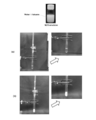
- FIG. 11 (a) by filtering the treated water 2 under reduced pressure using the composite particles of the present invention as a filter medium, only 1,2-dichloroethane passes through the filter medium layer, and the water from the emulsion. And 1,2-dichloroethane could be separated.
- Treated water 3; Table 10 shows the result of separating the treated water 3.
- the symbols in Table 10 indicate the following. A: No water is visually observed in the filtrate, and the oil recovery rate is high. ⁇ : No water is visually observed in the filtrate, and the oil recovery rate is low. ⁇ : Some water is visually observed in the filtrate. X: An emulsion is visually observed in the filtrate. Note) “-” in the table indicates no measurement.
- FIG. 12 (a) by filtering the treated water 3 under reduced pressure using the composite particles of the present invention as a filter medium, only toluene passes through the filter medium layer, and water and toluene are separated from the emulsion. We were able to.
- VM 300 mg was dissolved in 20 ml of methanol solution, and polytetrafluoroethylene particles (average particle size 282 nm, manufactured by Kitamura Co., Ltd.) and silica particles (particle size 5 to 20 ⁇ m Wakogel C-500HG) in the amounts shown in Table 11 were dissolved. Then, a 25 wt% aqueous ammonia solution (4 ml) was added, and the mixture was stirred with a magnetic stirrer at room temperature (25 ° C.) for 1 hour to obtain a reaction solution sample.
- the solvent was removed from the reaction solution sample under reduced pressure, and the resulting crude product was dispersed in methanol overnight. Subsequently, the target product was separated as a solid content by centrifugation, the obtained solid content was washed several times with methanol, and after removing the solvent, vacuum-dried at 50 ° C. to obtain the target product (composite particle sample). .
- Example 13 ⁇ VM (300 mg) was dissolved in 5 ml of methanol solution, polytetrafluoroethylene particles (average particle size 282 nm, manufactured by Kitamura Co., Ltd.) in the amount shown in Table 11 were added, and then 25 wt% aqueous ammonia solution (2 ml) was added. Then, stirring was performed at room temperature (25 ° C.) for 1 hour with a magnetic stirrer to obtain a reaction liquid sample. After completion of the reaction, the solvent was removed from the reaction solution sample under reduced pressure, and the resulting crude product was dispersed in methanol overnight.
- the target product was separated as a solid content by centrifugation, the obtained solid content was washed several times with methanol, and after removing the solvent, vacuum-dried at 50 ° C. to obtain the target product (composite particle sample). .
- Table 4 shows the results of separation treatment of treated water 1.
- the symbols in Table 13 indicate the following.
- ⁇ Water is not visually observed in the filtrate.
- ⁇ Some water is visually observed in the filtrate.
- X A lot of water is visually observed in the filtrate.
- FIG. 13 by treating the treated water 1 using the composite particle sample of Example 12 as a filter medium, only 1,2-dichloroethane passes through the filter medium layer, and water and 1,2 -The dichloroethane could be separated.
- treated water 1 was treated using silica particles as a filter medium, it was confirmed visually that water was mixed in the filtrate after filtration in addition to 1,2-dichloroethane.
- Table 5 shows the results of separating the treated water 2.
- the symbols in Table 5 indicate the following.
- ⁇ Water is not visually observed in the filtrate.
- ⁇ Some water is visually observed in the filtrate.
- X An emulsion is visually observed in the filtrate.
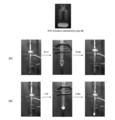
- FIG. 14A only the 1,2-dichloroethane passes through the filter medium layer by filtering the treated water 2 under reduced pressure using the composite particle sample of Example 13 as the filter medium. Water and 1,2-dichloroethane could be separated from the emulsion.
- FIG. 14B when the treated water 2 is treated using silica particles as a filter medium, the emulsion passes through the filter medium layer to separate water and 1,2-dichloroethane from the emulsion. I could't.
- Table 15 shows the result of separating the treated water 3.
- the symbols in Table 15 indicate the following.
- ⁇ Water is not visually observed in the filtrate.
- ⁇ Some water is visually observed in the filtrate.
- X An emulsion is visually observed in the filtrate.
- FIG. 15 (a) by filtering the treated water 3 using the composite particle sample 6 as a filter medium, only toluene passes through the filter medium layer, and water and toluene can be separated from the emulsion. It was.
- FIG. 15 (b) when the treated water 3 is treated using silica particles as a filter medium, the emulsion passes through the filter medium layer and water and toluene cannot be separated from the emulsion. It was.
Landscapes
- Solid-Sorbent Or Filter-Aiding Compositions (AREA)
- Water Treatment By Sorption (AREA)
Abstract
本発明の目的は、水と油を含む混合液から水と油を分離することが出来る油水分離材及び油水分離方法を提供することにある。 本発明は、コンポジット粒子を用いた油水分離材であって、 該コンポジット粒子が、下記一般式(1)で表されるアルコキシシリル基を有するフルオロアルキル基含有オリゴマーの縮合物と、下記の(A)~(C)の何れか1つの成分を含むことを特徴とする油水分離材である。 (A)タルク及び架橋ポリスチレン、 (B)メチルトリメトキシシランの縮合物、 (C)ポリテトラフルオロエチレン粒子(式中、R1及びR2は、-(CF2)p-Y基、又は-CF(CF3)-[OCF2CF(CF3)]q-OC3F7基を示し、R1及びR2は、同一の基であっても異なる基であってもよく、R1及びR2中のYは水素原子、フッ素原子又は塩素原子を示し、p及びqは0~10の整数である。R3、R4及びR5は同一の基であっても異なる基であってもよく、R3、R4及びR5は炭素数1~5の直鎖状若しくは分岐状のアルキル基を示す。mは2~3の整数である。)
Description
本発明は、油水分離材および油水分離方法に関するものである。
フッ素化合物は、撥水・撥油性、酸素透過性、低屈折率などの特徴を活かして塗料や化粧品等への応用が期待できる。しかしながら、フッ素系化合物は撥水・撥油性が高すぎるため非フッ素原料に対して、分散安定性を保持させることが難しい。
また、空気中で高い撥油性を発現するフッ素化合物は、水中では逆に撥油性が消失し、油が濡れ拡がるという欠点がある。
また、油分を含んだ廃水は、環境を汚染する大きな原因となり、適切に処理することが求められている。従来、油水分離処理には、比重分離等の静置分離、遠心分離、吸着分離等の方法が用いられている。
しかし、静置分離は多大な時間を要し、遠心分離は大がかりな装置を必要とし、吸着分離は大量の油水混合液の処理に不向きである。
本発明者らは、先にフルオロアルキル基含有オリゴマーを用い、フルオロアルキル基含有オリゴマーに起因した優れた特性を付与した各種の新しい機能性材料を提案している(例えば、特許文献1~3等参照)。
また、本発明者らは、先にポリテトラフルオロエチレン(「PTFE」とも言われる)粒子を、フルオロアルキル基含有オリゴマーで複合化処理したコンポジット粒子を提案した(非特許文献1参照。)。
日本化学会講演予稿集,Vol.94th, No.3, Page.825(2014)
本発明者らは、下記一般式(1)で表されるアルコキシシリル基を有するフルオロアルキル基含有オリゴマーを縮合させた縮合物と、特定の成分を含有するコンポジット粒子は、水と油を含む混合液から水と油を分離する油水分離材として好適に利用できること。更に水と油のエマルションに対しても、油水分離材として好適に利用することができることを知見し、本発明を完成するに到った。
従って、本発明の目的は、水と油を含む混合液から水と油を分離することが出来る油水分離材及び油水分離方法を提供することにある。
すなわち、本発明が提供しようとする第一の発明は、コンポジット粒子を用いた油水分離材であって、
該コンポジット粒子が、下記一般式(1)で表されるアルコキシシリル基を有するフルオロアルキル基含有オリゴマーの縮合物と、下記の(A)~(C)の何れか1つの成分を含むことを特徴とする油水分離材である。
(A)タルク及び架橋ポリスチレン、
(B)メチルトリメトキシシランの縮合物、
(C)ポリテトラフルオロエチレン粒子

(式中、R1及びR2は、-(CF2)p-Y基、又は-CF(CF3)-[OCF2CF(CF3)]q-OC3F7基を示し、R1及びR2は、同一の基であっても異なる基であってもよく、R1及びR2中のYは水素原子、フッ素原子又は塩素原子を示し、p及びqは0~10の整数である。R3、R4及びR5は同一の基であっても異なる基であってもよく、R3、R4及びR5は炭素数1~5の直鎖状若しくは分岐状のアルキル基を示す。mは2~3の整数である。)
該コンポジット粒子が、下記一般式(1)で表されるアルコキシシリル基を有するフルオロアルキル基含有オリゴマーの縮合物と、下記の(A)~(C)の何れか1つの成分を含むことを特徴とする油水分離材である。
(A)タルク及び架橋ポリスチレン、
(B)メチルトリメトキシシランの縮合物、
(C)ポリテトラフルオロエチレン粒子
(式中、R1及びR2は、-(CF2)p-Y基、又は-CF(CF3)-[OCF2CF(CF3)]q-OC3F7基を示し、R1及びR2は、同一の基であっても異なる基であってもよく、R1及びR2中のYは水素原子、フッ素原子又は塩素原子を示し、p及びqは0~10の整数である。R3、R4及びR5は同一の基であっても異なる基であってもよく、R3、R4及びR5は炭素数1~5の直鎖状若しくは分岐状のアルキル基を示す。mは2~3の整数である。)
また、本発明が提供しようとする第二の発明は、前記第一の発明の油水分離材に、水と油を含む混合液を接触させることを特徴とする油水分離方法である。
また、本発明が提供しようとする第三の発明は、前記第一の発明の油水分離材に、水と油を含むエマルションを接触させることを特徴とする油水分離方法である。
本発明の油水分離材によれば、水と油を含む混合液から水と油を分離することができ、更に水と油を含むエマルションから水と油を分離することができる。
以下、本発明をその好ましい実施形態に基づき説明する。
本発明に係る油水分離材は、下記一般式(1)で表されるアルコキシシリル基を有するフルオロアルキル基含有オリゴー(以下、「フルオロアルキル基含有オリゴマー」ということもある)を縮合させた縮合物と、(A)タルク及び架橋ポリスチレン、(B)メチルトリメトキシシランの縮合物、及び(C)ポリテトラフルオロエチレン粒子から選ばれる1種の成分を含むコンポジット粒子を用いたことを特徴とするものである。

(式中、R1及びR2は、-(CF2)p-Y基、又は-CF(CF3)-[OCF2CF(CF3)]q-OC3F7基を示し、R1及びR2は、同一の基であっても異なる基であってもよく、R1及びR2中のYは水素原子、フッ素原子又は塩素原子を示し、p及びqは0~10の整数である。R3、R4及びR5は同一の基であっても異なる基であってもよく、R3、R4及びR5は炭素数1~5の直鎖状若しくは分岐状のアルキル基を示す。mは2~3の整数である。)
本発明に係る油水分離材は、下記一般式(1)で表されるアルコキシシリル基を有するフルオロアルキル基含有オリゴー(以下、「フルオロアルキル基含有オリゴマー」ということもある)を縮合させた縮合物と、(A)タルク及び架橋ポリスチレン、(B)メチルトリメトキシシランの縮合物、及び(C)ポリテトラフルオロエチレン粒子から選ばれる1種の成分を含むコンポジット粒子を用いたことを特徴とするものである。
(式中、R1及びR2は、-(CF2)p-Y基、又は-CF(CF3)-[OCF2CF(CF3)]q-OC3F7基を示し、R1及びR2は、同一の基であっても異なる基であってもよく、R1及びR2中のYは水素原子、フッ素原子又は塩素原子を示し、p及びqは0~10の整数である。R3、R4及びR5は同一の基であっても異なる基であってもよく、R3、R4及びR5は炭素数1~5の直鎖状若しくは分岐状のアルキル基を示す。mは2~3の整数である。)
即ち、本発明に係る油水分離材は、下記の三つの実施形態のコンポジット粒子の一つを用いるものである。
実施形態1;フルオロアルキル基含有オリゴマーと、(A)の成分を含有するコンポジット粒子。
実施形態2;フルオルアルキル基含有オリゴマーと、(B)の成分を含有するコンポジット粒子。
実施形態3;フルオルアルキル基含有オリゴマーと、(C)の成分を含有するコンポジット粒子。
実施形態1;フルオロアルキル基含有オリゴマーと、(A)の成分を含有するコンポジット粒子。
実施形態2;フルオルアルキル基含有オリゴマーと、(B)の成分を含有するコンポジット粒子。
実施形態3;フルオルアルキル基含有オリゴマーと、(C)の成分を含有するコンポジット粒子。
一般式(1)で表されるフルオロアルキル基含有オリゴマーの縮合物は、本発明の油水分離材に、主に優れた撥水性を付与するために用いられる。
一般式(1)中のR3、R4及びR5で示される炭素数1~5の直鎖状又は分岐状のアルキル基としては、メチル基、エチル基、プロピル基、ブチル基、ペンチル基等が挙げられる。
一般式(1)中のR1及びR2の-(CF2)p-Y基、又は-CF(CF3)-[OCF2CF(CF3)]q-OC3F7基のp及びqは、0~10、好ましくは0~3である。特にR1及びR2は、-CF(CF3)OC3F7であることが好ましい。
一般式(1)中のR1及びR2の-(CF2)p-Y基、又は-CF(CF3)-[OCF2CF(CF3)]q-OC3F7基のp及びqは、0~10、好ましくは0~3である。特にR1及びR2は、-CF(CF3)OC3F7であることが好ましい。
一般式(1)で表されるフルオロアルキル基含有オリゴマーは、例えば、トリメトキシビニルシラン等のトリアルコキシビニルシランを過酸化フルオロアルカノイルと反応させることにより製造される(例えば、特開2002-338691号公報、特開2010-77383号公報参照)。
実施形態1の(A)の成分に係るタルク(Mg3Si4O10(OH)2)は、本発明の油水分離材に、主に優れた親油性を付与する成分である。
タルクは、微細なコンポジット粒子を製造する観点から微細なものを用いることが好ましく、動的光散乱法により求められる平均粒子径が5~1000nm、好ましくは20~500nmであることが好ましい。本発明においてタルクは、市販品を好適に用いることが出来る。
実施形態1の(A)の成分に係る架橋ポリスチレンは、本発明の油水分離材に溶剤への耐久性及び優れた油水分離能を付与するために用いられる。
本発明において、架橋ポリスチレンとは、スチレン、ビニルキシレン、ビニルナフタレン、クロロメチルスチレン等のモノビニル芳香族化合物と、ジビニルベンゼン、ジビニルトルエン、ジビニルキシレン、ジビニルナフタレン、トリビニルベンゼン等のポリビニル芳香族化合物との架橋共重合体である。
架橋ポリスチレンの物性は、微細なコンポジット粒子を製造する観点から微細なものを用いることが好ましい。微細な架橋ポリスチレンは、凝集している場合が多く、一次粒子の粒子径を測定することは困難であるが、レーザー光散乱法により求められる二次粒子の平均粒子径が0.1~500μm、好ましくは5~200μmであればよい。本発明において架橋ポリスチレンは、市販品を好適に用いることが出来る。
実施形態1に係るコンポジット粒子は、フルオロアルキル基含有オリゴマー100mgに換算した値で、タルクを1~500mg、好ましくは20~300mg、架橋性ポリスチレンを5~800mg、好ましくは10~500mg含む反応原料溶液を用い、フルオロアルキル基含有オリゴマーのアルコキシシリル基の加水分解反応を行う反応工程により得られるものであることが、親油性、撥水性に優れ、更に耐久性及び油水分離能が優れたものになる観点から好ましい。
実施形態2の(B)成分に係るメチルトリメトキシシランの縮合物において、メチルトリメトキシシラン(b)は、4官能性アルコキシシランであるテトラエトキシシラン(TEOS)とは異なり、≡Si-O-主鎖にメチル基が直接置換しているため、加水分解・縮合反応後においても≡Si-O-ネットワーク内に有機基の機能を発現させることが出来る。本発明において、メチルトリメトキシシラン(b)は、工業的に入手できるものであれば、特に物性等に制限なく用いることができる。本発明において、メチルトリメトキシシランの縮合物は、フルオロアルキル基含有オリゴマーに起因した優れた撥水性を維持しながら、更に本発明に係る油水分離材に優れた親油性も付与するのに用いられる。
実施形態2に係るコンポジット粒子は、フルオロアルキル基含有オリゴマー100mgに換算した値で、メチルトリメトキシシラン(b)が0.01~10ml、好ましくは0.05~5ml含む反応原料溶液を用い、フルオロアルキル基含有オリゴマーとメチルトリメトキシシランの加水分解反応を行う反応工程により得られるものであることが、親油性、撥水性に優れ、更に油水分離能にも優れたものになる観点から好ましい。
実施形態3の(C)成分に係るポリテトラフルオロエチレン粒子は、工業的に入手できるものであれば、特に制限されるものではないが、微細なコンポジット粒子(1)を製造する観点から微細なものを用いることが好ましく、動的光散乱法により求められる平均粒子径が10~2000nm、好ましくは50~1000nmであることが好ましい。本発明においては、ポリテトラフルオロエチレン粒子は市販品を好適に用いることが出来る。
実施形態3に係るコンポジット粒子は、フルオロアルキル基含有オリゴマー300mgに換算した値で、ポリテトラフルオロエチレン粒子が10~1000mg、好ましくは20~500mg含む反応原料溶液を用い、フルオロアルキル基含有オリゴマーの加水分解反応を行う反応工程により得られるものであることが、親油性、撥水性に優れ、更に油水分離能にも優れたものになる観点から好ましい。
本発明の油水分離材において、前記実施形態1~3のコンポジット粒子に、更にシリカ粒子(D)を含有させてコンポジット粒子としたものを用いると、油水分離性能を向上させることができる。特に、本発明において、前記実施形態3のコンポジット粒子に、更にシリカ粒子(D)を含有させてコンポジット粒子としたものを用いると、いっそう油水分離性能が向上したものが得られるという観点から好ましい。
用いることができるシリカ粒子(D)は、例えば、珪酸ソーダ又は活性珪酸溶液から粒子成長を行って製造されたものや、有機珪素化合物を原料として製造されたものや、ヒュームドシリカ、或いはシリカゲル等の多孔質シリカ等が挙げられるが、特に制限されない。
シリカ粒子(D)の平均粒子径は、1~500μm、好ましくは3~100μmである。シリカ粒子(D)の平均粒子径が、上記範囲内にあることにより、溶媒、樹脂材料又は基材等へのコンポジット粒子の分散性が良好となる。
(D)シリカ粒子を更に含有するコンポジット粒子は、フルオロアルキル基含有オリゴマー300mgに換算した値で、シリカ粒子(D)を10~1000mg、好ましくは50~500mg含む反応原料溶液を用い、フルオロアルキル基含有オリゴマーの加水分解反応を行う反応工程により得られるものであることが、親油性、撥水性に優れ、更に油水分離能も向上したものになる観点から好ましい。
また、本発明において、コンポジット粒子の他の好ましい物性としては、動的光散乱法により求められる平均粒子径が好ましくは0.05~500μm、好ましくは0.1~300μmである。平均粒子径が前記範囲内にあると、種々の分散溶媒、樹脂材料、各種基材等への分散性が良好である点で好ましい。
本発明で用いるコンポジット粒子は、前記一般式(1)で表されるアルコキシシリル基を有するフルオロアルキル基含有オリゴマーと、(A)タルク及び架橋ポリスチレン、(b)メチルトリメトキシシラン、及び(C)ポリテトラフルオロエチレン粒子から選ばれる成分を含む反応原料溶液中に、酸又はアルカリから選ばれる触媒を添加し、該フルオロアルキル基含有オリゴマーの加水分解反応を行うことにより製造することが出来る。
実施形態1に係るコンポジット粒子は、フルオロアルキル基含有オリゴマー100mgに換算した値で、タルクを1~500mg、好ましくは20~300mg、架橋性ポリスチレンを5~800mg、好ましくは10~500mg含む反応原料溶液を用い、フルオロアルキル基含有オリゴマーのアルコキシシリル基の加水分解反応を行うことが、親油性、撥水性に優れ、更に耐久性及び油水分離能が優れたものが得られる観点から好ましい。
実施形態2に係るコンポジット粒子は、フルオロアルキル基含有オリゴマー100mgに換算した値で、メチルトリメトキシシラン(b)が0.01~10ml、好ましくは0.05~5ml含む反応原料溶液を用い、フルオロアルキル基含有オリゴマーとメチルトリメトキシシランの加水分解反応を行うことが、親油性、撥水性に優れ、更に油水分離能にも優れたものが得られる観点から好ましい。
実施形態3に係るコンポジット粒子は、フルオロアルキル基含有オリゴマー300mgに換算した値で、ポリテトラフルオロエチレン粒子が10~1000mg、好ましくは20~500mg含む反応原料溶液を用い、フルオロアルキル基含有オリゴマーの加水分解反応を行うことが、親油性、撥水性に優れ、更に油水分離能にも優れたものが得られる観点から好ましい。
また、更にシリカ粒子(D)を含有するコンポジット粒子は、フルオロアルキル基含有オリゴマー300mgに換算した値で、シリカ粒子(D)を10~1000mg、好ましくは50~500mg含む反応原料溶液を用い、フルオロアルキル基含有オリゴマーの加水分解反応を行うことが、親油性、撥水性に優れ、更に油水分離能も向上したものになる観点から好ましい。
反応工程に係る反応溶媒としては、前記フルオロアルキル基含有オリゴマーが溶解でき、原料成分に対して不活性なものが用いられる。反応工程に係る溶媒としては、例えば、メタノール、エタノール、イソプロピルアルコール等の低級アルコールが好ましく用いられる。
反応工程において、反応原料溶液に加える酸又はアルカリとしては、アルコキシシランの加水分解を行うことができるものであれば、特に制限されず、例えば、アルカリとしては、水酸化アンモニウム、水酸化ナトリウム又は水酸化カリウム等が挙げられ、酸としては、硫酸、塩酸、硝酸又は酢酸等が挙げられ、反応性が高い点で、好ましくは水酸化アンモニウム又は塩酸であり、特に好ましくは水酸化アンモニウムである。
反応原料溶液に加える酸又はアルカリの混合量は、特に制限されず、適宜選択される。また、反応原料溶液に、酸又はアルカリを混合して、アルコキシシランの加水分解を行う際の反応温度は、-5~50℃、好ましくは0~30℃である。反応温度が、-5℃未満だと、アルコキシシランの加水分解速度が遅くなり過ぎるので、反応効率が悪く、また、50℃を超えると、コンポジット粒子の分散安定性が低くなり易い。また、反応原料溶液に、酸又はアルカリを混合して、加水分解を行う際の反応時間は、特に制限されず、適宜選択されるが、好ましくは1~72時間、特に好ましくは1~24時間である。
また、前述した実施形態2の場合は、収率を向上させることを目的として、必要により塩基の存在下に、更に加水分解反応を継続して行うことが出来る。
用いることが出来る塩基としては、例えば、アンモニア、エチレンジアミン、炭酸アンモニウム、炭酸水素アンモニウム、蟻酸アンモニウム、酢酸アンモニウム、炭酸ナトリウム、炭酸水素ナトリウム等が挙げられ、反応性が高い点で、好ましくは炭酸アンモニウムである。反応原料溶液に加える塩基の混合量は、特に制限されず、適宜選択される。また、反応原料溶液に、塩基を混合して、加水分解を行う際の反応温度は、20~100℃、好ましくは50~100℃である。反応時間は1時間以上、好ましくは1~10時間である。
なお、本発明において、前記反応終了後のコンポジット粒子を含有する反応液は、後述するように、基材を該コンポジット粒子で改質し、油水分離材として使用するための改質液としてそのまま使用することが出来る。
本発明に係る油水分離材は、前記コンポジット粒子を用いたものである。
本発明に係る油水分離材と、水と油を含む混合液を接触させることにより水と油を分離することが出来る。
本発明に係る油水分離材と、水と油を含む混合液を接触させることにより水と油を分離することが出来る。
前記コンポジット粒子は、例えば、以下の2つの方法により油水分離材として用いることが出来る。
(1)水に不溶な基材を前記コンポジット粒子で改質する方法。
(2)前記コンポジット粒子自体をそのまま濾過材として用いる方法。
(1)水に不溶な基材を前記コンポジット粒子で改質する方法。
(2)前記コンポジット粒子自体をそのまま濾過材として用いる方法。
前記(1)に係る基材としては、水に不溶である無機物や有機物を用いることが出来る。無機物としては、例えば、ガラス繊維、シリカ、シリカゲル、アルミナ、スラグウール、モレキュラーシーブ、ゼオライト、活性炭、珪藻土、砂、石綿等が挙げられる。有機物としては、天然高分子または合成高分子であってもよい。天然高分子としては、例えば、セルロース、羊毛、綿、絹等が挙げられる。合成高分子としては、ポリウレタン、ポリエチレンテレフタレート、ナイロン、ポリカーボネート等の縮合系または付加系重合高分子重合体や、ポリエチレン、ポリプロピレン、塩化ビニル、酢酸ビニル等のエチレン系不飽和高分子重合体等が挙げられる。
また、基材の形状は、特に制限されるものではなく、例えば、細片状、海綿状、リボン状、フィブリル状、ウェブ状、マット状、綿布状、不織布状等が挙げられる。
また、本発明においては、市販の濾紙等を改質する基材として用いてもよい。この場合、濾紙の孔径は5μm以下、好ましくは0.1~3μmとすることが効率的に油水分離を行う観点から好ましい。
前記(1)において、基材を前記コンポジット粒子で改質する方法としては、前記コンポジット粒子を基材の表面や内部に固定或いは担持することが出来る方法であれば特に制限はなく公知の方法を用いることが出来る。その一例を挙げると、前記コンポジット粒子が0.1~50wt%の濃度で分散した分散液に、基材を接触させた後、乾燥する方法等がある。また、分散液と基材との接触は、基材を分散液へ浸漬する方法、スプレーにより基材に吹き付ける方法、或いは基材へ分散液を塗布する方法等により行うことが出来る。
なお、コンポジット粒子が分散した分散液は、前記した反応終了後のコンポジット粒子を含む反応液をそのまま用いてもよい。
図1は、コンポジット粒子により改質を行った濾紙を用いて、水と油の混合液を分離処理する場合の一つの実施形態を示す概略図である。
図1に示す実施形態では、カラム(1b)、改質した濾紙(1a)からなる簡単な分離システム(A)を備え、改質した濾紙(1a)は前記コンポジット粒子で改質したものである。
カラム(1b)の途中に改質した濾紙(1a)を噛ませることで、カラム(1b)に投入された水と油の混合液(1)は改質した濾紙(1a)と接触する。油(1')は改質した濾紙(1a)を通過し、水は改質した濾紙(1a)を通過することが出来ないので、水と油を分離することが出来る。なお、必要により分離効率を高めるため分離操作は圧力をかけたり、或いは減圧下に行うことができる。この場合、先に油(1’)は改質した濾紙(1a)を選択的に通過し、次いで強い外力により水は遅れて改質した濾紙(1a)を通過する場合があるが、水が溶出する前に、油水分離操作を終える等の手段により改質した濾紙(1a)を介して水と油を分離することができる。
図2は、前記コンポジット粒子を濾過材として用いて、水と油の混合液を分離処理する場合の一つの実施形態を示す概略図である。
図2に示す実施形態では、カラム(2b)、濾過材(2c)を含む濾過材層(2a)からなる簡単な分離システム(B)を備えている。
カラム(2b)には濾過材(2c)として前記コンポジット粒子が充填されて濾過材層(2a)が形成されている。カラム(2b)に水と油の混合液(1)を投入することにより、濾過材(2c)と混合液を接触させることが出来る。油(1')は濾過材層(2a)を通過し、水は濾過材層(2a)を通過することが出来ないので、水と油を分離することが出来る。なお、必要により分離効率を高めるため分離操作は減圧下に行うことができる。また、目詰まり等を抑制するため、濾過材(2a)の上部及び/又は下部に濾過助剤を充填した層を必要により設けることが出来る。
用いることができる濾過助剤としては、特に制限はなく公知のものを広く用いることができる。例えば、珪藻土、砂粒子、真珠岩、アンスラサイト、セルロース、羊毛、綿、絹、炭素質濾過助剤、酸性白土、ベントナイト、セライト、タルク、マイカ、カオリナイト等が挙げられ、これらは1種又は2種以上で用いることが出来る。
本発明に係る油水分離材で処理対象する水と油の混合液は、溶液状態のものであってもエマルションであってもよい。
本発明に係る油水分離材は、例えば、油を含んだ廃水処理、各種産業分野での生産現場での水と油の分離或いは精製手段等に利用することが出来る。
以下、本発明を実施例により詳細に説明するが、本発明はこれらの実施例に限定されるものではない。
<フルオロアルキル基含有オリゴマー試料>
フルオロアルキル基含有オリゴマー(以下、「VM」という)として下記表1のものを使用した。
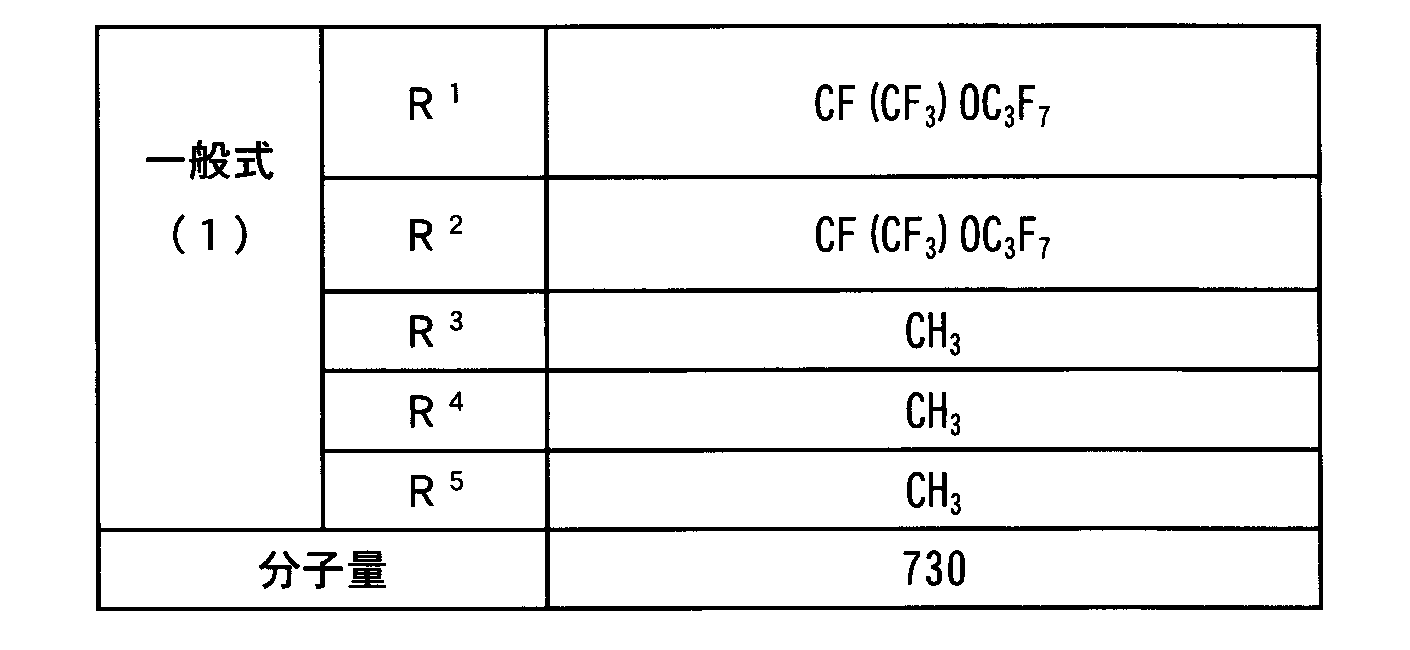
表1中、分子量は、ゲル浸透クロマトグラフィー(GPC、ポリスチレン換算)による数平均分子量である。
<フルオロアルキル基含有オリゴマー試料>
フルオロアルキル基含有オリゴマー(以下、「VM」という)として下記表1のものを使用した。
表1中、分子量は、ゲル浸透クロマトグラフィー(GPC、ポリスチレン換算)による数平均分子量である。
<実施形態1>
{実施例1~4}
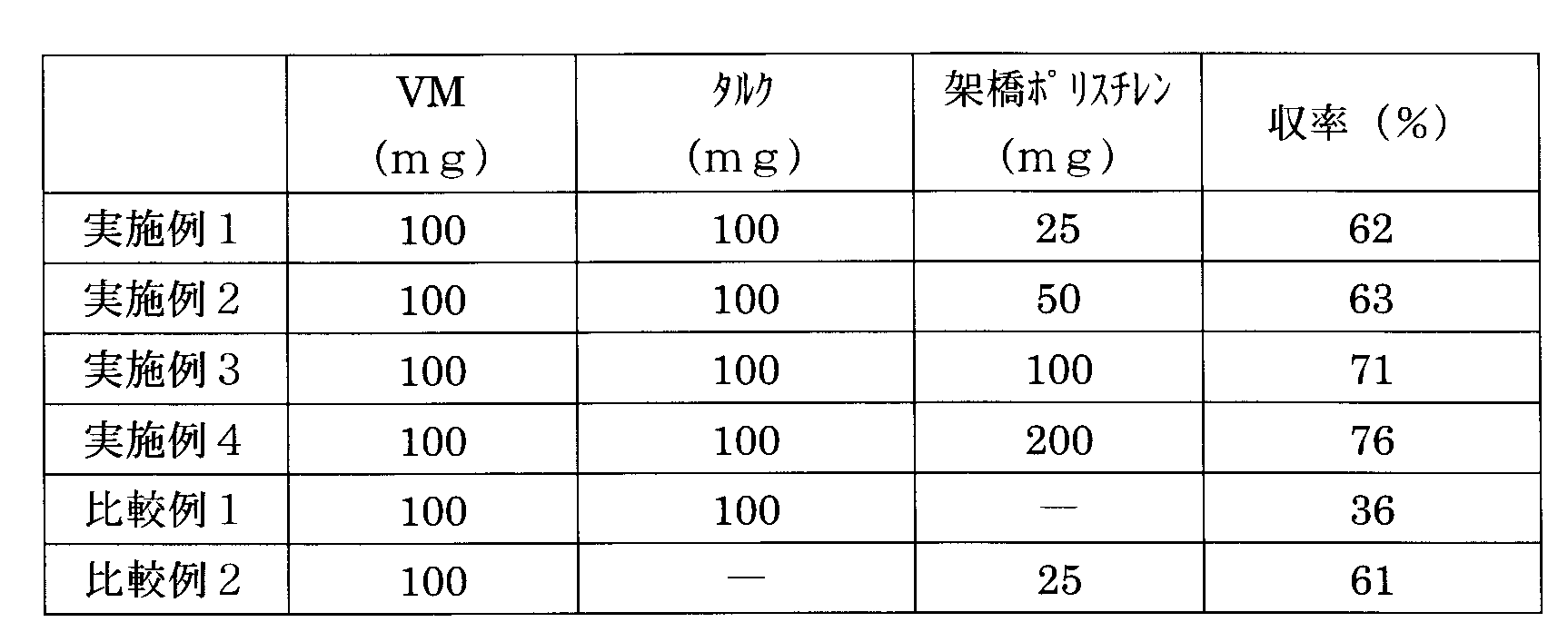
VM(100mg)をメタノール溶液5mlに溶解し、タルク(浅田製粉社製 平均粒子径;131nm)100mg及び表2に示す量の架橋ポリスチレン(東京化成工業社製 平均粒子径;92μm)を添加し、次いで25wt%アンモニア水溶液(2ml)を添加し、マグネチックスターラーにより室温(25℃)で1時間撹拌を行って、反応液試料を得た。
反応終了後、反応液試料から減圧下で溶媒を除去し、得られた粗生成物をメタノール中に一晩分散させた。次いで、遠心分離処理して目的物を固形分として分離し、得られた固形分をメタノールで数回洗浄し、溶媒除去後に、50℃で真空乾燥して目的物(コンポジット粒子試料)を得た。
また、得られたコンポジット粒子試料をFT-IRで測定した。
IR(KBr、cm-1);1600(ポリスチレン)、1338、1240(C-F)、1016(Si-O-Si)、750(C-C)、1687(C=C)
{実施例1~4}
VM(100mg)をメタノール溶液5mlに溶解し、タルク(浅田製粉社製 平均粒子径;131nm)100mg及び表2に示す量の架橋ポリスチレン(東京化成工業社製 平均粒子径;92μm)を添加し、次いで25wt%アンモニア水溶液(2ml)を添加し、マグネチックスターラーにより室温(25℃)で1時間撹拌を行って、反応液試料を得た。
反応終了後、反応液試料から減圧下で溶媒を除去し、得られた粗生成物をメタノール中に一晩分散させた。次いで、遠心分離処理して目的物を固形分として分離し、得られた固形分をメタノールで数回洗浄し、溶媒除去後に、50℃で真空乾燥して目的物(コンポジット粒子試料)を得た。
また、得られたコンポジット粒子試料をFT-IRで測定した。
IR(KBr、cm-1);1600(ポリスチレン)、1338、1240(C-F)、1016(Si-O-Si)、750(C-C)、1687(C=C)
{比較例1~2}
タルク又は架橋ポリスチレンを添加しないで反応を行う以外は実施例1と同様な反応条件にて反応を行い、反応液試料及びコンポジット粒子試料を得た。
タルク又は架橋ポリスチレンを添加しないで反応を行う以外は実施例1と同様な反応条件にて反応を行い、反応液試料及びコンポジット粒子試料を得た。
<物性の評価>
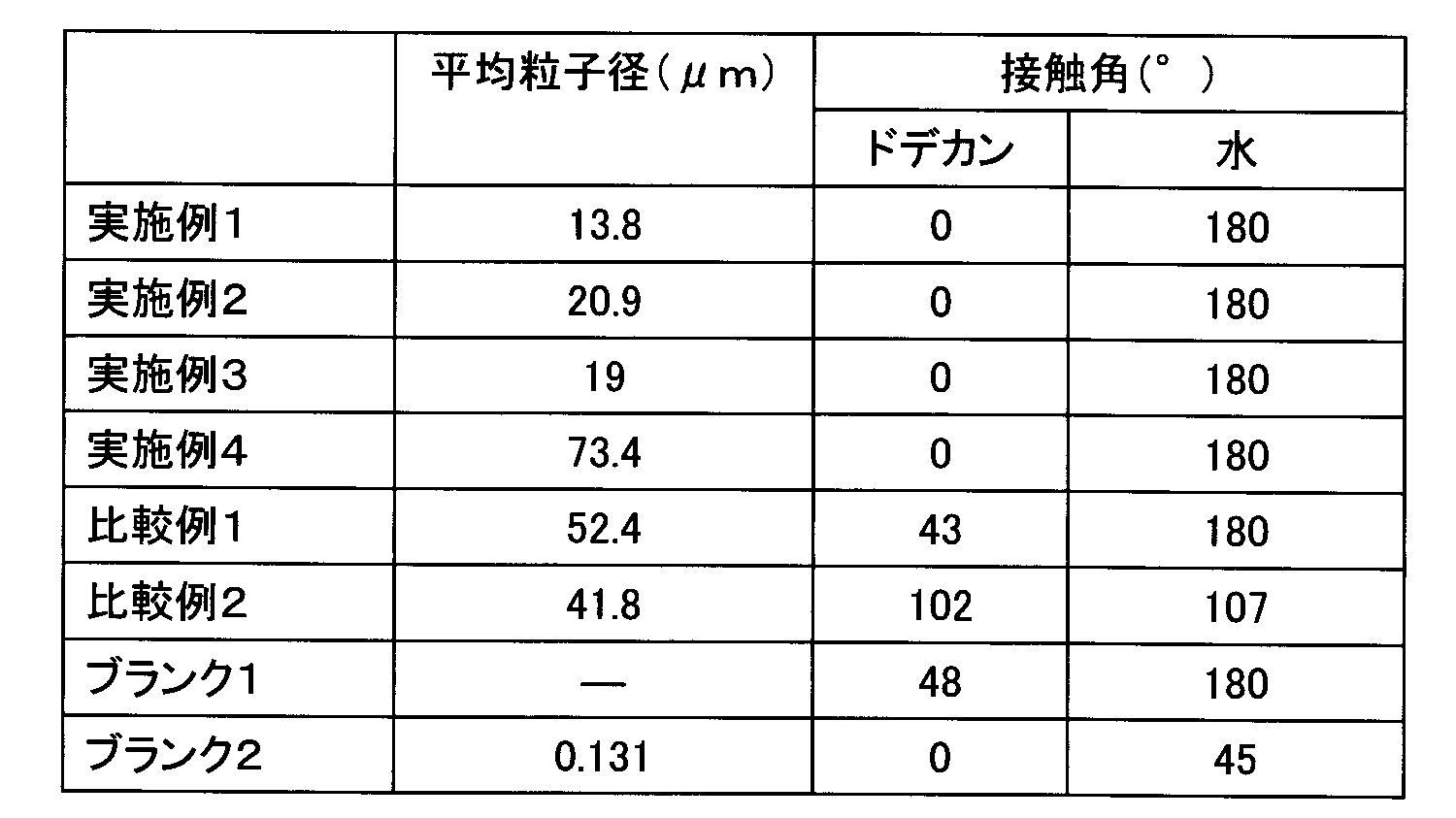
上記で調製したコンポジット粒子について平均粒子径及びドデカンと水の接触角を測定した。
なお、平均粒子径とドデカンと水の接触角は下記のように測定した。
(平均粒子径の評価)
得られたコンポジット粒子を、メタノールに再分散させて粒度分測定計(島津製のSALD-200 V)を用いて測定した。
(ドデカンと水の接触角の評価)
各実施例及び比較例で得られた反応液試料に、ガラス板を1分間、室温(25℃)で浸し、ガラス板を引き上げた後、自然乾燥、さらに一晩真空乾燥を行って改質ガラス板試料を調製した。この改質ガラス板試料の表面のドデカンと水の接触角を協和界面科学製のDrop Master.300を使用して評価した。その結果を表3に示した。
なお、接触角の評価は、水及びドデカンを滴下30分後の値として評価した。
また、VMのみで処理したものをブランク1とし、タルクのみで処理したものをブランク2として評価し、その評価結果を表3に併記した。
上記で調製したコンポジット粒子について平均粒子径及びドデカンと水の接触角を測定した。
なお、平均粒子径とドデカンと水の接触角は下記のように測定した。
(平均粒子径の評価)
得られたコンポジット粒子を、メタノールに再分散させて粒度分測定計(島津製のSALD-200 V)を用いて測定した。
(ドデカンと水の接触角の評価)
各実施例及び比較例で得られた反応液試料に、ガラス板を1分間、室温(25℃)で浸し、ガラス板を引き上げた後、自然乾燥、さらに一晩真空乾燥を行って改質ガラス板試料を調製した。この改質ガラス板試料の表面のドデカンと水の接触角を協和界面科学製のDrop Master.300を使用して評価した。その結果を表3に示した。
なお、接触角の評価は、水及びドデカンを滴下30分後の値として評価した。
また、VMのみで処理したものをブランク1とし、タルクのみで処理したものをブランク2として評価し、その評価結果を表3に併記した。
(油水分離材としての評価)
評価1;
実施例1で得られた反応液試料に、3cm四方にカットした濾紙(Advantec: 131、孔径3μm)を1分間、室温(25℃)で浸し、濾紙を引き上げた後、自然乾燥、さらに一晩真空乾燥を行って改質濾紙試料を調製した。
この改質濾紙による水―油分離について、1,2-ジクロロエタンと水の混合液(1:1vol.)2mlにより検討を行った。混合液中の水は硫酸銅五水和物により青色に着色した。
また、改質処理を行わない濾紙を用いた場合についても同様に評価を行った。
評価1;
実施例1で得られた反応液試料に、3cm四方にカットした濾紙(Advantec: 131、孔径3μm)を1分間、室温(25℃)で浸し、濾紙を引き上げた後、自然乾燥、さらに一晩真空乾燥を行って改質濾紙試料を調製した。
この改質濾紙による水―油分離について、1,2-ジクロロエタンと水の混合液(1:1vol.)2mlにより検討を行った。混合液中の水は硫酸銅五水和物により青色に着色した。
また、改質処理を行わない濾紙を用いた場合についても同様に評価を行った。
(評価1の結果)
図3に示したように改質濾紙試料を漏斗で挟み、減圧下における混合液の濾過により水―油の分離試験を行った。評価1の結果を表4に示す。なお表4中の記号は下記のことを示す。
○;目視で濾液に水が観察されない。
△;目視で濾液に若干の水の混入が観察される。
×;目視で濾液に多くの水の混入が観察される。

また、図3に示すように、改質濾紙試料を用いて減圧下において混合液を濾過することにより、改質濾紙を1,2-ジクロロエタンのみが通過し、水と1,2-ジクロロエタンを分離することができた。
一方、改質処理を行わない濾紙を用いて減圧下において混合液を濾過したところ、水と1,2-ジクロロエタンの両方が濾紙を通過したため、水と1,2-ジクロロエタンを分離することができなかった。
図3に示したように改質濾紙試料を漏斗で挟み、減圧下における混合液の濾過により水―油の分離試験を行った。評価1の結果を表4に示す。なお表4中の記号は下記のことを示す。
○;目視で濾液に水が観察されない。
△;目視で濾液に若干の水の混入が観察される。
×;目視で濾液に多くの水の混入が観察される。
また、図3に示すように、改質濾紙試料を用いて減圧下において混合液を濾過することにより、改質濾紙を1,2-ジクロロエタンのみが通過し、水と1,2-ジクロロエタンを分離することができた。
一方、改質処理を行わない濾紙を用いて減圧下において混合液を濾過したところ、水と1,2-ジクロロエタンの両方が濾紙を通過したため、水と1,2-ジクロロエタンを分離することができなかった。
評価2;
クロマトグラフィー用カラム(内径10mm)に海砂を層厚が約2mmになるに充填し、次いで実施例1で得られたコンポジット粒子200mg(層厚約4mm)を充填し、更にその上に海砂を層厚が約2mmになるに充填した(図4参照)。なお、図4中の「Rf-(VM-SiO2)n-Rf/Talc/Pst」は、コンポジット粒子を示す。
このクロマトグラフィー用カラムを用いて、下記の2種類の処理水について水-油の分離試験を行った。
また、コンポジット粒子に代えてWakogel C-500HGを用いたものを同様に試験した。
処理水1(混合液);
1,2-ジクロロエタンと水の混合液(1:1vol.)2mlを調製した。なお、混合液中の水は硫酸銅五水和物により青色に着色した。
処理水2(エマルション);
1,2-ジクロロエタン(5ml)と水(0.05ml)及び乳化剤としてSpan80(20mg)を混合し、エマルションを調製した。
クロマトグラフィー用カラム(内径10mm)に海砂を層厚が約2mmになるに充填し、次いで実施例1で得られたコンポジット粒子200mg(層厚約4mm)を充填し、更にその上に海砂を層厚が約2mmになるに充填した(図4参照)。なお、図4中の「Rf-(VM-SiO2)n-Rf/Talc/Pst」は、コンポジット粒子を示す。
このクロマトグラフィー用カラムを用いて、下記の2種類の処理水について水-油の分離試験を行った。
また、コンポジット粒子に代えてWakogel C-500HGを用いたものを同様に試験した。
処理水1(混合液);
1,2-ジクロロエタンと水の混合液(1:1vol.)2mlを調製した。なお、混合液中の水は硫酸銅五水和物により青色に着色した。
処理水2(エマルション);
1,2-ジクロロエタン(5ml)と水(0.05ml)及び乳化剤としてSpan80(20mg)を混合し、エマルションを調製した。
(評価2の結果)
評価2の結果を表5に示す。なお表5中の記号は下記のことを示す。
○;目視で濾液に水が観察されない。
△;目視で濾液に若干の水の混入が観察される。
×;目視で濾液に多くの水の混入が観察される。又は目視で濾液にエマルションが観察される。
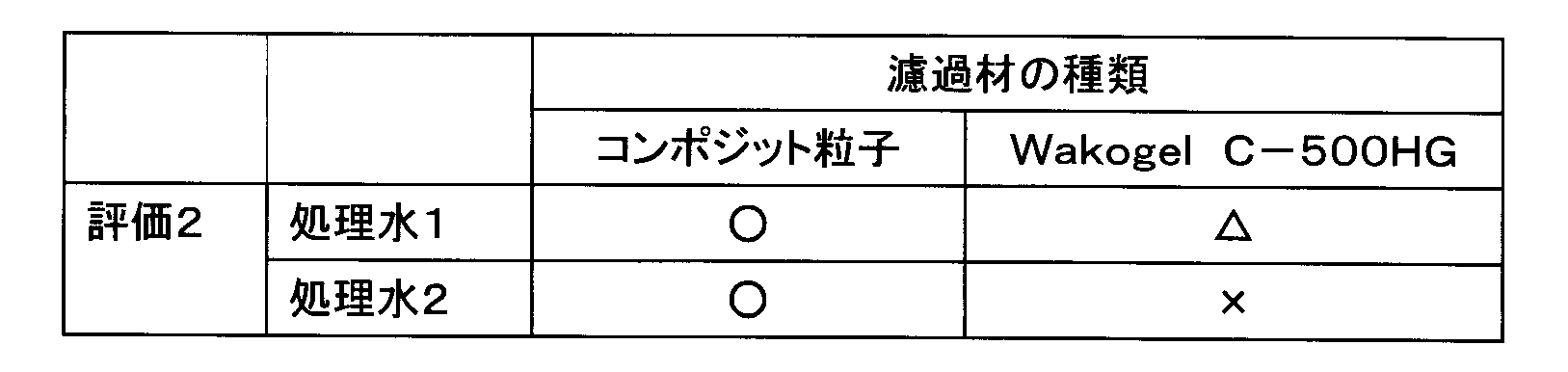
また、図5に示すように、本発明のコンポジット粒子を濾過材として用いて減圧下において処理水1を濾過することにより、濾過材層を1,2-ジクロロエタンのみが通過し、水と1,2-ジクロロエタンを分離することができた。
一方、処理水1を濾過材としてWakogel C-500HGを用いて処理した場合は、濾過後の濾液に1,2-ジクロロエタンに加えて若干水が混入していることが目視でも確認できた。
評価2の結果を表5に示す。なお表5中の記号は下記のことを示す。
○;目視で濾液に水が観察されない。
△;目視で濾液に若干の水の混入が観察される。
×;目視で濾液に多くの水の混入が観察される。又は目視で濾液にエマルションが観察される。
また、図5に示すように、本発明のコンポジット粒子を濾過材として用いて減圧下において処理水1を濾過することにより、濾過材層を1,2-ジクロロエタンのみが通過し、水と1,2-ジクロロエタンを分離することができた。
一方、処理水1を濾過材としてWakogel C-500HGを用いて処理した場合は、濾過後の濾液に1,2-ジクロロエタンに加えて若干水が混入していることが目視でも確認できた。
また、図6(a)に示すように、本発明のコンポジット粒子を濾過材として用いて減圧下において処理水2を濾過することにより、濾過材層を1,2-ジクロロエタンのみが通過し、エマルションから水と1,2-ジクロロエタンを分離することができた。
一方、図6(b)に示すように、処理水2を濾過材としてWakogel C-500HGを用いて処理した場合は、濾過材層をエマルションごと通過し、エマルションから水と1,2-ジクロロエタンを分離することができなかった。
一方、図6(b)に示すように、処理水2を濾過材としてWakogel C-500HGを用いて処理した場合は、濾過材層をエマルションごと通過し、エマルションから水と1,2-ジクロロエタンを分離することができなかった。
<実施形態2>
{実施例5~11}
VMをエタノール溶液に溶解し、メチルトリメトキシシランを添加し反応原料溶液を調製した。次いで酢酸を添加し、マグネチックスターラーにより室温(25℃)で48時間撹拌を行った。次に炭酸アンモニウムを添加し70℃で5時間反応を行い反応液試料を得た。なお、各試薬の仕込み量は、表6に通りである。
反応終了後、反応液試料から溶媒を減圧下で除去し、次いでメタノール中で再分散を行い、遠心分離させることにより、白色粉末として目的物(コンポジット粒子試料)を得た。
{実施例5~11}
VMをエタノール溶液に溶解し、メチルトリメトキシシランを添加し反応原料溶液を調製した。次いで酢酸を添加し、マグネチックスターラーにより室温(25℃)で48時間撹拌を行った。次に炭酸アンモニウムを添加し70℃で5時間反応を行い反応液試料を得た。なお、各試薬の仕込み量は、表6に通りである。
反応終了後、反応液試料から溶媒を減圧下で除去し、次いでメタノール中で再分散を行い、遠心分離させることにより、白色粉末として目的物(コンポジット粒子試料)を得た。
{比較例3}
反応原料溶液にメチルトリメトキシシランを添加しない以外は実施例7と同様にして反応を行って、反応液試料及びコンポジット粒子試料を得た。
反応原料溶液にメチルトリメトキシシランを添加しない以外は実施例7と同様にして反応を行って、反応液試料及びコンポジット粒子試料を得た。
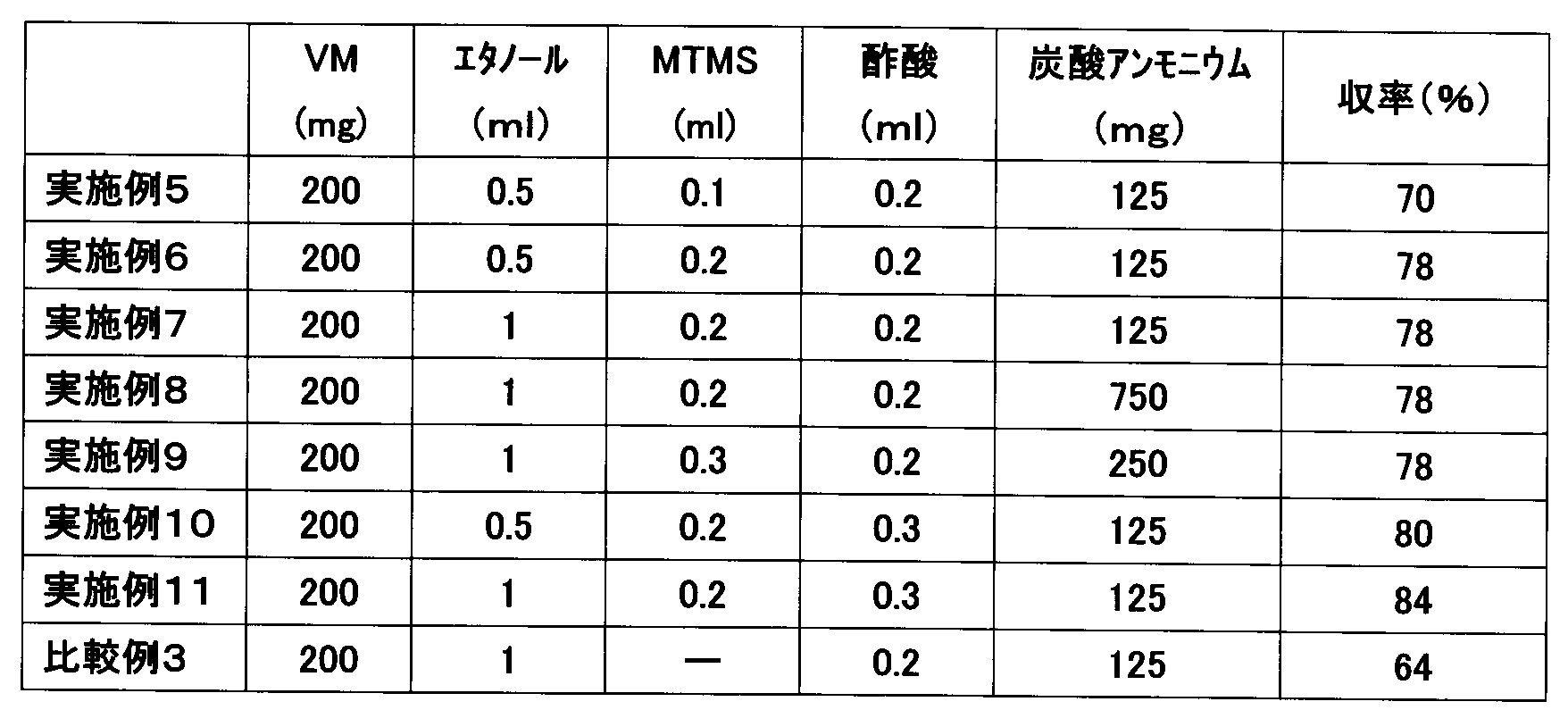
注)MTMS;メチルトリメトキシシラン
<物性の評価>
上記で調製したコンポジット粒子試料について実施例1~4と同様にして平均粒子径を測定した。また、実施例6、実施例7、実施例8及び比較例3で得られたコンポジット粒子試料について実施例1~4と同様にしてドデカンと水の接触角を測定した。また、実施例6、実施例7及び実施例8で得られたコンポジット粒子試料のFE-SEM写真を図7~9にそれぞれ示す。
上記で調製したコンポジット粒子試料について実施例1~4と同様にして平均粒子径を測定した。また、実施例6、実施例7、実施例8及び比較例3で得られたコンポジット粒子試料について実施例1~4と同様にしてドデカンと水の接触角を測定した。また、実施例6、実施例7及び実施例8で得られたコンポジット粒子試料のFE-SEM写真を図7~9にそれぞれ示す。

注)「-」は未測定を示す。
(油水分離材としての評価)
クロマトグラフィー用カラム(内径10mm)に海砂を層厚が約1mmになるに充填し、次いで実施例7で得られたコンポジット粒子試料200mg(層厚約4mm)を充填し、更にその上に海砂を層厚が約1mmになるに充填した。
このクロマトグラフィー用カラムを用いて、下記の3種類の処理水について水-油の分離試験を行った。
処理水1については、実施例7のコンポジット粒子に代えて、SiO2(WakogelC-500HG)及び比較例3のコンポジット粒子試料を用いたものを同様に試験した。
また、処理水2及び処理水3については、実施例7のコンポジット粒子に代えて、SiO2(Wakogel C-500HG)(比較例4)を用いたものを同様に試験した。
処理水1(混合液);
1,2-ジクロロエタンと水の混合液(1:1vol.)2mlを調製した。なお、混合液中の水は硫酸銅五水和物により青色に着色した。
処理水2(エマルション);
1,2-ジクロロエタン(5ml)と水(0・05ml)及び乳化剤としてSpan80(20mg)を混合し、エマルションを調製した。
処理水3(エマルション);
トルエン(5ml)と水(0.05ml)及び乳化剤としてSpan80(80mg)を混合し、エマルションを調製した。
クロマトグラフィー用カラム(内径10mm)に海砂を層厚が約1mmになるに充填し、次いで実施例7で得られたコンポジット粒子試料200mg(層厚約4mm)を充填し、更にその上に海砂を層厚が約1mmになるに充填した。
このクロマトグラフィー用カラムを用いて、下記の3種類の処理水について水-油の分離試験を行った。
処理水1については、実施例7のコンポジット粒子に代えて、SiO2(WakogelC-500HG)及び比較例3のコンポジット粒子試料を用いたものを同様に試験した。
また、処理水2及び処理水3については、実施例7のコンポジット粒子に代えて、SiO2(Wakogel C-500HG)(比較例4)を用いたものを同様に試験した。
処理水1(混合液);
1,2-ジクロロエタンと水の混合液(1:1vol.)2mlを調製した。なお、混合液中の水は硫酸銅五水和物により青色に着色した。
処理水2(エマルション);
1,2-ジクロロエタン(5ml)と水(0・05ml)及び乳化剤としてSpan80(20mg)を混合し、エマルションを調製した。
処理水3(エマルション);
トルエン(5ml)と水(0.05ml)及び乳化剤としてSpan80(80mg)を混合し、エマルションを調製した。
(評価結果)
処理水1;
処理水1を分離処理した結果を表8に示す。なお表8中の記号は下記のことを示す。
◎;目視的に濾液に水が観察されなく、また油の回収率も高い。
○;目視的に濾液に水が観察されなく、また油の回収率が低い。
△;目視的に濾液に若干の水の混入が観察される。
×;目視的に濾液に多くの水の混入が観察される。

図10に示すように、本発明のコンポジット粒子を濾過材として用いて減圧下において処理水1を濾過することにより、濾過材層を1,2-ジクロロエタンのみが通過し、水と1,2-ジクロロエタンを分離することができた。
一方、処理水1を比較例1の粒子を濾過材として用いて処理した場合は、僅かに水と1,2-ジクロロエタンの分離が行えたが、1,2-ジクロロエタンの回収率は低かった。処理水1をSiO2(比較例4)を用いて処理した場合は、濾過後の濾液に1,2-ジクロロエタンに加えて若干水が混入していることが目視でも確認できた。
処理水1;
処理水1を分離処理した結果を表8に示す。なお表8中の記号は下記のことを示す。
◎;目視的に濾液に水が観察されなく、また油の回収率も高い。
○;目視的に濾液に水が観察されなく、また油の回収率が低い。
△;目視的に濾液に若干の水の混入が観察される。
×;目視的に濾液に多くの水の混入が観察される。
図10に示すように、本発明のコンポジット粒子を濾過材として用いて減圧下において処理水1を濾過することにより、濾過材層を1,2-ジクロロエタンのみが通過し、水と1,2-ジクロロエタンを分離することができた。
一方、処理水1を比較例1の粒子を濾過材として用いて処理した場合は、僅かに水と1,2-ジクロロエタンの分離が行えたが、1,2-ジクロロエタンの回収率は低かった。処理水1をSiO2(比較例4)を用いて処理した場合は、濾過後の濾液に1,2-ジクロロエタンに加えて若干水が混入していることが目視でも確認できた。
処理水2;
処理水2を分離処理した結果を表9に示す。なお表9中の記号は下記のことを示す。
◎;目視的に濾液に水が観察されなく、また油の回収率も高い。
○;目視的に濾液に水が観察されなく、また油の回収率が低い。
△;目視的に濾液に若干の水の混入が観察される。
×;目視的に濾液にエマルションが観察される。

注)表中の「-」は未測定を示す。
図11(a)に示すように、本発明のコンポジット粒子を濾過材として用いて減圧下において処理水2を濾過することにより、濾過材層を1,2-ジクロロエタンのみが通過し、エマルションから水と1,2-ジクロロエタンを分離することができた。また、濾過後の濾液中に含まれる溶剤の溶剤回収率を濾過前の溶剤の質量に対する濾過後の溶剤の質量として求めた結果、回収率は90%であった。
一方、図11(b)に示すように、処理水2をSiO2を濾過材として用いて処理した場合は、濾過材層をエマルションごと通過し、エマルションから水と1,2-ジクロロエタンを分離することができなかった。
処理水2を分離処理した結果を表9に示す。なお表9中の記号は下記のことを示す。
◎;目視的に濾液に水が観察されなく、また油の回収率も高い。
○;目視的に濾液に水が観察されなく、また油の回収率が低い。
△;目視的に濾液に若干の水の混入が観察される。
×;目視的に濾液にエマルションが観察される。
注)表中の「-」は未測定を示す。
図11(a)に示すように、本発明のコンポジット粒子を濾過材として用いて減圧下において処理水2を濾過することにより、濾過材層を1,2-ジクロロエタンのみが通過し、エマルションから水と1,2-ジクロロエタンを分離することができた。また、濾過後の濾液中に含まれる溶剤の溶剤回収率を濾過前の溶剤の質量に対する濾過後の溶剤の質量として求めた結果、回収率は90%であった。
一方、図11(b)に示すように、処理水2をSiO2を濾過材として用いて処理した場合は、濾過材層をエマルションごと通過し、エマルションから水と1,2-ジクロロエタンを分離することができなかった。
処理水3;
処理水3を分離処理した結果を表10に示す。なお表10中の記号は下記のことを示す。
◎;目視的に濾液に水が観察されなく、また油の回収率も高い。
○;目視的に濾液に水が観察されなく、また油の回収率が低い。
△;目視的に濾液に若干の水の混入が観察される。
×;目視的に濾液にエマルションが観察される。

注)表中の「-」は未測定を示す。
図12(a)に示すように、本発明のコンポジット粒子を濾過材として用いて減圧下において処理水3を濾過することにより、濾過材層をトルエンのみが通過し、エマルションから水とトルエンを分離することができた。また、濾過後の濾液中に含まれる溶剤の溶剤回収率を濾過前の溶剤の質量に対する濾過後の溶剤の質量として求めた結果、回収率は87%であった。
一方、図12(b)に示すように、処理水3をSiO2を濾過材として用いて処理した場合は、濾過材層をエマルションごと通過し、エマルションから水とトルエンを分離することができなかった。
処理水3を分離処理した結果を表10に示す。なお表10中の記号は下記のことを示す。
◎;目視的に濾液に水が観察されなく、また油の回収率も高い。
○;目視的に濾液に水が観察されなく、また油の回収率が低い。
△;目視的に濾液に若干の水の混入が観察される。
×;目視的に濾液にエマルションが観察される。
注)表中の「-」は未測定を示す。
図12(a)に示すように、本発明のコンポジット粒子を濾過材として用いて減圧下において処理水3を濾過することにより、濾過材層をトルエンのみが通過し、エマルションから水とトルエンを分離することができた。また、濾過後の濾液中に含まれる溶剤の溶剤回収率を濾過前の溶剤の質量に対する濾過後の溶剤の質量として求めた結果、回収率は87%であった。
一方、図12(b)に示すように、処理水3をSiO2を濾過材として用いて処理した場合は、濾過材層をエマルションごと通過し、エマルションから水とトルエンを分離することができなかった。
<実施形態3>
{実施例12}
VM(300mg)をメタノール溶液20mlに溶解し、表11に示す量のポリテトラフルオロエチレン粒子((株)喜多村社製 平均粒子径282nm)及びシリカ粒子(粒子径5~20μm Wakogel C-500HG)を添加し、次いで25wt%アンモニア水溶液(4ml)を添加し、マグネチックスターラーにより室温(25℃)で1時間撹拌を行って、反応液試料を得た。
反応終了後、反応液試料から減圧下で溶媒を除去し、得られた粗生成物をメタノール中に一晩分散させた。次いで、遠心分離処理して目的物を固形分として分離し、得られた固形分をメタノールで数回洗浄し、溶媒除去後に、50℃で真空乾燥して目的物(コンポジット粒子試料)を得た。
{実施例12}
VM(300mg)をメタノール溶液20mlに溶解し、表11に示す量のポリテトラフルオロエチレン粒子((株)喜多村社製 平均粒子径282nm)及びシリカ粒子(粒子径5~20μm Wakogel C-500HG)を添加し、次いで25wt%アンモニア水溶液(4ml)を添加し、マグネチックスターラーにより室温(25℃)で1時間撹拌を行って、反応液試料を得た。
反応終了後、反応液試料から減圧下で溶媒を除去し、得られた粗生成物をメタノール中に一晩分散させた。次いで、遠心分離処理して目的物を固形分として分離し、得られた固形分をメタノールで数回洗浄し、溶媒除去後に、50℃で真空乾燥して目的物(コンポジット粒子試料)を得た。
{実施例13}
VM(300mg)をメタノール溶液5mlに溶解し、表11に示す量のポリテトラフルオロエチレン粒子((株)喜多村社製 平均粒子径282nm)を添加し、次いで25wt%アンモニア水溶液(2ml)を添加し、マグネチックスターラーにより室温(25℃)で1時間撹拌を行って、反応液試料を得た。
反応終了後、反応液試料から減圧下で溶媒を除去し、得られた粗生成物をメタノール中に一晩分散させた。次いで、遠心分離処理して目的物を固形分として分離し、得られた固形分をメタノールで数回洗浄し、溶媒除去後に、50℃で真空乾燥して目的物(コンポジット粒子試料)を得た。
VM(300mg)をメタノール溶液5mlに溶解し、表11に示す量のポリテトラフルオロエチレン粒子((株)喜多村社製 平均粒子径282nm)を添加し、次いで25wt%アンモニア水溶液(2ml)を添加し、マグネチックスターラーにより室温(25℃)で1時間撹拌を行って、反応液試料を得た。
反応終了後、反応液試料から減圧下で溶媒を除去し、得られた粗生成物をメタノール中に一晩分散させた。次いで、遠心分離処理して目的物を固形分として分離し、得られた固形分をメタノールで数回洗浄し、溶媒除去後に、50℃で真空乾燥して目的物(コンポジット粒子試料)を得た。
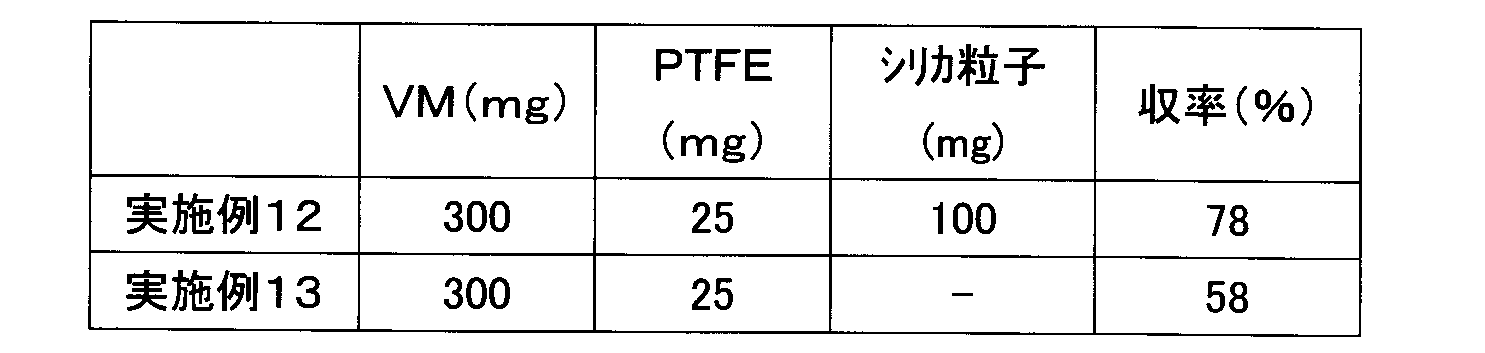
注)PTFE;ポリテトラフルオロエチレン
<物性の評価>
上記で調製した実施例12~13のコンポジット粒子試料について実施例1~4と同様にして平均粒子径及びドデカンと水の接触角を測定した。
なお、接触角の評価は、水及びドデカンを滴下30分後の値として評価した。
また、VMのみで処理したものをブランク1とし、ポリトラフルオロエチレン粒子のみで処理したものをブランク2、無処理のガラス板をブランク3として評価し、その評価結果を表12に併記した。
上記で調製した実施例12~13のコンポジット粒子試料について実施例1~4と同様にして平均粒子径及びドデカンと水の接触角を測定した。
なお、接触角の評価は、水及びドデカンを滴下30分後の値として評価した。
また、VMのみで処理したものをブランク1とし、ポリトラフルオロエチレン粒子のみで処理したものをブランク2、無処理のガラス板をブランク3として評価し、その評価結果を表12に併記した。
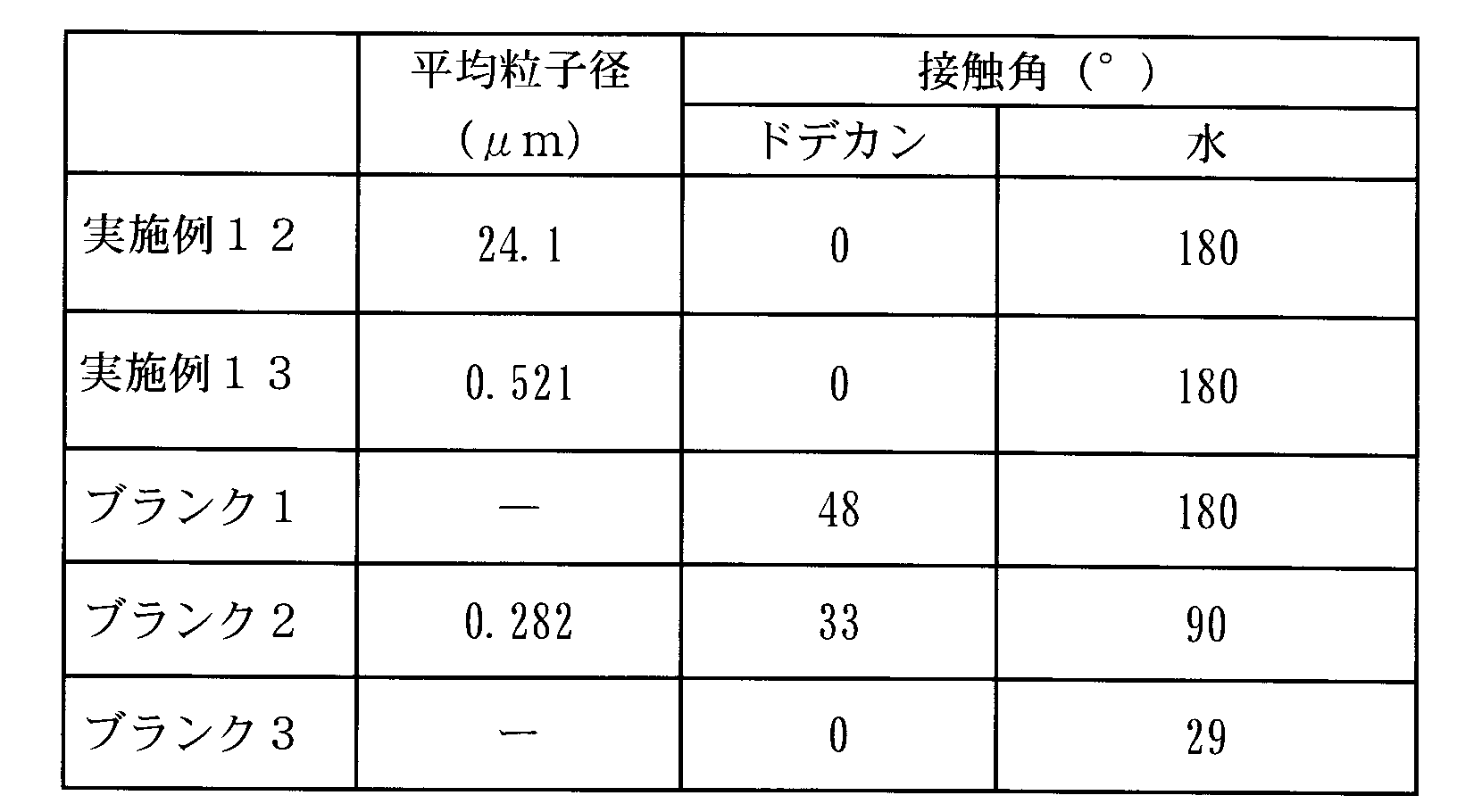
(油水分離材としての評価)
(評価1)
クロマトグラフィー用カラム(内径10mm)に海砂を層厚が約1mmになるに充填し、次いで実施例12で得られたコンポジット粒子試料200mg(層厚約4mm)を充填し、更にその上に海砂を層厚が約1mmになるに充填した。
このクロマトグラフィー用カラムを用いて、重力を利用して下記処理水1をろ過した。なお、コンポジット粒子試料に代えてシリカ粒子(Wakogel C-500HG)を充填したものも比較例5として同様に評価した。
処理水1(混合液);
1,2-ジクロロエタンと水の混合液(1:1vol.)2mlを調製した。なお、混合液中の水は硫酸銅五水和物により青色に着色した。
(評価1)
クロマトグラフィー用カラム(内径10mm)に海砂を層厚が約1mmになるに充填し、次いで実施例12で得られたコンポジット粒子試料200mg(層厚約4mm)を充填し、更にその上に海砂を層厚が約1mmになるに充填した。
このクロマトグラフィー用カラムを用いて、重力を利用して下記処理水1をろ過した。なお、コンポジット粒子試料に代えてシリカ粒子(Wakogel C-500HG)を充填したものも比較例5として同様に評価した。
処理水1(混合液);
1,2-ジクロロエタンと水の混合液(1:1vol.)2mlを調製した。なお、混合液中の水は硫酸銅五水和物により青色に着色した。
(評価結果1)
処理水1を分離処理した結果を表4に示す。なお表13中の記号は下記のことを示す。
○;目視で濾液に水が観察されない。
△;目視で濾液に若干の水の混入が観察される。
×;目視で濾液に多くの水の混入が観察される。

また、図13に示すように、実施例12のコンポジット粒子試料を濾過材として用いて処理水1を濾過することにより、濾過材層を1,2-ジクロロエタンのみが通過し、水と1,2-ジクロロエタンを分離することができた。
一方、処理水1をシリカ粒子を濾過材として用いて処理した場合は、濾過後の濾液に1,2-ジクロロエタンに加えて若干水が混入していることが目視でも確認できた。
処理水1を分離処理した結果を表4に示す。なお表13中の記号は下記のことを示す。
○;目視で濾液に水が観察されない。
△;目視で濾液に若干の水の混入が観察される。
×;目視で濾液に多くの水の混入が観察される。
また、図13に示すように、実施例12のコンポジット粒子試料を濾過材として用いて処理水1を濾過することにより、濾過材層を1,2-ジクロロエタンのみが通過し、水と1,2-ジクロロエタンを分離することができた。
一方、処理水1をシリカ粒子を濾過材として用いて処理した場合は、濾過後の濾液に1,2-ジクロロエタンに加えて若干水が混入していることが目視でも確認できた。
(評価2)
クロマトグラフィー用カラム(内径10mm)に海砂を層厚が約1mmになるに充填し、次いで前記で調製した実施例13のコンポジット粒子試料を200mg(層厚約4mm)を充填し、更にその上に海砂を層厚が約1mmになるに充填した。
このクロマトグラフィー用カラムを用いて、減圧下に下記処理水2を濾過した。なお、コンポジット粒子試料に代えてシリカ粒子(Wakogel C-500HG)を充填したものも比較例6として同様に評価した。
処理水2(エマルション);
1,2-ジクロロエタン(5ml)と水(0・05ml)及び乳化剤としてSpan80(20mg)を混合し、エマルションを調製した。
クロマトグラフィー用カラム(内径10mm)に海砂を層厚が約1mmになるに充填し、次いで前記で調製した実施例13のコンポジット粒子試料を200mg(層厚約4mm)を充填し、更にその上に海砂を層厚が約1mmになるに充填した。
このクロマトグラフィー用カラムを用いて、減圧下に下記処理水2を濾過した。なお、コンポジット粒子試料に代えてシリカ粒子(Wakogel C-500HG)を充填したものも比較例6として同様に評価した。
処理水2(エマルション);
1,2-ジクロロエタン(5ml)と水(0・05ml)及び乳化剤としてSpan80(20mg)を混合し、エマルションを調製した。
(評価結果2)
処理水2を分離処理した結果を表5に示す。なお表5中の記号は下記のことを示す。
○;目視で濾液に水が観察されない。
△;目視で濾液に若干の水の混入が観察される。
×;目視で濾液にエマルションが観察される。

また、図14(a)に示すように、実施例13のコンポジット粒子試料を濾過材として用いて減圧下において処理水2を濾過することにより、濾過材層を1,2-ジクロロエタンのみが通過し、エマルションから水と1,2-ジクロロエタンを分離することができた。
一方、図14(b)に示すように、処理水2をシリカ粒子を濾過材として用いて処理した場合は、濾過材層をエマルションごと通過し、エマルションから水と1,2-ジクロロエタンを分離することができなかった。
処理水2を分離処理した結果を表5に示す。なお表5中の記号は下記のことを示す。
○;目視で濾液に水が観察されない。
△;目視で濾液に若干の水の混入が観察される。
×;目視で濾液にエマルションが観察される。
また、図14(a)に示すように、実施例13のコンポジット粒子試料を濾過材として用いて減圧下において処理水2を濾過することにより、濾過材層を1,2-ジクロロエタンのみが通過し、エマルションから水と1,2-ジクロロエタンを分離することができた。
一方、図14(b)に示すように、処理水2をシリカ粒子を濾過材として用いて処理した場合は、濾過材層をエマルションごと通過し、エマルションから水と1,2-ジクロロエタンを分離することができなかった。
(評価3)
クロマトグラフィー用カラム(内径10mm)に海砂を層厚が約1mmになるに充填し、次いで前記で調製した実施例12のコンポジット粒子を200mg(層厚約4mm)を充填し、更にその上に海砂を層厚が約1mmになるに充填した。
このクロマトグラフィー用カラムを用いて、重力を利用して下記処理水3を濾過した。なお、コンポジット粒子試料に代えてシリカ粒子(Wakogel C-500HG)を充填したものも比較例7として同様に評価した。
処理水3(エマルション);
トルエン(5ml)と水(0.05ml)及び乳化剤としてSpan80(20mg)を混合し、エマルションを調製した。
クロマトグラフィー用カラム(内径10mm)に海砂を層厚が約1mmになるに充填し、次いで前記で調製した実施例12のコンポジット粒子を200mg(層厚約4mm)を充填し、更にその上に海砂を層厚が約1mmになるに充填した。
このクロマトグラフィー用カラムを用いて、重力を利用して下記処理水3を濾過した。なお、コンポジット粒子試料に代えてシリカ粒子(Wakogel C-500HG)を充填したものも比較例7として同様に評価した。
処理水3(エマルション);
トルエン(5ml)と水(0.05ml)及び乳化剤としてSpan80(20mg)を混合し、エマルションを調製した。
(評価結果3)
処理水3を分離処理した結果を表15に示す。なお表15中の記号は下記のことを示す。
○;目視で濾液に水が観察されない。
△;目視で濾液に若干の水の混入が観察される。
×;目視で濾液にエマルションが観察される。

図15(a)に示すように、コンポジット粒子試料6を濾過材として用いて処理水3を濾過することにより、濾過材層をトルエンのみが通過し、エマルションから水とトルエンを分離することができた。
一方、図15(b)に示すように、処理水3をシリカ粒子を濾過材として用いて処理した場合は、濾過材層をエマルションごと通過し、エマルションから水とトルエンを分離することができなかった。
処理水3を分離処理した結果を表15に示す。なお表15中の記号は下記のことを示す。
○;目視で濾液に水が観察されない。
△;目視で濾液に若干の水の混入が観察される。
×;目視で濾液にエマルションが観察される。
図15(a)に示すように、コンポジット粒子試料6を濾過材として用いて処理水3を濾過することにより、濾過材層をトルエンのみが通過し、エマルションから水とトルエンを分離することができた。
一方、図15(b)に示すように、処理水3をシリカ粒子を濾過材として用いて処理した場合は、濾過材層をエマルションごと通過し、エマルションから水とトルエンを分離することができなかった。
Claims (6)
- コンポジット粒子を用いた油水分離材であって、
該コンポジット粒子が、下記一般式(1)で表されるアルコキシシリル基を有するフルオロアルキル基含有オリゴマーの縮合物と、下記の(A)~(C)の何れか1つの成分を含むことを特徴とする油水分離材。
(A)タルク及び架橋ポリスチレン、
(B)メチルトリメトキシシランの縮合物、
(C)ポリテトラフルオロエチレン粒子

(式中、R1及びR2は、-(CF2)p-Y基、又は-CF(CF3)-[OCF2CF(CF3)]q-OC3F7基を示し、R1及びR2は、同一の基であっても異なる基であってもよく、R1及びR2中のYは水素原子、フッ素原子又は塩素原子を示し、p及びqは0~10の整数である。R3、R4及びR5は同一の基であっても異なる基であってもよく、R3、R4及びR5は炭素数1~5の直鎖状若しくは分岐状のアルキル基を示す。mは2~3の整数である。) - コンポジット粒子は、更に(D)シリカ粒子を含むことを特徴とする請求項1記載の油水分離材。
- 一般式(1)の式中のR1及びR2が、-CF(CF3)OC3F7であることを特徴とする請求項1又は2の何れか1項に記載の油水分離材。
- コンポジット粒子の平均粒子径が0.05~500μmであることを特徴する請求項1乃至3の何れか1項に記載の油水分離材。
- 請求項1乃至4の何れか1項に記載の油水分離材に、水と油を含む混合液を接触させることを特徴とする油水分離方法。
- 請求項1乃至4の何れか1項に記載の油水分離材に、水と油を含むエマルションを接触させることを特徴とする油水分離方法。
Applications Claiming Priority (6)
| Application Number | Priority Date | Filing Date | Title |
|---|---|---|---|
| JP2015044666 | 2015-03-06 | ||
| JP2015-044668 | 2015-03-06 | ||
| JP2015044667 | 2015-03-06 | ||
| JP2015044668 | 2015-03-06 | ||
| JP2015-044667 | 2015-03-06 | ||
| JP2015-044666 | 2015-03-06 |
Publications (1)
| Publication Number | Publication Date |
|---|---|
| WO2016143651A1 true WO2016143651A1 (ja) | 2016-09-15 |
Family
ID=56879368
Family Applications (1)
| Application Number | Title | Priority Date | Filing Date |
|---|---|---|---|
| PCT/JP2016/056543 Ceased WO2016143651A1 (ja) | 2015-03-06 | 2016-03-03 | 油水分離材および油水分離方法 |
Country Status (1)
| Country | Link |
|---|---|
| WO (1) | WO2016143651A1 (ja) |
Cited By (3)
| Publication number | Priority date | Publication date | Assignee | Title |
|---|---|---|---|---|
| JP2018087277A (ja) * | 2016-11-28 | 2018-06-07 | 日本化学工業株式会社 | コンポジット粒子、その製造方法、それを用いた油水分離材 |
| CN108786759A (zh) * | 2018-06-15 | 2018-11-13 | 山东交通学院 | 一种具有防污杀菌和染料吸附功能的油水分离材料及其制备方法 |
| CN117362694A (zh) * | 2023-12-07 | 2024-01-09 | 北京中科康仑环境科技研究院有限公司 | 一种物理-化学复合交联高吸油树脂及其制备方法与应用 |
Citations (5)
| Publication number | Priority date | Publication date | Assignee | Title |
|---|---|---|---|---|
| JP2000000401A (ja) * | 1998-06-15 | 2000-01-07 | Agency Of Ind Science & Technol | 撥水処理をした油水分離フィルターとその製造方法 |
| JP2010077383A (ja) * | 2008-08-25 | 2010-04-08 | Nippon Chem Ind Co Ltd | シロキサン結合を主骨格とするナノコンポジット粉末状粒子及びその製造方法、シロキサン結合を主骨格とするナノコンポジット粉末状粒子分散液、並びに樹脂組成物 |
| JP2010209300A (ja) * | 2009-03-12 | 2010-09-24 | Nippon Chem Ind Co Ltd | フラーレンを含有するナノコンポジット粉末状粒子及びその製造方法、ナノコンポジット粉末状粒子分散液、並びに樹脂組成物 |
| JP2010235943A (ja) * | 2009-03-12 | 2010-10-21 | Nippon Chem Ind Co Ltd | シロキサン結合を主骨格とするナノコンポジット粉末状粒子及びその製造方法、シロキサン結合を主骨格とするナノコンポジット粉末状粒子分散液、並びに樹脂組成物 |
| JP2012091168A (ja) * | 2010-09-30 | 2012-05-17 | Kagawa Univ | 油水分離材およびその製造方法 |
-
2016
- 2016-03-03 WO PCT/JP2016/056543 patent/WO2016143651A1/ja not_active Ceased
Patent Citations (5)
| Publication number | Priority date | Publication date | Assignee | Title |
|---|---|---|---|---|
| JP2000000401A (ja) * | 1998-06-15 | 2000-01-07 | Agency Of Ind Science & Technol | 撥水処理をした油水分離フィルターとその製造方法 |
| JP2010077383A (ja) * | 2008-08-25 | 2010-04-08 | Nippon Chem Ind Co Ltd | シロキサン結合を主骨格とするナノコンポジット粉末状粒子及びその製造方法、シロキサン結合を主骨格とするナノコンポジット粉末状粒子分散液、並びに樹脂組成物 |
| JP2010209300A (ja) * | 2009-03-12 | 2010-09-24 | Nippon Chem Ind Co Ltd | フラーレンを含有するナノコンポジット粉末状粒子及びその製造方法、ナノコンポジット粉末状粒子分散液、並びに樹脂組成物 |
| JP2010235943A (ja) * | 2009-03-12 | 2010-10-21 | Nippon Chem Ind Co Ltd | シロキサン結合を主骨格とするナノコンポジット粉末状粒子及びその製造方法、シロキサン結合を主骨格とするナノコンポジット粉末状粒子分散液、並びに樹脂組成物 |
| JP2012091168A (ja) * | 2010-09-30 | 2012-05-17 | Kagawa Univ | 油水分離材およびその製造方法 |
Cited By (5)
| Publication number | Priority date | Publication date | Assignee | Title |
|---|---|---|---|---|
| JP2018087277A (ja) * | 2016-11-28 | 2018-06-07 | 日本化学工業株式会社 | コンポジット粒子、その製造方法、それを用いた油水分離材 |
| CN108786759A (zh) * | 2018-06-15 | 2018-11-13 | 山东交通学院 | 一种具有防污杀菌和染料吸附功能的油水分离材料及其制备方法 |
| CN108786759B (zh) * | 2018-06-15 | 2020-10-16 | 山东交通学院 | 一种具有防污杀菌和染料吸附功能的油水分离材料及其制备方法 |
| CN117362694A (zh) * | 2023-12-07 | 2024-01-09 | 北京中科康仑环境科技研究院有限公司 | 一种物理-化学复合交联高吸油树脂及其制备方法与应用 |
| CN117362694B (zh) * | 2023-12-07 | 2024-02-27 | 北京中科康仑环境科技研究院有限公司 | 一种物理-化学复合交联高吸油树脂及其制备方法与应用 |
Similar Documents
| Publication | Publication Date | Title |
|---|---|---|
| JP6681220B2 (ja) | 油水分離材および油水分離方法 | |
| WO2002016005A1 (en) | Filter medium for air filter and method for its production | |
| TW201223868A (en) | Aerogel and method for manufacture thereof | |
| DE2758415A1 (de) | Kieselsaeureheteropolykondensate, verfahren zu deren herstellung und deren verwendung als membranen und adsorbentien | |
| WO2016143651A1 (ja) | 油水分離材および油水分離方法 | |
| JP6678044B2 (ja) | コンポジット粒子、その製造方法及び油水分離材 | |
| CN111410723A (zh) | 一种多孔硼亲和印迹聚合物及其制备方法和应用 | |
| WO2013181345A2 (en) | Synthesis of polymeric ionic liquids using a photochemical polymerization process | |
| JP6637792B2 (ja) | コンポジット粒子、その製造方法、ゲル化剤及び油水分離材 | |
| JP2020063375A (ja) | コンポジット粒子、その製造方法、油分離剤及び油水分離方法 | |
| JP2010077383A (ja) | シロキサン結合を主骨格とするナノコンポジット粉末状粒子及びその製造方法、シロキサン結合を主骨格とするナノコンポジット粉末状粒子分散液、並びに樹脂組成物 | |
| CN107837796A (zh) | 一种键合型色谱柱固定相 | |
| CN104226275A (zh) | 基于甲基丙烯酰氧基笼型倍半硅氧烷的中空微球及其制备方法和应用 | |
| JP6644589B2 (ja) | コンポジット粒子、その製造方法及び油水分離材 | |
| JP6637795B2 (ja) | コンポジット粒子およびその製造方法 | |
| JP6644588B2 (ja) | コンポジット粒子、その製造方法及び油水分離材 | |
| JP2018087277A (ja) | コンポジット粒子、その製造方法、それを用いた油水分離材 | |
| JP6807576B2 (ja) | コンポジット粒子、その製造方法、それを用いた油水分離材 | |
| JP6819955B2 (ja) | コンポジット粒子、その製造方法、それを用いた油水分離材、及びそれを用いた有機化合物吸着剤 | |
| JP6807575B2 (ja) | コンポジット粒子、その製造方法、それを用いた油水分離材 | |
| CN103877941B (zh) | 一种球形硅基有机-无机杂化硼吸附剂及其制备方法 | |
| WO2021095870A1 (ja) | 半導体型単層カーボンナノチューブ分散液の製造方法 | |
| CN116139544A (zh) | 一种环境友好的油水分离材料及其制备方法与应用 | |
| KR102758314B1 (ko) | 실라잔 표면개질제에 의한 비불소계 소수성 코팅용 개질 메조포러스 실리카 입자 및 생분해성 필름의 내오염성과 고발수성 코팅 기술 이의 제조방법 | |
| CN109731526A (zh) | 一种含氟表面活性剂化合物及制备方法与应用 |
Legal Events
| Date | Code | Title | Description |
|---|---|---|---|
| 121 | Ep: the epo has been informed by wipo that ep was designated in this application |
Ref document number: 16761621 Country of ref document: EP Kind code of ref document: A1 |
|
| NENP | Non-entry into the national phase |
Ref country code: DE |
|
| 122 | Ep: pct application non-entry in european phase |
Ref document number: 16761621 Country of ref document: EP Kind code of ref document: A1 |