WO2016143545A1 - センサシステム - Google Patents
センサシステム Download PDFInfo
- Publication number
- WO2016143545A1 WO2016143545A1 PCT/JP2016/055759 JP2016055759W WO2016143545A1 WO 2016143545 A1 WO2016143545 A1 WO 2016143545A1 JP 2016055759 W JP2016055759 W JP 2016055759W WO 2016143545 A1 WO2016143545 A1 WO 2016143545A1
- Authority
- WO
- WIPO (PCT)
- Prior art keywords
- event
- sensor
- occurrence
- sensors
- determining
- Prior art date
- Legal status (The legal status is an assumption and is not a legal conclusion. Google has not performed a legal analysis and makes no representation as to the accuracy of the status listed.)
- Ceased
Links
Images





Classifications
-
- G—PHYSICS
- G01—MEASURING; TESTING
- G01D—MEASURING NOT SPECIALLY ADAPTED FOR A SPECIFIC VARIABLE; ARRANGEMENTS FOR MEASURING TWO OR MORE VARIABLES NOT COVERED IN A SINGLE OTHER SUBCLASS; TARIFF METERING APPARATUS; MEASURING OR TESTING NOT OTHERWISE PROVIDED FOR
- G01D21/00—Measuring or testing not otherwise provided for
- G01D21/02—Measuring two or more variables by means not covered by a single other subclass
Definitions
- the present invention relates to a sensor system that detects the occurrence of an event.
- MEMS Micro Electro Mechanical Systems
- Such a sensor unit can complexly sense the environment of the workplace or living space, and can obtain various information such as energy-related information such as electric power, biological information, and environmental information. And these information can support multilateral information analysis and utilization.
- Patent Document 1 proposes a system that changes the sleep time of a wireless sensor in accordance with the operating state of equipment (air conditioning).
- the system of Patent Document 1 shortens the sleep time of the sensor when the equipment (air conditioning) is moving, and lengthens the sleep time of the sensor when the equipment (air conditioning) is stopped, thereby reducing battery consumption. It is suppressed.
- Patent Document 2 the control unit in the sleep state is woken up at a preset time to transmit the acquired data and receive the command addressed to the own device, and receive the sleep command addressed to the own device.
- a wireless management system that shifts to a sleep state has been proposed. Thereby, even if it is scattered and arranged outdoors, it is possible to perform a stable system operation over a long period of time with a battery.
- Patent Document 3 includes a power saving mode in which the inquiry is performed once per minute and a caution mode in which the inquiry is performed at a rate of six times per minute, and the motion of the mobile terminal is detected by the acceleration sensor. In such a case, a wireless distance detection system has been proposed that shortens the inquiry interval.
- the present invention has been invented in view of the above prior art, and its purpose is to determine the occurrence of an event based on the detection value of the sensor, and to set the operation parameter of each sensor according to the determined event. Thus, it is to provide a technique for saving power by causing each sensor to autonomously perform an appropriate operation in accordance with an event occurrence state.
- the present invention provides for the occurrence of the predetermined event when the output values of at least some of the plurality of sensors satisfy an event condition corresponding to the occurrence of the predetermined event. Determining and setting an operational parameter of the sensor necessary for determining the occurrence of the related event, which is an event that may occur in relation to the occurrence of the predetermined event, to a more advantageous value for determining the occurrence of the related event. It is characterized by that.
- the sensor system includes a plurality of sensors and is capable of measuring a plurality of physical quantities, operation setting means for setting operation parameters of the plurality of sensors, and at least a part of the plurality of sensors.
- Event determination means for determining that the predetermined event has occurred when an output value of the sensor satisfies an event condition corresponding to occurrence of the predetermined event, and the event determination means
- the operation setting means is a sensor necessary for determining the occurrence of a related event that is an event that can occur in association with the occurrence of the predetermined event among the plurality of sensors. It is characterized by changing the operation state of
- the event determination means includes a related event condition in which an output value of a sensor including a sensor necessary for determining the occurrence of the related event among the plurality of sensors corresponds to the occurrence of the related event. When satisfied, the occurrence of the related event may be determined.
- the present invention includes a transmission unit that transmits the output value of the sensor to a receiving device provided outside, and the change in the operation state of the sensor necessary for determining the occurrence of the related event is the resolution of the sensor,
- the data sampling interval by the sensor or the transmission interval of the output value from the sensor is set to a more advantageous value for determining the occurrence of the related event, and the predetermined event is determined by the event determining means.
- the operation setting means increases the resolution of the sensor necessary for determining the occurrence of the related event, shortens the data sampling interval by the sensor, or You may change to the setting which shortens the transmission interval of the output value from.
- the operation setting unit determines whether the sensor resolution necessary for determining the occurrence of the related event, the data by the sensor At least one of the sampling interval and the communication interval of wireless communication from the sensor may be set to a power saving mode with as little power consumption as possible. That is, after determining that the predetermined event has occurred, the operation setting means increases the resolution of the sensor necessary for determining the occurrence of the related event, or shortens the data sampling interval by the sensor, Alternatively, the transmission interval of the output value from the sensor is shortened, and before the occurrence of the predetermined event is determined, these operations are not performed, thereby setting the power saving mode with the least power consumption as much as possible. . That is, until a predetermined event occurs and it is necessary to determine the occurrence of the related event, the operation parameters of the resolution, sampling interval, and transmission interval of each sensor are set as low as possible.
- At least one of the plurality of sensors when an output value of at least some of the plurality of sensors satisfies an event condition corresponding to occurrence of a predetermined event.
- the related event condition may be changed according to the output value of the sensor.
- the operation setting unit is generated in association with the occurrence of the related event among the plurality of sensors.
- the operational parameter of the sensor necessary for determining the occurrence of the second related event that is a possible event is set to a more advantageous value for determining the occurrence of the second related event, and the event determining means includes the plurality of event determination means
- the sensor output value including the sensor necessary for determining the occurrence of the second related event satisfies the second related event condition corresponding to the occurrence of the second related event.
- the occurrence of a related event may be determined, and the same processing may be repeated for events further related to the second related event.
- the sensor system may be a composite sensor unit in which the plurality of sensors that detect different physical quantities are arranged in one package.
- each of the plurality of sensors is a composite sensor unit in which a plurality of sensors for detecting different physical quantities are arranged in one package, and the sensor system is a plurality of sensors arranged in a predetermined region. It may be composed of a composite sensor unit.
- each sensor of the sensor system it is possible to save power by causing each sensor of the sensor system to autonomously perform an appropriate operation in accordance with an event occurrence state.
- FIG. 1 It is a figure which shows the example of installation of the sensor system in embodiment of this invention. It is a figure which shows schematic structure of a sensor system. It is a figure which shows the kind of sensor and the example of signal processing. It is explanatory drawing of event conditions. It is explanatory drawing of the operation setting by an operation setting part. It is a figure which shows the flow of operation
- FIG. 1 is a diagram illustrating an installation example of the sensor system 10 in the present embodiment.
- a plurality of composite sensor units 1 are provided in the user's house, and the plurality of composite sensor units 1 constitute a sensor system 10.
- the sensor system 10 is not limited to one composed of a plurality of composite sensor units 1 but may be composed of a single composite sensor unit 1.
- a user terminal 2 and a gateway 3 are provided in the user's home.
- the sensor system 10 sends the detected data to the gateway 3, and the gateway 3 sends this data to the application server 4 via the network N such as the Internet.
- the application server 4 processes the received data and outputs a processing result. For example, the processing result is transmitted to the user terminal 2 via the network N.
- FIG. 2 is a diagram showing a schematic configuration of the sensor system 10.
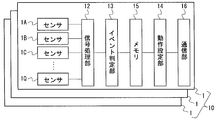
- the sensor system 10 includes a plurality of composite sensor units 1, and each composite sensor unit 1 includes a plurality of sensors 1A to 1Q, a signal processing unit 12, an event determination unit 13, an operation setting unit 14, a memory 15, and a communication unit 16. In one package.
- FIG. 2 shows an example in which the sensor system 10 is composed of a plurality of composite sensor units 1.
- the single composite sensor unit 1 is a sensor system. It corresponds to 10.
- Each of the plurality of sensors 1A to 1Q is a sensor that measures a physical quantity to be measured, and the signal processing unit 12 performs signal processing such as obtaining an average value, a maximum value, and a minimum value for the output values of the sensors 1A to 1Q. Do.
- the event determination unit 13 determines that the predetermined event has occurred when the output values of at least some of the plurality of sensors 1A to 1Q satisfy an event condition corresponding to the occurrence of the predetermined event. To do.
- the event determination unit 13 includes an output value of a sensor including a sensor necessary for determining the occurrence of a related event that is an event that can occur in association with the occurrence of a predetermined event among the plurality of sensors 1A to 1Q. When the related event condition corresponding to the occurrence of the related event is satisfied, it is determined that the related event has occurred.
- the event determination unit 13 includes an output value of a sensor including a sensor necessary for determining the occurrence of a second related event that is an event that can occur in association with the occurrence of the related event, among the plurality of sensors 1A to 1Q. However, when the second related event condition corresponding to the occurrence of the second related event is satisfied, it is determined that the second related event has occurred. Similarly, the event determination unit 13 includes sensors necessary for determining the occurrence of the (N + 1) th related event, which is an event that can occur in association with the occurrence of the Nth related event, among the plurality of sensors 1A to 1Q.
- the (N + 1) th related event has occurred when the output value satisfies the (N + 1) th related event condition corresponding to the occurrence of the (N + 1) th related event.
- the common items of the event, the related event, the Nth related event, and the (N + 1) th related event are described, they are also simply referred to as events.
- only one event determination unit 13 is shown, but a plurality of event determination units 13 may be provided in the sensor unit 10 or the sensor system 1. For example, a part of the event, a related event, or a second related event may be determined by separate event determination units 13.
- the operation setting unit 14 is an example of an operation setting unit that sets the operation of each of the sensors 1A to 1Q by setting the operation parameters of the plurality of sensors 1A to 1Q according to the event occurrence state.
- the operation setting unit 14 is a related event that is an event that can occur in association with the occurrence of the predetermined event among the plurality of sensors 1A to 1Q.
- the operation setting unit 14 increases the resolution of the sensor necessary for determining the occurrence of the related event, or the data set by the sensor
- the operations of the sensors 1A to 1Q are set so that the sampling interval is shortened or the output value transmission interval from the sensor is shortened.
- the event determination unit 13 has that the output value of the sensor including the sensors necessary for determining the occurrence of the related event among the plurality of sensors 1A to 1Q satisfies the related event condition corresponding to the occurrence of the related event. It is determined that a related event has occurred.
- the memory 15 is a storage unit that stores output values of the sensors 1A to 1Q, event conditions, operation settings of the sensors 1A to 1Q and the communication unit 16, and the like.
- the memory 15 may be a volatile memory such as a DRAM, a nonvolatile memory such as a flash memory, or a combination of a volatile memory and a nonvolatile memory.
- the communication unit 16 is an example of a transmission unit that communicates with an external receiving device such as the gateway 3, the application server 4, or another composite sensor unit 1 and transmits the output values of the sensors 1 A to 1 Q to the receiving device.
- the communication unit 16 communicates with the application server 4 via the gateway 3, for example, and transmits output values of the sensors 1A to 1Q.
- the communication unit 16 does not communicate with the application server 4 but communicates with the gateway 3 to transmit the sensor output value to the gateway 3, and the gateway 3 transmits the sensor output value to the application server 4. Also good.
- the communication between the communication unit 16 and the gateway 3 and the communication between the communication unit 16 and another composite sensor unit 1 may be wired communication or wireless communication, but wireless communication is desirable.
- At least a part of the sensors 1A to 1Q can transmit output values to an external receiving device via the communication unit 16.
- the sensors 1A to 1Q may communicate with the receiving device, or the communication unit 16 may transmit the output values held by the sensors 1A to 1Q in the memory 15 or the like to the receiving device.
- the sensor system 10 only needs to be able to transmit at least the output values of the sensors 1A to 1Q, and may be configured to include a transmission unit that performs only transmission instead of the communication unit 16.
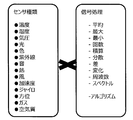
- FIG. 3 is a diagram illustrating an example of the types of sensors 1A to 1Q and signal processing by the signal processing unit 12.
- the sensors 1A to 1Q for example, a temperature sensor, a humidity sensor, an absolute pressure sensor, an optical sensor, a color sensor (RGB sensor), an ultraviolet sensor, a sound sensor (microphone), a thermal sensor, a wind sensor (Flow sensor), acceleration sensor, gyroscope (gyro sensor), direction sensor, gas sensor, air quality sensor, CO 2 sensor, position sensor, strain sensor, infrared sensor, magnetic sensor, illuminance sensor.
- the present invention is not limited to this, and the sensors 1A to 1Q may be other sensors.
- the signal processing unit 12 may perform processing for calculating the output values of the sensors 1A to 1Q using a predetermined algorithm to obtain the calculation result.
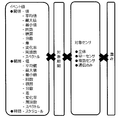
- FIG. 4 is an explanatory diagram of event conditions.
- the event determination unit 13 determines that the event condition is satisfied, that is, an event has occurred when the output value of the target sensor corresponds to the event value in the target period.
- a plurality of event conditions may be set. In this case, each event condition may be weighted.
- the event value is a threshold value, a range, and a time (schedule) for determining the occurrence of the event.
- This threshold is a value that identifies the output value itself of the sensor that determines that an event has occurred, the average value, the maximum value, the minimum value, the number of outputs, the integrated value, variance, difference, change rate, frequency, and spectrum. .
- the range is the range that specifies the output value itself of the sensor that determines that an event has occurred, the average value, maximum value, minimum value, number of outputs, integrated value, variance, difference, rate of change, frequency, and spectrum. It is. When the output values of the target sensors 1A to 1Q are within this range or outside the range, it is determined that an event has occurred.
- an event occurrence time (schedule) is set as an event value, it is determined that an event has occurred at that time regardless of the output values of the sensors 1A to 1Q.
- the target period is a period in which the output values of the sensors 1A to 1Q are acquired in order to determine the occurrence of an event, such as a predetermined period or a predetermined time, that is, a period in which measurement by the sensors 1A to 1Q is performed.
- the target sensor is a sensor that uses an output value to determine the occurrence of an event among the sensors 1A to 1Q, that is, a sensor necessary to determine the occurrence of an event.
- the target sensor can be a single sensor or a plurality of sensors.
- the communication unit 16 may be one of the sensors, the communication unit 16 may be designated as the target sensor, and the communication quality or the number of communication may be used as the event value.
- the weight is a coefficient that identifies the priority of a plurality of event conditions. For example, the higher the weight coefficient, the higher the priority of the event.
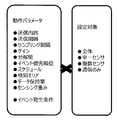
- FIG. 5 is an explanatory diagram of the operation setting by the operation setting unit 14.
- the operation setting unit 14 changes the operation parameters that determine the operations of the sensors 1A to 1Q and the communication unit 16, and the setting target for setting the operation parameters according to the event determined by the event determination unit 13.
- the operation setting unit 14 includes, for example, transmission contents, transmission intervals, sampling intervals, gains, resolutions, event priorities, schedules, detection areas, data retention amounts, sensing weights, event conditions as operation parameters. Set.
- the transmission contents include which sensor output value is transmitted, which value is transmitted such as the average value, maximum value, and variance of the sensor, the current event condition, operation setting, and event occurrence It is a parameter indicating information to be transmitted, such as whether information indicating a situation or the like is transmitted.
- the transmission interval is a parameter indicating an interval for performing wireless communication in the case of the communication unit 16, and an interval for outputting an output value in the case of each sensor 1A to 1Q.
- the sampling interval is a parameter indicating the interval at which the sensors 1A to 1Q perform measurement.
- the gain is a parameter for setting the sensitivity of the sensors 1A to 1Q. By controlling the gain, an output value in a predetermined range can be acquired.
- the resolution is a parameter for setting the accuracy of values measured by the sensors 1A to 1Q. For example, the normal resolution is set to a low resolution, and in an emergency such as the occurrence of an earthquake, a fine change can be measured with a high resolution. If the range to be measured by the sensor is wide, the gain is set to be small, and if the range is narrow, the gain is set to be large.
- the gain should be set to a large value so that it can be detected from 20 ° C to 60 ° C, and in the event of an emergency such as a fire, the gain should be reduced to a setting that can detect from 0 ° C to 100 ° C.
- Event priority is a parameter that sets the priority of event conditions.
- the event condition weight is set based on the event priority.
- the schedule is a parameter that specifies the event occurrence time when an event occurrence is determined at a specified time.
- the detection area has a detection area such as a visual field range such as an infrared sensor, and is a parameter for setting the detection area in a sensor capable of adjusting this area.
- the data retention amount is a parameter for setting a storage amount when the output values of the sensors 1A to 1Q are stored in the memory 15.
- the event condition is a parameter that determines an event value, a target period, a target sensor, and a weight for the event determination unit 13 to determine the occurrence of an event.
- the operation parameter may be a parameter that determines the cycle, time, and transmission condition for transmitting the output values of the sensors 1A to 1Q by the communication unit 16.
- the transmission condition indicates, for example, a transmission condition or a non-transmission condition in which the output values of the sensors 1A to 1Q are not transmitted if the output values are the same as the values stored in the memory 15, and are transmitted if they are different. It is.
- the setting target is information indicating the sensors 1A to 1Q and the communication unit 16 for setting the operation parameters.
- a setting target a single sensor or a plurality of sensors, all sensors, and the communication unit 16 can be set.
- FIG. 6 is a diagram showing the flow of operation of each part in the sensor system 10.
- each of the sensors 1A to 1Q refers to an operation parameter set in the memory 15, and performs measurement at a sampling interval, gain, resolution, etc. according to the operation parameter (S10).
- the signal processing unit 12 performs signal processing on the output value of the sensor according to the transmission content of the operation parameter, and obtains a value to be transmitted such as an average value, a maximum value, and a variance (S20).
- the event determination unit 13 determines whether the output values of the sensors 1A to 1Q themselves or the output values after signal processing satisfy an event condition set as an operation parameter, and satisfy the event condition. If it is, the occurrence of the event is determined, and the determined event and the output values of the sensors 1A to 1Q are notified to the operation setting unit 14 (S30).
- the operation setting unit 14 notified of the occurrence of the event has a more advantageous value for determining the occurrence of the related event as the operation parameter of the sensor necessary for determining the occurrence of the related event that may occur in relation to the generated event. (S40).
- the operation parameter is not changed by the operation setting unit 14, so that The operation according to the operation parameters set up to is maintained.
- the sensors 1A to 1Q are appropriately operated according to the occurrence state of the event. Can be made.
- FIG. 7 is a diagram for explaining the transition of the operation parameter set by the operation setting unit 14 in accordance with the determined event.
- the sensor 1A in the situation where the event 1 is determined, the sensor 1A is operated, and the operation parameter is set so that the event determination unit 13 determines whether or not the output value satisfies the condition a. Is set. Note that how the target sensor is actually operated and event conditions are specifically set, but in FIG. 7, they are simplified for convenience.
- the event determination unit 13 determines the occurrence of event 1 and notifies the operation setting unit 14 of this.
- the operation setting unit 14 notified of the occurrence of the event 1 operates the sensors 1A and 1B so that the event determination unit 13 determines whether or not the output value satisfies the event condition (b). 1B and 1C are operated, and the operation parameter is set so that the event determination unit 13 determines whether or not the output value satisfies the event condition (c).
- the event determination unit 13 determines the occurrence of the event 2 This is notified to the operation setting unit 14.
- the operation setting unit 14 notified of the occurrence of the event 2 operates the sensors 1A and 1D so that the event determination unit 13 determines whether or not the output value satisfies the event condition (d). 1C and 1E are operated, and the operation parameter is set so that the event determination unit 13 determines whether or not the output value satisfies the condition.
- the event determination unit 13 determines the occurrence of the event 3 This is notified to the operation setting unit 14.
- the operation setting unit 14 sets an operation parameter for determining that event 2 has occurred.
- the operation setting unit 14 Sets operation parameters for determining the occurrence of event 3.
- the related event that can occur in association with the occurrence of event 1 is event 2
- the second related event that can occur in association with the occurrence of event 2 is event 3. That is, when it is determined that the event 1 has occurred, the operation parameter of the sensor necessary for determining the occurrence of the related event 2 is set to a more advantageous value for determining that the related event 2 has occurred. To do.
- the operation parameter set to determine the occurrence of the related event 2 is set to a value that appropriately operates each of the sensors 1A to 1Q and the communication unit 16, in order to determine the occurrence of the related event 2 Since necessary operations are performed and unnecessary operations are not performed, the operations of the sensors 1A to 1Q and the communication unit 16 according to the operation parameters are operations that consume as little power as possible.
- the related event 2 Determine the occurrence of Further, when the event determination unit 13 determines that the related event 3 (second related event) has occurred, the operation setting unit 14 sets an operation parameter for determining the occurrence of the third related event, When it is determined that the Nth related event has occurred, the operation of setting an operation parameter for determining the occurrence of the (N + 1) th related event may be repeated.
- the event that has occurred and the operation parameter to be set next are associated in advance and stored in the memory 15 as a transition pattern.
- the operation setting unit 14 responds to the event that has occurred based on this transition pattern.
- the transition of the event is not limited to a fixed decision such as event 2 after event 1 and event 3 after event 2, but when event condition (b) of event 2 is satisfied.
- a transition may be made according to the satisfied condition, such as returning to event 1 when transitioning to event 3 and event condition (c) of event 2 is satisfied.
- the necessary sensors 1A to 1Q and the communication unit 16 operate according to the event occurrence state, and no operation is required.
- the sensors 1A to 1Q and the communication unit 16 are not operated, that is, do not consume power.
- This state in which no power is consumed is also referred to as a power saving mode or a sleep mode. Note that when the power saving mode or the sleep mode is set, not only the setting for not operating is performed, but the supply of power to the sensors 1A to 1Q and the communication unit 16 in the power saving mode or the sleep mode is stopped or reduced. It is good also as a structure.
- the condition for determining the occurrence of the related event is that the output values of at least some of the sensors 1A to 1Q satisfy the event condition corresponding to the occurrence of the predetermined event. It may be set according to the output value of at least one of the sensors. For example, a condition for determining the occurrence of a related event may be set using a variable. First, when the occurrence of an event is determined based on the output values of the sensors 1A to 1Q, the output values of the sensors 1A to 1Q are set. A configuration may be adopted in which a variable of a condition for determining the next related event is substituted.
- FIG. 8 is a diagram illustrating an example in which a variable is used as a condition for determining the occurrence of a related event.
- the condition according to the occurrence state of the event is determined as a condition for determining the occurrence of the related event.
- An appropriate value can be used, and an appropriate determination can be made.
- the average value of the latest five times of the sensor 1A is set to 2.3 or more, and the variance value of the latest five times of the sensor 1C is set to 0.6 or less.
- the occurrence of event 1 is determined. If this variance value is 0.5, for example, the event condition ((5) obtained by substituting the variance value 0.5 obtained in event 1 into the variable 41 of the event condition (b) for determining a new related event 2 is used. b) is set.
- FIG. 9 is a diagram showing an example in which the determination of the event condition is regularly repeated according to the event transition.
- the occurrence of an event is determined at any time by the operations S10 to S40 shown in FIG. 6 and the event condition is updated. Therefore, when an event repeatedly occurs, the setting and determination of the event condition are repeated as shown in FIG.
- the operation setting unit 14 stores the repeated event condition and the repetition timing (time and cycle) in the memory 15 as a common operation pattern, Operation parameters may be set according to this common operation pattern. For example, when the event determination unit 13 determines that the event condition (a) is satisfied, the operation setting unit 14 sets the event condition (b) (c) according to the transition pattern.
- Event conditions (b) and (c) are set as follows.
- the operation setting unit 14 sets the repeated event conditions and A series of operations is learned by storing in the memory 15 the time and time interval at which each event condition is satisfied as a common operation pattern. Then, after learning, when it is determined that the first event condition (a) of the common operation pattern is satisfied, the operation setting unit 14 learns without setting the next event condition (b) (c). The operation parameter of each sensor for determining the event condition (b) is set.
- the operation setting unit 14 sets the operation parameters of each sensor for determining the next event condition (d) at the time or time interval when the event condition (b) is satisfied based on the learned common operation pattern. . Similarly, the operation setting unit 14 sets operation parameters of each sensor for determining the event condition (f) based on the learned common operation pattern, and it is determined that the event condition (f) is satisfied. Then, the operation parameter of each sensor for determining the next event condition (a) and the event condition (a) is set, and the process based on learning is ended.
- the processing load of the event determination unit 13 can be reduced and the power consumption by the event determination unit 13 can be reduced.
- the event conditions (a) to (g) are provisional conditions for determining the final event condition (f). It may be.
- the operation setting unit 14 may set the operation parameter of each sensor for determining the final event condition (f). good.
- FIG. 10 is a diagram illustrating a specific example 1 of the operation in the sensor system 10.
- the specific example 1 shows an example of the operation at the time of the occurrence of an earthquake in the multiple sensor units 1 provided in the user's house.
- This specific example 1 shows an example in which an earthquake event, a gas leak event, a fire event, or the like is determined as an event.
- the event is not limited to these specific events, and as described above, at least one of the sensors 1A to 1Q. It is sufficient if the output value of the section satisfies the event condition.
- the acceleration sensor 1F, the gas sensor 1G, the temperature sensor 1H, and the sound sensor 1I are operated, and the signal processing unit 12 processes these output values.
- the event determination unit 13 determines, as an event condition (f), whether an average value obtained by averaging the latest five output values of the acceleration sensor 1F exceeds 100 mg. If the average value exceeds 100 mg, that is, an event When the condition (f) is satisfied, it is determined that an earthquake event has occurred.
- the event determination unit 13 notifies the operation setting unit 14 of the occurrence of this earthquake event, the operation setting unit 14 refers to the transition pattern stored in the memory 15 and sets operation parameters for determining a related event. For example, the operation parameter is changed to an operation parameter with a high resolution of the gas sensor or an operation parameter with a short sampling interval. Further, an event condition (g) for determining a gas leak event and an event condition (h) for determining a fire event are set as related events.
- the priority of the gas leak event is set to 1, and the priority of the fire event is set to 2.
- the event condition (g) is, for example, whether or not the rate of change of the output value of the last 10 times of the gas sensor 1G has exceeded 20%. Further, the event condition (h) is, for example, obtaining five times a difference when the output value of the temperature sensor 1H is compared with the previous output value, and whether or not any of these differences exceeds 5 ° C.
- the event determination unit 13 determines the occurrence of a gas leak event.
- the event determination unit 13 notifies the operation setting unit 14 of the occurrence of this gas leak event, the operation setting unit 14 sets an operation parameter for determining a related event with reference to the transition pattern stored in the memory 15. .
- the operation parameter is changed to an operation parameter with a short transmission interval, an operation parameter with a high resolution of the sound sensor 1I, or an operation parameter with a short sampling interval.
- an event condition (i) for determining a human detection event and an event condition (j) for determining a fire event are set as related events. At this time, the priority of the human detection event is set to 2, and the priority of the fire event is set to 1.
- the event condition (i) is, for example, whether any of the latest 500 output values of the sound sensor 1I has exceeded 80 dB.
- the event condition (j) is, for example, a value obtained by dividing 200 by the rate of change used in the determination of the gas leakage event as a variable f (gas), and an average value of output values of the temperature sensor 1H for f (gas) times. Whether or not exceeded 40 ° C.
- the event condition (i) having higher priority is prioritized, and the event determination unit 13 Determine the occurrence of
- the operation setting unit 14 sets an operation parameter for determining a related event with reference to the transition pattern stored in the memory 15. For example, the operating parameters of the gain and sampling interval of the infrared sensor 1J are set, and the infrared sensor 1J is changed from the sleep state to the operating state.
- the gain of the infrared sensor 1J is set to a transition pattern that is higher than a normal value so that the fire situation can be determined in detail, and a high gain operation parameter is set according to the transition pattern. Similarly, the operation parameter is set such that the sampling interval is shorter than normal according to the transition pattern.
- an event condition (k) for determining a fire source detection event is set as a related event.
- the event condition (k) is, for example, a variable f (temperature) obtained by dividing 10 by the average value used for the determination of the fire event, and the rate of change of the output value of the infrared sensor 1J in the last 10 times is f (temperature). It is whether or not it exceeded °C.
- the transmission interval is shortened to notify the gas leak information in an urgent manner, and the possibility of a fire has increased due to the gas leak.
- the operation parameters for determining the operation of the sensors 1F to 1J and related event conditions (i) and (j) necessary for determining the occurrence of a fire event or a human detection event are changed.
- the operation parameter of the sensor necessary for determining the occurrence of the related event can be set to a more advantageous value for determining the occurrence of the related event in accordance with the occurrence state of the event.
- Each part of the sensor system 10 such as 16 can be appropriately controlled.
- FIG. 11 is a diagram illustrating a specific example 2 of the operation in the sensor system 10.
- the specific example 2 shows an example of an operation during sleep in the sensor system 10 provided in the bedroom of the user.
- the sound sensor 1I, the illuminance sensor 1K, the temperature / humidity sensor 1L, and the atmospheric pressure sensor 1M are operated, and the signal processing unit 12 processes these output values.
- the event determination unit 13 determines, as an event condition (l), whether or not an average value obtained by averaging the latest five output values of the illuminance sensor 1K is less than 1 lx, and when the average value is less than 1 lx, If the event condition (l) is satisfied, it is determined that a sleep event has occurred.
- the operation setting unit 14 refers to the transition pattern stored in the memory 15 and sets an operation parameter for determining a related event. For example, the operation parameter is changed to an operation parameter in which the resolution of the temperature / humidity sensor 1L is set to a high value or an operation parameter in which the sampling interval is set to a short value.
- an event condition (m) for determining a rain event as a related event is set.
- the event condition (m) is, for example, whether the difference between the output value of the atmospheric pressure sensor 1M and the previous output value is obtained 600 times, and any of these differences exceeds 5 hPa.
- the event determination unit 13 determines the occurrence of a rain event.
- the operation setting unit 14 refers to the transition pattern stored in the memory 15 and sets an operation parameter for determining a related event. For example, the operation parameter is changed to an operation parameter in which the resolution of the temperature / humidity sensor 1L is set to a high value or an operation parameter in which the sampling interval is set to a short value.
- an event condition (n) for determining an unpleasant event and an event condition (o) for determining a snoring event are set as related events.
- a value obtained by dividing 20 by the difference used for the determination of the rain event is set as a variable f (atmospheric pressure), and the output value of humidity measured by the temperature / humidity sensor 1L is compared with the previous output value to obtain the difference 50 times, Whether any of these differences exceeds f (atmospheric pressure) is defined as an event condition (n).
- the event condition (o) is, for example, whether the sound spectrum is measured 100 times by the sound sensor 1I and the sound of 10 Hz exceeds 10 dB.
- the event determination unit 13 determines the occurrence of the snoring event.
- the event determination unit 13 notifies the operation setting unit 14 of the occurrence of the snoring event, the operation setting unit 14 sets an operation parameter for determining a related event with reference to the transition pattern stored in the memory 15. For example, an operation parameter for setting the resolution of the sound sensor 1I to a high value and an operation parameter for shortening the sampling interval are set.
- an event condition (p) for determining an apnea syndrome event and an event condition (q) for determining a wake-up event are set as related events.
- the average value of the sound used for the determination of the snoring event is a variable f (sound) dB, and the number of times the output value of the sound sensor 1I is equal to or greater than f (sound) dB is counted, and this number is within 3 minutes.
- the event condition (p) is whether or not it has exceeded 5 times.
- the event condition (q) is, for example, whether or not the average value obtained by averaging the output values of the last five times of the illuminance sensor 1K exceeds 5 lx.
- the event determination unit 13 determines the occurrence of an apnea syndrome event.
- the event determination unit 13 notifies the operation setting unit 14 of the occurrence of the apnea syndrome event
- the operation setting unit 14 stores the number of occurrences and the generation time of the apnea syndrome event in the memory 15.
- the event determination unit 13 determines the occurrence of a wake-up event.
- the operation setting unit 14 sets an operation parameter for determining a related event with reference to the transition pattern stored in the memory 15. .
- the output value of each sensor acquired during sleep and the content of the determined event are transmitted to the application server 4.
- the operation parameter is changed to an operation parameter in which the resolution of the temperature / humidity sensor 1L is low or an operation parameter in which the sampling interval is long.
- an event condition (l) for determining a sleep event as a related event is set. That is, it returns to the state (initial state) which determines the first event among the transition patterns which determine the sleep event.
- temperature / humidity information is output in detail to obtain information related to comfort, and when a rain event is determined, a change in humidity increase due to rain
- the operation setting of the sound sensor 1I is changed to determine the snoring quality so that an apnea syndrome event can be determined.
- FIG. 12 shows an example of the operation when an earthquake occurs in the sensor system 10 installed in a building.
- the acceleration sensor 1F, the illuminance sensor 1K, and the atmospheric pressure sensor 1M are operated, and these output values are signal-processed by the signal processing unit 12.
- the event determination unit 13 determines, as an event condition (r), whether an average value obtained by averaging the latest five output values of the acceleration sensor 1F exceeds 100 mg. If the average value exceeds 100 mg, that is, an event When the condition (r) is satisfied, it is determined that an earthquake event has occurred.
- the operation setting unit 14 refers to the transition pattern stored in the memory 15 and sets operation parameters for determining a related event. For example, the operation parameter is changed to an operation parameter with a short sampling interval of the illuminance sensor 1K.
- an event condition (s) for determining a power outage event as a related event is set.
- the event condition (s) is, for example, whether or not the difference when the output value of the illuminance sensor 1K is compared with the previous output value is obtained 10 times and the minimum value of any one of these differences exceeds 10 lx.
- the operation setting unit 14 changes the operation parameter to a short value for the sampling interval of the atmospheric pressure sensor 1M and the operation parameter to have a high resolution.
- an event condition (t) for determining a building collapse event is set as a related event.
- the event condition (t) is, for example, whether or not the difference when the output value of the atmospheric pressure sensor 1M is compared with the previous output value is obtained 40 times, and any one of these differences exceeds 2 hPa.
- the operation parameters advantageous for determining a power failure event or a building collapse event, which are related events, are set, so that the sensors 1A to 1Q of the sensor system 10
- the communication unit 16 can autonomously perform an appropriate operation.
- FIG. 13 shows an example of the operation of the sensor system 10 placed in the user's room.
- the acceleration sensor 1F, the illuminance sensor 1K, the sound sensor 1I, and the atmospheric pressure sensor 1M are operated, and the signal processing unit 12 processes these output values.
- the event determination unit 13 compares the output value of the illuminance sensor 1K with the previous output value, obtains a difference five times, and determines whether any difference exceeds 200 lx as an event condition (v). Furthermore, the event determination unit 13 determines whether the average of the latest five output values of the sound sensor 1I exceeds 70 dB as an event condition (w). When the event condition (v) or the event condition (w) is satisfied, the event determination unit 13 determines that an entry event has occurred, and notifies the operation setting unit 14 of the occurrence of the entry event.
- the operation setting unit 14 refers to the transition pattern stored in the memory 15 and sets operation parameters. For example, the operation parameter is changed to an operation parameter with a short sampling interval of the temperature / humidity sensor 1L.
- the event determination unit 13 compares the output value of the atmospheric pressure sensor 1M with the previous output value, obtains the difference five times, and determines whether any difference exceeds 0.5 hPa as the event condition (x). To do. When the difference exceeds 0.5 hPa, that is, when the event condition (x) is satisfied, the event determination unit 13 determines that a cooking event has occurred using a ventilation fan. When the event determination unit 13 notifies the operation setting unit 14 of the occurrence of this cooking event, the operation setting unit 14 refers to the transition pattern stored in the memory 15 and sets an operation parameter for determining a related event. For example, an event condition (z) for determining a fire event as a related event is set. The event condition (z) is, for example, whether or not the minimum value exceeds 50 ° C. among the latest five output values of the temperature sensor 1K.
- the event determination part 13 determines whether the maximum value exceeded 100 mg among the last five output values of the acceleration sensor 1F as an event condition (u), and when the maximum value exceeded 100 mg, that is, an event If the condition (u) is satisfied, it is determined that a movement event has occurred.
- the event determination unit 13 notifies the operation setting unit 14 of the occurrence of this movement event, the operation setting unit 14 sets an operation parameter with reference to the transition pattern stored in the memory 15. For example, when the sensor system 10 is moved in order to change the installation position of the sensor system 10, it is not necessary to perform measurement until the sensor system 10 is installed again, so that measurement of all sensors is stopped, for example, the sampling interval is infinite. Set the operation parameter to be large. Further, transmission by the communication unit 16 is also stopped.
- the acceleration sensor 1F is operated after a predetermined time has elapsed, and an event condition (y) for determining a movement end event is set as a related event.
- the event condition (y) is, for example, whether the minimum value is less than 10 mg among the latest five output values of the acceleration sensor 1F.
- FIG. 14 shows an example of the operation of the sensor system 10 installed on a door or window.
- the acceleration sensor 1F and the pollen sensor 1N are operated, and the signal processing unit 12 processes these output values.
- the event determination unit 13 determines, as an event condition (a1), whether an average value obtained by averaging the latest five output values of the acceleration sensor 1F exceeds 50 mg. If the average value exceeds 50 mg, that is, an event When the condition (a1) is satisfied, it is determined that an opening event has occurred.
- the event determination unit 13 notifies the operation setting unit 14 of the occurrence of this door opening event, the operation setting unit 14 refers to the transition pattern stored in the memory 15 and sets an operation parameter for determining a related event. .
- each sensor 1A to 1Q when the output value of each sensor 1A to 1Q is stored in the memory 15 until the door or window is opened and it is determined that a door opening event has occurred, that is, when the door or window is opened and the communication environment is improved.
- the operation setting is performed so that the output values of the sensors 1A to 1Q are transmitted to the application server 4.
- an operation parameter for shortening the sampling interval of the pollen sensor 1N and an operation parameter for increasing the resolution of the pollen sensor are set.
- the event condition (a2) for determining a pollen warning event as a related event is set.
- the event condition (a2) is, for example, whether or not the average value obtained by averaging the last five output values of the pollen sensor 1N exceeds 0.2 ppm.
- the operation setting of the communication unit 16 and the operation parameter that is advantageous for determining the pollen alarm event that is a related event are set. 1A to 1Q and the communication unit 16 can autonomously perform appropriate operations.
- FIG. 15 shows an example of the operation of the sensor system 10 installed in factory piping.
- the acceleration sensor 1F and the temperature sensor 1H are operated, and the signal processing unit 12 processes these output values.
- the event determination unit 13 determines, as an event condition (b1), whether an average value obtained by averaging the latest five output values of the acceleration sensor 1F exceeds 50 mg. If the average value exceeds 50 mg, that is, an event When the condition (b1) is satisfied, it is determined that a piping abnormality event has occurred.
- the event determination unit 13 notifies the operation setting unit 14 of the occurrence of this piping abnormality event, the operation setting unit 14 sets an operation parameter for determining a related event with reference to the transition pattern stored in the memory 15. .
- an operation parameter that shortens the sampling interval of the temperature sensor 1H that determines the temperature of the pipe and an operation parameter that increases the resolution of the temperature sensor are set.
- an event condition (a2) for determining a heat generation detection event is set as a related event.
- the event condition (a2) is, for example, whether or not an average value obtained by averaging the latest five output values of the temperature sensor 1H exceeds 40 ° C.
- the operation parameters advantageous for determining the heat generation detection event that is the related event are set, so that the sensors 1A to 1Q and the communication unit 16 of the sensor system 10 Appropriate operation can be performed autonomously.
- the sensors 1A to 1Q and the communication unit 16 of the sensor system 10 can autonomously perform appropriate operations. Since unnecessary operations are not performed, power consumption can be suppressed as much as possible. Therefore, when the sensor system 10 is driven by a battery, the number of battery replacements is reduced, and maintenance costs can be suppressed.
- 1A-1Q sensor 1 sensor unit, 2 user terminal, 3 gateway, 4 application server, 10 sensor system, 12 signal processing unit, 13 event determining unit, 14 operation setting unit, 15 memory, 16 communication unit
Landscapes
- Physics & Mathematics (AREA)
- General Physics & Mathematics (AREA)
- Testing Or Calibration Of Command Recording Devices (AREA)
- Arrangements For Transmission Of Measured Signals (AREA)
- Alarm Systems (AREA)
- Selective Calling Equipment (AREA)
- Telephonic Communication Services (AREA)
Abstract
イベントの発生状況に応じてセンサシステムの各センサを自律的に適切な動作を行わせることで、省電力化を図ることが可能となる技術を提供する。複数のセンサを有し、複数の物理量を測定可能なセンサシステムであって、前記複数のセンサの動作を設定する動作設定手段と、前記複数のセンサのうちの少なくとも一部のセンサの出力値が、所定のイベントの発生に相当するイベント条件を満足したことをもって、前記所定のイベントの発生を判定するイベント判定手段と、を備え、前記イベント判定手段により、前記所定のイベントの発生が判定された場合には、前記動作設定手段は、前記複数のセンサのうち、前記所定のイベントの発生に関連して発生し得るイベントである関連イベントの発生の判定に必要なセンサの動作状態を変更する。
Description
本発明は、イベントの発生を検出するセンサシステムに関する。
温度や湿度、気圧、光量といった物理量を検出するセンサは、多種多様のものが開発されている。特に近年、MEMS(Micro Electro Mechanical Systems)といわれる小型で低消費電力のセンサ(以下MEMSセンサとも称す)が注目されている。小型で消費電力の小さいMEMSセンサであれば、複数設けることが容易なため、多種のセンサを備えたセンサユニットを構成することが可能である。
このようなセンサユニットであれば職場や居住空間の環境を複合的にセンシングでき、例えば電力等のエネルギー関連情報や生体情報、環境情報といった種々の情報を得ることができる。そして、これらの情報により多角的な情報分析と活用を支援することができる。
このように複数のセンサを備えたセンサユニットの場合、個々のセンサの消費電力が小さくてもユニット全体の消費電力が大きくなって問題となることがあった。特に、設置上の制約等から電源として電池を採用した場合、消費電力は可及的に低く抑えることが望ましい。例えば、センサユニットを一度設置して環境データの収集、蓄積、送信を開始した場合、電池交換せずに可能な限り長時間駆動させることが望まれるため、消費電力を小さく抑える必要がある。この消費電力を小さく抑えられず電池交換の頻度が高いと、その分電池交換のメンテナンスコストが発生する。このメンテナンスコストの発生は、センサ導入の障壁となる。
特許文献1には、設備(空調)の動作状態に応じて、無線センサのスリープ時間を変化させるシステムが提案されている。特許文献1のシステムは、設備(空調)が動いているときには、センサのスリープ時間を短くし、設備(空調)が停止しているときには、センサのスリープ時間を長くすることで、電池の消耗を抑えている。
特許文献2では、予め設定された時刻になった時にスリープ状態にある制御部をウェイクアップさせて、取得したデータの送信や自装置宛のコマンドの受信を行い、自装置宛のスリープコマンドを受信した場合にスリープ状態に移行する無線管理システムが提案されている。これにより、屋外で点在して複数配置しても、電池で長期間に亘って安定したシステム運用を行うことができるようにしている。
特許文献3では、1分間に1回の割合で前記問合せを行う節電モードと、1分間に6回の割合で前記問合せを行う要注意モードとを含み、加速度センサによって携帯端末の動きが検知されたときは、問合せの間隔を短くする無線距離検知システムが提案されている。
このように従来のシステムでは、特定の条件に応じてセンサを動作又はスリープさせるように制御することで省電力化を図っているが、特定の条件に基づいて制御を行うと、状況によっては、適切に省電力化を図ることができない場合もあった。特に複数のセンサで複合的なセンシングを行う場合、単一の条件で全てのセンサを適切に制御することは困難であった。
本発明は、上記の従来技術に鑑みて発明されたものであり、その目的は、センサの検出値に基づいてイベントの発生を判定し、判定したイベントに応じて各センサの動作パラメータを設定することで、イベントの発生状況に応じて各センサを自律的に適切な動作を行わせることで、省電力化を図る技術を提供することである。
上記課題を解決するための本発明は、複数のセンサのうちの少なくとも一部のセンサの出力値が、所定のイベントの発生に相当するイベント条件を満足したことをもって、前記所定のイベントの発生を判定し、前記所定のイベントの発生に関連して発生し得るイベントである関連イベントの発生の判定に必要なセンサの動作パラメータを、前記関連イベントの発生を判定するためにより有利な値に設定することを特徴とする。
より詳しくは、複数のセンサを有し、複数の物理量を測定可能なセンサシステムであって、前記複数のセンサの動作パラメータを設定する動作設定手段と、前記複数のセンサのうちの少なくとも一部のセンサの出力値が、所定のイベントの発生に相当するイベント条件を満足したことをもって、前記所定のイベントが発生したことを判定するイベント判定手段と、を備え、前記イベント判定手段により、前記所定のイベントの発生が判定された場合には、前記動作設定手段は、前記複数のセンサのうち、前記所定のイベントの発生に関連して発生し得るイベントである関連イベントの発生の判定に必要なセンサの動作状態を変更することを特徴とする。
これにより、発生したイベントに応じた動作パラメータを設定でき、当該イベントの発生に関連して発生し得る関連イベントの発生の判定に必要なセンサ動作させることができる。即ち、複数のセンサを備えていても、イベントの発生状況に応じ、必要なセンサを動作させ、不必要なセンサは動作させない設定とすることで、省電力化を図ることができる。
また、本発明において、前記イベント判定手段は、前記複数のセンサのうち、前記関連イベントの発生の判定に必要なセンサを含むセンサの出力値が、前記関連イベントの発生に相当する関連イベント条件を満足したことをもって、前記関連イベントの発生を判定しても良い。
また、本発明は、外部に設けられた受信装置へ前記センサの出力値を送信する送信手段を備え、前記関連イベントの発生の判定に必要なセンサの動作状態の変更が、該センサの分解能、該センサによるデータのサンプリング間隔または、該センサからの出力値の送信間隔を前記関連イベントの発生を判定するためにより有利な値に設定するものであり、前記イベント判定手段により、前記所定のイベントが発生したと判定された場合には、前記動作設定手段は、前記関連イベントの発生の判定に必要なセンサの分解能を上昇させ、または、該センサによるデータのサンプリング間隔を短くし、または、該センサからの出力値の送信間隔を短くする設定に変更しても良い。
また、本発明においては、前記イベント判定手段により、前記所定のイベントの発生が判定される前は、前記動作設定手段は、前記関連イベントの発生の判定に必要なセンサの分解能、該センサによるデータのサンプリング間隔、または該センサからの無線通信の通信間隔のうちの少なくとも一つを、可及的に消費電力の少ない省電力モードにしても良い。即ち、動作設定手段は、所定のイベントが発生したと判定された後には、前記関連イベントの発生の判定に必要なセンサの分解能を上昇させ、または、該センサによるデータのサンプリング間隔を短くし、または、該センサからの出力値の送信間隔を短くし、前記所定のイベントの発生が判定される前は、これらの動作を行わせないことで可及的に消費電力の少ない省電力モードとしている。即ち、所定のイベントが発生して、前記関連イベントの発生の判定が必要となるまでは、各センサの分解能やサンプリング間隔、送信間隔の動作パラメータを可及的に消費電力の少ない設定とする。
また、本発明においては、前記複数のセンサのうちの少なくとも一部のセンサの出力値が、所定のイベントの発生に相当するイベント条件を満足した際の、前記複数のセンサのうちの少なくとも一つのセンサの出力値に応じて、前記関連イベント条件を変更しても良い。このように所定のイベント条件を満足した際の、センサの出力値を用いて関連イベントの発生を判定する条件を設定することで、関連イベントの発生を判定する条件としてイベントの発生状況に応じた適切な値を用いることができ、適切な判定を行わせることができる。
また、本発明においては、前記イベント判定手段により、前記関連イベントの発生が判定された場合には、前記動作設定手段は、前記複数のセンサのうち、前記関連イベントの発生にさらに関連して発生し得るイベントである第二関連イベントの発生の判定に必要なセンサの動作パラメータを、前記第二関連イベントの発生を判定するためにより有利な値に設定するとともに、前記イベント判定手段は、前記複数のセンサのうち、前記第二関連イベントの発生の判定に必要なセンサを含むセンサの出力値が、前記第二関連イベントの発生に相当する第二関連イベント条件を満足したことをもって、前記第二関連イベントの発生を判定し、前記第二関連イベントにさらに関連するイベントについても同様の処理を繰り返しても良い。
また、本発明において、前記センサシステムは、異なる物理量を検知する前記複数のセンサを一つのパッケージ内に配置した複合センサユニットであっても良い。
また、本発明においては、前記複数のセンサの各々が、異なる物理量を検知する複数のセンサを一つのパッケージ内に配置した複合センサユニットであり、前記センサシステムは、所定の領域に配置された複数の複合センサユニットからなるものでも良い。
なお、上記した課題を解決するための手段は、可能な限り組み合わせて使用することが可能である。
本発明によれば、イベントの発生状況に応じてセンサシステムの各センサを自律的に適切な動作を行わせることで、省電力化を図ることが可能となる。
以下に図面を参照して、この発明を実施するための形態を例示的に詳しく説明する。
図1には、本実施形態におけるセンサシステム10の設置例を示す図である。本実施形態では、ユーザ宅内に複数の複合センサユニット1を備え、この複数の複合センサユニット1がセンサシステム10を構成している。なお、センサシステム10は、複数の複合センサユニット1から構成されるものに限らず、単体の複合センサユニット1で構成されても良い。また、ユーザ宅内には、ユーザ端末2やゲートウェイ3が設けられている。センサシステム10は、検出したデータをゲートウェイ3に送り、ゲートウェイ3が、このデータをインターネット等のネットワークNを介してアプリケーションサーバ4へ送信する。また、アプリケーションサーバ4は、受信したデータを処理して処理結果を出力する。例えば、ネットワークNを介して処理結果をユーザ端末2へ送信する。
図1には、本実施形態におけるセンサシステム10の設置例を示す図である。本実施形態では、ユーザ宅内に複数の複合センサユニット1を備え、この複数の複合センサユニット1がセンサシステム10を構成している。なお、センサシステム10は、複数の複合センサユニット1から構成されるものに限らず、単体の複合センサユニット1で構成されても良い。また、ユーザ宅内には、ユーザ端末2やゲートウェイ3が設けられている。センサシステム10は、検出したデータをゲートウェイ3に送り、ゲートウェイ3が、このデータをインターネット等のネットワークNを介してアプリケーションサーバ4へ送信する。また、アプリケーションサーバ4は、受信したデータを処理して処理結果を出力する。例えば、ネットワークNを介して処理結果をユーザ端末2へ送信する。
図2は、センサシステム10の概略構成を示す図である。センサシステム10は、複数の複合センサユニット1を備え、各複合センサユニット1が、複数のセンサ1A~1Qと、信号処理部12、イベント判定部13、動作設定部14、メモリ15、通信部16を一つのパッケージ内に備えている。なお、図2はセンサシステム10が複数の複合センサユニット1で構成されている例であり、センサシステム10が単体の複合センサユニット1で構成される場合、単一の複合センサユニット1がセンサシステム10に相当する。
複数のセンサ1A~1Qは、それぞれ測定対象の物理量を測定するセンサであり、信号処理部12は、センサ1A~1Qの出力値について、平均値、最大値、最小値を求める等の信号処理を行う。
イベント判定部13は、複数のセンサ1A~1Qのうちの少なくとも一部のセンサの出力値が、所定のイベントの発生に相当するイベント条件を満足したことをもって、前記所定のイベントが発生したと判定する。また、イベント判定部13は、前記複数のセンサ1A~1Qのうち、所定イベントの発生に関連して発生し得るイベントである関連イベントの発生の判定に必要なセンサを含むセンサの出力値が、前記関連イベントの発生に相当する関連イベント条件を満足したことをもって、前記関連イベントが発生したと判定する。
更に、イベント判定部13は、複数のセンサ1A~1Qのうち、前記関連イベントの発生に関連して発生し得るイベントである第二関連イベントの発生の判定に必要なセンサを含むセンサの出力値が、第二関連イベントの発生に相当する第二関連イベント条件を満足したことをもって、第二関連イベントが発生したと判定する。同様に、イベント判定部13は、複数のセンサ1A~1Qのうち、第N関連イベントの発生に関連して発生し得るイベントである第N+1関連イベントの発生の判定に必要なセンサを含むセンサの出力値が、第N+1関連イベントの発生に相当する第N+1関連イベント条件を満足したことをもって、第N+1関連イベントが発生したと判定する。なお、本実施形態において、イベント、関連イベント、第N関連イベント、第N+1関連イベントについて、共通する事項について説明する場合は、単にイベントとも称す。また、本実施形態では、イベント判定部13を一つのみ示したが、イベント判定部13は、センサユニット10又はセンサシステム1に複数設けられても良い。例えば、イベントの一部や、関連イベント、第二関連イベントをそれぞれ別のイベント判定部13で判定しても良い。
動作設定部14は、複数のセンサ1A~1Qの動作パラメータをイベントの発生状況に応じて設定することにより、各センサ1A~1Qの動作を設定する動作設定手段の一例である。イベント判定部13により、所定のイベントが発生したと判定された場合、動作設定部14は、複数のセンサ1A~1Qのうち、所定のイベントの発生に関連して発生し得るイベントである関連イベントの発生の判定に必要なセンサの動作パラメータを、前記関連イベントの発生を判定するためにより有利な値に設定することにより、各センサ1A~1Qを関連イベントの発生を判定するためにより有利な動作状態とする。例えば、イベント判定部13により、所定のイベントが発生したと判定された場合、動作設定部14は、前記関連イベントの発生の判定に必要なセンサの分解能を上昇させ、または、該センサによるデータのサンプリング間隔を短くし、または、該センサからの出力値の送信間隔を短くするように各センサ1A~1Qの動作を設定する。そして、イベント判定部13は、複数のセンサ1A~1Qのうち、関連イベントの発生の判定に必要なセンサを含むセンサの出力値が、関連イベントの発生に相当する関連イベント条件を満足したことをもって、関連イベントが発生したと判定する。
メモリ15は、センサ1A~1Qの出力値や、イベント条件、センサ1A~1Qや通信部16の動作設定等を記憶する記憶手段である。メモリ15は、DRAM等の揮発性メモリや、フラッシュメモリ等の不揮発性メモリ、或は揮発性メモリと不揮発性メモリの組み合わせであっても良い。
通信部16は、ゲートウェイ3やアプリケーションサーバ4、他の複合センサユニット1といった外部の受信装置と通信を行い、センサ1A~1Qの出力値を受信装置へ送信する送信手段の一例である。通信部16は、例えばゲートウェイ3を介してアプリケーションサーバ4と通信し、センサー1A~1Qの出力値を送信する。なお、通信部16が、アプリケーションサーバ4と通信するのではなく、ゲートウェイ3と通信して、センサーの出力値をゲートウェイ3に送信し、ゲートウェイ3がセンサーの出力値をアプリケーションサーバ4に送信しても良い。また、通信部16とゲートウェイ3との通信や通信部16と他の複合センサユニット1との通信は、有線通信でも無線通信でも良いが、無線通信が望ましい。センサ1A~1Qの少なくとも一部は、通信部16を介して外部の受信装置へ出力値を送信することが可能である。この場合、各センサ1A~1Qが受信装置と通信しても良いし、各センサ1A~1Qがメモリ15等に保持させた出力値を通信部16が受信装置へ送信しても良い。なお、センサシステム10は少なくともセンサ1A~1Qの出力値を送信できればよく、通信部16に代え、送信のみを行う送信部を備える構成でも良い。
図3は、センサ1A~1Qの種類と信号処理部12による信号処理の例を示す図である。図3に示すように、センサ1A~1Qとしては、例えば、温度センサ、湿度センサ、絶対圧センサ、光センサ、色センサ(RGBセンサ)、紫外線センサ、音センサ(マイクロフォン)、熱センサ、風センサ(フローセンサ)、加速度センサ、ジャイロスコープ(ジャイロセンサ)、方位センサ、ガスセンサ、空気質センサ、CO2センサ、位置センサ、ひずみセンサ、赤外線センサ、磁気センサ、照度センサが挙げられる。なお、これに限らず、センサ1A~1Qは、他のセンサであっても良い。また、信号処理の例としては、これらのセンサ1A~1Qで所定期間に測定して出力した出力値について、平均値、最大値、最小値、回数、積算値、分散、差分、変化量、周波数、スペクトルを求める。また、信号処理部12は、センサ1A~1Qの出力値を所定のアルゴリズムで演算して演算結果を求める処理を行うものでも良い。
図4は、イベント条件の説明図である。イベント判定部13は、対象期間において、対象センサの出力値がイベント値に該当する場合にイベント条件を満足した、即ちイベントが発生したと判定する。このイベント条件は複数設定されても良く、この場合、各イベント条件が重み付けされていても良い。
図4において、イベント値とは、イベントの発生を判定するための閾値や範囲、時間(スケジュール)である。この閾値は、イベントが発生したと判定するセンサの出力値そのものや、平均値、最大値、最小値、出力の回数、積算値、分散、差、変化率、周波数、スペクトルを特定する値である。対象とするセンサ1A~1Qの出力値が、この閾値を超えた場合や、下回った場合に、イベントが発生したと判定する。同様に、範囲は、イベントが発生したと判定するセンサの出力値そのものや、平均値、最大値、最小値、出力の回数、積算値、分散、差、変化率、周波数、スペクトルを特定する範囲である。対象とするセンサ1A~1Qの出力値が、この範囲内の場合や、範囲外の場合に、イベントが発生したと判定する。
また、イベント値として、イベント発生時刻(スケジュール)が設定されている場合、センサ1A~1Qの出力値に関わらず、当該時刻にイベントが発生したと判定する。
対象期間は、所定の周期や、所定時刻など、イベントの発生を判定するためにセンサ1A~1Qの出力値を取得する期間、即ちセンサ1A~1Qによる測定を行わせる期間である。
対象センサは、センサ1A~1Qのうち、イベントの発生を判定するために出力値を用いるセンサ、即ちイベントの発生を判定するために必要なセンサである。対象センサは、単一のセンサ又は複数のセンサを設定できる。また、複数のセンサを対象センサとした場合、全ての対象センサによる出力値がイベント値に該当した場合にイベントが発生したと判定するのか、何れかの対象センサによる出力値がイベント値に該当した場合にイベントが発生したと判定するのかを特定しても良い。また、通信部16をセンサの一つとし、対象センサとして通信部16を指定し、イベント値として通信品質や通信回数を用いるようにしても良い。
重みは、複数のイベント条件の優先度を特定する係数であり、例えば、重み係数の大きいものほど、イベントの優先順位を高くすることもできる。
図5は、動作設定部14による動作設定の説明図である。動作設定部14は、センサ1A~1Qや通信部16の動作を定める動作パラメータや、この動作パラメータを設定する設定対象をイベント判定部13で判定したイベントに応じて変更する。
図5に示すように、動作設定部14は、例えば、動作パラメータとして、送信内容、送信間隔、サンプリング間隔、ゲイン、分解能、イベント優先順位、スケジュール、検知エリア、データ保持量、センシング重み、イベント条件を設定する。
図5の動作設定において、送信内容は、どのセンサの出力値を送信するか、センサの平均値、最大値、分散など、どの値を送信するか、現在のイベント条件や動作設定、イベントの発生状況等を示す情報を送信するか等、送信する情報を示すパラメータである。
送信間隔は、通信部16の場合は無線通信を行う間隔、各センサ1A~1Qの場合は出力値を出力する間隔を示すパラメータである。
サンプリング間隔は、センサ1A~1Qが測定を行う間隔を示すパラメータである。
ゲインは、センサ1A~1Qの感度を設定するパラメータである。ゲインを制御することで、所定の範囲の出力値を取得することが可能となる。分解能は、センサ1A~1Qで測定する値の精度を設定するパラメータである。例えば、平常時は、低い分解能に設定し、地震の発生時等、非常時には高い分解能で微細な変化まで測定できるように設定する。また、センサで測定すべきレンジが広ければゲインを小さく、狭ければゲインを大きく設定する。例えば、平常時は、ゲインを大きく設定し、20℃~60℃まで検出可能とし、火事の発生等、非常時はゲインを小さくし、0℃~100℃まで検出可能な設定とする。
ゲインは、センサ1A~1Qの感度を設定するパラメータである。ゲインを制御することで、所定の範囲の出力値を取得することが可能となる。分解能は、センサ1A~1Qで測定する値の精度を設定するパラメータである。例えば、平常時は、低い分解能に設定し、地震の発生時等、非常時には高い分解能で微細な変化まで測定できるように設定する。また、センサで測定すべきレンジが広ければゲインを小さく、狭ければゲインを大きく設定する。例えば、平常時は、ゲインを大きく設定し、20℃~60℃まで検出可能とし、火事の発生等、非常時はゲインを小さくし、0℃~100℃まで検出可能な設定とする。
イベント優先順位は、イベント条件の優先順位を設定するパラメータである。例えば、イベント優先順位に基づいてイベント条件の重みを設定する。
スケジュールは、指定の時刻にイベントの発生を判定させる場合のイベント発生時刻を指定するパラメータである。
検知エリアは、例えば赤外線センサなどの視野範囲のように検知するエリアを有し、このエリアを調整可能なセンサにおいて、検知するエリアを設定するパラメータである。
データ保持量は、センサ1A~1Qの出力値をメモリ15に記憶させる際の記憶量を設定するパラメータである。
センシング重みは、複数のセンシング値から別の値を算出する際の係数を設定するパラメータである。例えば、温度T、湿度Hから、快適性PをP=a・T+b・Hの数式で求める場合、係数a,bがセンシング重みである。
また、イベント条件は、イベント判定部13がイベントの発生を判定するためのイベント値や、対象期間、対象センサ、重みを定めるパラメータである。
この他、動作パラメータは、通信部16により、センサ1A~1Qの出力値を送信する周期や、時刻、送信条件を定めるパラメータであっても良い。なお、送信条件は、例えば、センサ1A~1Qの出力値が、メモリ15に記憶した値と同一の場合には送信せず、異なる場合には送信するといった送信する条件又は送信しない条件を示すものである。
また、設定対象は、前記動作パラメータを設定するセンサ1A~1Qや通信部16を示す情報である。設定対象は、単一のセンサ又は複数のセンサ、全てのセンサ、通信部16を設定できる。
図6は、センサシステム10における各部の動作の流れを示す図である。先ず、各センサ1A~1Qは、メモリ15に設定されている動作パラメータを参照し、この動作パラメータに従ったサンプリング間隔や、ゲイン、分解能等で測定を行う(S10)。
次に信号処理部12は、動作パラメータの送信内容に従ってセンサの出力値を信号処理し、平均値や、最大値、分散など、送信する値を求める(S20)。
イベント判定部13は、センサ1A~1Qの出力値そのもの或は信号処理後の出力値について、動作パラメータとして設定されているイベント条件を満足しているか否かを判定し、イベント条件を満足している場合にはイベントの発生を判定して、判定したイベントやセンサ1A~1Qの出力値を動作設定部14に通知する(S30)。
イベントの発生を通知された動作設定部14は、発生したイベントに関連して発生し得る関連イベントの発生の判定に必要なセンサの動作パラメータをこの関連イベントの発生を判定するためにより有利な値に変更する(S40)。なお、センサ1A~1Qの出力値が、イベント条件を満足せず、イベント判定部13が、イベントを判定していない状況では、動作設定部14のよる動作パラメータの変更が行われないので、それまでに設定されている動作パラメータに従う動作が維持される。
このようにセンサ1A~1Q、信号処理部12、イベント判定部13、動作設定部14の各部の動作S10~S40を繰り返すことにより、イベントのは発生状況に応じてセンサ1A~1Qを適切に動作させることができる。
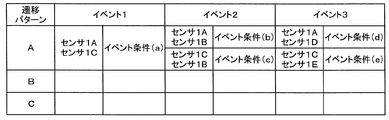
図7は、判定されたイベントに応じて動作設定部14が設定する動作パラメータの遷移を説明する図である。図7に示すように、遷移パターンAにおいて、イベント1を判定する状況では、センサ1Aを動作させ、この出力値が条件aを満たすか否かをイベント判定部13が判定するように動作パラメータが設定されている。なお、実際には対象センサをどのように動作させるかやイベント条件が具体的に設定されるが、図7では、便宜上簡略化して示している。センサ1A,1Cの出力値がイベント条件(a)を満たした場合、イベント判定部13がイベント1の発生を判定し、これを動作設定部14に通知する。イベント1の発生を通知された動作設定部14は、センサ1A,1Bを動作させ、この出力値がイベント条件(b)を満たすか否かをイベント判定部13が判定するように、また、センサ1B,1Cを動作させ、この出力値がイベント条件(c)を満たすか否かをイベント判定部13が判定するように、動作パラメータを設定する。
そして、センサ1A,1Bの出力値がイベント条件(b)を満たした場合、又はセンサ1B,1Cの出力値がイベント条件(c)を満たした場合、イベント判定部13がイベント2の発生を判定し、これを動作設定部14に通知する。イベント2の発生を通知された動作設定部14は、センサ1A,1Dを動作させ、この出力値がイベント条件(d)を満たすか否かをイベント判定部13が判定するように、また、センサ1C,1Eを動作させ、この出力値が条件えを満たすか否かをイベント判定部13が判定するように、動作パラメータを設定する。このセンサ1A,1Dの出力値がイベント条件(d)を満たした場合、又はセンサ1C,1Eの出力値がイベント条件(e)を満たした場合、イベント判定部13がイベント3の発生を判定し、これを動作設定部14に通知する。
このようにイベント1の発生が判定された場合、動作設定部14は、イベント2が発生したと判定するための動作パラメータを設定し、イベント2が発生したと判定された場合、動作設定部14は、イベント3の発生を判定するための動作パラメータを設定する。図7の例では、イベント1の発生に関連して発生し得る関連イベントがイベント2であり、イベント2の発生に関連して発生し得る第二関連イベントがイベント3である。即ち、イベント1が発生したと判定された場合、関連イベントであるイベント2の発生の判定に必要なセンサの動作パラメータを、前記関連イベント2が発生したことを判定するためにより有利な値に設定する。また、関連イベント2の発生を判定するために設定される動作パラメータは、各センサ1A~1Qや通信部16を適切に動作させる値が設定されるため、関連イベント2の発生を判定するために必要な動作が行われ、不必要な動作は行われないため、この操作パラメータに従う各センサ1A~1Qや通信部16の動作は可及的に消費電力の少ない動作となる。
そして、関連イベント2の発生の判定に必要なセンサを含むセンサの出力値が、前記関連イベント2の発生に相当する関連イベント条件(b),(c)を満足したことをもって、前記関連イベント2の発生を判定する。更に、イベント判定部13により関連イベント3(第二関連イベント)が発生したと判定された場合、動作設定部14は、第三関連イベントの発生を判定するための動作パラメータを設定するように、第N関連イベントが発生したと判定された場合、第N+1関連イベントの発生を判定するための動作パラメータを設定する動作を繰り返しても良い。
この図7のように、発生したイベントと、次に設定する動作パラメータが予め対応付けられ、遷移パターンとしてメモリ15に記憶され、動作設定部14は、この遷移パターンに基づき、発生したイベントに応じた関連イベントの動作パラメータを設定する。なお、イベントの遷移は、イベント1の次にイベント2、イベント2の次にイベント3のように、固定的に決定されたものに限らず、イベント2のイベント条件(b)を満足した場合にイベント3へ遷移し、イベント2のイベント条件(c)を満足した場合にイベント1へ戻るというように満足した条件に応じて遷移する構成でも良い。
このように発生したイベントと、次に設定する動作パラメータが予め対応付けられているため、イベントの発生状況に応じて、必要なセンサ1A~1Qや通信部16のみが動作し、動作が不要なセンサ1A~1Qや通信部16は動作しない状態、即ち電力を消費しない状態となる。この電力を消費しない状態を省電力モード或はスリープモードとも称す。なお、省電力モード或はスリープモードとする場合、単に動作しない設定とするだけでなく、省電力モード或はスリープモードのセンサ1A~1Qや通信部16への電力の供給を止める或は少なくする構成としても良い。
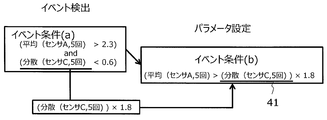
また、関連イベントの発生を判定する条件は、センサ1A~1Qのうちの少なくとも一部のセンサの出力値が、所定のイベントの発生に相当するイベント条件を満足した際の、前記複数のセンサのうちの少なくとも一つのセンサの出力値に応じて設定されても良い。例えば、関連イベントの発生を判定する条件は、変数を用いて設定されても良く、先ずセンサ1A~1Qの出力値に基づいてイベントの発生を判定した場合、このセンサ1A~1Qの出力値を次の関連イベントを判定する条件の変数に代入する構成としても良い。図8は、関連イベントの発生を判定するための条件に変数を用いて設定する例を示す図である。このように所定のイベント条件を満足した際の、センサの出力値を用いて関連イベントの発生を判定する条件を設定することで、関連イベントの発生を判定する条件としてイベントの発生状況に応じた適切な値を用いることができ、適切な判定を行わせることができる。
図8の例では、イベント条件(a)として、センサ1Aの直近5回の平均値が2.3以上、且つセンサ1Cの直近5回の分散値が0.6以下と設定し、このイベント条件(a)を満足した場合にイベント1の発生を判定する。この分散値が例えば0.5であった場合に、新たな関連イベント2を判定するためのイベント条件(b)の変数41にイベント1で求めた分散値0.5を代入してイベント条件(b)を設定する。
図9は、イベントの遷移に従ってイベント条件の判定が規則的に繰り返された例を示す図である。図6に示した各部の動作S10~S40により、随時イベントの発生が判定され、イベント条件が更新されるので、イベントが繰り返し発生すると図9のようにイベント条件の設定と判定が繰り返される。動作設定部14は、図9のようにイベント条件の設定が規則的に繰り返された場合、この繰り返されたイベント条件と繰り返しのタイミング(時刻や周期)をメモリ15に共通動作パターンとして記憶し、この共通動作パターンに従って動作パラメータの設定を行っても良い。例えば、イベント判定手段13によりイベント条件(a)が満たされたと判定されると、動作設定部14は遷移パターンに従ってイベント条件(b)(c)を設定する。次にイベント判定手段13によりイベント条件(b)が満たされたと判定されると、動作設定部14はイベント条件(d)(e)を設定し、イベント条件(d)が満たされたと判定されると、イベント条件(f)(g)を設定する。そして、イベント判定手段13によりイベント条件(f)が満たされたと判定されると、動作設定部14はイベント条件(a)を設定し、イベント条件(a)が満たされたと判定されると、上述のとおりイベント条件(b)(c)を設定する。
図9では、イベント条件(a)(b)(d)(f)が満たされたことが繰り返されており、この繰り返しが所定回数以上となった場合、動作設定部14は繰り返したイベント条件と各イベント条件が満たされた時刻や時間間隔を共通動作パターンとしてメモリ15に記憶させることで、一連の動作を学習する。そして、学習後、この共通動作パターンの最初のイベント条件(a)が満たされたことが判定された場合、動作設定部14は、次のイベント条件(b)(c)を設定せずに学習したイベント条件(b)を判定するための各センサーの動作パラメータを設定する。また、動作設定部14は、学習した共通動作パターンに基づき、イベント条件(b)が満たされた時刻や時間間隔で次のイベント条件(d)を判定するための各センサーの動作パラメータを設定する。同様に動作設定部14は、学習した共通動作パターンに基づいてイベント条件(f)を判定するための各センサーの動作パラメータを設定し、イベント条件(f)が満たされたことが判定された場合、次のイベント条件(a)及びイベント条件(a)を判定するための各センサーの動作パラメータを設定し、学習に基づく処理を終了する。
このように一連の動作の流れを学習することにより、動作パラメータの設定をルーチン化して動作効率を向上させることができる。例えば、イベント判定手段13による判定を省略できるので、イベント判定手段13の処理負荷を減らし、イベント判定手段13による消費電力を低減できる。なお、上記のようにイベント条件(a)~(g)を繰り返して設定した場合、イベント条件(a)~(e)は、最終的なイベント条件(f)を判定するための暫定的な条件である場合がある。この場合、最初のイベント条件(a)が満たされたことが判定された際、動作設定部14は、最終的なイベント条件(f)を判定するための各センサーの動作パラメータを設定しても良い。これにより、暫定的なイベント条件(b)~(e),(g)を判定するための動作パラメータを設定せずに、更なる効率化を図ることができる。
《具体例1》
図10は、センサシステム10における動作の具体例1を示す図である。具体例1は、ユーザ宅内に複数設けられた複合センサユニット1における地震発生時の動作の一例を示す。本具体例1では、地震イベントやガス漏れイベント、火事イベント等をイベントとして判定する例を示すが、イベントはこれらの具体的な事象に限らず、前述のとおりセンサ1A~1Qのうちの少なくとも一部の出力値がイベント条件を満足したことであれば良い。先ず、加速度センサ1F、ガスセンサ1G、温度センサ1H、音センサ1Iを動作させ、これらの出力値を信号処理部12で信号処理する。イベント判定部13は、加速度センサ1Fの直近5回の出力値を平均した平均値が100mgを超えたか否かをイベント条件(f)として判定し、当該平均値が100mgを超えた場合、即ちイベント条件(f)を満足した場合、地震イベントが発生したと判定する。この地震イベントの発生をイベント判定部13が動作設定部14に通知すると、動作設定部14は、メモリ15に記憶された遷移パターンを参照して関連イベントを判定するための動作パラメータを設定する。例えば、ガスセンサの分解能を高い値とする動作パラメータや、サンプリング間隔を短い値とする動作パラメータに変更する。また、関連イベントとしてガス漏れイベントを判定するためのイベント条件(g)や火事イベントを判定するためのイベント条件(h)を設定する。このときガス漏れイベントの優先順位を1、火事イベントの優先順位を2に設定する。イベント条件(g)は、例えばガスセンサ1Gの直近10回の出力値の変化率が20%を超えたか否かである。また、イベント条件(h)は、例えば温度センサ1Hの出力値を前回の出力値と比較した時の差分を5回求め、この何れかの差分が5℃を超えたか否かである。
図10は、センサシステム10における動作の具体例1を示す図である。具体例1は、ユーザ宅内に複数設けられた複合センサユニット1における地震発生時の動作の一例を示す。本具体例1では、地震イベントやガス漏れイベント、火事イベント等をイベントとして判定する例を示すが、イベントはこれらの具体的な事象に限らず、前述のとおりセンサ1A~1Qのうちの少なくとも一部の出力値がイベント条件を満足したことであれば良い。先ず、加速度センサ1F、ガスセンサ1G、温度センサ1H、音センサ1Iを動作させ、これらの出力値を信号処理部12で信号処理する。イベント判定部13は、加速度センサ1Fの直近5回の出力値を平均した平均値が100mgを超えたか否かをイベント条件(f)として判定し、当該平均値が100mgを超えた場合、即ちイベント条件(f)を満足した場合、地震イベントが発生したと判定する。この地震イベントの発生をイベント判定部13が動作設定部14に通知すると、動作設定部14は、メモリ15に記憶された遷移パターンを参照して関連イベントを判定するための動作パラメータを設定する。例えば、ガスセンサの分解能を高い値とする動作パラメータや、サンプリング間隔を短い値とする動作パラメータに変更する。また、関連イベントとしてガス漏れイベントを判定するためのイベント条件(g)や火事イベントを判定するためのイベント条件(h)を設定する。このときガス漏れイベントの優先順位を1、火事イベントの優先順位を2に設定する。イベント条件(g)は、例えばガスセンサ1Gの直近10回の出力値の変化率が20%を超えたか否かである。また、イベント条件(h)は、例えば温度センサ1Hの出力値を前回の出力値と比較した時の差分を5回求め、この何れかの差分が5℃を超えたか否かである。
そして、イベント条件(g)を満足した場合、イベント判定部13は、ガス漏れイベントの発生を判定する。このガス漏れイベントの発生をイベント判定部13が動作設定部14に通知すると、動作設定部14は、メモリ15に記憶された遷移パターンを参照して関連イベントを判定するための動作パラメータを設定する。例えば、送信間隔を短い値とする動作パラメータや、音センサ1Iの分解能を高い値とする動作パラメータ、サンプリング間隔を短い値とする動作パラメータに変更する。また、関連イベントとして人検知イベントを判定するためのイベント条件(i)や火事イベントを判定するためのイベント条件(j)を設定する。このとき人検知イベントの優先順位を2、火事イベントの優先順位を1に設定する。イベント条件(i)は、例えば音センサ1Iの直近500回の出力値の何れかが80dBを超えたか否かである。また、イベント条件(j)は、例えば前記ガス漏れイベントの判定に用いた変化率で200を割った値を変数f(ガス)とし、f(ガス)回の温度センサ1Hの出力値の平均値が40℃を超えたか否かである。
イベント条件(j)を満足した場合、又はイベント条件(i)とイベント条件(j)とを同時に満足した場合、優先度の高いイベント条件(i)を優先し、イベント判定部13は、火事イベントの発生を判定する。この火事イベントの発生をイベント判定部13が動作設定部14に通知すると、動作設定部14は、メモリ15に記憶された遷移パターンを参照して関連イベントを判定するための動作パラメータを設定する。例えば、赤外線センサ1Jのゲイン及びサンプリング間隔の動作パラメータを設定して赤外線センサ1Jをスリープ状態から動作状態とさせる。この場合、赤外線センサ1Jのゲインは、火事の状況を詳細に判定できるように通常の値よりも高い値が遷移パターンに定められており、この遷移パターンに従って高ゲインの動作パラメータが設定される。同様に、サンプリング間隔も遷移パターンに従って通常より短いサンプリング間隔となる動作パラメータが設定される。また、関連イベントとして火元検知イベントを判定するためのイベント条件(k)を設定する。イベント条件(k)は、例えば前記火事イベントの判定に用いた平均値で10を割った値を変数f(温度)とし、赤外線センサ1Jの直近10回の出力値の変化率がf(温度)℃を超えたか否かである。
上述のように地震イベントの発生を判定した場合には、ガス漏れや火事の恐れがあるので関連イベントであるガス漏れイベントや火事イベントの発生の判定に必要なセンサ1F~1Jの動作及び関連イベント条件(g)(h)を定める動作パラメータを、前記関連イベントの発生を判定するためにより有利な値に変更する。そして、この動作パラメータに従って動作したセンサ1F~1Jの出力値が前記関連イベントの発生に相当する関連イベント条件(g)(h)を満足したことをもって、前記関連イベントであるガス漏れイベントや火事イベントの発生を判定する。
同様に、ガス漏れイベントの発生を判定した場合には、ガス漏れ情報を緊急で知らせるために送信間隔を短くすると共に、ガス漏れにより火事の可能性が高まったため、火事の情報や逃げ遅れた人がいないかを判定するため、火事イベントや人検知イベントの発生の判定に必要なセンサ1F~1Jの動作及び関連イベント条件(i)(j)を定める動作パラメータを変更する。そして、この動作パラメータに従って動作したセンサ1F~1Jの出力値が前記関連イベントの発生に相当する関連イベント条件(i)(j)を満足したことをもって、前記関連イベントである火事イベントや人検知イベントの発生を判定する。
このようにイベントの発生状況に応じて、関連イベントの発生の判定に必要なセンサの動作パラメータを、前記関連イベントの発生を判定するためにより有利な値に設定でき、センサ1A~1Qや通信部16等、センサシステム10の各部を適切に制御できる。
《具体例2》
図11は、センサシステム10における動作の具体例2を示す図である。具体例2は、ユーザの寝室内に設けられたセンサシステム10における睡眠時の動作の一例を示す。先ず、音センサ1I、照度センサ1K、温湿度センサ1L、気圧センサ1Mを動作させ、これらの出力値を信号処理部12で信号処理する。イベント判定部13は、照度センサ1Kの直近5回の出力値を平均した平均値が1lxを下回ったか否かをイベント条件(l)として判定し、当該平均値が1lx未満となった場合、即ちイベント条件(l)を満足した場合、入眠イベントが発生したと判定する。この入眠イベントの発生をイベント判定部13が動作設定部14に通知すると、動作設定部14は、メモリ15に記憶された遷移パターンを参照して関連イベントを判定するための動作パラメータを設定する。例えば、温湿度センサ1Lの分解能を高い値とする動作パラメータや、サンプリング間隔を短い値とする動作パラメータに変更する。また、関連イベントとして降雨イベントを判定するためのイベント条件(m)を設定する。イベント条件(m)は、例えば気圧センサ1Mの出力値を前回の出力値と比較して差分を600回求め、この何れかの差分が5hPaを超えたか否かである。
図11は、センサシステム10における動作の具体例2を示す図である。具体例2は、ユーザの寝室内に設けられたセンサシステム10における睡眠時の動作の一例を示す。先ず、音センサ1I、照度センサ1K、温湿度センサ1L、気圧センサ1Mを動作させ、これらの出力値を信号処理部12で信号処理する。イベント判定部13は、照度センサ1Kの直近5回の出力値を平均した平均値が1lxを下回ったか否かをイベント条件(l)として判定し、当該平均値が1lx未満となった場合、即ちイベント条件(l)を満足した場合、入眠イベントが発生したと判定する。この入眠イベントの発生をイベント判定部13が動作設定部14に通知すると、動作設定部14は、メモリ15に記憶された遷移パターンを参照して関連イベントを判定するための動作パラメータを設定する。例えば、温湿度センサ1Lの分解能を高い値とする動作パラメータや、サンプリング間隔を短い値とする動作パラメータに変更する。また、関連イベントとして降雨イベントを判定するためのイベント条件(m)を設定する。イベント条件(m)は、例えば気圧センサ1Mの出力値を前回の出力値と比較して差分を600回求め、この何れかの差分が5hPaを超えたか否かである。
そして、イベント条件(m)を満足した場合、イベント判定部13は、降雨イベントの発生を判定する。この降雨イベントの発生をイベント判定部13が動作設定部14に通知すると、動作設定部14は、メモリ15に記憶された遷移パターンを参照して関連イベントを判定するための動作パラメータを設定する。例えば、温湿度センサ1Lの分解能を高い値とする動作パラメータや、サンプリング間隔を短い値とする動作パラメータに変更する。また、関連イベントとして不快イベントを判定するためのイベント条件(n)やいびきイベントを判定するためのイベント条件(o)を設定する。例えば前記降雨イベントの判定に用いた差分で20を割った値を変数f(気圧)とし、温湿度センサ1Lで測定した湿度の出力値を前回の出力値と比較して差分を50回求め、この差分の何れかがf(気圧)を超えたか否かをイベント条件(n)とする。また、イベント条件(o)は、例えば音センサ1Iにより音のスペクトルを100回測定し、10Hzの音が10dBを超えたか否かである。
イベント条件(o)を満足した場合、イベント判定部13は、いびきイベントの発生を判定する。このいびきイベントの発生をイベント判定部13が動作設定部14に通知すると、動作設定部14は、メモリ15に記憶された遷移パターンを参照して関連イベントを判定するための動作パラメータを設定する。例えば、音センサ1Iの分解能を高い値とする動作パラメータやサンプリング間隔を短くする動作パラメータを設定する。また、関連イベントとして無呼吸症候群イベントを判定するためのイベント条件(p)と起床イベントを判定するためのイベント条件(q)を設定する。例えば、前記いびきイベントの判定に用いた音の平均値を変数f(音)dBとし、音センサ1Iの出力値がf(音)dB以上となった回数をカウントし、この回数が3分以内に5回を超えたか否かをイベント条件(p)とする。また、イベント条件(q)は、例えば照度センサ1Kの直近5回の出力値を平均した平均値が5lxを超えたか否かである。
そして、イベント条件(p)を満足した場合、イベント判定部13は、無呼吸症候群イベントの発生を判定する。この無呼吸症候群イベントの発生をイベント判定部13が動作設定部14に通知すると、動作設定部14は、この無呼吸症候群イベントの発生回数や発生時刻をメモリ15に記憶させる。また、イベント条件(q)を満足した場合、イベント判定部13は、起床イベントの発生を判定する。この起床イベントの発生をイベント判定部13が動作設定部14に通知すると、動作設定部14は、メモリ15に記憶されている遷移パターンを参照して関連イベントを判定するための動作パラメータを設定する。例えば、睡眠中に取得した各センサの出力値や判定したイベントの内容をアプリケーションサーバ4へ送信する。また、温湿度センサ1Lの分解能を低い値とする動作パラメータや、サンプリング間隔を長い値とする動作パラメータに変更する。また、関連イベントとして入眠イベントを判定するためのイベント条件(l)を設定する。即ち、睡眠時のイベントを判定する遷移パターンのうち、最初のイベントを判定する状態(初期状態)に戻る。
上述のように入眠イベントの発生を判定した場合には、快適性に係る情報を取得するために、温湿度情報を詳細に出力し、降雨イベントを判定した場合には、降雨による湿度上昇の変化を捉えるため、温湿度センサ1Lの動作を更に変更し、いびきイベントを判定した場合には、いびきの質をとらえるために音センサ1Iの動作設定を変更し、無呼吸症候群イベントを判定できるように設定する。
《具体例3》
図12は、建物に設置したセンサシステム10における地震発生時の動作の一例を示す。先ず、加速度センサ1F、照度センサ1K、気圧センサ1Mを動作させ、これらの出力値を信号処理部12で信号処理する。イベント判定部13は、加速度センサ1Fの直近5回の出力値を平均した平均値が100mgを超えたか否かをイベント条件(r)として判定し、当該平均値が100mgを超えた場合、即ちイベント条件(r)を満足した場合、地震イベントが発生したと判定する。この地震イベントの発生をイベント判定部13が動作設定部14に通知すると、動作設定部14は、メモリ15に記憶された遷移パターンを参照して関連イベントを判定するための動作パラメータを設定する。例えば、照度センサ1Kのサンプリング間隔を短い値とする動作パラメータに変更する。また、関連イベントとして停電イベントを判定するためのイベント条件(s)を設定する。イベント条件(s)は、例えば照度センサ1Kの出力値を前回の出力値と比較した時の差分を10回求め、この何れかの差分の最小値が10lxを超えたか否かである。更に、動作設定部14は、気圧センサ1Mのサンプリング間隔を短い値とする動作パラメータ、及び分解能を高い値とする動作パラメータに変更する。また、関連イベントとして建物の倒壊イベントを判定するためのイベント条件(t)を設定する。イベント条件(t)は、例えば気圧センサ1Mの出力値を前回の出力値と比較した時の差分を40回求め、この何れかの差分が2hPaを超えたか否かである。
図12は、建物に設置したセンサシステム10における地震発生時の動作の一例を示す。先ず、加速度センサ1F、照度センサ1K、気圧センサ1Mを動作させ、これらの出力値を信号処理部12で信号処理する。イベント判定部13は、加速度センサ1Fの直近5回の出力値を平均した平均値が100mgを超えたか否かをイベント条件(r)として判定し、当該平均値が100mgを超えた場合、即ちイベント条件(r)を満足した場合、地震イベントが発生したと判定する。この地震イベントの発生をイベント判定部13が動作設定部14に通知すると、動作設定部14は、メモリ15に記憶された遷移パターンを参照して関連イベントを判定するための動作パラメータを設定する。例えば、照度センサ1Kのサンプリング間隔を短い値とする動作パラメータに変更する。また、関連イベントとして停電イベントを判定するためのイベント条件(s)を設定する。イベント条件(s)は、例えば照度センサ1Kの出力値を前回の出力値と比較した時の差分を10回求め、この何れかの差分の最小値が10lxを超えたか否かである。更に、動作設定部14は、気圧センサ1Mのサンプリング間隔を短い値とする動作パラメータ、及び分解能を高い値とする動作パラメータに変更する。また、関連イベントとして建物の倒壊イベントを判定するためのイベント条件(t)を設定する。イベント条件(t)は、例えば気圧センサ1Mの出力値を前回の出力値と比較した時の差分を40回求め、この何れかの差分が2hPaを超えたか否かである。
このように、地震イベントの発生を判定した場合には、関連イベントである停電イベントや建物の倒壊イベントを判定するのに有利な動作パラメータを設定することにより、センサシステム10のセンサ1A~1Qや通信部16が自律的に適切な動作を行うことができる。
《具体例4》
図13は、ユーザの部屋に置かれたセンサシステム10の動作の一例を示す。先ず、加速度センサ1F、照度センサ1K、音センサ1I、気圧センサ1Mを動作させ、これらの出力値を信号処理部12で信号処理する。
図13は、ユーザの部屋に置かれたセンサシステム10の動作の一例を示す。先ず、加速度センサ1F、照度センサ1K、音センサ1I、気圧センサ1Mを動作させ、これらの出力値を信号処理部12で信号処理する。
イベント判定部13は、照度センサ1Kの出力値を前回の出力値と比較して差分を5回求め、何れかの差分が200lxを超えたか否かをイベント条件(v)として判定する。更に、イベント判定部13は、音センサ1Iの直近5回の出力値の平均が70dBを超えたか否かをイベント条件(w)として判定する。このイベント条件(v)又はのイベント条件(w)を満足した場合、イベント判定部13は入室イベントが発生したと判定し、この入室イベントの発生を動作設定部14に通知する。動作設定部14は、メモリ15に記憶された遷移パターンを参照して動作パラメータを設定する。例えば、温湿度センサ1Lのサンプリング間隔を短い値とする動作パラメータに変更する。
また、イベント判定部13は、気圧センサ1Mの出力値を前回の出力値と比較して差分を5回求め、何れかの差分が0.5hPaを超えたか否かをイベント条件(x)として判定する。当該差分が0.5hPaを超えた場合、即ちイベント条件(x)を満足した場合、イベント判定部13は、換気扇が使用され、調理イベントが発生したと判定する。この調理イベントの発生をイベント判定部13が動作設定部14に通知すると、動作設定部14は、メモリ15に記憶された遷移パターンを参照して関連イベントを判定するための動作パラメータを設定する。例えば、関連イベントとして火事イベントを判定するためのイベント条件(z)を設定する。イベント条件(z)は、例えば温度センサ1Kの直近5回の出力値のうち、最少値が50℃を超えたか否かである。
そして、イベント判定部13は、加速度センサ1Fの直近5回の出力値うち、最大値が100mgを超えたか否かをイベント条件(u)として判定し、当該最大値が100mgを超えた場合、即ちイベント条件(u)を満足した場合、移動イベントが発生したと判定する。この移動イベントの発生をイベント判定部13が動作設定部14に通知すると、動作設定部14は、メモリ15に記憶された遷移パターンを参照して動作パラメータを設定する。例えば、センサシステム10の設置位置を変更するためにセンサシステム10を移動している場合、再び設置されるまで、測定を行う必要がないので、全センサの測定を停止させる、例えばサンプリング間隔を無限大とする操作パラメータを設定する。また、通信部16による送信も停止する。
そして、所定時間経過後に加速度センサ1Fを動作させ、関連イベントとして移動終了イベントを判定するためのイベント条件(y)を設定する。イベント条件(y)は、例えば、加速度センサ1Fの直近5回の出力値うち、最少値が10mg未満か否かである。
このように、通常は入室イベントや調理イベントの発生を判定し、センサシステム10の移動をした場合には、全てのセンサ1A~1Qの動作を停止させ、不必要な動作を抑制できる。
《具体例5》
図14は、ドアや窓に設置したセンサシステム10の動作の一例を示す。先ず、加速度センサ1F、花粉センサ1Nを動作させ、これらの出力値を信号処理部12で信号処理する。イベント判定部13は、加速度センサ1Fの直近5回の出力値を平均した平均値が50mgを超えたか否かをイベント条件(a1)として判定し、当該平均値が50mgを超えた場合、即ちイベント条件(a1)を満足した場合、開扉イベントが発生したと判定する。この開扉イベントの発生をイベント判定部13が動作設定部14に通知すると、動作設定部14は、メモリ15に記憶された遷移パターンを参照して関連イベントを判定するための動作パラメータを設定する。例えば、ドアや窓が開くまではメモリ15に各センサ1A~1Qの出力値を記憶させておき、開扉イベントの発生を判定した場合、即ちドアや窓が開き、通信環境が良くなった場合に各センサ1A~1Qの出力値をアプリケーションサーバ4へ送信させるように動作設定を行う。
図14は、ドアや窓に設置したセンサシステム10の動作の一例を示す。先ず、加速度センサ1F、花粉センサ1Nを動作させ、これらの出力値を信号処理部12で信号処理する。イベント判定部13は、加速度センサ1Fの直近5回の出力値を平均した平均値が50mgを超えたか否かをイベント条件(a1)として判定し、当該平均値が50mgを超えた場合、即ちイベント条件(a1)を満足した場合、開扉イベントが発生したと判定する。この開扉イベントの発生をイベント判定部13が動作設定部14に通知すると、動作設定部14は、メモリ15に記憶された遷移パターンを参照して関連イベントを判定するための動作パラメータを設定する。例えば、ドアや窓が開くまではメモリ15に各センサ1A~1Qの出力値を記憶させておき、開扉イベントの発生を判定した場合、即ちドアや窓が開き、通信環境が良くなった場合に各センサ1A~1Qの出力値をアプリケーションサーバ4へ送信させるように動作設定を行う。
また、花粉センサ1Nのサンプリング間隔を短くする動作パラメータ、及び花粉センサの分解能を高くする動作パラメータを設定する。また、関連イベントとして花粉警報イベントを判定するためのイベント条件(a2)を設定する。イベント条件(a2)は、例えば花粉センサ1Nの直近5回の出力値を平均した平均値が、0.2ppmを超えているか否かである。
このように、開扉イベントの発生を判定した場合に、通信部16の動作設定や、関連イベントである花粉警報イベントを判定するのに有利な動作パラメータを設定することにより、センサシステム10のセンサ1A~1Qや通信部16が自律的に適切な動作を行うことができる。
《具体例6》
図15は、工場の配管に設置したセンサシステム10の動作の一例を示す。先ず、加速度センサ1F、温度センサ1Hを動作させ、これらの出力値を信号処理部12で信号処理する。イベント判定部13は、加速度センサ1Fの直近5回の出力値を平均した平均値が50mgを超えたか否かをイベント条件(b1)として判定し、当該平均値が50mgを超えた場合、即ちイベント条件(b1)を満足した場合、配管異常イベントが発生したと判定する。この配管異常イベントの発生をイベント判定部13が動作設定部14に通知すると、動作設定部14は、メモリ15に記憶された遷移パターンを参照して関連イベントを判定するための動作パラメータを設定する。例えば、配管の温度を判定する温度センサ1Hのサンプリング間隔を短くする動作パラメータ、及び温度センサの分解能を高くする動作パラメータを設定する。また、関連イベントとして発熱検知イベントを判定するためのイベント条件(a2)を設定する。イベント条件(a2)は、例えば温度センサ1Hの直近5回の出力値を平均した平均値が、40℃を超えているか否かである。
図15は、工場の配管に設置したセンサシステム10の動作の一例を示す。先ず、加速度センサ1F、温度センサ1Hを動作させ、これらの出力値を信号処理部12で信号処理する。イベント判定部13は、加速度センサ1Fの直近5回の出力値を平均した平均値が50mgを超えたか否かをイベント条件(b1)として判定し、当該平均値が50mgを超えた場合、即ちイベント条件(b1)を満足した場合、配管異常イベントが発生したと判定する。この配管異常イベントの発生をイベント判定部13が動作設定部14に通知すると、動作設定部14は、メモリ15に記憶された遷移パターンを参照して関連イベントを判定するための動作パラメータを設定する。例えば、配管の温度を判定する温度センサ1Hのサンプリング間隔を短くする動作パラメータ、及び温度センサの分解能を高くする動作パラメータを設定する。また、関連イベントとして発熱検知イベントを判定するためのイベント条件(a2)を設定する。イベント条件(a2)は、例えば温度センサ1Hの直近5回の出力値を平均した平均値が、40℃を超えているか否かである。
このように、配管異常イベントの発生を判定した場合に、関連イベントである発熱検知イベントを判定するのに有利な動作パラメータを設定することにより、センサシステム10のセンサ1A~1Qや通信部16が自律的に適切な動作を行うことができる。
上記実施形態及び具体例によれば、イベントの発生状況に応じて動作パラメータが適切に設定されるため、センサシステム10のセンサ1A~1Qや通信部16が自律的に適切な動作を行うことができ、不必要な動作を行うことがなくなるため、消費電力を可及的に抑えることができる。従って、センサシステム10を電池で駆動する場合に、電池の交換回数が少なくなり、メンテナンスコストを抑えることができる。
1A-1Q センサ、1 複合センサユニット、2 ユーザ端末、3 ゲートウェイ、4 アプリケーションサーバ、10 センサシステム、12 信号処理部13 イベント判定部、14 動作設定部、15 メモリ、16 通信部
Claims (8)
- 複数のセンサを有し、複数の物理量を測定可能なセンサシステムであって、
前記複数のセンサの動作を設定する動作設定手段と、
前記複数のセンサのうちの少なくとも一部のセンサの出力値が、所定のイベントの発生に相当するイベント条件を満足したことをもって、前記所定のイベントが発生したことを判定するイベント判定手段と、
を備え、
前記イベント判定手段により、前記所定のイベントが発生したと判定された場合には、
前記動作設定手段は、前記複数のセンサのうち、前記所定のイベントの発生に関連して発生し得るイベントである関連イベントの発生の判定に必要なセンサの動作状態を変更することを特徴とする、センサシステム。 - 前記イベント判定手段は、前記複数のセンサのうち、前記関連イベントの発生の判定に必要なセンサを含むセンサの出力値が、前記関連イベントの発生に相当する関連イベント条件を満足したことをもって、前記関連イベントが発生したことを判定する、請求項1に記載のセンサシステム。
- 外部に設けられた受信装置へ前記センサの出力値を送信する送信手段を備え、
前記関連イベントの発生の判定に必要なセンサの動作状態の変更は、該センサの分解能、該センサによるデータのサンプリング間隔または、該センサからの出力値の送信間隔を前記関連イベントの発生を判定するためにより有利な値に設定するものであり、
前記イベント判定手段により、前記所定のイベントが発生したと判定された場合には、
前記動作設定手段は、前記関連イベントの発生の判定に必要なセンサの分解能を上昇させ、または、該センサによるデータのサンプリング間隔を短くし、または、該センサからの出力値の送信間隔を短くすることを特徴とする、請求項1又は2に記載のセンサシステム。 - 前記イベント判定手段により、前記所定のイベントが発生したと判定される前は、
前記動作設定手段は、前記関連イベントの発生の判定に必要なセンサの分解能、該センサによるデータのサンプリング間隔、または該センサからの無線通信の通信間隔のうちの少なくとも一つを、可及的に消費電力の少ない省電力モードにしておくことを特徴とする、請求項3に記載のセンサシステム。 - 前記複数のセンサのうちの少なくとも一部のセンサの出力値が、所定のイベントの発生に相当するイベント条件を満足した際の、前記複数のセンサのうちの少なくとも一つのセンサの出力値に応じて、前記関連イベント条件を変更することを特徴とする請求項1から3のいずれか一項に記載のセンサシステム。
- 前記イベント判定手段により、前記関連イベントの発生が判定された場合には、
前記動作設定手段は、前記複数のセンサのうち、前記関連イベントの発生にさらに関連して発生し得るイベントである第二関連イベントの発生の判定に必要なセンサの動作パラメータを、前記第二関連イベントの発生を判定するためにより有利な値に設定するとともに、
前記イベント判定手段は、前記複数のセンサのうち、前記第二関連イベントの発生の判定に必要なセンサを含むセンサの出力値が、前記第二関連イベントの発生に相当する第二関連イベント条件を満足したことをもって、前記第二関連イベントの発生を判定し、
前記第二関連イベントにさらに関連するイベントについても同様の処理を繰り返すことを特徴とする請求項1から4のいずれか一項に記載のセンサシステム。 - 前記センサシステムは、異なる物理量を検知する前記複数のセンサを一つのパッケージ内に配置した複合センサユニットであることを特徴とする、請求項1から5のいずれか一項に記載のセンサシステム。
- 前記複数のセンサの各々が、異なる物理量を検知する複数のセンサを一つのパッケージ内に配置した複合センサユニットであり、前記センサシステムは、所定の領域に配置された複数の複合センサユニットからなることを特徴とする、請求項1から5のいずれか一項に記載のセンサシステム。
Priority Applications (3)
| Application Number | Priority Date | Filing Date | Title |
|---|---|---|---|
| US15/509,378 US10365133B2 (en) | 2015-03-11 | 2016-02-26 | Sensor system |
| CN201680002586.2A CN106687774B (zh) | 2015-03-11 | 2016-02-26 | 传感器系统 |
| DE112016000097.9T DE112016000097B4 (de) | 2015-03-11 | 2016-02-26 | Sensorsystem |
Applications Claiming Priority (2)
| Application Number | Priority Date | Filing Date | Title |
|---|---|---|---|
| JP2015-048747 | 2015-03-11 | ||
| JP2015048747A JP6409629B2 (ja) | 2015-03-11 | 2015-03-11 | センサシステム |
Publications (1)
| Publication Number | Publication Date |
|---|---|
| WO2016143545A1 true WO2016143545A1 (ja) | 2016-09-15 |
Family
ID=56880043
Family Applications (1)
| Application Number | Title | Priority Date | Filing Date |
|---|---|---|---|
| PCT/JP2016/055759 Ceased WO2016143545A1 (ja) | 2015-03-11 | 2016-02-26 | センサシステム |
Country Status (5)
| Country | Link |
|---|---|
| US (1) | US10365133B2 (ja) |
| JP (1) | JP6409629B2 (ja) |
| CN (1) | CN106687774B (ja) |
| DE (1) | DE112016000097B4 (ja) |
| WO (1) | WO2016143545A1 (ja) |
Cited By (2)
| Publication number | Priority date | Publication date | Assignee | Title |
|---|---|---|---|---|
| CN108507668A (zh) * | 2017-02-28 | 2018-09-07 | 兄弟工业株式会社 | 移位探测装置、移位探测系统、移位探测方法 |
| CN112706716A (zh) * | 2020-12-17 | 2021-04-27 | 贵州师范学院 | 汽车远程护童系统 |
Families Citing this family (26)
| Publication number | Priority date | Publication date | Assignee | Title |
|---|---|---|---|---|
| JP2018061110A (ja) * | 2016-10-04 | 2018-04-12 | 三菱電機株式会社 | サーバ装置、ネットワークシステム及びセンサ機器 |
| US10955373B2 (en) * | 2016-10-14 | 2021-03-23 | Walmart Apollo, Llc | Systems, devices, and methods for object quality monitoring |
| JP6870955B2 (ja) * | 2016-10-27 | 2021-05-12 | 日本電信電話株式会社 | センシングシステム、可搬型無線中継装置およびユーザ特定方法 |
| JP2018077045A (ja) * | 2016-11-07 | 2018-05-17 | オムロン株式会社 | 倒壊判定ユニット、被害状況推定装置、端末、倒壊検知システム、倒壊判定方法、および倒壊判定プログラム |
| JP6801158B2 (ja) | 2017-03-13 | 2020-12-16 | オムロン株式会社 | 環境センサ |
| JP6801157B2 (ja) * | 2017-03-13 | 2020-12-16 | オムロン株式会社 | 環境センサ |
| JP6838434B2 (ja) * | 2017-03-13 | 2021-03-03 | オムロン株式会社 | 環境センサ |
| JP6828543B2 (ja) * | 2017-03-22 | 2021-02-10 | 沖電気工業株式会社 | 斜面監視装置、斜面監視方法、および、斜面監視プログラム |
| JP6903982B2 (ja) * | 2017-03-23 | 2021-07-14 | 日本電気株式会社 | 管理装置、環境センシングシステム、管理方法及びプログラム |
| JP6865616B2 (ja) * | 2017-03-31 | 2021-04-28 | 株式会社クボタ | 端末装置 |
| JP6865618B2 (ja) * | 2017-03-31 | 2021-04-28 | 株式会社クボタ | 端末装置 |
| JP6865617B2 (ja) * | 2017-03-31 | 2021-04-28 | 株式会社クボタ | 端末装置 |
| CN107124458B (zh) * | 2017-04-27 | 2020-01-31 | 大连云动力科技有限公司 | 智能感知设备及感知系统 |
| JPWO2018207266A1 (ja) * | 2017-05-09 | 2019-06-27 | 三菱電機株式会社 | 無線センサ集約局、無線センサ装置、サーバ装置、無線センサシステム、および無線センサ制御方法 |
| CN107222366B (zh) * | 2017-06-08 | 2019-12-20 | 江苏博大光通物联科技有限公司 | 基于低功耗广域网的窨井环境监测方法、设备和系统 |
| JP6915504B2 (ja) * | 2017-11-10 | 2021-08-04 | オムロン株式会社 | センサ装置 |
| CN108489134A (zh) | 2018-04-09 | 2018-09-04 | 珠海格力电器股份有限公司 | 空调系统 |
| JP7139823B2 (ja) * | 2018-09-21 | 2022-09-21 | オムロン株式会社 | 感震センサ及びセンサ制御方法 |
| US11057741B2 (en) * | 2018-12-17 | 2021-07-06 | Jack C. Hunter | Personal monitoring system |
| JP7288372B2 (ja) * | 2019-08-28 | 2023-06-07 | 積水樹脂株式会社 | センサシステム |
| CN112799856A (zh) * | 2019-11-14 | 2021-05-14 | 华为技术有限公司 | 一种用于获取数据的方法及装置 |
| JP7014860B2 (ja) * | 2019-12-10 | 2022-02-01 | 環境リサーチ株式会社 | 空気採取装置、遠隔空気測定装置、空気採取システム、遠隔空気測定システム、空気採取プログラム、遠隔空気測定プログラムおよび記録媒体 |
| EP4116632B1 (en) * | 2020-03-04 | 2025-10-22 | Mitsubishi Electric Corporation | Air-conditioning system, management device, sensor data acquisition method and program |
| KR102414002B1 (ko) * | 2020-07-13 | 2022-06-29 | 한국철도기술연구원 | 독립모듈형 비상대피 인디케이팅 시스템 및 방법 |
| US11920813B2 (en) * | 2020-12-14 | 2024-03-05 | Futura Technologies, LLC | Drop-in exhaust fan humidity controller |
| JP7187730B1 (ja) | 2022-08-25 | 2022-12-12 | 応用地質株式会社 | 土砂災害モニタリング方法及び土砂災害モニタリングシステム |
Citations (4)
| Publication number | Priority date | Publication date | Assignee | Title |
|---|---|---|---|---|
| JP2005013057A (ja) * | 2003-06-25 | 2005-01-20 | Matsushita Electric Ind Co Ltd | 植物育成システムと情報提供サービス |
| JP2005504268A (ja) * | 2001-07-12 | 2005-02-10 | ダイムラークライスラー・アクチェンゲゼルシャフト | ヒトによって主観的に現実のものとしてとられた環境の判断およびモデリングのための方法および装置 |
| JP2006170751A (ja) * | 2004-12-15 | 2006-06-29 | Nippon Telegr & Teleph Corp <Ntt> | センシングシステムおよび方法 |
| JP2010256193A (ja) * | 2009-04-27 | 2010-11-11 | Transvirtual Inc | 多変量検出装置および多変量検出方法 |
Family Cites Families (10)
| Publication number | Priority date | Publication date | Assignee | Title |
|---|---|---|---|---|
| JP2005135057A (ja) * | 2003-10-29 | 2005-05-26 | Okutorii:Kk | リライトカードの処理装置 |
| US7142107B2 (en) | 2004-05-27 | 2006-11-28 | Lawrence Kates | Wireless sensor unit |
| US7537171B2 (en) | 2004-11-17 | 2009-05-26 | Emerson Electric Co. | Thermostat control system providing power saving transmissions |
| JP4977534B2 (ja) | 2007-06-07 | 2012-07-18 | 株式会社日立製作所 | センサネットシステム、及びセンサノード |
| CN104503608B (zh) * | 2007-07-09 | 2017-08-11 | 索尼株式会社 | 电子设备及其控制方法 |
| CN101621436B (zh) * | 2008-07-03 | 2012-09-05 | 王金虎 | 一种基于无线网状网的服务提供系统及终端设备 |
| US20110248846A1 (en) | 2010-04-13 | 2011-10-13 | Green SHM Systems, Inc, Incorporated | Wireless Sensing Module and Method of Operation |
| JP5766503B2 (ja) | 2011-05-13 | 2015-08-19 | 富士通テレコムネットワークス株式会社 | 無線管理システム、無線端末装置および伝送管理方法 |
| JP2013054518A (ja) | 2011-09-02 | 2013-03-21 | Daito Tekko Kk | 無線距離測定スイッチ,無線距離検知システム,携帯端末,そのプログラム,及び無線タグ |
| JP5968253B2 (ja) | 2013-03-06 | 2016-08-10 | 三菱電機株式会社 | 計測システム、統合コントローラ、プログラム、及びセンサ機器制御方法 |
-
2015
- 2015-03-11 JP JP2015048747A patent/JP6409629B2/ja active Active
-
2016
- 2016-02-26 CN CN201680002586.2A patent/CN106687774B/zh active Active
- 2016-02-26 US US15/509,378 patent/US10365133B2/en active Active
- 2016-02-26 WO PCT/JP2016/055759 patent/WO2016143545A1/ja not_active Ceased
- 2016-02-26 DE DE112016000097.9T patent/DE112016000097B4/de active Active
Patent Citations (4)
| Publication number | Priority date | Publication date | Assignee | Title |
|---|---|---|---|---|
| JP2005504268A (ja) * | 2001-07-12 | 2005-02-10 | ダイムラークライスラー・アクチェンゲゼルシャフト | ヒトによって主観的に現実のものとしてとられた環境の判断およびモデリングのための方法および装置 |
| JP2005013057A (ja) * | 2003-06-25 | 2005-01-20 | Matsushita Electric Ind Co Ltd | 植物育成システムと情報提供サービス |
| JP2006170751A (ja) * | 2004-12-15 | 2006-06-29 | Nippon Telegr & Teleph Corp <Ntt> | センシングシステムおよび方法 |
| JP2010256193A (ja) * | 2009-04-27 | 2010-11-11 | Transvirtual Inc | 多変量検出装置および多変量検出方法 |
Cited By (2)
| Publication number | Priority date | Publication date | Assignee | Title |
|---|---|---|---|---|
| CN108507668A (zh) * | 2017-02-28 | 2018-09-07 | 兄弟工业株式会社 | 移位探测装置、移位探测系统、移位探测方法 |
| CN112706716A (zh) * | 2020-12-17 | 2021-04-27 | 贵州师范学院 | 汽车远程护童系统 |
Also Published As
| Publication number | Publication date |
|---|---|
| CN106687774A (zh) | 2017-05-17 |
| US20170284840A1 (en) | 2017-10-05 |
| DE112016000097T5 (de) | 2017-05-24 |
| US10365133B2 (en) | 2019-07-30 |
| CN106687774B (zh) | 2019-07-09 |
| JP2016170541A (ja) | 2016-09-23 |
| JP6409629B2 (ja) | 2018-10-24 |
| DE112016000097B4 (de) | 2023-12-21 |
Similar Documents
| Publication | Publication Date | Title |
|---|---|---|
| JP6409629B2 (ja) | センサシステム | |
| US10908561B2 (en) | Environment controller and method for inferring one or more commands for controlling an appliance taking into account room characteristics | |
| CN101422019B (zh) | 无线自动化系统的动态值报告 | |
| US10409239B2 (en) | Wireless sensor device with wireless remote programming | |
| EP1943569B1 (en) | Application of microsystems for real time ieq control | |
| Somov et al. | A wireless sensor–actuator system for hazardous gases detection and control | |
| US10837665B2 (en) | Multi-function thermostat with intelligent ventilator control for frost/mold protection and air quality control | |
| US11460209B2 (en) | Environment controller and method for generating a predictive model of a neural network through distributed reinforcement learning | |
| US20190278242A1 (en) | Training server and method for generating a predictive model for controlling an appliance | |
| US8184004B2 (en) | System to detect presence in a space | |
| US10895853B2 (en) | Inference server and environment controller for inferring one or more commands for controlling an appliance taking into account room characteristics | |
| US11861482B2 (en) | Training server and method for generating a predictive model of a neural network through distributed reinforcement learning | |
| US20190107307A1 (en) | System for Management of an HVAC System | |
| EP3667440A1 (en) | Environment controller and method for improving predictive models used for controlling a temperature in an area | |
| US10587996B2 (en) | Retroactive messaging for handling missed synchronization events | |
| KR102130030B1 (ko) | 공동 주택 자동 온도 조절 시스템 | |
| JP2011247514A (ja) | 設備制御装置、及び、プログラム | |
| JP6705961B2 (ja) | 自動開閉扉の監視装置 | |
| GB2528142A (en) | Method, data processing unit and system for managing a property | |
| EP3865781A1 (en) | A control system and a method for controlling indoor environmental conditions | |
| US12217153B2 (en) | Training server and method for generating a predictive model of a neural network through distributed reinforcement learning | |
| JP2021129187A (ja) | 屋内環境制御システム及び施設 | |
| JP2015002577A (ja) | 電力管理装置および電力管理方法 | |
| JP2017188151A (ja) | 設備管理装置及び設備管理方法 |
Legal Events
| Date | Code | Title | Description |
|---|---|---|---|
| 121 | Ep: the epo has been informed by wipo that ep was designated in this application |
Ref document number: 16761516 Country of ref document: EP Kind code of ref document: A1 |
|
| WWE | Wipo information: entry into national phase |
Ref document number: 112016000097 Country of ref document: DE |
|
| WWE | Wipo information: entry into national phase |
Ref document number: 15509378 Country of ref document: US |
|
| 122 | Ep: pct application non-entry in european phase |
Ref document number: 16761516 Country of ref document: EP Kind code of ref document: A1 |