WO2016140061A1 - 選択性透過膜及びその製造方法 - Google Patents
選択性透過膜及びその製造方法 Download PDFInfo
- Publication number
- WO2016140061A1 WO2016140061A1 PCT/JP2016/054523 JP2016054523W WO2016140061A1 WO 2016140061 A1 WO2016140061 A1 WO 2016140061A1 JP 2016054523 W JP2016054523 W JP 2016054523W WO 2016140061 A1 WO2016140061 A1 WO 2016140061A1
- Authority
- WO
- WIPO (PCT)
- Prior art keywords
- phospholipid
- membrane
- glycero
- phosphocholine
- fatty acid
- Prior art date
- Legal status (The legal status is an assumption and is not a legal conclusion. Google has not performed a legal analysis and makes no representation as to the accuracy of the status listed.)
- Ceased
Links
Images
Classifications
-
- B—PERFORMING OPERATIONS; TRANSPORTING
- B01—PHYSICAL OR CHEMICAL PROCESSES OR APPARATUS IN GENERAL
- B01D—SEPARATION
- B01D67/00—Processes specially adapted for manufacturing semi-permeable membranes for separation processes or apparatus
- B01D67/0081—After-treatment of organic or inorganic membranes
- B01D67/0088—Physical treatment with compounds, e.g. swelling, coating or impregnation
-
- B—PERFORMING OPERATIONS; TRANSPORTING
- B01—PHYSICAL OR CHEMICAL PROCESSES OR APPARATUS IN GENERAL
- B01D—SEPARATION
- B01D67/00—Processes specially adapted for manufacturing semi-permeable membranes for separation processes or apparatus
- B01D67/0081—After-treatment of organic or inorganic membranes
- B01D67/0093—Chemical modification
- B01D67/00933—Chemical modification by addition of a layer chemically bonded to the membrane
-
- B—PERFORMING OPERATIONS; TRANSPORTING
- B01—PHYSICAL OR CHEMICAL PROCESSES OR APPARATUS IN GENERAL
- B01D—SEPARATION
- B01D69/00—Semi-permeable membranes for separation processes or apparatus characterised by their form, structure or properties; Manufacturing processes specially adapted therefor
- B01D69/02—Semi-permeable membranes for separation processes or apparatus characterised by their form, structure or properties; Manufacturing processes specially adapted therefor characterised by their properties
-
- B—PERFORMING OPERATIONS; TRANSPORTING
- B01—PHYSICAL OR CHEMICAL PROCESSES OR APPARATUS IN GENERAL
- B01D—SEPARATION
- B01D69/00—Semi-permeable membranes for separation processes or apparatus characterised by their form, structure or properties; Manufacturing processes specially adapted therefor
- B01D69/12—Composite membranes; Ultra-thin membranes
-
- B—PERFORMING OPERATIONS; TRANSPORTING
- B01—PHYSICAL OR CHEMICAL PROCESSES OR APPARATUS IN GENERAL
- B01D—SEPARATION
- B01D71/00—Semi-permeable membranes for separation processes or apparatus characterised by the material; Manufacturing processes specially adapted therefor
- B01D71/02—Inorganic material
- B01D71/024—Oxides
- B01D71/025—Aluminium oxide
-
- B—PERFORMING OPERATIONS; TRANSPORTING
- B01—PHYSICAL OR CHEMICAL PROCESSES OR APPARATUS IN GENERAL
- B01D—SEPARATION
- B01D71/00—Semi-permeable membranes for separation processes or apparatus characterised by the material; Manufacturing processes specially adapted therefor
- B01D71/06—Organic material
-
- C—CHEMISTRY; METALLURGY
- C02—TREATMENT OF WATER, WASTE WATER, SEWAGE, OR SLUDGE
- C02F—TREATMENT OF WATER, WASTE WATER, SEWAGE, OR SLUDGE
- C02F1/00—Treatment of water, waste water, or sewage
- C02F1/44—Treatment of water, waste water, or sewage by dialysis, osmosis or reverse osmosis
-
- B—PERFORMING OPERATIONS; TRANSPORTING
- B01—PHYSICAL OR CHEMICAL PROCESSES OR APPARATUS IN GENERAL
- B01D—SEPARATION
- B01D2321/00—Details relating to membrane cleaning, regeneration, sterilization or to the prevention of fouling
- B01D2321/281—Details relating to membrane cleaning, regeneration, sterilization or to the prevention of fouling by applying a special coating to the membrane or to any module element
-
- B—PERFORMING OPERATIONS; TRANSPORTING
- B01—PHYSICAL OR CHEMICAL PROCESSES OR APPARATUS IN GENERAL
- B01D—SEPARATION
- B01D2323/00—Details relating to membrane preparation
- B01D2323/15—Use of additives
- B01D2323/218—Additive materials
-
- B—PERFORMING OPERATIONS; TRANSPORTING
- B01—PHYSICAL OR CHEMICAL PROCESSES OR APPARATUS IN GENERAL
- B01D—SEPARATION
- B01D2325/00—Details relating to properties of membranes
- B01D2325/24—Mechanical properties, e.g. strength
-
- B—PERFORMING OPERATIONS; TRANSPORTING
- B01—PHYSICAL OR CHEMICAL PROCESSES OR APPARATUS IN GENERAL
- B01D—SEPARATION
- B01D61/00—Processes of separation using semi-permeable membranes, e.g. dialysis, osmosis or ultrafiltration; Apparatus, accessories or auxiliary operations specially adapted therefor
- B01D61/02—Reverse osmosis; Hyperfiltration ; Nanofiltration
- B01D61/025—Reverse osmosis; Hyperfiltration
-
- B—PERFORMING OPERATIONS; TRANSPORTING
- B01—PHYSICAL OR CHEMICAL PROCESSES OR APPARATUS IN GENERAL
- B01D—SEPARATION
- B01D61/00—Processes of separation using semi-permeable membranes, e.g. dialysis, osmosis or ultrafiltration; Apparatus, accessories or auxiliary operations specially adapted therefor
- B01D61/02—Reverse osmosis; Hyperfiltration ; Nanofiltration
- B01D61/027—Nanofiltration
-
- B—PERFORMING OPERATIONS; TRANSPORTING
- B01—PHYSICAL OR CHEMICAL PROCESSES OR APPARATUS IN GENERAL
- B01D—SEPARATION
- B01D61/00—Processes of separation using semi-permeable membranes, e.g. dialysis, osmosis or ultrafiltration; Apparatus, accessories or auxiliary operations specially adapted therefor
- B01D61/14—Ultrafiltration; Microfiltration
- B01D61/145—Ultrafiltration
-
- B—PERFORMING OPERATIONS; TRANSPORTING
- B01—PHYSICAL OR CHEMICAL PROCESSES OR APPARATUS IN GENERAL
- B01D—SEPARATION
- B01D61/00—Processes of separation using semi-permeable membranes, e.g. dialysis, osmosis or ultrafiltration; Apparatus, accessories or auxiliary operations specially adapted therefor
- B01D61/14—Ultrafiltration; Microfiltration
- B01D61/147—Microfiltration
Definitions
- the present invention relates to a selective permeable membrane used in the field of water treatment and a production method thereof, and more particularly to a selective permeable membrane having a coating layer made of a phospholipid bilayer membrane and a production method thereof.
- RO membranes are widely used as selective permeable membranes in fields such as seawater and brine desalination, industrial water and ultrapure water production, and wastewater collection.
- the RO membrane treatment has an advantage that ions and low-molecular organic substances can be highly removed.
- MF microfiltration
- UF ultrafiltration
- high operating pressure is required.
- the polyamide RO membrane has been devised to control the fold structure of the skin layer and increase the surface area.
- the RO membrane is contaminated with organic substances such as biological metabolites contained in the treated water.
- the contaminated membrane has a reduced water permeability, and therefore requires periodic chemical cleaning.
- the membrane is deteriorated by chemical cleaning, and the separation performance is lowered.
- a method for suppressing membrane contamination a method of covering a selective permeable membrane such as an RO membrane with a phospholipid bilayer membrane containing a channel substance is known.
- a phospholipid bilayer membrane By coating with a phospholipid bilayer membrane, a biomimetic surface is formed on the selectively permeable membrane, and an effect of preventing contamination by biological metabolites can be expected.
- Aquaporin a membrane protein that selectively transports water molecules, has attracted attention as a water channel substance, and a phospholipid bilayer membrane incorporating this protein may have a theoretically higher water permeability than conventional polyamide RO membranes. It has been suggested (Non-Patent Document 1).
- a method for producing a selective permeable membrane having a phospholipid bilayer membrane incorporating a water channel substance a method of sandwiching a lipid bilayer incorporating a water channel substance with a porous support, a lipid in the pores of the porous support
- a method of incorporating a bilayer and a method of forming a lipid bilayer around a hydrophobic membrane Patent Document 1.
- the pressure resistance of the phospholipid bilayer membrane is improved.
- the porous support itself that comes into contact with the water to be treated is contaminated, concentration polarization occurs in the porous support and the blocking rate is greatly reduced, the porous support becomes resistance and water permeability is lowered. There is a fear.
- the surface of the membrane body having selective permeability is covered with a phospholipid bilayer membrane incorporating a water channel substance, and this phospholipid bilayer membrane is exposed to function as a separation layer.
- a phospholipid bilayer membrane incorporating a water channel substance has low pressure resistance of the phospholipid bilayer membrane. Since the phospholipid bilayer membrane is in direct contact with the water to be treated, there is a concern that the phospholipid bilayer membrane easily peels off.
- Patent Document 2 describes that a cationic phospholipid is used to be firmly supported on a nanofiltration membrane, but a phospholipid whose saturated fatty acid is a saturated fatty acid and a phospholipid which is an unsaturated fatty acid are used in combination. There is no description about what to do.
- Non-patent Document 2 It is known that a phospholipid bilayer transitions from a gel phase having low fluidity of phospholipid to a liquid crystal phase having high fluidity due to temperature rise (Non-patent Document 2).
- the temperature at which this phase transition occurs is called the phase transition temperature. It has been reported that by incorporating two types of phospholipids having different phase transition temperatures as the phospholipid forming the phospholipid bilayer, the phospholipid bilayer is phase-separated into a gel phase and a liquid crystal phase (non-phase).
- Patent Document 3 Patent Document 3).
- the phospholipid bilayer transitions from a gel phase having low fluidity of phospholipid to a liquid crystal phase having high fluidity at a temperature higher than the phase transition temperature.
- the phospholipid bilayer membrane that covers the membrane body is formed only of phospholipids whose phase transition temperature is lower than the temperature of the water to be treated, all the phospholipid bilayers become a liquid crystal phase during water treatment, and their fluidity Is high, it easily peels and breaks.
- An object of the present invention is to provide a permselective membrane having a coating layer made of a phospholipid bilayer membrane, the coating layer withstanding the pressure during water treatment and not peeling off, and a method for producing the same.
- the selective permeable membrane of the present invention has a selective permeable membrane having a selectively permeable membrane body and a coating layer formed of a phospholipid bilayer membrane containing a channel substance and formed on the surface of the membrane body.
- the phospholipid bilayer membrane is composed of a first phospholipid containing an unsaturated fatty acid as a fatty acid constituting an acyl group as a phospholipid, and a saturated fatty acid having 16 to 24 carbon atoms in which the fatty acids constituting two acyl groups are composed. It contains the 2nd phospholipid consisting of, It is characterized by the above-mentioned.
- a coating layer composed of a phospholipid bilayer membrane is formed on the surface of the membrane body by bringing the membrane body into contact with a phospholipid-containing liquid containing a phospholipid and a channel substance.
- the phospholipid-containing liquid includes a first phospholipid containing an unsaturated fatty acid as a fatty acid constituting an acyl group and a fatty acid constituting two acyl groups having 16 carbon atoms. And a second phospholipid comprising 24 to 24 saturated fatty acids.
- the channel substance is not particularly limited as long as it forms a pore in the phospholipid bilayer and promotes water permeation, and for example, gramicidin or amphotericin B can be used.
- MF membrane, UF membrane, RO membrane or NF membrane can be applied as the membrane body.
- an MF film and a UF film are preferable.
- the selective permeable membrane may be not only the RO membrane but also a forward osmosis membrane (FO membrane).
- the present inventor has found that as the phospholipid constituting the phospholipid bilayer membrane, the first phospholipid containing an unsaturated fatty acid in the acyl group and the two acyl groups from a saturated fatty acid having 16 to 24 carbon atoms. It has been found that the pressure resistance of the selective permeable membrane is improved by using the second phospholipid.
- the phospholipid bilayer has two phases, a gel phase and a liquid crystal phase. To separate.
- the phospholipid bilayer is Phase separation into two phases, a gel phase and a liquid crystal phase. As a result, the fluidity of the phospholipid forming the phospholipid bilayer is lowered. As a result, the phospholipid bilayer of the separation membrane exhibits sufficient pressure resistance.
- the phospholipid bilayer composed only of phospholipids in which two acyl groups of phospholipids are composed of saturated fatty acids having 16 or more carbon atoms has a drawback that the channel substance gramicidin A does not form a channel structure.
- a phospholipid-containing solution containing a first phospholipid containing an unsaturated fatty acid in the acyl group and a second phospholipid in which the two acyl groups are made of a saturated fatty acid having 16 to 24 carbon atoms
- the membrane main body having mechanical permeability is brought into contact with each other to form a coating layer made of a phospholipid bilayer membrane on the surface of the membrane main body.
- membrane body As this membrane body, an NF membrane, UF membrane, RO membrane or MF membrane can be used.
- the material of the membrane is preferably cellulose, polyethersulfone, alumina or the like, but is not limited thereto.
- the surface of the membrane body In order to improve the adhesion of the phospholipid bilayer membrane, it is preferable to subject the surface of the membrane body to a silane coupling treatment.
- the silane coupling treatment include a method of immersing the membrane body in a silane coupling agent solution.
- the surface of the membrane main body Prior to the silane coupling treatment, is preferably plasma treated to be hydrophilized.
- [Phospholipid] As the first phospholipid in which the fatty acid constituting the acyl group contains an unsaturated fatty acid, that is, the acyl group contains an unsaturated fatty acid residue, 1-palmitoyl-2-oleoyl-sn-glycero-3-phosphocholine ( POPC), 1,2-dioleoyl-sn-glycero-3-phosphocholine, 1,2-dioleoyl-sn-glycero-3-phosphoethanolamine, 1,2-dioleoyl-sn-glycero-3-phospho-L-serine 1,2-dioleoyl-sn-glycero-3-phospho-rac- (1-glycerol), egg yolk phosphatidylcholine, soybean phosphatidylcholine, and the like.
- POPC 1-palmitoyl-2-oleoyl-sn-glycero-3-phosphocholine
- the second phospholipid in which the fatty acids constituting the two acyl groups are composed of saturated fatty acids having 16 to 24 carbon atoms that is, the second phospholipid in which the two acyl groups are composed of saturated fatty acid residues having 16 or more carbon atoms
- the phase transition temperature is preferably 40 to 80 ° C.
- Examples of the second phospholipid include 1,2-dipalmitoyl-sn-glycero-3-phosphocholine (DPPC), 1,2-diheptadecanoyl-sn-glycero-3-phosphocholine, 1,2-dicholine Stearoyl-sn-glycero-3-phosphocholine, 1,2-dinonadecanoyl-sn-glycero-3-phosphocholine, 1,2-diachidyl-sn-glycero-3-phosphocholine, 1,2-dibehenoyl-sn-glycero-3- Phosphocholine, 1,2-ditricosanoyl-sn-glycero-3-phosphocholine, 1,2-dilignocelloyl-sn-glycero-3-phosphocholine, 1,2-dipalmitoyl-sn-glycero-3-phosphoethanolamine, 1,2 Dipalmitoyl-sn-glycero-3-phospho-L-serine, 1,2-dipal
- the ratio of the second phospholipid in which the two acyl groups of the phospholipid are composed of saturated fatty acids having 16 or more carbon atoms is 20 to 80 mol% with respect to the total amount of the first phospholipid and the second phospholipid. Is preferred.
- channel material As the channel substance, gramicidin (eg, gramicidin A), amphotericin B, or the like can be used.
- Coating method of phospholipid bilayer Examples of methods for coating the membrane body surface with a phospholipid bilayer membrane include the Langmuir-Blodgett method and the vesicle fusion method.
- the phospholipid is preferably dissolved in a solvent together with the channel substance.
- a solvent chloroform, chloroform / methanol mixed solution, or the like can be used.
- the mixing ratio of the first and second phospholipids and the channel substance is preferably such that the ratio of the channel substance to the total of the three is 1 to 20 mol%, particularly 3 to 10 mol%.
- a solution of 0.25 to 10 mM, particularly 0.5 to 5 mM, of phospholipid and channel substance is prepared, and dried under reduced pressure to obtain a dry lipid film.
- a dispersion of vesicles having a spherical shell shape is obtained.
- the vesicle dispersion is filtered through a membrane having a pore having a pore size of 0.05 to 0.8 ⁇ m (for example, a polycarbonate track etching membrane) to have a particle size of 0.05 to 0.8 ⁇ m or less.
- a dispersion of spherical shell vesicles is used.
- the spherical shell vesicles are grown by a freeze-thaw method in which this vesicle dispersion is repeatedly held at a temperature higher than the phase transition temperature of the phospholipid and below the freezing temperature, so that the average particle size is 0.5. It should be up to 5 ⁇ m.
- the vesicle dispersion is used as it is without being subjected to the freeze-thaw treatment.
- the average particle size of the vesicles of the vesicle dispersion used in the present invention is preferably 0.5 to 5 ⁇ m, particularly preferably 1 to 5 ⁇ m.
- the vesicle dispersion may contain an average particle size of less than 0.5 ⁇ m (for example, a particle size of 0.1 ⁇ m to 0.5 ⁇ m). When a vesicle having a small particle diameter is contained in this way, the resulting film is densified.
- the particle size distribution of the vesicles in the vesicle dispersion is such that the 25% cumulative value of the scattering intensity by the dynamic light scattering method is 0.5 ⁇ m or more, and the 75% cumulative value of the scattering intensity is 5 ⁇ m or less densifies the film. It is preferable for this purpose.
- the vesicle dispersion is brought into contact with the membrane body, and the vesicle is adsorbed on the surface of the membrane body by keeping the vesicle dispersion in contact with the vesicle dispersion for 0.5 to 6 hours, particularly about 1 to 3 hours.
- a coating layer of the membrane is formed. Thereafter, the membrane main body with the coating layer is pulled up from the solution and washed with ultrapure water or pure water as necessary to obtain a selective permeable membrane having a coating layer of a phospholipid bilayer membrane.
- the thickness of the phospholipid bilayer is preferably about 1 to 30 layers, particularly about 1 to 15 layers.
- Anionic substances such as polyacrylic acid, polystyrene sulfonic acid, and tannic acid may be adsorbed on the surface of the coating layer.
- the water permeation amount is 1 ⁇ 10 ⁇ 11 m 3 m ⁇ 2 s in the driving pressure range of 0.05 to 3 MPa. ⁇ 1 Pa ⁇ 1 or more can be obtained.
- Examples of the use of the selective permeable membrane of the present invention include desalination treatment of seawater and brine, purification of industrial water, sewage, and tap water, as well as fine chemicals, pharmaceuticals, and food concentration.
- the temperature of the water to be treated is preferably about 10 to 40 ° C, particularly about 15 to 35 ° C.
- an anodized alumina film (Anodisc manufactured by Whatmann, diameter 25 mm, pore diameter 20 nm) was used as the film body.
- [Phospholipid] As the first phospholipid containing an unsaturated fatty acid in the acyl group, 1-palmitoyl-2-oleoyl-sn-glycero-3-phosphocholine (POPC, phase transition temperature-2 ° C., NOF Corporation) is used. It was.
- DPPC 1,2-dipalmitoyl-sn-glycero-3-phosphocholine
- Gramicidin A (GA, manufactured by Sigma-Aldrich) was used as the channel substance.
- silane coupling treatment to membrane body Prior to coating the membrane body with the phospholipid bilayer, the membrane body was subjected to a silane coupling treatment using a silane coupling agent (octadecyltrichlorosilane (Sigma Aldrich)) as follows.
- a silane coupling agent octadecyltrichlorosilane (Sigma Aldrich)
- the membrane body was immersed in pure water and subjected to ultrasonic cleaning for 5 minutes.
- plasma treatment was performed using a tabletop vacuum plasma apparatus (YHS-R, manufactured by Sakai Semiconductor Co., Ltd.) to hydrophilize the film body surface.
- the membrane body was immersed in a 2 vol% octadecyltrichlorosilane toluene solution for 15 minutes, washed with toluene and pure water, and allowed to stand overnight at room temperature.
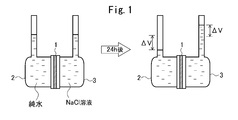
- a membrane performance evaluation apparatus is shown in FIG.
- the membrane 1 is attached to a flat membrane cell, and pure water is injected into one container 2 separated by the membrane 1, and a sodium chloride aqueous solution is injected into the other container 3.
- the concentration of the sodium chloride aqueous solution was set to 3.0 wt% with an osmotic pressure difference of 3 MPa, and the salt leakage rate at a driving pressure of 3 MPa was evaluated.
- Stirring with a magnetic stirrer was performed in the containers 2 and 3, and the electrical conductivity of each solution after 24 hours was measured.
- the NaCl concentration was calculated from the measured electrical conductivity value, and the salt leakage rate was calculated using Equation (1).
- Salt leakage rate (%) (C / Cref) ⁇ 100% (1)
- C is the NaCl concentration (g / L) on the pure water side after 24 hours
- Cref is the sodium chloride concentration (g / L) after 24 hours on the sodium chloride aqueous solution side.
- the membrane body treated with the silane coupling agent was immersed for 2 hours to adsorb phospholipids to the membrane body. Thereafter, ultrasonic cleaning was carried out for 10 minutes, and the phospholipids adsorbed excessively on the membrane body were peeled off to produce a POPC coating membrane.
- Table 1 shows the salt leakage rate of each membrane.
- a channel substance is used for a membrane (phospholipid composition of Reference Example 2) using only DPPC, which is a phospholipid in which two acyl groups of phospholipid are composed of saturated fatty acids having 16 carbon atoms. Incorporation of did not show sufficient water permeability.
- a GA-containing POPC coating film was produced in the same manner as in Reference Example 1 except that this solution was used, and the water permeability was measured.
- a GA-containing DPPC coating film was produced in the same manner as in Reference Example 2 except that this solution was used, and the water permeability was measured.
- Example 1 In Reference Example 3, a GA-containing POPC / DPPC coating film was produced in the same manner except that a channel substance was added to the phospholipid, and the water permeability was measured.
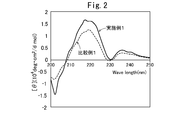
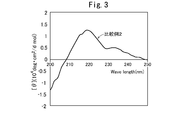
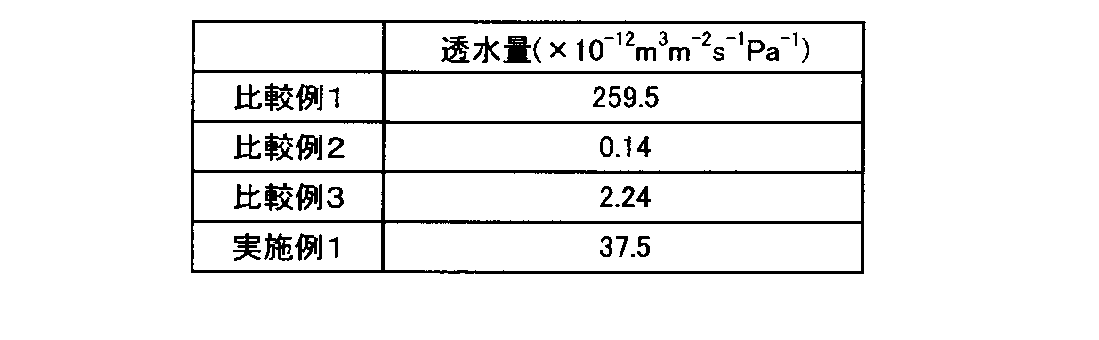
- Table 2 shows the measurement results of the water permeability of each membrane. Moreover, the measurement result of CD spectrum of the film
- a membrane using only DPPC which is a phospholipid composed of a saturated fatty acid having 16 carbon atoms in which two acyl groups of phospholipid (Comparative Example 2), shows no valley at 230 nm in the CD spectrum, and gramicidin A has a channel structure. Since it was not formed, the amount of water permeation was very low, which was 1/16 that of a commercial product (Comparative Example 3).
- the membrane (Example 1) using POPC and DPPC as the phospholipid has a water permeability of 16 times or more that of a commercially available product (Comparative Example 3), and a membrane having high water permeability and pressure resistance is obtained. It was recognized that
Landscapes
- Chemical & Material Sciences (AREA)
- Chemical Kinetics & Catalysis (AREA)
- Engineering & Computer Science (AREA)
- Inorganic Chemistry (AREA)
- Manufacturing & Machinery (AREA)
- Life Sciences & Earth Sciences (AREA)
- Hydrology & Water Resources (AREA)
- Environmental & Geological Engineering (AREA)
- Water Supply & Treatment (AREA)
- Organic Chemistry (AREA)
- Separation Using Semi-Permeable Membranes (AREA)
Abstract
Description
この膜本体としては、NF膜、UF膜、RO膜又はMF膜を用いることができる。膜の材質は、セルロース、ポリエーテルスルホン、アルミナなどが好適であるが、これに限定されない。
アシル基を構成する脂肪酸が不飽和脂肪酸を含む、すなわち、アシル基が不飽和脂肪酸残基を含む第1のリン脂質としては、1-パルミトイル-2-オレオイル-sn-グリセロ-3-ホスホコリン(POPC)、1,2-ジオレオイル-sn-グリセロ-3-ホスホコリン、1,2-ジオレオイル-sn-グリセロ-3-ホスホエタノールアミン、1,2-ジオレオイル-sn-グリセロ-3-ホスホ-L-セリン、1,2-ジオレオイル-sn-グリセロ-3-ホスホ-rac-(1-グリセロール)、卵黄ホスファチジルコリン、大豆ホスファチジルコリンなどが挙げられる。
チャネル物質としては、グラミシジン(例えばグラミシジンA)、アムホテリシンBなどを用いることができる。
膜本体表面をリン脂質二重膜で被覆する方法としては、ラングミュア-ブロジェット法、ベシクル融合法が挙げられる。
以下の実施例及び比較例では、膜本体として、陽極酸化アルミナ膜(Whatmann社製Anodisc、直径25mm、孔径20nm)を用いた。
アシル基に不飽和脂肪酸を含む第1のリン脂質としては、1-パルミトイル-2-オレオイル-sn-グリセロ-3-ホスホコリン(POPC、相転移温度-2℃、日油株式会社製)を用いた。
チャネル物質としては、グラミシジンA(GA、シグマアルドリッチ社製)を用いた。
膜本体をリン脂質二重層で被覆するのに先立って、膜本体をシランカップリング剤(オクタデシルトリクロロシラン(シグマアルドリッチ社製))を用いて以下のようにシランカップリング処理した。
リン脂質二重層内に導入したチャネル物質が水チャネル物質としての機能を有するのかについては、膜本体表面を被覆するリン脂質二重層と同じ組成からなるベシクル分散液の円二色性(CD)スペクトルを円二色性分散計(J-725K、日本分光株式会社製)を用いて測定することで確認した。
膜の性能評価装置を図1に示す。膜1は平膜セルに装着され、膜1で隔てられた一方の容器2内に純水を注入し、他方の容器3内に塩化ナトリウム水溶液を注入する。塩化ナトリウム水溶液の濃度は3.0wt%の条件で浸透圧差3MPaを設けて、駆動圧力3MPaにおける塩漏出率を評価した。容器2,3内でマグネチックスターラーによる撹拌を行い、24時間後の各溶液の電気伝導度を測定した。測定した電気伝導度の値からNaCl濃度を算出し、式(1)を用いて塩漏出率を算出した。
塩漏出率(%)=(C/Cref)×100% ………(1)
透水量{m3/(m2・s・Pa)}=ΔV/S・t・ΔP …(2)
リン脂質をクロロホルムに溶解し、POPCの溶液を調製した。減圧下で有機溶媒を蒸発させ、容器内に残存した乾燥脂質薄膜に純水を添加し、35℃で水和させることで、ベシクル分散液を作製した。得られたベシクル分散液は、液体窒素と35℃の湯浴に交互に浸漬操作を5回繰り返す凍結融解法により、粒成長させた。ベシクル分散液は孔径0.1μmのポリカーボネートトラックエッチング膜を用い、押し出し整粒し、脂質濃度が0.4mMになるよう純水で希釈した。
リン脂質として、POPCの代りにDPPCを用いた他は参考例1と同様にしてDPPC被覆膜を製造し、塩漏出率を測定した。
リン脂質として、POPCとDPPCとを50/50(mol%)の割合で用いた他は参考例1,2と同様にしてPOPC/DPPC複合被覆膜を製造し、塩漏出率を測定した。

表1の通り、リン脂質のアシル基に不飽和脂肪酸を含むリン脂質であるPOPCのみを用いた膜(参考例1)は、塩が漏出していることから、浸透圧によりリン脂質二重層が壊れており、耐圧性が不十分であった。リン脂質の2つのアシル基が炭素数16の飽和脂肪酸からなるリン脂質であるDPPCのみを用いた膜(参考例2)および、リン脂質にPOPCとDPPCを用いた膜(参考例3)では、塩の漏出が低く耐圧性の高い膜が作製できた。
参考例1において、リン脂質にチャネル物質を添加したこと以外は同様にしてGA含有POPC被覆膜を製造し、透水量を測定した。
参考例2において、リン脂質にチャネル物質を添加したこと以外は同様にしてGA含有DPPC被覆膜を製造し透水量を測定した。
参考例3において、リン脂質にチャネル物質を添加したこと以外は同様にして、GA含有POPC/DPPC被覆膜を製造し、透水量を測定した。
市販のFO膜(Hydration Technology Innovations社)について、透水量を測定した。
リン脂質のアシル基に不飽和脂肪酸を含むリン脂質であるPOPCのみを用いた膜(比較例1)とリン脂質にPOPCとDPPCを用いた膜(実施例1)は、CDスペクトルの結果が示すように、グラミシジンAがチャネル構造を形成した。比較例1は高い透水量を示したが、参考例1が示すように、リン脂質二重層自体の耐圧性が不十分である。
本出願は、2015年3月4日付で出願された日本特許出願2015-042528に基づいており、その全体が引用により援用される。
2,3 容器
Claims (10)
- 選択的透過性を有した膜本体と、該膜本体の表面に形成された、チャネル物質を含有するリン脂質二重膜よりなる被覆層とを有する選択性透過膜において、
リン脂質二重膜は、リン脂質として、アシル基を構成する脂肪酸として不飽和脂肪酸を含む第1のリン脂質と、2つのアシル基を構成する脂肪酸が炭素数16~24の飽和脂肪酸からなる第2のリン脂質とを含有することを特徴とする選択性透過膜。 - 請求項1において、第1のリン脂質と第2のリン脂質との合量に対する第2のリン脂質の割合が20~80モル%であることを特徴とする選択性透過膜。
- 請求項1又は2において、第1のリン脂質は1-パルミトイル-2-オレオイル-sn-グリセロ-3-ホスホコリン、1,2-ジオレオイル-sn-グリセロ-3-ホスホコリン、1,2-ジオレオイル-sn-グリセロ-3-ホスホエタノールアミン、1,2-ジオレオイル-sn-グリセロ-3-ホスホ-L-セリン、1,2-ジオレオイル-sn-グリセロ-3-ホスホ-rac-(1-グリセロール)、卵黄ホスファチジルコリン、及び大豆ホスファチジルコリンから選ばれる1種もしくは2種以上のリン脂質であり、第2のリン脂質は1,2-ジパルミトイル-sn-グリセロ-3-ホスホコリン、1,2-ジヘプタデカノイル-sn-グリセロ-3-ホスホコリン、1,2-ジステアロイル-sn-グリセロ-3-ホスホコリン、1,2-ジノナデカノイル-sn-グリセロ-3-ホスホコリン、1,2-ジアラキドイル-sn-グリセロ-3-ホスホコリン、1,2-ジベヘノイル-sn-グリセロ-3-ホスホコリン、1,2-ジトリコサノイル-sn-グリセロ-3-ホスホコリン、又は1,2-ジリグノセロイル-sn-グリセロ-3-ホスホコリン、1,2-ジパルミトイル-sn-グリセロ-3-ホスホエタノールアミン、1,2-ジパルミトイル-sn-グリセロ-3-ホスホ-L-セリン、1,2-ジパルミトイル-sn-グリセロ-3-ホスホ-rac-(1-グリセロール)、水素添加卵黄ホスファチジルコリン、及び水素添加大豆ホスファチジルコリンから選ばれる1種もしくは2種以上のリン脂質であることを特徴とする選択性透過膜。
- 請求項1又は2において、第1のリン脂質はパルミトイルオレオイルホスファチジルコリンであり、第2のリン脂質は1,2-ジパルミトイル-sn-グリセロ-3-ホスホコリン又は1,2-ジステアロイル-sn-グリセロ-3-ホスホコリンであることを特徴とする選択性透過膜。
- 請求項1ないし4のいずれか1項において、チャネル物質はグラミシジン又はアムホテリシンBであることを特徴とする選択性透過膜。
- 請求項1ないし5のいずれか1項において、第1のリン脂質と第2のリン脂質とチャネル物質との合量におけるチャネル物質の割合が1~20モル%であることを特徴とする選択性透過膜。
- 請求項1ないし6のいずれか1項において、前記膜本体はMF膜、UF膜、NF膜又はRO膜であることを特徴とする選択性透過膜の製造方法。
- リン脂質とチャネル物質とを含むリン脂質含有液と膜本体とを接触させることにより、リン脂質二重膜よりなる被覆層を膜本体の表面に形成する工程を有する選択性透過膜の製造方法において、
リン脂質含有液は、アシル基を構成する脂肪酸として不飽和脂肪酸を含む第1のリン脂質と、2つのアシル基を構成する脂肪酸が炭素数16~24の飽和脂肪酸からなる第2のリン脂質とを含有することを特徴とする選択性透過膜の製造方法。 - 請求項8において、第1のリン脂質と第2のリン脂質との合量に対する第2のリン脂質の割合が20~80モル%であることを特徴とする選択性透過膜の製造方法。
- 請求項1ないし6のいずれか1項に記載の選択性透過膜を用いて被処理水を膜分離処理する工程を有する水処理方法。
Priority Applications (3)
| Application Number | Priority Date | Filing Date | Title |
|---|---|---|---|
| CN201680008834.4A CN107206331B (zh) | 2015-03-04 | 2016-02-17 | 选择性透过膜及其制造方法 |
| SG11201706782RA SG11201706782RA (en) | 2015-03-04 | 2016-02-17 | Permselective membrane and method for producing the same |
| US15/554,616 US20180236409A1 (en) | 2015-03-04 | 2016-02-17 | Permselective membrane and method for producing the same |
Applications Claiming Priority (2)
| Application Number | Priority Date | Filing Date | Title |
|---|---|---|---|
| JP2015-042528 | 2015-03-04 | ||
| JP2015042528A JP6036879B2 (ja) | 2015-03-04 | 2015-03-04 | 水処理用選択性透過膜及びその製造方法 |
Publications (1)
| Publication Number | Publication Date |
|---|---|
| WO2016140061A1 true WO2016140061A1 (ja) | 2016-09-09 |
Family
ID=56846009
Family Applications (1)
| Application Number | Title | Priority Date | Filing Date |
|---|---|---|---|
| PCT/JP2016/054523 Ceased WO2016140061A1 (ja) | 2015-03-04 | 2016-02-17 | 選択性透過膜及びその製造方法 |
Country Status (5)
| Country | Link |
|---|---|
| US (1) | US20180236409A1 (ja) |
| JP (1) | JP6036879B2 (ja) |
| CN (1) | CN107206331B (ja) |
| SG (1) | SG11201706782RA (ja) |
| WO (1) | WO2016140061A1 (ja) |
Families Citing this family (6)
| Publication number | Priority date | Publication date | Assignee | Title |
|---|---|---|---|---|
| JP6265287B1 (ja) * | 2017-02-17 | 2018-01-24 | 栗田工業株式会社 | 選択性透過膜、その製造方法及び水処理方法 |
| JP6468384B1 (ja) * | 2018-03-14 | 2019-02-13 | 栗田工業株式会社 | 水処理装置 |
| JP7251370B2 (ja) * | 2019-07-08 | 2023-04-04 | 栗田工業株式会社 | 選択性透過膜、選択性透過膜の製造方法および水処理方法 |
| JP7251369B2 (ja) * | 2019-07-08 | 2023-04-04 | 栗田工業株式会社 | 選択性透過膜の製造方法および水処理方法 |
| US12485388B2 (en) | 2020-04-02 | 2025-12-02 | H2Mo Technology Pte Ltd | Composite membrane and method of making the same |
| US20240382659A1 (en) * | 2021-04-09 | 2024-11-21 | Gambro Lundia Ab | Evaluating integrity of a forward osmosis membrane during continuous flow |
Citations (9)
| Publication number | Priority date | Publication date | Assignee | Title |
|---|---|---|---|---|
| JPS6351311A (ja) * | 1986-08-20 | 1988-03-04 | Kobayashi Kooc:Kk | リポソーム含有皮膚化粧料 |
| JPH0523576A (ja) * | 1991-07-25 | 1993-02-02 | Fuji Photo Film Co Ltd | リポソーム小胞 |
| JP2008518951A (ja) * | 2004-10-28 | 2008-06-05 | アルザ コーポレイション | 凍結乾燥リポソーム配合物及び方法 |
| JP2012192408A (ja) * | 2005-05-20 | 2012-10-11 | Aquaporin As | 水を濾過する膜 |
| JP2012224634A (ja) * | 2001-04-11 | 2012-11-15 | Qlt Inc | 疎水性薬物のための薬物送達系 |
| WO2013043118A1 (en) * | 2011-09-21 | 2013-03-28 | Nanyang Technological University | Aquaporin based thin film composite membranes |
| JP2014100645A (ja) * | 2012-11-19 | 2014-06-05 | Kurita Water Ind Ltd | 選択性透過膜及びその製造方法 |
| WO2014100412A1 (en) * | 2012-12-19 | 2014-06-26 | Robert Mcginnis | Selective membranes formed by alignment of porous materials |
| WO2014108827A1 (en) * | 2013-01-11 | 2014-07-17 | Aquaporin A/S | A hollow fiber module having thin film composite- aquaporin modified membranes |
Family Cites Families (3)
| Publication number | Priority date | Publication date | Assignee | Title |
|---|---|---|---|---|
| CN1413575A (zh) * | 2001-10-25 | 2003-04-30 | 财团法人工业技术研究院 | 可包覆高含量疏水性物质的脂质体 |
| WO2007033675A1 (en) * | 2005-09-20 | 2007-03-29 | Aquaporin Aps | Biomimetic water membrane comprising aquaporins used in the production of salinity power |
| JP5533947B2 (ja) * | 2012-06-20 | 2014-06-25 | 株式会社安川電機 | ロボットシステムおよび嵌合物の製造方法 |
-
2015
- 2015-03-04 JP JP2015042528A patent/JP6036879B2/ja active Active
-
2016
- 2016-02-17 WO PCT/JP2016/054523 patent/WO2016140061A1/ja not_active Ceased
- 2016-02-17 CN CN201680008834.4A patent/CN107206331B/zh active Active
- 2016-02-17 US US15/554,616 patent/US20180236409A1/en not_active Abandoned
- 2016-02-17 SG SG11201706782RA patent/SG11201706782RA/en unknown
Patent Citations (10)
| Publication number | Priority date | Publication date | Assignee | Title |
|---|---|---|---|---|
| JPS6351311A (ja) * | 1986-08-20 | 1988-03-04 | Kobayashi Kooc:Kk | リポソーム含有皮膚化粧料 |
| JPH0523576A (ja) * | 1991-07-25 | 1993-02-02 | Fuji Photo Film Co Ltd | リポソーム小胞 |
| JP2012224634A (ja) * | 2001-04-11 | 2012-11-15 | Qlt Inc | 疎水性薬物のための薬物送達系 |
| JP2008518951A (ja) * | 2004-10-28 | 2008-06-05 | アルザ コーポレイション | 凍結乾燥リポソーム配合物及び方法 |
| JP2012192408A (ja) * | 2005-05-20 | 2012-10-11 | Aquaporin As | 水を濾過する膜 |
| JP2014094378A (ja) * | 2005-05-20 | 2014-05-22 | Aquaporin As | 水を濾過する膜 |
| WO2013043118A1 (en) * | 2011-09-21 | 2013-03-28 | Nanyang Technological University | Aquaporin based thin film composite membranes |
| JP2014100645A (ja) * | 2012-11-19 | 2014-06-05 | Kurita Water Ind Ltd | 選択性透過膜及びその製造方法 |
| WO2014100412A1 (en) * | 2012-12-19 | 2014-06-26 | Robert Mcginnis | Selective membranes formed by alignment of porous materials |
| WO2014108827A1 (en) * | 2013-01-11 | 2014-07-17 | Aquaporin A/S | A hollow fiber module having thin film composite- aquaporin modified membranes |
Also Published As
| Publication number | Publication date |
|---|---|
| JP2016159268A (ja) | 2016-09-05 |
| US20180236409A1 (en) | 2018-08-23 |
| CN107206331A (zh) | 2017-09-26 |
| CN107206331B (zh) | 2020-05-26 |
| SG11201706782RA (en) | 2017-10-30 |
| JP6036879B2 (ja) | 2016-11-30 |
Similar Documents
| Publication | Publication Date | Title |
|---|---|---|
| JP6036879B2 (ja) | 水処理用選択性透過膜及びその製造方法 | |
| JP6028533B2 (ja) | 選択性透過膜の製造方法 | |
| US20220193619A1 (en) | Method for producing permselective membrane | |
| JP6132276B2 (ja) | 塩除去率及び透過流量特性に優れた逆浸透分離膜の製造方法 | |
| Sun et al. | A layer-by-layer self-assembly approach to developing an aquaporin-embedded mixed matrix membrane | |
| US9610548B2 (en) | Composite porous polymeric membrane with high void volume | |
| TWI793280B (zh) | 選擇性透過膜、其製造方法以及水處理方法 | |
| CN113766966B (zh) | 复合膜及其制造方法 | |
| JPWO2018143297A1 (ja) | 複合半透膜及び複合半透膜の製造方法 | |
| FR2538551A1 (fr) | Procede et installation de deshydratation d'une substance contenant de l'eau par electro-osmose | |
| CN108602025B (zh) | 选择性透过膜及其制造方法、使用该选择性透过膜的水处理方法 | |
| KR101869799B1 (ko) | 탄소나노소재가 적용된 정삼투 복합 필터의 제조방법 및 이에 의해 제조된 탄소나노소재가 적용된 정삼투 복합 필터 | |
| WO2019187870A1 (ja) | 選択性透過膜、その製造方法及び水処理方法 | |
| KR102041657B1 (ko) | 수처리 분리막의 제조방법 및 이에 의하여 제조된 수처리 분리막 및 수처리 분리막을 포함하는 수처리 모듈 | |
| Ng et al. | Stability and performance study of polyethersulfone membranes modified using polyelectrolytes | |
| KR102067861B1 (ko) | 역삼투막 제조용 조성물, 이를 이용한 역삼투막 제조방법, 역삼투막 및 수처리 모듈 | |
| CN112058097A (zh) | 一种正渗透膜材料的制备方法 | |
| AU2020227613B2 (en) | Stabilized filtration device | |
| KR20220013744A (ko) | 수처리 분리막의 제조방법, 수처리 분리막 및 수처리 모듈 | |
| Nga et al. | Stability and Performance Study of Polyethersulfone Membranes Modified Using Polyelectrolytes | |
| CN109499387A (zh) | 一种高通量复合正渗透膜及其制备方法 |
Legal Events
| Date | Code | Title | Description |
|---|---|---|---|
| 121 | Ep: the epo has been informed by wipo that ep was designated in this application |
Ref document number: 16758755 Country of ref document: EP Kind code of ref document: A1 |
|
| WWE | Wipo information: entry into national phase |
Ref document number: 15554616 Country of ref document: US |
|
| NENP | Non-entry into the national phase |
Ref country code: DE |
|
| WWE | Wipo information: entry into national phase |
Ref document number: 11201706782R Country of ref document: SG |
|
| 122 | Ep: pct application non-entry in european phase |
Ref document number: 16758755 Country of ref document: EP Kind code of ref document: A1 |