WO2016139916A1 - シリカ配合ゴム組成物用添加剤組成物、ゴム組成物及びタイヤ - Google Patents
シリカ配合ゴム組成物用添加剤組成物、ゴム組成物及びタイヤ Download PDFInfo
- Publication number
- WO2016139916A1 WO2016139916A1 PCT/JP2016/000935 JP2016000935W WO2016139916A1 WO 2016139916 A1 WO2016139916 A1 WO 2016139916A1 JP 2016000935 W JP2016000935 W JP 2016000935W WO 2016139916 A1 WO2016139916 A1 WO 2016139916A1
- Authority
- WO
- WIPO (PCT)
- Prior art keywords
- fatty acid
- rubber composition
- silica
- mass
- glycerin
- Prior art date
- Legal status (The legal status is an assumption and is not a legal conclusion. Google has not performed a legal analysis and makes no representation as to the accuracy of the status listed.)
- Ceased
Links
Classifications
-
- C—CHEMISTRY; METALLURGY
- C08—ORGANIC MACROMOLECULAR COMPOUNDS; THEIR PREPARATION OR CHEMICAL WORKING-UP; COMPOSITIONS BASED THEREON
- C08K—Use of inorganic or non-macromolecular organic substances as compounding ingredients
- C08K5/00—Use of organic ingredients
- C08K5/04—Oxygen-containing compounds
- C08K5/10—Esters; Ether-esters
- C08K5/101—Esters; Ether-esters of monocarboxylic acids
- C08K5/103—Esters; Ether-esters of monocarboxylic acids with polyalcohols
-
- B—PERFORMING OPERATIONS; TRANSPORTING
- B60—VEHICLES IN GENERAL
- B60C—VEHICLE TYRES; TYRE INFLATION; TYRE CHANGING; CONNECTING VALVES TO INFLATABLE ELASTIC BODIES IN GENERAL; DEVICES OR ARRANGEMENTS RELATED TO TYRES
- B60C1/00—Tyres characterised by the chemical composition or the physical arrangement or mixture of the composition
-
- B—PERFORMING OPERATIONS; TRANSPORTING
- B60—VEHICLES IN GENERAL
- B60C—VEHICLE TYRES; TYRE INFLATION; TYRE CHANGING; CONNECTING VALVES TO INFLATABLE ELASTIC BODIES IN GENERAL; DEVICES OR ARRANGEMENTS RELATED TO TYRES
- B60C1/00—Tyres characterised by the chemical composition or the physical arrangement or mixture of the composition
- B60C1/0016—Compositions of the tread
-
- C—CHEMISTRY; METALLURGY
- C08—ORGANIC MACROMOLECULAR COMPOUNDS; THEIR PREPARATION OR CHEMICAL WORKING-UP; COMPOSITIONS BASED THEREON
- C08K—Use of inorganic or non-macromolecular organic substances as compounding ingredients
- C08K3/00—Use of inorganic substances as compounding ingredients
- C08K3/34—Silicon-containing compounds
- C08K3/36—Silica
-
- C—CHEMISTRY; METALLURGY
- C08—ORGANIC MACROMOLECULAR COMPOUNDS; THEIR PREPARATION OR CHEMICAL WORKING-UP; COMPOSITIONS BASED THEREON
- C08K—Use of inorganic or non-macromolecular organic substances as compounding ingredients
- C08K5/00—Use of organic ingredients
- C08K5/04—Oxygen-containing compounds
- C08K5/10—Esters; Ether-esters
- C08K5/101—Esters; Ether-esters of monocarboxylic acids
-
- C—CHEMISTRY; METALLURGY
- C08—ORGANIC MACROMOLECULAR COMPOUNDS; THEIR PREPARATION OR CHEMICAL WORKING-UP; COMPOSITIONS BASED THEREON
- C08L—COMPOSITIONS OF MACROMOLECULAR COMPOUNDS
- C08L21/00—Compositions of unspecified rubbers
-
- C—CHEMISTRY; METALLURGY
- C08—ORGANIC MACROMOLECULAR COMPOUNDS; THEIR PREPARATION OR CHEMICAL WORKING-UP; COMPOSITIONS BASED THEREON
- C08L—COMPOSITIONS OF MACROMOLECULAR COMPOUNDS
- C08L9/00—Compositions of homopolymers or copolymers of conjugated diene hydrocarbons
-
- C—CHEMISTRY; METALLURGY
- C08—ORGANIC MACROMOLECULAR COMPOUNDS; THEIR PREPARATION OR CHEMICAL WORKING-UP; COMPOSITIONS BASED THEREON
- C08L—COMPOSITIONS OF MACROMOLECULAR COMPOUNDS
- C08L9/00—Compositions of homopolymers or copolymers of conjugated diene hydrocarbons
- C08L9/06—Copolymers with styrene
Definitions
- the present invention relates to an additive composition for a silica-containing rubber composition, a rubber composition, and a tire.
- the grip performance in the wet road surface of a tire can also be improved by applying the rubber composition which mix
- silica aggregates in the rubber composition there is a problem in processability (workability).
- Patent Document 1 glycerin fatty acid esters and the like as described in International Publication No. 2014/098155 (Patent Document 1) have been developed as chemicals that improve the dispersibility of silica in rubber compositions and improve processability. ing.
- the rubber composition used for the tire has low loss (low tan ⁇ ) and Improvement of fracture characteristics is also demanded, and the present inventor has examined that the technique described in Patent Document 1 has room for improvement in low loss characteristics and fracture characteristics.
- the present invention provides an additive composition that solves the above-mentioned problems of the prior art and can improve the processability, low loss, and fracture characteristics of the silica-containing rubber composition, and processability
- Another object of the present invention is to provide a rubber composition excellent in low loss property and fracture characteristics.
- Another object of the present invention is to provide a tire having low rolling resistance and excellent fracture characteristics.
- the gist of the additive composition for a silica-containing rubber composition, the rubber composition, and the tire according to the present invention that solves the above problems is as follows.
- the additive composition for silica-containing rubber composition of the present invention comprises a glycerin fatty acid ester, and the glycerin fatty acid ester is an ester of glycerin and two or more fatty acids, and constitutes the glycerin fatty acid ester.
- the fatty acids of more than species the most fatty acid component is 10 to 90% by mass in the total fatty acid, and the monoester component is further contained in an amount of 50 to 100% by mass with respect to the glycerin fatty acid ester.
- rupture characteristic of a silica compound rubber composition can be improved by mix
- the fatty acid component is considered to be one component for each fatty acid that is the same in configuration and bonding state in addition to the alkyl carbon number, that is, for each stereoisomer.
- n-1-octadecanoic acid generally linear stearic acid
- 2-octyl-1-decanoic acid (2-position branched stearic acid)
- cis-9-octadecenoic acid Common oleic acid
- cis, cis-9,12-octadecadienoic acid common linoleic acid
- the mass ratio of the two or more fatty acids is 10 to 90% by mass in the total fatty acids even with the largest amount of fatty acid components. From the viewpoint of further improving the processability, low loss property and fracture characteristics of the rubber composition. 15 to 80% by mass, preferably 20 to 70% by mass, and more preferably 30 to 60% by mass. In this case, the processability, low loss property, and fracture characteristics of the silica-containing rubber composition can be further improved.
- the fatty acid constituting the glycerin fatty acid ester preferably has 8 to 22 carbon atoms, more preferably 12 to 18 carbon atoms, More preferably, the number is from 14 to 18.
- one of the most fatty acid component and the second most fatty acid component is a fatty acid having 16 carbon atoms.
- the other is preferably a fatty acid having 18 carbon atoms.
- the mass ratio of the fatty acid having 16 carbon atoms and the fatty acid having 18 carbon atoms is preferably 90/10 to 10/90, more preferably 80/20 to 20/80, and 75 More preferably, it is / 25 to 25/75. In this case, the processability, low loss property, and fracture characteristics of the silica-containing rubber composition can be further improved.
- the monoester component in the glycerin fatty acid ester is contained in the glycerin fatty acid ester in an amount of 50 to 100% by mass, preferably 60 to 99% by mass, More preferred is 85 to 98% by mass.
- the processability, low loss property, and fracture characteristics of the silica-containing rubber composition can be further improved, which is preferable from the viewpoint of production.
- Glycerin fatty acid ester is a method obtained by esterifying glycerin and fatty acid, a method obtained by hydrolyzing glycerin fatty acid triester such as natural fats and oils, a method of transesterification using glycerin fatty acid triester and fatty acids such as natural fats and oils Any of these may be used.
- the method of obtaining glycerol fatty acid ester is not specifically limited, A well-known method can be used. From the viewpoint of productivity, a method obtained by esterifying glycerin and a fatty acid is preferable.
- the fatty acid raw material those obtained by hydrolyzing fats and oils such as vegetable oils and animal fats, and those obtained by curing or anti-curing those fats or hydrolyzed fatty acids can be used.
- the oil and fat raw material is not particularly limited, and vegetable oils and animal oils are used. Specifically, palm oil, soybean oil, olive oil, cottonseed oil, coconut oil, palm kernel oil, beef tallow, pork fat, fish oil, etc. Can be used.
- the content (mass%) of glycerin fatty acid monoester, diester and triester in the glycerin fatty acid ester is measured in International Publication No. 2014/098155.
- Patent Document 1 The fatty acid component content (% by mass) was measured by GPC analysis after saponification and methyl esterification of the glycerin fatty acid monoester according to the standard oil analysis test method established by the Japan Oil Chemists' Society.
- the rubber composition of the present invention is characterized by containing a diene rubber, silica, and the additive composition for silica-containing rubber composition. And the rubber composition of this invention is excellent in workability, a low loss property, and a fracture
- the amount of the additive composition for silica-containing rubber composition is 0.5 to 20 parts by mass with respect to 100 parts by mass of silica. In this case, the processability, low loss property, and fracture characteristics of the rubber composition can be sufficiently improved.
- the silica is preferably 10 to 120 parts by mass with respect to 100 parts by mass of the diene rubber. In this case, the processability, low loss property, and fracture characteristics of the rubber composition can be sufficiently improved.
- the diene rubber contains a styrene-butadiene copolymer rubber.
- the processability, low loss property, and fracture characteristics of the rubber composition can be sufficiently improved.
- the tire of the present invention is characterized by using the above rubber composition. Since the rubber composition described above is used in the tire of the present invention, the rolling resistance is small and the fracture characteristics are excellent.
- the present invention it is possible to provide an additive composition capable of improving the processability, low loss, and fracture characteristics of a silica-containing rubber composition. Moreover, according to this invention, the rubber composition excellent in workability, low loss property, and a fracture
- the additive composition for silica-containing rubber composition of the present invention comprises a glycerin fatty acid ester, and the glycerin fatty acid ester is an ester of glycerin and two or more fatty acids, and constitutes the glycerin fatty acid ester.
- the fatty acids of at least species the most fatty acid component is 10 to 90% by mass with respect to the total fatty acid, and further the monoester component is contained in an amount of 50 to 100% by mass with respect to the glycerin fatty acid ester.
- the glycerin fatty acid ester constituting the additive composition for silica-containing rubber composition of the present invention is an ester of glycerin and two or more fatty acids.
- the glycerin fatty acid ester is a compound in which at least one of the three OH groups of glycerin and the COOH group of the fatty acid are ester-bonded.
- the glycerin fatty acid ester may be a glycerin fatty acid monoester (monoester component) formed by esterifying one molecule of glycerin and one molecule of fatty acid, or a glycerin fatty acid diester formed by esterifying one molecule of glycerin and two molecules of fatty acid ( Diester component) or glycerin fatty acid triester (triester component) formed by esterification of one molecule of glycerol and three molecules of fatty acid may be used, or a mixture thereof, but glycerol fatty acid monoester is preferable.
- the glycerin fatty acid ester is a mixture of glycerin fatty acid monoester, glycerin fatty acid diester, and glycerin fatty acid triester
- the content of each ester can be measured by gel permeation chromatography (GPC).
- GPC gel permeation chromatography
- the two fatty acids constituting the glycerin fatty acid diester and the three fatty acids constituting the glycerin fatty acid triester may be the same or different.
- the glycerin fatty acid ester constituting the additive composition for silica-containing rubber composition of the present invention is an ester of glycerin and two or more fatty acids, and glycerin formed by esterifying two or more fatty acids with one molecule of glycerin.
- Fatty acid diester or glycerin fatty acid triester may be used, but glycerin fatty acid monoester formed by esterification of one molecule of glycerin and one kind of fatty acid among the above-mentioned two or more fatty acids, one molecule of glycerin and other kinds of fatty acids It is preferable that it is a mixture with the glycerol fatty acid monoester formed by esterification with one molecule.
- the two or more fatty acids (that is, constituent fatty acids of the glycerin fatty acid ester) used as the raw material of the glycerin fatty acid ester are those having 8 to 22 carbon atoms from the viewpoint of processability, low loss, and fracture characteristics of the rubber composition. Certain fatty acids are preferred, fatty acids having 12 to 18 carbon atoms are more preferred, fatty acids having 14 to 18 carbon atoms are more preferred, fatty acids having 16 carbon atoms and fatty acids having 18 carbon atoms are even more preferred.
- one of the most fatty acid component and the second most fatty acid component is a fatty acid having 16 carbon atoms and the other fatty acid having 18 carbon atoms. More preferred.
- the glycerin fatty acid ester is an ester of glycerin, a fatty acid having 16 carbon atoms and a fatty acid having 18 carbon atoms, the mass ratio of the fatty acid having 16 carbon atoms to the fatty acid having 18 carbon atoms (16 carbon atoms).
- the fatty acid / fatty acid having 18 carbon atoms is preferably in the range of 90/10 to 10/90, more preferably in the range of 80/20 to 20/80, and even more preferably in the range of 75/25 to 25/75. If the mass ratio of the fatty acid having 16 carbon atoms and the fatty acid having 18 carbon atoms is within this range, the processability, low loss property and fracture characteristics of the rubber composition can be further improved.
- the constituent fatty acid of the glycerin fatty acid ester may be linear or branched, but is preferably linear, and may be a saturated fatty acid or an unsaturated fatty acid, but is preferably a saturated fatty acid.
- constituent fatty acids of the glycerin fatty acid ester specifically, caprylic acid, pelargonic acid, capric acid, lauric acid, myristic acid, palmitic acid, stearic acid, isostearic acid, oleic acid, linoleic acid, linolenic acid, alginate, Examples thereof include arachidonic acid and behenic acid, and among these, lauric acid, myristic acid, palmitic acid and stearic acid are preferable, and palmitic acid and stearic acid are more preferable.
- glycerin fatty acid ester specifically, lauric acid monoglyceride, myristic acid monoglyceride, palmitic acid monoglyceride, and stearic acid monoglyceride are preferable, and palmitic acid monoglyceride and stearic acid monoglyceride are more preferable.
- the rubber composition of the present invention comprises a diene rubber, silica, and the additive composition for silica-containing rubber composition described above.
- the glycerin fatty acid ester which is an ester of glycerin and two or more fatty acids, that constitutes the additive composition for silica-containing rubber composition has the dispersibility of silica in the rubber composition. Because it improves, it is excellent in workability. Moreover, since the dispersibility of the silica in the rubber composition is high, the compounding effect of silica is sufficiently exhibited, and the low loss property and the fracture property are also excellent.
- diene rubber used in the rubber composition of the present invention examples include natural rubber (NR) and synthetic diene rubber.
- synthetic diene rubber examples include polybutadiene rubber (BR) and synthetic polyisoprene rubber. (IR), styrene-butadiene copolymer rubber (SBR), styrene-isoprene copolymer rubber (SIR), and the like.
- the diene rubber preferably includes a styrene-butadiene copolymer rubber. These diene rubbers may be used alone or in a blend of two or more. Further, the diene rubber used may be modified or unmodified.
- the silica used in the rubber composition of the present invention is not particularly limited, and examples thereof include wet silica (hydrous silicic acid), dry silica (anhydrous silicic acid), calcium silicate, aluminum silicate, and the like. Wet silica is preferred. These silicas may be used individually by 1 type, and may use 2 or more types together. Further, the BET specific surface area (measured in accordance with ISO 5794/1) of silica is preferably in the range of 40 to 350 m 2 / g, more preferably in the range of 80 to 350 m 2 / g, and 120 to 350 m 2 / g. A range is further preferred.
- Silica having a BET specific surface area in this range has an advantage that both rubber reinforcement and dispersibility in a diene rubber can be achieved.
- the amount of the silica is preferably 5 parts by mass or more, more preferably 10 parts by mass or more, and still more preferably 20 parts by mass with respect to 100 parts by mass of the diene rubber from the viewpoint of improving low loss and fracture characteristics.
- Part or more, more preferably 40 parts by weight or more, and from the viewpoint of improving processability, with respect to 100 parts by weight of the diene rubber preferably 200 parts by weight or less, more preferably 150 parts by weight or less, More preferably, it is 120 mass parts or less.
- the amount of silica is particularly preferably in the range of 10 to 120 parts by mass with respect to 100 parts by mass of the diene rubber.
- the amount of the additive composition for silica-containing rubber composition is preferably 0.5 parts by mass with respect to 100 parts by mass of silica from the viewpoint of processability of the rubber composition. Above, more preferably 1 part by mass or more, still more preferably 1.5 parts by mass or more, and from the viewpoint of the destructive properties of the rubber composition, preferably 100 parts by mass or less with respect to 100 parts by mass of the silica. More preferably, it is 10 mass parts or less, More preferably, it is 5 mass parts or less.
- the amount of the additive composition for silica-containing rubber composition is preferably 0.5 parts by mass or more, more preferably 100 parts by mass with respect to 100 parts by mass of the diene rubber from the viewpoint of processability of the rubber composition. Is 1 part by mass or more, more preferably 1.5 parts by mass or more, and from the viewpoint of the destructive properties of the rubber composition, preferably 100 parts by mass or less, more preferably 10 parts by mass or less. Preferably it is 5 mass parts or less, More preferably, it is 3 mass parts or less.
- the rubber composition of the present invention preferably further contains a silane coupling agent in order to improve the compounding effect of the silica.
- the silane coupling agent is not particularly limited, and examples thereof include bis (3-triethoxysilylpropyl) tetrasulfide, bis (3-triethoxysilylpropyl) trisulfide, and bis (3-triethoxysilylpropyl).
- Disulfide bis (2-triethoxysilylethyl) tetrasulfide, bis (3-trimethoxysilylpropyl) tetrasulfide, bis (2-trimethoxysilylethyl) tetrasulfide, 3-mercaptopropyltrimethoxysilane, 3-mercapto Propyltriethoxysilane, 2-mercaptoethyltrimethoxysilane, 2-mercaptoethyltriethoxysilane, 3-trimethoxysilylpropyl-N, N-dimethylthiocarbamoyl tetrasulfide, 3-triethoxysilylpro -N, N-dimethylthiocarbamoyl tetrasulfide, 2-triethoxysilylethyl-N, N-dimethylthiocarbamoyl tetrasulfide, 3-trimethoxysilylpropyl-
- silane coupling agents may be used alone or in combination of two or more.
- the compounding amount of the silane coupling agent is preferably 1 part by mass or more, more preferably 4 parts by mass or more, and 20 parts by mass with respect to 100 parts by mass of the silica from the viewpoint of improving the dispersibility of silica. The following is preferable, and 12 parts by mass or less is more preferable.
- the rubber composition of the present invention preferably further contains carbon black from the viewpoint of the destructive properties of the rubber composition.
- the carbon black is not particularly limited, and examples thereof include GPF, FEF, HAF, ISAF, and SAF grade carbon black. These carbon blacks may be used alone or in combination of two or more.
- the blending amount of carbon black is preferably in the range of 1 to 30 parts by mass, more preferably in the range of 5 to 20 parts by mass with respect to 100 parts by mass of the diene rubber.
- Vulcanizing agents such as sulfur, vulcanization accelerators, softeners, stearic acid, anti-aging agents and the like
- these compounding agents commercially available products can be suitably used.
- the rubber composition of the present invention can be used for various rubber products such as tires described later, anti-vibration rubbers, belts, hoses and the like.
- the tire of the present invention is characterized by using the above-described rubber composition. Since the tire of the present invention uses the rubber composition, the rolling resistance is small and the fracture characteristics are excellent.
- examples of the portion of the tire using the rubber composition include a tread, a sidewall, a case member, and the like.
- the tire of the present invention may be obtained by vulcanization after molding using an unvulcanized rubber composition depending on the type of tire to be applied, or a semi-crosslinked rubber composition (semi-half It may be obtained by molding using a vulcanized rubber and then further vulcanizing.
- the tire of the present invention is preferably a pneumatic tire, and as a gas filled in the pneumatic tire, an inert gas such as nitrogen, argon, helium, or the like other than normal or oxygen partial pressure adjusted air is used. Can be used.
- a rubber composition was prepared by kneading in the order of the first kneading step and the second kneading step using a normal Banbury mixer with the formulation shown in Tables 1 and 2.
- the maximum temperature of the rubber composition in the first kneading step was 150 ° C.
- the maximum temperature of the rubber composition in the second kneading step was 110 ° C.
- the resulting rubber composition was evaluated for fracture characteristics, low loss, pain effect, and processability by the following methods.
- the temperature was adjusted to 50 ° C., applied at a cycle of 10 Hz with a test force of a minimum of 10 N to a maximum of 20 N, and tan ⁇ when applied 7000 times was measured.
- tan ⁇ was set to 100 and the reciprocal index was displayed. The larger the index value, the smaller the tan ⁇ and the better the low loss property.
- the unvulcanized viscosity and scorch time of the obtained rubber composition were measured according to JIS K 6300-1: 2001 (Mooney viscosity, scorch time).
- the unvulcanized viscosity (Mooney viscosity) in Table 1 is represented by a reciprocal index with Comparative Example 2 being 100, and in Table 2 is represented by a reciprocal index with Comparative Example 4 being 100.
- the scoring time is shown as an index in Comparative Example 2 as 100 in Table 1, and in Table 2 as Comparative Example 4 as 100.
- the unvulcanized viscosity the larger the index value, the lower the unvulcanized viscosity, and the better the workability (workability).
- the scorch time the larger the index value, the faster the vulcanization. Is less likely to occur and the workability (workability) is good.
- SBR-1 Styrene-butadiene copolymer rubber, manufactured by JSR Corporation, emulsion polymerization SBR, trade name “JSR 1500” * 2 BR: Polybutadiene rubber, manufactured by JSR Corporation, solution polymerization BR, trade name “JSR BR01” * 3 Aroma oil: Product name “Aromax # 3” manufactured by Fuji Kosan Co., Ltd. * 4 Carbon Black: Product name “Diamond Black N234”, manufactured by Mitsubishi Chemical Corporation, ISAF-HS * 5 Silica: Tosoh Silica, trade name “Nipsil AQ” * 6 Silane coupling agent: Degussa, trade name “Si69”
- Glycerin fatty acid diester content 34% by mass
- glycerin fatty acid triester content 1% by mass
- glycerin content 1% by mass, 99% by mass of constituent fatty acids are palmitic acid, 1% by mass is other fatty acids
- Anti-aging agent 6C N- (1,3-dimethylbutyl) -N′-phenyl-p-phenylenediamine, manufactured by Ouchi Shinsei Chemical Co., Ltd., trade name “NOCRACK 6C” * 11
- Vulcanization accelerator DPG 1,3-diphenylguanidine, manufactured by Ouchi Shinsei Chemical Industry Co., Ltd., trade name “Noxeller D” * 12
- Vulcanization accelerator DM Di-2-benzothiazolyl disulfide, manufactured by Ouchi Shinsei Chemical Industry Co., Ltd., trade name “Noxeller DM” * 13
- Vulcanization accelerator CZ N-cyclohexyl-2-benzothiazolylsulfenamide, manufactured by Ouchi Shinsei Chemical Industry Co., Ltd., trade name “Noxeller CZ-G”
- SBR-2 Styrene-butadiene copolymer rubber, manufactured by JSR Corporation, emulsion polymerization SBR, trade name “JSR 1502” * 15 Glycerin fatty acid ester D: According to the method described in Production Example 1 of International Publication No. 2014/098155 (Patent Document 1), the fatty acid is converted from octanoic acid to the same molar amount of stearic acid (“LUNAC S-98” manufactured by Kao Corporation).
- Glycerin fatty acid monoester content 61% by mass, 97% of the constituent fatty acids are stearic acid, 2% by mass palmitic acid, 1% by mass are other fatty acids * 16 Glycerin fatty acid ester E: International According to the method described in Production Example 1 of Japanese Patent Publication No.
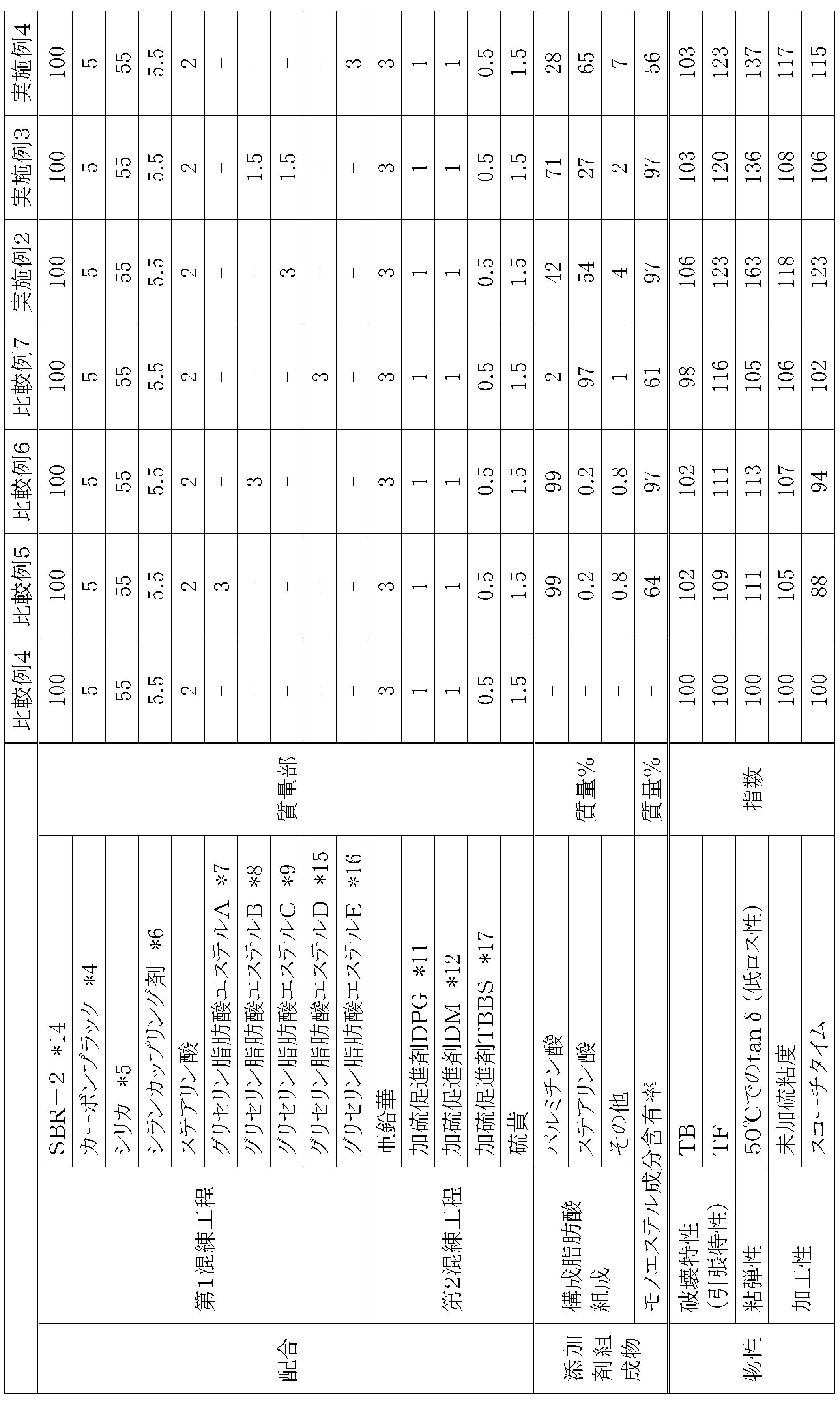
- Patent Document 1 By combining the chemicals disclosed in International Publication No. 2014/098155 (Patent Document 1) from Comparative Example 1 and Comparative Example 2 in Table 1, and Comparative Example 4 and Comparative Example 5 in Table 2, workability is improved. Although it can be improved, it can be seen that the fracture characteristics and low loss cannot be sufficiently improved.
- the rubber composition according to the present invention not only has excellent processability but also excellent fracture characteristics and low loss properties. I understand.
- the most fatty acid in the constituent fatty acids of the glycerin fatty acid ester is the most fatty acid component than the total fatty acid is blended with an additive composition exceeding 90% by mass. It can be seen that blending an additive composition of 90% by mass or less into the total fatty acid improves the processability, fracture characteristics, and low loss properties of the rubber composition.
- the additive composition for silica-containing rubber composition of the present invention can be added to the silica-containing rubber composition and used to improve processability, fracture characteristics, and low loss properties of the rubber composition.
- the rubber composition of the present invention can be used for tires and other rubber products.
- the tire of the present invention can be used as a tire for various vehicles.
Landscapes
- Chemical & Material Sciences (AREA)
- Health & Medical Sciences (AREA)
- Chemical Kinetics & Catalysis (AREA)
- Medicinal Chemistry (AREA)
- Polymers & Plastics (AREA)
- Organic Chemistry (AREA)
- Engineering & Computer Science (AREA)
- Mechanical Engineering (AREA)
- Compositions Of Macromolecular Compounds (AREA)
- Tires In General (AREA)
- Oil, Petroleum & Natural Gas (AREA)
Abstract
Description
以上の背景から、ゴム組成物にシリカを配合することが、年々増加傾向にあり、シリカを配合したゴム組成物は、ヒステリシスロスが小さく(即ち、低ロス性に優れ)、ヒステリシスロスが小さいゴム組成物をタイヤに適用することで、タイヤの転がり抵抗を低減することができる。また、シリカを配合したゴム組成物をタイヤのトレッドゴムに適用することで、タイヤの湿潤路面でのグリップ性能を向上させることもできる。しかしながら、シリカは、ゴム組成物中で凝集するため、加工性(作業性)に問題がある。
これに対し、ゴム組成物中でのシリカの分散性を改良し、加工性を改善する薬品として、国際公開第2014/098155号(特許文献1)に記載のようなグリセリン脂肪酸エステル等が開発されている。
また、本発明は、転がり抵抗が小さく、破壊特性に優れたタイヤを提供することを更なる課題とする。
以下に、本発明のシリカ配合ゴム組成物用添加剤組成物を、その実施形態に基づき、詳細に説明する。
本発明のシリカ配合ゴム組成物用添加剤組成物は、グリセリン脂肪酸エステルからなり、該グリセリン脂肪酸エステルが、グリセリンと、2種以上の脂肪酸とのエステルであって、該グリセリン脂肪酸エステルを構成する2種以上の脂肪酸のうち、最も多い脂肪酸成分が全脂肪酸に対して10~90質量%であり、さらにモノエステル成分をグリセリン脂肪酸エステルに対し50~100質量%含むことを特徴とする。
次に、本発明のゴム組成物を、その実施形態に基づき、詳細に説明する。
本発明のゴム組成物は、ジエン系ゴムと、シリカと、上述したシリカ配合ゴム組成物用添加剤組成物とを含むことを特徴とする。本発明のゴム組成物においては、シリカ配合ゴム組成物用添加剤組成物を構成する、グリセリンと2種以上の脂肪酸とのエステルであるグリセリン脂肪酸エステルが、ゴム組成物中のシリカの分散性を向上させるため、加工性に優れる。また、ゴム組成物中のシリカの分散性が高いため、シリカの配合効果が十分に発揮されて、低ロス性、破壊特性にも優れる。
本発明のタイヤは、上述したゴム組成物を用いたことを特徴とする。本発明のタイヤは、前記ゴム組成物が用いられているため、転がり抵抗が小さく、破壊特性に優れる。ここで、前記ゴム組成物を用いるタイヤの部位としては、トレッド、サイドウォール、ケース部材等が挙げられる。
表1及び表2に示す配合処方で、通常のバンバリーミキサーを用いて、第1混練工程、第2混練工程の順に混練を行って、ゴム組成物を調製した。なお、第1混練工程におけるゴム組成物の最高温度は150℃とし、第2混練工程におけるゴム組成物の最高温度は110℃とした。得られたゴム組成物に対して、下記の方法で、破壊特性、低ロス性、ペイン効果、加工性を評価した。
得られたゴム組成物を160℃で20分加硫後、JIS K6251に準拠して室温(23℃)で引張試験を行うことによって、EB(切断時伸び(%))及びTB(引張強さ(MPa))を測定し、TF(タフネス:EB×TB)を求め、表1においては、比較例2を100として指数表示し、表2においては、比較例4を100として指数表示した。指数値が大きい程、引張強さが大きい、或いは、ゴム強度(タフネス)が高く、良好であることを示す。
(2-1)得られたゴム組成物を160℃で20分加硫後、粘弾性測定装置(レオメトリックス社製)を使用し、温度60℃、動歪5%、周波数15Hzでtanδを測定し、表1において、比較例2のtanδを100として逆数の指数表示とした。指数値が大きい程、tanδが小さく、低ロス性に優れることを示す。
(2-2)得られたゴム組成物を160℃で20分加硫後、JIS K6251に準拠した3号ダンベル試験片を作製後、疲労・耐久試験機(サーボパルサEMT、株式会社島津製作所製)を使用し、温度50℃に調温して、最小10Nから最大20Nの試験力で、10Hzのサイクルで印加し、7000回印加した時のtanδを測定して、表2において、比較例4のtanδを100として逆数の指数表示とした。指数値が大きいほど、tanδが小さく、低ロス性に優れることを示す。
得られたゴム組成物の未加硫粘度及びスコーチタイムを、JIS K 6300-1:2001(ムーニー粘度、スコーチタイム)に従って測定した。未加硫粘度(ムーニー粘度)は、表1においては比較例2を100として逆数の指数表示とし、表2においては比較例4を100として逆数の指数表示とした。スコーチタイムは、表1においては比較例2を100として指数表示とし、表2においては比較例4を100として指数表示とした。未加硫粘度については、指数値が大きい程、未加硫粘度が低く、加工性(作業性)が良好であることを示し、また、スコーチタイムについては、指数値が大きい程、早期加硫が起こり難く、加工性(作業性)が良好であることを示す。

*2 BR: ポリブタジエンゴム、JSR株式会社製、溶液重合BR、商品名「JSR BR01」
*3 アロマオイル: 富士興産社製、商品名「アロマックス#3」
*4 カーボンブラック: 三菱化学社製、商品名「ダイヤブラックN234」、ISAF-HS
*5 シリカ: 東ソー・シリカ社製、商品名「ニプシルAQ」
*6 シランカップリング剤: デグッサ社製、商品名「Si69」
*8 グリセリン脂肪酸エステルB: 上記グリセリン脂肪酸エステルAを分子蒸留することで調製したもの、グリセリン脂肪酸モノエステル含有率=97質量%、構成脂肪酸の99質量%がパルミチン酸、1質量%がその他脂肪酸
*9 グリセリン脂肪酸エステルC: 国際公開第2014/098155号(特許文献1)の製造例1に記載の方法に従い、脂肪酸をオクタン酸から同モル量のパーム由来硬化脂肪酸に変えて合成し、さらに分子蒸留することで調製したもの、グリセリン脂肪酸モノエステル含有率=97質量%、構成脂肪酸の54質量%がステアリン酸で且つ42質量%がパルミチン酸、4質量%がその他脂肪酸
*11 加硫促進剤DPG: 1,3-ジフェニルグアニジン、大内新興化学工業社製、商品名「ノクセラーD」
*12 加硫促進剤DM: ジ-2-ベンゾチアゾリルジスルフィド、大内新興化学工業社製、商品名「ノクセラーDM」
*13 加硫促進剤CZ: N-シクロヘキシル-2-ベンゾチアゾリルスルフェンアミド、大内新興化学工業社製、商品名「ノクセラーCZ-G」
*15 グリセリン脂肪酸エステルD: 国際公開第2014/098155号(特許文献1)の製造例1に記載の方法に従い、脂肪酸をオクタン酸から同モル量のステアリン酸(花王株式会社製 「ルナックS-98」)に変えて合成したもの、グリセリン脂肪酸モノエステル含有率=61質量%、構成脂肪酸の97%がステアリン酸、2質量%がパルミチン酸、1質量%がその他脂肪酸
*16 グリセリン脂肪酸エステルE: 国際公開第2014/098155号(特許文献1)の製造例1に記載の方法に従い、脂肪酸をオクタン酸から同モル量の動物油脂由来硬化脂肪酸に変えて合成したもの、グリセリン脂肪酸モノエステル含有率=56質量%、構成脂肪酸の65質量%がステアリン酸で且つ28質量%がパルミチン酸、7質量%がその他脂肪酸
*17 加硫促進剤TBBS: N-t-ブチル-2-ベンゾチアゾリルスルフェンアミド、大内新興化学工業社製、商品名「ノクセラーNS」
Claims (11)
- グリセリン脂肪酸エステルからなり、該グリセリン脂肪酸エステルが、グリセリンと、2種以上の脂肪酸とのエステルであって、該グリセリン脂肪酸エステルを構成する2種以上の脂肪酸のうち、最も多い脂肪酸成分が全脂肪酸中に10~90質量%であり、さらにモノエステル成分をグリセリン脂肪酸エステル中に50~100質量%含むことを特徴とする、シリカ配合ゴム組成物用添加剤組成物。
- 前記グリセリン脂肪酸エステルを構成する脂肪酸が、炭素数8~22である、請求項1に記載のシリカ配合ゴム組成物用添加剤組成物。
- 前記グリセリン脂肪酸エステルを構成する2種以上の脂肪酸のうち、最も多い脂肪酸成分と2番目に多い脂肪酸成分は、一方が炭素数16の脂肪酸で他方が炭素数18の脂肪酸である、請求項1又は2に記載のシリカ配合ゴム組成物用添加剤組成物。
- 前記炭素数16の脂肪酸と前記炭素数18の脂肪酸との質量比が、90/10~10/90である、請求項3に記載のシリカ配合ゴム組成物用添加剤組成物。
- ジエン系ゴムと、シリカと、請求項1~4のいずれか一項に記載のシリカ配合ゴム組成物用添加剤組成物とを含むことを特徴とする、ゴム組成物。
- 前記炭素数16の脂肪酸と前記炭素数18の脂肪酸との質量比が、75/25~25/75である、請求項5に記載のゴム組成物。
- 前記モノエステル成分をグリセリン脂肪酸エステル中に85~98質量%含む、請求項5に記載のゴム組成物。
- 前記シリカ配合ゴム組成物用添加剤組成物の配合量が、前記シリカ100質量部に対して0.5~20質量部である、請求項5に記載のゴム組成物。
- 前記ジエン系ゴム100質量部に対して前記シリカが10~120質量部である、請求項5に記載のゴム組成物。
- 前記ジエン系ゴムがスチレン-ブタジエン共重合体ゴムを含む、請求項5に記載のゴム組成物。
- 請求項5~10のいずれか一項に記載のゴム組成物を用いたことを特徴とする、タイヤ。
Priority Applications (4)
| Application Number | Priority Date | Filing Date | Title |
|---|---|---|---|
| CN201680013906.4A CN107429007B (zh) | 2015-03-05 | 2016-02-22 | 用于配混有二氧化硅的橡胶组合物的添加剂组合物、橡胶组合物和轮胎 |
| BR112017019059-1A BR112017019059A2 (ja) | 2015-03-05 | 2016-02-22 | The additive agent constituent for silica compounded rubber constituents, a rubber composition, and a tire |
| US15/551,370 US10472492B2 (en) | 2015-03-05 | 2016-02-22 | Additive composition for silica compound rubber composition, rubber composition and tire |
| EP16758615.5A EP3266821B1 (en) | 2015-03-05 | 2016-02-22 | Additive composition for silica-compounded rubber composition, rubber composition, and tire |
Applications Claiming Priority (2)
| Application Number | Priority Date | Filing Date | Title |
|---|---|---|---|
| JP2015044067A JP6608602B2 (ja) | 2015-03-05 | 2015-03-05 | シリカ配合ゴム組成物用添加剤組成物、ゴム組成物及びタイヤ |
| JP2015-044067 | 2015-03-05 |
Publications (1)
| Publication Number | Publication Date |
|---|---|
| WO2016139916A1 true WO2016139916A1 (ja) | 2016-09-09 |
Family
ID=56846279
Family Applications (1)
| Application Number | Title | Priority Date | Filing Date |
|---|---|---|---|
| PCT/JP2016/000935 Ceased WO2016139916A1 (ja) | 2015-03-05 | 2016-02-22 | シリカ配合ゴム組成物用添加剤組成物、ゴム組成物及びタイヤ |
Country Status (6)
| Country | Link |
|---|---|
| US (1) | US10472492B2 (ja) |
| EP (1) | EP3266821B1 (ja) |
| JP (1) | JP6608602B2 (ja) |
| CN (1) | CN107429007B (ja) |
| BR (1) | BR112017019059A2 (ja) |
| WO (1) | WO2016139916A1 (ja) |
Cited By (3)
| Publication number | Priority date | Publication date | Assignee | Title |
|---|---|---|---|---|
| WO2018230406A1 (ja) * | 2017-06-16 | 2018-12-20 | 株式会社ブリヂストン | タイヤトレッド用ゴム組成物及びタイヤ |
| WO2019163519A1 (ja) | 2018-02-26 | 2019-08-29 | 横浜ゴム株式会社 | ゴム組成物およびそれを用いた空気入りタイヤ |
| JP2020084113A (ja) * | 2018-11-29 | 2020-06-04 | 横浜ゴム株式会社 | ゴム組成物およびそれを用いた空気入りタイヤ |
Families Citing this family (2)
| Publication number | Priority date | Publication date | Assignee | Title |
|---|---|---|---|---|
| JP6598475B2 (ja) * | 2015-03-05 | 2019-10-30 | 株式会社ブリヂストン | ゴム組成物及びタイヤ |
| EP4219610A1 (en) * | 2022-01-31 | 2023-08-02 | Bridgestone Europe NV/SA | Rubber composition with high stiffness |
Citations (5)
| Publication number | Priority date | Publication date | Assignee | Title |
|---|---|---|---|---|
| JPS6232836A (ja) * | 1985-08-02 | 1987-02-12 | 松下電器産業株式会社 | 電撃式防虫装置 |
| JP2005534759A (ja) * | 2002-07-29 | 2005-11-17 | ソシエテ ドゥ テクノロジー ミシュラン | 空気タイヤのトレッドキャップ用ゴム組成物 |
| JP2009504810A (ja) * | 2005-08-08 | 2009-02-05 | ソシエテ ド テクノロジー ミシュラン | ゴム組成物用の可塑系 |
| WO2014098155A1 (ja) * | 2012-12-19 | 2014-06-26 | 株式会社ブリヂストン | ゴム組成物及びそれを用いたタイヤ |
| WO2015147274A1 (ja) * | 2014-03-27 | 2015-10-01 | 横浜ゴム株式会社 | ゴム組成物およびそれを用いた空気入りタイヤ |
Family Cites Families (6)
| Publication number | Priority date | Publication date | Assignee | Title |
|---|---|---|---|---|
| JPS6262836A (ja) * | 1985-09-13 | 1987-03-19 | Kao Corp | 帯電防止用マスタ−ペレツト |
| AT405285B (de) | 1995-09-07 | 1999-06-25 | Semperit Ag | Kautschukmischung |
| JP2007161822A (ja) * | 2005-12-12 | 2007-06-28 | Yokohama Rubber Co Ltd:The | タイヤ用ゴム組成物 |
| US20140135437A1 (en) | 2012-11-15 | 2014-05-15 | The Goodyear Tire & Rubber Company | Tire with rubber tread containing combination of resin and vegetable oil, particularly soybean oil |
| CN103450504B (zh) * | 2013-08-28 | 2015-06-10 | 山东阳谷华泰化工股份有限公司 | 一种橡胶用白炭黑分散剂及其制备方法 |
| EP3138874B1 (en) * | 2014-04-30 | 2018-10-24 | Bridgestone Corporation | Rubber composition for tire, production method for rubber composition for tire, and tire |
-
2015
- 2015-03-05 JP JP2015044067A patent/JP6608602B2/ja active Active
-
2016
- 2016-02-22 EP EP16758615.5A patent/EP3266821B1/en active Active
- 2016-02-22 CN CN201680013906.4A patent/CN107429007B/zh active Active
- 2016-02-22 US US15/551,370 patent/US10472492B2/en active Active
- 2016-02-22 BR BR112017019059-1A patent/BR112017019059A2/ja not_active Application Discontinuation
- 2016-02-22 WO PCT/JP2016/000935 patent/WO2016139916A1/ja not_active Ceased
Patent Citations (5)
| Publication number | Priority date | Publication date | Assignee | Title |
|---|---|---|---|---|
| JPS6232836A (ja) * | 1985-08-02 | 1987-02-12 | 松下電器産業株式会社 | 電撃式防虫装置 |
| JP2005534759A (ja) * | 2002-07-29 | 2005-11-17 | ソシエテ ドゥ テクノロジー ミシュラン | 空気タイヤのトレッドキャップ用ゴム組成物 |
| JP2009504810A (ja) * | 2005-08-08 | 2009-02-05 | ソシエテ ド テクノロジー ミシュラン | ゴム組成物用の可塑系 |
| WO2014098155A1 (ja) * | 2012-12-19 | 2014-06-26 | 株式会社ブリヂストン | ゴム組成物及びそれを用いたタイヤ |
| WO2015147274A1 (ja) * | 2014-03-27 | 2015-10-01 | 横浜ゴム株式会社 | ゴム組成物およびそれを用いた空気入りタイヤ |
Non-Patent Citations (1)
| Title |
|---|
| See also references of EP3266821A4 * |
Cited By (4)
| Publication number | Priority date | Publication date | Assignee | Title |
|---|---|---|---|---|
| WO2018230406A1 (ja) * | 2017-06-16 | 2018-12-20 | 株式会社ブリヂストン | タイヤトレッド用ゴム組成物及びタイヤ |
| JP2019001922A (ja) * | 2017-06-16 | 2019-01-10 | 株式会社ブリヂストン | タイヤトレッド用ゴム組成物及びタイヤ |
| WO2019163519A1 (ja) | 2018-02-26 | 2019-08-29 | 横浜ゴム株式会社 | ゴム組成物およびそれを用いた空気入りタイヤ |
| JP2020084113A (ja) * | 2018-11-29 | 2020-06-04 | 横浜ゴム株式会社 | ゴム組成物およびそれを用いた空気入りタイヤ |
Also Published As
| Publication number | Publication date |
|---|---|
| EP3266821A1 (en) | 2018-01-10 |
| CN107429007B (zh) | 2020-03-13 |
| EP3266821B1 (en) | 2019-08-21 |
| EP3266821A4 (en) | 2018-03-07 |
| JP2016160424A (ja) | 2016-09-05 |
| US10472492B2 (en) | 2019-11-12 |
| BR112017019059A2 (ja) | 2018-04-17 |
| US20180030241A1 (en) | 2018-02-01 |
| CN107429007A (zh) | 2017-12-01 |
| JP6608602B2 (ja) | 2019-11-20 |
Similar Documents
| Publication | Publication Date | Title |
|---|---|---|
| JP6113189B2 (ja) | ゴム組成物及びそれを用いたタイヤ | |
| JP6484609B2 (ja) | タイヤ用ゴム組成物及びその製造方法並びにタイヤ | |
| CN107406629B (zh) | 轮胎用橡胶组合物和轮胎 | |
| JP5782456B2 (ja) | ゴム組成物及びそれを用いたタイヤ | |
| JP6608602B2 (ja) | シリカ配合ゴム組成物用添加剤組成物、ゴム組成物及びタイヤ | |
| JP6358968B2 (ja) | タイヤ用ゴム組成物の製造方法およびタイヤ | |
| JP6358965B2 (ja) | タイヤ用ゴム組成物の製造方法およびタイヤ | |
| JP6685902B2 (ja) | ゴム組成物、その製造方法及びタイヤ | |
| JP6358964B2 (ja) | タイヤ用ゴム組成物の製造方法およびタイヤ | |
| JP6496105B2 (ja) | 重荷重用タイヤ | |
| WO2012070625A1 (ja) | ゴム組成物及びそれを用いたタイヤ | |
| JP6395615B2 (ja) | タイヤ用ゴム組成物の製造方法およびタイヤ | |
| JP6114067B2 (ja) | ゴム組成物及びタイヤ | |
| JP6358967B2 (ja) | タイヤ用ゴム組成物の製造方法およびタイヤ | |
| JP7197238B2 (ja) | ゴム用添加剤、ゴム用添加剤組成物、タイヤ用ゴム組成物、タイヤ用架橋ゴム組成物、タイヤ用ゴム製品、及びタイヤ | |
| JPWO2018225565A1 (ja) | ゴム組成物及びタイヤ | |
| JP7360081B2 (ja) | 重荷重タイヤ用ゴム組成物 | |
| JP5019745B2 (ja) | ゴム組成物 | |
| JP2016125013A (ja) | タイヤ用ゴム組成物の製造方法およびタイヤ | |
| JP7006039B2 (ja) | タイヤトレッド用ゴム組成物 | |
| JP6358966B2 (ja) | タイヤ用ゴム組成物の製造方法およびタイヤ | |
| JP2020002379A (ja) | ゴム組成物及びタイヤ | |
| JP2013173906A (ja) | ゴム組成物 |
Legal Events
| Date | Code | Title | Description |
|---|---|---|---|
| 121 | Ep: the epo has been informed by wipo that ep was designated in this application |
Ref document number: 16758615 Country of ref document: EP Kind code of ref document: A1 |
|
| REEP | Request for entry into the european phase |
Ref document number: 2016758615 Country of ref document: EP |
|
| NENP | Non-entry into the national phase |
Ref country code: DE |
|
| REG | Reference to national code |
Ref country code: BR Ref legal event code: B01A Ref document number: 112017019059 Country of ref document: BR |
|
| ENP | Entry into the national phase |
Ref document number: 112017019059 Country of ref document: BR Kind code of ref document: A2 Effective date: 20170905 |