WO2016121844A1 - 近赤外線吸収微粒子分散液とその製造方法 - Google Patents
近赤外線吸収微粒子分散液とその製造方法 Download PDFInfo
- Publication number
- WO2016121844A1 WO2016121844A1 PCT/JP2016/052402 JP2016052402W WO2016121844A1 WO 2016121844 A1 WO2016121844 A1 WO 2016121844A1 JP 2016052402 W JP2016052402 W JP 2016052402W WO 2016121844 A1 WO2016121844 A1 WO 2016121844A1
- Authority
- WO
- WIPO (PCT)
- Prior art keywords
- infrared absorbing
- absorbing fine
- fine particles
- particle dispersion
- fine particle
- Prior art date
- Legal status (The legal status is an assumption and is not a legal conclusion. Google has not performed a legal analysis and makes no representation as to the accuracy of the status listed.)
- Ceased
Links
Images

Classifications
-
- C—CHEMISTRY; METALLURGY
- C09—DYES; PAINTS; POLISHES; NATURAL RESINS; ADHESIVES; COMPOSITIONS NOT OTHERWISE PROVIDED FOR; APPLICATIONS OF MATERIALS NOT OTHERWISE PROVIDED FOR
- C09D—COATING COMPOSITIONS, e.g. PAINTS, VARNISHES OR LACQUERS; FILLING PASTES; CHEMICAL PAINT OR INK REMOVERS; INKS; CORRECTING FLUIDS; WOODSTAINS; PASTES OR SOLIDS FOR COLOURING OR PRINTING; USE OF MATERIALS THEREFOR
- C09D17/00—Pigment pastes, e.g. for mixing in paints
- C09D17/004—Pigment pastes, e.g. for mixing in paints containing an inorganic pigment
- C09D17/007—Metal oxide
-
- C—CHEMISTRY; METALLURGY
- C09—DYES; PAINTS; POLISHES; NATURAL RESINS; ADHESIVES; COMPOSITIONS NOT OTHERWISE PROVIDED FOR; APPLICATIONS OF MATERIALS NOT OTHERWISE PROVIDED FOR
- C09D—COATING COMPOSITIONS, e.g. PAINTS, VARNISHES OR LACQUERS; FILLING PASTES; CHEMICAL PAINT OR INK REMOVERS; INKS; CORRECTING FLUIDS; WOODSTAINS; PASTES OR SOLIDS FOR COLOURING OR PRINTING; USE OF MATERIALS THEREFOR
- C09D11/00—Inks
- C09D11/02—Printing inks
- C09D11/03—Printing inks characterised by features other than the chemical nature of the binder
- C09D11/033—Printing inks characterised by features other than the chemical nature of the binder characterised by the solvent
-
- C—CHEMISTRY; METALLURGY
- C09—DYES; PAINTS; POLISHES; NATURAL RESINS; ADHESIVES; COMPOSITIONS NOT OTHERWISE PROVIDED FOR; APPLICATIONS OF MATERIALS NOT OTHERWISE PROVIDED FOR
- C09D—COATING COMPOSITIONS, e.g. PAINTS, VARNISHES OR LACQUERS; FILLING PASTES; CHEMICAL PAINT OR INK REMOVERS; INKS; CORRECTING FLUIDS; WOODSTAINS; PASTES OR SOLIDS FOR COLOURING OR PRINTING; USE OF MATERIALS THEREFOR
- C09D11/00—Inks
- C09D11/02—Printing inks
- C09D11/03—Printing inks characterised by features other than the chemical nature of the binder
- C09D11/037—Printing inks characterised by features other than the chemical nature of the binder characterised by the pigment
-
- C—CHEMISTRY; METALLURGY
- C09—DYES; PAINTS; POLISHES; NATURAL RESINS; ADHESIVES; COMPOSITIONS NOT OTHERWISE PROVIDED FOR; APPLICATIONS OF MATERIALS NOT OTHERWISE PROVIDED FOR
- C09D—COATING COMPOSITIONS, e.g. PAINTS, VARNISHES OR LACQUERS; FILLING PASTES; CHEMICAL PAINT OR INK REMOVERS; INKS; CORRECTING FLUIDS; WOODSTAINS; PASTES OR SOLIDS FOR COLOURING OR PRINTING; USE OF MATERIALS THEREFOR
- C09D11/00—Inks
- C09D11/02—Printing inks
- C09D11/06—Printing inks based on fatty oils
-
- C—CHEMISTRY; METALLURGY
- C09—DYES; PAINTS; POLISHES; NATURAL RESINS; ADHESIVES; COMPOSITIONS NOT OTHERWISE PROVIDED FOR; APPLICATIONS OF MATERIALS NOT OTHERWISE PROVIDED FOR
- C09D—COATING COMPOSITIONS, e.g. PAINTS, VARNISHES OR LACQUERS; FILLING PASTES; CHEMICAL PAINT OR INK REMOVERS; INKS; CORRECTING FLUIDS; WOODSTAINS; PASTES OR SOLIDS FOR COLOURING OR PRINTING; USE OF MATERIALS THEREFOR
- C09D17/00—Pigment pastes, e.g. for mixing in paints
-
- C—CHEMISTRY; METALLURGY
- C09—DYES; PAINTS; POLISHES; NATURAL RESINS; ADHESIVES; COMPOSITIONS NOT OTHERWISE PROVIDED FOR; APPLICATIONS OF MATERIALS NOT OTHERWISE PROVIDED FOR
- C09K—MATERIALS FOR MISCELLANEOUS APPLICATIONS, NOT PROVIDED FOR ELSEWHERE
- C09K3/00—Materials not provided for elsewhere
-
- C—CHEMISTRY; METALLURGY
- C09—DYES; PAINTS; POLISHES; NATURAL RESINS; ADHESIVES; COMPOSITIONS NOT OTHERWISE PROVIDED FOR; APPLICATIONS OF MATERIALS NOT OTHERWISE PROVIDED FOR
- C09D—COATING COMPOSITIONS, e.g. PAINTS, VARNISHES OR LACQUERS; FILLING PASTES; CHEMICAL PAINT OR INK REMOVERS; INKS; CORRECTING FLUIDS; WOODSTAINS; PASTES OR SOLIDS FOR COLOURING OR PRINTING; USE OF MATERIALS THEREFOR
- C09D11/00—Inks
- C09D11/50—Sympathetic, colour changing or similar inks
Definitions
- the present invention relates to a near-infrared absorbing fine particle dispersion having an absorption capability in the near-infrared region and applicable to offset printing, and a method for producing the same.
- the “near-infrared absorbing fine particles” in the present invention and the “near-infrared absorbing material fine particles” in the previous application based on priority are the same fine particles.
- offset printing is characterized by being capable of high-definition printing and suitable for mass printing.
- the pigment dispersion used from the printing principle is oleophilic and the rubber blanket to which the printing ink containing the dispersion is transferred does not dissolve during the offset printing. Is required.
- the infrared absorbing material is transparent in the visible light region, it cannot be visually determined that the infrared absorbing material is printed as a pigment. For this reason, it is preferable from the viewpoint of forgery prevention and the like, and since it does not visually disturb the original print display, it is also preferable from the viewpoint of visibility and aesthetics.
- Patent Document 1 proposes a material using a phthalocyanine compound.
- Patent Document 2 proposes one using tin-doped indium oxide.
- the composite tungsten oxide (M, denoted by a material having a high visible light transmittance and near infrared absorbing function formula M y WO z is H, the He, alkali metals , Alkaline earth metals, rare earth elements, Mg, Zr, Cr, Mn, Fe, Ru, Co, Rh, Ir, Ni, Pd, Pt, Cu, Ag, Au, Zn, Cd, Al, Ga, In, Tl , Si, Ge, Sn, Pb, Sb, B, F, P, S, Se, Br, Te, Ti, Nb, V, Mo, Ta, Re, Be, Hf, Os, Bi, I
- W is tungsten
- O oxygen, 0.001 ⁇ y ⁇ 1, 2.2 ⁇ z ⁇ 3.0
- the organic pigment such as the phthalocyanine compound used in Patent Document 1 has a problem that its infrared absorption characteristics change due to the influence of temperature, ultraviolet rays, etc., and is inferior in durability. have.
- the infrared absorbing material using tin-doped indium oxide used in Patent Document 2 has insufficient contrast between the wavelength region that transmits or reflects as visible light and the wavelength region that absorbs as infrared light, There has been a problem that the reading accuracy of the printing section is lowered.
- the present invention has been made under such circumstances, and the problem to be solved is a near-infrared absorbing fine particle dispersion applicable to offset printing having a near-infrared absorption capability and a clear contrast. It is to provide a liquid and a method for producing the same.
- the present inventors have conducted intensive research. As a result, 10% by mass or more and 25% by mass or less of near-infrared absorbing fine particles are added to one or more solvents selected from vegetable oil or vegetable oil-derived compounds.
- the near-infrared absorbing fine particles applicable to offset printing can be applied by sufficiently pulverizing and dispersing the near-infrared absorbing fine particles by setting the viscosity of the dispersion to 180 mPa ⁇ S or less.
- the present invention was completed by conceiving that a dispersion was obtained. It was also found that the viscosity of the dispersion can be maintained at 180 mPa ⁇ S or less by adding a predetermined dispersant to the dispersion.
- the first invention for solving the above-described problem is One or more solvents selected from vegetable oils or compounds derived from vegetable oils; 10 wt% or more and 25 wt% or less of a composite tungsten oxide represented by M x W y O z (M is H, He, alkali metal, alkaline earth metal, rare earth element, Mg, Zr, Cr, Mn Fe, Ru, Co, Rh, Ir, Ni, Pd, Pt, Cu, Ag, Au, Zn, Cd, Al, Ga, In, Tl, Si, Ge, Sn, Pb, Sb, B, F, P , S, Se, Br, Te, Ti, Nb, V, Mo, Ta, Re, Be, Hf, Os, Bi, I are one or more kinds of elements, W is tungsten, O is oxygen 0.001 ⁇ x / y ⁇ 1, 2.2 ⁇ z / y ⁇ 3.0) or tungsten oxide having a magnetic phase represented by the general formula W y O
- the second invention is The near-infrared absorbing fine particle dispersion according to the first invention, wherein the anchor portion of the dispersant has one or more selected from a secondary amino group, a tertiary amino group, and a quaternary ammonium group It is a liquid.
- the third invention is The near-infrared absorbing fine particle dispersion according to the first or second invention, wherein the dispersant has an acid value of 1 mgKOH / g or more.
- a fourth invention is the near-infrared absorbing fine particle dispersion according to any one of the first to third inventions, wherein the near-infrared absorbing fine particles have a dispersed particle diameter of 1 nm to 200 nm.
- the fifth invention is: The near-infrared absorbing fine particles represented by M x W y O z have a hexagonal crystal structure or a hexagonal crystal structure, according to any one of the first to fourth inventions This is a near-infrared absorbing fine particle dispersion.
- the sixth invention is: The lattice constant of the near-infrared absorbing fine particles represented by M x W y O z is such that the a-axis is 0.74060 nm to 0.74082 nm and the c-axis is 0.76106 nm to 0.76149 nm.
- the near-infrared absorbing fine particle dispersion according to any one of the first to fifth inventions.
- the seventh invention The near infrared ray according to any one of the first to sixth inventions, wherein the surface of the near infrared ray absorbing fine particles is coated with one or more compounds selected from Si, Ti, Al, and Zr. Absorption fine particle dispersion.
- the eighth invention The near-infrared absorbing fine particle dispersion according to any one of the first to seventh inventions, wherein the vegetable oil is one or more kinds of vegetable oils selected from a drying oil and a semi-drying oil.
- the ninth invention The near-infrared-absorbing fine particle dispersion according to any one of the first to eighth inventions, wherein the near-infrared-absorbing fine particles, the solvent, and the dispersant are mixed and dispersed by a wet medium mill. It is a manufacturing method.
- the near-infrared absorbing fine particle dispersion according to the present invention can be easily applied to offset printing having an absorption capability in the near-infrared region and a clear contrast.
- Embodiments for carrying out the present invention will be described in detail in the order of near-infrared absorbing fine particles, a solvent, a dispersant, a method of dispersing near-infrared absorbing fine particles in a solvent, and a near-infrared absorbing fine particle dispersion.
- Near-infrared absorbing fine particles used in the present invention are composite tungsten oxides represented by M x W y O z (M is H, He, alkali metal, alkaline earth metal, rare earth element, Mg, Zr, Cr, Mn, Fe, Ru, Co, Rh, Ir, Ni, Pd, Pt, Cu, Ag, Au, Zn, Cd, Al, Ga, In, Tl, Si, Ge, Sn, Pb, Sb, W is one or more elements selected from B, F, P, S, Se, Br, Te, Ti, Nb, V, Mo, Ta, Re, Be, Hf, Os, Bi, and I.
- M is H, He, alkali metal, alkaline earth metal, rare earth element, Mg, Zr, Cr, Mn, Fe, Ru, Co, Rh, Ir, Ni, Pd, Pt, Cu, Ag, Au, Zn, Cd, Al, Ga, In, Tl, Si, Ge, Sn, Pb, Sb,
- O is oxygen, 0.001 ⁇ x / y ⁇ 1, 2.2 ⁇ z / y ⁇ 3.0), or tungsten oxide having a magnetic phase represented by the general formula W y O z ( W is tungsten, O is oxygen, 2.45 ⁇ z / y ⁇ 2.9 At least one selected from 9).
- the alkali metal is a group 1 element of the periodic table excluding hydrogen, the alkaline earth metal is a group 2 element of the periodic table, and the rare earth elements are Sc, Y and lanthanoid elements.
- the near-infrared absorbing fine particles used in the present invention is a composite tungsten oxide represented by M x W y O z .
- the element M is added.
- the M element is Cs, Rb, K, Tl, In, Ba, Li, Ca, Sr, Fe, or Sn. It is preferable that it is 1 or more types of these, and it is more preferable that M element is Cs. Further, in the case of Cs x W y O z (0.25 ⁇ x / y ⁇ 0.35, 2.2 ⁇ z / y ⁇ 3.0), the lattice constant is 0.74060 nm or more and 0.74082 nm in the a axis.
- the c-axis is preferably 0.76106 nm or more and 0.76149 nm or less.
- the lattice constant can be obtained, for example, by performing Rietveld analysis based on XRD pattern data.
- the composite tungsten oxide is preferably treated with a silane coupling agent. This is because excellent dispersibility is obtained, and an excellent near-infrared absorption function and transparency in the visible light region are obtained.
- the value of x / y indicating the addition amount of the element M is larger than 0.001, a sufficient amount of free electrons is generated and the near infrared absorption effect can be sufficiently obtained.
- the supply amount of free electrons increases and the near-infrared absorption effect also increases, but saturates when the value of x / y is about 1.
- the value of x / y is smaller than 1, it is preferable because an impurity phase can be prevented from being generated in the fine particle-containing layer.
- the composite tungsten oxide represented by M x W y O z is the same as the tungsten oxide represented by W y O z described above.
- 2.2 ⁇ z / y ⁇ 3.0 is preferable, more preferably 2.45 ⁇ z / y ⁇ 3.0.
- the composite tungsten oxide or tungsten oxide according to the present invention includes a case where a part of oxygen atoms is substituted with halogen atoms.
- the composite tungsten oxide fine particles that are near-infrared absorbing fine particles have a hexagonal crystal structure
- transmission of the fine particles in the visible light region is improved, and absorption in the near-infrared region is improved.
- the cation of the element M is added to the hexagonal void
- the transmission in the visible light region is improved and the absorption in the near infrared region is improved.
- the element M having a large ionic radius is added, the hexagonal crystal is formed.
- Fe is added, hexagonal crystals are easily formed.
- the additive element M is present in the hexagonal void formed by the WO 6 unit, and is not limited to the above elements.
- the addition amount of the additive element M is preferably 0.2 or more and 0.5 or less in terms of x / y, more preferably 0. .30 or more and 0.35 or less, and ideally 0.33.
- the value of x / y is 0.33, it is considered that the additive element M is arranged in all of the hexagonal voids.
- tetragonal and cubic tungsten bronzes also have a near infrared absorption effect. These crystal structures tend to change the absorption position in the near infrared region, and the absorption position tends to move to the longer wavelength side in the order of cubic ⁇ tetragonal ⁇ hexagonal. Further, the accompanying absorption in the visible light region is small in the order of hexagonal crystal ⁇ tetragonal crystal ⁇ cubic crystal. For this reason, it is preferable to use hexagonal tungsten bronze for applications that transmit light in the visible light region and absorb light in the near infrared region.
- a so-called “magneti phase” having a composition ratio represented by 2.45 ⁇ z / y ⁇ 2.999 is chemically stable, Since the absorption characteristics in the infrared region are also good, it is preferable as a near-infrared absorbing material.
- the near-infrared absorbing fine particles according to the present invention absorb a large amount of light in the near-infrared region, particularly in the vicinity of a wavelength of 1000 nm, the transmitted color tone is often from blue to green.
- the dispersed particle size of the particles of the near-infrared absorbing material can be selected depending on the purpose of use. First, when used for applications that maintain transparency, it is preferable that the particles have a dispersed particle size of 2000 nm or less. If the dispersed particle size is 2000 nm or less, the difference between the peak of transmittance and the bottom of absorption in the near infrared region becomes large, and the effect as a near infrared absorbing material having transparency in the visible light region can be exhibited. Because. Furthermore, particles having a dispersed particle size smaller than 2000 nm do not completely block light by scattering, and can maintain visibility in the visible light region and at the same time efficiently maintain transparency.
- the dispersed particle size of the near-infrared absorbing fine particles is 200 nm or less, preferably 100 nm or less. The reason is that if the dispersed particle size is small, the scattering of light in the visible light range of 400 nm to 780 nm due to geometrical scattering or Mie scattering is reduced. This is because it is possible to avoid the loss of sex. That is, when the dispersed particle diameter of the near-infrared absorbing fine particles is 200 nm or less, the geometric scattering or Mie scattering is reduced and a Rayleigh scattering region is obtained.
- the scattered light decreases in inverse proportion to the sixth power of the dispersed particle diameter, so that the scattering is reduced and the transparency is improved as the dispersed particle diameter is decreased. Furthermore, when the dispersed particle diameter is 100 nm or less, the scattered light is preferably very small. From the viewpoint of avoiding light scattering, a smaller dispersed particle size is preferable. On the other hand, if the dispersed particle diameter is 1 nm or more, industrial production is easy.
- the surface of the fine particles constituting the near-infrared absorbing material of the present invention is coated with an oxide containing one or more of Si, Ti, Zr, and Al. It is preferable from the viewpoint of improvement.
- the solvent used in the present invention is insoluble in water and does not dissolve a rubber blanket used in offset printing.
- a solvent composed of one or more kinds selected from vegetable oils and vegetable oil-derived compounds is used.
- Vegetable oils include dry oils such as linseed oil, sunflower oil and tung oil, semi-dry oils such as sesame oil, cottonseed oil, rapeseed oil, soybean oil and rice bran oil, and non-drying oils such as olive oil, coconut oil, palm oil and dehydrated castor oil. Used.
- examples of the vegetable oil-derived compound include fatty acid monoesters and ethers obtained by directly esterifying a fatty acid of a vegetable oil with a monoalcohol.
- the vegetable oil and the compound derived from vegetable oil mentioned above have a double bond in the fatty acid of the fat which is a component. This double bond reacts with oxygen in the air, so that a polymerization reaction between the double bonds proceeds.
- the coating film after the offset printing is solidified by bonding by a polymerization reaction between the oil molecules or a polymerization reaction between the oil molecules and a pigment component for offset printing. The solidification becomes faster as the number of double bonds in the fatty acid increases, but the double bond in the fatty acid is evaluated by the iodine value. That is, the solidification of the vegetable oil and the vegetable oil-derived compound is faster as the iodine value is higher.
- the dry oil has an iodine value of 130 or more
- semi-dry oil is 130 to 100
- non-dry oil is 100 or less.
- a vegetable oil used for offset printing and a compound derived from a vegetable oil, 1 or more types selected from drying oils, such as a semi-drying oil, the linseed oil which has an iodine value of 130 or more, sunflower oil, a tung oil, are preferable.
- the dispersant for dispersing the near-infrared absorbing fine particles in the solvent preferably has a fatty acid structure. Furthermore, the dispersant is required to be soluble in the solvent according to the present invention described above.
- the structure of the dispersant is not particularly limited, but those having a polylactone skeleton or a hydroxystearic acid chain are preferable.
- the near-infrared absorbing fine particles according to the present invention can be used in the present invention as long as it is a dispersant having one or more types selected from a secondary amino group, a tertiary amino group, and a quaternary ammonium group as an anchor part described later. The ability to disperse in the solvent is high and preferable.
- the acid value of the dispersant according to the present invention is 1 mgKOH / g or more because the ability to disperse the above-described near-infrared absorbing fine particles in the solvent according to the present invention is high.
- the anchor part is a part of a molecule constituting the dispersant and is a part adsorbed on the surface of the near-infrared absorbing fine particles or pigment.
- a dispersing agent concerning the present invention, it is preferred to use a polymer dispersing agent which has a basic anchor part. This is because the storage stability of the ink to be produced is preferably improved by using a polymer dispersant having a basic anchor portion.
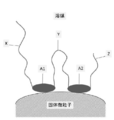
- A1 and A2 are adsorbed on solid fine particles such as near infrared absorbing fine particles and pigments. It is a part to perform, ie, an anchor part.
- the structure is not particularly limited, and for example, the polymer dispersant may be composed of a chain, a ring, a condensed polycycle, or a combination thereof.
- A1 and A2 may be the same as or different from each other.
- X, Y, and Z are molecular chain portions that dissolve and spread from the surface of the solid fine particles into the solvent when the solid fine particles are solvated.
- X and Z may be referred to as a tail portion
- Y may be referred to as a loop portion.
- a homopolymer composed of a single monomer or a copolymer composed of a plurality of monomers is used.
- the dispersing agent which concerns on this invention what does not have a loop part (Y) can also be used.
- the above-described general formula [X-A1-Y-A2-Z] has the same meaning as the general formula [X-A1-A2-Z].
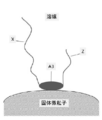
- the loop portion (Y) shown in FIG. 6 does not exist, and two tail portions (X, Z) are bonded to one anchor portion (A3). Things can also be used. In this case, the general formula [X-A3-Z] is obtained.
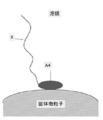
- the dispersant according to the present invention there is a case where the tail portion (Z) does not exist and one tail portion (X) is bonded to one anchor portion (A4) as shown in FIG. Can be used. In this case, the general formula [X-A4] is obtained.
- A1, A2, A3, and A4 constituting the dispersant according to the present invention have a functional group (adsorption point) that exerts an adsorption interaction with the surface of the solid fine particles due to hydrogen bonding or acid / base interaction. Have at least one. Further, as described above, A1 and A2 may be the same or different from each other. However, in view of the adsorptivity to the surface of the solid fine particles, the function that exhibits the adsorption interaction is considered. Those having the same functional group as the group (adsorption point) are preferred. Furthermore, A1 and A2 are preferably the same from the viewpoint of ease of production of the polymer dispersant.
- the molecular chains X, Y, and Z constituting the dispersant according to the present invention may be composed of different chemical species, and at least two may be composed of the same chemical species. Since the tail part (X, Z) and the loop part (Y) of the molecular chain are parts that are solvated and dissolve in the solvent from the surface of the solid fine particles, molecular chains having affinity for the solvent are used.
- the dispersant according to the present invention is obtained by adding 10% by mass or more and 25% by mass or less of the composite tungsten oxide and / or tungsten oxide according to the present invention to a solvent composed of one or more petroleum solvents,
- the dispersion exhibits a dispersion ability that allows the viscosity of the dispersion to be maintained at 180 mPa ⁇ S or less.
- the composite tungsten oxide fine particles and / or the tungsten oxide are sufficiently pulverized and dispersed.
- the composite tungsten oxide and / or the dispersed particle diameter of the tungsten oxide can be set to 200 nm or less.
- Dispersic As specific examples of preferred dispersants, commercially available dispersants may be Dispersic (DISPERBYK) 142; Dispersic 160, Dispersic 161, Dispersic 162, Dispersic 163, Dispersic 166, Dispersic 170, Dispersic 180, Disperbic 182, Disperbic 184, Disperbic 190, Disperbic 2155 (above, manufactured by Big Chemie Japan Co., Ltd.); EFKA-46, EFKA-47, EFKA-48, EFKA-49 (above, manufactured by BASF); Polymer 100, polymer 120, polymer 150, polymer 400, polymer 401, polymer 402, polymer 403, polymer 450, polymer 451, polymer 452, polymer 453 ( Solsperse 11200, Solsperse 1940, Solsparse 16000, Solspers 17000, Solspers 18000, Solspers 20000, Solspers 24000, Solspers 27000, Solspers 28000, Solspers 32000, Solspers 33
- the addition amount of the dispersant according to the present invention is preferably 30 parts by weight or more and 200 parts by weight or less with respect to 100 parts by weight of the near-infrared absorbing fine particles.
- the said dispersing agent does not contain the solvent which may melt
- the dispersion method for obtaining the near-infrared absorbing fine particle dispersion by dispersing the near-infrared absorbing fine particles according to the present invention in the solvent according to the present invention is as follows. Any method of dispersion can be selected. Specifically, it is preferable to use a wet medium mill such as a bead mill or a ball mill.
- the concentration of the near-infrared absorbing fine particles is 10 to 25% by mass, preferably 15 to 25% by mass, more preferably 20 to 25% by mass.
- the higher the concentration of the near-infrared absorbing fine particles the easier the preparation of the ink for offset printing is preferable.
- the concentration of the near-infrared absorbing fine particles is 25% by mass or less, the addition of the dispersant described above suppresses the viscosity of the obtained near-infrared absorbing fine particle dispersion to 180 mPa ⁇ S or less, Crushing and dispersion can be sufficiently advanced.
- the dispersed particle size of the near-infrared absorbing fine particles can be arbitrarily controlled by the processing time of the wet medium mill. By increasing the treatment time, the dispersed particle size can be reduced.
- the lower limit of the viscosity of the near-infrared absorbing fine particle dispersion according to the present invention depends on the viscosity of the vegetable oil or the vegetable oil-derived compound used. For example, the viscosity (24 ° C.) of sunflower oil is 50 mPa ⁇ S, and the viscosity (24 ° C.) of linseed oil is 40 mPa ⁇ S. By the production method described above, the near-infrared absorbing fine particle dispersion according to the present invention is obtained.
- the measuring method of the acid value of the dispersing agent concerning a present Example is based on JISK0070, and is based on a potentiometric titration method.
- the viscosity of the near-infrared absorbing fine particle dispersion according to this example was measured using a vibration viscometer VM100A-L (CBC Materials Co., Ltd.).
- the optical characteristics of the film according to this example were measured using a spectrophotometer U-4000 (manufactured by Hitachi, Ltd.).
- the visible light transmittance was measured according to JIS R 3106.
- Example 1 Hexagonal Cs 0.33 WO 3 (a-axis 0.74075 nm, c-axis 0.76127 nm) which is a composite tungsten oxide as near-infrared absorbing fine particles is 23% by mass, the structure of the dispersant has fatty acid and amino group, Dispersant (hereinafter abbreviated as Dispersant a) having an acid value of 20.3 mgKOH / g, having a hydroxystearic acid chain, and having a nonvolatile content of 100%, sunflower oil 65. 5% by mass was weighed.
- Dispersant a Dispersant having an acid value of 20.3 mgKOH / g, having a hydroxystearic acid chain, and having a nonvolatile content of 100%
- sunflower oil 65. 5% by mass was weighed.
- a transparent PET film having a thickness of 50 ⁇ m was prepared as a substrate to be printed, and a dispersion liquid A was formed on the surface thereof with a thickness of 8 ⁇ m by a bar coater. This membrane was dried at 70 ° C. for 3 hours to dry dispersion A.
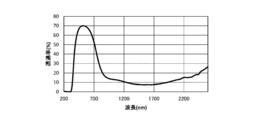
- the visible light transmittance of the dried film of Dispersion A thus obtained was 68.8%. Further, the transmittance at 550 nm in the visible light region is 69.8%, the transmittance at 800 nm in the near infrared region is 26.7%, the transmittance at 900 nm is 15.7%, and the transmittance at 1000 nm is 13.3. %, And the transmittance at 1500 nm was 7.5%.
- the light transmission profile of the dispersion A in the dry film is shown in FIG. 1, and the measurement results are shown in Table 1 (hereinafter, Examples 2 to 4 are also shown).
- Example 2 A near-infrared absorbing fine particle dispersion liquid (hereinafter referred to as “dispersion liquid B”) according to Example 2 was obtained in the same manner as in Example 1 except that linseed oil was used as the solvent.
- the dispersion particle diameter of the composite tungsten oxide fine particles in the dispersion B was measured with an Otsuka Electronics particle size distribution meter. As a result, it was 79 nm, and the viscosity (24 ° C.) of the dispersion B was 91.4 mPa ⁇ S.
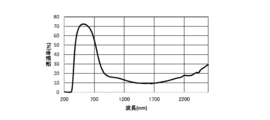
- a dry film according to Example 2 was obtained in the same manner as in Example 1, and the optical characteristics were measured. The light transmission profile of the dispersion B in the dry film is shown in FIG.
- Example 3 A dispersant having a fatty acid and an amino group in the structure of the dispersant, an acid value of 5 mgKOH / g or more, a hydroxystearic acid skeleton partially modified with caprolactone, and a nonvolatile content of 100% (hereinafter referred to as dispersion)
- a near-infrared absorbing fine particle dispersion liquid (hereinafter abbreviated as dispersion liquid C) according to Example 3 was obtained in the same manner as in Example 1 except that the abbreviated agent b) was used.
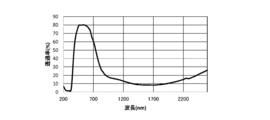
- Example 3 shows a light transmission profile of the dispersion C in the dry film.
- Example 4 A dispersant having a fatty acid and an amino group in the structure of the dispersant, an acid value of 20.3 ⁇ 5 mgKOH / g, a polylactone skeleton, and a non-volatile content of 100% (hereinafter abbreviated as “dispersant c”). ) was used in the same manner as in Example 1 to obtain a near-infrared absorbing fine particle dispersion (hereinafter referred to simply as Dispersion D) according to Example 4.
- Dispersion D a near-infrared absorbing fine particle dispersion
- the dispersion particle diameter of the composite tungsten oxide fine particles in the dispersion D was measured with an Otsuka Electronics particle size distribution meter, and found to be 79 nm, and the viscosity (24 ° C.) of the dispersion D was 112 mPa ⁇ S.
- a dry film was obtained in the same manner as in Example 1, and the optical characteristics were measured.
- the permeation profile of this dispersion liquid D through the dry membrane is shown in FIG.
- Example 1 As a near-infrared absorbing fine particle, 15.0% by mass of hexagonal Cs 0.33 WO 3 which is the same composite tungsten oxide as in Example 1 and a dispersing agent made of an acrylic resin having no acid value (hereinafter, dispersed) This is abbreviated as agent d.) 12.0% by mass and 73.0% by mass of toluene are mixed and pulverized and dispersed in a paint shaker containing 0.3 mm ⁇ ZrO 2 beads for 10 hours to obtain a composite tungsten oxide fine particle dispersion. (Hereinafter abbreviated as Dispersion E) was prepared.
- the dispersed particle diameter of the tungsten oxide fine particles in the dispersion E was measured with a particle size distribution meter (manufactured by Otsuka Electronics Co., Ltd.), it was 77 nm, and the viscosity (24 ° C.) of the dispersion E was 6.2 mPa ⁇ S.
Landscapes
- Chemical & Material Sciences (AREA)
- Engineering & Computer Science (AREA)
- Materials Engineering (AREA)
- Organic Chemistry (AREA)
- Wood Science & Technology (AREA)
- Life Sciences & Earth Sciences (AREA)
- General Chemical & Material Sciences (AREA)
- Chemical Kinetics & Catalysis (AREA)
- Inorganic Chemistry (AREA)
- Oil, Petroleum & Natural Gas (AREA)
- Inks, Pencil-Leads, Or Crayons (AREA)
- Pigments, Carbon Blacks, Or Wood Stains (AREA)
- Compositions Of Macromolecular Compounds (AREA)
- Paints Or Removers (AREA)
Abstract
Description
このような用途においては、大量の紙媒体へ多くのデータが印刷される為、印刷方法としてはオフセット印刷を用いることが検討されている。
また、特許文献2では、錫ドープ酸化インジウムを用いたものが提案されている。
また、特許文献2に用いられている錫ドープ酸化インジウムを用いた赤外線吸収材料は、可視光として透過または反射する波長領域と、赤外光として吸収する波長領域とにおけるコントラストが不十分な為、印刷部の読み取り精度などが低下する問題があった。
そこで、本発明者らは、オフセット印刷用の溶媒として用いられる植物油や植物油由来の化合物へ、一般式MxWyOzで表記される複合タングステン酸化物微粒子や、一般式WyOzで表記されるマグネリ相を有する酸化タングステン微粒子という近赤外線吸収微粒子を添加し分散させることを試行した。しかしながら、分散液の粘性が上昇してしまい、近赤外線吸収微粒子を粉砕したり、溶剤中へ分散させることが困難になるという問題を知見した。
植物油または植物油由来の化合物から選択される1種類以上の溶剤と、
10質量%以上25質量%以下の、MxWyOzで表記される複合タングステン酸化物(Mは、H、He、アルカリ金属、アルカリ土類金属、希土類元素、Mg、Zr、Cr、Mn、Fe、Ru、Co、Rh、Ir、Ni、Pd、Pt、Cu、Ag、Au、Zn、Cd、Al、Ga、In、Tl、Si、Ge、Sn、Pb、Sb、B、F、P、S、Se、Br、Te、Ti、Nb、V、Mo、Ta、Re、Be、Hf、Os、Bi、Iのうちから選択される1種類以上の元素で、Wはタングステン、Oは酸素で、0.001≦x/y≦1、2.2≦z/y≦3.0)、または、一般式WyOzで表記されるマグネリ相を有するタングステン酸化物(Wはタングステン、Oは酸素、2.45≦z/y≦2.999)から選択される1種以上の近赤外線吸収微粒子と、
前記溶剤に可溶で、かつ構造中に脂肪酸を有する分散剤と、を含み、粘度が180mPa・S以下であることを特徴とする近赤外線吸収微粒子分散液である。
第2の発明は、
前記分散剤のアンカー部が、2級アミノ基、3級アミノ基、および、4級アンモニウム基から選択される1種類以上を有することを特徴とする第1の発明に記載の近赤外線吸収微粒子分散液である。
第3の発明は、
前記分散剤の酸価が1mgKOH/g以上の分散剤であることを特徴とする第1または第2の発明に記載の近赤外線吸収微粒子分散液である。
第4の発明は
前記近赤外線吸収微粒子の分散粒子径が1nm以上200nm以下であることを特徴とする第1から第3のいずれかの発明に記載の近赤外線吸収微粒子分散液である。
第5の発明は、
前記MxWyOzで表記される近赤外線吸収微粒子が、六方晶の結晶構造を有する、または六方晶の結晶構造からなることを特徴とする第1から第4のいずれかの発明に記載の近赤外線吸収微粒子分散液である。
第6の発明は、
前記MxWyOzで表記される近赤外線吸収微粒子の格子定数が、a軸は0.74060nm以上0.74082nm以下で、c軸は0.76106nm以上0.76149nm以下であることを特徴とする第1から第5のいずれかの発明に記載の近赤外線吸収微粒子分散液である。
第7の発明は、
前記近赤外線吸収微粒子の表面が、Si、Ti、Al、Zrから選択される1種以上の化合物で被覆されていることを特徴とする第1から第6のいずれかの発明に記載の近赤外線吸収微粒子分散液である。
第8の発明は、
前記植物油が、乾性油、半乾性油から選択される1種類以上の植物油であることを特徴とする第1から第7のいずれかの発明に記載の近赤外線吸収微粒子分散液である。
第9の発明は、
前記近赤外線吸収微粒子と、前記溶剤と、前記分散剤を混合し、湿式媒体ミルで分散処理することを特徴とする第1から第8のいずれかの発明に記載の近赤外線吸収微粒子分散液の製造方法である。
本発明に用いられる近赤外線吸収微粒子は、MxWyOzで表記される複合タングステン酸化物(Mは、H、He、アルカリ金属、アルカリ土類金属、希土類元素、Mg、Zr、Cr、Mn、Fe、Ru、Co、Rh、Ir、Ni、Pd、Pt、Cu、Ag、Au、Zn、Cd、Al、Ga、In、Tl、Si、Ge、Sn、Pb、Sb、B、F、P、S、Se、Br、Te、Ti、Nb、V、Mo、Ta、Re、Be、Hf、Os、Bi、Iのうちから選択される1種類以上の元素で、Wはタングステン、Oは酸素で、0.001≦x/y≦1、2.2≦z/y≦3.0)、または、一般式WyOzで表記されるマグネリ相を有するタングステン酸化物(Wはタングステン、Oは酸素、2.45≦z/y≦2.999)から選択される1種以上である。
尚、アルカリ金属は水素を除く周期表第1族元素、アルカリ土類金属は周期表第2族元素、希土類元素はSc、Yおよびランタノイド元素である。
また、CsxWyOz(0.25≦x/y≦0.35、2.2≦z/y≦3.0)の場合、格子定数が、a軸は0.74060nm以上0.74082nm以下で、c軸は0.76106nm以上0.76149nm以下であることが好ましい。格子定数が前記の範囲内にあると、特に光学特性や耐候性に優れた近赤外線吸収微粒子が得られる。格子定数は、例えばXRDパターンのデータを基にリートベルト解析を行うことで求めることができる。
また、当該複合タングステン酸化物が、シランカップリング剤で処理されていることも好ましい。優れた分散性が得られ、優れた近赤外線吸収機能、可視光領域における透明性が得られるからである。
次に、酸素量の制御を示すz/yの値については、MxWyOzで表記される複合タングステン酸化物においても、上述のWyOzで表記されるタングステン酸化物と同様の機構が働くことに加え、z/y=3.0においても、上述した元素Mの添加量による自由電子の供給があるため、2.2≦z/y≦3.0が好ましく、さらに好ましくは2.45≦z/y≦3.0である。
尚、本発明に係る複合タングステン酸化物やタングステン酸化物の製造時に使用する原料化合物に由来して、当該複合タングステン酸化物やタングステン酸化物を構成する酸素原子の一部がハロゲン原子に置換している場合があるが、本発明の実施において問題はない。そこで、本発明に係る複合タングステン酸化物やタングステン酸化物には、酸素原子の一部がハロゲン原子に置換している場合も含むものである。
この六角形の空隙に元素Mの陽イオンが添加されて存在するとき、可視光領域の透過が向上し、近赤外領域の吸収が向上する。ここで、一般的には、イオン半径の大きな元素Mを添加したとき当該六方晶が形成され、具体的には、Cs、K、Rb、Tl、In、Ba、Sn、Li、Ca、Sr、Feを添加したとき六方晶が形成されやすい。勿論これら以外の元素でも、WO6単位で形成される六角形の空隙に添加元素Mが存在すれば良く、上記元素に限定される訳ではない。
六方晶の結晶構造を有する複合タングステン酸化物微粒子が均一な結晶構造を有するとき、添加元素Mの添加量は、x/yの値で0.2以上0.5以下が好ましく、更に好ましくは0.30以上0.35以下であり、理想的には0.33である。x/yの値が0.33となることで、添加元素Mが、六角形の空隙の全てに配置されると考えられる。
本発明に用いられる溶剤は、非水溶性であり、かつ、オフセット印刷において用いられるゴム製のブランケットを溶解しないことが求められる。具体的には、植物油、植物油由来の化合物から選択される1種類以上からなる溶剤が用いられる。
植物油としては、アマニ油、ヒマワリ油、桐油等の乾性油、ゴマ油、綿実油、菜種油、大豆油、米糠油等の半乾性油、オリーブ油、ヤシ油、パーム油、脱水ヒマシ油等の不乾性油が用いられる。植物油由来の化合物としては、植物油の脂肪酸とモノアルコールを直接エステル反応させた脂肪酸モノエステル、エーテル類などが用いられる。
当該固化は、脂肪酸中の二重結合が多い程速くなるが、当該脂肪酸中の二重結合はヨウ素価により評価される。即ち、植物油、植物油由来の化合物の固化は、ヨウ素価が高い程早くなる。具体的には、乾性油ではヨウ素価が130以上、半乾性油では130~100、不乾性油では100以下である。そして、オフセット印刷に用いる植物油、植物油由来の化合物としては、半乾性油、ヨウ素価が130以上であるアマニ油、ヒマワリ油、桐油等の乾性油から選択される1種以上が好ましい。
前記近赤外線吸収微粒子を前記溶剤中に分散させる分散剤は、脂肪酸の構造を有するものが好ましい。さらに、当該分散剤は、上述した本発明に係る溶剤に可溶であることが求められる。
また、当該分散剤の構造は、特に限定されるものではないが、ポリラクトン骨格やヒドロキシステアリン酸鎖を有するものが好ましい。さらに後述するアンカー部として、2級アミノ基、3級アミノ基、および、4級アンモニウム基から選択される1種類以上を有する分散剤であれば、本発明に係る近赤外線吸収微粒子を、本発明に係る溶剤に分散させる能力が高く好ましい。
さらに、本発明に係る分散剤の酸価が1mgKOH/g以上であると、上述した近赤外線吸収微粒子を、本発明に係る溶剤に分散させる能力が高く好ましい。
そして、本発明に係る分散剤としては、塩基性のアンカー部を有する高分子分散剤を用いることが好ましい。これは、特に、塩基性のアンカー部を有する高分子分散剤を用いることにより、製造されるインクの保存安定性が改良され好ましいからである。
図5に示した、一般式[X-A1-Y-A2-Z]にて表記されアンカー部を有する高分子分散剤において、A1、A2は前記近赤外線吸収微粒子や顔料等の固体微粒子に吸着する部分、即ちアンカー部である。当該高分子分散剤が、アンカー部を1個以上有していれば、その構造は特に制限はなく、例えば、鎖状、環状、縮合多環状、または、それらの組み合わせで構成されていても良い。また、A1、A2は、互いに同一のものであっても、異なっているものであっても良い。一方、X、Y、Zは、前記固体微粒子が溶媒和した際、当該固体微粒子の表面から溶媒中へ溶け拡がる分子鎖部分である。以下、XおよびZをテール部と、Yをループ部と記載する場合がある。当該テール部、ループ部には、単一のモノマーからなるホモポリマーや、複数のモノマーからなるコポリマーが用いられる。
さらにまた、本発明に係る分散剤の一態様として図6に示す、ループ部(Y)が存在せず、かつ、一つのアンカー部(A3)に二つのテール部(X、Z)が結合したものも用いることが出来る。この場合、一般式[X-A3-Z]となる。
加えて、本発明に係る分散剤の一態様として図7に示す、テール部(Z)が存在せず、かつ、一つのアンカー部(A4)に一つのテール部(X)が結合したものも用いることが出来る。この場合、一般式[X-A4]となる。
当該分散液の粘度が180mPa・S以下に保たれる結果、複合タングステン酸化物微粒子および/またはタングステン酸化物において、粉砕および分散が十分に進行する。そして、製造される近赤外線吸収微粒子分散液において、複合タングステン酸化物および/またはタングステン酸化物の分散粒子径を200nm以下とすることが可能となるからである。
また、市販の分散剤を用いる場合は、当該分散剤がアクリル樹脂等を溶解する可能性のある溶剤を含有していないことが好ましい。従って、当該分散剤の不揮発分(180℃、20分間加熱後)は高いことが好ましく、例えば95%以上であることが好ましい。
本発明に係る近赤外線吸収微粒子を本発明に係る溶剤へ分散させて、近赤外線吸収微粒子分散液を得る為の分散方法は、当該微粒子が均一に溶剤に分散する方法であれば任意に選択できる。具体的には、ビーズミル、ボールミル等の湿式媒体ミルを用いることが好ましい。
近赤外線吸収微粒子の濃度が高いほど、オフセット印刷用のインキ調製が容易であり好ましい。一方、近赤外線吸収微粒子の濃度が25質量%以下であれば、上述した分散剤の添加により、得られる近赤外線吸収微粒子分散液の粘度を180mPa・S以下に抑制して、近赤外線吸収微粒子の粉砕・分散を十分に進めることが出来る。この場合、近赤外線吸収微粒子の分散粒子径は、湿式媒体ミルの処理時間により、任意に制御出来る。処理時間を長くする事により、分散粒子径を小さくすることができる。
尚、本発明に係る近赤外線吸収微粒子分散液の粘度の下限値は、用いられる植物油または植物油由来の化合物の粘度に依存する。例えば、ヒマワリ油の粘度(24℃)は50mPa・Sであり、アマニ油の粘度(24℃)は40mPa・Sである。
以上説明した製造方法により、本発明に係る近赤外線吸収微粒子分散液が得られる。
尚、本実施例に係る分散剤の酸価の測定方法は、JIS K 0070に準拠し、電位差滴定法による。
本実施例に係る近赤外線吸収微粒子分散液の粘度の測定方法は、振動式粘度計VM100A-L(CBCマテリアルズ(株)製)を用いて測定した。
一方、本実施例に係る膜の光学特性は、分光光度計U-4000(日立製作所(株)製)を用いて測定した。可視光透過率は、JIS R 3106に準拠して測定を行った。
近赤外線吸収微粒子として複合タングステン酸化物である六方晶Cs0.33WO3(a軸0.74075nm、c軸0.76127nm)を23質量%、分散剤の構造に脂肪酸およびアミノ基を有し、酸価が20.3mgKOH/gであり、ヒドロキシステアリン酸鎖を有し、不揮発分100%である分散剤(以下、分散剤aと略称する。)11.5質量%、溶剤としてヒマワリ油65.5質量%を秤量した。
これらの近赤外線吸収微粒子、分散剤、溶剤を、0.3mmφZrO2ビーズを入れたペイントシェーカーに装填し、40時間粉砕・分散処理し、実施例1に係る近赤外線吸収微粒子分散液(以下、分散液Aと略称する)を得た。
分散液A中における複合タングステン酸化物微粒子の分散粒子径を、粒度分布計(大塚電子製)で測定したところ81nmであり、分散液Aの粘度(24℃)は96.2mPa・Sであった。
当該結果を表1に示す(以下、実施例2~4、比較例1も同様に示す。)。
溶剤としてアマニ油を用いた以外は、実施例1と同様にして実施例2に係る近赤外線吸収微粒子分散液(以下、分散液Bと略称する)を得た。
分散液B中の複合タングステン酸化物微粒子の分散粒子径を大塚電子製粒度分布計で測定したところ79nmであり、分散液Bの粘度(24℃)は91.4mPa・Sであった。
次に、実施例1と同様にして実施例2に係る乾燥膜を得、光学特性を測定した。この分散液Bの乾燥膜における光の透過プロファイルを図2に示す。
分散剤の構造に脂肪酸およびアミノ基を有し、酸価が5mgKOH/g以上であり、一部カプロラクトンで変性されたヒドロキシステアリン酸骨格を有し、不揮発分100%である分散剤(以下、分散剤bと略称する。)を用いた以外は、実施例1と同様にして実施例3に係る近赤外線吸収微粒子分散液(以下、分散液Cと略称する)を得た。
分散液C中の複合タングステン酸化物微粒子の分散粒子径を大塚電子製粒度分布計で測定したところ80nmであり、分散液Cの粘度(24℃)は151mPa・Sであった。
次に、実施例1と同様にして実施例3に係る乾燥膜を得、光学特性を測定した。この分散液Cの乾燥膜における光の透過プロファイルを図3に示す。
分散剤の構造に脂肪酸およびアミノ基を有し、酸価が20.3±5mgKOH/gであり、ポリラクトン骨格を有し、不揮発分100%である分散剤(以下、分散剤cと略称する。)を用いた以外は、実施例1と同様にして実施例4に係る近赤外線吸収微粒子分散液(以下、分散液Dと略称する)を得た。
分散液D中の複合タングステン酸化物微粒子の分散粒子径を大塚電子製粒度分布計で測定したところ79nmであり、分散液Dの粘度(24℃)は112mPa・Sであった。
次に、実施例1と同様にして乾燥膜を得、光学特性を測定した。この分散液Dの乾燥膜の透過プロファイルを図4に示す。
近赤外線吸収微粒子として、実施例1と同様の複合タングステン酸化物である六方晶Cs0.33WO3を15.0質量%、酸価を有さないアクリル系樹脂からなる分散剤(以下、分散剤dと略称する。)12.0質量%、トルエン73.0質量%を混合し、0.3mmφZrO2ビーズを入れたペイントシェーカーで10時間粉砕・分散処理することによって複合タングステン酸化物微粒子分散液(以下、分散液Eと略称する。)を調製した。
分散液E内におけるタングステン酸化物微粒子の分散粒子径を粒度分布計(大塚電子製)で測定したところ77nmであり、分散液Eの粘度(24℃)は6.2mPa・Sであった。
実施例1~4において、植物油中にタングステン酸化物や複合タングステン酸化物の粒子を分散させた近赤外線吸収微粒子分散液で作製した乾燥膜は、可視光領域では高い透過率を示し、近赤外線領域では透過率が顕著に低くなっている。
この結果から、本発明に係る近赤外線吸収微粒子分散液と他のインキ用材料とを用いて調製したオフセット印刷インキの印刷パターンは、近赤外線鑑定機で判別可能であることが推測される。
一方、比較例1に係る分散液Eは、トルエンを含有し、オフセット印刷の際ゴム製のブランケットを溶解するため、オフセット印刷への適用は、不適であると考えられた。

Claims (9)
- 植物油または植物油由来の化合物から選択される1種類以上の溶剤と、
10質量%以上25質量%以下の、MxWyOzで表記される複合タングステン酸化物(Mは、H、He、アルカリ金属、アルカリ土類金属、希土類元素、Mg、Zr、Cr、Mn、Fe、Ru、Co、Rh、Ir、Ni、Pd、Pt、Cu、Ag、Au、Zn、Cd、Al、Ga、In、Tl、Si、Ge、Sn、Pb、Sb、B、F、P、S、Se、Br、Te、Ti、Nb、V、Mo、Ta、Re、Be、Hf、Os、Bi、Iのうちから選択される1種類以上の元素で、Wはタングステン、Oは酸素で、0.001≦x/y≦1、2.2≦z/y≦3.0)、または、一般式WyOzで表記されるマグネリ相を有するタングステン酸化物(Wはタングステン、Oは酸素、2.45≦z/y≦2.999)から選択される1種以上の近赤外線吸収微粒子と、
前記溶剤に可溶で、かつ構造中に脂肪酸を有する分散剤と、を含み、粘度が180mPa・S以下であることを特徴とする近赤外線吸収微粒子分散液。 - 前記分散剤のアンカー部が、2級アミノ基、3級アミノ基、および、4級アンモニウム基から選択される1種類以上を有することを特徴とする請求項1に記載の近赤外線吸収微粒子分散液。
- 前記分散剤の酸価が1mgKOH/g以上の分散剤であることを特徴とする請求項1または2に記載の近赤外線吸収微粒子分散液。
- 前記近赤外線吸収微粒子の分散粒子径が1nm以上200nm以下であることを特徴とする請求項1から3のいずれかに記載の近赤外線吸収微粒子分散液。
- 前記MxWyOzで表記される近赤外線吸収微粒子が、六方晶の結晶構造を有する、または六方晶の結晶構造からなることを特徴とする請求項1から4のいずれかに記載の近赤外線吸収微粒子分散液。
- 前記MxWyOzで表記される近赤外線吸収微粒子の格子定数が、a軸は0.74060nm以上0.74082nm以下で、c軸は0.76106nm以上0.76149nm以下であることを特徴とする請求項1から5のいずれかに記載の近赤外線吸収微粒子分散液。
- 前記近赤外線吸収微粒子の表面が、Si、Ti、Al、Zrから選択される1種以上の化合物で被覆されていることを特徴とする、請求項1から6のいずれかに記載の近赤外線吸収微粒子分散液。
- 前記植物油が、乾性油、半乾性油から選択される1種類以上の植物油であることを特徴とする請求項1から7のいずれかに記載の近赤外線吸収微粒子分散液。
- 前記近赤外線吸収微粒子と、前記溶剤と、前記分散剤を混合し、湿式媒体ミルで分散処理することを特徴とする請求項1から8のいずれかに記載の近赤外線微粒子分散液の製造方法。
Priority Applications (6)
| Application Number | Priority Date | Filing Date | Title |
|---|---|---|---|
| CN201680007542.9A CN107429099B (zh) | 2015-01-27 | 2016-01-27 | 近红外线吸收微粒分散液和其制造方法 |
| EP16743447.1A EP3252116B1 (en) | 2015-01-27 | 2016-01-27 | Near-infrared ray absorbing microparticle dispersion solution and production method thereof |
| JP2016572124A JP6508225B2 (ja) | 2015-01-27 | 2016-01-27 | 近赤外線吸収微粒子分散液とその製造方法 |
| KR1020177023901A KR102516862B1 (ko) | 2015-01-27 | 2016-01-27 | 근적외선 흡수 미립자 분산액 및 이의 제조 방법 |
| US15/546,964 US10442948B2 (en) | 2015-01-27 | 2016-01-27 | Near-infrared absorbing fine particle dispersion liquid and method for producing the same |
| AU2016213104A AU2016213104B2 (en) | 2015-01-27 | 2016-01-27 | Near-infrared ray absorbing microparticle dispersion solution and production method thereof |
Applications Claiming Priority (2)
| Application Number | Priority Date | Filing Date | Title |
|---|---|---|---|
| JP2015-013421 | 2015-01-27 | ||
| JP2015013421 | 2015-01-27 |
Publications (1)
| Publication Number | Publication Date |
|---|---|
| WO2016121844A1 true WO2016121844A1 (ja) | 2016-08-04 |
Family
ID=56543452
Family Applications (1)
| Application Number | Title | Priority Date | Filing Date |
|---|---|---|---|
| PCT/JP2016/052402 Ceased WO2016121844A1 (ja) | 2015-01-27 | 2016-01-27 | 近赤外線吸収微粒子分散液とその製造方法 |
Country Status (8)
| Country | Link |
|---|---|
| US (1) | US10442948B2 (ja) |
| EP (1) | EP3252116B1 (ja) |
| JP (1) | JP6508225B2 (ja) |
| KR (1) | KR102516862B1 (ja) |
| CN (1) | CN107429099B (ja) |
| AU (1) | AU2016213104B2 (ja) |
| TW (1) | TWI680103B (ja) |
| WO (1) | WO2016121844A1 (ja) |
Cited By (7)
| Publication number | Priority date | Publication date | Assignee | Title |
|---|---|---|---|---|
| JP2017105705A (ja) * | 2015-12-02 | 2017-06-15 | 住友金属鉱山株式会社 | 熱線遮蔽微粒子および熱線遮蔽微粒子分散液 |
| US20190225503A1 (en) * | 2015-12-02 | 2019-07-25 | Sumitomo Metal Mining Co., Ltd. | Heat ray shielding fine particles, heat ray shielding fine particle dispersion liquid, heat ray shielding film, heat ray shielding glass, heat ray shielding dispersion body, and heat ray shielding laminated transparent substrate |
| CN110770310A (zh) * | 2017-06-19 | 2020-02-07 | 住友金属矿山株式会社 | 防伪油墨用组合物、防伪油墨、防伪用印刷物以及防伪油墨用组合物的制造方法 |
| CN111095047A (zh) * | 2017-09-14 | 2020-05-01 | 住友金属矿山株式会社 | 光热转换层、使用了该光热转换层的供体片以及它们的制造方法 |
| WO2021014983A1 (ja) | 2019-07-23 | 2021-01-28 | 住友金属鉱山株式会社 | 赤外線吸収微粒子含有組成物およびその製造方法 |
| US11655160B2 (en) | 2017-05-05 | 2023-05-23 | William Blythe Limited | Tungsten oxide-based material |
| US12084356B2 (en) | 2017-05-05 | 2024-09-10 | William Blythe Limited | Tungsten oxide-based material |
Families Citing this family (5)
| Publication number | Priority date | Publication date | Assignee | Title |
|---|---|---|---|---|
| KR102516863B1 (ko) * | 2015-01-27 | 2023-03-31 | 스미토모 긴조쿠 고잔 가부시키가이샤 | 근적외선 흡수 미립자 분산액 및 이의 제조 방법 |
| WO2019082722A1 (ja) * | 2017-10-23 | 2019-05-02 | 株式会社パイロットコーポレーション | 可逆熱変色性水性インキ組成物、およびそれを用いた筆記具 |
| CN110734662A (zh) * | 2019-09-06 | 2020-01-31 | 长沙壹纳光电材料有限公司 | 一种钨酸铯乙醇浆料及制备工艺 |
| CN116635490A (zh) * | 2020-12-21 | 2023-08-22 | 爱克发-格法特公司 | Nir吸收喷墨油墨、记录的方法 |
| CN115893478B (zh) * | 2022-11-14 | 2024-03-08 | 滨州医学院 | 一种溴硫锗铅化合物及其制备方法和应用 |
Citations (7)
| Publication number | Priority date | Publication date | Assignee | Title |
|---|---|---|---|---|
| WO2005037932A1 (ja) * | 2003-10-20 | 2005-04-28 | Sumitomo Metal Mining Co., Ltd. | 赤外線遮蔽材料微粒子分散体、赤外線遮蔽体、及び赤外線遮蔽材料微粒子の製造方法、並びに赤外線遮蔽材料微粒子 |
| JP2006143778A (ja) * | 2004-11-16 | 2006-06-08 | Sun Bijutsu Insatsu Kk | 情報担持シート及びそのための印刷インキ |
| JP2008291167A (ja) * | 2007-05-28 | 2008-12-04 | Toyo Ink Mfg Co Ltd | 平版インキ組成物 |
| WO2012128332A1 (ja) * | 2011-03-24 | 2012-09-27 | 旭硝子株式会社 | 液状組成物およびその製造方法、並びにガラス物品 |
| JP2013112791A (ja) * | 2011-11-30 | 2013-06-10 | Sumitomo Metal Mining Co Ltd | 赤外線遮蔽材料微粒子分散液とその製造方法および熱線遮蔽膜と熱線遮蔽合わせ透明基材 |
| JP2013526625A (ja) * | 2010-05-10 | 2013-06-24 | バイエル・インテレクチュアル・プロパティ・ゲゼルシャフト・ミット・ベシュレンクテル・ハフツング | 熱吸収特性と高い安定性を有するポリマー組成物 |
| JP2015117353A (ja) * | 2013-12-20 | 2015-06-25 | 住友金属鉱山株式会社 | 偽造防止インク及び偽造防止印刷物 |
Family Cites Families (10)
| Publication number | Priority date | Publication date | Assignee | Title |
|---|---|---|---|---|
| JPH04320466A (ja) | 1991-04-19 | 1992-11-11 | Mitsui Toatsu Chem Inc | セキュリティインキ |
| JP2000309736A (ja) | 1999-04-26 | 2000-11-07 | Toppan Printing Co Ltd | 赤外線吸収インキ組成物およびそれを用いた印刷物 |
| JP2002256198A (ja) * | 2001-02-28 | 2002-09-11 | Canon Inc | 水性顔料分散体、水性インク及びそれを用いた画像形成方法 |
| CN100503093C (zh) * | 2003-09-05 | 2009-06-24 | 三菱麻铁里亚尔株式会社 | 金属微粒、含有该微粒的组合物及金属微粒的制造方法 |
| CN100590154C (zh) * | 2003-10-20 | 2010-02-17 | 住友金属矿山株式会社 | 红外线遮蔽材料微粒分散体、红外线遮蔽体、红外线遮蔽材料微粒的制法及红外线遮蔽材料微粒 |
| JP4626284B2 (ja) | 2003-12-05 | 2011-02-02 | 住友金属鉱山株式会社 | 日射遮蔽体形成用タングステン酸化物微粒子の製造方法、および日射遮蔽体形成用タングステン酸化物微粒子 |
| KR100982871B1 (ko) * | 2004-08-31 | 2010-09-16 | 스미토모 긴조쿠 고잔 가부시키가이샤 | 도전성 입자, 가시광 투과형 입자 분산 도전체 및 그제조방법, 투명 도전 박막 및 그 제조방법, 이를 이용한투명 도전물품, 적외선 차폐물품 |
| EP1999185B1 (en) * | 2006-03-29 | 2012-02-29 | Basf Se | Polyethylene imine based pigment dispersants |
| JP5176492B2 (ja) * | 2007-11-06 | 2013-04-03 | 住友金属鉱山株式会社 | 近赤外線吸収粘着体、プラズマディスプレイパネル用近赤外線吸収フィルターおよびプラズマディスプレイパネル |
| KR102516863B1 (ko) * | 2015-01-27 | 2023-03-31 | 스미토모 긴조쿠 고잔 가부시키가이샤 | 근적외선 흡수 미립자 분산액 및 이의 제조 방법 |
-
2016
- 2016-01-27 US US15/546,964 patent/US10442948B2/en active Active
- 2016-01-27 EP EP16743447.1A patent/EP3252116B1/en active Active
- 2016-01-27 AU AU2016213104A patent/AU2016213104B2/en active Active
- 2016-01-27 CN CN201680007542.9A patent/CN107429099B/zh active Active
- 2016-01-27 WO PCT/JP2016/052402 patent/WO2016121844A1/ja not_active Ceased
- 2016-01-27 TW TW105102628A patent/TWI680103B/zh active
- 2016-01-27 JP JP2016572124A patent/JP6508225B2/ja active Active
- 2016-01-27 KR KR1020177023901A patent/KR102516862B1/ko active Active
Patent Citations (7)
| Publication number | Priority date | Publication date | Assignee | Title |
|---|---|---|---|---|
| WO2005037932A1 (ja) * | 2003-10-20 | 2005-04-28 | Sumitomo Metal Mining Co., Ltd. | 赤外線遮蔽材料微粒子分散体、赤外線遮蔽体、及び赤外線遮蔽材料微粒子の製造方法、並びに赤外線遮蔽材料微粒子 |
| JP2006143778A (ja) * | 2004-11-16 | 2006-06-08 | Sun Bijutsu Insatsu Kk | 情報担持シート及びそのための印刷インキ |
| JP2008291167A (ja) * | 2007-05-28 | 2008-12-04 | Toyo Ink Mfg Co Ltd | 平版インキ組成物 |
| JP2013526625A (ja) * | 2010-05-10 | 2013-06-24 | バイエル・インテレクチュアル・プロパティ・ゲゼルシャフト・ミット・ベシュレンクテル・ハフツング | 熱吸収特性と高い安定性を有するポリマー組成物 |
| WO2012128332A1 (ja) * | 2011-03-24 | 2012-09-27 | 旭硝子株式会社 | 液状組成物およびその製造方法、並びにガラス物品 |
| JP2013112791A (ja) * | 2011-11-30 | 2013-06-10 | Sumitomo Metal Mining Co Ltd | 赤外線遮蔽材料微粒子分散液とその製造方法および熱線遮蔽膜と熱線遮蔽合わせ透明基材 |
| JP2015117353A (ja) * | 2013-12-20 | 2015-06-25 | 住友金属鉱山株式会社 | 偽造防止インク及び偽造防止印刷物 |
Non-Patent Citations (1)
| Title |
|---|
| See also references of EP3252116A4 * |
Cited By (12)
| Publication number | Priority date | Publication date | Assignee | Title |
|---|---|---|---|---|
| JP2017105705A (ja) * | 2015-12-02 | 2017-06-15 | 住友金属鉱山株式会社 | 熱線遮蔽微粒子および熱線遮蔽微粒子分散液 |
| US20190225503A1 (en) * | 2015-12-02 | 2019-07-25 | Sumitomo Metal Mining Co., Ltd. | Heat ray shielding fine particles, heat ray shielding fine particle dispersion liquid, heat ray shielding film, heat ray shielding glass, heat ray shielding dispersion body, and heat ray shielding laminated transparent substrate |
| US11130315B2 (en) * | 2015-12-02 | 2021-09-28 | Sumitomo Metal Mining Co., Ltd. | Heat ray shielding fine particles, heat ray shielding fine particle dispersion liquid, heat ray shielding film, heat ray shielding glass, heat ray shielding dispersion body, and heat ray shielding laminated transparent substrate |
| US11655160B2 (en) | 2017-05-05 | 2023-05-23 | William Blythe Limited | Tungsten oxide-based material |
| US12084356B2 (en) | 2017-05-05 | 2024-09-10 | William Blythe Limited | Tungsten oxide-based material |
| CN110770310A (zh) * | 2017-06-19 | 2020-02-07 | 住友金属矿山株式会社 | 防伪油墨用组合物、防伪油墨、防伪用印刷物以及防伪油墨用组合物的制造方法 |
| EP3643757A4 (en) * | 2017-06-19 | 2021-03-24 | Sumitomo Metal Mining Co., Ltd. | ANTI-COUNTERFEITING INK COMPOSITION, ANTI-COUNTERFEITING INK, PRINTED COUNTERFEITING ARTICLES, AND METHOD FOR PREPARING ANTI-COUNTERFEITING INK COMPOSITION |
| US11807766B2 (en) | 2017-06-19 | 2023-11-07 | Sumitomo Metal Mining Co., Ltd. | Anti-counterfeit ink composition, anti-counterfeit ink, anti-counterfeit printed matter, and method for producing the anti-counterfeit ink composition |
| CN111095047A (zh) * | 2017-09-14 | 2020-05-01 | 住友金属矿山株式会社 | 光热转换层、使用了该光热转换层的供体片以及它们的制造方法 |
| WO2021014983A1 (ja) | 2019-07-23 | 2021-01-28 | 住友金属鉱山株式会社 | 赤外線吸収微粒子含有組成物およびその製造方法 |
| KR20220038592A (ko) | 2019-07-23 | 2022-03-29 | 스미토모 긴조쿠 고잔 가부시키가이샤 | 적외선 흡수 미립자 함유 조성물 및 그의 제조 방법 |
| US12286561B2 (en) | 2019-07-23 | 2025-04-29 | Sumitomo Metal Mining Co., Ltd. | Infrared-absorbing fine particle-containing composition and method for producing the same |
Also Published As
| Publication number | Publication date |
|---|---|
| EP3252116A1 (en) | 2017-12-06 |
| TW201634396A (zh) | 2016-10-01 |
| EP3252116B1 (en) | 2019-12-18 |
| AU2016213104A1 (en) | 2017-08-31 |
| KR20170108103A (ko) | 2017-09-26 |
| US10442948B2 (en) | 2019-10-15 |
| CN107429099A (zh) | 2017-12-01 |
| TWI680103B (zh) | 2019-12-21 |
| AU2016213104B2 (en) | 2020-03-12 |
| JP6508225B2 (ja) | 2019-05-08 |
| KR102516862B1 (ko) | 2023-03-31 |
| EP3252116A4 (en) | 2018-07-04 |
| US20180016459A1 (en) | 2018-01-18 |
| CN107429099B (zh) | 2021-06-04 |
| JPWO2016121844A1 (ja) | 2017-11-02 |
Similar Documents
| Publication | Publication Date | Title |
|---|---|---|
| CN107429099B (zh) | 近红外线吸收微粒分散液和其制造方法 | |
| AU2016213105B2 (en) | Near-infrared ray absorbing microparticle dispersion solution and production method thereof | |
| TWI680104B (zh) | 近紅外線吸收微粒子分散液及其製造方法 | |
| WO2016121839A1 (ja) | 近赤外線吸収微粒子分散液とその製造方法、近赤外線吸収微粒子分散液を用いた偽造防止インク組成物、および近赤外線吸収微粒子を用いた偽造防止印刷物 | |
| JPWO2016121841A1 (ja) | 近赤外線吸収微粒子分散液とその製造方法、近赤外線吸収微粒子分散液を用いた偽造防止インク組成物、および近赤外線吸収微粒子を用いた偽造防止印刷物 | |
| KR20110048606A (ko) | 칼러 필터용 안료 분산 조성물의 제조 방법 |
Legal Events
| Date | Code | Title | Description |
|---|---|---|---|
| 121 | Ep: the epo has been informed by wipo that ep was designated in this application |
Ref document number: 16743447 Country of ref document: EP Kind code of ref document: A1 |
|
| ENP | Entry into the national phase |
Ref document number: 2016572124 Country of ref document: JP Kind code of ref document: A |
|
| WWE | Wipo information: entry into national phase |
Ref document number: 15546964 Country of ref document: US |
|
| NENP | Non-entry into the national phase |
Ref country code: DE |
|
| REEP | Request for entry into the european phase |
Ref document number: 2016743447 Country of ref document: EP |
|
| ENP | Entry into the national phase |
Ref document number: 20177023901 Country of ref document: KR Kind code of ref document: A |
|
| ENP | Entry into the national phase |
Ref document number: 2016213104 Country of ref document: AU Date of ref document: 20160127 Kind code of ref document: A |