WO2016121795A1 - 潤滑剤溶液、および潤滑剤塗膜付き物品の製造方法 - Google Patents
潤滑剤溶液、および潤滑剤塗膜付き物品の製造方法 Download PDFInfo
- Publication number
- WO2016121795A1 WO2016121795A1 PCT/JP2016/052278 JP2016052278W WO2016121795A1 WO 2016121795 A1 WO2016121795 A1 WO 2016121795A1 JP 2016052278 W JP2016052278 W JP 2016052278W WO 2016121795 A1 WO2016121795 A1 WO 2016121795A1
- Authority
- WO
- WIPO (PCT)
- Prior art keywords
- lubricant
- solvent
- mass
- tdce
- lubricant solution
- Prior art date
- Legal status (The legal status is an assumption and is not a legal conclusion. Google has not performed a legal analysis and makes no representation as to the accuracy of the status listed.)
- Ceased
Links
Classifications
-
- C—CHEMISTRY; METALLURGY
- C10—PETROLEUM, GAS OR COKE INDUSTRIES; TECHNICAL GASES CONTAINING CARBON MONOXIDE; FUELS; LUBRICANTS; PEAT
- C10M—LUBRICATING COMPOSITIONS; USE OF CHEMICAL SUBSTANCES EITHER ALONE OR AS LUBRICATING INGREDIENTS IN A LUBRICATING COMPOSITION
- C10M107/00—Lubricating compositions characterised by the base-material being a macromolecular compound
- C10M107/50—Lubricating compositions characterised by the base-material being a macromolecular compound containing silicon
-
- C—CHEMISTRY; METALLURGY
- C09—DYES; PAINTS; POLISHES; NATURAL RESINS; ADHESIVES; COMPOSITIONS NOT OTHERWISE PROVIDED FOR; APPLICATIONS OF MATERIALS NOT OTHERWISE PROVIDED FOR
- C09D—COATING COMPOSITIONS, e.g. PAINTS, VARNISHES OR LACQUERS; FILLING PASTES; CHEMICAL PAINT OR INK REMOVERS; INKS; CORRECTING FLUIDS; WOODSTAINS; PASTES OR SOLIDS FOR COLOURING OR PRINTING; USE OF MATERIALS THEREFOR
- C09D183/00—Coating compositions based on macromolecular compounds obtained by reactions forming in the main chain of the macromolecule a linkage containing silicon, with or without sulfur, nitrogen, oxygen, or carbon only; Coating compositions based on derivatives of such polymers
- C09D183/04—Polysiloxanes
- C09D183/08—Polysiloxanes containing silicon bound to organic groups containing atoms other than carbon, hydrogen, and oxygen
-
- C—CHEMISTRY; METALLURGY
- C09—DYES; PAINTS; POLISHES; NATURAL RESINS; ADHESIVES; COMPOSITIONS NOT OTHERWISE PROVIDED FOR; APPLICATIONS OF MATERIALS NOT OTHERWISE PROVIDED FOR
- C09D—COATING COMPOSITIONS, e.g. PAINTS, VARNISHES OR LACQUERS; FILLING PASTES; CHEMICAL PAINT OR INK REMOVERS; INKS; CORRECTING FLUIDS; WOODSTAINS; PASTES OR SOLIDS FOR COLOURING OR PRINTING; USE OF MATERIALS THEREFOR
- C09D7/00—Features of coating compositions, not provided for in group C09D5/00; Processes for incorporating ingredients in coating compositions
- C09D7/20—Diluents or solvents
-
- C—CHEMISTRY; METALLURGY
- C09—DYES; PAINTS; POLISHES; NATURAL RESINS; ADHESIVES; COMPOSITIONS NOT OTHERWISE PROVIDED FOR; APPLICATIONS OF MATERIALS NOT OTHERWISE PROVIDED FOR
- C09D—COATING COMPOSITIONS, e.g. PAINTS, VARNISHES OR LACQUERS; FILLING PASTES; CHEMICAL PAINT OR INK REMOVERS; INKS; CORRECTING FLUIDS; WOODSTAINS; PASTES OR SOLIDS FOR COLOURING OR PRINTING; USE OF MATERIALS THEREFOR
- C09D7/00—Features of coating compositions, not provided for in group C09D5/00; Processes for incorporating ingredients in coating compositions
- C09D7/40—Additives
-
- C—CHEMISTRY; METALLURGY
- C09—DYES; PAINTS; POLISHES; NATURAL RESINS; ADHESIVES; COMPOSITIONS NOT OTHERWISE PROVIDED FOR; APPLICATIONS OF MATERIALS NOT OTHERWISE PROVIDED FOR
- C09D—COATING COMPOSITIONS, e.g. PAINTS, VARNISHES OR LACQUERS; FILLING PASTES; CHEMICAL PAINT OR INK REMOVERS; INKS; CORRECTING FLUIDS; WOODSTAINS; PASTES OR SOLIDS FOR COLOURING OR PRINTING; USE OF MATERIALS THEREFOR
- C09D7/00—Features of coating compositions, not provided for in group C09D5/00; Processes for incorporating ingredients in coating compositions
- C09D7/40—Additives
- C09D7/60—Additives non-macromolecular
- C09D7/63—Additives non-macromolecular organic
-
- C—CHEMISTRY; METALLURGY
- C10—PETROLEUM, GAS OR COKE INDUSTRIES; TECHNICAL GASES CONTAINING CARBON MONOXIDE; FUELS; LUBRICANTS; PEAT
- C10M—LUBRICATING COMPOSITIONS; USE OF CHEMICAL SUBSTANCES EITHER ALONE OR AS LUBRICATING INGREDIENTS IN A LUBRICATING COMPOSITION
- C10M2211/00—Organic non-macromolecular compounds containing halogen as ingredients in lubricant compositions
- C10M2211/02—Organic non-macromolecular compounds containing halogen as ingredients in lubricant compositions containing carbon, hydrogen and halogen only
-
- C—CHEMISTRY; METALLURGY
- C10—PETROLEUM, GAS OR COKE INDUSTRIES; TECHNICAL GASES CONTAINING CARBON MONOXIDE; FUELS; LUBRICANTS; PEAT
- C10M—LUBRICATING COMPOSITIONS; USE OF CHEMICAL SUBSTANCES EITHER ALONE OR AS LUBRICATING INGREDIENTS IN A LUBRICATING COMPOSITION
- C10M2211/00—Organic non-macromolecular compounds containing halogen as ingredients in lubricant compositions
- C10M2211/04—Organic non-macromolecular compounds containing halogen as ingredients in lubricant compositions containing carbon, hydrogen, halogen, and oxygen
-
- C—CHEMISTRY; METALLURGY
- C10—PETROLEUM, GAS OR COKE INDUSTRIES; TECHNICAL GASES CONTAINING CARBON MONOXIDE; FUELS; LUBRICANTS; PEAT
- C10M—LUBRICATING COMPOSITIONS; USE OF CHEMICAL SUBSTANCES EITHER ALONE OR AS LUBRICATING INGREDIENTS IN A LUBRICATING COMPOSITION
- C10M2229/00—Organic macromolecular compounds containing atoms of elements not provided for in groups C10M2205/00, C10M2209/00, C10M2213/00, C10M2217/00, C10M2221/00 or C10M2225/00 as ingredients in lubricant compositions
- C10M2229/04—Siloxanes with specific structure
- C10M2229/041—Siloxanes with specific structure containing aliphatic substituents
- C10M2229/0415—Siloxanes with specific structure containing aliphatic substituents used as base material
-
- C—CHEMISTRY; METALLURGY
- C10—PETROLEUM, GAS OR COKE INDUSTRIES; TECHNICAL GASES CONTAINING CARBON MONOXIDE; FUELS; LUBRICANTS; PEAT
- C10M—LUBRICATING COMPOSITIONS; USE OF CHEMICAL SUBSTANCES EITHER ALONE OR AS LUBRICATING INGREDIENTS IN A LUBRICATING COMPOSITION
- C10M2229/00—Organic macromolecular compounds containing atoms of elements not provided for in groups C10M2205/00, C10M2209/00, C10M2213/00, C10M2217/00, C10M2221/00 or C10M2225/00 as ingredients in lubricant compositions
- C10M2229/04—Siloxanes with specific structure
- C10M2229/047—Siloxanes with specific structure containing alkylene oxide groups
- C10M2229/0475—Siloxanes with specific structure containing alkylene oxide groups used as base material
-
- C—CHEMISTRY; METALLURGY
- C10—PETROLEUM, GAS OR COKE INDUSTRIES; TECHNICAL GASES CONTAINING CARBON MONOXIDE; FUELS; LUBRICANTS; PEAT
- C10M—LUBRICATING COMPOSITIONS; USE OF CHEMICAL SUBSTANCES EITHER ALONE OR AS LUBRICATING INGREDIENTS IN A LUBRICATING COMPOSITION
- C10M2229/00—Organic macromolecular compounds containing atoms of elements not provided for in groups C10M2205/00, C10M2209/00, C10M2213/00, C10M2217/00, C10M2221/00 or C10M2225/00 as ingredients in lubricant compositions
- C10M2229/04—Siloxanes with specific structure
- C10M2229/05—Siloxanes with specific structure containing atoms other than silicon, hydrogen, oxygen or carbon
- C10M2229/052—Siloxanes with specific structure containing atoms other than silicon, hydrogen, oxygen or carbon containing nitrogen
- C10M2229/0525—Siloxanes with specific structure containing atoms other than silicon, hydrogen, oxygen or carbon containing nitrogen used as base material
-
- C—CHEMISTRY; METALLURGY
- C10—PETROLEUM, GAS OR COKE INDUSTRIES; TECHNICAL GASES CONTAINING CARBON MONOXIDE; FUELS; LUBRICANTS; PEAT
- C10N—INDEXING SCHEME ASSOCIATED WITH SUBCLASS C10M RELATING TO LUBRICATING COMPOSITIONS
- C10N2030/00—Specified physical or chemical properties which is improved by the additive characterising the lubricating composition, e.g. multifunctional additives
- C10N2030/70—Soluble oils
-
- C—CHEMISTRY; METALLURGY
- C10—PETROLEUM, GAS OR COKE INDUSTRIES; TECHNICAL GASES CONTAINING CARBON MONOXIDE; FUELS; LUBRICANTS; PEAT
- C10N—INDEXING SCHEME ASSOCIATED WITH SUBCLASS C10M RELATING TO LUBRICATING COMPOSITIONS
- C10N2040/00—Specified use or application for which the lubricating composition is intended
- C10N2040/50—Medical uses
-
- C—CHEMISTRY; METALLURGY
- C10—PETROLEUM, GAS OR COKE INDUSTRIES; TECHNICAL GASES CONTAINING CARBON MONOXIDE; FUELS; LUBRICANTS; PEAT
- C10N—INDEXING SCHEME ASSOCIATED WITH SUBCLASS C10M RELATING TO LUBRICATING COMPOSITIONS
- C10N2050/00—Form in which the lubricant is applied to the material being lubricated
- C10N2050/015—Dispersions of solid lubricants
- C10N2050/02—Dispersions of solid lubricants dissolved or suspended in a carrier which subsequently evaporates to leave a lubricant coating
Definitions
- the present invention relates to a lubricant solution and a method for producing an article with a lubricant coating.
- an article having a coating film containing a lubricant (hereinafter, also referred to as a lubricant coating film) is obtained by applying a lubricant solution in which a lubricant is dissolved in a solvent to the surface of an object to be coated and then evaporating the solvent.
- a lubricant solution in which a lubricant is dissolved in a solvent
- evaporating the solvent Manufactured by forming a lubricant coating on the surface of an object to be coated.
- chlorofluorocarbons hereinafter referred to as CFCs
- HCFCs hydrochlorofluorocarbons
- solvents that do not adversely affect the ozone layer include perfluorocarbons (hereinafter referred to as PFCs), hydrofluorocarbons (hereinafter referred to as HFCs), and hydrofluoroethers (hereinafter referred to as HFEs). Etc. are known.
- PFCs and HFCs are substances subject to the Kyoto Protocol because of their large global warming potential.
- PFCs, HFCs, and HFEs have a low solubility as a lubricant, and therefore have a narrow range of application as solvents for lubricants.
- trans-1,2-dichloroethylene CHCl, hereinafter also referred to as tDCE
- tDCE trans-1,2-dichloroethylene
- tDCE is known as a solvent that does not adversely affect the global environment and is excellent in the solubility of the lubricant.
- tDCE is difficult to use alone because it has a flash point.
- Patent Document 1 discloses a solvent composed of tDCE and methyl perfluorobutyl ether (CH 3 OCF 2 CF 2 CF 2 CF 3 , hereinafter also referred to as HFE-449s1).
- HFE-449s1 methyl perfluorobutyl ether
- the solvent disclosed in Patent Document 1 is useful as a solvent for silicone lubricants.
- Patent Document 2 discloses a solvent containing tDCE and methyl perfluoroheptene ether (hereinafter also referred to as MPHE).
- MPHE methyl perfluoroheptene ether
- the object to be coated with the lubricant coating is a metal such as an injection needle
- a modified silicone oil, particularly a diamine-modified silicone oil is used as the lubricant because it has excellent adhesion to the metal.
- the solvents of Patent Documents 1 and 2 dissolve diamine-modified silicone oil, the stability of a solution stored for several days (hereinafter referred to as storage stability) is insufficient. Therefore, the lubricant solution containing the diamine-modified silicone oil and the solvent of Patent Document 1 or 2 has a problem that the cloudiness or the lubricant is separated during storage. And when using the lubricant solution from which white turbidity or the lubricant isolate
- the diamine-modified silicone oil may be used in combination with a diamine group-containing alkoxysilane that is a crosslinking agent.
- Patent Document 3 discloses that tDCE and 1,1,2,2-tetrafluoro-1- (2,2,2-trifluoroethoxy) ethane (CF 3 CH 2 OCF 2 CF 2 H (hereinafter also referred to as HFE-347pc-f), and Patent Document 4 disclose a solvent containing tDCE, HFE-347pc-f, and methanol, respectively.
- Patent Documents 3 and 4 do not describe the use of these disclosed solvents as lubricant solvents.
- An object of the present invention is to provide a lubricant solution that does not adversely affect the global environment, has excellent storage stability and does not have a flash point, and a method for producing an article with a lubricant coating using the lubricant solution.
- the present invention provides a lubricant solution and an article with a lubricant coating having the following constitution.
- a lubricant solution comprising 40 to 70% by mass of HFE-347pc-f and 30 to 60% by mass of 100% by mass of tDCE and HFE-347pc-f in total.
- a lubricant solution that does not adversely affect the global environment, has excellent storage stability, and does not have a flash point. Furthermore, it is possible to provide a method for producing an article with a lubricant coating, which can safely produce an article having a uniform lubricant coating without adversely affecting the global environment.
- “Lubricant” means a material used to reduce friction on a contact surface and prevent generation of heat and wear damage when two members move with the surfaces in contact with each other.
- “Fluorine-based lubricant” means a lubricant having a fluorine atom in the molecule.
- “Silicone-based lubricant” means a lubricant containing silicone.
- Silicon oil is a polymer of an organosilicon compound having a siloxane bond (Si—O—Si) as the main skeleton and an organic group such as a methyl group bonded to a silicon atom, so-called silicone, which has a relatively high degree of polymerization.
- the “diamine-modified silicone oil” means one having a diamine group (—RNHR′NH 2 , where R and R ′ are each a divalent organic group) as part of the organic group of the silicone oil.
- solvent means that diamine-modified silicone oil can be dissolved by itself or in combination with other solvents, can evaporate at the temperature at which a lubricant film is formed, and does not react with lubricants and additives. Means a liquid compound at room temperature (25 ° C.).
- Organic solvent that is soluble in tDCE means that the solvent is mixed with tDCE so as to have a desired concentration and stirred at room temperature (25 ° C.) to dissolve evenly without causing two-layer separation or turbidity. An organic solvent that can be produced.
- No flash point means having no flash point between 23 ° C. and boiling point.
- Diamine group-containing alkoxysilane means a compound having a diamine group and an alkoxy group bonded to a silicon atom.
- the lubricant solution of the present invention contains a lubricant (A) and a solvent (B).
- the lubricant solution may contain an additive (C) in addition to the lubricant (A) and the solvent (B) as required, within a range not impairing the effects of the present invention.
- the lubricant (A) contains a diamine-modified silicone oil. If necessary, the lubricant (A) may contain other lubricants in a range not impairing the effects of the present invention, in addition to the diamine-modified silicone oil.
- diamine-modified silicone oil Specific examples of the diamine-modified silicone oil or the lubricant (A) containing the diamine-modified silicone oil include the following.
- a main component is a copolymer of a diamine group-containing alkylsiloxane and dimethylsiloxane described in JP-B-46-3627.
- dimethylpolysiloxane side chain or a part of the methyl group at the end is substituted with a diamine group because it is easily available, adsorbs to the metal surface, and is excellent in lubricity.
- the compound represented by Formula (1) is preferable.
- each A is independently a methyl group, a hydroxy group, an epoxy group, an alkoxy group (—OR ′′), or a diamine group (—RNHR′NH 2 ), provided that at least one of A One is a diamine group, R and R ′ are each a divalent organic group, and R ′′ is a monovalent organic group.
- m and n are each an integer of 1 or more.
- R is preferably an alkylene group, more preferably an alkylene group having 1 to 5 carbon atoms, and particularly preferably an alkylene group having 3 carbon atoms.
- R ′ is preferably an alkylene group, more preferably an alkylene group having 1 to 5 carbon atoms, and particularly preferably an alkylene group having 2 carbon atoms.
- R ′′ is preferably an alkyl group, more preferably an alkyl group having 1 to 3 carbon atoms, and particularly preferably a methyl group.
- Examples of commercially available diamine-modified silicone oil or lubricant (A) containing diamine-modified silicone oil include the following. “TSF 4702”, “TSF 4703”, “TSF 4704”, “TSF 4705”, “TSF 4706”, “TSF 4707”, “TSF 4708” manufactured by Momentive Performance Materials Japan. “SF8417”, “BY16-849”, “BY16-205”, “FZ-3760”, “BY16-892”, “FZ-3785”, “BY16-872”, “BY16-” manufactured by Toray Dow Corning 893 “,” FZ-3789 “,” MDX4-4159 “.
- a diamine modified silicone oil may be used individually by 1 type, and may use 2 or more types together.
- Other lubricants are preferably silicone-based lubricants or fluorine-based lubricants other than diamine-modified silicone oils because of their excellent solubility in tDCE. Other lubricants are appropriately selected according to the required lubrication performance.
- the other lubricant may be in any form of liquid (oil), semi-solid (grease), and solid.
- silicone oil dimethyl silicone oil, which is an unmodified silicone oil, or modified silicone oil (excluding diamine-modified silicone oil) is preferable.
- modified silicone oil hydrogen-modified silicone oil, methylphenyl silicone oil, and cyclic dimethyl silicone oil are preferable.
- commercially available silicone oils include the following. “KF-96”, “KF-965”, “KF-968”, “KF-99”, “KF-50”, “KF-54”, “HIVAC F-4”, “ “HIVAC F-5", “KF-56A”, “KF-995". “SH200” manufactured by Toray Dow Corning.
- silicone oil is preferably used as a base oil and a thickener such as metal soap and various additives are blended.
- a thickener such as metal soap and various additives are blended.
- commercially available silicone greases include the following. “G-30 Series”, “G-40 Series”, “FG-720 Series”, “G-411”, “G-501”, “G-6500”, “G-330” manufactured by Shin-Etsu Chemical Co., Ltd. , “G-340”, “G-350”, “G-630”.
- fluorine-based lubricant examples include fluorine oil, fluorine grease, and fluorine-based solid lubricant (polytetrafluoroethylene powder and the like).
- silicone-based lubricant examples include silicone oil and silicone grease.
- fluorine-based lubricant and the silicone-based lubricant include fluorosilicone oil which is a modified silicone oil in which a terminal or a side chain is substituted with a fluoroalkyl group.
- Fluorine oil is preferably a low polymer of perfluoropolyether or chlorotrifluoroethylene.
- fluorine oils include the following. "Crytox (registered trademark) GPL102” manufactured by DuPont. "Daifloil (registered trademark) # 1", “Daiflooil (registered trademark) # 3", “Daiflooil (registered trademark) # 10", “Daiflooil (registered trademark) # 20", “Daiflooil (registered trademark)” manufactured by Daikin Industries, Ltd. ) # 50 "," Daifloil (registered trademark) # 100 ",” Demnam (registered trademark) S-65 ".
- Fluorine grease preferably contains fluorine oil as a base oil and is blended with polytetrafluoroethylene powder or other thickener.
- fluorine greases include the following. "Crytox (registered trademark) Grease 240AC” manufactured by DuPont. "Daifloil (registered trademark) Grease DG-203", “Demnam (registered trademark) L65”, “Demnam (registered trademark) L100", “Demnam (registered trademark) L200” manufactured by Daikin Industries, Ltd. “Sumitec F936” manufactured by Sumiko Lubricant Co., Ltd.
- fluorosilicone oils examples include the following. “Unidyne (registered trademark) TG-5601” manufactured by Daikin Industries, Ltd. "Moricoat (registered trademark) 3451” and “Moricoat (registered trademark) 3452” manufactured by Toray Dow Corning. “FL-5”, “X-22-821”, “X-22-822”, “FL-100” manufactured by Shin-Etsu Chemical Co., Ltd.
- a lubricant (A) may be sufficient as the other lubricant contained in a lubricant (A), and 2 or more types may be sufficient as it.
- the silicone-based lubricant and the fluorine-based lubricant may be used alone or in combination.
- solvent (B) contains tDCE and HFE-347pc-f. If necessary, the solvent (B) may contain an organic solvent (B1) soluble in tDCE in addition to tDCE and HFE-347pc-f as long as the effects of the present invention are not impaired.
- the solvent (B) preferably does not contain any other solvent other than tDCE, HFE-347pc-f, and the organic solvent (B1).
- tDCE Since tDCE is an olefin having a double bond between carbon atoms, it has a short lifetime in the atmosphere and does not adversely affect the global environment. Since tDCE has a boiling point of about 49 ° C., it has excellent drying properties. In addition, since the boiling point is about 49 ° C. even when the liquid is boiled, tDCE is less likely to adversely affect parts that are easily affected by heat such as resin parts. tDCE has a low surface tension and low viscosity and easily evaporates even at room temperature. tDCE is excellent in the solubility of other lubricants. As described above, tDCE has sufficient performance as a solvent in a lubricant solution, except that it has a flash point.
- tDCE examples include the following. “Trans-LC (registered trademark)” manufactured by Daido Air Products Electronics. “Trans-1,2-dichloroethylene” manufactured by PPG INDUSTRIES INC.
- HFE-347pc-f has a zero ozone depletion coefficient and a low global warming coefficient.
- HFE-347pc-f has an excellent drying property because it has a boiling point of about 56 ° C. In addition, even if boiled and vaporized, the boiling point is about 56 ° C., so HFE-347pc-f is less likely to adversely affect parts that are easily affected by heat such as resin parts.
- HFE-347pc-f has no flash point.
- HFE-347pc-f has low surface tension and low viscosity and easily evaporates even at room temperature. As described above, HFE-347pc-f has sufficient performance as a solvent in a lubricant solution, except that the solubility of the diamine-modified silicone oil is low.
- HFE-347pc-f is prepared in the presence of an aprotic polar solvent and a catalyst (alkali metal alkoxide or alkali metal hydroxide) described in WO 2004/108644, for example. It can be produced by a method of reacting fluoroethanol and tetrafluoroethylene.
- a catalyst alkali metal alkoxide or alkali metal hydroxide
- HFE-347pc-f examples include the following. “Asahiklin (registered trademark) AE-3000” manufactured by Asahi Glass Co., Ltd.
- Organic solvent (B1) is an organic solvent soluble in tDCE.
- the organic solvent (B1) is appropriately selected according to various purposes such as increasing the solubility and adjusting the volatilization rate.
- organic solvent (B1) examples include hydrocarbons, alcohols, ketones, ethers, esters, chlorocarbons (excluding tDCE), HFCs, HFEs (HFE-347pc-f) soluble in tDCE. ), Hydrofluoroolefins (hereinafter also referred to as HFOs), chlorofluoroolefins (hereinafter also referred to as CFOs), hydrochlorofluoroolefins (HCFOs), and the like.
- HFOs Hydrofluoroolefins
- CFOs chlorofluoroolefins
- HCFOs hydrochlorofluoroolefins
- hydrocarbons soluble in tDCE hydrocarbons having 5 or more carbon atoms are preferable.
- the hydrocarbons may be chain hydrocarbons, cyclic hydrocarbons, saturated hydrocarbons, or unsaturated hydrocarbons.
- hydrocarbons soluble in tDCE n-pentane, 2-methylbutane, n-hexane, 2-methylpentane, 2,2-dimethylbutane, 2,3-dimethylbutane, n-heptane, 2-methylhexane , 3-methylhexane, 2,4-dimethylpentane, n-octane, 2-methylheptane, 3-methylheptane, 4-methylheptane, 2,2-dimethylhexane, 2,5-dimethylhexane, 3,3- Dimethylhexane, 2-methyl-3-ethylpentane, 3-methyl-3-ethylpentane, 2,3,3-trimethylpentane, 2,3,4
- alcohols soluble in tDCE alcohols having 1 to 16 carbon atoms are preferable, and alcohols having 1 to 3 carbon atoms are more preferable because they have an azeotropic composition with tDCE and HFE-347pc-f.
- the alcohol may be a chain alcohol, may be a cyclic alcohol, may be a saturated alcohol, or may be an unsaturated alcohol.
- alcohols soluble in tDCE include methanol, ethanol, n-propyl alcohol, isopropyl alcohol, n-butyl alcohol, sec-butyl alcohol, isobutyl alcohol, tert-butyl alcohol, 1-pentanol, 2-pentanol, 1-ethyl-1-propanol, 2-methyl-1-butanol, 3-methyl-1-butanol, 3-methyl-2-butanol, neopentyl alcohol, 1-hexanol, 2-methyl-1-pentanol, 4 -Methyl-2-pentanol, 2-ethyl-1-butanol, 1-heptanol, 2-heptanol, 3-heptanol, 1-octanol, 2-octanol, 2-ethyl-1-hexanol, 1-nonanol, 3, 5,5-trimethyl-1-hexanol, -Decanol, 1-undecanol
- ketones soluble in tDCE ketones having 3 to 9 carbon atoms are preferable.
- the ketones may be chain ketones, cyclic ketones, saturated ketones, or unsaturated ketones.
- Ketones soluble in tDCE include acetone, methyl ethyl ketone, 2-pentanone, 3-pentanone, 2-hexanone, methyl isobutyl ketone, 2-heptanone, 3-heptanone, 4-heptanone, diisobutyl ketone, mesityl oxide, phorone.
- acetone and methyl ethyl ketone are preferable.
- ethers soluble in tDCE ethers having 2 to 8 carbon atoms are preferable.
- the ethers may be chain ethers, cyclic ethers, saturated ethers, or unsaturated ethers.
- Examples of ethers soluble in tDCE include diethyl ether, dipropyl ether, diisopropyl ether, dibutyl ether, ethyl vinyl ether, butyl vinyl ether, anisole, phenetol, methylanisole, furan, methylfuran, tetrahydrofuran and the like. Among these, diethyl ether, diisopropyl ether, and tetrahydrofuran are preferable.
- esters having 2 to 19 carbon atoms are preferable.
- the esters may be chain esters, may be cyclic esters, may be saturated esters, or may be unsaturated esters.
- Esters soluble in tDCE include methyl formate, ethyl formate, propyl formate, butyl formate, isobutyl formate, pentyl formate, methyl acetate, ethyl acetate, propyl acetate, isopropyl acetate, butyl acetate, isobutyl acetate, sec-butyl acetate , Pentyl acetate, methoxybutyl acetate, sec-hexyl acetate, 2-ethylbutyl acetate, 2-ethylhexyl acetate, cyclohexyl acetate, benzyl acetate, ethyl propionate, ethyl propionate,
- chlorocarbons soluble in tDCE chlorocarbons having 1 to 3 carbon atoms are preferable.
- the chlorocarbons may be chain chlorocarbons, cyclic chlorocarbons, saturated chlorocarbons, or unsaturated chlorocarbons. .
- chlorocarbons soluble in tDCE examples include methylene chloride, 1,1-dichloroethane, 1,2-dichloroethane, 1,1,2-trichloroethane, 1,1,1,2-tetrachloroethane, 1,1,2, 2,2-tetrachloroethane, pentachloroethane, 1,1-dichloroethylene, cis-1,2-dichloroethylene, trichloroethylene, tetrachloroethylene, 1,2-dichloropropane and the like. Of these, methylene chloride is preferred.
- HFCs soluble in tDCE chain or cyclic HFCs having 4 to 8 carbon atoms are preferable, and HFCs having one or more fluorine atoms in one molecule are more than hydrogen atoms.
- HFCs soluble in tDCE include 1,1,1,3,3-pentafluorobutane, 1,1,1,2,2,3,4,5,5,5-decafluoropentane, 1,2,2,3,3,4-heptafluorocyclopentane, 1,1,1,2,2,3,3,4,4-nonafluorohexane, 1,1,1,2,2,3 , 3,4,4,5,5,6,6-tridecafluorohexane, 1,1,1,2,2,3,3,4,4,5,5,6,6-tridecafluorooctane Etc.
- 1,1,1,2,2,3,4,5,5,5-decafluoropentane, 1,1,1,2,2,3,3,4,4-nonafluorohexane, 1,1,2,2,3,3,4,4,5,5,6,6-tridecafluorohexane is preferred.
- HFEs soluble in tDCE include HFE-449s1, ethyl perfluorobutyl ether, and the like. Among these, HFE-449s1 is preferable.
- HFOs soluble in tDCE include MPHE, 1,1,1,4,4,4-hexafluoro-2-butene and the like.
- CFOs soluble in tDCE include 1,1-dichloro-2,3,3,3-tetrafluoro-1-propene (CFO-1214ya).
- HCFOs soluble in tDCE include cis and trans isomers of 1-chloro-3,3,3-trifluoropropene, 1,1-dichloro-3,3,3-trifluoropropene and the like.
- the organic solvent (B1) contained in the solvent (B) may be one type or two or more types.
- the combination of the organic solvents (B1) may be a combination of the same category or a combination of different categories of solvents. Also good.
- the organic solvent (B1) may be a combination of two kinds of hydrocarbons or a combination of one kind of hydrocarbon and one kind of alcohol.
- the organic solvent (B1) is more preferably a solvent having no flash point.
- the organic solvent (B1) having no flash point 1,1,1,2,2,3,4,5,5,5-decafluoropentane, 1,1,1,2,2,3,3 , 4,4-nonafluorohexane, HFCs such as 1,1,1,2,2,3,3,4,4,5,5,6,6-tridecafluorohexane, HFE-449s1, etc. HFEs etc. are mentioned.
- the solvent (B) is preferably mixed with tDCE and HFE-347pc-f within a range not having a flash point.
- tDCE and HFE-347pc-f and the organic solvent (B1) form an azeotropic composition, they can be used in the azeotropic composition.
- the additive (C) is a component other than the lubricant (A) and the solvent (B) in the lubricant solution.
- the additive (C) include a crosslinking agent, a solvent other than tDCE, HFE-347pc-f, and the organic solvent (B1); other additives than these.
- crosslinking agent examples include alkoxysilanes or partial condensates (oligomers) thereof.
- Alkoxysilanes include so-called silane coupling agents such as tetraalkoxysilanes, mono, di, or trialkoxysilanes having alkyl or aryl groups, mono, di, or trialkoxysilanes having reactive functional groups.
- silane coupling agents such as tetraalkoxysilanes, mono, di, or trialkoxysilanes having alkyl or aryl groups, mono, di, or trialkoxysilanes having reactive functional groups.
- alkoxysilanes diamine group-containing alkoxysilanes are preferable from the viewpoint of excellent adsorbability with metals.
- Examples of the diamine group-containing alkoxysilane include 3- (2-aminoethylamino) propyltrimethoxysilane, 3- (2-aminoethylamino) propylmethyldimethoxysilane, and the like.
- Examples of commercially available diamine group-containing alkoxysilanes include the following. “KBM-602” and “KBM-603” manufactured by Shin-Etsu Chemical Co., Ltd. “TSL8340” and “TSL8345” manufactured by Momentive Performance Materials Japan.
- solvents other than tDCE, HFE-347pc-f and organic solvent (B1), or other additives include nitromethane, nitroethane, nitropropane, nitrobenzene, diethylamine, triethylamine, isopropylamine, diisopropylamine, butylamine , Isobutylamine, tert-butylamine, ⁇ -picoline, N-methylbenzylamine, diallylamine, N-methylmorpholine, phenol, o-cresol, m-cresol, p-cresol, thymol, p-tert-butylphenol, tert-butyl Catechol, catechol, isoeugenol, o-methoxyphenol, 4,4'-dihydroxyphenyl-2,2-propane, isoamyl salicylate, benzyl salicylate, methyl salicylate 2,6-di-t-butyl-p-cre
- the proportion of the lubricant (A) is preferably 0.01 to 50% by mass, more preferably 0.05 to 30% by mass, and further preferably 0.1 to 20% by mass, out of 100% by mass of the lubricant solution. .
- the ratio of the lubricant (A) is within the above range, it is easy to adjust the thickness of the coating film when the lubricant solution is applied and the thickness of the lubricant coating after drying to an appropriate range.
- Lubricant (A) may consist of diamine-modified silicone oil alone or may contain other lubricants.
- the proportion of the diamine-modified silicone oil is preferably 1 to 99% by mass in 100% by mass of the lubricant (A). More preferably, it is -95 mass%, and further preferably 20-90 mass%.
- the proportion of the other lubricant is preferably 1 to 99% by mass, more preferably 5 to 90% by mass, and still more preferably 10 to 80% by mass, out of 100% by mass of the lubricant (A).
- the ratio of the solvent (B) is preferably 50 to 99.99% by mass, more preferably 70 to 99.95% by mass, and further preferably 80 to 99.9% by mass, out of 100% by mass of the lubricant solution. If the ratio of the solvent (B) is within the above range, it is easy to adjust the thickness of the coating film when the lubricant solution is applied and the thickness of the lubricant coating after drying to an appropriate range.
- the proportion of tDCE is 40 to 70% by mass, preferably 45 to 60% by mass, more preferably 50 to 55% by mass, out of the total 100% by mass of tDCE and HFE-347pc-f.
- the ratio of HFE-347pc-f is 30 to 60% by mass, preferably 40 to 55% by mass, and more preferably 45 to 50% by mass, out of the total 100% by mass of tDCE and HFE-347pc-f.
- the total ratio of tDCE and HFE-347pc-f is preferably 50 to 100% by mass, more preferably 75 to 100% by mass, and further preferably 80 to 100% by mass, out of 100% by mass of the solvent (B).
- the solvent (B) contains the organic solvent (B1)
- the total proportion of tDCE and HFE-347pc-f is preferably 50 to 99.9% by mass, out of 100% by mass of the solvent (B), and 75 to 99.9% by mass is more preferable, and 80 to 99.9% by mass is more preferable.
- the proportion of the organic solvent (B1) needs to be adjusted as appropriate within the range where the solvent (B) does not have a flash point according to the flammability characteristics of the organic solvent (B1). 0.1 to 50% by mass is preferable, 0.1 to 25% by mass is more preferable, and 0.1 to 20% by mass is further preferable. If the ratio of the total of tDCE and HFE-347pc-f and the ratio of the organic solvent (B1) are within the above ranges, the effects of the present invention are sufficiently exhibited.
- the proportion of the additive (C) is preferably 5% by mass or less, more preferably 3% by mass or less, and further preferably 1% by mass or less, out of 100% by mass of the lubricant solution. If the ratio of the additive (C) is within the above range, the effects of the present invention are sufficiently exhibited.
- the proportion of the diamine group-containing alkoxysilane is preferably 0.01 to 5% by mass, and 0.05 to 3% by mass in 100% by mass of the lubricant solution. More preferred is 0.1 to 1% by mass.
- the ratio of the diamine group-containing alkoxysilane is equal to or higher than the lower limit, the effect as a crosslinking agent is sufficiently exhibited. If the ratio of the diamine group-containing alkoxysilane is not more than the above upper limit, the effects of the present invention are sufficiently exhibited.
- the lubricant solution of the present invention uses tDCE and HFE-347pc-f, which have a small ozone depletion coefficient and a global warming coefficient, as a solvent, and thus does not adversely affect the global environment. Further, as a solvent, tDCE having excellent solubility of diamine-modified silicone oil and HFE-347pc-f having low solubility but no flash point of diamine-modified silicone oil are used at a specific ratio. The solubility of the modified silicone oil is excellent, the cloudiness or the lubricant does not separate during storage of the lubricant solution, and the lubricant solution does not have a flash point.
- goods with a lubricant film of this invention has the following process (a) and process (b).
- the lubricant solution of the present invention is applied to the surface of an object to be coated.
- the step (b) evaporates the solvent (B) in the lubricant solution applied to the surface of the object to be coated, and forms a lubricant film that is a film containing the lubricant (A) on the surface of the object to be coated.
- Examples of the object to be coated include various materials such as metal, plastic, elastomer, glass, and ceramic, and metal is preferable.
- Specific examples of the object to be coated include an injection needle and cylinder of a syringe, a medical tube component, a metal blade, a catheter, and the like, and an injection needle is preferable.
- Examples of the method of applying the lubricant solution include application by brush, application by spray, application by immersing an object to be coated in the lubricant solution, and the like.
- Process (b) As a method for evaporating the solvent (B) in the lubricant solution applied to the surface of the object to be coated, a known drying method may be mentioned. Examples of the drying method include air drying and drying by heating. The drying temperature is preferably 20 to 100 ° C. By evaporating the solvent (B) in the lubricant solution applied to the object to be coated, a lubricant coating film is formed on the surface of the object to be coated. Thus, an article with a lubricant coating provided with a lubricant coating on the surface of the object to be coated is manufactured.
- the method for producing an article with a lubricant coating of the present invention uses the lubricant solution of the present invention containing tDCE and HFE-347pc-f having a low ozone depletion coefficient and a global warming coefficient as a solvent. No adverse effect.
- the lubricant solution of the present invention is excellent in solubility of the diamine-modified silicone oil and does not separate from the cloudiness or lubricant during storage, a uniform lubricant coating can be formed.
- the lubricant solution of the present invention having no flash point is used, an article with a lubricant coating can be produced safely.
- Examples 1 to 5 and 7 to 11 are reference examples
- Examples 6, 12, 13, 16 to 21, 23 to 27, 30, 31, 34, and 35 are examples.
- Examples 14, 15, 22, and 28 29, 32 and 33 are comparative examples.
- Solubility test 100 g of the solvent (B) prepared below was put into a heat-resistant glass bottle, and a predetermined amount of the following silicone oil as a test object was added to the solvent (B) at 23 ° C. The state of the lubricant solution immediately after the test object was added at 23 ° C. and the state of the lubricant solution stored at 23 ° C. for 5 days were observed, and the solubility was evaluated according to the following criteria. A: Excellent, no cloudiness or separation of lubricant is observed. B: Although it is good and thin cloudiness is seen, there is no problem in practical use. C: Poor and clearly cloudy or lubricant separated.
- Examples 3 and 9 epoxy-modified silicone oil (manufactured by Shin-Etsu Chemical Co., Ltd., KF-101) was used.
- Examples 4 and 10 monoamine-modified silicone oil (manufactured by Shin-Etsu Chemical Co., Ltd., KF-868) was used.
- Examples 5 and 11 hydrogen-modified silicone oil (manufactured by Shin-Etsu Chemical Co., Ltd., KF-99) was used.
- Examples 6, 12, and 13 diamine-modified silicone oil (manufactured by Shin-Etsu Chemical Co., Ltd., KF-859) was used.
- Example 14 since the ratio of tDCE was large, the solvent had a flash point. In Examples 16 to 21 and 23 to 25, since the ratio of tDCE to HFE-347pc-f is within the range of the present invention, the diamine-modified silicone oil is dissolved and the solvent (B) has no flash point. It was. In Example 22, since the ratio of HFE-347pc-f was large, the diamine-modified silicone oil did not dissolve, and the lubricant solution separated into two layers immediately after the addition of the diamine-modified silicone oil.
- Novec registered trademark
- HFE-71DE manufactured by 3M Japan
- Example 34 [Application test of lubricant solution]
- a diamine-modified silicone oil (manufactured by Shin-Etsu Chemical Co., Ltd., KF-859) was added to the solvent (B) so that the oil concentration in the solution was 3% by mass to prepare a lubricant solution.
- a lubricant solution is applied to the surface of an aluminum vapor-deposited plate obtained by vapor-depositing aluminum on an iron plate with an average thickness of about 0.4 mm, and air-dried at a temperature of 19 to 21 ° C.
- a lubricant coating was formed. No white turbidity was observed in the lubricant solution, and the solvent (B) quickly evaporated from the lubricant solution after application, and the state of the lubricant coating was also good.
- Example 35 [Application test of lubricant solution] A solvent (B) composed of 50.5% by mass of tDCE, 47.5% by mass of HFE-347pc-f, and 2% by mass of ethanol was prepared. A lubricant solution was prepared in the same manner as in Example 34 except that the solvent (B) was used, and a lubricant coating film was formed on the surface of the aluminum vapor deposition plate. No white turbidity was observed in the lubricant solution, and the solvent (B) quickly evaporated from the lubricant solution after application, and the state of the lubricant coating was also good.
- the lubricant solution of the present invention is useful as a lubricant solution for forming a lubricant coating on the surface of a metal such as an injection needle.
Landscapes
- Chemical & Material Sciences (AREA)
- Chemical Kinetics & Catalysis (AREA)
- General Chemical & Material Sciences (AREA)
- Oil, Petroleum & Natural Gas (AREA)
- Organic Chemistry (AREA)
- Lubricants (AREA)
- Paints Or Removers (AREA)
Abstract
ジアミン変性シリコーンオイルを含む潤滑剤(A)と、トランス-1,2-ジクロロエチレン(tDCE)と1,1,2,2-テトラフルオロ-1-(2,2,2-トリフルオロエトキシ)エタン(HFE-347pc-f)とを含む溶剤(B)とを含み、tDCEが、tDCEとHFE-347pc-fとの合計100質量%のうち、40~70質量%含まれ、HFE-347pc-fが、tDCEとHFE-347pc-fとの合計100質量%のうち、30~60質量%含まれる、潤滑剤溶液。
Description
本発明は、潤滑剤溶液、および潤滑剤塗膜付き物品の製造方法に関する。
潤滑剤を含む塗膜(以下、潤滑剤塗膜とも記す。)を有する物品は、たとえば、潤滑剤を溶剤に溶解した潤滑剤溶液を被塗布物の表面に塗布した後、溶剤を蒸発させて被塗布物の表面に潤滑剤塗膜を形成することによって製造される。
溶剤としては、不燃性であり、かつ化学的および熱的安定性に優れる点から、クロロフルオロカーボン類(以下、CFC類と記す。)、ハイドロクロロフルオロカーボン類(以下、HCFC類と記す。)が用いられる。しかし、CFC類およびHCFC類はオゾン層に悪影響を及ぼすことから、先進国においては2020年にCFC類およびHCFC類の生産が全廃される予定である。
オゾン層に悪影響を及ぼさない溶剤としては、ペルフルオロカーボン類(以下、PFC類と記す。)、ハイドロフルオロカーボン類(以下、HFC類と記す。)、ハイドロフルオロエーテル類(以下、HFE類と記す。)等が知られている。しかし、PFC類およびHFC類は、地球温暖化係数が大きいため、京都議定書の規制対象物質となっている。また、PFC類、HFC類、およびHFE類は、潤滑剤の溶解性が低いことから、潤滑剤の溶剤としては適用範囲が狭い。
地球環境に悪影響を及ぼさず、かつ潤滑剤の溶解性に優れる溶剤としては、トランス-1,2-ジクロロエチレン(trans-CHCl=CHCl、以下、tDCEとも記す。)が知られている。しかし、tDCEは、引火点を有するために単独で使用することが難しい。
引火点を有しない潤滑剤の溶解性に優れる溶剤としては、tDCEとフッ素系溶剤とを混合した様々な溶剤が提案されている。例えば、特許文献1には、tDCEとメチルペルフルオロブチルエーテル(CH3OCF2CF2CF2CF3、以下、HFE-449s1とも記す。)とからなる溶剤が開示されている。特許文献1に開示されている溶剤は、シリコーン系潤滑剤の溶剤として有用である。また、特許文献2には、tDCEとメチルペルフルオロへプテンエーテル(以下、MPHEとも記す。)とを含む溶剤が開示されている。特許文献2に開示されている溶剤は、基板表面のシリコーン流体を除去するための溶剤として有効である。
潤滑剤塗膜が形成される被塗布物が注射針等の金属の場合、潤滑剤としては、金属との密着性に優れる点から、変性シリコーンオイル、特にジアミン変性シリコーンオイルが用いられる。特許文献1および2の溶剤は、ジアミン変性シリコーンオイルを溶解するが、数日間保存した溶液の安定性(以下、保存安定性と記す。)が不充分である。そのため、ジアミン変性シリコーンオイルと特許文献1または2の溶剤とを含む潤滑剤溶液は、保存中に白濁または潤滑剤が分離してしまうという問題を有する。そして、白濁または潤滑剤が分離した潤滑剤溶液を用いる場合、被塗布物の表面に均一な潤滑剤塗膜を形成できないことがある。
また、ジアミン変性シリコーンオイルは、架橋剤であるジアミン基含有アルコキシシランと併用されることがある。
また、tDCEとフッ素系溶剤とを混合した溶剤として、特許文献3には、tDCEと1,1,2,2-テトラフルオロ-1-(2,2,2-トリフルオロエトキシ)エタン(CF3CH2OCF2CF2H、以下、HFE-347pc-fとも記す。)とからなる溶剤、特許文献4には、tDCEとHFE-347pc-fとメタノールとを含む溶剤がそれぞれ開示されている。しかし、特許文献3および4には、これら開示されている溶剤を潤滑剤の溶剤として用いることについての記載はない。さらには、特許文献3および4の溶剤が、ジアミン変性シリコーンオイルの溶解性を有するかどうかについては不明である。
本発明は、地球環境に悪影響を及ぼさず、保存安定性に優れ、引火点を有しない潤滑剤溶液、および該潤滑剤溶液を用いた潤滑剤塗膜付き物品の製造方法を提供することを目的とする。
本発明は、下記の構成を有する潤滑剤溶液および潤滑剤塗膜付き物品を提供する。
[1]ジアミン変性シリコーンオイルを含む潤滑剤(A)と、tDCEとHFE-347pc-fとを含む溶剤(B)とを含み、tDCEが、tDCEとHFE-347pc-fとの合計100質量%のうち、40~70質量%含まれ、HFE-347pc-fが、tDCEとHFE-347pc-fとの合計100質量%のうち、30~60質量%含まれることを特徴とする潤滑剤溶液。
[2]前記潤滑剤(A)が、前記潤滑剤溶液の100質量%のうち、0.01~50質量%含まれる、[1]の潤滑剤溶液。
[3]前記溶剤(B)が、前記潤滑剤溶液の100質量%のうち、50~99.99質量%含まれる、[1]または[2]の潤滑剤溶液。
[4]前記溶剤(B)が、tDCEに可溶な有機溶剤(B1)をさらに含む、[1]~[3]のいずれかの潤滑剤溶液。
[5]前記有機溶剤(B1)が、炭素数1~3のアルコールである、[4]の潤滑剤溶液。
[6]前記有機溶剤(B1)が、前記溶剤(B)の100質量%のうち、0.1~50質量%含まれる、[4]または[5]の潤滑剤溶液。
[7]前記溶剤(B)が、トランス-1,2-ジクロロエチレンと、1,1,2,2-テトラフルオロ-1-(2,2,2-トリフルオロエトキシ)エタンと、炭素数1~3のアルコールとからなる、[1]~[6]のいずれかの潤滑剤溶液。
[8]ジアミン基含有アルコキシシランおよびその部分縮合体のいずれか一方をさらに含む、[1]~[7]のいずれかの潤滑剤溶液。
[9][1]~[8]のいずれかの潤滑剤溶液を被塗布物の表面に塗布する工程と、前記被塗布物の表面に塗布された前記潤滑剤溶液中の前記溶剤(B)を蒸発させ、前記被塗布物の表面に前記潤滑剤(A)を含む塗膜を形成する工程とを有することを特徴とする潤滑剤塗膜付き物品の製造方法。
[10]前記被塗布物が注射針である、[9]の潤滑剤塗膜付き物品の製造方法。
[1]ジアミン変性シリコーンオイルを含む潤滑剤(A)と、tDCEとHFE-347pc-fとを含む溶剤(B)とを含み、tDCEが、tDCEとHFE-347pc-fとの合計100質量%のうち、40~70質量%含まれ、HFE-347pc-fが、tDCEとHFE-347pc-fとの合計100質量%のうち、30~60質量%含まれることを特徴とする潤滑剤溶液。
[2]前記潤滑剤(A)が、前記潤滑剤溶液の100質量%のうち、0.01~50質量%含まれる、[1]の潤滑剤溶液。
[3]前記溶剤(B)が、前記潤滑剤溶液の100質量%のうち、50~99.99質量%含まれる、[1]または[2]の潤滑剤溶液。
[4]前記溶剤(B)が、tDCEに可溶な有機溶剤(B1)をさらに含む、[1]~[3]のいずれかの潤滑剤溶液。
[5]前記有機溶剤(B1)が、炭素数1~3のアルコールである、[4]の潤滑剤溶液。
[6]前記有機溶剤(B1)が、前記溶剤(B)の100質量%のうち、0.1~50質量%含まれる、[4]または[5]の潤滑剤溶液。
[7]前記溶剤(B)が、トランス-1,2-ジクロロエチレンと、1,1,2,2-テトラフルオロ-1-(2,2,2-トリフルオロエトキシ)エタンと、炭素数1~3のアルコールとからなる、[1]~[6]のいずれかの潤滑剤溶液。
[8]ジアミン基含有アルコキシシランおよびその部分縮合体のいずれか一方をさらに含む、[1]~[7]のいずれかの潤滑剤溶液。
[9][1]~[8]のいずれかの潤滑剤溶液を被塗布物の表面に塗布する工程と、前記被塗布物の表面に塗布された前記潤滑剤溶液中の前記溶剤(B)を蒸発させ、前記被塗布物の表面に前記潤滑剤(A)を含む塗膜を形成する工程とを有することを特徴とする潤滑剤塗膜付き物品の製造方法。
[10]前記被塗布物が注射針である、[9]の潤滑剤塗膜付き物品の製造方法。
本発明によれば、地球環境に悪影響を及ぼさず、保存安定性に優れ、引火点を有しない潤滑剤溶液を提供することができる。さらには、地球環境に悪影響を及ぼさずに、均一な潤滑剤塗膜を有する物品を安全に製造できる潤滑剤塗膜付き物品の製造方法を提供することができる。
以下、本発明の実施形態について説明する。本発明は、下記の実施形態に限定されることはない。本発明の範囲を逸脱することなく、下記の実施形態に種々の変形および置換を加えることができる。
以下の用語の定義は、本明細書および特許請求の範囲にわたって適用される。「潤滑剤」とは、2つの部材が互いの面を接触させた状態で運動するときに、接触面における摩擦を軽減し、熱の発生や摩耗損傷を防ぐために用いるものを意味する。「フッ素系潤滑剤」とは、分子内にフッ素原子を有する潤滑剤を意味する。「シリコーン系潤滑剤」とは、シリコーンを含む潤滑剤を意味する。「シリコーンオイル」とは、シロキサン結合(Si-O-Si)を主骨格とし、ケイ素原子にメチル基等の有機基が結合した有機ケイ素化合物の重合体、いわゆるシリコーンのうち、比較的重合度が低く、常温(25℃)で油状であるのものを意味する。「ジアミン変性シリコーンオイル」とは、シリコーンオイルの有機基の一部としてジアミン基(-RNHR’NH2。ただし、RおよびR’は、それぞれ2価の有機基である。)を有するものを意味する。「溶剤」とは、それ単独で、またはそれ以外の溶剤と組み合わせることによってジアミン変性シリコーンオイルを溶解でき、潤滑剤塗膜を形成する際の温度で蒸発でき、かつ潤滑剤や添加剤と反応しない、常温(25℃)で液状の化合物を意味する。「tDCEに可溶である有機溶剤」とは、溶剤を所望の濃度となるようにtDCEに混合して、常温(25℃)で撹拌することによって二層分離や濁りを起こさずに均一に溶解できる有機溶剤を意味する。「引火点を有しない」とは、23℃~沸点の間に引火点を有しないことを意味する。「ジアミン基含有アルコキシシラン」とは、ジアミン基と、ケイ素原子に結合したアルコキシ基とを有する化合物を意味する。
<潤滑剤溶液>
本発明の潤滑剤溶液は、潤滑剤(A)と、溶剤(B)とを含む。潤滑剤溶液は、必要に応じて、潤滑剤(A)および溶剤(B)に加えて、添加剤(C)を、本発明の効果を損なわない範囲内で含んでもよい。
本発明の潤滑剤溶液は、潤滑剤(A)と、溶剤(B)とを含む。潤滑剤溶液は、必要に応じて、潤滑剤(A)および溶剤(B)に加えて、添加剤(C)を、本発明の効果を損なわない範囲内で含んでもよい。
(潤滑剤(A))
潤滑剤(A)は、ジアミン変性シリコーンオイルを含む。潤滑剤(A)は、必要に応じて、ジアミン変性シリコーンオイルに加えて、他の潤滑剤を、本発明の効果を損なわない範囲内で含んでもよい。
潤滑剤(A)は、ジアミン変性シリコーンオイルを含む。潤滑剤(A)は、必要に応じて、ジアミン変性シリコーンオイルに加えて、他の潤滑剤を、本発明の効果を損なわない範囲内で含んでもよい。
〔ジアミン変性シリコーンオイル〕
ジアミン変性シリコーンオイルまたはジアミン変性シリコーンオイルを含む潤滑剤(A)の具体例としては、たとえば、下記のものが挙げられる。特公昭46-3627号公報に記載されたジアミン基含有アルキルシロキサンとジメチルシロキサンとの共重合体を主成分とするもの。特公昭61-35870号公報または特公昭62-52796号公報に記載されたジアミン基含有シランとエポキシ基含有シランとの反応生成物と、シラノール基含有ジオルガノポリシロキサンとの反応生成物を主成分とするもの。特開平7-178159号公報に記載された側鎖および/または末端にジアミン基を有するシリコーンとジオルガノポリシロキサンとの混合物。特開平10-309316号公報に記載されたジアミン基含有アルコキシシラン、エポキシ基含有アルコキシシランおよび両末端にシラノール基を有するシリコーンを反応させて得られたシリコーンと、非反応性シリコーンとの混合物。
ジアミン変性シリコーンオイルまたはジアミン変性シリコーンオイルを含む潤滑剤(A)の具体例としては、たとえば、下記のものが挙げられる。特公昭46-3627号公報に記載されたジアミン基含有アルキルシロキサンとジメチルシロキサンとの共重合体を主成分とするもの。特公昭61-35870号公報または特公昭62-52796号公報に記載されたジアミン基含有シランとエポキシ基含有シランとの反応生成物と、シラノール基含有ジオルガノポリシロキサンとの反応生成物を主成分とするもの。特開平7-178159号公報に記載された側鎖および/または末端にジアミン基を有するシリコーンとジオルガノポリシロキサンとの混合物。特開平10-309316号公報に記載されたジアミン基含有アルコキシシラン、エポキシ基含有アルコキシシランおよび両末端にシラノール基を有するシリコーンを反応させて得られたシリコーンと、非反応性シリコーンとの混合物。
ジアミン変性シリコーンオイルとしては、入手しやすさ、金属表面への吸着性、および潤滑性に優れている点から、ジメチルポリシロキサンの側鎖または末端のメチル基の一部がジアミン基に置換された式(1)で表される化合物が好ましい。

式(1)において、Aは、それぞれ独立してメチル基、ヒドロキシ基、エポキシ基、アルコキシ基(-OR”)、またはジアミン基(-RNHR’NH2)である。ただし、Aのうち少なくとも1つはジアミン基である。RおよびR’は、それぞれ2価の有機基であり、R”は1価の有機基である。mおよびnは、それぞれ1以上の整数である。Rとしては、アルキレン基が好ましく、炭素数1~5のアルキレン基がより好ましく、炭素数3のアルキレン基が特に好ましい。R’としては、アルキレン基が好ましく、炭素数1~5のアルキレン基がより好ましく、炭素数2のアルキレン基が特に好ましい。R”としては、アルキル基が好ましく、炭素数1~3のアルキル基がより好ましく、メチル基が特に好ましい。
ジアミン変性シリコーンオイルまたはジアミン変性シリコーンオイルを含む潤滑剤(A)の市販品としては、たとえば、下記のものが挙げられる。モメンティブ・パフォーマンス・マテリアルズ・ジャパン社製の「TSF4702」、「TSF4703」、「TSF4704」、「TSF4705」、「TSF4706」、「TSF4707」、「TSF4708」。東レ・ダウコーニング社製の「SF8417」、「BY16-849」、「BY16-205」、「FZ-3760」、「BY16-892」、「FZ-3785」、「BY16-872」、「BY16-893」、「FZ-3789」、「MDX4-4159」。旭化成ワッカーシリコーン社製の「L653」、「L655」、「L656」、「L662」、「WR210」、「WR301」、「WR1100」、「WR1200」、「WR1300」、「WR1250」、「WT1650」、「65000VP」。信越化学工業社製の「KF-859」、「KF-393」、「KF-860」、「KF-880」、「KF-8004」、「KF-8002」、「KF-8005」、「KF-867」、「KF-8021」、「KF-896」、「KF-861」。ジアミン変性シリコーンオイルは、1種を単独で用いてもよく、2種以上を併用してもよい。
〔他の潤滑剤〕
他の潤滑剤としては、tDCEへの溶解性が優れる点から、ジアミン変性シリコーンオイル以外のシリコーン系潤滑剤またはフッ素系潤滑剤が好ましい。求められる潤滑性能に応じて、他の潤滑剤は適宜選択される。他の潤滑剤は、液体(オイル)、半固体(グリース)、固体のいずれの形態であってもよい。
他の潤滑剤としては、tDCEへの溶解性が優れる点から、ジアミン変性シリコーンオイル以外のシリコーン系潤滑剤またはフッ素系潤滑剤が好ましい。求められる潤滑性能に応じて、他の潤滑剤は適宜選択される。他の潤滑剤は、液体(オイル)、半固体(グリース)、固体のいずれの形態であってもよい。
シリコーンオイルとしては、未変性のシリコーンオイルであるジメチルシリコーンオイル、または変性シリコーンオイル(ただし、ジアミン変性シリコーンオイルを除く。)が好ましい。変性シリコーンオイルとしては、ハイドロジェン変性シリコーンオイル、メチルフェニルシリコーンオイル、環状ジメチルシリコーンオイルが好ましい。シリコーンオイルの市販品としては、たとえば、下記のものが挙げられる。信越化学工業社製の「KF-96」、「KF-965」、「KF-968」、「KF-99」、「KF-50」、「KF-54」、「HIVAC F-4」、「HIVAC F-5」、「KF-56A」、「KF-995」。東レ・ダウコーニング社製の「SH200」。
シリコーングリースとしては、シリコーンオイルを基油として、金属石けん等の増ちょう剤、各種添加剤を配合したものが好ましい。シリコーングリースの市販品としては、たとえば、下記のものが挙げられる。信越化学工業社製の「G-30シリーズ」、「G-40シリーズ」、「FG-720シリーズ」、「G-411」、「G-501」、「G-6500」、「G-330」、「G-340」、「G-350」、「G-630」。東レ・ダウコーニング社製の「モリコート(登録商標)SH33L」、「モリコート(登録商標)41」、「モリコート(登録商標)44」、「モリコート(登録商標)822M」、「モリコート(登録商標)111」、「モリコート(登録商標)高真空用グリース」、「モリコート(登録商標)熱拡散コンパウンド」。
フッ素系潤滑剤としては、フッ素オイル、フッ素グリース、フッ素系固体潤滑剤(ポリテトラフルオロエチレンの粉末等)が挙げられる。シリコーン系潤滑剤としては、シリコーンオイル、シリコーングリースが挙げられる。フッ素系潤滑剤であり、かつシリコーン系潤滑剤であるものとしては、末端または側鎖をフルオロアルキル基で置換した変性シリコーンオイルであるフロロシリコーンオイルが挙げられる。
フッ素オイルとしては、パーフルオロポリエーテル、クロロトリフルオロエチレンの低重合物が好ましい。フッ素オイルの市販品としては、たとえば、下記のものが挙げられる。デュポン社製の「クライトックス(登録商標)GPL102」。ダイキン工業社製の「ダイフロイル(登録商標)#1」、「ダイフロイル(登録商標)#3」、「ダイフロイル(登録商標)#10」、「ダイフロイル(登録商標)#20」、「ダイフロイル(登録商標)#50」、「ダイフロイル(登録商標)#100」、「デムナム(登録商標)S-65」。ソルベイスペシャリティーポリマーズ社製の「フォンブリン(登録商標)M03」、「フォンブリン(登録商標)M15」、「フォンブリン(登録商標)M30」、「フォンブリン(登録商標)M60」、「フォンブリン(登録商標)M100」、「フォンブリン(登録商標)Y04」、「フォンブリン(登録商標)Y06」、「フォンブリン(登録商標)Y25」、「フォンブリン(登録商標)Y45」、「フォンブリン(登録商標)YR」、「フォンブリン(登録商標)YPL1500」、「フォンブリン(登録商標)YPL1800」、「フォンブリン(登録商標)YLVAC06/6」、「フォンブリン(登録商標)YLVAC14/6」、「フォンブリン(登録商標)YLVAC16/6」、「フォンブリン(登録商標)YLVAC25/6」、「フォンブリン(登録商標)YHVAC18/8」、「フォンブリン(登録商標)YHVAC25/9」、「フォンブリン(登録商標)YHVAC40/11」、「フォンブリン(登録商標)YHVAC140/13」、「フォンブリン(登録商標)W150」、「フォンブリン(登録商標)W500」、「フォンブリン(登録商標)W800」、「フォンブリン(登録商標)Z03」、「フォンブリン(登録商標)Z15」、「フォンブリン(登録商標)Z25」、「フォンブリン(登録商標)Z60」。
フッ素グリースとしては、フッ素オイルを基油として、ポリテトラフルオロエチレンの粉末やその他の増ちょう剤を配合したものが好ましい。フッ素グリースの市販品としては、たとえば、下記のものが挙げられる。デュポン社製の「クライトックス(登録商標)グリース240AC」。ダイキン工業社製の「ダイフロイル(登録商標)グリースDG-203」、「デムナム(登録商標)L65」、「デムナム(登録商標)L100」、「デムナム(登録商標)L200」。住鉱潤滑剤社製の「スミテックF936」。東レ・ダウコーニング社製の「モリコート(登録商標)HP-300」、「モリコート(登録商標)HP-500」、「モリコート(登録商標)HP-870」、「モリコート(登録商標)6169」。ソルベイスペシャリティーポリマーズ社製の「フォンブリン(登録商標)OT-20」、「フォンブリン(登録商標)RT-15」、「フォンブリン(登録商標)YVAC2」、「フォンブリン(登録商標)YVAC3」。
フロロシリコーンオイルの市販品としては、たとえば、下記のものが挙げられる。ダイキン工業社製の「ユニダイン(登録商標)TG-5601」。東レ・ダウコーニング社製の「モリコート(登録商標)3451」、「モリコート(登録商標)3452」。信越化学工業社製の「FL-5」、「X-22-821」、「X-22-822」、「FL-100」。
潤滑剤(A)に含まれる他の潤滑剤は、1種であってもよく、2種以上であってもよい。シリコーン系潤滑剤とフッ素系潤滑剤は、それぞれを単独で用いてもよく、それらを併用してもよい。
(溶剤(B))
溶剤(B)は、tDCEと、HFE-347pc-fとを含む。溶剤(B)は、必要に応じて、tDCEおよびHFE-347pc-fに加えて、tDCEに可溶な有機溶剤(B1)を、本発明の効果を損なわない範囲内で含んでもよい。なお、溶剤(B)には、tDCE、HFE-347pc-f、および有機溶剤(B1)以外の他の溶剤は含まれないことが好ましい。
溶剤(B)は、tDCEと、HFE-347pc-fとを含む。溶剤(B)は、必要に応じて、tDCEおよびHFE-347pc-fに加えて、tDCEに可溶な有機溶剤(B1)を、本発明の効果を損なわない範囲内で含んでもよい。なお、溶剤(B)には、tDCE、HFE-347pc-f、および有機溶剤(B1)以外の他の溶剤は含まれないことが好ましい。
〔tDCE〕
tDCEは、炭素原子-炭素原子間に二重結合を有するオレフィンであるため、大気中での寿命が短く、地球環境に悪影響を及ぼさない。tDCEは、沸点が約49℃であるため、乾燥性に優れている。また、沸騰させて蒸気となっても沸点が約49℃であるため、tDCEは樹脂部品等の熱による影響を受けやすい部品に対しても悪影響を及ぼしにくい。tDCEは、表面張力や粘度が低く、室温でも容易に蒸発する。tDCEは、他の潤滑剤の溶解性に優れる。以上のように、tDCEは、引火点を有すること以外は、潤滑剤溶液における溶剤としての充分な性能を有している。
tDCEは、炭素原子-炭素原子間に二重結合を有するオレフィンであるため、大気中での寿命が短く、地球環境に悪影響を及ぼさない。tDCEは、沸点が約49℃であるため、乾燥性に優れている。また、沸騰させて蒸気となっても沸点が約49℃であるため、tDCEは樹脂部品等の熱による影響を受けやすい部品に対しても悪影響を及ぼしにくい。tDCEは、表面張力や粘度が低く、室温でも容易に蒸発する。tDCEは、他の潤滑剤の溶解性に優れる。以上のように、tDCEは、引火点を有すること以外は、潤滑剤溶液における溶剤としての充分な性能を有している。
tDCEの市販品としては、たとえば、下記のものが挙げられる。大同エアプロダクツ・エレクトロニクス社製の「Trans-LC(登録商標)」。PPG INDUSTRIES INC社製の「trans-1,2-dichloroethylene」。
〔HFE-347pc-f〕
HFE-347pc-fは、オゾン破壊係数がゼロであり、地球温暖化係数が小さい。HFE-347pc-fは、沸点が約56℃であるため、乾燥性に優れている。また、沸騰させて蒸気となっても沸点が約56℃であるため、HFE-347pc-fは樹脂部品等の熱による影響を受けやすい部品に対しても悪影響を及ぼしにくい。HFE-347pc-fは、引火点を有しない。HFE-347pc-fは、表面張力や粘度が低く、室温でも容易に蒸発する。以上のように、HFE-347pc-fは、ジアミン変性シリコーンオイルの溶解性が低いこと以外は、潤滑剤溶液における溶剤としての充分な性能を有している。
HFE-347pc-fは、オゾン破壊係数がゼロであり、地球温暖化係数が小さい。HFE-347pc-fは、沸点が約56℃であるため、乾燥性に優れている。また、沸騰させて蒸気となっても沸点が約56℃であるため、HFE-347pc-fは樹脂部品等の熱による影響を受けやすい部品に対しても悪影響を及ぼしにくい。HFE-347pc-fは、引火点を有しない。HFE-347pc-fは、表面張力や粘度が低く、室温でも容易に蒸発する。以上のように、HFE-347pc-fは、ジアミン変性シリコーンオイルの溶解性が低いこと以外は、潤滑剤溶液における溶剤としての充分な性能を有している。
HFE-347pc-fは、たとえば、国際公開第2004/108644号に記載された非プロトン性極性溶媒および触媒(アルカリ金属アルコキシドまたはアルカリ金属水酸化物)の存在下に、2,2,2-トリフルオロエタノールとテトラフルオロエチレンとを反応させる方法によって製造できる。
HFE-347pc-fの市販品としては、たとえば、下記のものが挙げられる。旭硝子社製の「アサヒクリン(登録商標)AE-3000」。
〔有機溶剤(B1)〕
有機溶剤(B1)は、tDCEに可溶な有機溶剤である。有機溶剤(B1)は、溶解性を高める、揮発速度を調節する等の各種の目的に応じて、適宜選択される。
有機溶剤(B1)は、tDCEに可溶な有機溶剤である。有機溶剤(B1)は、溶解性を高める、揮発速度を調節する等の各種の目的に応じて、適宜選択される。
有機溶剤(B1)としては、tDCEに可溶な炭化水素類、アルコール類、ケトン類、エーテル類、エステル類、クロロカーボン類(tDCEを除く。)、HFC類、HFE類(HFE-347pc-fを除く。)、ハイドロフルオロオレフィン類(以下、HFO類とも記す。)、クロロフルオロオレフィン類(以下、CFO類とも記す。)、ハイドロクロロフルオロオレフィン類(HCFO類)等が挙げられる。
tDCEに可溶な炭化水素類としては、炭素数が5以上の炭化水素類が好ましい。炭化水素類は、鎖状の炭化水素類であってもよく、環状の炭化水素類であってもよく、また、飽和炭化水素類であってもよく、不飽和炭化水素類であってもよい。tDCEに可溶な炭化水素類としては、n-ペンタン、2-メチルブタン、n-ヘキサン、2-メチルペンタン、2,2-ジメチルブタン、2,3-ジメチルブタン、n-ヘプタン、2-メチルヘキサン、3-メチルヘキサン、2,4-ジメチルペンタン、n-オクタン、2-メチルヘプタン、3-メチルヘプタン、4-メチルヘプタン、2,2-ジメチルヘキサン、2,5-ジメチルヘキサン、3,3-ジメチルヘキサン、2-メチル-3-エチルペンタン、3-メチル-3-エチルペンタン、2,3,3-トリメチルペンタン、2,3,4-トリメチルペンタン、2,2,3-トリメチルペンタン、2-メチルヘプタン、2,2,4-トリメチルペンタン、n-ノナン、2,2,5-トリメチルヘキサン、n-デカン、n-ドデカン、2-メチル-2-ブテン、1-ペンテン、2-ペンテン、1-ヘキセン、1-オクテン、1-ノネン、1-デセン、シクロペンタン、メチルシクロペンタン、シクロヘキサン、メチルシクロヘキサン、エチルシクロヘキサン、ビシクロヘキサン、シクロヘキセン、α-ピネン、ジペンテン、デカリン、テトラリン、アミルナフタレン等が含まれる。その中でもn-ペンタン、シクロペンタン、n-ヘキサン、シクロヘキサン、n-ヘプタンが好ましい。
tDCEに可溶なアルコール類としては、炭素数1~16のアルコール類が好ましく、tDCEおよびHFE-347pc-fとの共沸組成を有する点から、炭素数1~3のアルコール類がより好ましい。アルコール類は、鎖状のアルコール類であってもよく、環状のアルコール類であってもよく、また、飽和アルコール類であってもよく、不飽和アルコール類であってもよい。tDCEに可溶なアルコール類としては、メタノール、エタノール、n-プロピルアルコール、イソプロピルアルコール、n-ブチルアルコール、sec-ブチルアルコール、イソブチルアルコール、tert-ブチルアルコール、1-ペンタノール、2-ペンタノール、1-エチル-1-プロパノール、2-メチル-1-ブタノール、3-メチル-1-ブタノール、3-メチル-2-ブタノール、ネオペンチルアルコール、1-ヘキサノール、2-メチル-1-ペンタノール、4-メチル-2-ペンタノール、2-エチル-1-ブタノール、1-ヘプタノール、2-ヘプタノール、3-ヘプタノール、1-オクタノール、2-オクタノール、2-エチル-1-ヘキサノール、1-ノナノール、3,5,5-トリメチル-1-ヘキサノール、1-デカノール、1-ウンデカノール、1-ドデカノール、アリルアルコール、プロパルギルアルコール、ベンジルアルコール、シクロヘキサノール、1-メチルシクロヘキサノール、2-メチルシクロヘキサノール、3-メチルシクロヘキサノール、4-メチルシクロヘキサノール、α-テルピネオール、2,6-ジメチル-4-ヘプタノール、ノニルアルコール、テトラデシルアルコール等が含まれる。その中でも、メタノール、エタノール、イソプロピルアルコールが好ましい。
tDCEに可溶なケトン類としては、炭素数3~9のケトン類が好ましい。ケトン類は、鎖状のケトン類であってもよく、環状のケトン類であってもよく、また、飽和ケトン類であってもよく、不飽和ケトン類であってもよい。tDCEに可溶なケトン類としては、アセトン、メチルエチルケトン、2-ペンタノン、3-ペンタノン、2-ヘキサノン、メチルイソブチルケトン、2-ヘプタノン、3-ヘプタノン、4-ヘプタノン、ジイソブチルケトン、メシチルオキシド、ホロン、2-オクタノン、シクロヘキサノン、メチルシクロヘキサノン、イソホロン、2,4-ペンタンジオン、2,5-ヘキサンジオン、ジアセトンアルコール、アセトフェノン等が含まれる。その中でも、アセトン、メチルエチルケトンが好ましい。
tDCEに可溶なエーテル類としては、炭素数2~8のエーテル類が好ましい。エーテル類は、鎖状のエーテル類であってもよく、環状のエーテル類であってもよく、また、飽和エーテル類であってもよく、不飽和エーテル類であってもよい。tDCEに可溶なエーテル類としては、ジエチルエーテル、ジプロピルエーテル、ジイソプロピルエーテル、ジブチルエーテル、エチルビニルエーテル、ブチルビニルエーテル、アニソール、フェネトール、メチルアニソール、フラン、メチルフラン、テトラヒドロフラン等が含まれる。その中でも、ジエチルエーテル、ジイソプロピルエーテル、テトラヒドロフランが好ましい。
tDCEに可溶なエステル類としては、炭素数2~19のエステル類が好ましい。エステル類は、鎖状のエステル類であってもよく、環状のエステル類であってもよく、また、飽和エステル類であってもよく、不飽和エステル類であってもよい。tDCEに可溶なエステル類としては、ギ酸メチル、ギ酸エチル、ギ酸プロピル、ギ酸ブチル、ギ酸イソブチル、ギ酸ペンチル、酢酸メチル、酢酸エチル、酢酸プロピル、酢酸イソプロピル、酢酸ブチル、酢酸イソブチル、酢酸sec-ブチル、酢酸ペンチル、酢酸メトキシブチル、酢酸sec-ヘキシル、酢酸2-エチルブチル、酢酸2-エチルヘキシル、酢酸シクロヘキシル、酢酸ベンジル、プロピオン酸メチル、プロピオン酸エチル、プロピオン酸ブチル、酪酸メチル、酪酸エチル、酪酸ブチル、イソ酪酸イソブチル、2-ヒドロキシ-2-メチルプロピオン酸エチル、安息香酸メチル、安息香酸エチル、安息香酸プロピル、安息香酸ブチル、安息香酸ベンジル、γ-ブチロラクトン、シュウ酸ジエチル、シュウ酸ジブチル、シュウ酸ジペンチル、マロン酸ジエチル、マレイン酸ジメチル、マレイン酸ジエチル、マレイン酸ジブチル、酒石酸ジブチル、クエン酸トリブチル、セバシン酸ジブチル、フタル酸ジメチル、フタル酸ジエチル、フタル酸ジブチル等が含まれる。その中でも、酢酸メチル、酢酸エチルが好ましい。
tDCEに可溶なクロロカーボン類としては、炭素数1~3のクロロカーボン類が好ましい。クロロカーボン類は、鎖状のクロロカーボン類であってもよく、環状のクロロカーボン類であってもよく、また、飽和クロロカーボン類であってもよく、不飽和クロロカーボン類であってもよい。tDCEに可溶なクロロカーボン類としては、塩化メチレン、1,1-ジクロロエタン、1,2-ジクロロエタン、1,1,2-トリクロロエタン、1,1,1,2-テトラクロロエタン、1,1,2,2-テトラクロロエタン、ペンタクロロエタン、1,1-ジクロロエチレン、シス-1,2-ジクロロエチレン、トリクロロエチレン、テトラクロロエチレン、1,2-ジクロロプロパン等が含まれる。その中でも、塩化メチレンが好ましい。
tDCEに可溶なHFC類としては、炭素数4~8の鎖状または環状のHFC類が好ましく、1分子中のフッ素原子数が水素原子数以上であるHFC類がより好ましい。tDCEに可溶なHFC類としては、1,1,1,3,3-ペンタフルオロブタン、1,1,1,2,2,3,4,5,5,5-デカフルオロペンタン、1,1,2,2,3,3,4-ヘプタフルオロシクロペンタン、1,1,1,2,2,3,3,4,4-ノナフルオロヘキサン、1,1,1,2,2,3,3,4,4,5,5,6,6-トリデカフルオロヘキサン、1,1,1,2,2,3,3,4,4,5,5,6,6-トリデカフルオロオクタン等が含まれる。その中でも、1,1,1,2,2,3,4,5,5,5-デカフルオロペンタン、1,1,1,2,2,3,3,4,4-ノナフルオロヘキサン、1,1,1,2,2,3,3,4,4,5,5,6,6-トリデカフルオロヘキサンが好ましい。
tDCEに可溶なHFE類としては、HFE-449s1、エチルペルフルオロブチルエーテル等が含まれる。その中でも、HFE-449s1が好ましい。tDCEに可溶なHFO類としては、MPHE、1,1,1,4,4,4-ヘキサフルオロ-2-ブテン等が含まれる。tDCEに可溶なCFO類としては、1,1-ジクロロ-2,3,3,3-テトラフルオロ-1-プロペン(CFO-1214ya)等が含まれる。tDCEに可溶なHCFO類としては、1-クロロ-3,3,3-トリフルオロプロペンのシスおよびトランス異性体、1,1-ジクロロ-3,3,3-トリフルオロプロペン等が含まれる。
溶剤(B)に含まれる有機溶剤(B1)は、1種であってもよく、2種以上であってもよい。また、2種以上の有機溶剤(B1)が溶剤(B)に含まれる場合、有機溶剤(B1)の組合せは同じ範疇の溶剤の組合せであってもよく、異なる範疇の溶剤の組合せであってもよい。たとえば、有機溶剤(B1)は、2種の炭化水素の組合せであってもよく、1種の炭化水素と1種のアルコールとの組合せであってもよい。
有機溶剤(B1)は引火点を有しない溶剤であることがさらに好ましい。引火点を有しない有機溶剤(B1)としては、1,1,1,2,2,3,4,5,5,5-デカフルオロペンタン、1,1,1,2,2,3,3,4,4-ノナフルオロヘキサン、1,1,1,2,2,3,3,4,4,5,5,6,6-トリデカフルオロヘキサン等のHFC類や、HFE-449s1等のHFE類等が挙げられる。有機溶剤(B1)として引火点を有する溶剤を用いる場合でも、溶剤(B)として引火点を有しない範囲でtDCEおよびHFE-347pc-fと混合して用いることが好ましい。また、tDCEおよびHFE-347pc-fと有機溶剤(B1)とが共沸組成を形成する場合は、これらは共沸組成での使用も可能である。
(添加剤(C))
添加剤(C)は、潤滑剤溶液における潤滑剤(A)および溶剤(B)以外の成分である。添加剤(C)としては、架橋剤、tDCEとHFE-347pc-fと有機溶剤(B1)以外の他の溶剤;これら以外の他の添加剤が挙げられる。
添加剤(C)は、潤滑剤溶液における潤滑剤(A)および溶剤(B)以外の成分である。添加剤(C)としては、架橋剤、tDCEとHFE-347pc-fと有機溶剤(B1)以外の他の溶剤;これら以外の他の添加剤が挙げられる。
架橋剤としては、アルコキシシラン類またはその部分縮合体(オリゴマー)が挙げられる。アルコキシシラン類としては、テトラアルコキシシラン、アルキル基またはアリール基を有するモノ、ジ、またはトリアルコキシシラン、反応性官能基を有するモノ、ジ、またはトリアルコキシシランなどのいわゆるシランカップリング剤が含まれる。アルコキシシラン類としては、金属との吸着性に優れる点から、ジアミン基含有アルコキシシランが好ましい。
ジアミン基含有アルコキシシランとしては、3-(2-アミノエチルアミノ)プロピルトリメトキシシラン、3-(2-アミノエチルアミノ)プロピルメチルジメトキシシラン等が挙げられる。ジアミン基含有アルコキシシランの市販品としては、たとえば、下記のものが挙げられる。信越化学工業社製の「KBM-602」、「KBM-603」。モメンティブ・パフォーマンス・マテリアルズ・ジャパン社製の「TSL8340」、「TSL8345」。
tDCEとHFE-347pc-fと有機溶剤(B1)以外の他の溶剤、またはこれら以外の他の添加剤としては、ニトロメタン、ニトロエタン、ニトロプロパン、ニトロベンゼン、ジエチルアミン、トリエチルアミン、イソプロピルアミン、ジイソプロピルアミン、ブチルアミン、イソブチルアミン、tert-ブチルアミン、α-ピコリン、N-メチルベンジルアミン、ジアリルアミン、N-メチルモルホリン、フェノール、o-クレゾール、m-クレゾール、p-クレゾール、チモール、p-tert-ブチルフェノール、tert-ブチルカテコール、カテコール、イソオイゲノール、o-メトキシフェノール、4,4’-ジヒドロキシフェニル-2,2-プロパン、サリチル酸イソアミル、サリチル酸ベンジル、サリチル酸メチル、2,6-ジ-t-ブチル-p-クレゾール、2-(2’-ヒドロキシ-5’-メチルフェニル)ベンゾトリアゾール、2-(2’-ヒドロキシ-3’-t-ブチル-5’-メチルフェニル)-5-クロロベンゾトリアゾール、1,2,3-ベンゾトリアゾール、1-[(N,N-ビス-2-エチルヘキシル)アミノメチル]ベンゾトリアゾール、1,2-プロピレンオキサイド、1,2-ブチレンオキサイド、1,4-ジオキサン、ブチルグリシジルエーテル、フェニルグリシジルエーテル等が挙げられる。
(各成分の割合)
潤滑剤(A)の割合は、潤滑剤溶液の100質量%のうち、0.01~50質量%が好ましく、0.05~30質量%がより好ましく、0.1~20質量%がさらに好ましい。潤滑剤(A)の割合が前記範囲内であれば、潤滑剤溶液を塗布したときの塗布膜の厚さ、および乾燥後の潤滑剤塗膜の厚さを適正範囲に調整しやすい。
潤滑剤(A)の割合は、潤滑剤溶液の100質量%のうち、0.01~50質量%が好ましく、0.05~30質量%がより好ましく、0.1~20質量%がさらに好ましい。潤滑剤(A)の割合が前記範囲内であれば、潤滑剤溶液を塗布したときの塗布膜の厚さ、および乾燥後の潤滑剤塗膜の厚さを適正範囲に調整しやすい。
潤滑剤(A)は、ジアミン変性シリコーンオイルのみからなってもよく、他の潤滑剤を含んでいてもよい。潤滑剤(A)がジアミン変性シリコーンオイルに加えて他の潤滑剤を含む場合、ジアミン変性シリコーンオイルの割合は、潤滑剤(A)の100質量%のうち、1~99質量%が好ましく、10~95質量%がより好ましく、20~90質量%がさらに好ましい。他の潤滑剤の割合は、潤滑剤(A)の100質量%のうち、1~99質量%が好ましく、5~90質量%がより好ましく、10~80質量%がさらに好ましい。
溶剤(B)の割合は、潤滑剤溶液の100質量%のうち、50~99.99質量%が好ましく、70~99.95質量%がより好ましく、80~99.9質量%がさらに好ましい。溶剤(B)の割合が前記範囲内であれば、潤滑剤溶液を塗布したときの塗布膜の厚さ、および乾燥後の潤滑剤塗膜の厚さを適正範囲に調整しやすい。
tDCEの割合は、tDCEとHFE-347pc-fとの合計100質量%のうち、40~70質量%であり、45~60質量%が好ましく、50~55質量%がより好ましい。HFE-347pc-fの割合は、tDCEとHFE-347pc-fとの合計100質量%のうち、30~60質量%であり、40~55質量%が好ましく、45~50質量%がより好ましい。tDCEの割合およびHFE-347pc-fの割合が前記範囲内であれば、ジアミン変性シリコーンオイルの溶解性に優れ、かつ潤滑剤溶液が引火点を有しない。
tDCEおよびHFE-347pc-fの合計の割合は、溶剤(B)の100質量%のうち、50~100質量%が好ましく、75~100質量%がより好ましく、80~100質量%がさらに好ましい。溶剤(B)が有機溶剤(B1)を含む場合、溶剤(B)が引火点を有しない範囲で有機溶剤(B1)を含むことが好ましい。溶剤(B)が有機溶剤(B1)を含む場合、tDCEおよびHFE-347pc-fの合計の割合は、溶剤(B)の100質量%のうち、50~99.9質量%が好ましく、75~99.9質量%がより好ましく、80~99.9質量%がさらに好ましい。有機溶剤(B1)の割合は、有機溶剤(B1)の引火特性に応じて、溶剤(B)が引火点を有しない範囲で適宜調整する必要があり、溶剤(B)の100質量%のうち、0.1~50質量%が好ましく、0.1~25質量%がより好ましく、0.1~20質量%がさらに好ましい。tDCEおよびHFE-347pc-fの合計の割合、および有機溶剤(B1)の割合が前記範囲内であれば、本発明の効果が充分に発揮される。
添加剤(C)の割合は、潤滑剤溶液の100質量%のうち、5質量%以下が好ましく、3質量%以下がより好ましく、1質量%以下がさらに好ましい。添加剤(C)の割合が前記範囲内であれば、本発明の効果が充分に発揮される。
潤滑剤溶液がジアミン基含有アルコキシシランを含む場合、ジアミン基含有アルコキシシランの割合は、潤滑剤溶液の100質量%のうち、0.01~5質量%が好ましく、0.05~3質量%がより好ましく、0.1~1質量%がさらに好ましい。ジアミン基含有アルコキシシランの割合が前記下限値以上であれば、架橋剤としての効果が充分に発揮される。ジアミン基含有アルコキシシランの割合が前記上限値以下であれば、本発明の効果が充分に発揮される。
本発明の潤滑剤溶液は、溶剤として、オゾン破壊係数や地球温暖化係数が小さいtDCEおよびHFE-347pc-fを用いているため、地球環境に悪影響を及ぼさない。また、溶剤として、ジアミン変性シリコーンオイルの溶解性に優れるtDCEと、ジアミン変性シリコーンオイルの溶解性は低いが、引火点を有しないHFE-347pc-fとを、特定の割合で用いることで、ジアミン変性シリコーンオイルの溶解性に優れ、潤滑剤溶液の保存中に白濁または潤滑剤が分離することがなく、かつ潤滑剤溶液が引火点を有しない。
<潤滑剤塗膜付き物品の製造方法>
本発明の潤滑剤塗膜付き物品の製造方法は、下記の工程(a)および工程(b)を有する。工程(a)は、本発明の潤滑剤溶液を被塗布物の表面に塗布する。工程(b)は、被塗布物の表面に塗布された潤滑剤溶液中の溶剤(B)を蒸発させ、被塗布物の表面に潤滑剤(A)を含む塗膜である潤滑剤塗膜を形成する。
本発明の潤滑剤塗膜付き物品の製造方法は、下記の工程(a)および工程(b)を有する。工程(a)は、本発明の潤滑剤溶液を被塗布物の表面に塗布する。工程(b)は、被塗布物の表面に塗布された潤滑剤溶液中の溶剤(B)を蒸発させ、被塗布物の表面に潤滑剤(A)を含む塗膜である潤滑剤塗膜を形成する。
(工程(a))
被塗布物としては、金属、プラスチック、エラストマー、ガラス、セラミックス等、様々な材質が挙げられ、金属が好ましい。被塗布物の具体例としては、注射器の注射針やシリンダ、医療用チューブ部品、金属刃、カテーテル等が挙げられ、注射針が好ましい。
被塗布物としては、金属、プラスチック、エラストマー、ガラス、セラミックス等、様々な材質が挙げられ、金属が好ましい。被塗布物の具体例としては、注射器の注射針やシリンダ、医療用チューブ部品、金属刃、カテーテル等が挙げられ、注射針が好ましい。
潤滑剤溶液の塗布方法としては、たとえば、刷毛による塗布、スプレーによる塗布、被塗布物を潤滑剤溶液に浸漬することによる塗布等が挙げられる。
(工程(b))
被塗布物の表面に塗布された潤滑剤溶液中の溶剤(B)を蒸発させる方法としては、公知の乾燥方法が挙げられる。乾燥方法としては、たとえば、風乾、加熱による乾燥等が挙げられる。乾燥温度は、20~100℃が好ましい。被塗布物に塗布された潤滑剤溶液中の溶剤(B)を蒸発させることによって、被塗布物の表面に潤滑剤塗膜が形成される。こうして、被塗布物の表面に潤滑剤塗膜を備える潤滑剤塗膜付き物品が製造される。
被塗布物の表面に塗布された潤滑剤溶液中の溶剤(B)を蒸発させる方法としては、公知の乾燥方法が挙げられる。乾燥方法としては、たとえば、風乾、加熱による乾燥等が挙げられる。乾燥温度は、20~100℃が好ましい。被塗布物に塗布された潤滑剤溶液中の溶剤(B)を蒸発させることによって、被塗布物の表面に潤滑剤塗膜が形成される。こうして、被塗布物の表面に潤滑剤塗膜を備える潤滑剤塗膜付き物品が製造される。
本発明の潤滑剤塗膜付き物品の製造方法は、溶剤としてオゾン破壊係数や地球温暖化係数が小さいtDCEおよびHFE-347pc-fを含む本発明の潤滑剤溶液を用いているため、地球環境に悪影響を及ぼさない。また、ジアミン変性シリコーンオイルの溶解性に優れ、保存中に白濁または潤滑剤が分離することがない本発明の潤滑剤溶液を用いるため、均一な潤滑剤塗膜を形成できる。また、引火点を有しない本発明の潤滑剤溶液を用いているため、潤滑剤塗膜付き物品を安全に製造できる。
以下、実施例によって本発明を詳細に説明するが、本発明はこれらに限定されない。例1~5、7~11は参考例であり、例6、12、13、16~21、23~27、30、31、34、35は実施例であり、例14、15、22、28、29、32、33は比較例である。
(溶解性試験)
耐熱ガラス瓶に下記で調整した溶剤(B)の100gを入れ、溶剤(B)に試験対象物である下記のシリコーンオイルの所定量を23℃で添加した。試験対象物を23℃で添加した直後の潤滑剤溶液、および23℃で5日間保存した潤滑剤溶液の状態を観察し、下記基準にて溶解性を評価した。
A:優であり、白濁または潤滑剤の分離は見られない。
B:良であり、薄い白濁が見られるが、実用上問題ない。
C:不良であり、はっきりと白濁または潤滑剤の分離が見られる。
耐熱ガラス瓶に下記で調整した溶剤(B)の100gを入れ、溶剤(B)に試験対象物である下記のシリコーンオイルの所定量を23℃で添加した。試験対象物を23℃で添加した直後の潤滑剤溶液、および23℃で5日間保存した潤滑剤溶液の状態を観察し、下記基準にて溶解性を評価した。
A:優であり、白濁または潤滑剤の分離は見られない。
B:良であり、薄い白濁が見られるが、実用上問題ない。
C:不良であり、はっきりと白濁または潤滑剤の分離が見られる。
(引火点)
シリコーンオイルを添加する前の溶剤について、クリーブランド開放式引火点測定器(吉田製作所社製、型式828)を用いて23℃から沸点までの引火点の有無を確認した。
シリコーンオイルを添加する前の溶剤について、クリーブランド開放式引火点測定器(吉田製作所社製、型式828)を用いて23℃から沸点までの引火点の有無を確認した。
(例1~13)
〔溶剤(B)への各種シリコーンオイルの溶解性〕
tDCE(PPG INDUSTRIES INC社製、trans-1,2-dichloroethylene)、HFE-347pc-f(旭硝子社製、アサヒクリン(登録商標)AE-3000)、およびエタノールを表1に示す割合で含む溶剤(B)に下記シリコーンオイルの所定量を添加し、潤滑剤溶液を調製し、溶解性を評価した。結果を表1に示す。例1、2、7、8は、ジメチルシリコーンオイル(信越化学工業社製、KF-96)を用いた。例3、9は、エポキシ変性シリコーンオイル(信越化学工業社製、KF-101)を用いた。例4、10は、モノアミン変性シリコーンオイル(信越化学工業社製、KF-868)を用いた。例5、11は、ハイドロジェン変性シリコーンオイル(信越化学工業社製、KF-99)を用いた。例6、12、13は、ジアミン変性シリコーンオイル(信越化学工業社製、KF-859)を用いた。
〔溶剤(B)への各種シリコーンオイルの溶解性〕
tDCE(PPG INDUSTRIES INC社製、trans-1,2-dichloroethylene)、HFE-347pc-f(旭硝子社製、アサヒクリン(登録商標)AE-3000)、およびエタノールを表1に示す割合で含む溶剤(B)に下記シリコーンオイルの所定量を添加し、潤滑剤溶液を調製し、溶解性を評価した。結果を表1に示す。例1、2、7、8は、ジメチルシリコーンオイル(信越化学工業社製、KF-96)を用いた。例3、9は、エポキシ変性シリコーンオイル(信越化学工業社製、KF-101)を用いた。例4、10は、モノアミン変性シリコーンオイル(信越化学工業社製、KF-868)を用いた。例5、11は、ハイドロジェン変性シリコーンオイル(信越化学工業社製、KF-99)を用いた。例6、12、13は、ジアミン変性シリコーンオイル(信越化学工業社製、KF-859)を用いた。

表1に示すように、溶剤(B)は、各シリコーンオイルの溶解性が高いことがわかる。
(例14~25)
〔溶剤へのジアミン変性シリコーンオイルの溶解性および溶剤の引火点〕
tDCE(PPG INDUSTRIES INC社製、trans-1,2-dichloroethylene)、HFE-347pc-f(旭硝子社製、アサヒクリン(登録商標)AE-3000)、およびエタノールを表2に示す割合で含む溶剤を調製した。各溶剤にジアミン変性シリコーンオイル(信越化学工業社製、KF-859)の所定量を添加し、潤滑剤溶液を調製し、溶解性および引火点を評価した。結果を表2に示す。
〔溶剤へのジアミン変性シリコーンオイルの溶解性および溶剤の引火点〕
tDCE(PPG INDUSTRIES INC社製、trans-1,2-dichloroethylene)、HFE-347pc-f(旭硝子社製、アサヒクリン(登録商標)AE-3000)、およびエタノールを表2に示す割合で含む溶剤を調製した。各溶剤にジアミン変性シリコーンオイル(信越化学工業社製、KF-859)の所定量を添加し、潤滑剤溶液を調製し、溶解性および引火点を評価した。結果を表2に示す。

例14、15では、tDCEの割合が多いため、溶剤が引火点を有した。例16~21、23~25では、tDCEとHFE-347pc-fとの割合が本発明の範囲内であるため、ジアミン変性シリコーンオイルが溶解し、かつ溶剤(B)が引火点を有しなかった。例22では、HFE-347pc-fの割合が多いため、ジアミン変性シリコーンオイルが溶解せず、ジアミン変性シリコーンオイルの添加直後に潤滑剤溶液は2層に分離した。
(例26~33)
〔各種溶剤へのジアミン変性シリコーンオイルの溶解性〕
各種溶剤とジアミン変性シリコーンオイル(信越化学工業社製、KF-859)またはジアミン変性シリコーンオイルの50質量%を含むシリコーンオイル製品(東レ・ダウコーニング社製、MDX4-4159)とを表3に示す割合で含む潤滑剤溶液を調製し、溶解性を評価した。結果を表3に示す。例28、32は、Novec(登録商標)HFE-71DE(スリーエムジャパン社製、tDCE/HFE-449s1=50/50(質量比))を用いた。例29、33は、Vertrel(登録商標)Sion(デュポン社製、tDCEとHFO類との混合物)を用いた。
〔各種溶剤へのジアミン変性シリコーンオイルの溶解性〕
各種溶剤とジアミン変性シリコーンオイル(信越化学工業社製、KF-859)またはジアミン変性シリコーンオイルの50質量%を含むシリコーンオイル製品(東レ・ダウコーニング社製、MDX4-4159)とを表3に示す割合で含む潤滑剤溶液を調製し、溶解性を評価した。結果を表3に示す。例28、32は、Novec(登録商標)HFE-71DE(スリーエムジャパン社製、tDCE/HFE-449s1=50/50(質量比))を用いた。例29、33は、Vertrel(登録商標)Sion(デュポン社製、tDCEとHFO類との混合物)を用いた。
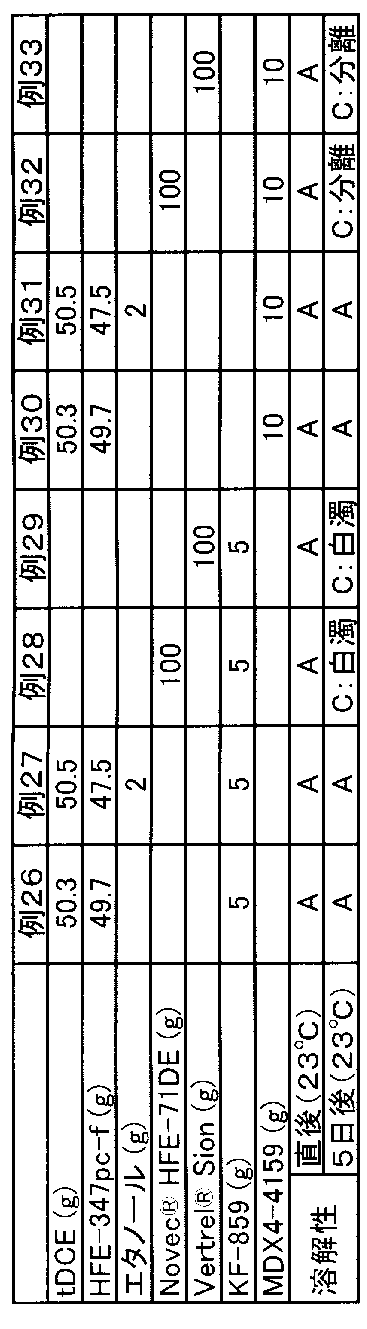
例26、27、30、31では、tDCEとHFE-347pc-fとの割合が本発明の範囲内であるため、潤滑剤溶液に白濁または潤滑剤の分離は見られなかった。例28、29、32、33は、HFE-347pc-f以外の含フッ素溶媒を含むため、5日後の潤滑剤溶液に白濁または潤滑剤の分離が見られ、保存安定性が悪かった。
(例34)
〔潤滑剤溶液の塗布試験〕
tDCEの50.3質量%とHFE-347pc-fの49.7質量%とからなる溶剤(B)を調製した。溶剤(B)に、ジアミン変性シリコーンオイル(信越化学工業社製、KF-859)を、溶液中の当該オイル濃度が3質量%となるように添加し、潤滑剤溶液を調製した。鉄製の板にアルミニウムを蒸着させたアルミニウム蒸着板の表面に、潤滑剤溶液を平均厚さ約0.4mmで塗布し、19~21℃の条件下で風乾することによって、アルミニウム蒸着板の表面に潤滑剤塗膜を形成した。潤滑剤溶液に白濁は見られず、塗布後の潤滑剤溶液から溶剤(B)が速やかに蒸発し、潤滑剤塗膜の状態も良好であった。
〔潤滑剤溶液の塗布試験〕
tDCEの50.3質量%とHFE-347pc-fの49.7質量%とからなる溶剤(B)を調製した。溶剤(B)に、ジアミン変性シリコーンオイル(信越化学工業社製、KF-859)を、溶液中の当該オイル濃度が3質量%となるように添加し、潤滑剤溶液を調製した。鉄製の板にアルミニウムを蒸着させたアルミニウム蒸着板の表面に、潤滑剤溶液を平均厚さ約0.4mmで塗布し、19~21℃の条件下で風乾することによって、アルミニウム蒸着板の表面に潤滑剤塗膜を形成した。潤滑剤溶液に白濁は見られず、塗布後の潤滑剤溶液から溶剤(B)が速やかに蒸発し、潤滑剤塗膜の状態も良好であった。
(例35)
〔潤滑剤溶液の塗布試験〕
tDCEの50.5質量%とHFE-347pc-fの47.5質量%とエタノールの2質量%とからなる溶剤(B)を調製した。そして、該溶剤(B)を用いた以外は例34と同様にして潤滑剤溶液を調製し、アルミニウム蒸着板の表面に潤滑剤塗膜を形成した。潤滑剤溶液に白濁は見られず、塗布後の潤滑剤溶液から溶剤(B)が速やかに蒸発し、潤滑剤塗膜の状態も良好であった。
〔潤滑剤溶液の塗布試験〕
tDCEの50.5質量%とHFE-347pc-fの47.5質量%とエタノールの2質量%とからなる溶剤(B)を調製した。そして、該溶剤(B)を用いた以外は例34と同様にして潤滑剤溶液を調製し、アルミニウム蒸着板の表面に潤滑剤塗膜を形成した。潤滑剤溶液に白濁は見られず、塗布後の潤滑剤溶液から溶剤(B)が速やかに蒸発し、潤滑剤塗膜の状態も良好であった。
本発明の潤滑剤溶液は、注射針等の金属の表面に潤滑剤塗膜を形成するための潤滑剤溶液として有用である。
Claims (10)
- ジアミン変性シリコーンオイルを含む潤滑剤(A)と、
トランス-1,2-ジクロロエチレンと1,1,2,2-テトラフルオロ-1-(2,2,2-トリフルオロエトキシ)エタンとを含む溶剤(B)と
を含み、
トランス-1,2-ジクロロエチレンが、トランス-1,2-ジクロロエチレンと1,1,2,2-テトラフルオロ-1-(2,2,2-トリフルオロエトキシ)エタンとの合計100質量%のうち、40~70質量%含まれ、
1,1,2,2-テトラフルオロ-1-(2,2,2-トリフルオロエトキシ)エタンが、トランス-1,2-ジクロロエチレンと1,1,2,2-テトラフルオロ-1-(2,2,2-トリフルオロエトキシ)エタンとの合計100質量%のうち、30~60質量%含まれることを特徴とする潤滑剤溶液。 - 前記潤滑剤(A)が、前記潤滑剤溶液の100質量%のうち、0.01~50質量%含まれる、請求項1に記載の潤滑剤溶液。
- 前記溶剤(B)が、前記潤滑剤溶液の100質量%のうち、50~99.99質量%含まれる、請求項1または2に記載の潤滑剤溶液。
- 前記溶剤(B)が、トランス-1,2-ジクロロエチレンに可溶な有機溶剤(B1)をさらに含む、請求項1~3のいずれか一項に記載の潤滑剤溶液。
- 前記有機溶剤(B1)が、炭素数1~3のアルコールである、請求項4に記載の潤滑剤溶液。
- 前記有機溶剤(B1)が、前記溶剤(B)の100質量%のうち、0.1~50質量%含まれる、請求項4または5に記載の潤滑剤溶液。
- 前記溶剤(B)が、トランス-1,2-ジクロロエチレンと、1,1,2,2-テトラフルオロ-1-(2,2,2-トリフルオロエトキシ)エタンと、炭素数1~3のアルコールとからなる、請求項1~6のいずれか一項に記載の潤滑剤溶液。
- ジアミン基含有アルコキシシランおよびその部分縮合体のいずれか一方をさらに含む、請求項1~7のいずれか一項に記載の潤滑剤溶液。
- 請求項1~8のいずれか一項に記載の潤滑剤溶液を被塗布物の表面に塗布する工程と、
前記被塗布物の表面に塗布された前記潤滑剤溶液中の前記溶剤(B)を蒸発させ、前記被塗布物の表面に前記潤滑剤(A)を含む塗膜を形成する工程と
を有することを特徴とする潤滑剤塗膜付き物品の製造方法。 - 前記被塗布物が注射針である、請求項9に記載の潤滑剤塗膜付き物品の製造方法。
Priority Applications (2)
| Application Number | Priority Date | Filing Date | Title |
|---|---|---|---|
| JP2016572087A JP6686911B2 (ja) | 2015-01-27 | 2016-01-27 | 潤滑剤溶液、および潤滑剤塗膜付き物品の製造方法 |
| CN201680007358.4A CN107207981B (zh) | 2015-01-27 | 2016-01-27 | 润滑剂溶液以及具有润滑剂涂膜的物品的制造方法 |
Applications Claiming Priority (2)
| Application Number | Priority Date | Filing Date | Title |
|---|---|---|---|
| JP2015-013155 | 2015-01-27 | ||
| JP2015013155 | 2015-01-27 |
Publications (1)
| Publication Number | Publication Date |
|---|---|
| WO2016121795A1 true WO2016121795A1 (ja) | 2016-08-04 |
Family
ID=56543405
Family Applications (1)
| Application Number | Title | Priority Date | Filing Date |
|---|---|---|---|
| PCT/JP2016/052278 Ceased WO2016121795A1 (ja) | 2015-01-27 | 2016-01-27 | 潤滑剤溶液、および潤滑剤塗膜付き物品の製造方法 |
Country Status (3)
| Country | Link |
|---|---|
| JP (1) | JP6686911B2 (ja) |
| CN (1) | CN107207981B (ja) |
| WO (1) | WO2016121795A1 (ja) |
Cited By (2)
| Publication number | Priority date | Publication date | Assignee | Title |
|---|---|---|---|---|
| WO2020175277A1 (ja) * | 2019-02-26 | 2020-09-03 | 富士フイルム株式会社 | 内視鏡用接着剤及びその硬化物、並びに内視鏡及びその製造方法 |
| CN118995294A (zh) * | 2024-10-22 | 2024-11-22 | 科创(衢州)化工技术开发有限公司 | 一种注射针表面硅化用稀释剂、处理剂及其制备工艺 |
Families Citing this family (2)
| Publication number | Priority date | Publication date | Assignee | Title |
|---|---|---|---|---|
| JP7292307B2 (ja) * | 2018-05-03 | 2023-06-16 | ザ ケマーズ カンパニー エフシー リミテッド ライアビリティ カンパニー | ペルフルオロヘプテンを含む三成分及び四成分共沸混合物及び共沸様組成物 |
| DK4361228T3 (da) | 2019-09-13 | 2025-09-01 | Spotless Mat Inc | Formuleringer og fremgangsmåde til generering af afvisende overflader |
Citations (7)
| Publication number | Priority date | Publication date | Assignee | Title |
|---|---|---|---|---|
| JPS56118497A (en) * | 1980-02-26 | 1981-09-17 | Toshiba Silicone Co Ltd | Method for imparting slip property to surface of article |
| JPS56119262A (en) * | 1980-02-26 | 1981-09-18 | Toshiba Silicone | Injection needle |
| JPH07178159A (ja) * | 1993-12-24 | 1995-07-18 | Toshiba Silicone Co Ltd | 注射針 |
| JPH10324652A (ja) * | 1997-05-22 | 1998-12-08 | Agency Of Ind Science & Technol | 含フッ素エーテルと塩素系有機溶剤からなる共沸及び共沸様組成物 |
| WO2004005445A1 (ja) * | 2002-07-03 | 2004-01-15 | Asahi Glass Company, Limited | 溶剤組成物 |
| JP2005097248A (ja) * | 2003-08-25 | 2005-04-14 | Asahi Glass Co Ltd | 有機化学物質を希釈するための溶剤、潤滑剤溶液、および潤滑剤の塗布方法 |
| WO2013161723A1 (ja) * | 2012-04-23 | 2013-10-31 | 旭硝子株式会社 | 潤滑剤溶液、および潤滑剤塗膜付き物品の製造方法 |
Family Cites Families (4)
| Publication number | Priority date | Publication date | Assignee | Title |
|---|---|---|---|---|
| KR100427738B1 (ko) * | 1995-05-16 | 2004-07-16 | 미네소타 마이닝 앤드 매뉴팩춰링 캄파니 | 공비혼합물형조성물및그의용도 |
| BR0111875B1 (pt) * | 2000-06-23 | 2011-12-13 | composição de revestimento com cura à temperatura ambiente, seu uso, processo para a preparação de um polìmero acrìlico com funcionalidade alcóxi-silica e processo para efetuar revestimento de acabamento. | |
| JP2005306902A (ja) * | 2004-04-16 | 2005-11-04 | Asahi Glass Co Ltd | コーティング用シリコーン溶液、およびシリコーン化合物の塗布方法 |
| TWI564284B (zh) * | 2011-03-10 | 2017-01-01 | 杜邦股份有限公司 | 甲基全氟庚烯醚與反二氯乙烯之共沸及類共沸組成物及其用途 |
-
2016
- 2016-01-27 JP JP2016572087A patent/JP6686911B2/ja active Active
- 2016-01-27 WO PCT/JP2016/052278 patent/WO2016121795A1/ja not_active Ceased
- 2016-01-27 CN CN201680007358.4A patent/CN107207981B/zh active Active
Patent Citations (7)
| Publication number | Priority date | Publication date | Assignee | Title |
|---|---|---|---|---|
| JPS56118497A (en) * | 1980-02-26 | 1981-09-17 | Toshiba Silicone Co Ltd | Method for imparting slip property to surface of article |
| JPS56119262A (en) * | 1980-02-26 | 1981-09-18 | Toshiba Silicone | Injection needle |
| JPH07178159A (ja) * | 1993-12-24 | 1995-07-18 | Toshiba Silicone Co Ltd | 注射針 |
| JPH10324652A (ja) * | 1997-05-22 | 1998-12-08 | Agency Of Ind Science & Technol | 含フッ素エーテルと塩素系有機溶剤からなる共沸及び共沸様組成物 |
| WO2004005445A1 (ja) * | 2002-07-03 | 2004-01-15 | Asahi Glass Company, Limited | 溶剤組成物 |
| JP2005097248A (ja) * | 2003-08-25 | 2005-04-14 | Asahi Glass Co Ltd | 有機化学物質を希釈するための溶剤、潤滑剤溶液、および潤滑剤の塗布方法 |
| WO2013161723A1 (ja) * | 2012-04-23 | 2013-10-31 | 旭硝子株式会社 | 潤滑剤溶液、および潤滑剤塗膜付き物品の製造方法 |
Cited By (6)
| Publication number | Priority date | Publication date | Assignee | Title |
|---|---|---|---|---|
| WO2020175277A1 (ja) * | 2019-02-26 | 2020-09-03 | 富士フイルム株式会社 | 内視鏡用接着剤及びその硬化物、並びに内視鏡及びその製造方法 |
| JPWO2020175277A1 (ja) * | 2019-02-26 | 2021-12-02 | 富士フイルム株式会社 | 内視鏡用接着剤及びその硬化物、並びに内視鏡及びその製造方法 |
| JP7100189B2 (ja) | 2019-02-26 | 2022-07-12 | 富士フイルム株式会社 | 内視鏡用接着剤及びその硬化物、並びに内視鏡及びその製造方法 |
| JP2022130550A (ja) * | 2019-02-26 | 2022-09-06 | 富士フイルム株式会社 | 内視鏡用接着剤及びその硬化物、並びに内視鏡及びその製造方法 |
| JP7257578B2 (ja) | 2019-02-26 | 2023-04-13 | 富士フイルム株式会社 | 内視鏡用接着剤及びその硬化物、並びに内視鏡及びその製造方法 |
| CN118995294A (zh) * | 2024-10-22 | 2024-11-22 | 科创(衢州)化工技术开发有限公司 | 一种注射针表面硅化用稀释剂、处理剂及其制备工艺 |
Also Published As
| Publication number | Publication date |
|---|---|
| CN107207981B (zh) | 2021-01-12 |
| JP6686911B2 (ja) | 2020-04-22 |
| CN107207981A (zh) | 2017-09-26 |
| JPWO2016121795A1 (ja) | 2017-11-02 |
Similar Documents
| Publication | Publication Date | Title |
|---|---|---|
| US11718574B2 (en) | Solvent composition, cleaning method, method of forming a coating film, heat transfer fluid, and heat cycle system | |
| JP6507943B2 (ja) | 潤滑剤溶液、潤滑剤塗膜付き物品の製造方法、および潤滑剤塗膜付き物品。 | |
| US11254824B2 (en) | Solvent composition, cleaning method, method for producing substrate with coating film, and heat transfer fluid | |
| JPWO2013161723A1 (ja) | 潤滑剤溶液、および潤滑剤塗膜付き物品の製造方法 | |
| JP6686911B2 (ja) | 潤滑剤溶液、および潤滑剤塗膜付き物品の製造方法 | |
| CN113444492B (zh) | 溶剂组合物、气溶胶组合物、清洗剂及物品的清洗方法 | |
| JP2016169256A (ja) | 潤滑剤用組成物、および潤滑剤塗膜付き物品の製造方法 | |
| JP2016130275A (ja) | 潤滑剤溶液、および潤滑剤塗膜付き物品の製造方法 | |
| JP4655629B2 (ja) | 潤滑剤溶液、および潤滑剤の塗布方法 | |
| JP4826014B2 (ja) | フッ素系希釈溶剤 | |
| US11530363B2 (en) | Lubricant solution, method for producing substrate provided with lubricant coating film | |
| JP2005097248A (ja) | 有機化学物質を希釈するための溶剤、潤滑剤溶液、および潤滑剤の塗布方法 | |
| US7754665B2 (en) | Lubricant solution and method for coating lubricant | |
| JP2009091373A (ja) | 塗布液および塗膜形成方法 | |
| JP2004075991A (ja) | 溶剤組成物 |
Legal Events
| Date | Code | Title | Description |
|---|---|---|---|
| 121 | Ep: the epo has been informed by wipo that ep was designated in this application |
Ref document number: 16743398 Country of ref document: EP Kind code of ref document: A1 |
|
| ENP | Entry into the national phase |
Ref document number: 2016572087 Country of ref document: JP Kind code of ref document: A |
|
| NENP | Non-entry into the national phase |
Ref country code: DE |
|
| 122 | Ep: pct application non-entry in european phase |
Ref document number: 16743398 Country of ref document: EP Kind code of ref document: A1 |