WO2016117629A1 - ω3脂肪酸の自己乳化組成物 - Google Patents
ω3脂肪酸の自己乳化組成物 Download PDFInfo
- Publication number
- WO2016117629A1 WO2016117629A1 PCT/JP2016/051643 JP2016051643W WO2016117629A1 WO 2016117629 A1 WO2016117629 A1 WO 2016117629A1 JP 2016051643 W JP2016051643 W JP 2016051643W WO 2016117629 A1 WO2016117629 A1 WO 2016117629A1
- Authority
- WO
- WIPO (PCT)
- Prior art keywords
- self
- mass
- hours
- ω3pufa
- plasma concentration
- Prior art date
- Legal status (The legal status is an assumption and is not a legal conclusion. Google has not performed a legal analysis and makes no representation as to the accuracy of the status listed.)
- Ceased
Links
Classifications
-
- A—HUMAN NECESSITIES
- A61—MEDICAL OR VETERINARY SCIENCE; HYGIENE
- A61K—PREPARATIONS FOR MEDICAL, DENTAL OR TOILETRY PURPOSES
- A61K47/00—Medicinal preparations characterised by the non-active ingredients used, e.g. carriers or inert additives; Targeting or modifying agents chemically bound to the active ingredient
- A61K47/44—Oils, fats or waxes according to two or more groups of A61K47/02-A61K47/42; Natural or modified natural oils, fats or waxes, e.g. castor oil, polyethoxylated castor oil, montan wax, lignite, shellac, rosin, beeswax or lanolin
-
- A—HUMAN NECESSITIES
- A23—FOODS OR FOODSTUFFS; TREATMENT THEREOF, NOT COVERED BY OTHER CLASSES
- A23L—FOODS, FOODSTUFFS OR NON-ALCOHOLIC BEVERAGES, NOT OTHERWISE PROVIDED FOR; PREPARATION OR TREATMENT THEREOF
- A23L33/00—Modifying nutritive qualities of foods; Dietetic products; Preparation or treatment thereof
- A23L33/10—Modifying nutritive qualities of foods; Dietetic products; Preparation or treatment thereof using additives
- A23L33/115—Fatty acids or derivatives thereof; Fats or oils
- A23L33/12—Fatty acids or derivatives thereof
-
- A—HUMAN NECESSITIES
- A61—MEDICAL OR VETERINARY SCIENCE; HYGIENE
- A61K—PREPARATIONS FOR MEDICAL, DENTAL OR TOILETRY PURPOSES
- A61K31/00—Medicinal preparations containing organic active ingredients
- A61K31/185—Acids; Anhydrides, halides or salts thereof, e.g. sulfur acids, imidic, hydrazonic or hydroximic acids
- A61K31/19—Carboxylic acids, e.g. valproic acid
- A61K31/20—Carboxylic acids, e.g. valproic acid having a carboxyl group bound to a chain of seven or more carbon atoms, e.g. stearic, palmitic, arachidic acids
- A61K31/202—Carboxylic acids, e.g. valproic acid having a carboxyl group bound to a chain of seven or more carbon atoms, e.g. stearic, palmitic, arachidic acids having three or more double bonds, e.g. linolenic
-
- A—HUMAN NECESSITIES
- A61—MEDICAL OR VETERINARY SCIENCE; HYGIENE
- A61K—PREPARATIONS FOR MEDICAL, DENTAL OR TOILETRY PURPOSES
- A61K31/00—Medicinal preparations containing organic active ingredients
- A61K31/21—Esters, e.g. nitroglycerine, selenocyanates
- A61K31/215—Esters, e.g. nitroglycerine, selenocyanates of carboxylic acids
- A61K31/22—Esters, e.g. nitroglycerine, selenocyanates of carboxylic acids of acyclic acids, e.g. pravastatin
- A61K31/23—Esters, e.g. nitroglycerine, selenocyanates of carboxylic acids of acyclic acids, e.g. pravastatin of acids having a carboxyl group bound to a chain of seven or more carbon atoms
- A61K31/232—Esters, e.g. nitroglycerine, selenocyanates of carboxylic acids of acyclic acids, e.g. pravastatin of acids having a carboxyl group bound to a chain of seven or more carbon atoms having three or more double bonds, e.g. etretinate
-
- A—HUMAN NECESSITIES
- A61—MEDICAL OR VETERINARY SCIENCE; HYGIENE
- A61K—PREPARATIONS FOR MEDICAL, DENTAL OR TOILETRY PURPOSES
- A61K47/00—Medicinal preparations characterised by the non-active ingredients used, e.g. carriers or inert additives; Targeting or modifying agents chemically bound to the active ingredient
- A61K47/06—Organic compounds, e.g. natural or synthetic hydrocarbons, polyolefins, mineral oil, petrolatum or ozokerite
- A61K47/24—Organic compounds, e.g. natural or synthetic hydrocarbons, polyolefins, mineral oil, petrolatum or ozokerite containing atoms other than carbon, hydrogen, oxygen, halogen, nitrogen or sulfur, e.g. cyclomethicone or phospholipids
-
- A—HUMAN NECESSITIES
- A61—MEDICAL OR VETERINARY SCIENCE; HYGIENE
- A61K—PREPARATIONS FOR MEDICAL, DENTAL OR TOILETRY PURPOSES
- A61K47/00—Medicinal preparations characterised by the non-active ingredients used, e.g. carriers or inert additives; Targeting or modifying agents chemically bound to the active ingredient
- A61K47/06—Organic compounds, e.g. natural or synthetic hydrocarbons, polyolefins, mineral oil, petrolatum or ozokerite
- A61K47/26—Carbohydrates, e.g. sugar alcohols, amino sugars, nucleic acids, mono-, di- or oligo-saccharides; Derivatives thereof, e.g. polysorbates, sorbitan fatty acid esters or glycyrrhizin
-
- A—HUMAN NECESSITIES
- A61—MEDICAL OR VETERINARY SCIENCE; HYGIENE
- A61K—PREPARATIONS FOR MEDICAL, DENTAL OR TOILETRY PURPOSES
- A61K47/00—Medicinal preparations characterised by the non-active ingredients used, e.g. carriers or inert additives; Targeting or modifying agents chemically bound to the active ingredient
- A61K47/30—Macromolecular organic or inorganic compounds, e.g. inorganic polyphosphates
- A61K47/34—Macromolecular compounds obtained otherwise than by reactions only involving carbon-to-carbon unsaturated bonds, e.g. polyesters, polyamino acids, polysiloxanes, polyphosphazines, copolymers of polyalkylene glycol or poloxamers
-
- A—HUMAN NECESSITIES
- A61—MEDICAL OR VETERINARY SCIENCE; HYGIENE
- A61K—PREPARATIONS FOR MEDICAL, DENTAL OR TOILETRY PURPOSES
- A61K9/00—Medicinal preparations characterised by special physical form
- A61K9/0012—Galenical forms characterised by the site of application
- A61K9/0053—Mouth and digestive tract, i.e. intraoral and peroral administration
-
- A—HUMAN NECESSITIES
- A61—MEDICAL OR VETERINARY SCIENCE; HYGIENE
- A61K—PREPARATIONS FOR MEDICAL, DENTAL OR TOILETRY PURPOSES
- A61K9/00—Medicinal preparations characterised by special physical form
- A61K9/10—Dispersions; Emulsions
- A61K9/107—Emulsions ; Emulsion preconcentrates; Micelles
-
- A—HUMAN NECESSITIES
- A61—MEDICAL OR VETERINARY SCIENCE; HYGIENE
- A61K—PREPARATIONS FOR MEDICAL, DENTAL OR TOILETRY PURPOSES
- A61K9/00—Medicinal preparations characterised by special physical form
- A61K9/10—Dispersions; Emulsions
- A61K9/107—Emulsions ; Emulsion preconcentrates; Micelles
- A61K9/1075—Microemulsions or submicron emulsions; Preconcentrates or solids thereof; Micelles, e.g. made of phospholipids or block copolymers
-
- A—HUMAN NECESSITIES
- A61—MEDICAL OR VETERINARY SCIENCE; HYGIENE
- A61K—PREPARATIONS FOR MEDICAL, DENTAL OR TOILETRY PURPOSES
- A61K9/00—Medicinal preparations characterised by special physical form
- A61K9/48—Preparations in capsules, e.g. of gelatin, of chocolate
-
- A—HUMAN NECESSITIES
- A61—MEDICAL OR VETERINARY SCIENCE; HYGIENE
- A61K—PREPARATIONS FOR MEDICAL, DENTAL OR TOILETRY PURPOSES
- A61K9/00—Medicinal preparations characterised by special physical form
- A61K9/48—Preparations in capsules, e.g. of gelatin, of chocolate
- A61K9/4841—Filling excipients; Inactive ingredients
- A61K9/4858—Organic compounds
-
- A—HUMAN NECESSITIES
- A61—MEDICAL OR VETERINARY SCIENCE; HYGIENE
- A61K—PREPARATIONS FOR MEDICAL, DENTAL OR TOILETRY PURPOSES
- A61K9/00—Medicinal preparations characterised by special physical form
- A61K9/48—Preparations in capsules, e.g. of gelatin, of chocolate
- A61K9/4841—Filling excipients; Inactive ingredients
- A61K9/4866—Organic macromolecular compounds
-
- A—HUMAN NECESSITIES
- A61—MEDICAL OR VETERINARY SCIENCE; HYGIENE
- A61K—PREPARATIONS FOR MEDICAL, DENTAL OR TOILETRY PURPOSES
- A61K9/00—Medicinal preparations characterised by special physical form
- A61K9/48—Preparations in capsules, e.g. of gelatin, of chocolate
- A61K9/4841—Filling excipients; Inactive ingredients
- A61K9/4875—Compounds of unknown constitution, e.g. material from plants or animals
-
- A—HUMAN NECESSITIES
- A61—MEDICAL OR VETERINARY SCIENCE; HYGIENE
- A61P—SPECIFIC THERAPEUTIC ACTIVITY OF CHEMICAL COMPOUNDS OR MEDICINAL PREPARATIONS
- A61P25/00—Drugs for disorders of the nervous system
-
- A—HUMAN NECESSITIES
- A61—MEDICAL OR VETERINARY SCIENCE; HYGIENE
- A61P—SPECIFIC THERAPEUTIC ACTIVITY OF CHEMICAL COMPOUNDS OR MEDICINAL PREPARATIONS
- A61P25/00—Drugs for disorders of the nervous system
- A61P25/04—Centrally acting analgesics, e.g. opioids
-
- A—HUMAN NECESSITIES
- A61—MEDICAL OR VETERINARY SCIENCE; HYGIENE
- A61P—SPECIFIC THERAPEUTIC ACTIVITY OF CHEMICAL COMPOUNDS OR MEDICINAL PREPARATIONS
- A61P29/00—Non-central analgesic, antipyretic or antiinflammatory agents, e.g. antirheumatic agents; Non-steroidal antiinflammatory drugs [NSAID]
-
- A—HUMAN NECESSITIES
- A61—MEDICAL OR VETERINARY SCIENCE; HYGIENE
- A61P—SPECIFIC THERAPEUTIC ACTIVITY OF CHEMICAL COMPOUNDS OR MEDICINAL PREPARATIONS
- A61P3/00—Drugs for disorders of the metabolism
- A61P3/06—Antihyperlipidemics
-
- A—HUMAN NECESSITIES
- A61—MEDICAL OR VETERINARY SCIENCE; HYGIENE
- A61P—SPECIFIC THERAPEUTIC ACTIVITY OF CHEMICAL COMPOUNDS OR MEDICINAL PREPARATIONS
- A61P35/00—Antineoplastic agents
-
- A—HUMAN NECESSITIES
- A61—MEDICAL OR VETERINARY SCIENCE; HYGIENE
- A61P—SPECIFIC THERAPEUTIC ACTIVITY OF CHEMICAL COMPOUNDS OR MEDICINAL PREPARATIONS
- A61P7/00—Drugs for disorders of the blood or the extracellular fluid
- A61P7/02—Antithrombotic agents; Anticoagulants; Platelet aggregation inhibitors
-
- A—HUMAN NECESSITIES
- A61—MEDICAL OR VETERINARY SCIENCE; HYGIENE
- A61P—SPECIFIC THERAPEUTIC ACTIVITY OF CHEMICAL COMPOUNDS OR MEDICINAL PREPARATIONS
- A61P9/00—Drugs for disorders of the cardiovascular system
- A61P9/10—Drugs for disorders of the cardiovascular system for treating ischaemic or atherosclerotic diseases, e.g. antianginal drugs, coronary vasodilators, drugs for myocardial infarction, retinopathy, cerebrovascula insufficiency, renal arteriosclerosis
-
- A—HUMAN NECESSITIES
- A23—FOODS OR FOODSTUFFS; TREATMENT THEREOF, NOT COVERED BY OTHER CLASSES
- A23V—INDEXING SCHEME RELATING TO FOODS, FOODSTUFFS OR NON-ALCOHOLIC BEVERAGES AND LACTIC OR PROPIONIC ACID BACTERIA USED IN FOODSTUFFS OR FOOD PREPARATION
- A23V2002/00—Food compositions, function of food ingredients or processes for food or foodstuffs
Definitions
- the present invention relates to a self-emulsifying composition containing at least one selected from the group consisting of ⁇ 3 polyunsaturated fatty acids, pharmaceutically acceptable salts and esters thereof, pharmaceuticals thereof, methods of preparation thereof, and methods of treatment using the same Provide its usage.
- ⁇ 3PUFA polyunsaturated fatty acid
- EPA icosapentoic acid
- DHA docosahexaenoic acid
- ⁇ 3PUFA pharmaceutically acceptable salts and esters thereof
- ⁇ 3PUFAs are anti-arteriosclerotic action, platelet aggregation inhibitory action, blood lipid lowering action, anti-inflammatory action, anticancer action, central action, etc. Since it exhibits a variety of actions, it is blended in various foods and is marketed as health foods or pharmaceuticals.
- EPA-E EPA ethyl ester
- ASO obstructive arteriosclerosis
- ASO hyperlipidemia
- TG serum triglycerides
- These compositions contain ethanol for the purpose of improving the solubility of fenofibrate, but when ethanol volatilizes, the capsule deforms and contains bubbles, changes in quality such as capsule deformation and cracking, and cloudiness of the capsule contents. There is a concern about degeneration such as separation.
- a self-emulsifying composition that contains ethanol and polyhydric alcohol in addition to ⁇ 3 PUFA and a surfactant and can produce a dispersion having a small or very small average particle diameter when contacted with water has been reported (Patent Document 2). .
- a self-emulsifying composition with low ethanol content it contains ⁇ 3 PUFA, hydrophilic / lipophilic balance (hereinafter referred to as HLB) 10 or more emulsifiers, lecithin, polyhydric alcohols such as propylene glycol and glycerin, self-emulsifying, hungry
- HLB hydrophilic / lipophilic balance
- emulsifiers lecithin
- polyhydric alcohols such as propylene glycol and glycerin
- a self-emulsifying composition that contains ⁇ 3PUFA ester and a surfactant, does not contain ⁇ 3PUFA free acid, and is not affected by food has been reported.
- Compositions that are primarily EPA-E as ⁇ 3 PUFA esters have not been studied.
- Patent Document 5 It has been reported that when a co-solvent such as polyhydric alcohol in the composition is encapsulated, it shifts to the capsule film and causes deformation due to modification of the composition or softening of the capsule.
- Self-emulsifying compositions generally use more emulsifiers, and the amount of liquid in the entire composition is large, so that the inflammation of the digestive tract and the physiologically active ingredients dissolved in the oil contained in one capsule are reduced (patent document) 6) Problems arise. Therefore, it is desirable that the emulsifier used in the composition has no or little toxicity even when continuously administered, and the amount used is small. Further, from the viewpoint of ingestion, the amount of ⁇ 3 PUFA to be taken at a time is determined. Therefore, when the amount of components other than ⁇ 3 PUFA in the self-emulsifying composition increases, the amount of the medicine taken at a time increases accordingly. Therefore, it is desirable that the amount of emulsifier and alcohol used is small from the viewpoint of miniaturization of the preparation.
- a preparation in which ethanol and polyhydric alcohol contained in the self-emulsifying composition are reduced is desired.
- the formulation which reduced the emulsifier contained in a self-emulsification composition is desired.
- a preparation having a high content of ⁇ 3 PUFAs in the self-emulsifying composition is desired.
- a preparation excellent in safety for animals (including humans) is desired.
- a self-emulsifying composition excellent in medication compliance is desired.
- a self-emulsifying composition having a good appearance that is free from modification such as cloudiness and separation when stored at room temperature is desired.
- a self-emulsifying composition excellent in at least one of compatibility (appearance), self-emulsifying property, composition dispersibility, emulsifying stability and absorbability is desired.
- compatibility applying to the self-emulsifying composition
- composition dispersibility emulsifying stability and absorbability
- a self-emulsifying composition having storage stability at at least one of room temperature, low temperature and high temperature is desired.
- a self-emulsifying composition having storage stability at at least one specific temperature selected from, for example, 5 ° C. to 40 ° C. is desired.
- a self-emulsifying composition is desired in which the parameters do not change so that the stable quality as a pharmaceutical product is impaired when stored at at least one of room temperature, low temperature and high temperature.
- a self-emulsifying composition in which the parameters do not change so that the stable quality as a pharmaceutical product is impaired when stored at at least one specific temperature selected from 5 ° C. to 40 ° C., for example.
- provision of the formulation which encapsulated the composition is desired.
- a preparation that suppresses softening of the capsule film and does not deform when the composition is encapsulated In addition, a self-emulsifying composition excellent in the absorbability of ⁇ 3 PUFAs is desired. Further, there is a demand for a self-emulsifying composition that is equivalent to the pharmacokinetics of a conventional ⁇ 3 PUFA preparation administered immediately after a meal even if the dose of the ⁇ 3 PUFA preparation to be administered is smaller than that of the conventional ⁇ 3 PUFA preparation. In addition, a self-emulsifying composition that has a high therapeutic effect or can reduce the dose of ⁇ 3 PUFAs necessary for the treatment is desired.
- a self-emulsifying composition or method for increasing the blood concentration of ⁇ 3 PUFAs by administration of the self-emulsifying composition blood means whole blood, plasma or serum; the same shall apply hereinafter. It is rare.
- a self-emulsifying composition that is rapidly absorbed even after administration before meals or after administration of a low-fat meal and suppresses an increase in serum TG after meals, or a method thereof is desired.
- a self-emulsifying composition or method for preventing essential fatty acid deficiency when taking a lipase inhibitor by administration before going to bed is desired.
- a self-emulsifying composition that can reduce ⁇ 3 PUFAs that are excreted without being absorbed after administration, or a method thereof, is desired.
- a self-emulsifying composition that enhances tissue migration of ⁇ 3 PUFAs or a method thereof is desired.
- a self-emulsifying composition having a large amount of incorporation of ⁇ 3PUFAs into blood phospholipids or a method thereof is desired.
- a self-emulsifying composition or method for reducing arachidonic acid in the blood and / or improving the EPA / AA ratio indicating the ratio of EPA to arachidonic acid is desired.
- TG total cholesterol
- LDL-C low density lipoprotein cholesterol
- non-HDL non-high density lipoprotein cholesterol
- -C very low density lipoprotein cholesterol
- VLDL-TG very low density lipoprotein triglyceride
- oxidized LDL oxidized low density lipoprotein
- RLP-C Small dense LDL, high remnant-like lipoprotein cholesterol (hereinafter referred to as RLP-C), apoprotein B (hereinafter referred to as ApoB), apolipoprotein CIII (hereinafter referred to as ApoCIII), lipoprotein (a), Lipoprotein-related phospholipase A2 (hereinafter referred to as Lp-PLA2), Cholesteryl ester transfer protein (hereinafter referred to as CETP activity), high-sensitivity C-reactive protein (hereinafter referred to as hs-CRP), plasma phospholipid, free fatty acid, fasting blood glucose, high hemoglobin A1c (hereinafter referred to as HbA1c) ), High insulin resistance index (hereinafter referred to as HOMA-IR), cell adhesion molecule-1, interleukin-6 (hereinafter referred to as IL-6), plasminogen activator inhibitor 1 (hereinafter referred to as PAI-) 1), creatinine, aspartate
- a self-emulsifying composition that can be absorbed by administration even at a high dose in which ⁇ 3PUFAs alone are saturated in absorption and no more ⁇ 3PUFA is absorbed into blood.
- a self-emulsifying composition having a stable quality is desired.
- a self-emulsifying composition having storage stability is desired immediately after production of the self-emulsification composition or immediately after production, for example, in any period of a long period of 3 years or 5 years.
- a self-emulsifying composition in which the parameters do not change so as to impair the stable quality as a pharmaceutical product when stored immediately after manufacture or for any period of 3 years or 5 years from immediately after manufacture.
- an emulsion excellent in absorbability of ⁇ 3 PUFAs a self-emulsifying composition for rapidly producing an emulsion, and a method for producing an emulsion are desired. It is an object of the present invention to provide a self-emulsifying composition that improves at least one of these properties, a preparation encapsulating the composition, a therapeutic method using the same, and a method of using the same.
- the present inventors have conducted extensive studies on components that replace ethanol and polyhydric alcohol, and as a result, have found that a predetermined amount of water is useful for improving the compatibility of the self-emulsifying composition.
- the content in the composition may be 0.5 to 6% by mass, which is less than that of ethanol or polyhydric alcohol, and the effect of improving the compatibility of this small amount of water can further reduce the content of the emulsifier. It has been found that a high content self-emulsifying composition results. And it discovered that the self-emulsification composition excellent in at least 1 of the said subject was obtained with this composition, and completed this invention.
- the inventors have also found that the content of emulsifier can be reduced, and have completed the invention of a self-emulsifying composition having a high content of ⁇ 3 PUFAs.
- the inclusion of a specific emulsifier increases the blood concentration of ⁇ 3 PUFAs, can reduce side effects, the absorption of ⁇ 3 PUFAs is not affected or hardly influenced by food, the absorption amount of ⁇ 3 PUFAs is not saturated, etc.
- a self-emulsifying composition excellent in at least one can be obtained, and the present invention has been completed.
- the composition of this invention is a composition excellent in at least 1 or more of the said subject.
- the first aspect of the present invention is the following self-emulsifying composition.
- (1-1) When the total amount of the self-emulsifying composition is 100% by mass, a) at least one compound selected from the group consisting of 70-90% by weight of ⁇ 3 PUFA, pharmaceutically acceptable salts thereof, and esters thereof; b) 0.5-6% by weight of water, c) 1 to 29% by weight of an emulsifier (except lecithin), preferably an emulsifier which is a polyoxyethylene sorbitan fatty acid ester, d) 3 to 40 parts by weight, or 1 to 25 parts by weight of lecithin with respect to 100 parts by weight of ⁇ 3 polyunsaturated fatty acid, pharmaceutically acceptable salt thereof, and ester thereof, Containing e) Self-emulsifying composition, wherein ethanol and / or polyhydric alcohol is 4% by mass or less of the total amount of the composition.
- the total amount of the self-emulsifying composition is 100% by mass, a) at least one compound selected from the group consisting of 70-90% by weight of ⁇ 3 PUFA, pharmaceutically acceptable salts thereof, and esters thereof; b) 0.5-6% by weight of water, c) an emulsifier which is 1 to 29% by weight of polyoxyethylene sorbitan fatty acid ester, d) 3 to 40 parts by mass, or 1 to 1 part per 100 parts by mass of at least one compound selected from the group consisting of ⁇ 3 polyunsaturated fatty acids, pharmaceutically acceptable salts thereof, and esters thereof 25 parts by weight of lecithin, Containing e) 4% by mass or less of ethanol based on the total amount of the composition, f) A self-emulsifying composition, wherein the polyhydric alcohol is 4% by mass or less of the total amount of the composition.
- Polyoxyethylene sorbitan fatty acid ester is Polyoxyethylene (20) sorbitan monolaurate, polyoxyethylene (20) sorbitan monopalmitate, polyoxyethylene (20) sorbitan monostearate, polyoxyethylene (20) sorbitan tristearate, polyoxyethylene monoisostearate ( 20) At least one selected from the group consisting of sorbitan, polyoxyethylene monooleate (20) sorbitan and polyoxyethylene trioleate (20) sorbitan, described in (1-1) or (1-2) Self-emulsifying composition.
- (1-5) The self-emulsifying composition according to any one of (1-1) to (1-4), wherein the emulsifier further comprises polyoxyethylene castor oil.
- (1-6) The self-emulsifying composition according to any one of (1-1) to (1-5), wherein the polyhydric alcohol is propylene glycol or glycerin.
- (1-7) The self-emulsifying composition according to any one of (1-1) to (1-6), wherein 0 to 4% by mass of a polyhydric alcohol is contained in the composition.
- (1-8) The self-emulsifying composition according to any one of (1-1) to (1-6), wherein the composition does not contain more than 4% by mass of a polyhydric alcohol.
- (1-9) The self-emulsifying composition according to any one of (1-1) to (1-8), wherein the polyhydric alcohol in the composition is 1% by mass or less.
- (1-17) at least one selected from the group consisting of ⁇ 3 PUFA, a pharmaceutically acceptable salt thereof, and an ester thereof, EPA, DHA, a pharmaceutically acceptable salt thereof, and an ester thereof
- (1-18) The self-emulsifying composition according to any one of (1-1) to (1-17), wherein the ester of ⁇ 3PUFA is an ethyl ester or a triglyceride ester.
- (1-19) ⁇ 3PUFA, a pharmaceutically acceptable salt thereof, or an ester thereof is EPA-E or DHA ethyl ester (hereinafter referred to as DHA-E) (1-1) to (1-18)
- DHA-E DHA ethyl ester
- (1-20) Any one of (1-1) to (1-19) containing as an active ingredient at least one selected from the group consisting of EPA, DHA, pharmaceutically acceptable salts and esters thereof The self-emulsifying composition described in 1.
- the lecithin is at least one selected from the group consisting of soybean lecithin, enzyme-degraded soybean lecithin, hydrogenated soybean lecithin, and egg yolk lecithin (1-1) to (1-22)
- the self-emulsifying composition as described.
- the content of at least one emulsifier selected from the group consisting of polyoxyethylene hydrogenated castor oil, polyethylene glycol fatty acid ester and polyoxyethylene polyoxypropylene glycol is less than 5% by mass of the total amount of the composition ( The self-emulsifying composition according to any one of 1-1) to (1-23).
- each emulsifier of polyoxyethylene hydrogenated castor oil, polyoxyethylene glycol fatty acid ester and polyoxyethylene polyoxypropylene glycol is less than 5% by mass of the total amount of the composition, respectively (1-1) to (1- 23)
- composition (1-26) The self-emulsifying composition according to any one of (1-1) to (1-25), wherein the appearance of the composition is clear when the composition is allowed to stand. (1-27) The self-emulsifying composition according to any one of (1-1) to (1-25), wherein the appearance of the composition is not separated or turbid when the composition is allowed to stand. (1-28) The self-emulsification according to any one of (1-1) to (1-27), wherein the appearance of the composition is clear when the composition is stored at 5 ° C. or 40 ° C. for 12 hours. Composition. (1-29) The composition according to any one of (1-1) to (1-28), wherein the appearance of the composition is not separated or turbid when the composition is stored at 5 ° C. or 40 ° C.
- Self-emulsifying composition (1-30) The self-emulsifying composition according to any one of (1-1) to (1-29), wherein the composition is good in at least one of self-emulsifying property, composition dispersibility, and emulsion stability. (1-31) 10 ⁇ L of the composition is added dropwise to purified water at 37 ° C. or 5 mL of the first solution of JP elution test, and emulsified spontaneously just by adding dropwise. The self-emulsifying composition as described. (1-32) Any one of (1-1) to (1-31), in which 10 ⁇ L of the composition is added dropwise to purified water at 37 ° C.
- (1-34) Male beagle dogs in an amount of 600 mg each as at least one compound selected from the group consisting of ⁇ 3PUFA, pharmaceutically acceptable salts and esters thereof under fasting conditions for 18 hours or longer (1 -1) to (1-33)
- the self-emulsifying composition according to any one of (1) to (1-33) was orally administered, and the ⁇ 3PUFA maximum plasma concentration (blood concentration) calculated by correcting the plasma ⁇ 3PUFA concentration before administration was reduced.
- the maximum value is 50 ⁇ g / mL or more and / or the area under the ⁇ 3PUFA plasma concentration curve is 30 ⁇ g ⁇ hr / mL or more from 0 to 2 hours after administration, and the ⁇ 3PUFA maximum plasma concentration is 50 ⁇ g / mL or more and / or 0 administration
- the area under the ⁇ 3PUFA plasma concentration curve from 2 to 2 hours is 50 ⁇ g ⁇ hr / mL or more, and the ⁇ 3PUFA maximum plasma concentration is 60 ⁇ g / mL or more.
- / or the area under the ⁇ 3 PUFA plasma concentration curve from 0 to 2 hours after administration is 60 ⁇ g ⁇ hr / mL or more, or the ⁇ 3 PUFA maximum plasma concentration is 70 ⁇ g / mL or more and / or ⁇ 3 PUFA plasma concentration from 0 to 2 hours after administration.
- Male cynomolgus monkey is 45 mg per kg body weight as at least one compound selected from the group consisting of ⁇ 3 PUFA, its pharmaceutically acceptable salt, and its ester under fasting conditions for 12 hours or longer (1- The maximum ⁇ 3PUFA plasma concentration calculated by orally administering the self-emulsifying composition according to any one of 1) to (1-33) and reducing the plasma ⁇ 3PUFA concentration before administration is 50 ⁇ g / mL or more.
- / or the area under the ⁇ 3 PUFA plasma concentration curve from 0 to 12 hours after administration is 400 ⁇ g ⁇ hr / mL or more, or the ⁇ 3 PUFA maximum plasma concentration is 70 ⁇ g / mL or more and / or ⁇ 3 PUFA plasma concentrations from 0 to 12 hours after administration.
- the ⁇ 3PUFA maximum plasma concentration calculated by carrying out the above is 50 ⁇ g / mL or more and / or the ⁇ 3PUFA plasma concentration after 2 hours of administration is 10 ⁇ g / mL or more (1-1) to (1-33) Use of the described self-emulsifying composition.
- the self-emulsifying composition according to any one of (1-1) to (1-33) in an amount selected from the group consisting of 8000 mg was orally administered before a meal to reduce the plasma ⁇ 3 PUFA concentration before administration
- the maximum plasma concentration of ⁇ 3 PUFA calculated with correction is 10 ⁇ g / mL or more and / or the area under the ⁇ 3 PUFA plasma concentration curve from 0 to 72 hours after administration is 250 ⁇ g ⁇ hr / mL or more (1-1) to ( 1-33).
- the second aspect of the present invention is the following encapsulated self-emulsifying preparation.
- (2-1) The self-emulsifying composition according to any one of (1-1) to (1-40), wherein the content liquid is encapsulated in hard capsules and / or soft capsules.
- (2-2) The encapsulated self-emulsifying preparation according to (2-1) having good hardness immediately after production.
- (2-3) The encapsulated self-emulsifying preparation according to (2-1) or (2-2), wherein the hardness immediately after production is 18 kgf or more.
- (2-4) In any one of (2-1) to (2-3), when the preparation is sealed in aluminum packaging and stored at 40 ° C.
- Encapsulated self-emulsifying formulation (2-5) The encapsulated self according to any one of (2-1) to (2-4), which has a hardness of 20 kgf or more when the preparation is sealed in an aluminum package and stored at 40 ° C. for 1 week.
- Emulsified formulation (2-6) The hardness when the preparation is sealed in aluminum packaging and stored at 40 ° C. for 1 week is 60% or more of the hardness before storage (2-1) to (2-5) The encapsulated self-emulsifying formulation as described.
- Dyslipidemia (hypercholesterolemia, hyper-LDL-cholesterolemia, hyper-non-HDL-cholesterolemia, hyper-VLDL-cholesterolemia, hypo-HDL-cholesterolemia, hyper-TG, hyper-ApoB, low ApoAIemia, multi-LDL particle semia, small LDL granulemia, high-oxidation LDLemia, high small dense LDLemia, high RLP-Cemia, low apoA-I / ApoB ratio, high ApoCIII Dysemia, ApoE genotypic dysemia, hyperlipoprotein (a), hyper Lp-PLA2, hyper CETP activity, hyper hs-CRP, hypo EPA (plasma, serum, Erythrocyte membrane, plasma plate membrane with low EPA value), high free fatty acidemia), high fasting glycemia, high HbAlcemia, high HOMA-IR disease, high cell adhesion molecule-1 High IL- Blood, hyper PAI-1), blood, creatinine, hyper
- the third aspect of the present invention is the following method for producing a self-emulsifying composition.
- (3-1) When the total amount of the self-emulsifying composition is 100% by mass a) At least one selected from the group consisting of 70 to 90% by mass of ⁇ 3 PUFA, pharmaceutically acceptable salts thereof, and esters thereof Compound, b) 0.5-6% by weight of water, c) an emulsifier that is 1 to 29% by weight of polyoxyethylene sorbitan fatty acid ester, and d) at least one selected from the group consisting of ⁇ 3 polyunsaturated fatty acids, pharmaceutically acceptable salts thereof, and esters thereof 3 to 40 parts by mass or 1 to 25 parts by mass of lecithin is mixed in an arbitrary order with respect to 100 parts by mass of the compound, and e) ethanol and / or polyhydric alcohol in the resulting composition is the total amount of the composition 4% by mass or less of the self-emulsifying composition, (3-2) When the total amount of the self-
- a fourth aspect of the present invention is a medicament for a specific administration method of the following self-emulsifying composition.
- (4-2) Fasting the self-emulsifying composition or the encapsulated self-emulsifying preparation, the medicine or the veterinary medicine produced by the production method according to any one of (3-1) to (3-3) Or a preparation for oral administration before going to bed.
- Drug is dyslipidemia (hypercholesterolemia, hyper-LDL cholesterolemia, hyper-non-HDL cholesterolemia, hyper-VLDL cholesterolemia, hypoHDL-cholesterolemia, hyperTGemia, hyper ApoBemia Low ApoAIemia, multi-LDL particle countemia, small LDL granulemia, hyperoxidized LDLemia, high small dense LDLemia, high RLP-Cemia, low apoA-I / ApoB ratio Hyper ApoCIII, ApoE genotypic, high lipoprotein (a), high Lp-PLA2, high CETP, high hs-CRP, low EPA (plasma, serum) Medium, erythrocyte membrane, plasma plate membrane with low EPA value), high free fatty acidemia), high fasting glycemia, high HbAlcemia, high HOMA-IR disease, high cell adhesion molecule-1 blood Illness, high L-6, hyper PAI-1, hyper creatinine, hyper AST, hyper ALT, hyperuricemia, high 8-is
- (4-4) The preparation according to any one of (4-1) to (4-3), which is administered once a day.
- (4-5) A method for administering and / or using the preparation according to any one of (4-1) to (4-4).
- (4-6) The method for increasing the ⁇ 3PUFA concentration in plasma by oral administration according to any one of (4-1) to (4-4).
- the fifth aspect of the present invention is a method for the prevention, progression prevention and treatment of at least one disease selected from the following group.
- the sixth aspect of the present invention is the following self-emulsifying composition.
- (6-1) The male beagle dog has an amount of 600 mg each as at least one compound selected from the group consisting of ⁇ 3 PUFA, its pharmaceutically acceptable salt, and its ester under fasting conditions for 18 hours or more.
- a self-emulsifying composition selected from any one of (1-1) to (1-40) and (2-1) to (2-7) was orally administered to reduce the plasma ⁇ 3 PUFA concentration before administration
- the ⁇ 3 PUFA maximum plasma concentration calculated with correction was 50 ⁇ g / mL or more and / or the area under the ⁇ 3 PUFA plasma concentration curve from 0 to 2 hours after administration was 30 ⁇ g ⁇ hr / mL or more, and the ⁇ 3 PUFA maximum plasma concentration was 50 ⁇ g / mL.
- More than mL and / or the area under the ⁇ 3 PUFA plasma concentration curve from 0 to 2 hours after administration is 50 ⁇ g ⁇ hr / mL or more, and the ⁇ 3 PUFA maximum plasma concentration is 6
- the area under the ⁇ 3 PUFA plasma concentration curve of 0 ⁇ g / mL or more and / or administration from 0 to 2 hours is 60 ⁇ g ⁇ hr / mL or more, or the ⁇ 3 PUFA maximum plasma concentration is 70 ⁇ g / mL or more and / or administration from 0 to 2 hours.
- a self-emulsifying composition having an area under the ⁇ 3 PUFA plasma concentration curve of 70 ⁇ g ⁇ hr / mL or more.
- the male cynomolgus monkey is 45 mg per kg body weight as at least one compound selected from the group consisting of ⁇ 3 PUFA, a pharmaceutically acceptable salt thereof, and an ester thereof under fasting conditions for 12 hours or more (1) -1) to (1-40), or (2-1) to (2-7) is self-emulsifying composition selected from any of the above, and correction is performed by reducing the plasma ⁇ 3PUFA concentration before administration.
- the calculated ⁇ 3PUFA maximum plasma concentration was 50 ⁇ g / mL or more and / or the area under the ⁇ 3PUFA plasma concentration curve from 0 to 12 hours after administration was 400 ⁇ g ⁇ hr / mL or more, or the ⁇ 3PUFA maximum plasma concentration was 70 ⁇ g / mL. And / or the area under the ⁇ 3 PUFA plasma concentration curve from 0 to 12 hours after administration is 500 ⁇ g ⁇ hr / mL or more.
- a self-emulsifying composition selected from any one of the above was orally administered before a meal, and the calculation was performed by correcting the plasma ⁇ 3PUFA concentration before administration.
- the amount of human is 1800 mg as at least one compound selected from the group consisting of ⁇ 3PUFA, a pharmaceutically acceptable salt thereof, and an ester thereof.
- a self-emulsifying composition selected from any one of the above was orally administered before a meal, and the calculation was performed by correcting the plasma ⁇ 3PUFA concentration before administration.
- a self-emulsifying composition having an ⁇ 3 PUFA maximum plasma concentration of 10 ⁇ g / mL or more and / or an area under the ⁇ 3 PUFA plasma concentration curve from 0 to 72 hours after administration of 250 ⁇ g ⁇ hr / mL or more.
- the seventh aspect of the present invention is the following self-emulsifying composition.
- (7-1) Self-emulsifying composition comprising at least one compound selected from the group consisting of ⁇ 3 PUFA, pharmaceutically acceptable salts thereof, and esters thereof, and leoxytin and / or polyoxyethylene sorbitan fatty acid ester as an emulsifier
- a self-emulsifying composition satisfying at least one selected from (a) to (e) calculated by performing correction by reducing the plasma ⁇ 3 PUFA concentration before administration when administered to a human.
- the self-emulsifying composition as described in -1). (7-3) 500 mg, 1000 mg, 1800 mg, 2000 mg of at least one compound selected from the group consisting of ⁇ 3PUFA, pharmaceutically acceptable salts thereof, and esters thereof contained in the composition to be administered to humans,
- At least one compound selected from the group consisting of ⁇ 3PUFA, a pharmaceutically acceptable salt thereof, and an ester thereof contained in the composition to be administered to humans is 1800 mg, 2000 mg, 3600 mg, and 4000 mg.
- (7-6) The self-emulsifying composition according to the above (7-5), wherein EPA, a pharmaceutically acceptable salt thereof, and an ester thereof are EPA ethyl ester.
- the maximum ⁇ 3PUFA plasma concentration calculated by correcting the plasma ⁇ 3PUFA concentration before administration was reduced to 50 ⁇ g / mL or more, and from 0 to 72 hours after administration
- the maximum ⁇ 3PUFA plasma concentration calculated by correcting the plasma ⁇ 3PUFA concentration before administration was reduced to 50 ⁇ g / mL or more, and 24 hours after administration
- the ⁇ 3PUFA maximum plasma concentration is 50 ⁇ g / mL or more, and the ⁇ 3PUFA maximum plasma concentration is calculated by performing correction by subtracting the plasma ⁇ 3PUFA concentration before administration.
- the area under the ⁇ 3PUFA plasma concentration curve from 0 to 72 hours after administration, calculated by performing correction by reducing the plasma ⁇ 3PUFA concentration before administration was 500 ⁇ g ⁇ hr.
- the ⁇ 3PUFA maximum plasma concentration calculated by performing correction by reducing the plasma ⁇ 3PUFA concentration before administration is more than three times the ⁇ 3PUFA maximum plasma concentration immediately after eating Or the area under the ⁇ 3PUFA plasma concentration curve from 0 to 72 hours after administration is at least twice the area under the ⁇ 3PUFA plasma concentration curve immediately after meal (7-1) to (7-10) Self-emulsifying composition.
- (7-15) 3 to 40 parts by mass of lecithin or 1 to 1 part by mass with respect to 100 parts by mass of at least one compound selected from the group consisting of the ⁇ 3 PUFA, a pharmaceutically acceptable salt thereof, and an ester thereof.
- the polyoxyethylene castor oil is 120 parts by mass or less based on 100 parts by mass of the polyoxyethylene sorbitan fatty acid ester in the composition, according to any one of (7-1) to (7-15).
- Self-emulsifying composition is dyslipidemic (hypercholesterolemia, high LDL cholesterolemia, high non-HDL cholesterolemia, high VLDL cholesterolemia, low HDL cholesterolemia, hyperTGemia, high ApoB , Low ApoAI dysemia, multi-LDL particle septicemia, small LDL particle size dysemia, hyperoxidized LDL erysemia, high small dense LDL symptom, high RLP-C semia, low apoA-I / ApoB specific blood , Hyper ApoCIII, ApoE genotypic, hyperlipoprotein (a), hyper Lp-PLA, hyper CETP, hyper hs-CRP, hypo EPA (in plasma , Serum, erythrocyte membrane, plasma plate membrane with low EPA value), high free fatty acidemia),
- composition comprising 500 mg to 10,000 mg of at least one compound selected from the group consisting of ⁇ 3PUFA, pharmaceutically acceptable salts thereof, and esters thereof is administered once a day (7-1) ) To (7-17).
- composition comprising 500 mg to 10,000 mg of at least one compound selected from the group consisting of ⁇ 3PUFA, pharmaceutically acceptable salts thereof, and esters thereof is administered once a day (7-1) ) To (7-17).
- ⁇ 3 PUFA a pharmaceutically acceptable salt thereof, and at least one compound selected from the group consisting of esters thereof, lecithin, polyoxyethylene sorbitan fatty acid ester and polyoxyethylene castor oil as emulsifiers
- the maximum ⁇ 3PUFA plasma concentration calculated by performing correction by subtracting the plasma ⁇ 3PUFA concentration before administration when 500 mg to 10000 mg as at least one compound selected from the group consisting of a salt and an ester thereof is administered.
- Polyhydric alcohol is 4% by mass or less of the total amount of the composition, (7-27) When the total amount of the composition is 100% by mass, a) 70-90% by weight of EPA-E, b) 0.5 to 6% by weight of water c) an emulsifier which is 1 to 29% by weight of polyoxyethylene sorbitan fatty acid ester d) 3 to 40 parts by weight, or 1 to 100 parts by weight of EPA-E Contains 25 parts by weight of lecithin, e) The self-emulsifying composition according to any one of (7-1) to (7-26), wherein ethanol and / or polyhydric alcohol is 4% by mass or less of the total amount of the composition.
- (7-31) A method of administering to a human at least one self-emulsifying composition selected from any one of the above (7-1) to (7-30), or a method of using it in a human.
- a self-emulsifying composition comprising at least one compound selected from the group consisting of ⁇ 3 PUFA, a pharmaceutically acceptable salt thereof, and an ester thereof, lecithin or an emulsifier, and administered to a human And a self-emulsifying composition satisfying at least one selected from (a) to (i) calculated by performing a correction by reducing the ⁇ 3PUFA concentration in plasma before administration.
- Self-emulsifying composition comprising at least one compound selected from the group consisting of ⁇ 3 PUFA, a pharmaceutically acceptable salt thereof, and an ester thereof, and a polyoxyethylene sorbitan fatty acid ester as lecithin and / or an emulsifier
- a self-emulsifying composition satisfying at least one selected from (a) to (i) calculated by performing correction by reducing the plasma ⁇ 3 PUFA concentration before administration when administered to a human.
- At least one compound selected from the group consisting of ⁇ 3PUFA, pharmaceutically acceptable salts thereof, and esters thereof contained in the composition to be administered to humans is 1800 mg, 2000 mg, 3600 mg, and 4000 mg.
- (7-40) A group comprising ⁇ 3PUFA, a pharmaceutically acceptable salt thereof, and an ester thereof, which are contained in the composition to be administered to humans, consisting of EPA, a pharmaceutically acceptable salt thereof, and an ester thereof
- the maximum ⁇ 3PUFA plasma concentration calculated by correcting the plasma ⁇ 3PUFA concentration before administration was reduced to 50 ⁇ g / mL or more, and from 0 to 72 hours after administration.
- the maximum ⁇ 3PUFA plasma concentration calculated by performing correction by reducing the plasma ⁇ 3PUFA concentration before administration was 50 ⁇ g / mL or more, and ⁇ 3PUFA 24 hours after administration.
- the maximum ⁇ 3PUFA plasma concentration is 50 ⁇ g / mL and the ⁇ 3PUFA maximum plasma concentration is reached, which is calculated by correcting the plasma ⁇ 3PUFA concentration before administration.
- the composition When the composition is administered, the area under the ⁇ 3PUFA plasma concentration curve from 0 to 72 hours after administration, which is calculated by correcting the plasma ⁇ 3PUFA concentration before administration, is 500 ⁇ g ⁇ hr /
- the ⁇ 3PUFA maximum plasma concentration calculated by correcting the plasma ⁇ 3PUFA concentration before administration when the composition was administered was 50 ⁇ g / mL or more, and the ⁇ 3PUFA average plasma in a steady state
- the ⁇ 3PUFA maximum plasma concentration calculated by correcting the plasma ⁇ 3PUFA concentration before administration is more than 3 times the ⁇ 3PUFA maximum plasma concentration immediately after meal Or the area under the ⁇ 3PUFA plasma concentration curve from 0 to 72 hours after administration is at least twice the area under the ⁇ 3PUFA plasma concentration curve immediately after meal (7-33) to (7-46)
- Self-emulsifying composition is at least twice the area under the ⁇ 3PUFA plasma concentration curve immediately after meal (7-33) to (7-46)
- Self-emulsifying composition (-48) The self-emulsifying composition according to any one of (7-33) to (7-47), wherein the composition comprises lecithin and an emulsifier.
- the polyoxyethylene castor oil is 120 parts by mass or less based on 100 parts by mass of the polyoxyethylene sorbitan fatty acid ester in the composition, according to any one of (7-33) to (7-53) Self-emulsifying composition.
- the composition is dyslipidemia (hypercholesterolemia, high LDL cholesterolemia, high non-HDL cholesterolemia, high VLDL cholesterolemia, low HDL cholesterolemia, hyperTGemia, high ApoB , Low ApoAI dysemia, multi-LDL particle septicemia, small LDL particle size dysemia, hyperoxidized LDL erysemia, high small dense LDL symptom, high RLP-C semia, low apoA-I / ApoB specific blood , Hyper ApoCIII, ApoE genotypic, hyperlipoprotein (a), hyper Lp-PLA, hyper CETP, hyper hs-CRP, hypo EPA (in plasma , Serum, erythrocyte membrane, plasma plate membrane with low EPA value), high free fatty acidemia), high fasting glycemia, high HbAlcemia, high HOMA-IR disease, high cell adhesion molecule- 1 , Hyper IL-6, hyper PAI-1, hyper creatinine, hyper AST, hyper ALT, hyperuric
- composition comprising at least one compound selected from the group consisting of ⁇ 3PUFA, a pharmaceutically acceptable salt thereof, and an ester thereof containing 500 mg to 10000 mg once a day (7-56) 33)
- the self-emulsifying composition according to any one of (7-55).
- Polyhydric alcohol is 4% by mass or less of the total amount of the composition, (7-63)
- the self-emulsifying composition according to any one of (A) ⁇ 3PUFA maximum plasma concentration of 50 ⁇ g / mL or more (b) ⁇ 3PUFA plasma concentration after 20 hours of administration is 20 ⁇ g / mL or more (c) ⁇ 3PUFA maximum plasma concentration arrival time (Tmax) is 6 hours or less (d) The area under the ⁇ 3 PUFA plasma concentration curve from 0 to 72 hours after administration is 500 ⁇ g ⁇ hr / mL or more (e) The ⁇ 3 PUFA plasma concentration 24 hours after administration is 5 to 100 ⁇ g / mL (F) The area under the ⁇ 3PUFA plasma concentration curve from 0 to 24 hours after administration is 100 ⁇ g ⁇ hr / mL or more (g) The ⁇ 3PUFA maximum plasma concentration in the steady state is 50 ⁇ g / mL or more (h) The ⁇ 3PUFA lowest plasma in the steady state Concentration is 10 ⁇ g / mL or more (i)
- the area under the ⁇ 3PUFA plasma concentration curve from 0 to 24 hours after administration is 100 ⁇ g ⁇ hr / mL or more (g)
- the ⁇ 3PUFA maximum plasma concentration in the steady state is 50 ⁇ g / mL or more (h)
- the ⁇ 3PUFA lowest plasma in the steady state Concentration is 10 ⁇ g / mL or more (i) ⁇ 3PUFA average plasma concentration in steady state is 30 ⁇ g / mL or more (7-71)
- a) at least one compound selected from the group consisting of 70 to 90% by weight of ⁇ 3 PUFA, a pharmaceutically acceptable salt thereof, and an ester thereof b) 0.5 to 6% by weight of water c) 1 to 29% by weight of polyoxyethylene sorbitan fatty acid ester emulsifier d) from the group consisting of the ⁇ 3 PUFA, its pharmaceutically acceptable salt, and its ester 3 to 40 parts by weight, or 1 to
- the eighth aspect of the present invention is the following self-emulsifying composition.
- a self-emulsifying composition comprising at least one compound selected from the group consisting of ⁇ 3 PUFA, pharmaceutically acceptable salts thereof, and esters thereof, and lecithin and / or polyoxyethylene sorbitan fatty acid ester as an emulsifier ⁇ 3PUFA was calculated by performing correction by subtracting the ⁇ 3PUFA concentration in plasma before administration when 500 to 2500 mg (for example, 1800 mg, 2000 mg) was administered to each individual as ⁇ 3PUFAs, and ⁇ 3PUFA 2 hours after administration.
- At least one selected from the plasma concentration, the time to reach the maximum plasma concentration of ⁇ 3PUFA, and the area under the ⁇ 3PUFA plasma concentration curve from 0 to 72 hours after administration is substantially the same as when 1800 mg of ⁇ 3PUFAs were administered daily immediately after meals
- Self-emulsifying composition that is identical to (8-2)
- Self-emulsifying composition comprising at least one compound selected from the group consisting of ⁇ 3 PUFA, pharmaceutically acceptable salts thereof, and esters thereof, and lecithin and / or polyoxyethylene sorbitan fatty acid ester as an emulsifier ⁇ 3PUFA was calculated by performing correction by subtracting the ⁇ 3PUFA concentration in plasma before administration when 500 to 2500 mg (for example, 1800 mg, 2000 mg) was administered to each individual as ⁇ 3PUFAs, and ⁇ 3PUFA 2 hours after administration.
- At least one value selected from plasma concentration, time to reach maximum plasma concentration of ⁇ 3 PUFA, and area under the ⁇ 3 PUFA plasma concentration curve from 0 to 72 hours after administration is an ⁇ 3 PUFAs (e.g., Epadale including EPA-E) immediately after a meal. ) Of 1800 mg / day Self-emulsifying composition that is 70-130%. (8-3) A self-emulsifying composition containing at least one compound selected from the group consisting of ⁇ 3 PUFA, a pharmaceutically acceptable salt thereof, and an ester thereof, and lecithin and / or an emulsifier is used as each ⁇ 3 PUFA.
- ⁇ 3 PUFAs e.g., Epadale including EPA-E
- Self-emulsifying composition that is 70-130%.
- ⁇ 3PUFA maximum plasma concentration calculated by performing correction by subtracting the plasma ⁇ 3PUFA concentration before administration when 500-2500 mg was administered to the patient, ⁇ 3PUFA plasma concentration 2 hours after administration, ⁇ 3PUFA maximum plasma concentration arrival time, administration 0 Area under the ⁇ 3 PUFA plasma concentration curve from 0 to 72 hours, area under the ⁇ 3 PUFA plasma concentration curve from 0 to 24 hours after administration, ⁇ 3 PUFA maximum plasma concentration at steady state, ⁇ 3 PUFA minimum plasma concentration at steady state, and at steady state At least one selected from ⁇ 3PUFA mean plasma concentration However, a self-emulsifying composition that is substantially the same as that when 1800 mg of ⁇ 3 PUFAs was administered per day immediately after meal.
- a self-emulsifying composition comprising at least one compound selected from the group consisting of ⁇ 3 PUFA, a pharmaceutically acceptable salt thereof, and an ester thereof, and lecithin or an emulsifier is used as an ⁇ 3 PUFA for each individual.
- the ⁇ 3PUFA maximum plasma concentration calculated by performing correction by subtracting the plasma ⁇ 3PUFA concentration before administration when ⁇ 10000 mg was administered, ⁇ 3PUFA plasma concentration 2 hours after administration, ⁇ 3PUFA maximum plasma concentration arrival time, administration 0 to 72 Area under the ⁇ 3 PUFA plasma concentration curve up to time, area under the ⁇ 3 PUFA plasma concentration curve from 0 to 24 hours after administration, ⁇ 3 PUFA maximum plasma concentration at steady state, ⁇ 3 PUFA minimum plasma concentration at steady state, and ⁇ 3 PUFA average at steady state At least one selected from plasma concentrations
- a self-emulsifying composition in which at least one value selected is 70 to 130% of a value obtained when 1800 mg of ⁇ 3 PUFAs (for example, Epadale containing EPA-E) is administered daily after meal.
- the above (8-3) or wherein the emulsifier is at least one selected from a cationic surfactant, an anionic surfactant, an amphoteric surfactant, and a nonionic surfactant The self-emulsifying composition as described in (8-4).
- the ⁇ 3PUFA to be administered, a pharmaceutically acceptable salt thereof, and an ester thereof are at least one selected from the group consisting of EPA, a pharmaceutically acceptable salt thereof, and an ester thereof
- (8-16) When the total amount of the self-emulsifying composition is 100% by mass, at least one compound selected from the group consisting of ⁇ 3PUFA, pharmaceutically acceptable salts thereof, and esters thereof is 70 to 90% by mass.
- the total amount of the self-emulsifying composition is 100% by mass, at least one compound selected from the group consisting of EPA, pharmaceutically acceptable salts thereof, and esters thereof is 70 to 90% by mass. % Of the self-emulsifying composition according to any one of (8-1) to (8-17).
- the self-emulsifying composition according to any one of (8-29) Self-emulsifying composition containing EPA-E, lecithin, polyoxyethylene sorbitan fatty acid ester and polyoxyethylene castor oil as emulsifiers, administered as ⁇ 3 PUFAs to each individual at a dose of 500-1500 mg once daily ⁇ 3PUFA maximum plasma concentration calculated by performing correction by subtracting the plasma ⁇ 3PUFA concentration prior to administration, ⁇ 3PUFA plasma concentration 2 hours after administration, ⁇ 3PUFA maximum plasma concentration arrival time, and from 0 to 72 hours after administration Any one of (8-1) to (8-28) above, wherein at least one selected from the area under the ⁇ 3PUFA plasma concentration curve is substantially the same as when 1800 mg of ⁇ 3PUFAs is administered daily immediately after meal
- Self-emulsifying composition containing EPA-E, lecithin, polyoxyethylene sorbitan fatty acid ester and polyoxyethylene castor oil as emulsifiers, and administered as an ⁇ 3 PUFA to each individual once daily at 500-1500 mg ⁇ 3PUFA maximum plasma concentration calculated by performing correction by subtracting the plasma ⁇ 3PUFA concentration prior to administration, ⁇ 3PUFA plasma concentration 2 hours after administration, ⁇ 3PUFA maximum plasma concentration arrival time, and from 0 to 72 hours after administration (8) to (8-29) wherein at least one value selected from the area under the ⁇ 3PUFA plasma concentration curve is 70 to 130% of the value when 1800 mg of ⁇ 3PUFAs is administered daily immediately after meal ).
- the self-emulsifying composition according to any one of
- the ninth aspect of the present invention is the following method.
- (9-1) A method for increasing the blood concentration of ⁇ 3PUFAs, comprising administering at least one compound selected from the group consisting of ⁇ 3PUFA, a pharmaceutically acceptable salt thereof, and an ester thereof, and lecithin.
- (9-2) The method for increasing blood concentration according to (9-1) above, wherein ⁇ 3PUFAs are administered at a dose of 500 mg or more per day.
- (9-3) The method for increasing blood concentration according to (9-1) or (9-2), wherein polyoxyethylene sorbitan fatty acid ester is further administered in combination.
- (9-4) The method for increasing blood concentration according to any one of (9-1) to (9-3), wherein polyoxyethylene castor oil is further administered in combination.
- each individual is subjected to 500-10000 mg (for example, 1800 mg, 2000 mg) at the time of fasting, before meal, immediately after meal, or when administered after meal, by correcting the plasma ⁇ 3 PUFA concentration before administration.
- ⁇ 3 PUFAs For each individual as ⁇ 3 PUFAs, 500 to 10000 mg (eg, 1800 mg, 2000 mg) is corrected by reducing the blood ⁇ 3 concentration before administration at the time of fasting, before meal, immediately after meal, or after meal.
- At least one value selected from the area under the medium concentration curve, the highest plasma concentration at steady state, the lowest plasma concentration at steady state, and the average plasma concentration at steady state is an ⁇ 3 PUFAs (eg, EPA-E) immediately after a meal.
- ⁇ 3 PUFAs eg, EPA-E
- (Epadel containing) is 70 to 130% of the value when 1800 mg is administered per day (9-1) Increased blood levels method according to any one of the stone (9-9).
- (9-14) The method for increasing blood concentration according to (9-1) to (9-13), wherein the maximum plasma concentration of ⁇ 3PUFA is 50 ⁇ g / mL or more.
- (9-15) The self-emulsifying composition according to any one of (9-1) to (9-14), wherein the plasma concentration of ⁇ 3PUFA 2 hours after administration is 20 ⁇ g / mL or more.
- (9-16) The method for increasing blood concentration according to (9-1) to (9-15), wherein the time for reaching the maximum plasma concentration is 6 hours or less.
- the tenth aspect of the present invention is the following method.
- (10-1) A method for reducing side effects of ⁇ 3PUFAs, comprising administering at least one compound selected from the group consisting of ⁇ 3PUFA, a pharmaceutically acceptable salt thereof, and an ester thereof, and lecithin.
- (10-2) The method for reducing side effects according to the above (10-1), wherein ⁇ 3PUFAs are administered at 1800 mg or 2000 mg daily for each individual.
- (10-3) The method for reducing side effects according to the above (10-1) or (10-2), wherein ⁇ 3PUFAs are administered at 3600 mg or 4000 mg daily for each individual.
- (10-4) The method for reducing side effects according to (10-1) above, wherein ⁇ 3 PUFAs are administered at a dose of 4000 mg or more per individual per day.
- (10-5) The method for reducing side effects according to any one of (10-1) to (10-4), wherein polyoxyethylene sorbitan fatty acid ester is further administered in combination.
- (10-6) The method for reducing side effects according to any one of (10-1) to (10-5), wherein polyoxyethylene castor oil is further administered in combination.
- (10-7) The method for reducing side effects according to any one of (10-1) to (10-6) above, wherein 5 to 45 parts by mass of an emulsifier is administered in combination with 100 parts by mass of ⁇ 3 PUFAs.
- (10-8) The method for reducing side effects according to (10-7) above, wherein 120 parts by mass or less of polyoxyethylene castor oil is administered to 100 parts by mass of polyoxyethylene sorbitan fatty acid ester.
- (10-9) The method for reducing side effects according to any one of (10-1) to (10-8) above, wherein 1 to 25 parts by mass of lecithin is administered in combination with 100 parts by mass of ⁇ 3 PUFAs.
- (10-10) The method for reducing side effects according to any one of (10-1) to (10-9), wherein ⁇ 3PUFAs are administered once a day.
- ⁇ 3PUFA maximum plasma concentration calculated with correction, ⁇ 3PUFA plasma concentration 2 hours after administration, ⁇ 3PUFA maximum plasma concentration arrival time, and at least selected from the area under the ⁇ 3PUFA plasma concentration curve from 0 to 72 hours after administration
- One is the method for reducing side effects according to any one of the above (10-1) to (10-11), which is substantially the same as when 1800 mg of ⁇ 3 PUFAs is administered per day immediately after meal.
- each individual is subjected to 500-10000 mg (eg, 1800 mg, 2000 mg) at the time of fasting, before meal, immediately after meal, or when administered after meal, by correcting the plasma ⁇ 3 PUFA concentration before administration.
- ⁇ 3 PUFAs were reduced to 500-10000 mg (for example, 1800 mg, 2000 mg) once daily for each individual at the time of fasting, before meal, immediately after meal, or after administration after administration.
- ⁇ 3PUFA maximum plasma concentration calculated after correction, ⁇ 3PUFA plasma concentration 2 hours after administration, ⁇ 3PUFA maximum plasma concentration arrival time, area under ⁇ 3PUFA plasma concentration curve from 0 to 72 hours after administration, 0 to 24 hours after administration
- At least one value selected from the area under the ⁇ 3 PUFA plasma concentration curve up to, the ⁇ 3 PUFA maximum plasma concentration at steady state, the ⁇ 3 PUFA minimum plasma concentration at steady state, and the ⁇ 3 PUFA average plasma concentration at steady state immediately after eating Substantially the same as when ⁇ 3 PUFAs were administered 1800 mg per day
- the method for reducing side effects according to any one of (10-1) to (10-13).
- (10-16) The method for reducing a side effect according to (10-1) to (10-15), wherein the maximum plasma concentration of ⁇ 3PUFA is 50 ⁇ g / mL or more.
- (10-17) The method for reducing side effects according to any one of (10-1) to (10-16), wherein the plasma concentration of ⁇ 3PUFA 2 hours after administration is 20 ⁇ g / mL or more.
- (10-18) The method for reducing side effects according to (10-1) to (10-17), wherein the time for reaching the maximum plasma concentration in ⁇ 3PUFA is 6 hours or less.
- (10-19) The method for reducing side effects according to any one of (10-1) to (10-18), wherein the area under the ⁇ 3PUFA plasma concentration curve from 0 to 72 hours after administration is 500 ⁇ g ⁇ hr / mL or more.
- (10-20) The method for reducing side effects according to any one of (10-1) to (10-19), wherein the area under the ⁇ 3PUFA plasma concentration curve from 0 to 24 hours after administration is 100 ⁇ g ⁇ hr / mL or more.
- (10-21) The method for reducing side effects according to any one of (10-1) to (10-20), wherein the maximum plasma concentration of ⁇ 3PUFA in the steady state is 50 ⁇ g ⁇ hr / mL or more.
- the eleventh aspect of the present invention is the following self-emulsifying composition or method.
- (11-1) Self-emulsifying composition comprising at least one compound selected from the group consisting of ⁇ 3PUFA, pharmaceutically acceptable salts thereof, and esters thereof, and leoxytin and / or polyoxyethylene sorbitan fatty acid ester as an emulsifier
- the ⁇ 3PUFA maximum plasma concentration at the time of fasting which was calculated by performing correction by subtracting the ⁇ 3PUFA concentration in plasma before administration when 500 to 10000 mg per individual as ⁇ 3PUFAs was administered, was 70 to Self-emulsifying composition or method of administration that is 130%.
- a self-emulsifying composition containing at least one compound selected from the group consisting of ⁇ 3 PUFA, a pharmaceutically acceptable salt thereof, and an ester thereof, and lecithin and / or an emulsifier, as each ⁇ 3 PUFA Self with ⁇ 3PUFA peak plasma concentration at fasting 70 to 130% of ⁇ 3PUFA maximum plasma concentration immediately after meal, calculated by correcting the blood ⁇ 3 concentration before administration when 500 to 10,000 mg was administered Emulsified composition or administration method.
- the above (11-1) or wherein the emulsifier is at least one selected from a cationic surfactant, an anionic surfactant, an amphoteric surfactant, and a nonionic surfactant The self-emulsifying composition or administration method according to (11-2).
- (11-7) The self-emulsifying composition or administration method according to the above (11-1) to (11-6), wherein the maximum plasma concentration of ⁇ 3PUFA is 50 ⁇ g / mL or more.
- (11-9) The self-emulsifying composition or administration method according to the above (11-1) to (11-8), wherein the time for reaching the maximum plasma concentration in the ⁇ 3 PUFA is 6 hours or less.
- (11-10) The self-emulsifying composition according to any one of (11-1) to (11-9), wherein the area under the ⁇ 3 PUFA plasma concentration curve from 0 to 72 hours after administration is 500 ⁇ g ⁇ hr / mL or more Or administration method.
- (11-11) The self-emulsifying composition according to any one of (11-1) to (11-10), wherein the area under the ⁇ 3PUFA plasma concentration curve from 0 to 24 hours after administration is 100 ⁇ g ⁇ hr / mL or more Or administration method.
- (11-12) The self-emulsifying composition or administration method according to any one of (11-1) to (11-11), wherein the ⁇ 3PUFA maximum plasma concentration in the steady state is 50 ⁇ g ⁇ hr /
- (11-13) The self-emulsifying composition or administration method according to any one of (11-1) to (11-12), wherein the minimum plasma concentration of ⁇ 3PUFA in the steady state is 10 ⁇ g ⁇ hr / mL or more.
- (11-14) The self-emulsifying composition or administration method according to any one of (11-1) to (11-13), wherein the mean plasma concentration of ⁇ 3PUFA in the steady state is 30 ⁇ g ⁇ hr / mL or more.
- the ⁇ 3PUFA to be administered, a pharmaceutically acceptable salt thereof, and an ester thereof are at least one selected from the group consisting of EPA, a pharmaceutically acceptable salt thereof, and an ester thereof (11-1)
- (11-16) When the total amount of the self-emulsifying composition is 100% by mass, at least one compound selected from the group consisting of ⁇ 3PUFA, pharmaceutically acceptable salts thereof, and esters thereof is 70 to 90% by mass.
- (11-20) The self-emulsifying composition or administration method according to any one of (11-1) to (11-19), wherein the composition comprises lecithin and polyoxyethylene sorbitan fatty acid ester as an emulsifier.
- (11-21) The self-emulsifying composition or administration method according to any one of (11-1) to (11-20), wherein the composition comprises lecithin and a polyoxyethylene sorbitan fatty acid ester as a nonionic surfactant .
- (11-22) The self-emulsifying composition or administration method according to any one of (11-1) to (11-21), which further contains polyoxyethylene castor oil as the emulsifier.
- the self-emulsifying composition according to any one of (11-1) to (11-22), wherein the emulsifier is 1 to 29% by mass when the total amount of the self-emulsifying composition is 100% by mass. Or administration method.
- the polyoxyethylene sorbitan fatty acid ester in 100 parts by mass of the polyoxyethylene sorbitan fatty acid ester in the composition is 120 parts by mass or less of (11-1) to (11-23) Self-emulsifying composition or method of administration.
- a twelfth aspect of the present invention is the following self-emulsifying composition.
- (12-1) Self-emulsifying composition comprising at least one compound selected from the group consisting of ⁇ 3 PUFA, pharmaceutically acceptable salts thereof, and esters thereof, and lecithin and / or polyoxyethylene sorbitan fatty acid ester as an emulsifier
- a self-emulsifying composition that is at least 1.2 times the dose.
- Self-emulsifying composition comprising at least one compound selected from the group consisting of ⁇ 3 PUFA, pharmaceutically acceptable salts thereof, and esters thereof, and lecithin and / or polyoxyethylene sorbitan fatty acid ester as an emulsifier
- the composition containing 4000 mg as the ⁇ 3 PUFAs was administered, the composition containing 2000 mg as the ⁇ 3 PUFA having the highest plasma ⁇ 3 PUFA plasma concentration calculated by performing the correction by reducing the plasma ⁇ 3 PUFA concentration before administration was administered.
- Self-emulsifying composition that is 1.2 times or more.
- (12-3) The self-emulsifying composition according to (12-1) or (12-2), wherein the maximum plasma concentration of ⁇ 3 PUFA is 50 ⁇ g / mL or more.
- (12-4) The self-emulsifying composition according to any one of (12-1) to (12-3), wherein the ⁇ 3PUFA plasma concentration 2 hours after the administration is 20 ⁇ g / mL or more.
- (12-5) The self-emulsifying composition according to any one of (12-1) to (12-4), wherein the time for reaching the maximum plasma concentration in ⁇ 3PUFA is 6 hours or less.
- the ⁇ 3PUFA to be administered, a pharmaceutically acceptable salt thereof, and an ester thereof are at least one selected from the group consisting of EPA, a pharmaceutically acceptable salt thereof, and an ester thereof
- (12-11) The self-emulsifying composition according to any one of (12-1) to (12-10), wherein the composition comprises lecithin and a polyoxyethylene sorbitan fatty acid ester as an emulsifier.
- (12-12) The self-emulsifying composition according to any one of (12-1) to (12-11), which further contains polyoxyethylene castor oil as the emulsifier.
- (12-13) The self-emulsifying composition according to any one of (12-1) to (12-12), wherein the polyoxyethylene castor oil is 120 parts by mass or less with respect to 100 parts by mass of the polyoxyethylene sorbitan fatty acid ester in the composition object.
- a thirteenth aspect of the present invention is an emulsion in which the following self-emulsifying composition is dispersed in an aqueous solution.
- An emulsion comprising at least one compound selected from the group consisting of ⁇ 3 PUFA, a pharmaceutically acceptable salt thereof, and an ester thereof, and lecithin and / or a polyoxyethylene sorbitan fatty acid ester as an emulsifier.
- the self-emulsifying composition of the present invention contains a small amount of water in the composition instead of ethanol or polyhydric alcohol, and this composition improves the compatibility of the composition and further reduces the amount of emulsifier used. Excellent safety for animals (including humans). Moreover, since ⁇ 3PUFA has a high content, the amount of emulsifier used can be reduced, and the dosage is excellent. In addition, since water can be contained in the composition to reduce the content of ethanol or polyhydric alcohol, or a composition that does not contain these, softening of the capsule film is prevented and capsule deformation does not occur. Moreover, it can be set as the formulation which made the content of ethanol and a polyhydric alcohol low.
- the above composition has a good appearance without separation or clouding of the composition even under low temperature (for example, 5 ° C.) or high temperature (for example, 40 ° C.) conditions. Moreover, it is excellent in at least one of self-emulsifying property, composition dispersibility, emulsion stability, and absorbability.
- the composition described above has storage stability at at least one of room temperature, low temperature, and high temperature, for example, storage stability at at least one specific temperature selected from 5 ° C. to 40 ° C., room temperature, low temperature.
- the parameter does not change so that the stable quality as a pharmaceutical product is impaired when stored at at least one of high temperatures, or the stable quality as a pharmaceutical product is impaired when stored at, for example, 5 ° C to 40 ° C. Does not change.
- the absorbability of ⁇ 3PUFAs is not influenced or difficult to be influenced by meals.
- the restrictions are mild and the absorbency is not influenced by the diet.
- the therapeutic effect is high or the ⁇ 3 PUFAs necessary for the treatment can be reduced.
- a large amount of ⁇ 3PUFAs is administered in order to obtain a high therapeutic effect (for example, 4000 mg per person per day)
- an excessive amount that cannot be absorbed by humans remains in the intestine, leading to side effects such as lower gastrointestinal side effects.
- the self-emulsifying composition is excellent in absorbability, it can reduce or eliminate ⁇ 3 PUFAs that remain in the intestinal tract, thereby reducing side effects.
- administration of ⁇ 3PUFAs can be absorbed even when the blood concentration reaches a peak, so that the blood concentration can be increased more than at the time of administration of ⁇ 3PUFAs.
- the self-emulsifying composition of the present invention can be administered by administration of TG, T-cho, LDL-C, non-HDL-C, VLDL-C, VLDL-TG, oxidized LDL, small dense LDL, RLP-C, ApoB, ApoCIII, Lipoprotein (a), Lp-PLA2, CETP activity, hs-CRP, plasma phospholipid, free fatty acid, fasting blood glucose, HbA1c, HOMA-IR, cell adhesion molecule-1, IL-6, PAI-1, creatinine At least one parameter selected from AST, ALT, uric acid, 8-isoprostane, TXA2 and LTB2 and metabolites thereof (HETE), etc.
- the self-emulsifying composition of the present invention has a stable quality.
- the self-emulsifying composition of the present invention can further produce an emulsion excellent in absorbability of ⁇ 3 PUFAs having the above composition, a self-emulsifying composition for rapidly producing an emulsion, and an emulsion.
- the self-emulsifying composition of the present invention comprises at least one, preferably two or more, and more preferably all of the above preferred properties.
- the total amount of at least one compound selected from the group consisting of ⁇ 3PUFA, a pharmaceutically acceptable salt thereof, and an ester thereof is in the range of 70 to 90% by mass, and the specific emulsifier is 1 to 29% by mass. %, 3 to 40 parts by mass or 1 to 25% by mass of lecithin with respect to 100 parts by mass of ⁇ 3 PUFA, pharmaceutically acceptable salt and ester thereof, and non-ethanol and polyhydric alcohol.
- ⁇ 3PUFA is a fatty acid having a plurality of carbon-carbon double bonds in the molecule and the first double bond at the third position from the methyl group side.
- Representative examples include ⁇ -linolenic acid, EPA, DHA, eicosatrienoic acid, stearidonic acid, eicosatetraenoic acid, succinic acid, tetracosapentaenoic acid, and nisic acid.
- ⁇ 3 PUFAs EPAs
- DHAs fatty acids
- ⁇ 3 PUFAs used in the present invention may be synthetic, semi-synthetic or natural products, and may be in the form of natural oils containing them.
- the natural product means one extracted from a natural oil containing ⁇ 3 PUFAs by a known method, one that has been roughly purified, or one that has been further refined.
- Semi-synthetic products include ⁇ 3 PUFAs produced by microorganisms and the like, and those obtained by subjecting the ⁇ 3 PUFAs or natural ⁇ 3 PUFAs to chemical treatment such as esterification and transesterification.
- ⁇ 3PUFAs can be used alone or in combination of two or more.
- ⁇ 3 PUFAs include EPAs and DHAs, and more preferred examples include EPAs.
- pharmaceutically acceptable salts of ⁇ 3PUFA inorganic bases such as sodium salts and potassium salts, organic bases such as benzylamine salts and diethylamine salts, salts with basic amino acids such as arginine salts and lysine salts, and ethyl as esters.
- alkyl esters such as esters and esters such as mono-, di- and TG.
- ethyl ester or TG ester is mentioned, and ethyl ester is mentioned as a more preferable example. That is, EPA-E, EPA TG ester, DHA-E, and DHA TG ester are preferred examples, EPA-E and DHA-E are further preferred examples, and EPA-E is a more preferred example.
- the purity of the raw material ⁇ 3PUFAs used in the self-emulsifying composition of the present invention is not particularly limited, but usually the content of ⁇ 3PUFAs in the total fatty acids of the composition is preferably 50% by mass or more, more preferably 70% by mass. % Or more, more preferably 80% by mass or more, more preferably 90% by mass or more, particularly preferably 96.5% by mass or more, and most preferably 98% by mass or more.
- the EPA has a high purity, for example, the EPA content ratio in the ⁇ 3 PUFA is preferably 50% by mass or more, more preferably 60% by mass or more, further preferably 70% by mass or more, and further 80% by mass.
- the composition of the present agent preferably has a high purity of ⁇ 3PUFAs in all fatty acids, more preferably has a high purity of EPAs + DHAs that are ⁇ 3PUFAs, and substantially does not contain DHA at all. Even so, for example, the purity of EPA is most preferably less than 1.0% by weight, preferably less than 0.5% by weight, more preferably less than 0.2% by weight.
- EPA-E and DHA-E are used, if the purity of the composition of EPA-E is as described above, the composition ratio of EPA-E / DHA-E and EPA-E + DHA-E in all fatty acids
- EPA-E / DHA-E is preferably 0.8 or more, more preferably 1.0 or more, more preferably 1.2 or more.
- the composition of the present agent may contain polyunsaturated fatty acids other than ⁇ 3PUFAs such as linoleic acid, ⁇ -linolenic acid, dihomo- ⁇ -linolenic acid, and pharmaceutically acceptable salts or esters thereof.
- Arachidonic acid and their pharmaceutically acceptable salt or ester content is desired to be low, preferably less than 2% by weight, more preferably less than 1% by weight, arachidonic acid and their pharmaceutically acceptable salts Or the aspect which does not contain ester substantially is especially preferable.
- the content of ⁇ 3 PUFAs in the self-emulsifying composition of the present invention is 50 to 95% by mass, 60 to 92% by mass, 70 to 90% by mass, preferably 70 to 86% by mass, more preferably 72 to 85% by mass, More preferably, it is 74 to 84% by mass.
- One type of ⁇ 3 PUFAs may be used, or a mixture of two or more types may be used. In the case of two or more kinds of mixtures, the total amount of the mixture is 70 to 90% by mass in the self-emulsifying composition.
- These ⁇ 3 PUFAs are soft capsules containing high-purity EPA-E (96.5% by mass or more) available as a therapeutic agent for ASO and hyperlipidemia in Japan (trade name Epadale: Mochida Pharmaceutical Co., Ltd.) Can be used as a high-purity EPA-E-containing soft capsule (trade name VASCEPA: amarin) available as a therapeutic agent for hyperTGemia.
- EPA-E and DHA-E can be used, for example, as a therapeutic agent for hyperTGemia in Lovaza (Lovaza (registered trademark): GlaxoSmithKline: EPA-E approximately 46.5).
- Soft capsules containing about 37.5% by mass of DHA-E) and Rotriga (registered trademark) marketed in Japan LOTRIGA (registered trademark): Takeda Pharmaceutical: EPA-E about 46.5% by mass , A soft capsule containing about 37.5% by mass of DHA-E) can also be used.
- a mixture of EPA and DHA is, for example, an Epanova (Epanova (registered trademark): Astra Xeneca: EPA free acid about 50 to 60% by mass, DHA free acid about 15%) marketed in the United States as a therapeutic agent for hyperTG.
- Soft capsules containing up to 25% by weight can also be used.
- Refined fish oil can also be used as ⁇ 3 PUFAs.
- monoglycerides, diglycerides, TG derivatives, or combinations thereof of ⁇ 3PUFAs are also preferable embodiments.
- Incromega F2250, F2628, E2251, F2573, TG2162, TG2779, TG2928, TG3525 and E5015 (Croda International PLC, Yale, England)
- EPAX6000FA EPAX5000TG
- EPAX4510TG, EPA4510TG, EPA4510TG, EPA4510TG, EPA4510TG, EPA4510TG, K85EE and K80EE Pronova Biopharma, Lysaker, Norway
- other products containing various ⁇ 3 PUFAs are commercially available and can be obtained and used.
- polyoxyethylene sorbitan fatty acid ester is a polyoxyethylene ether of a fatty acid ester in which a part of hydroxyl groups of anhydrous sorbitol is esterified with a fatty acid.
- Various compounds are commercially available depending on the fatty acid to be esterified.
- polyoxyethylene (20) sorbitan monolaurate NIKKOL TL-10, polysorbate 20, Tween 20
- polyoxyethylene (20) sorbitan monopalmitate NIKKOL TP
- polysorbate 40 Tween 40
- polyoxyethylene (20) sorbitan monostearate NIKKOL TS-10MV
- polysorbate 60 Tween 60
- polyoxyethylene sorbitan tristearate
- polysorbate 65 Polyoxyethylene (20) sorbitan monoisostearate (NIKKOL TI-10V)
- polyoxyethylene (20) sorbitan monooleate NIK
- OL TO-10MV polysorbate 80, Tween 80
- polyoxyethylene (20) sorbitan trioleate NIKKOL TO-30V, polysorbate 85) and the like
- polyoxyethylene sorbitan fatty acid ester is used in the sense of including all of the above compounds.
- the content of the polyoxyethylene sorbitan fatty acid ester in the self-emulsifying composition of the present invention is not particularly limited as long as it has the effects of the present invention. %, Preferably 3 to 20% by mass, more preferably 5 to 15% by mass, particularly preferably 5 to 9% by mass.
- polyoxyethylene castor oil is a compound obtained by addition polymerization of ethylene oxide to castor oil.
- Various compounds are commercially available depending on the average number of moles of ethylene oxide added.
- NIKKOL CO-3 Nikko Chemicals
- NIKKOL CO-10 Nikko Chemicals
- EMALEX C-20 Japanese emulsion
- EMALEX C-30 Japanese emulsion
- Kolliphor EL BASF
- polyoxyl 35 castor oil with an average added mole number of 35
- EMALEX C-40 Japanese emulsion
- EMALEX C-50 Japanese emulsion
- Kolliphor EL is preferable
- polyoxyethylene castor oil is used in the sense of including all the above compounds unless otherwise specified.
- the content of polyoxyethylene castor oil in the self-emulsifying composition of the present invention is not particularly limited as long as it has the effects of the present invention, but usually 1 to 20% by mass when the total amount of the self-emulsifying composition is 100% by mass. It is preferably 2 to 15% by mass, more preferably 3 to 10% by mass, and particularly preferably 5 to 9% by mass.
- polyoxyethylene castor oil is 150 parts by mass or less, preferably 140 parts by mass or less, more preferably 130 parts by mass or less, further preferably 120 parts by mass with respect to 100 parts by mass of the polyoxyethylene sorbitan fatty acid ester in the composition.
- the amount ratio of polyoxyethylene sorbitan fatty acid ester and polyoxyethylene castor oil in the composition is 100 parts by mass: 5 to 150 parts by mass, preferably 100 parts by mass: 10 to 140 parts by mass or less, more preferably 100 parts by mass.
- polyoxyethylene hydrogenated castor oil is a compound obtained by addition polymerization of ethylene oxide to hydrogenated castor oil obtained by adding hydrogen to castor oil.
- Various compounds are commercially available depending on the average degree of polymerization of ethylene oxide.
- NIKKOL HCO-100, Nikko Chemicals polyoxyethylene (60) hydrogenated castor oil is preferable.
- one of these can be used alone or in combination of two or more.
- polyoxyethylene hydrogenated castor oil is used in the sense of including all of the above compounds unless otherwise specified.
- the content of the polyoxyethylene hydrogenated castor oil in the self-emulsifying composition of the present invention is not particularly limited as long as it has the effects of the present invention. %, Preferably 2 to 15% by mass, more preferably 3 to 10% by mass, and particularly preferably 5 to 9% by mass.
- polyoxyethylene hydrogenated castor oil is 150 parts by mass or less, preferably 140 parts by mass or less, more preferably 130 parts by mass or less, and still more preferably 120 parts by mass with respect to 100 parts by mass of the polyoxyethylene sorbitan fatty acid ester in the composition.
- the amount ratio of the polyoxyethylene sorbitan fatty acid ester and the polyoxyethylene hydrogenated castor oil in the composition is 100 parts by mass: 5 to 150 parts by mass, preferably 100 parts by mass: 10 to 140 parts by mass or less, more preferably 100 parts by mass.
- the emulsifier includes a surfactant.
- a surfactant a cationic surfactant, an anionic surfactant, an amphoteric surfactant, a nonionic surfactant and the like can be selected, and a nonionic surfactant is preferable.
- Known nonionic surfactants include polyoxyethylene sorbitan fatty acid ester, sorbitan fatty acid ester, glycerin fatty acid ester, sucrose fatty acid ester, polyoxyethylene castor oil, polyoxyethylene hydrogenated castor oil, and the like.
- the self-emulsifying composition of the present invention is characterized by containing at least a polyoxyethylene sorbitan fatty acid ester as an emulsifier.
- a polyoxyethylene sorbitan fatty acid ester as an emulsifier.
- One of the preferable embodiments of the present invention includes polyoxyethylene sorbitan fatty acid ester, polyoxyethylene castor oil and / or polyoxyethylene hydrogenated castor oil as emulsifiers.
- Another preferred embodiment of the present invention includes polyoxyethylene sorbitan fatty acid ester and polyoxyethylene castor oil as emulsifiers.
- the self-emulsifying composition of the present invention may contain an emulsifier other than polyoxyethylene sorbitan fatty acid ester and polyoxyethylene castor oil as an emulsifier, but the content thereof is 100 parts by mass of the total amount of emulsifier used in the composition. Sometimes it is 20 parts by weight or less, more preferably 10 parts by weight or less, still more preferably less than 5 parts by weight, and particularly preferably substantially free. Further, the emulsifier that can be contained is not particularly limited as long as at least one of the above problems is satisfied.
- sorbitan fatty acid ester for example, sorbitan fatty acid ester, glycerin fatty acid ester, polyoxyethylene hydrogenated castor oil, propylene glycol fatty acid ester, saturated polyglycolized glyceride, polyoxy And ethylene polyoxypropylene glycol, sucrose fatty acid ester, polyethylene glycol fatty acid ester, tocopherol-polyethylene glycol-succinic acid ester (TPGS), and the like.
- TPGS tocopherol-polyethylene glycol-succinic acid ester
- the total content of the emulsifier in the self-emulsifying composition of the present invention is not particularly limited as long as it has the effects of the present invention, but is usually 1 to 29% by mass when the total amount of the self-emulsifying composition is 100% by mass,
- the amount is preferably 3 to 27% by mass, more preferably 5 to 27% by mass, still more preferably 5 to 24% by mass, and particularly preferably 10 to 20% by mass.
- 8 to 27 mass% is preferable, and 10 to 27 mass% is more preferable.
- it is 5 to 45 parts by mass, preferably 10 to 45 parts by mass, more preferably 15 to 35 parts by mass, and particularly preferably 15 to 20 parts by mass with respect to 100 parts by mass of the ⁇ 3 PUFAs.
- compositions and medicaments of the present invention contain a small amount of water.
- water By including water in the composition, the compatibility of the composition is improved, and no polyhydric alcohol or ethanol is required. Therefore, the appearance is clear even if polyhydric alcohol or ethanol is not included, and the composition is separated or clouded. Does not occur.
- a small amount of water may be added during the preparation of the self-emulsifying composition, and the water in the gelatin film may be transferred to the self-emulsifying composition when encapsulated in a gelatin capsule or the like.
- Water is preferably 0.5 to 6% by mass, more preferably 0.5 to 4% by mass, even more preferably 0.5 to 3% by mass, when the total amount of the self-emulsifying composition is 100% by mass. . Most preferably, it is 1 to 3% by mass. Or 0.5 to 3 mass% is preferable, and 0.5 to 1.5 mass% is more preferable. Alternatively, when the total amount of the self-emulsifying composition is 100% by mass, for example, 0.5% by mass, 0.55% by mass, 0.6% by mass, 0.65% by mass, 0.7% by mass,.
- lecithin is a kind of glycerophospholipid, soy lecithin, enzyme-degraded soybean lecithin, hydrogenated soybean lecithin, soybean phospholipid, purified soybean phospholipid, hydrogenated soybean phospholipid, egg yolk lecithin, egg yolk phospholipid.
- soybean lecithin is exemplified, and soybean lecithin is more preferred. Moreover, one of these can be used alone or in combination of two or more.
- lecithin is used in the meaning including all of the above glycerophospholipids. In the present invention, lecithin is not included in the emulsifier (it is not included in the constituent emulsifier and does not quantitatively enter the emulsifier content in the composition).
- Soy lecithin is, for example, Basis LP-20B (Nisshin Oil), Lipoid S45, S20 (lipoid), and enzymatically decomposed lecithin is various, such as Basis LP-20E (Nisshin Oil), Phospholipon RLPC20 (lipoid). Products are commercially available and can be obtained and used.
- the content of lecithin added to the self-emulsifying composition of the present invention is not particularly limited, but is preferably 0.5 to 40 parts by weight, preferably 1 to 40 parts by weight, and preferably 2 to 40 parts by weight with respect to 100 parts by weight of ⁇ 3 PUFAs. Part is preferred, 3 to 40 parts by weight is preferred, 3 to 30 parts by weight is more preferred, 3 to 25 parts by weight is still more preferred, 3 to 20 parts by weight, 3.2 to 17 parts by weight, 3.5 to 15 parts by weight Part to 3.7 to 17 parts by weight are particularly preferred. Or 3-15 mass parts is preferable, 3-12 mass parts is more preferable, and 3-10 mass parts is further more preferable. Most preferred is 5 to 10 parts by mass.
- Lecithin is preferably 2.1 to 36% by mass, more preferably 2.1 to 20% by mass, and even more preferably 2.1 to 15% by mass, when the total amount of the self-emulsifying composition is 100% by mass. .
- it is preferably 0.5 to 30% by mass, more preferably 1 to 25% by mass, further preferably 1 to 20% by mass, and particularly preferably 2 to 15% by mass.
- the content is 2.1 to 10% by mass.
- Lecithin is preferably 10 to 75 parts by mass, more preferably 11 to 60 parts by mass, and even more preferably 20 to 55 parts by mass, when the total content of emulsifiers in the self-emulsifying composition is 100 parts by mass. Most preferred is 25 to 35 parts by mass. Lecithin is preferably 10 to 150 parts by weight, more preferably 20 to 120 parts by weight, and more preferably 40 to 90 parts by weight, when the total content of polyoxyethylene sorbitan fatty acid ester in the self-emulsifying composition is 100 parts by weight. Further preferred. Most preferred is 50 to 70 parts by mass.
- the “polyhydric alcohol” is a polyol compound having a structure in which one or more hydroxy groups are substituted for two or more carbon atoms of a chain aliphatic hydrocarbon or a cyclic aliphatic hydrocarbon.
- dihydric alcohols such as ethylene glycol, propylene glycol, trimethylene glycol, 1,2-butylene glycol, tetramethylene glycol, 1,3-butylene glycol, 2,3-butylene glycol and pentamethylene glycol, glycerin, trimethyl
- dihydric alcohols such as ethylene glycol, propylene glycol, trimethylene glycol, 1,2-butylene glycol, tetramethylene glycol, 1,3-butylene glycol, 2,3-butylene glycol and pentamethylene glycol, glycerin, trimethyl
- polyhydric alcohol polymers such as diethylene glycol, dipropylene glycol triethylene glycol, polyethylene glycol, polypropylene glycol, and polyglycerin.
- Glycerin also includes concentrated glycerin.
- the polyhydric alcohol is used in the meaning including all the polyol compounds as described above unless otherwise specified.
- the content of the polyhydric alcohol added to the self-emulsifying composition of the present invention is preferably in a range that does not deform the capsule when the composition is filled in the capsule.
- the composition does not contain more than 4% by mass of polyhydric alcohol.
- the content of the polyhydric alcohol in the composition is preferably 4% by mass or less, more preferably 3% by mass or less, further preferably 2% by mass or less, and particularly preferably 1% by mass or less. Most preferred is 0% by weight.
- the ethanol contained in the self-emulsifying composition of the present invention preferably has a range that does not cause a change in quality during the encapsulation production process, distribution and storage, and does not cause a denaturation of the capsule contents.
- a range that does not exceed the record of drug use is desirable.
- the entire composition is 100% by mass, it is preferable not to contain more than 4% by mass of ethanol in the composition.
- the content of ethanol in the composition is preferably 4% by mass or less, more preferably 3% by mass or less, further preferably 2% by mass or less, and particularly preferably 1% by mass or less. Most preferred is 0% by weight.
- ethanol and a polyhydric alcohol when contained in the self-emulsifying composition, when the total composition is 100% by mass, the total content of the composition does not include ethanol and polyhydric alcohol more than 4% by mass. It is preferable.
- a preferred embodiment is substantially free of ethanol and polyhydric alcohol.
- the total amount of ethanol and polyhydric alcohol in the composition is preferably 4% by mass or less, more preferably 3% by mass or less, further preferably 2% by mass or less, and particularly preferably 1% by mass or less. Most preferred is 0% by mass or less.
- a preferable ethanol concentration can be appropriately determined according to the ⁇ 3 PUFA concentration in the self-emulsifying composition and the daily dose.
- the self-emulsifying composition of the present invention is orally administered as ⁇ 3 PUFA per day for 1800 mg per individual, for example, when ⁇ 3 PUFA is 75% by mass, ethanol is 0.135% by mass or less. The maximum daily usage of 3.26 mg will not be exceeded.
- preferred embodiments are 1) EPA-E and / or DHA-E, 2) water, 3) polyoxyethylene sorbitan fatty acid ester as an emulsifier 4) A combination containing lecithin.
- the total amount of the self-emulsifying composition is 100% by mass, 1) EPA-E and / or DHA-E is 70 to 90% by mass, 2) water is 0.5 to 6% by mass, 3) polyoxyethylene sorbitan 4)
- the amount of lecithin is 3 to 40 parts by weight with respect to 100 parts by weight of EPA-E and / or DHA-E.
- Another preferred embodiment is a combination comprising 1) EPA-E and / or DHA-E, 2) water, 3) polyoxyethylene sorbitan fatty acid ester as emulsifier, and 4) polyoxyl castor oil, 5) lecithin.
- the total amount of the self-emulsifying composition is 100% by mass, 1) EPA-E and / or DHA-E is 70 to 90% by mass, 2) water is 0.5 to 6% by mass, 3) polyoxyethylene sorbitan And 1 to 29% by mass of an emulsifier containing polyoxyl castor oil (excluding lecithin), 4) 3 to 40 parts by mass of lecithin with respect to 100 parts by mass of EPA-E and / or DHA-E.
- Another preferred embodiment is 1) at least one compound selected from ⁇ 3 PUFA, its pharmaceutically acceptable salt, and its ester, 2) water, 3) polyoxyethylene sorbitan fatty acid ester and polyoxyethylene castor oil as emulsifier 4) A combination containing lecithin.
- the total amount of the self-emulsifying composition is 100% by mass, 1) 70 to 90% by mass of at least one compound selected from ⁇ 3PUFA, a pharmaceutically acceptable salt thereof, and an ester thereof, and 2) 0 of water 5-6 mass%, 3) an emulsifier comprising polyoxyethylene sorbitan fatty acid ester and polyoxyethylene castor oil, the emulsifier being 5-24 mass%, based on 100 mass parts of polyoxyethylene sorbitan fatty acid ester
- Lecithin is 3 to 40 parts by mass of lecithin with respect to 100 parts by mass of at least one compound selected from polyoxyethylene castor oil of 120 parts by mass or less, 4) ⁇ 3 PUFA, pharmaceutically acceptable salts thereof, and esters thereof .
- the self-emulsifying composition of the present invention can be encapsulated.
- a hard capsule or a soft capsule can be selected, and a soft capsule is preferable.
- the form of the soft capsule is not necessarily limited, but is preferably a rotary soft capsule or a seamless capsule.
- the composition of the capsule film is not necessarily limited.
- main components include gelatin, carrageenan, pectin, pullulan, sodium alginate, starch, hypromellose, hydroxypropylcellulose, and various known components.
- gelatin is preferable.
- the gelatin is not limited, and known gelatins such as acid-treated gelatin, alkali-treated gelatin, amphoteric gelatin, and chemically modified gelatin can be used, and one or more of these can be used. Preferred is acid-treated gelatin or alkali-treated gelatin.
- gelatin Although the origin of gelatin is not necessarily limited, for example, cow bone, cow skin, pig bone, pig skin, fish scale, fish skin, preferably cow bone, cow skin, pig bone, pig skin.
- examples of “gelatin” include those normally used in the manufacture of soft capsules, for example, pharmaceutical gelatin (gelatin and purified gelatin) defined by the 16th revision Japanese Pharmacopoeia. Two or more types of gelatin may be used in combination.
- the capsule film may contain a plasticizer and the like.
- plasticizer to be blended in the capsule film
- polyhydric alcohols such as glycerin (eg, concentrated glycerin), ethylene glycol, polyethylene glycol, propylene glycol, polypropylene glycol, etc.
- Sugar alcohols such as sorbitol, mannitol, and xylitol are preferred.
- plasticizers may be used in combination of two or more. Of these, glycerin and sorbitol are preferable. It is also preferable to use a combination of glycerin and sorbitol.
- the mass ratio of glycerin and sorbitol is preferably used in the range of 1: 5 to 5: 1, and more preferably in the range of 1: 3 to 3: 1.
- the capsule film solution preferably contains gelatin and a plasticizer in a weight ratio of 10: 1 to 1:10. It is more preferable to contain in the range of: 1.
- the weight ratio of the capsule film solution to the capsule contents is usually 10: 1 to 1:10, preferably 3: 1 to 1:10.
- plasticizers such as amino acids, citric acid, glycerin, sorbitol, trehalose, preservatives, coloring agents such as pigments and titanium oxide, organic acids, etc. Can be added.
- composition for capsule film can be produced by mixing and dissolving gelatin and a plasticizer and, if necessary, various additives in water at room temperature or under heating.
- the encapsulated self-emulsifying preparation containing the self-emulsifying composition of the present invention as a content liquid has good hardness immediately after production, and it is preferable that the hardness does not decrease by storage. The decrease in hardness not only deforms the capsule but also becomes brittle, so the capsule breaks and the content liquid flows out, which is not preferable in terms of quality. The presence or absence of softening of the capsule can be confirmed by measuring the hardness with a general hardness meter.
- the encapsulated self-emulsifying preparation of the present invention has a hardness immediately after production of 18 kgf or more, preferably 20 kgf or more, more preferably 22 kgf or more.
- the hardness does not substantially decrease when stored in a sealed aluminum package at 40 ° C. for one week, or that the hardness does not decrease more than 6 kgf, and the hardness after storage at 40 ° C. for one week. Is 10 kgf or more, preferably 15 kgf or more, more preferably 20 kgf or more. Further, when the hardness immediately after production is 100%, the hardness when stored in a sealed aluminum package at 40 ° C. for 1 week is maintained at 60% or more, preferably 70% or more, more preferably 80% or more. More preferably, the hardness of 85% or more, particularly preferably 90% or more is maintained.
- the dosage and administration period of the ⁇ 3 PUFAs used in the self-emulsifying composition of the present invention are set to an amount and a period sufficient to exhibit the intended effect, but the administration method, the number of administrations per day, the degree of symptoms, The dosage can be adjusted according to weight, age, etc.
- 10 to 12000 mg / day 50 to 10,000 mg / day, preferably 50 to 8000 mg, 100 to 5000 mg / day, 100 to 4000 mg / day, more preferably 200 to 3000 mg per individual.
- / Day, 300 to 3000 mg / day, particularly preferably 500 to 3000 mg / day, administered in 1 to 3 divided doses, or 500 to 10,000 mg / day, 500 to 4500 mg / day, 1500 to 4200 mg / day, preferably 1500 ⁇ 2400 mg / day, 3300-4200 mg / day, and 7000-8100 mg / day are administered in 1 to 3 divided doses, but the total amount may be administered once or in several divided doses as necessary.
- 1800 mg, 2000 mg, 2700 mg, 3000 mg, 3600 mg, 4000 mg, 6000 mg, 8000 mg, and 10000 mg are administered in 1 to 3 divided doses, and the entire dose is administered once or in several divided doses as necessary. Also good.
- the daily dose or single dose should allow a difference of ⁇ 5%.
- the number of administrations per day is preferably administered once a day, or divided into two or three times a day.
- 1 to 10 capsules for example, in the case of a soft capsule containing 1000 mg as EPA-E, 1 to 10 capsules, preferably 1 to 8 capsules, more preferably 1 to 6 capsules, still more preferably 1-4 capsules can be administered, more preferably 1-3 capsules.
- a soft capsule containing 100 mg as EPA-E and a soft capsule containing 500 mg were combined to give 500 mg / dose, 1500 mg / dose, 2500 mg / dose, 3500 mg / dose, 4500 mg / dose, or 5500 mg / dose.
- the effect of the present invention can be achieved when administered to patients with reduced ability to absorb in the intestinal tract (the elderly, patients with intestinal diseases, after intestinal surgery, end-stage cancer patients, or when taking lipase inhibitors) or when the dose is reduced. Can be expressed.
- the self-emulsifying composition of the present invention preferably has a characteristic that the time until the ⁇ 3PUFA maximum plasma concentration is reached after oral administration is equal to or shorter than that of the ⁇ 3PUFA stock solution. Alternatively, it is preferable that the maximum plasma concentration of ⁇ 3PUFA is higher than that of the ⁇ 3PUFA stock solution (referring to a composition having the same ⁇ 3PUFA dosage as the self-emulsifying composition of the present invention and not containing an emulsifier).
- the ⁇ 3 PUFA plasma concentration 2 hours after administration the area under the ⁇ 3 PUFA plasma curve from 0 to 2 hours and / or the area under the ⁇ 3 PUFA plasma concentration curve from 0 to 72 hours is equivalent to or higher than the ⁇ 3 PUFA stock solution It is preferable to have characteristics.
- the self-emulsifying composition of the present invention has a shorter time to reach the maximum plasma concentration of ⁇ 3 PUFA than that of the ⁇ 3 PUFA stock solution, the concentration is higher, and the plasma concentration 2 hours after administration, 0-2 hours after administration, and / or Alternatively, those having a characteristic that any area below the ⁇ 3PUFA plasma concentration curve from 0 to 72 hours is higher than the ⁇ 3PUFA stock solution are preferable.
- Particularly preferred self-emulsifying compositions of the present invention have these parameters higher than the ⁇ 3 PUFA stock solution administered immediately after meals.
- the above pharmacokinetics can be confirmed in animals such as dogs and monkeys, but is preferably confirmed by human tests.
- male beagle dogs were orally administered a self-emulsifying composition of 600 mg each as ⁇ 3 PUFAs under fasting conditions for 18 hours or longer, and the correction was made by reducing the plasma ⁇ 3 PUFA concentration before administration
- the ⁇ 3PUFA maximum plasma concentration calculated by performing the above is, for example, preferably 50 ⁇ g / ml or more, more preferably 60 ⁇ g / ml or more, and particularly preferably 70 ⁇ g / ml or more.
- the area under the ⁇ 3PUFA plasma concentration curve from 0 to 2 hours after administration is preferably 50 ⁇ g ⁇ hr / mL or more, more preferably 60 ⁇ g ⁇ hr / mL or more, and particularly preferably 70 ⁇ g ⁇ hr / mL or more.
- the combination of the ⁇ 3PUFA maximum plasma concentration and the area under the ⁇ 3PUFA plasma concentration curve is preferably 50 ⁇ g / ml or more and 50 ⁇ g ⁇ hr / mL or more, more preferably 60 ⁇ g / ml or more and 60 ⁇ g ⁇ hr / mL or more, 70 ⁇ g / ml or more. Particularly preferred are ml or more and 70 ⁇ g ⁇ hr / mL or more.
- a self-emulsifying composition of 45 mg / kg body weight as ⁇ 3 PUFAs to male cynomolgus monkeys under fasting conditions for 12 hours or more, and reducing the plasma ⁇ 3 PUFA concentration before administration.
- the calculated ⁇ 3PUFA maximum plasma concentration is preferably 50 ⁇ g / ml or more, more preferably 70 ⁇ g / ml.
- the area under the ⁇ 3PUFA plasma concentration curve from 0 to 12 hours after administration is preferably 400 ⁇ g ⁇ hr / mL or more, and more preferably 500 ⁇ g / ml.
- the combination of the ⁇ 3PUFA maximum plasma concentration and the area under the ⁇ 3PUFA plasma concentration curve is preferably 50 ⁇ g / ml or more and 400 ⁇ g ⁇ hr / mL or more, more preferably 70 ⁇ g / ml or more and 500 ⁇ g ⁇ hr / mL or more.
- a self-emulsifying composition in an amount of 500 mg to 10,000 mg per human as ⁇ 3PUFAs or EPAs is orally administered to humans before, immediately after, or after a meal, and plasma ⁇ 3PUFA before administration
- the ⁇ 3PUFA maximum plasma concentration calculated by performing correction with reduced concentration is preferably 50 ⁇ g / mL or more, more preferably 100 ⁇ g / mL or more, particularly preferably 150 ⁇ g / mL or more, further preferably 180 ⁇ g / mL or more, and most preferably Is 350 ⁇ g / mL or more.
- the ⁇ 3 PUFA plasma concentration at 24 hours after administration is preferably 5 to 100 ⁇ g / mL, more preferably 10 to 90 ⁇ g / mL, particularly preferably 15 to 85 ⁇ g / mL, further preferably 20 to 80 ⁇ g / mL, most preferably 30-70 ⁇ g / mL.
- the area under the ⁇ 3PUFA plasma concentration curve from 0 to 72 hours after administration is preferably 500 ⁇ g ⁇ hr / mL or more, more preferably 800 ⁇ g ⁇ hr / mL or more, particularly preferably 1000 ⁇ g ⁇ hr / mL or more, and 1500 ⁇ g ⁇ hr / mL. More preferably mL or more, and most preferably 1800 ⁇ g ⁇ hr / mL or more.
- 500 to 9000 ⁇ g ⁇ hr / mL is preferable, 600 to 8000 ⁇ g ⁇ hr / mL is more preferable, 700 to 7000 ⁇ g ⁇ hr / mL is particularly preferable, 800 to 5000 ⁇ g ⁇ hr / mL is still more preferable, and most preferably 1500 to 4500 ⁇ g. -Hr / mL.
- the time for reaching the maximum plasma concentration in ⁇ 3 PUFA is preferably 6 hours or less, more preferably 5.5 hours or less, particularly preferably 5 hours or less, further preferably 4 hours or less, and most preferably 0 hour or less.
- the elimination half-life in ⁇ 3PUFA plasma is preferably 10 hours or more, more preferably 20 hours or more, particularly preferably 30 hours or more, further preferably 40 hours or more, and most preferably 50 hours or more.
- it is preferably 0 to 150 hours, more preferably 10 to 120 hours, particularly preferably 30 to 100 hours, further preferably 25 to 75 hours, and most preferably 25 to 50 hours.
- a self-emulsifying composition in an amount of 1500 mg to 4200 mg per human as ⁇ 3PUFAs or EPAs is orally administered to humans before, immediately after, or after a meal, and plasma ⁇ 3PUFA before administration
- the ⁇ 3PUFA maximum plasma concentration calculated by performing correction with reduced concentration is preferably 50 ⁇ g / mL or more, more preferably 60 ⁇ g / mL or more, particularly preferably 70 ⁇ g / mL or more, further preferably 100 ⁇ g / mL or more, and most preferably Is 150 ⁇ g / mL or more.
- the ⁇ 3PUFA plasma concentration at 24 hours after administration is preferably 5 to 100 ⁇ g / mL, more preferably 10 to 90 ⁇ g / mL, particularly preferably 12 to 60 ⁇ g / mL, further preferably 15 to 50 ⁇ g / mL, most preferably 20-45 ⁇ g / mL.
- the area under the ⁇ 3PUFA plasma concentration curve from 0 to 72 hours after administration is preferably 500 ⁇ g ⁇ hr / mL or more, more preferably 800 ⁇ g ⁇ hr / mL or more, particularly preferably 1000 ⁇ g ⁇ hr / mL or more, and 1500 ⁇ g ⁇ hr / mL. More preferably mL or more, and most preferably 2000 ⁇ g ⁇ hr / mL or more.
- 500 to 6000 ⁇ g ⁇ hr / mL is preferable, 600 to 5000 ⁇ g ⁇ hr / mL is more preferable, 700 to 4000 ⁇ g ⁇ hr / mL is particularly preferable, 800 to 3500 ⁇ g ⁇ hr / mL is further preferable, and most preferably 1000 to 3000 ⁇ g. -Hr / mL.
- the time for reaching the maximum plasma concentration in ⁇ 3 PUFA is preferably 6 hours or less, more preferably 5.5 hours or less, particularly preferably 5 hours or less, further preferably 4 hours or less, and most preferably 0 hour or less.
- the elimination half-life in ⁇ 3PUFA plasma is preferably 10 hours or more, more preferably 20 hours or more, particularly preferably 30 hours or more, further preferably 40 hours or more, and most preferably 50 hours or more.
- it is preferably 0 to 150 hours, more preferably 10 to 120 hours, particularly preferably 30 to 100 hours, further preferably 25 to 75 hours, and most preferably 25 to 50 hours.
- a self-emulsifying composition in an amount of 1500 to 2400 mg (for example, 2000 mg) per human as ⁇ 3 PUFAs or EPAs is orally administered to humans before, immediately after, or after a meal.
- the ⁇ 3PUFA maximum plasma concentration calculated by correcting the plasma ⁇ 3PUFA concentration is preferably 40 ⁇ g / mL or more, more preferably 50 ⁇ g / mL or more, particularly preferably 60 ⁇ g / mL or more, and more preferably 65 ⁇ g / mL or more. Preferably, it is 100 ⁇ g / mL or more.
- the plasma concentration at 24 hours after administration is preferably 5 to 70 ⁇ g / mL, more preferably 10 to 60 ⁇ g / mL, particularly preferably 15 to 50 ⁇ g / mL, further preferably 18 to 40 ⁇ g / mL, most preferably 20 ⁇ 35 ⁇ g / mL.
- the area under the ⁇ 3PUFA plasma concentration curve from 0 to 72 hours after administration is preferably 500 ⁇ g ⁇ hr / mL or more, more preferably 800 ⁇ g ⁇ hr / mL or more, particularly preferably 1000 ⁇ g ⁇ hr / mL or more, and 1200 ⁇ g ⁇ hr / mL. More preferably mL or more, and most preferably 1500 ⁇ g ⁇ hr / mL or more.
- 500 to 5000 ⁇ g ⁇ hr / mL is preferable, 600 to 4000 ⁇ g ⁇ hr / mL is more preferable, 700 to 3000 ⁇ g ⁇ hr / mL is particularly preferable, 800 to 2500 ⁇ g ⁇ hr / mL is more preferable, and most preferably 1000 to 2100 ⁇ g. -Hr / mL.
- the time for reaching the maximum plasma concentration in ⁇ 3 PUFA is preferably 6 hours or less, more preferably 5.5 hours or less, particularly preferably 5 hours or less, further preferably 4 hours or less, and most preferably 0 hour or less.
- the elimination half-life in ⁇ 3PUFA plasma is preferably 10 hours or more, more preferably 20 hours or more, particularly preferably 30 hours or more, further preferably 40 hours or more, and most preferably 50 hours or more.
- it is preferably 0 to 150 hours, more preferably 10 to 120 hours, particularly preferably 30 to 100 hours, further preferably 25 to 75 hours, and most preferably 25 to 50 hours.
- a self-emulsifying composition in an amount of 3300 mg to 4200 mg (for example, 4000 mg) per human as ⁇ 3PUFAs or EPAs is orally administered to humans before, immediately after, or after a meal.
- the ⁇ 3PUFA maximum plasma concentration calculated by correcting the plasma ⁇ 3PUFA concentration is preferably 50 ⁇ g / mL or more, more preferably 100 ⁇ g / mL or more, particularly preferably 150 ⁇ g / mL or more, and more preferably 160 ⁇ g / mL or more. Preferably, it is 180 ⁇ g / mL or more.
- the ⁇ 3PUFA plasma concentration at 24 hours after administration is preferably 10 to 80 ⁇ g / mL, more preferably 20 to 60 ⁇ g / mL, particularly preferably 25 to 55 ⁇ g / mL, further preferably 30 to 50 ⁇ g / mL, most preferably 35-45 ⁇ g / mL.
- the area under the ⁇ 3PUFA plasma concentration curve from 0 to 72 hours after administration is preferably 500 ⁇ g ⁇ hr / mL or more, more preferably 1000 ⁇ g ⁇ hr / mL or more, particularly preferably 1500 ⁇ g ⁇ hr / mL or more, and 2000 ⁇ g ⁇ hr / mL More preferably mL or more, most preferably 2500 ⁇ g ⁇ hr / mL or more.
- 500 to 5000 ⁇ g ⁇ hr / mL is preferable, 1000 to 4700 ⁇ g ⁇ hr / mL is more preferable, 1500 to 4500 ⁇ g ⁇ hr / mL is particularly preferable, 2000 to 4000 ⁇ g ⁇ hr / mL is further preferable, and most preferably 2500 to 3500 ⁇ g. -Hr / mL.
- the time for reaching the maximum plasma concentration in ⁇ 3 PUFA is preferably 6 hours or less, more preferably 5.5 hours or less, particularly preferably 5 hours or less, further preferably 4 hours or less, and most preferably 0 hour or less.
- the elimination half-life in plasma is preferably 10 hours or more, more preferably 20 hours or more, particularly preferably 30 hours or more, further preferably 40 hours or more, and most preferably 50 hours or more.
- it is preferably 0 to 150 hours, more preferably 10 to 120 hours, particularly preferably 30 to 100 hours, further preferably 25 to 75 hours, and most preferably 25 to 50 hours.
- a self-emulsifying composition of 7000 mg to 8500 mg (for example, 8000 mg) per person as ⁇ 3 PUFAs or EPAs is orally administered to humans before, immediately after, or after a meal.
- the ⁇ 3PUFA maximum plasma concentration calculated by correcting the plasma ⁇ 3PUFA concentration is preferably 100 ⁇ g / mL or more, more preferably 200 ⁇ g / mL or more, particularly preferably 300 ⁇ g / mL or more, and more preferably 350 ⁇ g / mL or more.
- it is 400 ⁇ g / mL or more.
- the ⁇ 3 PUFA plasma concentration at 24 hours after administration is preferably 10 to 100 ⁇ g / mL, more preferably 30 to 90 ⁇ g / mL, particularly preferably 50 to 85 ⁇ g / mL, further preferably 55 to 85 ⁇ g / mL, most preferably 65-80 ⁇ g / mL.
- the area under the ⁇ 3PUFA plasma concentration curve from 0 to 72 hours after administration is preferably 1000 ⁇ g ⁇ hr / mL or more, more preferably 2000 ⁇ g ⁇ hr / mL or more, particularly preferably 3000 ⁇ g ⁇ hr / mL or more, and 4000 ⁇ g ⁇ hr / mL. More preferably mL or more, and most preferably 5000 ⁇ g ⁇ hr / mL or more.
- the time for reaching the maximum plasma concentration in ⁇ 3 PUFA is preferably 6 hours or less, more preferably 5.5 hours or less, particularly preferably 5 hours or less, further preferably 4 hours or less, and most preferably 0 hour or less.
- the elimination half-life in ⁇ 3PUFA plasma is preferably 10 hours or more, more preferably 20 hours or more, particularly preferably 30 hours or more, further preferably 40 hours or more, and most preferably 50 hours or more.
- it is preferably 0 to 150 hours, more preferably 10 to 120 hours, particularly preferably 30 to 100 hours, further preferably 25 to 75 hours, and most preferably 25 to 50 hours.
- a self-emulsifying composition in the amount of 1800 mg of each human as ⁇ 3 PUFAs or EPAs is orally administered to humans at the time of fasting, before meal, immediately after meal, or after meal, and plasma ⁇ 3 PUFA concentration before administration
- the ⁇ 3PUFA maximum plasma concentration calculated by performing correction with subtracted from is preferably 50 ⁇ g / mL or more, more preferably 100 ⁇ g / mL or more, particularly preferably 150 ⁇ g / mL or more, further preferably 200 ⁇ g / mL or more, and most preferably 300 ⁇ g / mL or more.
- it is preferably 10 to 1000 ⁇ g / mL, more preferably 20 to 500 ⁇ g / mL, particularly preferably 40 to 300 ⁇ g / mL, further preferably 50 to 150 ⁇ g / mL, and most preferably 50 to 100 ⁇ g / mL.
- it is preferably 50 ⁇ g / mL or more, more preferably 60 ⁇ g / mL or more, particularly preferably 65 ⁇ g / mL or more, further preferably 80 ⁇ g / mL or more, and most preferably 100 ⁇ g / mL or more.
- the ⁇ 3PUFA plasma concentration at 24 hours after administration is preferably 5 to 70 ⁇ g / mL, more preferably 10 to 60 ⁇ g / mL, particularly preferably 13 to 50 ⁇ g / mL, further preferably 15 to 40 ⁇ g / mL, most preferably 18-30 ⁇ g / mL.
- the area under the ⁇ 3PUFA plasma concentration curve from 0 to 72 hours after administration is preferably 500 ⁇ g ⁇ hr / mL or more, more preferably 1000 ⁇ g ⁇ hr / mL or more, particularly preferably 1500 ⁇ g ⁇ hr / mL or more, and 2000 ⁇ g ⁇ hr / mL More preferably mL or more, and most preferably 3000 ⁇ g ⁇ hr / mL or more.
- 500 to 4500 ⁇ g ⁇ hr / mL is preferable, 600 to 3000 ⁇ g ⁇ hr / mL is more preferable, 700 to 2500 ⁇ g ⁇ hr / mL is particularly preferable, 800 to 2000 ⁇ g ⁇ hr / mL is further preferable, and most preferably 1000 to 1500 ⁇ g. -Hr / mL.
- it is preferably 500 ⁇ g ⁇ hr / mL or more, more preferably 800 ⁇ g ⁇ hr / mL or more, particularly preferably 1000 ⁇ g ⁇ hr / mL or more, further preferably 1500 ⁇ g ⁇ hr / mL or more, and most preferably 1800 ⁇ g ⁇ hr / mL or more. is there.
- 500 to 4500 ⁇ g ⁇ hr / mL is preferable, 600 to 3000 ⁇ g ⁇ hr / mL is more preferable, 700 to 2500 ⁇ g ⁇ hr / mL is particularly preferable, 800 to 2200 ⁇ g ⁇ hr / mL is further preferable, and most preferably 1000 to 2100 ⁇ g. -Hr / mL.
- the time for reaching the maximum plasma concentration in ⁇ 3 PUFA is preferably 6 hours or less, more preferably 5 hours or less, particularly preferably 3 hours or less, further preferably 1 hour or less, and most preferably 0 hour or less.
- it is preferably 0.5 to 10 hours, more preferably 1 to 8 hours, particularly preferably 1.5 to 7 hours, further preferably 2 to 5 hours, and most preferably 2.5 to 4 hours.
- it is preferably 6 hours or less, more preferably 5.5 hours or less, particularly preferably 5 hours or less, further preferably 4 hours or less, and most preferably 0 hour or less.
- it is preferably 0.5 to 10 hours, more preferably 1 to 8 hours, particularly preferably 1.5 to 7 hours, further preferably 2 to 7 hours, and most preferably 3 to 6 hours.
- the elimination half-life in ⁇ 3PUFA plasma is preferably 10 hours or more, more preferably 20 hours or more, particularly preferably 30 hours or more, further preferably 40 hours or more, and most preferably 50 hours or more.
- it is preferably 0 to 150 hours, more preferably 10 to 120 hours, particularly preferably 30 to 100 hours, further preferably 25 to 75 hours, and most preferably 25 to 50 hours.
- a self-emulsifying composition in an amount of 3600 mg as ⁇ 3 PUFAs or EPAs is orally administered to humans at the time of fasting, before meal, immediately after meal, or after meal, and plasma ⁇ 3 PUFA concentration before administration
- the ⁇ 3PUFA maximum plasma concentration calculated by performing correction with subtracted from is preferably 50 ⁇ g / mL or more, more preferably 100 ⁇ g / mL or more, particularly preferably 150 ⁇ g / mL or more, further preferably 200 ⁇ g / mL or more, and most preferably 300 ⁇ g / mL or more.
- it is preferably 50 ⁇ g / mL or more, more preferably 100 ⁇ g / mL or more, particularly preferably 150 ⁇ g / mL or more, further preferably 160 ⁇ g / mL or more, and most preferably 180 ⁇ g / mL or more.
- it is preferably 10 to 1000 ⁇ g / mL, more preferably 20 to 500 ⁇ g / mL, particularly preferably 50 to 400 ⁇ g / mL, further preferably 100 to 300 ⁇ g / mL, and most preferably 150 to 200 ⁇ g / mL.
- the ⁇ 3PUFA plasma concentration at 24 hours after administration is preferably 10 to 80 ⁇ g / mL, more preferably 20 to 60 ⁇ g / mL, particularly preferably 25 to 50 ⁇ g / mL, further preferably 30 to 45 ⁇ g / mL, most preferably Preferably, it is 35-40 ⁇ g / mL.
- the area under the ⁇ 3 PUFA plasma concentration curve from 0 to 72 hours after administration is preferably 500 ⁇ g ⁇ hr / mL or more, more preferably 1000 ⁇ g ⁇ hr / mL or more, particularly preferably 1500 ⁇ g ⁇ hr / mL or more, and 2000 ⁇ g ⁇ hr / mL.
- the above is more preferable, and most preferable is 2500 or 3000 ⁇ g ⁇ hr / mL.
- 500 to 5000 ⁇ g ⁇ hr / mL is preferable, 1000 to 4700 ⁇ g ⁇ hr / mL is more preferable, 1500 to 4500 ⁇ g ⁇ hr / mL is particularly preferable, 2000 to 4000 ⁇ g ⁇ hr / mL is further preferable, and most preferably 2500 to 3500 ⁇ g. -Hr / mL.
- the time for reaching the maximum plasma concentration in ⁇ 3PUFA is preferably 6 hours or less, more preferably 5 hours or less, particularly preferably 3 hours or less, further preferably 1 hour or less, and most preferably 0 hour or less.
- the elimination half-life in ⁇ 3PUFA plasma is preferably 10 hours or more, more preferably 20 hours or more, particularly preferably 30 hours or more, further preferably 40 hours or more, and most preferably 50 hours or more.
- it is preferably 0 to 150 hours, more preferably 10 to 120 hours, particularly preferably 30 to 100 hours, further preferably 25 to 75 hours, and most preferably 25 to 50 hours.
- a self-emulsifying composition in the amount of 1800 mg of each human as ⁇ 3 PUFAs or EPAs is administered orally at the time of fasting, before meal, immediately after meal or after meal, and corrected by reducing the plasma ⁇ 3 PUFA concentration before administration.
- the maximum plasma concentration of ⁇ 3PUFA when calculated is not particularly limited, but for example, 10 to 150, 20 to 160, 30 to 170, 40 to 180, 50 to 190, 60 to 200, 10 to 50, 50 to 100, 100 ⁇ 150, 150-200, 200-250, 250-300, 300-350, 350-400, 400-450, 450-500, 500-600, 600-700, 700-800, 800-900, 900-1000 10-30, 20-40, 30-50, 40-60, 50-70, 60-80, 70-90, 8 ⁇ 100, 90 ⁇ 110, 100 ⁇ 120, 110 ⁇ 130, 120 ⁇ 140, 130 ⁇ 150, 140 ⁇ 160, 150 ⁇ 170, 160 ⁇ 180, 170 ⁇ 190, 180 ⁇ 200, 190 ⁇ 210, 200 ⁇ 220 220-240, 240-260, 260-280, 280-300, 10-20, 15-25, 20-30, 25-35, 30-40, 35-45, 40-50, 45-55, 50 ⁇ 55, 53
- the self-emulsifying composition in which the area under the ⁇ 3PUFA plasma concentration curve from 0 to 72 hours after administration is 1800 mg of each human as ⁇ 3PUFAs or EPAs is administered, for example, at the time of fasting, before meals, immediately after meals or after meals Is, for example, 500 to 2000, 700 to 2200, 900 to 2400, 1100 to 2600, 500 to 1500, 1000 to 2000, 1500 to 2500, 2000 to 3000, 2500 to 3500, 3000 to 4000, 500 to 1000, 750 to 1250.
- a self-emulsifying composition in which the ⁇ 3PUFA maximum plasma concentration arrival time is 1800 mg to 3600 mg, or 1800 mg to 4000 mg per person as ⁇ 3 PUFAs or EPAs is administered at, for example, fasting, before meal, immediately after meal, or after meal
- a self-emulsifying composition having an ⁇ 3 PUFA plasma elimination half-life of 1800 mg to 3600 mg or 1800 mg to 4000 mg per human as ⁇ 3 PUFAs or EPAs is administered, for example, at fasting, before meals, immediately after meals, or after meals.
- 0 to 70, 10 to 80, 20 to 90, 30 to 100, 40 to 110, 0 to 50, 25 to 75, 50 to 100, 75 to 125, 100 to 150, 125 to 175, 150 ⁇ 200, 0 ⁇ 20, 10 ⁇ 30, 20 ⁇ 40, 30 ⁇ 50, 40 ⁇ 60, 50 ⁇ 70, 60 ⁇ 80, 70 ⁇ 90, 80 ⁇ 100, 90 ⁇ 110, 100 ⁇ 120, 110 ⁇ 130 120-140, 130-150, 0-10, 5-15, 10-20, 15-25, 20-30, 25-35, 30-40 35-45, 40-50, 45-55, 50-60, 55-65, 60-70, 65-75, 70-80, 75-85, 80-90, 85-95, 90-100, 95 ⁇ 105, 100 ⁇ 110, 105 ⁇ 115, 110 ⁇ 120 hours can be selected.
- a self-emulsifying composition in an amount of 1800 mg or 2000 mg as ⁇ 3 PUFAs or EPAs is orally administered to humans at the time of fasting, before meals, immediately after meals or after meals, and in plasma before administration
- the ⁇ 3PUFA maximum plasma concentration (Css max) in the steady state, calculated by performing the correction by reducing the ⁇ 3PUFA concentration is preferably 50 ⁇ g / mL or more, more preferably 100 ⁇ g / mL or more, particularly preferably 150 ⁇ g / mL or more, 200 ⁇ g / mL More preferably mL or more, and most preferably 300 ⁇ g / mL or more.
- the ⁇ 3PUFA minimum plasma concentration (Css) min) in the steady state is preferably 10 ⁇ g / mL or more, more preferably 20 ⁇ g / mL or more, particularly preferably 30 ⁇ g / mL or more, further preferably 40 ⁇ g / mL or more, most preferably 50 ⁇ g. / ML or more.
- the ⁇ 3PUFA average plasma concentration (Css ave) in a steady state is preferably 30 ⁇ g / mL or more, more preferably 60 ⁇ g / mL or more, particularly preferably 90 ⁇ g / mL or more, further preferably 120 ⁇ g / mL or more, and most preferably 150 ⁇ g. / ML or more.
- it is preferably 10 to 700 ⁇ g / mL, more preferably 20 to 500 ⁇ g / mL, particularly preferably 50 to 300 ⁇ g / mL, further preferably 100 to 200 ⁇ g / mL, and most preferably 130 to 150 ⁇ g / mL.
- a self-emulsifying composition in an amount of 3600 mg or 4000 mg as ⁇ 3 PUFAs or EPAs is orally administered to humans at the time of fasting, before meals, immediately after meals or after meals, and in plasma before administration
- the ⁇ 3PUFA maximum plasma concentration (Css max) in the steady state, calculated by performing the correction by reducing the ⁇ 3PUFA concentration is preferably 100 ⁇ g / mL or more, more preferably 200 ⁇ g / mL or more, particularly preferably 250 ⁇ g / mL or more, and 300 ⁇ g / mL. More preferably mL or more, and most preferably 350 ⁇ g / mL or more.
- the ⁇ 3PUFA minimum plasma concentration (Cssmin) in the steady state is preferably 50 ⁇ g / mL or more, more preferably 100 ⁇ g / mL or more, particularly preferably 150 ⁇ g / mL or more, further preferably 170 ⁇ g / mL or more, most preferably 200 ⁇ g / mL. More than mL.
- the ⁇ 3PUFA average plasma concentration (Cssave) in a steady state is preferably 30 ⁇ g / mL or more, more preferably 60 ⁇ g / mL or more, particularly preferably 90 ⁇ g / mL or more, further preferably 120 ⁇ g / mL or more, most preferably 5150 ⁇ g / mL. More than mL.
- it is preferably 10 to 700 ⁇ g / mL, more preferably 20 to 500 ⁇ g / mL, particularly preferably 50 to 300 ⁇ g / mL, further preferably 100 to 200 ⁇ g / mL, and most preferably 130 to 150 ⁇ g / mL.
- a self-emulsifying composition in an amount of 500 mg, 1000 mg, 1800 mg, 2000 mg, 3600 mg, 4000 mg, 6000 mg or 8000 mg for each human as ⁇ 3 PUFAs or EPAs can be used, for example, at fasting, before meals, Immediately or after meals, orally administered, and corrected by reducing the plasma ⁇ 3PUFA concentration before administration, ⁇ 3PUFA maximum plasma concentration (Css max), ⁇ 3PUFA minimum plasma concentration (Css min) in the steady state, or
- the ⁇ 3 PUFA average plasma concentration (Css ave) is not particularly limited, but for example, 10 to 110, 20 to 120, 30 to 130, 40 to 140, 50 to 150, 60 to 160, 70 to 170, 80 to 180, 90-190, 100-200, 110 210, 120-220, 130-230, 140-240, 150-250, 160-260, 170-270, 180-280, 190-290, 200-300, 210-
- the present invention may be specified by combining two or more.
- the self-emulsifying composition of the present invention can be administered by administration of TG, T-cho, LDL-C, non-HDL-C, VLDL-C, VLDL-TG, oxidized LDL, small dense LDL, remnant-like lipoprotein cholesterol, ApoB.
- ApoCIII lipoprotein (a), Lp-PLA2, CETP activity, hs-CRP, plasma phospholipid, free fatty acid, fasting blood glucose, HbA1c, HOMA-IR, cell adhesion molecule-1, IL-6, PAI- 1, improving (decreasing) at least one parameter selected from creatinine, AST, ALT, uric acid, 8-isoprostane, TXA2 and LTB2 and its metabolite (HETE), etc., HDL-C, apoA-I, apoA-I / ApoB ratio, EPA in plasma or serum, E in erythrocyte membrane or platelet membrane At least one parameter selected from A, etc.
- a particularly preferred parameter is to improve (decrease) at least one parameter selected from small dense LDL, 8-isoprostane, TXA2 and LTB2 and its metabolite (HETE).
- the self-emulsifying composition of the present invention does not saturate the absorption amount of ⁇ 3 PUFA even when administered at a high dose, and the dose-dependent maximum value of ⁇ 3 PUFA plasma concentration, ⁇ 3 PUFA plasma concentration or ⁇ 3 PUFA plasma concentration curve 24 hours after administration It is preferred that the value of the lower area increases.
- EPAs are administered in double doses (for example, 3600 mg for 1800 mg, 4000 mg for 2000 mg, 8000 mg for 4000 mg, etc.) in the range of 500 to 10,000 mg for each individual, for example, before, immediately after, or after a meal.
- the ⁇ 3 PUFA plasma concentration maximum value, the value of the ⁇ 3 PUFA plasma concentration or the area under the ⁇ 3 PUFA plasma concentration curve 24 hours after administration is 1.2 times, preferably 1.5 times, more preferably 1.8 times, Especially preferably, it is 2.0 times.
- ⁇ 3 PUFAs When a large amount of ⁇ 3 PUFAs is administered to obtain a high therapeutic effect (for example, 4000 mg per person per day), an excessive amount that cannot be absorbed by humans remains in the intestinal tract, causing side effects such as lower gastrointestinal side effects. Since the self-emulsifying composition is excellent in absorbability even at a high dose administration as described above, ⁇ 3PUFAs that remain in the intestinal tract can be reduced or eliminated, and thus side effects can be reduced. Side effects that can be reduced or eliminated include lower gastrointestinal side effects, nausea, abdominal discomfort, diarrhea, abdominal pain, heartburn, vomiting, loss of appetite, constipation, stomatitis, thirst, abdominal bloating, flatulence, and the like.
- the self-emulsifying composition of the present invention is administered during meals, after meals, or at times other than immediately after meals, for example, before meals, immediately before meals, between meals, before going to bed, patients whose absorptivity in the intestinal tract has decreased (the elderly, patients with enteric diseases)
- patients whose absorptivity in the intestinal tract has decreased the elderly, patients with enteric diseases
- the maximum concentration, the ⁇ 3 PUFA plasma concentration at 24 hours after administration or the area under the ⁇ 3 PUFA plasma concentration curve is preferably 50 to 150%, more preferably 60 to 140%, particularly preferably 70 to 130%, and 80 to 120% More preferably, it is 90 to 110%.
- the self-emulsifying composition of the present invention may contain an emulsification aid, a stabilizer, a preservative, a surfactant, an antioxidant and the like.
- the emulsification aid include fatty acids having 12 to 22 carbon atoms such as stearic acid, oleic acid, linoleic acid, palmitic acid, linolenic acid, myristic acid, or salts thereof.
- the stabilizer include phosphatidic acid, ascorbic acid, glycerin, cetanol and the like.
- the preservative include ethyl paraoxybenzoate and propyl paraoxybenzoate.
- Surfactants include sucrose fatty acid ester, sorbitan fatty acid ester, glycerin fatty acid ester, polyoxyethylene sorbitan fatty acid ester, polyoxyethylene alkyl ether, polyoxyethylene fatty acid ester, polyoxyethylene alkylphenyl ether, polyoxyethylene polyoxy A propylene alkyl ether etc. are illustrated.
- the antioxidant include oil-soluble antioxidants such as butylated hydroxytoluene, breached hydroxyanisole, propyl gallate, propyl gallate, pharmaceutically acceptable quinone, astaxanthin and ⁇ -tocopherol.
- suitable carriers or media coloring agents, flavoring agents, vegetable oils as necessary, harmless organic solvents or harmless solubilizers, emulsifiers, suspending agents (for example, Tween 80, Arabic Rubber solutions), isotonic agents, pH adjusters, stabilizers, flavoring agents, flavoring agents, preservatives, antioxidants, absorption promoters, etc.can be prepared.
- oil-soluble antioxidants such as butylated hydroxytoluene, butylated hydroxyanisole, propyl gallate, propyl gallate, pharmaceutically acceptable quinones, astaxanthins and ⁇ -tocopherols It is desirable to contain an effective amount of at least one selected from the above as an antioxidant.
- the self-emulsifying composition of the present invention is also used for pharmaceutical use, it is preferable that the appearance is good and the self-emulsifying property, the composition dispersibility, the emulsion stability and the storage stability are excellent. It is preferable that the self-emulsifying composition does not separate, does not become turbid, does not solidify, does not precipitate, and is clear in appearance. If the appearance is poor, it is not preferable as a medicine, and there is a possibility that it does not have originally required performance such as self-emulsification. In consideration of the possibility that the self-emulsifying composition and these encapsulated preparations are handled in a cold region or a high temperature environment, the storage temperature is preferably clear in appearance even at low and high temperatures.
- a self-emulsifying composition excellent in self-emulsifying property, composition dispersibility, and emulsion stability when it comes into contact with water, it disperses quickly and forms a microemulsion having an appropriate emulsion droplet size.
- the absorbability of oil such as EPA-E is related to the size of the emulsion droplet diameter, and by measuring this, it can be predicted whether the absorbability when administered to animals is good.
- the “average emulsified droplet size” is a standard measurement method (for example, a Setzero time of 30 seconds and a measurement time of 30 seconds) using a particle size distribution measuring apparatus (for example, Nanotorac, manufactured by Nikkiso) using water as a dispersion medium. It is the value of the volume average diameter in the emulsified composition measured by the average of 3 seconds).
- the average emulsified droplet diameter is 2 ⁇ m or less, and is not particularly limited as long as it is in a range excellent in emulsifying dispersibility, emulsification stability, or absorbency, but usually the average
- the emulsified droplet diameter is 1.5 ⁇ m or less, more preferably 1.0 ⁇ m or less, still more preferably 0.5 ⁇ m or less, and most preferably 0.3 ⁇ m or less.
- the second active ingredient can be used in combination with the self-emulsifying composition of the present invention.
- the second active ingredient can be arbitrarily selected according to the target disease and the degree of symptoms, and preferably does not diminish the effects of ⁇ 3 PUFAs, such as antihyperlipidemic drugs, antihypertensive drugs, antidiabetic drugs, Examples include antioxidants, blood flow improving agents, bile acid derivatives, NAFLD / NASH therapeutic agents, dementia progression inhibitory / therapeutic agents, and the like.
- preferred second active ingredients include, for example, polyemphosphatidylcholine, soybean oil unsaponifiable matter (soysterol), gamma oryzanol, riboflavin butyrate, sodium dextran sulfate sulfur 18, pantethine, Examples include elastase.
- statins such as pravastatin, simvastatin, atorvastatin, fluvastatin, pitavastatin, rosuvastatin, cerivastatin, fibrates such as simfibrate, clofibrate, clinofibrate, bezafibrate, fenofibrate, or lipolysis such as orlistat and cetiristat Enzyme inhibitors, resins such as cholestyramine and colestimide, and ezetimibe are also included.
- statins such as pravastatin, simvastatin, atorvastatin, fluvastatin, pitavastatin, rosuvastatin, cerivastatin
- fibrates such as simfibrate, clofibrate, clinofibrate, bezafibrate, fenofibrate, or lipolysis such as orlistat and cetiristat Enzyme inhibitors
- resins such as cholestyramine and colestimid
- Antihypertensive drugs include irbesartan, olmesartan medoxomil, candesartan lexetil, angiotensin II receptor antagonists such as telmisartan, valsartan, losartan potassium, alacepril, imidapril hydrochloride, enalapril maleate, captopril, quinapril hydrochloride, cilazapril hydration , Temocapril hydrochloride, delapril hydrochloride, trandolapril, benazepril hydrochloride, perindopril, angiotensin converting enzyme inhibitors such as lisinopril hydrate, azelnidipine, amlodipine besylate, alanidipine, efonidipine hydrochloride, cilnidipine hydrochloride, nicardipine hydrochloride Such as salt, nifedipine,
- Antidiabetic drugs include ⁇ -glucosidase inhibitors such as acarbose, voglibose and miglitol, sulfonylurea hypoglycemic drugs such as gliclazide, glibenclamide, glimepiride and tolbutamide, fast-acting insulin secretagogues such as nateglinide and mitiglinide, metformin Biguanide hypoglycemic drugs such as hydrochloride, buformin hydrochloride, dipeptidylphosphatase 4 inhibitors such as sitagliptin, vildagliptin, alogliptin, linagliptin, tenegliptin, anagliptin, saxagliptin, pioglycone hydrochloride, rosiglitazone maleate Thiazolidine drugs, glucagon-like peptide 1 derivatives such as exenatide and liraglutide, ipra
- antioxidants examples include vitamins such as ascorbic acid (vitamin C), tocopherol (vitamin E), tocopherol nicotinate, N-acetylcysteine, probucol, and the like.
- Examples of the blood flow improving agent include cilostazol, ticlopidine hydrochloride, alprostadil, limaprost, beraprost sodium, sarpogrelate hydrochloride, argatroban, naphthidrofuryl, isoxsuprine hydrochloride, batroxobin, dihydroergotoxine mesylate, trazoline hydrochloride, hepronicart, four Examples include natural water extract.
- bile acid derivatives examples include ursodeoxycholic acid, chenodeoxycholic acid, bile powder, deoxycholic acid, cholic acid, bile extract, bear gall, cow yellow, dehydrocholic acid, and the like.
- biotin vitamin B7
- cyanocobalamin vitamin B12
- pantothenic acid vitamin B5
- folic acid vitamin B9
- thiamine vitamin B1
- vitamin A vitamin D
- vitamin K vitamin K
- tyrosine pyrodoxine
- Preferred examples include branched chain amino acids such as leucine, isoleucine and valine, calcium, iron, zinc, copper and magnesium.
- certain health foods such as soy protein, chitosan, low molecular sodium alginate, dietary fiber derived from psyllium seed coat, phospholipid-bound soy peptide, plant sterol ester, plant stanol ester, diacylglycerol, globin proteolysate, tea catechin Ingredients of nutritional functional foods.
- NAFLD / NASH therapeutic agents include statin drugs such as pravastatin, simvastatin, atorvastatin, fluvastatin, pitavastatin, rosuvastatin, cerivastatin, irbesartan, olmesartan medoxomil, candesartan lexetyl, telmisartan, valsartan, losartan potassium, etc.
- statin drugs such as pravastatin, simvastatin, atorvastatin, fluvastatin, pitavastatin, rosuvastatin, cerivastatin, irbesartan, olmesartan medoxomil, candesartan lexetyl, telmisartan, valsartan, losartan potassium, etc.
- biguanide hypoglycemic drugs such as metformin hydrochloride, buformin hydrochloride, thiazolidine drugs such as pioglizone hydrochloride, rosiglitazone maleate, aspirin, ursodeoxycholic acid, chenodeoxycholic acid, obeticholic acid And a farnesoid X receptor (hereinafter referred to as FXR) ligand.
- biguanide hypoglycemic drugs such as metformin hydrochloride, buformin hydrochloride, thiazolidine drugs such as pioglizone hydrochloride, rosiglitazone maleate, aspirin, ursodeoxycholic acid, chenodeoxycholic acid, obeticholic acid And a farnesoid X receptor (hereinafter referred to as FXR) ligand.
- FXR farnesoid X receptor
- Dementia progression inhibitors / agents include: donepezil hydrochloride, acetylcholinesterase inhibitors such as galantamine hydrobromide, NMDA receptor inhibitors such as memantine hydrochloride, aspirin, clopidogrel sulfate, cilostazol, ticlopidine hydrochloride
- Antiplatelet agents such as salts, factor Xa inhibitors such as rivaroxaban, apixaban, and the like.
- the above-mentioned therapeutic drugs for hyperlipidemia, antihypertensive drugs, antidiabetic drugs, antioxidants, blood flow improving agents, etc. can also be used as dementia suppression / treatment agents.
- the self-emulsifying composition of the present invention has excellent appearance, excellent self-emulsifying property, excellent composition dispersibility, excellent emulsification stability, storage stability (low temperature, high temperature) so that the pharmacological action of ⁇ 3 PUFAs can be expressed.
- Formulation with excellent absorption, especially fasting absorption and absorption speed, absorption does not change with or without meals, patient convenience, reduced side effects or excellent compliance It is desirable to have at least one of the effects.
- the self-emulsifying composition of the present invention is a therapeutic agent for various diseases of animals, particularly mammals, such as dyslipidemia (hypercholesterolemia, high LDL cholesterolemia, high non-HDL cholesterolemia, high VLDL cholesterolemia, low HDL-cholesterolemia, hyper-TG, hyper-ApoB, hypo-ApoAI, multi-LDL particle count, small LDL particle-size, hyper-oxidative LDL, high-small dense LDL, high RLP- C blood, low apoA-I / ApoB ratio, high ApoCIII blood, ApoE genotype abnormality, high lipoprotein (a) blood, high Lp-PLA2 blood, high CETP activity, high hs -CRP, hypoemic EPA (plasma, serum, erythrocyte membrane, low plasma EPA level), high free fatty acidemia), fasting glycemia, high HbA cemia, high HOMA-IR disease, high cell adhesion molecule-1 blood, high IL-6 blood, high
- the number of daily administrations of the self-emulsifying composition of the present invention is not particularly limited, but it is preferable to administer once a day, or twice or three times a day. Administration once or twice a day is more preferred, and administration once a day is particularly preferred. Of the above-mentioned diseases, it is particularly effective in improving or treating dyslipidemia, postprandial hyperTGemia, preventing recurrence, or suppressing progression to metabolic syndrome, cardiac / cerebrovascular events, peripheral limb ulcers, gangrene, and the like.
- Mammals include, for example, domestic animals such as humans, cows, horses, and pigs, and domestic animals such as dogs, cats, rabbits, rats, and mice, and are preferably humans.
- domestic animals such as humans, cows, horses, and pigs
- domestic animals such as dogs, cats, rabbits, rats, and mice
- improvement or treatment of dyslipidemia and postprandial hyperTG in patients with dyslipidemia such as patients with metabolic syndrome who have increased blood lipids, developed insulin resistance, or have increased blood pressure It is expected to show an effect.
- Example 1 Weigh 0.09 g of water, 0.53 g of polyoxyethylene (20) sorbitan oleate, 0.39 g of soy lecithin, 4.0 g of EPA-E, seal, mix while heating to about 70 ° C. An emulsified composition was prepared. The self-emulsifying composition was sealed with nitrogen and stored at room temperature until evaluation. Table 1 shows the formulation of the self-emulsifying composition.
- Examples 2-11, Comparative Examples 1-2 The self-emulsifying compositions of Examples 2-8 and the compositions of Comparative Examples 1-2 were prepared and stored in the same manner as in Example 1 so that the composition ratios shown in Table 1 were obtained.
- Table 1 shows the self-emulsifying composition and the formulation of the composition.
- Comparative Examples 3-4 The compositions of Comparative Examples 3 and 4 were prepared and stored in the same manner as in Example 1 so that the composition ratios shown in Table 1 were obtained. Table 1 shows the formulation of the composition.
- the self-emulsifying composition produced by the above-described method and the composition of the comparative example were encapsulated in a soft capsule having gelatin as a main component.
- Test Example 1 ⁇ Appearance Evaluation> The self-emulsifying composition and the composition of the comparative example were produced by the above production method, and then allowed to stand, and the appearance was evaluated after about 1 hour. When the composition was excellent in compatibility and the composition was uniform, it was “clear”, “separated” when separated, and “cloudy” when opaque. Table 1 shows the test results.
- Test Example 2 ⁇ Evaluation of self-emulsification> About self-emulsification composition manufactured by said manufacturing method and the composition of a comparative example, 10 microliters of each composition is dripped at 5 mL of purified water of 37 degreeC in a test tube, and a 1st dissolution test first liquid, and self-emulsification. Sexuality was evaluated. The case where it emulsified just by dripping was made favorable, and the case where it was not emulsified naturally only by dripping was made bad. Next, after lightly stirring under uniform conditions, the properties were evaluated.
- composition dispersibility the case where the composition was dispersed was regarded as good, and the case where a part of the composition remained as a lump without being dispersed was regarded as poor.
- emulsion stability the case where there was no oil separation was judged good, and the case where there was oil separation was judged bad.
- the composition that was not “clear” in the evaluation of the external appearance was not evaluated because the composition was not uniform, and was not evaluated. Table 1 shows the test results.
- Test Example 3 ⁇ Evaluation of emulsion droplet size> Using about 1.5 mL of the emulsified composition obtained in Test Example 2 above, using a particle size distribution measuring device (Nanotorac, Nikkiso), water is used as a dispersion medium, and the average emulsion droplet size (volume average diameter) is measured. did.
- a particle size distribution measuring device Nanotorac, Nikkiso
- Test Example 4 ⁇ Evaluation of appearance after storage under severe conditions> The composition that was “clear” or “cloudy” in Test Example 1 was allowed to stand at 5 ° C. or 40 ° C. and stored overnight (about 12 hours), and then the appearance was evaluated. When the composition was excellent in compatibility and the composition was uniform, it was “clear”, “separated” when separated, and “cloudy” when opaque. Table 1 shows the test results.
- Test Example 5 ⁇ Pharmacokinetics in Beagle Dog>
- the prepared composition or capsule (Examples 1, 3 and 5) was orally administered to male beagle dogs (2 to 6 years old, body weight 8 to 13 kg, 3 marshall beagles and 3 north sun beagles) under fasting conditions. Then, the transition of blood concentration of EPA was evaluated. In addition, each test animal was fasted for 18 hours or more before administration, and each animal was administered with a composition in an amount of 600 mg as EPA-E. Before and after administration, blood is collected at 0.5, 1, 1.5, 2, 3, 4, 6, 8, and 24 hours, and after the plasma is collected and processed, the EPA concentration in the plasma is measured.
- Test Example 6 ⁇ Pharmacokinetics in Cynomolgus Monkey> The produced composition or capsule is orally administered to 6 cynomolgus monkeys (2-5 years old, body weight 2.70-4.65 kg, Hamley) under fasting conditions, and the change in blood concentration of EPA is evaluated. Each test animal is fasted for at least 12 hours before administration, and each animal is administered with a self-emulsifying composition in an amount of 45 mg / kg as EPA-E. In addition, EPA-E stock solution filled in capsules is administered as a control group. Before and after administration, blood was collected at 1, 2, 4, 6, 8, 10, 12, 24, 48 and 72 hours, and after plasma was collected and processed, EPA in plasma was LC / MS / Measured with MS.
- the maximum plasma concentration of ⁇ 3 PUFA (Cmax), the area under the ⁇ 3 PUFA plasma concentration curve from 0 to 12 hours (AUC 0-12 ), the area under the ⁇ 3 PUFA plasma concentration curve from 0 to 72 hours (AUC 0 -72 ) is calculated.
- correction is performed by subtracting the blood EPA concentration before administration from the blood concentration. Animals receiving the composition show increased blood concentration parameters such as Cmax and AUC 0-12 compared to the control group. That is, when the self-emulsifying composition of the present invention is administered, it is confirmed that not only the absorption amount increases but also EPA is absorbed promptly after oral administration.
- Test Example 6-2 ⁇ Pharmacokinetics in Humans (Single-Dose Test 1800 mg Administration)> A capsule of the self-emulsifying composition of the present invention containing 80% by mass of EPA-E as a content (a healthy adult male having a body weight of 55.0 to 77.0 kg, a BMI of 18.5 or more and less than 25.0 at 20 to 40 years old) ) Twelve cases were orally administered under fasting conditions, and the change in blood concentration of EPA was evaluated. Each human was fasted at least 10 hours before administration, and a self-emulsifying composition in an amount of 1800 mg as EPA-E was orally administered once in the morning on an empty stomach using 200 mL of water.
- Blood was collected at 0.5, 1, 1.5, 2, 3, 4, 5, 6, 7, 8, 9, 10, 12, 15, 18, 24, 48 and 72 hours after administration. Immediately after blood collection, it was ice-cooled, centrifuged at 4 ° C. and 2000 ⁇ g for 10 minutes, and plasma was collected and stored frozen at ⁇ 20 ° C. or lower. The EPA concentration in the obtained plasma was measured by LC / MS / MS (a method in which a sample is separated by liquid chromatography and separated by mass spectrometry and measured). In addition, capsules of the self-emulsifying composition of the present invention containing 80% by mass of EPA-E as the contents were orally administered even under the condition immediately after eating, and the same measurement was performed.
- EPA-E stock solution filled in capsules high-purity EPA-E (96.5% by mass or more) having the same EPA-E dosage as the self-emulsifying composition of the present invention and containing no emulsifier
- Table 2 shows the maximum plasma concentration (Cmax) calculated from the test results, the ⁇ 3 PUFA plasma concentration (C 24 ) 24 hours after administration, and the area under the ⁇ 3 PUFA plasma concentration curve from 0 to 72 hours (AUC 0-72). ), ⁇ 3PUFA maximum plasma concentration arrival time (Tmax), and ⁇ 3PUFA plasma elimination half-life (t 1/2 ).
- correction is performed by subtracting the blood EPA concentration before administration from the blood concentration.
- Test Example 6-3 ⁇ Pharmacokinetics in humans (single dose test 3600 mg dose)>
- Test Example 6-2 a test was conducted in the same manner except that the dose was 3600 mg for each human. The test was performed on 6 humans.
- Table 3 shows the maximum ⁇ 3 PUFA plasma concentration (Cmax) calculated from the test results, the ⁇ 3 PUFA plasma concentration (C 24 ) 24 hours after administration, and the area under the ⁇ 3 PUFA plasma concentration curve from 0 to 72 hours (AUC 0 ⁇ 72 ), ⁇ 3PUFA maximum plasma concentration arrival time (Tmax), and ⁇ 3PUFA plasma elimination half-life (t 1/2 ).
- correction is performed by subtracting the blood EPA concentration before administration from the blood concentration.
- Test Example 6-4 ⁇ Pharmacokinetics in humans (continuous administration test)> A capsule of the self-emulsifying composition of the present invention containing 80% by mass of EPA-E as a content (a healthy adult male having a body weight of 55.0 to 77.0 kg, a BMI of 18.5 or more and less than 25.0 at 20 to 40 years old) ) Once a day, orally for 11 days immediately after breakfast, and evaluate the change in blood concentration of EPA. Each human is orally administered with 200 mL of water in an amount of 500, 1000, 2000, 40000, 6000 or 8000 g as EPA-E. The meal will be three times a day.
- the capsule of the self-emulsifying composition of the present invention containing 80% by mass of EPA-E is administered orally in the same manner even under fasting conditions, and measurement is performed in the same manner.
- ⁇ 3PUFA maximum plasma concentration (Cmax) on the first day of administration area under the ⁇ 3PUFA plasma concentration curve from 0 to 24 hours (AUC 0-24 ), ⁇ 3PUFA maximum plasma concentration arrival time (Tmax), and ⁇ 3PUFA
- the elimination half-life in plasma (t 1/2 ) and the ⁇ 3 PUFA plasma concentration (C 24 ) 24 hours after administration on day 1-11 of administration are calculated.
- the ⁇ 3PUFA maximum plasma concentration (Css max), the ⁇ 3PUFA minimum plasma concentration (Css min), and the ⁇ 3PUFA average plasma concentration (Css ave) in a steady state are calculated.
- correction is performed by subtracting the blood EPA concentration before administration from the blood concentration.
- Test Example 7 ⁇ Appearance of capsule> About each soft capsule obtained by the Example, after completion
- Example 1 is a composition containing only polyoxyethylene sorbitan fatty acid ester as an emulsifier in the composition and further containing a specific range of lecithin and water, but the appearance of the composition is good as shown in Table 1, and self-emulsifying Etc. From this result, it can be seen that the composition containing lecithin has the effect of the present invention even when the emulsifier is composed only of polyoxyethylene sorbitan fatty acid ester.
- Examples 2 to 10 are compositions containing polyoxyethylene castor oil as an emulsifier in the composition, but these also have good appearance of the composition as shown in Table 1 and are excellent in self-emulsifying properties and the like. .
- Example 11 is a composition further containing polyoxyethylene hydrogenated castor oil as an emulsifier in the composition, but these also had a good appearance of the composition as shown in Table 1 and were excellent in self-emulsifying properties and the like.
- the comparative example 1 is a composition which does not contain water in a composition, it isolate
- the comparative example 2 is a composition which contains 8 mass% of water in a composition, it isolate
- the present invention does not contain ethanol or polyhydric alcohol and uses water in order to improve the compatibility of the composition. When water was not included, the composition was not sufficiently compatible and thus separated. Moreover, even if it was the prescription containing water, even if the quantity was too much with respect to a composition, it isolate
- Comparative Example 3 does not contain water and has a composition containing polyhydric alcohol. This composition was common in Example 1 and the like in that the appearance was good and the self-emulsifying property was excellent. However, it separated when stored at 40 ° C. overnight. From this, it can be seen that it is important to include a specific amount of water of about 0.5 to 6% by mass because the appearance is excellent.
- Comparative Example 4 was a composition containing polyoxyethylene castor oil as an emulsifier in the composition and not containing polyoxyethylene sorbitan fatty acid ester, but with such a composition, the appearance became cloudy. From this, it can be seen that containing a polyoxyethylene sorbitan fatty acid ester as an emulsifier is important because of its excellent appearance.
- Examples 1, 3, and 5 show the kinetic results when a self-emulsifying composition was administered to a fasted animal.
- the animals that received these self-emulsifying compositions had significantly higher Cmax and AUC 0-2 values, parameters of absorption rate, than animals that received the control group (fasted). That is, when the self-emulsifying composition of the example was administered, it was confirmed that not only the amount of EPA absorbed up to 24 hours after oral administration was increased compared to the control group, but also EPA was absorbed particularly immediately after oral administration. It was done.
- each parameter when 1800 mg and 1800 mg of EPA-E are administered to human as EPA-E is shown as the self-emulsifying composition of the present invention containing 80% by mass of EPA-E.
- the Cmax, C 24 , and AUC 0-72 parameters are about 10 times as high as those of the Example compositions (Cmax is 14.2 times, C 24 is 8.1 times, and AUC 0-72 is 11.1) . 2 times), it was confirmed that EPA was absorbed immediately after oral administration.
- Test Example 6-3 shows the parameters when 3600 mg and EPA-E 3600 mg were administered using the self-emulsifying composition as EPA-E, but about 10 times higher (Cmax was 48.4 times, C 24 was 30.3 times and AUC 0-72 was 25.0 times). Moreover, it was confirmed that the self-emulsifying composition of the present invention is hardly affected by meals and exhibits high EPA absorbability regardless of the presence or absence of meals. Therefore, even when the self-emulsifying composition of the present invention is taken on an empty stomach such as before meals or before going to bed, the blood EPA concentration increases rapidly and more effectively, and its pharmacological action is demonstrated quickly and more effectively. It is expected that it can be used as a self-emulsifying preparation.
- Self-emulsifying capsule preparations of Examples 2-1 and 2-2, capsule preparation of Comparative Example 2-3 Self-emulsifying compositions and comparative examples were prepared in the same manner as in Example 1 so that the compositions shown in Table 4 were obtained. 2-3 compositions were prepared and stored. Table 4 shows the formulation of the self-emulsifying composition. Soft gelatin capsules filled with 375 mg of this self-emulsifying composition for Examples 2-1 and 2-2 and 441 mg for Comparative Example 2-3 (both 300 mg as EPA-E) were produced by the rotary method. . The self-emulsifying capsule preparation produced by this method showed no deformation of the capsule film. Table 4 shows the composition of the content liquid.
- Test Example 8 ⁇ Capsule hardness> The hardness of each capsule formulation of Examples 2-1 and 2-2 and Comparative Example 2-3 was measured. Moreover, the hardness was similarly measured about the formulation stored at 40 degreeC relative humidity 75% for 1, 2, and 4 weeks. Table 4 shows the results when each formulation was initially stored at 40 ° C. for 1, 2, and 4 weeks. The initial term refers to a preparation stored at room temperature until the evaluation after the capsule is produced. Moreover, since each formulation was sealed in aluminum packaging and stored at 40 ° C., it was not affected by humidity.
- Examples 2-1 and 2-2 are preparations in which the self-emulsifying composition of the present invention is encapsulated. These capsules had a hardness of 20 kgf or more. The hardness of the capsule is measured by a general hardness meter of the capsule preparation containing the composition of the present invention.
- Comparative Example 2-3 containing a large amount of 8.3% by mass of propylene glycol, which is a polyhydric alcohol, already had a lower hardness as compared with the Examples at the initial point.
- Examples 2-1 and 2-2 had almost no change, whereas Comparative Example 2-3 had 57% of the initial value in 1 week. The hardness decreased to a point and further decreased over time.
- Examples 3-1 to 3-252 The self-emulsifying compositions of Examples 3-1 to 3-252 are prepared and stored in the same manner as in Example 1 so that the composition ratios shown in Tables 5 to 21 are obtained. Of these, some formulations were prepared and stored. Tables 5-21 show self-emulsifying compositions and composition formulations.
- the self-emulsifying composition of the present invention is excellent in at least one of compatibility (appearance), self-emulsifying property, composition dispersibility, emulsion stability, and absorbability, and is rapidly absorbed even after pre-meal administration and increases serum TG after meal. Suppress. It is blended in various foods, and is useful as a special-purpose food, a health functional food (a food for specified health use and a nutritional functional food), a health food (supplement), or a pharmaceutical product. Since the self-emulsifying composition of the present invention does not contain polyhydric alcohol or has a low concentration, capsule softening and deformation caused by polyhydric alcohol during distribution and storage do not occur and the risk of quality change is low. Further, since the composition is not denatured such as cloudiness or separation even when stored in a low temperature or high temperature environment, it has a quality that can be stored in cold or high temperature areas when used as a medicine.
Landscapes
- Health & Medical Sciences (AREA)
- Chemical & Material Sciences (AREA)
- Life Sciences & Earth Sciences (AREA)
- Veterinary Medicine (AREA)
- Animal Behavior & Ethology (AREA)
- Public Health (AREA)
- General Health & Medical Sciences (AREA)
- Medicinal Chemistry (AREA)
- Pharmacology & Pharmacy (AREA)
- Epidemiology (AREA)
- Engineering & Computer Science (AREA)
- Chemical Kinetics & Catalysis (AREA)
- General Chemical & Material Sciences (AREA)
- Organic Chemistry (AREA)
- Bioinformatics & Cheminformatics (AREA)
- Nuclear Medicine, Radiotherapy & Molecular Imaging (AREA)
- Oil, Petroleum & Natural Gas (AREA)
- Molecular Biology (AREA)
- Dispersion Chemistry (AREA)
- Biophysics (AREA)
- Hematology (AREA)
- Diabetes (AREA)
- Nutrition Science (AREA)
- Emergency Medicine (AREA)
- Proteomics, Peptides & Aminoacids (AREA)
- Inorganic Chemistry (AREA)
- Neurology (AREA)
- Neurosurgery (AREA)
- Biomedical Technology (AREA)
- Obesity (AREA)
- Pain & Pain Management (AREA)
- Heart & Thoracic Surgery (AREA)
- Cardiology (AREA)
- Vascular Medicine (AREA)
- Urology & Nephrology (AREA)
- Polymers & Plastics (AREA)
- Food Science & Technology (AREA)
- Mycology (AREA)
- Physiology (AREA)
- Biochemistry (AREA)
Abstract
Description
近年のライフスタイルの変化に伴い朝食等の食事を摂らない人や、少量の食事しか摂取できない患者、流動食(牛乳、重湯、葛湯、卵、スープ、果汁、経口栄養剤)しか摂取できない患者、腸管での吸収能が低下した患者(高齢者、腸疾患患者、腸手術後、末期癌患者、リパーゼ阻害剤服用時)あるいは脳梗塞後など食事摂取不可能な患者等への服用法、あるいは服薬コンプライアンスの遵守が課題の一つとなっている。
これらの組成物はフェノフィブラートの溶解性の向上を目的としてエタノールを含有するが、エタノールが揮発すると、カプセルの変形や気泡の混入、カプセルの変形やクラック発生等の品質変化、カプセル内容物の白濁や分離等の変性が懸念される。また、アルコール(エタノール)不耐性の患者にとって服用できないあるいは服用しづらい製剤である。
また服用性の観点では、一度に服用するω3PUFAの量は定められているため、自己乳化組成物のω3PUFA以外の成分が増えるとその分一度に服用する薬剤の量が増えてしまう。そのため、製剤の小型化の観点からも乳化剤やアルコール類の使用量は少ないことが望ましい。
また、自己乳化組成物中に含有させる乳化剤を減らした製剤が望まれている。
また、自己乳化組成物中のω3PUFA類を高含量化した製剤が望まれている。
また、動物(ヒトを含む)に対する安全性に優れた製剤が望まれている。
また、服薬コンプライアンスに優れる自己乳化組成物が望まれている。
また、室温保存した場合に、組成物が白濁、分離等の変性のない、外観が良好な自己乳化組成物が望まれている。また、相溶性(外観)、自己乳化性、組成物分散性、乳化安定性および吸収性の少なくとも1つに優れた自己乳化組成物が望まれている。
また、自己乳化組成物を医薬品として用いる場合に寒冷地等での保管も想定されるため、室温に加え低温又は高温環境下で保存した場合に、組成物が白濁、分離等の変性のない、外観が良好な自己乳化組成物が望まれている。また、相溶性(外観)、自己乳化性、組成物分散性、乳化安定性および吸収性の少なくとも1つに優れた自己乳化組成物が望まれている。
また、室温、低温、高温の少なくとも1つにおいて保存安定性を有する自己乳化組成物が望まれている。
また、例えば5℃~40℃から選択される少なくとも1つ以上の特定温度において保存安定性を有する自己乳化組成物が望まれている。
また、室温、低温、高温の少なくとも1つにおいて保存した場合に医薬品としての安定な品質が損なわれるほどパラメーターが変化しない自己乳化組成物が望まれている。
また、例えば5℃~40℃から選択される少なくとも1つ以上の特定温度において保存した場合に医薬品としての安定な品質が損なわれるほどパラメーターが変化しない自己乳化組成物が望まれている。
また、組成物をカプセル化した製剤の提供が望まれている。
また、組成物をカプセル化した場合に、カプセル皮膜の軟化を抑制し、変形しない製剤が望まれている。
また、ω3PUFA類の吸収性に優れる自己乳化組成物が望まれている。
また、投与されるω3PUFA類の用量が従来のω3PUFA製剤より少なくても、従来のω3PUFA製剤の食直後投与の薬物動態と同等である自己乳化組成物が望まれている。
また、治療効果が高い、あるいは治療に必要なω3PUFA類の投与量を少なくできる自己乳化組成物が望まれている。
また、自己乳化組成物の投与によるω3PUFA類の血中濃度(血中とは、全血中、血漿中または血清中をいう。以下、同じ。)を高める自己乳化組成物、あるいはその方法が望まれている。
また、食前投与や低脂肪食摂取後の投与でも速やかに吸収されて食後の血清TG増加を抑制する自己乳化組成物、あるいはその方法が望まれている。
また、就寝前投与によりリパーゼ阻害剤服用時の必須脂肪酸欠乏を予防する自己乳化組成物、あるいはその方法が望まれている。
また、投与後に吸収されずに排出されるω3PUFA類をより少なくできる自己乳化組成物、あるいはその方法が望まれている。
また、ω3PUFA類の組織移行性を高める自己乳化組成物、あるいはその方法が望まれている。
また、ω3PUFA類の血中リン脂質への取り込みの大きい自己乳化組成物、あるいはその方法が望まれている。
また、血中のアラキドン酸を低下させる、および/または、EPAとアラキドン酸の比率を示すEPA/AA比を改善する自己乳化組成物、あるいはその方法が望まれている。
また、ω3PUFA類の投与による副作用(下部消化管副作用、悪心、腹部不快感、下痢、腹痛、胸やけ、嘔吐、食欲不振、便秘、口内炎、口渇、腹部膨満感、鼓腸等)が低減された自己乳化組成物あるいは低減方法が望まれている。
また、ω3PUFA類の吸収性が食事に左右されない、あるいはされ難い自己乳化組成物、あるいはその方法が望まれている。
また、絶食時や食前、低脂肪食摂取後等のいずれの時期の投与でもω3PUFA類の吸収性に優れる自己乳化組成物が望まれている。
また、自己乳化製剤の投与により、TG、総コレステロール(以下、T-choと記す)、低密度リポタンパク質コレステロール(以下、LDL-Cと記す)、非高密度リポタンパク質コレステロール(以下、non-HDL-Cと記す)、超低密度リポタンパク質コレステロール(以下、VLDL-Cと記す)、超低密度リポタンパク質トリグリセリド(以下、VLDL-TGと記す)、酸化低密度リポタンパク質(以下、酸化LDLと記す)、small dense LDL、高レムナント様リポ蛋白コレステロール(以下、RLP-Cと記す)、アポタンパク質B(以下、ApoBと記す)、アポリポタンパク質CIII(以下、ApoCIIIと記す)、リポタンパク質(a)、リポタンパク質関連ホスホリパーゼA2(以下、Lp-PLA2と記す)、コレステリルエステル転送タンパク質(以下、CETP活性と記す)、高感度C反応性タンパク質(以下、hs-CRPと記す)、血漿中リン脂質、遊離脂肪酸、空腹時血糖、高ヘモグロビンA1c(以下、HbA1cと記す)、高インスリン抵抗性指数(以下、HOMA-IRと記す)、細胞接着分子-1、インターロイキン-6(以下、IL-6と記す)、プラスミノーゲン活性化因子インヒビター1(以下、PAI-1と記す)、クレアチニン、アスパラギン酸アミノトランスフェラーゼ(以下、ASTと記す)、アラニンアミノトランスフェラーゼ(以下、ALTと記す)、尿酸、8-イソプロスタン、やトロンボキサンA2(以下、TXA2と記す)およびロイコトリエンB2(以下、LTB2と記す)とその代謝物(ヒドロキシエイコサテトラエン酸(以下、HETEと記す))、等から選ばれる少なくとも1つのパラメーターを改善(減少)させることができ、高密度リポタンパク質コレステロール(以下、HDL-Cと記す)、アポタンパク質A-I(以下、apoA-Iと記す)、apoA-I/ApoB比、血漿中または血清中EPA、赤血球膜中または血小板膜中EPA、等から選ばれる少なくとも1つのパラメーターを改善(増加)させることができ、また、LDL粒子数を減少させ、LDL粒径を大きくし、アポタンパク質E(以下、ApoEと記す)遺伝子型異常、ヘモグロビン異常、ヘマトクリット(Hematocrit)異常、トロンボサイト(thrombocyte)異常、等から選ばれる少なくとも1つのパラメーターを改善する自己乳化製剤、あるいはその方法が望まれている。
また、ω3PUFA類単体では吸収量が飽和し、それ以上ω3PUFAが血液中に吸収されない高用量であっても、投与により吸収される自己乳化組成物が望まれている。
また、組成物が安定な品質を有する自己乳化組成物が望まれている。
また、自己乳化組成物を製造直後や、製造直後から例えば3年や5年の長期間のうちのいずれかの期間において保存安定性を有する自己乳化組成物が望まれている。
また、製造直後や、製造直後から例えば3年や5年の長期間のうちのいずれかの期間保存した場合に医薬品としての安定な品質が損なわれるほどパラメーターが変化しない自己乳化組成物が望まれている。
また、ω3PUFA類の吸収性に優れる乳剤や、乳剤を速やかに製造するための自己乳化組成物、乳剤の製造方法が望まれている。
そして、これらの性質の少なくとも1つを改善する自己乳化組成物、およびその組成物をカプセル化した製剤、それを用いた治療方法およびその使用方法を提供することが本発明の課題である。
また、組成物中の含量もエタノールや多価アルコールよりも少ない0.5~6質量%で良く、この少量の水の相溶性改善の効果により乳化剤の含量をさらに少なく出来ることから、ω3PUFA類が高含量の自己乳化組成物となることを見出した。
そして、かかる組成物では上記課題の少なくとも1つに優れる自己乳化組成物が得られることを見出し、本発明を完成させた。
また、乳化剤の含量をより少なく出来ることも見出し、ω3PUFA類が高含量の自己乳化組成物の発明を完成させた。
また、特定の乳化剤を含むことにより、ω3PUFA類の血中濃度が高くなる、副作用が低減できる、ω3PUFA類の吸収性が食事に左右されない・され難い、ω3PUFA類の吸収量が飽和しない、等の少なくとも1つに優れる自己乳化組成物が得られることを見出し、本発明を完成させた。
そして、本発明の組成物は上記課題の少なくとも1つ以上に優れる組成物である。
(1-1)自己乳化組成物の全量を100質量%としたとき、
a)70~90質量%のω3PUFA、その製薬学上許容しうる塩、およびそのエステルからなる群から選択される少なくとも1つの化合物、
b)0.5~6質量%の水、
c)1~29質量%の乳化剤(ただしレシチンを除く)、好ましくはポリオキシエチレンソルビタン脂肪酸エステルである乳化剤、
d)ω3多価不飽和脂肪酸、その製薬学上許容しうる塩、およびそのエステル100質量部に対して、3ないし40質量部、あるいは、1ないし25質量部のレシチン、
を含有し、
e)エタノールおよび/または多価アルコールが前記組成物全量の4質量%以下、であることを特徴とする自己乳化組成物。
(1-2)自己乳化組成物の全量を100質量%としたとき、
a)70~90質量%のω3PUFA、その製薬学上許容しうる塩、および、そのエステルからなる群から選択される少なくとも1つの化合物、
b)0.5~6質量%の水、
c)1~29質量%のポリオキシエチレンソルビタン脂肪酸エステルである乳化剤、
d)ω3多価不飽和脂肪酸、その製薬学上許容しうる塩、および、そのエステルからなる群から選択される少なくとも1つの化合物100質量部に対して、3~40質量部、あるいは、1ないし25質量部のレシチン、
を含有し、
e)エタノールが前記組成物全量の4質量%以下、
f)多価アルコールが前記組成物全量の4質量%以下、であることを特徴とする自己乳化組成物。
(1-3)ポリオキシエチレンソルビタン脂肪酸エステルが、
モノラウリン酸ポリオキシエチレン(20)ソルビタン、モノパルミチン酸ポリオキシエチレン(20)ソルビタン、モノステアリン酸ポリオキシエチレン(20)ソルビタン、トリステアリン酸ポリオキシエチレン(20)ソルビタン、モノイソステアリン酸ポリオキシエチレン(20)ソルビタン、モノオレイン酸ポリオキシエチレン(20)ソルビタンおよびトリオレイン酸ポリオキシエチレン(20)ソルビタンからなる群から選択される少なくとも1つである(1-1)または(1-2)に記載の自己乳化組成物。
(1-4)乳化剤がさらにポリオキシエチレン硬化ヒマシ油および/またはポリオキシエチレンヒマシ油を含む(1-1)ないし(1-3)に記載の自己乳化組成物。
(1-5)乳化剤がさらにポリオキシエチレンヒマシ油を含む(1-1)ないし(1-4)に記載の自己乳化組成物。
(1-7)組成物中に0~4質量%の多価アルコールを含む(1-1)ないし(1-6)のいずれかに記載の自己乳化組成物。
(1-8)組成物中に4質量%より多い多価アルコールを含まない(1-1)ないし(1-6)のいずれかに記載の自己乳化組成物。
(1-9)組成物中の多価アルコールが1質量%以下である(1-1)ないし(1-8)のいずれかに記載の自己乳化組成物。
(1-10)組成物中に0~1質量%の多価アルコールを含む(1-1)ないし(1-9)のいずれかに記載の自己乳化組成物。
(1-11)組成物中に1質量%より多い多価アルコールを含まない(1-1)ないし(1-8)のいずれかに記載の自己乳化組成物。
(1-12)組成物中に多価アルコールを実質的に含有しない(1-1)ないし(1-11)のいずれかに記載の自己乳化組成物。
(1-13)組成物中のエタノールが4質量%以下である(1-1)ないし(1-12)のいずれかに記載の自己乳化組成物。
(1-14)組成物中に0~4質量%のエタノールを含む(1-1)ないし(1-12)のいずれかに記載の自己乳化組成物。
(1-15)組成物中に4質量%より多いエタノールを含まない(1-1)ないし(1-12)のいずれかに記載の自己乳化組成物。
(1-16)組成物中にエタノールを実質的に含有しない(1-1)ないし(1-15)のいずれかに記載の自己乳化組成物。
(1-18)ω3PUFAのエステルがエチルエステルまたはトリグリセリドエステルである(1-1)ないし(1-17)のいずれかに記載の自己乳化組成物。
(1-19)ω3PUFA、その製薬学上許容しうる塩、または、そのエステルがEPA-EまたはDHAエチルエステル(以下、DHA-Eと記す)である(1-1)ないし(1-18)のいずれかに記載の自己乳化組成物。
(1-20)EPA、DHA、これらの製薬学上許容しうる塩およびエステルからなる群から選択される少なくとも1つを有効成分として含有する(1-1)ないし(1-19)のいずれかに記載の自己乳化組成物。
(1-21)EPA-Eおよび/またはDHA-Eを有効成分として含有する(1-1)ないし(1-20)のいずれかに記載の自己乳化組成物。
(1-22)EPA-Eを有効成分として含有する(1-1)ないし(1-21)のいずれかに記載の自己乳化組成物。
(1-24)ポリオキシエチレン硬化ヒマシ油、ポリエチレングリコール脂肪酸エステルおよびポリオキシエチレンポリオキシプロピレングリコールからなる群から選択される少なくとも1つの乳化剤の含量が組成物の全量の5質量%未満である(1-1)ないし(1-23)のいずれかに記載の自己乳化組成物。さらにはポリオキシエチレン硬化ヒマシ油、ポリオキシエチレングリコール脂肪酸エステルおよびポリオキシエチレンポリオキシプロピレングリコールの各乳化剤の含量がそれぞれ組成物の全量の5質量%未満である(1-1)ないし(1-23)のいずれかに記載の自己乳化組成物。
(1-27)組成物を静置した時に組成物の外観が分離または濁りのない(1-1)ないし(1-25)のいずれかに記載の自己乳化組成物。
(1-28)組成物を5℃あるいは40℃の環境下で12時間保存した時の組成物の外観が澄明である(1-1)ないし(1-27)のいずれかに記載の自己乳化組成物。
(1-29)組成物を5℃あるいは40℃の環境下で12時間保存した時の組成物の外観が分離または濁りのない(1-1)ないし(1-28)のいずれかに記載の自己乳化組成物。
(1-30)組成物が自己乳化性、組成物分散性、乳化安定性の少なくとも1つが良好である(1-1)ないし(1-29)のいずれかに記載の自己乳化組成物。
(1-31)組成物10μLを37℃の精製水または日局溶出試験第1液5mLに滴下し、滴下しただけで自然に乳化する(1-1)ないし(1-30)のいずれかに記載の自己乳化組成物。
(1-32)組成物10μLを37℃の精製水または日局溶出試験第1液5mLに滴下し、撹拌により組成物が分散する(1-1)ないし(1-31)のいずれかに記載の自己乳化組成物。
(1-33)組成物10μLを37℃の精製水または日局溶出試験第1液5mLに滴下し、油の分離が無い(1-1)ないし(1-32)のいずれかに記載の自己乳化組成物。
(1-35)雄性カニクイザルに12時間以上絶食条件下でω3PUFA、その製薬学上許容しうる塩、および、そのエステルからなる群から選ばれる少なくとも1つの化合物として体重1kgあたり45mgとなる(1-1)ないし(1-33)のいずれかに記載の自己乳化組成物を経口投与し、投与前の血漿中ω3PUFA濃度を減じた補正を行なって算出した、ω3PUFA最高血漿中濃度が50μg/mL以上および/または投与0から12時間までのω3PUFA血漿中濃度曲線下面積が400μg・hr/mL以上、またはω3PUFA最高血漿中濃度が70μg/mL以上および/または投与0から12時間までのω3PUFA血漿中濃度曲線下面積が500μg・hr/mL以上である上記(1-1)ないし(1-33)のいずれかに記載の自己乳化組成物。
(1-36)ヒトにω3PUFA、その製薬学上許容しうる塩およびそのエステルからなる群から選択される少なくとも1つの化合物として各ヒト当り、500mg、1000mg、1800mg、2000mg、3600mg、4000mg、6000mgおよび8000mgからなる群から選択される量となる(1-1)ないし(1-33)のいずれかに記載の自己乳化組成物を食前に経口投与し、投与前の血漿中ω3PUFA濃度を減じた補正を行なって算出した、ω3PUFA最高血漿中濃度が50μg/mL以上および/または投与2時間後のω3PUFA血漿中濃度が10μg/mL以上である(1-1)ないし(1-33)のいずれかに記載の自己乳化組成物の用途。
(1-37)ヒトにω3PUFA、その製薬学上許容しうる塩、および、そのエステルからなる群から選ばれる少なくとも1つの化合物として各ヒト当り、500mg、1000mg、1800mg、2000mg、3600mg、4000mg、6000mgおよび8000mgからなる群から選択される量となる(1-1)ないし(1-33)のいずれかに記載の自己乳化組成物を食前に経口投与し、投与前の血漿中ω3PUFA濃度を減じた補正を行なって算出した、ω3PUFA最高血漿中濃度が10μg/mL以上および/または投与0から72時間までのω3PUFA血漿中濃度曲線下面積が250μg・hr/mL以上である(1-1)ないし(1-33)のいずれかに記載の自己乳化組成物。
(1-39)自己乳化組成物の全量を100質量%としたとき、
a)70~90質量%のEPA-E、
b)0.5~6質量%の水
c)1~29質量%のポリオキシエチレンソルビタン脂肪酸エステルである乳化剤
d)前記EPA-E 100質量部に対して、3ないし40質量部、あるいは、1ないし25質量部のレシチン
を含有し、
e)エタノールおよび/または多価アルコールが前記組成物の全量の4質量%以下、
であることを特徴とする自己乳化組成物。
(1-40)自己乳化組成物の全量を100質量%としたとき、
a)70~90質量%のEPA-E、
b)0.5~6質量%の水、
c)1~29質量%のポリオキシエチレンソルビタン脂肪酸エステルである乳化剤、
d)前記EPA-E 100質量部に対して、3ないし40質量部、あるいは、1ないし25質量部のレシチン
を含有し、
e)エタノールが前記組成物全量の4質量%以下、
f)多価アルコールが前記組成物の全量の4質量%以下、
であることを特徴とする自己乳化組成物。
(2-1)内容液が(1-1)ないし(1-40)のいずれかに記載の自己乳化組成物であって、硬カプセルおよび/または軟カプセルでカプセル化されていることを特徴とするカプセル化された自己乳化製剤。
(2-2)製造直後の硬度が良好な(2-1)に記載のカプセル化された自己乳化製剤。
(2-3)製造直後の硬度が18kgf以上である(2-1)または(2-2)に記載のカプセル化された自己乳化製剤。
(2-4)製剤をアルミ包装に入れて密封し40℃で1週間保管した時に保管前と比較して硬度が6kgf以上低下しない(2-1)ないし(2-3)のいずれかに記載のカプセル化された自己乳化製剤。
(2-5)製剤をアルミ包装に入れて密封し40℃で1週間保管した時に硬度が20kgf以上である(2-1)ないし(2-4)のいずれかに記載のカプセル化された自己乳化製剤。
(2-6)製剤をアルミ包装に入れて密封し40℃で1週間保管した時の硬度が保管前の硬度の60%以上である(2-1)ないし(2-5)のいずれかに記載のカプセル化された自己乳化製剤。
(2-7)脂質異常症(高コレステロール血症、高LDLコレステロール血症、高非HDLコレステロール血症、高VLDLコレステロール血症、低HDLコレステロール血症、高TG血症、高ApoB血症、低ApoAI血症、多LDL粒子数血症、小LDL粒径血症、高酸化LDL血症、高small dense LDL血症、高RLP-C血症、低apoA-I/ApoB比血症、高ApoCIII血症、ApoE遺伝子型異常血症、高リポタンパク質(a)血症、高Lp-PLA2血症、高CETP活性血症、高hs-CRP血症、低EPA血症(血漿中、血清中、赤血球膜中、血漿板膜中のEPA値が低い状態)、高遊離脂肪酸血症)、高空腹時血糖血症、高HbA1c血症、高HOMA-IR症、高細胞接着分子-1血症、高IL-6血症、高PAI-1と記す)血症、高クレアチニン血症、高AST血症、高ALT血症、高尿酸血症、高8-イソプロスタン血症、や高TXA2血症および高LTB2血症、等治療剤、食後高TG血症治療剤、抗動脈硬化剤、血小板凝集抑制剤、末梢循環不全治療剤、心血管イベント発症予防剤、炎症性疾患(非アルコール性脂肪性肝疾患(以下、NAFLDと記す)、非アルコール性脂肪肝炎(以下、NASHと記す)、等)治療剤、認知症(アルツハイマー型認知症、脳血管性認知症、混合型認知症、等)進行抑制・治療剤、抗癌剤および中枢性疾患(欝病、欝状態、強迫性障害、社会不安障害、パニック障害、等)予防剤、治療剤、進行防止剤からなる群から選択される少なくとも1つである(2-1)ないし(2-6)のいずれかに記載の製剤。
(3-1)自己乳化組成物の全量を100質量%としたとき
a)70ないし90質量%のω3PUFA、その製薬学上許容しうる塩、およびそのエステルからなる群から選択される少なくとも1つの化合物、
b)0.5~6質量%の水、
c)1~29質量%のポリオキシエチレンソルビタン脂肪酸エステルである乳化剤、および
d)ω3多価不飽和脂肪酸、その製薬学上許容しうる塩、およびそのエステルからなる群から選択される少なくとも1つの化合物100質量部に対して、3ないし40質量部、あるいは、1ないし25質量部のレシチン
を任意の順序で混合し、得られる組成物中の
e)エタノールおよび/または多価アルコールが組成物全量の4質量%以下
とすることを特徴とする自己乳化組成物の製造方法。
(3-2)自己乳化組成物の全量を100質量%としたとき
a)70ないし90質量%のω3PUFA、その製薬学上許容しうる塩、およびそのエステルからなる群から選択される少なくとも1つの化合物、
b)0.5~6質量%の水、
c)1~29質量%のポリオキシエチレンソルビタン脂肪酸エステルである乳化剤、および
d)ω3多価不飽和脂肪酸、その製薬学上許容しうる塩、およびそのエステルからなる群から選択される少なくとも1つの化合物100質量部に対して、3ないし40質量部のレシチン
を任意の順序で混合し、得られる組成物中の
e)エタノールが前記組成物全量の4質量%以下、
f)多価アルコールが前記組成物全量の4質量%以下、
とすることを特徴とする自己乳化組成物の製造方法。
(3-3)前記工程のa)、b)および/またはc)を70℃以上に加温して混合する工程を含む、(3-1)または(3-2)に記載の自己乳化組成物の製造方法。
(4-1)前記(1-1)ないし(1-40)、(2-1)ないし(2-7)、のいずれかに記載の自己乳化組成物またはカプセル化された自己乳化製剤、医薬または獣医薬を、空腹時または就寝前に経口投与するための製剤。
(4-2)前記(3-1)ないし(3-3)、のいずれかに記載の製造方法で製造した自己乳化組成物またはカプセル化された自己乳化製剤、医薬または獣医薬を、空腹時または就寝前に経口投与するための製剤。
(4-3)医薬が脂質異常症(高コレステロール血症、高LDLコレステロール血症、高非HDLコレステロール血症、高VLDLコレステロール血症、低HDLコレステロール血症、高TG血症、高ApoB血症、低ApoAI血症、多LDL粒子数血症、小LDL粒径血症、高酸化LDL血症、高small dense LDL血症、高RLP-C血症、低apoA-I/ApoB比血症、高ApoCIII血症、ApoE遺伝子型異常血症、高リポタンパク質(a)血症、高Lp-PLA2血症、高CETP活性血症、高hs-CRP血症、低EPA血症(血漿中、血清中、赤血球膜中、血漿板膜中のEPA値が低い状態)、高遊離脂肪酸血症)、高空腹時血糖血症、高HbA1c血症、高HOMA-IR症、高細胞接着分子-1血症、高IL-6血症、高PAI-1血症、高クレアチニン血症、高AST血症、高ALT血症、高尿酸血症、高8-イソプロスタン血症、や高TXA2血症および高LTB2血症、等)治療剤、食後高TG血症治療剤、抗動脈硬化剤、血小板凝集抑制剤、末梢循環不全治療剤、心血管イベント発症予防剤、炎症性疾患(NAFLD、NASH、等)治療剤、抗癌剤および中枢性疾患(欝病、欝状態、強迫性障害、社会不安障害、パニック障害、等)予防剤、治療剤、進行防止剤からなる群から選択される少なくとも1つである(4-1)または(4-2)に記載の製剤。
(4-4)1日1回投与する前記(4-1)ないし(4-3)のいずれかに記載の製剤。
(4-5)前記(4-1)ないし(4-4)のいずれかに記載の製剤の投薬および/または使用方法。
(4-6)前記(4-1)ないし(4-4)のいずれかに記載の経口投与により血漿中のω3PUFA濃度を上げる方法。
(5-1)前記(1-1)ないし(1-40)、(2-1)ないし(2-7)、のいずれかから選択される少なくとも1つの自己乳化組成物またはカプセル化された自己乳化製剤、医薬または獣医薬を患者に経口投与することを特徴とする、脂質異常症(高コレステロール血症、高LDLコレステロール血症、高非HDLコレステロール血症、高VLDLコレステロール血症、低HDLコレステロール血症、高TG血症、高ApoB血症、低ApoAI血症、多LDL粒子数血症、小LDL粒径血症、高酸化LDL血症、高small dense LDL血症、高RLP-C血症、低apoA-I/ApoB比血症、高ApoCIII血症、ApoE遺伝子型異常血症、高リポタンパク質(a)血症、高Lp-PLA2血症、高CETP活性血症、高hs-CRP血症、低EPA血症(血漿中、血清中、赤血球膜中、血漿板膜中のEPA値が低い状態)、高遊離脂肪酸血症)、高空腹時血糖血症、高HbA1c血症、高HOMA-IR症、高細胞接着分子-1血症、高IL-6血症、高PAI-1血症、高クレアチニン血症、高AST血症、高ALT血症、高尿酸血症、高8-イソプロスタン血症、や高TXA2血症および高LTB2血症、等)、食後高TG血症、抗動脈硬化、血小板凝集亢進、末梢循環不全、心血管イベント発症、炎症性疾患(NAFLD、NASH、等)、認知症(アルツハイマー型認知症、脳血管性認知症、混合型認知症、等)、癌および中枢性疾患(欝病、欝状態、強迫性障害、社会不安障害、パニック障害、等)からなる群から選ばれる少なくとも1つの疾患の予防、進行防止および治療方法である。
(5-2)前記自己乳化組成物またはカプセル化された自己乳化製剤、医薬または獣医薬を、空腹時または就寝前に経口投与する前記(5-1)に記載の方法。
(5-3)前記自己乳化組成物またはカプセル化された自己乳化製剤、医薬または獣医薬を、1日1回投与する前記(5-1)または(5-2)に記載の方法。
(6-1)雄性ビーグル犬に18時間以上絶食条件下でω3PUFA、その製薬学上許容しうる塩、および、そのエステルからなる群から選ばれる少なくとも1つの化合物として各匹600mgの量となる前記(1-1)ないし(1-40)、(2-1)ないし(2-7)、のいずれかから選択される自己乳化組成物を経口投与し、投与前の血漿中ω3PUFA濃度を減じた補正を行なって算出した、ω3PUFA最高血漿中濃度が50μg/mL以上および/または投与0から2時間までのω3PUFA血漿中濃度曲線下面積が30μg・hr/mL以上、ω3PUFA最高血漿中濃度が50μg/mL以上および/または投与0から2時間までのω3PUFA血漿中濃度曲線下面積が50μg・hr/mL以上、ω3PUFA最高血漿中濃度が60μg/mL以上および/または投与0から2時間までのω3PUFA血漿中濃度曲線下面積が60μg・hr/mL以上、またはω3PUFA最高血漿中濃度が70μg/mL以上および/または投与0から2時間までのω3PUFA血漿中濃度曲線下面積が70μg・hr/mL以上、とする自己乳化組成物。
(6-2)雄性カニクイザルに12時間以上絶食条件下でω3PUFA、その製薬学上許容しうる塩、および、そのエステルからなる群から選ばれる少なくとも1つの化合物として体重1kgあたり45mgとなる前記(1-1)ないし(1-40)、(2-1)ないし(2-7)、のいずれかから選択される自己乳化組成物を経口投与し、投与前の血漿中ω3PUFA濃度を減じた補正を行なって算出した、ω3PUFA最高血漿中濃度が50μg/mL以上および/または投与0から12時間までのω3PUFA血漿中濃度曲線下面積が400μg・hr/mL以上、またはω3PUFA最高血漿中濃度が70μg/mL以上および/または投与0から12時間までのω3PUFA血漿中濃度曲線下面積が500μg・hr/mL以上である自己乳化組成物。
(6-3)ヒトにω3PUFA、その製薬学上許容しうる塩、および、そのエステルからなる群から選ばれる少なくとも1つの化合物として各ヒト1800mgの量となる前記(1-1)ないし(1-40)、(2-1)ないし(2-7)、のいずれかから選択される自己乳化組成物を食前に経口投与し、投与前の血漿中ω3PUFA濃度を減じた補正を行なって算出した、ω3PUFA最高血漿中濃度が50μg/mL以上および/または投与2時間後のω3PUFA血漿中濃度が10μg/mL以上である自己乳化組成物。
(6-4)ヒトにω3PUFA、その製薬学上許容しうる塩、および、そのエステルからなる群から選ばれる少なくとも1つの化合物として各ヒト1800mgの量となる前記(1-1)ないし(1-40)、(2-1)ないし(2-7)、のいずれかから選択される自己乳化組成物を食前に経口投与し、投与前の血漿中ω3PUFA濃度を減じた補正を行なって算出した、ω3PUFA最高血漿中濃度が10μg/mL以上および/または投与0から72時間までのω3PUFA血漿中濃度曲線下面積が250μg・hr/mL以上である自己乳化組成物。
(7-1)ω3PUFA、その製薬学上許容しうる塩、および、そのエステルからなる群から選ばれる少なくとも1つの化合物と、レシチンおよび/または乳化剤としてポリオキシエチレンソルビタン脂肪酸エステルとを含む自己乳化組成物であって、ヒトに投与されたときに、投与前の血漿中ω3PUFA濃度を減じた補正を行なって算出した(a)~(e)から選択される少なくとも1つを満たす自己乳化組成物。
(a)ω3PUFA最高血漿中濃度が50μg/mL以上
(b)投与2時間後のω3PUFA血漿中濃度が20μg/mL以上
(c)ω3PUFA最高血漿中濃度到達時間(Tmax)が6時間以下
(d)投与0から72時間までのω3PUFA血漿中濃度曲線下面積が500μg・hr/mL以上
(e)投与24時間後のω3PUFA血漿中濃度が5~100μg/mL
(7-2)ヒトに投与される前記組成物に含まれるω3PUFA、その製薬学上許容しうる塩、および、そのエステルからなる群から選ばれる少なくとも1つの化合物が500mg~10000mgである前記(7-1)に記載の自己乳化組成物。
(7-3)ヒトに投与される前記組成物に含まれるω3PUFA、その製薬学上許容しうる塩、および、そのエステルからなる群から選ばれる少なくとも1つの化合物が500mg、1000mg、1800mg、2000mg、3600mg、4000mg、6000mgおよび8000mgから選ばれる少なくとも1つである前記(7-1)または(7-2)に記載の自己乳化組成物。
(7-4)ヒトに投与される前記組成物に含まれるω3PUFA、その製薬学上許容しうる塩、および、そのエステルからなる群から選ばれる少なくとも1つの化合物が1800mg、2000mg、3600mgおよび4000mgから選ばれる少なくとも1つである前記(7-1)ないし(7-3)のいずれかに記載の自己乳化組成物。
(7-5)ヒトに投与される自己乳化組成物に含まれるω3PUFA、その製薬学上許容しうる塩、および、そのエステルがEPA、その製薬学上許容しうる塩、および、そのエステルからなる群から選ばれる少なくとも1つである前記(7-1)ないし(7-4)のいずれかに記載の自己乳化組成物。
(7-6)EPA、その製薬学上許容しうる塩、および、そのエステルがEPAエチルエステルである前記(7-5)に記載の自己乳化組成物。
(7-7)前記組成物を投与されたときに、投与前の血漿中ω3PUFA濃度を減じた補正を行なって算出した、ω3PUFA最高血漿中濃度が50μg/mL以上、および、投与0から72時間までのω3PUFA血漿中濃度曲線下面積が500μg・hr/mL以上を満たす前記(7-1)ないし(7-6)のいずれかに記載の自己乳化組成物。
(7-8)前記組成物を投与されたときに、投与前の血漿中ω3PUFA濃度を減じた補正を行なって算出した、ω3PUFA最高血漿中濃度が50μg/mL以上、および、投与24時間後のω3PUFA血漿中濃度が5~100μg/mLを満たす前記(7-1)ないし(7-7)のいずれかに記載の自己乳化組成物。
(7-9)前記組成物を投与されたときに、投与前の血漿中ω3PUFA濃度を減じた補正を行なって算出した、ω3PUFA最高血漿中濃度が50μg/mL以上、および、ω3PUFA最高血漿中濃度到達時間(Tmax)が6時間以下を満たす前記(7-1)ないし(7-8)のいずれかに記載の自己乳化組成物。
(7-10)前記組成物を投与されたときに、投与前の血漿中ω3PUFA濃度を減じた補正を行なって算出した、投与0から72時間までのω3PUFA血漿中濃度曲線下面積が500μg・hr/mL以上、および、ω3PUFA最高血漿中濃度到達時間(Tmax)が6時間以下を満たす前記(7-1)ないし(7-9)のいずれかに記載の自己乳化組成物。
(7-11)前記組成物を絶食時に投与したときに、投与前の血漿中ω3PUFA濃度を減じた補正を行なって算出したω3PUFA最高血漿中濃度が食直後のω3PUFA最高血漿中濃度の3倍以上、または、投与0から72時間までのω3PUFA血漿中濃度曲線下面積が食直後のω3PUFA血漿中濃度曲線下面積の2倍以上である(7-1)ないし(7-10)のいずれかに記載の自己乳化組成物。
(7-12)前記組成物がレシチンおよび乳化剤としてポリオキシエチレンソルビタン脂肪酸エステルを含む(7-1)~(7-11)のいずれかに記載の自己乳化組成物。
(7-13)前記乳化剤としてさらにポリオキシエチレンヒマシ油を含む(7-1)~(7-12)のいずれかに記載の自己乳化組成物。
(7-14)前記自己乳化組成物の全量を100質量%としたとき、乳化剤が1~29質量%である(7-1)~(7-13)のいずれかに記載の自己乳化組成物。
(7-15)前記ω3PUFA、その製薬学上許容しうる塩、および、そのエステルからなる群から選ばれる少なくとも1つの化合物100質量部に対して、レシチンが3ないし40質量部、あるいは、1ないし25質量部である(7-1)~(7-14)のいずれかに記載の自己乳化組成物。
(7-16)組成物中のポリオキシエチレンソルビタン脂肪酸エステル100質量部に対し、ポリオキシエチレンヒマシ油が120質量部以下である(7-1)ないし(7-15)のいずれかに記載の自己乳化組成物。
(7-17)前記組成物が脂質異常症(高コレステロール血症、高LDLコレステロール血症、高非HDLコレステロール血症、高VLDLコレステロール血症、低HDLコレステロール血症、高TG血症、高ApoB血症、低ApoAI血症、多LDL粒子数血症、小LDL粒径血症、高酸化LDL血症、高small dense LDL血症、高RLP-C血症、低apoA-I/ApoB比血症、高ApoCIII血症、ApoE遺伝子型異常血症、高リポタンパク質(a)血症、高Lp-PLA2血症、高CETP活性血症、高hs-CRP血症、低EPA血症(血漿中、血清中、赤血球膜中、血漿板膜中のEPA値が低い状態)、高遊離脂肪酸血症)、高空腹時血糖血症、高HbA1c血症、高HOMA-IR症、高細胞接着分子-1血症、高IL-6血症、高PAI-1血症、高クレアチニン血症、高AST血症、高ALT血症、高尿酸血症、高8-イソプロスタン血症、や高TXA2血症および高LTB2血症、等)治療剤、食後高TG血症治療剤、抗動脈硬化剤、血小板凝集抑制剤、末梢循環不全治療剤、心血管イベント発症予防剤、炎症性疾患(NAFLD、NASH、等)治療剤、抗癌剤および中枢性疾患(欝病、欝状態、強迫性障害、社会不安障害、パニック障害、等)予防剤、治療剤、進行防止剤からなる群から選択される少なくとも1つである前記(7-1)ないし(7-14)のいずれかに記載の自己乳化組成物。
(7-18)ω3PUFA、その製薬学上許容しうる塩、および、そのエステルからなる群から選ばれる少なくとも1つの化合物を500mg~10000mg含む前記組成物を1日1回投与する前記(7-1)ないし(7-17)のいずれかに記載の自己乳化組成物。
(7-19)前記組成物を絶食時、食前、食直後または食後投与する前記(7-1)ないし(7-18)のいずれかに記載の自己乳化組成物。
(7-20)ヒトにω3PUFA、その製薬学上許容しうる塩、および、そのエステルからなる群から選ばれる少なくとも1つの化合物と、レシチン、乳化剤としてポリオキシエチレンソルビタン脂肪酸エステル及びポリオキシエチレンヒマシ油を含む自己乳化組成物であって、組成物中のポリオキシエチレンソルビタン脂肪酸エステル100質量部に対し、ポリオキシエチレンヒマシ油が120質量部以下である組成物を、ω3PUFA、その製薬学上許容しうる塩、および、そのエステルからなる群から選ばれる少なくとも1つの化合物として500mg~10000mgを投与したときに、投与前の血漿中ω3PUFA濃度を減じた補正を行なって算出した、ω3PUFA最高血漿中濃度が50μg/mL以上、および、投与0から72時間までのω3PUFA血漿中濃度曲線下面積が500μg・hr/mL以上を満たす前記(7-1)ないし(7-19)のいずれかに記載の自己乳化組成物。
(7-21)前記自己乳化組成物の全量を100質量%としたとき、ω3PUFA、その製薬学上許容しうる塩、および、そのエステルからなる群から選ばれる少なくとも1つの化合物が70~90質量%である(7-1)~(7-20)のいずれかに記載の自己乳化組成物。
(7-22)前記自己乳化組成物の全量を100質量%としたとき、EPA、その製薬学上許容しうる塩、および、そのエステルからなる群から選ばれる少なくとも1つの化合物が70~90質量%である(7-1)~(7-21)のいずれかに記載の自己乳化組成物。
(7-23)前記ω3PUFA、その製薬学上許容しうる塩、および、そのエステルからなる群から選ばれる少なくとも1つの化合物100質量部に対して、レシチンが3ないし40質量部、あるいは、1ないし25質量部である(7-1)~(7-22)のいずれかに記載の自己乳化組成物。
(7-24)前記組成物が水を含む前記(7-1)ないし(7-23)のいずれかに記載の自己乳化組成物。
(7-25)前記組成物中の水が組成物全量の0.5~6質量%である前記(7-1)ないし(7-24)のいずれかに記載の自己乳化組成物。
(7-26)前記組成物中のエタノールが組成物全量の4質量%以下である前記(7-1)ないし(7-25)のいずれかに記載の自己乳化組成物。
f)多価アルコールが前記組成物全量の4質量%以下、
(7-27)前記組成物の全量を100質量%としたとき、
a)70~90質量%のEPA-E、
b)0.5~6質量%の水
c)1~29質量%のポリオキシエチレンソルビタン脂肪酸エステルである乳化剤
d)前記EPA-E 100質量部に対して、3ないし40質量部、あるいは、1ないし25質量部のレシチン
を含有し、
e)エタノールおよび/または多価アルコールが前記組成物の全量の4質量%以下、である前記(7-1)ないし(7-26)のいずれかに記載の自己乳化組成物。
(7-28)前記組成物を経口投与する、前記(7-1)~(7-27)のいずれかに記載の自己乳化組成物。
(7-29)前記組成物が経口用組成物である、前記(7-1)~(7-28)のいずれかに記載の自己乳化組成物。
(7-30)前記組成物がカプセルである、前記(7-1)~(7-29)のいずれかに記載の自己乳化組成物。
(7-31)前記(7-1)ないし(7-30)のいずれかから選択される少なくとも1つの自己乳化組成物をヒトに投与する方法、または、ヒトに使用する方法。
(7-32)ω3PUFA、その製薬学上許容しうる塩、および、そのエステルからなる群から選ばれる少なくとも1つの化合物、レシチンまたは乳化剤を含む自己乳化組成物であって、ヒトに投与されたときに、投与前の血漿中ω3PUFA濃度を減じた補正を行なって算出した(a)~(i)から選択される少なくとも1つを満たす自己乳化組成物。
(a)ω3PUFA最高血漿中濃度が50μg/mL以上
(b)投与2時間後のω3PUFA血漿中濃度が20μg/mL以上
(c)ω3PUFA最高血漿中濃度到達時間(Tmax)が6時間以下
(d)投与0から72時間までのω3PUFA血漿中濃度曲線下面積が500μg・hr/mL以上
(e)投与24時間後のω3PUFA血漿中濃度が5~100μg/mL
(f)投与0から24時間までのω3PUFA血漿中濃度曲線下面積が100μg・hr/mL以上
(g)定常状態におけるω3PUFA最高血漿中濃度が50μg/mL以上
(h)定常状態におけるω3PUFA最低血漿中濃度が10μg/mL以上
(i)定常状態におけるω3PUFA平均血漿中濃度が30μg/mL以上
(7-33)ω3PUFA、その製薬学上許容しうる塩、および、そのエステルからなる群から選ばれる少なくとも1つの化合物と、レシチンおよび/または乳化剤とを含む自己乳化組成物であって、ヒトに投与したときに、投与前の血漿中ω3PUFA濃度を減じた補正を行なって算出した(a)~(i)から選択される少なくとも1つを満たす自己乳化組成物。
(a)ω3PUFA最高血漿中濃度が50μg/mL以上
(b)投与2時間後のω3PUFA血漿中濃度が20μg/mL以上
(c)ω3PUFA最高血漿中濃度到達時間(Tmax)が6時間以下
(d)投与0から72時間までのω3PUFA血漿中濃度曲線下面積が500μg・hr/mL以上
(e)投与24時間後のω3PUFA血漿中濃度が5~100μg/mL
(f)投与0から24時間までのω3PUFA血漿中濃度曲線下面積が100μg・hr/mL以上
(g)定常状態におけるω3PUFA最高血漿中濃度が50μg/mL以上
(h)定常状態におけるω3PUFA最低血漿中濃度が10μg/mL以上
(i)定常状態におけるω3PUFA平均血漿中濃度が30μg/mL以上
(7-34)前記乳化剤が陽イオン性界面活性剤、陰イオン性界面活性剤、両性界面活性剤、および非イオン性界面活性剤から選択される少なくとも1つである前記(7-33)に記載の自己乳化組成物。
(7-35)前記乳化剤または非イオン性界面活性剤がポリオキシエチレンソルビタン脂肪酸エステルである前記(7-33)または(7-34)に記載の自己乳化組成物。
(7-36)ω3PUFA、その製薬学上許容しうる塩、および、そのエステルからなる群から選ばれる少なくとも1つの化合物と、レシチンおよび/または乳化剤としてポリオキシエチレンソルビタン脂肪酸エステルとを含む自己乳化組成物であって、ヒトに投与されたときに、投与前の血漿中ω3PUFA濃度を減じた補正を行なって算出した(a)~(i)から選択される少なくとも1つを満たす自己乳化組成物。
(a)ω3PUFA最高血漿中濃度が50μg/mL以上
(b)投与2時間後のω3PUFA血漿中濃度が20μg/mL以上
(c)ω3PUFA最高血漿中濃度到達時間(Tmax)が6時間以下
(d)投与0から72時間までのω3PUFA血漿中濃度曲線下面積が500μg・hr/mL以上
(e)投与24時間後のω3PUFA血漿中濃度が5~100μg/mL
(f)投与0から24時間までのω3PUFA血漿中濃度曲線下面積が100μg・hr/mL以上
(g)定常状態におけるω3PUFA最高血漿中濃度が50μg/mL以上
(h)定常状態におけるω3PUFA最低血漿中濃度が10μg/mL以上
(i)定常状態におけるω3PUFA平均血漿中濃度が30μg/mL以上
(7-37)ヒトに投与される前記組成物に含まれるω3PUFA、その製薬学上許容しうる塩、および、そのエステルからなる群から選ばれる少なくとも1つの化合物が500mg~10000mgである前記(7-33)ないし(7-36)のいずれかに記載の自己乳化組成物。
(7-38)ヒトに投与される前記組成物に含まれるω3PUFA、その製薬学上許容しうる塩、および、そのエステルからなる群から選ばれる少なくとも1つの化合物が500mg、1000mg、1800mg、2000mg、3600mg、4000mg、6000mgおよび8000mgから選ばれる少なくとも1つである前記(7-33)ないし(7-37)のいずれかに記載の自己乳化組成物。
(7-39)ヒトに投与される前記組成物に含まれるω3PUFA、その製薬学上許容しうる塩、および、そのエステルからなる群から選ばれる少なくとも1つの化合物が1800mg、2000mg、3600mgおよび4000mgから選ばれる少なくとも1つである前記(7-33)ないし(7-38)のいずれかに記載の自己乳化組成物。
(7-40)ヒトに投与される前記組成物に含まれるω3PUFA、その製薬学上許容しうる塩、および、そのエステルがEPA、その製薬学上許容しうる塩、および、そのエステルからなる群から選ばれる少なくとも1つである前記(7-33)ないし(7-39)のいずれかに記載の自己乳化組成物。
(7-41)EPA、その製薬学上許容しうる塩、および、そのエステルがEPAエチルエステルである前記(7-40)に記載の自己乳化組成物。
(7-42)前記組成物を投与したときに、投与前の血漿中ω3PUFA濃度を減じた補正を行なって算出した、ω3PUFA最高血漿中濃度が50μg/mL以上、および、投与0から72時間までのω3PUFA血漿中濃度曲線下面積が500μg・hr/mL以上を満たす前記(7-33)ないし(7-41)のいずれかに記載の自己乳化組成物。
(7-43)前記組成物を投与したときに、投与前の血漿中ω3PUFA濃度を減じた補正を行なって算出した、ω3PUFA最高血漿中濃度が50μg/mL以上、および、投与24時間後のω3PUFA血漿中濃度が5~100μg/mLを満たす前記(7-33)ないし(7-42)のいずれかに記載の自己乳化組成物。
(7-44)前記組成物を投与したときに、投与前の血漿中ω3PUFA濃度を減じた補正を行なって算出した、ω3PUFA最高血漿中濃度が50μg/mL以上、および、ω3PUFA最高血漿中濃度到達時間(Tmax)が6時間以下を満たす前記(7-33)ないし(7-43)のいずれかに記載の自己乳化組成物。
(7-45)前記組成物を投与したときに、投与前の血漿中ω3PUFA濃度を減じた補正を行なって算出した、投与0から72時間までのω3PUFA血漿中濃度曲線下面積が500μg・hr/mL以上、および、ω3PUFA最高血漿中濃度到達時間(Tmax)が6時間以下を満たす前記(7-33)ないし(7-44)のいずれかに記載の自己乳化組成物。
(7-46)前記組成物を投与したときに、投与前の血漿中ω3PUFA濃度を減じた補正を行なって算出した、ω3PUFA最高血漿中濃度が50μg/mL以上、および、定常状態におけるω3PUFA平均血漿中濃度が30μg/mL以上を満たす前記(7-33)ないし(7-45)のいずれかに記載の自己乳化組成物。
(7-47)前記組成物を絶食時に投与したときに、投与前の血漿中ω3PUFA濃度を減じた補正を行なって算出したω3PUFA最高血漿中濃度が食直後のω3PUFA最高血漿中濃度の3倍以上、または、投与0から72時間までのω3PUFA血漿中濃度曲線下面積が食直後のω3PUFA血漿中濃度曲線下面積の2倍以上である(7-33)ないし(7-46)のいずれかに記載の自己乳化組成物。
(7-48)前記組成物がレシチンおよび乳化剤を含む(7-33)~(7-47)のいずれかに記載の自己乳化組成物。
(7-49)前記組成物がレシチンおよび乳化剤として非イオン性界面活性剤を含む(7-33)~(7-48)のいずれかに記載の自己乳化組成物。
(7-50)前記組成物がレシチンおよび乳化剤としてポリオキシエチレンソルビタン脂肪酸エステルを含む(7-33)~(7-49)のいずれかに記載の自己乳化組成物。
(7-51)前記組成物がレシチンおよび非イオン性界面活性剤としてポリオキシエチレンソルビタン脂肪酸エステルを含む(7-33)~(7-50)のいずれかに記載の自己乳化組成物。
(7-52)前記乳化剤としてさらにポリオキシエチレンヒマシ油を含む(7-33)~(7-51)のいずれかに記載の自己乳化組成物。
(7-53)前記自己乳化組成物の全量を100質量%としたとき、乳化剤が1~29質量%である(7-33)~(7-52)のいずれかに記載の自己乳化組成物。
(7-54)組成物中のポリオキシエチレンソルビタン脂肪酸エステル100質量部に対し、ポリオキシエチレンヒマシ油が120質量部以下である(7-33)ないし(7-53)のいずれかに記載の自己乳化組成物。
(7-55)前記組成物が脂質異常症(高コレステロール血症、高LDLコレステロール血症、高非HDLコレステロール血症、高VLDLコレステロール血症、低HDLコレステロール血症、高TG血症、高ApoB血症、低ApoAI血症、多LDL粒子数血症、小LDL粒径血症、高酸化LDL血症、高small dense LDL血症、高RLP-C血症、低apoA-I/ApoB比血症、高ApoCIII血症、ApoE遺伝子型異常血症、高リポタンパク質(a)血症、高Lp-PLA2血症、高CETP活性血症、高hs-CRP血症、低EPA血症(血漿中、血清中、赤血球膜中、血漿板膜中のEPA値が低い状態)、高遊離脂肪酸血症)、高空腹時血糖血症、高HbA1c血症、高HOMA-IR症、高細胞接着分子-1血症、高IL-6血症、高PAI-1血症、高クレアチニン血症、高AST血症、高ALT血症、高尿酸血症、高8-イソプロスタン血症、や高TXA2血症および高LTB2血症、等)治療剤、食後高TG血症治療剤、抗動脈硬化剤、血小板凝集抑制剤、末梢循環不全治療剤、心血管イベント発症予防剤、炎症性疾患(NAFLD、NASH、等)治療剤、抗癌剤および中枢性疾患(欝病、欝状態、強迫性障害、社会不安障害、パニック障害、等)予防剤、治療剤、進行防止剤からなる群から選択される少なくとも1つである前記(7-33)ないし(7-54)のいずれかに記載の自己乳化組成物。
(7-56)ω3PUFA、その製薬学上許容しうる塩、および、そのエステルからなる群から選ばれる少なくとも1つの化合物が500mg~10000mgを含む前記組成物を1日1回投与する前記(7-33)ないし(7-55)のいずれかに記載の自己乳化組成物。
(7-57)ω3PUFA、その製薬学上許容しうる塩、および、そのエステルからなる群から選ばれる少なくとも1つの化合物と、レシチン、乳化剤としてポリオキシエチレンソルビタン脂肪酸エステル及びポリオキシエチレンヒマシ油とを含む自己乳化組成物であって、組成物中のポリオキシエチレンソルビタン脂肪酸エステル100質量部に対し、ポリオキシエチレンヒマシ油が120質量部以下である組成物を、ω3PUFA、その製薬学上許容しうる塩、および、そのエステルからなる群から選ばれる少なくとも1つの化合物として500mg~10000mgをヒトに投与したときに、投与前の血漿中ω3PUFA濃度を減じた補正を行なって算出した、ω3PUFA最高血漿中濃度が50μg/mL以上、および、投与0から72時間までのω3PUFA血漿中濃度曲線下面積が500μg・hr/mL以上を満たす前記(7-33)ないし(7-56)のいずれかに記載の自己乳化組成物。
(7-58)前記自己乳化組成物の全量を100質量%としたとき、ω3PUFA、その製薬学上許容しうる塩、および、そのエステルからなる群から選ばれる少なくとも1つの化合物が70~90質量%である(7-33)~(7-57)のいずれかに記載の自己乳化組成物。
(7-59)前記自己乳化組成物の全量を100質量%としたとき、EPA、その製薬学上許容しうる塩、および、そのエステルからなる群から選ばれる少なくとも1つの化合物が70~90質量%である(7-33)~(7-58)のいずれかに記載の自己乳化組成物。
(7-60)前記ω3PUFA、その製薬学上許容しうる塩、および、そのエステルからなる群から選ばれる少なくとも1つの化合物100質量部に対して、レシチンが3ないし40質量部、あるいは、1ないし25質量部である(7-33)~(7-59)のいずれかに記載の自己乳化組成物。
(7-61)前記組成物が水を含む前記(7-33)ないし(7-60)のいずれかに記載の自己乳化組成物。
(7-62)前記組成物中のエタノールが組成物全量の4質量%以下である前記(7-33)ないし(7-61)のいずれかに記載の自己乳化組成物。
f)多価アルコールが前記組成物全量の4質量%以下、
(7-63)前記組成物中の水が組成物全量の0.5~6質量%である前記(7-33)ないし(7-62)のいずれかに記載の自己乳化組成物。
(7-64)前記組成物の全量を100質量%としたとき、
a)70~90質量%のEPA-E、
b)0.5~6質量%の水
c)1~29質量%のポリオキシエチレンソルビタン脂肪酸エステルである乳化剤
d)前記EPA-E 100質量部に対して、3ないし40質量部、あるいは、1ないし25質量部のレシチン
を含有し、
e)エタノールおよび/または多価アルコールが前記組成物の全量の4質量%以下、である前記(7-33)ないし(7-63)のいずれかに記載の自己乳化組成物。
(7-65)前記組成物の全量を100質量%としたとき、
a)70~90質量%のω3PUFA、その製薬学上許容しうる塩、および、そのエステルからなる群から選ばれる少なくとも1つの化合物、
b)0.5~6質量%の水
c)1~29質量%のポリオキシエチレンソルビタン脂肪酸エステルおよびポリオキシエチレンヒマシ油である乳化剤
d)前記ω3PUFA、その製薬学上許容しうる塩、および、そのエステルからなる群から選ばれる少なくとも1つの化合物100質量部に対して、1ないし25質量部のレシチン
を含有し、
e)エタノールおよび/または多価アルコールが前記組成物の全量の4質量%以下、f)組成物中のポリオキシエチレンソルビタン脂肪酸エステル100質量部に対し、ポリオキシエチレンヒマシ油が120質量部以下、である自己乳化組成物を、ω3PUFA、その製薬学上許容しうる塩、および、そのエステルからなる群から選ばれる少なくとも1つの化合物が1800mg、2000mg、3600mgおよび4000mgから選ばれる少なくとも1つとして1日1回投与したときに、投与前の血漿中ω3PUFA濃度を減じた補正を行なって算出した(a)~(i)から選択される少なくとも1つを満たす前記(7-33)ないし(7-64)のいずれかに記載の自己乳化組成物。
(a)ω3PUFA最高血漿中濃度が50μg/mL以上
(b)投与2時間後のω3PUFA血漿中濃度が20μg/mL以上
(c)ω3PUFA最高血漿中濃度到達時間(Tmax)が6時間以下
(d)投与0から72時間までのω3PUFA血漿中濃度曲線下面積が500μg・hr/mL以上
(e)投与24時間後のω3PUFA血漿中濃度が5~100μg/mL
(f)投与0から24時間までのω3PUFA血漿中濃度曲線下面積が100μg・hr/mL以上
(g)定常状態におけるω3PUFA最高血漿中濃度が50μg/mL以上
(h)定常状態におけるω3PUFA最低血漿中濃度が10μg/mL以上
(i)定常状態におけるω3PUFA平均血漿中濃度が30μg/mL以上
(7-66)前記ω3PUFA、その製薬学上許容しうる塩、および、そのエステルからなる群から選ばれる少なくとも1つの化合物がEPA-Eである前記(7-65)に記載の自己乳化組成物。
(7-67)DHA、その製薬学上許容しうる塩、および、そのエステルからなる群から選ばれる少なくとも1つの化合物を実質的に含まない前記(6-1)ないし(7-66)のいずれかに記載の自己乳化組成物。
(7-68)組成物DHA、その製薬学上許容しうる塩、および、そのエステルからなる群から選ばれる少なくとも1つの化合物が前記組成物の全量の1質量%以下、である前記(7-1)ないし(7-67)のいずれかに記載の自己乳化組成物。
(7-69)前記(7-33)ないし(7-68)のいずれかから選択される少なくとも1つの自己乳化組成物をヒトに投与する方法、または、ヒトに使用する方法。
(7-70)ω3PUFA、その製薬学上許容しうる塩、および、そのエステルからなる群から選ばれる少なくとも1つの化合物と、レシチンおよび/または乳化剤としてポリオキシエチレンソルビタン脂肪酸エステルとを含む自己乳化組成物であって、ヒトに投与されたときに、投与前の血漿中ω3PUFA濃度を減じた補正を行なって算出した(a)~(i)から選択される少なくとも1つを満たす投与方法。
(a)ω3PUFA最高血漿中濃度が50μg/mL以上
(b)投与2時間後のω3PUFA血漿中濃度が20μg/mL以上
(c)ω3PUFA最高血漿中濃度到達時間(Tmax)が6時間以下
(d)投与0から72時間までのω3PUFA血漿中濃度曲線下面積が500μg・hr/mL以上
(e)投与24時間後のω3PUFA血漿中濃度が5~500μg/mL
(f)投与0から24時間までのω3PUFA血漿中濃度曲線下面積が100μg・hr/mL以上
(g)定常状態におけるω3PUFA最高血漿中濃度が50μg/mL以上
(h)定常状態におけるω3PUFA最低血漿中濃度が10μg/mL以上
(i)定常状態におけるω3PUFA平均血漿中濃度が30μg/mL以上
(7-71)前記組成物の全量を100質量%としたとき、
a)70~90質量%のω3PUFA、その製薬学上許容しうる塩、および、そのエステルからなる群から選ばれる少なくとも1つの化合物、
b)0.5~6質量%の水
c)1~29質量%のポリオキシエチレンソルビタン脂肪酸エステルである乳化剤
d)前記ω3PUFA、その製薬学上許容しうる塩、および、そのエステルからなる群から選ばれる少なくとも1つの化合物100質量部に対して、3ないし40質量部、あるいは、1ないし25質量部のレシチンを含有し、
e)エタノールおよび/または多価アルコールが前記組成物の全量の4質量%以下、である自己乳化組成物を、ω3PUFA、その製薬学上許容しうる塩、および、そのエステルからなる群から選ばれる少なくとも1つの化合物が1800mg、2000mg、3600mgおよび4000mgから選ばれる少なくとも1つとして1日1回投与したときに、投与前の血漿中ω3PUFA濃度を減じた補正を行なって算出した(a)~(i)から選択される少なくとも1つを満たす、前記(7-33)ないし(7-67)のいずれかに記載の自己乳化組成物の投与方法。
(a)ω3PUFA最高血漿中濃度が50μg/mL以上
(b)投与2時間後のω3PUFA血漿中濃度が20μg/mL以上
(c)ω3PUFA最高血漿中濃度到達時間(Tmax)が6時間以下
(d)投与0から72時間までのω3PUFA血漿中濃度曲線下面積が500μg・hr/mL以上
(e)投与24時間後のω3PUFA血漿中濃度が5~100μg/mL
(f)投与0から24時間までのω3PUFA血漿中濃度曲線下面積が100μg・hr/mL以上
(g)定常状態におけるω3PUFA最高血漿中濃度が50μg/mL以上
(h)定常状態におけるω3PUFA最低血漿中濃度が10μg/mL以上
(i)定常状態におけるω3PUFA平均血漿中濃度が30μg/mL以上
(8-1)ω3PUFA、その製薬学上許容しうる塩、および、そのエステルからなる群から選ばれる少なくとも1つの化合物と、レシチンおよび/または乳化剤としてポリオキシエチレンソルビタン脂肪酸エステルを含む自己乳化組成物を、ω3PUFA類として各個体に500~2500mg(例えば、1800mg、2000mg)投与したときに投与前の血漿中ω3PUFA濃度を減じた補正を行なって算出したω3PUFA最高血漿中濃度、投与2時間後のω3PUFA血漿中濃度、ω3PUFA最高血漿中濃度到達時間、および投与0から72時間までのω3PUFA血漿中濃度曲線下面積から選択される少なくとも1つが、食直後にω3PUFA類を1日1800mg投与した場合と実質的に同一である自己乳化組成物。
(8-2)ω3PUFA、その製薬学上許容しうる塩、および、そのエステルからなる群から選ばれる少なくとも1つの化合物と、レシチンおよび/または乳化剤としてポリオキシエチレンソルビタン脂肪酸エステルを含む自己乳化組成物を、ω3PUFA類として各個体に500~2500mg(例えば、1800mg、2000mg)投与したときに投与前の血漿中ω3PUFA濃度を減じた補正を行なって算出したω3PUFA最高血漿中濃度、投与2時間後のω3PUFA血漿中濃度、ω3PUFA最高血漿中濃度到達時間、および投与0から72時間までのω3PUFA血漿中濃度曲線下面積から選択される少なくとも1つの値が、食直後にω3PUFA類(例えばEPA-Eを含むエパデール)を1日1800mg投与した場合の値の70~130%である自己乳化組成物。
(8-3)ω3PUFA、その製薬学上許容しうる塩、および、そのエステルからなる群から選ばれる少なくとも1つの化合物と、レシチンおよび/または乳化剤を含む自己乳化組成物を、ω3PUFA類として各個体に500~2500mg投与したときに投与前の血漿中ω3PUFA濃度を減じた補正を行なって算出したω3PUFA最高血漿中濃度、投与2時間後のω3PUFA血漿中濃度、ω3PUFA最高血漿中濃度到達時間、投与0から72時間までのω3PUFA血漿中濃度曲線下面積、投与0から24時間までのω3PUFA血漿中濃度曲線下面積、定常状態におけるω3PUFA最高血漿中濃度、定常状態におけるω3PUFA最小血漿中濃度、および定常状態におけるω3PUFA平均血漿中濃度から選択される少なくとも1つが、食直後にω3PUFA類を1日1800mg投与した場合と実質的に同一である自己乳化組成物。
(8-4)ω3PUFA、その製薬学上許容しうる塩、および、そのエステルからなる群から選ばれる少なくとも1つの化合物と、レシチンまたは乳化剤を含む自己乳化組成物を、ω3PUFA類として各個体に500~10000mg投与したときに投与前の血漿中ω3PUFA濃度を減じた補正を行なって算出したω3PUFA最高血漿中濃度、投与2時間後のω3PUFA血漿中濃度、ω3PUFA最高血漿中濃度到達時間、投与0から72時間までのω3PUFA血漿中濃度曲線下面積、投与0から24時間までのω3PUFA血漿中濃度曲線下面積、定常状態におけるω3PUFA最高血漿中濃度、定常状態におけるω3PUFA最小血漿中濃度、および定常状態におけるω3PUFA平均血漿中濃度から選択される少なくとも1つがから選択される少なくとも1つの値が、食直後にω3PUFA類(例えばEPA-Eを含むエパデール)を1日1800mg投与した場合の値の70~130%である自己乳化組成物。
(8-5)前記乳化剤が陽イオン性界面活性剤、陰イオン性界面活性剤、両性界面活性剤、および非イオン性界面活性剤から選択される少なくとも1つである前記(8-3)または(8-4)に記載の自己乳化組成物。
(8-6)前記非イオン性界面活性剤がポリオキシエチレンソルビタン脂肪酸エステルである前記(8-5)に記載の自己乳化組成物。
(8-7)前記ω3PUFA最高血漿中濃度が50μg/mL以上である前記(8-1)ないし(8-6)のいずれかに記載の自己乳化組成物。
(8-8)前記投与2時間後のω3PUFA血漿中濃度が20μg/mL以上である前記(8-1)ないし(8-7)のいずれかに記載の自己乳化組成物。
(8-9)前記ω3PUFA最高血漿中濃度到達時間が6時間以下である前記(8-1)ないし(8-8)に記載の自己乳化組成物。
(8-10)前記投与0から72時間までのω3PUFA血漿中濃度曲線下面積が500μg・hr/mL以上である(8-1)ないし(8-9)のいずれかに記載の自己乳化組成物。
(8-12)前記定常状態におけるω3PUFA最高血漿中濃度が50μg・hr/mL以上である(8-3)ないし(8-11)のいずれかに記載の自己乳化組成物。
(8-13)前記定常状態におけるω3PUFA最低血漿中濃度が10μg・hr/mL以上である(8-3)ないし(8-12)のいずれかに記載の自己乳化組成物。
(8-14)前記定常状態におけるω3PUFA平均血漿中濃度が30μg・hr/mL以上である(8-3)ないし(8-13)のいずれかに記載の自己乳化組成物。
(8-15)投与するω3PUFA、その製薬学上許容しうる塩、および、そのエステルがEPA、その製薬学上許容しうる塩、および、そのエステルからなる群から選ばれる少なくとも1つである前記(8-1)ないし(8-14)のいずれかに記載の自己乳化組成物。
(8-16)前記自己乳化組成物の全量を100質量%としたとき、ω3PUFA、その製薬学上許容しうる塩、および、そのエステルからなる群から選ばれる少なくとも1つの化合物が70~90質量%である(8-1)~(8-15)のいずれかに記載の自己乳化組成物。
(8-17)EPA、その製薬学上許容しうる塩、および、そのエステルがEPAエチルエステルである前記(8-15)に記載の自己乳化組成物。
(8-18)前記自己乳化組成物の全量を100質量%としたとき、EPA、その製薬学上許容しうる塩、および、そのエステルからなる群から選ばれる少なくとも1つの化合物が70~90質量%である(8-1)~(8-17)のいずれかに記載の自己乳化組成物。
(8-19)前記組成物がレシチンおよび乳化剤として非イオン性界面活性剤を含む(8-1)~(8-18)のいずれかに記載の自己乳化組成物。
(8-20)前記組成物がレシチンおよび乳化剤としてポリオキシエチレンソルビタン脂肪酸エステルを含む(8-1)~(8-19)のいずれかに記載の自己乳化組成物。
(8-22)前記乳化剤としてさらにポリオキシエチレンヒマシ油を含む(8-1)~(8-21)のいずれかに記載の自己乳化組成物。
(8-23)前記自己乳化組成物の全量を100質量%としたとき、乳化剤が1~29質量%である(8-1)~(8-22)のいずれかに記載の自己乳化組成物。
(8-24)組成物中のポリオキシエチレンソルビタン脂肪酸エステル100質量部に対し、ポリオキシエチレンヒマシ油が120質量部以下である(8-1)ないし(8-23)のいずれかに記載の自己乳化組成物。
(8-25)前記組成物を1日1回投与する前記(8-1)ないし(8-24)のいずれかに記載の自己乳化組成物。
(8-26)前記組成物を絶食時、食前、食直後または食後投与する前記(8-1)ないし(8-25)のいずれかに記載の自己乳化組成物。
(8-27)EPA-Eと、レシチン、乳化剤としてポリオキシエチレンソルビタン脂肪酸エステル及びポリオキエチレンヒマシ油を含む自己乳化組成物を、ω3PUFA類として各個体に1日1回絶食時に1800mgまたは2000mg投与したときに投与前の血漿中ω3PUFA濃度を減じた補正を行なって算出したω3PUFA最高血漿中濃度、投与2時間後のω3PUFA血漿中濃度、ω3PUFA最高血漿中濃度到達時間、および投与0から72時間までのω3PUFA血漿中濃度曲線下面積から選択される少なくとも1つが、食直後にω3PUFA類を1日1800mg投与した場合と実質的に同一である前記(8-1)ないし(8-26)のいずれかに記載の自己乳化組成物。
(8-28)EPA-Eと、レシチン、乳化剤としてポリオキシエチレンソルビタン脂肪酸エステル及びポリオキシエチレンヒマシ油を含む自己乳化組成物を、ω3PUFA類として各個体に1日1回絶食時に1800mgまたは2000mg投与したときに投与前の血漿中ω3PUFA濃度を減じた補正を行なって算出したω3PUFA最高血漿中濃度、投与2時間後のω3PUFA血漿中濃度、ω3PUFA最高血漿中濃度到達時間、および投与0から72時間までのω3PUFA血漿中濃度曲線下面積から選択される少なくとも1つの値が、食直後にω3PUFA類を1日1800mg投与した場合の値の70~130%である前記(8-1)ないし(8-27)のいずれかに記載の自己乳化組成物。
(8-29)EPA-Eと、レシチン、乳化剤としてポリオキシエチレンソルビタン脂肪酸エステル及びポリオキエチレンヒマシ油を含む自己乳化組成物を、ω3PUFA類として各個体に1日1回絶食時に500~1500mg投与したときに投与前の血漿中ω3PUFA濃度を減じた補正を行なって算出したω3PUFA最高血漿中濃度、投与2時間後のω3PUFA血漿中濃度、ω3PUFA最高血漿中濃度到達時間、および投与0から72時間までのω3PUFA血漿中濃度曲線下面積から選択される少なくとも1つが、食直後にω3PUFA類を1日1800mg投与した場合と実質的に同一である前記(8-1)ないし(8-28)のいずれかに記載の自己乳化組成物。
(8-30)EPA-Eと、レシチン、乳化剤としてポリオキシエチレンソルビタン脂肪酸エステル及びポリオキシエチレンヒマシ油を含む自己乳化組成物を、ω3PUFA類として各個体に1日1回絶食時に500~1500mg投与したときに投与前の血漿中ω3PUFA濃度を減じた補正を行なって算出したω3PUFA最高血漿中濃度、投与2時間後のω3PUFA血漿中濃度、ω3PUFA最高血漿中濃度到達時間、および投与0から72時間までのω3PUFA血漿中濃度曲線下面積から選択される少なくとも1つの値が、食直後にω3PUFA類を1日1800mg投与した場合の値の70~130%である前記(8-1)ないし(8-29)のいずれかに記載の自己乳化組成物。
(9-1)ω3PUFA、その製薬学上許容しうる塩、および、そのエステルからなる群から選ばれる少なくとも1つの化合物と、レシチンを併用投与するω3PUFA類の血中濃度上昇方法。
(9-2)ω3PUFA類を1日500mg以上投与する前記(9-1)に記載の血中濃度上昇方法。
(9-3)さらにポリオキシエチレンソルビタン脂肪酸エステルを併用投与する前記(9-1)または(9-2)に記載の血中濃度上昇方法。
(9-4)さらにポリオキシエチレンヒマシ油を併用投与する前記(9-1)ないし(9-3)のいずれかに記載の血中濃度上昇方法。
(9-5)ω3PUFA類100質量部に対して乳化剤を5ないし45質量部併用投与する前記(9-1)ないし(9-4)のいずれかに記載の血中濃度上昇方法。
(9-6)ポリオキシエチレンソルビタン脂肪酸エステル100質量部に対してポリオキシエチレンヒマシ油120質量部以下を投与する前記(9-4)または(9-5)に記載の血中濃度上昇方法。
(9-7)ω3PUFA類100質量部に対してレシチンを1ないし25質量部併用投与する前記(9-1)ないし(9-6)のいずれかに記載の血中濃度上昇方法。
(9-8)ω3PUFA類を1日1回投与する前記(9-1)ないし(9-7)のいずれかに記載の血中濃度上昇方法。
(9-9)ω3PUFA類を絶食時、食前、食直後、または、食後投与する前記(9-1)ないし(9-8)のいずれかに記載の血中濃度上昇方法。
(9-11)ω3PUFA類として各個体に500~10000mg(例えば、1800mg、2000mg)絶食時、食前、食直後、または、食後投与したときに投与前の血漿中ω3PUFA濃度を減じた補正を行なって算出したω3PUFA最高血漿中濃度、投与2時間後のω3PUFA血漿中濃度、ω3PUFA最高血漿中濃度到達時間、および投与0から72時間までのω3PUFA血漿中濃度曲線下面積から選択される少なくとも1つの値が、食直後にω3PUFA類(例えばEPA-Eを含むエパデール)を1日1800mg投与した場合の値の70~130%である前記(9-1)ないし(9-10)のいずれかに記載の血中濃度上昇方法。
(9-12)ω3PUFA類として各個体に1日1回500~10000mg(例えば、1800mg、2000mg)絶食時、食前、食直後、または、食後投与したときに投与前の血漿中ω3PUFA濃度を減じた補正を行なって算出したω3PUFA最高血漿中濃度、投与2時間後のω3PUFA血漿中濃度、最高血漿中濃度到達時間、投与0から72時間までのω3PUFA血漿中濃度曲線下面積、投与0から24時間までのω3PUFA血漿中濃度曲線下面積、定常状態における最高血漿中濃度、定常状態における最低血漿中濃度、および定常状態における平均血漿中濃度から選択される少なくとも1つの値が、食直後にω3PUFA類を1日1800mg投与した場合と実質的に同一となる前記(9-1)ないし(9-9)のいずれかに記載の血中濃度上昇方法。
(9-13)ω3PUFA類として各個体に500~10000mg(例えば、1800mg、2000mg)絶食時、食前、食直後、または、食後投与したときに投与前の血中ω3濃度を減じた補正を行なって算出したω3PUFA最高血漿中濃度、投与2時間後のω3PUFA血中濃度、最高血中濃度到達時間、および投与0から72時間までのω3PUFA血漿中濃度曲線下面積、投与0から24時間までのω3PUFA血漿中濃度曲線下面積、定常状態における最高血漿中濃度、定常状態における最低血漿中濃度、および定常状態における平均血漿中濃度から選択される少なくとも1つの値が、食直後にω3PUFA類(例えばEPA-Eを含むエパデール)を1日1800mg投与した場合の値の70~130%である前記(9-1)ないし(9-9)のいずれかに記載の血中濃度上昇方法。
(9-14)前記ω3PUFA最高血漿中濃度が50μg/mL以上である前記(9-1)ないし(9-13)に記載の血中濃度上昇方法。
(9-15)前記投与2時間後のω3PUFA血漿中濃度が20μg/mL以上である前記(9-1)ないし(9-14)のいずれかに記載の自己乳化組成物。
(9-16)前記最高血漿中濃度到達時間が6時間以下である前記(9-1)ないし(9-15)に記載の血中濃度上昇方法。
(9-17)前記投与0から72時間までのω3PUFA血漿中濃度曲線下面積が500μg・hr/mL以上である(9-1)ないし(9-16)のいずれかに記載の血中濃度上昇方法。
(9-18)前記投与0から24時間までのω3PUFA血漿中濃度曲線下面積が100μg・hr/mL以上である(9-1)ないし(9-17)のいずれかに記載の血中濃度上昇方法。
(9-19)前記定常状態におけるω3PUFA最高血漿中濃度が50μg・hr/mL以上である(9-1)ないし(9-18)のいずれかに記載の血中濃度上昇方法。
(9-20)前記定常状態におけるω3PUFA最低血漿中濃度が10μg・hr/mL以上である(9-1)ないし(9-19)のいずれかに記載の血中濃度上昇方法。
(9-21)前記定常状態におけるω3PUFA平均血漿中濃度が30μg・hr/mL以上である(9-1)ないし(9-20)のいずれかに記載の血中濃度上昇方法。
(10-1)ω3PUFA、その製薬学上許容しうる塩、および、そのエステルからなる群から選ばれる少なくとも1つの化合物と、レシチンを併用投与するω3PUFA類の副作用低減方法。
(10-2)ω3PUFA類を各個体当り1日1800mgまたは2000mg投与する前記(10-1)に記載の副作用低減方法。
(10-3)ω3PUFA類を各個体当り1日3600mgまたは4000mg投与する前記(10-1)または(10-2)に記載の副作用低減方法。
(10-4)ω3PUFA類を各個体当り1日4000mg以上投与する前記(10-1)に記載の副作用低減方法。
(10-5)さらにポリオキシエチレンソルビタン脂肪酸エステルを併用投与する前記(10-1)ないし(10-4)のいずれかに記載の副作用低減方法。
(10-6)さらにポリオキシエチレンヒマシ油を併用投与する前記(10-1)ないし(10-5)のいずれかに記載の副作用低減方法。
(10-7)ω3PUFA類100質量部に対して乳化剤を5ないし45質量部併用投与する前記(10-1)ないし(10-6)のいずれかに記載の副作用低減方法。
(10-8)ポリオキシエチレンソルビタン脂肪酸エステル100質量部に対してポリオキシエチレンヒマシ油120質量部以下を投与する前記(10-7)に記載の副作用低減方法。
(10-9)ω3PUFA類100質量部に対してレシチンを1ないし25質量部併用投与する前記(10-1)ないし(10-8)のいずれかに記載の副作用低減方法。
(10-10)ω3PUFA類を1日1回投与する前記(10-1)ないし(10-9)のいずれかに記載の副作用低減方法。
(10-11)ω3PUFA類を絶食時、食前、食直後、または、食後投与する前記(10-1)ないし(10-10)のいずれかに記載の副作用低減方法。
(10-12)ω3PUFA類として各個体に1日1回500~10000mg(例えば、1800mg、2000mg)絶食時、食前、食直後、または、食後投与したときに投与前の血漿中ω3PUFA濃度を減じた補正を行なって算出したω3PUFA最高血漿中濃度、投与2時間後のω3PUFA血漿中濃度、ω3PUFA最高血漿中濃度到達時間、および投与0から72時間までのω3PUFA血漿中濃度曲線下面積から選択される少なくとも1つが、食直後にω3PUFA類を1日1800mg投与した場合と実質的に同一となる前記(10-1)ないし(10-11)のいずれかに記載の副作用低減方法。
(10-14)ω3PUFA類として各個体に1日1回500~10000mg(例えば、1800mg、2000mg)絶食時、食前、食直後、または、食後投与したときに投与前の血漿中ω3PUFA濃度を減じた補正を行なって算出したω3PUFA最高血漿中濃度、投与2時間後のω3PUFA血漿中濃度、ω3PUFA最高血漿中濃度到達時間、投与0から72時間までのω3PUFA血漿中濃度曲線下面積、投与0から24時間までのω3PUFA血漿中濃度曲線下面積、定常状態におけるω3PUFA最高血漿中濃度、定常状態におけるω3PUFA最低血漿中濃度、および定常状態におけるω3PUFA平均血漿中濃度から選択される少なくとも1つの値が、食直後にω3PUFA類を1日1800mg投与した場合と実質的に同一となる前記(10-1)ないし(10-13)のいずれかに記載の副作用低減方法。
(10-15)ω3PUFA類として各個体に500~10000mg(例えば、1800mg、2000mg)絶食時、食前、食直後、または、食後投与したときに投与前の血漿中ω3PUFA濃度を減じた補正を行なって算出したω3PUFA最高血漿中濃度、投与2時間後のω3PUFA血漿中濃度、ω3PUFA最高血漿中濃度到達時間、投与0から72時間までのω3PUFA血漿中濃度曲線下面積、投与0から24時間までのω3PUFA血漿中濃度曲線下面積、定常状態におけるω3PUFA最高血漿中濃度、定常状態におけるω3PUFA最低血漿中濃度、および定常状態におけるω3PUFA平均血漿中濃度から選択される少なくとも1つの値が、食直後にω3PUFA類(例えばEPA-Eを含むエパデール)を1日1800mg投与した場合の値の70~130%である前記(10-1)ないし(10-14)のいずれかに記載の副作用低減方法。
(10-16)前記ω3PUFA最高血漿中濃度が50μg/mL以上である前記(10-1)ないし(10-15)に記載の副作用低減方法。
(10-17)前記投与2時間後のω3PUFA血漿中濃度が20μg/mL以上である前記(10-1)ないし(10-16)のいずれかに記載の副作用低減方法。
(10-18)前記ω3PUFA最高血漿中濃度到達時間が6時間以下である前記(10-1)ないし(10-17)に記載の副作用低減方法。
(10-19)前記投与0から72時間までのω3PUFA血漿中濃度曲線下面積が500μg・hr/mL以上である(10-1)ないし(10-18)のいずれかに記載の副作用低減方法。
(10-20)前記投与0から24時間までのω3PUFA血漿中濃度曲線下面積が100μg・hr/mL以上である(10-1)ないし(10-19)のいずれかに記載の副作用低減方法。
(10-21)前記定常状態におけるω3PUFA最高血漿中濃度が50μg・hr/mL以上である(10-1)ないし(10-20)のいずれかに記載の副作用低減方法。
(10-22)前記定常状態におけるω3PUFA最低血漿中濃度が10μg・hr/mL以上である(10-1)ないし(10-21)のいずれかに記載の副作用低減方法。
(10-23)前記定常状態におけるω3PUFA平均血漿中濃度が30μg・hr/mL以上である(10-1)ないし(10-22)のいずれかに記載の副作用低減方法。
(11-1)ω3PUFA、その製薬学上許容しうる塩、および、そのエステルからなる群から選ばれる少なくとも1つの化合物と、レシチンおよび/または乳化剤としてポリオキシエチレンソルビタン脂肪酸エステルを含む自己乳化組成物を、
ω3PUFA類として各個体当り500~10000mg投与したときに投与前の血漿中ω3PUFA濃度を減じた補正を行なって算出した、絶食時のω3PUFA最高血漿中濃度が、食直後のω3PUFA最高血漿中濃度の70~130%である自己乳化組成物または投与方法。
(11-2)ω3PUFA、その製薬学上許容しうる塩、および、そのエステルからなる群から選ばれる少なくとも1つの化合物と、レシチンおよび/または乳化剤を含む自己乳化組成物を、ω3PUFA類として各個体当り500~10000mg投与したときに投与前の血中ω3濃度を減じた補正を行なって算出した、絶食時のω3PUFA最高血漿中濃度が、食直後のω3PUFA最高血漿中濃度の70~130%である自己乳化組成物または投与方法。
(11-3)前記乳化剤が陽イオン性界面活性剤、陰イオン性界面活性剤、両性界面活性剤、および非イオン性界面活性剤から選択される少なくとも1つである前記(11-1)または(11-2)に記載の自己乳化組成物または投与方法。
(11-4)前記非イオン性界面活性剤がポリオキシエチレンソルビタン脂肪酸エステルである前記(11-3)に記載の自己乳化組成物または投与方法。
(11-5)前記組成物を1日1回投与する前記(11-1)ないし(11-4)のいずれかに記載の自己乳化組成物または投与方法。
(11-6)前記組成物を絶食時、食前、食直後または食後投与する前記(11-1)ないし(11-5)のいずれかに記載の自己乳化組成物または投与方法。
(11-7)前記ω3PUFA最高血漿中濃度が50μg/mL以上である前記(11-1)ないし(11-6)に記載の自己乳化組成物または投与方法。
(11-8)前記投与2時間後のω3PUFA血漿中濃度が20μg/mL以上である前記(11-1)ないし(11-7)のいずれかに記載の自己乳化組成物または投与方法。
(11-9)前記ω3PUFA最高血漿中濃度到達時間が6時間以下である前記(11-1)ないし(11-8)に記載の自己乳化組成物または投与方法。
(11-10)前記投与0から72時間までのω3PUFA血漿中濃度曲線下面積が500μg・hr/mL以上である(11-1)ないし(11-9)のいずれかに記載の自己乳化組成物または投与方法。
(11-11)前記投与0から24時間までのω3PUFA血漿中濃度曲線下面積が100μg・hr/mL以上である(11-1)ないし(11-10)のいずれかに記載の自己乳化組成物または投与方法。
(11-12)前記定常状態におけるω3PUFA最高血漿中濃度が50μg・hr/mL以上である(11-1)ないし(11-11)のいずれかに記載の自己乳化組成物または投与方法。
(11-14)前記定常状態におけるω3PUFA平均血漿中濃度が30μg・hr/mL以上である(11-1)ないし(11-13)のいずれかに記載の自己乳化組成物または投与方法。
(11-15)投与するω3PUFA、その製薬学上許容しうる塩、および、そのエステルがEPA、その製薬学上許容しうる塩、および、そのエステルからなる群から選ばれる少なくとも1つである前記(11-1)ないし(11-14)のいずれかに記載の自己乳化組成物または投与方法。
(11-16)前記自己乳化組成物の全量を100質量%としたとき、ω3PUFA、その製薬学上許容しうる塩、および、そのエステルからなる群から選ばれる少なくとも1つの化合物が70~90質量%である(11-1)~(11-15)のいずれかに記載の自己乳化組成物または投与方法。
(11-17)EPA、その製薬学上許容しうる塩、および、そのエステルがEPAエチルエステルである前記(11-15)に記載の自己乳化組成物または投与方法。
(11-18)前記自己乳化組成物の全量を100質量%としたとき、EPA、その製薬学上許容しうる塩、および、そのエステルからなる群から選ばれる少なくとも1つの化合物が70~90質量%である(11-1)~(11-17)のいずれかに記載の自己乳化組成物または投与方法。
(11-19)前記組成物がレシチンおよび乳化剤として非イオン性界面活性剤を含む(11-1)~(11-18)のいずれかに記載の自己乳化組成物または投与方法。
(11-20)前記組成物がレシチンおよび乳化剤としてポリオキシエチレンソルビタン脂肪酸エステルを含む(11-1)~(11-19)のいずれかに記載の自己乳化組成物または投与方法。
(11-21)前記組成物がレシチンおよび非イオン性界面活性剤としてポリオキシエチレンソルビタン脂肪酸エステルを含む(11-1)~(11-20)のいずれかに記載の自己乳化組成物または投与方法。
(11-22)前記乳化剤としてさらにポリオキシエチレンヒマシ油を含む(11-1)~(11-21)のいずれかに記載の自己乳化組成物または投与方法。
(11-23)前記自己乳化組成物の全量を100質量%としたとき、乳化剤が1~29質量%である(11-1)~(11-22)のいずれかに記載の自己乳化組成物または投与方法。
(11-24)組成物中のポリオキシエチレンソルビタン脂肪酸エステル100質量部に対し、ポリオキシエチレンヒマシ油が120質量部以下である(11-1)ないし(11-23)のいずれかに記載の自己乳化組成物または投与方法。
(12-1)ω3PUFA、その製薬学上許容しうる塩、および、そのエステルからなる群から選ばれる少なくとも1つの化合物と、レシチンおよび/または乳化剤としてポリオキシエチレンソルビタン脂肪酸エステルを含む自己乳化組成物であって、ω3PUFA類として各個体3600mg含む組成物を投与した場合の投与前の血漿中ω3PUFA濃度を減じた補正を行なって算出したω3PUFA最高血漿中濃度がω3PUFA類として各個体1800mg含む組成物を投与した場合の1.2倍以上である自己乳化組成物。
(12-2)ω3PUFA、その製薬学上許容しうる塩、および、そのエステルからなる群から選ばれる少なくとも1つの化合物と、レシチンおよび/または乳化剤としてポリオキシエチレンソルビタン脂肪酸エステルを含む自己乳化組成物であって、ω3PUFA類として4000mg含む組成物を投与した場合の投与前の血漿中ω3PUFA濃度を減じた補正を行なって算出したω3PUFA最高血漿中濃度がω3PUFA類として2000mg含む組成物を投与した場合の1.2倍以上である自己乳化組成物。
(12-3)前記ω3PUFA最高血漿中濃度が50μg/mL以上である前記(12-1)または(12-2)に記載の自己乳化組成物。
(12-4)前記投与2時間後のω3PUFA血漿中濃度が20μg/mL以上である前記(12-1)ないし(12-3)のいずれかに記載の自己乳化組成物。
(12-5)前記ω3PUFA最高血漿中濃度到達時間が6時間以下である前記(12-1)ないし(12-4)のいずれかに記載の自己乳化組成物。
(12-6)前記投与0から72時間までのω3PUFA血漿中濃度曲線下面積が500μg・hr/mL以上である(12-1)ないし(12-5)のいずれかに記載の自己乳化組成物。
(12-7)投与するω3PUFA、その製薬学上許容しうる塩、および、そのエステルがEPA、その製薬学上許容しうる塩、および、そのエステルからなる群から選ばれる少なくとも1つである前記(12-1)ないし(12-6)のいずれかに記載の自己乳化組成物。
(12-8)前記自己乳化組成物の全量を100質量%としたとき、ω3PUFA、その製薬学上許容しうる塩、および、そのエステルからなる群から選ばれる少なくとも1つの化合物が70~90質量%である(12-1)~(12-7)のいずれかに記載の自己乳化組成物。
(12-9)EPA、その製薬学上許容しうる塩、および、そのエステルがEPAエチルエステルである前記(12-8)に記載の自己乳化組成物。
(12-10)前記自己乳化組成物の全量を100質量%としたとき、EPA、その製薬学上許容しうる塩、および、そのエステルからなる群から選ばれる少なくとも1つの化合物が70~90質量%である(12-1)~(12-9)のいずれかに記載の自己乳化組成物。
(12-11)前記組成物がレシチンおよび乳化剤としてポリオキシエチレンソルビタン脂肪酸エステルを含む(12-1)~(12-10)のいずれかに記載の自己乳化組成物。
(12-12)前記乳化剤としてさらにポリオキシエチレンヒマシ油を含む(12-1)~(12-11)に記載の自己乳化組成物。
(12-13)組成物中のポリオキシエチレンソルビタン脂肪酸エステル100質量部に対し、ポリオキシエチレンヒマシ油が120質量部以下である(12-1)ないし(12-12)に記載の自己乳化組成物。
(12-14)前記自己乳化組成物の全量を100質量%としたとき、乳化剤が1~29質量%である(12-1)~(12-13)のいずれかに記載の自己乳化組成物。
(12-15)前記ω3PUFA、その製薬学上許容しうる塩、および、そのエステルからなる群から選ばれる少なくとも1つの化合物100質量部に対して、レシチンが3ないし40質量部、あるいは、1ないし25質量部である(12-1)~(12-14)のいずれかに記載の自己乳化組成物。
(13-1)ω3PUFA、その製薬学上許容しうる塩、および、そのエステルからなる群から選ばれる少なくとも1つの化合物と、レシチンおよび/または乳化剤としてポリオキシエチレンソルビタン脂肪酸エステルを含む乳剤。
そして、組成物中に水を含むことでエタノールや多価アルコールの含量を低くする、あるいはこれらを含まない組成物に出来るため、カプセル皮膜の軟化を防止し、カプセルの変形が生じない。また、エタノール及び多価アルコールの含量を低くくした製剤とできる。また、服薬コンプライアンスやアドヒアランスに優れた製剤とできる。
また、相溶性(外観)、自己乳化性、組成物分散性、乳化安定性および吸収性の少なくとも1つに優れ、食前投与や低脂肪食摂取後の投与でも速やかに吸収されて食後の血清TG増加を抑制する、ω3PUFA類の血中濃度(血中とは、全血中、血漿中または血清中をいう。以下、同じ。)を高める、あるいは就寝前投与によりリパーゼ阻害剤服用時の必須脂肪酸欠乏を予防する。
また、投与後に吸収されずに排出されるω3PUFA類を少なくする、ω3PUFA類の組織移行性を高める、ω3PUFA類の血中リン脂質への取り込みを大きくする、あるいは血中のアラキドン酸を低下させる、および/または、EPA/AA比を改善する。
さらに、上述の組成により、室温での保存に加え、低温(例えば5℃)や高温(例えば40℃)の条件下でも組成物が分離、白濁することなく、外観が良好である。また、自己乳化性、組成物分散性、乳化安定性および吸収性の少なくとも1つに優れる。
さらに、上述の組成により、室温、低温、高温の少なくとも1つにおいて保存安定性を有する、例えば5℃~40℃から選択される少なくとも1つ以上の特定温度において保存安定性を有する、室温、低温、高温の少なくとも1つにおいて保存した場合に医薬品としての安定な品質が損なわれるほどパラメーターが変化しない、あるいは、例えば5℃~40℃において保存した場合に医薬品としての安定な品質が損なわれるほどパラメーターが変化しない。
さらに、上述の組成により、ω3PUFA類の吸収性に優れる製剤とできる、投与されるω3PUFA類の用量が従来のω3PUFA製剤より少なくても、従来のω3PUFA製剤の食直後投与の薬物動態と同等とできる、あるいは、ω3PUFA類の吸収性が食事に左右されない、あるいはされ難くなる。
また、絶食時や食前、低脂肪食摂取後等のいずれの時期の投与でもω3PUFA類の吸収性に優れ、食直後投与が必要であった従来のω3PUFA製剤(例えばエパデールやロトリガ)より、投与時期の制限が緩やかであり、吸収性が食事に左右されない。
そして吸収性に優れることから、治療効果が高い、あるいは治療に必要なω3PUFA類を少なくできる。
高い治療効果を得るためにω3PUFA類を多量投与(例えば各個体当り1日4000mg)する場合、ヒトが吸収し切れない過剰量は腸管に留まるため下部消化管副作用等の副作用を招くが、本発明の自己乳化組成物は吸収性に優れることから腸管に止まるω3PUFA類を少なくあるいは無くすことができるため、副作用を低減できる。また、ω3PUFA類の投与では血中濃度が頭打ちとなる投与量であっても吸収できるため、血中濃度をω3PUFA類の投与時以上に高めることが出来る。
また、本発明の自己乳化組成物は、組成物が安定な品質を有する。また、上述の組成により、製造直後や、製造直後から例えば3年や5年の長期間のうちのいずれかの期間において保存安定性を有する、あるいは製造直後や、製造直後から例えば3年や5年の長期間のうちのいずれかの期間保存した場合に医薬品としての安定な品質が損なわれるほどパラメーターが変化しない。
本発明の自己乳化組成物は、さらに上記組成のω3PUFA類の吸収性に優れる乳剤や、乳剤を速やかに製造するための自己乳化組成物、および、乳剤を製造することができる。
本発明の自己乳化組成物は上記の好ましい性質を少なくとも1つ以上、好ましくは2つ以上備え、さらに好ましくは全ての性質を備える。
本発明は、ω3PUFA、その製薬学上許容しうる塩およびそのエステルからなる群から選択される少なくとも1つの化合物の合計量が70ないし90質量%の範囲であり、特定の乳化剤を1ないし29質量%の範囲で含有し、ω3PUFA、その製薬学上許容しうる塩およびそのエステル100質量部に対して3ないし40質量部または1ないし25質量%のレシチンを含有し、エタノールや多価アルコールが非添加または添加濃度が低い自己乳化組成物やそれを内容物としてカプセル化された自己乳化製剤、その医薬、その製法およびその使用方法である。
例えば、EPA-EとDHA-Eを用いる場合、EPA-Eの本剤組成物の純度が上記であれば、EPA-E/DHA-Eの組成比および全脂肪酸類中のEPA-E+DHA-Eの含量比は特に問わないが、好ましい組成比として、EPA-E/DHA-Eは、0.8以上であることが好ましく、更に好ましくは、1.0以上、より好ましくは、1.2以上である。
また、本剤組成物はリノール酸、γリノレン酸、ジホモ-γ-リノレン酸などのω3PUFA類以外の多価不飽和脂肪酸、それらの製薬学上許容される塩またはエステルを含んでいても良いが、アラキドン酸およびそれらの製薬学上許容される塩またはエステル含量は少ないことが望まれ、2質量%未満が好ましく、1質量%未満がさらに好ましく、アラキドン酸およびそれらの製薬学上許容される塩またはエステルを実質的に含まない態様がとくに好ましい。
ω3PUFA類として、精製魚油も使用できる。また、ω3PUFA類のモノグリセリド、ジグリセリド、TG誘導体またはこれらの組合せなども好ましい態様の一つである。例えばインクロメガ(lncromega)F2250、F2628、E2251、F2573、TG2162、TG2779、TG2928、TG3525およびE5015(クローダ インターナショナル ピーエルシー (Croda International PLC, Yorkshire, England))、および EPAX6000FA、EPAX5000TG、EPAX4510TG、EPAX2050TG、EPAX7010EE、K85TG、K85EEおよびK80EE(プロノバ バイオファーマ(Pronova Biopharma, Lysaker, Norway) )などの種々のω3PUFA類を含有する製品が市販されており、これらを入手して使用することもできる。
また、これらのうちの1種を単独で、あるいは2種以上を組み合わせて用いることもできる。本発明においてポリオキシエチレンソルビタン脂肪酸エステルとは上記のような化合物をすべて含む意味で用いられる。
本発明の自己乳化組成物におけるポリオキシエチレンソルビタン脂肪酸エステルの含量は本発明の効果を有すれば特に限定されないが、通常、自己乳化組成物の全量を100質量%としたとき、1ないし29質量%であり、好ましくは3ないし20質量%、より好ましくは5ないし15質量%、とりわけ好ましくは5ないし9質量%である。
本発明の自己乳化組成物におけるポリオキシエチレンヒマシ油の含量は本発明の効果を有すれば特に限定されないが、通常、自己乳化組成物の全量を100質量%としたとき、1ないし20質量%であり、好ましくは2ないし15質量%、より好ましくは3ないし10質量%、とりわけ好ましくは5ないし9質量%である。また、組成物中のポリオキシエチレンソルビタン脂肪酸エステル100質量部に対し、ポリオキシエチレンヒマシ油が150質量部以下、好ましくは140質量部以下、より好ましくは130質量部以下、さらに好ましくは120質量部以下、とりわけ好ましくは110質量部以下、最も好ましくは100質量部以下となる割合で含ませることが好適である。また、組成物中のポリオキシエチレンソルビタン脂肪酸エステルとポリオキシエチレンヒマシ油の量比が100質量部:5ないし150質量部、好ましくは100質量部:10ないし140質量部以下、より好ましくは100質量部:20~130質量部以下、さらに好ましくは100質量部:30~120質量部、とりわけ好ましくは100質量部:50ないし110質量部、最も好ましくは100質量部:80ないし120質量部となる割合で含ませることが好適である。
本発明の自己乳化組成物におけるポリオキシエチレン硬化ヒマシ油の含量は本発明の効果を有すれば特に限定されないが、通常、自己乳化組成物の全量を100質量%としたとき、1ないし20質量%であり、好ましくは2ないし15質量%、より好ましくは3ないし10質量%、とりわけ好ましくは5ないし9質量%である。また、組成物中のポリオキシエチレンソルビタン脂肪酸エステル100質量部に対し、ポリオキシエチレン硬化ヒマシ油が150質量部以下、好ましくは140質量部以下、より好ましくは130質量部以下、さらに好ましくは120質量部以下、とりわけ好ましくは110質量部以下、最も好ましくは100質量部以下となる割合で含ませることが好適である。また、組成物中のポリオキシエチレンソルビタン脂肪酸エステルとポリオキシエチレン硬化ヒマシ油の量比が100質量部:5ないし150質量部、好ましくは100質量部:10ないし140質量部以下、より好ましくは100質量部:20ないし130質量部以下、さらに好ましくは100質量部:30ないし120質量部、とりわけ好ましくは100質量部:50ないし110質量部、最も好ましくは100質量部:80ないし120質量部となる割合で含ませることが好適である。
少量の水は、自己乳化組成物の調製時に加えてもよく、ゼラチンカプセル等にカプセル化した時にゼラチン皮膜中の水分が自己乳化組成物に移行してもよい。
また、多価アルコールやエタノールを含まないと、カプセル化した場合にカプセルが軟化、変形せず、アルコール不耐性患者の服用時にエタノールによる副作用もない。
水は自己乳化組成物の全量を100質量%としたとき、0.5~6質量%であることが好ましく、0.5~4質量%がより好ましく、0.5~3質量%がさらに好ましい。最も好ましくは1~3質量%である。または、0.5質量%以上3質量%未満が好ましく、0.5質量%以上1.5質量%未満がより好ましい。
または、自己乳化組成物の全量を100質量%としたとき、例えば、0.5質量%、0.55質量%、0.6質量%、0.65質量%、0.7質量%、0.75質量%、0.8質量%、0.85質量%、0.9質量%、0.95質量%、1.0質量%、1.1質量%、1.2質量%、1.3質量%、1.4質量%、1.5質量%、1.6質量%、1.7質量%、1.8質量%、1.9質量%、2.0質量%、2.1質量%、2.2質量%、2.3質量%、2.4質量%、2.5質量%、2.6質量%、2.7質量%、2.8質量%、2.9質量%、3.0質量%、3.1質量%、3.2質量%、3.3質量%、3.4質量%、3.5質量%、3.6質量%、3.7質量%、3.8質量%、3.9質量%、4.0質量%、4.1質量%、4.2質量%、4.3質量%、4.4質量%、4.5質量%、4.6質量%、4.7質量%、4.8質量%、4.9質量%、5.0質量%、5.1質量%、5.2質量%、5.3質量%、5.4質量%、5.5質量%、5.6質量%、5.7質量%、5.8質量%、5.9質量%、6.0質量%とすることも好ましいが、これらに限定されない。
精製大豆レシチン(日清オイリオ)、精製卵黄レシチン(旭化成ファーマ)、卵黄レシチンPL-100M(キューピー)などの種々の製品が市販されている。大豆レシチンは、例えば、ベイシスLP-20B(日清製油)、Lipoid S45、S20(リポイド)などが、酵素分解レシチンは例えばベイシスLP-20E(日清製油)、Phospholipon RLPC20(リポイド)などの種々の製品が市販されており、これらを入手して使用することもできる。
レシチンは自己乳化組成物の全量を100質量%としたとき、2.1~36質量%であることが好ましく、2.1~20質量%がより好ましく、2.1~15質量%がさらに好ましい。あるいは、0.5~30質量%であることが好ましく、1~25質量%であることがより好ましく、1~20質量%であることがさらに好ましく、2~15質量%であることがとりわけ好ましい。最も好ましくは2.1~10質量%である。
または、自己乳化組成物の全量を100質量%としたとき、例えば、0.5質量%、0.6質量%、0.7質量%、0.8質量%、0.9質量%、1.0質量%、1.1質量%、1.3質量%、1.5質量%、1.7質量%、1.9質量%、2.1質量%、2.3質量%、2.5質量%、2.7質量%、2.9質量%、3.1質量%、3.3質量%、3.5質量%、3.7質量%、3.9質量%、4.1質量%、4.3質量%、4.5質量%、4.7質量%、4.9質量%、5.1質量%、5.3質量%、5.5質量%、5.7質量%、5.9質量%、6.1質量%、6.3質量%、6.5質量%、6.7質量%、6.9質量%、7.1質量%、7.3質量%、7.5質量%、7.7質量%、7.9質量%、8.1質量%、8.3質量%、8.5質量%、8.7質量%、8.9質量%、9.1質量%、9.3質量%、9.5質量%、9.7質量%、9.9質量%、10質量%、11質量%、12質量%、13質量%、14質量%、15質量%、16質量%、17質量%、18質量%、19質量%、20質量%とすることも好ましいが、これらに限定されない。
レシチンは自己乳化組成物における乳化剤の合計含量を100質量部としたとき、10~75質量部であることが好ましく、11~60質量部がより好ましく、20~55質量部がさらに好ましい。最も好ましくは25~35質量部である。
レシチンは自己乳化組成物におけるポリオキシエチレンソルビタン脂肪酸エステルの合計含量を100質量部としたとき、10~150質量部であることが好ましく、20~120質量部がより好ましく、40~90質量部がさらに好ましい。最も好ましくは50~70質量部である。
また、自己乳化組成物にエタノールと多価アルコールが含まれる場合には、組成物全体を100質量%としたとき、組成物中に合計含量として4質量%より多いエタノール及び多価アルコールを含まないことが好ましい。好ましい態様としてはエタノール及び多価アルコールを実質的に含まない。また、組成中のエタノール及び多価アルコールの合計量が4質量%以下が好ましく、3質量%以下がより好ましく、2質量%以下がさらに好ましく、1質量%以下がとりわけ好ましい。最も好ましいのは0質量%以下である。
「ゼラチン」としては、軟カプセル剤の製造において通常使用されるもの、例えば、第16改正日本薬局方で規定される医薬用ゼラチン(ゼラチンおよび精製ゼラチン)が挙げられる。ゼラチンは、2種以上を組合せて用いてもよい。カプセル皮膜はその他に可塑剤等を含有しうる。
カプセル皮膜に配合する「可塑剤」としては、軟カプセル剤の製造において通常使用されるもの、例えば、グリセリン(例、濃グリセリン)、エチレングリコール、ポリエチレングリコール、プロピレングリコール、ポリプロピレングリコール等の多価アルコール、ソルビトール、マンニトール、キシリトール等の糖アルコールなどが好ましい。これらの可塑剤は、2種以上を組合せて用いてもよい。中でも、グリセリン、ソルビトールが好ましい。また、グリセリンとソルビトールとの組み合わせを使用することも好ましい。この場合、グリセリンとソルビトールとの質量比を、1:5~5:1の範囲で使用することが好ましく、1:3~3:1の範囲で使用することがより好ましい。
本発明の軟カプセル剤、特にシームレスカプセルにおいて、カプセル皮膜液は、ゼラチンと可塑剤とを、その重量比において、10:1~1:10の範囲で含有することが好ましく、10:1~1:1の範囲で含有することがより好ましい。
カプセル皮膜液とカプセル内容物との重量比は、通常10:1~1:10で、好ましくは3:1~1:10である。
さらに、必要に応じて、カプセル皮膜に一般に用いられる各種添加剤、例えば、アミノ酸、クエン酸、グリセリン、ソルビトール、トレハロース、等の可塑剤、防腐剤、色素や酸化チタン等の着色剤、有機酸等を添加することができる。
本発明のカプセル化された自己乳化製剤は、製造直後の硬度が18kgf以上、好ましくは20kgf以上、より好ましくは22kgf以上である。また、密封されたアルミ包装で40℃1週間保管した場合に製造直後と比較して硬度が実質的に低下しない、あるいは硬度が6kgf以上低下しないことが望ましく、40℃1週間の保管後の硬度が10kgf以上、好ましくは15kgf以上、より好ましくは20kgf以上である。
また、製造直後の硬度を100%とした時、密封されたアルミ包装で40℃1週間保管した場合の硬度が60%以上、好ましくは70%以上、より好ましくは80%以上維持される。さらに好ましくは85%以上、とりわけ好ましくは90%以上の硬度が維持される。
上記の薬物動態は、イヌやサル等の動物で確認することができるが、好ましくは、ヒトでの試験により確認される。
特に好ましいパラメーターとしてはsmall dense LDL、8-イソプロスタン、TXA2およびLTB2とその代謝物(HETE)から選ばれる少なくとも1つのパラメーターを改善(減少)することである。
低減もしくは無くすことが出来る副作用としては、下部消化管副作用、悪心、腹部不快感、下痢、腹痛、胸やけ、嘔吐、食欲不振、便秘、口内炎、口渇、腹部膨満感、鼓腸等が挙げられる。
例えば、食直後以外の時間(例えば食前)にEPA類として各個体当り、1500~4200mg(例えば1800mg、2000mg、3000mg、3600mg、4000mg)の量となる自己乳化組成物を投与した場合の投与前の血漿中ω3PUFA濃度を減じた補正を行なって算出した場合のω3PUFA血漿中濃度最大値、投与後24時間のω3PUFA血漿中濃度またはω3PUFA血漿中濃度曲線下面積が、食直後に投与した場合のω3PUFA血漿中濃度最大値、投与後24時間のω3PUFA血漿中濃度またはω3PUFA血漿中濃度曲線下面積の50~150%が好ましく、60~140%がより好ましく、70~130%がとりわけ好ましく、80~120%がさらに好ましく、最も好ましくは90~110%である。
保存温度は、自己乳化組成物やこれらのカプセル化された製剤が寒冷地や高温環境で扱われる可能性を考慮し、低温・高温時にも外観が澄明であることが好ましい。
また、前記疾患のうち、特に、脂質異常症、食後高TG血症の改善または治療、再発予防あるいはメタボリックシンドロームや心・脳血管イベントや四肢末梢潰瘍や壊疽などへの進行抑制に有効である。哺乳動物とは、例えば、ヒトやウシ、ウマ、ブタなどの家畜動物やイヌ、ネコ、ウサギ、ラット、マウスなどの家庭用動物等があげられ、好ましくはヒトである。特に、メタボリックシンドローム患者など、血中脂質が増加している、インスリン抵抗性を発現している、あるいは血圧が上昇している脂質異常症患者において脂質異常症や食後高TG血症の改善または治療効果を示すことが期待される。
水0.09g、ポリオキシエチレン(20)ソルビタンオレイン酸エステル0.53g、大豆レシチン0.39g、EPA-E 4.0gを量り取り、密封し、約70℃に加温しながら混合し、自己乳化組成物を調製した。自己乳化組成物は窒素置換して密封し、評価を実施するまで室温にて保存した。表1に自己乳化組成物の処方を示す。
表1に記載の組成比となる様に、実施例1と同様の方法で実施例2~8の自己乳化組成物および比較例1~2の組成物を調製及び保存した。表1に自己乳化組成物および組成物の処方を示す。
表1に記載の組成比となる様に、実施例1と同様の方法で比較例3、4の組成物を調製および保存した。表1に組成物の処方を示す。
上記の製造方法にて自己乳化組成物および比較例の組成物を製造後、静置し、約1時間後外観を評価した。相溶性に優れ、組成物が均一となっている場合には「澄明」、分離している場合には「分離」、不透明である場合には「曇り」とした。
表1に試験結果を示す。
上記の製造方法にて製造した自己乳化組成物および比較例の組成物について、試験管内の37℃の精製水および日局溶出試験第1液、各5mLに各組成物を10μL滴下し、自己乳化性について評価した。滴下しただけで乳化した場合を良好とし、滴下しただけでは自然に乳化しなかった場合を不良とした。次いで、均一条件にて軽く撹拌した後、その性状を評価した。組成物分散性について、組成物が分散した場合を良好とし、組成物の一部が分散しないで塊として残った場合を不良とした。乳化安定性について、油の分離がなかった場合を良好とし、油の分離があった場合を不良とした。なお、外観の評価で「澄明」でなかった組成物は、組成が均一でないことから評価は妥当でないと考えられ、評価を行わなかった。
表1に試験結果を示す。
上記試験例2で得られた乳化組成物約1.5mLを用いて、粒度分布測定装置(Nanotorac、日機装製)により、分散媒として水を使用し、平均乳化滴径(体積平均径)を測定した。
試験例1にて「澄明」または「曇り」であった組成物について、5℃あるいは40℃で静置して一晩(約12時間)保管後、外観を評価した。相溶性に優れ、組成物が均一となっている場合には「澄明」、分離している場合には「分離」、不透明である場合には「曇り」とした。
表1に試験結果を示す。
製造した組成物あるいはカプセル(実施例1、3、5)を各々雄性ビーグル犬(2~6年齢、体重8~13kg、マーシャルビーグル3例、ノーサンビーグル3例)6例に絶食条件下で経口投与し、EPAの血中濃度の推移を評価した。なお、各被験動物は投与の18時間以上前より絶食とし、各動物にはEPA-Eとして600mgとなる量の組成物を投与した。投与前、投与後0.5、1、1.5、2、3、4、6、8および24時間に採血を行い、血漿を分取して処理を行った後、血漿中のEPA濃度をLC/MS/MS(サンプルを液体クロマトグラフィーで分離し、それを質量分析で分離して測定する方法)により測定した。また、対照群としてカプセルに充填したEPA-E原液も投与した。
表1には試験結果より算出したω3PUFA最高血漿中濃度(Cmax)、0時間から2時間までのω3PUFA血漿中濃度曲線下面積(AUC0-2)、0時間から24時間までのω3PUFA血漿中濃度曲線下面積(AUC0-24)を示す。なお、各パラメーターの算出の際には各血中濃度より投与前の血中EPA濃度を減じた補正を行っている。
製造した組成物あるいはカプセルをカニクイザル(2~5歳、体重2.70~4.65Kg、ハムリー)6例に絶食条件下で経口投与し、EPAの血中濃度の推移を評価する。なお、各被験動物は投与の12時間以上前より絶食とし、各動物にはEPA-Eとして45mg/kgとなる量の自己乳化組成物を投与する。また、対照群としてカプセルに充填したEPA-E原液を投与する。投与前、投与後1、2、4、6、8、10、12、24、48および72時間に採血を行い、血漿を分取して処理を行った後、血漿中のEPAをLC/MS/MSにより測定する。試験結果よりω3PUFA最高血漿中濃度(Cmax)、0時間から12時間までのω3PUFA血漿中濃度曲線下面積(AUC0-12)、0時間から72時間までのω3PUFA血漿中濃度曲線下面積(AUC0-72)を算出する。なお、各パラメーターの算出の際には各血中濃度より投与前の血中EPA濃度を減じた補正を行なう。
組成物を投与した動物は、対照群と比較して、CmaxおよびAUC0-12等の血中濃度パラメーターの上昇を認める。すなわち、本発明の自己乳化組成物を投与した場合、吸収量が増加するのみならず、経口投与後速やかにEPAが吸収されることが確認される。
内容物としてEPA-Eを80質量%含有する本発明の自己乳化組成物のカプセルをヒト(20~40歳で体重55.0~77.0kg、BMI18.5以上25.0未満の健康成人男性)12例に絶食条件下で経口投与し、EPAの血中濃度の推移を評価した。なお、各ヒトは投与の10時間以上前より絶食とし、EPA-Eとして1800mgとなる量の自己乳化組成物を朝空腹時に水200mLを用いて単回経口投与した。投与後0.5、1、1.5、2、3、4、5、6、7、8、9、10、12、15、18、24、48および72時間に採血を行った。採血後、直ちに氷冷して、4℃、2000×gで10分間遠心分離し、血漿を分取して-20℃以下で凍結保存した。得られた血漿中のEPA濃度をLC/MS/MS(サンプルを液体クロマトグラフィーで分離し、それを質量分析で分離して測定する方法)により測定した。
また、内容物としてEPA-Eを80質量%含有する本発明の自己乳化組成物のカプセルを食直後条件下でも経口投与し、同様に測定した。
また、対照群としてカプセルに充填したEPA-E原液(本発明の自己乳化組成物と同じEPA-E用量であり、乳化剤等を含まない高純度EPA-E(96.5質量%以上)をいう。以下、同じ。)をヒト(20~40歳で体重55.0~77.0kg、BMI18.5以上25.0未満の健康成人男性)12例に絶食条件下(投与の10時間以上前より絶食)で経口投与し、同様に測定した。
表2には試験結果より算出した最高血漿中濃度(Cmax)、投与後24時間のω3PUFA血漿中濃度(C24)、0時間から72時間までのω3PUFA血漿中濃度曲線下面積(AUC0-72)、ω3PUFA最高血漿中濃度到達時間(Tmax)、ω3PUFA血漿中消失半減期(t1/2)を示す。なお、各パラメーターの算出の際には各血中濃度より投与前の血中EPA濃度を減じた補正を行っている。
試験例6-2において投与量を各ヒト3600mgとした試験を同様に実施した。なおヒト6例に対して実施した。表3には試験結果より算出したω3PUFA最高血漿中濃度(Cmax)、投与後24時間のω3PUFA血漿中濃度(C24)、0時間から72時間までのω3PUFA血漿中濃度曲線下面積(AUC0-72)、ω3PUFA最高血漿中濃度到達時間(Tmax)、ω3PUFA血漿中消失半減期(t1/2)を示す。なお、各パラメーターの算出の際には各血中濃度より投与前の血中EPA濃度を減じた補正を行っている。
内容物としてEPA-Eを80質量%含有する本発明の自己乳化組成物のカプセルをヒト(20~40歳で体重55.0~77.0kg、BMI18.5以上25.0未満の健康成人男性)に1日1回、11日間朝食直後に経口投与し、EPAの血中濃度の推移を評価する。各ヒトにはEPA-Eとして500、1000、2000、40000、6000または8000gとなる量の自己乳化組成物を水200mLを用いて経口投与する。なお、食事は1日3回とする。投与1日目と11日目は、投与後1、2、3、4、5、6、8、10、12、18および24時間(24時間は翌日の投与前)に採血を行い、投与2~10日目には、投与後24時間に採血を行なう。採血後、直ちに氷冷して、4℃、2000×gで10分間遠心分離し、血漿を分取して-20℃以下で凍結保存する。得られた血漿中のEPA濃度をLC/MS/MSにより測定する。
また、対照群としてカプセルに充填したEPA-E原液をヒト(20~40歳で体重55.0~77.0kg、BMI18.5以上25.0未満の健康成人男性)に1日1回、11日間朝食直後にEPA-Eとして1800mgとなる量を経口投与し、同様にEPAの血中濃度の推移を評価する。
また、EPA-Eを80質量%含有する本発明の自己乳化組成物のカプセルを絶食条件下でも同様に経口投与し、同様に測定する。
試験結果より投与1日目におけるω3PUFA最高血漿中濃度(Cmax)、0時間から24時間までのω3PUFA血漿中濃度曲線下面積(AUC0-24)、ω3PUFA最高血漿中濃度到達時間(Tmax)およびω3PUFA血漿中消失半減期(t1/2)を、また、投与1~11日目における投与後24時間のω3PUFA血漿中濃度(C24)、を算出する。また、定常状態におけるω3PUFA最高血漿中濃度(Css max)、ω3PUFA最低血漿中濃度(Css min)およびω3PUFA平均血漿中濃度(Css ave)を算出する。なお、各パラメーターの算出の際には各血中濃度より投与前の血中EPA濃度を減じた補正を行なう。
実施例で得られた各軟カプセルについて、充てん、乾燥終了後、カプセルの色、形状および充てん液の性状について目視にて確認した。
色については変色が認められるもの、形状については歪みや凹み等が認められるもの、充てん液の性状については濁りや分離等が認められるものをそれぞれ不良とし、いずれも認められないものを正常とした。
表1に試験結果を示す。下記表中「―」の記載は、該当成分を添加せず、または測定せずを示す。


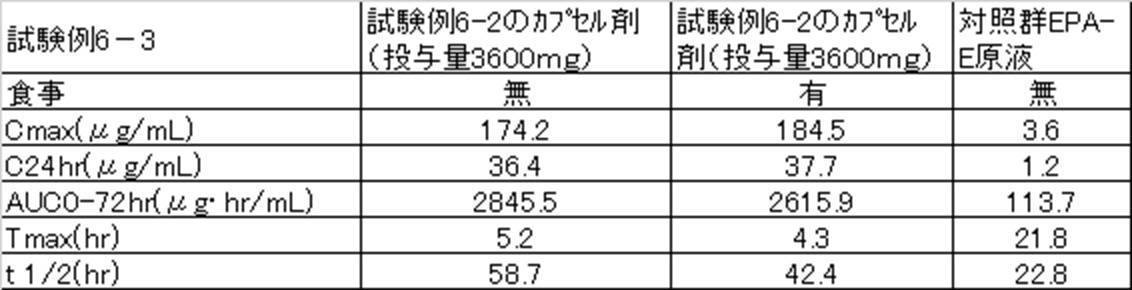
本発明は組成物の相溶性を良好にするためにエタノールや多価アルコールを含まず、水を使用した。水を含まない場合には組成物が相溶性を充分に有しないため分離した。また、水を含む処方であってもその量が組成物に対して多すぎても同様に分離した。水が1ないし4質量%の実施例1~6では分離しなかった。これより、0.5ないし6質量%程度の特定の量の水を含むことが外観等に優れるために重要であると分かる。
しかしながら、40℃で一晩保管すると分離した。これより、0.5ないし6質量%程度の特定の量の水を含むことが外観等に優れるために重要であると分かる。
これより乳化剤としてポリオキシエチレンソルビタン脂肪酸エステルを含有することが外観に優れるために重要であると分かる。
これらの自己乳化組成物を投与した動物では対照群(絶食時)を投与した動物よりも吸収速度のパラメーターであるCmaxおよびAUC0-2値が著しく高かった。すなわち、実施例の自己乳化組成物を投与した場合、対照群に比べて経口投与24時間後までのEPA吸収量が増加するのみならず、特に経口投与後速やかにEPAが吸収されることが確認された。
従って、本発明の自己乳化組成物は、食前や就寝前などの空腹時に服用した場合でも血中EPA濃度が速やかに、かつより上昇し、その薬理作用を速やかに、かつより効果的に発揮する自己乳化型製剤として使用し得ることが期待される。
表4に記載の組成となる様に、実施例1と同様の方法で自己乳化組成物および比較例2-3の組成物を調製し保存した。表4に自己乳化組成物の処方を示す。
この自己乳化組成物を実施例2-1および2-2については375mg、比較例2-3については441mg(いずれも、EPA-Eとして300mg)それぞれ充てんしたソフトゼラチンカプセルを、ロータリー法により製造した。本法により製造した自己乳化型カプセル製剤は、カプセル皮膜の変形等は認められなかった。
表4に内容液の組成を示す。
実施例2-1および2-2、比較例2-3の各カプセル製剤について、硬度を測定した。また、40℃相対湿度75%で1、2、4週間保管した製剤について、同様に硬度を測定した。
各製剤を初期、40℃ 1、2、4週間保管した場合の結果を表4に示す。なお、初期とはカプセルの製造後、評価するまで室温で保管した製剤をいう。また、各製剤はアルミ包装に密封して40℃に保管したため、湿度の影響は受けていない。
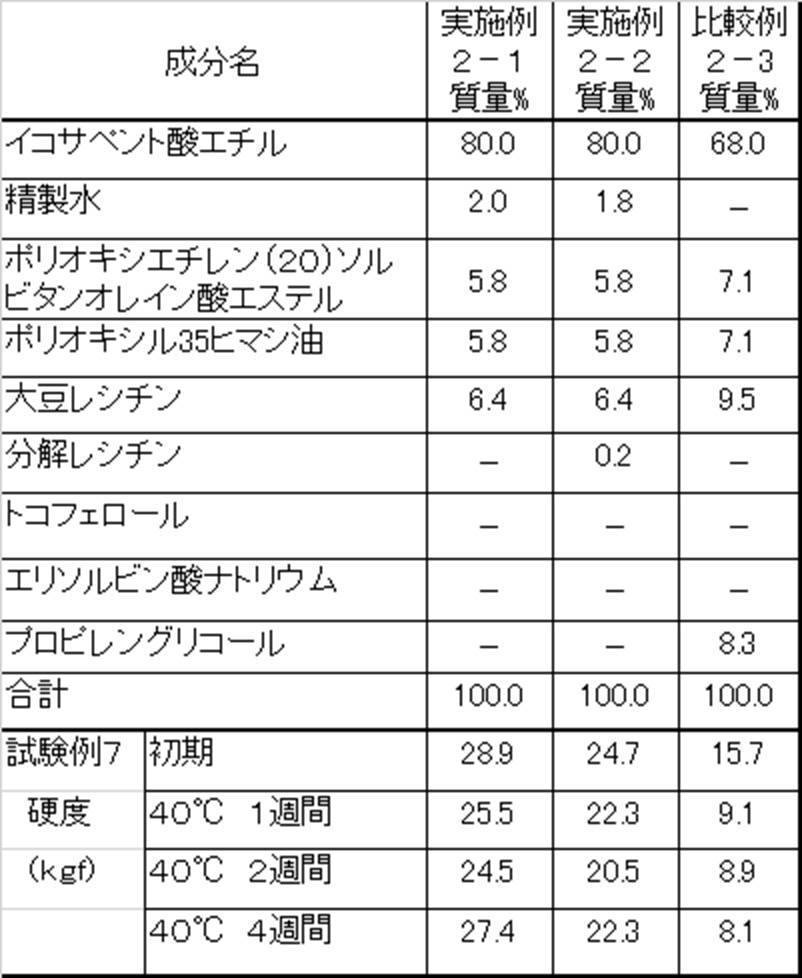
一方、多価アルコールであるプロピレングリコールを8.3質量%と多量に含む比較例2-3では初期の時点で既に硬度が実施例と比較して低かった。密封環境下で40℃ 1ないし4週間保管後の硬度を評価したところ、実施例2-1および2-2がほぼ変化が無いのに対し、比較例2-3は1週間で初期の57%まで硬度が低下し、更に経時的に硬度低下した。
表5~21に記載の組成比となる様に、実施例1と同様の方法で実施例3-1~3-252の自己乳化組成物を調製及び保存する。なお、この内、一部の処方については調製及び保存した。表5~21に自己乳化組成物および組成物の処方を示す。














本発明の自己乳化組成物は、多価アルコール非添加または添加濃度が低いため、流通過程や保存中における多価アルコールが原因のカプセル軟化、変形が起こらず、品質変化のリスクが低い。
また、低温又は高温環境下の保存でも組成物が白濁、分離等の変性のないことから、医薬として用いられる場合に寒冷地や高温地での保管可能な品質を有する。
Claims (10)
- ω3多価不飽和脂肪酸、その製薬学上許容しうる塩、および、そのエステルからなる群から選ばれる少なくとも1つの化合物と、レシチンおよび/または乳化剤としてポリオキシエチレンソルビタン脂肪酸エステルとを含む自己乳化組成物であって、ヒトに投与されたときに、投与前の血漿中ω3多価不飽和脂肪酸濃度を減じた補正を行なって算出した(a)~(e)から選択される少なくとも1つを満たす自己乳化組成物:
(a)ω3多価不飽和脂肪酸最高血漿中濃度が50μg/mL以上、
(b)投与2時間後のω3多価不飽和脂肪酸血漿中濃度が20μg/mL以上、
(c)ω3多価不飽和脂肪酸最高血漿中濃度到達時間(Tmax)が6時間以下、
(d)投与0から72時間までのω3多価不飽和脂肪酸血漿中濃度曲線下面積が500μg・hr/mL以上
(e)投与24時間後のω3多価不飽和脂肪酸血中濃度が5~100μg/mL。 - ヒトに投与される前記組成物に含まれるω3多価不飽和脂肪酸、その製薬学上許容しうる塩、および、そのエステルからなる群から選ばれる少なくとも1つの化合物が1000mg~10000mgである請求項1に記載の自己乳化組成物。
- ヒトに投与される前記組成物に含まれるω3多価不飽和脂肪酸、その製薬学上許容しうる塩、および、そのエステルがEPA、その製薬学上許容しうる塩、および、そのエステルからなる群から選ばれる少なくとも1つである請求項1または請求項2に記載の自己乳化組成物。
- EPA、その製薬学上許容しうる塩、および、そのエステルがEPAエチルエステルである請求項3に記載の自己乳化組成物。
- 前記組成物を投与されたときに、投与前の血漿中ω3多価不飽和脂肪酸濃度を減じた補正を行なって算出した、ω3多価不飽和脂肪酸最高血漿中濃度が50μg/mL以上、および、投与0から72時間までのω3多価不飽和脂肪酸血漿中濃度曲線下面積が500μg・hr/mL以上を満たす請求項1ないし請求項4のいずれか1項に記載の自己乳化組成物。
- 前記組成物を絶食時に投与されたときに、投与前の血漿中ω3多価不飽和脂肪酸濃度を減じた補正を行なって算出したω3多価不飽和脂肪酸最高血漿中濃度が食直後のω3多価不飽和脂肪酸最高血漿中濃度の3倍以上、または、投与0から72時間までのω3多価不飽和脂肪酸血漿中濃度曲線下面積が食直後のω3多価不飽和脂肪酸血漿中濃度曲線下面積の2倍以上である請求項1ないし請求項5のいずれか1項に記載の自己乳化組成物。
- 前記組成物がレシチンおよび乳化剤としてポリオキシエチレンソルビタン脂肪酸エステルを含む請求項1ないし請求項6のいずれか1項に記載の自己乳化組成物。
- 前記乳化剤としてさらにポリオキシエチレンヒマシ油を含む請求項1ないし請求項7のいずれか1項に記載の自己乳化組成物。
- ω3多価不飽和脂肪酸、その製薬学上許容しうる塩、および、そのエステルからなる群から選ばれる少なくとも1つの化合物が1000mg~10000mgを含む前記組成物を1日1回投与する請求項1ないし請求項7のいずれか1項に記載の自己乳化組成物。
- 前記組成物が水を含む請求項1ないし請求項9のいずれか1項に記載の自己乳化組成物。
Priority Applications (4)
| Application Number | Priority Date | Filing Date | Title |
|---|---|---|---|
| JP2016570692A JPWO2016117629A1 (ja) | 2015-01-21 | 2016-01-21 | ω3脂肪酸の自己乳化組成物 |
| US15/545,181 US20170348273A1 (en) | 2015-01-21 | 2016-01-21 | Self-emulsifying composition of omega3 fatty acid |
| US16/272,713 US10786575B2 (en) | 2015-01-21 | 2019-02-11 | Self-emulsifying composition of Ω3 fatty acid |
| US17/000,790 US20200390893A1 (en) | 2015-01-21 | 2020-08-24 | Self-emulsifying composition of omega3 fatty acid |
Applications Claiming Priority (2)
| Application Number | Priority Date | Filing Date | Title |
|---|---|---|---|
| JPPCT/JP2015/051558 | 2015-01-21 | ||
| PCT/JP2015/051558 WO2016117057A1 (ja) | 2015-01-21 | 2015-01-21 | ω3脂肪酸の自己乳化組成物 |
Related Child Applications (2)
| Application Number | Title | Priority Date | Filing Date |
|---|---|---|---|
| US15/545,181 A-371-Of-International US20170348273A1 (en) | 2015-01-21 | 2016-01-21 | Self-emulsifying composition of omega3 fatty acid |
| US16/272,713 Division US10786575B2 (en) | 2015-01-21 | 2019-02-11 | Self-emulsifying composition of Ω3 fatty acid |
Publications (1)
| Publication Number | Publication Date |
|---|---|
| WO2016117629A1 true WO2016117629A1 (ja) | 2016-07-28 |
Family
ID=56416623
Family Applications (2)
| Application Number | Title | Priority Date | Filing Date |
|---|---|---|---|
| PCT/JP2015/051558 Ceased WO2016117057A1 (ja) | 2015-01-21 | 2015-01-21 | ω3脂肪酸の自己乳化組成物 |
| PCT/JP2016/051643 Ceased WO2016117629A1 (ja) | 2015-01-21 | 2016-01-21 | ω3脂肪酸の自己乳化組成物 |
Family Applications Before (1)
| Application Number | Title | Priority Date | Filing Date |
|---|---|---|---|
| PCT/JP2015/051558 Ceased WO2016117057A1 (ja) | 2015-01-21 | 2015-01-21 | ω3脂肪酸の自己乳化組成物 |
Country Status (13)
| Country | Link |
|---|---|
| US (6) | US10758622B2 (ja) |
| EP (1) | EP3248598A4 (ja) |
| JP (2) | JP6514720B2 (ja) |
| KR (2) | KR102488648B1 (ja) |
| CN (1) | CN107427484A (ja) |
| CA (1) | CA2974321C (ja) |
| HK (1) | HK1243324A1 (ja) |
| MX (1) | MX384954B (ja) |
| MY (1) | MY185428A (ja) |
| PH (1) | PH12017501328B1 (ja) |
| RU (1) | RU2709612C2 (ja) |
| SG (1) | SG11201705938TA (ja) |
| WO (2) | WO2016117057A1 (ja) |
Cited By (1)
| Publication number | Priority date | Publication date | Assignee | Title |
|---|---|---|---|---|
| CN107693793A (zh) * | 2016-09-20 | 2018-02-16 | 福建奥正投资发展有限公司 | 亲水性脂类组合物的包装组合物,其制备及调配方法和应用 |
Families Citing this family (32)
| Publication number | Priority date | Publication date | Assignee | Title |
|---|---|---|---|---|
| EP4137128A1 (en) | 2008-09-02 | 2023-02-22 | Amarin Pharmaceuticals Ireland Limited | Pharmaceutical composition comprising eicosapentaenoic acid and a statin, and methods of using same |
| NZ720946A (en) | 2009-04-29 | 2017-09-29 | Amarin Pharmaceuticals Ie Ltd | Pharmaceutical compositions comprising epa and a cardiovascular agent and methods of using the same |
| MX350088B (es) | 2009-04-29 | 2017-08-25 | Amarin Pharma Inc | Composicion farmaceutica estable y metodos de uso de la misma. |
| CN108096209A (zh) | 2009-06-15 | 2018-06-01 | 阿马里纳制药公司 | 在相伴他汀类疗法的对象中降低甘油三酯、没有增加ldl-c水平的组合物和方法 |
| US20110071176A1 (en) | 2009-09-23 | 2011-03-24 | Amarin Pharma, Inc. | Pharmaceutical composition comprising omega-3 fatty acid and hydroxy-derivative of a statin and methods of using same |
| US11712429B2 (en) | 2010-11-29 | 2023-08-01 | Amarin Pharmaceuticals Ireland Limited | Low eructation composition and methods for treating and/or preventing cardiovascular disease in a subject with fish allergy/hypersensitivity |
| NZ712068A (en) | 2010-11-29 | 2017-03-31 | Amarin Pharmaceuticals Ie Ltd | Low eructation composition and methods for treating and/or preventing cardiovascular disease in a subject with fish allergy/hypersensitivity |
| US20130131170A1 (en) | 2011-11-07 | 2013-05-23 | Amarin Pharmaceuticals Ireland Limited | Methods of treating hypertriglyceridemia |
| US11291643B2 (en) | 2011-11-07 | 2022-04-05 | Amarin Pharmaceuticals Ireland Limited | Methods of treating hypertriglyceridemia |
| ES2891473T3 (es) | 2012-01-06 | 2022-01-28 | Amarin Pharmaceuticals Ie Ltd | Composiciones y métodos para reducir los niveles de alta sensibilidad (hs-CRP) en un sujeto |
| CA3067012C (en) | 2012-06-29 | 2021-10-05 | Amarin Pharmaceuticals Ireland Limited | Methods of reducing the risk of a cardiovascular event in a subject on statin therapy |
| WO2014074552A2 (en) | 2012-11-06 | 2014-05-15 | Amarin Pharmaceuticals Ireland Limited | Compositions and methods for lowering triglycerides without raising ldl-c levels in a subject on concomitant statin therapy |
| US20140187633A1 (en) | 2012-12-31 | 2014-07-03 | Amarin Pharmaceuticals Ireland Limited | Methods of treating or preventing nonalcoholic steatohepatitis and/or primary biliary cirrhosis |
| US9452151B2 (en) | 2013-02-06 | 2016-09-27 | Amarin Pharmaceuticals Ireland Limited | Methods of reducing apolipoprotein C-III |
| US9624492B2 (en) | 2013-02-13 | 2017-04-18 | Amarin Pharmaceuticals Ireland Limited | Compositions comprising eicosapentaenoic acid and mipomersen and methods of use thereof |
| US20140271841A1 (en) | 2013-03-15 | 2014-09-18 | Amarin Pharmaceuticals Ireland Limited | Pharmaceutical composition comprising eicosapentaenoic acid and derivatives thereof and a statin |
| US10966968B2 (en) | 2013-06-06 | 2021-04-06 | Amarin Pharmaceuticals Ireland Limited | Co-administration of rosiglitazone and eicosapentaenoic acid or a derivative thereof |
| US20150065572A1 (en) | 2013-09-04 | 2015-03-05 | Amarin Pharmaceuticals Ireland Limited | Methods of treating or preventing prostate cancer |
| US9585859B2 (en) | 2013-10-10 | 2017-03-07 | Amarin Pharmaceuticals Ireland Limited | Compositions and methods for lowering triglycerides without raising LDL-C levels in a subject on concomitant statin therapy |
| US10561631B2 (en) | 2014-06-11 | 2020-02-18 | Amarin Pharmaceuticals Ireland Limited | Methods of reducing RLP-C |
| US10172818B2 (en) | 2014-06-16 | 2019-01-08 | Amarin Pharmaceuticals Ireland Limited | Methods of reducing or preventing oxidation of small dense LDL or membrane polyunsaturated fatty acids |
| JP6514720B2 (ja) * | 2015-01-21 | 2019-05-15 | 持田製薬株式会社 | ω3脂肪酸の自己乳化組成物 |
| US10406130B2 (en) | 2016-03-15 | 2019-09-10 | Amarin Pharmaceuticals Ireland Limited | Methods of reducing or preventing oxidation of small dense LDL or membrane polyunsaturated fatty acids |
| WO2018213663A1 (en) | 2017-05-19 | 2018-11-22 | Amarin Pharmaceuticals Ireland Limited | Compositions and methods for lowering triglycerides in a subject having reduced kidney function |
| US11058661B2 (en) | 2018-03-02 | 2021-07-13 | Amarin Pharmaceuticals Ireland Limited | Compositions and methods for lowering triglycerides in a subject on concomitant statin therapy and having hsCRP levels of at least about 2 mg/L |
| MA51766A (fr) | 2018-09-24 | 2020-12-16 | Amarin Pharmaceuticals Ie Ltd | Procédés de réduction du risque d'événements cardiovasculaires chez un sujet |
| CN110025591A (zh) * | 2019-04-29 | 2019-07-19 | 郑州泰丰制药有限公司 | 一种奥贝胆酸自乳化制剂及其软胶囊 |
| JP7500037B2 (ja) * | 2019-07-24 | 2024-06-17 | 国立大学法人 東京大学 | 血中尿酸値低下剤及び血中尿酸値低下用食品組成物 |
| BR112022009189A2 (pt) | 2019-11-12 | 2022-07-26 | Amarin Pharmaceuticals Ie Ltd | Métodos para reduzir o risco de eventos cardiovasculares em um sujeito com fibrilação atrial e/ou palpitação atrial |
| US11986452B2 (en) | 2021-04-21 | 2024-05-21 | Amarin Pharmaceuticals Ireland Limited | Methods of reducing the risk of heart failure |
| MX2024009147A (es) * | 2022-01-26 | 2024-08-06 | Amarin Pharmaceuticals Ie Ltd | Composiciones de acidos grasos liberadoras de linfa y usos de las mismas para la incorporacion linfatica y tratamiento de enfermedades sistemicas. |
| WO2026017043A1 (zh) * | 2024-07-16 | 2026-01-22 | 成都国为生物医药有限公司 | 一种调释型药物组合物及其用途 |
Citations (6)
| Publication number | Priority date | Publication date | Assignee | Title |
|---|---|---|---|---|
| JP2012180337A (ja) * | 2011-02-10 | 2012-09-20 | Fancl Corp | 自己乳化製剤 |
| JP2013063970A (ja) * | 2011-09-02 | 2013-04-11 | Fujifilm Corp | ソフトカプセル製剤、ソフトカプセル製剤用組成物、及びソフトカプセル製剤の製造方法 |
| WO2013148136A1 (en) * | 2012-03-30 | 2013-10-03 | Sancilio & Company, Inc. | Omega-3 fatty acid ester compositions |
| JP5313343B2 (ja) * | 2009-05-22 | 2013-10-09 | 持田製薬株式会社 | ω3脂肪酸の自己乳化組成物 |
| WO2015008848A1 (ja) * | 2013-07-18 | 2015-01-22 | 持田製薬株式会社 | ω3脂肪酸の自己乳化組成物 |
| WO2015008849A1 (ja) * | 2013-07-18 | 2015-01-22 | 持田製薬株式会社 | ω3脂肪酸の自己乳化組成物 |
Family Cites Families (11)
| Publication number | Priority date | Publication date | Assignee | Title |
|---|---|---|---|---|
| SE0000773D0 (sv) * | 2000-03-08 | 2000-03-08 | Astrazeneca Ab | New formulation |
| CA2573316A1 (en) | 2004-08-06 | 2006-02-16 | Transform Pharmaceuticals, Inc. | Novel fenofibrate formulations and related methods of treatment |
| US9532963B2 (en) | 2009-03-09 | 2017-01-03 | Pronova Biopharma Norge As | Compositions comprising a fatty acid oil mixture and a free fatty acid, and methods and uses thereof |
| JP5421674B2 (ja) | 2009-07-01 | 2014-02-19 | 株式会社ファンケル | ソフトカプセル用乳化組成物及びソフトカプセル剤 |
| CN101625699B (zh) | 2009-07-28 | 2013-01-09 | 大连新中连软件集团有限公司 | 基于业务组件化的应用软件进行业务控制的方法和系统 |
| ES2661812T3 (es) * | 2009-10-16 | 2018-04-04 | Mochida Pharmaceutical Co., Ltd. | Composiciones |
| KR101904388B1 (ko) * | 2009-10-23 | 2018-10-05 | 프로노바 바이오파마 너지 에이에스 | 지방산 오일 혼합물의 코팅된 캡슐 및 정제 |
| WO2013072767A1 (en) | 2011-11-18 | 2013-05-23 | Pronova Biopharma Norge As | Compositions and preconcentrates comprising at least one salicylate and omega-3 fatty acid oil mixture |
| CA2904129A1 (en) | 2013-03-15 | 2014-09-18 | Mochida Pharmaceutical Co., Ltd. | Compositions and methods for treating non-alcoholic steatohepatitis |
| JP2016008849A (ja) | 2014-06-23 | 2016-01-18 | 日本電気硝子株式会社 | 放射線防護用衝立 |
| JP6514720B2 (ja) * | 2015-01-21 | 2019-05-15 | 持田製薬株式会社 | ω3脂肪酸の自己乳化組成物 |
-
2015
- 2015-01-21 JP JP2016570401A patent/JP6514720B2/ja active Active
- 2015-01-21 US US15/545,197 patent/US10758622B2/en active Active
- 2015-01-21 MY MYPI2017702651A patent/MY185428A/en unknown
- 2015-01-21 HK HK18102770.2A patent/HK1243324A1/zh unknown
- 2015-01-21 EP EP15878752.3A patent/EP3248598A4/en active Pending
- 2015-01-21 WO PCT/JP2015/051558 patent/WO2016117057A1/ja not_active Ceased
- 2015-01-21 CA CA2974321A patent/CA2974321C/en active Active
- 2015-01-21 KR KR1020217041914A patent/KR102488648B1/ko active Active
- 2015-01-21 CN CN201580074195.7A patent/CN107427484A/zh active Pending
- 2015-01-21 SG SG11201705938TA patent/SG11201705938TA/en unknown
- 2015-01-21 MX MX2017009489A patent/MX384954B/es unknown
- 2015-01-21 KR KR1020177020459A patent/KR102343494B1/ko active Active
- 2015-01-21 RU RU2017126039A patent/RU2709612C2/ru active
-
2016
- 2016-01-21 WO PCT/JP2016/051643 patent/WO2016117629A1/ja not_active Ceased
- 2016-01-21 JP JP2016570692A patent/JPWO2016117629A1/ja active Pending
- 2016-01-21 US US15/545,181 patent/US20170348273A1/en not_active Abandoned
-
2017
- 2017-07-21 PH PH12017501328A patent/PH12017501328B1/en unknown
-
2019
- 2019-02-11 US US16/272,713 patent/US10786575B2/en active Active
-
2020
- 2020-07-17 US US16/931,592 patent/US11911480B2/en active Active
- 2020-08-24 US US17/000,790 patent/US20200390893A1/en not_active Abandoned
-
2024
- 2024-01-22 US US18/418,727 patent/US20240252646A1/en active Pending
Patent Citations (6)
| Publication number | Priority date | Publication date | Assignee | Title |
|---|---|---|---|---|
| JP5313343B2 (ja) * | 2009-05-22 | 2013-10-09 | 持田製薬株式会社 | ω3脂肪酸の自己乳化組成物 |
| JP2012180337A (ja) * | 2011-02-10 | 2012-09-20 | Fancl Corp | 自己乳化製剤 |
| JP2013063970A (ja) * | 2011-09-02 | 2013-04-11 | Fujifilm Corp | ソフトカプセル製剤、ソフトカプセル製剤用組成物、及びソフトカプセル製剤の製造方法 |
| WO2013148136A1 (en) * | 2012-03-30 | 2013-10-03 | Sancilio & Company, Inc. | Omega-3 fatty acid ester compositions |
| WO2015008848A1 (ja) * | 2013-07-18 | 2015-01-22 | 持田製薬株式会社 | ω3脂肪酸の自己乳化組成物 |
| WO2015008849A1 (ja) * | 2013-07-18 | 2015-01-22 | 持田製薬株式会社 | ω3脂肪酸の自己乳化組成物 |
Cited By (2)
| Publication number | Priority date | Publication date | Assignee | Title |
|---|---|---|---|---|
| CN107693793A (zh) * | 2016-09-20 | 2018-02-16 | 福建奥正投资发展有限公司 | 亲水性脂类组合物的包装组合物,其制备及调配方法和应用 |
| CN107693793B (zh) * | 2016-09-20 | 2021-05-28 | 福建奥正投资发展有限公司 | 亲水性脂类组合物的包装组合物,其制备及调配方法和应用 |
Also Published As
| Publication number | Publication date |
|---|---|
| US20170348273A1 (en) | 2017-12-07 |
| CA2974321A1 (en) | 2016-07-28 |
| WO2016117057A1 (ja) | 2016-07-28 |
| KR20210158422A (ko) | 2021-12-30 |
| US11911480B2 (en) | 2024-02-27 |
| RU2017126039A3 (ja) | 2019-02-21 |
| SG11201705938TA (en) | 2017-08-30 |
| US10758622B2 (en) | 2020-09-01 |
| US20170368184A1 (en) | 2017-12-28 |
| RU2017126039A (ru) | 2019-02-21 |
| US10786575B2 (en) | 2020-09-29 |
| EP3248598A4 (en) | 2018-08-08 |
| US20200390893A1 (en) | 2020-12-17 |
| MX384954B (es) | 2025-03-14 |
| CA2974321C (en) | 2023-09-05 |
| JP6514720B2 (ja) | 2019-05-15 |
| US20190167802A1 (en) | 2019-06-06 |
| KR20170103836A (ko) | 2017-09-13 |
| JPWO2016117629A1 (ja) | 2017-11-02 |
| MY185428A (en) | 2021-05-19 |
| JPWO2016117057A1 (ja) | 2017-10-26 |
| EP3248598A1 (en) | 2017-11-29 |
| MX2017009489A (es) | 2018-02-09 |
| RU2709612C2 (ru) | 2019-12-19 |
| PH12017501328A1 (en) | 2017-12-11 |
| KR102488648B1 (ko) | 2023-01-12 |
| CN107427484A (zh) | 2017-12-01 |
| US20240252646A1 (en) | 2024-08-01 |
| HK1243324A1 (zh) | 2018-07-13 |
| PH12017501328B1 (en) | 2017-12-11 |
| US20200345852A1 (en) | 2020-11-05 |
| KR102343494B1 (ko) | 2021-12-24 |
Similar Documents
| Publication | Publication Date | Title |
|---|---|---|
| JP7360521B2 (ja) | ω3脂肪酸の自己乳化組成物 | |
| JP7621450B2 (ja) | ω3脂肪酸の自己乳化組成物 | |
| JP6514720B2 (ja) | ω3脂肪酸の自己乳化組成物 | |
| JP6783891B2 (ja) | ω3脂肪酸の自己乳化組成物 | |
| JP2023017097A (ja) | ω3脂肪酸の自己乳化組成物 | |
| TWI788582B (zh) | ω3脂肪酸之自體乳化製劑及自體乳化組成物 | |
| TWI668016B (zh) | ω3脂肪酸之自體乳化組成物 | |
| HK40040979A (en) | SELF-EMULSIFYING COMPOSITION OF ω-3 FATTY ACID | |
| HK40040732A (en) | Self-emulsifying composition of omega3 fatty acid | |
| HK40015559A (en) | SELF-EMULSIFYING COMPOSITION OF ω-3 FATTY ACID |
Legal Events
| Date | Code | Title | Description |
|---|---|---|---|
| 121 | Ep: the epo has been informed by wipo that ep was designated in this application |
Ref document number: 16740236 Country of ref document: EP Kind code of ref document: A1 |
|
| ENP | Entry into the national phase |
Ref document number: 2016570692 Country of ref document: JP Kind code of ref document: A |
|
| WWE | Wipo information: entry into national phase |
Ref document number: 15545181 Country of ref document: US |
|
| NENP | Non-entry into the national phase |
Ref country code: DE |
|
| 122 | Ep: pct application non-entry in european phase |
Ref document number: 16740236 Country of ref document: EP Kind code of ref document: A1 |