WO2016103534A1 - 高強度溶融亜鉛めっき鋼板およびその製造方法 - Google Patents
高強度溶融亜鉛めっき鋼板およびその製造方法 Download PDFInfo
- Publication number
- WO2016103534A1 WO2016103534A1 PCT/JP2015/003845 JP2015003845W WO2016103534A1 WO 2016103534 A1 WO2016103534 A1 WO 2016103534A1 JP 2015003845 W JP2015003845 W JP 2015003845W WO 2016103534 A1 WO2016103534 A1 WO 2016103534A1
- Authority
- WO
- WIPO (PCT)
- Prior art keywords
- less
- steel sheet
- hot
- galvanized steel
- temperature
- Prior art date
- Legal status (The legal status is an assumption and is not a legal conclusion. Google has not performed a legal analysis and makes no representation as to the accuracy of the status listed.)
- Ceased
Links
Images

Classifications
-
- C—CHEMISTRY; METALLURGY
- C21—METALLURGY OF IRON
- C21D—MODIFYING THE PHYSICAL STRUCTURE OF FERROUS METALS; GENERAL DEVICES FOR HEAT TREATMENT OF FERROUS OR NON-FERROUS METALS OR ALLOYS; MAKING METAL MALLEABLE, e.g. BY DECARBURISATION OR TEMPERING
- C21D8/00—Modifying the physical properties of ferrous metals or ferrous alloys by deformation combined with, or followed by, heat treatment
- C21D8/02—Modifying the physical properties of ferrous metals or ferrous alloys by deformation combined with, or followed by, heat treatment during manufacturing of plates or strips
- C21D8/0247—Modifying the physical properties of ferrous metals or ferrous alloys by deformation combined with, or followed by, heat treatment during manufacturing of plates or strips characterised by the heat treatment
-
- C—CHEMISTRY; METALLURGY
- C21—METALLURGY OF IRON
- C21D—MODIFYING THE PHYSICAL STRUCTURE OF FERROUS METALS; GENERAL DEVICES FOR HEAT TREATMENT OF FERROUS OR NON-FERROUS METALS OR ALLOYS; MAKING METAL MALLEABLE, e.g. BY DECARBURISATION OR TEMPERING
- C21D9/00—Heat treatment, e.g. annealing, hardening, quenching or tempering, adapted for particular articles; Furnaces therefor
- C21D9/46—Heat treatment, e.g. annealing, hardening, quenching or tempering, adapted for particular articles; Furnaces therefor for sheet metals
-
- C—CHEMISTRY; METALLURGY
- C22—METALLURGY; FERROUS OR NON-FERROUS ALLOYS; TREATMENT OF ALLOYS OR NON-FERROUS METALS
- C22C—ALLOYS
- C22C18/00—Alloys based on zinc
-
- C—CHEMISTRY; METALLURGY
- C22—METALLURGY; FERROUS OR NON-FERROUS ALLOYS; TREATMENT OF ALLOYS OR NON-FERROUS METALS
- C22C—ALLOYS
- C22C38/00—Ferrous alloys, e.g. steel alloys
-
- C—CHEMISTRY; METALLURGY
- C22—METALLURGY; FERROUS OR NON-FERROUS ALLOYS; TREATMENT OF ALLOYS OR NON-FERROUS METALS
- C22C—ALLOYS
- C22C38/00—Ferrous alloys, e.g. steel alloys
- C22C38/02—Ferrous alloys, e.g. steel alloys containing silicon
-
- C—CHEMISTRY; METALLURGY
- C22—METALLURGY; FERROUS OR NON-FERROUS ALLOYS; TREATMENT OF ALLOYS OR NON-FERROUS METALS
- C22C—ALLOYS
- C22C38/00—Ferrous alloys, e.g. steel alloys
- C22C38/04—Ferrous alloys, e.g. steel alloys containing manganese
-
- C—CHEMISTRY; METALLURGY
- C22—METALLURGY; FERROUS OR NON-FERROUS ALLOYS; TREATMENT OF ALLOYS OR NON-FERROUS METALS
- C22C—ALLOYS
- C22C38/00—Ferrous alloys, e.g. steel alloys
- C22C38/06—Ferrous alloys, e.g. steel alloys containing aluminium
-
- C—CHEMISTRY; METALLURGY
- C22—METALLURGY; FERROUS OR NON-FERROUS ALLOYS; TREATMENT OF ALLOYS OR NON-FERROUS METALS
- C22C—ALLOYS
- C22C38/00—Ferrous alloys, e.g. steel alloys
- C22C38/18—Ferrous alloys, e.g. steel alloys containing chromium
- C22C38/40—Ferrous alloys, e.g. steel alloys containing chromium with nickel
- C22C38/58—Ferrous alloys, e.g. steel alloys containing chromium with nickel with more than 1.5% by weight of manganese
-
- C—CHEMISTRY; METALLURGY
- C23—COATING METALLIC MATERIAL; COATING MATERIAL WITH METALLIC MATERIAL; CHEMICAL SURFACE TREATMENT; DIFFUSION TREATMENT OF METALLIC MATERIAL; COATING BY VACUUM EVAPORATION, BY SPUTTERING, BY ION IMPLANTATION OR BY CHEMICAL VAPOUR DEPOSITION, IN GENERAL; INHIBITING CORROSION OF METALLIC MATERIAL OR INCRUSTATION IN GENERAL
- C23C—COATING METALLIC MATERIAL; COATING MATERIAL WITH METALLIC MATERIAL; SURFACE TREATMENT OF METALLIC MATERIAL BY DIFFUSION INTO THE SURFACE, BY CHEMICAL CONVERSION OR SUBSTITUTION; COATING BY VACUUM EVAPORATION, BY SPUTTERING, BY ION IMPLANTATION OR BY CHEMICAL VAPOUR DEPOSITION, IN GENERAL
- C23C2/00—Hot-dipping or immersion processes for applying the coating material in the molten state without affecting the shape; Apparatus therefor
- C23C2/02—Pretreatment of the material to be coated, e.g. for coating on selected surface areas
-
- C—CHEMISTRY; METALLURGY
- C23—COATING METALLIC MATERIAL; COATING MATERIAL WITH METALLIC MATERIAL; CHEMICAL SURFACE TREATMENT; DIFFUSION TREATMENT OF METALLIC MATERIAL; COATING BY VACUUM EVAPORATION, BY SPUTTERING, BY ION IMPLANTATION OR BY CHEMICAL VAPOUR DEPOSITION, IN GENERAL; INHIBITING CORROSION OF METALLIC MATERIAL OR INCRUSTATION IN GENERAL
- C23C—COATING METALLIC MATERIAL; COATING MATERIAL WITH METALLIC MATERIAL; SURFACE TREATMENT OF METALLIC MATERIAL BY DIFFUSION INTO THE SURFACE, BY CHEMICAL CONVERSION OR SUBSTITUTION; COATING BY VACUUM EVAPORATION, BY SPUTTERING, BY ION IMPLANTATION OR BY CHEMICAL VAPOUR DEPOSITION, IN GENERAL
- C23C2/00—Hot-dipping or immersion processes for applying the coating material in the molten state without affecting the shape; Apparatus therefor
- C23C2/02—Pretreatment of the material to be coated, e.g. for coating on selected surface areas
- C23C2/022—Pretreatment of the material to be coated, e.g. for coating on selected surface areas by heating
-
- C—CHEMISTRY; METALLURGY
- C23—COATING METALLIC MATERIAL; COATING MATERIAL WITH METALLIC MATERIAL; CHEMICAL SURFACE TREATMENT; DIFFUSION TREATMENT OF METALLIC MATERIAL; COATING BY VACUUM EVAPORATION, BY SPUTTERING, BY ION IMPLANTATION OR BY CHEMICAL VAPOUR DEPOSITION, IN GENERAL; INHIBITING CORROSION OF METALLIC MATERIAL OR INCRUSTATION IN GENERAL
- C23C—COATING METALLIC MATERIAL; COATING MATERIAL WITH METALLIC MATERIAL; SURFACE TREATMENT OF METALLIC MATERIAL BY DIFFUSION INTO THE SURFACE, BY CHEMICAL CONVERSION OR SUBSTITUTION; COATING BY VACUUM EVAPORATION, BY SPUTTERING, BY ION IMPLANTATION OR BY CHEMICAL VAPOUR DEPOSITION, IN GENERAL
- C23C2/00—Hot-dipping or immersion processes for applying the coating material in the molten state without affecting the shape; Apparatus therefor
- C23C2/02—Pretreatment of the material to be coated, e.g. for coating on selected surface areas
- C23C2/022—Pretreatment of the material to be coated, e.g. for coating on selected surface areas by heating
- C23C2/0224—Two or more thermal pretreatments
-
- C—CHEMISTRY; METALLURGY
- C23—COATING METALLIC MATERIAL; COATING MATERIAL WITH METALLIC MATERIAL; CHEMICAL SURFACE TREATMENT; DIFFUSION TREATMENT OF METALLIC MATERIAL; COATING BY VACUUM EVAPORATION, BY SPUTTERING, BY ION IMPLANTATION OR BY CHEMICAL VAPOUR DEPOSITION, IN GENERAL; INHIBITING CORROSION OF METALLIC MATERIAL OR INCRUSTATION IN GENERAL
- C23C—COATING METALLIC MATERIAL; COATING MATERIAL WITH METALLIC MATERIAL; SURFACE TREATMENT OF METALLIC MATERIAL BY DIFFUSION INTO THE SURFACE, BY CHEMICAL CONVERSION OR SUBSTITUTION; COATING BY VACUUM EVAPORATION, BY SPUTTERING, BY ION IMPLANTATION OR BY CHEMICAL VAPOUR DEPOSITION, IN GENERAL
- C23C2/00—Hot-dipping or immersion processes for applying the coating material in the molten state without affecting the shape; Apparatus therefor
- C23C2/04—Hot-dipping or immersion processes for applying the coating material in the molten state without affecting the shape; Apparatus therefor characterised by the coating material
- C23C2/06—Zinc or cadmium or alloys based thereon
-
- C—CHEMISTRY; METALLURGY
- C23—COATING METALLIC MATERIAL; COATING MATERIAL WITH METALLIC MATERIAL; CHEMICAL SURFACE TREATMENT; DIFFUSION TREATMENT OF METALLIC MATERIAL; COATING BY VACUUM EVAPORATION, BY SPUTTERING, BY ION IMPLANTATION OR BY CHEMICAL VAPOUR DEPOSITION, IN GENERAL; INHIBITING CORROSION OF METALLIC MATERIAL OR INCRUSTATION IN GENERAL
- C23C—COATING METALLIC MATERIAL; COATING MATERIAL WITH METALLIC MATERIAL; SURFACE TREATMENT OF METALLIC MATERIAL BY DIFFUSION INTO THE SURFACE, BY CHEMICAL CONVERSION OR SUBSTITUTION; COATING BY VACUUM EVAPORATION, BY SPUTTERING, BY ION IMPLANTATION OR BY CHEMICAL VAPOUR DEPOSITION, IN GENERAL
- C23C2/00—Hot-dipping or immersion processes for applying the coating material in the molten state without affecting the shape; Apparatus therefor
- C23C2/26—After-treatment
- C23C2/28—Thermal after-treatment, e.g. treatment in oil bath
-
- C—CHEMISTRY; METALLURGY
- C23—COATING METALLIC MATERIAL; COATING MATERIAL WITH METALLIC MATERIAL; CHEMICAL SURFACE TREATMENT; DIFFUSION TREATMENT OF METALLIC MATERIAL; COATING BY VACUUM EVAPORATION, BY SPUTTERING, BY ION IMPLANTATION OR BY CHEMICAL VAPOUR DEPOSITION, IN GENERAL; INHIBITING CORROSION OF METALLIC MATERIAL OR INCRUSTATION IN GENERAL
- C23C—COATING METALLIC MATERIAL; COATING MATERIAL WITH METALLIC MATERIAL; SURFACE TREATMENT OF METALLIC MATERIAL BY DIFFUSION INTO THE SURFACE, BY CHEMICAL CONVERSION OR SUBSTITUTION; COATING BY VACUUM EVAPORATION, BY SPUTTERING, BY ION IMPLANTATION OR BY CHEMICAL VAPOUR DEPOSITION, IN GENERAL
- C23C2/00—Hot-dipping or immersion processes for applying the coating material in the molten state without affecting the shape; Apparatus therefor
- C23C2/26—After-treatment
- C23C2/28—Thermal after-treatment, e.g. treatment in oil bath
- C23C2/29—Cooling or quenching
-
- C—CHEMISTRY; METALLURGY
- C23—COATING METALLIC MATERIAL; COATING MATERIAL WITH METALLIC MATERIAL; CHEMICAL SURFACE TREATMENT; DIFFUSION TREATMENT OF METALLIC MATERIAL; COATING BY VACUUM EVAPORATION, BY SPUTTERING, BY ION IMPLANTATION OR BY CHEMICAL VAPOUR DEPOSITION, IN GENERAL; INHIBITING CORROSION OF METALLIC MATERIAL OR INCRUSTATION IN GENERAL
- C23C—COATING METALLIC MATERIAL; COATING MATERIAL WITH METALLIC MATERIAL; SURFACE TREATMENT OF METALLIC MATERIAL BY DIFFUSION INTO THE SURFACE, BY CHEMICAL CONVERSION OR SUBSTITUTION; COATING BY VACUUM EVAPORATION, BY SPUTTERING, BY ION IMPLANTATION OR BY CHEMICAL VAPOUR DEPOSITION, IN GENERAL
- C23C2/00—Hot-dipping or immersion processes for applying the coating material in the molten state without affecting the shape; Apparatus therefor
- C23C2/34—Hot-dipping or immersion processes for applying the coating material in the molten state without affecting the shape; Apparatus therefor characterised by the shape of the material to be treated
- C23C2/36—Elongated material
- C23C2/40—Plates; Strips
-
- C—CHEMISTRY; METALLURGY
- C21—METALLURGY OF IRON
- C21D—MODIFYING THE PHYSICAL STRUCTURE OF FERROUS METALS; GENERAL DEVICES FOR HEAT TREATMENT OF FERROUS OR NON-FERROUS METALS OR ALLOYS; MAKING METAL MALLEABLE, e.g. BY DECARBURISATION OR TEMPERING
- C21D2211/00—Microstructure comprising significant phases
- C21D2211/008—Martensite
Definitions
- TS tensile strength
- the present invention relates to a galvanized steel sheet and a method for producing the same.
- the steel plate composition is mass%, C: 0.05% or more and less than 0.12%, Si: 0.1% or less (excluding 0%), Mn: 2.0% or more and 3.5% or less, Ti, Nb and V At least one element selected from the group consisting of 0.01% to 0.2% in total, B: 0.0003% to 0.005%, P: 0.05% or less, S: 0.05% or less, Al: 0.1% or less, N: It satisfies 0.015% or less, the metal structure may contain bainite and martensite, and may further contain ferrite, and the area ratio to the whole structure is martensite: 15-50%, ferrite: 5% or less (0% ), Remaining structure excluding bainite, martensite and ferrite: 3% or less (including 0%), and average grain size of bainite: 7 ⁇ m or less to achieve workability with a tensile strength of 980 MPa or more It is said that an excellent high yield ratio high strength steel sheet can be obtained.
- the steel sheet composition is mass%, C: 0.03% or more and 0.20% or less, Si: 1.0% or less, Mn: more than 1.5%, 3.0% or less, P: 0.10% or less, S: 0.05% or less, Al: 0.10% or less, N: 0.010% or less, and the total content of any one or more of Ti, Nb and V is 0.010% or more and 1.000% or less, and the balance is Fe and inevitable And having a structure including a ferrite phase and a second phase as a microstructure, and the ferrite phase has an area ratio of 50% or more and an average crystal grain size of 18 ⁇ m or less, The second phase contains martensite having an area ratio of 1% or more and less than 7%, and a high yield ratio type high strength steel sheet can be obtained by controlling the thickness of the band-like structure formed by the second phase. Yes.
- the steel sheet composition is mass%, C: 0.04% to 0.13%, Si: 0.9% to 2.3%, Mn: 0.8% to 2.4%, P: 0.1% or less, S: 0.01% or less , Al: 0.01% or more and 0.1% or less, N: 0.008% or less, the balance consists of iron and inevitable impurities, the structure is area ratio, ferrite phase is 94% or more, martensite phase is 2% or less.
- the ferrite phase has an average grain size of 10 ⁇ m or less, the ferrite phase has a Vickers hardness of 140 or more, and the average crystal grain size of the carbide present on the grain boundary of the ferrite phase is 0.5 ⁇ m or less. It is said that a high yield ratio high strength hot-dip galvanized steel sheet having excellent ductility and hole expansibility can be obtained by setting the aspect ratio of the carbide existing on the grain boundary to 2.0 or less.
- Patent Document 1 since the technique proposed in Patent Document 1 does not consider the softening of austenite, it is considered that autotempered martensite is not generated, which often results in insufficient ductility, for example, stable and good. It is considered difficult to obtain a good bendability.
- Patent Document 3 since it is necessary to contain a large amount of Si, it is difficult to stably produce a plated steel sheet having good surface properties.
- the present invention provides a high-strength hot-dip galvanized steel sheet having ductility (El ⁇ 8.0%) and tensile strength: 980 MPa or higher and a yield ratio of 0.65 or higher, and a method for producing the same.
- the purpose is to do.
- Component composition is mass%, C: 0.11% to 0.20%, Si: less than 0.50%, Mn: 2.2% to 3.5%, P: 0.03% or less, S: 0.005% or less, Al: 0.08 % Or less, N: 0.006% or less, B: 0.0002% or more and 0.0030% or less, with the balance being Fe and inevitable impurities,
- the structure is the area ratio, ferrite phase is less than 20% (including 0%), bainite phase is 50% or less (including 0%), martensite phase is 50% or more (including 100%), the martensite phase
- the auto-tempered martensite contained in is 70% or more (including 100%), the retained austenite is 2% or less (including 0%), A high-strength hot-dip galvanized steel sheet with a tensile strength of 980 MPa or more and a yield ratio of 0.65 or more.
- a steel material having the composition according to any one of [1], [3], [4], and [5] is heated at a temperature of 1100 ° C. or higher and 1350 ° C. or lower, and then the finish rolling temperature Hot rolled to 800 ° C or higher, wound at a temperature of 680 ° C or lower, cold rolled, heated from Ac 1 point to the highest temperature at an average heating rate of 4.0 ° C / s or lower, from Ac 3 point
- the residence time in the temperature range up to the maximum temperature is 20 seconds or more
- the average cooling rate from 800 °C to 550 °C is 8 °C / s or more
- the cooling stop temperature is (Ms point + 55 °C) or more and less than 550 °C
- the composition of the plating layer formed in the plating process is mass%, Fe: 5.0-20.0%, Al: 0.001% -1.0%, Pb, Sb, Si, Sn, Mg, Mn, Ni, Cr [6] or [7], containing 0% to 3.5% of one or more of Co, Ca, Cu, Li, Ti, Be, Bi, and REM in total, with the balance being Zn and inevitable impurities
- the high-strength hot-dip galvanized steel sheet is a hot-dip galvanized steel sheet having a tensile strength (TS) of 980 MPa or more, which has been subjected to a hot-dip galvanizing treatment (GI), and further after the hot-dip galvanizing treatment. Any of those subjected to alloying treatment (GA) is targeted.
- TS tensile strength
- a high-strength hot-dip galvanized steel sheet having ductility (El ⁇ 8.0%) and tensile strength: 980 MPa or higher and a yield ratio of 0.65 or higher can be obtained.
- the high-strength hot-dip galvanized steel sheet according to the present invention has ductility (El ⁇ 8.0) and tensile strength: 980 MPa or more and has a yield ratio of 0.65 or more. The effect is remarkable, such as reducing the weight of automobile parts and improving its reliability.
- the preferred range of the yield ratio is 0.67 or more.
- the tensile strength is preferably 1300 MPa or less from the viewpoint of achieving good ductility.
- C 0.11% or more and 0.20% or less C has a hardenability that increases the hardness of martensite and suppresses ferrite transformation.
- the strength is obtained mainly from auto-tempered martensite having a lower hardness than martensite as it is quenched, so that a steel sheet having a tensile strength of 980 MPa or more cannot be obtained unless the C content is 0.11% or more.
- the C content exceeds 0.20%, the martensite transformation point is excessively lowered, and the target autotempered martensite is hardly generated. Therefore, the C content is 0.11% or more and 0.20% or less. Preferably it is 0.12% or more and 0.16% or less.
- Si Less than 0.50% Si is an element that contributes to high strength by solid solution strengthening. On the other hand, since Si raises the ferrite ⁇ austenite transformation point (Ac 3 point), ferrite is likely to be formed during annealing. Moreover, since Si reduces the wettability between the plating and the steel sheet surface, it causes defects such as non-plating. In the present invention, the Si content is acceptable if it is in the range of less than 0.50%. Preferably it is less than 0.30%. Si is preferably contained in a range that does not adversely affect the rise of the transformation point and plating properties, and is preferably 0.05% or more.
- Mn 2.2% to 3.5% Mn contributes to increasing the strength by solid solution strengthening, and also has the effect of reducing the Ac 3 transformation point, making it easier to remove ferrite during annealing, and suppressing the start of ferrite transformation during cooling. From this viewpoint, the Mn content is 2.2% or more. On the other hand, if the Mn content exceeds 3.5%, the Ms point is excessively lowered and it becomes difficult to generate autotempered martensite. Therefore, the upper limit of Mn is set to 3.5%. A preferable range of the Mn content is 2.3% or more and 3.1% or less.
- P 0.03% or less
- P is an element that segregates at grain boundaries and adversely affects impact resistance and weldability. Therefore, it is preferable to reduce P as much as possible.
- the P content is set to 0.03% or less. Preferably it is 0.02% or less.
- the P content is preferably reduced as much as possible, but 0.002% may inevitably be mixed in production, so the lower limit is preferably 0.002%.
- S 0.005% or less
- S exists as an inclusion such as MnS in steel. This inclusion becomes wedge-shaped by hot rolling and cold rolling. In such a form, S tends to be a starting point for void formation and adversely affects impact resistance. Therefore, in the present invention, it is preferable to reduce the S content as much as possible, and it is 0.005% or less. Preferably it is 0.003% or less. Although it is preferable to reduce as much as possible, 0.0002% may be inevitably mixed in manufacturing, so the lower limit is preferably 0.0002%.
- Al 0.08% or less
- the Al content is 0.08% or less.
- the Al content is 0.08% or less.
- it is 0.07% or less.
- N 0.006% or less N binds to B, which is a hardenable element, and thereby loses the hardenability effect of B. Therefore, the N content is preferably reduced as much as possible, and the upper limit is set to 0.006%. Preferably it is 0.005% or less. Although it is preferable to reduce as much as possible, 0.001% may be inevitably mixed in production, so the lower limit is preferably 0.001%.
- B 0.0002% or more and 0.0030% or less B segregates at the grain boundaries of austenite before transformation and has the effect of significantly delaying the nucleation of the ferrite phase, and has the effect of suppressing the formation of the ferrite phase. In order to acquire this effect, it is necessary to contain B 0.0002% or more. On the other hand, if it exceeds 0.0030%, not only the hardenability effect is saturated, but also the ductility is adversely affected. From the above, the B content is 0.0002% or more and 0.0030% or less. Desirably, it is 0.0003% or more and 0.0020% or less.
- the component composition of this invention can contain the following element for the following purpose as needed.
- Ti and Nb 0.001% or more and 0.1% or less
- 1 type or 2 types included Ti and Nb combine with N and have an effect of stably expressing the hardenability effect by B.
- Ti and Nb are precipitated as fine carbides in a small amount, they are effective in increasing the strength.
- Ti and Nb are produced as coarse carbides when contained in large amounts. Coarse carbides become ferrite nucleation sites, and facilitate the formation of ferrite phases. From such a viewpoint, the contents of Ti and Nb are both 0.001% or more and 0.1% or less when they are contained.
- Ti and Nb are 0.005% or more and 0.06% or less in total.
- Cr 0.001% to 0.6%
- Ni 0.001% to 0.08%
- V 0.001% to 0.3%
- Mo 0.001% to 0.3%
- W 0.001% to 0.2%
- Hf 0.001% or more Contains one or more of 0.3% or less Cr, Ni, V, Mo, W and Hf have the effect of delaying the onset of ferrite transformation. If these elements are contained, the desired steel structure can be obtained stably in addition to the effect of hardenability by B. It becomes easy to be done. On the other hand, if the Cr content exceeds 0.6%, the plating property is adversely affected. Further, when Ni, V, Mo, W and Hf exceed the above range, the hardenability effect is saturated.
- REM lanthanoid element with atomic number 57 to 71
- Mg and Ca spheroidize cementite precipitated in martensite and bainite and reduce stress concentration around the cementite.
- the content of one or more of REM, Mg, and Ca exceeds 0.01% in total, the effect of changing the shape of cementite is saturated and the workability is adversely affected.
- one or more of REM, Mg, and Ca is made 0.0002% or more and 0.01% or less in total.
- one or more of REM, Mg, and Ca is 0.0005% or more and 0.005% or less in total.
- the ferrite phase is a soft structure, and should be reduced as much as possible to produce a steel sheet having a tensile strength of 980 MPa or more and a high yield ratio.
- the ferrite phase has a lower solubility of C and Mn than the austenite phase, when the ferrite phase is generated, C and Mn are concentrated in the austenite phase to lower the Ms point and suppress the generation of the autotempered martensite phase.
- the ferrite phase is acceptable if it is less than 20%. Therefore, the area ratio of the ferrite phase is less than 20% (including 0%). Preferably it is less than 10%.
- the bainite phase is a structure in which a hard phase and a soft ferrite phase are mixed, and the yield strength decreases due to a local stress gradient.
- the bainite phase needs to be 50% or less. Preferably it is 40% or less.
- it is necessary to soften austenite in the range of Ms point + 55 ° C. or more and less than 550 ° C., and bainite transformation may inevitably occur in this temperature range.
- Area ratio of martensite phase 50% or more (including 100%), area ratio of autotempered martensite contained in martensite phase: 70% or more (including 100%)
- the lower limit of the area ratio of the martensite phase is 50%.
- it is 60% or more.
- the hardness of the as-quenched martensite phase, in which no carbide is observed in the grains, is remarkably high and the ductility is poor. If a ferrite or bainite phase is present around the martensite phase, a stress gradient is generated and the yield ratio is lowered. In order to prevent these, a tempering heating step is required.
- the present invention is characterized in that a tempering heating step (reheating after applying the plating layer) is not required. That is, it is characterized by utilizing an auto-tempered martensite phase that does not require a tempering heating step (reheating after applying a plating layer).
- the autotempered martensite phase is a structure in which carbides are observed in the grains.
- the area ratio of the autotempered martensite phase contained in the martensite phase (the ratio of the area ratio of the autotempered martensite phase to the area ratio of all martensite phases) ) Is required 70% or more. 80% or more is a more preferable range.
- Area ratio of residual austenite phase 2% or less (including 0%)
- the local Ms point is below room temperature, and in this case, almost no autotempered martensite is generated. Therefore, it is necessary to reduce the residual austenite phase as much as possible.
- substantially no retained austenite phase is contained. However, up to 2% is acceptable if included. Preferably it is 0.5% or less.
- the carbides in the autotempered martensite grains are preferably fine, and in the autotempered martensite grains It is preferable to disperse fine carbides.
- the dispersion in this case is a state in which cementite is precipitated. Steel with excellent strength and ductility can be obtained by the precipitation of fine carbides in the autotempered martensite grains.
- the carbide at this time is Fe-based carbide (cementite or ⁇ carbide). If the average particle size is 200 nm or less, the tensile strength of 980 MPa or more required in the present invention can be easily obtained.
- the upper limit of the average particle size of the carbide dispersed in the autotempered martensite grains is preferably 200 nm. More preferably, it is 100 nm or less.
- the average particle diameter of carbides precipitated in the autotempered martensite grains is preferably 10 nm or more.
- tissue can be obtained by controlling annealing conditions among the manufacturing methods mentioned later. In particular, by retaining for 10 to 120 seconds in the temperature range (Ms point + 55 ° C) to less than 550 ° C, the autotempered martensite contained in the martensite phase is 70% or more (100% less than 100%). Included). Moreover, the said structure
- the high-strength hot-dip galvanized steel sheet of the present invention heats a steel material (steel slab) having the above-described composition at a temperature of 1100 ° C. or higher and 1350 ° C. or lower, and then performs hot rolling to a finish rolling temperature of 800 ° C. or higher. , 680 ° C. wound at a temperature of less than or equal to cold rolling, heating below the average heating rate 4.0 ° C.
- the residence time of the temperature range of from Ac 3 point to the highest temperature Is at least 20 seconds
- the average cooling rate from 800 °C to 550 °C is 8 °C / s or more
- the cooling stop temperature is (Ms point + 55 °C) or more and less than 550 °C, (Ms point + 55 °C) It can be manufactured by performing an annealing treatment in which the residence time in the temperature range of 550 ° C. or lower is 10 seconds or more and 120 seconds or less, and further performing a plating treatment. Specifically, the steel material (steel slab) having the above-described composition is heated at a temperature of 1100 ° C. or higher and 1350 ° C.
- the hot rolling process of winding in, the cold rolling process of cold rolling the hot rolled steel sheet obtained in the hot rolling process, and the cold rolled steel sheet obtained in the cold rolling process from the Ac 1 point or higher Heat to the ultimate temperature at an average heating rate of 4.0 ° C / s or less, the residence time in the temperature range from the Ac 3 point to the highest ultimate temperature is 20 seconds or more, and the average cooling rate from 800 ° C to 550 ° C is 8 ° C / More than s, cooling process is performed when the cooling stop temperature is (Ms point + 55 ° C) or more and less than 550 ° C, and the residence time in the temperature range (Ms point + 55 ° C) or more and less than 550 ° C is 10 seconds or more and 120 seconds or less. And a plating step of plating the annealed plate obtained in the annealing step.
- the Ms point + 55 ° C or more and less than 550 ° C
- Ac 1 point and Ac 3 point are values obtained from a transformation expansion curve obtained at an average heating rate of 3 ° C./s using a thermal expansion measuring device.
- the method for melting steel is not particularly limited, and a known melting method such as a converter or an electric furnace can be employed. Further, secondary refining may be performed in a vacuum degassing furnace. Thereafter, the slab (steel material) is preferably formed by a continuous casting method from the viewpoint of productivity and quality, but the slab may be formed by a known casting method such as an ingot-bundling rolling method or a thin slab continuous casting method. .
- Heating temperature of steel material 1100 ° C. or higher and 1350 ° C. or lower
- the heating temperature is set to 1100 ° C or higher and 1350 ° C or lower. Preferably they are 1150 degreeC or more and 1300 degrees C or less.
- the steel material when hot rolling the steel material, if the steel material after casting is in the temperature range of 1100 ° C or higher and 1350 ° C or lower, or if the carbide of the steel material is dissolved, the steel material is heated. Direct rolling may be performed without any problem.
- the rough rolling conditions are not particularly limited.
- Finishing rolling temperature 800 ° C or more
- the finish rolling temperature is 800 ° C. or higher.
- the finish rolling temperature is preferably 950 ° C. or less from the viewpoint of suppressing the occurrence of scale defects.
- Winding temperature 680 ° C or less
- the winding temperature needs to be 680 ° C. or less.
- the coiling temperature is 350 ° C. or higher due to production line restrictions.
- the temperature be 570 ° C or higher.
- Cold rolling In order to obtain a desired plate thickness, it is necessary to perform cold rolling.
- the cold rolling rate is not particularly limited, it is preferably 30% or more and 80% or less because of restrictions on the production line.
- What is important is to suppress the hardening of the austenite phase and promote softening while bringing the ferrite ⁇ austenite transformation close to completion.
- the heating rate is high, the ferrite ⁇ austenite transformation proceeds abruptly, and the austenite is hardened by the occurrence of transformation strain.
- the average heating rate from the Ac 1 point to the maximum temperature is 4.0 ° C./s or less. Preferably it is 3.5 degrees C / s or less.
- the average heating rate is preferably 1 ° C./s or more from the viewpoint of productivity.
- the total amount of heat energy given to the steel sheet in the temperature range above the ferrite ⁇ austenite transformation completion temperature (Ac 3 point) is also important. In other words, even when the number of Ac is 3 or more, ferrite grains having a nano-order particle size remain due to the influence of element distribution.
- the residence time in the temperature range from the ferrite ⁇ austenite transformation completion temperature (Ac 3 points) to the maximum temperature is reached (the maximum temperature is Ac 3 In this case, the time for which the steel sheet stays at the highest temperature is required to be 20 seconds or more.
- the residence time is preferably 300 seconds or less from the viewpoint of productivity.
- residence time means the time when the temperature of a steel plate exists in the said temperature range.
- the maximum temperature reached is preferably Ac 3 to Ac 3 + 50 ° C.
- cooling rate to 550 ° C. is slow, ferrite transformation starts in the cooling process, and C and Mn concentrate in the austenite phase.
- the average cooling rate is preferably 50 ° C./s or less from the viewpoint of equipment constraints.
- the cooling conditions from the highest temperature to 800 ° C. are not particularly limited. After forced cooling, it is necessary to raise the Ms point by softening the untransformed austenite phase and relaxing the mechanical constraints. The softening of the austenite phase is preferably maintained at a high temperature for a long time. On the other hand, since an undesired structure such as a ferrite phase or a bainite phase is formed, it is necessary to hold at the most effective temperature and time.
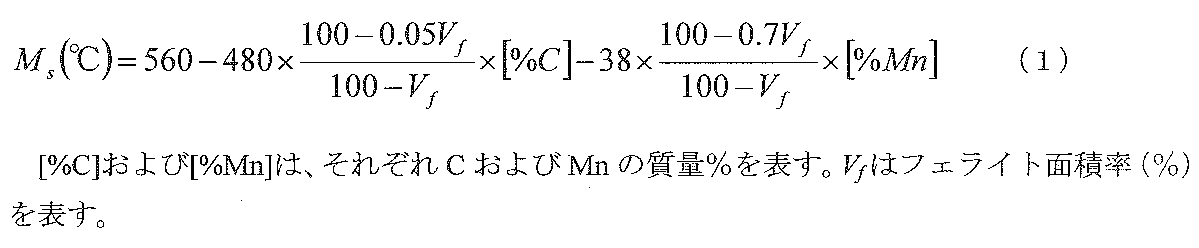
- the following formula (1) is the martensitic transformation start temperature (Ms point) considering the local region of the untransformed austenite phase.
- [% C] and [% Mn] are C content and Mn content, respectively.
- V f is the area ratio of the ferrite phase. Coefficients related to [% C] and [% Mn] represent the slope at which the Ms point decreases due to the amount of C or Mn elements concentrated in the austenite phase due to the formation of the ferrite phase.
- the austenite phase is not efficiently softened.
- the cooling stop temperature after forced cooling is (Ms point + 55 ° C) or more and less than 550 ° C.
- the residence time is 10 seconds or more in order to soften the austenite phase.
- the residence time exceeds 120 seconds, the bainite phase is excessively generated.
- the residence time in the temperature range of (Ms point + 55 ° C) or higher and lower than 550 ° C is 10 seconds or longer and 120 seconds or shorter.
- the relationship between the cooling stop temperature and the ferrite area ratio is investigated in advance in the laboratory, and the Ms point is calculated from the ferrite area ratio. Further, since autotempered martensite causes martensitic transformation at a high temperature and generates carbides in the cooling process, the Ms point is desirably as high as possible, and the Ms point is preferably 350 ° C. or higher.
- the high-strength hot-dip galvanized steel sheet of the present invention is manufactured.
- the high-strength hot-dip galvanized steel sheet of the present invention does not affect the material depending on the plating treatment or the composition of the plating bath, so the plating treatment may be either hot-dip galvanizing treatment or alloyed hot-dip galvanizing treatment. Is also applicable.
- the plating bath composition is Fe: 5.0-20.0%, Al: 0.001% -1.0%, Pb, Sb, Si, Sn, Mg, Mn, Ni, Cr, Co, Ca, Cu, Li, Ti, It is preferable that one or more of Be, Bi, and REM is contained in a total of 0% to 3.5%, with the balance being Zn and inevitable impurities.
- the high-strength hot-dip galvanized steel sheet of the present invention is mass%, Fe: 5.0-20.0%, Al: 0.001% -1.0%, Pb, Sb, Si Contains 1% or more of Sn, Mg, Mn, Ni, Cr, Co, Ca, Cu, Li, Ti, Be, Bi, REM in total, 0% to 3.5%, the balance being Zn and inevitable impurities It will have the plating layer which consists of.
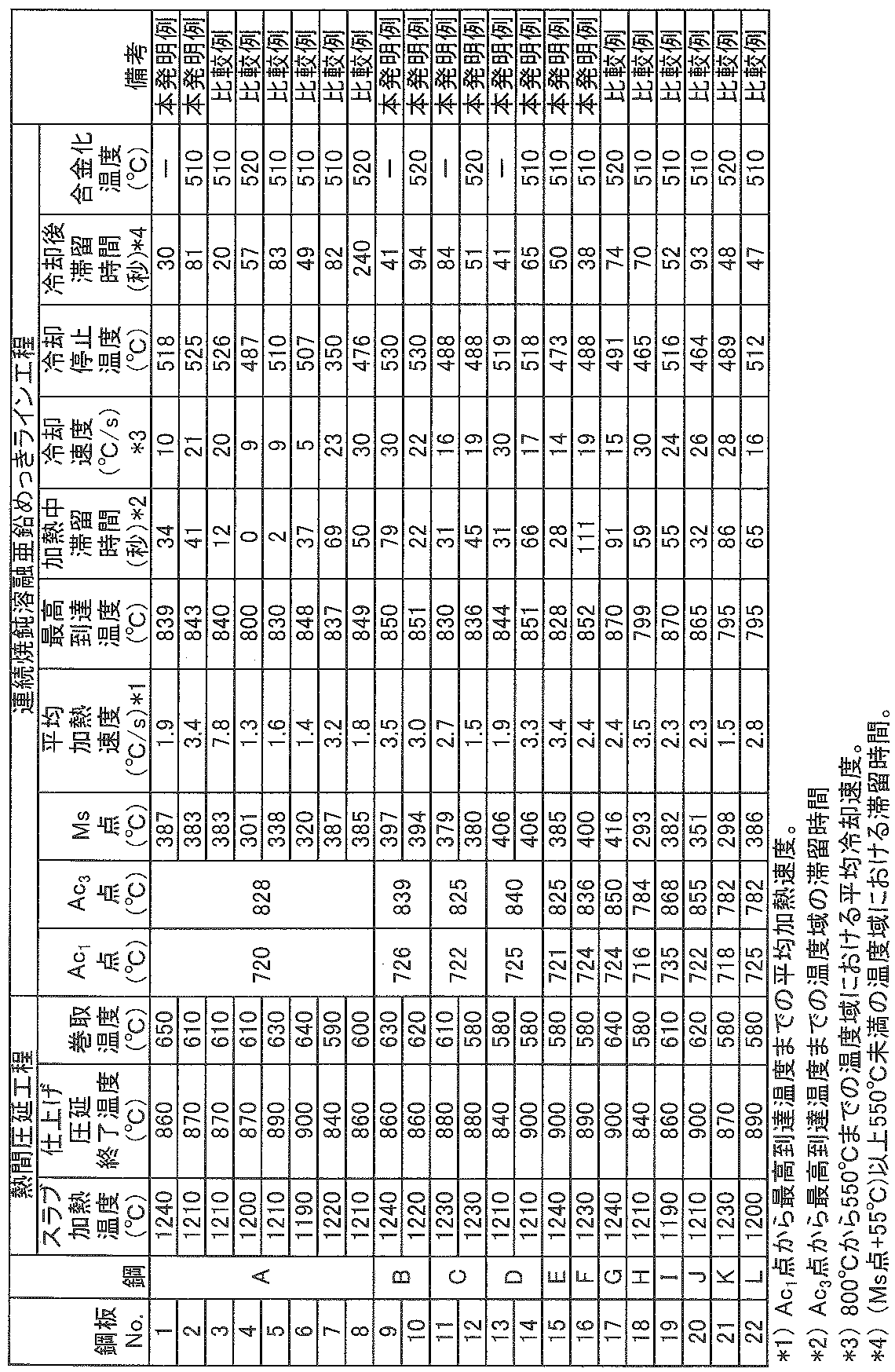
- a steel sheet having a thickness of 250 mm having the composition shown in Table 1 is made into a hot-rolled steel sheet under the hot-rolling conditions shown in Table 2, and subjected to cold rolling with a cold rolling rate of 30% to 80%.
- Hot-dip galvanized steel sheets (“GI material” and “GA material”) were produced in the annealing galvanizing line under the conditions shown in Table 2.
- Ac 1 point and Ac 3 point were obtained from a transformation expansion curve obtained at an average heating rate of 3 ° C./s using a thermal expansion measuring device.
- the temperature of the plating bath immersed in the continuous annealing hot dip galvanizing line (plating composition: Zn-0.13% by mass Al) is 460 ° C, and the coating weight is 45 to 65g / m 2 per side for both GI and GA materials.
- the amount of Fe contained in the plating layer was in the range of 6 to 14%.
- Specimens were collected from the hot dip galvanized steel sheet obtained as described above, and the structure was observed by the following method to evaluate the performance.
- the area ratio of each phase was evaluated by the following method. A section parallel to the rolling direction was cut from the steel plate so that the observation surface was observed, and the central portion of the plate thickness was corroded with 1% nital, and was magnified 2000 times with a scanning electron microscope and photographed for 10 fields of view.
- the ferrite phase is a structure having a form in which corrosion marks and cementite are not observed in the grains
- the bainite phase is a structure in which large carbides are recognized in the grains compared to the corrosion marks and autotempered martensite.
- the martensite phase has a structure in which no carbide is observed in the grains and is observed with white contrast
- the autotempered martensite is a structure in which carbide is observed in the grains with white contrast.
- FIG. 1 A representative example of the organization is shown in FIG.
- the bainite phase, the bainite phase, and the martensite phase were separated from each other by image analysis, and each structure was determined by the area ratio with respect to the observation field.
- the transmission electron microscope was used to measure the size of each carbide at 135,000 times or more, and the area of each carbide was determined by image analysis.
- the average value of equivalent circle diameters for 300 or more carbides was determined as the average particle diameter of the carbides.
Landscapes
- Chemical & Material Sciences (AREA)
- Engineering & Computer Science (AREA)
- Materials Engineering (AREA)
- Mechanical Engineering (AREA)
- Metallurgy (AREA)
- Organic Chemistry (AREA)
- Chemical Kinetics & Catalysis (AREA)
- Physics & Mathematics (AREA)
- Thermal Sciences (AREA)
- Oil, Petroleum & Natural Gas (AREA)
- Crystallography & Structural Chemistry (AREA)
- Heat Treatment Of Sheet Steel (AREA)
- Coating With Molten Metal (AREA)
Abstract
Description
[1]成分組成は、質量%で、C :0.11%以上0.20%以下、Si:0.50%未満、Mn:2.2%以上3.5%以下、P:0.03%以下、S:0.005%以下、Al:0.08%以下、N:0.006%以下、B:0.0002%以上0.0030%以下を含有し、残部がFeおよび不可避的不純物からなり、
組織は、面積率で、フェライト相が20%未満(0%含む)、ベイナイト相が50%以下(0%を含む)、マルテンサイト相が50%以上(100%を含む)、該マルテンサイト相に含まれるオートテンパードマルテンサイトが70%以上(100%を含む)、残留オーステナイトが2%以下(0%を含む)であり、
引張強さが980MPa以上、降伏比が0.65以上である高強度溶融亜鉛めっき鋼板。
[2]前記オートテンパードマルテンサイト粒内に分散する炭化物の平均粒子径が200nm以下である上記[1]に記載の高強度溶融亜鉛めっき鋼板。
[3]前記成分組成に加えて、質量%で、Ti:0.001%以上0.1%以下、Nb:0.001%以上0.1%以下の1種以上を含有する上記[1]または[2]に記載の高強度溶融亜鉛めっき鋼板。
[4]前記成分組成に加えて、質量%で、Cr:0.001%以上0.6%以下、Ni:0.001%以上0.08%以下、V:0.001%以上0.3%以下、Mo:0.001%以上0.3%以下、W:0.001%以上0.2%以下、Hf:0.001%以上0.3%以下の1種または2種以上を含有する上記[1]~[3]のいずれかに記載の高強度溶融亜鉛めっき鋼板。
[5]前記成分組成に加えて、質量%で、REM、Mg、Caの1種または2種以上を合計で0.0002%以上0.01%以下を含有する上記[1]~[4]のいずれかに記載の高強度溶融亜鉛めっき鋼板。
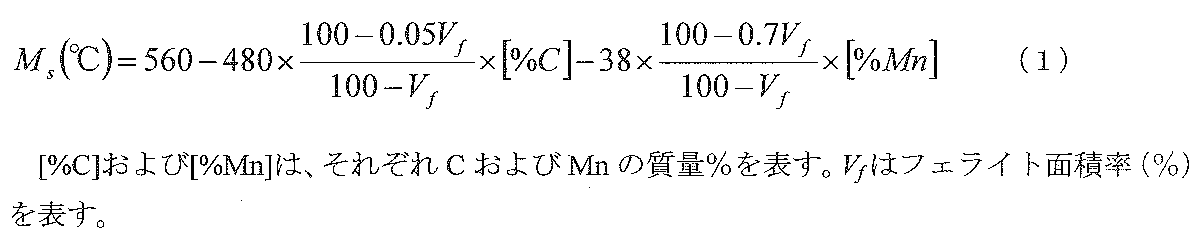
[6]上記[1]、[3]、[4]、[5]のいずれかに記載の成分組成を有する鋼素材を、1100℃以上1350℃以下の温度で加熱し、次いで、仕上げ圧延温度800℃以上とする熱間圧延を施し、680℃以下の温度で巻き取り、冷間圧延し、Ac1点以上から最高到達温度まで平均加熱速度4.0℃/s以下で加熱し、Ac3点から最高到達温度までの温度域の滞留時間が20秒以上であり、800℃から550℃までの平均冷却速度が8℃/s以上、冷却停止温度が(Ms点+55℃)以上550℃未満で冷却し、(Ms点+55℃)以上550℃未満の温度域の滞留時間が10秒以上120秒以下とする焼鈍処理を施し、さらにめっき処理を施す高強度溶融亜鉛めっき鋼板の製造方法。なお、上記Ms点は以下の式(1)によって求められる値である。

[8]前記めっき処理において形成されるめっき層の組成は、質量%で、Fe:5.0~20.0%、Al:0.001%~1.0%、Pb、Sb、Si、Sn、Mg、Mn、Ni、Cr、Co、Ca、Cu、Li、Ti、Be、Bi、REMの1種または2種以上を合計で0%~3.5%含有し、残部がZn及び不可避不純物からなる上記[6]または[7]に記載の高強度溶融亜鉛めっき鋼板の製造方法。
なお、本発明において、高強度溶融亜鉛めっき鋼板とは、引張強さ(TS)が980MPa以上の溶融亜鉛めっき鋼板であり、溶融亜鉛めっき処理を施したもの(GI)、溶融亜鉛めっき処理後にさらに合金化処理を施したもの(GA)のいずれも対象とする。
Cはマルテンサイトの硬さを上昇させ、フェライト変態を抑制する焼入性を持つ。本発明では、焼き入れまま、マルテンサイトより硬度の低いオートテンパードマルテンサイトを主体として強度を得るため、0.11%以上のC含有量でなければ引張強さが980MPa以上の鋼板が得られない。一方、C含有量が0.20%を上回るとマルテンサイト変態点が過度に低下するため、目的のオートテンパードマルテンサイトが生成されにくくなる。そのため、C含有量は0.11%以上0.20%以下とする。好ましくは0.12%以上0.16%以下である。
Siは、固溶強化により高強度化に寄与する元素である。一方で、Siはフェライト→オーステナイト変態点(Ac3点)を上昇させるため、焼鈍中にフェライトが生成し易くなる。また、Siはめっきと鋼板表面との濡れ性を低下させるため、不めっき等の欠陥の原因となる。本発明においてSi含有量は0.50%未満の範囲であれば許容される。好ましくは0.30%未満である。Siは変態点の上昇やめっき性に悪影響をおよぼさない範囲で含有することが好ましく、0.05%以上が好ましい。
Mnは、固溶強化により高強度化に寄与するうえ、Ac3変態点を低下させ焼鈍中におけるフェライトを除去しやすくさせ、冷却中のフェライト変態の開始を抑制する効果がある。この観点からMn含有量は2.2%以上とする。一方、Mn含有量が3.5%を上回るとMs点が過度に低下し、オートテンパードマルテンサイトが生成しにくくなるため、Mn上限量は3.5%とする。好ましいMn含有量の範囲は2.3%以上3.1%以下である。
Pは、粒界に偏析して耐衝撃特性や溶接性等に悪影響をもたらす元素である。したがって、Pは極力低減することが好ましい。本発明では上記問題を回避すべく、P含有量を0.03%以下とする。好ましくは0.02%以下である。P含有量は極力低減する方が好ましいが、製造上、0.002%は不可避的に混入する場合があるため、下限は0.002%が好ましい。
Sは、鋼中でMnSなどの介在物として存在する。この介在物は、熱間圧延および冷間圧延により楔状の形態となる。このような形態であると、Sはボイド生成の起点となりやすく耐衝撃性に悪影響をおよぼす。したがって、本発明では、S含有量を極力低減することが好ましく、0.005%以下とする。好ましくは0.003%以下である。極力低減する方が好ましいが、製造上、0.0002%は不可避的に混入する場合があるため、下限は0.0002%が好ましい。
Alを製鋼の段階で脱酸剤として含有する場合、0.02%以上含有することとなる。一方で、Al含有量が0.08%を超えるとアルミナなどの介在物により耐衝撃性への悪影響が顕在化する。したがって、Al含有量は0.08%以下とする。好ましくは0.07%以下である。
Nは、焼入性元素であるBと結合することによって、Bの焼入性の効果を失わせる。したがって、N含有量は極力低減することが好ましく、上限量を0.006%とする。好ましくは0.005%以下である。極力低減する方が好ましいが、製造上、0.001%は不可避的に混入する場合があるため、下限は0.001%が好ましい。
Bは、変態前のオーステナイトの粒界に偏析しフェライト相の核生成を著しく遅延させる効果がありフェライト相の生成を抑える効果がある。この効果を得るには、Bは0.0002%以上含有させる必要がある。一方、0.0030%を上回ると焼入性の効果が飽和するばかりか、延性に対して悪影響をおよぼす。以上から、B含有量は0.0002%以上0.0030%以下とする。望ましくは、0.0003%以上0.0020%以下である。
TiおよびNbはNと結合し、Bによる焼入性の効果を安定的に発現させる効果がある。また、TiおよびNbは少量であれば微細な炭化物として析出するため、高強度化に効果がある。一方で、TiおよびNbは多量に含有すると粗大な炭化物として生成する。粗大な炭化物はフェライトの核生成サイトとなり、フェライト相を生成させやすくなる。このような観点から、TiおよびNbの含有量は、含有する場合、いずれも0.001%以上0.1%以下とする。好ましくは、TiおよびNbを合計で0.005%以上0.06%以下である。
Cr、Ni、V、Mo、WおよびHfはフェライト変態の開始を遅延させる効果があり、これらの元素を含有すれば、Bによる焼入性の効果に加え、安定的に所望の鋼板組織を得られやすくなる。一方で、Cr含有量が0.6%を上回るとめっき性に悪影響をおよぼす。また、Ni、V、Mo、WおよびHfが上記の範囲を上回ると、焼入性の効果が飽和する。以上から、含有する場合、Cr:0.001%以上0.6%以下、Ni:0.001%以上0.08%以下、V:0.001%以上0.3%以下、Mo:0.001%以上0.3%以下、W:0.001%以上0.2%以下、Hf:0.001%以上0.3%以下とする。
REM(REM:原子番号57から71までのランタノイド元素)、MgおよびCaはマルテンサイトおよびベイナイト中に析出するセメンタイトを球状化させ、セメンタイト周りでの応力集中を低下させる。その結果、耐衝撃性を改善させる効果がある。一方で、REM、Mg、Caの1種または2種以上の含有量が合計で0.01%を超えるとセメンタイトの形態変化の効果が飽和するうえ、加工性に悪影響をもたらす。以上から、これらの元素を含有する場合、REM、Mg、Caの1種または2種以上を合計で0.0002%以上0.01%以下とする。好ましくは、REM、Mg、Caの1種または2種以上を合計で0.0005%以上0.005%以下である。
フェライト相は軟質な組織であり、引張強さ980MPa以上かつ高降伏比を有する鋼板を製造するには極力低減すべき組織である。また、フェライト相はCおよびMnの溶解度がオーステナイト相よりも低いためフェライト相が生成すると、CおよびMnはオーステナイト相へ濃化しMs点を低下させオートテンパードマルテンサイト相の生成を抑制する。しかしながら、フェライト相は20%未満の範囲であれば許容できる。よって、フェライト相の面積率は20%未満(0%を含む)とする。好ましくは10%未満である。
ベイナイト相は硬質相と軟質なフェライト相が混在した組織であり、局所的な応力勾配により降伏強さが低下する。0.65以上の降伏比を有する鋼板を製造するにはベイナイト相は50%以下とする必要がある。好ましくは40%以下である。一方で、オートテンパードマルテンサイト生成にはMs点+55℃以上550℃未満の範囲でオーステナイトを軟化させる必要があり、この温度域ではベイナイト変態が不可避的に生じる場合もある。
引張強さが980MPa以上の鋼板を得るため、マルテンサイト相の面積率の下限は50%である。好ましくは60%以上である。粒内に炭化物が認められない焼き入れままのマルテンサイト相の硬度は著しく高く、延性が乏しい。このマルテンサイト相周りにフェライトもしくはベイナイト相が存在すると応力勾配が生じるため降伏比が低下する。これらを防止するためには、焼き戻し加熱工程が必要となる。しかし、本発明では、焼き戻し加熱工程(めっき層付与後の再加熱)を必要としないことを特徴とする。すなわち、焼き戻し加熱工程(めっき層付与後の再加熱)を必要としないオートテンパードマルテンサイト相を活用することを特徴とする。オートテンパードマルテンサイト相は粒内に炭化物が認められる組織である。高降伏比かつ実用可能な延性を有する鋼板を得るにはマルテンサイト相に含まれるオートテンパードマルテンサイト相の面積率(全マルテンサイト相の面積率に対するオートテンパードマルテンサイト相の面積率の比率)は70%以上必要である。80%以上がより好ましい範囲である。
残留オーステナイトが生成する場合、局所的なMs点は室温以下となり、この場合オートテンパードマルテンサイトはほとんど生成されない。したがって、残留オーステナイト相は極力低減する必要がある。本発明においては、実質的に残留オーステナイト相は含まれない。しかし、含有する場合、2%までは許容できる。好ましくは0.5%以下である。
本発明においては、オートテンパードマルテンサイト粒内の炭化物は微細であることが好ましく、オートテンパードマルテンサイト粒内に微細な炭化物を分散させることが好ましい。この場合の分散とは、セメンタイトが析出した状態である。オートテンパードマルテンサイト粒内に微細な炭化物が析出することで強度および延性に優れた鋼が得られる。このときの炭化物はFe系の炭化物(セメンタイトもしくはε炭化物)である。平均粒子径が200nm以下であれば本発明で求める980MPa以上の引張強さが得られやすくなるため、オートテンパードマルテンサイト粒内に分散する炭化物の平均粒子径の上限は200nmが好ましい。より好ましくは100nm以下である。Ms点が低い場合にはオートテンパードマルテンサイトが生成されず、炭化物が十分に析出、成長しない。そのため、Ms点が低い場合をも考慮し、オートテンパードマルテンサイト粒内に析出する炭化物の平均粒子径は10nm以上が好ましい。
本発明の高強度溶融亜鉛めっき鋼板は、上記した成分組成の鋼素材(鋼スラブ)を1100℃以上1350℃以下の温度で加熱し、次いで、仕上げ圧延温度800℃以上とする熱間圧延を施し、680℃以下の温度で巻き取り、冷間圧延し、Ac1点以上から最高到達温度まで平均加熱速度4.0℃/s以下で加熱し、Ac3点から最高到達温度までの温度域の滞留時間が20秒以上であり、800℃から550℃までの平均冷却速度が8℃/s以上、冷却停止温度が(Ms点+55℃)以上550℃未満で冷却し、(Ms点+55℃)以上550℃未満の温度域の滞留時間が10秒以上120秒以下とする焼鈍処理を施し、さらにめっき処理を施すことで製造することができる。具体的には、上記した成分組成の鋼素材(鋼スラブ)を1100℃以上1350℃以下の温度で加熱し、次いで、仕上げ圧延温度800℃以上とする熱間圧延を施し、680℃以下の温度で巻き取る熱延工程と、上記熱延工程で得られた熱延鋼板を冷間圧延する冷間圧延工程と、前記冷間圧延工程で得られた冷延鋼板を、Ac1点以上から最高到達温度まで平均加熱速度4.0℃/s以下で加熱し、Ac3点から最高到達温度までの温度域の滞留時間が20秒以上であり、800℃から550℃までの平均冷却速度が8℃/s以上、冷却停止温度が(Ms点+55℃)以上550℃未満で冷却し、(Ms点+55℃)以上550℃未満の温度域の滞留時間が10秒以上120秒以下とする焼鈍工程と、上記焼鈍工程で得られた焼鈍板をめっき処理するめっき工程とを有する製造方法である。なお、上記Ms点は以下の式(1)によって求められる値である。
熱間圧延に先立ち鋼素材を加熱して実質的に均質なオーステナイト相とする必要がある。加熱温度が1100℃を下回ると仕上げ圧延温度800℃以上で熱間圧延を完了させることができない。一方、加熱温度が1350℃を上回ると、スケールが噛み込み、熱延鋼板の表面性状が悪化する。そのため、鋼素材の加熱温度は1100℃以上1350℃以下とする。好ましくは1150℃以上1300℃以下である。但し、鋼素材に熱間圧延を施すに際し、鋳造後の鋼素材が1100℃以上1350℃以下の温度域にある場合、或いは鋼素材の炭化物が溶解している場合には、鋼素材を加熱することなく直送圧延してもよい。なお、粗圧延条件については特に限定されない。
仕上げ圧延温度が800℃を下回ると、仕上げ圧延中にフェライト変態が開始してフェライト粒が伸展された組織となるうえ、部分的にフェライト粒が成長した混粒組織となるため、冷間圧延時の板厚精度に悪影響をもたらす。したがって、仕上げ圧延温度は800℃以上とする。好ましくは840℃以上である。また、スケール性欠陥の発生を抑える点から仕上げ圧延温度は950℃以下が好ましい。
巻取温度が680℃を上回ると鋼板表面に内部酸化層が生成し、めっき性や加工性に悪影響をもたらす。そのため、巻取温度は680℃以下とする必要がある。巻取温度の下限は特に設けない。通常、巻取温度は、製造ラインの制約上、350℃以上である。また、冷間圧延時の板厚精度向上には、570℃以上とすることが望ましい。
所望の板厚を得るため、冷間圧延を施す必要がある。冷間圧延率は特に限定されないが、製造ラインの制約から30%以上80%以下が好ましい。
連続焼鈍溶融亜鉛めっきラインでの加熱工程で重要となるのは、オーステナイト相の硬化を抑え、軟化を促進させつつ、フェライト→オーステナイト変態を完了に近づけることである。オーステナイト相の硬化を抑えるには、フェライト→オーステナイト変態開始温度(Ac1点)からの平均加熱速度を低くする必要がある。加熱速度が高い場合、急激にフェライト→オーステナイト変態が進行し、変態ひずみが発生することによりオーステナイトが硬化される。そのため、Ac1点から最高到達温度までの平均加熱速度を4.0℃/s以下とする。好ましくは3.5℃/s以下である。また、生産性の点から上記平均加熱速度は1℃/s以上が好ましい。
また、フェライト→オーステナイト変態を完了に近付けるにはフェライト→オーステナイト変態完了温度(Ac3点)以上の温度域での鋼板に与える熱エネルギー総量も重要となる。すなわち、Ac3点以上であっても、ナノオーダーの粒径を持つフェライト粒は元素分配の影響で残存する。ナノオーダーの粒径を持つフェライト粒を含め完全にオーステナイト単相とするには、フェライト→オーステナイト変態完了温度(Ac3点)から最高到達温度までの温度域の滞留時間(最高到達温度がAc3の場合には最高到達温度で鋼板が滞留される時間)は20秒以上と必要がある。また、生産性の点から上記滞留時間は300秒以下が好ましい。なお、滞留時間とは鋼板の温度が上記温度範囲にある時間を意味する。なお、最高到達温度はAc3~Ac3+50℃であることが好ましい。
550℃までの冷却速度が遅い場合、冷却過程でフェライト変態が開始し、オーステナイト相へCおよびMnが濃化することとなる。これを回避するには、800℃から550℃までの平均冷却速度が8℃/s以上の強制冷却を施す必要がある。また、上記平均冷却速度は設備制約の点から50℃/s以下が好ましい。なお、最高到達温度から800℃までの冷却条件は特に限定されない。
強制冷却後は、未変態のオーステナイト相を軟化させ、力学的な拘束を緩和することでMs点を上昇させる必要がある。このオーステナイト相の軟化は高温かつ長時間保持の方が望ましい。一方で、フェライト相やベイナイト相といった望ましくない組織が形成されるため、最も効果的な温度、時間で保持する必要がある。下記(1)式は未変態のオーステナイト相の局所領域を考慮したマルテンサイト変態開始温度(Ms点)である。[%C]および[%Mn]は、それぞれC含有量およびMn含有量である。Vfはフェライト相の面積率である。[%C]および[%Mn]に係る係数は、フェライト相の生成によりオーステナイト相へ濃化するCもしくはMnの元素量によりMs点が低下する傾きを表す。
また、オートテンパードマルテンサイトは高温でマルテンサイト変態を生じさせ、冷却過程で炭化物を生成するため、Ms点はできる限り高い方が望ましく、Ms点は好ましくは350℃以上である。
また、電気亜鉛めっき処理により製造される高強度亜鉛めっき鋼板であっても、本発明の成分組成および組織を満たすことで、加工を可能とする延性(El≧8.0%)および引張強さ:980MPa以上(好ましくは980MPa以上1300MPa以下)を有し、かつ降伏比が0.65以上(好ましくは0.67以上)の効果を奏することができる。
各相の面積率は以下の手法により評価した。鋼板から、圧延方向に平行な断面が観察面となるよう切り出し、板厚中心部を1%ナイタールで腐食現出し、走査型電子顕微鏡で2000倍に拡大して10視野分撮影した。フェライト相は粒内に腐食痕やセメンタイトが観察されない形態を有する組織であり、ベイナイト相は粒内に腐食痕やオートテンパードマルテンサイトと比べて大きな炭化物が認められる組織である。マルテンサイト相は粒内に炭化物が認められず、白いコントラストで観察される組織であり、オートテンパードマルテンサイトは白いコントラストで観察され粒内に炭化物が認められる組織である。組織の代表例を図1に示す。これらを画像解析によりベイナイト相、ベイナイト相およびマルテンサイト相を分離し、観察視野に対する面積率によって各組織を求めた。
オートテンパードマルテンサイト粒内に析出した炭化物の粒子径の測定には透過型電子顕微鏡を用いて135000倍以上で撮影し、画像解析により各炭化物の面積を求め、その面積に等価な相当円直径を求め、300点以上の炭化物に対する相当円直径の平均値を炭化物の平均粒子径として求めた。
鋼板を板厚方向に対して板厚の1/4を研削加工した後、さらに厚さ200μm以上の化学研磨を施した板面に対して、X線回折強度を測定して、残留オーステナイト量を定量した。X線の入射線源はMoKα線を用い、フェライトの結晶面(200)α、(211)α、オーステナイトの結晶面(200)γ、(220)γ、(311)γのピーク(反射強度)を測定し、その反射強度から残留オーステナイトの体積率を求めた。なお、本発明においては、得られた体積率は面積率として扱う。
溶融亜鉛めっき鋼板から圧延方向に対して直角方向が引張方向となるようにJIS5号引張試験片を作製し、JIS Z 2241(2011)の規定に準拠した引張試験を5回行い、平均の降伏強度(YS)、引張強さ(TS)、全伸び(El)を求めた。引張試験のクロスヘッドスピードは10mm/minとした。表3において、引張強さ:980MPa以上、降伏比:0.65以上、伸び:8.0%以上が本発明鋼で求める鋼板の機械的性質とした。ここで、伸びが8.0%以上としたのは、伸びが8.0%を下回ると冷間プレスにおいて実用化できなくなるためである。


Claims (8)
- 成分組成は、質量%で、C :0.11%以上0.20%以下、Si:0.50%未満、Mn:2.2%以上3.5%以下、P:0.03%以下、S:0.005%以下、Al:0.08%以下、N:0.006%以下、B:0.0002%以上0.0030%以下を含有し、残部がFeおよび不可避的不純物からなり、
組織は、面積率で、フェライト相が20%未満(0%含む)、ベイナイト相が50%以下(0%を含む)、マルテンサイト相が50%以上(100%を含む)、該マルテンサイト相に含まれるオートテンパードマルテンサイトが70%以上(100%を含む)、残留オーステナイトが2%以下(0%を含む)であり、
引張強さが980MPa以上、降伏比が0.65以上である高強度溶融亜鉛めっき鋼板。 - 前記オートテンパードマルテンサイト粒内に分散する炭化物の平均粒子径が200nm以下である請求項1に記載の高強度溶融亜鉛めっき鋼板。
- 前記成分組成に加えて、質量%で、Ti:0.001%以上0.1%以下、Nb:0.001%以上0.1%以下の1種以上を含有する請求項1または2に記載の高強度溶融亜鉛めっき鋼板。
- 前記成分組成に加えて、質量%で、Cr:0.001%以上0.6%以下、Ni:0.001%以上0.08%以下、V:0.001%以上0.3%以下、Mo:0.001%以上0.3%以下、W:0.001%以上0.2%以下、Hf:0.001%以上0.3%以下の1種または2種以上を含有する請求項1~3のいずれか一項に記載の高強度溶融亜鉛めっき鋼板。
- 前記成分組成に加えて、質量%で、REM、Mg、Caの1種または2種以上を合計で0.0002%以上0.01%以下を含有する請求項1~4のいずれか一項に記載の高強度溶融亜鉛めっき鋼板。
- 請求項1、3、4、5のいずれか一項に記載の成分組成を有する鋼素材を、1100℃以上1350℃以下の温度で加熱し、次いで、仕上げ圧延温度800℃以上とする熱間圧延を施し、680℃以下の温度で巻き取り、冷間圧延し、
Ac1点以上から最高到達温度まで平均加熱速度4.0℃/s以下で加熱し、Ac3点から最高到達温度までの温度域の滞留時間が20秒以上であり、800℃から550℃までの平均冷却速度が8℃/s以上、冷却停止温度が(Ms点+55℃)以上550℃未満で冷却し、(Ms点+55℃)以上550℃未満の温度域の滞留時間が10秒以上120秒以下とする焼鈍処理を施し、さらにめっき処理を施す高強度溶融亜鉛めっき鋼板の製造方法。 - 前記めっき処理が溶融亜鉛めっき処理、合金化溶融亜鉛めっき処理のいずれかである請求項6に記載の高強度溶融亜鉛めっき鋼板の製造方法。
- 前記めっき処理において形成されるめっき層の組成は、質量%で、Fe:5.0~20.0%、Al:0.001%~1.0%、Pb、Sb、Si、Sn、Mg、Mn、Ni、Cr、Co、Ca、Cu、Li、Ti、Be、Bi、REMの1種または2種以上を合計で0%~3.5%含有し、残部がZn及び不可避不純物からなる請求項6または7に記載の高強度溶融亜鉛めっき鋼板の製造方法。
Priority Applications (4)
| Application Number | Priority Date | Filing Date | Title |
|---|---|---|---|
| MX2017008296A MX2017008296A (es) | 2014-12-22 | 2015-07-30 | Laminas de acero galvanizado de alta resistencia y metodos para fabricar las mismas. |
| JP2015558274A JP5958667B1 (ja) | 2014-12-22 | 2015-07-30 | 高強度溶融亜鉛めっき鋼板およびその製造方法 |
| KR1020177017046A KR101913529B1 (ko) | 2014-12-22 | 2015-07-30 | 고강도 용융 아연 도금 강판 및 그 제조 방법 |
| CN201580069934.3A CN107109564B (zh) | 2014-12-22 | 2015-07-30 | 高强度熔融镀锌钢板及其制造方法 |
Applications Claiming Priority (2)
| Application Number | Priority Date | Filing Date | Title |
|---|---|---|---|
| JP2014258604 | 2014-12-22 | ||
| JP2014-258604 | 2014-12-22 |
Publications (1)
| Publication Number | Publication Date |
|---|---|
| WO2016103534A1 true WO2016103534A1 (ja) | 2016-06-30 |
Family
ID=56149614
Family Applications (1)
| Application Number | Title | Priority Date | Filing Date |
|---|---|---|---|
| PCT/JP2015/003845 Ceased WO2016103534A1 (ja) | 2014-12-22 | 2015-07-30 | 高強度溶融亜鉛めっき鋼板およびその製造方法 |
Country Status (5)
| Country | Link |
|---|---|
| JP (1) | JP5958667B1 (ja) |
| KR (1) | KR101913529B1 (ja) |
| CN (1) | CN107109564B (ja) |
| MX (1) | MX2017008296A (ja) |
| WO (1) | WO2016103534A1 (ja) |
Cited By (8)
| Publication number | Priority date | Publication date | Assignee | Title |
|---|---|---|---|---|
| WO2018043452A1 (ja) * | 2016-08-30 | 2018-03-08 | Jfeスチール株式会社 | 高強度鋼板およびその製造方法 |
| WO2018043453A1 (ja) * | 2016-08-30 | 2018-03-08 | Jfeスチール株式会社 | 薄鋼板およびその製造方法 |
| JP2021031703A (ja) * | 2019-08-20 | 2021-03-01 | 日本製鉄株式会社 | 薄鋼板及びその製造方法 |
| CN113316656A (zh) * | 2019-01-18 | 2021-08-27 | 杰富意钢铁株式会社 | 高强度热浸镀锌钢板及其制造方法 |
| CN113366133A (zh) * | 2019-01-30 | 2021-09-07 | 杰富意钢铁株式会社 | 高强度钢板及其制造方法 |
| CN114645219A (zh) * | 2017-11-29 | 2022-06-21 | 杰富意钢铁株式会社 | 高强度镀锌钢板及其制造方法 |
| US20230323493A1 (en) * | 2020-09-07 | 2023-10-12 | Arcelormittal | Forged part of steel and a method of manufacturing thereof |
| US12410491B2 (en) | 2019-01-30 | 2025-09-09 | Jfe Steel Corporation | High-strength steel sheet and method for producing the same |
Families Citing this family (4)
| Publication number | Priority date | Publication date | Assignee | Title |
|---|---|---|---|---|
| KR102020412B1 (ko) | 2017-12-22 | 2019-09-10 | 주식회사 포스코 | 충돌특성 및 성형성이 고강도 강판 및 이의 제조방법 |
| JP7137492B2 (ja) * | 2018-03-28 | 2022-09-14 | 株式会社神戸製鋼所 | 合金化溶融亜鉛めっき鋼板、及び合金化溶融亜鉛めっき鋼板の製造方法 |
| CN110643915A (zh) * | 2018-06-27 | 2020-01-03 | 灿诺环保科技(昆山)有限公司 | 一种具有净化功能的热镀专用锌 |
| CN117321235A (zh) * | 2021-05-26 | 2023-12-29 | 株式会社神户制钢所 | 高强度合金化熔融镀锌钢板及其制造方法 |
Citations (4)
| Publication number | Priority date | Publication date | Assignee | Title |
|---|---|---|---|---|
| JP2009203549A (ja) * | 2008-01-31 | 2009-09-10 | Jfe Steel Corp | 高強度鋼板とその製造方法 |
| JP2009242816A (ja) * | 2008-03-28 | 2009-10-22 | Jfe Steel Corp | 高強度鋼板とその製造方法 |
| JP2013147736A (ja) * | 2011-12-19 | 2013-08-01 | Kobe Steel Ltd | 加工性に優れた高降伏比高強度鋼板 |
| JP2013234340A (ja) * | 2012-05-07 | 2013-11-21 | Nippon Steel & Sumitomo Metal Corp | 常中温域での成形性に優れた高強度溶融亜鉛めっき鋼板及びその製造方法 |
Family Cites Families (1)
| Publication number | Priority date | Publication date | Assignee | Title |
|---|---|---|---|---|
| JP5703608B2 (ja) * | 2009-07-30 | 2015-04-22 | Jfeスチール株式会社 | 高強度鋼板およびその製造方法 |
-
2015
- 2015-07-30 CN CN201580069934.3A patent/CN107109564B/zh active Active
- 2015-07-30 JP JP2015558274A patent/JP5958667B1/ja active Active
- 2015-07-30 KR KR1020177017046A patent/KR101913529B1/ko active Active
- 2015-07-30 WO PCT/JP2015/003845 patent/WO2016103534A1/ja not_active Ceased
- 2015-07-30 MX MX2017008296A patent/MX2017008296A/es unknown
Patent Citations (4)
| Publication number | Priority date | Publication date | Assignee | Title |
|---|---|---|---|---|
| JP2009203549A (ja) * | 2008-01-31 | 2009-09-10 | Jfe Steel Corp | 高強度鋼板とその製造方法 |
| JP2009242816A (ja) * | 2008-03-28 | 2009-10-22 | Jfe Steel Corp | 高強度鋼板とその製造方法 |
| JP2013147736A (ja) * | 2011-12-19 | 2013-08-01 | Kobe Steel Ltd | 加工性に優れた高降伏比高強度鋼板 |
| JP2013234340A (ja) * | 2012-05-07 | 2013-11-21 | Nippon Steel & Sumitomo Metal Corp | 常中温域での成形性に優れた高強度溶融亜鉛めっき鋼板及びその製造方法 |
Cited By (19)
| Publication number | Priority date | Publication date | Assignee | Title |
|---|---|---|---|---|
| US11091817B2 (en) | 2016-08-30 | 2021-08-17 | Jfe Steel Corporation | High-strength steel sheet and method for manufacturing the same |
| JP6354919B1 (ja) * | 2016-08-30 | 2018-07-11 | Jfeスチール株式会社 | 薄鋼板およびその製造方法 |
| KR20190028750A (ko) * | 2016-08-30 | 2019-03-19 | 제이에프이 스틸 가부시키가이샤 | 박강판 및 그의 제조 방법 |
| EP3473741A4 (en) * | 2016-08-30 | 2019-05-15 | JFE Steel Corporation | THIN STEEL PLATE AND METHOD OF MANUFACTURE |
| KR102186204B1 (ko) | 2016-08-30 | 2020-12-03 | 제이에프이 스틸 가부시키가이샤 | 박강판 및 그의 제조 방법 |
| WO2018043453A1 (ja) * | 2016-08-30 | 2018-03-08 | Jfeスチール株式会社 | 薄鋼板およびその製造方法 |
| WO2018043452A1 (ja) * | 2016-08-30 | 2018-03-08 | Jfeスチール株式会社 | 高強度鋼板およびその製造方法 |
| JP6354918B1 (ja) * | 2016-08-30 | 2018-07-11 | Jfeスチール株式会社 | 高強度鋼板およびその製造方法 |
| US11220722B2 (en) | 2016-08-30 | 2022-01-11 | Jfe Steel Corporation | Steel sheet and method for manufacturing the same |
| CN114645219B (zh) * | 2017-11-29 | 2023-12-12 | 杰富意钢铁株式会社 | 高强度镀锌钢板及其制造方法 |
| CN114645219A (zh) * | 2017-11-29 | 2022-06-21 | 杰富意钢铁株式会社 | 高强度镀锌钢板及其制造方法 |
| CN113316656A (zh) * | 2019-01-18 | 2021-08-27 | 杰富意钢铁株式会社 | 高强度热浸镀锌钢板及其制造方法 |
| US12258644B2 (en) | 2019-01-18 | 2025-03-25 | Jfe Steel Corporation | High-strength galvanized steel sheet and method for manufacturing the same |
| CN113366133A (zh) * | 2019-01-30 | 2021-09-07 | 杰富意钢铁株式会社 | 高强度钢板及其制造方法 |
| US12139771B2 (en) | 2019-01-30 | 2024-11-12 | Jfe Steel Corporation | High-strength steel sheet and method for producing the same |
| US12410491B2 (en) | 2019-01-30 | 2025-09-09 | Jfe Steel Corporation | High-strength steel sheet and method for producing the same |
| JP7389322B2 (ja) | 2019-08-20 | 2023-11-30 | 日本製鉄株式会社 | 薄鋼板及びその製造方法 |
| JP2021031703A (ja) * | 2019-08-20 | 2021-03-01 | 日本製鉄株式会社 | 薄鋼板及びその製造方法 |
| US20230323493A1 (en) * | 2020-09-07 | 2023-10-12 | Arcelormittal | Forged part of steel and a method of manufacturing thereof |
Also Published As
| Publication number | Publication date |
|---|---|
| MX2017008296A (es) | 2017-10-02 |
| CN107109564A (zh) | 2017-08-29 |
| KR20170086098A (ko) | 2017-07-25 |
| JP5958667B1 (ja) | 2016-08-02 |
| CN107109564B (zh) | 2019-08-30 |
| JPWO2016103534A1 (ja) | 2017-04-27 |
| KR101913529B1 (ko) | 2018-10-30 |
Similar Documents
| Publication | Publication Date | Title |
|---|---|---|
| JP5958667B1 (ja) | 高強度溶融亜鉛めっき鋼板およびその製造方法 | |
| JP5958666B1 (ja) | 高強度溶融亜鉛めっき鋼板およびその製造方法 | |
| JP6052471B2 (ja) | 高強度溶融亜鉛めっき鋼板およびその製造方法 | |
| JP5018935B2 (ja) | 加工性に優れた高強度溶融亜鉛めっき鋼板およびその製造方法 | |
| JP5991450B1 (ja) | 高強度冷延鋼板及びその製造方法 | |
| JP6354919B1 (ja) | 薄鋼板およびその製造方法 | |
| JP6179461B2 (ja) | 高強度鋼板の製造方法 | |
| JP5994356B2 (ja) | 形状凍結性に優れた高強度薄鋼板およびその製造方法 | |
| WO2017179372A1 (ja) | 高強度鋼板およびその製造方法 | |
| JPWO2016113789A1 (ja) | 高強度溶融亜鉛めっき鋼板およびその製造方法 | |
| JP2017048412A (ja) | 溶融亜鉛めっき鋼板、合金化溶融亜鉛めっき鋼板、およびそれらの製造方法 | |
| KR102119017B1 (ko) | 고강도 냉연 박강판 및 그의 제조 방법 | |
| WO2016194272A1 (ja) | 高強度冷延鋼板、高強度めっき鋼板及びこれらの製造方法 | |
| JP6274360B2 (ja) | 高強度亜鉛めっき鋼板、高強度部材及び高強度亜鉛めっき鋼板の製造方法 | |
| JP5741456B2 (ja) | 合金化溶融亜鉛めっき鋼板およびその製造方法 | |
| JP6223905B2 (ja) | 降伏強度と加工性に優れた高強度合金化溶融亜鉛めっき鋼板 | |
| WO2017169870A1 (ja) | 薄鋼板及びめっき鋼板、並びに熱延鋼板の製造方法、冷延フルハード鋼板の製造方法、熱処理板の製造方法、薄鋼板の製造方法およびめっき鋼板の製造方法 | |
| JP6472692B2 (ja) | 成形性に優れた高強度鋼板 | |
| JP6434348B2 (ja) | 加工性に優れた高強度鋼板 | |
| WO2016139876A1 (ja) | 高強度鋼板及びその製造方法 | |
| JP6252709B2 (ja) | 温間加工用高強度鋼板およびその製造方法 | |
| WO2016120915A1 (ja) | 高強度めっき鋼板およびその製造方法 | |
| WO2024203491A1 (ja) | 鋼板、部材及びそれらの製造方法 |
Legal Events
| Date | Code | Title | Description |
|---|---|---|---|
| ENP | Entry into the national phase |
Ref document number: 2015558274 Country of ref document: JP Kind code of ref document: A |
|
| 121 | Ep: the epo has been informed by wipo that ep was designated in this application |
Ref document number: 15872117 Country of ref document: EP Kind code of ref document: A1 |
|
| ENP | Entry into the national phase |
Ref document number: 20177017046 Country of ref document: KR Kind code of ref document: A |
|
| WWE | Wipo information: entry into national phase |
Ref document number: MX/A/2017/008296 Country of ref document: MX |
|
| NENP | Non-entry into the national phase |
Ref country code: DE |
|
| 122 | Ep: pct application non-entry in european phase |
Ref document number: 15872117 Country of ref document: EP Kind code of ref document: A1 |