WO2016088563A1 - 行動管理装置、行動管理方法、及び行動管理プログラム - Google Patents
行動管理装置、行動管理方法、及び行動管理プログラム Download PDFInfo
- Publication number
- WO2016088563A1 WO2016088563A1 PCT/JP2015/082531 JP2015082531W WO2016088563A1 WO 2016088563 A1 WO2016088563 A1 WO 2016088563A1 JP 2015082531 W JP2015082531 W JP 2015082531W WO 2016088563 A1 WO2016088563 A1 WO 2016088563A1
- Authority
- WO
- WIPO (PCT)
- Prior art keywords
- information
- biological information
- exercise
- unit
- group
- Prior art date
- Legal status (The legal status is an assumption and is not a legal conclusion. Google has not performed a legal analysis and makes no representation as to the accuracy of the status listed.)
- Ceased
Links
Images

Classifications
-
- A—HUMAN NECESSITIES
- A61—MEDICAL OR VETERINARY SCIENCE; HYGIENE
- A61B—DIAGNOSIS; SURGERY; IDENTIFICATION
- A61B5/00—Measuring for diagnostic purposes; Identification of persons
- A61B5/02—Detecting, measuring or recording for evaluating the cardiovascular system, e.g. pulse, heart rate, blood pressure or blood flow
- A61B5/024—Measuring pulse rate or heart rate
- A61B5/02438—Measuring pulse rate or heart rate with portable devices, e.g. worn by the patient
-
- A—HUMAN NECESSITIES
- A61—MEDICAL OR VETERINARY SCIENCE; HYGIENE
- A61B—DIAGNOSIS; SURGERY; IDENTIFICATION
- A61B5/00—Measuring for diagnostic purposes; Identification of persons
- A61B5/72—Signal processing specially adapted for physiological signals or for diagnostic purposes
- A61B5/7203—Signal processing specially adapted for physiological signals or for diagnostic purposes for noise prevention, reduction or removal
- A61B5/7207—Signal processing specially adapted for physiological signals or for diagnostic purposes for noise prevention, reduction or removal of noise induced by motion artifacts
- A61B5/721—Signal processing specially adapted for physiological signals or for diagnostic purposes for noise prevention, reduction or removal of noise induced by motion artifacts using a separate sensor to detect motion or using motion information derived from signals other than the physiological signal to be measured
-
- A—HUMAN NECESSITIES
- A61—MEDICAL OR VETERINARY SCIENCE; HYGIENE
- A61B—DIAGNOSIS; SURGERY; IDENTIFICATION
- A61B5/00—Measuring for diagnostic purposes; Identification of persons
- A61B5/103—Measuring devices for testing the shape, pattern, colour, size or movement of the body or parts thereof, for diagnostic purposes
- A61B5/11—Measuring movement of the entire body or parts thereof, e.g. head or hand tremor or mobility of a limb
- A61B5/1118—Determining activity level
-
- A—HUMAN NECESSITIES
- A61—MEDICAL OR VETERINARY SCIENCE; HYGIENE
- A61B—DIAGNOSIS; SURGERY; IDENTIFICATION
- A61B5/00—Measuring for diagnostic purposes; Identification of persons
- A61B5/103—Measuring devices for testing the shape, pattern, colour, size or movement of the body or parts thereof, for diagnostic purposes
- A61B5/11—Measuring movement of the entire body or parts thereof, e.g. head or hand tremor or mobility of a limb
- A61B5/1121—Determining geometric values, e.g. centre of rotation or angular range of movement
- A61B5/1122—Determining geometric values, e.g. centre of rotation or angular range of movement of movement trajectories
-
- A—HUMAN NECESSITIES
- A61—MEDICAL OR VETERINARY SCIENCE; HYGIENE
- A61B—DIAGNOSIS; SURGERY; IDENTIFICATION
- A61B5/00—Measuring for diagnostic purposes; Identification of persons
- A61B5/22—Ergometry; Measuring muscular strength or the force of a muscular blow
- A61B5/221—Ergometry, e.g. by using bicycle type apparatus
- A61B5/222—Ergometry, e.g. by using bicycle type apparatus combined with detection or measurement of physiological parameters, e.g. heart rate
-
- G—PHYSICS
- G06—COMPUTING OR CALCULATING; COUNTING
- G06F—ELECTRIC DIGITAL DATA PROCESSING
- G06F9/00—Arrangements for program control, e.g. control units
- G06F9/06—Arrangements for program control, e.g. control units using stored programs, i.e. using an internal store of processing equipment to receive or retain programs
- G06F9/30—Arrangements for executing machine instructions, e.g. instruction decode
- G06F9/30003—Arrangements for executing specific machine instructions
- G06F9/30007—Arrangements for executing specific machine instructions to perform operations on data operands
- G06F9/30021—Compare instructions, e.g. Greater-Than, Equal-To, MINMAX
-
- A—HUMAN NECESSITIES
- A61—MEDICAL OR VETERINARY SCIENCE; HYGIENE
- A61B—DIAGNOSIS; SURGERY; IDENTIFICATION
- A61B2503/00—Evaluating a particular growth phase or type of persons or animals
- A61B2503/20—Workers
-
- G—PHYSICS
- G06—COMPUTING OR CALCULATING; COUNTING
- G06F—ELECTRIC DIGITAL DATA PROCESSING
- G06F2218/00—Aspects of pattern recognition specially adapted for signal processing
- G06F2218/08—Feature extraction
- G06F2218/10—Feature extraction by analysing the shape of a waveform, e.g. extracting parameters relating to peaks
Definitions
- the present invention relates to an action management device, an action management method, and an action management program.
- Such exercise information measuring devices are known to have a function of measuring biological information indicating exercise load such as pulse rate, heart rate, and oxygen saturation, and various functions can be obtained by using this function. Services can be provided.
- a server acquires biological information from a plurality of exercise information measurement devices, determines the danger state of the wearer of each exercise information measurement device, and wearers other than the wearer determined to be dangerous Describes a system for transmitting danger information to an exercise information measuring device attached to the device.
- Patent Document 2 the status of the wearer of the own device based on the biometric information measured by the own device and the status of the wearer of the other device based on the biometric information received from the other device can be confirmed on the display unit.
- a motion information measuring device is described.
- Patent Document 1 notifies when the biological information of an individual has reached a dangerous level.
- the technique described in Patent Document 2 can visually grasp the state of an individual person's body.
- the pulse rate of all members belonging to the group is gradually increasing and the pulse rate of all members has not reached the danger level, the rate of increase in the pulse rate of one member is greater than that of other members , It can be determined that the body is overloaded for the member. For this reason, it is necessary to take measures such as taking a break for this member.
- Patent Documents 1 and 2 can determine the state of an individual's body only from the individual's biological information, it is known that such treatment is necessary when a group action is performed. It is not possible.
- the present invention has been made in view of the above circumstances, and an object thereof is to provide an action management device, an action management method, and an action management program capable of appropriately managing group actions.
- the behavior management device of the present invention includes a biological information measuring unit that measures biological information, a communication unit that performs short-range wireless communication with another device having a function of measuring biological information, and a group that forms a group together with the own device.
- a biological information acquisition unit that acquires biological information measured by the device via the communication unit, a first biological information measured by the biological information measurement unit, and a second acquired by the biological information acquisition unit
- an information output unit that outputs management information for managing the behavior of the wearer of the device belonging to the group based on the biometric information.
- the behavior management method of the present invention is a behavior management by a behavior management device having a biological information measurement unit that measures biological information and a communication unit that performs short-range wireless communication with another device having a function of measuring biological information.
- a biological information acquisition step for acquiring biological information measured by another device that constitutes a group together with the behavior management device via the communication unit, and a first measured by the biological information measurement unit
- An information output step for outputting management information for managing the behavior of the wearer of the device belonging to the group based on the biological information and the second biological information acquired in the biological information acquisition step. It is.
- the behavior management program of the present invention is a program for causing a computer to execute each step of the behavior management method.
- an action management device it is possible to provide an action management device, an action management method, and an action management program that can appropriately manage group actions.
- FIG. 1 is a diagram showing a schematic configuration of a system 100 for explaining an embodiment of the present invention.
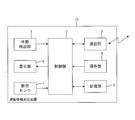
- 2 is a block diagram showing an internal configuration of the exercise information measuring device 10.
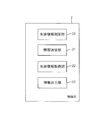
- FIG. It is a figure which shows the functional block implement
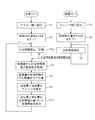
- movement information measurement apparatus 10 of FIG. 4 is a flowchart for explaining the operation of the exercise information measuring device 10 in the system 100.
- FIG. 1 is a diagram showing a schematic configuration of a system 100 for explaining an embodiment of the present invention.
- the system 100 includes a plurality of (five in the example of FIG. 1) exercise information measuring devices 10-1 to 10-5 as behavior management devices.
- the exercise information measuring devices 10-1 to 10-5 are used by being worn on the body of a user (user), and specific examples include a pedometer, an activity meter, and a sports watch.
- Identification information is given to each of the exercise information measuring devices 10-1 to 10-5.
- the ID of the exercise information measuring device 10-1 is “01”
- the ID of the exercise information measuring device 10-2 is “02”
- the ID of the exercise information measuring device 10-3 is “03”.
- the ID of the measuring device 10-4 is “04”
- the ID of the exercise information measuring device 10-5 is “05”.
- user A for example, teacher
- the exercise information measuring device 10-1 worn by the user A is preset as a master machine by the operation of the user A.
- the exercise information measuring devices 10-2 to 10-5 worn by the users B to E are set as slave machines by the operations of the respective users.
- the user A teacher
- the user A can manage the behavior of the group including himself and the members (students).
- the exercise information measuring device 10 when it is not necessary to individually distinguish the exercise information measuring devices 10-1 to 10-5, they are simply referred to as the exercise information measuring device 10.
- FIG. 2 is a block diagram showing an internal configuration of the exercise information measuring apparatus 10.
- the exercise information measuring device 10 includes a body motion detection unit 1, a control unit 2 that performs overall control, a communication unit 3, an operation unit 4, and a storage including a storage medium such as a flash memory or a ROM (Read Only Memory).
- a unit 5, a display unit 6 for displaying various information, and a pulse sensor 7 are provided.
- the body motion detection unit 1 detects information (acceleration, angular velocity, etc.) according to the movement of the body part of the user to which the motion information measuring device 10 is worn (including the state put in the clothes pocket).
- the body motion detection unit 1 includes various sensors such as an acceleration sensor, an angular velocity sensor, and a geomagnetic sensor, and a signal processing unit that processes signals output from the various sensors.
- the body motion detection unit 1 only needs to include at least one motion sensor and a signal processing unit that processes a signal from the motion sensor.
- the control unit 2 is mainly composed of a processor that executes a program stored in the ROM of the storage unit 5.
- the communication unit 3 is an interface for performing short-range wireless communication with an electronic device including another motion information measurement device 10 (hereinafter also referred to as another device 10).
- Short-range wireless communication refers to communication that conforms to a communication standard that enables direct communication between devices without going through a network such as the Internet.
- a communication interface compliant with ANT, a communication interface compliant with Bluetooth (registered trademark), or the like is used.
- the operation unit 4 is a device for inputting various instructions to the control unit 2 and includes a button, a touch panel mounted on the display unit 6 and the like.
- the storage unit 5 stores detection information detected by the body motion detection unit 1, stores information received via the communication unit 3, and stores information necessary for operation of the exercise information measurement device 10. To do.
- the age of the wearer is registered in advance in the storage unit 5 by the wearer of the apparatus.
- the pulse sensor 7 is a well-known sensor that detects a pulse.
- FIG. 3 is a diagram showing functional blocks realized by the control unit 2 when the processor executes the program stored in the storage unit 5 of the exercise information measuring apparatus 10 shown in FIG.
- control unit 2 includes a biological information measurement unit 20, an information transmission unit 21, a biological information acquisition unit 22, and an information output unit 23.
- the biological information measuring unit 20 measures the pulse rate, which is the biological information of the wearer of the own device, based on the detection signal of the pulse sensor 7, and uses the measured pulse rate as the ID of the own device and the maximum of the wearer of the own device.
- the information is stored in the storage unit 5 in association with the pulse rate.
- the information transmission unit 21 communicates the pulse rate measured by the biological information measurement unit 20, the ID of the own device, and the maximum pulse rate of the wearer of the own device to the exercise information measurement device 10 set as a master device. To send from.
- the information transmission unit 21 functions only when the own device is set as a slave device.
- the biometric information acquisition unit 22 acquires the ID, pulse rate, and maximum pulse rate of the device transmitted from the other device 10 set as the slave device and received by the communication unit 3, and the acquired ID, pulse rate, and maximum The pulse rate is associated and stored in the storage unit 5.
- the pulse measured by the biological information measuring unit 20 of each device is stored in the storage unit 5 of the exercise information measuring device 10 set as the master machine for each ID of the exercise information measuring devices 10-1 to 10-5. Information on the number and maximum pulse rate of the wearer of each device is stored.
- the information output unit 23 manages the behavior of the wearer of the device belonging to the group including the own device and the other device 10 based on the pulse rate of each of the own device and the other device 10 stored in the storage unit 5. Output management information.
- the information output unit 23 functions when the own apparatus is set as a master machine.
- the management information is information that can determine whether or not some or all of the behaviors of the group members should be changed based on the information. Examples of the management information include information indicating the magnitude of the exercise load of the entire group, as will be described later.
- FIG. 4 is a flowchart for explaining the operation of the motion information measuring apparatus 10 in the system 100.
- FIG. 4 shows operations of the exercise information measuring device 10-1 serving as a master machine and one slave machine (hereinafter referred to as exercise information measuring device 10-2). The operation shown in FIG. 4 is performed between slave units.
- group members who perform mountaineering wear the exercise information measuring devices 10-1 to 10-5, respectively.
- the control unit 2 of the exercise information measuring apparatus 10-1 uses the own apparatus as the master machine. Set (step S1).
- control unit 2 of the motion information measuring apparatus 10-1 opens all communication channels for reception of the communication unit 3 (step S2), and waits for reception of information from the slave unit. Become.
- step S2 the biological information measuring unit 20 of the motion information measuring device 10-1 starts measuring the pulse rate, and associates the measured pulse rate with the maximum pulse rate of the wearer of the own device with the ID of the own device. Is stored in the storage unit 5 (step S2a).
- step S3 when the users B to E operate the operation unit 4 of the exercise information measuring devices 10-2 to 10-5 to instruct the setting of the slave units, the control units of the exercise information measuring devices 10-2 to 10-5 2 sets its own device as a slave machine (step S3).
- the control unit 2 of the slave unit's motion information measurement device 10 opens the communication channel for transmission of the communication unit 3 (step S4) and communicates with the other motion information measurement device 10. Transition to a possible state.
- the control unit 2 of the exercise information measuring device 10 of the slave machine starts measuring the pulse rate (step S5).
- the exercise information measurement device 10-2 is within the communicable range of the communication unit 3 of the exercise information measurement device 10-1, the pulse rate measured by the biological information measurement unit 20 of the exercise information measurement device 10-2.
- the ID of the exercise information measuring device 10-2 and the maximum pulse rate of the wearer of the exercise information measuring device 10-2 are transmitted to the exercise information measuring device 10-1 and received by the exercise information measuring device 10-1. (Step S6).
- the pulse rate measured by the biological information measuring unit 20 the maximum pulse rate of the wearer, and the own device are periodically transmitted to the exercise information measuring apparatus 10-1.
- control unit 2 acquires the pulse rate, maximum pulse rate, and ID received by the communication unit 3 (step S7). Then, the control unit 2 stores the acquired pulse rate and the maximum pulse rate in association with the acquired ID in the storage unit 5 (step S8).
- the information output unit 23 of the exercise information measuring device 10-1 displays information for displaying an icon corresponding to each ID of the exercise information measuring devices 10-1 to 10-5 stored in the storage unit 5. 6 is output. Based on this information, the display unit 6 displays, for each ID of the exercise information measuring devices 10-1 to 10-5, icons colored according to the pulse rate and the maximum pulse rate corresponding to the ID (step S9). .
- the information output unit 23 is a value obtained by dividing the pulse rate corresponding to the ID of the exercise information measuring devices 10-1 to 10-5 by the maximum pulse rate corresponding to the ID (hereinafter referred to as exercise load).
- the display unit 6 displays icons color-coded according to the size of the rate. In the present embodiment, a lighter icon is displayed as the exercise load factor is smaller.
- the information output unit 23 of the exercise information measuring device 10-1 performs the exercise information measuring devices 10-1 to 10- based on the pulse rate corresponding to each ID of the exercise information measuring devices 10-1 to 10-5. Management information for managing the actions of all group members belonging to the group consisting of 5 is generated, and the generated management information is output to the display unit 6 (step S10). After step S10, the process returns to step S2a.
- the information output unit 23 calculates an average value of the exercise load factors (five exercise load factors) calculated for each ID of the exercise information measuring devices 10-1 to 10-5, Information indicating the exercise load of the entire group is generated as management information according to the size.
- the information output unit 23 determines that the exercise load of the entire group composed of the users A to E is high. And the information which shows that exercise load is high in the whole group is produced
- the information output unit 23 If the average value is less than the threshold value TH1, the information output unit 23 generates information indicating that the exercise load is appropriate for the entire group as second management information.
- the average value is only compared with the threshold value TH1, but a plurality of threshold values may be provided to generate management information having different contents according to the size of the average value.
- the threshold value TH1 may be arbitrarily set according to the purpose of the group action.
- the information output unit 23 has a plurality of high-order values (composing a group) among the exercise load factors (five exercise load factors in total) calculated for each ID of the exercise information measuring devices 10-1 to 10-5. And the average value of the selected plurality of exercise load factors is calculated. Then, according to the calculated average value, information indicating the exercise load of the entire group is generated as management information.
- a specific example of information indicating the exercise load of the entire group is the same as that described in the first generation method of management information.
- the information output unit 23 sets a threshold value TH2 (threshold value TH2 is a value less than 1, for example, 0.8) among the exercise load factors calculated for each ID of the exercise information measuring devices 10-1 to 10-5.
- a threshold value TH2 is a value less than 1, for example, 0.8
- the number of IDs that exceed the exercise load rate exceeds a predetermined value (for example, 70% of the number of members constituting the group)
- a predetermined value for example, 70% of the number of members constituting the group
- the information output unit 23 determines that the number of IDs having an exercise load factor exceeding the threshold value TH2 among the exercise load factors calculated for each ID of the exercise information measuring devices 10-1 to 10-5 is the above. When the value is equal to or less than the predetermined value, information indicating that the exercise load of the entire group is appropriate is generated as the second management information. As described above, the information output unit 23 generates information indicating the exercise load of the entire group as management information according to the number of users whose exercise load rate exceeds the threshold value TH2.
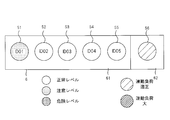
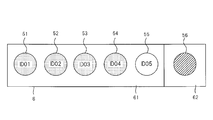
- FIG. 5 is a diagram showing an example of a screen displayed on the display unit 6 of the exercise information measuring apparatus 10-1 set as the master machine as a result of step S9 and step S10 in FIG.
- the screen displayed on the display unit 6 includes a member status display area 61 and a management information display area 62.
- the member status display area 61 is an area in which icons 51 to 55 corresponding to the IDs of the exercise information measuring devices 10-1 to 10-5 are displayed.
- An icon 51 with ID: 01 is an icon corresponding to the exercise information measuring device 10-1.
- An icon 52 with ID: 02 is an icon corresponding to the exercise information measuring device 10-2.
- An icon 53 with ID: 03 is an icon corresponding to the exercise information measuring device 10-3.
- An icon 54 with ID: 04 is an icon corresponding to the exercise information measuring device 10-4.
- An icon 55 with ID: 05 is an icon corresponding to the exercise information measuring device 10-5.
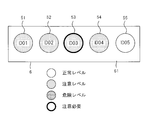
- an icon with an exercise load factor of less than 0.5 is indicated by a white circle indicating a normal level.
- An icon having an exercise load factor of 0.5 or more and less than 0.9 is indicated by a low-density dot pattern ⁇ indicating an attention level.
- An icon having an exercise load factor of 0.9 or more is indicated by a high-density dot pattern ⁇ mark indicating a danger level.
- the management information display area 62 is an area in which an icon 56 based on the management information output by the information output unit 23 is displayed.
- the icon based on the first management information is indicated by a circle with a diagonal hatch with a narrow diagonal interval indicating that the exercise load is large.
- the icon based on the second management information is indicated by a circle with diagonal hatching with a wide diagonal interval indicating that the exercise load is appropriate.
- an icon 56 indicating that the exercise load for the entire group is appropriate is displayed in the management information display area 62.
- the user A can instantly understand the individual exercise load status of the members belonging to the group, and the icon 56 instantly determines whether or not the exercise load of the entire group is appropriate. Can grasp.
- the leader does not need to do anything.
- the screen shown in FIG. 6 is displayed on the display unit 6, the user A determines that the exercise load is high for the group and verbally instructs the group members to take a break. Or verbally instructing to lower the pace of movement.
- the exercise load in the whole group can be appropriately managed by the screen shown in FIG.
- the case of climbing in a group is taken as an example, but not limited to climbing, exercise information in various scenes such as walking in a group, running in a group, touring by bicycle in a group, etc. Management of group behavior using the measuring apparatus 10 is possible.
- the icon 56 shown in FIG. 6 may be displayed even if each exercise load factor of the users A to E does not reach the danger level. For this reason, care in the stage before someone's body of a group member becomes a dangerous state is attained, and it becomes possible to prevent the accident at the time of group action beforehand.
- the exercise information measuring device 10 biological information is exchanged via the communication unit 3, and management information is generated and output based on the biological information of the group members. For this reason, it is possible to manage group actions even in places where infrastructure such as the Internet can be connected, and convenience can be improved. In addition, since short-range wireless communication can be performed with low power consumption, the battery of the exercise information measurement device 10 can be held well.
- the information output unit 23 of the exercise information measuring device 10-1 displays the icons 51 to 55 on the display unit 6, but the display unit 6 displays only the icon 56. Also good.
- the icon 56 is displayed on the display unit 6, it can be determined at least whether or not the exercise load is appropriate for the group, and the group behavior can be roughly managed. For this reason, it is not essential to display the member state display area 61.
- an icon displayed on the display unit 6 may be selectable by the operation unit 4. And when arbitrary icons are selected by operation of the operation part 4, it is good also as a structure which the control part 2 transmits instruction
- the control unit 2 of the exercise information measuring device 10-1 reduces the exercise load on all the exercise information measuring devices 10 belonging to the group.
- Instruction information for instructing to transmit is transmitted via the communication unit 3.
- the control unit 2 reads message data corresponding to the instruction information from the storage unit 5 and causes the display unit 6 to display the read message data. Thereby, for example, a message such as “Let's take a break” or “Please drop the pace” is displayed on the display unit 6.
- the control unit 2 of the exercise information measuring device 10-1 selects the icon Instruction information for instructing to reduce the exercise load is transmitted to the exercise information measuring device 10 corresponding to the icon.
- the control unit 2 stores message data (data such as a message instructing to take a break, a message instructing to drop the pace) corresponding to the instruction information in the storage unit 5.
- the message data read out from the message is displayed on the display unit 6.
- the screens shown in FIGS. 5 and 6 are displayed only on the exercise information measuring apparatus 10-1 set as the master machine.
- the screens shown in FIGS. 5 and 6 may be displayed on each of the exercise information measuring devices 10 constituting the group.
- the information output unit 23 of the exercise information measuring apparatus 10-1 generates display data for displaying the screens shown in FIGS. 5 and 6 and then transmits the display data via the communication unit 3. It transmits to each movement information measuring device 10 which belongs to a group.
- the control unit 2 outputs the display data to the display unit 6.
- the screens shown in FIGS. 5 and 6 are also displayed on the display unit 6 of the slave unit.
- the information output unit 23 of the exercise information measuring apparatus 10-1 set as the master machine outputs management information for managing the actions of all group members.
- the information output unit 23 may output management information for managing the behavior of a specific member in the group.
- FIG. 7 is a diagram showing a display example of a screen based on the management information generated by the information output unit 23.
- the member status display area 61 described in FIG. 5 is displayed on the display unit 6. Only the icon 53 is highlighted by being surrounded by a thick black line.
- the information output unit 23 generates information for this highlight display as management information and outputs it to the display unit 6.
- the information output unit 23 identifies an ID having the maximum corresponding exercise load factor from the IDs of the exercise information measuring devices 10-1 to 10-5, and measures the exercise information indicated by the specified ID. Information for notifying the wearer of the device 10 is generated as management information.
- the information output unit 23 displays an ID in order to indicate that attention should be paid to the action of the wearer of the exercise information measuring device 10-3 indicated by ID: 03 having the maximum exercise load factor. : Outputs information for highlighting the icon 53 corresponding to 03 to the display unit 6 as management information. Thereby, the icon 53 displayed on the display unit 6 is highlighted.
- the user A can notice that the user C of the exercise information measuring apparatus 10-3 has a higher exercise load than the other users. For this reason, it is possible to instruct the user C to take a break or reduce the pace.
- the information output unit 23 calculates the average value of the exercise load factor corresponding to each ID of the exercise information measuring devices 10-1 to 10-5, and subtracts the average value from the exercise load factor of each device. ID that exceeds the threshold value may be specified, and information for notifying the wearer of the exercise information measuring device 10 indicated by the specified ID may be generated and output as management information. Even in this configuration, the highlight display based on the management information makes it possible to grasp the users who require attention because the exercise load is higher than the other users in the group.
- the information output unit 23 calculates the rate of change per unit time of the exercise load rate corresponding to each ID of the exercise information measuring devices 10-1 to 10-5, and calculates the change rate and each device. ID for which the difference from the average value of the change rate exceeds the threshold may be specified, and information for notifying the wearer of the exercise information measuring device 10 indicated by the specified ID may be generated and output as management information.
- the rate of change of the pulse rate for 5 minutes is 10% for the wearer of the exercise information measuring devices 10-1, 10-2, 10-4, 10-5, and the wearer of the exercise information measuring device 10-3. Is 40%.
- the threshold is 10%
- the highlight display shown in FIG. 7 may be performed even if the exercise load factor of the user C does not reach the danger level. For this reason, it is possible to perform care at a stage before the user C's body is in a dangerous state, and it is possible to prevent an accident during group action.
- the pulse sensor 7 in FIG. 2 is not limited to the pulse sensor as long as it functions as a biological information measurement unit that measures biological information indicating the exercise load of the wearer of the apparatus.
- a heart rate sensor or a sensor that measures oxygen saturation may be used.
- a program for causing a computer to execute each step of the flowchart shown in FIG. 4 or a program for causing a computer to function as each functional block in FIG. 2 is not temporary (non-readable) by the computer.
- -Transity can be recorded on a recording medium and provided.
- Such “computer-readable recording medium” includes, for example, an optical medium such as a CD-ROM (Compact Disc-ROM), a magnetic recording medium such as a memory card, and the like. Such a program can also be provided by downloading via a network.
- an optical medium such as a CD-ROM (Compact Disc-ROM)
- a magnetic recording medium such as a memory card, and the like.
- Such a program can also be provided by downloading via a network.
- the master machine and the slave machine are set by each motion information measuring device 10, but the group creation method is not limited to this, and a well-known method can be adopted.
- a list of other devices 10 within the communicable range of the exercise information measuring device 10 set as the master device is displayed on the display unit 6 of the master device, and the wearer of the master device displays the list of the other devices 10 displayed.
- the selected other device 10 may be set as a slave device by selecting a device that is desired to be a member.
- the disclosed behavior management device includes a biological information measuring unit that measures biological information, a communication unit that performs short-range wireless communication with another device that has a function of measuring biological information, and a group that includes the device itself
- a biological information acquisition unit that acquires biological information measured by the device via the communication unit, a first biological information measured by the biological information measurement unit, and a second acquired by the biological information acquisition unit
- an information output unit that outputs management information for managing the behavior of the wearer of the device belonging to the group based on the biometric information.
- the information output unit outputs, as the management information, information for managing the actions of the wearers of all apparatuses belonging to the group.
- the information output unit calculates an average value of a part or all of the exercise loads of the wearers of all the devices based on the first biological information and the second biological information. According to the size of the average value, information indicating the exercise load of the entire group composed of wearers of all the devices is generated, and the information is output as the management information.
- the information output unit determines the number of exercise loads that exceed a threshold among the exercise loads based on the first biological information and the second biological information, and according to the number, Information indicating the exercise load of the entire group composed of wearers of all devices is generated, and the information is output as the management information.
- the information output unit has the maximum exercise load on the wearer among all the devices constituting the group based on the first biological information and the second biological information.
- Information for notifying the wearer of the specified device is output as the management information.
- the information output unit calculates an average value of exercise loads of wearers of all devices constituting the group based on the first biological information and the second biological information. Then, a wearer whose value obtained by subtracting the average value from the exercise load of each wearer exceeds a threshold is specified, and information for notifying the specified wearer is output as the management information.
- the information output unit calculates a rate of change in exercise load of a wearer of all devices constituting the group based on the first biological information and the second biological information. Then, a wearer whose difference between the change rate and the average value of the change rates calculated for all the devices exceeds a threshold is specified, and information for notifying the specified wearer is output as the management information To do.
- the disclosed behavior management method includes behavior management by a behavior management device having a biological information measurement unit that measures biological information and a communication unit that performs short-range wireless communication with another device having a function of measuring biological information.
- a biological information acquisition step for acquiring biological information measured by another device that constitutes a group together with the behavior management device via the communication unit, and a first measured by the biological information measurement unit
- An information output step for outputting management information for managing the behavior of the wearer of the device belonging to the group based on the biological information and the second biological information acquired in the biological information acquisition step. It is.
- the disclosed behavior management program is a program for causing a computer to execute each step of the behavior management method.
- an action management device it is possible to provide an action management device, an action management method, and an action management program that can appropriately manage group actions.
- Control section 3 Communication section 6
Landscapes
- Health & Medical Sciences (AREA)
- Life Sciences & Earth Sciences (AREA)
- Engineering & Computer Science (AREA)
- Physics & Mathematics (AREA)
- Molecular Biology (AREA)
- General Health & Medical Sciences (AREA)
- Veterinary Medicine (AREA)
- Public Health (AREA)
- Physiology (AREA)
- Biophysics (AREA)
- Pathology (AREA)
- Biomedical Technology (AREA)
- Heart & Thoracic Surgery (AREA)
- Medical Informatics (AREA)
- Animal Behavior & Ethology (AREA)
- Surgery (AREA)
- Cardiology (AREA)
- Oral & Maxillofacial Surgery (AREA)
- Dentistry (AREA)
- Signal Processing (AREA)
- Theoretical Computer Science (AREA)
- Software Systems (AREA)
- Geometry (AREA)
- Psychiatry (AREA)
- Computer Vision & Pattern Recognition (AREA)
- Artificial Intelligence (AREA)
- General Physics & Mathematics (AREA)
- General Engineering & Computer Science (AREA)
- Physical Education & Sports Medicine (AREA)
- Measuring Pulse, Heart Rate, Blood Pressure Or Blood Flow (AREA)
- Measurement Of The Respiration, Hearing Ability, Form, And Blood Characteristics Of Living Organisms (AREA)
Priority Applications (3)
| Application Number | Priority Date | Filing Date | Title |
|---|---|---|---|
| CN201580062687.4A CN106999074A (zh) | 2014-12-04 | 2015-11-19 | 行动管理装置、行动管理方法和行动管理程序 |
| DE112015005487.1T DE112015005487T5 (de) | 2014-12-04 | 2015-11-19 | Tätigkeitsverwaltungsvorrichtung, Tätigkeitsverwaltungsverfahren und Tätigkeitsverwaltungsprogramm |
| US15/614,071 US10743784B2 (en) | 2014-12-04 | 2017-06-05 | Action management apparatus, action management method, and action management program |
Applications Claiming Priority (2)
| Application Number | Priority Date | Filing Date | Title |
|---|---|---|---|
| JP2014245929A JP6398668B2 (ja) | 2014-12-04 | 2014-12-04 | 行動管理装置、行動管理方法、及び行動管理プログラム |
| JP2014-245929 | 2014-12-04 |
Related Child Applications (1)
| Application Number | Title | Priority Date | Filing Date |
|---|---|---|---|
| US15/614,071 Continuation US10743784B2 (en) | 2014-12-04 | 2017-06-05 | Action management apparatus, action management method, and action management program |
Publications (1)
| Publication Number | Publication Date |
|---|---|
| WO2016088563A1 true WO2016088563A1 (ja) | 2016-06-09 |
Family
ID=56091513
Family Applications (1)
| Application Number | Title | Priority Date | Filing Date |
|---|---|---|---|
| PCT/JP2015/082531 Ceased WO2016088563A1 (ja) | 2014-12-04 | 2015-11-19 | 行動管理装置、行動管理方法、及び行動管理プログラム |
Country Status (5)
| Country | Link |
|---|---|
| US (1) | US10743784B2 (enExample) |
| JP (1) | JP6398668B2 (enExample) |
| CN (1) | CN106999074A (enExample) |
| DE (1) | DE112015005487T5 (enExample) |
| WO (1) | WO2016088563A1 (enExample) |
Families Citing this family (1)
| Publication number | Priority date | Publication date | Assignee | Title |
|---|---|---|---|---|
| JP7703438B2 (ja) * | 2021-12-16 | 2025-07-07 | 株式会社ジャパンディスプレイ | センサシステム |
Citations (4)
| Publication number | Priority date | Publication date | Assignee | Title |
|---|---|---|---|---|
| JP2007054450A (ja) * | 2005-08-26 | 2007-03-08 | Sony Corp | 情報交換装置 |
| JP2008503268A (ja) * | 2004-06-18 | 2008-02-07 | ヴィーヴォメトリックス インコーポレイテッド | リアルタイム生理学的監視用のシステム及び方法 |
| JP2012524638A (ja) * | 2009-04-26 | 2012-10-18 | ナイキ インターナショナル リミテッド | 運動用時計システムのgps特徴および機能性 |
| JP2012213630A (ja) * | 2011-03-31 | 2012-11-08 | Adidas Ag | グループパフォーマンスをモニタリングするシステム及び方法 |
Family Cites Families (12)
| Publication number | Priority date | Publication date | Assignee | Title |
|---|---|---|---|---|
| JP2003242584A (ja) | 2002-02-13 | 2003-08-29 | Seiko Instruments Inc | 身体装着型電子機器システム及び身体装着型電子機器 |
| WO2005091927A2 (en) | 2004-03-06 | 2005-10-06 | Ryan O'donnell | Methods and devices for monitoring the distance between members of a group |
| JP4506795B2 (ja) | 2007-08-06 | 2010-07-21 | ソニー株式会社 | 生体運動情報表示処理装置、生体運動情報処理システム |
| JP5359769B2 (ja) | 2009-10-21 | 2013-12-04 | オムロンヘルスケア株式会社 | 体動検出装置 |
| EP2663344B1 (en) * | 2011-01-12 | 2024-03-20 | The Regents of The University of California | System and method for closed-loop patient-adaptive hemodynamic management |
| JP5880820B2 (ja) | 2011-10-21 | 2016-03-09 | セイコーエプソン株式会社 | 活動量計測システム、サーバー及び活動量計測方法 |
| JP6306833B2 (ja) * | 2012-07-06 | 2018-04-04 | アディダス アーゲー | グループパフォーマンスモニタリングシステムおよび方法 |
| US9295413B2 (en) * | 2013-01-17 | 2016-03-29 | Garmin Switzerland Gmbh | Fitness monitor |
| US20150081062A1 (en) | 2013-09-16 | 2015-03-19 | 4Iiii Innovations Inc. | Location-Based Athlete Pacing With Biofeedback Systems And Methods |
| JP6331874B2 (ja) | 2014-08-22 | 2018-05-30 | オムロンヘルスケア株式会社 | 運動情報測定装置、プログラム、および制御方法 |
| US9942627B2 (en) | 2014-09-12 | 2018-04-10 | Intel Corporation | Dynamic information presentation based on user activity context |
| US10356189B2 (en) | 2014-11-20 | 2019-07-16 | Suunto Oy | System and method for creating ad-hoc events from sensed sport-specific data |
-
2014
- 2014-12-04 JP JP2014245929A patent/JP6398668B2/ja not_active Expired - Fee Related
-
2015
- 2015-11-19 CN CN201580062687.4A patent/CN106999074A/zh active Pending
- 2015-11-19 WO PCT/JP2015/082531 patent/WO2016088563A1/ja not_active Ceased
- 2015-11-19 DE DE112015005487.1T patent/DE112015005487T5/de not_active Withdrawn
-
2017
- 2017-06-05 US US15/614,071 patent/US10743784B2/en active Active
Patent Citations (4)
| Publication number | Priority date | Publication date | Assignee | Title |
|---|---|---|---|---|
| JP2008503268A (ja) * | 2004-06-18 | 2008-02-07 | ヴィーヴォメトリックス インコーポレイテッド | リアルタイム生理学的監視用のシステム及び方法 |
| JP2007054450A (ja) * | 2005-08-26 | 2007-03-08 | Sony Corp | 情報交換装置 |
| JP2012524638A (ja) * | 2009-04-26 | 2012-10-18 | ナイキ インターナショナル リミテッド | 運動用時計システムのgps特徴および機能性 |
| JP2012213630A (ja) * | 2011-03-31 | 2012-11-08 | Adidas Ag | グループパフォーマンスをモニタリングするシステム及び方法 |
Also Published As
| Publication number | Publication date |
|---|---|
| US20170269933A1 (en) | 2017-09-21 |
| US10743784B2 (en) | 2020-08-18 |
| JP2016106766A (ja) | 2016-06-20 |
| DE112015005487T5 (de) | 2017-08-17 |
| CN106999074A (zh) | 2017-08-01 |
| JP6398668B2 (ja) | 2018-10-03 |
Similar Documents
| Publication | Publication Date | Title |
|---|---|---|
| TWI669681B (zh) | 提供人體姿勢保健資訊的電子計算裝置、系統與方法 | |
| KR101788485B1 (ko) | 활동에 기초한 지능적 디바이스 모드 변화 | |
| US10105574B2 (en) | Technologies for managing user-specific workouts | |
| CN105981035B (zh) | 管理隐私信息的显示 | |
| US20160107029A1 (en) | Workout management method and system using a wearable device | |
| CN207970089U (zh) | 分析跌倒严重程度的跌倒侦测系统及其穿戴装置 | |
| EP3416034A1 (en) | Information processing device, information processing method, and program | |
| EP3691521B1 (en) | Electronic device and method for providing stress index corresponding to activity of user | |
| EP4394562A1 (en) | Wearable device and control method thereof | |
| KR20140062890A (ko) | 사용자의 상태를 관리하는 웨어러블 디바이스 및 관리 장치와 그 상태 관리 방법 | |
| CN102655551A (zh) | 感测反馈方法和装置 | |
| EP3007088A1 (en) | Modification of an exercise plan | |
| EP2815560A1 (en) | Observation and/or operation of a sport and/or rehabilitation device | |
| JP2010188159A (ja) | 身体動作センシング装置 | |
| KR20180042702A (ko) | 인공지능 모델을 통해 사용자의 감정과 행동을 심리 처방하는 웨어러블 장치를 이용한 전자장치, 방법 및 시스템 | |
| JP6398668B2 (ja) | 行動管理装置、行動管理方法、及び行動管理プログラム | |
| JP2020052572A (ja) | ウェアラブル装置、及び制御プログラム | |
| KR20190119900A (ko) | 심장재활운동을 위한 웨어러블 장치 및 이를 이용한 심장재활운동 방법 | |
| JP2017070602A (ja) | 情報処理方法、情報処理装置及びプログラム | |
| KR101766438B1 (ko) | 이상 활동 탐지를 위한 이동 단말기 및 이를 포함하는 그룹 내 구성원들의 관리 지원 시스템 | |
| KR101853093B1 (ko) | 구성원 관리 시스템 | |
| KR20190047644A (ko) | 운동에 대한 피드백을 제공하는 웨어러블 디바이스 및 방법 | |
| KR102099373B1 (ko) | 스마트워치 디지털무전기를 이용한 건강관리시스템 및 건강관리방법 | |
| EP3130996A1 (en) | Electronic apparatus and displaying method thereof | |
| JP6435958B2 (ja) | 運動情報測定装置、運動管理方法、及び運動管理プログラム |
Legal Events
| Date | Code | Title | Description |
|---|---|---|---|
| 121 | Ep: the epo has been informed by wipo that ep was designated in this application |
Ref document number: 15865005 Country of ref document: EP Kind code of ref document: A1 |
|
| DPE2 | Request for preliminary examination filed before expiration of 19th month from priority date (pct application filed from 20040101) | ||
| WWE | Wipo information: entry into national phase |
Ref document number: 112015005487 Country of ref document: DE |
|
| 122 | Ep: pct application non-entry in european phase |
Ref document number: 15865005 Country of ref document: EP Kind code of ref document: A1 |