WO2016060100A1 - 合成樹脂積層シート - Google Patents
合成樹脂積層シート Download PDFInfo
- Publication number
- WO2016060100A1 WO2016060100A1 PCT/JP2015/078873 JP2015078873W WO2016060100A1 WO 2016060100 A1 WO2016060100 A1 WO 2016060100A1 JP 2015078873 W JP2015078873 W JP 2015078873W WO 2016060100 A1 WO2016060100 A1 WO 2016060100A1
- Authority
- WO
- WIPO (PCT)
- Prior art keywords
- carbon atoms
- group
- synthetic resin
- polycarbonate resin
- substituent
- Prior art date
- Legal status (The legal status is an assumption and is not a legal conclusion. Google has not performed a legal analysis and makes no representation as to the accuracy of the status listed.)
- Ceased
Links
Classifications
-
- C—CHEMISTRY; METALLURGY
- C08—ORGANIC MACROMOLECULAR COMPOUNDS; THEIR PREPARATION OR CHEMICAL WORKING-UP; COMPOSITIONS BASED THEREON
- C08G—MACROMOLECULAR COMPOUNDS OBTAINED OTHERWISE THAN BY REACTIONS ONLY INVOLVING UNSATURATED CARBON-TO-CARBON BONDS
- C08G64/00—Macromolecular compounds obtained by reactions forming a carbonic ester link in the main chain of the macromolecule
- C08G64/04—Aromatic polycarbonates
- C08G64/06—Aromatic polycarbonates not containing aliphatic unsaturation
- C08G64/14—Aromatic polycarbonates not containing aliphatic unsaturation containing a chain-terminating or -crosslinking agent
-
- B—PERFORMING OPERATIONS; TRANSPORTING
- B29—WORKING OF PLASTICS; WORKING OF SUBSTANCES IN A PLASTIC STATE IN GENERAL
- B29C—SHAPING OR JOINING OF PLASTICS; SHAPING OF MATERIAL IN A PLASTIC STATE, NOT OTHERWISE PROVIDED FOR; AFTER-TREATMENT OF THE SHAPED PRODUCTS, e.g. REPAIRING
- B29C45/00—Injection moulding, i.e. forcing the required volume of moulding material through a nozzle into a closed mould; Apparatus therefor
- B29C45/14—Injection moulding, i.e. forcing the required volume of moulding material through a nozzle into a closed mould; Apparatus therefor incorporating preformed parts or layers, e.g. injection moulding around inserts or for coating articles
-
- B—PERFORMING OPERATIONS; TRANSPORTING
- B29—WORKING OF PLASTICS; WORKING OF SUBSTANCES IN A PLASTIC STATE IN GENERAL
- B29C—SHAPING OR JOINING OF PLASTICS; SHAPING OF MATERIAL IN A PLASTIC STATE, NOT OTHERWISE PROVIDED FOR; AFTER-TREATMENT OF THE SHAPED PRODUCTS, e.g. REPAIRING
- B29C51/00—Shaping by thermoforming, i.e. shaping sheets or sheet like preforms after heating, e.g. shaping sheets in matched moulds or by deep-drawing; Apparatus therefor
-
- B—PERFORMING OPERATIONS; TRANSPORTING
- B32—LAYERED PRODUCTS
- B32B—LAYERED PRODUCTS, i.e. PRODUCTS BUILT-UP OF STRATA OF FLAT OR NON-FLAT, e.g. CELLULAR OR HONEYCOMB, FORM
- B32B27/00—Layered products comprising a layer of synthetic resin
- B32B27/06—Layered products comprising a layer of synthetic resin as the main or only constituent of a layer, which is next to another layer of the same or of a different material
- B32B27/08—Layered products comprising a layer of synthetic resin as the main or only constituent of a layer, which is next to another layer of the same or of a different material of synthetic resin
-
- B—PERFORMING OPERATIONS; TRANSPORTING
- B32—LAYERED PRODUCTS
- B32B—LAYERED PRODUCTS, i.e. PRODUCTS BUILT-UP OF STRATA OF FLAT OR NON-FLAT, e.g. CELLULAR OR HONEYCOMB, FORM
- B32B27/00—Layered products comprising a layer of synthetic resin
- B32B27/18—Layered products comprising a layer of synthetic resin characterised by the use of special additives
- B32B27/20—Layered products comprising a layer of synthetic resin characterised by the use of special additives using fillers, pigments, thixotroping agents
-
- B—PERFORMING OPERATIONS; TRANSPORTING
- B32—LAYERED PRODUCTS
- B32B—LAYERED PRODUCTS, i.e. PRODUCTS BUILT-UP OF STRATA OF FLAT OR NON-FLAT, e.g. CELLULAR OR HONEYCOMB, FORM
- B32B27/00—Layered products comprising a layer of synthetic resin
- B32B27/18—Layered products comprising a layer of synthetic resin characterised by the use of special additives
- B32B27/22—Layered products comprising a layer of synthetic resin characterised by the use of special additives using plasticisers
-
- B—PERFORMING OPERATIONS; TRANSPORTING
- B32—LAYERED PRODUCTS
- B32B—LAYERED PRODUCTS, i.e. PRODUCTS BUILT-UP OF STRATA OF FLAT OR NON-FLAT, e.g. CELLULAR OR HONEYCOMB, FORM
- B32B27/00—Layered products comprising a layer of synthetic resin
- B32B27/30—Layered products comprising a layer of synthetic resin comprising vinyl (co)polymers; comprising acrylic (co)polymers
-
- B—PERFORMING OPERATIONS; TRANSPORTING
- B32—LAYERED PRODUCTS
- B32B—LAYERED PRODUCTS, i.e. PRODUCTS BUILT-UP OF STRATA OF FLAT OR NON-FLAT, e.g. CELLULAR OR HONEYCOMB, FORM
- B32B27/00—Layered products comprising a layer of synthetic resin
- B32B27/30—Layered products comprising a layer of synthetic resin comprising vinyl (co)polymers; comprising acrylic (co)polymers
- B32B27/308—Layered products comprising a layer of synthetic resin comprising vinyl (co)polymers; comprising acrylic (co)polymers comprising acrylic (co)polymers
-
- B—PERFORMING OPERATIONS; TRANSPORTING
- B32—LAYERED PRODUCTS
- B32B—LAYERED PRODUCTS, i.e. PRODUCTS BUILT-UP OF STRATA OF FLAT OR NON-FLAT, e.g. CELLULAR OR HONEYCOMB, FORM
- B32B27/00—Layered products comprising a layer of synthetic resin
- B32B27/36—Layered products comprising a layer of synthetic resin comprising polyesters
-
- B—PERFORMING OPERATIONS; TRANSPORTING
- B32—LAYERED PRODUCTS
- B32B—LAYERED PRODUCTS, i.e. PRODUCTS BUILT-UP OF STRATA OF FLAT OR NON-FLAT, e.g. CELLULAR OR HONEYCOMB, FORM
- B32B27/00—Layered products comprising a layer of synthetic resin
- B32B27/36—Layered products comprising a layer of synthetic resin comprising polyesters
- B32B27/365—Layered products comprising a layer of synthetic resin comprising polyesters comprising polycarbonates
-
- C—CHEMISTRY; METALLURGY
- C08—ORGANIC MACROMOLECULAR COMPOUNDS; THEIR PREPARATION OR CHEMICAL WORKING-UP; COMPOSITIONS BASED THEREON
- C08G—MACROMOLECULAR COMPOUNDS OBTAINED OTHERWISE THAN BY REACTIONS ONLY INVOLVING UNSATURATED CARBON-TO-CARBON BONDS
- C08G64/00—Macromolecular compounds obtained by reactions forming a carbonic ester link in the main chain of the macromolecule
- C08G64/04—Aromatic polycarbonates
-
- C—CHEMISTRY; METALLURGY
- C08—ORGANIC MACROMOLECULAR COMPOUNDS; THEIR PREPARATION OR CHEMICAL WORKING-UP; COMPOSITIONS BASED THEREON
- C08G—MACROMOLECULAR COMPOUNDS OBTAINED OTHERWISE THAN BY REACTIONS ONLY INVOLVING UNSATURATED CARBON-TO-CARBON BONDS
- C08G64/00—Macromolecular compounds obtained by reactions forming a carbonic ester link in the main chain of the macromolecule
- C08G64/04—Aromatic polycarbonates
- C08G64/06—Aromatic polycarbonates not containing aliphatic unsaturation
- C08G64/08—Aromatic polycarbonates not containing aliphatic unsaturation containing atoms other than carbon, hydrogen or oxygen
- C08G64/081—Aromatic polycarbonates not containing aliphatic unsaturation containing atoms other than carbon, hydrogen or oxygen containing sulfur
-
- C—CHEMISTRY; METALLURGY
- C08—ORGANIC MACROMOLECULAR COMPOUNDS; THEIR PREPARATION OR CHEMICAL WORKING-UP; COMPOSITIONS BASED THEREON
- C08G—MACROMOLECULAR COMPOUNDS OBTAINED OTHERWISE THAN BY REACTIONS ONLY INVOLVING UNSATURATED CARBON-TO-CARBON BONDS
- C08G64/00—Macromolecular compounds obtained by reactions forming a carbonic ester link in the main chain of the macromolecule
- C08G64/20—General preparatory processes
- C08G64/22—General preparatory processes using carbonyl halides
- C08G64/24—General preparatory processes using carbonyl halides and phenols
-
- C—CHEMISTRY; METALLURGY
- C09—DYES; PAINTS; POLISHES; NATURAL RESINS; ADHESIVES; COMPOSITIONS NOT OTHERWISE PROVIDED FOR; APPLICATIONS OF MATERIALS NOT OTHERWISE PROVIDED FOR
- C09D—COATING COMPOSITIONS, e.g. PAINTS, VARNISHES OR LACQUERS; FILLING PASTES; CHEMICAL PAINT OR INK REMOVERS; INKS; CORRECTING FLUIDS; WOODSTAINS; PASTES OR SOLIDS FOR COLOURING OR PRINTING; USE OF MATERIALS THEREFOR
- C09D133/00—Coating compositions based on homopolymers or copolymers of compounds having one or more unsaturated aliphatic radicals, each having only one carbon-to-carbon double bond, and at least one being terminated by only one carboxyl radical, or of salts, anhydrides, esters, amides, imides, or nitriles thereof; Coating compositions based on derivatives of such polymers
- C09D133/04—Homopolymers or copolymers of esters
- C09D133/06—Homopolymers or copolymers of esters of esters containing only carbon, hydrogen and oxygen, the oxygen atom being present only as part of the carboxyl radical
- C09D133/10—Homopolymers or copolymers of methacrylic acid esters
- C09D133/12—Homopolymers or copolymers of methyl methacrylate
-
- B—PERFORMING OPERATIONS; TRANSPORTING
- B29—WORKING OF PLASTICS; WORKING OF SUBSTANCES IN A PLASTIC STATE IN GENERAL
- B29C—SHAPING OR JOINING OF PLASTICS; SHAPING OF MATERIAL IN A PLASTIC STATE, NOT OTHERWISE PROVIDED FOR; AFTER-TREATMENT OF THE SHAPED PRODUCTS, e.g. REPAIRING
- B29C45/00—Injection moulding, i.e. forcing the required volume of moulding material through a nozzle into a closed mould; Apparatus therefor
- B29C45/0001—Injection moulding, i.e. forcing the required volume of moulding material through a nozzle into a closed mould; Apparatus therefor characterised by the choice of material
-
- B—PERFORMING OPERATIONS; TRANSPORTING
- B29—WORKING OF PLASTICS; WORKING OF SUBSTANCES IN A PLASTIC STATE IN GENERAL
- B29C—SHAPING OR JOINING OF PLASTICS; SHAPING OF MATERIAL IN A PLASTIC STATE, NOT OTHERWISE PROVIDED FOR; AFTER-TREATMENT OF THE SHAPED PRODUCTS, e.g. REPAIRING
- B29C45/00—Injection moulding, i.e. forcing the required volume of moulding material through a nozzle into a closed mould; Apparatus therefor
- B29C45/14—Injection moulding, i.e. forcing the required volume of moulding material through a nozzle into a closed mould; Apparatus therefor incorporating preformed parts or layers, e.g. injection moulding around inserts or for coating articles
- B29C45/14688—Coating articles provided with a decoration
-
- B—PERFORMING OPERATIONS; TRANSPORTING
- B29—WORKING OF PLASTICS; WORKING OF SUBSTANCES IN A PLASTIC STATE IN GENERAL
- B29C—SHAPING OR JOINING OF PLASTICS; SHAPING OF MATERIAL IN A PLASTIC STATE, NOT OTHERWISE PROVIDED FOR; AFTER-TREATMENT OF THE SHAPED PRODUCTS, e.g. REPAIRING
- B29C51/00—Shaping by thermoforming, i.e. shaping sheets or sheet like preforms after heating, e.g. shaping sheets in matched moulds or by deep-drawing; Apparatus therefor
- B29C51/002—Shaping by thermoforming, i.e. shaping sheets or sheet like preforms after heating, e.g. shaping sheets in matched moulds or by deep-drawing; Apparatus therefor characterised by the choice of material
-
- B—PERFORMING OPERATIONS; TRANSPORTING
- B29—WORKING OF PLASTICS; WORKING OF SUBSTANCES IN A PLASTIC STATE IN GENERAL
- B29C—SHAPING OR JOINING OF PLASTICS; SHAPING OF MATERIAL IN A PLASTIC STATE, NOT OTHERWISE PROVIDED FOR; AFTER-TREATMENT OF THE SHAPED PRODUCTS, e.g. REPAIRING
- B29C51/00—Shaping by thermoforming, i.e. shaping sheets or sheet like preforms after heating, e.g. shaping sheets in matched moulds or by deep-drawing; Apparatus therefor
- B29C51/14—Shaping by thermoforming, i.e. shaping sheets or sheet like preforms after heating, e.g. shaping sheets in matched moulds or by deep-drawing; Apparatus therefor using multilayered preforms or sheets
-
- B—PERFORMING OPERATIONS; TRANSPORTING
- B29—WORKING OF PLASTICS; WORKING OF SUBSTANCES IN A PLASTIC STATE IN GENERAL
- B29K—INDEXING SCHEME ASSOCIATED WITH SUBCLASSES B29B, B29C OR B29D, RELATING TO MOULDING MATERIALS OR TO MATERIALS FOR MOULDS, REINFORCEMENTS, FILLERS OR PREFORMED PARTS, e.g. INSERTS
- B29K2033/00—Use of polymers of unsaturated acids or derivatives thereof as moulding material
- B29K2033/04—Polymers of esters
- B29K2033/08—Polymers of acrylic acid esters, e.g. PMA, i.e. polymethylacrylate
-
- B—PERFORMING OPERATIONS; TRANSPORTING
- B29—WORKING OF PLASTICS; WORKING OF SUBSTANCES IN A PLASTIC STATE IN GENERAL
- B29K—INDEXING SCHEME ASSOCIATED WITH SUBCLASSES B29B, B29C OR B29D, RELATING TO MOULDING MATERIALS OR TO MATERIALS FOR MOULDS, REINFORCEMENTS, FILLERS OR PREFORMED PARTS, e.g. INSERTS
- B29K2069/00—Use of PC, i.e. polycarbonates or derivatives thereof, as moulding material
-
- B—PERFORMING OPERATIONS; TRANSPORTING
- B32—LAYERED PRODUCTS
- B32B—LAYERED PRODUCTS, i.e. PRODUCTS BUILT-UP OF STRATA OF FLAT OR NON-FLAT, e.g. CELLULAR OR HONEYCOMB, FORM
- B32B2255/00—Coating on the layer surface
- B32B2255/10—Coating on the layer surface on synthetic resin layer or on natural or synthetic rubber layer
-
- B—PERFORMING OPERATIONS; TRANSPORTING
- B32—LAYERED PRODUCTS
- B32B—LAYERED PRODUCTS, i.e. PRODUCTS BUILT-UP OF STRATA OF FLAT OR NON-FLAT, e.g. CELLULAR OR HONEYCOMB, FORM
- B32B2255/00—Coating on the layer surface
- B32B2255/26—Polymeric coating
-
- B—PERFORMING OPERATIONS; TRANSPORTING
- B32—LAYERED PRODUCTS
- B32B—LAYERED PRODUCTS, i.e. PRODUCTS BUILT-UP OF STRATA OF FLAT OR NON-FLAT, e.g. CELLULAR OR HONEYCOMB, FORM
- B32B2264/00—Composition or properties of particles which form a particulate layer or are present as additives
- B32B2264/10—Inorganic particles
- B32B2264/102—Oxide or hydroxide
- B32B2264/1021—Silica
-
- B—PERFORMING OPERATIONS; TRANSPORTING
- B32—LAYERED PRODUCTS
- B32B—LAYERED PRODUCTS, i.e. PRODUCTS BUILT-UP OF STRATA OF FLAT OR NON-FLAT, e.g. CELLULAR OR HONEYCOMB, FORM
- B32B2264/00—Composition or properties of particles which form a particulate layer or are present as additives
- B32B2264/10—Inorganic particles
- B32B2264/102—Oxide or hydroxide
- B32B2264/1023—Alumina
-
- B—PERFORMING OPERATIONS; TRANSPORTING
- B32—LAYERED PRODUCTS
- B32B—LAYERED PRODUCTS, i.e. PRODUCTS BUILT-UP OF STRATA OF FLAT OR NON-FLAT, e.g. CELLULAR OR HONEYCOMB, FORM
- B32B2264/00—Composition or properties of particles which form a particulate layer or are present as additives
- B32B2264/30—Particles characterised by physical dimension
- B32B2264/302—Average diameter in the range from 100 nm to 1000 nm
-
- B—PERFORMING OPERATIONS; TRANSPORTING
- B32—LAYERED PRODUCTS
- B32B—LAYERED PRODUCTS, i.e. PRODUCTS BUILT-UP OF STRATA OF FLAT OR NON-FLAT, e.g. CELLULAR OR HONEYCOMB, FORM
- B32B2307/00—Properties of the layers or laminate
- B32B2307/30—Properties of the layers or laminate having particular thermal properties
-
- B—PERFORMING OPERATIONS; TRANSPORTING
- B32—LAYERED PRODUCTS
- B32B—LAYERED PRODUCTS, i.e. PRODUCTS BUILT-UP OF STRATA OF FLAT OR NON-FLAT, e.g. CELLULAR OR HONEYCOMB, FORM
- B32B2307/00—Properties of the layers or laminate
- B32B2307/40—Properties of the layers or laminate having particular optical properties
- B32B2307/414—Translucent
-
- B—PERFORMING OPERATIONS; TRANSPORTING
- B32—LAYERED PRODUCTS
- B32B—LAYERED PRODUCTS, i.e. PRODUCTS BUILT-UP OF STRATA OF FLAT OR NON-FLAT, e.g. CELLULAR OR HONEYCOMB, FORM
- B32B2307/00—Properties of the layers or laminate
- B32B2307/50—Properties of the layers or laminate having particular mechanical properties
- B32B2307/536—Hardness
-
- B—PERFORMING OPERATIONS; TRANSPORTING
- B32—LAYERED PRODUCTS
- B32B—LAYERED PRODUCTS, i.e. PRODUCTS BUILT-UP OF STRATA OF FLAT OR NON-FLAT, e.g. CELLULAR OR HONEYCOMB, FORM
- B32B2307/00—Properties of the layers or laminate
- B32B2307/50—Properties of the layers or laminate having particular mechanical properties
- B32B2307/584—Scratch resistance
Definitions
- the present invention is a resin sheet using a polycarbonate resin having a specific terminal group, and is formed by molding a synthetic resin laminated sheet suitable for thermoforming such as vacuum molding or pressure forming, and this synthetic resin laminated sheet. It relates to a molded body.
- Polycarbonate resin is not only excellent in transparency, but also has excellent processability and impact resistance compared to glass, and has no concerns about toxic gases compared to other plastic materials, so it is widely used in various fields. It is also used as a thermoforming material such as vacuum forming and pressure forming.
- the polycarbonate resin generally has a low surface hardness, it has a problem that the surface of a molded article made of the polycarbonate resin is easily damaged. Therefore, conventionally, a proposal has been made to form a protective layer made of an acrylic resin on the surface of the polycarbonate resin layer so that the product surface is not damaged.
- Patent Document 1 proposes a laminate in which an acrylic resin layer having a thickness of 50 to 120 ⁇ m is laminated on one surface of a polycarbonate resin layer by coextrusion so that the total thickness is 0.5 to 1.2 mm. Has been.
- a hard coat treatment is applied to an acrylic film including an acrylic resin layer in which rubber particles are dispersed in methacrylic resin.
- a scratch-resistant acrylic film is disclosed that is applied to impart scratch resistance.
- the absolute value of the difference of the glass transition temperature of the polycarbonate-type resin which consists of a polymer alloy of aromatic polycarbonate resin and other resin, and acrylic resin is 30 degrees C or less, It is characterized by the above-mentioned.
- a thermoformed body obtained by thermoforming a molding resin sheet is disclosed.
- JP 2006-103169 A Japanese Patent Laid-Open No. 2004-143365 Patent No.4971218
- the sheet in which a protective layer made of an acrylic resin is formed on the surface of a polycarbonate resin layer, the sheet must not be heated to a temperature at which the polycarbonate resin is sufficiently stretched during thermoforming, particularly during deep drawing.
- the acrylic resin since excessive heat is applied to the acrylic resin, peeling may occur at the interface between the polycarbonate resin layer and the acrylic resin layer, and the surface may be whitened or cracks may occur.
- the above-mentioned laminate may foam if it is not sufficiently dried before thermoforming.
- poor lamination interface disturbance
- the polycarbonate-based resin obtained by polymer alloy is easily decomposed by heat and has many black spots and irregularities.
- a sheet having a hard coat layer hereinafter referred to as HC or HC layer
- interface whitening and defects that cause cracks in HC are generated.
- the present invention provides a synthetic resin laminate sheet having a structure in which an acrylic resin layer is laminated on the surface of a polycarbonate resin layer.
- thermoformed particularly when deep drawn, whitening, cracks, Is intended to provide a new synthetic resin laminated sheet in which foaming does not occur and defects do not occur in the same way during HC lamination, and a molded body formed by molding the same.
- a polycarbonate resin having high heat resistance it is possible to suppress the generation of black spots and irregularities.
- the present inventors have intensively studied for the purpose of solving each of the above problems, and as a result, have completed the present invention.
- the present invention is as follows.
- a synthetic resin laminate sheet which is a laminate sheet provided with a coating layer containing an acrylic resin (B) on at least one side of a base material layer.
- R 1 represents an alkyl group having 8 to 36 carbon atoms or an alkenyl group having 8 to 36 carbon atoms
- R 2 to R 5 each represent hydrogen, halogen, or an optionally substituted alkyl group having 1 to 20 carbon atoms or an aryl group having 6 to 12 carbon atoms,
- the substituent is a halogen, an alkyl group having 1 to 20 carbon atoms, or an aryl group having 6 to 12 carbon atoms.
- R 6 to R 9 are each independently hydrogen, halogen, an alkyl group having 1 to 20 carbon atoms which may have a substituent, or an alkyl group having 1 to 5 carbon atoms which may have a substituent
- 15 represents an alkenyl group
- the substituent is a halogen, an alkyl group having 1 to 20 carbon atoms, or an aryl group having 6 to 12 carbon atoms
- X is —O—, —S—, —SO—, —SO 2 —, —CO—, or any linking group represented by the following formulas (4) to (7).
- R 10 and R 11 are each hydrogen, halogen, an optionally substituted alkyl group having 1 to 20 carbon atoms, an optionally substituted alkoxy group having 1 to 5 carbon atoms, or a substituted group.
- R 10 and R 11 may combine with each other to form a carbocyclic or heterocyclic ring having 1 to 20 carbon atoms; c represents an integer of 0 to 20, R 12 and R 13 each have hydrogen, halogen, an optionally substituted alkyl group having 1 to 20 carbon atoms, an optionally substituted alkoxy group having 1 to 5 carbon atoms, and a substituent.
- R 12 and R 13 may be bonded to each other to form a carbocyclic or heterocyclic ring having 1 to 20 carbon atoms;
- R 14 to R 17 each have hydrogen, halogen, an optionally substituted alkyl group having 1 to 20 carbon atoms, an optionally substituted alkoxy group having 1 to 5 carbon atoms, and a substituent.
- the substituents of the above formulas (2) to (6) are halogen, an alkyl group having 1 to 20 carbon atoms, or an aryl group having 6 to 12 carbon atoms, R 18 to R 27 are each a hydrogen atom or an alkyl group having 1 to 3 carbon atoms.
- the monohydric phenol represented by the above formula (1) is parahydroxybenzoic acid 2-hexyldecyl ester, parahydroxybenzoic acid hexadecyl ester, parahydroxybenzoic acid dodecyl ester, and parahydroxybenzoic acid 2-ethylhexyl ester. It is a synthetic resin lamination sheet given in the above (I) or (II) which is at least one sort among a group chosen from.
- thermoformed article obtained by thermoforming the synthetic resin laminated sheet according to any one of (I) to (VII) to a deep drawing height of 5 mm or more.
- thermoformed body according to (VIII) above wherein the radius R of the right-angled portion thermoformed into a right-angle shape is within 3.0 mm.
- a printed layer is formed on the base material layer side of the synthetic resin laminated sheet according to any one of the above (I) to (VII) and thermoformed, and a molten resin is injection molded on the printed layer side. It is an in-mold molded body formed by forming a backing layer.
- At least a base material layer comprising a polycarbonate resin (A) having a terminal group represented by the following general formula (1-a) by a terminal stopper of a monohydric phenol and having a viscosity average molecular weight of 18000 to 35000
- R 1 represents an alkyl group having 8 to 36 carbon atoms or an alkenyl group having 8 to 36 carbon atoms
- R 2 to R 5 each represents hydrogen, halogen, or an optionally substituted alkyl group having 1 to 20 carbon atoms or an aryl group having 6 to 12 carbon atoms
- the substituent is a halogen, an alkyl group having 1 to 20 carbon atoms, or an aryl group having 6 to 12 carbon atoms.
- the synthetic resin laminated sheet of the present invention includes a coating layer mainly composed of the acrylic resin (B), the surface of the synthetic resin laminated sheet and the product surface formed by molding the synthetic resin laminated sheet It has the feature that it is hard to get scratches.
- the polycarbonate resin (A) of the base material layer as will be described in detail later, the elongational viscosity under a strain rate of 0.01 to 5.0 / sec exhibits strain softening properties, When molded, particularly when deep-drawn, the polycarbonate resin is very easy to stretch, so that whitening and cracking can be suppressed.
- the polycarbonate resin (A) since the polycarbonate resin (A) has a long chain end group, it has a feature that it is easily softened at a high temperature and has a low Tg as compared with a conventional polycarbonate. Since the difference (absolute value) of the glass transition temperature from the base resin (B) can be set within 30 ° C., it is possible to prevent excessive heating of the acrylic base resin (B) during molding, and foaming during thermoforming It was possible to prevent it from occurring. Furthermore, even in the configuration in which the hard coat layer is provided on the coating layer, the laminate becomes more easily stretchable due to the strain softening property of the polycarbonate resin base material layer, and the difference in glass transition temperature should be within 30 ° C.
- thermoforming is performed using the synthetic resin laminate sheet of the present invention, it is possible to provide not only a molded article having excellent design properties but also an in-mold molded article having excellent design properties, for example.
- the synthetic resin laminate sheet according to the present embodiment (hereinafter referred to as “present synthetic resin laminate sheet”) is obtained by reacting a monohydric phenol represented by the following general formula (1) as a terminal terminator and having a viscosity average molecular weight of 18000 to 35000. It is the lamination sheet provided with the coating layer which has an acrylic resin (B) main component in the at least single side
- the polycarbonate resin (A) and the acrylic resin A synthetic resin laminate characterized in that the absolute value of the difference in glass transition temperature from the resin (B) is within 30 ° C., that is, 0 ° C. to 30 ° C., preferably 0 ° C. to 20 ° C., particularly preferably 0 ° C. to 10 ° C.
- a sheet is more preferable.
- R 1 represents an alkyl group having 8 to 36 carbon atoms or an alkenyl group having 8 to 36 carbon atoms.
- R 2 to R 5 may each have hydrogen, halogen, or a substituent.
- the base material layer of the synthetic resin laminate sheet is mainly composed of a polycarbonate resin obtained by reacting a dihydric phenol represented by the general formula (3), a carbonate binder, and a terminal stopper represented by the general formula (1).
- Ingredients. are each independently hydrogen, halogen, an optionally substituted alkyl group having 1 to 20, preferably 1 to 9 carbon atoms, and a substituent.
- Each of the above substituents is a halogen, an alkyl group having 1 to 20 carbon atoms, or an aryl group having 6 to 12 carbon atoms.
- X is —O—, —S—, —SO—, —SO 2 —, —CO—, or any linking group represented by the following formulas (4) to (7).
- R 10 and R 11 may each have hydrogen, halogen, or an optionally substituted alkyl group or substituent having 1 to 20 carbon atoms, preferably 1 to 9 carbon atoms. It may have an alkoxy group having 1 to 5 carbon atoms, preferably 1 to 3 carbon atoms, an optionally substituted aryl group or substituent having 6 to 12 carbon atoms, preferably 6 to 8 carbon atoms.
- R 2 represents an alkenyl group having 2 to 15 carbon atoms, preferably 2 to 5 carbon atoms, or an aralkyl group having 7 to 17 carbon atoms, preferably 7 to 12 carbon atoms which may have a substituent.
- each of R 12 and R 13 may have hydrogen, halogen, or an optionally substituted alkyl group or substituent having 1 to 20 carbon atoms, preferably 1 to 9 carbon atoms. It may have an alkoxy group having 1 to 5 carbon atoms, preferably 1 to 3 carbon atoms, an optionally substituted aryl group or substituent having 6 to 12 carbon atoms, preferably 6 to 8 carbon atoms.
- each of R 14 to R 17 may have hydrogen, halogen, or an optionally substituted alkyl group or substituent having 1 to 20 carbon atoms, preferably 1 to 9 carbon atoms.
- R 14 represents an alkenyl group having 2 to 15 carbon atoms, preferably 2 to 5 carbon atoms, or an aralkyl group having 7 to 17 carbon atoms, preferably 7 to 12 carbon atoms which may have a substituent.
- R 15 and R 16 and R 17 may be bonded to each other to form a carbocyclic or heterocyclic ring having 1 to 20 carbon atoms.
- the substituents of the above formulas (3) to (6) are halogen, an alkyl group having 1 to 20 carbon atoms, or an aryl group having 6 to 12 carbon atoms.
- R 18 to R 27 are each a hydrogen atom or an alkyl group having 1 to 3 carbon atoms.
- aromatic dihydroxy compounds can be used alone or in admixture of two or more. Further, as a part of the dihydroxy compound, a compound in which one or more tetraalkylphosphonium sulfonates are bonded to the above aromatic dihydroxy compound, or a polymer or oligomer having a siloxane structure and containing both terminal phenolic OH groups is used. May be.
- Carbonate binder examples of the carbonate binder of the present invention include phosgene, triphosgene, carbonic acid diester, and carbonyl compounds such as carbon monoxide and carbon dioxide.
- carbonic acid diesters include substitution of dialkyl carbonate compounds such as dimethyl carbonate, diethyl carbonate, and di-tert-butyl carbonate, diphenyl carbonate or di-p-tolyl carbonate, phenyl-p-tolyl carbonate, and di-p-chlorophenyl carbonate. Examples include diphenyl carbonate. Of these, diphenyl carbonate and substituted diphenyl carbonate are preferable, and diphenyl carbonate is particularly preferable. These carbonic acid diester compounds can be used alone or in admixture of two or more.
- Terminal terminator The terminal terminator of this invention is shown by General formula (1).
- R 1 represents an alkyl group having 8 to 36 carbon atoms or an alkenyl group having 8 to 36 carbon atoms.
- R 2 to R 5 are each a hydrogen atom, a halogen atom, or an optionally substituted carbon atom.
- the polycarbonate resin has a terminal group represented by the following general formula (1-a).
- R 1 represents an alkyl group having 8 to 36 carbon atoms or an alkenyl group having 8 to 36 carbon atoms
- R 2 to R 5 each represents hydrogen, halogen, or an optionally substituted alkyl group having 1 to 20 carbon atoms or an aryl group having 6 to 12 carbon atoms
- the substituent is a halogen, an alkyl group having 1 to 20 carbon atoms, or an aryl group having 6 to 12 carbon atoms.
- the monohydric phenol of the general formula (1) is represented by the general formula (2).
- R 1 represents an alkyl group having 8 to 36 carbon atoms or an alkenyl group having 8 to 36 carbon atoms.
- the carbon number of R 1 is more preferably within a specific numerical range.
- the upper limit value of the carbon number of R 1 is preferably 36, more preferably 22, and particularly preferably 18.
- the lower limit of the number of carbon atoms in R 1, 8 is preferred, 12 it is more preferred.
- terminal terminators represented by general formula (1) or general formula (2)
- parahydroxybenzoic acid hexadecyl ester and parahydroxybenzoic acid 2-hexyldecyl ester are terminated. It is particularly preferable to use it as an agent.
- R 1 is a monohydric phenol (terminal stopper) that is an alkyl group having 16 carbon atoms
- the solvent solubility of phenol is excellent, and it is particularly preferable as a terminal terminator used in the polycarbonate resin of the present invention.
- the main skeleton and the terminal terminator together with other structures within the range not departing from the gist of the present invention, or to mix with other polycarbonate resins and further transparent resins. Permissible. It is preferable that 80 mol% or more in the total terminal terminator used is a structure represented by the above formula (1), and 90 mol% or more in the total terminal terminator used is a structure represented by the above formula (1). It is more preferable that the terminal stopper used has a structure represented by the above formula (1).
- end terminators that may be used in combination include phenol, p-cresol, o-cresol, 2,4-xylenol, pt-butylphenol, o-allylphenol, p-allylphenol, p-hydroxystyrene, p-hydroxy- ⁇ -methylstyrene, p-propylphenol, p-cumylphenol, p-phenylphenol, o-phenylphenol, p-trifluoromethylphenol, p-nonylphenol, p-dodecylphenol, eugenol, amylphenol Alkylphenols such as hexylphenol, heptylphenol, octylphenol, nonylphenol, decylphenol, dodecylphenol, myristylphenol, palmitylphenol, stearylphenol, behenylphenol, paraffin Methyl ester of proxy benzoic acid, ethyl ester, propyl ester
- a terminal group may be formed that remains a phenolic OH group that does not react with the terminal terminator.
- 80 mol% or more of all terminal groups are preferably sealed with a structure represented by the above formula (1), and 90 mol% or more of all terminal groups are represented by the above formula (1). It is particularly preferred that the structure is sealed.
- the molecular weight of the polycarbonate resin of the present invention is controlled by the amount of monohydric phenol (terminal stopper) used.
- the degree of polymerization of the dihydric phenol (shown by the general formula (2)) used for the main skeleton and the amount of the monohydric phenol (terminal stopper) used are shown in the formula (A).
- the amount of monohydric phenol and dihydric phenol used is determined based on this formula, but the preferred amount of dihydric phenol used (mol): 1 monohydric phenol (terminal terminator) used is (mole). : 1 to 15: 1, more preferably in the range of 40: 1 to 17: 1.
- additives may be blended in the polycarbonate resin used in the present invention without departing from the spirit of the present invention.
- the additive include at least one additive selected from the group consisting of a heat stabilizer, an antioxidant, a flame retardant, a flame retardant aid, an ultraviolet absorber, a release agent, and a colorant.
- an antistatic agent, a fluorescent whitening agent, an antifogging agent, a fluidity improving agent, a plasticizer, a dispersing agent, an antibacterial agent and the like may be added as long as desired physical properties are not significantly impaired.
- heat stabilizers include phenol-based, phosphorus-based, and sulfur-based heat stabilizers.
- phosphorus oxo acids such as phosphoric acid, phosphonic acid, phosphorous acid, phosphinic acid, polyphosphoric acid
- acidic metal pyrophosphates such as sodium acid pyrophosphate, potassium acid pyrophosphate, calcium acid pyrophosphate; potassium potassium phosphate , Sodium phosphate, cesium phosphate, zinc phosphate, etc., group 1 or group 10 metal phosphates
- organic phosphate compounds, organic phosphite compounds, organic phosphonite compounds, and the like phosphorus oxo acids such as phosphoric acid, phosphonic acid, phosphorous acid, phosphinic acid, polyphosphoric acid
- acidic metal pyrophosphates such as sodium acid pyrophosphate, potassium acid pyrophosphate, calcium acid pyrophosphate
- potassium potassium phosphate Sodium phosphate, cesium phosphate,
- a phosphite compound (a), phosphorous acid (b) and phosphorous ester compound esterified with phenol and / or phenol having at least one alkyl group having 1 to 25 carbon atoms in at least one ester in the molecule Mention may be made of at least one selected from the group of tetrakis (2,4-di-tert-butylphenyl) -4,4′-biphenylene-di-phosphonite (c).
- phosphite compound (a) examples include trioctyl phosphite, trioctadecyl phosphite, tridecyl phosphite, trilauryl phosphite, tristearyl phosphite, triphenyl phosphite, tris (monononylphenyl) phos Phyto, Tris (monononyl / dinonyl phenyl) phosphite, Trisnonyl phenyl phosphite, Tris (octylphenyl) phosphite, Tris (2,4-di-tert-butylphenyl) phosphite, Trinonyl phosphite, Didecyl Monophenyl phosphite, dioctyl monophenyl phosphite, diisopropyl monophenyl phosphite,
- organic phosphite compound examples include, for example, “ADEKA STAB 1178”, “ADEKA STAB 2112”, “ADEKA STAB HP-10”, and “JP-351” manufactured by Johoku Chemical Industry Co., Ltd. “JP-360”, “JP-3CP”, “Irgaphos 168” manufactured by Ciba Specialty Chemicals, Inc., and the like.
- Examples of phosphoric acid esters include trimethyl phosphate, triethyl phosphate, tributyl phosphate, trioctyl phosphate, triphenyl phosphate, tricresyl phosphate, tris (nonylphenyl) phosphate, 2-ethylphenyl diphenyl phosphate, and the like.
- the addition ratio of the heat stabilizer is, for example, 0.001 part by mass or more, preferably 0.01 part by mass or more, more preferably 0.03 part by mass or more with respect to 100 parts by mass of the aromatic polycarbonate resin. In addition, it is 1 part by mass or less, preferably 0.7 part by mass or less, more preferably 0.5 part by mass or less. If the amount of the heat stabilizer is too small, the heat stabilizing effect may be insufficient. If the amount of the heat stabilizer is too large, the effect may reach a peak and may not be economical.
- antioxidants examples include phenolic antioxidants, hindered phenolic antioxidants, bisphenolic antioxidants, polyphenolic antioxidants, and the like. Specifically, 2,6-di-tert-butyl-4-methylphenol, tris (3,5-di-tert-butyl-4-hydroxybenzyl) isocyanurate, n-octadecyl-3- (3 ′, 5'-di-tert-butyl-4'-hydroxyphenyl) propionate, tetrakis [methylene-3- (3,5-di-tert-butyl-4-hydroxyphenyl) propionate] methane, 4,4'-butylidenebis- (3-methyl-6-tert-butylphenol), triethylene glycol-bis [3- (3-tert-butyl-4-hydroxy-5-methylphenyl) propionate], 3,9-bis ⁇ 2- [3- (3-tert-Butyl-4-hydroxy-5-methylphenyl) propionyloxy] -1
- phenolic antioxidants include “Irganox 1010” manufactured by Ciba Specialty Chemicals, Inc. Registered trademark, hereinafter the same), “Irganox 1076”, manufactured by Adeka Corporation "ADK STAB AO-50”, and the like can be given “ADK STAB AO-60”.
- the addition ratio of the antioxidant is, for example, 0.001 part by mass or more, preferably 0.01 part by mass or more, and 1 part by mass or less, preferably 100 parts by mass of the aromatic polycarbonate resin. Is 0.5 parts by mass or less. If the addition ratio of the antioxidant is below the lower limit, the effect as an antioxidant may be insufficient, and if the addition ratio of the antioxidant exceeds the upper limit, the effect reaches a peak and is economical. There is a possibility of disappearing.
- Examples of flame retardants include organic sulfonic acid metal salts.
- Examples of the organic sulfonic acid metal salts include aliphatic sulfonic acid metal salts and aromatic sulfonic acid metal salts. These may be used alone or in combination of two or more.
- an alkali metal salt and an alkaline-earth metal salt are preferable.
- Examples of the alkali metal include sodium, lithium, potassium, rubidium, and cesium.
- Examples of alkaline earth metals include calcium and strontium.
- the preferred metal of the organic sulfonic acid metal salt used in the present invention is an alkali metal such as sodium, potassium, rubidium and cesium, more preferably sodium and potassium. By adopting such a metal, it is possible to effectively promote formation of a carbonized layer during combustion and maintain high transparency.
- a fluoroalkane-sulfonic acid metal salt is preferable, and a perfluoroalkane-sulfonic acid metal salt is more preferable.
- the fluoroalkane-sulfonic acid metal salt include alkali metal salts and alkaline earth metal salts, and alkali metal salts are preferred.
- the carbon number of the fluoroalkanesulfonic acid metal salt is preferably 1 to 8, more preferably 2 to 4. By setting it as such a range, the effect that high transparency can be maintained is acquired.
- preferred fluoroalkane-sulfonic acid metal salts include perfluorobutane-sodium sulfonate, potassium perfluorobutane-sulfonate, perfluoroethane-sodium sulfonate, potassium perfluoroethane-sulfonate, and the like. it can.
- aromatic sulfonic acid metal salt examples include alkali metal salts and alkaline earth metal salts, and alkali metal salts are preferable.
- aromatic sulfonic acid alkali metal salt examples include 3,4-dichlorobenzenesulfonic acid sodium salt, 2,4,5-trichlorobenzenesulfonic acid sodium salt, benzenesulfonic acid sodium salt, diphenylsulfone-3-sulfonic acid.
- potassium salt of diphenylsulfone-3-sulfonic acid sodium salt of 4,4'-dibromodiphenyl-sulfone-3-sulfonic acid, potassium salt of 4,4'-dibromophenyl-sulfone-3-sulfonic acid
- organic sulfonic acid metal salt used in the present invention examples include potassium diphenylsulfone-3-sulfonate, potassium p-toluenesulfonate, potassium p-styrenesulfonate, dodecyl from the viewpoint of improving transparency.
- Benzenesulfonic acid potassium salt is preferable, and potassium salt of diphenylsulfone-3-sulfonic acid is more preferable.
- the added mass of the organic sulfonic acid metal salt with respect to 100 parts by mass of the aromatic polycarbonate resin is 0.005 parts by mass to 0.1 parts by mass, preferably 0.01 parts by mass to 0.1 parts by mass, More preferably, it is 0.03 parts by mass to 0.09 parts by mass.
- a silicone compound can be added as a flame retardant aid.
- a silicone compound what has a phenyl group in a molecule
- numerator is preferable. By having a phenyl group, the dispersibility of the silicone compound in the polycarbonate is improved, and the polycarbonate resin is excellent in transparency and flame retardancy.
- the mass average molecular weight of the silicone compound is preferably 450 to 5000, more preferably 750 to 4000, more preferably 1000 to 3000, and particularly preferably 1500 to 2500. By making the mass average molecular weight 450 or more, the production becomes easy, the adaptation to industrial production becomes easy, and the heat resistance of the silicone compound is hardly lowered.
- the mass average molecular weight of the silicone compound is set to 5000 or less, the dispersibility in the polycarbonate resin composition is less likely to be reduced, and the flame retardancy and mechanical properties in the aromatic polycarbonate resin composition are further reduced. It tends to be effectively suppressed.
- the addition ratio of the flame retardant aid is, for example, 0.1 parts by mass or more, preferably 0.2 parts by mass or more, and 7.5 parts by mass with respect to 100 parts by mass of the aromatic polycarbonate resin. Hereinafter, it is preferably 5 parts by mass or less. If the addition rate of flame retardant aid is below the lower limit, flame retardancy may be insufficient, and if the addition rate of flame retardant aid exceeds the upper limit, appearance defects such as delamination will occur and transparency , The flame retardancy reaches its peak, and it may not be economical.
- UV absorbers include benzotriazole compounds, benzophenone compounds, salicylate compounds, cyanoacrylate compounds, triazine compounds, oxanilide compounds, malonic ester compounds, hindered amine compounds, phenyl salicylates
- organic ultraviolet absorbers such as compounds. Of these, benzotriazole-based and benzophenone-based organic ultraviolet absorbers are preferred.
- benzotriazole compounds include 2- (2′-hydroxy-5′-methylphenyl) benzotriazole, 2- [2′-hydroxy-3 ′, 5′-bis ( ⁇ , ⁇ -dimethylbenzyl) Phenyl] -benzotriazole, 2- (2′-hydroxy-3 ′, 5′-di-tert-butyl-phenyl) -benzotriazole, 2- (2′-hydroxy-3′-tert-butyl-5′-) Methylphenyl) -5-chlorobenzotriazole, 2- (2′-hydroxy-3 ′, 5′-di-tert-butyl-phenyl) -5-chlorobenzotriazole), 2- (2′-hydroxy-3 ′ , 5′-di-tert-amyl) -benzotriazole, 2- (2′-hydroxy-5′-tert-octylphenyl) benzotriazole, 2,2′-methylenebis [4- ( , 1,3,3
- benzophenone ultraviolet absorbers include 2,4-dihydroxy-benzophenone, 2-hydroxy-4-methoxy-benzophenone, 2-hydroxy-4-n-octoxy-benzophenone, 2-hydroxy-4-dodecyloxy- Benzophenone, 2-hydroxy-4-octadecyloxy-benzophenone, 2,2'-dihydroxy-4-methoxy-benzophenone, 2,2'-dihydroxy-4,4'-dimethoxy-benzophenone, 2,2 ', 4 And 4'-tetrahydroxy-benzophenone.
- phenyl salicylate UV absorbers include phenyl salicylate and 4-tert-butyl-phenyl salicylate.
- triazine ultraviolet absorber examples include 2- (4,6-diphenyl-1,3,5-triazin-2-yl) -5-[(hexyl) oxy] -phenol, 2- [4 , 6-bis (2,4-dimethylphenyl) -1,3,5-triazin-2-yl] -5- (octyloxy) phenol and the like.
- hindered amine ultraviolet absorber examples include bis (2,2,6,6-tetramethylpiperidin-4-yl) sebacate.
- the proportion of the ultraviolet absorber added is, for example, 0.01 parts by mass or more, preferably 0.1 parts by mass or more, and preferably 3 parts by mass or less, preferably 100 parts by mass with respect to 100 parts by mass of the aromatic polycarbonate resin. Is 1 part by mass or less. If the addition ratio of the UV absorber is below the lower limit, the effect of improving the weather resistance may be insufficient, and if the addition ratio of the UV absorber exceeds the upper limit, mold deposits, etc. will occur and mold contamination (Cooling roll contamination) may occur.
- the release agent examples include carboxylic acid esters, polysiloxane compounds, and paraffin wax (polyolefin type). Specific examples include at least one compound selected from the group consisting of aliphatic carboxylic acids, esters of aliphatic carboxylic acids and alcohols, aliphatic hydrocarbon compounds having a number average molecular weight of 200 to 15000, and polysiloxane silicone oils. be able to.
- the aliphatic carboxylic acid include saturated or unsaturated aliphatic monovalent, divalent or trivalent carboxylic acid.
- the aliphatic carboxylic acid includes an alicyclic carboxylic acid.
- preferable aliphatic carboxylic acids are monovalent or divalent carboxylic acids having 6 to 36 carbon atoms, and aliphatic saturated monovalent carboxylic acids having 6 to 36 carbon atoms are more preferable.
- Specific examples of the aliphatic carboxylic acid include palmitic acid, stearic acid, valeric acid, caproic acid, capric acid, lauric acid, arachidic acid, behenic acid, lignoceric acid, serotic acid, melissic acid, tetrariacontanoic acid, montanic acid, Examples include glutaric acid, adipic acid, azelaic acid, and the like.
- esters of aliphatic carboxylic acids and alcohols include beeswax (a mixture based on myricyl palmitate), stearyl stearate, behenyl behenate, stearyl behenate, glycerin monopalmitate, glycerin monostearate Glycerol distearate, glycerol tristearate, pentaerythritol monopalmitate, pentaerythritol monostearate, pentaerythritol distearate, pentaerythritol tristearate, pentaerythritol tetrastearate and the like.
- Examples of the aliphatic hydrocarbon having a number average molecular weight of 200 to 15000 include liquid paraffin, paraffin wax, microwax, polyethylene wax, Fischer-Tropsch wax, and ⁇ -olefin oligomer having 3 to 12 carbon atoms.
- the alicyclic hydrocarbon is also included in the aliphatic hydrocarbon.
- these hydrocarbon compounds may be partially oxidized.
- paraffin wax, polyethylene wax, or a partial oxide of polyethylene wax is preferable, and paraffin wax and polyethylene wax are more preferable.
- the number average molecular weight is preferably 200 to 5,000.
- aliphatic hydrocarbons may be a single substance or a mixture of components and various molecular weights as long as the main component is within the above range.
- the polysiloxane silicone oil include dimethyl silicone oil, phenylmethyl silicone oil, diphenyl silicone oil, and fluorinated alkyl silicone. Two or more of these may be used in combination.
- the addition ratio of the release agent is preferably 0.001 parts by mass or more, more preferably 0.01 parts by mass or more, and 2 parts by mass or less with respect to 100 parts by mass of the aromatic polycarbonate resin. More preferably, it is 1 part by mass or less. If the addition ratio of the release agent is below the lower limit value, the effect of the release property may not be sufficient, and if the addition ratio of the release agent exceeds the upper limit value, hydrolysis resistance decreases, gold during injection molding Mold contamination may occur.
- the dye / pigment as a colorant examples include inorganic pigments, organic pigments, and organic dyes.
- inorganic pigments for example, sulfide pigments such as carbon black, cadmium red and cadmium yellow; silicate pigments such as ultramarine blue; titanium oxide, zinc white, petal, chromium oxide, iron black, titanium yellow, zinc-iron -Based brown, titanium-cobalt green, cobalt-green, cobalt-blue, copper-chromium-based black, copper-iron-based black and other oxide pigments; yellow lead, molybdate orange and other chromic pigments; bitumen and other ferrocyanians And pigments.
- organic pigments and organic dyes as colorants include phthalocyanine dyes such as copper phthalocyanine blue and copper phthalocyanine green; azo dyes such as nickel azo yellow; thioindigo, perinone, perylene, and quinacridone And condensed polycyclic dyes such as dioxazine, isoindolinone, and quinophthalone; quinoline, anthraquinone, heterocyclic, and methyl dyes.
- phthalocyanine dyes such as copper phthalocyanine blue and copper phthalocyanine green
- azo dyes such as nickel azo yellow
- thioindigo perinone, perylene, and quinacridone
- condensed polycyclic dyes such as dioxazine, isoindolinone, and quinophthalone
- quinoline, anthraquinone, heterocyclic, and methyl dyes are preferable from the viewpoint of thermal stability.
- 1 type may contain the dye / pigment
- 2 or more types may contain it by arbitrary combinations and a ratio.
- dyes and pigments may be used as masterbatches with polystyrene resins, polycarbonate resins, and acrylic resins for the purpose of improving handling during extrusion and improving dispersibility in the resin composition. Good.
- the mixing ratio of the colorant is, for example, 1 part by mass or less, preferably 0.5 part by mass or less, more preferably 0.1 part by mass or less with respect to 100 parts by mass of the aromatic polycarbonate resin. If the addition ratio of the colorant is too large, the impact resistance may not be sufficient.
- Examples of the method for producing the polycarbonate resin used in the present invention include various synthesis methods including an interfacial polymerization method, a pyridine method, and a transesterification method.
- an aromatic polycarbonate resin is obtained by reacting with phosgene using an antioxidant for preventing oxidation, adding a polymerization catalyst such as tertiary amine or quaternary ammonium salt, and conducting interfacial polymerization. Can do.
- the addition of the molecular weight regulator is not particularly limited as long as it is from the time of phosgenation to the start of the polymerization reaction.
- the reaction temperature is 0 to 35 ° C., and the reaction time is several minutes to several hours.
- organic solvent inert in the reaction examples include chlorinated hydrocarbons such as dichloromethane, 1,2-dichloroethane, chloroform, monochlorobenzene and dichlorobenzene, and aromatic hydrocarbons such as benzene, toluene and xylene. Can do.
- chlorinated hydrocarbons such as dichloromethane, 1,2-dichloroethane, chloroform, monochlorobenzene and dichlorobenzene
- aromatic hydrocarbons such as benzene, toluene and xylene.
- a compound having a monovalent phenolic hydroxyl group can be used in combination as long as the effects of the present invention are not impaired.
- tertiary amines such as trimethylamine, triethylamine, tributylamine, tripropylamine, trihexylamine, pyridine; quaternary ammonium salts such as trimethylbenzylammonium chloride, tetramethylammonium chloride, triethylbenzylammonium chloride, etc. Can be mentioned.
- the reaction by the transesterification method is a transesterification reaction between a carbonic acid diester and an aromatic dihydroxy compound.
- the molecular weight and terminal hydroxyl group amount of the desired aromatic polycarbonate resin are determined by adjusting the mixing ratio of the carbonic acid diester and the aromatic dihydroxy compound or adjusting the degree of vacuum during the reaction.
- the amount of terminal hydroxyl groups has a large effect on the thermal stability, hydrolysis stability, color tone, etc. of the aromatic polycarbonate resin, and is preferably 1000 ppm or less, more preferably 700 ppm, in order to have practical physical properties. It is as follows. It is common to use an equimolar amount or more of a carbonic acid diester with respect to 1 mol of the aromatic dihydroxy compound, and it is preferably used in an amount of 1.01 to 1.30 mol.
- carbonic acid diesters include substitution of dialkyl carbonate compounds such as dimethyl carbonate, diethyl carbonate, and di-tert-butyl carbonate, diphenyl carbonate or di-p-tolyl carbonate, phenyl-p-tolyl carbonate, and di-p-chlorophenyl carbonate. Examples include diphenyl carbonate. Of these, diphenyl carbonate and substituted diphenyl carbonate are preferable, and diphenyl carbonate is particularly preferable. These carbonic acid diester compounds can be used alone or in admixture of two or more.
- a transesterification catalyst When synthesizing an aromatic polycarbonate resin by a transesterification method, a transesterification catalyst is usually used.
- the transesterification catalyst is not particularly limited, but alkali metal compounds and / or alkaline earth metal compounds are mainly used, and supplementary basic boron compounds, basic phosphorus compounds, basic ammonium compounds, or amine-based catalysts It is also possible to use a basic compound such as a compound in combination.
- a mixture of dihydric phenol, monohydric phenol (terminal terminator), and carbonic acid diester is supplied to the reactor under melting, and the reaction is carried out at a temperature of 100 to 320 ° C.
- melt polycondensation reaction is performed while removing by-products such as aromatic hydroxy compounds under a reduced pressure of 2.7 ⁇ 10 2 Pa ( 2 mmHg) or less.
- the melt polycondensation can be carried out batchwise or continuously, but the aromatic polycarbonate resin used in the present invention is preferably carried out continuously from the viewpoint of stability and the like.
- the polycarbonate resin flakes can be obtained, for example, by dropping a methylene chloride solution containing an aromatic polycarbonate resin obtained by an interfacial polymerization method into warm water kept at 45 ° C. and evaporating and removing the solvent.
- the methylene chloride solution containing the aromatic polycarbonate resin obtained by the interfacial polymerization method can be put into methanol, and the precipitated polymer can be filtered and dried.
- the interfacial polymerization method can be used.
- the methylene chloride solution containing the polycarbonate resin obtained in this manner can be obtained by stirring and grinding while stirring at 40 ° C. with a kneader and then removing the solvent with hot water at 95 ° C. or higher.
- a well-known strand-type cold cut method forms a once melted aromatic polycarbonate resin composition into a strand shape, cooled, A method of cutting into a predetermined shape and pelletizing), a hot-cut method in the air hot cut method (a method of cutting an aromatic polycarbonate resin composition once melted into pellets before being exposed to water in the air) ), A hot cut method of an underwater hot cut method (a method in which an aromatic polycarbonate resin composition once melted is cut in water and simultaneously cooled and pelletized), whereby polycarbonate resin pellets can be obtained.
- it is preferable to dry the obtained polycarbonate resin pellet based on methods, such as drying using a hot air drying furnace, a vacuum drying furnace, and a dehumidification drying furnace as needed.
- the molecular weight of the polycarbonate resin used in the present invention is evaluated by the viscosity average molecular weight (Mv) measured based on the following measurement conditions.
- the viscosity average molecular weight of the polycarbonate resin that is the base material layer of the synthetic resin laminate sheet of the present invention is preferably 18,000 to 35,000, more preferably 20,500 to 30,000, and 22,000 to 28,000. Particularly preferred.
- Glass transition temperature, melt flowability, and drawdown resistance are physical properties that are affected by molecular weight, and when they are within the above ranges, all these properties are preferable for the production of sheets, films, and thermoformed bodies.
- the viscosity average molecular weight is larger than 35,000, the melt fluidity may be lowered.
- the glass transition temperature of polycarbonate resin does not become a low value, and thermoformability may fall.
- the viscosity average molecular weight is less than 18,000, the drawdown resistance may be lowered.
- the polycarbonate resin forming the base material layer of the synthetic resin laminated sheet of the present invention preferably has a strain softening property in terms of elongation viscosity under a strain rate of 0.01 to 5.0 / sec from the viewpoint of thermoforming.
- Strain softening is defined by plotting the time t (second) on the horizontal axis and the elongational viscosity ⁇ E (Pa ⁇ second) of the resin on a logarithmic graph on the horizontal axis under constant strain rate conditions. It is defined as a behavior in which the elongational viscosity decreases, that is, a behavior in which a curve connecting a plurality of points plotted in the log-log graph is a downward slope.
- thermoplastic resin having strain softening property in which the extensional viscosity increases rapidly with time is considered preferable from the viewpoint of molding processability.
- a material having strain hardening property in which the extensional viscosity increases rapidly with time is considered preferable from the viewpoint of molding processability.
- the property deformation with a uniform thickness is possible at the time of molding.
- the thermoplastic resin layer has strain hardening, Because the force to uniformly extend is generated, whitening occurs at the interface with the acrylic resin layer, cracks occur on the surface of the acrylic resin and the HC layer, and the radius R of the right-angled portion is difficult to approach 0 mm. is there.
- it is preferable to use the above-described thermoplastic resin having strain softening property because no appearance defects such as whitening and cracks occur and the radius R of the right-angled portion shows a value close to 0 mm.
- the polycarbonate resin used in the present invention has a strain softening property is that it has a long-chain end group represented by the above general formula (1).
- a polycarbonate resin having an alkyl group or alkenyl group having 8 or more carbon atoms as a long-chain end group is a conventional polycarbonate having a lower carbon end group. Compared to, it has the characteristic of being easily softened at a high temperature. For this reason, it is not necessary to apply so much heat to the polycarbonate resin at the time of molding, and excessive heating of the acrylic resin to be laminated can be prevented. As a result, the above-mentioned effect is recognized.
- the polycarbonate resin that is the base material layer of the synthetic resin laminated sheet used in the present invention preferably has a glass transition temperature in the range of 100 ° C. to 135 ° C. from the viewpoint of production and molding of a thermoformed article.
- the polycarbonate resin of the present invention preferably has a glass transition temperature in the range of 110 ° C to 130 ° C, more preferably in the range of 115 ° C to 130 ° C.
- the glass transition temperature (Tg) is less than 100 ° C.
- the production of the polycarbonate resin may cause the polycarbonate resin powder to agglomerate in the granulation and drying steps, resulting in a decrease in productivity.
- the glass transition point is more preferably 105 ° C. or higher, and particularly preferably 110 ° C. or higher.
- Tg When Tg is higher than 135 ° C., it is necessary to melt the resin at a high temperature when manufacturing the thermoformed body, and it is necessary to soften or melt the resin at a high temperature when forming the thermoformed body into a specific shape. , Energy consumption may increase or resin hue may decrease, which is not preferable.
- a hard coat layer is applied to the surface of the synthetic resin laminate sheet of the present invention, cracks occur in the hard coat layer when softened at a high temperature due to a temperature difference from the glass transition temperature of the acrylic resin (B). Since it becomes easy to do, it is not preferable.
- the melt fluidity of the polycarbonate resin which is the base material layer of the synthetic resin laminated sheet of the present invention, is evaluated using a Q value measured under the following conditions using a Koka type flow tester.
- a high Q value indicates a high melt fluidity
- a low Q value indicates a low melt fluidity.
- the melt flowability is too low even if the glass transition temperature is low.
- the Q value of the polycarbonate resin measured under the above measurement conditions is 30 ⁇ 10 ⁇ 2 cc / s or more, the melt fluidity is too high and the drawdown resistance is low, which is remarkable when molding a thermoformed article. Drawdown occurs and causes molding defects.
- the Q value of the polycarbonate resin of the present invention is preferably in the range of 1 ⁇ 10 ⁇ 2 cc / s to 30 ⁇ 10 ⁇ 2 cc / s, and 2 ⁇ 10 ⁇ 2 cc / s to 30 ⁇ .
- a range of 10 ⁇ 2 cc / s is particularly preferable.
- thermoformed article containing a polycarbonate resin which is a base material layer of the synthetic resin laminated sheet of the present invention
- 0.2% heat loss temperature is preferably 260 ° C. or higher, more preferably 280 ° C. or higher, and particularly preferably 300 ° C. or higher.
- the coating layer of this synthetic resin laminated sheet can be formed from a resin composition containing an acrylic resin (B) as a main component.
- the acrylic resin used for this synthetic resin laminated sheet is not particularly limited as long as it is a resin having an acrylic group.
- a copolymer of methyl methacrylate and methyl acrylate or ethyl acrylate can be given.
- a methyl methacrylic resin (PMMA: also referred to as polymethylmeth (a) acrylate) whose main component is polymerized from methyl methacrylic acid is preferable.
- the copolymer composition of the acrylic resin is preferably selected as appropriate according to production conditions, for example, coextrusion conditions.
- a molar ratio of methyl methacrylate: methyl or ethyl acrylate 80: 20 to 1:99 is preferable.
- the molecular weight of the acrylic resin is generally 30,000 to 300,000 in terms of mass average molecular weight, but is not limited to this range.
- acrylic resin Commercial products can also be used as the acrylic resin.
- SUMPEX series Mitsubishi Rayon Co., Ltd .: Acrypet series, Kuraray Co., Ltd .: Parapet series, Asahi Kasei: Delpet, etc. .
- the acrylic resin (B) may contain an ultraviolet absorber for the purpose of maintaining the weather resistance for a long period of time.
- the content of the ultraviolet absorber is preferably 0.01 to 3.0% by mass of the acrylic resin.
- an antioxidant, an anti-coloring agent and the like may be contained.
- the content of the antioxidant is preferably 0.01 to 3% by mass of the acrylic resin
- the content of the coloring inhibitor is preferably 0.01 to 3% by mass. In any of the above cases, it is assumed that a sufficient effect cannot be obtained when the content is less than 0.01% by mass of the acrylic resin. Conversely, even if the content exceeds 5% by mass, no further effect can be expected. In addition, it is not preferable because it may cause bleed-out and cause whitening, or may cause deterioration in adhesion and impact strength.
- transparency may be maintained by dispersing high Tg acrylic or the like in the acrylic resin.
- MS resin methyl methacrylate-styrene copolymer resin
- a methyl methacrylate-styrene-maleic anhydride copolymer resin to reduce the water absorption, it is possible to reduce the warpage of the molded body in a wet heat environment.
- nano-sized metal particles can be dispersed in the acrylic resin as a scratch-resistant auxiliary agent. By controlling the amount added, it is possible to increase the scratch resistance of steel wool, pig hair, etc. while suppressing the occurrence of haze.
- nano-sized metal particles include, but are not limited to, silicon dioxide and alumina.
- the average particle size of the metal particles is preferably about 150 to 350 nm, particularly preferably about 200 to 350 nm. If it is 350 nm or more, interference with light occurs, haze increases, and transparency is lost. On the other hand, when the thickness is 150 nm or less, there is almost no effect in improving the scratch resistance.
- the amount added depends on the intended scratch resistance, but is preferably 1.5 parts by mass or less with respect to 100 parts by mass of the acrylic resin (B) from the viewpoint of transparency including haze. If added in an amount of 1.5 parts by mass or more, the transparency is impaired, and the design characteristic that is a feature of the synthetic resin laminate of the present invention is lowered, which is not desirable.
- a hard coat layer is laminated on the surface of the acrylic resin layer side, that is, on the surface of the acrylic resin (B) layer opposite to the polycarbonate resin (A) layer. Also good.
- a compound that forms a known cross-linked film such as acrylic, silicon, melamine, urethane, and epoxy can be used.
- the curing method a known method such as ultraviolet curing, thermal curing, electron beam curing or the like can be used.
- the hard coat layer may be applied by an ordinary method, such as a coating method such as a roll coating method, a dipping method, or a transfer method. It is not limited to this example.
- a cross-linkable polymerizable compound having at least two (meth) acryloyloxy groups in the molecule meaning acryloyloxy group and / or methacryloyloxy group, hereinafter the same
- the residue that binds each (meth) acryloyloxy group is a hydrocarbon or a derivative thereof, and the molecule may include an ether bond, a thioether bond, an ester bond, an amide bond, a urethane bond, or the like.
- a long chain component having a molecular weight of 1,000 to several thousand can be appropriately included as a component imparting heat formability.
- a # 0000 steel wool made by Nippon Steel Wool Co., Ltd. with a diameter of about 0.012 mm is mounted on a 33 mm ⁇ 33 mm square pad, and this pad is placed on the sample surface of the hard coat layer held on the table. It was scratched by 15 reciprocations under 1000 g. After the sample is washed with ethanol, the measured haze value is preferably 10% or less.
- nano-sized metal particles can be added to the hard coat layer as a scratch-resistant auxiliary agent.
- nano-sized metal particles include, but are not limited to, silicon dioxide and alumina.
- the characteristics of the hard coat layer in the present invention are characterized by elongation in thermoforming and further excellent chemical resistance. In particular, it is characterized by excellent Neutrogena resistance among chemical resistances.
- the thickness of the hard coat layer is 1 to 20 ⁇ m, preferably 2 to 10 ⁇ m, more preferably 3 to 8 ⁇ m.
- each layer of the synthetic resin laminated sheet and the entire sheet can be appropriately set within a range where no problem occurs in the surface hardness and moldability.
- the thickness of the entire sheet is preferably 0.1 mm to 2.0 mm
- the thickness of the coating layer is preferably 10 ⁇ m to 60 ⁇ m, particularly preferably 40 ⁇ m to 60 ⁇ m.
- this synthetic resin lamination sheet is not restrict
- the polycarbonate resin (A) and the acrylic resin (B) are heated and melted with separate extruders, respectively, extruded and laminated from the slit-shaped discharge ports of the T-die, and then firmly adhered to the cooling roll.
- a manufacturing method can be mentioned.
- the temperature for melting by heating with an extruder is preferably 80 to 150 ° C. higher than the glass transition temperature (Tg) of each resin.
- Tg glass transition temperature
- the temperature condition of the main extruder for extruding the polycarbonate resin (A) is usually 230 to 290 ° C., preferably 240 to 280 ° C., and the sub-extrusion for extruding the acrylic resin (B).
- the temperature condition of the machine is usually 220 to 270 ° C, preferably 230 to 260 ° C.
- a known method such as a feed block method or a multi-manifold method can be employed.
- the molten resin laminated in the feed block is guided to a sheet forming die such as a T die, formed into a sheet shape, and then flowed into a forming roll (polishing roll) whose surface is mirror-finished.
- a forming roll polishing roll
- a bank is formed, and mirror finishing and cooling may be performed while passing through the forming roll.
- the molten resin laminated in the multi-manifold die may be formed into a sheet shape inside the die, and then surface finishing and cooling may be performed with a forming roll.
- the die temperature is usually set to 230 to 290 ° C., particularly 250 to 280 ° C.
- the molding roll temperature is preferably set to 100 to 190 ° C., particularly 110 to 190 ° C.
- the materials constituting the polycarbonate resin (A) and the acrylic resin layer (B) in the present invention are preferably filtered and purified by filter treatment.
- a synthetic resin laminate having few appearance defects such as foreign matters and defects can be obtained.
- the filter to be used is not particularly limited, and known filters can be used, and are appropriately selected depending on the use temperature, viscosity, and filtration accuracy of each material.
- the filter medium is not particularly limited, but is made of polypropylene, cotton, polyester, viscose rayon or glass fiber nonwoven fabric or roving yarn roll, phenol resin impregnated cellulose, metal fiber nonwoven fabric sintered body, metal powder sintered body, metal fiber weaving Any body or combination thereof can be used. In view of heat resistance, durability, and pressure resistance, a type in which a metal fiber nonwoven fabric is sintered is preferable.
- the filtration accuracy is 50 ⁇ m or less, preferably 30 ⁇ m or less, and more preferably 10 ⁇ m or less for the resin composition used for the surface layer (A) and the polycarbonate resin used for the resin layer (B). Further, since the hard coat agent is applied to the outermost layer of the synthetic resin laminate, the filtration accuracy of the hard coat agent is 20 ⁇ m or less, preferably 10 ⁇ m or less, more preferably 5 ⁇ m or less.
- a polymer filter used for thermoplastic resin melt filtration is classified into a leaf disk filter, a candle filter, a pack disk filter, a cylindrical filter and the like depending on its structure, and a leaf disk filter having a large effective filtration area is particularly suitable.
- the hard coat treatment is performed in the extrusion process or after being extruded.
- a material excellent in wear resistance and fingerprint resistance is preferable, but since it is essential to give a desired three-dimensional shape by thermoforming, the desired thermoformability is achieved. It is preferable to apply the hard coat shown.
- this synthetic resin laminated sheet has a coating layer mainly composed of acrylic resin (B), the surface of the synthetic resin laminated sheet and the product surface formed by molding the synthetic resin laminated sheet are scratched. It has the feature that is difficult to enter.
- the polycarbonate resin (A) as the base material layer exhibits a strain softening property at a strain rate of 0.01 to 5.0 / sec and exhibits a glass transition with the acrylic resin (B).
- thermoforming body excellent in the designability is 3 mm or more, particularly 5 mm or more is called deep drawing
- the radius of the right-shaped part when forming into a right-angle shape is R.
- the deep drawing height is 5 mm or more, and in a more preferable embodiment, deep drawing of 7 mm or more, and when formed into a right-angled shape, whitening, cracks, and foaming are prevented.
- the radius R of the right-angled portion can be at least 3.0 mm or less, and in a more preferred embodiment, 1.0 mm or less.
- this synthetic resin laminated sheet has the above-described characteristics, for example, a printed layer is formed on the base material layer side of the synthetic resin laminated sheet and thermoformed, and a molten resin is injected on the printed layer side.
- a printed layer is formed on the base material layer side of the synthetic resin laminated sheet and thermoformed, and a molten resin is injected on the printed layer side.
- the polymerization solution was separated into an aqueous phase and an organic phase, the organic phase was neutralized with phosphoric acid, and washing with pure water was repeated until the pH of the washing solution became neutral.
- the polycarbonate resin powder was obtained by evaporating the organic solvent from the purified polycarbonate resin solution.
- the obtained polycarbonate resin powder was melt-kneaded at a cylinder temperature of 260 ° C. using a twin screw extruder having a screw diameter of 35 mm, extruded into a strand shape, and pelletized with a pelletizer.
- viscosity average molecular weight was 23600
- the elongational viscosity showed strain softening properties
- the glass transition temperature was The temperature was 119 ° C. and the Q value was 16.7 ⁇ 10 ⁇ 2 cc / s.
- Production Example 2 In Production Example 1, except that CEPB was changed to 2-hydroxyhexyl ester (EHPB) made by Tokyo Chemical Industry Co., Ltd., and the amount of EHPB was changed to 376 g (1.50 mol), it was the same as Production Example 1. Operation was performed to obtain polycarbonate resin pellets.
- EHPB 2-hydroxyhexyl ester
- the obtained polycarbonate resin pellets had a viscosity average molecular weight of 22,700, elongation viscosity showed strain softening properties, a glass transition temperature of 132 ° C., and a Q value of 11.2 ⁇ 10 ⁇ 2 cc / s.
- the resulting polycarbonate resin pellets had a viscosity average molecular weight of 24600, an elongational viscosity of strain softening, a glass transition temperature of 126 ° C., and a Q value of 11.6 ⁇ 10 ⁇ 2 cc / s.
- the obtained polycarbonate resin pellets had a viscosity average molecular weight of 27600, an elongational viscosity of strain softening property, a glass transition temperature of 127 ° C., and a Q value of 7.7 ⁇ 10 ⁇ 2 cc / s.
- the polycarbonate resin pellets obtained had a viscosity average molecular weight of 20,300, an elongational viscosity of strain softening, a glass transition temperature of 128 ° C., and a Q value of 21.4 ⁇ 10 ⁇ 2 cc / s.
- Example 1 The polycarbonate resin (A) and the acrylic resin (B) are each heated and melted by separate extruders, and two types of resins are melt-extruded simultaneously from the slit-shaped discharge port of the T-die to form a base material layer and a coating layer 2 Layered into two seed layers.
- the polycarbonate resin (A) the polycarbonate resin (A) of Production Example 1 was used.
- the acrylic resin (B) an acrylic resin (manufactured by Arkema Co., Ltd., trade name: Altugas V020, composition: polymethyl methacrylate, Tg 105 ° C.) was used.
- a feed block was used to laminate two layers of two types.
- the temperature inside the die head was 250 ° C., and the resin laminated in the die was guided to three cast rolls having a mirror-finished horizontal arrangement.
- the first roll temperature was 110 ° C
- the second roll temperature was 100 ° C
- the third roll temperature was 110 ° C.
- the total thickness was 0.5 mm and the coating layer thickness was 60 ⁇ m).
- the evaluation results of the obtained synthetic resin laminated sheet are shown in Table 1.
- Example 3 On the acrylic resin layer of the synthetic resin laminated sheet (total sheet thickness 0.5 mm, coating layer thickness 60 ⁇ m) produced in Example 1, a hard coat (urethane manufactured by China Paint Co., Ltd.) was used. Acrylate-based resin, product name 363C-224HG, hard coat elongation rate: 100%), scratch resistance test (Nihon Steel Wool Co., Ltd. # 0000 steel wool is attached to a 33 mm x 33 mm square pad, and the surface of the hard coat layer In which the haze after scratching was 10% or less was applied to 7 ⁇ m of a practical hard coat to obtain a synthetic resin laminated sheet. The evaluation results of the obtained synthetic resin laminated sheet are shown in Table 1.
- Example 4 A synthetic resin laminated sheet obtained by applying the same hard coat as in Example 3 on the acrylic resin layer of the synthetic resin laminated sheet (total sheet thickness 0.125 mm, coating layer thickness 30 ⁇ m) produced in Example 2 Obtained.
- the evaluation results of the obtained synthetic resin laminated sheet are shown in Table 1.
- Example 5 A synthetic resin laminated sheet (overall sheet thickness 0.5 mm, coating layer thickness 60 ⁇ m) was obtained under the same production conditions as in Example 1 except that the type of the polycarbonate resin (A) was changed. As the polycarbonate resin (A), the polycarbonate resin of Production Example 2 was used. The evaluation results of the obtained synthetic resin laminated sheet are shown in Table 1.
- Example 7 A synthetic resin laminated sheet obtained by applying the same hard coat as in Example 3 on the acrylic resin layer of the synthetic resin laminated sheet (total sheet thickness: 0.5 mm, covering layer thickness: 60 ⁇ m) manufactured in Example 5 Obtained.
- the evaluation results of the obtained synthetic resin laminated sheet are shown in Table 2.
- Example 8 A synthetic resin laminated sheet obtained by applying the same hard coat as in Example 3 on the acrylic resin layer of the synthetic resin laminated sheet (total sheet thickness 0.125 mm, coating layer thickness 30 ⁇ m) produced in Example 6 Obtained.
- the evaluation results of the obtained synthetic resin laminated sheet are shown in Table 2.
- Example 9 A synthetic resin laminated sheet (overall sheet thickness 0.5 mm, coating layer thickness 60 ⁇ m) was obtained under the same production conditions as in Example 1 except that the type of the polycarbonate resin (A) was changed. As the polycarbonate resin (A), the polycarbonate resin of Production Example 3 was used. The evaluation results of the obtained synthetic resin laminated sheet are shown in Table 2.
- Example 10 A synthetic resin laminated sheet (overall sheet thickness 0.5 mm, coating layer thickness 60 ⁇ m) was obtained under the same production conditions as in Example 1 except that the type of the polycarbonate resin (A) was changed. As the polycarbonate resin (A), the polycarbonate resin of Production Example 4 was used. The evaluation results of the obtained synthetic resin laminated sheet are shown in Table 2.
- Example 11 A synthetic resin laminated sheet (overall sheet thickness 0.5 mm, coating layer thickness 60 ⁇ m) was obtained under the same production conditions as in Example 1 except that the type of the polycarbonate resin (A) was changed.
- the polycarbonate resin (A) the polycarbonate resin of Production Example 5 was used.
- the evaluation results of the obtained synthetic resin laminated sheet are shown in Table 2.
- Example 1 (Comparative Example 1) Except for changing the type of the polycarbonate resin (A), the acrylic resin (B) was not coextruded under the same molding conditions as in Example 1, and the single layer sheet of the polycarbonate resin (A) (total thickness of the sheet) 0.5 mm).
- polycarbonate resin (A) aromatic polycarbonate resin (Mitsubishi Engineering Plastics Co., Ltd., trade name S-3000, Mv21,000, Tg 147 ° C., terminal structure is paratertiary butylphenol (PTBP) It does not show softening properties).
- PTBP paratertiary butylphenol
- Comparative Example 2 In the manufacturing conditions of Comparative Example 1, only the discharge amount ratio was changed to obtain a synthetic resin laminated sheet (total sheet thickness 0.125 mm). Table 3 shows the evaluation results of the obtained synthetic resin sheet.
- Comparative Example 3 On the synthetic resin sheet obtained in Comparative Example 1, a synthetic resin laminated sheet obtained by applying the same hard coat as in Example 3 was obtained. The evaluation results of the obtained synthetic resin laminated sheet are shown in Table 3.
- Comparative Example 4 On the synthetic resin sheet obtained in Comparative Example 2, a synthetic resin laminated sheet in which the same hard coat as in Example 3 was applied was obtained. The evaluation results of the obtained synthetic resin laminated sheet are shown in Table 3.
- Example 5 A synthetic resin laminated sheet (total sheet thickness: 0.5 mm, coating layer thickness: 60 ⁇ m) was obtained under the same production conditions as in Example 1 except that the type of the polycarbonate resin (A) was changed.
- the polycarbonate resin (A) an aromatic polycarbonate resin (manufactured by Mitsubishi Engineering Plastics Co., Ltd., trade names S-3000, Mv21,000, Tg 147 ° C., terminal structure is paratertiary butylphenol (PTBP), It does not show strain softening.).
- the evaluation results of the obtained synthetic resin laminated sheet are shown in Table 3.
- Example 9 The same production conditions as in Example 1, except that p-tert-butylphenol (PTBP) was used instead of CEPB in Production Example 1 as a terminal terminator, and the type of polycarbonate resin (A) was changed. A synthetic resin laminated sheet (overall sheet thickness 0.5 mm, coating layer thickness 60 ⁇ m) was obtained.
- Polycarbonate resin (A) includes aromatic polycarbonate resin (manufactured by Mitsubishi Engineering Plastics, trade name E-2000, Mv28,000, Tg 147 ° C.) and polycyclohexanedimethylene terephthalate resin (65 mol of PET ethylene glycol).
- Pencil hardness In accordance with JIS K5400, the pencil hardness on the surface of the synthetic resin laminated sheets obtained in Examples and Comparative Examples (the surface on the coating layer side when a coating layer is formed) was measured with a 1 kg load. . Then, “H”, which is a level that has no problem in practical use, is used as a reference, and “H”, “2H” and the like above are evaluated as pass (“good”), and “B” below this is rejected (“bad”). ).
- the surface state (crack, whitening, foaming, unevenness) of the obtained molded body was observed, and when no cracks, whitening, foaming and unevenness were observed, it was evaluated as “no appearance abnormality”, and further 5 mm or more deep
- a molded body having a drawing height and a radius R of a right-angled shape portion of 3.0 mm or less that could be molded in a state of no appearance abnormality was comprehensively evaluated as acceptable (“good”).
- the measurement of the radius R of a right-angled shape part measured the radius R using the contact-type contour shape measuring machine CONTOURRECORD2700 / 503 (made by Tokyo Seimitsu Co., Ltd.).
- CEPB Examples 1 to 4 in which the terminal alkyl group (R 1 in the above formula (1)) has 8 carbon atoms
- Use EHPB Examples 5 to 8
- HDB Example 9
- CEPB Example 10
- PODB Example 11
- Comparative Examples 1 to 4 that do not have an acrylic resin (B) layer lack surface hardness, and use a terminal stopper having a small number of carbon atoms in the terminal alkyl group. Therefore, the results were inferior in strain softening property and moldability. Further, in Comparative Examples 5 to 8 using the polycarbonate resin (A) having a layer of the acrylic resin (B) but having a small number of carbon atoms in the terminal alkyl group, foaming and cracks were observed, resulting in poor moldability. It became. Further, although having strain softening properties, Comparative Examples 9 to 12 employing a polymer alloy containing another resin as the polycarbonate-based resin resulted in poor sheet appearance.
- the synthetic resin laminate sheet of the present invention it is possible to obtain a molded product having a surface that is hardly damaged and excellent in moldability, as well as producing an in-mold molded product having no color or burn of printing ink.
- the in-mold molded product include those in which a printing layer with a printing ink is provided on the base layer side and thermoformed, and further, a molten resin is injection molded on the printing layer side to provide a backing layer.
Landscapes
- Chemical & Material Sciences (AREA)
- Organic Chemistry (AREA)
- Medicinal Chemistry (AREA)
- Health & Medical Sciences (AREA)
- Polymers & Plastics (AREA)
- Chemical Kinetics & Catalysis (AREA)
- Engineering & Computer Science (AREA)
- Mechanical Engineering (AREA)
- Manufacturing & Machinery (AREA)
- Wood Science & Technology (AREA)
- Materials Engineering (AREA)
- Life Sciences & Earth Sciences (AREA)
- Laminated Bodies (AREA)
- Compositions Of Macromolecular Compounds (AREA)
- Polyesters Or Polycarbonates (AREA)
- Blow-Moulding Or Thermoforming Of Plastics Or The Like (AREA)
Abstract
Description
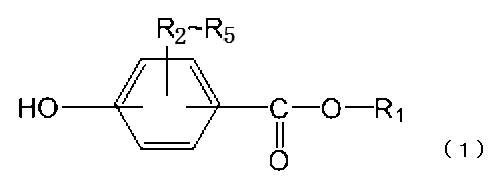
R2~R5はそれぞれ水素、ハロゲン、又は置換基を有してもよい炭素数1~20のアルキル基若しくは炭素数6~12のアリール基を表し、
前記置換基は、ハロゲン、炭素数1~20のアルキル基、又は炭素数6~12のアリール基である。)
(II)前記2価フェノールが下記一般式(3)で表わされる、上記(I)に記載の合成樹脂積層シートである。
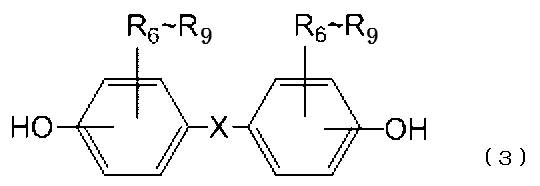
Xは、-O-、-S-、-SO-、-SO2-、-CO-、又は下記式(4)~(7)で示されるいずれかの結合基である。)
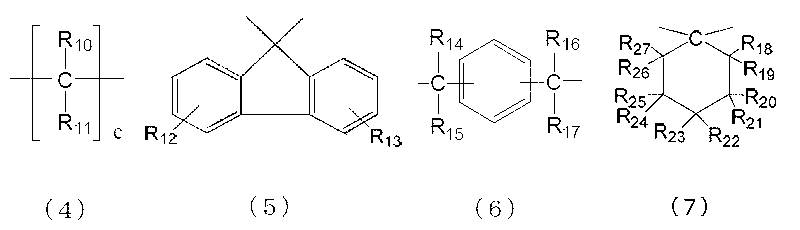
R10及びR11は互いに結合して、炭素数1~20の炭素環又は複素環を形成してもよく、
cは0~20の整数を表し、
R12及びR13はそれぞれ水素、ハロゲン、置換基を有してもよい炭素数1~20のアルキル基、置換基を有してもよい炭素数1~5のアルコキシ基、置換基を有してもよい炭素数6~12のアリール基、置換基を有してもよい炭素数2~5のアルケニル基、又は置換基を有してもよい炭素数7~17のアラルキル基を表し、
R12及びR13は互いに結合して、炭素数1~20の炭素環又は複素環を形成してもよく、
R14~R17はそれぞれ水素、ハロゲン、置換基を有してもよい炭素数1~20のアルキル基、置換基を有してもよい炭素数1~5のアルコキシ基、置換基を有してもよい炭素数6~12のアリール基、置換基を有してもよい炭素数2~5のアルケニル基、又は置換基を有してもよい炭素数7~17のアラルキル基を表し、
R14及びR15、並びにR16及びR17は、それぞれ互いに結合して、炭素数1~20の炭素環又は複素環を形成してもよく、
前記式(2)~(6)の置換基は、ハロゲン、炭素数1~20のアルキル基、又は炭素数6~12のアリール基であり、
R18~R27はそれぞれ水素原子、又は炭素数1~3のアルキル基である。
(III)前記式(1)で表される1価フェノールが、パラヒドロキシ安息香酸2-ヘキシルデシルエステル、パラヒドロキシ安息香酸ヘキサデシルエステル、パラヒドロキシ安息香酸ドデシルエステル及びパラヒドロキシ安息香酸2-エチルヘキシルエステルから選択される群のうち、少なくとも1種類以上である、上記(I)又は(II)に記載の合成樹脂積層シートである。
(IV)ひずみ速度0.01~5.0/secの条件下における、前記ポリカーボネート樹脂(A)の、伸長粘度が、ひずみ軟化性を示す、上記(I)~(III)のいずれかに記載の合成樹脂積層シート。
(V)前記ポリカーボネート樹脂(A)と前記アクリル系樹脂(B)とのガラス転移温度の絶対値差が、30℃以内である、上記(I)~(IV)のいずれかに記載の合成樹脂積層シートである。
(VI)前記アクリル系樹脂(B)層における、前記ポリカーボネート樹脂(A)層とは反対側の表面上にハードコート層を積層した、上記(I)~(V)のいずれかに記載の合成樹脂積層シートである。
(VII)前記ハードコート層の厚みが1~20μmである、上記(VI)に記載の合成樹脂積層シートである。
(VIII)上記(I)~(VII)のいずれかに記載の合成樹脂積層シートを深絞り高さ5mm以上に熱成形してなる熱成形体である。
(IX)直角形状に熱成形した直角形状部の半径Rが3.0mm以内である、上記(VIII)に記載の熱成形体である。
(X)上記(I)~(VII)のいずれかに記載の合成樹脂積層シートの基材層側に印刷層を形成して熱成形し、さらに前記印刷層側に溶融樹脂を射出成形して裏打ち層を形成してなるインモールド成形体である。
(XI)1価フェノールの末端停止剤による下記一般式(1-a)で表わされる末端基を有し、粘度平均分子量18000~35000のポリカーボネート樹脂(A)を含有してなる基材層の少なくとも片面に、アクリル系樹脂(B)を含む被覆層を積層した、合成樹脂積層シート。

R2~R5は、それぞれ水素、ハロゲン、又は置換基を有してもよい炭素数1~20のアルキル基若しくは炭素数6~12のアリール基を表し、
前記置換基は、ハロゲン、炭素数1~20のアルキル基、又は炭素数6~12のアリール基である。)
しかも、基材層のポリカーボネート樹脂(A)においては、詳細を後述するように、ひずみ速度0.01~5.0/secの条件下での伸長粘度がひずみ軟化性を示すものであり、熱成形した時、特に深絞り成形した時に、該ポリカーボネート樹脂は非常に伸びやすいため、白化やクラックを抑制することが可能となった。また、該ポリカーボネート樹脂(A)は、長鎖の末端基を有するため、従来のポリカーボネートに比べて高温下で軟化し易くTgが低くなるといった特徴もあり、例えば、被覆層の主成分であるアクリル系樹脂(B)とのガラス転移温度の差(絶対値)を30℃以内に設定できることから、成形時にアクリル系樹脂(B)を過剰に加熱することを防ぐことができ、熱成形時に発泡を生じないようにすることができた。さらに、被覆層の上にハードコート層を設けた構成においても、ポリカーボネート樹脂の基材層のひずみ軟化性に積層体がより伸びやすくなることや、ガラス転移温度の差を30℃以内とする事で、加熱及び変形によるハードコート層のクラックを防止する事が可能になった。
よって、本発明の合成樹脂積層シートを用いて熱成形すれば、意匠性に優れた成形体は勿論、例えば意匠性に優れたインモールド成型体なども提供することができる。

本合成樹脂積層シートの基材層は、一般式(3)に示す2価フェノール、カーボネート結合剤、および上記一般式(1)に示す末端停止剤を反応させて得ることができるポリカーボネート樹脂を主な成分とする。

そして上述の各置換基は、ハロゲン、炭素数1~20のアルキル基、又は、炭素数6~12のアリール基である。
Xは、-O-、-S-、-SO-、-SO2-、-CO-、下記式(4)~(7)で示されるいずれかの結合基である。)

(式(5)中、R12及びR13はそれぞれ水素、ハロゲン、置換基を有してもよい炭素数1~20、好ましくは炭素数1~9のアルキル基、置換基を有してもよい炭素数1~5、好ましくは炭素数1~3のアルコキシ基、置換基を有してもよい炭素数6~12、好ましくは炭素数6~8のアリール基、置換基を有してもよい炭素数2~15、好ましくは炭素数2~5のアルケニル基、又は置換基を有してもよい炭素数7~17、好ましくは炭素数7~12のアラルキル基を表す。また、R12及びR13は互いに結合して、炭素数1~20、好ましくは炭素数1~12の炭素環又は複素環を形成してもよい。)
(式(6)中、R14~R17はそれぞれ水素、ハロゲン、置換基を有してもよい炭素数1~20、好ましくは炭素数1~9のアルキル基、置換基を有してもよい炭素数1~5、好ましくは炭素数1~3のアルコキシ基、置換基を有してもよい炭素数6~12、好ましくは炭素数6~8のアリール基、置換基を有してもよい炭素数2~15、好ましくは炭素数2~5のアルケニル基、又は置換基を有してもよい炭素数7~17、好ましくは炭素数7~12のアラルキル基を表す。また、R14及びR15、並びにR16及びR17は、それぞれ互いに結合して、炭素数1~20の炭素環又は複素環を形成してもよい。)
(前記式(3)~(6)の置換基は、ハロゲン、炭素数1~20のアルキル基、又は炭素数6~12のアリール基である。)
(式(7)中、R18~R27はそれぞれ水素原子、又は炭素数1~3のアルキル基である。
本発明のカーボネート結合剤としては、ホスゲン、トリホスゲン、炭酸ジエステル、及び、一酸化炭素や二酸化炭素と云ったカルボニル系化合物が例示される。
本発明の末端停止剤は、一般式(1)で示される。
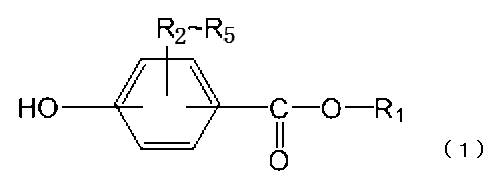
上記式(1)の末端停止剤を用いることにより、ポリカーボネート樹脂は、下記一般式(1-a)で表わされる末端基を有する。
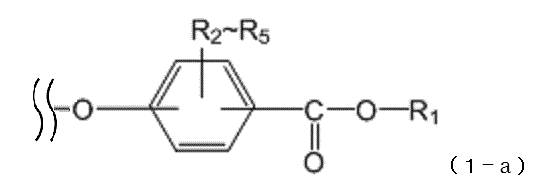
R2~R5は、それぞれ水素、ハロゲン、又は置換基を有してもよい炭素数1~20のアルキル基若しくは炭素数6~12のアリール基を表し、
前記置換基は、ハロゲン、炭素数1~20のアルキル基、又は炭素数6~12のアリール基である。)

具体的には、R1の炭素数の上限値として36が好ましく、22がより好ましく、18が特に好ましい。また、R1の炭素数の下限値として、8が好ましく、12がより好ましい。
一例として、R1の炭素数が36以下であれば、ポリカーボネート樹脂を製造するにあたって生産性が高く、経済性も良い。R1の炭素数が22以下であれば、1価フェノールは、特に有機溶剤溶解性に優れており、ポリカーボネート樹脂を製造するにあたって生産性を非常に高くすることができ、経済性も向上する。
一般式(1)又は一般式(2)におけるR1の炭素数が少なすぎると、ポリカーボネート樹脂のガラス転移温度が十分に低い値とはならず、熱成形性が低下することがある。
他に併用してもよい末端停止剤としては、フェノール、p-クレゾール、o-クレゾール、2,4-キシレノール、p-t-ブチルフェノール、o-アリルフェノール、p-アリルフェノール、p-ヒドロキシスチレン、p-ヒドロキシ-α-メチルスチレン、p-プロピルフェノール、p-クミルフェノール、p-フェニルフェノール、o-フェニルフェノール、p-トリフルオロメチルフェノール、p-ノニルフェノール、p-ドデシルフェノール、オイゲノール、アミルフェノール、ヘキシルフェノール、ヘプチルフェノール、オクチルフェノール、ノニルフェノール、デシルフェノール、ドデシルフェノール、ミリスチルフェノール、パルミチルフェノール、ステアリルフェノール、ベヘニルフェノール等のアルキルフェノール及びパラヒドロキシ安息香酸のメチルエステル、エチルエステル、プロピルエステル、ブチルエステル、アミルエステル、ヘキシルエステル、ヘプチルエステル等のパラヒドロキシ安息香酸アルキルエステルが挙げられる。また、上記一価フェノールを2種類以上併用して使用することも可能である。
本発明のポリカーボネート樹脂は、1価フェノール(末端停止剤)の使用量によって分子量が制御される。
主骨格のために使用する2価フェノール(一般式(2)で示される)の重合度と、1価フェノール(末端停止剤)の使用量は式(A)に示される。

本発明に使用するポリカーボネート樹脂には、本発明の趣旨を逸脱しない範囲で各種添加剤が配合されていてもよい。添加剤としては、熱安定剤、酸化防止剤、難燃剤、難燃助剤、紫外線吸収剤、離型剤及び着色剤から成る群から選択された少なくとも1種類の添加剤が例示される。
また、所望の諸物性を著しく損なわない限り、帯電防止剤、蛍光増白剤、防曇剤、流動性改良剤、可塑剤、分散剤、抗菌剤等を添加してもよい。
また、フルオロアルカン-スルホン酸金属塩としては、アルカリ金属塩及びアルカリ土類金属塩を挙げることができ、アルカリ金属塩が好ましい。フルオロアルカンスルホン酸金属塩の炭素数としては、1~8が好ましく、2~4がより好ましい。このような範囲とすることにより、高い透明性を維持できるという効果が得られる。好ましいフルオロアルカン-スルホン酸金属塩の具体例として、パーフルオロブタン-スルホン酸ナトリウム、パーフルオロブタン-スルホン酸カリウム、パーフルオロエタン-スルホン酸ナトリウム、パーフルオロエタン-スルホン酸カリウム、等を挙げることができる。
また、本発明では、有機スルホン酸金属塩以外の難燃剤を配合してもよい。
離型剤の添加割合は、配合する場合、芳香族ポリカーボネート樹脂100質量部に対して、好ましくは0.001質量部以上、より好ましくは0.01質量部以上であり、また、2質量部以下、より好ましくは1質量部以下である。離型剤の添加割合が下限値以下の場合、離型性の効果が十分でない場合があり、離型剤の添加割合が上限値を超える場合、耐加水分解性の低下、射出成形時の金型汚染等が生じる可能性がある。
着色剤の添加割合は、配合する場合、芳香族ポリカーボネート樹脂100質量部に対して、例えば1質量部以下、好ましくは0.5質量部以下、より好ましくは0.1質量部以下である。着色剤の添加割合が多すぎると耐衝撃性が十分で無くなる可能性がある。
本発明で用いるポリカーボネート樹脂の製造方法としては、例えば、界面重合法、ピリジン法、エステル交換法をはじめとする各種合成方法を挙げることができる。
(I)分子量
本発明に使用するポリカーボネート樹脂の分子量は、以下の測定条件に基づいて測定された粘度平均分子量(Mv)で評価する。
測定機器:ウベローデ毛管粘度計
溶媒:ジクロロメタン
樹脂溶液濃度:0.5グラム/デシリットル
測定温度:25℃
上記条件で測定し、ハギンズ定数0.45で極限粘度[η]デシリットル/グラムを求め、次式(B)により算出する。

粘度平均分子量が35,000より大きい場合、溶融流動性が低下することがある。また、ポリカーボネート樹脂のガラス転移温度が低い値とはならず、熱成形性が低下することがある。
粘度平均分子量が18,000より小さい場合、耐ドローダウン性が低下することがある。
本発明の合成樹脂積層シートの基材層であるポリカーボネート樹脂の伸長粘度は、レオメータを用い、以下に示す条件にて測定する。
<伸長粘度測定条件>
装置:Rheometorics社製 Ares
冶具:ティーエーインスツルメント社製 Extentional Viscosity
Fixture
測定温度:ポリカーボネート樹脂(A)のガラス転移温度+30℃
歪み速度:0.01、1.0、5.0/sec
試験片の作製:プレス成形して18mm×10mm、厚さ0.7mm、のシートを作製する。
一般的に、ブロー成形、発泡成形、真空成形といった特定の成形方法においては、伸長粘度が時間と共に急激に増加するひずみ硬化性を示す材料が成形加工性の観点から好適とされており、ひずみ硬化性を有することで、成形時に均一な肉厚での変形が可能となる。しかし、アクリル系樹脂と熱可塑性樹脂の積層シート、さらにHC層を積層させたシートを深絞り、直角形状に熱成形する場合には、熱可塑性樹脂層がひずみ硬化性を有していると、均一に伸びようとする力が発生するあまり、アクリル系樹脂層との界面で白化、アクリル系樹脂の表面やHC層にクラックが発生し、直角形状部の半径Rは0mmに近づけることは困難である。それに対し、上述のひずみ軟化性を有する熱可塑性樹脂を用いると、白化、クラックといった外観不良は発生せず、直角形状部の半径Rも0mmに近い値を示すため、好ましい。
本発明の合成樹脂積層シートの基材層であるポリカーボネート樹脂のガラス転移温度は、示差走査熱量計を用い、以下に示す条件にて測定する。
<ガラス転移温度の測定条件>
測定機器:示差走査熱量測定機(DSC)
加温速度:10℃/min
ガスフロー環境:窒素20ml/min
試料前処理:300℃加熱融解
ガラス転移温度(Tg)が100℃未満になると、ポリカーボネート樹脂の製造上、造粒、乾燥工程においてポリカーボネート樹脂粉末が凝集し、生産性が低下してしまうことがある。
上記の理由により、ガラス転移点は高い方がポリカーボネート樹脂製造上のプロセスマージンが広く、残存溶媒含有率の低い高品質のポリカーボネート樹脂を効率的、安定的に製造できるため、本発明のポリカーボネート樹脂のガラス転移点は105℃以上であることがさらに好ましく、110℃以上であることが特に好ましい。
Tgが135℃より高い場合、熱成形体を製造する際に樹脂を高温で溶融する必要があり、また熱成形体を特定の形状に成形する際に樹脂を高温で軟化もしくは溶融する必要があり、エネルギー消費量が増加したり、樹脂色相が低下することがあり、好ましくない。また、本発明の合成樹脂積層シートの表面にハードコート層を施している場合、アクリル系樹脂(B)のガラス転移温度との温度差により、高温で軟化させる際にハードコート層にクラックが発生し易くなるため、好ましくない。
(IV)Q値
<Q値測定条件>
測定機器:流動特性評価装置フローテスター
荷重:160kgf/cm2
オリフィス:直径1mm×長さ10mm
測定温度:280℃
本発明の合成樹脂積層シートの基材層であるポリカーボネート樹脂の熱分解特性は、熱減量温度にて評価する。熱質量測定装置(TGA)を使用し、加温速度20℃/min、空気50ml/minフロー環境にて熱減量温度を測定する。
本合成樹脂積層シートの被覆層は、アクリル系樹脂(B)を主成分とする樹脂組成物から形成することができる。
本合成樹脂積層シートに用いるアクリル系樹脂は、アクリル基を有する樹脂であれば特に制限はない。例えば、メチルメタクリレートと、メチルアクリレート又はエチルアクリレートとの共重合体を挙げることができる。中でも、主成分がメチルメタクリル酸より重合されるメチルメタクリル樹脂(PMMA:ポリメチルメタ(ア)クリレートともいう)が好ましい。
また、押出成形が可能な範囲で架橋成分を含有してもよい。
また、共押出し成形時にアクリル系樹脂の熱劣化を防止するため、酸化防止剤、着色防止剤等を含有してもよい。この際、酸化防止剤の含有量はアクリル系樹脂の0.01~3質量%であることが好ましく、着色防止剤の含有量は0.01~3質量%であることが好ましい。
上記いずれの場合も、アクリル系樹脂の0.01質量%未満であると、十分な効果を得られないことが想定され、逆に5質量%を超えて含有しても、さらなる効果が期待できないばかりか、ブリードアウトを起こして白化の原因になったり、密着性や衝撃強度の低下を招いたりすることがあるため好ましくない。
本発明の合成樹脂積層シートにおいては、アクリル系樹脂層側の表面、すなわち、アクリル系樹脂(B)層における、ポリカーボネート樹脂(A)層とは反対側の表面上にハードコート層を積層させても良い。
ハードコート層としては、アクリル系、シリコン系、メラミン系、ウレタン系、エポキシ系等公知の架橋皮膜を形成する化合物を使用することができる。また、硬化方法も紫外線硬化、熱硬化、電子線硬化等公知の方法を用いることができる。これらの中で、表面側とする面には、鉛筆硬度H以上と出来るものが好ましく、熱賦形性とのバランスから、アクリル系、ウレタンアクリレート系が好ましいものとして例示される。
ハードコート層の付与は、通常の方法で良く、ロールコート法などの塗布法、ディップ法、転写法などで形成する。この例に制限されるものではない。
本合成樹脂積層シートの各層及びシート全体の厚さは、表面硬度及び成形性に問題が生じない範囲で適宜設定可能である。但し、一般的にはシート全体の厚さは、0.1mm~2.0mmであることが好ましく、被覆層の厚さは10μm~60μm、特に40μm~60μmであることが好ましい。
本合成樹脂積層シートの製造方法は、特に制限されるものではないが、生産性の観点から、共押出しによって基材層と被覆層とを積層させることが好ましい。
例えば、ポリカーボネート樹脂(A)及びアクリル系樹脂(B)を各々別々の押出機で加熱溶融し、Tダイのスリット状の吐出口からそれぞれ押出して積層し、次いで冷却ロールに密着固化させるようにする製造方法を挙げることができる。
例えばフィードブロック方式の場合であれば、フィードブロックで積層した溶融樹脂をTダイなどのシート成形ダイに導き、シート状に成形した後、表面が鏡面処理された成形ロール(ポリッシングロール)に流入させてバンクを形成し、該成形ロール通過中に鏡面仕上げと冷却を行うようにすればよい。
マルチマニホールド方式の場合には、マルチマニホールドダイ内で積層した溶融樹脂を、ダイ内部でシート状に成形した後、成形ロールにて表面仕上げ及び冷却を行うようにすればよい。
いずれにしても、ダイの温度は、通常230~290℃、中でも250~280℃に設定し、成形ロール温度は、通常100~190℃、中でも110~190℃に設定することが好ましい。
本合成樹脂積層シートは、アクリル系樹脂(B)を主成分とする被覆層を備えているため、合成樹脂積層シートの被覆層表面、並びに該合成樹脂積層シートを成形してなる製品表面に傷が入り難いという特徴を備えている。また、基材層であるポリカーボネート樹脂(A)は、ひずみ速度0.01~5.0/secの条件下での伸長粘度が、ひずみ軟化性を示し、アクリル系樹脂(B)とのガラス転移温度の差の絶対値が30℃以内になるよう設定したことにより、被覆層側が製品の表面となるように熱成形した時でさえ、特に深絞り成形した時でさえ、白化やクラック、さらには発泡を生じないようにすることができる。さらにHC層を積層させたシートの場合にも、同様に良好な熱成形ができる。
よって、本合成樹脂積層シートを用いて熱成形すれば、意匠性に優れた熱成形体、特に深絞り成形して得られる意匠性に優れた熱成形体を得ることができる。
なお、本発明では、成形する際の深絞り高さが3mm以上、特に5mm以上である場合を深絞りといい、さらに直角形状に成形した際の直角形状部の半径をRとする。本合成樹脂積層シートの場合、深絞り高さが5mm以上、より好ましい態様においては7mm以上の深絞り、且つ、直角形状に成形した場合にも白化やクラック、さらには発泡を生じないようにすることができ、直角形状部の半径Rを少なくとも3.0mm以内、さらに好ましい態様においては1.0mm以内とすることができる。
また、本合成樹脂積層シートは上記のような特徴を備えているため、例えば合成樹脂積層シートの基材層側に印刷層を形成して熱成形する一方、前記印刷層側に溶融樹脂を射出成形して裏打ち層を形成することにより、意匠性に優れたインモールド成形体を製造することもできる。
<合成例1>
有機化学ハンドブックP143~150に基づき、東京化成工業(株)製4-ヒドロキシ安息香酸と東京化成工業(株)製1-ヘキサデカノールを用いて脱水反応によるエステル化を行い、パラヒドロキシ安息香酸ヘキサデシルエステル(CEPB)を得た。
合成例1において、1-ヘキサデカノールを新日本理化(株)製2-ヘキシルデカノール(商品名:エヌジェコール 160BR)に変更した以外は、製造例1と同様に操作して、パラヒドロキシ安息香酸2-ヘキシルデシルエステル(HDPB)を得た。
(製造例1)
製造例1において、CEPBを東京化成工業(株)製パラヒドロキシ安息香酸2-エチルヘキシルエステル(EHPB)に変更し、EHPBの量を376g(1.50mol)とした以外は、製造例1と同様に操作してポリカーボネート樹脂ペレットを得た。
製造例1において、CEPBをパラヒドロキシ安息香酸2-ヘキシルデシルエステル(HDPB)に変更し、HDPBの量を383g(1.06mol)とした以外は、製造例1と同様に操作してポリカーボネート樹脂ペレットを得た。
製造例1において、CEPBの量を443g(1.22mol)に変更した以外は、製造例1と同様に操作してポリカーボネート樹脂ペレットを得た。
製造例1において、CEPBを東京化成工業(株)製パラヒドロキシ安息香酸ドデシルエステル(PODB)に変更し、PODBの量を443g(1.45mol)とした以外は、製造例1と同様に操作してポリカーボネート樹脂ペレットを得た。
ポリカーボネート樹脂(A)及びアクリル系樹脂(B)を各々別々の押出機で加熱溶融し、Tダイのスリット状の吐出口から2種類の樹脂を同時に溶融押出し、基材層及び被覆層からなる2種2層に積層した。
ポリカーボネート樹脂(A)を押出すメイン押出機は、バレル直径75mm、スクリューのL/D=32、シリンダー温度270℃に設定した。アクリル系樹脂(B)を押出すサブ押出機は、バレル直径40mm、スクリュウのL/D=32、シリンダー温度250℃に設定した。
そして、メイン押出機とサブ押出機の回転数は、吐出量比がメイン/サブ=440/60となるように設定して、0.5mm厚さとなるように共押出して合成樹脂積層シート(シート全体厚さ0.5mm、被覆層厚さ60μm)を得た。
得られた合成樹脂積層シートの評価結果を表1に示した。
実施例1の製造条件の中で、吐出量比のみを変更し、合成樹脂積層シート(シート全体厚さ0.125mm、被覆層厚さ30μm)を得た。吐出量比はメイン/サブ=95/30とした。
得られた合成樹脂積層シートの評価結果を表1に示した。
実施例1で製造した合成樹脂積層シート(シート全体厚さ0.5mm、被覆層厚さ60μm)のアクリル系樹脂層の上に、ロールコート法を用いてハードコート(中国塗料株式会社製のウレタンアクリレート系樹脂、製品名363C-224HG、ハードコート伸び率;100%)、耐擦り傷性試験(日本スチールウール株式会社製#0000スチールウールを33mm×33mmの正方形パッドに装着し、ハードコート層の表面を荷重1000g下で15往復させる)において、擦傷させた後のヘーズが、10%以下である実用的なハードコートを7μm塗布した、合成樹脂積層シートを得た。
得られた合成樹脂積層シートの評価結果を表1に示した。
実施例2で製造した合成樹脂積層シート(シート全体厚さ0.125mm、被覆層厚さ30μm)のアクリル系樹脂層の上に、実施例3と同様のハードコートを塗布した合成樹脂積層シートを得た。
得られた合成樹脂積層シートの評価結果を表1に示した。
ポリカーボネート樹脂(A)の種類を変えた以外は、実施例1と同じ製造条件で合成樹脂積層シート(シート全体厚さ0.5mm、被覆層厚さ60μm)を得た。ポリカーボネート樹脂(A)としては、製造例2のポリカーボネート樹脂を用いた。
得られた合成樹脂積層シートの評価結果を表1に示した。
実施例5の製造条件の中で、吐出量比のみを変更し、合成樹脂積層シート(シート全体厚さ0.125mm、被覆層厚さ30μm)を得た。吐出量比はメイン/サブ=95/30とした。
得られた合成樹脂積層シートの評価結果を表1に示した。
実施例5で製造した合成樹脂積層シート(シート全体厚さ0.5mm、被覆層厚さ60μm)のアクリル系樹脂層の上に、実施例3と同様のハードコートを塗布した合成樹脂積層シートを得た。
得られた合成樹脂積層シートの評価結果を表2に示した。
実施例6で製造した合成樹脂積層シート(シート全体厚さ0.125mm、被覆層厚さ30μm)のアクリル系樹脂層の上に、実施例3と同様のハードコートを塗布した合成樹脂積層シートを得た。
得られた合成樹脂積層シートの評価結果を表2に示した。
ポリカーボネート樹脂(A)の種類を変えた以外は、実施例1と同じ製造条件で合成樹脂積層シート(シート全体厚さ0.5mm、被覆層厚さ60μm)を得た。ポリカーボネート樹脂(A)としては、製造例3のポリカーボネート樹脂を用いた。
得られた合成樹脂積層シートの評価結果を表2に示した。
ポリカーボネート樹脂(A)の種類を変えた以外は、実施例1と同じ製造条件で合成樹脂積層シート(シート全体厚さ0.5mm、被覆層厚さ60μm)を得た。ポリカーボネート樹脂(A)としては、製造例4のポリカーボネート樹脂を用いた。
得られた合成樹脂積層シートの評価結果を表2に示した。
ポリカーボネート樹脂(A)の種類を変えた以外は、実施例1と同じ製造条件で合成樹脂積層シート(シート全体厚さ0.5mm、被覆層厚さ60μm)を得た。ポリカーボネート樹脂(A)としては、製造例5のポリカーボネート樹脂を用いた。
得られた合成樹脂積層シートの評価結果を表2に示した。
ポリカーボネート樹脂(A)の種類を変えた以外は、実施例1と同様の成形条件にて、アクリル系樹脂(B)を共押出せず、ポリカーボネート樹脂(A)の単層シート(シート全体厚さ0.5mm)を得た。
ポリカーボネート系樹脂組成物(A)を押出す押出機は、バレル直径65mm、スクリューのL/D=35、シリンダー温度270℃に設定した。
得られた合成樹脂シートの評価結果を表3に示した。
比較例1の製造条件の中で、吐出量比のみを変更し、合成樹脂積層シート(シート全体厚さ0.125mm)を得た。
得られた合成樹脂シートの評価結果を表3に示した。
比較例1で得られた合成樹脂シートの上に、実施例3と同様のハードコートを塗布した合成樹脂積層シートを得た。
得られた合成樹脂積層シートの評価結果を表3に示した。
比較例2で得られた合成樹脂シートの上に、実施例3と同様のハードコートを塗布した合成樹脂積層シートを得た。
得られた合成樹脂積層シートの評価結果を表3に示した。
ポリカーボネート樹脂(A)の種類を変えたこと以外は、実施例1と同じ製造条件で、合成樹脂積層シート(シート全体厚さ0.5mm、被覆層厚さ60μm)を得た。
ポリカーボネート樹脂(A)としては、芳香族ポリカーボネート樹脂(三菱エンジニアリングプラスチックス(株)製、商品名S-3000、Mv21、000、Tg147℃、(末端構造はパラターシャリーブチルフェノール(PTBP)、伸長粘度はひずみ軟化性を示さない。)を用いた。
得られた合成樹脂積層シートの評価結果を表3に示した。
比較例5の製造条件の中で、吐出量比のみを変更し、合成樹脂積層シート(シート全体厚さ0.125mm、被覆層厚さ30μm)を得た。吐出量比はメイン/サブ=95/30とした。
得られた合成樹脂積層シートの評価結果を表3に示した。
比較例5で得られた合成樹脂積層シートのアクリル系樹脂層の上に、実施例3と同様のハードコートを塗布した合成樹脂積層シートを得た。
得られた合成樹脂積層シートの評価結果を表4に示した。
比較例6で得られた合成樹脂積層シートのアクリル系樹脂層の上に、実施例3と同様のハードコートを塗布した合成樹脂積層シートを得た。
得られた合成樹脂積層シートの評価結果を表4に示した。
末端停止剤として、製造例1のCEPBの代わりにp-tert-ブチルフェノール(PTBP)を用いたこと、およびポリカーボネート樹脂(A)の種類を変えたこと以外は、実施例1と同じ製造条件で、合成樹脂積層シート(シート全体厚さ0.5mm、被覆層厚さ60μm)を得た。
ポリカーボネート樹脂(A)としては、芳香族ポリカーボネート樹脂(三菱エンジニアリングプラスチックス(株)製、商品名E-2000、Mv28、000、Tg147℃)と、ポリシクロヘキサンジメチレンテレフタレート樹脂(PETのエチレングリコールの65mol%を1.4-CHDMで置換した構造を有する低結晶性の共重合ポリエステル。Tg86℃)とを、質量比で70:30の割合で混合し、加熱しながら溶融混練してポリマーアロイ化させてなるポリカーボネート系樹脂組成物を使用した。このポリカーボネート系樹脂組成物のガラス転移温度を測定したところ、DSC曲線の微分の極大値は単一(Tg121℃)であり、ポリマーアロイであることが確認できた。また、伸長粘度はひずみ軟化性を示した。
得られた合成樹脂積層シートの評価結果を表4に示した。
比較例9の製造条件の中で、吐出量比のみを変更し、合成樹脂積層シート(シート全体厚さ0.125mm、被覆層厚さ30μm)を得た。吐出量比はメイン/サブ=95/30とした。
得られた合成樹脂積層シートの評価結果を表4に示した。
比較例9で得られた合成樹脂積層シートのアクリル系樹脂層の上に、実施例3と同様のハードコートを塗布した合成樹脂積層シートを得た。
得られた合成樹脂積層シートの評価結果を表4に示した。
比較例10で得られた合成樹脂積層シートのアクリル系樹脂層の上に、実施例3と同様のハードコートを塗布した合成樹脂積層シートを得た。
得られた合成樹脂積層シートの評価結果を表4に示した。
1)鉛筆硬度
JIS K5400に準拠し、1Kg荷重で、実施例及び比較例で得られた合成樹脂積層シートの表面(被覆層が形成されている場合は被覆層側表面)における鉛筆硬度を測定した。
そして、実用上問題ないレベルである「H」を基準とし、これ以上の「H」「2H」などを合格(「良好」)と評価し、これ未満の「B」を不合格(「不良」)と評価した。
実施例及び比較例で得られた合成樹脂積層シートのポリカーボネート樹脂(A)とアクリル系樹脂(B)の界面に乱れ(流れ模様)がなく、良外観である場合には(「良好」)と評価し、界面に乱れが発生している場合には(「不良」)と評価した。
実施例及び比較例で得られた合成樹脂積層シートを、210mm×297mm×(厚さ)0.5mm、0.125mmに裁断し、得られたサンプルシートをポリカーボネート樹脂(A)のTg+30℃に予熱し、当該温度(表1及び表2参照)で5MPaの高圧空気により、表1及び表2に示した深絞り高さで、直角形状の金型を用いて圧空成形を行なった。なお、深絞り高さは、1mm、2mm・・・5mmのように、1mmきざみで深絞り高さを変更した直角形状金型を使用して設定した。
得られた成形体の表面状態(クラック、白化、発泡、ムラ)状態を観察し、クラック、白化、発泡及びムラのいずれも観察されない場合に「外観異常無」と評価し、さらに、5mm以上深絞り高さで、直角形状部の半径Rが3.0mm以内である成形体で外観異常無の状態に成形できたものを合格(「良好」)と総合評価した。なお、直角形状部の半径Rの測定は、接触式輪郭形状測定機CONTOURECORD2700/503((株)東京精密製)を使用し、半径Rを実測した。

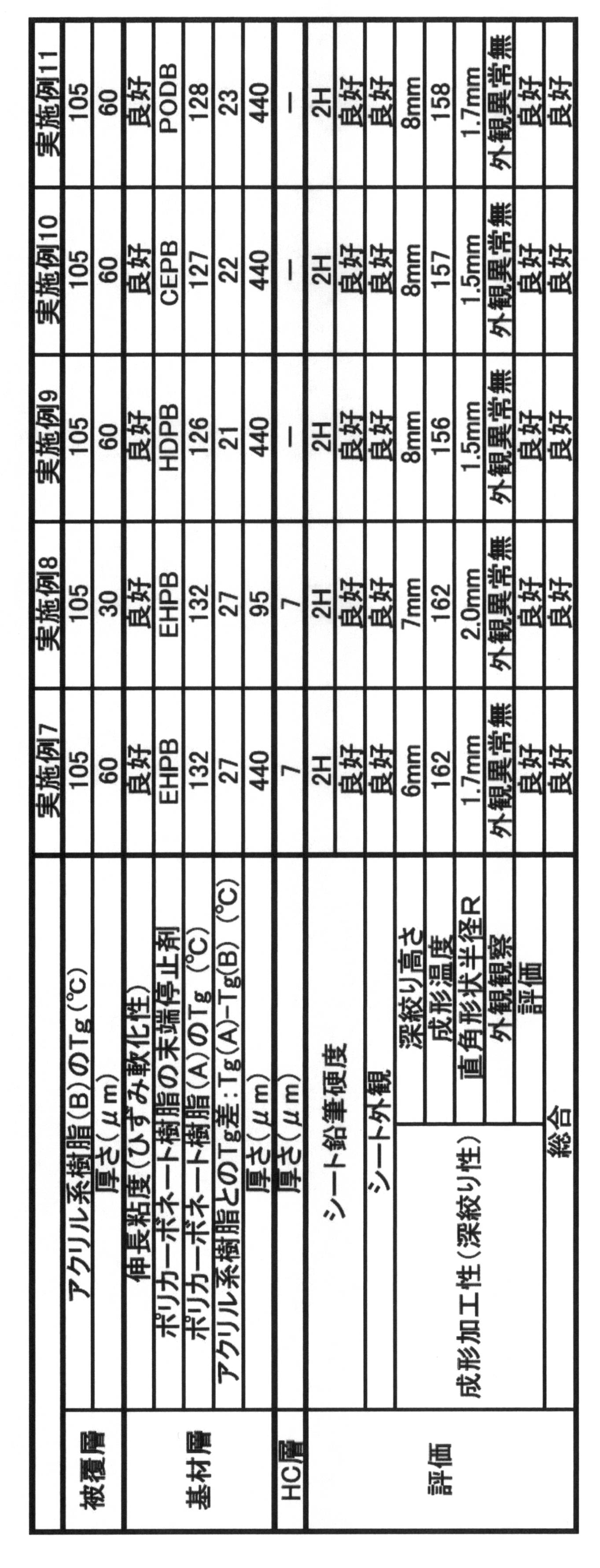
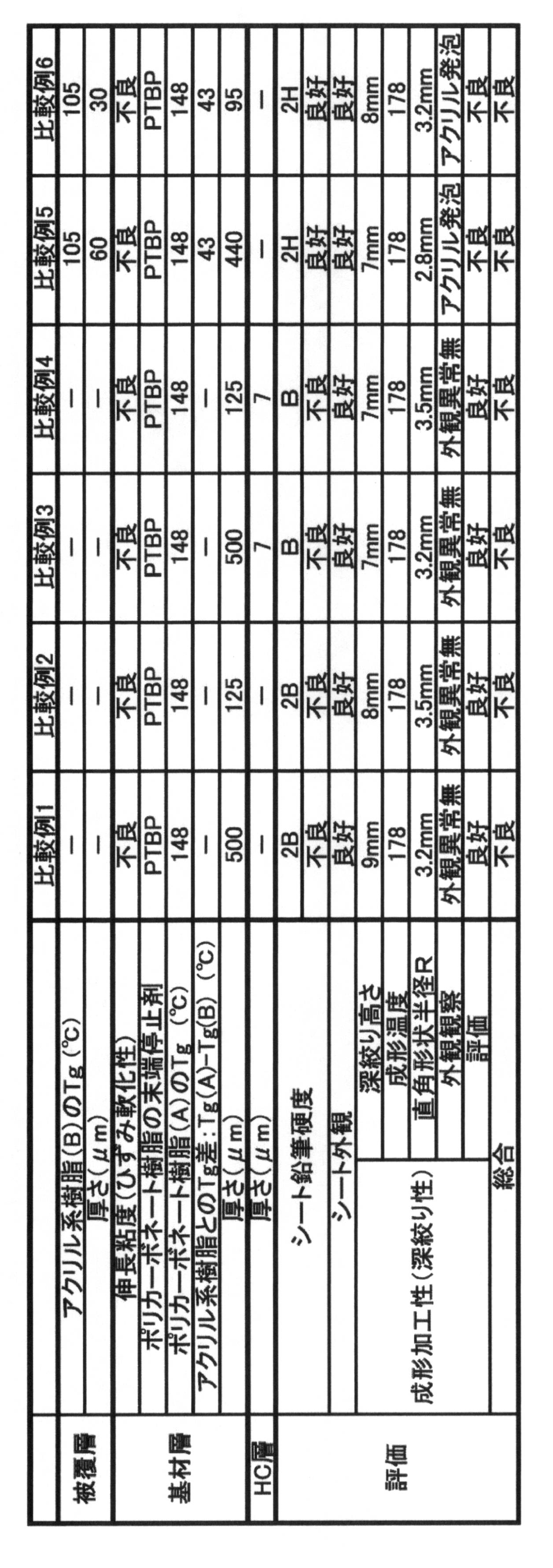
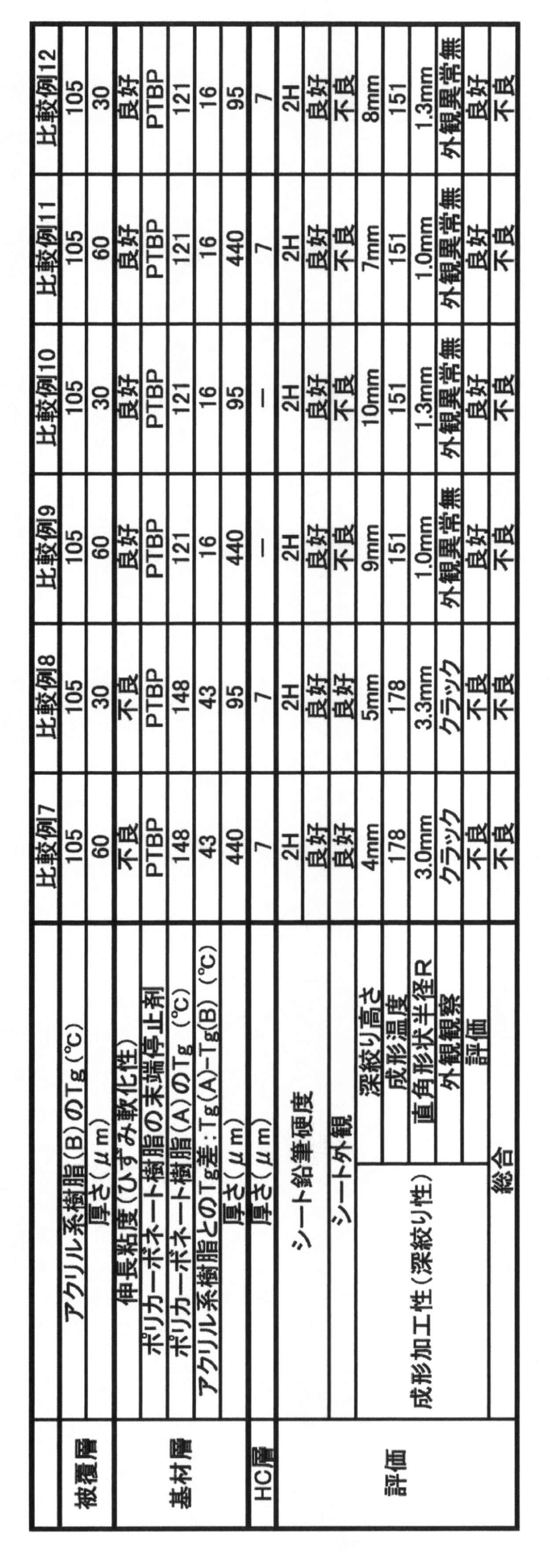
以上の結果、アクリル系樹脂(B)を主成分とする被覆層を形成することにより、合成樹脂積層シート表面(被覆層表面)の硬度を十分に高めることできることを確認できた。よって、合成樹脂積層シートは勿論、これを成形してなる製品表面に傷が入り難くすることができる。
また、基材層であるポリカーボネート樹脂(A)の伸長粘度が、ひずみ軟化性を示すことで、深絞り高さ7mm以上に深絞り、且つ、直角形状に成形してもクラック、白化、発泡、ムラなどの外観不良を生じることなく成形品を得ることができることが判明した。 より具体的には、ポリカーボネート樹脂(A)の末端停止剤として、末端アルキル基(上記式(1)のR1)の炭素数が8であるCEPB(実施例1~4)、末端アルキル基の炭素数が16であるEHPB(実施例5~8)、HDPB(実施例9)、ならびにCEPB(実施例10)、および末端アルキル基の炭素数が12であるPODB(実施例11)を用いることにより、ポリカーボネート樹脂(A)の伸長粘度にひずみ軟化性を備えさせたことにより、合成樹脂積層シートの優れた成形性を実現するとともに、外観も良好に保つことができた。また、アクリル系樹脂(B)により形成された層を有するため、表面の硬度も十分であった。
これに対し、アクリル系樹脂(B)の層を有していない比較例1~4の合成樹脂積層シートは表面硬度が不足し、末端停止剤として、末端アルキル基の炭素数が少ないものを用いたために、ひずみ軟化性および成形加工性に劣る結果となった。また、アクリル系樹脂(B)の層を有するものの、末端アルキル基の炭素数が少ないポリカーボネート樹脂(A)を用いた比較例5~8においては、発泡やクラックが認められ、成形性に劣る結果となった。さらに、ひずみ軟化性を備えてはいるものの、ポリカーボネート系樹脂として他の樹脂を含むポリマーアロイを採用した比較例9~12においては、シート外観に劣る結果となった。
これより、本発明の合成樹脂積層シートを用いれば、表面が傷つき難く、且つ成形性が優れた成形品を得ることができるばかりか、印刷インクの色やけのないインモールド成型品を製造することができるといえる。インモールド成型品としては、例えば、基材層側に印刷インクによる印刷層を設けて熱成形し、さらに、印刷層側に溶融樹脂を射出成形して裏打ち層を設けたものなどが挙げられる。
Claims (11)
- 下記一般式(1)で表わされる1価フェノールを末端停止剤として、2価フェノールおよびカーボネート結合剤と反応させて得られる粘度平均分子量18000~35000のポリカーボネート樹脂(A)を含有してなる基材層の少なくとも片面に、アクリル系樹脂(B)を含む被覆層を積層した、合成樹脂積層シート。

R2~R5は、それぞれ水素、ハロゲン、又は置換基を有してもよい炭素数1~20のアルキル基若しくは炭素数6~12のアリール基を表し、
前記置換基は、ハロゲン、炭素数1~20のアルキル基、又は炭素数6~12のアリール基である。) - 前記2価フェノールが下記一般式(3)で表わされる、請求項1に記載の合成樹脂積層シート。
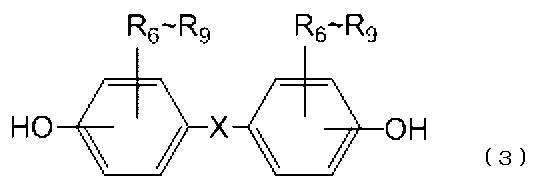
前記置換基は、ハロゲン、炭素数1~20のアルキル基、又は炭素数6~12のアリール基であり、
Xは、-O-、-S-、-SO-、-SO2-、-CO-、又は下記式(4)~(7)で示されるいずれかの結合基である。)
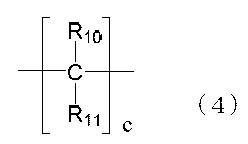
R10及びR11は互いに結合して、炭素数1~20の炭素環又は複素環を形成してもよく、
cは0~20の整数を表す)
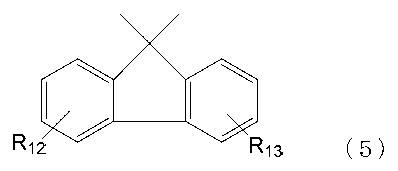
R12及びR13は互いに結合して、炭素数1~20の炭素環又は複素環を形成してもよい。)

R14及びR15、並びにR16及びR17は、それぞれ互いに結合して、炭素数1~20の炭素環又は複素環を形成してもよい。)
(前記式(3)~(6)の置換基は、ハロゲン、炭素数1~20のアルキル基、又は炭素数6~12のアリール基である。)

- 前記式(1)で表される1価フェノールが、パラヒドロキシ安息香酸2-ヘキシルデシルエステル、パラヒドロキシ安息香酸ヘキサデシルエステル、パラヒドロキシ安息香酸ドデシルエステル及びパラヒドロキシ安息香酸2-エチルヘキシルエステルから選択される群のうち、少なくとも1種類以上である、請求項1又は2に記載の合成樹脂積層シート。
- ひずみ速度0.01~5.0/secの条件下における、前記ポリカーボネート樹脂(A)の、伸長粘度が、ひずみ軟化性を示す、請求項1~3のいずれか一項に記載の合成樹脂積層シート。
- 前記ポリカーボネート樹脂(A)と前記アクリル系樹脂(B)とのガラス転移温度の絶対値差が、30℃以内である、請求項1~4のいずれか一項に記載の合成樹脂積層シート。
- 前記アクリル系樹脂(B)層における、前記ポリカーボネート樹脂(A)層とは反対側の表面上にハードコート層を積層した、請求項1~5のいずれか一項に記載の合成樹脂積層シート。
- 前記ハードコート層の厚みが1~20μmである、請求項6に記載の合成樹脂積層シート。
- 請求項1~7のいずれか一項に記載の合成樹脂積層シートを深絞り高さ5mm以上に熱成形してなる熱成形体。
- 直角形状に熱成形した直角形状部の半径Rが3.0mm以内である、請求項8に記載の熱成形体。
- 請求項1~7のいずれか一項に記載の合成樹脂積層シートの基材層側に印刷層を形成して熱成形し、さらに前記印刷層側に溶融樹脂を射出成形して裏打ち層を形成してなるインモールド成形体。
- 1価フェノールの末端停止剤による下記一般式(1-a)で表わされる末端基を有し、粘度平均分子量18000~35000のポリカーボネート樹脂(A)を含有してなる基材層の少なくとも片面に、アクリル系樹脂(B)を含む被覆層を積層した、合成樹脂積層シート。

R2~R5は、それぞれ水素、ハロゲン、又は置換基を有してもよい炭素数1~20のアルキル基若しくは炭素数6~12のアリール基を表し、
前記置換基は、ハロゲン、炭素数1~20のアルキル基、又は炭素数6~12のアリール基である。)
Priority Applications (5)
| Application Number | Priority Date | Filing Date | Title |
|---|---|---|---|
| JP2016554074A JP6563411B2 (ja) | 2014-10-15 | 2015-10-13 | 合成樹脂積層シート |
| KR1020177012774A KR102526816B1 (ko) | 2014-10-15 | 2015-10-13 | 합성 수지 적층 시트 |
| US15/518,321 US10118988B2 (en) | 2014-10-15 | 2015-10-13 | Synthetic resin laminated sheet |
| EP15850495.1A EP3208087B1 (en) | 2014-10-15 | 2015-10-13 | Synthetic resin laminated sheet |
| CN201580055605.3A CN106794685B (zh) | 2014-10-15 | 2015-10-13 | 合成树脂叠层片 |
Applications Claiming Priority (2)
| Application Number | Priority Date | Filing Date | Title |
|---|---|---|---|
| JP2014-211201 | 2014-10-15 | ||
| JP2014211201 | 2014-10-15 |
Publications (1)
| Publication Number | Publication Date |
|---|---|
| WO2016060100A1 true WO2016060100A1 (ja) | 2016-04-21 |
Family
ID=55746646
Family Applications (1)
| Application Number | Title | Priority Date | Filing Date |
|---|---|---|---|
| PCT/JP2015/078873 Ceased WO2016060100A1 (ja) | 2014-10-15 | 2015-10-13 | 合成樹脂積層シート |
Country Status (7)
| Country | Link |
|---|---|
| US (1) | US10118988B2 (ja) |
| EP (1) | EP3208087B1 (ja) |
| JP (1) | JP6563411B2 (ja) |
| KR (1) | KR102526816B1 (ja) |
| CN (1) | CN106794685B (ja) |
| TW (1) | TWI679220B (ja) |
| WO (1) | WO2016060100A1 (ja) |
Cited By (22)
| Publication number | Priority date | Publication date | Assignee | Title |
|---|---|---|---|---|
| WO2018042952A1 (ja) * | 2016-09-05 | 2018-03-08 | リケンテクノス株式会社 | 多層フィルムの製造方法 |
| JP2018103518A (ja) * | 2016-12-27 | 2018-07-05 | 三菱瓦斯化学株式会社 | 透明樹脂積層体 |
| WO2019163829A1 (ja) * | 2018-02-22 | 2019-08-29 | 三菱瓦斯化学株式会社 | 反射防止フィルム、及び、反射防止フィルムを有する積層体フィルム |
| CN110651008A (zh) * | 2017-05-24 | 2020-01-03 | 三菱瓦斯化学株式会社 | 由碳纤维强化热塑性树脂形成的片材和该片材的制造方法 |
| WO2020179524A1 (ja) * | 2019-03-07 | 2020-09-10 | 三菱瓦斯化学株式会社 | 高硬度成形用樹脂シートおよびそれを用いた成形品 |
| WO2020241724A1 (ja) * | 2019-05-29 | 2020-12-03 | 株式会社クラレ | 積層体とその製造方法 |
| WO2020241725A1 (ja) * | 2019-05-29 | 2020-12-03 | 株式会社クラレ | 積層体とその製造方法、並びに成形体の製造方法 |
| WO2021014915A1 (ja) | 2019-07-25 | 2021-01-28 | 三菱瓦斯化学株式会社 | 透明樹脂積層体並びにそれを用いた透明基板材料及び透明保護材料 |
| JPWO2021029266A1 (ja) * | 2019-08-09 | 2021-02-18 | ||
| JP2021146687A (ja) * | 2020-03-23 | 2021-09-27 | 帝人株式会社 | 熱成形用シート、加飾シートおよびこれらを用いた成形体 |
| JP2022080269A (ja) * | 2020-11-17 | 2022-05-27 | 三菱瓦斯化学株式会社 | 樹脂組成物、平板状成形体、多層体および成形品の製造方法 |
| US11396165B2 (en) | 2017-06-13 | 2022-07-26 | Riken Technos Corporation | Multilayer film |
| JP2023045394A (ja) * | 2021-09-22 | 2023-04-03 | 三菱瓦斯化学株式会社 | 樹脂組成物、フィルム、および、多層フィルム |
| JP2023045395A (ja) * | 2021-09-22 | 2023-04-03 | 三菱瓦斯化学株式会社 | 樹脂組成物、フィルム、および、多層フィルム |
| WO2024101410A1 (ja) | 2022-11-10 | 2024-05-16 | 三菱瓦斯化学株式会社 | 多層体およびヘッドアップディスプレイ用防塵カバー |
| WO2025070510A1 (ja) | 2023-09-27 | 2025-04-03 | 三菱瓦斯化学株式会社 | 多層体、および、ヘッドアップディスプレイ用防塵カバー |
| WO2025070509A1 (ja) | 2023-09-27 | 2025-04-03 | 三菱瓦斯化学株式会社 | 多層体、および、ヘッドアップディスプレイ用防塵カバー |
| WO2025070511A1 (ja) | 2023-09-27 | 2025-04-03 | 三菱瓦斯化学株式会社 | 多層体、および、ヘッドアップディスプレイ用防塵カバー |
| WO2025110048A1 (ja) | 2023-11-21 | 2025-05-30 | 三菱瓦斯化学株式会社 | 熱成形用積層体及びそれを成形してなる成形品 |
| WO2025220596A1 (ja) | 2024-04-16 | 2025-10-23 | 三菱瓦斯化学株式会社 | 熱成形用積層体及びそれを成形してなる成形品 |
| WO2025239211A1 (ja) * | 2024-05-13 | 2025-11-20 | 三菱瓦斯化学株式会社 | 多層体、ヘッドアップディスプレイ用防塵カバー、および、樹脂組成物 |
| WO2025239212A1 (ja) * | 2024-05-13 | 2025-11-20 | 三菱瓦斯化学株式会社 | 多層体、および、ヘッドアップディスプレイ用防塵カバー |
Families Citing this family (8)
| Publication number | Priority date | Publication date | Assignee | Title |
|---|---|---|---|---|
| US20220380560A1 (en) * | 2016-09-05 | 2022-12-01 | Riken Technos Corporation | Method for producing multilayer film |
| EP3954729A4 (en) * | 2019-04-08 | 2022-06-01 | Mitsubishi Gas Chemical Company, Inc. | FILM, LAMINATE, THERMOFORMED BODY, IN-MOLD MOLDING, METHOD OF PRODUCING A MOLDING AND METHOD OF PRODUCING AN IN-MOLD CAST |
| EP3888585B1 (en) * | 2020-03-30 | 2022-11-23 | DENTSPLY SIRONA Inc. | Hand tool for separating a deep-drawn jaw-spanning dental apparatus of thermoform film and method of use |
| JP7537180B2 (ja) * | 2020-08-25 | 2024-08-21 | セイコーエプソン株式会社 | 可塑化装置、射出成形装置、および三次元造形装置 |
| KR20220039919A (ko) * | 2020-09-21 | 2022-03-30 | 삼성디스플레이 주식회사 | 커버 윈도우, 이의 제조 방법, 및 이를 포함하는 표시 장치 |
| JP7864989B2 (ja) * | 2020-11-17 | 2026-05-26 | 三菱瓦斯化学株式会社 | 樹脂組成物、平板状成形体、多層体、成形品および成形品の製造方法 |
| WO2022204081A1 (en) * | 2021-03-24 | 2022-09-29 | Celanese International Corporation | Thermoformed articles made from bio-based polymers and compositions therefore |
| TWI924959B (zh) * | 2021-12-24 | 2026-05-11 | 日商三菱瓦斯化學股份有限公司 | 聚碳酸酯樹脂,及其製造方法 |
Citations (4)
| Publication number | Priority date | Publication date | Assignee | Title |
|---|---|---|---|---|
| JPS60203632A (ja) * | 1984-03-28 | 1985-10-15 | Mitsubishi Gas Chem Co Inc | ポリカ−ボネ−ト樹脂光学成形品 |
| JP2002060527A (ja) * | 2000-08-11 | 2002-02-26 | Teijin Chem Ltd | ポリカーボネート樹脂組成物成形体 |
| WO2007132874A1 (ja) * | 2006-05-16 | 2007-11-22 | Mitsubishi Gas Chemical Company, Inc. | ポリカーボネート樹脂およびそれを用いた光学用材料 |
| JP2014043000A (ja) * | 2012-08-24 | 2014-03-13 | Mitsubishi Gas Chemical Co Inc | 加飾成形品の製造法及び共押し出しシート |
Family Cites Families (8)
| Publication number | Priority date | Publication date | Assignee | Title |
|---|---|---|---|---|
| JPH06279705A (ja) * | 1993-03-24 | 1994-10-04 | Mitsubishi Gas Chem Co Inc | ハードコート用紫外線硬化型塗料 |
| JPH11300842A (ja) * | 1998-04-17 | 1999-11-02 | Mitsubishi Eng Plast Corp | 光ディスク基板 |
| JP2004143365A (ja) | 2002-10-28 | 2004-05-20 | Sumitomo Chem Co Ltd | 耐擦傷性アクリル系樹脂フィルム及びそれを用いた携帯型情報端末の表示窓保護板 |
| JP2006103169A (ja) | 2004-10-06 | 2006-04-20 | Mitsubishi Gas Chem Co Inc | 液晶ディスプレーカバー用ポリカーボネート樹脂積層体 |
| WO2008047940A1 (fr) * | 2006-10-20 | 2008-04-24 | Mgc Filsheet Co., Ltd. | Stratifié comprenant une résine de polycarbonate |
| JP4971218B2 (ja) * | 2008-02-20 | 2012-07-11 | 三菱樹脂株式会社 | 成形用樹脂シート及び成形体 |
| JP5220464B2 (ja) * | 2008-04-12 | 2013-06-26 | 三菱瓦斯化学株式会社 | 多層積層体 |
| WO2013125500A1 (ja) * | 2012-02-22 | 2013-08-29 | 三菱瓦斯化学株式会社 | 合成樹脂積層体 |
-
2015
- 2015-10-13 TW TW104133511A patent/TWI679220B/zh active
- 2015-10-13 KR KR1020177012774A patent/KR102526816B1/ko active Active
- 2015-10-13 WO PCT/JP2015/078873 patent/WO2016060100A1/ja not_active Ceased
- 2015-10-13 EP EP15850495.1A patent/EP3208087B1/en active Active
- 2015-10-13 US US15/518,321 patent/US10118988B2/en active Active
- 2015-10-13 CN CN201580055605.3A patent/CN106794685B/zh active Active
- 2015-10-13 JP JP2016554074A patent/JP6563411B2/ja active Active
Patent Citations (4)
| Publication number | Priority date | Publication date | Assignee | Title |
|---|---|---|---|---|
| JPS60203632A (ja) * | 1984-03-28 | 1985-10-15 | Mitsubishi Gas Chem Co Inc | ポリカ−ボネ−ト樹脂光学成形品 |
| JP2002060527A (ja) * | 2000-08-11 | 2002-02-26 | Teijin Chem Ltd | ポリカーボネート樹脂組成物成形体 |
| WO2007132874A1 (ja) * | 2006-05-16 | 2007-11-22 | Mitsubishi Gas Chemical Company, Inc. | ポリカーボネート樹脂およびそれを用いた光学用材料 |
| JP2014043000A (ja) * | 2012-08-24 | 2014-03-13 | Mitsubishi Gas Chemical Co Inc | 加飾成形品の製造法及び共押し出しシート |
Non-Patent Citations (1)
| Title |
|---|
| See also references of EP3208087A4 * |
Cited By (52)
| Publication number | Priority date | Publication date | Assignee | Title |
|---|---|---|---|---|
| CN109661303B (zh) * | 2016-09-05 | 2021-08-24 | 理研科技株式会社 | 多层膜的制造方法 |
| CN109661303A (zh) * | 2016-09-05 | 2019-04-19 | 理研科技株式会社 | 多层膜的制造方法 |
| WO2018042952A1 (ja) * | 2016-09-05 | 2018-03-08 | リケンテクノス株式会社 | 多層フィルムの製造方法 |
| US11465323B2 (en) | 2016-09-05 | 2022-10-11 | Riken Technos Corporation | Method for producing multilayer film |
| EP3508323A4 (en) * | 2016-09-05 | 2020-04-29 | Riken Technos Corporation | METHOD FOR PRODUCING A MULTILAYER FILM |
| JP2018103518A (ja) * | 2016-12-27 | 2018-07-05 | 三菱瓦斯化学株式会社 | 透明樹脂積層体 |
| EP3632984A4 (en) * | 2017-05-24 | 2020-05-27 | Mitsubishi Gas Chemical Company, Inc. | FILM SHAPED FROM CARBON FIBER REINFORCED THERMOPLASTIC RESIN AND MANUFACTURING PROCESS FOR SUCH FILM |
| US11365298B2 (en) | 2017-05-24 | 2022-06-21 | Mitsubishi Gas Chemical Company, Inc. | Sheet formed from carbon fiber reinforced thermoplastic resin, and production method of said sheet |
| CN110651008A (zh) * | 2017-05-24 | 2020-01-03 | 三菱瓦斯化学株式会社 | 由碳纤维强化热塑性树脂形成的片材和该片材的制造方法 |
| US11396165B2 (en) | 2017-06-13 | 2022-07-26 | Riken Technos Corporation | Multilayer film |
| JP7306370B2 (ja) | 2018-02-22 | 2023-07-11 | 三菱瓦斯化学株式会社 | 反射防止フィルム、及び、反射防止フィルムを有する積層体フィルム |
| WO2019163829A1 (ja) * | 2018-02-22 | 2019-08-29 | 三菱瓦斯化学株式会社 | 反射防止フィルム、及び、反射防止フィルムを有する積層体フィルム |
| JPWO2019163829A1 (ja) * | 2018-02-22 | 2021-02-04 | 三菱瓦斯化学株式会社 | 反射防止フィルム、及び、反射防止フィルムを有する積層体フィルム |
| US11926126B2 (en) | 2018-02-22 | 2024-03-12 | Mitsubishi Gas Chemical Company, Inc. | Anti-reflection film and layered product film having anti-reflection film |
| WO2020179524A1 (ja) * | 2019-03-07 | 2020-09-10 | 三菱瓦斯化学株式会社 | 高硬度成形用樹脂シートおよびそれを用いた成形品 |
| JPWO2020241725A1 (ja) * | 2019-05-29 | 2020-12-03 | ||
| JP7395582B2 (ja) | 2019-05-29 | 2023-12-11 | 株式会社クラレ | 積層体とその製造方法 |
| JP7395583B2 (ja) | 2019-05-29 | 2023-12-11 | 株式会社クラレ | 積層体とその製造方法、並びに成形体の製造方法 |
| JPWO2020241724A1 (ja) * | 2019-05-29 | 2020-12-03 | ||
| WO2020241725A1 (ja) * | 2019-05-29 | 2020-12-03 | 株式会社クラレ | 積層体とその製造方法、並びに成形体の製造方法 |
| WO2020241724A1 (ja) * | 2019-05-29 | 2020-12-03 | 株式会社クラレ | 積層体とその製造方法 |
| WO2021014915A1 (ja) | 2019-07-25 | 2021-01-28 | 三菱瓦斯化学株式会社 | 透明樹脂積層体並びにそれを用いた透明基板材料及び透明保護材料 |
| KR20220038083A (ko) | 2019-07-25 | 2022-03-25 | 미쯔비시 가스 케미칼 컴파니, 인코포레이티드 | 투명 수지 적층체, 및 그것을 이용한 투명 기판 재료 및 투명 보호 재료 |
| WO2021029266A1 (ja) * | 2019-08-09 | 2021-02-18 | 三菱瓦斯化学株式会社 | 成形用樹脂シートおよびそれを用いた成形品 |
| JP7555932B2 (ja) | 2019-08-09 | 2024-09-25 | 三菱瓦斯化学株式会社 | 成形用樹脂シートおよびそれを用いた成形品 |
| JPWO2021029266A1 (ja) * | 2019-08-09 | 2021-02-18 | ||
| JP2025074092A (ja) * | 2020-03-23 | 2025-05-13 | 帝人株式会社 | 熱成形用シート、加飾シートおよびこれらを用いた成形体 |
| JP7741151B2 (ja) | 2020-03-23 | 2025-09-17 | 帝人株式会社 | 熱成形用シート、加飾シートおよびこれらを用いた成形体 |
| JP2024019221A (ja) * | 2020-03-23 | 2024-02-08 | 帝人株式会社 | 熱成形用シート、加飾シートおよびこれらを用いた成形体 |
| JP7893925B2 (ja) | 2020-03-23 | 2026-07-22 | 帝人株式会社 | 熱成形用シート、加飾シートおよびこれらを用いた成形体 |
| JP2021146687A (ja) * | 2020-03-23 | 2021-09-27 | 帝人株式会社 | 熱成形用シート、加飾シートおよびこれらを用いた成形体 |
| JP2025074093A (ja) * | 2020-03-23 | 2025-05-13 | 帝人株式会社 | 熱成形用シート、加飾シートおよびこれらを用いた成形体 |
| JP7712062B2 (ja) | 2020-03-23 | 2025-07-23 | 帝人株式会社 | 熱成形用シート、加飾シートおよびこれらを用いた成形体 |
| JP7864988B2 (ja) | 2020-11-17 | 2026-05-26 | 三菱瓦斯化学株式会社 | 樹脂組成物、平板状成形体、多層体および成形品の製造方法 |
| JP2022080269A (ja) * | 2020-11-17 | 2022-05-27 | 三菱瓦斯化学株式会社 | 樹脂組成物、平板状成形体、多層体および成形品の製造方法 |
| JP2023045395A (ja) * | 2021-09-22 | 2023-04-03 | 三菱瓦斯化学株式会社 | 樹脂組成物、フィルム、および、多層フィルム |
| JP2023045394A (ja) * | 2021-09-22 | 2023-04-03 | 三菱瓦斯化学株式会社 | 樹脂組成物、フィルム、および、多層フィルム |
| JP7824742B2 (ja) | 2021-09-22 | 2026-03-05 | 三菱瓦斯化学株式会社 | 樹脂組成物、フィルム、および、多層フィルム |
| JP7753016B2 (ja) | 2021-09-22 | 2025-10-14 | 三菱瓦斯化学株式会社 | 樹脂組成物、フィルム、および、多層フィルム |
| EP4617058A4 (en) * | 2022-11-10 | 2026-03-04 | Mitsubishi Gas Chemical Co | Multilayer object and dust-proof cover for head-up display |
| EP4617058A1 (en) | 2022-11-10 | 2025-09-17 | Mitsubishi Gas Chemical Company, Inc. | Multilayer object and dust-proof cover for head-up display |
| WO2024101410A1 (ja) | 2022-11-10 | 2024-05-16 | 三菱瓦斯化学株式会社 | 多層体およびヘッドアップディスプレイ用防塵カバー |
| WO2025070511A1 (ja) | 2023-09-27 | 2025-04-03 | 三菱瓦斯化学株式会社 | 多層体、および、ヘッドアップディスプレイ用防塵カバー |
| WO2025070509A1 (ja) | 2023-09-27 | 2025-04-03 | 三菱瓦斯化学株式会社 | 多層体、および、ヘッドアップディスプレイ用防塵カバー |
| WO2025070510A1 (ja) | 2023-09-27 | 2025-04-03 | 三菱瓦斯化学株式会社 | 多層体、および、ヘッドアップディスプレイ用防塵カバー |
| KR20260079561A (ko) | 2023-09-27 | 2026-06-02 | 미쯔비시 가스 케미칼 컴파니, 인코포레이티드 | 다층체, 및 헤드업 디스플레이용 방진 커버 |
| KR20260079562A (ko) | 2023-09-27 | 2026-06-02 | 미쯔비시 가스 케미칼 컴파니, 인코포레이티드 | 다층체, 및 헤드업 디스플레이용 방진 커버 |
| KR20260082286A (ko) | 2023-09-27 | 2026-06-04 | 미쯔비시 가스 케미칼 컴파니, 인코포레이티드 | 다층체, 및 헤드업 디스플레이용 방진 커버 |
| WO2025110048A1 (ja) | 2023-11-21 | 2025-05-30 | 三菱瓦斯化学株式会社 | 熱成形用積層体及びそれを成形してなる成形品 |
| WO2025220596A1 (ja) | 2024-04-16 | 2025-10-23 | 三菱瓦斯化学株式会社 | 熱成形用積層体及びそれを成形してなる成形品 |
| WO2025239211A1 (ja) * | 2024-05-13 | 2025-11-20 | 三菱瓦斯化学株式会社 | 多層体、ヘッドアップディスプレイ用防塵カバー、および、樹脂組成物 |
| WO2025239212A1 (ja) * | 2024-05-13 | 2025-11-20 | 三菱瓦斯化学株式会社 | 多層体、および、ヘッドアップディスプレイ用防塵カバー |
Also Published As
| Publication number | Publication date |
|---|---|
| TW201625716A (zh) | 2016-07-16 |
| EP3208087A1 (en) | 2017-08-23 |
| KR20170069261A (ko) | 2017-06-20 |
| US10118988B2 (en) | 2018-11-06 |
| JPWO2016060100A1 (ja) | 2017-07-27 |
| EP3208087A4 (en) | 2018-04-04 |
| CN106794685B (zh) | 2020-04-14 |
| CN106794685A (zh) | 2017-05-31 |
| KR102526816B1 (ko) | 2023-04-27 |
| EP3208087B1 (en) | 2019-01-02 |
| JP6563411B2 (ja) | 2019-08-21 |
| US20170306089A1 (en) | 2017-10-26 |
| TWI679220B (zh) | 2019-12-11 |
Similar Documents
| Publication | Publication Date | Title |
|---|---|---|
| JP6563411B2 (ja) | 合成樹脂積層シート | |
| JP5768810B2 (ja) | 透明難燃性の芳香族ポリカーボネート樹脂組成物及び成形品 | |
| JP6643797B2 (ja) | ポリカーボネート樹脂、及びそれを用いて形成されたシート、フィルム及び熱成形体 | |
| JP6716652B2 (ja) | ポリカーボネート樹脂、及びそれを用いて形成されたシート、フィルム及び熱成形体 | |
| JP6708664B2 (ja) | 樹脂組成物およびそれを用いたフィルム並びにキャリアテープ | |
| JP6729559B2 (ja) | 車載用射出成形体並びにそれを用いた自動車ライトガイド、自動車内装パネル及び自動車ランプレンズ | |
| JP6438634B2 (ja) | ポリカーボネート樹脂組成物 | |
| JP6927192B2 (ja) | ポリカーボネート樹脂及びその製造方法 | |
| US12102458B2 (en) | Reusable medical box | |
| US11446899B2 (en) | Transparent film and transparent electrode | |
| JP6729560B2 (ja) | 導光板用成形体 | |
| JP6438191B2 (ja) | ポリカーボネート樹脂フィルムおよびそれを用いた成形体 | |
| JP2007016069A (ja) | ポリカーボネート樹脂組成物および眼鏡レンズ |
Legal Events
| Date | Code | Title | Description |
|---|---|---|---|
| 121 | Ep: the epo has been informed by wipo that ep was designated in this application |
Ref document number: 15850495 Country of ref document: EP Kind code of ref document: A1 |
|
| ENP | Entry into the national phase |
Ref document number: 2016554074 Country of ref document: JP Kind code of ref document: A |
|
| WWE | Wipo information: entry into national phase |
Ref document number: 15518321 Country of ref document: US |
|
| NENP | Non-entry into the national phase |
Ref country code: DE |
|
| REEP | Request for entry into the european phase |
Ref document number: 2015850495 Country of ref document: EP |
|
| ENP | Entry into the national phase |
Ref document number: 20177012774 Country of ref document: KR Kind code of ref document: A |