WO2016047232A1 - ガス検知材、ガス検知テープおよびリチウムイオン二次電池 - Google Patents
ガス検知材、ガス検知テープおよびリチウムイオン二次電池 Download PDFInfo
- Publication number
- WO2016047232A1 WO2016047232A1 PCT/JP2015/069115 JP2015069115W WO2016047232A1 WO 2016047232 A1 WO2016047232 A1 WO 2016047232A1 JP 2015069115 W JP2015069115 W JP 2015069115W WO 2016047232 A1 WO2016047232 A1 WO 2016047232A1
- Authority
- WO
- WIPO (PCT)
- Prior art keywords
- gas detection
- gas
- detection material
- lithium ion
- ion secondary
- Prior art date
- Legal status (The legal status is an assumption and is not a legal conclusion. Google has not performed a legal analysis and makes no representation as to the accuracy of the status listed.)
- Ceased
Links
Images



Classifications
-
- H—ELECTRICITY
- H01—ELECTRIC ELEMENTS
- H01M—PROCESSES OR MEANS, e.g. BATTERIES, FOR THE DIRECT CONVERSION OF CHEMICAL ENERGY INTO ELECTRICAL ENERGY
- H01M10/00—Secondary cells; Manufacture thereof
- H01M10/42—Methods or arrangements for servicing or maintenance of secondary cells or secondary half-cells
- H01M10/4228—Leak testing of cells or batteries
-
- B—PERFORMING OPERATIONS; TRANSPORTING
- B01—PHYSICAL OR CHEMICAL PROCESSES OR APPARATUS IN GENERAL
- B01J—CHEMICAL OR PHYSICAL PROCESSES, e.g. CATALYSIS OR COLLOID CHEMISTRY; THEIR RELEVANT APPARATUS
- B01J20/00—Solid sorbent compositions or filter aid compositions; Sorbents for chromatography; Processes for preparing, regenerating or reactivating thereof
- B01J20/22—Solid sorbent compositions or filter aid compositions; Sorbents for chromatography; Processes for preparing, regenerating or reactivating thereof comprising organic material
- B01J20/223—Solid sorbent compositions or filter aid compositions; Sorbents for chromatography; Processes for preparing, regenerating or reactivating thereof comprising organic material containing metals, e.g. organo-metallic compounds, coordination complexes
- B01J20/226—Coordination polymers, e.g. metal-organic frameworks [MOF], zeolitic imidazolate frameworks [ZIF]
-
- B—PERFORMING OPERATIONS; TRANSPORTING
- B01—PHYSICAL OR CHEMICAL PROCESSES OR APPARATUS IN GENERAL
- B01J—CHEMICAL OR PHYSICAL PROCESSES, e.g. CATALYSIS OR COLLOID CHEMISTRY; THEIR RELEVANT APPARATUS
- B01J20/00—Solid sorbent compositions or filter aid compositions; Sorbents for chromatography; Processes for preparing, regenerating or reactivating thereof
- B01J20/28—Solid sorbent compositions or filter aid compositions; Sorbents for chromatography; Processes for preparing, regenerating or reactivating thereof characterised by their form or physical properties
- B01J20/28002—Solid sorbent compositions or filter aid compositions; Sorbents for chromatography; Processes for preparing, regenerating or reactivating thereof characterised by their form or physical properties characterised by their physical properties
- B01J20/28009—Magnetic properties
-
- G—PHYSICS
- G01—MEASURING; TESTING
- G01N—INVESTIGATING OR ANALYSING MATERIALS BY DETERMINING THEIR CHEMICAL OR PHYSICAL PROPERTIES
- G01N31/00—Investigating or analysing non-biological materials by the use of the chemical methods specified in the subgroup; Apparatus specially adapted for such methods
- G01N31/22—Investigating or analysing non-biological materials by the use of the chemical methods specified in the subgroup; Apparatus specially adapted for such methods using chemical indicators
-
- G—PHYSICS
- G01—MEASURING; TESTING
- G01N—INVESTIGATING OR ANALYSING MATERIALS BY DETERMINING THEIR CHEMICAL OR PHYSICAL PROPERTIES
- G01N31/00—Investigating or analysing non-biological materials by the use of the chemical methods specified in the subgroup; Apparatus specially adapted for such methods
- G01N31/22—Investigating or analysing non-biological materials by the use of the chemical methods specified in the subgroup; Apparatus specially adapted for such methods using chemical indicators
- G01N31/223—Investigating or analysing non-biological materials by the use of the chemical methods specified in the subgroup; Apparatus specially adapted for such methods using chemical indicators for investigating presence of specific gases or aerosols
-
- H—ELECTRICITY
- H01—ELECTRIC ELEMENTS
- H01M—PROCESSES OR MEANS, e.g. BATTERIES, FOR THE DIRECT CONVERSION OF CHEMICAL ENERGY INTO ELECTRICAL ENERGY
- H01M10/00—Secondary cells; Manufacture thereof
- H01M10/05—Accumulators with non-aqueous electrolyte
- H01M10/052—Li-accumulators
- H01M10/0525—Rocking-chair batteries, i.e. batteries with lithium insertion or intercalation in both electrodes; Lithium-ion batteries
-
- H—ELECTRICITY
- H01—ELECTRIC ELEMENTS
- H01M—PROCESSES OR MEANS, e.g. BATTERIES, FOR THE DIRECT CONVERSION OF CHEMICAL ENERGY INTO ELECTRICAL ENERGY
- H01M50/00—Constructional details or processes of manufacture of the non-active parts of electrochemical cells other than fuel cells, e.g. hybrid cells
- H01M50/10—Primary casings; Jackets or wrappings
- H01M50/102—Primary casings; Jackets or wrappings characterised by their shape or physical structure
- H01M50/105—Pouches or flexible bags
-
- Y—GENERAL TAGGING OF NEW TECHNOLOGICAL DEVELOPMENTS; GENERAL TAGGING OF CROSS-SECTIONAL TECHNOLOGIES SPANNING OVER SEVERAL SECTIONS OF THE IPC; TECHNICAL SUBJECTS COVERED BY FORMER USPC CROSS-REFERENCE ART COLLECTIONS [XRACs] AND DIGESTS
- Y02—TECHNOLOGIES OR APPLICATIONS FOR MITIGATION OR ADAPTATION AGAINST CLIMATE CHANGE
- Y02E—REDUCTION OF GREENHOUSE GAS [GHG] EMISSIONS, RELATED TO ENERGY GENERATION, TRANSMISSION OR DISTRIBUTION
- Y02E60/00—Enabling technologies; Technologies with a potential or indirect contribution to GHG emissions mitigation
- Y02E60/10—Energy storage using batteries
-
- Y—GENERAL TAGGING OF NEW TECHNOLOGICAL DEVELOPMENTS; GENERAL TAGGING OF CROSS-SECTIONAL TECHNOLOGIES SPANNING OVER SEVERAL SECTIONS OF THE IPC; TECHNICAL SUBJECTS COVERED BY FORMER USPC CROSS-REFERENCE ART COLLECTIONS [XRACs] AND DIGESTS
- Y02—TECHNOLOGIES OR APPLICATIONS FOR MITIGATION OR ADAPTATION AGAINST CLIMATE CHANGE
- Y02T—CLIMATE CHANGE MITIGATION TECHNOLOGIES RELATED TO TRANSPORTATION
- Y02T10/00—Road transport of goods or passengers
- Y02T10/60—Other road transportation technologies with climate change mitigation effect
- Y02T10/70—Energy storage systems for electromobility, e.g. batteries
Definitions
- the present invention relates to a gas detection material, a gas detection tape, and a lithium ion secondary battery.
- lithium ion secondary batteries are lighter and have higher capacity than nickel cadmium batteries and nickel metal hydride batteries, they are widely applied as power sources for portable electronic devices. It is also a promising candidate as a power source for hybrid vehicles and electric vehicles. With the recent miniaturization and higher functionality of portable electronic devices, further increase in capacity is expected for lithium ion secondary batteries serving as these power sources.
- the lithium ion secondary battery can be manufactured in various forms, but representative examples include a rectangular lithium ion secondary battery, a cylindrical lithium ion secondary battery, and a pouch type lithium ion secondary battery.
- the pouch-type lithium ion secondary battery uses a pouch-type case formed of a sheet, so that it is possible to manufacture light and various forms of lithium ion secondary batteries, and the manufacturing process is simple. There is.
- a pouch-type case since a pouch-type case is used, there is a problem that it is weak against a swelling phenomenon due to scratches or an increase in internal pressure, as compared with a cylindrical or square battery.
- the increase in internal pressure of a lithium ion secondary battery is considered to be mainly caused by evaporation of the electrolyte or decomposition gas of the electrolyte.
- an electrolytic solution of a lithium ion secondary battery it is general to mix a cyclic carbonate such as ethylene carbonate and a chain carbonate such as diethyl carbonate, and adjust to a desired dielectric constant and viscosity. Since chain carbonate has a relatively low boiling point, if the pouch-type case has a flaw like a pinhole for some reason in the manufacturing process of the pouch-type lithium ion secondary battery, a part of the electrolyte solution becomes vapor and volatilizes. However, there is a problem that bad odor is produced and an expected discharge capacity is not obtained.
- a cyclic carbonate such as ethylene carbonate
- a chain carbonate such as diethyl carbonate
- the electrolyte vaporizes and decomposes, the battery's internal pressure rises and the swelling phenomenon becomes severe, and electrolyte vapor and electrolyte decomposition gas leak from the pouch-type case.
- the discharge capacity may decrease, and it will not only cause problems with the safety and performance of the battery, but will also have a great impact on electronic devices such as mobile phones and notebook computers using them. There is a fear.
- Patent Document 1 discloses a detection in which a sealed battery is manufactured in a sealed container of a detection gas atmosphere such as helium or argon, and then the detection gas in the sealed container is removed, and then the pressure is reduced and leaks from the sealed battery.
- a method for inspecting gas with a gas sensor has been proposed.
- porous coordination polymers those in which metal ions and organic ligands form regular high molecular weight complexes in a self-assembled manner are called porous coordination polymers.
- Hoffman-type porous coordination polymer has a structure in which a jungle-gym-type skeleton is spread and has innumerable spaces inside thereof, and is known to adsorb various molecules.
- Non-Patent Documents 1 to 3 describe that a porous coordination polymer having a specific structure changes in magnetism between two states of high spin and low spin due to external factors such as heat, light, and molecular adsorption. It is described that a phenomenon called spin crossover occurs. There is a possibility that this phenomenon can be used as a gas detection material, but there has been no specific application so far.
- the present invention has been made in view of the above problems, and does not use a large inspection facility, and can easily detect leaked gas, a gas detection material, a gas detection tape, and a lithium ion secondary equipped with a gas detection material. It aims to provide a battery.
- the gas detection material of the present invention comprises a Hoffman-type porous coordination polymer comprising divalent iron ions, tetracyanonickelate ions, and pyrazine as constituent elements. It is made of ⁇ Fe (pyrazine) [Ni (CN) 4 ] ⁇ and has a columnar crystal form.
- this gas detection material is used, it is possible to easily detect leaked gas without using a large inspection facility.
- a part or the whole of the gas detection material of the present invention is in a low spin state.
- the gas detection material of the present invention contains acetonitrile.
- the gas detection tape of the present invention is a gas detection tape obtained by laminating a gas detection material on at least one surface of a support, and the gas detection material includes divalent iron ions and tetracyanonickelate ions. And a Hoffman-type porous coordination polymer ⁇ Fe (pyrazine) [Ni (CN) 4 ] ⁇ having pyrazine as a constituent element and having a columnar crystal form.
- the lithium ion secondary battery of the present invention is characterized in that the gas detection material or the gas detection tape is attached to the surface of a lithium ion secondary battery outer package.
- a lithium ion secondary battery including a gas detection material, a gas detection tape, and a gas detection material that can easily detect leaked gas without using a large inspection facility.
- FIG. 1 is a schematic diagram showing a basic chemical structure of a Hoffman-type coordination polymer according to the present invention.
- the gas detection material of this embodiment is a Hoffman-type porous coordination polymer ⁇ Fe (pyrazine) [Ni (CN) 4 ] ⁇ having divalent iron ions, tetracyanonickelate ions, and pyrazine as components. And has a columnar crystal form.
- ⁇ Fe (pyrazine) [Ni (CN) 4 ] ⁇ 1 is a jungle in which tetracyanonickate ion 3 and pyrazine 4 are regularly coordinated to iron ion 2 in a self-assembled manner. It has a structure in which a gym-shaped skeleton spreads out, and can absorb various molecules in the internal space.
- ⁇ Fe (pyrazine) [Ni (CN) 4 ] ⁇ has a configuration in which an iron ion has an electronic configuration between two states called a high spin state and a low spin state by external stimulation such as heat, pressure, and molecular adsorption. A changing phenomenon called spin crossover occurs. The spin change is generally said to be several tens of nanoseconds, and is characterized by a very fast response speed.
- the high spin state refers to a state in which electrons are arranged in the five orbitals of d electrons of iron ions in the complex so that the spin angular momentum is maximized according to the Hunt rule
- the low spin state refers to the spin angular momentum.
- This refers to a state where electrons are arranged so as to be minimized, and since the electronic state and the crystal lattice are different from each other, the color and magnetism of the complex are different between the two states. That is, ⁇ Fe (pyrazine) [Ni (CN) 4 ] ⁇ can be used for the purpose of quickly detecting a specific molecule by utilizing the fact that a spin crossover phenomenon occurs due to adsorption of molecules.
- ⁇ Fe (pyrazine) [Ni (CN) 4 ] ⁇ in a high spin state is an orange crystal and changes to a reddish purple state in a low spin state when sufficiently cooled with liquid nitrogen or the like.
- a gas of a specific organic compound such as acetonitrile or acrylonitrile
- the gas is adsorbed inside the crystal, resulting in a low spin state.
- a reddish purple crystal of ⁇ Fe (pyrazine) [Ni (CN) 4 ] ⁇ in a low spin state is exposed to a gas of an organic compound other than the specific organic compound that induces the low spin state as described above, the gas is released.
- organic compound gases include organic combustible gases and vapors of volatile organic solvents. That is, ⁇ Fe (pyrazine) [Ni (CN) 4 ] ⁇ in a low spin state is an electrolyte solution for lithium ion secondary batteries such as dimethyl carbonate (DMC), diethyl carbonate (DEC), and ethyl methyl carbonate (EMC).
- DMC dimethyl carbonate
- DEC diethyl carbonate
- EMC ethyl methyl carbonate
- these gases are adsorbed and turn into a high-spin state orange color, so it can be easily confirmed visually. .
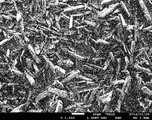
- FIG. 2a and 2b are images obtained by photographing the crystal form of the gas detection material of the present embodiment with a scanning electron microscope (SEM).
- SEM scanning electron microscope
- the size of the columnar crystal form in the major axis direction is preferably about 3 ⁇ m to 15 ⁇ m.
- the size of the columnar crystal in the long axis direction is more preferably about 5 ⁇ m to 15 ⁇ m in that the color change upon adsorption of the gas becomes more remarkable.
- the size of the columnar crystal in the long axis direction was obtained by selecting 100 crystal particles from an image taken with a scanning electron microscope and calculating the average length.
- ⁇ Fe (pyrazine) [Ni (CN) 4 ] ⁇ produced by the method described in Non-Patent Document 2 is obtained as a cubic crystal of about 0.5 ⁇ m to 2 ⁇ m, and has such a crystal form. Therefore, the color change when the gas is adsorbed tends to be unclear, and the gas adsorbed after the change tends to be desorbed, so that the color returns to its original state.
- the crystal structure of the gas detection material of this embodiment can be examined by an X-ray structure analysis method.
- the crystal form can be confirmed with an optical microscope or a scanning electron microscope.
- the magnification can be confirmed at about 1000 to 10,000 times.
- the spin state of the gas detection material of the present embodiment can be confirmed by using a superconducting quantum interference magnetometer (SQUID) or a vibrating sample magnetometer (VSM) to observe the magnetization response to a magnetic field.
- SQUID superconducting quantum interference magnetometer
- VSM vibrating sample magnetometer
- a divalent iron salt and a tetracyanonickelate are reacted in an appropriate solvent to obtain an intermediate ⁇ Fe [Ni (CN) 4 ] ⁇ .
- Columnar crystals are obtained.
- a gas having a composition of ⁇ Fe (pyrazine) [Ni (CN) 4 ] ⁇ is obtained by dispersing the intermediate ⁇ Fe [Ni (CN) 4 ] ⁇ in a suitable solvent and adding pyrazine to the dispersion.
- a detection material can be obtained.
- divalent iron salt ferric sulfate heptahydrate, ammonium iron sulfate hexahydrate, etc.
- tetracyano nickelate potassium tetracyano nickelate / hydrate can be used.
- solvent a mixed solvent of water and alcohol can be used.
- a part or the whole of the gas detection material of the present embodiment is in a low spin state.
- the processing method for bringing the gas detection material into a low spin state include a method of sufficiently cooling the gas detection material with liquid nitrogen and the like, and a method of bringing the gas detection material into contact with a chemical substance that induces the low spin state of the gas detection material.
- a chemical substance that induces a low spin state of the gas detection material is acetonitrile.
- the gas detection material of the present embodiment preferably contains acetonitrile.
- the gas detection material comes into contact with acetonitrile vapor, it adsorbs acetonitrile in the crystal and induces a low spin state. For this reason, when acetonitrile is contained, the gas detection material can maintain a low spin state.
- the acetonitrile contained in the gas detection material of this embodiment can be confirmed using a gas chromatograph mass spectrometer equipped with a double shot pyrolyzer (manufactured by Frontier Laboratories).
- FIG. 3 is a schematic diagram of the gas detection tape according to the present embodiment.
- the gas detection tape 10 has a gas detection material layer 13 including a detection unit 11 and a reference unit 12 provided on at least one surface of a support 14.
- the gas detection material of the detection unit 11 is a Hoffman-type porous coordination polymer ⁇ Fe (pyrazine) [Ni (CN) 4] ⁇ having divalent iron ions, tetracyanonickelate ions, and pyrazine as constituent elements. It has a columnar crystal form and is in a low spin state. In the presence of a gas such as diethyl carbonate, the gas detection material absorbs the gas and changes from red purple to orange. On the other hand, the gas detection material layer of the reference unit 12 is covered with the protective layer 15 to prevent contact with the gas atmosphere in order to exhibit a low-spin state reddish purple even in the presence of gas.
- a substance that strongly stabilizes the low spin state is adsorbed.
- This material includes acrylonitrile.
- the support 14 is not particularly limited, and for example, a cellulose-based cardboard such as a filter paper type 5 C can be used.
- the material of the protective layer 15 is not particularly limited as long as it can prevent the detection material layer of the reference portion 12 from coming into contact with the gas atmosphere.
- a polyvinylidene chloride film can be used.
- the pressure-sensitive adhesive layer 16 and the release paper 17 can be provided in this order on the other surface of the support. It can be fixed by peeling the release paper at the time of use and depositing it on a place to be subjected to gas detection.
- the adhesive layer 16 and the release paper 17 known ones can be used.
- the detection material layer of the reference unit 12 can be replaced with another color material. If a color material having the same color tone as that of the high spin state or low spin state color of the detection material is used, it is possible to visually confirm the color tone change of the gas detection unit 11. Further, even a gas detection tape having only the detection unit 11 separated from the reference unit 12 can be used for gas detection if there is a means for confirming a color tone change with a color sample or the like.
- the lithium ion secondary battery of the present invention is characterized in that the gas detection material or the gas detection tape is attached to the surface of a lithium ion secondary battery outer package.
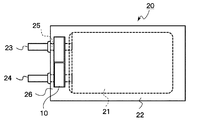
- FIG. 4 is a schematic diagram of a lithium ion secondary battery according to this embodiment.
- the lithium ion secondary battery 20 of the present embodiment includes a battery part 21 and an exterior body 22 that houses the battery part 21.
- the battery unit 21 includes a positive electrode plate, a negative electrode plate, and a separator interposed therebetween.
- the battery unit 21 is wound in a jelly-roll type with a positive electrode plate, a separator, and a negative electrode plate arranged in this order, or is laminated in a stack type.
- the positive electrode tab 23 and the negative electrode tab 24 that are electrically coupled to each electrode plate of the battery unit 21 are exposed to the outside of the sealing surface 26 of the exterior body 22.
- the portions where the electrode tabs 23 and 24 are in contact with the sealing surface 26 are covered with respective insulating tapes 25.
- the gas detection tape 10 is affixed on the exterior body 22.
- the exterior body 22 includes a non-sealing surface that houses the battery portion 21 in the center and a sealing surface that is bonded to form a bag shape.
- the bonded portion having the electrode exposed portion is referred to as a sealing surface 26.
- the electrolyte vapor and the decomposition gas of the electrolyte often leak out from the vicinity of the sealing surface 26, and the vicinity of the electrode is particularly easily peeled off. It is preferable to stick.
- the leakage gas detection method for a lithium ion secondary battery includes the gas detection tape 10 being attached to the surface of a lithium ion secondary battery exterior body, and detecting gas generation based on a hue change of the gas detection material.
- a lithium ion secondary battery uses a cyclic or chain carbonate electrolyte, and chain carbonates such as dimethyl carbonate and diethyl carbonate have a relatively low boiling point. If it is sufficient or if a pinhole or the like is generated in the exterior body, the vapor of the electrolyte component leaks as outgas.
- the gas detection material touches the leaked gas
- the leaked gas molecules are adsorbed in the crystal and at the same time the electronic state changes from low spin to high spin, and the color tone of the detection unit 11 changes.
- the color tone of the detection unit 11 changes.
- a gas detection tape without the reference unit 12 can be used.
- the color tone of the detection unit 11 is prepared using a separately prepared color sample (for example, paint standard color 2013 G version, manufactured by Japan Paint Industry Association). By confirming the change, gas generation can be detected.
- the leakage gas detection method for a lithium ion secondary battery according to this embodiment does not require a large sealed container or a power source unlike the conventional technology. Leakage gas can be detected in processes other than the inspection process. In addition, gas detectors that absorb gas and generate high spin due to gas generation do not return to a low spin state unless special treatment is performed. This is beneficial because it is possible to eliminate a lithium ion secondary battery that has become defective due to the occurrence of a problem before the user uses it.
- the size in the major axis direction was a columnar crystal having an average length of about 15 ⁇ m.
- the crystal structure of the gas detection material was examined by an X-ray structural analysis method. The crystal form was confirmed by an optical microscope and a scanning electron microscope. The spin state was confirmed using a superconducting quantum interference magnetometer (SQUID) and a vibrating sample magnetometer (VSM).
- SQUID superconducting quantum interference magnetometer
- VSM vibrating sample magnetometer
- a double-sided pressure-sensitive adhesive tape with a release layer (Nichiban Nystack Rimka) is attached to the back side of the aforementioned gas detection piece, cut out into small strips of 5 mm in length, 20 mm in width, and 0.5 mm in thickness.
- One side half was covered with a polyvinylidene chloride film (Saran Wrap (registered trademark) manufactured by Asahi Kasei) using a tape glue (TG-510D made by PLUS) as an adhesive, and a gas detection tape was completed.
- Gas detection tape is ethylene, propylene, toluene, xylene, acetone, ethyl acetate, tetrahydrofuran, methanol, ethanol, n-propanol, isopropanol, ammonia, dimethylamine, trimethylamine, triethylamine, acetic acid, formaldehyde, acetaldehyde, diethyl ether, dimethyl carbonate When exposed to ethyl methyl carbonate and diethyl carbonate, a color change from purple to orange was confirmed.
- a gas detection material was produced in the same manner as in Example 1 except that 60 mL of a mixed solvent of distilled water and ethanol was used. It was confirmed by a scanning electron microscope that the size in the major axis direction was a columnar crystal having an average length of about 5 ⁇ m. Using the obtained gas detection material, a gas detection tape was completed in the same manner as in Example 1.
- a gas detection material was obtained in the same manner as in Example 1 except that 12 mL of a mixed solvent of distilled water and ethanol was used. It was confirmed by a scanning electron microscope that the size in the planar direction was a scaly crystal having an average length of about 2 ⁇ m. Using the obtained gas detection material, the spin rate was reduced in the same manner as in Example 1. However, the change in color was hardly exhibited, and no further investigation was possible.
- a comparative gas detection material was prepared as follows.
- the gas detection material of the example can easily detect leaked gas without using a large inspection facility.
- a gas detection tape using this gas detection material can be easily detected by attaching it to a lithium ion secondary battery.
Landscapes
- Chemical & Material Sciences (AREA)
- Life Sciences & Earth Sciences (AREA)
- Chemical Kinetics & Catalysis (AREA)
- Analytical Chemistry (AREA)
- Engineering & Computer Science (AREA)
- Health & Medical Sciences (AREA)
- General Chemical & Material Sciences (AREA)
- Manufacturing & Machinery (AREA)
- Organic Chemistry (AREA)
- Electrochemistry (AREA)
- Biochemistry (AREA)
- General Physics & Mathematics (AREA)
- Pathology (AREA)
- Molecular Biology (AREA)
- Physics & Mathematics (AREA)
- Immunology (AREA)
- General Health & Medical Sciences (AREA)
- Biophysics (AREA)
- Materials Engineering (AREA)
- Inorganic Chemistry (AREA)
- Dispersion Chemistry (AREA)
- Investigating Or Analyzing Non-Biological Materials By The Use Of Chemical Means (AREA)
- Secondary Cells (AREA)
- Sealing Battery Cases Or Jackets (AREA)
- Examining Or Testing Airtightness (AREA)
Abstract
Description
硫酸アンモニウム鉄(II)・六水和物0.24g、L-アスコルビン酸0.1gおよびテトラシアノニッケル(II)酸カリウム・一水和物0.15gを容器中で蒸留水およびエタノールの混合溶媒240mLを用いて撹拌し、得られた中間体{Fe[Ni(CN)4]}の柱状結晶を回収した。この中間体およびピラジン0.10gを容器中でエタノールを溶媒として混合し、得られた橙色結晶を回収した(0.11g)。これをガス検知材とした。走査型電子顕微鏡によって長軸方向の大きさが平均長として15μm程度の柱状結晶であることを確認した。ガス検知材の結晶構造は、X線構造解析法によって調べた。また結晶形は、光学顕微鏡および走査型電子顕微鏡によって確認した。スピン状態は、超伝導量子干渉型磁束計(SQUID)および振動試料型磁力計(VSM)を用いて確認した。
ガス検知材10mgをビーカーに取り、エタノールを20mL加えて撹拌し、分散溶液を得た。この分散溶液を撹拌しながらスポイトで2mL採取し、吸引濾過器にセットした濾紙5種C(直径20mm)上に流し落とすことで、濾紙5種C上にガス検知材層を形成した。次いでガス検知材片をアセトニトリル蒸気中に10秒間暴露した。これにより、ガス検知材が低スピン状態となり、赤紫色に変化した。
前述のガス検知片の裏側に剥離層付き両面粘着テープ(ニチバン製ナイスタックリムカ)を貼り付け、縦5mm、横20mm、厚み0.5mmの小さな短冊状に切り出したのち、検知材層の面積の片側半分をテープのり(PLUS製TG-510D)を接着剤として用いてポリ塩化ビニリデンフィルム(旭化成製サランラップ(登録商標))で覆ってリファレンス部を設け、ガス検知テープを完成させた。
5リットル用テドラーバッグ中に小型ファンとガス検知テープを入れ、これにジエチルカーボネートを含む空気を送り込んで満たし、ガス検知テープの色調変化を確認した。表1に結果を示す。2000ppm、200ppm、40ppm、20ppm、4ppmのジエチルカーボネート含有空気では、いずれもガス検知テープの検知部が橙色に変化し、リファレンス部との色調違いにより容易に確認できた。一方で、ジエチルカーボネートを含まない空気(0ppm)を送り込んだ場合は、検知部の色は変化せずリファレンス部との色調違いは確認されなかった。これにより、ジエチルカーボネートを色調変化で検知できることが確認された。

50mlのスクリュー管瓶に有機可燃ガス、もしくは有機溶剤の蒸気で満たし、ガス検知テープを入れて変化を観察した。ガス検知テープを、エチレン、プロピレン、トルエン、キシレン、アセトン、酢酸エチル、テトラヒドロフラン、メタノール、エタノール、n-プロパノール、イソプロパノール、アンモニア、ジメチルアミン、トリメチルアミン、トリエチルアミン、酢酸、ホルムアルデヒド、アセトアルデヒド、ジエチルエーテル、ジメチルカーボネート、エチルメチルカーボネート、ジエチルカーボネートに暴露した時、赤紫→橙の色変化を確認した。
リチウムイオン二次電池の外装体密閉面付近にガス検知テープを貼り付けたものを10個準備した。そのうちの一つに、外装体にピンホールが発生した状況を想定してニードルによって人工的にピンホールを一つ開け、それぞれユニパックに入れて密封した状態で一時間放置した。リチウムイン二次電池のガス検知テープを目視で確認したところ、ピンホールを形成したもののガス検知テープの検知部がリファレンス部と異なり橙色に変色していた。そのリチウムイオン二次電池が入ったユニパック中の空気をガスタイトシリンジにて10μL採取し、ガスクロマトグラフ(島津製作所GC-2014)を用いて成分分析したところ、ジエチルカーボネートが約400ppm検出された。一方、ガス検知テープが変色していないリチウムイオン二次電池が入ったユニパック中の空気を採取したところ、電解液由来のガス成分は不検出であった。
実施例2で作製したガス検知テープを用い、実施例1と同様にしてジエチルカーボネートガスの検知を試みたところ、ジエチルカーボネートを色調変化で検知できることが確認された。
2…鉄イオン
3…テトラシアノニッケル酸イオン
4…ピラジン
10…ガス検知テープ
11…検知部
12…リファレンス部
13…ガス検知材
14…支持体
15…保護層
16…粘着層
17…剥離紙
20…リチウムイオン二次電池
21…電池部
22…外装体
23…正極タブ
24…負極タブ
25…絶縁テープ
26…外装体の密閉面
Claims (5)
- 2価の鉄イオンと、テトラシアノニッケル酸イオンと、ピラジンを構成要素とするホフマン型多孔性配位高分子{Fe(ピラジン)[Ni(CN)4]}からなり、柱状の結晶形を有していることを特徴とするガス検知材。
- 前記ガス検知材の一部、または全体が低スピン状態であることを特徴とする請求項1に記載のガス検知材。
- 前記ガス検知材が、アセトニトリルを含有することを特徴とする請求項1又は2に記載のガス検知材。
- 支持体の少なくとも一方の面にガス検知材を積層してなるガス検知テープであって、前記ガス検知材は、2価の鉄イオンと、テトラシアノニッケル酸イオンと、ピラジンを構成要素とするホフマン型多孔性配位高分子{Fe(ピラジン)[Ni(CN)4]}からなり、柱状の結晶形を有していることを特徴とするガス検知テープ。
- 請求項1に記載の前記ガス検知材または請求項4に記載の前記ガス検知テープが外装体表面に被着されていることを特徴とするリチウムイオン二次電池。
Priority Applications (3)
| Application Number | Priority Date | Filing Date | Title |
|---|---|---|---|
| CN201580018158.4A CN106170695B (zh) | 2014-09-25 | 2015-07-02 | 气体检测材料、气体检测带和锂离子二次电池 |
| JP2016549993A JP6260713B2 (ja) | 2014-09-25 | 2015-07-02 | ガス検知材、ガス検知テープおよびリチウムイオン二次電池 |
| US15/300,819 US10224576B2 (en) | 2014-09-25 | 2015-07-02 | Gas detection material, gas detection tape and lithium ion secondary battery |
Applications Claiming Priority (2)
| Application Number | Priority Date | Filing Date | Title |
|---|---|---|---|
| JP2014194791 | 2014-09-25 | ||
| JP2014-194791 | 2014-09-25 |
Publications (1)
| Publication Number | Publication Date |
|---|---|
| WO2016047232A1 true WO2016047232A1 (ja) | 2016-03-31 |
Family
ID=55580772
Family Applications (1)
| Application Number | Title | Priority Date | Filing Date |
|---|---|---|---|
| PCT/JP2015/069115 Ceased WO2016047232A1 (ja) | 2014-09-25 | 2015-07-02 | ガス検知材、ガス検知テープおよびリチウムイオン二次電池 |
Country Status (4)
| Country | Link |
|---|---|
| US (1) | US10224576B2 (ja) |
| JP (1) | JP6260713B2 (ja) |
| CN (1) | CN106170695B (ja) |
| WO (1) | WO2016047232A1 (ja) |
Cited By (4)
| Publication number | Priority date | Publication date | Assignee | Title |
|---|---|---|---|---|
| JP2020165958A (ja) * | 2019-03-26 | 2020-10-08 | Tdk株式会社 | アンモニア検知材及び検知器 |
| JPWO2021079859A1 (ja) * | 2019-10-25 | 2021-04-29 | ||
| JP2021070647A (ja) * | 2019-10-31 | 2021-05-06 | Tdk株式会社 | 多孔性配位高分子、ガス検知材およびガス検知シート |
| FR3161311A1 (fr) | 2024-04-12 | 2025-10-17 | Commissariat A L' Energie Atomique Et Aux Energies Alternatives | Procédé utile pour contrôler le caractère non oxydant du milieu gazeux d’un dispositif électrochimique et en particulier pour y détecter la présence indésirable d’un gaz oxydant, dispositif électrochimique et utilisation afférents. |
Families Citing this family (6)
| Publication number | Priority date | Publication date | Assignee | Title |
|---|---|---|---|---|
| JP2019163228A (ja) * | 2018-03-20 | 2019-09-26 | 株式会社東芝 | 金属有機構造体、蛍光体膜、および分子検出装置 |
| US20200309751A1 (en) * | 2019-03-26 | 2020-10-01 | Tdk Corporation | Ammonia detection material and detector |
| CN112570311B (zh) * | 2020-12-08 | 2022-06-28 | 珠海冠宇电池股份有限公司 | 电池检测装置和方法 |
| CN113860391B (zh) * | 2021-09-07 | 2022-11-04 | 北京理工大学 | 一种氨气检测材料及其制备方法及一种氨气鉴定管 |
| CN114300769A (zh) * | 2022-01-04 | 2022-04-08 | 深圳芯闻科技有限公司 | 带有智能气味芯片功能的新能源汽车电池监控系统 |
| US20240266668A1 (en) * | 2023-02-06 | 2024-08-08 | Honeywell International Inc. | Battery cell encapsulation enabling early detection of battery thermal runaway |
Family Cites Families (9)
| Publication number | Priority date | Publication date | Assignee | Title |
|---|---|---|---|---|
| US5415809A (en) * | 1992-07-15 | 1995-05-16 | Aquarium Pharmaceuticals, Inc. | Method for determination of dissolved oxygen in water |
| FR2898910B1 (fr) * | 2006-03-23 | 2008-06-20 | Centre Nat Rech Scient | Nouveau procede d'application en couche mince de materiaux moleculaires a transition de spin |
| JP2009026569A (ja) | 2007-07-19 | 2009-02-05 | Toyota Motor Corp | 密閉型電池の気密検査方法及び密閉型電池 |
| EP2072062B1 (en) * | 2007-12-22 | 2012-06-06 | Karlsruher Institut für Technologie | The use of the spin crossover complex [M*+ (L2) Hw]AN)2 as a magnetic resonance imaging contrast agent |
| CN103146103B (zh) * | 2013-03-21 | 2016-09-28 | 新疆大学 | 单核Fe(Ⅱ)自旋交叉配合物/聚乙烯醇复合薄膜材料和制备方法 |
| TWI638780B (zh) * | 2013-10-04 | 2018-10-21 | 三菱瓦斯化學股份有限公司 | 氧檢測劑組成物、使用其之成形體、薄片、除氧劑用包裝材料、除氧劑 |
| JP6531559B2 (ja) * | 2015-08-21 | 2019-06-19 | Tdk株式会社 | 多孔性配位高分子、ガス検知材およびガス検知材を備えたリチウムイオン二次電池 |
| JP6645308B2 (ja) * | 2016-03-28 | 2020-02-14 | Tdk株式会社 | ガス検知シートおよびガス検知シートを備えた電気化学素子 |
| JP6645307B2 (ja) * | 2016-03-28 | 2020-02-14 | Tdk株式会社 | ガス検知器およびガス検知器を備えた電気化学素子 |
-
2015
- 2015-07-02 CN CN201580018158.4A patent/CN106170695B/zh active Active
- 2015-07-02 WO PCT/JP2015/069115 patent/WO2016047232A1/ja not_active Ceased
- 2015-07-02 JP JP2016549993A patent/JP6260713B2/ja active Active
- 2015-07-02 US US15/300,819 patent/US10224576B2/en active Active
Non-Patent Citations (8)
Cited By (7)
| Publication number | Priority date | Publication date | Assignee | Title |
|---|---|---|---|---|
| JP2020165958A (ja) * | 2019-03-26 | 2020-10-08 | Tdk株式会社 | アンモニア検知材及び検知器 |
| JPWO2021079859A1 (ja) * | 2019-10-25 | 2021-04-29 | ||
| WO2021079859A1 (ja) * | 2019-10-25 | 2021-04-29 | 日立Astemo株式会社 | 車両制御装置 |
| JP7204003B2 (ja) | 2019-10-25 | 2023-01-13 | 日立Astemo株式会社 | 車両制御装置 |
| JP2021070647A (ja) * | 2019-10-31 | 2021-05-06 | Tdk株式会社 | 多孔性配位高分子、ガス検知材およびガス検知シート |
| JP7347125B2 (ja) | 2019-10-31 | 2023-09-20 | Tdk株式会社 | 多孔性配位高分子、ガス検知材およびガス検知シート |
| FR3161311A1 (fr) | 2024-04-12 | 2025-10-17 | Commissariat A L' Energie Atomique Et Aux Energies Alternatives | Procédé utile pour contrôler le caractère non oxydant du milieu gazeux d’un dispositif électrochimique et en particulier pour y détecter la présence indésirable d’un gaz oxydant, dispositif électrochimique et utilisation afférents. |
Also Published As
| Publication number | Publication date |
|---|---|
| US20170025713A1 (en) | 2017-01-26 |
| JPWO2016047232A1 (ja) | 2017-04-27 |
| US10224576B2 (en) | 2019-03-05 |
| CN106170695A (zh) | 2016-11-30 |
| JP6260713B2 (ja) | 2018-01-17 |
| CN106170695B (zh) | 2017-12-12 |
Similar Documents
| Publication | Publication Date | Title |
|---|---|---|
| JP6260713B2 (ja) | ガス検知材、ガス検知テープおよびリチウムイオン二次電池 | |
| JP6645307B2 (ja) | ガス検知器およびガス検知器を備えた電気化学素子 | |
| Chang et al. | An improved 9 micron thick separator for a 350 Wh/kg lithium metal rechargeable pouch cell | |
| JP6531559B2 (ja) | 多孔性配位高分子、ガス検知材およびガス検知材を備えたリチウムイオン二次電池 | |
| Yu et al. | Modulating the voltage decay and cationic redox kinetics of Li‐rich cathodes via controlling the local electronic structure | |
| Wang et al. | Ultrathin ZIF-8 film containing polyoxometalate as an enhancer for selective formaldehyde sensing | |
| Yim et al. | Triphenyl borate as a bi-functional additive to improve surface stability of Ni-rich cathode material | |
| Åvall et al. | In Situ Pore Formation in Graphite Through Solvent Co‐Intercalation: A New Model for The Formation of Ternary Graphite Intercalation Compounds Bridging Batteries and Supercapacitors | |
| US20210080397A1 (en) | Gas detection sheet and electrochemical element comprising gas detection sheet | |
| JP6645308B2 (ja) | ガス検知シートおよびガス検知シートを備えた電気化学素子 | |
| Xu et al. | Exploring synergetic effects of vinylene carbonate and 1, 3-propane sultone on LiNi0. 6Mn0. 2Co0. 2O2/graphite cells with excellent high-temperature performance | |
| Dupré et al. | Aging of the LiNi1∕ 2Mn1∕ 2O2 positive electrode interface in electrolyte | |
| Heck et al. | Production of nickel‐rich cathodes for lithium‐ion batteries from lab to pilot scale under investigation of the process atmosphere | |
| Iida et al. | Improving the Stability of Li Metal Anode/Solid Electrolyte Interfaces via an Li3PO4 Intermediate Layer: An Investigation of Surface Chemistry and Electronic Band Structure | |
| CN106188111B (zh) | 一种卟啉酞菁双层金属配合物及其制备方法和应用 | |
| Song et al. | Temperature dependence of charging characteristic of C-free Li2O2 cathode in Li-O2 battery | |
| Wang et al. | Detection of NOx down to ppb levels at room temperature based on highly mesoporous hierarchical Ni (OH) 2–In (OH) 3 double hydroxide composites | |
| Ding et al. | Assembling MOF on CNTs into 0D-1D heterostructures for enhanced volatile organic compounds detection | |
| Tsujimoto et al. | Effect of Solid Electrolyte Interphase on Sodium-Ion Insertion and Deinsertion in Non-Graphitizable Carbon | |
| Inamoto et al. | Effect of additives on the interfacial degradation phenomena of LiNi0. 5Mn1. 5O4 thin-film electrodes | |
| JP7347125B2 (ja) | 多孔性配位高分子、ガス検知材およびガス検知シート | |
| Kawabata et al. | Dissociation mechanism of a C60-Li+ complex by microscopic hydration: density functional theory study | |
| El-Zein | The prediction of drying shrinkage of reinforced concrete members. | |
| Zhang et al. | Three-Dimensional Interpenetrated Metal–Organic Frameworks for Stabilizing Lithium Metal Interfaces: Structural Engineering of Ion Flux and Interfacial Dynamics | |
| Wang et al. | Application of graphene as a sorbent for preconcentration and determination of trace amounts of cadmium in water samples |
Legal Events
| Date | Code | Title | Description |
|---|---|---|---|
| 121 | Ep: the epo has been informed by wipo that ep was designated in this application |
Ref document number: 15843925 Country of ref document: EP Kind code of ref document: A1 |
|
| WWE | Wipo information: entry into national phase |
Ref document number: 15300819 Country of ref document: US |
|
| ENP | Entry into the national phase |
Ref document number: 2016549993 Country of ref document: JP Kind code of ref document: A |
|
| NENP | Non-entry into the national phase |
Ref country code: DE |
|
| 122 | Ep: pct application non-entry in european phase |
Ref document number: 15843925 Country of ref document: EP Kind code of ref document: A1 |