WO2016027830A1 - 管制制御装置及び運搬車両の走行シミュレーション方法 - Google Patents
管制制御装置及び運搬車両の走行シミュレーション方法 Download PDFInfo
- Publication number
- WO2016027830A1 WO2016027830A1 PCT/JP2015/073230 JP2015073230W WO2016027830A1 WO 2016027830 A1 WO2016027830 A1 WO 2016027830A1 JP 2015073230 W JP2015073230 W JP 2015073230W WO 2016027830 A1 WO2016027830 A1 WO 2016027830A1
- Authority
- WO
- WIPO (PCT)
- Prior art keywords
- vehicle
- travel
- virtual
- map data
- actual
- Prior art date
- Legal status (The legal status is an assumption and is not a legal conclusion. Google has not performed a legal analysis and makes no representation as to the accuracy of the status listed.)
- Ceased
Links
Images






Classifications
-
- G—PHYSICS
- G01—MEASURING; TESTING
- G01C—MEASURING DISTANCES, LEVELS OR BEARINGS; SURVEYING; NAVIGATION; GYROSCOPIC INSTRUMENTS; PHOTOGRAMMETRY OR VIDEOGRAMMETRY
- G01C21/00—Navigation; Navigational instruments not provided for in groups G01C1/00 - G01C19/00
- G01C21/26—Navigation; Navigational instruments not provided for in groups G01C1/00 - G01C19/00 specially adapted for navigation in a road network
-
- G—PHYSICS
- G05—CONTROLLING; REGULATING
- G05D—SYSTEMS FOR CONTROLLING OR REGULATING NON-ELECTRIC VARIABLES
- G05D1/00—Control of position, course, altitude or attitude of land, water, air or space vehicles, e.g. using automatic pilots
- G05D1/02—Control of position or course in two dimensions
-
- G—PHYSICS
- G08—SIGNALLING
- G08G—TRAFFIC CONTROL SYSTEMS
- G08G1/00—Traffic control systems for road vehicles
-
- G—PHYSICS
- G08—SIGNALLING
- G08G—TRAFFIC CONTROL SYSTEMS
- G08G1/00—Traffic control systems for road vehicles
- G08G1/09—Arrangements for giving variable traffic instructions
Definitions
- the present invention relates to a control control device and a traveling simulation method for a transport vehicle, and more particularly to a travel simulation technique for a transport vehicle that travels autonomously in a mine.
- an autonomous traveling system in which a transportation vehicle (hereinafter referred to as “unmanned dump truck”) that autonomously travels without boarding an operator is connected to a control device via a wireless communication line.
- the control control device performs control control based on map data generated in advance and the position of the unmanned dump so that the unmanned dump does not interfere with other vehicles. If you want to add a new unmanned dump truck to this autonomous driving system, you want to check whether it is possible to drive safely and efficiently even if the number of operating units increases before actually introducing a new vehicle and operating the system. There is a request.
- a method of performing a running simulation using a nonexistent vehicle hereinafter referred to as “virtual vehicle” and verifying the result can be considered.
- Patent Document 1 discloses a pseudo operation that operates a pseudo mobile body (pseudo bus) by changing the operation status associated with each passing place of the mobile body with the passage of time.
- An operation management device having means is disclosed.
- Patent Document 2 discloses a travel prediction system that simulates a travel position when it is assumed that a virtual vehicle has started traveling at the same timing as the host vehicle on a route that the traveling vehicle has not selected.
- Patent Document 2 only simulates a travel position when a virtual vehicle travels on another travel path that is different from the actual travel path. It cannot be run with mixing.
- the present invention has been made in view of the above circumstances, and a control control device capable of performing operation verification when the number of transport vehicles is increased while reflecting the actual operation status of the transport vehicles and a travel simulation method for the transport vehicles.
- the purpose is to provide.
- the present invention is an air traffic control device that controls the travel of a transport vehicle that autonomously travels along a predetermined travel path in a mine, and is an actual map that defines an actual travel path.
- a map data storage unit that stores data; an input unit that receives a setting operation for setting a travel parameter of a virtual vehicle that virtually travels on the travel path; a travel parameter that defines the behavior of the virtual vehicle; and the actual map data
- the virtual vehicle simulation unit for simulating the traveling state when it is assumed that the virtual vehicle has traveled on the travel path, and autonomously traveling on the travel path by communicating with the actual vehicle in the transport vehicle
- a travel permission section setting unit that sets a travel permission section composed of a partial section of the travel path that permits travel of each vehicle for each of the real vehicle and the virtual vehicle, and the communication unit includes the communication unit,
- the travel permission section that sets a travel permission section composed of a partial section of the travel path that permits travel of each vehicle for each of the real vehicle and the virtual vehicle, and the communication unit includes the communication unit, The
- the present invention is a traveling simulation method for a transport vehicle that autonomously travels along a predetermined traveling path in a mine premises, and generates virtual map data that defines a virtual traveling path that does not exist.
- Receiving a setting operation for setting a travel parameter of a first virtual vehicle that is a non-existent vehicle traveling on the virtual travel path, a travel parameter defining the behavior of the first virtual vehicle, and the virtual A step of executing a simulation process for causing the first virtual vehicle to travel on the virtual travel path using map data, and the virtual map data are used when the actual vehicle in the transport vehicle actually travels autonomously. Storing as actual map data; and a second temporary map for virtually traveling along the traveling path based on the actual map data.
- a step of simulating the driving state of the vehicle a step of acquiring positional information of the actual vehicle from the actual vehicle traveling on the actual traveling route, the positional information of the actual vehicle, the actual map data, and the second Based on the simulation result of the running state of the virtual vehicle, a travel permission section consisting of a partial section of the travel path permitting the travel of each vehicle is set for each of the real vehicle and the second virtual vehicle. And a step.
- the response state from a server is shown
- an autonomous traveling vehicle that transports earth and sand or ore loaded by a loader such as an excavator or a wheel loader in a mine and autonomously travels without a driver boarding, and traffic control of the autonomous traveling vehicle
- a loader such as an excavator or a wheel loader in a mine
- the control server is provided with a simulation function when the system components, for example, the number of operating autonomous traveling vehicles and map data are changed There is.
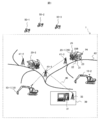
- FIG. 1 is a diagram illustrating a schematic configuration of an autonomous traveling system.
- the autonomous traveling system 1 shown in FIG. 1 is a mine for transporting loads such as earth and sand and ore loaded from excavators 10-1 and 10-2 that perform excavation and loading work in a quarry such as a mine.
- the autonomous traveling vehicles (actual vehicles) 20-1 and 20-2 and a control server 31 installed in the vicinity of the quarry or in a remote control center 30 are connected to each other via a wireless communication line 40. Is done. Since a dump truck is used as the autonomous traveling vehicle, the autonomous traveling vehicle is hereinafter referred to as a dump. Further, in order to distinguish from a virtual transport vehicle described later, an actual dump is referred to as a real vehicle, and a virtual transport vehicle that does not exist is referred to as a virtual vehicle.
- the control server 31 is a control device that controls the traveling of the dump truck, and has a traveling simulation function using a virtual vehicle.
- Each of the dump trucks 20-1 and 20-2 is located between the excavator 10-1 or 10-2 and the excavators 10-1 and 10-2 along the conveyance path 60 set in advance in the mine. To return and transport the load. Since the dumps 20-1 and 20-2 and the excavators 10-1 and 10-2 have the same configuration, the dumps 20-1 and 20-2 and the excavators 10-1 and 10-2 are not distinguished from each other. Are described as dump 20 and excavator 10.
- radio base stations 41-1, 41-2, 41-3 are installed. Then, radio communication radio waves are transmitted and received through these radio base stations 41-1, 41-2, and 41-3.
- the excavator 10 and each dump 20 are position calculation devices (not shown in FIG. 1) for receiving positioning radio waves from the navigation satellites 50-1, 50-2, 50-3 and acquiring the position of the host vehicle.
- position calculation devices for example, a GPS (Global Positioning System) device is provided.
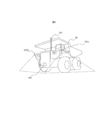
- the dump truck 20 includes a frame 21 that forms a main body, a front wheel 22 and a rear wheel 23, and a loading platform 24 that can rotate in a vertical direction around a hinge pin (not shown) provided at a rear portion of the frame 21. And a pair of left and right hoist cylinders (not shown) for rotating the loading platform 24 in the vertical direction. Further, the dump 20 is provided with an antenna 25 for connecting to the wireless communication line 40 in a place with a good view, for example, in front of the upper surface of the dump 20.
- the dump 20 is equipped with a travel control device 200 for autonomous travel according to instructions from the control server 31.
- the control server 31 is connected to an antenna 32 for connecting to the wireless communication line 40.
- the control server 31 communicates with the dump 20 via the antenna 32 and the radio base stations 41-1, 41-2, 41-3.
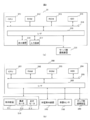
- FIG. 2 is a hardware configuration diagram of the control server and the dump 20, where (a) shows the control server and (b) shows the dump.
- FIG. 3 is a view showing the appearance of the dump truck 20.
- the control server 31 includes a CPU 311, a RAM (Random Access Memory) 312, a ROM (Read Only Memory) 313, an HDD (Hard Disk Drive) 314, an I / F 315, and a bus 318.
- a CPU 311, a RAM 312, a ROM 313, an HDD 314, and an I / F 315 are connected via a bus 318.
- the control server 31 further includes a display device 316 and an input device 317, which are connected to the I / F 315.
- the display device 316 is a user interface for allowing the user to check the dumping situation in the mine and to specify the additional position of the virtual vehicle when executing the simulation function.
- the display device 316 is an LCD (Liquid Crystal Display). Consists of.
- the input device 317 is a user interface for a user to input information to the control server 31, and is configured using, for example, a mouse, a keyboard, or a touch panel (not shown) stacked on an LCD.
- a server side communication device 390 for connecting to the wireless communication line 40 is connected to the I / F 315 of the control server 31.
- the dump truck 20 has a travel control device 200 that performs control processing for autonomous travel as shown in FIG. 2B, and a travel drive for driving the dump truck 20 according to a control instruction from the travel control device 200.
- a device 210 In order to connect to the wireless communication line 40, a device 210, a position calculation device 220 for calculating the position of the host vehicle of the dump truck 20, an in-vehicle sensor 230 such as a millimeter wave sensor for recognizing the surrounding environment of the dump truck 20, and the like.
- the dump side communication device 240 is provided.
- the traveling drive device 210 includes a braking device 211 that applies braking to the dump 20, a steering motor 212 for changing the steering angle of the dump 20, and a traveling motor 213 for causing the dump 20 to travel.
- the position calculation device 220 calculates the own vehicle position based on the input from the GPS antenna 221 (see FIG. 3) provided in the dump truck 20.
- the position calculation device 220 is not limited to GPS, and may be based on an inertial measurement device (IMU: Internal Measurement Unit) or a system that specifies a position using radio waves from a base station installed on the ground.
- the dump 20 includes an antenna for the system, a gyro sensor, and a sensor for detecting the rotational speed of the wheel instead of the antenna 221 for GPS.
- the vehicle-mounted sensor 230 is for recognizing and estimating the speed of the dump truck 20 and the surrounding environment.
- a stereo camera or a millimeter wave radar sensor 232 may be used.
- the detection result of the in-vehicle sensor 230 is output to the traveling control device 200, and is used for monitoring the traveling position and accelerating / decelerating so as not to leave the traveling path in a normal state, and used for a braking operation necessary for emergency avoidance behavior in an emergency.
- the travel control device 200 includes a CPU 201, a RAM 202, a ROM 203, an HDD 204, an I / F 205, and a bus 208.
- a CPU 201, a RAM 202, a ROM 203, an HDD 204, and an I / F 205 are connected via a bus 208.
- a travel drive device 210, a position calculation device 220, an in-vehicle sensor 230, and a dump side communication device 240 are connected to the I / F 205.
- control server 31 and the travel control device 200 it is read out by an autonomous travel control program and a traveling vehicle travel simulation program (software) stored in the recording device of the control server 31 and the travel control device 200.
- the software and hardware When executed by the CPUs 201 and 311, the software and hardware cooperate to realize the functions of the control server 31 and the travel control device 200.
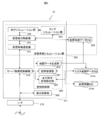
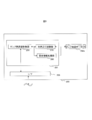
- FIG. 4 is a functional block diagram showing the main functions of the control server.
- FIG. 5 is a functional block diagram showing the main functions of the dump 20.
- the control server 31 performs control for performing actual wireless communication with the actual dump 20 (hereinafter, the dump 20 will be referred to as “real vehicle 20”) and virtual communication with the virtual vehicle.
- a virtual vehicle simulation unit 330 that simulates the behavior of a virtual vehicle that travels in the same mine as the real vehicle 20 based on an instruction from the control control unit 320, a display control unit 340 that performs display control processing for the display device 316, and the real vehicle 20 travels.
- the virtual communication means data input / output with the server-side communication control unit 310.
- the transportation path is a road connecting the starting point and the ending point of the actual vehicle 20 such as a loading / unloading field or a parking lot (not shown), and the traveling direction of the actual vehicle 20 formed on the road.
- the lane according to the road corresponds to the road.
- the server-side communication control unit 310 is connected to the server-side communication device 390 and performs control for performing actual wireless communication with the actual vehicle 20, and also performs a virtual vehicle simulation unit 330 (more specifically, a virtual machine described later). Data input / output processing (virtual communication) is performed between the vehicle communication unit 331) and the data necessary for the virtual vehicle travel simulation.
- the control control unit 320 includes a vehicle allocation management unit 321, a travel permission section setting unit 322, and a map data generation unit 323.
- the vehicle allocation management unit 321 sets the destination of the real vehicle 20 and the virtual vehicle, and determines a travel route from the current position to the destination by referring to the map data stored in the master map data DB 314a.
- the vehicle allocation management unit 321 As a processing example of the vehicle allocation management unit 321, for example, when the real vehicle 20 or the virtual vehicle is in a parking lot, it is set for the purpose of the entrance of the loading place including the loading position.
- the vehicle allocation management unit 321 sets a travel route from the parking lot to the entrance on the loading.
- the vehicle allocation management unit 321 may dynamically generate the travel path as the loading position moves.
- the vehicle allocation management unit 321 sets one of the earthmoving sites 62 and 63 as a destination according to the contents of the loaded object, and travels to that point. Generate a path.
- the travel permission section setting unit 322 refers to the map data stored in the master map data DB 314a with respect to the real vehicle 20 or the virtual vehicle, and travels the partial section on the travel path determined above as the travel of the real vehicle 20 or the virtual vehicle. Is set as a travel-permitted section in which the travel permission section is permitted, and section information indicating the position of the travel-permitted section is generated.
- the travel permission section setting unit 322 updates the section information stored in the section information DB 314b by overwriting the newly generated section information.
- the section information includes the node ID of the front boundary point that is the frontmost node of the travel permitted section and the node ID of the rear boundary point that is the last node.
- section request message information that requests setting of a new travel-permitted section from the real vehicle 20 or the virtual vehicle
- section response message information indicating the travel permission section
- the map data generation unit 323 generates, updates, and stores actual map data that defines the travel path based on the position coordinates collected by actually running the position where the actual travel path is installed.
- the map information that defines the actual travel route is referred to as real map data
- the map information that defines the non-existent travel route is referred to as virtual map data.
- the map data generation unit 323 receives a setting operation for adding a virtual travel route that does not exist to the actual travel route from the input device 317
- the map data generation unit 323 defines both the actual travel route and the virtual travel route. Is generated.
- the map data generation unit 323 performs processing of storing real map data and virtual map data in the master map information DB 314b and a virtual map data DB 335 described later.
- the virtual vehicle simulation unit 330 When the virtual vehicle simulation unit 330 receives a setting operation of a virtual vehicle that virtually travels on the travel path from the input device 317, the virtual vehicle simulation unit 330 defines travel parameters and map data that define the behavior of the virtual vehicle (both real map data and virtual map data). Is used to perform a simulation when the virtual vehicle travels virtually on the travel path, and the travel state such as the virtual position, speed, and acceleration of the virtual vehicle on the travel path is calculated. At this time, the virtual vehicle simulation unit 330 performs a simulation based on the travel permission section set for the virtual vehicle. For example, when the travel permission section is not set even though the front end of the travel permission section is approaching, a deceleration / stop braking command and a corresponding deceleration / stop operation are simulated.
- the virtual vehicle simulation unit 330 includes a virtual vehicle communication unit 331 having a function for performing virtual communication with the server-side communication control unit 310, an instruction (running permission section) from the control control unit 320 via virtual communication, and a virtual vehicle. Based on the virtual position, a virtual travel control unit 332 that controls the travel of the virtual vehicle, and a travel simulation that performs a travel simulation of the virtual vehicle using travel parameters that define the behavior of the virtual vehicle based on instructions from the virtual travel control unit 332 333, the sensor simulation part 334 which simulates a virtual position and speed based on the behavior of a virtual vehicle, and virtual map data DB335 which stores the information of the travel path where a virtual vehicle drive
- the virtual vehicle communication unit 331 outputs a virtual position of the virtual vehicle and a section request message to the server side communication control unit 310, and acquires section response message information or a non-permission response message from the server side communication control unit 310.
- the virtual travel control unit 332 acquires the current position (virtual position) of the host vehicle from the sensor simulation unit 334, refers to the map data in the virtual map data DB 335, and performs control for causing the virtual vehicle to travel according to the travel permitted section. This is performed for the travel simulation unit 333.
- the travel simulation unit 333 is configured based on performance (travel parameters) such as vehicle weight, acceleration, deceleration, and steering speed, which are vehicle body information of the virtual vehicle set in advance, and a control command from the virtual travel control unit 332. Calculate vehicle behavior (acceleration, deceleration, stop) and position.
- performance such as vehicle weight, acceleration, deceleration, and steering speed, which are vehicle body information of the virtual vehicle set in advance, and a control command from the virtual travel control unit 332.
- vehicle behavior acceleration, deceleration, stop
- position position.
- the sensor simulation unit 334 may correct the position of the virtual vehicle on the map data based on the calculation result of the travel simulation unit 333 by simulating an actual sensing error and adding a random error.
- the GPS satellite trajectory may be calculated, the number and angle of GPS satellites that can be captured at that time at the position of the virtual vehicle are acquired, and a correction that adds an error according to the GPS satellite capture status may be performed.
- GPS and IMU are mounted on the transport vehicle and the output values of each other are interpolated. Even if the position calculation accuracy of the transport vehicle is to be improved, the position of the virtual vehicle can be brought closer to the position calculated by the real vehicle, and the accuracy of the simulation result can be improved.
- the sensor simulation unit 334 generates virtual sensing data by simulating the sensing state by a sensor such as a laser-radar sensor, a millimeter wave radar, a stereo camera or the like based on the position of the virtual vehicle and the surrounding environment data. Then, the calculation result may be passed to the virtual travel control unit 332.
- a sensor such as a laser-radar sensor, a millimeter wave radar, a stereo camera or the like based on the position of the virtual vehicle and the surrounding environment data. Then, the calculation result may be passed to the virtual travel control unit 332.
- the virtual map data DB 335 stores virtual map data.
- the virtual map data for example, there is map data of a travel route scheduled to be generated in a plan for advancing mine excavation.
- the map data may also include environmental data such as surrounding terrain according to the coordinate position for use in sensor simulation.
- the virtual map data DB 335 stores virtual map data, and the virtual map data is simulated using the actual map 20 while operating the real vehicle 20, the master map data DB 314a is also virtual. Stores map data.
- the display control unit 340 acquires real map data, virtual map data, the dump 20 and each position of the virtual vehicle, and information on the travel permitted section set for each vehicle, and displays the travel route on the map image.
- An image showing the dump 20 and the virtual vehicle, and an image showing the set travel permitted section are displayed in a superimposed manner.
- the display mode of the actual travel path and the virtual travel path, the dump 20 and the virtual vehicle may be changed so as to be distinguishable. Thereby, the positions of the transport vehicle and the virtual vehicle on the travel path can be visually confirmed, and the operation verification when the user adds the virtual vehicle can be easily performed.
- the display control unit 340 is shown connected to the server-side communication control unit 310 and the I / F 315 for convenience of explanation, but the display control unit 340 includes the control control unit 320, the virtual vehicle simulation unit 330, and these You may comprise so that the data used as a display target may be acquired from the component contained in.
- the server-side communication control unit 310, the control control unit 320 (the vehicle allocation management unit 321, the travel permission section setting unit 322), and the virtual vehicle simulation unit 330 (excluding the virtual map data DB 335) provided in the control server 31 realize these functions. 2 is executed by the CPU 311 (hardware) shown in FIG.
- the master map data DB 314a, the section information DB 314b, and the virtual map data DB 335 are configured by a storage device that can store information in a fixed manner, for example, an HDD.
- the virtual vehicle simulation unit 330 may be composed of several software sets, and there may be a plurality of the above-mentioned sets depending on the number of virtual vehicles that are operating. Alternatively, a plurality of virtual vehicles may be operated on one software. Alternatively, the virtual vehicle simulation unit 330 is configured by a computer that is placed in the control center 30 (see FIG. 1) independently of the control server 31, and is connected to the control server 31 via an Ethernet (registered trademark) cable or wireless communication. May be. Map data stored in the master map data DB 314a and the virtual map data DB 335 is configured as data stored on the HDD 314 or the microprocessor.
- the traveling control device 200 mounted on the actual vehicle 20 includes a dump side communication control unit 250, a request information processing unit 260, an autonomous traveling control unit 270, and a dump map data DB 204a as shown in FIG.
- the dump side communication control unit 250 controls wireless communication performed with the control server 31.
- the dump side communication control unit 250 transmits a section request message and receives a section response message or a non-permission response message.
- the request information processing unit 260 Based on the map data stored in the dump map data DB 204a and the current position calculated by the position calculation device 220 (see FIG. 2), the request information processing unit 260 has reached the point where the actual vehicle 20 transmits the request message. When the request point is reached, a request message is generated and the request message is transmitted to the control server 31 via the dump-side communication control unit 250.
- the autonomous travel control unit 270 acquires the current position of the host vehicle from the position calculation device 220, refers to the map data in the dump map data DB 204a, and causes the host vehicle to travel according to the travel permission section included in the section response message. Control is performed on the traveling drive device 210 (see FIG. 2). In addition, the autonomous traveling control unit 270 determines the presence or absence of a front obstacle based on the detection result of the in-vehicle sensor 230, determines whether or not there is an interference with the obstacle and a collision avoidance operation, and if necessary, the braking operation is performed. Control for. Further, the autonomous traveling control unit 270 performs drive control on the braking device 211 in accordance with an instruction from the control server 31, and performs a deceleration operation, a normal stop operation, or an emergency stop operation.
- the dump side communication control unit 250, the request information processing unit 260, and the autonomous traveling control unit 270 are configured by executing software that realizes these functions by the CPU 201 (hardware) shown in FIG.
- the map data stored in the dump map data 204a is configured as data stored on the HDD 204 or the microprocessor.
- FIG. 6 is a diagram illustrating a configuration example of an open pit mine site where an actual vehicle actually travels.
- FIG. 6 is a diagram illustrating a configuration example of an open pit mine site where an actual vehicle actually travels.
- FIG. 7 is a diagram illustrating a communication operation between the real vehicle and the virtual vehicle and the control server at the start of autonomous driving, where (a) illustrates a state in which a destination request message is transmitted from the real vehicle, b) shows the response state from the control server, and (c) shows the request and response state of the travel permission section.
- FIG. 8 is a diagram showing details of setting of the travel permitted section, where (a) shows a state in which a request message for a destination is transmitted from an actual vehicle, (b) shows a response message from the control server, (C) shows the request
- FIG. 6 indicates an excavation site by a mining machine such as the excavator 10 and a loading field 61 in which the mining machine loads the dump truck 20.
- a loading position corresponding to LP in FIG. 6
- the topsoil and ore dug by the excavator 10 are loaded into the actual vehicle 20 at the loading place 61.
- Reference numeral 62 denotes an earth release site that unfolds the topsoil, and the topsoil and the like carried from the loading place 61 are unearthed at this place and are developed in layers or radially.
- Reference numeral 63 denotes an earthmoving site in which a crusher for crushing ore is installed, and the crushed ore is transported to a freight car unloading site or a processing facility by a belt conveyor or the like.
- QP in FIG. 6 is an entrance to the loading place 61 and a standby position where the dump 20 stops and waits until the excavator 10 permits the dump to enter the loading position (CALL).
- CALL loading position
- EXIT in FIG. 6 is an exit from which the dump 20 exits from the loading place 61.
- the real vehicles 20-1 and 20-2 and the virtual vehicle 70 are loaded with topsoil and ore at the loading place 61, travel on the conveyance path 60, and convey them to the earthing places 62 and 63.
- a travel path 64 is set in the transport path 60, and the vehicle 20 and the virtual vehicle 70 travel along the travel path 64.
- the travel path 64 is given as a coordinate value set on the map.
- the actual vehicles 20-1 and 20-2 control the acceleration / deceleration and steering while comparing the self-position determined by the GPS or other position calculation device with the coordinate value of the travel path 64, thereby moving along the travel path 64. Travel autonomously.
- the virtual vehicle 70 performs the travel control by comparing the self-position identified by the sensor simulation unit 334 with the coordinate value of the travel path 64 by the virtual travel control unit 332, and the travel simulation unit 333 performs the virtual vehicle 70. Calculate travel.
- a node 65 indicating a boundary between sections of the travel path and a link 66 connecting the adjacent nodes 65 are provided.
- Information on the actual traveling path 64, the node 65, and the link 66 is stored as the same map data in the master map data DB 314a, the virtual map data DB 335, and the dump map data DB 204a.
- the virtual map data DB 335 of the virtual vehicle simulation unit 330 includes a virtual travel route
- the virtual map data is more travel route information than the actual map data stored in the master map data DB 314a and the dump map data DB 204a. May be included.
- the control server 31 assigns / cancels the travel permission for each travel section including two adjacent nodes 65 and one link 66 by the control control unit 320, and uses the information as section information for the real vehicle 20 and the virtual vehicle 70. Notify Thereby, traveling is controlled so as to avoid a collision between the real vehicle and the virtual vehicle.
- the travel path 64 is provided with a speed limit for each section, and the actual vehicle 20 and the virtual vehicle 70 travel at an appropriate speed or virtual while referring to the speed limit information in the dump map data DB 204a and the virtual map data DB 335, respectively. Run.
- the actual vehicle 20 (hereinafter, the same applies to the virtual vehicle 70) has been loaded with topsoil and ore at the loading place 61, or has been released from the earthing places 62 and 63, the actual vehicle 20 is shown in FIG. 7 (a), a message requesting the destination (destination request message) is transmitted to the control server 31.
- the request information processing unit 260 included in the travel control device 200 of the actual vehicle 20 determines the current self-position and the state of the vehicle (stopped) via the terminal-side communication control unit 250.
- the virtual travel control unit 332 determines the own vehicle situation and transmits the situation via the virtual vehicle communication unit 331.
- the destination request message is received by the server-side communication control unit 310 on the control server 31 and transmitted to the control control unit 320.
- the dispatch management unit 321 in the control control unit 320 refers to the section information in the section information DB 314b and takes into account the status of other real vehicles 20 and virtual vehicles 70, and the destination of the dump truck that has requested the destination.
- the server side communication control unit 310 is instructed to transmit a destination response message indicating the destination 80 and the route 81 to the destination to the dump truck.
- the server-side communication control unit 310 transmits a destination response message to the real vehicle 20 via the wireless communication line 40 (see FIG. 7B).
- the request information processing unit 260 on the actual vehicle 20 transmits a message (section request message) for requesting setting of the travel permitted section to the control server 31.
- the server-side communication control unit 310 transmits a section request message to the control control unit 320.
- the travel permission section setting unit 322 of the control control unit 320 sets the travel permission section 82 based on the process described below, and transmits a message (section response message) indicating the set travel permission section to the actual vehicle 20 ( (C) of FIG.
- the section response message includes information (node ID) that uniquely identifies the foremost node of the travel permitted section, node ID at the end, and information (link ID) that uniquely identifies the link included in the travel permitted section. It is.
- the real vehicle 20 can start traveling only after obtaining the travel permission section.
- the section information stored in the section information DB 314b is updated and managed as needed.
- the travel permission section setting unit 322 sets the travel permission section with reference to the section information and the map data stored in the master map data DB 314a.
- the travel permitted section setting unit 322 performs the same control so that the travel is not permitted even if there is a request from the vehicle for a section that is already permitted for another vehicle. Do not allow multiple vehicles to enter the section.
- the travel permission section received from the control server 31 is recorded in the master map data DB 314a (virtual map data DB 335 in the case of the virtual vehicle 70) on the vehicle, and autonomous traveling or virtual traveling is referred to this. This will determine how far you can travel.
- the setting status of the travel-permitted section is specific information (link) that uniquely indicates the link 65 included in the travel-permitted section, including the foremost node ID, the last node ID included in the section response message, and the link ID located between them. ID).
- the control server 31 records the foremost node ID, the last node ID, and the link ID located between them in the section information of the section information DB 314b, but the travel permission section setting unit 322 of the control control unit 320 is primarily used.
- Manage by recording For each vehicle side, the autonomous traveling control unit 270 in the case of the real vehicle 20 and the virtual traveling control unit 332 in the case of the virtual vehicle 70 are temporarily positioned at the frontmost node ID, the last node ID, and between them.
- the link ID to be recorded may be recorded and not recorded in the master map data 314a or the virtual map data DB 335.
- actual vehicles 20-1 and 20-2 are traveling vehicles, and reference numerals 81-1 and 81-2 are travel permitted sections permitted for the respective vehicles. It is assumed that both the actual vehicles 20-1 and 20-2 are traveling in the direction indicated by the arrow A.
- Reference numeral 83 denotes a travel permission remaining distance that indicates a distance along the travel path from the current position of the actual vehicle 20-1 to the foremost end (terminal) of the travel permission section 81-1.
- Reference numeral 84 denotes a travel permission request start distance indicating a distance from the foremost end (termination) to a point where the actual vehicle 20-1 starts transmitting the section request message.
- the travel permission request start distance 84 is longer than the distance at which the actual vehicle can be stopped.
- the travel permission request start distance 84 is obtained by adding a predetermined offset distance to the stoppable distance.
- the distance L at which the actual vehicle can be stopped is, for example, m, including the vehicle load, v, the vehicle current speed, f, the vehicle braking force, f, Then, it calculates
- the offset coefficient c is a value of 1 or more, and is set in consideration of, for example, the time required for wireless communication or the degree of occurrence of a wireless communication failure.
- the speed of the vehicle may be a value obtained by measuring the current speed of the vehicle from the rotational speed of the wheel, etc., and a speed limit (maximum allowable speed) defined by the map data for the current travel position of the vehicle. May be used.
- the actual vehicle 20-1 when the remaining travel permission distance 83 of the actual vehicle 20-1 is equal to or less than the travel permission request start distance 84, the actual vehicle 20-1 requests a section request to the control server 31. Send a message.
- This section request message includes the current position information of the actual vehicle 20-1.
- the control server 31 When the control server 31 receives the section request message from the real vehicle 20-1, the control server 31 specifies the travel section in which the real vehicle 20-1 exists using the sent current position information. Then, along the traveling direction of the actual vehicle 20-1, a section that is longer than the shortest distance (travel permission grant length) given as a predetermined travel permission section from the end of the section where the actual vehicle 20-1 exists is set. Grant permission to travel. However, when there is a section where permission is given to another vehicle (real vehicle or virtual vehicle), the travel permission is given up to that point.
- the section where the actual vehicle 20-1 exists is 85, and the sections where the travel permission grant length is 90 or more from the end are 86, 87, 88, 89.
- the travel permission is already given to the actual vehicle 20-2 in the sections 88 and 89, the travel permission of 86 and 87 is given.
- the section 87 is given as a new travel permission section.
- the section for which travel permission has been granted is released when the distance from the vehicle position to the end of the section is equal to or greater than the travel permission cancellation distance after the vehicle passes through the section.
- the section 88 in which the travel permission has been given to the actual vehicle 20-1 is in a stage where the distance 91 between the vehicle 20-2 and the end of the section is equal to or greater than the travel permission release distance 92. The travel permission is released, and the travel permission assignment to the subsequent actual vehicle 20-1 becomes possible.
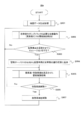
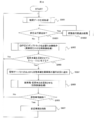
- FIG. 9 is a flowchart showing an outline of an operation procedure of the autonomous traveling system including the control server according to the present embodiment.
- map data generation processing is performed by the map data generation unit 323 (S901). Details of the map data generation process will be described later.
- step S903 If the simulation is not performed with mixed running of virtual vehicles (S903 / No), the process returns to step S902, and the control control process for only the actual vehicle is continued without using the simulation function of the control server 31.
- the user uses the GUI (graphical interface: corresponding to the display device 316 and the input device 317) of the control server 31 while the dump 20 is actually running.
- the virtual vehicle is added to the operation status of the real vehicle (S904).
- the virtual vehicle simulation unit 330 performs a travel simulation and outputs the result to the control control unit 320.
- the control control unit 320 performs a control control process by causing the vehicle (actual vehicle) that is actually traveling and the virtual vehicle acquired from the virtual vehicle simulation unit 330 to run together (S905). Details of the control control process in which the real vehicle and the virtual vehicle are mixedly run will be described later.
- the user When the user wants to delete the virtual vehicle (S906 / Yes), the user specifies the deleted virtual vehicle and performs the deletion process (S907). For example, when it is desired to delete a virtual vehicle, it is desirable to perform simulation by adding a plurality of virtual vehicles, in addition to the case of ending simulation processing using virtual vehicles and returning to control control processing of only real vehicles. When the result cannot be obtained, the simulation may be performed again after reducing the number of virtual vehicles. Thereafter, the process returns to step S902.
- step S906 If the virtual vehicle is not deleted (S906 / No), the process returns to step S905, and the control control process is continued even if the actual vehicle and the virtual vehicle are mixed.
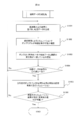
- FIG. 10 is a flowchart showing the flow of map data generation processing.
- FIG. 11 is a diagram showing an example of map data, where (a) shows link information and (b) shows node information.
- the map data generation process described below is a process of generating a virtual map using the map data generation unit 323 and storing it as real map data in the master map data DB 314a through a travel simulation using a virtual vehicle.
- a maneuvering vehicle is added on a newly added road with a GPS-equipped vehicle, and sensor data for generating map data is collected based on the result.
- the vehicle equipped with GPS may be, for example, a vehicle dedicated to data collection (navigation vehicle) for generating a map, or the autonomous traveling dump truck is set in the map measurement mode, and the position information is obtained using the GPS mounted on the dump. You may perform manned running while collecting In addition to GPS, the surrounding terrain shape may be measured using a sensor such as a laser radar.
- the map data generation unit 323 generates map data using the collected sensor data (S1001). This process may be, for example, a process in which clustering is performed from a time-series coordinate point sequence, nodes are generated at appropriate intervals according to the shape of the conveyance path, and a travel path is generated.
- the map data generation unit 323 stores the generated map data in the virtual map data DB 335. This map data corresponds to virtual map data.
- the map data is represented by links indicating the nodes on the road and their connections.
- the map data includes a link ID 1101 for identifying the link, a node ID 1102 at the coordinate where the link starts, a node ID 1103 at the coordinate where the link ends, and another link connected to the link start point.
- FIG. 11B there is a table of coordinate values 1107 corresponding to the node ID 1106 and attributes 1108 thereof.
- One of the node IDs is set in the attribute 1108 as a loading point or a release point.
- the virtual travel control unit 332 refers to the virtual map stored in the virtual map data DB 335 and sends a virtual vehicle (to the first virtual vehicle) along the virtual map to the travel simulation unit 333.
- a simulation process for traveling (corresponding) is executed, and it is confirmed that the model of the dump truck can appropriately follow the generated travel route data (S1002). This is necessary, for example, to confirm that there are no problems such as the generated road curve is too tight and the vehicle is unable to turn, or the control is not successful due to inappropriate node spacing. is there.
- one virtual vehicle may be used for the control server 31, or a plurality of units may be controlled simultaneously.
- the map data creation unit 323 stores the verified virtual map as real map data in the master map data DB 314a.
- the control control unit 320 refers to the actual map data stored in the master map data DB 314a, travels one actual vehicle of the autonomous traveling dump truck, and confirms whether the map data and the actual conveyance path match ( S1003).
- map data for example, when acquiring data by GPS, there may be an error in the data due to the satellite arrangement at that time and the shielding by the surrounding terrain. In addition, an error may be caused by processing for generating a travel route by software.
- map data generation software it is desirable to use map data generation software that generates a correct travel path so that such a situation does not occur. However, it is difficult to guarantee reliability completely, and operation confirmation is necessary.
- traveling with a single real vehicle even if the data on the travel path deviates from the correct position on the transport path, it is detected that the position of the travel path is not correct by, for example, a road shoulder detection function using a laser radar. Can do.
- the correctness of the actual map data with respect to the travel path can be confirmed with one real vehicle (S1004 / Yes)
- the same number of virtual vehicles (corresponding to the second virtual vehicle) to be operated are converted into the actual map data.
- a travel simulation is performed by virtually traveling along the travel path based on the travel path (S1005). At this stage, for example, it is verified whether there are any points that may cause a collision when operating with a plurality of actual vehicles, such as a junction or a narrow road.
- step S1006 / Yes If the simulation results for a plurality of vehicles are good (the vehicle can travel) (S1006 / Yes), the map data generation process is terminated. If the result of the simulation results for a plurality of vehicles is poor (the vehicle is in trouble) (S1006 / No), the process returns to step S1001 to generate map data again.
- the virtual map data when the virtual map data is generated, the virtual map data can be adopted as the actual map data when the simulation result using the virtual vehicle is good. This makes it possible to verify the suitability as actual map data for driving an actual vehicle, and to check the operation of the vehicle at the time of generating map data, so that it is possible to respond safely to changes in the terrain of the mine.
- FIG. 12 is a flowchart showing the flow of the control control process for only the actual vehicle.
- FIG. 12 shows a flow of processing performed by the travel control device 200 and the control server 31 of the real vehicle 20, but the control control processing for the real vehicle and the control control processing for the virtual vehicle are the same processing.
- the control of the virtual vehicle can also be performed by replacing the travel control device 200 and its components with the virtual vehicle simulation unit 330 and its components.
- description will be made along the order of steps in FIG.
- the request information processing unit 260 of the travel control device 200 sends a destination request message (current position) to the control server 31 via the wireless communication line 40. Information is included) (S1202). If the destination of the actual vehicle 20 is set (S1201 / Yes), the process proceeds to step S1204.
- the dispatch management unit 321 of the control server 31 sets the destination with reference to the current position information of the actual vehicle 20 and the actual map data of the master map data DB 314a, and sends a destination response message indicating the result to the actual vehicle 20. Transmit (S1203). If the destination of the actual vehicle 20 is set (S1201 / Yes), the process proceeds to step S1204.
- the real vehicle 20 After transmitting the section request message, the real vehicle 20 waits for reception of a section response message from the control server 31 while continuing to travel according to the currently permitted travel section.
- the real vehicle 20 periodically transmits the current position to the control server 31 while traveling.
- the autonomous travel control unit 270 compares the current position from the position calculation device 220 with the dump map data DB 204a and the currently granted travel permission section, and when the travel permission remaining distance is equal to or less than the stoppable distance (S1207 / Yes), a braking instruction is given to the braking device 211 of the travel drive device 210 so as to stop within the travel permitted section, and the actual vehicle 20 starts decelerating (S1208).
- the travel permission section setting unit 322 sets the travel permission section based on the current position of the actual vehicle 20 and the map information stored in the master map data DB 314a, and shows the contents thereof.
- a section response message is transmitted to the actual vehicle 20 (S1209).
- the travel permission section setting unit 322 uses the received current position of the vehicle and the section information in the section information DB 314b to determine a section that is longer than the travel permission grant length from the end of the section where the vehicle exists in the traveling direction of the vehicle. Unless the permission is given to another vehicle, or when there is a section where permission is given to another vehicle, the travel permission section is set up to that point. Further, the travel permission section setting unit 322 adds information indicating which section the travel permission section has been set to the section information stored in the section information DB 31b.
- the real vehicle 20 When the real vehicle 20 receives the section response message (S1210 / Yes), the real vehicle 20 starts to travel according to the new travel permission section indicated in the section response message (S1211). When the real vehicle 20 does not receive the section response message, the process returns to step S1205 (S1210 / No).
- the case where the section response message is not received includes, for example, a case where the section request message does not reach the control server 31 due to a communication error, and the section response message does not reach the actual vehicle 20.
- the travel permission section setting unit 322 cancels the setting of the travel permission section when the distance from the current position of the actual vehicle 20 to the end of the section is equal to or greater than the travel permission cancellation distance (see (c) of FIG. 8, S1212 / Yes). (S1213).
- the travel permitted section setting unit 322 deletes information indicating the travel permitted section that has been released from the section information. Thereafter, the process returns to step S1201.
- the travel permission section setting unit 322 does not cancel until the travel permission release distance is exceeded.
- the dump truck travels (S1212).
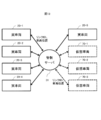
- FIG. 13 is a diagram for explaining the relationship among the control control device, the autonomous traveling dump truck, and the virtual vehicle when system operation verification is performed using a real vehicle and a virtual vehicle.
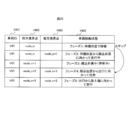
- FIG. 14 is a diagram illustrating an example of section information for storing information on a travel permitted section set for a real vehicle and a virtual vehicle.
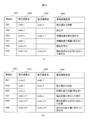
- FIG. 14A shows a virtual vehicle (ID: V01) at a standby position.
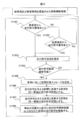
- FIG. 15 is a flowchart showing a flow of the control control process in which a real vehicle and a virtual vehicle are mixedly run.
- the autonomous traveling system 1 is configured such that each of the five real vehicles 20-1 to 20-5 is actually wirelessly connected to the control server 31 as shown in FIG.
- Each of -1 to 70-3 is connected by virtual communication (data input / output between the virtual vehicle simulation unit 330 and the control control unit 320 via the server-side communication control unit 310).
- the entities of the virtual vehicles 70-1 to 70-3 are data on the virtual vehicle simulation unit 330, and operate on the control server 31 as described above.
- the vehicle ID is assigned to each of the real vehicle and the virtual vehicle so that there is no duplication, and the control server 31 can determine whether the vehicle to be communicated is a real vehicle or a virtual vehicle based on the vehicle ID. it can.
- FIG. 14 (a) shows an example of section information for storing information on the travel permitted section set for the real vehicle and the virtual vehicle.
- R01 to R05 are vehicle IDs 1401 that uniquely identify real vehicles
- V01 is a vehicle ID 1401 that uniquely identifies virtual vehicles.
- As information indicating the travel permitted section a node (front boundary point) located at the foremost end of the travel permitted section and a node (rear boundary point) located at the rearmost end are stored.
- the operating state of each vehicle is described for convenience of explanation, but the information indicating the operating state is attribute information of the node shown in FIG. 11B with the node ID as a key record. It becomes unnecessary by associating with. The same applies to (b), FIG. 22, and (a) and (b) of FIG.
- the control server 31 the actual vehicle, and the virtual vehicle have exactly the same format, including the vehicle ID, the ID of the node or link representing the travel-permitted section, and the location information of the actual vehicle and the virtual vehicle (where on the map exists) Can communicate with each other.
- the travel permission section is set so that the real vehicle and the virtual vehicle do not collide with each other by performing a control control process shown in FIG. 15 described later.
- the operation after introduction can be verified in advance using a virtual vehicle before introducing a new real vehicle.
- the travel permission section setting unit 322 of the control server 31 has received a travel permission request from the real vehicle 20, that is, the request information processing unit 260 (see FIG. 5) (S1501 / Yes), or the virtual vehicle 70, that is, the virtual travel control unit. It is determined whether or not there is a travel permission request from 332 (S1501 / No and S1502 / Yes). If there is no travel permission request from either (S1502 / No), the request is continued without waiting.
- the travel permission section setting unit 322 executes the following processing when there is a travel permission request from any of the vehicles (S1501 / Yes, S1502 / Yes).
- the priorities of the real vehicle and the virtual vehicle may be reversed, and the presence / absence of a travel permission request from either may be determined without particular distinction.
- vehicle is used as a concept including a real vehicle and a virtual vehicle.
- the travel permission section setting unit 322 uses the received current position of the vehicle and the information in the section information DB 314b, as in step S1208 described above, to determine the vehicle travel direction. For sections that are longer than the travel permission grant length from the end of the existing section, unless there is permission for other vehicles, or if there is a section for which permission is given to other vehicles Processing to set as a permitted section is executed (S1503).
- the travel permission section setting unit 322 creates a section response message indicating the travel permission section and transmits or outputs it to the vehicle (S1505).
- the travel permission section setting unit 322 sets the section as a travel permission section for the same vehicle, and stores it in the section information (S1506). If there is a section that intersects with a section that grants travel permission, the travel permission section setting unit 322 sets the section as a travel permission section for the same vehicle on the master map data DB 314a (S1507).
- These processes are processes for preventing other vehicles from entering the junction or intersection and interfering with the vehicle that is the target of setting the travel-permitted section. On the other hand, since it is only necessary to notify the travel permission section along the traveling direction of the vehicle, the travel permission section set in this step is not included in the section response message, and the process of the control server 31 is completed.
- step S1212 when the distance from the current position of the vehicle to the end of the travel permission section that has already passed is equal to or greater than the travel permission release distance, the travel permission section setting unit 322 cancels the travel permission of the section that has passed. Is updated (S1508).
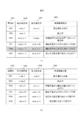
- FIG. 14 shows a state in which each vehicle has moved forward and the travel permission section has been reset.
- node_1 to node_2 are set as travel permission sections for the actual vehicle (R01), but after the actual vehicle (R01) passes node_1, node_2 is released from node_1.
- node_1 to node_2 are set as travel permission sections for the actual vehicle (R02).
- the real vehicle 20 and the control server 31 repeat the above processing.
- a simulation of the driving state including the behavior and position when driving on the road according to the driving permission section set for the virtual vehicle is performed, and the result (particularly the position of the virtual vehicle) is determined as the driving permission. Returned to the section setting section.
- the travel-permitted section setting unit 322 sets the travel-permitted section with the same processing for both vehicles without particularly distinguishing whether the requesting vehicle is an autonomous traveling dump truck or a virtual vehicle. To do. Thereby, the autonomous traveling dump truck that actually travels and the virtual vehicle in the simulation are controlled and controlled so as to prevent collision with each other.
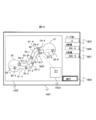
- FIG. 16 is a diagram illustrating an example of a virtual vehicle setting input screen.
- a map screen 1602 including the loading place 61 and the earth release place 62 in the mine and the conveyance path 60 connecting them is displayed.
- the travel permission section setting unit 322 also performs control for displaying the screen 1601 on the display device 316 (see FIG. 2).
- a traveling path and nodes for representing the section are set as coordinate data on the transport path.
- the travel permission section setting unit 322 generates and displays a map screen 1602 by superimposing and displaying the travel permission sections stored in the section information DB 314b and the positions of the real vehicle 20 and the virtual vehicle 70 on the map data of the master map data DB 314a. To do. Further, the transport vehicle 20 and the virtual vehicle 70 are displayed in a superimposed manner on the map screen while changing the display mode.
- a tool box 1603 for displaying a virtual vehicle icon is displayed. The user drags the virtual vehicle icon on the transport path 60 to the position where the travel permission section is not set with the mouse cursor 1604.
- a node ID input field 1605 may be provided on the screen 1601.
- the virtual travel control unit 332 displays the X coordinate 1606 and Y coordinate 1607 of the node ID with reference to the map data, and displays a virtual vehicle icon at that position. Also good.
- the virtual vehicle simulation unit 330 including the virtual travel control unit 332 and the travel simulation unit 333 starts processing.
- the travel permission section is set for the transport vehicle and the virtual vehicle based on the position of the actual vehicle that is actually traveling and the virtual position of the virtual vehicle, the virtual vehicle is added while the actual vehicle is traveling. It is possible to verify whether or not it is possible to set the travel permission section at the time. Moreover, since the state which operated the real vehicle can be maintained in this verification, the fall of the productivity of a mine accompanying the operation stop of a real vehicle can be suppressed.
- the second embodiment is an embodiment for performing verification for adding a new travel route to existing map data.
- the second embodiment will be described with reference to FIGS. 17 to 19.
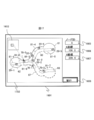
- FIG. 17 is a screen display example for adding a virtual travel path.
- FIG. 18 is a flowchart showing an overview of the processing of the second embodiment.
- FIG. 19 is a flowchart showing details of the virtual travel route addition process.
- FIG. 17 shows a screen display example displayed in the virtual road addition process.
- the screen 1702 in FIG. 17 is displayed on the display device 316 of the control server 31 when a virtual travel path is added to the actual travel path when a real vehicle and a virtual vehicle are mixed running in a mine including a planned transport path. It is a screen to be.
- the actual travel path and the virtual travel path are displayed with different display modes.
- the screen 1702 is provided with a virtual loading place 68 in addition to the configuration of the loading place 61, the earthing place 62, and the transport path 60 described in FIG. 16.
- the dumping ground 62 is a common dumping ground for transporting from the loading places 61 and 68.
- a virtual transport path 67 is branched from the transport path 60 so that the loading place 68 can be accessed.
- Five autonomous traveling dump trucks 20-1 to 20-5 reciprocate between the original loading field 61 and the earthing field 62, and the three virtual vehicles 70-1 to 70-3 are virtually loaded.
- a round trip is made between the ground 68 and the earthing ground 62.
- the autonomous traveling dump trucks 20-1 to 20-5 and virtual vehicles 70-1 to 70-3 are each instructed from the control server 31.
- the vehicle travels according to the travel permitted sections 81-1 to 81-8.
- a map data generation process is performed (S901), and when a virtual travel route is not added (S1801 / No), the processes of steps S902 to S907 are performed as in the first embodiment.
- the virtual travel path addition process is a process for setting the shapes of the transport path, loading place, and earth release place that do not actually exist in a state where the travel path has already been set in the mine.
- the map data generation unit 323 uses reference data such as an aerial photograph of a mine used when setting a virtual map from a storage device externally attached to the control server 31, for example. And existing map data (which may be stored in either the master map data DB 314a or the virtual map data DB 335) is read (S1901).
- the reference data is not limited to photographs, but may be CAD data having information on the mine topography of the development plan.
- the map information creation unit 323 displays a map image based on these data on the screen of the display device 316. In the map image, map data stored in the master map data DB 314a or the like may be superimposed and displayed on topographic information using aerial photographs or the like.
- the user plots the node coordinates of the virtual traveling road to be added to the existing traveling road on the map image using the input device 317 (S1902).
- the plotted node coordinates are stored in the map information creation unit 323.
- the user sets the connection relationship between the nodes plotted using the input device 317 (S1903). For example, it may be set by clicking one node and then clicking a node to be connected to it, or may be set by selecting two nodes and executing processing. At this time, when the conveyance path is branched from a node included in the existing map data, a connection relationship with the existing map data may be set.
- the user sets the parameter of the plotted node using the input device 317 (S1904).
- the plotted nodes are given attributes (corresponding to reference numeral 1108 in FIG. 11) for giving instructions to the vehicle, such as loading points and release points.
- the map data generation unit 323 stores the generated map data in the virtual map data DB 335 and the master map data DB 314a (S1905).
- non-existing (virtual) nodes and links are defined as data that can be distinguished from existing nodes and links. For example, like a vehicle ID, a character that distinguishes both is added to an existing node ID, a link ID, a virtual node ID, and a link ID, and a real vehicle actually exists when setting a travel permission section in a simulation run The travel permission section is set using only the node ID, and the virtual vehicle sets the travel permission section using both the actual node ID and the virtual node ID.
- the map data stored above is only virtual travel route information, and the travel route data in the actually developed transport route etc. is newly determined by the map generation processing procedure determined by sensors such as GPS and laser radar. Need to be generated.
- the travel permission section setting unit 322 includes the vehicle ID, the node ID, and the link ID of the section information. Based on this, the virtual vehicle refers to the virtual map data to set a travel permitted section on the virtual travel path, and for the real vehicle, refers to the real map data and sets the travel permitted section on the actual travel path.
- the dump map data DB 204a stores only actual map data, and the autonomous traveling control unit 270 performs traveling control while comparing the position data of the position calculation device 220 and the actual map data, and the two do not match. Since the vehicle stops, it is possible to avoid a real vehicle from getting lost on the virtual travel path.
- the real vehicle travels according to the travel permission section set on the actual travel path
- the virtual vehicle travels according to the travel permission section set on the virtual travel path.
- a system configuration in which a virtual map data is generated in advance assuming a traveling path on a non-existing conveyance path, and the actual vehicle and the virtual vehicle travel based on the control control based on the virtual map data.
- the third embodiment is an embodiment in which a traveling model of a virtual vehicle is corrected based on actual traveling data of an autonomous traveling dump truck or an input operation from a user.
- FIG. 20 is a functional block diagram of the control server 31 according to the third embodiment.
- FIG. 21 is a screen display example displayed in the third embodiment.
- the control server 31 uses the travel data of the transport vehicle received from the traveling real vehicle to change the behavior of the virtual vehicle to the real vehicle.
- a travel parameter correction unit 350 that corrects the travel parameters so as to coincide with the behavior of.
- the travel parameter is a parameter that affects the behavior of the virtual vehicle. For example, the vehicle weight, acceleration, gradient, road friction coefficient ⁇ , and the like are corrected.
- the friction coefficient ⁇ is set using the rotational speed and torque of the wheel at that point.
- the actual vehicle 20 includes a travel data storage unit (not shown) that temporarily records speed, acceleration, inclination, load sensor data, and the like corresponding to the vehicle coordinates detected by the in-vehicle sensor 230 during travel.
- the vehicle 20 transmits the output from the in-vehicle sensor 230 via the wireless communication line 40 while traveling.
- the traveling parameter correction unit 350 receives the sensor value, identifies a point where the virtual vehicle 70 travels differently from the autonomous traveling dump truck 20 based on the value, and determines the gradient or acceleration of the vehicle from the point.
- the travel parameters of the virtual vehicle are calculated so that the virtual vehicle 70 behaves more like an actual vehicle.
- the travel parameter of the travel simulation unit 333 is corrected to the calculated value. As a result, the behavior of the virtual vehicle can be made closer to the behavior of the running real vehicle, and the reliability of the simulation result can be further increased.
- FIG. 21 shows an example of a travel parameter input screen.
- a screen 2101 in FIG. 21 shows a parameter input screen for defining vehicle specifications.
- the vehicle specifications as examples of parameters that affect the behavior of the virtual vehicle, the vehicle body weight, the maximum loading capacity, the wheel base, and the minimum turning radius are illustrated.
- the travel parameters are not limited thereto. For example, there may be acceleration, deceleration (braking amount), steering speed, and the like.
- the travel simulation unit 333 updates the travel parameter used in the travel simulation unit 333 to an input value.
- the travel simulation unit 333 performs a travel simulation of the virtual vehicle using the input value.
- parameters derived from the state of the traveling road for example, the gradient of the road surface and the friction coefficient may be corrected as needed.
- the travel parameters that define the friction coefficient of the road surface for example, the wheel rotation speed and torque are different for each node and link on the travel road, so that the travel parameters can be set by specifying the node ID and link ID. Also good.
- the user can set or modify the travel parameters of the virtual vehicle, and a travel simulation of desired performance and structure can be performed.
- a travel simulation of desired performance and structure can be performed when running parameters indicating the same performance and structure as the actual vehicle are set.
- a running simulation can be performed when a vehicle of the same vehicle type as the actual vehicle is added.
- a travel simulation can be performed when a vehicle of a vehicle type different from the actual vehicle is added.
- the virtual vehicle is processed so as to end instantaneously when the virtual vehicle performs a specific operation, for example, a standby operation, a traveling operation, and a stop operation at the loading position at the loading site.
- a specific operation for example, a standby operation, a traveling operation, and a stop operation at the loading position at the loading site.
- This is an embodiment that performs (skip processing).
- FIG. 22 is an example of the section information in which the travel permission sections set in the loading place for the virtual vehicle are described in time series.
- FIG. 23 is a diagram illustrating an example of section information when a virtual vehicle is skipped.
- FIG. 23A illustrates a state where only skip processing is performed
- FIG. 23B illustrates time lag adjustment processing performed during skip processing. Indicates the state.
- the travel permission section setting unit 322 assumes that, for example, phases 1, 2, and 3 have ended instantaneously, skips from phase 1 to phase 4, and sets the travel permission section of phase 1 Further, a travel permission section of phase 4 may be set (see FIG. 23A).
- the control server 31 includes a timer, and the travel permission section setting unit 322 is configured to perform the skip process after measuring the time during which the virtual vehicle does not jump over the immediately preceding vehicle (particularly the actual vehicle) during the skip process.
- FIG. 23B shows section information when the virtual vehicle (V01) is skipped after the real vehicle (R04) immediately before the virtual vehicle (V01) leaves the exit of the loading area. .
- the travel permission section setting unit 322 may execute the skip process after confirming that the current position received from the immediately preceding actual vehicle (R04) has exited the exit, instead of the timing process.
- the time required for the virtual vehicle to perform the above operation is made shorter than the operation time of the actual vehicle, so that the time during which the loader cannot be operated is further reduced, and the production of the mine accompanying the simulation is performed. The decrease in efficiency can be suppressed.
- a virtual vehicle is added on the travel path.
- the virtual vehicle starts from a predetermined starting point, for example, a parking lot. It may be configured.
- the example relating to the loading operation is illustrated as the skip operation example of the fourth embodiment, the operation related to the earthing operation may be skipped.
- a warning may be displayed when a situation where the travel permission section cannot be set occurs.
- the above situation may be limited to the virtual vehicle and the immediately following vehicle (including the real vehicle and the virtual vehicle). Thereby, it becomes easy to grasp the situation in which the travel permission section cannot be set due to the addition of the virtual vehicle, and a display screen suitable for the operation verification of the autonomous travel system can be provided.
Landscapes
- Engineering & Computer Science (AREA)
- Radar, Positioning & Navigation (AREA)
- Remote Sensing (AREA)
- Physics & Mathematics (AREA)
- General Physics & Mathematics (AREA)
- Automation & Control Theory (AREA)
- Aviation & Aerospace Engineering (AREA)
- Traffic Control Systems (AREA)
- Control Of Position, Course, Altitude, Or Attitude Of Moving Bodies (AREA)
- Navigation (AREA)
Applications Claiming Priority (2)
| Application Number | Priority Date | Filing Date | Title |
|---|---|---|---|
| JP2014167813A JP6426941B2 (ja) | 2014-08-20 | 2014-08-20 | 管制制御装置及び運搬車両の走行シミュレーション方法 |
| JP2014-167813 | 2014-08-20 |
Publications (1)
| Publication Number | Publication Date |
|---|---|
| WO2016027830A1 true WO2016027830A1 (ja) | 2016-02-25 |
Family
ID=55350774
Family Applications (1)
| Application Number | Title | Priority Date | Filing Date |
|---|---|---|---|
| PCT/JP2015/073230 Ceased WO2016027830A1 (ja) | 2014-08-20 | 2015-08-19 | 管制制御装置及び運搬車両の走行シミュレーション方法 |
Country Status (2)
| Country | Link |
|---|---|
| JP (1) | JP6426941B2 (https=) |
| WO (1) | WO2016027830A1 (https=) |
Cited By (5)
| Publication number | Priority date | Publication date | Assignee | Title |
|---|---|---|---|---|
| WO2018025341A1 (ja) * | 2016-08-03 | 2018-02-08 | 三菱電機株式会社 | 道路状態診断システム、診断用情報生成装置及び診断用情報生成方法 |
| CN111123740A (zh) * | 2019-12-19 | 2020-05-08 | 北京经纬恒润科技有限公司 | 硬件在环测试方法以及装置 |
| CN111815771A (zh) * | 2020-07-07 | 2020-10-23 | 中冶北方(大连)工程技术有限公司 | 一种网页端模拟露天矿生产方法 |
| CN112141129A (zh) * | 2019-06-28 | 2020-12-29 | 丰田自动车株式会社 | 自动驾驶车辆、运行管理中心以及车辆运行系统 |
| US11280616B2 (en) | 2019-07-11 | 2022-03-22 | Caterpillar Inc. | Operating status identification system for machine |
Families Citing this family (20)
| Publication number | Priority date | Publication date | Assignee | Title |
|---|---|---|---|---|
| KR101897992B1 (ko) * | 2017-03-28 | 2018-09-13 | 재단법인대구경북과학기술원 | 자율주행 자동차 설계를 위한 자율 주행 제어 개발 키트 |
| KR101938064B1 (ko) * | 2017-05-17 | 2019-01-11 | 현대오토에버 주식회사 | 자율주행 테스트 시스템 |
| KR102375306B1 (ko) * | 2018-01-24 | 2022-03-16 | 한화디펜스 주식회사 | 작업 차량에 대한 주행정보 디스플레이 장치 및 방법 그리고 주행속도 제어방법 |
| JP7141883B2 (ja) * | 2018-07-31 | 2022-09-26 | 株式会社小松製作所 | 作業機械の制御システム、作業機械、及び作業機械の制御方法 |
| JP7129891B2 (ja) * | 2018-11-21 | 2022-09-02 | 日立建機株式会社 | 作業車両、作業エリア管理システム |
| WO2020193379A1 (en) * | 2019-03-22 | 2020-10-01 | Volvo Truck Corporation | A method for controlling vehicles repeating a cycle |
| CN113614669B (zh) * | 2019-03-22 | 2024-04-05 | 沃尔沃卡车集团 | 用于在沿路线的任务中控制车辆的方法 |
| CN110543173B (zh) * | 2019-08-30 | 2022-02-11 | 上海商汤智能科技有限公司 | 车辆定位系统及方法、车辆控制方法及装置 |
| JP6860640B2 (ja) * | 2019-11-20 | 2021-04-21 | ヤンマーパワーテクノロジー株式会社 | 経路生成システム |
| JP7478092B2 (ja) * | 2020-12-28 | 2024-05-02 | 株式会社日立製作所 | 荷役車両システム |
| KR102568969B1 (ko) * | 2021-03-31 | 2023-08-23 | 주식회사 한국디지털트윈연구소 | 디지털트윈 기술을 이용한 자율주행시험용 주행환경 시나리오 발생장치 |
| JP7846980B2 (ja) * | 2021-12-14 | 2026-04-16 | 日立建機株式会社 | 搬送車両の走行システム |
| JP2024071265A (ja) * | 2022-11-14 | 2024-05-24 | 株式会社小松製作所 | 無人車両の管理システム及び無人車両の管理方法 |
| KR102576733B1 (ko) * | 2022-11-30 | 2023-09-08 | 주식회사 모라이 | 관제 플랫폼 연동 vils 기반 교통 환경 재현 방법 및 시스템 |
| KR102866714B1 (ko) * | 2022-12-23 | 2025-10-02 | 주식회사 에스와이피 | 자동 비상 제동 성능 테스트 방법 및 이를 위한 시뮬레이션 장치 |
| KR102805400B1 (ko) * | 2023-04-12 | 2025-05-12 | 국민대학교산학협력단 | PG(Proving Ground) 기반 VILS(Vehicle-In-the-Loop Simulation) 테스트를 위한 시뮬레이션 장치 및 이의 시뮬레이션 방법 |
| KR102855603B1 (ko) * | 2023-09-04 | 2025-09-04 | 주식회사 모라이 | Rsu를 이용한 vils 기반의 자율 주행 평가 방법 및 시스템 |
| JP7544417B1 (ja) | 2024-01-04 | 2024-09-03 | 佑斗 井澤 | 乗り物の移動を支援する方法及び装置 |
| JP7727051B1 (ja) | 2024-05-28 | 2025-08-20 | 株式会社シンテックホズミ | 走行管理システム及び搬送ロボットシステム |
| WO2026034387A1 (ja) * | 2024-08-05 | 2026-02-12 | 株式会社村田製作所 | シミュレーション装置、運行管理装置、運行管理プログラム |
Citations (4)
| Publication number | Priority date | Publication date | Assignee | Title |
|---|---|---|---|---|
| JP2006244124A (ja) * | 2005-03-03 | 2006-09-14 | Techno Craft Co Ltd | 運行管理装置 |
| JP2007164280A (ja) * | 2005-12-09 | 2007-06-28 | Komatsu Ltd | 車両の走行制御装置 |
| JP2007170927A (ja) * | 2005-12-20 | 2007-07-05 | Aisin Aw Co Ltd | 走行予測システム |
| JP2012118694A (ja) * | 2010-11-30 | 2012-06-21 | Komatsu Ltd | 無人車両の走行システムにおける走行制御方法および無人車両の走行システム |
-
2014
- 2014-08-20 JP JP2014167813A patent/JP6426941B2/ja active Active
-
2015
- 2015-08-19 WO PCT/JP2015/073230 patent/WO2016027830A1/ja not_active Ceased
Patent Citations (4)
| Publication number | Priority date | Publication date | Assignee | Title |
|---|---|---|---|---|
| JP2006244124A (ja) * | 2005-03-03 | 2006-09-14 | Techno Craft Co Ltd | 運行管理装置 |
| JP2007164280A (ja) * | 2005-12-09 | 2007-06-28 | Komatsu Ltd | 車両の走行制御装置 |
| JP2007170927A (ja) * | 2005-12-20 | 2007-07-05 | Aisin Aw Co Ltd | 走行予測システム |
| JP2012118694A (ja) * | 2010-11-30 | 2012-06-21 | Komatsu Ltd | 無人車両の走行システムにおける走行制御方法および無人車両の走行システム |
Cited By (8)
| Publication number | Priority date | Publication date | Assignee | Title |
|---|---|---|---|---|
| WO2018025341A1 (ja) * | 2016-08-03 | 2018-02-08 | 三菱電機株式会社 | 道路状態診断システム、診断用情報生成装置及び診断用情報生成方法 |
| JPWO2018025341A1 (ja) * | 2016-08-03 | 2018-12-27 | 三菱電機株式会社 | 道路状態診断システム |
| CN112141129A (zh) * | 2019-06-28 | 2020-12-29 | 丰田自动车株式会社 | 自动驾驶车辆、运行管理中心以及车辆运行系统 |
| CN112141129B (zh) * | 2019-06-28 | 2023-09-22 | 丰田自动车株式会社 | 自动驾驶车辆、运行管理中心以及车辆运行系统 |
| US11280616B2 (en) | 2019-07-11 | 2022-03-22 | Caterpillar Inc. | Operating status identification system for machine |
| CN111123740A (zh) * | 2019-12-19 | 2020-05-08 | 北京经纬恒润科技有限公司 | 硬件在环测试方法以及装置 |
| CN111123740B (zh) * | 2019-12-19 | 2024-04-16 | 北京经纬恒润科技股份有限公司 | 硬件在环测试方法以及装置 |
| CN111815771A (zh) * | 2020-07-07 | 2020-10-23 | 中冶北方(大连)工程技术有限公司 | 一种网页端模拟露天矿生产方法 |
Also Published As
| Publication number | Publication date |
|---|---|
| JP6426941B2 (ja) | 2018-11-21 |
| JP2016045585A (ja) | 2016-04-04 |
Similar Documents
| Publication | Publication Date | Title |
|---|---|---|
| JP6426941B2 (ja) | 管制制御装置及び運搬車両の走行シミュレーション方法 | |
| CN107430808B (zh) | 管制控制系统、管制控制装置和车载终端装置 | |
| EP3217380B1 (en) | Map creation device | |
| JP6247622B2 (ja) | 管制制御装置 | |
| CN106663369B (zh) | 交通管制服务器以及交通管制系统 | |
| JP6025848B2 (ja) | 車両の管制制御システム | |
| JP6145024B2 (ja) | ダンプトラックの運行管理システム | |
| AU2015200254B2 (en) | Vehicle control system | |
| JP2022509762A (ja) | 自律マシンを使用したタスクの実行 | |
| JP6339412B2 (ja) | 交通管制サーバ | |
| JP6352841B2 (ja) | 車載端末装置及び交通管制システム | |
| JP2016071568A5 (https=) | ||
| JP6487561B2 (ja) | 鉱山機械のロギングシステム、車載端末装置、及び鉱山機械のロギング方法 | |
| JP7458883B2 (ja) | 運搬車両の管理システム及び運搬車両の管理方法 |
Legal Events
| Date | Code | Title | Description |
|---|---|---|---|
| 121 | Ep: the epo has been informed by wipo that ep was designated in this application |
Ref document number: 15833218 Country of ref document: EP Kind code of ref document: A1 |
|
| NENP | Non-entry into the national phase |
Ref country code: DE |
|
| 32PN | Ep: public notification in the ep bulletin as address of the adressee cannot be established |
Free format text: NOTING OF LOSS OF RIGHTS PURSUANT TO RULE 112(1) EPC (EPO FORM 1205A DATED 26.05.2017) |
|
| 122 | Ep: pct application non-entry in european phase |
Ref document number: 15833218 Country of ref document: EP Kind code of ref document: A1 |