WO2016009670A1 - 変速機用潤滑油組成物 - Google Patents
変速機用潤滑油組成物 Download PDFInfo
- Publication number
- WO2016009670A1 WO2016009670A1 PCT/JP2015/056963 JP2015056963W WO2016009670A1 WO 2016009670 A1 WO2016009670 A1 WO 2016009670A1 JP 2015056963 W JP2015056963 W JP 2015056963W WO 2016009670 A1 WO2016009670 A1 WO 2016009670A1
- Authority
- WO
- WIPO (PCT)
- Prior art keywords
- lubricating oil
- less
- oil composition
- group
- mass
- Prior art date
- Legal status (The legal status is an assumption and is not a legal conclusion. Google has not performed a legal analysis and makes no representation as to the accuracy of the status listed.)
- Ceased
Links
Classifications
-
- C—CHEMISTRY; METALLURGY
- C10—PETROLEUM, GAS OR COKE INDUSTRIES; TECHNICAL GASES CONTAINING CARBON MONOXIDE; FUELS; LUBRICANTS; PEAT
- C10M—LUBRICATING COMPOSITIONS; USE OF CHEMICAL SUBSTANCES EITHER ALONE OR AS LUBRICATING INGREDIENTS IN A LUBRICATING COMPOSITION
- C10M169/00—Lubricating compositions characterised by containing as components a mixture of at least two types of ingredient selected from base-materials, thickeners or additives, covered by the preceding groups, each of these compounds being essential
- C10M169/04—Mixtures of base-materials and additives
-
- C—CHEMISTRY; METALLURGY
- C10—PETROLEUM, GAS OR COKE INDUSTRIES; TECHNICAL GASES CONTAINING CARBON MONOXIDE; FUELS; LUBRICANTS; PEAT
- C10M—LUBRICATING COMPOSITIONS; USE OF CHEMICAL SUBSTANCES EITHER ALONE OR AS LUBRICATING INGREDIENTS IN A LUBRICATING COMPOSITION
- C10M101/00—Lubricating compositions characterised by the base-material being a mineral or fatty oil
- C10M101/02—Petroleum fractions
-
- C—CHEMISTRY; METALLURGY
- C10—PETROLEUM, GAS OR COKE INDUSTRIES; TECHNICAL GASES CONTAINING CARBON MONOXIDE; FUELS; LUBRICANTS; PEAT
- C10M—LUBRICATING COMPOSITIONS; USE OF CHEMICAL SUBSTANCES EITHER ALONE OR AS LUBRICATING INGREDIENTS IN A LUBRICATING COMPOSITION
- C10M133/00—Lubricating compositions characterised by the additive being an organic non-macromolecular compound containing nitrogen
- C10M133/52—Lubricating compositions characterised by the additive being an organic non-macromolecular compound containing nitrogen having a carbon chain of 30 or more atoms
- C10M133/56—Amides; Imides
-
- C—CHEMISTRY; METALLURGY
- C10—PETROLEUM, GAS OR COKE INDUSTRIES; TECHNICAL GASES CONTAINING CARBON MONOXIDE; FUELS; LUBRICANTS; PEAT
- C10M—LUBRICATING COMPOSITIONS; USE OF CHEMICAL SUBSTANCES EITHER ALONE OR AS LUBRICATING INGREDIENTS IN A LUBRICATING COMPOSITION
- C10M135/00—Lubricating compositions characterised by the additive being an organic non-macromolecular compound containing sulfur, selenium or tellurium
- C10M135/08—Lubricating compositions characterised by the additive being an organic non-macromolecular compound containing sulfur, selenium or tellurium containing a sulfur-to-oxygen bond
- C10M135/10—Sulfonic acids or derivatives thereof
-
- C—CHEMISTRY; METALLURGY
- C10—PETROLEUM, GAS OR COKE INDUSTRIES; TECHNICAL GASES CONTAINING CARBON MONOXIDE; FUELS; LUBRICANTS; PEAT
- C10M—LUBRICATING COMPOSITIONS; USE OF CHEMICAL SUBSTANCES EITHER ALONE OR AS LUBRICATING INGREDIENTS IN A LUBRICATING COMPOSITION
- C10M135/00—Lubricating compositions characterised by the additive being an organic non-macromolecular compound containing sulfur, selenium or tellurium
- C10M135/20—Thiols; Sulfides; Polysulfides
-
- C—CHEMISTRY; METALLURGY
- C10—PETROLEUM, GAS OR COKE INDUSTRIES; TECHNICAL GASES CONTAINING CARBON MONOXIDE; FUELS; LUBRICANTS; PEAT
- C10M—LUBRICATING COMPOSITIONS; USE OF CHEMICAL SUBSTANCES EITHER ALONE OR AS LUBRICATING INGREDIENTS IN A LUBRICATING COMPOSITION
- C10M135/00—Lubricating compositions characterised by the additive being an organic non-macromolecular compound containing sulfur, selenium or tellurium
- C10M135/32—Heterocyclic sulfur, selenium or tellurium compounds
- C10M135/36—Heterocyclic sulfur, selenium or tellurium compounds the ring containing sulfur and carbon with nitrogen or oxygen
-
- C—CHEMISTRY; METALLURGY
- C10—PETROLEUM, GAS OR COKE INDUSTRIES; TECHNICAL GASES CONTAINING CARBON MONOXIDE; FUELS; LUBRICANTS; PEAT
- C10M—LUBRICATING COMPOSITIONS; USE OF CHEMICAL SUBSTANCES EITHER ALONE OR AS LUBRICATING INGREDIENTS IN A LUBRICATING COMPOSITION
- C10M137/00—Lubricating compositions characterised by the additive being an organic non-macromolecular compound containing phosphorus
- C10M137/02—Lubricating compositions characterised by the additive being an organic non-macromolecular compound containing phosphorus having no phosphorus-to-carbon bond
-
- C—CHEMISTRY; METALLURGY
- C10—PETROLEUM, GAS OR COKE INDUSTRIES; TECHNICAL GASES CONTAINING CARBON MONOXIDE; FUELS; LUBRICANTS; PEAT
- C10M—LUBRICATING COMPOSITIONS; USE OF CHEMICAL SUBSTANCES EITHER ALONE OR AS LUBRICATING INGREDIENTS IN A LUBRICATING COMPOSITION
- C10M139/00—Lubricating compositions characterised by the additive being an organic non-macromolecular compound containing atoms of elements not provided for in groups C10M127/00 - C10M137/00
-
- C—CHEMISTRY; METALLURGY
- C10—PETROLEUM, GAS OR COKE INDUSTRIES; TECHNICAL GASES CONTAINING CARBON MONOXIDE; FUELS; LUBRICANTS; PEAT
- C10M—LUBRICATING COMPOSITIONS; USE OF CHEMICAL SUBSTANCES EITHER ALONE OR AS LUBRICATING INGREDIENTS IN A LUBRICATING COMPOSITION
- C10M159/00—Lubricating compositions characterised by the additive being of unknown or incompletely defined constitution
- C10M159/12—Reaction products
- C10M159/20—Reaction mixtures having an excess of neutralising base, e.g. so-called overbasic or highly basic products
-
- C—CHEMISTRY; METALLURGY
- C10—PETROLEUM, GAS OR COKE INDUSTRIES; TECHNICAL GASES CONTAINING CARBON MONOXIDE; FUELS; LUBRICANTS; PEAT
- C10M—LUBRICATING COMPOSITIONS; USE OF CHEMICAL SUBSTANCES EITHER ALONE OR AS LUBRICATING INGREDIENTS IN A LUBRICATING COMPOSITION
- C10M159/00—Lubricating compositions characterised by the additive being of unknown or incompletely defined constitution
- C10M159/12—Reaction products
- C10M159/20—Reaction mixtures having an excess of neutralising base, e.g. so-called overbasic or highly basic products
- C10M159/24—Reaction mixtures having an excess of neutralising base, e.g. so-called overbasic or highly basic products containing sulfonic radicals
Definitions
- the present invention relates to a lubricating oil composition, and more specifically, a lubricating oil composition having fuel consumption savings due to excellent viscosity-temperature characteristics, and excellent wear and seizure resistance despite low viscosity, and compatibility with a sealing material,
- the present invention relates to a lubricating oil composition suitable for an automatic transmission and / or a continuously variable transmission.
- lubricating oils used in automatic transmissions, manual transmissions, internal combustion engines, etc. have a viscosity temperature to improve various durability such as thermal oxidation stability, wear resistance and fatigue resistance, and to improve fuel economy. Improvements in low-temperature viscosity properties such as improved properties, reduced low-temperature viscosity, improved low-temperature fluidity are required, and in order to improve such performance, antioxidants, detergent dispersants, and abrasion are appropriately applied to base oils.
- Lubricating oils containing various additives such as an inhibitor, a friction modifier, a seal swelling agent, a viscosity index improver, an antifoaming agent and a colorant are used.
- Recent transmissions and engines are required to be fuel efficient, lighter, smaller, and have higher output. Furthermore, with transmissions that are combined with higher output, improvements in power transmission capability are being pursued. . For this reason, the lubricant used in these products has a reduced product viscosity and base oil viscosity, maintains high lubrication performance, and prevents wear and fatigue on the surface of bearings, gears, etc., and seizure resistance. Is required.
- a technique for improving viscosity temperature characteristics by reducing the base oil viscosity and increasing the viscosity index improver is adopted. Since fatigue resistance deteriorates, development of a lubricating oil that can achieve both fuel saving, wear prevention, seizure resistance, and fatigue prevention at a higher level is eagerly desired.
- the present invention has a lubricating oil composition, particularly an automatic transmission and / or a continuously variable transmission, which has excellent fuel saving performance, wear resistance, seizure resistance, and seal material compatibility. It is an object to provide a lubricating oil composition for a transmission suitable for a machine.
- a lubricating oil composition containing a specific additive in a specific lubricating base oil has fuel saving performance and wear / seizure resistance, and a sealing material.
- the present inventors have found that the compatibility is excellent and have completed the present invention.
- a kinematic viscosity at 100 ° C. is 2.0 mm 2 / s or more 3.8 mm 2 / s or less,% C P 60 85 less,% C N is 15 or more and 40 or less,% C
- a mineral base oil having A of 3 or less (B) Phosphite ester is 200-600 mass ppm in terms of phosphorus element, (C) an alkali metal and / or alkaline earth metal detergent in an amount of 50 to 200 mass ppm in terms of metal element, (D) containing 20 to 120 ppm by mass of boron-containing ashless dispersant in terms of boron element;
- a lubricating oil composition wherein the kinematic viscosity at 100 ° C. is not more than 2.5 mm 2 / s or more 4.3 mm 2 / s.
- the present invention is the above-described lubricating oil composition for a transmission, further comprising (E) polysulfide and / or thiadiazole.
- the present invention is the above-described lubricating oil composition for a transmission, wherein the component (C) is calcium sulfonate.
- the present invention is the lubricating oil composition for a transmission as described in any one of the above, which is used for an automatic transmission.
- the lubricating oil composition of the present invention is low in viscosity for improving fuel efficiency, is excellent in antiwear and seizure resistance, and has good oxidation stability and compatibility with a sealing material, and It is a lubricating oil composition for a transmission that is particularly suitable for automatic transmissions and / or continuously variable transmissions because of its excellent seal leakage at low temperatures.
- the transmission lubricating oil composition of the present invention (hereinafter also referred to as the lubricating oil composition of the present invention) contains a mineral oil base oil having the following properties as the component (A).
- the kinematic viscosity at 100 ° C. of the component (A) is 2.0 mm 2 / s or more, preferably 2.2 mm 2 / s or more, more preferably 2.4 mm 2 / s or more. Moreover, it is 3.8 mm ⁇ 2 > / s or less, Preferably it is 3.6 mm ⁇ 2 > / s or less, More preferably, it is 3.4 mm ⁇ 2 > / s or less.
- the viscosity temperature characteristics and the low temperature viscosity characteristics deteriorate, and when it is less than 2.0 mm 2 / s, an oil film is formed at the lubrication point. Is insufficient because the metal fatigue resistance and heat resistance are inferior, and the evaporation loss of the lubricating base oil increases.
- (A)% C P of the component is 60 or more, preferably 62 or more, more preferably 65 or more. On the other hand, it is 85 or less, preferably 83 or less, and more preferably 80 or less. % C P viscosity-temperature characteristic can exhibit fuel efficiency by the above range is obtained a further solubility and additives and sludge, is compatible to the seal member becomes excellent.
- % C N of the component (A) is 40 or less, preferably 38 or less, more preferably 35 or less. Moreover, it is 15 or more, 17 or more are preferable and 20 or more are more preferable. % C N viscosity-temperature characteristic can exhibit fuel efficiency by the above range is obtained a further and solubility of additives and sludge, is compatible to the seal member becomes excellent.
- % C A of Component (A) is less than or equal to 3, preferably 2 or less, and more preferably 1 or less. % C A thermal-oxidative stability decreases exceeds 3.
- the viscosity index of the mineral oil base oil of (A) component there is no special restriction
- the viscosity index is lower than 85, viscosity temperature characteristics that can exhibit fuel saving performance cannot be obtained.
- it exceeds 160 normal paraffin increases in the base oil, so that the viscosity at a low temperature increases rapidly and the function as a lubricating oil is lost.
- the pour point of the component (A) mineral base oil is not particularly limited, but is preferably ⁇ 15 ° C. or less, more preferably ⁇ 20 ° C. or less, still more preferably ⁇ 22.5 ° C. or less, particularly preferably. It is ⁇ 25 ° C. or lower, most preferably ⁇ 27.5 ° C. or lower. On the other hand, if it is too low, the viscosity index is lowered, and from the viewpoint of economy in the dewaxing process, it is preferably ⁇ 50 ° C. or higher, more preferably ⁇ 45 ° C. or higher, and further preferably ⁇ 40 ° C. or higher. By setting the pour point to ⁇ 15 ° C.
- a lubricating oil composition having excellent low-temperature viscosity characteristics can be obtained.
- a sufficient viscosity index cannot be obtained.
- the dewaxing step any of solvent dewaxing and contact dewaxing steps may be applied.
- the contact dewaxing step is particularly preferable because the low temperature viscosity characteristics can be further improved.
- the flash point of the component (A) is preferably 160 ° C. or higher, more preferably 165 ° C. or higher, further preferably 170 ° C. or higher, and particularly preferably 175 ° C. or higher.
- the flash point as used in the field of this invention means the flash point measured based on JISK2265 (open type flash point).
- the aniline point of the component (A) is not particularly limited, but it is preferably 90 ° C or higher, more preferably 95 ° C or higher in that a lubricating oil composition having excellent low temperature viscosity characteristics and fatigue life can be obtained.
- 97 ° C or higher is more preferable, and 100 ° C or higher is particularly preferable.
- the upper limit is not particularly limited, and may exceed 130 ° C. as one aspect of the present invention, but it is excellent in solubility of additives and sludge, and 130 ° C. or less in terms of excellent compatibility with a sealing material. Is preferable, 125 ° C. or lower is more preferable, and 120 ° C. or lower is further preferable.
- the sulfur content of the component (A) is not particularly limited, but is preferably 0.1% by mass or less, more preferably 0.05% by mass or less, still more preferably 0.01% by mass or less, and most preferably It is desirable that is not substantially contained.
- the sulfur content as used in the field of this invention means the value measured based on ASTM D4951.
- the production method is not particularly limited.
- the base oils (1) to (8) shown below are used as raw materials, and the raw oils and / or the The base oil obtained by refine
- Distilled oil by atmospheric distillation of paraffinic crude oil and / or mixed base crude oil (2) Distilled oil by vacuum distillation of atmospheric distillation residue of paraffinic crude oil and / or mixed base crude oil ( WVGO) (3) Wax (such as slack wax) obtained by the lubricant dewaxing process and / or synthetic wax (Fischer-Tropsch wax, GTL wax, etc.) obtained by the gas-liquid (GTL) process, etc.
- WVGO Distilled oil by vacuum distillation of atmospheric distillation residue of paraffinic crude oil and / or mixed base crude oil
- Wax such as slack wax obtained by the lubricant dewaxing process and / or synthetic wax (Fischer-Tropsch wax, GTL wax, etc.) obtained by the gas-liquid (GTL) process, etc.
- the above-mentioned predetermined purification methods include hydrorefining such as hydrocracking and hydrofinishing; solvent refining such as furfural solvent extraction; dewaxing such as solvent dewaxing and catalytic dewaxing; acid clay and activated clay White clay purification; chemical (acid or alkali) cleaning such as sulfuric acid cleaning and caustic soda cleaning is preferable.
- hydrorefining such as hydrocracking and hydrofinishing
- solvent refining such as furfural solvent extraction
- dewaxing such as solvent dewaxing and catalytic dewaxing
- chemical (acid or alkali) cleaning such as sulfuric acid cleaning and caustic soda cleaning is preferable.
- one of these purification methods may be performed alone, or two or more may be combined.
- the order in particular is not restrict
- the lubricating base oil according to the present invention can be obtained by subjecting a base oil selected from the above base oils (1) to (8) or a lubricating oil fraction recovered from the base oil to a predetermined treatment.
- the following base oil (9) or (10) is particularly preferred.
- (9) Hydrocracking a base oil selected from the base oils (1) to (8) or a lubricating oil fraction recovered from the base oil, and recovering the product or the product by distillation or the like Hydrocracked mineral oil obtained by subjecting a lubricating oil fraction to dewaxing treatment such as solvent dewaxing or catalytic dewaxing, or distillation after the dewaxing treatment.
- a base oil selected from the above base oils (1) to (8) or a lubricating oil fraction recovered from the base oil is hydroisomerized and recovered from the product or the product by distillation or the like. Hydroisomerized mineral oil obtained by subjecting the lubricating oil fraction to dewaxing treatment such as solvent dewaxing or catalytic dewaxing, or distillation after the dewaxing treatment.
- the thermal / oxidative stability and low temperature viscosity characteristics can be further enhanced, and the fatigue prevention performance of the lubricating oil composition is further enhanced. It is particularly preferable to include a contact dewaxing step.
- a solvent refining treatment and / or a hydrofinishing treatment step may be further provided as necessary.
- catalytic dewaxing the hydrocracking / isomerization product oil is reacted with hydrogen in the presence of an appropriate dewaxing catalyst under conditions effective to lower the pour point.
- catalytic dewaxing some of the high-boiling substances in the cracking / isomerization product are converted to low-boiling substances, the low-boiling substances are separated from the heavier base oil fraction, and the base oil fraction is fractionated. Two or more kinds of lubricating base oils are obtained.
- the low-boiling substances can be separated before obtaining the target lubricating base oil or during fractional distillation.
- a component may be only 1 type of mineral oil, and the mixture of 2 or more types of mineral oil may be sufficient as it.
- the lubricating base oil contains, in addition to the mineral base oil of component (A), for example, a small amount of synthetic oil, specifically, poly ⁇ -olefin, ester synthetic oil and the like.
- the lubricating base oil preferably contains at least 50% by mass of the mineral oil base oil of component (A), more preferably 60% by mass or more, More preferably, it is 75 mass% or more, Most preferably, it is 80 mass% or more.
- the lubricating oil composition of the present invention contains phosphorous acid ester as the component (B).
- (B) As the phosphorous acid ester as the component (B1), (B1) phosphorous acid ester containing no sulfur and / or (B2) sulfur containing phosphorous acid ester may be mentioned.
- Phosphorous acid ester containing no sulfur is represented by the general formula P (OR) 3 , and specific examples include phosphorous acid monoesters, phosphorous acid diesters, and phosphorous acid triesters.
- R is a hydrogen atom or a hydrocarbon group having 2 to 30 carbon atoms, preferably 3 to 20 carbon atoms, and at least one of R is a hydrocarbon group.
- Sulfurous acid ester containing no sulfur may be used alone or in combination of two or more.
- hydrocarbon group having 2 to 30 carbon atoms examples include an alkyl group, a cycloalkyl group, an alkylcycloalkyl group, an alkenyl group, an aryl group, an alkylaryl group, and an arylalkyl group.
- alkyl group examples include an ethyl group, an n-propyl group, an isopropyl group, an n-butyl group, an isobutyl group, a sec-butyl group, a tert-butyl group, various pentyl groups, various hexyl groups, and various heptyl groups. , Various octyl groups, various nonyl groups, various decyl groups, various dodecyl groups, and the like. Examples of the cycloalkyl group include a cyclohexyl group.
- alkenyl groups include butenyl, pentenyl, hexenyl, heptenyl, octenyl, nonenyl, decenyl, undecenyl, dodecenyl, tridecenyl, tetradecenyl, pentadecenyl, hexadecenyl, heptadecenyl.
- alkenyl groups such as an octadecenyl group (these alkenyl groups may be linear or branched, and the position of the double bond is also optional).
- aryl group examples include aryl groups such as a phenyl group and a naphthyl group.
- Specific examples of the arylalkyl group include arylalkyl groups having 7 to 12 carbon atoms such as benzyl group, phenylethyl group, phenylpropyl group, phenylbutyl group, phenylpentyl group, and phenylhexyl group. It may be a chain or a branch).
- preferable compounds of the component (B1) include, but are not limited to, monopropyl phosphite, monobutyl phosphite, monopentyl phosphite, monohexyl phosphite, monopeptyl phosphite, monooctyl phosphite and the like.
- Phosphoric acid monoalkyl ester (alkyl group may be linear or branched); Phosphorous acid mono (alkyl) aryl ester such as monophenyl phosphite, monocresyl phosphite; Dipropyl phosphite, dibutyl phosphite Dialkyl phosphites such as dipentyl phosphite, dihexyl phosphite, dipeptyl phosphite, dioctyl phosphite (the alkyl group may be linear or branched); diphenyl phosphite, dicresyl phosphite, etc.
- Di (alkyl) phosphite aryl Esters Tripropyl phosphites, tributyl phosphites, tripentyl phosphites, trihexyl phosphites, tripeptyl phosphites, trioctyl phosphites, etc.
- Trialkyl phosphites (alkyl groups can be linear or branched)
- tri (alkyl) aryl phosphites such as triphenyl phosphite and tricresyl phosphite; and mixtures thereof.
- dialkyl phosphite is preferable, and dibutyl phosphite is particularly preferable.
- (B2) As the phosphorous acid ester containing sulfur, phosphorous acid esters, thiophosphite monoesters, and thiophosphite diesters containing sulfur in the side chain represented by the following general formula (1) And thiophosphorous triesters.
- Sulfurous acid ester containing sulfur may be used alone or in combination of two or more.
- X 1 , X 2 and X 3 each independently represent an oxygen atom or a sulfur atom.
- R 1 , R 2 and R 3 are each independently a hydrogen atom or a hydrocarbon group having 2 to 30 carbon atoms, preferably 3 to 20 carbon atoms, more preferably 4 to 8 carbon atoms, and at least one of them is a hydrocarbon group. It is.
- the hydrocarbon group may contain sulfur. This can improve wear resistance and metal fatigue durability.
- R 1 to R 3 are hydrocarbon groups, it is preferable that they have different carbon numbers. The average number of carbon atoms is preferably in the above range. This can improve wear resistance and metal fatigue durability.
- Examples of the hydrocarbon group having 2 to 30 carbon atoms include the same groups as those described above for R in the component (B1).
- the preferred compound (B2) include phosphites containing sulfur in the side chain such as 3-thiopentyl hydrogen phosphite and 3-thioundecyl hydrogen phosphite, Trialkyl triphosphite such as tripropyltrithiophosphite, tributyltrithiophosphite, tripentyltrithiophosphite, trihexyltrithiophosphite, tripeptyltrithiophosphite, trioctyltrithiophosphite, trilauryltrithiophosphite ( The alkyl group may be linear or branched); tri (alkyl) aryl phosphites such as triphenyltrithiophosphite and tricresyltrithiophosphite; and mixtures thereof.
- Trialkyl triphosphite such as tripropyltrithiophosphite, tributyltrithiophosphit
- any one of (B1) sulfur phosphite swell containing no sulfur or (B2) sulfur phosphite selle containing sulfur or a mixture thereof can be used.
- seizure resistance, wear resistance, and fatigue life can be used.
- the content of the component (B) in the lubricating oil composition of the present invention is such that the phosphorus content in the lubricating oil composition is 200 mass ppm or more in terms of phosphorus element in order to impart excellent extreme pressure properties and fatigue life. , Preferably it is 230 mass ppm or more, More preferably, it is 250 mass ppm or more. On the other hand, it is 600 mass ppm or less, preferably 550 mass ppm or less, more preferably 500 mass ppm or less.
- the lubricating oil composition of the present invention contains an alkali metal and / or alkaline earth metal detergent as component (C).
- Alkali metal and / or alkaline earth metal detergents include alkali metals such as sodium and potassium, sulfonates, phenates, salicylates having alkaline earth metals such as magnesium, calcium and barium as positive components, and These mixtures are preferably used.
- the sulfonate examples include an alkali metal salt or an alkaline earth metal salt of an alkyl aromatic sulfonic acid obtained by sulfonating an alkyl aromatic compound having a molecular weight of 100 to 1500, preferably 200 to 700, particularly magnesium. Salts and / or calcium salts are preferably used.
- Specific examples of the alkyl aromatic sulfonic acid include so-called petroleum sulfonic acid and synthetic sulfonic acid.
- the petroleum sulfonic acid those obtained by sulfonating an alkyl aromatic compound of a lubricating oil fraction of mineral oil or so-called mahoganic acid which is produced as a by-product when white oil is produced is used.
- an alkylbenzene having a linear or branched alkyl group which is produced by alkylating polyolefin into benzene, which is produced in an alkylbenzene production plant that is a raw material for detergents, is used as a raw material And a sulfonated one of this, a sulfonated dinonylnaphthalene, or the like.
- a sulfonate obtained by using polyolefin as an alkylating agent is preferable from the viewpoint of friction characteristics.
- alkyl aromatic sulfonic acids can be directly reacted with alkali or alkaline earth metal bases such as metal oxides or hydroxides, or particularly alkaline earth metal-based sulfonates.
- the neutral alkaline earth metal sulfonate obtained by replacing the alkaline earth metal salt such as sodium salt or potassium salt with an alkaline earth metal salt but also the above neutral alkaline earth metal sulfonate Basic alkaline earth metal sulfonates obtained by heating alkaline earth metal salts and alkaline earth metal bases (hydroxides and oxides) in the presence of water, carbon dioxide and / or soot, boric acid or boric acid Charcoal obtained by reacting the above neutral alkaline earth metal sulfonate with an alkaline earth metal base in the presence of a salt Salts overbased alkaline earth metal sulfonate, it is also included borate overbased alkaline earth metal sulfonate.
- Basic alkaline earth metal sulfonates obtained by heating alkaline earth metal salts and alkaline earth metal bases (hydroxides and oxides) in the presence of water, carbon dioxide and / or soot, boric acid or boric acid Charcoal obtained
- phenate examples include alkali metal salts or alkaline earth metal salts of alkylphenols having 1 to 2 alkyl groups having 4 to 20 carbon atoms in the presence or absence of elemental sulfur, and mixtures thereof. Is mentioned.
- salicylates include alkali metal salts or alkaline earth metal salts of alkyl salicylic acid having 1 to 2 alkyl groups having 4 to 20 carbon atoms in the presence or absence of elemental sulfur, and mixtures thereof. Etc.
- sulfonates are preferable from the viewpoint of seizure resistance, abrasion resistance, and oxidation stability, alkaline earth metal sulfonates are particularly preferable, and calcium sulfonates are most preferable.
- the base number of the component (C) is preferably 2 mgKOH / g or more, more preferably 10 mgKOH / g or more, further preferably 50 mgKOH / g or more, and particularly preferably 100 mgKOH / g or more from the viewpoint of friction characteristics. Moreover, it is preferable that it is 500 mgKOH / g or less, and 450 mgKOH / g or less is more preferable.
- the base number referred to here is JIS K2501 “Petroleum products and lubricating oils—Test method for neutralization number”. The base number [mgKOH / g] measured by the hydrochloric acid method according to the above.
- the content of the component (C) is 50 mass ppm or more, preferably 60 mass ppm or more, more preferably 70 mass ppm or more, in terms of the total amount of the lubricating oil composition, in terms of metal elements, from the viewpoint of oxidation stability.
- it is 200 mass ppm or less, preferably 180 mass ppm or less, and more preferably 160 mass ppm or less.
- the lubricating oil composition of the present invention contains a boron-containing ashless dispersant as the component (D).
- boron-containing ashless dispersants include boronated products of ashless dispersants commonly used in lubricating oils.
- examples of the ashless dispersant include nitrogen-containing compounds having at least one linear or branched alkyl group or alkenyl group having 40 to 400 carbon atoms or derivatives thereof, or alkyl or alkenyl succinimide. . One type or two or more types arbitrarily selected from these can be blended.
- a boron-containing ashless dispersant usually used in lubricating oils can be used, but a boron-containing succinimide is preferable because it is excellent in cleanliness.
- the alkyl or alkenyl group of the alkyl or alkenyl succinimide preferably has 40 to 400 carbon atoms, more preferably 60 to 350 carbon atoms.
- the carbon number of the alkyl group or alkenyl group is less than 40, the solubility of the compound in the lubricating base oil tends to be reduced.
- the carbon number of the alkyl group or alkenyl group exceeds 400, the lubricating oil composition The low-temperature fluidity of the product tends to deteriorate.
- the alkyl group or alkenyl group may be linear or branched, but specific examples thereof are derived from olefin oligomers such as propylene, 1-butene and isobutylene, and ethylene and propylene co-oligomers. And a branched alkyl group or a branched alkenyl group.
- a succinimide having an alkyl group or alkenyl group of a polymer such as 1-butene or isobutylene.
- the molecular weight of the alkyl group or alkenyl group is preferably 1000 or more, and more preferably 1500 or more. Moreover, 3000 or less is preferable. If it is less than 1000, the friction characteristics of the wet clutch may be deteriorated, and if it exceeds 3000, the low-temperature viscosity of the composition is deteriorated.
- the succinimide may be a mono-type succinimide, a bis-type succinimide, or a mixture thereof.
- the method for producing succinimide is not particularly limited.
- an alkyl succinic acid or alkenyl succinic acid obtained by reacting a compound having an alkyl group or alkenyl group having 40 to 400 carbon atoms with maleic anhydride at 100 to 200 ° C. It can be obtained by reacting with a polyamine.
- the polyamine include diethylenetriamine, triethylenetetramine, tetraethylenepentamine, and pentaethylenehexamine.
- the content of the component (D) is 20 mass ppm or more, preferably 30 mass ppm or more in terms of boron element in terms of the total amount of the lubricating oil composition in terms of improving fatigue life and extreme pressure. On the other hand, it is 120 mass ppm or less, 100 mass% ppm or less is preferable, and 80 mass ppm or less is more preferable. If it is less than 20 mass ppm, the effect is insufficient, and if it exceeds 120 mass ppm, the performance may rather deteriorate.
- the ratio of the boron content of the component (D) and the phosphorus content of the component (B) is preferably 0.07 or more, More preferably, it is 0.09 or more, More preferably, it is 0.12 or more. Moreover, it is preferable that it is 0.42 or less, More preferably, it is 0.35 or less, More preferably, it is 0.25 or less.
- the lubricating oil composition of the present invention preferably further contains polysulfide and / or thiadiazole as the component (E).
- polysulfides include sulfurized fats and oils, sulfurized olefins, and dihydrocarbyl polysulfides.
- sulfurized fats and oils examples include sulfurized lard, sulfurized rapeseed oil, sulfurized castor oil, sulfurized soybean oil, and sulfurized rice bran oil; disulfide fatty acids such as sulfurized oleic acid; and sulfurized esters such as methyl sulfide oleate. .
- Examples of the sulfurized olefin include a compound represented by the following general formula (2).
- R 1 represents an alkenyl group having 2 to 15 carbon atoms
- R 2 represents an alkyl group or alkenyl group having 2 to 15 carbon atoms
- x represents an integer of 1 to 8.
- x is preferably 2 or more, and particularly preferably 4 or more.
- This compound can be obtained by reacting an olefin having 2 to 15 carbon atoms or a dimer or tetramer thereof with a sulfurizing agent such as sulfur or sulfur chloride.
- a sulfurizing agent such as sulfur or sulfur chloride.
- the olefin for example, propylene, isobutene, diisobutene and the like are preferably used.
- Dihydrocarbyl polysulfide is a compound represented by the following general formula (3).
- R 3 -S y -R 4 (3) R 3 and R 4 are each independently an alkyl group having 1 to 20 carbon atoms (including a cycloalkyl group), an aryl group having 6 to 20 carbon atoms, or an aryl group having 7 to 20 carbon atoms.
- R 3 and R 4 include methyl group, ethyl group, n-propyl group, isopropyl group, n-butyl group, isobutyl group, sec-butyl group, tert-butyl group, and various pentyl groups.
- preferred dihydrocarbyl polysulfides include dibenzyl polysulfide, di-tert-nonyl polysulfide, didodecyl polysulfide, di-tert-butyl polysulfide, dioctyl polysulfide, diphenyl polysulfide, and dicyclohexyl polysulfide. It is done.
- the polysulfide as the component (E) is most preferably sulfurized olefins, and more preferably x represented by the general formula (2) is 4 to 8.
- Examples of the thiadiazole include a 1,3,4-thiadiazole compound represented by the following general formula (4), a 1,2,4-thiadiazole compound represented by the general formula (5), and a general formula (6). 1,4,5-thiadiazole compounds.
- R 1 , R 2 , R 3 , R 4 , R 5 and R 6 may be the same or different, and each independently represents a hydrogen atom or 1 to 30 carbon atoms.
- g, h, i, j, k, and l each independently represents an integer of 0 to 8.
- the hydrocarbon group having 1 to 30 carbon atoms include an alkyl group, a cycloalkyl group, an alkylcycloalkyl group, an alkenyl group, an aryl group, an alkylaryl group, and an arylalkyl group.
- the lubricating oil composition of the present invention can contain various additives as required as long as the excellent viscosity temperature characteristics and low temperature performance, fatigue resistance and seizure resistance are not impaired.
- Such an additive is not particularly limited, and any additive conventionally used in the field of lubricating oils can be blended.
- Specific examples of such lubricating oil additives include ashless dispersants other than the component (D), antioxidants, extreme pressure agents, antiwear agents, friction modifiers, pour point depressants, corrosion inhibitors, and rust inhibitors. Agents, demulsifiers, metal deactivators, antifoaming agents and the like. These additives may be used individually by 1 type, and may be used in combination of 2 or more type.
- the lubricating oil composition of the present invention preferably contains substantially no viscosity index improver.
- the fact that the viscosity index improver is substantially not included is not included at all, or even if it is included, it is compared with the amount (2 to 10% by mass) that is usually blended with the expectation of the effect as a viscosity index improver This means that the amount is extremely small.
- the content is preferably 1.0% by mass or less, more preferably 0.5% by mass or less, and most preferably not contained at all, based on the total amount of the composition.
- examples of the viscosity index improver herein include non-dispersed or dispersed viscosity index improvers.
- Specific examples of the non-dispersed viscosity index improver include alkyl acrylates or alkyl methacrylates having 1 to 30 carbon atoms, olefins having 2 to 20 carbon atoms, styrene, methylstyrene, maleic anhydride esters, maleic anhydride amides, and the like.
- One or two or more kinds of monomers selected from the above or a copolymer thereof or a hydride thereof can be exemplified.
- dispersion type viscosity index improver examples include dimethylaminomethyl methacrylate, diethylaminomethyl methacrylate, dimethylaminoethyl methacrylate, diethylaminoethyl methacrylate, 2-methyl-5-vinylpyridine, morpholinomethyl methacrylate, morpholinoethyl methacrylate, and N-vinylpyrrolidone.
- a copolymer of a monomer component of a non-dispersion type viscosity index improver, or a copolymer of one or two or more types of monomers selected from: A hydride etc. can be illustrated.
- the lubricating oil composition of the present invention preferably contains substantially no pour point depressant as with the viscosity index improver.
- the fact that the pour point depressant is not substantially contained means that it is not included at all, or even if it is included, an amount usually blended for the effect as a pour point depressant (0.01 to 3% by mass) This means that the amount is very small compared to.
- the content is 0.005% by mass or less, more preferably 0.001% by mass or less, and most preferably not contained at all, based on the total amount of the composition.
- ashless dispersant other than the component (D) examples include ashless dispersants such as alkenyl succinimide that does not contain boron.
- antioxidants examples include ashless antioxidants such as phenols and amines, and metal antioxidants such as copper and molybdenum.
- friction modifier examples include ashless friction modifiers such as fatty acid esters, aliphatic amines, and fatty acid amides, and metal friction modifiers such as molybdenum dithiocarbamate and molybdenum dithiophosphate.
- corrosion inhibitor examples include benzotriazole, tolyltriazole, and imidazole compounds.
- rust preventive examples include petroleum sulfonate, alkylbenzene sulfonate, dinonylnaphthalene sulfonate, alkenyl succinic acid ester, and polyhydric alcohol ester.
- demulsifier examples include polyalkylene glycol nonionic surfactants such as polyoxyethylene alkyl ether, polyoxyethylene alkyl phenyl ether, or polyoxyethylene alkyl naphthyl ether.
- metal deactivator examples include imidazoline, pyrimidine derivatives, benzotriazole or derivatives thereof, 2- (alkyldithio) benzimidazole, ⁇ - (o-carboxybenzylthio) propiononitrile.
- antifoaming agents examples include silicone oils having a kinematic viscosity at 25 ° C. of less than 0.1 to 100 mm 2 / s, alkenyl succinic acid derivatives, esters of polyhydroxy aliphatic alcohols and long chain fatty acids, methyl salicylates and o -Hydroxybenzyl alcohol and the like.
- the content is preferably 0.1 to 20% by mass based on the total amount of the composition.
- Kinematic viscosity at 100 ° C. of the lubricating oil composition of the present invention is required to be 2.5 ⁇ 4.3mm 2 / s, preferably 2.7 mm 2 / s or more, or less 4.0 mm 2 / s is there. If the kinematic viscosity at 100 ° C. of less than 2.5 mm 2 / s has likely to cause problems in the oil film retention and evaporation of the lubricating site, if the kinematic viscosity at 100 ° C. is more than 4.3 mm 2 / s There is a risk that fuel efficiency will be insufficient.
- the viscosity index of the lubricating oil composition of the present invention is not particularly limited, but is preferably 120 or more, more preferably 140 or more from the viewpoint of fuel saving.
- the Brookfield (BF) viscosity at ⁇ 40 ° C. of the lubricating oil composition of the present invention is preferably 15000 mPa ⁇ s or less, more preferably 10,000 mPa ⁇ s or less, still more preferably 8000 mPa ⁇ s or less, particularly preferably 5000 mPa ⁇ s. s or less, and most preferably 4000 mPa ⁇ s or less. If it exceeds 15000 mPa ⁇ s, the viscous resistance at the start will be high, and the fuel efficiency will be reduced.
- the Brookfield viscosity referred to here is a value measured by ASTM D2983.
- the lubricating oil composition of the present invention is a lubricating oil composition having excellent wear resistance and fatigue resistance and excellent low-temperature fluidity, and is particularly suitable as an automatic transmission oil and / or continuously variable transmission oil. It is.
- the lubricating oil composition of the present invention is also excellent in performance as a transmission oil other than the above, and is used for automatic transmissions such as automobiles, construction machines, and agricultural machines, manual transmissions, and differential gears. Also preferably used.
- Other lubricants that require wear prevention, fatigue prevention and low temperature viscosity characteristics such as industrial gear oils, automobiles such as motorcycles and automobiles, power generation, marine gasoline engines, diesel engines, and gas It can also be suitably used for engine lubricating oil, turbine oil, compressor oil, and the like.
- Examples 1 to 10 and Comparative Examples 1 to 9 As shown in Table 1, lubricating oil compositions of the present invention (Examples 1 to 10) and comparative lubricating oil compositions (Comparative Examples 1 to 9) were prepared. The resulting composition was measured for kinematic viscosity, viscosity index, sealing material compatibility, low temperature viscosity characteristics, wear resistance, and oxidation stability, and the results are also shown in Table 1.
- Oxidation stability test An oxidation stability test based on JIS K 2514 was performed. Oxidation stability was measured at an oil temperature of 150 ° C. for 96 hours.
- the lubricating oil composition of the present invention is excellent in fuel saving performance, wear resistance / seizure resistance, and seal material compatibility.
Landscapes
- Chemical & Material Sciences (AREA)
- Chemical Kinetics & Catalysis (AREA)
- General Chemical & Material Sciences (AREA)
- Oil, Petroleum & Natural Gas (AREA)
- Organic Chemistry (AREA)
- Lubricants (AREA)
Abstract
省燃費性を向上しつつ、耐摩耗・耐焼付き性、シール材適合性に優れる変速機用潤滑油組成物として、(A)100℃における動粘度が2.0mm2/s以上3.8mm2/s以下、%CPが60以上85以下、%CNが15以上40以下、%CAが3以下である鉱油系基油に、(B)亜リン酸エステルをリン元素換算で200~600質量ppm、(C)アルカリ金属および/またはアルカリ土類金属系清浄剤を金属元素換算で50~200質量ppm、(D)ホウ素含有無灰分散剤をホウ素元素換算で20~120質量ppm含有し、100℃における動粘度が2.5mm2/s以上4.3mm2/s以下であることを特徴とする変速機用潤滑油組成物を提供する。
Description
本発明は、潤滑油組成物に関し、詳しくは、優れた粘度温度特性による省燃費性、かつ低粘度にもかかわらず優れた耐摩耗・耐焼付性、シール材適合性を有する潤滑油組成物、特に自動変速機及び/又は無段変速機に好適な変速機用潤滑油組成物に関する。
従来から自動変速機、手動変速機、内燃機関等に使用される潤滑油には、熱酸化安定性、耐摩耗性、疲労防止性等の各種耐久性向上や省燃費性向上のための粘度温度特性の向上、低温粘度低減、低温流動性の向上等の低温粘度特性の向上が要求されており、このような性能を向上させるために、基油に適宜、酸化防止剤、清浄分散剤、摩耗防止剤、摩擦調整剤、シール膨潤剤、粘度指数向上剤、消泡剤、着色剤等の各種添加剤が配合された潤滑油が使用されている。
最近の変速機・エンジンには省燃費化や軽量小型化や高出力化が望まれており、さらに変速機においては組み合わされるエンジンの高出力化に伴い、動力伝達能力の向上が追求されている。そのため、これらに使用される潤滑油には、製品粘度や基油粘度を低減したうえで、高い潤滑性能を維持し、ベアリング、歯車等の表面における摩耗・疲労等を防止する性能および耐焼付き性が要求される。一般的には、省燃費性を向上するためには、基油粘度を低減し、粘度指数向上剤を増量することにより、粘度温度特性を向上させる手法が採られるが、基油粘度の低減により、疲労防止性は悪化するため、省燃費性と摩耗防止性・耐焼付き性や疲労防止性をより高いレベルで両立できる潤滑油の開発が熱望されている。
こうした中、省燃費性や低温粘度特性と疲労防止性を両立させるために、低温性能の良い基油を用いることや、高粘度の基油を併用すること、さらにリン系極圧剤及び硫黄系極圧剤などを適量添加することが知られている(例えば特許文献1~3)。
しかしながら、上記手法だけでは粘度温度特性および低温性能と疲労防止性、耐焼付き性の両立が十分に図れておらず、これらの性能を両立させつつその他の諸性能についても問題ない性能を有する潤滑油組成物の開発が求められている。
しかしながら、上記手法だけでは粘度温度特性および低温性能と疲労防止性、耐焼付き性の両立が十分に図れておらず、これらの性能を両立させつつその他の諸性能についても問題ない性能を有する潤滑油組成物の開発が求められている。
本発明は、以上のような事情に鑑み、優れた省燃費性能を有するとともに、耐摩耗・耐焼付き性、シール材適合性に優れた潤滑油組成物、特に自動変速機及び/又は無段変速機に好適な変速機用潤滑油組成物を提供することを目的とする。
本発明者らは、上記課題を解決するために鋭意検討した結果、特定の潤滑油基油に特定の添加剤を含有する潤滑油組成物が省燃費性能及び耐摩耗・耐焼付き性、シール材適合性に優れることを見出し、本発明を完成するに至った。
すなわち、本発明は、(A)100℃における動粘度が2.0mm2/s以上3.8mm2/s以下、%CPが60以上85以下、%CNが15以上40以下、%CAが3以下である鉱油系基油に、
(B)亜リン酸エステルをリン元素換算で200~600質量ppm、
(C)アルカリ金属および/またはアルカリ土類金属系清浄剤を金属元素換算で50~200質量ppm、
(D)ホウ素含有無灰分散剤をホウ素元素換算で20~120質量ppm含有し、
100℃における動粘度が2.5mm2/s以上4.3mm2/s以下であることを特徴とする変速機用潤滑油組成物である。
(B)亜リン酸エステルをリン元素換算で200~600質量ppm、
(C)アルカリ金属および/またはアルカリ土類金属系清浄剤を金属元素換算で50~200質量ppm、
(D)ホウ素含有無灰分散剤をホウ素元素換算で20~120質量ppm含有し、
100℃における動粘度が2.5mm2/s以上4.3mm2/s以下であることを特徴とする変速機用潤滑油組成物である。
また、本発明は、さらに(E)ポリサルファイド及び/又はチアヂアゾールを含有することを特徴とする前記の変速機用潤滑油組成物である。
また、本発明は、前記(C)成分がカルシウムスルホネートであることを特徴とする前記の変速機用潤滑油組成物である。
さらに、本発明は、自動変速機に使用されることを特徴とする前記のいずれかに記載の変速機用潤滑油組成物である。
本発明の潤滑油組成物は、燃費向上のため低粘度でありながら、摩耗防止性や焼付き防止性等に優れ、良好な酸化安定性を確保しつつ、かつシール材への適合性、および低温時シール漏れ性にも優れるため、特に自動変速機及び/又は無段変速機に好適な変速機用潤滑油組成物である。
以下本発明について詳述する。
本発明の変速機用潤滑油組成物(以下、本発明の潤滑油組成物ともいう。)は、(A)成分として、下記性状を有する鉱油系基油を含有する。
(A)成分の100℃における動粘度は、2.0mm2/s以上であり、好ましくは2.2mm2/s以上、より好ましくは2.4mm2/s以上である。また、3.8mm2/s以下であり、好ましくは3.6mm2/s以下であり、より好ましくは3.4mm2/s以下である。
(A)成分の100℃における動粘度が3.8mm2/sを超える場合は、粘度温度特性及び低温粘度特性が悪化し、2.0mm2/s未満の場合は、潤滑箇所での油膜形成が不十分となるため金属疲労防止性、耐熱性に劣り、また潤滑油基油の蒸発損失が大きくなるため、それぞれ好ましくない。
(A)成分の100℃における動粘度が3.8mm2/sを超える場合は、粘度温度特性及び低温粘度特性が悪化し、2.0mm2/s未満の場合は、潤滑箇所での油膜形成が不十分となるため金属疲労防止性、耐熱性に劣り、また潤滑油基油の蒸発損失が大きくなるため、それぞれ好ましくない。
(A)成分の%CPは、60以上であり、62以上が好ましく、65以上がより好ましい。一方、85以下であり、83以下が好ましく、80以下がより好ましい。%CPを上記範囲にすることで省燃費性を発揮できる粘度温度特性が得られ、さらに添加剤やスラッジの溶解性や、シール材への適合性が良好となる。
(A)成分の%CNは40以下であり、38以下が好ましく、35以下がより好ましい。また15以上であり、17以上が好ましく、20以上がより好ましい。%CNを上記範囲にすることで省燃費性を発揮できる粘度温度特性が得られ、さらに添加剤やスラッジの溶解性や、シール材への適合性が良好となる。
(A)成分の%CAは3以下であり、2以下であることが好ましく、1以下であることがさらに好ましい。%CAが3を超えると熱・酸化安定性が低下する。
また、(A)成分の鉱油系基油の粘度指数に特別な制限はないが、85以上が好ましく、90以上がより好ましく、95以上がさらに好ましく、100以上が最も好ましい。一方、160以下が好ましく、150以下がより好ましく、140以下がさらに好ましく、135以下が特に好ましく、130以下が最も好ましい。
粘度指数が85より低いと、省燃費性を発揮できる粘度温度特性が得られない。また160を超えると、基油中にノルマルパラフィンが増加するため、低温時の粘度が急激に上昇し、潤滑油としての機能を失うことになる。
粘度指数が85より低いと、省燃費性を発揮できる粘度温度特性が得られない。また160を超えると、基油中にノルマルパラフィンが増加するため、低温時の粘度が急激に上昇し、潤滑油としての機能を失うことになる。
また、(A)成分の鉱油系基油の流動点に特別な制限はないが、好ましくは-15℃以下、より好ましくは-20℃以下、さらに好ましくは-22.5℃以下、特に好ましくは-25℃以下、最も好ましくは-27.5℃以下である。一方、低すぎると粘度指数が低下する点、脱ろう工程における経済性の点から、-50℃以上が好ましく、-45℃以上がより好ましく、-40℃以上がさらに好ましい。
流動点を-15℃以下とすることで、低温粘度特性に優れた潤滑油組成物を得ることができる。また-50℃より低くすると十分な粘度指数が得られない。
なお、脱ろう工程としては溶剤脱ろう、接触脱ろうのいずれの工程を適用してもよいが、低温粘度特性をより改善できる点で接触脱ろう工程であることが特に好ましい。
流動点を-15℃以下とすることで、低温粘度特性に優れた潤滑油組成物を得ることができる。また-50℃より低くすると十分な粘度指数が得られない。
なお、脱ろう工程としては溶剤脱ろう、接触脱ろうのいずれの工程を適用してもよいが、低温粘度特性をより改善できる点で接触脱ろう工程であることが特に好ましい。
また、(A)成分の引火点は、160℃以上であることが好ましく、165℃以上がより好ましく、170℃以上がさらに好ましく、175℃以上が特に好ましい。引火点が160℃未満の場合は、高温使用における安全性に問題を生ずるおそれがある。
なお、本発明でいう引火点とは、JIS K 2265(開放式引火点)に準拠して測定された引火点を意味する。
なお、本発明でいう引火点とは、JIS K 2265(開放式引火点)に準拠して測定された引火点を意味する。
また、(A)成分のアニリン点については特に制限はないが、低温粘度特性と疲労寿命に優れる潤滑油組成物を得ることができる点で90℃以上であることが好ましく、95℃以上がより好ましく、97℃以上がさらに好ましく、100℃以上が特に好ましい。一方、その上限については特に制限はなく、本発明の1つの態様として130℃を超えてもよいが、添加剤やスラッジの溶解性により優れ、シール材への適合性により優れる点で130℃以下が好ましく、125℃以下がより好ましく、120℃以下がさらに好ましい。
また、(A)成分の硫黄分については特に制限はないが、好ましくは0.1質量%以下であり、より好ましくは0.05質量%以下、さらに好ましくは0.01質量%以下、最も好ましくは実質的に含まれないことが望ましい。
なお、本発明でいう硫黄分とは、ASTM D4951に準拠して測定される値を意味する。
なお、本発明でいう硫黄分とは、ASTM D4951に準拠して測定される値を意味する。
(A)成分は、上記性状を有する限りにおいてその製造法に特に制限はないが、具体的には、以下に示す基油(1)~(8)を原料とし、この原料油及び/又はこの原料油から回収された潤滑油留分を、所定の精製方法によって精製し、潤滑油留分を回収することによって得られる基油を挙げることができる。
(1)パラフィン基系原油及び/又は混合基系原油の常圧蒸留による留出油
(2)パラフィン基系原油及び/又は混合基系原油の常圧蒸留残渣油の減圧蒸留による留出油(WVGO)
(3)潤滑油脱ろう工程により得られるワックス(スラックワックス等)及び/又はガストゥリキッド(GTL)プロセス等により得られる合成ワックス(フィッシャートロプシュワックス、GTLワックス等)
(4)基油(1)~(3)から選ばれる1種又は2種以上の混合油及び/又は当該混合油のマイルドハイドロクラッキング処理油
(5)基油(1)~(4)から選ばれる2種以上の混合油
(6)基油(1)、(2)、(3)、(4)又は(5)の脱れき油
(7)基油(6)のハイドロクラッキング処理油
(8)基油(1)~(7)から選ばれる2種以上の混合油
(1)パラフィン基系原油及び/又は混合基系原油の常圧蒸留による留出油
(2)パラフィン基系原油及び/又は混合基系原油の常圧蒸留残渣油の減圧蒸留による留出油(WVGO)
(3)潤滑油脱ろう工程により得られるワックス(スラックワックス等)及び/又はガストゥリキッド(GTL)プロセス等により得られる合成ワックス(フィッシャートロプシュワックス、GTLワックス等)
(4)基油(1)~(3)から選ばれる1種又は2種以上の混合油及び/又は当該混合油のマイルドハイドロクラッキング処理油
(5)基油(1)~(4)から選ばれる2種以上の混合油
(6)基油(1)、(2)、(3)、(4)又は(5)の脱れき油
(7)基油(6)のハイドロクラッキング処理油
(8)基油(1)~(7)から選ばれる2種以上の混合油
なお、上記所定の精製方法としては、水素化分解、水素化仕上げなどの水素化精製;フルフラール溶剤抽出などの溶剤精製;溶剤脱ろうや接触脱ろうなどの脱ろう;酸性白土や活性白土などによる白土精製;硫酸洗浄、苛性ソーダ洗浄などの薬品(酸又はアルカリ)洗浄などが好ましい。本発明では、これらの精製方法のうちの1種を単独で行ってもよく、2種以上を組み合わせて行ってもよい。また、2種以上の精製方法を組み合わせる場合、その順序は特に制限されず、適宜選定することができる。
更に、本発明にかかる潤滑油基油としては、上記基油(1)~(8)から選ばれる基油又は当該基油から回収された潤滑油留分について所定の処理を行うことにより得られる下記基油(9)又は(10)が特に好ましい。
(9)上記基油(1)~(8)から選ばれる基油又は当該基油から回収された潤滑油留分を水素化分解し、その生成物又はその生成物から蒸留等により回収される潤滑油留分について溶剤脱ろうや接触脱ろうなどの脱ろう処理を行い、または当該脱ろう処理をした後に蒸留することによって得られる水素化分解鉱油。
(10)上記基油(1)~(8)から選ばれる基油又は当該基油から回収された潤滑油留分を水素化異性化し、その生成物又はその生成物から蒸留等により回収される潤滑油留分について溶剤脱ろうや接触脱ろうなどの脱ろう処理を行い、または、当該脱ろう処理をしたあとに蒸留することによって得られる水素化異性化鉱油。
(10)上記基油(1)~(8)から選ばれる基油又は当該基油から回収された潤滑油留分を水素化異性化し、その生成物又はその生成物から蒸留等により回収される潤滑油留分について溶剤脱ろうや接触脱ろうなどの脱ろう処理を行い、または、当該脱ろう処理をしたあとに蒸留することによって得られる水素化異性化鉱油。
上記(9)又は(10)の潤滑油基油を得るに際して、脱ろう工程としては、熱・酸化安定性と低温粘度特性をより高めることができ、潤滑油組成物の疲労防止性能をより高めることができる点で、接触脱ろう工程を含むことが特に好ましい。
また、上記(9)又は(10)の潤滑油基油を得るに際して、必要に応じて溶剤精製処理及び/又は水素化仕上げ処理工程を更に設けてもよい。
また、上記(9)又は(10)の潤滑油基油を得るに際して、必要に応じて溶剤精製処理及び/又は水素化仕上げ処理工程を更に設けてもよい。
また、接触脱ろう(触媒脱ろう)の場合は、水素化分解・異性化生成油を、適当な脱ろう触媒の存在下、流動点を下げるのに有効な条件で水素と反応させる。接触脱ろうでは、分解/異性化生成物中の高沸点物質の一部を低沸点物質へと転化させ、その低沸点物質をより重い基油留分から分離し、基油留分を分留し、2種以上の潤滑油基油を得る。低沸点物質の分離は、目的の潤滑油基油を得る前に、あるいは分留中に行うことができる。
(A)成分は、1種の鉱油のみであっても、また2種以上の鉱油の混合物であってもよい。なお、本発明において、潤滑油基油としては(A)成分の鉱油系基油以外に、例えば、少量の合成油、具体的には、ポリα-オレフィン、エステル系合成油などを含有することができるが、本発明の潤滑油組成物においては、潤滑油基油としては(A)成分の鉱油系基油が少なくとも50質量%含まれていることが好ましく、より好ましくは60質量%以上、さらに好ましくは75質量%以上であり、最も好ましくは80質量%以上である。
本発明の潤滑油組成物は、(B)成分として、亜リン酸エスエルを含有する。
(B)成分の亜リン酸エスエルとしては、(B1)硫黄を含有しない亜リン酸エスエル、および/または(B2)硫黄を含有する亜リン酸エスエルが挙げられる。
(B1)硫黄を含有しない亜リン酸エスエルは一般式P(OR)3で示され、具体的には、亜リン酸モノエステル類、亜リン酸ジエステル類、亜リン酸トリエステル類が挙げられる。ここで、Rは水素原子又は炭素数2~30、好ましくは3~20の炭化水素基であり、Rの少なくとも1つは炭化水素基である。(B1)硫黄を含有しない亜リン酸エスエルは1種を単独で使用しても良く2種以上を併用しても良い。
炭素数2~30の炭化水素基としては、例えば、アルキル基、シクロアルキル基、アルキルシクロアルキル基、アルケニル基、アリール基、アルキルアリール基、及びアリールアルキル基を挙げることができる。
アルキル基としては、具体的には、エチル基、n-プロピル基、イソプロピル基、n-ブチル基、イソブチル基、sec-ブチル基、tert-ブチル基、各種ペンチル基、各種ヘキシル基、各種ヘプチル基、各種オクチル基、各種ノニル基、各種デシル基、各種ドデシル基などを挙げることができる。またシクロアルキル基としては、例えばシクロヘキシル基を挙げることができる。
アルケニル基としては、具体的には、ブテニル基、ペンテニル基、ヘキセニル基、ヘプテニル基、オクテニル基、ノネニル基、デセニル基、ウンデセニル基、ドデセニル基、トリデセニル基、テトラデセニル基、ペンタデセニル基、ヘキサデセニル基、ヘプタデセニル基、オクタデセニル基等のアルケニル基(これらアルケニル基は直鎖状でも分枝状でもよく、また二重結合の位置も任意である)を挙げることができる。
アリール基としては、具体的には、フェニル基、ナフチル基等のアリール基を挙げることができる。
アリールアルキル基としては、具体的には、ベンジル基、フェニルエチル基、フェニルプロピル基、フェニルブチル基、フェニルペンチル基、フェニルヘキシル基等の炭素数7~12のアリールアルキル基(これらアルキル基は直鎖状でも分枝状でもよい)を挙げることができる。
アリールアルキル基としては、具体的には、ベンジル基、フェニルエチル基、フェニルプロピル基、フェニルブチル基、フェニルペンチル基、フェニルヘキシル基等の炭素数7~12のアリールアルキル基(これらアルキル基は直鎖状でも分枝状でもよい)を挙げることができる。
(B1)成分の好ましい化合物の例としては、具体的には、モノプロピルホスファイト、モノブチルホスファイト、モノペンチルホスファイト、モノヘキシルホスファイト、モノペプチルホスファイト、モノオクチルホスファイト等の亜リン酸モノアルキルエステル(アルキル基は直鎖状でも分枝状でもよい);モノフェニルホスファイト、モノクレジルホスファイト等の亜リン酸モノ(アルキル)アリールエステル; ジプロピルホスファイト、ジブチルホスファイト、ジペンチルホスファイト、ジヘキシルホスファイト、ジペプチルホスファイト、ジオクチルホスファイト等の亜リン酸ジアルキルエステル(アルキル基は直鎖状でも分枝状でもよい);ジフェニルホスファイト、ジクレジルホスファイト等の亜リン酸ジ(アルキル)アリールエステル;トリプロピルホスファイト、トリブチルホスファイト、トリペンチルホスファイト、トリヘキシルホスファイト、トリペプチルホスファイト、トリオクチルホスファイト等の亜リン酸トリアルキルエステル(アルキル基は直鎖状でも分枝状でもよい);トリフェニルホスファイト、トリクレジルホスファイト等の亜リン酸トリ(アルキル)アリールエステル;及びこれらの混合物等が例示できる。
これらの中でもジアルキルホスファイトが好ましく、特にジブチルホスファイトが好ましい。
これらの中でもジアルキルホスファイトが好ましく、特にジブチルホスファイトが好ましい。
(B2)硫黄を含有する亜リン酸エスエルとしては、下記一般式(1)に示される側鎖に硫黄を含有する亜リン酸エステル類、チオ亜リン酸モノエステル類、チオ亜リン酸ジエステル類、チオ亜リン酸トリエステル類が挙げられる。(B2)硫黄を含有する亜リン酸エスエルは1種を単独で使用しても良く2種以上を併用しても良い。

式(1)において、X1、X2及びX3は、それぞれ個別に酸素原子又は硫黄原子を示す。また、R1、R2及びR3は、それぞれ個別に水素原子又は炭素数2~30、好ましくは3~20、より好ましくは4~8の炭化水素基であり、少なくとも1つは炭化水素基である。また炭化水素基は硫黄を含んでいても良い。これにより耐摩耗性と金属疲労耐久性の向上を図ることができる。また、R1~R3のうち2つ以上が炭化水素基である場合、各々異なる炭素数であることが好ましい。この炭素数の平均が上述の範囲であることが好ましい。これにより耐摩耗性と金属疲労耐久性の向上を図ることができる。
なお、炭素数2~30の炭化水素基としては、先に(B1)成分においてRで示したものと同じものが挙げられる。
なお、炭素数2~30の炭化水素基としては、先に(B1)成分においてRで示したものと同じものが挙げられる。
(B2)成分の好ましい化合物の例としては、具体的には、3-チオペンチルハイドロジェンフォスファイト、3-チオウンデシルハイドロジェンフォスファイト等の側鎖に硫黄を含有する亜リン酸エステルや、トリプロピルトリチオホスファイト、トリブチルトリチオホスファイト、トリペンチルトリチオホスファイト、トリヘキシルトリチオホスファイト、トリペプチルトリチオホスファイト、トリオクチルトリチオホスファイト、トリラウリルトリチオホスファイト等の亜リン酸トリアルキルエステル(アルキル基は直鎖状でも分枝状でもよい);トリフェニルトリチオホスファイト、トリクレジルトリチオホスファイト等の亜リン酸トリ(アルキル)アリールエステル;及びこれらの混合物等などが挙げられる。
本発明においては、(B1)硫黄を含有しない亜リン酸エスエルもしくは(B2)硫黄を含有する亜リン酸エスエルまたはこれらの混合物のいずれも使用できるが、耐焼き付き性や耐摩耗性、さらに疲労寿命の点から(B2)硫黄を含有する亜リン酸エステルを含むことが好ましい。
本発明の潤滑油組成物における(B)成分の含有量は、優れた極圧性や疲労寿命を付与するために、潤滑油組成物中のリン量が、リン元素換算で200質量ppm以上であり、好ましくは230質量ppm以上、より好ましくは250質量ppm以上である。一方、600質量ppm以下であり、好ましくは550質量ppm以下であり、さらに好ましくは500質量ppm以下である。リン量が200質量ppm未満の場合は、極圧性や疲労寿命に対して効果がなく、600質量ppmを超える場合は、酸化安定性やナイロン材などの樹脂材の耐久性が悪化し、また疲労寿命にも悪影響を与えるため、それぞれ好ましくない。
本発明の潤滑油組成物は、(C)成分として、アルカリ金属および/またはアルカリ土類金属系清浄剤を含有する。
(C)アルカリ金属および/またはアルカリ土類金属系清浄剤としては、ナトリウム、カリウム等のアルカリ金属、マグネシウム、カルシウム、バリウム等のアルカリ土類金属等を陽性成分とするスルホネート、フェネート、サリシレート、並びにこれらの混合物が好ましく用いられる。
スルホネートとしては、例えば、分子量100~1500、好ましくは200~700のアルキル芳香族化合物をスルホン化することによって得られるアルキル芳香族スルホン酸のアルカリ金属塩又はアルカリ土類金属塩が挙げられ、特にマグネシウム塩及び/ 又はカルシウム塩が好ましく用いられる。
アルキル芳香族スルホン酸としては、具体的にはいわゆる石油スルホン酸や合成スルホン酸等が挙げられる。石油スルホン酸としては、一般に鉱油の潤滑油留分のアルキル芳香族化合物をスルホン化したものやホワイトオイル製造時に副生する、いわゆるマホガニー酸等が用いられる。また合成スルホン酸としては、例えば、洗剤の原料となるアルキルベンゼン製造プラント等で製造される、ポリオレフィンをベンゼンにアルキル化することにより得られる、直鎖状や分枝状のアルキル基を有するアルキルベンゼンを原料とし、これをスルホン化したもの、あるいはジノニルナフタレンをスルホン化したもの等が用いられる。
特にポリオレフィンをアルキル化剤として用いて得られるスルホネートが摩擦特性の点から好ましい。
アルキル芳香族スルホン酸としては、具体的にはいわゆる石油スルホン酸や合成スルホン酸等が挙げられる。石油スルホン酸としては、一般に鉱油の潤滑油留分のアルキル芳香族化合物をスルホン化したものやホワイトオイル製造時に副生する、いわゆるマホガニー酸等が用いられる。また合成スルホン酸としては、例えば、洗剤の原料となるアルキルベンゼン製造プラント等で製造される、ポリオレフィンをベンゼンにアルキル化することにより得られる、直鎖状や分枝状のアルキル基を有するアルキルベンゼンを原料とし、これをスルホン化したもの、あるいはジノニルナフタレンをスルホン化したもの等が用いられる。
特にポリオレフィンをアルキル化剤として用いて得られるスルホネートが摩擦特性の点から好ましい。
また、典型的な金属スルホネートとしては、上記のアルキル芳香族スルホン酸を直接、金属の酸化物や水酸化物等のアルカリやアルカリ土類金属塩基と反応させたり、またはとくにアルカリ土類金属系の場合、一度ナトリウム塩やカリウム塩等のアルカリ金属塩としてからアルカリ土類金属塩と置換させること等により得られる中性アルカリ土類金属スルホネートだけでなく、上記中性アルカリ土類金属スルホネートと過剰のアルカリ土類金属塩やアルカリ土類金属塩基(水酸化物や酸化物)を水の存在下で加熱することにより得られる塩基性アルカリ土類金属スルホネートや、炭酸ガス及び/ 又はホウ酸若しくはホウ酸塩の存在下で上記中性アルカリ土類金属スルホネートをアルカリ土類金属の塩基と反応させることにより得られる炭酸塩過塩基性アルカリ土類金属スルホネート、ホウ酸塩過塩基性アルカリ土類金属スルホネートも含まれる。
フェネートとしては、具体的には、元素硫黄の存在下又は不存在下で、炭素数4~20のアルキル基を1~2個有するアルキルフェノールのアルカリ金属塩又はアルカリ土類金属塩及びこれらの混合物等が挙げられる。
サリシレートとしては、具体的には、元素硫黄の存在下又は不存在下で、炭素数4~20のアルキル基を1~2個有するアルキルサリチル酸のアルカリ金属塩又はアルカリ土類金属塩及びこれらの混合物等が挙げられる。
これらの中でも、耐焼き付き性や耐摩耗性、および酸化安定性の点からスルホネートが好ましく、アルカリ土類金属スルホネートが特に好ましく、カルシウムスルホネートが最も好ましい。
(C)成分の塩基価は、摩擦特性の点から、2mgKOH/g以上であることが好ましく、10mgKOH/g以上がより好ましく、50mgKOH/g以上がさらに好ましく、100mgKOH/g以上が特に好ましい。また、500mgKOH/g以下であることが好ましく、450mgKOH/g以下がより好ましい。
なお、ここでいう塩基価とは、JIS K2501「石油製品及び潤滑油-中和価試験方法」の6.に準拠した塩酸法により測定される塩基価[mgKOH/g]をいう。
なお、ここでいう塩基価とは、JIS K2501「石油製品及び潤滑油-中和価試験方法」の6.に準拠した塩酸法により測定される塩基価[mgKOH/g]をいう。
(C)成分の含有量は、酸化安定性の点から、潤滑油組成物全量基準、金属元素換算で、50質量ppm以上であり、60質量ppm以上が好ましく、70質量ppm以上がより好ましい。一方、耐焼き付き性や耐摩耗性の点から、200質量ppm以下であり、180質量ppm以下が好ましく、160質量ppm以下がより好ましい。
本発明の潤滑油組成物は、(D)成分として、ホウ素含有無灰分散剤を含有する。
ホウ素含有無灰分散剤としては、潤滑油に通常用いられる無灰分散剤のホウ素化品等が挙げられる。
無灰分散剤としては、炭素数40~400の直鎖若しくは分枝状のアルキル基又はアルケニル基を分子中に少なくとも1個有する含窒素化合物若しくはその誘導体、又はアルキルあるいはアルケニルコハク酸イミド等が挙げられる。これらの中から任意に選ばれる1種類あるいは2種類以上を配合することができる。
(D)成分としては、潤滑油に通常用いられるホウ素含有無灰分散剤を用いることができるが、清浄性に優れるところから、ホウ素含有コハク酸イミドであることが好ましい。
無灰分散剤としては、炭素数40~400の直鎖若しくは分枝状のアルキル基又はアルケニル基を分子中に少なくとも1個有する含窒素化合物若しくはその誘導体、又はアルキルあるいはアルケニルコハク酸イミド等が挙げられる。これらの中から任意に選ばれる1種類あるいは2種類以上を配合することができる。
(D)成分としては、潤滑油に通常用いられるホウ素含有無灰分散剤を用いることができるが、清浄性に優れるところから、ホウ素含有コハク酸イミドであることが好ましい。
アルキル又はアルケニルコハク酸イミドが有するアルキル基又はアルケニル基の炭素数は、好ましくは40~400、より好ましくは60~350である。アルキル基又はアルケニル基の炭素数が40未満の場合は化合物の潤滑油基油に対する溶解性が低下する傾向にあり、一方、アルキル基又はアルケニル基の炭素数が400を超える場合は、潤滑油組成物の低温流動性が悪化する傾向にある。このアルキル基又はアルケニル基は、直鎖状でも分枝状でもよいが、好ましいものとしては、具体的には、プロピレン、1-ブテン、イソブチレン等のオレフィンのオリゴマーやエチレンとプロピレンのコオリゴマーから誘導される分枝状アルキル基あるいは分枝状アルケニル基等が挙げられる。
特に好ましくは1-ブテンやイソブチレン等の重合体のアルキル基もしくはアルケニル基をもつコハク酸イミドが好ましい。アルキル基もしくはアルケニル基の分子量は1000以上が好ましく、1500以上がより好ましい。また3000以下が好ましい。1000未満では湿式クラッチの摩擦特性が悪化する懸念があり、3000を超えると組成物の低温粘度が悪化するために好ましくない。
コハク酸イミドとしては、モノタイプのコハク酸イミド、ビスタイプのコハク酸イミドのいずれでもよく、またそれらの混合物でもよい。
コハク酸イミドの製造方法は特に制限されないが、例えば炭素数40~400のアルキル基又はアルケニル基を有する化合物を無水マレイン酸と100~200℃で反応させて得たアルキルコハク酸又はアルケニルコハク酸をポリアミンと反応させることにより得ることができる。ポリアミンとしては、具体的には、ジエチレントリアミン、トリエチレンテトラミン、テトラエチレンペンタミン、及びペンタエチレンヘキサミン等が例示できる。
(D)成分の含有量は、疲労寿命と極圧性を向上させる面から潤滑油組成物全量基準、ホウ素元素換算で20質量ppm以上であり、30質量ppm以上が好ましい。一方、120質量ppm以下であり、100質量%ppm以下が好ましく、80質量ppm以下がより好ましい。20質量ppm未満では効果が不十分であり、120質量ppmを超えるとむしろ性能が低下する可能性がある。
また、(D)成分のホウ素量と(B)成分のリン量の比(ホウ素元素換算質量%/リン元素換算質量%の比率(B/P))が0.07以上であることが好ましく、より好ましくは0.09以上、さらに好ましくは0.12以上である。また、0.42以下であることが好ましく、より好ましくは0.35以下、さらに好ましくは0.25以下である。B/P比を上記範囲とすることで、疲労寿命と極圧性をバランスよく向上させることができる。
また、本発明の潤滑油組成物には、さらに(E)成分として、ポリサルファイド及び/又はチアジアゾールを含有することが好ましい。
ポリサルファイドとしては、硫化油脂類、硫化オレフィン類、ジヒドロカルビルポリスルフィド類などが挙げられる。
硫化油脂としては、例えば、硫化ラード、硫化なたね油、硫化ひまし油、硫化大豆油、硫化米ぬか油などの油;硫化オレイン酸などの二硫化脂肪酸;及び硫化オレイン酸メチルなどの硫化エステルを挙げることができる。
硫化オレフィンとしては、例えば下記一般式(2)で示される化合物を挙げることができる。
R1-SX-R2 (2)
一般式(2)において、R1は炭素数2~15のアルケニル基、R2は炭素数2~15のアルキル基またはアルケニル基を示し、xは1~8の整数を示す。xは2以上が好ましく、4以上が特に好ましい。
この化合物は炭素数2~15のオレフィンまたはその2~4量体を硫黄、塩化硫黄等の硫化剤と反応させることによって得ることができる。
オレフィンとしては、例えば、プロピレン、イソブテン、ジイソブテンなどが好ましく用いられる。
R1-SX-R2 (2)
一般式(2)において、R1は炭素数2~15のアルケニル基、R2は炭素数2~15のアルキル基またはアルケニル基を示し、xは1~8の整数を示す。xは2以上が好ましく、4以上が特に好ましい。
この化合物は炭素数2~15のオレフィンまたはその2~4量体を硫黄、塩化硫黄等の硫化剤と反応させることによって得ることができる。
オレフィンとしては、例えば、プロピレン、イソブテン、ジイソブテンなどが好ましく用いられる。
ジヒドロカルビルポリスルフィドは、下記一般式(3)で示される化合物である。
R3-Sy-R4 (3)
一般式(3)において、R3及びR4は、それぞれ個別に、炭素数1~20のアルキル基(シクロアルキル基も含む)、炭素数6~20のアリール基、炭素数7~20のアリールアルキル基又はアルキルアリール基を示し、それらは互いに同一であっても異なっていてもよく、yは2~8の整数を示す。
R3-Sy-R4 (3)
一般式(3)において、R3及びR4は、それぞれ個別に、炭素数1~20のアルキル基(シクロアルキル基も含む)、炭素数6~20のアリール基、炭素数7~20のアリールアルキル基又はアルキルアリール基を示し、それらは互いに同一であっても異なっていてもよく、yは2~8の整数を示す。
上記R3及びR4の例としては、具体的には、メチル基、エチル基、n-プロピル基、イソプロピル基、n-ブチル基、イソブチル基、sec-ブチル基、tert-ブチル基、各種ペンチル基、各種ヘキシル基、各種ヘプチル基、各種オクチル基、各種ノニル基、各種デシル基、各種ドデシル基、シクロヘキシル基、フェニル基、ナフチル基、トリル基、キシリル基、ベンジル基、及びフェネチル基などを挙げることができる。
ジヒドロカルビルポリスルフィドの例の好ましいものとしては、具体的には、ジベンジルポリスルフィド、ジ-tert-ノニルポリスルフィド、ジドデシルポリスルフィド、ジ-tert-ブチルポリスルフィド、ジオクチルポリスルフィド、ジフェニルポリスルフィド、及びジシクロヘキシルポリスルフィドなどが挙げられる。
(E)成分のポリサルファイドとしては、最も好ましくは硫化オレフィン類であり、さらに好ましくは、一般式(2)で示されるxが4~8のものである。
また、チアジアゾールとしては、例えば、下記一般式(4)で示される1,3,4-チアジアゾール化合物、一般式(5)で示される1,2,4-チアジアゾール化合物及び一般式(6)で示される1,4,5-チアジアゾール化合物が挙げられる。
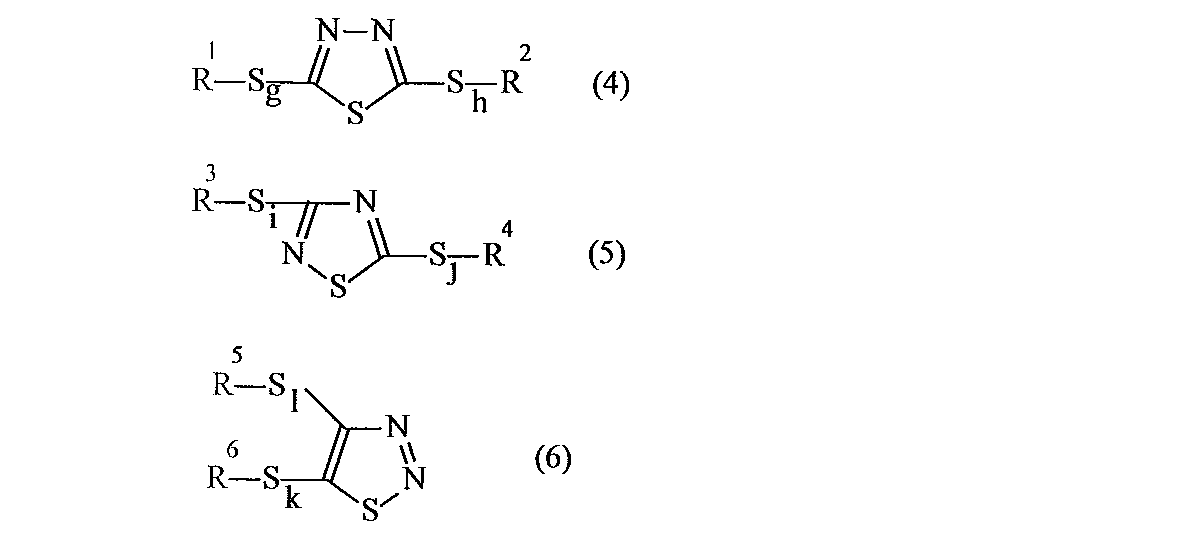
一般式(4)~(6)において、R1、R2、R3、R4、R5及びR6は各々同一でも異なっていてもよく、それぞれ個別に、水素原子又は炭素数1~30の炭化水素基を表し、g、h、i、j、k、及びlはそれぞれ個別に、0~8の整数を表す。上記炭素数1~30の炭化水素基としては、例えば、アルキル基、シクロアルキル基、アルキルシクロアルキル基、アルケニル基、アリール基、アルキルアリール基、及びアリールアルキル基を挙げることができる。
また、本発明の潤滑油組成物は、優れた粘度温度特性及び低温性能、疲労防止性や耐焼付き性を損なわない限りにおいて、必要に応じて各種添加剤を含有することができる。かかる添加剤としては、特に制限されず、潤滑油の分野で従来使用される任意の添加剤を配合することができる。かかる潤滑油添加剤としては、具体的には、(D)成分以外の無灰分散剤、酸化防止剤、極圧剤、摩耗防止剤、摩擦調整剤、流動点降下剤、腐食防止剤、防錆剤、抗乳化剤、金属不活性化剤、消泡剤などが挙げられる。これらの添加剤は、1種を単独で用いてもよく、また2種以上を組み合わせて用いてもよい。
本発明の潤滑油組成物は、粘度指数向上剤を実質的に含まないことが好ましい。粘度指数向上剤を実質的に含まないとは、全く含まないか、あるいは含まれたとしても、粘度指数向上剤としての効果を期待して通常配合される量(2~10質量%)に比べてきわめて少量であることの意味である。具体的には、その含有量は、組成物全量基準で1.0質量% 以下であることが好ましく、更に好ましくは0.5質量%以下であり、全く含まないことが最も好ましい。粘度指数向上剤の含有量が1.0質量%を超える場合は、剪断による使用中の粘度低下が懸念されること、また省燃費性を最大に発揮する潤滑油としての最低粘度に保つうえで好ましくない。
ここでいう粘度指数向上剤としては、例えば、非分散型、あるいは分散型の粘度指数向上剤が挙げられる。非分散型粘度指数向上剤としては、具体的には、炭素数1~30のアルキルアクリレートまたはアルキルメタクリレート、炭素数2 ~20のオレフィン、スチレン、メチルスチレン、無水マレイン酸エステル、無水マレイン酸アミド等から選ばれる1 種又は2 種以上のモノマーの単独あるいは共重合体あるいはそれらの水素化物等が例示できる。
分散型粘度指数向上剤としては、ジメチルアミノメチルメタクリレート、ジエチルアミノメチルメタクリレート、ジメチルアミノエチルメタクリレート、ジエチルアミノエチルメタクリレート、2-メチル-5-ビニルピリジン、モルホリノメチルメタクリレート、モルホリノエチルメタクリレート、及びN-ビニルピロリドン等から選ばれる1種又は2種以上のモノマーの単独あるいは共重合体又はそれらの水素化物に酸素含有基を導入したものと、非分散型粘度指数向上剤のモノマー成分との共重合体、或いはその水素化物等が例示できる。
本発明の潤滑油組成物は、粘度指数向上剤と同様に、流動点降下剤を実質的に含まないことが好ましい。流動点降下剤を実質的に含まないとは、全く含まないか、あるいは含まれたとしても、流動点降下剤としての効果を期待して通常配合される量(0.01~3質量%)に比べてきわめて少量であることの意味である。具体的には、その含有量は、組成物全量基準で0.005質量%以下であり、更に好ましくは0.001質量%以下であり、全く含まないことが最も好ましい。流動点降下剤の含有量が0.005質量%を超える場合は、剪断による使用中の粘度低下が懸念されること、また省燃費性を最大に発揮する潤滑油としての最低粘度に保つ上で好ましくない。
(D)成分以外の無灰分散剤としては、ホウ素を含有しないアルケニルコハク酸イミド等の無灰分散剤が挙げられる。
酸化防止剤としては、フェノール系、アミン系等の無灰酸化防止剤、銅系、モリブデン系等の金属系酸化防止剤が挙げられる。
摩擦調整剤としては、脂肪酸エステル系、脂肪族アミン系、脂肪酸アミド系等の無灰摩擦調整剤、モリブデンジチオカーバメート、モリブデンジチオホスフェート等の金属系摩擦調整剤等が挙げられる。
腐食防止剤としては、例えば、ベンゾトリアゾール系、トリルトリアゾール系、イミダゾール系化合物等が挙げられる。
防錆剤としては、例えば、石油スルホネート、アルキルベンゼンスルホネート、ジノニルナフタレンスルホネート、アルケニルコハク酸エステル、又は多価アルコールエステル等が挙げられる。
抗乳化剤としては、例えば、ポリオキシエチレンアルキルエーテル、ポリオキシエチレンアルキルフェニルエーテル、又はポリオキシエチレンアルキルナフチルエーテル等のポリアルキレングリコール系非イオン系界面活性剤等が挙げられる。
金属不活性化剤としては、例えば、イミダゾリン、ピリミジン誘導体、ベンゾトリアゾール又はその誘導体、2-(アルキルジチオ)ベンゾイミダゾール、又はβ-(o-カルボキシベンジルチオ)プロピオンニトリル等が挙げられる。
消泡剤としては、例えば、25℃における動粘度が0.1~100mm2/s未満のシリコーンオイル、アルケニルコハク酸誘導体、ポリヒドロキシ脂肪族アルコールと長鎖脂肪酸のエステル、メチルサリチレートとo-ヒドロキシベンジルアルコール等が挙げられる。
これらの添加剤を本発明の潤滑油組成物に含有させる場合には、その含有量は組成物全量基準で、それぞれ0.1~20質量%が好ましい。
本発明の潤滑油組成物の100℃における動粘度は2.5~4.3mm2/sであることが必要であり、好ましくは2.7mm2/s以上、4.0mm2/s以下である。
100℃における動粘度が2.5mm2/s未満の場合には潤滑部位の油膜保持性および蒸発性に問題を生ずるおそれがあり、100℃における動粘度が4.3mm2/sを超える場合には省燃費性が不足するおそれがある。
100℃における動粘度が2.5mm2/s未満の場合には潤滑部位の油膜保持性および蒸発性に問題を生ずるおそれがあり、100℃における動粘度が4.3mm2/sを超える場合には省燃費性が不足するおそれがある。
本発明の潤滑油組成物の粘度指数については特に制限はないが、省燃費性の観点から好ましくは120以上であり、より好ましくは140以上である。
本発明の潤滑油組成物の-40℃におけるブルックフィールド(BF)粘度は、好ましくは15000mPa・s以下であり、より好ましくは10000mPa・s以下、さらに好ましくは8000mPa・s以下、特に好ましくは5000mPa・s以下、最も好ましくは4000mPa・s以下である。15000mPa・sを超えると、始動時の粘性抵抗が高く、省燃費性が低下する。
ここで言うブルックフィールド粘度とは、ASTM D2983により測定される値である。
ここで言うブルックフィールド粘度とは、ASTM D2983により測定される値である。
本発明の潤滑油組成物は、優れた摩耗防止性及び疲労防止性を有し、かつ優れた低温流動性を有する潤滑油組成物であり、自動変速機油及び/又は無段変速機油として特に好適である。
また、本発明の潤滑油組成物は、上記以外の変速機油としての性能にも優れており、自動車、建設機械、農業機械等の自動変速機用あるいは手動変速機用、ディファレンシャルギヤ用の潤滑油としても好適に用いられる。その他、摩耗防止性、疲労防止性及び低温粘度特性が要求される潤滑油、例えば、工業用ギヤ油、二輪車、四輪車等の自動車用、発電用、舶用等のガソリンエンジン、ディーゼルエンジン、ガスエンジン用の潤滑油、タービン油、圧縮機油等にも好適に使用することができる。
また、本発明の潤滑油組成物は、上記以外の変速機油としての性能にも優れており、自動車、建設機械、農業機械等の自動変速機用あるいは手動変速機用、ディファレンシャルギヤ用の潤滑油としても好適に用いられる。その他、摩耗防止性、疲労防止性及び低温粘度特性が要求される潤滑油、例えば、工業用ギヤ油、二輪車、四輪車等の自動車用、発電用、舶用等のガソリンエンジン、ディーゼルエンジン、ガスエンジン用の潤滑油、タービン油、圧縮機油等にも好適に使用することができる。
以下、本発明の内容を実施例および比較例によってさらに具体的に説明するが、本発明はこれらに何ら限定されるものではない。
(実施例1~10および比較例1~9)
表1に示すように、本発明の潤滑油組成物(実施例1~10)、比較用の潤滑油組成物(比較例1~9)をそれぞれ調製した。得られた組成物について、動粘度、粘度指数、シール材適合性、低温粘度特性、摩耗防止性、酸化安定度を測定し、その結果を同じく表1に併記した。
表1に示すように、本発明の潤滑油組成物(実施例1~10)、比較用の潤滑油組成物(比較例1~9)をそれぞれ調製した。得られた組成物について、動粘度、粘度指数、シール材適合性、低温粘度特性、摩耗防止性、酸化安定度を測定し、その結果を同じく表1に併記した。
(1)シール材適合性
シール材浸漬試験はJIS K 6258に準拠して油温150℃、240時間の条件でアクリル系ゴム材(T445)の浸漬を行った。浸漬後のゴム材の体積および硬さを測定し、浸漬前からの体積変化率および硬さ変化を求めた。体積が減少するとシール性に悪影響を及ぼし、増大しすぎても摺動に悪影響となるため、変化率は0%以上で、かつ変化が小さいほどシール材適合性は優れることを意味する。また硬さ変化も小さいほどシール材適合性が優れることを意味する。
(2)低温粘度特性
ASTM D2983に準拠し、各潤滑油組成物の-40℃におけるブルックフィールド粘度(BF粘度)を測定した。本試験においては、BF粘度の値が小さいものほど低温流動性が良好であることを意味するが、低温ではゴム材が硬化しシール性能が失われるため、シール性を考慮すると低温粘度が高い方が好ましい。
(3)摩耗防止性
ASTM D4172に準拠したシェル四級試験を実施した。荷重392N、回転数1900rpm、油温100℃の条件において1時間摺動させたのちの摩耗痕径を測定した。
(4)ファレックス焼付試験
ASTM D3233に準拠し、ファレックス試験機を用い、各潤滑油組成物の290回転、100℃における焼付き荷重を測定した。本試験においては、焼付き荷重が大きいほど耐焼付性に優れていることを意味する。
(5)酸化安定度試験
JIS K 2514に準拠した酸化安定度試験を実施した。油温150℃、96時間の条件における酸化安定度を測定した。
シール材浸漬試験はJIS K 6258に準拠して油温150℃、240時間の条件でアクリル系ゴム材(T445)の浸漬を行った。浸漬後のゴム材の体積および硬さを測定し、浸漬前からの体積変化率および硬さ変化を求めた。体積が減少するとシール性に悪影響を及ぼし、増大しすぎても摺動に悪影響となるため、変化率は0%以上で、かつ変化が小さいほどシール材適合性は優れることを意味する。また硬さ変化も小さいほどシール材適合性が優れることを意味する。
(2)低温粘度特性
ASTM D2983に準拠し、各潤滑油組成物の-40℃におけるブルックフィールド粘度(BF粘度)を測定した。本試験においては、BF粘度の値が小さいものほど低温流動性が良好であることを意味するが、低温ではゴム材が硬化しシール性能が失われるため、シール性を考慮すると低温粘度が高い方が好ましい。
(3)摩耗防止性
ASTM D4172に準拠したシェル四級試験を実施した。荷重392N、回転数1900rpm、油温100℃の条件において1時間摺動させたのちの摩耗痕径を測定した。
(4)ファレックス焼付試験
ASTM D3233に準拠し、ファレックス試験機を用い、各潤滑油組成物の290回転、100℃における焼付き荷重を測定した。本試験においては、焼付き荷重が大きいほど耐焼付性に優れていることを意味する。
(5)酸化安定度試験
JIS K 2514に準拠した酸化安定度試験を実施した。油温150℃、96時間の条件における酸化安定度を測定した。
表1の結果から明らかな通り、本発明の潤滑油組成物は、省燃費性能及び耐摩耗・耐焼付き性、シール材適合性に優れていることがわかる。

Claims (4)
- (A)100℃における動粘度が2.0mm2/s以上3.8mm2/s以下、%CPが60以上85以下、%CNが15以上40以下、%CAが3以下である鉱油系基油に、
(B)亜リン酸エステルをリン元素換算で200~600質量ppm、
(C)アルカリ金属および/またはアルカリ土類金属系清浄剤を金属元素換算で50~200質量ppm、
(D)ホウ素含有無灰分散剤をホウ素元素換算で20~120質量ppm含有し、
100℃における動粘度が2.5mm2/s以上4.3mm2/s以下であることを特徴とする変速機用潤滑油組成物。 - さらに(E)ポリサルファイド及び/又はチアヂアゾールを含有することを特徴とする請求項1に記載の変速機用潤滑油組成物。
- 前記(C)成分がカルシウムスルホネートであることを特徴とする請求項1または2に記載の変速機用潤滑油組成物。
- 自動変速機に使用されることを特徴とする請求項1~3のいずれかに記載の変速機用潤滑油組成物。
Applications Claiming Priority (2)
| Application Number | Priority Date | Filing Date | Title |
|---|---|---|---|
| JP2014-145297 | 2014-07-15 | ||
| JP2014145297A JP6284450B2 (ja) | 2014-07-15 | 2014-07-15 | 変速機用潤滑油組成物 |
Publications (1)
| Publication Number | Publication Date |
|---|---|
| WO2016009670A1 true WO2016009670A1 (ja) | 2016-01-21 |
Family
ID=55078175
Family Applications (1)
| Application Number | Title | Priority Date | Filing Date |
|---|---|---|---|
| PCT/JP2015/056963 Ceased WO2016009670A1 (ja) | 2014-07-15 | 2015-03-10 | 変速機用潤滑油組成物 |
Country Status (2)
| Country | Link |
|---|---|
| JP (1) | JP6284450B2 (ja) |
| WO (1) | WO2016009670A1 (ja) |
Cited By (2)
| Publication number | Priority date | Publication date | Assignee | Title |
|---|---|---|---|---|
| JPWO2021193869A1 (ja) * | 2020-03-27 | 2021-09-30 | ||
| JP2024013503A (ja) * | 2022-07-20 | 2024-02-01 | Eneos株式会社 | 潤滑油組成物 |
Families Citing this family (3)
| Publication number | Priority date | Publication date | Assignee | Title |
|---|---|---|---|---|
| JP6907461B2 (ja) * | 2016-02-29 | 2021-07-21 | 出光興産株式会社 | 潤滑油組成物、潤滑方法、及び変速機 |
| JP7563935B2 (ja) | 2020-10-09 | 2024-10-08 | Eneos株式会社 | 潤滑油組成物 |
| JP2023168696A (ja) * | 2022-05-16 | 2023-11-29 | 出光興産株式会社 | 潤滑油組成物 |
Citations (9)
| Publication number | Priority date | Publication date | Assignee | Title |
|---|---|---|---|---|
| JP2001262176A (ja) * | 2000-03-21 | 2001-09-26 | Nippon Mitsubishi Oil Corp | 変速機用潤滑油組成物 |
| JP2001279286A (ja) * | 2000-03-29 | 2001-10-10 | Nippon Mitsubishi Oil Corp | 潤滑油組成物 |
| JP2003113391A (ja) * | 2001-10-02 | 2003-04-18 | Nippon Oil Corp | 潤滑油組成物 |
| JP2003321695A (ja) * | 2002-04-30 | 2003-11-14 | Idemitsu Kosan Co Ltd | 自動変速機用潤滑油組成物 |
| WO2004074414A1 (ja) * | 2003-02-21 | 2004-09-02 | Nippon Oil Corporation | 変速機用潤滑油組成物 |
| WO2007052833A1 (ja) * | 2005-11-02 | 2007-05-10 | Nippon Oil Corporation | 潤滑油組成物 |
| JP2007326963A (ja) * | 2006-06-08 | 2007-12-20 | Nippon Oil Corp | 潤滑油組成物 |
| JP2014037533A (ja) * | 2012-07-20 | 2014-02-27 | Jx Nippon Oil & Energy Corp | 無段変速機用潤滑油組成物 |
| JP2014159496A (ja) * | 2013-02-19 | 2014-09-04 | Jx Nippon Oil & Energy Corp | 変速機用潤滑油組成物 |
-
2014
- 2014-07-15 JP JP2014145297A patent/JP6284450B2/ja active Active
-
2015
- 2015-03-10 WO PCT/JP2015/056963 patent/WO2016009670A1/ja not_active Ceased
Patent Citations (9)
| Publication number | Priority date | Publication date | Assignee | Title |
|---|---|---|---|---|
| JP2001262176A (ja) * | 2000-03-21 | 2001-09-26 | Nippon Mitsubishi Oil Corp | 変速機用潤滑油組成物 |
| JP2001279286A (ja) * | 2000-03-29 | 2001-10-10 | Nippon Mitsubishi Oil Corp | 潤滑油組成物 |
| JP2003113391A (ja) * | 2001-10-02 | 2003-04-18 | Nippon Oil Corp | 潤滑油組成物 |
| JP2003321695A (ja) * | 2002-04-30 | 2003-11-14 | Idemitsu Kosan Co Ltd | 自動変速機用潤滑油組成物 |
| WO2004074414A1 (ja) * | 2003-02-21 | 2004-09-02 | Nippon Oil Corporation | 変速機用潤滑油組成物 |
| WO2007052833A1 (ja) * | 2005-11-02 | 2007-05-10 | Nippon Oil Corporation | 潤滑油組成物 |
| JP2007326963A (ja) * | 2006-06-08 | 2007-12-20 | Nippon Oil Corp | 潤滑油組成物 |
| JP2014037533A (ja) * | 2012-07-20 | 2014-02-27 | Jx Nippon Oil & Energy Corp | 無段変速機用潤滑油組成物 |
| JP2014159496A (ja) * | 2013-02-19 | 2014-09-04 | Jx Nippon Oil & Energy Corp | 変速機用潤滑油組成物 |
Cited By (6)
| Publication number | Priority date | Publication date | Assignee | Title |
|---|---|---|---|---|
| JPWO2021193869A1 (ja) * | 2020-03-27 | 2021-09-30 | ||
| WO2021193869A1 (ja) * | 2020-03-27 | 2021-09-30 | 出光興産株式会社 | 潤滑油組成物 |
| CN115349008A (zh) * | 2020-03-27 | 2022-11-15 | 出光兴产株式会社 | 润滑油组合物 |
| JP7564864B2 (ja) | 2020-03-27 | 2024-10-09 | 出光興産株式会社 | 潤滑油組成物 |
| JP2024013503A (ja) * | 2022-07-20 | 2024-02-01 | Eneos株式会社 | 潤滑油組成物 |
| JP7818483B2 (ja) | 2022-07-20 | 2026-02-20 | Eneos株式会社 | 潤滑油組成物 |
Also Published As
| Publication number | Publication date |
|---|---|
| JP2016020454A (ja) | 2016-02-04 |
| JP6284450B2 (ja) | 2018-02-28 |
Similar Documents
| Publication | Publication Date | Title |
|---|---|---|
| JP5988891B2 (ja) | 変速機用潤滑油組成物 | |
| JP6247600B2 (ja) | 変速機用潤滑油組成物 | |
| JP5941316B2 (ja) | 潤滑油組成物 | |
| CN105073963A (zh) | 自动变速机用润滑油组合物 | |
| JP6284450B2 (ja) | 変速機用潤滑油組成物 | |
| US20190048284A1 (en) | Lubricant composition | |
| CN104220572B (zh) | 润滑油组合物 | |
| JP6259511B2 (ja) | 潤滑油組成物 | |
| JPH10183154A (ja) | 潤滑油組成物 | |
| JP2021155740A (ja) | 潤滑油組成物 | |
| JP2016193997A (ja) | 潤滑油組成物 | |
| JP5311748B2 (ja) | 潤滑油組成物 | |
| WO2018021570A1 (ja) | 潤滑油組成物 | |
| JP2019151804A (ja) | 潤滑油組成物 | |
| JP6514881B2 (ja) | 潤滑油組成物 | |
| WO2014156325A1 (ja) | 潤滑油組成物 | |
| JP5952115B2 (ja) | 潤滑油組成物 | |
| JP2020070404A (ja) | 潤滑油組成物 |
Legal Events
| Date | Code | Title | Description |
|---|---|---|---|
| 121 | Ep: the epo has been informed by wipo that ep was designated in this application |
Ref document number: 15822222 Country of ref document: EP Kind code of ref document: A1 |
|
| NENP | Non-entry into the national phase |
Ref country code: DE |
|
| 122 | Ep: pct application non-entry in european phase |
Ref document number: 15822222 Country of ref document: EP Kind code of ref document: A1 |