WO2016002903A1 - 希釈タイプの栄養組成物 - Google Patents
希釈タイプの栄養組成物 Download PDFInfo
- Publication number
- WO2016002903A1 WO2016002903A1 PCT/JP2015/069196 JP2015069196W WO2016002903A1 WO 2016002903 A1 WO2016002903 A1 WO 2016002903A1 JP 2015069196 W JP2015069196 W JP 2015069196W WO 2016002903 A1 WO2016002903 A1 WO 2016002903A1
- Authority
- WO
- WIPO (PCT)
- Prior art keywords
- nutritional composition
- weight
- present
- composition
- mpa
- Prior art date
- Legal status (The legal status is an assumption and is not a legal conclusion. Google has not performed a legal analysis and makes no representation as to the accuracy of the status listed.)
- Ceased
Links
Definitions
- the present invention relates to a dilution type nutritional composition, for example, a dilution type nutritional composition that can be stored for a long period of time, and a dilution type nutritional composition intended for patients with difficulty in swallowing and / or for tube feeding patients.
- a person with difficulty swallowing contains liquid liquid foods with good fluidity, such as water or tea, it reaches the pharynx in a very short time. That is, in a person with difficulty in swallowing, if the pharynx is reached before the pharyngeal reflex appears, the liquid food may enter the trachea and cause aspiration. In addition, people who have trouble eating or chewing (difficulty in chewing) may swallow food without being chewed sufficiently, and may swallow.
- a method for increasing the viscosity of the liquid food using a thickener or the like is effective for improving the liquid food for those having difficulty in swallowing and those having difficulty in chewing.
- the nutritional composition (nutrient) should be applied using a nutrient (nasal cavity) tube (nasal tube administration), gastric fistula, intestinal fistula, etc.
- a method of tube administration (tube feeding method) is generally used.
- the feeding tube is inserted from the nasal cavity, it is necessary to make the diameter of the feeding tube narrow so as not to obstruct breathing (generally the outer diameter is 2 to 3 mm). Degree). And when making the diameter of a nutrient tube thin, it is necessary to suppress the viscosity of a nutrient composition low so that a nutrient composition may flow easily in the nutrient tube. However, if the viscosity of the nutritional composition is kept low, gastroesophageal reflux and diarrhea may occur, and the viscosity of the nutritional composition is increased moderately, and the nutritional composition is administered to patients over a long period of time. There was a need to do.
- fistulas are surgically constructed in the esophagus, stomach and jejunum of patients, etc., and buttons and tubes are placed and nutritional compositions are administered. Therefore, it is possible to increase the diameter of the feeding tube.
- the nutritional composition is directly administered into the stomach of the patient or the like.
- gastroesophageal reflux is performed. The possibility of waking is known.
- Patent Document 1 Japanese Patent Application Laid-Open No. 2007-137792
- Patent Document 2 describes liquid foods for patients with gastric fistula. In the administration of these liquid foods and nutritional compositions, Assumes the use of a syringe or plunger pump.
- liquid food with increased viscosity is effective for uses such as oral intake and tube administration (including enteral administration such as gastric fistula and intestinal fistula).
- enteral administration such as gastric fistula and intestinal fistula.
- WO2007 / 026474 describes a high-protein nutritional composition that can be easily introduced into a patient by various administration methods without losing the taste or flavor.
- the viscosity at 25 ° C. is 400 to 7000 mPa ⁇ s, and it has been confirmed that it can be maintained for a long time at 6 months at that temperature.
- WO2012 / 157571 describes a so-called high-concentration type liquid food that has high protein and low moisture content, with carrageenan and organic acid monoglycerides added (blended) as a thickener. .
- a high concentration type nutritional composition such as high protein
- the structure of the emulsification emulsion
- the state of the emulsification is stabilized. Therefore, a nutritional composition that can withstand general use cannot be obtained.
- high-concentration type nutritional compositions such as high protein are continuously administered to the elderly, there is a possibility of lifestyle-related diseases such as diabetes due to overnutrition. Therefore, there is a need for a diluted nutritional composition that stably maintains an emulsified state for long-term storage.
- the liquid food described in WO2012 / 157571 is a so-called high-concentration type liquid food with high protein and low water content, and as shown in the comparative example of the present invention, this high-concentration type liquid food
- a nutritional composition that can withstand general use could not be obtained because the cream separated during storage.
- simply adding carrageenan or organic acid monoglyceride to the nutritional composition provides a stable water quality and high moisture content, so-called dilution type. Of liquid food could not be produced.
- the present inventor has formulated carrageenan as a thickener in a nutritional composition in an amount of 0.1 to 0.5% by weight, and has a dextrose equivalent (DE) value of 11 to 29.
- a nutritional composition having desirable characteristics by blending dextrin having a ratio of 5 to 7 sugars in the total sugar of dextrin with a dextrose equivalent (DE) value of 1.5 or more as a sugar composition.
- the present invention was completed.
- the present inventor has examined the milk protein material to be used, and by using a casein degradation product having a specific degradation rate in the nutritional composition, a nutritional composition having desirable emulsion stability and suitability for tube administration can be obtained.
- the present invention has been found out and obtained.
- the present inventor has examined a modified starch to be used, and found that a nutritional composition having desirable emulsion stability and suitability for tube administration can be obtained by using a specific modified starch in the nutritional composition.
- the present invention has been completed.
- the nutritional composition of the present invention it is possible to realize a nutritional composition (liquid food, enteral nutrient) that has good storage stability, low protein, and high water content, which could not be realized by the prior art. It is possible, and the nutritional composition of the present invention is effective for oral intake even for those who have difficulty in swallowing among patients whose daily intake of energy is restricted. Further, among the nutritional compositions of the present invention, those that form curd when mixed with artificial gastric juice, for example, those that form curd without water separation during protein coagulation, such as gastric fistula and intestinal fistula etc. It is effective for patients who want to replenish water and avoid diarrhea at the same time because it is considered that it is difficult to cause diarrhea because it coagulates in the stomach and coagulates without water separation. .
- the nutritional composition having a non-Newtonian viscosity index of 0.3 or more and less than 1.0 is suitable for tube feeding methods such as nasal tube administration, as well as gastric fistula and intestinal fistula. It has the characteristics (physical properties) that are suitable for direct administration into the stomach by applying the natural dripping method in tube feeding, with a protein content of 1 to 10% by weight and a water content of 70 to 95% by weight. It can be used as a diluted nutritional composition for patients with tube feeding such as nasal tube administration. At this time, the nutritional composition is close to Newtonian fluid and can be administered without stopping even when the natural dripping method is applied.
- the nutritional composition can be administered slowly by applying the natural dripping method, problems such as gastroesophageal reflux are unlikely to occur.
- problems such as gastroesophageal reflux are unlikely to occur.
- the nutritional compositions of the present invention having a non-Newtonian viscosity index of 0.3 or more and less than 1.0, those that form a card when mixed with artificial gastric juice, for example, those that form a card without water separation when the protein coagulates, When used in tube feeding methods such as fistula and intestinal fistula, it is thought that diarrhea is unlikely to occur because it coagulates in the stomach, for example, coagulates without water separation in the stomach.
- a nutritional composition having a non-Newtonian viscosity index (0.1 or more) of less than 0.3 is obtained by using a syringe or plunger pump in a tube feeding method such as gastric fistula or intestinal fistula. It has properties (physical properties) suitable for direct administration into the stomach, has a protein content of 1 to 10% by weight and a water content of 70 to 95% by weight. It can be used as a diluted nutritional composition for patients.
- compositions of the present invention having a non-Newtonian viscosity index (0.1 or more) of less than 0.3, those that form a card when mixed with artificial gastric juice, for example, those that form a card without water separation during protein coagulation, It is considered that diarrhea is unlikely to occur when used for tube feeding such as wax and intestinal fistula.
- the nutritional compositions of the present invention having a non-Newtonian viscosity index (0.1 or more) of less than 0.3, those that do not form a card when mixed with artificial gastric juice are associated with the fact that they do not coagulate or are difficult to coagulate in the stomach. It is considered that it is easily digested and absorbed in the intestinal tract.
- the nutritional composition of the present invention has the property that the viscosity increases (thickens) when heated (sterilized), and the viscosity is increased before homogenizing the raw material liquid and before heating (sterilized). Since it is a low liquid, it is easy to fill a container such as a soft bag (pouch bag), a brick pack (paper container), or a can container.
- the nutritional composition of the present invention was manufactured in a hygienic state when the container was filled in a liquid with a low viscosity and then heated (sterilized) by a retort treatment or the like to become a semisolid with a high viscosity.
- a nutritional composition for oral ingestion and tube administration for example, direct administration into the stomach using a natural dropping method
- the present invention includes the following. [1] (i) A dextrose equivalent (DE) value of 11 to 29, and a ratio of 5 to 7 sugars in the total sugar of dextrin as a sugar composition multiplied by 1.5 to the dextrose equivalent (DE) value A nutritional composition comprising dextrin as described above, and (ii) 0.1 to 0.5 wt% carrageenan as a thickener, and (iii) 1 to 10 wt% protein.
- DE dextrose equivalent
- DE dextrose equivalent
- modified starch comprises modified starch having an average particle size of 1 to 10 ⁇ m.
- the nutritional composition according to 9 or 10 which does not form a card when mixed with artificial gastric juice (pH 1.2).
- the nutritional composition according to any one of 1 to 12 wherein the calorific value is 0.5 to 1.5 kcal / ml.
- a method for producing a nutritional composition comprising the following steps: (A) (i) A dextrose equivalent (DE) value of 11 to 29, and a ratio of 5 to 7 sugars in the total sugar of dextrin as a sugar composition multiplied by 1.5 to the dextrose equivalent (DE) value Dextrin, and (ii) 0.1 to 0.5% by weight of carrageenan as a thickener, and (iii) mixing a composition containing 1 to 10% by weight of protein; (b) homogenizing the composition; and (c) heat sterilizing the composition.
- DE dextrose equivalent
- DE dextrose equivalent
- a method for producing a nutritional composition comprising the following steps: (A) (i) a dextrin having a dextrose equivalent (DE) value of 11 to 29 and a sugar composition comprising 45 to 90% by weight of monosaccharide to heptosaccharide in the total sugar of the dextrin, and (ii) 0.1 to 0.5% by weight of carrageenan as a thickener, and (iii) mixing a composition containing 1 to 10% by weight of protein; (b) homogenizing the composition; and (c) heat sterilizing the composition.
- the protein comprises a casein degradation product having an amino nitrogen (AN) / total nitrogen (TN) weight ratio of 4.5 to 10%.
- the production method according to 16 or 17, wherein the protein comprises a collagen peptide or a casein degradation product having an AN / TN weight ratio of 10 to 50%.
- the modified starch comprises modified starch having an average particle size of 1 to 10 ⁇ m.
- the production method according to any of 16 to 21, wherein the nutritional composition forms a card when mixed with artificial gastric fluid (pH 1.2).
- the production method according to any of 16 to 21, wherein the nutritional composition does not form a card when mixed with artificial gastric fluid (pH 1.2).
- the nutritional composition of the present invention realizes a nutritional composition (liquid food, tube feeding) that has a good storage stability, a low protein, and a high water content, which could not be realized by the prior art. Is possible.
- the nutritional composition of the present invention is also effective for oral intake for those who have difficulty in swallowing among patients whose daily intake of energy is restricted. In other words, the nutritional composition of the present invention is effective for oral intake even for elderly healthy persons who may have aspiration.
- the nutritional composition having a non-Newtonian viscosity index of 0.3 or more and less than 1.0 is suitable for tube feeding methods such as nasal tube administration, as well as gastric fistula and intestinal fistula. It has the characteristics (physical properties) that are suitable for direct administration into the stomach by applying the natural dripping method in tube feeding, with a protein content of 1 to 10% by weight and a water content of 70 to 95% by weight. It can be used as a diluted nutritional composition for patients with tube feeding such as nasal tube administration.
- doctors, nurses, caregivers, caregivers, etc. who actually administer to patients etc. in clinical and nursing care sites by administering to patients etc. by tube feeding etc.
- the nutritional composition is close to Newtonian fluid and can be administered without stopping even when the natural dripping method is applied. If the nutritional composition can be administered slowly by applying the natural dropping method, problems such as diarrhea and gastroesophageal reflux are unlikely to occur.
- the nutritional compositions of the present invention having a non-Newtonian viscosity index of 0.3 or more and less than 1.0, those that form a card when mixed with artificial gastric juice, for example, those that form a card without water separation when the protein coagulates, It is preferable because it is less likely to cause diarrhea when used for tube feeding such as wax and intestinal wax.
- a nutritional composition having a non-Newtonian viscosity index (0.1 or more) of less than 0.3 is obtained by using a syringe or plunger pump in a tube feeding method such as gastric fistula or intestinal fistula.
- a tube feeding method such as gastric fistula or intestinal fistula.
- Patients with tube feeding, such as nasal tube administration, with a protein content of 1 to 10% by weight and a water content of 70 to 95% by weight, with properties (physical properties) suitable for direct administration into the stomach Can be used as a diluted type nutritional composition.
- the nutritional compositions of the present invention having a non-Newtonian viscosity index of (0.1 or more) less than 0.3, those that form a card when mixed with artificial gastric fluid, such as those that form a card without water separation when the protein coagulates, It is preferable because it hardly causes diarrhea when used for tube feeding such as gastric fistula and intestinal fistula.
- the nutritional compositions of the present invention having a non-Newtonian viscosity index (0.1 or more) of less than 0.3, those which do not form a card when mixed with artificial gastric juice are preferred because they are readily digested and absorbed in the intestinal tract.
- the nutritional composition of the present invention has the property that the viscosity increases (thickens) when heated (sterilized), and the viscosity is increased before homogenizing the raw material liquid and before heating (sterilized). Since it is a low liquid, it is easy to fill a container such as a soft bag (pouch bag), a brick pack (paper container), or a can container.
- the nutritional composition of the present invention becomes a liquid or semi-solid with a high viscosity when it is heated (sterilized) by retorting after filling the container with the liquid having a low viscosity.
- the nutritional composition of the present invention despite the low content of the thickener, it is heated (sterilized) by retort treatment, etc., so that the viscosity when a care-related person or the like is actually administered to a patient or the like Can be effectively improved.
- the nutritional composition of the present invention is a low-protein, high-moisture content, diluted type that can stably maintain an emulsified state and has good storage stability. Can be saved.
- the nutritional composition of the present invention has various advantages because it can be stored for a long period of time.
- the nutritional composition of the present invention is manufactured in advance at a commercial scale factory, etc., and immediately before these are actually administered to patients etc. Therefore, it is not necessary to prepare a product having a high viscosity (by errand), so that the physical burden on a caregiver can be effectively reduced.
- the nutritional composition of the present invention can be produced in large quantities at a commercial scale factory, the composition (composition), physical properties, quality, etc. can be controlled to a certain level. When actually administered to a patient or the like, it is possible to suppress or prevent fluctuations in the state of nutrition or absorption when the patient or the like actually ingests.
- the nutritional composition of the present invention is a nutritional composition that contains carrageenan as a thickener and further contains dextrin of a predetermined quality.
- the carrageenan content is preferably 0.1 to 0.5% by weight.
- the nutritional composition of the present invention has a protein content of 1-10% by weight and a moisture content of 70-95% by weight.
- the nutritional composition of the present invention further comprises modified starch and / or tamarind gum.
- the nutritional composition of the present invention includes a casein degradation product having a specific degradation rate as a protein.
- a nutritional composition having a non-Newtonian viscosity index of 0.3 or more and less than 1.0 is suitable for a tube feeding method such as nasal tube administration, gastrostomy and intestinal
- a tube feeding method such as wax
- the natural drop method is applied and the properties (physical properties) are suitable for direct administration into the stomach.
- the protein content is 1 to 10% by weight and the water content is 70 to 95%. It can be used as a diluted type nutritional composition for patients with tube feeding such as nasal tube administration.
- doctors, nurses, caregivers, caregivers, etc. who actually administer to patients etc. in clinical and nursing care sites by administering to patients etc. by tube feeding etc.
- the nutritional composition is close to Newtonian fluid and can be administered without stopping even when the natural dripping method is applied. If the nutritional composition can be administered slowly by applying the natural dropping method, problems such as diarrhea and gastroesophageal reflux are unlikely to occur.
- the nutritional compositions of the present invention having a non-Newtonian viscosity index of 0.3 or more and less than 1.0, those that form a card when mixed with artificial gastric juice, such as those that form a card without water separation when the protein coagulates, When used for tube feeding such as intestinal fistula, diarrhea is unlikely to occur.
- a nutritional composition having a non-Newtonian viscosity index (0.1 or more) of less than 0.3 is obtained by using a syringe or plunger pump in a tube feeding method such as gastric fistula or intestinal fistula.
- a tube feeding method such as gastric fistula or intestinal fistula.
- Patients with tube feeding, such as nasal tube administration, with a protein content of 1 to 10% by weight and a water content of 70 to 95% by weight, with properties (physical properties) suitable for direct administration into the stomach Can be used as a diluted type nutritional composition.
- compositions of the present invention having a non-Newtonian viscosity index (0.1 or more) of less than 0.3, those that form a card when mixed with artificial gastric juice, for example, those that form a card without water separation during protein coagulation, It is considered that diarrhea is unlikely to occur when used for tube feeding such as wax and intestinal fistula.
- compositions of the present invention having a non-Newtonian viscosity index (0.1 or more) of less than 0.3, those that do not form a card when mixed with artificial gastric juice are readily digested and absorbed easily in the intestinal tract.
- the nutritional composition of the present invention is liquid unless otherwise specified, and is not semi-solid or solid.
- Dextrin is also known as British gum, starch gum, or Dextrine. Dextrins are classified by dextrose equivalent (DE) values.
- the dextrose equivalent (DE) value is an index of the degree of saccharification. Reducing sugar contained in a certain dextrin is converted into dextrose, and the ratio of dextrose in the total solid content of this dextrin is expressed as weight%. For example, dextrose has a DE value of 100 and maltodextrin with a DE value of 10 has a saccharification degree of 10% by weight.
- the DE value can be measured by a known method such as the lane method (for example, Dziedzic, S. Z. et al. (1995).
- the dextrin used in the nutritional composition of the present invention has a DE value of 11 or more, 12 or more, 13 or more, 14 or more, 15 or more, 16 or more, or 16.5 or more.
- the dextrin used in the nutritional composition of the present invention has a DE value of 29 or less, 28 or less, or 27 or less. In the specification of the present invention, when the lower limit value and the upper limit value of the DE value are described, all combinations of “(lower limit value) to (upper limit value)” are included as appropriate.
- the dextrin used in the nutritional composition of the present invention has a DE value of 11 to 29, 11 to 28, 11 to 27, 12 to 29, 12 to 28, 12 to 27, 13 to 29, 13 ⁇ 28, 13 ⁇ 27, 14 ⁇ 29, 14 ⁇ 28, 14 ⁇ 27, 15 ⁇ 29, 15 ⁇ 28, 15 ⁇ 27, 16 ⁇ 29, 16 ⁇ 28, 16 ⁇ 27, 16.5 ⁇ 29, 16.5 ⁇ 28 Or 16.5 to 27.
- the dextrin used in the nutritional composition of the present invention is a mixture of one or more types, and in the case of a plurality of types of mixtures, the weighted average of DE values of various dextrins is calculated by the mixing ratio, and the calculated value is the above-mentioned value It only needs to correspond to the DE value.
- dextrose and glucose described in the specification of the present invention have the same meaning.
- one component of ⁇ -glucose in the dextrin is a monosaccharide (G1)
- a component obtained by polymerizing two ⁇ -glucoses is a disaccharide (G2)
- a component obtained by polymerizing n ⁇ -glucoses Expressed as n-sugar (Gn) (n is an integer such as 1, 2, 3, 4, 5, 6, 7, 8 ).
- Gn n is an integer such as 1, 2, 3, 4, 5, 6, 7, 8 .
- the ratio of monosaccharides to all saccharides in the dextrin is expressed in wt%
- the ratio of disaccharides is expressed in wt%
- the ratio of n sugars is expressed in wt%.
- components in which ⁇ -glucose is polymerized by 8 or more can be collectively expressed as 8 sugars or more (G8 +).
- the sugar composition can be expressed as a ratio of each component of monosaccharide to 7 sugars and 8 sugars or more in all sugars in the dextrin.
- a dextrin of a predetermined quality has a DE value of 11 to 29, and the ratio of pentasaccharide to saccharide of all sugars in the dextrin as a sugar composition is multiplied by 1.5 to the DE value.
- the dextrin preferably has a DE value of 11 or more, 12 or more, 13 or more, 14 or more, 15 or more, 16 or more, or 16.5 or more, 29 or less, 28 or less, 27 or less, such as 11 to 29, such as 11 to 28, 11-27, 12-29, 12-28, 12-27, 13-29, 13-28, 13-27, 14-29, 14-28, 14-27, 15-29, 15-28, 15- 27, 16-29, 16-28, 16-27, 16.5-29, 16.5-28, or 16.5-27, and the ratio of 5-7 sugars in the total sugar in the dextrin as the sugar composition It is greater than or equal to the value obtained by multiplying the DE value by 1.5, greater than or equal to 1.6, or greater than or equal to 1.7.
- dextrin L-SPD Showa Sangyo
- a DE value of 16.5 is greater than 24.75, which is a value obtained by multiplying 1.5
- dextrin L-SPD is a dextrin of a predetermined quality.
- the index B / A can be very large. There is no upper limit. If the upper limit of B / A is represented, it is 30, 25, 20, 15, 10, 5, 4, 3. Therefore, the ratio of pentasaccharide to heptosaccharide in the total sugar in the dextrin used in the present invention is, for example, a DE value less than or equal to 30, a value less than or equal to 25, a value less than or equal to 20, Less than or equal to 10, less than or equal to 10, less than or equal to 5, less than or equal to 5, less than or equal to 4, or less than or equal to 3.
- the ratio of 5 sugars to 7 sugars in all the sugars in the dextrin used in the nutritional composition of the present invention is a value obtained by multiplying the DE value by, for example, a value obtained by multiplying 1.5 by 30; Number multiplied by 25-Number multiplied by 25, Number multiplied by 1.5-Number multiplied by 20-Number multiplied by 1.5-Number multiplied by 15-Number multiplied by 1.5-Number multiplied by 10-Value multiplied by 1.5 Number multiplied by 5, number multiplied by 1.6, number multiplied by 30, number multiplied by 1.6, number multiplied by 25, number multiplied by 1.6, number multiplied by 20, number multiplied by 1.6 Number that is multiplied by 15 Number that is multiplied by 1.6 Number that is multiplied by 10 Number that is multiplied by 1.6 Number that is multiplied by 5 Number that is multiplied by 1.7 Number that is multiplied by 30 Number that is
- the dextrin of a predetermined quality has a dextrose equivalent (DE) value of 11 to 29, and the ratio of monosaccharide to 7 sugar in the total sugar in the dextrin is 45% to 90% as the sugar composition.
- % Dextrin a dextrose equivalent
- the dextrin preferably has a DE value of 11 or more, 12 or more, 13 or more, 14 or more, 15 or more, 16 or more, or 16.5 or more, 29 or less, 28 or less, or 27 or less, such as 11 to 29, 11 to 28, 11-27, 12-29, 12-28, 12-27, 13-29, 13-28, 13-27, 14-29, 14-28, 14-27, 15-29, 15-28, 15- 27, 16-29, 16-28, 16-27, 16.5-29, 16.5-28, or 16.5-27, and the ratio of monosaccharide to 7 sugar in the total sugar in the dextrin as the sugar composition 45% or more, 50% or more, 60% or more, 70% or more, 80% or more, or 84% or more, 90% or less, for example 45% to 90%, 50 to 90%, 60 to 90%, 70 to 90% 80-90% or 84-90%.
- dextrin L-SPD Showa Sangyo Co., Ltd.
- the ratio of monosaccharides to 7 sugars in all sugars in the dextrin is 84% as the sugar composition.
- the dextrin used in the nutritional composition of the present invention is not limited in origin or type as long as it is a dextrin of a predetermined quality. Commercially available dextrin can also be used in the nutritional composition of the present invention as long as it is of a predetermined quality.
- the sugar composition of dextrin can be measured by known techniques such as thin layer chromatography and gel filtration chromatography using a cation exchange column.
- Examples of dextrins with a sugar composition of 45-90% of monosaccharides to 7 sugars in all the sugars in dextrin are L-SPD (Showa Sangyo), M-SPD (Showa Sangyo) , K-SPD (Showa Sangyo), but not limited to this.
- the nutritional composition of the present invention contains 3% by weight, 3.5% by weight or more, 4% by weight or more, 4.5% by weight or more, 5% by weight or more, 5.5% by weight or more, or 6% by weight or more dextrin.
- the nutritional composition of the present invention contains 15% by weight or less, 14.5% by weight or less, 14% by weight or less, 13.5% by weight or less, 13% by weight or less, 12.5% by weight or less, 12.3% by weight or less, 12% by weight or less, 11.5% by weight % Dextrin, 11 wt% or less, 10.5 wt% or less, or 10 wt% or less of a predetermined quality dextrin is included.
- the nutritional composition of the present invention contains 3-15% by weight, 3.5-15% by weight, 3-14% by weight, 3.5-14% by weight, 3-13% by weight, 3.5-13% by weight.
- a thickener is included in the nutritional composition of the present invention.
- production examples using carrageenan, tamarind gum and modified starch were shown, but the thickener used in the nutritional composition of the present invention is not limited to this, and heat sterilization is performed.
- a known thickener also referred to as a gelling agent, a stabilizer, a thickening stabilizer, or a paste
- the thickener used for the nutritional composition of the present invention can be one or more.
- carrageenan and tamarind gum can be used in combination as a thickener used in the nutritional composition of the present invention, or carrageenan and modified starch can be used in combination.
- the nutritional composition of the present invention includes 0.1% by weight or more, 0.15% by weight or more, 0.2% by weight or more, or 0.25% by weight or more thickener.
- the nutritional composition of the present invention includes 4.0 wt% or less, 3.5 wt% or less, 3 wt% or less, 2.5 wt% or less, 2.0 wt% or less, 1.5 wt% or less, 1.0 wt% or less, 0.5 wt% or less, 0.45 Include thickeners up to wt%, up to 0.4 wt%, or up to 0.35 wt%.
- this includes all combinations of “(lower limit value) to (upper limit value)” as appropriate. To do.
- the nutritional composition of the present invention contains 0.1 to 4.0% by weight, 0.1 to 3.5% by weight, 0.1 to 3.0% by weight, 0.1 to 2.5% by weight, 0.1 to 2.0% by weight, 0.1 to 1.5% by weight.
- the nutritional composition of the present invention includes carrageenan as a thickener.
- the carrageenan used in the nutritional composition of the present invention is not limited in origin or type.
- Carrageenans include, for example, ⁇ -carrageenan, ⁇ -carrageenan, ⁇ -carrageenan, and any combination of other carrageenans.
- the nutritional composition of the present invention includes 0.1% or more, 0.125% or more, 0.15% or more, 0.175% or more, 0.2% or more, 0.225% or more, or 0.25% or more carrageenan.
- the nutritional composition of the present invention includes 0.5% or less, 0.45% or less, 0.4% or less, or 0.35% or less of carrageenan.
- this includes all combinations of “(lower limit value) to (upper limit value)” as appropriate.
- the nutritional composition of the present invention contains 0.1 to 0.5% by weight, 0.1 to 0.45% by weight, 0.1 to 0.40% by weight, 0.1 to 0.35% by weight, 0.15 to 0.5% by weight, 0.15 to 0.45% by weight. %, 0.15 to 0.40 wt%, 0.15 to 0.35 wt%, 0.2 to 0.5 wt%, 0.2 to 0.45 wt%, 0.2 to 0.40 wt%, 0.2 to 0.35 wt%, 0.25 to 0.5 wt%, 0.25 to 0.45 wt%, Include 0.25 to 0.40 wt%, 0.25 to 0.35 wt%, or 0.3 wt% carrageenan.
- carrageenan When carrageenan is included in an amount exceeding 0.5% by weight, the emulsification of the nutritional composition of the present invention becomes unstable, which is not preferable. If carrageenan is included in an amount of less than 0.1% by weight, the nutritional composition of the present invention is not preferred because it does not thicken.
- the nutritional composition of the present invention can further contain modified starch as a thickener.
- modified starch used in the nutritional composition of the present invention is not limited in origin or type.
- Modified starches include soluble starches, British starches, oxidized starches, starch esters, starch ethers, particulate fine starches and any combination of other modified starches.
- examples of the fine-particle starch include modified starch having an average particle size of 1 to 10 ⁇ m, 2 to 8 ⁇ m, 3 to 6 ⁇ m, for example, an average particle size of 4 to 5 ⁇ m.
- the average particle size of the starch particles is determined by observing the starch sample in the solution with a scanning electron microscope or optical microscope, measuring the particle size of a certain number of randomly selected starch particles in the solution, and calculating the arithmetic mean value thereof. Can be calculated and determined.
- the particle diameter in this case is a sphere equivalent diameter that is the size of a spherical particle that is equal to the projected area of the particle.
- Commercially available modified starch can also be used for the nutritional composition of the present invention, and examples include, but are not limited to, Fine Snow (Joetsu Starch Co., Ltd.).
- the nutritional composition of the present invention can include 0.01% or more, 0.05% or more, 0.1% or more, 0.2% or more, or 0.23% or more of modified starch.
- the nutritional composition of the present invention may contain 5% or less, 4% or less, 3% or less, 2% or less, or 1.9% or less of modified starch.
- an upper limit value and a lower limit value of modified starch % by weight are described, this includes all combinations of “(lower limit value) to (upper limit value)” as appropriate. .
- the nutritional composition of the present invention contains 0.01 to 5.0 wt%, 0.01 to 4.0 wt%, 0.01 to 3.0 wt%, 0.01 to 2.0 wt%, 0.01 to 1.9 wt%, 0.05 to 5.0 wt%.
- the nutritional composition of the present invention can further contain tamarind gum as a thickener.
- the tamarind gum used in the nutritional composition of the present invention is not limited in origin or type. Commercially available tamarind gum can also be used in the nutritional composition of the present invention.
- the nutritional composition of the present invention can include 0.1% by weight or more, 0.15% by weight or more, 0.2% by weight or more, or 0.25% by weight or more of tamarind gum.
- the nutritional composition of the present invention can include 0.5% by weight or less, 0.45% by weight or less, 0.4% by weight or less, or 0.35% by weight or less of tamarind gum.
- the nutritional composition of the present invention contains 0.1 to 0.5% by weight, 0.1 to 0.45% by weight, 0.1 to 0.40% by weight, 0.1 to 0.35% by weight, 0.15 to 0.5% by weight, 0.15 to 0.45% by weight.
- % 0.15 to 0.40 wt%, 0.15 to 0.35 wt%, 0.2 to 0.5 wt%, 0.2 to 0.45 wt%, 0.2 to 0.40 wt%, 0.2 to 0.35 wt%, 0.25 to 0.5 wt%, 0.25 to 0.45 wt%, 0.25 to 0.40 wt%, 0.25 to 0.35 wt%, or 0.3 wt% tamarind gum may be included.
- the nutritional composition of the present invention can further contain an emulsifier for the purpose of stabilizing the emulsified state.
- an emulsifier for the purpose of stabilizing the emulsified state.
- a known emulsifier such as a commercially available emulsifier can be used.
- the emulsifier used in the nutritional composition of the present invention is not limited in origin or type.
- emulsifiers include glycerin fatty acid esters, organic acid monoglycerides (monoglycerides such as acetic acid, lactic acid, citric acid, succinic acid, and diacetyltartaric acid), polyglycerin fatty acid esters, propylene glycol fatty acid esters, polyglycerin condensed ricinoleic acid esters, and sorbitan fatty acids.
- Esters sucrose fatty acid esters, lecithin, soybean lysolecithin and the like.
- Commercially available emulsifiers can also be used in the nutritional composition of the present invention.
- the emulsifier used in the nutritional composition of the present invention comprises diacetyltartaric acid monoglyceride.
- the nutritional composition of the present invention includes 0.02 to 2.0% by weight, 0.05 to 1.5% by weight, 0.05 to 1.0% by weight, 0.05 to 0.6% by weight, 0.06 to 0.6% by weight, 0.07 to 0.6% by weight, 0.07 to 0.5 wt% or 0.05 to 0.5 wt% emulsifier can be included.
- the lower limit value and the upper limit value of the emulsifier % by weight
- this includes all combinations of “(lower limit value) to (upper limit value)” as appropriate.
- the nutritional composition of the present invention can optionally contain known food ingredients and food additives as long as the effects of the present invention are not impaired.
- the protein used in the nutritional composition of the present invention is not limited in origin or type as long as it is a food raw material containing protein.
- the protein include milk-derived protein (such as casein), soybean-derived protein, wheat-derived protein, livestock meat, fish meat, chicken egg, and pig skin-derived protein.
- Food ingredients containing commercially available proteins milk protein concentrate (MPC), whey protein concentrate, sodium caseinate, skim milk powder, whole milk powder, whey powder, milk protein degradation product (casein degradation product with specific degradation rate) , Whey protein degradation products, etc.
- collagen peptides include, but are not limited to, collagen peptides derived from pigs, cows, chickens, fish and the like.
- the protein used in the nutritional composition of the present invention is one kind or a mixture of plural kinds.
- the protein used in the nutritional composition of the present invention can be a casein protein degradation product having a specific degradation rate.
- the degree of protein hydrolysis can be expressed by the ratio of amino nitrogen (AN) to total nitrogen (TN) of the sample (AN / TN).
- AN / TN is expressed as a percentage of the weight ratio (0% to 100%). Proteins that are not hydrolyzed have exposed amino groups, so the protein AN / TN values are usually greater than zero. The AN / TN of the hydrolyzed protein is increased compared to the AN / TN of the undegraded protein.
- the casein proteolysate that can be used in the nutritional composition of the present invention has an AN / TN of 4.5 to 10%, such as 4.5 to 9%, 4.5 to 8%, 4.5 to 7%, 4.5 to 6%. 4.5-5.4%, 4.6-5.4%, 4.7-5.4%, 4.8-5.4%, 4.9-5.4% or 5.0-5.4%.
- the casein proteolysate that can be used in the nutritional composition of the present invention has an AN / TN of 10 to 50%, such as 10 to 40%, 10 to 30%.
- AN / TN (%) can be determined by quantifying the amino nitrogen of the sample and quantifying the total nitrogen.
- the method for quantifying amino nitrogen include the Van Slyke method, the Sorensen method (formol titration method), and the ninhydrin colorimetric method.
- the method for quantifying total nitrogen include the Kjeldahl method, the improved Kjeldahl method, the Reco method, the Dumas method, and the combustion analysis method.
- AN / TN is described by AN value determined by the Formol titration method and TN determined by the Kjeldahl method.
- the casein proteolysate can be obtained by any known method such as acid hydrolysis and / or enzymatic degradation of casein and, if necessary, subsequent separation such as ultrafiltration.
- a commercially available casein hydrolyzate may be used, or a mixture of plural kinds may be used.
- the nutritional composition of the present invention can contain 1% by weight or more, 2% by weight or more, 3% by weight or more, or 3.5% by weight or more protein.
- the nutritional composition of the present invention can contain 10% or less, 8% or less, 6% or less, 5.5% or less, or 5.4% or less protein by weight.
- this includes all combinations of “(lower limit) to (upper limit)” as appropriate. . That is, in one embodiment, the nutritional composition of the present invention contains 1-10% by weight, 1-8% by weight, 1-6% by weight, 1-5.5% by weight, 1-5.4% by weight, 2-10% by weight.
- %, 2-8 wt%, 2-6 wt%, 2-5.5 wt%, 2-5.4 wt%, 3-10 wt%, 3-8 wt%, 3-6 wt%, 3-5.5 wt%, 3 to 5.4 wt%, 3.5 to 10 wt%, 3.5 to 8 wt%, 3.5 to 6 wt%, 3.5 to 5.5 wt%, or 3.5 to 5.4 wt% protein may be included.
- Saccharides can be included in the nutritional composition of the present invention. If the saccharide
- Examples of carbohydrates include polysaccharides such as cellulose, glucomannan, and glucan, chitins, fructooligosaccharides, galactooligosaccharides, mannan oligosaccharides, sucrose, low molecular weight polysaccharides, low molecular weight cellulose, and low molecular weight glucomannans. is there.
- the nutritional composition of the present invention may contain 1.0-6.0% by weight, or 2.0-5.0% carbohydrates.
- the moisture composition of the present invention can contain moisture.
- the nutritional composition of the present invention has a low protein, water content of 70% by weight or more, can be stably maintained in an emulsified state, and has good storage stability over a long period of time (( A high-viscosity nutrient composition (liquid food, enteral nutrient) that can be stored at room temperature or refrigerated was able to be realized.
- the nutritional composition of the present invention can contain 70% by weight or more, 73% by weight or more, or 75% by weight or more of water.
- the nutritional composition of the present invention can contain 95% by weight or less, 90% by weight or less, or 85% by weight or less of water.
- the moisture content of the nutritional composition of the present invention is, for example, 70 to 95% by weight, 70 to 90% by weight, 70 to 85% by weight, 73 to 95% by weight, 73 to 90% by weight, 73-85 wt%, 75-95 wt%, 75-90 wt%, or 75-85 wt% moisture may be included. If the water content is more than 95% by weight, the nutritional composition of the present invention is not preferred because it does not thicken.
- the amount of heat (energy) of the nutritional composition of the present invention can be adjusted by appropriately including proteins, lipids and carbohydrates.
- the nutritional composition of the present invention may contain, for example, an amount corresponding to 1 to 10 g / 100 g, preferably 2 to 6 g / 100 g of protein.
- the nutritional composition of the present invention may contain lipids in an amount equivalent to, for example, 1 to 10 g / 100 g, preferably 2 to 6 g / 100 g.
- the nutritional composition of the present invention may contain a carbohydrate in an amount corresponding to, for example, 1 to 10 g / 100 g, preferably 2 to 6 g / 100 g.
- the nutritional composition of the present invention appropriately contains proteins, lipids, and carbohydrates, so that the calorie (energy) of the nutritional composition of the present invention is, for example, 0.5 kcal / ml or more, 0.55 kcal / ml or more, 0.6 kcal / It can be adjusted to more than ml, 0.65kcal / ml or more, 0.70kcal / ml or more.
- heat amount of the nutrition composition of this invention can be adjusted with 1.5 kcal / ml or less, 1.3 kcal / ml or less, 1.1 kcal / ml or less, 0.99 kcal / ml or less, or 0.97 kcal / ml or less, for example.
- the calorific value of the nutritional composition of the present invention is 0.5 to 1.5 kcal / ml, 0.5 to 1.3 kcal / ml, 0.5 to 1.1 kcal / ml, 0.5 to 0.99 kcal / ml, 0.5 to 0.95 kcal / ml, 0.6-1.5kcal / ml, 0.6-1.3kcal / ml, 0.6-1.1kcal / ml, 0.6-0.99kcal / ml, 0.6-0.97kcal / ml, 0.65-1.5kcal / ml, 0.65-1.3kcal / ml 0.65 to 1.1 kcal / ml, 0.65 to 0.99 kcal / ml, 0.65 to 0.95
- the specific gravity of the nutritional composition of the present invention can be adjusted by appropriately including proteins, lipids and carbohydrates.
- the specific gravity of the nutritional composition of the present invention can be 1.04 or more, or 1.05 or more.
- the specific gravity of the nutritional composition of the present invention can be 1.1 or less, 1.09 or less, or 1.08 or less.
- this includes all combinations of “(lower limit value) to (upper limit value)” as appropriate. That is, in one embodiment, the specific gravity of the nutritional composition of the present invention can be 1.04 to 1.1, 1.04 to 1.09, 1.04 to 1.08, 1.05 to 1.1, 1.05 to 1.09, or 1.05 to 1.08.
- the specific gravity varies depending on the temperature, but the specific gravity in the specification of the present invention refers to the specific gravity at 20 ° C.
- those having a non-Newtonian viscosity index of 0.3 or more and less than 1.0 are Newtonian fluids whose shear fluidization characteristics are suppressed to be low for viscosity compared to typical non-Newtonian fluids. It has characteristics close to.
- those having a non-Newtonian viscosity index of 0.3 or more and less than 1.0 are suitable for tube feeding methods such as nasal tube administration without stopping dripping, as well as gastric and intestinal fistulas. In the tube feeding method such as the above, it is possible to directly administer to the stomach by applying the natural dropping method.
- the pH of the nutritional composition of the present invention can be adjusted.
- the pH of the nutritional composition of the present invention can be adjusted to 4.5 or more, 5.0 or more, 5.5 or more, 5.7 or more, 5.8 or more, 5.9 or more, or 6.0 or more.
- the pH of the nutritional composition of the present invention can be adjusted to 7.5 or lower, 7.3 or lower, 7.0 or lower, 6.8 or lower, 6.7 or lower, 6.6 or lower, or 6.5 or lower.
- the pH of the nutritional composition of the present invention is 4.5 to 7.5, 4.5 to 7.3, 4.5 to 7.0, 4.5 to 6.8, 4.5 to 6.7, 4.5 to 6.6, 4.5 to 6.5, 5.0 to 7.5, 5.0 to 7.3, 5.0-7.0, 5.0-6.8, 5.0-6.7, 5.0-6.6, 5.0-6.5, 5.5-7.5, 5.5-7.3, 5.5-7.0, 5.5-6.8, 5.5-6.7, 5.5-6.6, 5.5-6.5, 5.7-7.5, 5.7-7.3, 5.7-7.0, 5.7-6.8, 5.7-6.7, 5.7-6.6, 5.7-6.5, 5.8-7.5, 5.8-7.3, 5.8-7.0, 5.8-6.8, 5.8-6.7, 5.8- 6.6, 5.8-6.5, 5.9-7.5, 5.9-7.3, 5.9-7.0, 5.9-6.8, 5.9-6.7, 5.9-6.6, 5.9-6.5, 6.0-7.5, 6.0-7.3, 6.0-7.0, 6.0-6
- the manufacturing method of the present invention can be applied to the manufacturing method of the nutritional composition of the present invention.
- the container can be filled and sterilized by heating with a retort sterilizer or the like.
- Some or all of the raw materials can be prepared and homogenized as necessary before heat sterilization.
- the manufacturing method of the present invention can be applied to the manufacturing method of the nutritional composition of the present invention.
- necessary raw materials are prepared, homogenized and then heat sterilized, or heat sterilized and then homogenized, and then sterilized soft bag (pouch bag), brick pack (paper container), can container Can be filled into a container.
- heat sterilization conditions in the production of the nutritional composition of the present invention known heat sterilization conditions for general foods can be applied, and heat sterilization can be performed using a conventional apparatus.
- a conventional apparatus For example, 62 to 140 ° C. ⁇ 15 seconds to 20 minutes or more, preferably 62 to 65 ° C. ⁇ 30 minutes, 72 ° C. or more ⁇ 15 seconds or more, 72 ° C. or more ⁇ 15 minutes or more, or 120 to 150 ° C. ⁇ 1 to 5 seconds Sterilization, or 121-124 ° C x 5-20 minutes, 105-140 ° C x 15 seconds-20 minutes sterilization, retort (pressure heating) sterilization, high pressure steam sterilization, etc. can be used. It is not limited.
- the heat sterilization can be preferably performed under pressure.
- the nutritional composition of the present invention can be sterilized by heat treatment, and can also thicken the nutritional composition of the present invention.
- sterilization and sterilization are used synonymously.
- retort sterilization is used as one aspect of heat sterilization.
- the viscosity of the nutritional composition of the present invention can be measured by a conventional method.
- the viscosity of the nutritional composition of the present invention can be measured using a B-type viscometer (for example, a B-type viscometer, 20 to 85 ° C. , Measured at 12 rpm).
- the B-type viscometer is one type of rotational viscometer, and is a viscometer that rotates an inner cylinder at a constant speed in a measurement sample and measures the force received by the inner cylinder itself.
- the B-type viscometer is also called a Brookfield viscometer, and these terms are interchangeable.
- a viscoelasticity measuring device PhysicaPhysMCR301 (Anton Paar) is used, a 25 mm diameter parallel plate is used, GAP 1 mm, 25 ° C., shear rate 0.1-100 / It can also be measured under the conditions of s.
- the viscosity at a shear rate of 10 / s or 12 / s is 20 ⁇ mPa ⁇ s or more, 30 ⁇ mPa ⁇ s or more, 40 ⁇ mPa ⁇ s or more, 50 ⁇ mPa ⁇ s or more, 60 ⁇ mPa. ⁇ S or more, 70 mPa ⁇ s or more, 80 mPa ⁇ s or more, 90 mPa ⁇ s or more, 100 mPa ⁇ s or more, 110 mPa ⁇ s or more, 120 mPa ⁇ s or more, 130 ⁇ mPa ⁇ s or more, 140 mPa ⁇ s As described above, they are 150 ⁇ mPa ⁇ s or more, 160 ⁇ mPa ⁇ s or more, 170 ⁇ mPa ⁇ s or more, 180 ⁇ mPa ⁇ s or more, 190 ⁇
- the viscosity at a shear rate of 10 / s or 12 / s is 3800 ⁇ mPa ⁇ s or less, 3000 ⁇ mPa ⁇ s or less, 2800 ⁇ mPa ⁇ s or less, 2600 ⁇ mPa ⁇ s or less, or 2500 mPa ⁇ s or less.
- this includes all combinations of “(lower limit value) to (upper limit value)” as appropriate.
- the viscosity at a shear rate of 10 / s or 12 / s is 20 to 3800 mPa ⁇ s, 30 to 3800 PamPa ⁇ s, 40 to 3800 mPa ⁇ s.
- the viscosity with a B-type viscometer is 20 ⁇ mPa ⁇ s or more, 30 ⁇ mPa ⁇ s or more, 40 ⁇ mPa ⁇ s or more, 50 ⁇ mPa ⁇ s or more, 60 mPa ⁇ s or more, 70 mPa ⁇ s or more, 80 mPa ⁇ s or more, 90 mPa ⁇ s or more, 100 mPa ⁇ s or more, 110 mPa ⁇ s or more, 120 mPa ⁇ s or more, 130 mPa ⁇ s or more, 140 mPa ⁇ s s or more, 150 mPa ⁇ s or more, 160 mPa ⁇ s or more, 170 mPa ⁇ s or more, 180 mPa ⁇ s or more, 190
- the viscosity (using a 12 rpm rotor, 20 ° C.) with a B-type viscometer is 3000 ⁇ mPa ⁇ s or less, 2800 ⁇ mPa ⁇ s or less, or 2600 ⁇ mPa ⁇ s or less.
- this includes all combinations of “(lower limit value) to (upper limit value)” as appropriate.
- the viscosity with a B-type viscometer (using a 12 rpm rotor, 20 ° C.) is 20 to 3000 ⁇ mPa ⁇ s, 30 to 3000 ⁇ mPa ⁇ s, 40 to 3000 ⁇ mPa. ⁇ S ⁇ 50 ⁇ 3000 mPa ⁇ s ⁇ 100 ⁇ 3000 mPa ⁇ s ⁇ 200 ⁇ 3000 mPa ⁇ s ⁇ 20 ⁇ 2800 mPa ⁇ s ⁇ 200 ⁇ 2800 mPa ⁇ s ⁇ 20 ⁇ 2600 mPa ⁇ s ⁇ 200 ⁇ 2600 mPa ⁇ s, 250-3000 mPa ⁇ s, 250-2800 mPa ⁇ s, 250-2600 mPa ⁇ s, 300-3000 mPa ⁇ s, 300-2800 mPa ⁇ s, 300-3000 mPa ⁇ s, 300-2800
- the viscosity with a B-type viscometer is 20 ⁇ mPa ⁇ s or more, 30 ⁇ mPa ⁇ s or more, 40 ⁇ mPa ⁇ s or more, 50 ⁇ mPa ⁇ s or more, 60 mPa ⁇ s or more, 70 mPa ⁇ s or more, 80 mPa ⁇ s or more, 90 mPa ⁇ s or more, 100 mPa ⁇ s or more, 110 mPa ⁇ s or more, 120 mPa ⁇ s or more, 130 mPa ⁇ s or more, 140 mPa ⁇ s s or more, 150 mPa ⁇ s or more, 160 mPa ⁇ s or more, 170 mPa ⁇ s or more, 180 mPa ⁇ s or more, 190
- the viscosity with a B-type viscometer is 3000 mPa ⁇ s or less, 2500 mPa ⁇ s or less, 2000 mPa ⁇ s or less, 1500 mPa ⁇ s or less, or 1100 mPa ⁇ s or less.
- this includes all combinations of “(lower limit value) to (upper limit value)” as appropriate.
- the viscosity with a B-type viscometer (using a 60 rpm rotor, 20 ° C.) is 20 to 3000 ⁇ mPa ⁇ s, 30 to 3000 ⁇ mPa ⁇ s, 40 to 3000 ⁇ mPa. ⁇ S ⁇ 50 ⁇ 3000 mPa ⁇ s ⁇ 100 ⁇ 3000 mPa ⁇ s ⁇ 200 ⁇ 3000 mPa ⁇ s ⁇ 20 ⁇ 2800 mPa ⁇ s ⁇ 20 ⁇ 2600 mPa ⁇ s ⁇ 20 ⁇ 2500 mPa ⁇ s ⁇ 200 ⁇ 2500 mPa ⁇ s, 20-2000 mPa ⁇ s, 200-2000 mPa ⁇ s, 20-1500 mPa ⁇ s, 200-1500 mPa ⁇ s, 20-1100 mPa ⁇ s, 200
- the viscosity of the nutritional composition of the present invention is, for example, “Special permission food labeling permission criteria: Testing method for elderly foods. Regarding the handling "(February 23, 1994, Eishin No. 15, Ministry of Health and Welfare, Department of Health and Welfare, Food Health Division, Notification of Newly Developed Food Health Countermeasures Office))". Specifically, using a B-type viscometer, the rotor is rotated at 12 rpm, the reading after 2 minutes is read, and the value obtained by multiplying the value corresponding to that value is expressed in mPa ⁇ s. The measurement is performed at 20 ⁇ 2 ° C. The viscosity can be measured in the same manner by rotating the rotor at 60 rpm.
- the viscosity of the nutritional composition of the present invention can also be measured using a known viscometer such as a torsional vibration viscometer, an ultrasonic viscometer, or a rotary viscometer.
- a known viscometer such as a torsional vibration viscometer, an ultrasonic viscometer, or a rotary viscometer.
- the nutritional composition of the present invention can be subjected to an accelerated degradation test (Accelerated Aging ⁇ ⁇ Test) after the heat treatment to examine the state of emulsification or to examine the storage stability.
- the accelerated degradation test is a test that intentionally accelerates product degradation under harsh conditions and verifies its shelf life and life.
- the deterioration of the composition can be accelerated by storing it at a temperature higher than room temperature, and the state of emulsification of the composition under the conditions can be investigated.
- nutritional composition at 30 to 50 ° C., for example, 35 ° C., 37 ° C. or 40 ° C.
- the state of emulsification of the nutritional composition of the present invention is maintained.
- the nutritional composition of the present invention does not become creamy, or little or no cream floating is observed and emulsification ( That the structure of the emulsion) is maintained.
- the state of emulsification of the nutritional composition of the present invention is stably maintained. Even if the nutritional composition of the present invention is stored at 40 ° C. for 1 month, the composition remains creamy.
- the condition of storage for 1 month at 40 ° C. generally corresponds to the condition of storage for 4 months at room temperature.
- the nutritional composition of the present invention can be stored at room temperature or low temperature for a long time.
- the nutritional composition of the present invention is more emulsified and has better storage stability at lower temperatures.
- Nutrient compositions that are stable in emulsification condition under conditions of storage at 40 ° C for 1 month are generally stored at room temperature for 4 months or at low temperature (eg 4 ° C) for 1 year. It corresponds to.
- the nutritional composition of the present invention can be stored frozen as long as the physical properties do not change upon thawing. In this case, a nutritional composition having a stable emulsified state under the condition of storage at 40 ° C.
- the nutritional composition of the present invention should be stored for at least 1 month at 40 ° C., at least 6 months at room temperature, at least 1 year at low temperature, or for 2 to 3 years at freezing, while maintaining the emulsified state. Can do.
- the storage period and expiration date of the nutritional composition of the present invention can be determined as appropriate based on the acceleration degradation test.
- the nutritional composition of the present invention can improve storage stability by sealing with a deoxygenating agent in a sealed container, or by replacing the container with an inert gas such as nitrogen, carbon dioxide, argon or helium. it can.
- the dissolved oxygen concentration of the nutritional composition of the present invention can be 10 ppm or less, or 6 ppm or less.
- the shape of the sealed container is not particularly limited as long as the contents do not come into contact with the outside, and packs, soft bags (pouch bags), cheer packs, tubes, paper containers (brick packs), cans, cans, bottles, etc. may be used. it can.
- the nutritional composition of the present invention is a nutritional composition for oral ingestion having an appropriate viscosity (liquid food / Liquid food).
- liquid food / Liquid food liquid food / Liquid food.
- swallowing dynamics decrease with aging.
- the viscosity of the nutritional composition of the present invention is determined by the mode of use (such as oral or tube), the object of use (such as a patient), the form of use (such as dripping from a pack through a tube), and the storage form (sealed pack, sealed container). Etc.) can be set as appropriate.
- the nutritional composition of the present invention can be applied to various tube feeding methods such as gastric fistula and intestinal fistula that are directly administered into the digestive tract through the fistula.
- the nutritional composition of the present invention can also be applied to a tube feeding method by nasal tube administration through a nasal tube.
- tube feeding includes nasal tube feeding via a nasal tube.
- the administration method may be a natural dropping method or administration using a syringe or a plunger pump.
- the subject of administration of the nutritional composition of the present invention was a swallowing and mastication disorder person, a swallowing and mastication person, a healthy person of all ages, an elderly person whose stomach had shrunk with aging, pharyngeal reaction decreased due to aging or brain damage, etc.
- the nutritional composition of the present invention is also applied to the treatment of gastrointestinal tract function, the treatment of undernutrition, the treatment of reflux esophagitis, the prevention and / or treatment of aspiration pneumonia, and the supply of water and nutrition it can.
- 25 ° C, Pa ⁇ s uses a viscoelasticity measuring device Physica MCR301 (Anton Paar), a 25 mm diameter parallel plate, GAP 1 mm, 25 ° C, shear rate 0.1 to 1000 / s, for example 1 to 100 / s Measure under the conditions of When the non-Newtonian viscosity index n expressed by is relatively close to 1, it is called a property close to Newtonian fluid.
- the fact that the non-Newtonian viscosity index n is relatively close to 1 can be determined as compared with the non-Newtonian viscosity index n of the conventional nutritional composition, and the non-Newtonian viscosity index n of the nutritional composition of the present invention is close to 1.
- the non-Newtonian viscosity index n of the conventional nutritional composition is less than 0.3
- the nutritional composition of the present invention has an n of 0.3 or more and less than 1.0
- the viscosity of non-Newtonian fluids other than perfect Newtonian fluids varies with shear rate. Therefore, the shear fluidization characteristics of the nutritional composition of the present invention are expressed by the range of the non-Newtonian viscosity index n derived from the relationship between the shear rate at least two points and the shear stress that can be calculated from the viscosity at the shear rate. .
- the shear rate range for measurement can be 0.1 to 1000 / s, or 1 to 100 / s, depending on the apparatus used.
- the shear stress (Pa) can be calculated by adding the shear rate (1 / s) to the viscosity (Pa ⁇ s).
- the non-Newtonian viscosity index n of the nutritional composition of the present invention is suitable for tube feeding such as nasal tube administration, and by applying a natural dropping method in tube feeding such as gastric fistula and intestinal fistula, In a type of nutritional composition having characteristics (physical properties) that are suitable for direct administration, it is preferably a value close to 1.0, for example 0.3 or more and less than 1.0.
- the nutritional composition of the present invention has a non-Newtonian viscosity index n of 0.3 or more, 0.35 or more, 0.4 or more, 0.45 or more, 0.5 or more, 0.55 or more, or 0.6 or more.
- the nutritional composition of the present invention has a non-Newtonian viscosity coefficient n of less than 1.0.
- n is equal to or more than “(lower limit value) (upper limit Less than (value) ”, which appropriately includes all combinations of“ (lower limit) or more (lower limit) ”. That is, in one embodiment, the non-Newtonian viscosity index n of the nutritional composition of the present invention is 0.3 to 1.0, 0.35 to 1.0, 0.4 to 1.0, 0.45 to 1.0, 0.5 to 1.0, 0.55 to less than 1.0 Or 0.6 or more and less than 1.0.
- non-Newtonian viscosity index of the nutritional composition of the present invention is less than 0.3, it is difficult to administer directly by natural instillation into the stomach by applying the natural instillation method.
- a non-Newtonian viscosity index of 1.0 is theoretically a Newtonian fluid, and there is theoretically no non-Newtonian viscosity index higher than this.
- those having a non-Newtonian viscosity coefficient of 0.3 or more and less than 1.0 should be applied regardless of the type of tube, the size or form of the container or package containing the nutritional composition. Can do.
- the non-Newtonian viscosity index n may be less than 0.3 in the nutritional composition of the present invention.
- the nutritional composition of the present invention has a non-Newtonian viscosity index n of less than 0.3.
- the nutritional composition of the present invention has a non-Newtonian viscosity index n of 0.1 or more, 0.15 or more, 0.2 or more, or 0.25 or more.
- n is equal to or more than “(lower limit value) (upper limit Less than (value) ”, which appropriately includes all combinations of“ (lower limit) or more (lower limit) ”. That is, in one embodiment, the non-Newtonian viscosity index n of the nutritional composition of the present invention is 0.1 or more and less than 0.3, 0.15 or more and less than 0.3, 0.2 or more and less than 0.3, or 0.25 or more and less than 0.3.
- artificial gastric juice is prepared according to the 14th Revised Japanese Pharmacopoeia Disintegration Test Method, 1st Solution, and this is mixed with the nutritional composition to be tested, and a method of judging by the presence or absence of turbidity immediately after mixing is used be able to.
- the reagents are commercially available, or are obtained or prepared according to methods commonly used in the art and known literature procedures.
- Test Example 1 The sugar composition and dextrose equivalent (DE value) of commercially available dextrin were measured using a conventional measurement method. Specifically, the distribution of the degree of polymerization of the sugar composition of commercially available dextrin was examined by gel filtration chromatography using a cation exchange column. All peaks on the chromatogram were considered to be derived from sugar, and the degree of polymerization was estimated based on glucose and maltose oligosaccharides.
- K-SPD, L-SPD, and M-SPD have dextrose equivalent (DE) values of 11 to 29 and all sugars in dextrin as sugar compositions.
- DE dextrose equivalent
- dextrose equivalent (DE) value of 11 to 29, and sugar composition of 5 sugars to 7 sugars in all sugars in dextrin It was found that this ratio corresponds to dextrin having a DE ratio of 1.5 or more.
- Nutritional compositions were prepared at 0.86 kcal / ml according to the formulations described in Table 2-1 to Table 4.
- the unit of each component in the table is g / L.
- the unit of viscosity in the table is mPa ⁇ s.
- the preparation method the same method as that described in WO2012 / 157571 was used. Specifically, all raw materials were dissolved, heated, homogenized, filled into a container and then sterilized by retort.
- the raw materials are agitated and mixed according to the composition table at the top of the table, various nutritional compositions are prepared, heated to 50-60 ° C, dispersed and dissolved, and then homogenized at a homogenization pressure of 20 MPa. And then homogenized at 50-60 ° C. and 30 MPa.
- the viscosity of the nutritional composition was measured before retort sterilization.
- the nutritional composition was filled in a container and sealed, and retort sterilization was performed under conditions of 121 to 123.5 ° C. ⁇ 5 to 20 minutes.
- the viscosity of the nutritional composition after retort sterilization was measured [immediately after retort sterilization].
- the viscosity was measured using a B-type (rotary type) viscometer under the conditions of 12 rpm or 60 rpm and 20 ° C. (or 50 ° C.).
- a casein degradation product having a degree of degradation AN / TN% of 5.0 to 5.4 may be referred to as a casein degradation product having a specific degradation rate.
- pH of the nutrient composition after retort sterilization was all 6.3.
- the lower part of the table shows the viscosity of the manufactured composition immediately after retorting and the appearance after storage at 40 ° C.
- Double circles ( ⁇ ) or circles ( ⁇ ) indicate good compositions in which the emulsified state is stably maintained.
- the cross (x) indicates a composition that has been emulsified and has been separated. From Table 2-1 to Table 4, Production Examples 3, 4, and 10 to 13 were good.
- As the tamarind gum Griloid 3S (Dainippon Sumitomo Pharma Co., Ltd.) was used.
- As the modified starch Pine Ace # 3 (manufactured by Matsutani Chemical Industry Co., Ltd.) was used.
- test results are as follows. First, the state of emulsification of the nutritional composition when various dextrins were used was examined. The results are shown in Tables 2-1 and 2-2.
- the nutritional composition using dextrin L-SPD or dextrin M-SPD from the viscosity at 20 ° C and the appearance (emulsified state) of the nutritional composition after storage at 40 ° C for 1 month was a good result. That is, in Production Examples 3 and 4, the appearance of the composition after storage at 40 ° C. for 1 month was good.
- a dextrin having a DE value of 11 to 29 and a ratio of 5 to 7 sugars in all the sugars in the dextrin is equal to or more than a value obtained by multiplying the DE value by 1.5, and carrageenan 0.1 to 0.5% by weight
- a high-viscosity diluted type nutritional composition having a protein content of 1 to 10% by weight and a water content of 70 to 95% by weight can be realized by blending with the above.
- a dilute nutritional composition having a high storage viscosity and a protein content of 1 to 10% by weight and a water content of 70 to 95% by weight can be realized. It was.
- a nutritional composition was prepared according to the formulation shown in Table 5 at 0.67 kcal / ml.
- the unit of each component in the table is g / L.
- the unit of viscosity in the table is mPa ⁇ s.
- the preparation method the same method as that described in WO2012 / 157571 was used. Specifically, all raw materials were dissolved, heated, homogenized, filled into a container and then sterilized by retort.
- the raw materials are agitated and mixed according to the composition table at the top of the table, various nutritional compositions are prepared, heated to 50-60 ° C, dispersed and dissolved, and then homogenized at a homogenization pressure of 20 MPa. And then homogenized at 50-60 ° C. and 30 MPa.
- the viscosity of the nutritional composition was measured before retort sterilization.
- the nutritional composition was filled in a container and sealed, and retort sterilization was performed under conditions of 121 to 123.5 ° C. ⁇ 5 to 20 minutes.
- the viscosity of the nutritional composition after retort sterilization was measured [immediately after retort sterilization].
- the viscosity was measured using a B-type (rotary type) viscometer under the conditions of 12 rpm or 60 rpm and 20 ° C. (or 50 ° C.).
- pH of the nutrient composition after retort sterilization was all 6.3.
- the lower part of the table shows the viscosity of the manufactured composition immediately after retorting and the appearance after storage at 40 ° C.
- Double circles ( ⁇ ) or circles ( ⁇ ) indicate good compositions in which the emulsified state is stably maintained.
- the cross (x) indicates a composition that has been emulsified and has been separated.
- the nutritional composition of 0.67 kcal / ml also has a DE value of 11 to 29, and the ratio of 5 to 7 sugars in all the sugars in dextrin is greater than the value obtained by multiplying the DE value by 1.5 Dextrin and carrageenan 0.1-0.5% by weight, high storage stability, high viscosity diluted nutritional composition with protein content 1-10% by weight and water content 70-95% by weight It turns out that things can be realized. In addition, it can be seen that even if tamarind gum is further blended, a dilute nutritional composition having a high storage viscosity and a protein content of 1 to 10% by weight and a water content of 70 to 95% by weight can be realized. (Production Example 14).
- a nutritional composition was prepared at 1.05 kcal / ml according to the formulation shown in Table 6.
- the unit of each component in the table is g / L.
- the unit of viscosity in the table is mPa ⁇ s.
- the preparation method the same method as that described in WO2012 / 157571 was used. Specifically, all raw materials were dissolved, heated, homogenized, filled into a container and then sterilized by retort.
- the raw materials are agitated and mixed according to the composition table at the top of the table, various nutritional compositions are prepared, heated to 50-60 ° C, dispersed and dissolved, and then homogenized at a homogenization pressure of 20 MPa. And then homogenized at 50-60 ° C. and 30 MPa.
- the viscosity of the nutritional composition was measured before retort sterilization.
- the nutritional composition was filled in a container and sealed, and retort sterilization was performed under conditions of 121 to 123.5 ° C. ⁇ 5 to 20 minutes.
- the viscosity of the nutritional composition after retort sterilization was measured [immediately after retort sterilization].
- the viscosity was measured using a B-type (rotary type) viscometer under the conditions of 12 rpm or 60 rpm and 20 ° C. (or 50 ° C.).
- pH of the nutrient composition after retort sterilization was all 6.3.
- the lower part of the table shows the viscosity of the manufactured composition immediately after retorting and the appearance after storage at 40 ° C.
- Double circles ( ⁇ ) or circles ( ⁇ ) indicate good compositions in which the emulsified state is stably maintained.
- the cross (x) indicates a composition that has been emulsified and has been separated.
- the nutritional composition of 1.05 kcal / ml also has a DE value of 11 to 29, and the ratio of 5 to 7 sugars in all the sugars in the dextrin is greater than the value obtained by multiplying the DE value by 1.5.
- Dextrin and carrageenan 0.1-0.5% by weight, high storage stability, high viscosity diluted nutritional composition with protein content 1-10% by weight and water content 70-95% by weight It turns out that things can be realized.
- Test Example 5 In Test Examples 2 to 4, the state of emulsification after storage at 40 ° C. for 1 month was stable, and the dynamic viscoelasticity of the nutritional composition of the production example having good storage stability was measured. Newtonian viscosity index n was calculated.
- the composition and production method of the nutritional composition of the present invention are as described above.
- the commercially available liquid food (trade name “F-Two-Rite”) has the nutritional component and physical property values described in Table 7 below from the information on the nutritional component and physical property values published in the pamphlet of the commercial liquid food. It is thought.
- Shear rate-dependent viscosity measurement method The nutritional composition of the present invention (each production example) and a commercially available liquid food (comparative example) were subjected to a test. Viscoelasticity was measured using a viscoelasticity measuring device Physica MCR301 (Anton Paar), using a 25 mm diameter parallel plate under the conditions of GAP 1 mm, 25 ° C., and shear rate 1 to 100 / s. Further, the non-Newtonian viscosity index n was calculated from the following viscosity equation.
- P ⁇ D n (In the formula, P is a shear stress (Pa) which is a value obtained by multiplying the values of viscosity and shear rate, D is a shear rate, ⁇ is a non-Newtonian viscosity coefficient, and n is a non-Newtonian viscosity index.
- Viscosity 25 (° C., Pa ⁇ s) using a viscoelasticity measuring device Physica MCR301 (Anton Paar), using a 25 mm diameter parallel plate, GAP 1 mm, 25 ° C., shear rate 0.1 to 1000 / s, for example 1 to 100 / s Measure under conditions.
- the slope of a non-Newtonian fluid is n, where n is the fluidity index of the non-Newtonian fluid.
- the viscosity (Pa ⁇ s) is obtained by dividing the shear stress (Pa) by the shear rate (1 / s).
- the nutritional composition of Production Example 4 had a non-Newtonian viscosity index n of 0.54.
- the nutritional composition of Production Example 14 had a non-Newtonian viscosity index n of 0.46.
- the nutritional composition of Production Example 15 had a non-Newtonian viscosity index n of 0.55.
- the nutritional composition of Production Example 18 had a non-Newtonian viscosity index n of 0.44.
- the non-Newtonian viscosity index n was measured under the same conditions for a commercially available liquid food (trade name “F-Twolight”, manufactured by Terumo Corporation), which was 0.29.
- a nutritional composition was prepared according to the formulation shown in Table 8 at 0.86 kcal / ml.
- the unit of each component in the table is g / L.
- the unit of viscosity in the table is mPa ⁇ s.
- the preparation method the same method as that described in WO2012 / 157571 was used. Specifically, all raw materials were dissolved, heated, homogenized, filled into a container and then sterilized by retort.
- the raw materials are agitated and mixed according to the composition table at the top of the table, various nutritional compositions are prepared, heated to 50-60 ° C, dispersed and dissolved, and then homogenized at a homogenization pressure of 20 MPa. And then homogenized at 50-60 ° C. and 30 MPa.
- the viscosity of the nutritional composition was measured before retort sterilization.
- the nutritional composition was filled in a container and sealed, and retort sterilization was performed under conditions of 121 to 123.5 ° C. ⁇ 5 to 20 minutes.
- the viscosity of the nutritional composition after retort sterilization was measured [immediately after retort sterilization].
- the viscosity was measured using a B-type (rotary type) viscometer under the conditions of 12 rpm or 60 rpm and 20 ° C. (or 50 ° C.).
- pH of the nutrient composition after retort sterilization was all 6.3.
- the lower part of the table shows the viscosity of the manufactured composition immediately after retorting and the appearance after storage at 40 ° C. Double circles ( ⁇ ) or circles ( ⁇ ) indicate good compositions in which the emulsified state is stably maintained.
- the cross (x) indicates a composition that has been emulsified and has been separated.
- Griloid 3S Dainippon Sumitomo Pharma Co., Ltd.
- modified starch Pine Ace # 3 (manufactured by Matsutani Chemical Industry Co., Ltd.) was used.
- a nutritional composition was prepared according to the formulation shown in Table 9 at 0.71 kcal / ml.
- the unit of each component in the table is g / L.
- the unit of viscosity in the table is mPa ⁇ s.
- a preparation method a method similar to the method described in WO2012 / 157571 was used. Specifically, all raw materials were dissolved, heated, homogenized, filled into a container and then sterilized by retort.
- the raw materials are agitated and mixed according to the composition table at the top of the table, various nutritional compositions are prepared, heated to 50-60 ° C, dispersed and dissolved, and then homogenized at a homogenization pressure of 20 MPa. And then homogenized at 50-60 ° C. and 40 MPa.
- the viscosity of the nutritional composition was measured before retort sterilization.
- the nutritional composition was filled in a container and sealed, and retort sterilization was performed under conditions of 121 to 123.5 ° C. ⁇ 5 to 20 minutes.
- the viscosity of the nutritional composition after retort sterilization was measured [immediately after retort sterilization].
- the viscosity was measured using a B-type (rotary type) viscometer under the conditions of 12 rpm or 60 rpm and 20 ° C. (or 50 ° C.).
- the collagen peptide used was derived from pigs.
- the dextrin used was MSPD, and the pH of the nutritional composition after retort sterilization was all 6.3.
- the lower part of the table shows the viscosity of the manufactured composition on the day after retort and the appearance after storage at 40 ° C.
- Double circles ( ⁇ ) or circles ( ⁇ ) indicate good compositions in which the emulsified state is stably maintained.
- the cross (x) indicates a composition that has been emulsified and has been separated.
- artificial gastric juice was prepared as follows according to the 14th revised Japanese Pharmacopoeia Disintegration Test Method, First Solution.
- Preparation of artificial gastric juice Add 7mL of hydrochloric acid and water to 2g of sodium chloride and dissolve to adjust to 1,000mL (pH 1.2)
- ⁇ Test method> Into a 100 ml glass Erlenmeyer flask containing 50 ml of artificial gastric juice, immediately pour 50 ml of the nutritional composition from the top of the flask, and judge whether there is turbidity immediately after mixing ⁇ Evaluation> Double circles ( ⁇ ) indicate no turbidity. A circle ( ⁇ ) indicates that a slight turbidity is observed. A triangle ( ⁇ ) indicates a little cloudiness. A cross mark ( ⁇ ) indicates that it is significantly cloudy.
- a nutritional composition evaluated as ⁇ , ⁇ , or ⁇ is understood to form a card when mixed with artificial gastric juice, and in the present invention, it can be used as a tube feeding composition that hardly causes diarrhea. If it is a nutritional composition evaluated as x, it turns out that even if it mixes with artificial gastric juice, it does not form a card
- test results are as follows. First, the state of emulsification of the nutritional composition when milk proteins having various degrees of degradation were used was examined.
- a nutritional composition was prepared according to the formulation shown in Table 10 at 0.71 kcal / ml.
- the unit of each component in the table is g / L.
- the unit of viscosity in the table is mPa ⁇ s.
- the preparation method the same method as that described in WO2012 / 157571 was used. Specifically, all raw materials were dissolved, heated, homogenized, filled into a container and then sterilized by retort.
- the raw materials are agitated and mixed according to the composition table at the top of the table, various nutritional compositions are prepared, heated to 50-60 ° C, dispersed and dissolved, and then homogenized at a homogenization pressure of 20 MPa. And then homogenized at 50-60 ° C. and 40 MPa.
- the viscosity of the nutritional composition was measured before retort sterilization.
- the nutritional composition was filled in a container and sealed, and retort sterilization was performed under conditions of 121 to 123.5 ° C. ⁇ 5 to 20 minutes.
- the viscosity of the nutritional composition after retort sterilization was measured [immediately after retort sterilization].
- the viscosity was measured using a B-type (rotary type) viscometer under the conditions of 12 rpm or 60 rpm and 20 ° C. (or 50 ° C.).
- the dextrin used was MSPD, and the pH of the nutritional composition after retort sterilization was all 6.3.
- the lower part of the table shows the viscosity of the manufactured composition on the day after retort and the appearance after storage at 40 ° C. Moreover, the result of having tested the coagulability in the stomach of a nutrition composition is shown.
- the test method is the same as above.
- a nutritional composition was prepared according to the formulation described in Table 11 at 0.71 kcal / ml or 0.67 kcal / ml.
- the unit of each component in the table is g / L.
- the unit of viscosity in the table is mPa ⁇ s.
- the preparation method the same method as that described in WO2012 / 157571 was used. Specifically, all raw materials were dissolved, heated, homogenized, filled into a container and then sterilized by retort.
- the raw materials are agitated and mixed according to the composition table at the top of the table, various nutritional compositions are prepared, heated to 50-60 ° C, dispersed and dissolved, and then homogenized at a homogenization pressure of 20 MPa. And then homogenized at 50-60 ° C. and 30 MPa.
- the viscosity of the nutritional composition was measured before retort sterilization.
- the nutritional composition was filled in a container and sealed, and retort sterilization was performed under conditions of 121 to 123.5 ° C. ⁇ 5 to 20 minutes.
- the viscosity of the nutritional composition after retort sterilization was measured [immediately after retort sterilization].
- the viscosity was measured using a B-type (rotary type) viscometer under the conditions of 12 rpm or 60 rpm and 20 ° C. (or 50 ° C.).
- the dextrin used was MSPD, and the pH of the nutritional composition after retort sterilization was all 6.3.
- the lower part of the table shows the viscosity of the manufactured composition on the day after retort and the appearance after storage at 40 ° C. Moreover, the result of having tested the coagulability in the stomach of a nutrition composition is shown.
- the test method is the same as above.
- the nutritional composition of the present invention realizes a nutritional composition (liquid food, enteral nutrient) that has good storage stability, low protein, and high water content, which could not be realized by conventional techniques. Is possible.
- the nutritional composition of the present invention is effective for oral intake even for those who have difficulty in swallowing among patients whose daily intake of energy is restricted.
- the nutritional composition having a non-Newtonian viscosity index of 0.3 or more and less than 1.0 is suitable for tube feeding methods such as nasal tube administration, as well as gastric fistula and intestinal fistula. It has characteristics (physical properties) that are suitable for direct administration into the stomach by applying the natural dropping method in tube feeding.
- those that form a card when mixed with artificial gastric juice such as those that form a card without water separation, coagulate in the stomach and are unlikely to cause diarrhea
- It is suitable for tube feeding and has characteristics (physical properties) suitable for direct administration into the stomach by applying the natural dropping method in tube feeding such as gastric fistula and intestinal fistula.
- those that do not form a card even when mixed with artificial gastric juice can be expected to have immediate digestion and absorption in the intestinal tract.
Landscapes
- Medicinal Preparation (AREA)
- Coloring Foods And Improving Nutritive Qualities (AREA)
- Pharmaceuticals Containing Other Organic And Inorganic Compounds (AREA)
- Jellies, Jams, And Syrups (AREA)
- Medicines That Contain Protein Lipid Enzymes And Other Medicines (AREA)
Abstract
保存安定性が良好であって、低タンパク質で、水分含量が高い、希釈タイプでありながら、高粘度の栄養組成物(流動食、経腸栄養剤)を開発する。 栄養組成物において、増粘剤としてカラギナンを0.1~0.5重量%で配合し、さらにデキストロース当量(DE)値が11~29であり、且つ糖組成としてデキストリンの全部の糖に占める5糖~7糖の割合がデキストロース当量(DE)値に1.5を乗じた数値以上であるデキストリンを配合する。
Description
本発明は、希釈タイプの栄養組成物、例えば長期保存可能な希釈タイプの栄養組成物や、例えば嚥下困難者向け及び/又は経管栄養患者向けの希釈タイプの栄養組成物に関する。
高齢者の人口の増加に伴い、嚥下(経口摂取物の飲み込み)に障害を持つ人(嚥下困難者)は増加している。嚥下困難者が水やお茶などの流動性の良い、サラサラの液状食品を口に含むと、それは極めて短時間で咽頭に達してしまう。すなわち、嚥下困難者では、咽頭反射が出現する前に咽頭に達すると、液状食品が気管に入り、誤嚥するおそれがある。また、摂食や咀嚼に障害を持つ者(咀嚼困難者)では、食物を十分に咀嚼しないままで嚥下することがあり、誤嚥するおそれがある。こうした誤嚥を防ぐことを目的として、液状食品を嚥下困難者向けと咀嚼困難者向けに改良するためには、増粘剤などを用いて、液状食品の粘度を高める方法が有効である。
ところで、経口から栄養摂取が困難又は不可能な患者などへ栄養補給するためには、栄養(鼻腔)チューブ(経鼻管投与)、胃ろうや腸ろうなどで、栄養組成物(栄養剤)を経管投与する方法(経管栄養法)が一般に用いられている。
ここで、経鼻管投与などの経管栄養法では、栄養チューブを鼻腔から挿入するため、呼吸の障害とならないように、栄養チューブの口径を細くする必要がある(一般に外径が2~3mm程度である)。そして、栄養チューブの口径を細くする場合には、栄養チューブ内を栄養組成物が流れやすいように、栄養組成物の粘度を低く抑える必要がある。しかし、栄養組成物の粘度を低く抑えると、胃食道逆流や下痢の可能性があり、栄養組成物の粘度を適度に高めて、栄養組成物を少量ずつ、長時間をかけて患者などへ投与する必要があった。
一方で、胃ろうや腸ろうなどの経管栄養法では、患者などの食道、胃や空腸に、ろう孔を外科的に造設して、ボタンやチューブを留置し、栄養組成物を投与するため、栄養チューブの口径を太くすることが可能である。このとき、胃ろうの経管栄養法では、栄養組成物を患者などの胃内に直接投与することとなるが、栄養組成物の粘度を低く抑えると、前記のように、胃食道逆流などを起こす可能性が知られている。そこで、胃食道逆流などを防止する観点から、栄養組成物で粘度の低い液状の流動食などではなく、粘度を高めた半固形状の流動食(20℃における粘度が4000~20000 mPa・sのもの)などを短時間で患者などへ投与する方法が広く用いられている。ただし、それなりに粘度を高めた半固形状の流動食を患者などへ投与する場合には、従来の手技の自然滴下法を適用できず、シリンジなどの注入器を適用して、患者などの胃内に直接投与する方法が一般に用いられている。例えば、特開2007-289164(特許文献1)や、特開2007-137792(特許文献2)には、胃ろう患者向け流動食が記載されており、これらの流動食や栄養組成物の投与では、シリンジやプランジャーポンプを使用することを前提としている。
このように、粘度を高めた(半固形状の)流動食は、経口摂取、経管投与(胃ろう、腸ろうなどの経腸投与も含む)などの用途において有効であり、増粘剤などを用いて、液状食品の粘度を高める概念は既に知られている。
また、その取扱いの容易さの観点から、風味や品質などを長期保存できる流動食の概念も知られている。例えば、WO2007/026474(特許文献3)には、各種の投与方法で、栄養組成物を簡便に導入できて、味覚や風味を損なうことなく患者へ投与できる、高タンパク質の栄養組成物が記載されており、この栄養組成物では、25℃における粘度が400~7000 mPa・sであり、当該温度において6ヶ月で長期保持できることを確認している。そして、WO2012/157571(特許文献4)には、増粘剤としてカラギナンや有機酸モノグリセリドを添加(配合)した、高タンパク質で、水分含量が低い、いわゆる高濃度タイプの流動食が記載されている。
従来の粘度を高めた流動食では、長期保存用として、高タンパク質などの高濃度(濃厚)タイプの形態が一般に知られている。ところが、各種の疾患などのうち、日常にエネルギー摂取などを制限されている患者などへ高濃度タイプの流動食を投与しようとすると、必要十分な栄養を補給するためには、その少量しか摂取できず、水分を十分に摂取できないこととなる。そのため、水分を十分に補給することを目的として、日常にエネルギー摂取などを制限されている患者のうち、嚥下困難者などへ高濃度タイプの流動食を投与してから、粘度の低い水を経口投与しようとすると、誤嚥するおそれがあり、あるいは、水のみを経管投与しようとすると、胃食道逆流などを起こす可能性がある。したがって、こうした患者については、増粘剤などを用いて、水分を別途増粘させてから投与しなければならず、その取扱いは困難であった。すなわち、前記のようにして、高濃度タイプの流動食を投与する場合には、水分を別途増粘してから投与することが二度手間となり、そのため、水分補給にも適した、希釈タイプの栄養組成物が求められていた。
ところで、希釈タイプの栄養組成物を得ることを目的として、高タンパク質などの高濃度タイプの栄養組成物をそのまま希釈すると、乳化(エマルジョン)の構造が破壊されるなどして、乳化の状態を安定して維持できず、栄養チューブの内部で目詰まりする可能性があるため、一般の使用に耐える栄養組成物は得られない。また、高タンパク質などの高濃度タイプの栄養組成物ばかりを継続して、高齢者へ投与すると、栄養過剰により、糖尿病などの生活習慣病になる可能性がある。そのため、長期保存用として、乳化の状態が安定して維持された、希釈タイプの栄養組成物が求められている。
なお、WO2012/157571号に記載された流動食は、高タンパク質で、水分含量が低い、いわゆる高濃度タイプの流動食であるし、本発明の比較例に示した通り、この高濃度タイプの流動食をそのまま希釈しただけでは、その保存中にクリームが分離するなどして、一般の使用に耐える栄養組成物は得られなかった。つまり、この高濃度タイプの流動食と同様にして、栄養組成物にカラギナンや有機酸モノグリセリドのみを含ませただけでは、品質や物性の安定した状態でありながら、水分含量が高い、いわゆる希釈タイプの流動食を製造できなかった。
そこで、本発明では、保存安定性が良好であって、低タンパク質で、水分含量が高い、希釈タイプでありながら、高粘度の栄養組成物(流動食、経腸栄養剤)を開発することを課題とする。
本発明者は、上記の問題を解決するために鋭意検討した結果、栄養組成物において、増粘剤としてカラギナンを0.1~0.5重量%で配合し、さらにデキストロース当量(DE)値が11~29であり、且つ糖組成としてデキストリンの全部の糖に占める5糖~7糖の割合がデキストロース当量(DE)値に1.5を乗じた数値以上であるデキストリンを配合することにより、望ましい特性を有する栄養組成物が得られることを見出し、本発明を完成させた。また、本発明者は、用いる乳タンパク質材料を検討し、栄養組成物において、特定の分解率を有するカゼイン分解物を使用することにより、望ましい乳化安定性と経管投与適性を有する栄養組成物が得られることを見いだし、本発明を完成させた。また、本発明者は、用いる加工デンプンを検討し、栄養組成物において、特定の加工デンプンを使用することにより、望ましい乳化安定性と経管投与適性を有する栄養組成物が得られることを見いだし、本発明を完成させた。
本発明の栄養組成物では、従来技術では実現できなかった、保存安定性が良好であって、低タンパク質で、水分含量が高い栄養組成物(流動食、経腸栄養剤)を実現することが可能であり、本発明の栄養組成物は日常にエネルギー摂取などを制限されている患者のうち、嚥下困難者などにとっても経口摂取用として有効である。また、本発明の栄養組成物のうち、人工胃液と混合した場合にカード(curd)形成するもの、例えばたんぱく質の凝固時に離水せずにカード(curd)形成するものは、胃ろうや腸ろうなどの経管栄養法に用いると、胃内で凝固し、例えば離水を伴わずに凝固し、下痢を起こしにくいと考えられることから、水分を補給したいが同時に下痢を回避したい患者にとっても有効である。
また、本発明の栄養組成物のうち、非ニュートン粘性指数が0.3以上1.0未満である栄養組成物は、経鼻管投与などの経管栄養法に適していると共に、胃ろうや腸ろうなどの経管栄養法において自然滴下法を適用して、胃内へ直接投与することに適している特性(物性)を有する、タンパク質含量が1~10重量%、水分含量が70~95重量%であり、経鼻管投与などの経管栄養の患者向けで、希釈タイプの栄養組成物として用いることができる。このとき、この栄養組成物は、ニュートン流体に近く、自然滴下法を適用しても、その滴下が止まることなく投与できる。なお、自然滴下法を適用して、ゆっくりと栄養組成物を投与できると、胃食道逆流などの問題が生じにくいこととなる。また、非ニュートン粘性指数が0.3以上1.0未満である本発明の栄養組成物のうち、人工胃液と混合した場合にカード形成するもの、例えばたんぱく質の凝固時に離水せずにカード形成するものは、胃ろうや腸ろうなどの経管栄養法に用いるときに、胃内で凝固する、例えば胃内で離水を伴わずに凝固することから、下痢を起こしにくいと考えられる。
さらに、本発明の栄養組成物のうち、非ニュートン粘性指数が(0.1以上)0.3未満である栄養組成物は、胃ろうや腸ろうなどの経管栄養法においてシリンジやプランジャーポンプを使用して、胃内へ直接投与することに適している特性(物性)を有する、タンパク質含量が1~10重量%、水分含量が70~95重量%であり、胃ろうや腸ろうなどの経管栄養の患者向けで、希釈タイプの栄養組成物として用いることができる。非ニュートン粘性指数が(0.1以上)0.3未満である本発明の栄養組成物のうち、人工胃液と混合した場合にカード形成するもの、例えばたんぱく質の凝固時に離水せずにカード形成するものは、胃ろうや腸ろうなどの経管栄養法に用いるときに下痢を起こしにくいと考えられる。
また、非ニュートン粘性指数が(0.1以上)0.3未満である本発明の栄養組成物のうち、人工胃液と混合した場合にカード形成しないものは、胃内で凝固しない又はしにくいことと関連して、腸管で即効的に消化吸収されやすいと考えられる。
さらに、本発明の栄養組成物は、加熱(殺菌)すると、粘度が増加する(増粘する)性質を有し、この原料液を均質化などしてから加熱(殺菌)する前には、粘度が低い液状であるため、ソフトバック(パウチ袋)、ブリックパック(紙容器)、缶容器などの容器に充填することが容易である。そして、本発明の栄養組成物は、この粘度が低い液状のままで容器に充填した後に、レトルト処理などで加熱(殺菌)すると、粘度が高い半固形状となり、衛生的な状態で製造された、経口摂取用及び経管投与用(例えば、自然滴下法を適用した、胃内への直接投与用など)の栄養組成物が得られる。
すなわち、本発明は、以下を包含する。
[1] (i) デキストロース当量(DE)値が11~29であり、且つ糖組成としてデキストリンの全部の糖に占める5糖~7糖の割合がデキストロース当量(DE)値に1.5を乗じた数値以上であるデキストリン、及び
(ii) 増粘剤として0.1~0.5重量%のカラギナン、及び
(iii) 1~10重量%のタンパク質
を含む栄養組成物。
[2] (i) デキストロース当量(DE)値が11~29であり、且つ糖組成としてデキストリンの全部の糖に占める単糖~7糖の割合が45~90重量%であるデキストリン、及び
(ii) 増粘剤として0.1~0.5重量%のカラギナン、及び
(iii) 1~10重量%のタンパク質
を含む栄養組成物。
[3] タンパク質が、4.5~10%というアミノ窒素(AN)/合計窒素(TN)重量比を有するカゼイン分解物を含むものである、1又は2に記載の栄養組成物。
[4] タンパク質が、コラーゲンペプチド又は10~50%というAN/TN重量比を有するカゼイン分解物を含むものである、1又は2に記載の栄養組成物。
[5] さらに、(ii)増粘剤として加工デンプンを含む、1~4のいずれかに記載の栄養組成物。
[6] 加工デンプンが、平均粒径1~10μmの加工デンプンを含むものである、5に記載の栄養組成物。
[7] さらに、(ii)増粘剤としてタマリンドガムを含む、1~6のいずれかに記載の栄養組成物。
[8] 加熱殺菌されており、加熱殺菌された後の20℃における粘度が、20~3000 mPa・s (B型(回転式)粘度計において、12 rpmでロータを使用した場合)である、1~7のいずれかに記載の栄養組成物。
[9] 剪断速度で0.1/s~1000/sの剪断速度域の任意の2点、又はそれ以上の測定点における剪断応力と剪断速度の測定結果を、以下の粘性式で表す場合に、nの値が0.3以上1.0未満であり、且つ、加熱殺菌された後の25℃における粘度が、20~3000 mPa・s (B型(回転式)粘度計において、12 rpmでロータを使用した場合)である、1~8のいずれかに記載の栄養組成物。
P=μDn
(式中で、Pは、剪断応力(Pa)、Dは、剪断速度(1/s)、μは、非ニュートン粘性係数、nは、非ニュートン粘性指数をそれぞれ表す。)
[10] 剪断速度で0.1/s~1000/sの剪断速度域の任意の2点、又はそれ以上の測定点における剪断応力と剪断速度の測定結果を、以下の粘性式で表す場合に、nの値が0.1以上0.3未満であり、且つ、加熱殺菌された後の25℃における粘度が、20~3000 mPa・s (B型(回転式)粘度計において、12 rpmでロータを使用した場合)である、1~8のいずれかに記載の栄養組成物。
P=μDn
(式中で、Pは、剪断応力(Pa)、Dは、剪断速度(1/s)、μは、非ニュートン粘性係数、nは、非ニュートン粘性指数をそれぞれ表す。)
[11] 人工胃液(pH 1.2)と混合した場合にカード形成する、9又は10に記載の栄養組成物。
[12] 人工胃液(pH 1.2)と混合した場合にカード形成しない、9又は10に記載の栄養組成物。
[13] 熱量が0.5~1.5 kcal/mlである、1~12のいずれかに記載の栄養組成物。
[14] 経管栄養法用である、1~13のいずれかに記載の栄養組成物。
[15] 40℃に1月間で保存しても、乳化の状態が安定して維持される、1~14のいずれかに記載の栄養組成物。
[16] 以下の工程を含む、栄養組成物の製造方法、
(a)(i) デキストロース当量(DE)値が11~29であり、且つ糖組成としてデキストリンの全部の糖に占める5糖~7糖の割合がデキストロース当量(DE)値に1.5を乗じた数値以上であるデキストリン、及び
(ii) 増粘剤として0.1~0.5重量%のカラギナン、及び
(iii) 1~10重量%のタンパク質を含む組成物を混合する工程、並びに
(b)該組成物を均質化する工程、並びに
(c)該組成物を加熱殺菌する工程。
[17] 以下の工程を含む、栄養組成物の製造方法、
(a)(i) デキストロース当量(DE)値が11~29であり、且つ糖組成としてデキストリンの全部の糖に占める単糖~7糖の割合が45~90重量%であるデキストリン、及び
(ii) 増粘剤として0.1~0.5重量%のカラギナン、及び
(iii) 1~10重量%のタンパク質を含む組成物を混合する工程、並びに
(b)該組成物を均質化する工程、並びに
(c)該組成物を加熱殺菌する工程。
[18] タンパク質が、4.5~10%というアミノ窒素(AN)/合計窒素(TN)重量比を有するカゼイン分解物を含むものである、16又は17に記載の製造方法。
[19] タンパク質が、コラーゲンペプチド又は10~50%というAN/TN重量比を有するカゼイン分解物を含むものである、16又は17に記載の製造方法。
[20] さらに、(ii)増粘剤として加工デンプンを用いる、16~19のいずれかに記載の製造方法。
[21] 加工デンプンが、平均粒径1~10μmの加工デンプンを含むものである、20に記載の製造方法。
[22] 栄養組成物が、人工胃液(pH 1.2)と混合した場合にカード形成するものである、16~21のいずれかに記載の製造方法。
[23] 栄養組成物が、人工胃液(pH 1.2)と混合した場合にカード形成しないものである、16~21のいずれかに記載の製造方法。
[24] さらに、以下の工程を含む、16~23のいずれかに記載の栄養組成物の製造方法、
(d)該組成物を容器に充填する工程。
[25] さらに、(ii)増粘剤としてタマリンドガムを含む、16~24のいずれかに記載の栄養組成物の製造方法。
[26] (b)該組成物を均質化する工程、及び/又は(c)該組成物を加熱殺菌する工程の後の、20℃における該組成物の粘度が、20~3000 mPa・s (B型(回転式)粘度計において、12 rpmでロータを使用した場合)である、16~25のいずれかに記載の栄養組成物の製造方法。
[27] 栄養組成物の熱量が0.5~1.5 kcal/mlである、16~26のいずれかに記載の栄養組成物の製造方法。
[28] 栄養組成物が経管栄養法用である、16~27のいずれかに記載の栄養組成物の製造方法。
[29] 栄養組成物を40℃に1月間で保存しても、乳化の状態が安定して維持される、16~28のいずれかに記載の栄養組成物の製造方法。
[1] (i) デキストロース当量(DE)値が11~29であり、且つ糖組成としてデキストリンの全部の糖に占める5糖~7糖の割合がデキストロース当量(DE)値に1.5を乗じた数値以上であるデキストリン、及び
(ii) 増粘剤として0.1~0.5重量%のカラギナン、及び
(iii) 1~10重量%のタンパク質
を含む栄養組成物。
[2] (i) デキストロース当量(DE)値が11~29であり、且つ糖組成としてデキストリンの全部の糖に占める単糖~7糖の割合が45~90重量%であるデキストリン、及び
(ii) 増粘剤として0.1~0.5重量%のカラギナン、及び
(iii) 1~10重量%のタンパク質
を含む栄養組成物。
[3] タンパク質が、4.5~10%というアミノ窒素(AN)/合計窒素(TN)重量比を有するカゼイン分解物を含むものである、1又は2に記載の栄養組成物。
[4] タンパク質が、コラーゲンペプチド又は10~50%というAN/TN重量比を有するカゼイン分解物を含むものである、1又は2に記載の栄養組成物。
[5] さらに、(ii)増粘剤として加工デンプンを含む、1~4のいずれかに記載の栄養組成物。
[6] 加工デンプンが、平均粒径1~10μmの加工デンプンを含むものである、5に記載の栄養組成物。
[7] さらに、(ii)増粘剤としてタマリンドガムを含む、1~6のいずれかに記載の栄養組成物。
[8] 加熱殺菌されており、加熱殺菌された後の20℃における粘度が、20~3000 mPa・s (B型(回転式)粘度計において、12 rpmでロータを使用した場合)である、1~7のいずれかに記載の栄養組成物。
[9] 剪断速度で0.1/s~1000/sの剪断速度域の任意の2点、又はそれ以上の測定点における剪断応力と剪断速度の測定結果を、以下の粘性式で表す場合に、nの値が0.3以上1.0未満であり、且つ、加熱殺菌された後の25℃における粘度が、20~3000 mPa・s (B型(回転式)粘度計において、12 rpmでロータを使用した場合)である、1~8のいずれかに記載の栄養組成物。
P=μDn
(式中で、Pは、剪断応力(Pa)、Dは、剪断速度(1/s)、μは、非ニュートン粘性係数、nは、非ニュートン粘性指数をそれぞれ表す。)
[10] 剪断速度で0.1/s~1000/sの剪断速度域の任意の2点、又はそれ以上の測定点における剪断応力と剪断速度の測定結果を、以下の粘性式で表す場合に、nの値が0.1以上0.3未満であり、且つ、加熱殺菌された後の25℃における粘度が、20~3000 mPa・s (B型(回転式)粘度計において、12 rpmでロータを使用した場合)である、1~8のいずれかに記載の栄養組成物。
P=μDn
(式中で、Pは、剪断応力(Pa)、Dは、剪断速度(1/s)、μは、非ニュートン粘性係数、nは、非ニュートン粘性指数をそれぞれ表す。)
[11] 人工胃液(pH 1.2)と混合した場合にカード形成する、9又は10に記載の栄養組成物。
[12] 人工胃液(pH 1.2)と混合した場合にカード形成しない、9又は10に記載の栄養組成物。
[13] 熱量が0.5~1.5 kcal/mlである、1~12のいずれかに記載の栄養組成物。
[14] 経管栄養法用である、1~13のいずれかに記載の栄養組成物。
[15] 40℃に1月間で保存しても、乳化の状態が安定して維持される、1~14のいずれかに記載の栄養組成物。
[16] 以下の工程を含む、栄養組成物の製造方法、
(a)(i) デキストロース当量(DE)値が11~29であり、且つ糖組成としてデキストリンの全部の糖に占める5糖~7糖の割合がデキストロース当量(DE)値に1.5を乗じた数値以上であるデキストリン、及び
(ii) 増粘剤として0.1~0.5重量%のカラギナン、及び
(iii) 1~10重量%のタンパク質を含む組成物を混合する工程、並びに
(b)該組成物を均質化する工程、並びに
(c)該組成物を加熱殺菌する工程。
[17] 以下の工程を含む、栄養組成物の製造方法、
(a)(i) デキストロース当量(DE)値が11~29であり、且つ糖組成としてデキストリンの全部の糖に占める単糖~7糖の割合が45~90重量%であるデキストリン、及び
(ii) 増粘剤として0.1~0.5重量%のカラギナン、及び
(iii) 1~10重量%のタンパク質を含む組成物を混合する工程、並びに
(b)該組成物を均質化する工程、並びに
(c)該組成物を加熱殺菌する工程。
[18] タンパク質が、4.5~10%というアミノ窒素(AN)/合計窒素(TN)重量比を有するカゼイン分解物を含むものである、16又は17に記載の製造方法。
[19] タンパク質が、コラーゲンペプチド又は10~50%というAN/TN重量比を有するカゼイン分解物を含むものである、16又は17に記載の製造方法。
[20] さらに、(ii)増粘剤として加工デンプンを用いる、16~19のいずれかに記載の製造方法。
[21] 加工デンプンが、平均粒径1~10μmの加工デンプンを含むものである、20に記載の製造方法。
[22] 栄養組成物が、人工胃液(pH 1.2)と混合した場合にカード形成するものである、16~21のいずれかに記載の製造方法。
[23] 栄養組成物が、人工胃液(pH 1.2)と混合した場合にカード形成しないものである、16~21のいずれかに記載の製造方法。
[24] さらに、以下の工程を含む、16~23のいずれかに記載の栄養組成物の製造方法、
(d)該組成物を容器に充填する工程。
[25] さらに、(ii)増粘剤としてタマリンドガムを含む、16~24のいずれかに記載の栄養組成物の製造方法。
[26] (b)該組成物を均質化する工程、及び/又は(c)該組成物を加熱殺菌する工程の後の、20℃における該組成物の粘度が、20~3000 mPa・s (B型(回転式)粘度計において、12 rpmでロータを使用した場合)である、16~25のいずれかに記載の栄養組成物の製造方法。
[27] 栄養組成物の熱量が0.5~1.5 kcal/mlである、16~26のいずれかに記載の栄養組成物の製造方法。
[28] 栄養組成物が経管栄養法用である、16~27のいずれかに記載の栄養組成物の製造方法。
[29] 栄養組成物を40℃に1月間で保存しても、乳化の状態が安定して維持される、16~28のいずれかに記載の栄養組成物の製造方法。
本明細書は本願の優先権の基礎となる日本国特許出願番号第2014-139017号、および第2015-012770号の開示内容を包含する。
本発明の栄養組成物は、従来技術では実現できなかった、保存安定性が良好であって、低タンパク質で、水分含量が高い栄養組成物(流動食、経管栄養剤)を実現することが可能である。また本発明の栄養組成物は、日常にエネルギー摂取などを制限されている患者のうち、嚥下困難者などにとっても経口摂取用として有効である。すなわち、本発明の栄養組成物は誤嚥するおそれのある高齢の健常者などにとっても経口摂取用として有効である。
また、本発明の栄養組成物のうち、非ニュートン粘性指数が0.3以上1.0未満である栄養組成物は、経鼻管投与などの経管栄養法に適していると共に、胃ろうや腸ろうなどの経管栄養法において自然滴下法を適用して、胃内へ直接投与することに適している特性(物性)を有する、タンパク質含量が1~10重量%、水分含量が70~95重量%であり、経鼻管投与などの経管栄養の患者向けで、希釈タイプの栄養組成物として用いることができる。すなわち、本発明の栄養組成物では、経管栄養法などで患者などに投与することによって、臨床、介護の現場において、実際に患者などに投与する医師、看護士、介護士、介護関係者などの物理的な負担を効果的に軽減できることとなる。このとき、この栄養組成物は、ニュートン流体に近く、自然滴下法を適用しても、その滴下が止まることなく投与できる。なお、自然滴下法を適用して、ゆっくりと栄養組成物を投与できると、下痢や胃食道逆流などの問題が生じにくいこととなる。また、非ニュートン粘性指数が0.3以上1.0未満である本発明の栄養組成物のうち、人工胃液と混合した場合にカード形成するもの、例えばたんぱく質の凝固時に離水せずにカード形成するものは、胃ろうや腸ろうなどの経管栄養法に用いるときに下痢を起こしにくく、好ましい。
さらに、本発明の栄養組成物のうち、非ニュートン粘性指数が(0.1以上)0.3未満である栄養組成物は、胃ろうや腸ろうなどの経管栄養法においてシリンジやプランジャーポンプを使用して、胃内へ直接投与することに適している特性(物性)を有する、タンパク質含量が1~10重量%、水分含量が70~95重量%であり、経鼻管投与などの経管栄養の患者向けで、希釈タイプの栄養組成物として用いることができる。また、非ニュートン粘性指数が(0.1以上)0.3未満である本発明の栄養組成物のうち、人工胃液と混合した場合にカード形成するもの、例えばたんぱく質の凝固時に離水せずにカード形成するものは、胃ろうや腸ろうなどの経管栄養法に用いるときに下痢を起こしにくく、好ましい。
さらに、非ニュートン粘性指数が(0.1以上)0.3未満である本発明の栄養組成物のうち、人工胃液と混合した場合にカード形成しないものは、腸管で即効的に消化吸収されやすく、好ましい。
さらに、本発明の栄養組成物は、加熱(殺菌)すると、粘度が増加する(増粘する)性質を有し、この原料液を均質化などしてから加熱(殺菌)する前には、粘度が低い液状であるため、ソフトバック(パウチ袋)、ブリックパック(紙容器)、缶容器などの容器に充填することが容易である。そして、本発明の栄養組成物は、この粘度が低い液状のままで容器に充填した後に、レトルト処理などで加熱(殺菌)すると、粘度が高い液状や半固形状となる。すなわち、本発明の栄養組成物では、増粘剤の含有量が少ないにもかかわらず、レトルト処理などで加熱(殺菌)することによって、介護関係者などが実際に患者などに投与するときの粘度を効果的に向上できることとなる。
従来の栄養組成物では、水分含量が高い希釈タイプで、且つ粘度が高いと、(常温や冷蔵)保存中などに、クリームが分離するなどして保存安定性が良好ではなかった。そこで、従来の栄養組成物では、水分含量が高い希釈タイプで、且つ粘度の低いものにおいて、介護関係者などが実際に患者などに投与する直前に、増粘剤の粉末などを添加して混合し、水分含量が高い希釈タイプで、粘度が高いものを(用事で)調製していた。しかし、このような方法(手順)では、その作業の煩雑さから、実際に作業する介護関係者などに物理的な負担が掛かっていた。
本発明の栄養組成物では、低タンパク質で、水分含量が高い、希釈タイプでありながら、乳化の状態を安定して維持でき、保存安定性が良好であるため、長期に亘って(常温や冷蔵で)保存できる。本発明の栄養組成物では、長期に亘って保存できることで、種々の利点がある。例えば、本発明の栄養組成物を商業的な規模の工場などで事前に一括して製造することで、これらを介護関係者などが実際に患者などに投与する直前に、増粘剤の粉末などを添加して混合し、粘度が高いものを(用事で)調製する必要がないため、介護関係者などの物理的な負担を効果的に軽減できることとなる。また、本発明の栄養組成物を商業的な規模の工場などで大量に一括して製造することで、これらの配合(組成)、物性、品質などを一定に管理できるため、これらを介護関係者などが実際に患者などに投与する際に、実際に患者などが摂取するときの栄養や吸収の状態の変動を抑制や防止できることとなる。
一実施形態において、本発明の栄養組成物は、増粘剤としてカラギナンを配合し、さらに所定品質のデキストリンを配合する栄養組成物である。カラギナン含量は、0.1~0.5重量%であることが好ましい。一実施形態において、本発明の栄養組成物のタンパク質含量は1~10重量%であり、水分含量は70~95重量%である。一実施形態において、本発明の栄養組成物は、さらに加工デンプン及び/又はタマリンドガムを含める。一実施形態において、本発明の栄養組成物は、タンパク質として特定分解率のカゼイン分解物を含める。
本発明の明細書において、ある成分の濃度を重量%で表記する場合、これは組成物全体における当該成分の終濃度を重量%で表記したものを意味する。
一実施形態において、本発明の栄養組成物のうち、非ニュートン粘性指数が0.3以上1.0未満である栄養組成物は、経鼻管投与などの経管栄養法に適していると共に、胃ろうや腸ろうなどの経管栄養法において自然滴下法を適用して、胃内へ直接投与することに適している特性(物性)を有する、タンパク質含量が1~10重量%、水分含量が70~95重量%であり、経鼻管投与などの経管栄養の患者向けで、希釈タイプの栄養組成物として用いることができる。すなわち、本発明の栄養組成物では、経管栄養法などで患者などに投与することによって、臨床、介護の現場において、実際に患者などに投与する医師、看護士、介護士、介護関係者などの物理的な負担を効果的に軽減できることとなる。このとき、この栄養組成物は、ニュートン流体に近く、自然滴下法を適用しても、その滴下が止まることなく投与できる。なお、自然滴下法を適用して、ゆっくりと栄養組成物を投与できると、下痢や胃食道逆流などの問題が生じにくいこととなる。非ニュートン粘性指数が0.3以上1.0未満である本発明の栄養組成物のうち、人工胃液と混合した場合にカード形成するもの、例えばたんぱく質の凝固時に離水せずにカード形成するものは、胃ろうや腸ろうなどの経管栄養法に用いるときに下痢を起こしにくいと考えられる。
さらに、本発明の栄養組成物のうち、非ニュートン粘性指数が(0.1以上)0.3未満である栄養組成物は、胃ろうや腸ろうなどの経管栄養法においてシリンジやプランジャーポンプを使用して、胃内へ直接投与することに適している特性(物性)を有する、タンパク質含量が1~10重量%、水分含量が70~95重量%であり、経鼻管投与などの経管栄養の患者向けで、希釈タイプの栄養組成物として用いることができる。非ニュートン粘性指数が(0.1以上)0.3未満である本発明の栄養組成物のうち、人工胃液と混合した場合にカード形成するもの、例えばたんぱく質の凝固時に離水せずにカード形成するものは、胃ろうや腸ろうなどの経管栄養法に用いるときに下痢を起こしにくいと考えられる。
非ニュートン粘性指数が(0.1以上)0.3未満である本発明の栄養組成物のうち、人工胃液と混合した場合にカード形成しないものは、腸管で即効的に消化吸収されやすい。
ゲル化剤の添加により、ゲル化され、粘度を高めた半固形状の栄養組成物は、経口投与することに適しているとしても、従来の経管投与法による自然滴下法は適用できない。従って、本発明の栄養組成物は、特に断らない限り液状であり、半固形状又は固形状ではない。
デキストリンは、別名、ブリティッシュガム、スターチガム、Dextrineともいう。デキストリンは、デキストロース当量(DE)値により分類される。デキストロース当量(DE)値とは、糖化程度の指標であり、あるデキストリンに含まれる還元糖をデキストロースに換算し、このデキストリンの全部の固形分に占めるデキストロースの割合を重量%として表記する。例えば、デキストロースのDE値は100であり、DE値が10であるマルトデキストリンは、その糖化程度は10重量%である。DE値は、レーン法などの公知の手法で測定できる(例えばDziedzic, S. Z.ら(1995). Handbook of starch hydrolysis products and their derivatives. London: Blackie Academic & Professional、230頁、レーン-エイノン滴定法を参照)。本発明の栄養組成物に用いるデキストリンは、DE値が11以上、12以上、13以上、14以上、15以上、16以上、又は16.5以上である。本発明の栄養組成物に用いるデキストリンは、DE値が29以下、28以下、又は27以下である。本発明の明細書において、DE値の下限値と上限値とを記載した場合、適宜に前記の「(下限値)~(上限値)」の全部の組合せを包含する。すなわち、一実施形態において、本発明の栄養組成物に用いるデキストリンは、DE値が11~29、11~28、11~27、12~29、12~28、12~27、13~29、13~28、13~27、14~29、14~28、14~27、15~29、15~28、15~27、16~29、16~28、16~27、16.5~29、16.5~28、又は16.5~27である。本発明の栄養組成物に用いるデキストリンは、1種又は複数種の混合物であり、複数種の混合物の場合、各種のデキストリンのDE値の加重平均を混合比により算出し、この算出した値が前記のDE値に該当すればよい。なお、本発明の明細書に記載されている、デキストロースとグルコースは同義である。
本発明の明細書において、デキストリン中のα-グルコース1個の成分を単糖(G1)、α-グルコース2個が重合した成分を2糖(G2)、α-グルコースn個が重合した成分をn糖(Gn)と表記する(nは1, 2, 3, 4, 5, 6, 7, 8 ... などの整数)。この場合、糖組成としてデキストリン中の全部の糖に占める単糖の割合を重量%で表記し、2糖の割合を重量%で表記し、n糖の割合を重量%で表記する。また、α-グルコースが8個以上の重合をした成分を8糖以上(G8+)とまとめて表記できる。この場合、糖組成としてデキストリン中の全部の糖に占める単糖~7糖及び8糖以上の各成分の割合として表記できる。
本発明の明細書において、所定品質のデキストリンとは、DE値が11~29であり、且つ、糖組成としてデキストリン中の全部の糖に占める5糖~7糖の割合がDE値に1.5を乗じた数値以上であるデキストリンをいう。このデキストリンは、好ましくはDE値が11以上、12以上、13以上、14以上、15以上、16以上、又は16.5以上、29以下、28以下、27以下、例えば11~29、例えば11~28、11~27、12~29、12~28、12~27、13~29、13~28、13~27、14~29、14~28、14~27、15~29、15~28、15~27、16~29、16~28、16~27、16.5~29、16.5~28、又は16.5~27であり、且つ、糖組成としてデキストリン中の全部の糖に占める5糖~7糖の割合がDE値に1.5を乗じた数値以上、1.6を乗じた数値以上、又は1.7を乗じた数値以上である。本発明の明細書において、デキストリン中の5糖~7糖という場合、これは5糖以上7糖以下、すなわち5糖、6糖及び7糖を合わせたものをいう。例えば、デキストリンL-SPD(昭和産業社)は、5糖が14%、6糖が17%、7糖が13%であり、その5糖~7糖の割合44%は、デキストリンL-SPDのDE値16.5に1.5を乗じた数値である24.75よりも大きく、デキストリンL-SPDは所定品質のデキストリンである。DE値をAと表し、デキストリン中の全部ての糖に占める5糖~7糖の割合をBと表すと、B/Aという指標は、Bの値が非常に大きくなりえるため、理論上の上限はない。仮にB/Aの上限を表すとすれば、30、25、20、15、10、5、4、3である。従って、本発明に用いるデキストリン中の全部の糖に占める5糖~7糖の割合は、例えば、DE値に30を乗じた数値以下、25を乗じた数値以下、20を乗じた数値以下、15を乗じた数値以下、10を乗じた数値以下、5を乗じた数値以下、4を乗じた数値以下、又は3を乗じた数値以下である。本発明の明細書において、本発明に用いる糖組成としてデキストリン中の全部の糖に占める5糖~7糖の割合の下限値と上限値とを記載した場合、適宜に前記の「(下限値)~(上限値)」の全部の組合せを包含する。すなわち、一実施形態において、本発明の栄養組成物に用いるデキストリン中の全部の糖に占める5糖~7糖の割合は、DE値に、例えば1.5を乗じた数値~30を乗じた数値、1.5を乗じた数値~25を乗じた数値、1.5を乗じた数値~20を乗じた数値、1.5を乗じた数値~15を乗じた数値、1.5を乗じた数値~10を乗じた数値、1.5を乗じた数値~5を乗じた数値、1.6を乗じた数値~30を乗じた数値、1.6を乗じた数値~25を乗じた数値、1.6を乗じた数値~20を乗じた数値、1.6を乗じた数値~15を乗じた数値、1.6を乗じた数値~10を乗じた数値、1.6を乗じた数値~5を乗じた数値、1.7を乗じた数値~30を乗じた数値、1.7を乗じた数値~25を乗じた数値、1.7を乗じた数値~20を乗じた数値、1.7を乗じた数値~15を乗じた数値、1.7を乗じた数値~10を乗じた数値、又は1.7を乗じた数値~5を乗じた数値である。
一実施形態において、所定品質のデキストリンとは、デキストロース当量(DE)値が11~29であり、且つ、糖組成としてデキストリン中の全部の糖に占める単糖~7糖の割合が45%~90%であるデキストリンをいう。本発明の明細書において、所定品質のデキストリンに関し、DE値の下限値と上限値とを記載した場合、これは適宜に前記の「(下限値)~(上限値)」の全部の組合せを包含し、且つ、糖組成としてデキストリン中の全部の糖に占める単糖~7糖の割合の下限値と上限値とを記載した場合、これは適宜に前記の「(下限値)~(上限値)」の全部の組合せを包含する。このデキストリンは、好ましくはDE値が11以上、12以上、13以上、14以上、15以上、16以上、又は16.5以上、29以下、28以下、又は27以下、例えば11~29、11~28、11~27、12~29、12~28、12~27、13~29、13~28、13~27、14~29、14~28、14~27、15~29、15~28、15~27、16~29、16~28、16~27、16.5~29、16.5~28、又は16.5~27であり、且つ、糖組成としてデキストリン中の全部の糖に占める単糖~7糖の割合が45%以上、50%以上、60%以上、70%以上、80%以上、又は84%以上、90%以下、例えば45%~90%、50~90%、60~90%、70~90%、80~90%又は84~90%である。例えば、デキストリンL-SPD(昭和産業社)は、DE値が16.5であり、且つ糖組成としてデキストリン中の全ての糖に占める単糖~7糖の割合が84%であるため、デキストリンL-SPDは所定品質のデキストリンである。
本発明の栄養組成物に用いるデキストリンは、所定品質のデキストリンであれば、由来や種類などに制限はない。また、市販のデキストリンも所定品質のデキストリンであれば本発明の栄養組成物に用いることができる。デキストリンの糖組成は、例えば、薄層クロマトグラフィー法や陽イオン交換系カラムを用いたゲルろ過クロマトグラフィー法などの公知の手法により測定できる。DE値が11~29であり、糖組成としてデキストリン中の全部の糖に占める5糖~7糖の割合がDE値に1.5を乗じた数値以上であるデキストリン、又はDE値が11~29であり、且つ、糖組成としてデキストリン中の全部の糖に占める単糖~7糖の割合が45~90%であるデキストリンの例は、L-SPD(昭和産業社)、M-SPD(昭和産業社)、K-SPD(昭和産業社)、などがあるが、これに限られない。本発明の栄養組成物には3重量%以上、3.5重量%以上、4重量%以上、4.5重量%以上、5重量%以上、5.5重量%以上又は6重量%以上の所定品質のデキストリンを含める。本発明の栄養組成物には15重量%以下、14.5重量%以下、14重量%以下、13.5重量%以下、13重量%以下、12.5重量%以下、12.3重量%以下、12重量%以下、11.5重量%以下、11重量%以下、10.5重量%以下、又は10重量%以下の所定品質のデキストリンを含める。本発明の明細書において、デキストリン(重量%)の下限値と上限値とを記載した場合、これには適宜に前記の「(下限値)~(上限値)」の全部の組合せを包含する。すなわち、一実施形態において、本発明の栄養組成物には3~15重量%、3.5~15重量%、3~14重量%、3.5~14重量%、3~13重量%、3.5~13重量%、3~12.3重量%、3.5~12.3重量%、4~15重量%、4.5~15重量%、4~14重量%、4.5~14重量%、4~13重量%、4.5~13重量%、4~12.3重量%、4.5~12.3重量%、5~15重量%、5.5~15重量%、5~14重量%、5.5~14重量%、5~13重量%、5.5~13重量%、5~12.3重量%、5.5~12.3重量%、6~15重量%、6~14.5重量%、6~14重量%、6~13.5重量%、6~13重量%、6~12.5重量%、6~12.3重量%、6~12重量%、6~11.5重量%、6~11重量%、6~10.5重量%、又は6~10重量%の所定品質のデキストリンを含める。
本発明の栄養組成物には、増粘剤を含める。本発明の明細書の実施例において、カラギナン、タマリンドガムや加工デンプンを用いた製造例を示したが、本発明の栄養組成物に用いる増粘剤はこれに限定されるものではなく、加熱殺菌後の栄養組成物の乳化の状態が安定して維持されるものであれば、公知の増粘剤(ゲル化剤、安定剤、増粘安定剤、糊料ともいう)を用いることができる。本発明の栄養組成物に用いる増粘剤は、1種又は複数種とすることができる。例えば、本発明の栄養組成物に用いる増粘剤として、カラギナンとタマリンドガムを併用することができ、又はカラギナンと加工デンプンを併用することができる。本発明の栄養組成物には、0.1重量%以上、0.15重量%以上、0.2重量%以上、又は0.25重量%以上の増粘剤を含める。本発明の栄養組成物には、4.0重量%以下、3.5重量%以下、3重量%以下、2.5重量%以下、2.0重量%以下、1.5重量%以下、1.0重量%以下、0.5重量%以下、0.45重量%以下、0.4重量%以下、又は0.35重量%以下の増粘剤を含める。本発明の明細書において、増粘剤(重量%)の下限値と上限値とを記載した場合、これには適宜に前記の「(下限値)~(上限値)」の全部の組合せを包含する。すなわち、一実施形態において、本発明の栄養組成物には0.1~4.0重量%、0.1~3.5重量%、0.1~3.0重量%、0.1~2.5重量%、0.1~2.0重量%、0.1~1.5重量%、0.1~1.0重量%、0.1~0.8重量%、0.1~0.6重量%、0.1~0.5重量%、0.1~0.4重量%、0.1~0.35重量%、0.15~4.0重量%、0.15~3.5重量%、0.15~3.0重量%、0.15~2.5重量%、0.15~2.0重量%、0.15~1.5重量%、0.15~1.0重量%、0.15~0.8重量%、0.15~0.6重量%、0.15~0.5重量%、0.15~0.4重量%、0.15~0.35重量%、0.2~4.0重量%、0.2~3.5重量%、0.2~3重量%、0.2~2.5重量%、0.2~2.0重量%、0.2~1.5重量%、0.2~1.0重量%、0.2~0.8重量%、0.2~0.6重量%、0.2~0.5重量%、0.2~0.4重量%、0.2~0.4重量%、0.2~0.35重量%、又は0.3重量%の増粘剤を含める。
本発明の栄養組成物には、増粘剤としてカラギナンを含める。本発明の栄養組成物に用いるカラギナンは、由来や種類などに制限はない。カラギナンには、例えばκ-カラギナン、ι-カラギナン、λ-カラギナン、及びその他のカラギナンの任意の組合せがある。
市販のカラギナンも本発明の栄養組成物に用いることができる。本発明の栄養組成物には、0.1重量%以上、0.125重量%以上、0.15重量%以上、0.175重量%以上、0.2重量%以上、0.225重量%以上、又は0.25重量%以上のカラギナンを含める。本発明の栄養組成物には、0.5重量%以下、0.45重量%以下、0.4重量%以下、又は0.35重量%以下のカラギナンを含める。本発明の明細書において、カラギナン(重量%)の下限値と上限値とを記載した場合、これには適宜に前記の「(下限値)~(上限値)」の全部の組合せを包含する。すなわち、一実施形態において、本発明の栄養組成物には、0.1~0.5重量%、0.1~0.45重量%、0.1~0.40重量%、0.1~0.35重量%、0.15~0.5重量%、0.15~0.45重量%、0.15~0.40重量%、0.15~0.35重量%、0.2~0.5重量%、0.2~0.45重量%、0.2~0.40重量%、0.2~0.35重量%、0.25~0.5重量%、0.25~0.45重量%、0.25~0.40重量%、0.25~0.35重量%、又は0.3重量%のカラギナンを含める。カラギナンを0.5重量%よりも超える量で含めると、本発明の栄養組成物の乳化が安定しなくなり好ましくない。カラギナンを0.1重量%よりも下回る量で含めると、本発明の栄養組成物が増粘しなくなり好ましくない。
本発明の栄養組成物には、さらに、増粘剤として加工デンプンを含めることができる。本発明の栄養組成物に用いる加工デンプンは、由来や種類などに制限はない。加工デンプンには、可溶性澱粉、ブリティッシュスターチ、酸化澱粉、澱粉エステル、澱粉エーテル、粒子の微細なデンプン及びその他の加工デンプンの任意の組合せがある。粒子の微細なデンプンとしては、平均粒径1~10μm、2~8μm、3~6μm、例えば平均粒径4~5μmの加工デンプンが挙げられる。デンプン粒子の平均粒径は、走査型電子顕微鏡又は光学顕微鏡で溶液中のデンプン試料を観察し、溶液中の無作為に選択された一定数のデンプン粒子について粒子径を測定し、その算術平均値を計算し決定することができる。この場合の粒子径は、粒子の投影面積に等しい球形状の粒子の大きさとする球相当径とする。市販の加工デンプンも本発明の栄養組成物に用いることができ、例えばファインスノウ(上越スターチ社)などが挙げられるがこれに限らない。本発明の栄養組成物には、0.01重量%以上、0.05重量%以上、0.1重量%以上、0.2重量%以上、又は0.23重量%以上の加工デンプンを含めることができる。本発明の栄養組成物には、5重量%以下、4重量%以下、3重量%以下、2重量%以下、又は1.9重量%以下の加工デンプンを含めることができる。本発明の明細書において、加工デンプン(重量%)の上限値と下限値とを記載した場合、これには適宜に前記の「(下限値)~(上限値)」の全部の組合せを包含する。すなわち、一実施形態において、本発明の栄養組成物には、0.01~5.0重量%、0.01~4.0重量%、0.01~3.0重量%、0.01~2.0重量%、0.01~1.9重量%、0.05~5.0重量%、0.05~4.0重量%、0.05~3.0重量%、0.05~2.0重量%、0.05~1.9重量%、0.1~5.0重量%、0.1~4.0重量%、0.1~3.0重量%、0.1~2.0重量%、0.1~1.9重量%、0.2~5.0重量%、0.2~4.0重量%、0.2~3.0重量%、0.2~2.0重量%、0.2~1.9重量%、0.23~5.0重量%、0.23~4.0重量%、0.23~3.0重量%、0.23~2.0重量%、又は0.23~1.9重量%、例えば0.5~1.0重量%の加工デンプンを含めることができる。
本発明の栄養組成物には、さらに、増粘剤としてタマリンドガムを含めることができる。本発明の栄養組成物に用いるタマリンドガムは、由来や種類などに制限はない。市販のタマリンドガムも本発明の栄養組成物に用いることができる。本発明の栄養組成物には、0.1重量%以上、0.15重量%以上、0.2重量%以上又は0.25重量%以上のタマリンドガムを含めることができる。本発明の栄養組成物には、0.5重量%以下、0.45重量%以下、0.4重量%以下、又は0.35重量%以下のタマリンドガムを含めることができる。本発明の明細書において、タマリンドガム(重量%)の下限値と上限値とを記載した場合、これには適宜に前記の「(下限値)~(上限値)」の全部の組合せを包含する。すなわち、一実施形態において、本発明の栄養組成物には、0.1~0.5重量%、0.1~0.45重量%、0.1~0.40重量%、0.1~0.35重量%、0.15~0.5重量%、0.15~0.45重量%、0.15~0.40重量%、0.15~0.35重量%、0.2~0.5重量%、0.2~0.45重量%、0.2~0.40重量%、0.2~0.35重量%、0.25~0.5重量%、0.25~0.45重量%、0.25~0.40重量%、0.25~0.35重量%、又は0.3重量%のタマリンドガムを含めることができる。
本発明の栄養組成物には、乳化の状態を安定させることを目的に、さらに、乳化剤を含めることができる。乳化剤は、市販の乳化剤など公知の乳化剤を用いることができる。本発明の栄養組成物に用いる乳化剤は、由来や種類などに制限はない。乳化剤には、例えば、グリセリン脂肪酸エステル、有機酸モノグリセリド(酢酸、乳酸、クエン酸、コハク酸、ジアセチル酒石酸などのモノグリセリド)、ポリグリセリン脂肪酸エステル、プロピレングリコール脂肪酸エステル、ポリグリセリン縮合リシノレイン酸エステル、ソルビタン脂肪酸エステル、ショ糖脂肪酸エステル、レシチン、大豆リゾレシチンなどがある。市販の乳化剤も本発明の栄養組成物に用いることができる。ある実施形態において、本発明の栄養組成物に用いる乳化剤は、ジアセチル酒石酸モノグリセリドを含める。公知の乳化剤としては本発明の栄養組成物には、0.02~2.0重量%、0.05~1.5重量%、0.05~1.0重量%、0.05~0.6重量%、0.06~0.6重量%、0.07~0.6重量%、0.07~0.5重量%又は0.05~0.5重量%の乳化剤を含めることができる。本発明の明細書において、乳化剤(重量%)の下限値と上限値とを記載した場合、これには適宜に前記の「(下限値)~(上限値)」の全部の組合せを包含する。
本発明の栄養組成物には、本発明の効果を損なわない限り、任意に公知の食品原料や食品添加物を含めることができる。
本発明の栄養組成物には、タンパク質を含める。本発明の栄養組成物に用いるタンパク質は、タンパク質が含まれている食品原料であれば、由来や種類などに制限はない。タンパク質は、例えば、乳由来タンパク質(カゼインなど)、大豆由来タンパク質、小麦由来タンパク質、畜肉、魚肉、鶏卵、豚皮由来タンパク質などである。市販のタンパク質が含まれている食品原料(乳タンパク質濃縮物(MPC)、ホエイタンパク質濃縮物、カゼインナトリウム、脱脂粉乳、全脂粉乳、ホエイ粉、乳タンパク質分解物(特定分解率のカゼイン分解物)、ホエイタンパク質分解物など)、コラーゲンペプチドも本発明の栄養組成物に用いることができる。コラーゲンペプチドの例としてはブタ、ウシ、鶏、魚等に由来するコラーゲンペプチドが挙げられるがこれに限らない。本発明の栄養組成物に用いるタンパク質は、1種又は複数種の混合物である。
ある実施形態において、本発明の栄養組成物に用いるタンパク質は特定の分解率を有するカゼインタンパク質分解物とすることができる。タンパク質の加水分解の程度は、試料の全窒素(TN)に対するアミノ窒素(AN)の割合(AN/TN)により表記することができる。本発明の明細書ではAN/TNを重量比のパーセンテージとして表現する(0%~100%)。加水分解されていないタンパク質でも露出したアミノ基を有するため、タンパク質のAN/TN値は通常0よりも大きくなる。加水分解されたタンパク質のAN/TNは、未分解タンパク質のAN/TNと比較して増大する。ある実施形態において本発明の栄養組成物に用いることのできるカゼインタンパク質分解物は、AN/TNが4.5~10%、例えば4.5~9%、4.5~8%、4.5~7%、4.5~6%、4.5~5.4%、4.6~5.4%、4.7~5.4%、4.8~5.4%、4.9~5.4%又は5.0~5.4%である。別の実施形態において本発明の栄養組成物に用いることのできるカゼインタンパク質分解物は、AN/TNが10~50%、例えば10~40%、10~30%である。本発明の明細書において、AN/TN(%)の下限値と上限値とを記載した場合、これには適宜に前記の「(下限値)~(上限値)」の全部の組合せを包含する。AN/TN(%)は試料のアミノ窒素を定量し、全窒素を定量することにより決定できる。アミノ窒素を定量する方法としては、バンスライク(Van Slyke)法、ソレンセン(Sorensen)法(ホルモール滴定法)、ニンヒドリン比色法などが挙げられる。全窒素を定量する方法としては、ケルダール法(Kjeldahl)法、改良ケルダール法、レコ法、デュマ(Dumas)法、燃焼分析法などが挙げられる。本明細書では、フォルモル滴定法により決定されたAN値及びケルダール法により決定されたTNによりAN/TNを記載する。カゼインタンパク質分解物は、カゼインの酸加水分解及び/又は酵素分解、並びに必要に応じてその後限外濾過等の分離を行うなど任意の公知の方法により得ることができる。また市販されているカゼイン加水分解物を使用してもよく、複数種の混合物としてもよい。
本発明の栄養組成物には、1重量%以上、2重量%以上、3重量%以上、又は3.5重量%以上のタンパク質を含めることができる。本発明の栄養組成物には、10重量%以下、8重量%以下、6重量%以下、5.5重量%以下、又は5.4重量%以下のタンパク質を含めることができる。本発明の明細書において、タンパク質含量(重量%)の下限値と上限値とを記載した場合、これには適宜に前記の「(下限値)~(上限値)」の全部の組合せを包含する。すなわち、一実施形態において、本発明の栄養組成物には、1~10重量%、1~8重量%、1~6重量%、1~5.5重量%、1~5.4重量%、2~10重量%、2~8重量%、2~6重量%、2~5.5重量%、2~5.4重量%、3~10重量%、3~8重量%、3~6重量%、3~5.5重量%、3~5.4重量%、3.5~10重量%、3.5~8重量%、3.5~6重量%、3.5~5.5重量%、又は3.5~5.4重量%のタンパク質を含めることができる。
本発明の栄養組成物には、糖質を含めることができる。本発明の栄養組成物に用いる糖質は、糖質が含まれている食品原料であれば、由来や種類などに制限はない。糖質には、例えば、セルロース、グルコマンナン、グルカンなどの多糖類や、キチン類、フラクトオリゴ糖、ガラクトオリゴ糖、マンナンオリゴ糖、ショ糖、低分子多糖類、低分子セルロース、低分子グルコマンナンなどがある。本発明の栄養組成物には、1.0~6.0重量%、又は2.0~5.0%の糖質を含めることができる。
本発明の栄養組成物には水分を含めることができる。本発明の栄養組成物は、低タンパク質で、水分含量が70重量%以上の、希釈タイプでありながら、乳化の状態を安定して維持でき、保存安定性が良好であるため長期に亘って(常温や冷蔵で)保存できる、高粘度の栄養組成物(流動食、経腸栄養剤)を実現することができた。本発明の栄養組成物には、70重量%以上、73重量%以上、又は75重量%以上の水分を含めることができる。本発明の栄養組成物には、95重量%以下、90重量%以下、又は85重量%以下の水分を含めることができる。本発明の明細書において、水分含量(重量%)の下限値と上限値とを記載した場合、これには適宜に前記の「(下限値)~(上限値)」の全部の組合せを包含する。すなわち、一実施形態において、本発明の栄養組成物の水分含量は、例えば、70~95重量%、70~90重量%、70~85重量%、73~95重量%、73~90重量%、73~85重量%、75~95重量%、75~90重量%、又は75~85重量%の水分を含めることができる。水分を95重量%よりも超える量で含めると、本発明の栄養組成物が増粘しなくなり好ましくない。
本発明の栄養組成物は、適当にタンパク質、脂質、糖質を含めることにより、その熱量(エネルギー)を調整できる。本発明の栄養組成物には、タンパク質を例えば1~10g/100g、好ましくは2~6g/100g相当量を含めることができる。本発明の栄養組成物には、脂質を例えば1~10g/100g、好ましくは2~6g/100g相当量を含めることができる。本発明の栄養組成物には、糖質を例えば1~10g/100g、好ましくは2~6g/100g相当量を含めることができる。
本発明の栄養組成物は、適当にタンパク質、脂質、糖質を含めることにより、本発明の栄養組成物の熱量(エネルギー)を、例えば0.5kcal/ml以上、0.55kcal/ml以上、0.6kcal/ml以上、0.65kcal/ml以上、0.70kcal/ml以上と調整することができる。本発明の栄養組成物の熱量を、例えば1.5kcal/ml以下、1.3kcal/ml以下、1.1kcal/ml以下、0.99kcal/ml以下、又は0.97kcal/ml以下と調整することができる。本発明の明細書において、熱量(エネルギー)の下限値と上限値とを記載した場合、これには適宜に前記の「(下限値)~(上限値)」の全部の組合せを包含する。すなわち、一実施形態において、本発明の栄養組成物の熱量を、0.5~1.5kcal/ml、0.5~1.3kcal/ml、0.5~1.1kcal/ml、0.5~0.99kcal/ml、0.5~0.95kcal/ml、0.6~1.5kcal/ml、0.6~1.3kcal/ml、0.6~1.1kcal/ml、0.6~0.99kcal/ml、0.6~0.97kcal/ml、0.65~1.5kcal/ml、0.65~1.3kcal/ml、0.65~1.1kcal/ml、0.65~0.99kcal/ml、0.65~0.95kcal/ml、又は0.67~0.99kcal/mlと調整することができる。
栄養組成物(流動食)では、1kcal/ml 未満(0.99kcal/ml以下)のように、低熱量や低濃度(固形分が少ない)であるほど、適度な粘度(粘性)を付与するために、増粘剤や安定剤を多く配合する必要がある。ところが、栄養組成物では、安定剤や増粘剤を多く配合すると、pHの中性領域において加熱殺菌(レトルト殺菌など)した際に、固液分離(凝集、沈殿など)が起こりやすくなり、乳化破壊も起こりやすくなる。そこで、栄養組成物が低熱量や低濃度(固形分が少ない)のときに、適度な粘度(粘性)を付与することは困難や不可能であった。この状況に対して、本発明では、これらの課題や問題点を効果的に解決した。
本発明の栄養組成物は、適当にタンパク質、脂質、糖質を含めることにより、その比重を調整できる。本発明の栄養組成物の比重を、1.04以上、又は1.05以上とすることができる。本発明の栄養組成物の比重を1.1以下、1.09以下、1.08以下とすることができる。本発明の明細書において、比重の下限値と上限値とを記載した場合、これには適宜に前記の「(下限値)~(上限値)」の全部の組合せを包含する。すなわち、一実施形態において、本発明の栄養組成物の比重を、1.04~1.1、1.04~1.09、1.04~1.08、1.05~1.1、1.05~1.09、又は1.05~1.08とすることができる。一般的に、比重は温度により異なるが、本発明の明細書でいう比重とは、20℃における比重をいう。
本発明の栄養組成物のうち、中でも非ニュートン粘性指数が0.3以上1.0未満のものは、典型的な非ニュートン流体と比較して、粘度の割には剪断流動化特性が低く抑制されるニュートン流体に近い特性を有する。本発明の栄養組成物のうち、中でも非ニュートン粘性指数が0.3以上1.0未満のものは、滴下止まりすることなく、経鼻管投与などの経管栄養法に適しているとともに、胃ろうや腸ろうなどの経管栄養法において自然滴下法を適用して胃内へ直接投与することが可能となる。
本発明の栄養組成物は、そのpHを調整できる。本発明の栄養組成物のpHを、4.5以上、5.0以上、5.5以上、5.7以上、5.8以上、5.9以上又は6.0以上に調整することができる。本発明の栄養組成物のpHを、7.5以下、7.3以下、7.0以下、6.8以下、6.7以下、6.6以下、又は6.5以下に調整することができる。本発明の明細書において、pHの下限値と上限値とを記載した場合、これには適宜に前記の「(下限値)~(上限値)」の全部の組合せを包含する。すなわち、一実施形態において本発明の栄養組成物のpHを、4.5~7.5、4.5~7.3、4.5~7.0、4.5~6.8、4.5~6.7、4.5~6.6、4.5~6.5、5.0~7.5、5.0~7.3、5.0~7.0、5.0~6.8、5.0~6.7、5.0~6.6、5.0~6.5、5.5~7.5、5.5~7.3、5.5~7.0、5.5~6.8、5.5~6.7、5.5~6.6、5.5~6.5、5.7~7.5、5.7~7.3、5.7~7.0、5.7~6.8、5.7~6.7、5.7~6.6、5.7~6.5、5.8~7.5、5.8~7.3、5.8~7.0、5.8~6.8、5.8~6.7、5.8~6.6、5.8~6.5、5.9~7.5、5.9~7.3、5.9~7.0、5.9~6.8、5.9~6.7、5.9~6.6、5.9~6.5、6.0~7.5、6.0~7.3、6.0~7.0、6.0~6.8、6.0~6.7、6.0~6.6、又は6.0~6.5に調整することができる。本発明の栄養組成物は、例えば、中性タイプの栄養組成物、弱酸性タイプの栄養組成物、などとも表現される。
本発明の栄養組成物の製造方法は、既存の流動食などの製造方法を応用することができる。例えば、必要な原料を調合し、乳化の状態を安定させるための均質化処理をした後に、容器に充填し、レトルト殺菌機などで加熱殺菌することができる。原材料の一部又は全てを調合し、加熱殺菌前に必要に応じて均質化処理をすることができる。
本発明の栄養組成物の製造方法は、既存の流動食などの製造方法を応用することができる。例えば、必要な原料を調合し、均質化処理をした後に加熱殺菌し、又は加熱殺菌した後に均質化処理し、その後に殺菌済みのソフトバック(パウチ袋)、ブリックパック(紙容器)、缶容器などの容器に充填することができる。
本発明の栄養組成物の製造における加熱殺菌条件は、一般的な食品の公知の加熱殺菌条件を応用することができ、慣用の装置を用いて加熱殺菌を行うことができる。例えば、62~140℃×15秒~20分以上、好ましくは62~65℃×30分、72℃以上×15秒以上、72℃以上×15分以上若しくは120~150℃×1~5秒の殺菌、又は121~124℃×5~20分、105~140℃×15秒~20分の滅菌、レトルト(加圧加熱)殺菌、高圧蒸気滅菌などを使用することができるが、これらの例に限定されない。加熱殺菌は、好ましくは加圧下で行うことができる。本発明の栄養組成物は、加熱処理により殺菌できるとともに、本発明の栄養組成物を増粘させることもできる。本発明の明細書において滅菌と殺菌は同義に用いる。また、レトルト殺菌は、加熱殺菌の一態様として用いる。
本発明の栄養組成物の粘度は、慣用法により測定できる。一実施形態として、剪断速度を一定としたまま、測定を行う場合、B型粘度計を用いて本発明の栄養組成物の粘度を測定することができる(例えばB型粘度計、20~85℃、12rpmにて測定)。B型粘度計とは、回転粘度計の1種であり、測定試料中において一定速度で内筒を回転させ、その内筒自身が受ける力を測定する粘度計である。また、B型粘度計をブルックフィールド粘度計ともいい、これらの用語は相互に交換可能である。また、剪断速度を変化させながら測定する場合、一実施形態として、粘弾性測定装置Physica MCR301(アントンパール社)を使用し、直径25mmパラレルプレートを用い、GAP1mm、25℃、剪断速度0.1~100/sの条件、などで測定することもできる。
本発明の栄養組成物において、剪断速度10/s又は12/sの条件での粘度は、20 mPa・s以上、30 mPa・s以上、40 mPa・s以上、50 mPa・s以上、60 mPa・s以上、70 mPa・s以上、80 mPa・s以上、90 mPa・s以上、100 mPa・s以上、110 mPa・s以上、120 mPa・s以上、130 mPa・s以上、140 mPa・s以上、150 mPa・s以上、160 mPa・s以上、170 mPa・s以上、180 mPa・s以上、190 mPa・s以上、又は200 mPa・s以上である。本発明の栄養組成物において、剪断速度10/s又は12/sの条件での粘度は、3800 mPa・s以下、3000 mPa・s以下、2800 mPa・s以下、2600 mPa・s以下、又は2500 mPa・s以下である。本発明の明細書において、粘度の下限値と上限値とを記載した場合、これには適宜に前記の「(下限値)~(上限値)」の全部の組合せを包含する。すなわち、一実施形態において、本発明の栄養組成物において、剪断速度10/s又は12/sの条件での粘度は、20~3800 mPa・s、30~3800 mPa・s、40~3800 mPa・s、50~3800 mPa・s、100~3800 mPa・s、150~3800 mPa・s、20~3000 mPa・s、150~3000 mPa・s、20~2800 mPa・s、150~2800 mPa・s、20~2600 mPa・s、150~2600 mPa・s、20~2500 mPa・s、150~2500 mPa・s、200~3000 mPa・s、160~3800 mPa・s、160~3000 mPa・s、160~2800 mPa・s、160~2600 mPa・s、160~2500 mPa・s、170~3800 mPa・s、170~3000 mPa・s、170~2800 mPa・s、170~2600 mPa・s、170~2500 mPa・s、180~3800 mPa・s、180~3000 mPa・s、180~2800 mPa・s、180~2600 mPa・s、180~2500 mPa・s、190~3800 mPa・s、190~3000 mPa・s、190~2800 mPa・s、190~2600 mPa・s、190~2500 mPa・s、200~3800 mPa・s、200~3000 mPa・s、200~2800 mPa・s、200~2600 mPa・s、又は200~2500 mPa・sである。
本発明の栄養組成物において、B型粘度計での粘度(12rpmローター使用、20℃)は、20 mPa・s以上、30 mPa・s以上、40 mPa・s以上、50 mPa・s以上、60 mPa・s以上、70 mPa・s以上、80 mPa・s以上、90 mPa・s以上、100 mPa・s以上、110 mPa・s以上、120 mPa・s以上、130 mPa・s以上、140 mPa・s以上、150 mPa・s以上、160 mPa・s以上、170 mPa・s以上、180 mPa・s以上、190 mPa・s以上、200 mPa・s以上、250 mPa・s以上、300 mPa・s以上、350 mPa・s以上、400 mPa・s以上、又は450 mPa・s以上である。本発明の栄養組成物において、B型粘度計での粘度(12rpmローター使用、20℃)は、3000 mPa・s以下、2800 mPa・s以下、又は2600 mPa・s以下である。本発明の明細書において、粘度の下限値と上限値とを記載した場合、これには適宜に前記の「(下限値)~(上限値)」の全部の組合せを包含する。すなわち、一実施形態において、本発明の栄養組成物において、B型粘度計での粘度(12rpmローター使用、20℃)は、20~3000 mPa・s、30~3000 mPa・s、40~3000 mPa・s、50~3000 mPa・s、100~3000 mPa・s、200~3000 mPa・s、20~2800 mPa・s、200~2800 mPa・s、20~2600 mPa・s、200~2600 mPa・s、250~3000 mPa・s、250~2800 mPa・s、250~2600 mPa・s、300~3000 mPa・s、300~2800 mPa・s、300~2600 mPa・s、350~3000 mPa・s、350~2800 mPa・s、350~2600 mPa・s、400~3000 mPa・s、400~2800 mPa・s、400~2600 mPa・s、450~3000 mPa・s、450~2800 mPa・s、又は450~2600 mPa・sである。
本発明の栄養組成物において、B型粘度計での粘度(60rpmローター使用、20℃)は、20 mPa・s以上、30 mPa・s以上、40 mPa・s以上、50 mPa・s以上、60 mPa・s以上、70 mPa・s以上、80 mPa・s以上、90 mPa・s以上、100 mPa・s以上、110 mPa・s以上、120 mPa・s以上、130 mPa・s以上、140 mPa・s以上、150 mPa・s以上、160 mPa・s以上、170 mPa・s以上、180 mPa・s以上、190 mPa・s以上、200 mPa・s以上、又は250 mPa・s以上である。本発明の栄養組成物において、B型粘度計での粘度(60rpmローター使用、20℃)は、3000 mPa・s以下、2500 mPa・s以下、2000 mPa・s以下、1500 mPa・s以下、又は1100 mPa・s以下である。本発明の明細書において、粘度の下限値と上限値とを記載した場合、これには適宜に前記の「(下限値)~(上限値)」の全部の組合せを包含する。すなわち、一実施形態において、本発明の栄養組成物において、B型粘度計での粘度(60rpmローター使用、20℃)は、20~3000 mPa・s、30~3000 mPa・s、40~3000 mPa・s、50~3000 mPa・s、100~3000 mPa・s、200~3000 mPa・s、20~2800 mPa・s、20~2600 mPa・s、20~2500 mPa・s、200~2500 mPa・s、20~2000 mPa・s、200~2000 mPa・s、20~1500 mPa・s、200~1500 mPa・s、20~1100 mPa・s、200~1100 mPa・s、250~3000 mPa・s、250~2500 mPa・s、250~2000 mPa・s、250~1500 mPa・s、又は250~1100 mPa・sである。
本発明の栄養組成物の粘度(B型粘度計、20℃、12rpm)は、例えば「特別用途食品の表示許可基準:高齢者用食品の試験方法 3粘度(「高齢者用食品の表示許可の取扱いについて」(平成6年2月23日衛新第15号厚生省生活衛生局食品保健課新開発食品保健対策室長通知))」に準じて行うことができる。具体的には、B型粘度計を用いて、12rpmでローターを回転させ、2分後の示度を読み、その値に対応する係数を乗じて得た値をmPa・sで表す。測定は20±2℃で行う。60rpmでローターを回転させ、同様に粘度測定を行うこともできる。
本発明の栄養組成物の粘度は、例えば、ねじれ振動式粘度計、超音波粘度計、回転式粘度計などの公知の粘度計を用いて測定することもできる。
本発明の栄養組成物は、加熱処理後に、乳化の状態を調べるため、又は保存安定性を調べるために加速劣化試験(Accelerated Aging Test)に供することができる。加速劣化試験とは過酷な条件下で意図的に製品劣化を加速させ、その保存性や寿命を検証する試験をいう。本発明の栄養組成物の場合、室温よりも高温で保存することにより組成物の劣化を加速させ、その条件下での組成物の乳化の状態を調べることができる。この場合、30~50℃、例えば35℃、37℃、又は40℃で所定期間、例えば1日間、2日間、数日間、1週間~数週間、又は1ヶ月間~数ヶ月間に亘り栄養組成物を保存し、乳化の状態が安定して維持されるかなどを、外観の観察などにより確認することができる。本発明の明細書において、本発明の栄養組成物の乳化の状態が維持される、とは本発明の栄養組成物がクリーム状とならず、又はクリーム浮遊がほとんど若しくは全く観察されず、乳化(エマルジョン)の構造が維持されることをいう。本発明の明細書において、本発明の栄養組成物の乳化の状態が安定して維持される、とは本発明の栄養組成物を40℃で1ヶ月間保存しても該組成物がクリーム状とならず、又はクリーム浮遊がほとんど若しくは全く観察されず、乳化(エマルジョン)の構造が維持されることをいう。本発明の栄養組成物の場合、40℃での1ヶ月間の保存という条件は概ね、室温での4ヶ月間の保存という条件に相当する。
本発明の栄養組成物は、室温又は低温で長期間保存することができる。一般的に、本発明の栄養組成物は、低温の方が、乳化の状態が維持され、保存安定性は良好である。40℃での1ヶ月間の保存という条件で、乳化の状態が安定な栄養組成物は概ね、室温での4ヶ月間の保存という条件又は低温(例えば4℃)での1年間の保存という条件に相当する。さらに、解凍により物性が変化しない限り、本発明の栄養組成物は、冷凍保存できる。この場合、40℃での1ヶ月間の保存という条件で、乳化の状態が安定な栄養組成物は概ね、冷凍(例えば-20℃)での2~3年間の保存という条件に相当する。従って本発明の栄養組成物は、乳化の状態が維持されたまま、40℃で1ヶ月間以上、室温で6ヶ月間以上、低温で1年間以上又は冷凍で2~3年間以上、保存することができる。本発明の栄養組成物の保存期間や消費期限は、前記の加速度劣化試験に基づき適宜決定できる。
本発明の栄養組成物は、密封容器中に脱酸素剤と共に封入し、あるいは容器内を窒素、二酸化炭素、アルゴン、ヘリウムなどの不活性ガスで置換して封入することで保存性を高めることができる。この場合、本発明の栄養組成物の溶存酸素濃度は10ppm以下、又は6ppm以下とすることができる。これにより、本発明の栄養組成物の酸化が抑制され、乳化の状態が安定したまま維持される。密封容器は、内容物が外部と接触しなければ形状は特に限定されず、パック、ソフトバック(パウチ袋)、チアパック、チューブ、紙容器(ブリックパック)、缶、缶詰、瓶などを用いることができる。
本発明の栄養組成物は、嚥下障害の程度の異なる、様々な嚥下困難者に応じて、又は摂取する者の年齢などに応じて、適当な粘度の経口摂取用の栄養組成物(流動食・液状食)とすることができる。一般的に、嚥下動態は加齢によって低下することが知られている。例えば、検査食量と咽頭通過との関係を、年齢別に調べた報告がある(Logemann摂食・嚥下障害, P.29~32, Jeri A Logemann著, 医歯薬出版株式会社)。この報告によれば咽頭通過時間は加齢による顕著な差がある。そのため、本発明の栄養組成物は、嚥下困難者のみならず健常な高齢者にも適用できる。本発明の栄養組成物の粘度は、使用の態様(経口又は経管など)、使用の対象(患者など)、使用形態(パックからチューブを介した滴下など)、保存形態(密封パック、密封容器など)といった事項を考慮して適宜設定できる。
本発明の栄養組成物は、胃ろうや腸ろうなど、ろう孔を介して消化管内に直接投与する各種経管栄養法に適用できる。また本発明の栄養組成物は、鼻腔チューブ用を介した経鼻管投与による経管栄養法にも適用できる。例えば、経管栄養法は、鼻腔チューブ用を介した経鼻管栄養法も含む。投与方法は自然滴下法、又はシリンジやプランジャーポンプを用いた投与でありうる。本発明の栄養組成物の投与対象は、嚥下咀嚼障害者、嚥下咀嚼困難者、あらゆる年齢の健常者、加齢に伴い胃が縮小した高齢者、加齢や脳障害などにより咽頭反応が低下した者、脳血管障害や神経筋障害などにより嚥下咀嚼能力が低下した者、意識障害などにより経口摂取が困難である患者、術後の患者などでありうる。本発明の栄養組成物は、胃腸管機能の治療用、低栄養状態の治療用、逆流性食道炎の治療用、誤嚥性肺炎の予防及び/又は治療用、水分や栄養補給用にも適用できる。
本発明の明細書でいう、低い剪断流動化特性とは、粘性式
P=μDn
(式中で、Pは粘度と剪断速度の値を互いに乗じた値である剪断応力(Pa)、Dは剪断速度、μは非ニュートン粘性係数、nは非ニュートン粘性指数をそれぞれ表す。粘度(25℃、Pa・s)は、粘弾性測定装置Physica MCR301(アントンパール社)を使用し、直径25mmパラレルプレートを用い、GAP1mm、25℃、剪断速度0.1~1000/s、例えば1~100/sの条件で測定する。)
で表す非ニュートン粘性指数nが1に比較的近い場合、ニュートン流体に近い特性という。非ニュートン粘性指数nが1に比較的近いとは、従来の栄養組成物の非ニュートン粘性指数nと比較し、本発明の栄養組成物の非ニュートン粘性指数nが1に近いと判定できる。例えば従来の栄養組成物の非ニュートン粘性指数nが0.3未満である場合、本発明の栄養組成物のnが0.3以上1.0未満であればこれは非ニュートン粘性指数nが1に比較的近いと判定できる。完全なニュートン流体以外の非ニュートン流体の粘度は、剪断速度に応じて変化する。そのため、本発明の栄養組成物の剪断流動化特性は、少なくとも2点の剪断速度と、当該剪断速度における粘度から算出できる剪断応力との関係から導かれる非ニュートン粘性指数nの範囲により表現される。測定を行う剪断速度域は用いる装置に応じて、0.1~1000/s、又は1~100/sを例示できる。剪断応力(Pa)は粘度(Pa・s)に剪断速度(1/s)を積算して算出できる。
P=μDn
(式中で、Pは粘度と剪断速度の値を互いに乗じた値である剪断応力(Pa)、Dは剪断速度、μは非ニュートン粘性係数、nは非ニュートン粘性指数をそれぞれ表す。粘度(25℃、Pa・s)は、粘弾性測定装置Physica MCR301(アントンパール社)を使用し、直径25mmパラレルプレートを用い、GAP1mm、25℃、剪断速度0.1~1000/s、例えば1~100/sの条件で測定する。)
で表す非ニュートン粘性指数nが1に比較的近い場合、ニュートン流体に近い特性という。非ニュートン粘性指数nが1に比較的近いとは、従来の栄養組成物の非ニュートン粘性指数nと比較し、本発明の栄養組成物の非ニュートン粘性指数nが1に近いと判定できる。例えば従来の栄養組成物の非ニュートン粘性指数nが0.3未満である場合、本発明の栄養組成物のnが0.3以上1.0未満であればこれは非ニュートン粘性指数nが1に比較的近いと判定できる。完全なニュートン流体以外の非ニュートン流体の粘度は、剪断速度に応じて変化する。そのため、本発明の栄養組成物の剪断流動化特性は、少なくとも2点の剪断速度と、当該剪断速度における粘度から算出できる剪断応力との関係から導かれる非ニュートン粘性指数nの範囲により表現される。測定を行う剪断速度域は用いる装置に応じて、0.1~1000/s、又は1~100/sを例示できる。剪断応力(Pa)は粘度(Pa・s)に剪断速度(1/s)を積算して算出できる。
本発明の栄養組成物の非ニュートン粘性指数nは、経鼻管投与などの経管栄養に適していると共に、胃ろうや腸ろうなどの経管栄養法において自然滴下法を適用して、胃内へ直接投与することが適している特性(物性)を有するタイプの栄養組成物においては、好ましくは1.0に近い値であり、例えば0.3以上1.0未満である。本発明の栄養組成物の非ニュートン粘性指数nは0.3以上、0.35以上、0.4以上、0.45以上、0.5以上、0.55以上、又は0.6以上である。本発明の栄養組成物の非ニュートン粘性係数nは1.0未満である。本発明の明細書において、本発明の栄養組成物の非ニュートン粘性指数nの前記下限値と前記上限値を、前記のいずれかの値に設定した場合、nを「(下限値)以上(上限値)未満」と記載することができ、これは適宜に前記の「(下限値)以上(上限値)未満」の全部の組合せを包含する。すなわち、一実施形態において、本発明の栄養組成物の非ニュートン粘性指数nは、0.3以上1.0未満、0.35以上1.0未満、0.4以上1.0未満、0.45以上1.0未満、0.5以上1.0未満、0.55以上1.0未満、又は0.6以上1.0未満である。本発明の栄養組成物の非ニュートン粘性指数が0.3未満の場合、自然滴下法を適用して、胃内への自然滴下による直接投与が困難である。非ニュートン粘性指数が1.0の場合、理論的にニュートン流体となり、これよりも高い非ニュートン粘性指数は理論的に存在しない。本発明の栄養組成物のうち、非ニュートン粘性係数が0.3以上1.0未満のものは、チューブの種類や、栄養組成物を収納する容器や包装体の大きさ、形態、種類を問わず応用することができる。
一方、胃ろう患者向けのシリンジやプランジャーポンプを使用する場合、本発明の栄養組成物のうち、非ニュートン粘性指数nは0.3未満であってもよい。本発明の栄養組成物の非ニュートン粘性指数nは、0.3未満である。本発明の栄養組成物の非ニュートン粘性指数nは、0.1以上、0.15以上、0.2以上、又は0.25以上である。本発明の明細書において、本発明の栄養組成物の非ニュートン粘性指数nの前記下限値と前記上限値を、前記のいずれかの値に設定した場合、nを「(下限値)以上(上限値)未満」と記載することができ、これは適宜に前記の「(下限値)以上(上限値)未満」の全部の組合せを包含する。すなわち、一実施形態において、本発明の栄養組成物の非ニュートン粘性指数nは、0.1以上0.3未満、0.15以上0.3未満、0.2以上0.3未満、又は0.25以上0.3未満である。
本発明の栄養組成物は、人工胃液と混合したときにカード形成するか否か、特に離水を伴わずにカード形成するか否か試験することにより、胃の中での凝固特性を評価することができる。試験方法としては人工胃液を第14 回改正日本薬局方崩壊試験法、第1液に準じて調製し、これを試験する栄養組成物と混合し、混合直後の濁りの有無で判断する手法を用いることができる。
以下の実施例は、例示のみを意図したものであり、何ら本発明の技術的範囲を限定することを意図するものではない。特に断らない限り、試薬は、市販されているか、又は当技術分野で慣用の手法、公知文献の手順に従って入手又は調製する。
[試験例1]
慣用の測定法を用い、市販のデキストリンの糖組成、及びデキストロース当量(DE値)を測定した。具体的には、市販のデキストリンの糖組成について、陽イオン交換系カラムを用いたゲルろ過クロマトグラフィー法により重合度の分布を調べた。なお、クロマトグラム上のピークは全て糖に由来するものとみなし、各重合度はブドウ糖及び麦芽糖系オリゴ糖を基準にして推定した。ただし、この測定条件において、塩類がピークとして観察されるため、0.1%塩化ナトリウム水溶液も同様の条件で測定し、塩類に由来するピークをクロマトグラム上で確認し、これを除外した。測定結果は表1の通りであった。昭和産業社のデキストリン(K-SPD、L-SPD、M-SPD、SPD)のみを測定対象とした。一方、三和澱粉社のデキストリンの糖組成の情報は公知の製品カタログ情報より引用した。各種デキストリンのDE値はレーン法により測定した。
[試験例1]
慣用の測定法を用い、市販のデキストリンの糖組成、及びデキストロース当量(DE値)を測定した。具体的には、市販のデキストリンの糖組成について、陽イオン交換系カラムを用いたゲルろ過クロマトグラフィー法により重合度の分布を調べた。なお、クロマトグラム上のピークは全て糖に由来するものとみなし、各重合度はブドウ糖及び麦芽糖系オリゴ糖を基準にして推定した。ただし、この測定条件において、塩類がピークとして観察されるため、0.1%塩化ナトリウム水溶液も同様の条件で測定し、塩類に由来するピークをクロマトグラム上で確認し、これを除外した。測定結果は表1の通りであった。昭和産業社のデキストリン(K-SPD、L-SPD、M-SPD、SPD)のみを測定対象とした。一方、三和澱粉社のデキストリンの糖組成の情報は公知の製品カタログ情報より引用した。各種デキストリンのDE値はレーン法により測定した。

表1の測定結果から、K-SPD、L-SPD、M-SPD(いずれも昭和産業社)が、デキストロース当量(DE)値11~29であり、且つ糖組成としてデキストリン中の全ての糖に占める単糖~7糖の割合が45~90%であるデキストリンに該当し、またデキストロース当量(DE)値11~29であり、且つ糖組成としてデキストリン中の全部の糖に占める5糖~7糖の割合がDE値に1.5を乗じた数値以上であるデキストリンに該当することがわかった。
[試験例2]
0.86kcal/mlにて表2-1~表4に記載の配合に準じて、栄養組成物を調製した。表中の個別の成分の単位はg/Lである。表中の粘度の単位はmPa・sである。調製方法は、WO2012/157571に記載の方法と同じ方法を用いた。具体的には、全ての原材料を溶解し、加温後に、均質化し、容器に充填した後にレトルト殺菌した。
[試験例2]
0.86kcal/mlにて表2-1~表4に記載の配合に準じて、栄養組成物を調製した。表中の個別の成分の単位はg/Lである。表中の粘度の単位はmPa・sである。調製方法は、WO2012/157571に記載の方法と同じ方法を用いた。具体的には、全ての原材料を溶解し、加温後に、均質化し、容器に充填した後にレトルト殺菌した。
より具体的には、表の上段の配合表に従って原材料を攪拌・混合して、各種栄養組成物を調合し、50~60℃まで加温し分散溶解した後に、均質化圧20MPaの条件で均質化処理を行い、次いで50~60℃にて30MPaで均質化処理を行った。レトルト殺菌前に栄養組成物の粘度を測定した。次いで、栄養組成物を容器に充填して密封し、121~123.5℃×5~20分の条件でレトルト殺菌を行った。レトルト殺菌後の栄養組成物の粘度を測定した[レトルト殺菌直後]。粘度の測定はB型(回転式)粘度計を使用し、12rpm又は60rpm、20℃(又は50℃)の条件で測定した。本試験例に用いた乳タンパク質は、MPC 26重量%とカゼインナトリウム53重量%と乳タンパク質分解物(分解度AN/TN%=5.0~5.4のカゼイン分解物)21重量%で含まれている。本発明の明細書において、分解度AN/TN%が5.0~5.4であるカゼイン分解物を、特定分解率のカゼイン分解物とよぶことがある。なお、レトルト殺菌後の栄養組成物のpHは、全て6.3であった。
表の下段には製造した組成物のレトルト直後の粘度と、40℃での保存後の外観を示す。二重丸(◎)又は丸(○)は、乳化の状態が安定的に維持されている良好な組成物を示す。バツ(×)は、乳化の状態が破壊し、分離した組成物を示す。表2-1~表4を見ると、製造例3、4、10~13が良好であった。タマリンドガムは、グリロイド3S(大日本住友製薬株式会社製)を用いた。加工デンプンは、パインエース#3(松谷化学工業株式会社製)を用いた。
試験結果は以下の通りである。最初に、種々のデキストリンを用いた場合による、栄養組成物の乳化の状態を調べた。結果を表2-1及び2-2に示す。

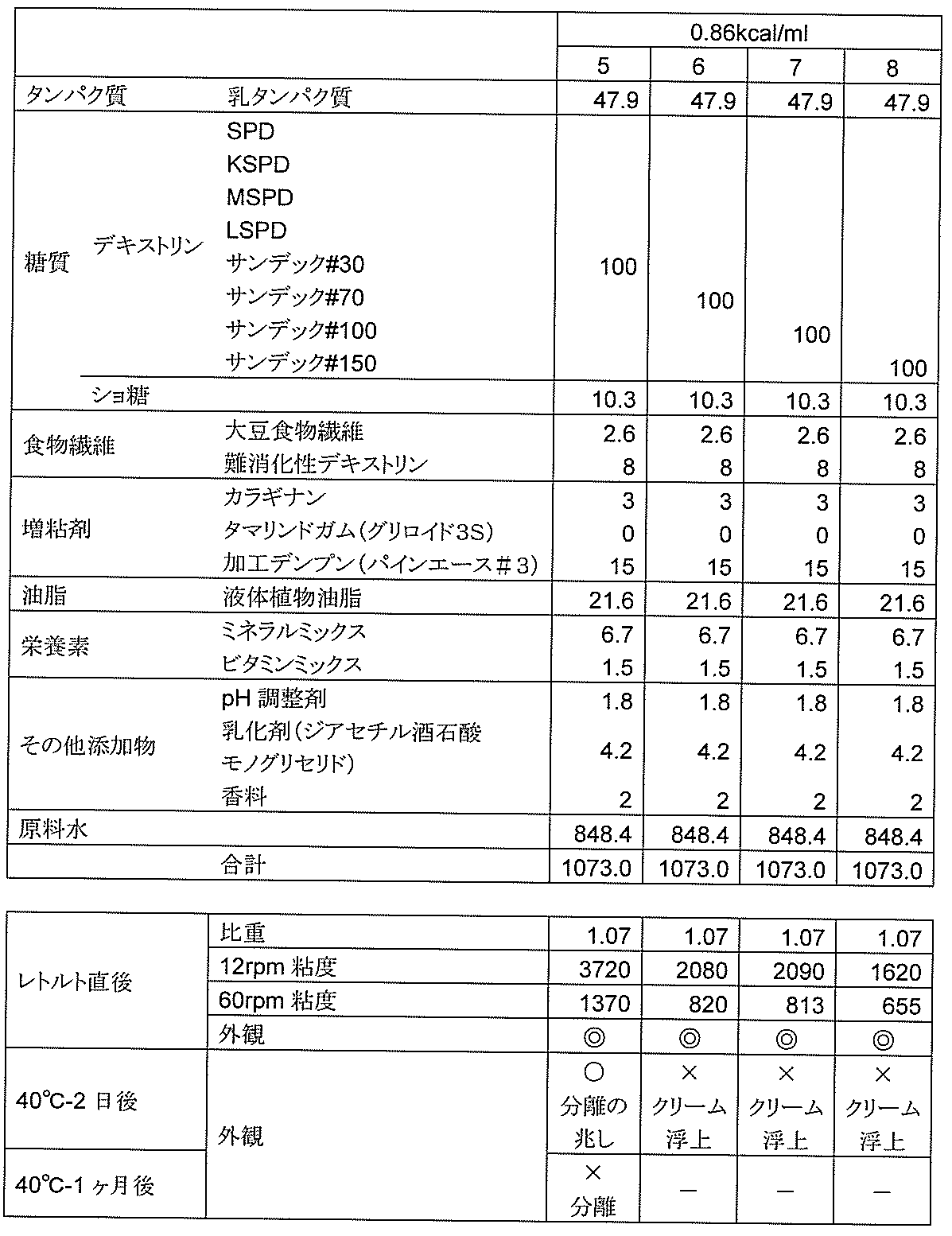
表2-1より、20℃での粘度、及び40℃1ヶ月間保存した後の栄養組成物の外観(乳化の状態)から、デキストリンL-SPD、又はデキストリンM-SPDを用いた栄養組成物が良好な結果であった。すなわち、製造例3、4は40℃で1ヶ月間保存した後の組成物の外観が良好であった。
次に、その他のデキストリンを用いた場合の、栄養組成物の乳化の状態を調べた。結果を表2-2に示す。製造例5では40℃1ヶ月間保存した後の栄養組成物に分離が見られ、良好な結果ではなかった。製造例6、7、8については、40℃2日間保存した後の栄養組成物にクリームが浮上し、良好な結果ではなかった。
次に、種々の増粘多糖類及び大豆食物繊維による、栄養組成物の乳化の状態を調べた。結果を表3に示す。
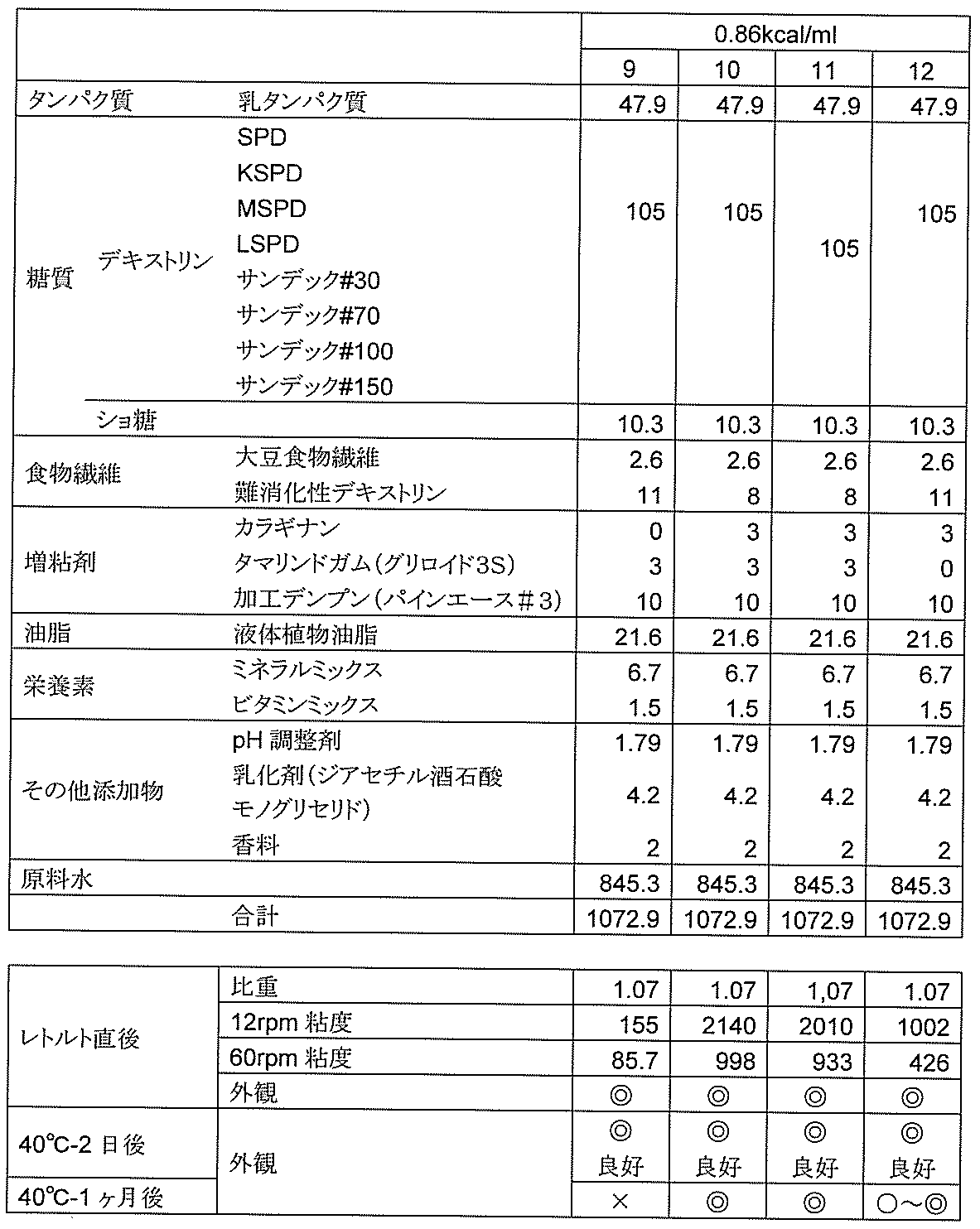
表3より、40℃1ヶ月間保存した後の栄養組成物の外観(乳化の状態)から、製造例10~12の栄養組成物は良好な結果であった。カラギナンを使用しなかった製造例9は、40℃1ヶ月間保存した後の栄養組成物の乳化の状態が安定せずに顕著にクリームが分離し良好な結果ではなかった。製造例10~12は、40℃1ヶ月間保存した後の栄養組成物の乳化の状態が安定していた。製造例10~12の結果より、栄養組成物にデキストリンL-SPD、又はデキストリンM-SPDを用いた場合、カラギナンを0.3重量%配合すると良好な結果であった。
また、表3より、栄養組成物にデキストリンL-SPD、又はデキストリンM-SPDを用い、カラギナンを0.3重量%配合した場合、タマリンドガムを配合すると、40℃1ヶ月間保存した後の栄養組成物の乳化の状態が安定し、良好な結果であった(製造例10、11)。
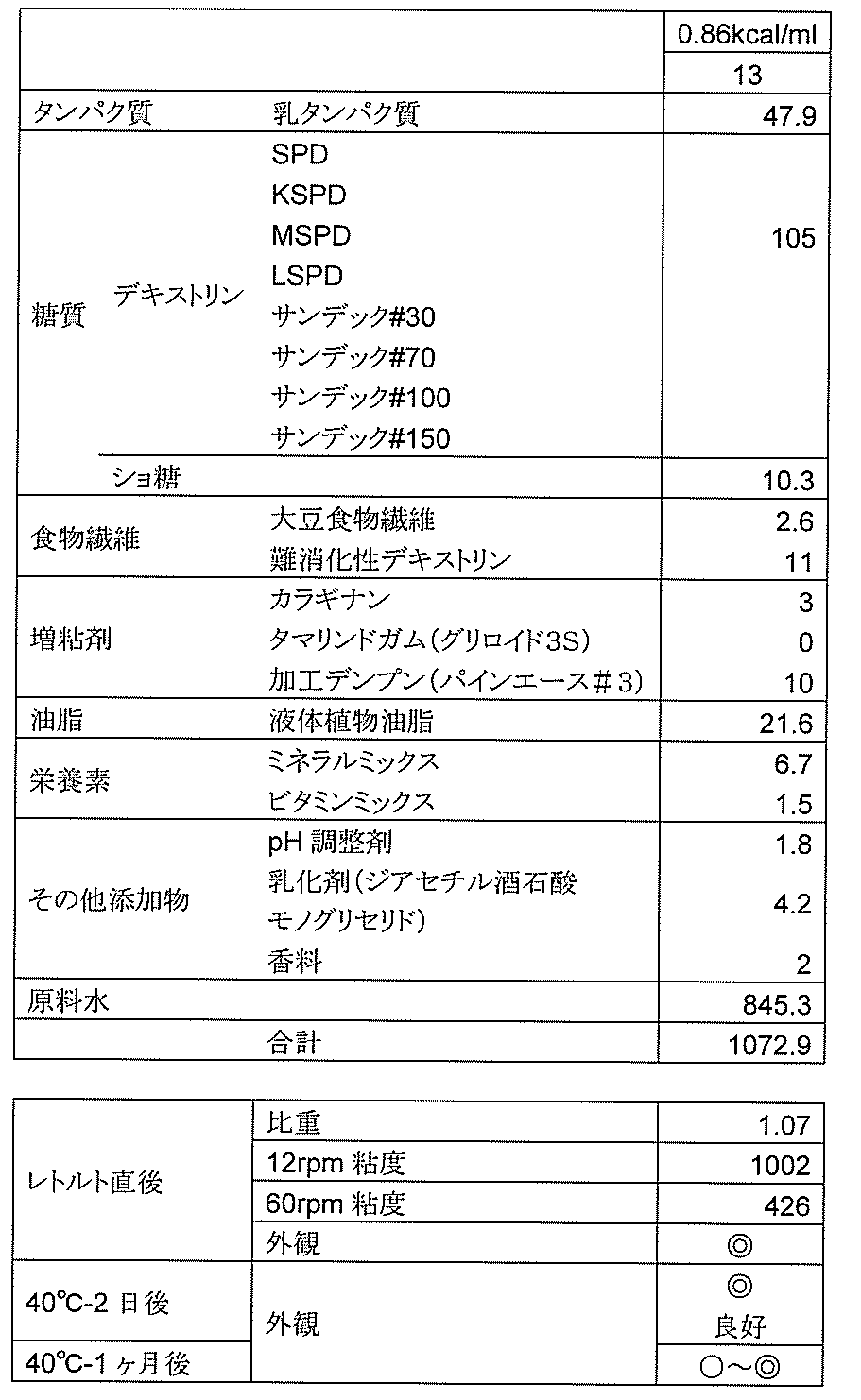
表4より、デキストリンM-SPDを用い、カラギナンを0.3重量%配合した製造例13は、40℃で1ヶ月間保存した後の栄養組成物の乳化の状態が安定し、良好な結果であった。
以上より、DE値が11~29であり、且つ、デキストリン中の全部の糖に占める5糖~7糖の割合がDE値に1.5を乗じた数値以上であるデキストリンと、カラギナン0.1~0.5重量%を配合することで、保存安定性の良好な、タンパク質含量1~10重量%、且つ、水分含量70~95重量%の高粘度の希釈タイプの栄養組成物が実現できることがわかった。また、タマリンドガムをさらに配合しても、保存安定性の良好な、タンパク質含量1~10重量%、且つ、水分含量70~95重量%の高粘度の希釈タイプの栄養組成物が実現できることがわかった。
[試験例3]
0.67kcal/mlにて表5に記載の配合に準じて、栄養組成物を調製した。表中の個別の成分の単位はg/Lである。表中の粘度の単位はmPa・sである。調製方法は、WO2012/157571に記載の方法と同じ方法を用いた。具体的には、全ての原材料を溶解し、加温後に、均質化し、容器に充填した後にレトルト殺菌した。
[試験例3]
0.67kcal/mlにて表5に記載の配合に準じて、栄養組成物を調製した。表中の個別の成分の単位はg/Lである。表中の粘度の単位はmPa・sである。調製方法は、WO2012/157571に記載の方法と同じ方法を用いた。具体的には、全ての原材料を溶解し、加温後に、均質化し、容器に充填した後にレトルト殺菌した。
より具体的には、表の上段の配合表に従って原材料を攪拌・混合して、各種栄養組成物を調合し、50~60℃まで加温し分散溶解した後に、均質化圧20MPaの条件で均質化処理を行い、次いで50~60℃にて30MPaで均質化処理を行った。レトルト殺菌前に栄養組成物の粘度を測定した。次いで、栄養組成物を容器に充填して密封し、121~123.5℃×5~20分の条件でレトルト殺菌を行った。レトルト殺菌後の栄養組成物の粘度を測定した[レトルト殺菌直後]。粘度の測定はB型(回転式)粘度計を使用し、12rpm又は60rpm、20℃(又は50℃)の条件で測定した。本試験例に用いた乳タンパク質は、MPC 26重量%とカゼインナトリウム53重量%と特定分解率のカゼイン分解物(分解度AN/TN%=5.0~5.4)21重量%で含まれている。なお、レトルト殺菌後の栄養組成物のpHは、全て6.3であった。
表の下段には製造した組成物のレトルト直後の粘度と、40℃での保存後の外観を示す。二重丸(◎)又は丸(○)は、乳化の状態が安定的に維持されている良好な組成物を示す。バツ(×)は、乳化の状態が破壊し、分離した組成物を示す。
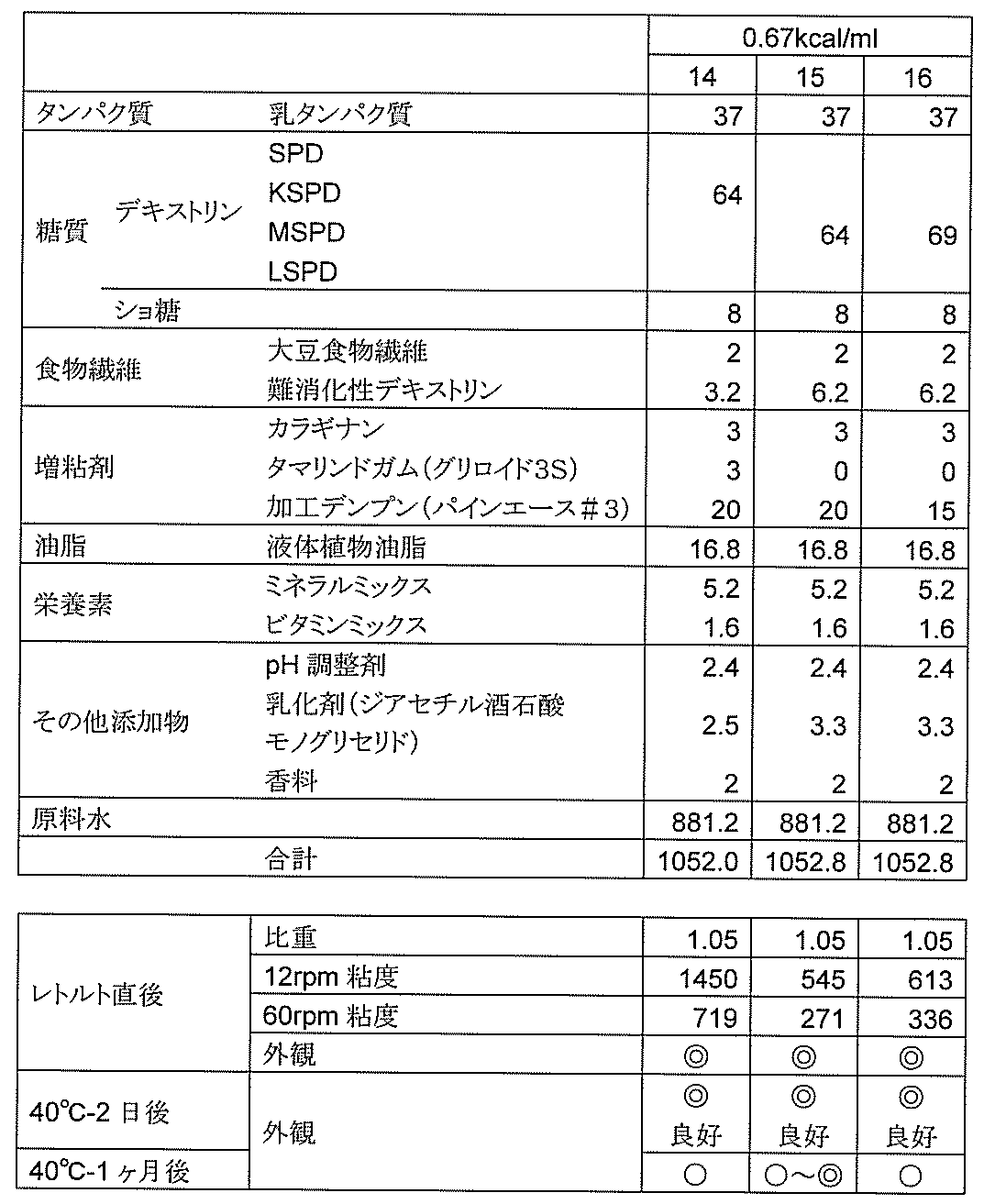
表5より、デキストリンK-SPD又はデキストリンM-SPDを用い、カラギナンを0.3重量%配合した製造例14~16は、40℃で1ヶ月間保存した後の栄養組成物の乳化の状態が安定し、良好な結果であった。
以上より、0.67kcal/mlの栄養組成物についても、DE値が11~29であり、且つ、デキストリン中の全部の糖に占める5糖~7糖の割合がDE値に1.5を乗じた数値以上であるデキストリンと、カラギナン0.1~0.5重量%を配合することで、保存安定性の良好な、タンパク質含量1~10重量%、且つ、水分含量70~95重量%の高粘度の希釈タイプの栄養組成物が実現できることがわかった。また、タマリンドガムをさらに配合しても、保存安定性の良好な、タンパク質含量1~10重量%、且つ、水分含量70~95重量%の高粘度の希釈タイプの栄養組成物が実現できることがわかった(製造例14)。
[試験例4]
1.05kcal/mlにて表6に記載の配合に準じて、栄養組成物を調製した。表中の個別の成分の単位はg/Lである。表中の粘度の単位はmPa・sである。調製方法は、WO2012/157571に記載の方法と同じ方法を用いた。具体的には、全ての原材料を溶解し、加温後に、均質化し、容器に充填した後にレトルト殺菌した。
[試験例4]
1.05kcal/mlにて表6に記載の配合に準じて、栄養組成物を調製した。表中の個別の成分の単位はg/Lである。表中の粘度の単位はmPa・sである。調製方法は、WO2012/157571に記載の方法と同じ方法を用いた。具体的には、全ての原材料を溶解し、加温後に、均質化し、容器に充填した後にレトルト殺菌した。
より具体的には、表の上段の配合表に従って原材料を攪拌・混合して、各種栄養組成物を調合し、50~60℃まで加温し分散溶解した後に、均質化圧20MPaの条件で均質化処理を行い、次いで50~60℃にて30MPaで均質化処理を行った。レトルト殺菌前に栄養組成物の粘度を測定した。次いで、栄養組成物を容器に充填して密封し、121~123.5℃×5~20分の条件でレトルト殺菌を行った。レトルト殺菌後の栄養組成物の粘度を測定した[レトルト殺菌直後]。粘度の測定はB型(回転式)粘度計を使用し、12rpm又は60rpm、20℃(又は50℃)の条件で測定した。本試験例に用いた乳タンパク質は、MPC 26重量%とカゼインナトリウム53重量%と特定分解率のカゼイン分解物(分解度AN/TN%=5.0~5.4)21重量%で含まれている。なお、レトルト殺菌後の栄養組成物のpHは、全て6.3であった。
表の下段には製造した組成物のレトルト直後の粘度と、40℃での保存後の外観を示す。二重丸(◎)又は丸(○)は、乳化の状態が安定的に維持されている良好な組成物を示す。バツ(×)は、乳化の状態が破壊し、分離した組成物を示す。
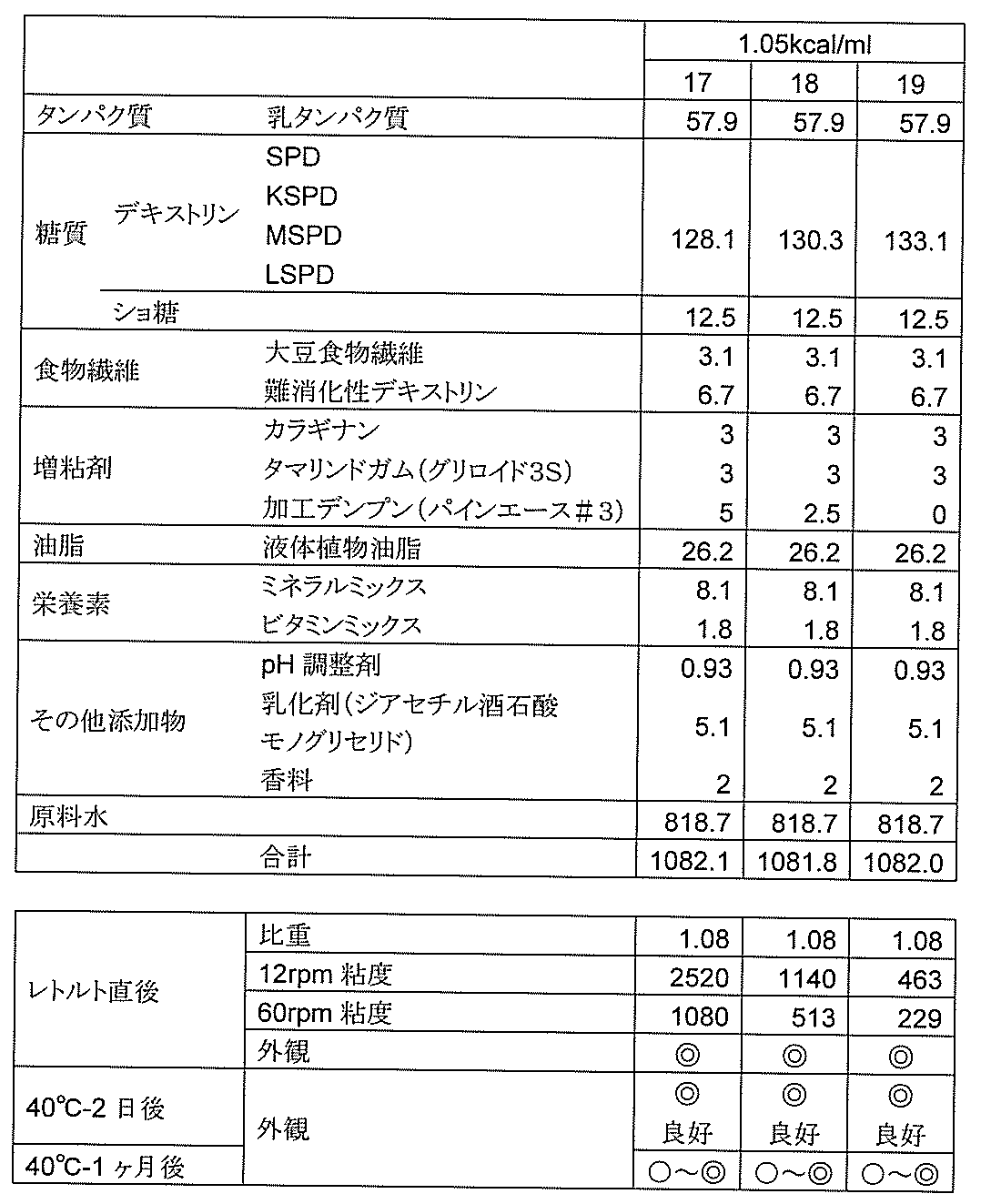
表6より、デキストリンM-SPDを用い、カラギナンを0.3重量%配合した製造例17~19は、40℃で1ヶ月間保存した後の栄養組成物の乳化の状態が安定し、良好な結果であった。なお、製造例19には加工デンプン(パインエース#3)が含まれていないが、40℃1ヶ月間の保存した後の栄養組成物の乳化の状態が安定し、良好な結果であった。このことから本発明の栄養組成物に加工デンプンの添加が必ずしも必須ではないことがわかった。
以上より、1.05kcal/ml の栄養組成物についても、DE値が11~29であり、且つ、デキストリン中の全部の糖に占める5糖~7糖の割合がDE値に1.5を乗じた数値以上であるデキストリンと、カラギナン0.1~0.5重量%を配合することで、保存安定性の良好な、タンパク質含量1~10重量%、且つ、水分含量70~95重量%の高粘度の希釈タイプの栄養組成物が実現できることがわかった。
[試験例5]
試験例2~4にて、40℃1ヶ月間の保存をした後の乳化の状態が安定し、保存安定性が良好であった製造例の栄養組成物の動的粘弾性を測定し、非ニュートン粘性指数nを算出した。
[試験例5]
試験例2~4にて、40℃1ヶ月間の保存をした後の乳化の状態が安定し、保存安定性が良好であった製造例の栄養組成物の動的粘弾性を測定し、非ニュートン粘性指数nを算出した。
本発明の栄養組成物の組成及び製造方法は上記のとおりである。また市販流動食(商品名「エフツーライト」)については、市販流動食のパンフレットに掲載されている、栄養成分、及び物性値の情報より、下記表7の記載の栄養成分、物性値であると思料される。

剪断速度依存性粘度測定方法
本発明の栄養組成物(各製造例)及び市販流動食(比較例)を試験に供した。粘度は、粘弾性測定装置Physica MCR301(アントンパール社)を使用し、直径25mmパラレルプレートを用い、GAP1mm、25℃、剪断速度1~100/sの条件で測定を行った。また、以下の粘性式より、非ニュートン粘性指数nを算出した。
本発明の栄養組成物(各製造例)及び市販流動食(比較例)を試験に供した。粘度は、粘弾性測定装置Physica MCR301(アントンパール社)を使用し、直径25mmパラレルプレートを用い、GAP1mm、25℃、剪断速度1~100/sの条件で測定を行った。また、以下の粘性式より、非ニュートン粘性指数nを算出した。
以下の粘性式:
P=μDn
(式中、Pは粘度と剪断速度の値を互いに乗じた値である剪断応力(Pa)、Dは剪断速度、μは非ニュートン粘性係数、nは非ニュートン粘性指数をそれぞれ表す。粘度(25℃、Pa・s)は、粘弾性測定装置Physica MCR301(アントンパール社)を使用し、直径25mmパラレルプレートを用い、GAP1mm、25℃、剪断速度0.1~1000/s、例えば1~100/sの条件で測定する。)
において、理想的なニュートン流体はn=1であり、横軸に剪断速度(1/s)、縦軸に剪断応力(Pa)を対数表示した場合、原点を通る直線となる。一方、非ニュートン流体は傾きがnとなり、ここでnは当該非ニュートン流体の流動性指数である。なお粘度(Pa・s)は、剪断応力(Pa)を剪断速度(1/s)で除算したものである。
P=μDn
(式中、Pは粘度と剪断速度の値を互いに乗じた値である剪断応力(Pa)、Dは剪断速度、μは非ニュートン粘性係数、nは非ニュートン粘性指数をそれぞれ表す。粘度(25℃、Pa・s)は、粘弾性測定装置Physica MCR301(アントンパール社)を使用し、直径25mmパラレルプレートを用い、GAP1mm、25℃、剪断速度0.1~1000/s、例えば1~100/sの条件で測定する。)
において、理想的なニュートン流体はn=1であり、横軸に剪断速度(1/s)、縦軸に剪断応力(Pa)を対数表示した場合、原点を通る直線となる。一方、非ニュートン流体は傾きがnとなり、ここでnは当該非ニュートン流体の流動性指数である。なお粘度(Pa・s)は、剪断応力(Pa)を剪断速度(1/s)で除算したものである。
製造例4の栄養組成物の非ニュートン粘性指数nは0.54であった。製造例14の栄養組成物の非ニュートン粘性指数nは0.46であった。製造例15の栄養組成物の非ニュートン粘性指数nは0.55であった。製造例18の栄養組成物の非ニュートン粘性指数nは0.44であった。
比較例として、市販流動食(商品名「エフツーライト」、テルモ社製)について同じ条件下で非ニュートン粘性指数nを測定したところ、0.29であった。
[比較例]
0.86kcal/mlにて表8に記載の配合に準じて、栄養組成物を調製した。表中の個別の成分の単位はg/Lである。表中の粘度の単位はmPa・sである。調製方法は、WO2012/157571に記載の方法と同じ方法を用いた。具体的には、全ての原材料を溶解し、加温後に、均質化し、容器に充填した後にレトルト殺菌した。
[比較例]
0.86kcal/mlにて表8に記載の配合に準じて、栄養組成物を調製した。表中の個別の成分の単位はg/Lである。表中の粘度の単位はmPa・sである。調製方法は、WO2012/157571に記載の方法と同じ方法を用いた。具体的には、全ての原材料を溶解し、加温後に、均質化し、容器に充填した後にレトルト殺菌した。
より具体的には、表の上段の配合表に従って原材料を攪拌・混合して、各種栄養組成物を調合し、50~60℃まで加温し分散溶解した後に、均質化圧20MPaの条件で均質化処理を行い、次いで50~60℃にて30MPaで均質化処理を行った。レトルト殺菌前に栄養組成物の粘度を測定した。次いで、栄養組成物を容器に充填して密封し、121~123.5℃×5~20分の条件でレトルト殺菌を行った。レトルト殺菌後の栄養組成物の粘度を測定した[レトルト殺菌直後]。粘度の測定はB型(回転式)粘度計を使用し、12rpm又は60rpm、20℃(又は50℃)の条件で測定した。本試験例に用いた乳タンパク質は、MPC 26重量%とカゼインナトリウム53重量%と特定分解率のカゼイン分解物(分解度AN/TN%=5.0~5.4)21重量%で含まれている。なお、レトルト殺菌後の栄養組成物のpHは、全て6.3であった。
表の下段には製造した組成物のレトルト直後の粘度と、40℃での保存後の外観を示す。二重丸(◎)又は丸(○)は、乳化の状態が安定的に維持されている良好な組成物を示す。バツ(×)は、乳化の状態が破壊し、分離した組成物を示す。タマリンドガムは、グリロイド3S(大日本住友製薬株式会社製)を用いた。加工デンプンは、パインエース#3(松谷化学工業株式会社製)を用いた。

表8より、40℃1ヶ月間保存した後の栄養組成物の外観(乳化の状態)から、カラギナンを0.6重量%配合した製造例20、21の栄養組成物は良好な結果ではなかった。製造例20ではレトルト殺菌後に乳化破壊が見られた。また製造例21では、40℃1ヶ月間保存した後の栄養組成物に黒変が見られ、外観不良であった。
すなわち、表8より、栄養組成物にM-SPDを用い、カラギナンを0.6重量%配合した場合、40℃1ヶ月間保存した後の栄養組成物の乳化や色調の状態が安定せず、良好な結果ではなかった(製造例20、21)。
[試験例6]
0.71kcal/mlにて表9に記載の配合に準じて、栄養組成物を調製した。表中の個別の成分の単位はg/Lである。表中の粘度の単位はmPa・sである。調製方法は、WO2012/157571に記載の方法と同様の方法を用いた。具体的には、全ての原材料を溶解し、加温後に、均質化し、容器に充填した後にレトルト殺菌した。
0.71kcal/mlにて表9に記載の配合に準じて、栄養組成物を調製した。表中の個別の成分の単位はg/Lである。表中の粘度の単位はmPa・sである。調製方法は、WO2012/157571に記載の方法と同様の方法を用いた。具体的には、全ての原材料を溶解し、加温後に、均質化し、容器に充填した後にレトルト殺菌した。
より具体的には、表の上段の配合表に従って原材料を攪拌・混合して、各種栄養組成物を調合し、50~60℃まで加温し分散溶解した後に、均質化圧20MPaの条件で均質化処理を行い、次いで50~60℃にて40MPaで均質化処理を行った。レトルト殺菌前に栄養組成物の粘度を測定した。次いで、栄養組成物を容器に充填して密封し、121~123.5℃×5~20分の条件でレトルト殺菌を行った。レトルト殺菌後の栄養組成物の粘度を測定した[レトルト殺菌直後]。粘度の測定はB型(回転式)粘度計を使用し、12rpm又は60rpm、20℃(又は50℃)の条件で測定した。本試験例に用いた乳タンパク質は、カゼインナトリウム(未分解AN/TN%=4.5)、MPC、特定分解率のカゼイン分解物(AN/TN%=5.0~5.4)、カゼインペプチド(AN/TN%=27)又はコラーゲンペプチドであった。コラーゲンペプチドは豚由来のものを使用した。なお、使用したデキストリンはMSPDであり、レトルト殺菌後の栄養組成物のpHは、全て6.3であった。
表の下段には製造した組成物のレトルト翌日の粘度と、40℃での保存後の外観を示す。二重丸(◎)又は丸(○)は、乳化の状態が安定的に維持されている良好な組成物を示す。バツ(×)は、乳化の状態が破壊し、分離した組成物を示す。
さらに栄養組成物の胃の中での凝固性を試験した結果を表の下段に示す。試験方法としては人工胃液を第14 回改正日本薬局方崩壊試験法,第1液に準じて以下のとおり調製した。
<人工胃液の調製>
塩化ナトリウム2gに塩酸7mLおよび水を加えて溶かし、1,000mLに調整する(pH1.2)
<試験方法>
人工胃液50mlが入った100mlのガラス三角フラスコに、栄養組成物50mlをフラスコ上部から速やかに注ぎ入れ、混合直後の濁りの有無で判断する
<評価>
二重丸(◎)は濁りを認めないことを示す。丸(○)はわずかに濁りを認めることを示す。三角(△)は少し濁ることを示す。バツ印(×)は顕著に濁ることを示す。
<人工胃液の調製>
塩化ナトリウム2gに塩酸7mLおよび水を加えて溶かし、1,000mLに調整する(pH1.2)
<試験方法>
人工胃液50mlが入った100mlのガラス三角フラスコに、栄養組成物50mlをフラスコ上部から速やかに注ぎ入れ、混合直後の濁りの有無で判断する
<評価>
二重丸(◎)は濁りを認めないことを示す。丸(○)はわずかに濁りを認めることを示す。三角(△)は少し濁ることを示す。バツ印(×)は顕著に濁ることを示す。
濁りを認めなければ、たんぱく質の凝固時に離水を伴わずにカード形成すると分かる。わずかに濁りを認めると、たんぱく質の凝固時にカード形成しわずかに離水を伴うと分かる。少し濁りを認めると、たんぱく質の凝固時にカード形成し少し離水を伴うと分かる。顕著に濁ると、たんぱく質の凝固時に顕著な離水を伴い、カード形成していないと分かる。ここで離水する、とはタンパク質が凝固する際に凝固物から水分が流出することをいう。◎、○又は△と評価される栄養組成物であれば人工胃液と混合するとカード形成すると分かり、本発明において、下痢を起こしにくい経管栄養組成物として使用することができる。×と評価される栄養組成物であれば、人工胃液と混合してもカード形成しないと分かり、本発明において、腸管で即効的に消化吸収されやすい栄養組成物として使用することができる。
試験結果は以下の通りである。最初に、種々の分解度の乳タンパク質を用いた場合の、栄養組成物の乳化の状態を調べた。
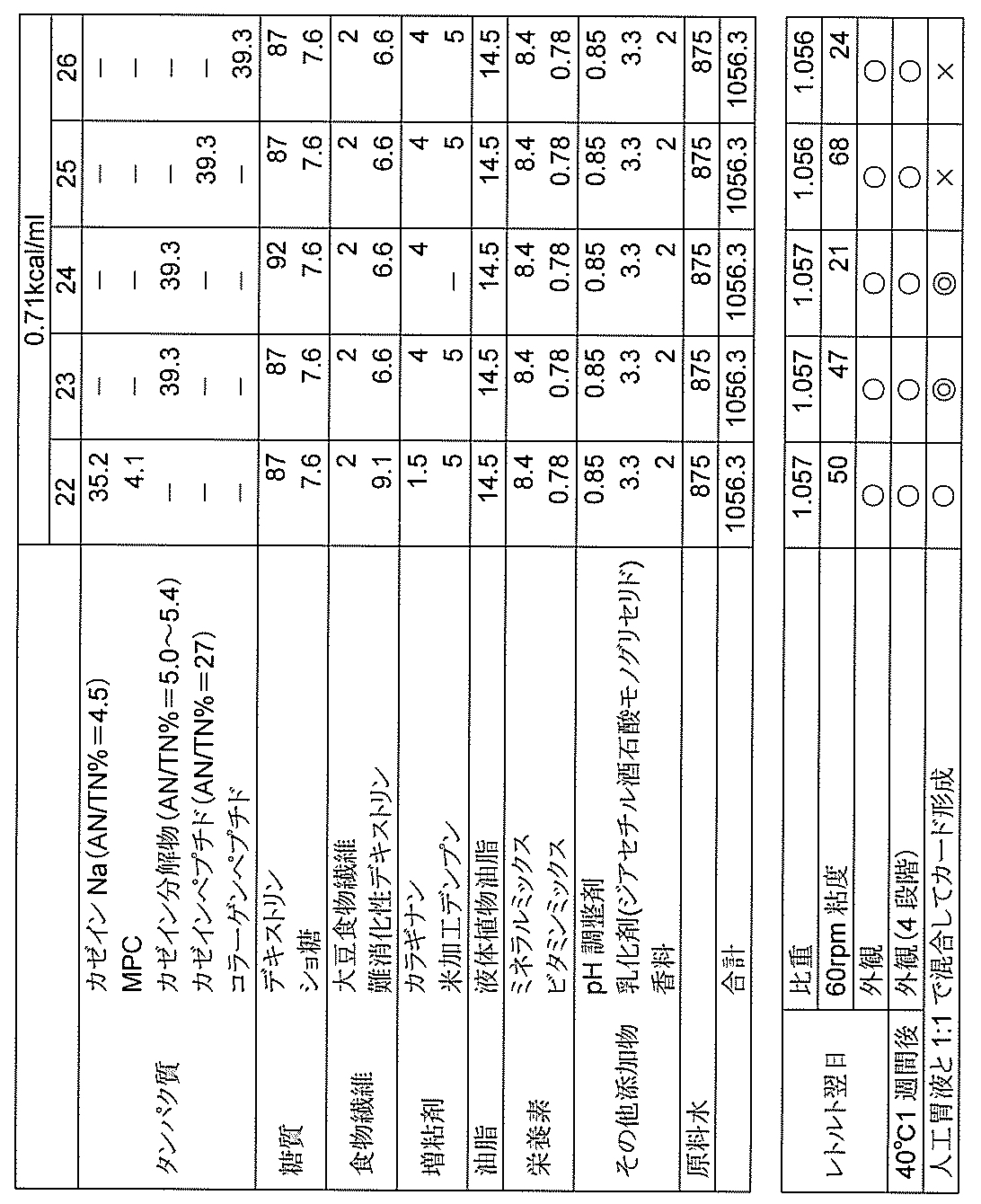
表9を見ると、製造例22~26はいずれも外観が良好であり、乳化安定性を示した。また、栄養組成物の胃の中での凝固特性を試験するために、栄養組成物を人工胃液と混合したところ、製造例22、23、24はカードを形成した。このような栄養組成物は経管投与すると胃内で凝固し下痢などを起こしにくいため、好ましい。すなわち、カゼインの分解度(AN/NT%)が4.5~5.4のカゼイン分解物を使用したところ、乳化安定性を有し、経管投与に適した栄養組成物が得られた。また、カゼインタンパク質の分解度(AN/NT%)が27程度であるか、又はコラーゲンペプチド程度の分解度があるタンパク質を用いたところ、乳化状態の安定した栄養組成物が得られた。乳化安定性を示した製造例25及び26を人工胃液と混合したところ、カード形成は見られなかった。このような栄養組成物は腸管で即効的な消化吸収が期待できるため、好ましい。また栄養組成物の粘度(60rpm)を21 mPa・sとしても良好な乳化安定性を有し経管投与に適した栄養組成物が得られた(製造例24)。
[試験例7]
次に乳化剤の添加量を低減した場合を調べた。0.71kcal/mlにて表10に記載の配合に準じて、栄養組成物を調製した。表中の個別の成分の単位はg/Lである。表中の粘度の単位はmPa・sである。調製方法は、WO2012/157571に記載の方法と同じ方法を用いた。具体的には、全ての原材料を溶解し、加温後に、均質化し、容器に充填した後にレトルト殺菌した。
次に乳化剤の添加量を低減した場合を調べた。0.71kcal/mlにて表10に記載の配合に準じて、栄養組成物を調製した。表中の個別の成分の単位はg/Lである。表中の粘度の単位はmPa・sである。調製方法は、WO2012/157571に記載の方法と同じ方法を用いた。具体的には、全ての原材料を溶解し、加温後に、均質化し、容器に充填した後にレトルト殺菌した。
より具体的には、表の上段の配合表に従って原材料を攪拌・混合して、各種栄養組成物を調合し、50~60℃まで加温し分散溶解した後に、均質化圧20MPaの条件で均質化処理を行い、次いで50~60℃にて40MPaで均質化処理を行った。レトルト殺菌前に栄養組成物の粘度を測定した。次いで、栄養組成物を容器に充填して密封し、121~123.5℃×5~20分の条件でレトルト殺菌を行った。レトルト殺菌後の栄養組成物の粘度を測定した[レトルト殺菌直後]。粘度の測定はB型(回転式)粘度計を使用し、12rpm又は60rpm、20℃(又は50℃)の条件で測定した。本試験例に用いたタンパク質は、特定分解率のカゼイン分解物(AN/TN%=5.0~5.4)であった。なお、使用したデキストリンはMSPDであり、レトルト殺菌後の栄養組成物のpHは、全て6.3であった。
表の下段には製造した組成物のレトルト翌日の粘度と、40℃での保存後の外観を示す。また栄養組成物の胃の中での凝固性を試験した結果を示す。試験方法は上記と同様である。
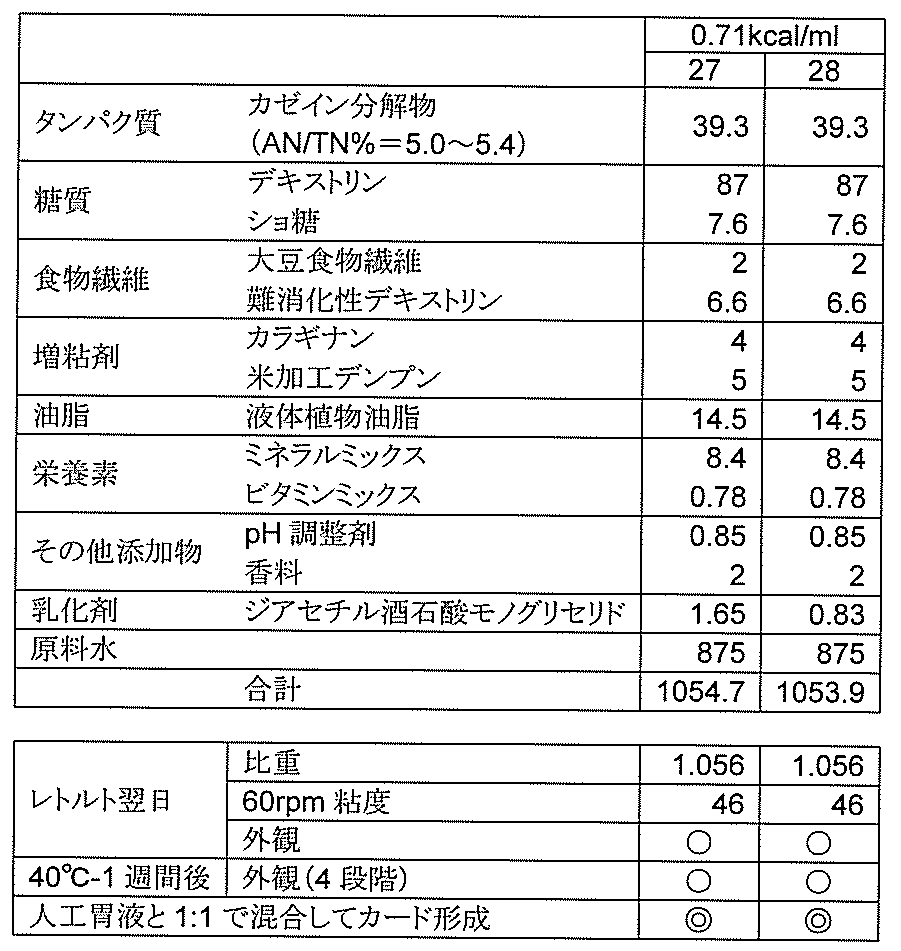
表10を見ると、製造例27~28はいずれも外観が良好であり、乳化安定性を示した。また、栄養組成物の胃の中での凝固性を試験したところ、製造例27、28は人工胃液と混合した場合、カードを形成した。このように乳化剤の添加量を1.65g(1054.7g中)まで、さらには0.83g(1053.9g中)まで低減しても、乳化安定性は維持され、経管投与に適した栄養組成物が得られた。
[試験例8]
次に増粘剤として、カラギナンの他に粒子の微細なデンプンを使用した場合を調べた。0.71kcal/ml又は0.67kcal/mlにて表11に記載の配合に準じて、栄養組成物を調製した。表中の個別の成分の単位はg/Lである。表中の粘度の単位はmPa・sである。調製方法は、WO2012/157571に記載の方法と同じ方法を用いた。具体的には、全ての原材料を溶解し、加温後に、均質化し、容器に充填した後にレトルト殺菌した。
次に増粘剤として、カラギナンの他に粒子の微細なデンプンを使用した場合を調べた。0.71kcal/ml又は0.67kcal/mlにて表11に記載の配合に準じて、栄養組成物を調製した。表中の個別の成分の単位はg/Lである。表中の粘度の単位はmPa・sである。調製方法は、WO2012/157571に記載の方法と同じ方法を用いた。具体的には、全ての原材料を溶解し、加温後に、均質化し、容器に充填した後にレトルト殺菌した。
より具体的には、表の上段の配合表に従って原材料を攪拌・混合して、各種栄養組成物を調合し、50~60℃まで加温し分散溶解した後に、均質化圧20MPaの条件で均質化処理を行い、次いで50~60℃にて30MPaで均質化処理を行った。レトルト殺菌前に栄養組成物の粘度を測定した。次いで、栄養組成物を容器に充填して密封し、121~123.5℃×5~20分の条件でレトルト殺菌を行った。レトルト殺菌後の栄養組成物の粘度を測定した[レトルト殺菌直後]。粘度の測定はB型(回転式)粘度計を使用し、12rpm又は60rpm、20℃(又は50℃)の条件で測定した。本試験例に用いたタンパク質は、特定分解率のカゼイン分解物(AN/TN%=5.0~5.4)であった。なお、使用したデキストリンはMSPDであり、レトルト殺菌後の栄養組成物のpHは、全て6.3であった。
表の下段には製造した組成物のレトルト翌日の粘度と、40℃での保存後の外観を示す。また栄養組成物の胃の中での凝固性を試験した結果を示す。試験方法は上記と同様である。

表11を見ると、製造例29~36はいずれも外観が良好であり、乳化安定性を示した。また、栄養組成物の胃の中での凝固性を試験したところ、製造例29~36はいずれも人工胃液と混合した場合、カードを形成した。このように増粘剤としてカラギナンの他に、粒子の細かいデンプンを使用した場合も、栄養組成物の乳化安定性は維持され、経管投与に適した栄養組成物が得られた。また添加する乳化剤の量を低減しても、乳化安定性を示し、経管投与に適した栄養組成物が得られた。
本発明の栄養組成物は、従来の技術では実現できなかった、保存安定性が良好であって、低タンパク質で、水分含量が高い栄養組成物(流動食、経腸栄養剤)を実現することが可能である。本発明の栄養組成物は日常において、エネルギー摂取などを制限されている患者のうち、嚥下困難者などにとっても経口摂取用として有効である。また、本発明の栄養組成物のうち、非ニュートン粘性指数が0.3以上1.0未満である栄養組成物は、経鼻管投与などの経管栄養法に適していると共に、胃ろうや腸ろうなどの経管栄養法において自然滴下法を適用して、胃内へ直接投与することに適している特性(物性)を有する。
さらに、本発明の栄養組成物のうち、人工胃液と混合するとカード形成するもの、例えば離水を伴わずにカード形成するものは、胃内で凝固し下痢を起こしにくいため、経鼻管投与などの経管栄養法に適していると共に、胃ろうや腸ろうなどの経管栄養法において自然滴下法を適用して、胃内へ直接投与することに適している特性(物性)を有する。また本発明の栄養組成物のうち、人工胃液と混合してもカード形成しないものは、腸管で即効的な消化吸収が期待できる。
本明細書で引用した全ての刊行物、特許及び特許出願はそのまま引用により本明細書に組み入れられるものとする。
Claims (24)
- (i) デキストロース当量(DE)値が11~29であり、且つ糖組成としてデキストリンの全部の糖に占める5糖~7糖の割合がデキストロース当量(DE)値に1.5を乗じた数値以上であるデキストリン、及び
(ii) 増粘剤として0.1~0.5重量%のカラギナン、及び
(iii) 1~10重量%のタンパク質
を含む栄養組成物。 - (i) デキストロース当量(DE)値が11~29であり、且つ糖組成としてデキストリンの全部の糖に占める単糖~7糖の割合が45~90重量%であるデキストリン、及び
(ii) 増粘剤として0.1~0.5重量%のカラギナン、及び
(iii) 1~10重量%のタンパク質
を含む栄養組成物。 - タンパク質が、4.5~10%というアミノ窒素(AN)/合計窒素(TN)重量比を有するカゼイン分解物を含むものである、請求項1又は2に記載の栄養組成物。
- タンパク質が、コラーゲンペプチド又は10~50%というAN/TN重量比を有するカゼイン分解物を含むものである、請求項1又は2に記載の栄養組成物。
- さらに、(ii)増粘剤として加工デンプンを含む、請求項1~4のいずれか1項に記載の栄養組成物。
- 加工デンプンが、平均粒径1~10μmの加工デンプンを含むものである、請求項5に記載の栄養組成物。
- さらに、(ii)増粘剤としてタマリンドガムを含む、請求項1~6のいずれか1項に記載の栄養組成物。
- 加熱殺菌されており、加熱殺菌された後の20℃における粘度が、20~3000 mPa・s (B型(回転式)粘度計において、12 rpmでロータを使用した場合)である、請求項1~7のいずれか1項に記載の栄養組成物。
- 剪断速度で0.1/s~1000/sの剪断速度域の任意の2点、又はそれ以上の測定点における剪断応力と剪断速度の測定結果を、以下の粘性式で表す場合に、nの値が0.3以上1.0未満であり、且つ、加熱殺菌された後の25℃における粘度が、20~3000 mPa・s (B型(回転式)粘度計において、12 rpmでロータを使用した場合)である、請求項1~8のいずれか1項に記載の栄養組成物。
P=μDn
(式中で、Pは、剪断応力(Pa)、Dは、剪断速度(1/s)、μは、非ニュートン粘性係数、nは、非ニュートン粘性指数をそれぞれ表す。) - 剪断速度で0.1/s~1000/sの剪断速度域の任意の2点、又はそれ以上の測定点における剪断応力と剪断速度の測定結果を、以下の粘性式で表す場合に、nの値が0.1以上0.3未満であり、且つ、加熱殺菌された後の25℃における粘度が、20~3000 mPa・s (B型(回転式)粘度計において、12 rpmでロータを使用した場合)である、請求項1~8のいずれか1項に記載の栄養組成物。
P=μDn
(式中で、Pは、剪断応力(Pa)、Dは、剪断速度(1/s)、μは、非ニュートン粘性係数、nは、非ニュートン粘性指数をそれぞれ表す。) - 人工胃液(pH 1.2)と混合した場合にカード形成する、請求項9又は10に記載の栄養組成物。
- 人工胃液(pH 1.2)と混合した場合にカード形成しない、請求項9又は10に記載の栄養組成物。
- 熱量が0.5~1.5 kcal/mlである、請求項1~12のいずれか1項に記載の栄養組成物。
- 経管栄養法用である、請求項1~13のいずれか1項に記載の栄養組成物。
- 40℃に1月間で保存しても、乳化の状態が安定して維持される、請求項1~14のいずれか1項に記載の栄養組成物。
- 以下の工程を含む、栄養組成物の製造方法、
(a)(i) デキストロース当量(DE)値が11~29であり、且つ糖組成としてデキストリンの全部の糖に占める5糖~7糖の割合がデキストロース当量(DE)値に1.5を乗じた数値以上であるデキストリン、及び
(ii) 増粘剤として0.1~0.5重量%のカラギナン、及び
(iii) 1~10重量%のタンパク質を含む組成物を混合する工程、並びに
(b)該組成物を均質化する工程、並びに
(c)該組成物を加熱殺菌する工程。 - 以下の工程を含む、栄養組成物の製造方法、
(a)(i) デキストロース当量(DE)値が11~29であり、且つ糖組成としてデキストリンの全部の糖に占める単糖~7糖の割合が45~90重量%であるデキストリン、及び
(ii) 増粘剤として0.1~0.5重量%のカラギナン、及び
(iii) 1~10重量%のタンパク質を含む組成物を混合する工程、並びに
(b)該組成物を均質化する工程、並びに
(c)該組成物を加熱殺菌する工程。 - タンパク質が、4.5~10%というアミノ窒素(AN)/合計窒素(TN)重量比を有するカゼイン分解物を含むものである、請求項16又は17に記載の製造方法。
- タンパク質が、コラーゲンペプチド又は10~50%というAN/TN重量比を有するカゼイン分解物を含むものである、請求項16又は17に記載の製造方法。
- さらに、(ii)増粘剤として加工デンプンを用いる、請求項16~19のいずれか1項に記載の製造方法。
- 加工デンプンが、平均粒径1~10μmの加工デンプンを含むものである、請求項20に記載の製造方法。
- 栄養組成物が、人工胃液(pH 1.2)と混合した場合にカード形成するものである、請求項16~21のいずれか1項に記載の製造方法。
- 栄養組成物が、人工胃液(pH 1.2)と混合した場合にカード形成しないものである、請求項16~21のいずれか1項に記載の製造方法。
- さらに、以下の工程を含む、請求項16~23のいずれか1項に記載の栄養組成物の製造方法、
(d)該組成物を容器に充填する工程。
Priority Applications (3)
| Application Number | Priority Date | Filing Date | Title |
|---|---|---|---|
| JP2016531456A JP6621408B2 (ja) | 2014-07-04 | 2015-07-02 | 希釈タイプの栄養組成物 |
| SG11201700058QA SG11201700058QA (en) | 2014-07-04 | 2015-07-02 | Dilute-type nutritional composition |
| CN201580036508.XA CN106470561B (zh) | 2014-07-04 | 2015-07-02 | 稀释型营养组合物 |
Applications Claiming Priority (4)
| Application Number | Priority Date | Filing Date | Title |
|---|---|---|---|
| JP2014139017 | 2014-07-04 | ||
| JP2014-139017 | 2014-07-04 | ||
| JP2015012770 | 2015-01-26 | ||
| JP2015-012770 | 2015-01-26 |
Publications (1)
| Publication Number | Publication Date |
|---|---|
| WO2016002903A1 true WO2016002903A1 (ja) | 2016-01-07 |
Family
ID=55019429
Family Applications (1)
| Application Number | Title | Priority Date | Filing Date |
|---|---|---|---|
| PCT/JP2015/069196 Ceased WO2016002903A1 (ja) | 2014-07-04 | 2015-07-02 | 希釈タイプの栄養組成物 |
Country Status (5)
| Country | Link |
|---|---|
| JP (1) | JP6621408B2 (ja) |
| CN (1) | CN106470561B (ja) |
| SG (2) | SG10201810977XA (ja) |
| TW (1) | TWI693898B (ja) |
| WO (1) | WO2016002903A1 (ja) |
Cited By (3)
| Publication number | Priority date | Publication date | Assignee | Title |
|---|---|---|---|---|
| JP2018093840A (ja) * | 2016-12-16 | 2018-06-21 | 三栄源エフ・エフ・アイ株式会社 | 付着感が低減された固体状組成物 |
| WO2022254950A1 (ja) * | 2021-05-31 | 2022-12-08 | ニュートリー株式会社 | 栄養組成物 |
| CN119014530A (zh) * | 2024-10-28 | 2024-11-26 | 上海迈向胜利健康技术有限公司 | 一种营养素递送体系及其制备方法 |
Families Citing this family (2)
| Publication number | Priority date | Publication date | Assignee | Title |
|---|---|---|---|---|
| CN112568442A (zh) * | 2020-12-30 | 2021-03-30 | 润科生物工程(福建)有限公司 | 一种易食食品及其制备方法 |
| CN115363201B (zh) * | 2022-08-26 | 2023-06-16 | 华南理工大学 | 一种具有改善吞咽困难及餐后血糖水平的液态食品及其制备方法 |
Citations (8)
| Publication number | Priority date | Publication date | Assignee | Title |
|---|---|---|---|---|
| JP2004275108A (ja) * | 2003-03-17 | 2004-10-07 | Showa Sangyo Co Ltd | 和菓子類およびその製造方法 |
| JP2009000055A (ja) * | 2007-06-22 | 2009-01-08 | Morinaga Milk Ind Co Ltd | 液状食品用増粘組成物、及び液状食品用増粘組成物の製造方法 |
| JP2010189353A (ja) * | 2009-02-20 | 2010-09-02 | Dai Ichi Kogyo Seiyaku Co Ltd | 濃厚流動食用乳化安定化組成物、及びそれを含む濃厚流動食 |
| JP2011147444A (ja) * | 2009-12-25 | 2011-08-04 | Kaneka Corp | 乳化食品組成物 |
| WO2011096303A1 (ja) * | 2010-02-03 | 2011-08-11 | 不二製油株式会社 | 粉末状大豆蛋白素材 |
| JP2012120447A (ja) * | 2010-12-06 | 2012-06-28 | Kao Corp | 風味改善剤 |
| WO2012086593A1 (ja) * | 2010-12-22 | 2012-06-28 | 株式会社明治 | 粘性を有する栄養組成物 |
| WO2012157571A1 (ja) * | 2011-05-13 | 2012-11-22 | 株式会社明治 | 粘性を有する栄養組成物 |
Family Cites Families (2)
| Publication number | Priority date | Publication date | Assignee | Title |
|---|---|---|---|---|
| ES2340482T3 (es) * | 2002-09-25 | 2010-06-04 | Otsuka Pharmaceutical Co., Ltd. | Composicion en forma de gel para suministrar proteina y calcio. |
| US7611743B2 (en) * | 2004-03-24 | 2009-11-03 | Kraft Foods Global Brands Llc | Low protein cream cheese |
-
2015
- 2015-07-02 SG SG10201810977XA patent/SG10201810977XA/en unknown
- 2015-07-02 WO PCT/JP2015/069196 patent/WO2016002903A1/ja not_active Ceased
- 2015-07-02 SG SG11201700058QA patent/SG11201700058QA/en unknown
- 2015-07-02 CN CN201580036508.XA patent/CN106470561B/zh active Active
- 2015-07-02 JP JP2016531456A patent/JP6621408B2/ja active Active
- 2015-07-03 TW TW104121755A patent/TWI693898B/zh active
Patent Citations (8)
| Publication number | Priority date | Publication date | Assignee | Title |
|---|---|---|---|---|
| JP2004275108A (ja) * | 2003-03-17 | 2004-10-07 | Showa Sangyo Co Ltd | 和菓子類およびその製造方法 |
| JP2009000055A (ja) * | 2007-06-22 | 2009-01-08 | Morinaga Milk Ind Co Ltd | 液状食品用増粘組成物、及び液状食品用増粘組成物の製造方法 |
| JP2010189353A (ja) * | 2009-02-20 | 2010-09-02 | Dai Ichi Kogyo Seiyaku Co Ltd | 濃厚流動食用乳化安定化組成物、及びそれを含む濃厚流動食 |
| JP2011147444A (ja) * | 2009-12-25 | 2011-08-04 | Kaneka Corp | 乳化食品組成物 |
| WO2011096303A1 (ja) * | 2010-02-03 | 2011-08-11 | 不二製油株式会社 | 粉末状大豆蛋白素材 |
| JP2012120447A (ja) * | 2010-12-06 | 2012-06-28 | Kao Corp | 風味改善剤 |
| WO2012086593A1 (ja) * | 2010-12-22 | 2012-06-28 | 株式会社明治 | 粘性を有する栄養組成物 |
| WO2012157571A1 (ja) * | 2011-05-13 | 2012-11-22 | 株式会社明治 | 粘性を有する栄養組成物 |
Cited By (6)
| Publication number | Priority date | Publication date | Assignee | Title |
|---|---|---|---|---|
| JP2018093840A (ja) * | 2016-12-16 | 2018-06-21 | 三栄源エフ・エフ・アイ株式会社 | 付着感が低減された固体状組成物 |
| WO2022254950A1 (ja) * | 2021-05-31 | 2022-12-08 | ニュートリー株式会社 | 栄養組成物 |
| JPWO2022254950A1 (ja) * | 2021-05-31 | 2022-12-08 | ||
| CN117279522A (zh) * | 2021-05-31 | 2023-12-22 | 营养株式会社 | 营养组合物 |
| EP4349181A4 (en) * | 2021-05-31 | 2024-11-20 | Nutri Co., Ltd. | NUTRITIONAL COMPOSITION |
| CN119014530A (zh) * | 2024-10-28 | 2024-11-26 | 上海迈向胜利健康技术有限公司 | 一种营养素递送体系及其制备方法 |
Also Published As
| Publication number | Publication date |
|---|---|
| CN106470561B (zh) | 2020-05-19 |
| SG11201700058QA (en) | 2017-02-27 |
| JPWO2016002903A1 (ja) | 2017-06-15 |
| TWI693898B (zh) | 2020-05-21 |
| CN106470561A (zh) | 2017-03-01 |
| JP6621408B2 (ja) | 2019-12-18 |
| TW201616980A (zh) | 2016-05-16 |
| SG10201810977XA (en) | 2019-01-30 |
Similar Documents
| Publication | Publication Date | Title |
|---|---|---|
| JP5940118B2 (ja) | 乳化食品組成物 | |
| CN103504293B (zh) | 液态营养组合物 | |
| CN101516402B (zh) | 凝胶状经肠营养剂 | |
| JP6621408B2 (ja) | 希釈タイプの栄養組成物 | |
| RU2598630C2 (ru) | Жидкие питательные композиции, содержащие свободные аминокислоты | |
| RU2390272C2 (ru) | Питательная композиция | |
| CN105166891A (zh) | 液状食品组合物 | |
| BR112013015156B1 (pt) | Método para preparar uma composição alimentar para bêbes à base de leite em forma de pó, composição alimentar para bebês à base de leite em forma de pó, e composição alimentar para bebês à base de leite reconstituída a partir da composição em forma de pó | |
| JP5421769B2 (ja) | ナトリウムを高濃度で含む液状栄養組成物およびその製造方法 | |
| WO2007097315A1 (ja) | ゲル状の経腸栄養剤及びその調製方法 | |
| JP6134156B2 (ja) | 下痢防止用組成物 | |
| JP6148849B2 (ja) | 胃瘻または腸瘻患者用の酸性ゲル状経腸栄養剤 | |
| JP2017160177A (ja) | とろみ状栄養組成物 | |
| CN107072281A (zh) | 使用乳清蛋白胶束和多糖来改善胰岛素分布 | |
| HK1229172A1 (en) | Dilution-type nutritional composition | |
| JP4870957B2 (ja) | 液体栄養食品用ゲル化食品 | |
| JP2009153441A (ja) | タンパク質含有液状食品の経管投与用増粘剤 | |
| JP2025027869A (ja) | たんぱく質胃排出調整用組成物、流動性栄養組成物、及び組成物 | |
| JP5632113B2 (ja) | 胃瘻用半固形栄養剤 | |
| HK40007833A (en) | Emulsified food product composition | |
| JP2007137792A (ja) | 胃瘻用経腸栄養剤 |
Legal Events
| Date | Code | Title | Description |
|---|---|---|---|
| 121 | Ep: the epo has been informed by wipo that ep was designated in this application |
Ref document number: 15815342 Country of ref document: EP Kind code of ref document: A1 |
|
| ENP | Entry into the national phase |
Ref document number: 2016531456 Country of ref document: JP Kind code of ref document: A |
|
| NENP | Non-entry into the national phase |
Ref country code: DE |
|
| 122 | Ep: pct application non-entry in european phase |
Ref document number: 15815342 Country of ref document: EP Kind code of ref document: A1 |