WO2015190553A1 - 活性エネルギー線硬化型樹脂組成物、樹脂成形品及び樹脂成形品の製造方法 - Google Patents
活性エネルギー線硬化型樹脂組成物、樹脂成形品及び樹脂成形品の製造方法 Download PDFInfo
- Publication number
- WO2015190553A1 WO2015190553A1 PCT/JP2015/066858 JP2015066858W WO2015190553A1 WO 2015190553 A1 WO2015190553 A1 WO 2015190553A1 JP 2015066858 W JP2015066858 W JP 2015066858W WO 2015190553 A1 WO2015190553 A1 WO 2015190553A1
- Authority
- WO
- WIPO (PCT)
- Prior art keywords
- mass
- meth
- acrylate
- component
- active energy
- Prior art date
- Legal status (The legal status is an assumption and is not a legal conclusion. Google has not performed a legal analysis and makes no representation as to the accuracy of the status listed.)
- Ceased
Links
Classifications
-
- C—CHEMISTRY; METALLURGY
- C09—DYES; PAINTS; POLISHES; NATURAL RESINS; ADHESIVES; COMPOSITIONS NOT OTHERWISE PROVIDED FOR; APPLICATIONS OF MATERIALS NOT OTHERWISE PROVIDED FOR
- C09D—COATING COMPOSITIONS, e.g. PAINTS, VARNISHES OR LACQUERS; FILLING PASTES; CHEMICAL PAINT OR INK REMOVERS; INKS; CORRECTING FLUIDS; WOODSTAINS; PASTES OR SOLIDS FOR COLOURING OR PRINTING; USE OF MATERIALS THEREFOR
- C09D4/00—Coating compositions, e.g. paints, varnishes or lacquers, based on organic non-macromolecular compounds having at least one polymerisable carbon-to-carbon unsaturated bond ; Coating compositions, based on monomers of macromolecular compounds of groups C09D183/00 - C09D183/16
-
- C—CHEMISTRY; METALLURGY
- C08—ORGANIC MACROMOLECULAR COMPOUNDS; THEIR PREPARATION OR CHEMICAL WORKING-UP; COMPOSITIONS BASED THEREON
- C08F—MACROMOLECULAR COMPOUNDS OBTAINED BY REACTIONS ONLY INVOLVING CARBON-TO-CARBON UNSATURATED BONDS
- C08F122/00—Homopolymers of compounds having one or more unsaturated aliphatic radicals each having only one carbon-to-carbon double bond, and at least one being terminated by a carboxyl radical and containing at least one other carboxyl radical in the molecule; Salts, anhydrides, esters, amides, imides or nitriles thereof
- C08F122/10—Esters
- C08F122/12—Esters of phenols or saturated alcohols
- C08F122/22—Esters containing nitrogen
-
- C—CHEMISTRY; METALLURGY
- C08—ORGANIC MACROMOLECULAR COMPOUNDS; THEIR PREPARATION OR CHEMICAL WORKING-UP; COMPOSITIONS BASED THEREON
- C08F—MACROMOLECULAR COMPOUNDS OBTAINED BY REACTIONS ONLY INVOLVING CARBON-TO-CARBON UNSATURATED BONDS
- C08F2/00—Processes of polymerisation
- C08F2/46—Polymerisation initiated by wave energy or particle radiation
- C08F2/48—Polymerisation initiated by wave energy or particle radiation by ultraviolet or visible light
-
- C—CHEMISTRY; METALLURGY
- C08—ORGANIC MACROMOLECULAR COMPOUNDS; THEIR PREPARATION OR CHEMICAL WORKING-UP; COMPOSITIONS BASED THEREON
- C08F—MACROMOLECULAR COMPOUNDS OBTAINED BY REACTIONS ONLY INVOLVING CARBON-TO-CARBON UNSATURATED BONDS
- C08F2/00—Processes of polymerisation
- C08F2/46—Polymerisation initiated by wave energy or particle radiation
- C08F2/48—Polymerisation initiated by wave energy or particle radiation by ultraviolet or visible light
- C08F2/50—Polymerisation initiated by wave energy or particle radiation by ultraviolet or visible light with sensitising agents
-
- C—CHEMISTRY; METALLURGY
- C08—ORGANIC MACROMOLECULAR COMPOUNDS; THEIR PREPARATION OR CHEMICAL WORKING-UP; COMPOSITIONS BASED THEREON
- C08F—MACROMOLECULAR COMPOUNDS OBTAINED BY REACTIONS ONLY INVOLVING CARBON-TO-CARBON UNSATURATED BONDS
- C08F290/00—Macromolecular compounds obtained by polymerising monomers on to polymers modified by introduction of aliphatic unsaturated end or side groups
- C08F290/02—Macromolecular compounds obtained by polymerising monomers on to polymers modified by introduction of aliphatic unsaturated end or side groups on to polymers modified by introduction of unsaturated end groups
- C08F290/06—Polymers provided for in subclass C08G
- C08F290/067—Polyurethanes; Polyureas
-
- C—CHEMISTRY; METALLURGY
- C08—ORGANIC MACROMOLECULAR COMPOUNDS; THEIR PREPARATION OR CHEMICAL WORKING-UP; COMPOSITIONS BASED THEREON
- C08G—MACROMOLECULAR COMPOUNDS OBTAINED OTHERWISE THAN BY REACTIONS ONLY INVOLVING UNSATURATED CARBON-TO-CARBON BONDS
- C08G18/00—Polymeric products of isocyanates or isothiocyanates
- C08G18/06—Polymeric products of isocyanates or isothiocyanates with compounds having active hydrogen
- C08G18/28—Polymeric products of isocyanates or isothiocyanates with compounds having active hydrogen characterised by the compounds used containing active hydrogen
- C08G18/67—Unsaturated compounds having active hydrogen
- C08G18/671—Unsaturated compounds having only one group containing active hydrogen
- C08G18/672—Esters of acrylic or alkyl acrylic acid having only one group containing active hydrogen
-
- C—CHEMISTRY; METALLURGY
- C08—ORGANIC MACROMOLECULAR COMPOUNDS; THEIR PREPARATION OR CHEMICAL WORKING-UP; COMPOSITIONS BASED THEREON
- C08G—MACROMOLECULAR COMPOUNDS OBTAINED OTHERWISE THAN BY REACTIONS ONLY INVOLVING UNSATURATED CARBON-TO-CARBON BONDS
- C08G18/00—Polymeric products of isocyanates or isothiocyanates
- C08G18/06—Polymeric products of isocyanates or isothiocyanates with compounds having active hydrogen
- C08G18/70—Polymeric products of isocyanates or isothiocyanates with compounds having active hydrogen characterised by the isocyanates or isothiocyanates used
- C08G18/72—Polyisocyanates or polyisothiocyanates
- C08G18/74—Polyisocyanates or polyisothiocyanates cyclic
- C08G18/75—Polyisocyanates or polyisothiocyanates cyclic cycloaliphatic
- C08G18/751—Polyisocyanates or polyisothiocyanates cyclic cycloaliphatic containing only one cycloaliphatic ring
- C08G18/752—Polyisocyanates or polyisothiocyanates cyclic cycloaliphatic containing only one cycloaliphatic ring containing at least one isocyanate or isothiocyanate group linked to the cycloaliphatic ring by means of an aliphatic group
- C08G18/753—Polyisocyanates or polyisothiocyanates cyclic cycloaliphatic containing only one cycloaliphatic ring containing at least one isocyanate or isothiocyanate group linked to the cycloaliphatic ring by means of an aliphatic group containing one isocyanate or isothiocyanate group linked to the cycloaliphatic ring by means of an aliphatic group having a primary carbon atom next to the isocyanate or isothiocyanate group
- C08G18/755—Polyisocyanates or polyisothiocyanates cyclic cycloaliphatic containing only one cycloaliphatic ring containing at least one isocyanate or isothiocyanate group linked to the cycloaliphatic ring by means of an aliphatic group containing one isocyanate or isothiocyanate group linked to the cycloaliphatic ring by means of an aliphatic group having a primary carbon atom next to the isocyanate or isothiocyanate group and at least one isocyanate or isothiocyanate group linked to a secondary carbon atom of the cycloaliphatic ring, e.g. isophorone diisocyanate
-
- C—CHEMISTRY; METALLURGY
- C08—ORGANIC MACROMOLECULAR COMPOUNDS; THEIR PREPARATION OR CHEMICAL WORKING-UP; COMPOSITIONS BASED THEREON
- C08G—MACROMOLECULAR COMPOUNDS OBTAINED OTHERWISE THAN BY REACTIONS ONLY INVOLVING UNSATURATED CARBON-TO-CARBON BONDS
- C08G18/00—Polymeric products of isocyanates or isothiocyanates
- C08G18/06—Polymeric products of isocyanates or isothiocyanates with compounds having active hydrogen
- C08G18/70—Polymeric products of isocyanates or isothiocyanates with compounds having active hydrogen characterised by the isocyanates or isothiocyanates used
- C08G18/81—Unsaturated isocyanates or isothiocyanates
- C08G18/8141—Unsaturated isocyanates or isothiocyanates masked
- C08G18/815—Polyisocyanates or polyisothiocyanates masked with unsaturated compounds having active hydrogen
- C08G18/8158—Polyisocyanates or polyisothiocyanates masked with unsaturated compounds having active hydrogen with unsaturated compounds having only one group containing active hydrogen
- C08G18/8175—Polyisocyanates or polyisothiocyanates masked with unsaturated compounds having active hydrogen with unsaturated compounds having only one group containing active hydrogen with esters of acrylic or alkylacrylic acid having only one group containing active hydrogen
-
- C—CHEMISTRY; METALLURGY
- C08—ORGANIC MACROMOLECULAR COMPOUNDS; THEIR PREPARATION OR CHEMICAL WORKING-UP; COMPOSITIONS BASED THEREON
- C08J—WORKING-UP; GENERAL PROCESSES OF COMPOUNDING; AFTER-TREATMENT NOT COVERED BY SUBCLASSES C08B, C08C, C08F, C08G or C08H
- C08J7/00—Chemical treatment or coating of shaped articles made of macromolecular substances
- C08J7/04—Coating
- C08J7/0427—Coating with only one layer of a composition containing a polymer binder
-
- C—CHEMISTRY; METALLURGY
- C08—ORGANIC MACROMOLECULAR COMPOUNDS; THEIR PREPARATION OR CHEMICAL WORKING-UP; COMPOSITIONS BASED THEREON
- C08J—WORKING-UP; GENERAL PROCESSES OF COMPOUNDING; AFTER-TREATMENT NOT COVERED BY SUBCLASSES C08B, C08C, C08F, C08G or C08H
- C08J7/00—Chemical treatment or coating of shaped articles made of macromolecular substances
- C08J7/04—Coating
- C08J7/043—Improving the adhesiveness of the coatings per se, e.g. forming primers
-
- C—CHEMISTRY; METALLURGY
- C08—ORGANIC MACROMOLECULAR COMPOUNDS; THEIR PREPARATION OR CHEMICAL WORKING-UP; COMPOSITIONS BASED THEREON
- C08J—WORKING-UP; GENERAL PROCESSES OF COMPOUNDING; AFTER-TREATMENT NOT COVERED BY SUBCLASSES C08B, C08C, C08F, C08G or C08H
- C08J7/00—Chemical treatment or coating of shaped articles made of macromolecular substances
- C08J7/04—Coating
- C08J7/046—Forming abrasion-resistant coatings; Forming surface-hardening coatings
-
- C—CHEMISTRY; METALLURGY
- C08—ORGANIC MACROMOLECULAR COMPOUNDS; THEIR PREPARATION OR CHEMICAL WORKING-UP; COMPOSITIONS BASED THEREON
- C08J—WORKING-UP; GENERAL PROCESSES OF COMPOUNDING; AFTER-TREATMENT NOT COVERED BY SUBCLASSES C08B, C08C, C08F, C08G or C08H
- C08J7/00—Chemical treatment or coating of shaped articles made of macromolecular substances
- C08J7/12—Chemical modification
- C08J7/123—Treatment by wave energy or particle radiation
-
- C—CHEMISTRY; METALLURGY
- C09—DYES; PAINTS; POLISHES; NATURAL RESINS; ADHESIVES; COMPOSITIONS NOT OTHERWISE PROVIDED FOR; APPLICATIONS OF MATERIALS NOT OTHERWISE PROVIDED FOR
- C09D—COATING COMPOSITIONS, e.g. PAINTS, VARNISHES OR LACQUERS; FILLING PASTES; CHEMICAL PAINT OR INK REMOVERS; INKS; CORRECTING FLUIDS; WOODSTAINS; PASTES OR SOLIDS FOR COLOURING OR PRINTING; USE OF MATERIALS THEREFOR
- C09D151/00—Coating compositions based on graft polymers in which the grafted component is obtained by reactions only involving carbon-to-carbon unsaturated bonds; Coating compositions based on derivatives of such polymers
- C09D151/08—Coating compositions based on graft polymers in which the grafted component is obtained by reactions only involving carbon-to-carbon unsaturated bonds; Coating compositions based on derivatives of such polymers grafted on to macromolecular compounds obtained otherwise than by reactions only involving carbon-to-carbon unsaturated bonds
-
- C—CHEMISTRY; METALLURGY
- C09—DYES; PAINTS; POLISHES; NATURAL RESINS; ADHESIVES; COMPOSITIONS NOT OTHERWISE PROVIDED FOR; APPLICATIONS OF MATERIALS NOT OTHERWISE PROVIDED FOR
- C09D—COATING COMPOSITIONS, e.g. PAINTS, VARNISHES OR LACQUERS; FILLING PASTES; CHEMICAL PAINT OR INK REMOVERS; INKS; CORRECTING FLUIDS; WOODSTAINS; PASTES OR SOLIDS FOR COLOURING OR PRINTING; USE OF MATERIALS THEREFOR
- C09D175/00—Coating compositions based on polyureas or polyurethanes; Coating compositions based on derivatives of such polymers
- C09D175/04—Polyurethanes
- C09D175/14—Polyurethanes having carbon-to-carbon unsaturated bonds
-
- C—CHEMISTRY; METALLURGY
- C09—DYES; PAINTS; POLISHES; NATURAL RESINS; ADHESIVES; COMPOSITIONS NOT OTHERWISE PROVIDED FOR; APPLICATIONS OF MATERIALS NOT OTHERWISE PROVIDED FOR
- C09D—COATING COMPOSITIONS, e.g. PAINTS, VARNISHES OR LACQUERS; FILLING PASTES; CHEMICAL PAINT OR INK REMOVERS; INKS; CORRECTING FLUIDS; WOODSTAINS; PASTES OR SOLIDS FOR COLOURING OR PRINTING; USE OF MATERIALS THEREFOR
- C09D175/00—Coating compositions based on polyureas or polyurethanes; Coating compositions based on derivatives of such polymers
- C09D175/04—Polyurethanes
- C09D175/14—Polyurethanes having carbon-to-carbon unsaturated bonds
- C09D175/16—Polyurethanes having carbon-to-carbon unsaturated bonds having terminal carbon-to-carbon unsaturated bonds
-
- C—CHEMISTRY; METALLURGY
- C08—ORGANIC MACROMOLECULAR COMPOUNDS; THEIR PREPARATION OR CHEMICAL WORKING-UP; COMPOSITIONS BASED THEREON
- C08J—WORKING-UP; GENERAL PROCESSES OF COMPOUNDING; AFTER-TREATMENT NOT COVERED BY SUBCLASSES C08B, C08C, C08F, C08G or C08H
- C08J2375/00—Characterised by the use of polyureas or polyurethanes; Derivatives of such polymers
- C08J2375/04—Polyurethanes
- C08J2375/14—Polyurethanes having carbon-to-carbon unsaturated bonds
-
- C—CHEMISTRY; METALLURGY
- C08—ORGANIC MACROMOLECULAR COMPOUNDS; THEIR PREPARATION OR CHEMICAL WORKING-UP; COMPOSITIONS BASED THEREON
- C08J—WORKING-UP; GENERAL PROCESSES OF COMPOUNDING; AFTER-TREATMENT NOT COVERED BY SUBCLASSES C08B, C08C, C08F, C08G or C08H
- C08J2475/00—Characterised by the use of polyureas or polyurethanes; Derivatives of such polymers
- C08J2475/04—Polyurethanes
- C08J2475/14—Polyurethanes having carbon-to-carbon unsaturated bonds
- C08J2475/16—Polyurethanes having carbon-to-carbon unsaturated bonds having terminal carbon-to-carbon unsaturated bonds
Definitions
- the present invention relates to an active energy ray-curable resin composition, a resin molded product, and a method for producing a resin molded product.
- a resin molded product obtained by molding a polymethyl methacrylate resin, a polymethacrylimide resin, a polycarbonate resin, a polystyrene resin, an acrylonitrile-styrene resin or the like is not only lightweight and excellent in impact resistance, but also has good transparency.
- These resin molded products are used as plastic materials for automobiles in various lamp lenses, glazing, instrument covers and the like. In particular, headlamp lenses are mostly made of resin for reasons such as weight reduction of automobiles and diversification of designs.
- the surface of the resin molded product has low wear resistance, it is easily damaged by contact with a hard object, friction, scratch, etc., and such damage reduces the value of the molded product.
- the resin molded product used as a material for automobiles must also have weather resistance.
- polycarbonate resin or the like has low weather resistance, and yellowing occurs due to ultraviolet rays contained in sunlight, or cracks are generated on the surface.
- an active energy ray-curable resin composition (hereinafter referred to as “resin composition”) containing a radical polymerizable compound and a photopolymerization initiator is used for the resin molded product.
- resin composition A method of forming a cured film excellent in abrasion resistance and weather resistance by irradiating active energy rays after coating on the surface is known (Patent Document 1).
- Resin compositions containing polyfunctional (meth) acrylates, urethane (meth) acrylates, ultraviolet absorbers, hindered amine compounds and photopolymerization initiators in specific proportions are transparent, mechanical strength, adhesion, and weather resistance. It is known that a laminate having excellent flexibility can be formed (Patent Document 2).
- An object of the present invention is to provide an active energy ray-curable resin composition that is capable of forming a cured film excellent in weather resistance and abrasion resistance and has excellent curability, and a resin molded article that is coated with the cured film.
- the present invention relates to the following [1] to [8].
- Urethane poly (meth) acrylate (A) (hereinafter referred to as “component A”) synthesized from a raw material containing polyisocyanate and hydroxy group-containing (meth) acrylate; pentafunctional or higher (meth) acrylate (B) ( Hereinafter referred to as “component B”); a photopolymerization initiator (C1) having an extinction coefficient per unit weight at 254 nm measured in methanol of 50,000 ml / g ⁇ cm or more (hereinafter referred to as “C1 component”); A photopolymerization initiator (C2) (hereinafter referred to as “C2 component”) having an extinction coefficient per unit weight at 302 nm measured in methanol of 50000 ml / g ⁇ cm or more; C1 component and C2 It is a photopolymerization initiator other than the components, and the extinction coefficient per unit weight at 405 nm measured in methanol is 1
- a component is 0.1 mass% or more and 50 mass% or less
- B component is 50 mass% or more and 99.9 mass% or less with respect to the total amount of the polymerizable component which has a vinyl group, and has a vinyl group.
- C1 component is 0.1 parts by mass or more and 5 parts by mass or less
- C2 component is 0.1 parts by mass or more and 5 parts by mass or less
- C3 component is 0.1 parts by mass or more and 5 parts by mass or less with respect to 100 parts by mass of the total amount of the polymerizable components.
- the active energy ray-curable resin composition according to [1] in which the D component is 0.1 parts by mass or more and 15 parts by mass or less.
- the active energy ray-curable resin composition according to any one of [1] to [3], further including a hindered amine light stabilizer (E) (hereinafter referred to as “E component”).
- E component a hindered amine light stabilizer
- the active energy ray-curable resin composition according to any one of [1] to [4] is applied to at least a part of the surface of a resin molded article to form a coating film, and the obtained coating A resin molded product formed by forming a cured film by irradiating the film with an active energy ray and curing it.
- the active energy ray-curable resin composition of the present invention is excellent in curability and can form a cured film excellent in weather resistance and abrasion resistance. Moreover, according to the manufacturing method of this invention, the resin molded product of this invention which has a cured film excellent in the weather resistance and abrasion resistance can be manufactured.
- (meth) acrylate is a general term for “acrylate” and “methacrylate”, and means one or both of acrylate and methacrylate.
- (meth) acryloyl group is a generic term for “acryloyl group” and “methacryloyl group”
- (meth) acrylic acid is a generic term for “acrylic acid” and “methacrylic acid”.
- This composition contains A component, B component, C1 component, C2 component, C3 component, and D component.
- a component is a component which contributes to the weather resistance of a cured film.
- Component A is a urethane polysynthesized from a raw material containing polyisocyanate (a1) (hereinafter referred to as “a1 raw material”) and a hydroxy group-containing (meth) acrylate (a3) (hereinafter referred to as “a3 raw material”).
- a1 raw material polyisocyanate
- a3 hydroxy group-containing (meth) acrylate
- Methodh acrylate.
- the urethane polymer obtained by reacting the a1 raw material with the polyol (a2) (hereinafter referred to as “a2 raw material”) and then reacting the a3 raw material in that high cured weather resistance can be imparted to the obtained cured film.
- (Meth) acrylate is preferred.
- the hydroxy group-containing (meth) acrylate having two or more hydroxy groups is classified as an a3 raw material and not as an a2 raw material.
- the component A only one type of compound may be used, or two or more types may be used in combination.
- A1 raw material Specific examples of the a1 raw material include tolylene diisocyanate, methylcyclohexane diisocyanate, diphenylmethane diisocyanate, dicyclohexylmethane diisocyanate, isophorone diisocyanate, hexamethylene diisocyanate, xylylene diisocyanate, hydrogenated xylylene diisocyanate, dimer acid diisocyanate, trimethylhexamethylene diisocyanate and the like.
- triisocyanates such as diisocyanate and lysine triisocyanate.
- Multimers such as can also be used.
- the viscosity of the component A obtained is lowered and the coating workability of the resin composition is improved, and the yellowing of the cured film of the resin composition (hereinafter also simply referred to as “cured film”) is small.
- diisocyanates are preferable, and isophorone diisocyanate and dicyclohexylmethane diisocyanate are more preferable.
- a2 raw material Specific examples of the a2 raw material include ethylene glycol, propylene glycol, 1,3-butanediol, 1,4-butanediol, 1,5-pentanediol, 1,6-hexanediol, methylpentanediol, 2,4- Diethylpentanediol, neopentyl glycol, 2-ethyl-1,3-hexanediol, hydroxypivalic acid neopentyl glycol ester, 1,4-cyclohexanedimethanol, 1,2-cyclohexanedimethanol, 1,3-cyclohexanedimethanol Diols such as cyclohexanediol, hydrogenated bisphenol A and spiroglycol, triols such as trimethylolpropane and glycerol, and tetraols such as pentaerythritol.
- a polyalkylene polyol having a polyoxyalkylene structure obtained by adding an alkylene oxide to the polyol a polycaprolactone polyol having a polycaprolactone structure obtained by adding a lactone such as ⁇ -caprolactone to the polyol, and the polyol
- Polycarbonate polyols obtained by transesterification reaction with carbonates such as alkylene carbonates, dialkyl carbonates, and diaryl carbonates can also be used as the a2 raw material. These can be used alone or in combination of two or more.
- a diol is preferable in terms of imparting weather resistance and flex resistance to the cured film, and a point where the viscosity of the component A is lowered and the coating workability of the resin composition is improved.
- a polyalkylene diol, Polycaprolactone diol and polycarbonate diol are more preferable.
- a3 raw material Specific examples of the a3 raw material include hydroxyalkyl (meth) acrylates, hydroxyalkyl (meth) acrylate caprolactone-modified products, alkylene oxide-modified products, addition reaction products of monoepoxy compounds and (meth) acrylic acid, and the like.
- the number of carbon atoms in the hydroxyalkyl group of the hydroxyalkyl (meth) acrylate is preferably 1 to 10.
- hydroxyalkyl (meth) acrylate 2-hydroxyethyl (meth) acrylate, 2-hydroxypropyl (meth) acrylate, 2-hydroxy Hydroxyalkyl mono (meth) acrylates such as butyl (meth) acrylate, 4-hydroxybutyl (meth) acrylate, 6-hydroxyhexyl (meth) acrylate, glycerol acrylate methacrylate, pentaerythritol tri (meth) acrylate, dipentaerythritol penta ( And hydroxyalkyl poly (meth) acrylates such as (meth) acrylate.
- Examples of caprolactone-modified products of hydroxyalkyl (meth) acrylate include caprolactone-modified products such as ⁇ -caprolactone, ⁇ -caprolactone, and ⁇ -caprolactone.
- Examples of the alkylene oxide-modified product of hydroxyalkyl (meth) acrylate include alkylene oxide-modified products such as ethylene oxide, propylene oxide, and butylene oxide.
- Examples of the addition reaction product of a monoepoxy compound and (meth) acrylic acid include an addition reaction product of a monoepoxy compound such as butyl glycidyl ether, 2-ethylhexyl glycidyl ether, glycidyl (meth) acrylate, and (meth) acrylic acid.
- a monoepoxy compound such as butyl glycidyl ether, 2-ethylhexyl glycidyl ether, glycidyl (meth) acrylate, and (meth) acrylic acid.
- hydroxyalkyl mono (meth) acrylates having a hydroxyalkyl group having 2 to 4 carbon atoms are preferred in that the viscosity of the component A is lowered and the coating workability of the resin composition is improved, and 2-hydroxyethyl (Meth) acrylate is more preferred.
- Method for synthesizing component A About the method of synthesize
- the a3 raw material is dropped into a mixture of a1 raw material heated to 30 to 90 ° C. and a urethanization reaction catalyst such as dibutyltin dilaurate over 1 to 3 hours, and further reacted for 1 to 3 hours.
- Ingredients can be synthesized.
- the usage amount of the a1 raw material and the a3 raw material used for the synthesis of the component A seems to satisfy the condition that (total number of isocyanate groups of the a1 raw material) / (total number of hydroxy groups of the a3 raw material) is 0.5 or more and 1.0 or less. It is preferable to set to. By setting this value to 0.5 or more, adhesion to the substrate can be imparted to the cured film. On the other hand, by making this value 1.0 or less, the reaction rate of the isocyanate group is increased, and the storage stability of the present composition can be improved. A particularly preferable range of this condition is 0.9 or more and 1.0 or less.
- the method of synthesizing the component A from the a1 raw material, the a2 raw material, and the a3 raw material can be performed according to various conventionally known methods. For example, in a mixture of a1 raw material heated to 30 to 90 ° C. and a urethanation reaction catalyst such as dibutyltin dilaurate, the a2 raw material is dropped over 2 to 6 hours, and further reacted for 1 to 3 hours to obtain a3 raw material. Is added dropwise over 1 to 3 hours and further reacted for 1 to 3 hours to synthesize component A.
- a urethanation reaction catalyst such as dibutyltin dilaurate
- the amount of the a1 raw material, the a2 raw material and the a3 raw material used for the synthesis of the component A is such that (total number of isocyanate groups of the a1 raw material) / (total number of hydroxy groups of the a2 raw material and the a3 raw material) is 0.5 or more and 1.0 or less. It is preferable to set so as to satisfy the following conditions. By setting this value to 0.5 or more, adhesion to the substrate can be imparted to the cured film. On the other hand, by making this value 1.0 or less, the reaction rate of the isocyanate group is increased, and the storage stability of the present composition can be improved. A particularly preferable range of this condition is 0.9 or more and 1.0 or less.
- the weight average molecular weight of the component A is preferably 500 to 40000, more preferably 2000 to 20000.
- the weight average molecular weight of component A can be measured, for example, by the following method.
- a 0.4 mass% tetrahydrofuran solution of component A is prepared.
- the Tosoh Corporation GPC system equipped with Tosoh Corporation columns ("TSK-gel superHZM-M”, “TSK-gel HZM-M”, and “TSK-gel HZ2000" are all trade names) (Product name: HLC-8220GPC) 10 ⁇ l of the above solution is injected and measured under the conditions of a flow rate of 0.35 ml / min, an eluent tetrahydrofuran and a column temperature of 40 ° C., and a weight average molecular weight is obtained as a value converted to standard polystyrene. be able to.
- the content of the component A in the composition is preferably 0.1% by mass or more and 50% by mass or less, and more preferably 10% by mass or more and 40% by mass or less based on the total amount of the polymerizable component having a vinyl group.
- the greater the content of component A the better the weather resistance and flex resistance of the resulting cured film. Further, the smaller the content of component A, the better the wear resistance of the resulting cured film.
- the polymerizable component having a vinyl group means components A and B which are essential components of the present composition, and other polymerizable compounds having a vinyl group which is an optional component.
- (B component) B component is a component which contributes to the abrasion resistance of a cured film, and is a (meth) acrylate having 5 or more functional groups.
- Specific examples of the component B include penta (meth) acrylates such as dipentaerythritol penta (meth) acrylate and tripentaerythritol penta (meth) acrylate; dipentaerythritol hexa (meth) acrylate and tripentaerythritol hexa (meth) acrylate Hexa (meth) acrylates such as; Hepta (meth) acrylates such as tripentaerythritol hepta (meth) acrylate; Octa (meth) acrylates such as tripentaerythritol octa (meth) acrylate; Polyfunctional poly (meth) acrylates having 5 or more functions A pentafunctional or higher polyepoxy poly (
- modified products such as alkylene oxide modified products of 5 or more functional (meth) acrylates, caprolactone modified products, carbonate modified products, and the like.
- component B only one type of compound may be used, or two or more types may be used in combination.
- penta (meth) acrylate and hexa (meth) acrylate are preferred in that the viscosity is low, the coating workability of the composition is improved, and the wear resistance of the cured film is high, and dipenta Erythritol penta (meth) acrylate and dipentaerythritol hexa (meth) acrylate are more preferred.
- the content of the B component in the composition is preferably 50% by mass or more and 99.9% by mass or less, and more preferably 60% by mass or more and 90% by mass or less with respect to the total amount of the polymerizable component having a vinyl group.
- the abrasion resistance of the cured film tends to increase.
- the weather resistance and bending resistance of a cured film to become high, so that content of B component is small.
- the C1 component is a photopolymerization initiator having an extinction coefficient per unit weight at 254 nm measured in methanol of 50000 ml / g ⁇ cm or more.
- the absorbance A is a value indicating how much the intensity decreases when 254 nm light passes through a methanol solution of a photopolymerization initiator and is derived from the following equation. This value can be measured with a spectrophotometer.
- A ⁇ log 10 (I / I 0 ) here, I: Transmitted light intensity I 0 : Incident light intensity.
- the extinction coefficient for light of 302 nm and 405 nm can be calculated in the same manner as in the case of 254 nm.
- the C1 component is a component for efficiently curing the present composition, and particularly contributes effectively to the curing of the outermost layer of the coating film.
- the C1 component include benzophenone, 4-methylbenzophenone, 2,4,6-trimethylbenzophenone, 2-hydroxy-1- ⁇ 4- [4- (2-hydroxy-2-methyl-propionyl) -benzyl] Carbonyl compounds such as phenyl ⁇ -2-methyl-propan-1-one; ethanone, 1- [9-ethyl-6- (2-methylbenzoyl) -9H-carbazol-3-yl]-, 1- (0- Nitrogen compounds such as acetyloxime); bis ( ⁇ 5 -2,4-cyclopentadien-1-yl) -bis (2,6-difluoro-3- (1H-pyrrol-1-yl) -phenyl) titanium, etc.
- the C1 component is preferably a carbonyl compound, such as benzophenone, 2-hydroxy-1- ⁇ 4- [4- (2-hydroxy-2-methyl-propionyl). -Benzyl] phenyl ⁇ -2-methyl-propan-1-one is more preferred.
- the content of the C1 component in the composition is preferably 0.001 part by mass or more and 5 parts by mass or less, and 0.01 part by mass or more and 4 parts by mass with respect to 100 parts by mass of the total amount of the polymerizable component having a vinyl group.
- the following is more preferable, 0.1 to 3 parts by mass is further preferable, and 0.2 to 2 parts by mass is particularly preferable.
- the higher the content of the C1 component the better the curability of the composition. Moreover, transparency of the cured film of this composition improves, so that there is little content of C1 component.
- the photopolymerization initiator is a compound that is cleaved by irradiation with active energy rays to become radicals and promotes radical polymerization.
- the C2 component is a photopolymerization initiator other than the C1 component and having an extinction coefficient per unit weight at 302 nm measured in methanol of 50000 ml / g ⁇ cm or more.
- C2 component is a component which can obtain the cured film of this composition efficiently, and contributes to hardening of the part close
- the C2 component include sulfur compounds such as 2-methyl-1- [4- (methylthio) phenyl] -2-morpholinopropan-1-one, 3,6-bis (2-methyl-2-morpholino And nitrogen compounds such as propionyl) -9-n-octylcarbazole. These may be used alone or in combination of two or more.
- the C2 component is preferably a sulfur compound, such as 2-methyl-1- [4- (methylthio) phenyl] -2-morpholinopropan-1-one. More preferred.
- the content of the C2 component in the composition is preferably 0.001 part by mass or more and 5 parts by mass or less, and 0.01 part by mass or more and 4 parts by mass with respect to 100 parts by mass of the total amount of the polymerizable component having a vinyl group.
- the following is more preferable, 0.1 to 3 parts by mass is further preferable, and 0.2 to 2 parts by mass is particularly preferable.
- the higher the content of the C2 component the better the curability of the composition. Moreover, transparency of the cured film of this composition improves, so that there is little content of C2 component.
- the C3 component is a photopolymerization initiator other than the C1 component and the C2 component, and having an extinction coefficient per unit weight at 405 nm measured in methanol of 100 ml / g ⁇ cm or more.
- C3 component is a component which can obtain the cured film of this composition efficiently, and contributes to the sclerosis
- the C3 component examples include 2-benzyl-2-dimethylamino-1- (4-morpholinophenyl) -butanone-1,2-dimethylamino-2- (4-methyl-benzyl) -1- (4 Sulfur compounds such as morpholyl-4-yl-phenyl) -butan-1-one, 2,4,6-trimethylbenzoyl-diphenyl-phosphine oxide, bis (2,4,6-trimethylbenzoyl) -phenylphosphine Examples thereof include phosphorus compounds such as oxides. These may be used alone or in combination of two or more.
- the C3 component is preferably a phosphorus compound, more preferably acylphosphine oxide, 2,4,6-trimethylbenzoyl-diphenyl-phosphine oxide and bis ( More preferred is 2,4,6-trimethylbenzoyl) -phenylphosphine oxide.
- the content of the C3 component in the composition is preferably 0.001 part by mass or more and 5 parts by mass or less, and 0.01 part by mass or more and 4 parts by mass with respect to 100 parts by mass of the total amount of the polymerizable components having a vinyl group.
- the following is more preferable, 0.1 parts by mass or more and 3 parts by mass or less is more preferable, and 0.5 parts by mass or more and 2 parts by mass or less are particularly preferable.
- the higher the content of the C3 component the better the curability of the composition.
- the transparency of the cured film of this composition improves, so that there is little content of C3 component.
- D component is a ultraviolet absorber and is a component which improves the weather resistance of a resin molded product.
- Ultraviolet absorbers can absorb ultraviolet rays by changing the molecular arrangement upon receiving ultraviolet rays, absorbing the energy of ultraviolet rays, and dissipating thermal energy when returning to the original molecular arrangement. It is a compound that does not disappear.
- the D component is particularly preferably an ultraviolet absorber having a maximum absorption wavelength in the range of 290 nm to 320 nm in the region of 290 nm to 400 nm. The maximum absorption wavelength can be obtained by diluting with an arbitrary solvent having no absorption region in the measurement wavelength range and measuring the transmittance in the range of 290 nm to 500 nm using a spectrophotometer.
- the component D has a weight average molecular weight of 500 or more, dissolves uniformly in the present composition, and has good weather resistance.
- a benzophenone-based ultraviolet absorber is preferable because it can be contained in a large amount in the composition.
- a triazine-based or benzotriazole-based ultraviolet absorber is preferable because yellowing of a substrate such as polycarbonate can be effectively prevented.
- component D examples include 2-ethylhexyl-p-dimethylaminobenzoate (maximum absorption wavelength in the region of 290 nm to 400 nm (hereinafter the same): 310 nm) such as benzoate; 2-ethylhexyl-p-methoxycinnamate (maximum Cinnamate systems such as absorption wavelength: 310 nm); hydroxyphenone systems such as 1,4-bis (4-benzoyl-3-hydroxyphenoxy) butane (maximum absorption wavelength: 310 nm); ethyl-2-cyano-3,3-diphenyl Cyanoacrylates such as acrylate (maximum absorption wavelength: 305 nm), 2-ethylhexyl-2-cyano-3,3-diphenyl acrylate (maximum absorption wavelength: 310 nm); dimethyl (p-methoxybenzylidene) malonate (maximum absorption wavelength: 305 nm
- these ultraviolet absorbers may use 1 type, and may use 2 or more types together.
- triazine-based ultraviolet absorbers are preferable in terms of good weather resistance of the cured film and the substrate, and 2- [4- ⁇ (2-hydroxy-3-dodecyloxy-propyl) oxy ⁇ -2-hydroxy is preferable.
- the content of the component D in the composition is preferably 0.1 parts by mass or more and 15 parts by mass or less, and preferably 3 parts by mass or more and 10 parts by mass or less with respect to 100 parts by mass of the total amount of the polymerizable components having a vinyl group. More preferred.
- the E component is a hindered amine light stabilizer and is a component that can be added to the present composition as needed for the purpose of improving weather resistance.
- E component examples include bis (2,2,6,6-tetramethyl-4-piperidyl) sebacate, bis (1,2,2,6,6-pentamethyl-4-piperidyl) sebacate, bis (1 -Methoxy-2,2,6,6-tetramethyl-4-piperidyl) sebacate, bis (1-ethoxy-2,2,6,6-tetramethyl-4-piperidyl) sebacate, bis (1-propoxy-2) , 2,6,6-Tetramethyl-4-piperidyl) sebacate, bis (1-butoxy-2,2,6,6-tetramethyl-4-piperidyl) sebacate, bis (1-pentyloxy-2,2,6) , 6-tetramethyl-4-piperidyl) sebacate, bis (1-hexyloxy-2,2,6,6-tetramethyl-4-piperidyl) sebacate, bis (1-heptyloxy-2,2,6,6-tetra Methyl-4-piperidyl ) Sebacate, bis (1-h
- N-OR type hindered amine light stabilizers are preferable from the viewpoint of good weather resistance of the cured coating, and decanedicarboxylic acid and 2,2,6,6-tetramethyl-1-octoxy-4-piperidinol.
- Reaction product of diester compound, 1,1-dimethylethyl hydroperoxide and octane, 2,4-bis [N-butyl-N- (1-cyclohexyloxy-2,2,6,6-tetramethylpiperidine- 4-yl) amino] -6- (2-hydroxyethylamine) -1,3,5-triazine is particularly preferred.
- the content of the E component in the composition is preferably 0 part by mass or more and 5 parts by mass or less, and more preferably 0 part by mass or more and 3 parts by mass or less with respect to 100 parts by mass of the total amount of the polymerizable component having a vinyl group. .
- the greater the content of component E the better the weather resistance of the resulting cured film. From this viewpoint, when the E component is added, the content of the E component is preferably 0.1 parts by mass or more. Further, the smaller the content of the E component, the better the curability of the present composition.
- the present composition may contain other polymerizable components having a vinyl group other than the A component and the B component (hereinafter referred to as “other polymerizable components”) for the purpose of improving wear resistance and the like, if necessary.
- other polymerizable component a (meth) acryloyl group-containing monomer is preferable.
- the (meth) acryloyl group-containing monomer include monofunctional (meth) acrylate, bifunctional (meth) acrylate, trifunctional (meth) acrylate, tetrafunctional (meth) acrylate, and (meth) acrylamide.
- the monofunctional (meth) acrylate examples include methyl (meth) acrylate, ethyl (meth) acrylate, propyl (meth) acrylate, butyl (meth) acrylate, pentyl acrylate, hexyl acrylate, heptyl (meth) acrylate, octyl ( (Meth) acrylate, 2-ethylhexyl (meth) acrylate, 2-hydroxyethyl (meth) acrylate, 2-hydroxypropyl (meth) acrylate, 4-hydroxybutyl (meth) acrylate, benzyl (meth) acrylate, cresol (meth) acrylate , Dicyclopentenyl (meth) acrylate, dicyclopentenyloxyethyl (meth) acrylate, phenyl (meth) acrylate, phenoxyethyl (meth) acrylate, 7-amino- , 7-d
- bifunctional (meth) acrylate examples include 1,4-butanediol di (meth) acrylate, 1,6-hexanediol di (meth) acrylate, 1,4-cyclohexanediol di (meth) acrylate, ethylene glycol Di (meth) acrylate, diethylene glycol di (meth) acrylate, triethylene glycol di (meth) acrylate, polyethylene glycol di (meth) acrylate, polypropylene glycol di (meth) acrylate, glycerol 1,3-di (meth) acrylate, neo Pentyl glycol di (meth) acrylate, tripropylene glycol di (meth) acrylate, neopentyl glycol hydroxypivalate di (meth) acrylate, tricyclodecanediyldimethylene di (meth) Acrylate, bisphenol A di (meth) acrylate, hydrogenated bisphenol
- trifunctional (meth) acrylates include trimethylolpropane tri (meth) acrylate, pentaerythritol tri (meth) acrylate, polyurethane tri (meth) acrylate, polyepoxy tri (meth) acrylate, polyester tri (meth) acrylate Etc.
- tetrafunctional (meth) acrylates include ditrimethylolpropane tetra (meth) acrylate, pentaerythritol tetra (meth) acrylate, polyurethane tetra (meth) acrylate, polyepoxytetra (meth) acrylate, and polyester tetra (meth) acrylate. Etc.
- (meth) acrylamide examples include (meth) acrylamide, isobutoxymethyl (meth) acrylamide, t-octyl (meth) acrylamide, diacetone (meth) acrylamide and the like.
- polymerizable components may be used singly or in combination of two or more.
- the other polymerizable component is preferably 0 to 50 parts by mass, and more preferably 0 to 30 parts by mass with respect to 100 parts by mass of the total amount of the polymerizable components having a vinyl group.
- the higher the content of the other polymerizable component the better the wear resistance and adhesion to the substrate of the cured film obtained. Moreover, the weather resistance of the cured film obtained becomes favorable, so that content of other polymeric components is small.
- this composition is a photopolymerization initiator other than the C1, C2 and C3 components, antioxidant, surface conditioner, antifoaming agent, heat stabilizer, antistatic agent, antifogging agent, resin. , Fine particles, thixotropic agents, coupling agents, and other components such as organic solvents.
- the photopolymerization initiator other than the C1, C2, and C3 components include benzoin, benzoin monomethyl ether, benzoin isopropyl ether, acetoin, benzyl, diethoxyacetophenone, benzyldimethyl ketal, 2,2-diethoxyacetophenone, Examples thereof include 1-hydroxycyclohexyl phenyl ketone, methylphenyl glyoxylate, and ethylphenyl glyoxylate.
- antioxidants include hindered phenol compounds, organic phosphite compounds, and organic phosphonite compounds.
- surface modifiers and antifoaming agents include non-silicone antifoaming agents or surface conditioning agents such as polysiloxanes, polysiloxane antifoaming agents or surface conditioning agents such as fluorine-modified polysiloxanes, alkyl methacrylates and polyacrylates.
- acrylic acid-based antifoaming agent or surface conditioner such as a copolymer of acrylic acid, butadiene copolymer-based antifoaming agent or surface preparation agent, and mineral oil-based antifoaming agent or surface conditioning agent.
- heat stabilizers include triphenyl phosphite, tris (2,6-dimethylphenyl) phosphite, tris (2,4-di-t-butylphenyl) phosphite, tris (mono-nonylphenyl) phos Mention may be made of a mixture of phyto and tris (di-nonylphenyl) phosphite, dimethylbenzene phosphonate and trimethyl phosphate.
- antistatic agent examples include glycerol monostearate, sodium stearylsulfonate, and sodium dodecylbenzenesulfonate.
- antifogging agent examples include glycerol-1-methacryloyloxyethyl urethane and glycerol-1-methacryloyloxypropyl urethane.
- the resin examples include acrylic resin, acrylonitrile resin, butadiene resin, urethane resin, polyester resin, polyamide resin, polyamideimide resin, and phenol resin.
- the fine particles include organic fillers such as acrylic beads and urethane beads, inorganic fillers such as silica and titanium, and inorganic fillers that are surface-organized with a silane coupling agent or the like.
- examples of a method of blending these in the present composition include a method of blending a pre-dispersed state and a method of blending fine particles in the present composition and then dispersing using a three roll or dyno mill. .
- a carboxylic acid-based, polycarboxylic acid-based, polyacrylic acid-based dispersant, or the like can be used.
- thixotropic agents include amide-based, polyethylene oxide-based, hydrogenated castor oil-based organic thixotropic agents, silica, bentonite, and organic silane coupling treatment products thereof, surface-treated calcium carbonate, etc.
- examples include thixotropic agents.
- the coupling agent examples include a silane coupling agent and a titanium coupling agent to which a functional group such as a (meth) acryloyloxy group, a vinyl group, an epoxy group, or an amino group is added.
- organic solvent examples include hydrocarbon solvents such as n-hexane, n-heptane, n-octane, cyclohexane and cyclopentane, aromatic solvents such as toluene, xylene and ethylbenzene, methanol, ethanol, n-butanol, Alcohol solvents such as ethylene glycol monomethyl ether and propylene glycol monomethyl ether, ethyl acetate, n-butyl acetate, n-amyl acetate, ester solvents such as ethylene glycol monomethyl ether acetate and propylene glycol monomethyl ether acetate, acetone, methyl ethyl ketone, methyl Ketone solvents such as isobutyl ketone, methyl n-amyl ketone, cyclohexanone, ethylene glycol such as diethylene glycol dimethyl ether, diethylene glycol dibutyl ether,
- solvents 1,2-dimethoxyethane, tetrahydrofuran, ether solvents such as dioxane, N- methylpyrrolidone, dimethylformamide, carbonate solvents such as amide solvents and ethylene carbonate, such as dimethylacetamide.
- the content of the solvent is preferably 50 parts by mass or more and 500 parts by mass or less, and more preferably 100 parts by mass or more and 300 parts by mass or less with respect to 100 parts by mass of the total amount of the polymerizable components having a vinyl group.
- the greater the content of the solvent the lower the viscosity of the resin composition, and the coating workability and leveling properties are improved. Also, the lower the solvent content, the lower the VOC emissions.
- This composition can be used for the modification of the surface of various resin molded articles as a substrate.
- the resin molded product include various thermoplastic resins and thermosetting resins that have conventionally been requested to improve wear resistance, weather resistance, and the like. Specifically, polymethyl methacrylate resin, polycarbonate resin, polyester resin, polyester carbonate resin, polystyrene resin, acrylonitrile-butadiene-styrene resin, acrylonitrile-styrene resin, polyamide resin, polyarylate resin, polymethacrylimide resin, polyallyldi A glycol carbonate resin etc. are mentioned.
- polymethyl methacrylate resin, polycarbonate resin, polystyrene resin, and polymethacrylimide resin are excellent in transparency and have strong demands for improving wear resistance, and therefore it is very effective to apply the present composition.
- the resin molded product is a molded product of various shapes such as a sheet-shaped molded product, a film-shaped molded product, and various injection molded products made of these resins.
- the thickness of the substrate is preferably from 0.01 to 10 mm, more preferably from 0.1 to 5 mm, from the viewpoint of rigidity.
- the thickness of the coating film of the composition is preferably 0.001 mm or more and 0.05 mm or less, and preferably 0.002 mm or more and 0 or less, from the viewpoints of curability of the composition, weather resistance of the cured film, and wear resistance. 0.03 mm or less is more preferable, and 0.004 mm or more and 0.02 mm or less is still more preferable.
- a treatment for heating the coating film may be performed between the painting step and the curing step.
- methods such as irradiation with a near infrared lamp and circulation of hot air are used for heating.
- the coating film surface temperature (hereinafter referred to as “heating temperature”) is 40 ° C. or higher and 90 ° C. or lower and the heating time is 60 seconds or longer and 180 seconds or shorter after coating, The property becomes better. More preferably, the heating temperature is 50 ° C. or higher and 70 ° C. or lower, and the heating time is 90 seconds or longer and 120 seconds or shorter.
- the lower the heating temperature the better the appearance of the cured film tends to be.
- the longer the heating time the less the organic solvent remaining in the coating film, and the formation of a tough coating film improves the water resistance, and the shorter the heating time, the better the appearance of the cured coating film.
- the coating film of the present composition is irradiated with active energy rays, it is cured to form a cured film.
- active energy rays used include ⁇ rays, ⁇ rays, ⁇ rays, and ultraviolet rays. From the viewpoint of versatility, the active energy ray is preferably ultraviolet rays.
- the ultraviolet ray generation source include a low pressure mercury lamp, a high pressure mercury lamp, an ultrahigh pressure mercury lamp, a xenon lamp, a metal halide lamp, an electrodeless UV lamp using a magnetron, and an LED.
- inert gas such as air, nitrogen, and argon
- air is preferable as the atmosphere.
- ultraviolet rays for example, it is preferable to irradiate with a high-pressure mercury lamp so that the integrated light amount at a wavelength of 340 to 380 nm is 100 to 5000 mJ / cm 2 .
- part means part by mass.
- Example 1 Preparation and coating of active energy ray-curable resin composition
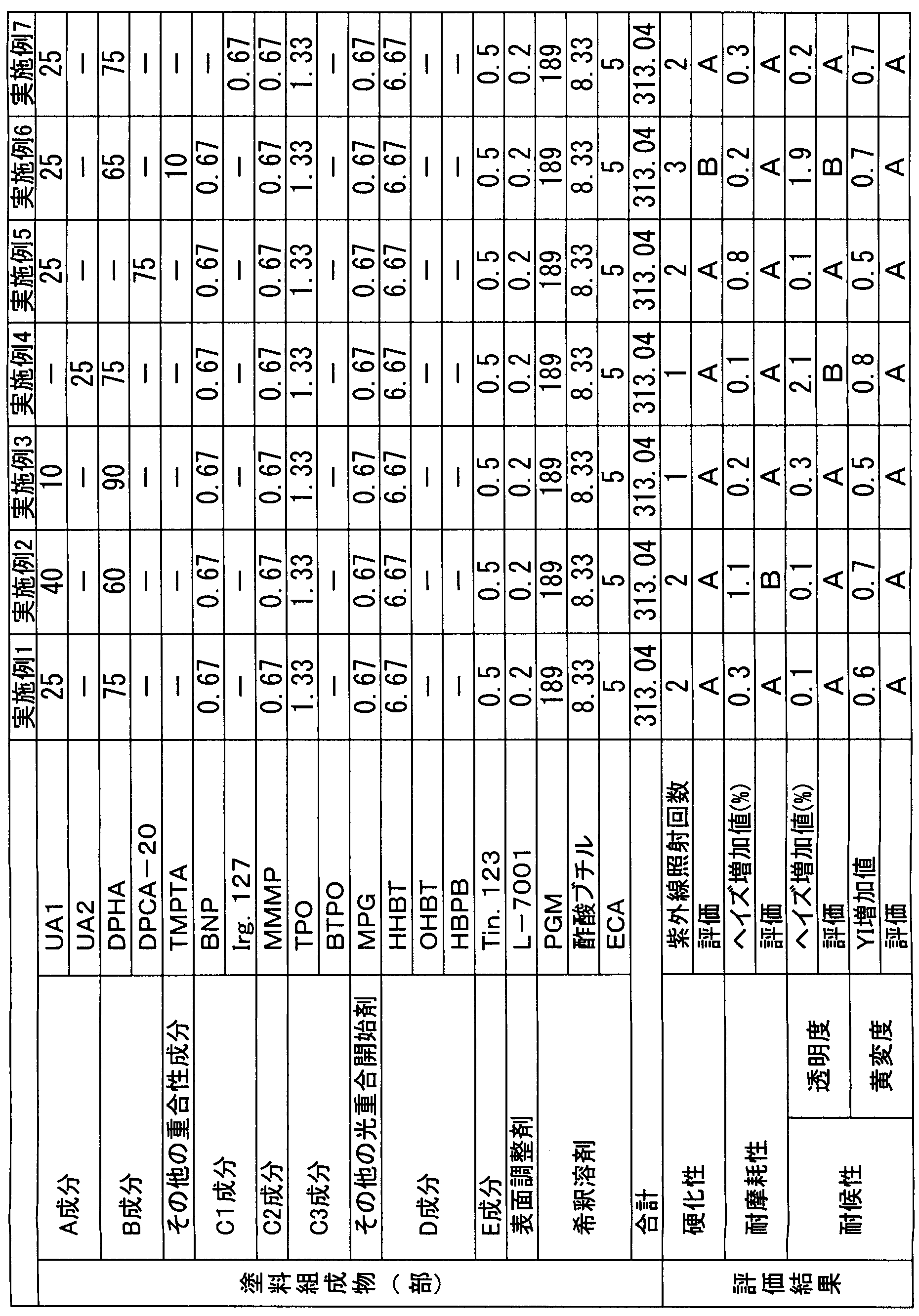
- a resin composition prepared with the compounding ratio shown in Table 1 was prepared from a polycarbonate resin plate having a thickness of 3 mm (trade name: Panlite L-, manufactured by Teijin Limited). 1225Z) was bar-coated so that the thickness of the cured coating was 8 ⁇ m. Next, the coated resin plate was heated in an oven at 60 ° C. for 3 minutes to volatilize the organic solvent.
- the dried coating film obtained in (1) above has a peak illuminance of 250 nm to 260 nm at 10 mW / cm 2 using a high pressure mercury lamp in the air.
- the integrated light quantity in the range is 5.8 mJ / cm 2
- the peak illuminance at a wavelength of 280 nm to 320 nm is 39 mW / cm 2
- the integrated light quantity in this wavelength range is 27 mJ / cm 2
- the peak illuminance at a wavelength of 395 nm to 445 nm is 38 mW / cm 2
- ultraviolet rays having an integrated light amount of 27 mJ / cm 2 in this wavelength range were irradiated and touched with a fingertip to check whether or not tack-free.
- the dried coating obtained in (1) above has a peak illuminance of from 250 nm to 260 nm in air using a high pressure mercury lamp at 37 mW / cm 2.
- the integrated amount of light in the range is 470 mJ / cm 2
- the peak illuminance at a wavelength of 280 nm to 320 nm is 150 mW / cm 2
- the integrated amount of light in this wavelength range is 2200 mJ / cm 2
- the peak illuminance at a wavelength of 395 nm to 445 nm is 140 mW / cm 2
- Curing was performed by irradiating with ultraviolet rays having an integrated light quantity of 2200 mJ / cm 2 in this wavelength range.
- the cured film formed on the surface of the resin-molded article with the cured film thus obtained is steel wool # 000 manufactured by Bonstar Sales Co., Ltd., which is attached to a flat friction tester manufactured by Coating Tester Co., Ltd.
- the load was rubbed under conditions of a load of 250 g / cm 2 and 50 reciprocations.
- the haze increase value due to friction was calculated from the haze value before and after friction measured according to JIS-K7105 using a haze meter HM-65W manufactured by Murakami Color Research Laboratory.
- the abrasion resistance was evaluated according to the following criteria based on the obtained haze increase value. The evaluation results are shown in Table 1. (Evaluation criteria for wear resistance)
- B Haze increase value is 1% or more and less than 3%
- F Haze increase value is 3% or more
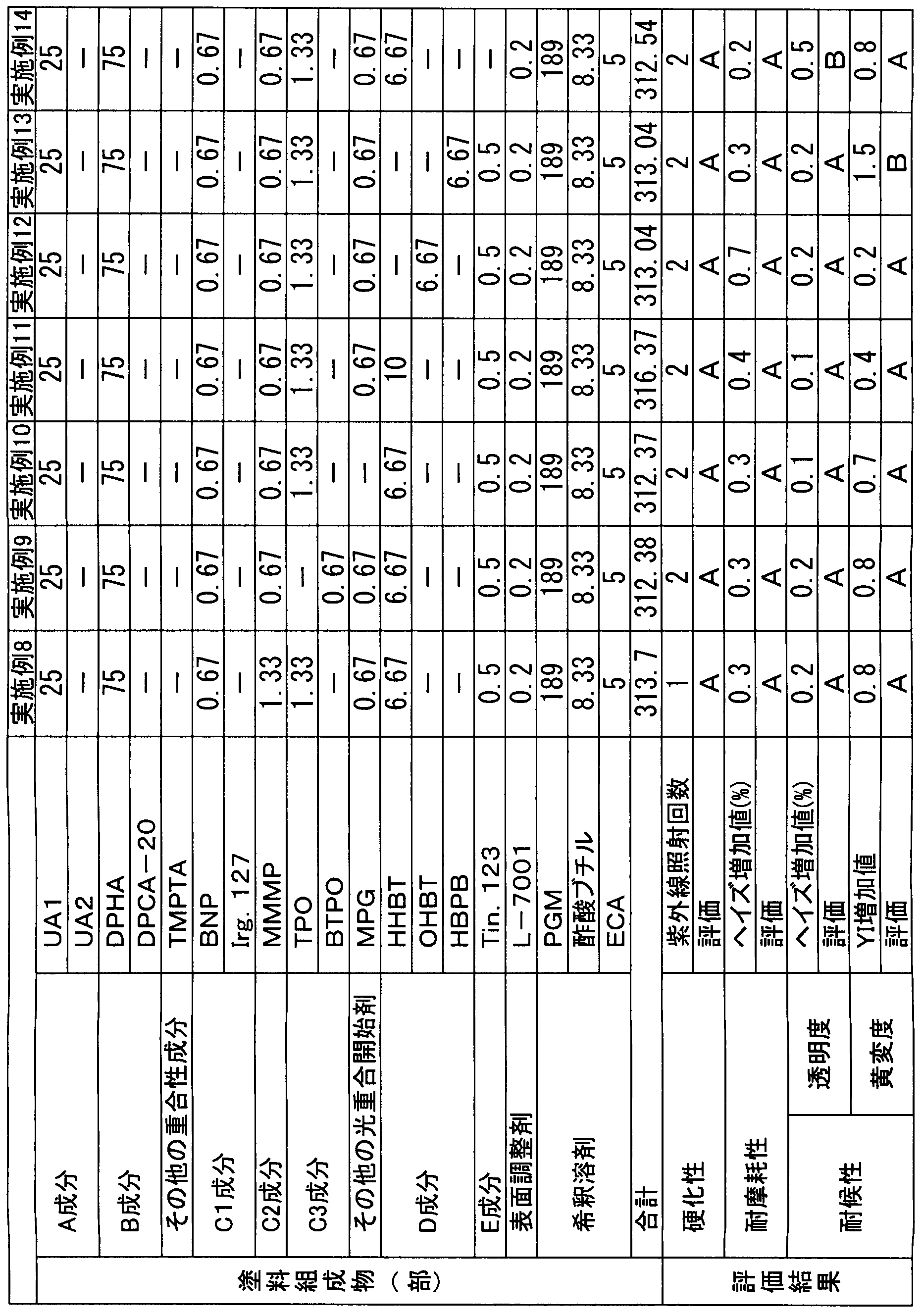
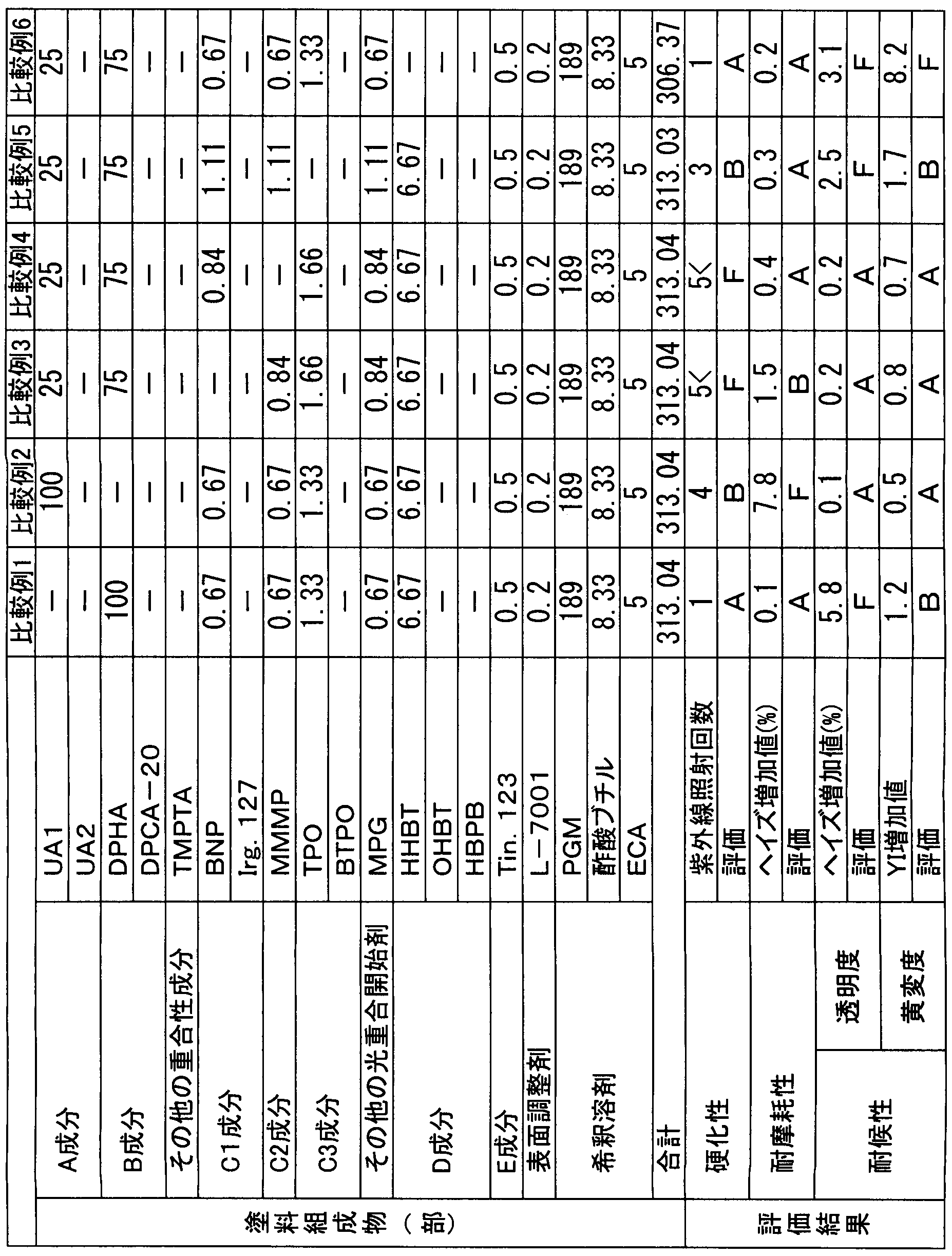
- Examples 2 to 14 and Comparative Examples 1 to 6 An active energy ray-curable resin composition was prepared in the same manner as in Example 1 except that the composition of the active energy ray-curable resin composition was changed to the formulation shown in Tables 1 to 3, and this was used to provide a cured coating. A resin molded product was produced and evaluated. The evaluation results are shown in Tables 1 to 3.
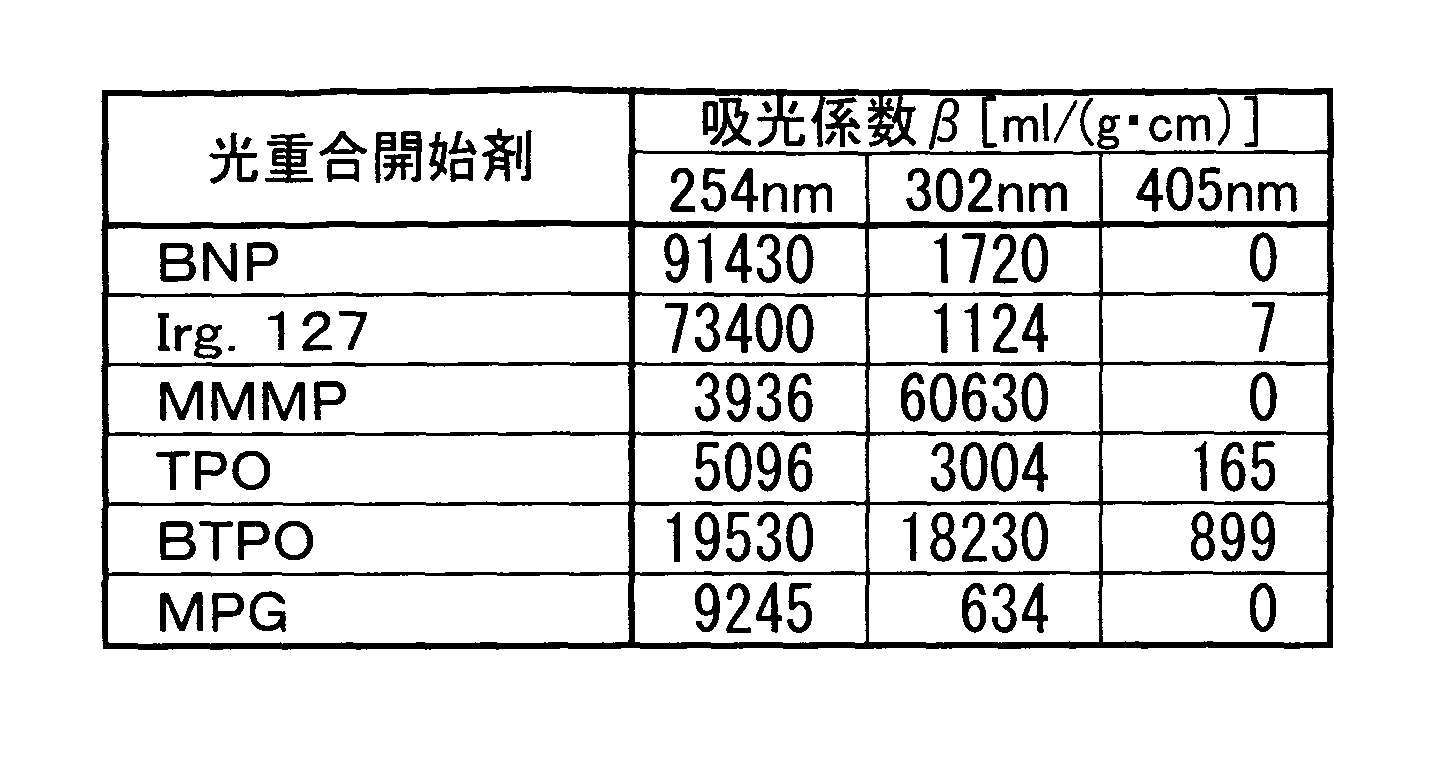
- Table 4 shows extinction coefficients at 254 nm, 302 nm, and 405 nm of the photopolymerization initiators used in Examples and Comparative Examples.
- Comparative Example 1 containing no A component was poor in transparency after the weather resistance test
- Comparative Example 2 containing no B component was poor in abrasion resistance
- Comparative Example 3 containing no C1 component and Comparative Example 4 containing no C2 component were poor in curability
- Comparative Example 5 containing no C3 component was poor in transparency after the weather resistance test.
- Comparative Example 6 containing no D component transparency and yellowing after the weather resistance test were poor.
Landscapes
- Chemical & Material Sciences (AREA)
- Organic Chemistry (AREA)
- Chemical Kinetics & Catalysis (AREA)
- Health & Medical Sciences (AREA)
- Medicinal Chemistry (AREA)
- Polymers & Plastics (AREA)
- Life Sciences & Earth Sciences (AREA)
- Engineering & Computer Science (AREA)
- Materials Engineering (AREA)
- Wood Science & Technology (AREA)
- General Chemical & Material Sciences (AREA)
- Macromonomer-Based Addition Polymer (AREA)
- Paints Or Removers (AREA)
- Coating Of Shaped Articles Made Of Macromolecular Substances (AREA)
- Laminated Bodies (AREA)
Abstract
Description
本組成物は、A成分、B成分、C1成分、C2成分、C3成分及びD成分を含む。
A成分は、硬化被膜の耐候性に寄与する成分である。A成分は、以下に説明するポリイソシアネート(a1)(以下「a1原料」という)と、ヒドロキシ基含有(メタ)アクリレート(a3)(以下「a3原料」という)を含む原料から合成されるウレタンポリ(メタ)アクリレートである。特に、得られた硬化被膜に高い耐候性を付与できるという点で、a1原料とポリオール(a2)(以下「a2原料」という)を反応させてから、a3原料を反応させて得られたウレタンポリ(メタ)アクリレートが好ましい。ここで、ヒドロキシ基を2以上有するヒドロキシ基含有(メタ)アクリレートはa3原料に分類し、a2原料には分類しないものとする。A成分としては一種の化合物だけを用いてもよく、二種以上を併用してもよい。
a1原料の具体例としては、トリレンジイソシアネート、メチルシクロヘキサンジイソシアネート、ジフェニルメタンジイソシアネート、ジシクロヘキシルメタンジイソシアネート、イソホロンジイソシアネート、ヘキサメチレンジイソシアネート、キシリレンジイソシアネート、水添キシリレンジイソシアネート、ダイマー酸ジイソシアネート、トリメチルヘキサメチレンジイソシアネート等のジイソシアネート、リジントリイソシアネート等のトリイソシアネートが挙げられる。更に、これらのポリイソシアネートと、アミノ基、水酸基、カルボキシル基、水等の活性水素原子を少なくとも2個有する化合物との反応により得られるポリイソシアネート、又は前記のポリイソシアネートの2量体~5量体等の多量体を用いることもできる。これらの中で、得られるA成分の粘度が下がり樹脂組成物の塗装作業性が向上する点や、樹脂組成物の硬化被膜(以下、単に「硬化被膜」ともいう)の黄変が少ないという点で、ジイソシアネートが好ましく、中でも、イソホロンジイソシアネート、ジシクロヘキシルメタンジイソシアネートがより好ましい。
a2原料の具体例としては、エチレングリコール、プロピレングリコール、1,3-ブタンジオール、1,4-ブタンジオール、1,5-ペンタンジオール、1,6-ヘキサンジオール、メチルペンタンジオール、2,4-ジエチルペンタンジオール、ネオペンチルグリコール、2-エチル-1,3-ヘキサンジオール、ヒドロキシピバリン酸ネオペンチルグリコールエステル、1,4-シクロヘキサンジメタノール、1,2-シクロヘキサンジメタノール、1,3-シクロヘキサンジメタノール、シクロヘキサンジオール、水添ビスフェノールA、スピログリコール等のジオール、トリメチロールプロパン、グリセロール等のトリオール、ペンタエリスリトール等のテトラオール等が挙げられる。更に、前記ポリオールにアルキレンオキシドを付加して得られるポリオキシアルキレン構造を有するポリアルキレンポリオール、前記ポリオールにε-カプロラクトン等のラクトン類を付加して得られるポリカプロラクトン構造を有するポリカプロラクトンポリオール、前記ポリオールとアルキレンカーボネート、ジアルキルカーボネート、ジアリールカーボネート等の炭酸エステルとのエステル交換反応により得られるポリカーボネートポリオール等もa2原料として使用可能である。これらは一種単独で、又は二種以上を併用して用いることができる。これらの中で、硬化被膜に耐候性や耐屈曲性を付与するという点や、A成分の粘度が下がり樹脂組成物の塗装作業性が向上する点で、ジオールが好ましく、中でも、ポリアルキレンジオール、ポリカプロラクトンジオール、ポリカーボネートジオールがより好ましい。
a3原料の具体例としては、ヒドロキシアルキル(メタ)アクリレート、ヒドロキシアルキル(メタ)アクリレートのカプロラクトン変性品やアルキレンオキサイド変性品、モノエポキシ化合物と(メタ)アクリル酸との付加反応物等が挙げられる。ヒドロキシアルキル(メタ)アクリレートのヒドロキシアルキル基の炭素数は1~10が好ましく、ヒドロキシアルキル(メタ)アクリレートとしては、2-ヒドロキシエチル(メタ)アクリレート、2-ヒドロキシプロピル(メタ)アクリレート、2-ヒドロキシブチル(メタ)アクリレート、4-ヒドロキシブチル(メタ)アクリレート、6-ヒドロキシヘキシル(メタ)アクリレート等のヒドロキシアルキルモノ(メタ)アクリレート、グリセロールアクリレートメタクリレート、ペンタエリスリトールトリ(メタ)アクリレート、ジペンタエリスリトールペンタ(メタ)アクリレート等のヒドロキシアルキルポリ(メタ)アクリレート等が挙げられる。ヒドロキシアルキル(メタ)アクリレートのカプロラクトン変性品としては、γ-カプロラクトン、δ-カプロラクトン、ε-カプロラクトン等のカプロラクトン変性品が挙げられる。ヒドロキシアルキル(メタ)アクリレートのアルキレンオキサイド変性品としては、エチレンオキサイド、プロピレンオキサイド、ブチレンオキサイド等のアルキレンオキサイド変性品が挙げられる。モノエポキシ化合物と(メタ)アクリル酸との付加反応物としては、ブチルグリシジルエーテル、2-エチルヘキシルグリシジルエーテル、グリシジル(メタ)アクリレート等のモノエポキシ化合物と(メタ)アクリル酸との付加反応物等が挙げられる。これらの中で、A成分の粘度が下がり樹脂組成物の塗装作業性が向上するという点で、炭素数2~4のヒドロキシアルキル基を有するヒドロキシアルキルモノ(メタ)アクリレートが好ましく、2-ヒドロキシエチル(メタ)アクリレートがより好ましい。
a1原料及びa3原料からA成分を合成する方法については、従来知られる各種の方法に従って行なうことができる。例えば、30~90℃に加温したa1原料とジブチル錫ジラウレート等のウレタン化反応触媒との混合物中に、a3原料を1~3時間かけて滴下し、さらに1~3時間反応させることによりA成分を合成できる。A成分の合成に用いるa1原料及びa3原料の使用量は、(a1原料のイソシアネート基総数)/(a3原料のヒドロキシ基総数)が0.5以上かつ1.0以下となる条件を満足するように設定することが好ましい。この値を0.5以上にすることによって、硬化被膜に基材への密着性を付与することができる。一方、この値を1.0以下にすることによって、イソシアネート基の反応率が高くなり、本組成物の貯蔵安定性を向上させることができる。この条件の特に好ましい範囲は0.9以上かつ1.0以下である。
B成分は、硬化被膜の耐摩耗性に寄与する成分であり、5官能以上の(メタ)アクリレートである。B成分の具体例としては、ジペンタエリスリトールペンタ(メタ)アクリレート、トリペンタエリスリトールペンタ(メタ)アクリレート等のペンタ(メタ)アクリレート;ジペンタエリスリトールヘキサ(メタ)アクリレート、トリペンタエリスリトールヘキサ(メタ)アクリレート等のヘキサ(メタ)アクリレート;トリペンタエリスリトールヘプタ(メタ)アクリレート等のヘプタ(メタ)アクリレート;トリペンタエリスリトールオクタ(メタ)アクリレート等のオクタ(メタ)アクリレート;5官能以上のポリウレタンポリ(メタ)アクリレート;5官能以上のポリエポキシポリ(メタ)アクリレート;5官能以上のポリエステルポリ(メタ)アクリレート等が挙げられる。更に、5官能以上の(メタ)アクリレートのアルキレンオキサイド変性品、カプロラクトン変性品及びカーボネート変性品等の変性品等が挙げられる。B成分としては一種の化合物だけを用いてもよく、二種以上を併用してもよい。これらの中で、粘度が低く、本組成物の塗装作業性が向上するという点、硬化被膜の耐摩耗性が高いという点で、ペンタ(メタ)アクリレート及びヘキサ(メタ)アクリレートが好ましく、ジペンタエリスリトールペンタ(メタ)アクリレート及びジペンタエリスリトールヘキサ(メタ)アクリレートがより好ましい。
C1成分は、メタノール中で測定した254nmにおける単位重量あたりの吸光係数が50000ml/g・cm以上の光重合開始剤である。このメタノール中の吸光係数(β)は、次の式により導かれる。
β=A/(m・L) (ml/(g・cm))
ここで、
A:吸光度
m:質量濃度(メタノール1mlに溶解している光開始剤の質量)
L :光路長
である。
A=-log10(I/I0)
ここで、
I:透過光強度
I0:入射光強度
である。
C2成分は、C1成分以外であって、メタノール中で測定した302nmにおける単位重量あたりの吸光係数が50000ml/g・cm以上の光重合開始剤である。C2成分は、本組成物の硬化被膜を効率的に得ることができる成分であり、特に塗膜の表層に近い部分の硬化に寄与する。
C3成分は、C1成分及びC2成分以外であって、メタノール中で測定した405nmにおける単位重量あたりの吸光係数が100ml/g・cm以上の光重合開始剤である。C3成分は、本組成物の硬化被膜を効率的に得ることができる成分であり、特に塗膜の深層の硬化性に寄与する。
D成分は、紫外線吸収剤であり、樹脂成形品の耐候性を向上させる成分である。紫外線吸収剤は、紫外線を受けると分子配列を変えて紫外線のエネルギーを吸収し、元の分子配列に戻るときに熱エネルギーを放散する過程を繰り返すことで紫外線を吸収することができ、それ自身は消失しない化合物である。D成分は、特に、290nm以上400nm以下の領域における最大吸収波長が290nm以上320nm以下の範囲にある紫外線吸収剤が好ましい。尚、この最大吸収波長は、測定波長範囲で吸収域を持たない任意の溶剤で希釈し、分光光度計を用いて、290nm以上500nm以下の範囲の透過率を測定することにより求めることができる。
E成分はヒンダードアミン系光安定剤であり、耐候性向上を目的として、必要に応じて本組成物に添加できる成分である。
本組成物は、必要に応じ、耐摩耗性向上等を目的として、A成分及びB成分以外のビニル基を有するその他の重合性成分(以下「その他の重合性成分」という)を含んでもよい。その他の重合性成分としては、(メタ)アクリロイル基含有単量体が好ましい。(メタ)アクリロイル基含有単量体としては、単官能(メタ)アクリレート、2官能(メタ)アクリレート、3官能(メタ)アクリレート、4官能(メタ)アクリレート、(メタ)アクリルアミドが挙げられる。
本組成物は、必要に応じて、C1成分、C2成分及びC3成分以外の光重合開始剤、酸化防止剤、表面調整剤、消泡剤、熱安定剤、帯電防止剤、防曇剤、樹脂、微粒子、チクソトロピック剤、カップリング剤、並びに有機溶剤等のその他の成分を含むことができる。
本組成物は、基材である各種樹脂成形品の表面の改質に使用できる。この樹脂成形品としては、従来から耐摩耗性や耐侯性等について改善の要望のある各種の熱可塑性樹脂や熱硬化性樹脂が挙げられる。具体的には、ポリメチルメタクリレート樹脂、ポリカーボネート樹脂、ポリエステル樹脂、ポリエステルカーボネート樹脂、ポリスチレン樹脂、アクリロニトリル-ブタジエン-スチレン樹脂、アクリロニトリル-スチレン樹脂、ポリアミド樹脂、ポリアリレート樹脂、ポリメタクリルイミド樹脂、ポリアリルジグリコールカーボネート樹脂等が挙げられる。特に、ポリメチルメタクリレート樹脂、ポリカーボネート樹脂、ポリスチレン樹脂、ポリメタクリルイミド樹脂は、透明性に優れかつ耐摩耗性改良要求も強いため、本組成物を適用することが非常に有効である。なお、樹脂成形品とは、これらの樹脂からなるシート状成形品、フィルム状成形品、各種射出成形品等の各種形状の成形品である。
本組成物を、基材の表面に塗布し、得られた塗膜に活性エネルギー線を照射することにより、耐摩耗性、耐候性に優れた硬化被膜を基材の表面に形成することができる。本組成物を基材に塗布するには、例えば、ハケ塗り、スプレーコート、ディップコート、スピンコート、カーテンコート、バーコート等の方法を用いることができる。本組成物の塗布作業性、塗膜の平滑性及び均一性、硬化被膜の基材に対する密着性の観点から、有機溶剤を添加して塗布することが好ましい。また、粘度を調整するために本組成物を加温したり、亜臨界流体で希釈したりしてから塗装してもよい。本組成物の塗膜の厚みは、本組成物の硬化性、硬化被膜の耐候性及びの耐摩耗性の観点から、0.001mm以上0.05mm以下であることが好ましく、0.002mm以上0.03mm以下がより好ましく、0.004mm以上0.02mm以下が更に好ましい。
本発明の樹脂成形品の製造方法において、塗装工程と硬化工程の間で塗膜を加熱する処理を行ってもよい。一般に加熱には、近赤外線ランプの照射、温風の循環等の方法が用いられる。本組成物は、塗装後、加熱炉内中で塗膜表面温度(以下「加熱温度」という)が40℃以上90℃以下、加熱時間が60秒以上180秒以下とした場合、硬化被膜の耐候性がより良好となる。さらに好ましくは、加熱温度が50℃以上70℃以下、加熱時間が90秒以上120秒以下である。加熱温度は高いほど塗膜内部に残る有機溶剤が少なくなるので、耐水性が向上し、低いほど硬化被膜の外観が良好になる傾向がある。また加熱時間は長いほど塗膜内部に残る有機溶剤が少なく、強靭な塗膜が形成されることから耐水性が向上し、短いほど硬化被膜の外観が良好になる傾向がある。
本組成物の塗膜に活性エネルギー線を照射すると硬化して硬化被膜となる。用いられる活性エネルギー線としては、例えば、α線、β線、γ線、紫外線が挙げられる。汎用性の観点から、活性エネルギー線としては紫外線が好ましい。紫外線発生源としては、例えば、低圧水銀ランプ、高圧水銀ランプ、超高圧水銀ランプ、キセノンランプ、メタルハライドランプ、マグネトロンを利用した無電極UVランプ、LEDが挙げられる。
保温機能付き滴下漏斗、還流冷却器、攪拌羽及び温度センサーを装備したフラスコ中に、ジシクロヘキシルメタン-4,4’-ジイソシアネート(住化バイエルウレタン(株)製、商品名:デスモジュールW)2mol、ジラウリン酸n-ブチル錫(旭電化工業(株)製、商品名:アデカスタブBT-11)300ppmを仕込み、40℃に加温した。保温機能付き滴下漏斗を40℃に加温した状態で3-メチルペンタン構造を有するポリカーボネートジオール(数平均分子量800、(株)クラレ製、商品名:クラレポリオールC770)1molを4時間かけて滴下した。40℃にて2時間攪拌し、さらに1時間かけて70℃まで昇温させた。その後2-ヒドロキシエチルアクリレート(大阪有機化学工業(株)製、商品名:HEA)2molを2時間かけて滴下し、さらに2時間攪拌することでウレタンジアクリレート(UA1)を合成した。
(GPC測定条件)
カラム:「TSK-gel superHZM-M」、「TSK-gel HZM-M」、「TSK-gel HZ2000」
溶離液:THF
流量:0.35ml/min
注入量:10μl
カラム温度:40℃
検出器:UV-8020。
合成例1と同じ装置に、2-ヒドロキシエチルアクリレート(大阪有機化学工業(株)製、商品名:HEA)2mol、ジラウリン酸n-ブチル錫(旭電化工業(株)製、商品名:アデカスタブBT-11)200ppm、ハイドロキノンモノメチルエーテル(川口化学工業(株)製、商品名:MQ)500ppmを仕込み、60℃に加温した。滴下漏斗でイソホロンジイソシアネート(住化バイエルウレタン(株)製、商品名:デスモジュールI)1molを4時間かけて滴下した。その後、60℃にて2時間攪拌してウレタンジアクリレート(UA2)を合成した。合成例1と同様に測定したウレタンジアクリレート(UA2)の重量平均分子量は580であった。
(1)活性エネルギー線硬化型樹脂組成物の調製と塗装
表1に示す配合比で調製した樹脂組成物を、厚さ3mmのポリカーボネート樹脂板(帝人(株)製、商品名:パンライトL-1225Z)に、硬化被膜の厚みが8μmになるようにバーコート塗装した。次いで、塗装した樹脂板を60℃のオーブン中で3分間加熱して有機溶剤分を揮発させた。
前記(1)で得られた乾燥した塗膜に、空気中で高圧水銀ランプを用いて、波長250nm~260nmのピーク照度が10mW/cm2で、この波長範囲の積算光量が5.8mJ/cm2、波長280nm~320nmのピーク照度が39mW/cm2で、この波長範囲の積算光量が27mJ/cm2、波長395nm~445nmのピーク照度が38mW/cm2で、この波長範囲の積算光量が27mJ/cm2の紫外線を照射し、指先で軽く触れてタックフリーか否かを確認した。タックフリーでない場合は、この紫外線照射工程をタックフリーになるまで繰り返し行った。紫外線の照射回数により以下の基準で硬化性を評価した。その評価結果を表1に示す。
(硬化性の評価基準)
A:紫外線の照射回数が1~2回
B:紫外線の照射回数が3~5回
F:紫外線の照射回数が6回以上
前記(1)で得られた乾燥した塗膜に、空気中で高圧水銀ランプを用いて波長250nm~260nmのピーク照度が37mW/cm2で、この波長範囲の積算光量が470mJ/cm2、波長280nm~320nmのピーク照度が150mW/cm2で、この波長範囲の積算光量が2200mJ/cm2、波長395nm~445nmのピーク照度が140mW/cm2で、この波長範囲の積算光量が2200mJ/cm2の紫外線を照射して硬化させた。このようにして得られた硬化被膜付の樹脂成形品の表面に形成された硬化被膜を、コーティングテスター(株)製の平面摩擦試験機に取り付けたボンスター販売(株)製のスチールウール#000で、荷重250g/cm2、50往復の条件で摩擦した。摩擦によるヘイズ増加値を(株)村上色彩技術研究所製のヘイズメーターHM-65Wを用い、JIS-K7105に従って測定した摩擦前後ヘイズ値から算出した。得られたヘイズ増加値により以下の基準で耐摩耗性を評価した。その評価結果を表1に示す。
(耐摩耗性の評価基準)
A:ヘイズ増加値が1%未満
B:ヘイズ増加値が1%以上3%未満
F:ヘイズ増加値が3%以上
前記(3)と同様にして製造した硬化被膜付の樹脂成形品について、以下の方法で実施した耐侯性試験前後のヘイズ値とイエローインデックス(YI)値を測定した。ヘイズ値は(株)村上色彩技術研究所製の前記ヘイズメーターを用いて測定した。YI値は瞬間マルチ測光システム(商品名:MCPD-3000、大塚電子(株)製)を用いて測定した三刺激値(X、Y、Z)から次式を用いて算出した。
イエローインデックス(YI)値=100×(1.28×X-1.06×Z)/Y
使用装置:サンシャインカーボンウエザオメーター(スガ試験機(株)製、WELSUN-HC-B型)耐候試験機
試験条件:ブラックパネル温度63±3℃、降雨12分間、照射48分間のサイクルの条件で1500時間
耐候性試験後のヘイズ増加値により以下の基準で透明度を評価した。その評価結果を表1に示す。
(透明度の評価基準)
A:ヘイズ増加値が0.5%未満
B:ヘイズ増加値が0.5%以上3%未満
F:ヘイズ増加値が3%以上
耐候性試験前後のYI増加値により以下の基準で黄変度を評価した。その評価結果を表1に示す。
(黄変度の評価基準)
A:YI増加値が1未満
B:YI増加値が1以上3未満
F:YI増加値が3以上
活性エネルギー線硬化型樹脂組成物の組成を表1から3に示す配合に変更した以外は、実施例1と同様に活性エネルギー線硬化型樹脂組成物を調製し、これを用いて硬化被膜付の樹脂成形品を作製し、評価を行った。その評価結果を表1から3に示す。
・「UA1」:合成例1で合成したウレタンジアクリレート(UA1)
・「UA2」:合成例2で合成したウレタンジアクリレート(UA2)
・「DPHA」:ジペンタエリスリトールヘキサアクリレート(日本化薬(株)製、商品名:KAYARAD DPHA)
・「DPCA-20」:1分子あたり2個のカプロラクトンにより変性されたジペンタエリスリトールヘキサアクリレート(日本化薬(株)製、商品名:KAYARAD DPCA-20)
・「TMPTA」:トリメチロールプロパントリアクリレート(大阪有機化学工業(株)製、商品名:TMP3A-3)
・「BNP」:ベンゾフェノン(大同化成工業(株)製、商品名:BENZOPHENONE)
・「Irg.127」:2-ヒドロキシ-1-{4-[4-(2-ヒドロキシ-2-メチル-プロピオニル)-ベンジル]フェニル}-2-メチル-プロパン-1-オン(BASF社製、商品名:イルガキュア127)
・「MMMP」:2-メチル-1-[4-(メチルチオ)フェニル]-2-モルフォリノプロパン-1-オン(BASF社製、商品名:イルガキュア907)
・「TPO」:2,4,6-トリメチルベンゾイルジフェニルフォスフィンオキサイド(BASF社製、商品名:ルシリンTPO)
・「BTPO」:ビス(2,4,6-トリメチルベンゾイル)-フェニルフォスフィンオキサイド(BASF社製、商品名:イルガキュア819)
・「MPG」:メチルフェニルグリオキシレート(昭和興産(株)製、商品名:VICURE55)
・「HHBT」:2-[4-(2-ヒドロキシ-3-ドデシロキシ-プロピル)オキシ-2-ヒドロキシフェニル]-4,6-[ビス(2,4-ジメチルフェニル)-1,3,5-トリアジンと2-[4-(2-ヒドロキシ-3-トリデシロキシ-プロピル)オキシ-2-ヒドロキシフェニル]-4,6-[ビス(2,4-ジメチルフェニル)-1,3,5-トリアジンの混合物(BASF社製、商品名:チヌビン400)
・「OHBT」:2-[4-(オクチル-2-メチルエタノエート)オキシ-2-ヒドロキシフェニル]-4,6-[ビス(4-フェニルフェニル)]-1,3,5-トリアジン(BASF社製、商品名:チヌビン479)
・「HBPB」:2-(2-ヒドロキシ-5-tert-ブチルフェニル)-2H-ベンゾトリアゾール(BASF社製、商品名:チヌビンPS)
・「Tin.123」:デカンジカルボン酸と2,2,6,6-テトラメチル-1-オクトキシ-4-ピペリジノールとのジエステル化合物と1,1-ジメチルエチルヒドロパーオキシドとオクタンとの反応生成物(BASF社製、商品名:チヌビン123)
・「L-7001」:オクタメチルシクロテトラシロキサン(東レ・ダウコーニング(株)製、商品名:L-7001)
・「PGM」:プロピレングリコールモノメチルエーテル((株)ダイセル製、商品名:メトキシプロパノール)
・「酢酸ブチル」:酢酸ブチル(日本合成化学工業(株)製、商品名:酢酸ブチル)
・「ECA」:エチルカルビトールアセテート((株)ダイセル製、商品名:エチルジグリコルアセテート)
Claims (8)
- ポリイソシアネート及びヒドロキシ基含有(メタ)アクリレートを含む原料から合成されるウレタンポリ(メタ)アクリレート(A);
5官能以上の(メタ)アクリレート(B);
メタノール中で測定した254nmにおける単位重量あたりの吸光係数が50000ml/g・cm以上である光重合開始剤(C1);
前記(C1)以外の光重合開始剤であって、メタノール中で測定した302nmにおける単位重量あたりの吸光係数が50000ml/g・cm以上である光重合開始剤(C2);
前記(C1)及び前記(C2)以外の光重合開始剤であって、メタノール中で測定した405nmにおける単位重量あたりの吸光係数が100ml/g・cm以上である光重合開始剤(C3);並びに
紫外線吸収剤(D)
を含む活性エネルギー線硬化型樹脂組成物。 - ビニル基を有する重合性成分の総量に対して、前記(A)が0.1質量%以上50質量%以下、前記(B)が50質量%以上99.9質量%以下であり、ビニル基を有する重合性成分の総量100質量部に対して、前記(C1)が0.1質量部以上5質量部以下、前記(C2)が0.1質量部以上5質量部以下、前記(C3)が0.1質量部以上5質量部以下、前記(D)が0.1質量部以上15質量部以下である、請求項1に記載の活性エネルギー線硬化型樹脂組成物。
- 前記(D)として、290nm以上400nm以下の領域における最大吸収波長が290nm以上320nm以下の範囲にある紫外線吸収剤(D1)を含む、請求項1又は2に記載の活性エネルギー線硬化型樹脂組成物。
- さらにヒンダードアミン系光安定剤(E)を含む、請求項1から3のいずれか1項に記載の活性エネルギー線硬化型樹脂組成物。
- 請求項1から4のいずれか1項に記載の活性エネルギー線硬化型樹脂組成物を、樹脂成形品の少なくとも一部の表面に塗布して塗膜を形成し、得られた塗膜に活性エネルギー線を照射して硬化させることにより硬化被膜を形成してなる樹脂成形品。
- 硬化被膜の膜厚が2μm以上20μm以下である請求項5に記載の樹脂成形品。
- 硬化被膜を形成してなる前記樹脂成形品が自動車用ヘッドランプレンズである請求項5又は6に記載の樹脂成形品。
- 樹脂成形品の少なくとも一部の表面に請求項1~4のいずれか1項に記載の活性エネルギー線硬化型樹脂組成物を塗布して塗膜を形成し、得られた塗膜に活性エネルギー線を照射して硬化させることにより硬化被膜を形成する請求項5から7のいずれか1項に記載の樹脂成形品の製造方法。
Priority Applications (3)
| Application Number | Priority Date | Filing Date | Title |
|---|---|---|---|
| JP2015531366A JP6515806B2 (ja) | 2014-06-12 | 2015-06-11 | 活性エネルギー線硬化型樹脂組成物、樹脂成形品及び樹脂成形品の製造方法 |
| CN201580031343.7A CN106459323A (zh) | 2014-06-12 | 2015-06-11 | 活化能射线固化型树脂组合物、树脂成形品及树脂成形品的制造方法 |
| US15/317,971 US10040945B2 (en) | 2014-06-12 | 2015-06-11 | Active energy ray curable resin composition, resin molded article, and method for producing resin molded article |
Applications Claiming Priority (2)
| Application Number | Priority Date | Filing Date | Title |
|---|---|---|---|
| JP2014-121041 | 2014-06-12 | ||
| JP2014121041 | 2014-06-12 |
Publications (1)
| Publication Number | Publication Date |
|---|---|
| WO2015190553A1 true WO2015190553A1 (ja) | 2015-12-17 |
Family
ID=54833640
Family Applications (1)
| Application Number | Title | Priority Date | Filing Date |
|---|---|---|---|
| PCT/JP2015/066858 Ceased WO2015190553A1 (ja) | 2014-06-12 | 2015-06-11 | 活性エネルギー線硬化型樹脂組成物、樹脂成形品及び樹脂成形品の製造方法 |
Country Status (5)
| Country | Link |
|---|---|
| US (1) | US10040945B2 (ja) |
| JP (1) | JP6515806B2 (ja) |
| CN (1) | CN106459323A (ja) |
| TW (1) | TWI653303B (ja) |
| WO (1) | WO2015190553A1 (ja) |
Cited By (5)
| Publication number | Priority date | Publication date | Assignee | Title |
|---|---|---|---|---|
| JP2016169305A (ja) * | 2015-03-12 | 2016-09-23 | 東ソー株式会社 | 活性エネルギー線硬化型樹脂組成物 |
| JP2016199714A (ja) * | 2015-04-13 | 2016-12-01 | 日華化学株式会社 | 活性エネルギー線硬化性重合体組成物、それを用いた硬化膜、及び前記硬化膜を有する積層体 |
| JPWO2017217178A1 (ja) * | 2016-06-17 | 2019-04-11 | 東レ株式会社 | 樹脂組成物、硬化膜、硬化膜の製造方法および表示装置 |
| JP2019167527A (ja) * | 2018-03-20 | 2019-10-03 | 荒川化学工業株式会社 | 活性エネルギー線硬化性樹脂組成物、硬化物及びフィルム |
| JP2021185570A (ja) * | 2015-12-25 | 2021-12-09 | 日東電工株式会社 | 有機el表示装置用粘着剤組成物、有機el表示装置用粘着剤層、有機el表示装置用粘着剤層付き偏光フィルム、及び有機el表示装置 |
Families Citing this family (2)
| Publication number | Priority date | Publication date | Assignee | Title |
|---|---|---|---|---|
| EP3774360B1 (en) * | 2018-03-27 | 2024-01-10 | Sun Chemical Corporation | Uv-curable compositions comprising cleavage type photoinitiators |
| KR102572556B1 (ko) * | 2021-12-08 | 2023-08-29 | 주식회사 오디에스 | 구강내 장착물 형성용 조성물, 구강내 장착물의 제조방법 및 그 방법에 의해 제조된 구강내 장착물 |
Citations (8)
| Publication number | Priority date | Publication date | Assignee | Title |
|---|---|---|---|---|
| JP2000026806A (ja) * | 1998-05-08 | 2000-01-25 | Nagase Chiba Kk | 光ディスク貼り合わせ用紫外線硬化型接着剤 |
| JP2000248233A (ja) * | 1999-03-01 | 2000-09-12 | Nagase Chemtex Corp | 光ディスク貼り合わせ用紫外線硬化型接着剤 |
| JP2002275392A (ja) * | 2001-03-19 | 2002-09-25 | Dainippon Ink & Chem Inc | 紫外線硬化性組成物及びそれを被覆した樹脂成型品 |
| JP2003026715A (ja) * | 2001-05-11 | 2003-01-29 | Shin Etsu Polymer Co Ltd | 紫外線硬化型成形用材料、耐候性付与紫外線硬化型成形用材料、それらの硬化方法及びそれらから製造される成形品 |
| JP2005132962A (ja) * | 2003-10-30 | 2005-05-26 | Soken Chem & Eng Co Ltd | (メタ)アクリル系重合体の製造方法 |
| JP2007131837A (ja) * | 2005-10-12 | 2007-05-31 | Dainippon Ink & Chem Inc | フィルム保護層用活性エネルギー線硬化型樹脂組成物、それを用いたフィルム及び光学シート |
| JP2009067827A (ja) * | 2007-09-10 | 2009-04-02 | Toyoda Gosei Co Ltd | 光硬化型着色塗料及び塗装樹脂製品 |
| WO2011115162A1 (ja) * | 2010-03-17 | 2011-09-22 | 三菱レイヨン株式会社 | 活性エネルギー線硬化性樹脂組成物および微細凹凸構造を表面に有する物品 |
Family Cites Families (8)
| Publication number | Priority date | Publication date | Assignee | Title |
|---|---|---|---|---|
| EP0174373B1 (en) * | 1984-02-21 | 1989-08-02 | Mitsubishi Rayon Co., Ltd. | Process for producing heat-resistant resin moldings having excellent abrasion resistance |
| AU2001284499A1 (en) * | 2000-09-11 | 2002-03-26 | Showa Denko K K | Photosensitive composition, cured article thereof, and printed circuit board using the same |
| JP2003238845A (ja) | 2002-02-20 | 2003-08-27 | Mitsubishi Rayon Co Ltd | 被覆材組成物、及びそれを用いた成形品 |
| US20070048441A1 (en) * | 2005-08-31 | 2007-03-01 | Basf Corporation | Radiation curable clearcoat repair system and method for obtaining film build in thin film areas using the system |
| JP2012126760A (ja) | 2010-12-13 | 2012-07-05 | Mitsubishi Chemicals Corp | 活性エネルギー線硬化性組成物、積層体、及びこの積層体を有する窓及び太陽電池 |
| JP5817201B2 (ja) * | 2011-04-26 | 2015-11-18 | 三菱レイヨン株式会社 | 活性エネルギー線硬化型組成物及び硬化被膜を有する成形品 |
| CN104470997B (zh) * | 2012-07-20 | 2016-08-17 | 巴斯夫欧洲公司 | 快速干燥的可辐照固化的涂料混合物 |
| US20150259568A1 (en) * | 2012-12-06 | 2015-09-17 | Basf Se | Radiation-curable aqueous polyurethane dispersions |
-
2015
- 2015-06-11 WO PCT/JP2015/066858 patent/WO2015190553A1/ja not_active Ceased
- 2015-06-11 CN CN201580031343.7A patent/CN106459323A/zh active Pending
- 2015-06-11 JP JP2015531366A patent/JP6515806B2/ja active Active
- 2015-06-11 TW TW104118889A patent/TWI653303B/zh active
- 2015-06-11 US US15/317,971 patent/US10040945B2/en active Active
Patent Citations (8)
| Publication number | Priority date | Publication date | Assignee | Title |
|---|---|---|---|---|
| JP2000026806A (ja) * | 1998-05-08 | 2000-01-25 | Nagase Chiba Kk | 光ディスク貼り合わせ用紫外線硬化型接着剤 |
| JP2000248233A (ja) * | 1999-03-01 | 2000-09-12 | Nagase Chemtex Corp | 光ディスク貼り合わせ用紫外線硬化型接着剤 |
| JP2002275392A (ja) * | 2001-03-19 | 2002-09-25 | Dainippon Ink & Chem Inc | 紫外線硬化性組成物及びそれを被覆した樹脂成型品 |
| JP2003026715A (ja) * | 2001-05-11 | 2003-01-29 | Shin Etsu Polymer Co Ltd | 紫外線硬化型成形用材料、耐候性付与紫外線硬化型成形用材料、それらの硬化方法及びそれらから製造される成形品 |
| JP2005132962A (ja) * | 2003-10-30 | 2005-05-26 | Soken Chem & Eng Co Ltd | (メタ)アクリル系重合体の製造方法 |
| JP2007131837A (ja) * | 2005-10-12 | 2007-05-31 | Dainippon Ink & Chem Inc | フィルム保護層用活性エネルギー線硬化型樹脂組成物、それを用いたフィルム及び光学シート |
| JP2009067827A (ja) * | 2007-09-10 | 2009-04-02 | Toyoda Gosei Co Ltd | 光硬化型着色塗料及び塗装樹脂製品 |
| WO2011115162A1 (ja) * | 2010-03-17 | 2011-09-22 | 三菱レイヨン株式会社 | 活性エネルギー線硬化性樹脂組成物および微細凹凸構造を表面に有する物品 |
Cited By (7)
| Publication number | Priority date | Publication date | Assignee | Title |
|---|---|---|---|---|
| JP2016169305A (ja) * | 2015-03-12 | 2016-09-23 | 東ソー株式会社 | 活性エネルギー線硬化型樹脂組成物 |
| JP2016199714A (ja) * | 2015-04-13 | 2016-12-01 | 日華化学株式会社 | 活性エネルギー線硬化性重合体組成物、それを用いた硬化膜、及び前記硬化膜を有する積層体 |
| JP2021185570A (ja) * | 2015-12-25 | 2021-12-09 | 日東電工株式会社 | 有機el表示装置用粘着剤組成物、有機el表示装置用粘着剤層、有機el表示装置用粘着剤層付き偏光フィルム、及び有機el表示装置 |
| JP7193592B2 (ja) | 2015-12-25 | 2022-12-20 | 日東電工株式会社 | 有機el表示装置用粘着剤組成物、有機el表示装置用粘着剤層、有機el表示装置用粘着剤層付き偏光フィルム、及び有機el表示装置 |
| JPWO2017217178A1 (ja) * | 2016-06-17 | 2019-04-11 | 東レ株式会社 | 樹脂組成物、硬化膜、硬化膜の製造方法および表示装置 |
| JP2019167527A (ja) * | 2018-03-20 | 2019-10-03 | 荒川化学工業株式会社 | 活性エネルギー線硬化性樹脂組成物、硬化物及びフィルム |
| JP7036070B2 (ja) | 2018-03-20 | 2022-03-15 | 荒川化学工業株式会社 | 活性エネルギー線硬化性樹脂組成物、硬化物及びフィルム |
Also Published As
| Publication number | Publication date |
|---|---|
| US20170130057A1 (en) | 2017-05-11 |
| JPWO2015190553A1 (ja) | 2017-04-20 |
| TWI653303B (zh) | 2019-03-11 |
| CN106459323A (zh) | 2017-02-22 |
| TW201605994A (zh) | 2016-02-16 |
| US10040945B2 (en) | 2018-08-07 |
| JP6515806B2 (ja) | 2019-05-22 |
Similar Documents
| Publication | Publication Date | Title |
|---|---|---|
| JP6515806B2 (ja) | 活性エネルギー線硬化型樹脂組成物、樹脂成形品及び樹脂成形品の製造方法 | |
| JP6822792B2 (ja) | 光硬化性樹脂組成物、該組成物から形成される硬化被膜および被膜付き基材、並びに硬化被膜および被膜付き基材の製造方法 | |
| JP5057827B2 (ja) | 活性エネルギー線硬化型塗料組成物および該組成物の硬化被膜を有する成形品 | |
| JP6574608B2 (ja) | 光硬化性樹脂組成物、該組成物から形成される硬化被膜および被膜付き基材、並びに硬化被膜および被膜付き基材の製造方法 | |
| WO2007125746A1 (ja) | 活性エネルギー線硬化型塗料組成物及び該組成物の硬化被膜を有する成形品 | |
| WO2018003880A1 (ja) | 活性エネルギー線硬化性樹脂組成物、樹脂成形品および樹脂成形品の製造方法 | |
| JP7530781B2 (ja) | 光硬化性樹脂組成物、硬化被膜付き基材およびその製造方法 | |
| JP7452588B2 (ja) | 硬化性組成物、硬化物、積層体 | |
| US20230312904A1 (en) | Photocurable resin composition, cured film, and molded article with cured film | |
| JP2013234217A (ja) | 活性エネルギー線硬化型コーティング剤組成物 | |
| JP7199185B2 (ja) | 成形用反射防止ハードコートフィルム | |
| WO2018070438A1 (ja) | 耐光性ハードコート材 | |
| JP2011074134A (ja) | コーティング用樹脂組成物及び積層体 | |
| JP5221159B2 (ja) | 活性エネルギー線硬化型塗料組成物とその硬化物 | |
| JP2015000876A (ja) | 活性エネルギー線硬化型組成物及び該組成物の硬化被膜を有する合成樹脂成形品 | |
| JP6565276B2 (ja) | 硬化性組成物、硬化物及び積層体 | |
| JP6940311B2 (ja) | 硬化性樹脂組成物、積層体、及び転写用積層体 | |
| JP6451627B2 (ja) | 活性エネルギー線硬化性樹脂組成物及び自動車ヘッドランプレンズ | |
| JP2011074135A (ja) | 硬化性樹脂組成物及び積層体 | |
| JPWO2015163274A1 (ja) | 活性エネルギー線硬化型樹脂組成物、樹脂成形品および樹脂成形品の製造方法 | |
| JP7367316B2 (ja) | 高滑水性活性エネルギー線硬化性組成物及び樹脂成形品 | |
| JP2023139385A (ja) | 硬化性重合体 | |
| WO2017082038A1 (ja) | 環状オレフィン樹脂フィルム | |
| JP7777256B1 (ja) | 塗料組成物、積層体、及び加飾シート |
Legal Events
| Date | Code | Title | Description |
|---|---|---|---|
| ENP | Entry into the national phase |
Ref document number: 2015531366 Country of ref document: JP Kind code of ref document: A |
|
| 121 | Ep: the epo has been informed by wipo that ep was designated in this application |
Ref document number: 15806426 Country of ref document: EP Kind code of ref document: A1 |
|
| WWE | Wipo information: entry into national phase |
Ref document number: 15317971 Country of ref document: US |
|
| NENP | Non-entry into the national phase |
Ref country code: DE |
|
| 122 | Ep: pct application non-entry in european phase |
Ref document number: 15806426 Country of ref document: EP Kind code of ref document: A1 |