WO2015190433A1 - クレンジング化粧料 - Google Patents
クレンジング化粧料 Download PDFInfo
- Publication number
- WO2015190433A1 WO2015190433A1 PCT/JP2015/066467 JP2015066467W WO2015190433A1 WO 2015190433 A1 WO2015190433 A1 WO 2015190433A1 JP 2015066467 W JP2015066467 W JP 2015066467W WO 2015190433 A1 WO2015190433 A1 WO 2015190433A1
- Authority
- WO
- WIPO (PCT)
- Prior art keywords
- formula
- acid
- thickener
- polyoxyethylene
- cleansing cosmetic
- Prior art date
- Legal status (The legal status is an assumption and is not a legal conclusion. Google has not performed a legal analysis and makes no representation as to the accuracy of the status listed.)
- Ceased
Links
- 0 C*c1c(*)cc(cc(*)c(**)c2)c2c1 Chemical compound C*c1c(*)cc(cc(*)c(**)c2)c2c1 0.000 description 3
Classifications
-
- A—HUMAN NECESSITIES
- A61—MEDICAL OR VETERINARY SCIENCE; HYGIENE
- A61K—PREPARATIONS FOR MEDICAL, DENTAL OR TOILETRY PURPOSES
- A61K8/00—Cosmetics or similar toiletry preparations
- A61K8/18—Cosmetics or similar toiletry preparations characterised by the composition
- A61K8/30—Cosmetics or similar toiletry preparations characterised by the composition containing organic compounds
- A61K8/33—Cosmetics or similar toiletry preparations characterised by the composition containing organic compounds containing oxygen
- A61K8/37—Esters of carboxylic acids
-
- A—HUMAN NECESSITIES
- A61—MEDICAL OR VETERINARY SCIENCE; HYGIENE
- A61K—PREPARATIONS FOR MEDICAL, DENTAL OR TOILETRY PURPOSES
- A61K8/00—Cosmetics or similar toiletry preparations
- A61K8/18—Cosmetics or similar toiletry preparations characterised by the composition
- A61K8/30—Cosmetics or similar toiletry preparations characterised by the composition containing organic compounds
- A61K8/33—Cosmetics or similar toiletry preparations characterised by the composition containing organic compounds containing oxygen
- A61K8/39—Derivatives containing from 2 to 10 oxyalkylene groups
-
- A—HUMAN NECESSITIES
- A61—MEDICAL OR VETERINARY SCIENCE; HYGIENE
- A61K—PREPARATIONS FOR MEDICAL, DENTAL OR TOILETRY PURPOSES
- A61K8/00—Cosmetics or similar toiletry preparations
- A61K8/18—Cosmetics or similar toiletry preparations characterised by the composition
- A61K8/30—Cosmetics or similar toiletry preparations characterised by the composition containing organic compounds
- A61K8/40—Cosmetics or similar toiletry preparations characterised by the composition containing organic compounds containing nitrogen
- A61K8/42—Amides
-
- A—HUMAN NECESSITIES
- A61—MEDICAL OR VETERINARY SCIENCE; HYGIENE
- A61Q—SPECIFIC USE OF COSMETICS OR SIMILAR TOILETRY PREPARATIONS
- A61Q1/00—Make-up preparations; Body powders; Preparations for removing make-up
- A61Q1/14—Preparations for removing make-up
Definitions
- the present invention relates to a cleansing cosmetic that removes oily dirt and that is suitable for use in filling a pump-type container.
- JP-A-2009-155592 discloses 1,2,3-propanetricarboxylic acid tris (2-methylcyclohexylamide) as a gelling agent for hydrophilic or lipophilic compounds. 2,3-propanetricarboxylic acid tris (2-methylcyclohexylamide) was hardly dissolved in the oil, and it was found difficult to use it as a thickener for the oil.
- an object of the present invention is a cleansing cosmetic that is excellent in detergency of oily dirt and can be washed away with water, and is difficult to sag when picked up by hand, has excellent spreadability, and is a pump-type container. It is providing the cleansing cosmetics which are excellent in the discharge property at the time of filling.
- the present inventors have found that the compound represented by the following formula (1) can increase the viscosity of an oil agent to an arbitrary viscosity and stably maintain the viscosity, Cleansing cosmetics containing oils and surfactants that have been moderately thickened with compounds are excellent in the ability to clean oily stains, can be washed away with water, and have excellent ejection properties when filled into pump-type containers. It has been found that when it is picked up by the hand, it does not easily drip, and does not easily leak from the discharge port of the container, and has excellent spreadability when applied to the skin. The present invention has been completed based on these findings.
- this invention is cleansing cosmetics containing a thickener (A), an oil agent (B), and surfactant (C), Comprising: Following formula (1) as a thickener (A) R 1- (CONH-R 2 ) n (1) (In the formula, R 1 is a group obtained by removing n hydrogen atoms from the structural formula of benzene, benzophenone, biphenyl, naphthalene, cyclohexane, or butane, and R 2 is an aliphatic hydrocarbon group having 4 or more carbon atoms. N represents an integer greater than or equal to 3. n R ⁇ 2> may be the same and may differ. A cleansing cosmetic composition comprising 0.1 to 10.0% by weight of the cleansing cosmetic composition is provided.
- the present invention also provides the above-described cleansing cosmetic having a viscosity of 300 to 3000 mPa ⁇ s at 25 ° C. and a shear rate of 10 s ⁇ 1 .
- a cleansing cosmetic comprising a thickener (A), an oil agent (B), and a surfactant (C), wherein the thickener (A) has the following formula (1) R 1- (CONH-R 2 ) n (1)
- R 1 is a group obtained by removing n hydrogen atoms from the structural formula of benzene, benzophenone, biphenyl, naphthalene, cyclohexane, or butane
- R 2 is an aliphatic hydrocarbon group having 4 or more carbon atoms.
- N represents an integer greater than or equal to 3.
- n R ⁇ 2> may be the same and may differ.
- a cleansing cosmetic comprising 0.1 to 10.0% by weight of the cleansing cosmetic.
- the compound represented by the formula (1) is a compound in which all the n R 2 s in the formula (1) are the same group and / or two R 2 s in the formula (1).
- the compound represented by the formula (1) is a compound in which all n R 2 s in the formula (1) are the same and are a linear or branched alkyl group having 4 to 20 carbon atoms.
- the cleansing cosmetic composition of the present invention contains an oil agent and a surfactant that are thickened by the compound represented by the above formula (1) and have an appropriate viscosity and the viscosity is stably maintained over time. It has excellent detergency for oily stains, can be easily blended with skin stains and makeup stains, and can be washed away by rinsing with water. Furthermore, since it has an appropriate viscosity, it is difficult to fall off between the fingers when it is picked up by the hand, and is excellent in spreadability. Furthermore, when filled in a pump-type container, the discharge property is excellent and the liquid does not easily leak from the discharge port of the container. Therefore, the cleansing cosmetic of the present invention is suitable for cleansing applications for oily dirt on the skin used by filling a pump-type container.
- Thickener (A) The present invention is characterized by using a compound represented by the following formula (1) as a thickener.
- R 1 is a group obtained by removing n hydrogen atoms from the structural formula of benzene, benzophenone, biphenyl, naphthalene, cyclohexane, or butane
- R 2 is an aliphatic hydrocarbon group having 4 or more carbon atoms. It is.
- n represents an integer of 3 or more (preferably 3 to 4, particularly preferably 4).
- n R ⁇ 2 > may be the same and may differ.
- R 2 is an aliphatic hydrocarbon group having 4 or more carbon atoms.
- R 2 is an aliphatic hydrocarbon group having 4 or more carbon atoms.
- a linear or branched alkenyl group having about 4 to 20 carbon atoms (preferably 6 to 18) such as 5-hexenyl, 7-octenyl, 9-decenyl, 11-dodecenyl,
- n R 2 s are all the same group or a compound in which n R 2 s are two different groups is an oil agent (B). It is preferable at the point which is excellent in solubility, and can thicken an oil agent (B) to desired viscosity.
- R 21 represents an aliphatic hydrocarbon group having 4 or more carbon atoms
- R 21 is a linear or branched alkyl group having about 4 to 20 carbon atoms (preferably 6 to 18, particularly preferably 6 to 12) are preferred.
- n R 2 are two different groups (R 21 and R 22 ) (the R 21 and R 22 are different from each other and have 4 or more carbon atoms).
- R 21 and R 22 has about 4 to 20 carbon atoms (preferably 4 to 18, particularly preferably 4 to 15, most preferably 4 to 12, more preferably Preferably, it is a linear or branched alkyl group having 4 to 10), and the other of R 21 and R 22 has about 6 to 20 carbon atoms (preferably 12 to 20, particularly preferably 15 to 20 and most preferably.
- the compound which is a linear alkyl group or a linear alkenyl group of 16 to 20) is preferred.
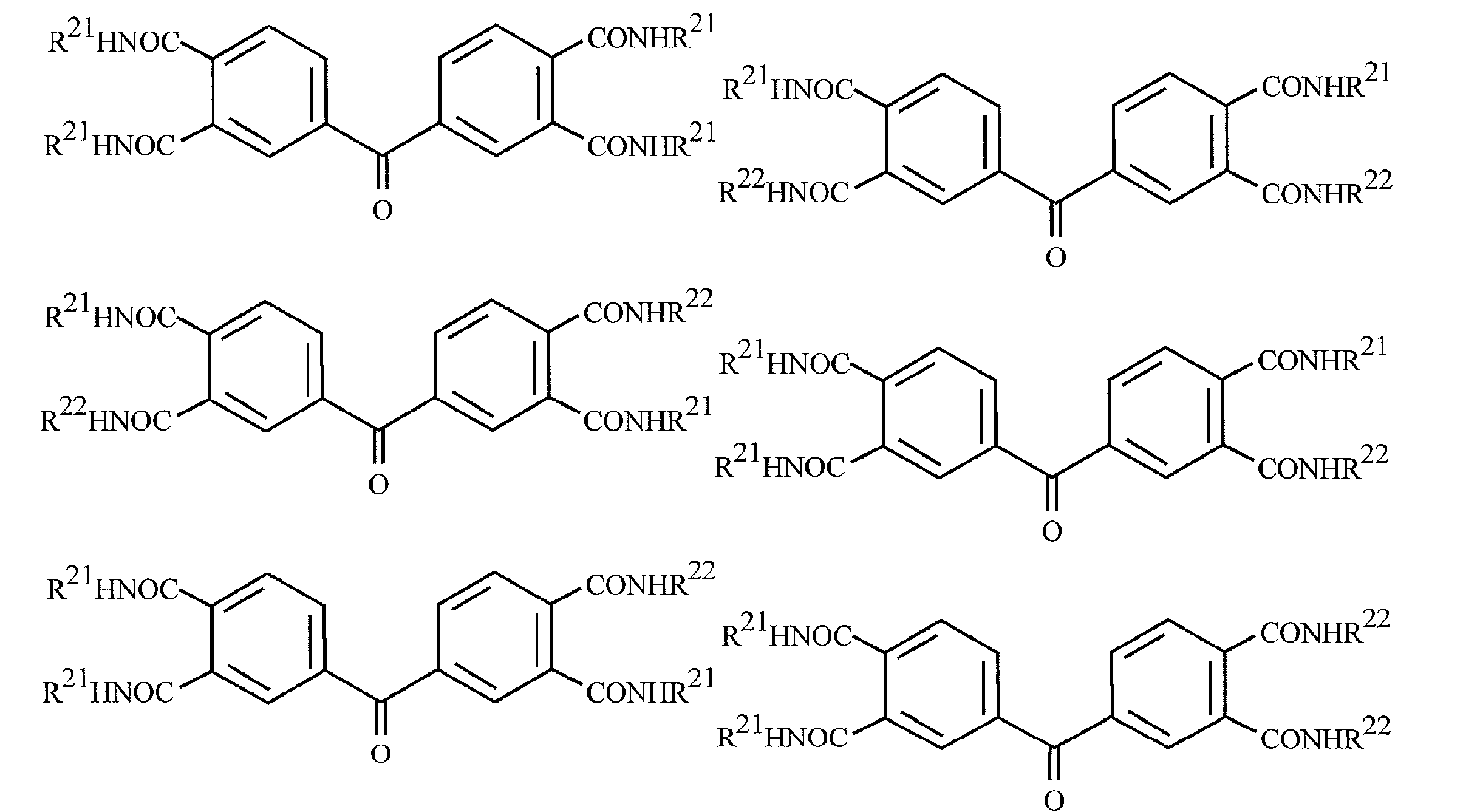
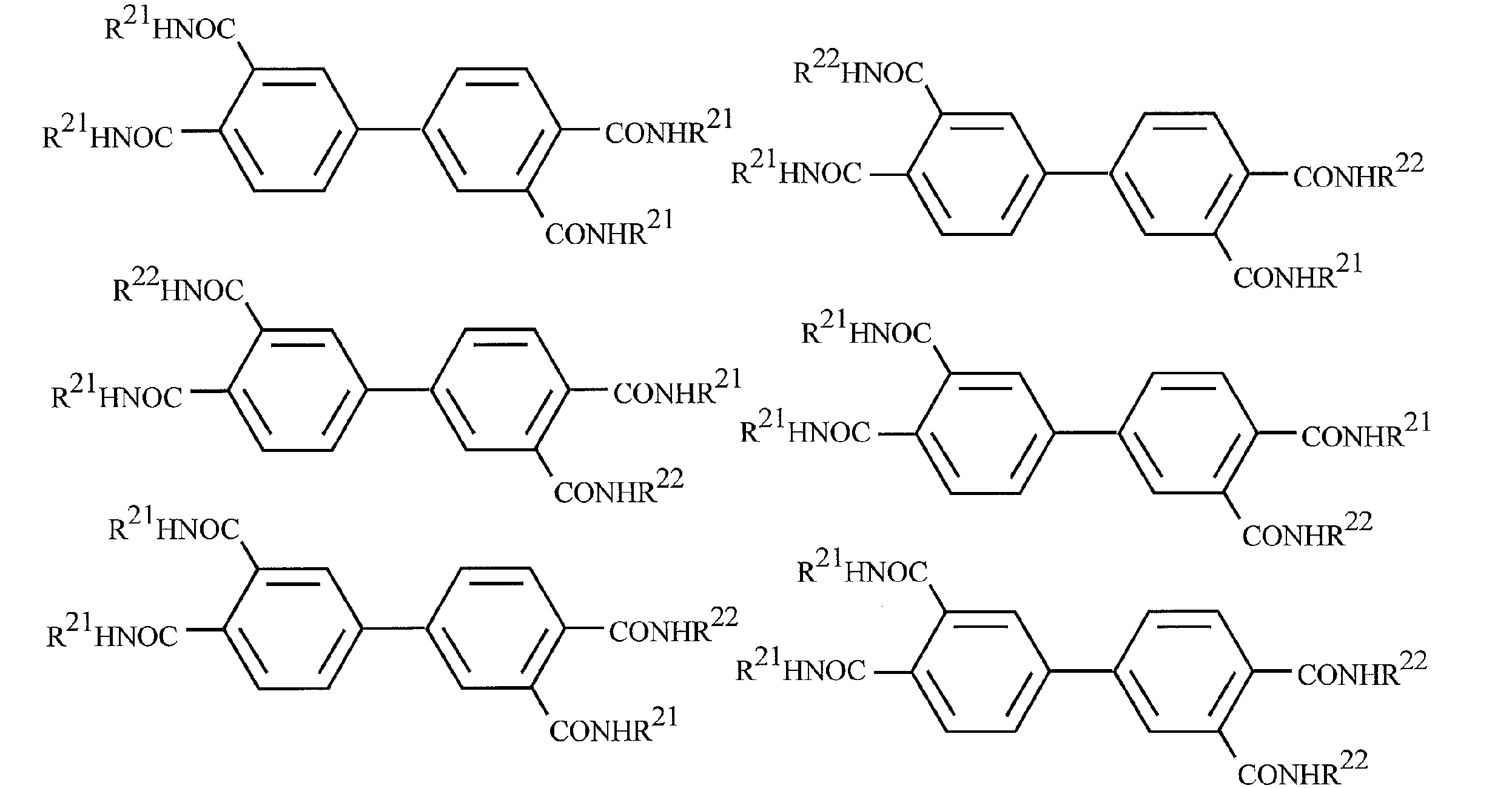
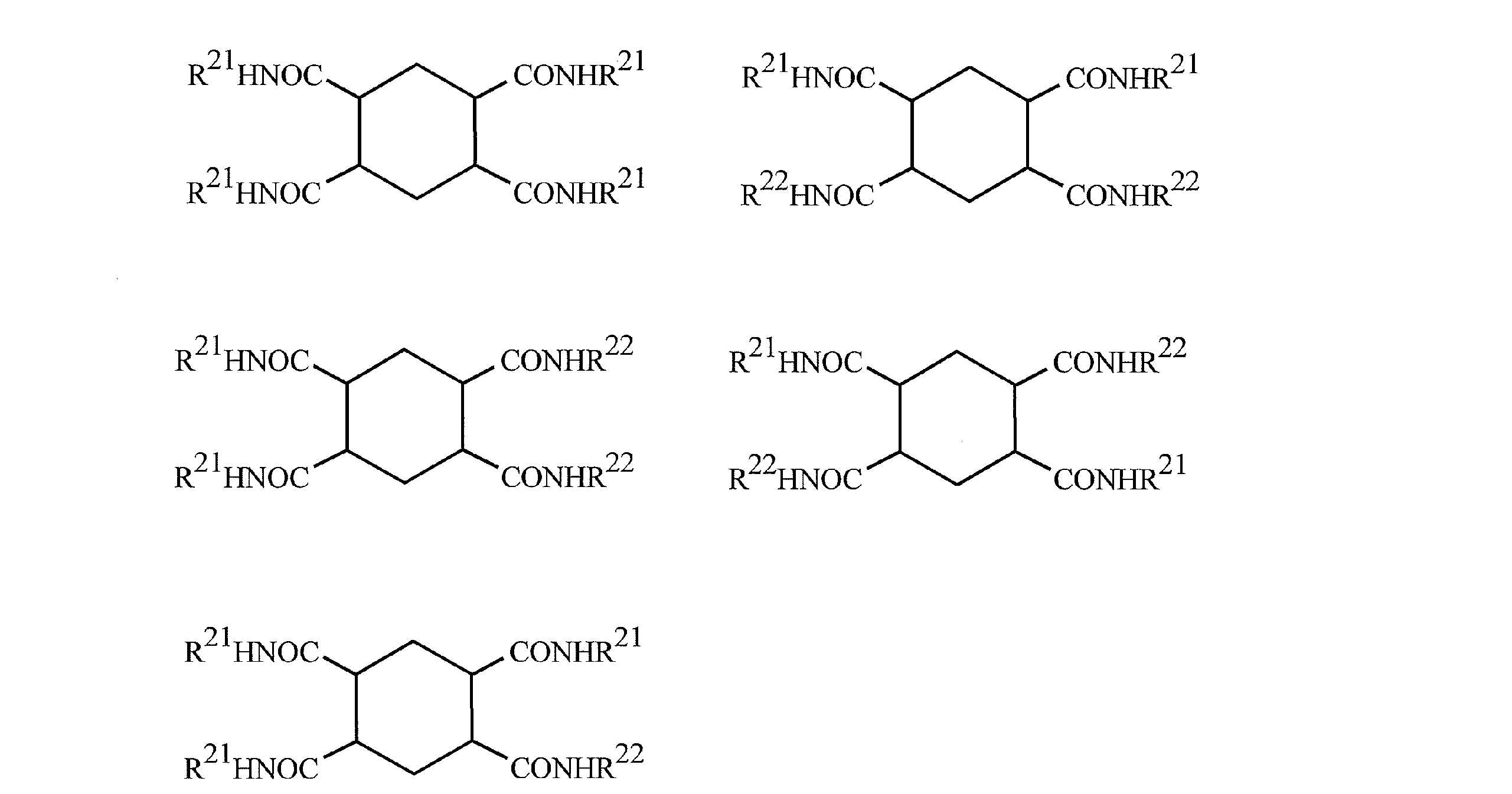
- examples of the compound wherein n is 4 include compounds represented by the following formulas.
- R 21 and R 22 in the following formula are the same as described above. When a plurality of R 21 are present in one molecule, they are the same group. The same is true for R 22.
- examples of the compound in which n is an integer other than 4 include compounds corresponding to the compound represented by the following formula.
- n R 2 are two different groups are preferred in that they have excellent thickening properties over a wide range of oils.
- the molecular weight of the compound represented by the formula (1) of the present invention is, for example, about 500 to 1300, preferably 600 to 1300, particularly preferably 800 to 1300, and most preferably 900 to 1200.
- the molecular weight of the compound represented by the formula (1) is out of the above range, the thickening effect tends to be reduced.
- the compound represented by the formula (1) can be produced, for example, by the method 1 or 2 below.
- R 1- (COOH) n (2) R 1 and n are the same as above
- a carboxylic acid chloride represented by the formula (1) is reacted with thionyl chloride to obtain a carboxylic acid chloride, and the resulting carboxylic acid chloride is reacted with an amine (R 2 —NH 2 ) (R 2 is the same as above).
- the amine (1) (R 2 —NH 2 ) is reacted with the carboxylic acid anhydride corresponding to the carboxylic acid represented by the formula (2) to obtain an amic acid, and further the amine (2) (R 2 —NH 2 ).
- Examples of the amine (R 2 —NH 2 ) used in the above production method 1 include n-butylamine, s-butylamine, hexylamine, octylamine, 2-ethylhexylamine, decylamine, dodecylamine, myristylamine, stearylamine.
- An aliphatic hydrocarbon group preferably a linear or branched alkyl group, alkenyl group, or alkynyl group) wherein R 2 is 4 or more (preferably 4 to 20 carbon atoms), such as oleylamine The amine which is) can be mentioned.
- the reaction between the carboxylic acid chloride and the amine can be performed, for example, by dropping the carboxylic acid chloride into the system charged with the amine.
- the amount of amine used is, for example, about 4 to 8 moles, preferably 4 to 6 moles per mole of carboxylic acid chloride.
- a compound in which n R 2 s are two or more different groups among the compounds represented by the formula (1) is obtained.
- the reaction between the carboxylic acid chloride and the amine can be carried out in the presence or absence of a solvent.
- the solvent include saturated or unsaturated hydrocarbon solvents such as pentane, hexane, heptane, octane and petroleum ether; aromatic hydrocarbon solvents such as benzene, toluene and xylene; methylene chloride, chloroform, 1, 2 -Halogenated hydrocarbon solvents such as dichloroethane, chlorobenzene, bromobenzene; ether solvents such as diethyl ether, diisopropyl ether, dibutyl ether, tetrahydrofuran, dioxane, 1,2-dimethoxyethane, cyclopentyl methyl ether; acetonitrile, benzonitrile, etc.
- Nitrile solvents such as dimethyl sulfoxide
- sulfolane solvents such as sulfolane
- amide solvents such as dimethylformamide
- high-boiling solvents such as silicone oil.
- the amount of the solvent used is, for example, about 50 to 300% by weight with respect to the total amount of carboxylic acid chloride and amine.
- concentration of a reaction component will become low and there exists a tendency for reaction rate to fall.
- an aging step may be provided. When the aging step is provided, the aging temperature is, for example, about 30 to 60 ° C., and the aging time is, for example, about 1 to 5 hours.
- the reaction can be carried out by any method such as batch, semi-batch and continuous methods.
- the obtained reaction product can be separated and purified by separation means such as filtration, concentration, distillation, extraction, crystallization, adsorption, recrystallization, column chromatography, etc., or a combination means combining these.
- an amic acid is formed by charging and aging carboxylic acid anhydride, amine (1) and the following solvent into the system, and then amine (2) and a condensing agent (for example, carbodiimide).
- the compound represented by the formula (1) can be produced by charging and aging the salt.
- a compound in which n R 2 are two or more different groups among the compounds represented by the formula (1) of the present invention is obtained.
- Examples of the carboxylic acid anhydride include 1,2,4,5-benzenetetracarboxylic acid-1,2: 4,5-dianhydride, 3,3 ′, 4,4′-benzophenone tetracarboxylic dianhydride. 1,1′-biphenyl-2,3,3 ′, 4′-tetracarboxylic acid-2,3: 3 ′, 4′-dianhydride, naphthalene 1,4,5,8-tetracarboxylic acid-1 , 8: 4,5-dianhydride, 1,2,4,5-cyclohexanetetracarboxylic acid-1,2: 4,5-dianhydride, meso-butane-1,2,3,4-tetracarboxylic acid An acid dianhydride etc. can be used conveniently.
- Examples of the amines (1) and (2) include the same examples as amines that can be used in the above production method 1.
- the amount of amine (1) to be used is, for example, about 2 to 4 mol, preferably 2 to 3 mol, per 1 mol of carboxylic anhydride.
- the amount of amine (2) to be used is, for example, about 2 to 4 mol, preferably 2 to 3 mol, per 1 mol of carboxylic anhydride.
- the carbodiimide is represented by the following formula (3).
- R and R ′ for example, a linear or branched alkyl group having 3 to 8 carbon atoms which may have a heteroatom-containing substituent, and 3 to 8 Member cycloalkyl groups and the like.
- R and R ′ may be the same or different.
- R and R ′ may be bonded to each other to form a ring together with a (—N ⁇ C ⁇ N—) group.
- linear or branched alkyl group having 3 to 8 carbon atoms examples include propyl, isopropyl, butyl, isobutyl, s-butyl, t-butyl, pentyl, isopentyl, s-pentyl, t-pentyl, Examples include hexyl, isohexyl, s-hexyl, t-hexyl groups and the like.
- Examples of the 3- to 8-membered cycloalkyl group include cyclopropyl, cyclobutyl, cyclopentyl, cyclohexyl, and cyclooctyl groups.
- heteroatom-containing substituents examples include nitrogen atom-containing substituents such as di (C 1-3 ) alkylamino groups such as amino groups and dimethylamino groups.
- carbodiimide examples include diisopropylcarbodiimide, dicyclohexylcarbodiimide, N- (3-dimethylaminopropyl) -N′-ethylcarbodiimide, and the like.
- carbodiimide salt examples include hydrochloride (specifically, N- (3-dimethylaminopropyl) -N′-ethylcarbodiimide hydrochloride). These can be used alone or in combination of two or more.
- the amount of carbodiimide used is, for example, about 2 to 6 moles, preferably 2 to 4 moles per mole of carboxylic anhydride.
- a proton-accepting solvent for example, pyridine, triethylamine, tributylamine, etc.
- a proton-accepting solvent for example, pyridine, triethylamine, tributylamine, etc.
- the amount of the solvent used is, for example, about 50 to 300% by weight, preferably 100 to 250% by weight, based on the total amount of amic acid.
- concentration of a reaction component will become low and there exists a tendency for reaction rate to fall.
- the above reaction is usually performed under normal pressure.
- the atmosphere of the reaction is not particularly limited as long as the reaction is not inhibited, and may be any of an air atmosphere, a nitrogen atmosphere, an argon atmosphere, and the like.
- the aging temperature (reaction temperature) is, for example, about 30 to 70 ° C.
- the aging time of the carboxylic acid anhydride and the amine is, for example, about 0.5 to 5 hours, and the aging time of the amic acid and the amine is, for example, about 0.5 to 20 hours.
- the reaction can be carried out by any method such as batch, semi-batch and continuous methods.
- the obtained reaction product can be separated and purified by separation means such as filtration, concentration, distillation, extraction, crystallization, adsorption, recrystallization, column chromatography, etc., or a combination means combining these.
- the compound represented by the formula (1) can self-associate by hydrogen bonding at the amide bond site to form a fibrous self-assembly.
- the R 2 group has an affinity for the oil agent (B). Therefore, by making it compatible with the oil agent (B), the oil agent (B) can be thickened appropriately and stably over time.
- R 2 in the formula (1) is two or more different groups, it has appropriate crystallinity, so it can be thickened without being limited to the type of the oil agent (B), and wider A thickening action can be exerted on the range of the oil agent (B). That is, it has a wide range of oil agent selectivity.
- Oil agent (B) As the oil agent of the present invention, it is preferable to use liquid or pasty oil, but even solid oil can be used as long as it is within a range where a liquid cleansing cosmetic can be prepared.
- the oil agent of the present invention may be a polar oil or a nonpolar oil.
- oil agent of the present invention examples include hydrocarbons such as liquid paraffin and squalane; sunflower oil, macadamia nut oil, avocado oil, almond oil, wheat germ oil, rice germ oil, olive oil, jojoba oil, evening primrose oil, coconut oil, wild tea flower Oils, natural oils such as rosehip oil; 2-ethylhexyl isononanoate, isononyl isononanoate, isodecyl isononanoate, hexyl laurate, isopropyl palmitate, octyl palmitate, octyl isopalmitate, isopropyl myristate, decyl oleate Cetyl octoate, isocetyl octoate, isopropyl isostearate, ethyl isostearate, stearyl 2-ethylhexanoate, isostearyl 2-ethylhexanoate, cetyl 2-ethy
- the surfactant (C) of the present invention includes a cationic surfactant, an anionic surfactant, an amphoteric surfactant, and a nonionic surfactant. These can be used alone or in combination of two or more. In the present invention, it is particularly preferable to use a nonionic surfactant from the viewpoint of safety.
- Nonionic surfactants include ester-type nonionic surfactants, ether-type nonionic surfactants, and ether-ester-type nonionic surfactants.
- ester type nonionic surfactant examples include glycerin fatty acid esters such as diglycerin monostearate; polyoxyethylene (5) hydrogenated castor oil, polyoxyethylene (7) hydrogenated castor oil, polyoxyethylene (10 ) Hydrogenated castor oil, polyoxyethylene (20) hydrogenated castor oil, polyoxyethylene (30) hydrogenated castor oil, polyoxyethylene (40) hydrogenated castor oil, polyoxyethylene (50) hydrogenated castor oil, polyoxyethylene (60 ) Hydrogenated castor oil, polyoxyethylene hydrogenated castor oil such as polyoxyethylene (100) hydrogenated castor oil; polyoxyethylene (3) glyceryl monoisostearate, polyoxyethylene (6) glyceryl monoisostearate, polyoxyethylene (8) Glyceryl monoisosteale Polyoxyethylene (10) glyceryl monoisostearate, polyoxyethylene (15) glyceryl monoisostearate, polyoxyethylene (20) glyceryl monoisostearate, polyoxyethylene (30) glyceryl
- ether type nonionic surfactant examples include polyoxyethylene alkyl phenyl ethers such as polyoxyethylene octyl phenyl ether and polyoxyethylene nonyl phenyl ether, and polyoxyethylene alkyl ethers.
- ether-ester type nonionic surfactant examples include polyoxyethylene (5) cetyl ether stearate, polyoxyethylene (10) cetyl ether stearate and the like.
- ester-type nonionic surfactant from the viewpoint of safety, and polyoxyethylene glycerin fatty acid ester is particularly preferable.
- the cleansing cosmetic composition of the present invention contains a thickener (A), an oil agent (B), and a surfactant (C).
- the viscosity [at 25 ° C., at a shear rate of 10 s ⁇ 1 ] of the cleansing cosmetic of the present invention is, for example, about 300 to 3000 mPa ⁇ s, preferably 500 to 3000 mPa ⁇ s, particularly preferably 1000 to 3000 mPa ⁇ s, most preferably 2000. ⁇ 3000 mPa ⁇ s. Therefore, when filling and using a pump-type container, it is difficult to scatter during discharge, and dripping from the discharge port can be prevented. In addition, when applied to the skin, it is difficult to fall off between the fingers and has excellent spreadability. That is, it is excellent in usability.
- the viscosity exceeds the above range, the dischargeability and usability tend to be reduced. If the viscosity is below the above range, it may scatter during discharge, or may fall from between fingers when picked up. In some cases, the liquid may leak from the discharge port and contaminate the container.
- the cleansing cosmetic of the present invention is produced, for example, by mixing the surfactant (C) with the oil composition obtained through the step of compatibilizing the thickener (A) and the oil agent (B).
- the oil composition can be produced by mixing the whole thickener (A) and the oil agent (B), heating them, making them compatible, and then cooling them.
- the thickener (A) is mixed with a part of the oil agent (B), heated and compatible, then cooled, and then mixed with the remaining oil agent (B). Can do.
- the content of the compound represented by formula (1) in the cleansing cosmetic of the present invention (the total amount when two or more are used) is 100 parts by weight of the oil (B) contained in the cleansing cosmetic of the present invention.
- it is about 0.5 to 10.0 parts by weight, preferably 1.0 to 5.0 parts by weight.
- the content of the compound represented by the formula (1) (the total amount when two or more compounds are contained) is 0.1 to 10.0% by weight of the total amount of the cleansing cosmetic, and the lower limit is preferably 1. 0% by weight.
- the upper limit is preferably 7.0% by weight, particularly preferably 5.0% by weight.
- the cleansing cosmetic composition of the present invention may contain a thickener other than the compound represented by the formula (1) as the thickener (A), the total thickener contained in the cleansing cosmetic composition
- the proportion of the compound represented by formula (1) in the formula is, for example, 30% by weight or more, preferably 50% by weight or more, particularly preferably 70% by weight or more, and most preferably 85% by weight or more.
- the upper limit of the ratio of the compound represented by the formula (1) is 100% by weight. If the content of the other thickener is excessive, the effect of the present invention tends to be difficult to obtain.
- the “thickener” in the present invention is a concept including a thickener that imparts viscosity, a gelling agent that gels, and a stabilizer that uniformly stabilizes the components of the composition.
- the content of the oil agent (B) (the total amount when containing two or more) is, for example, about 40.0 to 99.0% by weight of the total amount of the cleansing cosmetic, and the lower limit is preferably 50.0% by weight, particularly Preferably it is 60.0% by weight, most preferably 65.0% by weight.
- the upper limit is preferably 90.0% by weight, particularly preferably 85.0% by weight, and most preferably 80.0% by weight.
- the cleansing cosmetic containing the oil agent (B) in the above range is excellent in cleaning performance of oily dirt, and excellent in usability and dischargeability.
- the combination of the thickener (A) and the oil agent (B) is not particularly limited as long as the thickener (A) and the oil agent (B) are compatible with each other.
- the temperature at the time of the compatibility is appropriately selected depending on the types of the thickener (A) and the oil agent (B), and is not particularly limited, but preferably does not exceed 100 ° C., and the boiling point of the oil agent (B) is 100. When the temperature is not higher than ° C., the boiling point is preferable.
- the cooling after the compatibilization is not limited as long as it can be cooled to room temperature (for example, 1 to 30 ° C.) or lower, and may be gradually cooled at room temperature, or may be rapidly cooled by ice cooling or the like.
- the content of the surfactant (C) (when two or more types are contained, the total amount thereof) is, for example, about 1.0 to 40.0% by weight of the total amount of the cleansing cosmetic, preferably 5.0 to 25.0. % By weight, particularly preferably 10.0-25.0% by weight, most preferably 15.0-25.0% by weight.
- the usage-amount of surfactant (C) is less than the said range, it will become difficult to wash away cleansing cosmetics with water.
- the cleansing cosmetic composition of the present invention is one of the components used in normal cleansing cosmetic compositions (hereinafter sometimes referred to as “other components”) as long as the effects of the present invention are not impaired. Or you may contain 2 or more types.
- the other components include antiseptics, antibacterial agents, flame retardants, astringents, moisturizers, antioxidants, alcohols, water, colorants, and fragrances.
- the content of other components in the cleansing cosmetic of the present invention is, for example, about 10.0% by weight or less, preferably 7.0% by weight or less, and particularly preferably 5.0% by weight or less.
- the cleansing cosmetic composition of the present invention Since the cleansing cosmetic composition of the present invention has the above-mentioned characteristics, it is applied with cleansing cosmetic composition and gently massaged with fingers, so that it is based on dirt on the skin and oily cosmetic composition (for example, foundation, sunscreen cosmetic, lipstick, mascara, etc.) It can be blended into oily stains such as makeup stains, and then washed away with water to remove them cleanly. Further, when filling a pump-type container, it can be discharged without being scattered, and dripping from the discharge port can be suppressed. Therefore, the cleansing cosmetic composition of the present invention is suitable as a cleansing cosmetic composition for oily stains that is used by filling a pump-type container.
- oily cosmetic composition for example, foundation, sunscreen cosmetic, lipstick, mascara, etc.
- wet powder was recrystallized from CHCl 3 / CH 3 OH (70/30 (v / v)), and 1,2,4,5-benzenetetracarboxylic acid di (2-ethylhexylamide) di ( Oleylamide) (molecular weight: 975) [1,2,4,5-benzenetetracarboxylic acid-1,4-di (2-ethylhexylamide) -2,5-di (oleylamide) and 1,2,4 5.9 g of a mixture of 5-benzenetetracarboxylic acid-1,5-di (2-ethylhexylamide) -2,4-di (oleylamide)] (yield: 51%).
- Example 1 preparation of cleansing cosmetics 2 parts by weight of the thickener (1) obtained in Preparation Example 1 and 78 parts by weight of cetyl octoate (trade name “CEH”, manufactured by Higher Alcohol Industry Co., Ltd.) as an oil agent are mixed at 80 ° C. These are mixed by heating and stirring, and then cooled to 25 ° C. to obtain an oil composition (1), and polyoxyethylene (10) glyceryl mono is used as a surfactant in the obtained oil composition (1).
- cetyl octoate trade name “CEH”, manufactured by Higher Alcohol Industry Co., Ltd.
- the obtained cleansing cosmetic (1) is filled into a pump-type container with a nozzle discharge port having a diameter of 2.5 mm and a discharge amount of 1.5 mL, which is used by 20 female panelists for 2 weeks. Usability with the container (can prevent dripping at the discharge port and splashing during discharge), feeling of cleansing cosmetics (does not fall off between fingers when it is held in hand, or has good spreadability), Ease of washing is evaluated on a scale of 5 (+2: very good, +1: good, 0: normal, -1: bad, -2: very bad). Cleansing cosmetics were comprehensively evaluated. ⁇ Evaluation criteria> ⁇ : 1.0 point or more ⁇ : 0 point or more, less than 1.0 point ⁇ : Less than 0 point
- Examples 2-6, Comparative Examples 1-2 Cleansing cosmetics were obtained in the same manner as in Example 1 except that the formulation shown in the following table (units are parts by weight) was changed, and these were evaluated in the same manner as in Example 1.
- the cleansing cosmetic of the present invention is excellent in usability and usability when filled in a pump-type container and can be easily washed away with water.
- the thickener when the thickener was not used, cleansing cosmetics were likely to scatter during discharge, and liquid was easily drained from the discharge port. Also, it was difficult to use because it fell from between fingers.
- a conventionally known thickener (1,2,3-propanetricarboxylic acid tris (2-methylcyclohexylamide)
- the thickener was not dissolved in the oil, and thus a thickening effect was obtained. The results were the same as when no thickener was used.
- the cleansing cosmetic composition of the present invention has excellent detergency for oily stains, easily blends with skin stains and makeup stains, and can be washed away by rinsing with water. Furthermore, since it has an appropriate viscosity, it is difficult to fall off between the fingers when it is picked up by the hand, and is excellent in spreadability. Furthermore, when filled in a pump-type container, the discharge property is excellent and the liquid does not easily leak from the discharge port of the container. Therefore, the cleansing cosmetic of the present invention is suitable for cleansing applications for oily dirt on the skin used by filling a pump-type container.
Landscapes
- Health & Medical Sciences (AREA)
- Life Sciences & Earth Sciences (AREA)
- Animal Behavior & Ethology (AREA)
- General Health & Medical Sciences (AREA)
- Public Health (AREA)
- Veterinary Medicine (AREA)
- Birds (AREA)
- Epidemiology (AREA)
- Emergency Medicine (AREA)
- Cosmetics (AREA)
Abstract
Description
また、特開2009-155592号公報には、親水性又は親油性化合物のゲル化剤として、1,2,3-プロパントリカルボン酸トリス(2-メチルシクロヘキシルアミド)が記載されているが、1,2,3-プロパントリカルボン酸トリス(2-メチルシクロヘキシルアミド)は油剤に溶解し難く、これを油剤の増粘剤として使用することは困難であることがわかった。
R1-(CONH-R2)n (1)
(式中、R1はベンゼン、ベンゾフェノン、ビフェニル、ナフタレン、シクロヘキサン、又はブタンの構造式からn個の水素原子を除いた基であり、R2は炭素数4以上の脂肪族炭化水素基である。nは3以上の整数を示す。n個のR2は同一であってもよく、異なっていてもよい)
で表される化合物をクレンジング化粧料の0.1~10.0重量%含むクレンジング化粧料を提供する。
[1] 増粘剤(A)と油剤(B)と界面活性剤(C)とを含むクレンジング化粧料であって、増粘剤(A)として下記式(1)
R1-(CONH-R2)n (1)
(式中、R1はベンゼン、ベンゾフェノン、ビフェニル、ナフタレン、シクロヘキサン、又はブタンの構造式からn個の水素原子を除いた基であり、R2は炭素数4以上の脂肪族炭化水素基である。nは3以上の整数を示す。n個のR2は同一であってもよく、異なっていてもよい)
で表される化合物をクレンジング化粧料の0.1~10.0重量%含むクレンジング化粧料。
[2] 式(1)で表される化合物が、式(1)中のn個のR2が全て同一の基である化合物及び/又は式(1)中のn個のR2が2種の異なる基である化合物である[1]に記載のクレンジング化粧料。
[3] 式(1)で表される化合物が、式(1)中のn個のR2が全て同一に、炭素数4~20の直鎖状又は分岐鎖状アルキル基である化合物である[1]又は[2]に記載のクレンジング化粧料。
[4] 式(1)で表される化合物が、式(1)中のn個のR2が2種の異なる基(R21、R22)であり、R21、R22の一方が炭素数4~20の直鎖状又は分岐鎖状アルキル基であり、R21、R22の他方が炭素数6~20の直鎖状アルキル基又は直鎖状アルケニル基である化合物である[1]又は[2]に記載のクレンジング化粧料。
[5] 式(1)で表される化合物の分子量が500~1300である[1]~[4]の何れか1つに記載のクレンジング化粧料。
[6] 油剤(B)が、炭化水素、天然油、エステル、シリコーン油、高級脂肪酸、及び高級アルコールから選択される少なくとも1種である[1]~[5]の何れか1つに記載のクレンジング化粧料。
[7] 界面活性剤(C)が、エステル型非イオン性界面活性剤である[1]~[6]の何れか1つに記載のクレンジング化粧料。
[8] 油剤(B)の含有量がクレンジング化粧料の40.0~99.0重量%である[1]~[7]の何れか1つに記載のクレンジング化粧料。
[9] 界面活性剤(C)の含有量がクレンジング化粧料の1.0~40.0重量%である[1]~[8]の何れか1つに記載のクレンジング化粧料。
[10] 式(1)で表される化合物の含有量が、油剤(B)100重量部に対して0.5~10.0重量部である[1]~[9]の何れか1つに記載のクレンジング化粧料。
[11] 25℃、せん断速度10s-1における粘度が300~3000mPa・sである[1]~[10]の何れか1つに記載のクレンジング化粧料。
本発明は、下記式(1)で表される化合物を増粘剤として使用することを特徴とする。
R1-(CONH-R2)n (1)



1.下記式(2)
R1-(COOH)n (2)
(R1、nは前記に同じ)
で表されるカルボン酸を塩化チオニルと反応させてカルボン酸クロライドを得、得られたカルボン酸クロライドにアミン(R2-NH2)(R2は前記に同じ)を反応させる方法
2.前記式(2)で表されるカルボン酸に対応するカルボン酸無水物にアミン(1)(R2-NH2)を反応させてアミック酸を得、更にアミン(2)(R2-NH2、アミン(1)と同一であってもよく、異なっていてもよい)を縮合剤を用いて縮合させる方法
R-N=C=N-R’ (3)
上記式(3)中、R、R’としては、例えば、ヘテロ原子含有置換基を有していてもよい、炭素数3~8の直鎖状若しくは分岐鎖状のアルキル基、及び3~8員のシクロアルキル基等を挙げることができる。R、R’は同一であってもよく、異なっていてもよい。また、RとR’は互いに結合して(-N=C=N-)基と共に環を形成していてもよい。
本発明の油剤としては、液状やペースト状の油を使用することが好ましいが、固体状の油であっても、液状のクレンジング化粧料を調製できる範囲内であれば使用することができる。また、本発明の油剤は極性油であっても、非極性油であってもよい。
本発明の界面活性剤(C)には、陽イオン性界面活性剤、陰イオン性界面活性剤、両性界面活性剤、及び非イオン性界面活性剤が含まれる。これらは1種を単独で、又は2種以上を組み合わせて使用することができる。本発明においては、なかでも、安全性の点で非イオン性界面活性剤を使用することが好ましい。
本発明のクレンジング化粧料は、増粘剤(A)と油剤(B)と界面活性剤(C)とを含む。
ジムロート冷却管、窒素導入口、滴下ロート、及び熱電対を備えた100mL4つ口セパラブルフラスコにクロロホルム20mL、ヘキシルアミン3.6g(0.036mol)を仕込んで、系内温度を40℃に設定した。
その後、ピロメリット酸テトラクロリド3g(0.009mol)の10mLクロロホルム溶液を2時間かけて滴下し、更に2時間熟成を行った。
その後、得られた粗液の低沸分をエバポレータにて除去し、メタノールで洗浄し、白色の湿粉を得た。更に得られた湿粉についてCHCl3/CH3OH(70/30(v/v))で再結晶を行い、1,2,4,5-ベンゼンテトラカルボン酸テトラ(ヘキシルアミド)(分子量:586)を3.5g得た(収率:67%)。
ヘキシルアミンに代えてオクチルアミン4.8g(0.036mol)を使用した以外は調製例1と同様にして、1,2,4,5-ベンゼンテトラカルボン酸テトラ(オクチルアミド)(分子量:699)を3.7g得た(収率:59%)。
ジムロート冷却管、窒素導入口、滴下ロート、及び熱電対を備えた100mL4つ口セパラブルフラスコにピリジン20mL、1,2,4,5-ベンゼンテトラカルボン酸-1,2:4,5-二無水物3.0g(0.014mol)、オレイルアミン7.4g(0.028mol)を仕込んだ。系内温度を50℃に設定し、3時間熟成した。
その後、2-エチルヘキシルアミン3.6g(0.028mol)、ジイソプロピルカルボジイミド7.0g(0.056mol)を仕込み、更に8時間熟成を行った。
その後、得られた粗液の低沸分をエバポレータにて除去し、メタノールで洗浄し、淡黄色の湿粉を得た。更に得られた湿粉についてCHCl3/CH3OH(70/30(v/v))で再結晶を行い、1,2,4,5-ベンゼンテトラカルボン酸ジ(2-エチルヘキシルアミド)ジ(オレイルアミド)(分子量:975)[1,2,4,5-ベンゼンテトラカルボン酸-1,4-ジ(2-エチルヘキシルアミド)-2,5-ジ(オレイルアミド)と1,2,4,5-ベンゼンテトラカルボン酸-1,5-ジ(2-エチルヘキシルアミド)-2,4-ジ(オレイルアミド)の混合物]を5.9g得た(収率:51%)。
ジムロート冷却管、窒素導入口、滴下ロート、及び熱電対を備えた100mL4つ口セパラブルフラスコにクロロホルム20mL、ドデシルアミン11.4g(0.062mol)を仕込んだ。系内温度を50℃に設定し、3,3’,4,4’-ベンゾフェノンテトラカルボン酸テトラクロリド4.97g(0.011mol)の10mLクロロホルム溶液を0.5時間かけて滴下し、更に4時間熟成を行った。その後、得られた粗液の低沸分をエバポレータにて除去し、メタノールで洗浄し、淡黄色の湿粉を得た。更に得られた湿粉についてCHCl3/CH3OH(70/30(v/v))で再結晶を行い、3,3’,4,4’-ベンゾフェノンテトラカルボン酸テトラ(ドデシルアミド)(分子量:923)を2.4g得た(収率:27%)。
ジムロート冷却管、窒素導入口、滴下ロート、及び熱電対を備えた100mL4つ口セパラブルフラスコにピリジン20mL、1,2,3,4-ブタンテトラカルボン酸-1,2:3,4-二無水物4.2g(0.021mol)、オレイルアミン11.3g(0.042mol)を仕込んだ。系内温度を50℃に設定し、3時間熟成した。
その後、2-エチルヘキシルアミン5.4g(0.042mol)、ジイソプロピルカルボジイミド5.8g(0.048mol)を仕込み、更に8時間熟成を行った。
その後、得られた粗液の低沸分をエバポレータにて除去し、メタノールで洗浄し、淡黄色の湿粉を得た。得られた湿粉についてCHCl3/CH3OH(70/30(v/v))で再結晶を行い、1,2,3,4-ブタンテトラカルボン酸ジ(2-エチルヘキシルアミド)ジ(オレイルアミド)(分子量:1024.95)[1,2,3,4-ブタンテトラカルボン酸-1,4-ジ(2-エチルヘキシルアミド)-2,3-ジ(オレイルアミド)と1,2,3,4-ブタンテトラカルボン酸-1,3-ジ(2-エチルヘキシルアミド)-2,4-ジ(オレイルアミド)の混合物]を16.7g得た(収率:83%)。
ジムロート冷却管、窒素導入口、滴下ロート、及び熱電対を備えた100mL4つ口セパラブルフラスコにピリジン20mL、1,2,4,5-シクロヘキサンテトラカルボン酸-1,2:4,5-二無水物4.5g(0.02mol)、オレイルアミン10.7g(0.04mol)を仕込んだ。系内温度を50℃に設定し、3時間熟成した。
その後、n-ブチルアミン2.9g(0.02mol)、ジイソプロピルカルボジイミド5.5g(0.044mol)を仕込み、更に8時間熟成を行った。
その後、得られた粗液の低沸分をエバポレータにて除去し、メタノールで洗浄し、淡黄色の湿粉を得た。得られた湿粉についてCHCl3/CH3OH(70/30(v/v))で再結晶を行い、1,2,4,5-シクロヘキサンテトラカルボン酸ジ(n-ブチルアミド)ジ(オレイルアミド)(分子量:869.43)[1,2,4,5-シクロヘキサンテトラカルボン酸-1,4-ジ(n-ブチルアミド)-2,5-ジ(オレイルアミド)と1,2,4,5-シクロヘキサンテトラカルボン酸-1,5-ジ(n-ブチルアミド)-2,4-ジ(オレイルアミド)の混合物]を11.6g得た(収率:67%)。
ジムロート冷却管、窒素導入口、滴下ロート、及び熱電対を備えた100mL4つ口セパラブルフラスコにピリジン20mL、1,2,3-プロパントリカルボン酸2.97g(0.017mol)、ジイソプロピルカルボジイミド7.0g(0.056mol)を仕込み、系内温度を50℃に設定して、3時間熟成した。
更に2-メチルシクロヘキシルアミン5.7g(0.051mol)を仕込み8時間熟成を行った。
その後、得られた粗液の低沸分をエバポレータにて除去し、メタノールで洗浄し、淡黄色の湿粉を得た。更に得られた湿粉についてアセトンで洗浄し、1,2,3-プロパントリカルボン酸トリス(2-メチルシクロヘキシルアミド)を4.7g得た(収率:61%)。
(クレンジング化粧料の調製)
調製例1で得られた増粘剤(1)2重量部と、油剤としてのオクタン酸セチル(商品名「CEH」、高級アルコール工業(株)製)78重量部とを混合し、80℃で加熱撹拌してこれらを相溶させ、その後、25℃まで冷却して油組成物(1)を得、得られた油組成物(1)に界面活性剤として、ポリオキシエチレン(10)グリセリルモノイソステアレート(商品名「EMALEX GWIS-110」、日本エマルジョン(株)製)10重量部、及びポリオキシエチレン(8)グリセリルモノイソステアレート(商品名「EMALEX GWIS-108」、日本エマルジョン(株)製)10重量部を混合してクレンジング化粧料(1)(25℃、せん断速度10s-1における粘度:2400mPa・s)を得た。
得られたクレンジング化粧料(1)を、口径2.5mm、吐出量が1.5mLのノズル吐出口がついたポンプ式容器に充填し、20名の女性パネラーが2週間使用して、ポンプ式容器による使用性(吐出口の液だれや、吐出時の飛び散りを防止できるか)、クレンジング化粧料の使用感(手に取った時に指の間からたれ落ちないか、展延性がよいか)、水洗のしやすさについて5段階(+2:非常に良い、+1:良い、0:普通、-1:悪い、-2:非常に悪い)で評価し、その評価点の平均値から、下記基準に従ってクレンジング化粧料を総合的に評価した。
<評価基準>
◎:1.0点以上
○:0点以上、1.0点未満
×:0点未満
下記表に示す処方(単位は重量部)に変更した以外は実施例1と同様にしてクレンジング化粧料を得、それらについて実施例1と同様にして評価を行った。

Claims (2)
- 増粘剤(A)と油剤(B)と界面活性剤(C)とを含むクレンジング化粧料であって、増粘剤(A)として下記式(1)
R1-(CONH-R2)n (1)
(式中、R1はベンゼン、ベンゾフェノン、ビフェニル、ナフタレン、シクロヘキサン、又はブタンの構造式からn個の水素原子を除いた基であり、R2は炭素数4以上の脂肪族炭化水素基である。nは3以上の整数を示す。n個のR2は同一であってもよく、異なっていてもよい)
で表される化合物をクレンジング化粧料の0.1~10.0重量%含むクレンジング化粧料。 - 25℃、せん断速度10s-1における粘度が300~3000mPa・sである請求項1に記載のクレンジング化粧料。
Priority Applications (3)
| Application Number | Priority Date | Filing Date | Title |
|---|---|---|---|
| KR1020167035640A KR102454319B1 (ko) | 2014-06-09 | 2015-06-08 | 클렌징 화장료 |
| CN201580030356.2A CN106456482B (zh) | 2014-06-09 | 2015-06-08 | 清洁化妆品 |
| JP2016527794A JP6603659B2 (ja) | 2014-06-09 | 2015-06-08 | クレンジング化粧料 |
Applications Claiming Priority (4)
| Application Number | Priority Date | Filing Date | Title |
|---|---|---|---|
| JP2014118680 | 2014-06-09 | ||
| JP2014-118680 | 2014-06-09 | ||
| JP2014241793 | 2014-11-28 | ||
| JP2014-241793 | 2014-11-28 |
Publications (1)
| Publication Number | Publication Date |
|---|---|
| WO2015190433A1 true WO2015190433A1 (ja) | 2015-12-17 |
Family
ID=54833524
Family Applications (1)
| Application Number | Title | Priority Date | Filing Date |
|---|---|---|---|
| PCT/JP2015/066467 Ceased WO2015190433A1 (ja) | 2014-06-09 | 2015-06-08 | クレンジング化粧料 |
Country Status (4)
| Country | Link |
|---|---|
| JP (1) | JP6603659B2 (ja) |
| KR (1) | KR102454319B1 (ja) |
| CN (1) | CN106456482B (ja) |
| WO (1) | WO2015190433A1 (ja) |
Cited By (6)
| Publication number | Priority date | Publication date | Assignee | Title |
|---|---|---|---|---|
| JP2016020327A (ja) * | 2014-06-17 | 2016-02-04 | 株式会社ダイセル | 油性化粧料 |
| JP2017048156A (ja) * | 2015-09-04 | 2017-03-09 | 株式会社ダイセル | カルボン酸アミド化合物の製造方法 |
| EP3222611A4 (en) * | 2014-11-20 | 2018-05-23 | Daicel Corporation | Thickening and stabilizing agent, and thickening and stabilizing composition using same |
| WO2018186261A1 (ja) * | 2017-04-04 | 2018-10-11 | 株式会社ダイセル | クレンジング化粧料 |
| WO2019188623A1 (ja) * | 2018-03-30 | 2019-10-03 | 株式会社ダイセル | クレンジング化粧料 |
| WO2020067019A1 (ja) * | 2018-09-27 | 2020-04-02 | 株式会社ダイセル | クレンジング化粧料、及びクレンジング化粧料製品 |
Citations (7)
| Publication number | Priority date | Publication date | Assignee | Title |
|---|---|---|---|---|
| JPH10212213A (ja) * | 1997-01-29 | 1998-08-11 | Pola Chem Ind Inc | シクロヘキサントリカルボキサミド誘導体を含有する組成物 |
| JP2002501881A (ja) * | 1998-01-28 | 2002-01-22 | ザ、プロクター、エンド、ギャンブル、カンパニー | 増量オイルを含有する液状パーソナルクレンジングエマルジョン組成物 |
| JP2011213682A (ja) * | 2010-03-31 | 2011-10-27 | Naris Cosmetics Co Ltd | 泡沫性クレンジング化粧料 |
| JP2012077195A (ja) * | 2010-10-01 | 2012-04-19 | National Institute Of Advanced Industrial Science & Technology | 流動性有機物の粘度調整方法及びそのための粘度調整剤 |
| WO2013040718A1 (en) * | 2011-09-23 | 2013-03-28 | Synoil Fluids Holdings Inc. | Pyromellitamide gelling agents |
| JP2013155161A (ja) * | 2012-01-31 | 2013-08-15 | Mandom Corp | 液状洗浄料 |
| JP2013155332A (ja) * | 2012-01-31 | 2013-08-15 | Mandom Corp | 透明液状洗浄料 |
Family Cites Families (5)
| Publication number | Priority date | Publication date | Assignee | Title |
|---|---|---|---|---|
| JP5401644B2 (ja) * | 2007-12-28 | 2014-01-29 | 新日本理化株式会社 | 新規な有機ゲル化剤 |
| JP6212389B2 (ja) * | 2011-05-18 | 2017-10-11 | 株式会社ダイセル | 化粧料用油組成物 |
| JP6005396B2 (ja) | 2012-05-16 | 2016-10-12 | ロート製薬株式会社 | 油性クレンジング化粧料 |
| JP6246138B2 (ja) * | 2013-02-08 | 2017-12-13 | 株式会社ダイセル | 増粘安定剤、及びそれを用いた増粘安定化組成物 |
| JP6431047B2 (ja) * | 2014-03-31 | 2018-11-28 | 株式会社ダイセル | 潤滑用及び/又は洗浄用及び/又は冷却用油組成物 |
-
2015
- 2015-06-08 JP JP2016527794A patent/JP6603659B2/ja not_active Expired - Fee Related
- 2015-06-08 CN CN201580030356.2A patent/CN106456482B/zh active Active
- 2015-06-08 KR KR1020167035640A patent/KR102454319B1/ko active Active
- 2015-06-08 WO PCT/JP2015/066467 patent/WO2015190433A1/ja not_active Ceased
Patent Citations (7)
| Publication number | Priority date | Publication date | Assignee | Title |
|---|---|---|---|---|
| JPH10212213A (ja) * | 1997-01-29 | 1998-08-11 | Pola Chem Ind Inc | シクロヘキサントリカルボキサミド誘導体を含有する組成物 |
| JP2002501881A (ja) * | 1998-01-28 | 2002-01-22 | ザ、プロクター、エンド、ギャンブル、カンパニー | 増量オイルを含有する液状パーソナルクレンジングエマルジョン組成物 |
| JP2011213682A (ja) * | 2010-03-31 | 2011-10-27 | Naris Cosmetics Co Ltd | 泡沫性クレンジング化粧料 |
| JP2012077195A (ja) * | 2010-10-01 | 2012-04-19 | National Institute Of Advanced Industrial Science & Technology | 流動性有機物の粘度調整方法及びそのための粘度調整剤 |
| WO2013040718A1 (en) * | 2011-09-23 | 2013-03-28 | Synoil Fluids Holdings Inc. | Pyromellitamide gelling agents |
| JP2013155161A (ja) * | 2012-01-31 | 2013-08-15 | Mandom Corp | 液状洗浄料 |
| JP2013155332A (ja) * | 2012-01-31 | 2013-08-15 | Mandom Corp | 透明液状洗浄料 |
Non-Patent Citations (2)
| Title |
|---|
| DAISAKU INOUE ET AL.: "Gelator and Thickener Derived from Dimethyl 5-Aminoisophthalate", CHEMISTRY LETTERS, vol. 34, no. 3, March 2005 (2005-03-01), pages 348 - 349, XP055236685 * |
| KENJI HANABUSA ET AL.: "Synthesis of Low Molecular Weight Organogelators and Their Physical Gelation", JAPANESE JOURNAL OF POLYMER SCIENCE AND TECHNOLOGY, vol. 55, no. 10, October 1998 (1998-10-01), pages 585 - 594, XP055242146 * |
Cited By (9)
| Publication number | Priority date | Publication date | Assignee | Title |
|---|---|---|---|---|
| JP2016020327A (ja) * | 2014-06-17 | 2016-02-04 | 株式会社ダイセル | 油性化粧料 |
| EP3222611A4 (en) * | 2014-11-20 | 2018-05-23 | Daicel Corporation | Thickening and stabilizing agent, and thickening and stabilizing composition using same |
| US10351513B2 (en) | 2014-11-20 | 2019-07-16 | Daicel Corporation | Thickening and stabilizing agent, and thickening and stabilizing composition using same |
| JP2017048156A (ja) * | 2015-09-04 | 2017-03-09 | 株式会社ダイセル | カルボン酸アミド化合物の製造方法 |
| WO2018186261A1 (ja) * | 2017-04-04 | 2018-10-11 | 株式会社ダイセル | クレンジング化粧料 |
| JPWO2018186261A1 (ja) * | 2017-04-04 | 2020-02-13 | 株式会社ダイセル | クレンジング化粧料 |
| WO2019188623A1 (ja) * | 2018-03-30 | 2019-10-03 | 株式会社ダイセル | クレンジング化粧料 |
| JPWO2019188623A1 (ja) * | 2018-03-30 | 2021-04-01 | 株式会社ダイセル | クレンジング化粧料 |
| WO2020067019A1 (ja) * | 2018-09-27 | 2020-04-02 | 株式会社ダイセル | クレンジング化粧料、及びクレンジング化粧料製品 |
Also Published As
| Publication number | Publication date |
|---|---|
| CN106456482B (zh) | 2020-10-30 |
| CN106456482A (zh) | 2017-02-22 |
| JP6603659B2 (ja) | 2019-11-06 |
| KR102454319B1 (ko) | 2022-10-14 |
| JPWO2015190433A1 (ja) | 2017-04-20 |
| KR20170010397A (ko) | 2017-01-31 |
Similar Documents
| Publication | Publication Date | Title |
|---|---|---|
| JP6603659B2 (ja) | クレンジング化粧料 | |
| EP0767781B1 (fr) | Nouveaux derives d'ammoniums quaternaires, leur procede de preparation et leur utilisation comme agents de surface | |
| JP6578274B2 (ja) | ヘアオイル | |
| CN107510621B (zh) | 一种用于卸妆的无水发泡气雾剂 | |
| FR3012959A1 (fr) | Composition cosmetique comprenant de l'acide spiculisporique et au moins un tensioactif | |
| US20150376119A1 (en) | Thickening stabilizer, and thickening/stabilizing composition using the same | |
| JP2016020327A (ja) | 油性化粧料 | |
| JP4945830B2 (ja) | 毛髪保護用組成物 | |
| JP2016199479A (ja) | 脂肪酸アルカノールアミド誘導体及びそれを含有する化粧料 | |
| JP6464428B2 (ja) | 増粘安定剤、及びそれを用いた増粘安定化組成物 | |
| KR101485203B1 (ko) | 분지형 알코올의 디알킬 카르보네이트 및 이의 용도 | |
| WO2019188623A1 (ja) | クレンジング化粧料 | |
| JP6772570B2 (ja) | オイルゲル状クレンジング組成物 | |
| US11633332B2 (en) | Multi-phase water-based smudge-resistant make-up remover | |
| JP2004010553A (ja) | 油性洗浄料 | |
| WO2020067019A1 (ja) | クレンジング化粧料、及びクレンジング化粧料製品 | |
| WO2019188624A1 (ja) | ヘアオイル | |
| KR102390771B1 (ko) | 증점 안정제 및 그것을 사용한 증점 안정화 조성물 | |
| JPWO2019181545A1 (ja) | 粉末状増粘剤、及びその製造方法 | |
| US12303576B2 (en) | Two phase water-based smudge-resistant make-up remover | |
| JPH09175936A (ja) | クレンジング用組成物 | |
| JP5804995B2 (ja) | ラメラ液晶型化粧料用組成物 | |
| WO2020067020A1 (ja) | ヘアオイル | |
| JP2026056818A (ja) | ニコチン酸モノアルキルアミドおよびこれを含有する化粧料 | |
| US20110306680A1 (en) | Compositions containing agar and esterified sugar surfactants |
Legal Events
| Date | Code | Title | Description |
|---|---|---|---|
| 121 | Ep: the epo has been informed by wipo that ep was designated in this application |
Ref document number: 15807243 Country of ref document: EP Kind code of ref document: A1 |
|
| ENP | Entry into the national phase |
Ref document number: 2016527794 Country of ref document: JP Kind code of ref document: A |
|
| NENP | Non-entry into the national phase |
Ref country code: DE |
|
| ENP | Entry into the national phase |
Ref document number: 20167035640 Country of ref document: KR Kind code of ref document: A |
|
| 122 | Ep: pct application non-entry in european phase |
Ref document number: 15807243 Country of ref document: EP Kind code of ref document: A1 |