WO2015182756A1 - Cmp用研磨液、cmp用研磨液セット、及び研磨方法 - Google Patents
Cmp用研磨液、cmp用研磨液セット、及び研磨方法 Download PDFInfo
- Publication number
- WO2015182756A1 WO2015182756A1 PCT/JP2015/065602 JP2015065602W WO2015182756A1 WO 2015182756 A1 WO2015182756 A1 WO 2015182756A1 JP 2015065602 W JP2015065602 W JP 2015065602W WO 2015182756 A1 WO2015182756 A1 WO 2015182756A1
- Authority
- WO
- WIPO (PCT)
- Prior art keywords
- polishing
- cerium oxide
- cmp
- oxide particles
- water
- Prior art date
- Legal status (The legal status is an assumption and is not a legal conclusion. Google has not performed a legal analysis and makes no representation as to the accuracy of the status listed.)
- Ceased
Links
Images

Classifications
-
- C—CHEMISTRY; METALLURGY
- C01—INORGANIC CHEMISTRY
- C01F—COMPOUNDS OF THE METALS BERYLLIUM, MAGNESIUM, ALUMINIUM, CALCIUM, STRONTIUM, BARIUM, RADIUM, THORIUM, OR OF THE RARE-EARTH METALS
- C01F17/00—Compounds of rare earth metals
- C01F17/20—Compounds containing only rare earth metals as the metal element
- C01F17/206—Compounds containing only rare earth metals as the metal element oxide or hydroxide being the only anion
- C01F17/224—Oxides or hydroxides of lanthanides
- C01F17/235—Cerium oxides or hydroxides
-
- B—PERFORMING OPERATIONS; TRANSPORTING
- B24—GRINDING; POLISHING
- B24B—MACHINES, DEVICES, OR PROCESSES FOR GRINDING OR POLISHING; DRESSING OR CONDITIONING OF ABRADING SURFACES; FEEDING OF GRINDING, POLISHING, OR LAPPING AGENTS
- B24B37/00—Lapping machines or devices; Accessories
-
- B—PERFORMING OPERATIONS; TRANSPORTING
- B24—GRINDING; POLISHING
- B24B—MACHINES, DEVICES, OR PROCESSES FOR GRINDING OR POLISHING; DRESSING OR CONDITIONING OF ABRADING SURFACES; FEEDING OF GRINDING, POLISHING, OR LAPPING AGENTS
- B24B37/00—Lapping machines or devices; Accessories
- B24B37/04—Lapping machines or devices; Accessories designed for working plane surfaces
- B24B37/042—Lapping machines or devices; Accessories designed for working plane surfaces operating processes therefor
- B24B37/044—Lapping machines or devices; Accessories designed for working plane surfaces operating processes therefor characterised by the composition of the lapping agent
-
- C—CHEMISTRY; METALLURGY
- C09—DYES; PAINTS; POLISHES; NATURAL RESINS; ADHESIVES; COMPOSITIONS NOT OTHERWISE PROVIDED FOR; APPLICATIONS OF MATERIALS NOT OTHERWISE PROVIDED FOR
- C09G—POLISHING COMPOSITIONS; SKI WAXES
- C09G1/00—Polishing compositions
- C09G1/02—Polishing compositions containing abrasives or grinding agents
-
- C—CHEMISTRY; METALLURGY
- C09—DYES; PAINTS; POLISHES; NATURAL RESINS; ADHESIVES; COMPOSITIONS NOT OTHERWISE PROVIDED FOR; APPLICATIONS OF MATERIALS NOT OTHERWISE PROVIDED FOR
- C09K—MATERIALS FOR MISCELLANEOUS APPLICATIONS, NOT PROVIDED FOR ELSEWHERE
- C09K3/00—Materials not provided for elsewhere
- C09K3/14—Anti-slip materials; Abrasives
- C09K3/1409—Abrasive particles per se
-
- C—CHEMISTRY; METALLURGY
- C09—DYES; PAINTS; POLISHES; NATURAL RESINS; ADHESIVES; COMPOSITIONS NOT OTHERWISE PROVIDED FOR; APPLICATIONS OF MATERIALS NOT OTHERWISE PROVIDED FOR
- C09K—MATERIALS FOR MISCELLANEOUS APPLICATIONS, NOT PROVIDED FOR ELSEWHERE
- C09K3/00—Materials not provided for elsewhere
- C09K3/14—Anti-slip materials; Abrasives
- C09K3/1454—Abrasive powders, suspensions and pastes for polishing
- C09K3/1463—Aqueous liquid suspensions
-
- H—ELECTRICITY
- H10—SEMICONDUCTOR DEVICES; ELECTRIC SOLID-STATE DEVICES NOT OTHERWISE PROVIDED FOR
- H10P—GENERIC PROCESSES OR APPARATUS FOR THE MANUFACTURE OR TREATMENT OF DEVICES COVERED BY CLASS H10
- H10P52/00—Grinding, lapping or polishing of wafers, substrates or parts of devices
-
- H—ELECTRICITY
- H10—SEMICONDUCTOR DEVICES; ELECTRIC SOLID-STATE DEVICES NOT OTHERWISE PROVIDED FOR
- H10P—GENERIC PROCESSES OR APPARATUS FOR THE MANUFACTURE OR TREATMENT OF DEVICES COVERED BY CLASS H10
- H10P52/00—Grinding, lapping or polishing of wafers, substrates or parts of devices
- H10P52/40—Chemomechanical polishing [CMP]
- H10P52/402—Chemomechanical polishing [CMP] of semiconductor materials
-
- H—ELECTRICITY
- H10—SEMICONDUCTOR DEVICES; ELECTRIC SOLID-STATE DEVICES NOT OTHERWISE PROVIDED FOR
- H10P—GENERIC PROCESSES OR APPARATUS FOR THE MANUFACTURE OR TREATMENT OF DEVICES COVERED BY CLASS H10
- H10P52/00—Grinding, lapping or polishing of wafers, substrates or parts of devices
- H10P52/40—Chemomechanical polishing [CMP]
- H10P52/403—Chemomechanical polishing [CMP] of conductive or resistive materials
-
- H—ELECTRICITY
- H10—SEMICONDUCTOR DEVICES; ELECTRIC SOLID-STATE DEVICES NOT OTHERWISE PROVIDED FOR
- H10P—GENERIC PROCESSES OR APPARATUS FOR THE MANUFACTURE OR TREATMENT OF DEVICES COVERED BY CLASS H10
- H10P95/00—Generic processes or apparatus for manufacture or treatments not covered by the other groups of this subclass
- H10P95/06—Planarisation of inorganic insulating materials
- H10P95/062—Planarisation of inorganic insulating materials involving a dielectric removal step
-
- C—CHEMISTRY; METALLURGY
- C01—INORGANIC CHEMISTRY
- C01P—INDEXING SCHEME RELATING TO STRUCTURAL AND PHYSICAL ASPECTS OF SOLID INORGANIC COMPOUNDS
- C01P2002/00—Crystal-structural characteristics
- C01P2002/70—Crystal-structural characteristics defined by measured X-ray, neutron or electron diffraction data
-
- C—CHEMISTRY; METALLURGY
- C01—INORGANIC CHEMISTRY
- C01P—INDEXING SCHEME RELATING TO STRUCTURAL AND PHYSICAL ASPECTS OF SOLID INORGANIC COMPOUNDS
- C01P2002/00—Crystal-structural characteristics
- C01P2002/70—Crystal-structural characteristics defined by measured X-ray, neutron or electron diffraction data
- C01P2002/72—Crystal-structural characteristics defined by measured X-ray, neutron or electron diffraction data by d-values or two theta-values, e.g. as X-ray diagram
-
- C—CHEMISTRY; METALLURGY
- C01—INORGANIC CHEMISTRY
- C01P—INDEXING SCHEME RELATING TO STRUCTURAL AND PHYSICAL ASPECTS OF SOLID INORGANIC COMPOUNDS
- C01P2004/00—Particle morphology
- C01P2004/60—Particles characterised by their size
- C01P2004/62—Submicrometer sized, i.e. from 0.1-1 micrometer
-
- H—ELECTRICITY
- H10—SEMICONDUCTOR DEVICES; ELECTRIC SOLID-STATE DEVICES NOT OTHERWISE PROVIDED FOR
- H10W—GENERIC PACKAGES, INTERCONNECTIONS, CONNECTORS OR OTHER CONSTRUCTIONAL DETAILS OF DEVICES COVERED BY CLASS H10
- H10W10/00—Isolation regions in semiconductor bodies between components of integrated devices
- H10W10/01—Manufacture or treatment
- H10W10/011—Manufacture or treatment of isolation regions comprising dielectric materials
- H10W10/014—Manufacture or treatment of isolation regions comprising dielectric materials using trench refilling with dielectric materials, e.g. shallow trench isolations
-
- H—ELECTRICITY
- H10—SEMICONDUCTOR DEVICES; ELECTRIC SOLID-STATE DEVICES NOT OTHERWISE PROVIDED FOR
- H10W—GENERIC PACKAGES, INTERCONNECTIONS, CONNECTORS OR OTHER CONSTRUCTIONAL DETAILS OF DEVICES COVERED BY CLASS H10
- H10W10/00—Isolation regions in semiconductor bodies between components of integrated devices
- H10W10/10—Isolation regions comprising dielectric materials
- H10W10/17—Isolation regions comprising dielectric materials formed using trench refilling with dielectric materials, e.g. shallow trench isolations
Definitions
- Embodiments described herein relate generally to a CMP polishing liquid, a CMP polishing liquid set, and a polishing method.
- CMP polishing liquids used in CMP are known.
- cerium oxide CMP polishing liquid containing cerium oxide (ceria) particles as abrasive grains and silicon oxide CMP containing silicon oxide (silica) particles as abrasive grains
- a polishing liquid, an aluminum oxide CMP polishing liquid containing aluminum oxide (alumina) particles as abrasive grains, a resin particle CMP polishing liquid containing organic resin particles as abrasive grains, and the like are known.
- the semiconductor element manufacturing process requires a plurality of planarization processes, and the polishing target (removal target) material is different in each process.
- Different polishing liquids for CMP are used depending on the object to be polished.
- One of the semiconductor element manufacturing processes is a process of polishing and planarizing an insulating material such as silicon oxide.
- An STI (shallow trench isolation) formation process, an interlayer insulating film flattening process, and the like correspond thereto.
- a polishing liquid for CMP for polishing an insulating material a polishing liquid for silicon oxide CMP is known, but in recent years, a polishing liquid for cerium oxide CMP has attracted attention because of a higher polishing rate for inorganic insulating materials. Has been.
- Patent Document 1 when cerium oxide particles are used for polishing an insulating material, the crystallite diameter (crystallite diameter) of the cerium oxide particles is large, and the smaller the crystal distortion, that is, the better the crystallinity, Although high-speed polishing is possible, it is described that there is a tendency for polishing scratches to easily enter the film to be polished.
- Patent Document 2 discloses that by using cerium oxide having a crystallinity of cerium oxide adjusted to an appropriate range as an abrasive, polishing scratches can be reduced while maintaining a high polishing rate, and cerium oxide having a particle diameter of 3 ⁇ m or more. It is described that polishing flaws can be reduced by setting the content of particles to 500 ppm or less in the solid by mass ratio.
- a substrate having a portion where the line and space is 40 nm pitch or less is used.
- a substrate on which a pattern is formed has a pattern in which trench portions (concave portions, line portions) in which grooves are formed and active portions (convex portions, space portions) masked with a stopper film are alternately arranged.
- the line and space has a pitch of 40 nm means that the total width of the line portion and the space portion is 80 nm.
- the present invention has been made in view of the above circumstances, and provides a polishing liquid for CMP, a polishing liquid set for CMP, and a method for polishing a substrate capable of achieving both a high polishing rate for an insulating material and a small number of polishing flaws. For the purpose.
- the peak half-value width is 0.26 to 0.36 °
- the average particle size of the cerium oxide particles is 130 nm or more and less than 175 nm
- the number of cerium oxide particles having a particle size of 1.15 ⁇ m or more is 5,000.
- the present invention relates to a polishing slurry for CMP that is ⁇ 10 3 / mL or less. In the present specification, “L” indicates “liter”.
- the CMP polishing liquid may further contain a water-soluble polymer.
- water solubility is defined as what melt
- An embodiment of the present invention is a CMP polishing liquid set for obtaining the CMP polishing liquid, and includes a first liquid containing cerium oxide particles and water, a water-soluble polymer, and water. It is related with the polishing liquid set for CMP provided with the 2nd liquid.
- An embodiment of the present invention is a method for polishing a substrate on which an insulating material is formed, using the CMP polishing liquid or the CMP polishing liquid obtained from the CMP polishing liquid set,
- the present invention relates to a substrate polishing method for removing unnecessary portions of the insulating material.
- the present invention is related to the subject matter described in Japanese Patent Application No. 2014-112855 filed on May 30, 2014, the disclosure of which is incorporated herein by reference.
- a CMP polishing liquid a CMP polishing liquid set, and a substrate polishing method capable of achieving both a high polishing rate and few polishing flaws in the CMP technique for polishing an insulating material.
- the crystallinity of the cerium oxide particles is set within a predetermined range, the average particle size of the cerium oxide particles is set within a predetermined range, and the number of cerium oxide particles having a predetermined particle size or more is reduced, so that high polishing with respect to an insulating material is achieved. It has been found that a polishing slurry for CMP that can achieve both speed and few polishing scratches can be provided.
- CMP polishing liquid The polishing slurry for CMP which is an embodiment of the present invention contains cerium oxide particles and water.
- each component contained in the CMP polishing liquid will be described in detail.
- cerium oxide particles The cerium oxide particles can be obtained, for example, by oxidizing a cerium compound.
- the cerium compound include cerium salts such as carbonates, nitrates, sulfates, oxalates, etc. Among them, cerium carbonate (cerium carbonate) is preferable.
- Examples of the method for oxidizing the cerium compound include a firing method, an oxidation method using hydrogen peroxide, and the like, and the firing method is preferable.
- the half width of the main peak of the cerium oxide particles is 0.36 ° or less, a high polishing rate for the insulating material can be obtained.
- the main peak half width is preferably 0.35 ° or less, and more preferably 0.34 ° or less.
- polishing scratches can be reduced.
- the main peak half width is preferably 0.27 ° or more, and more preferably 0.28 ° or more.
- the insulating material is a silicon-based insulating material. Further, this is more conspicuous when the insulating material is silicon oxide, and even more conspicuous when the insulating material is silicon oxide formed by TEOS-CVD (tetraethoxysilane-chemical vapor deposition) or the like. Moreover, although a detailed reason is unknown, it is more remarkable when the average particle diameter of a cerium oxide particle exists in the predetermined range mentioned later.
- a sample in which dried cerium oxide particles are fixed to a grooved glass plate is used. When the cerium oxide particles are sintered by drying, they are fixed to the grooved glass plate after pulverization.
- a method of pulverizing there is, for example, a method in which a sintered body of cerium oxide particles is ground by tens of rotations using an agate mortar. Further, smoothing and BG (background) removal processing are performed on the measurement value to obtain a measurement result.
- BG background
- the main peak half width is an index of crystallinity of the cerium oxide particles.
- the full width at half maximum is large, the crystallinity tends to be low and the primary particle size (crystallite size) tends to be small.
- the half width is small, the crystallinity tends to be high and the primary particle diameter (crystallite size) tends to be large.
- Examples of the method for controlling the half width of the main peak of the cerium oxide particles include a method of changing the temperature in the firing method, a method of vaporizing and recrystallizing cerium oxide using plasma, and a method of generating distortion by grinding. It is done. More specifically, in the method of changing the temperature in the firing method, the main peak half width is increased by decreasing the temperature, and the main peak half width is decreased by increasing the temperature. In the case of the method using plasma, the main peak half width is increased by quenching with a cooling gas, and the main peak half width is decreased by reducing the amount of cooling gas and extending the plasma irradiation time.
- the main peak half-width is increased by increasing the pulverization pressure, and the main peak half-width is decreased by decreasing the pulverization pressure.
- the half width of the main peak of the cerium oxide particles can also be controlled by a known classification method such as centrifugation or sedimentation classification.
- the average particle diameter of the cerium oxide particles is 130 nm or more and less than 175 nm. If the average particle diameter of the cerium oxide particles is 130 nm or more, the polishing rate for the insulating material can be increased. From the same viewpoint, the average particle diameter of the cerium oxide particles is preferably 135 nm or more, more preferably 140 nm or more, and still more preferably 145 nm or more. Moreover, if the average particle diameter is less than 175 nm, polishing scratches can be reduced. From the same viewpoint, the average particle diameter of the cerium oxide particles is preferably less than 170 nm, more preferably less than 165 nm, and still more preferably less than 155 nm.
- Examples of the method for adjusting the average particle size of the cerium oxide particles include pulverization, classification, and filtration. These methods may be performed on the cerium oxide particles or on the raw material (for example, cerium compound).
- the average particle diameter of the cerium oxide particles means a value of D50 (median diameter of volume distribution, cumulative median value) measured by a laser diffraction particle size distribution analyzer using three lasers.
- D50 median diameter of volume distribution, cumulative median value
- An example of such a particle size distribution meter is “Microtorac MT3000II” (light source: semiconductor laser) manufactured by Nikkiso Co., Ltd., and the particle refractive index can be measured as 2.20.
- the particle size distribution of cerium oxide particles and the value of D50 vary greatly depending on the measuring instrument.
- “MasterSizer Micro Plus” manufactured by Malvern Co., Ltd. and “LA-920” manufactured by Horiba, Ltd. are known as measuring instruments, but the above-mentioned “Microtrac MT3000II” is a laser diffraction type particle size distribution meter using three lasers. ", The D50 value and D99 value may be different.
- the average particle diameter is measured using a laser diffraction particle size distribution meter using three lasers.
- a polishing slurry for CMP for the measurement of the average particle diameter D50, a polishing slurry for CMP until an appropriate cerium oxide particle content (for example, in the case of Microtrac, a content with a DV (Diffraction Volume) value of 0.0010 to 0.0150) is obtained.
- a sample diluted with water can be used.
- the polishing liquid for CMP contains, for example, cerium oxide particles, an additive and water, and a cerium oxide slurry in which cerium oxide particles are dispersed in water as will be described later, and an additive liquid in which the additive is dissolved in water.
- the DV value is a concentration index using the total amount of scattered light from the sample received by the detector, and increases as the cerium oxide particle content in the sample increases.
- the polishing liquid for CMP has a number of cerium oxide particles having a particle size of 1.15 ⁇ m or more and 5,000 ⁇ 10 3 particles / mL or less. If the number of cerium oxide particles having a particle size of 1.15 ⁇ m or more is 5,000 ⁇ 10 3 particles / mL or less, polishing scratches can be reduced.
- the number of cerium oxide particles having a particle size of 1.15 ⁇ m or more is preferably 4,000 ⁇ 10 3 particles / mL or less, more preferably 3,500 ⁇ 10 3 particles / mL or less.
- the number of cerium oxide particles is a value obtained by using a measurement sample in which the content of cerium oxide particles in 50 mL of water is adjusted to 4 ⁇ g by diluting or concentrating the CMP polishing liquid as necessary. It is.
- the number of cerium oxide particles having a particle diameter of 1.15 ⁇ m or more was 1.15 ⁇ m measured with a large particle measuring apparatus (number-count type particle size distribution analyzer, for example, “AccurSizer 780 AD” manufactured by Particle Sizing Systems). It means the number of cerium oxide particles (particles / mL) having the above particle size.
- a suitable cerium oxide particle content content in which cerium oxide particles are 4 ⁇ g in 50 mL of water
- a polishing slurry for CMP A sample diluted with water is used.
- the polishing liquid for cerium oxide CMP contains, for example, cerium oxide particles, an additive and water, and a cerium oxide slurry in which cerium oxide particles are dispersed in water as described later, and an additive in which the additive is dissolved in water
- cerium oxide slurry is stored separately from the liquid, it can be measured by diluting the cerium oxide slurry with water until an appropriate cerium oxide particle content is obtained.
- the large particle measuring apparatus performs the measurement by counting the number of particles passing through the measurement cell portion irradiated with the laser light. Since the scattering intensity varies depending on the particle size, for example, a large particle measurement in a wide range can be performed by a combination of a light blocking method and a light scattering method.
- a pulverizing method As a method for reducing the number of cerium oxide particles having a particle size of 1.15 ⁇ m or more, a pulverizing method, a classification method, a filtration method, and the like can be given. These methods may be performed on the cerium oxide particles or on the raw material (for example, cerium compound).
- the content of the cerium oxide particles is preferably 0.1% by mass or more, more preferably 0.2% by mass or more, more preferably 0.3% by mass based on the total mass of the polishing liquid for CMP from the viewpoint of obtaining a good polishing rate. % Or more is more preferable. Further, from the viewpoint of preventing the particles from being agglomerated and being hard to be scratched, it is preferably 20% by mass or less, more preferably 5.0% by mass or less, more preferably 2.0% by mass or less, based on the total mass of the polishing slurry for CMP. A mass% or less is more preferable.
- the water content may be the balance of the content of each component, and is not particularly limited as long as it is contained in the CMP polishing liquid.
- the CMP polishing liquid may further contain a solvent other than water as necessary. Examples of the solvent other than water include polar solvents such as ethanol and acetone.
- the CMP polishing liquid of the present invention may further contain an additive.
- the additive include water-soluble polymers and organic acids.
- a water-soluble polymer can be used for the polishing liquid for CMP.
- the water-soluble polymer include polysaccharides, vinyl polymers, acrylic acid polymers, and the like.
- the flatness of the part to be polished for example, silicon oxide part
- dishing it is possible to suppress a phenomenon that a part is excessively polished and is recessed like a dish, so-called dishing. This effect can be obtained more efficiently by using a water-soluble polymer and cerium oxide particles in combination.
- One type of water-soluble polymer can be used alone, or two or more types can be used in combination.
- an acrylic acid polymer is preferable.
- polysaccharides include alginic acid, pectic acid, carboxymethylcellulose, agar, curdlan, and pullulan.
- vinyl polymer examples include polyvinyl alcohol, polyvinyl pyrrolidone, polyacrolein and the like.
- the acrylic acid polymer is defined as a polymer having a structure obtained by polymerizing or copolymerizing a raw material containing a C ⁇ C—COOH skeleton as a polymerization component.
- Specific examples of the polymerization component for obtaining the acrylic polymer include acrylic acid, methacrylic acid, crotonic acid, vinyl acetic acid, tiglic acid, 2-trifluoromethylacrylic acid, itaconic acid, fumaric acid, Examples thereof include carboxylic acids such as maleic acid, citraconic acid, mesaconic acid and gluconic acid; acrylic acid esters such as methyl acrylate, butyl acrylate, methyl methacrylate and butyl methacrylate; and salts of carboxylic acids.
- the salt include ammonium salts, alkali metal salts, alkylamine salts, and the like, and ammonium salts are preferable.
- the weight average molecular weight of the water-soluble polymer is not particularly limited, but is preferably 1,000 or more, more preferably 2,000 or more, and further preferably 3,000 or more, from the viewpoint that the flatness improving effect is easily obtained. preferable. Further, the weight average molecular weight of the water-soluble polymer is preferably 100,000 or less, and preferably 50,000 or less from the viewpoint that the polishing rate of the portion to be polished can be sufficiently obtained and aggregation of the cerium oxide particles hardly occurs. More preferably, 20,000 or less is still more preferable, 15,000 or less is especially preferable, and 10,000 or less is very preferable.
- the weight average molecular weight of the water-soluble polymer can be measured by gel permeation chromatography (Gel Permeation Chromatography (GPC)).
- the weight average molecular weight can be measured by the following method. In the present specification, “min” indicates “minute”.
- the weight average molecular weight can be measured by the following method.
- the content is 0.01% by mass based on the total mass of the polishing liquid for CMP from the viewpoint of improving the flatness of the polished portion (for example, the insulating material portion) after polishing.
- the above is preferable, 0.02% by mass or more is more preferable, 0.03% by mass or more is further preferable, 0.04% by mass or more is particularly preferable, and 0.05% by mass or more is extremely preferable.
- the content of the water-soluble polymer is preferably 0.5% by mass or less, and preferably 0.3% by mass or less, based on the total mass of the polishing slurry for CMP, from the viewpoint of sufficiently improving the polishing rate of the portion to be polished. More preferably, 0.2% by mass or less is further preferable, and 0.1% by mass or less is particularly preferable.
- the content of the water-soluble polymer is measured by quantifying the content of the water-soluble polymer in the CMP polishing liquid or additive liquid.
- the CMP polishing liquid may contain an organic acid in addition to the water-soluble polymer.
- the organic acid may be a salt.
- the organic acid and the salt of the organic acid are also simply referred to as “organic acid”.
- the organic acid can improve the polishing rate and improve the flatness of the portion to be polished (for example, silicon oxide portion) after polishing. More specifically, when a surface to be polished having irregularities is polished, it is possible to reduce the polishing time, and it is possible to suppress the phenomenon that a part of the surface is excessively polished and recessed like a dish, so-called dishing. This effect can be obtained more efficiently by using an organic acid, a water-soluble polymer, and cerium oxide particles in combination.
- An organic acid can be used individually by 1 type or in combination of 2 or more types.
- Examples of the organic acid include a —COOM group, a —Ph—OM group, a —SO 3 M group, and a —PO 3 M 2 group (wherein M is H + or a cation, and Ph has a substituent). It preferably has at least one group selected from the group consisting of: and a pKa of less than 9.
- Examples of the cation include NH 4 + , Na + and K + .
- Organic acids are acid dissociated at room temperature (25 ° C.) from the viewpoint that at least a part of the organic acid becomes an organic acid ion in the CMP polishing liquid to release hydrogen ions and maintain pH in a desired region.
- the constant pKa (the lowest first stage pKa 1 when there are two or more pKa) is less than 9. More preferably, it is less than 8, More preferably, it is less than 7, Especially preferably, it is less than 6, Most preferably, it is less than 5.
- the lower limit is not particularly limited, and is, for example, ⁇ 10 or more.
- the content is 0.001% by mass or more based on the total mass of the polishing liquid for CMP, from the viewpoint of improving the flatness of a portion to be polished (for example, an insulating material portion) after polishing.
- 0.002% by mass or more is more preferable, 0.003% by mass or more is further preferable, 0.004% by mass or more is particularly preferable, and 0.005% by mass or more is extremely preferable.
- the content of the organic acid is preferably 1% by mass or less, more preferably 0.1% by mass or less, based on the total mass of the polishing slurry for CMP, from the viewpoint of sufficiently improving the polishing rate of the polished portion.
- 0.05% by mass or less is more preferable, 0.03% by mass or less is particularly preferable, and 0.01% by mass or less is very preferable.
- the content is calculated as a mass when a cation is replaced with H.
- the polishing slurry for CMP can contain a dispersant for dispersing the cerium oxide particles.
- the dispersant adheres to the surface of the cerium oxide particles and exhibits dispersibility.
- the dispersant include a water-soluble anionic dispersant, a water-soluble nonionic dispersant, a water-soluble cationic dispersant, and a water-soluble amphoteric dispersant.
- One type of dispersant can be used alone, or two or more types can be used in combination. Among these, a water-soluble anionic dispersant is preferable, and an acrylic acid polymer is more preferable. The acrylic acid polymer is the same as described above.
- the content is 0.2 mass with respect to the cerium oxide particles from the viewpoint of improving the dispersibility of the cerium oxide particles to suppress sedimentation and further reducing the polishing scratches on the polished portion. % Or more is preferable, 0.4 mass% or more is more preferable, and 0.8 mass% or more is still more preferable. Further, from the same viewpoint, the content is preferably 200% by mass or less, more preferably 100% by mass or less, and still more preferably 60% by mass or less with respect to the cerium oxide particles.
- the weight average molecular weight of the dispersant is not particularly limited, but is preferably 100 or more, more preferably 1,000 or more, and 1,500 from the viewpoint that a good polishing rate is easily obtained when polishing an insulating material. The above is more preferable. Further, the weight average molecular weight of the dispersant is preferably 150,000 or less, more preferably 25,000 or less, and even more preferably 20,000 or less, from the viewpoint that the storage stability of the polishing slurry for CMP is difficult to decrease. The method for measuring the weight average molecular weight is the same as described above.
- the polishing liquid for CMP is, for example, mixing cerium oxide particles and water to disperse the cerium oxide particles, and performing pulverization, classification (sieving method, centrifugal separation method, sedimentation method, etc.), filtration, etc. as necessary Further, it can be obtained by adding a water-soluble polymer, an organic acid or the like which is an optional component.
- the half width of the main peak of the cerium oxide particles can be changed by pulverization, classification, filtration, etc., but it may be in the range of 0.26 to 0.36 ° in the CMP polishing liquid.
- the dispersant may be used when dispersing the cerium oxide particles.
- the polishing slurry for CMP contains a dispersant and a water-soluble polymer, it may be stored as a one-component CMP polishing solution containing cerium oxide particles, a dispersant, a water-soluble polymer, and water.
- the one-component CMP polishing liquid is preferably obtained by blending cerium oxide particles, a dispersant and water to disperse the cerium oxide particles, and then further adding a water-soluble polymer.
- two-component CMP in which constituent components are divided into a cerium oxide slurry (first liquid) containing cerium oxide particles, a dispersant and water, and an additive liquid (second liquid) containing a water-soluble polymer and water. It may be stored as a polishing liquid for polishing (a polishing liquid set for CMP).
- the one-component CMP polishing liquid may further contain an additive such as an organic acid.
- an additive such as an organic acid.
- additives other than the water-soluble polymer may be included in either the cerium oxide slurry or the additive liquid, but there is no influence on the dispersion stability of the cerium oxide particles. It is preferable to be contained in the additive solution.
- the planarization characteristics and the polishing rate can be adjusted by arbitrarily changing the combination of these two components.
- the cerium oxide slurry and additive solution are sent through separate pipes, and these pipes are merged immediately before the pipe outlet to mix the two solutions and polish the polishing.
- a method of supplying on a board or a method of mixing a cerium oxide slurry and an additive solution immediately before polishing can be used.
- the polishing liquid for CMP can be adjusted to a desired pH and used for polishing as necessary.
- bases such as inorganic acids, such as nitric acid, a sulfuric acid, hydrochloric acid, phosphoric acid, a boric acid, sodium hydroxide, aqueous ammonia, potassium hydroxide, and calcium hydroxide, etc. are mentioned.
- ammonia water or an acid component is preferably used.
- the above organic acids, ammonium salts of water-soluble polymers that have been partially neutralized with ammonia in advance, and the like can also be used.
- the pH of the CMP polishing liquid is preferably 3.0 or more, more preferably 3.5 or more from the viewpoint of improving the storage stability of the CMP polishing liquid and reducing the number of scratches on the polished portion.
- 4.0 or more is more preferable, and 4.5 or more is particularly preferable.
- the pH of the polishing slurry for CMP is preferably 7.0 or less, more preferably 6.7 or less, and even more preferably 6.5 or less, from the viewpoint of sufficiently exerting the flatness improving effect.
- the pH of the polishing slurry for CMP can be measured with a pH meter (for example, “Model F-51” manufactured by Horiba, Ltd.). For example, after calibrating two points using a standard buffer solution (phthalate pH buffer solution pH: 4.21 (25 ° C.), neutral phosphate pH buffer solution pH: 6.86 (25 ° C.)), the electrode In a polishing slurry for CMP, and the value is measured after 2 minutes have passed and stabilized at 25 ° C.
- a pH meter for example, “Model F-51” manufactured by Horiba, Ltd.
- a substrate polishing method is a method for polishing a substrate on which an insulating material is formed, and is a method for removing unnecessary portions of the insulating material using the above-described CMP polishing liquid.
- the polishing liquid for CMP is placed between the polishing surface on the substrate and the polishing cloth in a state where the polishing surface of the substrate on which the insulating material to be polished is formed is pressed against the polishing cloth of the polishing surface plate. While supplying, the insulating material is polished by relatively moving the substrate and the polishing surface plate, and unnecessary portions of the insulating material are removed.
- an insulating material such as a substrate used for manufacturing a semiconductor element, for example, a semiconductor substrate at a stage where a circuit element and a wiring pattern are formed, or a semiconductor substrate at a stage where a circuit element is formed is formed.
- the semiconductor substrate made is mentioned.
- the insulating material examples include a silicon-based insulating material and an organic insulating material.
- the silicon-based insulating material include silicon-based materials such as silicon oxide, fluorosilicate glass, organosilicate glass, silicon oxynitride, and hydrogenated silsesquioxane, silicon carbide, and silicon nitride.
- the organic insulating material include wholly aromatic low dielectric constant interlayer insulating materials.
- the insulating material may be doped with an element such as phosphorus or boron.
- the substrate polishing method of this embodiment can also be used for STI.
- the insulating material functions as an interlayer insulating film, a BPSG film (boron phosphorous silicate glass), an STI film, or the like.
- the insulating material may be doped with an element such as phosphorus or boron.
- a method for manufacturing the insulating material a low pressure CVD method, a plasma CVD method, or the like can be given.
- a polishing apparatus As a polishing apparatus, a general holding machine having a holder for holding a semiconductor substrate having an insulating material, a polishing platen to which a motor capable of changing the number of rotations, etc. is attached and a polishing cloth (pad) can be attached.
- a polishing apparatus can be used.
- a polishing apparatus “Reflexion LK” manufactured by Applied Materials can be used.
- polishing cloth a general nonwoven fabric, a porous urethane resin, a porous fluororesin, or the like can be used without particular limitation. Further, it is preferable that the polishing cloth is subjected to groove processing so that a polishing liquid for CMP is accumulated.
- the rotational speed of the platen, so as not protrude the semiconductor substrate the rotational speed 200 min -1 or less.
- the pressure (processing load) applied to the semiconductor substrate is preferably 100 kPa or less so as not to cause scratches after polishing.
- a polishing liquid for CMP is continuously supplied to the polishing cloth with a pump or the like. Although the supply amount is not limited, it is preferable that the surface of the polishing pad is always covered with the CMP polishing liquid.
- the semiconductor substrate is preferably washed in running water and then dried by removing water droplets adhering to the semiconductor substrate using a spin dryer or the like.
- the convex portions of the insulating material having irregularities are preferentially removed as compared with the concave portions.
- corrugation of the surface is eliminated and a smooth surface is obtained over the whole semiconductor substrate.
- a wiring made of aluminum, copper, or the like is formed on the insulating material, an insulating material is formed again between the wirings or on the wiring, and then a CMP polishing liquid is used.
- the insulating material is polished to obtain a smooth surface. By repeating this step a predetermined number of times, a semiconductor substrate having a desired number of layers can be manufactured.
- the CMP polishing liquid according to this embodiment of the present invention can be applied not only to an insulating material formed on a semiconductor substrate but also to manufacturing processes of various semiconductor devices.
- the polishing liquid for CMP is, for example, an insulating material such as a silicon oxide film, glass, or silicon nitride formed on a wiring board having a predetermined wiring; polysilicon, Al, Cu, Ti, TiN, W, Ta, TaN Optical glass such as photomask, lens and prism; inorganic conductive film such as ITO; optical integrated circuit composed of glass and crystalline material, optical switching element, optical waveguide, etc .; end face of optical fiber; Single crystal for optics such as scintillator; solid laser single crystal; sapphire substrate for blue laser LED; semiconductor single crystal such as SiC, GaP and GaAs; glass substrate for magnetic disk;
- Example 1 (Production of cerium oxide) 40 kg of commercially available cerium carbonate hydrate was placed in an alumina container and calcined in air at 800 ° C. for 2 hours to obtain 20 kg of yellowish white powder. When the phase of this powder was identified by the X-ray diffraction method, it was confirmed to be cerium oxide. It was 0.27 degree when the main peak half width of the cerium oxide was measured.
- cerium oxide grinding liquid 100.0 g of the cerium oxide powder prepared above and 897.5 g of deionized water were mixed, and 2.5 g of an aqueous ammonium polyacrylate solution (weight average molecular weight: 8,000, 40% by mass) was added as a dispersant. Then, wet grinding (grinding 2) was performed with stirring to obtain a cerium oxide grinding liquid. It was 0.36 degree when the main peak half value width of the cerium oxide particle contained in a cerium oxide grinding
- the wet pulverization conditions were a processing frequency of 25 pass and a pressure of 200 MPa.
- the cerium oxide pulverized liquid prepared above was centrifuged, and the supernatant liquid was taken out so that the average particle diameter (D50) was 150 nm.
- a centrifuge “himac CF12RX, T3S51” manufactured by Hitachi Koki Co., Ltd.) was used, and the conditions were a rotational speed of 2500 min ⁇ 1 , a time of 5 min, and a temperature of 25 ° C.
- the obtained supernatant was diluted with deionized water so that the concentration of cerium oxide particles was 4.0% by mass to obtain a cerium oxide slurry. It was 0.33 degree when the half width of the main peak of the cerium oxide particle contained in a cerium oxide slurry was measured.
- the sample for measurement was prepared in the same manner as the cerium oxide pulverized solution.
- the average particle diameter (D50) of the cerium oxide particles in the cerium oxide slurry was measured using a laser diffraction particle size distribution analyzer “Microtrac MT3000II” (manufactured by Nikkiso Co., Ltd.).
- the slurry was diluted so that the DV value was 0.0010 to 0.0013, and used as a measurement sample.
- the particle refractive index was 2.20 and the dispersion medium refractive index was 1.333.
- the value of D50 was 150 nm and the value of D99 was 330 nm.
- the number of cerium oxide particles having a particle diameter of 1.15 ⁇ m or more was measured with a large particle measuring apparatus “AccurSizer 780 AD” (manufactured by Particle Sizing Systems).
- a measurement sample in which the slurry was diluted to a concentration of 4 ⁇ g of cerium oxide particles contained in 50 mL of ion-exchanged water was used.
- the measurement conditions were a measurement start concentration of 9,000 pieces / mL or less, a measurement time of 90 sec, and a measurement flow rate of 60 mL / min.
- the number of cerium oxide particles having a particle size of 1.15 ⁇ m or more was 1,800 ⁇ 10 3 particles / mL.
- polishing liquid for cerium oxide CMP To the obtained additive liquid, 250.0 g of cerium oxide slurry was added, and ammonia water (25% by mass) was further added to adjust the pH to 6.0. Thereafter, deionized water was added to make the total amount 1,000 g, and a polishing liquid for cerium oxide CMP was prepared.
- the polishing liquid for cerium oxide CMP is 1.0 mass% of cerium oxide particles, 0.07 mass% of polyacrylic acid (water-soluble polymer) as an additive, and 0 of p-toluenesulfonic acid (organic acid). .0076 mass% included.
- the average particle diameter of the cerium oxide particles in the polishing liquid for cerium oxide CMP was prepared in the same manner as described above, and measured with a laser diffraction particle size distribution analyzer.
- the value of D50 was 150 nm and the value of D99 was 330 nm.
- the number of cerium oxide particles having a particle size of 1.15 ⁇ m or more in the polishing liquid for cerium oxide CMP was prepared in the same manner as described above and measured with a large particle measuring apparatus.
- the number of cerium oxide particles was 1,800 ⁇ 10 3 particles / mL.
- the pH of the polishing liquid for cerium oxide CMP was 6.0.
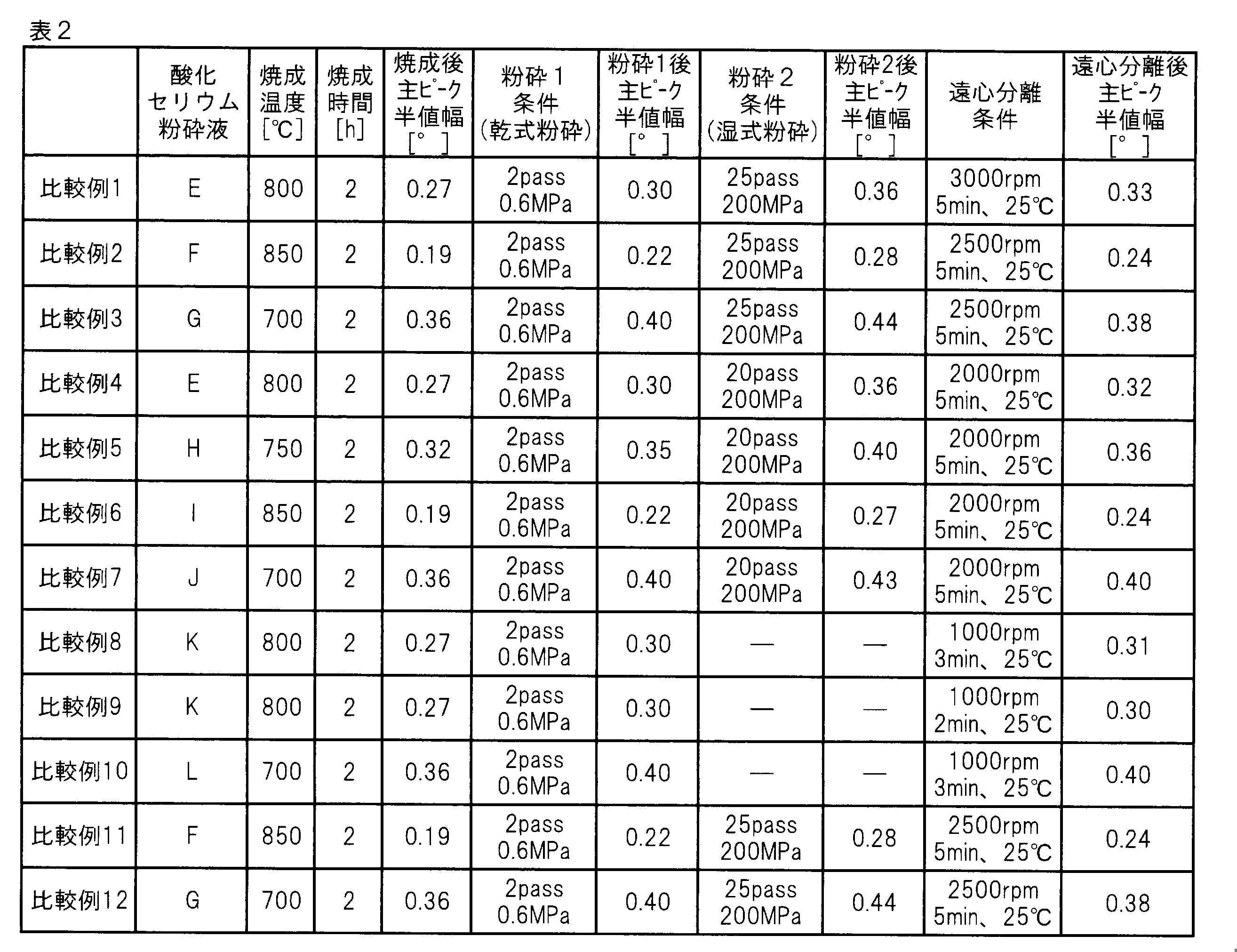
- Examples 2 to 7 and Comparative Examples 1 to 12 According to the same method as in Example 1, except that the conditions of pulverization 1, pulverization 2 and centrifugation were changed according to the conditions shown in Tables 1 and 2, and the addition amount of the organic acid was changed to the amount shown in Table 3.
- the polishing liquid for cerium oxide CMP shown in No. 3 was prepared. Dilution of the supernatant obtained after centrifugation with deionized water was performed when necessary to bring the concentration of the cerium oxide particles to 4.0% by mass.
- the polishing liquid for cerium oxide CMP represents 1.0% by mass of cerium oxide particles, 0.07% by mass of polyacrylic acid (water-soluble polymer) as an additive, and p-toluenesulfonic acid (organic acid). 3 is included (0 or 0.0076% by mass).
- the pH of the polishing liquid for cerium oxide CMP was 6.0.
- a blanket wafer “P-TEOS 1.0 ⁇ m” (a wafer on which a silicon oxide film was formed by TEOS-CVD method, diameter: 300 mm) manufactured by Advantech Co., Ltd. was used.
- a polishing apparatus (“Reflexion LK” manufactured by Applied Materials) was used for polishing a wafer for polishing test.
- the wafer was set in a holder on which a suction pad for mounting the substrate was attached.
- a polishing cloth made of porous urethane resin (groove shape: concentric circle type, “IC1010” manufactured by Rohm and Haas) was attached to a polishing surface plate having a diameter of 600 mm of a polishing apparatus. Further, the holder was placed on the polishing surface plate with the insulating film (silicon oxide film) surface as the film to be polished facing down, and the processing load was set to 21.0 kPa.
- the polishing platen and the wafer for polishing test are each operated at a rotation speed of 90 min- 1 to polish the wafer for 1 min. did.
- the polished wafer was thoroughly washed with pure water and then dried.
- the thickness of the insulating film before polishing and the thickness of the insulating film after polishing were measured, and the polishing rate was calculated from the difference in film thickness before and after polishing and the polishing time.
- a film thickness meter “F-80” manufactured by Filmetrics was used for film thickness measurement.
- the detected foreign material size was set to 0.2 ⁇ m or more by using an inspection device “Complus” manufactured by Applied Materials, and foreign materials (dents and deposits) were detected. Since the detected foreign matter includes deposits other than scratches, each foreign matter is observed with a scanning electron microscope (SEM) “Vision G3” manufactured by Applied Materials, and the dent is judged to be a polishing scratch. The number of wounds was counted.
- SEM scanning electron microscope
Landscapes
- Chemical & Material Sciences (AREA)
- Organic Chemistry (AREA)
- Engineering & Computer Science (AREA)
- Materials Engineering (AREA)
- Mechanical Engineering (AREA)
- Life Sciences & Earth Sciences (AREA)
- Geology (AREA)
- Inorganic Chemistry (AREA)
- Finish Polishing, Edge Sharpening, And Grinding By Specific Grinding Devices (AREA)
- Mechanical Treatment Of Semiconductor (AREA)
Abstract
Description
なお、本明細書において、「L」は「リットル」を示す。
なお、本明細書において、水溶性とは、水100gに対して25℃において0.1g以上溶解するものとして定義される。
本発明は、2014年5月30日に出願された特願2014-112855号に記載の主題と関連しており、その開示内容は、参照によりここに援用される。
本発明の実施形態であるCMP用研磨液は、酸化セリウム粒子と、水とを含有する。以下、CMP用研磨液に含まれる各成分について詳細に説明する。
酸化セリウム粒子は、例えば、セリウム化合物を酸化することによって得られる。セリウム化合物としては、炭酸塩、硝酸塩、硫酸塩、しゅう酸塩等のセリウム塩などが挙げられ、中でも炭酸セリウム(セリウムの炭酸塩)が好ましい。
水としては、特に制限されないが、脱イオン水、イオン交換水、超純水等が好ましい。水の含有量は、各含有成分の含有量の残部でよく、CMP用研磨液中に含有されていれば特に限定されない。なお、CMP用研磨液は、必要に応じて水以外の溶媒を更に含有してもよい。水以外の溶媒としては、例えば、エタノール、アセトン等の極性溶媒などが挙げられる。
本発明のCMP用研磨液は、更に添加剤を含有してもよい。添加剤としては、水溶性高分子、有機酸等が挙げられる。
CMP用研磨液には、水溶性高分子を使用できる。水溶性高分子としては、例えば、多糖類、ビニル系ポリマ、アクリル酸系ポリマ等が挙げられる。これにより、研磨終了後の被研磨部(例えば酸化ケイ素部)の平坦性を向上させることができる。より詳細には、凹凸を有する被研磨部を研磨した場合に、一部が過剰に研磨されて皿のように凹む現象、いわゆるディッシングが生じることを抑制できる。この効果は、水溶性高分子と、酸化セリウム粒子とを併用することにより、より効率的に得られる。水溶性高分子は一種類を単独で又は二種類以上を組み合わせて使用できる。前記水溶性高分子の中でも、アクリル酸系ポリマが好ましい。
使用機器(検出器):株式会社日立製作所製、「L-3300型」液体クロマトグラフ用示差屈折率計
ポンプ:株式会社日立製作所製、液体クロマトグラフ用「L-7100」
デガス装置:なし
データ処理:株式会社日立製作所製、GPCインテグレーター「D-2520」
カラム:昭和電工株式会社製、「Shodex Asahipak GF-710HQ」、内径7.6mm×300mm
溶離液:50mM-Na2HPO4水溶液/アセトニトリル=90/10(v/v)
測定温度:25℃
流量:0.6mL/min
測定時間:30min
試料:樹脂分濃度2質量%になるように溶離液と同じ組成の溶液で濃度を調整し、0.45μmのポリテトラフルオロエチレンフィルターでろ過して調製した試料
注入量:0.4μL
標準物質:Polymer Laboratories製、狭分子量ポリアクリル酸ナトリウム
使用機器(検出器):株式会社日立製作所製、RI-モニター「L-3000」
ポンプ:株式会社日立製作所製「L-6000」
デガス装置:昭和電工株式会社製「Shodex DEGAS」(「Shodex」は登録商標)
データ処理:株式会社日立製作所製、GPCインテグレーター「D-2200」
カラム:日立化成株式会社製「GL-R440」、「GL-R430」、「GL-R420」をこの順番で連結して使用
溶離液:テトラヒドロフラン(THF)
測定温度:23℃
流量:1.75mL/min
測定時間:45min
注入量:10μL
標準物質:東ソー株式会社製、標準ポリスチレン(分子量:190000、17900、9100、2980、578、474、370、266)
CMP用研磨液は、水溶性高分子以外に、有機酸を含有してもよい。有機酸は塩であってもよい。以下、本明細書において、有機酸及び有機酸の塩を、単に「有機酸」ともいう。有機酸は、研磨速度を向上させ、且つ研磨終了後の被研磨部(例えば酸化ケイ素部)の平坦性を向上させることができる。より詳細には、凹凸を有する被研磨面を研磨した場合に、研磨時間を短縮できることに加え、一部が過剰に研磨されて皿のように凹む現象、いわゆるディッシングが生じることを抑制できる。この効果は、有機酸と、水溶性高分子と、酸化セリウム粒子とを併用することにより、より効率的に得られる。有機酸は一種類を単独で又は二種類以上を組み合わせて使用できる。
CMP用研磨液には、酸化セリウム粒子を分散させるための分散剤を含有させることができる。分散剤は、酸化セリウム粒子の表面に付着して分散能を発揮する。分散剤としては、水溶性陰イオン性分散剤、水溶性非イオン性分散剤、水溶性陽イオン性分散剤、水溶性両性分散剤等が挙げられる。分散剤は一種類を単独で又は二種類以上を組み合わせて使用できる。中でも水溶性陰イオン性分散剤が好ましく、アクリル酸系ポリマがより好ましい。アクリル酸系ポリマについては前記と同様である。
CMP用研磨液は、例えば、酸化セリウム粒子と水とを混合して酸化セリウム粒子を分散させ、必要に応じて粉砕、分級(ふるいわけ法、遠心分離法、沈降法等)、ろ過等を実施し、更に、任意成分である水溶性高分子、有機酸等を添加することによって得られる。酸化セリウム粒子の主ピーク半値幅は、粉砕、分級、ろ過等により変化しうるが、最終的にCMP用研磨液において0.26~0.36°の範囲にあればよい。
本発明の実施形態である基板の研磨方法は、絶縁材料が形成された基板を研磨する方法であって、上記CMP用研磨液を用いて、絶縁材料の不要部を除去する方法である。好ましくは研磨対象としての絶縁材料が形成された基板の被研磨面を、研磨定盤の研磨布に押圧した状態で、基板上の被研磨面と研磨布との間に上記CMP用研磨液を供給しながら、基板と研磨定盤とを相対的に動かして絶縁材料を研磨し、絶縁材料の不要部を除去する。
(酸化セリウムの作製)
市販の炭酸セリウム水和物40kgをアルミナ製容器に入れ、800℃で、空気中で2時間焼成することにより黄白色の粉末を20kg得た。この粉末の相同定をX線回折法で行ったところ、酸化セリウムであることを確認した。酸化セリウムの主ピーク半値幅を測定したところ、0.27°であった。
前記で作製した酸化セリウム20kgを、ジェットミルを用いて乾式粉砕(粉砕1)し、酸化セリウム粉末を得た。酸化セリウム粉末の主ピーク半値幅を測定したところ、0.30°であった。乾式粉砕条件は、処理回数2pass、圧力0.6MPaとした。
前記で作製した酸化セリウム粉末100.0gと、脱イオン水897.5gとを混合し、分散剤としてポリアクリル酸アンモニウム水溶液(重量平均分子量:8,000、40質量%)2.5gを添加して、撹拌しながら湿式粉砕(粉砕2)を行い、酸化セリウム粉砕液を得た。酸化セリウム粉砕液に含まれる酸化セリウム粒子の主ピーク半値幅を測定したところ、0.36°であった。湿式粉砕条件は、処理回数25pass、圧力200MPaとした。また、酸化セリウム粒子の主ピーク半値幅の測定用のサンプルは、得られた酸化セリウム粉砕液10gを150℃、1時間で乾燥した乾燥粉を用いた。
前記で作製した酸化セリウム粉砕液を遠心分離し、平均粒径(D50)が150nmになるように上澄み液を取り出した。遠心分離機「himac CF12RX、T3S51」(日立工機株式会社製)を用い、条件を回転数2500min-1、時間5min、温度25℃とした。得られた上澄み液を、酸化セリウム粒子の濃度が4.0質量%となるように脱イオン水で希釈し、酸化セリウムスラリを得た。酸化セリウムスラリに含まれる酸化セリウム粒子の主ピーク半値幅を測定したところ、0.33°であった。測定用のサンプルの調製は、酸化セリウム粉砕液の場合と同様に行った。
有機酸としてp-トルエンスルホン酸一水和物0.084gと、脱イオン水700gとを混合し、水溶性高分子としてポリアクリル酸水溶液(重量平均分子量4,000、40質量%)1.75gを加え、更にアンモニア水(25質量%)を加えてpH4.5に調整した。その後、脱イオン水を加えて、全体量を740.0gとして添加液とした。
得られた添加液に、酸化セリウムスラリ250.0gを添加し、更にアンモニア水(25質量%)を加えて、pH6.0に調整した。その後、脱イオン水を加えて、全体量を1,000gとし、酸化セリウムCMP用研磨液を作製した。酸化セリウムCMP用研磨液は、酸化セリウム粒子を1.0質量%、及び、添加剤としてポリアクリル酸(水溶性高分子)を0.07質量%とp-トルエンスルホン酸(有機酸)を0.0076質量%含む。
粉砕1、粉砕2及び遠心分離の各条件を、表1及び2に示す条件に従って変更し、有機酸の添加量を表3に示す量にした以外は、実施例1と同様の方法により、表3に示す酸化セリウムCMP用研磨液を作製した。遠心分離後に得られた上澄み液の脱イオン水による希釈は、酸化セリウム粒子の濃度を4.0質量%とするために必要な場合に行った。酸化セリウムCMP用研磨液は、酸化セリウム粒子を1.0質量%、及び、添加剤としてポリアクリル酸(水溶性高分子)を0.07質量%とp-トルエンスルホン酸(有機酸)を表3に示す量(0又は0.0076質量%)含む。酸化セリウムCMP用研磨液のpHは6.0であった。

研磨試験用のウエハとして、アドバンテック社製のブランケットウエハ「P-TEOS 1.0μm」(TEOS-CVD法により酸化ケイ素膜が形成されたウエハ、直径300mm)を用いた。
研磨前の絶縁膜の膜厚と研磨後の絶縁膜の膜厚を測定し、研磨前後の膜厚の差及び研磨時間から研磨速度の算出を行った。膜厚の測定には、フィルメトリクス社製の膜厚計「F-80」を使用した。
研磨終了後の研磨試験用のウエハについて、アプライドマテリアルズ社製の検査装置「Complus」を用いて、検出異物サイズを0.2μm以上に設定して異物(凹み及び付着物)を検出した。検出された異物には、傷以外の付着物が含まれるため、アプライドマテリアルズ社製の走査型電子顕微鏡(SEM)「Vision G3」で各異物を観察し、凹みを研磨傷と判断し、研磨傷数をカウントした。

Claims (4)
- 酸化セリウム粒子及び水を含有するCMP用研磨液であって、
前記酸化セリウム粒子の粉末X線回折チャートにおいて、2θ=27.000~29.980°の範囲に現われる主ピークの半値幅が0.26~0.36°であり、
前記酸化セリウム粒子の平均粒径が130nm以上175nm未満であり、
1.15μm以上の粒径を有する酸化セリウム粒子の数が5,000×103個/mL以下であるCMP用研磨液。 - 更に水溶性高分子を含有する請求項1に記載のCMP用研磨液。
- 請求項2に記載のCMP用研磨液を得るためのCMP用研磨液セットであって、
酸化セリウム粒子及び水を含有する第一の液と、水溶性高分子及び水を含有する第二の液とを備えたCMP用研磨液セット。 - 絶縁材料が形成された基板を研磨する方法であって、
請求項1又は2に記載のCMP用研磨液、又は、請求項3に記載のCMP用研磨液セットにより得られたCMP用研磨液を用いて、前記絶縁材料の不要部を除去する基板の研磨方法。
Priority Applications (4)
| Application Number | Priority Date | Filing Date | Title |
|---|---|---|---|
| US15/314,692 US9966269B2 (en) | 2014-05-30 | 2015-05-29 | Polishing liquid for CMP, polishing liquid set for CMP, and polishing method |
| KR1020167033974A KR102476738B1 (ko) | 2014-05-30 | 2015-05-29 | Cmp용 연마액, cmp용 연마액 세트 및 연마 방법 |
| KR1020227043006A KR102659674B1 (ko) | 2014-05-30 | 2015-05-29 | Cmp용 연마액, cmp용 연마액 세트 및 연마 방법 |
| JP2016523583A JPWO2015182756A1 (ja) | 2014-05-30 | 2015-05-29 | Cmp用研磨液、cmp用研磨液セット、及び研磨方法 |
Applications Claiming Priority (2)
| Application Number | Priority Date | Filing Date | Title |
|---|---|---|---|
| JP2014112855 | 2014-05-30 | ||
| JP2014-112855 | 2014-05-30 |
Publications (1)
| Publication Number | Publication Date |
|---|---|
| WO2015182756A1 true WO2015182756A1 (ja) | 2015-12-03 |
Family
ID=54699076
Family Applications (1)
| Application Number | Title | Priority Date | Filing Date |
|---|---|---|---|
| PCT/JP2015/065602 Ceased WO2015182756A1 (ja) | 2014-05-30 | 2015-05-29 | Cmp用研磨液、cmp用研磨液セット、及び研磨方法 |
Country Status (5)
| Country | Link |
|---|---|
| US (1) | US9966269B2 (ja) |
| JP (2) | JPWO2015182756A1 (ja) |
| KR (2) | KR102476738B1 (ja) |
| TW (1) | TWI662116B (ja) |
| WO (1) | WO2015182756A1 (ja) |
Cited By (1)
| Publication number | Priority date | Publication date | Assignee | Title |
|---|---|---|---|---|
| JP2017228576A (ja) * | 2016-06-20 | 2017-12-28 | 日立化成株式会社 | 研磨液及び研磨方法 |
Families Citing this family (3)
| Publication number | Priority date | Publication date | Assignee | Title |
|---|---|---|---|---|
| JP2019050307A (ja) * | 2017-09-11 | 2019-03-28 | 株式会社フジミインコーポレーテッド | 研磨方法、ならびに研磨用組成物およびその製造方法 |
| WO2021220672A1 (ja) | 2020-04-27 | 2021-11-04 | 昭和電工株式会社 | セリウム系研磨材スラリー原液及びその製造方法、並びに研磨液 |
| CN119895540A (zh) * | 2023-08-25 | 2025-04-25 | 株式会社力森诺科 | 浆料及研磨方法 |
Citations (3)
| Publication number | Priority date | Publication date | Assignee | Title |
|---|---|---|---|---|
| JP2008270341A (ja) * | 2007-04-17 | 2008-11-06 | Hitachi Chem Co Ltd | 半導体平坦化用研磨剤 |
| JP2009280480A (ja) * | 2008-02-19 | 2009-12-03 | Hitachi Chem Co Ltd | 酸化セリウム粒子の製造方法、その製造方法により得られる酸化セリウム粒子、この酸化セリウム粒子を含む研磨液及びこれを用いた研磨法 |
| JP2011104680A (ja) * | 2009-11-13 | 2011-06-02 | Hitachi Chem Co Ltd | 酸化セリウム粒子を含む研磨液及びこれを用いた研磨法 |
Family Cites Families (8)
| Publication number | Priority date | Publication date | Assignee | Title |
|---|---|---|---|---|
| KR100759182B1 (ko) | 1996-09-30 | 2007-09-14 | 히다치 가세고교 가부시끼가이샤 | 산화세륨 입자 |
| KR100630691B1 (ko) * | 2004-07-15 | 2006-10-02 | 삼성전자주식회사 | 산화세륨 연마 입자 및 그 제조 방법과 cmp용 슬러리조성물 및 그 제조 방법과 이들을 이용한 기판 연마 방법 |
| CN101528882B (zh) * | 2006-10-16 | 2014-07-16 | 卡伯特微电子公司 | 玻璃抛光组合物及方法 |
| CN101568615B (zh) * | 2006-12-28 | 2013-02-06 | 花王株式会社 | 研磨液组合物 |
| JP5403957B2 (ja) * | 2008-07-01 | 2014-01-29 | 花王株式会社 | 研磨液組成物 |
| TW201038690A (en) * | 2008-09-26 | 2010-11-01 | Rhodia Operations | Abrasive compositions for chemical mechanical polishing and methods for using same |
| EP2500928A4 (en) * | 2009-11-12 | 2014-06-25 | Hitachi Chemical Co Ltd | CHEMICAL-MECHANICAL CLEANING LIQUID, AND METHOD FOR PRODUCING A SEMICONDUCTOR SUBSTRATE AND CLEANING PROCESS WITH THIS CLEANING LIQUID |
| JP2012134357A (ja) * | 2010-12-22 | 2012-07-12 | Hitachi Chem Co Ltd | Cmp研磨液用洗浄液、これを用いた洗浄方法、並びにこれを用いた半導体基板の製造方法 |
-
2015
- 2015-05-29 KR KR1020167033974A patent/KR102476738B1/ko active Active
- 2015-05-29 TW TW104117446A patent/TWI662116B/zh active
- 2015-05-29 US US15/314,692 patent/US9966269B2/en active Active
- 2015-05-29 KR KR1020227043006A patent/KR102659674B1/ko active Active
- 2015-05-29 WO PCT/JP2015/065602 patent/WO2015182756A1/ja not_active Ceased
- 2015-05-29 JP JP2016523583A patent/JPWO2015182756A1/ja active Pending
-
2019
- 2019-06-18 JP JP2019112966A patent/JP6733782B2/ja active Active
Patent Citations (3)
| Publication number | Priority date | Publication date | Assignee | Title |
|---|---|---|---|---|
| JP2008270341A (ja) * | 2007-04-17 | 2008-11-06 | Hitachi Chem Co Ltd | 半導体平坦化用研磨剤 |
| JP2009280480A (ja) * | 2008-02-19 | 2009-12-03 | Hitachi Chem Co Ltd | 酸化セリウム粒子の製造方法、その製造方法により得られる酸化セリウム粒子、この酸化セリウム粒子を含む研磨液及びこれを用いた研磨法 |
| JP2011104680A (ja) * | 2009-11-13 | 2011-06-02 | Hitachi Chem Co Ltd | 酸化セリウム粒子を含む研磨液及びこれを用いた研磨法 |
Cited By (1)
| Publication number | Priority date | Publication date | Assignee | Title |
|---|---|---|---|---|
| JP2017228576A (ja) * | 2016-06-20 | 2017-12-28 | 日立化成株式会社 | 研磨液及び研磨方法 |
Also Published As
| Publication number | Publication date |
|---|---|
| US20170200617A1 (en) | 2017-07-13 |
| KR20170012290A (ko) | 2017-02-02 |
| JP2019208029A (ja) | 2019-12-05 |
| US9966269B2 (en) | 2018-05-08 |
| TW201544586A (zh) | 2015-12-01 |
| JP6733782B2 (ja) | 2020-08-05 |
| TWI662116B (zh) | 2019-06-11 |
| JPWO2015182756A1 (ja) | 2017-05-25 |
| KR20220165842A (ko) | 2022-12-15 |
| KR102476738B1 (ko) | 2022-12-13 |
| KR102659674B1 (ko) | 2024-04-19 |
Similar Documents
| Publication | Publication Date | Title |
|---|---|---|
| JP5287174B2 (ja) | 研磨剤及び研磨方法 | |
| JP6733782B2 (ja) | Cmp用研磨液、cmp用研磨液セット、及び研磨方法 | |
| CN100565813C (zh) | 化学机械研磨用水系分散体和化学机械研磨方法、以及用于调制化学机械研磨用水系分散体的试剂盒 | |
| JP6028432B2 (ja) | Cmp用研磨液、cmp用研磨液用貯蔵液及び研磨方法 | |
| JP2012146973A (ja) | 研磨液及びこの研磨液を用いた基板の研磨方法 | |
| JP2008186898A (ja) | 研磨用組成物 | |
| TWI488952B (zh) | Cmp研磿液以及使用此cmp研磨液的研磨方法以及半導體基板的製造方法 | |
| WO2020202471A1 (ja) | 研磨液、研磨液セット、研磨方法及び欠陥抑制方法 | |
| US20060124593A1 (en) | Colloidal silica based chemical mechanical polishing slurry | |
| JP2010034497A (ja) | 化学機械研磨用水系分散体およびその製造方法、ならびに化学機械研磨方法 | |
| JP5333740B2 (ja) | 化学機械研磨用水系分散体およびその製造方法、ならびに化学機械研磨方法 | |
| JP4666138B2 (ja) | 水性ジルコニアゾル含有研磨用組成物 | |
| JP6601209B2 (ja) | Cmp用研磨液及びこれを用いた研磨方法 | |
| JP7106907B2 (ja) | 構造体及びその製造方法 | |
| WO2016021325A1 (ja) | Cmp用研磨液及びこれを用いた研磨方法 | |
| JP2015137350A (ja) | 研磨液及びこの研磨液を用いる研磨方法 | |
| JP2011224751A (ja) | 酸化セリウム研磨剤及びこの研磨剤を用いた基板の研磨方法 | |
| JP4776387B2 (ja) | 酸化セリウム研磨剤および基板の研磨法 | |
| JP4776388B2 (ja) | 酸化セリウム研磨剤および基板の研磨法 | |
| JP6938855B2 (ja) | Cmp用研磨液及びこれを用いた研磨方法 | |
| JP4878728B2 (ja) | Cmp研磨剤および基板の研磨方法 | |
| JP2004289170A (ja) | 酸化セリウム研磨剤および基板の研磨法 | |
| JP2011146423A (ja) | 基板の研磨方法 | |
| JP5413567B2 (ja) | 化学機械研磨用水系分散体およびその製造方法、ならびに化学機械研磨方法 | |
| KR20090073728A (ko) | 화학적 기계적 연마용 슬러리 및 그 제조 방법 |
Legal Events
| Date | Code | Title | Description |
|---|---|---|---|
| 121 | Ep: the epo has been informed by wipo that ep was designated in this application |
Ref document number: 15800687 Country of ref document: EP Kind code of ref document: A1 |
|
| ENP | Entry into the national phase |
Ref document number: 2016523583 Country of ref document: JP Kind code of ref document: A |
|
| WWE | Wipo information: entry into national phase |
Ref document number: 15314692 Country of ref document: US |
|
| NENP | Non-entry into the national phase |
Ref country code: DE |
|
| ENP | Entry into the national phase |
Ref document number: 20167033974 Country of ref document: KR Kind code of ref document: A |
|
| 122 | Ep: pct application non-entry in european phase |
Ref document number: 15800687 Country of ref document: EP Kind code of ref document: A1 |