WO2015178146A1 - 歯ブラシ - Google Patents
歯ブラシ Download PDFInfo
- Publication number
- WO2015178146A1 WO2015178146A1 PCT/JP2015/061999 JP2015061999W WO2015178146A1 WO 2015178146 A1 WO2015178146 A1 WO 2015178146A1 JP 2015061999 W JP2015061999 W JP 2015061999W WO 2015178146 A1 WO2015178146 A1 WO 2015178146A1
- Authority
- WO
- WIPO (PCT)
- Prior art keywords
- slip
- toothbrush
- handle
- portions
- soft resin
- Prior art date
- Legal status (The legal status is an assumption and is not a legal conclusion. Google has not performed a legal analysis and makes no representation as to the accuracy of the status listed.)
- Ceased
Links
Images







Classifications
-
- A—HUMAN NECESSITIES
- A46—BRUSHWARE
- A46B—BRUSHES
- A46B5/00—Brush bodies; Handles integral with brushware
- A46B5/02—Brush bodies; Handles integral with brushware specially shaped for holding by the hand
- A46B5/023—Grips or handles specially adapted for children
-
- A—HUMAN NECESSITIES
- A46—BRUSHWARE
- A46B—BRUSHES
- A46B5/00—Brush bodies; Handles integral with brushware
-
- A—HUMAN NECESSITIES
- A46—BRUSHWARE
- A46B—BRUSHES
- A46B5/00—Brush bodies; Handles integral with brushware
- A46B5/02—Brush bodies; Handles integral with brushware specially shaped for holding by the hand
-
- A—HUMAN NECESSITIES
- A46—BRUSHWARE
- A46B—BRUSHES
- A46B5/00—Brush bodies; Handles integral with brushware
- A46B5/02—Brush bodies; Handles integral with brushware specially shaped for holding by the hand
- A46B5/026—Grips or handles having a nonslip section
-
- A—HUMAN NECESSITIES
- A46—BRUSHWARE
- A46B—BRUSHES
- A46B9/00—Arrangements of the bristles in the brush body
- A46B9/02—Position or arrangement of bristles in relation to surface of the brush body, e.g. inclined, in rows, in groups
- A46B9/04—Arranged like in or for toothbrushes
-
- A—HUMAN NECESSITIES
- A46—BRUSHWARE
- A46B—BRUSHES
- A46B2200/00—Brushes characterized by their functions, uses or applications
- A46B2200/10—For human or animal care
- A46B2200/1066—Toothbrush for cleaning the teeth or dentures
Definitions
- the present invention relates to a toothbrush used by infants and used by adults to finish brushing their infants.
- This application claims priority based on Japanese Patent Application No. 2014-104915 for which it applied to Japan on May 21, 2014, and uses the content here.
- the conventional child toothbrush was simply a miniaturized toothbrush for adults. Therefore, it is possible for infants to experience the feeling of brushing their teeth, but it is difficult for an adult to brush the teeth of the infant by finely brushing the target teeth simply by operating the handle body when brushing the infant's teeth. Met.
- Patent Document 1 there are a toothbrush disclosed in Patent Document 1 and a portable toothbrush disclosed in Patent Document 2 as toothbrushes capable of pressing a finger against the other surface of the head portion and brushing teeth.
- Patent Document 1 discloses a toothbrush that includes a brush portion in which a large number of hairs are planted on the front surface of a flocking plate, and a telescopic finger sack provided on the back surface of the flocking plate.
- Patent Document 2 discloses a simple toothbrush comprising a brush body for brushing teeth, a substrate on which the brush body is implanted, and two holding pieces provided above the substrate.
- a portable toothbrush hereinafter simply referred to as “toothbrush” in which pieces are formed so as to face each other and a toothbrush can be attached to a finger inserted between holding pieces.
- toothbrushes disclosed in Patent Documents 1 and 2 are not toothbrushes intended for use by infants.
- the toothbrushes disclosed in Patent Documents 1 and 2 do not have a handle body, infants cannot experience the feeling of brushing their teeth.
- infants since infants have not yet developed hand movements, it is difficult to use the toothbrushes disclosed in Patent Documents 1 and 2.
- the present invention has been made in view of the above problems, and can be used by infants, and when an adult finishes brushing an infant's tooth, it is possible to finely brush the target teeth of the infant.
- An object is to provide a toothbrush.
- a toothbrush in order to solve the above-described problem, includes a head portion and a handle portion, a handle body extending in a first direction, and a brush portion implanted on one surface of the head portion. And a first anti-slip portion disposed on the other surface side of the head portion, and a second anti-slip portion disposed on the handle portion and against which a finger holding the handle portion abuts. It is characterized by that.
- two of the second anti-slip portions may be arranged in a second direction that intersects the first direction.
- the first anti-slip portion may include at least one of a concave portion or a convex portion.
- the second anti-slip portion may include at least one of a concave portion or a convex portion.
- a base material of a portion of the handle body corresponding to a formation region of the first and second anti-slip portions is made of a hard resin
- Either one of the anti-slip part 1 or the second anti-slip part may include a soft resin layer that covers the base material and is made of a soft resin softer than the hard resin.
- a plurality of the first and second anti-slip portions may be arranged in the first direction.
- the handle body includes a neck portion having one end connected to the head portion and the other end connected to the handle portion, and the first slip prevention portion is The head portion and the neck portion may be disposed on at least one of the head portion and the neck portion.
- the second anti-slip portion may be disposed on at least one of the handle portion and the neck portion.
- an infant can be used, and when an adult finishes brushing an infant's tooth, the brush portion can be finely applied to the target tooth of the infant.
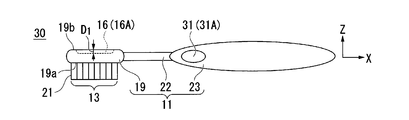
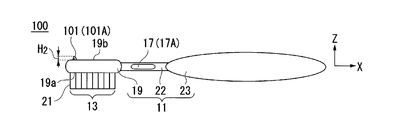
- FIG. 1 is a side view of a toothbrush according to a first embodiment of the present invention.
- the X direction indicates the extending direction (first direction) of the handle body 11
- the Z direction indicates the height direction of the hair bundle 21 constituting the brush portion 13.
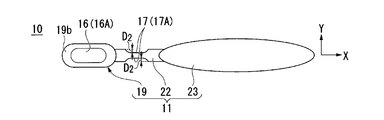
- FIG. 2 is a rear view of the toothbrush according to the first embodiment of the present invention. 2, the same components as those in the structure shown in FIG.
- the Y direction shown in FIG. 2 indicates the X direction and a direction (second direction) orthogonal to the Z direction shown in FIG.
- a toothbrush 10 is a toothbrush used by an infant and used by an adult to finish brushing an infant, and includes a handle body 11 and a brush portion 13. And a first anti-slip part 16 and a pair of second anti-slip parts 17.
- the handle body 11 includes a head portion 19, a neck portion 22, and a handle portion 23.
- the head portion 19 extends in the X direction.
- the shape of the head portion 19 is such that the width in the X direction is wider than the width in the Y direction.
- the width of the head portion 19 in the X direction is preferably 13 mm or more and 22 mm or less.
- the width of the head portion 19 in the Y direction is preferably 8 mm or more and 11 mm or less.
- the head part 19 has one surface 19a (front surface) and another surface 19b (back surface) disposed on the opposite side of the one surface 19a.
- a plurality of planting holes (not shown) for planting the plurality of hair bundles 21 constituting the brush unit 13 are provided.
- the neck portion 22 extends in the X direction, and one end is connected to the head portion 19 and the other end is connected to the handle portion 23.
- the neck portion 22 is a portion where the two second slip prevention portions 17 are provided.
- the length of the neck portion 22 in the X direction is preferably 33 mm or greater and 54 mm or less.
- the width of the neck portion 22 in the Y direction is preferably 4.0 mm or greater and 5.0 mm or less.
- the handle part 23 is a part that the infant holds with his hand when brushing his / her own teeth.
- the handle part 23 extends in the X direction.
- the width of the handle portion 23 in the Y direction is configured to be wider than the width of the neck portion 22 in the Y direction.
- the length in the X direction of the handle portion 23 is preferably 85 mm or more and 100 mm or less.
- the width in the Y direction of the handle portion 23 is preferably 11 mm or greater and 16 mm or less.
- the width of the handle portion 23 in the Y direction means the maximum value of the length of the handle portion 23 in the Y direction.
- the handle body 11 having the above-described configuration, that is, the head portion 19, the neck portion 22, and the handle portion 23 is a member manufactured by integral molding.
- a synthetic resin material such as polypropylene, polyethylene, polyethylene terephthalate, polybutylene terephthalate, polyacetal, ABS resin, or saturated polyester resin such as PCT resin can be used.
- the brush unit 13 includes a plurality of hair bundles 21.
- the plurality of hair bundles 21 are respectively disposed in planting holes (not shown) provided in the head portion 19.
- the hair bundle 21 is composed of a plurality of hairs.
- the hair material include polyamide (specifically, 6-12 nylon, 6-10 nylon, etc.), polyester (specifically, polyethylene terephthalate, polybutylene terephthalate, polytrimethylene terephthalate, etc.), Synthetic resin materials such as polyolefin (specifically, polypropylene) and elastomer (specifically, olefin-based, styrene-based, etc.) can be used, but are not limited thereto.
- the hair tip shape for example, a rounded tip shape, a taper shape whose outer diameter gradually decreases toward the tip, a spatula shape, a spherical shape, a tip crack shape, etc. can be used. It is not limited to these shapes.
- the hair length of the hair is preferably 6 mm or more and 9 mm or less, for example.
- the hair length of the hair means the length from the one surface 19a of the head portion to the tip of the hair.
- the diameter of the selected hair is small, it is preferable to shorten the length of the hair from the viewpoint of the usability in the mouth and the feeling of use.
- a plurality of hairs having different thicknesses may be used in any combination.
- the first anti-slip portion 16 is one concave portion 16 ⁇ / b> A disposed on the other surface 19 b side of the head portion 19.
- the concave portion 16A is configured by reducing the thickness of the head portion 19 corresponding to the formation region of the first anti-slip portion 16 from the other surface 19b of the head portion 19 (partially reducing the thickness). Yes.
- the concave portion 16A is a portion where the tip of the adult index finger is disposed when the adult finishes brushing the infant's teeth.
- the brush part 13 When the brush part 13 is pressed against the target tooth of the infant (in other words, the tooth to be polished) through the adult index finger, the adult index finger is recessed. there is a depth D 1 is not displaced from 16A.
- the concave portion 16A having the above-described configuration By disposing the concave portion 16A having the above-described configuration on the other surface 19b side of the head portion 19, it is possible to suppress an adult index finger finishing brushing of the infant from the other surface 19b side of the head portion 19. Thereby, the hair
- the thickness of the head portion 19 in the portion where the concave portion 16A is formed becomes thin, the distance between the adult index finger for brushing and the brush portion 13 is close in the Z direction. This makes it possible for an adult to feel the sensitivity of the tips of the hair bundles 21 against the teeth of the infant, so that the intended finish of the infant's teeth can be accurately performed.
- Two (a pair) of the second anti-slip portions 17 are disposed at both ends of the neck portion 22 in the Y direction (second direction).
- the two second anti-slip portions 17 are portions where the fingers holding the neck portion 22 are brought into contact.
- the pair (two) of second slip prevention portions 17 are two concave portions 17 ⁇ / b> A provided by being configured so that the width of the neck portion 22 in the Y direction is narrowed.
- the depth D 2 of the recess 17A of the pair (two) in the Y direction when the is pressed against the head portion 19 by focusing on the tip of the index finger, to the extent that does not deviate thumb and middle finger of a pair of recesses 17A depth If it is.
- the depth D 2 of the recess 17A for example, preferably 0.5mm or more 3.0mm or less.
- the distance A between the recess 16A and the recess 17A in the X direction is preferably, for example, 0 mm or more and 40 mm or less. By setting it as such a range, an adult index finger, thumb, and middle finger can be easily arrange
- the case where the distance A between the recess 16A and the recess 17A in the X direction is 0 mm means, for example, that one end of the recess 16A in the X direction extends to the boundary between the head portion 19 and the neck portion 22 and X This is a case where one end of the recess 16A in the direction is extended to the boundary between the head portion 19 and the neck portion 22.
- the recesses 16A and 17A may be arranged so that a part thereof overlaps in the Y direction.
- two recesses 17A that are a pair of second anti-slip portions 17 arranged in the Y direction perpendicular to the (X direction) an infant can be used and an adult can brush his / her teeth
- the head portion 19 can be firmly pressed by the tip portion of the index finger arranged in the recess 16A, so that the hair bundle 21 (brush portion 13) is finely applied to the infant teeth to be finished and polished. You can guess.
- the thickness of the head portion 19 in the portion where the concave portion 16A is formed is reduced, the distance between the adult index finger disposed in the concave portion 16A and the brush portion 13 is reduced in the Z direction. This makes it possible for an adult to feel the sensitivity of the tips of the hair bundles 21 against the teeth of the infant, so that the intended finish of the infant's teeth can be accurately performed.
- the two second anti-slip portions 17 may be arranged at positions that can be held by the middle finger and thumb of the adult, and in a direction intersecting the X direction (in other words, Y You may arrange
- FIG. 3 is a side view of a toothbrush according to the second embodiment of the present invention.
- the same components as those of the toothbrush 10 of the first embodiment shown in FIGS. 1 and 2 are denoted by the same reference numerals.
- FIG. 4 is a rear view of the toothbrush according to the second embodiment of the present invention.
- the same components as those of the structure shown in FIG. 4 is a total value of the length of the recess 16A in the X direction, the length of the recess 31A in the X direction, and the interval between the recess 16A and the recess 17A in the X direction.
- the toothbrush 30 of the second embodiment is replaced with two second anti-slip portions 17 (two concave portions 17A) of the first embodiment.
- the two anti-slip portions 31 are configured in the same manner as the toothbrush 10 of the first embodiment except that the two anti-slip portions 31 have two concave portions 31A.
- the two concave portions 31 ⁇ / b> A are provided in a portion (the shoulder portion of the handle portion 23) located in the vicinity of the neck portion 22 in the handle portion 23.
- the two concave portions 31A are formed so as to fall within a range of 5 mm or more and 15 mm or less when the neck portion 22 side of the handle portion 23 is a tip, and the two concave portions 31A are opposed to each other in the Y direction.
- the adult thumb is brought into contact with one of the two recesses 31A and the middle finger of the adult is brought into contact with the other recess 31A. Hold handle portion 23 (with fingers).
- the distance B shown in FIG. 4 is preferably 25 mm or more and 80 mm or less, for example. As described above, by setting the distance B shown in FIG. 4 to 25 mm or more and 80 mm or less, the adult index finger, thumb, and middle finger can be easily arranged in the first and second recesses 16A and 31A.
- the toothbrush 30 of the second embodiment having such a configuration can obtain the same effects as the toothbrush 10 of the first embodiment.
- the two second anti-slip portions 17 (two concave portions 17A) arranged in the neck portion 22 and the two second anti-slip portions 31 (two concave portions 31A) arranged in the handle portion 32 are provided. Therefore, when an adult finishes brushing an infant's tooth, the adult can easily hold the handle body 11 with a pair of second recesses (specifically, a pair of (two) Since it becomes possible to select the concave portion 17A or the pair (two) of concave portions 31A), it is possible to finish the teeth of the intended infant with high accuracy.
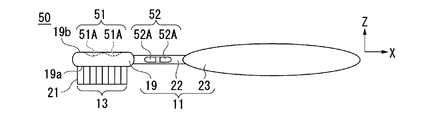
- FIG. 5 is a side view of a toothbrush according to the third embodiment of the present invention. 5, the same components as those of the toothbrush 10 of the first embodiment shown in FIGS. 1 and 2 are denoted by the same reference numerals.
- FIG. 6 is a rear view of the toothbrush according to the third embodiment of the present invention. In FIG. 6, the same components as those of the structure shown in FIG.
- a toothbrush 50 according to the third embodiment includes a first anti-slip member 16 (concave portion 16A) and two second brushes that constitute the toothbrush 10 according to the first embodiment.
- the toothbrush 10 of the first embodiment is the same as the toothbrush 10 of the first embodiment except that the first anti-slip member 51 and the two second anti-slip portions 52 are provided instead of the anti-slip portion 17 (two recesses 17A). Configured.
- the first anti-slip member 51 is configured in the same manner as the first anti-slip member 16 except that the first anti-slip member 51 includes two concave portions 51A.
- the second anti-slip member 52 is configured in the same manner as the second anti-slip member 17 except that the second anti-slip member 52 includes two second recesses 52A.
- the first slip prevention member 51 configured by the two recesses 51A and the second slip prevention member 52 configured by the two second recesses 52A are provided.
- the toothbrush 50 can obtain the same effect as the toothbrush 10 of the first embodiment.
- the case where the first anti-slip member 51 is configured by two recesses 51 ⁇ / b> A has been described as an example, but the first anti-slip member 51 is configured by three or more recesses. May be.
- the case where the second anti-slip member 52 is configured by two second recesses 52 ⁇ / b> A has been described as an example.
- the second anti-slip member 52 includes three or more recesses. May be configured. Even when these configurations are applied, the same effects as those of the toothbrush 10 of the first embodiment can be obtained.
- the first anti-slip portion 51 shown in FIGS. 5 and 6 and the second anti-slip portions 17 and 31 may be combined.
- the second anti-slip portion 52 shown in FIGS. 5 and 6 and the first anti-slip portion 16 (concave portion 16A) shown in FIGS. 1 to 4 are combined. May be. Even when these configurations are applied, the same effects as those of the toothbrush 10 of the first embodiment can be obtained.
- FIG. 7 is a side view of a toothbrush according to the fourth embodiment of the present invention.
- the same components as those of the toothbrush 10 of the first embodiment shown in FIGS. 1 and 2 are denoted by the same reference numerals.
- FIG. 8 is a rear view of the toothbrush according to the fourth embodiment of the present invention. In FIG. 8, the same components as those in the structure shown in FIG.
- the toothbrush 60 of the fourth embodiment includes a first anti-slip portion 16 and two second anti-slip members constituting the toothbrush 10 of the first embodiment. 17 except that it has a first anti-slip portion 61 and two second anti-slip members 62 (two second anti-slip members 62 arranged in a direction crossing the X direction). Is configured similarly to the toothbrush 10 of the first embodiment.
- the first anti-slip portion 61 includes a concave portion 16A disposed on the other surface 19b side of the head portion 19 made of a hard resin, and a first soft resin layer 64.
- the first soft resin layer 64 is disposed so as to cover the recess 16A with a thickness not embedding the recess 16A.
- the surface of the soft resin layer 64 is configured to be flush with the surface of the other surface 19b of the head portion 19, or the soft resin layer 64 is lower than the surface of the other surface 19b of the head portion 19.
- the thickness of the second soft resin layer 64 is preferably 0.5 mm or greater and 1.0 mm or less.
- the resin constituting the first soft resin layer 64 for example, a soft resin softer than the resin (hard resin) constituting the head portion 19 can be used.
- a soft resin constituting the first soft resin layer 64 for example, a resin having a hardness of JIS K 6253 Shore A of 90 or less can be used.
- a soft resin for example, an elastomer or a silicone resin can be used.
- the concave portion 16A disposed on the other surface 19b side of the head portion 19 made of hard resin and the thickness not embedding the concave portion 16A are disposed so as to cover the concave portion 16A, and the head portion 19 is configured.
- the first soft resin layer 64 made of a soft resin softer than the hard resin, and the first anti-slip portion 61 made up of an index finger when an adult finishes brushing an infant's teeth Since the tip of the index finger becomes difficult to slip due to friction between the tip and the first soft resin layer 64, the brush portion 13 (hair bundle 21) may be finely applied to the infant's teeth to be finished and polished. it can.
- the index finger is less likely to hurt as compared with the case where the first anti-slip portion 16 (see FIGS. 1 and 2) is configured only by the recess 16A. The effect that can be obtained.
- the pair of second anti-slip portions 62 includes a pair of recesses 17 ⁇ / b> A disposed in the neck portion 22 made of a hard resin, and a second soft resin layer 65.
- the second soft resin layer 65 has a thickness that does not embed the concave portion 17A and is disposed so as to cover the concave portion 17A.
- the surface of the soft resin layer 65 is configured to be flush with the surface of the neck portion 22, or the soft resin layer 65 is configured to be lower than the surface of the neck portion 22.
- the thickness of the second soft resin layer 65 is preferably 0.5 mm or more and 1.0 mm or less.
- the resin constituting the second soft resin layer 65 for example, a soft resin softer than the hard resin constituting the neck portion 22 can be used.
- a soft resin constituting the second soft resin layer 65 for example, a resin having a hardness of A90 or less can be used.
- an elastomer or a silicone resin can be used.
- the second soft resin layer 65 made of softer softer resin and the second anti-slip part 62 made of soft resin when the adult finishes brushing the infant's tooth, Since the thumb and the middle finger are less likely to slip due to friction between the soft resin layer 65 and the second soft resin layer 65, the brush portion 13 (hair bundle 21) can be finely applied to the teeth of the infant to be finished and polished.
- the second soft resin layer 65 functions as a cushioning material, the thumb and the middle finger hurt compared to the case where the second anti-slip portion 17 (see FIGS. 1 and 2) is configured only by the concave portion 17A. The effect that it is hard to become can be acquired.
- the toothbrush 60 of the fourth embodiment configured as described above can obtain the same effects as the toothbrush 10 of the first embodiment.
- the 1st slip prevention part 61 shown in FIG.7 and FIG.8, the 2nd slip prevention part 17 (recessed part 17A) shown in FIG.1 and FIG.2, and the 2nd slip prevention part shown in FIG.3 and FIG.4 31 (concave portion 31A) and at least one of the second anti-slip portions 52 (plural recessed portions 52A) shown in FIGS. 5 and 6 may be combined.
- the second anti-slip portion 62 shown in FIGS. 7 and 8, the first anti-slip portion 16 (recess 16A) shown in FIGS. 1 to 4, and the first anti-slip portion shown in FIGS. At least one of 51 (the plurality of recesses 51A) may be combined.
- FIG. 9 is a side view of a toothbrush according to a fifth embodiment of the present invention.
- the same components as those of the toothbrush 10 of the first embodiment shown in FIGS. 1 and 2 are denoted by the same reference numerals.
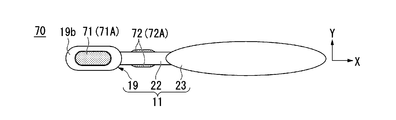
- FIG. 10 is a rear view of the toothbrush according to the fifth embodiment of the present invention. In FIG. 10, the same components as those of the structure shown in FIG.
- the toothbrush 70 according to the fifth embodiment includes a first anti-slip portion 16 and two second anti-slip members constituting the toothbrush 10 according to the first embodiment. It replaces with 17 and is comprised similarly to the toothbrush 10 of 1st Embodiment except having the 1st slip prevention part 71 and the 2nd 2 slip prevention member 72.
- FIG. 1st slip prevention part 71 and the 2nd 2 slip prevention member 72 FIG.
- the first anti-slip portion 71 is a convex portion 71 ⁇ / b> A disposed on the other surface 19 b side of the head portion 19.
- the convex portion 71A protrudes from the other surface 19b of the head portion 19.
- a resin constituting the convex portion 71A for example, a soft resin having a hardness of A90 or less can be used.
- a soft resin for example, an elastomer or a silicone resin can be used.
- Other surface 19b height H 1 of the convex portions 71A in the Z direction when the reference for head portion 19, for example, 1.5 mm or more 0.3mm is preferable.
- the height of the convex portion 71A means the maximum value of the length from the surface of the other surface 19b of the head portion 19 to the surface of the convex portion 71A.
- the pair of (two) second anti-slip members 72 are configured by two convex portions 72A provided on the side surfaces of the neck portion 22 so as to face each other via the neck portion 22 in the Y direction.
- a resin constituting the convex portion 72A for example, a soft resin having a hardness of A90 or less can be used.
- a soft resin for example, an elastomer or a silicone resin can be used.
- the height of the convex portion 72A in the Y direction with respect to the neck portion 22 is preferably, for example, 0.5 mm or more and 1.0 mm or less.
- the height of the convex portion 72A means the maximum value of the length from the surface of the neck portion 22 to the surface of the convex portion 72A.
- the toothbrush 70 of the fifth embodiment configured as described above can obtain the same effects as the toothbrush 60 of the fourth embodiment.
- the height of the convex portion 72A in the Y direction with respect to the handle portion 23 is preferably, for example, not less than 0.5 mm and not more than 1.0 mm.
- the height of the convex portion 72A means the maximum value of the length from the surface of the handle portion 23 to the surface of the convex portion 72A.
- first anti-slip portion 71 shown in FIGS. 9 and 10 the second anti-slip portion 17 (concave portion 17A) shown in FIGS. 1 and 2, and the second anti-slip portion shown in FIGS. 31 (concave portion 31A), the second anti-slip portion 52 (plurality of concave portions 52A) shown in FIGS. 5 and 6, and the second anti-slip portion 62 (concave portion 17A and second soft resin shown in FIGS. 7 and 8) And at least one of the structures made of the layer 65 may be combined. Further, the second anti-slip portion 72 shown in FIGS. 9 and 10, the first anti-slip portion 16 (recess 16A) shown in FIGS.
- first anti-slip portion shown in FIGS. 51 plural recesses 51A
- first anti-slip portions 61 structures including the recesses 16A and the first soft resin layer 64
- FIG. 11 is a side view of a toothbrush according to a sixth embodiment of the present invention.
- FIG. 12 is a rear view of the toothbrush according to the sixth embodiment of the present invention.
- FIG. 12 the same components as those in the structure shown in FIG.
- a toothbrush 100 according to the sixth embodiment is replaced with a first anti-slip part 16 instead of the first anti-slip part 16 constituting the toothbrush 10 according to the first embodiment. Except having 101, it is comprised similarly to the toothbrush 10.
- FIG. 1 a toothbrush 100 according to the sixth embodiment is replaced with a first anti-slip part 16 instead of the first anti-slip part 16 constituting the toothbrush 10 according to the first embodiment. Except having 101, it is comprised similarly to the toothbrush 10.
- the first anti-slip portion 101 is a convex portion 101 ⁇ / b> A provided on the other surface 19 b located on the distal end side of the head portion 19.
- the convex portion 101A protrudes above the other surface 19b (in the Z direction).
- the convex portion 101A is arranged so as to extend in the Y direction in a curved state.
- the convex portion 101A is made of a soft resin.
- the soft resin constituting the convex portion 101A the same soft resin as that constituting the convex portion 71A (see FIGS. 9 and 10) described in the fifth embodiment can be used.
- the tip of the index finger (in other words, the tip of the tip of the index finger) is arranged on the convex portion 101A when an adult finishes brushing an infant's teeth.
- the shape of the tip of the convex portion 101A may be a round shape (rounded shape) when viewed from the Y direction.
- Height H 2 of the convex portion 101A for example, preferably 0.3mm or more 1.5mm or less.
- the height H 2 of the convex portion 101A, of the length to the surface of the convex portion 101A from the surface of the other surface 19b of the head portion 19 means the maximum value.
- the convex portion 101A is arranged as the first anti-slip portion 101 on the other surface 19b located on the distal end side of the head portion 19, so that adults can brush their teeth. When finishing, it can suppress that the tip of an index finger shifts.
- the convex portion 101A on the distal end side of the head portion 19, it is possible to precisely finish the front teeth, particularly among the infant teeth.
- the toothbrush 100 configured as described above can obtain the same effects as those of the toothbrush 10 of the first embodiment.
- the case where the first anti-slip portion 101 is configured by one convex portion 101A has been described as an example, but a plurality of other surfaces 19b positioned on the tip side of the head portion 19 are provided on the other surface 19b.
- the first anti-slip portion 101 may be configured by the plurality of convex portions 101A. In this case, the same effect as that of the toothbrush 100 of the sixth embodiment can be obtained.
- the shape of the convex portion 101A is not limited to this.
- the shape of the convex portion 101A may be a straight line parallel to the Y direction as viewed from the Z direction, or may be a sine wave shape extending in the Y direction.
- the first anti-slip portion 101 may be composed of, for example, a plurality of dot-shaped convex portions arranged in the Y direction (that is, the shape of the convex portion 101A may be a dot shape).
- skid part 101 has preferable 0.5 mm or more and 1.5 mm or less.
- the structure composed of the layer 65) and at least one of the second anti-slip portions 72 (projections 72A) shown in FIGS. 9 and 10 may be combined. Further, the second anti-slip portion 17 shown in FIGS.
- the first anti-slip portion 51 (plural recesses 51A) shown in FIGS. 5 and 6, and the first anti-slip portion shown in FIGS.
- a combination of the prevention unit 61 (a structure made up of the recess 16A and the first soft resin layer 64) and at least one of the first slip prevention unit 71 (projection 71A) shown in FIGS. Good.
- a toothbrush (not shown) according to a modification of the sixth embodiment is similar to the configuration of the toothbrush 100 of the sixth embodiment, and further has a configuration similar to that of the first anti-slip portion 101. Except for having the first anti-slip portion, the toothbrush 100 is configured in the same manner.
- the other first anti-slip portion is provided on the other surface 19b located on the rear end side of the head portion 19, and protrudes above (Z direction) the other surface 19b.
- the other first antislip portion is made of a soft resin.
- the soft resin constituting the other first anti-slip portion the same soft resin as that constituting the convex portion 71A (see FIGS. 9 and 10) described in the fifth embodiment can be used. .
- the other first anti-slip part is a part where the tip of the index finger contacts when an adult finishes polishing the back teeth of the infant.
- the shape of the tip of the other first anti-slip portion may be a round shape (rounded shape).
- the tip of the other first anti-slip part is inside the infant's cheek. It is possible to suppress the inside of the infant's cheek from being damaged when touched.
- the height of the other first anti-slip part is preferably 0.3 mm or more and 1.5 mm or less, for example.
- the height of the other first anti-slip part means the maximum value of the length from the surface of the other surface 19b of the head part 19 to the surface of the other first anti-slip part.
- a plurality of first convex portions 101A are arranged on the other surface 19b located on the rear end side of the head portion 19, and the first convex portions 101A serve as a first slip prevention portion. May be configured. Also in this case, the same effect as that of the toothbrush according to the modification of the sixth embodiment can be obtained.
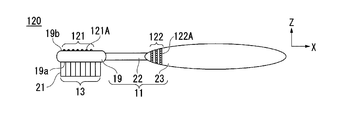
- FIG. 13 is a side view of a toothbrush according to a seventh embodiment of the present invention.
- the same components as those of the toothbrush 10 of the first embodiment shown in FIGS. 1 and 2 are denoted by the same reference numerals.
- FIG. 14 is a rear view of the toothbrush according to the seventh embodiment of the present invention. In FIG. 14, the same components as those of the structure shown in FIG.
- the toothbrush 120 of the seventh embodiment includes a first anti-slip part 16 and two second anti-slip parts constituting the toothbrush 10 of the first embodiment. It replaces with 17 and is comprised similarly to the toothbrush 10 except having the 1st slip prevention part 121 and the 2nd 2 slip prevention part 122.
- FIG. 13 the toothbrush 120 of the seventh embodiment includes a first anti-slip part 16 and two second anti-slip parts constituting the toothbrush 10 of the first embodiment. It replaces with 17 and is comprised similarly to the toothbrush 10 except having the 1st slip prevention part 121 and the 2nd 2 slip prevention part 122.
- the first anti-slip part 121 includes a plurality of convex parts 121 ⁇ / b> A arranged on the other surface 19 b of the head part 19.
- the first convex portion 121A protrudes above the other surface 19b (in the Z direction) in FIG.
- the height of the convex portion 121A with respect to the other surface 19b of the head portion 19 is preferably, for example, 0.3 mm or more and 1.5 mm or less.
- the height of the first convex portion 121A means the maximum value of the length from the surface of the other surface 19b of the head portion 19 to the surface of the first convex portion 121A.
- the convex portion 121A is arranged so as to extend in the Y direction in a curved state.
- the shape of the tip of the convex portion 121A can be, for example, a round shape (rounded shape).
- the plurality of convex portions 121A are arranged at predetermined intervals in the X direction. Specifically, an interval of 0.5 mm or more and 1.5 mm or less is preferable.
- the convex portion 121A is made of a soft resin.
- the soft resin constituting the convex portion 121A the same soft resin as that constituting the convex portion 71A (see FIGS. 9 and 10) described in the fifth embodiment can be used.
- the two second anti-slip portions 122 are arranged so as to sandwich the shoulder portions on both side surfaces of the shoulder portion of the handle portion 23.
- the second anti-slip part 122 includes a plurality of convex parts 122 ⁇ / b> A arranged on the side surface of the shoulder part of the handle part 23.
- the plurality of convex portions 122 ⁇ / b> A are arranged at predetermined intervals along the extending direction of the shoulder portion of the handle portion 23. Specifically, an interval of 0.5 mm or more and 1.5 mm or less is preferable.
- the convex portion 122A protrudes from the side surface of the shoulder portion of the handle portion 23.
- the height of the convex portion 122A when the side surface of the shoulder portion of the handle portion 23 is used as a reference can be set to the same value as the height of the convex portion 121A, for example.
- the height of the convex portion 121A means the maximum value of the length from the surface of the other surface 19b of the head portion 19 to the surface of the convex portion 121A.
- the soft resin constituting the convex portion 122A the same soft resin as that constituting the convex portion 72A (see FIGS. 9 and 10) described in the fifth embodiment can be used.
- the structure composed of the layer 65) and at least one of the second anti-slip portions 72 (projections 72A) shown in FIGS. 9 and 10 may be combined.
- the first anti-slip portion 16 shown in FIGS. 1 to 4, and the first anti-slip portion shown in FIGS. 51 (a plurality of recesses 51A), the first slip prevention part 61 (structure comprising the recess 16A and the first soft resin layer 64) shown in FIGS. 7 and 8, and the first slip shown in FIGS.
- FIG. 15 is a side view of a toothbrush according to an eighth embodiment of the present invention.
- the same components as those of the toothbrush 30 of the second embodiment shown in FIGS. 3 and 4 are denoted by the same reference numerals.
- FIG. 16 is a rear view of the toothbrush according to the eighth embodiment of the present invention. In FIG. 16, the same components as those in the structure shown in FIG.
- the toothbrush 140 of the eighth embodiment is a toothbrush except that it has a handle body 141 instead of the handle body 11 constituting the toothbrush 30 of the second embodiment.
- the configuration is the same as that of No. 30.
- the handle body 141 does not have the neck portion 22 shown in FIGS. 3 and 4, and the handle portion 23 is provided with the head portion 19 and two second anti-slip portions 31 (recessed portions 31A) on the shoulder portion. And having. An end portion of the handle portion 23 on the side where the second anti-slip portion 31 (recessed portion 31 ⁇ / b> A) is provided is connected to the head portion 19.
- the toothbrush 140 of the eighth embodiment having such a configuration can obtain the same effects as the toothbrush 30 of the third embodiment described above. That is, the present invention can be applied and the effects of the present invention can be obtained both in the case where the neck portion 22 is provided and in the case where the neck portion 22 is not provided.
- the first slip prevention part 51 (plurality of recesses 51 ⁇ / b> A) shown in FIGS. 5 and 6, the first slip shown in FIGS. 7 and 8.
- the prevention part 61 structure consisting of the concave part 16A and the first soft resin layer 64
- the first anti-slip part 71 (convex part 71A) shown in FIGS. 9 and 10
- the first part shown in FIGS. You may apply at least 1 of the slip prevention part 101 (convex part 101A) and the 1st slip prevention part 121 (plural convex part 121A) shown in FIG.13 and FIG.14.
- the 2nd slip prevention part 52 (plural recessed part 52A) shown in FIG.5 and FIG.6, 2nd shown in FIG.7 and FIG.8.
- Anti-slip portion 62 structure comprising the concave portion 17A and the second soft resin layer 65
- the second anti-slip portion 72 (convex portion 72A) shown in FIGS. 9 and 10
- At least one of the anti-slip portions 122 may be applied.
- FIG. 17 is a side view of a toothbrush according to a ninth embodiment of the present invention.
- the same components as those of the toothbrush 140 of the eighth embodiment shown in FIGS. 15 and 16 are denoted by the same reference numerals.
- FIG. 18 is a rear view of the toothbrush according to the ninth embodiment of the present invention. In FIG. 18, the same components as those in the structure shown in FIG.
- the toothbrush 150 according to the ninth embodiment includes one of the two second anti-slip portions 31 constituting the toothbrush 140 according to the eighth embodiment as a component. Except for the above, the configuration is the same as that of the toothbrush 140.
- the toothbrush 150 of the ninth embodiment configured as described above is arranged by placing one of the fingers holding the handle portion 23 on one second anti-slip portion 31, thereby Since it becomes possible to suppress that one slip
- FIG. 18 as an example, the case where one second anti-slip portion 31 is arranged on the lower side of the paper is described as an example. However, in FIG. 18, only one second anti-slip part 31 is provided on the upper side of the paper. The anti-slip portion 31 may be arranged. In this case, the same effect as the toothbrush 150 shown in FIGS. 17 and 18 can be obtained.
- two second anti-slip portions 72 shown in FIGS. 9 and 10 may be arranged on the handle portion 23. In this case, the same effect as that of the toothbrush 70 of the fifth embodiment can be obtained.
- first anti-slip portions 16, 51, 61, 71, 101, 121 described in the first to ninth embodiments may be freely combined as necessary.
- second anti-slip portions 17, 31, 52, 62, 72, 122 described in the first to ninth embodiments may be freely combined as necessary.
- the combination of the first anti-slip parts 16, 51, 61, 71, 101, 121 and the second anti-slip parts 17, 31, 52, 62, 72, 122 may be freely combined.
- the arrangement positions of the second anti-slip portions 17, 31, 52, 62, 72, 122 described in the first to ninth embodiments are not limited to the arrangement positions shown in FIGS. .
- the second anti-slip portions 17, 31, 52, 62, 72, 122 can be arranged at optimum positions as necessary.
- first anti-slip portions 16, 51, 61, 71, 101, 121 and the second anti-slip portions 17, 31, 52, 62, 72, 122 described in the first to ninth embodiments are used. May be arranged in the X direction. Further, the first anti-slip portions 16, 51, 61, 71, 101, 121 described in the first to ninth embodiments are arranged on at least one of the head portion 19 and the neck portion 22. That's fine. The second anti-slip portions 17, 31, 52, 62, 72, 122 described in the first to ninth embodiments may be disposed on at least one of the handle portion 23 and the neck portion 22. .
- the present invention is applicable to toothbrushes used by infants and adults who finish brushing their infants' teeth.
Landscapes
- Brushes (AREA)
Abstract
Description
本願は、2014年5月21日に日本に出願された特願2014-104915号に基づき優先権を主張し、その内容をここに援用する。
このように、ヘッド部の他面に指を押し当て、歯を磨くことの可能な歯ブラシとして、特許文献1に開示された歯ブラシ、及び特許文献2に開示された携帯用歯ブラシがある。
特許文献2には、歯磨き用のブラシ体と、前記ブラシ体を植設した基板と、前記基板の上方に設けられた2片の保持片と、を備えた簡易型の歯ブラシであって、保持片を相対向状に形成して、保持片間に挿入した指に歯ブラシを装着可能に構成した携帯用歯ブラシ(以下、単に「歯ブラシ」という)が開示されている。
また、乳幼児は、手の動作が未発達なため、特許文献1、2に開示された歯ブラシを使用することは困難である。
図1は、本発明の第1の実施の形態に係る歯ブラシの側面図である。図1において、X方向は、ハンドル体11の延在方向(第1の方向)を示しており、Z方向は、ブラシ部13を構成する毛束21の高さ方向を示している。
図2は、本発明の第1の実施の形態に係る歯ブラシの背面図である。図2において、図1に示す構造体と同一構成部分には、同一符号を付す。
また、図2に示すY方向は、X方向、及び図1に示すZ方向と直交する方向(第2の方向)を示している。
ヘッド部19は、X方向に延在している。言い換えれば、ヘッド部19の形状は、Y方向の幅よりもX方向の幅の方が幅広とされた形状とされている。具体的には、ヘッド部19のX方向の幅は13mm以上22mm以下が好ましい。また、ヘッド部19のY方向の幅は、8mm以上11mm以下が好ましい。
ヘッド部19は、一面19a(前面)と、前記一面19aの反対側に配置された他面19b(背面)と、を有する。ヘッド部19の一面19a側には、ブラシ部13を構成する複数の毛束21を植設するための複数の植設穴(図示せず)が設けられている。
ネック部22のX方向の長さは33mm以上54mm以下が好ましい。また、ネック部22のY方向の幅は、4.0mm以上5.0mm以下が好ましい。
ハンドル部23は、乳幼児が自分の歯を磨く際に手で握る部分である。ハンドル部23は、X方向に延在している。Y方向におけるハンドル部23の幅は、Y方向におけるネック部22の幅よりも広くなるように構成されている。具体的には、ハンドル部23のX方向の長さは85mm以上100mm以下が好ましい。また、ハンドル部23のY方向の幅は、11mm以上16mm以下が好ましい。ここで、ハンドル部23のY方向の幅とは、ハンドル部23のY方向の長さの最大値を意味する。
上記構成、すなわち、ヘッド部19とネック部22とハンドル部23とを有するハンドル体11は、一体成型により製造される部材である。ハンドル体11を構成する樹脂としては、例えば、ポリプロピレン、ポリエチレン、ポリエチレンテレフタレート、ポリブチレンテレフタレート、ポリアセタール、ABS樹脂、PCT樹脂のような飽和ポリエステル系樹脂等の合成樹脂材料を用いることができる。
前記用毛の材料としては、例えば、ポリアミド(具体的には、6-12ナイロン、6-10ナイロン等)、ポリエステル(具体的には、ポリエチレンテレフタレート、ポリブチレンテレフタレート、ポリトリメチレンテレフタレート等)、ポリオレフィン(具体的には、ポリプロピレン)、エラストマー(具体的には、オレフィン系、スチレン系等)等の合成樹脂材料を用いることができるが、これらに限定されない。
用毛の毛丈は、例えば、6mm以上9mm以下とすることが好ましい。ここで、用毛の毛丈とは、ヘッド部の一面19aから用毛の毛先までの長さを意味する。また、選択された用毛の直径が小さい場合には、口腔内の使用性や使用感の点から用毛の毛丈を短くすることが好ましい。また、使用感や、刷掃感、清掃効果、及び耐久性等考慮して、太さの異なる複数本の用毛を任意に組み合わせて用いてもよい。
ヘッド部19の他面19bを基準としたときの凹部16Aの深さD1は、例えば、0.5mm以上2.0mm以下が好ましい。
一対(2つ)の第2の滑り防止部17は、ネック部22のY方向の幅が狭くなるように構成することで設けられた2つの凹部17Aである。
このように、ネック部22にY方向の両端において対向配置された2つの第2の滑り防止部17を設けることで、凹部16Aに配置された人差し指でヘッド部19をしっかりと押圧することができる。
なお、X方向における凹部16Aと凹部17Aとの距離Aが0mmの場合とは、例えば、X方向における凹部16Aの一方の端をヘッド部19とネック部22との境界まで延在させると共に、X方向における凹部16Aの一方の端をヘッド部19とネック部22との境界まで延在させた場合のことをいう。
この場合、凹部16A、17Aは、Y方向において、その一部が重なるように配置させてもよい。
図3は、本発明の第2の実施の形態に係る歯ブラシの側面図である。図3において、図1及び図2に示す第1の実施の形態の歯ブラシ10と同一構成部分には、同一符号を付す。
図4は、本発明の第2の実施の形態に係る歯ブラシの背面図である。図4において、図3に示す構造体と同一構成部分には、同一符号を付す。
また、図4に示す距離Bは、X方向における凹部16Aの長さと、X方向における凹部31Aの長さと、X方向における凹部16Aと凹部17Aとの間隔と、を合計した値である。
大人が乳幼児の歯磨きの仕上げをする際、2つの凹部31Aのうち、一方の凹部31Aに大人の親指を接触させ、他方の凹部31Aに大人の中指を接触させて、親指と中指とで(2本の指で)ハンドル部23を保持する。
このように、ネック部22に配置された2つの第2の滑り防止部17(2つの凹部17A)と、ハンドル部32に配置された2つの第2の滑り防止部31(2つの凹部31A)と、を有することで、大人が乳幼児の歯磨きの仕上げをする際、大人は、自分がハンドル体11を保持しやすい方の一対の第2の凹部(具体的には、一対(2つ)の凹部17Aまたは一対(2つ)の凹部31A)を選択することが可能となるので、目的とする乳幼児の歯の仕上げ磨きを精度良く行うことができる。
図5は、本発明の第3の実施の形態に係る歯ブラシの側面図である。図5において、図1及び図2に示す第1の実施の形態の歯ブラシ10と同一構成部分には、同一符号を付す。
図6は、本発明の第3の実施の形態に係る歯ブラシの背面図である。図6において、図5に示す構造体と同一構成部分には、同一符号を付す。
第2の滑り防止部材52は、2つの第2の凹部52Aで構成されていること以外は、第2の滑り防止部材17と同様に構成されている。
また、図5及び図6では、第2の滑り防止部材52を2つの第2の凹部52Aで構成した場合を例に挙げて説明したが、3つ以上の凹部で第2の滑り防止部材52を構成してもよい。これらの構成を適用した場合においても、第1の実施の形態の歯ブラシ10と同様な効果を得ることができる。
或いは、第3の実施の形態の歯ブラシ50において、図5及び図6に示す第2の滑り防止部52と、図1~図4に示す第1の滑り防止部16(凹部16A)とを組み合わせてもよい。
これらの構成を適用した場合においても、第1の実施の形態の歯ブラシ10と同様な効果を得ることができる。
図7は、本発明の第4の実施の形態に係る歯ブラシの側面図である。図7において、図1及び図2に示す第1の実施の形態の歯ブラシ10と同一構成部分には、同一符号を付す。
図8は、本発明の第4の実施の形態に係る歯ブラシの背面図である。図8において、図7に示す構造体と同一構成部分には、同一符号を付す。
第1の軟質樹脂層64は、凹部16Aを埋め込まない厚さで、凹部16Aを覆うように配置されている。言い換えると、軟質樹脂層64の表面がヘッド部19の他面19bの表面と面一に構成されるか、又は、軟質樹脂層64がヘッド部19の他面19bの表面よりも低くなるように構成されるように配置されている。具体的には、第2の軟質樹脂層64の厚さは、0.5mm以上1.0mm以下の厚さが好ましい。
第2の軟質樹脂層65は、凹部17Aを埋め込まない厚さで、凹部17Aを覆うように配置されている。言い換えると、軟質樹脂層65の表面がネック部22の表面と面一に構成されるか、又は、軟質樹脂層65がネック部22の表面よりも低くなるように構成されるように配置されている。具体的には、第2の軟質樹脂層65の厚さは、0.5mm以上1.0mm以下の厚さが好ましい。
なお、図7及び図8に示す第2の軟質樹脂層65は、図3及び図4に示す凹部31Aに配置させてもよい。
さらに、図7及び図8に示す第2の滑り防止部62と、図1~図4に示す第1の滑り防止部16(凹部16A)、図5及び図6に示す第1の滑り防止部51(複数の凹部51A)のうちの少なくとも1つと、を組み合わせてもよい。
図9は、本発明の第5の実施の形態に係る歯ブラシの側面図である。図9において、図1及び図2に示す第1の実施の形態の歯ブラシ10と同一構成部分には、同一符号を付す。
図10は、本発明の第5の実施の形態に係る歯ブラシの背面図である。図10において、図9に示す構造体と同一構成部分には、同一符号を付す。
ヘッド部19の他面19bを基準としたときのZ方向における凸部71Aの高さH1は、例えば、0.3mm以上1.5mmが好ましい。ここで、凸部71Aの高さとは、ヘッド部19の他面19bの表面から凸部71Aの表面までの長さのうち、最大値を意味する。
ネック部22を基準としたときのY方向における凸部72Aの高さは、例えば0.5mm以上1.0mm以下が好ましい。ここで、凸部72Aの高さとは、ネック部22の表面から凸部72Aの表面までの長さのうち、最大値を意味する。
なお、図9及び図10に示す凸部72Aは、ハンドル部23の肩部に配置してもよい(図示なし)。その際、ハンドル部23を基準としたときのY方向における凸部72Aの高さは、例えば0.5mm以上1.0mm以下が好ましい。ここで、凸部72Aの高さとは、ハンドル部23の表面から凸部72Aの表面までの長さのうち、最大値を意味する。
さらに、図9及び図10に示す第2の滑り防止部72と、図1~図4に示す第1の滑り防止部16(凹部16A)、図5及び図6に示す第1の滑り防止部51(複数の凹部51A)、図7及び図8に示す第1の滑り防止部61(凹部16A及び第1の軟質樹脂層64よりなる構造体)のうちの少なくとも1つと、を組み合わせてもよい。
図11は、本発明の第6の実施の形態に係る歯ブラシの側面図である。図11において、図1及び図2に示す第1の実施の形態の歯ブラシ10と同一構成部分には、同一符号を付す。
図12は、本発明の第6の実施の形態に係る歯ブラシの背面図である。図12において、図11に示す構造体と同一構成部分には、同一符号を付す。
凸部101Aは、軟質樹脂で構成されている。凸部101Aを構成する軟質樹脂としては、第5の実施の形態で説明した凸部71A(図9及び図10参照)を構成する軟質樹脂と同様なものを用いることができる。
凸部101Aの先端の形状は、Y方向から見てラウンド形状(丸みを帯びた形状)にするとよい。このように、凸部101Aの先端の形状をラウンド形状とすることで、乳幼児が自分の歯を磨く場合において、凸部101Aの先端が乳幼児の頬の内側に接触した際、乳幼児の頬の内側が傷付くことを抑制できる。
凸部101Aの高さH2は、例えば、0.3mm以上1.5mm以下が好ましい。ここで、凸部101Aの高さH2とは、ヘッド部19の他面19bの表面から凸部101Aの表面までの長さのうち、最大値を意味する。
また、ヘッド部19の先端側に凸部101Aを配置することで、乳幼児の歯のうち、特に、前歯の仕上げ磨きを精度良く行うことができる。
なお、上記構成とされた歯ブラシ100は、第1の実施の形態の歯ブラシ10と同様な効果を得ることができる。
例えば、凸部101Aの形状は、Z方向から見てY方向に対して平行な直線状にしてもよいし、Y方向に延在する正弦波状の形状にしてもよい。また、第1の滑り防止部101は、例えば、Y方向に配置されたドット状の複数の凸部で構成してもよい(つまり、凸部101Aの形状をドット形状にしてもよい。)。尚、滑り防止部101がY方向に配置されたドット状の複数の凸部で構成された場合、前記滑り防止部101のX方向に対する太さは0.5mm以上1.5mm以下が好ましい。
さらに、図11及び図12に示す第2の滑り防止部17と、図5及び図6に示す第1の滑り防止部51(複数の凹部51A)、図7及び図8に示す第1の滑り防止部61(凹部16A及び第1の軟質樹脂層64よりなる構造体)、図9及び図10に示す第1の滑り防止部71(凸部71A)のうちの少なくとも1つと、を組み合わせてもよい。
第6の実施の形態の変形例に係る歯ブラシ(図示せず)は、第6の実施の形態の歯ブラシ100の構成に、さらに、第1の滑り防止部101と同様な構成とされた他の第1の滑り防止部を有すること以外は、歯ブラシ100と同様に構成される。
このように、他の第1の滑り防止部の先端の形状をラウンド形状とすることで、乳幼児が自分の歯を磨く場合において、他の第1の滑り防止部の先端が乳幼児の頬の内側に接触した際、乳幼児の頬の内側が傷付くことを抑制できる。
他の第1の滑り防止部の高さは、例えば、0.3mm以上1.5mm以下が好ましい。ここで、他の第1の滑り防止部の高さとは、ヘッド部19の他面19bの表面から他の第1の滑り防止部の表面までの長さのうち、最大値を意味する。
図13は、本発明の第7の実施の形態に係る歯ブラシの側面図である。図13において、図1及び図2に示す第1の実施の形態の歯ブラシ10と同一構成部分には、同一符号を付す。
図14は、本発明の第7の実施の形態に係る歯ブラシの背面図である。図14において、図13に示す構造体と同一構成部分には、同一符号を付す。
第1の凸部121Aは、図13において、他面19bの上方(Z方向)に突出している。ヘッド部19の他面19bを基準としたときの凸部121Aの高さは、例えば、0.3mm以上1.5mm以下が好ましい。ここで、第1の凸部121Aの高さとは、ヘッド部19の他面19bの表面から第1の凸部121Aの表面までの長さのうち、最大値を意味する。
凸部121Aは、軟質樹脂で構成されている。凸部121Aを構成する軟質樹脂としては、第5の実施の形態で説明した凸部71A(図9及び図10参照)を構成する軟質樹脂と同様なものを用いることができる。
凸部122Aを構成する軟質樹脂としては、第5の実施の形態で説明した凸部72A(図9及び図10参照)を構成する軟質樹脂と同様なものを用いることができる。
さらに、図13及び図14に示す第2の滑り防止部122と、図1~図4に示す第1の滑り防止部16(凹部16A)、図5及び図6に示す第1の滑り防止部51(複数の凹部51A)、図7及び図8に示す第1の滑り防止部61(凹部16A及び第1の軟質樹脂層64よりなる構造体)、図9及び図10に示す第1の滑り防止部71(凸部71A)、図11及び図12に示す第1の滑り防止部101(凸部101A)のうちの少なくとも1つと、を組み合わせてもよい。
図15は、本発明の第8の実施の形態に係る歯ブラシの側面図である。図15において、図3及び図4に示す第2の実施の形態の歯ブラシ30と同一構成部分には、同一符号を付す。
図16は、本発明の第8の実施の形態に係る歯ブラシの背面図である。図16において、図15に示す構造体と同一構成部分には、同一符号を付す。
第2の滑り防止部31(凹部31A)が設けられた側のハンドル部23の端部は、ヘッド部19と接続されている。
図17は、本発明の第9の実施の形態に係る歯ブラシの側面図である。図17において、図15及び図16に示す第8の実施の形態の歯ブラシ140と同一構成部分には、同一符号を付す。
図18は、本発明の第9の実施の形態に係る歯ブラシの背面図である。図18において、図17に示す構造体と同一構成部分には、同一符号を付す。
また、図18では、一例として、紙面の下側に1つの第2の滑り防止部31を配置させた場合を例に挙げて説明したが、図18において、紙面の上側にのみ1つの第2の滑り防止部31を配置させてもよい。この場合、図17及び図18に示す歯ブラシ150と同様な効果を得ることができる。
また、第1ないし第9の実施の形態で説明した第2の滑り防止部17、31、52、62、72、122は、必要に応じて自由に組み合わせてもよい。
さらに、第1の滑り防止部16、51、61、71、101、121と、第2の滑り防止部17、31、52、62、72、122と、の組み合わせも自由に組み合わせてもよい。
また、第1ないし第9の実施の形態で説明した第1の滑り防止部16、51、61、71、101、121は、ヘッド部19、及びネック部22のうち、少なくとも一方に配置させればよい。
第1ないし第9の実施の形態で説明した第2の滑り防止部17、31、52、62、72、122は、ハンドル部23、及びネック部22のうち、少なくとも一方に配置させればよい。
11、141…ハンドル体
13…ブラシ部
16、51、61、71、101、121…第1の滑り防止部
16A、17A、31A、51A、52A…凹部
17、31、52、62、72、122…第2の滑り防止部
19…ヘッド部
19a…一面
19b…他面
21…毛束
22…ネック部
23…ハンドル部
64…第1の軟質樹脂層
65…第2の軟質樹脂層
71A、72A、101A、121A、122A…凸部
D1、D2…深さ
H1、H2…高さ
Claims (8)
- ヘッド部、及びハンドル部を含み、第1の方向に延在するハンドル体と、
前記ヘッド部の一面に植設されたブラシ部と、
前記ヘッド部の他面側に配置された第1の滑り防止部と、
前記ハンドル部に配置され、前記ハンドル部を保持する指が当接される第2の滑り防止部と、
を有することを特徴とする歯ブラシ。 - 前記第2の滑り防止部は、前記第1の方向に対して交差する第2の方向に2つ配置することを特徴とする請求項1記載の歯ブラシ。
- 前記第1の滑り防止部は、少なくとも1つ以上の凹部または凸部のいずれか一方を含むことを特徴とする請求項1または2記載の歯ブラシ。
- 前記第2の滑り防止部は、少なくとも1つ以上の凹部または凸部のいずれか一方を含むことを特徴とする請求項1ないし3のうち、いずれか1項記載の歯ブラシ。
- 前記ハンドル体のうち、前記第1及び第2の滑り防止部の形成領域に対応する部分の基材が硬質樹脂で構成されており、
前記第1の滑り防止部または前記第2の滑り防止部のいずれか一方は、前記基材を被覆し、かつ前記硬質樹脂よりも軟らかい軟質樹脂よりなる軟質樹脂層を含むことを特徴とする請求項4記載の歯ブラシ。 - 前記第1及び第2の滑り防止部は、前記第1の方向に複数配置することを特徴とする請求項1ないし5のうち、いずれか1項記載の歯ブラシ。
- 前記ハンドル体は、一端が前記ヘッド部と接続され、他端が前記ハンドル部と接続されたネック部を含み、
前記第1の滑り防止部は、前記ヘッド部、及び前記ネック部のうち、少なくとも一方に配置することを特徴とする請求項1ないし6のうち、いずれか1項記載の歯ブラシ。 - 前記第2の滑り防止部は、前記ハンドル部、及び前記ネック部のうち、少なくとも一方に配置することを特徴とする請求項7記載の歯ブラシ。
Priority Applications (3)
| Application Number | Priority Date | Filing Date | Title |
|---|---|---|---|
| JP2016521005A JP6607849B2 (ja) | 2014-05-21 | 2015-04-20 | 歯ブラシ |
| CN201580019984.0A CN106455800A (zh) | 2014-05-21 | 2015-04-20 | 牙刷 |
| KR1020167018613A KR102424023B1 (ko) | 2014-05-21 | 2015-04-20 | 칫솔 |
Applications Claiming Priority (2)
| Application Number | Priority Date | Filing Date | Title |
|---|---|---|---|
| JP2014104915 | 2014-05-21 | ||
| JP2014-104915 | 2014-05-21 |
Publications (1)
| Publication Number | Publication Date |
|---|---|
| WO2015178146A1 true WO2015178146A1 (ja) | 2015-11-26 |
Family
ID=54553822
Family Applications (1)
| Application Number | Title | Priority Date | Filing Date |
|---|---|---|---|
| PCT/JP2015/061999 Ceased WO2015178146A1 (ja) | 2014-05-21 | 2015-04-20 | 歯ブラシ |
Country Status (4)
| Country | Link |
|---|---|
| JP (1) | JP6607849B2 (ja) |
| KR (1) | KR102424023B1 (ja) |
| CN (1) | CN106455800A (ja) |
| WO (1) | WO2015178146A1 (ja) |
Cited By (1)
| Publication number | Priority date | Publication date | Assignee | Title |
|---|---|---|---|---|
| WO2020044417A1 (ja) * | 2018-08-28 | 2020-03-05 | 株式会社グリーンエッセンス | 子供用歯ブラシ及び子供用歯ブラシの製造方法 |
Families Citing this family (1)
| Publication number | Priority date | Publication date | Assignee | Title |
|---|---|---|---|---|
| KR102032027B1 (ko) * | 2017-10-23 | 2019-10-14 | 하지영 | 파지가 용이한 세정 칫솔 |
Citations (3)
| Publication number | Priority date | Publication date | Assignee | Title |
|---|---|---|---|---|
| JP2000125937A (ja) * | 1998-10-21 | 2000-05-09 | Lion Corp | 歯ブラシ |
| JP3130665U (ja) * | 2007-01-22 | 2007-04-05 | 株式会社歯愛メディカル | 歯ブラシ |
| JP5357622B2 (ja) * | 2009-05-08 | 2013-12-04 | 花王株式会社 | 歯ブラシ |
Family Cites Families (6)
| Publication number | Priority date | Publication date | Assignee | Title |
|---|---|---|---|---|
| NZ220681A (en) * | 1986-06-26 | 1989-12-21 | Johnson & Johnson Prod Inc | Toothbrush: handle has barrel-shaped grip portion |
| JPH0965930A (ja) | 1995-08-30 | 1997-03-11 | Max:Kk | 歯ブラシ |
| JP2000197522A (ja) | 1998-12-28 | 2000-07-18 | Sumiko Watanabe | 携帯用歯ブラシ |
| US7836539B2 (en) * | 2002-08-09 | 2010-11-23 | Colgate-Palmolive Company | Oral care implement |
| US7334286B2 (en) * | 2004-08-18 | 2008-02-26 | Loops, Llc | Toothbrush and methods of making and using same |
| CN203220069U (zh) * | 2013-02-05 | 2013-10-02 | 好来化工(中山)有限公司 | 一种牙刷 |
-
2015
- 2015-04-20 WO PCT/JP2015/061999 patent/WO2015178146A1/ja not_active Ceased
- 2015-04-20 KR KR1020167018613A patent/KR102424023B1/ko not_active Expired - Fee Related
- 2015-04-20 JP JP2016521005A patent/JP6607849B2/ja not_active Expired - Fee Related
- 2015-04-20 CN CN201580019984.0A patent/CN106455800A/zh active Pending
Patent Citations (3)
| Publication number | Priority date | Publication date | Assignee | Title |
|---|---|---|---|---|
| JP2000125937A (ja) * | 1998-10-21 | 2000-05-09 | Lion Corp | 歯ブラシ |
| JP3130665U (ja) * | 2007-01-22 | 2007-04-05 | 株式会社歯愛メディカル | 歯ブラシ |
| JP5357622B2 (ja) * | 2009-05-08 | 2013-12-04 | 花王株式会社 | 歯ブラシ |
Cited By (2)
| Publication number | Priority date | Publication date | Assignee | Title |
|---|---|---|---|---|
| WO2020044417A1 (ja) * | 2018-08-28 | 2020-03-05 | 株式会社グリーンエッセンス | 子供用歯ブラシ及び子供用歯ブラシの製造方法 |
| JPWO2020044417A1 (ja) * | 2018-08-28 | 2021-08-10 | 株式会社グリーンエッセンス | 子供用歯ブラシ及び子供用歯ブラシの製造方法 |
Also Published As
| Publication number | Publication date |
|---|---|
| KR102424023B1 (ko) | 2022-07-22 |
| JP6607849B2 (ja) | 2019-11-20 |
| KR20170012186A (ko) | 2017-02-02 |
| JPWO2015178146A1 (ja) | 2017-04-20 |
| CN106455800A (zh) | 2017-02-22 |
Similar Documents
| Publication | Publication Date | Title |
|---|---|---|
| US8631534B2 (en) | Toothbrush | |
| CN103763982B (zh) | 牙刷 | |
| JP6893541B2 (ja) | 歯ブラシ | |
| JP6364641B2 (ja) | 歯ブラシ | |
| JP5081911B2 (ja) | 歯ブラシ | |
| CN108778048A (zh) | 牙刷 | |
| JP6607849B2 (ja) | 歯ブラシ | |
| JP6970491B2 (ja) | 歯ブラシ | |
| JP5048360B2 (ja) | 歯ブラシ | |
| JP5357622B2 (ja) | 歯ブラシ | |
| TWI527536B (zh) | 牙刷 | |
| KR20200037203A (ko) | 칫솔 | |
| TWI767054B (zh) | 牙刷 | |
| JP2008188133A (ja) | 歯ブラシ | |
| WO2018088512A1 (ja) | 歯ブラシ | |
| CN113194783A (zh) | 牙刷 | |
| HK40024532A (en) | Toothbrush |
Legal Events
| Date | Code | Title | Description |
|---|---|---|---|
| 121 | Ep: the epo has been informed by wipo that ep was designated in this application |
Ref document number: 15795657 Country of ref document: EP Kind code of ref document: A1 |
|
| ENP | Entry into the national phase |
Ref document number: 20167018613 Country of ref document: KR Kind code of ref document: A |
|
| ENP | Entry into the national phase |
Ref document number: 2016521005 Country of ref document: JP Kind code of ref document: A |
|
| NENP | Non-entry into the national phase |
Ref country code: DE |
|
| 122 | Ep: pct application non-entry in european phase |
Ref document number: 15795657 Country of ref document: EP Kind code of ref document: A1 |