WO2015159948A1 - 弱酸性カチオン交換樹脂の再生方法 - Google Patents
弱酸性カチオン交換樹脂の再生方法 Download PDFInfo
- Publication number
- WO2015159948A1 WO2015159948A1 PCT/JP2015/061706 JP2015061706W WO2015159948A1 WO 2015159948 A1 WO2015159948 A1 WO 2015159948A1 JP 2015061706 W JP2015061706 W JP 2015061706W WO 2015159948 A1 WO2015159948 A1 WO 2015159948A1
- Authority
- WO
- WIPO (PCT)
- Prior art keywords
- cation exchange
- exchange resin
- water
- weakly acidic
- acidic cation
- Prior art date
- Legal status (The legal status is an assumption and is not a legal conclusion. Google has not performed a legal analysis and makes no representation as to the accuracy of the status listed.)
- Ceased
Links
Images


Classifications
-
- C—CHEMISTRY; METALLURGY
- C02—TREATMENT OF WATER, WASTE WATER, SEWAGE, OR SLUDGE
- C02F—TREATMENT OF WATER, WASTE WATER, SEWAGE, OR SLUDGE
- C02F1/00—Treatment of water, waste water, or sewage
- C02F1/42—Treatment of water, waste water, or sewage by ion-exchange
-
- C—CHEMISTRY; METALLURGY
- C02—TREATMENT OF WATER, WASTE WATER, SEWAGE, OR SLUDGE
- C02F—TREATMENT OF WATER, WASTE WATER, SEWAGE, OR SLUDGE
- C02F1/00—Treatment of water, waste water, or sewage
- C02F1/42—Treatment of water, waste water, or sewage by ion-exchange
- C02F2001/425—Treatment of water, waste water, or sewage by ion-exchange using cation exchangers
-
- C—CHEMISTRY; METALLURGY
- C02—TREATMENT OF WATER, WASTE WATER, SEWAGE, OR SLUDGE
- C02F—TREATMENT OF WATER, WASTE WATER, SEWAGE, OR SLUDGE
- C02F2303/00—Specific treatment goals
- C02F2303/16—Regeneration of sorbents, filters
Definitions
- the present invention relates to a method for regenerating a weak acid cation exchange resin, and more particularly to a method for regenerating a Na-type weak acid cation exchange resin.
- a soda lime method a Na-type strong acid cation exchange resin method, a weak acid cation exchange resin method, and the like are known as softening treatment techniques for water containing hardness components.
- soda lime method Na 2 CO 3 is added to hardness component-containing water, and then the pH is adjusted to 9.5 or higher to precipitate the hardness component as carbonated sludge (CaCO 3 or the like), and remove the precipitate.
- the hardness component is removed only by adding Na 2 CO 3 and adjusting the pH.
- the soda lime method is simple, but has problems that sludge is generated and that it is difficult to remove the hardness component to a low concentration range of about several mg / L.
- the sludge generated by the soda lime method has low strength (brittleness) and disintegrates with a small impact, so that the generated floc is strengthened with an Fe-based flocculant such as FeCl 3 .
- NaCl is used to regenerate the strong acid cation exchange resin to form Na type, and then water to be treated is passed through.
- this method there is no pH change in the water supply (treated water) and the treated water.
- the hardness component can be removed to a low concentration range.
- TC Total Cation
- water to be treated is passed through a weak acid cation exchange resin to remove hardness components. Since the softening reaction in the weakly acidic cation exchange resin proceeds only by neutralization rather than neutral salt resolution, the hardness component can be removed only when the water to be treated is alkaline water.
- Sodium chloride was used as a regenerative agent in the regeneration of strongly acidic cation exchange resins used for softening treatment.
- the weakly acidic cation exchange resin has extremely low neutral salt resolving power, and thus it has been extremely difficult to regenerate the weakly acidic cation exchange resin using sodium chloride.
- the present invention has been made in view of the above circumstances, and an object of the present invention is to provide a method for regenerating weakly acidic cation exchange resins with high efficiency of regeneration treatment.
- the method for regenerating a cation exchange resin of the present invention comprises a first regeneration treatment step in which a mineral acid is brought into contact with a Na-type weakly acidic cation exchange resin adsorbed with a hardness component, and the weak acid cation exchange after the contact with the mineral acid.
- the second regeneration treatment step is contacted with upward circulating water.
- the water flow in the second regeneration treatment step is made transient, and the water flow LV is 3 to 7 (m / h).
- the contact of the second regeneration treatment step is performed by circulating water.
- the contact in the first regeneration treatment step is performed by transient water flow.
- the hardness component is desorbed from the Na-type weakly acidic cation exchange resin by the mineral acid, and then the resin is converted to the Na-type by the sodium-containing alkali compound, so that the Na-type weakly acidic cation exchange resin is efficiently regenerated. can do.
- ⁇ Pressure loss can be alleviated by contacting the second regeneration process step with upward circulating water. Furthermore, by making this water flow transient and the water flow LV 3 to 7 (m / h), it is possible to prevent the resin layer from developing excessively and to achieve a high Na type conversion rate.
- the amount of chemical used can be reduced by contacting the second regeneration process step with circulating water.
- the contact of the first regeneration treatment step is performed by transient water flow
- the hardness component and heavy metals adsorbed on the resin are discharged out of the system, and the sodium-containing alkaline compound solution is circulated through the resin layer.
- the generation of the hardness component scale and the heavy metal scale can be suppressed.
- the water to be treated containing a hardness component such as calcium ion is adjusted to pH 7 or more by adding sodium hydroxide or the like.
- the pH of the water to be treated is preferably adjusted to 7 to 9.5, particularly 7 to 8.5.
- the softening device is provided with a reaction vessel containing Na-type weakly acidic cation exchange resin, and the hardness component in the water to be treated is adsorbed and removed by the resin.
- the Na-type weakly acidic cation exchange resin is obtained by converting a cation exchange resin having a carboxylic acid group as an exchange group (carboxylic acid cation exchange resin) into an Na type.
- Carboxylic acid cation exchange resins have a large amount of cation adsorption, and the cation adsorption amount is about twice that of a strongly acidic cation exchange resin (sulfonic acid cation exchange resin) having a sulfonic acid group as an exchange group.
- Carboxylic acid-based cation exchange resins have a very low Na selection coefficient.
- the exchange group into Na type at a high Na type conversion rate (for example, 85% or more) in advance, the selectivity coefficient between ionic species for the resin can be increased. Replacement by difference is possible, and the hardness component can be removed even under neutral or weak acidity.
- Na type weakly acidic cation exchange resin can be applied with respect to a wide variety of raw water species, and can remove a hardness component to a low concentration range.
- the Na-type weakly acidic cation exchange resin a part of the carboxylic acid group is converted to H-type as the feed water pH value decreases.
- the functional group of the weakly acidic cation exchange resin is H-type, only the neutralization reaction occurs, so that the adsorption efficiency of the hardness component is lowered. Therefore, as described above, it is preferable to adjust the water to be treated to pH 7 or more before passing water to the Na-type weakly acidic cation exchange resin.
- the flow rate SV (SV) of the water to be treated in the softening device is preferably 5 to 60 (hr ⁇ 1 ), particularly preferably 15 to 30 (hr ⁇ 1 ).
- the water flow method is not particularly limited, and may be a downward flow or an upward flow.
- the regeneration treatment of the present invention includes a first regeneration treatment step in which a mineral acid is brought into contact with the Na-type weakly acidic cation exchange resin by passing a mineral acid through the Na-type weakly acidic cation exchange resin layer, and a first regeneration treatment step.
- This is a two-stage treatment including a second regeneration treatment step in which the Na-containing alkaline compound aqueous solution is brought into contact with the resin by passing the Na-containing alkaline compound aqueous solution through the subsequent resin layer.
- the carboxylic acid cation exchange resin has a large selectivity coefficient for hydrogen ions, the hardness component is desorbed by contact with the mineral acid, and is easily regenerated into the H-type almost according to the theoretical amount. Then, in the subsequent second regeneration treatment step, the aqueous solution of the Na-containing alkali compound is passed through, whereby the carboxylic acid cation exchange resin can be efficiently converted from H-type to Na-type by the neutralization reaction.
- the mineral acid may be passed through once (through water) or in a circulating manner (circulated water). It is preferable to use excess water.
- the volume of the carboxylic acid cation exchange resin increases rapidly.
- pressure loss due to water flow increases, and damage to the resin and the members in the resin packed tower is likely to occur. Therefore, the increase in pressure loss is mitigated by passing water while allowing the water flow to flow upward while appropriately spreading the resin layer.
- the expansion rate is too large (for example, 20% or more)
- the Na-type conversion rate cannot be kept high because the regeneration is not performed uniformly.
- the water flow LV (LV: Linear Velocity, linear velocity) is adjusted to about 3 to 7 (m / h) and the development rate is less than 20%, preferably 5 to 10%. It is desirable to do.
- the second regeneration treatment step when the Na-containing alkaline compound aqueous solution is passed through for a while, unreacted Na is contained at a high concentration in the regeneration drainage (discharged Na-containing alkaline compound aqueous solution). It can be reused for the conversion of the cation exchange resin to the Na form. Therefore, in the second regeneration treatment, it is preferable to circulate the Na-containing alkaline compound aqueous solution.
- the conversion efficiency of the cation exchange resin to Na type is improved, but it is even lower than that of the normal regeneration water flow SV3 to 5 (hr ⁇ 1 ). This is not realistic because the playback time becomes excessively long.
- the hardness component and heavy metals adsorbed on the cation exchange resin are discharged out of the system. Therefore, when the Na-containing alkaline compound aqueous solution is circulated, generation of hardness component scales and heavy metal scales in the resin layer (reaction tank) can be suppressed.
- the mineral acid is passed through temporarily.
- the mineral acid is not particularly limited as long as it is a strong acid, and HCl, H 2 SO 4 , HNO 3 and the like can be used, and the mineral acid content is preferably about 1 to 10% by weight.
- the Na-containing alkali compound is not particularly limited as long as it is a strong alkali, and NaOH, Na 2 CO 3 and the like can be used.
- the Na compound content of the Na-containing alkaline compound aqueous solution is preferably 1 to 10% by weight.
- the water SV of the aqueous solution of mineral acid and Na-containing alkali compound is preferably 1 to 30 (hr ⁇ 1 ), particularly 3 to 20 (hr ⁇ 1 ).
- the method of passing the mineral acid is not particularly limited, and may be a downward flow or an upward flow, but the downward flow is preferable for the purpose of suppressing the flow of the resin.
- Na-type weakly acidic cation exchange resin in the regeneration of the Na-type weakly acidic cation exchange resin, first, a first regeneration treatment step is performed in which the hardness component is eliminated with mineral acid, and then the resin is converted to Na-type with an aqueous solution containing Na-containing alkali compound. 2
- Na-type weakly acidic cation exchange resin can be used up to a high Na-type conversion rate (for example, 85% or more) without using an excessive amount of regenerant and without requiring an excessively long regeneration time. It can be played back efficiently.
- the HCl solution used for regeneration of the Na-type weakly acidic cation exchange resin is a 5 wt% aqueous HCl solution
- the NaOH solution is a 4 wt% aqueous NaOH solution.
- the Na-type strongly acidic cation exchange resin could not take high water flow BV.
- the H-type weakly acidic cation exchange resin had a low hardness component removal rate.
- the Na-type weakly acidic cation exchange resin had a high hardness component removal rate and was able to take a high water flow BV.
- the Na-type carboxylic acid-based cation exchange resin is subjected to a first regeneration treatment at a regeneration level of 160 g / LR using an HCl solution, and then a second regeneration at a regeneration level of 180 g / LR using an NaOH solution. What was reproduced by performing the regeneration process was used.
- the relationship between the water flow BV and the calcium concentration of treated water was measured.
- the regeneration level refers to the amount of regenerant used to regenerate a unit volume of resin. The results are shown in FIG.
- Example 1 In Example 1, the same procedure was used except that the Na-type carboxylic acid cation exchange resin was regenerated by only performing regeneration at a regeneration level of 180 g / LR using an NaOH solution. The results are shown in FIG.
- Example 1 In Example 1, the same procedure was used except that the Na-type carboxylic acid-based cation exchange resin was regenerated by performing a regeneration treatment only at a regeneration level of 360 g / LR using an NaOH solution. The results are shown in FIG.
- the Na-type carboxylic acid cation exchange resin that had been subjected to the first regeneration treatment with HCl and then the second regeneration treatment with NaOH had the highest hardness component removal rate.
- resin regeneration was performed using high-concentration NaOH.
- Example 1 in which resin regeneration was performed in a two-stage process of a first regeneration process with HCl and a second regeneration process with NaOH. The removal rate of the hardness component was high, and high water flow BV could be taken.
- Reference Example 2-1 In Reference Example 2-1, the same procedure was performed except that the semiconductor factory effluent was adjusted to pH 7. In that case, it adjusted with sodium chloride so that a monovalent cation ratio might become the same conditions. The results are shown in FIG.
- Carboxylic acid-based cation exchange resin is first regenerated at a regeneration level of 160 g / LR using an HCl solution, and then secondly regenerated at a regeneration level of 180 g / LR using an NaOH solution.
- the Na-type conversion rate of the later resin was confirmed.
- the NaOH solution was passed over the water SV3 (hr ⁇ 1 ) and the water flow LV2 (m / h), and the pressure loss and the backwashing development rate were confirmed.
- the backwashing expansion rate refers to the expansion rate in the height direction during backwashing development with respect to the height of the ion exchange resin layer during non-water passage.
- Table 1 The processing conditions and results are shown in Table 1.
- Example 2-2 In Example 2-1, the same procedure was performed except that the NaOH solution in the second regeneration treatment was passed through the water SV3 (hr ⁇ 1 ) and the water LV2 (m / h) with a downward flow. The processing conditions and results are shown in Table 1.
- Example 3-1 Carboxylic acid-based cation exchange resin is first regenerated at a regeneration level of 160 g / LR using an HCl solution, and then secondly regenerated at a regeneration level of 180 g / LR using an NaOH solution. The Na-type conversion rate of the later resin was confirmed. In the second regeneration treatment, the NaOH solution was passed through the upstream flow SV5 (hr ⁇ 1 ) and the flow LV3 (m / h), and the pressure loss and the backwashing development rate were confirmed. The processing conditions and results are shown in Table 2. Table 2 also shows Example 2-1.
- Example 3-2 In Example 3-1, the same procedure was followed except that the NaOH solution in the second regeneration treatment was passed through with an upward flow of water SV8 (hr ⁇ 1 ) and water LV5 (m / h). The processing conditions and results are shown in Table 2.
- Example 3-3 In Example 3-1, the same procedure was followed except that the NaOH solution in the second regeneration treatment was passed through with an upward flow of water SV11 (hr ⁇ 1 ) and water LV7 (m / h). The processing conditions and results are shown in Table 2.
- Example 3-4 In Example 3-1, the same procedure was followed except that the NaOH solution in the second regeneration treatment was passed through with an upward flow of water SV16 (hr ⁇ 1 ) and water LV10 (m / h). The processing conditions and results are shown in Table 2.
- a high Na-type conversion rate of 90% or more was obtained by the two-stage treatment of the first regeneration treatment using the HCl solution and the second regeneration treatment using the NaOH solution. Further, in the second regeneration treatment, the NaOH solution is passed through the water LV2 to 7 (m / h), preferably 3 to 7 (m / h), so that the pressure loss is suppressed. An even higher Na-type conversion rate of 95% was obtained by adjusting the ion exchange resin layer so that it was not excessively backwashed (to 20% or more).
- Carboxylic acid-based cation exchange resin is first regenerated at a regeneration level of 160 g / LR using an HCl solution, and then secondly regenerated at a regeneration level of 150 g / LR using an NaOH solution. The Na-type conversion rate of the later resin was confirmed. The NaOH solution was circulated through the upward flow of water SV20 (hr ⁇ 1 ). The processing conditions and results are shown in Table 3.
- Example 4-2 In Example 4-1, the same procedure was carried out except that the NaOH solution in the second regeneration treatment was passed through with an upward flow of water SV8 (hr -1 ). The processing conditions and results are shown in Table 3.
- Example 4-3 In Example 4-1, the same procedure was carried out except that the NaOH solution in the second regeneration treatment was passed through with an upward flow of water SV1 (hr -1 ). The processing conditions and results are shown in Table 3.
- Example 4-4 In Example 4-1, the NaOH solution of the second regeneration process was the same except that the regeneration level was 180 g / LR, and the water flow SV1 (hr ⁇ 1 ) was passed over the water for an excess flow.
- the processing conditions and results are shown in Table 3.
- the scale precipitation derived from the hardness and the damage of the resin and the member are caused.
- a Na-type conversion rate as high as 85% or more can be obtained.
- 95% is achieved by setting the regeneration level to 180 g / LR or more and passing water LV2 to 7 (m / h), preferably 3 to 7 (m / h). An even higher Na-type conversion rate can be obtained.
- a higher Na-type conversion rate of 95% or more can be obtained without having to reduce the water flow LV.
Landscapes
- Life Sciences & Earth Sciences (AREA)
- Hydrology & Water Resources (AREA)
- Engineering & Computer Science (AREA)
- Environmental & Geological Engineering (AREA)
- Water Supply & Treatment (AREA)
- Chemical & Material Sciences (AREA)
- Organic Chemistry (AREA)
- Treatment Of Water By Ion Exchange (AREA)
Abstract
硬度成分を吸着した弱酸性カチオン交換樹脂を効率良く再生する再生方法を提供する。硬度成分を含有する被処理水の軟化処理を行ったナトリウム型の弱酸性カチオン交換樹脂を再生する方法であって、該弱酸性カチオン交換樹脂に鉱酸を接触させる第1再生処理工程と、該鉱酸との接触後、該弱酸性カチオン交換樹脂にナトリウム含有アルカリ化合物水溶液を接触させる第2再生処理工程とを有する。
Description
本発明は、弱酸性カチオン交換樹脂の再生方法に係り、特にNa型弱酸性カチオン交換樹脂の再生方法に関する。
従来、硬度成分含有水の軟化処理技術として、ソーダライム法、Na型強酸性カチオン交換樹脂法、弱酸性カチオン交換樹脂法等が知られている。
ソーダライム法では、硬度成分含有水にNa2CO3を添加した後、pHを9.5以上に調整することにより、硬度成分を炭酸スラッジ(CaCO3等)として析出させ、沈殿除去する。ソーダライム法では、Na2CO3の添加とpH調整のみで硬度成分を除去する。ソーダライム法は、簡便であるが、スラッジが発生することや、数mg/L程度の低濃度域まで硬度成分を除去することが困難であるといった問題点がある。ソーダライム法により発生するスラッジは強度が低く(脆く)、微小な衝撃で崩壊するため、FeCl3等のFe系の凝集剤により発生フロックを強固にすることが行われている。しかし、CO3
2-は凝集阻害物質であるため、Na2CO3を過剰添加した場合、凝集不良を招く。従って、ソーダライム法による処理を運用する場合、原水硬度成分濃度に対しNa2CO3及びFeCl3の添加量を的確にコントロールする必要がある。
Na型強酸性カチオン交換樹脂法では、NaClを用いて強酸性カチオン交換樹脂を再生させNa型とした後、被処理水を通水する。この方法では、給水(被処理水)と処理水のpH変化がない。この方法では、被処理水中にNaを含有していたとしても低濃度域まで硬度成分を除去することが可能である。しかし、この方法では、工場排水のような被処理水中の陽イオン(TC:Total Cation)に占める1価カチオン(特にNa)の比率が高くなると(例えば80%以上)、極端に貫流交換容量(BTC:Break Through Capacity)が低くなり、再生頻度が高くなる。
弱酸性カチオン交換樹脂法は、被処理水を弱酸性カチオン交換樹脂に通水し、硬度成分を除去する。弱酸性カチオン交換樹脂における軟化反応は、中性塩分解能ではなく中和反応のみで進行するため、被処理水がアルカリ水の場合でしか硬度成分を除去することができない。
硬度成分含有水を軟化処理するにあたり、幅広い原水種に適用でき、かつ低濃度域まで硬度成分除去が可能な軟化処理装置として、カルボン酸基を有するNa型の弱酸性カチオン交換樹脂を用いる方法が知られている。硬度成分含有水の硬度がアルカリ度より大きいときは、アルカリ(炭酸ナトリウムなど)を添加することで弱酸性陽イオン交換ユニットの操作を容易にすることが知られている(特許文献1参照)。
軟化処理に用いられる強酸性カチオン交換樹脂の再生では、再生薬剤として塩化ナトリウムが用いられていた。
しかし、上述の如く弱酸性カチオン交換樹脂は中性塩分解能が極めて低いため、塩化ナトリウムを用いて弱酸性カチオン交換樹脂を再生することは極めて困難であった。
本発明は、以上の実情に鑑みてなされたものであり、再生処理の効率の良い弱酸性カチオン交換樹脂の再生方法を提供することを目的とする。
本発明のカチオン交換樹脂の再生方法は、硬度成分を吸着したNa型の弱酸性カチオン交換樹脂に鉱酸を接触させる第1再生処理工程と、該鉱酸との接触後、該弱酸性カチオン交換樹脂にナトリウム含有アルカリ化合物水溶液を接触させる第2再生処理工程とを有する。
本発明の一態様では、前記第2再生処理工程の接触を上向流通水で行う。
本発明の一態様では、前記第2再生処理工程の通水を一過式とし、通水LVを3~7(m/h)とする。
本発明の一態様では、前記第2再生処理工程の接触を循環通水で行う。
本発明の一態様では、前記第1再生処理工程の接触を一過式通水で行う。
本発明によれば、鉱酸によりNa型弱酸性カチオン交換樹脂から硬度成分を脱離し、その後、ナトリウム含有アルカリ化合物により樹脂をNa型に変換するため、Na型弱酸性カチオン交換樹脂を効率良く再生することができる。
第2再生処理工程の接触を上向流通水で行うことで、圧力損失を緩和することができる。さらに、この通水を一過式とし、通水LVを3~7(m/h)とすることで、樹脂層が過剰に展開しないようにし、高いNa型変換率を実現できる。
第2再生処理工程の接触を循環通水で行うことで、薬液使用量を低減できる。
第1再生処理工程の接触を一過式通水で行うことで、樹脂に吸着された硬度成分および重金属類を系外に排出し、ナトリウム含有アルカリ化合物溶液を循環通水した際に、樹脂層内での硬度成分スケール及び重金属スケールの生成を抑えることができる。
Na型弱酸性カチオン交換樹脂の再生処理の説明に先立ち、Na型弱酸性カチオン交換樹脂を用いた軟化処理について説明する。ここで、軟化処理としては、工業排水を回収する際に行う軟化処理が例示される。
軟化処理では、まず、カルシウムイオン等の硬度成分を含有する被処理水を、水酸化ナトリウムを添加すること等によってpH7以上に調整する。被処理水のpHは7~9.5、特に7~8.5に調整することが好ましい。
そして、pH調整した被処理水を軟化装置に通水する。軟化装置には、Na型弱酸性カチオン交換樹脂が入れられた反応槽が設けられており、被処理水中の硬度成分は樹脂に吸着されて除去される。
Na型弱酸性カチオン交換樹脂は、カルボン酸基を交換基とするカチオン交換樹脂(カルボン酸系カチオン交換樹脂)をNa型に変換したものである。カルボン酸系カチオン交換樹脂はカチオン吸着量が多く、スルホン酸基を交換基とする強酸性カチオン交換樹脂(スルホン酸系カチオン交換樹脂)と比較してカチオン吸着量は約2倍である。カルボン酸系カチオン交換樹脂はNaの選択係数が極めて低いため、交換基をあらかじめ高いNa型変換率(例えば85%以上)でNa型に変換しておくことにより、樹脂に対するイオン種間選択係数の相違による置換が可能となり、中性あるいは弱酸性下においても硬度成分の除去が可能となる。これにより、Na型弱酸性カチオン交換樹脂は、硬度成分を含有する被処理水を軟化処理するにあたり、幅広い原水種に対し適用でき、かつ低濃度域まで硬度成分を除去することができる。
Na型弱酸性カチオン交換樹脂は給水pH値の低下に伴い、カルボン酸基の一部がH型に変換される。弱酸性カチオン交換樹脂は官能基がH型である場合、中和反応しか起こらないため硬度成分の吸着効率が低下する。そのため、上述のように、Na型弱酸性カチオン交換樹脂への通水前に、被処理水をpH7以上に調整することが好ましい。
軟化装置における被処理水の通水SV(SV:Space Velocity、空間速度)は、5~60(hr-1)、特に15~30(hr-1)が好ましい。通水方法は特に限定されず、下向流でもよいし、上向流でもよい。
次に、被処理水の軟化処理を行ったNa型弱酸性カチオン交換樹脂の再生処理について説明する。本発明の再生処理は、Na型弱酸性カチオン交換樹脂層に鉱酸を通水するなどして鉱酸をNa型弱酸性カチオン交換樹脂に接触させる第1再生処理工程、及び第1再生処理工程後の樹脂層にNa含有アルカリ化合物水溶液を通水するなどして樹脂にNa含有アルカリ化合物水溶液を接触させる第2再生処理工程を含む2段処理である。
第1再生処理工程において、カルボン酸系カチオン交換樹脂は、水素イオンに対する選択係数が大きいため、鉱酸の接触により硬度成分が脱離し、ほぼ理論量通り容易にH型に再生される。そして、その後の第2再生処理工程において、Na含有アルカリ化合物水溶液を通水することにより、カルボン酸系カチオン交換樹脂は中和反応によりH型からNa型へ効率良く変換することが可能となる。
第1再生処理工程において、鉱酸は、一過式で通水(一過通水)してもよいし、循環式で通水(循環通水)してもよいが、前述の通り、一過通水とすることが好ましい。
第2再生処理工程においてNa含有アルカリ化合物水溶液を通水すると、カルボン酸系カチオン交換樹脂の体積は急激に増加する。それに伴い通水による圧力損失が増加して樹脂や樹脂充填塔内の部材の損傷が起こりやすくなる。そこで、通水を上向流として樹脂層を適度に展開させながら通水することで圧力損失の増加は緩和される。ただし、展開率が大きすぎると(例えば20%以上)、均等に再生されずNa型変換率を高く保てない。樹脂層を適度に展開するために、通水LV(LV:Linear Velocity、線速度)を3~7(m/h)程度に調整して展開率を20%未満、好ましくは5~10%とすることが望ましい。
第2再生処理工程において、Na含有アルカリ化合物水溶液を一過通水した場合、再生排液(排出されたNa含有アルカリ化合物水溶液)中には、未反応のNaが高濃度で含有されており、カチオン交換樹脂のNa型への変換に再使用することが可能である。従って、第2再生処理では、Na含有アルカリ化合物水溶液を循環通水することが好ましい。Na含有アルカリ化合物水溶液の通水SVを低くすることにより、カチオン交換樹脂のNa型への変換効率が改善されるが、通常の再生処理の通水SV3~5(hr-1)よりも更に低くする必要があり、再生時間が過剰に長くなるため、現実的ではない。
本発明では、鉱酸を用いた再生処理を先に実施することにより、カチオン交換樹脂に吸着された硬度成分および重金属類が系外に排出される。そのため、Na含有アルカリ化合物水溶液を循環通水した際に、樹脂層(反応槽)内での硬度成分スケール及び重金属スケールの生成を抑えることができる。硬度成分および重金属類を効率よく系外に排出するために、鉱酸は一過通水することが好ましい。
鉱酸は、強酸であれば特に限定されず、HCl、H2SO4、HNO3等を使用することができ、鉱酸含有量は1~10重量%程度であることが好ましい。Na含有アルカリ化合物は、強アルカリであれば特に限定されず、NaOH、Na2CO3等を使用することができる。Na含有アルカリ化合物水溶液のNa化合物含有量は1~10重量%であることが好ましい。
鉱酸及びNa含有アルカリ化合物水溶液の通水SVは1~30(hr-1)、特に3~20(hr-1)が好ましい。鉱酸の通水方法は特に限定されず、下向流でもよいし、上向流でもよいが、樹脂の流動を抑制する目的で下向流の方が好ましい。
本発明では、Na型弱酸性カチオン交換樹脂の再生において、まず、鉱酸により硬度成分を脱離する第1再生処理工程を行い、その後、Na含有アルカリ化合物水溶液により樹脂をNa型に変換する第2再生処理工程を行うため、Na型弱酸性カチオン交換樹脂を、過剰量の再生剤を用いることも、過剰に長い再生時間を要することもなく、高いNa型変換率まで(例えば85%以上)効率良く再生することができる。
以下の実施例及び比較例において、Na型弱酸性カチオン交換樹脂の再生に用いたHCl溶液は、5重量%のHCl水溶液であり、NaOH溶液は、4重量%のNaOH水溶液である。
[参考例1]
カルシウム濃度100mg/Lの半導体工場排水を、NaOHを用いてpH8に調整した後(1価カチオン比率(Na+K+NH4/TC)=90%)、Na型カルボン酸系カチオン交換樹脂に通水SV30(hr-1)の条件にて下向流で通水した。通水BV(Bed Volume)と処理水のカルシウム濃度との関係を測定した。結果を図1に示す。
カルシウム濃度100mg/Lの半導体工場排水を、NaOHを用いてpH8に調整した後(1価カチオン比率(Na+K+NH4/TC)=90%)、Na型カルボン酸系カチオン交換樹脂に通水SV30(hr-1)の条件にて下向流で通水した。通水BV(Bed Volume)と処理水のカルシウム濃度との関係を測定した。結果を図1に示す。
[比較参考例1-1]
参考例1において、Na型スルホン酸系カチオン交換樹脂を使用したこと以外は同様とした。結果を図1に示す。
参考例1において、Na型スルホン酸系カチオン交換樹脂を使用したこと以外は同様とした。結果を図1に示す。
[比較参考例1-2]
参考例1において、H型カルボン酸系カチオン交換樹脂を使用したこと以外は同様とした。結果を図1に示す。
参考例1において、H型カルボン酸系カチオン交換樹脂を使用したこと以外は同様とした。結果を図1に示す。
図1の通り、Na型強酸性カチオン交換樹脂は、高い通水BVをとれなかった。H型弱酸性カチオン交換樹脂は、硬度成分の除去率が低かった。Na型弱酸性カチオン交換樹脂は、硬度成分の除去率が高く、高い通水BVをとることができた。
[実施例1]
カルシウム濃度100mg/Lの半導体工場排水を、NaOHを用いてpH8に調整した後(1価カチオン比率(Na+K+NH4/TC)=95%)、Na型カルボン酸系カチオン交換樹脂に通水SV30(hr-1)の条件にて下向流で通水した。Na型カルボン酸系カチオン交換樹脂には、HCl溶液を使用した再生レベル160g/L-Rでの第1再生処理を行い、その後、NaOH溶液を使用した再生レベル180g/L-Rでの第2再生処理を行って再生したものを使用した。通水BVと処理水のカルシウム濃度との関係を測定した。なお、ここで再生レベルとは、単位容積の樹脂の再生に使用される再生剤量をいう。結果を図2に示す。
カルシウム濃度100mg/Lの半導体工場排水を、NaOHを用いてpH8に調整した後(1価カチオン比率(Na+K+NH4/TC)=95%)、Na型カルボン酸系カチオン交換樹脂に通水SV30(hr-1)の条件にて下向流で通水した。Na型カルボン酸系カチオン交換樹脂には、HCl溶液を使用した再生レベル160g/L-Rでの第1再生処理を行い、その後、NaOH溶液を使用した再生レベル180g/L-Rでの第2再生処理を行って再生したものを使用した。通水BVと処理水のカルシウム濃度との関係を測定した。なお、ここで再生レベルとは、単位容積の樹脂の再生に使用される再生剤量をいう。結果を図2に示す。
[比較例1-1]
実施例1において、Na型カルボン酸系カチオン交換樹脂として、NaOH溶液を使用した再生レベル180g/L-Rでの再生処理のみを行って再生したものを使用した以外は同様とした。結果を図2に示す。
実施例1において、Na型カルボン酸系カチオン交換樹脂として、NaOH溶液を使用した再生レベル180g/L-Rでの再生処理のみを行って再生したものを使用した以外は同様とした。結果を図2に示す。
[比較例1-2]
実施例1において、Na型カルボン酸系カチオン交換樹脂として、NaOH溶液を使用した再生レベル360g/L-Rでの再生処理のみを行って再生したものを使用した以外は同様とした。結果を図2に示す。
実施例1において、Na型カルボン酸系カチオン交換樹脂として、NaOH溶液を使用した再生レベル360g/L-Rでの再生処理のみを行って再生したものを使用した以外は同様とした。結果を図2に示す。
図2の通り、HClによる第1再生処理を行い、その後、NaOHによる第2再生処理を行ったNa型カルボン酸系カチオン交換樹脂が、硬度成分の除去率が最も高かった。比較例1-2では高濃度のNaOHを用いて樹脂再生を行ったが、HClによる第1再生処理及びNaOHによる第2再生処理の2段処理での樹脂再生を行った実施例1の方が、硬度成分の除去率が高く、高い通水BVをとることができた。
[参考例2-1]
カルシウム濃度100mg/Lの半導体工場排水を、NaOHを用いてpH9に調整した後(1価カチオン比率(Na+K+NH4/TC)=95%)、Na型カルボン酸系カチオン交換樹脂に通水SV30(hr-1)の条件にて下向流で通水した。通水BVと処理水のカルシウム濃度との関係を測定した。結果を図3に示す。
カルシウム濃度100mg/Lの半導体工場排水を、NaOHを用いてpH9に調整した後(1価カチオン比率(Na+K+NH4/TC)=95%)、Na型カルボン酸系カチオン交換樹脂に通水SV30(hr-1)の条件にて下向流で通水した。通水BVと処理水のカルシウム濃度との関係を測定した。結果を図3に示す。
[参考例2-2]
参考例2-1において、半導体工場排水をpH7に調整した以外は同様とした。その際、1価カチオン比率が同じ条件となるように塩化ナトリウムにて調整した。結果を図3に示す。
参考例2-1において、半導体工場排水をpH7に調整した以外は同様とした。その際、1価カチオン比率が同じ条件となるように塩化ナトリウムにて調整した。結果を図3に示す。
[比較参考例2]
参考例2-1において、半導体工場排水をpH5に調整した以外は同様とした。その際、1価カチオン比率が同じ条件となるように塩化ナトリウムにて調整した。結果を図3に示す。
参考例2-1において、半導体工場排水をpH5に調整した以外は同様とした。その際、1価カチオン比率が同じ条件となるように塩化ナトリウムにて調整した。結果を図3に示す。
図3に示す通り、Na型カルボン酸系カチオン交換樹脂に通水する被処理水のpHを7以上にすると、硬度成分の除去率が高く、高い通水BVをとることができた。
[実施例2-1]
カルボン酸系カチオン交換樹脂を、HCl溶液を使用して再生レベル160g/L-Rで第1再生処理した後、NaOH溶液を使用して再生レベル180g/L-Rで第2再生処理し、再生後の樹脂のNa型変換率を確認した。第2再生処理では、NaOH溶液を通水SV3(hr-1)、通水LV2(m/h)の上向流で一過通水し、圧力損失及び逆洗展開率を確認した。ここで逆洗展開率は、非通水時のイオン交換樹脂層の高さに対する逆洗展開時の高さ方向の膨張率をいう。処理条件及び結果を表1に示す。
カルボン酸系カチオン交換樹脂を、HCl溶液を使用して再生レベル160g/L-Rで第1再生処理した後、NaOH溶液を使用して再生レベル180g/L-Rで第2再生処理し、再生後の樹脂のNa型変換率を確認した。第2再生処理では、NaOH溶液を通水SV3(hr-1)、通水LV2(m/h)の上向流で一過通水し、圧力損失及び逆洗展開率を確認した。ここで逆洗展開率は、非通水時のイオン交換樹脂層の高さに対する逆洗展開時の高さ方向の膨張率をいう。処理条件及び結果を表1に示す。
[実施例2-2]
実施例2-1において、第2再生処理のNaOH溶液を通水SV3(hr-1)、通水LV2(m/h)の下向流で一過通水した以外は同様とした。処理条件及び結果を表1に示す。
実施例2-1において、第2再生処理のNaOH溶液を通水SV3(hr-1)、通水LV2(m/h)の下向流で一過通水した以外は同様とした。処理条件及び結果を表1に示す。

表1の通り、HCl溶液を使用した第1再生処理及びNaOH溶液を使用した第2再生処理の2段処理により、95%という高いNa型変換率が得られた。また、第2再生処理においてNaOH溶液を上向流で一過通水することで、下向流で一過通水するよりも圧力損失を抑えることができた。
[実施3-1]
カルボン酸系カチオン交換樹脂を、HCl溶液を使用して再生レベル160g/L-Rで第1再生処理した後、NaOH溶液を使用して再生レベル180g/L-Rで第2再生処理し、再生後の樹脂のNa型変換率を確認した。第2再生処理では、NaOH溶液を通水SV5(hr-1)、通水LV3(m/h)の上向流で一過通水し、圧力損失及び逆洗展開率を確認した。処理条件及び結果を表2に示す。なお、表2には実施例2-1についてもあわせて示す。
カルボン酸系カチオン交換樹脂を、HCl溶液を使用して再生レベル160g/L-Rで第1再生処理した後、NaOH溶液を使用して再生レベル180g/L-Rで第2再生処理し、再生後の樹脂のNa型変換率を確認した。第2再生処理では、NaOH溶液を通水SV5(hr-1)、通水LV3(m/h)の上向流で一過通水し、圧力損失及び逆洗展開率を確認した。処理条件及び結果を表2に示す。なお、表2には実施例2-1についてもあわせて示す。
[実施例3-2]
実施例3-1において、第2再生処理のNaOH溶液を通水SV8(hr-1)、通水LV5(m/h)の上向流で一過通水した以外は同様とした。処理条件及び結果を表2に示す。
実施例3-1において、第2再生処理のNaOH溶液を通水SV8(hr-1)、通水LV5(m/h)の上向流で一過通水した以外は同様とした。処理条件及び結果を表2に示す。
[実施例3-3]
実施例3-1において、第2再生処理のNaOH溶液を通水SV11(hr-1)、通水LV7(m/h)の上向流で一過通水した以外は同様とした。処理条件及び結果を表2に示す。
実施例3-1において、第2再生処理のNaOH溶液を通水SV11(hr-1)、通水LV7(m/h)の上向流で一過通水した以外は同様とした。処理条件及び結果を表2に示す。
[実施例3-4]
実施例3-1において、第2再生処理のNaOH溶液を通水SV16(hr-1)、通水LV10(m/h)の上向流で一過通水した以外は同様とした。処理条件及び結果を表2に示す。
実施例3-1において、第2再生処理のNaOH溶液を通水SV16(hr-1)、通水LV10(m/h)の上向流で一過通水した以外は同様とした。処理条件及び結果を表2に示す。
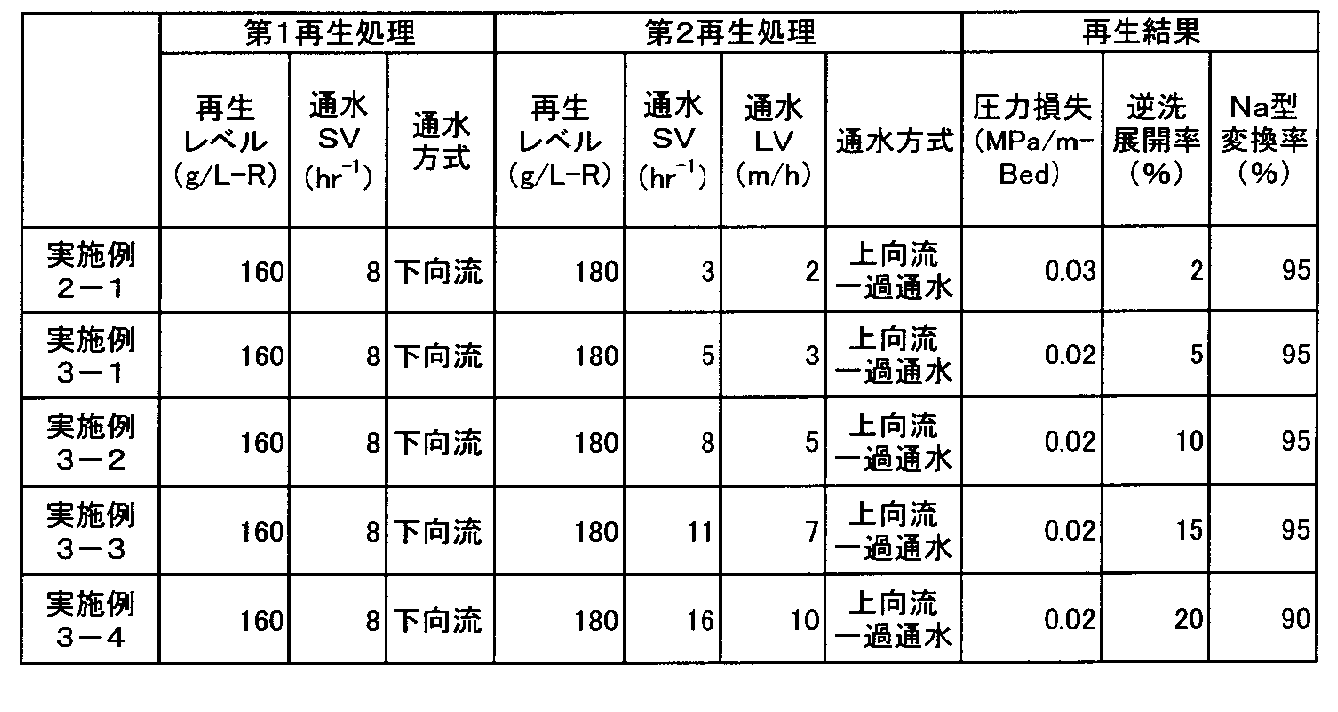
表2の通り、HCl溶液を使用した第1再生処理及びNaOH溶液を使用した第2再生処理の2段処理により、90%以上という高いNa型変換率が得られた。また、第2再生処理においてNaOH溶液を通水LV2~7(m/h)、好ましくは3~7(m/h)の上向流で一過通水することで、圧力損失を抑えつつ、イオン交換樹脂層を過剰に(20%以上に)逆洗展開しないよう調整して95%というさらに高いNa型変換率が得られた。
[実施例4-1]
カルボン酸系カチオン交換樹脂を、HCl溶液を使用して再生レベル160g/L-Rで第1再生処理した後、NaOH溶液を使用して再生レベル150g/L-Rで第2再生処理し、再生後の樹脂のNa型変換率を確認した。なお、NaOH溶液は通水SV20(hr-1)の上向流で循環通水した。処理条件及び結果を表3に示す。
カルボン酸系カチオン交換樹脂を、HCl溶液を使用して再生レベル160g/L-Rで第1再生処理した後、NaOH溶液を使用して再生レベル150g/L-Rで第2再生処理し、再生後の樹脂のNa型変換率を確認した。なお、NaOH溶液は通水SV20(hr-1)の上向流で循環通水した。処理条件及び結果を表3に示す。
[実施例4-2]
実施例4-1において、第2再生処理のNaOH溶液を通水SV8(hr-1)の上向流で一過通水した以外は同様とした。処理条件及び結果を表3に示す。
実施例4-1において、第2再生処理のNaOH溶液を通水SV8(hr-1)の上向流で一過通水した以外は同様とした。処理条件及び結果を表3に示す。
[実施例4-3]
実施例4-1において、第2再生処理のNaOH溶液を通水SV1(hr-1)の上向流で一過通水した以外は同様とした。処理条件及び結果を表3に示す。
実施例4-1において、第2再生処理のNaOH溶液を通水SV1(hr-1)の上向流で一過通水した以外は同様とした。処理条件及び結果を表3に示す。
[実施例4-4]
実施例4-1において、第2再生処理のNaOH溶液を再生レベル180g/L-R、通水SV1(hr-1)の上向流で一過通水した以外は同様とした。処理条件及び結果を表3に示す。
実施例4-1において、第2再生処理のNaOH溶液を再生レベル180g/L-R、通水SV1(hr-1)の上向流で一過通水した以外は同様とした。処理条件及び結果を表3に示す。

表3の通り、HCl溶液を使用した第1再生処理及びNaOH溶液を使用した第2再生処理の2段処理により、85%以上という高いNa型変換率が得られた。また、NaOH溶液の循環通水により、少ない薬液使用量で、95%という高いNa型変換率が得られた。また、NaOH溶液の循環通水では、通水LVを低くする必要がなく、再生時間を短縮できた。
このように、本発明によれば、鉱酸を使用した第1再生処理及びナトリウム含有アルカリ化合物水溶液を使用した第2再生処理の2段処理により、硬度由来のスケール析出や、樹脂や部材の損傷を防止しつつ、85%以上という高いNa型変換率が得られる。また、第2再生処理において、再生レベル180g/L-R以上かつ通水LV2~7(m/h)、好ましくは3~7(m/h)の一過通水とすることで、95%以上というさらに高いNa型変換率が得られる。あるいはまた、第2再生処理の通水を循環通水とすることで、通水LVを低い値とする必要なく、95%以上というさらに高いNa型変換率が得られる。
本発明を特定の態様を用いて詳細に説明したが、本発明の意図と範囲を離れることなく様々な変更が可能であることは当業者に明らかである。
本出願は、2014年4月16日付で出願された日本特許出願2014-084693に基づいており、その全体が引用により援用される。
本出願は、2014年4月16日付で出願された日本特許出願2014-084693に基づいており、その全体が引用により援用される。
Claims (6)
- 硬度成分を吸着したNa型の弱酸性カチオン交換樹脂を再生する方法であって、
該弱酸性カチオン交換樹脂に鉱酸を接触させる第1再生処理工程と、
該鉱酸との接触後、該弱酸性カチオン交換樹脂にナトリウム含有アルカリ化合物水溶液を接触させる第2再生処理工程と、
を有することを特徴とする弱酸性カチオン交換樹脂の再生方法。 - 請求項1において、前記第2再生処理工程の接触を上向流通水で行うことを特徴とする弱酸性カチオン交換樹脂の再生方法。
- 請求項2において、前記第2再生処理工程の通水を一過式とし、通水LVを3~7(m/h)とすることを特徴とする弱酸性カチオン交換樹脂の再生方法。
- 請求項1又は2において、前記第2再生処理工程の接触を循環通水で行うことを特徴とする弱酸性カチオン交換樹脂の再生方法。
- 請求項1ないし4のいずれか1項において、前記第1再生処理工程の接触を一過式通水で行うことを特徴とする弱酸性カチオン交換樹脂の再生方法。
- 請求項1ないし5のいずれか1項において、前記Na型の弱酸性カチオン交換樹脂は、硬度成分を含有するpH7~9.5の被処理水を処理することにより、硬度成分を吸着したものであることを特徴とする弱酸性カチオン交換樹脂の再生方法。
Priority Applications (1)
| Application Number | Priority Date | Filing Date | Title |
|---|---|---|---|
| JP2015535272A JPWO2015159948A1 (ja) | 2014-04-16 | 2015-04-16 | 弱酸性カチオン交換樹脂の再生方法 |
Applications Claiming Priority (2)
| Application Number | Priority Date | Filing Date | Title |
|---|---|---|---|
| JP2014-084693 | 2014-04-16 | ||
| JP2014084693 | 2014-04-16 |
Publications (1)
| Publication Number | Publication Date |
|---|---|
| WO2015159948A1 true WO2015159948A1 (ja) | 2015-10-22 |
Family
ID=54324150
Family Applications (1)
| Application Number | Title | Priority Date | Filing Date |
|---|---|---|---|
| PCT/JP2015/061706 Ceased WO2015159948A1 (ja) | 2014-04-16 | 2015-04-16 | 弱酸性カチオン交換樹脂の再生方法 |
Country Status (2)
| Country | Link |
|---|---|
| JP (1) | JPWO2015159948A1 (ja) |
| WO (1) | WO2015159948A1 (ja) |
Cited By (1)
| Publication number | Priority date | Publication date | Assignee | Title |
|---|---|---|---|---|
| CN112916054A (zh) * | 2021-01-15 | 2021-06-08 | 清华大学 | 气液混合再生离子交换树脂的方法以及装置 |
Citations (5)
| Publication number | Priority date | Publication date | Assignee | Title |
|---|---|---|---|---|
| JPS4820701B1 (ja) * | 1970-10-28 | 1973-06-22 | ||
| JPS516867A (ja) * | 1974-07-09 | 1976-01-20 | Ebara Infilco | |
| JPS5534168A (en) * | 1978-09-04 | 1980-03-10 | Tokuyama Soda Co Ltd | Regenerating method of ion exchange material |
| JPS55116485A (en) * | 1979-02-16 | 1980-09-08 | Water Refining Co | Method of removing alkalinity and hardness from water |
| JPH10230170A (ja) * | 1997-02-19 | 1998-09-02 | Kurita Water Ind Ltd | イオン交換樹脂の再生方法 |
Family Cites Families (6)
| Publication number | Priority date | Publication date | Assignee | Title |
|---|---|---|---|---|
| JPS5011987A (ja) * | 1973-05-15 | 1975-02-06 | ||
| JPS57200219A (en) * | 1981-06-05 | 1982-12-08 | Kurita Water Ind Ltd | Purification of saline water |
| JPH0722715B2 (ja) * | 1986-09-17 | 1995-03-15 | オルガノ株式会社 | 陽イオン交換塔の上昇流再生方法および装置 |
| JP3162614B2 (ja) * | 1995-10-27 | 2001-05-08 | 株式会社荏原製作所 | 高流速逆洗型イオン交換塔の再生方法 |
| JP3162616B2 (ja) * | 1995-10-27 | 2001-05-08 | 株式会社荏原製作所 | 向流式イオン交換塔の再生方法 |
| JP3162615B2 (ja) * | 1995-10-27 | 2001-05-08 | 株式会社荏原製作所 | 向流式イオン交換塔の再生方法 |
-
2015
- 2015-04-16 JP JP2015535272A patent/JPWO2015159948A1/ja active Pending
- 2015-04-16 WO PCT/JP2015/061706 patent/WO2015159948A1/ja not_active Ceased
Patent Citations (5)
| Publication number | Priority date | Publication date | Assignee | Title |
|---|---|---|---|---|
| JPS4820701B1 (ja) * | 1970-10-28 | 1973-06-22 | ||
| JPS516867A (ja) * | 1974-07-09 | 1976-01-20 | Ebara Infilco | |
| JPS5534168A (en) * | 1978-09-04 | 1980-03-10 | Tokuyama Soda Co Ltd | Regenerating method of ion exchange material |
| JPS55116485A (en) * | 1979-02-16 | 1980-09-08 | Water Refining Co | Method of removing alkalinity and hardness from water |
| JPH10230170A (ja) * | 1997-02-19 | 1998-09-02 | Kurita Water Ind Ltd | イオン交換樹脂の再生方法 |
Cited By (1)
| Publication number | Priority date | Publication date | Assignee | Title |
|---|---|---|---|---|
| CN112916054A (zh) * | 2021-01-15 | 2021-06-08 | 清华大学 | 气液混合再生离子交换树脂的方法以及装置 |
Also Published As
| Publication number | Publication date |
|---|---|
| JPWO2015159948A1 (ja) | 2017-04-13 |
Similar Documents
| Publication | Publication Date | Title |
|---|---|---|
| Sanciolo et al. | Silica scale mitigation for high recovery reverse osmosis of groundwater for a mining process | |
| JP2017205703A (ja) | 水処理方法および装置ならびにイオン交換樹脂の再生方法 | |
| TW201825405A (zh) | 超純水製造系統及超純水製造方法 | |
| JP7195649B2 (ja) | 酸性液の再生装置および再生方法 | |
| US2470500A (en) | Demineralizing | |
| JP2024051018A (ja) | テトラアルキルアンモニウムイオンを含有する被処理液の精製方法および精製装置 | |
| JP5987286B2 (ja) | 水処理方法 | |
| RU2594420C2 (ru) | Способ очистки борсодержащего концентрата на аэс | |
| US20120107215A1 (en) | Method of removing and recovering silica using modified ion exchange materials | |
| KR101258730B1 (ko) | 테트라알킬암모늄 이온 함유 현상폐액의 처리방법 | |
| WO2015159948A1 (ja) | 弱酸性カチオン交換樹脂の再生方法 | |
| KR101549089B1 (ko) | 음이온성 금속수산화물 재생용액을 이용한 이온교환수지의 재생공정을 포함하는 산성가스의 흡수방법 | |
| JP2003315496A (ja) | イオン交換樹脂の再生方法及びそれに用いる再生剤の精製方法 | |
| US5389261A (en) | Condensate polisher regenerant system | |
| US3389080A (en) | Treatment of ion-exchange resins | |
| JP2019118891A (ja) | 純水製造装置及び純水製造方法 | |
| JP2012192341A (ja) | ホウフッ化物含有液の処理方法 | |
| JP6387637B2 (ja) | イオン交換装置及びイオン交換処理方法 | |
| JP2001276814A (ja) | フッ素および/またはホウ素を含む排水の処理方法 | |
| US7157005B2 (en) | Regenerant reuse | |
| Kedar Oke et al. | Selective fluoride removal | |
| JP6089888B2 (ja) | 混床イオン交換樹脂の分離再生方法 | |
| JP2005298949A (ja) | 亜鉛の回収方法 | |
| JP6013034B2 (ja) | 放射性廃液の除染方法及び装置 | |
| TWI644725B (zh) | 含氟活性氧化鋁的處理方法 |
Legal Events
| Date | Code | Title | Description |
|---|---|---|---|
| ENP | Entry into the national phase |
Ref document number: 2015535272 Country of ref document: JP Kind code of ref document: A |
|
| 121 | Ep: the epo has been informed by wipo that ep was designated in this application |
Ref document number: 15780718 Country of ref document: EP Kind code of ref document: A1 |
|
| NENP | Non-entry into the national phase |
Ref country code: DE |
|
| 122 | Ep: pct application non-entry in european phase |
Ref document number: 15780718 Country of ref document: EP Kind code of ref document: A1 |