WO2015152273A1 - 含フッ素化合物、重合体組成物及び表面処理剤 - Google Patents
含フッ素化合物、重合体組成物及び表面処理剤 Download PDFInfo
- Publication number
- WO2015152273A1 WO2015152273A1 PCT/JP2015/060210 JP2015060210W WO2015152273A1 WO 2015152273 A1 WO2015152273 A1 WO 2015152273A1 JP 2015060210 W JP2015060210 W JP 2015060210W WO 2015152273 A1 WO2015152273 A1 WO 2015152273A1
- Authority
- WO
- WIPO (PCT)
- Prior art keywords
- fluorine
- group
- carbon atoms
- above formula
- surface treatment
- Prior art date
- Legal status (The legal status is an assumption and is not a legal conclusion. Google has not performed a legal analysis and makes no representation as to the accuracy of the status listed.)
- Ceased
Links
- 0 CN(*)C1CC1 Chemical compound CN(*)C1CC1 0.000 description 15
- FZRGXDCLIBSYGH-MQLBYMCTSA-N CCC(CC([C@@H](C)N)C(C(C)(C1N)/C=C/C)N)C1N Chemical compound CCC(CC([C@@H](C)N)C(C(C)(C1N)/C=C/C)N)C1N FZRGXDCLIBSYGH-MQLBYMCTSA-N 0.000 description 1
- IPBXLJFBVNLKFE-LURJTMIESA-N CCC[C@H](C)NC Chemical compound CCC[C@H](C)NC IPBXLJFBVNLKFE-LURJTMIESA-N 0.000 description 1
Classifications
-
- C—CHEMISTRY; METALLURGY
- C07—ORGANIC CHEMISTRY
- C07C—ACYCLIC OR CARBOCYCLIC COMPOUNDS
- C07C219/00—Compounds containing amino and esterified hydroxy groups bound to the same carbon skeleton
- C07C219/02—Compounds containing amino and esterified hydroxy groups bound to the same carbon skeleton having esterified hydroxy groups and amino groups bound to acyclic carbon atoms of the same carbon skeleton
- C07C219/04—Compounds containing amino and esterified hydroxy groups bound to the same carbon skeleton having esterified hydroxy groups and amino groups bound to acyclic carbon atoms of the same carbon skeleton the carbon skeleton being acyclic and saturated
- C07C219/08—Compounds containing amino and esterified hydroxy groups bound to the same carbon skeleton having esterified hydroxy groups and amino groups bound to acyclic carbon atoms of the same carbon skeleton the carbon skeleton being acyclic and saturated having at least one of the hydroxy groups esterified by a carboxylic acid having the esterifying carboxyl group bound to an acyclic carbon atom of an acyclic unsaturated carbon skeleton
-
- C—CHEMISTRY; METALLURGY
- C07—ORGANIC CHEMISTRY
- C07C—ACYCLIC OR CARBOCYCLIC COMPOUNDS
- C07C229/00—Compounds containing amino and carboxyl groups bound to the same carbon skeleton
- C07C229/02—Compounds containing amino and carboxyl groups bound to the same carbon skeleton having amino and carboxyl groups bound to acyclic carbon atoms of the same carbon skeleton
- C07C229/04—Compounds containing amino and carboxyl groups bound to the same carbon skeleton having amino and carboxyl groups bound to acyclic carbon atoms of the same carbon skeleton the carbon skeleton being acyclic and saturated
- C07C229/20—Compounds containing amino and carboxyl groups bound to the same carbon skeleton having amino and carboxyl groups bound to acyclic carbon atoms of the same carbon skeleton the carbon skeleton being acyclic and saturated the carbon skeleton being further substituted by halogen atoms or by nitro or nitroso groups
-
- C—CHEMISTRY; METALLURGY
- C07—ORGANIC CHEMISTRY
- C07D—HETEROCYCLIC COMPOUNDS
- C07D207/00—Heterocyclic compounds containing five-membered rings not condensed with other rings, with one nitrogen atom as the only ring hetero atom
- C07D207/02—Heterocyclic compounds containing five-membered rings not condensed with other rings, with one nitrogen atom as the only ring hetero atom with only hydrogen or carbon atoms directly attached to the ring nitrogen atom
- C07D207/04—Heterocyclic compounds containing five-membered rings not condensed with other rings, with one nitrogen atom as the only ring hetero atom with only hydrogen or carbon atoms directly attached to the ring nitrogen atom having no double bonds between ring members or between ring members and non-ring members
- C07D207/10—Heterocyclic compounds containing five-membered rings not condensed with other rings, with one nitrogen atom as the only ring hetero atom with only hydrogen or carbon atoms directly attached to the ring nitrogen atom having no double bonds between ring members or between ring members and non-ring members with hetero atoms or with carbon atoms having three bonds to hetero atoms with at the most one bond to halogen, e.g. ester or nitrile radicals, directly attached to ring carbon atoms
-
- C—CHEMISTRY; METALLURGY
- C07—ORGANIC CHEMISTRY
- C07D—HETEROCYCLIC COMPOUNDS
- C07D211/00—Heterocyclic compounds containing hydrogenated pyridine rings, not condensed with other rings
- C07D211/04—Heterocyclic compounds containing hydrogenated pyridine rings, not condensed with other rings with only hydrogen or carbon atoms directly attached to the ring nitrogen atom
- C07D211/06—Heterocyclic compounds containing hydrogenated pyridine rings, not condensed with other rings with only hydrogen or carbon atoms directly attached to the ring nitrogen atom having no double bonds between ring members or between ring members and non-ring members
- C07D211/36—Heterocyclic compounds containing hydrogenated pyridine rings, not condensed with other rings with only hydrogen or carbon atoms directly attached to the ring nitrogen atom having no double bonds between ring members or between ring members and non-ring members with hetero atoms or with carbon atoms having three bonds to hetero atoms with at the most one bond to halogen, e.g. ester or nitrile radicals, directly attached to ring carbon atoms
- C07D211/38—Halogen atoms or nitro radicals
-
- C—CHEMISTRY; METALLURGY
- C07—ORGANIC CHEMISTRY
- C07D—HETEROCYCLIC COMPOUNDS
- C07D223/00—Heterocyclic compounds containing seven-membered rings having one nitrogen atom as the only ring hetero atom
- C07D223/02—Heterocyclic compounds containing seven-membered rings having one nitrogen atom as the only ring hetero atom not condensed with other rings
- C07D223/04—Heterocyclic compounds containing seven-membered rings having one nitrogen atom as the only ring hetero atom not condensed with other rings with only hydrogen atoms, halogen atoms, hydrocarbon or substituted hydrocarbon radicals, directly attached to ring carbon atoms
-
- C—CHEMISTRY; METALLURGY
- C07—ORGANIC CHEMISTRY
- C07D—HETEROCYCLIC COMPOUNDS
- C07D241/00—Heterocyclic compounds containing 1,4-diazine or hydrogenated 1,4-diazine rings
- C07D241/02—Heterocyclic compounds containing 1,4-diazine or hydrogenated 1,4-diazine rings not condensed with other rings
- C07D241/04—Heterocyclic compounds containing 1,4-diazine or hydrogenated 1,4-diazine rings not condensed with other rings having no double bonds between ring members or between ring members and non-ring members
-
- C—CHEMISTRY; METALLURGY
- C07—ORGANIC CHEMISTRY
- C07D—HETEROCYCLIC COMPOUNDS
- C07D265/00—Heterocyclic compounds containing six-membered rings having one nitrogen atom and one oxygen atom as the only ring hetero atoms
- C07D265/28—1,4-Oxazines; Hydrogenated 1,4-oxazines
- C07D265/30—1,4-Oxazines; Hydrogenated 1,4-oxazines not condensed with other rings
-
- C—CHEMISTRY; METALLURGY
- C08—ORGANIC MACROMOLECULAR COMPOUNDS; THEIR PREPARATION OR CHEMICAL WORKING-UP; COMPOSITIONS BASED THEREON
- C08F—MACROMOLECULAR COMPOUNDS OBTAINED BY REACTIONS ONLY INVOLVING CARBON-TO-CARBON UNSATURATED BONDS
- C08F220/00—Copolymers of compounds having one or more unsaturated aliphatic radicals, each having only one carbon-to-carbon double bond, and only one being terminated by only one carboxyl radical or a salt, anhydride ester, amide, imide or nitrile thereof
- C08F220/02—Monocarboxylic acids having less than ten carbon atoms; Derivatives thereof
- C08F220/10—Esters
- C08F220/34—Esters containing nitrogen, e.g. N,N-dimethylaminoethyl (meth)acrylate
- C08F220/36—Esters containing nitrogen, e.g. N,N-dimethylaminoethyl (meth)acrylate containing oxygen in addition to the carboxy oxygen, e.g. 2-N-morpholinoethyl (meth)acrylate or 2-isocyanatoethyl (meth)acrylate
- C08F220/365—Esters containing nitrogen, e.g. N,N-dimethylaminoethyl (meth)acrylate containing oxygen in addition to the carboxy oxygen, e.g. 2-N-morpholinoethyl (meth)acrylate or 2-isocyanatoethyl (meth)acrylate containing further carboxylic moieties
Definitions
- the present invention relates to a fluorine-containing compound, a polymer composition, and a surface treatment agent.
- This application claims priority on March 31, 2014 based on Japanese Patent Application No. 2014-073516 for which it applied to Japan, and uses the content here.
- fluorine-containing (meth) acrylic polymers having a linear perfluoroalkyl group having 8 carbon atoms (C 8 F 17 ) in the side chain as a surface treatment agent for imparting water and oil repellency to a surface treatment material, etc.
- Fluorine-based surface treatment agents are used.
- Patent Documents 1 and 2 various studies have been conducted to replace them with polymers having a linear perfluoroalkyl group having a small number of carbon atoms (see Patent Documents 1 and 2 and Non-Patent Document 1).
- a fluorine-based surface treating agent that imparts water / oil repellency decreases in water / oil repellency as the number of carbon atoms of the perfluoroalkyl group in the structure decreases. Therefore, by simply reducing the number of carbon atoms, a fluorine-based (meth) acrylic polymer such as a fluorine-containing (meth) acrylic polymer having a linear perfluoroalkyl group having 8 carbon atoms (C 8 F 17 ) in the side chain has been conventionally used. It was difficult to develop the same characteristics as the surface treatment agent.
- the present invention has been made in view of the above circumstances, and does not contain a perfluoroalkyl group having 8 or more carbon atoms, and there is a concern of generating PFOS or PFOA, which is problematic in terms of bioaccumulation and environmental adaptability.
- An object of the present invention is to provide a surface treatment agent having excellent water and oil repellency characteristics, a polymer composition as a main component thereof, and a novel fluorine-containing compound as a raw material component thereof, even though the chemical structure is not present. To do.
- Rf 1 and Rf 2 are each a linear or branched perfluoroalkyl group or perfluoroalkylene group having 1 to 6 carbon atoms which are the same or different from each other.
- Rf 1 and Rf 2 are perfluoroalkylene groups, the ends of Rf 1 and Rf 2 are bonded via an oxygen atom, a nitrogen atom, or a CF 2 group to form a heterocyclic ring.
- Rf 3 is a linear or branched perfluoroalkylene group having 1 to 6 carbon atoms.
- X is a divalent organic group.
- R 1 is H or an alkyl group having 1 to 4 carbon atoms.
- m and n are the same or different integers of 1 to 6, respectively.
- Rf 4 is a linear or branched perfluoroalkylene group having 1 to 6 carbon atoms.
- X is a divalent organic group.
- R 1 is H or an alkyl group having 1 to 4 carbon atoms.
- Rf 5 , Rf 6 and Rf 7 are each a linear or branched perfluoroalkylene group having 1 to 6 carbon atoms which are the same or different from each other.
- X is a divalent organic group
- Y is an oxygen atom, a nitrogen atom or a CF 2 group.
- R 1 is H or an alkyl group having 1 to 4 carbon atoms.
- a polymer composition comprising a fluorine-containing polymer obtained from a fluorine-containing monomer comprising the fluorine-containing compound according to any one of [1] to [3].
- a surface treatment agent comprising the polymer composition according to [4] or [5] above.
- this surface treatment agent having water / oil repellency, a polymer composition as a main component thereof, and a novel fluorine-containing compound as a raw material component thereof.
- this surface treatment agent and fluorine-containing compound include surfactants, lubricants, mold release agents, low refractive index agents, crosslinking agents, coating materials such as anti-reflective coatings, optical lithography, etc. Useful as a resist monomer.
- the fluorine-containing compound of this embodiment is a nitrogen atom-containing compound in which a plurality of linear or branched perfluoroalkyl groups having 6 or less carbon atoms are bonded via a nitrogen atom, represented by the following general formula (1) Perfluoroalkyl (meth) acrylate.
- Rf 1 and Rf 2 are the same or different perfluoroalkyl groups having 1 to 6 carbon atoms, and may be linear or branched. Rf 1 and Rf 2 may be directly bonded to form a ring, or may be bonded through an oxygen atom or a nitrogen atom to form a heterocyclic ring. Further, Rf 3 is a perfluoroalkylene group having 1 to 6 carbon atoms, and may be linear or branched. That is, in the above formula (1), Rf 1 and Rf 2 are linear or branched perfluoroalkyl groups or perfluoroalkylene groups having the same or different carbon numbers of 1 to 6, respectively.
- Rf 1 and Rf 2 are perfluoroalkylene groups
- the ends of Rf 1 and Rf 2 are bonded via an oxygen atom, a nitrogen atom, or a CF 2 group to form a heterocyclic ring.
- Rf 3 is a linear or branched perfluoroalkylene group having 1 to 6 carbon atoms.
- Rf 1 and Rf 2 have 1 to 4 carbon atoms and are preferably a linear or branched perfluoroalkyl group or a perfluoroalkylene group.
- Rf 3 is preferably a linear or branched perfluoroalkylene group having 1 to 4 carbon atoms.
- X is a divalent organic group.
- R 1 is a hydrogen atom (H) or an alkyl group having 1 to 4 carbon atoms.
- Examples of the fluorine-containing compound represented by the above formula (1) include those having a perfluoroamine structure represented by the following general formula (2) and those having a perfluoroheterocycle represented by the following formula (3). .
- Rf 4 is a linear or branched perfluoroalkylene group having 1 to 6 carbon atoms.
- X is a divalent organic group.
- R 1 is a hydrogen atom (H) or an alkyl group having 1 to 4 carbon atoms.
- m and n are preferably integers of 1 to 4.
- Rf 4 is preferably a linear or branched perfluoroalkylene group having 1 to 4 carbon atoms.
- Rf 5 , Rf 6 and Rf 7 are each a linear or branched perfluoroalkylene group having 1 to 6 carbon atoms which are the same or different from each other.
- X is a divalent organic group
- Y is an oxygen atom, a nitrogen atom or a CF 2 group.
- R 1 is a hydrogen atom (H) or an alkyl group having 1 to 4 carbon atoms.
- Rf 5 , Rf 6 and Rf 7 are preferably a linear or branched perfluoroalkylene group having 1 to 4 carbon atoms.
- X in the above formulas (1) to (3) is a divalent organic group.
- Specific examples of the structure include a hydrocarbon group (see the following formula (4)), ether A structure having a bond (see the following formula (5)), a structure having an ester bond (see the following formula (6)), a structure having a sulfonyl bond (see the following formula (7)), a structure having an amide bond ( Examples include the following formula (8) and the following formula (9)), a structure having a urethane bond (see the following formula (10)), a structure having a sulfonamide bond (see the following formula (11)), and the like.
- R 2 and R 3 are hydrocarbon groups having 0 to 10 carbon atoms
- R 4 is a hydrogen atom or a hydrocarbon group having 1 to 6 carbon atoms.
- R is the same as the above R 4 and is a hydrogen atom or a hydrocarbon group having 1 to 6 carbon atoms.
- R 1 is H or an alkyl group having 1 to 4 carbon atoms.
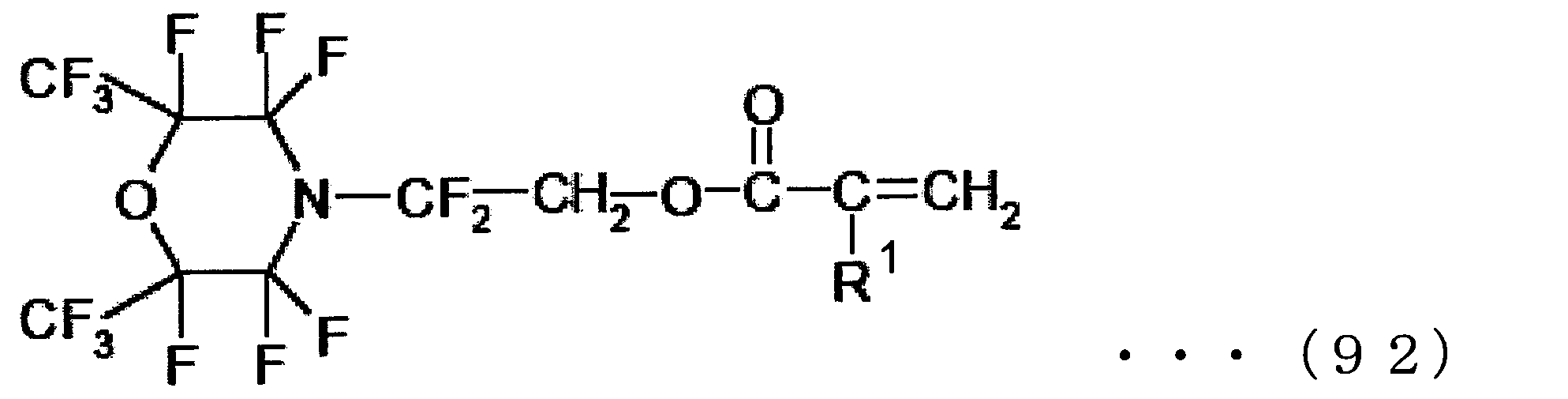
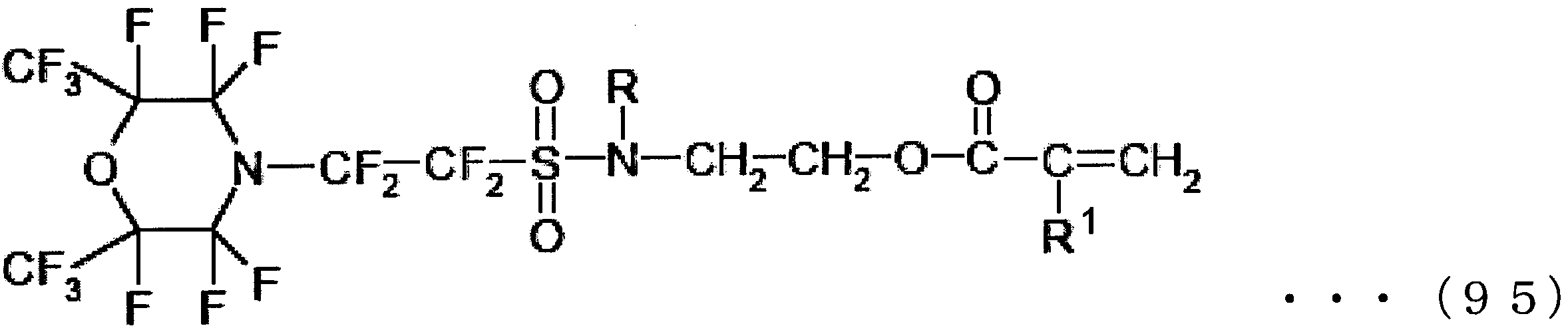
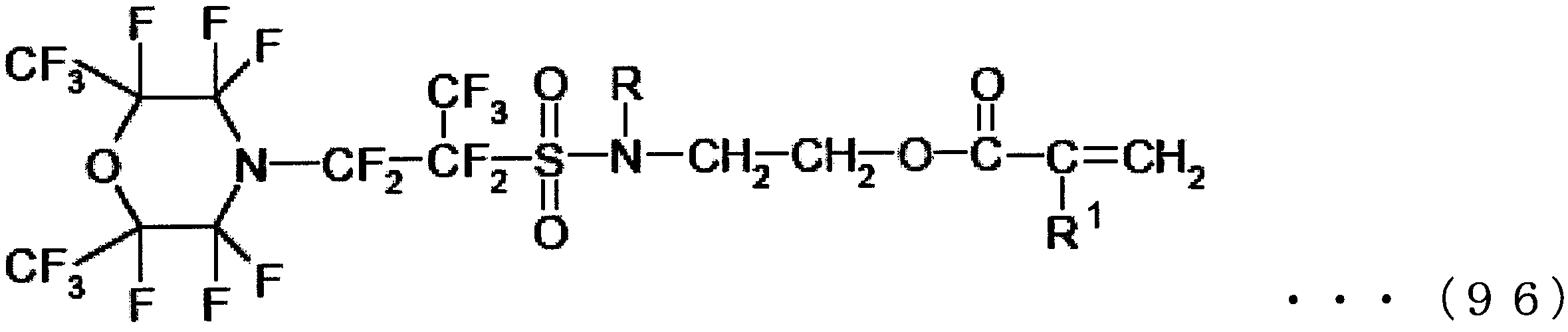
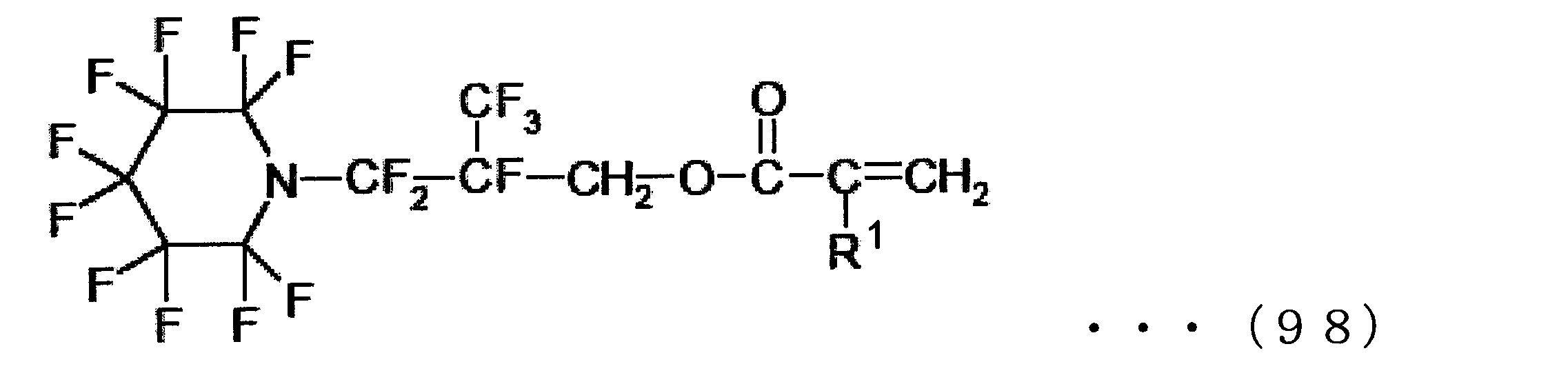
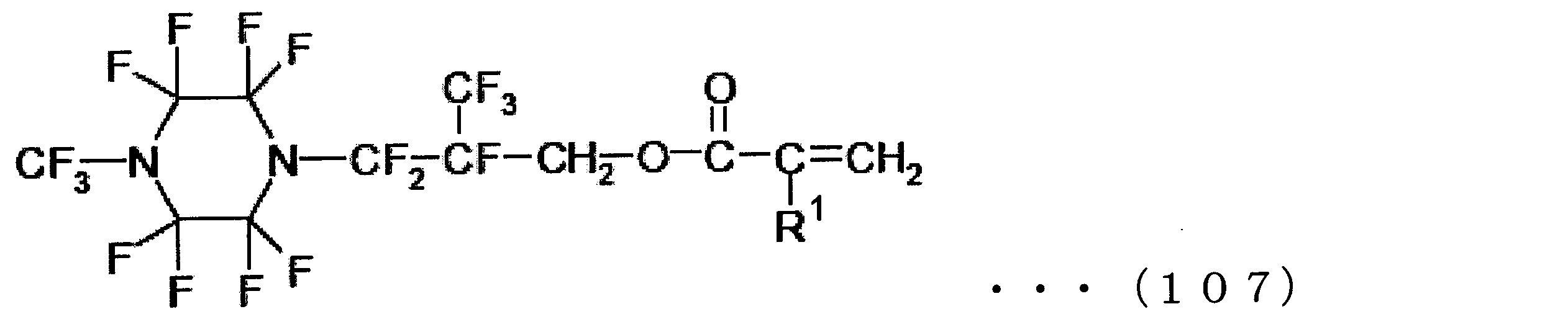
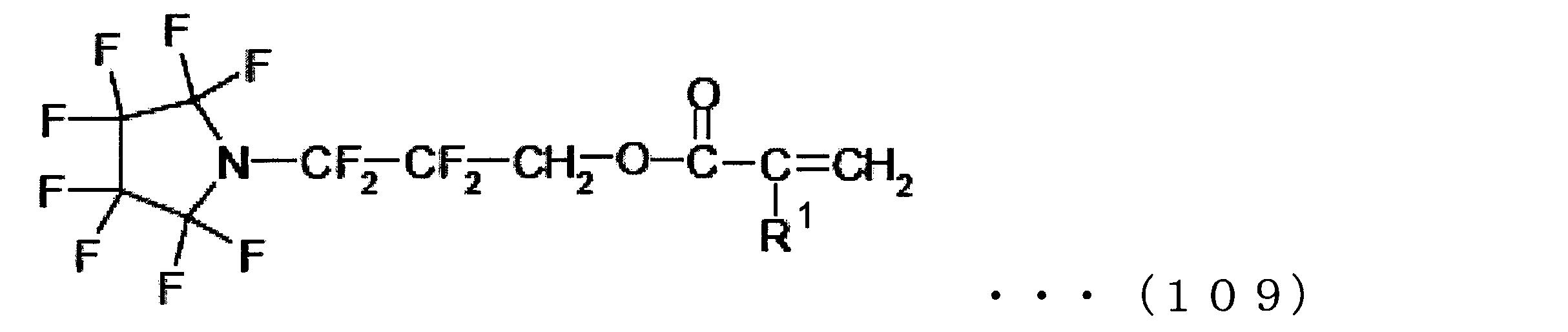
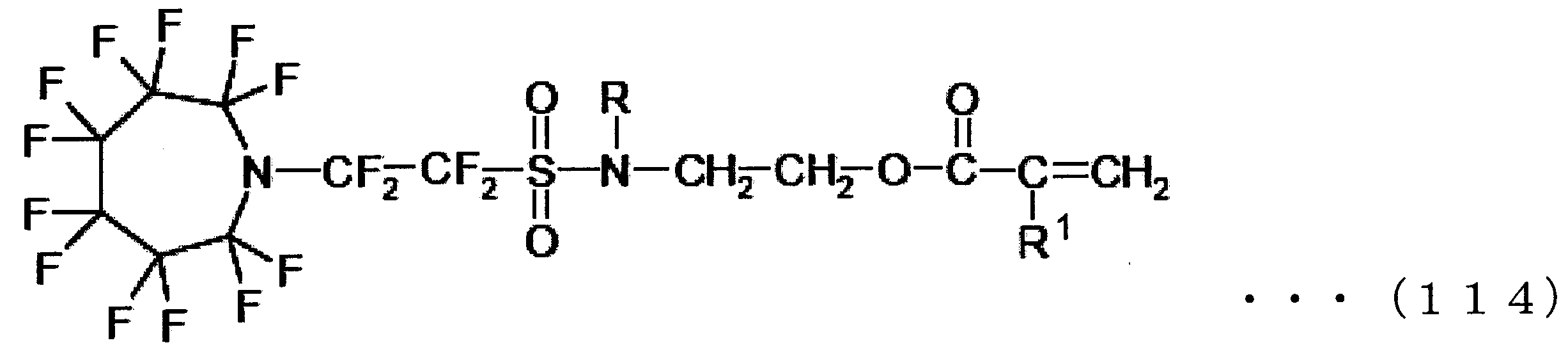
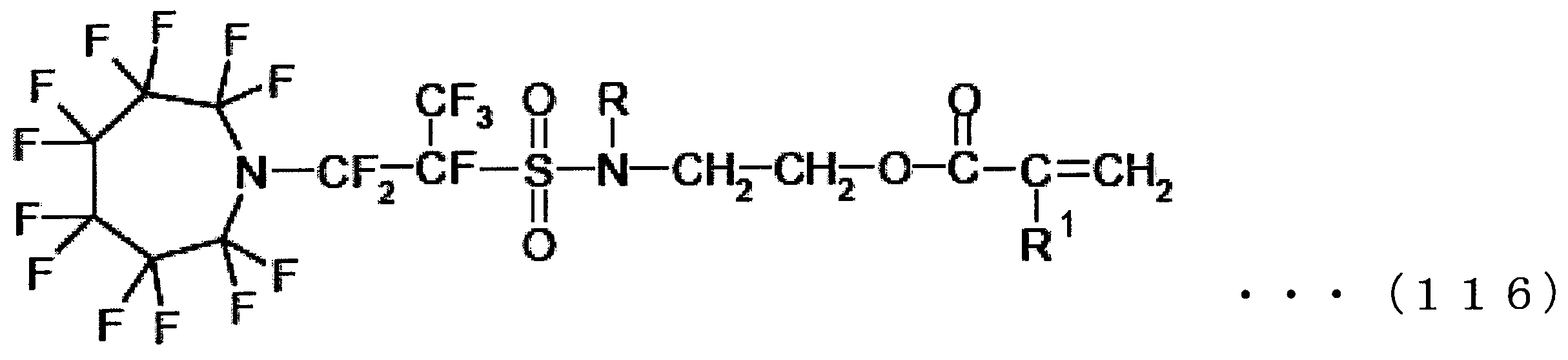
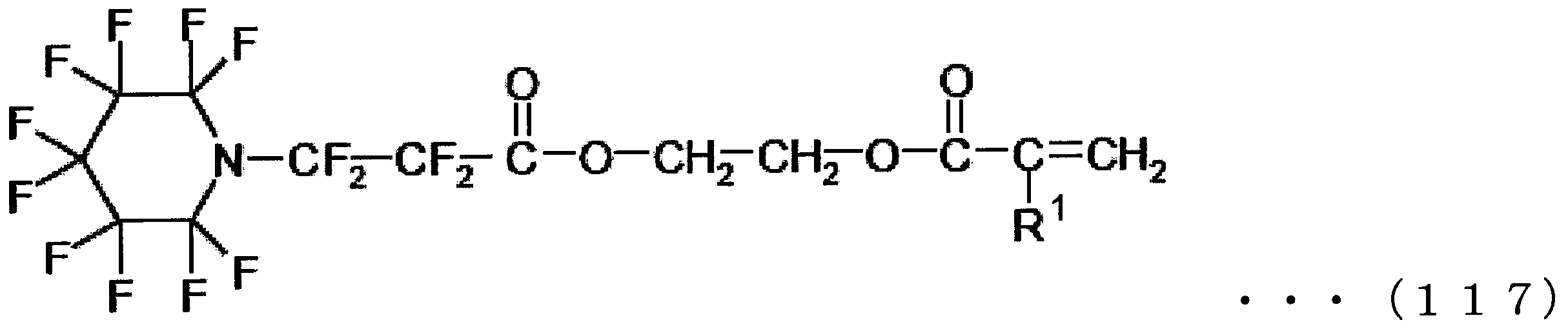
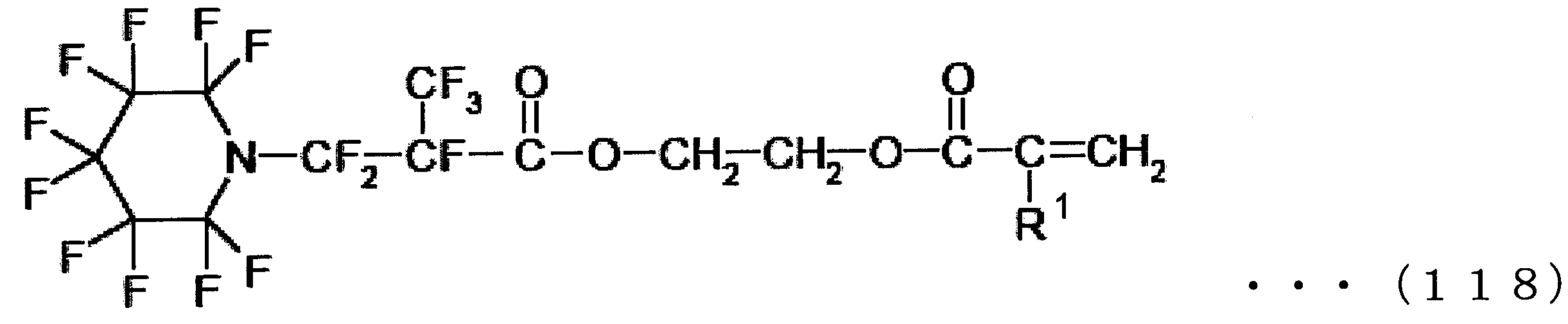
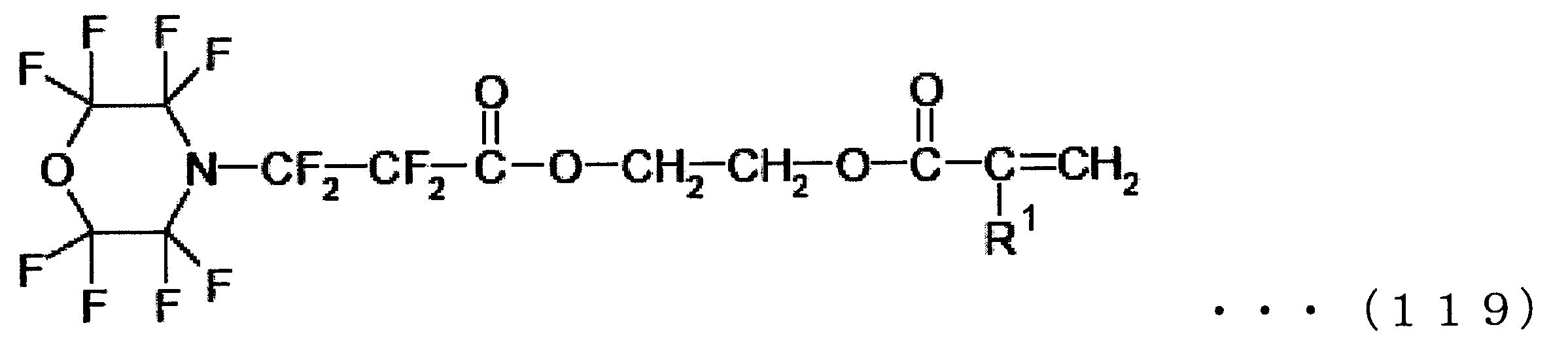
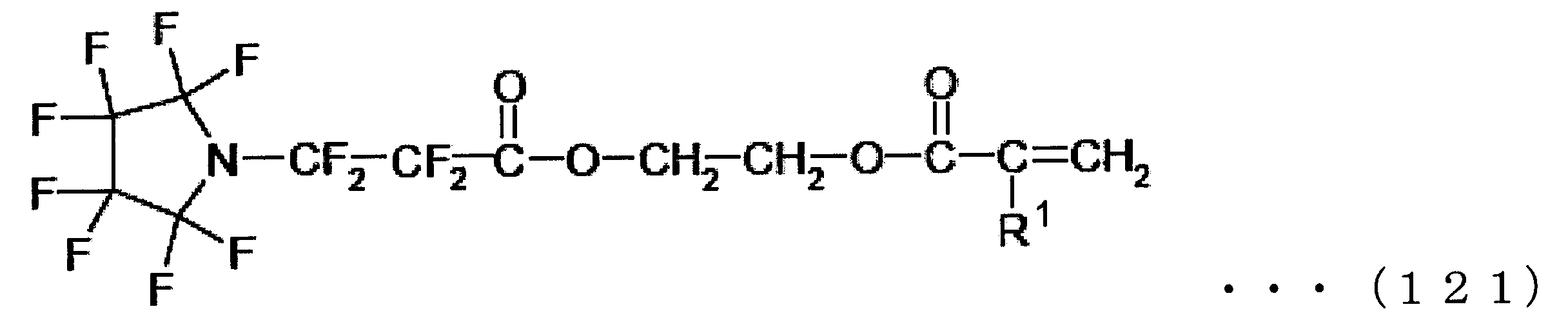
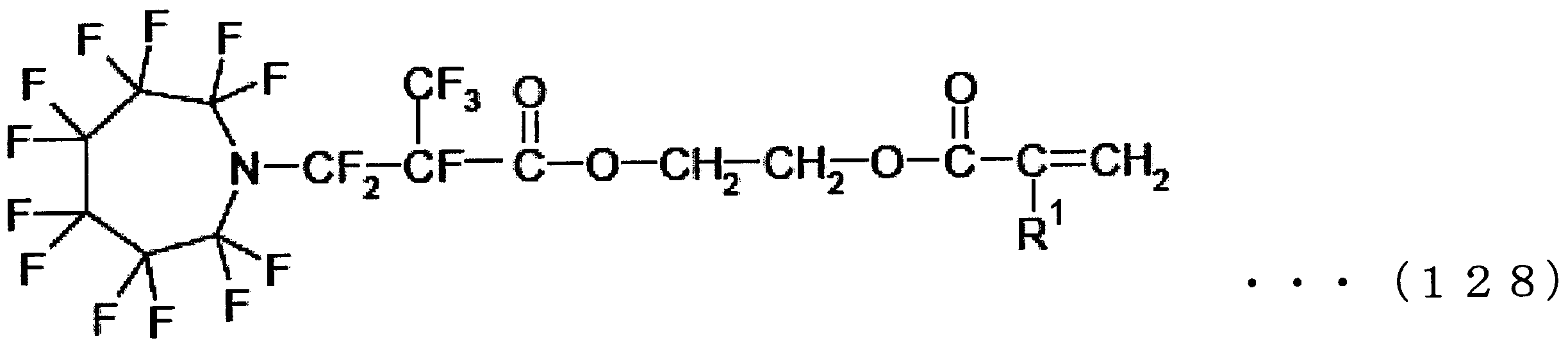
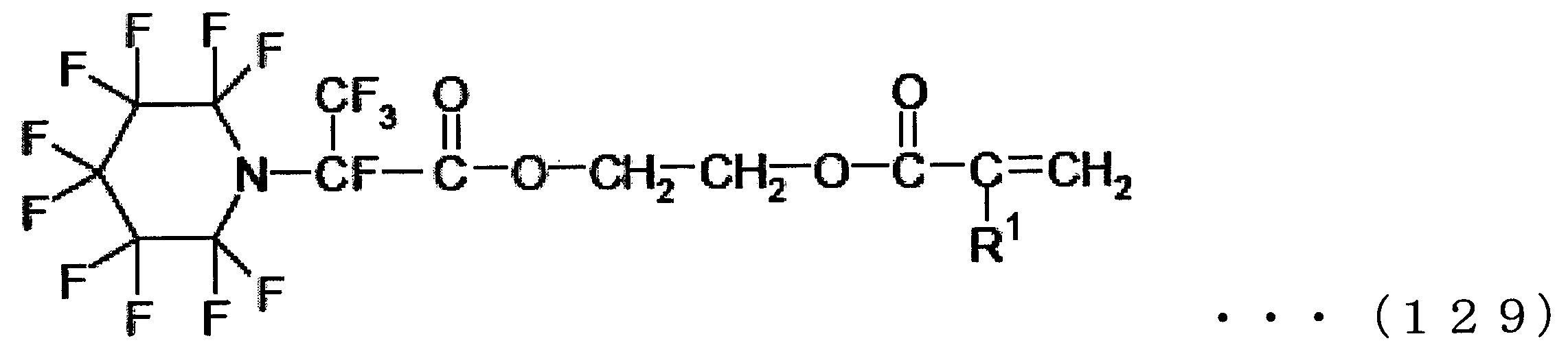
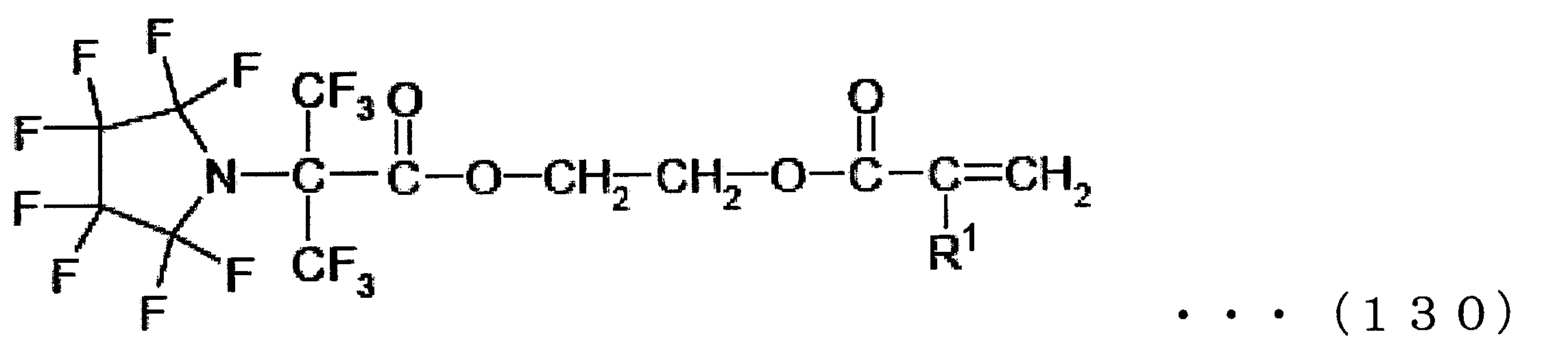
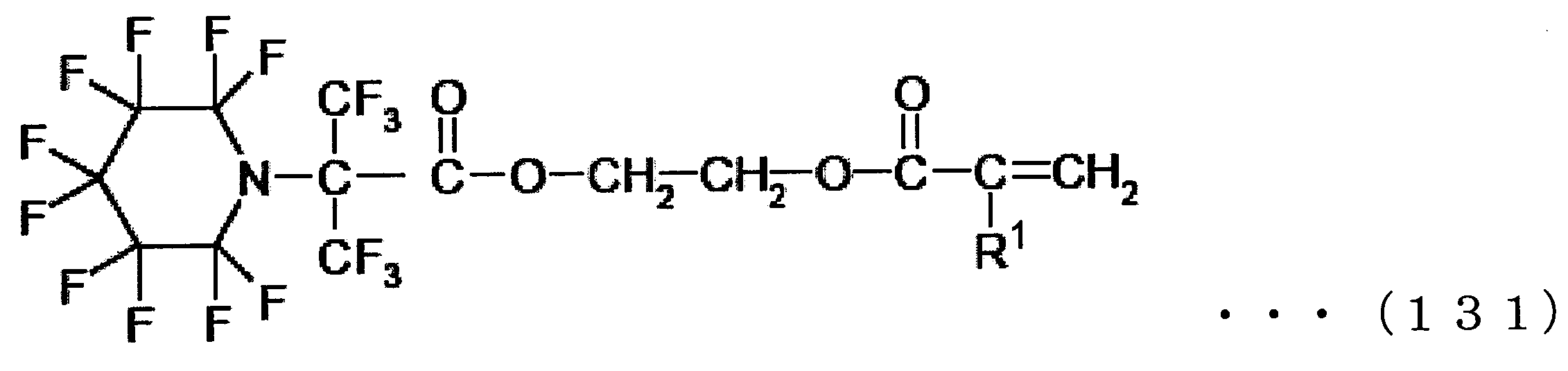
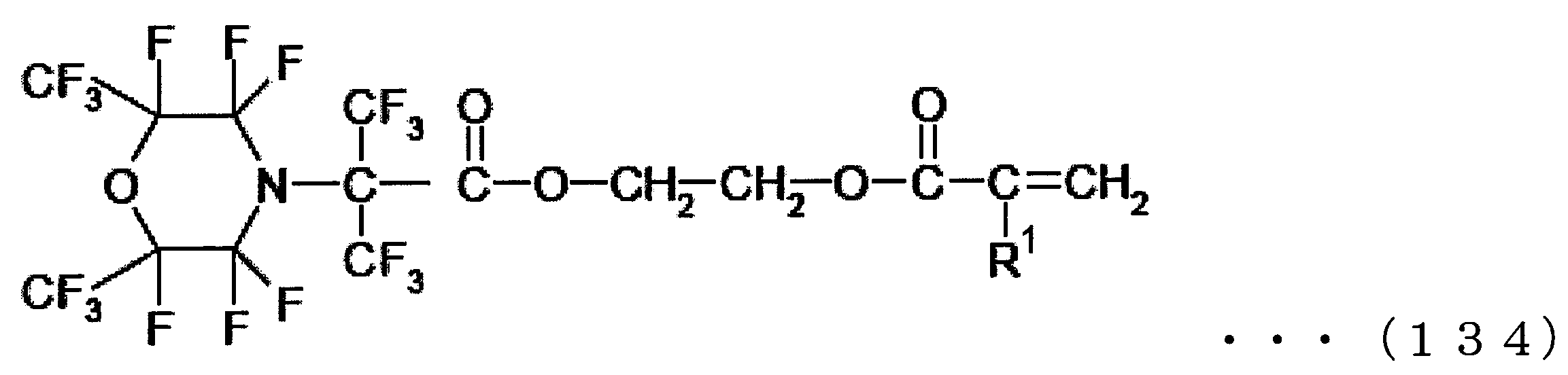
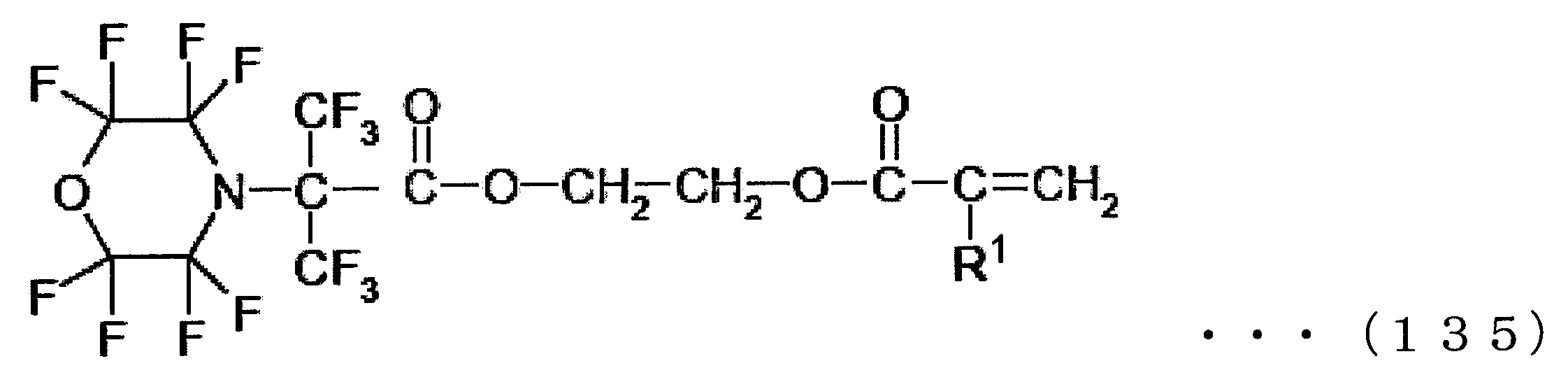
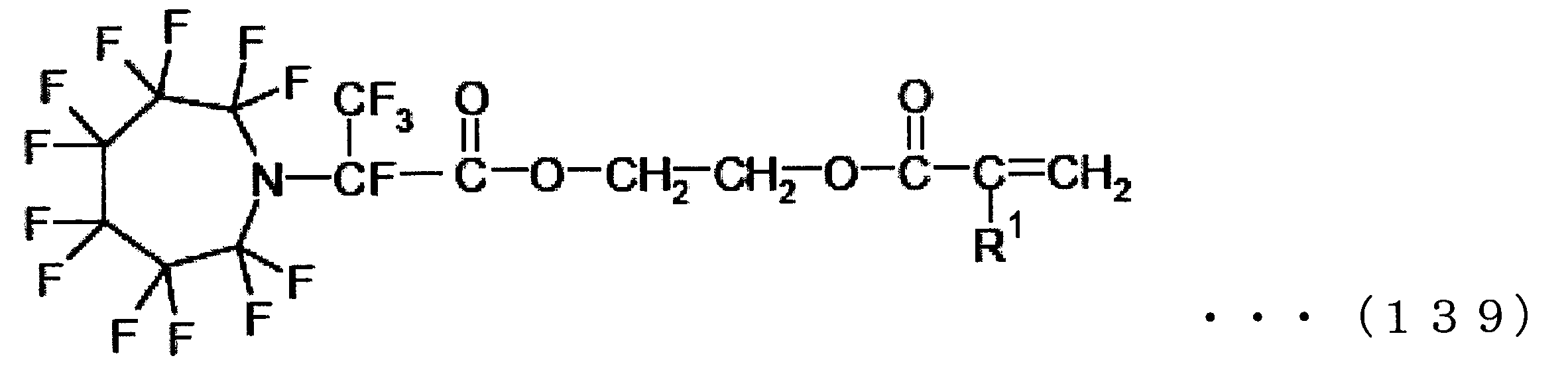
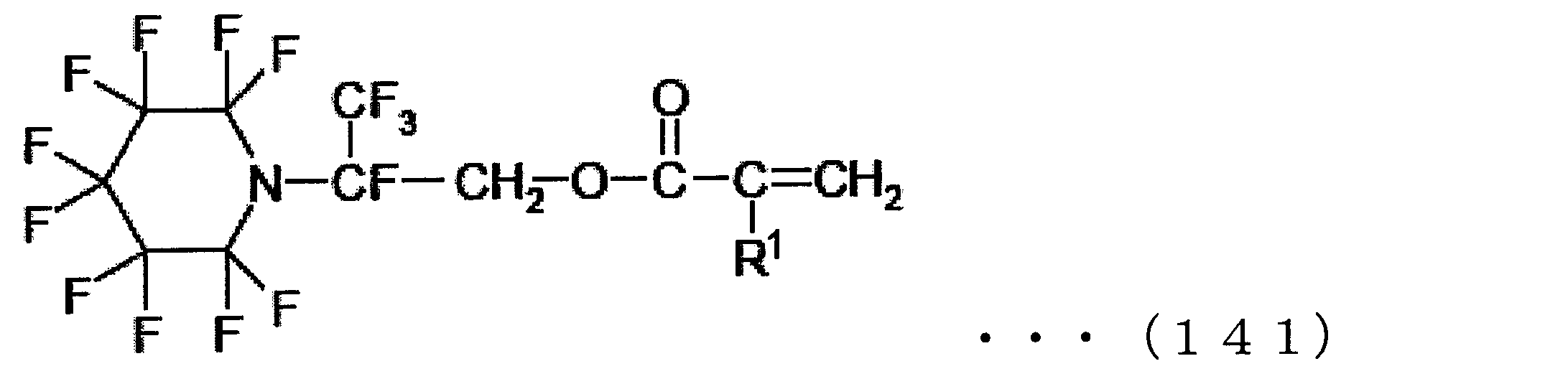
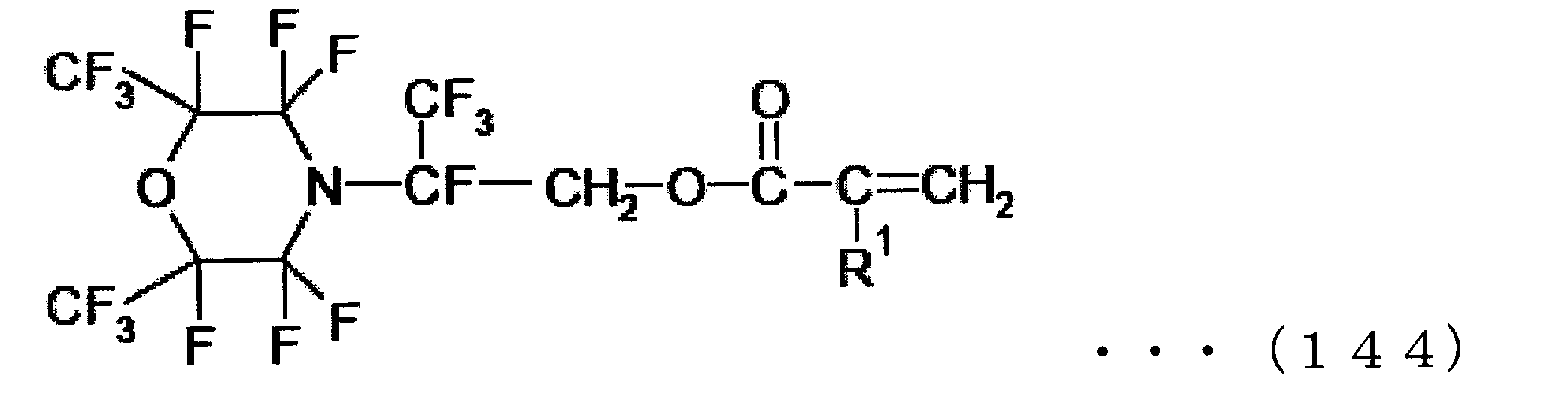
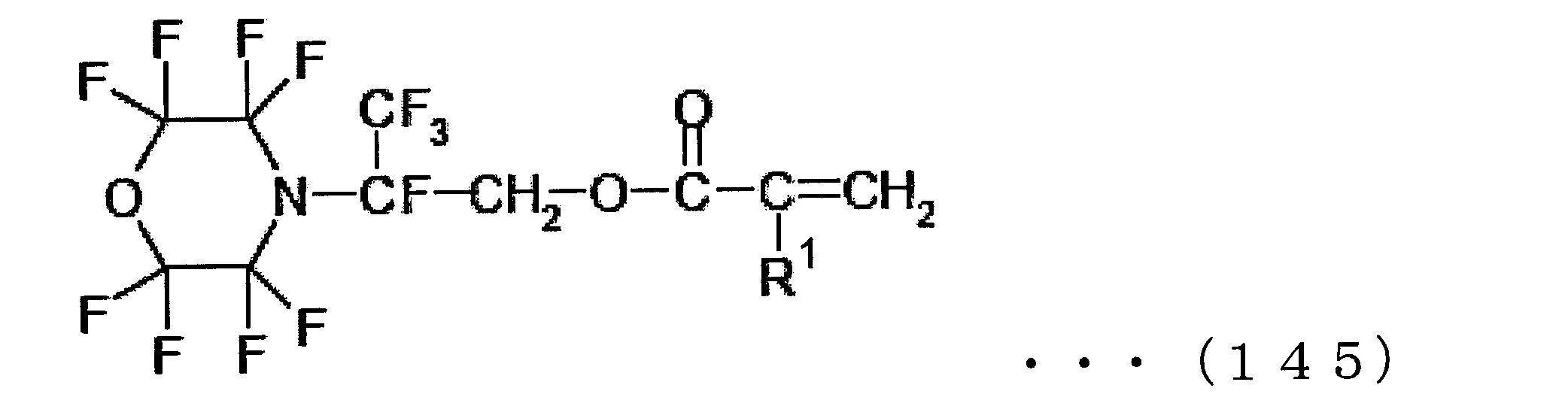
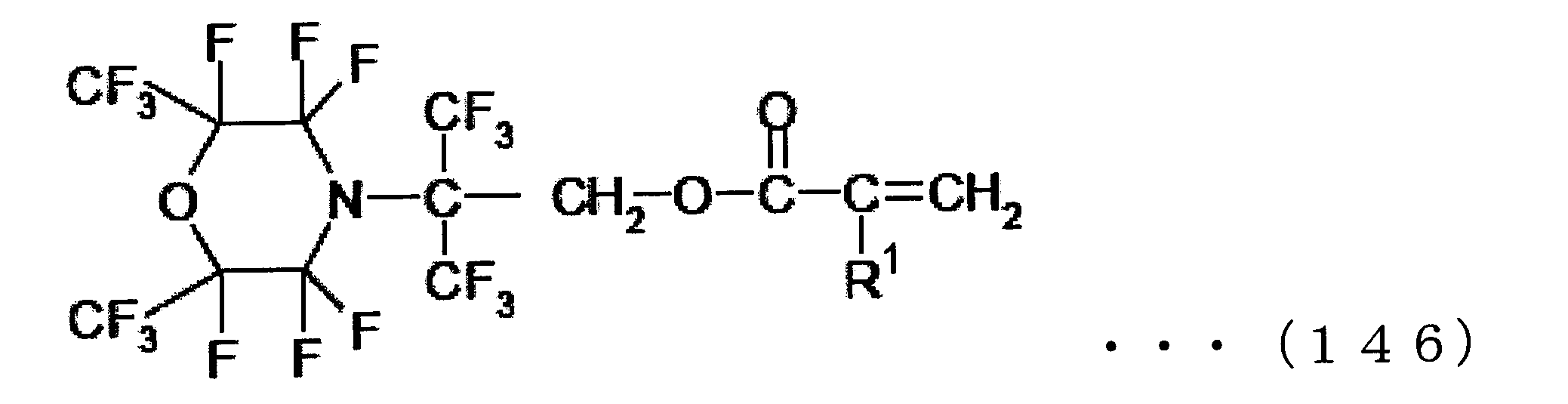
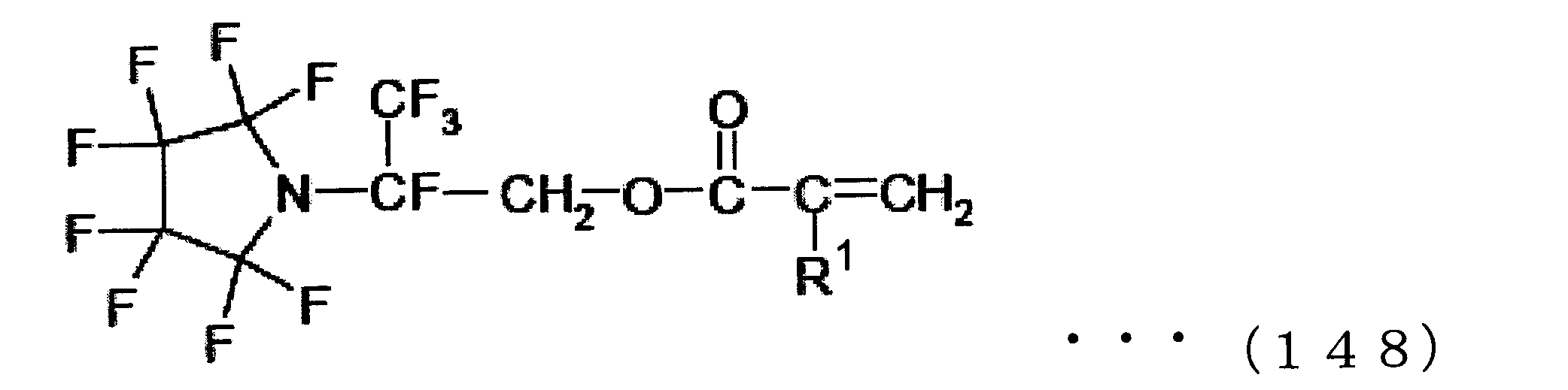
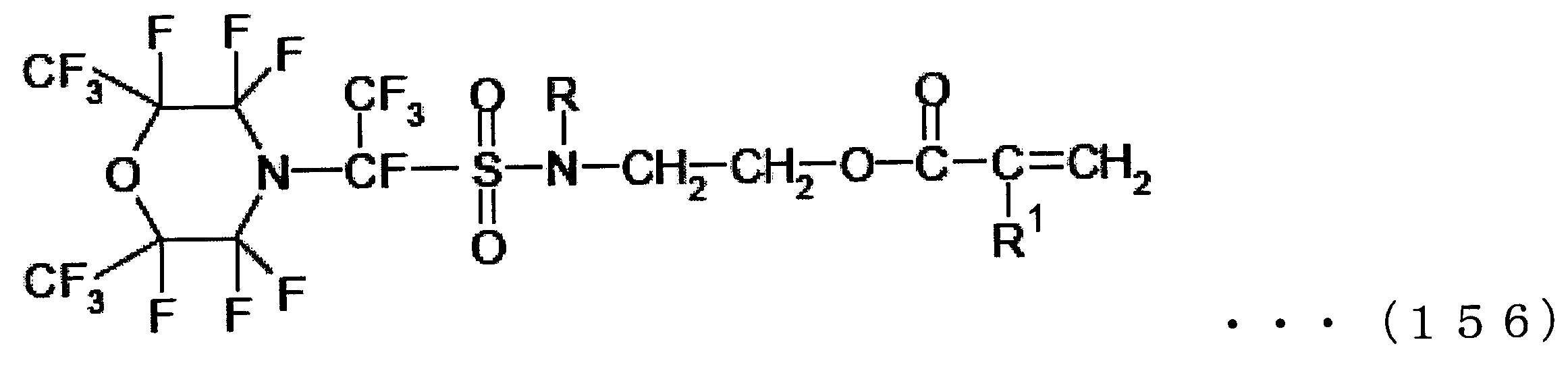
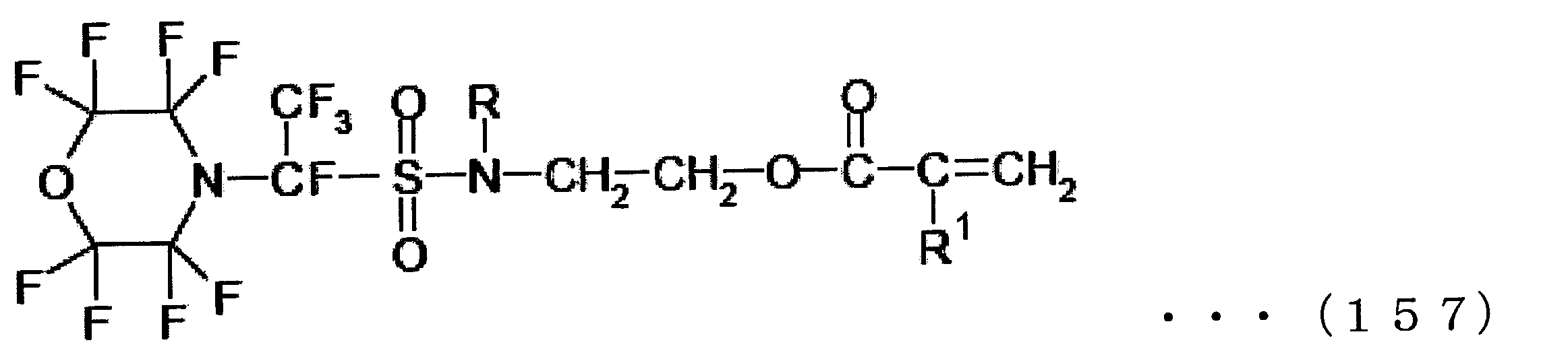
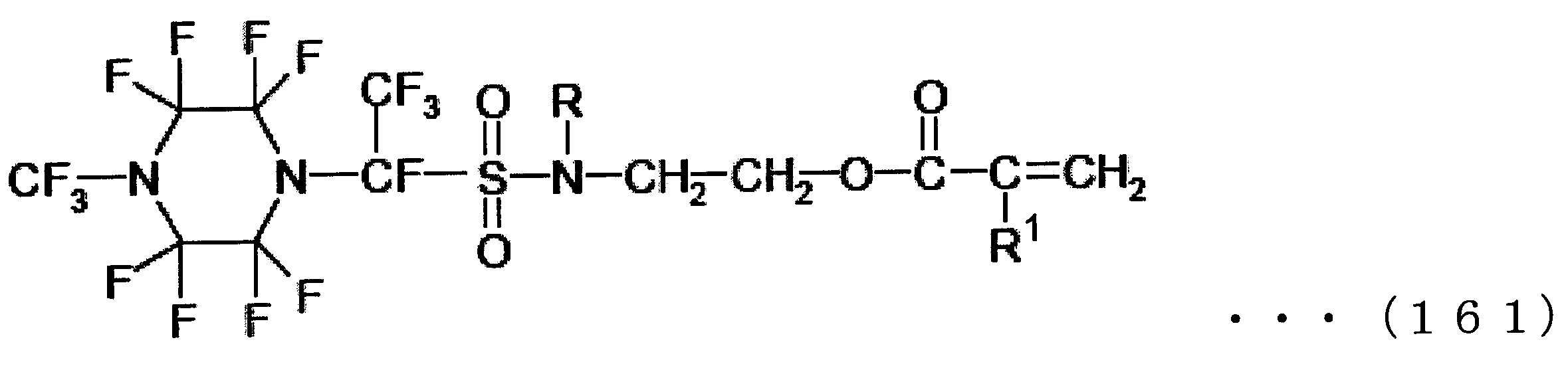
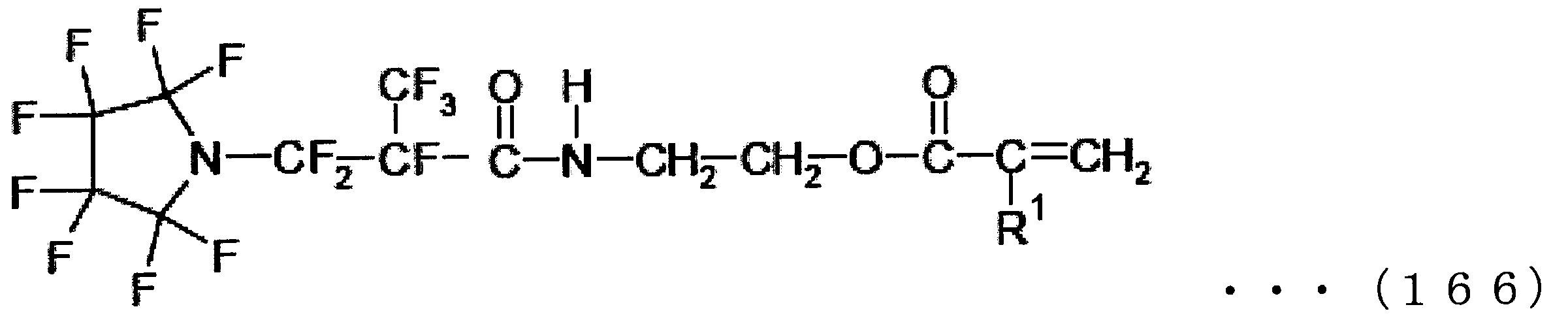
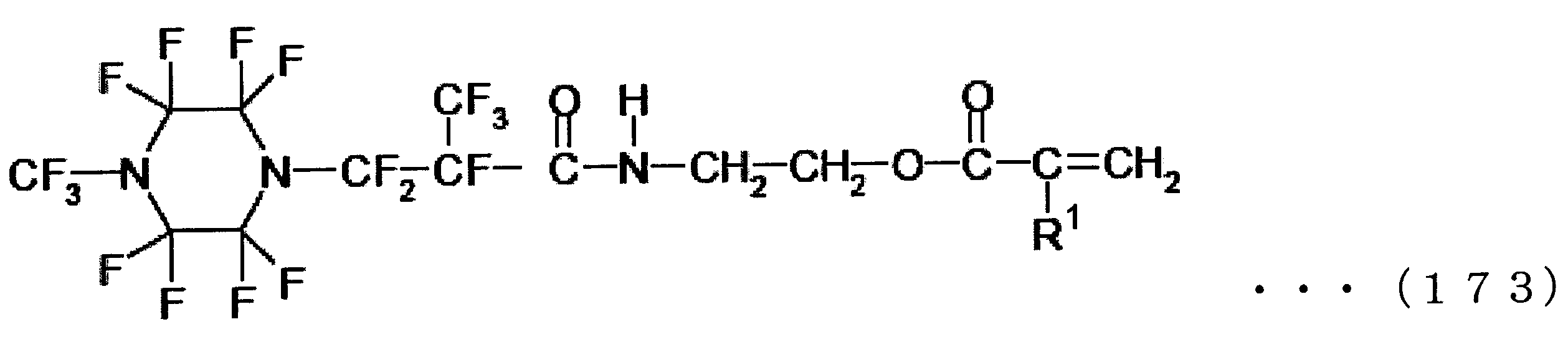
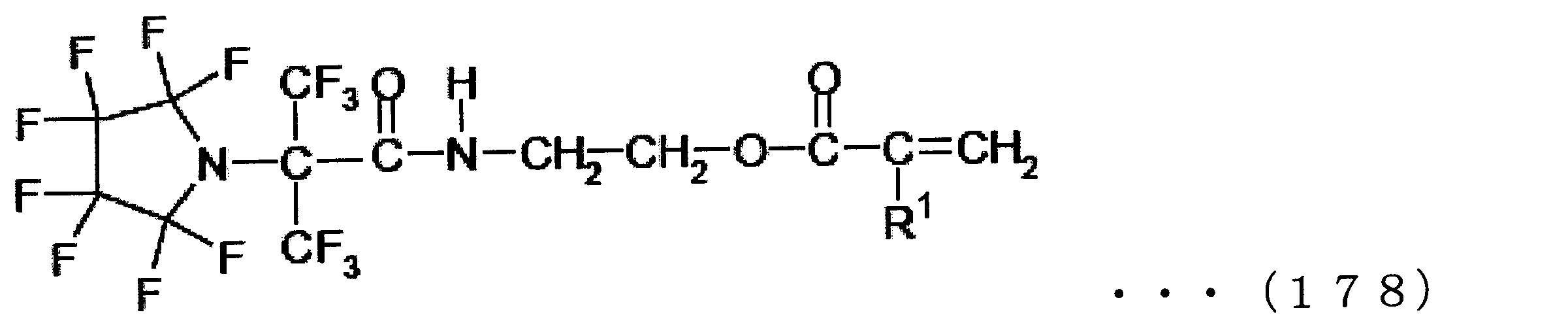
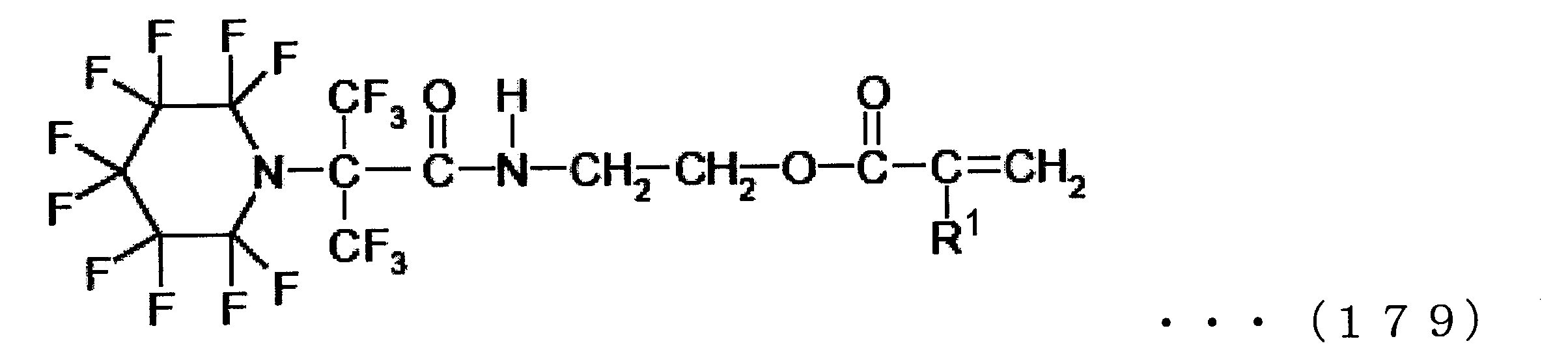
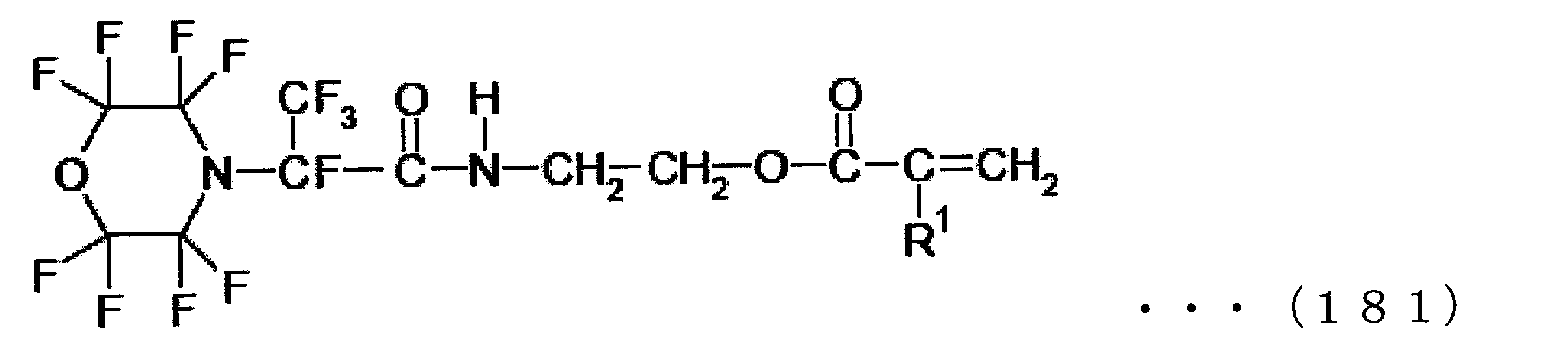
- fluorine-containing compound represented by the above formula (3) include those having perfluoropiperidine, perfluoropyrrolidine, perfluoropiperazine, perfluoromorpholine, and perfluorohexamethyleneimine as the perfluoroheterocycle. More specifically, examples include structures represented by the following formulas (92) to (188).
- R is the same as R 4 above, and is a hydrogen atom or a hydrocarbon group having 1 to 6 carbon atoms.
- R 1 is H or an alkyl group having 1 to 4 carbon atoms.
- the production method of the fluorine-containing compound of this embodiment that is, the (meth) acrylic monomer, uses a carboxylic acid halide or a sulfonic acid halide having a nitrogen-containing perfluoroalkyl group represented by the following general formula (189) as a raw material. .
- Rf 1 and Rf 2 are each a linear or branched perfluoroalkyl group or perfluoroalkylene group having 1 to 6 carbon atoms which are the same or different from each other.
- Rf 1 and Rf 2 are perfluoroalkylene groups, the ends of Rf 1 and Rf 2 are bonded via an oxygen atom, a nitrogen atom, or a CF 2 group to form a heterocyclic ring.
- Rf 3 is a linear or branched perfluoroalkylene group having 1 to 6 carbon atoms.
- Y is CO or SO 2 .
- Z is any one halogen atom selected from the group consisting of fluorine, chlorine, bromine and iodine.
- a nitrogen atom-containing perfluoroalkyl carboxylic acid halide in which Z is a halogen atom other than a fluorine atom is used, for example, the carboxylic acid fluoride having a perfluoroalkyl group obtained by the electrolytic fluorination is hydrolyzed.
- a suitable halogenating agent eg thionyl chloride, oxalyl chloride, phosphoryl chloride, sulfuryl chloride, phosphorus trichloride, phosphorus pentachloride, phosphorus tribromide, phosphorus pentabromide.
- Hydrogen bromide, hydrogen iodide, etc. to give a corresponding carboxylic acid halide.
- the first method is to dissolve or disperse the carboxylic acid halide represented by the above formula (190) with a reducing agent typified by lithium aluminum hydride (LiAlH 4 ), sodium borohydride (NaBH 4 ), or the like.
- a reducing agent typified by lithium aluminum hydride (LiAlH 4 ), sodium borohydride (NaBH 4 ), or the like.
- the resultant is dropped into an organic solvent, and an alcohol represented by the following formula (192) is obtained by a reduction reaction.
- the (meth) acrylic monomer represented by the above formula (1) is obtained by reacting the alcohol represented by the following formula (192) with (meth) acrylic acid or (meth) acryloyl chloride.
- the organic solvent used here include ethers such as diethyl ether, diisopropyl ether, tetrahydrofuran and 1,4-dioxane.
- the carboxylic acid halide represented by the above formula (190) is converted to hydroxyethyl (meth) in an organic solvent in the presence of a base such as potassium fluoride (KF) or triethylamine (Et 3 N).
- a base such as potassium fluoride (KF) or triethylamine (Et 3 N).
- KF potassium fluoride
- Et 3 N triethylamine
- the (meth) acryl monomer represented by the above formula (1) can also be obtained by reacting with acrylate.
- Organic solvents used here include halogenated hydrocarbons such as acetonitrile, dichloromethane and chloroform, ketones such as acetone and methyl ethyl ketone, esters such as ethyl acetate and butyl acetate, aromatic compounds such as toluene and benzene, diethyl And ethers such as ether, tetrahydrofuran, diisopropyl ether and 1,4-dioxane.
- halogenated hydrocarbons such as acetonitrile, dichloromethane and chloroform
- ketones such as acetone and methyl ethyl ketone
- esters such as ethyl acetate and butyl acetate
- aromatic compounds such as toluene and benzene
- diethyl And ethers such as ether, tetrahydrofuran, diisopropyl ether and 1,4-dioxane.
- the nitrogen atom-containing perfluoroalkyl sulfonic acid halide represented by the above formula (191) is a sulfonate ester corresponding to the nitrogen atom-containing perfluoroalkyl carboxylic acid halide represented by the above formula (190). Alternatively, it can be obtained by electrolytic fluorination of a halide.
- a sulfonic acid halide represented by the above formula (191) is reacted with an alkylamine to obtain an amide compound represented by the following formula (193).
- the amide compound represented by the following formula (193) is reacted with ethylene carbonate to synthesize an alcohol represented by the following formula (194).
- the (meth) acryl monomer shown to the said Formula (1) is obtained by making the alcohol shown to the following formula (194) obtained, and (meth) acrylic acid react.
- the polymer composition of this embodiment contains a fluorine-containing polymer obtained from a fluorine-containing monomer comprising the fluorine-containing compound represented by the above formula (1). Moreover, the polymer composition of this embodiment may further contain a unit derived from a fluorine-based or non-fluorinated unsaturated compound other than the fluorine-containing monomer represented by the above formula (1).
- the polymer composition of the present embodiment may be a homopolymer of a (meth) acrylic monomer (fluorine-containing monomer) represented by the above formula (1), or a fluorine-based or non-fluorine-based polymer It may be a copolymer with an unsaturated compound.
- a non-fluorinated unsaturated compound By copolymerizing with a non-fluorinated unsaturated compound, when the resulting polymer composition is used as the main component of the surface treatment agent, water and oil repellency and antifouling properties and cleaning resistance of these performances, Various properties such as washing resistance, solubility in solvents, hardness, and feel can be improved as necessary.
- the amount of the non-fluorinated unsaturated compound is 0 with respect to 100 parts by mass of the fluorinated monomer in the polymer composition. It is preferably in the range of ⁇ 10,000 parts by mass, more preferably in the range of 0 to 1000 parts by mass.
- non-fluorinated unsaturated compound examples include, for example, ethylene, vinyl acetate, vinylidene halide, acrylonitrile, styrene, polyethylene glycol (meth) acrylate, polypropylene glycol (meth) acrylate, and methoxypolyethylene glycol (meth) acrylate. , Methoxypolypropylene glycol (meth) acrylate, vinyl alkyl ether, isoprene and the like, but are not limited thereto.
- the molecular weight of the polymer composition is, for example, preferably in the range of 1,000 to 1,000,000, and more preferably in the range of 5,000 to 500,000.
- the molecular weight is less than 1000 since desired characteristics are not exhibited.
- it exceeds 1,000,000 the solubility in a solvent decreases, which is not preferable.
- Examples of the method for producing the polymer composition of the present embodiment that is, the method for polymerizing the (meth) acrylic monomer (fluorinated monomer) represented by the above formula (1) include two types of solution polymerization and emulsion polymerization.
- Solid polymerization In solution polymerization, in the presence of a polymerization initiator, the monomer (meth) acrylic monomer (fluorinated monomer) represented by the above formula (1) is dissolved in an organic solvent, and after substitution with nitrogen, a temperature range of 30 to 120 ° C. The method of heating and stirring for 3 to 24 hours is employed.
- polymerization initiator examples include azobisisobutyronitrile, benzoyl peroxide, di-t-butyl peroxide, lauryl peroxide, cumene hydroperoxide, t-butyl peroxypivalate, diisopropyl.
- examples include peroxydicarbonate.
- the polymerization initiator is preferably used in the range of 0.01 to 20 parts by mass, more preferably in the range of 0.01 to 10 parts by mass with respect to 100 parts by mass of the monomer.
- the organic solvent is not particularly limited as long as it is inert to the monomer and dissolves them.
- Specific examples of such an organic solvent include acetone, chloroform, HCHC-225, isopropyl alcohol, pentane, hexane, heptane, octane, cyclohexane, benzene, toluene, xylene, petroleum ether, tetrahydrofuran, and 1,4.
- the organic solvent is preferably used in the range of 50 to 2000 parts by mass and more preferably in the range of 50 to 1000 parts by mass with respect to 100 parts by mass of the total amount of monomers.
- Emmulsion polymerization In emulsion polymerization, in the presence of a polymerization initiator and an emulsifier, the monomer (meth) acrylic monomer (fluorinated monomer) represented by the above formula (1) is emulsified in water, and after substitution with nitrogen, 50 to 80 ° C. The method of stirring and copolymerizing for 1 to 24 hours is employed.
- Polymerization initiators include benzoyl peroxide, lauroyl peroxide, t-butyl perbenzoate, 1-hydroxycyclohexyl hydroperoxide, 3-carboxypropionyl peroxide, acetyl peroxide, azobisisobutylamidine dihydrochloride, azo Water-soluble materials such as bisisobutyronitrile, sodium peroxide, potassium persulfate, ammonium persulfate, azobisisobutyronitrile, benzoyl peroxide, di-t-butyl peroxide, lauryl peroxide, cumene hydroperoxide Oil-soluble ones such as t-butyl peroxypivalate and diisopropyl peroxydicarbonate are used.
- the polymerization initiator is used in the range of 0.01 to 10 parts by mass with respect to 100 parts by mass of the monomer.
- the surface treating agent of this embodiment is characterized by containing the polymer composition which is the above-mentioned fluorine-containing copolymer as a main component. Moreover, it is preferable that the surface treating agent of this embodiment is a form of a solution, an emulsion, or an aerosol by including a medium (for example, liquid media, such as an organic solvent and water) as another component.
- the concentration of the polymer composition in the surface treatment agent may be, for example, 0.01 to 50% by weight.
- the organic solvent applicable to the surface treatment agent of the present embodiment is not particularly limited. Specifically, for example, alcohol solvents such as methanol, ethanol, isopropyl alcohol, and ketone solvents such as acetone and methyl ethyl ketone are used. Solvents, ester solvents such as ethyl acetate and butyl acetate, fluorine-based solvents such as ⁇ , ⁇ , ⁇ -trifluorotoluene, 1,3-bistrifluoromethylbenzene, 1,4-bistrifluoromethylbenzene, perfluorooctane and perfluorohexane A solvent or the like can be used.
- alcohol solvents such as methanol, ethanol, isopropyl alcohol
- ketone solvents such as acetone and methyl ethyl ketone
- Solvents, ester solvents such as ethyl acetate and butyl acetate
- fluorine-based solvents
- the concentration of the polymer composition in the dip is preferably 0.05 to 10% by weight.
- the concentration of the polymer composition in the treatment liquid is preferably 0.1 to 5% by weight.
- the surface treatment agent of the present embodiment may be other surface treatment agents (for example, water and oil repellents), insect repellents, softening agents, antibacterial agents, flame retardants, electrification agents.
- An inhibitor, a paint fixing agent, an anti-wrinkle agent and the like may be added.
- Examples of objects to be treated with the surface treatment agent of the present embodiment include fibers, stones, filters (for example, electrostatic filters), dust masks, fuel cell components (for example, gas diffusion electrodes and gas diffusion supports), Mention may be made of glass, paper, wood, leather, fur, asbestos, bricks, cement, metals and oxides, ceramic products, plastics, painted surfaces and plasters.
- fibers Various examples can be given as fibers.
- animal and plant natural fibers such as cotton, hemp, wool, silk, polyamide, polyester, polyvinyl alcohol, polyacrylonitrile, polyvinyl chloride, polypropylene and other synthetic fibers, rayon, acetate and other semi-synthetic fibers, Examples thereof include inorganic fibers such as glass fibers, carbon fibers and asbestos fibers, or mixed fibers thereof.
- the textile product may in particular be a carpet.
- the surface treatment agent of this embodiment can be applied to an object to be treated by a conventionally known method.
- a surface treatment agent dispersed and diluted in an organic solvent or water is attached to the surface of an object to be treated by a known method such as dip coating, spray coating or foam coating, and then dried. . Further, if necessary, it may be applied together with an appropriate crosslinking agent and cured.
- the polymer composition as the main component thereof, and the novel fluorine-containing compound as the raw material component thereof, the perfluoroalkyl group having 8 or more carbon atoms is added. It has excellent water and oil repellency, though it is a chemical structure that does not contain and has no fear of producing PFOS or PFOA, which is problematic in terms of bioaccumulation and environmental adaptability.
- the surface treatment agent of the present embodiment is mainly composed of a polymer composition derived from a nitrogen atom-containing perfluoroalkyl (meth) acrylate represented by the above formulas (1) to (3). That is, the surface treatment agent of the present embodiment contains a nitrogen atom in which a plurality of linear perfluoroalkyl groups having 6 or less carbon atoms are bonded through nitrogen atoms represented by the above formulas (1) to (3). Since a homopolymer or copolymer composed of perfluoroalkyl (meth) acrylate is used as a main component, the surface treated material has the same water and oil repellency even though it does not have a linear perfluoroalkyl group having 8 carbon atoms. Can be granted.
- Example 1 (Monomer production method) Sodium borohydride (14.1 g) (manufactured by Tokyo Chemical Industry Co., Ltd.) and tetrahydrofuran (310 ml) were charged into a three-necked flask equipped with a dropping funnel. In the dropping funnel, (CF 3 CF 2 CF 2 CF 2 ) 2 NCF 2 CF 2 COF (371.3) obtained by electrolytic fluorination of (CH 3 CH 2 CH 2 CH 2 ) 2 NCH 2 CH 2 CO 2 CH 3 . 0 g, purity 70%) was added and gradually added dropwise at room temperature.
- the mixture was stirred at room temperature for 1 hour, and then the reaction solution was quenched with water and an aqueous hydrochloric acid solution, and chloroform was added for liquid separation.
- the obtained chloroform layer was washed with an aqueous hydrochloric acid solution and water and dried over magnesium sulfate, and then the obtained solution was concentrated by a rotary evaporator. Furthermore, the obtained solution was distilled under reduced pressure to obtain an alcohol form (171.0 g, yield 68%).
- the polymer obtained above was dissolved in AK225 to a concentration of 1 wt% to prepare a surface treatment agent.
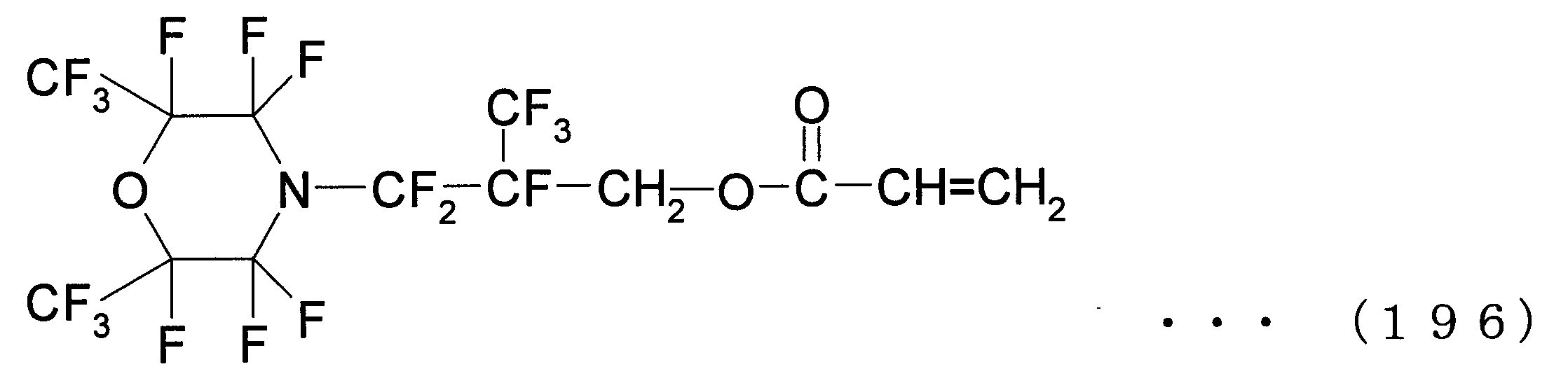
- Example 2 Instead of “(CF 3 CF 2 CF 2 CF 2 ) 2 NCF 2 CF 2 COF” used in Example 1, “O (CH (CH 3 ) CH 2 ) 2 NCH 2 CH (CH 3 ) CO 2
- the following general formula (196) was obtained in the same manner as in Example 1 except that “O (CF (CF 3 ) CF 2 ) 2 NCF 2 CF (CF 3 ) COF” obtained by electrolytic fluorination of “CH 3 ” was used.
- the nitrogen atom-containing perfluoroalkyl (meth) acrylate shown in (2) was synthesized to obtain a polymer and a surface treatment agent.
- Example 3 Hydroxyethyl acrylate (30.5 g) (manufactured by Tokyo Chemical Industry Co., Ltd.) and acetonitrile (200 ml) were charged into a three-necked flask equipped with a dropping funnel. To the dropping funnel, (CF 3 CF 2 CF 2 CF 2 ) 2 NCF (CF 3 ) COF (CF 3 CF 2 CF 2 CF 2 ) obtained by electrolytic fluorination of (CH 3 CH 2 CH 2 CH 2 ) 2 NCH (CH 3 ) CO 2 CH 3 157.4 g, purity 70%) was added and the solution was gradually added dropwise at room temperature.
- the surface treatment agents of Examples 1 to 3 are conventional surface treatment agents and compared to Comparative Example 1 which is a PFOS derivative that has a problem of accumulation in the environment and living body. It was found to have equivalent water and oil repellent properties. On the other hand, it was found that the surface treatment agent of Comparative Example 2 has a small number of carbon atoms in the perfluoroalkyl group in the structure, and the water and oil repellency characteristics are lowered.
- the surface treatment agent of the present invention has excellent water and oil repellency, low bioaccumulation, and excellent environmental adaptability. Therefore, it is useful in a wide range of applications such as water and oil repellents and antifouling agents. is there.
Landscapes
- Chemical & Material Sciences (AREA)
- Organic Chemistry (AREA)
- Addition Polymer Or Copolymer, Post-Treatments, Or Chemical Modifications (AREA)
- Materials Applied To Surfaces To Minimize Adherence Of Mist Or Water (AREA)
Abstract
この含フッ素化合物は、窒素原子を介して炭素数が6以下の直鎖状ペルフルオロアルキル基を複数結合させた窒素原子含有ペルフルオロアルキル(メタ)アクリレートであり、窒素原子含有ペルフルオロアルキル(メタ)アクリレートからなるホモポリマーまたはコポリマーを表面処理剤として用いる。
Description
本発明は、含フッ素化合物、重合体組成物及び表面処理剤に関する。
本願は、2014年3月31日に、日本に出願された特願2014-073516号に基づき優先権を主張し、その内容をここに援用する。
本願は、2014年3月31日に、日本に出願された特願2014-073516号に基づき優先権を主張し、その内容をここに援用する。
従来から、被表面処理材に撥水撥油性を付与する表面処理剤として、炭素数が8の直鎖状ペルフルオロアルキル基(C8F17)を側鎖に有する含フッ素(メタ)アクリルポリマー等のフッ素系表面処理剤が使用されている。
しかしながら、近年、炭素数が8以上のペルフルオロアルキル基を有する化合物は分解することにより、毒性および環境・生体蓄積性が高いペルフルオロオクタンスルホン酸(PFOS)またはペルフルオロクタン酸(PFOA)を生成し得ることが明らかとなったため、その使用が制限されつつあるという課題があった。そのため、市場では、構造上、環境および生体への蓄積性が高いPFOSまたはPFOAを生成し得ない、炭素数6以下で可能な限り短鎖長のペルフルオロアルキル基の構造の材料が望まれている。
そこで、近年、炭素数の少ない直鎖状ペルフルオロアルキル基を有するポリマーによりそれらを代替する検討が種々行われている(特許文献1,2及び非特許文献1を参照)。
Ind.Eng.Chem.Res.2008,47,502-508.
しかしながら、一般的に、撥水撥油性を付与するフッ素系表面処理剤は、構造中に有するペルフルオロアルキル基の炭素数が少なくなるにつれ、撥水撥油特性が低下することが知られている。そのため、単純に炭素数を少なくするだけでは、従来使用されてきた炭素数が8の直鎖状ペルフルオロアルキル基(C8F17)を側鎖に有する含フッ素(メタ)アクリルポリマー等のフッ素系表面処理剤と同等の特性を発現させることは困難であった。
本発明は、上記事情に鑑みてなされたものであって、炭素数8以上のペルフルオロアルキル基を含有せず、生体蓄積性や環境適応性の点で問題となるPFOSまたはPFOAを生成する懸念がない化学構造でありながら、優れた撥水撥油特性を有する表面処理剤、及びその主成分となる重合体組成物、並びにそれらの原料成分となる新規な含フッ素化合物を提供することを課題とする。
上記の課題を解決するために、本発明は以下の構成を採用した。
[1] 下記一般式(1)で示される含フッ素化合物。

上記式(1)中、Rf1及びRf2は、それぞれ同一または互いに異なる炭素数1~6であって、直鎖状又は分枝状のペルフルオロアルキル基又はペルフルオロアルキレン基である。Rf1及びRf2がペルフルオロアルキレン基であるとき、Rf1及びRf2の末端は酸素原子、窒素原子、又はCF2基を介して結合し、複素環を形成する。Rf3は、炭素数1~6であって、直鎖状又は分枝状のペルフルオロアルキレン基である。
上記式(1)中、Xは、2価の有機基である。
上記式(1)中、R1は、Hまたは炭素数1~4のアルキル基である。
[2] 下記一般式(2)で示される直鎖状のペルフルオロアルキル基を有することを特徴とする前項[1]に記載の含フッ素化合物。

上記式(2)中、m及びnは、それぞれ同一又は互いに異なる1~6の整数である。Rf4は、炭素数1~6であって、直鎖状又は分枝状のペルフルオロアルキレン基である。
上記式(2)中、Xは、2価の有機基である。
上記式(2)中、R1は、Hまたは炭素数1~4のアルキル基である。
[3] 下記一般式(3)で示される窒素原子を含むペルフルオロ複素環を有することを特徴とする前項[1]に記載の含フッ素化合物。

上記式(3)中、Rf5、Rf6及びRf7は、それぞれ同一または互いに異なる炭素数1~6であって、直鎖状又は分枝状のペルフルオロアルキレン基である。
上記式(3)中、Xは2価の有機基、Yは、酸素原子、窒素原子又はCF2基である。
上記式(3)中、R1は、Hまたは炭素数1~4のアルキル基である。
[4] 前項[1]乃至[3]のいずれか一項に記載の含フッ素化合物からなる含フッ素単量体から得られる含フッ素重合体を含むことを特徴とする重合体組成物。
[5] 前記含フッ素単量体以外のフッ素系または非フッ素系不飽和化合物から導かれる単位をさらに含有することを特徴とする前項[4]に記載の重合体組成物。
[6] 前項[4]又は[5]に記載の重合体組成物を含むことを特徴とする表面処理剤。
[1] 下記一般式(1)で示される含フッ素化合物。
上記式(1)中、Xは、2価の有機基である。
上記式(1)中、R1は、Hまたは炭素数1~4のアルキル基である。
[2] 下記一般式(2)で示される直鎖状のペルフルオロアルキル基を有することを特徴とする前項[1]に記載の含フッ素化合物。
上記式(2)中、Xは、2価の有機基である。
上記式(2)中、R1は、Hまたは炭素数1~4のアルキル基である。
[3] 下記一般式(3)で示される窒素原子を含むペルフルオロ複素環を有することを特徴とする前項[1]に記載の含フッ素化合物。
上記式(3)中、Xは2価の有機基、Yは、酸素原子、窒素原子又はCF2基である。
上記式(3)中、R1は、Hまたは炭素数1~4のアルキル基である。
[4] 前項[1]乃至[3]のいずれか一項に記載の含フッ素化合物からなる含フッ素単量体から得られる含フッ素重合体を含むことを特徴とする重合体組成物。
[5] 前記含フッ素単量体以外のフッ素系または非フッ素系不飽和化合物から導かれる単位をさらに含有することを特徴とする前項[4]に記載の重合体組成物。
[6] 前項[4]又は[5]に記載の重合体組成物を含むことを特徴とする表面処理剤。
本発明によれば、炭素数8以上のペルフルオロアルキル基を含有せず、生体蓄積性や環境適応性の点で問題となるPFOSまたはPFOAを生成する懸念がない化学構造でありながら、優れた撥水撥油特性を有する表面処理剤、及びその主成分となる重合体組成物、並びにそれらの原料成分となる新規な含フッ素化合物を提供することができる。また、本表面処理剤および含フッ素化合物は、撥水撥油剤のほか、界面活性剤、潤滑剤、離型剤、低屈折率剤、架橋剤、反射防止膜などのコーティング材料、光リソグラフィーなどのレジスト用モノマーとして有用である。
以下、本発明を適用した一実施形態である表面処理剤について、その主成分となる重合体組成物、及びそれらの原料成分となる新規な含フッ素化合物とともに詳細に説明する。
<含フッ素化合物>
先ず、本実施形態の含フッ素化合物の構成について説明する。
本実施形態の含フッ素化合物は、下記一般式(1)で表される、窒素原子を介して炭素数が6以下の直鎖状または分枝状ペルフルオロアルキル基を複数結合させた、窒素原子含有ペルフルオロアルキル(メタ)アクリレートである。
先ず、本実施形態の含フッ素化合物の構成について説明する。
本実施形態の含フッ素化合物は、下記一般式(1)で表される、窒素原子を介して炭素数が6以下の直鎖状または分枝状ペルフルオロアルキル基を複数結合させた、窒素原子含有ペルフルオロアルキル(メタ)アクリレートである。

なお、上記式(1)中、Rf1及びRf2は、それぞれ同一または互いに異なる炭素数1~6のペルフルオロアルキル基であって、直鎖状又は分枝状であってもよい。また、上記Rf1及びRf2は、直接結合して環状を形成していても良いし、酸素原子または窒素原子を介して結合し、複素環を形成していてもよい。
また、さらに、Rf3は、炭素数1~6のペルフルオロアルキレン基であって、直鎖状又は分枝状であってもよい。
即ち、上記式(1)中、Rf1及びRf2は、それぞれ同一または互いに異なる炭素数1~6であって、直鎖状又は分枝状のペルフルオロアルキル基又はペルフルオロアルキレン基である。Rf1及びRf2がペルフルオロアルキレン基であるとき、Rf1及びRf2の末端は酸素原子、窒素原子、又はCF2基を介して結合し、複素環を形成する。Rf3は、炭素数1~6であって、直鎖状又は分枝状のペルフルオロアルキレン基である。
Rf1及びRf2は、炭素数1~4であって、直鎖状又は分枝状のペルフルオロアルキル基又はペルフルオロアルキレン基であることが好ましい。Rf3は、炭素数1~4であって、直鎖状又は分枝状のペルフルオロアルキレン基であることが好ましい。
また、さらに、Rf3は、炭素数1~6のペルフルオロアルキレン基であって、直鎖状又は分枝状であってもよい。
即ち、上記式(1)中、Rf1及びRf2は、それぞれ同一または互いに異なる炭素数1~6であって、直鎖状又は分枝状のペルフルオロアルキル基又はペルフルオロアルキレン基である。Rf1及びRf2がペルフルオロアルキレン基であるとき、Rf1及びRf2の末端は酸素原子、窒素原子、又はCF2基を介して結合し、複素環を形成する。Rf3は、炭素数1~6であって、直鎖状又は分枝状のペルフルオロアルキレン基である。
Rf1及びRf2は、炭素数1~4であって、直鎖状又は分枝状のペルフルオロアルキル基又はペルフルオロアルキレン基であることが好ましい。Rf3は、炭素数1~4であって、直鎖状又は分枝状のペルフルオロアルキレン基であることが好ましい。
また、上記式(1)中、Xは、2価の有機基である。さらに、上記式(1)中、R1は、水素原子(H)または炭素数1~4のアルキル基である。
上記式(1)で表される含フッ素化合物の例として、下記一般式(2)で表されるペルフルオロアミン構造を有するものと、下記式(3)で表されるペルフルオロ複素環を有するものと、が挙げられる。

上記式(2)中、m及びnは、それぞれ同一又は互いに異なる1~6の整数である。Rf4は、炭素数1~6であって、直鎖状又は分枝状のペルフルオロアルキレン基である。
上記式(2)中、Xは、2価の有機基である。上記式(2)中、R1は、水素原子(H)または炭素数1~4のアルキル基である。
m及びnは1~4の整数であることが好ましい。Rf4は、炭素数1~4であって、直鎖状又は分枝状のペルフルオロアルキレン基であることが好ましい。
上記式(2)中、Xは、2価の有機基である。上記式(2)中、R1は、水素原子(H)または炭素数1~4のアルキル基である。
m及びnは1~4の整数であることが好ましい。Rf4は、炭素数1~4であって、直鎖状又は分枝状のペルフルオロアルキレン基であることが好ましい。

上記式(3)中、Rf5、Rf6及びRf7は、それぞれ同一または互いに異なる炭素数1~6であって、直鎖状又は分枝状のペルフルオロアルキレン基である。
上記式(3)中、Xは2価の有機基、Yは、酸素原子、窒素原子又はCF2基である。上記式(3)中、R1は、水素原子(H)または炭素数1~4のアルキル基である。
Rf5、Rf6及びRf7は、炭素数1~4であって、直鎖状又は分枝状のペルフルオロアルキレン基であることが好ましい。
上記式(3)中、Xは2価の有機基、Yは、酸素原子、窒素原子又はCF2基である。上記式(3)中、R1は、水素原子(H)または炭素数1~4のアルキル基である。
Rf5、Rf6及びRf7は、炭素数1~4であって、直鎖状又は分枝状のペルフルオロアルキレン基であることが好ましい。
ここで、上記式(1)~式(3)中に示すXは、2価の有機基であり、具体的な構造としては、例えば、炭化水素基(下記式(4)を参照)、エーテル結合を有する構造(下記式(5)を参照)、エステル結合を有する構造(下記式(6)を参照)、スルホニル結合を有する構造(下記式(7)を参照)、アミド結合を有する構造(下記式(8)及び下記式(9)を参照)、ウレタン結合を有する構造(下記式(10)を参照)、スルホンアミド結合を有する構造(下記式(11)を参照)等が挙げられる。








なお、上記式(4)~式(11)中、R2及びR3は炭素数が0~10の炭化水素基であり、R4は水素原子又は炭素数1~6の炭化水素基である。
上記式(2)で表される含フッ素化合物の具体例としては、例えば、下記式(12)~式(91)で表される構造が挙げられる。
以下、式(12)~式(91)において、Rは上記R4と同じであり、水素原子又は炭素数1~6の炭化水素基である。R1は、Hまたは炭素数1~4のアルキル基である。
以下、式(12)~式(91)において、Rは上記R4と同じであり、水素原子又は炭素数1~6の炭化水素基である。R1は、Hまたは炭素数1~4のアルキル基である。







































































また、上記式(3)で表される含フッ素化合物の具体例としては、ペルフルオロ複素環として、ペルフルオロピペリジン、ペルフルオロピロリジン、ペルフルオロピペラジン、ペルフルオロモルホリン、ペルフルオロヘキサメチレンイミンを有するものが例示できる。
より具体的には、例えば、下記式(92)~式(188)で表される構造が挙げられる。
以下、式(92)~式(188)において、Rは上記R4と同じであり、水素原子又は炭素数1~6の炭化水素基である。R1は、Hまたは炭素数1~4のアルキル基である。
より具体的には、例えば、下記式(92)~式(188)で表される構造が挙げられる。
以下、式(92)~式(188)において、Rは上記R4と同じであり、水素原子又は炭素数1~6の炭化水素基である。R1は、Hまたは炭素数1~4のアルキル基である。





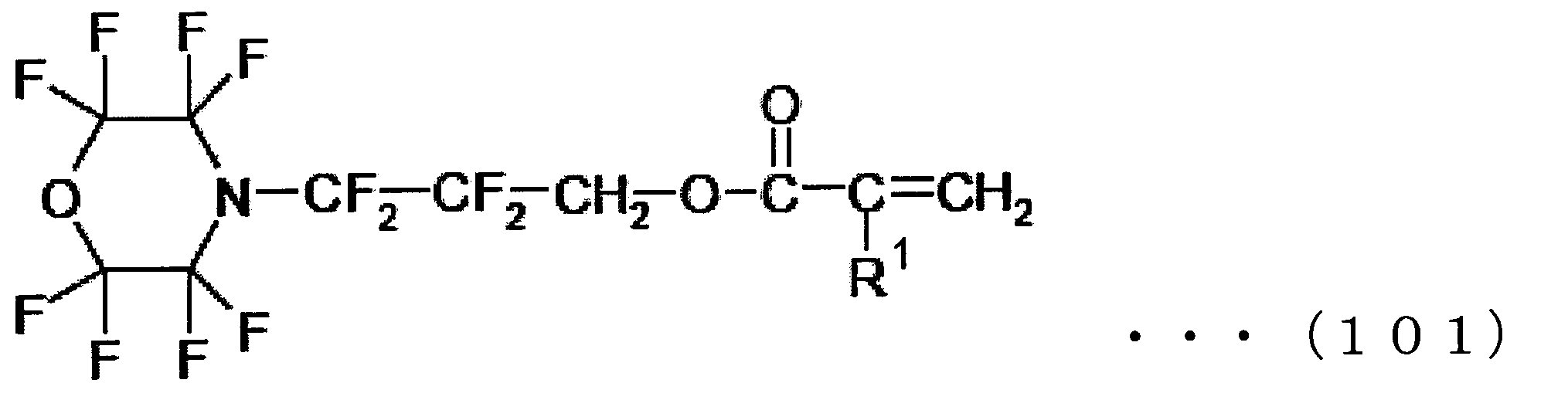
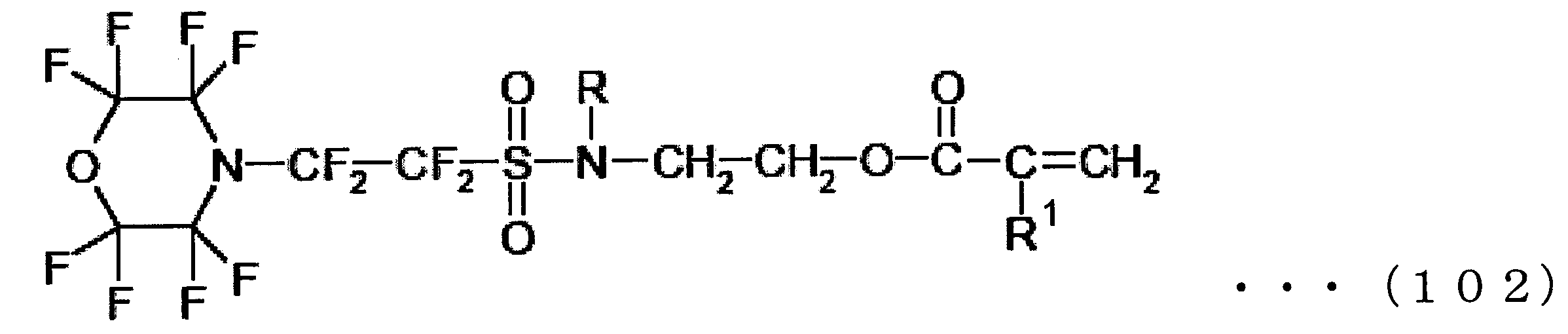
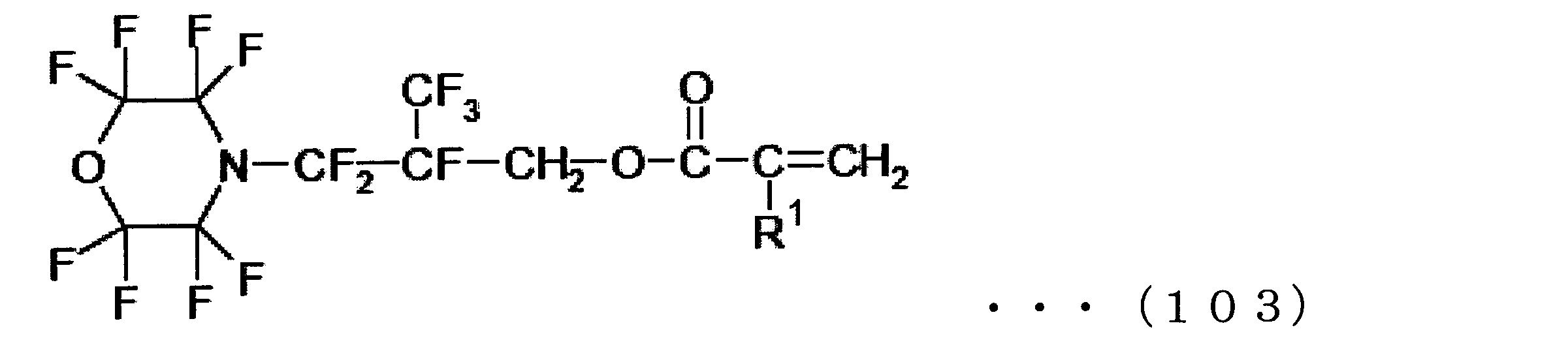

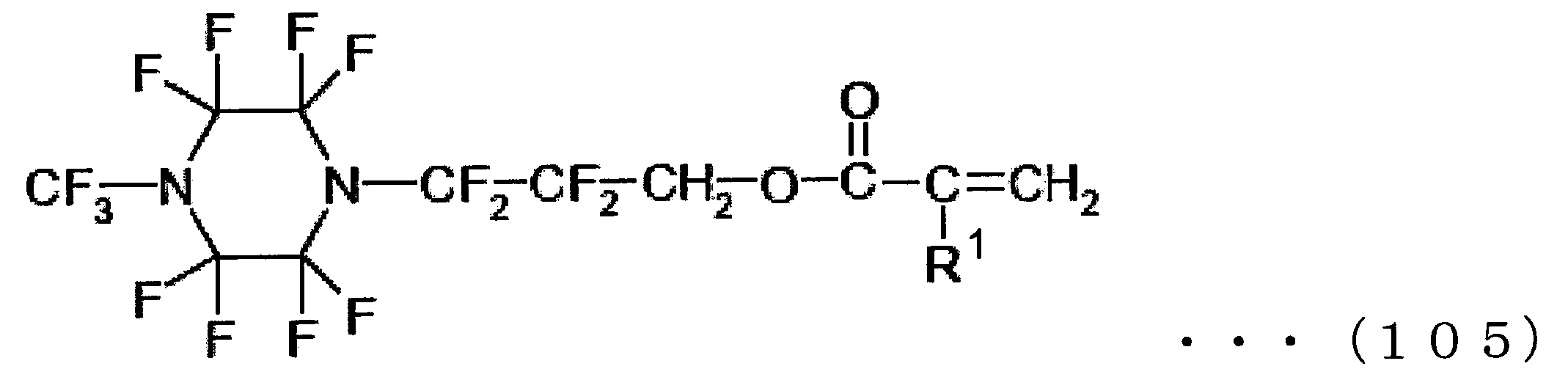






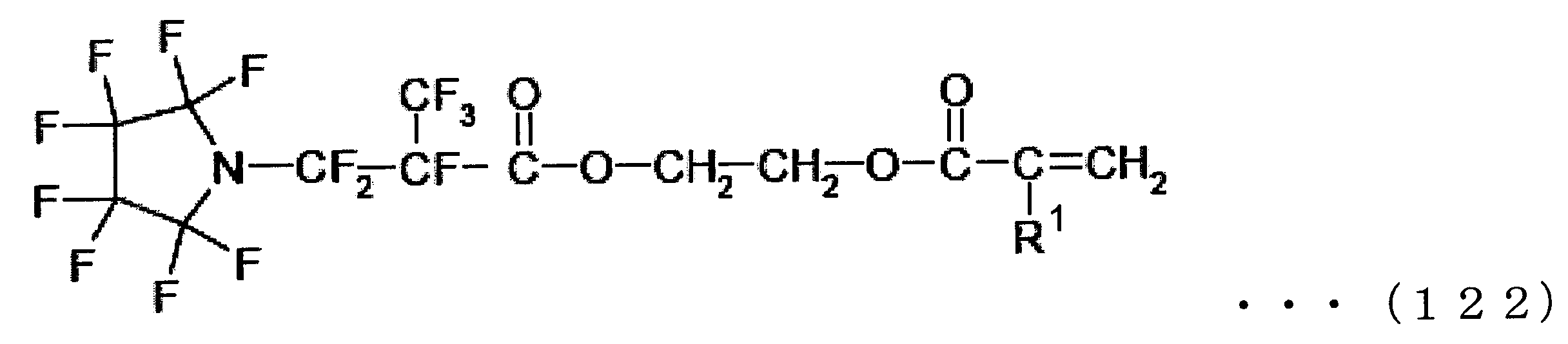
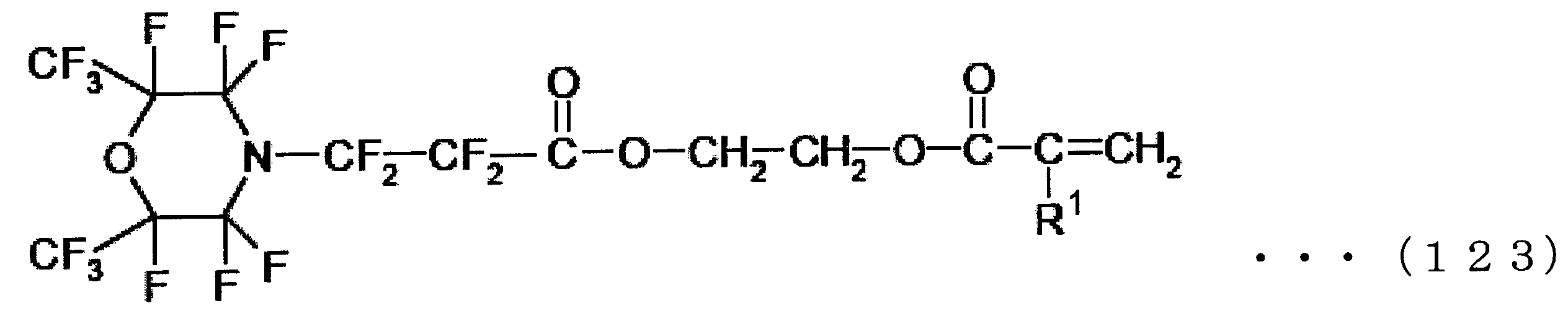

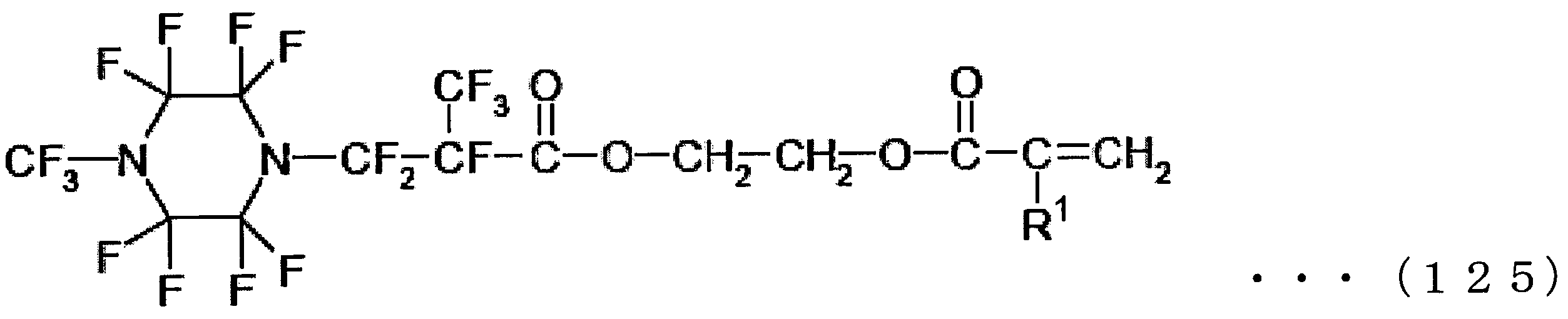
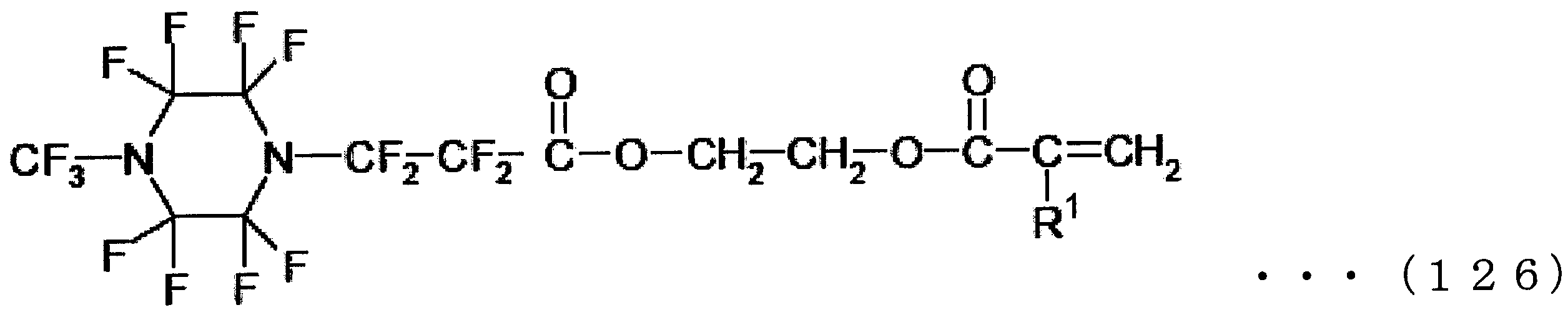









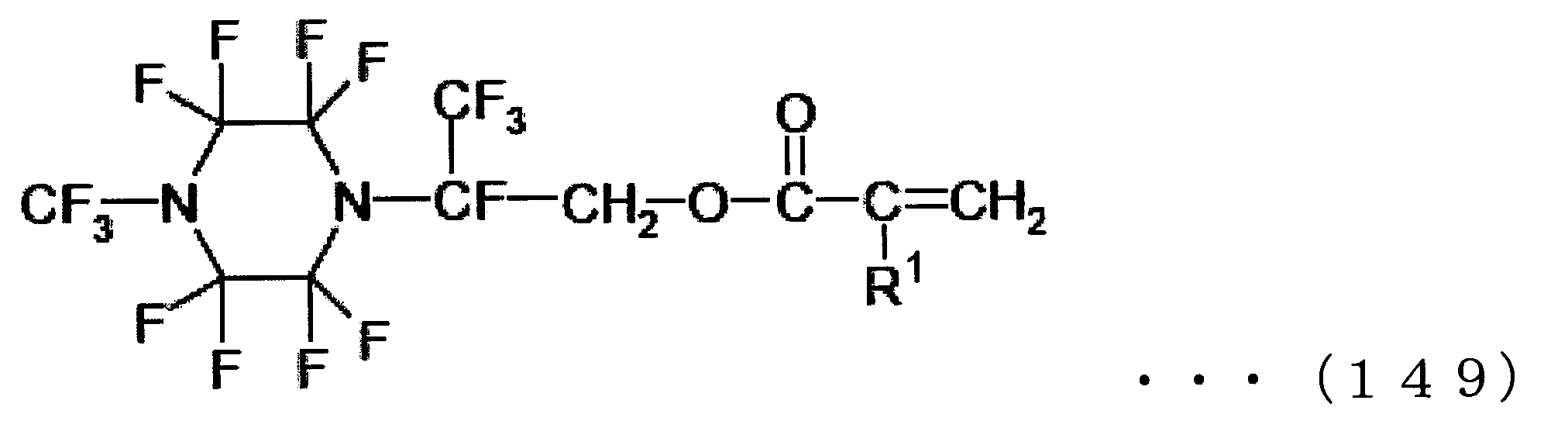
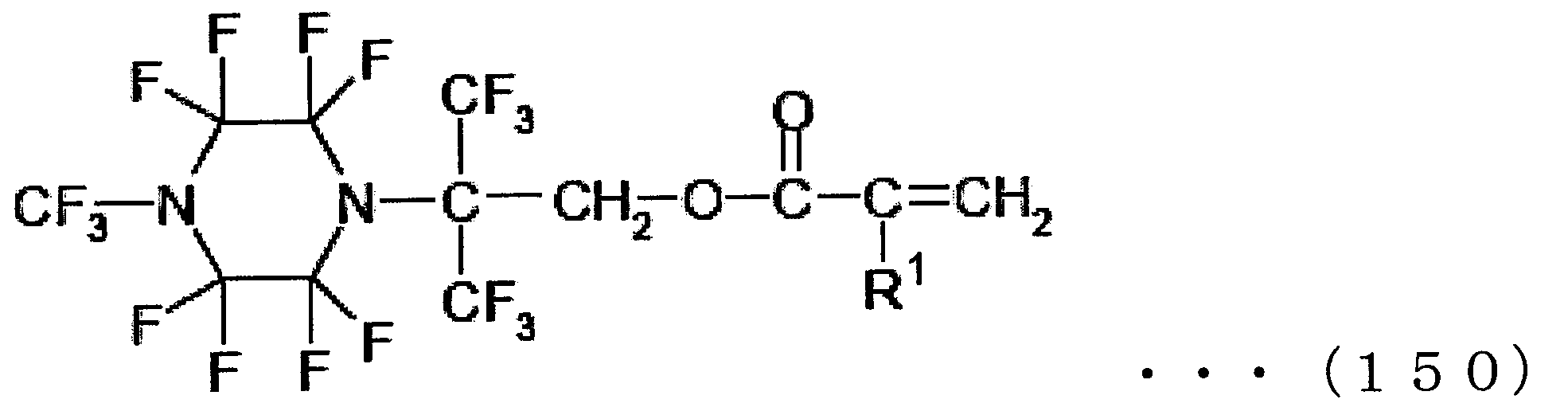


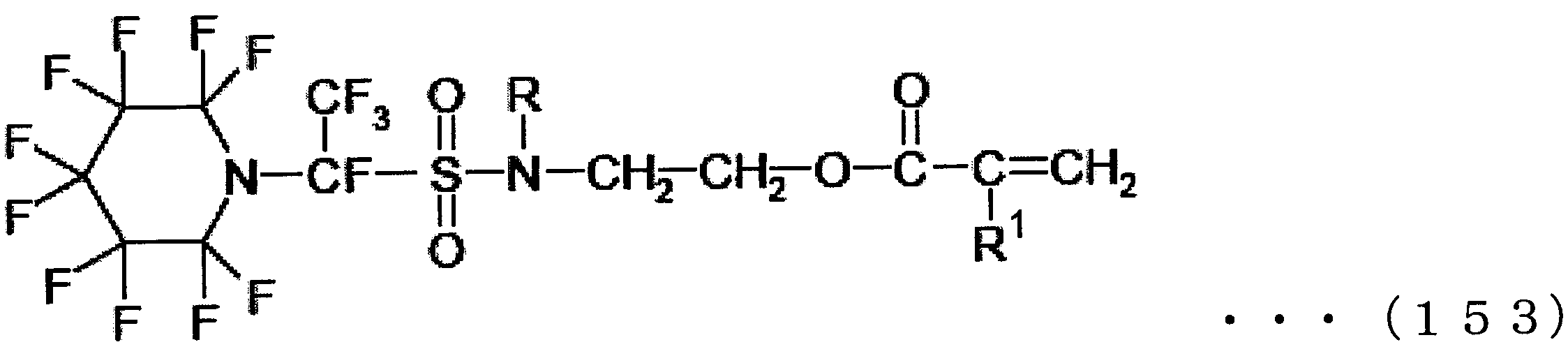
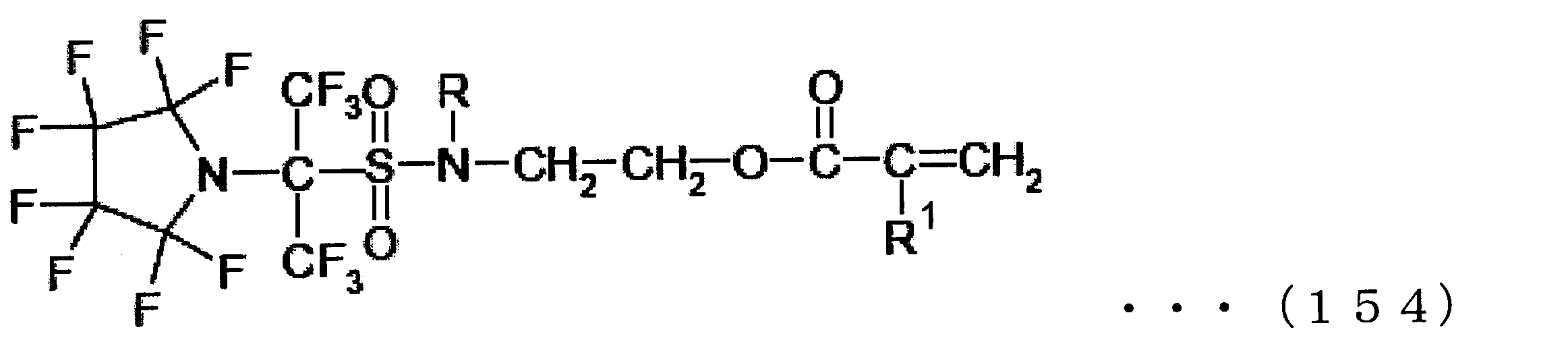











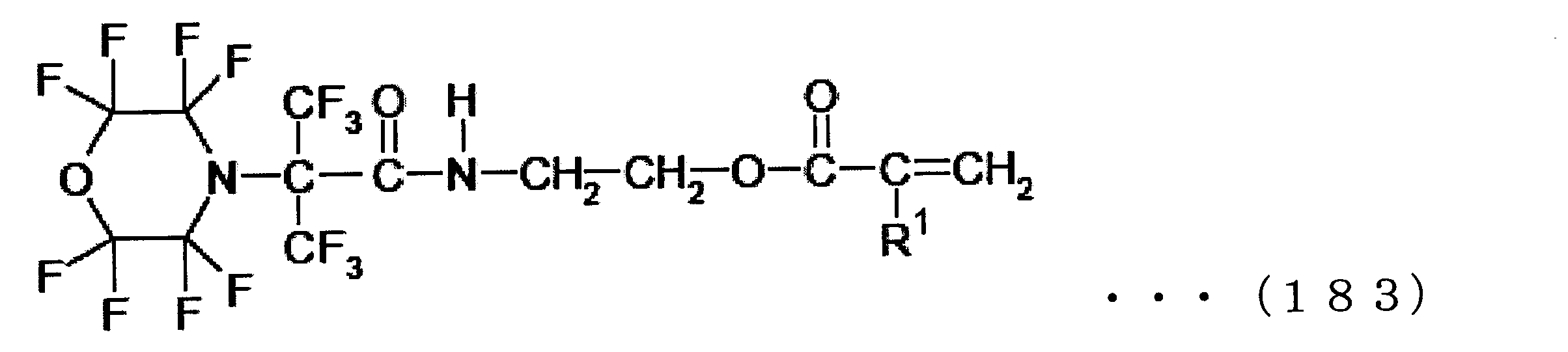
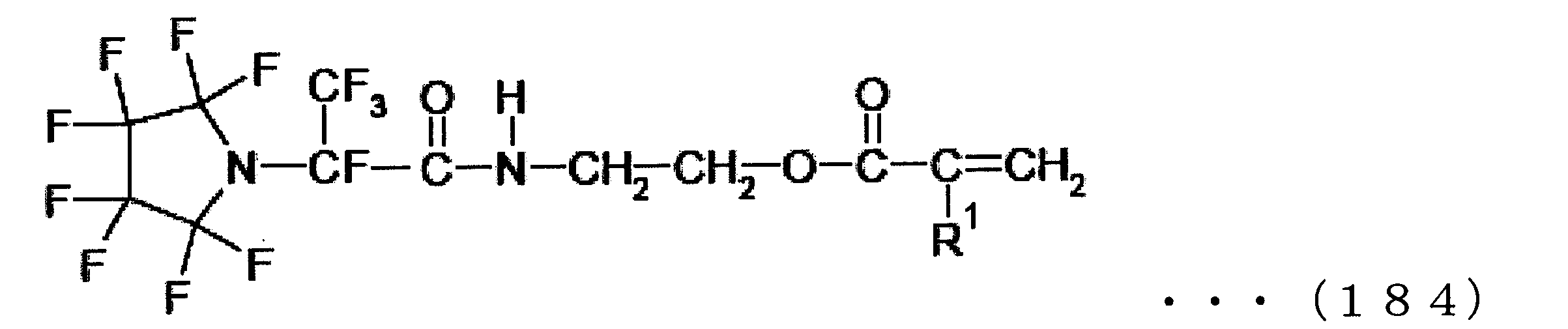
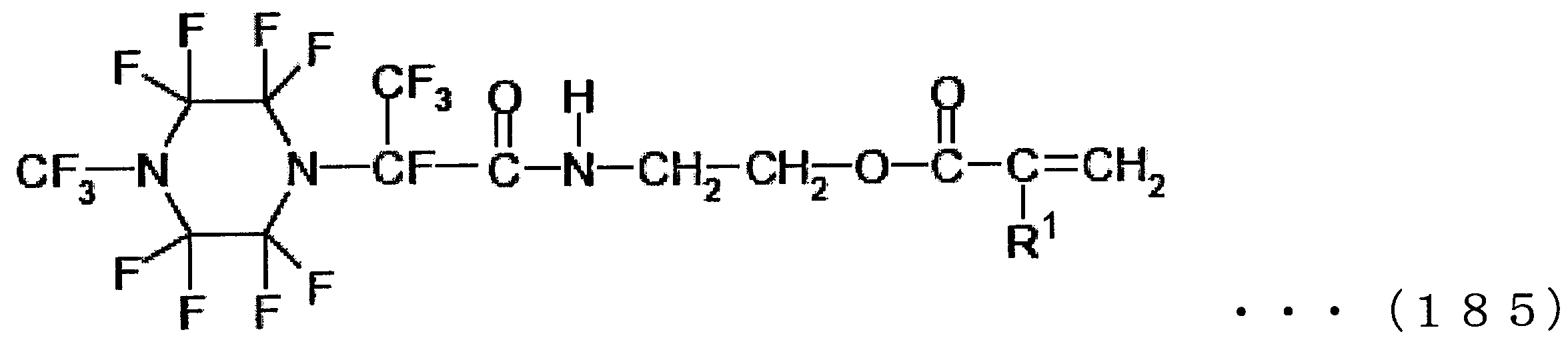
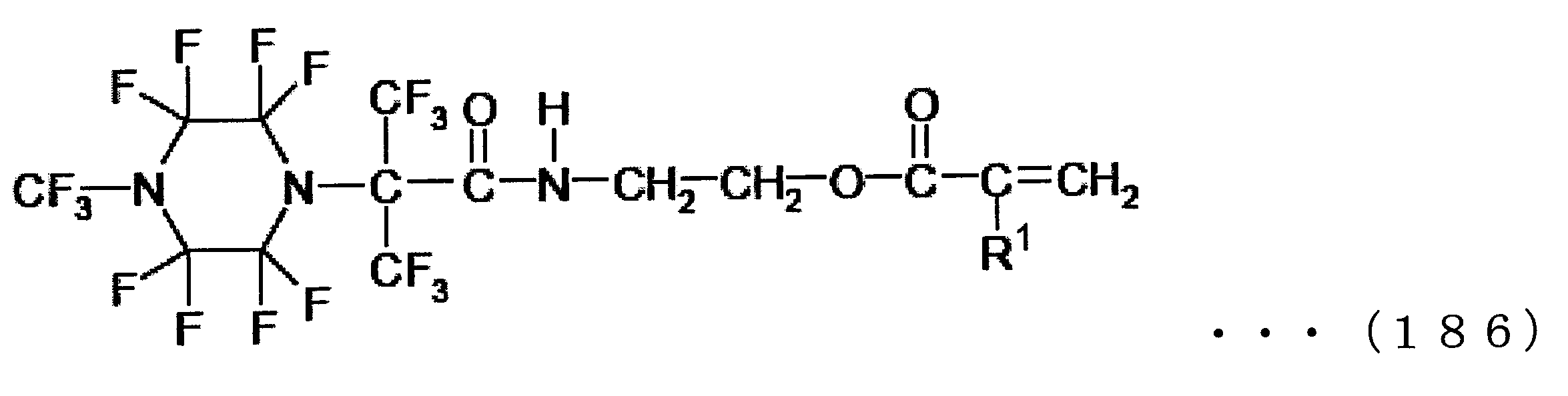


<含フッ素化合物の製造方法>
次に、本実施形態の含フッ素化合物の製造方法について説明する。
本実施形態の含フッ素化合物、すなわち、(メタ)アクリルモノマーの製造方法は、下記一般式(189)で示される含窒素ペルフルオロアルキル基を有する、カルボン酸ハロゲン化物又はスルホン酸ハロゲン化物を原料とする。
次に、本実施形態の含フッ素化合物の製造方法について説明する。
本実施形態の含フッ素化合物、すなわち、(メタ)アクリルモノマーの製造方法は、下記一般式(189)で示される含窒素ペルフルオロアルキル基を有する、カルボン酸ハロゲン化物又はスルホン酸ハロゲン化物を原料とする。

上記式(189)中、Rf1及びRf2は、それぞれ同一または互いに異なる炭素数1~6であって、直鎖状又は分枝状のペルフルオロアルキル基又はペルフルオロアルキレン基である。Rf1及びRf2がペルフルオロアルキレン基であるとき、Rf1及びRf2の末端は酸素原子、窒素原子、又はCF2基を介して結合し、複素環を形成する。Rf3は、炭素数1~6であって、直鎖状又は分枝状のペルフルオロアルキレン基である。
また、Yは、CO又はSO2である。さらに、Zは、フッ素、塩素、臭素及びヨウ素からなる群から選択されるいずれか1のハロゲン原子である。
また、Yは、CO又はSO2である。さらに、Zは、フッ素、塩素、臭素及びヨウ素からなる群から選択されるいずれか1のハロゲン原子である。
以下、上記式(189)中に示すYが、「CO」の場合(すなわち、下記式(190)に示すカルボン酸ハロゲン化物の場合)又は「SO2」の場合(すなわち、下記式(191)に示すスルホン酸ハロゲン化物の場合)のそれぞれについて説明する。


「Y=COの場合のモノマーへの誘導方法」
上記式(190)中に示されるZがフッ素原子である、窒素原子含有ペルフルオロアルキルカルボン酸フルオリドは、例えば、対応するカルボン酸エステル又はハロゲン化物を、フッ化水素中で電解フッ素化することにより得ることができる。
上記式(190)中に示されるZがフッ素原子である、窒素原子含有ペルフルオロアルキルカルボン酸フルオリドは、例えば、対応するカルボン酸エステル又はハロゲン化物を、フッ化水素中で電解フッ素化することにより得ることができる。
一方、上記Zがフッ素原子以外のハロゲン原子である窒素原子含有ペルフルオロアルキルカルボン酸ハロゲン化物を用いる場合には、例えば、前記電解フッ素化により得られたペルフルオロアルキル基を有するカルボン酸フルオリドを加水分解処理して、対応するカルボン酸を生成させた後、適当なハロゲン化剤(例えば、塩化チオニル、塩化オキサリル、塩化ホスホリル、塩化スルフリル、三塩化リン、五塩化リン、三臭化リン、五臭化リン、臭化水素、ヨウ化水素等)を反応させて、対応するカルボン酸ハロゲン化物に誘導することにより得ることができる。
また、モノマーへの誘導方法としては、以下の2つの方法を例示することができる。
1つ目の方法は、上記式(190)に示すカルボン酸ハロゲン化物を、例えば水素化アルミニウムリチウム(LiAlH4)や水素化ホウ素ナトリウム(NaBH4)等に代表される還元剤を溶解または分散させた有機溶媒中に滴下し、還元反応により下記式(192)に示すアルコールを得る。次いで、得られた下記式(192)に示すアルコールと(メタ)アクリル酸又は(メタ)アクリロイルクロリドとを反応させることで、上記式(1)に示す(メタ)アクリルモノマーが得られる。
ここで用いる有機溶媒としては、ジエチルエーテル、ジイソプロピルエーテル、テトラヒドロフラン、1,4-ジオキサン等のエーテル類が挙げられる。
1つ目の方法は、上記式(190)に示すカルボン酸ハロゲン化物を、例えば水素化アルミニウムリチウム(LiAlH4)や水素化ホウ素ナトリウム(NaBH4)等に代表される還元剤を溶解または分散させた有機溶媒中に滴下し、還元反応により下記式(192)に示すアルコールを得る。次いで、得られた下記式(192)に示すアルコールと(メタ)アクリル酸又は(メタ)アクリロイルクロリドとを反応させることで、上記式(1)に示す(メタ)アクリルモノマーが得られる。
ここで用いる有機溶媒としては、ジエチルエーテル、ジイソプロピルエーテル、テトラヒドロフラン、1,4-ジオキサン等のエーテル類が挙げられる。

また、2つ目の方法は、上記式(190)に示すカルボン酸ハロゲン化物を、フッ化カリウム(KF)やトリエチルアミン(Et3N)などの塩基存在下、有機溶媒中でヒドロキシエチル(メタ)アクリレートと反応させることによっても、上記式(1)に示す(メタ)アクリルモノマーが得られる。
ここで用いる有機溶媒としては、アセトニトリル、ジクロロメタンやクロロホルム等のハロゲン化炭化水素類、アセトンやメチルエチルケトン等のケトン類、酢酸エチルや酢酸ブチル等のエステル類、トルエンやベンゼン等の芳香族化合物類、ジエチルエーテル、テトラヒドロフラン、ジイソプロピルエーテル、1,4-ジオキサン等のエーテル類等が挙げられる。
ここで用いる有機溶媒としては、アセトニトリル、ジクロロメタンやクロロホルム等のハロゲン化炭化水素類、アセトンやメチルエチルケトン等のケトン類、酢酸エチルや酢酸ブチル等のエステル類、トルエンやベンゼン等の芳香族化合物類、ジエチルエーテル、テトラヒドロフラン、ジイソプロピルエーテル、1,4-ジオキサン等のエーテル類等が挙げられる。
「Y=SO2の場合のモノマーへの誘導方法」
上記式(191)で表される、窒素原子含有ペルフルオロアルキルスルホン酸ハロゲン化物は、上記式(190)で表される窒素原子含有ペルフルオロアルキルカルボン酸ハロゲン化物の場合と同様に、対応するスルホン酸エステル又はハロゲン化物を電解フッ素化することにより得ることができる。
上記式(191)で表される、窒素原子含有ペルフルオロアルキルスルホン酸ハロゲン化物は、上記式(190)で表される窒素原子含有ペルフルオロアルキルカルボン酸ハロゲン化物の場合と同様に、対応するスルホン酸エステル又はハロゲン化物を電解フッ素化することにより得ることができる。
また、モノマーへの誘導方法は、上記式(191)に示すスルホン酸ハロゲン化物とアルキルアミンとを反応させて、下記式(193)に示すアミド化合物を得る。次いで、得られた下記式(193)に示すアミド化合物とエチレンカーボネートとを反応させて、下記式(194)に示すアルコールを合成する。さらに、得られた下記式(194)に示すアルコールと(メタ)アクリル酸とを反応させることで、上記式(1)に示す(メタ)アクリルモノマーが得られる。


<重合体組成物>
次に、本実施形態の重合体組成物について説明する。
本実施形態の重合体組成物は、上記式(1)に示す含フッ素化合物からなる含フッ素単量体から得られる含フッ素重合体を含む。また、本実施形態の重合体組成物は、上記式(1)に示す含フッ素単量体以外のフッ素系または非フッ素系不飽和化合物から導かれる単位をさらに含有していてもよい。
次に、本実施形態の重合体組成物について説明する。
本実施形態の重合体組成物は、上記式(1)に示す含フッ素化合物からなる含フッ素単量体から得られる含フッ素重合体を含む。また、本実施形態の重合体組成物は、上記式(1)に示す含フッ素単量体以外のフッ素系または非フッ素系不飽和化合物から導かれる単位をさらに含有していてもよい。
より具体的には、本実施形態の重合体組成物は、上記式(1)に示す(メタ)アクリルモノマー(含フッ素モノマー)の単独重合体であってもよいし、フッ素系または非フッ素系不飽和化合物との共重合体であってもよい。非フッ素系不飽和化合物と共重合させることにより、得られた重合体組成物を表面処理剤の主成分として用いた際に、撥水撥油性や防汚性およびこれらの性能の耐クリーニング性、耐洗濯性、溶剤への溶解性、硬さ、感触などの種々の性質を必要に応じて改善することができる。
ここで、重合体組成物が、非フッ素系不飽和化合物との共重合体である場合、重合体組成物において、含フッ素モノマー100質量部に対して、非フッ素系不飽和化合物の量が0~10000質量部の範囲とすることが好ましく、0~1000質量部の範囲とすることがより好ましい。
非フッ素系不飽和化合物としては、具体的には、例えば、エチレン、酢酸ビニル、ハロゲン化ビニリデン、アクリロニトリル、スチレン、ポリエチレングリコール(メタ)アクリレート、ポリプロピレングリコール(メタ)アクリレート、メトキシポリエチレングリコール(メタ)アクリレート、メトキシポリプロピレングリコール(メタ)アクリレート、ビニルアルキルエーテル、イソプレン等が挙げられるが、これらに限定されるものではない。
重合体組成物の分子量は、例えば、1000~1000000の範囲とすることが好ましく、5000~500000の範囲とすることがより好ましい。ここで、分子量が1000未満であると所望の特性が発現しないため好ましくない。一方、1000000を超えると溶剤への溶解性が低下するため好ましくない。
<重合体組成物の製造方法>
次に、本実施形態の重合体組成物の製造方法について説明する。
本実施形態の重合体組成物の製造方法、すなわち、上記式(1)に示す(メタ)アクリルモノマー(含フッ素モノマー)の重合方法としては、溶液重合と乳化重合の2種類が挙げられる。
次に、本実施形態の重合体組成物の製造方法について説明する。
本実施形態の重合体組成物の製造方法、すなわち、上記式(1)に示す(メタ)アクリルモノマー(含フッ素モノマー)の重合方法としては、溶液重合と乳化重合の2種類が挙げられる。
「溶液重合」
溶液重合では、重合開始剤の存在下、単量体である上記式(1)に示す(メタ)アクリルモノマー(含フッ素モノマー)を有機溶剤に溶解させ、窒素置換後、30~120℃の範囲で3~24時間加熱攪拌する方法が採用される。
溶液重合では、重合開始剤の存在下、単量体である上記式(1)に示す(メタ)アクリルモノマー(含フッ素モノマー)を有機溶剤に溶解させ、窒素置換後、30~120℃の範囲で3~24時間加熱攪拌する方法が採用される。
重合開始剤としては、具体的には、例えば、アゾビスイソブチロニトリル、ベンゾイルパーオキシド、ジ-t-ブチルパーオキシド、ラウリルパーオキシド、クメンヒドロパーオキシド、t-ブチルパーオキシピバレート、ジイソプロピルパーオキシジカーボネートなどが挙げられる。
重合開始剤は、単量体100質量部に対して、0.01~20質量部の範囲で用いることが好ましく、0.01~10質量部の範囲がより好ましい。
重合開始剤は、単量体100質量部に対して、0.01~20質量部の範囲で用いることが好ましく、0.01~10質量部の範囲がより好ましい。
有機溶剤としては、単量体に不活性でこれらを溶解するものであれば、特に限定されるものではない。このような有機溶剤としては、具体的には、例えば、アセトン、クロロホルム、HCHC-225、イソプロピルアルコール、ペンタン、ヘキサン、ヘプタン、オクタン、シクロヘキサン、ベンゼン、トルエン、キシレン、石油エーテル、テトラヒドロフラン、1,4-ジオキサン、メチルエチルケトン、メチルイソブチルケトン、酢酸エチル、酢酸ブチル、1,1,2,2-テトラクロロエタン、1,1,1-トリクロロエタン、トリクロロエチレン、パークロロエチレン、テトラクロロジフルオロエタン、トリクロロトリフルオロエタンなどが挙げられる。
有機溶剤は、単量体の合計100質量部に対して、50~2000質量部の範囲で用いることが好ましく、50~1000質量部の範囲で用いることがより好ましい。
有機溶剤は、単量体の合計100質量部に対して、50~2000質量部の範囲で用いることが好ましく、50~1000質量部の範囲で用いることがより好ましい。
「乳化重合」
乳化重合では、重合開始剤および乳化剤の存在下で、単量体である上記式(1)に示す(メタ)アクリルモノマー(含フッ素モノマー)を水中に乳化させ、窒素置換後、50~80℃の範囲で1~24時間、撹拌して共重合させる方法が採用される。
乳化重合では、重合開始剤および乳化剤の存在下で、単量体である上記式(1)に示す(メタ)アクリルモノマー(含フッ素モノマー)を水中に乳化させ、窒素置換後、50~80℃の範囲で1~24時間、撹拌して共重合させる方法が採用される。
重合開始剤は、過酸化ベンゾイル、過酸化ラウロイル、t-ブチルパーベンゾエート、1-ヒドロキシシクロヘキシルヒドロ過酸化物、3-カルボキシプロピオニル過酸化物、過酸化アセチル、アゾビスイソブチルアミジン-二塩酸塩、アゾビスイソブチロニトリル、過酸化ナトリウム、過硫酸カリウム、過硫酸アンモニウムなどの水溶性のものやアゾビスイソブチロニトリル、ベンゾイルパーオキシド、ジ-t-ブチルパーオキシド、ラウリルパーオキシド、クメンヒドロパーオキシド、t-ブチルパーオキシピバレート、ジイソプロピルパーオキシジカーボネートなどの油溶性のものが用いられる。
重合開始剤は、単量体100質量部に対して、0.01~10質量部の範囲で用いられる。
重合開始剤は、単量体100質量部に対して、0.01~10質量部の範囲で用いられる。
<表面処理剤>
次に、本実施形態の表面処理剤の構成について説明する。
本実施形態の表面処理剤は、上述した含フッ素共重合体である重合体組成物を主成分として含むことを特徴とする。また、本実施形態の表面処理剤は、他の成分として媒体(例えば、有機溶媒および水などの液状媒体)を含むことにより、溶液、エマルションまたはエアゾールの形態であることが好ましい。表面処理剤中の重合体組成物の濃度は、例えば、0.01~50重量%であってもよい。
次に、本実施形態の表面処理剤の構成について説明する。
本実施形態の表面処理剤は、上述した含フッ素共重合体である重合体組成物を主成分として含むことを特徴とする。また、本実施形態の表面処理剤は、他の成分として媒体(例えば、有機溶媒および水などの液状媒体)を含むことにより、溶液、エマルションまたはエアゾールの形態であることが好ましい。表面処理剤中の重合体組成物の濃度は、例えば、0.01~50重量%であってもよい。
本実施形態の表面処理剤に適用可能な有機溶媒は、特に限定されるものではないが、具体的には、例えば、メタノール、エタノール、イソプロピルアルコールなどのアルコール系溶媒、アセトン、メチルエチルケトンなどのケトン系溶媒、酢酸エチル、酢酸ブチルなどのエステル系溶媒、α,α,α-トリフルオロトルエン、1,3-ビストリフルオロメチルベンゼン、1,4-ビストリフルオロメチルベンゼン、ペルフルオロオクタン、ペルフルオロヘキサンなどのフッ素系溶媒等を用いることができる。
なお、後述する表面処理方法において、表面処理剤を浸漬塗布する場合、浸漬液における重合体組成物の濃度は、0.05~10重量%であることが好ましい。また、表面処理剤をスプレー塗布する場合、処理液における重合体組成物の濃度は、0.1~5重量%であることが好ましい。
さらに、本実施形態の表面処理剤は、上述した重合体組成物以外に、他の表面処理剤(例えば、撥水剤や撥油剤)あるいは、防虫剤、柔軟剤、抗菌剤、難燃剤、帯電防止剤、塗料定着剤、防シワ剤などを添加してもよい。
<表面処理方法>
次に、本実施形態の表面処理剤の使用方法、すなわち、被処理物(基材)への表面処理方法について説明する。
次に、本実施形態の表面処理剤の使用方法、すなわち、被処理物(基材)への表面処理方法について説明する。
(基材)
本実施形態の表面処理剤で処理される被処理物としては、繊維、石材、フィルター(例えば、静電フィルター)、防塵マスク、燃料電池の部品(例えば、ガス拡散電極およびガス拡散支持体)、ガラス、紙、木、皮革、毛皮、石綿、レンガ、セメント、金属および酸化物、窯業製品、プラスチック、塗面、およびプラスターなどを挙げることができる。
本実施形態の表面処理剤で処理される被処理物としては、繊維、石材、フィルター(例えば、静電フィルター)、防塵マスク、燃料電池の部品(例えば、ガス拡散電極およびガス拡散支持体)、ガラス、紙、木、皮革、毛皮、石綿、レンガ、セメント、金属および酸化物、窯業製品、プラスチック、塗面、およびプラスターなどを挙げることができる。
繊維としては、種々の例を挙げることができる。具体的には、例えば、綿、麻、羊毛、絹などの動植物性天然繊維、ポリアミド、ポリエステル、ポリビニルアルコール、ポリアクリロニトリル、ポリ塩化ビニル、ポリプロピレンなどの合成繊維、レーヨン、アセテートなどの半合成繊維、ガラス繊維、炭素繊維、アスベスト繊維などの無機繊維、あるいはこれらの混合繊維が挙げられる。また、繊維製品は、特にカーペットであってもよい。
(表面処理方法)
本実施形態の表面処理剤は、従来既知の方法により被処理物に塗布することができる。
通常、有機溶剤または水に分散して希釈された表面処理剤を、浸漬塗布、スプレー塗布、泡塗布などのような既知の方法により、被処理物の表面に付着させ、乾燥する方法が採られる。また、必要ならば、適当な架橋剤と共に適用し、キュアリングを行ってもよい。
本実施形態の表面処理剤は、従来既知の方法により被処理物に塗布することができる。
通常、有機溶剤または水に分散して希釈された表面処理剤を、浸漬塗布、スプレー塗布、泡塗布などのような既知の方法により、被処理物の表面に付着させ、乾燥する方法が採られる。また、必要ならば、適当な架橋剤と共に適用し、キュアリングを行ってもよい。
以上説明したように、本実施形態の表面処理剤、及びその主成分となる重合体組成物、並びにそれらの原料成分となる新規な含フッ素化合物によれば、炭素数8以上のペルフルオロアルキル基を含有せず、生体蓄積性や環境適応性の点で問題となるPFOSまたはPFOAを生成する懸念がない化学構造でありながら、優れた撥水撥油特性を有する。
本実施形態の表面処理剤は、上記式(1)~(3)式で表される窒素原子含有ペルフルオロアルキル(メタ)アクリレートから誘導される重合体組成物を主成分とする。すなわち、本実施形態の表面処理剤は、上記式(1)~(3)式で表される窒素原子を介して炭素数が6以下の直鎖状ペルフルオロアルキル基を複数結合させた窒素原子含有ペルフルオロアルキル(メタ)アクリレートからなるホモポリマーまたはコポリマーを主成分として用いるため、炭素数が8の直鎖状ペルフルオロアルキル基を有しないにもかかわらず、それと同等の撥水撥油性を被表面処理材に付与することができる。
なお、本発明の技術範囲は上記実施の形態に限定されるものではなく、本発明の趣旨を逸脱しない範囲において種々の変更を加えることが可能である。
以下、実施例によって本発明の効果をさらに詳細に説明する。なお、本発明は実施例によって、なんら限定されるものではない。
<実施例1>
(モノマーの製造方法)
滴下ロートを備えた三口フラスコに、水素化ホウ素ナトリウム(14.1g)(東京化成株式会社製)とテトラヒドロフラン(310ml)とを投入した。滴下ロートに、(CH3CH2CH2CH2)2NCH2CH2CO2CH3の電解フッ素化によって得られる、(CF3CF2CF2CF2)2NCF2CF2COF(371.0g、純度70%)を入れ、室温で徐々に滴下した。
(モノマーの製造方法)
滴下ロートを備えた三口フラスコに、水素化ホウ素ナトリウム(14.1g)(東京化成株式会社製)とテトラヒドロフラン(310ml)とを投入した。滴下ロートに、(CH3CH2CH2CH2)2NCH2CH2CO2CH3の電解フッ素化によって得られる、(CF3CF2CF2CF2)2NCF2CF2COF(371.0g、純度70%)を入れ、室温で徐々に滴下した。
滴下終了後、室温で1時間攪拌した後、水、塩酸水溶液で反応液をクエンチし、クロロホルムを加えて分液した。得られたクロロホルム層を塩酸水溶液および水による洗浄を行い、硫酸マグネシウムで乾燥した後、得られた溶液をロータリーエバポレーターにより濃縮した。さらに、得られた溶液を減圧蒸留することでアルコール体(171.0g、収率68%)を得た。
次に、滴下ロートを備えた三口フラスコに得られたアルコール(10.0g)、テトラヒドロフラン(21ml)、トリエチルアミン(2.1g)(和光純薬株式会社製)を投入した。滴下ロートにアクリロイルクロリド(1.8g)(和光純薬株式会社製)を準備し、室温で滴下した。滴下終了後、50度で1時間攪拌した後、析出したトリエチルアミン塩酸塩を濾別した。得られた濾液にクロロホルムを投入して、飽和炭酸水素ナトリウム水溶液で1回、水で2回洗浄し、硫酸マグネシウムで乾燥した後、得られた溶液をロータリーエバポレーターにより濃縮した。得られた溶液を減圧蒸留することで下記の一般式(195)に示される窒素原子含有ペルフルオロアルキル(メタ)アクリレート4.2g(収率38%)を得た。

(重合体の製造方法)
上記で得られたモノマー(2.5g)、アゾビスイソブチロニトリル(0.05g)(和光純薬株式会社製)及びAK225(10.0g)(旭硝子株式会社製)を混合し、60度で24時間反応させた。得られた反応液をメタノールで再沈殿することにより重合体を定量的に得た。
上記で得られたモノマー(2.5g)、アゾビスイソブチロニトリル(0.05g)(和光純薬株式会社製)及びAK225(10.0g)(旭硝子株式会社製)を混合し、60度で24時間反応させた。得られた反応液をメタノールで再沈殿することにより重合体を定量的に得た。
(表面処理剤の製造方法)
上記で得られた重合体を濃度1wt%になるようにAK225に溶解させて、表面処理剤を調整した。
上記で得られた重合体を濃度1wt%になるようにAK225に溶解させて、表面処理剤を調整した。
<実施例2>
上記実施例1で用いた「(CF3CF2CF2CF2)2NCF2CF2COF」に代えて、「O(CH(CH3)CH2)2NCH2CH(CH3)CO2CH3」の電解フッ素化により得られる「O(CF(CF3)CF2)2NCF2CF(CF3)COF」を用いた以外は実施例1と同様にして、下記の一般式(196)に示される窒素原子含有ペルフルオロアルキル(メタ)アクリレートを合成して、重合体および表面処理剤を得た。
上記実施例1で用いた「(CF3CF2CF2CF2)2NCF2CF2COF」に代えて、「O(CH(CH3)CH2)2NCH2CH(CH3)CO2CH3」の電解フッ素化により得られる「O(CF(CF3)CF2)2NCF2CF(CF3)COF」を用いた以外は実施例1と同様にして、下記の一般式(196)に示される窒素原子含有ペルフルオロアルキル(メタ)アクリレートを合成して、重合体および表面処理剤を得た。
<実施例3>
滴下ロートを備えた三口フラスコに、ヒドロキシエチルアクリレート(30.5g)(東京化成株式会社製)とアセトニトリル(200ml)とを投入した。滴下ロートに、(CH3CH2CH2CH2)2NCH(CH3)CO2CH3の電解フッ素化によって得られる、(CF3CF2CF2CF2)2NCF(CF3)COF(157.4g、純度70%)を入れ、室温で徐々に滴下した。
滴下終了後、室温で1時間攪拌した後、水、1M水酸化ナトリウム水溶液で反応液を洗浄し、クロロホルムを加えて分液した。得られたクロロホルム層を硫酸マグネシウムで乾燥した後、得られた溶液をロータリーエバポレーターにより濃縮した。さらに、得られた溶液を減圧蒸留することで下記の一般式(197)に示される窒素原子含有ペルフルオロアルキルアクリレート(57.5g、収率45%)を得た。
上記製造方法により得られたモノマーを用いて、実施例1と同様にして、重合体および表面処理剤を得た。
滴下ロートを備えた三口フラスコに、ヒドロキシエチルアクリレート(30.5g)(東京化成株式会社製)とアセトニトリル(200ml)とを投入した。滴下ロートに、(CH3CH2CH2CH2)2NCH(CH3)CO2CH3の電解フッ素化によって得られる、(CF3CF2CF2CF2)2NCF(CF3)COF(157.4g、純度70%)を入れ、室温で徐々に滴下した。
滴下終了後、室温で1時間攪拌した後、水、1M水酸化ナトリウム水溶液で反応液を洗浄し、クロロホルムを加えて分液した。得られたクロロホルム層を硫酸マグネシウムで乾燥した後、得られた溶液をロータリーエバポレーターにより濃縮した。さらに、得られた溶液を減圧蒸留することで下記の一般式(197)に示される窒素原子含有ペルフルオロアルキルアクリレート(57.5g、収率45%)を得た。
上記製造方法により得られたモノマーを用いて、実施例1と同様にして、重合体および表面処理剤を得た。

<比較例1>
上記実施例1で用いた一般式(195)に示されるモノマーに代えて、下記一般式(198)で表される化合物(東京化成工業株式会社製)を用いた以外は実施例1と同様にして、表面処理剤を得た。
上記実施例1で用いた一般式(195)に示されるモノマーに代えて、下記一般式(198)で表される化合物(東京化成工業株式会社製)を用いた以外は実施例1と同様にして、表面処理剤を得た。

<比較例2>
上記実施例1で用いた一般式(195)に示されるモノマーに代えて、下記一般式(199)で表される化合物(米国特許第2803615号公報に記載された方法により合成)を用いた以外は実施例1と同様にして、表面処理剤を得た。
上記実施例1で用いた一般式(195)に示されるモノマーに代えて、下記一般式(199)で表される化合物(米国特許第2803615号公報に記載された方法により合成)を用いた以外は実施例1と同様にして、表面処理剤を得た。

<検証試験>
「表面処理剤の撥水撥油特性評価」
上記実施例1~2及び比較例1~2にて合成した表面処理剤の撥水撥油特性評価を行うため、水及びヘキサデカンを付着させた際の接触角測定を行った。なお、被処理物にはスライドガラスを用い、上記表面処理剤を浸漬塗布し、80度で1時間乾燥させることにより、評価部材を得た。また、接触角測定は、協和界面科学社製、CA-A型接触角計を用い、水およびヘキサデカンの液滴量は20μlとし、表面処理部材上の任意の5点で接触角を測定し、その平均値を算出した。評価結果を下記表1に示す。
「表面処理剤の撥水撥油特性評価」
上記実施例1~2及び比較例1~2にて合成した表面処理剤の撥水撥油特性評価を行うため、水及びヘキサデカンを付着させた際の接触角測定を行った。なお、被処理物にはスライドガラスを用い、上記表面処理剤を浸漬塗布し、80度で1時間乾燥させることにより、評価部材を得た。また、接触角測定は、協和界面科学社製、CA-A型接触角計を用い、水およびヘキサデカンの液滴量は20μlとし、表面処理部材上の任意の5点で接触角を測定し、その平均値を算出した。評価結果を下記表1に示す。
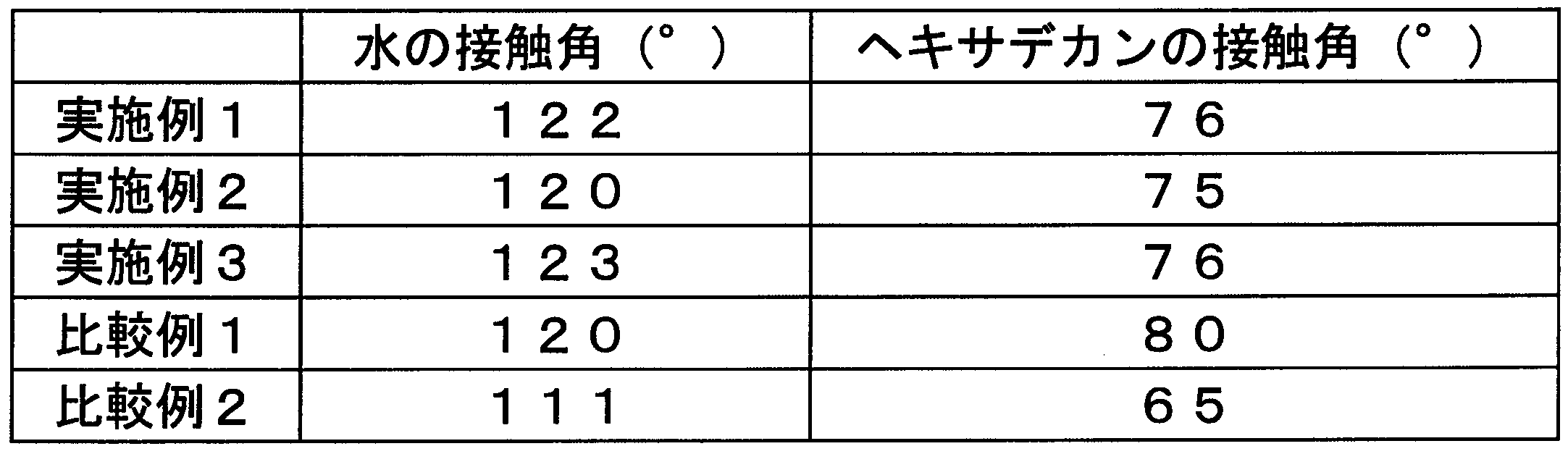
表1に示すように、実施例1~3の表面処理剤は、従来の表面処理剤であり環境および生体への蓄積性が問題となっているPFOS誘導体である比較例1と比較して、同等の撥水撥油特性を有していることがわかった。一方、比較例2の表面処理剤は、構造中に有するペルフルオロアルキル基の炭素数が少なく、撥水撥油特性が低下することがわかった。
本発明の表面処理剤は、撥水撥油特性に優れ、かつ、生体蓄積性が低く、環境適応性にも優れているため、撥水撥油剤、防汚剤等の広範な用途において有用である。
Claims (6)
- 下記一般式(1)で示される含フッ素化合物。

上記式(1)中、Xは、2価の有機基である。
上記式(1)中、R1は、Hまたは炭素数1~4のアルキル基である。 - 下記一般式(2)で示される直鎖状のペルフルオロアルキル基を有することを特徴とする請求項1に記載の含フッ素化合物。

上記式(2)中、Xは、2価の有機基である。
上記式(2)中、R1は、Hまたは炭素数1~4のアルキル基である。 - 下記一般式(3)で示される窒素原子を含むペルフルオロ複素環を有することを特徴とする請求項1に記載の含フッ素化合物。
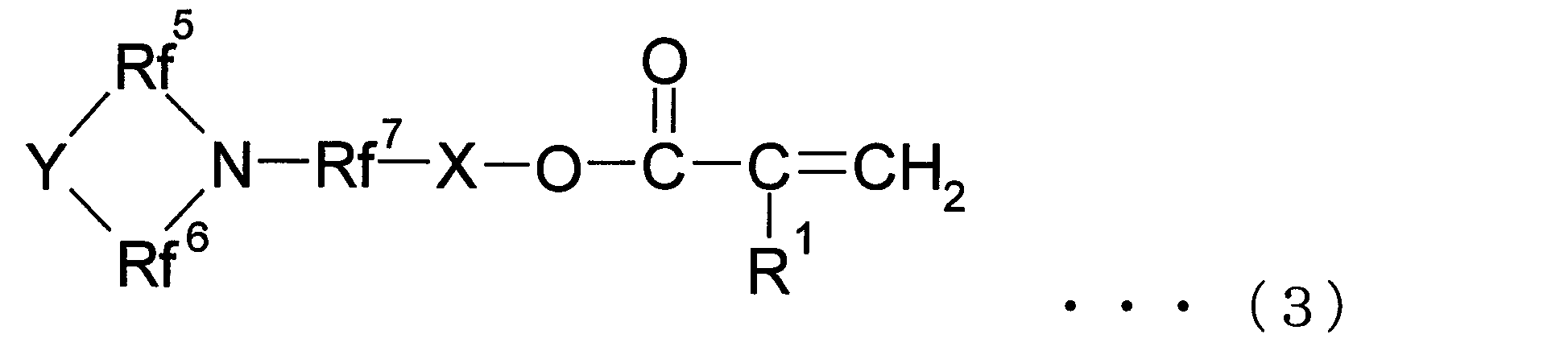
上記式(3)中、Xは、2価の有機基、Yは、酸素原子、窒素原子又はCF2基である。
上記式(3)中、R1は、Hまたは炭素数1~4のアルキル基である。 - 請求項1乃至3のいずれか一項に記載の含フッ素化合物からなる含フッ素単量体から得られる含フッ素重合体を含むことを特徴とする重合体組成物。
- 前記含フッ素単量体以外のフッ素系または非フッ素系不飽和化合物から導かれる単位をさらに含有することを特徴とする請求項4に記載の重合体組成物。
- 請求項4又は5に記載の重合体組成物を含むことを特徴とする表面処理剤。
Applications Claiming Priority (2)
| Application Number | Priority Date | Filing Date | Title |
|---|---|---|---|
| JP2014-073516 | 2014-03-31 | ||
| JP2014073516 | 2014-03-31 |
Publications (1)
| Publication Number | Publication Date |
|---|---|
| WO2015152273A1 true WO2015152273A1 (ja) | 2015-10-08 |
Family
ID=54240592
Family Applications (1)
| Application Number | Title | Priority Date | Filing Date |
|---|---|---|---|
| PCT/JP2015/060210 Ceased WO2015152273A1 (ja) | 2014-03-31 | 2015-03-31 | 含フッ素化合物、重合体組成物及び表面処理剤 |
Country Status (1)
| Country | Link |
|---|---|
| WO (1) | WO2015152273A1 (ja) |
Cited By (2)
| Publication number | Priority date | Publication date | Assignee | Title |
|---|---|---|---|---|
| WO2016064585A1 (en) * | 2014-10-24 | 2016-04-28 | 3M Innovative Properties Company | Segregated fluorinated esters |
| JP2018012770A (ja) * | 2016-07-20 | 2018-01-25 | 三菱マテリアル電子化成株式会社 | 親水撥油性共重合体、表面被覆材、被膜、被膜の製造方法 |
Citations (3)
| Publication number | Priority date | Publication date | Assignee | Title |
|---|---|---|---|---|
| JP2003268046A (ja) * | 2002-03-19 | 2003-09-25 | Mitsubishi Rayon Co Ltd | 共重合体およびその製造方法 |
| JP2009242362A (ja) * | 2008-03-31 | 2009-10-22 | Kuraray Co Ltd | カルボン酸エステル誘導体およびその製造方法 |
| JP2014148504A (ja) * | 2013-01-11 | 2014-08-21 | Mitsubishi Materials Corp | フッ素系界面活性剤及びその製造方法 |
-
2015
- 2015-03-31 WO PCT/JP2015/060210 patent/WO2015152273A1/ja not_active Ceased
Patent Citations (3)
| Publication number | Priority date | Publication date | Assignee | Title |
|---|---|---|---|---|
| JP2003268046A (ja) * | 2002-03-19 | 2003-09-25 | Mitsubishi Rayon Co Ltd | 共重合体およびその製造方法 |
| JP2009242362A (ja) * | 2008-03-31 | 2009-10-22 | Kuraray Co Ltd | カルボン酸エステル誘導体およびその製造方法 |
| JP2014148504A (ja) * | 2013-01-11 | 2014-08-21 | Mitsubishi Materials Corp | フッ素系界面活性剤及びその製造方法 |
Non-Patent Citations (2)
| Title |
|---|
| YOSHIO HAYAKAWA ET AL.: "Synthesis and Properties of Novel Fluorinated Polymethacrylates", JOURNAL OF THE JAPAN SOCIETY OF COLOUR MATERIAL, vol. 71, no. 6, 1998, pages 362 - 366, XP055229240 * |
| YOSHIO HAYAKAWA ET AL.: "Synthesis of novel polymethacrylates bearing cyclic perfluoroalkyl groups", POLYMER, vol. 39, no. 17, 1998, pages 4151 - 4154, XP004120968 * |
Cited By (2)
| Publication number | Priority date | Publication date | Assignee | Title |
|---|---|---|---|---|
| WO2016064585A1 (en) * | 2014-10-24 | 2016-04-28 | 3M Innovative Properties Company | Segregated fluorinated esters |
| JP2018012770A (ja) * | 2016-07-20 | 2018-01-25 | 三菱マテリアル電子化成株式会社 | 親水撥油性共重合体、表面被覆材、被膜、被膜の製造方法 |
Similar Documents
| Publication | Publication Date | Title |
|---|---|---|
| JP2004352976A (ja) | 含フッ素重合体を含んでなる表面処理剤 | |
| CN101573315B (zh) | 长链聚亚甲基卤调聚物 | |
| Zhang et al. | Synthesis and performance of novel fluorinated acrylate polymers: preparation and reactivity of short perfluoroalkyl group containing monomers | |
| JP5931758B2 (ja) | 界面活性剤、該界面活性剤を含む組成物、その用途および含フッ素化合物 | |
| CN109642085A (zh) | 高分子材料 | |
| JP2012097125A (ja) | 含フッ素重合体を有効成分とする表面改質剤 | |
| BR112020005935A2 (pt) | copolímeros de olefinas halogenadas e comonômeros halogenados | |
| JP2013100493A (ja) | 表面処理剤組成物およびその用途 | |
| CN101495525A (zh) | 包含氟化的酰胺的聚(甲基)丙烯酰胺和聚(甲基)丙烯酸酯 | |
| JP2015091968A (ja) | ブロック重合体の製造方法およびブロック重合体、ならびに表面処理剤 | |
| TW201922810A (zh) | 含氟彈性共聚物組成物、塗料及塗裝物品 | |
| WO2005092997A1 (ja) | 表面処理剤と、含フッ素単量体および含フッ素重合体 | |
| JP6693571B2 (ja) | 含フッ素重合体およびこれを有効成分とする防錆剤 | |
| WO2015152273A1 (ja) | 含フッ素化合物、重合体組成物及び表面処理剤 | |
| JP5674404B2 (ja) | 含フッ素表面調整剤 | |
| CN105358594B (zh) | 可湿固化的组合物、使用方法以及复合制品 | |
| JP2018012770A (ja) | 親水撥油性共重合体、表面被覆材、被膜、被膜の製造方法 | |
| WO2005092937A1 (ja) | 含フッ素単量体、含フッ素重合体および表面処理剤 | |
| TW201321418A (zh) | 含氟組成物及含氟聚合物 | |
| JP2016526113A (ja) | パーフルオロ短鎖を有する撥水かつ撥油性フルオロポリマー | |
| JP2012046674A (ja) | コーティング組成物、及びその製造方法 | |
| CN100404567C (zh) | 无有机溶剂型含氟无皂乳液的制备方法 | |
| KR101272841B1 (ko) | 이산화탄소 용매를 이용한 초발수 공중합체의 합성과 그 응용 | |
| JP6621630B2 (ja) | フッ素系表面処理剤 | |
| TW201326216A (zh) | 含氟組成物及其用途 |
Legal Events
| Date | Code | Title | Description |
|---|---|---|---|
| 121 | Ep: the epo has been informed by wipo that ep was designated in this application |
Ref document number: 15773208 Country of ref document: EP Kind code of ref document: A1 |
|
| NENP | Non-entry into the national phase |
Ref country code: DE |
|
| 122 | Ep: pct application non-entry in european phase |
Ref document number: 15773208 Country of ref document: EP Kind code of ref document: A1 |
|
| NENP | Non-entry into the national phase |
Ref country code: JP |