WO2015151920A1 - 排ガス浄化用触媒、それを用いた排ガス浄化フィルタ及び排ガス浄化方法 - Google Patents
排ガス浄化用触媒、それを用いた排ガス浄化フィルタ及び排ガス浄化方法 Download PDFInfo
- Publication number
- WO2015151920A1 WO2015151920A1 PCT/JP2015/058850 JP2015058850W WO2015151920A1 WO 2015151920 A1 WO2015151920 A1 WO 2015151920A1 JP 2015058850 W JP2015058850 W JP 2015058850W WO 2015151920 A1 WO2015151920 A1 WO 2015151920A1
- Authority
- WO
- WIPO (PCT)
- Prior art keywords
- exhaust gas
- silver
- catalyst
- carrier
- phosphoric acid
- Prior art date
- Legal status (The legal status is an assumption and is not a legal conclusion. Google has not performed a legal analysis and makes no representation as to the accuracy of the status listed.)
- Ceased
Links
Images


Classifications
-
- B—PERFORMING OPERATIONS; TRANSPORTING
- B01—PHYSICAL OR CHEMICAL PROCESSES OR APPARATUS IN GENERAL
- B01D—SEPARATION
- B01D53/00—Separation of gases or vapours; Recovering vapours of volatile solvents from gases; Chemical or biological purification of waste gases, e.g. engine exhaust gases, smoke, fumes, flue gases, aerosols
- B01D53/34—Chemical or biological purification of waste gases
- B01D53/92—Chemical or biological purification of waste gases of engine exhaust gases
- B01D53/94—Chemical or biological purification of waste gases of engine exhaust gases by catalytic processes
- B01D53/944—Simultaneously removing carbon monoxide, hydrocarbons or carbon making use of oxidation catalysts
-
- B—PERFORMING OPERATIONS; TRANSPORTING
- B01—PHYSICAL OR CHEMICAL PROCESSES OR APPARATUS IN GENERAL
- B01J—CHEMICAL OR PHYSICAL PROCESSES, e.g. CATALYSIS OR COLLOID CHEMISTRY; THEIR RELEVANT APPARATUS
- B01J27/00—Catalysts comprising the elements or compounds of halogens, sulfur, selenium, tellurium, phosphorus or nitrogen; Catalysts comprising carbon compounds
- B01J27/14—Phosphorus; Compounds thereof
- B01J27/16—Phosphorus; Compounds thereof containing oxygen, i.e. acids, anhydrides and their derivates with N, S, B or halogens without carriers or on carriers based on C, Si, Al or Zr; also salts of Si, Al and Zr
- B01J27/18—Phosphorus; Compounds thereof containing oxygen, i.e. acids, anhydrides and their derivates with N, S, B or halogens without carriers or on carriers based on C, Si, Al or Zr; also salts of Si, Al and Zr with metals other than Al or Zr
-
- B—PERFORMING OPERATIONS; TRANSPORTING
- B01—PHYSICAL OR CHEMICAL PROCESSES OR APPARATUS IN GENERAL
- B01J—CHEMICAL OR PHYSICAL PROCESSES, e.g. CATALYSIS OR COLLOID CHEMISTRY; THEIR RELEVANT APPARATUS
- B01J27/00—Catalysts comprising the elements or compounds of halogens, sulfur, selenium, tellurium, phosphorus or nitrogen; Catalysts comprising carbon compounds
- B01J27/14—Phosphorus; Compounds thereof
- B01J27/16—Phosphorus; Compounds thereof containing oxygen, i.e. acids, anhydrides and their derivates with N, S, B or halogens without carriers or on carriers based on C, Si, Al or Zr; also salts of Si, Al and Zr
- B01J27/18—Phosphorus; Compounds thereof containing oxygen, i.e. acids, anhydrides and their derivates with N, S, B or halogens without carriers or on carriers based on C, Si, Al or Zr; also salts of Si, Al and Zr with metals other than Al or Zr
- B01J27/1802—Salts or mixtures of anhydrides with compounds of other metals than V, Nb, Ta, Cr, Mo, W, Mn, Tc, Re, e.g. phosphates, thiophosphates
- B01J27/1817—Salts or mixtures of anhydrides with compounds of other metals than V, Nb, Ta, Cr, Mo, W, Mn, Tc, Re, e.g. phosphates, thiophosphates with copper, silver or gold
-
- B—PERFORMING OPERATIONS; TRANSPORTING
- B01—PHYSICAL OR CHEMICAL PROCESSES OR APPARATUS IN GENERAL
- B01J—CHEMICAL OR PHYSICAL PROCESSES, e.g. CATALYSIS OR COLLOID CHEMISTRY; THEIR RELEVANT APPARATUS
- B01J37/00—Processes, in general, for preparing catalysts; Processes, in general, for activation of catalysts
- B01J37/02—Impregnation, coating or precipitation
- B01J37/03—Precipitation; Co-precipitation
- B01J37/031—Precipitation
- B01J37/035—Precipitation on carriers
-
- B—PERFORMING OPERATIONS; TRANSPORTING
- B01—PHYSICAL OR CHEMICAL PROCESSES OR APPARATUS IN GENERAL
- B01D—SEPARATION
- B01D2255/00—Catalysts
- B01D2255/10—Noble metals or compounds thereof
- B01D2255/104—Silver
-
- B—PERFORMING OPERATIONS; TRANSPORTING
- B01—PHYSICAL OR CHEMICAL PROCESSES OR APPARATUS IN GENERAL
- B01D—SEPARATION
- B01D2255/00—Catalysts
- B01D2255/20—Metals or compounds thereof
- B01D2255/209—Other metals
- B01D2255/2092—Aluminium
-
- B—PERFORMING OPERATIONS; TRANSPORTING
- B01—PHYSICAL OR CHEMICAL PROCESSES OR APPARATUS IN GENERAL
- B01D—SEPARATION
- B01D2255/00—Catalysts
- B01D2255/70—Non-metallic catalysts, additives or dopants
-
- B—PERFORMING OPERATIONS; TRANSPORTING
- B01—PHYSICAL OR CHEMICAL PROCESSES OR APPARATUS IN GENERAL
- B01D—SEPARATION
- B01D2255/00—Catalysts
- B01D2255/90—Physical characteristics of catalysts
- B01D2255/915—Catalyst supported on particulate filters
- B01D2255/9155—Wall flow filters
-
- B—PERFORMING OPERATIONS; TRANSPORTING
- B01—PHYSICAL OR CHEMICAL PROCESSES OR APPARATUS IN GENERAL
- B01D—SEPARATION
- B01D2258/00—Sources of waste gases
- B01D2258/01—Engine exhaust gases
- B01D2258/012—Diesel engines and lean burn gasoline engines
-
- B—PERFORMING OPERATIONS; TRANSPORTING
- B01—PHYSICAL OR CHEMICAL PROCESSES OR APPARATUS IN GENERAL
- B01J—CHEMICAL OR PHYSICAL PROCESSES, e.g. CATALYSIS OR COLLOID CHEMISTRY; THEIR RELEVANT APPARATUS
- B01J35/00—Catalysts, in general, characterised by their form or physical properties
- B01J35/60—Catalysts, in general, characterised by their form or physical properties characterised by their surface properties or porosity
- B01J35/61—Surface area
- B01J35/615—100-500 m2/g
-
- B—PERFORMING OPERATIONS; TRANSPORTING
- B01—PHYSICAL OR CHEMICAL PROCESSES OR APPARATUS IN GENERAL
- B01J—CHEMICAL OR PHYSICAL PROCESSES, e.g. CATALYSIS OR COLLOID CHEMISTRY; THEIR RELEVANT APPARATUS
- B01J37/00—Processes, in general, for preparing catalysts; Processes, in general, for activation of catalysts
- B01J37/02—Impregnation, coating or precipitation
- B01J37/0201—Impregnation
Definitions
- the present invention relates to an exhaust gas purification catalyst, an exhaust gas purification filter using the same, and an exhaust gas purification method.
- a purification filter Diesel Particulate Filter
- PM Diesel Particulate Filter
- Patent Document 1 discloses an exhaust gas purification catalyst for purifying particulate matter in exhaust gas discharged from an internal combustion engine.
- a complex oxide having an oxygen releasing ability LaMnO 3 , CeZrO 2 , CoTa 2 O 6) containing at least two elements selected from the group consisting of group metal elements, transition metal elements, group 12 elements, and group 13 elements Etc.
- an exhaust gas purification catalyst having Ag and a noble metal Ru, Pd, Pt, etc.
- the exhaust gas purifying catalyst disclosed in Patent Document 1 has a problem that the Ag catalyst is poisoned by a sulfur component contained in the fuel or oil, and the activity is significantly reduced.
- the catalyst using a highly basic carrier such as ceria shows very high activity at the beginning, but the activity is significantly reduced by the sulfur component.
- the PM oxidation activity when exposed to sulfur-containing gas is high. It was not enough.
- Patent Document 2 discloses an exhaust gas that is disposed in an exhaust gas passage of an internal combustion engine and collects particulates in the exhaust gas discharged from the internal combustion engine to purify the exhaust gas.
- the purification filter includes an outer peripheral wall, a porous cell wall disposed in a polygonal lattice shape in the outer peripheral wall, and a plurality of cells partitioned in the cell wall, A plug portion closes the downstream end of the incoming gas side cell that serves as the inflow side passage through which the exhaust gas flows and the upstream end of the outgas side cell that serves as the discharge side passage that discharges the exhaust gas that has passed through the cell wall.
- the cell wall includes a PM combustion catalyst made of a catalyst material in which Ag is dispersed in layered alumina containing Ag, and an oxidation catalyst that oxidizes at least CO in the exhaust gas.
- a PM combustion catalyst made of a catalyst material in which Ag is dispersed in layered alumina containing Ag
- an oxidation catalyst that oxidizes at least CO in the exhaust gas.
- An exhaust gas purification filter in which the PM combustion catalyst is supported on the wall surface of the inlet gas side cell without supporting the oxidation catalyst, and at least the oxidation catalyst is supported on the wall surface of the outlet gas side cell is disclosed.
- the Ag catalyst supported on alumina has low dispersibility and the Ag particles become coarse, so that the contact property with PM becomes low. For this reason, the PM oxidation activity when exposed to a gas containing sulfur is not sufficient, for example, the activity decreases when it is changed to silver sulfate by sulfur poisoning.
- JP-A-06-55075 discloses at least one metal selected from platinum, palladium, rhodium, gold, silver, ruthenium, iridium, nickel, cerium, cobalt, copper, and strontium, An exhaust gas purifying catalyst having the salt or oxide supported on a phosphate is disclosed.
- a metal having catalytic activity such as silver supported on a phosphate carrier such as aluminum phosphate has low dispersibility, such as silver particles. Since the active metal particles become coarse, the contact property with PM becomes low. For this reason, PM oxidation activity when exposed to a gas containing sulfur was not sufficient.
- Patent Document 4 discloses a carrier made of at least one metal salt selected from the group consisting of Ca sulfate and phosphate, and silver carried on the carrier.
- An exhaust gas purification apparatus including an oxidation catalyst including at least one silver-containing material selected from the group consisting of silver oxide, silver carbonate, silver sulfate, and silver phosphate is disclosed.
- the exhaust gas purification device capable of sufficiently suppressing the reduction in the oxidation performance of the particulate matter due to the ash deposition and exhibiting the excellent oxidation performance of the particulate matter even after the ash deposition. It is possible to provide.
- the required characteristics for exhaust gas purification catalysts have been increasing, so that there is a need for exhaust gas purification catalysts that can exhibit sufficiently higher PM oxidation activity even when exposed to sulfur-containing gas. It has become.
- the present invention has been made in view of the above-described problems of the prior art, and uses an exhaust gas purifying catalyst capable of exhibiting sufficiently high PM oxidation activity even when exposed to a gas containing sulfur, and the same.
- An object is to provide an exhaust gas purification filter and an exhaust gas purification method.
- the inventors of the present invention surprisingly obtain exhaust gas purification by supporting a silver-containing substance and a phosphoric acid-containing substance on a support mainly composed of alumina. It has been found that even if the catalyst is exposed to sulfur-containing gas, it can exhibit high PM oxidation activity, and the present invention has been completed.
- the exhaust gas purifying catalyst of the present invention comprises a support mainly composed of alumina, and a silver-containing substance and a phosphoric acid-containing substance supported on the support.
- silver phosphate is supported on the carrier as the silver-containing substance and the phosphoric acid-containing substance.
- the atomic ratio (P / Ag) of phosphorus (P) to silver (Ag) in the exhaust gas purifying catalyst is 0.2 to 4.
- the supported amount of the silver-containing substance is 3 to 50% by mass in terms of metallic silver with respect to the total amount of the carrier, the silver-containing substance and the phosphoric acid-containing substance. Preferably there is.
- the atomic ratio (P / Al) of phosphorus (P) to aluminum (Al) in the exhaust gas purifying catalyst is 0.15 to 0.5, and
- the phosphoric acid-containing substance preferably contains an aluminum phosphate crystal phase.
- the exhaust gas purification filter of the present invention comprises the above-described exhaust gas purification catalyst of the present invention supported on a breathable base material.
- the exhaust gas purification method of the present invention is a method of oxidizing and removing particulate matter (PM) by contacting exhaust gas from an internal combustion engine with the exhaust gas purification catalyst of the present invention.
- the exhaust gas purification catalyst of the present invention the exhaust gas purification filter using the exhaust gas purification method, and the exhaust gas purification method can exhibit sufficiently high PM oxidation activity even when exposed to a gas containing sulfur is not necessarily determined.
- the present inventors speculate as follows.
- the phosphoric acid-containing substance used by being supported on a carrier mainly composed of alumina is less susceptible to sulfur poisoning because sulfur adsorption is suppressed and sulfur poisoning is mitigated. Further, when the silver-containing substance and the phosphoric acid-containing substance used as active species coexist, high PM oxidation activity can be achieved, and sufficiently high PM oxidation activity is exhibited.
- a carrier mainly composed of alumina as a carrier and a catalyst comprising a silver-containing substance and a phosphoric acid-containing substance as active species, high PM oxidation activity is maintained even when exposed to a gas containing sulfur. It becomes possible to do.
- the present inventors speculate that a sufficiently high PM oxidation activity can be achieved even when exposed to a gas containing sulfur.
- an exhaust gas purification catalyst capable of exhibiting sufficiently high PM oxidation activity even when exposed to a gas containing sulfur, an exhaust gas purification filter and an exhaust gas purification method using the same. It becomes.
- FIG. 3 is a graph showing 50% PM oxidation temperature of exhaust gas purifying catalysts after sulfur poisoning regeneration treatment obtained in Examples 1 to 3 and Comparative Examples 1 and 2.
- FIG. 6 is a graph showing the 50% PM oxidation temperature of exhaust gas purifying catalysts after sulfur poisoning regeneration treatment obtained in Examples 4 to 6 and Comparative Examples 1 and 3.
- FIG. 2 is a graph showing XRD spectra of exhaust gas purifying catalysts obtained in Examples 1, 5, 6 and Comparative Example 1.
- the exhaust gas purifying catalyst of the present invention comprises a support mainly composed of alumina, and a silver-containing substance and a phosphoric acid-containing substance supported on the support.
- a support mainly composed of alumina carry a silver-containing substance and a phosphoric acid-containing substance as active species
- the exhaust gas purifying catalyst of the present invention is exposed to a gas containing sulfur. It is also possible to exhibit sufficiently high PM oxidation activity. Therefore, the exhaust gas purifying catalyst of the present invention can be suitably employed as a PM oxidation catalyst for purifying exhaust gas by oxidizing and removing particulate matter (PM) in exhaust gas from an internal combustion engine such as a diesel engine. More preferably, the exhaust gas purifying catalyst of the present invention can be employed as a PM oxidation catalyst for diesel.
- PM particulate matter
- the carrier according to the present invention needs to be a carrier mainly composed of alumina (Al 2 O 3 ).
- a carrier containing alumina as a main component is not particularly limited except that it contains alumina as a main component.
- “mainly composed of alumina” means that the carrier is composed only of alumina, or is composed mainly of alumina and includes other components.
- other compounds used as a carrier for an exhaust gas purifying catalyst for this type of application can be used.
- the content of alumina in the carrier is preferably 90% by mass or more, more preferably 95% by mass or more, and 98% by mass or more with respect to 100% by mass of the total mass of the carrier. Is particularly preferred. If the content of alumina in such a carrier is less than the lower limit, the additive component and silver phosphate react and the activity tends to decrease.
- the alumina in such a carrier is selected from the group consisting of boehmite type, pseudo boehmite type, ⁇ type, ⁇ type, ⁇ type, ⁇ type, pseudo ⁇ type, ⁇ type, ⁇ type and ⁇ type.
- boehmite type pseudo boehmite type
- ⁇ type ⁇ type
- ⁇ type ⁇ type
- pseudo ⁇ type ⁇ type
- ⁇ type ⁇ type
- ⁇ type and ⁇ type are preferable, and ⁇ -alumina having high activity is particularly preferable.
- Pr cerium
- Ce neodymium
- Pr promethium
- Sm samarium
- Eu europium
- Gd gadolinium
- Tb terbium
- Dy dysprosium
- Ho holmium
- Ho erbium
- Er Er
- Tm thulium
- Yb lutetium
- Metal oxides such as alkali metals, alkaline earth metals and transition metals can be used. That.
- carrier which has such an alumina as a main component, from a heat resistant viewpoint, 90 mass% or more of alumina with respect to the total mass of 100 mass% of a support
- the specific surface area of such a carrier mainly composed of alumina is not particularly limited, but is preferably 5 to 300 m 2 / g, more preferably 10 to 200 m 2 / g.
- the specific surface area exceeds the upper limit, the heat resistance of the support itself decreases, and therefore the heat resistance of the catalyst tends to decrease.
- the specific surface area is lower than the lower limit, active species (silver-containing substance and phosphoric acid-containing substance) The dispersibility tends to decrease.
- Such a specific surface area can be calculated as a BET specific surface area from the adsorption isotherm using the BET isotherm adsorption equation.
- the shape of such a carrier containing alumina as a main component is not particularly limited, and a conventionally known shape such as a ring shape, a spherical shape, a cylindrical shape, a pellet shape, or the like can be used.
- a particulate thing from a viewpoint that many active species (a silver containing material and phosphoric acid containing material) can be contained in a highly dispersible state.
- the carrier is in the form of particles, the average primary particle size of the carrier particles is preferably 1 to 1000 nm, and more preferably 5 to 500 nm.
- the average primary particle diameter of such a carrier can be measured by calculating from the line width of the powder X-ray diffraction peak using the Scherrer's equation using an X-ray diffractometer. . Further, the average particle size of such a carrier mainly composed of alumina can be appropriately changed by a conventional method (for example, a method of pulverizing with a mortar or a cold isostatic pressing method (CIP)). Further, after the exhaust gas purifying catalyst is manufactured, the average particle diameter of the carrier powder containing alumina as a main component in the catalyst may be changed by changing the average particle diameter of the catalyst by a usual method.
- a method for producing such a carrier is not particularly limited, and a known method capable of producing a carrier containing alumina as a main component can be appropriately used.
- a carrier commercially available alumina or a composite oxide containing alumina as a main component may be used, and the size may be appropriately adjusted by milling with a ball mill or the like.
- the silver-containing material according to the present invention is an active species supported on a carrier mainly composed of alumina and needs to be a material containing silver and / or a silver compound.
- a silver-containing material is not particularly limited except that it is a material containing silver and / or a compound containing silver.
- Specific examples of such a silver-containing substance include silver (metal simple substance, Ag, metal silver), silver oxide, silver halide, silver carbonate, silver sulfate, silver phosphate, silver nitrate, silver chromate, Examples thereof include silver oxalate and silver ferrite.
- silver phosphate it is preferably at least one selected from the group consisting of silver, silver oxide, silver halide, silver sulfate and silver phosphate, and the dispersibility of silver particles
- the silver phosphate is carry
- Specific examples of such silver phosphate include silver orthophosphate (Ag 3 PO 4 ), silver pyrophosphate (Ag 4 P 2 O 7 ), silver triphosphate (Ag 5 P 3 O 10 ), and metaphosphate. silver (AgPO 3), and the like.
- the amount of the silver-containing material used in the present invention is not particularly limited, but is 3 to 50 in terms of metallic silver (Ag) with respect to the total amount of the carrier, the silver-containing material, and the phosphoric acid-containing material.
- the mass is preferably 5% by mass, more preferably 5 to 30% by mass, and particularly preferably 7 to 15% by mass. If the amount of such a silver-containing substance supported is less than the lower limit, the oxidation performance of the particulate matter tends to be not sufficiently advanced. On the other hand, if the upper limit is exceeded, the oxidation performance is saturated. Therefore, the cost tends to increase.
- the average crystallite size (average primary particle size) of such a silver-containing substance is not particularly limited, but is preferably 0.1 to 300 nm, and more preferably 1 to 200 nm. If the average crystallite size of such a silver-containing substance is less than the lower limit, it strongly binds to the support and the activity tends to decrease. On the other hand, if it exceeds the upper limit, the number of particles contributing to the reaction decreases and the activity decreases. There is a tendency. Note that the average crystallite size (average primary particle size) of such a silver-containing substance is calculated using the Scherrer's equation from the line width of the powder X-ray diffraction peak using, for example, an X-ray diffractometer. It can be measured by calculating.
- the phosphoric acid-containing substance according to the present invention is an active species supported on a carrier mainly composed of alumina and needs to be a substance containing phosphoric acid and / or phosphate.
- a phosphoric acid-containing substance is not particularly limited except that it is a substance containing phosphoric acid and / or phosphate.
- As such a phosphoric acid-containing substance specifically, as phosphoric acid, orthophosphoric acid (H 3 PO 4 ), pyrophosphoric acid (H 4 P 2 O 7 ), triphosphoric acid (H 5 P 3 O 10 ), metaphosphoric acid (HPO 3), and the like.
- phosphates orthophosphates, pyrophosphates, triphosphates, polyphosphates, metaphosphates, ultraphosphates, etc.
- these alkali metal salts, other metal salts, ammonium salts, etc. Can be mentioned.
- at least one selected from the group consisting of orthophosphates, pyrophosphates, triphosphates and alkali metal salts thereof is preferable.
- Orthophosphates, pyrophosphates And at least one selected from the group consisting of these alkali metal salts.
- the amount of the phosphoric acid-containing substance used in the present invention is not particularly limited, but the atomic ratio (P / Ag) of phosphorus (P) to silver (Ag) in the exhaust gas purification catalyst is 0.2.
- the supported amount is preferably 6 to 6, more preferably 0.3 to 5.5, and particularly preferably 0.4 to 3. If the amount of the phosphoric acid-containing substance supported is less than the lower limit as the atomic ratio (P / Ag), the oxidation performance of the particulate matter tends to be insufficient, while If the upper limit is exceeded, the oxidation performance will be saturated and the cost tends to increase.
- the amount of the phosphoric acid-containing substance used in the present invention is not particularly limited, but the atomic ratio (P / Al) of phosphorus (P) to aluminum (Al) in the exhaust gas purification catalyst is 0. A loading amount of 15 to 0.5 is preferable, a loading amount of 0.2 to 0.45 is more preferable, and a loading amount of 0.3 to 0.4 is particularly preferable. preferable. If the amount of the phosphoric acid-containing material supported is less than the lower limit as the atomic ratio (P / Al), the oxidation performance of the particulate material tends not to be sufficiently advanced, When the upper limit is exceeded, the specific surface area tends to decrease and the activity tends to decrease.
- the phosphoric acid-containing substance as the active species supported on the carrier mainly composed of alumina according to the present invention contains a crystalline phase of aluminum phosphate (AlPO 4 ).
- AlPO 4 aluminum phosphate
- the atomic ratio (P / Al) of phosphorus (P) to aluminum (Al) in the exhaust gas purifying catalyst is 0.15 to 0.5, and More preferably, the phosphoric acid-containing substance contains an aluminum phosphate crystal phase.
- the average crystallite diameter (average primary particle diameter) in the case of insoluble substances is not particularly limited, but is 0.1 to 300 nm. It is preferable that the thickness is 1 to 200 nm.
- the average crystallite diameter of such a phosphoric acid-containing substance exceeds the upper limit, the dispersibility tends to be lowered.
- the average crystallite size (average primary particle size) of such a phosphoric acid-containing substance is, for example, the Scherrer's equation from the line width of the powder X-ray diffraction peak using an X-ray diffractometer. It can measure by calculating using.
- the phosphoric acid-containing substance used by being supported on a carrier mainly composed of alumina suppresses sulfur adsorption and sulfur poisoning. It is less susceptible to sulfur poisoning.
- the coexistence of the silver-containing substance and the phosphoric acid-containing substance used as active species can exhibit high PM oxidation activity and can exhibit sufficiently high PM oxidation activity.
- a carrier mainly composed of alumina as a carrier and a catalyst comprising a silver-containing substance and a phosphoric acid-containing substance as active species, high PM oxidation activity is maintained even when exposed to a gas containing sulfur. And a sufficiently high PM oxidation activity can be exhibited.
- the type of the carrier, the silver-containing substance and the phosphoric acid-containing substance supported on the carrier, etc. are determined by X-ray diffraction measurement to obtain an X-ray diffraction pattern, and the type of crystal present from the peak position. It can be confirmed by seeking.
- a method for supporting such a silver-containing substance and a phosphoric acid-containing substance on a carrier mainly composed of alumina is not particularly limited, but a known method can be used as appropriate, for example, a silver-containing substance or The precursor dispersion or sol, and the phosphoric acid-containing substance or the precursor dispersion or sol are used to coat the alumina-based carrier sequentially or simultaneously (and then fired as necessary). Or a method of supporting alumina on a carrier as a main component by using a vapor deposition method (for example, chemical vapor deposition method, physical vapor deposition method, sputter vapor deposition method) or the like can be appropriately employed.
- a vapor deposition method for example, chemical vapor deposition method, physical vapor deposition method, sputter vapor deposition method
- the exhaust gas-purifying catalyst in the present invention is not particularly limited as long as it comprises a carrier mainly composed of the alumina, and a silver-containing substance and a phosphoric acid-containing substance supported on the carrier. However, it may be in the form of a pellet-shaped pellet catalyst or the like, or may be supported on a filter.
- the method for producing the exhaust gas purifying catalyst of the present invention is not particularly limited, and a known method can be used as appropriate.
- the carrier containing alumina as a main component has ions of silver-containing substance and phosphoric acid-containing substance. It is produced by a step of impregnating with an aqueous solution containing, etc., a step of heating and baking. The impregnation may be impregnated with an aqueous solution containing silver-containing substance and phosphoric acid-containing substance ions, or an aqueous solution containing silver-containing substance ions and an aqueous solution containing phosphoric acid-containing substance ions. May be prepared and impregnated individually or sequentially.
- a solution containing a silver-containing substance and a phosphoric acid-containing substance at a predetermined concentration is brought into contact with the carrier mainly composed of alumina, thereby containing a predetermined amount of the silver-containing substance and the phosphoric acid-containing substance. It is possible to employ a method of impregnating (supporting) the solution on the carrier and then heating and baking the solution. Furthermore, as a method for producing such an exhaust gas purifying catalyst, first, an aqueous solution containing ions of a phosphoric acid-containing substance is impregnated into a carrier mainly composed of alumina as a carrier and then calcined and then phosphoric acid-containing substance.
- the resulting phosphoric acid-containing material-supported carrier is impregnated with an aqueous solution containing silver-containing material ions, etc., and then baked to prepare a carrier containing mainly alumina as a silver-containing material and phosphoric acid.
- a method of supporting the contained substance can be employed.
- the heat-firing (firing process) after impregnating such a silver-containing substance and phosphoric acid-containing substance may be performed in the air.
- the firing temperature in such a firing step is preferably 200 to 700 ° C.
- a calcination temperature is less than the lower limit, it becomes difficult to support the silver-containing substance and the phosphoric acid-containing substance on the carrier, and there is a tendency that sufficient PM oxidation activity of the exhaust gas purifying catalyst cannot be obtained
- the upper limit is exceeded, the specific surface area of the support mainly composed of alumina tends to decrease, and the oxidation activity tends to decrease.
- the firing time is preferably from 0.1 to 100 hours.
- exhaust gas purification equipment Since the exhaust gas purifying catalyst of the present invention can exhibit high PM oxidation activity against particulate matter contained in gas (exhaust gas) discharged from an internal combustion engine and oxidize and remove PM, the exhaust gas
- the exhaust gas purification device can be configured by arranging the exhaust gas purification catalyst so that the exhaust gas can come into contact with the purification catalyst.
- Such an exhaust gas purifying device is an exhaust gas purifying device for oxidizing and purifying particulate matter (PM) contained in the exhaust gas as long as it includes the exhaust gas purifying catalyst of the present invention. Good.
- particulate matter contained in the gas (exhaust gas) discharged from the internal combustion engine is oxidized and purified (removed), so that the exhaust gas can contact the exhaust gas purification device.
- the exhaust gas purification device may be arranged in a gas flow path in an exhaust gas pipe through which exhaust gas from an internal combustion engine flows.
- limit especially as such an internal combustion engine A well-known internal combustion engine can be used suitably, For example, the engine (a gasoline engine, a diesel engine, etc.) of a motor vehicle may be sufficient.
- the exhaust gas purification filter of the present invention comprises the exhaust gas purification catalyst of the present invention supported on a gas permeable substrate (filter).
- Such an exhaust gas purification filter of the present invention is not particularly limited except that the exhaust gas purification catalyst of the present invention is supported on a gas permeable substrate.
- a known breathable substrate (filter) can be appropriately used.
- a particulate filter, a monolith filter, a honeycomb filter, a pellet filter examples thereof include a filter, a plate-like filter, and a foamed ceramic filter.
- PM particulate matter
- the exhaust gas purifying catalyst of the present invention is supported on a particulate filter.
- the material of the breathable substrate of such an exhaust gas purification filter is not particularly limited, but a known material can be used as appropriate, for example, cordierite, silicon carbide, mullite, ceramics such as aluminum titanate, Examples thereof include metals such as stainless steel including chrome and aluminum.
- an exhaust gas purification filter it is preferable to use a filter having pores having an average pore diameter of 1 to 300 ⁇ m. By using a base material having such an average pore diameter, it becomes possible to oxidize and purify the particulate matter more efficiently.
- a coat layer is preferably formed by the exhaust gas purification catalyst of the present invention, and the thickness of the coat layer is preferably 0.025 to 25 ⁇ m. More preferably, it is 035 to 10 ⁇ m. If the thickness of the coating layer is less than the lower limit, the surface of the filter cannot be sufficiently covered with a catalyst comprising a carrier mainly composed of the alumina and a silver-containing substance and a phosphoric acid-containing substance supported on the carrier, and particles However, when the upper limit is exceeded, the carrier mainly composed of alumina and the carrier are supported on the carrier. The catalyst containing the silver-containing material and the phosphoric acid-containing material is clogged with the pores of the filter, and the pressure loss of the exhaust gas increases, and the engine efficiency tends to decrease.
- the amount of the catalyst supported on the breathable base material is not particularly limited, but the amount can be appropriately adjusted according to the internal combustion engine or the like, and the breathable group
- the amount is preferably 1 to 300 g, more preferably 10 to 100 g, per liter volume of the material. If the amount is less than the lower limit, it tends to be difficult to exhibit sufficiently high catalyst performance. On the other hand, if the amount exceeds the upper limit, the aeration is performed by a catalyst including the support and the silver-containing substance. The pores of the conductive base material are blocked, and the pressure loss of the exhaust gas increases and the engine efficiency tends to decrease.
- such an exhaust gas purification filter preferably has a porosity of 30 to 70% (more preferably 40 to 65%).
- porosity refers to the volume ratio of the hollow portion inside the breathable substrate.
- the porosity is less than the lower limit, the pores tend to be clogged by the particulate matter in the exhaust gas.
- the porosity exceeds the upper limit, it is difficult to collect the particulate matter in the exhaust gas. The strength of the filter tends to decrease.
- the method for supporting the exhaust gas purification catalyst of the present invention on the breathable base material is not particularly limited.
- the carrier mainly composed of the alumina and the carrier in advance.
- a method of supporting a catalyst having a contained substance on a filter can be appropriately employed.
- the method for supporting the catalyst, the carrier, the silver-containing material and the phosphoric acid-containing material on the air-permeable substrate is not particularly limited, and a known method can be appropriately employed.
- a slurry such as a catalyst or a carrier is prepared,
- a method of coating the slurry on a breathable base material (after that, firing if necessary) can be used as appropriate.
- other known components that can be used as a catalyst for oxidizing particulate matter may be used as long as the effects of the present invention are not impaired.
- the exhaust gas purification method of the present invention is a method of oxidizing and removing particulate matter (PM) by bringing exhaust gas from an internal combustion engine into contact with the exhaust gas purification catalyst of the present invention.
- the method for bringing the exhaust gas into contact with the exhaust gas purification catalyst is not particularly limited, and a known method can be adopted as appropriate.
- the gas discharged from the internal combustion engine A method of bringing the exhaust gas from the internal combustion engine into contact with the exhaust gas purification catalyst by disposing the exhaust gas purification catalyst according to the present invention in a circulating exhaust gas pipe may be adopted.
- the exhaust gas purifying catalyst of the present invention used in the exhaust gas purifying method of the present invention can maintain high PM oxidation activity even when exposed to a gas containing sulfur. However, it is possible to exhibit sufficiently high PM oxidation activity.
- Particulate matter (PM) in the exhaust gas can be oxidized and removed to purify the exhaust gas.
- the particulate matter (PM) in the exhaust gas can be oxidized and removed sufficiently even when exposed to sulfur-containing gas. It becomes possible to purify.
- the exhaust gas purification method of the present invention is preferably employed as a method for purifying particulate matter (PM) in exhaust gas discharged from an internal combustion engine such as a diesel engine, for example. Can do.
- Example 1 First, an aqueous phosphate solution was prepared by dissolving 0.61 g of sodium orthophosphate (Alfa Aesar) in ion-exchanged water (200 g). Subsequently, 1.57 g of silver nitrate (manufactured by Wako Pure Chemical Industries) was dissolved in ion-exchanged water (100 g) to prepare a silver nitrate aqueous solution.
- sodium orthophosphate Alfa Aesar
- silver nitrate manufactured by Wako Pure Chemical Industries
- alumina powder manufactured by JGC Universal Corporation, ⁇ -Al 2 O 3 powder, TN4, specific surface area 150 m 2 / g
- alumina powder manufactured by JGC Universal Corporation, ⁇ -Al 2 O 3 powder, TN4, specific surface area 150 m 2 / g
- the obtained silver nitrate aqueous solution was added to form a precipitate.
- the obtained precipitate (precipitate) is filtered, dried at 110 ° C. overnight, and then calcined at 500 ° C. for 3 hours to carry silver phosphate (Ag 3 PO 4 ) on the alumina carrier.
- a catalyst powder was obtained.
- this powder was mixed in a mortar and formed into a pellet shape having a particle diameter of 0.3 to 0.5 mm by a conventional method (cold isostatic pressing (CIP)), and a pellet-shaped catalyst (Ag 3 PO 4 / Al 2 O 3 ).
- CIP cold isostatic pressing
- the atomic ratio (P / Ag) of phosphorus (P) to silver (Ag) in the catalyst was 0.33 from the charged amount.
- the supported amount of the silver-containing material was 10% by mass in terms of metallic silver (Ag) with respect to the total amount of the catalyst.
- Example 2 In the same manner as in Example 1, except that 0.63 g of sodium pyrophosphate (Alfa Aesar) was used instead of sodium orthophosphate as the phosphate source, and the amount of alumina powder added was 8.6 g. A catalyst (Ag 4 P 2 O 7 / Al 2 O 3 ) was obtained. The atomic ratio (P / Ag) of phosphorus (P) to silver (Ag) in the catalyst was 0.5 from the charged amount. Further, the supported amount of the silver-containing material was 10% by mass in terms of metallic silver (Ag) with respect to the total amount of the catalyst.
- Example 3 Pellet shape in the same manner as in Example 1 except that 1.11 g of sodium metaphosphate (manufactured by Wako Pure Chemical Industries, Ltd.) was used instead of sodium orthophosphate as the phosphate source, and the amount of alumina powder added was 8.3 g. Catalyst (AgPO 3 / Al 2 O 3 ) was obtained. The atomic ratio (P / Ag) of phosphorus (P) to silver (Ag) in the catalyst was 1.0 from the charged amount. Further, the supported amount of the silver-containing material was 10% by mass in terms of metallic silver (Ag) with respect to the total amount of the catalyst.
- Example 4 First, 6.28 g of silver nitrate (manufactured by Wako Pure Chemical Industries) was dissolved in ion-exchanged water (250 g) to prepare a silver nitrate aqueous solution.
- the obtained silver nitrate aqueous solution was impregnated in 36.0 g of alumina powder (manufactured by JGC Universal Co., Ltd., ⁇ -Al 2 O 3 powder, TN4, specific surface area 150 m 2 / g) as a carrier and evaporated to dryness. And dried at 110 ° C. overnight and then calcined at 500 ° C. for 3 hours to obtain a powder carrying silver on the alumina carrier.
- alumina powder manufactured by JGC Universal Co., Ltd., ⁇ -Al 2 O 3 powder, TN4, specific surface area 150 m 2 / g
- this powder is mixed in a mortar and formed into a pellet shape with a particle diameter of 0.3 to 0.5 mm by a conventional method (cold isostatic pressing (CIP)), and the pellet-shaped catalyst (Ag + H 3 PO 4 / Al 2 O 3 ).
- CIP cold isostatic pressing
- the atomic ratio (P / Ag) of phosphorus (P) to silver (Ag) in the catalyst was 1.0 from the charged amount.
- the supported amount of the silver-containing material was 9.4% by mass in terms of metallic silver (Ag) with respect to the total amount of the catalyst.
- Example 5 A pellet-shaped catalyst in the same manner as in Example 4 except that the addition amount of phosphoric acid was changed so that the atomic ratio (P / Ag) of phosphorus (P) to silver (Ag) in the catalyst was 2.0. (Ag + H 3 PO 4 / Al 2 O 3 ) was obtained. The atomic ratio (P / Ag) of phosphorus (P) to silver (Ag) in the catalyst was 2.0 from the charged amount. Further, the supported amount of the silver-containing material was 8.8% by mass in terms of metallic silver (Ag) with respect to the total amount of the catalyst.
- Example 6 First, 5.36 g of 85% phosphoric acid (manufactured by Alfa Aesar) was dissolved in ion exchange water (200 g) to prepare a phosphoric acid aqueous solution.
- this powder was mixed in a mortar and formed into a pellet shape having a particle diameter of 0.3 to 0.5 mm by a conventional method (cold isostatic pressing (CIP)), and a pellet-shaped catalyst (Ag / ( H 3 PO 4 + Al 2 O 3 ) or Ag / H 3 PO 4 / Al 2 O 3 ).
- CIP cold isostatic pressing
- the atomic ratio (P / Ag) of phosphorus (P) to silver (Ag) in the catalyst was 5.0 from the amount charged. Further, the supported amount of the silver-containing material was 7.5% by mass in terms of metallic silver (Ag) with respect to the total amount of the catalyst.
- a silver nitrate aqueous solution was prepared by dissolving 6.28 g of silver nitrate (manufactured by Wako Pure Chemical Industries) in ion-exchanged water (250 g). Next, the obtained silver nitrate aqueous solution was impregnated into 36.00 g of alumina powder (manufactured by JGC Universal, ⁇ -Al 2 O 3 powder, TN4, specific surface area 150 m 2 / g) and evaporated to dryness. After drying overnight, it was calcined at 500 ° C. for 3 hours, and silver (Ag) was supported on the alumina powder to obtain a comparative catalyst powder.
- alumina powder manufactured by JGC Universal, ⁇ -Al 2 O 3 powder, TN4, specific surface area 150 m 2 / g
- this powder was mixed in a mortar and formed into a pellet shape having a particle diameter of 0.3 to 0.5 mm by a conventional method (cold isostatic pressing (CIP)), and a pellet-shaped comparative catalyst (Ag / Al 2 O 3 ).
- CIP cold isostatic pressing
- the atomic ratio (P / Ag) of phosphorus (P) to silver (Ag) in the catalyst was 0.0 from the charged amount.
- the supported amount of the silver-containing material was 10.0% by mass in terms of metallic silver (Ag) with respect to the total amount of the catalyst.
- Example 2 (Comparative Example 2) Except for using 8.7 g of calcium phosphate (Ca 3 (PO 4 ) 2 ) powder (manufactured by Wako Pure Chemical Industries, specific surface area 10 m 2 / g) instead of alumina powder ( ⁇ -Al 2 O 3 powder) as a carrier.
- a pellet-shaped comparative catalyst (Ag 3 PO 4 / Ca 3 (PO 4 ) 2 ) was obtained.
- the atomic ratio (P / Ag) of phosphorus (P) to silver (Ag) in the catalyst was 6.5 based on the amount charged.
- the supported amount of the silver-containing material was 10.0% by mass in terms of metallic silver (Ag) with respect to the total amount of the catalyst.
- a silver nitrate aqueous solution was prepared by dissolving 1.57 g of silver nitrate (manufactured by Wako Pure Chemical Industries) in ion-exchanged water (250 g). Next, the obtained silver nitrate aqueous solution was impregnated in 9.00 g of aluminum phosphate powder (Alfa Aesar, AlPO 4 powder, specific surface area 2.3 m 2 / g), evaporated to dryness, and then at 110 ° C. overnight. After drying, firing was performed at 500 ° C. for 3 hours, and silver (Ag) was supported on the alumina phosphate powder to obtain a comparative catalyst powder.
- Alfa Aesar, AlPO 4 powder specific surface area 2.3 m 2 / g
- this powder was mixed in a mortar and formed into a pellet shape having a particle diameter of 0.3 to 0.5 mm by a conventional method (cold isostatic pressing (CIP)), and a pellet-shaped comparative catalyst (Ag / Al 2 O 3 ).
- CIP cold isostatic pressing
- the atomic ratio (P / Ag) of phosphorus (P) to silver (Ag) in the catalyst was 8.0 from the amount charged.
- the supported amount of the silver-containing material was 10.0% by mass in terms of metallic silver (Ag) with respect to the total amount of the catalyst.
- a mixed gas (filled gas) composed of SO 2 (66 ppm), O 2 (10%), CO 2 (10%), H 2 O (10%) and N 2 (remainder) is put into the apparatus. , 400 ° C. (entering gas temperature), 55.5 minutes, and gas flow rate of 7 L / min (sulfur poisoning treatment).
- the total supply amount of the sulfur component supplied in such sulfur poisoning treatment is 1.0 g / 30 g-cat.
- the temperature of the mixed gas necessary for oxidizing 50% of the carbon adhering to each evaluation sample (PM 50%)
- the oxidation temperature was calculated and used as an index of the PM oxidation activity of the catalyst after the sulfur poisoning regeneration treatment.
- Table 2 shows the results obtained.
- the PM oxidation activity of the catalyst after the sulfur poisoning regeneration treatment is higher as the PM 50% oxidation temperature is lower.
- a graph showing the PM 50% oxidation temperature of the exhaust gas purification catalyst after the sulfur poisoning regeneration treatment obtained in Examples 1 to 3 and Comparative Examples 1 and 2 Is shown in FIG.
- Examples 4 to 6 and Comparative Examples were conducted in the sulfur poisoning treatment. 3 except that the catalyst sample prepared in such a manner that the silver amount of the catalyst sample of No. 3 is the same as the silver amount of the catalyst sample of Example 1 and the gas flow rate in the PM purification treatment was 7 L / min.
- the sulfur poisoning process, the PM mixing process I, the sulfur poisoning regeneration process, the PM mixing process II and the PM purification process are performed, and the exhaust gas purification catalyst CO 2 after the sulfur poisoning regeneration process is processed in the same manner as described above.
- the concentration was measured, the PM 50% oxidation temperature was calculated, and used as an index of PM oxidation activity.
- the concentration of CO 2 was measured in the same manner as described above except that the gas flow rate in the PM purification treatment was 7 L / min.
- the PM 50% oxidation temperature was calculated and used as an index of PM oxidation activity.
- Table 3 shows the obtained results. Further, as the PM oxidation activity of the catalyst after the sulfur poisoning regeneration treatment, a graph showing the PM 50% oxidation temperature of the exhaust gas purification catalyst after the sulfur poisoning regeneration treatment obtained in Examples 4 to 6 and Comparative Examples 1 and 3 Is shown in FIG.
- the exhaust gas purifying catalyst of Example 6 has higher PM oxidation activity than Examples 4 to 5, and further resistance to sulfur poisoning. This is because, in Example 6, crystals of aluminum phosphate were observed, so the phosphoric acid-containing material of the exhaust gas purifying catalyst of Example 6 contained a crystalline phase of aluminum phosphate, and the sulfur component adsorbed on the carrier This is thought to be due to the suppression of poisoning and mitigation.
- the comparative catalyst in which silver was supported on the aluminum phosphate support of Comparative Example 3 had considerably low PM oxidation activity. It can be considered that the comparative catalyst of Comparative Example 3 had a low activity due to the low dispersibility of silver on the aluminum phosphate as the carrier.
- FIG. 3 shows XRD spectra of the exhaust gas purifying catalysts obtained in Examples 1, 5, 6 and Comparative Example 1.
- an exhaust gas purifying catalyst capable of exhibiting sufficiently high PM oxidation activity even when exposed to sulfur-containing gas, an exhaust gas purifying filter and an exhaust gas purifying method using the same. Can be provided.
- the exhaust gas purifying catalyst of the present invention the exhaust gas purifying filter and the exhaust gas purifying method using the same, a PM oxidation catalyst for purifying particulate matter contained in exhaust gas from an internal combustion engine such as a diesel engine, It is particularly useful as the exhaust gas purification filter or exhaust gas purification method used.
Landscapes
- Chemical & Material Sciences (AREA)
- Engineering & Computer Science (AREA)
- Chemical Kinetics & Catalysis (AREA)
- Materials Engineering (AREA)
- Organic Chemistry (AREA)
- Environmental & Geological Engineering (AREA)
- Health & Medical Sciences (AREA)
- Biomedical Technology (AREA)
- Combustion & Propulsion (AREA)
- Analytical Chemistry (AREA)
- General Chemical & Material Sciences (AREA)
- Oil, Petroleum & Natural Gas (AREA)
- Catalysts (AREA)
- Exhaust Gas Treatment By Means Of Catalyst (AREA)
- Exhaust Gas After Treatment (AREA)
- Processes For Solid Components From Exhaust (AREA)
Abstract
Description
本発明にかかる担体は、アルミナ(Al2O3)を主成分とする担体であることが必要である。このようなアルミナを主成分とする担体は、アルミナを主成分とすること以外は特に制限されない。ここで、「アルミナを主成分とする」とは、前記担体がアルミナのみから構成されるもの、或いは、主としてアルミナからなり他の成分を含み構成されるものであることを意味する。他の成分としては、この種の用途の排ガス浄化用触媒の担体として用いられる他の化合物を用いることができる。後者の場合、担体におけるアルミナの含有量は、担体の全質量100質量%に対して90質量%以上であることが好ましく、95質量%以上であることがより好ましく、98質量%以上であることが特に好ましい。このような担体におけるアルミナの含有量が前記下限未満では、添加成分とリン酸銀が反応し、活性が低下する傾向にある。
本発明にかかる銀含有物質は、アルミナを主成分とする担体に担持されている活性種であって、銀及び/又は銀化合物を含有する物質であることが必要である。このような銀含有物質は、銀及び/又は銀を含む化合物を含有する物質であること以外は特に制限されない。このような銀含有物質としては、具体的には、銀(金属単体、Ag、メタル銀)、銀の酸化物、ハロゲン化銀、炭酸銀、硫酸銀、リン酸銀、硝酸銀、クロム酸銀、シュウ酸銀、銀フェライト、等が挙げられる。中でも、リン酸銀との反応性の観点から、銀、銀の酸化物、ハロゲン化銀、硫酸銀及びリン酸銀からなる群から選択される少なくとも一種であることが好ましく、銀粒子の分散性の観点から銀、硫酸銀、リン酸銀及び硝酸銀からなる群から選択される少なくとも一種であることがより好ましい。
本発明にかかるリン酸含有物質は、アルミナを主成分とする担体に担持されている活性種であって、リン酸及び/又はリン酸塩を含有する物質であることが必要である。このようなリン酸含有物質は、リン酸及び/又はリン酸塩を含有する物質であること以外は特に制限されない。このようなリン酸含有物質としては、具体的には、リン酸として、オルトリン酸(H3PO4)、ピロリン酸(H4P2O7)、トリリン酸(H5P3O10)、メタリン酸(HPO3)等が挙げられる。また、リン酸塩として、オルトリン酸塩、ピロリン酸塩、トリリン酸塩、ポリリン酸塩、メタリン酸塩、ウルトラリン酸塩等が、更にこれらのアルカリ金属塩、他の金属塩、アンモニウム塩等が挙げられる。その中でも、活性種の分散性の観点からオルトリン酸塩、ピロリン酸塩、トリリン酸塩及びこれらのアルカリ金属塩からなる群から選択される少なくとも一種であることが好ましく、オルトリン酸塩、ピロリン酸塩及びこれらのアルカリ金属塩からなる群から選択される少なくとも一種であることがより好ましい。
本発明における排ガス浄化用触媒は、前記アルミナを主成分とする担体と、該担体に担持されている銀含有物質及びリン酸含有物質とを備えていればよく、その形態としては、特に制限されないが、ペレット形状のペレット触媒の形態等としてもよく、フィルタに担持した形態としてもよい。
本発明の排ガス浄化用触媒の製造方法としては、特に制限されず、公知の方法を適宜利用することができ、例えば、前記アルミナを主成分とする担体に銀含有物質及びリン酸含有物質のイオン等を含む水溶液を含浸させる工程、加熱し焼成を行う工程により作製される。なお、前記含浸においては、銀含有物質及びリン酸含有物質のイオン等を含む水溶液を含浸させてもよく、又は、銀含有物質のイオン等を含む水溶液及びリン酸含有物質のイオン等を含む水溶液をそれぞれ用意し、個別に順番に又は同時に含浸させてもよい。具体的には、銀含有物質及びリン酸含有物質を所定の濃度で含有する溶液を、前記アルミナを主成分とする担体に接触させることにより、所定量の銀含有物質及びリン酸含有物質を含む溶液を前記担体に含浸(担持)させた後、これを加熱し焼成する方法を採用することができる。更に、このような排ガス浄化用触媒の製造方法としては、先ず、リン酸含有物質のイオン等を含む水溶液を担体としてのアルミナを主成分とする担体に含浸せしめた後に焼成してリン酸含有物質が担持した担体を得、次いで、得られたリン酸含有物質担持担体を銀含有物質のイオン等を含む水溶液に含浸せしめた後に焼成してアルミナを主成分とする担体に銀含有物質及びリン酸含有物質を担持する方法を採用することができる。
前記本発明の排ガス浄化用触媒は、内燃機関から排出されるガス(排ガス)に含まれる粒子状物質に対して高いPM酸化活性を発揮しPMを酸化して除去することができるため、前記排ガス浄化用触媒に前記排ガスが接触することが可能なように前記排ガス浄化用触媒を配置して排ガス浄化用装置を構成することができる。
次に、本発明の排ガス浄化フィルタについて説明する。本発明の排ガス浄化フィルタは、前記本発明の排ガス浄化用触媒を通気性基材(フィルタ)に担持せしめてなるものである。
次に、本発明の排ガス浄化方法について説明する。本発明の排ガス浄化方法は、前記本発明の排ガス浄化用触媒に内燃機関からの排ガスを接触せしめて粒子状物質(PM)を酸化除去する方法である。
先ず、オルトリン酸ナトリウム(Alfa Aesar社製)0.61gをイオン交換水(200g)に溶解させてリン酸塩水溶液を調製した。続いて、硝酸銀(和光純薬工業製)1.57gをイオン交換水(100g)に溶解させて硝酸銀水溶液を調製した。
リン酸塩源としてオルトリン酸ナトリウムの代わりにピロリン酸ナトリウム(Alfa Aesar社製)0.63gを用い、アルミナ粉末の添加量を8.6gとした以外は、実施例1と同様にしてペレット形状の触媒(Ag4P2O7/Al2O3)を得た。なお、触媒中の銀(Ag)に対するリン(P)の原子比率(P/Ag)は仕込み量から0.5であった。また、銀含有物質の担持量は、触媒総量に対して金属銀(Ag)換算で10質量%であった。
リン酸塩源としてオルトリン酸ナトリウムの代わりにメタリン酸ナトリウム(和光純薬工業製)1.11gを用い、アルミナ粉末の添加量を8.3gとした以外は、実施例1と同様にしてペレット形状の触媒(AgPO3/Al2O3)を得た。なお、触媒中の銀(Ag)に対するリン(P)の原子比率(P/Ag)は仕込み量から1.0であった。また、銀含有物質の担持量は、触媒総量に対して金属銀(Ag)換算で10質量%であった。
先ず、硝酸銀(和光純薬工業製)6.28gをイオン交換水(250g)に溶解させて硝酸銀水溶液を調製した。
触媒中の銀(Ag)に対するリン(P)の原子比率(P/Ag)が2.0となるようにリン酸の添加量を変更した以外は、実施例4と同様にしてペレット形状の触媒(Ag+H3PO4/Al2O3)を得た。なお、触媒中の銀(Ag)に対するリン(P)の原子比率(P/Ag)は仕込み量から2.0であった。また、銀含有物質の担持量は、触媒総量に対して金属銀(Ag)換算で8.8質量%であった。
先ず、85%リン酸(Alfa Aesar社製)5.36gをイオン交換水(200g)に溶解させてリン酸水溶液を調製した。
硝酸銀(和光純薬工業製)6.28gをイオン交換水(250g)に溶解させて硝酸銀水溶液を調製した。次に、得られた硝酸銀水溶液を、アルミナ粉末(日揮ユニバーサル製、γ-Al2O3粉末、TN4、比表面積150m2/g)36.00gに含浸させて蒸発乾固し、110℃で一晩乾燥させた後、500℃で3時間焼成して、前記アルミナ粉末に銀(Ag)を担持して比較用触媒粉末を得た。次いで、この粉末を乳鉢にて混合し、定法(冷間等方圧プレス法(CIP))によって粒子径0.3~0.5mmのペレット形状に成形して、ペレット形状の比較用触媒(Ag/Al2O3)とした。なお、触媒中の銀(Ag)に対するリン(P)の原子比率(P/Ag)は仕込み量から0.0であった。また、銀含有物質の担持量は、触媒総量に対して金属銀(Ag)換算で10.0質量%であった。
担体としてのアルミナ粉末(γ-Al2O3粉末)の代わりにリン酸カルシウム(Ca3(PO4)2)粉末(和光純薬工業製、比表面積10m2/g)8.7gを用いた以外は、実施例1と同様にしてペレット形状の比較用触媒(Ag3PO4/Ca3(PO4)2)を得た。なお、触媒中の銀(Ag)に対するリン(P)の原子比率(P/Ag)は仕込み量から6.5であった。また、銀含有物質の担持量は、触媒総量に対して金属銀(Ag)換算で10.0質量%であった。
硝酸銀(和光純薬工業製)1.57gをイオン交換水(250g)に溶解させて硝酸銀水溶液を調製した。次に、得られた硝酸銀水溶液を、リン酸アルミニウム粉末(Alfa Aesar社製、AlPO4粉末、比表面積2.3m2/g)9.00gに含浸させて蒸発乾固し、110℃で一晩乾燥させた後、500℃で3時間焼成して、前記リン酸アルミナ粉末に銀(Ag)を担持して比較用触媒粉末を得た。次いで、この粉末を乳鉢にて混合し、定法(冷間等方圧プレス法(CIP))によって粒子径0.3~0.5mmのペレット形状に成形して、ペレット形状の比較用触媒(Ag/Al2O3)とした。なお、触媒中の銀(Ag)に対するリン(P)の原子比率(P/Ag)は仕込み量から8.0であった。また、銀含有物質の担持量は、触媒総量に対して金属銀(Ag)換算で10.0質量%であった。
<ICP発光分析>
前記実施例1~6及び比較例1~3で得られた触媒中の銀(Ag)に対するリン(P)の原子比率(P/Ag)及び触媒中のアルミニウム(Al)に対するリン(P)の原子比率(P/Ag)の測定を、ICP(Inductively Coupled Plasma)発光分析により行った。

上記初期状態の実施例1~6及び比較例1~3で得られた触媒をそれぞれ用いて、以下のようにしてPM酸化活性を測定した。なお、ここにいう「初期状態」とは触媒の製造後において後述する耐熱試験や硫黄被毒試験等のいずれも施していない状態をいう。
すなわち、先ず、固定床流通式反応装置を用い、内径15mmの石英反応管に実施例1~6及び比較例1~3で得られた初期状態のペレット状の触媒試料1.1gを充填し、更に供給するSO2を十分に酸化するために前記触媒試料の前段に十分に硫黄(S)被毒されたPt/Al2O3(0.5g)を配置した。次いで、O2(10%)+CO2(10%)+H2O(10%)/N2(残部)からなる混合ガスを流通させ、400℃まで昇温した。次に、前記装置内に、SO2(66ppm)、O2(10%)、CO2(10%)、H2O(10%)及びN2(残部)からなる混合ガス(入りガス)を、400℃(入りガス温度)、55.5分、ガス流量7L/分の条件で供給した(硫黄被毒処理)。なお、このような硫黄被毒処理において供給された硫黄成分の全供給量は1.0g/30g-catである。
次に、試験研究用回転架台を用い、内径20mmの円筒形のサンプル管に硫黄被毒処理後の触媒試料及び模擬パティキュレート(模擬PM)としてカーボン粉末(東海カーボン(株)製、品名「シースト9(SAF)」、平均粒径19nm)を充填し、試験研究用回転架台で1時間回転することにより混合し、触媒試料を作製した。なお、このようなPM混合処理による前記触媒への模擬PMの混合量は、触媒と模擬PMの重量比で49:1となる量であった。
次いで、硫黄被毒処理-PM混合処理I後の前記触媒試料に対して、O2(10%)+H2O(10%)/N2(残部)からなる混合ガス(入りガス)を、触媒への入りガス温度を20℃/分の昇温速度で120℃から720℃まで昇温しながら、ガス流量10L/分の条件で供給し、硫黄被毒再生処理を行った。
次に、硫黄被毒再生処理後の触媒試料とカーボン粉末(模擬PM)とを、前記PM混合処理Iと同様にして混合し、評価用試料を作製した。なお、このようなPM混合処理による前記触媒への模擬PMの混合量は、触媒と模擬PMの重量比で49:1となる量であった。
次いで、実施例1~3及び比較例1~2のPM混合処理II後の前記評価用試料に対してO2(10%)+H2O(10%)/N2(残部)からなる混合ガス(入りガス)を、触媒への入りガス温度を20℃/分の昇温速度で120℃から720℃まで昇温しながら、ガス流量10L/分の条件で供給した。そして、前記混合ガスの供給開始から供給終了までの間に、前記装置から排出される出ガス中に含まれるCO2の濃度を測定した。そして、このような出ガス中のCO2の濃度と、入りガスの温度とに基づいて、各評価用試料に付着したカーボンの50%が酸化されるのに必要な混合ガスの温度(PM50%酸化温度)を算出し、硫黄被毒再生処理後の触媒のPM酸化活性の指標とした。
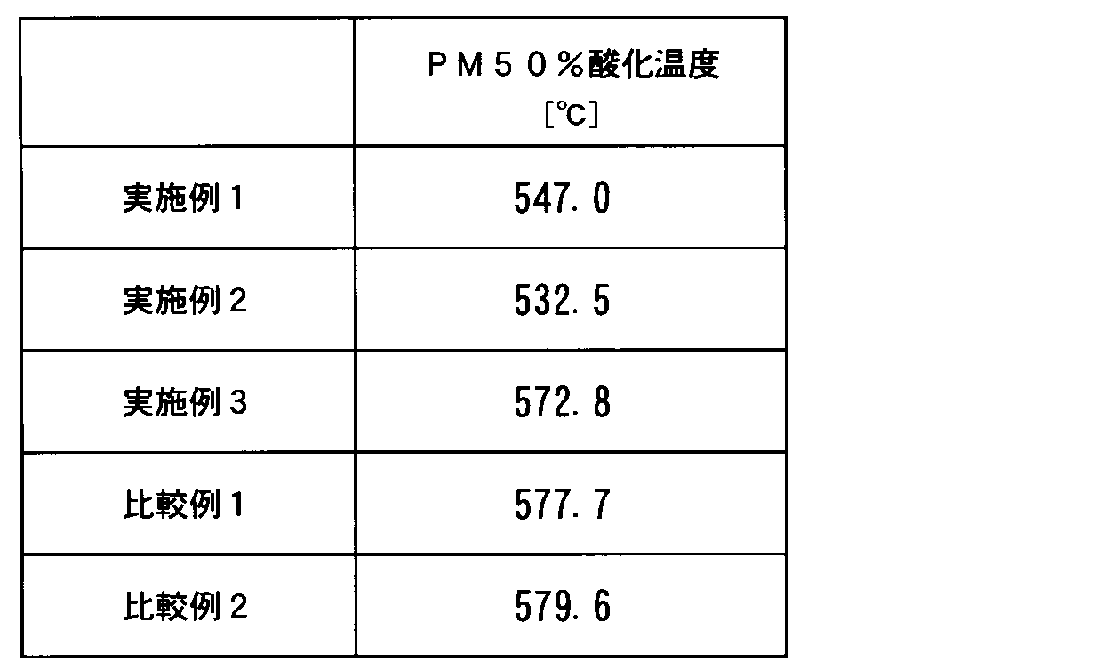
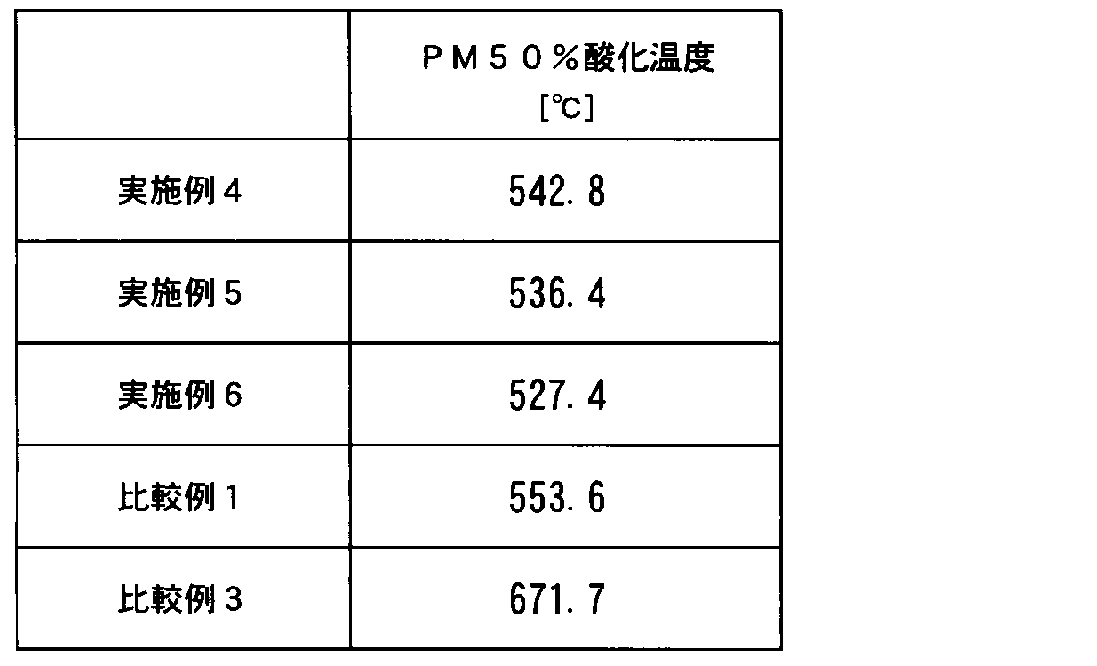
表2及び表3、図1及び図2に記載した結果からも明らかなように、本発明の実施例1~6の排ガス浄化用触媒は、硫黄を含むガスに曝されても十分に高いPM酸化活性を発揮することが可能な排ガス浄化用触媒であることが確認された。
実施例1、5、6及び比較例1で得られた各触媒を測定試料として、粉末X線回折装置(リガク社製、商品名「試料水平型X線回折装置UltimaIV」)を用いて、X線源:CuKα線(λ=0.15406nm)、スキャンステップ:0.02°、保持時間:0.12秒、加速電圧:40kV、加速電流:40mAの条件で粉末X線回折(XRD)測定を行なった。図3に、実施例1、5、6及び比較例1で得られた排ガス浄化用触媒のXRDスペクトルを示す。
Claims (7)
- アルミナを主成分とする担体と、該担体に担持されている銀含有物質及びリン酸含有物質と、を備える排ガス浄化用触媒。
- 前記銀含有物質と前記リン酸含有物質とを兼ねるものとしてリン酸銀が前記担体に担持されている請求項1に記載の排ガス浄化用触媒。
- 前記排ガス浄化用触媒中の銀(Ag)に対するリン(P)の原子比率(P/Ag)が0.2~6である請求項1又は2に記載の排ガス浄化用触媒。
- 前記銀含有物質の担持量が、前記担体と前記銀含有物質及び前記リン酸含有物質との総量に対して金属銀換算で3~50質量%である請求項1~3のうちのいずれか一項に記載の排ガス浄化用触媒。
- 前記排ガス浄化用触媒中のアルミニウム(Al)に対するリン(P)の原子比率(P/Al)が0.15~0.5であり、かつ、前記リン酸含有物質がリン酸アルミニウムの結晶相を含有している請求項1~4のうちのいずれか一項に記載の排ガス浄化用触媒。
- 請求項1~5のうちのいずれか一項に記載の排ガス浄化用触媒を通気性基材に担持せしめてなる排ガス浄化フィルタ。
- 請求項1~5のうちのいずれか一項に記載の排ガス浄化用触媒に内燃機関からの排ガスを接触せしめて粒子状物質(PM)を酸化除去する排ガス浄化方法。
Priority Applications (3)
| Application Number | Priority Date | Filing Date | Title |
|---|---|---|---|
| BR112016022596A BR112016022596A2 (pt) | 2014-04-03 | 2015-03-24 | Catalisador para purificação de gás de escape, e filtro e método para purificação de gás de escape utilizando esse catalisador |
| DE112015001661.9T DE112015001661B4 (de) | 2014-04-03 | 2015-03-24 | Katalysator zur Reinigung von Abgas sowie Verwendung desselben oder eines denselben umfassenden Filters zur Reinigung von Abgas |
| RU2016142710A RU2652113C1 (ru) | 2014-04-03 | 2015-03-24 | Катализатор для очистки выхлопных газов, а также фильтр и способ очистки выхлопных газов с его использованием |
Applications Claiming Priority (4)
| Application Number | Priority Date | Filing Date | Title |
|---|---|---|---|
| JP2014-077105 | 2014-04-03 | ||
| JP2014077105 | 2014-04-03 | ||
| JP2015-028462 | 2015-02-17 | ||
| JP2015028462A JP6061406B2 (ja) | 2014-04-03 | 2015-02-17 | Pm酸化触媒、それを用いた排ガス浄化フィルタ及び排ガス浄化方法 |
Publications (1)
| Publication Number | Publication Date |
|---|---|
| WO2015151920A1 true WO2015151920A1 (ja) | 2015-10-08 |
Family
ID=54240247
Family Applications (1)
| Application Number | Title | Priority Date | Filing Date |
|---|---|---|---|
| PCT/JP2015/058850 Ceased WO2015151920A1 (ja) | 2014-04-03 | 2015-03-24 | 排ガス浄化用触媒、それを用いた排ガス浄化フィルタ及び排ガス浄化方法 |
Country Status (5)
| Country | Link |
|---|---|
| JP (1) | JP6061406B2 (ja) |
| BR (1) | BR112016022596A2 (ja) |
| DE (1) | DE112015001661B4 (ja) |
| RU (1) | RU2652113C1 (ja) |
| WO (1) | WO2015151920A1 (ja) |
Citations (4)
| Publication number | Priority date | Publication date | Assignee | Title |
|---|---|---|---|---|
| JPH08257367A (ja) * | 1995-03-27 | 1996-10-08 | Riken Corp | 窒素酸化物除去材、その製造方法及び窒素酸化物除去方法 |
| JPH08309194A (ja) * | 1995-05-17 | 1996-11-26 | Sumitomo Metal Mining Co Ltd | 排気ガス浄化用触媒および排気ガス浄化方法 |
| JPH10202064A (ja) * | 1997-01-24 | 1998-08-04 | Sekiyu Sangyo Kasseika Center | 窒素酸化物の接触還元方法 |
| JPH10337443A (ja) * | 1997-06-03 | 1998-12-22 | Riken Corp | 排ガス浄化材及び排ガス浄化方法 |
Family Cites Families (1)
| Publication number | Priority date | Publication date | Assignee | Title |
|---|---|---|---|---|
| RU2414300C1 (ru) * | 2009-08-04 | 2011-03-20 | Инфра Текнолоджиз Лтд. | Носитель для катализатора экзотермических процессов и катализатор на его основе |
-
2015
- 2015-02-17 JP JP2015028462A patent/JP6061406B2/ja not_active Expired - Fee Related
- 2015-03-24 BR BR112016022596A patent/BR112016022596A2/pt not_active Application Discontinuation
- 2015-03-24 WO PCT/JP2015/058850 patent/WO2015151920A1/ja not_active Ceased
- 2015-03-24 DE DE112015001661.9T patent/DE112015001661B4/de not_active Expired - Fee Related
- 2015-03-24 RU RU2016142710A patent/RU2652113C1/ru not_active IP Right Cessation
Patent Citations (4)
| Publication number | Priority date | Publication date | Assignee | Title |
|---|---|---|---|---|
| JPH08257367A (ja) * | 1995-03-27 | 1996-10-08 | Riken Corp | 窒素酸化物除去材、その製造方法及び窒素酸化物除去方法 |
| JPH08309194A (ja) * | 1995-05-17 | 1996-11-26 | Sumitomo Metal Mining Co Ltd | 排気ガス浄化用触媒および排気ガス浄化方法 |
| JPH10202064A (ja) * | 1997-01-24 | 1998-08-04 | Sekiyu Sangyo Kasseika Center | 窒素酸化物の接触還元方法 |
| JPH10337443A (ja) * | 1997-06-03 | 1998-12-22 | Riken Corp | 排ガス浄化材及び排ガス浄化方法 |
Also Published As
| Publication number | Publication date |
|---|---|
| DE112015001661T5 (de) | 2016-12-29 |
| BR112016022596A2 (pt) | 2017-08-15 |
| DE112015001661B4 (de) | 2019-08-29 |
| JP6061406B2 (ja) | 2017-01-18 |
| JP2015199061A (ja) | 2015-11-12 |
| RU2652113C1 (ru) | 2018-04-25 |
Similar Documents
| Publication | Publication Date | Title |
|---|---|---|
| RU2698675C2 (ru) | Неорганический оксидный материал | |
| US10350581B2 (en) | Catalyst composition for exhaust gas purification and catalyst for exhaust gas purification | |
| JP5565569B2 (ja) | 排ガス浄化用触媒 | |
| JP6187770B2 (ja) | 排ガス浄化触媒、その製造方法、及び、それを用いた排ガス浄化方法 | |
| JP5791439B2 (ja) | 排気ガス浄化用触媒及び担体 | |
| WO2022107900A1 (ja) | ジルコニア系多孔質体、及び、ジルコニア系多孔質体の製造方法 | |
| JP6401740B2 (ja) | 排ガス浄化触媒及びその製造方法 | |
| JP6544880B1 (ja) | 水素製造用触媒及びこれを用いた排ガス浄化用触媒 | |
| JP6180032B2 (ja) | 複合金属酸化物及びその製造方法、並びに、その複合金属酸化物を用いた窒素酸化物分解触媒及びその窒素酸化物分解触媒を用いた窒素酸化物の分解方法 | |
| JP6061406B2 (ja) | Pm酸化触媒、それを用いた排ガス浄化フィルタ及び排ガス浄化方法 | |
| US9908106B2 (en) | Carrier for exhaust gas purification catalyst and exhaust gas purification catalyst | |
| JP6770265B2 (ja) | 排気ガス浄化用触媒 | |
| JP2017176900A (ja) | 排ガス浄化用触媒及びその製造方法、並びにそれを用いた排ガス浄化フィルタ及び排ガス浄化方法 | |
| JP2016175010A (ja) | 排ガス浄化触媒、並びに、それを用いた排ガス浄化装置及び排ガス浄化方法 | |
| JP6194699B2 (ja) | 触媒付パティキュレートフィルタの製造方法 | |
| JP5956496B2 (ja) | 排ガス浄化用触媒、それを用いた排ガス浄化フィルタ及び排ガス浄化方法 | |
| JP6096818B2 (ja) | 排ガス浄化触媒、その製造方法、及び、それを用いた排ガス浄化方法 | |
| JP2019034291A (ja) | 排ガス浄化システム及び排ガス浄化方法 | |
| WO2019172284A1 (ja) | 排ガス浄化触媒及び排ガス浄化システム | |
| WO2016190294A1 (ja) | 排ガス浄化用触媒、それを用いた排ガス浄化フィルタ及び排ガス浄化方法 | |
| JP6774654B2 (ja) | 排ガス浄化触媒及び排ガス浄化方法 | |
| JP2018176054A (ja) | 排ガス浄化用触媒、排ガス浄化フィルタ及び排ガス浄化方法 | |
| JP2015208712A (ja) | 排ガス浄化用触媒、並びにそれを用いた窒素酸化物の選択還元方法及び固体炭素成分の酸化除去方法 | |
| CN118159362A (zh) | 废气净化催化剂、废气的净化方法及废气净化催化剂的制造方法 | |
| JP2016203159A (ja) | 排気ガス浄化用触媒材、その製造方法、及びその触媒付パティキュレートフィルタ |
Legal Events
| Date | Code | Title | Description |
|---|---|---|---|
| 121 | Ep: the epo has been informed by wipo that ep was designated in this application |
Ref document number: 15774420 Country of ref document: EP Kind code of ref document: A1 |
|
| WWE | Wipo information: entry into national phase |
Ref document number: IDP00201606612 Country of ref document: ID |
|
| WWE | Wipo information: entry into national phase |
Ref document number: 112015001661 Country of ref document: DE |
|
| REG | Reference to national code |
Ref country code: BR Ref legal event code: B01A Ref document number: 112016022596 Country of ref document: BR |
|
| ENP | Entry into the national phase |
Ref document number: 2016142710 Country of ref document: RU Kind code of ref document: A |
|
| 122 | Ep: pct application non-entry in european phase |
Ref document number: 15774420 Country of ref document: EP Kind code of ref document: A1 |
|
| ENP | Entry into the national phase |
Ref document number: 112016022596 Country of ref document: BR Kind code of ref document: A2 Effective date: 20160929 |