WO2015147138A1 - ペプチドの製造方法 - Google Patents
ペプチドの製造方法 Download PDFInfo
- Publication number
- WO2015147138A1 WO2015147138A1 PCT/JP2015/059317 JP2015059317W WO2015147138A1 WO 2015147138 A1 WO2015147138 A1 WO 2015147138A1 JP 2015059317 W JP2015059317 W JP 2015059317W WO 2015147138 A1 WO2015147138 A1 WO 2015147138A1
- Authority
- WO
- WIPO (PCT)
- Prior art keywords
- peptide
- amino acid
- acid
- ionic liquid
- liquid
- Prior art date
- Legal status (The legal status is an assumption and is not a legal conclusion. Google has not performed a legal analysis and makes no representation as to the accuracy of the status listed.)
- Ceased
Links
- 0 *CC(NCC(O)=O)=O Chemical compound *CC(NCC(O)=O)=O 0.000 description 1
Classifications
-
- C—CHEMISTRY; METALLURGY
- C07—ORGANIC CHEMISTRY
- C07K—PEPTIDES
- C07K1/00—General methods for the preparation of peptides, i.e. processes for the organic chemical preparation of peptides or proteins of any length
- C07K1/02—General methods for the preparation of peptides, i.e. processes for the organic chemical preparation of peptides or proteins of any length in solution
Definitions
- the present invention relates to a method for producing a peptide for separating a peptide from a liquid mixture of ionic liquid containing peptide and amino acid, and in particular, a method for producing a peptide for efficiently isolating a peptide synthesized using an ionic liquid from a liquid mixture, In particular, it relates to a method for industrial production.
- Patent Document 1 discloses a method in which an ionic liquid and an oligopeptide, oligosaccharide, or oligonucleotide are bound to improve solubility in an organic solvent and also used as a protective group. In the polymerization of each reaction, a protecting group and a condensing agent are used.
- Non-Patent Document 1 discloses Z-Asp (Z-Aspartic acid) + PM (L-Phenylalanine methylester) ⁇ Z-APM (Z-) in an ionic liquid (BP6 (1-butyl-3-methylimidazolium hexafluorophosphate)). Aspartame) is performed using an enzyme (Thermolysin), and it has been demonstrated that the enzyme reaction can be performed even in an ionic liquid. The yield in this reaction is as high as 90%, but it is extremely low, and the reaction method disclosed here is merely a solvent substitution of the enzyme reaction in an organic solvent.
- Patent Document 2 discloses peptide synthesis in an ionic liquid (4-methyl-N-butylpyridinium tetrafluoroborate).
- the synthesis method described here is a simple solvent replacement of an enzyme reaction in an organic solvent as in Non-Patent Document 1, and is a reaction at a considerably low concentration of 20 mM, and also uses a protecting group.
- Non-Patent Document 2 demonstrates that amino acids can be bound to ionic liquid residues by ionic bonds, and that amino acids can be made ionic liquid. In particular, its use is not discussed. Are considering.
- Non-Patent Document 3 describes a review of polypeptides, oligosaccharides, and other organic synthesis using ionic liquids, and there is a description that the substrate-ionic liquid is used as a reaction intermediate in the gist. No specific data is shown.
- Non-Patent Document 4 describes reviews such as introductions regarding amino acid-binding ionic liquids, and there is no specific data, but mentions future use as a solvent or catalyst.
- the peptide synthesis method using the proposed ionic liquid has a low yield of the obtained peptide, and is not sufficient as an industrial peptide production method. Under such circumstances, a production method for synthesizing a peptide with high yield using an ionic liquid has been proposed (Patent Documents 3 and 4).
- JP 2008-537733 A JP 2008-301829 A WO2012 / 014808 publication WO2012 / 014809
- the present invention relates to a liquid mixture comprising a peptide and an amino acid, wherein the peptide is separated from the liquid mixture in which at least one selected from the peptide and amino acid is present as an ionic liquid in which a cation and an ionic bond are formed as anions.
- an object of the present invention is to provide a peptide production method for efficiently isolating a peptide synthesized using an ionic liquid from a liquid mixture.
- the present invention when a liquid mixture containing a peptide synthesized using an ionic liquid is treated with an acid, preferably in an organic solvent, an unreacted amino acid and a peptide as a product can be precipitated and recovered stepwise. It was made based on the knowledge that it can be done. That is, the present invention includes the following contents.
- a method for producing a peptide characterized by preferentially precipitating or separating an amino acid, or preferentially precipitating and separating an amino acid, followed by further acid treatment to preferentially precipitate and separate the peptide.
- the method according to [1] wherein the liquid mixture is acid-treated, first the amino acids are preferentially precipitated and separated, and then further acid-treated to preferentially precipitate and separate the peptides.
- the liquid mixture is a liquid mixture containing (1) an ionic liquid (ionic liquid A) having a peptide as an anion and (2) an ionic liquid (ionic liquid B) having an amino acid as an anion, [1] or [2 ]the method of.
- the condensation reaction is a reaction in which (2) an amino group of an ionic liquid (ionic liquid B) having an amino acid as an anion and (3) an ester group of a peptide ester or amino acid ester are condensed to form an amide bond.
- the amino acid is first precipitated by the acid treatment, and the acid treatment of the liquid mixture is performed in the presence of 50 to 100 mol% of acid with respect to the molar amount in the liquid mixture of the previously precipitated amino acid.
- One of the methods of [7]. [10] The method according to any one of [1] to [9], wherein the liquid mixture to be acid-treated contains an organic solvent.
- the ionic liquid is ionized by forming an ionic bond with at least one cation selected from alkylphosphonium ions, alkylimidazolium ions, alkylammonium ions, alkylpyridinium ions, alkylpyrrolidinium ions, and alkylpiperidinium ions.
- the method according to any one of [1] to [14], which is liquefied.
- a method for separating a peptide and an amino acid, wherein the amino acid is preferentially precipitated is also known in the art.
- a liquid comprising a first amino acid or peptide and a second amino acid or peptide different from the first amino acid or peptide, wherein at least one of the first amino acid or peptide and the second amino acid or peptide
- One kind is an acid treatment of the liquid present as an ionic liquid that forms an ionic bond with a cation as an anion, and preferentially precipitates and separates either the first amino acid or peptide and the second amino acid or peptide
- a liquid comprising a first amino acid or peptide and a second amino acid or peptide different from the first amino acid or peptide, wherein at least one of the first amino acid or peptide and the second amino acid or peptide
- One kind is an acid treatment of the liquid present as an ionic liquid that forms an ionic bond with a cation as an anion, and preferentially precipitates and separates either the first amino acid or peptide and the second amino acid or peptide
- a method for separating a first amino acid or peptide from a second amino acid or peptide which is characterized.
- a liquid mixture containing a peptide and an amino acid, wherein at least one selected from the peptide and amino acid forms an ionic bond with a cation as an anion to form an ionic liquid a simple mixture is obtained.
- the peptide can be selectively precipitated and separated efficiently and with high yield.
- the product peptide can be selectively precipitated and separated. Therefore, the present invention can easily separate an amino acid and a peptide. Therefore, the peptide production method of the present invention is a particularly excellent industrial production method.
- a liquid mixture containing a peptide and an amino acid wherein the liquid mixture containing at least one selected from the peptide and amino acid as an anion and forming an ionic bond with a cation is acid-treated, After preferentially precipitating or separating the amino acid, preferentially precipitating and separating the amino acid, further acid treatment to preferentially precipitate and separate the peptide.
- the liquid mixture of the present invention includes peptides and amino acids. At least one of the peptides and amino acids contained in the liquid mixture forms an ionic liquid. In this case, the amino acid or peptide that forms the ionic liquid becomes an anion, and is formed into an ionic liquid by forming an ionic bond with the cation. Both amino acids and peptides may be ionic liquids.
- the ionic liquidized peptide and / or ionic liquidized amino acid contained in the liquid mixture is precipitated and separated as a peptide and / or amino acid in a form in which the ionic liquidization is released by acid treatment.
- the amino acid is first preferentially precipitated by acid treatment of the liquid mixture.
- the amino acid is precipitated and separated, it is further acid-treated to precipitate and separate the peptide preferentially.
- the peptide may be isolated as it is.
- preferentially precipitating and separating amino acids means that at least the ratio of the solid amino acid to peptide molar ratio or mass ratio (preferably the molar ratio) obtained by precipitation separation is higher for amino acids.
- the molar ratio of amino acid: peptide is preferably 2: 1 or more, more preferably 5: 1 or more, more preferably 10: 1 or more, more preferably 15: 1 or more, more preferably 20: 1 or more.
- preferentially precipitating and separating a peptide means that the peptide has a larger ratio of at least a molar ratio or a mass ratio (preferably a molar ratio) between a solid amino acid and a peptide obtained by precipitation separation.
- the molar ratio of amino acid: peptide is 1: 1.2 or more, more preferably 1: 1.5 or more, more preferably 1: 2 or more, more preferably 1: 2.5 or more, more preferably 1: 3. That's it.
- the liquid mixture includes (1) an ionic liquid having a peptide as an anion (ionic liquid A) and (2) an ionic liquid having an amino acid as an anion (ionic liquid B).
- the liquid mixture is a reaction solution in which a peptide is produced by a condensation reaction.
- condensation reaction and reaction solution typically include the condensation reaction described in WO2012 / 014808 and WO2012 / 014809 and the reaction solution obtained thereby. Descriptions of these patent publications are included in the description of this specification.
- the liquid mixture is an amide bond formed by condensation reaction of (2) an amino group of an ionic liquid (ionic liquid B) having an amino acid as an anion and (3) an ester group of a peptide ester or amino acid ester.
- ionic liquid B an amino group of an ionic liquid having an amino acid as an anion
- ester group of a peptide ester or amino acid ester In the case of a reaction solution in which is formed.
- Such a condensation reaction can be carried out according to the method described in WO2012 / 014809.
- the condensation reaction is performed using an ionic liquid (ionic liquid B) having an amino acid as a reaction raw material as an anion as a reaction solvent.
- ionic liquid B having an amino acid as a reaction raw material as an anion as a reaction solvent.
- the condensation is performed in the presence of 20% by mass or less of water based on the total mass of the reaction system.
- the peptide When the peptide is first precipitated by the acid treatment of the mixed solution, it is preferably 25 to 200 mol%, more preferably 30 to 150 mol%, still more preferably 50 to the molar amount of the peptide present in the mixed solution. Acid treatment with ⁇ 100 mol% acid precipitates and separates the peptide.
- the peptide referred to herein includes those existing in the form of a salt, such as an ionic liquid peptide.
- the amino acid When the amino acid first precipitates due to the acid treatment of the mixed solution, it is preferably 25 to 200 mol%, more preferably 30 to 150 mol%, more preferably 50 to 50 mol% with respect to the molar amount of the amino acid present in the mixed solution.
- the acid treatment is preferably performed with an acid of preferably 50 to 300 mol%, more preferably 50 to 200 mol%, based on the molar amount of the peptide present in the mixed solution.
- the peptide referred to herein includes those existing in the form of a salt, such as an ionic liquid peptide.
- amino acids herein include those that exist in the form of salts, such as amino acids that are ionic liquids.
- the acid treatment is preferably performed with an acid of 25 to 200 mol%, more preferably 30 to 150 mol%, and still more preferably 50 to 100 mol% with respect to the molar amount in the mixed solution of the peptide first precipitated by the acid treatment.
- the acid treatment is preferably performed with an acid of 25 to 200 mol%, more preferably 30 to 150 mol%, and still more preferably 50 to 100 mol% with respect to the molar amount in the mixed solution of the peptide first precipitated by the acid treatment.
- it is further acid-treated to preferentially separate and separate other peptides.
- the acid is preferably used in an acid amount of preferably 50 to 300 mol%, more preferably 50 to 200 mol%, based on the molar amount of the other peptide present in the mixed solution.
- the peptide referred to herein includes those existing in the form of a salt, such as an ionic liquid peptide.
- the liquid mixture preferably contains an organic solvent.
- the viscosity is generally high and is often not suitable for precipitation separation of the target product by acid treatment. Therefore, it is preferable to lower the viscosity with an organic solvent to make a liquid mixture suitable for precipitation separation of the target product.
- the condensation reaction is performed using an ionic liquid as a reaction solvent, and when the reaction solution does not contain an organic solvent, it is preferable to add an organic solvent and perform acid treatment.
- acid treatment may be performed as it is without adding the organic solvent to the reaction solution (liquid mixture).
- the organic solvent may be added again before acid treatment of the liquid mixture after the precipitation and separation of the amino acid.
- it may be used as it is without adding an organic solvent.
- Subsequent acid treatment may be performed after solvent replacement, such as by distilling off the organic solvent under reduced pressure and adding another organic solvent.
- the organic solvent is not particularly limited as long as it is an organic solvent that dissolves in the liquid mixture and does not decompose the ionic liquid.
- organic solvent examples include hydrocarbons, ketones, halogenated hydrocarbons, nitrified hydrocarbons, ethers, esters, alcohols, N, N-dimethylformamide, dimethyl sulfoxide and the like.
- hydrocarbon examples include benzene, toluene, xylene, solvent naphtha, normal hexane, isohexane, cyclohexane, methylcyclohexane, normal heptane, isooctane, and normal decane.
- ketone examples include acetone, methyl ethyl ketone, methyl isobutyl ketone, diisobutyl ketone, cyclohexanone, diacetone alcohol and the like.
- the halogenated hydrocarbon is preferably one having 1 to 6 carbon atoms, wherein a part or all of the hydrogen atoms bonded to the carbon atom are substituted with a halogen element. Specific examples include chloroform, dichloromethane, trichloroethylene, tetrachloroethylene, 1,1-dichloro 1-fluoroethane, dichloropentafluoropropane, 1-bromopropane, and o-dichlorobenzene.
- nitrified hydrocarbon a compound in which a nitrile group is bonded to a hydrocarbon having 1 to 6 carbon atoms is preferable, and examples thereof include acetonitrile.
- ethers include diisopropyl ether, 1,4-dioxane, methyl tert-butyl ether, 1,2-dimethoxyethane, diethyl ether, and tetrahydrofuran.
- ester examples include ethyl formate, propyl formate, methyl acetate, ethyl acetate, propyl acetate, butyl acetate, methoxybutyl acetate, amyl acetate, normal propyl acetate, isopropyl acetate, methyl lactate, ethyl lactate, and butyl lactate.
- the alcohol examples include methanol, ethanol, butanol, isopropyl alcohol, normal propyl alcohol, 2-butanol, isobutanol, tert-butanol, butanediol, ethylhexanol, benzyl alcohol and the like.
- Examples of other solvents include N, N-dimethylformamide and dimethyl sulfoxide.
- An organic solvent may be used individually by 1 type, and 2 or more types may be mixed and used for it.
- the organic solvent is preferably an aprotic solvent, and particularly preferable organic solvents include chloroform, acetonitrile, tetrahydrofuran, ethyl acetate, or any mixed solvent thereof.
- an acid treatment is performed by addition of the compound which generate
- the amount of the organic solvent added in the present invention is not particularly limited as long as the liquid mixture is suitable for precipitation separation of amino acids and peptides. Usually, it is preferable to add 20 to 500 parts by volume, more preferably 200 to 400 parts by volume of the organic solvent per 100 parts by mass of the liquid mixture.
- the amount of water in the liquid mixture is preferably 20% by mass or less, more preferably 10% by mass or less, and more preferably 0 to 5% by mass with respect to the total mass of the liquid mixture. preferable.
- examples of the acid used for the acid treatment include inorganic acids such as hydrogen chloride, sulfuric acid, nitric acid, phosphoric acid, boric acid and hydrofluoric acid, and organic acids such as formic acid, acetic acid and propionic acid. . These acids may be used individually by 1 type, and 2 or more types may be mixed and used for them.
- the acid treatment can be performed by adding these acids to the liquid mixture. Moreover, you may carry out by adding the compound which generate
- TMSCl chlorotrimethylsilane
- a compound that promotes acid generation from the compound is used together with a compound that generates an acid by reaction.
- a compound that promotes acid generation it is preferable to use a lower alcohol having 1 to 4 carbon atoms. Specific examples include methanol, ethanol, n-propanol, isopropanol, and butanol.
- the organic solvent in the method of the present invention contains a sufficient amount for acid generation, addition as a compound for promoting acid generation can be omitted.
- the acid treatment is preferably added to the liquid mixture in the presence of an organic solvent such as after addition of the organic solvent.
- an organic solvent can be added to the liquid mixture when no organic solvent is present, and an acid or a compound that generates an acid by reaction can be added.
- the liquid mixture When the amino acid or peptide is precipitated, it is preferable to cool the liquid mixture in order to increase the precipitation efficiency. Cooling is preferably carried out after adding an acid to the liquid mixture or after generating an acid with a compound that generates an acid by reaction.
- the cooling temperature is preferably 10 ° C. or lower. It does not specifically limit as a method to isolate
- the target peptide separated as described above can be further purified to improve the purity by a known method such as recrystallization.
- the separated peptide (solid) is dissolved in water or the like, and a lower alcohol such as methanol is gradually added to crystallize a highly pure peptide.
- the ionic liquid contained in the liquid mixture is made into an ionic liquid by using a peptide and / or amino acid as an anion and forming an ionic bond with the cation.
- the amino acid that becomes an anion is not particularly limited, and may be, for example, a neutral amino acid, an acidic amino acid, or a basic amino acid. .
- the amino acids are leucine (Leu), phenylalanine (Phe), tyrosine (Tyr), glycine (Gly), alanine (Ala), valine (Val), isoleucine (Ile), serine (Ser), lysine (Lys), Proline (Pro), Threonine (Thr), Methionine (Met), Glutamic acid (Glu), Cysteine (Cys), Aspartic acid (Asp), Glutamine (Gln), Tryptophan (Trp), Histidine (His), Arginine (Arg) , Amino acids such as hydroxyproline, hydroxylysine, N-methylglycine, ornithine and the like.
- ⁇ -amino acids such as ⁇ -alanine
- ⁇ -amino acids such as ⁇ -aminobutyric acid
- unnatural amino acids in which the side chain of these amino acids is modified with an organic group
- amino acids may be either L-form or D-form.
- neutral amino acids specifically, amino acids, such as glycine, alanine, valine, isoleucine, and leucine, can be mentioned.
- the peptide that becomes an anion is not particularly limited.
- the amino acid exemplified above is used as a residue.
- examples include oligopeptides.
- the number of residues of the peptide is not particularly limited, but is preferably a peptide of 5 or less, more preferably 3 or less, and still more preferably 2 residues.
- Dipeptides include glycylglycine, glycylalanine, alanylglycine, valylglycine, alanylalanine, alanylvaline, prolylglycine, valylalanine, glycylphenylalanine, alanylphenylalanine and the like.
- the functional group present in the side chain or the like in these amino acids or peptides may be protected with a protecting group generally used in peptide chemistry or the like as long as they can form an ionic liquid as an anion.
- the amino group in the side chain may be protected with an amino protecting group such as formyl group, benzyloxycarbonyl group or tert-butoxycarbonyl group.
- the side chain carboxy group is methyl, ethyl, tert-butyl, benzyl, trimethylsilyl, triethylsilyl, dimethylphenylsilyl, tert-butyldimethylsilyl, tert-butyldiethylsilyl, etc.
- the hydroxyl group of the side chain is benzyl group, acetyl group, chloroacetyl group, benzoyl group, benzylcarbonyl group, 2-tetrahydropyranyl group, 2-tetrahydrofuranyl group, trimethylsilyl group, triethylsilyl group, dimethylphenylsilyl group, It may be protected with a protecting group such as a tert-butyldimethylsilyl group or a tert-butyldiethylsilyl group.
- the amino acid and peptide in the present invention include a form in which the functional group present in the molecule is protected with a protecting group.
- a compound having a quaternized hetero atom for example, a quaternary phosphonium salt, a quaternary ammonium salt, an imidazolium salt, a pyridinium salt, a pyrrolidinium salt, a piperidinium salt, etc.
- cations include a cation that is at least one selected from alkylphosphonium ions, alkylimidazolium ions, alkylammonium ions, alkylpyridinium ions, alkylpyrrolidinium ions, and alkylpiperidinium ions.
- the alkyl group in the alkylphosphonium ion or the like used here preferably has 1 to 12 carbon atoms, more preferably 1 to 6 carbon atoms, and most preferably 1 to 4 carbon atoms.
- a plurality of alkyl groups may be the same or different, but are preferably the same.
- the ionic liquid is not a salt melt but a salt composed of ions that melt at a low temperature of 100 ° C. or lower. Therefore, water is not an ionic liquid.
- the compound having the quaternized heteroatom and the first amino acid or peptide are mixed in approximately equimolar amounts and heated under non-reduced pressure or reduced pressure (preferably 20 to 150 mmHg) (preferably 40 to 70 ° C.), water is evaporated and dehydration condensation can be performed to prepare an amino acid or peptide that has been made into an ionic liquid.
- the ionic liquidized amino acid or peptide is carboxylate, that is, the carboxy group in the first amino acid or peptide forms an ionic bond with the compound having the quaternized hetero atom. preferable.
- Non-patent document 2 (Acc. Chem. Res. 2007, 40, 1122-1129) about compounds having quaternized heteroatoms, amino acids and peptides, ionic liquidized amino acids or peptides is described in the present specification. It shall be included in the description.
- the liquid mixture is a reaction solution in which a peptide is produced by a condensation reaction
- a reaction solution typically includes a reaction solution obtained by the condensation reaction described in WO2012 / 014808 and WO2012 / 014809.
- the liquid mixture is particularly a reaction solution obtained by the condensation reaction described in WO2012 / 014809, which contains a peptide of interest and an amino acid as an impurity, and at least one selected from the peptide and amino acid is a cation as an anion And a liquid mixture which exists as an ionic liquid in which an ionic bond is formed.
- a liquid mixture obtained by condensation reaction with an amino acid ester or peptide ester using an ionic liquid having an amino acid or peptide as an anion as a reaction solvent and a reaction raw material is preferable.
- the liquid mixture does not include a liquid mixture obtained by a condensation reaction between an ionic liquid having a peptide as an anion and a peptide ester, that is, a liquid mixture containing no amino acid.
- the ionic liquid having an amino acid or peptide as an anion a substance having the same meaning as the ionic liquid having an amino acid or peptide described above as an anion and forming an ionic bond with a cation can be used.
- a peptide ester or amino acid ester ester group and an amino group are subjected to a condensation reaction to form a peptide bond, and to obtain the target peptide, an amino group bonded to the ⁇ , ⁇ or ⁇ carbon atom of the amino acid, Alternatively, it is preferable to use an amino group which is not protected at the N-terminal of the peptide.
- the C-terminal carboxy group of the peptide described above or a peptide synonymous with an amino acid is esterified with an alkyl group or the like.
- the alkyl group preferably has 1 to 12 carbon atoms, more preferably 1 to 6 carbon atoms, and particularly preferably 1 to 4 carbon atoms.
- the amino group bonded to the N-terminal amino group of the peptide ester or the ⁇ , ⁇ , or ⁇ carbon atom of the amino acid ester may be protected with a protective group, but it is preferable to use an amino group that is not protected.
- the condensation reaction can be performed by a method according to the condensation reaction described in WO2012 / 014809.
- an ionic liquidized amino acid or peptide can be reacted with an amino acid ester or peptide ester using a reaction solvent and a reaction raw material.
- the ionic liquidized amino acid is used in an equimolar amount or more with respect to the amino acid ester or peptide ester, and preferably the molar ratio of the ionic liquid amino acid or peptide: amino acid ester or peptide ester is 20: It is used at 1: 1 to 1: 1, more preferably 10: 1 to 2: 1.
- a peptide bond is formed between the amino group of the amino acid or peptide that has been liquefied and the carboxy group cleaved from the amino acid ester or ester of the peptide ester.
- Alcohol is produced from the alcohol residue constituting the ester.
- a peptide hydrolase or a condensing agent may not be present.
- the amount of water is preferably 20% by mass or less, more preferably 10% by mass or less, and further preferably 0 to 5% by mass with respect to the total mass of the reaction system.
- the condensation reaction is preferably carried out by mixing both and maintaining the temperature at 0 to 100 ° C., preferably at room temperature (20 ° C.) to 70 ° C.
- the reaction time is not particularly limited, and is usually 10 minutes to 3 days, preferably 30 minutes to 2 days, and more preferably 1 hour to 24 hours.
- the liquid mixture includes an amino group of an ionic liquid (ionic liquid B) having an amino acid as an anion and (3) an ester group of a peptide ester or an amino acid ester.
- ionic liquid B an amino group of an ionic liquid having an amino acid as an anion
- ester group of a peptide ester or an amino acid ester Is a reaction solution in which an amide bond is formed by a condensation reaction.
- liquid mixture used in the present invention include, for example, a first amino acid or peptide (A), a second amino acid or peptide (B), and a peptide hydrolase (C) that are ionic liquidized.
- first amino acid or peptide in the form of ionic liquid is used as a reaction solvent and as a reaction raw material to form a peptide bond between the first amino acid or peptide and the second amino acid or peptide.
- the liquid mixture obtained by making it can be mentioned.
- the embodiment in which the component (A) and the component (B) simultaneously become a peptide in the condensation reaction is excluded.
- the condensation reaction can be carried out by a condensation reaction with a second amino acid using an ionic liquid having an amino acid or peptide as an anion as a reaction solvent and a reaction raw material.
- the condensation reaction can be carried out by a condensation reaction with a second amino acid or peptide using an ionic liquid having an amino acid as an anion as a reaction solvent and a reaction raw material. Groups that do not participate in the reaction may be protected with a protecting group.
- Such a condensation reaction can be carried out according to the method described in WO2012 / 014808. In the condensation reaction, it is preferable that 50% by mass or less of water, particularly 5 to 20% by mass of water is present with respect to the total mass of the reaction system.
- Peptide hydrolase (C) is preferably at least one selected from the group consisting of protease, peptidase and hydrolase, particularly thermolysin. Such enzymes are readily available from Sigma-Aldrich Corporation. Peptide hydrolase (C) is preferably present in the reaction system in an amount of 1 to 4% by mass. By utilizing the positional specificity of the peptide hydrolase (C), the sequence of the constituent amino acids in the peptide that is the final reaction product can be easily controlled. Since water is substantially present in the reaction system, it is preferable to adjust the pH of the reaction system in the range of 4 to 10.5.
- the reaction of the ionic liquidized first amino acid or peptide (A) with the second amino acid or peptide (B) is carried out by mixing them together at a temperature of 0 to 100 ° C., preferably room temperature (20 C.) to 70 ° C., preferably 30 to 40 ° C.
- the reaction time is not particularly limited, and is usually 10 minutes to 3 days, preferably 30 minutes to 2 days, and more preferably 1 hour to 24 hours.
- what can be used as an amino acid, a peptide, an ionic liquid, a preferable thing, a use ratio, etc. are the same as what was demonstrated about the said method.
- the abundance ratio (molar ratio) of peptide and amino acid (including ionic liquid) contained in the liquid mixture containing peptide and amino acid is not particularly limited as long as the effect of the present invention is achieved.
- the peptide: amino acid can be 99: 1 to 1:99, preferably 50: 1 to 1:50, more preferably 30: 1 to 1:30, and more preferably 20: 1 to 1:20.
- the liquid mixture undergoes a condensation reaction between an amino group of an ionic liquid (ionic liquid B) having an amino acid as an anion and (3) an ester group of a peptide ester and / or an amino acid ester.
- a preferable ratio can be 1:20 to 1: 1, preferably 1:10 to 1: 2, with peptide: amino acid depending on the reaction conditions.
- a liquid comprising a first amino acid or peptide and a second amino acid or peptide different from the first amino acid or peptide, wherein at least one of the first amino acid or peptide and the second amino acid or peptide is
- the liquid present as an ionic liquid that forms an ionic bond with a cation as an anion is acid-treated, and either one of the first amino acid or peptide and the second amino acid or peptide is preferentially precipitated and separated.
- the liquid present as an ionic liquid that forms an ionic bond with a cation as an anion is acid-treated, and either one of the first amino acid or peptide and the second amino acid or peptide is preferentially precipitated and separated.
- the liquid is preferably present as an ionic liquid in which both the first amino acid or peptide and the second amino acid or peptide form an ionic bond with a cation as an anion. That is, the liquid preferably includes an ionic liquid having a first amino acid or peptide as an anion and an ionic liquid having a second amino acid or peptide as an anion.
- the liquid contains the first peptide and the second peptide
- each of the first peptide and the second peptide for example, acid-treats the reaction solution obtained by the condensation reaction described in WO2012 / 014809, It can be obtained by selectively precipitating and separating the peptide which is the reaction product.
- a condensation reaction between an amino group of an ionic liquid having a dipeptide as an anion and an ester group of an amino acid ester for example, a condensation reaction between an amino group of an ionic liquid having a dipeptide as an anion and an ester group of an amino acid ester
- the reaction solution in which the amide bond is formed to synthesize the tripeptide is acid-treated, and the dipeptide or tripeptide is preferentially precipitated and separated from the reaction product, the amino group of the ionic liquid having the dipeptide as an anion, and the dipeptide
- Examples include an embodiment in which a reaction solution in which an amide bond is formed by condensation reaction with an ester group of an ester to synthesize a tetrapeptide is subjected to an acid treatment, and the dipeptide or tetrapeptide is preferentially precipitated and separated from the reaction product.
- Preferentially precipitating and separating any one of the first amino acid or peptide and the second amino acid or peptide means at least any of the solid first amino acid or peptide and second amino acid or peptide obtained by precipitation separation. It means that the ratio of the molar ratio or the mass ratio (preferably the molar ratio) between one (a) and the other amino acid or peptide (b) is larger in the above (a).
- the molar ratio of (a) :( b) is greater than 1: 1, more preferably 2: 1 or more, more preferably 5: 1 or more, more preferably 10: 1 or more, more preferably 20 : 1 or more.
- the liquid preferably contains an organic solvent.
- an acid, an organic solvent, a cation, and other conditions the thing similar to the above is employable, for example.
- the present invention can preferentially precipitate one amino acid or peptide without using the difference in solubility, so that even two types of amino acids and / or peptides having similar solubility can be separated. be able to.
- the amino acids and peptides obtained by precipitation separation from the liquid mixture by the method of the present invention are usually obtained in the form of a free form (free form), but may be obtained in the form of a salt.
- Peptides and amino acids obtained by precipitation separation in the method of the present invention are assumed to contain a salt form as described above. Examples of the salt include acid addition salts with acids used for acid treatment.
- Peptides (oligopeptides and polypeptides) obtained by the method of the present invention can be used as active ingredients of pharmaceuticals, foods containing functional foods and seasonings, nutritional compositions such as infusions and feeds, active ingredients of pharmaceuticals, It can be used widely as an active ingredient of various reagents.
- the present invention will be specifically described with reference to examples.
- Example 1 Dipeptide [component (D)] produced by reaction of glycine methyl ester hydrochloride [component (B)] with glycine ionic liquid (GlyPBu 4 ) [component (A)], unreacted component (A) Isolation of glycine and tetrabutylphosphonium chloride The following reaction was carried out by the following procedure. The structures and abbreviations of the compounds used are shown below. PBu4 represents a tetrabutylphosphonium ion.
- Example 2 Peptide [component (D)] produced by reaction of glycine methyl ester hydrochloride [component (B)] with alanine ionic liquid (AlaPBu 4 ) [component (A)], unreacted component (A) Isolation of alanine and tetrabutylphosphonium chloride in the following reaction was carried out by the following procedure. The structures and abbreviations of the compounds used are shown below. PBu 4 represents a tetrabutylphosphonium ion.
- Example 2 In the same manner as in Example 1 except that an alanine ionic liquid (AlaPBu 4 ) [component (A)] was used instead of glycine ionic liquid (GlyPBu 4 ) [component (A)], the reaction and components were separated. went. Operation charts and results in Example 2 are shown below.
- Example 3 Peptide [component (D)] produced by the reaction of glycine methyl ester hydrochloride [component (B)] and [emim] [Gly] [component (A)], unreacted component (A) Isolation of glycine and 1-ethyl-3-methylimidazolium chloride The following reaction was carried out by the following procedure. The structures and abbreviations of the compounds used are shown below.
- [Emim] is 1-ethyl-3-methylimidazolium ion.
- the reaction and components were separated in the same manner as in Example 1 except that [emim] [Gly] [component (A)] was used instead of GlyPBu 4 [component (A)]. Operation charts and results in Example 3 are shown below.
- Example 4 Peptide [component (D)] produced by reaction of glycine methyl ester hydrochloride [component (B)] with [TBA] [Gly] [component (A)], unreacted component (A) Isolation of glycine and tetrabutylammonium chloride
- the following reaction was carried out by the following operation. The structures and abbreviations of the compounds used are shown below.
- [TBA] and NBu 4 are tetrabutylammonium ions.
- the reaction and components were separated in the same manner as in Example 1 except that [TBA] [Gly] [component (A)] was used instead of GlyPBu 4 [component (A)]. Operation charts and results in Example 4 are shown below.
- Example 5 Dipeptide [component (D)] produced by reaction of glycine methyl ester hydrochloride [component (B)] with glycine ionic liquid (GlyPBu 4 ) [component (A)], unreacted component (A) Isolation of Glycine and Tetrabutylphosphonium Chloride
- glycine methyl ester hydrochloride component (B)
- GlyPBu 4 glycine ionic liquid
- A unreacted component
- Isolation of Glycine and Tetrabutylphosphonium Chloride The reaction and components were separated in the same manner as in Example 1 except that acetonitrile (CH 3 CN) was used instead of chloroform as the organic solvent. Operation charts and results in Example 5 are shown below.
- Example 6 Dipeptide [component (D)] produced by reaction of glycine methyl ester hydrochloride [component (B)] with glycine ionic liquid (GlyPBu 4 ) [component (A)], unreacted component (A) Isolation of glycine and tetrabutylphosphonium sulfate in the same manner as in Example 1 except that sulfuric acid was used instead of the combination of TMSCl and MeOH, which is a compound that generates an acid by reaction. Separation was performed. Operation charts and results in Example 6 are shown below.
- Example 7 Dipeptide [component (D)] produced by reaction of glycine methyl ester hydrochloride [component (B)] with glycine ionic liquid (GlyPBu 4 ) [component (A)], unreacted component (A) Isolation of Glycine and Tetrabutylphosphonium Chloride
- THF tetrahydrofuran
- Example 8 Separation of glycine, glycylglycine and tetrabutylphosphonium acetate from a reaction mixture in which glycylglycine was synthesized by reaction of glycine ionic liquid (Gly-PBu4) and glycine methyl ester hydrochloride Glycine ionic liquid (glycine tetrabutyl Glycine methyl ester hydrochloride (125.5 mg, 1.0 mmol) was added to phosphonium salt: 1.78 g, 5.35 mmol), and the atmosphere was replaced with argon, followed by heating and stirring at 60 ° C. for 3 hours.
- Glycine ionic liquid glycine tetrabutyl Glycine methyl ester hydrochloride
- Filtrate residue (1.99 g): Tetrabutylphosphonium, glycylglycine and acetic acid signals were confirmed. A small amount of glycine ionic liquid was also detected. Furthermore, heavy water was removed from the filtrate residue solution after analysis by distillation under reduced pressure, and chloroform (6 mL) and acetic acid (170 mg, 2.8 mmol) were added at room temperature. The precipitated white solid was separated by filtration. The solvent contained in the filtrate was removed by distillation under reduced pressure, and proton NMR analysis was performed. Solid (87.4 mg): Glycine and glycylglycine signals were detected at a ratio of 1:24. From the weight and signal ratio, the yield of glycylglycine was calculated to be 65%. Filtrate residue (2.00 g): Tetrabutylphosphonium and acetic acid signals were confirmed.
- Example 9 Separation of alanyl glycine from a reaction mixture in which alanyl glycine was synthesized by reaction of glycine ionic liquid (Gly-PBu4) and alanine methyl ester hydrochloride
- glycine ionic liquid glycine tetra Butylphosphonium salt
- alanine methyl ester hydrochloride was reacted and worked up.
- the acetic acid used for crystallization was 3.2 mmol for the first time and 2.8 mmol for the second time.
- Example 10 Separation of valylglycine from a reaction mixture in which valylglycine was synthesized by reaction of glycine ionic liquid (Gly-PBu4) and valine methyl ester hydrochloride
- glycine ionic liquid glycine tetrabutylphosphonium
- valine methyl ester hydrochloride glycine ionic liquid (glycine tetrabutylphosphonium) Salt) and valine methyl ester hydrochloride were reacted.
- the acetic acid used for crystallization was 3.2 mmol for the first time and 4.7 mmol for the second time.
- the molar ratio of glycine to valylglycine in the solid obtained by the second crystallization was 1: 5, and the yield of valylglycine was 25%.
- Example 11 Separation of alanylalanine from a reaction mixture in which alanylalanine was synthesized by reaction of alanine ionic liquid (Ala-PBu4) and alanine methyl ester hydrochloride
- alanine ionic liquid alanine tetra Butylphosphonium salt
- alanine methyl ester hydrochloride were reacted and worked up.
- the acetic acid used for crystallization was 3.2 mmol for the first time and 4.8 mmol for the second time.
- the molar ratio of alanine to alanylalanine in the solid obtained by the second crystallization was 1:15, and the yield of alanylalanine was 67%.
- Example 12 Separation of alanyl valine from a reaction mixture obtained by synthesizing alanyl valine by reaction of valine ionic liquid (Val-PBu4) and alanine methyl ester hydrochloride. And alanine methyl ester hydrochloride were reacted and worked up.
- the acetic acid used for crystallization was 3.2 mmol for the first time and 2.8 mmol for the second time.
- the molar ratio of valine to alanyl valine in the solid obtained by the second crystallization was 1: 6, and the yield of alanyl valine was 55%.
- the results of Examples 8 to 12 are summarized in the following table.
- Gly-PBu4 Glycine tetrabutylphosphonium salt
- Ala-PBu4 Alanine tetrabutylphosphonium salt
- Val-PBu4 Valine tetrabutylphosphonium salt
- Example 13 Separation of glycylalanine from a reaction mixture in which glycylalanine was synthesized by reaction of alanine ionic liquid (Ala-PBu4) and glycine methyl ester hydrochloride
- alanine ionic liquid alanine tetra Butylphosphonium salt
- glycine methyl ester hydrochloride were reacted and worked up.
- the acetic acid used for crystallization was 3.2 mmol for the first time and 6.7 mmol for the second time.
- the molar ratio of alanine to glycylalanine in the solid obtained by the second crystallization was 1:24, and the yield of glycylalanine was 62%.
- Example 14 Separation of prolyl glycine from a reaction mixture obtained by synthesizing prolyl glycine by reaction of glycine ionic liquid (Gly-PBu4) and proline methyl ester hydrochloride
- glycine ionic liquid glycine tetra Butylphosphonium salt
- proline methyl ester hydrochloride glycine tetra Butylphosphonium salt
- the acetic acid used for crystallization was 3.3 mmol for the first time and 2.9 mmol for the second time.
- the molar ratio of glycine to prolyl glycine in the solid obtained by the second crystallization was 1:85, and the yield of prolyl glycine was 76%.
- Example 15 Separation of valylalanine from a reaction mixture obtained by synthesizing valylalanine by reaction of alanine ionic liquid (AlaPBu4) and valine methyl ester hydrochloride
- alanine ionic liquid glycine tetrabutylphosphonium salt
- valine methyl ester hydrochloride were reacted and worked up.
- the acetic acid used for crystallization was 3.2 mmol for the first time and 2.8 mmol for the second time.
- the molar ratio of alanine to valylalanine in the solid obtained by the second crystallization was 1:10, and the yield of valylalanine was 36%.
- Example 16 Separation of glycylphenylalanine from a reaction mixture in which glycylphenylalanine was synthesized by reaction of phenylalanine ionic liquid (PhePBu4) and glycine methyl ester hydrochloride
- phenylalanine ionic liquid phenylalanine tetrabutylphosphonium) Salt
- glycine methyl ester hydrochloride were reacted.
- the acetic acid used for crystallization was 3.2 mmol for the first time and 4.6 mmol for the second time.
- the molar ratio of phenylalanine to glycylphenylalanine in the solid obtained by the second crystallization was 1: 1.2, and the yield of glycylphenylalanine was 55%.
- Example 17 Separation of alanylphenylalanine from a reaction mixture in which alanylphenylalanine was synthesized by reaction of phenylalanine ionic liquid (PhePBu4) and alanine methyl ester hydrochloride
- phenylalanine ionic liquid phenylalanine tetrabutylphosphonium
- alanine methyl ester hydrochloride was reacted and worked up.
- the acetic acid used for crystallization was 3.2 mmol for the first time and 4.9 mmol for the second time.
- the molar ratio of phenylalanine to alanylphenylalanine in the solid obtained by the second crystallization was 1: 1, and the yield of alanylphenylalanine was 62%.
- Example 18 Separation of glycine, glycylglycine and tetrabutylphosphonium chloride from a mixture of glycine ionic liquid (Gly-PBu4) and glycylglycine ionic liquid (Gly-Gly-PBu4) (molar ratio 4.5: 1) Glycine ionic liquid (glycine tetrabutylphosphonium salt: 3.00 g, 9.00 mmol;) and glycylglycine ionic liquid (glycylglycine tetrabutylphosphonium salt: purity 86.7%, 0.91 g, 2.02 mmol) mixed And a uniform liquid was obtained.
- Glycine ionic liquid glycine tetrabutylphosphonium salt: 3.00 g, 9.00 mmol
- glycylglycine ionic liquid glycylglycine tetrabutylphosphonium salt: purity
- Example 19 Separation of glycine, glycylglycine and tetrabutylphosphonium chloride from a mixture (molar ratio 1: 1) of glycine ionic liquid (Gly-PBu4) and glycylglycine ionic liquid (Gly-Gly-PBu4) Liquid (glycine tetrabutylphosphonium salt: 2.00 g, 6.00 mmol;) and glycylglycine ionic liquid (glycylglycine tetrabutylphosphonium salt: purity 86.7%, 2.70 g, 6.00 mmol) A uniform solution was obtained.
- Example 20 Separation of glycine, glycylglycine and tetrabutylphosphonium chloride from a mixture of glycine ionic liquid (Gly-PBu4) and glycylglycine ionic liquid (Gly-Gly-PBu4) (molar ratio 1: 4.5) Glycine ionic liquid (glycine tetrabutylphosphonium salt: 0.576 g, 1.73 mmol;) and glycylglycine ionic liquid (glycylglycine tetrabutylphosphonium salt: purity 86.7%, 3.46 g, 7.68 mmol) mixed And a uniform liquid was obtained.
- Glycine ionic liquid glycine tetrabutylphosphonium salt: 0.576 g, 1.73 mmol
- glycylglycine ionic liquid glycylglycine tetrabutylphosphonium salt
- Example 21 Separation of glycine, glycylglycine and tetrabutylphosphonium chloride from a mixture of glycine ionic liquid (Gly-PBu4) and glycylglycine ionic liquid (Gly-Gly-PBu4) (molar ratio 4.5: 1) (Use ethyl acetate as the solvent to be added and hydrogen chloride as the acid to be added.) Glycine ionic liquid (glycine tetrabutylphosphonium salt: 3.00 g, 9.00 mmol;) and glycylglycine ionic liquid (glycylglycine tetrabutylphosphonium salt: purity 86.7%, 0.91 g, 2.02 mmol) mixed And a uniform liquid was obtained.
- Glycine ionic liquid glycine tetrabutylphosphonium salt
- Example 22 Glycylglycine and glycylglycyl from a mixture of glycylglycine ionic liquid (Gly-Gly-PBu4) and glycylglycylglycine ionic liquid (Gly-Gly-Gly-PBu4) (molar ratio 1: 1) Separation of glycine and tetrabutylphosphonium chloride Glycylglycine ionic liquid (glycylglycine tetrabutylphosphonium salt: 2.31 g, 5.1 mmol;) and glycylglycylglycine ionic liquid (glycylglycylglycine tetrabutylphosphonium salt: 2.
- Example 23 Separation of tyrosylglycylglycine from a reaction mixture in which tyrosylglycylglycine was synthesized by reaction of glycylglycine ionic liquid (Gly-Gly-PBu4) with tyrosine methyl ester hydrochloride Glycylglycine ionic liquid (glycyl Tyrosine methyl ester hydrochloride (232.7 mg, 1.0 mmol) was added to glycine tetrabutylphosphonium salt (2.09 g, 5.34 mmol), followed by argon substitution, and the mixture was heated and stirred at 60 ° C. for 48 hours.
- Glycylglycine ionic liquid Glycyl Tyrosine methyl ester hydrochloride
- the precipitated white solid was separated by filtration, washed with chloroform (9 mL), and dried under reduced pressure at 40 ° C.
- the obtained solid contained 0.316 g of glycylglycine and 0.033 g of tyrosylglycylglycine (weight ratio 91: 9, molar ratio 96: 4).
- the purity as sylglycine was 77%, and the recovery rate was 50%.
- the filtrate was dried under reduced pressure, chloroform (6 mL) was added, acetic acid (126.0 mg, 2.09 mmol) was added with cooling and stirring to 0 ° C., and the mixture was stirred at 0 ° C. for 30 min.
- the precipitated white solid was separated by filtration, washed with chloroform (9 mL), and dried under reduced pressure at 40 ° C.
- the obtained solid contained 0.095 g of glycylglycine and 0.014 g of tyrosylglycylglycine (weight ratio 87:13, molar ratio 85:15).
- the purity as sylglycine was 83%, and the recovery rate was 22%.
- the filtrate was dried under reduced pressure, chloroform (6 mL) was added, acetic acid (63.5 mg, 1.05 mmol) was added with cooling and stirring to 0 ° C., and the mixture was stirred at 0 ° C.
- the extract was washed with chloroform (9 mL) and dried under reduced pressure at 40 ° C.
- the obtained solid (0.003 g)
- it contained 0.0012 g of glycylglycine and 0.0010 g of tyrosylglycylglycine (weight ratio 55:45, molar ratio 72:28).
- the purity as sylglycine was 46%, and the recovery rate was 0.1%.
- the filtrate was stored at room temperature for 1.5 days, and the precipitated white solid was separated by filtration, washed with chloroform (9 mL), and dried under reduced pressure at 40 ° C.
Landscapes
- Chemical & Material Sciences (AREA)
- Organic Chemistry (AREA)
- General Health & Medical Sciences (AREA)
- Life Sciences & Earth Sciences (AREA)
- Biochemistry (AREA)
- Biophysics (AREA)
- Health & Medical Sciences (AREA)
- Genetics & Genomics (AREA)
- Medicinal Chemistry (AREA)
- Molecular Biology (AREA)
- Proteomics, Peptides & Aminoacids (AREA)
- Analytical Chemistry (AREA)
- Peptides Or Proteins (AREA)
Abstract
ペプチド及びアミノ酸を含む液状混合物であって、該ペプチド及びアミノ酸から選択される少なくとも1種がアニオンとしてカチオンとイオン結合を形成したイオン液体として存在する液状混合物を酸処理し、ペプチドを優先的に析出分離するか、又はアミノ酸を優先的に析出分離した後、さらに酸処理し、ペプチドを優先的に析出分離することを特徴とする、ペプチドの製造方法が提供される。
Description
本発明は、ペプチド及びアミノ酸を含むイオン液体の液状混合物より、ペプチドを分離するペプチドの製造方法に関し、特にイオン液体を利用して合成したペプチドを液状混合物から効率よく単離するペプチドの製造方法、特に工業的に製造する方法に関する。
ペプチドは、医薬品の活性成分などとして幅広い需要が見込めることから、種々の方法で合成されてきた。近年では、イオン液体を利用するペプチドの合成方法が提案され、着目されている。例えば、特許文献1には、イオン液体とオリゴペプチド、オリゴサッカライド、オリゴヌクレオチドを結合させて、有機溶媒への溶解度を向上するとともに保護基としても使用する方法が開示されているが、この方法では、各反応の重合には保護基および縮合剤を使用している。非特許文献1には、イオン液体(BP6(1-butyl-3-methylimidazolium hexafluoro phosphate))中でのZ-Asp(Z-Aspartic acid) + PM(L-Phenylalanine methylester)→Z-APM(Z-Aspartame)反応を酵素(Thermolysin)を用いて実施し、イオン液体中でも酵素反応が行えることを実証している。この反応における収率は90%と高いが、著しく低濃度であり、ここに開示の反応方法は、単なる有機溶媒中での酵素反応の溶媒置換にすぎないものである。又、特許文献2には、イオン液体(4-メチル-N-ブチルピリニジウムテトラフルオロボレート)中でのペプチド合成が開示されている。ここに記載の合成方法は、非特許文献1と同様に単なる有機溶媒中での酵素反応の溶媒置換であり、20mMとかなり低濃度での反応で、しかも保護基を使用している。
非特許文献2では、アミノ酸をイオン液体残基とイオン結合により結合させ、アミノ酸がイオン液体化できることを実証しており、特に、その用途を論じていないが、当初燃料電池の電解質としての利用を検討している。非特許文献3には、イオン液体を用いたポリペプチド、オリゴ糖、その他有機合成についてのレビューが記載されており、要旨の中に、基質-イオン液体を反応中間体として用いるという記載があるが、具体的なデータは示されていない。非特許文献4には、アミノ酸結合イオン液体に関する紹介のようなレビューが記載されており、具体的なデータはないが、溶媒あるいは触媒としての将来的な利用について言及している。
非特許文献2では、アミノ酸をイオン液体残基とイオン結合により結合させ、アミノ酸がイオン液体化できることを実証しており、特に、その用途を論じていないが、当初燃料電池の電解質としての利用を検討している。非特許文献3には、イオン液体を用いたポリペプチド、オリゴ糖、その他有機合成についてのレビューが記載されており、要旨の中に、基質-イオン液体を反応中間体として用いるという記載があるが、具体的なデータは示されていない。非特許文献4には、アミノ酸結合イオン液体に関する紹介のようなレビューが記載されており、具体的なデータはないが、溶媒あるいは触媒としての将来的な利用について言及している。
上記提案されているイオン液体を利用したペプチドの合成方法は、得られるペプチドの収率が低く、工業的なペプチド製造方法として十分なものではなかった。
このような状況下において、イオン液体を利用してペプチドを高い収率で合成する製造方法が提案されている(特許文献3及び4)。すなわち、(A)イオン液体化された第一のアミノ酸又はペプチド、(B)第二のアミノ酸又はペプチド、及び(C)ペプチド加水分解酵素をひとつの反応場に存在させ、ここで、イオン液体化された第一のアミノ酸又はペプチドを反応溶媒でかつ反応原料として用い、第一のアミノ酸又はペプチドと第二のアミノ酸又はペプチド間にペプチド結合を形成させることを含むペプチドの製造方法(特許文献3)及び前記反応を反応系の全質量に対して20質量%以下の水の存在下で行うペプチドの製造方法(特許文献4)である。確かに、これらの製造方法に従うと、ペプチドを高い収率で合成することができるが、一層、工業的に優れた製造方法とするためには、得られた反応液から、合成したペプチドを効率よく単離できる方法が求められている。
このような状況下において、イオン液体を利用してペプチドを高い収率で合成する製造方法が提案されている(特許文献3及び4)。すなわち、(A)イオン液体化された第一のアミノ酸又はペプチド、(B)第二のアミノ酸又はペプチド、及び(C)ペプチド加水分解酵素をひとつの反応場に存在させ、ここで、イオン液体化された第一のアミノ酸又はペプチドを反応溶媒でかつ反応原料として用い、第一のアミノ酸又はペプチドと第二のアミノ酸又はペプチド間にペプチド結合を形成させることを含むペプチドの製造方法(特許文献3)及び前記反応を反応系の全質量に対して20質量%以下の水の存在下で行うペプチドの製造方法(特許文献4)である。確かに、これらの製造方法に従うと、ペプチドを高い収率で合成することができるが、一層、工業的に優れた製造方法とするためには、得られた反応液から、合成したペプチドを効率よく単離できる方法が求められている。
Biotechnol. Prog. 2000, 16, 1129-1131
Acc. Chem. Res. 2007, 40, 1122-1129
機能性イオン液体を担体とする液相有機合成に関する研究の発展(日本語訳:南京工業大、胡いつ(Yi Hu) 李恒 黄和 韋萍、2007年3月発行)
アミノ酸イオン液体研究の進展(日本語訳:遼寧大学、呉陽 張甜甜 宋渓明、2008年3月発行)
本発明は、ペプチド及びアミノ酸を含む液状混合物であって、該ペプチド及びアミノ酸から選択される少なくとも1種がアニオンとしてカチオンとイオン結合を形成したイオン液体として存在する液状混合物より、ペプチドを分離するペプチドの製造方法に関し、特にイオン液体を利用して合成したペプチドを液状混合物から効率よく単離するペプチドの製造方法を提供することを目的とする。
本発明は、イオン液体を利用して合成したペプチドを含む液状混合物を、好ましくは有機溶媒中、酸で処理すると、未反応のアミノ酸、生成物であるペプチドを段階的に析出・回収することができるとの知見に基づいてなされたものである。
すなわち、本発明は、以下の内容を含む。
すなわち、本発明は、以下の内容を含む。
[1] ペプチド及びアミノ酸を含む液状混合物であって、該ペプチド及びアミノ酸から選択される少なくとも1種がアニオンとしてカチオンとイオン結合を形成したイオン液体として存在する液状混合物を酸処理し、ペプチドを優先的に析出分離するか、又はアミノ酸を優先的に析出分離した後、さらに酸処理し、ペプチドを優先的に析出分離することを特徴とする、ペプチドの製造方法。
[2] 液状混合物を酸処理し、まずアミノ酸を優先的に析出分離した後、さらに酸処理し、ペプチドを優先的に析出分離する、[1]の方法。
[3] 液状混合物が(1)ペプチドをアニオンとするイオン液体(イオン液体A)及び(2)アミノ酸をアニオンとするイオン液体(イオン液体B)を含む液状混合物である、[1]又は[2]の方法。
[4] 液状混合物が、縮合反応によりペプチドを生成させた反応溶液である、[1]又は[2]の方法。
[5] 縮合反応が、(2)アミノ酸をアニオンとするイオン液体(イオン液体B)のアミノ基と(3)ペプチドエステル又はアミノ酸エステルのエステル基とを縮合してアミド結合を形成させる反応である、[4]の方法。
[2] 液状混合物を酸処理し、まずアミノ酸を優先的に析出分離した後、さらに酸処理し、ペプチドを優先的に析出分離する、[1]の方法。
[3] 液状混合物が(1)ペプチドをアニオンとするイオン液体(イオン液体A)及び(2)アミノ酸をアニオンとするイオン液体(イオン液体B)を含む液状混合物である、[1]又は[2]の方法。
[4] 液状混合物が、縮合反応によりペプチドを生成させた反応溶液である、[1]又は[2]の方法。
[5] 縮合反応が、(2)アミノ酸をアニオンとするイオン液体(イオン液体B)のアミノ基と(3)ペプチドエステル又はアミノ酸エステルのエステル基とを縮合してアミド結合を形成させる反応である、[4]の方法。
[6] 縮合反応が、反応原料であるアミノ酸をアニオンとするイオン液体Bを反応溶媒として用いて行われる、[5]の方法。
[7] 縮合反応が、反応系の全質量に対して20質量%以下の水の存在下にて行われる、[5]又は[6]の方法。
[8] 液状混合物の酸処理が、先に析出するペプチド又はアミノ酸の液状混合物中のモル量に対し50~100mol%の酸の存在下に行われる、[1]~[7]のいずれかの方法。
[9] 酸処理によりアミノ酸が先に析出し、液状混合物の酸処理が、先に析出するアミノ酸の液状混合物中のモル量に対し50~100mol%の酸の存在下に行われる、[1]~[7]のいずれかの方法。
[10] 酸処理する液状混合物が有機溶媒を含む[1]~[9]のいずれかの方法。
[7] 縮合反応が、反応系の全質量に対して20質量%以下の水の存在下にて行われる、[5]又は[6]の方法。
[8] 液状混合物の酸処理が、先に析出するペプチド又はアミノ酸の液状混合物中のモル量に対し50~100mol%の酸の存在下に行われる、[1]~[7]のいずれかの方法。
[9] 酸処理によりアミノ酸が先に析出し、液状混合物の酸処理が、先に析出するアミノ酸の液状混合物中のモル量に対し50~100mol%の酸の存在下に行われる、[1]~[7]のいずれかの方法。
[10] 酸処理する液状混合物が有機溶媒を含む[1]~[9]のいずれかの方法。
[11] 有機溶媒が、クロロホルム、アセトニトリル、テトラヒドロフラン、酢酸エチルから選ばれる1種以上である[10]の方法。
[12] 酸処理が、塩化水素、硫酸、酢酸から選ばれる1種以上により行われる[1]~[11]のいずれかの方法。
[13] 酸処理が、反応により酸を発生する化合物の添加により、液状混合物中で酸を発生させることにより行われる、[1]~[11]のいずれかの方法。
[14] アミノ酸及び/又はペプチドの析出分離が、液状混合物を冷却することにより行われる、[1]~[13]のいずれかの方法。
[15] イオン液体が、アルキルホスホニウムイオン、アルキルイミダゾリウムイオン、アルキルアンモニウムイオン、アルキルピリジニウムイオン、アルキルピロリジニウムイオン及びアルキルピぺリジニウムイオンから選ばれる少なくとも1種のカチオンとイオン結合を形成することによりイオン液体化している、[1]~[14]のいずれかの方法。
[16] ペプチド及びアミノ酸を含む液状混合物であって、該ペプチド及びアミノ酸から選択される少なくとも1種がアニオンとしてカチオンとイオン結合を形成したイオン液体として存在する液状混合物を酸処理することにより、ペプチド又はアミノ酸を優先的に析出させることを特徴とする、ペプチドとアミノ酸とを分離する方法。
[17] 第1のアミノ酸又はペプチドと、第1のアミノ酸又はペプチドとは異なる第2のアミノ酸又はペプチドとを含む液体であって、前記第1のアミノ酸又はペプチド及び第2のアミノ酸又はペプチドの少なくとも1種がアニオンとしてカチオンとイオン結合を形成したイオン液体として存在する前記液体を酸処理し、第1のアミノ酸又はペプチド及び第2のアミノ酸又はペプチドのいずれか一方を優先的に析出分離することを特徴とする、第1のアミノ酸又はペプチド又は第2のアミノ酸又はペプチドの製造方法。
[18] 第1のアミノ酸又はペプチドと、第1のアミノ酸又はペプチドとは異なる第2のアミノ酸又はペプチドとを含む液体であって、前記第1のアミノ酸又はペプチド及び第2のアミノ酸又はペプチドの少なくとも1種がアニオンとしてカチオンとイオン結合を形成したイオン液体として存在する前記液体を酸処理し、第1のアミノ酸又はペプチド及び第2のアミノ酸又はペプチドのいずれか一方を優先的に析出分離することを特徴とする、第1のアミノ酸又はペプチドと第2のアミノ酸又はペプチドとを分離する方法。
[12] 酸処理が、塩化水素、硫酸、酢酸から選ばれる1種以上により行われる[1]~[11]のいずれかの方法。
[13] 酸処理が、反応により酸を発生する化合物の添加により、液状混合物中で酸を発生させることにより行われる、[1]~[11]のいずれかの方法。
[14] アミノ酸及び/又はペプチドの析出分離が、液状混合物を冷却することにより行われる、[1]~[13]のいずれかの方法。
[15] イオン液体が、アルキルホスホニウムイオン、アルキルイミダゾリウムイオン、アルキルアンモニウムイオン、アルキルピリジニウムイオン、アルキルピロリジニウムイオン及びアルキルピぺリジニウムイオンから選ばれる少なくとも1種のカチオンとイオン結合を形成することによりイオン液体化している、[1]~[14]のいずれかの方法。
[16] ペプチド及びアミノ酸を含む液状混合物であって、該ペプチド及びアミノ酸から選択される少なくとも1種がアニオンとしてカチオンとイオン結合を形成したイオン液体として存在する液状混合物を酸処理することにより、ペプチド又はアミノ酸を優先的に析出させることを特徴とする、ペプチドとアミノ酸とを分離する方法。
[17] 第1のアミノ酸又はペプチドと、第1のアミノ酸又はペプチドとは異なる第2のアミノ酸又はペプチドとを含む液体であって、前記第1のアミノ酸又はペプチド及び第2のアミノ酸又はペプチドの少なくとも1種がアニオンとしてカチオンとイオン結合を形成したイオン液体として存在する前記液体を酸処理し、第1のアミノ酸又はペプチド及び第2のアミノ酸又はペプチドのいずれか一方を優先的に析出分離することを特徴とする、第1のアミノ酸又はペプチド又は第2のアミノ酸又はペプチドの製造方法。
[18] 第1のアミノ酸又はペプチドと、第1のアミノ酸又はペプチドとは異なる第2のアミノ酸又はペプチドとを含む液体であって、前記第1のアミノ酸又はペプチド及び第2のアミノ酸又はペプチドの少なくとも1種がアニオンとしてカチオンとイオン結合を形成したイオン液体として存在する前記液体を酸処理し、第1のアミノ酸又はペプチド及び第2のアミノ酸又はペプチドのいずれか一方を優先的に析出分離することを特徴とする、第1のアミノ酸又はペプチドと第2のアミノ酸又はペプチドとを分離する方法。
本発明によると、ペプチド及びアミノ酸を含む液状混合物であって、該ペプチド及びアミノ酸から選択される少なくとも1種がアニオンとしてカチオンとイオン結合を形成することによりイオン液体化している液状混合物から、簡易な手段で、効率よく、かつ高収率で、ペプチドを選択的に析出分離させることができる。特に、(2)アミノ酸をアニオンとするイオン液体(イオン液体B)のアミノ基と(3)ペプチドエステル又はアミノ酸エステルのエステル基とを縮合反応してアミド結合を形成させ得られる反応溶液から、反応生成物であるペプチドを選択的に析出分離することができる。従って、本発明は、アミノ酸とペプチドとを容易に分離することができる。従って、本発明のペプチドの製造方法は、特に優れた工業的な製造方法である。
本発明では、ペプチド及びアミノ酸を含む液状混合物であって、該ペプチド及びアミノ酸から選択される少なくとも1種がアニオンとしてカチオンとイオン結合を形成したイオン液体として存在する液状混合物を酸処理し、ペプチドを優先的に析出分離するか、又はアミノ酸を優先的に析出分離した後、さらに酸処理し、ペプチドを優先的に析出分離する。
本発明の液状混合物には、ペプチド及びアミノ酸が含まれる。液状混合物に含まれるペプチド及びアミノ酸のうち、少なくとも1種はイオン液体を形成している。この場合、イオン液体を形成するアミノ酸又はペプチドはアニオンとなり、カチオンとイオン結合を形成することによりイオン液体化している。アミノ酸及びペプチドの双方がイオン液体化していてもよい。
本発明の液状混合物には、ペプチド及びアミノ酸が含まれる。液状混合物に含まれるペプチド及びアミノ酸のうち、少なくとも1種はイオン液体を形成している。この場合、イオン液体を形成するアミノ酸又はペプチドはアニオンとなり、カチオンとイオン結合を形成することによりイオン液体化している。アミノ酸及びペプチドの双方がイオン液体化していてもよい。
本発明の方法においては、液状混合物中に含まれるイオン液体化したペプチド及び/又はイオン液体化したアミノ酸は、酸処理によって、イオン液体化が解除された形態のペプチド及び/又はアミノ酸として析出分離される。
本発明の典型的な態様においては、液状混合物の酸処理により、まずアミノ酸が優先的に析出する。この場合、ペプチドを単離するためには、アミノ酸を析出分離した後、さらに酸処理し、ペプチドを優先的に析出分離する。ペプチドが優先的に析出する場合は、そのままペプチドを単離すればよい。
ここでアミノ酸を優先的に析出分離するとは、少なくとも析出分離して得られる固体のアミノ酸とペプチドのモル比又は質量比(好ましくはモル比)の割合が、アミノ酸の方が大きいことを意味する。好ましくはアミノ酸:ペプチドのモル比で2:1以上、より好ましくは5:1以上、より好ましくは10:1以上、より好ましくは15:1以上、より好ましくは20:1以上である。
ここでペプチドを優先的に析出分離するとは、少なくとも析出分離して得られる固体のアミノ酸とペプチドのモル比又は質量比(好ましくはモル比)の割合が、ペプチドの方が大きいことを意味する。好ましくはアミノ酸:ペプチドのモル比で1:1.2以上、より好ましくは1:1.5以上、より好ましくは1:2以上、より好ましくは1:2.5以上、より好ましくは1:3以上である。
本発明の典型的な態様の一つにおいては、液状混合物が(1)ペプチドをアニオンとするイオン液体(イオン液体A)及び(2)アミノ酸をアニオンとするイオン液体(イオン液体B)を含む。
本発明の典型的な態様においては、液状混合物の酸処理により、まずアミノ酸が優先的に析出する。この場合、ペプチドを単離するためには、アミノ酸を析出分離した後、さらに酸処理し、ペプチドを優先的に析出分離する。ペプチドが優先的に析出する場合は、そのままペプチドを単離すればよい。
ここでアミノ酸を優先的に析出分離するとは、少なくとも析出分離して得られる固体のアミノ酸とペプチドのモル比又は質量比(好ましくはモル比)の割合が、アミノ酸の方が大きいことを意味する。好ましくはアミノ酸:ペプチドのモル比で2:1以上、より好ましくは5:1以上、より好ましくは10:1以上、より好ましくは15:1以上、より好ましくは20:1以上である。
ここでペプチドを優先的に析出分離するとは、少なくとも析出分離して得られる固体のアミノ酸とペプチドのモル比又は質量比(好ましくはモル比)の割合が、ペプチドの方が大きいことを意味する。好ましくはアミノ酸:ペプチドのモル比で1:1.2以上、より好ましくは1:1.5以上、より好ましくは1:2以上、より好ましくは1:2.5以上、より好ましくは1:3以上である。
本発明の典型的な態様の一つにおいては、液状混合物が(1)ペプチドをアニオンとするイオン液体(イオン液体A)及び(2)アミノ酸をアニオンとするイオン液体(イオン液体B)を含む。
本発明の典型的な態様の一つにおいては、液状混合物が、縮合反応によりペプチドを生成させた反応溶液である。このような縮合反応及び反応溶液は、典型的にはWO2012/014808、WO2012/014809に記載の縮合反応及びそれにより得られる反応溶液が挙げられる。これらの特許公報の記載は、本明細書の記載に含まれるものとする。
縮合反応として特に好ましい態様は、液状混合物が、(2)アミノ酸をアニオンとするイオン液体(イオン液体B)のアミノ基と(3)ペプチドエステル又はアミノ酸エステルのエステル基とを縮合反応してアミド結合を形成させた反応溶液の場合が挙げられる。このような縮合反応はWO2012/014809に記載の方法に準じて行うことができる。好ましくは、縮合反応は、反応原料であるアミノ酸をアニオンとするイオン液体(イオン液体B)を反応溶媒として用いて行われる。また好ましくは、縮合は、反応系の全質量に対して20質量%以下の水の存在下にて行われる。
縮合反応として特に好ましい態様は、液状混合物が、(2)アミノ酸をアニオンとするイオン液体(イオン液体B)のアミノ基と(3)ペプチドエステル又はアミノ酸エステルのエステル基とを縮合反応してアミド結合を形成させた反応溶液の場合が挙げられる。このような縮合反応はWO2012/014809に記載の方法に準じて行うことができる。好ましくは、縮合反応は、反応原料であるアミノ酸をアニオンとするイオン液体(イオン液体B)を反応溶媒として用いて行われる。また好ましくは、縮合は、反応系の全質量に対して20質量%以下の水の存在下にて行われる。
混合溶液の酸処理により、先にペプチドが析出する場合は、好ましくは混合溶液中に存在する該ペプチドのモル量に対し好ましくは25~200mol%、より好ましくは30~150mol%、さらに好ましくは50~100mol%の酸で酸処理し、ペプチドを析出分離する。ここでいうペプチドには、イオン液体化しているペプチドなど塩の形態で存在するものも含まれる。
混合溶液の酸処理により最初にアミノ酸が析出する場合は、好ましくは混合溶液中に存在する該アミノ酸のモル量に対し好ましくは25~200mol%、より好ましくは30~150mol%、さらに好ましくは50~100mol%の酸で酸処理し、アミノ酸を優先的に析出分離した後、さらに酸処理し、ペプチドを優先的に析出分離する。また、ペプチドを析出分離する際の酸処理においては、好ましくは混合溶液中に存在する該ペプチドのモル量に対し好ましくは50~300mol%、より好ましくは50~200mol%の酸で酸処理する。ここでいうペプチドは、イオン液体化しているペプチドなど塩の形態で存在するものも含まれる。また、ここでいうアミノ酸は、イオン液体化しているアミノ酸など塩の形態で存在するものも含まれる。
なお、例えば2種のペプチド混合溶液から一のペプチドを析出分離する場合も上記同様に行うことができる。すなわち、酸処理により最初に析出するペプチドの混合液中のモル量に対し、好ましくは25~200mol%、より好ましくは30~150mol%、さらに好ましくは50~100mol%の酸で酸処理し、1種のペプチドを優先的に析出分離した後、さらに酸処理し、他のペプチドを優先的に析出分離する。該他のペプチドを分離する際の酸処理においては、好ましくは混合溶液中に存在する該他のペプチドのモル量に対し、好ましくは50~300mol%、より好ましくは50~200mol%の酸で酸処理する。ここでいうペプチドは、イオン液体化しているペプチドなど塩の形態で存在するものも含まれる。
混合溶液の酸処理により最初にアミノ酸が析出する場合は、好ましくは混合溶液中に存在する該アミノ酸のモル量に対し好ましくは25~200mol%、より好ましくは30~150mol%、さらに好ましくは50~100mol%の酸で酸処理し、アミノ酸を優先的に析出分離した後、さらに酸処理し、ペプチドを優先的に析出分離する。また、ペプチドを析出分離する際の酸処理においては、好ましくは混合溶液中に存在する該ペプチドのモル量に対し好ましくは50~300mol%、より好ましくは50~200mol%の酸で酸処理する。ここでいうペプチドは、イオン液体化しているペプチドなど塩の形態で存在するものも含まれる。また、ここでいうアミノ酸は、イオン液体化しているアミノ酸など塩の形態で存在するものも含まれる。
なお、例えば2種のペプチド混合溶液から一のペプチドを析出分離する場合も上記同様に行うことができる。すなわち、酸処理により最初に析出するペプチドの混合液中のモル量に対し、好ましくは25~200mol%、より好ましくは30~150mol%、さらに好ましくは50~100mol%の酸で酸処理し、1種のペプチドを優先的に析出分離した後、さらに酸処理し、他のペプチドを優先的に析出分離する。該他のペプチドを分離する際の酸処理においては、好ましくは混合溶液中に存在する該他のペプチドのモル量に対し、好ましくは50~300mol%、より好ましくは50~200mol%の酸で酸処理する。ここでいうペプチドは、イオン液体化しているペプチドなど塩の形態で存在するものも含まれる。
酸処理において、液状混合物には有機溶媒が含まれているのが好ましい。液状混合物がイオン液体のみで液状となっている場合、一般には粘度が高く、酸処理による目的物の析出分離には適さない場合が多い。そのため、好ましくは有機溶媒により粘度を下げ、目的物の析出分離に適した液状混合物とするのがよい。
例えば、縮合反応においてイオン液体を反応溶媒として用いて行い、反応溶液に有機溶媒が含まれない場合は、有機溶媒を添加して、酸処理を行うのが好ましい。縮合反応において有機溶媒が存在し、目的物の析出分離に支障がない場合は、反応溶液(液状混合物)に有機溶媒を添加せずにそのまま酸処理してもよい。
例えば、縮合反応においてイオン液体を反応溶媒として用いて行い、反応溶液に有機溶媒が含まれない場合は、有機溶媒を添加して、酸処理を行うのが好ましい。縮合反応において有機溶媒が存在し、目的物の析出分離に支障がない場合は、反応溶液(液状混合物)に有機溶媒を添加せずにそのまま酸処理してもよい。
アミノ酸の析出分離後に、ペプチドの析出分離を行う場合、アミノ酸を析出分離した後の液状混合物を酸処理する前に再度有機溶媒を添加してもよい。ペプチドの析出分離に支障がない場合、有機溶媒を添加せずにそのまま使用してもよい。有機溶媒を減圧留去して別の有機溶媒を添加するなど、溶媒置換を行ってから、後の酸処理を行ってもよい。
有機溶媒としては、前記液状混合物に溶解する有機溶媒であり、イオン液体を分解しない有機溶媒であれば特に限定されない。このような有機溶媒としては、例えば、炭化水素、ケトン、ハロゲン化炭化水素、ニトリル化炭化水素、エーテル、エステル、アルコール、N,N-ジメチルホルムアミド、ジメチルスルホキシドなどがあげられる。
炭化水素としては、ベンゼン、トルエン、キシレン、ソルベントナフサ、ノルマルヘキサン、イソヘキサン、シクロヘキサン、メチルシクロヘキサン、ノルマルヘプタン、イソオクタン、ノルマルデカンなどが挙げられる。
ケトンとしては、アセトン、メチルエチルケトン、メチルイソブチルケトン、ジイソブチルケトン、シクロヘキサノン、ジアセトンアルコールなどが挙げられる。
ハロゲン化炭化水素としては、炭素数1~6で、炭素原子に結合している水素原子の一部又は全部がハロゲン元素で置換されたものが好ましい。具体的には、クロロホルム、ジクロロメタン、トリクロロエチレン、テトラクロロエチレン、1,1-ジクロロ1-フルオロエタン、ジクロロペンタフルオロプロパン、1-ブロモプロパン、o-ジクロロベンゼンなどが挙げられる。
またニトリル化炭化水素としては、炭素数1~6の炭化水素にニトリル基が結合した化合物が好ましく、例えば、アセトニトリルなどがあげられる。
エーテルとしては、ジイソプロピルエーテル、1,4-ジオキサン、メチルtert-ブチルエーテル、1,2-ジメトキシエタン、ジエチルエーテル、テトラヒドロフランなどが挙げられる。
炭化水素としては、ベンゼン、トルエン、キシレン、ソルベントナフサ、ノルマルヘキサン、イソヘキサン、シクロヘキサン、メチルシクロヘキサン、ノルマルヘプタン、イソオクタン、ノルマルデカンなどが挙げられる。
ケトンとしては、アセトン、メチルエチルケトン、メチルイソブチルケトン、ジイソブチルケトン、シクロヘキサノン、ジアセトンアルコールなどが挙げられる。
ハロゲン化炭化水素としては、炭素数1~6で、炭素原子に結合している水素原子の一部又は全部がハロゲン元素で置換されたものが好ましい。具体的には、クロロホルム、ジクロロメタン、トリクロロエチレン、テトラクロロエチレン、1,1-ジクロロ1-フルオロエタン、ジクロロペンタフルオロプロパン、1-ブロモプロパン、o-ジクロロベンゼンなどが挙げられる。
またニトリル化炭化水素としては、炭素数1~6の炭化水素にニトリル基が結合した化合物が好ましく、例えば、アセトニトリルなどがあげられる。
エーテルとしては、ジイソプロピルエーテル、1,4-ジオキサン、メチルtert-ブチルエーテル、1,2-ジメトキシエタン、ジエチルエーテル、テトラヒドロフランなどが挙げられる。
エステルとしては、ギ酸エチル、ギ酸プロピル、酢酸メチル、酢酸エチル、酢酸プロピル、酢酸ブチル、酢酸メトキシブチル、酢酸アミル、酢酸ノルマルプロピル、酢酸イソプロピル、乳酸メチル、乳酸エチル、乳酸ブチルなどが挙げられる。
アルコールとしては、メタノール、エタノール、ブタノール、イソプロピルアルコール、ノルマルプロピルアルコール、2-ブタノール、イソブタノール、tert-ブタノール、ブタンジオール、エチルヘキサノール、ベンジルアルコールなどが挙げられる。
その他の溶媒としては、N,N-ジメチルホルムアミド、ジメチルスルホキシドなどが挙げられる。
有機溶媒は1種を単独で使用してもよいし、2種以上を混合して使用してもよい。有機溶媒としては非プロトン性溶媒が好ましく、特に好ましい有機溶媒としては、クロロホルム、アセトニトリル、テトラヒドロフラン、酢酸エチルまたはこれらの任意の混合溶媒が挙げられる。
なお、酸処理が反応により酸を発生する化合物の添加により行われる場合は、使用する有機溶媒としては、添加する化合物を溶解できるものが好ましい。
アルコールとしては、メタノール、エタノール、ブタノール、イソプロピルアルコール、ノルマルプロピルアルコール、2-ブタノール、イソブタノール、tert-ブタノール、ブタンジオール、エチルヘキサノール、ベンジルアルコールなどが挙げられる。
その他の溶媒としては、N,N-ジメチルホルムアミド、ジメチルスルホキシドなどが挙げられる。
有機溶媒は1種を単独で使用してもよいし、2種以上を混合して使用してもよい。有機溶媒としては非プロトン性溶媒が好ましく、特に好ましい有機溶媒としては、クロロホルム、アセトニトリル、テトラヒドロフラン、酢酸エチルまたはこれらの任意の混合溶媒が挙げられる。
なお、酸処理が反応により酸を発生する化合物の添加により行われる場合は、使用する有機溶媒としては、添加する化合物を溶解できるものが好ましい。
本発明における有機溶剤の添加量は、液状混合物がアミノ酸及びペプチドの析出分離に適する範囲であれば、特に限定されない。通常、液状混合物100質量部当たり、有機溶媒を20~500容量部添加するのが好ましく、200~400容量部添加するのがより好ましい。
液状混合物において、水が入るとイオン液体が分解し、目的物以外の物質の析出を招く傾向にあり、目的物の選択的な析出分離が困難となる場合がある。従って、液状混合物中の水の量は、液状混合物の全質量に対して20質量%以下であることが好ましく、10質量%以下であることがより好ましく、0~5質量%であるのがさらに好ましい。
液状混合物において、水が入るとイオン液体が分解し、目的物以外の物質の析出を招く傾向にあり、目的物の選択的な析出分離が困難となる場合がある。従って、液状混合物中の水の量は、液状混合物の全質量に対して20質量%以下であることが好ましく、10質量%以下であることがより好ましく、0~5質量%であるのがさらに好ましい。
本発明の方法において、酸処理に使用する酸としては、塩化水素、硫酸、硝酸、リン酸、ホウ酸、フッ化水素酸などの無機酸、ギ酸、酢酸、プロピオン酸などの有機酸が挙げられる。これらの酸は1種を単独で使用してもよいし、2種以上を混合して使用してもよい。酸処理は、液状混合物にこれら酸を添加することにより行うことができる。
また反応により酸を発生する化合物を添加して、液状混合物中で酸を発生させることにより行ってもよい。反応により酸を発生する化合物としては、クロロトリメチルシランなどがあげられる。ここで、クロロトリメチルシラン(TMSCl)は塩化水素ガスを生成する。通常、反応により酸を発生する化合物とともに、該化合物からの酸発生を促進する化合物が共に用いられる。このような酸発生を促進する化合物としては、炭素数1~4の低級アルコールなどを用いるのが好ましい。具体的には、メタノール、エタノール、n-プロパノール、イソプロパノール、ブタノールなどがあげられる。本発明の方法における有機溶媒としてこれらを酸発生に十分な量含む場合には、酸発生を促進する化合物としての添加を省略することができる。
酸処理は好ましくは、有機溶媒添加後などの有機溶媒存在下に液状混合物に添加するのが好ましい。例えば、液状混合物に、有機溶媒が存在しない場合は有機溶媒を添加し、酸又は反応によって酸を生じさせる化合物を加えることができる。
また反応により酸を発生する化合物を添加して、液状混合物中で酸を発生させることにより行ってもよい。反応により酸を発生する化合物としては、クロロトリメチルシランなどがあげられる。ここで、クロロトリメチルシラン(TMSCl)は塩化水素ガスを生成する。通常、反応により酸を発生する化合物とともに、該化合物からの酸発生を促進する化合物が共に用いられる。このような酸発生を促進する化合物としては、炭素数1~4の低級アルコールなどを用いるのが好ましい。具体的には、メタノール、エタノール、n-プロパノール、イソプロパノール、ブタノールなどがあげられる。本発明の方法における有機溶媒としてこれらを酸発生に十分な量含む場合には、酸発生を促進する化合物としての添加を省略することができる。
酸処理は好ましくは、有機溶媒添加後などの有機溶媒存在下に液状混合物に添加するのが好ましい。例えば、液状混合物に、有機溶媒が存在しない場合は有機溶媒を添加し、酸又は反応によって酸を生じさせる化合物を加えることができる。
アミノ酸又はペプチドを析出させる際は、析出効率を上げるため、液状混合物を冷却するのが好ましい。冷却は好ましくは、液状混合物に酸を加えた後、又は反応により酸を発生する化合物により酸を発生させた後に行うのが好ましい。冷却温度は、10℃以下が好ましい。
析出したアミノ酸又はペプチドを分離する方法としては特に限定されず、濾過、遠心分離等の公知の固液分離方法を用いることができる。
上述のようにして分離した目的物のペプチドは、再結晶等の公知の方法により、更に精製して純度を向上させることができる。例えば、分離したペプチド(固体)を水等に溶解させ、メタノールなどの低級アルコールを徐々に添加して、高純度のペプチドを晶析する等の方法が挙げられる。
本発明において、液状混合物中に含まれるイオン液体は、ペプチド及び/又はアミノ酸をアニオンとし、カチオンとイオン結合を形成することによりイオン液体化されている。
析出したアミノ酸又はペプチドを分離する方法としては特に限定されず、濾過、遠心分離等の公知の固液分離方法を用いることができる。
上述のようにして分離した目的物のペプチドは、再結晶等の公知の方法により、更に精製して純度を向上させることができる。例えば、分離したペプチド(固体)を水等に溶解させ、メタノールなどの低級アルコールを徐々に添加して、高純度のペプチドを晶析する等の方法が挙げられる。
本発明において、液状混合物中に含まれるイオン液体は、ペプチド及び/又はアミノ酸をアニオンとし、カチオンとイオン結合を形成することによりイオン液体化されている。
アミノ酸をアニオンとしカチオンとイオン結合を形成することによりイオン液体化されているイオン液体において、アニオンとなるアミノ酸は特に限定されず、例えば、中性アミノ酸、酸性アミノ酸、塩基性アミノ酸であってもよい。また、アミノ酸は、ロイシン(Leu)、フェニルアラニン(Phe)、チロシン(Tyr)、グリシン(Gly)、アラニン(Ala)、バリン(Val)、イソロイシン(Ile)、セリン(Ser)、リジン(Lys)、プロリン(Pro)、トレオニン(Thr)、メチオニン(Met)、グルタミン酸(Glu)、システイン(Cys)、アスパラギン酸(Asp)、グルタミン(Gln)、トリプトファン(Trp)、ヒスチジン(His)、アルギニン(Arg)、ヒドロキシプロリン、ヒドロキシリジン、N-メチルグリシン、オルニチン等のアミノ酸が挙げられる。その他、β-アラニン等のβ-アミノ酸、γ-アミノ酪酸等のγ-アミノ酸、これらアミノ酸の側鎖が有機基で修飾された形の非天然アミノ酸であってもよい。これらアミノ酸はL体、D体のいずれであってもよい。
好ましいアミノ酸としては特に限定されないが、例えば、中性アミノ酸、具体的には、グリシン、アラニン、バリン、イソロイシン、ロイシン等のアミノ酸を挙げることができる。
好ましいアミノ酸としては特に限定されないが、例えば、中性アミノ酸、具体的には、グリシン、アラニン、バリン、イソロイシン、ロイシン等のアミノ酸を挙げることができる。
ペプチドをアニオンとしカチオンとイオン結合を形成することによりイオン液体化されているイオン液体(イオン液体A)において、アニオンとなるペプチドとしては特に限定されず、例えば上記に例示したアミノ酸を残基とするオリゴペプチドが挙げられる。ペプチドの残基数は特に限定されないが、好ましくは5以下、より好ましくは3以下、更に好ましくは2残基のペプチドである。
好ましいペプチドとしては特に限定されないが、例えば、グリシン、アラニン、バリン、イソロイシン、ロイシンをアミノ酸残基とするペプチドが挙げられ、特にこれらをアミノ酸残基とするジペプチドを挙げることができる。ジペプチドとしては、グリシルグリシン、グリシルアラニン、アラニルグリシン、バリルグリシン、アラニルアラニン、アラニルバリン、プロリルグリシン、バリルアラニン、グリシルフェニルアラニン、アラニルフェニルアラニンなどが挙げられる。
好ましいペプチドとしては特に限定されないが、例えば、グリシン、アラニン、バリン、イソロイシン、ロイシンをアミノ酸残基とするペプチドが挙げられ、特にこれらをアミノ酸残基とするジペプチドを挙げることができる。ジペプチドとしては、グリシルグリシン、グリシルアラニン、アラニルグリシン、バリルグリシン、アラニルアラニン、アラニルバリン、プロリルグリシン、バリルアラニン、グリシルフェニルアラニン、アラニルフェニルアラニンなどが挙げられる。
これらのアミノ酸又はペプチドにおける側鎖等に存在する官能基は、これらがアニオンとしてイオン液体を形成し得る限りにおいて、ペプチド化学等で一般的に用いられる保護基で保護されていてもよい。例えば、側鎖のアミノ基は、ホルミル基、ベンジルオキシカルボニル基やtert-ブトキシカルボニル基などのアミノ保護基により保護されていてもよい。例えば、側鎖のカルボキシ基は、メチル基、エチル基、tert-ブチル基、ベンジル基、トリメチルシリル基、トリエチルシリル基、ジメチルフェニルシリル基、tert-ブチルジメチルシリル基、tert-ブチルジエチルシリル基等で保護されていてもよい。例えば、側鎖の水酸基は、ベンジル基、アセチル基、クロロアセチル基、ベンゾイル基、ベンジルカルボニル基、2-テトラヒドロピラニル基、2-テトラヒドロフラニル基、トリメチルシリル基、トリエチルシリル基、ジメチルフェニルシリル基、tert-ブチルジメチルシリル基、tert-ブチルジエチルシリル基等の保護基で保護されていてもよい。
本発明のおけるアミノ酸、ペプチドはこのように分子内に存在する官能基が保護基で保護された形態を含むものとする。
本発明のおけるアミノ酸、ペプチドはこのように分子内に存在する官能基が保護基で保護された形態を含むものとする。
本発明におけるイオン液体を構成するカチオンとしては、4級化ヘテロ原子を有する化合物、例えば、4級ホスホニウム塩、4級アンモニウム塩、イミダゾリウム塩、ピリジニウム塩、ピロリジニウム塩やピぺリジニウム塩などを構成するカチオン等が挙げられる。具体的には、アルキルホスホニウムイオン、アルキルイミダゾリウムイオン、アルキルアンモニウムイオン、アルキルピリジニウムイオン、アルキルピロリジニウムイオン及びアルキルピぺリジニウムイオンから選ばれる少なくとも1種であるカチオンが挙げられる。
ここで用いるアルキルホスホニウムイオンなどにおけるアルキル基の炭素数は1~12であるのが好ましく、より好ましくは1~6であり、最も好ましくは1~4である。複数あるアルキル基は同一でも異なっていてもよいが、同一であるのが好ましい。より具体的には、テトラブチルホスホニウムイオン、テトラエチルホスホニウムイオン、テトラメチル4級アンモニウムイオン、テトラエチル4級アンモニウムイオン、テトラブチル4級アンモニウムイオン、ヘキシルトリエチル4級アンモニウムイオン、1-エチル-3-メチルイミダゾリウムイオン、1,3-ジメチルイミダゾリウムイオン、1-ブチル-3-メチルイミダゾリウムイオン、1-ブチル-3-メチルピリジニウムイオン、1-ブチルピリジニウムイオン、1-メチル-1-ブチルピロリジニウムイオンなどがあげられる。
これらは塩化物、臭化物、水酸化物などとして、東京化成工業株式会社、北興化学株式会社や東洋合成株式会社などから容易に入手することができる。
ここで、イオン液体とは、塩融解物ではなくて100℃以下の低温で融解するイオンからなる塩である。従って、水はイオン液体に該当しない。
ここで用いるアルキルホスホニウムイオンなどにおけるアルキル基の炭素数は1~12であるのが好ましく、より好ましくは1~6であり、最も好ましくは1~4である。複数あるアルキル基は同一でも異なっていてもよいが、同一であるのが好ましい。より具体的には、テトラブチルホスホニウムイオン、テトラエチルホスホニウムイオン、テトラメチル4級アンモニウムイオン、テトラエチル4級アンモニウムイオン、テトラブチル4級アンモニウムイオン、ヘキシルトリエチル4級アンモニウムイオン、1-エチル-3-メチルイミダゾリウムイオン、1,3-ジメチルイミダゾリウムイオン、1-ブチル-3-メチルイミダゾリウムイオン、1-ブチル-3-メチルピリジニウムイオン、1-ブチルピリジニウムイオン、1-メチル-1-ブチルピロリジニウムイオンなどがあげられる。
これらは塩化物、臭化物、水酸化物などとして、東京化成工業株式会社、北興化学株式会社や東洋合成株式会社などから容易に入手することができる。
ここで、イオン液体とは、塩融解物ではなくて100℃以下の低温で融解するイオンからなる塩である。従って、水はイオン液体に該当しない。
本発明では、上記4級化ヘテロ原子を有する化合物と第一のアミノ酸又はペプチドを略等モルで混合し、非減圧下、もしくは減圧下(好ましくは20~150mmHg)で加熱し(好ましくは40~70℃)、水を蒸発させて脱水縮合して、イオン液体化されたアミノ酸又はペプチドを調製することができる。
本発明では、イオン液体化されたアミノ酸又はペプチドが、カルボキシラート、つまり、第一のアミノ酸又はペプチド中のカルボキシ基により、上記4級化ヘテロ原子を有する化合物とイオン結合を形成しているものが好ましい。
4級化ヘテロ原子を有する化合物、アミノ酸及びペプチド、イオン液体化されたアミノ酸又はペプチドについての非特許文献2(Acc. Chem. Res. 2007, 40, 1122-1129)の記載は、本件明細書の記載に含まれるものとする。
本発明では、イオン液体化されたアミノ酸又はペプチドが、カルボキシラート、つまり、第一のアミノ酸又はペプチド中のカルボキシ基により、上記4級化ヘテロ原子を有する化合物とイオン結合を形成しているものが好ましい。
4級化ヘテロ原子を有する化合物、アミノ酸及びペプチド、イオン液体化されたアミノ酸又はペプチドについての非特許文献2(Acc. Chem. Res. 2007, 40, 1122-1129)の記載は、本件明細書の記載に含まれるものとする。
液状混合物が、縮合反応によりペプチドを生成させた反応溶液である場合、このような反応溶液としては、典型的にはWO2012/014808、WO2012/014809に記載の縮合反応により得られる反応溶液が挙げられる。液状混合物としては、特にWO2012/014809の記載の縮合反応により得られる反応溶液であって、目的物のペプチドと、不純物としてアミノ酸を含み、該ペプチド及びアミノ酸から選択される少なくとも1種がアニオンとしてカチオンとイオン結合を形成したイオン液体として存在する液状混合物が好ましい。すなわち、WO2012/014809の記載の縮合反応においては、アミノ酸又はペプチドをアニオンとするイオン液体を反応溶媒かつ反応原料として用い、アミノ酸エステル又はペプチドのエステルと縮合反応させることにより得られる液状混合物が好ましい。また、液状混合物からアミノ酸とペプチドを分離する態様の場合、液状混合物は、ペプチドをアニオンとするイオン液体とペプチドエステルの縮合反応により得られる液状混合物、すなわちアミノ酸を含まない液状混合物は含まれない。
アミノ酸又はペプチドをアニオンとするイオン液体としては、前記に説明したアミノ酸又はペプチドをアニオンとし、カチオンとイオン結合を形成することによりイオン液体化しているイオン液体と同義の物を用いることができる。この場合、ペプチドエステル又はアミノ酸エステルのエステル基とアミノ基を縮合反応してペプチド結合を形成し、目的物であるペプチドを得るため、アミノ酸のα、β又はγ炭素原子等に結合するアミノ基、またはペプチドのN末端のアミノ基は保護されていないものを用いるのが好ましい。
アミノ酸又はペプチドをアニオンとするイオン液体としては、前記に説明したアミノ酸又はペプチドをアニオンとし、カチオンとイオン結合を形成することによりイオン液体化しているイオン液体と同義の物を用いることができる。この場合、ペプチドエステル又はアミノ酸エステルのエステル基とアミノ基を縮合反応してペプチド結合を形成し、目的物であるペプチドを得るため、アミノ酸のα、β又はγ炭素原子等に結合するアミノ基、またはペプチドのN末端のアミノ基は保護されていないものを用いるのが好ましい。
ペプチドエステル又はアミノ酸エステルは、前記に説明したペプチド、アミノ酸と同義のペプチドのC末端のカルボキシ基、アミノ酸のα、β又はγ炭素原子等に結合するカルボキシ基がアルキル基などによりエステル化されているものである。アルキル基としては、炭素数1~12のものが好ましく、より好ましくは炭素数1~6、特に好ましくは炭素数1~4である。これらのエステルは1種又は複数の混合物として用いてもよい。また、塩酸塩などの無機酸が付加した酸付加塩を用いてもよい。ペプチドエステルのN末端のアミノ基、アミノ酸エステルのα、β又はγ炭素原子等に結合するアミノ基は保護基で保護されていてもよいが、保護されていないものを用いるのが好ましい。
縮合反応は、WO2012/014809に記載の縮合反応に準じた方法で行うことができる。例えば、イオン液体化されたアミノ酸又はペプチドを反応溶媒かつ反応原料として用いて、アミノ酸エステル又はペプチドのエステルと反応させることができる。イオン液体化されたアミノ酸を、アミノ酸エステル又はペプチドのエステルに対して等当モル以上の量で、好ましくは、イオン液体化されたアミノ酸又はペプチド:アミノ酸エステル又はペプチドのエステルのモル比が、20:1~1:1で、より好ましくは10:1~2:1で使用する。
上記反応においては、イオン液体化されたアミノ酸又はペプチドのアミノ基とアミノ酸エステル又はペプチドエステルのエステルが開裂したカルボキシ基との間にペプチド結合を形成させる。エステルを構成しているアルコール残基からはアルコールが生成する。
上記反応においては、イオン液体化されたアミノ酸又はペプチドのアミノ基とアミノ酸エステル又はペプチドエステルのエステルが開裂したカルボキシ基との間にペプチド結合を形成させる。エステルを構成しているアルコール残基からはアルコールが生成する。
上記方法において、ペプチド加水分解酵素又は縮合剤は存在しなくともよい。水の量は、反応系の全質量に対して20質量%以下とするのが好ましく、10質量%以下とするのがより好ましく、0~5質量%であるのがさらに好ましい。
縮合反応は、両者を混合し、0~100℃の温度、好ましくは、室温(20℃)~70℃の温度に保持して行うのが好ましい。反応時間は特に限定されず、通常10分から3日、好ましくは30分から2日、より好ましくは1時間~24時間である。
WO2012/014809に記載の縮合反応による液状混合物において、より好ましい態様は、液状混合物が、アミノ酸をアニオンとするイオン液体(イオン液体B)のアミノ基と(3)ペプチドエステル又はアミノ酸エステルのエステル基とを縮合反応してアミド結合を形成させた反応溶液である場合である。
縮合反応は、両者を混合し、0~100℃の温度、好ましくは、室温(20℃)~70℃の温度に保持して行うのが好ましい。反応時間は特に限定されず、通常10分から3日、好ましくは30分から2日、より好ましくは1時間~24時間である。
WO2012/014809に記載の縮合反応による液状混合物において、より好ましい態様は、液状混合物が、アミノ酸をアニオンとするイオン液体(イオン液体B)のアミノ基と(3)ペプチドエステル又はアミノ酸エステルのエステル基とを縮合反応してアミド結合を形成させた反応溶液である場合である。
本発明で用いる上記液状混合物の他の態様として、例えば、イオン液体化された第一のアミノ酸又はペプチド(A)、第二のアミノ酸又はペプチド(B)、及びペプチド加水分解酵素(C)をひとつの反応場に存在させ、ここで、イオン液体化された第一のアミノ酸又はペプチドを反応溶媒でかつ反応原料として用い、第一のアミノ酸又はペプチドと第二のアミノ酸又はペプチド間にペプチド結合を形成させることにより得られる液状混合物を挙げることができる。ここで、液状混合物からアミノ酸とペプチドを分離する態様の場合、縮合反応において成分(A)と成分(B)が同時にペプチドとなる態様は除かれる。この場合の縮合反応は、アミノ酸又はペプチドをアニオンとするイオン液体を反応溶媒かつ反応原料として用い、第二のアミノ酸と縮合反応させることにより行うことができる。或いは、縮合反応は、アミノ酸をアニオンとするイオン液体を反応溶媒かつ反応原料として用い、第二のアミノ酸又はペプチドと縮合反応させることにより行うことができる。反応に関与しない基は保護基で保護されていてもよい。このような縮合反応はWO2012/014808に記載の方法に準じて行うことができる。
縮合反応の際に、反応系の全質量に対して50質量%以下の水、特に、5~20質量%の水が存在しているのが好ましい。
ペプチド加水分解酵素(C)としては、プロテアーゼ、ペプチダーゼ及びヒドロラーゼからなる群から選ばれる少なくとも1種であるのが好ましく、特にサーモライシンであるのが好ましい。このような酵素は、Sigma-Aldrich Corporationから容易に入手することができる。
ペプチド加水分解酵素(C)は、反応系に1~4質量%の量で存在させるのが好ましい。
ペプチド加水分解酵素(C)が有する位置特異性を利用して、最終反応生成物であるペプチドにおける構成アミノ酸の配列を容易にコントロールすることができる。
上記反応系には、実質的に水が存在するので、反応系のpHを4~10.5の範囲に調整するのが好ましい。
縮合反応の際に、反応系の全質量に対して50質量%以下の水、特に、5~20質量%の水が存在しているのが好ましい。
ペプチド加水分解酵素(C)としては、プロテアーゼ、ペプチダーゼ及びヒドロラーゼからなる群から選ばれる少なくとも1種であるのが好ましく、特にサーモライシンであるのが好ましい。このような酵素は、Sigma-Aldrich Corporationから容易に入手することができる。
ペプチド加水分解酵素(C)は、反応系に1~4質量%の量で存在させるのが好ましい。
ペプチド加水分解酵素(C)が有する位置特異性を利用して、最終反応生成物であるペプチドにおける構成アミノ酸の配列を容易にコントロールすることができる。
上記反応系には、実質的に水が存在するので、反応系のpHを4~10.5の範囲に調整するのが好ましい。
上記反応では、イオン液体化された第一のアミノ酸又はペプチド(A)と第二のアミノ酸又はペプチド(B)の反応は、両者を混合し、0~100℃の温度、好ましくは、室温(20℃)~70℃、好ましくは30℃~40℃の温度に保持して行うのが好ましい。反応時間は特に限定されず、通常10分から3日、好ましくは30分から2日、より好ましくは1時間~24時間である。
尚、アミノ酸、ペプチド、イオン液体として使用できるもの、好ましいものや使用比率などは、前記方法について説明したものと同じである。
ペプチド及びアミノ酸を含む液状混合物中に含まれるペプチドとアミノ酸(イオン液体化されているものを含む)の存在割合(モル比)は、本発明の効果が奏されれば特に限定されないが、例えば、ペプチド:アミノ酸が99:1~1:99、好ましくは50:1~1:50、より好ましくは30:1~1:30、より好ましくは20:1~1:20とすることができる。本発明における好ましい態様の一つである、液状混合物が、アミノ酸をアニオンとするイオン液体(イオン液体B)のアミノ基と(3)ペプチドエステル及び/又はアミノ酸エステルのエステル基とを縮合反応してアミド結合を形成させた反応溶液の場合においては、好ましい比は反応条件により、好ましくはペプチド:アミノ酸が1:20~1:1、より好ましくは1:10~1:2とすることができる。
尚、アミノ酸、ペプチド、イオン液体として使用できるもの、好ましいものや使用比率などは、前記方法について説明したものと同じである。
ペプチド及びアミノ酸を含む液状混合物中に含まれるペプチドとアミノ酸(イオン液体化されているものを含む)の存在割合(モル比)は、本発明の効果が奏されれば特に限定されないが、例えば、ペプチド:アミノ酸が99:1~1:99、好ましくは50:1~1:50、より好ましくは30:1~1:30、より好ましくは20:1~1:20とすることができる。本発明における好ましい態様の一つである、液状混合物が、アミノ酸をアニオンとするイオン液体(イオン液体B)のアミノ基と(3)ペプチドエステル及び/又はアミノ酸エステルのエステル基とを縮合反応してアミド結合を形成させた反応溶液の場合においては、好ましい比は反応条件により、好ましくはペプチド:アミノ酸が1:20~1:1、より好ましくは1:10~1:2とすることができる。
本発明の他の態様としては、以下のものも好ましい。
第1のアミノ酸又はペプチドと、第1のアミノ酸又はペプチドとは異なる第2のアミノ酸又はペプチドとを含む液体であって、前記第1のアミノ酸又はペプチド及び第2のアミノ酸又はペプチドの少なくとも1種がアニオンとしてカチオンとイオン結合を形成したイオン液体として存在する前記液体を酸処理し、第1のアミノ酸又はペプチド及び第2のアミノ酸又はペプチドのいずれか一方を優先的に析出分離することを特徴とする、第1のアミノ酸又はペプチド又は第2のアミノ酸又はペプチドの製造方法。
第1のアミノ酸又はペプチドと、第1のアミノ酸又はペプチドとは異なる第2のアミノ酸又はペプチドとを含む液体であって、前記第1のアミノ酸又はペプチド及び第2のアミノ酸又はペプチドの少なくとも1種がアニオンとしてカチオンとイオン結合を形成したイオン液体として存在する前記液体を酸処理し、第1のアミノ酸又はペプチド及び第2のアミノ酸又はペプチドのいずれか一方を優先的に析出分離することを特徴とする、第1のアミノ酸又はペプチドと第2のアミノ酸又はペプチドとを分離する方法。
第1のアミノ酸又はペプチドと、第1のアミノ酸又はペプチドとは異なる第2のアミノ酸又はペプチドとを含む液体であって、前記第1のアミノ酸又はペプチド及び第2のアミノ酸又はペプチドの少なくとも1種がアニオンとしてカチオンとイオン結合を形成したイオン液体として存在する前記液体を酸処理し、第1のアミノ酸又はペプチド及び第2のアミノ酸又はペプチドのいずれか一方を優先的に析出分離することを特徴とする、第1のアミノ酸又はペプチド又は第2のアミノ酸又はペプチドの製造方法。
第1のアミノ酸又はペプチドと、第1のアミノ酸又はペプチドとは異なる第2のアミノ酸又はペプチドとを含む液体であって、前記第1のアミノ酸又はペプチド及び第2のアミノ酸又はペプチドの少なくとも1種がアニオンとしてカチオンとイオン結合を形成したイオン液体として存在する前記液体を酸処理し、第1のアミノ酸又はペプチド及び第2のアミノ酸又はペプチドのいずれか一方を優先的に析出分離することを特徴とする、第1のアミノ酸又はペプチドと第2のアミノ酸又はペプチドとを分離する方法。
前記液体は、前記第1のアミノ酸又はペプチド及び第2のアミノ酸又はペプチドの双方がアニオンとしてカチオンとイオン結合を形成したイオン液体として存在していることが好ましい。すなわち、前記液体は、第1のアミノ酸又はペプチドをアニオンとするイオン液体及び第2のアミノ酸又はペプチドをアニオンとするイオン液体を含むことが好ましい。
前記液体が第1のペプチドと第2のペプチドとを含む場合、第1のペプチド及び第2のペプチドの各々は、例えば、WO2012/014809に記載の縮合反応により得られる反応溶液を酸処理し、反応生成物であるペプチドを選択的に析出分離することによって得ることができる。
第1のペプチド及び第2のペプチドのいずれか一方を優先的に析出分離する具体的な態様としては、例えば、ジペプチドをアニオンとするイオン液体のアミノ基と、アミノ酸エステルのエステル基とを縮合反応してアミド結合を形成させトリペプチドを合成した反応溶液を酸処理し、反応生成物からジペプチド又はトリペプチドを優先的に析出分離する態様や、ジペプチドをアニオンとするイオン液体のアミノ基と、ジペプチドエステルのエステル基とを縮合反応してアミド結合を形成させテトラペプチドを合成した反応溶液を酸処理し、反応生成物からジペプチド又はテトラペプチドを優先的に析出分離する態様などが挙げられる。
第1のアミノ酸又はペプチド及び第2のアミノ酸又はペプチドのいずれか一方を優先的に析出分離するとは、少なくとも析出分離して得られる固体の第1のアミノ酸又はペプチド及び第2のアミノ酸又はペプチドのいずれか一方(a)ともう一方のアミノ酸又はペプチド(b)とのモル比又は質量比(好ましくはモル比)の割合が、前記(a)の方が大きいことを意味する。好ましくは(a):(b)のモル比の割合が、1:1より大きく、より好ましくは2:1以上、より好ましくは5:1以上、より好ましくは10:1以上、より好ましくは20:1以上である。
第1のアミノ酸又はペプチド、及び第2のアミノ酸又はペプチドとしては、特に限定されず、例えば、上記に例示したアミノ酸やペプチドが挙げられる。但し、第2のアミノ酸又はペプチドは第1のアミノ酸又はペプチドと構造が異なることを条件とする。ペプチドの残基数は特に限定されないが、好ましくは8以下、より好ましくは6以下、さらにより好ましくは4以下の残基のペプチド、すなわち、ジペプチド、トリペプチド又はテトラペプチドであることが好ましい。液体中に第1のペプチドと第2のペプチドが存在する場合には、いずれか一方がテトラペプチドであり、もう一方がジペプチドであることが好ましい。
酸処理において、前記液体に有機溶媒が含まれているのが好ましい。なお、酸、有機溶媒、カチオン及びその他の条件などについては、例えば、上記と同様のものを採用することができる。
前記液体が第1のペプチドと第2のペプチドとを含む場合、第1のペプチド及び第2のペプチドの各々は、例えば、WO2012/014809に記載の縮合反応により得られる反応溶液を酸処理し、反応生成物であるペプチドを選択的に析出分離することによって得ることができる。
第1のペプチド及び第2のペプチドのいずれか一方を優先的に析出分離する具体的な態様としては、例えば、ジペプチドをアニオンとするイオン液体のアミノ基と、アミノ酸エステルのエステル基とを縮合反応してアミド結合を形成させトリペプチドを合成した反応溶液を酸処理し、反応生成物からジペプチド又はトリペプチドを優先的に析出分離する態様や、ジペプチドをアニオンとするイオン液体のアミノ基と、ジペプチドエステルのエステル基とを縮合反応してアミド結合を形成させテトラペプチドを合成した反応溶液を酸処理し、反応生成物からジペプチド又はテトラペプチドを優先的に析出分離する態様などが挙げられる。
第1のアミノ酸又はペプチド及び第2のアミノ酸又はペプチドのいずれか一方を優先的に析出分離するとは、少なくとも析出分離して得られる固体の第1のアミノ酸又はペプチド及び第2のアミノ酸又はペプチドのいずれか一方(a)ともう一方のアミノ酸又はペプチド(b)とのモル比又は質量比(好ましくはモル比)の割合が、前記(a)の方が大きいことを意味する。好ましくは(a):(b)のモル比の割合が、1:1より大きく、より好ましくは2:1以上、より好ましくは5:1以上、より好ましくは10:1以上、より好ましくは20:1以上である。
第1のアミノ酸又はペプチド、及び第2のアミノ酸又はペプチドとしては、特に限定されず、例えば、上記に例示したアミノ酸やペプチドが挙げられる。但し、第2のアミノ酸又はペプチドは第1のアミノ酸又はペプチドと構造が異なることを条件とする。ペプチドの残基数は特に限定されないが、好ましくは8以下、より好ましくは6以下、さらにより好ましくは4以下の残基のペプチド、すなわち、ジペプチド、トリペプチド又はテトラペプチドであることが好ましい。液体中に第1のペプチドと第2のペプチドが存在する場合には、いずれか一方がテトラペプチドであり、もう一方がジペプチドであることが好ましい。
酸処理において、前記液体に有機溶媒が含まれているのが好ましい。なお、酸、有機溶媒、カチオン及びその他の条件などについては、例えば、上記と同様のものを採用することができる。
溶解度の差を利用した従来の分離方法を用いる場合、互いに類似の溶解度を有する2種類のアミノ酸及び/又はペプチドを分離することが難しい。これに対し、本発明は、溶解度の差を利用することなく一方のアミノ酸又はペプチドを優先的に析出することができるため、互いに溶解度の近い2種類のアミノ酸及び/又はペプチドであっても分離することができる。本発明の方法により、液状混合物から析出分離して得られるアミノ酸及びペプチドは、通常遊離体(フリー体)の形態で得られるが、塩の形態で得られたものでもよい。本発明の方法において析出分離して得られるペプチド及びアミノ酸はこのように塩の形態を含むものとする。塩としては、酸処理に用いた酸との酸付加塩を挙げることができる。
本発明の方法により得られたペプチド(オリゴペプチドやポリペプチド)は、機能性食品や調味料などを含む食品、輸液などの栄養組成物や飼料などの有効成分として、医薬品の活性成分として、又、各種試薬の有効成分などとして、幅広く使用することができる。
次に本発明を実施例により具体的に説明する。
次に本発明を実施例により具体的に説明する。
実施例1:グリシンメチルエステル塩酸塩[成分(B)]とグリシンイオン液体(GlyPBu4)[成分(A)]との反応により生成したジペプチド[成分(D)]、未反応の成分(A)の内のグリシン及び塩化テトラブチルホスホニウムの単離
次の操作により、下記の反応を行った。
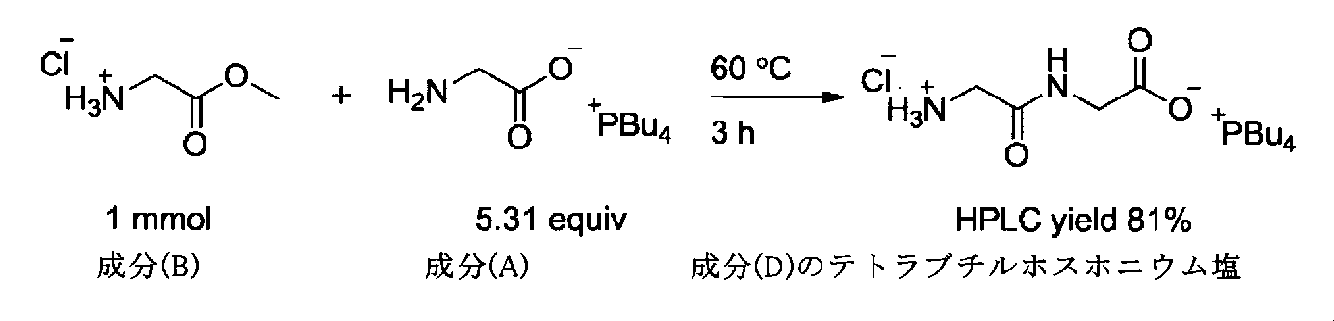 使用した化合物の構造と略称を次に示す。PBu4はテトラブチルホスホニウムイオンを表す。

次の操作により、下記の反応を行った。
2口ナスフラスコにグリシンメチルエステル塩酸塩(125.7mg、1.0mmol)とグリシンイオン液体(1.77g、5.31mmol)を入れ、アルゴン置換を行い、60℃で3時間加熱撹拌した。反応終了後にクロロホルム(6mL)を加え、0℃に冷却撹拌しながらTMSCl(クロロトリメチルシラン:3.4mmol)とMeOH(メタノール:3.4mmol)を加えた(系中に添加した酸のモル量は、使用した成分(B)のモル量に対して3.4倍である)。析出した白色の固体をろ過によって分離し、減圧乾燥した。ろ液に含まれる溶媒を減圧溜去により取り除きプロトンNMR分析を行った。
固体(339.9mg):GとGGのシグナルが26:1の比で検出された。
ろ液残渣(2.15g):PとGGILのシグナルが確認された。わずかだがGILも検出された。
さらに、分析後のろ液残渣溶液から重水を減圧溜去により取り除き、室温でクロロホルム(6mL)とTMSCl(1.5mmol)とMeOH(1.5mmol)を加えた(系中に添加した酸のモル量は、使用した成分(B)のモル量に対して1.5倍である)。析出した白色の固体をろ過により分離し、減圧乾燥した。ろ液に含まれる溶媒を減圧溜去により取り除きプロトンNMR分析を行った。
固体(85.4mg):GとGGのシグナルが1:7.4の比で検出された。
ろ液残渣(1.85g):Pのシグナルが確認された。GGILのピークもわずかだがみられた。
固体(339.9mg):GとGGのシグナルが26:1の比で検出された。
ろ液残渣(2.15g):PとGGILのシグナルが確認された。わずかだがGILも検出された。
さらに、分析後のろ液残渣溶液から重水を減圧溜去により取り除き、室温でクロロホルム(6mL)とTMSCl(1.5mmol)とMeOH(1.5mmol)を加えた(系中に添加した酸のモル量は、使用した成分(B)のモル量に対して1.5倍である)。析出した白色の固体をろ過により分離し、減圧乾燥した。ろ液に含まれる溶媒を減圧溜去により取り除きプロトンNMR分析を行った。
固体(85.4mg):GとGGのシグナルが1:7.4の比で検出された。
ろ液残渣(1.85g):Pのシグナルが確認された。GGILのピークもわずかだがみられた。
再結晶
得られた固体(プロトンNMR分析によるモル比 G:GG=1:7.4)を水(1mL)に溶解させ、そこに少しずつMeOH(1mL)を加えた。結晶が析出してきたことを確認し、一晩放置した。その後、析出固体をろ過によって分離し、減圧乾燥した。ろ液に含まれる溶媒を減圧溜去により取り除きプロトンNMR分析を行った。
固体(38.1mg):GとGGのシグナルが1:48の比で検出された。
ろ液残渣(39.8mg):GとGGのシグナルが1:2.5の比で検出された。
実施例1における操作チャートと結果を次に示す。
得られた固体(プロトンNMR分析によるモル比 G:GG=1:7.4)を水(1mL)に溶解させ、そこに少しずつMeOH(1mL)を加えた。結晶が析出してきたことを確認し、一晩放置した。その後、析出固体をろ過によって分離し、減圧乾燥した。ろ液に含まれる溶媒を減圧溜去により取り除きプロトンNMR分析を行った。
固体(38.1mg):GとGGのシグナルが1:48の比で検出された。
ろ液残渣(39.8mg):GとGGのシグナルが1:2.5の比で検出された。
実施例1における操作チャートと結果を次に示す。

得られた混合物[1]、[4]、[5]及び[6]に含まれるGGの量をHPLCにより分析した結果は、以下のとおりである。
[1]:15.54mg(0.118mmol)
[4]:3.71mg(0.028mmol)
[5]:14.4mg(0.109mmol)
[6]:40.03mg(0.303mmol)
実施例2:グリシンメチルエステル塩酸塩[成分(B)]とアラニンイオン液体(AlaPBu4)[成分(A)]との反応により生成したペプチド[成分(D)]、未反応の成分(A)の内のアラニン、及び塩化テトラブチルホスホニウムの単離
次の操作により、下記の反応を行った。
 使用した化合物の構造と略称を次に示す。PBu4はテトラブチルホスホニウムイオンを表す。
次の操作により、下記の反応を行った。

実施例2における操作チャートと結果を次に示す。
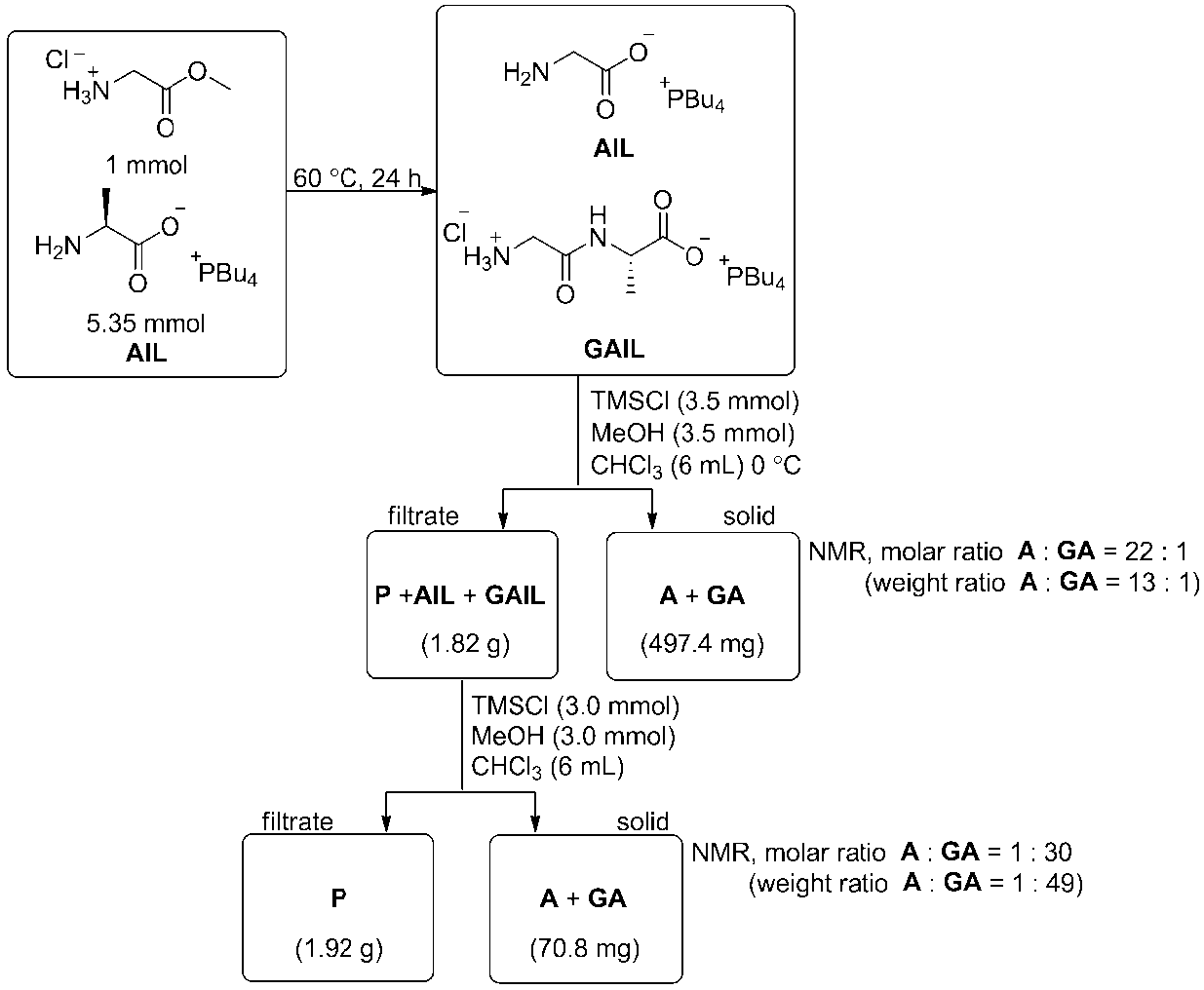
実施例3:グリシンメチルエステル塩酸塩[成分(B)]と[emim][Gly][成分(A)]との反応により生成したペプチド[成分(D)]、未反応の成分(A)の内のグリシン及び塩化1-エチル-3-メチルイミダゾリウムの単離
次の操作により、下記の反応を行った。
 使用した化合物の構造と略称を次に示す。
次の操作により、下記の反応を行った。

GlyPBu4[成分(A)]の代わりに、[emim][Gly][成分(A)]を用いた以外は、実施例1と同様にして、反応及び成分の分離を行った。
実施例3における操作チャートと結果を次に示す。

実施例4:グリシンメチルエステル塩酸塩[成分(B)]と[TBA][Gly][成分(A)]との反応により生成したペプチド[成分(D)]、未反応の成分(A)の内のグリシン及び塩化テトラブチルアンモニウムの単離
次の操作により、下記の反応を行った。
 使用した化合物の構造と略称を次に示す。
 尚、[TBA]およびNBu4は、テトラブチルアンモニウムイオンである。
GlyPBu4[成分(A)]の代わりに、[TBA][Gly][成分(A)]を用いた以外は、実施例1と同様にして、反応及び成分の分離を行った。
実施例4における操作チャートと結果を次に示す。
次の操作により、下記の反応を行った。
GlyPBu4[成分(A)]の代わりに、[TBA][Gly][成分(A)]を用いた以外は、実施例1と同様にして、反応及び成分の分離を行った。
実施例4における操作チャートと結果を次に示す。
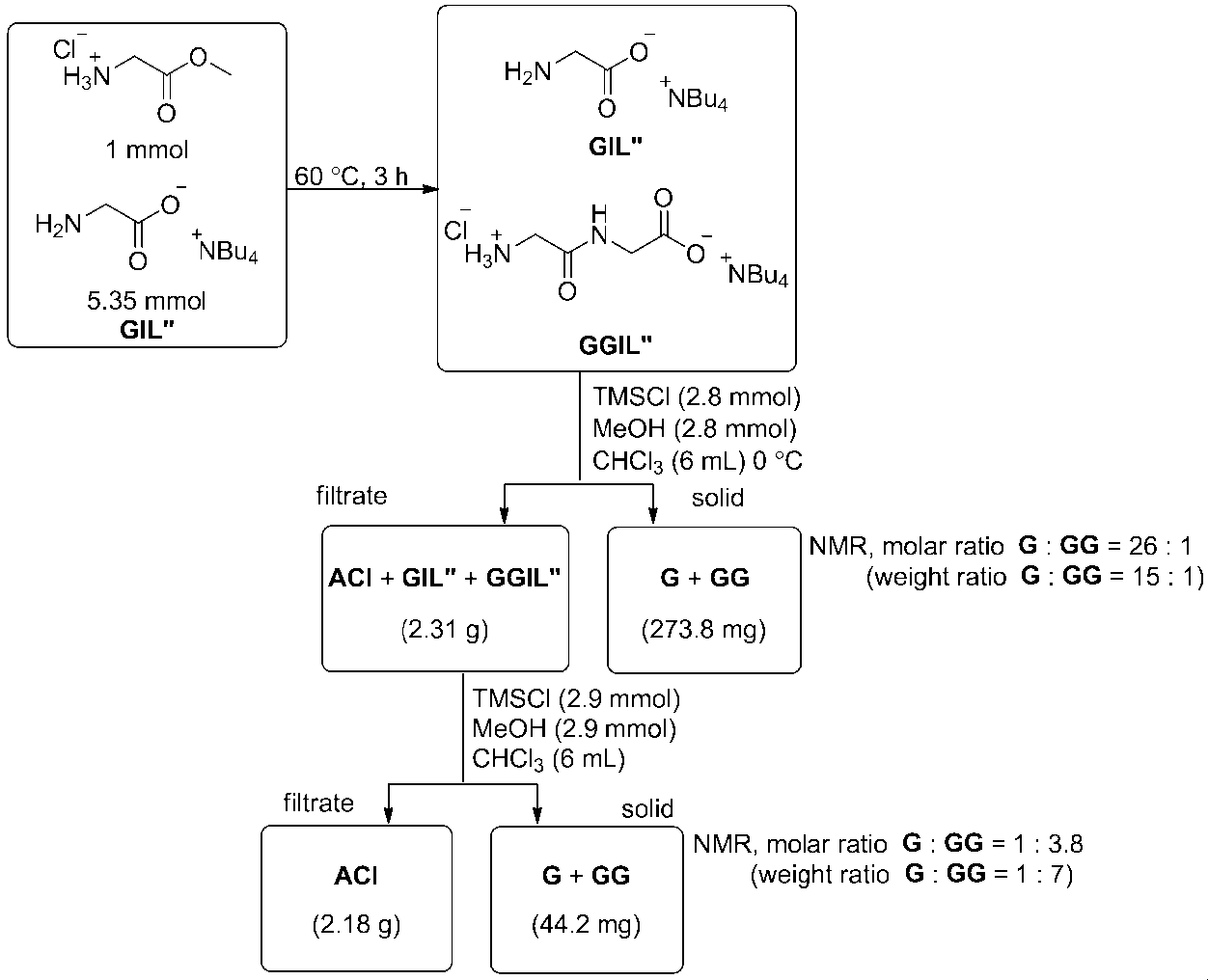
実施例5:グリシンメチルエステル塩酸塩[成分(B)]とグリシンイオン液体(GlyPBu4)[成分(A)]との反応により生成したジペプチド[成分(D)]、未反応の成分(A)の内のグリシン及び塩化テトラブチルホスホニウムの単離
有機溶媒として、クロロホルムの代わりにアセトニトリル(CH3CN)を用いた以外は、実施例1と同様にして、反応及び成分の分離を行った。
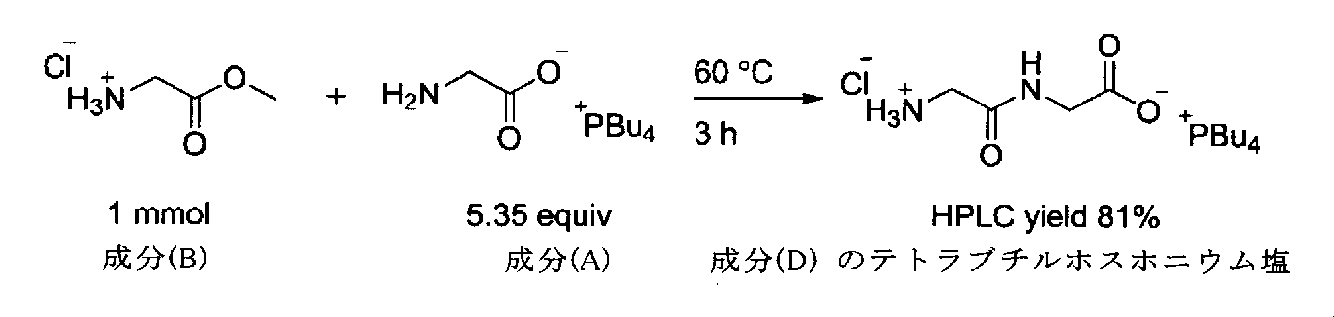 実施例5における操作チャートと結果を次に示す。
有機溶媒として、クロロホルムの代わりにアセトニトリル(CH3CN)を用いた以外は、実施例1と同様にして、反応及び成分の分離を行った。

実施例6:グリシンメチルエステル塩酸塩[成分(B)]とグリシンイオン液体(GlyPBu4)[成分(A)]との反応により生成したジペプチド[成分(D)]、未反応の成分(A)の内のグリシン及び硫酸テトラブチルホスホニウムの単離
反応によって酸を生じさせる化合物であるTMSClとMeOHの組み合わせに代えて、硫酸を用いたた以外は、実施例1と同様にして、反応及び成分の分離を行った。
 実施例6における操作チャートと結果を次に示す。
反応によって酸を生じさせる化合物であるTMSClとMeOHの組み合わせに代えて、硫酸を用いたた以外は、実施例1と同様にして、反応及び成分の分離を行った。

実施例7:グリシンメチルエステル塩酸塩[成分(B)]とグリシンイオン液体(GlyPBu4)[成分(A)]との反応により生成したジペプチド[成分(D)]、未反応の成分(A)の内のグリシン及び塩化テトラブチルホスホニウムの単離
有機溶媒として、クロロホルムの代わりにテトラヒドロフラン(THF)を用いた以外は、実施例1と同様にして、反応及び成分の分離を行った。

有機溶媒として、クロロホルムの代わりにテトラヒドロフラン(THF)を用いた以外は、実施例1と同様にして、反応及び成分の分離を行った。
実施例7における操作チャートと結果を次に示す。
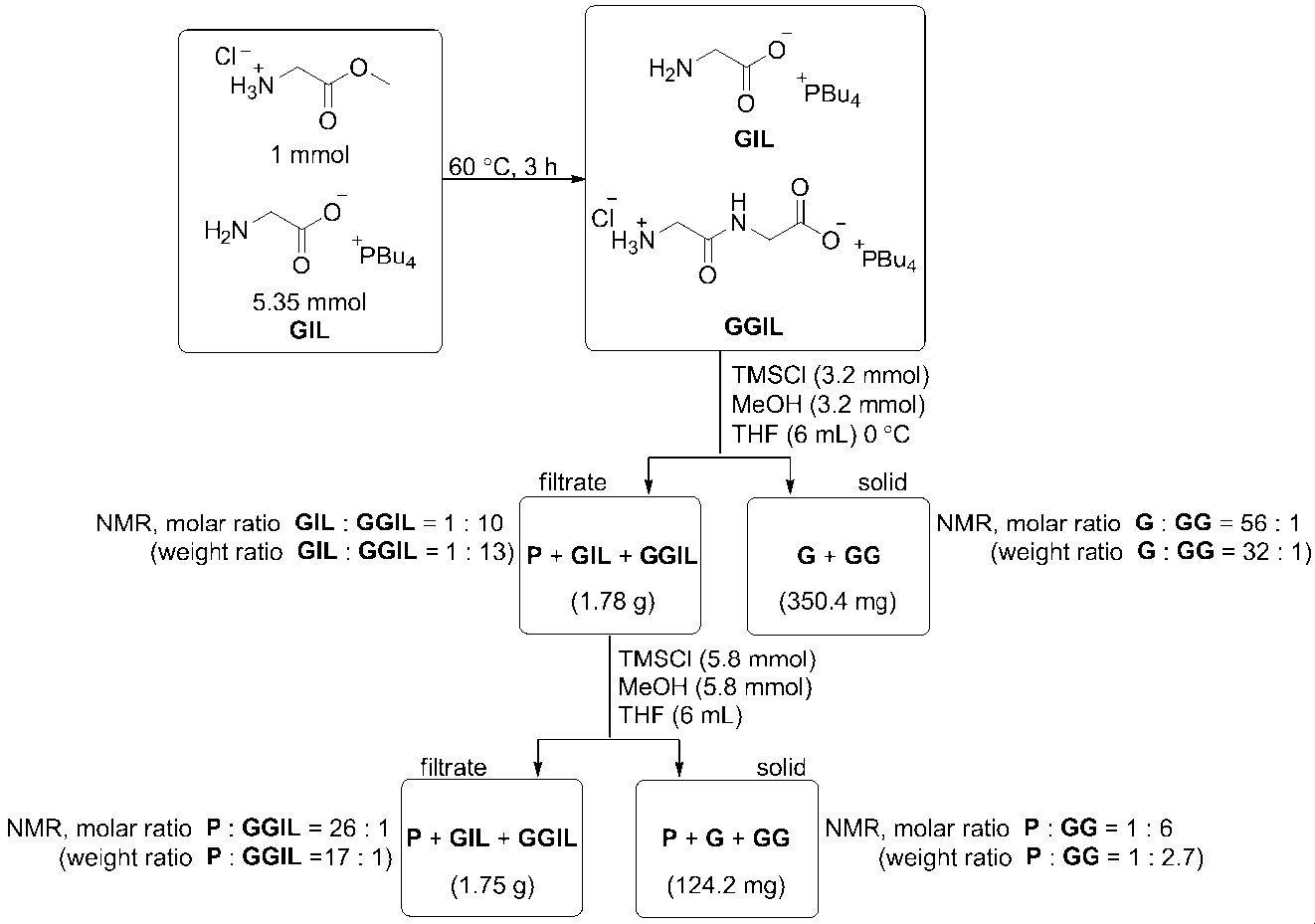
実施例8:グリシンイオン液体(Gly-PBu4)とグリシンメチルエステル塩酸塩の反応によりグリシルグリシンを合成した反応混合物からのグリシン、グリシルグリシンおよび酢酸テトラブチルホスホニウムの分離
グリシンイオン液体(グリシンテトラブチルホスホニウム塩:1.78g、5.35mmol)にグリシンメチルエステル塩酸塩(125.5mg、1.0mmol)を加え、アルゴン置換を行い、60℃で3時間加熱撹拌した。反応終了後にクロロホルム(6mL)を加え、0℃に冷却撹拌しながら酢酸(190mg、3.2mmol)を加えた。析出した白色の固体をろ過によって分離した。ろ液に含まれる溶媒を減圧溜去により取り除きプロトンNMR分析を行った。
固体(309.1mg):グリシンとグリシルグリシンのシグナルが69:1の比で検出された。
グリシンイオン液体(グリシンテトラブチルホスホニウム塩:1.78g、5.35mmol)にグリシンメチルエステル塩酸塩(125.5mg、1.0mmol)を加え、アルゴン置換を行い、60℃で3時間加熱撹拌した。反応終了後にクロロホルム(6mL)を加え、0℃に冷却撹拌しながら酢酸(190mg、3.2mmol)を加えた。析出した白色の固体をろ過によって分離した。ろ液に含まれる溶媒を減圧溜去により取り除きプロトンNMR分析を行った。
固体(309.1mg):グリシンとグリシルグリシンのシグナルが69:1の比で検出された。
ろ液残渣(1.99g):テトラブチルホスホニウム、グリシルグリシンおよび酢酸のシグナルが確認された。わずかだがグリシンイオン液体も検出された。
さらに、分析後のろ液残渣溶液から重水を減圧溜去により取り除き、室温でクロロホルム(6mL)と酢酸(170mg、2.8mmol)を加えた。析出した白色の固体をろ過により分離した。ろ液に含まれる溶媒を減圧溜去により取り除きプロトンNMR分析を行った。
固体(87.4mg):グリシンとグリシルグリシンのシグナルが1:24の比で検出された。重量とシグナル比からグリシルグリシンの収率は65%と計算された。
ろ液残渣(2.00g):テトラブチルホスホニウムおよび酢酸のシグナルが確認された。
さらに、分析後のろ液残渣溶液から重水を減圧溜去により取り除き、室温でクロロホルム(6mL)と酢酸(170mg、2.8mmol)を加えた。析出した白色の固体をろ過により分離した。ろ液に含まれる溶媒を減圧溜去により取り除きプロトンNMR分析を行った。
固体(87.4mg):グリシンとグリシルグリシンのシグナルが1:24の比で検出された。重量とシグナル比からグリシルグリシンの収率は65%と計算された。
ろ液残渣(2.00g):テトラブチルホスホニウムおよび酢酸のシグナルが確認された。
実施例9:グリシンイオン液体(Gly-PBu4)とアラニンメチルエステル塩酸塩の反応によりアラニルグリシンを合成した反応混合物からのアラニルグリシンの分離
実施例8と同様にして、グリシンイオン液体(グリシンテトラブチルホスホニウム塩)とアラニンメチルエステル塩酸塩を反応させ、後処理した。晶析に使用した酢酸は、1回目3.2mmol、2回目2.8mmolとした。
2回目の晶析で得られた固体中のグリシンとアラニルグリシンのモル比は1:14、アラニルグリシンの収率は80%であった。
実施例10:グリシンイオン液体(Gly-PBu4)とバリンメチルエステル塩酸塩の反応によりバリルグリシンを合成した反応混合物からのバリルグリシンの分離
実施例8と同様にして、グリシンイオン液体(グリシンテトラブチルホスホニウム塩)とバリンメチルエステル塩酸塩を反応させ、後処理した。晶析に使用した酢酸は、1回目3.2mmol、2回目4.7mmolとした。
2回目の晶析で得られた固体中のグリシンとバリルグリシンのモル比は1:5、バリルグリシンの収率は25%であった。
実施例8と同様にして、グリシンイオン液体(グリシンテトラブチルホスホニウム塩)とアラニンメチルエステル塩酸塩を反応させ、後処理した。晶析に使用した酢酸は、1回目3.2mmol、2回目2.8mmolとした。
2回目の晶析で得られた固体中のグリシンとアラニルグリシンのモル比は1:14、アラニルグリシンの収率は80%であった。
実施例10:グリシンイオン液体(Gly-PBu4)とバリンメチルエステル塩酸塩の反応によりバリルグリシンを合成した反応混合物からのバリルグリシンの分離
実施例8と同様にして、グリシンイオン液体(グリシンテトラブチルホスホニウム塩)とバリンメチルエステル塩酸塩を反応させ、後処理した。晶析に使用した酢酸は、1回目3.2mmol、2回目4.7mmolとした。
2回目の晶析で得られた固体中のグリシンとバリルグリシンのモル比は1:5、バリルグリシンの収率は25%であった。
実施例11:アラニンイオン液体(Ala-PBu4)とアラニンメチルエステル塩酸塩の反応によりアラニルアラニンを合成した反応混合物からのアラニルアラニンの分離
実施例8と同様にして、アラニンイオン液体(アラニンテトラブチルホスホニウム塩)とアラニンメチルエステル塩酸塩を反応させ、後処理した。晶析に使用した酢酸は、1回目3.2mmol、2回目4.8mmolとした。
2回目の晶析で得られた固体中のアラニンとアラニルアラニンのモル比は1:15、アラニルアラニンの収率は67%であった。
実施例12:バリンイオン液体(Val-PBu4)とアラニンメチルエステル塩酸塩の反応によりアラニルバリンを合成した反応混合物からのアラニルバリンの分離
実施例8と同様にして、バリンイオン液体(バリンテトラブチルホスホニウム塩)とアラニンメチルエステル塩酸塩を反応させ、後処理した。晶析に使用した酢酸は、1回目3.2mmol、2回目2.8mmolとした。
2回目の晶析で得られた固体中のバリンとアラニルバリンのモル比は1:6、アラニルバリンの収率は55%であった。
実施例8~12の結果を以下の表にまとめて示した。
実施例8と同様にして、アラニンイオン液体(アラニンテトラブチルホスホニウム塩)とアラニンメチルエステル塩酸塩を反応させ、後処理した。晶析に使用した酢酸は、1回目3.2mmol、2回目4.8mmolとした。
2回目の晶析で得られた固体中のアラニンとアラニルアラニンのモル比は1:15、アラニルアラニンの収率は67%であった。
実施例12:バリンイオン液体(Val-PBu4)とアラニンメチルエステル塩酸塩の反応によりアラニルバリンを合成した反応混合物からのアラニルバリンの分離
実施例8と同様にして、バリンイオン液体(バリンテトラブチルホスホニウム塩)とアラニンメチルエステル塩酸塩を反応させ、後処理した。晶析に使用した酢酸は、1回目3.2mmol、2回目2.8mmolとした。
2回目の晶析で得られた固体中のバリンとアラニルバリンのモル比は1:6、アラニルバリンの収率は55%であった。
実施例8~12の結果を以下の表にまとめて示した。

実施例13:アラニンイオン液体(Ala-PBu4)とグリシンメチルエステル塩酸塩の反応によりグリシルアラニンを合成した反応混合物からのグリシルアラニンの分離
実施例8と同様にして、アラニンイオン液体(アラニンテトラブチルホスホニウム塩)とグリシンメチルエステル塩酸塩を反応させ、後処理した。晶析に使用した酢酸は、1回目3.2mmol、2回目6.7mmolとした。
2回目の晶析で得られた固体中のアラニンとグリシルアラニンのモル比は1:24、グリシルアラニンの収率は62%であった。
実施例8と同様にして、アラニンイオン液体(アラニンテトラブチルホスホニウム塩)とグリシンメチルエステル塩酸塩を反応させ、後処理した。晶析に使用した酢酸は、1回目3.2mmol、2回目6.7mmolとした。
2回目の晶析で得られた固体中のアラニンとグリシルアラニンのモル比は1:24、グリシルアラニンの収率は62%であった。
実施例14:グリシンイオン液体(Gly-PBu4)とプロリンメチルエステル塩酸塩の反応によりプロリルグリシンを合成した反応混合物からのプロリルグリシンの分離
実施例8と同様にして、グリシンイオン液体(グリシンテトラブチルホスホニウム塩)とプロリンメチルエステル塩酸塩を反応させ、後処理した。晶析に使用した酢酸は、1回目3.3mmol、2回目2.9mmolとした。
2回目の晶析で得られた固体中のグリシンとプロリルグリシンのモル比は1:85、プロリルグリシンの収率は76%であった。
実施例8と同様にして、グリシンイオン液体(グリシンテトラブチルホスホニウム塩)とプロリンメチルエステル塩酸塩を反応させ、後処理した。晶析に使用した酢酸は、1回目3.3mmol、2回目2.9mmolとした。
2回目の晶析で得られた固体中のグリシンとプロリルグリシンのモル比は1:85、プロリルグリシンの収率は76%であった。
実施例15:アラニンイオン液体(AlaPBu4)とバリンメチルエステル塩酸塩の反応によりバリルアラニンを合成した反応混合物からのバリルアラニンの分離
実施例8と同様にして、アラニンイオン液体(グリシンテトラブチルホスホニウム塩)とバリンメチルエステル塩酸塩を反応させ、後処理した。晶析に使用した酢酸は、1回目3.2mmol、2回目2.8mmolとした。
2回目の晶析で得られた固体中のアラニンとバリルアラニンのモル比は1:10、バリルアラニンの収率は36%であった。
実施例8と同様にして、アラニンイオン液体(グリシンテトラブチルホスホニウム塩)とバリンメチルエステル塩酸塩を反応させ、後処理した。晶析に使用した酢酸は、1回目3.2mmol、2回目2.8mmolとした。
2回目の晶析で得られた固体中のアラニンとバリルアラニンのモル比は1:10、バリルアラニンの収率は36%であった。
実施例16:フェニルアラニンイオン液体(PhePBu4)とグリシンメチルエステル塩酸塩の反応によりグリシルフェニルアラニンを合成した反応混合物からのグリシルフェニルアラニンの分離
実施例8と同様にして、フェニルアラニンイオン液体(フェニルアラニンテトラブチルホスホニウム塩)とグリシンメチルエステル塩酸塩を反応させ、後処理した。晶析に使用した酢酸は、1回目3.2mmol、2回目4.6mmolとした。
2回目の晶析で得られた固体中のフェニルアラニンとグリシルフェニルアラニンのモル比は1:1.2、グリシルフェニルアラニンの収率は55%であった。
実施例8と同様にして、フェニルアラニンイオン液体(フェニルアラニンテトラブチルホスホニウム塩)とグリシンメチルエステル塩酸塩を反応させ、後処理した。晶析に使用した酢酸は、1回目3.2mmol、2回目4.6mmolとした。
2回目の晶析で得られた固体中のフェニルアラニンとグリシルフェニルアラニンのモル比は1:1.2、グリシルフェニルアラニンの収率は55%であった。
実施例17:フェニルアラニンイオン液体(PhePBu4)とアラニンメチルエステル塩酸塩の反応によりアラニルフェニルアラニンを合成した反応混合物からのアラニルフェニルアラニンの分離
実施例8と同様にして、フェニルアラニンイオン液体(フェニルアラニンテトラブチルホスホニウム塩)とアラニンメチルエステル塩酸塩を反応させ、後処理した。晶析に使用した酢酸は、1回目3.2mmol、2回目4.9mmolとした。
2回目の晶析で得られた固体中のフェニルアラニンとアラニルフェニルアラニンのモル比は1:1、アラニルフェニルアラニンの収率は62%であった。
実施例8と同様にして、フェニルアラニンイオン液体(フェニルアラニンテトラブチルホスホニウム塩)とアラニンメチルエステル塩酸塩を反応させ、後処理した。晶析に使用した酢酸は、1回目3.2mmol、2回目4.9mmolとした。
2回目の晶析で得られた固体中のフェニルアラニンとアラニルフェニルアラニンのモル比は1:1、アラニルフェニルアラニンの収率は62%であった。
実施例18:グリシンイオン液体(Gly-PBu4)とグリシルグリシンイオン液体(Gly-Gly-PBu4)の混合物(モル比4.5:1)からのグリシン、グリシルグリシンおよび塩化テトラブチルホスホニウムの分離
グリシンイオン液体(グリシンテトラブチルホスホニウム塩:3.00g、9.00mmol;)とグリシルグリシンイオン液体(グリシルグリシンテトラブチルホスホニウム塩:純度86.7%、0.91g、2.02mmol)を混合し、均一な液とした。ここにクロロホルム(12.1mL)を加え、0℃に冷却撹拌しながらメタノール(0.259g、8.1mmol)とクロロトリメチルシラン(0.878g、8.1mmol)を加えた。析出した白色の固体をろ過によって分離し、クロロホルム(4mL)で洗浄し、40℃で減圧乾燥した。得られた固体(0.634g)をHPLC分析した結果、0.615gのグリシンと0.011gのグリシルグリシンを含んでおり(重量比98:2、モル比99:1)、グリシンとしての純度は97%、回収率は91%であった。
上記の分離ろ液を0℃に冷却撹拌しながらメタノール(0.094g、2.9mmol)とクロロトリメチルシラン(0.318g、2.9mmol)を加えた。析出した白色の固体をろ過によって分離し、クロロホルム(4mL)で洗浄し、40℃で減圧乾燥した。得られた固体(0.355g)をHPLC分析した結果、0.018gのグリシンと0.277gのグリシルグリシンを含んでおり(重量比6:94、モル比8:92)、グリシルグリシンとしての純度は78%、回収率は103%であった。回収率が100%を超えているのは分析誤差による。また、ろ液をHPLCで分析した結果、グリシンおよびグリシルグリシンは検出されず、塩化テトラブチルホスホニウムが主成分であった。
グリシンイオン液体(グリシンテトラブチルホスホニウム塩:3.00g、9.00mmol;)とグリシルグリシンイオン液体(グリシルグリシンテトラブチルホスホニウム塩:純度86.7%、0.91g、2.02mmol)を混合し、均一な液とした。ここにクロロホルム(12.1mL)を加え、0℃に冷却撹拌しながらメタノール(0.259g、8.1mmol)とクロロトリメチルシラン(0.878g、8.1mmol)を加えた。析出した白色の固体をろ過によって分離し、クロロホルム(4mL)で洗浄し、40℃で減圧乾燥した。得られた固体(0.634g)をHPLC分析した結果、0.615gのグリシンと0.011gのグリシルグリシンを含んでおり(重量比98:2、モル比99:1)、グリシンとしての純度は97%、回収率は91%であった。
上記の分離ろ液を0℃に冷却撹拌しながらメタノール(0.094g、2.9mmol)とクロロトリメチルシラン(0.318g、2.9mmol)を加えた。析出した白色の固体をろ過によって分離し、クロロホルム(4mL)で洗浄し、40℃で減圧乾燥した。得られた固体(0.355g)をHPLC分析した結果、0.018gのグリシンと0.277gのグリシルグリシンを含んでおり(重量比6:94、モル比8:92)、グリシルグリシンとしての純度は78%、回収率は103%であった。回収率が100%を超えているのは分析誤差による。また、ろ液をHPLCで分析した結果、グリシンおよびグリシルグリシンは検出されず、塩化テトラブチルホスホニウムが主成分であった。
実施例19:グリシンイオン液体(Gly-PBu4)とグリシルグリシンイオン液体(Gly-Gly-PBu4)の混合物(モル比1:1)からのグリシン、グリシルグリシンおよび塩化テトラブチルホスホニウムの分離
グリシンイオン液体(グリシンテトラブチルホスホニウム塩:2.00g、6.00mmol;)とグリシルグリシンイオン液体(グリシルグリシンテトラブチルホスホニウム塩:純度86.7%、2.70g、6.00mmol)を混合し、均一な液とした。ここにクロロホルム(13.2mL)を加え、0℃に冷却撹拌しながらメタノール(0.192g、6.0mmol)とクロロトリメチルシラン(0.651g、6.0mmol)を加えた。析出した白色の固体をろ過によって分離し、クロロホルム(4mL)で洗浄し、40℃で減圧乾燥した。得られた固体(0.515g)をHPLC分析した結果、0.408gのグリシンと0.105gのグリシルグリシンを含んでおり(重量比80:20、モル比85:15)、グリシンとしての純度は79%、回収率は91%であった。
上記の分離ろ液を0℃に冷却撹拌しながらメタノール(0.192g、6.0mmol)とクロロトリメチルシラン(0.652g、6.0mmol)を加えた。析出した白色の固体をろ過によって分離し、クロロホルム(4mL)で洗浄し、40℃で減圧乾燥した。得られた固体(0.722g)をHPLC分析した結果、0.018gのグリシンと0.707gのグリシルグリシンを含んでおり(重量比2:98、モル比3:97)、グリシルグリシンとしての純度は98%、回収率は89%であった。また、ろ液をHPLCで分析した結果、グリシンは検出されず、0.054gのグリシルグリシンを含んでおり、塩化テトラブチルホスホニウムが主成分であった。
グリシンイオン液体(グリシンテトラブチルホスホニウム塩:2.00g、6.00mmol;)とグリシルグリシンイオン液体(グリシルグリシンテトラブチルホスホニウム塩:純度86.7%、2.70g、6.00mmol)を混合し、均一な液とした。ここにクロロホルム(13.2mL)を加え、0℃に冷却撹拌しながらメタノール(0.192g、6.0mmol)とクロロトリメチルシラン(0.651g、6.0mmol)を加えた。析出した白色の固体をろ過によって分離し、クロロホルム(4mL)で洗浄し、40℃で減圧乾燥した。得られた固体(0.515g)をHPLC分析した結果、0.408gのグリシンと0.105gのグリシルグリシンを含んでおり(重量比80:20、モル比85:15)、グリシンとしての純度は79%、回収率は91%であった。
上記の分離ろ液を0℃に冷却撹拌しながらメタノール(0.192g、6.0mmol)とクロロトリメチルシラン(0.652g、6.0mmol)を加えた。析出した白色の固体をろ過によって分離し、クロロホルム(4mL)で洗浄し、40℃で減圧乾燥した。得られた固体(0.722g)をHPLC分析した結果、0.018gのグリシンと0.707gのグリシルグリシンを含んでおり(重量比2:98、モル比3:97)、グリシルグリシンとしての純度は98%、回収率は89%であった。また、ろ液をHPLCで分析した結果、グリシンは検出されず、0.054gのグリシルグリシンを含んでおり、塩化テトラブチルホスホニウムが主成分であった。
実施例20:グリシンイオン液体(Gly-PBu4)とグリシルグリシンイオン液体(Gly-Gly-PBu4)の混合物(モル比1:4.5)からのグリシン、グリシルグリシンおよび塩化テトラブチルホスホニウムの分離
グリシンイオン液体(グリシンテトラブチルホスホニウム塩:0.576g、1.73mmol;)とグリシルグリシンイオン液体(グリシルグリシンテトラブチルホスホニウム塩:純度86.7%、3.46g、7.68mmol)を混合し、均一な液とした。ここにクロロホルム(10.4mL)を加え、0℃に冷却撹拌しながらメタノール(0.039g、1.2mmol)とクロロトリメチルシラン(0.130g、1.2mmol)を加えた。析出した白色の固体をろ過によって分離し、クロロホルム(4mL)で洗浄し、40℃で減圧乾燥した。得られた固体(0.111g)をHPLC分析した結果、0.069gのグリシンと0.040gのグリシルグリシンを含んでおり(重量比63:37、モル比75:25)、グリシンとしての純度は62%、回収率は53%であった。
上記の分離ろ液を0℃に冷却撹拌しながらメタノール(0.265g、8.3mmol)とクロロトリメチルシラン(0.900g、8.3mmol)を加えた。析出した白色の固体をろ過によって分離し、クロロホルム(4mL)で洗浄し、40℃で減圧乾燥した。得られた固体(0.995g)をHPLC分析した結果、0.046gのグリシンと0.893gのグリシルグリシンを含んでおり(重量比5:95、モル比8:92)、グリシルグリシンとしての純度は90%、回収率は88%であった。また、ろ液をHPLCで分析した結果、グリシンは検出されず、0.209gのグリシルグリシンを含んでおり、塩化テトラブチルホスホニウムが主成分であった。
実施例18~20の結果を以下の表にまとめて示した。
グリシンイオン液体(グリシンテトラブチルホスホニウム塩:0.576g、1.73mmol;)とグリシルグリシンイオン液体(グリシルグリシンテトラブチルホスホニウム塩:純度86.7%、3.46g、7.68mmol)を混合し、均一な液とした。ここにクロロホルム(10.4mL)を加え、0℃に冷却撹拌しながらメタノール(0.039g、1.2mmol)とクロロトリメチルシラン(0.130g、1.2mmol)を加えた。析出した白色の固体をろ過によって分離し、クロロホルム(4mL)で洗浄し、40℃で減圧乾燥した。得られた固体(0.111g)をHPLC分析した結果、0.069gのグリシンと0.040gのグリシルグリシンを含んでおり(重量比63:37、モル比75:25)、グリシンとしての純度は62%、回収率は53%であった。
上記の分離ろ液を0℃に冷却撹拌しながらメタノール(0.265g、8.3mmol)とクロロトリメチルシラン(0.900g、8.3mmol)を加えた。析出した白色の固体をろ過によって分離し、クロロホルム(4mL)で洗浄し、40℃で減圧乾燥した。得られた固体(0.995g)をHPLC分析した結果、0.046gのグリシンと0.893gのグリシルグリシンを含んでおり(重量比5:95、モル比8:92)、グリシルグリシンとしての純度は90%、回収率は88%であった。また、ろ液をHPLCで分析した結果、グリシンは検出されず、0.209gのグリシルグリシンを含んでおり、塩化テトラブチルホスホニウムが主成分であった。
実施例18~20の結果を以下の表にまとめて示した。

*1 グリシンイオン液体とグリシルグリシンイオン液体のモル比
*2 初期に混合したモル数の少ない方のイオン液体に対する添加したメタノールおよびクロロトリメチルシランのモル比
*3 固体中のグリシンとグリシルグリシンの重量比(計100として示した)
実施例21:グリシンイオン液体(Gly-PBu4)とグリシルグリシンイオン液体(Gly-Gly-PBu4)の混合物(モル比4.5:1)からのグリシン、グリシルグリシンおよび塩化テトラブチルホスホニウムの分離(添加する溶媒として酢酸エチル、添加する酸として塩化水素を使用)
グリシンイオン液体(グリシンテトラブチルホスホニウム塩:3.00g、9.00mmol;)とグリシルグリシンイオン液体(グリシルグリシンテトラブチルホスホニウム塩:純度86.7%、0.91g、2.02mmol)を混合し、均一な液とした。ここに酢酸エチル(10.1mL)を加え、0℃に冷却撹拌しながら塩化水素の酢酸エチル溶液(4mol/L、2.02mL、8.1mmol)を加えた。析出した白色の固体をろ過によって分離し、酢酸エチル(4mL)で洗浄し、40℃で減圧乾燥した。得られた固体(0.669g)をHPLC分析した結果、0.606gのグリシンと0.014gのグリシルグリシンを含んでおり(重量比98:2、モル比99:1)、グリシンとしての純度は91%、回収率は90%であった。
グリシンイオン液体(グリシンテトラブチルホスホニウム塩:3.00g、9.00mmol;)とグリシルグリシンイオン液体(グリシルグリシンテトラブチルホスホニウム塩:純度86.7%、0.91g、2.02mmol)を混合し、均一な液とした。ここに酢酸エチル(10.1mL)を加え、0℃に冷却撹拌しながら塩化水素の酢酸エチル溶液(4mol/L、2.02mL、8.1mmol)を加えた。析出した白色の固体をろ過によって分離し、酢酸エチル(4mL)で洗浄し、40℃で減圧乾燥した。得られた固体(0.669g)をHPLC分析した結果、0.606gのグリシンと0.014gのグリシルグリシンを含んでおり(重量比98:2、モル比99:1)、グリシンとしての純度は91%、回収率は90%であった。
上記の分離ろ液を0℃に冷却撹拌しながら塩化水素の酢酸エチル溶液(4mol/L、0.73mL、2.9mmol)を加えた。さらに酢酸エチル(5mL)を加えた。析出した白色の固体をろ過によって分離し、酢酸エチル(8mL)で洗浄し、40℃で減圧乾燥した。得られた固体(0.215g)をHPLC分析した結果、グリシンは検出されず、0.214gのグリシルグリシンを含んでおり(重量比0:100)、グリシルグリシンとしての純度は100%、回収率は80%であった。また、ろ液をHPLCで分析した結果、グリシンは検出されず、0.056gのグリシルグリシンを含んでおり、塩化テトラブチルホスホニウムが主成分であった。
実施例22:グリシルグリシンイオン液体(Gly-Gly-PBu4)とグリシルグリシルグリシンイオン液体(Gly-Gly-Gly-PBu4)の混合物(モル比1:1)からのグリシルグリシン、グリシルグリシルグリシンおよび塩化テトラブチルホスホニウムの分離
グリシルグリシンイオン液体(グリシルグリシンテトラブチルホスホニウム塩:2.31g、5.1mmol;)とグリシルグリシルグリシンイオン液体(グリシルグリシルグリシンテトラブチルホスホニウム塩:2.67g、5.1mmol)を混合し、均一な液とした。ここにクロロホルム(10.2mL)を加え、0℃に冷却撹拌しながらメタノール(0.140g、4.4mmol)とクロロトリメチルシラン(0.473g、4.4mmol)を加えた。析出した白色の固体をろ過によって分離し、クロロホルム(9mL)で洗浄し、40℃で減圧乾燥した。得られた固体(0.622g)をHPLC分析した結果、0.125gのグリシルグリシンと0.451gのグリシルグリシルグリシンを含んでおり(重量比22:78、モル比29:71)、グリシルグリシルグリシンとしての純度は72%、回収率は46.5%であった。
上記の分離ろ液に5mLのクロロホルム添加後、0℃に冷却撹拌しながらメタノール(0.082g、2.5mmol)とクロロトリメチルシラン(0.278g、2.5mmol)を加えた。析出した白色の固体をろ過によって分離し、クロロホルム(4mL)で洗浄し、40℃で減圧乾燥した。得られた固体(0.694g)をHPLC分析した結果、0.081gのグリシルグリシンと0.429gのグリシルグリシルグリシンを含んでおり(重量比16:84、モル比21:79)、グリシルグリシルグリシンとしての純度は61%、回収率は44%であった。
上記の分離ろ液に10mLのクロロホルム添加後、0℃に冷却撹拌しながらメタノール(0.123g、3.8mmol)とクロロトリメチルシラン(0.417g、3.8mmol)を加えた。析出した白色の固体をろ過によって分離し、クロロホルム(4mL)で洗浄し、40℃で減圧乾燥した。得られた固体(0.480g)をHPLC分析した結果、0.0306gのグリシルグリシンと0.143gのグリシルグリシルグリシンを含んでおり(重量比68:32、モル比75:25)、グリシルグリシンとしての純度は64%、回収率は45%であった。
上記の分離ろ液を0℃に冷却撹拌しながらメタノール(0.082g、2.5mmol)とクロロトリメチルシラン(0.278g、2.5mmol)を加えた。析出した白色の固体をろ過によって分離し、クロロホルム(4mL)で洗浄し、40℃で減圧乾燥した。得られた固体(0.069g)をHPLC分析した結果、0.043gのグリシルグリシンと0.012gのグリシルグリシルグリシンを含んでおり(重量比78:22、モル比84:16)、グリシルグリシンとしての純度は63%、回収率は6.4%であった。また、ろ液をHPLCで分析した結果、0.001gのグリシルグリシン、および0.001gのグリシルグリシンを含んでおり、塩化テトラブチルホスホニウムが主成分であった。
グリシルグリシンイオン液体(グリシルグリシンテトラブチルホスホニウム塩:2.31g、5.1mmol;)とグリシルグリシルグリシンイオン液体(グリシルグリシルグリシンテトラブチルホスホニウム塩:2.67g、5.1mmol)を混合し、均一な液とした。ここにクロロホルム(10.2mL)を加え、0℃に冷却撹拌しながらメタノール(0.140g、4.4mmol)とクロロトリメチルシラン(0.473g、4.4mmol)を加えた。析出した白色の固体をろ過によって分離し、クロロホルム(9mL)で洗浄し、40℃で減圧乾燥した。得られた固体(0.622g)をHPLC分析した結果、0.125gのグリシルグリシンと0.451gのグリシルグリシルグリシンを含んでおり(重量比22:78、モル比29:71)、グリシルグリシルグリシンとしての純度は72%、回収率は46.5%であった。
上記の分離ろ液に5mLのクロロホルム添加後、0℃に冷却撹拌しながらメタノール(0.082g、2.5mmol)とクロロトリメチルシラン(0.278g、2.5mmol)を加えた。析出した白色の固体をろ過によって分離し、クロロホルム(4mL)で洗浄し、40℃で減圧乾燥した。得られた固体(0.694g)をHPLC分析した結果、0.081gのグリシルグリシンと0.429gのグリシルグリシルグリシンを含んでおり(重量比16:84、モル比21:79)、グリシルグリシルグリシンとしての純度は61%、回収率は44%であった。
上記の分離ろ液に10mLのクロロホルム添加後、0℃に冷却撹拌しながらメタノール(0.123g、3.8mmol)とクロロトリメチルシラン(0.417g、3.8mmol)を加えた。析出した白色の固体をろ過によって分離し、クロロホルム(4mL)で洗浄し、40℃で減圧乾燥した。得られた固体(0.480g)をHPLC分析した結果、0.0306gのグリシルグリシンと0.143gのグリシルグリシルグリシンを含んでおり(重量比68:32、モル比75:25)、グリシルグリシンとしての純度は64%、回収率は45%であった。
上記の分離ろ液を0℃に冷却撹拌しながらメタノール(0.082g、2.5mmol)とクロロトリメチルシラン(0.278g、2.5mmol)を加えた。析出した白色の固体をろ過によって分離し、クロロホルム(4mL)で洗浄し、40℃で減圧乾燥した。得られた固体(0.069g)をHPLC分析した結果、0.043gのグリシルグリシンと0.012gのグリシルグリシルグリシンを含んでおり(重量比78:22、モル比84:16)、グリシルグリシンとしての純度は63%、回収率は6.4%であった。また、ろ液をHPLCで分析した結果、0.001gのグリシルグリシン、および0.001gのグリシルグリシンを含んでおり、塩化テトラブチルホスホニウムが主成分であった。
実施例23:グリシルグリシンイオン液体(Gly-Gly-PBu4)とチロシンメチルエステル塩酸塩の反応によりチロシルグリシルグリシンを合成した反応混合物からのチロシルグリシルグリシンの分離
グリシルグリシンイオン液体(グリシルグリシンテトラブチルホスホニウム塩:2.09g、5.34mmol)にチロシンメチルエステル塩酸塩(232.7mg、1.0mmol)を加え、アルゴン置換を行い、60℃で48時間加熱撹拌した。反応終了後に室温まで冷却し、クロロホルム(6mL)を加え撹拌した。その後、反応液中の析出物質をろ過によって分離し、クロロホルム(9mL)で洗浄し、40℃で減圧乾燥した。得られた固体(151.8mg)をNMR分析した結果、全てがグリシルグリシンであり、回収率は24%であった。
上記、ろ液を減圧乾燥後、クロロホルム(6mL)を加え、0℃に冷却撹拌しながら酢酸(198.9mg、3.31mmol)添加し、0℃で30分間撹拌した。析出した白色の固体をろ過によって分離し、クロロホルム(9mL)で洗浄し、40℃で減圧乾燥した。得られた固体(0.411g)をNMR分析した結果、0.316gのグリシルグリシンと0.033gのチロシルグリシルグリシンを含んでおり(重量比91:9、モル比96:4)、グリシルグリシンとしての純度は77%、回収率は50%であった。
上記、ろ液を減圧乾燥後、クロロホルム(6mL)を加え、0℃に冷却撹拌しながら酢酸(126.0mg、2.09mmol)添加し、0℃で30分間撹拌した。析出した白色の固体をろ過によって分離し、クロロホルム(9mL)で洗浄し、40℃で減圧乾燥した。得られた固体(0.115g)をNMR分析した結果、0.095gのグリシルグリシンと0.014gのチロシルグリシルグリシンを含んでおり(重量比87:13、モル比85:15)、グリシルグリシンとしての純度は83%、回収率は22%であった。
上記、ろ液を減圧乾燥後、クロロホルム(6mL)を加え、0℃に冷却撹拌しながら酢酸(63.5mg、1.05mmol)添加し、0℃で30分間撹拌した。析出した白色の固体をろ過によって分離し、クロロホルム(9mL)で洗浄し、40℃で減圧乾燥した。得られた固体(0.057g)をNMR分析した結果、0.038gのグリシルグリシンと0.016gのチロシルグリシルグリシンを含んでおり(重量比70:30、モル比85:15)、グリシルグリシンとしての純度は67%、回収率は6%であった。
上記、ろ液を減圧乾燥後、クロロホルム(6mL)を加え、0℃に冷却撹拌しながら酢酸(32.6mg、0.54mmol)添加したところ、瞬時に析出した白色の固体をろ過によって分離し、クロロホルム(9mL)で洗浄し、40℃で減圧乾燥した。得られた固体(0.003g)をNMR分析した結果、0.0012gのグリシルグリシンと0.0010gのチロシルグリシルグリシンを含んでおり(重量比55:45、モル比72:28)、グリシルグリシンとしての純度は46%、回収率は0.1%であった。
上記、ろ液を1.5日間室温で保存したところ、析出した白色の固体をろ過によって分離し、クロロホルム(9mL)で洗浄し、40℃で減圧乾燥した。得られた固体(0.017g)をNMR分析した結果、0.016gのグリシルグリシンと0.001gのチロシルグリシルグリシンを含んでおり(重量比96:4、モル比98:2)、グリシルグリシンとしての純度は94%、回収率は3%であった。
上記、ろ液を減圧乾燥後、クロロホルム(6mL)を加え、室温で撹拌しながら酢酸(248.2mg、4.13mmol)添加したところ、析出した白色の固体をろ過によって分離し、クロロホルム(9mL)で洗浄し、40℃で減圧乾燥した。得られた固体(0.103g)をNMR分析した結果、0.002gのグリシルグリシンと0.089gのチロシルグリシルグリシンを含んでおり(重量比2:98、モル比5:95)、チロシルグリシルグリシンとしての純度は87%、回収率は58%であった。また、ろ液をNMRで分析した結果、塩化テトラブチルホスホニウムのみが検出され、グリシルグリシンおよびチロシルグリシルグリシンは検出されなかった。
グリシルグリシンイオン液体(グリシルグリシンテトラブチルホスホニウム塩:2.09g、5.34mmol)にチロシンメチルエステル塩酸塩(232.7mg、1.0mmol)を加え、アルゴン置換を行い、60℃で48時間加熱撹拌した。反応終了後に室温まで冷却し、クロロホルム(6mL)を加え撹拌した。その後、反応液中の析出物質をろ過によって分離し、クロロホルム(9mL)で洗浄し、40℃で減圧乾燥した。得られた固体(151.8mg)をNMR分析した結果、全てがグリシルグリシンであり、回収率は24%であった。
上記、ろ液を減圧乾燥後、クロロホルム(6mL)を加え、0℃に冷却撹拌しながら酢酸(198.9mg、3.31mmol)添加し、0℃で30分間撹拌した。析出した白色の固体をろ過によって分離し、クロロホルム(9mL)で洗浄し、40℃で減圧乾燥した。得られた固体(0.411g)をNMR分析した結果、0.316gのグリシルグリシンと0.033gのチロシルグリシルグリシンを含んでおり(重量比91:9、モル比96:4)、グリシルグリシンとしての純度は77%、回収率は50%であった。
上記、ろ液を減圧乾燥後、クロロホルム(6mL)を加え、0℃に冷却撹拌しながら酢酸(126.0mg、2.09mmol)添加し、0℃で30分間撹拌した。析出した白色の固体をろ過によって分離し、クロロホルム(9mL)で洗浄し、40℃で減圧乾燥した。得られた固体(0.115g)をNMR分析した結果、0.095gのグリシルグリシンと0.014gのチロシルグリシルグリシンを含んでおり(重量比87:13、モル比85:15)、グリシルグリシンとしての純度は83%、回収率は22%であった。
上記、ろ液を減圧乾燥後、クロロホルム(6mL)を加え、0℃に冷却撹拌しながら酢酸(63.5mg、1.05mmol)添加し、0℃で30分間撹拌した。析出した白色の固体をろ過によって分離し、クロロホルム(9mL)で洗浄し、40℃で減圧乾燥した。得られた固体(0.057g)をNMR分析した結果、0.038gのグリシルグリシンと0.016gのチロシルグリシルグリシンを含んでおり(重量比70:30、モル比85:15)、グリシルグリシンとしての純度は67%、回収率は6%であった。
上記、ろ液を減圧乾燥後、クロロホルム(6mL)を加え、0℃に冷却撹拌しながら酢酸(32.6mg、0.54mmol)添加したところ、瞬時に析出した白色の固体をろ過によって分離し、クロロホルム(9mL)で洗浄し、40℃で減圧乾燥した。得られた固体(0.003g)をNMR分析した結果、0.0012gのグリシルグリシンと0.0010gのチロシルグリシルグリシンを含んでおり(重量比55:45、モル比72:28)、グリシルグリシンとしての純度は46%、回収率は0.1%であった。
上記、ろ液を1.5日間室温で保存したところ、析出した白色の固体をろ過によって分離し、クロロホルム(9mL)で洗浄し、40℃で減圧乾燥した。得られた固体(0.017g)をNMR分析した結果、0.016gのグリシルグリシンと0.001gのチロシルグリシルグリシンを含んでおり(重量比96:4、モル比98:2)、グリシルグリシンとしての純度は94%、回収率は3%であった。
上記、ろ液を減圧乾燥後、クロロホルム(6mL)を加え、室温で撹拌しながら酢酸(248.2mg、4.13mmol)添加したところ、析出した白色の固体をろ過によって分離し、クロロホルム(9mL)で洗浄し、40℃で減圧乾燥した。得られた固体(0.103g)をNMR分析した結果、0.002gのグリシルグリシンと0.089gのチロシルグリシルグリシンを含んでおり(重量比2:98、モル比5:95)、チロシルグリシルグリシンとしての純度は87%、回収率は58%であった。また、ろ液をNMRで分析した結果、塩化テトラブチルホスホニウムのみが検出され、グリシルグリシンおよびチロシルグリシルグリシンは検出されなかった。
Claims (18)
- ペプチド及びアミノ酸を含む液状混合物であって、該ペプチド及びアミノ酸から選択される少なくとも1種がアニオンとしてカチオンとイオン結合を形成したイオン液体として存在する液状混合物を酸処理し、ペプチドを優先的に析出分離するか、又はアミノ酸を優先的に析出分離した後、さらに酸処理し、ペプチドを優先的に析出分離することを特徴とする、ペプチドの製造方法。
- 液状混合物を酸処理し、まずアミノ酸を優先的に析出分離した後、さらに酸処理し、ペプチドを優先的に析出分離する、請求項1記載の方法。
- 液状混合物が(1)ペプチドをアニオンとするイオン液体(イオン液体A)及び(2)アミノ酸をアニオンとするイオン液体(イオン液体B)を含む液状混合物である、請求項1又は2記載の方法。
- 液状混合物が、縮合反応によりペプチドを生成させた反応溶液である、請求項1又は2記載の方法。
- 縮合反応が、(2)アミノ酸をアニオンとするイオン液体(イオン液体B)のアミノ基と(3)ペプチドエステル又はアミノ酸エステルのエステル基とを縮合してアミド結合を形成させる反応である、請求項4記載の方法。
- 縮合反応が、反応原料であるアミノ酸をアニオンとするイオン液体Bを反応溶媒として用いて行われる、請求項5記載の方法。
- 縮合反応が、反応系の全質量に対して20質量%以下の水の存在下にて行われる、請求項5又は6記載の方法。
- 液状混合物の酸処理が、先に析出するペプチド又はアミノ酸の液状混合物中のモル量に対し50~100mol%の酸の存在下に行われる、請求項1~7のいずれか1項記載の方法。
- 酸処理によりアミノ酸が先に析出し、液状混合物の酸処理が、先に析出するアミノ酸の液状混合物中のモル量に対し50~100mol%の酸の存在下に行われる、請求項1~7のいずれか1項記載の方法。
- 酸処理する液状混合物が有機溶媒を含む請求項1~9のいずれか1項記載の方法。
- 有機溶媒が、クロロホルム、アセトニトリル、テトラヒドロフラン、酢酸エチルから選ばれる1種以上である請求項10記載の方法。
- 酸処理が、塩化水素、硫酸、酢酸から選ばれる1種以上により行われる請求項1~11のいずれか1項記載の方法。
- 酸処理が、反応により酸を発生する化合物の添加により、液状混合物中で酸を発生させることにより行われる、請求項1~11のいずれか1項記載の方法。
- アミノ酸及び/又はペプチドの析出分離が、液状混合物を冷却することにより行われる、請求項1~13のいずれか1項記載の方法。
- イオン液体が、アルキルホスホニウムイオン、アルキルイミダゾリウムイオン、アルキルアンモニウムイオン、アルキルピリジニウムイオン、アルキルピロリジニウムイオン及びアルキルピぺリジニウムイオンから選ばれる少なくとも1種のカチオンとイオン結合を形成することによりイオン液体化している、請求項1~14のいずれか1項記載の方法。
- ペプチド及びアミノ酸を含む液状混合物であって、該ペプチド及びアミノ酸から選択される少なくとも1種がアニオンとしてカチオンとイオン結合を形成したイオン液体として存在する液状混合物を酸処理することにより、ペプチド又はアミノ酸を優先的に析出させることを特徴とする、ペプチドとアミノ酸とを分離する方法。
- 第1のアミノ酸又はペプチドと、第1のアミノ酸又はペプチドとは異なる第2のアミノ酸又はペプチドとを含む液体であって、前記第1のアミノ酸又はペプチド及び第2のアミノ酸又はペプチドの少なくとも1種がアニオンとしてカチオンとイオン結合を形成したイオン液体として存在する前記液体を酸処理し、第1のアミノ酸又はペプチド及び第2のアミノ酸又はペプチドのいずれか一方を優先的に析出分離することを特徴とする、第1のアミノ酸又はペプチド又は第2のアミノ酸又はペプチドの製造方法。
- 第1のアミノ酸又はペプチドと、第1のアミノ酸又はペプチドとは異なる第2のアミノ酸又はペプチドとを含む液体であって、前記第1のアミノ酸又はペプチド及び第2のアミノ酸又はペプチドの少なくとも1種がアニオンとしてカチオンとイオン結合を形成したイオン液体として存在する前記液体を酸処理し、第1のアミノ酸又はペプチド及び第2のアミノ酸又はペプチドのいずれか一方を優先的に析出分離することを特徴とする、第1のアミノ酸又はペプチドと第2のアミノ酸又はペプチドとを分離する方法。
Priority Applications (1)
| Application Number | Priority Date | Filing Date | Title |
|---|---|---|---|
| JP2016510472A JP6579390B2 (ja) | 2014-03-26 | 2015-03-26 | ペプチドの製造方法 |
Applications Claiming Priority (2)
| Application Number | Priority Date | Filing Date | Title |
|---|---|---|---|
| JP2014-063020 | 2014-03-26 | ||
| JP2014063020 | 2014-03-26 |
Publications (1)
| Publication Number | Publication Date |
|---|---|
| WO2015147138A1 true WO2015147138A1 (ja) | 2015-10-01 |
Family
ID=54195645
Family Applications (1)
| Application Number | Title | Priority Date | Filing Date |
|---|---|---|---|
| PCT/JP2015/059317 Ceased WO2015147138A1 (ja) | 2014-03-26 | 2015-03-26 | ペプチドの製造方法 |
Country Status (2)
| Country | Link |
|---|---|
| JP (1) | JP6579390B2 (ja) |
| WO (1) | WO2015147138A1 (ja) |
Citations (4)
| Publication number | Priority date | Publication date | Assignee | Title |
|---|---|---|---|---|
| JP2008535483A (ja) * | 2005-04-22 | 2008-09-04 | ザ プロクター アンド ギャンブル カンパニー | イオン性液体を使用するバイオマスからのバイオポリマーの抽出 |
| JP2008537733A (ja) * | 2005-03-15 | 2008-09-25 | マクギル ユニバーシティー | イオン液体担持合成 |
| WO2012014809A1 (ja) * | 2010-07-26 | 2012-02-02 | 味の素株式会社 | ペプチドの製造方法 |
| WO2012014808A1 (ja) * | 2010-07-26 | 2012-02-02 | 味の素株式会社 | ペプチドの製造方法 |
-
2015
- 2015-03-26 WO PCT/JP2015/059317 patent/WO2015147138A1/ja not_active Ceased
- 2015-03-26 JP JP2016510472A patent/JP6579390B2/ja active Active
Patent Citations (4)
| Publication number | Priority date | Publication date | Assignee | Title |
|---|---|---|---|---|
| JP2008537733A (ja) * | 2005-03-15 | 2008-09-25 | マクギル ユニバーシティー | イオン液体担持合成 |
| JP2008535483A (ja) * | 2005-04-22 | 2008-09-04 | ザ プロクター アンド ギャンブル カンパニー | イオン性液体を使用するバイオマスからのバイオポリマーの抽出 |
| WO2012014809A1 (ja) * | 2010-07-26 | 2012-02-02 | 味の素株式会社 | ペプチドの製造方法 |
| WO2012014808A1 (ja) * | 2010-07-26 | 2012-02-02 | 味の素株式会社 | ペプチドの製造方法 |
Non-Patent Citations (2)
| Title |
|---|
| MIAO W. ET AL.: "Ionic-liquid-supported peptide synthesis demonstrated by the synthesis of leu5-enkephalin", J. ORG. CHEM., vol. 70, no. 8, 2005, pages 3251 - 3255, XP002409192 * |
| MIAO W. ET AL.: "Ionic-liquid-supported synthesis: a novel liquid-phase strategy for organic synthesis", ACC. CHEM. RES., vol. 39, no. 12, 2006, pages 897 - 908, XP055082093 * |
Also Published As
| Publication number | Publication date |
|---|---|
| JP6579390B2 (ja) | 2019-09-25 |
| JPWO2015147138A1 (ja) | 2017-04-13 |
Similar Documents
| Publication | Publication Date | Title |
|---|---|---|
| JP5787278B2 (ja) | ペプチドの製造方法 | |
| CN110964085B (zh) | 一种卡非佐米及其衍生物的制备方法 | |
| JP2023519169A (ja) | 一般的な中間体を介したドラスタチンおよびオーリスタチン類似体の効率的な調製 | |
| EP2476691B1 (en) | Method for manufacturing a lipidic peptide compound | |
| JP6579390B2 (ja) | ペプチドの製造方法 | |
| JP5928987B2 (ja) | ペプチドの製造方法 | |
| Talaei et al. | Synthesis of novel peptides using unusual amino acids | |
| An et al. | Solution-phase-peptide synthesis without purification of column chromatography and recrystallization by protecting amino acid esters with phosphinyl chloride | |
| JP6716903B2 (ja) | ジペプチドの製造方法 | |
| KR20250148640A (ko) | 리라글루타이드의 테트라펩타이드 단편의 제조 방법 | |
| JP4356292B2 (ja) | アミノ酸エステル塩酸塩の製造方法 | |
| US12018047B2 (en) | Method for producing N-acetyl dipeptide and N-acetyl amino acid | |
| JPH08119916A (ja) | N−保護グルタミン酸γ−誘導体の選択的製造法 | |
| US8981049B2 (en) | Aziridine mediated native chemical ligation | |
| JPH049800B2 (ja) | ||
| JPWO2002085840A1 (ja) | N−ホルミルアミノ酸の製造方法及びその使用 | |
| WO2012108408A1 (ja) | ジペプチド及びトリペプチドの製造方法 | |
| WO2018159028A1 (ja) | N-ベンジル-2-ブロモ-3-メトキシプロピオン酸アミド及びその中間体の製造方法 | |
| Rosa et al. | Enantiopure β3-Trifluoromethyl-β3-homoalanine Derivatives: Coupling with Boc-Protected Amino Acids and Conformational Studies of Peptides in Solid State | |
| JP2735778B2 (ja) | N−アルコキシカルボニルアミノ酸の製造方法 | |
| JP3107666B2 (ja) | ウレタン化合物の製造方法 | |
| JP3586710B2 (ja) | ラクトンイミン化合物及びそれらの製造方法 | |
| WO2000059925A1 (en) | A process for the production of glutamine derivatives and glutamine containing molecules | |
| WO2010079605A1 (ja) | 高純度1-ベンジル-3-アミノピロリジンの製造方法 | |
| FR2882057A1 (fr) | Synthese peptidique sur supports solubles de types sels d'onium |
Legal Events
| Date | Code | Title | Description |
|---|---|---|---|
| 121 | Ep: the epo has been informed by wipo that ep was designated in this application |
Ref document number: 15769905 Country of ref document: EP Kind code of ref document: A1 |
|
| ENP | Entry into the national phase |
Ref document number: 2016510472 Country of ref document: JP Kind code of ref document: A |
|
| NENP | Non-entry into the national phase |
Ref country code: DE |
|
| 122 | Ep: pct application non-entry in european phase |
Ref document number: 15769905 Country of ref document: EP Kind code of ref document: A1 |