WO2015136784A1 - セラミド分散組成物 - Google Patents
セラミド分散組成物 Download PDFInfo
- Publication number
- WO2015136784A1 WO2015136784A1 PCT/JP2014/080955 JP2014080955W WO2015136784A1 WO 2015136784 A1 WO2015136784 A1 WO 2015136784A1 JP 2014080955 W JP2014080955 W JP 2014080955W WO 2015136784 A1 WO2015136784 A1 WO 2015136784A1
- Authority
- WO
- WIPO (PCT)
- Prior art keywords
- ceramide
- dispersion composition
- dispersion
- ceramide dispersion
- mass
- Prior art date
- Legal status (The legal status is an assumption and is not a legal conclusion. Google has not performed a legal analysis and makes no representation as to the accuracy of the status listed.)
- Ceased
Links
Classifications
-
- A—HUMAN NECESSITIES
- A61—MEDICAL OR VETERINARY SCIENCE; HYGIENE
- A61K—PREPARATIONS FOR MEDICAL, DENTAL OR TOILETRY PURPOSES
- A61K8/00—Cosmetics or similar toiletry preparations
- A61K8/02—Cosmetics or similar toiletry preparations characterised by special physical form
- A61K8/04—Dispersions; Emulsions
-
- A—HUMAN NECESSITIES
- A61—MEDICAL OR VETERINARY SCIENCE; HYGIENE
- A61K—PREPARATIONS FOR MEDICAL, DENTAL OR TOILETRY PURPOSES
- A61K8/00—Cosmetics or similar toiletry preparations
- A61K8/02—Cosmetics or similar toiletry preparations characterised by special physical form
- A61K8/0241—Containing particulates characterized by their shape and/or structure
-
- A—HUMAN NECESSITIES
- A61—MEDICAL OR VETERINARY SCIENCE; HYGIENE
- A61K—PREPARATIONS FOR MEDICAL, DENTAL OR TOILETRY PURPOSES
- A61K8/00—Cosmetics or similar toiletry preparations
- A61K8/18—Cosmetics or similar toiletry preparations characterised by the composition
- A61K8/30—Cosmetics or similar toiletry preparations characterised by the composition containing organic compounds
- A61K8/33—Cosmetics or similar toiletry preparations characterised by the composition containing organic compounds containing oxygen
- A61K8/37—Esters of carboxylic acids
- A61K8/375—Esters of carboxylic acids the alcohol moiety containing more than one hydroxy group
-
- A—HUMAN NECESSITIES
- A61—MEDICAL OR VETERINARY SCIENCE; HYGIENE
- A61K—PREPARATIONS FOR MEDICAL, DENTAL OR TOILETRY PURPOSES
- A61K8/00—Cosmetics or similar toiletry preparations
- A61K8/18—Cosmetics or similar toiletry preparations characterised by the composition
- A61K8/30—Cosmetics or similar toiletry preparations characterised by the composition containing organic compounds
- A61K8/68—Sphingolipids, e.g. ceramides, cerebrosides, gangliosides
-
- A—HUMAN NECESSITIES
- A61—MEDICAL OR VETERINARY SCIENCE; HYGIENE
- A61Q—SPECIFIC USE OF COSMETICS OR SIMILAR TOILETRY PREPARATIONS
- A61Q19/00—Preparations for care of the skin
-
- A—HUMAN NECESSITIES
- A61—MEDICAL OR VETERINARY SCIENCE; HYGIENE
- A61K—PREPARATIONS FOR MEDICAL, DENTAL OR TOILETRY PURPOSES
- A61K2800/00—Properties of cosmetic compositions or active ingredients thereof or formulation aids used therein and process related aspects
- A61K2800/40—Chemical, physico-chemical or functional or structural properties of particular ingredients
- A61K2800/41—Particular ingredients further characterized by their size
- A61K2800/413—Nanosized, i.e. having sizes below 100 nm
-
- A—HUMAN NECESSITIES
- A61—MEDICAL OR VETERINARY SCIENCE; HYGIENE
- A61K—PREPARATIONS FOR MEDICAL, DENTAL OR TOILETRY PURPOSES
- A61K2800/00—Properties of cosmetic compositions or active ingredients thereof or formulation aids used therein and process related aspects
- A61K2800/40—Chemical, physico-chemical or functional or structural properties of particular ingredients
- A61K2800/52—Stabilizers
-
- B—PERFORMING OPERATIONS; TRANSPORTING
- B82—NANOTECHNOLOGY
- B82Y—SPECIFIC USES OR APPLICATIONS OF NANOSTRUCTURES; MEASUREMENT OR ANALYSIS OF NANOSTRUCTURES; MANUFACTURE OR TREATMENT OF NANOSTRUCTURES
- B82Y30/00—Nanotechnology for materials or surface science, e.g. nanocomposites
Definitions
- the present invention relates to a ceramide dispersion composition.
- Ceramide exists in the stratum corneum of the skin and plays an important role in building a lipid barrier necessary for moisture retention and maintaining moisture.
- ceramides There are different types of ceramides in human skin, with different functions.
- various compositions containing ceramide have been developed in anticipation of the skin care effect of ceramide.
- a technique for stably blending ceramide at a high concentration is obtained by emulsifying a specific ratio of ceramide and a surfactant of 9 or more HLB, an oily component that is liquid at 25 ° C., and water at a treatment pressure of 50 MPa or more.
- An emulsified composition is known (see, for example, JP-A-2006-335893).
- Japanese Patent Laid-Open No. 2013-224314 discloses an oil phase prepared by dissolving an oily component containing a specific ceramide in a water-soluble organic solvent, and the obtained oil phase and aqueous phase are separated into microchannels.
- a ceramide dispersion composition excellent in dispersion stability while containing a high concentration of ceramide obtained by passing the solution through the mixture and then mixing by countercurrent collision is disclosed.
- the dispersed particles of ceramide have a small particle size.
- the conventional ceramide dispersion composition cannot maintain the fine particle diameter of the dispersed particles containing ceramide when stored under a high temperature condition such as indoor or outdoor, which has become a high temperature in summer. There was a problem that it was significantly damaged.
- the present invention has been made in view of the circumstances as described above, and has stability over time that can be stored for a long period of time when stored under high temperature conditions, and skin such as cosmetics. It is an object to provide a ceramide dispersion composition having an excellent skin care effect in application to an external preparation.
- a ceramide dispersion composition comprising ceramide represented by the following general formula (I) and a nonionic surfactant, and having an average particle diameter of dispersed particles of less than 60 nm.
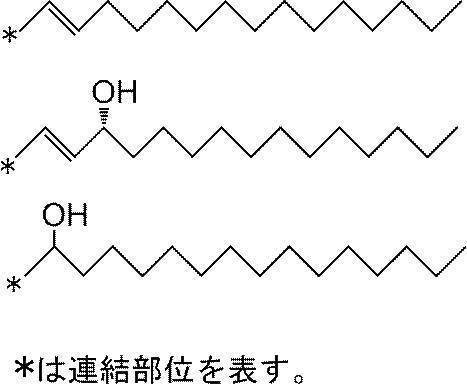
- R 1 represents a linear or branched hydrocarbon group having a total carbon number of 40 to 55 and including an ester bond in the carbon chain; the hydrocarbon group represented by R 1 is 1 or 2 or more partial structures selected from the group consisting of a multiple bond, an aromatic ring, and an aromatic heterocyclic ring may be contained in the carbon chain; R 2 may have a hydroxyl group having 11 to 11 carbon atoms.
- 21 represents an alkyl group having 21 or an alkenyl group having 11 to 21 carbon atoms which may have a hydroxyl group.
- the content of the nonionic surfactant is 1 to 70 times the mass of the ceramide represented by the general formula (I), and lecithin is further added to the nonionic surfactant.
- the ceramide dispersion composition according to ⁇ 1> which is contained in an amount of 0.01 to 20 times the mass.
- ceramide dispersion composition according to ⁇ 1> or ⁇ 2> which is a dispersion composition prepared using a high-pressure emulsification method.
- ceramide dispersion composition according to any one of ⁇ 1> to ⁇ 3>, further comprising a polyhydric alcohol.
- a polyhydric alcohol is glycerin and at least one diol compound.
- ceramide dispersion composition according to any one of ⁇ 1> to ⁇ 5>, further comprising cholesterol.
- the content of the oily component that is liquid at 25 ° C. in the ceramide dispersion composition is 1% by mass or less, or the ceramide dispersion composition does not contain the oily component that is liquid at 25 ° C.
- the ceramide dispersion composition according to any one of ⁇ 1> to ⁇ 7>.
- a ceramide dispersion composition having stability over time that can be stored for a long period of time under high-temperature conditions as compared to the prior art, and having an excellent skin care effect in application to external skin preparations such as cosmetics. Can be provided.
- a numerical range indicated by using “to” means a range including the numerical values described before and after “to” as the minimum value and the maximum value, respectively.
- the amount of each component in the composition is the total amount of the plurality of substances present in the composition unless there is a specific indication when there are a plurality of substances corresponding to each component in the composition. Means.
- process is not limited to an independent process, and is included in the term if the intended purpose of the process is achieved even when it cannot be clearly distinguished from other processes. .
- (poly) glycerin fatty acid ester includes a glycerin fatty acid ester containing one glycerin unit and one fatty acid unit, a glycerin fatty acid ester containing a plurality of either one, and a glycerin fatty acid containing a plurality of both. All of the esters are included and are used when these glycerin fatty acid esters are used without distinction.
- the ceramide dispersion composition of the present invention comprises a ceramide represented by the general formula (I) described below (hereinafter also referred to as “specific ceramide” as appropriate) and a nonionic surfactant.
- the ceramide dispersion composition of this invention may contain other components other than specific ceramide and a nonionic surfactant as needed.
- the “dispersed particles” in the present invention are ceramide-containing particles that contain at least a specific ceramide as a constituent and are dispersed in a continuous phase as a dispersed phase.
- the ceramide dispersion composition of the present invention takes a form in which dispersed particles containing a specific ceramide are dispersed in a continuous phase as a dispersed phase.
- the ceramide dispersion composition of the present invention contains a combination of a specific ceramide and a nonionic surfactant, and can be stored for a long time even under high temperature conditions by making the average particle size of the dispersed particles less than 60 nm. It has stability over time and has an excellent skin care effect in application to external preparations for skin such as cosmetics.
- storing the ceramide dispersion composition in “high temperature condition” in the present invention means storing the ceramide dispersion composition in an atmosphere where the temperature condition is 40 ° C. to 60 ° C.
- “stability over time” means that the variation over time of the particle size of the dispersed particles contained in the ceramide dispersion composition is small.
- the aging stability of the ceramide dispersion composition of the present invention is determined by the particle size of the dispersed particles immediately after preparation and after storage for a predetermined period (for example, in the state of being distributed in the market as a product or in a thermostatic bath at 50 ° C. for 90 days. It can be evaluated by comparing the difference between the particle size of the dispersed particles when stored).
- the difference in particle size is preferably 50 nm or less, more preferably 30 nm or less, and even more preferably 10 nm or less.
- the temporal stability under high-temperature conditions tends to decrease as the average particle size of the dispersed particles decreases.
- stability with time under high temperature conditions is improved by combining predetermined components and having an average particle size of the dispersed particles of less than 60 nm.
- the smaller the average particle size of the dispersed particles the more remarkable is that the temporal stability is dramatically improved.
- the specific ceramide contained in the ceramide dispersion composition of the present invention is a ceramide represented by the following general formula (I).
- R 1 and R 2 are as defined above.
- the total number of carbon atoms of the hydrocarbon group represented by R 1 is 40 to 55, preferably 42 to 52, and more preferably 45 to 48.
- the number of ester bonds contained in the carbon chain of the hydrocarbon group represented by R 1 may be one or more, and more preferably one.
- Examples of the multiple bond that the hydrocarbon group represented by R 1 may contain in the carbon chain include a carbon-carbon double bond or a carbon-carbon triple bond, and a carbon-carbon double bond is preferred.
- Examples of the aromatic ring that the hydrocarbon group represented by R 1 may include in the carbon chain include a benzene ring, a naphthalene ring, and an anthracene ring.
- Examples of the aromatic heterocyclic ring that the hydrocarbon group represented by R 1 may include in the carbon chain include a pyridine ring and a pyrazine ring.
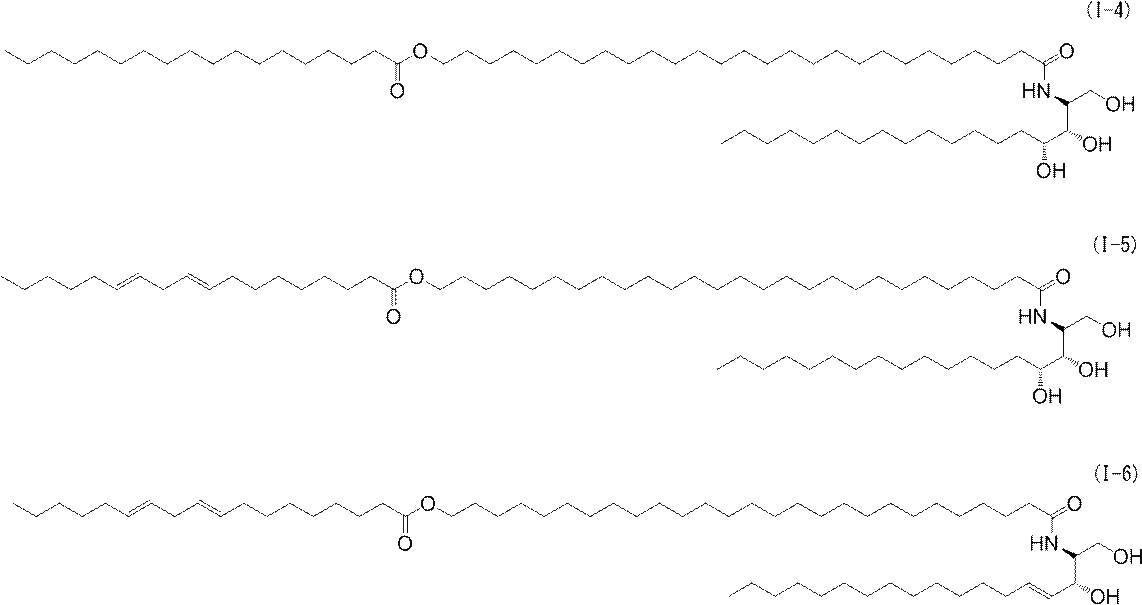
- the hydrocarbon group represented by R 1 has a structure in which a saturated or unsaturated hydrocarbon group having 25 to 30 carbon atoms is linked to a saturated or unsaturated hydrocarbon having 16 to 18 via one ester bond. It may be.
- the preferred hydrocarbon group represented by R 1 has a total carbon number of 40 to 55, and a linear ⁇ -hydroxy linear saturated fatty acid such as linoleic acid or stearic acid is attached to the linear ⁇ terminal. And a hydrocarbon group having a structure in which the fatty acid is ester-bonded.
- the hydrocarbon group represented by R 1 may further have a substituent, and examples of the substituent include a carbonyl group, an oxy group, an amide group, and the like.
- R 1 is not limited to the following specific examples.
- the alkyl group represented by R 2 has 11 to 21 carbon atoms, preferably 13 to 21 carbon atoms, and more preferably 14 to 20 carbon atoms.
- the alkyl group represented by R 2 may be linear or branched, and is preferably linear.
- the alkenyl group represented by R 2 has 11 to 21 carbon atoms, preferably 13 to 21 carbon atoms, and more preferably 14 to 20 carbon atoms.
- the alkenyl group represented by R 2 may be linear or branched, and is preferably linear.
- the alkyl group or alkenyl group represented by R 2 may have one or two or more hydroxyl groups, and preferably has one or two hydroxyl groups.
- Suitable combinations of R 1 and R 2 in the general formula (I) include combinations of the above-described preferred embodiments of R 1 and R 2 .
- R 2 is not limited to the following specific examples.
- ceramides include natural ceramides known as acyl ceramides.
- natural ceramide means ceramide having the same structure as ceramide present in the stratum corneum of human skin.
- the natural ceramide may be a natural product (extract), a ceramide obtained by a microbial fermentation method, or a synthetic or animal-derived ceramide.
- a non-natural ceramide may be used in combination as necessary.
- the ceramide dispersion composition of the present invention is used for purposes such as skin emollient, it is preferable to use more natural ceramide than non-natural ceramide from the viewpoint of the barrier effect.
- Examples of the natural ceramide that can be used as the specific ceramide in the present invention include Ceramide 1, Ceramide 4, Ceramide 9, and the like.
- Such a natural ceramide is also available as a commercial product, and examples thereof include Ceramide I, Ceramide EOP27, Ceramide EOS27 (all of which are trade names, manufactured by Evonik).
- the ceramide dispersion composition of the present invention may contain a specific ceramide alone or in combination of two or more.
- the ceramide dispersion composition of the present invention may be used in combination with other ceramides other than the specific ceramide as long as the effects of the present invention are not impaired.
- the content of the specific ceramide is included in the dispersed particles from the viewpoint of efficient absorption of the ceramide from the skin when the ceramide dispersion composition is applied to an external preparation for skin, and the expression of a skin care effect caused by the ceramide.
- the content is preferably 0.1% by mass to 80% by mass, more preferably 1% by mass to 50% by mass, and still more preferably 2% by mass to 30% by mass with respect to the total mass of the components.
- the content of the specific ceramide in the ceramide dispersion composition is 0.00001% by mass to 10% by mass with respect to the total mass of the ceramide dispersion composition from the viewpoint of expression of a skin care effect when applied to an external preparation for skin. It is preferably 0.00003% by mass to 5% by mass, and more preferably 0.0001% by mass to 1% by mass.
- the ceramide dispersion composition of the present invention contains a nonionic surfactant.
- the nonionic surfactant in the present invention is not particularly limited, and a known nonionic surfactant can be used.
- nonionic surfactants include glycerin fatty acid ester, polyglycerin fatty acid ester, organic acid monoglyceride, propylene glycol fatty acid ester, polyglycerin condensed ricinoleic acid ester, sorbitan fatty acid ester, sucrose fatty acid ester, polyoxyethylene sorbitan fatty acid Examples include esters. These nonionic surfactants do not need to be highly purified nonionic surfactants by distillation or the like, and may be reaction mixtures.
- the nonionic surfactant is preferably a polyglycerol fatty acid ester from the viewpoints of finer dispersion particles and dispersion stability, and is a polyglycerol fatty acid ester having an HLB of 10 to 16. It is more preferable.
- Polyglycerin fatty acid ester is preferable in that the interfacial tension of the dispersed phase / continuous phase can be greatly reduced, and as a result, the dispersed particles can be further refined.
- HLB means the hydrophilic-hydrophobic balance usually used in the field of surfactants.
- HLB value described in the catalog etc. may be adopted.
- a surfactant having an arbitrary HLB value can be obtained by utilizing the additivity of HLB.
- polyglycerol fatty acid ester at least one of them is polyglycerol having an average degree of polymerization of 10 and a fatty acid having 8 to 18 carbon atoms such as caprylic acid, capric acid, lauric acid, myristic acid, palmitic acid, stearic acid, An ester with a fatty acid selected from the group consisting of oleic acid and linoleic acid is preferred.
- polyglycerol fatty acid ester examples include hexaglycerol monooleate, hexaglycerol monopalmitate, hexaglycerol monomyristate, hexaglycerol monolaurate, decaglycerol monolinoleate, decaglycerol monooleate
- examples include esters, decaglycerin monostearate, decaglycerin monopalmitate, decaglycerin monomyristic ester, decaglycerin monolaurate, and the like.
- the HLB of these polyglycerol fatty acid esters is 10 or more and 16 or less.
- the polyglycerin fatty acid ester is one or more selected from polyglycerin fatty acid esters having an HLB of 10 or more and 16 or less, and one selected from polyglycerin fatty acid esters having an HLB having a molecular structure different from that of 5 or more and 15 or less. A combination of the above may also be used.
- the polyglycerol fatty acid ester having an HLB of 5 or more and 15 or less may be a polyglycerol fatty acid ester included in the above-described polyglycerol fatty acid ester, or other polyglycerol fatty acid ester.
- a commercially available product may be used as the polyglycerin fatty acid ester.
- Examples of commercially available polyglycerin fatty acid esters include Nikko Chemical DGMS, NIKKOL DGMO-CV, NIKKOL DGMO-90V, NIKKOL DGMO, NIKKOL DGIS, NIKKOL DGIS, NIKKOL DGIS, NIKKOL DGIS, NIKKOL DGIS, NIKKOL DGIS -O, NIKKOL Tetlaglyn 3-S, NIKKOL Tetlaglyn 5-S, NIKKOL Tetlagyn 5-O, NIKKOL Hexagly 1-L, NIKOL Hexagly 1-M, NIKKL , NIKKOL Hexaglyn 4-B, NIKKO L Hexaglyn 5-S, NIKKOL Hexaglyn 5-O, NIKKOL Hexaglyn PR-15, NIKKOL Decagly
- the preferred commercial products of polyglycerin fatty acid esters are NIKKOL Decaglyn 1-L, NIKKOL Decaglyn 1-M, NIKKOL Decaglyn 1-SV, NIKOL Decaglin 1-OLG1K SV, NIKOL Decaglin 1-OL NIKKOL Decaglyn 1-OV, NIKKOL Decaglyn 1-LN, Ryoto Polyglycerase L-7D, L-10D, M-10D, P-8D, SWA-10D, SWA-15D, SWA-20D, S-24D, S- 28D, O-15D, O-50D, B-70D, B-100D, ER-60D, and LOP-120DP.
- the ceramide dispersion composition of the present invention may contain one kind of nonionic surfactant or a combination of two or more kinds.
- the content of the nonionic surfactant in the ceramide dispersion composition of the present invention is the total mass of the specific ceramide from the viewpoint of finer dispersion particles and the skin care effect when the ceramide dispersion composition is applied to a skin external preparation.
- the amount is preferably 1 to 70 times, more preferably 3 to 40 times, still more preferably 5 to 20 times.
- the ceramide dispersion composition of the present invention preferably further contains lecithin.
- the ceramide dispersion composition of the present invention contains a nonionic surfactant and lecithin, so that it contains finer dispersed particles and exhibits a superior skin care effect when applied to an external preparation for skin. it can.
- lecithin Since lecithin has a hydrophilic group and a hydrophobic group in the molecule, it has been widely used as an emulsifier in the fields of food, medicine and cosmetics.
- lecithin having a lecithin purity of 60% or more is used as lecithin, and the lecithin having a lecithin purity of 60% or more can also be used in the production method of the present invention.
- lecithin generally referred to as high-purity lecithin, is preferably lecithin having a lecithin purity of 80% or more, and more preferably 90% or more.
- lecithin examples include various known lecithins extracted and separated from living bodies of plants, animals or microorganisms. Specific examples of lecithin include various lecithins derived from plants such as soybean, corn, peanut, rapeseed and wheat, animals such as egg yolk and cattle, microorganisms such as E. coli.
- lecithin examples include compound names such as phosphatidic acid, phosphatidylglycerin, phosphatidylinositol, phosphatidylethanolamine, phosphatidylmethylethanolamine, phosphatidylcholine, phosphatidylserine, bisphosphatidic acid, diphosphatidylglycerin (cardiolipin) and the like; sphingomyelin Examples include sphingolecithin.
- hydrogenated lecithin, enzymatically decomposed lecithin, enzymatically decomposed hydrogenated lecithin, hydroxylecithin and the like can be used in addition to the above high-purity lecithin.
- lecithin can be used alone or in the form of a mixture of plural kinds.
- the content of lecithin in the ceramide dispersion composition of the present invention is based on the total mass of the nonionic surfactant from the viewpoint of finer dispersion particles and a skin care effect when the ceramide dispersion composition is applied to an external preparation for skin.
- the amount is preferably 0.01 times to 20 times, more preferably 0.1 times to 10 times, and still more preferably 0.4 times to 5 times.
- the nonionic surfactant is preferably used in an amount of 1 to 70 times, more preferably 3 to 40 times, still more preferably with respect to the total mass of the specific ceramide. 5 to 20 times the content, and lecithin is preferably 0.01 to 20 times, more preferably 0.1 times the amount of the nonionic surfactant. It is preferably contained in an amount of 10 times, more preferably 0.4 times to 5 times.
- the nonionic surfactant and lecithin in the above-mentioned range, the fine particles of the dispersed particles and the skin care effect when the ceramide dispersion composition is applied to an external preparation for skin. Both can be remarkably improved.
- the ceramide dispersion composition of the present invention may further contain a polyhydric alcohol.
- the polyhydric alcohol in the present invention is not particularly limited as long as it is a dihydric or higher alcohol, and a known polyhydric alcohol can be used.
- polyhydric alcohols include glycerin, diglycerin, triglycerin, polyglycerin, diol compounds (for example, 1,3-butylene glycol (1,3-BG), isoprene glycol, polyethylene glycol, propylene glycol, polypropylene glycol, Ethylene glycol, diethylene glycol, neopentyl glycol, 1,2-pentanediol, 1,2-hexanediol, dipropylene glycol, 3-methyl-1,3-butanediol, etc.), maltitol, reduced starch syrup, sucrose, lactitol, Palatinite, erythritol, sorbitol, mannitol, xylitol, xylose, glucose, lactose, mannose, maltose, galactose, fructose, inositol, pentaerythritol Le, maltotriose,
- the polyhydric alcohol is preferably at least one selected from the group consisting of glycerin and a diol compound from the viewpoint of miniaturization of dispersed particles and improvement of the skin care effect. More preferably, it is a seed diol compound.
- glycerin and at least one diol compound are used in combination as the polyhydric alcohol, a ceramide dispersion composition containing finer dispersed particles and having significantly excellent skin care effects can be obtained.
- the “diol compound” means a compound containing two hydroxy groups in the molecule.
- the content ratio of diol compound to glycerin is 100: 1 on a mass basis from the viewpoint of the temporal stability of the dispersion. ⁇ 1: 1 is preferred, 75: 1 to 5: 1 is more preferred, and 50: 1 to 10: 1 is even more preferred.
- diol compound examples include 1,3-butylene glycol, dipropylene glycol, 1,4-butylene glycol, diethylene glycol, ethylene glycol, propylene glycol, and 1,2-pentanediol from the viewpoints of finer dispersion particles and stability over time. 1,5-pentanediol, 1,4-pentanediol, 2,4-pentanediol, 1,2-hexanediol, and 1,6-hexanediol.
- at least one selected from the group consisting of 1,3-butylene glycol and dipropylene glycol is more preferable, and 1,3-butylene glycol is still more preferable.
- the content of the polyhydric alcohol in the ceramide dispersion composition of the present invention is 1% by mass to 70% by mass with respect to the total mass of the ceramide dispersion composition from the viewpoints of finer dispersion particles and stability over time. It is preferably 5% by mass to 65% by mass, more preferably 10% by mass to 60% by mass.
- the ceramide dispersion composition of the present invention may further contain cholesterol.
- the cholesterol content is preferable because the skin care effect is further improved when the ceramide dispersion composition of the present invention is applied to an external preparation for skin.
- cholesterol obtained by purifying crude cholesterol obtained by extraction as a main component of lanolin can be preferably applied.
- a commercially available product may be used as cholesterol.
- examples of commercially available cholesterol products include “Cholesterol JSQI (trade name)” manufactured by Nippon Seika Co., Ltd., “Cholesterol” manufactured by Croda Japan Co., Ltd., and the like.
- the content of cholesterol in the ceramide dispersion composition of the present invention can be appropriately set in consideration of the effect expected from containing cholesterol.
- the content of cholesterol is preferably 0.00001% by mass to 10% by mass, more preferably 0.00003% by mass to 5% by mass with respect to the total mass of the ceramide dispersion composition. More preferably, the content is 0001% by mass to 1% by mass.
- the ceramide dispersion composition of the present invention preferably takes a form in which dispersed particles containing a specific ceramide are dispersed in a continuous phase as a dispersed phase.
- the continuous phase is preferably water or a composition containing water.
- the water in the present invention is preferably water with few impurities such as pure water or ion exchange water.
- the “composition containing water” means that water may be contained in the composition.
- the components other than water contained in the composition are not particularly limited, and examples thereof include water-soluble known components that can be usually added to the continuous phase in the dispersion composition.
- ceramide dispersion composition of the present invention other components than the above-described components can be used as necessary within a range not impairing the effects of the present invention.
- other components include components that can be usually added to the dispersion composition, and components that are required depending on the intended use of the resulting ceramide dispersion composition.
- various medicinal ingredients, preservatives, bactericides, coloring agents, menthol, camphor and other refreshing agents, plant extracts, pH buffering agents, Antioxidants, ultraviolet absorbers, ultraviolet scattering agents, fragrances and the like can be mentioned.
- the ceramide dispersion composition of the present invention preferably contains 1% by mass or less of an oily component that is liquid at 25 ° C. or does not contain an oily component that is liquid at 25 ° C. More preferably, no component is contained.
- the content of the oily component that is liquid at 25 ° C. in the ceramide dispersion composition is 1% by mass or less, or the ceramide dispersion composition contains a liquid oil component that is liquid at 25 ° C.
- liquid at 25 ° C.” means that the melting point or softening point is less than 25 ° C.
- the “oil component” means a component having a solubility in water at 25 ° C. of less than 0.1% by mass and generally used as an oil component in the fields of cosmetics, pharmaceuticals, foods and the like.
- the average particle diameter of the dispersed particles contained in the ceramide dispersion composition of the present invention is less than 60 nm.
- the average particle size of the dispersed particles is preferably less than 40 nm, more preferably less than 30 nm, and even more preferably less than 20 nm from the viewpoint of temporal stability and skin care effect.
- the average particle diameter of the dispersed particles can be, for example, 1 nm or more.
- the average particle size of the dispersed particles in the present invention means the volume average particle size of dispersed particles (ceramide-containing particles) present in the ceramide dispersion composition.
- the volume average particle size of the dispersed particles is preferably measured using a dynamic light scattering method from the viewpoints of accuracy and ease of measurement.
- a dynamic light scattering type nanotrack particle size analyzer UPA manufactured by Nikkiso Co., Ltd.
- a dynamic light scattering type particle size distribution measuring device LB-550 ((stock)
- a dense particle size analyzer FPAR-1000 manufactured by Otsuka Electronics Co., Ltd.
- the volume average particle diameter of the dispersed particles is a value measured using a dynamic light scattering nanotrack particle size analyzer UPA (manufactured by Nikkiso Co., Ltd.), and specifically, as follows: taking measurement.
- the average particle diameter of the dispersed particles in the present invention can also be measured using another analyzer.
- the volume average particle diameter of the dispersed particles is measured with a quartz cell after diluting with pure water so that the concentration of ceramide contained in the sample taken from the ceramide dispersion composition of the present invention is 0.03% by mass. .
- the volume average particle diameter is 1.600 as the sample refractive index, 1.333 (pure water) as the dispersion medium refractive index, and the volume average particle diameter (Mv) when the viscosity of pure water is set as the viscosity of the dispersion medium. Can be sought.
- the average particle size of the dispersed particles can be adjusted by factors such as the stirring conditions (shearing force, temperature or pressure) in the production method, and the ratio of oil phase to water phase.
- the ceramide dispersion composition of the present invention is preferably a dispersion composition prepared using a high-pressure emulsification method. Matters relating to the high-pressure emulsification method and embodiments of the dispersion treatment using the high-pressure emulsification method in the preparation of the ceramide dispersion composition of the present invention will be described later in the section of the method for producing a ceramide dispersion composition.
- the pH of the ceramide dispersion composition is appropriately set according to the application form of the ceramide dispersion composition.
- the pH of the ceramide dispersion composition is more preferably 3 to 10, more preferably 5 to 9, from the viewpoint of skin irritation. preferable. By setting the pH within this range, the skin irritation is alleviated and a favorable feeling of use can be obtained.
- the ceramide dispersion composition of the present invention can be obtained by a production method including mixing a dispersed phase component containing at least a specific ceramide and a continuous phase component.
- the method for mixing the continuous phase component (aqueous phase component) and the dispersed phase component (oil phase component) is not particularly limited, and the dispersed phase component is directly injected into the ultrasonic dispersion method, the high-pressure emulsification method, or the continuous phase component.
- a known method such as a jet injection method may be used.
- a dispersion pretreatment containing a combination of a specific ceramide and a nonionic surfactant is subjected to a dispersion treatment in a state heated to 100 ° C. or more, Obtaining a coarse dispersion (hereinafter also referred to as a preliminary dispersion treatment step), a mixed liquid obtained by mixing the coarse dispersion and water or a composition containing water (hereinafter also referred to as “water or the like”).
- Is dispersed using an ultrasonic dispersion method or a high-pressure emulsification method (hereinafter also referred to as the present dispersion treatment step), and contains a specific ceramide and has a fine particle size with an average particle size of less than 60 nm.
- a method for forming particles may be mentioned.
- the manufacturing method of this aspect is demonstrated.
- ⁇ Preliminary dispersion treatment process> In the preparation of the coarse dispersion in the preliminary dispersion treatment step, the liquid containing the specific ceramide and the nonionic surfactant (the liquid before dispersion treatment) is heated by being dispersed in a state of being heated to 100 ° C. or higher. Thus, it is possible to obtain a coarse dispersion in which dispersed particles (dispersed phase) containing the specific ceramide in a molten state are coarsely dispersed in the continuous phase.
- the specific ceramide and the nonionic surfactant need only be mixed.
- the method for mixing the specific ceramide and the nonionic surfactant is not particularly limited, and examples thereof include a method of mixing by stirring.
- the pre-dispersion solution may contain other components other than the specific ceramide and the nonionic surfactant as necessary. Examples of other components include components such as polyhydric alcohol and cholesterol.
- the pre-dispersion solution is heated to 100 ° C. or higher from the viewpoint of melting the ceramide.
- the temperature of 100 ° C. or higher should be achieved when the pre-dispersion solution is subjected to a dispersion treatment.
- the pre-dispersion solution may be preheated to 100 ° C. or higher and the dispersion temperature may be maintained at 100 ° C. or higher, or the pre-dispersion solution may be dispersed while being heated to 100 ° C. or higher. Good.
- the means for heating the pre-dispersion solution to 100 ° C. or higher is not particularly limited, and examples thereof include a general heating device. As a heating apparatus, a constant temperature chamber etc. are mentioned, for example.
- the means for dispersing the pre-dispersion solution to obtain a coarse dispersion is not particularly limited, and examples thereof include a general stirring device.
- the stirrer include a magnetic stirrer, a home mixer, a paddle mixer, an impeller mixer, a homomixer, a disper mixer, and an ultra mixer.
- the time for the dispersion treatment is not particularly limited, and can be set as appropriate according to the type of the stirring device, the composition of the pre-dispersion solution, and the like.
- this distributed processing step In this dispersion treatment step, the coarse dispersion obtained in the preliminary dispersion treatment is mixed with water, and then dispersed using an ultrasonic dispersion method (hereinafter referred to as ultrasonic dispersion treatment) or a high-pressure emulsification method. Can be dispersed (hereinafter referred to as high-pressure emulsification).
- ultrasonic dispersion treatment an ultrasonic dispersion method
- high-pressure emulsification method can be dispersed (hereinafter referred to as high-pressure emulsification).
- a ceramide dispersion composition containing dispersed particles containing a specific ceramide can be obtained by mixing and dispersing a crude dispersion containing molten ceramide and water.
- the temperature of the coarse dispersion when mixing with water or the like is preferably set to 100 ° C. or less, and more preferably set to 90 ° C. to 100 ° C.
- the temperature of water or the like is not particularly limited.
- the temperature of water or the like is preferably set to 50 ° C. to 90 ° C.
- the coarse dispersion and water may be mixed at once, or may be mixed while adding the other little by little.
- the coarse dispersion and water may be simply mixed.
- Examples of the method of mixing the coarse dispersion and water, etc. include a method of mixing by stirring.
- the mixing ratio of the coarse dispersion and water is not particularly limited. From the viewpoint of finer dispersion particles, the ratio (mass basis) of the coarse dispersion / water is preferably 1/20 to 10/1, more preferably 1/10 to 5/1. More preferably, it is 1/2 to 2/1.
- the ratio of the disperse phase to the continuous phase in the ceramide dispersion composition is the ratio of the disperse phase / continuous phase (mass basis) from the viewpoint of the refinement of dispersed particles and the stability over time. It is preferable to mix to be 1/1000 to 1/5, more preferably to be 1/100 to 1/10, and to be mixed to be 1/50 to 1/10. Is more preferable.
- high-pressure emulsification treatment is preferable from the viewpoint of finer dispersion particles.
- the high-pressure emulsification treatment means a dispersion treatment in which a shearing force of 50 MPa or more is added to the material to be dispersed.
- the shearing force applied to the object to be dispersed is preferably 100 MPa or more, and more preferably 180 MPa or more.
- the upper limit value of the shearing force applied to the object to be dispersed is preferably 300 MPa or less from the viewpoint of temperature rise and pressure resistance.
- High-pressure emulsifiers include Optimizer HJP-25005 (manufactured by Sugino Machine), Microfluidizer (manufactured by Microfluidic), Nanomizer (manufactured by Yoshida Kikai Kogyo Co., Ltd., Gorin type homogenizer (manufactured by APV), Lanier type Homogenizer (manufactured by Lanier), high-pressure homogenizer (manufactured by Niro Soabi), homogenizer (manufactured by Sanwa Kikai Co., Ltd.), high-pressure homogenizer (manufactured by Izumi Food Machinery Co., Ltd.), ultra-high pressure homogenizer (manufactured by Ika) A high pressure homogenizer may be mentioned.
- the temperature during the high-pressure emulsification treatment is preferably set to 20 ° C. to 80 ° C., more preferably 40 ° C. to 70 ° C.
- the number of high pressure emulsification treatments may be one.
- the high-pressure emulsification treatment is preferably performed twice or more, more preferably 2 to 5 times.
- the emulsion, which is an emulsified and dispersed composition is preferably cooled through some cooler within 30 seconds immediately after passing through the chamber, preferably within 3 seconds, from the viewpoint of maintaining the particle size of the dispersed particles.
- the dispersion process in this dispersion process may be an ultrasonic dispersion process. Further, from the viewpoint of further enhancing the dispersion effect, it is preferable to perform ultrasonic dispersion treatment after mixing the coarse dispersion and water and before high-pressure emulsification treatment.
- a general ultrasonic dispersion apparatus can be used for the dispersion treatment by applying ultrasonic waves.
- Ultrasonic dispersers include ultrasonic homogenizers US-600, US-1200T, RUS-1200T, MUS-1200T (above, manufactured by Nippon Seiki Seisakusho Co., Ltd.), ultrasonic processors UIP2000, UIP4000, UIP8000, UIP16000 (above, Heelscher). These ultrasonic dispersion devices can be used at a frequency of 25 kHz or less, preferably 15 kHz to 20 kHz.
- the ceramide dispersion composition of the present invention can be widely used as it is or as a component material, for example, in pharmaceuticals (external preparations, skin preparations), cosmetics, cleaning agents and the like.
- Pharmaceuticals include parenterals such as coating agents, cosmetics include lotions, cosmetic liquids, gels, milks, hair conditioners, hair treatments, rinses, etc., and detergents include facial cleansers, body soaps, shampoos, etc. Is mentioned.
- the use of the ceramide dispersion composition of the present invention is not limited to these.
- the component which can be added to a pharmaceutical or cosmetics can be added suitably as needed.
- a dosage form when the ceramide dispersion composition of the present invention is used in cosmetics general preparations known as cosmetics such as lotion, cosmetic liquid, gel, milky lotion, hair conditioner, hair treatment, rinse, etc. It can be any form of shape.
- the dosage form when the ceramide dispersion composition of the present invention is used in cosmetics is preferably a highly transparent dosage form from the viewpoint of taking advantage of the fine dispersion particles, for example, lotion It is preferable to use a dosage form such as a cosmetic liquid or a gel preparation.
- Example 1 39.5 g of Liquid A having the following composition was stirred and mixed at 110 ° C. for 10 minutes to obtain a coarse dispersion.
- the obtained crude dispersion was cooled to 100 ° C., and after adding B solution in which components having the following composition were dissolved at 70 ° C., the mixture was used for 3 minutes using an ultrasonic homogenizer US-600 (manufactured by Nippon Seiki Seisakusho). A preliminary dispersion was obtained by dispersing.
- Example 1 The ceramide dispersion composition of Example 1 was obtained.
- the detail of each component used for A liquid and B liquid is as below-mentioned.
- Example 2 to 3, 7 to 18, and Comparative Examples 1 to 4, 6 to 9 Examples 2 to 3, 7 to 18 and Comparative Examples 1 to 4, 6 to 9 were performed in the same manner as Example 1 except that the liquids A and B having the compositions shown in Tables 1, 2 and 3 were used. Each ceramide dispersion composition was obtained.
- Example 4 Dispersion of the ceramide of Example 4 in the same manner as in Example 1 except that the dispersion using an ultrasonic homogenizer US-600 (manufactured by Nippon Seiki Seisakusho Co., Ltd.) was changed to 20 minutes and high-pressure emulsification was not performed. A composition was obtained.
- US-600 manufactured by Nippon Seiki Seisakusho Co., Ltd.
- Example 5 A ceramide dispersion composition of Example 5 was obtained in the same manner as in Example 1 except that high-pressure emulsification treatment was performed at a pressure of 150 MPa.
- Example 6 A ceramide dispersion composition of Example 6 was obtained in the same manner as in Example 1 except that high-pressure emulsification treatment was performed at a pressure of 50 MPa.
- Comparative Example 5 Dispersion of ceramide of Comparative Example 5 in the same manner as in Example 1 except that the dispersion using an ultrasonic homogenizer US-600 (manufactured by Nippon Seiki Seisakusho Co., Ltd.) was changed to 10 minutes and high-pressure emulsification was not performed. A composition was obtained.
- US-600 manufactured by Nippon Seiki Seisakusho Co., Ltd.
- (1-1) Particle size of dispersed particles in ceramide dispersion composition immediately after preparation The particle size (volume average particle size) of dispersed particles in the ceramide dispersion composition immediately after preparation is analyzed by dynamic light scattering nanotrack particle size analysis. Measurement was performed using a total UPA (manufactured by Nikkiso Co., Ltd.). The volume average particle diameter was measured by diluting with pure water so that the concentration of ceramide contained in the sample taken from the ceramide dispersion composition was 0.03% by mass.
- the volume average particle diameter is 1.600 as the sample refractive index, 1.333 (pure water) as the dispersion medium refractive index, and the volume average particle diameter (Mv) when the viscosity of pure water is set as the viscosity of the dispersion medium. Asked.
- the ceramide dispersion compositions of the examples unexpectedly contain fine dispersed particles of less than 60 nm, and are excellent in stability over time under high temperature conditions. And it was found that the skin care effect was excellent.
- a ceramide dispersion composition having the following can be provided.
Landscapes
- Health & Medical Sciences (AREA)
- Life Sciences & Earth Sciences (AREA)
- General Health & Medical Sciences (AREA)
- Veterinary Medicine (AREA)
- Public Health (AREA)
- Animal Behavior & Ethology (AREA)
- Birds (AREA)
- Epidemiology (AREA)
- Emergency Medicine (AREA)
- Dermatology (AREA)
- Biophysics (AREA)
- Molecular Biology (AREA)
- Chemical & Material Sciences (AREA)
- Dispersion Chemistry (AREA)
- Cosmetics (AREA)
Abstract
下記一般式(I)で表されるセラミドと、非イオン性の界面活性剤と、を含み、分散粒子の平均粒径が60nm未満であるセラミド分散組成物。一般式(I)中、R1は、総炭素数が40~55であり炭素鎖中にエステル結合を含む直鎖又は分岐状の炭化水素基を表し、R1で表される炭化水素基は、多重結合、芳香環、及び芳香族複素環からなる群より選択される1又は2以上の部分構造を炭素鎖中に含んでもよく;R2は、水酸基を有してもよい炭素数11~21のアルキル基、又は水酸基を有してもよい炭素数11~21のアルケニル基を表す。
Description
本発明は、セラミド分散組成物に関する。
セラミドは、皮膚の角質層に存在し、水分保持に必要な脂質バリアを構築し、水分を維持していくために重要な役割を果たしている。人間の皮膚には、種類の異なったタイプのセラミドが存在し、機能もそれぞれ異なっている。近年、セラミドのスキンケア効果を期待して、セラミドを配合した種々の組成物が開発されている。
セラミドを高濃度で安定に配合する技術としては、特定の比率のセラミド及びHLB9以上の界面活性剤と、25℃で液状の油性成分と、水とを50MPa以上の処理圧で乳化して得られた乳化組成物が知られている(例えば、特開2006-335693号公報参照)。
また、特開2013-224314号公報には、特定のセラミドを含有する油性成分を、水溶性有機溶媒に溶かして油相を調製し、得られた油相と水相とをマイクロ流路に別々に通過させた後、対向流衝突によって混合することにより得た、セラミドを高濃度で含有しながら分散安定性に優れたセラミド分散組成物が開示されている。
また、特開2013-224314号公報には、特定のセラミドを含有する油性成分を、水溶性有機溶媒に溶かして油相を調製し、得られた油相と水相とをマイクロ流路に別々に通過させた後、対向流衝突によって混合することにより得た、セラミドを高濃度で含有しながら分散安定性に優れたセラミド分散組成物が開示されている。
セラミドに期待されるスキンケア効果等の効果を十分に発揮させるためには、セラミドの皮膚への浸透性を高める必要がある。セラミドの皮膚への浸透性を考慮すると、セラミドの分散粒子の粒径は小さいことが望まれる。しかしながら、従来のセラミド分散組成物では、例えば夏場の高温になった室内又は屋外などの高温条件下に保存した場合において、セラミドを含有する分散粒子の微細粒径が維持できず、経時安定性が著しく損なわれるという問題があった。
本発明は、上記のような事情に鑑みてなされたものであり、高温条件下に保存した場合において従来に比して長期の保存が可能な経時安定性を有し、かつ化粧料等の皮膚外用剤への適用において優れたスキンケア効果を有するセラミド分散組成物を提供することを課題とする。
上記課題を解決するための具体的な手段は、以下の通りである。
<1> 下記一般式(I)で表されるセラミドと、非イオン性界面活性剤と、を含み、分散粒子の平均粒径が60nm未満であるセラミド分散組成物。
<1> 下記一般式(I)で表されるセラミドと、非イオン性界面活性剤と、を含み、分散粒子の平均粒径が60nm未満であるセラミド分散組成物。
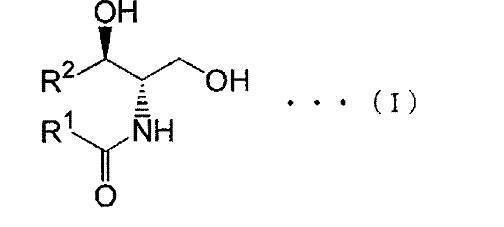
一般式(I)中、R1は、総炭素数が40~55であり炭素鎖中にエステル結合を含む直鎖又は分岐状の炭化水素基を表し;R1で表される炭化水素基は、多重結合、芳香環、及び芳香族複素環からなる群より選択される1又は2以上の部分構造を炭素鎖中に含んでもよく;R2は、水酸基を有してもよい炭素数11~21のアルキル基、又は水酸基を有してもよい炭素数11~21のアルケニル基を表す。
<2> 非イオン性界面活性剤の含有量が、一般式(I)で表されるセラミドの質量に対して1倍量~70倍量であり、更に、レシチンを非イオン性界面活性剤の質量に対して0.01倍量~20倍量の含有量で含有する<1>に記載のセラミド分散組成物。
<3> 高圧乳化法を用いて調製された分散組成物である<1>又は<2>に記載のセラミド分散組成物。
<4> 更に、多価アルコールを含有する<1>~<3>のいずれか1つに記載のセラミド分散組成物。
<5> 多価アルコールが、グリセリン及び少なくとも1種のジオール化合物である<4>に記載のセラミド分散組成物。
<5> 多価アルコールが、グリセリン及び少なくとも1種のジオール化合物である<4>に記載のセラミド分散組成物。
<6> 更に、コレステロールを含有する<1>~<5>のいずれか1つに記載のセラミド分散組成物。
<7> 非イオン性界面活性剤が、ポリグリセリン脂肪酸エステルである<1>~<6>のいずれか1つに記載のセラミド分散組成物。
<7> 非イオン性界面活性剤が、ポリグリセリン脂肪酸エステルである<1>~<6>のいずれか1つに記載のセラミド分散組成物。
<8> セラミド分散組成物中の25℃で液状の油性成分の含有量が1質量%以下であるか、又は、セラミド分散組成物がセラミド分散組成物が25℃で液状の油性成分を含有しない<1>~<7>のいずれか1つに記載のセラミド分散組成物。
本発明によれば、高温条件下において従来に比して長期の保存が可能な経時安定性を有し、かつ化粧料等の皮膚外用剤への適用において優れたスキンケア効果を有するセラミド分散組成物を提供することができる。
以下、本発明の具体的な実施形態について詳細に説明するが、本発明は、以下の実施形態に何ら限定されるものではなく、本発明の目的の範囲内において、適宜変更を加えて実施することができる。
本明細書において「~」を用いて示された数値範囲は、「~」の前後に記載される数値をそれぞれ最小値及び最大値として含む範囲を意味する。
本明細書において、組成物中の各成分の量は、各成分に該当する物質が組成物中に複数存在する場合には、特に断らない限り、組成物中に存在する複数の物質の合計量を意味する。
本明細書において、組成物中の各成分の量は、各成分に該当する物質が組成物中に複数存在する場合には、特に断らない限り、組成物中に存在する複数の物質の合計量を意味する。
本明細書において「工程」との語は、独立した工程だけではなく、他の工程と明確に区別できない場合であってもその工程の所期の目的が達成されれば、本用語に含まれる。
本明細書において「(ポリ)グリセリン脂肪酸エステル」との表現には、グリセリン単位及び脂肪酸単位をそれぞれ1つずつ含むグリセリン脂肪酸エステル、いずれか一方を複数含むグリセリン脂肪酸エステル、及びいずれも複数含むグリセリン脂肪酸エステルの全てが包含され、これらのグリセリン脂肪酸エステルを区別せずに用いる場合に使用される。
[セラミド分散組成物]
本発明のセラミド分散組成物は、後記する一般式(I)で表されるセラミド(以下、適宜「特定セラミド」とも称する。)と、非イオン性の界面活性剤と、を含み、分散粒子の平均粒径が60nm未満であるセラミド分散組成物である。
本発明のセラミド分散組成物は、必要に応じて、特定セラミド及び非イオン性界面活性剤以外の他の成分を含んでもよい。
本発明のセラミド分散組成物は、後記する一般式(I)で表されるセラミド(以下、適宜「特定セラミド」とも称する。)と、非イオン性の界面活性剤と、を含み、分散粒子の平均粒径が60nm未満であるセラミド分散組成物である。
本発明のセラミド分散組成物は、必要に応じて、特定セラミド及び非イオン性界面活性剤以外の他の成分を含んでもよい。
本発明における「分散粒子」は、構成要素として特定セラミドを少なくとも含有し、分散相として連続相に分散されるセラミド含有粒子である。本発明のセラミド分散組成物は、特定セラミドを含有する分散粒子が分散相として連続相中に分散された形態をとる。
本発明のセラミド分散組成物は、特定セラミドと非イオン性界面活性剤とを組み合わせて含有し、分散粒子の平均粒径を60nm未満とすることで、高温条件下においても長期の保存が可能な経時安定性を有し、かつ化粧料等の皮膚外用剤への適用において優れたスキンケア効果を有する。
ここで、本発明においてセラミド分散組成物を「高温条件下」に保存するとは、温度条件が40℃~60℃となる雰囲気下にセラミド分散組成物を保存することを意味する。
本発明おいて「経時安定性」とは、セラミド分散組成物に含まれる分散粒子の粒径の経時的な変動が小さいことを意味する。
本発明のセラミド分散組成物の経時安定性は、調製直後の分散粒子の粒径と、所定期間保管した後(例えば、製品として市場に流通している状態、又は50℃の恒温槽で90日間保管したとき)の分散粒子の粒径との差を比較することにより評価できる。例えば、この粒径の差は、50nm以下であることが好ましく、より好ましくは30nm以下であり、更に好ましくは10nm以下である。
本発明のセラミド分散組成物の経時安定性は、調製直後の分散粒子の粒径と、所定期間保管した後(例えば、製品として市場に流通している状態、又は50℃の恒温槽で90日間保管したとき)の分散粒子の粒径との差を比較することにより評価できる。例えば、この粒径の差は、50nm以下であることが好ましく、より好ましくは30nm以下であり、更に好ましくは10nm以下である。
通常、セラミド分散組成物においては、分散粒子の平均粒径が小さくなるに従い、高温条件下における経時安定性は低下する傾向にある。しかしながら、本発明のセラミド分散組成物においては、所定の成分を組み合わせ、かつ分散粒子の平均粒径が60nm未満であることで高温条件下における経時安定性が向上する。更に、本発明のセラミド分散組成物においては、分散粒子の平均粒径が小さいほど経時安定性が飛躍的に向上するという顕著な効果を有する。
以下、本発明のセラミド分散組成物について詳細に説明する。
以下、本発明のセラミド分散組成物について詳細に説明する。
(特定セラミド)
本発明のセラミド分散組成物が含有する特定セラミドは、下記一般式(I)で表されるセラミドである。
本発明のセラミド分散組成物が含有する特定セラミドは、下記一般式(I)で表されるセラミドである。

(一般式(I)中、R1及びR2は、上記と同義である。)
以下、一般式(I)について説明する。
R1で表される炭化水素基の総炭素数は、40~55であり、42~52が好ましく、45~48がより好ましい。
R1で表される炭化水素基の総炭素数は、40~55であり、42~52が好ましく、45~48がより好ましい。
R1で表される炭化水素基が炭素鎖中に含むエステル結合の数は、1つ又は2つ以上であってよく、1つであることがより好ましい。
R1で表される炭化水素基が炭素鎖中に含んでもよい多重結合としては、炭素-炭素二重結結合又は炭素-炭素三重結合が挙げられ、炭素-炭素二重結合が好ましい。
R1で表される炭化水素基が炭素鎖中に含んでもよい芳香環としては、ベンゼン環、ナフタレン環、アントラセン環等が挙げられる。
R1で表される炭化水素基が炭素鎖中に含んでもよい芳香族複素環としては、ピリジン環、ピラジン環等が挙げられる。
R1で表される炭化水素基は、炭素数25~30の飽和又は不飽和の炭化水素基が1つのエステル結合を介して16~18の飽和又は不飽和の炭化水素と連結している構造であってもよい。
R1で表される好適な炭化水素基としては、総炭素数が40~55であり、直鎖状のω-ヒドロキシ直鎖飽和脂肪酸のω末端に、リノール酸、ステアリン酸等の直鎖状の脂肪酸がエステル結合した構造を有する炭化水素基が挙げられる。
R1で表される炭化水素基は、置換基を更に有してもよく、置換基の例としては、カルボニル基、オキシ基、アミド基等が挙げられる。
以下に、R1の具体例を示す。但し、R1は、以下の具体例に限定されない。

R2で表されるアルキル基が有する炭素数は11~21であり、13~21が好ましく、14~20がより好ましい。R2で表されるアルキル基は直鎖又は分岐状であってよく、直鎖であることが好ましい。
R2で表されるアルケニル基が有する炭素数は、11~21であり、13~21であることが好ましく、14~20であることがより好ましい。R2で表されるアルケニル基は、直鎖又は分岐状であってよく、直鎖であることが好ましい。
R2で表されるアルキル基又はアルケニル基は1つ又は2つ以上の水酸基を有してもよく、1つ又は2つの水酸基を有することが好ましい。
一般式(I)におけるR1及びR2の好適な組み合わせとしては、上記したR1及びR2の好適な態様の組み合わせが含まれる。
以下に、R2の具体例を示す。但し、R2は、以下の具体例に限定されない。
特定セラミドはアシルセラミドとして知られる天然型セラミドを含む。
本明細書において「天然型セラミド」とは、ヒトの皮膚の角質層に存在するセラミドと同じ構造を有するセラミドのことを意味する。
本明細書において「天然型セラミド」とは、ヒトの皮膚の角質層に存在するセラミドと同じ構造を有するセラミドのことを意味する。
天然型セラミドは、天然物(抽出物)、微生物発酵法で得られたセラミドであってもよく、合成物又は動物由来のセラミドであってもよい。
本発明における特定セラミドとしては、必要に応じて非天然型セラミドを併用してもよい。なお、本発明のセラミド分散組成物を、皮膚のエモリエント等の目的に使用する場合には、バリア効果の観点から、非天然型セラミドに比べて天然型セラミドをより多く用いることが好ましい。
本発明における特定セラミドとして使用できる天然型セラミドとしては、Ceramide 1、Ceramide 4、Ceramide 9等を挙げることができる。
このような天然型セラミドは、市販品としても入手可能であり、例えば、Ceramide I、Ceramide EOP27、Ceramide EOS27(以上、いずれも商品名、Evonik社製)等が挙げられる。
以下に、特定セラミドの具体例を挙げる。特定セラミドは、以下の具体例に限定されない。

本発明のセラミド分散組成物は、特定セラミドを1種単独で又は2種以上組み合わせて含んでもよい。
本発明のセラミド分散組成物は、本発明の効果を損ねない範囲において、特定セラミド以外の他のセラミドを併用してもよい。
本発明のセラミド分散組成物は、本発明の効果を損ねない範囲において、特定セラミド以外の他のセラミドを併用してもよい。
特定セラミドの含有量としては、セラミド分散組成物を皮膚外用剤へ適用した場合におけるセラミドの経皮からの効率的な吸収、及びセラミドに起因するスキンケア効果の発現の観点から、分散粒子に含まれる成分の全質量に対して、0.1質量%~80質量%であることが好ましく、1質量%~50質量%であることがより好ましく、2質量%~30質量%であることが更に好ましい。
また、セラミド分散組成物における特定セラミドの含有量は、皮膚外用剤へ適用した場合におけるスキンケア効果の発現の観点から、セラミド分散組成物の全質量に対して、0.00001質量%~10質量%であることが好ましく、0.00003質量%~5質量%であることがより好ましく、0.0001質量%~1質量%であることが更に好ましい。
また、セラミド分散組成物における特定セラミドの含有量は、皮膚外用剤へ適用した場合におけるスキンケア効果の発現の観点から、セラミド分散組成物の全質量に対して、0.00001質量%~10質量%であることが好ましく、0.00003質量%~5質量%であることがより好ましく、0.0001質量%~1質量%であることが更に好ましい。
(非イオン性界面活性剤)
本発明のセラミド分散組成物は、非イオン性界面活性剤を含有する。
本発明における非イオン性界面活性剤としては、特に限定されず、公知の非イオン性界面活性剤を用いることができる。非イオン性界面活性剤の例としては、グリセリン脂肪酸エステル、ポリグリセリン脂肪酸エステル、有機酸モノグリセリド、プロピレングリコール脂肪酸エステル、ポリグリセリン縮合リシノレイン酸エステル、ソルビタン脂肪酸エステル、ショ糖脂肪酸エステル、ポリオキシエチレンソルビタン脂肪酸エステル等が挙げられる。これらの非イオン性界面活性剤は、蒸留等で高度に精製された非イオン性界面活性剤である必要はなく、反応混合物であってもよい。
本発明のセラミド分散組成物は、非イオン性界面活性剤を含有する。
本発明における非イオン性界面活性剤としては、特に限定されず、公知の非イオン性界面活性剤を用いることができる。非イオン性界面活性剤の例としては、グリセリン脂肪酸エステル、ポリグリセリン脂肪酸エステル、有機酸モノグリセリド、プロピレングリコール脂肪酸エステル、ポリグリセリン縮合リシノレイン酸エステル、ソルビタン脂肪酸エステル、ショ糖脂肪酸エステル、ポリオキシエチレンソルビタン脂肪酸エステル等が挙げられる。これらの非イオン性界面活性剤は、蒸留等で高度に精製された非イオン性界面活性剤である必要はなく、反応混合物であってもよい。
上記の例の中でも、非イオン性界面活性剤は、分散粒子の微細化及び分散安定性の観点からポリグリセリン酸脂肪酸エステルであることが好ましく、HLBが10以上16以下のポリグリセリン脂肪酸エステルであることがより好ましい。ポリグリセリン脂肪酸エステルは、分散相/連続相の界面張力を大きく下げることができ、その結果、分散粒子をより微細化することができる点で好ましい。
HLBは、通常、界面活性剤の分野で使用される親水性-疎水性のバランスを意味する。HLBは、通常用いる計算式、例えば川上式等を使用して計算することができる。本発明においては、下記の川上式を採用する。
HLB=7+11.7log(Mw/Mo)
Mwは親水基の分子量であり、Moは疎水基の分子量である。
HLB=7+11.7log(Mw/Mo)
Mwは親水基の分子量であり、Moは疎水基の分子量である。
カタログ等に記載されているHLBの数値を採用してもよい。上記の式からも分かるように、HLBの加成性を利用して、任意のHLB値の界面活性剤を得ることができる。
ポリグリセリン脂肪酸エステルとしては、その少なくとも一つが、平均重合度が10のポリグリセリンと、炭素数8~18の脂肪酸、例えば、カプリル酸、カプリン酸、ラウリン酸、ミリスチン酸、パルミチン酸、ステアリン酸、オレイン酸、及びリノール酸からなる群より選ばれる脂肪酸とのエステルであることが好ましい。
ポリグリセリン脂肪酸エステルのより好ましい例としては、ヘキサグリセリンモノオレイン酸エステル、ヘキサグリセリンモノパルミチン酸エステル、ヘキサグリセリンモノミリスチン酸エステル、ヘキサグリセリンモノラウリン酸エステル、デカグリセリンモノリノール酸エステル、デカグリセリンモノオレイン酸エステル、デカグリセリンモノステアリン酸エステル、デカグリセリンモノパルミチン酸エステル、デカグリセリンモノミリスチン酸エステル、デカグリセリンモノラウリン酸エステル等が挙げられる。これらのポリグリセリン脂肪酸エステルのHLBは、いずれも10以上16以下である。
中でも、ポリグリセリン脂肪酸エステルとしては、更に好ましくは、デカグリセリンモノリノール酸エステル(HLB=12)、デカグリセリンモノオレイン酸エステル(HLB=12)、デカグリセリンモノステアリン酸エステル(HLB=12)、デカグリセリンモノパルミチン酸エステル(HLB=13)、デカグリセリンモノミリスチン酸エステル(HLB=14)、及びデカグリセリンモノラウリン酸エステル(HLB=16)からなる群より選択される少なくとも1種であり、特に好ましくは、デカグリセリンモノミリスチン酸エステルである。
ポリグリセリン脂肪酸エステルとしては、HLBが10以上16以下のポリグリセリン脂肪酸エステルから選択される1種以上と、それとは分子構造の異なるHLBが5以上15以下のポリグリセリン脂肪酸エステルから選択される1種以上とを組み合わせて用いてもよい。HLBが5以上15以下のポリグリセリン脂肪酸エステルとしては、上述したポリグリセリン脂肪酸エステルに包含されるポリグリセリン脂肪酸エステルあってもよいし、それ以外のポリグリセリン脂肪酸エステルであってもよい。
ポリグリセリン脂肪酸エステルとしては、市販品を使用することもできる。
ポリグリセリン脂肪酸エステルの市販品としては、例えば、日光ケミカルズ(株)製のNIKKOL DGMS、NIKKOL DGMO-CV、NIKKOL DGMO-90V、NIKKOL DGDO、NIKKOL DGMIS、NIKKOL DGTIS、NIKKOL Tetraglyn 1-SV、NIKKOL Tetraglyn 1-O、NIKKOL Tetraglyn 3-S、NIKKOL Tetraglyn 5-S、NIKKOL Tetraglyn 5-O、NIKKOL Hexaglyn 1-L、NIKKOL Hexaglyn 1-M、NIKKOL Hexaglyn 1-SV、NIKKOL Hexaglyn 1-O、NIKKOL Hexaglyn 3-S、NIKKOL Hexaglyn 4-B、NIKKOL Hexaglyn 5-S、NIKKOL Hexaglyn 5-O、NIKKOL Hexaglyn PR-15、NIKKOL Decaglyn 1-L、NIKKOL Decaglyn 1-M、NIKKOL Decaglyn 1-SV、NIKKOL Decaglyn 1-50SV、NIKKOL Decaglyn 1-ISV、NIKKOL Decaglyn 1-O、NIKKOL Decaglyn 1-OV、NIKKOL Decaglyn 1-LN、NIKKOL Decaglyn 2-SV、NIKKOL Decaglyn 2-ISV、NIKKOL Decaglyn 3-SV、NIKKOL Decaglyn 3-OV、NIKKOL Decaglyn 5-SV、NIKKOL Decaglyn 5-HS、NIKKOL Decaglyn 5-IS、NIKKOL Decaglyn 5-OV、NIKKOL Decaglyn 5-O-R、NIKKOL Decaglyn 7-S、NIKKOL Decaglyn 7-O、NIKKOL Decaglyn 10-SV、NIKKOL Decaglyn 10-IS、NIKKOL Decaglyn 10-OV、NIKKOL Decaglyn 10-MAC、NIKKOL Decaglyn PR-20(以上、いずれも商品名)等;三菱化学フーズ(株)製のリョートーポリグリエステル L-7D、L-10D、M-10D、P-8D、SWA-10D、SWA-15D、SWA-20D、S-24D、S-28D、O-15D、O-50D、B-70D、B-100D、ER-60D、LOP-120DP、DS13W、DS3、HS11、HS9、TS4、TS2、DL15、DO13(以上、いずれも商品名)等;太陽化学(株)製のサンソフトQ-17UL、サンソフトQ-14S、サンソフトA-141C(以上、いずれも商品名)等;理研ビタミン(株)製のポエムDO-100、ポエムJ-0021(以上、いずれも商品名)等が挙げられる。
ポリグリセリン脂肪酸エステルの市販品としては、例えば、日光ケミカルズ(株)製のNIKKOL DGMS、NIKKOL DGMO-CV、NIKKOL DGMO-90V、NIKKOL DGDO、NIKKOL DGMIS、NIKKOL DGTIS、NIKKOL Tetraglyn 1-SV、NIKKOL Tetraglyn 1-O、NIKKOL Tetraglyn 3-S、NIKKOL Tetraglyn 5-S、NIKKOL Tetraglyn 5-O、NIKKOL Hexaglyn 1-L、NIKKOL Hexaglyn 1-M、NIKKOL Hexaglyn 1-SV、NIKKOL Hexaglyn 1-O、NIKKOL Hexaglyn 3-S、NIKKOL Hexaglyn 4-B、NIKKOL Hexaglyn 5-S、NIKKOL Hexaglyn 5-O、NIKKOL Hexaglyn PR-15、NIKKOL Decaglyn 1-L、NIKKOL Decaglyn 1-M、NIKKOL Decaglyn 1-SV、NIKKOL Decaglyn 1-50SV、NIKKOL Decaglyn 1-ISV、NIKKOL Decaglyn 1-O、NIKKOL Decaglyn 1-OV、NIKKOL Decaglyn 1-LN、NIKKOL Decaglyn 2-SV、NIKKOL Decaglyn 2-ISV、NIKKOL Decaglyn 3-SV、NIKKOL Decaglyn 3-OV、NIKKOL Decaglyn 5-SV、NIKKOL Decaglyn 5-HS、NIKKOL Decaglyn 5-IS、NIKKOL Decaglyn 5-OV、NIKKOL Decaglyn 5-O-R、NIKKOL Decaglyn 7-S、NIKKOL Decaglyn 7-O、NIKKOL Decaglyn 10-SV、NIKKOL Decaglyn 10-IS、NIKKOL Decaglyn 10-OV、NIKKOL Decaglyn 10-MAC、NIKKOL Decaglyn PR-20(以上、いずれも商品名)等;三菱化学フーズ(株)製のリョートーポリグリエステル L-7D、L-10D、M-10D、P-8D、SWA-10D、SWA-15D、SWA-20D、S-24D、S-28D、O-15D、O-50D、B-70D、B-100D、ER-60D、LOP-120DP、DS13W、DS3、HS11、HS9、TS4、TS2、DL15、DO13(以上、いずれも商品名)等;太陽化学(株)製のサンソフトQ-17UL、サンソフトQ-14S、サンソフトA-141C(以上、いずれも商品名)等;理研ビタミン(株)製のポエムDO-100、ポエムJ-0021(以上、いずれも商品名)等が挙げられる。
上記の中でも、ポリグリセリン脂肪酸エステルの好ましい市販品は、NIKKOL Decaglyn 1-L、NIKKOL Decaglyn 1-M、NIKKOL Decaglyn 1-SV、NIKKOL Decaglyn 1-50SV、NIKKOL Decaglyn 1-ISV、NIKKOL Decaglyn 1-O、NIKKOL Decaglyn 1-OV、NIKKOL Decaglyn 1-LN、リョートーポリグリエステル L-7D、L-10D、M-10D、P-8D、SWA-10D、SWA-15D、SWA-20D、S-24D、S-28D、O-15D、O-50D、B-70D、B-100D、ER-60D、及びLOP-120DPである。
本発明のセラミド分散組成物は、非イオン性界面活性剤を1種単独又は2種以上組み合わせて含んでもよい。
本発明のセラミド分散組成物における非イオン性界面活性剤の含有量は、分散粒子の微細化、及びセラミド分散組成物を皮膚外用剤に適用した際におけるスキンケア効果の観点から、特定セラミドの全質量に対して、好ましくは1倍量~70倍量であり、より好ましくは3倍量~40倍量であり、更に好ましくは5倍量~20倍量である。
(レシチン)
本発明のセラミド分散組成物は、更にレシチンを含有することが好ましい。
本発明のセラミド分散組成物は、非イオン性界面活性剤とレシチンとを含有することにより、より微細な分散粒子を含み、かつ、皮膚外用剤へ適用した場合により優れたスキンケア効果を奏することができる。
本発明のセラミド分散組成物は、更にレシチンを含有することが好ましい。
本発明のセラミド分散組成物は、非イオン性界面活性剤とレシチンとを含有することにより、より微細な分散粒子を含み、かつ、皮膚外用剤へ適用した場合により優れたスキンケア効果を奏することができる。
レシチンは、分子内に親水基と疎水基とを有しているため、従来から、食品、医薬品及び化粧品等の分野で、広く乳化剤として使用されている。
産業的には、レシチン純度60%以上のレシチンがレシチンとして利用されており、本発明の製造方法においても、レシチン純度60%以上のレシチンを用いることができる。より微細な分散粒子を形成する観点から、レシチンとしては、一般に高純度レシチンと称される、レシチン純度が80%以上のレシチンが好ましく、90%以上のレシチンがより好ましい。
産業的には、レシチン純度60%以上のレシチンがレシチンとして利用されており、本発明の製造方法においても、レシチン純度60%以上のレシチンを用いることができる。より微細な分散粒子を形成する観点から、レシチンとしては、一般に高純度レシチンと称される、レシチン純度が80%以上のレシチンが好ましく、90%以上のレシチンがより好ましい。
レシチンとしては、植物、動物又は微生物の生体から抽出分離された公知の各種レシチンを挙げることができる。
レシチンの具体例としては、大豆、トウモロコシ、落花生、ナタネ、麦等の植物、卵黄、牛等の動物、大腸菌等の微生物などに由来する各種レシチンを挙げることができる。
レシチンを化合物名で例示すると、ホスファチジン酸、ホスファチジルグリセリン、ホスファチジルイノシトール、ホスファチジルエタノールアミン、ホスファチジルメチルエタノールアミン、ホスファチジルコリン、ホスファチジルセリン、ビスホスファチジン酸、ジホスファチジルグリセリン(カルジオリピン)等のグリセロレシチン;スフィンゴミエリン等のスフィンゴレシチンなどが挙げられる。
本発明の製造方法においては、上記の高純度レシチン以外にも、水素添加レシチン、酵素分解レシチン、酵素分解水素添加レシチン、ヒドロキシレシチン等を用いることができる。本発明の製造方法では、レシチンを単独又は複数種の混合物の形態で用いることができる。
レシチンの具体例としては、大豆、トウモロコシ、落花生、ナタネ、麦等の植物、卵黄、牛等の動物、大腸菌等の微生物などに由来する各種レシチンを挙げることができる。
レシチンを化合物名で例示すると、ホスファチジン酸、ホスファチジルグリセリン、ホスファチジルイノシトール、ホスファチジルエタノールアミン、ホスファチジルメチルエタノールアミン、ホスファチジルコリン、ホスファチジルセリン、ビスホスファチジン酸、ジホスファチジルグリセリン(カルジオリピン)等のグリセロレシチン;スフィンゴミエリン等のスフィンゴレシチンなどが挙げられる。
本発明の製造方法においては、上記の高純度レシチン以外にも、水素添加レシチン、酵素分解レシチン、酵素分解水素添加レシチン、ヒドロキシレシチン等を用いることができる。本発明の製造方法では、レシチンを単独又は複数種の混合物の形態で用いることができる。
本発明のセラミド分散組成物におけるレシチンの含有量は、分散粒子の微細化及びセラミド分散組成物を皮膚外用剤に適用した際におけるスキンケア効果の観点から、非イオン性界面活性剤の全質量に対して、好ましくは0.01倍量~20倍量であり、より好ましくは0.1倍量~10倍量であり、更に好ましくは0.4倍量~5倍量である。
本発明のセラミド分散組成物は、非イオン性界面活性剤を、特定セラミドの全質量に対して、好ましくは1倍量~70倍量、より好ましくは3倍量~40倍量、更に好ましくは5倍量~20倍量の含有量で含有し、かつ、レシチンを非イオン性界面活性剤の質量に対して、好ましくは0.01倍量~20倍量、より好ましくは0.1倍量~10倍量、更に好ましくは0.4倍量~5倍量の含有量で含有することが好ましい。
本発明のセラミド分散組成物においては、非イオン性界面活性剤及びレシチンの双方を上記範囲で含有することにより、分散粒子の微細化及びセラミド分散組成物を皮膚外用剤に適用した際におけるスキンケア効果の双方を顕著に向上させることができる。
本発明のセラミド分散組成物においては、非イオン性界面活性剤及びレシチンの双方を上記範囲で含有することにより、分散粒子の微細化及びセラミド分散組成物を皮膚外用剤に適用した際におけるスキンケア効果の双方を顕著に向上させることができる。
(多価アルコール)
本発明のセラミド分散組成物は、更に多価アルコールを含有してもよい。
本発明における多価アルコールとしては、二価以上のアルコールであれば特に限定されず、公知の多価アルコールを用いることができる。
多価アルコールの例としては、グリセリン、ジグリセリン、トリグリセリン、ポリグリセリン、ジオール化合物(例えば、1,3-ブチレングリコール(1,3-BG)、イソプレングリコール、ポリエチレングリコール、プロピレングリコール、ポリプロピレングリコール、エチレングリコール、ジエチレングリコール、ネオペンチルグリコール、1,2-ペンタンジオール、1,2-ヘキサンジオール、ジプロピレングリコール、3-メチル-1,3-ブタンジオール等)、マルチトール、還元水あめ、蔗糖、ラクチトール、パラチニット、エリスリトール、ソルビトール、マンニトール、キシリトール、キシロース、グルコース、ラクトース、マンノース、マルトース、ガラクトース、フルクトース、イノシトール、ペンタエリスリトール、マルトトリオース、ソルビタン、トレハロース、澱粉分解糖、澱粉分解糖還元アルコール等が挙げられる。
本発明のセラミド分散組成物は、更に多価アルコールを含有してもよい。
本発明における多価アルコールとしては、二価以上のアルコールであれば特に限定されず、公知の多価アルコールを用いることができる。
多価アルコールの例としては、グリセリン、ジグリセリン、トリグリセリン、ポリグリセリン、ジオール化合物(例えば、1,3-ブチレングリコール(1,3-BG)、イソプレングリコール、ポリエチレングリコール、プロピレングリコール、ポリプロピレングリコール、エチレングリコール、ジエチレングリコール、ネオペンチルグリコール、1,2-ペンタンジオール、1,2-ヘキサンジオール、ジプロピレングリコール、3-メチル-1,3-ブタンジオール等)、マルチトール、還元水あめ、蔗糖、ラクチトール、パラチニット、エリスリトール、ソルビトール、マンニトール、キシリトール、キシロース、グルコース、ラクトース、マンノース、マルトース、ガラクトース、フルクトース、イノシトール、ペンタエリスリトール、マルトトリオース、ソルビタン、トレハロース、澱粉分解糖、澱粉分解糖還元アルコール等が挙げられる。
上記の例の中でも、多価アルコールとしては、分散粒子の微細化及びスキンケア効果の向上の観点から、グリセリン及びジオール化合物からなる群より選択される少なくとも1種であることが好ましく、グリセリン及び少なくとも1種のジオール化合物であることがより好ましい。特に、多価アルコールとして、グリセリンと少なくとも1種のジオール化合物とを併用すると、より微細な分散粒子を含み、スキンケア効果が顕著に優れるセラミド分散組成物とすることができる。
本発明において「ジオール化合物」とは、分子内にヒドロキシ基を2個含有する化合物を意味する。
本発明において「ジオール化合物」とは、分子内にヒドロキシ基を2個含有する化合物を意味する。
グリセリン及び少なくとも1種のジオール化合物を含有する場合におけるグリセリンとのジオール化合物の含有比(グリセリン量:ジオール化合物の総量)としては、分散物の経時安定性の観点から、質量基準で、100:1~1:1が好ましく、75:1~5:1より好ましく、50:1~10:1が更に好ましい。
ジオール化合物としては、分散粒子の微細化と経時安定性の観点から、1,3-ブチレングリコール、ジプロピレングリコール、1,4-ブチレングリコール、ジエチレングリコール、エチレングリコール、プロピレングリコール、1,2-ペンタンジオール、1,5-ペンタンジオール、1,4-ペンタンジオール、2,4-ペンタンジオール、1,2-ヘキサンジオール、及び1,6-ヘキサンジオールからなる群より選択される少なくとも1種であることが好ましく、1,3-ブチレングリコール及びジプロピレングリコールからなる群より選択される少なくとも1種であることがより好ましく、1,3-ブチレングリコールが更に好ましい。
本発明のセラミド分散組成物における多価アルコールの含有量は、分散粒子の微細化と経時安定性の観点から、セラミド分散組成物の全質量に対して、1質量%~70質量%であることが好ましく、5質量%~65質量%であることがより好ましく、10質量%~60質量%であることが更に好ましい。
(コレステロール)
本発明のセラミド分散組成物は、更にコレステロールを含有してもよい。
コレステロールの含有は、本発明のセラミド分散組成物を皮膚外用剤に適用した際において、スキンケア効果が更に向上するため好ましい。
本発明のセラミド分散組成物は、更にコレステロールを含有してもよい。
コレステロールの含有は、本発明のセラミド分散組成物を皮膚外用剤に適用した際において、スキンケア効果が更に向上するため好ましい。
コレステロールとしては、ラノリンの主成分として抽出により得られる粗コレステロールを精製したコレステロールを好ましく適用しうる。コレステロールとしては市販品を用いてもよい。コレステロールの市販品の例としては、日本精化(株)製の「コレステロールJSQI(商品名)」、クローダジャパン(株)製の「コレステロール」等が挙げられる。
本発明のセラミド分散組成物におけるコレステロールの含有量は、コレステロールを含有することで期待される効果を考慮して適宜設定しうる。コレステロールの含有量は、セラミド分散組成物の全質量に対して、0.00001質量%~10質量%であることが好ましく、0.00003質量%~5質量%であることがより好ましく、0.0001質量%~1質量%であることが更に好ましい。
(水又は水を含む組成物)
本発明のセラミド分散組成物は、特定セラミドを含有する分散粒子が分散相として連続相中に分散された形態をとることが好ましい。連続相は、水又は水を含む組成物であることが好ましい。
本発明における水としては、純水、イオン交換水等の不純物が少ない水であることが好ましい。
本発明のセラミド分散組成物は、特定セラミドを含有する分散粒子が分散相として連続相中に分散された形態をとることが好ましい。連続相は、水又は水を含む組成物であることが好ましい。
本発明における水としては、純水、イオン交換水等の不純物が少ない水であることが好ましい。
本発明において「水を含む組成物」とは、組成物中に水が含まれていればよいことを意味する。組成物中に含まれる水以外の成分としては、特に限定されるものではなく、例えば、分散組成物において、連続相に通常添加され得る水溶性の公知の成分が挙げられる。
(他の成分)
本発明のセラミド分散組成物は、本発明の効果を損なわない範囲において、必要に応じて、上述した成分以外の他の成分を用いることができる。
他の成分としては、例えば、分散組成物において通常添加され得る成分、得られるセラミド分散組成物の用途に応じて必要とされる成分等が挙げられる。
セラミド分散組成物を皮膚外用剤として適用する場合の他の成分としては、例えば、種々の薬効成分、防腐剤、殺菌剤、着色剤、メントール、カンファー等の清涼剤、植物エキス、pH緩衝剤、酸化防止剤、紫外線吸収剤、紫外線散乱剤、香料等が挙げられる。
本発明のセラミド分散組成物は、本発明の効果を損なわない範囲において、必要に応じて、上述した成分以外の他の成分を用いることができる。
他の成分としては、例えば、分散組成物において通常添加され得る成分、得られるセラミド分散組成物の用途に応じて必要とされる成分等が挙げられる。
セラミド分散組成物を皮膚外用剤として適用する場合の他の成分としては、例えば、種々の薬効成分、防腐剤、殺菌剤、着色剤、メントール、カンファー等の清涼剤、植物エキス、pH緩衝剤、酸化防止剤、紫外線吸収剤、紫外線散乱剤、香料等が挙げられる。
(25℃で液状の油性成分)
本発明のセラミド分散組成物は、25℃で液状の油性成分の含有量が1質量%以下であるか、又は、25℃で液状の油性成分を含有しないことが好ましく、25℃で液状の油性成分を含有しないことがより好ましい。
本発明のセラミド分散組成物は、25℃で液状の油性成分の含有量が1質量%以下であるか、又は、25℃で液状の油性成分を含有しないことが好ましく、25℃で液状の油性成分を含有しないことがより好ましい。
本発明のセラミド分散組成物は、セラミド分散組成物中の25℃で液状の油性成分の含有量が1質量%以下であるか、又は、セラミド分散組成物が25℃で液状の油性成分を含有しないことによって、より微細な分散粒子を含み、且つ、皮膚外用剤へ適用した場合により優れたスキンケア効果を奏することができる。
本発明において「25℃で液状」とは、融点又は軟化点が25℃未満であることを意味する。また、本発明において「油性成分」とは、25℃における水への溶解度が0.1質量%未満であり、化粧品、医薬品、食品等の分野で一般に油性成分として使用される成分を意味する。
25℃で液状の油性成分としては、具体的には、スクワラン、流動パラフィン等の炭化水素油;ジメチルポリシロキサン、ジメチルシクロポリシロキサン、メチルフェニルポリシロキサン、メチルハイドロジェンポリシロキサン、高級アルコール変性オルガノポリシロキサン等のシリコーン油;フルオロポリエーテル、パーフルオロアルキルエーテルシリコーン等のフッ素油;オリーブ油、ホホバ油等の植物油;液状ラノリン等の動物油;リンゴ酸ジイソステアリル、乳酸オクチルドデシル、イソノナン酸イソトリデシル、イソステアリン酸イソプロピル、ミリスチン酸オクチルドデシル等の脂肪酸エステル;ジカプリン酸ネオペンチルグリコール等の脂肪酸と多価アルコールとからなるエステル油;グリセリン誘導体、アミノ酸誘導体等のエステル油などが挙げられる。
(分散粒子の粒径)
本発明のセラミド分散組成物に含まれる分散粒子の平均粒径は60nm未満である。分散粒子の平均粒径としては、経時安定性及びスキンケア効果の観点から、好ましくは40nm未満であり、より好ましくは30nm未満であり、更に好ましくは20nm未満である。分散粒子の平均粒径の下限値としては、特に制限はない。分散粒子の平均粒径は、例えば、1nm以上とすることができる。
本発明のセラミド分散組成物に含まれる分散粒子の平均粒径は60nm未満である。分散粒子の平均粒径としては、経時安定性及びスキンケア効果の観点から、好ましくは40nm未満であり、より好ましくは30nm未満であり、更に好ましくは20nm未満である。分散粒子の平均粒径の下限値としては、特に制限はない。分散粒子の平均粒径は、例えば、1nm以上とすることができる。
本発明における分散粒子の平均粒径とは、セラミド分散組成物中に存在する分散粒子(セラミド含有粒子)の体積平均粒径を意味する。
分散粒子の体積平均粒径は、精度と測定の簡便さの観点から、動的光散乱法を用いて測定することが好ましい。
分散粒子の体積平均粒径は、精度と測定の簡便さの観点から、動的光散乱法を用いて測定することが好ましい。
動的光散乱法を用いた市販の測定装置としては、動的光散乱式ナノトラック粒度分析計UPA(日機装(株)製)、動的光散乱式粒径分布測定装置LB-550((株)堀場製作所製)、濃厚系粒径アナライザーFPAR-1000(大塚電子(株)製)等が挙げられる。
本明細書において、分散粒子の体積平均粒径は、動的光散乱式ナノトラック粒度分析計UPA(日機装(株)製)を用いて測定した値であり、具体的には、以下のように測定する。本発明における分散粒子の平均粒径は、他の分析計を用いて測定することもできる。
分散粒子の体積平均粒径は、本発明のセラミド分散組成物から分取した試料に含まれるセラミドの濃度が0.03質量%になるように純水で希釈し、石英セルを用いて測定する。体積平均粒径は、試料屈折率として1.600、分散媒屈折率として1.333(純水)、及び分散媒の粘度として純水の粘度を設定した場合の体積平均粒径(Mv)として求めることができる。
なお、分散粒子の平均粒径は、組成物の成分以外に、製造方法における攪拌条件(せん断力、温度又は圧力)、油相と水相比率等の要因によって調整することができる。
分散粒子の体積平均粒径は、本発明のセラミド分散組成物から分取した試料に含まれるセラミドの濃度が0.03質量%になるように純水で希釈し、石英セルを用いて測定する。体積平均粒径は、試料屈折率として1.600、分散媒屈折率として1.333(純水)、及び分散媒の粘度として純水の粘度を設定した場合の体積平均粒径(Mv)として求めることができる。
なお、分散粒子の平均粒径は、組成物の成分以外に、製造方法における攪拌条件(せん断力、温度又は圧力)、油相と水相比率等の要因によって調整することができる。
分散粒子の微細化の観点からは、本発明のセラミド分散組成物は、高圧乳化法を用いて調製される分散組成物であることが好ましい。
高圧乳化法に関する事項、及び、本発明のセラミド分散組成物の調製における高圧乳化法を用いた分散処理の実施態様については、セラミド分散組成物の製造方法の項にて後記する。
高圧乳化法に関する事項、及び、本発明のセラミド分散組成物の調製における高圧乳化法を用いた分散処理の実施態様については、セラミド分散組成物の製造方法の項にて後記する。
(pH)
セラミド分散組成物のpHは、セラミド分散組成物の適用形態に応じて適宜設定される。例えば、セラミド分散組成物を、皮膚外用剤として使用する場合、皮膚刺激性などの観点から、セラミド分散組成物のpHは、3~10であることがより好ましく、5~9であることが更に好ましい。pHをこの範囲に設定することで、皮膚刺激性が緩和され、好ましい使用感を得ることができる。
セラミド分散組成物のpHは、セラミド分散組成物の適用形態に応じて適宜設定される。例えば、セラミド分散組成物を、皮膚外用剤として使用する場合、皮膚刺激性などの観点から、セラミド分散組成物のpHは、3~10であることがより好ましく、5~9であることが更に好ましい。pHをこの範囲に設定することで、皮膚刺激性が緩和され、好ましい使用感を得ることができる。
(セラミド分散組成物の製造方法)
本発明のセラミド分散組成物は、特定セラミドを少なくとも含む分散相成分と、連続相成分と、を混合することを含む製造方法により得ることができる。
本発明のセラミド分散組成物は、特定セラミドを少なくとも含む分散相成分と、連続相成分と、を混合することを含む製造方法により得ることができる。
連続相成分(水相成分)と分散相成分(油相成分)とを混合する方法には、特に制限はなく、超音波分散法、高圧乳化法、連続相成分に分散相成分を直接注入するジェット注入法などの公知の方法を用いてもよい。
本発明のセラミド分散組成物を得る好適な製造方法の一例としては、特定セラミドと、非イオン性界面活性剤とを組み合わせて含む分散処理前液を100℃以上に加熱した状態で分散処理し、粗分散液を得ること(以下、予備分散処理工程とも称する。)、粗分散液と水又は水を含む組成物(以下、「水等」とも称する。)とを混合して得られた混合液を、超音波分散法又は高圧乳化法を用いて分散処理すること(以下、本分散処理工程とも称する。)、を含み、特定セラミドを含有し平均粒径が60nm未満の微細粒径を有する分散粒子を形成する方法が挙げられる。
以下、本態様の製造方法について説明する。
以下、本態様の製造方法について説明する。
<予備分散処理工程>
予備分散処理工程における粗分散液の調製では、特定セラミドと、非イオン性界面活性剤と、を含む液(分散処理前液)を100℃以上に加熱した状態で分散処理することで、加熱されて溶融状態となった特定セラミドを含む分散粒子(分散相)が連続相中に粗分散された粗分散液を得ることができる。
予備分散処理工程における粗分散液の調製では、特定セラミドと、非イオン性界面活性剤と、を含む液(分散処理前液)を100℃以上に加熱した状態で分散処理することで、加熱されて溶融状態となった特定セラミドを含む分散粒子(分散相)が連続相中に粗分散された粗分散液を得ることができる。
分散処理前液中において、特定セラミドと、非イオン性界面活性剤とは、単に混合されていればよい。特定セラミドと、非イオン性界面活性剤と、を混合する方法は特に制限されず、例えば、攪拌により混合する方法が挙げられる。
分散処理前液は、必要に応じて、特定セラミド及び非イオン性界面活性剤以外の他の成分を含んでもよい。他の成分としては、例えば、多価アルコール、コレステロール、等の成分が挙げられる。
分散処理前液は、必要に応じて、特定セラミド及び非イオン性界面活性剤以外の他の成分を含んでもよい。他の成分としては、例えば、多価アルコール、コレステロール、等の成分が挙げられる。
粗分散液の調製では、セラミドを溶融させる観点から、分散処理前液を100℃以上に加熱する。100℃以上の温度は、分散処理前液を分散処理する際に達成されていればよい。予め分散処理前液を100℃以上に加熱し、その液温を100℃以上に保持した状態で分散処理してもよく、或いは分散処理前液を100℃以上に加熱しながら分散処理してもよい。
分散処理前液を100℃以上に加熱する手段としては、特に限定されるものではなく、一般的な加熱装置を挙げることができる。加熱装置としては、例えば、恒温チャンバー等が挙げられる。
分散処理前液を100℃以上に加熱する手段としては、特に限定されるものではなく、一般的な加熱装置を挙げることができる。加熱装置としては、例えば、恒温チャンバー等が挙げられる。
分散処理前液を分散処理し、粗分散液を得る手段としては、特に限定されるものではなく、一般的な攪拌装置を挙げることができる。攪拌装置としては、例えば、マグネチックスターラー、家庭用ミキサー、パドルミキサー、インペラーミキサー、ホモミキサー、ディスパーミキサー、ウルトラミキサー等が挙げられる。
分散処理の時間は、特に限定されるものではなく、攪拌装置の種類、分散処理前液の組成等に応じて、適宜設定することができる。
<本分散処理工程>
本分散処理工程では、予備分散処理にて得られた粗分散液と水等とを混合した後、超音波分散法を用いた分散処理(以下、超音波分散処理と称する。)又は高圧乳化法を用いた分散処理(以下、高圧乳化処理と称する)を行うことができる。
本分散処理工程では、予備分散処理にて得られた粗分散液と水等とを混合した後、超音波分散法を用いた分散処理(以下、超音波分散処理と称する。)又は高圧乳化法を用いた分散処理(以下、高圧乳化処理と称する)を行うことができる。
本分散処理工程では、溶融されたセラミドを含む粗分散液と水等とを混合し、分散処理することで、特定セラミドを含有する分散粒子を含むセラミド分散組成物を得ることができる。
水等と混合する際の粗分散液の温度は、突沸を防ぐ観点から、100℃以下に設定することが好ましく、90℃~100℃に設定することがより好ましい。
水等の温度は、特に限定されるものではない。水等の温度は、50℃~90℃に設定することが好ましい。
水等の温度は、特に限定されるものではない。水等の温度は、50℃~90℃に設定することが好ましい。
粗分散液と水等とは一度に混合してもよく、或いは一方に他方を少しずつ添加しながら混合してもよい。粗分散液と水等とは、単に混合すればよい。粗分散液と水等とを混合する方法としては、例えば、攪拌により混合する方法が挙げられる。
粗分散液と水等との混合比率は、特に限定されるものではない。分散粒子の微細化の観点から、粗分散液/水等の比率(質量基準)として、1/20~10/1であることが好ましく、1/10~5/1であることがより好ましく、1/2~2/1であることが更に好ましい。
粗分散液と水等とは、分散粒子の微細化及び経時安定性の観点から、セラミド分散組成物中における分散相と連続相との比率が、分散相/連続相の比率(質量基準)として、1/1000~1/5となるように混合することが好ましく、1/100~1/10となるように混合することがより好ましく、1/50~1/10となるように混合することが更に好ましい。
粗分散液と水等との混合比率は、特に限定されるものではない。分散粒子の微細化の観点から、粗分散液/水等の比率(質量基準)として、1/20~10/1であることが好ましく、1/10~5/1であることがより好ましく、1/2~2/1であることが更に好ましい。
粗分散液と水等とは、分散粒子の微細化及び経時安定性の観点から、セラミド分散組成物中における分散相と連続相との比率が、分散相/連続相の比率(質量基準)として、1/1000~1/5となるように混合することが好ましく、1/100~1/10となるように混合することがより好ましく、1/50~1/10となるように混合することが更に好ましい。
本分散工程における分散処理としては、分散粒子の微細化の観点からは、高圧乳化処理が好ましい。
高圧乳化処理とは、50MPa以上の剪断力を被分散物に付加する分散処理を意味する。分散粒子の微細化の観点から、被分散物に付加する剪断力は、100MPa以上であることが好ましく、180MPa以上であることがより好ましい。被分散物に付加する剪断力の上限値は、市販の装置では、温度上昇及び耐圧性の観点から300MPa以下であることが好ましい。
高圧乳化処理の手段としては、特に限定されるものではなく、一般的な高圧乳化装置を挙げることができる。高圧乳化装置としては、アルティマイザーHJP-25005((株)スギノマシン製)、マイクロフルイダイザー(マイクロフルイディスク社製)、ナノマイザー(吉田機械興業社製、ゴーリンタイプホモジナイザー(APV社製)、ラニエタイプホモジナイザー(ラニエ社製)、高圧ホモジナイザー(ニロ・ソアビ社製)、ホモゲナイザー(三和機械(株)製)、高圧ホモゲナイザー(イズミフードマシナリ(株)製)、超高圧ホモジナイザー(イカ社製)等の高圧ホモジナイザーが挙げられる。
高圧乳化処理の際の温度は、20℃~80℃に設定することが好ましく、40℃~70℃に設定することがより好ましい。
高圧乳化処理を行う回数は1回でもよい。液全体の均一性を高めるためには、高圧乳化処理を2回以上行うことが好ましく、2回~5回行うことがより好ましい。乳化分散された組成物である乳化液は、チャンバー通過直後30秒以内、好ましくは3秒以内に、何らかの冷却器を通して冷却することが、分散粒子の粒子径保持の観点から好ましい。
本分散工程における分散処理は、超音波分散処理であってもよい。また、分散効果をより高める観点から、粗分散液と水等とを混合した後、高圧乳化処理する前に、超音波分散処理を行うことが好ましい。超音波付与による分散処理には、一般的な超音波分散装置を用いることができる。
超音波分散装置としては、超音波ホモジナイザーUS-600、US-1200T、RUS-1200T、MUS-1200T(以上、(株)日本精機製作所製)、超音波プロセッサーUIP2000、UIP4000、UIP8000、UIP16000(以上、ヒールッシャー社製)等が挙げられる。これらの超音波分散装置は、25kHz以下、好ましくは15kHz~20kHzの周波数で使用することができる。
<その他の工程>
上記した予備分散処理工程及び本分散処理工程の他、必要に応じて、その他の工程を含んでもよい。その他の工程としては、加熱殺菌工程等が挙げられる。
上記した予備分散処理工程及び本分散処理工程の他、必要に応じて、その他の工程を含んでもよい。その他の工程としては、加熱殺菌工程等が挙げられる。
(セラミド分散組成物の用途)
本発明のセラミド分散組成物は、例えば、医薬品(外用剤、皮膚製剤)、化粧料、洗浄剤等に、そのまま又は成分材料として広く使用することができる。
医薬品としては、塗布剤等の非経口剤など、化粧料としては、化粧水、美容液、ジェル、乳液、ヘアーコンディショナー、ヘアトリートメント、リンス等、洗浄剤としては、洗顔料、ボディーソープ、シャンプー等が挙げられる。ただし、本発明のセラミド分散組成物の用途は、これらに制限されるものではない。
本発明のセラミド分散組成物を、医薬品又は化粧料に使用する場合、必要に応じて、医薬品又は化粧料に添加可能な成分を適宜添加することができる。
本発明のセラミド分散組成物は、例えば、医薬品(外用剤、皮膚製剤)、化粧料、洗浄剤等に、そのまま又は成分材料として広く使用することができる。
医薬品としては、塗布剤等の非経口剤など、化粧料としては、化粧水、美容液、ジェル、乳液、ヘアーコンディショナー、ヘアトリートメント、リンス等、洗浄剤としては、洗顔料、ボディーソープ、シャンプー等が挙げられる。ただし、本発明のセラミド分散組成物の用途は、これらに制限されるものではない。
本発明のセラミド分散組成物を、医薬品又は化粧料に使用する場合、必要に応じて、医薬品又は化粧料に添加可能な成分を適宜添加することができる。
本発明のセラミド分散組成物を化粧料に使用する場合の剤形としては、化粧水、美容液、ジェル、乳液、ヘアーコンディショナー、ヘアトリートメント、リンス等、化粧料として知られている一般的な剤形のいかなる態様であってよい。本発明のセラミド分散組成物を化粧料に使用する場合の剤形としては、分散粒子が微細であるという特徴を生かす観点からは、透明性の高い剤形にすることが好ましく、例えば、化粧水、美容液、ジェル製剤等の剤形にすることが好ましい。
以下、本発明を実施例により更に具体的に説明する。本発明はその主旨を越えない限り、以下の実施例に限定されるものではない。なお、特に断りのない限り、「部」は質量基準である。
[実施例1]
下記組成のA液39.5gを110℃にて10分間攪拌混合し、粗分散液を得た。得られた粗分散液を100℃まで冷却し、下記組成の成分を70℃で溶解したB液を添加した後、超音波ホモジナイザーUS-600((株)日本精機製作所製)を用いて3分間分散することで予備分散物を得た。続いて、得られた予備分散物を約60℃まで冷却した後、アルティマイザーHJP-25005((株)スギノマシン製)を用いて、245MPaの圧力で高圧乳化(分散)処理を行うことで、実施例1のセラミド分散組成物を得た。
A液及びB液に用いた各成分の詳細は、後述の通りである。
下記組成のA液39.5gを110℃にて10分間攪拌混合し、粗分散液を得た。得られた粗分散液を100℃まで冷却し、下記組成の成分を70℃で溶解したB液を添加した後、超音波ホモジナイザーUS-600((株)日本精機製作所製)を用いて3分間分散することで予備分散物を得た。続いて、得られた予備分散物を約60℃まで冷却した後、アルティマイザーHJP-25005((株)スギノマシン製)を用いて、245MPaの圧力で高圧乳化(分散)処理を行うことで、実施例1のセラミド分散組成物を得た。
A液及びB液に用いた各成分の詳細は、後述の通りである。
〔A液〕
・Ceramide I 0.3部
・コレステロール 0.3部
・1,3-ブチレングリコール 0.9部
・デカグリセリンモノミリスチン酸エステル 3.0部
・グリセリン 35.0部
・Ceramide I 0.3部
・コレステロール 0.3部
・1,3-ブチレングリコール 0.9部
・デカグリセリンモノミリスチン酸エステル 3.0部
・グリセリン 35.0部
〔B液〕
・レシチン 4.0部
・ブチルカルバミン酸ヨウ化プロピニル 0.01部
・水 56.5部
・レシチン 4.0部
・ブチルカルバミン酸ヨウ化プロピニル 0.01部
・水 56.5部
[実施例2~3、7~18、及び比較例1~4、6~9]
表1、表2及び表3に示す組成のA液及びB液を用いた以外は、実施例1と同様にして、実施例2~3、7~18、比較例1~4、6~9の各セラミド分散組成物を得た。
表1、表2及び表3に示す組成のA液及びB液を用いた以外は、実施例1と同様にして、実施例2~3、7~18、比較例1~4、6~9の各セラミド分散組成物を得た。
[実施例4]
超音波ホモジナイザーUS-600((株)日本精機製作所製)を用いた分散を20分間に変更し、高圧乳化処理を行わなかった以外は、実施例1と同様にして、実施例4のセラミド分散組成物を得た。
超音波ホモジナイザーUS-600((株)日本精機製作所製)を用いた分散を20分間に変更し、高圧乳化処理を行わなかった以外は、実施例1と同様にして、実施例4のセラミド分散組成物を得た。
[実施例5]
150MPaの圧力にて高圧乳化処理を行った以外は、実施例1と同様にして、実施例5のセラミド分散組成物を得た。
150MPaの圧力にて高圧乳化処理を行った以外は、実施例1と同様にして、実施例5のセラミド分散組成物を得た。
[実施例6]
50MPaの圧力にて高圧乳化処理を行った以外は、実施例1と同様にして、実施例6のセラミド分散組成物を得た。
50MPaの圧力にて高圧乳化処理を行った以外は、実施例1と同様にして、実施例6のセラミド分散組成物を得た。
[比較例5]
超音波ホモジナイザーUS-600((株)日本精機製作所製)を用いた分散を10分間に変更し、高圧乳化処理を行わなかった以外は、実施例1と同様にして、比較例5のセラミド分散組成物を得た。
超音波ホモジナイザーUS-600((株)日本精機製作所製)を用いた分散を10分間に変更し、高圧乳化処理を行わなかった以外は、実施例1と同様にして、比較例5のセラミド分散組成物を得た。
[評価]
(1)経時安定性評価
得られた実施例及び比較例の各セラミド分散組成物について、調製直後及び経時後の各セラミド分散組成物中における分散粒子の粒径を測定し、経時安定性を以下の通り評価した。結果を表1、表2及び表3に示す。
(1)経時安定性評価
得られた実施例及び比較例の各セラミド分散組成物について、調製直後及び経時後の各セラミド分散組成物中における分散粒子の粒径を測定し、経時安定性を以下の通り評価した。結果を表1、表2及び表3に示す。
(1-1)調製直後のセラミド分散組成物中の分散粒子の粒径
調製直後のセラミド分散組成物中における分散粒子の粒径(体積平均粒径)を、動的光散乱式ナノトラック粒度分析計UPA(日機装(株)製)を用いて測定した。体積平均粒径の測定は、セラミド分散組成物から分取した試料に含まれるセラミドの濃度が0.03質量%になるように純水で希釈して行った。体積平均粒径は、試料屈折率として1.600、分散媒屈折率として1.333(純水)、及び分散媒の粘度として純水の粘度を設定した場合の体積平均粒径(Mv)として求めた。
調製直後のセラミド分散組成物中における分散粒子の粒径(体積平均粒径)を、動的光散乱式ナノトラック粒度分析計UPA(日機装(株)製)を用いて測定した。体積平均粒径の測定は、セラミド分散組成物から分取した試料に含まれるセラミドの濃度が0.03質量%になるように純水で希釈して行った。体積平均粒径は、試料屈折率として1.600、分散媒屈折率として1.333(純水)、及び分散媒の粘度として純水の粘度を設定した場合の体積平均粒径(Mv)として求めた。
(1-2)経時後のセラミド分散組成物中の分散粒子の粒径
各セラミド分散組成物を50℃の恒温槽に90日間保管した後、25℃に戻し、調製直後のセラミド分散組成物と同様にして、保管後の各セラミド分散組成物中における分散粒子の粒径を測定した。
各セラミド分散組成物を50℃の恒温槽に90日間保管した後、25℃に戻し、調製直後のセラミド分散組成物と同様にして、保管後の各セラミド分散組成物中における分散粒子の粒径を測定した。
(2)スキンケア効果
得られた実施例及び比較例の各セラミド分散組成物について、スキンケア効果を以下の通り評価した。結果を表1、表2及び表3に示す。
冬場に手の肌荒れが顕著である被験者5名の左手甲に、セラミド分散組成物を12月に2週間、1日2回塗布した。塗布していない右手甲と比較して、「変化無し」を1、「肌荒れが認められない状態」を5とし、2週間後の改善度を5段階評価し、5名の平均評点を算出した。
得られた実施例及び比較例の各セラミド分散組成物について、スキンケア効果を以下の通り評価した。結果を表1、表2及び表3に示す。
冬場に手の肌荒れが顕著である被験者5名の左手甲に、セラミド分散組成物を12月に2週間、1日2回塗布した。塗布していない右手甲と比較して、「変化無し」を1、「肌荒れが認められない状態」を5とし、2週間後の改善度を5段階評価し、5名の平均評点を算出した。


表1、表2及び表3中の「-」は、該当成分を配合していないことを意味する。また、表1~表3に記載の各成分は、以下の通りである。
・Ceramide I(商品名:Ceramide I、INCI名:Ceramide 1、Evonik社)
・Ceramide EOP(商品名:Ceramide EOP27、INCI名:Ceramide EOP、Evonik社)
・Ceramide EOS(商品名:Ceramide EOS27、INCI名:Ceramide EOS、Evonik社)
・Ceramide II(商品名:Ceramide TIC-001、INCI名:Ceramide 2、高砂香料(株))
・Ceramide III(商品名:Ceramide III、INCI名:Ceramide 3、Evonik社)
・Ceramide IIIB(商品名:Ceramide IIIB、INCI名:Ceramide 3B、Evonik社)
・Ceramide VI(商品名:Ceramide VI、INCI名:Ceramide 6II、Evonik社)
・コレステロール(商品名:コレステロールJSQI、日本精化(株))
・1,3-ブチレングリコール((株)ダイセル)
・デカグリセリンモノミリスチン酸エステル(商品名:NIKKOL Decaglyn 1-M、HLB:14.0、日光ケミカルズ(株))
・スクワラン(商品名:NIKKOL スクワラン、日光ケミカルズ(株))
・グリセリン(化粧用濃グリセリン、花王(株))
・レシチン(商品名:SLP-PC70、辻製油(株))
・ブチルカルバミン酸ヨウ化プロピニル(商品名:GLYCACIL、ロンザジャパン(株))
・Ceramide I(商品名:Ceramide I、INCI名:Ceramide 1、Evonik社)
・Ceramide EOP(商品名:Ceramide EOP27、INCI名:Ceramide EOP、Evonik社)
・Ceramide EOS(商品名:Ceramide EOS27、INCI名:Ceramide EOS、Evonik社)
・Ceramide II(商品名:Ceramide TIC-001、INCI名:Ceramide 2、高砂香料(株))
・Ceramide III(商品名:Ceramide III、INCI名:Ceramide 3、Evonik社)
・Ceramide IIIB(商品名:Ceramide IIIB、INCI名:Ceramide 3B、Evonik社)
・Ceramide VI(商品名:Ceramide VI、INCI名:Ceramide 6II、Evonik社)
・コレステロール(商品名:コレステロールJSQI、日本精化(株))
・1,3-ブチレングリコール((株)ダイセル)
・デカグリセリンモノミリスチン酸エステル(商品名:NIKKOL Decaglyn 1-M、HLB:14.0、日光ケミカルズ(株))
・スクワラン(商品名:NIKKOL スクワラン、日光ケミカルズ(株))
・グリセリン(化粧用濃グリセリン、花王(株))
・レシチン(商品名:SLP-PC70、辻製油(株))
・ブチルカルバミン酸ヨウ化プロピニル(商品名:GLYCACIL、ロンザジャパン(株))
表1、表2及び表3中に、各セラミド分散組成物について、セラミド量に対する非イオン性界面活性剤量の含有比(非イオン性界面活性剤/セラミド)、及び、非イオン性界面活性剤量に対するレシチン量の含有比(レシチン/非イオン性界面活性剤)を、いずれも質量基準にて示す。
表1、表2及び表3に示されるように、実施例のセラミド分散組成物は、予想外なことに、いずれも60nm未満の微細な分散粒子を含み、高温条件下における経時安定性に優れ、且つ、スキンケア効果に優れることがわかった。
したがって、本発明によれば、高温条件下に保存した場合において従来に比して長期の保存が可能な経時安定性を有し、かつ化粧料等の皮膚外用剤への適用において優れたスキンケア効果を有するセラミド分散組成物を提供することができる。
2014年3月14日に出願された日本国特許出願2014-052463号の開示は、その全体が参照により本明細書に取り込まれる。
本明細書に記載された全ての文献、特許出願、及び技術規格は、個々の文献、特許出願、及び技術規格が参照により取り込まれることが具体的に、かつ、個々に記された場合と同程度に、本明細書中に参照により取り込まれる。
本明細書に記載された全ての文献、特許出願、及び技術規格は、個々の文献、特許出願、及び技術規格が参照により取り込まれることが具体的に、かつ、個々に記された場合と同程度に、本明細書中に参照により取り込まれる。
Claims (8)
- 下記一般式(I)で表されるセラミドと、非イオン性界面活性剤と、を含み、分散粒子の平均粒径が60nm未満であるセラミド分散組成物。

一般式(I)中、R1は、総炭素数が40~55であり炭素鎖中にエステル結合を含む直鎖又は分岐状の炭化水素基を表し、R1で表される炭化水素基は、多重結合、芳香環、及び芳香族複素環からなる群より選択される1又は2以上の部分構造を炭素鎖中に含んでもよく;R2は、水酸基を有してもよい炭素数11~21のアルキル基、又は水酸基を有してもよい炭素数11~21のアルケニル基を表す。 - 非イオン性界面活性剤の含有量が、一般式(I)で表されるセラミドの質量に対して1倍量~70倍量であり、更に、レシチンを非イオン性界面活性剤の質量に対して0.01倍量~20倍量の含有量で含有する請求項1に記載のセラミド分散組成物。
- 高圧乳化法を用いて調製された分散組成物である請求項1又は請求項2に記載のセラミド分散組成物。
- 更に、多価アルコールを含有する請求項1~請求項3のいずれか1項に記載のセラミド分散組成物。
- 多価アルコールが、グリセリン及び少なくとも1種のジオール化合物である請求項4に記載のセラミド分散組成物。
- 更に、コレステロールを含有する請求項1~請求項5のいずれか1項に記載のセラミド分散組成物。
- 非イオン性界面活性剤が、ポリグリセリン脂肪酸エステルである請求項1~請求項6のいずれか1項に記載のセラミド分散組成物。
- セラミド分散組成物中の25℃で液状の油性成分の含有量が1質量%以下であるか、又は、セラミド分散組成物が25℃で液状の油性成分を含有しない請求項1~請求項7のいずれか1項に記載のセラミド分散組成物。
Priority Applications (1)
| Application Number | Priority Date | Filing Date | Title |
|---|---|---|---|
| CN201480076699.8A CN106061462B (zh) | 2014-03-14 | 2014-11-21 | 神经酰胺分散组合物 |
Applications Claiming Priority (2)
| Application Number | Priority Date | Filing Date | Title |
|---|---|---|---|
| JP2014052463A JP6356446B2 (ja) | 2014-03-14 | 2014-03-14 | セラミド分散組成物 |
| JP2014-052463 | 2014-03-14 |
Publications (1)
| Publication Number | Publication Date |
|---|---|
| WO2015136784A1 true WO2015136784A1 (ja) | 2015-09-17 |
Family
ID=54071249
Family Applications (1)
| Application Number | Title | Priority Date | Filing Date |
|---|---|---|---|
| PCT/JP2014/080955 Ceased WO2015136784A1 (ja) | 2014-03-14 | 2014-11-21 | セラミド分散組成物 |
Country Status (3)
| Country | Link |
|---|---|
| JP (1) | JP6356446B2 (ja) |
| CN (1) | CN106061462B (ja) |
| WO (1) | WO2015136784A1 (ja) |
Cited By (3)
| Publication number | Priority date | Publication date | Assignee | Title |
|---|---|---|---|---|
| US9522110B1 (en) | 2015-09-25 | 2016-12-20 | Fujifilm Corporation | Ceramide dispersion composition |
| EP3912684A4 (en) * | 2018-12-18 | 2023-04-12 | Genuine R&D Co., Ltd. | CERAMIDE DISPERSION COMPOSITION |
| CN117881390A (zh) * | 2021-11-26 | 2024-04-12 | 花王株式会社 | 乳化组合物 |
Families Citing this family (4)
| Publication number | Priority date | Publication date | Assignee | Title |
|---|---|---|---|---|
| JP6134678B2 (ja) * | 2014-03-14 | 2017-05-24 | 富士フイルム株式会社 | セラミド分散組成物の製造方法 |
| JP7008036B2 (ja) | 2016-12-27 | 2022-02-10 | 花王株式会社 | セラミド微粒子分散物の製造方法 |
| EP3981378A1 (de) * | 2020-10-09 | 2022-04-13 | Evonik Operations GmbH | Zusammensetzungen enthaltend ceramid, polyglycerincarbonsäureester und cholesterol |
| KR102684912B1 (ko) * | 2023-09-19 | 2024-07-17 | 한국콜마주식회사 | 천연 유화제를 포함하는 초고밀도 나노 입자 구성을 위한 계면의 유화능 강화 복합 유화 조성물의 제조 방법과 이에 의해 제조된 초고밀도 나노 입자를 포함하는 화장료 조성물 |
Citations (7)
| Publication number | Priority date | Publication date | Assignee | Title |
|---|---|---|---|---|
| JP2000229811A (ja) * | 1999-02-08 | 2000-08-22 | Kanebo Ltd | 皮膚外用剤 |
| JP2003113393A (ja) * | 2001-10-03 | 2003-04-18 | Nof Corp | セラミド分散液、製造方法及び用途 |
| JP2005522463A (ja) * | 2002-03-13 | 2005-07-28 | コッラジェネックス ファーマシューチカルス インコーポレイテッド | 水ベースの送達システム |
| JP2006199598A (ja) * | 2005-01-18 | 2006-08-03 | Chanson Keshohin Kk | 皮膚化粧料、その製造方法及びその使用方法 |
| JP2007031381A (ja) * | 2005-07-28 | 2007-02-08 | Mikimoto Pharmaceut Co Ltd | セラミド含有乳化組成物及びその製造方法 |
| WO2009145299A1 (ja) * | 2008-05-29 | 2009-12-03 | 富士フイルム株式会社 | セラミド分散物 |
| WO2010038765A1 (ja) * | 2008-09-30 | 2010-04-08 | 株式会社カネカ | 新規i型天然セラミド誘導体およびその製造方法 |
-
2014
- 2014-03-14 JP JP2014052463A patent/JP6356446B2/ja active Active
- 2014-11-21 CN CN201480076699.8A patent/CN106061462B/zh active Active
- 2014-11-21 WO PCT/JP2014/080955 patent/WO2015136784A1/ja not_active Ceased
Patent Citations (7)
| Publication number | Priority date | Publication date | Assignee | Title |
|---|---|---|---|---|
| JP2000229811A (ja) * | 1999-02-08 | 2000-08-22 | Kanebo Ltd | 皮膚外用剤 |
| JP2003113393A (ja) * | 2001-10-03 | 2003-04-18 | Nof Corp | セラミド分散液、製造方法及び用途 |
| JP2005522463A (ja) * | 2002-03-13 | 2005-07-28 | コッラジェネックス ファーマシューチカルス インコーポレイテッド | 水ベースの送達システム |
| JP2006199598A (ja) * | 2005-01-18 | 2006-08-03 | Chanson Keshohin Kk | 皮膚化粧料、その製造方法及びその使用方法 |
| JP2007031381A (ja) * | 2005-07-28 | 2007-02-08 | Mikimoto Pharmaceut Co Ltd | セラミド含有乳化組成物及びその製造方法 |
| WO2009145299A1 (ja) * | 2008-05-29 | 2009-12-03 | 富士フイルム株式会社 | セラミド分散物 |
| WO2010038765A1 (ja) * | 2008-09-30 | 2010-04-08 | 株式会社カネカ | 新規i型天然セラミド誘導体およびその製造方法 |
Cited By (3)
| Publication number | Priority date | Publication date | Assignee | Title |
|---|---|---|---|---|
| US9522110B1 (en) | 2015-09-25 | 2016-12-20 | Fujifilm Corporation | Ceramide dispersion composition |
| EP3912684A4 (en) * | 2018-12-18 | 2023-04-12 | Genuine R&D Co., Ltd. | CERAMIDE DISPERSION COMPOSITION |
| CN117881390A (zh) * | 2021-11-26 | 2024-04-12 | 花王株式会社 | 乳化组合物 |
Also Published As
| Publication number | Publication date |
|---|---|
| CN106061462A (zh) | 2016-10-26 |
| JP2015174840A (ja) | 2015-10-05 |
| JP6356446B2 (ja) | 2018-07-11 |
| CN106061462B (zh) | 2019-05-10 |
Similar Documents
| Publication | Publication Date | Title |
|---|---|---|
| JP6134678B2 (ja) | セラミド分散組成物の製造方法 | |
| JP6356446B2 (ja) | セラミド分散組成物 | |
| JP5490017B2 (ja) | セラミド分散物及びその製造方法 | |
| JP6602945B1 (ja) | セラミド分散組成物 | |
| CN105431132A (zh) | 神经酰胺分散组合物 | |
| JP5989138B2 (ja) | エマルション組成物及びその用途 | |
| KR101116899B1 (ko) | 안정한 농축형 및 희석형 수중유형 에멀젼 | |
| JPH0441125B2 (ja) | ||
| CN104135994A (zh) | 含番茄红素的组合物 | |
| JP4879934B2 (ja) | 外用組成物およびその製造方法 | |
| KR102381622B1 (ko) | 쌀겨왁스의 안정화 방법 및 고 함량의 쌀겨왁스를 안정화한 나노에멀젼을 함유하는 화장료 조성물 | |
| WO2014119186A1 (ja) | 乳化組成物 | |
| KR20220091739A (ko) | 천연 세라마이드를 함유한 반투명 제형의 나노에멀젼 및 이를 포함한 화장료 조성물 | |
| KR20190025307A (ko) | 고함량 오일 내상을 안정화한 수중유형 화장료 조성물 | |
| JP2005179313A (ja) | 皮膚化粧料用基剤の製造方法および皮膚化粧料 | |
| JP2011001289A (ja) | 乳化液の製造方法及び化粧料の製造方法 | |
| KR102499487B1 (ko) | 점증제 없이 점도 및 경도를 갖는 화장료 조성물 | |
| JP6480839B2 (ja) | セラミド分散組成物 | |
| JP6959596B2 (ja) | 皮膚外用剤および皮膚バリア機能改善剤 | |
| CN104936577B (zh) | 水包油型乳液组合物及其用途 | |
| JP2017081848A (ja) | 水中油型皮膚外用剤 | |
| KR101484593B1 (ko) | 휘발성 향의 안정화방법 및 안정화된 향을 함유하는 화장료 조성물 | |
| WO2010038816A1 (ja) | セラミド分散物及びその製造方法 |
Legal Events
| Date | Code | Title | Description |
|---|---|---|---|
| 121 | Ep: the epo has been informed by wipo that ep was designated in this application |
Ref document number: 14885816 Country of ref document: EP Kind code of ref document: A1 |
|
| NENP | Non-entry into the national phase |
Ref country code: DE |
|
| 122 | Ep: pct application non-entry in european phase |
Ref document number: 14885816 Country of ref document: EP Kind code of ref document: A1 |