WO2015129199A1 - 高強度熱延鋼板およびその製造方法 - Google Patents
高強度熱延鋼板およびその製造方法 Download PDFInfo
- Publication number
- WO2015129199A1 WO2015129199A1 PCT/JP2015/000729 JP2015000729W WO2015129199A1 WO 2015129199 A1 WO2015129199 A1 WO 2015129199A1 JP 2015000729 W JP2015000729 W JP 2015000729W WO 2015129199 A1 WO2015129199 A1 WO 2015129199A1
- Authority
- WO
- WIPO (PCT)
- Prior art keywords
- less
- phase
- steel sheet
- rolled steel
- hot
- Prior art date
- Legal status (The legal status is an assumption and is not a legal conclusion. Google has not performed a legal analysis and makes no representation as to the accuracy of the status listed.)
- Ceased
Links
Classifications
-
- C—CHEMISTRY; METALLURGY
- C21—METALLURGY OF IRON
- C21D—MODIFYING THE PHYSICAL STRUCTURE OF FERROUS METALS; GENERAL DEVICES FOR HEAT TREATMENT OF FERROUS OR NON-FERROUS METALS OR ALLOYS; MAKING METAL MALLEABLE, e.g. BY DECARBURISATION OR TEMPERING
- C21D9/00—Heat treatment, e.g. annealing, hardening, quenching or tempering, adapted for particular articles; Furnaces therefor
- C21D9/46—Heat treatment, e.g. annealing, hardening, quenching or tempering, adapted for particular articles; Furnaces therefor for sheet metals
-
- C—CHEMISTRY; METALLURGY
- C21—METALLURGY OF IRON
- C21D—MODIFYING THE PHYSICAL STRUCTURE OF FERROUS METALS; GENERAL DEVICES FOR HEAT TREATMENT OF FERROUS OR NON-FERROUS METALS OR ALLOYS; MAKING METAL MALLEABLE, e.g. BY DECARBURISATION OR TEMPERING
- C21D1/00—General methods or devices for heat treatment, e.g. annealing, hardening, quenching or tempering
- C21D1/02—Hardening articles or materials formed by forging or rolling, with no further heating beyond that required for the formation
-
- C—CHEMISTRY; METALLURGY
- C21—METALLURGY OF IRON
- C21D—MODIFYING THE PHYSICAL STRUCTURE OF FERROUS METALS; GENERAL DEVICES FOR HEAT TREATMENT OF FERROUS OR NON-FERROUS METALS OR ALLOYS; MAKING METAL MALLEABLE, e.g. BY DECARBURISATION OR TEMPERING
- C21D1/00—General methods or devices for heat treatment, e.g. annealing, hardening, quenching or tempering
- C21D1/18—Hardening; Quenching with or without subsequent tempering
- C21D1/19—Hardening; Quenching with or without subsequent tempering by interrupted quenching
- C21D1/20—Isothermal quenching, e.g. bainitic hardening
-
- C—CHEMISTRY; METALLURGY
- C21—METALLURGY OF IRON
- C21D—MODIFYING THE PHYSICAL STRUCTURE OF FERROUS METALS; GENERAL DEVICES FOR HEAT TREATMENT OF FERROUS OR NON-FERROUS METALS OR ALLOYS; MAKING METAL MALLEABLE, e.g. BY DECARBURISATION OR TEMPERING
- C21D8/00—Modifying the physical properties of ferrous metals or ferrous alloys by deformation combined with, or followed by, heat treatment
- C21D8/02—Modifying the physical properties of ferrous metals or ferrous alloys by deformation combined with, or followed by, heat treatment during manufacturing of plates or strips
- C21D8/0221—Modifying the physical properties of ferrous metals or ferrous alloys by deformation combined with, or followed by, heat treatment during manufacturing of plates or strips characterised by the working steps
-
- C—CHEMISTRY; METALLURGY
- C21—METALLURGY OF IRON
- C21D—MODIFYING THE PHYSICAL STRUCTURE OF FERROUS METALS; GENERAL DEVICES FOR HEAT TREATMENT OF FERROUS OR NON-FERROUS METALS OR ALLOYS; MAKING METAL MALLEABLE, e.g. BY DECARBURISATION OR TEMPERING
- C21D8/00—Modifying the physical properties of ferrous metals or ferrous alloys by deformation combined with, or followed by, heat treatment
- C21D8/02—Modifying the physical properties of ferrous metals or ferrous alloys by deformation combined with, or followed by, heat treatment during manufacturing of plates or strips
- C21D8/0221—Modifying the physical properties of ferrous metals or ferrous alloys by deformation combined with, or followed by, heat treatment during manufacturing of plates or strips characterised by the working steps
- C21D8/0226—Hot rolling
-
- C—CHEMISTRY; METALLURGY
- C21—METALLURGY OF IRON
- C21D—MODIFYING THE PHYSICAL STRUCTURE OF FERROUS METALS; GENERAL DEVICES FOR HEAT TREATMENT OF FERROUS OR NON-FERROUS METALS OR ALLOYS; MAKING METAL MALLEABLE, e.g. BY DECARBURISATION OR TEMPERING
- C21D8/00—Modifying the physical properties of ferrous metals or ferrous alloys by deformation combined with, or followed by, heat treatment
- C21D8/02—Modifying the physical properties of ferrous metals or ferrous alloys by deformation combined with, or followed by, heat treatment during manufacturing of plates or strips
- C21D8/0247—Modifying the physical properties of ferrous metals or ferrous alloys by deformation combined with, or followed by, heat treatment during manufacturing of plates or strips characterised by the heat treatment
-
- C—CHEMISTRY; METALLURGY
- C21—METALLURGY OF IRON
- C21D—MODIFYING THE PHYSICAL STRUCTURE OF FERROUS METALS; GENERAL DEVICES FOR HEAT TREATMENT OF FERROUS OR NON-FERROUS METALS OR ALLOYS; MAKING METAL MALLEABLE, e.g. BY DECARBURISATION OR TEMPERING
- C21D8/00—Modifying the physical properties of ferrous metals or ferrous alloys by deformation combined with, or followed by, heat treatment
- C21D8/02—Modifying the physical properties of ferrous metals or ferrous alloys by deformation combined with, or followed by, heat treatment during manufacturing of plates or strips
- C21D8/0247—Modifying the physical properties of ferrous metals or ferrous alloys by deformation combined with, or followed by, heat treatment during manufacturing of plates or strips characterised by the heat treatment
- C21D8/0263—Modifying the physical properties of ferrous metals or ferrous alloys by deformation combined with, or followed by, heat treatment during manufacturing of plates or strips characterised by the heat treatment following hot rolling
-
- C—CHEMISTRY; METALLURGY
- C21—METALLURGY OF IRON
- C21D—MODIFYING THE PHYSICAL STRUCTURE OF FERROUS METALS; GENERAL DEVICES FOR HEAT TREATMENT OF FERROUS OR NON-FERROUS METALS OR ALLOYS; MAKING METAL MALLEABLE, e.g. BY DECARBURISATION OR TEMPERING
- C21D8/00—Modifying the physical properties of ferrous metals or ferrous alloys by deformation combined with, or followed by, heat treatment
- C21D8/10—Modifying the physical properties of ferrous metals or ferrous alloys by deformation combined with, or followed by, heat treatment during manufacturing of tubular bodies
-
- C—CHEMISTRY; METALLURGY
- C22—METALLURGY; FERROUS OR NON-FERROUS ALLOYS; TREATMENT OF ALLOYS OR NON-FERROUS METALS
- C22C—ALLOYS
- C22C38/00—Ferrous alloys, e.g. steel alloys
- C22C38/001—Ferrous alloys, e.g. steel alloys containing N
-
- C—CHEMISTRY; METALLURGY
- C22—METALLURGY; FERROUS OR NON-FERROUS ALLOYS; TREATMENT OF ALLOYS OR NON-FERROUS METALS
- C22C—ALLOYS
- C22C38/00—Ferrous alloys, e.g. steel alloys
- C22C38/002—Ferrous alloys, e.g. steel alloys containing In, Mg, or other elements not provided for in one single group C22C38/001 - C22C38/60
-
- C—CHEMISTRY; METALLURGY
- C22—METALLURGY; FERROUS OR NON-FERROUS ALLOYS; TREATMENT OF ALLOYS OR NON-FERROUS METALS
- C22C—ALLOYS
- C22C38/00—Ferrous alloys, e.g. steel alloys
- C22C38/005—Ferrous alloys, e.g. steel alloys containing rare earths, i.e. Sc, Y, Lanthanides
-
- C—CHEMISTRY; METALLURGY
- C22—METALLURGY; FERROUS OR NON-FERROUS ALLOYS; TREATMENT OF ALLOYS OR NON-FERROUS METALS
- C22C—ALLOYS
- C22C38/00—Ferrous alloys, e.g. steel alloys
- C22C38/02—Ferrous alloys, e.g. steel alloys containing silicon
-
- C—CHEMISTRY; METALLURGY
- C22—METALLURGY; FERROUS OR NON-FERROUS ALLOYS; TREATMENT OF ALLOYS OR NON-FERROUS METALS
- C22C—ALLOYS
- C22C38/00—Ferrous alloys, e.g. steel alloys
- C22C38/04—Ferrous alloys, e.g. steel alloys containing manganese
-
- C—CHEMISTRY; METALLURGY
- C22—METALLURGY; FERROUS OR NON-FERROUS ALLOYS; TREATMENT OF ALLOYS OR NON-FERROUS METALS
- C22C—ALLOYS
- C22C38/00—Ferrous alloys, e.g. steel alloys
- C22C38/06—Ferrous alloys, e.g. steel alloys containing aluminium
-
- C—CHEMISTRY; METALLURGY
- C22—METALLURGY; FERROUS OR NON-FERROUS ALLOYS; TREATMENT OF ALLOYS OR NON-FERROUS METALS
- C22C—ALLOYS
- C22C38/00—Ferrous alloys, e.g. steel alloys
- C22C38/12—Ferrous alloys, e.g. steel alloys containing tungsten, tantalum, molybdenum, vanadium, or niobium
-
- C—CHEMISTRY; METALLURGY
- C22—METALLURGY; FERROUS OR NON-FERROUS ALLOYS; TREATMENT OF ALLOYS OR NON-FERROUS METALS
- C22C—ALLOYS
- C22C38/00—Ferrous alloys, e.g. steel alloys
- C22C38/14—Ferrous alloys, e.g. steel alloys containing titanium or zirconium
-
- C—CHEMISTRY; METALLURGY
- C22—METALLURGY; FERROUS OR NON-FERROUS ALLOYS; TREATMENT OF ALLOYS OR NON-FERROUS METALS
- C22C—ALLOYS
- C22C38/00—Ferrous alloys, e.g. steel alloys
- C22C38/18—Ferrous alloys, e.g. steel alloys containing chromium
- C22C38/20—Ferrous alloys, e.g. steel alloys containing chromium with copper
-
- C—CHEMISTRY; METALLURGY
- C22—METALLURGY; FERROUS OR NON-FERROUS ALLOYS; TREATMENT OF ALLOYS OR NON-FERROUS METALS
- C22C—ALLOYS
- C22C38/00—Ferrous alloys, e.g. steel alloys
- C22C38/18—Ferrous alloys, e.g. steel alloys containing chromium
- C22C38/22—Ferrous alloys, e.g. steel alloys containing chromium with molybdenum or tungsten
-
- C—CHEMISTRY; METALLURGY
- C22—METALLURGY; FERROUS OR NON-FERROUS ALLOYS; TREATMENT OF ALLOYS OR NON-FERROUS METALS
- C22C—ALLOYS
- C22C38/00—Ferrous alloys, e.g. steel alloys
- C22C38/18—Ferrous alloys, e.g. steel alloys containing chromium
- C22C38/24—Ferrous alloys, e.g. steel alloys containing chromium with vanadium
-
- C—CHEMISTRY; METALLURGY
- C22—METALLURGY; FERROUS OR NON-FERROUS ALLOYS; TREATMENT OF ALLOYS OR NON-FERROUS METALS
- C22C—ALLOYS
- C22C38/00—Ferrous alloys, e.g. steel alloys
- C22C38/18—Ferrous alloys, e.g. steel alloys containing chromium
- C22C38/26—Ferrous alloys, e.g. steel alloys containing chromium with niobium or tantalum
-
- C—CHEMISTRY; METALLURGY
- C22—METALLURGY; FERROUS OR NON-FERROUS ALLOYS; TREATMENT OF ALLOYS OR NON-FERROUS METALS
- C22C—ALLOYS
- C22C38/00—Ferrous alloys, e.g. steel alloys
- C22C38/18—Ferrous alloys, e.g. steel alloys containing chromium
- C22C38/28—Ferrous alloys, e.g. steel alloys containing chromium with titanium or zirconium
-
- C—CHEMISTRY; METALLURGY
- C22—METALLURGY; FERROUS OR NON-FERROUS ALLOYS; TREATMENT OF ALLOYS OR NON-FERROUS METALS
- C22C—ALLOYS
- C22C38/00—Ferrous alloys, e.g. steel alloys
- C22C38/18—Ferrous alloys, e.g. steel alloys containing chromium
- C22C38/32—Ferrous alloys, e.g. steel alloys containing chromium with boron
-
- C—CHEMISTRY; METALLURGY
- C22—METALLURGY; FERROUS OR NON-FERROUS ALLOYS; TREATMENT OF ALLOYS OR NON-FERROUS METALS
- C22C—ALLOYS
- C22C38/00—Ferrous alloys, e.g. steel alloys
- C22C38/18—Ferrous alloys, e.g. steel alloys containing chromium
- C22C38/38—Ferrous alloys, e.g. steel alloys containing chromium with more than 1.5% by weight of manganese
-
- C—CHEMISTRY; METALLURGY
- C21—METALLURGY OF IRON
- C21D—MODIFYING THE PHYSICAL STRUCTURE OF FERROUS METALS; GENERAL DEVICES FOR HEAT TREATMENT OF FERROUS OR NON-FERROUS METALS OR ALLOYS; MAKING METAL MALLEABLE, e.g. BY DECARBURISATION OR TEMPERING
- C21D2211/00—Microstructure comprising significant phases
- C21D2211/001—Austenite
-
- C—CHEMISTRY; METALLURGY
- C21—METALLURGY OF IRON
- C21D—MODIFYING THE PHYSICAL STRUCTURE OF FERROUS METALS; GENERAL DEVICES FOR HEAT TREATMENT OF FERROUS OR NON-FERROUS METALS OR ALLOYS; MAKING METAL MALLEABLE, e.g. BY DECARBURISATION OR TEMPERING
- C21D2211/00—Microstructure comprising significant phases
- C21D2211/002—Bainite
-
- C—CHEMISTRY; METALLURGY
- C21—METALLURGY OF IRON
- C21D—MODIFYING THE PHYSICAL STRUCTURE OF FERROUS METALS; GENERAL DEVICES FOR HEAT TREATMENT OF FERROUS OR NON-FERROUS METALS OR ALLOYS; MAKING METAL MALLEABLE, e.g. BY DECARBURISATION OR TEMPERING
- C21D2211/00—Microstructure comprising significant phases
- C21D2211/004—Dispersions; Precipitations
-
- C—CHEMISTRY; METALLURGY
- C21—METALLURGY OF IRON
- C21D—MODIFYING THE PHYSICAL STRUCTURE OF FERROUS METALS; GENERAL DEVICES FOR HEAT TREATMENT OF FERROUS OR NON-FERROUS METALS OR ALLOYS; MAKING METAL MALLEABLE, e.g. BY DECARBURISATION OR TEMPERING
- C21D2211/00—Microstructure comprising significant phases
- C21D2211/005—Ferrite
-
- C—CHEMISTRY; METALLURGY
- C21—METALLURGY OF IRON
- C21D—MODIFYING THE PHYSICAL STRUCTURE OF FERROUS METALS; GENERAL DEVICES FOR HEAT TREATMENT OF FERROUS OR NON-FERROUS METALS OR ALLOYS; MAKING METAL MALLEABLE, e.g. BY DECARBURISATION OR TEMPERING
- C21D2211/00—Microstructure comprising significant phases
- C21D2211/008—Martensite
-
- C—CHEMISTRY; METALLURGY
- C22—METALLURGY; FERROUS OR NON-FERROUS ALLOYS; TREATMENT OF ALLOYS OR NON-FERROUS METALS
- C22C—ALLOYS
- C22C38/00—Ferrous alloys, e.g. steel alloys
- C22C38/18—Ferrous alloys, e.g. steel alloys containing chromium
- C22C38/40—Ferrous alloys, e.g. steel alloys containing chromium with nickel
- C22C38/42—Ferrous alloys, e.g. steel alloys containing chromium with nickel with copper
-
- C—CHEMISTRY; METALLURGY
- C22—METALLURGY; FERROUS OR NON-FERROUS ALLOYS; TREATMENT OF ALLOYS OR NON-FERROUS METALS
- C22C—ALLOYS
- C22C38/00—Ferrous alloys, e.g. steel alloys
- C22C38/18—Ferrous alloys, e.g. steel alloys containing chromium
- C22C38/40—Ferrous alloys, e.g. steel alloys containing chromium with nickel
- C22C38/50—Ferrous alloys, e.g. steel alloys containing chromium with nickel with titanium or zirconium
-
- C—CHEMISTRY; METALLURGY
- C22—METALLURGY; FERROUS OR NON-FERROUS ALLOYS; TREATMENT OF ALLOYS OR NON-FERROUS METALS
- C22C—ALLOYS
- C22C38/00—Ferrous alloys, e.g. steel alloys
- C22C38/18—Ferrous alloys, e.g. steel alloys containing chromium
- C22C38/40—Ferrous alloys, e.g. steel alloys containing chromium with nickel
- C22C38/54—Ferrous alloys, e.g. steel alloys containing chromium with nickel with boron
-
- C—CHEMISTRY; METALLURGY
- C22—METALLURGY; FERROUS OR NON-FERROUS ALLOYS; TREATMENT OF ALLOYS OR NON-FERROUS METALS
- C22C—ALLOYS
- C22C38/00—Ferrous alloys, e.g. steel alloys
- C22C38/18—Ferrous alloys, e.g. steel alloys containing chromium
- C22C38/40—Ferrous alloys, e.g. steel alloys containing chromium with nickel
- C22C38/58—Ferrous alloys, e.g. steel alloys containing chromium with nickel with more than 1.5% by weight of manganese
-
- Y—GENERAL TAGGING OF NEW TECHNOLOGICAL DEVELOPMENTS; GENERAL TAGGING OF CROSS-SECTIONAL TECHNOLOGIES SPANNING OVER SEVERAL SECTIONS OF THE IPC; TECHNICAL SUBJECTS COVERED BY FORMER USPC CROSS-REFERENCE ART COLLECTIONS [XRACs] AND DIGESTS
- Y02—TECHNOLOGIES OR APPLICATIONS FOR MITIGATION OR ADAPTATION AGAINST CLIMATE CHANGE
- Y02P—CLIMATE CHANGE MITIGATION TECHNOLOGIES IN THE PRODUCTION OR PROCESSING OF GOODS
- Y02P10/00—Technologies related to metal processing
- Y02P10/20—Recycling
Definitions
- the present invention relates to a high-strength hot-rolled steel sheet having a tensile strength of 980 MPa or more, which is suitable as a material for automobile structural members, suspension members such as frame members and suspensions, track frame parts, and steel pipes, and a method for producing the same. .
- high-strength hot-rolled steel sheets having a predetermined strength are increasing year by year as materials for automobile parts and steel pipe materials.
- a high-strength hot-rolled steel sheet having a tensile strength of 980 MPa or more is highly expected as a material that can dramatically improve the fuel consumption of automobiles or a material that can significantly reduce the construction cost of pipelines.
- Patent Document 1 C: 0.04 to 0.12% by mass, Si: 0.5 to 1.2%, Mn: 1.0 to 1.8%, P: 0.03% or less, S: 0.0030% or less, Al: 0.005 to 0.20% N: 0.005% or less and Ti: 0.03 to 0.13%, the balance is Fe and inevitable impurities, the area ratio of the bainite phase is more than 95%, the average grain size of the bainite phase is 3 ⁇ m or less.
- the difference between the Vickers hardness at a position 50 ⁇ m from the surface layer and the Vickers hardness at the 1/4 position of the plate thickness is 50 or less, and the Vickers hardness at the 1/4 position of the plate thickness and the Vickers at the 1/2 position of the plate thickness.
- a hot-rolled steel sheet having a thickness difference of 40 mm or less: 4.0 mm or more and 12 mm or less is disclosed.
- the main phase is made bainite with fine crystal grains, and by reducing the hardness distribution in the thickness direction, tensile strength with excellent toughness: a high strength of 780 MPa or more. It is said that a high-strength hot-rolled steel sheet can be obtained.
- Patent Document 2 C: 0.05 to 0.18% by mass, Si: 0.10 to 0.60%, Mn: 0.90 to 2.0%, P: 0.025% or less (excluding 0%), S: 0.015% or less (Does not include 0%), Al: 0.001 to 0.1%, N: 0.002 to 0.01%, steel material consisting of remaining iron and inevitable impurities is heated to 950 ° C or higher and 1250 ° C or lower, and rolling is started.
- the metal structure After rolling at 820 ° C or higher, cool to 600-700 ° C at a cooling rate of 20 ° C / s or more, hold the temperature in this temperature range for 10-200 seconds and / or slowly cool, and then at least 5 ° C / s By cooling to a temperature of 300 ° C or less at a cooling rate, the metal structure is in the space factor of the entire structure.
- Ferrite 70 to 90%
- martensite or martensite and austenite mixed phase 3 to 15%
- the tensile strength is 490 N / mm by making the metal structure a structure including ferrite with fine crystal grains and martensite or a mixed phase of martensite and austenite. It is said that a high toughness steel material with a yield ratio of 70% or less and a low yield ratio of 2 or more can be obtained.
- Patent Document 3 C: 0.02 to 0.25% by mass, Si: 1.0% or less, Mn: 0.3 to 2.3%, P: 0.03% or less, S: 0.03% or less, Al: 0.1% or less, Nb : Containing 0.03 to 0.25%, Ti: 0.001 to 0.10% and containing (Ti + Nb / 2) / C ⁇ 4, with the composition consisting of the balance Fe and inevitable impurities, from the surface in the thickness direction
- the structure at a position of 1 mm is a single phase composed of a bainite phase or a bainitic ferrite phase, and the grain boundary cementite has a structure where the ratio of the grain boundary cementite length to the total grain boundary length is 10% or less,
- a thick high-strength steel sheet excellent in low temperature toughness characterized by a sheet thickness of 8.7 to 35.4 mm is disclosed.
- Patent Document 1 the precipitation state of Fe-based carbides in the bainite structure has not been studied at all, and sufficient punchability may not be imparted to the steel sheet. Moreover, when manufacturing a hot-rolled steel sheet, it is necessary to perform two-stage cooling with different cooling rates on the steel sheet after finish rolling for the purpose of obtaining a desired structure, which makes it difficult to manufacture.
- the metal structure of the steel is a ferrite main phase structure, but when the tensile strength is 980 MPa, the toughness of the ferrite phase may be significantly reduced.
- the low temperature toughness is improved by controlling the amount of grain boundary cementite, but the hot rolled steel sheet strength is insufficient.
- the maximum tensile strength is about 800 MPa, and it is difficult to stably obtain a high strength of tensile strength: 980 MPa or more, and there is a problem that the steel plate strength is insufficient.
- the present invention aims to solve such problems and provide a high-strength hot-rolled steel sheet excellent in punching workability and toughness and a method for producing the same.
- the present inventors have intensively studied to improve the punching workability and toughness of hot-rolled steel sheets while maintaining a high strength of tensile strength: 980 MPa or more.
- the bainite phase which is generally known to have a good balance between strength and toughness
- the refinement of the bainite grain size and the spacing between the Fe-based carbides precipitated in the bainite grains are extremely effective for increasing the strength, improving the toughness and improving the punching workability of the hot-rolled steel sheet.
- the composition further comprises one or two kinds selected from Ca: 0.0002% to 0.0055% and REM: 0.0002% to 0.0100% by mass%.
- the high-strength hot-rolled steel sheet is a hot-rolled steel sheet having a tensile strength (TS) of 980 MPa or more.
- a high-strength hot-rolled steel sheet having a tensile strength of 980 MPa or more and excellent in punching workability and toughness can be obtained. And such a high intensity
- the present invention is an industrially extremely useful invention.
- C 0.060% to 0.140%
- C is an element indispensable for improving the strength of steel, promoting the formation of bainite, and forming Fe-based carbides that improve punching workability. Therefore, in the present invention, the C content needs to be 0.060% or more. Preferably it is 0.070% or more, More preferably, it is 0.080% or more. On the other hand, when the C content exceeds 0.140%, it becomes difficult to control the generation of bainite, the generation of hard martensite increases, and the toughness of the hot-rolled steel sheet decreases. Therefore, the C content is set to 0.060% or more and 0.140% or less. Preferably it is 0.130% or less, More preferably, it is 0.120% or less.
- Si 1.00% or less Si is an element that suppresses the formation of coarse oxides and cementite that reduce toughness and contributes to solid solution strengthening.
- the Si content is set to 1.00% or less. Preferably it is 0.90% or less, More preferably, it is 0.80% or less.
- the lower limit of the content is not particularly specified but is preferably 0.20% or more.
- Mn 1.30% to 2.50%
- Mn is an element that dissolves and contributes to increasing the strength of steel, improves hardenability, promotes the formation of bainite, and promotes precipitation of Fe-based carbides in the bainite grains.
- the Mn content needs to be 1.30% or more.
- the Mn content exceeds 2.50%, central segregation becomes prominent, a hard martensite phase is formed at the center of the plate thickness, and the hot workability and toughness of the hot-rolled steel plate are reduced. Therefore, the Mn content is 1.30% or more and 2.50% or less.
- the lower limit of the content is preferably 1.50% or more, more preferably 1.70% or more.
- the upper limit of the content is preferably 2.20% or less, more preferably 2.00% or less.
- P 0.030% or less
- P is an element that dissolves and contributes to an increase in the strength of steel. However, it is also an element that segregates at the grain boundaries, particularly the prior austenite grain boundaries, and causes a decrease in low temperature toughness and workability. For this reason, although it is preferable to reduce P content as much as possible, the content up to 0.030% is permissible. Therefore, the P content is 0.030% or less. However, even if P is reduced more than necessary, an effect commensurate with the increase in the refining cost cannot be obtained, so 0.003% or more and 0.030% or less are preferable. More preferably, it is 0.005% or more and 0.020% or less.
- S 0.0050% or less S combines with Ti and Mn to form coarse sulfides and reduces the punchability of hot-rolled steel sheets. Therefore, it is preferable to reduce the S content as much as possible, but the content up to 0.0050% is acceptable. Therefore, the S content is 0.0050% or less. From the viewpoint of punching workability, it is preferably 0.0040% or less. More preferably, it is 0.0020% or less. However, since an effect commensurate with the increase in the refining cost cannot be obtained even if S is reduced more than necessary, it is preferably 0.0003% or more. More preferably, it is 0.0005% or more.
- Al acts as a deoxidizer and is an effective element for improving the cleanliness of steel.
- the Al content is set to 0.070% or less.
- it is 0.005% or more and 0.060% or less. More preferably, it is 0.010% or more and 0.050% or less.
- N 0.010% or less N is precipitated as a nitride by combining with a nitride-forming element, and contributes to refinement of crystal grains.
- N tends to bond to Ti at a high temperature to form coarse nitrides, thereby reducing the punchability of the hot-rolled steel sheet.
- N content shall be 0.010% or less.
- it is 0.001% or more and 0.008% or less. More preferably, it is 0.002% or more and 0.006% or less.
- Ti 0.060% to 0.140%
- Ti improves the toughness of a hot-rolled steel sheet by forming carbonitrides and refining crystal grains. Moreover, it contributes to the strength increase of steel by precipitation strengthening. In order to obtain these effects, the Ti content needs to be 0.060% or more. On the other hand, if the Ti content exceeds 0.140%, the above-described effects are saturated, and coarse precipitates are increased, resulting in a decrease in toughness of the hot-rolled steel sheet. Therefore, Ti content shall be 0.060% or more and 0.140% or less.
- the lower limit of the content is preferably 0.080% or more, more preferably 0.090% or more.
- About the upper limit of content Preferably it is 0.130% or less, More preferably, it is 0.120% or less.
- Cr 0.10% to 0.50% Cr is an element that contributes to increasing the strength of the hot-rolled steel sheet by forming carbides, improves hardenability, promotes the formation of bainite, and promotes precipitation of Fe-based carbides in the bainite grains.
- the Cr content is 0.10% or more.
- the Cr content is set to 0.10% or more and 0.50% or less.
- the lower limit of the content is preferably 0.15% or more, more preferably 0.20% or more.
- the upper limit of the content is preferably 0.45% or less, more preferably 0.40% or less.
- B 0.0002% to 0.0020%
- B is an element that segregates at austenite grain boundaries and suppresses the formation and growth of ferrite.
- B is an element that improves hardenability, contributes to the formation and refinement of the bainite phase, and promotes precipitation of Fe-based carbides in the bainite grains.
- the B content is set to 0.0002% or more.
- the B content is set to 0.0002% or more and 0.0020% or less.
- about the lower limit of content Preferably it is 0.0004% or more, More preferably, it is 0.0006% or more.
- the upper limit of the content is preferably 0.0016% or less, more preferably 0.0014% or less.
- C, Mn, Cr, and B are elements that improve the hardenability and promote the formation of bainite and promote the precipitation of Fe-based carbides in the bainite grains.
- a desired structure cannot be obtained unless these elements are contained in a balanced manner. If (18C + Mn + 1.3Cr + 1500B) is less than 5.0, sufficient hardenability cannot be obtained, and Fe-based carbides in bainite grains that improve punching workability cannot be sufficiently precipitated.
- (18C + Mn + 1.3Cr + 1500B) exceeds 6.0, the hardenability becomes excessive, the formation of martensite phase is promoted, and the hot workability and toughness of the hot-rolled steel sheet are greatly reduced.
- C, Mn, Cr, and B are adjusted and contained so as to satisfy the formula (1). Thereby, a hot-rolled steel sheet having both excellent punching workability and high toughness can be obtained.
- the balance other than the above is Fe and inevitable impurities.
- Inevitable impurities include Sb, Sn, Zn, etc., and these contents are acceptable if Sb: 0.01% or less, Sn: 0.1% or less, and Zn: 0.01% or less.
- the high-strength hot-rolled steel sheet of the present invention is, for example, for the purpose of improving toughness and increasing strength, V: 0.05% to 0.50% as necessary. , Nb: 0.005% or more and 0.100% or less, Cu: 0.01% or more and 0.40% or less, Ni: 0.01% or more and 0.40% or less, Mo: 0.01% or more and 0.40% or less be able to.
- V 0.05% to 0.50% V improves the toughness of the hot-rolled steel sheet by forming carbonitrides and refining crystal grains. Also, precipitation strengthening contributes to an increase in steel strength.
- the V content is preferably 0.05% or more.
- the V content is 0.08% or more and 0.40% or less. More preferably, it is 0.10% or more and 0.30% or less.
- Nb 0.005% to 0.100%
- Nb is an element that contributes to increasing the strength of steel through the formation of carbonitrides.
- the Nb content is preferably 0.005% or more.
- the Nb content exceeds 0.100%, the deformation resistance increases, so when manufacturing hot-rolled steel sheets, the rolling load of hot rolling increases and the burden on the rolling mill becomes too large, making the rolling operation itself difficult. There is a risk.
- the Nb content exceeds 0.100%, coarse precipitates are formed and the toughness of the hot-rolled steel sheet tends to decrease. Therefore, when it contains, Nb content shall be 0.005% or more and 0.100% or less.
- it is 0.010% or more and 0.080% or less. More preferably, it is 0.020% or more and 0.060% or less.
- Cu 0.01% or more and 0.40% or less
- Cu is an element that contributes to increasing the strength of steel by solid solution.
- Cu is an element that has an effect of improving hardenability, particularly lowers the bainite transformation temperature, contributes to refinement of the bainite phase, and promotes precipitation of Fe-based carbides in the bainite grains.
- the Cu content is preferably set to 0.01% or more. However, if the content exceeds 0.40%, the surface properties of the hot-rolled steel sheet are deteriorated. Therefore, when it contains, Cu content shall be 0.01% or more and 0.40% or less. Preferably, it is 0.02% or more and 0.30% or less.
- Ni 0.01% or more and 0.40% or less
- Ni is an element that contributes to increasing the strength of the steel by solid solution.
- Ni is an element that has the effect of improving hardenability, facilitates the formation of a bainite phase, and promotes precipitation of Fe-based carbides in the bainite grains.
- the Ni content is preferably 0.01% or more.
- the Ni content is 0.01% or more and 0.40% or less.
- it is 0.02% or more and 0.30% or less.
- Mo 0.01% or more and 0.40% or less
- Mo is an element that promotes the formation of a bainite phase through improvement of hardenability and promotes Fe-based carbide precipitation in bainite grains.
- the Mo content is preferably 0.01% or more.
- the Mo content is 0.01% or more and 0.40% or less.
- it is 0.02% or more and 0.30% or less.
- the high-strength hot-rolled steel sheet of the present invention can contain one or two selected from Ca: 0.0002% to 0.0055% and REM: 0.0002% to 0.0100% as necessary.
- Ca 0.0002% to 0.0055%
- Ca controls the shape of sulfide inclusions and is effective in improving the punchability and toughness of hot-rolled steel sheets.
- the Ca content is preferably 0.0002% or more.
- the Ca content is set to 0.0002% or more and 0.0055% or less.
- they are 0.0002% or more and 0.0050% or less, More preferably, they are 0.0004% or more and 0.0030% or less.
- REM 0.0002% to 0.0100% REM, like Ca, controls the shape of sulfide inclusions and improves the adverse effects of sulfide inclusions on the punchability and toughness of hot-rolled steel sheets.
- the REM content is preferably 0.0002% or more.
- REM content shall be 0.0002% or more and 0.0100% or less.
- it is 0.0004% or more and 0.0050% or less.
- the high-strength hot-rolled steel sheet of the present invention includes a bainite phase having an area ratio of more than 90% as a main phase.
- the second phase includes one or more of a ferrite phase, a martensite phase, and a retained austenite phase in an area ratio of less than 10% in total.
- the average particle size of the bainite phase is 2.5 ⁇ m or less, and the interval between Fe-based carbides precipitated in the bainitic ferrite grains in the bainite phase is 600 nm or less.
- Bainite phase more than 90% in area ratio, average grain size of bainite phase: 2.5 ⁇ m or less
- the high-strength hot-rolled steel sheet of the present invention has a bainite phase as a main phase.
- the bainite phase means a lath-like bainitic ferrite and a structure having Fe-based carbides between and / or inside the bainitic ferrite (including a case where there is no precipitation of Fe-based carbides).
- bainitic ferrite has a lath shape and a relatively high dislocation density inside, so it can be easily used with SEM (scanning electron microscope) or TEM (transmission electron microscope). Can be distinguished.
- the bainite phase is more than 90% and the average particle size of the bainite phase is 2.5 ⁇ m or less, desired toughness can be obtained. If the bainite phase is 90% or less, or the average particle size exceeds 2.5 ⁇ m, the desired toughness cannot be obtained. Accordingly, the bainite phase is more than 90% in area ratio. Preferably it is 92% or more, more preferably 95% or more. More preferably, the bainite phase is 100% in terms of area ratio, and a bainite single phase structure is obtained.
- the average particle size of bainite is 2.5 ⁇ m or less. Preferably it is 2.3 micrometers or less, More preferably, it is 2.0 micrometers or less.
- the high-strength hot-rolled steel sheet of the present invention has a structure other than the bainite phase, which is the main phase.
- a second phase one or more of a ferrite phase, a martensite phase, and a retained austenite phase can be contained.
- the structure is preferably a bainite single-phase structure.
- the second phase contains one or more of a ferrite phase, a martensite phase, and a retained austenite phase, it is acceptable if the sum of these is less than 10% in area ratio. . Therefore, the second phase is less than 10% in total in area ratio. Preferably it is 8% or less, More preferably, it is 5% or less.
- Interval of Fe carbides precipitated in bainitic ferrite grains 600 nm or less Control of Fe carbides precipitated in bainitic ferrite grains in the bainite phase, which is the main phase, improves punching processability Is important. If the spacing between the Fe-based carbides precipitated in the bainitic ferrite grains exceeds 600 nm, the desired excellent punching workability cannot be obtained. For this reason, the spacing between Fe-based carbides precipitated in bainitic ferrite grains is set to 600 nm or less. Preferably, it is 500 nm or less, more preferably 400 nm or less.
- the area ratio of the bainite phase, ferrite phase, martensite phase and residual austenite phase, the average particle size of the bainite phase, and the interval between the Fe-based carbides can be measured by the methods described in the examples described later.
- the steel material having the above composition is heated to 1150 ° C. or more, subjected to rough rolling, finish rolling start temperature: 950 ° C. to 1130 ° C., and cumulative rolling reduction in the final three passes of finish rolling: 40% or more Finish rolling finish temperature: Finish rolling at 830 ° C or more and 950 ° C or less, cooling is started within 3.0 s after finishing rolling, cooling at average cooling rate: 20 ° C / s or more, winding temperature: 350 Winding at a temperature of from °C to 500 °C.
- the manufacturing method of the steel material is not particularly limited, and any conventional method in which the molten steel having the above-described composition is melted in a converter or the like and is made into a steel material such as a slab by a casting method such as continuous casting. Is also applicable. Note that an ingot-making / bundling method may be used. Heating temperature of steel material: 1150 ° C. or higher In steel materials such as slabs, most of carbonitride-forming elements such as Ti are present as coarse carbonitrides. The coarse and unevenly distributed precipitates in the steel material deteriorate various properties of the hot-rolled steel sheet (for example, strength, punching workability, toughness, etc.). For this reason, the steel material before hot rolling is heated to dissolve coarse precipitates.
- the heating temperature of the steel material In order to sufficiently dissolve this coarse precipitate before hot rolling, the heating temperature of the steel material needs to be 1150 ° C. or higher. In addition, if the heating temperature of the steel material becomes too high, slab flaws are generated and the yield is reduced due to scale-off, so the heating temperature of the steel material is preferably 1350 ° C. or lower. More preferably, it is 1180 degreeC or more and 1300 degrees C or less, More preferably, it is 1200 degreeC or more and 1280 degrees C or less. In the present invention, the temperature of the steel material is the surface temperature.
- the steel material is heated to a heating temperature of 1150 ° C or higher and held for a predetermined time, but if the holding time exceeds 7200 seconds, the amount of scale generated increases, resulting in scale biting in the subsequent hot rolling process.
- the surface quality of the hot-rolled steel sheet tends to deteriorate. Therefore, the holding time of the steel material in the temperature range of 1150 ° C. or higher is preferably 7200 seconds or less. More preferably, it is 5400 seconds or less.
- the lower limit of the holding time is not particularly defined, the lower limit of the holding time is preferably 1800 seconds or more in order to uniformly heat the steel material.
- Hot rolling is performed following the heating of the steel material.
- a steel bar is roughly rolled into a sheet bar.
- a hot-rolled steel sheet is manufactured by finish rolling the sheet bar.
- the rough rolling is not particularly limited as long as a desired sheet bar size can be obtained.
- finish rolling is performed. Note that descaling is preferably performed before finish rolling or during rolling between stands.
- the conditions for finish rolling are as follows. Finish rolling is started at a finish rolling start temperature of 950 ° C. or more and 1130 ° C. or less, and the cumulative rolling reduction of the final three passes of finish rolling is set to 40% or more, and the finish rolling finish temperature is set to 830 ° C. or more and 950 ° C. or less.
- Finish rolling start temperature 950 ° C. or more and 1130 ° C. or less If the finish rolling start temperature exceeds 1130 ° C., austenite cannot be sufficiently refined, and a desired bainite phase particle size cannot be obtained during transformation. Further, when the finish rolling start temperature is less than 950 ° C., the rolling load of finish rolling increases, and the burden on the rolling mill becomes too large, which may make the rolling operation itself difficult. Therefore, the finish rolling start temperature is set to 950 ° C. or higher and 1130 ° C. or lower. Preferably, it is 970 ° C. or higher and 1100 ° C. More preferably, it is 1000 degreeC or more and 1080 degrees C or less.
- the finish rolling start temperature represents the surface temperature of the plate.
- Cumulative rolling reduction in the final three passes of finish rolling 40% or more
- the cumulative rolling reduction in the final three passes of finish rolling is set to 40% or more. If the cumulative rolling reduction in the final three passes of finish rolling is less than 40%, strain accumulation in austenite is insufficient, and the desired Fe-based carbide spacing in the bainitic ferrite grains cannot be obtained after transformation.
- it is 45% or more. More preferably, it is 50% or more.
- Finishing rolling finish temperature 830 ° C or more and 950 ° C or less
- the finish rolling finish temperature is set to 830 ° C.
- the finish rolling end temperature represents the surface temperature of the plate.
- Start forced cooling Start forced cooling within 3.0 s after finishing rolling. After finishing rolling, start forced cooling within 3.0 s, stop cooling at the coiling temperature, and wind in a coil.
- the time from the finish rolling to the start of forced cooling becomes longer than 3.0 seconds, the recovery of strain accumulated in austenite proceeds and the bainite phase becomes coarse.
- the Fe-based carbide interval in the bainitic ferrite grains becomes sparse, and a desired structure cannot be obtained. Therefore, desired punching workability and toughness cannot be obtained. Therefore, the forced cooling start time is limited to 3.0 s or less after finishing rolling. Preferably it is within 2.0 s. More preferably, it is within 1.0 s.
- water cooling, air cooling, etc. can be suitably selected as a cooling means.
- Average cooling rate 20 ° C / s or more
- the average cooling rate is 20 ° C./s or more.
- it is 30 ° C./s or more.
- the upper limit of the average cooling rate is not particularly specified, but if the average cooling rate is too high, the surface temperature is too low and martensite is likely to be formed on the steel sheet surface, and the desired toughness cannot be obtained.
- the speed is preferably 120 ° C./s or less.
- an average cooling rate be the average cooling rate in the surface of a steel plate.
- Winding temperature 350 ° C. or more and 500 ° C. or less
- the winding temperature is less than 350 ° C.
- a hard martensite phase is formed in the structure inside the steel plate.
- the hot-rolled steel sheet cannot be formed into a desired structure, and desired punching workability and toughness cannot be obtained.
- the coiling temperature exceeds 500 ° C.
- ferrite increases in the structure inside the steel sheet.
- the driving force of the bainite transformation is insufficient, and a desired carbide interval in the bainitic ferrite grains cannot be obtained, and the toughness and punching workability of the hot-rolled steel sheet are lowered. Therefore, the coiling temperature is 350 ° C. or more and 500 ° C. or less.
- they are 370 degreeC or more and 470 degrees C or less. More preferably, it is 390 ° C. or higher and 450 ° C. or lower.
- the coiling temperature represents the surface temperature of the plate.
- electromagnetic stirring EMS
- IBSR light pressure casting
- the electromagnetic stirring treatment By performing the electromagnetic stirring treatment, equiaxed crystals can be formed in the center portion of the plate thickness, and segregation can be reduced.
- segregation at the central portion of the plate thickness can be reduced by preventing the flow of molten steel in the unsolidified portion of the continuous cast slab.
- temper rolling may be performed according to a conventional method, or the scale formed on the surface may be removed by pickling.
- plating treatment such as hot dip galvanization and electrogalvanization, and chemical conversion treatment may be performed.
- Molten steel having the composition shown in Table 1 was melted in a converter and made into a slab (steel material) by a continuous casting method.
- EMS electromagnetic stirring
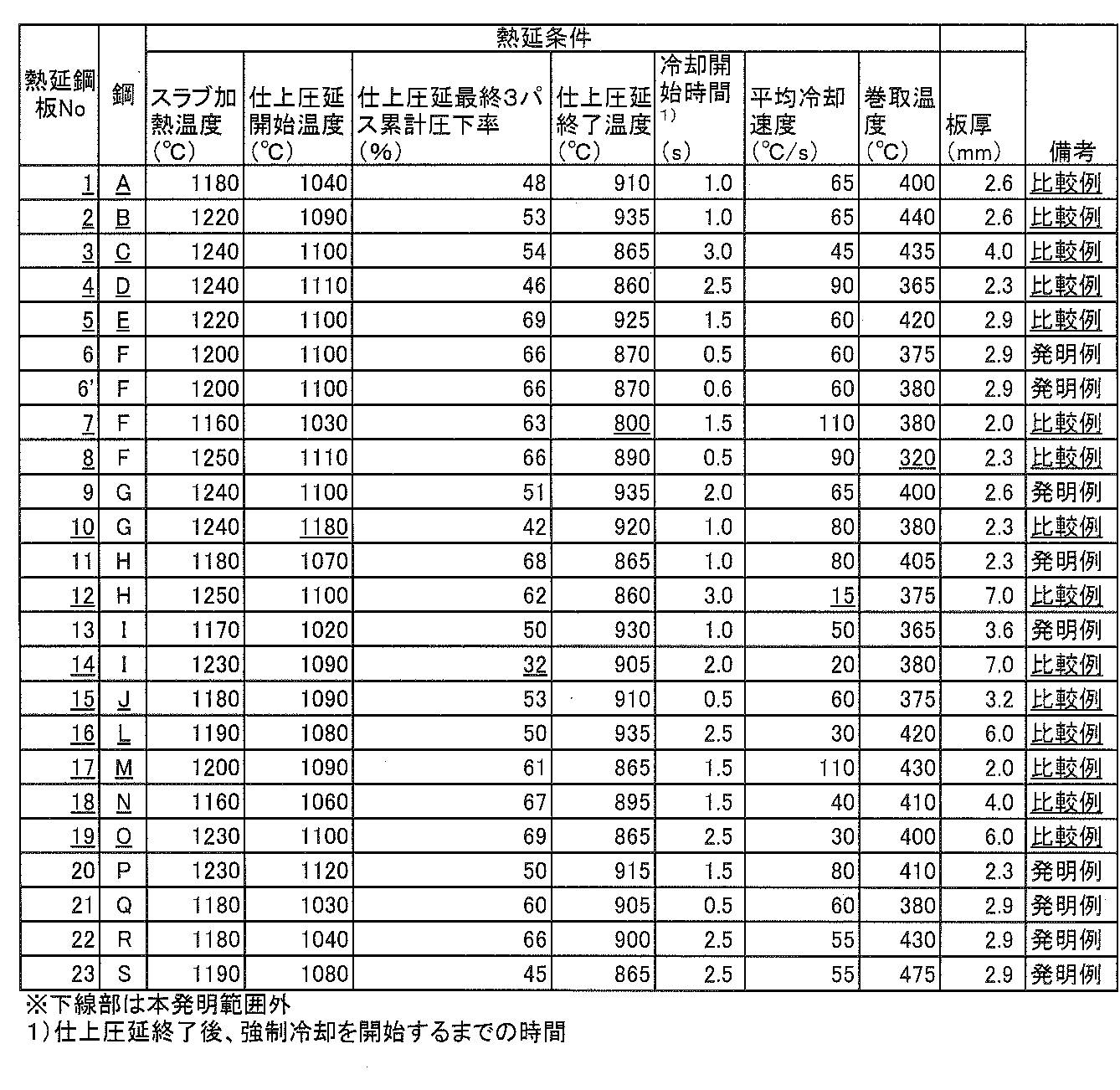
- these steel materials were heated under the conditions shown in Table 2 and subjected to hot rolling consisting of rough rolling and finish rolling under the conditions shown in Table 2.
- the steel sheet was cooled and wound under the conditions shown in Table 2 to obtain a hot-rolled steel sheet having the thickness shown in Table 2.
- Test pieces were collected from the hot-rolled steel sheet obtained as described above, and subjected to structure observation, tensile test, Charpy impact test, and punching test.
- the tissue observation method and various test methods are as follows.
- the grain size of the bainite phase was measured as follows using a measuring apparatus and crystal orientation analysis software (OIMData Analysis Ver. 6.2). After polishing the particle size measurement test piece, finish polishing was performed using a colloidal silica solution. Then, with the EBSD measurement device and crystal orientation analysis software, the plate thickness is 1/4 position and the plate thickness is 1/2 position (plate thickness) with a measurement area of 2500 ⁇ m 2 or more at an electron beam acceleration voltage of 20 kV and a measurement interval of 0.1 ⁇ m. At the center position, the orientation difference of each crystal grain was analyzed at three locations. The CI value (Confidence Index) at each measurement point was calculated by analysis software, and those having a CI value of 0.1 or less were excluded from the analysis of crystal grain size.
- OFIMData Analysis Ver. 6.2 After polishing the particle size measurement test piece, finish polishing was performed using a colloidal silica solution. Then, with the EBSD measurement device and crystal orientation analysis software, the plate thickness is 1/4 position and the plate thickness is 1/2
- a crystal grain boundary is formed as a large-angle grain boundary between measurement points where the orientation difference between two adjacent crystals is 15 ° or more, and a grain boundary map is created.
- draw 5 vertical and horizontal line segments of the grain boundary map count the number of crystal grains to be completely cut, and calculate the average value of the cut length of the bainite phase. The average particle size was taken.
- Interval between Fe carbides in bainitic ferrite grains and replica specimens size: 10mm x 15mm) from 1/4 position of the thickness of the hot-rolled steel sheet obtained, and replica by 2-stage replica method A film was prepared and Fe-based carbides were extracted.
- the extracted and extracted Fe-based carbide was observed using a transmission electron microscope (TEM), and five fields of view were photographed (magnification: 50000 times).
- TEM transmission electron microscope
- the average grain radius (r) of Fe carbide in the bainitic ferrite grains is measured, and the volume fraction (f) is obtained by image analysis.
- (L) was determined.
- L r (2 ⁇ / 3f) (1/2) -r (2)
- the Fe-based carbide was identified by energy dispersive X-ray spectroscopy (EDX) at the time of tissue photography.
- V notch A sub-size test piece (V notch) in which the thickness of the hot-rolled plate is the thickness of the test piece is taken so that the longitudinal direction of the test piece is perpendicular to the rolling direction.
- the Charpy impact test was performed in accordance with the provisions of JIS Z 2242, the ductile brittle fracture surface transition temperature (vTrs) was measured, and the toughness was evaluated. When the measured vTrs was ⁇ 60 ° C. or lower, the toughness was evaluated as good.
- the hot-rolled steel sheet of the invention example has a desired strength and excellent toughness in the entire thickness, and is a hot rolled steel sheet having good characteristics over the entire region in the thickness direction.
Landscapes
- Chemical & Material Sciences (AREA)
- Engineering & Computer Science (AREA)
- Mechanical Engineering (AREA)
- Materials Engineering (AREA)
- Metallurgy (AREA)
- Organic Chemistry (AREA)
- Physics & Mathematics (AREA)
- Thermal Sciences (AREA)
- Crystallography & Structural Chemistry (AREA)
- Manufacturing & Machinery (AREA)
- Heat Treatment Of Sheet Steel (AREA)
- Heat Treatment Of Steel (AREA)
Abstract
Description
[1]質量%で、C:0.060%以上0.140%以下、Si:1.00%以下、Mn:1.30%以上2.50%以下、P:0.030%以下、S:0.0050%以下、Al:0.070%以下、N:0.010%以下、Ti:0.060%以上0.140%以下、Cr:0.10%以上0.50%以下、B:0.0002%以上0.0020%以下を含み、かつC、Mn、Cr、Bが下記(1)式を満足するように含有し、残部がFeおよび不可避的不純物からなる成分組成を有し、組織は、主相として面積率で90%超のベイナイト相を含み、またはさらに、第2相としてフェライト相、マルテンサイト相および残留オーステナイト相のうちの1種または2種以上を面積率で合計10%未満含み、前記ベイナイト相の平均粒径が2.5μm以下、かつ、前記ベイナイト相中のベイニティックフェライト粒内に析出しているFe系炭化物の間隔が600nm以下であり、引張強さTSが980MPa以上であることを特徴とする高強度熱延鋼板。
記
5.0≦18C+Mn+1.3Cr+1500B≦6.0 (C、Mn、Cr、BはC、Mn、Cr、Bの含有量(質量%)を示す。)・・・(1)
[2]前記成分組成に加えて、更に、質量%で、V:0.05%以上0.50%以下、Nb:0.005%以上0.100%以下、Cu:0.01%以上0.40%以下、Ni:0.01%以上0.40%以下、Mo:0.01%以上0.40%以下のうちから選ばれる1種または2種以上を含有することを特徴とする前記[1]に記載の高強度熱延鋼板。
[3]前記成分組成に加えて、更に、質量%で、Ca:0.0002%以上0.0055%以下、REM:0.0002%以上0.0100%以下のうちから選ばれる1種または2種を含有することを特徴とする前記[1]または[2]に記載の高強度熱延鋼板。
[4]前記[1]ないし[3]のいずれか一項に記載の高強度熱延鋼板を製造する方法であって、鋼素材を1150℃以上に加熱し、粗圧延を施し、仕上圧延開始温度:950℃以上1130℃以下、仕上圧延最終3パスでの累積圧下率:40%以上、仕上圧延終了温度:830℃以上950℃以下とする仕上圧延を行い、仕上圧延終了後3.0s以内に冷却を開始し、平均冷却速度:20℃/s以上で冷却し、巻取り温度:350℃以上500℃以下で巻取ることを特徴とする高強度熱延鋼板の製造方法。
なお、本明細書において、鋼の成分を示す%はすべて質量%である。
また、本発明において、高強度熱延鋼板とは、引張強さ(TS)が980MPa以上である熱延鋼板である。
したがって、本発明の高強度熱延鋼板を、自動車の構造部材、骨格部材、あるいはトラックフレーム部材等に適用すれば、自動車の安全性を確保しつつ車体重量を軽減でき、環境負荷を低減することが可能となる。
また、輸送管として、厚鋼板を素材とするUOE鋼管に代わり、本発明の高強度熱延鋼板を素材とする溶接鋼管を適用することで、生産性が向上し、更なるコストダウンが可能となる。以上のように、本発明は、産業上極めて有用な発明である。
まず、本発明の高強度熱延鋼板の成分組成の限定理由について説明する。なお、以下の成分組成を表す%は、特に断らない限り質量%を意味するものとする。
Cは、鋼の強度を向上させ、ベイナイトの生成を促進し、また打抜き加工性を向上させるFe系炭化物を形成するために欠かせない元素である。そのため、本発明では、C含有量を0.060%以上とする必要がある。好ましくは0.070%以上であり、より好ましくは0.080%以上である。一方、C含有量が0.140%を超えると、ベイナイトの生成制御が困難となり、硬質なマルテンサイトの生成が増え、熱延鋼板の靭性が低下する。したがって、C含有量を0.060%以上0.140%以下とする。好ましくは0.130%以下であり、より好ましくは0.120%以下である。
Siは、靭性を低下させる粗大な酸化物やセメンタイトの生成を抑制し、固溶強化にも寄与する元素である。しかし、含有量が1.00%を超えると、打抜き加工性を向上させるFe系炭化物の析出を阻害する。さらには、熱延鋼板の表面性状が著しく劣化し、化成処理性や耐食性の低下を招く。したがって、Si含有量を1.00%以下とする。好ましくは0.90%以下であり、より好ましくは0.80%以下である。含有量の下限値は特に規定しないが、0.20%以上が好ましい。
Mnは、固溶して鋼の強度増加に寄与するとともに、焼入れ性を向上させ、ベイナイトの生成を促進し、ベイナイト粒内へのFe系炭化物析出を促進する元素である。このような効果を得るためには、Mn含有量を1.30%以上とする必要がある。一方、Mn含有量が2.50%を超えると、中央偏析が顕著になり、板厚中心部に硬質なマルテンサイト相を形成し、熱延鋼板の打抜き加工性と靭性が低下する。したがって、Mn含有量を1.30%以上2.50%以下とする。含有量の下限値について、好ましくは1.50%以上であり、より好ましくは1.70%以上である。含有量の上限値について、好ましくは2.20%以下であり、より好ましくは2.00%以下である。
Pは、固溶して鋼の強度増加に寄与する元素である。しかし、粒界、特に旧オーステナイト粒界に偏析し、低温靭性や加工性の低下を招く元素でもある。このため、P含有量を極力低減することが好ましいが、0.030%までの含有は許容できる。したがって、P含有量を0.030%以下とする。しかし、必要以上にPを低減しても精錬コストの増大に見合う効果が得られないため、好ましくは0.003%以上0.030%以下である。より好ましくは0.005%以上0.020%以下である。
Sは、TiやMnと結合して粗大な硫化物を形成し、熱延鋼板の打抜き加工性を低下させる。そのため、S含有量を極力低減することが好ましいが、0.0050%までの含有は許容できる。したがって、S含有量を0.0050%以下とする。打抜き加工性の点から好ましくは0.0040%以下である。より好ましくは0.0020%以下である。しかし、必要以上にSを低減しても精錬コストの増大に見合う効果が得られないため、好ましくは、0.0003%以上である。より好ましくは、0.0005%以上である。
Alは、脱酸剤として作用し、鋼の清浄度を向上させるのに有効な元素である。一方、Alの過剰な添加は酸化物系介在物の増加を招き、熱延鋼板の靭性を低下させるとともに、疵発生の原因となる。したがって、Al含有量を0.070%以下とする。好ましくは0.005%以上0.060%以下である。より好ましくは0.010%以上0.050%以下である。
Nは、窒化物形成元素と結合することにより窒化物として析出し、結晶粒微細化に寄与する。しかし、Nは、高温でTiと結合して粗大な窒化物になり易く、熱延鋼板の打抜き加工性を低下させる。このため、N含有量を0.010%以下とする。好ましくは、0.001%以上0.008%以下である。より好ましくは、0.002%以上0.006%以下である。
Tiは、炭窒化物を形成して結晶粒を微細化することにより熱延鋼板の靭性を向上させる。また、析出強化により、鋼の強度増加に寄与する。これらの効果を得るためには、Ti含有量を0.060%以上とする必要がある。一方、Ti含有量が0.140%を超えると、上記した効果が飽和するうえ、粗大な析出物の増加を招き、熱延鋼板の靭性低下を招く。したがって、Ti含有量は0.060%以上0.140%以下とする。含有量の下限値について、好ましくは0.080%以上であり、より好ましくは0.090%以上である。含有量の上限値について、好ましくは0.130%以下であり、より好ましくは0.120%以下である。
Crは、炭化物を形成して熱延鋼板の高強度化に寄与するとともに、焼入れ性を向上させてベイナイトの生成を促進し、ベイナイト粒内へのFe系炭化物析出を促進する元素である。これらの効果を得るためには、Cr含有量は0.10%以上とする。一方、Cr含有量が0.50%を超えると、靭性が低下するとともに、熱延鋼板の耐食性低下が懸念される。したがって、Cr含有量を0.10%以上0.50%以下とする。含有量の下限値について、好ましくは0.15%以上であり、より好ましくは0.20%以上である。含有量の上限値について、好ましくは0.45%以下であり、より好ましくは0.40%以下である。
Bは、オーステナイト粒界に偏析し、フェライトの生成・成長を抑制する元素である。また、Bは、焼入れ性を向上させベイナイト相の形成および微細化に寄与し、ベイナイト粒内へのFe系炭化物析出を促進する元素である。これらの効果を得るためには、B含有量を0.0002%以上とする。但し、B含有量が0.0020%を超えると、マルテンサイト相の生成を促進させるため、熱延鋼板の打抜き加工性と靭性が大幅に低下する。したがって、B含有量を0.0002%以上0.0020%以下とする。含有量の下限値について、好ましくは0.0004%以上であり、より好ましくは0.0006%以上である。含有量の上限値について、好ましくは0.0016%以下であり、より好ましくは0.0014%以下である。
5.0≦18C+Mn+1.3Cr+1500B≦6.0 (C、Mn、Cr、BはC、Mn、Cr、Bの含有量(質量%)を示す。)・・・(1)
を満足するようにC、Mn、Cr、Bの含有量を調整する。
Vは、炭窒化物を形成して結晶粒を微細化することにより熱延鋼板の靭性を向上させる。また析出強化により、鋼の強度増加に寄与する。これらの効果を得るためには、V含有量を0.05%以上とすることが好ましい。一方、V含有量が0.50%を超えると上記した効果が飽和する上にコスト高となる場合がある。したがって、含有させる場合、V含有量を0.05%以上0.50%以下とする。好ましくは、0.08%以上0.40%以下である。より好ましくは、0.10%以上0.30%以下である。
Nbは、炭窒化物の形成を介して鋼の強度増加に寄与する元素である。このような効果をを得るためには、Nb 含有量を0.005%以上とすることが好ましい。一方、Nb 含有量が0.100%を超えると、変形抵抗が増加するため、熱延鋼板製造時、熱間圧延の圧延荷重が増加し圧延機への負担が大きくなり過ぎて圧延操業そのものが困難になるおそれがある。また、Nb含有量が0.100%を超えると、粗大な析出物を形成して熱延鋼板の靭性が低下する傾向にある。したがって、含有させる場合、Nb含有量を0.005%以上0.100%以下とする。好ましくは、0.010%以上0.080%以下である。より好ましくは0.020%以上0.060%以下である。
Cuは、固溶して鋼の強度増加に寄与する元素である。また、Cuは、焼入れ性を向上させる作用を有し、特にベイナイト変態温度を低下させ、ベイナイト相の微細化に寄与し、ベイナイト粒内へのFe系炭化物析出を促進する元素である。これらの効果を得るためには、Cu含有量を0.01%以上とすることが好ましいが、その含有量が0.40%を超えると熱延鋼板の表面性状の低下を招く。したがって、含有させる場合、Cu含有量を0.01%以上0.40%以下とする。好ましくは、0.02%以上0.30%以下である。
Niは、固溶して鋼の強度増加に寄与する元素である。また、Niは、焼入れ性を向上させる作用を有し、ベイナイト相を形成し易くし、ベイナイト粒内へのFe系炭化物析出を促進する元素である。これらの効果を得るためには、Ni含有量を0.01%以上とすることが好ましい。但し、Ni含有量が0.40%を超えると、マルテンサイト相が生成し易くなり、熱延鋼板の打抜き加工性と靭性が大幅に低下するおそれがある。したがって、含有させる場合、Ni含有量は0.01%以上0.40%以下とする。好ましくは、0.02%以上0.30%以下である。
Moは、焼入れ性の向上を通じてベイナイト相の形成を促進し、ベイナイト粒内へのFe系炭化物析出を促進する元素である。このような効果を得るためには、Mo含有量を0.01%以上とすることが好ましい。但し、Mo含有量が0.40%を超えると、マルテンサイト相が生成し易くなり、熱延鋼板の打抜き加工性と靭性が低下するおそれがある。したがって、含有させる場合、Mo含有量を0.01%以上0.40%以下とする。好ましくは、0.02%以上0.30%以下である。
Caは、硫化物系の介在物の形状を制御し、熱延鋼板の打抜き加工性および靭性の向上に有効である。これらの効果を得るためには、Ca 含有量を0.0002%以上とすることが好ましい。但し、Ca含有量が0.0055%を超えると、熱延鋼板の表面欠陥を引き起こすおそれがある。したがって、含有させる場合、Ca含有量を0.0002%以上0.0055%以下とする。好ましくは0.0002%以上0.0050%以下であり、より好ましくは0.0004%以上0.0030%以下である。
REMは、Caと同様、硫化物系の介在物の形状を制御し、熱延鋼板の打抜き加工性および靭性に対する硫化物系介在物の悪影響を改善する。これらの効果を得るためには、REM含有量を0.0002%以上とすることが好ましい。但し、REM含有量が0.0100%を超えて過剰になると、鋼の清浄度が悪化し、熱延鋼板の靭性が低下する傾向にある。したがって、含有させる場合、REM含有量を0.0002%以上0.0100%以下とする。好ましくは、0.0004%以上0.0050%以下である。
本発明の高強度熱延鋼板は、主相として面積率で90%超のベイナイト相を含む。またはさらに、第2相としてフェライト相、マルテンサイト相および残留オーステナイト相のうちの1種または2種以上を面積率で合計10%未満含む。また、前記ベイナイト相の平均粒径が2.5μm以下、かつ、前記ベイナイト相中のベイニティックフェライト粒内に析出しているFe系炭化物の間隔が600nm以下である。
本発明の高強度熱延鋼板は、ベイナイト相を主相とする。ベイナイト相とは、ラス状のベイニティックフェライトと、ベイニティックフェライトの間および/又は内部にFe系炭化物を有する組織(Fe系炭化物の析出が全くない場合を含む)を意味する。ベイニティックフェライトは、ポリゴナルフェライトとは異なり、形状がラス状でかつ内部に比較的高い転位密度を有するため、SEM(走査型電子顕微鏡)やTEM(透過型電子顕微鏡)を用いて容易に区別ができる。ベイナイト相が90%超であり、かつ、ベイナイト相の平均粒径が2.5μm以下であれば所望の靭性を得ることができる。ベイナイト相が90%以下、あるいは平均粒径が2.5μmを超えると所望の靭性が得られない。したがって、ベイナイト相は、面積率で90%超とする。好ましくは92%以上、より好ましくは95%以上である。ベイナイト相を面積率で100%とし、ベイナイト単相組織とすることがさらに好ましい。ベイナイトの平均粒径は2.5μm以下とする。好ましくは2.3μm以下、より好ましくは、2.0μm以下である。
本発明の高強度熱延鋼板は、主相であるベイナイト相以外の組織として、フェライト相、マルテンサイト相および残留オーステナイト相のうちの1種または2種以上を第2相として含有し得る。所望の強度と靱性を有する熱延鋼板を得るために、その組織をベイナイト単相組織とすることが好ましい。しかし、第2相としてフェライト相、マルテンサイト相および残留オーステナイト相のうちの1種または2種以上を含有する場合であっても、これらの合計が面積率で10%未満であれば許容される。したがって、上記第2相は、面積率で合計10%未満とする。好ましくは8%以下、より好ましくは5%以下である。
主相であるベイナイト相中のベイニティックフェライト粒内に析出しているFe系炭化物の制御が、打抜き加工性の向上には重要である。ベイニティックフェライト粒内に析出しているFe系炭化物間隔が600nmを超えると、所望の優れた打抜き加工性を得ることができない。このため、ベイニティックフェライト粒内に析出しているFe系炭化物間隔は600nm以下とする。好ましくは、500nm以下であり、より好ましくは400nm以下である。
鋼素材の加熱温度:1150℃以上
スラブ等の鋼素材中では、Tiなどの炭窒化物形成元素の殆どが、粗大な炭窒化物として存在している。この粗大で不均一に鋼素材中に分布する析出物は、熱延鋼板の諸特性(例えば強度、打抜き加工性、靭性など)を劣化させる。そのため、熱間圧延前の鋼素材を加熱して、粗大な析出物を固溶させる。この粗大な析出物を熱間圧延前に十分に固溶させるためには、鋼素材の加熱温度を1150℃以上とする必要がある。また、鋼素材の加熱温度が高くなりすぎるとスラブ疵の発生や、スケールオフによる歩留まり低下を招くため、鋼素材の加熱温度は1350℃以下とすることが好ましい。より好ましくは1180℃以上1300℃以下であり、さらに好ましくは1200℃以上1280℃以下である。なお、本発明において、鋼素材の温度は表面温度とする。
仕上圧延開始温度が1130℃を超えると、オーステナイトを十分に細粒化できず、変態時に所望のベイナイト相の粒径が得られなくなる。また、仕上圧延開始温度が950℃未満では、仕上圧延の圧延荷重が増加し圧延機への負担が大きくなり過ぎて圧延操業そのものが困難になるおそれがある。そのため、仕上圧延開始温度は950℃以上1130℃以下とする。好ましくは、970℃以上1100℃である。より好ましくは、1000℃以上1080℃以下である。ここで、仕上圧延開始温度は、板の表面温度を表すものとする。
所望のベイニティックフェライト粒内のFe系炭化物間隔を得るためには、歪が十分に蓄積されたオーステナイトをベイナイト変態させることが必要である。そのため、本発明では仕上圧延最終3パスの累積圧下率を40%以上とする。仕上圧延の最終3パスの累積圧下率が40%未満では、オーステナイトへの歪蓄積が不十分で、変態後に所望のベイニティックフェライト粒内のFe系炭化物間隔が得られなくなる。好ましくは45%以上である。より好ましくは50%以上である。
仕上圧延終了温度が830℃未満では、圧延がフェライト+オーステナイトの二相域温度で行われるため、所望のベイナイト相分率が得られなくなり、熱延鋼板の打抜き加工性と靭性が低下する。一方、仕上圧延終了温度が950℃を超えて高くなると、オーステナイトの歪が回復してしまい、歪蓄積が不十分で変態後に得られる熱延鋼板のベイナイト相が粗大化する。その結果、所望の組織を得ることが困難となり、熱延鋼板の靭性が低下する。したがって、仕上圧延終了温度は830℃以上950℃以下とする。好ましくは、850℃以上930℃以下である。より好ましくは、870℃以上910℃以下である。ここで、仕上圧延終了温度は、板の表面温度を表すものとする。
仕上圧延を終了した後、3.0s以内に強制冷却を開始し、巻取り温度で冷却を停止し、コイル状に巻き取る。仕上圧延終了から強制冷却を開始するまでの時間が3.0sを超えて長くなると、オーステナイトに蓄積された歪の回復が進行して、ベイナイト相が粗大化する。これととともに、ベイニティックフェライト粒内のFe系炭化物間隔も疎になり、所望の組織を得られなくなる。そのため、所望の打抜き加工性と靭性が得られなくなる。したがって、強制冷却開始時間は、仕上圧延終了後3.0s以内に限定する。好ましくは2.0s以内である。より好ましくは、1.0s以内である。
なお、冷却手段として、水冷、空冷等、適宜選択することができる。
仕上圧延終了温度から巻取り温度までの平均冷却速度が20℃/s未満であると、ベイナイト変態の前にフェライト変態が起こり、所望の面積率のベイナイト相が得られない。また、ベイナイト相の平均粒径が粗大化するおそれがある。したがって、平均冷却速度は20℃/s以上とする。好ましくは30℃/s以上である。平均冷却速度の上限は特に規定しないが、平均冷却速度が大きくなりすぎると、表面温度が低下しすぎて、鋼板表面にマルテンサイトが生成しやすくなり、所望の靭性が得られなくなるため、平均冷却速度は120℃/s以下とすることが好ましい。なお、平均冷却速度は、鋼板の表面における平均冷却速度とする。
巻取り温度が350℃未満では、鋼板内部の組織に、硬質なマルテンサイト相が形成される。その結果、熱延鋼板を所望の組織とすることができず、所望の打抜き加工性と靭性が得られなくなる。一方、巻取り温度が500℃を超えると、鋼板内部の組織において、フェライトが増加する。その上、ベイナイト変態の駆動力が不足し、所望のベイニティックフェライト粒内の炭化物間隔が得られなくなり、熱延鋼板の靭性と打抜き加工性が低下する。そのため、巻取り温度は350℃以上500℃以下とする。好ましくは370℃以上470℃以下である。より好ましくは390℃以上450℃以下である。ここで、巻取り温度は、板の表面温度を表すものとする。
各組織の面積率
熱延鋼板から走査電子顕微鏡(SEM)用試験片を採取し、圧延方向に平行な板厚断面を研磨後、腐食液(3%ナイタール溶液)で組織を現出させ、板厚1/4位置および板厚1/2位置(板厚中央位置)にて走査電子顕微鏡(SEM)を用い、3000倍の倍率で各位置、3視野ずつ撮影して画像処理により各相の面積率を定量化した。
ベイナイト相の平均粒径
熱延鋼板からSEMを使用した電子線反射回折(Electron Backscatter Diffraction Patterns:EBSD)法による粒径測定用試験片を採取し、圧延方向に平行な面を観察面として、EBSD測定装置及び結晶方位解析ソフト(OIMData Analysis Ver.6.2)によって、次のようにベイナイト相の粒径を測定した。粒径測定用試験片を研磨後、コロイダルシリカ溶液を用いて仕上げ研磨を行った。そして、EBSD測定装置と、結晶方位解析ソフトによって、電子線の加速電圧20kV、測定間隔0.1μmステップで2500μm2以上の測定面積で、板厚1/4位置および板厚1/2位置(板厚中央位置)にて各結晶粒の方位差の解析を3箇所ずつ行った。解析ソフトにより各測定点のCI値(Confidence Index)を計算し、結晶粒径の解析からはCI値が0.1以下のものは除外した。結晶粒界は、二次元断面観察の結果、隣り合う2つの結晶間の配向方位差が15°以上となる測定点間を大角粒界とし、結晶粒界マップを作成し、JIS H 0501の切断法に準拠し、結晶粒界マップに対して、縦、横の所定長さの線分を5本ずつ引き、完全に切られる結晶粒数を数え、その切断長さの平均値をベイナイト相の平均粒径とした。
ベイニティックフェライト粒内のFe系炭化物間隔
また、得られた熱延鋼板の板厚1/4位置からレプリカ採取用試験片(大きさ:10mm×15mm)を採取し、2段レプリカ法によりレプリカ膜を作製し、Fe系炭化物を抽出した。次いで、透過型電子顕微鏡(TEM)を用いて、採取抽出されたFe系炭化物を観察し、5視野について撮影(倍率:50000倍)した。得られた組織写真を用いて、ベイニティックフェライト粒内のFe系炭化物の平均粒半径(r)を測定し、画像分析により体積率(f)を求め、(2)式によりFe系炭化物間隔(L)を求めた。
L=r(2π/3f)(1/2)-r ・・・(2)
なお、Fe系炭化物の同定は、組織写真撮影時にエネルギー分散型X線分光法(EDX)によって行った。
熱延鋼板から、引張方向が圧延方向と直角方向になるようにJIS5号試験片(GL:50mm)を採取し、JIS Z 2241(2011)の規定に準拠して引張試験を行い、降伏強度(降伏点、YP)、引張強さ(TS)、全伸び(El)を求めた。
熱延鋼板から、ブランク板(30mm×30mm)を採取した。そして打抜きポンチを10mmφの平底型として、打抜きクリアランスを10%、15%、20%、25%、30%となるようにダイ側の穴径を決定し、上から板押さえで固定してポンチ穴を打ち抜いた。打ち抜き後、ポンチ穴の全周にわたり、打抜き端面の破面状況をマイクロスコープ(倍率:50倍)で、割れ、欠け、脆性破面、2次せん断面等の有無を観察した。前記の5個のポンチ穴について、割れ、欠け、脆性破面、2次せん断面等がないポンチ穴が5個のものを◎(合格)、割れ、欠け、脆性破面、2次せん断面等がないポンチ穴が3~4個のものを○(合格)とし、それ以外(割れ、欠け、脆性破面、2次せん断面等がないポンチ穴が2~0個のものを×(不合格)として、打抜き加工性を評価した。
熱延鋼板から、試験片の長手方向が圧延方向と直角になるように、熱延板の板厚を試験片の厚さとしたサブサイズ試験片(Vノッチ)を採取し、JIS Z 2242の規定に準拠してシャルピー衝撃試験を行い、延性脆性破面遷移温度(vTrs)を測定し、靭性を評価した。測定されたvTrsが-60℃以下である場合を、靭性が良好であると評価した。


Claims (4)
- 質量%で、C:0.060%以上0.140%以下、Si:1.00%以下、Mn:1.30%以上2.50%以下、P:0.030%以下、S:0.0050%以下、Al:0.070%以下、N:0.010%以下、Ti:0.060%以上0.140%以下、Cr:0.10%以上0.50%以下、B:0.0002%以上0.0020%以下を含み、かつC、Mn、Cr、Bが下記(1)式を満足するように含有し、残部がFeおよび不可避的不純物からなる成分組成を有し、
組織は、主相として面積率で90%超のベイナイト相を含み、またはさらに、第2相としてフェライト相、マルテンサイト相および残留オーステナイト相のうちの1種または2種以上を面積率で合計10%未満含み、
前記ベイナイト相の平均粒径が2.5μm以下、かつ、前記ベイナイト相中のベイニティックフェライト粒内に析出しているFe系炭化物の間隔が600nm以下であり、
引張強さTSが980MPa以上であることを特徴とする高強度熱延鋼板。
記
5.0≦18C+Mn+1.3Cr+1500B≦6.0 (C、Mn、Cr、BはC、Mn、Cr、Bの含有量(質量%)を示す。)・・・(1) - 前記成分組成に加えて、更に、質量%で、V:0.05%以上0.50%以下、Nb:0.005%以上0.100%以下、Cu:0.01%以上0.40%以下、Ni:0.01%以上0.40%以下、Mo:0.01%以上0.40%以下のうちから選ばれる1種または2種以上を含有することを特徴とする請求項1に記載の高強度熱延鋼板。
- 前記成分組成に加えて、更に、質量%で、Ca:0.0002%以上0.0055%以下、REM:0.0002%以上0.0100%以下のうちから選ばれる1種または2種を含有することを特徴とする請求項1または2に記載の高強度熱延鋼板。
- 請求項1ないし3のいずれか一項に記載の高強度熱延鋼板を製造する方法であって、
鋼素材を1150℃以上に加熱し、粗圧延を施し、
仕上圧延開始温度:950℃以上1130℃以下、仕上圧延最終3パスでの累積圧下率:40%以上、仕上圧延終了温度:830℃以上950℃以下とする仕上圧延を行い、仕上圧延終了後3.0s以内に冷却を開始し、平均冷却速度:20℃/s以上で冷却し、巻取り温度:350℃以上500℃以下で巻取ることを特徴とする高強度熱延鋼板の製造方法。
Priority Applications (6)
| Application Number | Priority Date | Filing Date | Title |
|---|---|---|---|
| MX2016011083A MX385708B (es) | 2014-02-27 | 2015-02-17 | Lámina de acero laminada en caliente de alta resistencia y método para la fabricación de la misma. |
| CN201580010847.0A CN106103770B (zh) | 2014-02-27 | 2015-02-17 | 高强度热轧钢板及其制造方法 |
| EP15754845.4A EP3112488B1 (en) | 2014-02-27 | 2015-02-17 | High-strength hot-rolled steel sheet and manufacturing method therefor |
| US15/121,159 US11345972B2 (en) | 2014-02-27 | 2015-02-17 | High-strength hot-rolled steel sheet and method for manufacturing the same |
| JP2015530221A JP5967311B2 (ja) | 2014-02-27 | 2015-02-17 | 高強度熱延鋼板およびその製造方法 |
| KR1020167026523A KR101910444B1 (ko) | 2014-02-27 | 2015-02-17 | 고강도 열연 강판 및 그의 제조 방법 |
Applications Claiming Priority (2)
| Application Number | Priority Date | Filing Date | Title |
|---|---|---|---|
| JP2014036569 | 2014-02-27 | ||
| JP2014-036569 | 2014-02-27 |
Publications (1)
| Publication Number | Publication Date |
|---|---|
| WO2015129199A1 true WO2015129199A1 (ja) | 2015-09-03 |
Family
ID=54008536
Family Applications (1)
| Application Number | Title | Priority Date | Filing Date |
|---|---|---|---|
| PCT/JP2015/000729 Ceased WO2015129199A1 (ja) | 2014-02-27 | 2015-02-17 | 高強度熱延鋼板およびその製造方法 |
Country Status (7)
| Country | Link |
|---|---|
| US (1) | US11345972B2 (ja) |
| EP (1) | EP3112488B1 (ja) |
| JP (1) | JP5967311B2 (ja) |
| KR (1) | KR101910444B1 (ja) |
| CN (1) | CN106103770B (ja) |
| MX (1) | MX385708B (ja) |
| WO (1) | WO2015129199A1 (ja) |
Cited By (16)
| Publication number | Priority date | Publication date | Assignee | Title |
|---|---|---|---|---|
| WO2017017933A1 (ja) * | 2015-07-27 | 2017-02-02 | Jfeスチール株式会社 | 高強度熱延鋼板およびその製造方法 |
| KR101758528B1 (ko) * | 2015-12-23 | 2017-07-17 | 주식회사 포스코 | 재질 편차가 작은 파이프용 강재, 그 제조방법 및 이를 이용한 용접강관의 제조방법 |
| WO2018003128A1 (en) * | 2016-06-29 | 2018-01-04 | Jfe Steel Corporation | Method of separately visualizing austenite phase, martensite phase and bainitic-ferrite matrix in bainitic steel and bainitic steel specimen for microstructure observation |
| JP2018003062A (ja) * | 2016-06-29 | 2018-01-11 | Jfeスチール株式会社 | 高強度高加工性熱延鋼板およびその製造方法 |
| EP3406748A4 (en) * | 2016-01-22 | 2018-11-28 | JFE Steel Corporation | High-strength steel sheet and manufacturing method therefor |
| JP2019508572A (ja) * | 2016-03-30 | 2019-03-28 | タタ スチール リミテッド | 引張強度が1000〜1200MPaであり、かつ全伸びが16〜17%である高強度熱間圧延鋼(HRHSS) |
| CN109890994A (zh) * | 2016-10-27 | 2019-06-14 | 杰富意钢铁株式会社 | 无取向性电磁钢板及其制造方法 |
| WO2020026594A1 (ja) * | 2018-07-31 | 2020-02-06 | Jfeスチール株式会社 | 高強度熱延めっき鋼板 |
| WO2021090642A1 (ja) * | 2019-11-06 | 2021-05-14 | 日本製鉄株式会社 | 熱延鋼板およびその製造方法 |
| WO2021117705A1 (ja) | 2019-12-09 | 2021-06-17 | 日本製鉄株式会社 | 熱延鋼板 |
| WO2021117711A1 (ja) | 2019-12-09 | 2021-06-17 | 日本製鉄株式会社 | 熱延鋼板 |
| WO2021182395A1 (ja) * | 2020-03-11 | 2021-09-16 | 日本製鉄株式会社 | 熱延鋼板 |
| US11214847B2 (en) | 2016-01-27 | 2022-01-04 | Jfe Steel Corporation | High-strength hot-rolled steel sheet for electric resistance welded steel pipe and manufacturing method therefor |
| JP2023509410A (ja) * | 2019-12-31 | 2023-03-08 | 宝山鋼鉄股▲分▼有限公司 | 低ケイ素低炭素当量ギガパスカル級多相鋼板/鋼帯及びその製造方法 |
| JP2023539648A (ja) * | 2020-08-31 | 2023-09-15 | 宝山鋼鉄股▲分▼有限公司 | 980MPaレベルの全ベイナイト型超高穴拡げ性鋼及びその製造方法 |
| WO2026070558A1 (ja) * | 2024-09-26 | 2026-04-02 | Jfeスチール株式会社 | 高強度熱延鋼板、部材、およびそれらの製造方法 |
Families Citing this family (27)
| Publication number | Priority date | Publication date | Assignee | Title |
|---|---|---|---|---|
| JP6394841B1 (ja) * | 2017-02-17 | 2018-09-26 | Jfeスチール株式会社 | 高強度熱延鋼板およびその製造方法 |
| WO2018215813A1 (en) * | 2017-05-22 | 2018-11-29 | Arcelormittal | Method for producing a steel part and corresponding steel part |
| JP7129807B2 (ja) * | 2018-03-30 | 2022-09-02 | 大阪瓦斯株式会社 | パンチ孔形成方法及びパンチ孔形成装置 |
| CN108486505B (zh) * | 2018-05-14 | 2020-04-07 | 东北大学 | 1200MPa级硅锰铬系热轧低碳钢板及其制备方法 |
| KR102098482B1 (ko) | 2018-07-25 | 2020-04-07 | 주식회사 포스코 | 내충돌 특성이 우수한 고강도 강판 및 이의 제조방법 |
| JP6773252B2 (ja) * | 2018-10-19 | 2020-10-21 | 日本製鉄株式会社 | 熱延鋼板 |
| CN112840045B (zh) * | 2018-10-19 | 2023-06-16 | 日本制铁株式会社 | 热轧钢板及其制造方法 |
| KR102221452B1 (ko) * | 2019-05-03 | 2021-03-02 | 주식회사 포스코 | 전단가공성이 우수한 초고강도 강판 및 그 제조방법 |
| DE102019122515A1 (de) * | 2019-08-21 | 2021-02-25 | Ilsenburger Grobblech Gmbh | Verfahren zur Herstellung von hochfesten Blechen oder Bändern aus einem niedrig legierten, hochfesten bainitischen Stahl sowie ein Stahlband oder Stahlblech hieraus |
| US12241135B2 (en) | 2019-12-18 | 2025-03-04 | Posco Co., Ltd | High-strength hot-rolled steel sheet having excellent blanking properties and uniformity, and manufacturing method thereof |
| WO2021123888A1 (en) | 2019-12-19 | 2021-06-24 | Arcelormittal | Cold rolled and heat-treated steel sheet and method of manufacturing the same |
| WO2021123887A1 (en) * | 2019-12-19 | 2021-06-24 | Arcelormittal | High toughness hot rolled steel sheet and method of manufacturing the same |
| WO2021123889A1 (en) | 2019-12-19 | 2021-06-24 | Arcelormittal | Hot rolled and heat-treated steel sheet and method of manufacturing the same |
| WO2021123886A1 (en) | 2019-12-19 | 2021-06-24 | Arcelormittal | High toughness hot rolled and annealed steel sheet and method of manufacturing the same |
| KR102328392B1 (ko) * | 2019-12-20 | 2021-11-19 | 주식회사 포스코 | 펀칭 가공부 단면품질이 우수한 초고강도 강판 및 그 제조방법 |
| KR20220149776A (ko) * | 2020-03-13 | 2022-11-08 | 타타 스틸 네덜란드 테크날러지 베.뷔. | 강 물품 및 그 제조 방법 |
| JP6973694B1 (ja) * | 2020-03-17 | 2021-12-01 | Jfeスチール株式会社 | 高強度鋼板およびその製造方法 |
| CN115398021B (zh) * | 2020-04-17 | 2023-11-14 | 日本制铁株式会社 | 高强度热轧钢板 |
| CN114107785B (zh) * | 2020-08-27 | 2022-10-21 | 宝山钢铁股份有限公司 | 一种具有超高屈强比的吉帕级贝氏体钢及其制造方法 |
| CN114107798A (zh) * | 2020-08-31 | 2022-03-01 | 宝山钢铁股份有限公司 | 一种980MPa级贝氏体高扩孔钢及其制造方法 |
| WO2023162381A1 (ja) * | 2022-02-28 | 2023-08-31 | Jfeスチール株式会社 | 鋼板、部材、それらの製造方法、冷延鋼板用熱延鋼板の製造方法及び冷延鋼板の製造方法 |
| CN117265376A (zh) * | 2022-06-14 | 2023-12-22 | 宝山钢铁股份有限公司 | 一种1000MPa级高扩孔热轧复相钢钢板及其制造方法 |
| CN115386783B (zh) * | 2022-08-29 | 2023-10-03 | 东北大学 | 一种屈服强度1000MPa级超高强钢板及其制备方法 |
| CN115354237B (zh) * | 2022-08-29 | 2023-11-14 | 东北大学 | 抗拉强度1000MPa级热轧超高强钢板及其制备方法 |
| US20260110064A1 (en) * | 2022-09-29 | 2026-04-23 | Jfe Steel Corporation | Steel pipe with good fatigue property in hydrogen and method for producing the same, and steel material and method for producing the same |
| CN119923487A (zh) * | 2022-09-29 | 2025-05-02 | 杰富意钢铁株式会社 | 耐氢脆化特性优异的管线管用钢管、其制造方法、管线管用钢材及其制造方法 |
| CN121204519A (zh) * | 2024-06-26 | 2025-12-26 | 宝山钢铁股份有限公司 | 一种汽车冷成型用超高强钢及其制造方法 |
Citations (4)
| Publication number | Priority date | Publication date | Assignee | Title |
|---|---|---|---|---|
| JP2012062561A (ja) * | 2010-09-17 | 2012-03-29 | Jfe Steel Corp | 耐疲労特性に優れた高強度熱延鋼板およびその製造方法 |
| JP2012251200A (ja) * | 2011-06-02 | 2012-12-20 | Sumitomo Metal Ind Ltd | 熱延鋼板の製造方法 |
| WO2014171063A1 (ja) * | 2013-04-15 | 2014-10-23 | Jfeスチール株式会社 | 高強度熱延鋼板およびその製造方法 |
| WO2014171062A1 (ja) * | 2013-04-15 | 2014-10-23 | Jfeスチール株式会社 | 高強度熱延鋼板およびその製造方法 |
Family Cites Families (18)
| Publication number | Priority date | Publication date | Assignee | Title |
|---|---|---|---|---|
| JPS54132421A (en) | 1978-04-05 | 1979-10-15 | Nippon Steel Corp | Manufacture of high toughness bainite high tensile steel plate with superior weldability |
| JP2001220647A (ja) * | 2000-02-04 | 2001-08-14 | Kawasaki Steel Corp | 加工性に優れた高強度冷延鋼板およびその製造方法 |
| US6364968B1 (en) | 2000-06-02 | 2002-04-02 | Kawasaki Steel Corporation | High-strength hot-rolled steel sheet having excellent stretch flangeability, and method of producing the same |
| JP4630158B2 (ja) | 2005-08-23 | 2011-02-09 | 株式会社神戸製鋼所 | 低降伏比高強度高靭性鋼板の製造方法 |
| JP5251089B2 (ja) | 2006-12-04 | 2013-07-31 | 新日鐵住金株式会社 | 低温靱性に優れた高強度厚肉ラインパイプ用溶接鋼管及びその製造方法 |
| JP5200984B2 (ja) | 2008-04-21 | 2013-06-05 | Jfeスチール株式会社 | 780MPa以上の引張強度を有する高強度熱延鋼板の製造方法 |
| WO2010131303A1 (ja) * | 2009-05-11 | 2010-11-18 | 新日本製鐵株式会社 | 打抜き加工性と疲労特性に優れた熱延鋼板、溶融亜鉛めっき鋼板、およびそれらの製造方法 |
| CN102639734A (zh) | 2009-11-25 | 2012-08-15 | 杰富意钢铁株式会社 | 高压缩强度和耐酸性优异的管线管用焊接钢管及其制造方法 |
| JP5883211B2 (ja) * | 2010-01-29 | 2016-03-09 | 株式会社神戸製鋼所 | 加工性に優れた高強度冷延鋼板およびその製造方法 |
| JP4978741B2 (ja) | 2010-05-31 | 2012-07-18 | Jfeスチール株式会社 | 伸びフランジ性および耐疲労特性に優れた高強度熱延鋼板およびその製造方法 |
| KR20120001016A (ko) | 2010-06-29 | 2012-01-04 | 현대제철 주식회사 | 구멍확장성을 갖는 1000MPa급 열연강판 제조방법 |
| JP5029748B2 (ja) * | 2010-09-17 | 2012-09-19 | Jfeスチール株式会社 | 靭性に優れた高強度熱延鋼板およびその製造方法 |
| JP5029749B2 (ja) | 2010-09-17 | 2012-09-19 | Jfeスチール株式会社 | 曲げ加工性に優れた高強度熱延鋼板およびその製造方法 |
| EP2698440B1 (en) * | 2011-04-13 | 2018-05-30 | Nippon Steel & Sumitomo Metal Corporation | High-strength hot-rolled steel sheet with excellent local deformability, and manufacturing method therefor |
| JP5605310B2 (ja) * | 2011-06-07 | 2014-10-15 | 新日鐵住金株式会社 | 鋼材および衝撃吸収部材 |
| WO2013042239A1 (ja) * | 2011-09-22 | 2013-03-28 | 新日鐵住金株式会社 | 冷間加工用中炭素鋼板及びその製造方法 |
| EP2664682A1 (de) | 2012-05-16 | 2013-11-20 | ThyssenKrupp Steel Europe AG | Stahl für die Herstellung eines Stahlbauteils, daraus bestehendes Stahlflachprodukt, daraus hergestelltes Bauteil und Verfahren zu dessen Herstellung |
| JP5553093B2 (ja) | 2012-08-09 | 2014-07-16 | Jfeスチール株式会社 | 低温靭性に優れた厚肉高張力熱延鋼板 |
-
2015
- 2015-02-17 MX MX2016011083A patent/MX385708B/es unknown
- 2015-02-17 US US15/121,159 patent/US11345972B2/en active Active
- 2015-02-17 KR KR1020167026523A patent/KR101910444B1/ko active Active
- 2015-02-17 EP EP15754845.4A patent/EP3112488B1/en active Active
- 2015-02-17 WO PCT/JP2015/000729 patent/WO2015129199A1/ja not_active Ceased
- 2015-02-17 CN CN201580010847.0A patent/CN106103770B/zh active Active
- 2015-02-17 JP JP2015530221A patent/JP5967311B2/ja active Active
Patent Citations (4)
| Publication number | Priority date | Publication date | Assignee | Title |
|---|---|---|---|---|
| JP2012062561A (ja) * | 2010-09-17 | 2012-03-29 | Jfe Steel Corp | 耐疲労特性に優れた高強度熱延鋼板およびその製造方法 |
| JP2012251200A (ja) * | 2011-06-02 | 2012-12-20 | Sumitomo Metal Ind Ltd | 熱延鋼板の製造方法 |
| WO2014171063A1 (ja) * | 2013-04-15 | 2014-10-23 | Jfeスチール株式会社 | 高強度熱延鋼板およびその製造方法 |
| WO2014171062A1 (ja) * | 2013-04-15 | 2014-10-23 | Jfeスチール株式会社 | 高強度熱延鋼板およびその製造方法 |
Cited By (41)
| Publication number | Priority date | Publication date | Assignee | Title |
|---|---|---|---|---|
| JPWO2017017933A1 (ja) * | 2015-07-27 | 2017-08-03 | Jfeスチール株式会社 | 高強度熱延鋼板およびその製造方法 |
| WO2017017933A1 (ja) * | 2015-07-27 | 2017-02-02 | Jfeスチール株式会社 | 高強度熱延鋼板およびその製造方法 |
| CN107849663A (zh) * | 2015-07-27 | 2018-03-27 | 杰富意钢铁株式会社 | 高强度热轧钢板及其制造方法 |
| CN116162857A (zh) * | 2015-07-27 | 2023-05-26 | 杰富意钢铁株式会社 | 高强度热轧钢板及其制造方法 |
| US11578375B2 (en) | 2015-07-27 | 2023-02-14 | Jfe Steel Corporation | High-strength hot-rolled steel sheet and method for manufacturing the same |
| KR101758528B1 (ko) * | 2015-12-23 | 2017-07-17 | 주식회사 포스코 | 재질 편차가 작은 파이프용 강재, 그 제조방법 및 이를 이용한 용접강관의 제조방법 |
| US10941476B2 (en) | 2016-01-22 | 2021-03-09 | Jfe Steel Corporation | High strength steel sheet and method for producing the same |
| EP3406748A4 (en) * | 2016-01-22 | 2018-11-28 | JFE Steel Corporation | High-strength steel sheet and manufacturing method therefor |
| US11214847B2 (en) | 2016-01-27 | 2022-01-04 | Jfe Steel Corporation | High-strength hot-rolled steel sheet for electric resistance welded steel pipe and manufacturing method therefor |
| JP2019508572A (ja) * | 2016-03-30 | 2019-03-28 | タタ スチール リミテッド | 引張強度が1000〜1200MPaであり、かつ全伸びが16〜17%である高強度熱間圧延鋼(HRHSS) |
| JP2018525604A (ja) * | 2016-06-29 | 2018-09-06 | Jfeスチール株式会社 | ベイナイト鋼中のオーステナイト相、マルテンサイト相、及びベイナイト‐フェライトマトリックスの分離可視化方法及び組織観察用ベイナイト鋼片 |
| JP2018003062A (ja) * | 2016-06-29 | 2018-01-11 | Jfeスチール株式会社 | 高強度高加工性熱延鋼板およびその製造方法 |
| WO2018003128A1 (en) * | 2016-06-29 | 2018-01-04 | Jfe Steel Corporation | Method of separately visualizing austenite phase, martensite phase and bainitic-ferrite matrix in bainitic steel and bainitic steel specimen for microstructure observation |
| CN109890994A (zh) * | 2016-10-27 | 2019-06-14 | 杰富意钢铁株式会社 | 无取向性电磁钢板及其制造方法 |
| US11056256B2 (en) | 2016-10-27 | 2021-07-06 | Jfe Steel Corporation | Non-oriented electrical steel sheet and method of producing same |
| WO2020026594A1 (ja) * | 2018-07-31 | 2020-02-06 | Jfeスチール株式会社 | 高強度熱延めっき鋼板 |
| US11732340B2 (en) | 2018-07-31 | 2023-08-22 | Jfe Steel Corporation | High-strength hot-rolled coated steel sheet |
| JP6669319B1 (ja) * | 2018-07-31 | 2020-03-18 | Jfeスチール株式会社 | 高強度熱延めっき鋼板及びその製造方法 |
| JPWO2021090642A1 (ja) * | 2019-11-06 | 2021-05-14 | ||
| JP7243854B2 (ja) | 2019-11-06 | 2023-03-22 | 日本製鉄株式会社 | 熱延鋼板およびその製造方法 |
| WO2021090642A1 (ja) * | 2019-11-06 | 2021-05-14 | 日本製鉄株式会社 | 熱延鋼板およびその製造方法 |
| JP7277833B2 (ja) | 2019-12-09 | 2023-05-19 | 日本製鉄株式会社 | 熱延鋼板 |
| JPWO2021117705A1 (ja) * | 2019-12-09 | 2021-06-17 | ||
| KR20220062603A (ko) | 2019-12-09 | 2022-05-17 | 닛폰세이테츠 가부시키가이샤 | 열연 강판 |
| KR20220066348A (ko) | 2019-12-09 | 2022-05-24 | 닛폰세이테츠 가부시키가이샤 | 열연 강판 |
| US12606895B2 (en) | 2019-12-09 | 2026-04-21 | Nippon Steel Corporation | Hot-rolled steel sheet |
| JP7188618B2 (ja) | 2019-12-09 | 2022-12-13 | 日本製鉄株式会社 | 熱延鋼板 |
| US12203148B2 (en) | 2019-12-09 | 2025-01-21 | Nippon Steel Corporation | Hot-rolled steel sheet |
| WO2021117705A1 (ja) | 2019-12-09 | 2021-06-17 | 日本製鉄株式会社 | 熱延鋼板 |
| JPWO2021117711A1 (ja) * | 2019-12-09 | 2021-06-17 | ||
| WO2021117711A1 (ja) | 2019-12-09 | 2021-06-17 | 日本製鉄株式会社 | 熱延鋼板 |
| JP2023509410A (ja) * | 2019-12-31 | 2023-03-08 | 宝山鋼鉄股▲分▼有限公司 | 低ケイ素低炭素当量ギガパスカル級多相鋼板/鋼帯及びその製造方法 |
| JP7439265B2 (ja) | 2019-12-31 | 2024-02-27 | 宝山鋼鉄股▲分▼有限公司 | 低ケイ素低炭素当量ギガパスカル級多相鋼板/鋼帯及びその製造方法 |
| JPWO2021182395A1 (ja) * | 2020-03-11 | 2021-09-16 | ||
| JP7348574B2 (ja) | 2020-03-11 | 2023-09-21 | 日本製鉄株式会社 | 熱延鋼板 |
| CN115244203B (zh) * | 2020-03-11 | 2023-11-21 | 日本制铁株式会社 | 热轧钢板 |
| WO2021182395A1 (ja) * | 2020-03-11 | 2021-09-16 | 日本製鉄株式会社 | 熱延鋼板 |
| CN115244203A (zh) * | 2020-03-11 | 2022-10-25 | 日本制铁株式会社 | 热轧钢板 |
| JP2023539648A (ja) * | 2020-08-31 | 2023-09-15 | 宝山鋼鉄股▲分▼有限公司 | 980MPaレベルの全ベイナイト型超高穴拡げ性鋼及びその製造方法 |
| JP7594662B2 (ja) | 2020-08-31 | 2024-12-04 | 宝山鋼鉄股▲分▼有限公司 | 980MPaレベルの全ベイナイト型超高穴拡げ性鋼及びその製造方法 |
| WO2026070558A1 (ja) * | 2024-09-26 | 2026-04-02 | Jfeスチール株式会社 | 高強度熱延鋼板、部材、およびそれらの製造方法 |
Also Published As
| Publication number | Publication date |
|---|---|
| EP3112488A1 (en) | 2017-01-04 |
| US11345972B2 (en) | 2022-05-31 |
| EP3112488A4 (en) | 2017-03-22 |
| KR101910444B1 (ko) | 2018-10-22 |
| MX385708B (es) | 2025-03-18 |
| CN106103770A (zh) | 2016-11-09 |
| KR20160126050A (ko) | 2016-11-01 |
| JPWO2015129199A1 (ja) | 2017-03-30 |
| JP5967311B2 (ja) | 2016-08-10 |
| CN106103770B (zh) | 2018-04-10 |
| MX2016011083A (es) | 2016-11-25 |
| US20170009316A1 (en) | 2017-01-12 |
| EP3112488B1 (en) | 2019-05-08 |
Similar Documents
| Publication | Publication Date | Title |
|---|---|---|
| JP5967311B2 (ja) | 高強度熱延鋼板およびその製造方法 | |
| JP6394841B1 (ja) | 高強度熱延鋼板およびその製造方法 | |
| JP6252692B2 (ja) | 高強度熱延鋼板およびその製造方法 | |
| JP5672421B1 (ja) | 高強度熱延鋼板およびその製造方法 | |
| JP5812115B2 (ja) | 高張力熱延鋼板及びその製造方法 | |
| JPWO2020026593A1 (ja) | 高強度熱延鋼板およびその製造方法 | |
| JP5867444B2 (ja) | 靭性に優れた高強度熱延鋼板およびその製造方法 | |
| JP5834534B2 (ja) | 高一様伸び特性を備えた高強度低降伏比鋼、その製造方法、および高強度低降伏比溶接鋼管 | |
| WO2010087512A1 (ja) | 耐hic性に優れた厚肉高張力熱延鋼板及びその製造方法 | |
| CN105102662A (zh) | 高强度热轧钢板及其制造方法 | |
| JP5499731B2 (ja) | 耐hic性に優れた厚肉高張力熱延鋼板及びその製造方法 | |
| JP6056790B2 (ja) | 高強度熱延鋼板およびその製造方法 | |
| WO2012002566A1 (ja) | 加工性に優れた高強度鋼板およびその製造方法 | |
| JP5553093B2 (ja) | 低温靭性に優れた厚肉高張力熱延鋼板 | |
| JP5742123B2 (ja) | ラインパイプ用高強度溶接鋼管向け高張力熱延鋼板およびその製造方法 | |
| KR20170043662A (ko) | 전기 저항 용접 강관용 강대 및 전기 저항 용접 강관 그리고 전기 저항 용접 강관용 강대의 제조 방법 | |
| JP6119894B2 (ja) | 加工性に優れた高強度鋼板 | |
| JP7614484B2 (ja) | ラインパイプ用電縫鋼管、及びラインパイプ用熱延鋼板 | |
| JP5994262B2 (ja) | 加工性に優れた高強度鋼板の製造方法 |
Legal Events
| Date | Code | Title | Description |
|---|---|---|---|
| ENP | Entry into the national phase |
Ref document number: 2015530221 Country of ref document: JP Kind code of ref document: A |
|
| 121 | Ep: the epo has been informed by wipo that ep was designated in this application |
Ref document number: 15754845 Country of ref document: EP Kind code of ref document: A1 |
|
| WWE | Wipo information: entry into national phase |
Ref document number: 15121159 Country of ref document: US |
|
| WWE | Wipo information: entry into national phase |
Ref document number: MX/A/2016/011083 Country of ref document: MX |
|
| NENP | Non-entry into the national phase |
Ref country code: DE |
|
| ENP | Entry into the national phase |
Ref document number: 20167026523 Country of ref document: KR Kind code of ref document: A |
|
| WWE | Wipo information: entry into national phase |
Ref document number: IDP00201606440 Country of ref document: ID |
|
| REEP | Request for entry into the european phase |
Ref document number: 2015754845 Country of ref document: EP |
|
| WWE | Wipo information: entry into national phase |
Ref document number: 2015754845 Country of ref document: EP |