WO2015125462A1 - 経路探索装置、経路探索方法、コンピュータプログラム、および、データ構造 - Google Patents
経路探索装置、経路探索方法、コンピュータプログラム、および、データ構造 Download PDFInfo
- Publication number
- WO2015125462A1 WO2015125462A1 PCT/JP2015/000722 JP2015000722W WO2015125462A1 WO 2015125462 A1 WO2015125462 A1 WO 2015125462A1 JP 2015000722 W JP2015000722 W JP 2015000722W WO 2015125462 A1 WO2015125462 A1 WO 2015125462A1
- Authority
- WO
- WIPO (PCT)
- Prior art keywords
- link
- information
- node
- route search
- incoming
- Prior art date
- Legal status (The legal status is an assumption and is not a legal conclusion. Google has not performed a legal analysis and makes no representation as to the accuracy of the status listed.)
- Ceased
Links
Images


Classifications
-
- G—PHYSICS
- G01—MEASURING; TESTING
- G01C—MEASURING DISTANCES, LEVELS OR BEARINGS; SURVEYING; NAVIGATION; GYROSCOPIC INSTRUMENTS; PHOTOGRAMMETRY OR VIDEOGRAMMETRY
- G01C21/00—Navigation; Navigational instruments not provided for in groups G01C1/00 - G01C19/00
- G01C21/26—Navigation; Navigational instruments not provided for in groups G01C1/00 - G01C19/00 specially adapted for navigation in a road network
- G01C21/34—Route searching; Route guidance
- G01C21/3446—Details of route searching algorithms, e.g. Dijkstra, A*, arc-flags or using precalculated routes
-
- G—PHYSICS
- G06—COMPUTING OR CALCULATING; COUNTING
- G06F—ELECTRIC DIGITAL DATA PROCESSING
- G06F16/00—Information retrieval; Database structures therefor; File system structures therefor
- G06F16/90—Details of database functions independent of the retrieved data types
- G06F16/901—Indexing; Data structures therefor; Storage structures
- G06F16/9027—Trees
Definitions
- the present invention relates to a technique for performing a route search.
- Japanese Unexamined Patent Application Publication Nos. 2009-180500 and 2012-3343 disclose a technique for setting different costs for one road section between intersections depending on the direction of exit and the direction of entry. ing. According to such a technique, for example, it is possible to set different costs for a right turn and a straight road for one road, so it is necessary to search for a route that avoids a right turn traffic jam that occurs in a left-hand traffic area. Can do.
- traffic jams are not limited to cases that occur within one road section between intersections.
- a right turn traffic jam may occur across a plurality of road sections (see FIG. 6 of JP 2009-180500 A).
- the link immediately before the right turn is set as the correction target link.
- the cost is corrected during the route search.
- there is a high demand for a technique for searching for an optimum route and a technique capable of searching for a route that can avoid traffic congestion with higher accuracy than the technique described in Patent Document 1 is desired.
- the present invention has been made to solve at least a part of the problems described above, and can be realized as the following forms.
- a route search device supports network data including nodes and links representing a road network, single link information that is information associated with a corresponding link corresponding to one link, and a plurality of links across one or more nodes.
- a road information storage unit that stores road information including link information composed of composite link information that is information associated with the corresponding link string; a search branch that traces the node and the link based on the road information; The cumulative cost to reach the node of interest is given to the node of interest ahead of the search branch, and the cumulative cost that satisfies the predetermined condition is determined from the cumulative costs assigned to the node of interest.
- a route search unit that searches for a recommended route between two different points.
- the single link information includes an incoming link that is a link that enters a node at one end of the corresponding link, an outgoing link that is a link that exits from a node at the other end of the relevant link, and an outgoing link that enters from the incoming link.
- Information indicating the cost of the corresponding link when leaving the link may be included.
- the composite link information includes an incoming link that is a link that enters a node at one end of the corresponding link row, an outgoing link that is a link that exits from a node at the other end of the relevant link row, and an entry from the incoming link.
- Information indicating the cost of the corresponding link string in the case of exiting from the exit link may be included.
- the route search unit includes, from the road information, link information including an exit link of a confirmed node that is a node whose accumulated cost has already been confirmed as an applicable link, and an applicable link that reaches the confirmed node as an incoming link, You may extend the said search branch with respect to the node which exists in the other end of the applicable link or the applicable link row
- each of the single link information and the composite link information includes information indicating an incoming link and an outgoing link, and the composite link information includes a road across one or more nodes. A corresponding link column represented by a plurality of corresponding links is included. Therefore, when the cost of traffic congestion that occurs across multiple road sections is associated with the composite link information, the impact of right-turn traffic congestion or left-turn traffic congestion affects multiple links. In addition, the route can be searched with high accuracy based on the accurate cost.
- the route search device of the above aspect when one composite link information is stored in the road information storage unit, the composite link information, the incoming link, and the corresponding link string are common and different exits. Other composite link information having a link may be stored together, and in the road information storage unit, the composite link information and the approach link are common, and all the corresponding link columns of the composite link information The link information including the corresponding link and the leaving link may not be stored. According to such a form, the route represented by the composite link information is not represented by a combination of a plurality of link information having a shorter section. Therefore, since the cost set in the composite link information is accurately reflected in the route search, it is possible to accurately search for a route that can avoid traffic congestion.
- the route search unit when the route search unit includes a plurality of link information having a common outgoing link in the node of interest, and the routes of the plurality of link information match, A cumulative cost may be assigned to the node of interest based on the cost of link information including the most relevant link among the plurality of link information.
- a route search is performed based on the composite link information including more relevant links than the single link information. Therefore, the cost set in the composite link information is accurately reflected in the route search, and a route that can avoid traffic congestion can be searched with high accuracy.
- the route search unit may include one link information and other link information included in the plurality of link information having a common exit link, the corresponding link of the one link information, and When the incoming link has a relationship including the corresponding link of the other link information and the incoming link, it may be determined that the path of the one link information and the path of the other link information match. In such a form, it is not necessary to determine whether or not all routes to the node of interest match for one link information and other link information, so that route search can be performed efficiently.
- the present invention can also be realized in various forms other than the route search device.
- the present invention can be realized in the form of a route search method, a computer program, a data structure, a non-temporary tangible recording medium that records the computer program or the data structure, and the like.
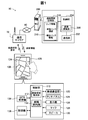
- FIG. 1 is an explanatory diagram showing a schematic configuration of a route search system 10 including a route search device 200 as the first embodiment of the present invention.
- the route search system 10 includes a smartphone 100 as a terminal device and a route search device 200 configured as a server device.
- the smartphone 100 can access the route search apparatus 200 connected to the Internet 80 via a communication carrier 70 including a transmission / reception antenna, a radio base station, and an exchange.
- a communication carrier 70 including a transmission / reception antenna, a radio base station, and an exchange.
- the route search system 10 may include a plurality of smartphones 100.
- the smartphone 100 includes a control unit 110, a wireless communication unit 120, a touch panel 124, a display unit 126, a microphone 128, a speaker 130, a GPS receiver 136, and a storage unit 138.
- the wireless communication unit 120 is a circuit for performing data communication and voice communication via the communication carrier 70.
- the display unit 126 is a device that displays various images such as a map image.
- the touch panel 124 is provided so as to overlap with the display unit 126, and accepts a touch operation from the user with a finger or a pen.
- the GPS receiver 136 measures the current position (longitude / latitude) of the smartphone 100 (user) based on radio waves received from artificial satellites constituting a GPS (Global Positioning System).
- the microphone 128 acquires a voice emitted from the user during voice communication.
- the speaker 130 outputs voice for route guidance and voice received from the other party during voice communication.
- the control part 110 is comprised as a computer provided with CPU and memory, and controls the whole operation
- FIG. The control unit 110 functions as a route search request unit 112 and a route guide unit 114 when the computer program recorded in the memory is executed by the CPU.
- the route search request unit 112 requests the route search device 200 through the wireless communication unit 120 to search for a recommended route between two different points (departure point and destination) designated by the user. Hereinafter, this request is referred to as a “route search request”. In response to this route search request, the route search device 200 transmits route information representing the route from the designated departure place to the destination. When the route search request unit 112 receives route information from the route search device 200, the route search request unit 112 stores the route information in the storage unit 138.
- the route guide unit 114 displays the route on the display unit 126 using the route information stored in the storage unit 138, displays the current position measured by the GPS receiver 136 on the display unit 126, and the user of the smartphone 100 Route guidance to.
- the route search apparatus 200 includes a communication unit 202, a control unit 204, and a road information storage unit 208.
- the communication unit 202 communicates with the smartphone 100 via the Internet 80.
- the road information storage unit 208 stores road network data in which road connection states are represented by nodes representing intersections and dead ends and links representing roads. A unique ID is assigned to each node and each link.
- the control unit 204 includes a CPU and a memory, and controls the entire operation of the route search apparatus 200.
- the control unit 204 functions as the route search unit 206 when the computer program stored in the memory is executed by the CPU.
- the computer program may be recorded on various recording media.
- the route search unit 206 When the route search unit 206 receives a route search request from the smartphone 100 through the communication unit 202, the route search unit 206 uses the road information stored in the road information storage unit 208 to perform a route search using a known Dijkstra method. Then, route information representing the searched route is transmitted to the smartphone 100 through the communication unit 202.
- the road information storage unit 208 stores road information including road network data including nodes and links representing the road network, and link information 210 associated with the links.
- the link information 210 includes single link information and composite link information.
- Single link information is information given to one road (link) existing between two adjacent nodes.
- the composite link information is information given to a road spanning one or more nodes, that is, a road section constituted by two or more continuous roads (link train).
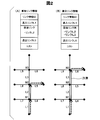
- FIG. 2 is an explanatory diagram showing the data structure of link information (single link information and composite link information).
- the single link information includes “link information ID”, “corresponding link” ID, “exit link” ID, “entry link” ID, “ Cost ”.
- the “link information ID” is a unique ID assigned to each single link information.
- the “corresponding link” represents one road existing between adjacent nodes.
- the “exit link” represents a road that exits from one end of the road represented by the link.
- the “entry link” represents a road that enters the other end of the road represented by the link.
- “Cost” represents an average travel time required to enter the corresponding link from the entry link and exit from the exit link.
- FIG. 2 is an explanatory diagram showing the data structure of link information (single link information and composite link information).
- the single link information includes “link information ID”, “corresponding link” ID, “exit link” ID, “entry link” ID, “ Cost ”.
- the “link information ID” is
- the corresponding link L2 existing between the node N1 and the node N2 is indicated by a solid line, the incoming link L1 entering the relevant link L2, and the outgoing link L5 exiting from the relevant link L2.
- the composite link information includes “link information ID”, “corresponding link string”, “exit link” ID, “entry link” ID, and “cost”. Is included.
- Link information ID is a unique ID assigned to the composite link information.
- the “corresponding link string” represents a road that crosses one or more nodes, and is configured by a plurality of link IDs.
- the “exit link” represents a road that exits from one end of the road represented by the link string.
- the “entry link” represents a road that enters the other end of the road represented by the corresponding link row.
- “Cost” represents an average travel time required to enter the link link from the entry link and exit to the exit link. In the lower part of FIG.
- the corresponding link row L2-L3 existing between the node N1 and the node N3 is indicated by a solid line
- the incoming link L1 entering the corresponding link row L2-L3 is indicated by a broken line
- the exit link L6 exiting from L2-L3 is indicated by a broken line.
- the composite link information is not stored for all combinations of the incoming link and the outgoing link, and in principle, is stored for the road section in which the entire link row is affected by the traffic jam. .
- the link represented by the composite link information is also referred to as “composite link”.
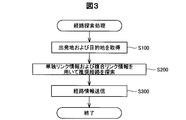
- FIG. 3 is a flowchart of route search processing executed by the route search device 200.
- the control unit 204 of the route search apparatus 200 receives a route search request from the route search request unit 112 of the smartphone 100 through the communication unit 202 (step S100).
- This route search request includes information indicating the departure place and the destination.
- the user designates a departure place and a destination using a predetermined GUI (graphical user interface) displayed on the display unit 126 of the smartphone 100.
- GUI graphical user interface
- the route search unit 206 searches for a recommended route connecting the starting point and the destination specified by the route search request using the single link information and the composite link information in the road information storage unit 216. (Step S200). That is, the route search unit 206 extends the search branch by following the nodes and links from the departure point to the destination, and for the attention node ahead of the search branch, the accumulated cost and the search branch until the node is reached. A candidate label representing (that is, the previous label) is assigned, and a label satisfying a predetermined condition (a label having the minimum cost in the present embodiment) is selected and confirmed from the assigned candidate labels. Then, the recommended route is obtained. When the route search ends, the route search unit 206 transmits route information representing the searched route to the smartphone 100 (step S300).
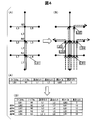
- FIG. 4 is an explanatory diagram showing a specific example of extending a search branch in the route search process of the present embodiment.
- the label given to each node is based on the link information shown in FIG. 2, the label number, the node number, the corresponding link, the outgoing link, the previous label number, Information indicating the total cost is recorded.
- the route search unit 206 includes road information including link information (single link information or composite link information) including the exit link L2 of the label LB1 as the corresponding link and including the corresponding link L1 of the label LB1 as the incoming link.
- candidate labels are assigned to the nodes that have been extended from the search branch based on the link information acquired from the storage unit 216 and acquired.
- candidate labels LB2, LB3, and LB4 are assigned to the node N2 based on the single link information
- the candidate label LB5 is assigned to the node N3 based on the composite link information.
- An example is shown.
- Labels LB2, LB3, and LB4 have a corresponding link L2 that is common, and have different exit links.
- the label LB5 includes two corresponding links L2 and L3, and has a link L6 as an exit link.
- FIG. 5 is an explanatory diagram showing a method for excluding unnecessary labels from candidate labels assigned to the node of interest in the route search processing of the present embodiment.
- the route search unit 206 compares the accumulated costs, and uses the label having the smallest accumulated cost as the candidate label of the node of interest. select. Labels not selected are excluded from candidate labels. By doing this, the search branch does not extend from a label with a large accumulated cost.
- the labels LB2, LB5, and LB6 assigned to the node N2 compete for combinations of the corresponding link (link L2) and the outgoing link (link L3). Therefore, the route search unit 206 compares the accumulated costs of these labels, selects the label LB2 having the smallest accumulated cost as a candidate label, and excludes the other labels LB5 and LB6 from the candidate labels.
- the branch of the search is extended from the departure point to each node, and the label that has the lowest cost is sequentially selected from the candidate labels assigned to each node. It will be confirmed. Then, a route connecting the corresponding links included in the determined label is searched as a recommended route.
- the link information stored in the road information storage unit 216 has the characteristics described below.
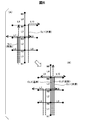
- FIG. 6 is a diagram showing the characteristics of the link information stored in the road information storage unit 216 in the present embodiment.
- the composite link information (CL1) when the composite link information (CL1) is stored for a certain road section (link L2-L3), as shown in FIG. 6 (B).
- other composite link information (CL2, CL3) in which the composite link information (CL1), the incoming link, and the corresponding link string are common and only the outgoing link is different are also included in the composite link information (CL2, CL3). Regardless of whether a traffic jam occurs in the section to be represented, it is also stored in the road information storage unit 216.
- link information A is included in link information B” means that the incoming links of link information A and link information B match, and the exit link of link information B and all corresponding links. Is included in the corresponding link row of link A.
- FIGS. 7 to 10 are diagrams showing specific examples of performing a route search using the link information shown in FIG.
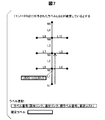
- the route search unit 206 extends a search branch from the confirmed label LB2.
- link information (single link information and composite link information) that has the same entry link as the corresponding link L1 of the label LB2 and includes the exit link L2 of the label LB2 from the corresponding link is acquired from the road information storage unit 216. Is done.
- FIG. 8 shows an example in which three types of composite link information having links L2 and L3 as the corresponding links and different exit links are acquired.
- Labels LB3, LB4, and LB5 are assigned to the node N4 based on the composite link information.
- the composite link information is stored in advance in the road information storage unit 216 as shown in FIG.
- FIG. 8 illustrates an example in which two types of single link information including the link L2 as the corresponding link and different exit links are acquired.
- Labels LB6 and LB7 are assigned to the node N3 based on the single link information.
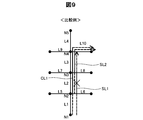
- the single link information acquired in this way does not include link information included in the composite link information acquired simultaneously. This is because the link information included in the composite link information is not stored in the road information storage unit 216 as shown in FIG.
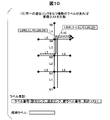
- the node since the single link information included in the composite link information is not stored in the road information storage unit 216, the node is labeled based on the single link information included in the composite link information. Will not be granted. Therefore, the single link information SL1 included in the composite link information CL1 as shown in FIG. 9 is not acquired in the example shown in FIG. Therefore, in the situation shown in FIG. 8, the search branch is not extended by a plurality of continuous link information SL1 and SL2 as shown in FIG. Therefore, the only candidate labels given to the node N4 at this time are the labels LB3, LB4, and LB5 corresponding to the composite link information. Furthermore, as shown in FIG. 10, when a label LB8 extending from a different route is given to the node of interest N4, the accumulated costs of the labels LB3 and LB8 are compared, and the route is selected.
- the cost of the route represented by the composite link information is generally larger than the total cost of the single link information included in the route. Therefore, when the cost based on the composite link information and the cost based on the plurality of single link information are compared for the same section, the composite link information reflecting the influence of the traffic jam is not selected, and the plurality of single links are selected. Information may be selected. If it does so, the cost of the composite link information in which the influence of traffic congestion was reflected will not be utilized for route search. However, in the present embodiment, as shown in FIG. 6, the link information included in the composite link information is not stored in the road information storage unit 216.
- the section represented by the composite link information is not represented by a combination of a plurality of pieces of link information having a shorter section. Therefore, since the cost set in the composite link information is accurately reflected in the route search, it is possible to accurately search for a route that can avoid traffic congestion. Further, in this embodiment, the route search is performed using not only the single link information but also the composite link information in which the costs are collectively assigned to a plurality of links. Therefore, there are a plurality of effects such as a right turn traffic jam and a left turn traffic jam. Even in the case of influence over links, an optimum route can be searched based on accurate cost (travel time). Furthermore, in this embodiment, since the link information included in the composite link information is deleted in advance from the road information storage unit 216, a route can be searched without performing special processing.
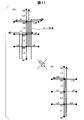
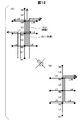
- FIG. 11 and FIG. 12 are diagrams for explaining other advantages according to the first embodiment.
- the composite link information is stored in the road information storage unit 216 for the section where the traffic jam occurs, not only the composite link information but also the outgoing link is different as shown in FIG. Other composite link information is also stored.
- FIG. 11 (A) when the composite link information CL1 is stored only for the section where the traffic jam occurs, and other composite link information with different exit links is not stored. Since the link information included in the composite link information CL1 has been deleted in advance, a route as shown in FIG. 11B (a route including the same incoming link as the composite link information CL1 and a different outgoing link) Can no longer be explored.
- the composite link information CL2 and CL3 as shown in FIG. 6B are also stored in the road information storage unit 216, by using these composite link information, FIG. ) Can be searched without any problem.
- the link information included in the composite link information is deleted in advance.
- “link information A is included in link information B” means that “entry links” of link information A and link information B match, and the exit link of link information B and all corresponding links A link is included in the corresponding link row of link A.
- the composite link information (CL1) matches the “exit link (L10)”, and the corresponding link column of the composite link information (CL1) corresponds.
- a route as shown in FIG. 12B (a route in which only the incoming link differs from the route represented by the composite link information) cannot be searched. Therefore, as in the present embodiment, it is possible to search for a route that is different only in the incoming link and the route represented by the composite link information, by using the condition that the incoming link is not the exit link but the inclusion condition. Is possible.
- Second embodiment In the second embodiment, the feature of the link information as shown in FIG. 6 is not adopted. That is, in the second embodiment, the composite link information is not stored in the road information storage unit 216 unless the road section represented by the composite link information is a road section where traffic congestion may occur. The link information included in the composite link information is not deleted from the road information storage unit 216 in advance, but is stored in the road information storage unit 216 as it is.
- step S200 of the route search processing shown in FIG. 3 processing for searching using single link information and composite link information in the road information storage unit 216. Different. Hereinafter, processing different from that of the first embodiment will be described.
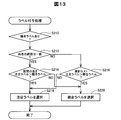
- FIG. 13 is a flowchart of the labeling process executed in the accounting search process of the second embodiment.
- the label assignment process is a process for assigning a candidate label to the node of interest.
- the route search unit 206 determines whether or not a competing label (competitive label) has already been assigned to the node of interest to which a label is to be assigned (step S210).
- the competing label is assigned to the same node as the label (attention label) to be assigned from now on, and the combination of the corresponding link entering the node and the exit link leaving the node is the same label.
- the route search unit 206 determines whether or not the route of the target label leading to the target node matches the route of the competitive label (step S212).
- Matching the route to the node of interest means that the corresponding link and the incoming link of one label include the corresponding link and the incoming link of the other label. This is because, if such a relationship is established, the previous routes of both are always the same route. Thus, in the process of step S212, it is not necessary to determine whether or not all the routes to the node of interest match, so that route search can be performed efficiently.
- the route search unit 206 compares the accumulated cost of the attention label with the accumulated cost of the competitive label (step S216). As a result, if the accumulated cost of the competitive label is smaller than that of the target label (step S216: YES), the route search unit 206 selects the competitive label as a candidate label and excludes the target label from the candidate label (step S220). ). On the other hand, if the cumulative cost of the attention label is larger than that of the competitive label (step S216: NO), the route search unit 206 selects the attention label as a candidate label and excludes the competitive label from the candidate label (step S218). . That is, if the route of the target label and the route of the competitive label do not match, the candidate label is selected by comparing the accumulated costs as in the first embodiment.
- step S212 when the route of the target label and the route of the competitive label match (step S212: YES), the route search unit 206 compares the length of the section of the target label with the length of the section of the competitive label. (Step S214). As a result, if the target label is a section longer than the competitive label (step S214: YES), the route search unit 206 selects the target label as a candidate label and excludes the competitive label from the candidate label (step S218). ). On the other hand, if the competitive label is longer than the target label (step S214: NO), the route search unit 206 selects the competitive label as a candidate label and excludes the target label from the candidate label (step S220). ).
- a long section means that the number of corresponding links included in link information (composite link information or single link information) corresponding to the label is large. That is, for example, if the link information corresponding to one label is composite link information and the link information corresponding to the other label is single link information, the label corresponding to the composite link information is always selected as a candidate label. It will be.
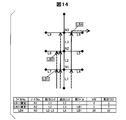
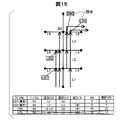
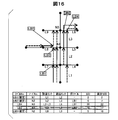
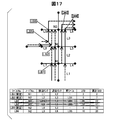
- FIG. 14 to 17 are explanatory diagrams showing specific examples of the labeling process shown in FIG.
- the label LB1 has been determined as the label entering from the link L1 and exiting to the link L2 at the node N1.
- the route search unit 206 extends the branch of the search from the node N1 in the direction of the exit link L2 of the label LB1, has the link L1 as the entry link, and includes link information including the link L2 in the corresponding link as the road information storage unit. 216.
- the route search unit 206 determines the label LB2 as the label that enters from the link L2 and exits to the link L3 at the node N2.
- the route search unit 206 extends the search branch from the label LB2 in the direction of the exit link L3 of the label LB2, for example, the link L2 as the entry link, the link L3 as the corresponding link, and the exit link.
- the single link information having the links L6 is acquired from the road information storage unit 216.
- the route search unit 206 attempts to give the label LB3 to the node N3 based on the acquired single link information as shown in FIG.
- the label LB4 since the label LB4 having the same combination of the corresponding link to enter and the exit link to leave has already been assigned to the node N3, the label LB4 is the same as the competing label. (Step S210 in FIG. 13: YES).
- step S212 in FIG. 13 YES
- the competition label LB4 having a long section is selected as a candidate label
- the attention label LB3 having a short section is selected. Is excluded from the candidate labels (step S214 in FIG. 13).
- the route search unit 206 extends a search branch from the label LB5 in the direction of the exit link L3.
- the route search unit 206 tries to give the node N3 the label LB6 that has the link L8 as the incoming link, the link L3 as the relevant link, the link L6 as the outgoing link, respectively.
- the label LB4 that competes with the label LB6 already exists in the node N3.
- the route search unit 206 compares the accumulated cost of the target label LB6 with the accumulated cost of the competitive label LB4 (step S216 in FIG. 13).
- FIG. 17 shows an example in which the attention label LB6 is selected as a candidate label and the competitive label LB4 is excluded from the candidate labels as a result of the comparison.
- the route search is performed using not only the single link information but also the composite link information in which costs are assigned to a plurality of links collectively, so there are multiple effects such as right turn traffic jams and left turn traffic jams. Even in the case where it affects the link, it is possible to search for the optimum route based on the accurate cost (travel time).
- travel time is associated with each link information as a cost.
- the cost is not limited to travel time.
- a road length may be associated as a cost.
- different values may be associated with the cost according to the day of the week or the time zone.
- the cost of the link information is apportioned according to the position of the destination between the nodes and accumulated to the previous node. You may add to cost. By doing so, the cost to the destination can be accurately obtained.
- the composite link information is stored for continuous road sections where traffic congestion occurs.
- the route search device 200 performs route search
- the smartphone 100 performs route guidance
- the smartphone 100 may include the road information storage unit 216 and the route search unit 206, and the smartphone 100 may perform route search alone.
- the smartphone 100 corresponds to the route search device of the present application.
- a general mobile phone for example, a general mobile phone, a notebook computer, a tablet terminal, a personal digital assistant (PDA), a portable music player, a portable game machine, a car navigation system, a PND (portable navigation device).
- PDA personal digital assistant
- Various devices such as the above may be applied as the route search device.
- the link information stored in the road information storage unit 216 may be recorded on various recording media.
- the present invention is not limited to the above-described embodiments and modifications, and can be realized with various configurations without departing from the spirit thereof.
- the technical features in the embodiments and the modifications corresponding to the technical features in each embodiment described in the summary section of the invention are to solve some or all of the above-described problems, or In order to achieve part or all of the effects, replacement or combination can be performed as appropriate. Further, if the technical feature is not described as essential in the present specification, it can be deleted as appropriate.
Landscapes
- Engineering & Computer Science (AREA)
- Remote Sensing (AREA)
- Radar, Positioning & Navigation (AREA)
- General Physics & Mathematics (AREA)
- Physics & Mathematics (AREA)
- Theoretical Computer Science (AREA)
- Databases & Information Systems (AREA)
- Automation & Control Theory (AREA)
- General Engineering & Computer Science (AREA)
- Data Mining & Analysis (AREA)
- Software Systems (AREA)
- Navigation (AREA)
- Traffic Control Systems (AREA)
Priority Applications (2)
| Application Number | Priority Date | Filing Date | Title |
|---|---|---|---|
| US15/119,667 US9903729B2 (en) | 2014-02-21 | 2015-02-17 | Route search apparatus, route search method, computer program and data structure |
| US15/867,292 US10495473B2 (en) | 2014-02-21 | 2018-01-10 | Route search apparatus, route search method, computer readable storage medium storing a program and data structure |
Applications Claiming Priority (2)
| Application Number | Priority Date | Filing Date | Title |
|---|---|---|---|
| JP2014031410A JP6174502B2 (ja) | 2014-02-21 | 2014-02-21 | 経路探索装置、経路探索方法、コンピュータプログラム、および、データ構造 |
| JP2014-031410 | 2014-02-21 |
Related Child Applications (2)
| Application Number | Title | Priority Date | Filing Date |
|---|---|---|---|
| US15/119,667 A-371-Of-International US9903729B2 (en) | 2014-02-21 | 2015-02-17 | Route search apparatus, route search method, computer program and data structure |
| US15/867,292 Continuation US10495473B2 (en) | 2014-02-21 | 2018-01-10 | Route search apparatus, route search method, computer readable storage medium storing a program and data structure |
Publications (1)
| Publication Number | Publication Date |
|---|---|
| WO2015125462A1 true WO2015125462A1 (ja) | 2015-08-27 |
Family
ID=53877981
Family Applications (1)
| Application Number | Title | Priority Date | Filing Date |
|---|---|---|---|
| PCT/JP2015/000722 Ceased WO2015125462A1 (ja) | 2014-02-21 | 2015-02-17 | 経路探索装置、経路探索方法、コンピュータプログラム、および、データ構造 |
Country Status (3)
| Country | Link |
|---|---|
| US (2) | US9903729B2 (enExample) |
| JP (1) | JP6174502B2 (enExample) |
| WO (1) | WO2015125462A1 (enExample) |
Families Citing this family (3)
| Publication number | Priority date | Publication date | Assignee | Title |
|---|---|---|---|---|
| US10055159B2 (en) * | 2016-06-20 | 2018-08-21 | Samsung Electronics Co., Ltd. | Morphic storage device |
| WO2019173965A1 (en) * | 2018-03-13 | 2019-09-19 | Beijing Didi Infinity Technology And Development Co., Ltd. | Systems and methods for generating road map |
| CN113211449B (zh) * | 2021-06-10 | 2022-06-17 | 哈工大机器人集团股份有限公司 | 一种基于路径分析的机器人校准方法及其系统 |
Citations (3)
| Publication number | Priority date | Publication date | Assignee | Title |
|---|---|---|---|---|
| JPH0875491A (ja) * | 1994-09-08 | 1996-03-22 | Matsushita Electric Ind Co Ltd | 経路選出方法およびシステム |
| JP2011185601A (ja) * | 2010-03-04 | 2011-09-22 | Alpine Electronics Inc | ナビゲーション装置および経路探索方法 |
| JP2012038092A (ja) * | 2010-08-06 | 2012-02-23 | Toyota Motor Corp | 区間定義方法、及び旅行時間演算装置、及び運転支援装置 |
Family Cites Families (7)
| Publication number | Priority date | Publication date | Assignee | Title |
|---|---|---|---|---|
| WO2005096223A2 (en) * | 2004-03-31 | 2005-10-13 | British Telecommunications Public Limited Company | Pathfinding system |
| US7580359B2 (en) * | 2006-02-14 | 2009-08-25 | Alcatel Lucent | Method and system for maximizing network capacity utilization in multiprotocol label switched networks by moving label switched paths |
| JP4185956B2 (ja) | 2007-02-27 | 2008-11-26 | トヨタ自動車株式会社 | 旅行時間演算サーバ、車両用旅行時間演算装置及び旅行時間演算システム |
| JP4814896B2 (ja) | 2008-01-29 | 2011-11-16 | クラリオン株式会社 | カーナビゲーション方法、カーナビゲーションシステム、交通情報管理装置およびカーナビゲーション装置 |
| JP4693934B1 (ja) | 2010-06-14 | 2011-06-01 | 株式会社野村総合研究所 | 旅行時間提供装置、旅行時間提供方法及び旅行時間提供プログラム |
| JP5315363B2 (ja) * | 2011-01-19 | 2013-10-16 | 株式会社ゼンリン | 道路網解析システム |
| JP2013096713A (ja) | 2011-10-28 | 2013-05-20 | Alpine Electronics Inc | ナビゲーション装置 |
-
2014
- 2014-02-21 JP JP2014031410A patent/JP6174502B2/ja active Active
-
2015
- 2015-02-17 US US15/119,667 patent/US9903729B2/en active Active
- 2015-02-17 WO PCT/JP2015/000722 patent/WO2015125462A1/ja not_active Ceased
-
2018
- 2018-01-10 US US15/867,292 patent/US10495473B2/en active Active
Patent Citations (3)
| Publication number | Priority date | Publication date | Assignee | Title |
|---|---|---|---|---|
| JPH0875491A (ja) * | 1994-09-08 | 1996-03-22 | Matsushita Electric Ind Co Ltd | 経路選出方法およびシステム |
| JP2011185601A (ja) * | 2010-03-04 | 2011-09-22 | Alpine Electronics Inc | ナビゲーション装置および経路探索方法 |
| JP2012038092A (ja) * | 2010-08-06 | 2012-02-23 | Toyota Motor Corp | 区間定義方法、及び旅行時間演算装置、及び運転支援装置 |
Also Published As
| Publication number | Publication date |
|---|---|
| JP2015155860A (ja) | 2015-08-27 |
| US10495473B2 (en) | 2019-12-03 |
| US20170010110A1 (en) | 2017-01-12 |
| US20180128629A1 (en) | 2018-05-10 |
| US9903729B2 (en) | 2018-02-27 |
| JP6174502B2 (ja) | 2017-08-02 |
Similar Documents
| Publication | Publication Date | Title |
|---|---|---|
| JP3987073B2 (ja) | ナビゲーションシステム、経路探索サーバ、経路探索方法およびプログラム | |
| JP5066006B2 (ja) | 経路探索装置、経路探索方法、経路探索プログラムおよび地図データ | |
| JP5230166B2 (ja) | 端末装置およびプローブ情報分析システム | |
| JP2013096713A (ja) | ナビゲーション装置 | |
| CN101769749A (zh) | 导航方法及设备 | |
| JP6174502B2 (ja) | 経路探索装置、経路探索方法、コンピュータプログラム、および、データ構造 | |
| JP5114254B2 (ja) | 地図表示システム、経路探索サーバおよび経路探索方法ならびに端末装置 | |
| JP6646731B2 (ja) | サーバ装置、通信端末、経路探索システム及びコンピュータプログラム | |
| JP7346890B2 (ja) | 経路探索装置及びコンピュータプログラム | |
| JP2015155860A5 (enExample) | ||
| JP6446503B2 (ja) | 経路探索装置、経路探索方法、コンピュータプログラム、および、データ構造 | |
| JP6307270B2 (ja) | 経路探索装置 | |
| JP6139153B2 (ja) | 経路探索装置および経路案内システム | |
| JP6262583B2 (ja) | 経路探索装置および経路探索システム | |
| JP4369900B2 (ja) | マッチング用ネットワークデータおよびマッチング用ネットワークデータの作成方法、ならびに、マッチング用ネットワークデータを有するナビゲーションシステム、経路探索サーバおよびナビゲーション端末装置 | |
| JP6334194B2 (ja) | 経路探索装置、経路探索方法、および、コンピュータプログラム | |
| JP6071693B2 (ja) | 経路探索装置および経路探索システム | |
| CN101685023B (zh) | 导航系统及其路径规划方法及机器可读取媒体 | |
| JP6374772B2 (ja) | 経路探索システム、経路探索方法、コンピュータプログラム | |
| JP6658748B2 (ja) | 経路管理システム、経路管理方法及びコンピュータ読み取り可能記録媒体 | |
| JP6385255B2 (ja) | 経路探索システム、経路探索方法、コンピュータプログラム | |
| JP6247130B2 (ja) | 経路探索装置および経路探索システム | |
| JP6325998B2 (ja) | 歩行者用ナビゲーション装置、歩行者用ナビゲーション方法、コンピュータプログラム及びコンピュータプログラムを記録した記録媒体 | |
| JP2016156769A (ja) | 経路探索システム、方法およびプログラム | |
| JP2018040727A (ja) | 経路案内装置、経路案内方法、およびコンピュータプログラム |
Legal Events
| Date | Code | Title | Description |
|---|---|---|---|
| 121 | Ep: the epo has been informed by wipo that ep was designated in this application |
Ref document number: 15752681 Country of ref document: EP Kind code of ref document: A1 |
|
| WWE | Wipo information: entry into national phase |
Ref document number: 15119667 Country of ref document: US |
|
| NENP | Non-entry into the national phase |
Ref country code: DE |
|
| 122 | Ep: pct application non-entry in european phase |
Ref document number: 15752681 Country of ref document: EP Kind code of ref document: A1 |