WO2015111696A1 - スカンジウム塩化物及びスカンジウム酸化物の製造方法 - Google Patents
スカンジウム塩化物及びスカンジウム酸化物の製造方法 Download PDFInfo
- Publication number
- WO2015111696A1 WO2015111696A1 PCT/JP2015/051826 JP2015051826W WO2015111696A1 WO 2015111696 A1 WO2015111696 A1 WO 2015111696A1 JP 2015051826 W JP2015051826 W JP 2015051826W WO 2015111696 A1 WO2015111696 A1 WO 2015111696A1
- Authority
- WO
- WIPO (PCT)
- Prior art keywords
- scandium
- chloride
- chlorine gas
- aluminum
- heating step
- Prior art date
- Legal status (The legal status is an assumption and is not a legal conclusion. Google has not performed a legal analysis and makes no representation as to the accuracy of the status listed.)
- Ceased
Links
Images
Classifications
-
- C—CHEMISTRY; METALLURGY
- C01—INORGANIC CHEMISTRY
- C01F—COMPOUNDS OF THE METALS BERYLLIUM, MAGNESIUM, ALUMINIUM, CALCIUM, STRONTIUM, BARIUM, RADIUM, THORIUM, OR OF THE RARE-EARTH METALS
- C01F17/00—Compounds of rare earth metals
- C01F17/20—Compounds containing only rare earth metals as the metal element
- C01F17/253—Halides
- C01F17/271—Chlorides
-
- C—CHEMISTRY; METALLURGY
- C01—INORGANIC CHEMISTRY
- C01F—COMPOUNDS OF THE METALS BERYLLIUM, MAGNESIUM, ALUMINIUM, CALCIUM, STRONTIUM, BARIUM, RADIUM, THORIUM, OR OF THE RARE-EARTH METALS
- C01F17/00—Compounds of rare earth metals
- C01F17/20—Compounds containing only rare earth metals as the metal element
- C01F17/206—Compounds containing only rare earth metals as the metal element oxide or hydroxide being the only anion
- C01F17/212—Scandium oxides or hydroxides
-
- C—CHEMISTRY; METALLURGY
- C25—ELECTROLYTIC OR ELECTROPHORETIC PROCESSES; APPARATUS THEREFOR
- C25B—ELECTROLYTIC OR ELECTROPHORETIC PROCESSES FOR THE PRODUCTION OF COMPOUNDS OR NON-METALS; APPARATUS THEREFOR
- C25B1/00—Electrolytic production of inorganic compounds or non-metals
- C25B1/01—Products
- C25B1/24—Halogens or compounds thereof
- C25B1/26—Chlorine; Compounds thereof
Definitions
- the present invention relates to a method for producing scandium chloride and scandium oxide, and more particularly to a method for recovering a scandium concentrate from an alloy containing scandium and aluminum.
- Aluminum scandium alloy containing aluminum and scandium (hereinafter also referred to as “Al—Sc alloy”) has characteristics of light weight and high strength, and is used not only for sports equipment but also in fields requiring impact resistance. . In addition, in the future, it is expected to be used as a structural material for aircraft, electric cars, high-speed railways and the like. However, scandium is very expensive because it produces very little. Therefore, it is not easy to use scandium widely industrially.
- the present invention has been made to solve the above-described problems, and its purpose is to efficiently separate aluminum and scandium from an Al—Sc alloy.
- the present inventors have found that the above object can be achieved by heating the Al—Sc alloy to 300 ° C. or more and 700 ° C. or less in a chlorine gas atmosphere.
- the present invention has been completed.
- the present invention provides the following.
- the present invention provides a heating step of heating an alloy containing scandium and aluminum to 200 ° C. or higher and 700 ° C. or lower in a chlorine gas atmosphere, and recovering scandium chloride from the solid phase after the heating step.
- a process for producing scandium chloride is a process for producing scandium chloride.
- the present invention provides a hydrogen chloride generating step of bringing hydrogen gas into contact with aluminum chloride obtained by the heating step to generate hydrogen chloride, and a chlorine gas that generates chlorine gas by electrolyzing the hydrogen chloride.
- this invention melt
- scandium can be efficiently recovered from the Al—Sc alloy.
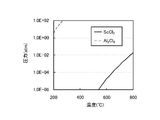
- a dimer of aluminum chloride (Al 2 Cl 6), shows a vapor pressure curve of scandium chloride (ScCl 3).
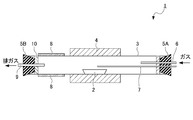
- 1 is a schematic view showing an example of a reaction apparatus 1.
- the method for producing scandium chloride according to the present invention comprises a heating step in which an alloy containing scandium and aluminum is heated to 300 ° C. or higher and 700 ° C. or lower in a chlorine gas atmosphere, and after this heating step, scandium chloride is recovered from the solid phase. And a scandium chloride recovery step.
- FIG. 1 is a vapor pressure curve of an aluminum chloride dimer (Al 2 Cl 6 ) and scandium chloride (ScCl 3 ). The saturated vapor pressure is calculated based on the Antoine equation.
- the saturated vapor pressure of aluminum chloride is high even at a relatively low temperature and is 1 atm or higher even at 200 ° C., whereas the saturated vapor pressure of scandium chloride is 10 even at 700 ° C. It is on the order of -4 , and it can be seen that it is difficult to volatilize under atmospheric pressure.
- the present invention utilizes the property that the saturated vapor pressure differs greatly between aluminum chloride and scandium chloride.
- Al—Sc alloy When an Al—Sc alloy is heated to 200 ° C. or higher and 800 ° C. or lower in a chlorine gas atmosphere, Al is volatilized and removed as an aluminum chloride dimer (Al 2 Cl 6 ) by a chlorination reaction. On the other hand, Sc remains as it is without volatilization as scandium chloride (ScCl 3 ). Therefore, by heating the Al—Sc alloy to a predetermined temperature in a chlorine gas atmosphere, the Al—Sc alloy can be separated into aluminum chloride as a gas phase and scandium chloride as a solid phase.
- the heating temperature is 200 ° C. or higher and 800 ° C. or lower, but the reaction time, recovery rate, etc.
- the heating temperature is preferably 300 ° C. or higher and 700 ° C. or lower.
- the heating temperature is 300 ° C. or lower, even if the Al—Sc alloy can be gas-solid separated into aluminum chloride and scandium chloride, the chlorination reaction takes time and is inefficient, which is not preferable.
- the heating temperature exceeds 700 ° C., scandium chloride partially volatilizes, which is not preferable because the recovery rate is lowered. Further, the corrosion rate of chlorine in the reactor increases, which is not preferable in that it requires selection of expensive apparatus materials.
- the heating time (time for maintaining at 200 ° C. or more and 800 ° C. or less) is preferably 20 minutes or more and 90 minutes or less, and more preferably 50 minutes or more and 70 minutes or less. If the heating time is less than 20 minutes, the Al—Sc alloy may not be suitably gas-solid separated into aluminum chloride and scandium chloride, which is not preferable. If it is longer than 90 minutes, the cost of gas-solid separation is not preferred in that it can be expensive.
- the recovery step is a step of recovering scandium chloride from the solid phase after the heating step.
- the recovery step not only scandium chloride can be recovered from the solid phase, but also aluminum chloride can be recovered from the gas phase.
- by bringing hydrogen gas into contact with aluminum chloride not only high-purity metallic aluminum can be recovered from the Al—Sc alloy, but also hydrogen chloride as a byproduct is electrolyzed to obtain chlorine gas.
- Chlorine gas can be reused as the chlorine gas used in the heating step.
- the purity of scandium contained in the recovered product can be further increased by subjecting the scandium chloride obtained in the recovery step to the heating step again.
- the scandium oxide production method according to the present invention is obtained by dissolving the scandium chloride collected by the above ⁇ scandium chloride production method> to obtain a scandium solution, and then adding oxalic acid to the scandium solution to form scandium oxalate.
- the stability and labor of storing the scandium concentrate store the scandium concentrate in the form of scandium oxide rather than storing it in the form of scandium chloride. Is preferred.
- Patent Document 2 As a method for recovering scandium oxide from a raw material, the method described in Patent Document 2 can be cited.
- Patent Document 2 first, since the ratio of scandium contained in the raw material is extremely low, the raw material is first extracted with a solvent. It is necessary to attach to. However, if scandium chloride recovered in the present invention is used, it is not necessary to extract the raw material with a solvent, and since the raw material is chloride, it can be dissolved only with water. Thereafter, oxalic acid is added to the scandium aqueous solution to form scandium oxalate, and the scandium oxalate is oxidized to be recovered as scandium oxide.
- FIG. 2 is a schematic diagram illustrating the configuration of the reaction apparatus 1 used in this example.
- the reactor 1 includes an alumina pan 2 on which an Al—Sc alloy as a sample is placed, a quartz furnace core tube 3 that keeps the sample in a chlorine gas atmosphere, and a horizontal electric furnace that heats the quartz furnace core tube 3. 4 and rubber plugs 5A and 5B for sealing both ends of the quartz furnace core tube 3 and a tube insertion portion (not shown) provided in the rubber plug 5A on the inlet side.
- the gas discharge part 10 which discharges gas and the heat insulation bob which maintains the heat insulation inside the quartz furnace core tube 3 And a de 11.
- the temperature of the inside of the horizontal electric furnace 4 was raised to 500 ° C., and the gas was switched from nitrogen to chlorine gas while maintaining 500 ° C., and held for 60 minutes while flowing at a flow rate of 0.5 L / min. .
- the gas supplied through the gas supply unit 6 was switched again from chlorine gas to nitrogen gas, and the horizontal electric furnace 4 was turned off, and the sample was cooled inside the horizontal electric furnace 4. After the sample reached room temperature, the sample remaining in the alumina dish 2 and the deposits recovered from the aluminum chloride recovery unit 8 were taken out.
- the sample remaining in the alumina dish 2 and the deposits recovered from the aluminum chloride recovery unit 8 were dissolved, and mass spectrometry was performed using an ICP mass spectrometer. As a result, the scandium quality of the sample remaining in the alumina dish 2 was 27.5% by weight. This corresponds to 92% in terms of ScCl 3 .
- the scandium quality of the deposits collected by the aluminum chloride collecting unit 8 was less than 0.5% by weight. From this, it can be said that almost all of the deposit is aluminum chloride.
Landscapes
- Chemical & Material Sciences (AREA)
- Organic Chemistry (AREA)
- Life Sciences & Earth Sciences (AREA)
- Geology (AREA)
- Inorganic Chemistry (AREA)
- Manufacture And Refinement Of Metals (AREA)
- Processing Of Solid Wastes (AREA)
- Compounds Of Alkaline-Earth Elements, Aluminum Or Rare-Earth Metals (AREA)
- Electrolytic Production Of Non-Metals, Compounds, Apparatuses Therefor (AREA)
Priority Applications (1)
| Application Number | Priority Date | Filing Date | Title |
|---|---|---|---|
| EP15740973.1A EP3078757B1 (en) | 2014-01-27 | 2015-01-23 | Scandium chloride and scandium chloride production method |
Applications Claiming Priority (2)
| Application Number | Priority Date | Filing Date | Title |
|---|---|---|---|
| JP2014-012665 | 2014-01-27 | ||
| JP2014012665A JP5884840B2 (ja) | 2014-01-27 | 2014-01-27 | スカンジウム塩化物及びスカンジウム酸化物の製造方法 |
Publications (1)
| Publication Number | Publication Date |
|---|---|
| WO2015111696A1 true WO2015111696A1 (ja) | 2015-07-30 |
Family
ID=53681493
Family Applications (1)
| Application Number | Title | Priority Date | Filing Date |
|---|---|---|---|
| PCT/JP2015/051826 Ceased WO2015111696A1 (ja) | 2014-01-27 | 2015-01-23 | スカンジウム塩化物及びスカンジウム酸化物の製造方法 |
Country Status (3)
| Country | Link |
|---|---|
| EP (1) | EP3078757B1 (enExample) |
| JP (1) | JP5884840B2 (enExample) |
| WO (1) | WO2015111696A1 (enExample) |
Cited By (1)
| Publication number | Priority date | Publication date | Assignee | Title |
|---|---|---|---|---|
| CN121494043A (zh) * | 2025-12-29 | 2026-02-10 | 天津包钢稀土研究院有限责任公司 | 一种超干无水氯化钪的制备方法 |
Families Citing this family (1)
| Publication number | Priority date | Publication date | Assignee | Title |
|---|---|---|---|---|
| JP6891723B2 (ja) * | 2016-08-30 | 2021-06-18 | 住友金属鉱山株式会社 | スカンジウム化合物の製造方法、スカンジウム化合物 |
Citations (7)
| Publication number | Priority date | Publication date | Assignee | Title |
|---|---|---|---|---|
| US3235376A (en) * | 1962-03-20 | 1966-02-15 | Aluminium Lab Ltd | Procedure and apparatus for subhalide refining of aluminum |
| JPH05171304A (ja) * | 1991-12-19 | 1993-07-09 | Kobe Steel Ltd | アルミニウム合金から有用金属を回収する方法 |
| JPH09291320A (ja) | 1996-04-26 | 1997-11-11 | Taiheiyo Kinzoku Kk | レアアース金属の回収方法 |
| JP2003171724A (ja) | 2001-12-07 | 2003-06-20 | Aomori Prefecture | Al−Sc母合金の製造法およびその方法によって得られたAl−Sc母合金 |
| JP2007254822A (ja) * | 2006-03-23 | 2007-10-04 | Taiheiyo Kinzoku Kk | スカンジウム含有合金の製造方法およびこの方法により得られたスカンジウム含有合金 |
| JP2012041588A (ja) * | 2010-08-17 | 2012-03-01 | Akita Univ | 塩化揮発法による希土類元素の分離方法及び分離システム |
| US20120207656A1 (en) * | 2011-02-11 | 2012-08-16 | Emc Metals Corporation | System and Method for Recovery of Scandium Values From Scandium-Containing Ores |
Family Cites Families (3)
| Publication number | Priority date | Publication date | Assignee | Title |
|---|---|---|---|---|
| US2874039A (en) * | 1954-06-17 | 1959-02-17 | Pechiney Prod Chimiques Sa | Extraction of scandium from its ores |
| US5039336A (en) * | 1988-12-30 | 1991-08-13 | Westinghouse Electric Corp. | Recovery of scandium, yttrium and lanthanides from zircon sand |
| CN102021343A (zh) * | 2010-10-13 | 2011-04-20 | 赣州鑫磊稀土新材料有限公司 | 一种从铝钪合金冶炼废料中分离回收氧化钪的方法 |
-
2014
- 2014-01-27 JP JP2014012665A patent/JP5884840B2/ja active Active
-
2015
- 2015-01-23 EP EP15740973.1A patent/EP3078757B1/en active Active
- 2015-01-23 WO PCT/JP2015/051826 patent/WO2015111696A1/ja not_active Ceased
Patent Citations (7)
| Publication number | Priority date | Publication date | Assignee | Title |
|---|---|---|---|---|
| US3235376A (en) * | 1962-03-20 | 1966-02-15 | Aluminium Lab Ltd | Procedure and apparatus for subhalide refining of aluminum |
| JPH05171304A (ja) * | 1991-12-19 | 1993-07-09 | Kobe Steel Ltd | アルミニウム合金から有用金属を回収する方法 |
| JPH09291320A (ja) | 1996-04-26 | 1997-11-11 | Taiheiyo Kinzoku Kk | レアアース金属の回収方法 |
| JP2003171724A (ja) | 2001-12-07 | 2003-06-20 | Aomori Prefecture | Al−Sc母合金の製造法およびその方法によって得られたAl−Sc母合金 |
| JP2007254822A (ja) * | 2006-03-23 | 2007-10-04 | Taiheiyo Kinzoku Kk | スカンジウム含有合金の製造方法およびこの方法により得られたスカンジウム含有合金 |
| JP2012041588A (ja) * | 2010-08-17 | 2012-03-01 | Akita Univ | 塩化揮発法による希土類元素の分離方法及び分離システム |
| US20120207656A1 (en) * | 2011-02-11 | 2012-08-16 | Emc Metals Corporation | System and Method for Recovery of Scandium Values From Scandium-Containing Ores |
Non-Patent Citations (2)
| Title |
|---|
| NOBUYOSHI IYATOMI ET AL.: "Intelligent Metallurgy of Rare Metals, Scandium", BULLETIN OF THE RESEARCH INSTITUTE OF MINERAL DRESSING AND METALLURGY, vol. 45, no. 1, 30 September 1989 (1989-09-30), pages 66 - 76, XP008181281 * |
| See also references of EP3078757A4 |
Cited By (1)
| Publication number | Priority date | Publication date | Assignee | Title |
|---|---|---|---|---|
| CN121494043A (zh) * | 2025-12-29 | 2026-02-10 | 天津包钢稀土研究院有限责任公司 | 一种超干无水氯化钪的制备方法 |
Also Published As
| Publication number | Publication date |
|---|---|
| JP2015140444A (ja) | 2015-08-03 |
| JP5884840B2 (ja) | 2016-03-15 |
| EP3078757B1 (en) | 2019-08-28 |
| EP3078757A1 (en) | 2016-10-12 |
| EP3078757A4 (en) | 2016-11-16 |
Similar Documents
| Publication | Publication Date | Title |
|---|---|---|
| JP5398369B2 (ja) | レアメタルの製造方法及び製造システム | |
| CN110387474B (zh) | 熔盐电解法生产铝钪合金过程中产生的电解渣的处理方法 | |
| US9315915B2 (en) | Method for manufacturing zirconium metal and hafnium metal | |
| JP5935098B2 (ja) | 亜鉛製造方法 | |
| JP5884840B2 (ja) | スカンジウム塩化物及びスカンジウム酸化物の製造方法 | |
| CN111094631B (zh) | 电解生产活性金属 | |
| CN104164567A (zh) | 一种从废旧高温合金中富集回收铌、钽的方法 | |
| JP5907188B2 (ja) | スカンジウム濃縮物の製造方法 | |
| CN110651069A (zh) | 电极及其制造方法以及再生电极的制造方法 | |
| JP5907187B2 (ja) | スカンジウム濃縮物の製造方法 | |
| JP5944666B2 (ja) | 高純度マンガンの製造方法 | |
| KR101623668B1 (ko) | 고순도 망간 및 그 제조 방법 | |
| CN105274562A (zh) | 一种铝硅合金的电解分离铝、硅的方法 | |
| JP2016180184A (ja) | 高純度マンガン | |
| CN109609779A (zh) | 一种利用真空蒸馏进行原铝除镓的方法 | |
| JP2014218697A (ja) | 亜鉛製造方法 | |
| JP2011178586A (ja) | 多結晶シリコンの精製方法 | |
| JP5907186B2 (ja) | スカンジウム濃縮物回収方法 | |
| CN106917114A (zh) | 金属钛粉熔盐电解回收装置 | |
| JP2015140444A5 (enExample) | ||
| CN106894059A (zh) | 金属钛粉熔盐电解回收方法 | |
| JP2009242153A (ja) | シリコン製造方法 |
Legal Events
| Date | Code | Title | Description |
|---|---|---|---|
| 121 | Ep: the epo has been informed by wipo that ep was designated in this application |
Ref document number: 15740973 Country of ref document: EP Kind code of ref document: A1 |
|
| REEP | Request for entry into the european phase |
Ref document number: 2015740973 Country of ref document: EP |
|
| WWE | Wipo information: entry into national phase |
Ref document number: 2015740973 Country of ref document: EP |
|
| NENP | Non-entry into the national phase |
Ref country code: DE |