WO2015087845A1 - 配位高分子化を利用するレアメタルの水系分別沈殿法 - Google Patents
配位高分子化を利用するレアメタルの水系分別沈殿法 Download PDFInfo
- Publication number
- WO2015087845A1 WO2015087845A1 PCT/JP2014/082460 JP2014082460W WO2015087845A1 WO 2015087845 A1 WO2015087845 A1 WO 2015087845A1 JP 2014082460 W JP2014082460 W JP 2014082460W WO 2015087845 A1 WO2015087845 A1 WO 2015087845A1
- Authority
- WO
- WIPO (PCT)
- Prior art keywords
- solution
- ions
- aqueous solution
- dysprosium
- fractional precipitation
- Prior art date
- Legal status (The legal status is an assumption and is not a legal conclusion. Google has not performed a legal analysis and makes no representation as to the accuracy of the status listed.)
- Ceased
Links
Images



Classifications
-
- C—CHEMISTRY; METALLURGY
- C22—METALLURGY; FERROUS OR NON-FERROUS ALLOYS; TREATMENT OF ALLOYS OR NON-FERROUS METALS
- C22B—PRODUCTION AND REFINING OF METALS; PRETREATMENT OF RAW MATERIALS
- C22B59/00—Obtaining rare earth metals
-
- C—CHEMISTRY; METALLURGY
- C02—TREATMENT OF WATER, WASTE WATER, SEWAGE, OR SLUDGE
- C02F—TREATMENT OF WATER, WASTE WATER, SEWAGE, OR SLUDGE
- C02F1/00—Treatment of water, waste water, or sewage
- C02F1/52—Treatment of water, waste water, or sewage by flocculation or precipitation of suspended impurities
- C02F1/54—Treatment of water, waste water, or sewage by flocculation or precipitation of suspended impurities using organic material
- C02F1/56—Macromolecular compounds
-
- C—CHEMISTRY; METALLURGY
- C07—ORGANIC CHEMISTRY
- C07F—ACYCLIC, CARBOCYCLIC OR HETEROCYCLIC COMPOUNDS CONTAINING ELEMENTS OTHER THAN CARBON, HYDROGEN, HALOGEN, OXYGEN, NITROGEN, SULFUR, SELENIUM OR TELLURIUM
- C07F9/00—Compounds containing elements of Groups 5 or 15 of the Periodic Table
- C07F9/02—Phosphorus compounds
- C07F9/06—Phosphorus compounds without P—C bonds
- C07F9/08—Esters of oxyacids of phosphorus
- C07F9/09—Esters of phosphoric acids
- C07F9/091—Esters of phosphoric acids with hydroxyalkyl compounds with further substituents on alkyl
-
- C—CHEMISTRY; METALLURGY
- C07—ORGANIC CHEMISTRY
- C07F—ACYCLIC, CARBOCYCLIC OR HETEROCYCLIC COMPOUNDS CONTAINING ELEMENTS OTHER THAN CARBON, HYDROGEN, HALOGEN, OXYGEN, NITROGEN, SULFUR, SELENIUM OR TELLURIUM
- C07F9/00—Compounds containing elements of Groups 5 or 15 of the Periodic Table
- C07F9/02—Phosphorus compounds
- C07F9/06—Phosphorus compounds without P—C bonds
- C07F9/08—Esters of oxyacids of phosphorus
- C07F9/09—Esters of phosphoric acids
- C07F9/11—Esters of phosphoric acids with hydroxyalkyl compounds without further substituents on alkyl
-
- C—CHEMISTRY; METALLURGY
- C22—METALLURGY; FERROUS OR NON-FERROUS ALLOYS; TREATMENT OF ALLOYS OR NON-FERROUS METALS
- C22B—PRODUCTION AND REFINING OF METALS; PRETREATMENT OF RAW MATERIALS
- C22B3/00—Extraction of metal compounds from ores or concentrates by wet processes
- C22B3/20—Treatment or purification of solutions, e.g. obtained by leaching
- C22B3/44—Treatment or purification of solutions, e.g. obtained by leaching by chemical processes
-
- C—CHEMISTRY; METALLURGY
- C22—METALLURGY; FERROUS OR NON-FERROUS ALLOYS; TREATMENT OF ALLOYS OR NON-FERROUS METALS
- C22B—PRODUCTION AND REFINING OF METALS; PRETREATMENT OF RAW MATERIALS
- C22B58/00—Obtaining gallium or indium
-
- C—CHEMISTRY; METALLURGY
- C02—TREATMENT OF WATER, WASTE WATER, SEWAGE, OR SLUDGE
- C02F—TREATMENT OF WATER, WASTE WATER, SEWAGE, OR SLUDGE
- C02F1/00—Treatment of water, waste water, or sewage
- C02F1/02—Treatment of water, waste water, or sewage by heating
-
- C—CHEMISTRY; METALLURGY
- C02—TREATMENT OF WATER, WASTE WATER, SEWAGE, OR SLUDGE
- C02F—TREATMENT OF WATER, WASTE WATER, SEWAGE, OR SLUDGE
- C02F1/00—Treatment of water, waste water, or sewage
- C02F1/66—Treatment of water, waste water, or sewage by neutralisation; pH adjustment
-
- C—CHEMISTRY; METALLURGY
- C02—TREATMENT OF WATER, WASTE WATER, SEWAGE, OR SLUDGE
- C02F—TREATMENT OF WATER, WASTE WATER, SEWAGE, OR SLUDGE
- C02F2101/00—Nature of the contaminant
- C02F2101/10—Inorganic compounds
-
- Y—GENERAL TAGGING OF NEW TECHNOLOGICAL DEVELOPMENTS; GENERAL TAGGING OF CROSS-SECTIONAL TECHNOLOGIES SPANNING OVER SEVERAL SECTIONS OF THE IPC; TECHNICAL SUBJECTS COVERED BY FORMER USPC CROSS-REFERENCE ART COLLECTIONS [XRACs] AND DIGESTS
- Y02—TECHNOLOGIES OR APPLICATIONS FOR MITIGATION OR ADAPTATION AGAINST CLIMATE CHANGE
- Y02P—CLIMATE CHANGE MITIGATION TECHNOLOGIES IN THE PRODUCTION OR PROCESSING OF GOODS
- Y02P10/00—Technologies related to metal processing
- Y02P10/20—Recycling
Definitions
- the present invention relates to an aqueous fractional precipitation method of a rare metal using coordination polymerization.
- rare metals For rare metals (rare metals) that are in danger of stable supply, elements such as platinum group elements, tungsten, rare earth elements (rare earth), etc. that have extremely low reserves or production, or other resources such as indium Since only a very small amount is produced as a by-product when mining lime, there are elements that are difficult to increase in production according to demand.
- the importance of recycling rare metals from used products has been advocated as a measure to secure a stable supply of rare metals essential for advanced technologies.
- the supply structure of rare earths has become fragile, and the realization of recycling is urgently required. Separation is particularly important in the rare metal recycling process.
- a rare metal When a rare metal is to be separated, there are two types of separation. One is separation of rare metals from base metals such as iron, and the other is mutual separation of rare metals.
- rare metals rare earths are very similar in nature, so the latter is particularly difficult to separate.
- neodymium magnets mainly composed of neodymium (hereinafter sometimes referred to as “Nd”), iron, and boron are considered to be the strongest among permanent magnets, and drive motors and air conditioner compressors for hybrid vehicles. It is used for motors and the like, and it is known that the addition of a small amount of dysprosium (hereinafter sometimes referred to as “Dy”) improves the coercive force.
- Dy dysprosium
- Shirayama et al. Are studying separation of iron and lanthanoids by a dry method (Non-patent Document 3).
- Non-Patent Document 4 a solvent extraction method has been studied as a method for separating neodymium and dysprosium.
- This solvent extraction method is a method in which ions to be separated dissolved in an aqueous solution are selectively extracted into an organic solvent and then back-extracted again into an aqueous solution phase.
- This technique has been applied to many metal ion separation systems, and there are many types of extraction reagents used industrially. However, it is effective when the target substance has a high concentration, but is not suitable for a low concentration system.
- the extraction reagent in the organic solvent that is responsible for the selectivity, so the extraction reagent can be selected according to the target, but if the properties of the metal ions are similar, such as mutual separation of rare earths, In this case, large-scale equipment, a large amount of organic solvent and energy are required.
- Non-Patent Document 5 shows a result of separation of metal ions by acid leaching and solvent extraction to recover indium, which is one of rare metals, from a liquid crystal panel.
- solvent extraction di- (2-ethylhexyl) phosphoric acid (Hdehp), tributyl phosphate (TBP), bis (2,4,4-trimethylpentyl) phosphinic acid (Cyanex272), Cyanex 923 (phosphine oxide) Is used as an extraction reagent, and separation of indium, aluminum, copper, iron, tin, and zinc is investigated using kerosene, toluene, n-octanol, and cyclohexane as organic solvents. Among them, it has been reported that the recovery of indium is excellent when Hdehp is used as an extraction reagent and kerosene is used as an organic solvent.
- an “ion exchange method” is a method in which a target substance is separated by selectively desorbing after adsorbing metal ions to a porous polymer.
- ion exchange resins and the like there is no great difference in the interaction between the exchanger itself and the rare earth, and separation is performed by using a complexing agent having selectivity for the rare earth in the desorption process.
- a chelate resin in which a highly selective chelating agent is bound to a specific metal ion, the separation process is simplified, but an organic solvent is required for the synthesis of the chelate resin, and the synthesis process is complicated. is there.
- an “impregnation resin method” can also be mentioned.
- a solvent extraction reagent is used by being immersed in a porous polymer.
- the metal ion separation mechanism is the same as the solvent extraction method described above, but is excellent in that no organic solvent is used. However, since only the liquid is infiltrated, deterioration due to the liquid starting to dissolve from the polymer is a problem.
- “precipitation separation method” may be mentioned.
- Aisin Seiki has announced technology to extract neodymium, dysprosium, etc. from used magnets using inosinic acid contained in skipjack soup (Non-Patent Documents 6 and 7), which is cheaper and safer than conventional methods. It can be said that it is a feature.
- this method when 90 grams of inosinic acid per liter is mixed with 40 grams of neodymium chloride solution per liter, 95% or more of neodymium can be recovered as a precipitate, and there is a certain target for stable procurement of dysprosium. Has been. However, data on the mutual separation of neodymium and dysprosium is not shown.
- Non-Patent Document 8 neodymium, praseodymium, and erbium are 62% di (2-ethylhexyl) phosphoric acid (HA) and 37% mono- (2-etylhexyl) phosphoric acid (H 2 A ′). It has been found that when the mixture is mixed in an acetone solution, only a precipitate is formed with HA, while lanthanum is precipitated only by complexing with H 2 A ′.
- neodymium is 19.8% and lanthanum is 0.7% precipitated.
- the results of separation of praseodymium and erbium are not described, but are reported to be worse than the neodymium-lanthanum system. However, there is no description about neodymium ions and dysprosium ions.
- the present inventors have examined a method for selectively separating rare earths, particularly neodymium and dysprosium, which are very difficult to separate, and extracting them with high selectivity to the rare earths.
- the coordination polymer is a polymer type complex formed by crosslinking an organic ligand with a metal ion, and is a material group that has been attracting attention in recent years.
- the present inventors have found that metal (M) and Hdehp are coordinated and polymerized with ethanol or an ethanol-water mixed solvent to form [M (dehp) 3 ] n and precipitate (the above non-reactions).
- Patent documents (9, 10) are examples of Patent documents (M) and Hdehp are coordinated and polymerized with ethanol or an ethanol-water mixed solvent to form [M (dehp) 3 ] n and precipitate (the above non-reactions).
- FIG. 10 is a diagram for explaining the coordination polymerization of Hdehp.
- C represents the coordination polymer [M (dehp) 3 ] n (M is a rare earth metal) when Hdehp reacts with a rare earth metal ion. Ion) is formed.
- the Hdehp shown in A in the figure is said to form a dimer in a non-polar solvent.
- B in the conventional solvent extraction system, three Hdehp dimers are present.
- a 1: 6 complex is formed with a trivalent rare earth metal ion.
- Patent Document 1 uses a hydrophilic organic solvent such as ethanol or a mixed solvent of a hydrophilic organic solvent such as ethanol and water, but considers the actual process. Then, it was found that it is difficult to use repeatedly, and it is preferable to perform fractional precipitation with a single solvent consisting of only water rather than a mixed solution.
- a hydrophilic organic solvent such as ethanol or a mixed solvent of a hydrophilic organic solvent such as ethanol and water
- the present invention has been made in view of the current situation, and a method of selectively separating low-cost rare metals that are difficult to separate using only water as a solvent and the rare metals after separation are recovered. It is intended to provide a method.
- the present inventors have replaced water-soluble phosphate diesters such as dibutyl phosphate (hereinafter referred to as the following) instead of di-2-ethylhexyl phosphate (Hdehp).
- Hdbp di-2-ethylhexyl phosphate
- Hpmoe hydrogen phosphate
- the separation is improved, and as the acid to be used, it is better to separate using nitric acid than hydrochloric acid, Furthermore, it was also found that the separation is improved when the coordination polymer precipitated at high temperature is aged at high temperature and then filtered.
- a method for separating rare metal by fractional precipitation from an aqueous solution containing rare metal ions A fractional precipitation method characterized in that a water-soluble phosphoric acid diester is used as a coordination polymer forming agent, and trivalent rare metal ions are selectively converted into a coordination polymer in an aqueous solution for fractional precipitation.
- a water-soluble phosphoric acid diester is used as a coordination polymer forming agent, and trivalent rare metal ions are selectively converted into a coordination polymer in an aqueous solution for fractional precipitation.
- the fractional precipitation method according to [1], wherein the water-soluble phosphate diester is dibutyl phosphate or hydrogen phosphate bis [2- (methacryloyloxy) ethyl].
- trivalent rare metals can be separated using only water as a solvent without requiring a multistage process using an organic solvent as in solvent extraction, and separation is particularly difficult. Neodymium and dysprosium can be separated.
- the method of the present invention solidifies the extraction reagent itself, and unlike the impregnating resin that supports the liquid extraction reagent, water is the only solvent required for separation, and is very inexpensive and simple. .
- a water-soluble phosphoric acid diester is used as a coordination polymer-forming agent, and a rare metal ion is selectively converted into a coordination polymer in an aqueous solution containing a trivalent rare metal ion. It is characterized by fractional precipitation.
- the present invention utilizes the fact that a phosphate diester that has been acid-dissociated in an aqueous solution reacts with trivalent rare metal ions in the aqueous solution to form a coordination polymer (solid). However, it is not necessary that all the phosphoric acid diesters in the aqueous solution are acid-dissociated.
- the water-soluble phosphate diester used in the present invention preferably has a water solubility of 0.01 mol ⁇ L ⁇ 1 or more, more preferably 0.05 mol ⁇ L ⁇ 1 .
- a substance satisfying the above-mentioned conditions may be used for the solubility of the phosphoric diester made dissociated by mixing sodium salt or the like.
- a phosphoric acid diester having 2 to 6 carbon atoms in the alkyl chain is desirable, and if it has a hydrophilic group such as an ether or a hydroxyl group, it may be a diester having 6 or more carbon atoms, particularly preferably easily available.
- Commercially available water-soluble phosphoric acid diesters are used, for example:
- trivalent rare metals in the present invention include indium, titanium, vanadium, chromium, manganese, cobalt, gallium, Zirconium, niobium, molybdenum, ruthenium, rhodium, antimony, tantalum, rhenium, thallium, bismuth can be mentioned.
- the present invention is capable of selectively coordinating polymerizing dysprosium ions and fractionally precipitating them in an aqueous solution containing neodymium and dysprosium ions, which are difficult to separate.
- the phosphate diester dissolved in water selectively forms a coordination polymer with the rare metal ions.
- the coordinating polymer is precipitated, and the rare metal can be separated using only water as a solvent.
- the concentration of the water-soluble phosphoric diester in the aqueous solution is preferably 0.01 to 0.5 mol ⁇ L ⁇ 1 .
- the concentration of the water-soluble phosphate diester is desirably mixed so as to be approximately three times the concentration of the dysprosium ions to be separately precipitated.
- a water-soluble phosphate diester which is a coordination polymerizing agent in a mixed solution containing neodymium ions and dysprosium ions.
- the mixing method is not particularly limited. That is, for example, as a solution containing neodymium ions and dysprosium ions, an aqueous solution in which a salt of neodymium and dysprosium is dissolved in water is used.
- a water-soluble phosphate diester is mixed with an aqueous solution containing these neodymium ions and dysprosium ions, or an aqueous solution in which a water-soluble phosphate diester is dissolved is mixed with the aqueous solution. Mix water accordingly.
- the coordination polymer thus obtained is separated by washing and filtering after, for example, standing at room temperature overnight.
- separation efficiency can be improved by mixing an acid with a liquid mixture and adjusting the acid dissociation degree of the phosphoric acid diester in this liquid mixture.
- the acid to be mixed is not particularly limited as long as it is soluble in water.
- nitric acid or hydrochloric acid is preferably used, and nitric acid is more preferably used.
- the preferred acid concentration varies depending on the acid dissociation constant of the water-soluble phosphate diester and the type of acid, but when Na-type dibutyl phosphate is used in a nitric acid solution, the acid concentration is preferably 0.4 mol ⁇ L ⁇ 1 .
- the temperature at which the solution is mixed is preferably higher than 100 ° C., more preferably 50 to 80 ° C., rather than room temperature (20 ° C.). Furthermore, if the solution is allowed to stand for 3 hours or more, preferably 24 hours or more, and more preferably 72 hours or more, rather than filtering immediately after mixing the solution, the selectivity for precipitation separation is increased.
- the separately precipitated dysprosium can be recovered as dysprosium oxide by converting it into oxalate or carbonate and baking it. Specifically, the fractionally precipitated dysprosium is put into an aqueous solution of oxalic acid or carbonic acid or a salt of oxalic acid or carbonic acid.
- the aqueous solution contains an amount necessary for dysprosium to precipitate as a salt of oxalic acid or carbonic acid, an amount exceeding the so-called stoichiometric ratio.
- the recovery rate is improved by increasing the concentration, and it is preferable that the amount is twice or more.
- the reaction is preferably performed for 1 day or longer, more preferably 2 days or longer.
- Hdbp was changed to Na type using an aqueous NaOH solution so that the pH did not change before and after the reaction.
- Hdbp (6.3 g) was mixed with 2.07 mL of 14.5 mol ⁇ L ⁇ 1 NaOH aqueous solution to make 100 mL with water to prepare 0.30 mol ⁇ L ⁇ 1 Nadbp aqueous solution.
- HPmoe was changed to Na type using an aqueous NaOH solution.
- Hpmoe 5.11 g was mixed with 1.07 mL of 14.5 mol ⁇ L ⁇ 1 NaOH aqueous solution to make 50 mL with water to prepare 0.32 mol ⁇ L ⁇ 1 Napmoe aqueous solution.
- K sp solubility product
- a is the activity
- ⁇ is the activity coefficient
- c is the concentration.
- ⁇ 1, the product of concentration can be used to evaluate the effectiveness of fractional precipitation.
- the product of this concentration is the apparent solubility (K a sp ).
- K sp (Nd) / K sp (Dy) calculated based on the solubility product described in Liu et al., Geochim. Cosmochimica Acta., 1997, 61, 1625.
- K sp (Nd) / K sp (Dy) calculated based on the solubility product described in Chung et al. J. Ind. Eng. Chem., 1998, 4, 277. * M indicates Nd or Dy
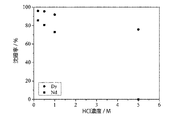
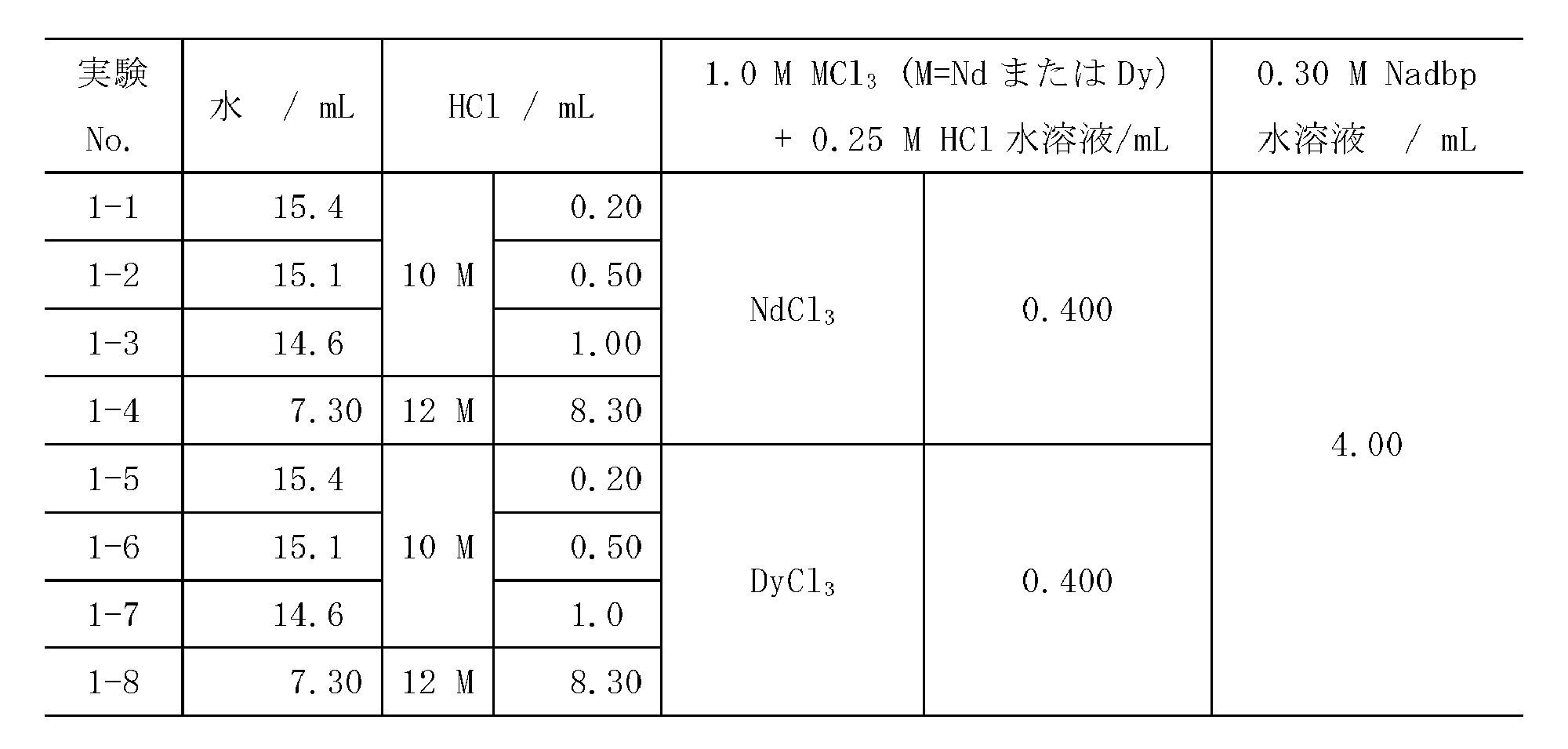
- Example 1 In this example, the dependence of the precipitation rate of Nd and Dy on the HCl concentration when a single component solution of Nd and Dy and a Nadbp solution were mixed was examined. About 0.015 g of the precipitate obtained from each solution shown in Table 1-1 was weighed and subjected to acid decomposition using a microwave oven in the same manner as described in [0047]. The resulting acid solution was diluted and Nd or Dy and P concentrations were quantified by ICP-emission spectroscopic analysis. The obtained P / M molar ratio, HCl concentration at the time of mixing, Nd and Dy precipitation rates calculated from the Nd or Dy concentration in the solution are summarized in Table 1-5. FIG. 1 plots the precipitation rate against the HCl concentration.
- the P / M molar ratio is 3, indicating that the precipitate has a coordination polymer structure. It can also be seen that the precipitation rate is higher for Dy than Nd, and the higher the HCl concentration, the lower the precipitation rate, but the greater the difference between the Nd precipitation rate and the Dy precipitation rate.
- Example 2 In this example, the dependence of the precipitation rate of Nd and Dy on the HCl concentration when the mixture was precipitated as a dbp coordination polymer using a mixed solution of Nd and Dy was examined. As shown in Table 2-1, four types of solutions were mixed, and each weight was recorded.
- the precipitate obtained by mixing the mixed solution of Nd and Dy and the Nadbp solution also has a coordination polymer structure.
- the precipitation rate is higher for Dy than for Nd.
- the HCl concentration is 5 mol ⁇ L ⁇ 1 , only Dy is selectively precipitated.
- Example 3 In this example, the dependence of the precipitation rate on the Nadbp concentration was examined using a mixed solution of Nd and Dy.
- Experiment No. 2-2 of Example 2 the precipitation rates of Nd and Dy were examined under the conditions where the Nadbp concentration was changed. As shown in Table 3-1, four types of solutions were mixed and each weight was recorded.
- the Nadbp concentration is in the range of 0.03 to 0.12 mol ⁇ L ⁇ 1 , the precipitation rate of Nd slightly increases and the precipitation rate of Dy greatly increases as the Nadbp concentration increases. High Nadbp concentration increases Dy recovery but increases Nd content. On the other hand, when the Nadbp concentration is low, the Dy recovery rate is lowered, but the Nd content rate can be lowered. Therefore, it can be seen that the Nadbp concentration is preferably about three times the Dy concentration in order to reduce the Nd content and increase the Dy recovery rate.
- Example 4 the dependence of the precipitation rate of Nd and Dy on the HNO 3 concentration in the case of precipitation as a dbp coordination polymer using a mixed solution of Nd and Dy was examined. As shown in Table 4-1, four types of solutions were mixed and each solution was allowed to stand at 20 ° C. overnight (24 h), and then the precipitated coordination polymer was washed and filtered to measure the weight. Recorded.
- the precipitate obtained in the HNO 3 solution also has a coordination polymer structure. Moreover, the precipitation rate is higher for Dy than for Nd, and especially when the HNO 3 concentration at the time of mixing the solution is 0.40 mol ⁇ L ⁇ 1 , the precipitation rate of Nd is low and Dy selectively precipitates. .
- Example 5 In this example, the precipitation rates of Nd and Dy when the time until filtration in Experiment No. 4-5 of Example 4 was changed were examined. After mixing the solution under the same conditions as in Experiment No. 4-5, the solution was allowed to stand at 20 ° C. as shown in Table 5-1.
- the precipitated coordination polymer was washed and filtered to measure the weight, and the precipitate was filtered and decomposed in the same manner as described above.
- Table 5 shows the obtained P / (Dy + Nd) molar ratio, the precipitation rate of Nd and Dy calculated from Nd and Dy concentrations in the solution, and the Dy / Nd molar ratio in the precipitate calculated from the composition analysis of the precipitate. Sum it up in two. Moreover, the change of the precipitation rate with respect to the solution standing time at 20 ° C. is plotted in FIG.
- Example 6 In this example, when a mixed solution of Nd and Dy is used to precipitate as a dbp coordination polymer in an HNO 3 acidic solution, the effect of shaking the solution before filtration and the temperature of the solution are increased. The effect was examined.
- the solution was mixed under the same conditions as in Experiment No. 4-5 in Example 4 above, and the solution was processed as shown in Table 6-1.
- the precipitated coordination polymer was washed and filtered to measure the weight, and the precipitate was filtered and decomposed in the same procedure as described above.
- the obtained P / (Dy + Nd) molar ratio, the Nd and Dy precipitation rates calculated from the Nd and Dy concentrations in the solution, and the Dy / Nd molar ratio in the precipitate calculated from the composition analysis of the precipitate are shown in Table 6- Sum it up in two.
- the Nd precipitation rate is lower and the Dy precipitation rate is higher when shaken than when the solution is allowed to stand at 20 ° C.
- the precipitation rate of Nd is lower and the precipitation rate of Dy is higher when the solution is allowed to stand at 80 ° C. than when the solution is shaken at 20 ° C.
- Example 7 In this example, in Experiment No. 6-3 of Example 6, the precipitation rates of Nd and Dy when the solution standing time was changed were examined. The solution was mixed under the same conditions as in Experiment No. 6-3, and the solution was treated as shown in Table 7-1.
- the precipitated coordination polymer was washed and filtered to measure the weight, and the precipitate was filtered and decomposed in the same procedure as described above.
- the obtained P / (Dy + Nd) molar ratio, the Nd and Dy precipitation rates calculated from the Nd and Dy concentrations in the solution, and the Dy / Nd molar ratio in the precipitate calculated from the composition analysis of the precipitate are shown in Table 7- Sum it up in two.
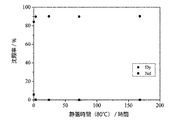
- the change of the precipitation rate with respect to the solution standing time at 80 ° C. is plotted in FIG.
- Example 8 In this example, the precipitation rate of Nd and Dy when the Nadbp concentration was changed in Experiment No. 7-2 of Example 7 was examined.
- the solutions were mixed as in Table 8-1.
- the mixed solution was allowed to stand at 80 ° C. for 24 hours, and then the precipitated coordination polymer was washed and filtered to measure the weight, and the precipitate was filtered and decomposed in the same procedure as described above.
- the obtained P / (Dy + Nd) molar ratio, the Nd and Dy precipitation rates calculated from the Nd and Dy concentrations in the solution, and the Dy / Nd molar ratio in the precipitate calculated from the composition analysis of the precipitate are shown in Table 8- Sum it up in two.
- concentration at the time of solution mixing is plotted in FIG.
- Example 9 In this example, the precipitation rates of Nd and Dy when the acid concentration in Experiment No. 7-1 in Example 7 was changed were examined. The solutions were mixed as shown in Table 9-1.
- a coordination polymer is preferably formed in a 0.4 mol ⁇ L ⁇ 1 HNO 3 solution.
- Example 10 In this example, a method for recovering fractionally precipitated Dy as a highly versatile oxide was examined.
- the precipitate (Dy-dbp coordination polymer) obtained in Experiment No. 7-2 in Example 8 was placed in an oxalic acid or sodium bicarbonate solution as shown in Table 10-1.
- FIG. 9-1 shows SEM images of the precipitate obtained in Experiment No. 7-2 in Example 8 and the precipitates obtained in 10-1-1 and 10-2-1.
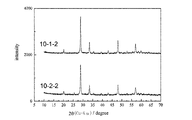
- Fig. 9-2 shows the powder X-ray diffraction patterns of the precipitates obtained in Experiment Nos. 10-1-2 and 10-2-2.
- Example 11 In this example, the Nd and Dy precipitation rates when the Dy concentration and the Nadbp concentration were reduced to 1/5 in Experiment No. 7-3 in Example 7 were examined. The solutions were mixed as shown in Table 11-1.
- Example 12 in this example, in order to investigate whether the coordination polymer forming agent of the present invention can be applied to recover indium (In) from a liquid crystal panel, In and transition metals (aluminum (Al), copper ( The acid concentration dependence of the precipitation rate from a mixed solution of Cu) and zinc (Zn) was investigated.
- the precipitation rate of each metal element was examined under the condition that the mixed solution of Nd and Dy was changed to a mixed solution of In, Al, Cu, and Zn.
- Four types of solutions were mixed as shown in Table 12-1 below, and each weight was recorded.
- Table 13-1 Table 13-1 below, and each weight was recorded.
Landscapes
- Chemical & Material Sciences (AREA)
- Organic Chemistry (AREA)
- Engineering & Computer Science (AREA)
- Life Sciences & Earth Sciences (AREA)
- Materials Engineering (AREA)
- Environmental & Geological Engineering (AREA)
- Metallurgy (AREA)
- Mechanical Engineering (AREA)
- Manufacturing & Machinery (AREA)
- Molecular Biology (AREA)
- Health & Medical Sciences (AREA)
- General Health & Medical Sciences (AREA)
- Biochemistry (AREA)
- General Life Sciences & Earth Sciences (AREA)
- Geology (AREA)
- Chemical Kinetics & Catalysis (AREA)
- General Chemical & Material Sciences (AREA)
- Geochemistry & Mineralogy (AREA)
- Hydrology & Water Resources (AREA)
- Water Supply & Treatment (AREA)
- Manufacture And Refinement Of Metals (AREA)
Abstract
分離が困難である、インジウム、レアアースなどのレアメタルを選択的に低コストで分離する方法、特に、ネオジムイオンとジスプロシウムイオンを含有する水溶液から、ジスプロシウムイオンを選択的かつ低コストで分離する方法を提供することを目的とするものであって、ジブチルリン酸エステル、リン酸水素=ビス[2-(メタクリロイルオキシ)エチル]などの、水溶性のリン酸ジエステルを配位高分子形成剤として用い、レアメタルのイオンを含有する水溶液中で該イオンを選択的に配位高分子化することにより分別沈殿させて分離する。
Description
本発明は配位高分子化を利用するレアメタルの水系分別沈殿法に関する。
安定供給が危惧されているレアメタル(希少金属)には、白金族元素、タングステン、希土類元素(レアアース)等のように埋蔵鉱量や生産量が極めて少ない元素や、インジウムのように、別の資源を採掘する際の副産物として極少量しか生産されないために、需要に応じた生産増加が困難な元素などがある。
近年、先端技術に必要不可欠なレアメタルの安定な供給確保の対策として、使用済み製品などからのレアメタルのリサイクルの重要性が唱えられている。特に、近年、レアアースの供給構造の脆弱化が明らかとなり、リサイクルの実現が早急に求められる。
レアメタルのリサイクルプロセスの中でも特に重要なのは分離である。レアメタルを分離対象とする場合、2種類の分離がある。1つは鉄などベースメタルからのレアメタルの分離、もう一つはレアメタルの相互分離である。レアメタルの中でも、レアアースはその性質が互いに非常に類似しているため、後者の分離が特に困難である。
近年、先端技術に必要不可欠なレアメタルの安定な供給確保の対策として、使用済み製品などからのレアメタルのリサイクルの重要性が唱えられている。特に、近年、レアアースの供給構造の脆弱化が明らかとなり、リサイクルの実現が早急に求められる。
レアメタルのリサイクルプロセスの中でも特に重要なのは分離である。レアメタルを分離対象とする場合、2種類の分離がある。1つは鉄などベースメタルからのレアメタルの分離、もう一つはレアメタルの相互分離である。レアメタルの中でも、レアアースはその性質が互いに非常に類似しているため、後者の分離が特に困難である。
例えば、ネオジム(以下、「Nd」と記載することもある。)、鉄、ホウ素を主成分とするネオジム磁石は、永久磁石の中では最も強力とされ、ハイブリッド自動車の駆動用モータ、エアコン用コンプレッサーモータなどに利用されており、少量のジスプロシウム(以下、「Dy」と記載することもある。)を添加すると保磁力が向上することが知られている。
このような磁石からのレアメタルのリサイクルでは、まず、大量の鉄を取り除くことが必要であり、例えば、Naganawaらは鉄の除去に有効な抽出試薬を開発している(非特許文献1,2)。また、Shirayamaらは乾式法により、鉄とランタノイドの分離を検討している(非特許文献3)
次いで、レアアースの相互分離である、ネオジムとジスプロシウムの分離が行われる。
このような磁石からのレアメタルのリサイクルでは、まず、大量の鉄を取り除くことが必要であり、例えば、Naganawaらは鉄の除去に有効な抽出試薬を開発している(非特許文献1,2)。また、Shirayamaらは乾式法により、鉄とランタノイドの分離を検討している(非特許文献3)
次いで、レアアースの相互分離である、ネオジムとジスプロシウムの分離が行われる。
従来、ネオジムとジスプロシウムの分離法としては、溶媒抽出法が検討されている(非特許文献4)。
この溶媒抽出法は、水溶液中に溶解した分離対象イオンを有機溶媒中に選択的に抽出して、その後再び水溶液相に逆抽出する方法である。この手法は多くの金属イオン分離系に適用されており、工業的に利用されている抽出試薬も多種類ある。
しかしながら、目的物質が高濃度の場合に有効であるが、低濃度の系には不向きである。また、選択性を担うのは有機溶媒中の抽出試薬であるので、目的物に合わせて抽出試薬を選択することができるが、レアアースの相互分離など、金属イオンの性質が類似する場合は、プロセスが多段になり、その場合、大型設備、大量の有機溶媒とエネルギーが必要である。
この溶媒抽出法は、水溶液中に溶解した分離対象イオンを有機溶媒中に選択的に抽出して、その後再び水溶液相に逆抽出する方法である。この手法は多くの金属イオン分離系に適用されており、工業的に利用されている抽出試薬も多種類ある。
しかしながら、目的物質が高濃度の場合に有効であるが、低濃度の系には不向きである。また、選択性を担うのは有機溶媒中の抽出試薬であるので、目的物に合わせて抽出試薬を選択することができるが、レアアースの相互分離など、金属イオンの性質が類似する場合は、プロセスが多段になり、その場合、大型設備、大量の有機溶媒とエネルギーが必要である。
また、金属イオンの分離のもう1つの例として、非特許文献5では、液晶パネルからレアメタルの1つであるインジウムを回収するために、酸による浸出と溶媒抽出による金属イオンの分離を行った結果が報告されており、溶媒抽出では、di-(2-ethylhexyl)phosphoric acid (Hdehp),tributyl phosphate (TBP),bis(2,4,4-trimethylpentyl) phosphinic acid (Cyanex272),Cyanex 923 (ホスフィンオキシドの混合物)を抽出試薬とし、ケロセン、トルエン、n-オクタノ―ル、シクロヘキサンを有機溶媒とし、インジウム、アルミニウム、銅、鉄、スズ、亜鉛の分離を調べている。その中で、インジウムの回収には、抽出試薬としてHdehpを用い、有機溶媒としてケロセンを用いた場合が優れていることが報告されている。
また、金属イオンのその他の分離法の1つに、「イオン交換法」がある。
この方法は、多孔性ポリマーに金属イオンを吸着させた後、選択的に脱着することによって目的物質を分離する手法である。通常のイオン交換樹脂などでは、交換体そのものとレアアースの相互作用に大差がなく、脱着プロセスにおいてレアアースに選択性のある錯化剤を用いることで分離を行う。また、特定の金属イオンに高選択的なキレート剤を結合させたキレート樹脂では、分離プロセスは簡単になるが、キレート樹脂の合成に有機溶媒が必要でありかつ合成プロセスが煩雑であるという問題がある。
この方法は、多孔性ポリマーに金属イオンを吸着させた後、選択的に脱着することによって目的物質を分離する手法である。通常のイオン交換樹脂などでは、交換体そのものとレアアースの相互作用に大差がなく、脱着プロセスにおいてレアアースに選択性のある錯化剤を用いることで分離を行う。また、特定の金属イオンに高選択的なキレート剤を結合させたキレート樹脂では、分離プロセスは簡単になるが、キレート樹脂の合成に有機溶媒が必要でありかつ合成プロセスが煩雑であるという問題がある。
また、他の分離法として、「含浸樹脂法」も挙げられる。
この方法では、溶媒抽出試薬を多孔性ポリマーに浸み込ませて用いる。金属イオンの分離メカニズムは、前述の溶媒抽出法と同じであるが、有機溶媒を用いない点が優れている。ただし、液体を浸み込ませているだけなので、液体がポリマーから溶けだしてしまうことによる劣化が問題点である。
この方法では、溶媒抽出試薬を多孔性ポリマーに浸み込ませて用いる。金属イオンの分離メカニズムは、前述の溶媒抽出法と同じであるが、有機溶媒を用いない点が優れている。ただし、液体を浸み込ませているだけなので、液体がポリマーから溶けだしてしまうことによる劣化が問題点である。
さらに、他の分離法として、「沈殿分離法」が挙げられる。
アイシン精機は、カツオだしなどに含まれるイノシン酸を活用して、中古の磁石からネオジムやジスプロシウムなどを抽出する技術を発表しており(非特許文献6、7)、従来法より低コストで安全なのが特徴であるといえる。この方法で、1リットルあたり90グラムのイノシン酸に1リットルあたり40グラムの塩化ネオジム溶液を混合すると95%以上のネオジムを沈殿物として回収でき、ジスプロシウムなどの安定調達に一定の目途がたつと記載されている。しかしながら、ネオジムとジスプロシウムの相互分離に関するデータは示されていない。
アイシン精機は、カツオだしなどに含まれるイノシン酸を活用して、中古の磁石からネオジムやジスプロシウムなどを抽出する技術を発表しており(非特許文献6、7)、従来法より低コストで安全なのが特徴であるといえる。この方法で、1リットルあたり90グラムのイノシン酸に1リットルあたり40グラムの塩化ネオジム溶液を混合すると95%以上のネオジムを沈殿物として回収でき、ジスプロシウムなどの安定調達に一定の目途がたつと記載されている。しかしながら、ネオジムとジスプロシウムの相互分離に関するデータは示されていない。
また、非特許文献8では、ネオジム、プラセオジム、及びエルビウムは、62%のdi(2-ethylhexyl)phosphoric acid(HA)と37%のmono-(2-etylhexyl)phosphoric acid(H2A’)の混合物と、アセトン溶液中で混合すると、HAとのみ沈殿物を生じ、一方で、ランタンは、H2A’とのみ錯形成により沈殿することを見出している。そして、これを利用して、ランタンとネオジムの混合溶液からのこれらの分離を試みた結果、例えばランタンとネオジムを1:1で混合した系では、ネオジム19.8%、ランタンは0.7%沈殿するとしている。プラセオジムとエルビウムの分離の結果は記載がないが、ネオジム-ランタン系より悪いと報告されている。しかしながら、ネオジムイオンとジスプロシウムイオンについては記載がない。
本発明者らは、こうした現状を鑑み、分離が非常に困難であるレアアース、中でも特に、ネオジムとジスプロシウムを、選択的かつ低コストに分離する方法について検討したところ、レアアースに選択性が高い溶媒抽出試薬として知られている、ジ-2-エチルへキシルリン酸エステル(Hdehp)(液体)(D.F.Peppard,G.W.Mason,J.L.Maier,and W.J.Driscoll,J.Inorg.Nucl.Chem. 1957,4,334-343.)(下記の式参照)を、配位高分子形成剤として用いることにより解決しうるという知見を得た。

配位高分子は、有機配位子が金属イオンを架橋して形成する高分子型錯体であって、近年、着目されている材料群である。
本発明者らは、金属(M)とHdehpが、エタノールまたはエタノール-水混合溶媒で配位高分子化して[M(dehp)3]nを形成し、沈殿することを見出している(上記非特許文献(9、10))。
本発明者らは、金属(M)とHdehpが、エタノールまたはエタノール-水混合溶媒で配位高分子化して[M(dehp)3]nを形成し、沈殿することを見出している(上記非特許文献(9、10))。
本発明者らは、更に検討を重ねた結果、Hdehpがレアアースと反応して配位高分子を形成すること、及びこの反応率は、イオンの種類及び混合溶媒組成比に依存して変化することを見出し、該反応を利用して、ネオジムイオンとジスプロシウムイオンを、選択的かつ低コストに分離できる分別沈殿法を提案した(特許文献1、非特許文献11)。
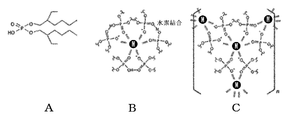
図10は、Hdehpの配位高分子化について説明する図であり、図中のCが、Hdehpがレアアース金属イオンと反応して配位高分子[M(dehp)3]n(Mはレアアース金属イオン)を形成することを示している。
なお、図中のAに示すHdehpは、無極性溶媒中では二量体を形成すると言われており、同Bに示すように、従来の溶媒抽出系においては、該Hdehpの二量体3つが、3価のレアアース金属イオンと1:6錯体を形成している。
図10は、Hdehpの配位高分子化について説明する図であり、図中のCが、Hdehpがレアアース金属イオンと反応して配位高分子[M(dehp)3]n(Mはレアアース金属イオン)を形成することを示している。
なお、図中のAに示すHdehpは、無極性溶媒中では二量体を形成すると言われており、同Bに示すように、従来の溶媒抽出系においては、該Hdehpの二量体3つが、3価のレアアース金属イオンと1:6錯体を形成している。
H. Naganawa, S. Nishihama, K. Yoshizuka, Sov. Extr. Res. Dev. Jpn, 2007, 14, 151.
K. Shimojo, H. Naganawa, J. Noro, F. Kubot, M. Goto, Anal.Sci., 2007, 23, 1427.
S. Shirayama, T.H. Okabe, Proceeding of Annual Meeting of MMIJ, 2008, Mar.27-29, 69-70.
M. Tanaka, Y. Sato, Y. Huang, H. Narita, K. Koyama, Proceedings of the 10th International Symposium on East Asian Resources Recycling Technology, Nov.2-6, 2009, 200-203.
Jiaxu Yang, Teodora Retegan, Christian Ekberg, Hydrometallurgy, 2013, 137, 68-77.
日経産業新聞 平成25年7月8日
資源・素材学会2013(春季大会)発表要旨第81ページ
M. Milanova, D. Todorovsky, M. Arnaudov, N. Minkova, Separation Science and Technology, 1995, 30(5)5, 821-832.
Yuiko Tasaki-Handa, Hiroaki Sato, Masaki Torimura, Mikiya Tanaka, Akihiro Wakisaka, Solvent Extraction Research and Development Japan, 2014, 21, 83-87.
Yuiko Tasaki-Handa, Kenta Ooi, Mikiya Tanaka, Akihiro Wakisaka, Analytical Sciences, 2013, 29(7), 685-687.
Yuiko Tasaki-Handa, Yukie Abe, Kenta Ooi, Hirokazu Narita, Mikiya Tanaka, Akihiro Wakisaka, RSC Advances, 2014, 4, 20496-20498.
本発明者らが、更に検討した結果、上記特許文献1の方法は、エタノール等の親水性有機溶媒、又はエタノール等の親水性有機溶媒と水との混合溶媒を用いるが、実際のプロセスを考慮すると、繰り返し利用が困難であり、混合溶液よりも、水のみからなる単一溶媒で分別沈殿できることが好ましいことが判明した。
本発明は、こうした現状を鑑みてなされたものであって、分離が困難であるレアメタルを、溶媒として、水のみを用いて、選択的かつ低コストに分離する方法及び分離後のレアメタルを回収する方法を提供することを目的とするものである。
本発明者らは、上記目的を達成すべく鋭意研究を重ねた結果、前記ジ-2-エチルへキシルリン酸エステル(Hdehp)に代えて、水溶性のリン酸ジエステル、例えば、ジブチルリン酸(以下、「Hdbp」と表記することもある。)やリン酸水素=ビス[2-(メタクリロイルオキシ)エチル](以下、「Hpmoe」と表記することもある。)等を用いることにより、水のみを溶媒として、分離が困難なネオジムとジスプロシウムの分離が可能であることが判明した。また、インジウム等の3価のレアメタルが選択的に分別沈殿できることも判明した。
また、さらに酸を混合して水溶液中におけるリン酸ジエステルの酸解離度を調整することにより、分離が良くなること、用いる酸としては、塩酸よりも硝酸を利用する方が分離が良くなること、さらには、高温下で沈殿した配位高分子を高温で熟成した後にろ過すると分離が良くなることも判明した。
また、さらに酸を混合して水溶液中におけるリン酸ジエステルの酸解離度を調整することにより、分離が良くなること、用いる酸としては、塩酸よりも硝酸を利用する方が分離が良くなること、さらには、高温下で沈殿した配位高分子を高温で熟成した後にろ過すると分離が良くなることも判明した。
また、分離沈殿させたジスプロシウムの再利用可能な回収方法について検討した結果、分別沈殿させたジスプロシウムの配位高分子を、シュウ酸塩や炭酸塩に変換し、焼成することで、再利用に有効な酸化ジスプロシウムとして回収しうることも判明した。
本発明は、該知見に基づいて完成に至ったものであり、以下の発明が提供される。
[1]レアメタルのイオンを含有する水溶液中から分別沈殿させることよりレアメタルを分離する方法であって、
水溶性のリン酸ジエステルを配位高分子形成剤として用い、水溶液中で3価のレアメタルのイオンを選択的に配位高分子化して分別沈殿させることを特徴とする分別沈殿法。
[2]前記水溶性のリン酸ジエステルが、ジブチルリン酸エステル、又はリン酸水素=ビス[2-(メタクリロイルオキシ)エチル]であることを特徴とする請求項[1]に記載の分別沈殿法。
[3]前記3価のレアメタルが、レアアース又はインジウムであることを特徴とする[1]又は[2]に記載の分別沈殿法。
[4]ネオジムイオン及びジスプロシウムイオンを含有する水溶液中で、ジスプロシウムイオンを選択的に配位高分子化して分別沈殿させることを特徴とする[1]又は[2]に記載の分別沈殿法。
[5]前記水溶液に、さらに酸を混合して、該水溶液におけるリン酸ジエステルの解離度を調整することを特徴とする[4]に記載の分別沈殿法。
[6]前記水溶液を、100℃未満に加温することを特徴とする[4]又は[5]の分別沈殿法。
[7][4]~[6]のいずれかの方法で分別沈殿させたジスプロシウムの配位高分子を、シュウ酸塩又は炭酸塩に変換した後焼成し、酸化ジスプロシウムとして回収する方法。
[1]レアメタルのイオンを含有する水溶液中から分別沈殿させることよりレアメタルを分離する方法であって、
水溶性のリン酸ジエステルを配位高分子形成剤として用い、水溶液中で3価のレアメタルのイオンを選択的に配位高分子化して分別沈殿させることを特徴とする分別沈殿法。
[2]前記水溶性のリン酸ジエステルが、ジブチルリン酸エステル、又はリン酸水素=ビス[2-(メタクリロイルオキシ)エチル]であることを特徴とする請求項[1]に記載の分別沈殿法。
[3]前記3価のレアメタルが、レアアース又はインジウムであることを特徴とする[1]又は[2]に記載の分別沈殿法。
[4]ネオジムイオン及びジスプロシウムイオンを含有する水溶液中で、ジスプロシウムイオンを選択的に配位高分子化して分別沈殿させることを特徴とする[1]又は[2]に記載の分別沈殿法。
[5]前記水溶液に、さらに酸を混合して、該水溶液におけるリン酸ジエステルの解離度を調整することを特徴とする[4]に記載の分別沈殿法。
[6]前記水溶液を、100℃未満に加温することを特徴とする[4]又は[5]の分別沈殿法。
[7][4]~[6]のいずれかの方法で分別沈殿させたジスプロシウムの配位高分子を、シュウ酸塩又は炭酸塩に変換した後焼成し、酸化ジスプロシウムとして回収する方法。
本発明によれば、溶媒抽出のように有機溶媒を用いる多段プロセスを必要とすることなく、水のみを溶媒に用いて、3価のレアメタルを分離することができ、中でも、分離が困難であるネオジムとジスプロシウムを分離することができる。また、本発明の方法は、抽出試薬そのものを固体化するものであり、液体抽出試薬を担持させる含浸樹脂とは異なり、分離に必要な溶媒は水のみであり、非常に低コストで簡便である。
本発明の分別沈殿法は、水溶性のリン酸ジエステルを配位高分子形成剤として用い、3価のレアメタルのイオンを含有する水溶液中で、レアメタルのイオンを選択的に配位高分子化して分別沈殿させることを特徴とするものである。
本発明は、水溶液中で酸解離しているリン酸ジエステルが、水溶液中の3価のレアメタルのイオンと反応して、配位高分子(固体)を形成することを利用するものである。ただし、水溶液中の全てのリン酸ジエステルが酸解離している必要はない。
本発明で用いられる、水溶性のリン酸ジエステルとしては、水に対する溶解度が0.01mol・L-1以上のものが好ましく、0.05mol・L-1のものがより好ましい。ただし、ナトリウム塩を混合するなどして解離型にしたリン酸ジエステルの溶解度が上記の条件を満たす物質でも構わない。
具体的には、アルキル鎖の炭素数が2~6のリン酸ジエステルが望ましく、エーテルや水酸基など親水性基を有する場合は、炭素数が6以上のジエステルでも良く、特に好ましくは、入手しやすい市販の水溶性リン酸ジエステルが用いられ、例えば、下記の式
具体的には、アルキル鎖の炭素数が2~6のリン酸ジエステルが望ましく、エーテルや水酸基など親水性基を有する場合は、炭素数が6以上のジエステルでも良く、特に好ましくは、入手しやすい市販の水溶性リン酸ジエステルが用いられ、例えば、下記の式


また、本発明における3価のレアメタルとしては、レアアース(スカンジウム、イットリウムと、ランタンからルテチウムまでのランタノイドの、計17鉱種)に加えて、インジウム、チタン、バナジウム、クロム、マンガン、コバルト、ガリウム、ジルコニウム、ニオブ、モリブデン、ルテニウム、ロジウム、アンチモン、タンタル、レニウム、タリウム、ビスマスが挙げられる。
本発明は、中でも、特に、分離が困難であったネオジム及びジスプロシウムイオンを含有する水溶液中で、ジスプロシウムイオンを選択的に配位高分子化して分別沈殿させることができるものである。すなわち、本発明の方法は、レアメタルのイオン、特に、少なくともネオジムイオン及びジスプロシウムイオンを含有する水溶液中で、水に溶解しているリン酸ジエステルが、レアメタルのイオンと選択的に配位高分子化し、該配位高分子を沈殿させるものであって、水のみを溶媒としてレアメタルを分離することを可能とするものである。
本発明は、中でも、特に、分離が困難であったネオジム及びジスプロシウムイオンを含有する水溶液中で、ジスプロシウムイオンを選択的に配位高分子化して分別沈殿させることができるものである。すなわち、本発明の方法は、レアメタルのイオン、特に、少なくともネオジムイオン及びジスプロシウムイオンを含有する水溶液中で、水に溶解しているリン酸ジエステルが、レアメタルのイオンと選択的に配位高分子化し、該配位高分子を沈殿させるものであって、水のみを溶媒としてレアメタルを分離することを可能とするものである。
本発明において、水溶性のリン酸ジエステルの水溶液中での濃度は0.01~0.5mol・L-1が好ましい。
また、ネオジムイオン及びジスプロシウムイオンを含有する混合液において、水溶性リン酸ジエステルの濃度は、分別沈殿させるジスプロシウムイオンの濃度に対して、およそ3倍となるように混合されることが望ましい。
また、ネオジムイオン及びジスプロシウムイオンを含有する混合液において、水溶性リン酸ジエステルの濃度は、分別沈殿させるジスプロシウムイオンの濃度に対して、およそ3倍となるように混合されることが望ましい。
本発明において、水溶液中で、ジスプロシウムイオンを選択的に配位高分子化する方法としては、ネオジムイオンとジスプロシウムイオンが存在する混合液中に、配位高分子化剤である水溶性リン酸ジエステルが含有されていればよく、その混合方法は特に限定されない。
すなわち、例えば、ネオジムイオン及びジスプロシウムイオンを含有する溶液として、ネオジム及びジスプロシウムの塩を水に溶解させた水溶液が用いられる。そして、これらのネオジムイオン及びジスプロシウムイオンを含有する水溶液に、水溶性リン酸ジエステルを混合するか、或いは、前記の水溶液に、水溶性リン酸ジエステルを溶解させた水溶液を混合し、さらに、必要に応じて、水を混合する。
こうして得られた配位高分子を、例えば、室温で一晩静置するなどした後に洗浄・濾過して、分離する。
すなわち、例えば、ネオジムイオン及びジスプロシウムイオンを含有する溶液として、ネオジム及びジスプロシウムの塩を水に溶解させた水溶液が用いられる。そして、これらのネオジムイオン及びジスプロシウムイオンを含有する水溶液に、水溶性リン酸ジエステルを混合するか、或いは、前記の水溶液に、水溶性リン酸ジエステルを溶解させた水溶液を混合し、さらに、必要に応じて、水を混合する。
こうして得られた配位高分子を、例えば、室温で一晩静置するなどした後に洗浄・濾過して、分離する。
さらに、本発明においては、混合液に酸を混合して、該混合液中におけるリン酸ジエステルの酸解離度を調整することにより、分離効率を高めることができる。
混合する酸は、水に溶解するものであれば、特に限定されないが、例えば、硝酸又は塩酸などが好ましく用いられ、より好ましくは硝酸が用いられる。
好ましい酸濃度は、水溶性リン酸ジエステルの酸解離定数と酸の種類によって変わるが、硝酸溶液中でNa型ジブチルリン酸を用いる場合、酸濃度は、0.4mol・L-1が好ましい。
混合する酸は、水に溶解するものであれば、特に限定されないが、例えば、硝酸又は塩酸などが好ましく用いられ、より好ましくは硝酸が用いられる。
好ましい酸濃度は、水溶性リン酸ジエステルの酸解離定数と酸の種類によって変わるが、硝酸溶液中でNa型ジブチルリン酸を用いる場合、酸濃度は、0.4mol・L-1が好ましい。
また、溶液を混合する温度は、室温(20℃)よりも、100℃未満の高温である方が好ましく、より好ましくは、50~80℃である。さらに、溶液を混合した直後にろ過するよりも、3時間以上、好ましくは24時間以上、より好ましくは72時間以上静置してからろ過すると沈殿分離の選択性が高くなる。
本発明の方法により、分離した、ネオジム、ジスプロシウム等のレアメタルを再利用するためには、汎用性の高い化合物として回収する必要がある。
そのためには、水に対する溶解度が高く、塩化物や硝酸化物に変換可能で、さらに高温で還元すると金属に変換可能な酸化物にすることが望ましい。
本発明では、分別沈殿させたジスプロシウムをシュウ酸塩や炭酸塩に変換し、焼成することで酸化ジスプロシウムとして回収することが可能である。
具体的には、分別沈殿させたジスプロシウムを、シュウ酸または炭酸、あるいはシュウ酸または炭酸の塩の水溶液中に入れる。シュウ酸または炭酸は、ジスプロシウムと難溶性の塩を形成するので、水溶液中には、ジスプロシウムがシュウ酸または炭酸の塩として沈殿するのに必要な量、いわゆる化学量論比以上の量が含まれていればよいが、濃度を高めることで、回収率は向上すると考えられ、2倍以上の量が含まれていることが好ましい。
また、溶液は静置してもよいが、溶液を振とうすることで回収率を向上させることが好ましい。さらに、1日以上反応させることが好ましく、より好ましくは2日以上反応させると良い。
そのためには、水に対する溶解度が高く、塩化物や硝酸化物に変換可能で、さらに高温で還元すると金属に変換可能な酸化物にすることが望ましい。
本発明では、分別沈殿させたジスプロシウムをシュウ酸塩や炭酸塩に変換し、焼成することで酸化ジスプロシウムとして回収することが可能である。
具体的には、分別沈殿させたジスプロシウムを、シュウ酸または炭酸、あるいはシュウ酸または炭酸の塩の水溶液中に入れる。シュウ酸または炭酸は、ジスプロシウムと難溶性の塩を形成するので、水溶液中には、ジスプロシウムがシュウ酸または炭酸の塩として沈殿するのに必要な量、いわゆる化学量論比以上の量が含まれていればよいが、濃度を高めることで、回収率は向上すると考えられ、2倍以上の量が含まれていることが好ましい。
また、溶液は静置してもよいが、溶液を振とうすることで回収率を向上させることが好ましい。さらに、1日以上反応させることが好ましく、より好ましくは2日以上反応させると良い。
以下、本発明の沈殿分離法について、実施例を用いて説明するが、本発明は、これらの実施例に限定されるものではない。
以下の実施例では、水溶性リン酸ジエステルとして、ジブチルリン酸(以下、「Hdbp」とする。)、又はリン酸水素=ビス[2-(メタクリロイルオキシ)エチル](以下、「Hpmoe」とする。)を用いた。
以下の実施例では、水溶性リン酸ジエステルとして、ジブチルリン酸(以下、「Hdbp」とする。)、又はリン酸水素=ビス[2-(メタクリロイルオキシ)エチル](以下、「Hpmoe」とする。)を用いた。
[0.30mol・L-1 Nadbp水溶液の調製]
反応前後でpHが変化しないように、NaOH水溶液を用いて、HdbpをNa型に変えた。
Hdbp 6.3gを、14.5mol・L-1 NaOH水溶液2.07mLと混合して、水で100mLとし、0.30mol・L-1 Nadbp水溶液を調製した。
[0.37mol・L-1 Napmoe水溶液の調製]
反応前後でpHが変化しないように、NaOH水溶液を用いて、HpmoeをNa型に変えた。
Hpmoe 5.11gを、14.5mol・L-1 NaOH水溶液1.07mLと混合して、水で50mLとし、0.32mol・L-1 Napmoe水溶液を調製した。
反応前後でpHが変化しないように、NaOH水溶液を用いて、HdbpをNa型に変えた。
Hdbp 6.3gを、14.5mol・L-1 NaOH水溶液2.07mLと混合して、水で100mLとし、0.30mol・L-1 Nadbp水溶液を調製した。
[0.37mol・L-1 Napmoe水溶液の調製]
反応前後でpHが変化しないように、NaOH水溶液を用いて、HpmoeをNa型に変えた。
Hpmoe 5.11gを、14.5mol・L-1 NaOH水溶液1.07mLと混合して、水で50mLとし、0.32mol・L-1 Napmoe水溶液を調製した。
[1.0mol・L-1 MCl3およびM(NO3)3水溶液の調製(MはNdまたはDy)]
NdとDyの水溶液を、以下の2通りの方法で調製した。
(1)NdCl3 6水和物、DyCl3 6水和物のそれぞれを、水に溶解して1.0mol・L-1溶液を調製した。塩の析出を防ぐために、0.25mol・L-1となるように塩酸(HCl)を加えた。
(2)Nd(NO3)3 6水和物、Dy(NO3)3 6水和物のそれぞれを、水に溶解して1.0mol・L-1溶液を調製した。塩の析出を防ぐために、0.25mol・L-1となるように硝酸(HNO3)を加えた。
NdとDyの水溶液を、以下の2通りの方法で調製した。
(1)NdCl3 6水和物、DyCl3 6水和物のそれぞれを、水に溶解して1.0mol・L-1溶液を調製した。塩の析出を防ぐために、0.25mol・L-1となるように塩酸(HCl)を加えた。
(2)Nd(NO3)3 6水和物、Dy(NO3)3 6水和物のそれぞれを、水に溶解して1.0mol・L-1溶液を調製した。塩の析出を防ぐために、0.25mol・L-1となるように硝酸(HNO3)を加えた。
前記の0.30mol・L-1 Nadbp水溶液、及び前記(1)の1.0mol・L-1 MCl3水溶液を用いて、表1-1に示す4種類の溶液を混合し、各溶液を20℃で一晩静置した後、沈殿した配位高分子を洗浄・濾過して重量を測定し、各重量を記録した。
以下、表中の濃度単位「mol・L-1」を、「M」と表記することもある。
以下、表中の濃度単位「mol・L-1」を、「M」と表記することもある。
(溶解度積の測定)
Hdbpの沈殿分離の有効性を評価するために、Nd-dbp配位高分子([Nd(dbp)3])とDy-dbp配位高分子([Dy(dbp)3])の溶解度積を測定した。
Dbp-とNdまたはDyとの沈殿反応は以下の反応式で表せる。
Hdbpの沈殿分離の有効性を評価するために、Nd-dbp配位高分子([Nd(dbp)3])とDy-dbp配位高分子([Dy(dbp)3])の溶解度積を測定した。
Dbp-とNdまたはDyとの沈殿反応は以下の反応式で表せる。


沈殿が生成する条件は、以下の式で求められる溶解度積(Ksp)によって決まり、Ksp(Nd)とKsp(Dy)の差が大きいほど分別沈殿に有効である。
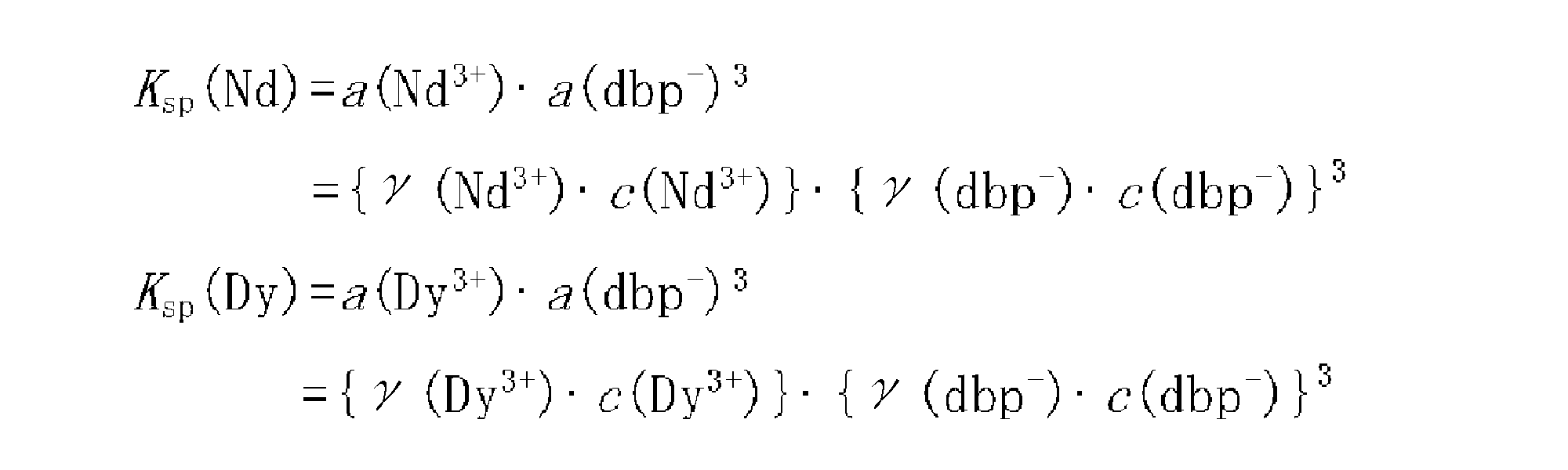
式中、aは活量、γは活量係数、cは濃度である。
γ=1と仮定すると、濃度の積を用いて分別沈殿の有効性を評価することができる。この濃度の積を、みかけの溶解度(Ka sp)とする。
γ=1と仮定すると、濃度の積を用いて分別沈殿の有効性を評価することができる。この濃度の積を、みかけの溶解度(Ka sp)とする。
上記の表1-1の、実験No.1-1、1-5の条件で合成した、Ndの配位高分子及びDyの配位高分子を、表1-2に示す重量で、20℃の水中に入れた。
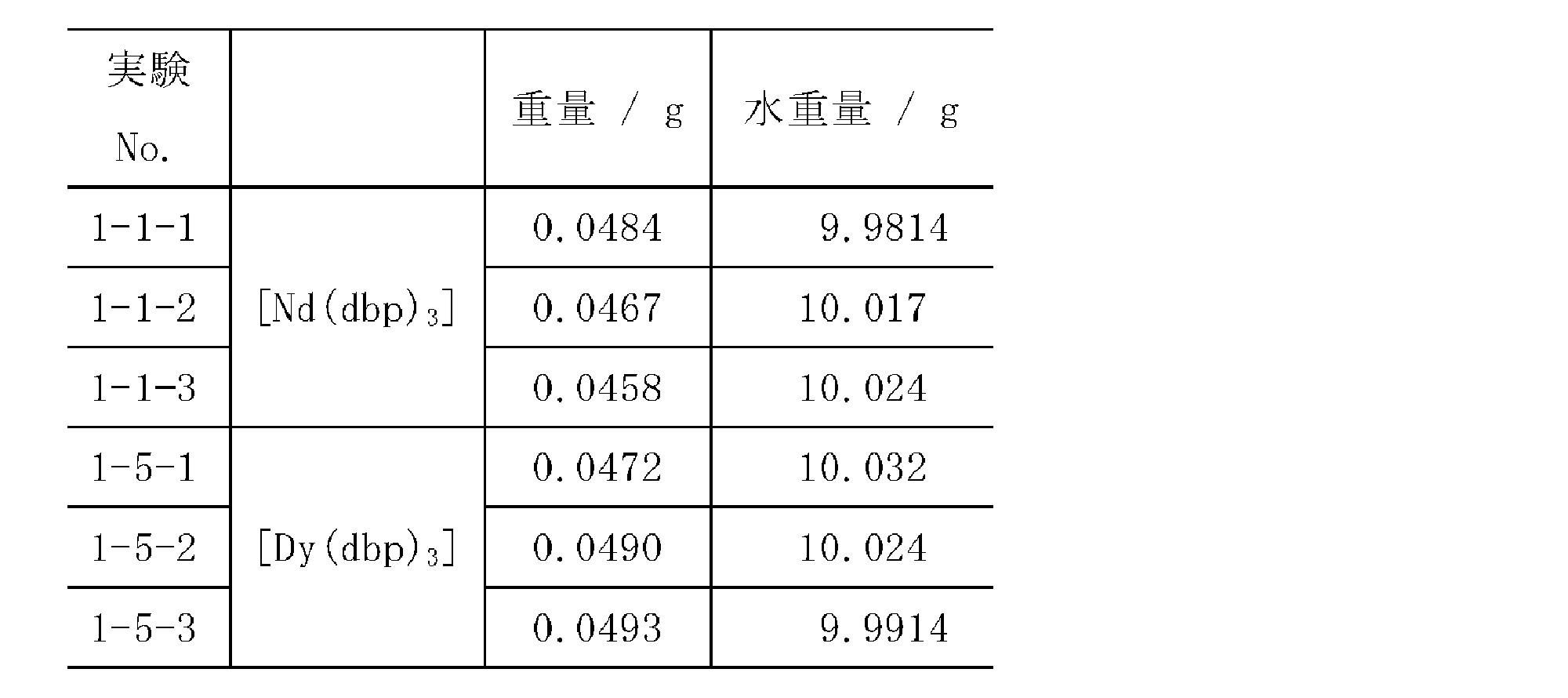
45日間振とうした後、所定の量の上澄み液を採取して秤量し、60% HNO3 3mLとH2O2 0.3mLを酸分解専用のPTFE容器に入れ、電子レンジ(200W)で分解した。得られた酸溶液を希釈してICP-発光分光分析でNdまたはDyとPの濃度を定量した。表1-3に結果をまとめる。

上記表中のc(P)はc(dbp-)と等しいとして、[0044]に記載の見かけの溶解度Ka
sp(Nd)とKa
sp(Dy)を求めた。表1-4に結果をまとめる。
参考として、リン酸塩(MPO4)、及びシュウ酸塩(M2(C2O4)3)のKsp(Nd)/Ksp(Dy)を記載する。
参考として、リン酸塩(MPO4)、及びシュウ酸塩(M2(C2O4)3)のKsp(Nd)/Ksp(Dy)を記載する。
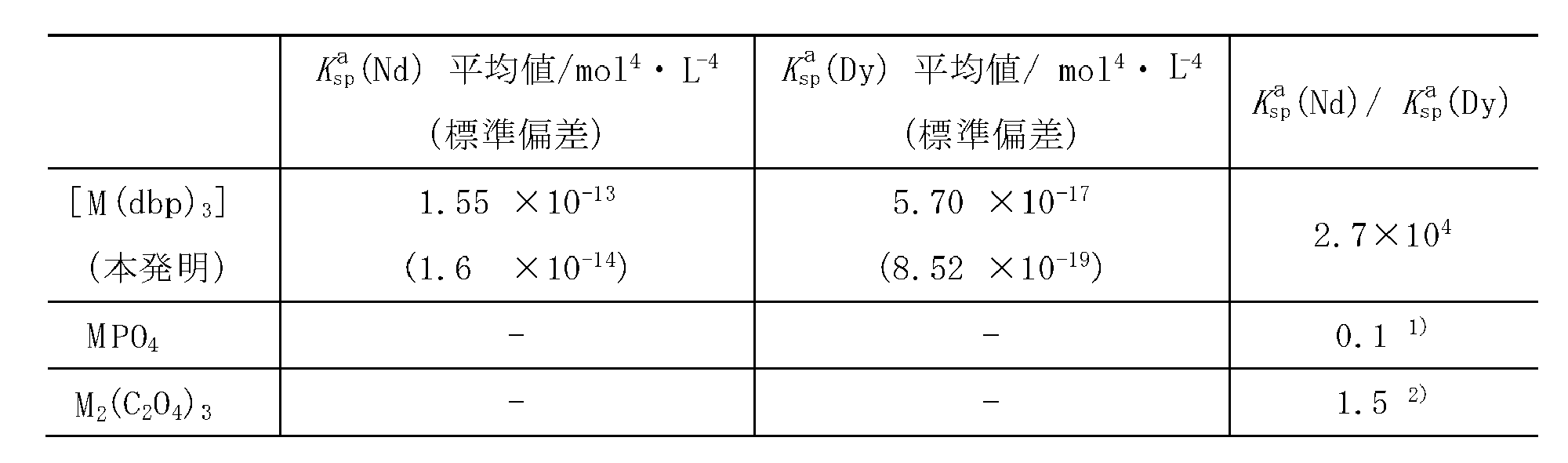
2)Chung et al. J. Ind. Eng. Chem., 1998, 4, 277.に記載された溶解度積に基づいて計算したKsp(Nd)/ Ksp(Dy)
※MはNdまたはDyを示す
[M(dbp)3]の場合のKa
spの比は、リン酸塩(MPO4)及びシュウ酸塩(M2(C2O4)3)の場合と比較して大きく、dbpを利用する沈殿反応はNdとDyの沈殿分離に有効なことがわかる。
(実施例1)
本実施例では、NdとDyの単一成分溶液とNadbp溶液を混合した場合の、NdとDyの沈殿率のHCl濃度依存性について検討した。
上記表1-1の各溶液から得られた沈殿物を約0.015g秤量して、[0047]に記載したと同様の方法で電子レンジを用いて酸分解した。得られた酸溶液を希釈してICP-発光分光分析でNdまたはDyとP濃度を定量した。
得られたP/Mモル比、混合時のHCl濃度、溶液中NdまたはDy濃度から算出したNdおよびDyの沈殿率を表1-5にまとめる。また、図1にHCl濃度に対する沈殿率をプロットする。
本実施例では、NdとDyの単一成分溶液とNadbp溶液を混合した場合の、NdとDyの沈殿率のHCl濃度依存性について検討した。
上記表1-1の各溶液から得られた沈殿物を約0.015g秤量して、[0047]に記載したと同様の方法で電子レンジを用いて酸分解した。得られた酸溶液を希釈してICP-発光分光分析でNdまたはDyとP濃度を定量した。
得られたP/Mモル比、混合時のHCl濃度、溶液中NdまたはDy濃度から算出したNdおよびDyの沈殿率を表1-5にまとめる。また、図1にHCl濃度に対する沈殿率をプロットする。

P/Mモル比が3であることから、沈殿物は配位高分子構造であることがわかる。
また、沈殿率はNdよりもDyの方が大きく、HCl濃度が高いほど、沈殿率は小さくなるが、Ndの沈殿率とDyの沈殿率の差が大きくなることが分かる。
また、沈殿率はNdよりもDyの方が大きく、HCl濃度が高いほど、沈殿率は小さくなるが、Ndの沈殿率とDyの沈殿率の差が大きくなることが分かる。
(実施例2)
本実施例では、NdとDyの混合溶液を用いて、dbp配位高分子として沈殿させた場合の、NdとDyの沈殿率のHCl濃度依存性について検討した。
表2-1の通り4種類の溶液を混合し、各重量を記録した。
本実施例では、NdとDyの混合溶液を用いて、dbp配位高分子として沈殿させた場合の、NdとDyの沈殿率のHCl濃度依存性について検討した。
表2-1の通り4種類の溶液を混合し、各重量を記録した。

溶液を一晩静置した後、沈殿した配位高分子を洗浄・濾過して重量を測定した。
前述の方法と同様の手順で、沈殿物を濾過して分解した。
得られたP/(Dy+Nd)モル比、溶液混合時のHCl濃度、溶液中NdとDyの濃度から算出したNdおよびDyの沈殿率を表2-2にまとめる。また、HCl濃度に対する沈殿率を図2にプロットする。
前述の方法と同様の手順で、沈殿物を濾過して分解した。
得られたP/(Dy+Nd)モル比、溶液混合時のHCl濃度、溶液中NdとDyの濃度から算出したNdおよびDyの沈殿率を表2-2にまとめる。また、HCl濃度に対する沈殿率を図2にプロットする。
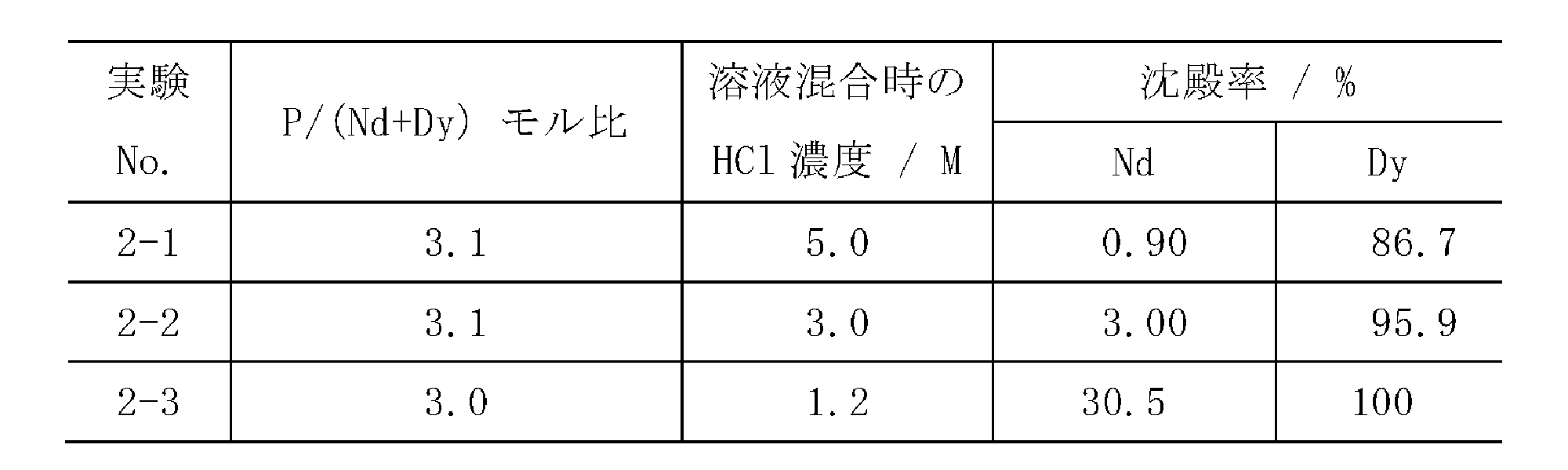
P/(Nd+Dy)モル比がほぼ3であることから、NdとDyの混合溶液とNadbp溶液を混合して得られる沈殿物も配位高分子構造であることがわかる。
また、沈殿率はNdよりもDyの方が大きく、特にHCl濃度が5mol・L-1のときは、Dyのみが選択的に沈殿することが分かる。
また、沈殿率はNdよりもDyの方が大きく、特にHCl濃度が5mol・L-1のときは、Dyのみが選択的に沈殿することが分かる。
(実施例3)
本実施例においては、NdとDyの混合溶液を用いて、沈殿率のNadbp濃度依存性について検討した。
前記実施例2の実験No.2-2において、Nadbp濃度を変えた条件でNdとDyの沈殿率を調べた。
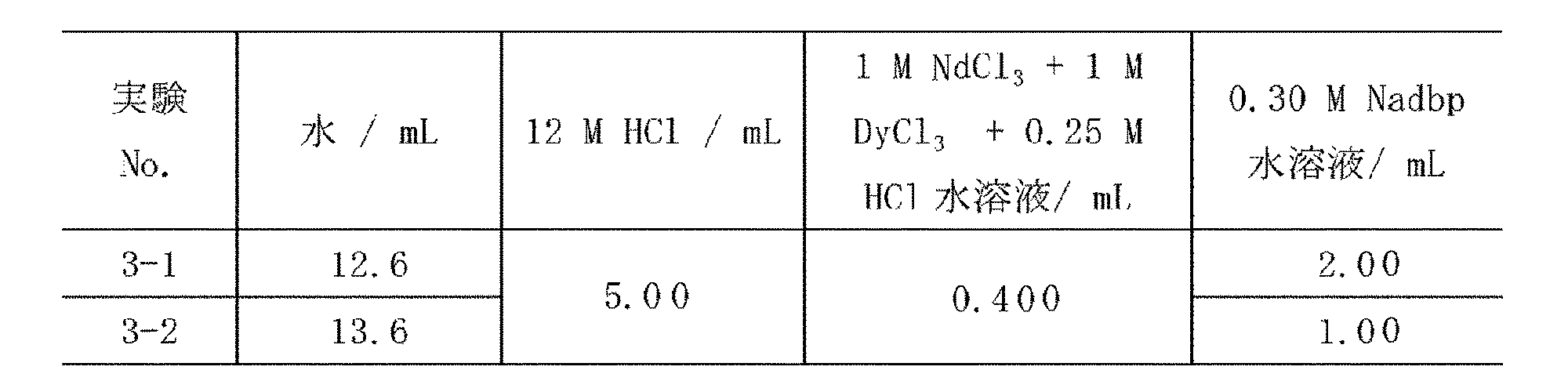
表3-1の通り4種類の溶液を混合し、各重量を記録した。
本実施例においては、NdとDyの混合溶液を用いて、沈殿率のNadbp濃度依存性について検討した。
前記実施例2の実験No.2-2において、Nadbp濃度を変えた条件でNdとDyの沈殿率を調べた。
表3-1の通り4種類の溶液を混合し、各重量を記録した。
溶液を一晩静置した後、沈殿した配位高分子を洗浄・濾過して重量を測定し、前述の方法と同様の手順で、沈殿物を濾過して分解した。
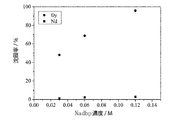
得られたP/(Dy+Nd)モル比、溶液混合時のHCl濃度、溶液中NdとDyの濃度から算出したNdおよびDyの沈殿率を実験No.2-2と比較して表3-2にまとめる。また、溶液混合時のNadbp濃度に対するNdとDyの沈殿率を図3にプロットする。
得られたP/(Dy+Nd)モル比、溶液混合時のHCl濃度、溶液中NdとDyの濃度から算出したNdおよびDyの沈殿率を実験No.2-2と比較して表3-2にまとめる。また、溶液混合時のNadbp濃度に対するNdとDyの沈殿率を図3にプロットする。

Nadbp濃度が0.03~0.12mol・L-1の範囲では、Nadbp濃度の増加に伴ってNdの沈殿率はわずかに増加し、Dyの沈殿率は大きく増加している。Nadbp濃度が高いとDy回収率は高くなるが、Nd含有率が高くなる。一方で、Nadbp濃度が低いと、Dy回収率は低くなるが、Nd含有率を低くできる。したがって、Nd含有率を低く、かつDy回収率を高くするためには、Dy濃度に対してNadbp濃度がおよそ3倍であることが好ましいとわかる。
(実施例4)
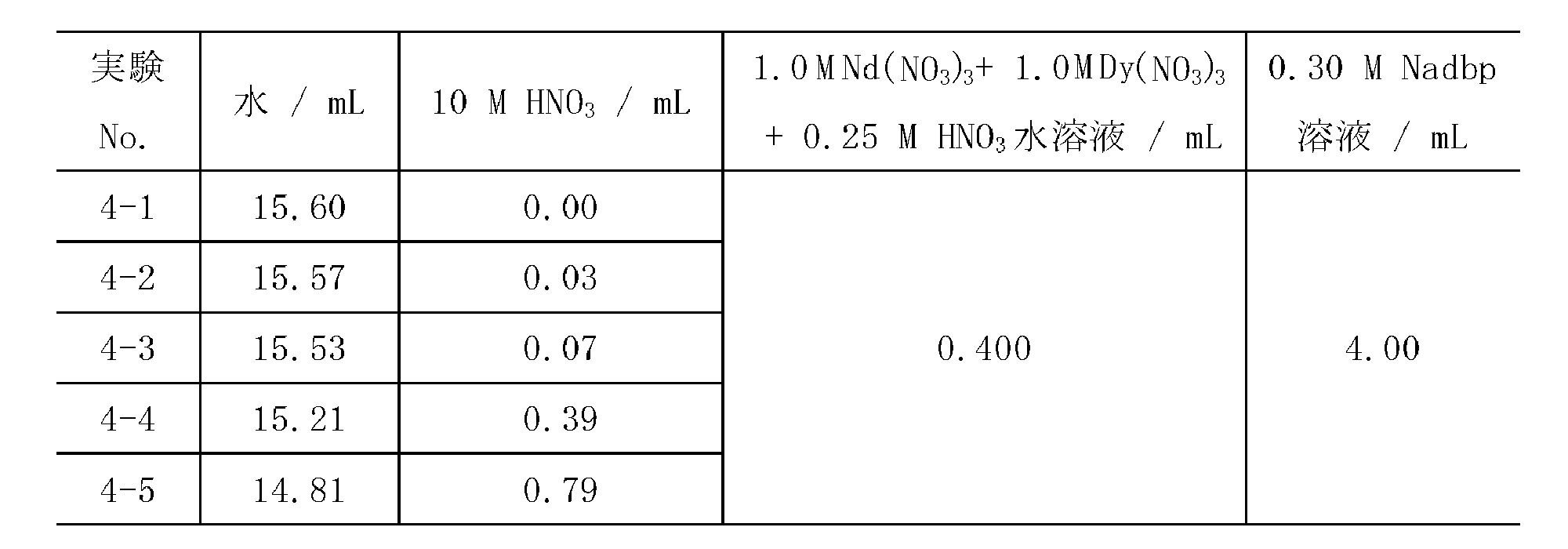
本実施例では、NdとDyの混合溶液を用いて、dbp配位高分子として沈殿させた場合の、NdとDyの沈殿率のHNO3濃度依存性について検討した。
表4-1の通り4種類の溶液を混合し、各溶液を20℃で一晩(24h)静置した後、沈殿した配位高分子を洗浄・濾過して重量を測定し、各重量を記録した。
本実施例では、NdとDyの混合溶液を用いて、dbp配位高分子として沈殿させた場合の、NdとDyの沈殿率のHNO3濃度依存性について検討した。
表4-1の通り4種類の溶液を混合し、各溶液を20℃で一晩(24h)静置した後、沈殿した配位高分子を洗浄・濾過して重量を測定し、各重量を記録した。
前述の方法と同様の手順で、沈殿物を濾過して分解した。
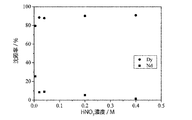
得られたP/(Dy+Nd)モル比、溶液混合時のHNO3濃度、溶液中NdとDy濃度から算出したNdおよびDyの沈殿率、沈殿物の組成分析から算出した沈殿物中のDy/Ndモル比を表4-2にまとめる。また、溶液混合時のHNO3濃度に対するNdとDyの沈殿率を図4にプロットする。
得られたP/(Dy+Nd)モル比、溶液混合時のHNO3濃度、溶液中NdとDy濃度から算出したNdおよびDyの沈殿率、沈殿物の組成分析から算出した沈殿物中のDy/Ndモル比を表4-2にまとめる。また、溶液混合時のHNO3濃度に対するNdとDyの沈殿率を図4にプロットする。
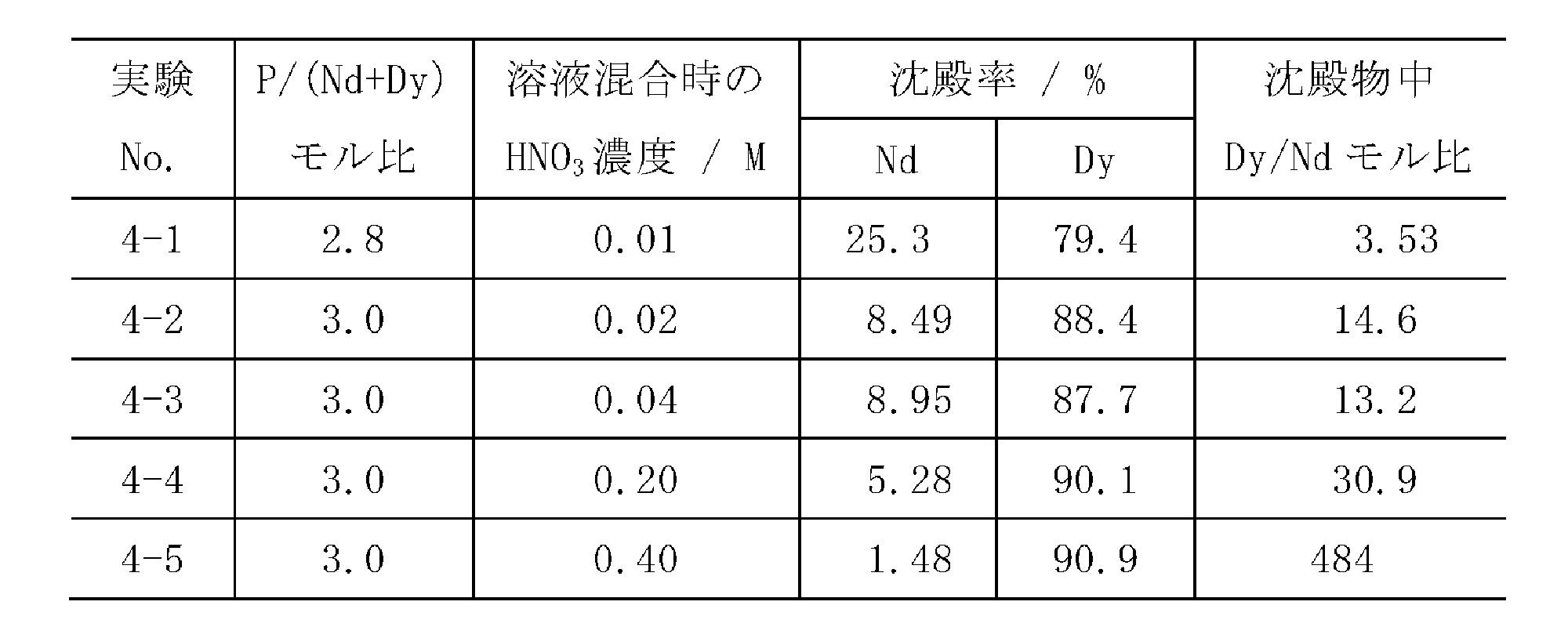
P/(Nd+Dy)がほぼ3であることから、HNO3溶液中で得られる沈殿物も配位高分子構造であることがわかる。
また、沈殿率はNdよりもDyの方が大きく、特に溶液混合時のHNO3濃度が0.40mol・L-1のときに、Ndの沈殿率が低く、Dyが選択的に沈殿することが分かる。
また、沈殿率はNdよりもDyの方が大きく、特に溶液混合時のHNO3濃度が0.40mol・L-1のときに、Ndの沈殿率が低く、Dyが選択的に沈殿することが分かる。
(実施例5)
本実施例では、前記実施例4の実験No.4-5におけるろ過するまでの時間を変化させた場合のNdとDyの沈殿率を検討した。
実験No.4-5と同じ条件で溶液を混合した後、表5-1の通り20℃で溶液を静置した。
本実施例では、前記実施例4の実験No.4-5におけるろ過するまでの時間を変化させた場合のNdとDyの沈殿率を検討した。
実験No.4-5と同じ条件で溶液を混合した後、表5-1の通り20℃で溶液を静置した。

沈殿した配位高分子を洗浄・濾過して重量を測定し、前述の方法と同様の手順で沈殿物を濾過して分解した。
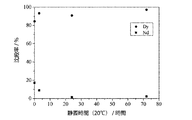
得られたP/(Dy+Nd)モル比、溶液中NdとDy濃度から算出したNdおよびDyの沈殿率、沈殿物の組成分析から算出した沈殿物中のDy/Ndモル比を表5-2にまとめる。また、20℃での溶液静置時間に対する沈殿率の変化を図5にプロットする。
得られたP/(Dy+Nd)モル比、溶液中NdとDy濃度から算出したNdおよびDyの沈殿率、沈殿物の組成分析から算出した沈殿物中のDy/Ndモル比を表5-2にまとめる。また、20℃での溶液静置時間に対する沈殿率の変化を図5にプロットする。

静置時間が長いほど、Ndの沈殿率は低くなり、Dyの沈殿率は高くなる。したがって、静置時間を長くするほどより選択的にDyを沈殿させられることがわかる。
(実施例6)
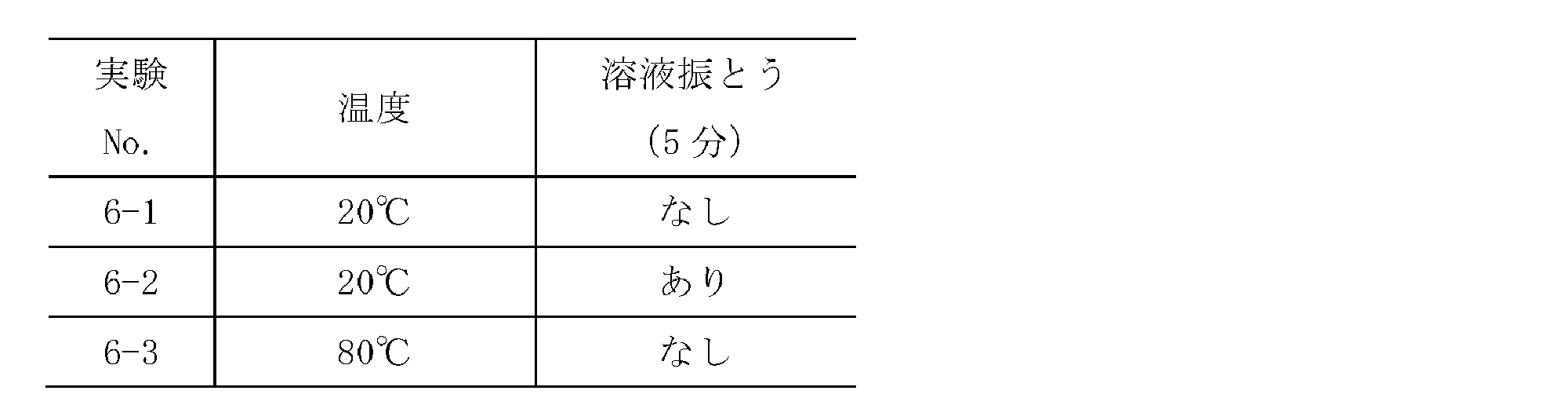
本実施例では、NdとDyの混合溶液を用いて、HNO3酸性溶液中でdbp配位高分子として沈殿させた場合の、濾過までの間に溶液を振とうする効果と溶液を昇温する効果を検討した。
前記の実施例4における実験No.4-5と同じ条件で溶液を混合し、表6-1の通り溶液を処理した。
本実施例では、NdとDyの混合溶液を用いて、HNO3酸性溶液中でdbp配位高分子として沈殿させた場合の、濾過までの間に溶液を振とうする効果と溶液を昇温する効果を検討した。
前記の実施例4における実験No.4-5と同じ条件で溶液を混合し、表6-1の通り溶液を処理した。
沈殿した配位高分子を洗浄・濾過して重量を測定し、前述の方法と同様の手順で、沈殿物を濾過して分解した。
得られたP/(Dy+Nd)モル比、溶液中NdとDy濃度から算出したNdおよびDyの沈殿率、沈殿物の組成分析から算出した沈殿物中のDy/Ndモル比を表6-2にまとめる。
得られたP/(Dy+Nd)モル比、溶液中NdとDy濃度から算出したNdおよびDyの沈殿率、沈殿物の組成分析から算出した沈殿物中のDy/Ndモル比を表6-2にまとめる。

20℃で溶液を静置するよりも、振とうした方がNdの沈殿率は低く、かつDyの沈殿率は高くなる。また、20℃で溶液を振とうするよりも、80℃で静置した方がさらにNdの沈殿率は低く、かつDyの沈殿率は高くなる。
(実施例7)
本実施例では、前記実施例6の実験No.6-3において、溶液静置時間を変化させたときのNdとDyの沈殿率を検討した。
同実験No.6-3と同じ条件で溶液を混合し、表7-1の通り溶液を処理した。
本実施例では、前記実施例6の実験No.6-3において、溶液静置時間を変化させたときのNdとDyの沈殿率を検討した。
同実験No.6-3と同じ条件で溶液を混合し、表7-1の通り溶液を処理した。

沈殿した配位高分子を洗浄・濾過して重量を測定し、前述の方法と同様の手順で、沈殿物を濾過して分解した。
得られたP/(Dy+Nd)モル比、溶液中NdとDy濃度から算出したNdおよびDyの沈殿率、沈殿物の組成分析から算出した沈殿物中のDy/Ndモル比を表7-2にまとめる。また、80℃での溶液静置時間に対する沈殿率の変化を図6にプロットする。
得られたP/(Dy+Nd)モル比、溶液中NdとDy濃度から算出したNdおよびDyの沈殿率、沈殿物の組成分析から算出した沈殿物中のDy/Ndモル比を表7-2にまとめる。また、80℃での溶液静置時間に対する沈殿率の変化を図6にプロットする。

混合した溶液を80℃で5分間静置した場合はNdも沈殿するが、24時間以上静置するとNdの沈殿率はゼロである。したがって、混合した溶液を80℃で24時間以上静置すると、より選択的にDyを沈殿させられることがわかる。24時間または72時間静置した場合は沈殿物中のDy/Ndモル比はあまり変わらないが、168時間静置すると沈殿物中のDy/Nd比はわずかに大きくなる。したがって、静置時間が長いほど、沈殿物中のDy純度が高くなることがわかる。
(実施例8)
本実施例では、前記実施例7の実験No.7-2においてNadbp濃度を変化させた場合の、NdとDyの沈殿率を検討した。
表8-1の通り溶液を混合した。
本実施例では、前記実施例7の実験No.7-2においてNadbp濃度を変化させた場合の、NdとDyの沈殿率を検討した。
表8-1の通り溶液を混合した。
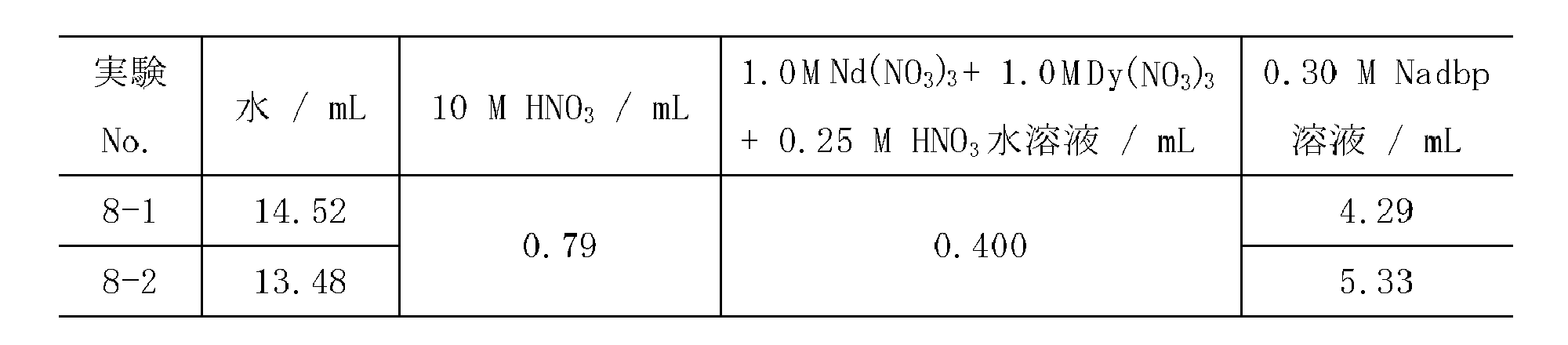
混合した溶液を80℃で24時間静置のち、沈殿した配位高分子を洗浄・濾過して重量を測定し、前述の方法と同様の手順で、沈殿物を濾過して分解した。
得られたP/(Dy+Nd)モル比、溶液中NdとDy濃度から算出したNdおよびDyの沈殿率、沈殿物の組成分析から算出した沈殿物中のDy/Ndモル比を表8-2にまとめる。また、溶液混合時のNadbp濃度に対する沈殿率の変化を図7にプロットする。
得られたP/(Dy+Nd)モル比、溶液中NdとDy濃度から算出したNdおよびDyの沈殿率、沈殿物の組成分析から算出した沈殿物中のDy/Ndモル比を表8-2にまとめる。また、溶液混合時のNadbp濃度に対する沈殿率の変化を図7にプロットする。
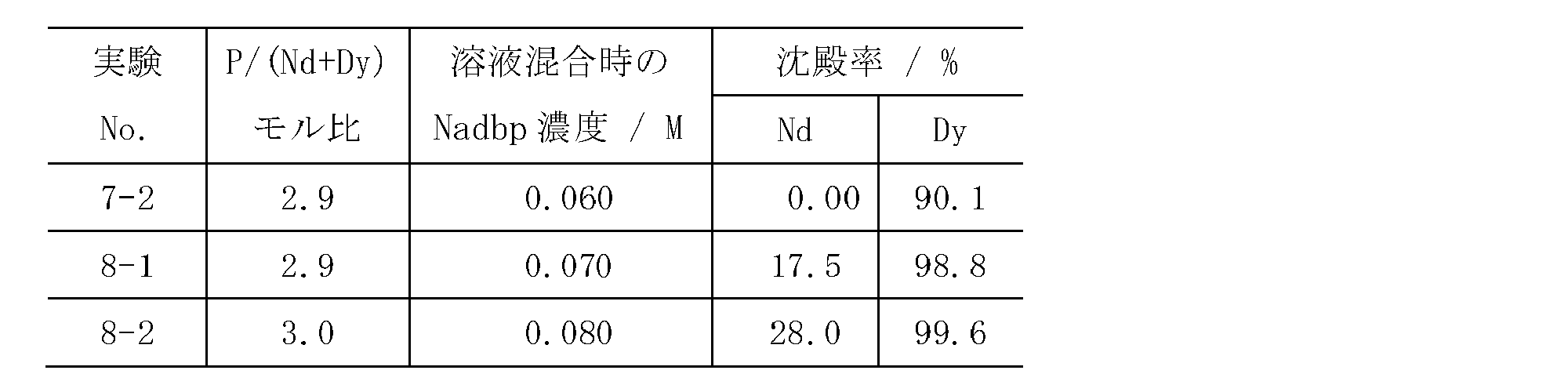
Nadbp濃度が高くなると、NdとDyの沈殿率が高くなる。したがって、より選択的にDyだけを沈殿させるためには、Dyイオン濃度が0.02mol・L-1のときにはNadbp濃度は0.06mol・L-1、つまり配位高分子を形成する当量のdbp-を混合すると良いことがわかる。
(実施例9)
本実施例では、前記実施例7の実験No.7-1における酸濃度を変化させたときのNdとDyの沈殿率を検討した。
表9-1の通り溶液を混合処理した。
本実施例では、前記実施例7の実験No.7-1における酸濃度を変化させたときのNdとDyの沈殿率を検討した。
表9-1の通り溶液を混合処理した。

混合した溶液を80℃で3時間静置のち、沈殿した配位高分子を洗浄・濾過して重量を測定し、前述の方法と同様の手順で、沈殿物を濾過して分解した。
得られたP/(Dy+Nd)モル比、溶液中NdとDy濃度から算出したNdおよびDyの沈殿率を表9-2にまとめる。また、溶液混合時のHNO3濃度に対する沈殿率の変化を図8にプロットする。
得られたP/(Dy+Nd)モル比、溶液中NdとDy濃度から算出したNdおよびDyの沈殿率を表9-2にまとめる。また、溶液混合時のHNO3濃度に対する沈殿率の変化を図8にプロットする。

酸濃度が低くなると、Ndの沈殿率が高くなる。一方で、Dyの沈殿率はあまり変化しない。したがって、より選択的にDyだけを沈殿させるためには、0.4mol・L-1 HNO3溶液中で配位高分子を形成させると良いことがわかる。
(実施例10)
本実施例では、分別沈殿したDyを汎用性の高い酸化物として回収する方法を検討した。
実施例8における、実験No.7-2で得られた沈殿物(Dy-dbp配位高分子)を表10-1の通りシュウ酸または炭酸水素ナトリウム溶液に入れた。
本実施例では、分別沈殿したDyを汎用性の高い酸化物として回収する方法を検討した。
実施例8における、実験No.7-2で得られた沈殿物(Dy-dbp配位高分子)を表10-1の通りシュウ酸または炭酸水素ナトリウム溶液に入れた。
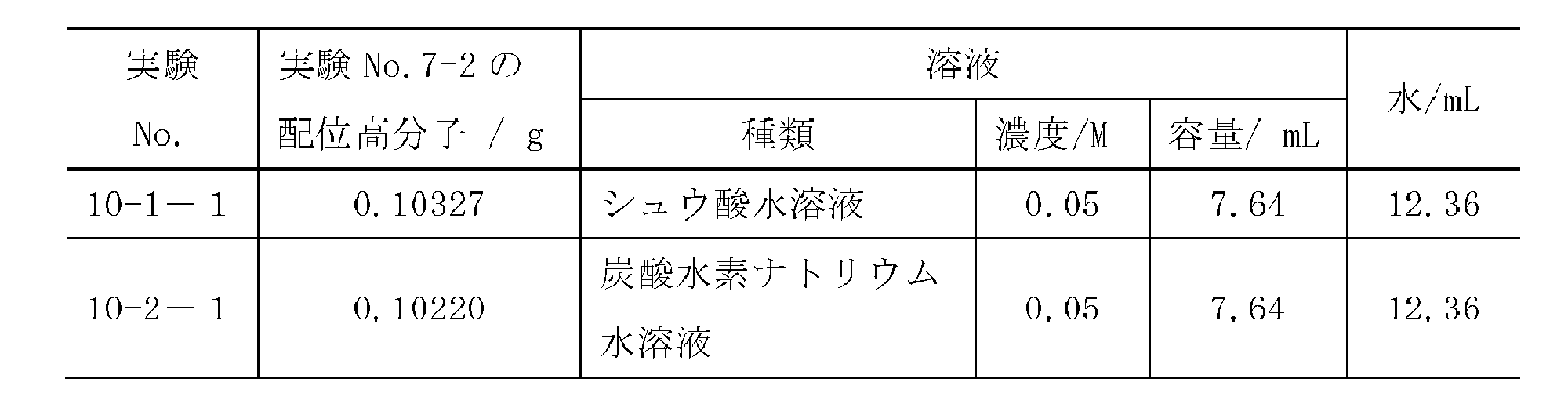
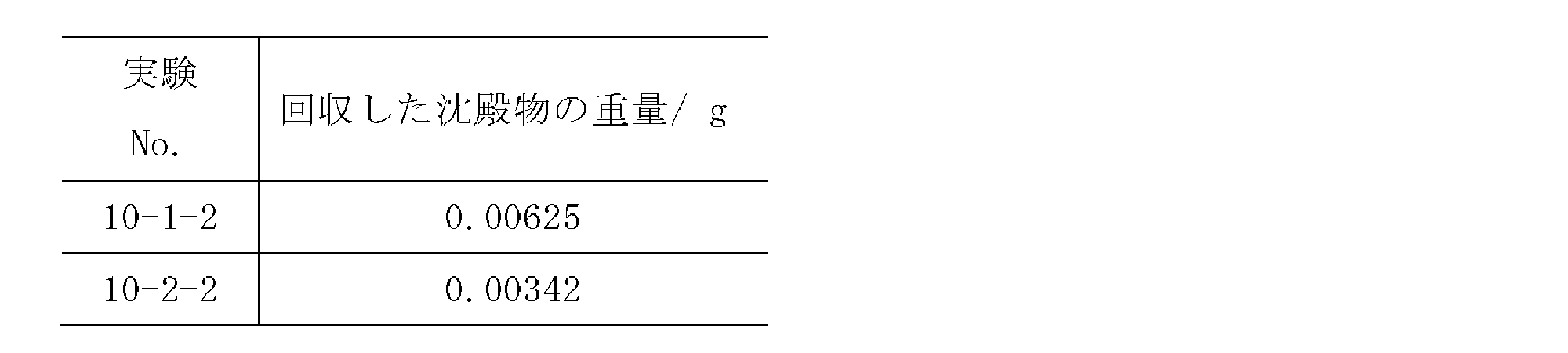
2日間、液を振とうした後に、溶液をろ過して沈殿物を回収した。回収した沈殿物の重量を表10-2にまとめる。

前記実施例8における実験No.7-2で得られた沈殿物、および10-1-1,10-2-1で得られた沈殿物のSEM画像を図9-1に示す。
SEM画像より、実験No.10-1-1と10-2-1の結晶の形状が、前記の実験No.7-2で得られた沈殿物とは異なることがわかる。
実験No.10-1-1と10-2-1で得られた沈殿物を表10-3に示す重量採取し、電気炉内で1時間かけて25℃から800℃に昇温した後、800℃で2時間焼成した。

室温に冷却した後に回収した沈殿物の重量を表10-4に示す。
実験No.10-1-2,10-2-2で得られた沈殿物の粉末X線回折パターンを図9-2に示す。
実験No.10-1-2,10-2-2で得られた沈殿物の粉末X線回折パターンは酸化ジスプロシウムのパターンと一致することから、800℃で焼成することにより、酸化ジスプロシウムとして回収できることがわかる。
表10-1と表10-2から、Dy-dbp配位高分子をシュウ酸ジスプロシウムに変換した際の回収率は70%であるとわかる。表10-3と表10-4から、シュウ酸ジスプロシウム十水和物から酸化ジスプロシウムへ変換した際の回収率は100%であるとわかる。
(実施例11)
本実施例では、前記実施例7における実験No.7-3においてDy濃度とNadbp濃度を5分の1にしたときのNdとDyの沈殿率を検討した。
表11-1の通り溶液を混合処理した。
本実施例では、前記実施例7における実験No.7-3においてDy濃度とNadbp濃度を5分の1にしたときのNdとDyの沈殿率を検討した。
表11-1の通り溶液を混合処理した。

混合した溶液を80℃で72時間静置したのち、沈殿した配位高分子を洗浄・濾過して重量を測定し、[0047]に記載の方法と同様の手順で、沈殿物を濾過して分解した。
得られたP/(Dy+Nd)モル比、溶液中NdとDy濃度から算出したNdおよびDyの沈殿率を表11-2にまとめる。
得られたP/(Dy+Nd)モル比、溶液中NdとDy濃度から算出したNdおよびDyの沈殿率を表11-2にまとめる。

NdとDyの濃度が5:1の場合、Dyの沈殿率は低くなるが、Dyだけを選択的に沈殿させることができる。
(実施例12)
本実施例においては、本発明の配位高分子形成剤が、液晶パネルからインジウム(In)を回収するのに適用できるか否かを調べるため、Inと遷移金属(アルミニウム(Al),銅(Cu),亜鉛(Zn))混合溶液からの沈殿率の酸濃度依存性について検討した。
前記実施例2において、NdとDy混溶液をIn、Al、Cu、Znの混合溶液に変えた条件で各金属元素の沈殿率を調べた。
下記の表12-1の通り4種類の溶液を混合し、各重量を記録した。
本実施例においては、本発明の配位高分子形成剤が、液晶パネルからインジウム(In)を回収するのに適用できるか否かを調べるため、Inと遷移金属(アルミニウム(Al),銅(Cu),亜鉛(Zn))混合溶液からの沈殿率の酸濃度依存性について検討した。
前記実施例2において、NdとDy混溶液をIn、Al、Cu、Znの混合溶液に変えた条件で各金属元素の沈殿率を調べた。
下記の表12-1の通り4種類の溶液を混合し、各重量を記録した。
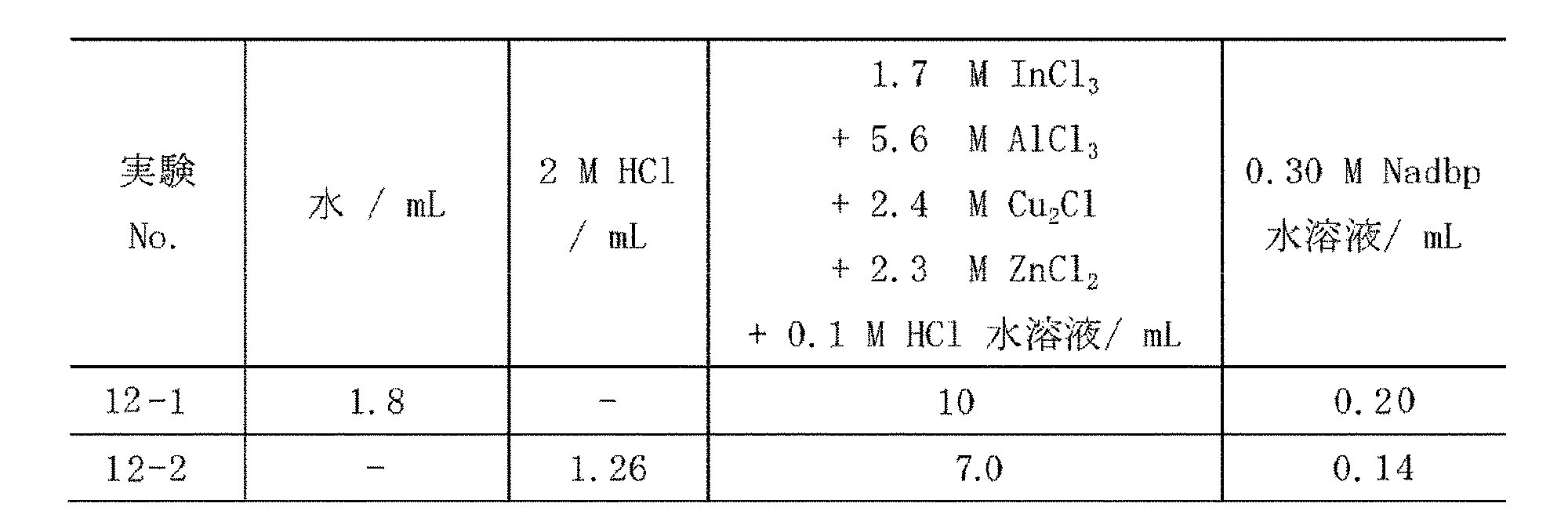
溶液を一晩静置した後、沈殿した配位高分子を洗浄・濾過して重量を測定し、前述の方法と同様の手順で、沈殿物を濾過して分解した。
得られたP/Mモル比(Mは金属イオンの総濃度)、HCl濃度、沈殿物の重量から各金属元素の沈殿率を表12-2にまとめる。
得られたP/Mモル比(Mは金属イオンの総濃度)、HCl濃度、沈殿物の重量から各金属元素の沈殿率を表12-2にまとめる。
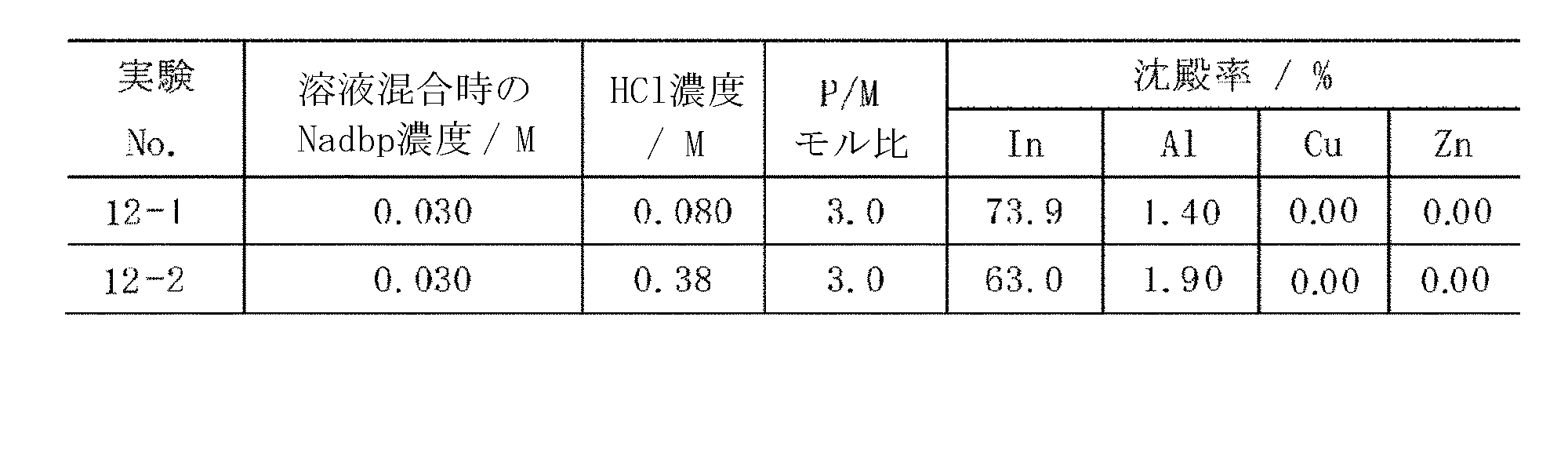
表12-2に示すとおり、Inよりも高濃度の遷移金属が混合していても、Inだけが選択的に沈殿している。Cu、Znの沈殿率は0%であることから、2価の金属イオンは配位高分子を形成しないと考えられ、また、Alは3価であるが、Inだけが選択的に沈殿することから、同じ価数の金属イオンに対しても選択的な分離が可能であることが分かる。
(実施例13)
本実施例では、水溶性リン酸ジエステルとして、リン酸水素=ビス[2-(メタクリロイルオキシ)エチル]を用いたNd/Dy分離について検討した。
前記実施例2において、NadbpをNa型にしたリン酸水素=ビス[2-(メタクリロイルオキシ)エチル(Napmoe)に変えて、NdとDy混溶液をからの各金属元素の沈殿率を調べた。
下記の表13-1の通り4種類の溶液を混合し、各重量を記録した。
本実施例では、水溶性リン酸ジエステルとして、リン酸水素=ビス[2-(メタクリロイルオキシ)エチル]を用いたNd/Dy分離について検討した。
前記実施例2において、NadbpをNa型にしたリン酸水素=ビス[2-(メタクリロイルオキシ)エチル(Napmoe)に変えて、NdとDy混溶液をからの各金属元素の沈殿率を調べた。
下記の表13-1の通り4種類の溶液を混合し、各重量を記録した。

溶液を一晩静置した後、沈殿した配位高分子を洗浄・濾過して重量を測定し、前述の方法と同様の手順で、沈殿物を濾過して分解した。
得られたP/(Dy+Nd)モル比、HCl濃度、沈殿物の重量から算出したNdおよびDyの沈殿率を表13-2にまとめる。
得られたP/(Dy+Nd)モル比、HCl濃度、沈殿物の重量から算出したNdおよびDyの沈殿率を表13-2にまとめる。
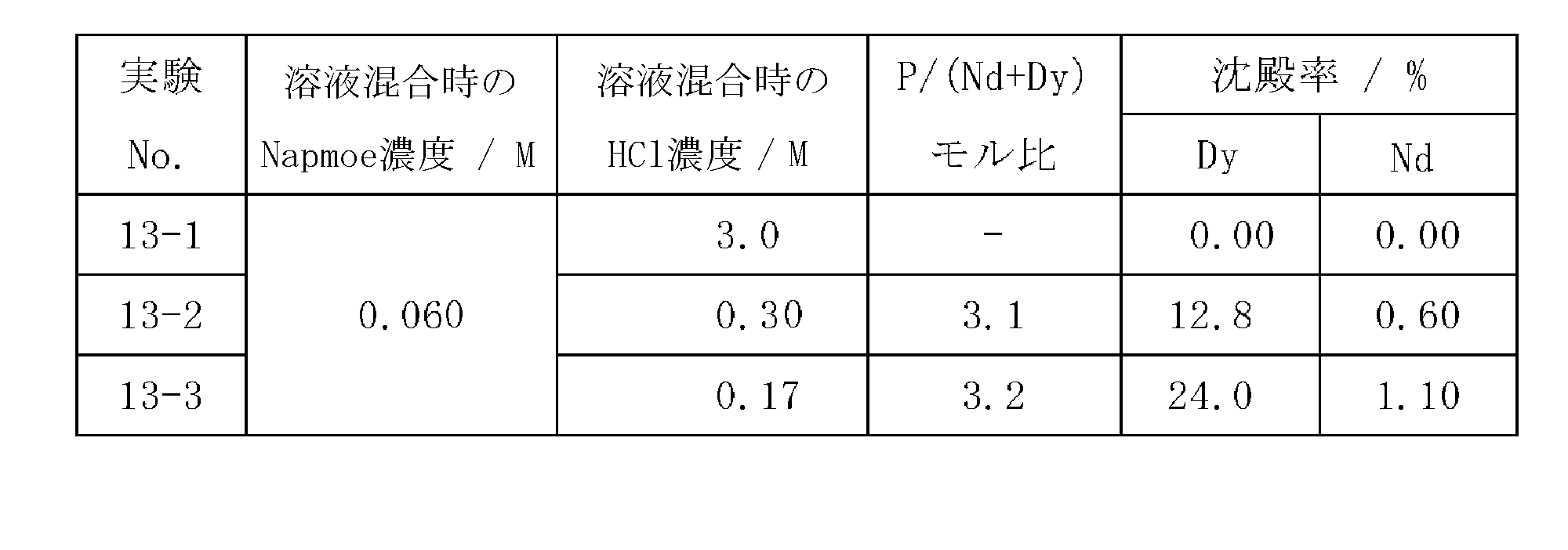
表13-2に示すとおり、酸濃度が3.0mol・L-1の場合、DyもNdも沈殿しない。
前記実施例2と比較すると、NapmoeよりもNadbpの方が高い酸濃度でも沈殿率が高いことがわかる。また、酸濃度が0.30mol・L-1、0.17mol・L-1のときは、Dyの方が選択的に沈殿するが、沈殿率は低い。
前記実施例2と比較すると、NapmoeよりもNadbpの方が高い酸濃度でも沈殿率が高いことがわかる。また、酸濃度が0.30mol・L-1、0.17mol・L-1のときは、Dyの方が選択的に沈殿するが、沈殿率は低い。
Claims (7)
- レアメタルのイオンを含有する水溶液中から分別沈殿させることよりレアメタルを分離する方法であって、
水溶性のリン酸ジエステルを配位高分子形成剤として用い、水溶液中で3価のレアメタルのイオンを選択的に配位高分子化して分別沈殿させることを特徴とする分別沈殿法。 - 前記水溶性のリン酸ジエステルが、ジブチルリン酸エステル、又はリン酸水素=ビス[2-(メタクリロイルオキシ)エチル]であることを特徴とする請求項1に記載の分別沈殿法。
- 前記3価のレアメタルが、レアアース又はインジウムであることを特徴とする請求項1又は2に記載の分別沈殿法。
- 少なくともネオジムイオン及びジスプロシウムイオンを含有する水溶液中で、ジスプロシウムイオンを選択的に配位高分子化して分別沈殿させることを特徴とする請求項1又は2に記載の分別沈殿法。
- 前記水溶液に、さらに酸を混合して、該水溶液におけるリン酸ジエステルの解離度を調整することを特徴とする請求項4に記載の分別沈殿法。
- 前記水溶液を、100℃未満に加温することを特徴とする請求項4又は5に記載の分別沈殿法。
- 請求項4~6のいずれか1項に記載の方法で分別沈殿させたジスプロシウムの配位高分子を、シュウ酸塩又は炭酸塩に変換した後焼成し、酸化ジスプロシウムとして回収する方法。
Applications Claiming Priority (2)
| Application Number | Priority Date | Filing Date | Title |
|---|---|---|---|
| JP2013258026 | 2013-12-13 | ||
| JP2013-258026 | 2013-12-13 |
Publications (1)
| Publication Number | Publication Date |
|---|---|
| WO2015087845A1 true WO2015087845A1 (ja) | 2015-06-18 |
Family
ID=53371148
Family Applications (1)
| Application Number | Title | Priority Date | Filing Date |
|---|---|---|---|
| PCT/JP2014/082460 Ceased WO2015087845A1 (ja) | 2013-12-13 | 2014-12-08 | 配位高分子化を利用するレアメタルの水系分別沈殿法 |
Country Status (2)
| Country | Link |
|---|---|
| JP (1) | JP6411199B2 (ja) |
| WO (1) | WO2015087845A1 (ja) |
Cited By (2)
| Publication number | Priority date | Publication date | Assignee | Title |
|---|---|---|---|---|
| CN105132720A (zh) * | 2015-10-08 | 2015-12-09 | 江西理工大学 | 一种分步沉淀回收离子吸附型稀土矿浸出液中稀土的方法 |
| CN114031634A (zh) * | 2021-11-18 | 2022-02-11 | 江苏科技大学 | 零场镝单离子磁体及其制备方法和应用 |
Citations (4)
| Publication number | Priority date | Publication date | Assignee | Title |
|---|---|---|---|---|
| JPS5551489A (en) * | 1978-10-09 | 1980-04-15 | Mitsubishi Chem Ind Ltd | Removing acidic phosphate ester in aqueous phase |
| JPS6075532A (ja) * | 1983-10-03 | 1985-04-27 | Nippon Mining Co Ltd | 鉛の湿式製錬における浄液方法 |
| JP2003500542A (ja) * | 1999-05-27 | 2003-01-07 | ユニヴェルシテ・クロード・ベルナール・リヨン・プルミエ | 水性媒質において、錯化とナノ濾過との組合せによりランタノイド元素及び/又はアクチノイド元素を分離する方法、及びその方法に用いる新規錯化剤 |
| JP2013194272A (ja) * | 2012-03-19 | 2013-09-30 | Hitachi Ltd | 希土類分離回収方法およびこれを用いた装置 |
Family Cites Families (8)
| Publication number | Priority date | Publication date | Assignee | Title |
|---|---|---|---|---|
| FR2435533A1 (fr) * | 1978-09-11 | 1980-04-04 | Penarroya Miniere Metall | Procede de recuperation de l'indium |
| EP0221760A3 (en) * | 1985-11-01 | 1989-09-27 | Montana Tech Foundation | Method for recovering metal values from mixed-metal aqueous solutions by selective phosphate precipitation |
| JPH0651567B2 (ja) * | 1986-01-29 | 1994-07-06 | 住友化学工業株式会社 | 希有金属の回収方法 |
| US20050124765A1 (en) * | 2003-11-25 | 2005-06-09 | Japan Atomic Energy Research Institute | Adsorbent for recovering useful rare metals by adsorption |
| JP4378540B2 (ja) * | 2003-11-25 | 2009-12-09 | 独立行政法人 日本原子力研究開発機構 | スカンジウムを捕集回収する方法 |
| JP4882048B2 (ja) * | 2007-03-07 | 2012-02-22 | 独立行政法人産業技術総合研究所 | メタンの酸化的除去用触媒及びメタンの酸化的除去方法 |
| EP2213677A4 (en) * | 2007-10-15 | 2012-01-04 | Bridgestone Corp | PROCESS FOR THE PREPARATION OF DIALKYL PHOSPHATESTER RENDERING SALT OR DIOLEYL PHOSPHATESTER RENDERING SALT |
| JP6183844B2 (ja) * | 2013-10-15 | 2017-08-23 | 国立研究開発法人産業技術総合研究所 | 配位高分子化を利用するランタノイドイオンの分別沈殿法 |
-
2014
- 2014-12-08 WO PCT/JP2014/082460 patent/WO2015087845A1/ja not_active Ceased
- 2014-12-08 JP JP2014248272A patent/JP6411199B2/ja not_active Expired - Fee Related
Patent Citations (4)
| Publication number | Priority date | Publication date | Assignee | Title |
|---|---|---|---|---|
| JPS5551489A (en) * | 1978-10-09 | 1980-04-15 | Mitsubishi Chem Ind Ltd | Removing acidic phosphate ester in aqueous phase |
| JPS6075532A (ja) * | 1983-10-03 | 1985-04-27 | Nippon Mining Co Ltd | 鉛の湿式製錬における浄液方法 |
| JP2003500542A (ja) * | 1999-05-27 | 2003-01-07 | ユニヴェルシテ・クロード・ベルナール・リヨン・プルミエ | 水性媒質において、錯化とナノ濾過との組合せによりランタノイド元素及び/又はアクチノイド元素を分離する方法、及びその方法に用いる新規錯化剤 |
| JP2013194272A (ja) * | 2012-03-19 | 2013-09-30 | Hitachi Ltd | 希土類分離回収方法およびこれを用いた装置 |
Cited By (3)
| Publication number | Priority date | Publication date | Assignee | Title |
|---|---|---|---|---|
| CN105132720A (zh) * | 2015-10-08 | 2015-12-09 | 江西理工大学 | 一种分步沉淀回收离子吸附型稀土矿浸出液中稀土的方法 |
| CN114031634A (zh) * | 2021-11-18 | 2022-02-11 | 江苏科技大学 | 零场镝单离子磁体及其制备方法和应用 |
| CN114031634B (zh) * | 2021-11-18 | 2024-03-19 | 江苏科技大学 | 零场镝单离子磁体及其制备方法和应用 |
Also Published As
| Publication number | Publication date |
|---|---|
| JP6411199B2 (ja) | 2018-10-24 |
| JP2015132016A (ja) | 2015-07-23 |
Similar Documents
| Publication | Publication Date | Title |
|---|---|---|
| Gasser et al. | Separation and recovery of rare earth elements from spent nickel–metal-hydride batteries using synthetic adsorbent | |
| Riaño et al. | Extraction and separation of neodymium and dysprosium from used NdFeB magnets: an application of ionic liquids in solvent extraction towards the recycling of magnets | |
| Padhan et al. | Recovery of Nd and Pr from NdFeB magnet leachates with bi-functional ionic liquids based on Aliquat 336 and Cyanex 272 | |
| Zhou et al. | The recovery of rare earth by a novel extraction and precipitation strategy using functional ionic liquids | |
| JP5499353B2 (ja) | 希土類元素の抽出・分離方法 | |
| Avdibegović et al. | Selective ion-exchange separation of scandium (III) over iron (III) by crystalline α-zirconium phosphate platelets under acidic conditions | |
| CN103443304B (zh) | 稀土元素的分离回收方法 | |
| Wang et al. | Separation of zirconium and hafnium from nitric acid solutions with LIX 63, PC 88A and their mixture by solvent extraction | |
| Wang et al. | Extraction mechanism of lithium from the alkali solution with diketonate-based ionic liquid extractants | |
| Sinha et al. | Development of an efficient process for the recovery of zinc and iron as value added products from the waste chloride solution | |
| AU2015275231A1 (en) | Solvent extraction of scandium from leach solutions | |
| Liang et al. | Recovery of samarium (III) and cobalt (II) in synthetic nitric acid solutions using carboxyl functionalized ionic liquids and application to recycling SmCo permanent magnets | |
| JP6017914B2 (ja) | 希土類元素の分離方法および分離装置 | |
| US9376736B2 (en) | Method for separating and recovering rare-earth elements | |
| Yoshida et al. | Ternary extractant system consisting of PC-88A, TOPO, and Versatic 10 for recovery of scandium (III) from nickel laterite processing liquors | |
| JP6411199B2 (ja) | 配位高分子化を利用するレアメタルの水系分別沈殿法 | |
| Liu et al. | Synthesis of new extractant P113 for cerium (IV) extraction and higher separation over thorium from bastnaesite | |
| CN118103533A (zh) | 一种用于萃取镧系元素的绿色方法 | |
| JP5299914B2 (ja) | 希土類元素の抽出・分離方法 | |
| CN106062222B (zh) | 稀土元素的分离方法及分离装置 | |
| RU2640479C2 (ru) | Способ извлечения и разделения редкоземельных металлов при переработке апатитового концентрата | |
| EP3156128B1 (en) | Ion exchange resin and method for adsorbing and separating metal | |
| KR101643049B1 (ko) | 혼합 추출제를 이용한 희토류 금속의 회수방법 | |
| Vijayalakshmi et al. | Studies on yttrium permeation through hollow fibre supported liquid membrane from nitrate medium using di-nonyl phenyl phosphoric acid as the carrier phase | |
| Patra et al. | Systematic exploration of COSMO-SAC-PDH and EXT-UNIQUAC-PDH* models for rare-earth element leaching in deep eutectic solvents |
Legal Events
| Date | Code | Title | Description |
|---|---|---|---|
| 121 | Ep: the epo has been informed by wipo that ep was designated in this application |
Ref document number: 14868884 Country of ref document: EP Kind code of ref document: A1 |
|
| NENP | Non-entry into the national phase |
Ref country code: DE |
|
| 122 | Ep: pct application non-entry in european phase |
Ref document number: 14868884 Country of ref document: EP Kind code of ref document: A1 |