WO2015064584A1 - トリアリールメタン化合物の製造方法 - Google Patents
トリアリールメタン化合物の製造方法 Download PDFInfo
- Publication number
- WO2015064584A1 WO2015064584A1 PCT/JP2014/078653 JP2014078653W WO2015064584A1 WO 2015064584 A1 WO2015064584 A1 WO 2015064584A1 JP 2014078653 W JP2014078653 W JP 2014078653W WO 2015064584 A1 WO2015064584 A1 WO 2015064584A1
- Authority
- WO
- WIPO (PCT)
- Prior art keywords
- group
- general formula
- nmr
- mhz
- cdcl
- Prior art date
- Legal status (The legal status is an assumption and is not a legal conclusion. Google has not performed a legal analysis and makes no representation as to the accuracy of the status listed.)
- Ceased
Links
Classifications
-
- C—CHEMISTRY; METALLURGY
- C07—ORGANIC CHEMISTRY
- C07C—ACYCLIC OR CARBOCYCLIC COMPOUNDS
- C07C213/00—Preparation of compounds containing amino and hydroxy, amino and etherified hydroxy or amino and esterified hydroxy groups bound to the same carbon skeleton
-
- C—CHEMISTRY; METALLURGY
- C07—ORGANIC CHEMISTRY
- C07C—ACYCLIC OR CARBOCYCLIC COMPOUNDS
- C07C1/00—Preparation of hydrocarbons from one or more compounds, none of them being a hydrocarbon
- C07C1/32—Preparation of hydrocarbons from one or more compounds, none of them being a hydrocarbon starting from compounds containing hetero-atoms other than or in addition to oxygen or halogen
- C07C1/321—Preparation of hydrocarbons from one or more compounds, none of them being a hydrocarbon starting from compounds containing hetero-atoms other than or in addition to oxygen or halogen the hetero-atom being a non-metal atom
- C07C1/322—Preparation of hydrocarbons from one or more compounds, none of them being a hydrocarbon starting from compounds containing hetero-atoms other than or in addition to oxygen or halogen the hetero-atom being a non-metal atom the hetero-atom being a sulfur atom
-
- C—CHEMISTRY; METALLURGY
- C07—ORGANIC CHEMISTRY
- C07C—ACYCLIC OR CARBOCYCLIC COMPOUNDS
- C07C209/00—Preparation of compounds containing amino groups bound to a carbon skeleton
- C07C209/68—Preparation of compounds containing amino groups bound to a carbon skeleton from amines, by reactions not involving amino groups, e.g. reduction of unsaturated amines, aromatisation, or substitution of the carbon skeleton
-
- C—CHEMISTRY; METALLURGY
- C07—ORGANIC CHEMISTRY
- C07C—ACYCLIC OR CARBOCYCLIC COMPOUNDS
- C07C315/00—Preparation of sulfones; Preparation of sulfoxides
- C07C315/04—Preparation of sulfones; Preparation of sulfoxides by reactions not involving the formation of sulfone or sulfoxide groups
-
- C—CHEMISTRY; METALLURGY
- C07—ORGANIC CHEMISTRY
- C07C—ACYCLIC OR CARBOCYCLIC COMPOUNDS
- C07C2531/00—Catalysts comprising hydrides, coordination complexes or organic compounds
- C07C2531/16—Catalysts comprising hydrides, coordination complexes or organic compounds containing coordination complexes
- C07C2531/22—Organic complexes
Definitions
- the present invention relates to a method for producing a triarylmethane compound.
- triarylmethane compounds are used in various fields such as dyes, fluorescent probes, natural products and biologically active compounds.
- the Friedel-Crafts reaction which is a reaction in which an alkyl group or an acyl group is electrophilically substituted for an aromatic ring, is simple and widely used as a method for constructing a triarylmethane structure (for example, Non-Patent Document 1). Often it produces undesired regioisomers, and since it is an electrophilic substitution reaction, the reaction does not occur if the aromatic ring has an electron withdrawing group. Moreover, the types of triarylmethane compounds that can be synthesized are limited, and various triarylmethane compounds cannot be synthesized.
- reports on the palladium-catalyzed cross-coupling reaction include, for example, Non-Patent Document 3 and Patent Document 1, and reports on an arylation reaction of a C—H bond with a metal catalyst include, for example, Patent Document 4 and Patent Document 2 can be cited, and Non-Patent Document 5 can be cited as a report on the enantioselective pathway.
- Non-Patent Document 3 discloses a diarylmethylarylsulfone compound and an arylboronic acid compound, a typical phosphine (monodentate or bidentate phosphine ligand) or a catalyst precursor comprising an amine ligand and a palladium source.
- a triarylmethane compound can be obtained by reacting with each other, one aryl group of the starting diarylmethylarylsulfone compound is limited to a 3-indolyl group, and a nitrogen-containing heterocyclic carbene complex is obtained. No mention is made of the rank.
- the present invention is intended to solve the above-described problems, and an object of the present invention is to provide a method capable of producing various triarylmethane compounds with few steps.
- the present inventors have found that a specific diarylmethylarylsulfone compound and a specific arylboronic acid or ester compound thereof are present in the presence of a palladium catalyst and a nitrogen-containing heterocyclic carbene ligand. It was found that the desired triarylmethane compound can be obtained by the reaction.
- the diarylmethylarylsulfone compound used as a raw material can be synthesized by a two-step synthesis using a methylarylsulfone compound as a starting compound. That is, it has been found that the synthesis can be carried out in only the shortest three steps that are not found in the conventional manufacturing method.
- Ar 3 is the same as above; R 1 and R 2 are the same or different and each represents an alkyl group; R 1 and R 2 are bonded to each other to form a ring together with the adjacent —O—B—O—. May be.
- a process comprising reacting the arylboronic acid represented by the formula (1) or an ester compound thereof in the presence of a palladium catalyst and a nitrogen-containing heterocyclic carbene ligand.
- Item 2. The production method according to Item 1, wherein the step (III) is performed in the presence of a base.
- Item 3. The production method according to Item 2, wherein the base is at least one selected from the group consisting of metal alkoxides, alkali metal phosphates and alkali metal hydroxides.
- Item 4. The production method according to any one of Items 1 to 3, wherein the step (III) is performed in the presence of a reaction solvent.
- Item 5. The production method according to Item 4, wherein the reaction solvent contains dioxane.
- Item 7. The production method according to Item 6, wherein the step (II) is performed in the presence of a base.
- Item 9 The production method according to Item 8, wherein the step (I) is performed in the presence of a base.
- Ar 1a , Ar 2a and Ar are the same or different and each is a substituted or unsubstituted aromatic group; provided that Ar 1a and / or Ar 2a is an aromatic group substituted with a benzyloxy group.
- a specific diarylmethylarylsulfone compound and a specific arylboronic acid or an ester compound thereof are reacted in the presence of a palladium catalyst and a nitrogen-containing heterocyclic carbene ligand.
- Triarylmethane compounds can be synthesized.
- various triarylmethane compounds that could not be synthesized conventionally can be synthesized.
- the diarylmethylarylsulfone compound used as a raw material in the present invention can be synthesized by a two-step reaction using a methylarylsulfone compound as a starting compound and a palladium catalyst. That is, it is possible to synthesize a triarylmethane compound in only the shortest three steps, which is impossible with the conventional manufacturing method.
- Any of the above three-step reactions employed in the present invention can be carried out using only raw materials that are easily available and prepared, and all of these three-step reactions are stable in the atmosphere.
- the reaction can proceed using a handleable palladium catalyst.
- diarylmethylarylsulfone compounds used as raw materials in the present invention some compounds are novel compounds not described in any literature.
- a triarylmethane compound is synthesized by reacting a specific diarylmethylarylsulfone compound with a specific arylboronic acid or an ester compound thereof (step (III)).
- the diarylmethylarylsulfone compound used as a raw material is not particularly limited.
- it can be synthesized by reacting a specific arylmethylarylsulfone compound with a specific halogenated arene compound. Yes (step (II)).
- the specific arylmethylarylsulfone compound is not particularly limited, and can be synthesized, for example, by reacting a specific methylarylsulfone compound with a specific halogenated arene compound (step (I)). ).
- a diarylmethylarylsulfone compound is synthesized through the following steps (I) to (II), thereby introducing substituents Ar 1 and Ar 2 . Since the selectivity and yield can be further improved, the diarylmethylarylsulfone compound used as a raw material in the present invention is synthesized through steps (I) to (II) described later using a methylarylsulfone compound as a raw material. It is preferable.
- (I) General formula (5): CH 3 —SO 2 —Ar (5)
- Ar is a substituted or unsubstituted aromatic group.
- An arylmethylarylsulfone compound is synthesized by a step of reacting the halogenated arene compound represented by the above with a palladium catalyst and a phosphine ligand.
- the substituent Ar is a substituted or unsubstituted aromatic group.
- Examples of the aromatic group in the substituted or unsubstituted aromatic group represented by the substituent Ar include monocyclic aromatic hydrocarbon groups such as a phenyl group; naphthyl groups (1-naphthyl group, 2-naphthyl group, etc.), Anthryl group (1-anthryl group, 2-anthryl group, 9-anthryl group, etc.), fluorenyl group (1-fluorenyl group, 2-fluorenyl group, 9-fluorenyl group, etc.), phenanthryl group, pyrenyl group (1-pyrenyl group, etc.) , 2-pyrenyl group, 4-pyrenyl group, etc.), condensed ring aromatic hydrocarbon groups such as chrysenyl group, perylenyl group, picenyl group; furyl group (2-furyl group, 3-furyl group etc.), thienyl group (2 -Thienyl group, 3-thienyl group, etc.),
- a monocyclic aromatic hydrocarbon group or a monocyclic aromatic heterocyclic group is preferable, a six-membered monocyclic aromatic hydrocarbon group or a six-membered monocyclic aromatic heterocyclic group is more preferable, and a phenyl group More preferred are a pyridyl group (2-pyridyl group, 3-pyridyl group, 4-pyridyl group, etc.), pyrimidinyl group, pyridazinyl group, pyrazinyl group, etc., a phenyl group, a pyridyl group (2-pyridyl group, 3-pyridyl group, 4-pyridyl group etc.), pyrimidinyl group etc. are particularly preferred.
- examples of the substituent in the aromatic group include methyl, ethyl, propyl, isopropyl, butyl, isobutyl, sec-butyl, tert-butyl, pentyl, isopentyl, C 1-6 -alkyl groups such as hexyl group, cyclopropyl group, cyclobutyl group, cyclopentyl group, cyclohexyl group; methoxy group, ethoxy group, propoxy group, isopropoxy group, butoxy group, isobutoxy group, sec-butoxy group, tert -C 1-6 -alkoxy groups such as butoxy, pentyloxy, isopentyloxy, hexyloxy, cyclopropyloxy, cyclobutyloxy, cyclopentyloxy, cyclohexyloxy; methoxycarbonyl, ethoxycarbonyl Group, propoxyca Rubonyl group,
- a C 1-6 -alkyl group, a C 1-6 -alkoxy group, a halogen atom and the like are preferable, and a methyl group, an ethyl group, a propyl group, an isopropyl group, a butyl group, an isobutyl group, sec -Butyl group, tert-butyl group, pentyl group, isopentyl group, hexyl group, cyclopropyl group, cyclobutyl group, cyclopentyl group, cyclohexyl group, methoxy group, ethoxy group, propoxy group, isopropoxy group, butoxy group, isobutoxy group, sec-butoxy group, tert-butoxy group, pentyloxy group, isopentyloxy group, hexyloxy group, cyclopropyloxy group, cyclobutyloxy group, cyclopentyloxy group, a methyl group,
- Examples of the substituted aromatic group represented by the substituent Ar satisfying such conditions include a tolyl group (o-tolyl group, m-tolyl group, p-tolyl group, etc.), an ethylphenyl group (4-ethyl).
- the type of the substituent Ar is not particularly limited, and may be any of the above-described substituted or unsubstituted aromatic groups, but may be a substituted or unsubstituted monocyclic aromatic hydrocarbon group, or a substituted or unsubstituted aromatic group.
- Monocyclic aromatic heterocyclic groups are preferred, substituted or unsubstituted 6-membered monocyclic aromatic hydrocarbon groups, or substituted or unsubstituted 6-membered monocyclic aromatic heterocyclic groups are more preferred, phenyl group, tolyl Group (o-tolyl group, m-tolyl group, p-tolyl group, etc.), methoxyphenyl group (2-methoxyphenyl group, 3-methoxyphenyl group, 4-methoxyphenyl group, etc.), chlorophenyl group (2-chlorophenyl group, etc.) , 3-chlorophenyl group, 4-chlorophenyl group, etc.), pentafluorophenyl group, pyridyl group (2-pyridyl group, 3-pyridyl group, 4-pyridyl group, etc.), pyrimidinyl group A pyridazinyl group, a pyrazinyl group and the like are more prefer
- the substituent Ar 1 is a substituted or unsubstituted aromatic group.
- the substituted aromatic group When the aromatic group in the substituent Ar 1, the type and number of substituents, if Ar 1 is substituted, Ar 1 is substituted, The same thing as having explained in full detail about said Ar is employable.
- the substituent Ar 1 constitutes one of the aryl groups (aromatic groups) of the triarylmethane compound that is the final product, and various aromatic groups can be employed. From the viewpoint of yield, a substituted or unsubstituted monocyclic aromatic hydrocarbon group, or a substituted or unsubstituted monocyclic aromatic heterocyclic group is preferred, and a substituted or unsubstituted six-membered monocyclic aromatic hydrocarbon Or a substituted or unsubstituted 5- or 6-membered monocyclic aromatic heterocyclic group, more preferably a phenyl group, a tolyl group (o-tolyl group, m-tolyl group, p-tolyl group, etc.), a methoxyphenyl group (2-methoxyphenyl group, 3-methoxyphenyl group, 4-methoxyphenyl group, etc.), benzyloxyphenyl group (2-benzyloxyphenyl group, 3-benzyloxyphenyl group
- phenyl group tolyl group (o-tolyl group, m-tolyl group, p-tolyl group, etc.), methoxyphenyl group (2- Methoxyphenyl group, 3-methoxyphenyl group, 4-methoxyphenyl group, etc.), benzyloxyphenyl group (2-benzyloxyphenyl group, 3-benzyloxyphenyl group, 4-benzyloxyphenyl group etc.), fluorophenyl group ( 2-fluorophenyl group, 3-fluorophenyl group, 4-fluorophenyl group, etc.), trifluoromethylphenyl group (2-trifluoromethylphenyl group, 3-trifluoromethylphenyl group, 4-trifluorofluoro group) Methylphenyl group), naphthyl group (1-naphthyl group, 2-naphthyl group, etc.), thienyl group ( -Thieny
- X 2 is a halogen atom, a fluorine atom, a chlorine atom, a bromine atom and an iodine atom.
- a bromine atom is preferable from the viewpoint of selectivity and yield in this step.
- the amount of the halogenated arene compound represented by the general formula (6) is usually used with respect to 1 mol of the methylarylsulfone compound represented by the general formula (5) from the viewpoint of selectivity and yield. 0.2 to 3 mol is preferable, and 0.3 to 2.5 mol is more preferable.
- palladium catalyst used in this process but are not limited to, palladium acetate (Pd (OCOCH 3) 2; Pd (OAc) 2), trifluoroacetic palladium acetate (Pd (OCOCF 3) 2) P-allyl palladium (II) chloride dimer ([PdCl (allyl)] 2 ), p-cinnamyl palladium (II) chloride dimer, di- ⁇ -chlorobis (2′-amino-1,1′-biphenyl-2) -C, N) dipalladium (II), palladium chloride (PdCl 2 ), palladium bromide (PdBr 2 ), palladium iodide (PdI 2 ), Pd (CH 2 COCH 2 COCH 3 ) 2 , K 2 PdCl 4 , K 2 PdCl 6, K 2 Pd (NO 3) 4, tris (dibenzylideneacetone) dipalladium (0)
- organic ligand complexes are preferable in this step from the viewpoint of selectivity, yield, and safety.
- p-allyl palladium (II) chloride dimer trifluoroacetic acid Palladium, bis (dibenzylideneacetone) palladium (0), tris (dibenzylideneacetone) dipalladium (0) and the like are more preferable, and p-allyl palladium (II) chloride dimer is more preferable.
- the amount of the palladium catalyst used is usually preferably 0.02 to 1 mol with respect to 1 mol of the methylarylsulfone compound represented by the general formula (5) from the viewpoint of selectivity and yield. More preferably, 0.03 to 0.25 mol.
- the phosphine ligand used in this step is not particularly limited.
- a phosphine ligand represented by the following formula: PR 3 R 4 R 5 (here, R 3 , R 4 and R 5 are each independently a C 1-8 alkyl group (methyl group, ethyl group, etc.), a C 1-4 alkoxy group (methoxy group, ethoxy group, etc.), a C 3-8 cycloalkyl group (cyclopropyl group, A cyclobutyl group, a cyclopentyl group, a cyclohexyl group, etc.), a phenyl group, a biphenyl group, a phenoxy group, a furyl group, etc.
- the C 3-8 cycloalkyl group is further substituted with a C 1-4 alkyl group (methyl group, ethyl group, etc.).
- a C 1-4 alkyl group methyl group, ethyl group, etc.
- phenyl group further methyl group may be substituted with a sulfonic acid or a salt thereof.
- biphenyl group is independently further respectively, C 1-4 alkyl group (methyl group Ethyl group, etc.), C 1-4 alkoxy group (methoxy group, ethoxy group, etc.), dialkylamino groups (dimethylamino group, may be substituted by diethylamino group).) It can be mentioned.
- Examples of the phosphine ligand represented by PR 3 R 4 R 5 include tert-butyldicyclohexylphosphine, isobutyldicyclohexylphosphine, (n-butyl) dicyclohexylphosphine, isopropyldicyclohexylphosphine, (n-propyl) dicyclohexylphosphine, and ethyl.
- Dicyclohexylphosphine methyldicyclohexylphosphine, cyclopropyldicyclohexylphosphine, cyclobutyldicyclohexylphosphine, tert-butyldicyclooctylphosphine, tert-butyldicycloheptylphosphine, tert-butyldicyclopentylphosphine, tert-butyldicyclobutylphosphine, tert -Butyldicyclopropylphosphine, triethylphosphine, (N-propyl) phosphine, tri (isopropyl) phosphine, tri (tert-butyl) phosphine, tri (n-butyl) phosphine, tri (n-octyl) phosphine, tri (cyclooctyl) phosphine,
- these phosphine ligands may be used as a ligand precursor which is a salt with a halogen atom (such as a chlorine atom), HCl, HF, HBr, HI, HBF 4 or the like. These may be used alone or in combination.
- a halogen atom such as a chlorine atom
- the amount of the phosphine ligand used is usually preferably 0.2 to 3 mol, preferably 0.3 to 2.5 mol with respect to 1 mol of the palladium catalyst, from the viewpoints of selectivity and yield. Is more preferable.
- step (I) is preferably performed in the presence of a base.
- the base that can be used in this step include metal alkoxides such as lithium tert-butoxide and sodium tert-butoxide; lithium diisopropylamide, lithium bis (trimethylsilyl) amide, sodium bis (trimethylsilyl) amide, potassium bis (trimethylsilyl) amide, and the like. And metal amides. These may be used alone or in combination.
- metal alkoxide is preferable from the viewpoint of selectivity, yield, and safety, lithium tert-butoxide, sodium tert-butoxide, and the like are more preferable, and lithium tert-butoxide is further preferable.
- the amount of the base used is usually 0.5 to 1 with respect to 1 mol of the methylarylsulfone compound represented by the general formula (5) from the viewpoint of selectivity and yield. 4 moles are preferred, and 1-3 moles are more preferred.
- reaction solvents include, for example, ether solvents such as 1,4-dioxane, tetrahydrofuran, ethylene glycol dimethyl ether, ethylene glycol diethyl ether, diethylene glycol dimethyl ether, diisopropyl ether, diisobutyl ether, cyclopentyl methyl ether (CPME); benzene, toluene
- organic solvents such as aromatic hydrocarbon solvents such as o-xylene, m-xylene, p-xylene, mixed xylene and mesitylene. These may be used alone or in combination.
- 1,4-dioxane, tetrahydrofuran, cyclopentyl methyl ether, toluene, m-xylene and the like are preferable from the viewpoint of selectivity, yield, and safety, and cyclopentyl methyl ether is more preferable.
- the amount of these reaction solvents (organic solvents) used is not particularly limited as long as the reaction proceeds.
- the concentration of the methylarylsulfone compound represented by the general formula (5) is 0.1 to 5 mol / wt. It is preferable to adjust to L, preferably 0.1 to 2 mol / L.
- the reaction temperature in this step varies depending on the boiling point of the reaction solvent used and the like, but is usually 100 ° C. or higher, particularly about 100 to 300 ° C., more preferably about 110 to 250 ° C.
- the reaction may be carried out at normal pressure, and if necessary, may be carried out under reduced pressure or pressurized conditions, but is preferably carried out under normal pressure.
- the progress of the reaction can be followed by conventional methods such as chromatography. After completion of the reaction, the solvent is distilled off, and the product can be isolated and purified by usual methods such as chromatography and recrystallization.
- the structure of the product can be identified by elemental analysis, MS (FD-MS) analysis, IR analysis, 1 H-NMR, 13 C-NMR and the like.
- the arylmethylarylsulfone compound synthesized in this step may be used in the next step (step (II)) without being subjected to purification treatment, but if necessary, activated carbon treatment, recrystallization, column chromatography. It is also possible to purify by a usual purification method such as chromatography.
- (II) General formula (4): Ar 1 —CH 2 —SO 2 —Ar (4) [Wherein, Ar 1 and Ar are the same as defined above. ]
- a diarylmethylarylsulfone compound is synthesized by a step of reacting the halogenated arene compound represented by the above with a palladium catalyst and a phosphine ligand.
- the arylmethylarylsulfone compound represented by the general formula (4) is a compound that can be synthesized in the step (I), and various compounds can be employed. Further, Ar and Ar 1 in the general formula (4) can include those described above. The same applies to preferred embodiments.
- the substituent Ar 2 is a substituted or unsubstituted aromatic group.
- the substituted aromatic group if aromatic groups, the kind and number of substituents, if Ar 2 is substituted, Ar 2 is substituted in the substituent Ar 2, The same thing as having explained in full detail about said Ar is employable.
- the substituent Ar 2 constitutes one of the aryl groups (aromatic groups) of the triarylmethane compound that is the final product, and a wide variety of aromatic groups can be employed. From the viewpoint of yield, a substituted or unsubstituted monocyclic aromatic hydrocarbon group, or a substituted or unsubstituted monocyclic aromatic heterocyclic group is preferred, and a substituted or unsubstituted six-membered monocyclic aromatic hydrocarbon Or a substituted or unsubstituted 5- or 6-membered monocyclic aromatic heterocyclic group, more preferably a phenyl group, a tolyl group (o-tolyl group, m-tolyl group, p-tolyl group, etc.), a methoxyphenyl group (2-methoxyphenyl group, 3-methoxyphenyl group, 4-methoxyphenyl group, etc.), benzyloxyphenyl group (2-benzyloxyphenyl group, 3-benzyloxy
- phenyl group, tolyl group (o-tolyl group, m-tolyl group, p-tolyl group, etc.), methoxyphenyl group (2- Methoxyphenyl group, 3-methoxyphenyl group, 4-methoxyphenyl group, etc.), fluorophenyl group (2-fluorophenyl group, 3-fluorophenyl group, 4-fluorophenyl group, etc.), trifluoromethylphenyl group (2 -Trifluoromethylphenyl group, 3-trifluoromethylphenyl group, 4-trifluoromethylphenyl group, etc.), thienyl group (2-thienyl group, 3-thienyl group), etc. are particularly preferred, phenyl group, p -Tolyl group, 4-methoxyphenyl group, 4-fluorophenyl group, 4-trifluoromethylphenyl group, 3-thie Le group is most preferred.
- X 1 is a halogen atom, a fluorine atom, a chlorine atom, a bromine atom and an iodine atom.
- a bromine atom and an iodine atom are preferable, and an iodine atom is particularly preferable.
- the amount of the halogenated arene compound represented by the general formula (7) is used with respect to 1 mol of the arylmethylarylsulfone compound represented by the general formula (4) from the viewpoint of selectivity and yield.
- 0.2 to 3 mol is preferable, and 1 to 2.5 mol is more preferable.
- the palladium catalyst used in this step is not particularly limited.
- p-allyl palladium (II) chloride dimer [PdCl (allyl)] 2
- p-cinnamyl palladium (II) chloride dimer Di- ⁇ -chlorobis (2′-amino-1,1′-biphenyl-2-C, N) dipalladium (II), palladium acetate (Pd (OCOCH 3 ) 2 ; Pd (OAc) 2 ), trifluoro Palladium acetate (Pd (OCOCF 3 ) 2
- palladium chloride PdCl 2
- palladium bromide PdBr 2
- palladium iodide PdI 2
- K 2 PdCl 4 K 2 PdCl 6, K 2 Pd (NO 3) 4
- tris dibenzylideneacetone
- organic ligand complexes are preferable in this step from the viewpoints of selectivity, yield, and safety, and p-allyl palladium (II) chloride dimer, palladium acetate (Pd (OCOCH 3 ) 2 ), trifluoroacetic acid.
- Palladium, bis (dibenzylideneacetone) palladium (0), and tris (dibenzylideneacetone) dipalladium (0) are more preferred, and p-allyl palladium (II) chloride dimer is more preferred.
- the amount of the palladium catalyst used is usually preferably 0.02 to 1 mol with respect to 1 mol of the arylmethylarylsulfone compound represented by the general formula (4) from the viewpoints of selectivity and yield. 0.03 to 0.25 mol is more preferable.
- phosphine ligand used at this process,
- the same phosphine ligand used by process (I) can be illustrated.
- these phosphine ligands may be used as a ligand precursor which is a salt with a halogen atom (such as a chlorine atom), HCl, HF, HBr, HI, HBF 4 or the like. These may be used alone or in combination.
- tri (tert-butyl) phosphine tri (cyclohexyl) phosphine, di (tert-butyl) methylphosphine, JohnPhos (L2 in Examples described later) ), Cy-JohnPhos (L1 in Examples described later) and the like
- tri (tert-butyl) phosphine, tri (cyclohexyl) phosphine, di (tert-butyl) methylphosphine and the like are more preferable, and tri (tert-butyl) More preferred are phosphine and the like.
- the amount of the phosphine ligand used is usually preferably 0.2 to 3 mol, preferably 0.3 to 2.5 mol with respect to 1 mol of the palladium catalyst, from the viewpoints of selectivity and yield. Is more preferable.
- step (II) is preferably performed in the presence of a base.
- the base that can be used in this step include metal alkoxides such as potassium tert-butoxide, sodium tert-butoxide, and lithium tert-butoxide; lithium diisopropylamide, lithium bis (trimethylsilyl) amide, sodium bis (trimethylsilyl) amide, potassium bis And metal amides such as (trimethylsilyl) amide. These may be used alone or in combination.
- metal alkoxide is preferable from the viewpoint of selectivity, yield, and safety, potassium tert-butoxide, sodium tert-butoxide, and the like are more preferable, and potassium tert-butoxide is more preferable.
- the amount of the base used is usually 0.5 with respect to 1 mol of the arylmethylarylsulfone compound represented by the general formula (4) from the viewpoints of selectivity and yield. ⁇ 5 mol is preferable, and 1 to 4 mol is more preferable.
- This step is usually performed in a reaction solvent.
- the reaction solvent that can be used include the same reaction solvents as those used in the above step (I). These may be used alone or in combination. Of these, 1,4-dioxane, tetrahydrofuran, cyclopentylmethyl ether, toluene, m-xylene and the like are preferable, and 1,4-dioxane is more preferable from the viewpoints of selectivity, yield, and safety.
- the amount of these reaction solvents (organic solvents) used is not particularly limited as long as the reaction proceeds.
- the concentration of the arylmethylarylsulfone compound represented by the general formula (4) is 0.1 to 5 mol. / L, preferably 0.1 to 2 mol / L.
- the reaction temperature in this step varies depending on the boiling point of the reaction solvent used and the like, but it is usually 40 ° C. or higher, preferably about 60 to 200 ° C., more preferably about 65 to 180 ° C.
- the reaction may be carried out at normal pressure, and if necessary, may be carried out under reduced pressure or pressurized conditions, but is preferably carried out under normal pressure.
- the progress of the reaction can be followed by conventional methods such as chromatography. After completion of the reaction, the solvent is distilled off, and the product can be isolated and purified by usual methods such as chromatography and recrystallization.
- the structure of the product can be identified by elemental analysis, MS (FD-MS) analysis, IR analysis, 1 H-NMR, 13 C-NMR and the like.
- the arylmethylarylsulfone compound synthesized in this step may be used in the next step (step (III)) without being subjected to purification treatment, but if necessary, activated carbon treatment, recrystallization, column chromatography. It is also possible to purify by a usual purification method such as chromatography.
- a triarylmethane compound as a target compound is synthesized by a step of reacting the arylboronic acid represented by the formula (1) or an ester compound thereof in the presence of a palladium catalyst and a nitrogen-containing heterocyclic carbene ligand.
- the diarylmethylarylsulfone compound represented by the general formula (2) is a compound that can be synthesized in the step (II), and various compounds can be employed. Further, Ar, Ar 1 and Ar 2 in the general formula (2) can include those described above. The same applies to preferred embodiments.
- the substituent Ar 3 is a substituted or unsubstituted aromatic group.
- the aromatic group in the substituent Ar 3 the type and number of substituents, if Ar 3 is substituted, Ar 3 is substituted, The same thing as having explained in full detail about said Ar is employable.
- the substituent Ar 3 constitutes one of the aryl groups (aromatic groups) of the triarylmethane compound that is the final product, and various aromatic groups can be employed. From the viewpoint of yield, a substituted or unsubstituted monocyclic aromatic hydrocarbon group, or a substituted or unsubstituted monocyclic aromatic heterocyclic group is preferred, and a substituted or unsubstituted six-membered monocyclic aromatic hydrocarbon Or a substituted or unsubstituted 5- or 6-membered monocyclic aromatic heterocyclic group, more preferably a phenyl group, a tolyl group (o-tolyl group, m-tolyl group, p-tolyl group, etc.), a methoxyphenyl group (2-methoxyphenyl group, 3-methoxyphenyl group, 4-methoxyphenyl group, etc.), benzyloxyphenyl group (2-benzyloxyphenyl group, 3-benzyloxyphenyl group
- 4-N, N-dimethylamino group, 4-fluorophenyl group, 4-trifluoromethylphenyl group, 4-acetyl group, 4-trimethylsilyl group, 9-phenanthryl group, 3-thienyl group, 3 -Furyl group, 3-pyridyl group and the like are most preferable.
- examples of the alkyl group represented by R 1 and R 2 include a methyl group, an ethyl group, an n-propyl group, an isopropyl group, an n-butyl group, an isobutyl group, a sec-butyl group, and a tert group.
- a C 1-8 -alkyl group such as -butyl group, hexyl group, cyclohexyl group, etc. can be employed.
- Examples of the substituent that can be substituted on the alkyl group include the substituents that can be substituted on Ar described above. The same applies to the number of substituents.
- R 1 and R 2 when both R 1 and R 2 are alkyl groups, they may be bonded to each other to form a ring together with the adjacent —O—B—O—.
- the aryl boronic acid or its ester compound is, for example,
- ester compound of arylboronic acid represented by the general formula (3) specific examples thereof include, for example, dimethyl ester, diethyl ester, dipropyl ester, diisopropyl ester, dibutyl ester, dihexyl ester, dicyclohexyl ester, ethylene Glycol ester, propylene glycol (1,2-propanediol ester, 1,3-propanediol ester), trimethylene glycol ester, neopentyl glycol ester, pinacol ester, catechol ester, glycerin ester, trimethylolethane ester, N-methylimino A diacetate ester etc. can be mentioned.
- aryl boronic acids and esters of aryl boronic acids are preferably used from the viewpoint of yield.
- the amount of the arylboronic acid represented by the general formula (3) or its ester compound is used in 1 mol of the diarylmethylarylsulfone compound represented by the general formula (2) from the viewpoint of selectivity and yield. On the other hand, it is usually preferably 0.5 to 5 mol, more preferably 1 to 4 mol.
- the thing similar to the palladium catalyst used in the said process (II) can be used. These may be used alone or in combination. Among these, organic ligand complexes are preferable in this step from the viewpoints of selectivity, yield, and safety, and p-allyl palladium (II) chloride dimer, palladium acetate (Pd (OCOCH 3 ) 2 ), trifluoroacetic acid.
- Palladium, bis (dibenzylideneacetone) palladium (0), and tris (dibenzylideneacetone) dipalladium (0) are more preferred, and p-allyl palladium (II) chloride dimer is more preferred.
- the nitrogen-containing heterocyclic carbene ligand used in this step is not particularly limited, and examples thereof include the following.
- R 6 , R 7 , R 8 , R 9 , R 10 and R 11 are each independently hydrogen or a C 1-20 -alkyl group (methyl group, ethyl group, etc. ), C 2-20 -alkenyl group (vinyl group, allyl group etc.), C 2-20 -alkynyl group (ethynyl group, propargyl group etc.), aryl group (phenyl group, naphthyl group etc.), C 1-20- Acyloxy group (acetoxy group, benzoyloxy group, etc.), C 1-20 -alkoxy group (methoxy group, ethoxy group, etc.), C 2-20 -alkenyloxy group (vinyloxy group, allyloxy group, etc.), C 2-20- alkynyloxy group (ethynyl group, propargyloxy group, etc.), an aryloxy group (a phenyloxy group,
- each substituent of R 6 , R 7 , R 8 , R 9 , R 10 and R 11 is a C 1-10 -alkyl group (methyl group, ethyl group, etc.), C 1-10 -alkoxy group ( A methoxy group, an ethoxy group, etc.) and an aryl group (phenyl group, naphthyl group, etc.) may be substituted with one or more groups, and each of these groups may further be a halogen atom, a C 1-5 -alkyl group It may be substituted with one or more groups selected from (methyl group, ethyl group etc.), C 1-5 -alkoxy group (methoxy group, ethoxy group etc.) and phenyl group.
- the above-mentioned nitrogen-containing heterocyclic carbene ligand (A) is preferable from the viewpoints of selectivity and yield.
- preferred examples include those in the formula (A) wherein R 10 and R 11 are aryl groups (eg, 2,6-diisopropylphenyl group, mesityl group, etc.), and R 6 and R 7 are hydrogen. Things.
- the nitrogen-containing heterocyclic carbene ligand may be used as a ligand precursor which is a salt with a halogen atom (such as a chlorine atom), HCl, HF, HBr, HI, HBF 4 or the like.
- a halogen atom such as a chlorine atom
- PEPPSI TM -IPr catalyst Sigma-Aldrich, also known as [1,3-bis (2,6-diisopropylphenyl) imidazol-2-ylidene] (3-chloropyridyl) palladium (II) dichloride
- It may be used as a commercially available Pd—NHC complex.
- the amount of the nitrogen-containing heterocyclic carbene ligand used is usually preferably 0.2 to 3 moles with respect to 1 mole of the palladium catalyst, from the viewpoints of selectivity and yield. More preferred is ⁇ 2.5 mol.
- step (III) is preferably performed in the presence of a base.
- the base that can be used in this step include metal alkoxides such as potassium tert-butoxide, sodium tert-butoxide, and lithium tert-butoxide; alkali metal phosphates such as lithium phosphate, sodium phosphate, and potassium phosphate; water Alkali metal hydroxides such as lithium oxide, sodium hydroxide, potassium hydroxide, and cesium hydroxide; Alkali metal carbonates such as lithium carbonate, sodium carbonate, potassium carbonate, and cesium carbonate; Lithium diisopropylamide, lithium bis (trimethylsilyl) amide Metal amides such as sodium bis (trimethylsilyl) amide and potassium bis (trimethylsilyl) amide; amines such as triethylamine, diazabicycloundecene and 1,4-diazabicyclo [2.2.2] oct
- metal alkoxides such as potassium tert-but
- Rukoto can. These may be used alone or in combination. Among these, in this step, from the viewpoints of selectivity, yield, and safety, metal alkoxides, alkali metal phosphates, alkali metal hydroxides and the like are preferable, alkali metal hydroxides and the like are more preferable, and sodium hydroxide. Is more preferable.
- the amount of the base used is usually 0.5 with respect to 1 mol of the diarylmethylarylsulfone compound represented by the general formula (2) from the viewpoints of selectivity and yield. ⁇ 5 mol is preferable, and 1 to 4 mol is more preferable.
- This step is usually performed in a reaction solvent.
- the reaction solvent that can be used include 1,4-dioxane, tetrahydrofuran, ethylene glycol dimethyl ether, ethylene glycol diethyl ether, diethylene glycol dimethyl ether, diisopropyl ether, diisobutyl ether, cyclopentyl methyl ether, and other ether solvents, and the above ether solvents.
- the reaction solvent preferably contains dioxane (1,4-dioxane), and a mixed solvent of dioxane (1,4-dioxane) and water is more preferable.
- the amount of these reaction solvents (organic solvents) used is not particularly limited as long as the reaction proceeds.
- the concentration of the diarylmethylarylsulfone compound represented by the general formula (2) is 0.1 to 5 mol. / L, preferably 1 to 2.5 mol / L.
- the reaction temperature in this step varies depending on the boiling point of the reaction solvent used and the like, but is usually 100 ° C. or higher, particularly about 100 to 300 ° C., more preferably about 110 to 250 ° C.
- the reaction may be carried out at normal pressure, and if necessary, may be carried out under reduced pressure or pressurized conditions, but is preferably carried out under normal pressure.
- the progress of the reaction can be followed by conventional methods such as chromatography. After completion of the reaction, the solvent is distilled off, and the product can be isolated and purified by usual methods such as chromatography and recrystallization.
- the structure of the product can be identified by elemental analysis, MS (FD-MS) analysis, IR analysis, 1 H-NMR, 13 C-NMR and the like.
- the triarylmethane compound synthesized in this step can be purified by an ordinary purification method such as activated carbon treatment, recrystallization, column chromatography or the like, if necessary.
- the triarylmethane compound obtained as described above has a protecting group such as a benzyloxy group, it is possible to introduce various substituents depending on the purpose after deprotection by a conventional method. .
- Ar 1a , Ar 2a and Ar are the same or different and each is a substituted or unsubstituted aromatic group; provided that Ar 1a and / or Ar 2a is an aromatic group substituted with a benzyloxy group.
- the diarylmethylarylsulfone compound represented by is a novel compound not described in any literature.
- Examples of the novel compound include a compound in which Ar 1a is a phenyl group substituted with a benzyloxy group, Ar 2a is a phenyl group optionally substituted with a methoxy group, and Ar is a substituted or unsubstituted phenyl group, Examples include compounds in which Ar 1a is a 4-benzyloxyphenyl group, Ar 2a is a 4-methoxyphenyl group, and Ar is a phenyl group.
- the diarylmethylarylsulfone compound represented by the general formula (2a) is converted into a triarylmethane compound according to the present invention, and then debenzylated to introduce various substituents into Example 2 described later. It is also possible to produce a physiologically active substance such as the described anti-breast cancer agent [7] or an analog thereof.
- a magnetic stir bar was housed in a sealable glass container having an internal volume of 10 mL and dried with a heat gun under reduced pressure. Then, it cooled to room temperature and filled with argon gas. Next, 6.7 mg (0.03 mmol) of palladium acetate, 28.6 mg (0.06 mmol) of 2-dicyclohexylphosphino-2 ′, 4 ′, 6′-triisopropyl-1,1 ′ were placed in the glass container. -Biphenyl (XPhos) and 1.0 mL of dehydrated cyclopentyl methyl ether (CPME) were added under a stream of argon and stirred at room temperature for 30 minutes.
- XPhos XPhos
- CPME dehydrated cyclopentyl methyl ether
- Table 1 shows the results of treatment in the same manner as described above, except that the equivalent ratio of methylphenylsulfone (X) and bromobenzene (Y) and the types of phosphine ligand, base (alkali metal alkoxide) and solvent were changed.
- Table 2 shows the results obtained by treating bromine atoms in bromobenzene with other halogen atoms in the same manner as in the above (Step (1)).
- a magnetic stir bar was housed in a sealable glass container having an internal volume of 10 mL and dried with a heat gun under reduced pressure. Then, it cooled to room temperature and filled with argon gas. The glass container was then charged with 5.5 mg (0.03 mmol) allyl palladium (II) chloride dimer, 17.4 mg (0.06 mmol) tritert-butylphosphonium tetrafluoroborate, 101 mg (0.9 mmol) potassium tert. -Butoxide, 0.8 mL of dehydrated dioxane was added under a stream of argon and stirred at room temperature for 30 minutes.
- Table 3 shows the results of the same treatment as described above, except that the halobenzene, palladium catalyst, ligand, base (alkali metal alkoxide), solvent type, and equivalent ratio of halobenzene to benzylphenylsulfone (2a) were changed.
- SIPr ⁇ HCl means 1,3-bis- (2,6-diisopropylphenyl) imidazolinium chloride.
- the diarylmethyl phenyl sulfone shown below was obtained by treating the same as described above except that the iodobenzene (3a) and / or benzyl phenyl sulfone (2a) was replaced with another bromoarene and / or aryl methyl phenyl sulfone.
- Table 4 shows the results of the same treatment as in the above (Step (2)) in which the iodine atom in iodobenzene was changed to another halogen atom.
- the magnetic stirrer was housed in a sealable glass container having an internal volume of 10 mL and dried with a heat gun under reduced pressure. Then, it cooled to room temperature and filled with argon gas. Next, 5.5 mg (0.03 mmol) of allyl palladium (II) chloride dimer and 12.8 mg (0.03 mmol) of 1,3-bis- (2,6-diisopropylphenyl) imidazolinium were placed in the glass container.
- Table 5 shows the results of treatment in the same manner as described above, with different types of ligands, bases and solvents.
- ligands 1,3-bis- (2,6-diisopropylphenyl) imidazol-2-ylidene (SIPr), 1,3-dimesitylimidazol-2-ylidene (IMes), 1,3-
- SIPr 1,3-bis- (2,6-diisopropylphenyl) imidazol-2-ylidene
- IMes 1,3-dimesitylimidazol-2-ylidene
- the desired product 6aab was obtained using nitrogen-containing heterocyclic carbene ligand (NHC) ligands such as dicyclo-xylimidazol-2-ylidene (ICy) (entries 7-13).
- NHS nitrogen-containing heterocyclic carbene ligand
- PEPPSI TM -IPr catalyst Sigma-Aldrich, also known as [1,3-bis (2,6-diisopropylphenyl) imidazol-2-ylidene] (3-chloropyridyl) palladium (II) dichloride)
- Pd—NHC complexes also showed similar reactivity (Table 5, entry 14).
- the pinacol ester of p-tolylboronic acid (5b) also gave the desired product 6aab in good yield (Table 5, entry 15).
- Triphenylmethane (6aaa) Purification by PTLC (hexane). 66.0 mg, 90% isolated yield; white solid.
- Table 6 shows the results obtained by treating the aryl boronic acid compound in the same manner as in the above (Step (3)) by changing the kind of the aryl group in the aryl boronic acid compound.
- the magnetic stirrer was housed in a sealable glass container having an internal volume of 10 mL and dried with a heat gun under reduced pressure. Then, it cooled to room temperature and filled with argon gas. Then, 127.2 mg (0.3 mmol) of (4-benzyloxyphenyl) (4-methoxyphenyl) methylphenylsulfone (4dc), 133 mg (0.6 mmol) of 9-phenanthreneboronic acid (5 o ) 20.4 mg (0.03 mmol) PEPPSI TM -IPr catalyst (sigma-Aldrich, also known as: [1,3-bis (2,6-diisopropylphenyl) imidazol-2-ylidene] (3-chloropyridyl) Palladium (II) dichloride), 0.75 mL of dehydrated dioxane, and 0.9 mL (0.9 mmol) of 1 M aqueous sodium hydroxide solution were added under an argon stream
- a magnetic stirrer was housed in a sealable glass container with an internal volume of 10 mL and filled with argon gas. Next, 30 mg (0.062 mmol) of (4-benzyloxyphenyl) (4-methoxyphenyl) (9-phenanthryl) methane (6dco) and 450 ⁇ L of dichloroethane were added to the glass container at room temperature under a stream of argon. The mixture was diluted with a mixed solvent of 1.35 mL of acetic acid and 450 ⁇ L of concentrated aqueous hydrochloric acid. The mixture was stirred at 80 ° C. until the reaction was complete (about 6 hours).
- the magnetic stirrer was housed in a sealable glass container having an internal volume of 10 mL and dried with a heat gun under reduced pressure. Then, it cooled to room temperature and filled with argon gas. Next, 18.0 mg (0.124 mmol) of 2-chloro-N, N-dimethylethylamine hydrochloride, 101 mg (0.312 mmol) of cesium carbonate, and the crude phenol compound obtained in the previous step are placed in the glass container. A dehydrated DMF (1.5 mL) solution was added under a stream of argon, followed by stirring at 50 ° C. for 12 hours. The mixture was diluted with 3 mL water and extracted 3 times with 5 mL ethyl acetate.
Landscapes
- Chemical & Material Sciences (AREA)
- Organic Chemistry (AREA)
- Chemical Kinetics & Catalysis (AREA)
- Organic Low-Molecular-Weight Compounds And Preparation Thereof (AREA)
- Low-Molecular Organic Synthesis Reactions Using Catalysts (AREA)
Abstract
式:CHAr1Ar2SO2Ar(Ar1、Ar2及びArは置換又は無置換の芳香族基)で示されるジアリールメチルアリールスルホン化合物と、式:Ar3-B(OH)2(Ar3は置換又は無置換の芳香族基)で示されるアリールボロン酸又はそのエステル化合物とを、パラジウム触媒及び含窒素複素環式カルベン配位子の存在下で反応させることで、種々のトリアリールメタン化合物を高収率且つ少ない工程で製造する。
Description
本発明は、トリアリールメタン化合物の製造方法に関する。
トリアリールメタン化合物及びその関連構造の合成は、医薬品化学及び材料科学の分野で非常に興味を持たれている。
実際、トリアリールメタン化合物は、染料、蛍光プローブ、天然物及び生物学的活性化合物等、種々の分野で利用されている。
芳香環に対してアルキル基又はアシル基が求電子置換する反応であるフリーデル・クラフツ反応は、トリアリールメタン構造の構築法として簡易で汎用されている(例えば、非特許文献1等)が、しばしば望ましくない位置異性体を生成することがあり、また、求電子置換反応であるが故に芳香環が電子求引性基を有していると反応が起きない。しかも、合成できるトリアリールメタン化合物の種類は制限されており、種々のトリアリールメタン化合物を合成することはできない。
また、トリアリールメタン化合物の合成法としては、トリアリールメタノールの脱ヒドロキシル化反応が一般的な手順であった(例えば、非特許文献2等)が、多段階合成であり、工程数が非常に多いため、簡便な方法ではない。
最近、前記の欠点を解決するため、遷移金属触媒を用いた試みがいくつか報告されている。これらの報告のうち、パラジウム触媒クロスカップリング反応に関する報告としては、例えば、非特許文献3及び特許文献1が挙げられ、金属触媒によるC-H結合のアリール化反応に関する報告としては、例えば、非特許文献4及び特許文献2が挙げられ、エナンチオ選択的経路に関する報告としては、例えば、非特許文献5が挙げられる。
特に非特許文献3には、ジアリールメチルアリールスルホン化合物とアリールボロン酸化合物とを、代表的なホスフィン類(一座若しくは二座ホスフィン配位子)又はアミン配位子とパラジウム源からなる触媒前駆体を用いて反応させるとトリアリールメタン化合物が得られることが開示されているが、原料のジアリールメチルアリールスルホン化合物の1つのアリール基は3-インドリル基に限定されており、含窒素複素環式カルベン配位子については何ら言及されていない。また、この反応は、酸素、湿気等に対して不安定な触媒を使用せざるを得ないうえに、原料の調製のみならず反応剤の調製にも多段階合成を必要とすることから、少ない工程でトリアリールメタン化合物を合成することができない。
G. K. S. Prakash, C. Panja, A. Shakhmin, E. Shah, T. Mathew, G. A. Olah, J. Org. Chem. 2009, 74, 8659.
A. Ono, N. Suzuki, J. Kamimura, Synthesis, 1987, 8, 736.
L. -L. Cao, X. -N. Li, F. -Y. Meng, G. -F. Jiang, Tetrahedron Lett. 2012, 53, 3873.
T. Niwa, H. Yorimitsu, K. Oshima, Org. Lett. 2007, 9, 2373.
B. L. H. Taylor, M. R. Harris, E. R. Jarvo, Angew. Chem. 2012, 121, 7910.
本発明は、上記のような課題を解決しようとするものであり、その目的は、種々のトリアリールメタン化合物を少ない工程で製造できる方法を提供することである。
本発明者らは、鋭意研究を重ねた結果、特定のジアリールメチルアリールスルホン化合物と、特定のアリールボロン酸又はそのエステル化合物とを、パラジウム触媒及び含窒素複素環式カルベン配位子の存在下で反応させることで、所望のトリアリールメタン化合物が得られることを見出した。この際原料として使用するジアリールメチルアリールスルホン化合物は、メチルアリールスルホン化合物を出発化合物として、2段階合成で合成することができる。つまり、従来の製造方法にはない最短の3段階のみで合成することができることを見出した。この3段階の合成は、いずれも入手及び調製が容易な原料のみを用いて行うことも可能であり、しかも、この3段階の合成は、いずれも、大気下で安定に取り扱えるパラジウム触媒を使用して反応を進行させることができる。本発明は、このような知見に基づき、さらに研究を重ね、完成したものである。すなわち、本発明は、以下の構成を包含する。
項1.一般式(1):

[式中、Ar1、Ar2及びAr3は同じか又は異なり、それぞれ置換又は無置換の芳香族基である。]
で示されるトリアリールメタン化合物の製造方法であって、
(III)一般式(2):
で示されるトリアリールメタン化合物の製造方法であって、
(III)一般式(2):

[式中、Ar1及びAr2は前記に同じ;Arは置換又は無置換の芳香族基である。]
で示されるジアリールメチルアリールスルホン化合物と、
一般式(3):
で示されるジアリールメチルアリールスルホン化合物と、
一般式(3):

[式中、Ar3は前記に同じ;R1及びR2は同じか又は異なり、それぞれアルキル基;R1とR2は互いに結合し、隣接する-O-B-O-とともに環を形成してもよい。]
で示されるアリールボロン酸又はそのエステル化合物とを、パラジウム触媒及び含窒素複素環式カルベン配位子の存在下で反応させる工程
を備える、製造方法。
で示されるアリールボロン酸又はそのエステル化合物とを、パラジウム触媒及び含窒素複素環式カルベン配位子の存在下で反応させる工程
を備える、製造方法。
項2.前記工程(III)が、塩基の存在下で行われる、項1に記載の製造方法。
項3.前記塩基が金属アルコキシド、リン酸アルカリ金属塩及びアルカリ金属水酸化物よりなる群から選ばれる少なくとも1種である、項2に記載の製造方法。
項4.前記工程(III)が、反応溶媒の存在下で行われる、項1~3のいずれかに記載の製造方法。
項5.前記反応溶媒がジオキサンを含有する、項4に記載の製造方法。
項6.前記工程(III)の前に、
(II)一般式(4):
Ar1-CH2-SO2-Ar (4)
[式中、Ar1及びArは前記に同じである。]
で示されるアリールメチルアリールスルホン化合物と、
一般式(7):
Ar2-X1 (7)
[式中、Ar2は前記に同じ;X1はハロゲン原子である。]
で示されるハロゲン化アレーン化合物とを、パラジウム触媒及びホスフィン配位子の存在下で反応させる工程
を備える、項1~5のいずれかに記載の製造方法。
(II)一般式(4):
Ar1-CH2-SO2-Ar (4)
[式中、Ar1及びArは前記に同じである。]
で示されるアリールメチルアリールスルホン化合物と、
一般式(7):
Ar2-X1 (7)
[式中、Ar2は前記に同じ;X1はハロゲン原子である。]
で示されるハロゲン化アレーン化合物とを、パラジウム触媒及びホスフィン配位子の存在下で反応させる工程
を備える、項1~5のいずれかに記載の製造方法。
項7.前記工程(II)が、塩基の存在下で行われる、項6に記載の製造方法。
項8.前記工程(II)の前に、
(I)一般式(5):
CH3-SO2-Ar (5)
[式中、Arは前記に同じである。]
で示されるメチルアリールスルホン化合物と、
一般式(6):
Ar1-X2 (6)
[式中、Ar1は前記に同じ;X2はハロゲン原子である。]
で示されるハロゲン化アレーン化合物とを、パラジウム触媒及びホスフィン配位子の存在下で反応させる工程
を備える、項6又は7に記載の製造方法。
(I)一般式(5):
CH3-SO2-Ar (5)
[式中、Arは前記に同じである。]
で示されるメチルアリールスルホン化合物と、
一般式(6):
Ar1-X2 (6)
[式中、Ar1は前記に同じ;X2はハロゲン原子である。]
で示されるハロゲン化アレーン化合物とを、パラジウム触媒及びホスフィン配位子の存在下で反応させる工程
を備える、項6又は7に記載の製造方法。
項9.前記工程(I)が、塩基の存在下で行われる、項8に記載の製造方法。
項10.一般式(2a):

[式中、Ar1a、Ar2a及びArは同じか又は異なり、それぞれ置換又は無置換の芳香族基;ただし、Ar1a及び/又はAr2aはベンジルオキシ基で置換された芳香族基である。]
で示されるジアリールメチルアリールスルホン化合物。
で示されるジアリールメチルアリールスルホン化合物。
本発明によれば、特定のジアリールメチルアリールスルホン化合物と、特定のアリールボロン酸又はそのエステル化合物とを、パラジウム触媒及び含窒素複素環式カルベン配位子の存在下で反応させることで、所望のトリアリールメタン化合物を合成することができる。本発明では、従来は合成できなかった様々なトリアリールメタン化合物を合成することができる。また、本発明の好適な態様においては、高収率でトリアリールメタン化合物を合成することが可能である。
本発明において原料として使用するジアリールメチルアリールスルホン化合物は、メチルアリールスルホン化合物を出発化合物として、パラジウム触媒を用いた2段階の反応で合成することができる。つまり、従来の製造方法では不可能であった最短の3段階のみでトリアリールメタン化合物を合成することができる。
本発明において採用される上記3段階の反応は、いずれも入手及び調製が容易な原料のみを用いて行うことも可能であり、しかも、この3段階の反応は、いずれも、大気下で安定に取り扱えるパラジウム触媒を使用して反応を進行させることができる。
本発明において原料として使用するジアリールメチルアリールスルホン化合物のうち、一部の化合物は、文献未記載の新規化合物である。
本発明の製造方法においては、特定のジアリールメチルアリールスルホン化合物と、特定のアリールボロン酸又はそのエステル化合物とを反応させることにより、トリアリールメタン化合物を合成する(工程(III))。
また、本発明において、原料として使用するジアリールメチルアリールスルホン化合物は、特に制限はないが、例えば、特定のアリールメチルアリールスルホン化合物と、特定のハロゲン化アレーン化合物とを反応させることにより合成することができる(工程(II))。さらに、上記特定のアリールメチルアリールスルホン化合物は、特に制限はないが、例えば、特定のメチルアリールスルホン化合物と、特定のハロゲン化アレーン化合物とを反応させることにより合成することができる(工程(I))。
このように、容易に入手可能なメチルアリールスルホン化合物を原料として、後述の工程(I)~(II)を経てジアリールメチルアリールスルホン化合物を合成することにより、置換基Ar1及びAr2の導入の選択性及び収率をより向上させることができることから、本発明で原料として使用するジアリールメチルアリールスルホン化合物は、メチルアリールスルホン化合物を原料として、後述の工程(I)~(II)を経て合成することが好ましい。
1.工程(I):メチルアリールスルホン化合物のアリール化
本工程では、
(I)一般式(5):
CH3-SO2-Ar (5)
[式中、Arは置換又は無置換の芳香族基である。]
で示されるメチルアリールスルホン化合物と、
一般式(6):
Ar1-X2 (6)
[式中、Ar1は前記に同じ;X2はハロゲン原子である。]
で示されるハロゲン化アレーン化合物とを、パラジウム触媒及びホスフィン配位子の存在下で反応させる工程
により、アリールメチルアリールスルホン化合物を合成する。
本工程では、
(I)一般式(5):
CH3-SO2-Ar (5)
[式中、Arは置換又は無置換の芳香族基である。]
で示されるメチルアリールスルホン化合物と、
一般式(6):
Ar1-X2 (6)
[式中、Ar1は前記に同じ;X2はハロゲン原子である。]
で示されるハロゲン化アレーン化合物とを、パラジウム触媒及びホスフィン配位子の存在下で反応させる工程
により、アリールメチルアリールスルホン化合物を合成する。
一般式(5)において、置換基Arは、置換又は無置換の芳香族基である。
置換基Arで示される置換又は無置換の芳香族基における芳香族基としては、例えば、フェニル基等の単環芳香族炭化水素基;ナフチル基(1-ナフチル基、2-ナフチル基等)、アントリル基(1-アントリル基、2-アントリル基、9-アントリル基等)、フルオレニル基(1-フルオレニル基、2-フルオレニル基、9-フルオレニル基等)、フェナントリル基、ピレニル基(1-ピレニル基、2-ピレニル基、4-ピレニル基等)、クリセニル基、ペリレニル基、ピセニル基等の縮合環芳香族炭化水素基;フリル基(2-フリル基、3-フリル基等)、チエニル基(2-チエニル基、3-チエニル基等)、ピロリル基(2-ピロリル基、3-ピロリル基等)、オキサゾリル基、イソオキサゾリル基、チアゾリル基、イソチアゾリル基、イミダゾリル基、ピラゾリル基、トリアゾリル基(1,2,3-トリアゾリル基、1,2,4-トリアゾリル基等)、ピリジル基(2-ピリジル基、3-ピリジル基、4-ピリジル基等)、ピリミジニル基、ピリダジニル基、ピラジニル基等の単環芳香族複素環式基;キノリル基、イソキノリル基、インドリル基、ピリドチエノピリミジン環基等の縮合環芳香族複素環式基等が挙げられる。これらのなかでも、単環芳香族炭化水素基又は単環芳香族複素環式基が好ましく、六員単環芳香族炭化水素基又は六員単環芳香族複素環式基がより好ましく、フェニル基、ピリジル基(2-ピリジル基、3-ピリジル基、4-ピリジル基等)、ピリミジニル基、ピリダジニル基、ピラジニル基等がさらに好ましく、フェニル基、ピリジル基(2-ピリジル基、3-ピリジル基、4-ピリジル基等)、ピリミジニル基等が特に好ましい。
置換基Arにおいて、芳香族基における置換基としては、例えば、メチル基、エチル基、プロピル基、イソプロピル基、ブチル基、イソブチル基、sec-ブチル基、tert-ブチル基、ペンチル基、イソペンチル基、ヘキシル基、シクロプロピル基、シクロブチル基、シクロペンチル基、シクロヘキシル基等のC1-6-アルキル基;メトキシ基、エトキシ基、プロポキシ基、イソプロポキシ基、ブトキシ基、イソブトキシ基、sec-ブトキシ基、tert-ブトキシ基、ペンチルオキシ基、イソペンチルオキシ基、ヘキシルオキシ基、シクロプロピルオキシ基、シクロブチルオキシ基、シクロペンチルオキシ基、シクロヘキシルオキシ基等のC1-6-アルコキシ基;メトキシカルボニル基、エトキシカルボニル基、プロポキシカルボニル基、イソプロポキシカルボニル基、ブトキシカルボニル基、イソブトキシカルボニル基、sec-ブトキシカルボニル基、tert-ブトキシカルボニル基、ペンチルオキシカルボニル基、イソペンチルオキシカルボニル基、シクロプロピルオキシカルボニル基、シクロブチルオキシカルボニル基、シクロペンチルオキシカルボニル基等のC1-6-アルコキシ-カルボニル基;水酸基;フェニル基、トリル基、ナフチル基等の芳香族炭化水素基;フッ素原子、塩素原子、臭素原子、ヨウ素原子等のハロゲン原子;ベンジル基、フェネチル基等のアラルキル基;ホルミル基、アセチル基、プロピオニル基(プロパノイル基)、ブチリル基(ブタノイル基)、バレリル基(ペンタノイル基)、ヘキサノイル基等のC1-6-脂肪族アシル基;ベンゾイル基、トルオイル基等の芳香族アシル基(アロイル基);アラルキルオキシ基(ベンジルオキシ基、フェネチルオキシ基等);カルボキシ基;C1-6-アルキルアミノ基(メチルアミノ基、エチルアミノ基等);ジC1-6-アルキルアミノ基(ジメチルアミノ基、ジエチルアミノ基等);トリアルキルシリル基(トリメチルシリル基、トリエチルシリル基等)等の1~6個が挙げられる。これらのなかでも、詳細には、C1-6-アルキル基、C1-6-アルコキシ基、ハロゲン原子等が好ましく、メチル基、エチル基、プロピル基、イソプロピル基、ブチル基、イソブチル基、sec-ブチル基、tert-ブチル基、ペンチル基、イソペンチル基、ヘキシル基、シクロプロピル基、シクロブチル基、シクロペンチル基、シクロヘキシル基、メトキシ基、エトキシ基、プロポキシ基、イソプロポキシ基、ブトキシ基、イソブトキシ基、sec-ブトキシ基、tert-ブトキシ基、ペンチルオキシ基、イソペンチルオキシ基、ヘキシルオキシ基、シクロプロピルオキシ基、シクロブチルオキシ基、シクロペンチルオキシ基、シクロヘキシルオキシ基、フッ素原子、塩素原子、臭素原子、ヨウ素原子等がより好ましく、メチル基、メトキシ基、フッ素原子等がさらに好ましい。
このような条件を満たす置換基Arで示される置換された芳香族基としては、例えば、トリル基(o-トリル基、m-トリル基、p-トリル基等)、エチルフェニル基(4-エチルフェニル基、3-エチルフェニル基、2-エチルフェニル基等)、4-n-プロピルフェニル基、イソプロピルフェニル基(4-イソプロピルフェニル基、2-イソプロピルフェニル基等)、4-n-ブチルフェニル基、4-イソブチルフェニル基、sec-ブチルフェニル基(4-sec-ブチルフェニル基、2-sec-ブチルフェニル基等)、tert-ブチルフェニル基(4-tert-ブチルフェニル基、3-tert-ブチルフェニル基、2-tert-ブチルフェニル基等)、4-n-ペンチルフェニル基、4-イソペンチルフェニル基、2-ネオペンチルフェニル基、4-tert-ペンチルフェニル基、4-n-ヘキシルフェニル基、4-(2-エチルブチル)フェニル基、4-n-ヘプチルフェニル基、4-n-オクチルフェニル基、4-(2-エチルヘキシル)フェニル基、4-tert-オクチルフェニル基、4-n-デシルフェニル基、4-n-ドデシルフェニル基、4-n-テトラデシルフェニル基、4-シクロペンチルフェニル基、シクロヘキシルフェニル基(4-シクロヘキシルフェニル基、3-シクロヘキシルフェニル基、2-シクロヘキシルフェニル基等)、4-(4-メチルシクロヘキシル)フェニル基、4-(4-tert-ブチルシクロヘキシル)フェニル基、4-エチル-1-ナフチル基、6-n-ブチル-2-ナフチル基、ジメチルフェニル基(2,4-ジメチルフェニル基、2,5-ジメチルフェニル基、3,4-ジメチルフェニル基、3,5-ジメチルフェニル基、2,6-ジメチルフェニル基等)、トリメチルフェニル基(2,3,5-トリメチルフェニル基、2,3,6-トリメチルフェニル基、3,4,5-トリメチルフェニル基等)、ジエチルフェニル基(2,4-ジエチルフェニル基、2,6-ジエチルフェニル基等)、2,5-ジイソプロピルフェニル基、2,6-ジイソブチルフェニル基、ジ-tert-ブチルフェニル基(2,4-ジ-tert-ブチルフェニル基、2,5-ジ-tert-ブチルフェニル基等)、4,6-ジ-tert-ブチル-2-メチルフェニル基、5-tert-ブチル-2-メチルフェニル基、4-tert-ブチル-2,6-ジメチルフェニル基、9-メチル-2-フルオレニル基、9-エチル-2-フルオレニル基、9-n-ヘキシル-2-フルオレニル基、9,9-ジメチル-2-フルオレニル基、9,9-ジエチル-2-フルオレニル基、9,9-ジ-n-プロピル-2-フルオレニル基、メトキシフェニル基(4-メトキシフェニル基、3-メトキシフェニル基、2-メトキシフェニル基等)、エトキシフェニル基(4-エトキシフェニル基、3-エトキシフェニル基、2-エトキシフェニル基等)、n-プロポキシフェニル基(4-n-プロポキシフェニル基、3-n-プロポキシフェニル基等)、イソプロポキシフェニル基(4-イソプロポキシフェニル基、2-イソプロポキシフェニル基等)、4-n-ブトキシフェニル基、4-イソブトキシフェニル基、2-sec-ブトキシフェニル基、4-n-ペンチルオキシフェニル基、イソペンチルオキシフェニル基(4-イソペンチルオキシフェニル基、2-イソペンチルオキシフェニル基等)、ネオペンチルオキシフェニル基(4-ネオペンチルオキシフェニル基、2-ネオペンチルオキシフェニル基等)、4-n-ヘキシルオキシフェニル基、2-(2-エチルブチル)オキシフェニル基、4-n-オクチルオキシフェニル基、4-n-デシルオキシフェニル基、4-n-ドデシルオキシフェニル基、4-n-テトラデシルオキシフェニル基、シクロヘキシルオキシフェニル基(4-シクロヘキシルオキシフェニル基、2-シクロヘキシルオキシフェニル基等)、メトキシナフチル基(2-メトキシ-1-ナフチル基、4-メトキシ-1-ナフチル基、6-メトキシ-2-ナフチル基、7-メトキシ-2-ナフチル基等)、エトキシナフチル基(5-エトキシ-1-ナフチル基、6-エトキシ-2-ナフチル基等)、n-ブトキシナフチル基(4-n-ブトキシ-1-ナフチル基、6-n-ブトキシ-2-ナフチル基、7-n-ブトキシ-2-ナフチル基等)、6-n-ヘキシルオキシ-2-ナフチル基、メチルメトキシフェニル基(2-メチル-4-メトキシフェニル基、2-メチル-5-メトキシフェニル基、3-メチル-4-メトキシフェニル基、3-メチル-5-メトキシフェニル基、2-メトキシ-4-メチルフェニル基、3-メトキシ-4-メチルフェニル基等)、3-エチル-5-メトキシフェニル基、ジメトキシフェニル基(2,4-ジメトキシフェニル基、2,5-ジメトキシフェニル基、2,6-ジメトキシフェニル基、3,4-ジメトキシフェニル基、3,5-ジメトキシフェニル基等)、3,5-ジエトキシフェニル基、3,5-ジ-n-ブトキシフェニル基、メトキシエトキシフェニル基(2-メトキシ-4-エトキシフェニル基、2-メトキシ-6-エトキシフェニル基等)、3,4,5-トリメトキシフェニル基、ヒドロキシフェニル基(4-ヒドロキシフェニル基、3-ヒドロキシフェニル基、2-ヒドロキシフェニル基等)、メトキシカルボニルフェニル基(4-メトキシカルボニルフェニル基、3-メトキシカルボニルフェニル基、2-メトキシカルボニルフェニル基等)、ビフェニリル基(4-ビフェニリル基、3-ビフェニリル基、2-ビフェニリル基等)、トリルフェニル基(4-(p-トリル)フェニル基、4-(m-トリル)フェニル基、4-(p-トリル)フェニル基、2-(o-トリル)フェニル基等)、4-(4-n-ブトキシフェニル)フェニル基、4-(4-クロロフェニル)フェニル基、3-メチル-4-フェニルフェニル基、3-メトキシ-4-フェニルフェニル基、ターフェニル基、3,5-ジフェニルフェニル基、10-フェニル-9-アントリル基、10-(3,5-ジフェニルフェニル)-9-アントリル基、9-フェニル-2-フルオレニル基、クロロフェニル基(4-クロロフェニル基、3-クロロフェニル基、2-クロロフェニル基等)、ブロモフェニル基(4-ブロモフェニル基、2-ブロモフェニル基等)、クロロナフチル基(4-クロロ-1-ナフチル基、4-クロロ-2-ナフチル基等)、6-ブロモ-2-ナフチル基、ジクロロフェニル基(2,3-ジクロロフェニル基、2,4-ジクロロフェニル基、2,5-ジクロロフェニル基、3,4-ジクロロフェニル基、3,5-ジクロロフェニル基等)、2,5-ジブロモフェニル基、2,4,6-トリクロロフェニル基、ジクロロナフチル基(2,4-ジクロロ-1-ナフチル基、1,6-ジクロロ-2-ナフチル基等)、クロロメチルフェニル基(2-クロロ-4-メチルフェニル基、2-クロロ-5-メチルフェニル基、2-クロロ-6-メチルフェニル基、3-クロロ-4-メチルフェニル基、2-メチル-3-クロロフェニル基、2-メチル-4-クロロフェニル基、3-メチル-4-クロロフェニル基等)、2-クロロ-4,6-ジメチルフェニル基、フルオロメトキシフェニル基(2-フルオロ-4-メトキシフェニル基、2-フルオロ-6-メトキシフェニル基、2-メトキシ-4-フルオロフェニル基等)、フルオロエトキシ基(2-フルオロ-4-エトキシフェニル基、3-フルオロ-4-エトキシフェニル基等)、クロロメトキシ基(3-クロロ-4-メトキシフェニル基、2-メトキシ-5-クロロフェニル基、3-メトキシ-6-クロロフェニル基等)、5-クロロ-2,4-ジメトキシフェニル基、4-アセチルフェニル基、4-トリフルオロメチルフェニル基、4-ジメチルアミノフェニル基、4-トリメチルシリルフェニル基、4-ベンジルオキシフェニル基等が挙げられるが、これらに限定されるものではない。
本発明において、置換基Arの種類は特に制限はなく、前記の置換又は無置換の芳香族基のいずれでもよいが、置換若しくは無置換の単環芳香族炭化水素基、又は置換若しくは無置換の単環芳香族複素環式基が好ましく、置換若しくは無置換の六員単環芳香族炭化水素基、又は置換若しくは無置換の六員単環芳香族複素環式基がより好ましく、フェニル基、トリル基(o-トリル基、m-トリル基、p-トリル基等)、メトキシフェニル基(2-メトキシフェニル基、3-メトキシフェニル基、4-メトキシフェニル基等)、クロロフェニル基(2-クロロフェニル基、3-クロロフェニル基、4-クロロフェニル基等)、ペンタフルオロフェニル基、ピリジル基(2-ピリジル基、3-ピリジル基、4-ピリジル基等)、ピリミジニル基、ピリダジニル基、ピラジニル基等がさらに好ましく、フェニル基、4-トリル基、4-メトキシフェニル基、4-クロロフェニル基、ペンタフルオロフェニル基、2-ピリジル基、3-ピリジル基、4-ピリジル基、ピリミジル基等が特に好ましい。
一般式(6)において、置換基Ar1は、置換又は無置換の芳香族基である。一般式(6)において、置換基Ar1における芳香族基、Ar1が置換されている場合の置換基の種類及び数、Ar1が置換されている場合の置換された芳香族基としては、上記Arについて詳述したものと同様のものを採用することができる。
置換基Ar1は、最終生成物であるトリアリールメタン化合物が有するアリール基(芳香族基)のうち1つを構成しており、種々様々な芳香族基を採用することができるが、本反応の収率の観点から、置換若しくは無置換の単環芳香族炭化水素基、又は置換若しくは無置換の単環芳香族複素環式基が好ましく、置換若しくは無置換の六員単環芳香族炭化水素基、又は置換若しくは無置換の五又は六員単環芳香族複素環式基がより好ましく、フェニル基、トリル基(o-トリル基、m-トリル基、p-トリル基等)、メトキシフェニル基(2-メトキシフェニル基、3-メトキシフェニル基、4-メトキシフェニル基等)、ベンジルオキシフェニル基(2-ベンジルオキシフェニル基、3-ベンジルオキシフェニル基、4-ベンジルオキシフェニル基等)、フルオロフェニル基(2-フルオロフェニル基、3-フルオロフェニル基、4-フルオロフェニル基等)、トリフロオロメチルフェニル基(2-トリフロオロメチルフェニル基、3-トリフロオロメチルフェニル基、4-トリフロオロメチルフェニル基等)、クロロフェニル基(2-クロロフェニル基、3-クロロフェニル基、4-クロロフェニル基等)、ペンタフルオロフェニル基、N,N-ジメチルアミノ基(2-N,N-ジメチルアミノ基、3-N,N-ジメチルアミノ基、4-N,N-ジメチルアミノ基等)、ナフチル基(1-ナフチル基、2-ナフチル基等)、チエニル基(2-チエニル基、3-チエニル基等)、フリル基(2-フリル基、3-フリル基等)、ピリジル基(2-ピリジル基、3-ピリジル基、4-ピリジル基等)、インドリル基、ピリミジニル基、ピリダジニル基、ピラジニル基等がさらに好ましく、フェニル基、トリル基(o-トリル基、m-トリル基、p-トリル基等)、メトキシフェニル基(2-メトキシフェニル基、3-メトキシフェニル基、4-メトキシフェニル基等)、ベンジルオキシフェニル基(2-ベンジルオキシフェニル基、3-ベンジルオキシフェニル基、4-ベンジルオキシフェニル基等)、フルオロフェニル基(2-フルオロフェニル基、3-フルオロフェニル基、4-フルオロフェニル基等)、トリフロオロメチルフェニル基(2-トリフロオロメチルフェニル基、3-トリフロオロメチルフェニル基、4-トリフロオロメチルフェニル基等)、ナフチル基(1-ナフチル基、2-ナフチル基等)、チエニル基(2-チエニル基、3-チエニル基等)等が特に好ましく、フェニル基、p-トリル基、4-メトキシフェニル基、4-ベンジルオキシフェニル基、4-フルオロフェニル基、4-トリフルオロメチルフェニル基、1-ナフチル基、3-チエニル基等が最も好ましい。
一般式(6)において、X2はハロゲン原子であり、フッ素原子、塩素原子、臭素原子及びヨウ素原子が挙げられる。これらのなかでも、本工程における選択性及び収率の観点から、臭素原子が好ましい。
本工程において、一般式(6)で示されるハロゲン化アレーン化合物の使用量は、選択率及び収率の観点から、前記一般式(5)で示されるメチルアリールスルホン化合物1モルに対して、通常、0.2~3モルが好ましく、0.3~2.5モルがより好ましい。
本工程で使用するパラジウム触媒としては、特に限定されるものではないが、例えば、酢酸パラジウム(Pd(OCOCH3)2;Pd(OAc)2)、トリフルオロ酢酸パラジウム(Pd(OCOCF3)2)、p-アリルパラジウム(II)クロリドダイマー([PdCl(allyl)]2)、p-シンナミルパラジウム(II)クロリドダイマー、ジ-μ-クロロビス(2’-アミノ-1,1’-ビフェニル-2-C,N)ジパラジウム(II)、塩化パラジウム(PdCl2)、臭化パラジウム(PdBr2)、ヨウ化パラジウム(PdI2)、Pd(CH2COCH2COCH3)2、K2PdCl4、K2PdCl6、K2Pd(NO3)4、トリス(ジベンジリデンアセトン)ジパラジウム(0)、ビス(ジベンジリデンアセトン)パラジウム(0)、ジクロロビス(エチレン)パラジウム(PdCl2(C2H4)2)、ジクロロ(1,5-シクロオクタジエン)パラジウム(II)、2,5-ノルボルナジエンパラジウムジクロリド、ビス(アセトニトリル)パラジウムジクロリド、ビス(ベンゾニトリル)パラジウムジクロリド、Pd(π-C5H5)2等の有機配位子錯体;PdCl2(NH3)2、PdCl2[N(C2H5)3] 2、Pd(NO3)2(NH3)6等のN-配位錯体等を挙げることができる。これらは単独で使用してもよく、また、複数併用してもよい。なかでも、本工程では、選択率、収率及び安全性の観点から、有機配位子錯体が好ましく、酢酸パラジウム(Pd(OCOCH3)2)、p-アリルパラジウム(II)クロリドダイマー、トリフロオロ酢酸パラジウム、ビス(ジベンジリデンアセトン)パラジウム(0)、トリス(ジベンジリデンアセトン)ジパラジウム(0)等がより好ましく、p-アリルパラジウム(II)クロリドダイマーがさらに好ましい。
本工程において、パラジウム触媒の使用量は、選択率及び収率の観点から、前記一般式(5)で示されるメチルアリールスルホン化合物1モルに対して、通常、0.02~1モルが好ましく、0.03~0.25モルがより好ましい。
本工程で使用するホスフィン配位子としては、特に限定されるものではないが、例えば、次式:PR3R4R5で示されるホスフィン配位子(ここで、R3、R4及びR5は、それぞれ独立して、C1-8アルキル基(メチル基、エチル基等)、C1-4アルコキシ基(メトキシ基、エトキシ基等)、C3-8シクロアルキル基(シクロプロピル基、シクロブチル基、シクロペンチル基、シクロヘキシル基等)、フェニル基、ビフェニル基、フェノキシ基、フリル基を表す。C3-8シクロアルキル基は更にC1-4アルキル基(メチル基、エチル基等)で置換されていてもよい。フェニル基は更にメチル基、スルホン酸又はその塩で置換されていてもよい。ビフェニル基は更にそれぞれ独立して、C1-4アルキル基(メチル基、エチル基等)、C1-4アルコキシ基(メトキシ基、エトキシ基等)、ジアルキルアミノ基(ジメチルアミノ基、ジエチルアミノ基等)で置換されてもよい。)が挙げられる。
前記PR3R4R5で示されるホスフィン配位子としては、例えば、tert-ブチルジシクロヘキシルホスフィン、イソブチルジシクロヘキシルホスフィン、(n-ブチル)ジシクロヘキシルホスフィン、イソプロピルジシクロヘキシルホスフィン、(n-プロピル)ジシクロヘキシルホスフィン、エチルジシクロヘキシルホスフィン、メチルジシクロへキシルホスフィン、シクロプロピルジシクロヘキシルホスフィン、シクロブチルジシクロヘキシルホスフィン、tert-ブチルジシクロオクチルホスフィン、tert-ブチルジシクロヘプチルホスフィン、tert-ブチルジシクロペンチルホスフィン、tert-ブチルジシクロブチルホスフィン、tert-ブチルジシクロプロピルホスフィン、トリエチルホスフィン、トリ(n-プロピル)ホスフィン、トリ(イソプロピル)ホスフィン、トリ(tert-ブチル)ホスフィン、トリ(n-ブチル)ホスフィン、トリ(n-オクチル)ホスフィン、トリ(シクロオクチル)ホスフィン、トリ(シクロヘプチル)ホスフィン、トリ(シクロヘキシル)ホスフィン、トリ(シクロペンチル)ホスフィン、トリ(シクロブチル)ホスフィン、トリ(シクロプロピル)ホスフィン、ジ(tert-ブチル)メチルホスフィン、ジ(tert-ブチル)エチルホスフィン、ジ(tert-ブチル)n-プロピルホスフィン、ジ(tert-ブチル)イソプロピルホスフィン、ジ(tert-ブチル)n-ブチルホスフィン、ジ(tert-ブチル)イソブチルホスフィン、ジ(tert-ブチル)ネオペンチルホスフィン、トリフェニルホスフィン、トリ(オルト-トルイル)ホスフィン、トリ(メシチル)ホスフィン、トリ(フェノキシ)ホスフイン、トリ-(2-フリル)ホスフィン、トリメトキシホスフィン、トリエトキシホスフィン、トリ(n-プロピルオキシ)ホスフィン、トリ(イソプロピルオキシ)ホスフィン、トリ(n-ブチルオキシ)ホスフィン、トリ(イソブチルオキシ)ホスフィン、トリ(tert-ブチルオキシ)ホスフィン、ジ(tert-ブチル)シクロヘキシルホスフィン、ジ(イソブチル)シクロヘキシルホスフィン、ジ(n-ブチル)シクロヘキシルホスフィン、ジ(イソプロピル)シクロヘキシルホスフィン、ジ(n-プロピル)シクロヘキシルホスフィン、ジエチルシクロヘキシルホスフィン、ジメチルシクロヘキシルホスフィン、ジ(tert-ブチル)シクロペンチルホスフィン、ジ(イソブチル)シクロペンチルホスフィン、ジ(n-ブチル)シクロペンチルホスフィン、ジ(イソプロピル)シクロペンチルホスフィン、ジ(n-プロピル)シクロペンチルホスフィン、ジエチルシクロペンチルホスフィン、ジメチルシクロペンチルホスフィン、ジ(tert-ブチル)シクロオクチルホスフィン、ジ(tert-ブチル)シクロヘプチルホスフィン、ジ(tert-ブチル)シクロペンチルホスフィン、ジ(tert-ブチル)シクロブチルホスフィン、ジ(tert-ブチル)シクロプロピルホスフィン、ジメチルフェニルホスフィン、ジエチルフェニルホスフィン、ジ(n-プロピル)フェニルホスフィン、ジ(イソプロピル)フェニルホスフィン、ジ(n-ブチル)フェニルホスフィン、ジ(イソブチル)フェニルホスフィン、ジ(tert-ブチル)フェニルホスフィン、ジシクロオクチルフェニルホスフィン、ジシクロヘプチルフェニルホスフィン、ジシクロヘキシルフェニルホスフィン、ジシクロペンチルフェニルホスフィン、ジシクロブチルフェニルホスフィン、ジシクロプロピルフェニルホスフィン、ジシクロヘキシル-(パラ-トルイル)-ホスフィン、ジシクロヘキシル-(オルト-トルイル)ホスフィン、ジシクロヘキシル-(パラ-トルイル)ホスフィン、ジシクロヘキシル-(2,4,6-トリメチルフェニル)ホスフィン、メチルジフェニルホスフィン、エチルジフェニルホスフィン、(n-プロピル)ジフェニルホスフィン、イソプロピルジフェニルホスフィン、(n-ブチル)ジフェニルホスフィン、イソブチルジフェニルホスフィン、(tert-ブチル)ジフェニルホスフィン、シクロオクチルジフェニルホスフィン、シクロヘプチルジフェニルホスフィン、シクロヘキシルジフェニルホスフィン、シクロペンチルジフェニルホスフィン、シクロブチルジフェニルホスフィン、シクロプロピルジフェニルホスフィン、ビス(パラ-スルホナートフェニル)フェニルホスフィンカリウム、cBRIDP、BippyPhos、TrippyPhos、XPhos(2-ジシクロヘキシルホスフィノ-2’,4’,6’-トリイソプロピル-1,1’-ビフェニル;後述の実施例のL5)、t-Bu-XPhos(後述の実施例のL6)、JohnPhos(後述の実施例のL2)、Cy-JohnPhos(後述の実施例のL1)、MePhos、t-Bu-MePhos、DavePhos(後述の実施例のL4)、t-Bu-DavePhos、SPhos(後述の実施例のL3)、RuPhos(2-ジシクロヘキシルホスフィノ-2’,6’-ジイソプロポキシ-1,1’-ビフェニル)、CataCXium A、cataCXium ABn、cataCXium PtB、cataCXium PCy、cataCXium POMetB、cataCXium POMeCy、cataCXium PIntB、cataCXium PInCy、cataCXium PICy、Q-Phos、JOSIPHOS等が挙げられる。さらに、これらのホスフィン配位子には、ハロゲン原子(塩素原子等)、HCl、HF、HBr、HI、HBF4等との塩である配位子前駆体として用いてもよい。これらは単独で使用してもよく、また、複数併用してもよい。なかでも、本工程では、選択率、収率及び安全性の観点から、XPhos(後述の実施例のL5)、t-Bu-XPhos(後述の実施例のL6)、JohnPhos(後述の実施例のL2)、DavePhos(後述の実施例のL4)、Cy-JohnPhos(後述の実施例のL1)、SPhos(後述の実施例のL3)等が好ましく、XPhos(後述の実施例のL5)、t-Bu-XPhos(後述の実施例のL6)、SPhos(後述の実施例のL3)等がより好ましく、XPhos(後述の実施例のL5)等がさらに好ましい。
本工程において、ホスフィン配位子の使用量は、選択率及び収率の観点から、前記パラジウム触媒1モルに対して、通常、0.2~3モルが好ましく、0.3~2.5モルがより好ましい。
本工程では、塩基を使用することが好ましい。つまり、工程(I)は、塩基の存在下で行われることが好ましい。本工程で使用できる塩基としては、例えば、リチウムtert-ブトキシド、ナトリウムtert-ブトキシド等の金属アルコキシド;リチウムジイソプロピルアミド、リチウムビス(トリメチルシリル)アミド、ナトリウムビス(トリメチルシリル)アミド、カリウムビス(トリメチルシリル)アミド等の金属アミド等が挙げられる。これらは単独で使用してもよく、また、複数併用してもよい。なかでも、本工程では、選択率、収率及び安全性の観点から、金属アルコキシドが好ましく、リチウムtert-ブトキシド、ナトリウムtert-ブトキシド等がより好ましく、リチウムtert-ブトキシドがさらに好ましい。
本工程において、塩基を使用する場合、塩基の使用量は、選択率及び収率の観点から、前記一般式(5)で示されるメチルアリールスルホン化合物1モルに対して、通常、0.5~4モルが好ましく、1~3モルがより好ましい。
本工程は、通常、反応溶媒下で行われる。使用できる反応溶媒としては、例えば、1,4-ジオキサン、テトラヒドロフラン、エチレングリコールジメチルエーテル、エチレングリコールジエチルエーテル、ジエチレングリコールジメチルエーテル、ジイソプロピルエーテル、ジイソブチルエーテル、シクロペンチルメチルエーテル(CPME)等のエーテル系溶媒;ベンゼン、トルエン、o-キシレン、m-キシレン、p-キシレン、混合キシレン、メシチレン等の芳香族炭化水素溶媒等の有機溶媒を用いることが好ましい。これらは単独で使用してもよく、また、複数併用してもよい。なかでも、選択率、収率及び安全性の観点から、1,4-ジオキサン、テトラヒドロフラン、シクロペンチルメチルエーテル、トルエン、m-キシレン等が好ましく、シクロペンチルメチルエーテルがより好ましい。
これらの反応溶媒(有機溶媒)の使用量は、反応が進行すれば特に限定されるものではないが、通常、一般式(5)で示されるメチルアリールスルホン化合物の濃度が0.1~5mol/L、好ましくは0.1~2mol/Lとなるように調整することが好ましい。
本工程の反応温度は、使用する反応溶媒の沸点等によっても異なるが、通常100℃以上、特に100~300℃程度、さらに110~250℃程度の反応温度で実施することが好ましい。また、本工程は通常、不活性ガス(例えば、窒素、アルゴン、ヘリウム等)気流下で実施することが好ましい。また、反応は、常圧で実施してもよく、また、必要に応じて、減圧又は加圧条件下で実施することも可能であるが、常圧下で実施することが好ましい。反応時間は、特に制限はなく、反応が十分に進行する時間とすればよい。
反応の進行は、クロマトグラフィーのような通常の方法で追跡することができる。反応終了後、溶媒を留去し、生成物はクロマトグラフィー法、再結晶法等の通常の方法で単離精製することができる。また、生成物の構造は、元素分析、MS(FD-MS)分析、IR分析、1H-NMR、13C-NMR等により同定することができる。
また、本工程で合成されるアリールメチルアリールスルホン化合物は、精製処理を施さずに次の工程(工程(II))に用いてもよいが、必要に応じて、活性炭処理、再結晶、カラムクロマトグラフィー等の通常の精製方法により精製することも可能である。
2.工程(II):アリールメチルアリールスルホン化合物のアリール化
本工程では、
(II)一般式(4):
Ar1-CH2-SO2-Ar (4)
[式中、Ar1及びArは前記に同じである。]
で示されるアリールメチルアリールスルホン化合物と、
一般式(7):
Ar2-X1 (7)
[式中、Ar2は前記に同じ;X1はハロゲン原子である。]
で示されるハロゲン化アレーン化合物とを、パラジウム触媒及びホスフィン配位子の存在下で反応させる工程
により、ジアリールメチルアリールスルホン化合物を合成する。
本工程では、
(II)一般式(4):
Ar1-CH2-SO2-Ar (4)
[式中、Ar1及びArは前記に同じである。]
で示されるアリールメチルアリールスルホン化合物と、
一般式(7):
Ar2-X1 (7)
[式中、Ar2は前記に同じ;X1はハロゲン原子である。]
で示されるハロゲン化アレーン化合物とを、パラジウム触媒及びホスフィン配位子の存在下で反応させる工程
により、ジアリールメチルアリールスルホン化合物を合成する。
一般式(4)で示されるアリールメチルアリールスルホン化合物は、前記工程(I)で合成することができる化合物であり、種々様々な化合物を採用することができる。また、一般式(4)におけるAr及びAr1は、前記説明したものを挙げることができる。好ましい具体例も同様である。
一般式(7)において、置換基Ar2は、置換又は無置換の芳香族基である。一般式(7)において、置換基Ar2における芳香族基、Ar2が置換されている場合の置換基の種類及び数、Ar2が置換されている場合の置換された芳香族基としては、上記Arについて詳述したものと同様のものを採用することができる。
置換基Ar2は、最終生成物であるトリアリールメタン化合物が有するアリール基(芳香族基)のうち1つを構成しており、種々様々な芳香族基を採用することができるが、本反応の収率の観点から、置換若しくは無置換の単環芳香族炭化水素基、又は置換若しくは無置換の単環芳香族複素環式基が好ましく、置換若しくは無置換の六員単環芳香族炭化水素基、又は置換若しくは無置換の五又は六員単環芳香族複素環式基がより好ましく、フェニル基、トリル基(o-トリル基、m-トリル基、p-トリル基等)、メトキシフェニル基(2-メトキシフェニル基、3-メトキシフェニル基、4-メトキシフェニル基等)、ベンジルオキシフェニル基(2-ベンジルオキシフェニル基、3-ベンジルオキシフェニル基、4-ベンジルオキシフェニル基等)、フルオロフェニル基(2-フルオロフェニル基、3-フルオロフェニル基、4-フルオロフェニル基等)、トリフロオロメチルフェニル基(2-トリフロオロメチルフェニル基、3-トリフロオロメチルフェニル基、4-トリフロオロメチルフェニル基等)、クロロフェニル基(2-クロロフェニル基、3-クロロフェニル基、4-クロロフェニル基等)、ペンタフルオロフェニル基、N,N-ジメチルアミノ基(2-N,N-ジメチルアミノ基、3-N,N-ジメチルアミノ基、4-N,N-ジメチルアミノ基等)、ナフチル基(1-ナフチル基、2-ナフチル基等)、チエニル基(2-チエニル基、3-チエニル基等)、フリル基(2-フリル基、3-フリル基等)、ピリジル基(2-ピリジル基、3-ピリジル基、4-ピリジル基等)、インドリル基、ピリミジニル基、ピリダジニル基、ピラジニル基等がさらに好ましく、フェニル基、トリル基(o-トリル基、m-トリル基、p-トリル基等)、メトキシフェニル基(2-メトキシフェニル基、3-メトキシフェニル基、4-メトキシフェニル基等)、フルオロフェニル基(2-フルオロフェニル基、3-フルオロフェニル基、4-フルオロフェニル基等)、トリフロオロメチルフェニル基(2-トリフロオロメチルフェニル基、3-トリフロオロメチルフェニル基、4-トリフロオロメチルフェニル基等)、チエニル基(2-チエニル基、3-チエニル基)等が特に好ましく、フェニル基、p-トリル基、4-メトキシフェニル基、4-フルオロフェニル基、4-トリフロオロメチルフェニル基、3-チエニル基等が最も好ましい。
一般式(7)において、X1はハロゲン原子であり、フッ素原子、塩素原子、臭素原子及びヨウ素原子が挙げられる。これらのなかでも、本工程における選択性及び収率の観点から、臭素原子及びヨウ素原子が好ましく、特にヨウ素原子が好ましい。
本工程において、一般式(7)で示されるハロゲン化アレーン化合物の使用量は、選択率及び収率の観点から、前記一般式(4)で示されるアリールメチルアリールスルホン化合物1モルに対して、通常、0.2~3モルが好ましく、1~2.5モルがより好ましい。
本工程で使用するパラジウム触媒としては、特に限定されるものではないが、例えば、p-アリルパラジウム(II)クロリドダイマー([PdCl(allyl)]2)、p-シンナミルパラジウム(II)クロリドダイマー、ジ-μ-クロロビス(2’-アミノ-1,1’-ビフェニル-2-C,N)ジパラジウム(II)、酢酸パラジウム(Pd(OCOCH3)2;Pd(OAc)2)、トリフルオロ酢酸パラジウム(Pd(OCOCF3)2)、塩化パラジウム(PdCl2)、臭化パラジウム(PdBr2)、ヨウ化パラジウム(PdI2)、Pd(CH2COCH2COCH3)2、K2PdCl4、K2PdCl6、K2Pd(NO3)4、トリス(ジベンジリデンアセトン)ジパラジウム(0)、ビス(ジベンジリデンアセトン)パラジウム(0)、ジクロロビス(エチレン)パラジウム(PdCl2(C2H4)2)、ジクロロ(1,5-シクロオクタジエン)パラジウム(II)、2,5-ノルボルナジエンパラジウムジクロリド、ビス(アセトニトリル)パラジウムジクロリド、ビス(ベンゾニトリル)パラジウムジクロリド、Pd(π-C5H5)2等の有機配位子錯体;PdCl2(NH3)2、PdCl2[N(C2H5)3] 2、Pd(NO3)2(NH3)6等のN-配位錯体等を挙げることができる。これらは単独で使用してもよく、また、複数併用してもよい。なかでも、本工程では、選択率、収率及び安全性の観点から、有機配位子錯体が好ましく、p-アリルパラジウム(II)クロリドダイマー、酢酸パラジウム(Pd(OCOCH3)2)、トリフロオロ酢酸パラジウム、ビス(ジベンジリデンアセトン)パラジウム(0)、トリス(ジベンジリデンアセトン)ジパラジウム(0)がより好ましく、p-アリルパラジウム(II)クロリドダイマーがさらに好ましい。
本工程において、パラジウム触媒の使用量は、選択率及び収率の観点から、前記一般式(4)で示されるアリールメチルアリールスルホン化合物1モルに対して、通常、0.02~1モルが好ましく、0.03~0.25モルがより好ましい。
本工程で使用するホスフィン配位子としては、特に限定されるものではないが、例えば、工程(I)で使用されるのと同様のホスフィン配位子を例示することができる。さらに、これらのホスフィン配位子には、ハロゲン原子(塩素原子等)、HCl、HF、HBr、HI、HBF4等との塩である配位子前駆体として用いてもよい。これらは単独で使用してもよく、また、複数併用してもよい。なかでも、本工程では、選択率、収率及び安全性の観点から、トリ(tert-ブチル)ホスフィン、トリ(シクロヘキシル)ホスフィン、ジ(tert-ブチル)メチルホスフィン、JohnPhos(後述の実施例のL2)、Cy-JohnPhos(後述の実施例のL1)等が好ましく、トリ(tert-ブチル)ホスフィン、トリ(シクロヘキシル)ホスフィン、ジ(tert-ブチル)メチルホスフィン等がより好ましく、トリ(tert-ブチル)ホスフィン等がさらに好ましい。
本工程において、ホスフィン配位子の使用量は、選択率及び収率の観点から、前記パラジウム触媒1モルに対して、通常、0.2~3モルが好ましく、0.3~2.5モルがより好ましい。
本工程では、塩基を使用することが好ましい。つまり、工程(II)は、塩基の存在下で行われることが好ましい。本工程で使用できる塩基としては、例えば、カリウムtert-ブトキシド、ナトリウムtert-ブトキシド、リチウムtert-ブトキシド等の金属アルコキシド;リチウムジイソプロピルアミド、リチウムビス(トリメチルシリル)アミド、ナトリウムビス(トリメチルシリル)アミド、カリウムビス(トリメチルシリル)アミド等の金属アミド等を挙げることができる。これらは単独で使用してもよく、また、複数併用してもよい。なかでも、本工程では、選択率、収率及び安全性の観点から、金属アルコキシドが好ましく、カリウムtert-ブトキシド、ナトリウムtert-ブトキシド等がより好ましく、カリウムtert-ブトキシドがさらに好ましい。
本工程において、塩基を使用する場合、塩基の使用量は、選択率及び収率の観点から、前記一般式(4)で示されるアリールメチルアリールスルホン化合物1モルに対して、通常、0.5~5モルが好ましく、1~4モルがより好ましい。
本工程は、通常、反応溶媒下で行われる。使用できる反応溶媒としては、上記工程(I)で使用されるのと同様の反応溶媒が例示される。これらは単独で使用してもよく、また、複数併用してもよい。なかでも、選択率、収率及び安全性の観点から、1,4-ジオキサン、テトラヒドロフラン、シクロペンチルメチルエーテル、トルエン、m-キシレン等が好ましく、1,4-ジオキサンがより好ましい。
これらの反応溶媒(有機溶媒)の使用量は、反応が進行すれば特に限定されるものではないが、通常、一般式(4)で示されるアリールメチルアリールスルホン化合物の濃度が0.1~5mol/L、好ましくは0.1~2mol/Lとなるように調整することが好ましい。
本工程の反応温度は、使用する反応溶媒の沸点等によっても異なるが、通常40℃以上、特に60~200℃程度、さらに65~180℃程度の反応温度で実施することが好ましい。また、本工程は通常、不活性ガス(例えば、窒素、アルゴン、ヘリウム等)気流下で実施することが好ましい。また、反応は、常圧で実施してもよく、また、必要に応じて、減圧又は加圧条件下で実施することも可能であるが、常圧下で実施することが好ましい。反応時間は、特に制限はなく、反応が十分に進行する時間とすればよい。
反応の進行は、クロマトグラフィーのような通常の方法で追跡することができる。反応終了後、溶媒を留去し、生成物はクロマトグラフィー法、再結晶法等の通常の方法で単離精製することができる。また、生成物の構造は、元素分析、MS(FD-MS)分析、IR分析、1H-NMR、13C-NMR等により同定することができる。
また、本工程で合成されるアリールメチルアリールスルホン化合物は、精製処理を施さずに次の工程(工程(III))に用いてもよいが、必要に応じて、活性炭処理、再結晶、カラムクロマトグラフィー等の通常の精製方法により精製することも可能である。
3.工程(III):ジアリールメチルアリールスルホン化合物のアリール化
本工程では、
(III)一般式(2):
本工程では、
(III)一般式(2):

[式中、Ar1、Ar2及びArは前記に同じである。]
で示されるジアリールメチルアリールスルホン化合物と、
一般式(3):
で示されるジアリールメチルアリールスルホン化合物と、
一般式(3):

[式中、Ar3は前記に同じ;R1及びR2は同じか又は異なり、それぞれアルキル基;R1とR2は互いに結合し、隣接する-O-B-O-とともに環を形成してもよい。]
で示されるアリールボロン酸又はそのエステル化合物とを、パラジウム触媒及び含窒素複素環式カルベン配位子の存在下で反応させる工程
により、目的化合物であるトリアリールメタン化合物を合成する。
で示されるアリールボロン酸又はそのエステル化合物とを、パラジウム触媒及び含窒素複素環式カルベン配位子の存在下で反応させる工程
により、目的化合物であるトリアリールメタン化合物を合成する。
一般式(2)で示されるジアリールメチルアリールスルホン化合物は、前記工程(II)で合成することができる化合物であり、種々様々な化合物を採用することができる。また、一般式(2)におけるAr、Ar1及びAr2は、前記説明したものを挙げることができる。好ましい具体例も同様である。
一般式(3)において、置換基Ar3は、置換又は無置換の芳香族基である。一般式(3)において、置換基Ar3における芳香族基、Ar3が置換されている場合の置換基の種類及び数、Ar3が置換されている場合の置換された芳香族基としては、上記Arについて詳述したものと同様のものを採用することができる。
置換基Ar3は、最終生成物であるトリアリールメタン化合物が有するアリール基(芳香族基)のうち1つを構成しており、種々様々な芳香族基を採用することができるが、本反応の収率の観点から、置換若しくは無置換の単環芳香族炭化水素基、又は置換若しくは無置換の単環芳香族複素環式基が好ましく、置換若しくは無置換の六員単環芳香族炭化水素基、又は置換若しくは無置換の五又は六員単環芳香族複素環式基がより好ましく、フェニル基、トリル基(o-トリル基、m-トリル基、p-トリル基等)、メトキシフェニル基(2-メトキシフェニル基、3-メトキシフェニル基、4-メトキシフェニル基等)、ベンジルオキシフェニル基(2-ベンジルオキシフェニル基、3-ベンジルオキシフェニル基、4-ベンジルオキシフェニル基等)、フルオロフェニル基(2-フルオロフェニル基、3-フルオロフェニル基、4-フルオロフェニル基等)、トリフロオロメチルフェニル基(2-トリフロオロメチルフェニル基、3-トリフロオロメチルフェニル基、4-トリフロオロメチルフェニル基等)、クロロフェニル基(2-クロロフェニル基、3-クロロフェニル基、4-クロロフェニル基等)、アセチル基(2-アセチル基、3-アセチル基、4-アセチル基等)、ペンタフルオロフェニル基、アルコキシカルボニル基(2-メトキシカルボニル基、3-メトキシカルボニル基、4-メトキシカルボニル基等)、N,N-ジメチルアミノ基(2-N,N-ジメチルアミノ基、3-N,N-ジメチルアミノ基、4-N,N-ジメチルアミノ基等)、アミノカルボニル基(2-ジメチルアミノカルボニル基、3-ジメチルアミノカルボニル基、4-ジメチルアミノカルボニル基等)、シリル基(2-トリメチルシリル基、3-トリメチルシリル基、4-トリメチルシリル基等)、チエニル基(2-チエニル基、3-チエニル基)、フリル基(2-フリル基、3-フリル基等)、ピリジル基(2-ピリジル基、3-ピリジル基、4-ピリジル基等)、インドリル基、ピリミジニル基、ピリダジニル基、ピラジニル基等がさらに好ましく、フェニル基、トリル基(o-トリル基、m-トリル基、p-トリル基等)、メトキシフェニル基(2-メトキシフェニル基、3-メトキシフェニル基、4-メトキシフェニル基等)、N,N-ジメチルアミノ基(2-N,N-ジメチルアミノ基、3-N,N-ジメチルアミノ基、4-N,N-ジメチルアミノ基等)、フルオロフェニル基(2-フルオロフェニル基、3-フルオロフェニル基、4-フルオロフェニル基等)、トリフロオロメチルフェニル基(2-トリフロオロメチルフェニル基、3-トリフロオロメチルフェニル基、4-トリフロオロメチルフェニル基等)、アセチル基(2-アセチル基、3-アセチル基、4-アセチル基等)、シリル基(2-トリメチルシリル基、3-トリメチルシリル基、4-トリメチルシリル基等)、9-フェナントリル基、チエニル基(2-チエニル基、3-チエニル基等)、フリル基(2-フリル基、3-フリル基等)、ピリジル基(2-ピリジル基、3-ピリジル基、4-ピリジル基等)等が特に好ましく、フェニル基、o-トリル基、p-トリル基等、4-メトキシフェニル基等、4-N,N-ジメチルアミノ基、4-フルオロフェニル基、4-トリフロオロメチルフェニル基、4-アセチル基、4-トリメチルシリル基、9-フェナントリル基、3-チエニル基、3-フリル基、3-ピリジル基等が最も好ましい。
一般式(3)において、R1及びR2で示されるアルキル基としては、例えば、メチル基、エチル基、n-プロピル基、イソプロピル基、n-ブチル基、イソブチル基、sec-ブチル基、tert-ブチル基、ヘキシル基、シクロヘキシル基等のC1-8-アルキル基等が採用できる。このアルキル基に置換し得る置換基としては、上記説明したArに置換し得る置換基が挙げられる。置換基の数についても同様である。
また、一般式(3)において、R1及びR2がともにアルキル基である場合、互いに結合して、隣接する-O-B-O-とともに環を形成してもよい。この場合、上記アリールボロン酸又はそのエステル化合物は、例えば、

[式中、Ar3は前記に同じである。]
等が挙げられる。
等が挙げられる。
一般式(3)で示されるアリールボロン酸のエステル化合物を使用する場合、その具体例としては、例えば、ジメチルエステル、ジエチルエステル、ジプロピルエステル、ジイソプロピルエステル、ジブチルエステル、ジヘキシルエステル、ジシクロヘキシルエステル、エチレングリコールエステル、プロピレングリコール(1,2-プロパンジオールエステル、1,3-プロパンジオールエステル)、トリメチレングリコールエステル、ネオペンチルグリコールエステル、ピナコールエステル、カテコールエステル、グリセリンエステル、トリメチロールエタンエステル、N-メチルイミノ二酢酸エステル等を挙げることができる。
アリールボロン酸及びアリールボロン酸のエステルのなかでも、収率の観点から、アリールボロン酸を使用することが好ましい。
本工程において、一般式(3)で示されるアリールボロン酸又はそのエステル化合物の使用量は、選択率及び収率の観点から、前記一般式(2)で示されるジアリールメチルアリールスルホン化合物1モルに対して、通常、0.5~5モルが好ましく、1~4モルがより好ましい。
本工程で使用するパラジウム触媒としては、特に限定されるものではないが、例えば、前記工程(II)において使用されるパラジウム触媒と同様のものを使用することができる。これらは単独で使用してもよく、また、複数併用してもよい。なかでも、本工程では、選択率、収率及び安全性の観点から、有機配位子錯体が好ましく、p-アリルパラジウム(II)クロリドダイマー、酢酸パラジウム(Pd(OCOCH3)2)、トリフロオロ酢酸パラジウム、ビス(ジベンジリデンアセトン)パラジウム(0)、トリス(ジベンジリデンアセトン)ジパラジウム(0)がより好ましく、p-アリルパラジウム(II)クロリドダイマーがさらに好ましい。
本工程で使用する含窒素複素環式カルベン配位子としては、特に制限されないが、例えば、以下のものが挙げられる。
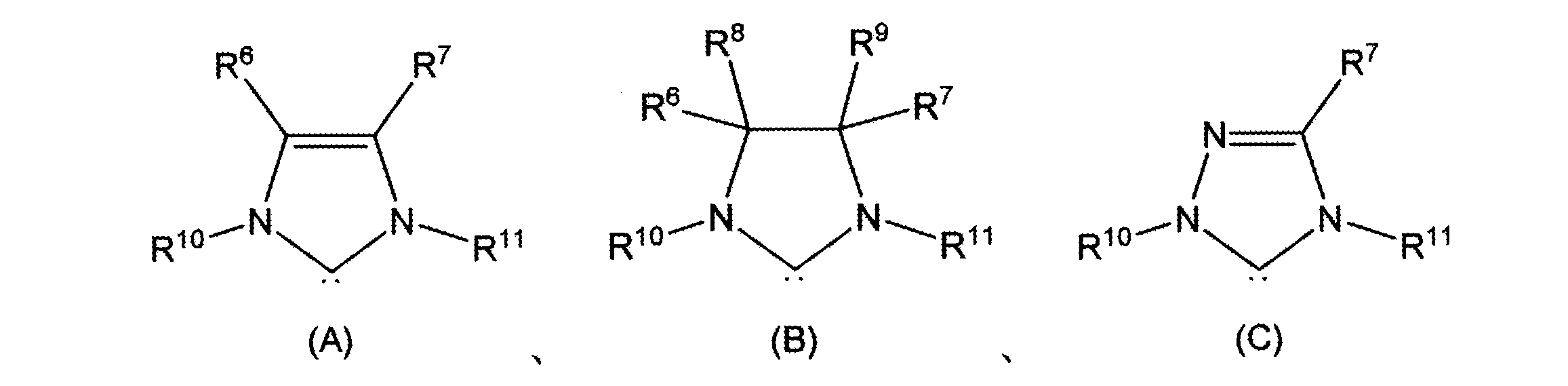
前記式(A)~(C)中、R6、R7、R8、R9、R10及びR11はそれぞれ独立して、水素又はC1-20-アルキル基(メチル基、エチル基等)、C2-20-アルケニル基(ビニル基、アリル基等)、C2-20-アルキニル基(エチニル基、プロパルギル基等)、アリール基(フェニル基、ナフチル基等)、C1-20-アシルオキシ基(アセトキシ基、ベンゾイルオキシ基等)、C1-20-アルコキシ基(メトキシ基、エトキシ基等)、C2-20-アルケニルオキシ基(ビニルオキシ基、アリルオキシ基等)、C2-20-アルキニルオキシ基(エチニルオキシ基、プロパルギルオキシ基等)、アリールオキシ基(フェニルオキシ基、ナフチルオキシ基等)、C2-20-アルコキシカルボニル基(メトキシカルボニル基、エトキシカルボニル基等)、C1-20-アルキルチオ基(メチルチオ基、エチルチオ基等)、C1-20-アルキルスルホニル基(メチルスルホニル基、エチルスルホニル基等)及びC1-20-アルキルスルフィニル基(メチルスルフィニル基、エチルスルフィニル基等)のうちから選択される置換基が挙げられる。任意に、R6、R7、R8、R9、R10及びR11の各置換基は、C1-10-アルキル基(メチル基、エチル基等)、C1-10-アルコキシ基(メトキシ基、エトキシ基等)及びアリール基(フェニル基、ナフチル基等)からなる1つ以上の基で置換されていてもよく、それらの各基はさらに、ハロゲン原子、C1-5-アルキル基(メチル基、エチル基等)、C1-5-アルコキシ基(メトキシ基、エトキシ基等)及びフェニル基から選択される1つ以上の基で置換されていてもよい。
本発明で使用する含窒素複素環式カルベン配位子のなかでも、選択率及び収率の観点から、上記願窒素複素環式カルベン配位子(A)が好ましい。このうち好ましい具体例としては、前記式(A)において、R10及びR11がアリール基(例えば、2,6-ジイソプロピルフェニル基、メシチル基等)であり、R6及びR7が水素であるものが挙げられる。
含窒素複素環式カルベン配位子は、ハロゲン原子(塩素原子等)、HCl、HF、HBr、HI、HBF4等との塩である配位子前駆体として用いてもよい。また、PEPPSITM-IPr触媒(Sigma-Aldrich社、別名:[1,3-ビス(2,6-ジイソプロピルフェニル)イミダゾール-2-イリデン](3-クロロピリジル)パラジウム(II)ジクロリド)のような市販のPd-NHC錯体として用いてもよい。
本工程において、含窒素複素環式カルベン配位子の使用量は、選択率及び収率の観点から、前記パラジウム触媒1モルに対して、通常、0.2~3モルが好ましく、0.3~2.5モルがより好ましい。
本工程では、塩基を使用することが好ましい。つまり、工程(III)は、塩基の存在下で行われることが好ましい。本工程で使用できる塩基としては、例えば、カリウムtert-ブトキシド、ナトリウムtert-ブトキシド、リチウムtert-ブトキシド等の金属アルコキシド;リン酸リチウム、リン酸ナトリウム、リン酸カリウム等のリン酸アルカリ金属塩;水酸化リチウム、水酸化ナトリウム、水酸化カリウム、水酸化セシウム等のアルカリ金属水酸化物;炭酸リチウム、炭酸ナトリウム、炭酸カリウム、炭酸セシウム等の炭酸アルカリ金属塩;リチウムジイソプロピルアミド、リチウムビス(トリメチルシリル)アミド、ナトリウムビス(トリメチルシリル)アミド、カリウムビス(トリメチルシリル)アミド等の金属アミド;トリエチルアミン、ジアザビシクロウンデセン、1,4-ジアザビシクロ[2.2.2]オクタン等のアミン等を挙げることができる。これらは単独で使用してもよく、また、複数併用してもよい。なかでも、本工程では、選択率、収率及び安全性の観点から、金属アルコキシド、リン酸アルカリ金属塩、アルカリ金属水酸化物等が好ましく、アルカリ金属水酸化物等がより好ましく、水酸化ナトリウムがさらに好ましい。
本工程において、塩基を使用する場合、塩基の使用量は、選択率及び収率の観点から、前記一般式(2)で示されるジアリールメチルアリールスルホン化合物1モルに対して、通常、0.5~5モルが好ましく、1~4モルがより好ましい。
本工程は、通常、反応溶媒下で行われる。使用できる反応溶媒としては、例えば、1,4-ジオキサン、テトラヒドロフラン、エチレングリコールジメチルエーテル、エチレングリコールジエチルエーテル、ジエチレングリコールジメチルエーテル、ジイソプロピルエーテル、ジイソブチルエーテル、シクロペンチルメチルエーテル等のエーテル系溶媒、及び前記エーテル系溶媒と水との混合溶媒(好ましくは1,4-ジオキサン/水=5/1~5/4(モル比));ベンゼン、トルエン、o-キシレン、m-キシレン、p-キシレン、混合キシレン、メシチレン等の芳香族炭化水素溶媒及び前記芳香族炭化水素系溶媒と水との混合溶媒(好ましくはトルエン/水=5/1~5/4(モル比))等の溶媒を用いることが好ましい。これらは単独で使用してもよく、また、複数併用してもよい。なかでも、選択率、収率及び安全性の観点から、反応溶媒は、ジオキサン(1,4-ジオキサン)を含有することが好ましく、ジオキサン(1,4-ジオキサン)と水との混合溶媒がより好ましく、1,4-ジオキサン/水=5/1~5/4(モル比)の混合溶媒がさらに好ましく、1,4-ジオキサン/水=5/2~5/4(モル比)の混合溶媒が特に好ましい。
これらの反応溶媒(有機溶媒)の使用量は、反応が進行すれば特に限定されるものではないが、通常、一般式(2)で示されるジアリールメチルアリールスルホン化合物の濃度が0.1~5mol/L、好ましくは1~2.5mol/Lとなるように調整することが好ましい。
本工程の反応温度は、使用する反応溶媒の沸点等によっても異なるが、通常100℃以上、特に100~300℃程度、さらに110~250℃程度の反応温度で実施することが好ましい。また、本工程は通常、不活性ガス(例えば、窒素、アルゴン、ヘリウム等)気流下で実施することが好ましい。また、反応は、常圧で実施してもよく、また、必要に応じて、減圧又は加圧条件下で実施することも可能であるが、常圧下で実施することが好ましい。反応時間は、特に制限はなく、反応が十分に進行する時間とすればよい。
反応の進行は、クロマトグラフィーのような通常の方法で追跡することができる。反応終了後、溶媒を留去し、生成物はクロマトグラフィー法、再結晶法等の通常の方法で単離精製することができる。また、生成物の構造は、元素分析、MS(FD-MS)分析、IR分析、1H-NMR、13C-NMR等により同定することができる。
また、本工程で合成されるトリアリールメタン化合物は、必要に応じて、活性炭処理、再結晶、カラムクロマトグラフィー等の通常の精製方法により精製することも可能である。
以上のようにして得られるトリアリールメタン化合物が、ベンジルオキシ基等の保護基を有する場合には、常法により脱保護した後、目的に応じて種々の置換基を導入することも可能である。
4.合成中間体
本発明において原料として用いられる一般式(2)で示されるジアリールメチルアリールスルホン化合物のうち、Ar1及びAr2の少なくとも一方がベンジルオキシ基で置換された芳香族基である化合物、すなわち、一般式(2a):
本発明において原料として用いられる一般式(2)で示されるジアリールメチルアリールスルホン化合物のうち、Ar1及びAr2の少なくとも一方がベンジルオキシ基で置換された芳香族基である化合物、すなわち、一般式(2a):

[式中、Ar1a、Ar2a及びArは同じか又は異なり、それぞれ置換又は無置換の芳香族基;ただし、Ar1a及び/又はAr2aはベンジルオキシ基で置換された芳香族基である。]
で示されるジアリールメチルアリールスルホン化合物は、文献未記載の新規化合物である。
で示されるジアリールメチルアリールスルホン化合物は、文献未記載の新規化合物である。
当該新規化合物としては、例えば、Ar1aがベンジルオキシ基で置換されたフェニル基、Ar2aがメトキシ基で置換されていてもよいフェニル基、Arが置換又は無置換のフェニル基である化合物、好ましくはAr1aが4-ベンジルオキシフェニル基、Ar2aが4-メトキシフェニル基、Arがフェニル基である化合物等が挙げられる。
前記一般式(2a)で示されるジアリールメチルアリールスルホン化合物は、本発明に従って、トリアリールメタン化合物に変換した後、脱ベンジル化して、種々の置換基を導入することにより、後述の実施例2に記載の抗乳癌剤[7]又はその類縁体等の生理活性物質を製造することも可能である。
以下、実施例により本発明を更に具体的に説明するが、本発明の範囲はこれらに限定されるものではない。
[実施例1]
(1)メチルフェニルスルホン化合物のアリール化(アリールメチルフェニルスルホン化合物の合成)
(1)メチルフェニルスルホン化合物のアリール化(アリールメチルフェニルスルホン化合物の合成)

内容積10mLの密閉可能なガラス容器内に、磁気撹拌子を収容し、減圧下、ヒートガンで乾燥させた。その後、室温に冷却し、アルゴンガスを満たした。次いで、前記ガラス容器に、6.7mg(0.03mmol)の酢酸パラジウム、28.6mg(0.06mmol)の2-ジシクロヘキシルホスフイノ-2’,4’,6’-トリイソプロピル-1,1’-ビフェニル(XPhos)、1.0mLの脱水シクロペンチルメチルエーテル(CPME)をアルゴン気流下で加えて、室温で30分撹拌した。その後、140.6mg(0.9mmol)のメチルフェニルスルホン、72mg(0.9mmol)のリチウムtert-ブトキシド(LiOt-Bu)、31.5μL(0.3mmol)のブロモベンゼン(1a)、1.0mLの脱水シクロペンチルメチルエーテルをアルゴン気流下で加えて、120℃で12時間撹拌した。反応系を室温に冷却し、100μLの飽和塩化アンモニウム水溶液を加えた。反応液を、短パッドのシリカゲルで濾過した。そして、沈澱物を酢酸エチルで洗浄し、濾液を濃縮した。その後、和光純薬工業社のシリカゲルB-5Fを用いたPTLC(展開溶媒:酢酸エチル/ヘキサン/ジクロロメタン=1/9/3(モル比))により、ベンジルフェニルスルホン(2a、白色固体)を得た。収量は59. 7mgであり、収率は86%であった。
(ベンジルフェニルスルホンの物性)
1H NMR (600 MHz, CDCl3) δ 4.31 (s, 2H), 7.07 (d, J = 7.8 Hz, 2H), 7.25 (t, J = 7.8 Hz, 2H), 7.31 (t, J = 7.8 Hz, 1H), 7.44 (t, J = 7.8 Hz, 2H), 7.59 (t, J = 7.8 Hz, 1H), 7.63 (d, J = 7.8Hz, 2H).
13C NMR (150 MHz, CDCl3) δ 62.8, 128.0, 128.5, 128.6, 128.7, 128.8, 130.7, 133.6, 137.8.
HRMS (FAB) m/z calcd for C13H12O2SNa [M+Na]+: 254.0450, found 254.0462。
1H NMR (600 MHz, CDCl3) δ 4.31 (s, 2H), 7.07 (d, J = 7.8 Hz, 2H), 7.25 (t, J = 7.8 Hz, 2H), 7.31 (t, J = 7.8 Hz, 1H), 7.44 (t, J = 7.8 Hz, 2H), 7.59 (t, J = 7.8 Hz, 1H), 7.63 (d, J = 7.8Hz, 2H).
13C NMR (150 MHz, CDCl3) δ 62.8, 128.0, 128.5, 128.6, 128.7, 128.8, 130.7, 133.6, 137.8.
HRMS (FAB) m/z calcd for C13H12O2SNa [M+Na]+: 254.0450, found 254.0462。
メチルフェニルスルホン(X)とブロモベンゼン(Y)との当量比、並びにホスフィン配位子、塩基(アルカリ金属アルコキシド)及び溶媒の種類を変えて、前記と同様に処理した結果を表1に示す。
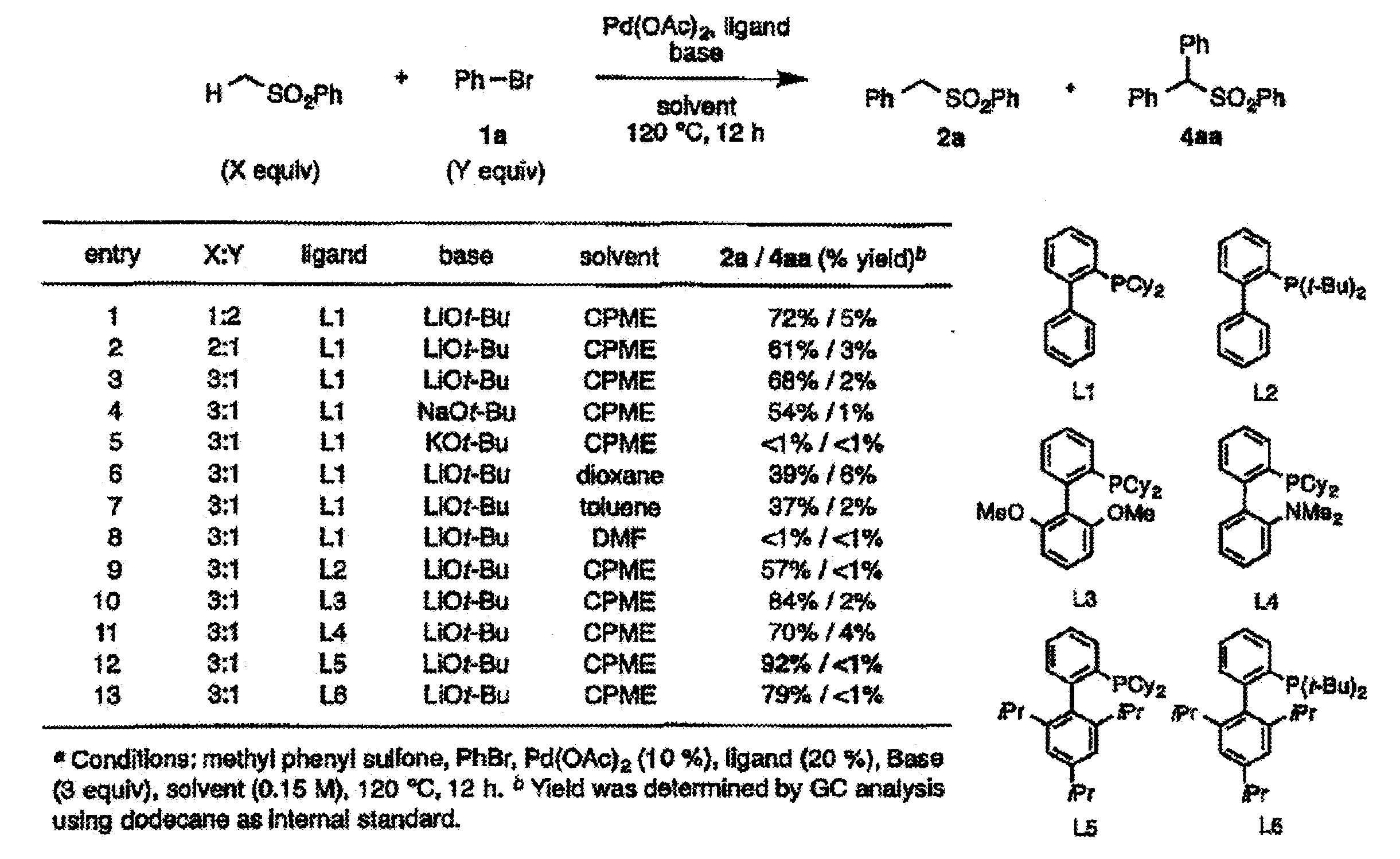
表1に示すように、酢酸パラジウム及び2-ジシクロヘキシルホスフィノ-2’,4’,6’-トリイソプロピル-1,1’-ビフェニル(XPhos)を触媒前駆体として使用することにより、エクスクルーシブ・モノアリール化が起こった。アリール化が起こると、α位のプロトンはより酸性になり、望ましくないジアリール化体を生成しやすくなくなるので、前記の結果は異なるアリール基の導入や非対称トリアリールメタンの合成に極めて有用である。
前記ブロモベンゼン(1a)を他のブロモアレーンに代える以外は前記と同様に処理して以下に示すアリールメチルフェニルスルホンを得た。
4-メチルフェニルメチルフェニルスルホン(4-Methylphenylmethyl phenyl sulfone (2b))
Purification by PTLC (EtOAc/hexane/CH2Cl2 = 1:9:3).
57.7 mg, 78% isolated yield; white solid.
1H NMR (600 MHz, CDCl3) δ 2.32 (s, 3H), 4.27 (s, 2H), 6.96 (d, J = 7.8Hz, 2H), 7.06 (d, J = 7.8 Hz, 2H), 7.45 (t, J = 7.8 Hz, 2H), 7.60 (t, J = 7.8 Hz, 1H), 7.64 (d, J = 7.8 Hz, 2H).
13C NMR (150 MHz, CDCl3) δ 21.2, 62.6, 124.9, 128.6, 128.8, 129.3, 130.7, 133.6, 138.0, 138.7.
HRMS (FAB) m/z calcd for C14H14O2SNa [M+Na]+: 269.0607, found 269.0615。
4-メトキシフェニルメチルフェニルスルホン(4-Methoxyphenylmethyl phenyl sulfone(2c))
Purification by preparative recycling HPLC.
58.4 mg, 74% isolated yield; white solid.
1H NMR (600 MHz, CDCl3) δ 3.28 (s, 3H), 4.25 (s, 2H), 6.78 (d, J = 8.4 Hz, 2H), 6.99 (d, J = 8.4 Hz, 2H), 7.45 (t, J = 7.2 Hz, 2H), 7.60 (t, J = 7.2 Hz, 1H), 7.64 (d, J = 7.2 Hz, 2H).
13C NMR (150 MHz, CDCl3) δ 55.2, 62.1, 114.0, 119.9, 128.6, 128.8, 131.9, 133.6, 137.9, 159.9.
HRMS (FAB) m/z calcd for C14H14O3SNa [M+Na]+: 285.0556, found 285.0563。
4-ベンジルオキシフェニルメチルフェニルスルホン(4-Benzyloxyphenylmethyl phenyl sulfone(2d))
Purification by preparative recycling HPLC.
71.1 mg, 70% isolated yield; white solid.
1H NMR (600 MHz, CDCl3) δ 4.24 (s, 2H), 5.04 (s, 2H), 6.85 (d, J = 8.4 Hz, 2H), 6.99 (d, J = 8.4 Hz, 2H), 7.33 (t, J = 7.2 Hz, 1H), 7.37-7.45 (m, 6H), 7.59 (t, J = 7.2 Hz, 1H), 7.63 (d, J = 7.2 Hz, 2H).
13C NMR (150 MHz, CDCl3) δ 62.2, 70.0, 115.0, 120.2, 127.4, 128.1, 128.6, 128.6, 128.8, 132.0, 133.6, 136.6, 137.9, 159.2.
HRMS (FAB) m/z calcd for C20H18O3SNa [M+Na]+: 361.0874, found 361.0881。
4-フルオロフェニルメチルフェニルスルホン(4-Fluorophenylmethyl phenyl sulfone(2e))
Purlfication by preparative recycling HPLC.
61.2 mg, 82% isolated yield; white solid.
1H NMR (600 MHz, CDCl3) δ 4.28 (s, 2H), 6.95 (d, J = 8.4 Hz, 2H), 7.05-7.08 (m, 2H), 7.47 (t, J = 8.4 Hz, 2H), 7.60-7.65 (m, 3H).
13C NMR (150 MHz, CDCl3) δ 61.9, 115.6 (d, J = 23.1 Hz), 123.9, 128.5, 128.9, 132.5 (d, J = 8.7 Hz), 133.8, 137.6, 163.0 (d, J = 249 Hz).
HRMS (FAB) m/z calcd for C13H12O2FSNa [M+Na]+: 273.0356, found 273.0354。
(4-トリフルオロメチル)フェニルメチルフェニルスルホン((4-Trifluoromethyl)phenylmethyl phenyl sulfone(2f))
Purlficatlon by PTLC (EtOAc/hexane/CH2Cl2 = 1:9:3).
50.2 mg, 56% isolated yleld; white solid.
1H NMR (600 MHz, DMSO) δ 4.84 (s, 2H), 7.39 (d, J = 8.4 Hz, 2H), 7.61 (t, J = 7.8 Hz, 2H), 7.68 (d, J = 8.4 Hz, 2H), 7.72-7.75 (m, 3H).
13C NMR (150 MHz, DMSO) δ 60.0, 124.1 (q, J = 273 Hz), 125.1 (q, J = 8.7 Hz), 128.0, 128.8 (q, J = 31.7Hz), 129.2, 131.8, 133.5, 134.0, 138.2.
HRMS (FAB) m/z calcd for C14H11O2F3SNa [M+Na]+: 323.0324, found 323.0339。
1-ナフチルメチルフェニルスルホン(1-Naphthylmethyl phenyl sulfone(2g))
Purification by PTLC (EtOAc/hexane/CH2Cl2 = 1:9:3).
66.8mg, 79% isolated yield; white solid.
1H NMR (600 MHz, CDCl3) δ 4.82 (s, 2H), 7.20 (d, J = 7.8 Hz, 1H), 7.33-7.36 (m, 3H), 7.40 (t, J = 7.8 Hz, 1H), 7.44 (t, J = 7.8 Hz, 1H), 7.51 (t, J = 7.8 Hz, 1H), 7.59 (d, J = 7.8 Hz, 2H), 7.80-7.83 (m, 3H).
13C NMR (150 MHz, CDCl3) δ 59.8, 123,5, 124.5, 125.0, 125.9, 126.6, 128.6, 128.8, 129.7, 130.6, 132.0, 133.6, 133.7, 137.9.
HRMS (FAB) m/z calcd for C17H14O2SNa [M+Na]+: 305.0607, found 305.0609。
3-チエニルメチルフェニルスルホン(3-Thienylmethyl phenyl sulfone(2h))
Reaction time was 24h. Purification by PTLC (EtOAc/hexane/CH2Cl2= 1:9:3). 24.3 mg, 34% isolated yield; white solid.
1H NMR (600 MHz, CDCl3) δ 4.37 (s, 2H), 6.90 (d, J = 4.8 Hz, 1H), 7.03 (s, 1H), 7.24 (d, J = 4.8 Hz, 1H), 7.46 (t, J = 7.8 Hz, 2H), 7.61 (t, J = 7.8 Hz, 1H), 7.65 (d, J = 7.8 Hz, 2H).
13C NMR (150 MHz, CDCl3) δ 57.5, 126.1, 126.7, 127.9, 128.4, 128.9, 128.9, 133.7, 137.8.
HRMS (FAB) m/z calcd for C11H16O2S2Na [M+Na]+: 261.0014, found 261.0019。
4-メチルフェニルメチルフェニルスルホン(4-Methylphenylmethyl phenyl sulfone (2b))
Purification by PTLC (EtOAc/hexane/CH2Cl2 = 1:9:3).
57.7 mg, 78% isolated yield; white solid.
1H NMR (600 MHz, CDCl3) δ 2.32 (s, 3H), 4.27 (s, 2H), 6.96 (d, J = 7.8Hz, 2H), 7.06 (d, J = 7.8 Hz, 2H), 7.45 (t, J = 7.8 Hz, 2H), 7.60 (t, J = 7.8 Hz, 1H), 7.64 (d, J = 7.8 Hz, 2H).
13C NMR (150 MHz, CDCl3) δ 21.2, 62.6, 124.9, 128.6, 128.8, 129.3, 130.7, 133.6, 138.0, 138.7.
HRMS (FAB) m/z calcd for C14H14O2SNa [M+Na]+: 269.0607, found 269.0615。
4-メトキシフェニルメチルフェニルスルホン(4-Methoxyphenylmethyl phenyl sulfone(2c))
Purification by preparative recycling HPLC.
58.4 mg, 74% isolated yield; white solid.
1H NMR (600 MHz, CDCl3) δ 3.28 (s, 3H), 4.25 (s, 2H), 6.78 (d, J = 8.4 Hz, 2H), 6.99 (d, J = 8.4 Hz, 2H), 7.45 (t, J = 7.2 Hz, 2H), 7.60 (t, J = 7.2 Hz, 1H), 7.64 (d, J = 7.2 Hz, 2H).
13C NMR (150 MHz, CDCl3) δ 55.2, 62.1, 114.0, 119.9, 128.6, 128.8, 131.9, 133.6, 137.9, 159.9.
HRMS (FAB) m/z calcd for C14H14O3SNa [M+Na]+: 285.0556, found 285.0563。
4-ベンジルオキシフェニルメチルフェニルスルホン(4-Benzyloxyphenylmethyl phenyl sulfone(2d))
Purification by preparative recycling HPLC.
71.1 mg, 70% isolated yield; white solid.
1H NMR (600 MHz, CDCl3) δ 4.24 (s, 2H), 5.04 (s, 2H), 6.85 (d, J = 8.4 Hz, 2H), 6.99 (d, J = 8.4 Hz, 2H), 7.33 (t, J = 7.2 Hz, 1H), 7.37-7.45 (m, 6H), 7.59 (t, J = 7.2 Hz, 1H), 7.63 (d, J = 7.2 Hz, 2H).
13C NMR (150 MHz, CDCl3) δ 62.2, 70.0, 115.0, 120.2, 127.4, 128.1, 128.6, 128.6, 128.8, 132.0, 133.6, 136.6, 137.9, 159.2.
HRMS (FAB) m/z calcd for C20H18O3SNa [M+Na]+: 361.0874, found 361.0881。
4-フルオロフェニルメチルフェニルスルホン(4-Fluorophenylmethyl phenyl sulfone(2e))
Purlfication by preparative recycling HPLC.
61.2 mg, 82% isolated yield; white solid.
1H NMR (600 MHz, CDCl3) δ 4.28 (s, 2H), 6.95 (d, J = 8.4 Hz, 2H), 7.05-7.08 (m, 2H), 7.47 (t, J = 8.4 Hz, 2H), 7.60-7.65 (m, 3H).
13C NMR (150 MHz, CDCl3) δ 61.9, 115.6 (d, J = 23.1 Hz), 123.9, 128.5, 128.9, 132.5 (d, J = 8.7 Hz), 133.8, 137.6, 163.0 (d, J = 249 Hz).
HRMS (FAB) m/z calcd for C13H12O2FSNa [M+Na]+: 273.0356, found 273.0354。
(4-トリフルオロメチル)フェニルメチルフェニルスルホン((4-Trifluoromethyl)phenylmethyl phenyl sulfone(2f))
Purlficatlon by PTLC (EtOAc/hexane/CH2Cl2 = 1:9:3).
50.2 mg, 56% isolated yleld; white solid.
1H NMR (600 MHz, DMSO) δ 4.84 (s, 2H), 7.39 (d, J = 8.4 Hz, 2H), 7.61 (t, J = 7.8 Hz, 2H), 7.68 (d, J = 8.4 Hz, 2H), 7.72-7.75 (m, 3H).
13C NMR (150 MHz, DMSO) δ 60.0, 124.1 (q, J = 273 Hz), 125.1 (q, J = 8.7 Hz), 128.0, 128.8 (q, J = 31.7Hz), 129.2, 131.8, 133.5, 134.0, 138.2.
HRMS (FAB) m/z calcd for C14H11O2F3SNa [M+Na]+: 323.0324, found 323.0339。
1-ナフチルメチルフェニルスルホン(1-Naphthylmethyl phenyl sulfone(2g))
Purification by PTLC (EtOAc/hexane/CH2Cl2 = 1:9:3).
66.8mg, 79% isolated yield; white solid.
1H NMR (600 MHz, CDCl3) δ 4.82 (s, 2H), 7.20 (d, J = 7.8 Hz, 1H), 7.33-7.36 (m, 3H), 7.40 (t, J = 7.8 Hz, 1H), 7.44 (t, J = 7.8 Hz, 1H), 7.51 (t, J = 7.8 Hz, 1H), 7.59 (d, J = 7.8 Hz, 2H), 7.80-7.83 (m, 3H).
13C NMR (150 MHz, CDCl3) δ 59.8, 123,5, 124.5, 125.0, 125.9, 126.6, 128.6, 128.8, 129.7, 130.6, 132.0, 133.6, 133.7, 137.9.
HRMS (FAB) m/z calcd for C17H14O2SNa [M+Na]+: 305.0607, found 305.0609。
3-チエニルメチルフェニルスルホン(3-Thienylmethyl phenyl sulfone(2h))
Reaction time was 24h. Purification by PTLC (EtOAc/hexane/CH2Cl2= 1:9:3). 24.3 mg, 34% isolated yield; white solid.
1H NMR (600 MHz, CDCl3) δ 4.37 (s, 2H), 6.90 (d, J = 4.8 Hz, 1H), 7.03 (s, 1H), 7.24 (d, J = 4.8 Hz, 1H), 7.46 (t, J = 7.8 Hz, 2H), 7.61 (t, J = 7.8 Hz, 1H), 7.65 (d, J = 7.8 Hz, 2H).
13C NMR (150 MHz, CDCl3) δ 57.5, 126.1, 126.7, 127.9, 128.4, 128.9, 128.9, 133.7, 137.8.
HRMS (FAB) m/z calcd for C11H16O2S2Na [M+Na]+: 261.0014, found 261.0019。
また、ブロモベンゼンにおける臭素原子を他のハロゲン原子に変えて、前記(工程(1))と同様に処理した結果を表2に示す。

(2)アリールメチルフェニルスルホン化合物のアリール化(ジアリールメチルフェニルスルホン化合物の合成)

内容積10mLの密閉可能なガラス容器内に、磁気撹拌子を収容し、減圧下、ヒートガンで乾燥させた。その後、室温に冷却し、アルゴンガスを満たした。次いで、前記ガラス容器に、5.5mg(0.03mmol)アリルパラジウム(II)クロリドダイマー、17.4mg(0.06mmol)のトリtert-ブチルホスホニウムテトラフルオロボレート、101mg(0.9mmol)のカリウムtert-ブトキシド、0.8mLの脱水ジオキサンをアルゴン気流下で加えて、室温で30分撹拌した。その後、69.6mg(0.3mmol)のベンジルフェニルスルホン(2a)、50μL(0.45mmol)のヨードベンゼン(3a)、0.8mLの脱水ジオキサンをアルゴン気流下で加えて、80℃で12時間撹拌した。反応系を室温に冷却し、100μLの飽和塩化アンモニウム水溶液を加えた。反応液を、短パッドのシリカゲルで液過した。そして、沈澱物を酢酸エチルで洗浄し、液液を濃縮した。その後、和光純薬工業社のシリカゲルB-5Fを用いたPTLC(展開溶媒:酢酸エチル/ヘキサン/ジクロロメタン=1/9/3(モル比))により、ジフェニルメチルフェニルスルホン(4aa、白色固体)を得た。収量は75.5mgであり、収率は82%であった。
(ジフェニルメチルフェニルスルホンの物性)
1H NMR (600 MHz, CDCl3) δ 5.29 (s, 1H), 7.25-7.39 (m, 8H), 7.49-7.53 (m, 5H), 7.62 (d, J = 7.8 Hz, 2H).
13C NMR (150 MHz, CDCl3) δ 76.4, 128.58, 128.61, 128.7, 129.0, 129.9, 132.9, 133.4, 138.2.
HRMS (FAB) m/z calcd for C19H16O2SNa [M+Na]+: 331.0763, found 331.0767。
1H NMR (600 MHz, CDCl3) δ 5.29 (s, 1H), 7.25-7.39 (m, 8H), 7.49-7.53 (m, 5H), 7.62 (d, J = 7.8 Hz, 2H).
13C NMR (150 MHz, CDCl3) δ 76.4, 128.58, 128.61, 128.7, 129.0, 129.9, 132.9, 133.4, 138.2.
HRMS (FAB) m/z calcd for C19H16O2SNa [M+Na]+: 331.0763, found 331.0767。
ハロベンゼン、パラジウム触媒、配位子、塩基(アルカリ金属アルコキシド)及び溶媒の種類、並びにベンジルフェニルスルホン(2a)に対するハロベンゼンの当量比を変えて、前記と同様に処理した結果を表3に示す。
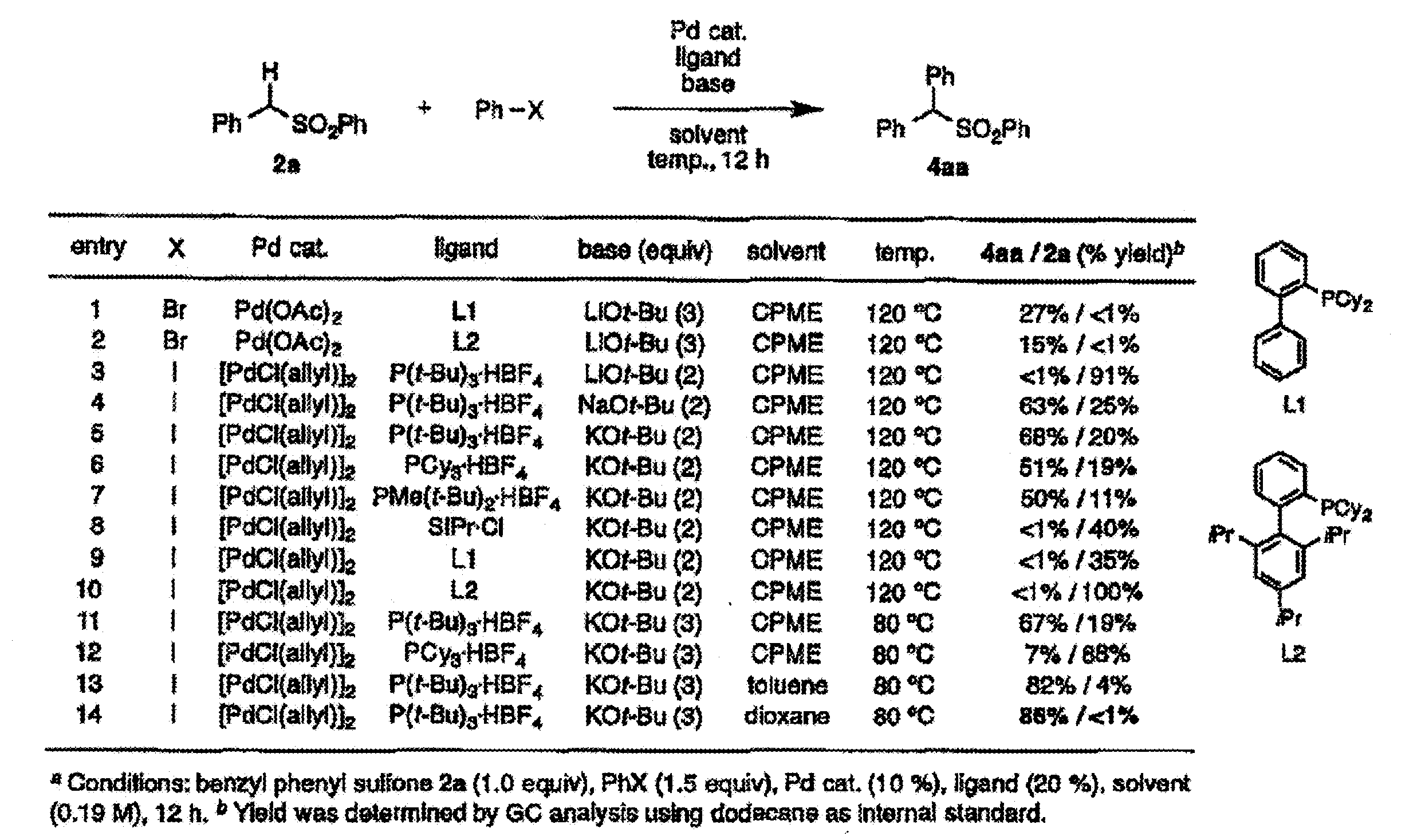
表3において、SIPr・HClは1,3-ビス-(2,6-ジイソプロピルフェニル)イミダゾリニウムクロリドを意味する。
前記ヨードベンゼン(3a)及び/又はベンジルフェニルスルホン(2a)を他のブロモアレーン及び/又はアリールメチルフェニルスルホンに代える以外は前記と同様に処堤して以下に示すジアリールメチルフェニルスルホンを得た。
(4-メトキシフェニル)フェニルメチルフェニルスルホン((4-Methoxyphenyl)phenylmethyl phenyl sulfone(4ac))
Purification by PTLC (EtOAc/hexane/CH2Cl2 = 1:9:3).
68.6 mg, 68% isolated yield; white solid.
1H NMR (600 MHz, CDCl3) δ 3.76 (s, 3H), 5.25 (s, 1H), 6.83 (d, J = 8.4 Hz, 2H), 7.29-7.30 (m, 3H), 7.35 (t, J = 7.8 Hz, 2H), 7.44 (d, J = 8.4 Hz, 2H), 7.49-7.52 (m, 3H), 7.62 (d, J = 7.8 Hz, 2H).
13C NMR (150 MHz, CDCl3) δ 55.2, 75.8, 114.0, 124.7, 128.5, 128.57, 128.62, 128.9, 129.8, 131.2, 133.2, 133.4, 138.2, 159.8.
HRMS (FAB) m/z calcd for C20H18O3SNa [M+Na]+: 361.0869, found 361.0872。
(4-フルオロフェニル)フェニルメチルフェニルスルホン((4-Fluorophenyl)phenylmethyl phenyl sulfone(4ae))
Purification by preparative recycling HPLC.
45.0 mg, 46% isolated yield; white solid.
1H NMR (600 MHz, CDCl3) δ 5.28 (s, 1H), 7.01 (t, J = 8.4 Hz, 2H), 7.30-7.32 (m, 3H), 7.38 (t, J = 7.8 Hz, 2H), 7.49-7.54 (m, 5H), 7.62 (d, J = 7.8 Hz, 2H).
13C NMR (150 MHz, CDCl3) δ 75.6, 115.7 (d, J = 21.6 Hz), 128.7, 128.7, 128.8, 129.0, 129.8, 131.8 (d, J = 7.2 Hz), 132.8, 133.6, 138.0, 162.9 (d, J = 251 Hz).
HRMS (FAB) m/z calcd for C19H15O2FSNa [M+Na]+: 349.0669, found 349.0679。
(4-メチルフェニル)フェニルメチルフェニルスルホン((4-Methylphenyl)phenylmethyl phenyl sulfone(4ba))
Purification by PTLC (EtOAc/hexane/CH2Cl2 = 1:9:3).
79.9 mg, 83% isolated yield; white solid.
1H NMR (600 MHz, CDCl3) δ 2.31 (s, 3H), 5.26 (s, 1H), 7.12 (d, J = 7.8 Hz, 2H), 7.29-7.30 (m, 3H), 7.36 (t, J = 7.2 Hz, 2H), 7.42 (d, J = 7.8 Hz, 2H), 7.49-7.52 (m, 3H), 7.62 (d, J = 7.2 Hz, 2H).
13C NMR (150 MHz, CDCl3) δ 21.1, 76.2, 128.5, 128.56, 128.61, 129.0, 129.4, 129.8, 129.9, 133.1, 133.4, 138.3, 138.6.
HRMS (FAB) m/z calcd for C20H18O2SNa [M+Na]+: 345.0920, found 345.0934。
ジ-(4-メトキシフェニル)メチルフェニルスルホン(Di-(4-methoxyphenyl)methyl phenyl sulfone(4cc))
Purification by preparative recycling HPLC.
83.2 mg, 75% isolated yield; white solid.
1H NMR (600 MHz, CDCl3) δ 3.76 (s, 6H), 5.21 (s, 1H), 6.83 (d, J = 8.4 Hz, 4H), 7.36 (t, J = 7.2 Hz, 2H), 7.43 (d, J = 8.4 Hz, 4H), 7.50 (t, J = 7.2 Hz, 1H), 7.62 (d, J = 7.2 Hz, 2H).
13C NMR (150 MHz, CDCl3) δ 55.2, 75.1, 114.0, 125.0, 128.6, 128.9, 131.1, 133.3, 138.4, 159.7.
HRMS (FAB) m/z calcd for C21H20O4SNa [M+Na]+: 391.0975, found 391.0981。
(4-ベンジルオキシフェニル)(3-メトキシフェニル)メチルフェニルスルホン((4-Benzyloxyphenyl)(4-methoxyphenyl)methyl phenyl sulfone(4dc))
Purification by preparative recycling HPLC.
87.3 mg, 66% isolated yield; white solid.
1H NMR (600 MHz, CDCl3) δ 3.76 (s, 3H), 5.03 (s, 2H) 5.20 (s, 1H), 6.83 (d, J = 9.0 Hz, 2H), 6.90 (d, J = 9.0 Hz, 2H), 7.30-7.43 (m, 11H), 7.49 (t, J = 7.8 Hz, 1H), 7.61 (d, J = 7.8 Hz, 2H).
13C NMR (150 MHz, CDCl3) δ 55.2, 69.9, 75.2, 114.0, 114.9, 124.9, 125.2, 127.4, 128.0, 128.6, 128.9, 131.10, 131.13, 133.3, 136.6, 138.3, 158.9, 159.7.
HRMS (FAB) m/z calcd for C27H24O4SNa [M+Na]+: 467.1293, found 467.1300。
(4-フルオロフェニル)(4-メチルフェニル)メチルフェニルスルホン((4-Fluorophenyl)(4-methylphenyl)methyl phenyl sulfone(4eb))
Purification by PTLC (EtOAc/hexane/CH2Cl2 = 1:9:3).
79.4 mg, 78% isolated yield; white solid.
1H NMR (600 MHz, CDCl3) δ 2.32 (s, 3H), 5.24 (s, 1H), 6.98-7.01 (m, 2H), 7.13 (d, J = 7.2 Hz, 2H), 7.37-7.39 (m, 4H), 7.48-7.54 (m, 3H), 7.62 (d, J = 7.2 Hz, 2H).
13C NMR (150 MHz, CDCl3) δ 21.1, 75.3, 115.7 (d, J = 21.6 Hz), 128.7, 128.9, 129.0, 129.5, 129.6, 129.7, 131.7 (d, J = 8.7 Hz), 133.6, 138.1, 138.8, 162.8 (d, J = 238 Hz).
HRMS (FAB) m/z calcd for C20H17O2SFNa [M+Na]+: 363.0825, found 363.0839。
フェニル(4-トリフルオロメチルフェニル)メチルフェニルスルホン(Phenyl(4-trifluoromethylphenyl)methyl phenyl sulfone(4fa))
Reaction was conducted at 60℃. Purification by PTLC (EtOAc/hexane/CH2Cl2= 1:9.3).
97.4 mg, 86% isolated yield; white solid.
1H NMR (600 MHz, CDCl3) δ 5.36 (s, 1H), 7.29-7.32 (m, 3H), 7.37 (t, J = 7.2 Hz, 2H), 7.47-7.48 (m, 2H), 7.53 (t, J = 7.2 Hz, 1H), 7.59 (d, J = 7.8 Hz, 2H), 7.63 (d, J = 7.8 Hz, 2H), 7.71 (d, J = 7.2 Hz, 2H).
13C NMR (150 MHz, CDCl3) δ 75.9, 123.8 (q, J = 274 Hz), 125.6 (br.d, J = 4.2 Hz), 128.8, 128.9, 128.96, 128.99, 129.8, 130.3, 130.8 (q, J = 33 Hz), 132.2, 133.8, 136.9, 137.8.
HRMS (FAB) m/z calcd for C20H15O2F3SNa [M+Na]+: 399.0637, found 399.0647。
ジ(4-トリフルオロメチルフェニル)メチルフェニルスルホン(Di-(4-trifluoromethylphenyl)methyl phenyl sulfone(4ff))
Purification by PTLC (EtOAc/hexane/CH2Cl2 = 1:9:3).
62.4 mg, 47% isolated yield; white solid.
1H NMR (600 MHz, CDCl3) δ 5.44 (s, 1H), 7.40 (t, J = 7.8 Hz, 2H), 7.55-7.60 (m, 5H), 7.63-7.66 (m, 6H).
13C NMR (150 MHz, CDCl3) δ 75.2, 123.7 (q, J = 274 Hz), 125.8 (br.d, J = 4.4 Hz), 128.9, 129.0, 130.2, 131.1 (q, J = 31.7 Hz), 134.2, 136.2, 137.4.
HRMS (FAB) m/z calcd for C21H14O2SF6Na [M+Na]+: 467.0516, found 467.0509。
(1-ナフチル)フェニルメチルフェニルスルホン((1-Naphthyl)phenylmethyl phenyl sulfone(4ga))
Reaction time was 12h. Purification by PTLC (EtOAc/hexane/CH2Cl2= 1:9:3).
85.4 mg, 79% isolated yield; white solid.
1H NMR (600 MHz, CDCl3) δ 6.22 (s, 1H), 7.26-7.27 (m, 3H), 7.30 (t, J = 7.8 Hz, 2H), 7.31-7.41 (m, 2H), 7.45 (dt, J = 7.2, 1.2 Hz, 1H), 7.49-7.50 (m, 2H), 7.57 (t, J = 7.8 Hz, 1H), 7.64 (dd, J = 8.4, 1.2 Hz, 2H), 7.79-7.83 (m, 3H), 8.48 (d, J = 7.2 Hz, 1H).
13C NMR (150 MHz, CDCl3) δ 70.7, 121.9, 125.3, 125.6, 126.7, 127.3, 128.55, 128.61, 128.64, 128.95, 129.03, 129.1, 129.2, 130.3, 131.4, 133.0, 133.5, 133.9, 138.4.
HRMS (FAB) m/z calcd for C23H18O2SNa [M+Na]+: 381.0920, found 381.0916。
フェニル(3-チエニル)メチルフェニルスルホン(Phenyl(3-thienyl)methyl phenyl sulfone(4ha))
Purification by PTLC (EtOAc/hexane/CH2Cl2 = 1:9:3).
39.5 mg, 42% isolated yield; white solid.
1H NMR (600 MHz, CDCl3) δ 5.44 (s, 1H), 7.29-7.31 (m, 5H), 7.36 (t, J = 7.8 Hz, 2H), 7.41 (s, 1H), 7.44-7.45 (m, 2H), 7.51 (t, J = 7.8 Hz, 1H), 7.59 (d, J = 7.8 Hz, 2H).
13C NMR (150 MHz, CDCl3) δ 72.3, 126.0, 126.1, 128.55, 128.57, 128.60, 128.8, 128.9, 130.1, 132.42, 132.44, 133.5, 137.8.
HRMS (FAB) m/z calcd for C17H14O2S2Na [M+Na]+: 337.0327, found 337.0329。
ジ(3-チエニル)メチルフェニルスルホン(Di-(3-thienyl)methyl phenyl sulfone(4hh))
3 equivalents of Ar2I were used. Reaction was conducted at 120℃. Purification by PTLC (EtOAc/hexane/CH2Cl2 = 1:9:3).
28.9 mg, 30% isolated yield; pale yellow solid.
1H NMR (600 MHz, CDCl3) δ 5.59 (s, 1H), 7.25-7.26 (m, 2H), 7.30-7.31 (m, 4H), 7.38 (dt, J = 7.2, 1.2 Hz, 2H), 7.53 (dt, J = 7.2, 1.2 Hz, 1H), 7.58 (dd, J = 7.2, 1.2 Hz, 2H).
13C NMR (150 MHz, CDCl3) δ 67.8, 126.1, 126.4, 128.5, 128.6, 128.9, 132.3, 133.5, 137.6.
HRMS (FAB) m/z calcd for C15H12O2S3Na [M+Na]+: 342.9892, found 342.9899。
(4-メトキシフェニル)フェニルメチルフェニルスルホン((4-Methoxyphenyl)phenylmethyl phenyl sulfone(4ac))
Purification by PTLC (EtOAc/hexane/CH2Cl2 = 1:9:3).
68.6 mg, 68% isolated yield; white solid.
1H NMR (600 MHz, CDCl3) δ 3.76 (s, 3H), 5.25 (s, 1H), 6.83 (d, J = 8.4 Hz, 2H), 7.29-7.30 (m, 3H), 7.35 (t, J = 7.8 Hz, 2H), 7.44 (d, J = 8.4 Hz, 2H), 7.49-7.52 (m, 3H), 7.62 (d, J = 7.8 Hz, 2H).
13C NMR (150 MHz, CDCl3) δ 55.2, 75.8, 114.0, 124.7, 128.5, 128.57, 128.62, 128.9, 129.8, 131.2, 133.2, 133.4, 138.2, 159.8.
HRMS (FAB) m/z calcd for C20H18O3SNa [M+Na]+: 361.0869, found 361.0872。
(4-フルオロフェニル)フェニルメチルフェニルスルホン((4-Fluorophenyl)phenylmethyl phenyl sulfone(4ae))
Purification by preparative recycling HPLC.
45.0 mg, 46% isolated yield; white solid.
1H NMR (600 MHz, CDCl3) δ 5.28 (s, 1H), 7.01 (t, J = 8.4 Hz, 2H), 7.30-7.32 (m, 3H), 7.38 (t, J = 7.8 Hz, 2H), 7.49-7.54 (m, 5H), 7.62 (d, J = 7.8 Hz, 2H).
13C NMR (150 MHz, CDCl3) δ 75.6, 115.7 (d, J = 21.6 Hz), 128.7, 128.7, 128.8, 129.0, 129.8, 131.8 (d, J = 7.2 Hz), 132.8, 133.6, 138.0, 162.9 (d, J = 251 Hz).
HRMS (FAB) m/z calcd for C19H15O2FSNa [M+Na]+: 349.0669, found 349.0679。
(4-メチルフェニル)フェニルメチルフェニルスルホン((4-Methylphenyl)phenylmethyl phenyl sulfone(4ba))
Purification by PTLC (EtOAc/hexane/CH2Cl2 = 1:9:3).
79.9 mg, 83% isolated yield; white solid.
1H NMR (600 MHz, CDCl3) δ 2.31 (s, 3H), 5.26 (s, 1H), 7.12 (d, J = 7.8 Hz, 2H), 7.29-7.30 (m, 3H), 7.36 (t, J = 7.2 Hz, 2H), 7.42 (d, J = 7.8 Hz, 2H), 7.49-7.52 (m, 3H), 7.62 (d, J = 7.2 Hz, 2H).
13C NMR (150 MHz, CDCl3) δ 21.1, 76.2, 128.5, 128.56, 128.61, 129.0, 129.4, 129.8, 129.9, 133.1, 133.4, 138.3, 138.6.
HRMS (FAB) m/z calcd for C20H18O2SNa [M+Na]+: 345.0920, found 345.0934。
ジ-(4-メトキシフェニル)メチルフェニルスルホン(Di-(4-methoxyphenyl)methyl phenyl sulfone(4cc))
Purification by preparative recycling HPLC.
83.2 mg, 75% isolated yield; white solid.
1H NMR (600 MHz, CDCl3) δ 3.76 (s, 6H), 5.21 (s, 1H), 6.83 (d, J = 8.4 Hz, 4H), 7.36 (t, J = 7.2 Hz, 2H), 7.43 (d, J = 8.4 Hz, 4H), 7.50 (t, J = 7.2 Hz, 1H), 7.62 (d, J = 7.2 Hz, 2H).
13C NMR (150 MHz, CDCl3) δ 55.2, 75.1, 114.0, 125.0, 128.6, 128.9, 131.1, 133.3, 138.4, 159.7.
HRMS (FAB) m/z calcd for C21H20O4SNa [M+Na]+: 391.0975, found 391.0981。
(4-ベンジルオキシフェニル)(3-メトキシフェニル)メチルフェニルスルホン((4-Benzyloxyphenyl)(4-methoxyphenyl)methyl phenyl sulfone(4dc))
Purification by preparative recycling HPLC.
87.3 mg, 66% isolated yield; white solid.
1H NMR (600 MHz, CDCl3) δ 3.76 (s, 3H), 5.03 (s, 2H) 5.20 (s, 1H), 6.83 (d, J = 9.0 Hz, 2H), 6.90 (d, J = 9.0 Hz, 2H), 7.30-7.43 (m, 11H), 7.49 (t, J = 7.8 Hz, 1H), 7.61 (d, J = 7.8 Hz, 2H).
13C NMR (150 MHz, CDCl3) δ 55.2, 69.9, 75.2, 114.0, 114.9, 124.9, 125.2, 127.4, 128.0, 128.6, 128.9, 131.10, 131.13, 133.3, 136.6, 138.3, 158.9, 159.7.
HRMS (FAB) m/z calcd for C27H24O4SNa [M+Na]+: 467.1293, found 467.1300。
(4-フルオロフェニル)(4-メチルフェニル)メチルフェニルスルホン((4-Fluorophenyl)(4-methylphenyl)methyl phenyl sulfone(4eb))
Purification by PTLC (EtOAc/hexane/CH2Cl2 = 1:9:3).
79.4 mg, 78% isolated yield; white solid.
1H NMR (600 MHz, CDCl3) δ 2.32 (s, 3H), 5.24 (s, 1H), 6.98-7.01 (m, 2H), 7.13 (d, J = 7.2 Hz, 2H), 7.37-7.39 (m, 4H), 7.48-7.54 (m, 3H), 7.62 (d, J = 7.2 Hz, 2H).
13C NMR (150 MHz, CDCl3) δ 21.1, 75.3, 115.7 (d, J = 21.6 Hz), 128.7, 128.9, 129.0, 129.5, 129.6, 129.7, 131.7 (d, J = 8.7 Hz), 133.6, 138.1, 138.8, 162.8 (d, J = 238 Hz).
HRMS (FAB) m/z calcd for C20H17O2SFNa [M+Na]+: 363.0825, found 363.0839。
フェニル(4-トリフルオロメチルフェニル)メチルフェニルスルホン(Phenyl(4-trifluoromethylphenyl)methyl phenyl sulfone(4fa))
Reaction was conducted at 60℃. Purification by PTLC (EtOAc/hexane/CH2Cl2= 1:9.3).
97.4 mg, 86% isolated yield; white solid.
1H NMR (600 MHz, CDCl3) δ 5.36 (s, 1H), 7.29-7.32 (m, 3H), 7.37 (t, J = 7.2 Hz, 2H), 7.47-7.48 (m, 2H), 7.53 (t, J = 7.2 Hz, 1H), 7.59 (d, J = 7.8 Hz, 2H), 7.63 (d, J = 7.8 Hz, 2H), 7.71 (d, J = 7.2 Hz, 2H).
13C NMR (150 MHz, CDCl3) δ 75.9, 123.8 (q, J = 274 Hz), 125.6 (br.d, J = 4.2 Hz), 128.8, 128.9, 128.96, 128.99, 129.8, 130.3, 130.8 (q, J = 33 Hz), 132.2, 133.8, 136.9, 137.8.
HRMS (FAB) m/z calcd for C20H15O2F3SNa [M+Na]+: 399.0637, found 399.0647。
ジ(4-トリフルオロメチルフェニル)メチルフェニルスルホン(Di-(4-trifluoromethylphenyl)methyl phenyl sulfone(4ff))
Purification by PTLC (EtOAc/hexane/CH2Cl2 = 1:9:3).
62.4 mg, 47% isolated yield; white solid.
1H NMR (600 MHz, CDCl3) δ 5.44 (s, 1H), 7.40 (t, J = 7.8 Hz, 2H), 7.55-7.60 (m, 5H), 7.63-7.66 (m, 6H).
13C NMR (150 MHz, CDCl3) δ 75.2, 123.7 (q, J = 274 Hz), 125.8 (br.d, J = 4.4 Hz), 128.9, 129.0, 130.2, 131.1 (q, J = 31.7 Hz), 134.2, 136.2, 137.4.
HRMS (FAB) m/z calcd for C21H14O2SF6Na [M+Na]+: 467.0516, found 467.0509。
(1-ナフチル)フェニルメチルフェニルスルホン((1-Naphthyl)phenylmethyl phenyl sulfone(4ga))
Reaction time was 12h. Purification by PTLC (EtOAc/hexane/CH2Cl2= 1:9:3).
85.4 mg, 79% isolated yield; white solid.
1H NMR (600 MHz, CDCl3) δ 6.22 (s, 1H), 7.26-7.27 (m, 3H), 7.30 (t, J = 7.8 Hz, 2H), 7.31-7.41 (m, 2H), 7.45 (dt, J = 7.2, 1.2 Hz, 1H), 7.49-7.50 (m, 2H), 7.57 (t, J = 7.8 Hz, 1H), 7.64 (dd, J = 8.4, 1.2 Hz, 2H), 7.79-7.83 (m, 3H), 8.48 (d, J = 7.2 Hz, 1H).
13C NMR (150 MHz, CDCl3) δ 70.7, 121.9, 125.3, 125.6, 126.7, 127.3, 128.55, 128.61, 128.64, 128.95, 129.03, 129.1, 129.2, 130.3, 131.4, 133.0, 133.5, 133.9, 138.4.
HRMS (FAB) m/z calcd for C23H18O2SNa [M+Na]+: 381.0920, found 381.0916。
フェニル(3-チエニル)メチルフェニルスルホン(Phenyl(3-thienyl)methyl phenyl sulfone(4ha))
Purification by PTLC (EtOAc/hexane/CH2Cl2 = 1:9:3).
39.5 mg, 42% isolated yield; white solid.
1H NMR (600 MHz, CDCl3) δ 5.44 (s, 1H), 7.29-7.31 (m, 5H), 7.36 (t, J = 7.8 Hz, 2H), 7.41 (s, 1H), 7.44-7.45 (m, 2H), 7.51 (t, J = 7.8 Hz, 1H), 7.59 (d, J = 7.8 Hz, 2H).
13C NMR (150 MHz, CDCl3) δ 72.3, 126.0, 126.1, 128.55, 128.57, 128.60, 128.8, 128.9, 130.1, 132.42, 132.44, 133.5, 137.8.
HRMS (FAB) m/z calcd for C17H14O2S2Na [M+Na]+: 337.0327, found 337.0329。
ジ(3-チエニル)メチルフェニルスルホン(Di-(3-thienyl)methyl phenyl sulfone(4hh))
3 equivalents of Ar2I were used. Reaction was conducted at 120℃. Purification by PTLC (EtOAc/hexane/CH2Cl2 = 1:9:3).
28.9 mg, 30% isolated yield; pale yellow solid.
1H NMR (600 MHz, CDCl3) δ 5.59 (s, 1H), 7.25-7.26 (m, 2H), 7.30-7.31 (m, 4H), 7.38 (dt, J = 7.2, 1.2 Hz, 2H), 7.53 (dt, J = 7.2, 1.2 Hz, 1H), 7.58 (dd, J = 7.2, 1.2 Hz, 2H).
13C NMR (150 MHz, CDCl3) δ 67.8, 126.1, 126.4, 128.5, 128.6, 128.9, 132.3, 133.5, 137.6.
HRMS (FAB) m/z calcd for C15H12O2S3Na [M+Na]+: 342.9892, found 342.9899。
また、ヨードベンゼンにおけるヨウ素原子を他のハロゲン原子に変えて、前記(工程(2))と同様に処理した結果を表4に示す。

(3)ジアリールメチルフェニルスルホン化合物のアリール化(トリアリールメタン化合物の合成)

内容積10mLの密閉可能なガラス容器内に、磁気撹幹子を収容し、減圧下、ヒートガンで乾燥させた。その後、室温に冷却し、アルゴンガスを満たした。次いで、前記ガラス容器に、5.5mg(0.03mmol)のアリルパラジウム(II)クロリドダイマー、12.8mg(0.03mmol)の1,3-ビス-(2,6-ジイソプロピルフェニル)イミダゾリニウムクロリド(SIPr・HCl)、0.75mLの脱水ジオキサン、0.9mL(0.9mmo1)の1M水酸化ナトリウム水溶液をアルゴン気流下で加えて、室温で30分撹拌した。その後、92.4mg(0.3mmol)のジフェニルメチルフェニルスルホン(4aa)、81.6mg(0.6mmol)のp-トリルボロン酸(5b)、0.75mLの脱水ジオキサンをアルゴン気流下加えて、120℃で12時間撹拌した。反応系を室温に冷却し反応液を、短パッドのシリカゲルで液過した。そして、沈澱物を酢酸エチルで洗浄し、溶液を濃縮した。その後、和光純薬工業社のシリカゲルB-5Fを用いたPTLC(展開溶媒:ヘキサン)により、(4-メチルフェニル)ジフェニルメタン(白色固体)を得た。収量は65.8mgであり、収率は85%であった。
((4-メチルフェニル)ジフェニルメタンの物性)
1H NMR (600 MHz, CDCl3) δ 2.32 (s, 3H), 5.51 (s, 1H), 7.00 (d, J = 7.8 Hz, 2H), 7.09 (d, J = 7.8 Hz, 2H), 7.11 (d, J = 7.8 Hz, 4H), 7.20 (t, J = 7.8 Hz, 2H), 7.27 (t, J = 7.8 Hz, 4H).
13C NMR (150 MHz, CDCl3) δ 21.0, 56.4, 126.2, 128.2, 129.0, 129.3, 129.4, 135.8, 140.9, 144.1.
HRMS (DART) m/z calcd for C20H17 [M-H]+: 257.1330, found 257.1333。
1H NMR (600 MHz, CDCl3) δ 2.32 (s, 3H), 5.51 (s, 1H), 7.00 (d, J = 7.8 Hz, 2H), 7.09 (d, J = 7.8 Hz, 2H), 7.11 (d, J = 7.8 Hz, 4H), 7.20 (t, J = 7.8 Hz, 2H), 7.27 (t, J = 7.8 Hz, 4H).
13C NMR (150 MHz, CDCl3) δ 21.0, 56.4, 126.2, 128.2, 129.0, 129.3, 129.4, 135.8, 140.9, 144.1.
HRMS (DART) m/z calcd for C20H17 [M-H]+: 257.1330, found 257.1333。
配位子、塩基及び溶媒の種類を変えて、前記と同様に処理した結果を表5に示す。
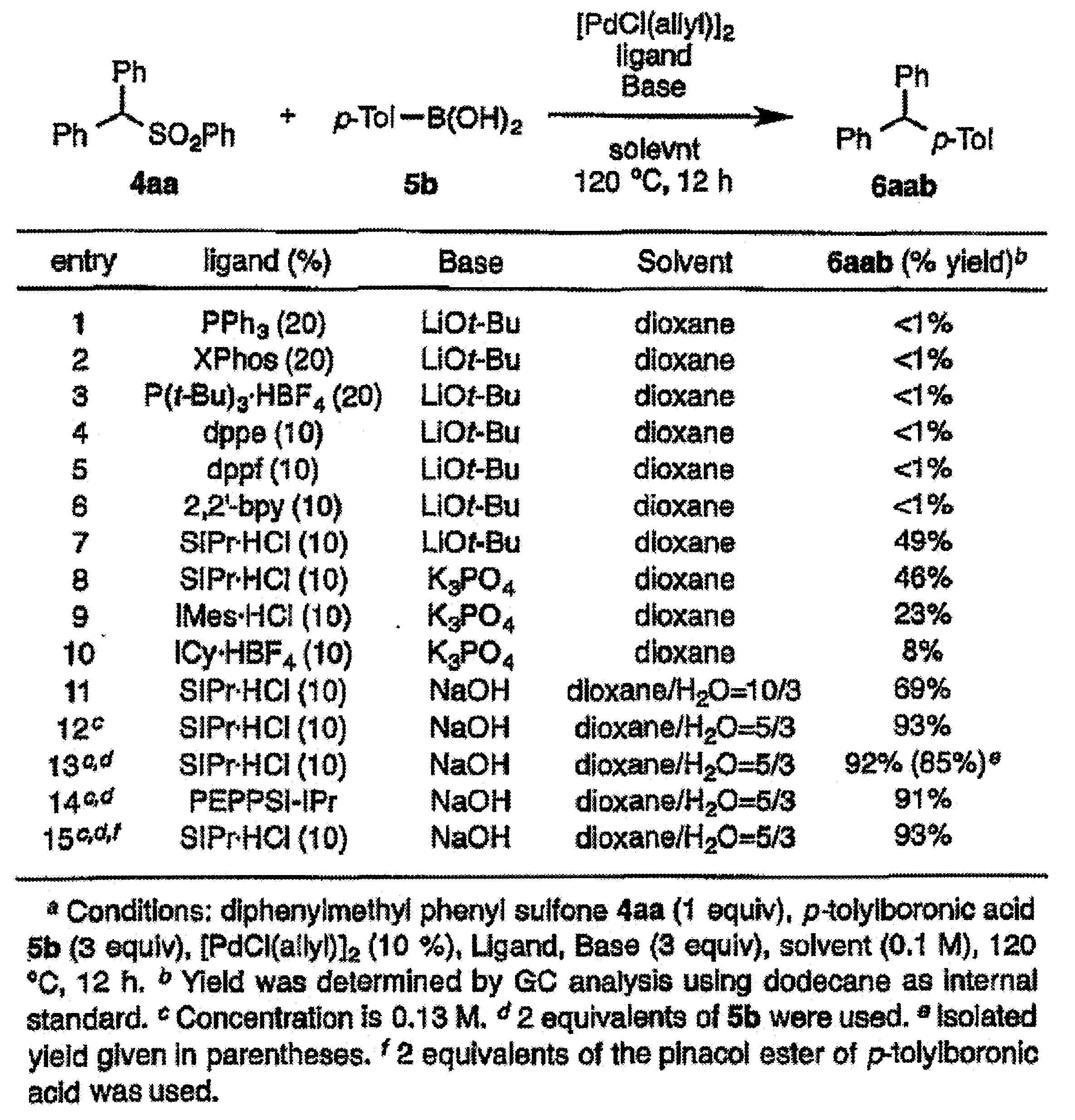
代表的なホスフィン類(一座・二座ホスフィン配位子)及びアミン配位子は望ましい生成物6aabを与えなかった(表5、entries 1-6)。
一方、配位子として、1,3-ビス-(2,6-ジイソプロピルフェニル)イミダゾール-2-イリデン(SIPr)、1,3-ジメシチルイミダゾール-2-イリデン(IMes)、1,3-ジシクロ-キシルイミダゾール-2-イリデン(ICy)等の含窒素複素環式カルベン配位子(NHC)配位子を用いると、望ましい生成物6aabが得られた(entries 7-13)。また、PEPPSITM-IPr触媒(sigma-Aldrich社、別名:[1,3-ビス(2,6-ジイソプロピルフェニル)イミダゾール-2-イリデン](3-クロロピリジル)パラジウム(II)ジクロリド)のような市販のPd-NHC錯体も類似の反応性を示した(表5、entry 14)。p-トリルボロン酸(5b)のピナコールエステルも望ましい生成物6aabを好収率で与えた(表5、entry 15)。
前記ジフェニルメチルフェニルスルホン(4aa)及び/又はp-トリルボロン酸(5b)を他のジアリールメチルフェニルスルホン及び/又はアリールボロン酸に代える以外は前記と同様に処理して以下に示すトリアリールメタンを得た。
トリフェニルメタン(Triphenylmethane(6aaa))
Purification by PTLC (hexane).
66.0 mg, 90% isolated yield; white solid.
1H NMR (600 MHz, CDCl3) δ 5.54 (s, 1H), 7.11 (d, J = 7.8 Hz, 6H), 7.19 (t, J = 7.8 Hz, 3H), 7.26 (t, J = 7.8 Hz, 6H).
13C NMR (150 MHz, CDCl3) δ 56.8, 126.3, 128.3, 129.4, 143.9.
HRMS (DART) m/z calcd for C19H15 [M-H]+: 243.1174, found243.1168。
(4-メトキシフェニル)ジフェニルメタン((4-Methoxyphenyl)diphenylmethane(6aac))
Purification by preparative recycling HPLC.
75.6 mg, 92% isolated yield; colorless oil.
1H NMR (600 MHz, CDCl3) δ 3.75 (s, 3H), 5.49 (s, 1H), 6.81 (d, J = 8.4 Hz, 2H), 7.02 (d, J = 8.4 Hz, 2H), 7.10 (d, J = 7.2 Hz, 4H), 7.19 (t, J = 7.2 Hz, 2H), 7.26 (t, J = 7.2 Hz, 4H).
13C NMR (150MHz, CDCl3) δ 55.2, 56.0, 113.6, 126.2, 128.2, 129.3, 130.3, 136.1, 144.2, 158.0.
HRMS (DART) m/z calcd for C20H17O [M-H]+: 273.1279, found273.1277。
[4-(N,N-ジメチルアミノ)フェニル]ジフェニルメタン([4-(N,N-Dimethylamino)phenyl]diphenylmethane(6aai))
Purification by PTLC (hexane:EtOAc = 20:1).
76.0mg, 88% isolated yield; pale yellow solid.
1H NMR (600 MHz, CDCl3) δ 2.89 (s, 6H), 5.45 (s, 1H), 6.65 (d, J = 9.0 Hz, 2H), 6.97 (d, J = 9.0 Hz, 2H), 7.12 (d, J = 7.8 Hz, 4H), 7.17 (t, J = 7.8 Hz, 2H), 7.25 (t, J = 7.8 Hz, 4H).
13C NMR (150 MHz, CDCl3) δ 40.6, 55.9, 112.5, 126.0, 128.1, 129.4, 130.0, 131.9, 144.7, 149.0.
HRMS (DART) m/z calcd for C21H20N [M-H]+: 286.1596, found 286.1592。
(4-フルオロフェニル)ジフェニルメタン((4-Fluorophenyl)diphenylmethane(6aae))
Purification by PTLC (hexane).
69.9 mg, 89% isolated yield; white solid.
1H NMR (600 MHz, CDCl3) δ 5.52 (s, 1H), 6.95 (t, J = 8.4 Hz, 2H), 7.04-7.07 (m, 2H), 7.08 (d, J = 7.2 Hz, 4H), 7.21 (t, J = 7,2 Hz, 2H), 7.27 (t, J = 7.2 Hz, 4H).
13C NMR (150 MHz, CDCl3) δ 56.0, 115.1 (d, J = 21.6 Hz), 126.4, 128.4, 129.3, 130.8 (d, J = 8.7 Hz), 139.6 (d, J = 2.9 Hz), 143.7, 161.4 (d, J = 245 Hz).
HRMS (DART) m/z calcd for C19H14F [M-H]+: 261.1080, found 261.1081。
ジフェニル[4-(トリフルオロメチル)フェニル]メタン(Diphenyl[4-(trifluoromethyl)phenyl]methane(6aaf))
Reaction was conducted at 150℃. Purification by PTLC (hexane).
77.3 mg, 83% isolated yield; colorless oil.
1H NMR (600 MHz, CDCl3) δ 5.59 (s, 1H), 7.09 (d, J = 7.2 Hz, 4H), 7.19-7.30 (m, 8H), 7.52 (d, J = 7.2 Hz, 2H).
13C NMR (150 MHz, CDCl3) δ 56.6, 124.3 (q, J = 272 Hz), 125.2 (br.d, J = 3.2 Hz), 126.7, 128.5, 128.6 (q, J = 31.7 Hz), 129.4, 129.8, 142.9, 148.0.
HRMS (DART) m/z calcd for C20H14F3 [M-H]+: 311.1048, found 311.1046。
ジフェニル[4-(トリメチルシリル)フェニル]メタン(Diphenyl[4-(trimethylsilyl)phenyl]methane(6aaj))
Purification by PTLC (hexane).
76.1 mg, 80% isolated yield; colorless oil.
1H NMR (600 MHz, CDCl3) δ 0.24 (s, 9H), 5.52 (s, 1H), 7.09-7.12 (m, 6H), 7.18 (t, J = 7.2 Hz, 2H), 7.26 (t, J = 7.2 Hz, 4H), 7.43 (d, J = 7.8 Hz, 2H).
13C NMR (150 MHz, CDCl3) δ -1.1, 56.9, 126.3, 128.3, 128.8, 129.5, 133.4, 138.0, 143.8, 144.4.
HRMS (DART) m/z calcd for C22H23Si [M-H]+: 315.1569, found315.1572。
(4-アセチルフェニル)ジフェニルメタン((4-Acetylphenyl)diphenylmethane(6aak))
Purification by PTLC (hexane:EtOAc = 5:1).
70.2 mg, 82% isolated yield; colorless oil.
1H NMR (600 MHz, CDCl3) δ 2.56 (s, 3H), 5.59 (s, 1H), 7.09 (d, J = 7.8 Hz, 4H), 7.21-7.23 (m, 4H), 7.29 (t, J = 7.8 Hz, 4H), 7.87 (d, J = 7.8 Hz, 2H).
13C NMR (150 MHz, CDCl3) δ 26.5, 56.7, 126.6, 128.4, 128.4, 129.3, 129.6, 135.3, 142.9, 149.5, 197.7.
HRMS (DART) m/z calcd for C21H17O [M-H]+: 285.1279, found 285.1280。
(2-メチルフェニル)ジフェニルメタン((2-Methylphenyl)diphenylmethane(6aal))
PEPPSI-IPr (10%) was used as a catalyst. Reaction was conducted at 150℃. Purification by PTLC (hexane).
46.1 mg, 60% isolated yield; white solid.
1H NMR (600 MHz, CDCl3) δ 2.21 (s, 3H), 5.67 (s, 1H), 6.81 (d, J = 7.8 Hz, 1H), 7,05 (d, J = 7.8 Hz, 4H), 7.08-7.16 (m, 3H), 7.20 (t, J = 7.2 Hz, 2H), 7.26 (t, J = 7.2 Hz, 4H).
13C NMR (150 MHz, CDCl3) δ 19.9, 53.5, 125.7, 126.2, 126.4, 128.3, 129.4, 129.6, 130.4, 136.6, 142.3, 143.4.
HRMS (DART) m/z calcd for C20H17 [M-H]+: 257.1330, found 257.1327。
ジフェニル(3-チエニル)メタン(Diphenyl(3-thienyl)methane(6aah))
Reaction was conducted at 150℃. Purification by PTLC (hexane).
52.6 mg, 71% isolated yield; white solid.
1H NMR (600 MHz, CDCl3) δ 5.50 (s, 1H), 6.72-6.73 (m, 1H), 6.87 (d, J = 4.8 Hz, 1H), 7.15 (d, J = 7.8 Hz, 4H), 7.21 (t, J = 7.8 Hz, 2H), 7.25 (dd, J = 4.8, 3.0 Hz, 1H), 7.29 (d, J = 7.8 Hz, 4H).
13C NMR (150 MHz, CDCl3) δ 52.6, 122.7, 125.5, 126.4, 128.3, 128.7, 129.0, 143.8, 144.9.
HRMS (DART) m/z calcd for C17H13S [M-H]+: 249.0738, found 249.0733。
(3-フリル)ジフェニルメタン((3-Furyl)diphenylmethane(6aam))
Reaction was conducted at 150℃. Purification by PTLC (hexane).
36.7 mg, 52% isolated yield; white solid.
1H NMR (600 MHz, CDCl3) δ 5.26 (s, 1H), 6.22 (s, 1H), 6.94 (s, 1H), 7.19-7.21 (m, 6H), 7.27-7.29 (m, 4H), 7.38 (s, 1H).
13C NMR (150 MHz, CDCl3) δ 48.1, 111.4, 126.5, 128.3, 128.4, 128.7, 141.0, 143.1, 143.5.
HRMS (DART) m/z calcd for C17H13O [M-H]+: 233.0966, found 233.0966。
ジフェニル(3-ピリジル)メタン(Diphenyl(3-pyridyl)methane(6aan))
Reaction was conducted at 150℃. Purification by PTLC (CH2Cl2, then hexane: EtOAc = 5:1).
33.3 mg, 45% isolated yield; white solid.
1H NMR (600 MHz, CDCl3) δ 5.56 (s, 1H), 7.11 (d, J = 7.2 Hz, 4H), 7.20-7.25 (m, 3H), 7.30 (t, J = 7.2 Hz, 4H), 7.40 (d, J = 7.8 Hz, 1H), 8.44-8.47 (m, 2H).
13C NMR (150 MHz, CDCl3) δ 54.3, 123.2, 126.7, 128.5, 129.3, 136.6, 139.3, 142.7, 147.7, 150.8.
HRMS (DART) m/z calcd for C18H16N [M+H]+: 246.1283, found 246.1281。
(4-メトキシフェニル)(4-メチルフェニル)フェニルメタン((4-Methoxyphenyl)(4-methylphenyl)phenylmethane(6acb))
Purification by PTLC (hexane).
75.7 mg, 87% isolated yield; white solid.
1H NMR (600 MHz, CDCl3) δ 2.30 (s, 3H), 3.75 (s, 3H), 5.45 (s, 1H), 6.81 (d, J = 8.4 Hz, 2H), 6.99 (d, J = 7.8 Hz, 2H), 7.01 (d, J = 8.4 Hz, 2H), 7.08 (d, J = 7.8 Hz, 2H), 7.10 (d, J = 7.2 Hz, 2H), 7.18 (t, J = 7.2 Hz, 1H), 7.25 (t, J = 7.2 Hz, 1H).
13C NMR (150 MHz, CDCl3) δ 21.0, 55.2, 55.6, 113.6, 126.1, 128.2, 129.0, 129.2, 129.3, 130.3, 135.7, 136.3, 141.3, 144.4, 157.9.
HRMS (DART) m/z calcd for C21H19O [M-H]+: 287.1436, found 287.1428。
(4-フルオロフェニル)(2-メチルフェニル)フェニルメタン((4-Fluorophenyl)(2-methylphenyl)phenylmethane(6ael))
Purification by PTLC (hexane).
55.4 mg, 67% isolated yield; colorless oil.
1H NMR (600 MHz, CDCl3) δ 2.92 (s, 1H), 5.64 (s, 1H), 6.78 (d, J = 7.8 Hz, 1H), 6.95 (t, J = 8.4 Hz, 2H), 6.99-7.01 (m, 2H), 7.03 (d, J = 7.2 Hz, 2H), 7.09 (t, J = 7.2 Hz, 1H), 7.12-7.16 (m, 2H), 7.20 (t, J = 7.2 Hz, 1H), 7.27 (t, J = 7.2 Hz, 2H).
13C NMR (150 MHz, CDCl3) δ 19.8, 52.7, 115.1 (d, J = 20.3 Hz), 125.8, 126.4, 126.5, 128.4, 129.3, 129.5, 130.5, 131.0 (d, J = 7.2 Hz), 136.5, 139.1 (d, J = 2.9 Hz), 142.1, 143.2, 161.4 (d, J = 245 Hz).
HRMS (DART) m/z calcd for C20H16F [M-H]+: 275.1236, found275.1244。
(4-アセチルフェニル)(4-メチルフェニル)フェニルメタン((4-Acetylphenyl)(4-methylphenyl)phenylmethane(6bak))
Purification by PTLC (hexane:EtOAc = 5:1).
75.3 mg, 84% isolated yield; colorless oil.
1H NMR (600 MHz, CDCl3) δ 2.31 (s, 3H), 2.55 (s, 3H), 5.55 (s, 1H), 6.98 (d, J = 7.8 Hz, 2H), 7.09 (d, J = 7.2 Hz, 2H), 7.10 (d, J = 7.2 Hz, 2H), 7.20-7.22 (m, 3H), 7.28 (t, J = 7.8 Hz, 2H), 7.86 (d, J = 7.8 Hz, 2H).
13C NMR (150 MHz, CDCl3) δ 21.0, 26.5, 56.4, 126.5, 128.35, 128.38, 129.1, 129.2, 129.3, 129.6, 135.2, 136.1, 139.9, 143.1, 149.7, 197.7.
HRMS (DART) m/z calcd for C22H19O [M-H]+: 299.1436, found 299.1429。
トリス(4-メトキシフェニル)メタン(Tris(4-methoxyphenyl)methane(6ccc))
Purification by preparative recycling HPLC.
94.7 mg, 94% isolated yield; pale yellow oil.
1H NMR (600 MHz, CDCl3) δ 3.76 (s, 9H), 5.39 (s, 1H), 6.81 (d, J = 7.2 Hz, 6H), 7.00 (d, J = 7.2 Hz, 6H).
13C NMR (150 MHz, CDCl3) δ 54.3, 55.1, 113.5, 130.1, 136.7, 157.8.
HEMS (DART) m/z calcd for C22H21O3 [M-H]+: 333.1491, found 333.1496。
(4-フルオロフェニル)(4-メトキシフェニル)(4-メチルフェニル)メタン((4-Fluorophenyl)(4-methoxyphenyl)(4-methylphenyl)methane(6ebc))
Purification by PTLC (hexane).
77.7 mg, 85% isolated yield; colorless oil.
1H NMR (600 MHz, CDCl3) δ 2.31 (s, 3H), 3.76 (s, 3H), 5.43 (s, 1H), 6.81 (d, J = 7.8 Hz, 2H), 6.92-7.00 (m, 6H), 7.03-7.06 (m, 2H), 7.08 (d, J = 7.8 Hz, 2H).
13C NMR (150 MHz, CDCl3) δ 21.0, 54.8, 55.2, 113.7, 115.0 (d, J = 20.3 Hz), 129.0, 129.1, 130.2, 130.7 (d, J = 8.6 Hz), 135.9, 136.1, 140.2 (d, J = 2.9 Hz), 141.1, 158.0, 161.3 (d, J = 246 Hz).
HRMS (DART) m/z calcd for C21H18FO [M-H]+: 305.1341, found 305.1347。
[4-(N,N-ジメチルアミノ)フェニル]フェニル(4-トリフルオロメチルフェニル)メタン([4-(N,N-Dimethylamino)phenyl]phenyl(4-trifluoromethylphenyl)methane(6fai))
Purification by preparative recycling HPLC.
62.4 mg, 59% isolated yield; pale yellow oil.
1H NMR (600 MHz, CDCl3) δ 2.91 (s, 6H), 5.49 (s, 1H), 6.67 (d, J = 8.4 Hz, 2H), 6.95 (d, J = 8.4 Hz, 2H), 7.10 (d, J = 7.8 Hz, 2H), 7.19-7.24 (m, 3H), 7.28 (t, J = 7.8 Hz, 2H), 7.51 (d, J = 7.8 Hz, 2H).
13C NMR (150 MHz, CDCl3) δ 40.5, 55.7, 112.5, 124.3 (q, J = 272 Hz), 125.1 (q, J = 4.4 Hz), 126.4, 128.3 (q, J = 31.7 Hz), 128.4, 129.3, 129.7, 129.9, 130.8, 143.7, 148.9, 149.2.
HRMS (DART) m/z calcd for C22H19F3N [M-H]+: 354.1470, found 354.1470。
トリス(4-トリフルオロメチルフェニル)メタン(Tris(4-trifluoromethylphenyl)methane(6fff))
Purification by preparative recycling HPLC.
113.6 mg, 84% isolated yield; white solid.
1H NMR (600 MHz, CDCl3) δ 5.71 (s, 1H), 7.21 (d, J = 7.2 Hz, 6H), 7.59 (d, J = 7.2 Hz, 6H).
13C NMR (150 MHz, CDCl3) δ 56.2, 124.0 (q, J = 274 Hz), 125.7 (br.d, J = 4.4 Hz), 129.5 (q, J = 33 Hz), 129.7, 146.0.
HRMS (DART) m/z calcd for C22H12F9 [M-H]+: 447.0795, found 447.0790。
(4-メチルフェニル)(1-ナフチル)フェニルメタン((4-Methylphenyl)(1-naphthyl)phenylmethane(6gab))
Purification by PTLC (hexane)
53.5 mg, 58% isolated yield; white solid.
1H NMR (600 MHz, CDCl3) δ 2.30 (s, 3H), 6.23 (s, 1H), 6.94 (d, J = 7.2 Hz, 1H), 6.99 (d, J = 7.8 Hz, 2H), 7.07 (d, J = 7.2 Hz, 2H), 7.10 (d, J = 7.2 Hz, 2H), 7.18-7.20 (m, 1H), 7.25 (t, J = 7.8 Hz, 2H), 7.32-7.42 (m, 3H), 7.72 (d, J = 8.4 Hz, 1H), 7.83 (d, J = 8.4 Hz, 1H), 7.98 (d, J = 8.4 Hz, 1H).
13C NMR (150 MHz, CDCl3) δ 21.0, 52.7, 124.3, 125.2, 125.4, 126.0, 126.3, 127.2, 127.5, 128.3, 128.7, 129.1, 129.5, 129.6, 131.9, 133.9, 135.8, 140.1, 140.7, 144.0.
HEMS (DART) m/z calcd for C24H19 [M-H]+: 307.1487, found 307.1483。
フェニル(3-ピリジル)(3-チエニル)メタン(Phenyl(3-pyridyl)(3-thlenyl)methane(6han))
Purification by PTLC (CH2Cl2).
53.5 mg, 58% isolated yield; white solid.
1H NMR (600 MHz, CDCl3) δ 5.52 (s, 1H), 6.74 (br.s, 1H), 6.86 (d, J = 4.8 Hz, 1H), 7.14 (d, J = 7.2 Hz, 2H), 7.21-7.25 (m, 2H), 7.30-7.32 (m, 3H), 7.44 (d, J = 7.8 Hz, 1H), 8.48 (br.s, 2H).
13C NMR (150 MHz, CDCl3) δ 50.1, 123.0, 123.3, 126.0, 126.8, 128.3, 128.6, 128.8, 136.3, 139.3, 142.5, 143.6, 147.8, 150.3.
HRMS (DART) m/z calcd for C16H14NS [M+H]+: 252.0847, found 252.0846。
トリス(3-チエニル)メタン(Tris(3-thlenyl)methane(6hhh))
Purification by PTLC (hexane).
71.2 mg, 90% isolated yield; white solid.
1H NMR (600 MHz, CDCl3) δ 5.56 (s, 1H), 6.84 (dd, J = 3.0, 1.2 Hz, 3H), 6.91 (dd, J = 4.8, 1.2 Hz, 3H), 7.23 (dd, J = 4.8, 3.0 Hz, 2H).
13C NMR (150 MHz, CDCl3) δ 43.5, 121.9, 125.5, 128.2, 144.5.
HRMS (DART) m/z calcd for C13H9S3 [M-H]+: 260.9866, found 260.9861。
トリフェニルメタン(Triphenylmethane(6aaa))
Purification by PTLC (hexane).
66.0 mg, 90% isolated yield; white solid.
1H NMR (600 MHz, CDCl3) δ 5.54 (s, 1H), 7.11 (d, J = 7.8 Hz, 6H), 7.19 (t, J = 7.8 Hz, 3H), 7.26 (t, J = 7.8 Hz, 6H).
13C NMR (150 MHz, CDCl3) δ 56.8, 126.3, 128.3, 129.4, 143.9.
HRMS (DART) m/z calcd for C19H15 [M-H]+: 243.1174, found243.1168。
(4-メトキシフェニル)ジフェニルメタン((4-Methoxyphenyl)diphenylmethane(6aac))
Purification by preparative recycling HPLC.
75.6 mg, 92% isolated yield; colorless oil.
1H NMR (600 MHz, CDCl3) δ 3.75 (s, 3H), 5.49 (s, 1H), 6.81 (d, J = 8.4 Hz, 2H), 7.02 (d, J = 8.4 Hz, 2H), 7.10 (d, J = 7.2 Hz, 4H), 7.19 (t, J = 7.2 Hz, 2H), 7.26 (t, J = 7.2 Hz, 4H).
13C NMR (150MHz, CDCl3) δ 55.2, 56.0, 113.6, 126.2, 128.2, 129.3, 130.3, 136.1, 144.2, 158.0.
HRMS (DART) m/z calcd for C20H17O [M-H]+: 273.1279, found273.1277。
[4-(N,N-ジメチルアミノ)フェニル]ジフェニルメタン([4-(N,N-Dimethylamino)phenyl]diphenylmethane(6aai))
Purification by PTLC (hexane:EtOAc = 20:1).
76.0mg, 88% isolated yield; pale yellow solid.
1H NMR (600 MHz, CDCl3) δ 2.89 (s, 6H), 5.45 (s, 1H), 6.65 (d, J = 9.0 Hz, 2H), 6.97 (d, J = 9.0 Hz, 2H), 7.12 (d, J = 7.8 Hz, 4H), 7.17 (t, J = 7.8 Hz, 2H), 7.25 (t, J = 7.8 Hz, 4H).
13C NMR (150 MHz, CDCl3) δ 40.6, 55.9, 112.5, 126.0, 128.1, 129.4, 130.0, 131.9, 144.7, 149.0.
HRMS (DART) m/z calcd for C21H20N [M-H]+: 286.1596, found 286.1592。
(4-フルオロフェニル)ジフェニルメタン((4-Fluorophenyl)diphenylmethane(6aae))
Purification by PTLC (hexane).
69.9 mg, 89% isolated yield; white solid.
1H NMR (600 MHz, CDCl3) δ 5.52 (s, 1H), 6.95 (t, J = 8.4 Hz, 2H), 7.04-7.07 (m, 2H), 7.08 (d, J = 7.2 Hz, 4H), 7.21 (t, J = 7,2 Hz, 2H), 7.27 (t, J = 7.2 Hz, 4H).
13C NMR (150 MHz, CDCl3) δ 56.0, 115.1 (d, J = 21.6 Hz), 126.4, 128.4, 129.3, 130.8 (d, J = 8.7 Hz), 139.6 (d, J = 2.9 Hz), 143.7, 161.4 (d, J = 245 Hz).
HRMS (DART) m/z calcd for C19H14F [M-H]+: 261.1080, found 261.1081。
ジフェニル[4-(トリフルオロメチル)フェニル]メタン(Diphenyl[4-(trifluoromethyl)phenyl]methane(6aaf))
Reaction was conducted at 150℃. Purification by PTLC (hexane).
77.3 mg, 83% isolated yield; colorless oil.
1H NMR (600 MHz, CDCl3) δ 5.59 (s, 1H), 7.09 (d, J = 7.2 Hz, 4H), 7.19-7.30 (m, 8H), 7.52 (d, J = 7.2 Hz, 2H).
13C NMR (150 MHz, CDCl3) δ 56.6, 124.3 (q, J = 272 Hz), 125.2 (br.d, J = 3.2 Hz), 126.7, 128.5, 128.6 (q, J = 31.7 Hz), 129.4, 129.8, 142.9, 148.0.
HRMS (DART) m/z calcd for C20H14F3 [M-H]+: 311.1048, found 311.1046。
ジフェニル[4-(トリメチルシリル)フェニル]メタン(Diphenyl[4-(trimethylsilyl)phenyl]methane(6aaj))
Purification by PTLC (hexane).
76.1 mg, 80% isolated yield; colorless oil.
1H NMR (600 MHz, CDCl3) δ 0.24 (s, 9H), 5.52 (s, 1H), 7.09-7.12 (m, 6H), 7.18 (t, J = 7.2 Hz, 2H), 7.26 (t, J = 7.2 Hz, 4H), 7.43 (d, J = 7.8 Hz, 2H).
13C NMR (150 MHz, CDCl3) δ -1.1, 56.9, 126.3, 128.3, 128.8, 129.5, 133.4, 138.0, 143.8, 144.4.
HRMS (DART) m/z calcd for C22H23Si [M-H]+: 315.1569, found315.1572。
(4-アセチルフェニル)ジフェニルメタン((4-Acetylphenyl)diphenylmethane(6aak))
Purification by PTLC (hexane:EtOAc = 5:1).
70.2 mg, 82% isolated yield; colorless oil.
1H NMR (600 MHz, CDCl3) δ 2.56 (s, 3H), 5.59 (s, 1H), 7.09 (d, J = 7.8 Hz, 4H), 7.21-7.23 (m, 4H), 7.29 (t, J = 7.8 Hz, 4H), 7.87 (d, J = 7.8 Hz, 2H).
13C NMR (150 MHz, CDCl3) δ 26.5, 56.7, 126.6, 128.4, 128.4, 129.3, 129.6, 135.3, 142.9, 149.5, 197.7.
HRMS (DART) m/z calcd for C21H17O [M-H]+: 285.1279, found 285.1280。
(2-メチルフェニル)ジフェニルメタン((2-Methylphenyl)diphenylmethane(6aal))
PEPPSI-IPr (10%) was used as a catalyst. Reaction was conducted at 150℃. Purification by PTLC (hexane).
46.1 mg, 60% isolated yield; white solid.
1H NMR (600 MHz, CDCl3) δ 2.21 (s, 3H), 5.67 (s, 1H), 6.81 (d, J = 7.8 Hz, 1H), 7,05 (d, J = 7.8 Hz, 4H), 7.08-7.16 (m, 3H), 7.20 (t, J = 7.2 Hz, 2H), 7.26 (t, J = 7.2 Hz, 4H).
13C NMR (150 MHz, CDCl3) δ 19.9, 53.5, 125.7, 126.2, 126.4, 128.3, 129.4, 129.6, 130.4, 136.6, 142.3, 143.4.
HRMS (DART) m/z calcd for C20H17 [M-H]+: 257.1330, found 257.1327。
ジフェニル(3-チエニル)メタン(Diphenyl(3-thienyl)methane(6aah))
Reaction was conducted at 150℃. Purification by PTLC (hexane).
52.6 mg, 71% isolated yield; white solid.
1H NMR (600 MHz, CDCl3) δ 5.50 (s, 1H), 6.72-6.73 (m, 1H), 6.87 (d, J = 4.8 Hz, 1H), 7.15 (d, J = 7.8 Hz, 4H), 7.21 (t, J = 7.8 Hz, 2H), 7.25 (dd, J = 4.8, 3.0 Hz, 1H), 7.29 (d, J = 7.8 Hz, 4H).
13C NMR (150 MHz, CDCl3) δ 52.6, 122.7, 125.5, 126.4, 128.3, 128.7, 129.0, 143.8, 144.9.
HRMS (DART) m/z calcd for C17H13S [M-H]+: 249.0738, found 249.0733。
(3-フリル)ジフェニルメタン((3-Furyl)diphenylmethane(6aam))
Reaction was conducted at 150℃. Purification by PTLC (hexane).
36.7 mg, 52% isolated yield; white solid.
1H NMR (600 MHz, CDCl3) δ 5.26 (s, 1H), 6.22 (s, 1H), 6.94 (s, 1H), 7.19-7.21 (m, 6H), 7.27-7.29 (m, 4H), 7.38 (s, 1H).
13C NMR (150 MHz, CDCl3) δ 48.1, 111.4, 126.5, 128.3, 128.4, 128.7, 141.0, 143.1, 143.5.
HRMS (DART) m/z calcd for C17H13O [M-H]+: 233.0966, found 233.0966。
ジフェニル(3-ピリジル)メタン(Diphenyl(3-pyridyl)methane(6aan))
Reaction was conducted at 150℃. Purification by PTLC (CH2Cl2, then hexane: EtOAc = 5:1).
33.3 mg, 45% isolated yield; white solid.
1H NMR (600 MHz, CDCl3) δ 5.56 (s, 1H), 7.11 (d, J = 7.2 Hz, 4H), 7.20-7.25 (m, 3H), 7.30 (t, J = 7.2 Hz, 4H), 7.40 (d, J = 7.8 Hz, 1H), 8.44-8.47 (m, 2H).
13C NMR (150 MHz, CDCl3) δ 54.3, 123.2, 126.7, 128.5, 129.3, 136.6, 139.3, 142.7, 147.7, 150.8.
HRMS (DART) m/z calcd for C18H16N [M+H]+: 246.1283, found 246.1281。
(4-メトキシフェニル)(4-メチルフェニル)フェニルメタン((4-Methoxyphenyl)(4-methylphenyl)phenylmethane(6acb))
Purification by PTLC (hexane).
75.7 mg, 87% isolated yield; white solid.
1H NMR (600 MHz, CDCl3) δ 2.30 (s, 3H), 3.75 (s, 3H), 5.45 (s, 1H), 6.81 (d, J = 8.4 Hz, 2H), 6.99 (d, J = 7.8 Hz, 2H), 7.01 (d, J = 8.4 Hz, 2H), 7.08 (d, J = 7.8 Hz, 2H), 7.10 (d, J = 7.2 Hz, 2H), 7.18 (t, J = 7.2 Hz, 1H), 7.25 (t, J = 7.2 Hz, 1H).
13C NMR (150 MHz, CDCl3) δ 21.0, 55.2, 55.6, 113.6, 126.1, 128.2, 129.0, 129.2, 129.3, 130.3, 135.7, 136.3, 141.3, 144.4, 157.9.
HRMS (DART) m/z calcd for C21H19O [M-H]+: 287.1436, found 287.1428。
(4-フルオロフェニル)(2-メチルフェニル)フェニルメタン((4-Fluorophenyl)(2-methylphenyl)phenylmethane(6ael))
Purification by PTLC (hexane).
55.4 mg, 67% isolated yield; colorless oil.
1H NMR (600 MHz, CDCl3) δ 2.92 (s, 1H), 5.64 (s, 1H), 6.78 (d, J = 7.8 Hz, 1H), 6.95 (t, J = 8.4 Hz, 2H), 6.99-7.01 (m, 2H), 7.03 (d, J = 7.2 Hz, 2H), 7.09 (t, J = 7.2 Hz, 1H), 7.12-7.16 (m, 2H), 7.20 (t, J = 7.2 Hz, 1H), 7.27 (t, J = 7.2 Hz, 2H).
13C NMR (150 MHz, CDCl3) δ 19.8, 52.7, 115.1 (d, J = 20.3 Hz), 125.8, 126.4, 126.5, 128.4, 129.3, 129.5, 130.5, 131.0 (d, J = 7.2 Hz), 136.5, 139.1 (d, J = 2.9 Hz), 142.1, 143.2, 161.4 (d, J = 245 Hz).
HRMS (DART) m/z calcd for C20H16F [M-H]+: 275.1236, found275.1244。
(4-アセチルフェニル)(4-メチルフェニル)フェニルメタン((4-Acetylphenyl)(4-methylphenyl)phenylmethane(6bak))
Purification by PTLC (hexane:EtOAc = 5:1).
75.3 mg, 84% isolated yield; colorless oil.
1H NMR (600 MHz, CDCl3) δ 2.31 (s, 3H), 2.55 (s, 3H), 5.55 (s, 1H), 6.98 (d, J = 7.8 Hz, 2H), 7.09 (d, J = 7.2 Hz, 2H), 7.10 (d, J = 7.2 Hz, 2H), 7.20-7.22 (m, 3H), 7.28 (t, J = 7.8 Hz, 2H), 7.86 (d, J = 7.8 Hz, 2H).
13C NMR (150 MHz, CDCl3) δ 21.0, 26.5, 56.4, 126.5, 128.35, 128.38, 129.1, 129.2, 129.3, 129.6, 135.2, 136.1, 139.9, 143.1, 149.7, 197.7.
HRMS (DART) m/z calcd for C22H19O [M-H]+: 299.1436, found 299.1429。
トリス(4-メトキシフェニル)メタン(Tris(4-methoxyphenyl)methane(6ccc))
Purification by preparative recycling HPLC.
94.7 mg, 94% isolated yield; pale yellow oil.
1H NMR (600 MHz, CDCl3) δ 3.76 (s, 9H), 5.39 (s, 1H), 6.81 (d, J = 7.2 Hz, 6H), 7.00 (d, J = 7.2 Hz, 6H).
13C NMR (150 MHz, CDCl3) δ 54.3, 55.1, 113.5, 130.1, 136.7, 157.8.
HEMS (DART) m/z calcd for C22H21O3 [M-H]+: 333.1491, found 333.1496。
(4-フルオロフェニル)(4-メトキシフェニル)(4-メチルフェニル)メタン((4-Fluorophenyl)(4-methoxyphenyl)(4-methylphenyl)methane(6ebc))
Purification by PTLC (hexane).
77.7 mg, 85% isolated yield; colorless oil.
1H NMR (600 MHz, CDCl3) δ 2.31 (s, 3H), 3.76 (s, 3H), 5.43 (s, 1H), 6.81 (d, J = 7.8 Hz, 2H), 6.92-7.00 (m, 6H), 7.03-7.06 (m, 2H), 7.08 (d, J = 7.8 Hz, 2H).
13C NMR (150 MHz, CDCl3) δ 21.0, 54.8, 55.2, 113.7, 115.0 (d, J = 20.3 Hz), 129.0, 129.1, 130.2, 130.7 (d, J = 8.6 Hz), 135.9, 136.1, 140.2 (d, J = 2.9 Hz), 141.1, 158.0, 161.3 (d, J = 246 Hz).
HRMS (DART) m/z calcd for C21H18FO [M-H]+: 305.1341, found 305.1347。
[4-(N,N-ジメチルアミノ)フェニル]フェニル(4-トリフルオロメチルフェニル)メタン([4-(N,N-Dimethylamino)phenyl]phenyl(4-trifluoromethylphenyl)methane(6fai))
Purification by preparative recycling HPLC.
62.4 mg, 59% isolated yield; pale yellow oil.
1H NMR (600 MHz, CDCl3) δ 2.91 (s, 6H), 5.49 (s, 1H), 6.67 (d, J = 8.4 Hz, 2H), 6.95 (d, J = 8.4 Hz, 2H), 7.10 (d, J = 7.8 Hz, 2H), 7.19-7.24 (m, 3H), 7.28 (t, J = 7.8 Hz, 2H), 7.51 (d, J = 7.8 Hz, 2H).
13C NMR (150 MHz, CDCl3) δ 40.5, 55.7, 112.5, 124.3 (q, J = 272 Hz), 125.1 (q, J = 4.4 Hz), 126.4, 128.3 (q, J = 31.7 Hz), 128.4, 129.3, 129.7, 129.9, 130.8, 143.7, 148.9, 149.2.
HRMS (DART) m/z calcd for C22H19F3N [M-H]+: 354.1470, found 354.1470。
トリス(4-トリフルオロメチルフェニル)メタン(Tris(4-trifluoromethylphenyl)methane(6fff))
Purification by preparative recycling HPLC.
113.6 mg, 84% isolated yield; white solid.
1H NMR (600 MHz, CDCl3) δ 5.71 (s, 1H), 7.21 (d, J = 7.2 Hz, 6H), 7.59 (d, J = 7.2 Hz, 6H).
13C NMR (150 MHz, CDCl3) δ 56.2, 124.0 (q, J = 274 Hz), 125.7 (br.d, J = 4.4 Hz), 129.5 (q, J = 33 Hz), 129.7, 146.0.
HRMS (DART) m/z calcd for C22H12F9 [M-H]+: 447.0795, found 447.0790。
(4-メチルフェニル)(1-ナフチル)フェニルメタン((4-Methylphenyl)(1-naphthyl)phenylmethane(6gab))
Purification by PTLC (hexane)
53.5 mg, 58% isolated yield; white solid.
1H NMR (600 MHz, CDCl3) δ 2.30 (s, 3H), 6.23 (s, 1H), 6.94 (d, J = 7.2 Hz, 1H), 6.99 (d, J = 7.8 Hz, 2H), 7.07 (d, J = 7.2 Hz, 2H), 7.10 (d, J = 7.2 Hz, 2H), 7.18-7.20 (m, 1H), 7.25 (t, J = 7.8 Hz, 2H), 7.32-7.42 (m, 3H), 7.72 (d, J = 8.4 Hz, 1H), 7.83 (d, J = 8.4 Hz, 1H), 7.98 (d, J = 8.4 Hz, 1H).
13C NMR (150 MHz, CDCl3) δ 21.0, 52.7, 124.3, 125.2, 125.4, 126.0, 126.3, 127.2, 127.5, 128.3, 128.7, 129.1, 129.5, 129.6, 131.9, 133.9, 135.8, 140.1, 140.7, 144.0.
HEMS (DART) m/z calcd for C24H19 [M-H]+: 307.1487, found 307.1483。
フェニル(3-ピリジル)(3-チエニル)メタン(Phenyl(3-pyridyl)(3-thlenyl)methane(6han))
Purification by PTLC (CH2Cl2).
53.5 mg, 58% isolated yield; white solid.
1H NMR (600 MHz, CDCl3) δ 5.52 (s, 1H), 6.74 (br.s, 1H), 6.86 (d, J = 4.8 Hz, 1H), 7.14 (d, J = 7.2 Hz, 2H), 7.21-7.25 (m, 2H), 7.30-7.32 (m, 3H), 7.44 (d, J = 7.8 Hz, 1H), 8.48 (br.s, 2H).
13C NMR (150 MHz, CDCl3) δ 50.1, 123.0, 123.3, 126.0, 126.8, 128.3, 128.6, 128.8, 136.3, 139.3, 142.5, 143.6, 147.8, 150.3.
HRMS (DART) m/z calcd for C16H14NS [M+H]+: 252.0847, found 252.0846。
トリス(3-チエニル)メタン(Tris(3-thlenyl)methane(6hhh))
Purification by PTLC (hexane).
71.2 mg, 90% isolated yield; white solid.
1H NMR (600 MHz, CDCl3) δ 5.56 (s, 1H), 6.84 (dd, J = 3.0, 1.2 Hz, 3H), 6.91 (dd, J = 4.8, 1.2 Hz, 3H), 7.23 (dd, J = 4.8, 3.0 Hz, 2H).
13C NMR (150 MHz, CDCl3) δ 43.5, 121.9, 125.5, 128.2, 144.5.
HRMS (DART) m/z calcd for C13H9S3 [M-H]+: 260.9866, found 260.9861。
また、アリールボロン酸化合物におけるアリール基の種類を変えて、前記(工程(3))と同様に処理した結果を表6に示す。

[実施例2]抗乳癌剤(7)の合成
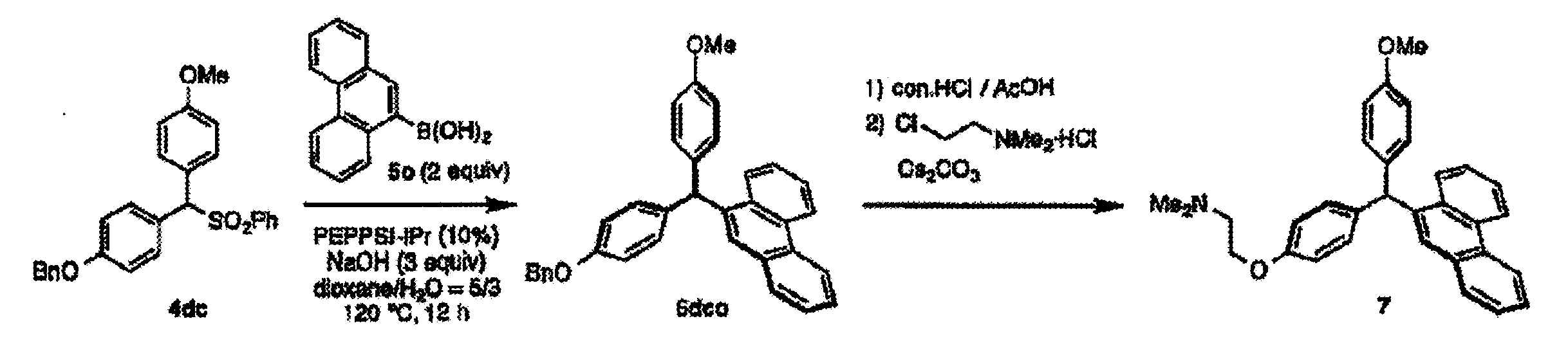
内容積10mLの密閉可能なガラス容器内に、磁気撹幹子を収容し、減圧下、ヒートガンで乾燥させた。その後、室温に冷却し、アルゴンガスを満たした。次いで、前記ガラス容器に、127.2mg(0.3mmol)の(4-ベンジルオキシフェニル)(4-メトキシフェニル)メチルフェニルスルホン(4dc)、133mg(0.6mmol)の9-フェナントレンボロン酸(5o)、20.4mg(0.03mmol)のPEPPSITM-IPr触媒(sigma-Aldrich社、別名:[1,3-ビス(2,6-ジイソプロピルフェニル)イミダゾール-2-イリデン](3-クロロピリジル)パラジウム(II)ジクロリド)、0.75mLの脱水ジオキサン、0.9mL(0.9mmol)の1M水酸化ナトリウム水溶液をアルゴン気流下加えて、120℃で12時間撹拌した。反応系を室温に冷却し反応液を、短パッドのシリカゲルで漉過した。そして、沈澱物を酢酸エチルで洗浄し、濾液を濃縮した。その後、和光純薬工業社のシリカゲルB-5Fを用いたTLC(展開溶媒:ヘキサン/酢酸エチル=10/1)により、(4-ベンジルオキシフェニル)(4-メトキシフェニル)(9-フェナントリル)メタン(6dco)(白色固体)を得た。収量は129.0mgであり、収率は90%であった。
((4-ベンジルオキシフェニル)(4-メトキシフェニル)(9-フェナントリル)メタンの物性)
1H NMR (600 MHz, CDCl3) δ 3.77 (s, 3H), 5.02 (s, 2H), 6.15 (s, 1H), 6.82 (d, J = 9.0 Hz, 2H), 6.90 (d, J = 8.4 Hz, 2H), 7.06 (d, J = 8.4 Hz, 2H), 7.16 (s, 1H), 7.31 (t, J = 7.2 Hz, 1H), 7.37 (t, J = 7.8 Hz, 2H), 7.42 (d, J = 7.2 Hz, 2H), 7.47-7.53 (m, 2H), 7.58-7.60 (m, 2H), 7.67 (d, J = 8.4 Hz, 1H), 8.03 (d, J = 7.8 Hz, 1H), 8.65 (d, J = 8.4 Hz, 1H), 8.71 (d, J = 8.4 Hz, 1H).
13C NMR (150 MHz, CDCl3) δ 51.8, 55.2, 70.0, 113.8, 114.7, 122.3, 123.0, 125.2, 126.1, 126.4, 126.5, 126.6, 127.6, 127.9, 128.4, 128.6, 128.7, 129.8, 130.57, 130.59, 130.8, 131.2, 131.5, 135.9, 136.2, 137.1, 138.8, 157.4, 158.1.
HRMS (DART) m/z calcd for C35H27O2 [M-H]+: 479.2011, found 479.2010。
1H NMR (600 MHz, CDCl3) δ 3.77 (s, 3H), 5.02 (s, 2H), 6.15 (s, 1H), 6.82 (d, J = 9.0 Hz, 2H), 6.90 (d, J = 8.4 Hz, 2H), 7.06 (d, J = 8.4 Hz, 2H), 7.16 (s, 1H), 7.31 (t, J = 7.2 Hz, 1H), 7.37 (t, J = 7.8 Hz, 2H), 7.42 (d, J = 7.2 Hz, 2H), 7.47-7.53 (m, 2H), 7.58-7.60 (m, 2H), 7.67 (d, J = 8.4 Hz, 1H), 8.03 (d, J = 7.8 Hz, 1H), 8.65 (d, J = 8.4 Hz, 1H), 8.71 (d, J = 8.4 Hz, 1H).
13C NMR (150 MHz, CDCl3) δ 51.8, 55.2, 70.0, 113.8, 114.7, 122.3, 123.0, 125.2, 126.1, 126.4, 126.5, 126.6, 127.6, 127.9, 128.4, 128.6, 128.7, 129.8, 130.57, 130.59, 130.8, 131.2, 131.5, 135.9, 136.2, 137.1, 138.8, 157.4, 158.1.
HRMS (DART) m/z calcd for C35H27O2 [M-H]+: 479.2011, found 479.2010。
内容積10mLの密閉可能なガラス容器内に、磁気撹幹子を収容し、アルゴンガスを満たした。次いで、前記ガラス容器に、30mg(0.062mmol)の(4-ベンジルオキシフェニル)(4-メトキシフェニル)(9-フェナントリル)メタン(6dco)、450μLのジクロロエタンをアルゴン気流下、室温で加えて、混合物を、1.35mLの酢酸と450μLの濃塩酸水溶液の混合溶媒で希釈した。混合物を80℃で反応が終了するまで(約6時間)撹拌した。混合物を室温に冷却し、5mLの水で希釈し、5mLのジクロロメタンで3回抽出した。抽出液を合わせ、硫酸ナトリウム上で乾燥し、減圧下で溶媒を留去し、脱ベンジル体である粗フェノール化合物(黄色油状物)を得た。
内容積10mLの密閉可能なガラス容器内に、磁気撹幹子を収容し、減圧下、ヒートガンで乾燥させた。その後、室温に冷却し、アルゴンガスを満たした。次いで、前記ガラス容器に、18.0mg(0.124mmol)の2-クロロ-N,N-ジメチルエチルアミン・塩酸塩、101mg(0.312mmol)の炭酸セシウム、及び前工程で得られた粗フェノール化合物の脱水DMF(1.5mL)溶液をアルゴン気流下加えて、50℃で12時間撹拌した。混合物を3mLの水で希釈し、5mLの酢酸エチルで3回抽出した。抽出液を合わせ、硫酸ナトリウム上で乾燥し、減圧下で溶媒を留去した。その後、和光純薬工業社のシリカゲルB-5Fを用いたPTLC(展開溶媒:酢酸エチル/トリエチルアミン=20/1)により、抗乳癌剤(7)(Talyor, B. L. H.; Harris, M. R.; Jarvo, E. R. Angew. Chem. Int. Ed. 2012, 51, 7790; Shagufta, Srivastava, A. K.; Sharma, R.; Mishra, R.; Balapure, A. K.; Murthy, P. S. R.; Panda, G. Bloorg. Med. Chem. 2006, 14, 1497)(淡黄色油状物)を得た。収量は25.1mgであり、2工程の収率は87%であった。
(抗乳癌剤(7)の物性)
1H NMR (600 MHz, CDCl3) δ 2.33 (s, 6H), 2.72 (t, J = 6.0 Hz, 2H), 3.78 (s, 3H), 4.04 (t, J = 6.0 Hz, 2H), 6.14 (s, 1H), 6.82 (d, J = 9.0 Hz, 2H), 6.84 (d, J = 9.0 Hz, 2H), 7.05 (apparent t, J = 7.8 Hz, 4H), 7.15 (s, 1H), 7.47-7.53 (m, 2H), 7.58-7.61 (m, 2H), 7.67 (d, J = 7.8 Hz, 1H), 8.04 (d, J = 8.4 Hz, 1H), 8.65 (d, J = 8.4 Hz, 1H), 8.71 (d, J = 8.4 Hz, 1H).
13C NMR (150 MHz, CDCl3) δ 45.9, 51.8, 55.2, 58.3, 65.8, 113.8, 114.4, 122.3, 123.0, 125.2, 126.0, 126.3, 126.5, 126.6, 128.4, 128.7, 129.7, 130.5, 130.6, 130.8, 131.2, 131.4, 135.9, 136.0, 138.8, 157.3, 158.0.
HRMS (FAB) m/z calcd for C35H32NO2 [M+H]+: 462.2433, found 462.2429。
1H NMR (600 MHz, CDCl3) δ 2.33 (s, 6H), 2.72 (t, J = 6.0 Hz, 2H), 3.78 (s, 3H), 4.04 (t, J = 6.0 Hz, 2H), 6.14 (s, 1H), 6.82 (d, J = 9.0 Hz, 2H), 6.84 (d, J = 9.0 Hz, 2H), 7.05 (apparent t, J = 7.8 Hz, 4H), 7.15 (s, 1H), 7.47-7.53 (m, 2H), 7.58-7.61 (m, 2H), 7.67 (d, J = 7.8 Hz, 1H), 8.04 (d, J = 8.4 Hz, 1H), 8.65 (d, J = 8.4 Hz, 1H), 8.71 (d, J = 8.4 Hz, 1H).
13C NMR (150 MHz, CDCl3) δ 45.9, 51.8, 55.2, 58.3, 65.8, 113.8, 114.4, 122.3, 123.0, 125.2, 126.0, 126.3, 126.5, 126.6, 128.4, 128.7, 129.7, 130.5, 130.6, 130.8, 131.2, 131.4, 135.9, 136.0, 138.8, 157.3, 158.0.
HRMS (FAB) m/z calcd for C35H32NO2 [M+H]+: 462.2433, found 462.2429。
Claims (10)
- 一般式(1):

で示されるトリアリールメタン化合物の製造方法であって、
(III)一般式(2):

で示されるジアリールメチルアリールスルホン化合物と、
一般式(3):

で示されるアリールボロン酸又はそのエステル化合物とを、パラジウム触媒及び含窒素複素環式カルベン配位子の存在下で反応させる工程
を備える、製造方法。 - 前記工程(III)が、塩基の存在下で行われる、請求項1に記載の製造方法。
- 前記塩基が金属アルコキシド、リン酸アルカリ金属塩及びアルカリ金属水酸化物よりなる群から選ばれる少なくとも1種である、請求項2に記載の製造方法。
- 前記工程(III)が、反応溶媒の存在下で行われる、請求項1~3のいずれかに記載の製造方法。
- 前記反応溶媒がジオキサンを含有する、請求項4に記載の製造方法。
- 前記工程(III)の前に、
(II)一般式(4):
Ar1-CH2-SO2-Ar (4)
[式中、Ar1及びArは前記に同じである。]
で示されるアリールメチルアリールスルホン化合物と、
一般式(7):
Ar2-X1 (7)
[式中、Ar2は前記に同じ;X1はハロゲン原子である。]
で示されるハロゲン化アレーン化合物とを、パラジウム触媒及びホスフィン配位子の存在下で反応させる工程
を備える、請求項1~5のいずれかに記載の製造方法。 - 前記工程(II)が、塩基の存在下で行われる、請求項6に記載の製造方法。
- 前記工程(II)の前に、
(I)一般式(5):
CH3-SO2-Ar (5)
[式中、Arは前記に同じである。]
で示されるメチルアリールスルホン化合物と、
一般式(6):
Ar1-X2 (6)
[式中、Ar1は前記に同じ;X2はハロゲン原子である。]
で示されるハロゲン化アレーン化合物とを、パラジウム触媒及びホスフィン配位子の存在下で反応させる工程
を備える、請求項6又は7に記載の製造方法。 - 前記工程(I)が、塩基の存在下で行われる、請求項8に記載の製造方法。
- 一般式(2a):

で示されるジアリールメチルアリールスルホン化合物。
Priority Applications (1)
| Application Number | Priority Date | Filing Date | Title |
|---|---|---|---|
| JP2015545239A JP6380997B2 (ja) | 2013-10-29 | 2014-10-28 | トリアリールメタン化合物の製造方法 |
Applications Claiming Priority (2)
| Application Number | Priority Date | Filing Date | Title |
|---|---|---|---|
| JP2013224015 | 2013-10-29 | ||
| JP2013-224015 | 2013-10-29 |
Publications (1)
| Publication Number | Publication Date |
|---|---|
| WO2015064584A1 true WO2015064584A1 (ja) | 2015-05-07 |
Family
ID=53004186
Family Applications (1)
| Application Number | Title | Priority Date | Filing Date |
|---|---|---|---|
| PCT/JP2014/078653 Ceased WO2015064584A1 (ja) | 2013-10-29 | 2014-10-28 | トリアリールメタン化合物の製造方法 |
Country Status (2)
| Country | Link |
|---|---|
| JP (1) | JP6380997B2 (ja) |
| WO (1) | WO2015064584A1 (ja) |
Cited By (3)
| Publication number | Priority date | Publication date | Assignee | Title |
|---|---|---|---|---|
| CN110713434A (zh) * | 2019-10-30 | 2020-01-21 | 南开大学 | 具有抗癌活性化合物的中间体及其制备方法和应用 |
| CN111484420A (zh) * | 2019-01-29 | 2020-08-04 | 天津师范大学 | 合成三芳基甲烷衍生物的方法及其所得三芳基甲烷衍生物 |
| CN119219504A (zh) * | 2024-12-05 | 2024-12-31 | 山东金科力电源科技有限公司 | 芳香醛和盐酸肼类物质合成三芳基甲烷分子骨架的方法 |
-
2014
- 2014-10-28 JP JP2015545239A patent/JP6380997B2/ja not_active Expired - Fee Related
- 2014-10-28 WO PCT/JP2014/078653 patent/WO2015064584A1/ja not_active Ceased
Non-Patent Citations (6)
Cited By (4)
| Publication number | Priority date | Publication date | Assignee | Title |
|---|---|---|---|---|
| CN111484420A (zh) * | 2019-01-29 | 2020-08-04 | 天津师范大学 | 合成三芳基甲烷衍生物的方法及其所得三芳基甲烷衍生物 |
| CN111484420B (zh) * | 2019-01-29 | 2023-04-04 | 天津师范大学 | 合成三芳基甲烷衍生物的方法及其所得三芳基甲烷衍生物 |
| CN110713434A (zh) * | 2019-10-30 | 2020-01-21 | 南开大学 | 具有抗癌活性化合物的中间体及其制备方法和应用 |
| CN119219504A (zh) * | 2024-12-05 | 2024-12-31 | 山东金科力电源科技有限公司 | 芳香醛和盐酸肼类物质合成三芳基甲烷分子骨架的方法 |
Also Published As
| Publication number | Publication date |
|---|---|
| JPWO2015064584A1 (ja) | 2017-03-09 |
| JP6380997B2 (ja) | 2018-08-29 |
Similar Documents
| Publication | Publication Date | Title |
|---|---|---|
| Li et al. | Rh (II)-catalyzed [2, 3]-sigmatropic rearrangement of sulfur ylides derived from N-tosylhydrazones and sulfides | |
| JP6498611B2 (ja) | N−複素環カルベン及びその中間体の合成 | |
| Chang et al. | In (OTf) 3-mediated synthesis of substituted pyridazines | |
| JP6380997B2 (ja) | トリアリールメタン化合物の製造方法 | |
| CN110105305B (zh) | 过渡金属催化的c-h活化/环合合成1,2-苯并噻嗪衍生物的绿色合成方法 | |
| JP6968067B2 (ja) | アリール化方法 | |
| JP5158348B2 (ja) | 置換ベンゼンの製造法 | |
| JP4491666B2 (ja) | フルオレン骨格を有するアリールアミン誘導体の製造方法とその合成中間体 | |
| Kozlov et al. | 5, 6-Membered palladium pincer complexes of 1-thiophosphoryloxy-3-thiophosphorylbenzenes. Synthesis, X-ray structure, and catalytic activity | |
| WO2018103239A1 (zh) | 一种维帕他韦中间体及其类似物的制备方法 | |
| KR20090018966A (ko) | 치환 페닐에티닐 금-질소 함유 헤테로환 카르벤 착체 | |
| CN105732253B (zh) | 一种烯丙基芳香化合物的制备方法 | |
| JPWO2016093175A1 (ja) | トリ(ヘテロ)アリールアセトニトリル化合物の製造方法 | |
| JP5536458B2 (ja) | 6−ハロゲノ−3−アリールピリジン誘導体の製造方法 | |
| CN118908997A (zh) | 一种α-膦酰基亚胺类化合物的制备方法及应用 | |
| KR20230124990A (ko) | 유기 금속 화합물 | |
| JP5544756B2 (ja) | ホスフィン化合物及び該ホスフィン化合物と遷移金属化合物からなる触媒 | |
| JP5594139B2 (ja) | 置換エチニル金−含窒素へテロ環カルベン錯体の製造法 | |
| CN119039219B (zh) | 一种(杂)芳基三氟甲基碲醚类化合物的制备方法及应用 | |
| CN105622544B (zh) | 一种n-磺酰基-3,4-二氢-2h-1,4-噻嗪的合成方法 | |
| CN105622334A (zh) | 一种3-溴-9,9’-螺二芴的合成方法 | |
| JP5178470B2 (ja) | フルオレン誘導体の製造方法 | |
| JP4346198B2 (ja) | フルベン誘導体の製造方法 | |
| CN115716849A (zh) | 一种芳基磷类化合物的合成方法 | |
| CN106397470A (zh) | 一种3,3’‑二硼酸频哪醇酯‑9,9’‑螺二芴的合成方法 |
Legal Events
| Date | Code | Title | Description |
|---|---|---|---|
| 121 | Ep: the epo has been informed by wipo that ep was designated in this application |
Ref document number: 14858726 Country of ref document: EP Kind code of ref document: A1 |
|
| ENP | Entry into the national phase |
Ref document number: 2015545239 Country of ref document: JP Kind code of ref document: A |
|
| NENP | Non-entry into the national phase |
Ref country code: DE |
|
| 122 | Ep: pct application non-entry in european phase |
Ref document number: 14858726 Country of ref document: EP Kind code of ref document: A1 |