WO2015060092A1 - 熱伝導性感圧接着剤組成物、熱伝導性感圧接着性シート状成形体、これらの製造方法、及び電子機器 - Google Patents
熱伝導性感圧接着剤組成物、熱伝導性感圧接着性シート状成形体、これらの製造方法、及び電子機器 Download PDFInfo
- Publication number
- WO2015060092A1 WO2015060092A1 PCT/JP2014/076444 JP2014076444W WO2015060092A1 WO 2015060092 A1 WO2015060092 A1 WO 2015060092A1 JP 2014076444 W JP2014076444 W JP 2014076444W WO 2015060092 A1 WO2015060092 A1 WO 2015060092A1
- Authority
- WO
- WIPO (PCT)
- Prior art keywords
- meth
- mass
- sensitive adhesive
- parts
- conductive pressure
- Prior art date
- Legal status (The legal status is an assumption and is not a legal conclusion. Google has not performed a legal analysis and makes no representation as to the accuracy of the status listed.)
- Ceased
Links
Images

Classifications
-
- C—CHEMISTRY; METALLURGY
- C09—DYES; PAINTS; POLISHES; NATURAL RESINS; ADHESIVES; COMPOSITIONS NOT OTHERWISE PROVIDED FOR; APPLICATIONS OF MATERIALS NOT OTHERWISE PROVIDED FOR
- C09J—ADHESIVES; NON-MECHANICAL ASPECTS OF ADHESIVE PROCESSES IN GENERAL; ADHESIVE PROCESSES NOT PROVIDED FOR ELSEWHERE; USE OF MATERIALS AS ADHESIVES
- C09J133/00—Adhesives based on homopolymers or copolymers of compounds having one or more unsaturated aliphatic radicals, each having only one carbon-to-carbon double bond, and at least one being terminated by only one carboxyl radical, or of salts, anhydrides, esters, amides, imides, or nitriles thereof; Adhesives based on derivatives of such polymers
- C09J133/04—Homopolymers or copolymers of esters
- C09J133/06—Homopolymers or copolymers of esters of esters containing only carbon, hydrogen and oxygen, the oxygen atom being present only as part of the carboxyl radical
-
- C—CHEMISTRY; METALLURGY
- C08—ORGANIC MACROMOLECULAR COMPOUNDS; THEIR PREPARATION OR CHEMICAL WORKING-UP; COMPOSITIONS BASED THEREON
- C08F—MACROMOLECULAR COMPOUNDS OBTAINED BY REACTIONS ONLY INVOLVING CARBON-TO-CARBON UNSATURATED BONDS
- C08F220/00—Copolymers of compounds having one or more unsaturated aliphatic radicals, each having only one carbon-to-carbon double bond, and only one being terminated by only one carboxyl radical or a salt, anhydride ester, amide, imide or nitrile thereof
- C08F220/02—Monocarboxylic acids having less than ten carbon atoms; Derivatives thereof
- C08F220/04—Acids; Metal salts or ammonium salts thereof
- C08F220/06—Acrylic acid; Methacrylic acid; Metal salts or ammonium salts thereof
-
- C—CHEMISTRY; METALLURGY
- C09—DYES; PAINTS; POLISHES; NATURAL RESINS; ADHESIVES; COMPOSITIONS NOT OTHERWISE PROVIDED FOR; APPLICATIONS OF MATERIALS NOT OTHERWISE PROVIDED FOR
- C09J—ADHESIVES; NON-MECHANICAL ASPECTS OF ADHESIVE PROCESSES IN GENERAL; ADHESIVE PROCESSES NOT PROVIDED FOR ELSEWHERE; USE OF MATERIALS AS ADHESIVES
- C09J4/00—Adhesives based on organic non-macromolecular compounds having at least one polymerisable carbon-to-carbon unsaturated bond ; adhesives, based on monomers of macromolecular compounds of groups C09J183/00 - C09J183/16
- C09J4/06—Organic non-macromolecular compounds having at least one polymerisable carbon-to-carbon unsaturated bond in combination with a macromolecular compound other than an unsaturated polymer of groups C09J159/00 - C09J187/00
-
- C—CHEMISTRY; METALLURGY
- C09—DYES; PAINTS; POLISHES; NATURAL RESINS; ADHESIVES; COMPOSITIONS NOT OTHERWISE PROVIDED FOR; APPLICATIONS OF MATERIALS NOT OTHERWISE PROVIDED FOR
- C09J—ADHESIVES; NON-MECHANICAL ASPECTS OF ADHESIVE PROCESSES IN GENERAL; ADHESIVE PROCESSES NOT PROVIDED FOR ELSEWHERE; USE OF MATERIALS AS ADHESIVES
- C09J9/00—Adhesives characterised by their physical nature or the effects produced, e.g. glue sticks
-
- H—ELECTRICITY
- H10—SEMICONDUCTOR DEVICES; ELECTRIC SOLID-STATE DEVICES NOT OTHERWISE PROVIDED FOR
- H10W—GENERIC PACKAGES, INTERCONNECTIONS, CONNECTORS OR OTHER CONSTRUCTIONAL DETAILS OF DEVICES COVERED BY CLASS H10
- H10W40/00—Arrangements for thermal protection or thermal control
- H10W40/20—Arrangements for cooling
- H10W40/25—Arrangements for cooling characterised by their materials
- H10W40/251—Organics
Definitions
- the present invention relates to a heat conductive pressure-sensitive adhesive composition, a heat conductive pressure-sensitive adhesive sheet-like molded article, a production method thereof, and the heat conductive pressure-sensitive adhesive composition or the heat conductive pressure-sensitive adhesive sheet.
- the present invention relates to an electronic device provided with a shaped molded body.
- thermo conductive pressure-sensitive adhesive composition a composition having a pressure-sensitive adhesive property in addition to thermal conductivity
- sheet a composition having a pressure-sensitive adhesive property in addition to thermal conductivity
- thermo conductive pressure-sensitive adhesive sheet a composition having a pressure-sensitive adhesive property in addition to thermal conductivity
- thermoally conductive pressure-sensitive adhesive sheet-like molded product a composition having a pressure-sensitive adhesive property in addition to thermal conductivity
- the heat conductive pressure-sensitive adhesive composition and the heat conductive pressure-sensitive adhesive sheet-like molded body are mainly intended to transfer heat from the heat generating body to the heat radiating body, and therefore it is preferable to improve the heat conductivity.
- the heat conductive pressure-sensitive adhesive composition and the heat conductive pressure-sensitive adhesive sheet-like molded article have fillers corresponding to the functions to be provided in order to provide other functions other than the heat conductivity depending on the use. May be added.
- Patent Document 1 below discloses a heat conductive pressure-sensitive adhesive sheet-like molded body to which a predetermined expanded graphite powder, phosphate ester, alumina, and a flame retardant heat conductive inorganic compound are added.
- an object of the present invention is to provide a heat conductive pressure-sensitive adhesive composition and a heat conductive pressure-sensitive adhesive sheet-like molded article having flame retardancy and improved thermal conductivity. Moreover, these manufacturing methods and the electronic device provided with this heat conductive pressure-sensitive-adhesive composition or this heat conductive pressure-sensitive-adhesive sheet-like molded object are provided.
- (meth) acryl means “acryl and / or methacryl”.
- the “thermally conductive filler” is added to improve the thermal conductivity of the thermally conductive pressure-sensitive adhesive composition (F) and the thermally conductive pressure-sensitive adhesive sheet-like molded body (G) described later. It means a filler whose own thermal conductivity is 0.3 W / m ⁇ K or more.
- the term “flame retardant thermally conductive inorganic compound” means an inorganic compound that can be added to improve flame retardancy and thermal conductivity and has a thermal conductivity of 0.3 W / m ⁇ K or more. To do.
- the “polymerization reaction of (meth) acrylate monomer ( ⁇ 1)” means a polymerization reaction for obtaining a polymer containing a structural unit derived from (meth) acrylate monomer ( ⁇ 1).
- the “average particle diameter” means that measured by the method described below. That is, a laser type particle size measuring machine (manufactured by Seishin Enterprise Co., Ltd.) is used, and measurement is performed by a microsorting control method (a method in which the measurement target particles are allowed to pass only in the measurement region and the measurement reliability is improved). According to this measurement method, when the measurement target particles 0.01 g to 0.02 g are flowed into the cell, the measurement target particles flowing in the measurement region are irradiated with the semiconductor laser light having a wavelength of 670 nm. By measuring the scattering and diffraction of laser light with a measuring instrument, the average particle size and particle size distribution are calculated from the diffraction principle of Franhofer.
- the “BET specific surface area” means that measured by the following method. First, a mixed gas of nitrogen and helium is introduced into a BET specific surface area measuring apparatus, and a sample cell containing a sample (an object to be measured for BET specific surface area) is immersed in liquid nitrogen to adsorb nitrogen gas to the sample surface. After reaching adsorption equilibrium, the sample cell is placed in a water bath and warmed to room temperature, and nitrogen adhering to the sample is desorbed. Since the mixing ratio of the gas before and after passing through the sample cell changes during the adsorption and desorption of nitrogen gas, this change is detected by a thermal conductivity detector (TCD) using a gas with a constant mixing ratio of nitrogen and helium as a control.
- TCD thermal conductivity detector
- the adsorption amount and desorption amount of nitrogen gas are obtained.
- a unit amount of nitrogen gas is introduced into the apparatus for calibration, and the surface area value corresponding to the value detected by TCD is obtained to obtain the surface area of the sample.
- the BET specific surface area can be determined by dividing the determined surface area by the mass of the sample.
- a step of producing a mixed composition comprising 300 parts by mass or more and 700 parts by mass or less of the heat conductive filler (C), and in the mixed composition, at least a (meth) acrylate monomer ( ⁇ 1) Carrying out the poly
- the 4th aspect of this invention is 100 mass parts of (meth) acrylic resin compositions (A) containing the (meth) acrylic acid ester polymer (A1) and the (meth) acrylic acid ester monomer ( ⁇ 1). 6 parts by mass or more and 45 parts by mass or less of expanded graphite powder (B) having an average particle size of 50 ⁇ m or more, and 150 parts by mass of a flame-retardant thermally conductive inorganic compound (D) other than the expanded graphite powder (B) 450 parts by mass or less, an average particle diameter of 50 ⁇ m or more, and a BET specific surface area of 0.4 m 2 / g or less, other than the expanded graphite powder (B) and the flame-retardant thermally conductive inorganic compound (D)
- a thermally conductive pressure-sensitive adhesive composition having flame retardancy and improved thermal conductivity, a thermally conductive pressure-sensitive adhesive sheet-like molded article, and the thermally conductive pressure-sensitive adhesive composition Or the electronic device provided with this heat conductive pressure-sensitive-adhesive sheet-like molded object can be obtained.
- the present inventors have adjusted the particle size and the like of the thermally conductive filler to be added, thereby improving the thermal conductivity of the conventional thermal conductive pressure-sensitive adhesive composition and the thermal conductive pressure-sensitive adhesive sheet. It was found that a shaped molded body can be obtained. The present invention is based on this finding. This will be described in detail below.
- the heat conductive pressure-sensitive adhesive composition (F) of the present invention comprises a (meth) acrylic resin composition ((meth) acrylic acid ester polymer (A1)) and a (meth) acrylic acid ester monomer ( ⁇ 1) ( A), an expanded graphite powder (B) having an average particle diameter of 50 ⁇ m or more, a flame-retardant thermally conductive inorganic compound (D) other than the expanded graphite powder (B), an average particle diameter of 50 ⁇ m or more, and a BET A mixed composition containing a specific amount of a thermally conductive filler (C) other than the expanded graphite powder (B) and the flame-retardant thermally conductive inorganic compound (D), each having a specific surface area of 0.4 m 2 / g or less.
- the heat conductive pressure-sensitive-adhesive sheet-like molded object (G) of this invention is at least (meth) acryl after shape
- the polymerization reaction of the acid ester monomer ( ⁇ 1) is performed.
- the materials constituting the heat conductive pressure-sensitive adhesive composition (F) and the heat conductive pressure-sensitive adhesive sheet-like molded body (G) will be described below.
- the (meth) acrylic resin composition (A) used in the present invention contains a (meth) acrylic acid ester polymer (A1) and a (meth) acrylic acid ester monomer ( ⁇ 1). May contain a functional monomer.
- the polymerization reaction of at least (meth) acrylic acid ester monomer ((alpha) 1) is carried out. Done.
- the polymer containing the structural unit derived from the (meth) acrylate monomer ( ⁇ 1) is mixed and / or partially bonded to the component of the (meth) acrylate polymer (A1). .
- the proportion of the (meth) acrylic acid ester polymer (A1) and the (meth) acrylic acid ester monomer ( ⁇ 1) used is (mass) acrylic resin composition (A) being 100% by mass
- the (meth) acrylate polymer (A1) is preferably 5% by mass or more and 50% by mass or less, and the (meth) acrylic acid ester monomer ( ⁇ 1) is preferably 50% by mass or more and 95% by mass or less. More preferably, the acrylic acid ester polymer (A1) is 15% by mass or more and 50% by mass or less, and the (meth) acrylic acid ester monomer ( ⁇ 1) is 50% by mass or more and 84.9% by mass or less.
- the acrylic ester polymer (A1) is 25% by mass or more and 45% by mass or less, and the (meth) acrylic ester monomer ( ⁇ 1) is 55% by mass or more and 74.7% by mass or less.
- Arbitrariness. By making the use ratio of the (meth) acrylic acid ester polymer (A1) and the (meth) acrylic acid ester monomer ( ⁇ 1) in the above range, the heat conductive pressure-sensitive adhesive composition (F) and the heat conductive feeling. It becomes easy to shape
- the (meth) acrylic acid ester polymer (A1) that can be used in the present invention is not particularly limited, but the (meth) acrylic acid ester monomer that forms a homopolymer having a glass transition temperature of ⁇ 20 ° C. or lower. It is preferable to contain the unit (a1) and the monomer unit (a2) having an organic acid group.
- the (meth) acrylate monomer (a1m) that gives the unit (a1) of the (meth) acrylate monomer is not particularly limited.
- ethyl acrylate the glass transition temperature of the homopolymer is -24 ° C
- n-propyl acrylate (-37 ° C)
- n-butyl acrylate (-54 ° C)
- sec-butyl acrylate (-22 ° C)
- n-octyl acrylate -65 ° C
- 2-ethylhexyl acrylate -50 ° C
- n-octyl methacrylate (-25 ° C)
- a (meth) acrylic acid alkyl ester that forms a homopolymer having a glass transition temperature of ⁇ 20 ° C.
- n-decyl methacrylate (-49 ° C.); 2-methoxyethyl acrylate
- the glass transition temperature is ⁇ 50 ° C.), 3-methoxypropyl acrylate (-75 ° C.), 3-methoxybutyl acrylate (-56 ° C.), ethoxymethyl acrylate ( ⁇ 50 ° C.), etc.
- (meth) acrylic acid alkoxyalkyl esters that form a homopolymer of 20 ° C. or lower. Among them, (meth) acrylic acid alkyl ester forming a homopolymer having a glass transition temperature of ⁇ 20 ° C.
- (meth) acrylic acid alkoxyalkyl ester forming a homopolymer having a glass transition temperature of ⁇ 20 ° C. or lower (meth) acrylic acid alkyl ester forming a homopolymer having a glass transition temperature of ⁇ 20 ° C. or lower is more preferable, and 2-ethylhexyl acrylate is more preferable.
- acrylic acid ester monomers (a1m) may be used alone or in combination of two or more.
- the monomer unit (a1) derived therefrom is preferably 80% by mass or more and 99.9% by mass in the (meth) acrylic acid ester polymer (A1).
- it is used for polymerization in such an amount that it is more preferably 85 mass% or more and 99.5 mass% or less.
- the amount of the (meth) acrylic acid ester monomer (a1m) is within the above range, the viscosity of the polymerization system at the time of polymerization can be easily maintained within an appropriate range.
- the monomer (a2m) that gives the monomer unit (a2) having an organic acid group is not particularly limited, but representative examples thereof include organic acid groups such as a carboxyl group, an acid anhydride group, and a sulfonic acid group.
- monomers containing sulfenic acid groups, sulfinic acid groups, phosphoric acid groups, and the like can also be used.
- the monomer having a carboxyl group include, for example, ⁇ , ⁇ -ethylenically unsaturated monocarboxylic acids such as acrylic acid, methacrylic acid, and crotonic acid, and ⁇ , ⁇ such as itaconic acid, maleic acid, and fumaric acid.
- ⁇ , ⁇ -ethylenically unsaturated polyvalent carboxylic acid partial esters such as monomethyl itaconate, monobutyl maleate and monopropyl fumarate can be exemplified.
- the monomer having a sulfonic acid group examples include allyl sulfonic acid, methallyl sulfonic acid, vinyl sulfonic acid, styrene sulfonic acid, ⁇ , ⁇ -unsaturated sulfonic acid such as acrylamide-2-methylpropane sulfonic acid, And salts thereof.
- the monomer (a2m) among the monomers having an organic acid group exemplified above, a monomer having a carboxyl group is more preferable, and an ⁇ , ⁇ -ethylenically unsaturated monocarboxylic acid is more preferable. (Meth) acrylic acid is particularly preferred. These monomers are industrially inexpensive and can be easily obtained, have good copolymerizability with other monomer components, and are preferable in terms of productivity. In addition, a monomer (a2m) may be used individually by 1 type, and may use 2 or more types together.
- the monomer unit (a2) derived from the monomer unit (a2) is preferably 0.1% by mass or more and 20% by mass or less in the (meth) acrylic acid ester polymer (A1). More preferably, it is used for the polymerization in such an amount that it is 0.5 to 15% by mass.
- the usage-amount of the monomer (a2m) which has an organic acid group exists in the said range, it will become easy to maintain the viscosity of the polymerization system at the time of superposition
- the monomer unit (a2) having an organic acid group is introduced into the (meth) acrylic acid ester polymer (A1) by polymerization of the monomer (a2m) having an organic acid group as described above.
- an organic acid group may be introduced by a known polymer reaction after the (meth) acrylic acid ester polymer (A1) is formed.
- the (meth) acrylic acid ester polymer (A1) may contain a monomer unit (a3) derived from a monomer (a3m) having a functional group other than an organic acid group.
- the functional group other than the organic acid group include a hydroxyl group, an amino group, an amide group, an epoxy group, and a mercapto group.
- Examples of the monomer having a hydroxyl group include (meth) acrylic acid hydroxyalkyl esters such as (meth) acrylic acid 2-hydroxyethyl and (meth) acrylic acid 3-hydroxypropyl.
- Examples of the monomer having an amino group include N, N-dimethylaminomethyl (meth) acrylate, N, N-dimethylaminoethyl (meth) acrylate, and aminostyrene.
- Examples of monomers having an amide group include ⁇ , ⁇ -ethylenically unsaturated carboxylic acid amide monomers such as acrylamide, methacrylamide, N-methylol acrylamide, N-methylol methacrylamide, and N, N-dimethylacrylamide. Can be mentioned.
- Examples of the monomer having an epoxy group include glycidyl (meth) acrylate and allyl glycidyl ether.
- the monomer (a3m) having a functional group other than the organic acid group one type may be used alone, or two or more types may be used in combination.
- the monomer unit (a3) derived therefrom is 10% by mass or less in the (meth) acrylate polymer (A1). It is preferable to use it for polymerization in such an amount.
- the monomer (a3m) of 10% by mass or less it becomes easy to keep the viscosity of the polymerization system during polymerization in an appropriate range.
- the (meth) acrylic acid ester polymer (A1) has a (meth) acrylic acid ester monomer unit (a1) that forms a homopolymer having a glass transition temperature of ⁇ 20 ° C. or lower, and an organic acid group.
- a monomer derived from the monomer (a4m) copolymerizable with the above-described monomer may be contained.
- the monomer (a4m) is not particularly limited, and specific examples thereof include (meth) acrylate monomers other than the (meth) acrylate monomer (a1m), ⁇ , ⁇ -ethylenic monomers. Saturated polyvalent carboxylic acid complete ester, alkenyl aromatic monomer, vinyl cyanide monomer, carboxylic acid unsaturated alcohol ester, olefin monomer and the like can be mentioned.
- the (meth) acrylate monomer other than the (meth) acrylate monomer (a1m) include methyl acrylate (homopolymer having a glass transition temperature of 10 ° C.), methyl methacrylate. (105 ° C.), ethyl methacrylate (63 ° C.), n-propyl methacrylate (25 ° C.), n-butyl methacrylate (20 ° C.), and the like.
- ⁇ , ⁇ -ethylenically unsaturated polyvalent carboxylic acid complete ester examples include dimethyl fumarate, diethyl fumarate, dimethyl maleate, diethyl maleate, dimethyl itaconate and the like.
- alkenyl aromatic monomer examples include styrene, ⁇ -methylstyrene, methyl ⁇ -methylstyrene, vinyltoluene and the like.
- vinyl cyanide monomer examples include acrylonitrile, methacrylonitrile, ⁇ -chloroacrylonitrile, ⁇ -ethylacrylonitrile and the like.
- carboxylic acid unsaturated alcohol ester monomer examples include vinyl acetate.
- olefin monomer examples include ethylene, propylene, butene, pentene and the like.
- the monomer (a4m) one type may be used alone, or two or more types may be used in combination.
- the amount of the monomer unit (a4) derived therefrom is preferably 10% by mass or less, more preferably 5% by mass or less in the (meth) acrylate polymer (A1). It is subjected to polymerization in such an amount.
- the (meth) acrylic acid ester polymer (A1) has the above-mentioned (meth) acrylic acid ester monomer (a1m) that forms a homopolymer having a glass transition temperature of ⁇ 20 ° C. or lower, and an organic acid group.
- Monomer (a2m) a monomer containing a functional group other than an organic acid group (a3m) used as necessary, and a monomer copolymerizable with these monomers used as needed It can be particularly suitably obtained by copolymerizing the monomer (a4m).
- the polymerization method for obtaining the (meth) acrylic acid ester polymer (A1) is not particularly limited, and may be any of solution polymerization, emulsion polymerization, suspension polymerization, bulk polymerization, and the like, or any other method. .
- solution polymerization is preferable, and among them, solution polymerization using a carboxylic acid ester such as ethyl acetate or ethyl lactate or an aromatic solvent such as benzene, toluene or xylene is more preferable.
- the monomer may be added in portions to the polymerization reaction vessel, but it is preferable to add the whole amount at once.
- the method for initiating the polymerization is not particularly limited, but it is preferable to use a thermal polymerization initiator as the polymerization initiator.
- the thermal polymerization initiator is not particularly limited, and for example, a peroxide polymerization initiator or an azo compound polymerization initiator can be used.
- Peroxide polymerization initiators include hydroperoxides such as t-butyl hydroperoxide, peroxides such as benzoyl peroxide and cyclohexanone peroxide, and persulfates such as potassium persulfate, sodium persulfate and ammonium persulfate. Can be mentioned. These peroxides can also be used as a redox catalyst in appropriate combination with a reducing agent.
- the usage-amount of a polymerization initiator is not specifically limited, It is preferable that it is the range of 0.01 to 50 mass parts with respect to 100 mass parts of monomers.
- polymerization conditions (polymerization temperature, pressure, stirring conditions, etc.) of these monomers are not particularly limited.
- the obtained polymer is separated from the polymerization medium if necessary.
- the separation method is not particularly limited.
- the (meth) acrylic acid ester polymer (A1) can be obtained by placing the polymerization solution under reduced pressure and distilling off the polymerization solvent.
- the weight average molecular weight (Mw) of the (meth) acrylic acid ester polymer (A1) is measured by gel permeation chromatography (GPC method) and may be in the range of 1,000 to 1,000,000 in terms of standard polystyrene. Preferably, it is in the range of 100,000 or more and 500,000 or less.
- the weight average molecular weight of the (meth) acrylic acid ester polymer (A1) can be controlled by appropriately adjusting the amount of the polymerization initiator used in the polymerization and the amount of the chain transfer agent.
- the (meth) acrylate monomer ( ⁇ 1) is not particularly limited as long as it contains the (meth) acrylate monomer, but forms a homopolymer having a glass transition temperature of ⁇ 20 ° C. or lower. It is preferable to contain the (meth) acrylic acid ester monomer (a5m).
- a (meth) acrylate monomer (a5m) that forms a homopolymer having a glass transition temperature of ⁇ 20 ° C. or lower, it is used for the synthesis of a (meth) acrylate polymer (A1) (meth) )
- a (meth) acrylic acid ester monomer (a5m) may be used individually by 1 type, and may use 2 or more types together.
- the ratio of the (meth) acrylate monomer (a5m) in the (meth) acrylate monomer ( ⁇ 1) is preferably 50% by mass to 100% by mass, more preferably 75% by mass to 100% by mass. It is as follows. By making the ratio of the (meth) acrylic acid ester monomer (a5m) in the (meth) acrylic acid ester monomer ( ⁇ 1) in the above range, the heat conductive pressure-sensitive adhesive having excellent pressure-sensitive adhesiveness and flexibility. It becomes easy to obtain the agent composition (F) and the heat conductive pressure-sensitive adhesive sheet-like molded body (G).
- the (meth) acrylic acid ester monomer ( ⁇ 1) is a (meth) acrylic acid ester monomer (a5m) that forms a homopolymer having a glass transition temperature of ⁇ 20 ° C. or lower. It is good also as a mixture of the monomer (a6m) which has a polymerizable organic acid group.
- Examples of the monomer (a6m) include monomers having an organic acid group similar to those exemplified as the monomer (a2m) used for the synthesis of the (meth) acrylic acid ester polymer (A1). be able to.
- a monomer (a6m) may be used individually by 1 type, and may use 2 or more types together.
- the ratio of the monomer (a6m) in the (meth) acrylic acid ester monomer ( ⁇ 1) is preferably 30% by mass or less, and more preferably 10% by mass or less.
- the (meth) acrylic acid ester monomer ( ⁇ 1) in addition to the (meth) acrylic acid ester monomer (a5m) and the monomer (a6m) having an organic acid group that can be optionally copolymerized, It is good also as a mixture containing the monomer (a7m) copolymerizable with these.
- Examples of the monomer (a7m) include the monomer (a3m) used for the synthesis of the (meth) acrylic acid ester polymer (A1) and the same amount as those exemplified as the monomer (a4m).
- the body can be mentioned.
- a monomer (a7m) may be used individually by 1 type, and may use 2 or more types together.
- the ratio of the monomer (a7m) in the (meth) acrylic acid ester monomer ( ⁇ 1) is preferably 20% by mass or less, and more preferably 15% by mass or less.
- a polyfunctional monomer in the present invention, can also be used in the (meth) acrylic resin composition (A). Usually, at the time of polymerization such as radical thermal polymerization, a certain degree of crosslinking reaction proceeds without using a polyfunctional monomer. However, a polyfunctional monomer may be used in order to form a desired amount of a crosslinked structure more reliably.
- the polyfunctional monomer that can be used in the present invention one that can be copolymerized with the monomer contained in the (meth) acrylic acid ester monomer ( ⁇ 1) is used.
- the polyfunctional monomer has a plurality of polymerizable unsaturated bonds, and preferably has the unsaturated bond at the terminal.
- intramolecular and / or intermolecular crosslinking can be introduced into the copolymer to increase the cohesive force as a pressure-sensitive adhesive.
- polyfunctional monomer examples include 1,6-hexanediol di (meth) acrylate, 1,2-ethylene glycol di (meth) acrylate, 1,12-dodecanediol di (meth) acrylate, polyethylene glycol di ( (Meth) acrylate, polypropylene glycol di (meth) acrylate, neopentyl glycol di (meth) acrylate, pentaerythritol di (meth) acrylate, trimethylolpropane tri (meth) acrylate, pentaerythritol tri (meth) acrylate, ditrimethylolpropane tri Multifunctional (meth) acrylates such as (meth) acrylate, pentaerythritol tetra (meth) acrylate, dipentaerythritol hexa (meth) acrylate, and 2,4-bis (trichloro Other substituted triazines, such as chill)
- monoethylenically unsaturated aromatic ketones such as 4-acryloxy benzophenone can be used.
- polyfunctional (meth) acrylate is preferable, and pentaerythritol di (meth) acrylate, pentaerythritol tri (meth) acrylate, and pentaerythritol tetra (meth) acrylate are more preferable.
- a polyfunctional monomer may be used individually by 1 type, and may use 2 or more types together.
- the amount of the polyfunctional monomer used is preferably 10% by mass or less, based on the (meth) acrylic resin composition (A) as 100% by mass, and is 0.1% by mass or more and 5% by mass or less. Is more preferable, and it is still more preferable that it is 0.3 mass% or more and 2 mass% or less.
- ⁇ Polymerization initiator> When obtaining the heat conductive pressure sensitive adhesive composition (F) and the heat conductive pressure sensitive adhesive sheet-like molded body (G), the components contained in the (meth) acrylic resin composition (A) are polymerized as described above. . In order to accelerate the polymerization reaction, it is preferable to use a polymerization initiator.
- the polymerization initiator include a photopolymerization initiator, an azo thermal polymerization initiator, and an organic peroxide thermal polymerization initiator.
- an organic peroxide thermal polymerization initiator is used. Is preferably used.
- acylphosphine oxide compounds are preferred.
- Preferred examples of the acylphosphine oxide compound that is a photopolymerization initiator include bis (2,4,6-trimethylbenzoyl) phenylphosphine oxide and 2,4,6-trimethylbenzoyldiphenylphosphine oxide.
- azo-based thermal polymerization initiator 2,2′-azobisisobutyronitrile, 2,2′-azobis (2,4-dimethylvaleronitrile), 2,2′-azobis (2-methylbutyronitrile) ) And the like.
- organic peroxide thermal polymerization initiator examples include hydroperoxides such as t-butyl hydroperoxide, benzoyl peroxide, cyclohexanone peroxide, 1,6-bis (t-butylperoxycarbonyloxy) hexane, 1,1-bis ( and a peroxide such as t-butylperoxy) -3,3,5-trimethylcyclohexanone.
- hydroperoxides such as t-butyl hydroperoxide, benzoyl peroxide, cyclohexanone peroxide, 1,6-bis (t-butylperoxycarbonyloxy) hexane, 1,1-bis ( and a peroxide such as t-butylperoxy) -3,3,5-trimethylcyclohexanone.
- organic peroxide thermal polymerization initiators those having a 1-minute half-life temperature of 100 ° C. or more and 170 ° C. or less are preferable.
- the amount of the polymerization initiator used is preferably 0.01 parts by mass or more and 10 parts by mass or less, and 0.1 parts by mass or more and 5 parts by mass with respect to 100 parts by mass of the (meth) acrylic resin composition (A). More preferably, it is 0.3 to 2 parts by mass.
- the polymerization conversion rate of the (meth) acrylic acid ester monomer ( ⁇ 1) is preferably 95% by mass or more. If the polymerization conversion rate of the (meth) acrylic acid ester monomer ( ⁇ 1) is 95% by mass or more, the heat conductive pressure-sensitive adhesive composition (F) and the heat conductive pressure-sensitive adhesive sheet-like molded product (G). It is easy to prevent the monomer odor from remaining on the surface. Moreover, by making the usage-amount of a polymerization initiator into the said range, superposition
- the expanded graphite powder (B) used in the present invention is an expanded graphite powder having an average particle size of 50 ⁇ m or more.
- the expanded graphite powder (B) has high thermal conductivity, and when added, the thermal conductivity of the thermally conductive pressure-sensitive adhesive composition (F) and the thermally conductive pressure-sensitive adhesive sheet-like molded body (G). Can be improved.
- the inventors of the present invention used a thermally conductive pressure-sensitive adhesive composition by using the expanded graphite powder (B) having a large particle size as described above and the thermally conductive filler (C) having a large particle size described later.
- Heat-sensitive pressure-sensitive adhesive composition while suppressing a decrease in productivity by suppressing an increase in viscosity of the mixed composition which is a precursor of the product (F) and the heat-conductive pressure-sensitive adhesive sheet-like molded body (G) It has been found that the thermal conductivity of (F) and the heat conductive pressure-sensitive adhesive sheet-like molded body (G) can be improved.
- the expanded graphite powder (B) is added to the heat conductive pressure-sensitive adhesive composition (F) and the heat conductive pressure-sensitive adhesive sheet-like molded body (G), whereby the heat conductive pressure-sensitive adhesive composition.
- the product (F) and the heat conductive pressure-sensitive adhesive sheet-like molded body (G) can function to suppress melting when heated. Therefore, by adding the expanded graphite powder (B), the flame resistance of the heat conductive pressure-sensitive adhesive composition (F) and the heat conductive pressure-sensitive adhesive sheet-like molded body (G) can also be improved. .
- the expanded graphite powder is obtained by expanding graphite and then pulverizing it.
- the acid-treated graphite is heat treated at 500 ° C. or more and 1200 ° C. or less to expand to 100 ml / g or more and 300 ml / g or less, and then pulverized. What was obtained by the method of containing can be mentioned. More preferably, the graphite is treated with a strong acid, then sintered in an alkali, and then again treated with a strong acid at a temperature of 500 ° C. to 1200 ° C. to remove the acid and 100 ml / g to 300 ml / g. And a product obtained by a method including a step of expanding and then crushing.
- the temperature of the heat treatment is particularly preferably 800 ° C. or higher and 1000 ° C. or lower.
- the average particle diameter of the expanded graphite powder (B) is 50 ⁇ m or more, preferably 100 ⁇ m or more and 500 ⁇ m or less, and more preferably 150 ⁇ m or more and 350 ⁇ m or less.
- the precursor of the heat conductive pressure-sensitive adhesive composition (F) and the heat conductive pressure-sensitive adhesive sheet-like molded body (G) It is possible to suppress an increase in the viscosity of the mixed composition, and to suppress a decrease in the productivity of the heat conductive pressure-sensitive adhesive composition (F) and the heat conductive pressure-sensitive adhesive sheet-like molded body (G).
- the thermal conductivity can be effectively increased.
- the amount of the expanded graphite powder (B) added to the heat conductive pressure-sensitive adhesive composition (F) and the heat conductive pressure-sensitive adhesive sheet-like molded body (G) is the (meth) acrylic resin composition (A) 100. It is 6 parts by mass or more and 45 parts by mass or less, preferably 8 parts by mass or more and 45 parts by mass or less, and more preferably 10 parts by mass or more and 45 parts by mass or less with respect to parts by mass.
- the heat conductive pressure-sensitive adhesive composition (F) and the heat conductive pressure-sensitive adhesive sheet-like molded body (G) it becomes difficult to mold the heat conductive pressure-sensitive adhesive composition (F) and the heat conductive pressure-sensitive adhesive sheet-like molded body (G), and even if it can be molded, the hardness increases and the shape followability (adhesion) It is possible to prevent a situation where the adhesion to the body is reduced.
- the addition amount of the expanded graphite powder (B) more than the lower limit of the above range, the heat of the heat conductive pressure-sensitive adhesive composition (F) and the heat conductive pressure-sensitive adhesive sheet-like molded body (G). It becomes easy to improve conductivity and flame retardancy.
- the flame-retardant heat conductive inorganic compound (D) used in the present invention is an inorganic compound other than the expanded graphite powder (B), and when added, the heat conductive pressure-sensitive adhesive composition (F) and the heat conductive feeling. It is an inorganic compound that can improve the flame retardancy and thermal conductivity of the pressure-adhesive sheet-like molded body (G) and has a thermal conductivity of 0.3 W / m ⁇ K or more.
- the flame retardant thermally conductive inorganic compound (D) include metal hydroxides such as aluminum hydroxide, gallium hydroxide, indium hydroxide, magnesium hydroxide, calcium hydroxide, strontium hydroxide, and barium hydroxide; Metal salt hydrates such as dihydrate gypsum, zinc borate hydrate, calcium aluminate hydrate; metal carbonates such as calcium carbonate and aluminum carbonate; and the like. Of these, metal hydroxides are preferred, and aluminum hydroxide is particularly preferred. By using aluminum hydroxide, it becomes easy to improve the flame retardance and thermal conductivity of the heat conductive pressure-sensitive adhesive composition (F) and the heat conductive pressure-sensitive adhesive sheet-like molded body (G).
- a flame-retardant heat conductive inorganic compound (D) may be used individually by 1 type, and may use 2 or more types together.
- the average particle size of the flame retardant thermally conductive inorganic compound (D) is preferably 0.5 ⁇ m or more and 15 ⁇ m or less, and more preferably 5 ⁇ m or more and 12 ⁇ m or less. Further, the BET specific surface area of the flame retardant thermally conductive inorganic compound (D) is preferably 0.3 m 2 / g or more and 10 m 2 / g or less, and is 0.5 m 2 / g or more and 2 m 2 / g or less. It is more preferable.
- the flame-retardant heat conductive inorganic compound (D) is more familiar to the (meth) acrylic resin composition (A).
- the heat conductive pressure sensitive adhesive composition (F) and the heat conductive pressure sensitive adhesive sheet-like molded body (G) are less likely to become brittle even if the content of the flame retardant heat conductive inorganic compound (D) is increased. be able to.
- the amount of the flame-retardant heat-conductive inorganic compound (D) added to the heat-conductive pressure-sensitive adhesive composition (F) and the heat-conductive pressure-sensitive adhesive sheet-like molded body (G) is determined by the (meth) acrylic resin composition ( A) It is 150 mass parts or more and 450 mass parts or less with respect to 100 mass parts, It is preferable that they are 180 mass parts or more and 420 mass parts or less, More preferably, they are 200 mass parts or more and 400 mass parts or less.
- the thermally conductive pressure-sensitive adhesive composition (F) and the thermally conductive pressure-sensitive adhesive sheet-like molded body (G) It is easy to suppress the viscosity of the mixed composition that is a precursor of ()) from becoming excessively high. Therefore, even if it becomes difficult to shape
- the thermally conductive filler (C) used in the present invention is added to the thermally conductive pressure-sensitive adhesive composition (F) by adding other than the expanded graphite powder (B) and the flame retardant thermally conductive inorganic compound (D). It is a filler that can improve thermal conductivity and has a thermal conductivity of 0.3 W / m ⁇ K or more.
- the heat conductive filler (C) used in the present invention has an average particle diameter of 50 ⁇ m or more and a BET specific surface area of 0.4 m 2 / g or less.
- thermally conductive filler (C) examples include metal oxides such as aluminum oxide (alumina), magnesium oxide, silica, and zinc oxide; metal nitrides such as boron nitride and aluminum nitride; artificial graphite and carbon Examples thereof include carbon-containing conductive fillers other than the expanded graphite powder (B), such as black and carbon fibers. Of these, metal oxides are preferred, and aluminum oxide (alumina) is particularly preferred.
- a heat conductive filler (C) may be used individually by 1 type, and may use 2 or more types together.
- the average particle diameter of the heat conductive filler (C) is 50 ⁇ m or more, preferably 55 ⁇ m or more and 200 ⁇ m or less, and more preferably 60 ⁇ m or more and 100 ⁇ m or less.
- Precursor of heat conductive pressure-sensitive adhesive composition (F) and heat conductive pressure-sensitive adhesive sheet-like molded body (G) by setting the average particle size of the heat conductive filler (C) to be not less than the lower limit of the above range. It is possible to suppress an excessive increase in viscosity of the mixed composition, and to suppress a decrease in productivity of the heat conductive pressure-sensitive adhesive composition (F) and the heat conductive pressure-sensitive adhesive sheet-like molded body (G). .
- the heat conductive pressure-sensitive adhesive composition (F) and the heat conductive pressure-sensitive adhesive sheet-like molded body (G) are formed by setting the average particle size of the heat conductive filler (C) to be equal to or lower than the upper limit of the above range. It becomes easy to increase the strength.
- the BET specific surface area of the thermally conductive filler (C) is 0.4 m 2 / g or less, preferably 0.01 m 2 / g or more and 0.3 m 2 / g or less, preferably 0.02 m 2 / g or more. More preferably, it is 0.2 m 2 / g or less.
- the heat conductive pressure-sensitive adhesive composition (F) and the heat conductive pressure-sensitive adhesive sheet-like molded body (G) are less likely to be brittle, and the tensile strength can be prevented from decreasing. .
- the amount of the heat conductive filler (C) added to the heat conductive pressure-sensitive adhesive composition (F) and the heat conductive pressure-sensitive adhesive sheet-like molded body (G) is (meth) acrylic resin composition (A) 100. It is 300 to 700 parts by mass, preferably 350 to 700 parts by mass, and more preferably 400 to 700 parts by mass with respect to parts by mass. By making the quantity of a heat conductive filler (C) below the upper limit of the said range, it becomes easy to suppress that the viscosity of a mixed composition becomes high too much.
- the heat conductive pressure-sensitive adhesive composition (F) and the heat conductive pressure-sensitive adhesive sheet-like molded body (G) it becomes difficult to mold the heat conductive pressure-sensitive adhesive composition (F) and the heat conductive pressure-sensitive adhesive sheet-like molded body (G), and even if it can be molded, the hardness increases and the shape followability (adhesion) It is possible to prevent a situation where the adhesion to the body is reduced.
- the addition amount of the heat conductive filler (C) more than the lower limit of the above range, the heat of the heat conductive pressure sensitive adhesive composition (F) and the heat conductive pressure sensitive adhesive sheet-like molded body (G). It becomes easy to improve conductivity.
- the heat conductive pressure-sensitive adhesive composition (F) From the viewpoint of further improving the flame retardancy of the heat conductive pressure-sensitive adhesive composition (F) and the heat conductive pressure-sensitive adhesive sheet-like molded body (G), the heat conductive pressure-sensitive adhesive composition (F).
- a phosphate ester By using a phosphate ester, it becomes easy to improve the flame retardance of a heat conductive pressure-sensitive-adhesive composition (F) and a heat conductive pressure-sensitive-adhesive sheet-like molded object (G).
- the phosphate ester used in the present invention preferably has a viscosity at 25 ° C. of 3000 mPa ⁇ s or more.
- a viscosity at 25 ° C. of 3000 mPa ⁇ s or more.
- Viscosity measurement method Viscosity is measured using a B-type viscometer (manufactured by Tokyo Keiki Co., Ltd.) according to the following procedure.
- (1) Weigh 300 ml of the measurement object in a room temperature environment and place it in a 500 ml container.
- Stirring rotor No. Select one from 1, 2, 3, 4, 5, 6, and 7 and attach to the viscometer.
- (3) The container containing the measurement object is placed on the viscometer, and the rotor is submerged in the measurement object in the container. At this time, the dent which becomes the mark of the rotor is submerged so as to be exactly at the liquid interface to be measured.
- the rotation speed is selected from 20, 10, 4, and 2.
- the value obtained by multiplying the read numerical value by the coefficient A is the viscosity [mPa ⁇ s].
- the coefficient A is the selected rotor No. as shown in Table 1 below. And the number of revolutions.
- the phosphate ester used in the present invention is always liquid in a temperature range of 15 ° C. or more and 100 ° C. or less under atmospheric pressure. If the phosphate ester is mixed, it is liquid and the workability is good, and it is easy to mold the heat conductive pressure-sensitive adhesive composition (F) and the heat conductive pressure-sensitive adhesive sheet-like molded body (G). Become.
- the thermally conductive pressure-sensitive adhesive composition (F) and the thermally conductive pressure-sensitive adhesive sheet-like molded product (G) containing a phosphate ester the thermally conductive pressure-sensitive adhesive is used in an environment of 15 ° C to 100 ° C.
- the glass transition temperature of the (meth) acrylic resin composition (A) is set to be equal to or higher than the volatilization or polymerization of monomers contained in the (meth) acrylic resin composition (A). Since it becomes easy to prevent the reaction from starting, the environmental performance and workability can be improved.
- a condensed phosphate ester or a non-condensed phosphate ester can be used as the phosphate ester.
- condensed phosphate ester means one having a plurality of phosphate ester moieties in one molecule
- non-condensed phosphate ester means one phosphate ester moiety in one molecule. It means something that exists only. Specific examples of phosphate esters that satisfy the conditions described so far are listed below.
- condensed phosphate ester examples include aromatic condensed phosphate esters such as 1,3-phenylene bis (diphenyl phosphate), bisphenol A bis (diphenyl phosphate), resorcinol bis (diphenyl phosphate); polyoxyalkylene bisdichloroalkyl And halogen-containing condensed phosphates such as phosphates; non-aromatic non-halogen-based condensed phosphates; Of these, aromatic condensed phosphates are preferred because of their relatively low specific gravity, no risk of releasing harmful substances (such as halogens), and availability, and 1,3-phenylenebis (diphenyl phosphate). ), Bisphenol A bis (diphenyl phosphate) is more preferred.
- aromatic condensed phosphate esters such as 1,3-phenylene bis (diphenyl phosphate), bisphenol A bis (diphenyl phosphate), resorcinol bis (diphenyl phosphate); polyoxyal
- non-condensed phosphate ester examples include aromatics such as triphenyl phosphate, tricresyl phosphate, trixylenyl phosphate, cresyl diphenyl phosphate, cresyl-2,6-xylenyl phosphate, 2-ethylhexyl diphenyl phosphate And phosphoric acid esters; halogen-containing phosphoric acid esters such as tris ( ⁇ -chloropropyl) phosphate, trisdichloropropylphosphate, tris (tribromoneopentyl) phosphate; Of these, aromatic phosphates are preferred because no harmful substances (such as halogen) are generated.
- Phosphoric acid ester may be used alone or in combination of two or more.
- the quantity is 100 mass of (meth) acrylic resin compositions (A). As a part, it is preferable that it is 100 mass parts or less, and it is more preferable that they are 20 mass parts or more and 80 mass parts or less.
- the heat conductive pressure-sensitive adhesive composition (F) and the heat conductive pressure-sensitive adhesive sheet-like molded body (G) of the present invention comprise a predetermined expanded graphite powder (B) and a heat conductive filler (C). )
- a predetermined amount in the acrylic resin composition (A) it has high thermal conductivity while suppressing a decrease in productivity as described above. It also has flame resistance.
- the thermally conductive pressure-sensitive adhesive composition (F) and thermally conductive pressure-sensitive adhesive sheet-like molded body (G) of the present invention include, in addition to the materials described above, the above-described thermally conductive pressure-sensitive adhesive of the present invention.
- Various known additives can be added within a range in which the performance of the adhesive composition (F) and the heat conductive pressure-sensitive adhesive sheet-like molded body (G) can be satisfied.
- Known additives include: foaming agents (including foaming aids); glass fibers; external cross-linking agents; pigments; antioxidants such as polyphenols, hydroquinones, hindered amines; thickeners such as acrylic polymer particles And the like.
- the heat conductive pressure-sensitive adhesive composition (F) is prepared by mixing the substances contained in the heat conductive pressure-sensitive adhesive composition (F) described so far to prepare a mixed composition, and then in the mixed composition.
- (meth) acrylic acid ester monomer ( ⁇ 1) polymerization reaction that is, the manufacturing method of the heat conductive pressure-sensitive adhesive composition (F) of the present invention includes (meth) acrylic acid ester polymer (A1) and (meth) acrylic acid ester monomer ( ⁇ 1).
- Other substances that can be used and preferable content ratios of the respective substances are as described above, and a detailed description thereof is omitted here.
- the heat conductive pressure-sensitive-adhesive sheet-like molded object (G) of this invention mixes the substance contained in the heat conductive pressure-sensitive-adhesive sheet-like molded object (G) demonstrated so far, and mixes a composition. It can be obtained by forming and then forming the mixed composition into a sheet or by performing a polymerization reaction of at least a (meth) acrylate monomer ( ⁇ 1) while forming the mixed composition into a sheet. it can.
- the manufacturing method of the heat conductive pressure-sensitive-adhesive sheet-like molded object (G) of this invention contains the (meth) acrylic acid ester polymer (A1) and the (meth) acrylic acid ester monomer ((alpha) 1) ( (Meth) acrylic resin composition (A), expanded graphite powder (B) having an average particle size of 50 ⁇ m or more, flame retardant thermally conductive inorganic compound (D) other than expanded graphite powder (B), and average particles A thermally conductive filler (C) other than the expanded graphite powder (B) and the flame retardant thermally conductive inorganic compound (D) having a diameter of 50 ⁇ m or more and a BET specific surface area of 0.4 m 2 / g or less; A step of preparing a mixed composition containing the mixture, and after forming the mixed composition into a sheet or while forming the mixed composition into a sheet, at least a (meth) acrylate monomer ( ⁇ 1) Performing a polymerization reaction.
- the heat conductive pressure-sensitive adhesive composition (F) and the heat conductive pressure-sensitive adhesive sheet-like molded body (G) of the present invention it is preferable to heat the polymerization reaction.
- the heating temperature at this time is preferably a temperature at which the polymerization initiator is efficiently decomposed and the polymerization of the (meth) acrylate monomer ( ⁇ 1) proceeds.
- the temperature range varies depending on the type of polymerization initiator used, but is preferably 100 ° C. or higher and 200 ° C. or lower, and more preferably 120 ° C. or higher and 180 ° C. or lower.
- the method for molding the mixed composition into a sheet shape is not particularly limited. Suitable methods include, for example, a method in which the mixed composition is applied onto a process paper such as a polyester film that has been subjected to a mold release treatment, and the sheet is formed into a sheet, or the process paper that has been subjected to a mold release process between the two process papers.
- a method of forming a sheet by pressing between the rolls with the mixed composition sandwiched, and extruding the mixed composition using an extruder, and controlling the thickness through a die at that time to form a sheet Examples of the method include molding.
- the process paper is not particularly limited, for example, a release-treated polyethylene terephthalate film or a release-treated polyethylene naphthalate film can be used. Among these, a polyethylene terephthalate film subjected to a release treatment is preferable.
- the heat conductive pressure-sensitive adhesive sheet-like molded body (G) can reduce the thermal resistance in the thickness direction by reducing the thickness.
- the upper limit of the thickness of the heat conductive pressure-sensitive adhesive sheet-like molded body (G) is preferably about 6 mm.
- the lower limit of the thickness of the heat conductive pressure-sensitive adhesive sheet-like molded body (G) is preferably 0.1 mm.
- the heat conductive pressure-sensitive adhesive sheet-like molded body (G) can be molded on one side or both sides of the substrate.
- the material which comprises the said base material is not specifically limited.
- Specific examples of the substrate include metals having excellent thermal conductivity such as aluminum, copper, stainless steel, and beryllium copper, and polymers having excellent thermal conductivity such as foils of alloys and thermally conductive silicone.
- polyimide As a plastic film, polyimide; polyester such as polyethylene terephthalate and polyethylene naphthalate; fluorine resin such as polytetrafluoroethylene; polyetherketone; polyethersulfone; polymethylpentene; polyetherimide; polysulfone; polyphenylene sulfide; Polyesterimide; polyamide; and the like.
- the heat conductive pressure-sensitive adhesive composition (F) and the heat conductive pressure-sensitive adhesive sheet-like molded body (G) of the present invention have high heat conductivity and pressure-sensitive adhesiveness, By interposing between a heat generating body and a heat radiating body, it can be used for applications such as efficiently conducting heat conduction from the heat generating body to the heat radiating body.
- the heat conductive pressure-sensitive adhesive composition (F) and the heat conductive pressure-sensitive adhesive sheet-like molded body (G) of the present invention are attached to an electronic component which is a heating element provided in an electronic device, and the electronic component Can be used as part.
- FIG. 1 is a diagram for explaining an example of use of a heat conductive pressure-sensitive adhesive sheet-like molded body (G).
- FIG. 1A is a perspective view schematically showing a part of an electronic device such as a personal computer.
- FIG. 1A shows a substrate 1, an electronic component 2 that is a heating element installed on the substrate 1, a heat sink 3 that is a radiator, and a thermally conductive pressure-sensitive adhesive disposed between the electronic component 2 and the heat sink 3.
- the sheet-like molded article (G) 4 is shown.
- a heat conductive pressure-sensitive adhesive sheet-like molded body (G) 4 is sandwiched and fixed between the electronic component 2 and the heat sink 3, thereby forming a heat conductive pressure-sensitive adhesive sheet-like mold.
- the heat conductive pressure-sensitive adhesive sheet-like molded body (G) 4 is bonded to the electronic component 2 and the heat sink 3. And since the heat conductive pressure-sensitive-adhesive sheet-like molded object (G) 4 has high heat conductivity, the heat
- FIG. 1B schematically shows a state in which the NPN transistor 12a and the PNP transistor 12b, which are heating elements, are attached to the heat sink 13, which is a radiator, through the heat conductive pressure-sensitive adhesive sheet-like molded bodies (G) 14, 14.
- FIG. 1B by attaching the NPN transistor 12a and the PNP transistor 12b to the heat sink 13 via the heat conductive pressure-sensitive adhesive sheet-like molded bodies (G) 14 and 14, the heat conductive feeling is obtained.
- one heat conductive pressure-sensitive adhesive sheet-like molded body (G) 14 is bonded to the NPN transistor 12a and the heat sink 13, and the other heat
- the conductive pressure-sensitive adhesive sheet-like molded body (G) 14 is bonded to the PNP transistor 12 b and the heat sink 13.
- the heat conductive pressure-sensitive-adhesive sheet-like molded object (G) 14 has high heat conductivity, the heat
- both the NPN transistor 12a and the PNP transistor 12b are attached to one heat sink 13 via the heat conductive pressure-sensitive adhesive sheet-like molded bodies (G) 14 and 14 having high heat conductivity.
- the temperature difference between the NPN transistor 12a and the PNP transistor 12b can be suppressed.
- FIG. 1C is a cross-sectional view schematically showing a state in which two transistors 22 and 22 that are heating elements are fixed via a heat conductive pressure-sensitive adhesive sheet-like molded body (G) 24.
- two heat generating elements 22 and 22 are fixed via a heat conductive pressure-sensitive adhesive sheet-like molded body (G) 24, thereby forming a heat conductive pressure-sensitive adhesive sheet. Due to the pressure-sensitive adhesive property of the molded body (G) 24, the thermally conductive pressure-sensitive adhesive sheet-shaped molded body (G) 24 is bonded to the two heating elements 22 and 22.
- the heat conductive pressure-sensitive-adhesive sheet-like molded object (G) 24 has high heat conductivity, if one temperature of two heat generating bodies 22 and 22 becomes high compared with the other, from one side. Since heat can be quickly transmitted to the other side, it is possible to suppress the occurrence of a temperature difference between the two heating elements 22 and 22.
- the heat conductive pressure-sensitive-adhesive sheet-like molded object (G) was used in the example shown in FIG. 1, it replaces with a heat conductive pressure-sensitive-adhesive sheet-like molded object (G), and a heat conductive pressure-sensitive-adhesive composition.
- a thing (F) can also be used similarly.
- the heat sink is used as the heat radiating body.
- a housing of an electronic component or the like can be used as the heat radiating body.
- other usage examples of the heat conductive pressure-sensitive adhesive composition (F) and the heat conductive pressure-sensitive adhesive sheet-like molded body (G) of the present invention will be described.
- the heat conductive pressure-sensitive adhesive composition (F) and the heat conductive pressure-sensitive adhesive sheet-like molded body (G) of the present invention can be used as a part of an electronic component provided in an electronic device.
- the electronic device and electronic component include electroluminescence (EL), a component around a heat generating part in a device having a light emitting diode (LED) light source, a component around a power device such as an automobile, a fuel cell, a solar cell, and a battery.
- EL electroluminescence
- LED light emitting diode
- Devices and parts having heat generating parts such as mobile phones, personal digital assistants (PDAs), notebook computers, liquid crystal panels, surface conduction electron-emitting device displays (SED), plasma display panels (PDP), or integrated circuits (ICs) Can be mentioned.
- PDAs personal digital assistants
- SED surface conduction electron-emitting device displays
- PDP plasma display panels
- ICs integrated circuits
- an LED light source is exemplified below. Examples of usage can be mentioned.
- LED light source is directly attached to the LED light source; sandwiched between the LED light source and a heat dissipation material (heat sink, fan, Peltier element, heat pipe, graphite sheet, etc.); , Heat pipe, graphite sheet, etc.); used as a housing surrounding the LED light source; pasted on a housing surrounding the LED light source; filling a gap between the LED light source and the housing;
- heat dissipation material heat sink, fan, Peltier element, heat pipe, graphite sheet, etc.
- Examples of LED light source applications include backlight devices for display devices having transmissive liquid crystal panels (TVs, mobile phones, PCs, notebook PCs, PDAs, etc.); vehicle lamps; industrial lighting; commercial lighting; Lighting; and the like.
- LED light source examples include the following. That is, PDP panel; IC heating part; Cold cathode tube (CCFL); Organic EL light source; Inorganic EL light source; High luminance light emitting LED light source; High luminance light emitting organic EL light source; And so on.
- examples of the method of using the heat conductive pressure-sensitive adhesive composition (F) and the heat conductive pressure-sensitive adhesive sheet-like molded product (G) of the present invention include affixing to the housing of the apparatus.
- affixing to the housing of the apparatus.
- a device provided in an automobile or the like it is affixed inside a casing provided in the automobile; affixed outside the casing provided in the automobile; a heat generating part (inside the casing provided in the automobile) Connecting the car navigation / fuel cell / heat exchanger) and the housing; affixing to a heat sink connected to the heat generating part (car navigation / fuel cell / heat exchanger) in the housing of the automobile; Etc.
- the heat conductive pressure-sensitive adhesive composition (F) and the heat conductive pressure-sensitive adhesive sheet-like molded body (G) of the present invention can be used in the same manner.
- personal computers homes; TVs; mobile phones; vending machines; refrigerators; solar cells; surface-conduction electron-emitting device displays (SEDs); organic EL displays; inorganic EL displays; Organic EL display; laptop computer; PDA; fuel cell; semiconductor device; rice cooker; washing machine; laundry dryer; optical semiconductor device combining optical semiconductor elements and phosphors; Is mentioned.
- the heat conductive pressure-sensitive adhesive composition (F) and the heat conductive pressure-sensitive adhesive sheet-like molded product (G) of the present invention are not limited to the above-described usage methods, and may be used in other methods depending on the application. Is also possible.
- used for heat uniformity of carpets and warm mats, etc . used as LED light source / heat source sealant; used as solar cell sealant; used as solar cell backsheet Used between the backsheet of the solar cell and the roof; used inside the heat insulating layer inside the vending machine; used inside the housing of the organic EL lighting with a desiccant or a hygroscopic agent; organic EL lighting Use with desiccant and hygroscopic agent on the heat conductive layer inside the housing of the LED; Use with desiccant and hygroscopic agent on the heat conductive layer and heat dissipation layer inside the housing of the organic EL lighting Used for heat conduction layer inside the housing of organic EL lighting, epoxy heat dissipation layer, and on top of it with desiccant and moisture absorbent; cooling equipment, clothing, towels, sheets, etc.
- a heat conductive pressure-sensitive adhesive sheet-like molded product was produced using a mixed composition that gave good results in the evaluation of the productivity as described later, and this was formed into a strip shape having a width of 10 mm and a length of 150 mm.
- Five test pieces cut into pieces were prepared.
- a blue flame with a height of about 20 mm was created by adjusting the air and gas flow rate of the Bunsen burner, and the flame of the burner was applied to the lower end of the vertically supported test piece (so that it crossed the flame for about 10 mm) and held for 10 seconds. After that, the test piece and the burner flame were released.
- the flame- and flame-free combustion durations after the first and second flame contact and the presence / absence of combustion drops (drip) were evaluated, and UL-94 (flame retardant standard) was determined. That is, the flaming combustion duration after the end of the first and second flame contact, the total of the flammable combustion duration and the flameless combustion duration after the end of the second flame contact, The determination was made based on the total flame-free combustion time and the presence or absence of combustion drops (drip).
- a heat conductive pressure-sensitive adhesive sheet-like molded article produced in the same manner as the heat-conductive pressure-sensitive adhesive sheet-like molded article obtained with good results in the above-mentioned flame retardancy evaluation was obtained in a size of 25 mm ⁇ 25 mm.
- a cut specimen was prepared.
- a micro ceramic heater (trade name: MS-5, 25 mm ⁇ 25 mm) manufactured by Sakaguchi Electric Heat Co., Ltd. is attached to one side of the test piece, and an aluminum plate (150 mm ⁇ 50 mm ⁇ thickness 2 mm) is attached to the other side. ) was attached to produce a laminate.
- Example 1 A reactor was charged with 100 parts of a monomer mixture composed of 94% 2-ethylhexyl acrylate and 6% acrylic acid, 0.03 parts 2,2′-azobisisobutyronitrile and 700 parts ethyl acetate. Then, after substitution with nitrogen, a polymerization reaction was carried out at 80 ° C. for 6 hours. The polymerization conversion rate was 97%. The obtained polymer was dried under reduced pressure to evaporate ethyl acetate to obtain a viscous solid (meth) acrylic acid ester polymer (A1-1).
- the weight average molecular weight (Mw) of the (meth) acrylic acid ester polymer (A1-1) was 270,000, and the weight average molecular weight (Mw) / number average molecular weight (Mn) was 3.1.
- the weight average molecular weight (Mw) and the number average molecular weight (Mn) were determined in terms of standard polystyrene by gel permeation chromatography using tetrahydrofuran as an eluent.
- a thermostatic bath manufactured by Toki Sangyo Co., Ltd., Viscomate 150III
- a Hobart mixer manufactured by Kodaira Manufacturing Co., Ltd., ACM-5LVT type, capacity: 5 L
- the temperature control of the Hobart container was set to 50 ° C.
- the vacuum ⁇ 0.1 MPaG
- the rotation speed scale was set to 3
- the mixture was stirred for 30 minutes. This process is referred to as a first mixing process.
- the mixed composition obtained through the first mixing step and the second mixing step is hung on a release PET film having a thickness of 75 ⁇ m, and another release agent having a thickness of 75 ⁇ m is further applied on the mixed composition. Covered with PET film.
- This laminate in which the mixed composition was sandwiched between the release PET films was passed between two rolls adjusted to a distance of 1600 ⁇ m to form the mixed composition into a sheet. Thereafter, the laminate was put into an oven, heated at 120 ° C. for 15 minutes, and then heated at 150 ° C. for 15 minutes.
- the (meth) acrylic acid ester monomer and the polyfunctional monomer are polymerized, and at the same time, the polyfunctional monomer as a crosslinking agent allows the (meth) acrylic acid ester polymer ( A1-1) and a polymer containing a structural unit derived from a (meth) acrylic acid ester monomer are crosslinked to form a thermally conductive pressure-sensitive adhesive sheet-like molded product (hereinafter simply referred to as “sheet”) (G1). )
- sheet thermally conductive pressure-sensitive adhesive sheet-like molded product
- the polymerization conversion rate of all monomers was calculated from the amount of residual monomers in the sheet (G1) and found to be 99.9%.
- Example 2 to 7 and Comparative Examples 1 to 9 Sheets (G2 to G7) according to Examples 2 to 7 and sheets according to Comparative Examples 1 to 9 in the same manner as Example 1 except that the composition of each substance was changed as shown in Tables 2 and 3 ( GC1 to GC9) were produced.
- Tables 2 and 3 show the amount of each substance in parts by mass.
- other alumina DAM-45, manufactured by Denki Kagaku Kogyo Co., Ltd., average particle size: 45 ⁇ m, BET specific surface area: 0.3 m 2 / g
- Comparative Example 3 other alumina (manufactured by Showa Denko KK, A12C, average particle size: 85 ⁇ m, BET specific surface area: 0.6 m 2 / g) was used in place of DAM-70.
- the sheets (G1 to G7) according to the examples were all excellent in productivity, flame retardancy, and thermal conductivity.
- the sheet (GC1) according to Comparative Example 1 using alumina with a small particle size was inferior in thermal conductivity although the same amount of alumina as in Example 1 was added.
- the sheet (GC2) according to Comparative Example 2 in which the expanded graphite powder was not used was inferior in flame retardancy.
- the viscosity of the mixed composition was high, and a sheet could not be produced.
- the sheet (GC4) according to Comparative Example 4 in which the added amount of alumina was small was inferior in thermal conductivity.
Landscapes
- Chemical & Material Sciences (AREA)
- Organic Chemistry (AREA)
- Health & Medical Sciences (AREA)
- Chemical Kinetics & Catalysis (AREA)
- Medicinal Chemistry (AREA)
- Polymers & Plastics (AREA)
- Adhesive Tapes (AREA)
- Adhesives Or Adhesive Processes (AREA)
Abstract
(メタ)アクリル酸エステル重合体(A1)及び(メタ)アクリル酸エステル単量体(α1)を含む(メタ)アクリル樹脂組成物(A)を100質量部と、平均粒径が50μm以上の膨張化黒鉛粉(B)を6質量部以上45質量部以下と、前記膨張化黒鉛粉(B)以外の難燃性熱伝導無機化合物(D)を150質量部以上450質量部以下と、平均粒径が50μm以上、且つBET比表面積が0.4m2/g以下の、前記膨張化黒鉛粉(B)及び前記難燃性熱伝導無機化合物(D)以外の熱伝導性フィラー(C)を300質量部以上700質量部以下と、を含む混合組成物中において、少なくとも(メタ)アクリル酸エステル単量体(α1)の重合反応が行われてなる、熱伝導性感圧接着剤組成物(F)とする。
Description
本発明は、熱伝導性感圧接着剤組成物、熱伝導性感圧接着性シート状成形体、及びこれらの製造方法、並びに、該熱伝導性感圧接着剤組成物又は該熱伝導性感圧接着性シート状成形体を備えた電子機器に関する。
近年、プラズマディスプレイパネル(PDP)、集積回路(IC)チップ等のような電子部品は、その高性能化に伴って発熱量が増大している。その結果、温度上昇による機能障害対策を講じる必要が生じている。一般的には、金属製のヒートシンク、放熱板、放熱フィン等の放熱体を電子部品等に備えられる発熱体に取り付けることによって放熱させる方法が採られている。発熱体から放熱体への熱伝導を効率よく行うためには、熱伝導性が高いシート状の部材(熱伝導性シート)が使用されている。一般的に、発熱体と放熱体とを固定する用途においては、熱伝導性に加えて感圧接着性も備えた組成物(以下、「熱伝導性感圧接着剤組成物」という。)やシート状の部材(以下、「熱伝導性感圧接着性シート状成形体」という。)が必要とされている。
熱伝導性感圧接着剤組成物及び熱伝導性感圧接着性シート状成形体は、発熱体から放熱体へと熱を伝えることが主な目的であるため、熱伝導性を向上させることが好ましい。また、熱伝導性感圧接着剤組成物及び熱伝導性感圧接着性シート状成形体は、その用途に応じて熱伝導性以外の他の機能を備えさせるために、備えさせたい機能に応じたフィラーを添加することがあった。例えば、下記特許文献1には、所定の膨張化黒鉛粉、リン酸エステル、アルミナ、及び難燃性熱伝導無機化合物を添加した熱伝導性感圧接着性シート状成形体について開示されている。
特許文献1に開示された技術によれば、熱伝導性、難燃性及び絶縁破壊強度をバランス良く備えた熱伝導性感圧接着性シート状成形体が得られる。しかしながら、更なる熱伝導性の向上が望まれていた。
そこで本発明は、難燃性を有し、熱伝導性が向上された熱伝導性感圧接着剤組成物及び熱伝導性感圧接着性シート状成形体を提供することを課題とする。また、これらの製造方法と、該熱伝導性感圧接着剤組成物又は該熱伝導性感圧接着性シート状成形体を備えた電子機器とを提供する。
本発明の第1の態様は、(メタ)アクリル酸エステル重合体(A1)及び(メタ)アクリル酸エステル単量体(α1)を含む(メタ)アクリル樹脂組成物(A)を100質量部と、平均粒径が50μm以上の膨張化黒鉛粉(B)を6質量部以上45質量部以下と、前記膨張化黒鉛粉(B)以外の難燃性熱伝導無機化合物(D)を150質量部以上450質量部以下と、平均粒径が50μm以上、且つBET比表面積が0.4m2/g以下の、前記膨張化黒鉛粉(B)及び前記難燃性熱伝導無機化合物(D)以外の熱伝導性フィラー(C)を300質量部以上700質量部以下と、を含む混合組成物中において、少なくとも(メタ)アクリル酸エステル単量体(α1)の重合反応が行われてなる、熱伝導性感圧接着剤組成物(F)である。
本明細書中において「(メタ)アクリル」とは、「アクリル、及び/又は、メタクリル」を意味する。また、「熱伝導性フィラー」とは、添加することによって熱伝導性感圧接着剤組成物(F)や後に説明する熱伝導性感圧接着性シート状成形体(G)の熱伝導性を向上させることができ、自身の熱伝導率が0.3W/m・K以上であるフィラーを意味する。また、「難燃性熱伝導無機化合物」とは、添加することによって難燃性及び熱伝導性を向上させることができ、熱伝導率が0.3W/m・K以上である無機化合物を意味する。また、「(メタ)アクリル酸エステル単量体(α1)の重合反応」とは、(メタ)アクリル酸エステル単量体(α1)由来の構造単位を含む重合体を得る重合反応を意味する。
なお、本発明において「平均粒径」とは、以下に説明する方法で測定したものを意味する。すなわち、レーザー式粒度測定機(株式会社セイシン企業製)を用い、マイクロソーティング制御方式(測定領域内にのみ測定対象粒子を通過させ、測定の信頼性を向上させる方式)により測定する。この測定方法によれば、セル中に測定対象粒子0.01g~0.02gが流されることで、測定領域内に流れてくる測定対象粒子に波長670nmの半導体レーザー光が照射され、その際のレーザー光の散乱と回折が測定機にて測定されることにより、フランホーファの回折原理から、平均粒径及び粒径分布が算出される。
また、本発明において「BET比表面積」とは、以下の方法で計測したものを意味する。まず、窒素及びヘリウムの混合ガスをBET比表面積測定装置内に導入し、試料(BET比表面積の測定対象物)を入れた試料セルを液体窒素に浸して、窒素ガスを試料表面に吸着させる。吸着平衡に達した後、試料セルを水浴に入れ常温まで温め、試料に付着していた窒素を脱着させる。窒素ガスの吸着、脱着時に試料セルを通過する前後のガスの混合比は変化するので、この変化を窒素及びヘリウムの混合比が一定のガスを対照として熱伝導度検出器(TCD)で検知し、窒素ガスの吸着量及び脱着量を求める。測定前に単位量の窒素ガスを装置内に導入してキャリブレーションを行い、TCDで検出した値に対応する表面績の値を求めておくことにより、その試料の表面積を求める。そして、求めた表面積をその試料の質量で除すことにより、BET比表面積を求めることができる。
本発明の第2の態様は、(メタ)アクリル酸エステル重合体(A1)及び(メタ)アクリル酸エステル単量体(α1)を含む(メタ)アクリル樹脂組成物(A)を100質量部と、平均粒径が50μm以上の膨張化黒鉛粉(B)を6質量部以上45質量部以下と、前記膨張化黒鉛粉(B)以外の難燃性熱伝導無機化合物(D)を150質量部以上450質量部以下と、平均粒径が50μm以上、且つBET比表面積が0.4m2/g以下の、前記膨張化黒鉛粉(B)及び前記難燃性熱伝導無機化合物(D)以外の熱伝導性フィラー(C)を300質量部以上700質量部以下と、を含む混合組成物をシート状に成形した後、又は該混合組成物をシート状に成形しながら、少なくとも(メタ)アクリル酸エステル単量体(α1)の重合反応が行われてなる、熱伝導性感圧接着性シート状成形体(G)である。
本発明の第3の態様は、(メタ)アクリル酸エステル重合体(A1)及び(メタ)アクリル酸エステル単量体(α1)を含む(メタ)アクリル樹脂組成物(A)を100質量部と、平均粒径が50μm以上の膨張化黒鉛粉(B)を6質量部以上45質量部以下と、前記膨張化黒鉛粉(B)以外の難燃性熱伝導無機化合物(D)を150質量部以上450質量部以下と、平均粒径が50μm以上、且つBET比表面積が0.4m2/g以下の、前記膨張化黒鉛粉(B)及び前記難燃性熱伝導無機化合物(D)以外の熱伝導性フィラー(C)を300質量部以上700質量部以下と、を含む混合組成物を作製する工程、並びに、該混合組成物中において、少なくとも(メタ)アクリル酸エステル単量体(α1)の重合反応を行う工程、を含む、熱伝導性感圧接着剤組成物(F)の製造方法である。
本発明の第4の態様は、(メタ)アクリル酸エステル重合体(A1)及び(メタ)アクリル酸エステル単量体(α1)を含む(メタ)アクリル樹脂組成物(A)を100質量部と、平均粒径が50μm以上の膨張化黒鉛粉(B)を6質量部以上45質量部以下と、前記膨張化黒鉛粉(B)以外の難燃性熱伝導無機化合物(D)を150質量部以上450質量部以下と、平均粒径が50μm以上、且つBET比表面積が0.4m2/g以下の、前記膨張化黒鉛粉(B)及び前記難燃性熱伝導無機化合物(D)以外の熱伝導性フィラー(C)を300質量部以上700質量部以下と、を含む混合組成物を作製する工程、並びに、該混合組成物をシート状に成形した後、又は、該混合組成物をシート状に成形しながら、少なくとも(メタ)アクリル酸エステル単量体(α1)の重合反応を行う工程、を含む、熱伝導性感圧接着性シート状成形体(G)の製造方法である。
本発明の第5の態様は、発熱体及び該発熱体に貼合された上記本発明の第1の態様にかかる熱伝導性感圧接着剤組成物(F)、又は、発熱体及び該発熱体に貼合された上記本発明の第2の態様にかかる熱伝導性感圧接着性シート状成形体(G)、を備えた電子機器である。
本発明によれば、難燃性を有し、熱伝導性が向上された熱伝導性感圧接着剤組成物及び熱伝導性感圧接着性シート状成形体と、該熱伝導性感圧接着剤組成物又は該熱伝導性感圧接着性シート状成形体を備えた電子機器とを得ることができる。
熱伝導性感圧接着剤組成物及び熱伝導性感圧接着性シート状成形体の熱伝導性を向上させるためには、熱伝導性フィラーを添加することが考えられる。しかしながら、熱伝導性フィラーを多量に添加すると、熱伝導性感圧接着剤組成物及び熱伝導性感圧接着性シート状成形体の前駆体である混合組成物の粘度が過度に上昇して熱伝導性感圧接着剤組成物及び熱伝導性感圧接着性シート状成形体の生産性が低下する、もしくは生産できないという問題がある。本発明者らは、添加する熱伝導性フィラーの粒径等を調整することによって、従来のものよりさらに熱伝導性が向上された熱伝導性感圧接着剤組成物及び熱伝導性感圧接着性シート状成形体を得られることを知見した。本発明は当該知見に基づくものである。以下に詳しく説明する。
1.熱伝導性感圧接着剤組成物(F)、熱伝導性感圧接着性シート状成形体(G)
本発明の熱伝導性感圧接着剤組成物(F)は、(メタ)アクリル酸エステル重合体(A1)及び(メタ)アクリル酸エステル単量体(α1)を含む(メタ)アクリル樹脂組成物(A)と、平均粒径が50μm以上の膨張化黒鉛粉(B)と、膨張化黒鉛粉(B)以外の難燃性熱伝導無機化合物(D)と、平均粒径が50μm以上、且つBET比表面積が0.4m2/g以下の、前記膨張化黒鉛粉(B)及び前記難燃性熱伝導無機化合物(D)以外の熱伝導性フィラー(C)と、をそれぞれ所定量含む混合組成物中において、少なくとも(メタ)アクリル酸エステル単量体(α1)の重合反応が行われてなるものである。
本発明の熱伝導性感圧接着剤組成物(F)は、(メタ)アクリル酸エステル重合体(A1)及び(メタ)アクリル酸エステル単量体(α1)を含む(メタ)アクリル樹脂組成物(A)と、平均粒径が50μm以上の膨張化黒鉛粉(B)と、膨張化黒鉛粉(B)以外の難燃性熱伝導無機化合物(D)と、平均粒径が50μm以上、且つBET比表面積が0.4m2/g以下の、前記膨張化黒鉛粉(B)及び前記難燃性熱伝導無機化合物(D)以外の熱伝導性フィラー(C)と、をそれぞれ所定量含む混合組成物中において、少なくとも(メタ)アクリル酸エステル単量体(α1)の重合反応が行われてなるものである。
また、本発明の熱伝導性感圧接着性シート状成形体(G)は、上記混合組成物をシート状に成形した後、又は上記混合組成物をシート状に成形しながら、少なくとも(メタ)アクリル酸エステル単量体(α1)の重合反応が行われてなるものである。
このような熱伝導性感圧接着剤組成物(F)及び熱伝導性感圧接着性シート状成形体(G)を構成する物質について以下に説明する。
<(メタ)アクリル樹脂組成物(A)>
本発明に用いる(メタ)アクリル樹脂組成物(A)は、(メタ)アクリル酸エステル重合体(A1)及び(メタ)アクリル酸エステル単量体(α1)を含んでおり、さらに後述する多官能性単量体を含んでいてもよい。なお、熱伝導性感圧接着剤組成物(F)及び熱伝導性感圧接着性シート状成形体(G)を得る際には、少なくとも(メタ)アクリル酸エステル単量体(α1)の重合反応が行われる。当該重合反応を行うことによって(メタ)アクリル酸エステル単量体(α1)由来の構造単位を含む重合体は(メタ)アクリル酸エステル重合体(A1)の成分と混合及び/又は一部結合する。
本発明に用いる(メタ)アクリル樹脂組成物(A)は、(メタ)アクリル酸エステル重合体(A1)及び(メタ)アクリル酸エステル単量体(α1)を含んでおり、さらに後述する多官能性単量体を含んでいてもよい。なお、熱伝導性感圧接着剤組成物(F)及び熱伝導性感圧接着性シート状成形体(G)を得る際には、少なくとも(メタ)アクリル酸エステル単量体(α1)の重合反応が行われる。当該重合反応を行うことによって(メタ)アクリル酸エステル単量体(α1)由来の構造単位を含む重合体は(メタ)アクリル酸エステル重合体(A1)の成分と混合及び/又は一部結合する。
本発明において、(メタ)アクリル酸エステル重合体(A1)及び(メタ)アクリル酸エステル単量体(α1)の使用割合は、(メタ)アクリル樹脂組成物(A)を100質量%として、(メタ)アクリル酸エステル重合体(A1)が5質量%以上50質量%以下、(メタ)アクリル酸エステル単量体(α1)が50質量%以上95質量%以下であることが好ましく、(メタ)アクリル酸エステル重合体(A1)が15質量%以上50質量%以下、(メタ)アクリル酸エステル単量体(α1)が50質量%以上84.9質量%以下であることがより好ましく、(メタ)アクリル酸エステル重合体(A1)が25質量%以上45質量%以下、(メタ)アクリル酸エステル単量体(α1)が55質量%以上74.7質量%以下であることが更に好ましい。(メタ)アクリル酸エステル重合体(A1)及び(メタ)アクリル酸エステル単量体(α1)の使用割合を上記範囲とすることによって、熱伝導性感圧接着剤組成物(F)及び熱伝導性感圧接着性シート状成形体(G)を成形しやすくなる。
((メタ)アクリル酸エステル重合体(A1))
本発明に用いることができる(メタ)アクリル酸エステル重合体(A1)は特に限定されないが、ガラス転移温度が-20℃以下となる単独重合体を形成する(メタ)アクリル酸エステル単量体の単位(a1)、及び、有機酸基を有する単量体単位(a2)を含有することが好ましい。
本発明に用いることができる(メタ)アクリル酸エステル重合体(A1)は特に限定されないが、ガラス転移温度が-20℃以下となる単独重合体を形成する(メタ)アクリル酸エステル単量体の単位(a1)、及び、有機酸基を有する単量体単位(a2)を含有することが好ましい。
上記(メタ)アクリル酸エステル単量体の単位(a1)を与える(メタ)アクリル酸エステル単量体(a1m)は特に限定されないが、例えば、アクリル酸エチル(単独重合体のガラス転移温度は、-24℃)、アクリル酸n-プロピル(同-37℃)、アクリル酸n-ブチル(同-54℃)、アクリル酸sec-ブチル(同-22℃)、アクリル酸n-ヘプチル(同-60℃)、アクリル酸n-ヘキシル(同-61℃)、アクリル酸n-オクチル(同-65℃)、アクリル酸2-エチルヘキシル(同-50℃)、メタクリル酸n-オクチル(同-25℃)、メタクリル酸n-デシル(同-49℃)などの、ガラス転移温度が-20℃以下となる単独重合体を形成する(メタ)アクリル酸アルキルエステル;アクリル酸2-メトキシエチル(同-50℃)、アクリル酸3-メトキシプロピル(同-75℃)、アクリル酸3-メトキシブチル(同-56℃)、アクリル酸エトキシメチル(同-50℃)などの、ガラス転移温度が-20℃以下となる単独重合体を形成する(メタ)アクリル酸アルコキシアルキルエステル;などを挙げることができる。中でも、ガラス転移温度が-20℃以下となる単独重合体を形成する(メタ)アクリル酸アルキルエステル、ガラス転移温度が-20℃以下となる単独重合体を形成する(メタ)アクリル酸アルコキシアルキルエステルが好ましく、ガラス転移温度が-20℃以下となる単独重合体を形成する(メタ)アクリル酸アルキルエステルがより好ましく、アクリル酸2-エチルヘキシルがさらに好ましい。
これらの(メタ)アクリル酸エステル単量体(a1m)は、一種を単独で使用してもよく、二種以上を併用してもよい。
(メタ)アクリル酸エステル単量体(a1m)は、それから導かれる単量体単位(a1)が、(メタ)アクリル酸エステル重合体(A1)中、好ましくは80質量%以上99.9質量%以下、より好ましくは85質量%以上99.5質量%以下となるような量で重合に供する。(メタ)アクリル酸エステル単量体(a1m)の使用量が上記範囲内であると、重合時の重合系の粘度を適正な範囲に保つことが容易になる。
次に、有機酸基を有する単量体単位(a2)について説明する。有機酸基を有する単量体単位(a2)を与える単量体(a2m)は特に限定されないが、その代表的なものとして、カルボキシル基、酸無水物基、スルホン酸基などの有機酸基を有する単量体を挙げることができる。また、これらのほか、スルフェン酸基、スルフィン酸基、燐酸基などを含有する単量体も使用することができる。
カルボキシル基を有する単量体の具体例としては、例えば、アクリル酸、メタクリル酸、クロトン酸などのα,β-エチレン性不飽和モノカルボン酸や、イタコン酸、マレイン酸、フマル酸などのα,β-エチレン性不飽和多価カルボン酸の他、イタコン酸モノメチル、マレイン酸モノブチル、フマル酸モノプロピルなどのα,β-エチレン性不飽和多価カルボン酸部分エステルなどを挙げることができる。また、無水マレイン酸、無水イタコン酸などの、加水分解などによりカルボキシル基に誘導することができる基を有するものも同様に使用することができる。
スルホン酸基を有する単量体の具体例としては、アリルスルホン酸、メタリルスルホン酸、ビニルスルホン酸、スチレンスルホン酸、アクリルアミド-2-メチルプロパンスルホン酸などのα,β-不飽和スルホン酸、及び、これらの塩を挙げることができる。
単量体(a2m)としては、上に例示した有機酸基を有する単量体のうち、カルボキシル基を有する単量体がより好ましく、α,β-エチレン性不飽和モノカルボン酸がさらに好ましく、(メタ)アクリル酸が特に好ましい。これらの単量体は工業的に安価で容易に入手することができ、他の単量体成分との共重合性も良く、生産性の点でも好ましい。なお、単量体(a2m)は、一種を単独で使用してもよく、二種以上を併用してもよい。
有機酸基を有する単量体(a2m)は、それから導かれる単量体単位(a2)が(メタ)アクリル酸エステル重合体(A1)中、好ましくは0.1質量%以上20質量%以下、より好ましくは0.5質量%以上15質量%以下となるような量で重合に供する。有機酸基を有する単量体(a2m)の使用量が上記範囲内であると、重合時の重合系の粘度を適正な範囲に保つことが容易になる。
なお、有機酸基を有する単量体単位(a2)は、前述のように、有機酸基を有する単量体(a2m)の重合によって、(メタ)アクリル酸エステル重合体(A1)中に導入するのが簡便であり好ましいが、(メタ)アクリル酸エステル重合体(A1)生成後に、公知の高分子反応により、有機酸基を導入してもよい。
また、(メタ)アクリル酸エステル重合体(A1)は、有機酸基以外の官能基を有する単量体(a3m)から誘導される単量体単位(a3)を含有していてもよい。上記有機酸基以外の官能基としては、水酸基、アミノ基、アミド基、エポキシ基、メルカプト基などを挙げることができる。
水酸基を有する単量体としては、(メタ)アクリル酸2-ヒドロキシエチル、(メタ)アクリル酸3-ヒドロキシプロピルなどの、(メタ)アクリル酸ヒドロキシアルキルエステルなどを挙げることができる。
アミノ基を有する単量体としては、(メタ)アクリル酸N,N-ジメチルアミノメチル、(メタ)アクリル酸N,N-ジメチルアミノエチル、アミノスチレンなどを挙げることができる。
アミド基を有する単量体としては、アクリルアミド、メタクリルアミド、N-メチロールアクリルアミド、N-メチロールメタクリルアミド、N,N-ジメチルアクリルアミドなどのα,β-エチレン性不飽和カルボン酸アミド単量体などを挙げることができる。
エポキシ基を有する単量体としては、(メタ)アクリル酸グリシジル、アリルグリシジルエーテルなどを挙げることができる。
有機酸基以外の官能基を有する単量体(a3m)は、一種を単独で使用してもよく、二種以上を併用してもよい。
これらの有機酸基以外の官能基を有する単量体(a3m)は、それから導かれる単量体単位(a3)が、(メタ)アクリル酸エステル重合体(A1)中、10質量%以下となるような量で重合に使用することが好ましい。10質量%以下の単量体(a3m)を使用することにより、重合時の重合系の粘度を適正な範囲に保つことが容易になる。
(メタ)アクリル酸エステル重合体(A1)は、上述したガラス転移温度が-20℃以下となる単独重合体を形成する(メタ)アクリル酸エステル単量体単位(a1)、有機酸基を有する単量体単位(a2)、及び、有機酸基以外の官能基を有する単量体単位(a3)以外に、上述した単量体と共重合可能な単量体(a4m)から誘導される単量体単位(a4)を含有していてもよい。
単量体(a4m)は、特に限定されないが、その具体例として、上記(メタ)アクリル酸エステル単量体(a1m)以外の(メタ)アクリル酸エステル単量体、α,β-エチレン性不飽和多価カルボン酸完全エステル、アルケニル芳香族単量体、シアン化ビニル単量体、カルボン酸不飽和アルコールエステル、オレフィン系単量体などを挙げることができる。
上記(メタ)アクリル酸エステル単量体(a1m)以外の(メタ)アクリル酸エステル単量体の具体例としては、アクリル酸メチル(単独重合体のガラス転移温度は、10℃)、メタクリル酸メチル(同105℃)、メタクリル酸エチル(同63℃)、メタクリル酸n-プロピル(同25℃)、メタクリル酸n-ブチル(同20℃)などを挙げることができる。
α,β-エチレン性不飽和多価カルボン酸完全エステルの具体例としては、フマル酸ジメチル、フマル酸ジエチル、マレイン酸ジメチル、マレイン酸ジエチル、イタコン酸ジメチルなどを挙げることができる。
アルケニル芳香族単量体の具体例としては、スチレン、α-メチルスチレン、メチルα-メチルスチレン、ビニルトルエンなどを挙げることができる。
シアン化ビニル単量体の具体例としては、アクリロニトリル、メタクリロニトリル、α-クロロアクリロニトリル、α-エチルアクリロニトリルなどを挙げることができる。
カルボン酸不飽和アルコールエステル単量体の具体例としては、酢酸ビニルなどを挙げることができる。
オレフィン系単量体の具体例としては、エチレン、プロピレン、ブテン、ペンテンなどを挙げることができる。
単量体(a4m)は、一種を単独で使用してもよく、二種以上を併用してもよい。
単量体(a4m)は、それから導かれる単量体単位(a4)の量が、(メタ)アクリル酸エステル重合体(A1)中、好ましくは10質量%以下、より好ましくは5質量%以下となるような量で重合に供する。
(メタ)アクリル酸エステル重合体(A1)は、上述した、ガラス転移温度が-20℃以下となる単独重合体を形成する(メタ)アクリル酸エステル単量体(a1m)、有機酸基を有する単量体(a2m)、必要に応じて使用する、有機酸基以外の官能基を含有する単量体(a3m)、及び、必要に応じて使用するこれらの単量体と共重合可能な単量体(a4m)を共重合することによって特に好適に得ることができる。
(メタ)アクリル酸エステル重合体(A1)を得る際の重合方法は特に限定されず、溶液重合、乳化重合、懸濁重合、塊状重合などのいずれであってもよく、これら以外の方法でもよい。ただしこれらの重合方法の中で溶液重合が好ましく、中でも重合溶媒として、酢酸エチル、乳酸エチルなどのカルボン酸エステルやベンゼン、トルエン、キシレンなどの芳香族溶媒を用いた溶液重合がより好ましい。重合に際して、単量体は、重合反応容器に分割添加してもよいが、全量を一括添加するのが好ましい。重合開始の方法は、特に限定されないが、重合開始剤として熱重合開始剤を用いるのが好ましい。当該熱重合開始剤は特に限定されず、例えば過酸化物重合開始剤やアゾ化合物重合開始剤を用いることができる。
過酸化物重合開始剤としては、t-ブチルヒドロペルオキシドのようなヒドロペルオキシドや、ベンゾイルペルオキシド、シクロヘキサノンペルオキシドのようなペルオキシドの他、過硫酸カリウム、過硫酸ナトリウム、過硫酸アンモニウムなどの過硫酸塩などを挙げることができる。これらの過酸化物は、還元剤と適宜組み合わせて、レドックス系触媒として使用することもできる。
アゾ化合物重合開始剤としては、2,2’-アゾビスイソブチロニトリル、2,2’-アゾビス(2,4-ジメチルバレロニトリル)、2,2’-アゾビス(2-メチルブチロニトリル)などを挙げることができる。
重合開始剤の使用量は特に限定されないが、単量体100質量部に対して0.01質量部以上50質量部以下の範囲であることが好ましい。
これらの単量体のその他の重合条件(重合温度、圧力、撹拌条件など)は、特に制限がない。
重合反応終了後、必要により、得られた重合体を重合媒体から分離する。分離の方法は特に限定されない。例えば、溶液重合の場合、重合溶液を減圧下に置き、重合溶媒を留去することによって、(メタ)アクリル酸エステル重合体(A1)を得ることができる。
(メタ)アクリル酸エステル重合体(A1)の重量平均分子量(Mw)は、ゲルパーミエーションクロマトグラフ法(GPC法)で測定して、標準ポリスチレン換算で1000以上100万以下の範囲にあることが好ましく、10万以上50万以下の範囲にあることが、より好ましい。(メタ)アクリル酸エステル重合体(A1)の重量平均分子量は、重合の際に使用する重合開始剤の量や、連鎖移動剤の量を適宜調整することによって制御することができる。
((メタ)アクリル酸エステル単量体(α1))
(メタ)アクリル酸エステル単量体(α1)は、(メタ)アクリル酸エステル単量体を含有するものであれば特に限定されないが、ガラス転移温度が-20℃以下となる単独重合体を形成する(メタ)アクリル酸エステル単量体(a5m)を含有するものであることが好ましい。
(メタ)アクリル酸エステル単量体(α1)は、(メタ)アクリル酸エステル単量体を含有するものであれば特に限定されないが、ガラス転移温度が-20℃以下となる単独重合体を形成する(メタ)アクリル酸エステル単量体(a5m)を含有するものであることが好ましい。
ガラス転移温度が-20℃以下となる単独重合体を形成する(メタ)アクリル酸エステル単量体(a5m)の例としては、(メタ)アクリル酸エステル重合体(A1)の合成に用いる(メタ)アクリル酸エステル単量体(a1m)と同様の(メタ)アクリル酸エステル単量体を挙げることができる。(メタ)アクリル酸エステル単量体(a5m)は、一種を単独で使用してもよく、二種以上を併用してもよい。
(メタ)アクリル酸エステル単量体(α1)における(メタ)アクリル酸エステル単量体(a5m)の比率は、好ましくは50質量%以上100質量%以下、より好ましくは75質量%以上100質量%以下である。(メタ)アクリル酸エステル単量体(α1)における(メタ)アクリル酸エステル単量体(a5m)の比率を上記範囲とすることによって、感圧接着性や柔軟性に優れた熱伝導性感圧接着剤組成物(F)及び熱伝導性感圧接着性シート状成形体(G)を得やすくなる。
また、(メタ)アクリル酸エステル単量体(α1)は、ガラス転移温度が-20℃以下となる単独重合体を形成する(メタ)アクリル酸エステル単量体(a5m)、及び、これらと共重合可能な有機酸基を有する単量体(a6m)の混合物としてもよい。
上記単量体(a6m)の例としては、(メタ)アクリル酸エステル重合体(A1)の合成に用いる単量体(a2m)として例示したものと同様の有機酸基を有する単量体を挙げることができる。単量体(a6m)は、一種を単独で使用してもよく、二種以上を併用してもよい。
(メタ)アクリル酸エステル単量体(α1)における単量体(a6m)の比率は、30質量%以下が好ましく、より好ましくは10質量%以下である。(メタ)アクリル酸エステル単量体(α1)における単量体(a6m)の比率を上記範囲とすることによって、感圧接着性や柔軟性に優れた熱伝導性感圧接着剤組成物(F)及び熱伝導性感圧接着性シート状成形体(G)を得やすくなる。
(メタ)アクリル酸エステル単量体(α1)は、(メタ)アクリル酸エステル単量体(a5m)及び所望により共重合させることができる有機酸基を有する単量体(a6m)の他に、これらと共重合可能な単量体(a7m)も含む混合物としてもよい。
上記単量体(a7m)の例としては、(メタ)アクリル酸エステル重合体(A1)の合成に用いる単量体(a3m)、及び単量体(a4m)として例示したものと同様の単量体を挙げることができる。単量体(a7m)は、一種を単独で使用してもよく、二種以上を併用してもよい。
(メタ)アクリル酸エステル単量体(α1)における単量体(a7m)の比率は、20質量%以下であることが好ましく、15質量%以下であることがより好ましい。
(多官能性単量体)
本発明において、(メタ)アクリル樹脂組成物(A)には多官能性単量体も用いることができる。通常、ラジカル熱重合などの重合時には、多官能性単量体を用いずともある程度の架橋反応は進行する。しかしながら、より確実にしかも所望の量の架橋構造を形成させるためには多官能性単量体を用いてもよい。
本発明において、(メタ)アクリル樹脂組成物(A)には多官能性単量体も用いることができる。通常、ラジカル熱重合などの重合時には、多官能性単量体を用いずともある程度の架橋反応は進行する。しかしながら、より確実にしかも所望の量の架橋構造を形成させるためには多官能性単量体を用いてもよい。
本発明に用いることができる多官能性単量体としては、(メタ)アクリル酸エステル単量体(α1)に含まれる単量体と共重合可能なものを用いる。また、当該多官能性単量体は重合性不飽和結合を複数有しており、該不飽和結合を末端に有することが好ましい。このような多官能性単量体を用いることによって、共重合体に分子内及び/又は分子間架橋を導入して、感圧接着剤としての凝集力を高めることができる。
多官能性単量体としては、例えば1,6-ヘキサンジオールジ(メタ)アクリレート、1,2-エチレングリコールジ(メタ)アクリレート、1,12-ドデカンジオールジ(メタ)アクリレート、ポリエチレングリコールジ(メタ)アクリレート、ポリプロピレングリコールジ(メタ)アクリレート、ネオペンチルグリコールジ(メタ)アクリレート、ペンタエリスリトールジ(メタ)アクリレート、トリメチロールプロパントリ(メタ)アクリレート、ペンタエリスリトールトリ(メタ)アクリレート、ジトリメチロールプロパントリ(メタ)アクリレート、ペンタエリスリトールテトラ(メタ)アクリレート、ジペンタエリスリトールヘキサ(メタ)アクリレートなどの多官能性(メタ)アクリレートや、2,4-ビス(トリクロロメチル)-6-p-メトキシスチレン-5-トリアジンなどの置換トリアジンの他、4-アクリルオキシベンゾフェノンのようなモノエチレン系不飽和芳香族ケトンなどを用いることができる。中でも、多官能性(メタ)アクリレートが好ましく、ペンタエリスリトールジ(メタ)アクリレート、ペンタエリスリトールトリ(メタ)アクリレート、ペンタエリスリトールテトラ(メタ)アクリレートがより好ましい。多官能性単量体は、一種を単独で使用してもよく、二種以上を併用してもよい。
多官能性単量体の使用量は、(メタ)アクリル樹脂組成物(A)を100質量%として、10質量%以下であることが好ましく、0.1質量%以上5質量%以下であることがより好ましく、0.3質量%以上2質量%以下であることが更に好ましい。多官能性単量体の使用量を上記範囲とすることによって、熱伝導性感圧接着剤組成物(F)及び熱伝導性感圧接着性シート状成形体(G)に適正な凝集力を付与し易くなる。
<重合開始剤>
熱伝導性感圧接着剤組成物(F)及び熱伝導性感圧接着性シート状成形体(G)を得る際、上述したように(メタ)アクリル樹脂組成物(A)に含まれる成分が重合する。当該重合反応を促進するため、重合開始剤を用いることが好ましい。当該重合開始剤としては、光重合開始剤、アゾ系熱重合開始剤、有機過酸化物熱重合開始剤などが挙げられる。ただし、得られる熱伝導性感圧接着剤組成物(F)及び熱伝導性感圧接着性シート状成形体(G)に強い接着力を付与する等の観点からは、有機過酸化物熱重合開始剤を用いることが好ましい。
熱伝導性感圧接着剤組成物(F)及び熱伝導性感圧接着性シート状成形体(G)を得る際、上述したように(メタ)アクリル樹脂組成物(A)に含まれる成分が重合する。当該重合反応を促進するため、重合開始剤を用いることが好ましい。当該重合開始剤としては、光重合開始剤、アゾ系熱重合開始剤、有機過酸化物熱重合開始剤などが挙げられる。ただし、得られる熱伝導性感圧接着剤組成物(F)及び熱伝導性感圧接着性シート状成形体(G)に強い接着力を付与する等の観点からは、有機過酸化物熱重合開始剤を用いることが好ましい。
光重合開始剤としては、公知の各種光重合開始剤を用いることができる。その中でも、アシルホスフィンオキサイド系化合物が好ましい。好ましい光重合開始剤であるアシルホスフィンオキサイド系化合物としては、ビス(2,4,6-トリメチルベンゾイル)フェニルホスフィンオキサイド、2,4,6-トリメチルベンゾイルジフェニルホスフィンオキサイドなどが挙げられる。
アゾ系熱重合開始剤としては、2,2’-アゾビスイソブチロニトリル、2,2’-アゾビス(2,4-ジメチルバレロニトリル)、2,2’-アゾビス(2-メチルブチロニトリル)などが挙げられる。
有機過酸化物熱重合開始剤としては、t-ブチルヒドロペルオキシドのようなヒドロペルオキシドや、ベンゾイルペルオキシド、シクロヘキサノンペルオキシド、1,6-ビス(t-ブチルペルオキシカルボニルオキシ)ヘキサン、1,1-ビス(t-ブチルペルオキシ)-3,3,5-トリメチルシクロヘキサノンのようなペルオキシドなどを挙げることができる。ただし、熱分解時に臭気の原因となる揮発性物質を放出しないものが好ましい。また、有機過酸化物熱重合開始剤の中でも、1分間半減期温度が100℃以上かつ170℃以下のものが好ましい。
上記重合開始剤の使用量は、(メタ)アクリル樹脂組成物(A)100質量部に対して0.01質量部以上10質量部以下であることが好ましく、0.1質量部以上5質量部以下であることがより好ましく、0.3質量部以上2質量部以下であることがさらに好ましい。
重合開始剤の使用量を上記範囲とすることによって、(メタ)アクリル酸エステル単量体(α1)の重合転化率を適正な範囲にし易くなり、熱伝導性感圧接着剤組成物(F)及び熱伝導性感圧接着性シート状成形体(G)に単量体臭が残ることを防止し易くなる。
なお、(メタ)アクリル酸エステル単量体(α1)の重合転化率は、95質量%以上であることが好ましい。(メタ)アクリル酸エステル単量体(α1)の重合転化率が95質量%以上であれば、熱伝導性感圧接着剤組成物(F)及び熱伝導性感圧接着性シート状成形体(G)に単量体臭が残ることを防止し易くなる。
また、重合開始剤の使用量を上記範囲とすることによって、重合反応が過度に進行して熱伝導性感圧接着性シート状成形体(G)が平滑なシート状にならずに表面に凹凸やピンホールが発生するという事態を防止し易くなる。
重合開始剤の使用量を上記範囲とすることによって、(メタ)アクリル酸エステル単量体(α1)の重合転化率を適正な範囲にし易くなり、熱伝導性感圧接着剤組成物(F)及び熱伝導性感圧接着性シート状成形体(G)に単量体臭が残ることを防止し易くなる。
なお、(メタ)アクリル酸エステル単量体(α1)の重合転化率は、95質量%以上であることが好ましい。(メタ)アクリル酸エステル単量体(α1)の重合転化率が95質量%以上であれば、熱伝導性感圧接着剤組成物(F)及び熱伝導性感圧接着性シート状成形体(G)に単量体臭が残ることを防止し易くなる。
また、重合開始剤の使用量を上記範囲とすることによって、重合反応が過度に進行して熱伝導性感圧接着性シート状成形体(G)が平滑なシート状にならずに表面に凹凸やピンホールが発生するという事態を防止し易くなる。
<膨張化黒鉛粉(B)>
次に膨張化黒鉛粉(B)について説明する。本発明で用いる膨張化黒鉛粉(B)は、平均粒径が50μm以上の膨張化黒鉛粉である。膨張化黒鉛粉(B)は高い熱伝導性を有しており、添加することによって熱伝導性感圧接着剤組成物(F)及び熱伝導性感圧接着性シート状成形体(G)の熱伝導性を向上させることができる。本発明者らは、上記のように粒径の大きな膨張化黒鉛粉(B)と、後述する粒径が大きい熱伝導性フィラー(C)とを併用することによって、熱伝導性感圧接着剤組成物(F)及び熱伝導性感圧接着性シート状成形体(G)の前駆体である混合組成物の粘度上昇を抑制して生産性の低下を抑制しつつ、熱伝導性感圧接着剤組成物(F)及び熱伝導性感圧接着性シート状成形体(G)の熱伝導性を向上させられることを見出した。
次に膨張化黒鉛粉(B)について説明する。本発明で用いる膨張化黒鉛粉(B)は、平均粒径が50μm以上の膨張化黒鉛粉である。膨張化黒鉛粉(B)は高い熱伝導性を有しており、添加することによって熱伝導性感圧接着剤組成物(F)及び熱伝導性感圧接着性シート状成形体(G)の熱伝導性を向上させることができる。本発明者らは、上記のように粒径の大きな膨張化黒鉛粉(B)と、後述する粒径が大きい熱伝導性フィラー(C)とを併用することによって、熱伝導性感圧接着剤組成物(F)及び熱伝導性感圧接着性シート状成形体(G)の前駆体である混合組成物の粘度上昇を抑制して生産性の低下を抑制しつつ、熱伝導性感圧接着剤組成物(F)及び熱伝導性感圧接着性シート状成形体(G)の熱伝導性を向上させられることを見出した。
また、膨張化黒鉛粉(B)は、熱伝導性感圧接着剤組成物(F)及び熱伝導性感圧接着性シート状成形体(G)に添加されることによって、熱伝導性感圧接着剤組成物(F)及び熱伝導性感圧接着性シート状成形体(G)が加熱されたときに溶融することを抑制するように機能し得る。そのため、膨張化黒鉛粉(B)を添加することによって、熱伝導性感圧接着剤組成物(F)及び熱伝導性感圧接着性シート状成形体(G)の難燃性も向上させることができる。
なお、膨張化黒鉛粉とは、黒鉛を膨張させた後に粉砕して得られものである。本発明に用いる膨張化黒鉛粉(B)の例としては、酸処理した黒鉛を500℃以上1200℃以下にて熱処理して100ml/g以上300ml/g以下に膨張させ、次いでそれを粉砕する工程を含む方法によって得られたものを挙げることができる。より好ましくは、黒鉛を強酸で処理した後にアルカリ中で焼結し、その後再度強酸で処理したものを500℃以上1200℃以下にて熱処理して酸を除去すると共に100ml/g以上300ml/g以下に膨張させ、次いで粉砕する工程を含む方法によって得られたものを挙げることができる。上記熱処理の温度は、特に好ましくは800℃以上1000℃以下である。
膨張化黒鉛粉(B)の平均粒径は、50μm以上であり、100μm以上500μm以下であることが好ましく、150μm以上350μm以下であることがより好ましい。膨張化黒鉛粉(B)の平均粒径を上記範囲の下限以上とすることによって、熱伝導性感圧接着剤組成物(F)及び熱伝導性感圧接着性シート状成形体(G)の前駆体である混合組成物の粘度上昇を抑制し、熱伝導性感圧接着剤組成物(F)及び熱伝導性感圧接着性シート状成形体(G)の生産性の低下を抑制できる。一方、膨張化黒鉛粉(B)の平均粒径を上記範囲の上限以下とすることによって、熱伝導性感圧接着剤組成物(F)及び熱伝導性感圧接着性シート状成形体(G)の熱伝導性を効果的に高めることが可能になる。
熱伝導性感圧接着剤組成物(F)及び熱伝導性感圧接着性シート状成形体(G)に添加する膨張化黒鉛粉(B)の量は、(メタ)アクリル樹脂組成物(A)100質量部に対して、6質量部以上45質量部以下であり、8質量部以上45質量部以下であることが好ましく、10質量部以上45質量部以下であることがより好ましい。膨張化黒鉛粉(B)の量を上記範囲の上限以下とすることによって、混合組成物の粘度が過度に高くなることを抑制しやすくなる。そのため、熱伝導性感圧接着剤組成物(F)及び熱伝導性感圧接着性シート状成形体(G)を成形し難くなったり、成形できたとしても硬度が増大して形状追随性(被着体への密着性)が低下したりする事態を防ぐことができる。一方、膨張化黒鉛粉(B)の添加量を上記範囲の下限以上とすることによって、熱伝導性感圧接着剤組成物(F)及び熱伝導性感圧接着性シート状成形体(G)の熱伝導性及び難燃性を向上させやすくなる。
<難燃性熱伝導無機化合物(D)>
本発明に用いる難燃性熱伝導無機化合物(D)は、膨張化黒鉛粉(B)以外の無機化合物であって、添加することによって熱伝導性感圧接着剤組成物(F)及び熱伝導性感圧接着性シート状成形体(G)の難燃性及び熱伝導性を向上させることができ、熱伝導率が0.3W/m・K以上である無機化合物である。
本発明に用いる難燃性熱伝導無機化合物(D)は、膨張化黒鉛粉(B)以外の無機化合物であって、添加することによって熱伝導性感圧接着剤組成物(F)及び熱伝導性感圧接着性シート状成形体(G)の難燃性及び熱伝導性を向上させることができ、熱伝導率が0.3W/m・K以上である無機化合物である。
難燃性熱伝導無機化合物(D)の具体例としては、水酸化アルミニウム、水酸化ガリウム、水酸化インジウム、水酸化マグネシウム、水酸化カルシウム、水酸化ストロンチウム、水酸化バリウムなどの金属水酸化物;2水和石膏、ホウ酸亜鉛水和物、アルミン酸カルシウム水和物などの金属塩水和物;炭酸カルシウム、炭酸アルミニウムなどの金属炭酸塩;などが挙げられる。これらの中で、金属水酸化物が好ましく、水酸化アルミニウムが特に好ましい。水酸化アルミニウムを用いることにより、熱伝導性感圧接着剤組成物(F)及び熱伝導性感圧接着性シート状成形体(G)の難燃性及び熱伝導性を向上させやすくなる。難燃性熱伝導無機化合物(D)は一種を単独で使用してもよく、二種以上を併用してもよい。
難燃性熱伝導無機化合物(D)の平均粒径は、0.5μm以上15μm以下であることが好ましく、5μm以上12μm以下であることがより好ましい。また、難燃性熱伝導無機化合物(D)のBET比表面積は、0.3m2/g以上10m2/g以下であることが好ましく、0.5m2/g以上2m2/g以下であることがより好ましい。難燃性熱伝導無機化合物(D)の平均粒径及びBET比表面積を上記範囲内とすることによって、難燃性熱伝導無機化合物(D)が(メタ)アクリル樹脂組成物(A)によりなじみやすくなり、難燃性熱伝導無機化合物(D)の含有量を増やしても熱伝導性感圧接着剤組成物(F)及び熱伝導性感圧接着性シート状成形体(G)が脆くなりにくくすることができる。
熱伝導性感圧接着剤組成物(F)及び熱伝導性感圧接着性シート状成形体(G)に添加する難燃性熱伝導無機化合物(D)の量は、(メタ)アクリル樹脂組成物(A)100質量部に対して、150質量部以上450質量部以下であり、180質量部以上420質量部以下であることが好ましく、200質量部以上400質量部以下であることがより好ましい。難燃性熱伝導無機化合物(D)の添加量を上記範囲の下限以上とすることによって、熱伝導性感圧接着剤組成物(F)及び熱伝導性感圧接着性シート状成形体(G)の難燃性及び熱伝導性を向上させやすくなる。一方、難燃性熱伝導無機化合物(D)の添加量を上記範囲の上限以下とすることによって、熱伝導性感圧接着剤組成物(F)及び熱伝導性感圧接着性シート状成形体(G)の前駆体である混合組成物の粘度が過度に高くなることを抑制しやすくなる。そのため、熱伝導性感圧接着剤組成物(F)及び熱伝導性感圧接着性シート状成形体(G)を成形し難くなったり、成形できたとしても熱伝導性感圧接着剤組成物(F)及び熱伝導性感圧接着性シート状成形体(G)の硬度が増大して形状追随性(被着体への密着性)が低下したりするという事態を防ぐことができる。
<熱伝導性フィラー(C)>
次に熱伝導性フィラー(C)について説明する。本発明に用いる熱伝導性フィラー(C)は、膨張化黒鉛粉(B)及び難燃性熱伝導無機化合物(D)以外の、添加することによって熱伝導性感圧接着剤組成物(F)の熱伝導性を向上させることができ、自身の熱伝導率が0.3W/m・K以上であるフィラーである。
また、本発明で用いる熱伝導性フィラー(C)は、平均粒径が50μm以上であり、且つBET比表面積が0.4m2/g以下である。
次に熱伝導性フィラー(C)について説明する。本発明に用いる熱伝導性フィラー(C)は、膨張化黒鉛粉(B)及び難燃性熱伝導無機化合物(D)以外の、添加することによって熱伝導性感圧接着剤組成物(F)の熱伝導性を向上させることができ、自身の熱伝導率が0.3W/m・K以上であるフィラーである。
また、本発明で用いる熱伝導性フィラー(C)は、平均粒径が50μm以上であり、且つBET比表面積が0.4m2/g以下である。
このような熱伝導性フィラー(C)の具体例としては、酸化アルミニウム(アルミナ)、酸化マグネシウム、シリカ、酸化亜鉛などの金属酸化物;窒化ホウ素、窒化アルミニウムなどの金属窒化物;人造黒鉛、カーボンブラック、炭素繊維などの、膨張化黒鉛粉(B)以外の炭素含有導電性フィラー;等を挙げることができる。これらの中で金属酸化物が好ましく、酸化アルミニウム(アルミナ)が特に好ましい。熱伝導性フィラー(C)は一種を単独で使用してもよく、二種以上を併用してもよい。
熱伝導性フィラー(C)の平均粒径は、50μm以上であり、55μm以上200μm以下であることが好ましく、60μm以上100μm以下であることがより好ましい。熱伝導性フィラー(C)の平均粒径を上記範囲の下限以上とすることによって、熱伝導性感圧接着剤組成物(F)及び熱伝導性感圧接着性シート状成形体(G)の前駆体である混合組成物の過度な粘度上昇を抑制し、熱伝導性感圧接着剤組成物(F)及び熱伝導性感圧接着性シート状成形体(G)の生産性の低下を抑制することができる。一方、熱伝導性フィラー(C)の平均粒径を上記範囲の上限以下とすることによって、熱伝導性感圧接着剤組成物(F)及び熱伝導性感圧接着性シート状成形体(G)の強度を高くしやすくなる。
熱伝導性フィラー(C)のBET比表面積は、0.4m2/g以下であり、0.01m2/g以上0.3m2/g以下であることが好ましく、0.02m2/g以上0.2m2/g以下であることがより好ましい。熱伝導性フィラー(C)の平均粒径及びBET比表面積を上記範囲内とすることによって、熱伝導性フィラー(C)が(メタ)アクリル樹脂組成物(A)によりなじみやすくなり、熱伝導性フィラー(C)の含有量を増やしても熱伝導性感圧接着剤組成物(F)及び熱伝導性感圧接着性シート状成形体(G)が脆くなりにくく、引張強度が低下することを抑制できる。
熱伝導性感圧接着剤組成物(F)及び熱伝導性感圧接着性シート状成形体(G)に添加する熱伝導性フィラー(C)の量は、(メタ)アクリル樹脂組成物(A)100質量部に対して、300質量部以上700質量部以下であり、350質量部以上700質量部以下であることが好ましく、400質量部以上700質量部以下であることがより好ましい。熱伝導性フィラー(C)の量を上記範囲の上限以下とすることによって、混合組成物の粘度が過度に高くなることを抑制しやすくなる。そのため、熱伝導性感圧接着剤組成物(F)及び熱伝導性感圧接着性シート状成形体(G)を成形し難くなったり、成形できたとしても硬度が増大して形状追随性(被着体への密着性)が低下したりする事態を防ぐことができる。一方、熱伝導性フィラー(C)の添加量を上記範囲の下限以上とすることによって、熱伝導性感圧接着剤組成物(F)及び熱伝導性感圧接着性シート状成形体(G)の熱伝導性を向上させるやすくなる。
<リン酸エステル>
熱伝導性感圧接着剤組成物(F)及び熱伝導性感圧接着性シート状成形体(G)の難燃性をより向上させる等の観点からは、熱伝導性感圧接着剤組成物(F)及び熱伝導性感圧接着性シート状成形体(G)にリン酸エステルを添加することが好ましい。リン酸エステルを用いることによって、熱伝導性感圧接着剤組成物(F)及び熱伝導性感圧接着性シート状成形体(G)の難燃性を向上させやすくなる。
熱伝導性感圧接着剤組成物(F)及び熱伝導性感圧接着性シート状成形体(G)の難燃性をより向上させる等の観点からは、熱伝導性感圧接着剤組成物(F)及び熱伝導性感圧接着性シート状成形体(G)にリン酸エステルを添加することが好ましい。リン酸エステルを用いることによって、熱伝導性感圧接着剤組成物(F)及び熱伝導性感圧接着性シート状成形体(G)の難燃性を向上させやすくなる。
本発明に用いるリン酸エステルは、25℃における粘度が3000mPa・s以上であることが好ましい。リン酸エステルの粘度を上記範囲とすることで、熱伝導性感圧接着剤組成物(F)及び熱伝導性感圧接着性シート状成形体(G)の成形性の悪化を抑制できる。なお、本発明においてリン酸エステルの「粘度」とは、以下に説明する方法によって測定した粘度を意味する。
(粘度測定方法)
粘度測定には、B型粘度計(東京計器株式会社製)を用いて、以下に示す手順で行う。
(1)常温の環境で測定対象を300ml計量し、500mlの容器に入れる。
(2)攪拌用ロータNo.1、2、3、4、5、6、7から、いずれかを選択し、粘度計に取り付ける。
(3)測定対象が入った容器を粘度計の上に置き、ロータを該容器内の測定対象に沈める。このとき、ロータの目印となる凹みが丁度、測定対象の液状界面にくるように沈める。
(4)回転数を20、10、4、2の中から選択する。
(5)攪拌スイッチを入れ、1分後の数値を読み取る。
(6)読み取った数値に、係数Aを掛け算した値が粘度[mPa・s]となる。
なお、係数Aは、下記表1に示すように、選択したロータNo.と回転数とから決まる。
粘度測定には、B型粘度計(東京計器株式会社製)を用いて、以下に示す手順で行う。
(1)常温の環境で測定対象を300ml計量し、500mlの容器に入れる。
(2)攪拌用ロータNo.1、2、3、4、5、6、7から、いずれかを選択し、粘度計に取り付ける。
(3)測定対象が入った容器を粘度計の上に置き、ロータを該容器内の測定対象に沈める。このとき、ロータの目印となる凹みが丁度、測定対象の液状界面にくるように沈める。
(4)回転数を20、10、4、2の中から選択する。
(5)攪拌スイッチを入れ、1分後の数値を読み取る。
(6)読み取った数値に、係数Aを掛け算した値が粘度[mPa・s]となる。
なお、係数Aは、下記表1に示すように、選択したロータNo.と回転数とから決まる。

また、本発明に用いるリン酸エステルは、大気圧下での15℃以上100℃以下の温度領域において常に液体であることが好ましい。リン酸エステルが混合する際に液体であれば、作業性が良く、熱伝導性感圧接着剤組成物(F)及び熱伝導性感圧接着性シート状成形体(G)を成形することが容易になる。リン酸エステルを含んだ熱伝導性感圧接着剤組成物(F)及び熱伝導性感圧接着性シート状成形体(G)を成形する際、15℃以上100℃以下の環境で、熱伝導性感圧接着剤組成物(F)及び熱伝導性感圧接着性シート状成形体(G)を構成する各物質を混合することが好ましい。混合時の温度を上記範囲とすることによって、(メタ)アクリル樹脂組成物(A)のガラス転移温度以上とし、(メタ)アクリル樹脂組成物(A)に含まれる単量体等の揮発あるいは重合反応が始まってしまうことを防止し易くなるため、環境性及び作業性を良くすることができる。
本発明には、リン酸エステルとして、縮合リン酸エステルも非縮合リン酸エステルも用いることができる。ここでいう「縮合リン酸エステル」とは、1分子内にリン酸エステル部位が複数存在するものを意味し、「非縮合リン酸エステル」とは、1分子内にリン酸エステル部位が1つだけ存在するものを意味する。これまでに説明した条件を満たすリン酸エステルの具体例を以下に列記する。
縮合リン酸エステルの具体例としては、1,3-フェニレンビス(ジフェニルホスフェート)、ビスフェノールAビス(ジフェニルホスフェート)、レゾルシノールビス(ジフェニルホスフェート)などの芳香族縮合リン酸エステル;ポリオキシアルキレンビスジクロロアルキルホスフェートなどの含ハロゲン系縮合リン酸エステル;非芳香族非ハロゲン系縮合リン酸エステル;などが挙げられる。これらの中でも、比重が比較的小さく、有害物質(ハロゲンなど)の放出の危険がなく、入手も容易であることなどから、芳香族縮合リン酸エステルが好ましく、1,3-フェニレンビス(ジフェニルホスフェート)、ビスフェノールAビス(ジフェニルホスフェート)がより好ましい。
非縮合リン酸エステルの具体例としては、トリフェニルホスフェート、トリクレジルホスフェート、トリキシレニルホスフェート、クレジルジフェニルホスフェート、クレジル-2,6-キシレニルホスフェート、2-エチルヘキシルジフェニルホスフェートなどの芳香族リン酸エステル;トリス(β-クロロプロピル)ホスフェート、トリスジクロロプロピルホスフェート、トリス(トリブロモネオペンチル)ホスフェートなどの含ハロゲン系リン酸エステル;などが挙げられる。この中でも、有害物質(ハロゲンなど)が発生しないことなどから、芳香族リン酸エステルが好ましい。
リン酸エステルは、一種を単独で用いてもよく、二種以上を併用してもよい。
熱伝導性感圧接着剤組成物(F)及び熱伝導性感圧接着性シート状成形体(G)にリン酸エステルを用いる場合、その量は、(メタ)アクリル樹脂組成物(A)を100質量部として、100質量部以下であることが好ましく、20質量部以上80質量部以下であることがより好ましい。リン酸エステルの含有量を上記範囲とすることによって、熱伝導性感圧接着剤組成物(F)及び熱伝導性感圧接着性シート状成形体(G)に必要な感圧接着性がなくなることを抑制できる。
<性能>
本発明の熱伝導性感圧接着剤組成物(F)及び熱伝導性感圧接着性シート状成形体(G)は、所定の膨張化黒鉛粉(B)及び熱伝導性フィラー(C)を(メタ)アクリル樹脂組成物(A)に所定量含むことによって、上述したように生産性の低下が抑制されつつ、高い熱伝導性を有する。また、難燃性も備えている。
本発明の熱伝導性感圧接着剤組成物(F)及び熱伝導性感圧接着性シート状成形体(G)は、所定の膨張化黒鉛粉(B)及び熱伝導性フィラー(C)を(メタ)アクリル樹脂組成物(A)に所定量含むことによって、上述したように生産性の低下が抑制されつつ、高い熱伝導性を有する。また、難燃性も備えている。
<その他の添加剤>
本発明の熱伝導性感圧接着剤組成物(F)及び熱伝導性感圧接着性シート状成形体(G)には、これまでに説明した物質以外にも、上述した本発明の熱伝導性感圧接着剤組成物(F)及び熱伝導性感圧接着性シート状成形体(G)の性能を満足できる範囲で、公知の各種添加剤を添加することができる。
公知の添加剤としては、発泡剤(発泡助剤を含む。);ガラス繊維;外部架橋剤;顔料;ポリフェノール系、ハイドロキノン系、ヒンダードアミン系などの酸化防止剤;アクリル系ポリマー粒子などの増粘剤;などを挙げることができる。
本発明の熱伝導性感圧接着剤組成物(F)及び熱伝導性感圧接着性シート状成形体(G)には、これまでに説明した物質以外にも、上述した本発明の熱伝導性感圧接着剤組成物(F)及び熱伝導性感圧接着性シート状成形体(G)の性能を満足できる範囲で、公知の各種添加剤を添加することができる。
公知の添加剤としては、発泡剤(発泡助剤を含む。);ガラス繊維;外部架橋剤;顔料;ポリフェノール系、ハイドロキノン系、ヒンダードアミン系などの酸化防止剤;アクリル系ポリマー粒子などの増粘剤;などを挙げることができる。
2.製造方法
次に、熱伝導性感圧接着剤組成物(F)及び熱伝導性感圧接着性シート状成形体(G)の製造方法について説明する。
次に、熱伝導性感圧接着剤組成物(F)及び熱伝導性感圧接着性シート状成形体(G)の製造方法について説明する。
熱伝導性感圧接着剤組成物(F)は、これまでに説明した熱伝導性感圧接着剤組成物(F)に含まれる物質を混合して混合組成物を作製した後、該混合組成物中において、少なくとも(メタ)アクリル酸エステル単量体(α1)重合反応を行うことにより得ることができる。
すなわち、本発明の熱伝導性感圧接着剤組成物(F)の製造方法は、(メタ)アクリル酸エステル重合体(A1)及び(メタ)アクリル酸エステル単量体(α1)を含む(メタ)アクリル樹脂組成物(A)と、平均粒径が50μm以上の膨張化黒鉛粉(B)と、膨張化黒鉛粉(B)以外の難燃性熱伝導無機化合物(D)と、平均粒径が50μm以上、且つBET比表面積が0.4m2/g以下の、膨張化黒鉛粉(B)及び前記難燃性熱伝導無機化合物(D)以外の熱伝導性フィラー(C)と、を含む混合組成物を作製する工程、並びに、該混合組成物中において少なくとも(メタ)アクリル酸エステル単量体(α1)の重合反応を行う工程、を含んでいる。
なお、その他に使用できる物質や、各物質の好ましい含有比率等は上述した通りであり、ここでは詳細な説明を省略する。
すなわち、本発明の熱伝導性感圧接着剤組成物(F)の製造方法は、(メタ)アクリル酸エステル重合体(A1)及び(メタ)アクリル酸エステル単量体(α1)を含む(メタ)アクリル樹脂組成物(A)と、平均粒径が50μm以上の膨張化黒鉛粉(B)と、膨張化黒鉛粉(B)以外の難燃性熱伝導無機化合物(D)と、平均粒径が50μm以上、且つBET比表面積が0.4m2/g以下の、膨張化黒鉛粉(B)及び前記難燃性熱伝導無機化合物(D)以外の熱伝導性フィラー(C)と、を含む混合組成物を作製する工程、並びに、該混合組成物中において少なくとも(メタ)アクリル酸エステル単量体(α1)の重合反応を行う工程、を含んでいる。
なお、その他に使用できる物質や、各物質の好ましい含有比率等は上述した通りであり、ここでは詳細な説明を省略する。
また、本発明の熱伝導性感圧接着性シート状成形体(G)は、これまでに説明した熱伝導性感圧接着性シート状成形体(G)に含まれる物質を混合して混合組成物を作製し、該混合組成物をシート状に成形した後、又は該混合組成物をシート状に成形しながら、少なくとも(メタ)アクリル酸エステル単量体(α1)重合反応を行うことにより得ることができる。
すなわち、本発明の熱伝導性感圧接着性シート状成形体(G)の製造方法は、(メタ)アクリル酸エステル重合体(A1)及び(メタ)アクリル酸エステル単量体(α1)を含む(メタ)アクリル樹脂組成物(A)と、平均粒径が50μm以上の膨張化黒鉛粉(B)と、膨張化黒鉛粉(B)以外の難燃性熱伝導無機化合物(D)と、平均粒径が50μm以上、且つBET比表面積が0.4m2/g以下の、膨張化黒鉛粉(B)及び前記難燃性熱伝導無機化合物(D)以外の熱伝導性フィラー(C)と、を含む混合組成物を作製する工程、並びに、該混合組成物をシート状に成形した後、又は、該混合組成物をシート状に成形しながら、少なくとも(メタ)アクリル酸エステル単量体(α1)の重合反応を行う工程、を含んでいる。
なお、その他に使用できる物質や、各物質の好ましい含有比率等は上述した通りであり、ここでは詳細な説明を省略する。
すなわち、本発明の熱伝導性感圧接着性シート状成形体(G)の製造方法は、(メタ)アクリル酸エステル重合体(A1)及び(メタ)アクリル酸エステル単量体(α1)を含む(メタ)アクリル樹脂組成物(A)と、平均粒径が50μm以上の膨張化黒鉛粉(B)と、膨張化黒鉛粉(B)以外の難燃性熱伝導無機化合物(D)と、平均粒径が50μm以上、且つBET比表面積が0.4m2/g以下の、膨張化黒鉛粉(B)及び前記難燃性熱伝導無機化合物(D)以外の熱伝導性フィラー(C)と、を含む混合組成物を作製する工程、並びに、該混合組成物をシート状に成形した後、又は、該混合組成物をシート状に成形しながら、少なくとも(メタ)アクリル酸エステル単量体(α1)の重合反応を行う工程、を含んでいる。
なお、その他に使用できる物質や、各物質の好ましい含有比率等は上述した通りであり、ここでは詳細な説明を省略する。
本発明の熱伝導性感圧接着剤組成物(F)及び熱伝導性感圧接着性シート状成形体(G)の製造方法において、上記重合反応を行う際には、加熱することが好ましい。当該加熱には、例えば、熱風、電気ヒーター、赤外線などを用いることができる。このときの加熱温度は、重合開始剤が効率良く分解し、(メタ)アクリル酸エステル単量体(α1)の重合が進行する温度が好ましい。温度範囲は、用いる重合開始剤の種類等により異なるが、100℃以上200℃以下が好ましく、120℃以上180℃以下がより好ましい。
また、本発明の熱伝導性感圧接着性シート状成形体(G)の製造方法において、上記混合組成物をシート状に成形する方法は特に限定されない。好適な方法としては、例えば、離型処理されたポリエステルフィルムなどの工程紙の上に上記混合組成物を塗布してシート状に成形する方法、二枚の離型処理された工程紙間に上記混合組成物を挟んでロールの間を通して押圧することでシート状に成形する方法、及び、押出機を用いて上記混合組成物を押出し、その際にダイスを通して厚さを制御することでシート状に成形する方法などが挙げられる。上記工程紙は特に限定されないが、例えば、離型処理されたポリエチレンテレフタレートフィルムや離型処理されたポリエチレンナフタレートフィルムなどを用いることができる。中でも、離型処理されたポリエチレンテレフタレートフィルムが好ましい。
熱伝導性感圧接着性シート状成形体(G)は、厚みを薄くすることによって厚さ方向の熱抵抗を低くすることができる。かかる観点から、熱伝導性感圧接着性シート状成形体(G)の厚さの上限は、好ましくは6mm程度であることが好ましい。一方、熱伝導性感圧接着性シート状成形体(G)の厚さの下限は、好ましくは0.1mmであることが好ましい。熱伝導性感圧接着性シート状成形体(G)にある程度の厚さをもたせることによって、当該熱伝導性感圧接着性シート状成形体(G)を発熱体及び放熱体に貼付する際に空気を巻き込むことを防止し易くなり、結果として熱抵抗の増加を防止し、且つ、被着体への貼り付け工程における作業性を良好にし易くなる。
また、熱伝導性感圧接着性シート状成形体(G)は、基材の片面又は両面に成形することもできる。当該基材を構成する材料は特に限定されない。当該基材の具体例としては、アルミニウム、銅、ステンレス鋼、ベリリウム銅などの熱伝導性に優れる金属、及び、合金の箔状物や、熱伝導性シリコーンなどのそれ自体熱伝導性に優れるポリマーからなるシート状物や、熱伝導性添加物を含有させた熱伝導性プラスチックフィルムや、各種不織布や、ガラスクロスや、ハニカム構造体などを挙げることができる。プラスチックフィルムとしては、ポリイミド;ポリエチレンテレフタレート、ポリエチレンナフタレートなどのポリエステル;ポリテトラフルオロエチレンなどのフッ素樹脂;ポリエーテルケトン;ポリエーテルスルホン;ポリメチルペンテン;ポリエーテルイミド;ポリスルホン;ポリフェニレンスルフィド;ポリアミドイミド;ポリエステルイミド;ポリアミド;などを挙げることができる。
3.使用例
本発明の熱伝導性感圧接着剤組成物(F)及び熱伝導性感圧接着性シート状成形体(G)は、熱伝導性が高く、且つ感圧接着性を有しているため、発熱体と放熱体との間に介在させて、発熱体から放熱体への熱伝導を効率よく行うなどの用途に使用できる。また、本発明の熱伝導性感圧接着剤組成物(F)及び熱伝導性感圧接着性シート状成形体(G)は、電子機器に備えられる発熱体である電子部品に取り付け、該電子部品の一部として用いることができる。本発明の熱伝導性感圧接着剤組成物(F)及び熱伝導性感圧接着性シート状成形体(G)の使用例について、図1を参照しつつ説明する。図1は、熱伝導性感圧接着性シート状成形体(G)の使用例を説明する図である。
本発明の熱伝導性感圧接着剤組成物(F)及び熱伝導性感圧接着性シート状成形体(G)は、熱伝導性が高く、且つ感圧接着性を有しているため、発熱体と放熱体との間に介在させて、発熱体から放熱体への熱伝導を効率よく行うなどの用途に使用できる。また、本発明の熱伝導性感圧接着剤組成物(F)及び熱伝導性感圧接着性シート状成形体(G)は、電子機器に備えられる発熱体である電子部品に取り付け、該電子部品の一部として用いることができる。本発明の熱伝導性感圧接着剤組成物(F)及び熱伝導性感圧接着性シート状成形体(G)の使用例について、図1を参照しつつ説明する。図1は、熱伝導性感圧接着性シート状成形体(G)の使用例を説明する図である。
図1(A)は、パーソナルコンピュータ等の電子機器の一部を概略的に示す斜視図である。図1(A)には、基板1、基板1上に設置した発熱体である電子部品2、放熱体であるヒートシンク3、及び電子部品2とヒートシンク3との間に配置した熱伝導性感圧接着性シート状成形体(G)4と、を示している。
図1(A)に示したように、電子部品2とヒートシンク3とで熱伝導性感圧接着性シート状成形体(G)4を挟んで固定することによって、熱伝導性感圧接着性シート状成形体(G)4が有する感圧接着性により、熱伝導性感圧接着性シート状成形体(G)4は電子部品2とヒートシンク3とに接着する。そして、熱伝導性感圧接着性シート状成形体(G)4は高い熱伝導性を有しているので、電子部品2で発した熱は熱伝導性感圧接着性シート状成形体(G)4を介してヒートシンク3へと効率よく伝えられ、ヒートシンク3から放熱される。
図1(A)に示したように、電子部品2とヒートシンク3とで熱伝導性感圧接着性シート状成形体(G)4を挟んで固定することによって、熱伝導性感圧接着性シート状成形体(G)4が有する感圧接着性により、熱伝導性感圧接着性シート状成形体(G)4は電子部品2とヒートシンク3とに接着する。そして、熱伝導性感圧接着性シート状成形体(G)4は高い熱伝導性を有しているので、電子部品2で発した熱は熱伝導性感圧接着性シート状成形体(G)4を介してヒートシンク3へと効率よく伝えられ、ヒートシンク3から放熱される。
図1(B)は、放熱体であるヒートシンク13に熱伝導性感圧接着性シート状成形体(G)14、14を介して発熱体であるNPNトランジスタ12a及びPNPトランジスタ12bを取り付けた様子を概略的に示す斜視図である。
図1(B)に示したように、1つのヒートシンク13に熱伝導性感圧接着性シート状成形体(G)14、14を介してNPNトランジスタ12a及びPNPトランジスタ12bを取り付けることによって、熱伝導性感圧接着性シート状成形体(G)14が有する感圧接着性により、一方の熱伝導性感圧接着性シート状成形体(G)14はNPNトランジスタ12aとヒートシンク13とに接着し、他方の熱伝導性感圧接着性シート状成形体(G)14はPNPトランジスタ12bとヒートシンク13とに接着する。そして、熱伝導性感圧接着性シート状成形体(G)14は高い熱伝導性を有しているので、NPNトランジスタ12a及びPNPトランジスタ12bで発した熱は熱伝導性感圧接着性シート状成形体(G)14、14を介してヒートシンク13へと効率よく伝えられ、ヒートシンク13から放熱される。このとき、NPNトランジスタ12a及びPNPトランジスタ12bが、共に、高い熱伝導性を有する熱伝導性感圧接着性シート状成形体(G)14、14を介して一つのヒートシンク13に取り付けられていることによって、NPNトランジスタ12aとPNPトランジスタ12bとで温度差が生じることを抑制できる。
図1(B)に示したように、1つのヒートシンク13に熱伝導性感圧接着性シート状成形体(G)14、14を介してNPNトランジスタ12a及びPNPトランジスタ12bを取り付けることによって、熱伝導性感圧接着性シート状成形体(G)14が有する感圧接着性により、一方の熱伝導性感圧接着性シート状成形体(G)14はNPNトランジスタ12aとヒートシンク13とに接着し、他方の熱伝導性感圧接着性シート状成形体(G)14はPNPトランジスタ12bとヒートシンク13とに接着する。そして、熱伝導性感圧接着性シート状成形体(G)14は高い熱伝導性を有しているので、NPNトランジスタ12a及びPNPトランジスタ12bで発した熱は熱伝導性感圧接着性シート状成形体(G)14、14を介してヒートシンク13へと効率よく伝えられ、ヒートシンク13から放熱される。このとき、NPNトランジスタ12a及びPNPトランジスタ12bが、共に、高い熱伝導性を有する熱伝導性感圧接着性シート状成形体(G)14、14を介して一つのヒートシンク13に取り付けられていることによって、NPNトランジスタ12aとPNPトランジスタ12bとで温度差が生じることを抑制できる。
図1(C)は、発熱体である2つのトランジスタ22、22が熱伝導性感圧接着性シート状成形体(G)24を介して固定された様子を概略的に示す断面図である。
図1(C)に示したように、2つの発熱体22、22が熱伝導性感圧接着性シート状成形体(G)24を介して固定されることによって、熱伝導性感圧接着性シート状成形体(G)24が有する感圧接着性により、熱伝導性感圧接着性シート状成形体(G)24は2つの発熱体22、22に接着する。そして、熱伝導性感圧接着性シート状成形体(G)24は高い熱伝導性を有しているので、2つの発熱体22、22の一方の温度が他方に比べて高くなれば、一方から他方へと速やかに熱を伝えられるので、2つの発熱体22、22の間で温度差が生じることを抑制できる。
図1(C)に示したように、2つの発熱体22、22が熱伝導性感圧接着性シート状成形体(G)24を介して固定されることによって、熱伝導性感圧接着性シート状成形体(G)24が有する感圧接着性により、熱伝導性感圧接着性シート状成形体(G)24は2つの発熱体22、22に接着する。そして、熱伝導性感圧接着性シート状成形体(G)24は高い熱伝導性を有しているので、2つの発熱体22、22の一方の温度が他方に比べて高くなれば、一方から他方へと速やかに熱を伝えられるので、2つの発熱体22、22の間で温度差が生じることを抑制できる。
なお、図1に示した例では熱伝導性感圧接着性シート状成形体(G)を用いたが、熱伝導性感圧接着性シート状成形体(G)に代えて熱伝導性感圧接着剤組成物(F)を同様に用いることもできる。また、上記例では放熱体としてヒートシンクを用いたが、電子部品の筐体などを放熱体とすることもできる。以下、本発明の熱伝導性感圧接着剤組成物(F)及び熱伝導性感圧接着性シート状成形体(G)の他の使用例について説明する。
上述したように、本発明の熱伝導性感圧接着剤組成物(F)及び熱伝導性感圧接着性シート状成形体(G)は、電子機器に備えられる電子部品の一部として用いることができる。当該電子機器及び電子部品の具体例としては、エレクトロルミネッセンス(EL)、発光ダイオード(LED)光源を有する機器における発熱部周囲の部品、自動車等のパワーデバイス周囲の部品、燃料電池、太陽電池、バッテリー、携帯電話、携帯情報端末(PDA)、ノートパソコン、液晶パネル、表面伝導型電子放出素子ディスプレイ(SED)、プラズマディスプレイパネル(PDP)、又は集積回路(IC)などの発熱部を有する機器や部品を挙げることができる。
なお、本発明の熱伝導性感圧接着剤組成物(F)及び熱伝導性感圧接着性シート状成形体(G)の電子機器への使用方法の一例としては、LED光源を例にすると下記に記述するような使用方法を挙げることができる。すなわちLED光源に直接貼り付ける;LED光源と放熱材料(ヒートシンク、ファン、ペルチェ素子、ヒートパイプ、グラファイトシート等)との間に挟みこむ;LED光源に接続された放熱材料(ヒートシンク、ファン、ペルチェ素子、ヒートパイプ、グラファイトシート等)に貼り付ける;LED光源を取り囲む筐体として使用する;LED光源を取り囲む筐体に貼り付ける;LED光源と筐体との隙間を埋める;等の方法である。LED光源の用途例としては、透過型の液晶パネルを有する表示装置のバックライト装置(テレビ、携帯、PC、ノートPC、PDA等);車両用灯具;工業用照明;商業用照明;一般住宅用照明;等が挙げられる。
また、LED光源以外の具体例としては、以下のものが挙げられる。すなわち、PDPパネル;IC発熱部;冷陰極管(CCFL);有機EL光源;無機EL光源;高輝度発光LED光源;高輝度発光有機EL光源;高輝度発光無機EL光源;CPU;MPU;半導体素子;等である。
更に本発明の熱伝導性感圧接着剤組成物(F)及び熱伝導性感圧接着性シート状成形体(G)の使用方法としては、装置の筐体に貼り付けること等を挙げることができる。例えば、自動車等に備えられる装置に使用する場合、自動車に備えられる筐体の内部に貼り付ける;自動車に備えられる筐体の外側に貼り付ける;自動車に備えられる筐体の内部にある発熱部(カーナビ/燃料電池/熱交換器)と該筐体とを接続する;自動車に備えられる筐体の内部にある発熱部(カーナビ/燃料電池/熱交換器)に接続した放熱板に貼り付ける;こと等が挙げられる。
なお、自動車以外にも、同様の方法で本発明の熱伝導性感圧接着剤組成物(F)及び熱伝導性感圧接着性シート状成形体(G)を使用することができる。その対象としては、例えばパソコン;住宅;テレビ;携帯電話機;自動販売機;冷蔵庫;太陽電池;表面伝導型電子放出素子ディスプレイ(SED);有機ELディスプレイ;無機ELディスプレイ;有機EL照明;無機EL照明;有機ELディスプレイ;ノートパソコン;PDA;燃料電池;半導体装置;炊飯器;洗濯機;洗濯乾燥機;光半導体素子と蛍光体とを組み合わせた光半導体装置;各種パワーデバイス;ゲーム機;キャパシタ;等が挙げられる。
更に、本発明の熱伝導性感圧接着剤組成物(F)及び熱伝導性感圧接着性シート状成形体(G)は上記の使用方法に留まらず、用途に応じて他の方法で使用することも可能である。例えば、カーペットや温暖マット等の熱の均一化のために使用する;LED光源/熱源の封止剤として使用する;太陽電池セルの封止剤として使用する;太陽電池のバックシ-トとして使用する;太陽電池のバックシ-トと屋根との間に使用する;自動販売機内部の断熱層の内側に使用する;有機EL照明の筐体内部に、乾燥剤や吸湿剤と共に使用する;有機EL照明の筐体内部の熱伝導層及びその上に、乾燥剤や吸湿剤と共に使用する;有機EL照明の筐体内部の熱伝導層、放熱層、及びその上に、乾燥剤や吸湿剤と共に使用する;有機EL照明の筐体内部の熱伝導層、エポキシ系の放熱層、及びその上に、乾燥剤や吸湿剤と共に使用する;人や動物を冷やすための装置、衣類、タオル、シート等の冷却部材に対し、身体と反対の面に使用する;電子写真複写機、電子写真プリンタ等の画像成形装置に搭載する定着装置の加圧部材に使用する;電子写真複写機、電子写真プリンタ等の画像成形装置に搭載する定着装置の加圧部材そのものとして使用する;制膜装置の処理対象体を載せる熱流制御用伝熱部として使用する;制膜装置の処理対象体を載せる熱流制御用伝熱部に使用する;放射性物質格納容器の外層と内装の間に使用する;太陽光線を吸収するソーラパネルを設置したボックス体の中に使用する;CCFLバックライトの反射シートとアルミシャーシの間に使用する;こと等を挙げることができる。
以下に、実施例にて本発明をさらに詳しく説明するが、本発明は実施例に限定されるものではない。なお、ここで用いる「部」や「%」は、特に断らない限り、質量基準である。
<生産性>
後述する第1混合工程及び第2混合工程を経て得られた混合組成物の粘度を評価した。具体的には、40℃の混合組成物1Lが入れられた5Lホバート容器を垂直に立っている状態から60°傾けて、底面に対する法線が水平面に対して30°となるように傾け、1分後の該混合組成物の状態で評価した。その結果を表2及び表3に示した。混合組成物が傾斜に沿って流れた場合を「○」、混合組成物が動かなかった場合を「×」とした。混合組成物に流動性がある方が、該混合組成物をシート状に成形し易く、熱伝導性感圧接着性シート状成形体の生産性が高い。
後述する第1混合工程及び第2混合工程を経て得られた混合組成物の粘度を評価した。具体的には、40℃の混合組成物1Lが入れられた5Lホバート容器を垂直に立っている状態から60°傾けて、底面に対する法線が水平面に対して30°となるように傾け、1分後の該混合組成物の状態で評価した。その結果を表2及び表3に示した。混合組成物が傾斜に沿って流れた場合を「○」、混合組成物が動かなかった場合を「×」とした。混合組成物に流動性がある方が、該混合組成物をシート状に成形し易く、熱伝導性感圧接着性シート状成形体の生産性が高い。
<難燃性>
上記生産性の評価において良い結果が得られた混合組成物を用いて、後に説明するようにして熱伝導性感圧接着性シート状成形体を作製し、これを幅10mm×長さ150mmの短冊状に裁断した試験片を5本用意した。ブンゼンバーナーの空気及びガスの流量を調整して高さ20mm程度の青色炎をつくり、垂直に支持した試験片の下端にバーナーの炎をあてて(炎と約10mm交わるように)10秒間保った後、試験片とバーナー炎を離した。その後、試験片の炎が消えれば直ちにバーナー炎を試験片にあて、更に10秒間保持した後、試験片とバーナー炎を離した。1回目と2回目の接炎終了後の有炎及び無炎燃焼持続時間や燃焼滴下物(ドリップ)の有無を評価し、UL-94(難燃性規格)の判定を行った。すなわち、1回目と2回目の接炎終了後の有炎燃焼持続時間、2回目の接炎終了後の有炎燃焼持続時間及び無炎燃焼持続時間の合計、5本の試験片の有炎及び無炎燃焼時間の合計、並びに燃焼滴下物(ドリップ)の有無で判定した。1回目、2回目ともに10秒以内に有炎燃焼を終え、2回目の有炎燃焼持続時間と無炎燃焼時間の合計が30秒以内であって、更に5本の試験片の有炎及び無炎燃焼時間の合計が50秒以内であり、燃焼落下物がないものをV-0とした。その結果を表2及び表3に示した。この評価によってV-0の条件を満たしていれば、難燃性に優れていると言える。
上記生産性の評価において良い結果が得られた混合組成物を用いて、後に説明するようにして熱伝導性感圧接着性シート状成形体を作製し、これを幅10mm×長さ150mmの短冊状に裁断した試験片を5本用意した。ブンゼンバーナーの空気及びガスの流量を調整して高さ20mm程度の青色炎をつくり、垂直に支持した試験片の下端にバーナーの炎をあてて(炎と約10mm交わるように)10秒間保った後、試験片とバーナー炎を離した。その後、試験片の炎が消えれば直ちにバーナー炎を試験片にあて、更に10秒間保持した後、試験片とバーナー炎を離した。1回目と2回目の接炎終了後の有炎及び無炎燃焼持続時間や燃焼滴下物(ドリップ)の有無を評価し、UL-94(難燃性規格)の判定を行った。すなわち、1回目と2回目の接炎終了後の有炎燃焼持続時間、2回目の接炎終了後の有炎燃焼持続時間及び無炎燃焼持続時間の合計、5本の試験片の有炎及び無炎燃焼時間の合計、並びに燃焼滴下物(ドリップ)の有無で判定した。1回目、2回目ともに10秒以内に有炎燃焼を終え、2回目の有炎燃焼持続時間と無炎燃焼時間の合計が30秒以内であって、更に5本の試験片の有炎及び無炎燃焼時間の合計が50秒以内であり、燃焼落下物がないものをV-0とした。その結果を表2及び表3に示した。この評価によってV-0の条件を満たしていれば、難燃性に優れていると言える。
<クールダウン効果>
上記難燃性の評価において良い結果が得られた熱伝導性感圧接着性シート状成形体と同じ組成で同様にして作製した熱伝導性感圧接着性シート状成形体を25mm×25mmの大きさに裁断した試験片を用意した。当該試験片の一方の面側にはマイクロセラミックヒーター(坂口電熱株式会社製、商品名:MS-5、25mm×25mm)を貼り付け、他方の面にはアルミニウム板(150mm×50mm×厚さ2mm)を貼り付けて積層体を作製した。次に、マイクロセラミックヒーターにスライダックを接続して50Vの電圧をかけて60分間加熱した後、マイクロセラミックヒーターの表面をサーモグラフィーで撮影し、ヒーター表面温度の最大値[℃]を測定した。結果を表2及び表3に示した。この温度が低い程、熱伝導性感圧接着性シート状成形体の熱伝導性が高いといえる。なお、測定は23℃雰囲気下で行った。
上記難燃性の評価において良い結果が得られた熱伝導性感圧接着性シート状成形体と同じ組成で同様にして作製した熱伝導性感圧接着性シート状成形体を25mm×25mmの大きさに裁断した試験片を用意した。当該試験片の一方の面側にはマイクロセラミックヒーター(坂口電熱株式会社製、商品名:MS-5、25mm×25mm)を貼り付け、他方の面にはアルミニウム板(150mm×50mm×厚さ2mm)を貼り付けて積層体を作製した。次に、マイクロセラミックヒーターにスライダックを接続して50Vの電圧をかけて60分間加熱した後、マイクロセラミックヒーターの表面をサーモグラフィーで撮影し、ヒーター表面温度の最大値[℃]を測定した。結果を表2及び表3に示した。この温度が低い程、熱伝導性感圧接着性シート状成形体の熱伝導性が高いといえる。なお、測定は23℃雰囲気下で行った。
<熱伝導性感圧接着性シート状成形体の作製>
(実施例1)
反応器に、アクリル酸2-エチルヘキシル94%とアクリル酸6%とからなる単量体混合物100部、2,2’-アゾビスイソブチロニトリル0.03部及び酢酸エチル700部を入れて均一に溶解し、窒素置換後、80℃で6時間重合反応を行った。重合転化率は97%であった。得られた重合体を減圧乾燥して酢酸エチルを蒸発させ、粘性のある固体状の(メタ)アクリル酸エステル重合体(A1-1)を得た。(メタ)アクリル酸エステル重合体(A1-1)の重量平均分子量(Mw)は270,000、重量平均分子量(Mw)/数平均分子量(Mn)は3.1であった。重量平均分子量(Mw)及び数平均分子量(Mn)は、テトラヒドロフランを溶離液とするゲルパーミエーションクロマトグラフィーにより、標準ポリスチレン換算で求めた。
(実施例1)
反応器に、アクリル酸2-エチルヘキシル94%とアクリル酸6%とからなる単量体混合物100部、2,2’-アゾビスイソブチロニトリル0.03部及び酢酸エチル700部を入れて均一に溶解し、窒素置換後、80℃で6時間重合反応を行った。重合転化率は97%であった。得られた重合体を減圧乾燥して酢酸エチルを蒸発させ、粘性のある固体状の(メタ)アクリル酸エステル重合体(A1-1)を得た。(メタ)アクリル酸エステル重合体(A1-1)の重量平均分子量(Mw)は270,000、重量平均分子量(Mw)/数平均分子量(Mn)は3.1であった。重量平均分子量(Mw)及び数平均分子量(Mn)は、テトラヒドロフランを溶離液とするゲルパーミエーションクロマトグラフィーにより、標準ポリスチレン換算で求めた。
次に、アクリル酸2-エチルヘキシル(2EHA、和光純薬株式会社製)63.5部と、有機過酸化物熱重合開始剤(1,6-ビス(t-ブチルペルオキシカルボニルオキシ)ヘキサン(1分間半減期温度は150℃である。))0.7部と、ペンタエリスリトールトリアクリレート、ペンタエリスリトールテトラアクリレート及びペンタエリスリトールジアクリレートを60:35:5の割合で混合した、架橋剤である多官能性単量体(ライトアクリレートPE-3A、共栄社化学株式会社製)0.7部と、リン酸エステル(味の素ファインテクノ株式会社製、レオフォス65、化合物名:リン酸トリアリールイソプロピル化物)35.8部と、熱伝導性フィラー(C)としてのアルミナ(電気化学工業株式会社製、DAM-70、平均粒径:70μm、BET比表面積:0.1m2/g)459部と、難燃性熱伝導無機化合物(D)としての水酸化アルミニウム(日本軽金属株式会社製、BF-083、平均粒径:8μm、BET比表面積:0.8m2/g)318部と、を電子天秤で計量し、これらを上記(メタ)アクリル酸エステル重合体(A1-1)35.8部と混合した。混合には、恒温槽(東機産業株式会社製、ビスコメイト 150III)及びホバートミキサー(株式会社小平製作所製、ACM-5LVT型、容量:5L)を用いた。ホバート容器の温調は50℃に設定し、真空(-0.1MPaG)にして、回転数目盛を3にして30分間攪拌した。この工程を第1混合工程という。
次に、膨張化黒鉛粉(B)(伊藤黒鉛工業株式会社製、EC-50、平均粒径:250μm)13.9部を計量して上記ホバート容器に投入し、ホバート容器の温調を50℃に設定し、真空(-0.1MPaG)にして、回転数目盛を3にして30分間攪拌した。この工程を第2混合工程という。
次に、上記第1混合工程及び第2混合工程を経て得た混合組成物を、厚さ75μmの離型PETフィルム上に垂らし、当該混合組成物上にさらに、厚さ75μmの他の離型PETフィルムを被せた。混合組成物が離型PETフィルムに挟持されたこの積層体を、間隔を1600μmに調整した2つのロールの間に通し、混合組成物をシート状に成形した。その後、当該積層体をオーブンに投入し、120℃で15分間加熱した後、150℃で15分間加熱した。この加熱工程によって、(メタ)アクリル酸エステル単量体及び多官能性単量体を重合させ、またほぼ同時に、架橋剤である多官能性単量体により、(メタ)アクリル酸エステル重合体(A1-1)及び(メタ)アクリル酸エステル単量体由来の構造単位を含む重合体を架橋させ、熱伝導性感圧接着性シート状成形体(以下、単に「シート」と表記する。)(G1)を得た。なお、シート(G1)中の残存単量体量から、全単量体の重合転化率を計算したところ、99.9%であった。
(実施例2乃至7、及び比較例1乃至9)
各物質の配合を表2及び表3に示したように変更した以外は実施例1と同様にして実施例2乃至7に係るシート(G2乃至G7)、及び比較例1乃至9に係るシート(GC1乃至GC9)を作製した。表2及び表3には各物質の配合量を質量部で示している。なお、比較例1では、DAM-70に代えて他のアルミナ(電気化学工業株式会社製、DAM-45、平均粒径:45μm、BET比表面積:0.3m2/g)を用いた。また、比較例3では、DAM-70に代えて他のアルミナ(昭和電工株式会社製、A12C、平均粒径:85μm、BET比表面積:0.6m2/g)を用いた。
各物質の配合を表2及び表3に示したように変更した以外は実施例1と同様にして実施例2乃至7に係るシート(G2乃至G7)、及び比較例1乃至9に係るシート(GC1乃至GC9)を作製した。表2及び表3には各物質の配合量を質量部で示している。なお、比較例1では、DAM-70に代えて他のアルミナ(電気化学工業株式会社製、DAM-45、平均粒径:45μm、BET比表面積:0.3m2/g)を用いた。また、比較例3では、DAM-70に代えて他のアルミナ(昭和電工株式会社製、A12C、平均粒径:85μm、BET比表面積:0.6m2/g)を用いた。
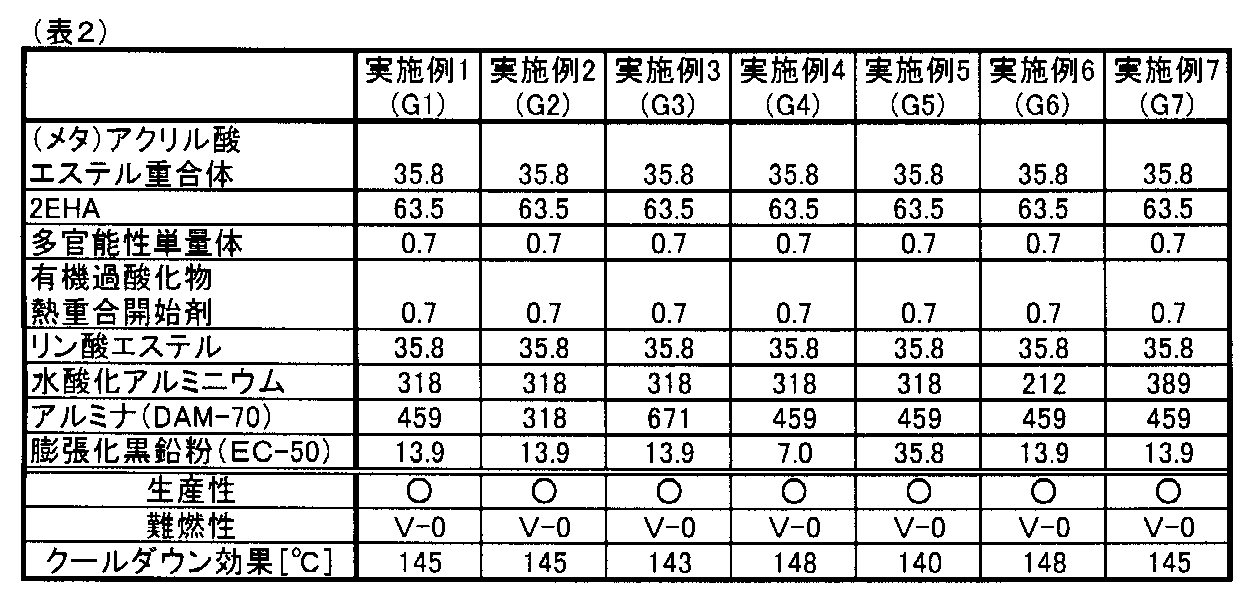
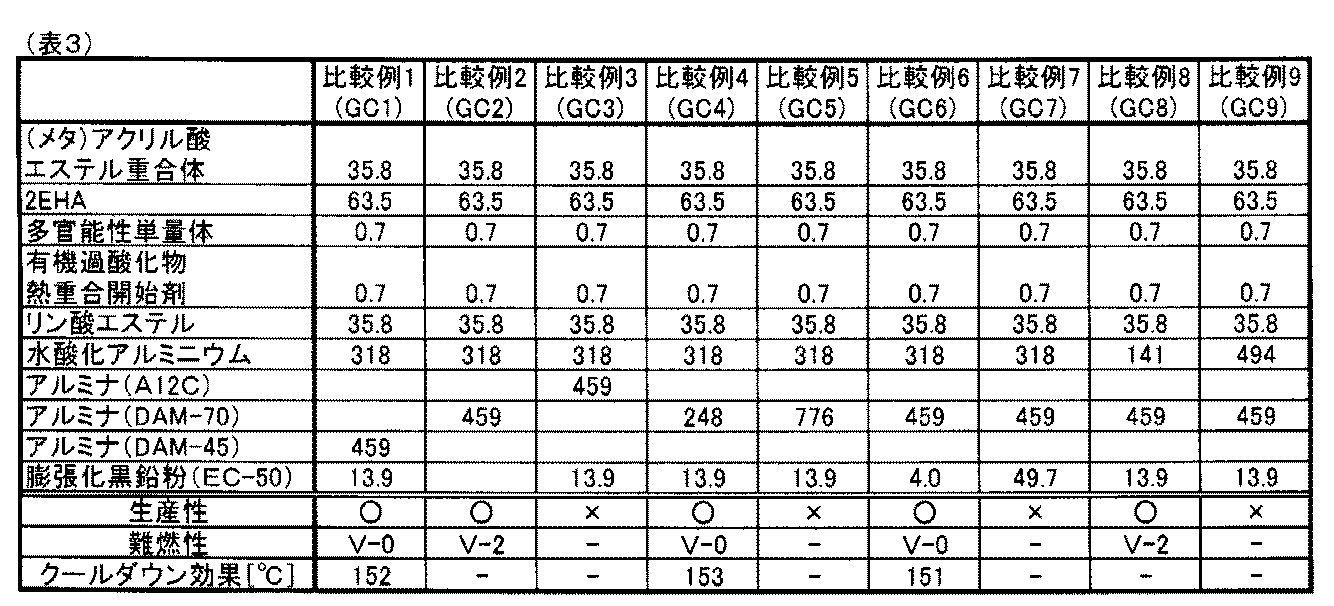
表2及び表3に示したように、実施例にかかるシート(G1乃至G7)は、いずれも、生産性、難燃性、及び熱伝導性が優れていた。
一方、粒径が小さなアルミナを用いた比較例1にかかるシート(GC1)は、実施例1と同量のアルミナを添加したが熱伝導性が劣っていた。
膨張化黒鉛粉を用いなかった比較例2にかかるシート(GC2)は、難燃性が劣っていた。
BET比表面積が大きなアルミナを用いた比較例3は、混合組成物の粘度が高くなり、シートを作製できなかった。
アルミナの添加量が少なかった比較例4にかかるシート(GC4)は、熱伝導性が劣っていた。
アルミナの添加量が多かった比較例5にかかるシート(GC5)は、混合組成物の粘度が高くなり、シートを作製できなかった
膨張化黒鉛粉の添加量が少なかった比較例6にかかるシート(GC6)は、熱伝導性が劣っていた。
膨張化黒鉛粉の添加量が多かった比較例7にかかるシート(GC7)は、混合組成物の粘度が高くなり、シートを作製できなかった
水酸化アルミニウムの添加量が少なかった比較例8にかかるシート(GC8)は、難燃性が劣っていた。
水酸化アルミニウムの添加量が多かった比較例9にかかるシート(GC9)は、混合組成物の粘度が高くなり、シートを作製できなかった。
一方、粒径が小さなアルミナを用いた比較例1にかかるシート(GC1)は、実施例1と同量のアルミナを添加したが熱伝導性が劣っていた。
膨張化黒鉛粉を用いなかった比較例2にかかるシート(GC2)は、難燃性が劣っていた。
BET比表面積が大きなアルミナを用いた比較例3は、混合組成物の粘度が高くなり、シートを作製できなかった。
アルミナの添加量が少なかった比較例4にかかるシート(GC4)は、熱伝導性が劣っていた。
アルミナの添加量が多かった比較例5にかかるシート(GC5)は、混合組成物の粘度が高くなり、シートを作製できなかった
膨張化黒鉛粉の添加量が少なかった比較例6にかかるシート(GC6)は、熱伝導性が劣っていた。
膨張化黒鉛粉の添加量が多かった比較例7にかかるシート(GC7)は、混合組成物の粘度が高くなり、シートを作製できなかった
水酸化アルミニウムの添加量が少なかった比較例8にかかるシート(GC8)は、難燃性が劣っていた。
水酸化アルミニウムの添加量が多かった比較例9にかかるシート(GC9)は、混合組成物の粘度が高くなり、シートを作製できなかった。
1 基板
2、12a、12b、22 発熱体
3、13 放熱体
4、14、24 熱伝導性感圧接着性シート状成形体
2、12a、12b、22 発熱体
3、13 放熱体
4、14、24 熱伝導性感圧接着性シート状成形体
Claims (5)
- (メタ)アクリル酸エステル重合体(A1)及び(メタ)アクリル酸エステル単量体(α1)を含む(メタ)アクリル樹脂組成物(A)を100質量部と、
平均粒径が50μm以上の膨張化黒鉛粉(B)を6質量部以上45質量部以下と、
前記膨張化黒鉛粉(B)以外の難燃性熱伝導無機化合物(D)を150質量部以上450質量部以下と、
平均粒径が50μm以上、且つBET比表面積が0.4m2/g以下の、前記膨張化黒鉛粉(B)及び前記難燃性熱伝導無機化合物(D)以外の熱伝導性フィラー(C)を300質量部以上700質量部以下と、
を含む混合組成物中において、少なくとも前記(メタ)アクリル酸エステル単量体(α1)の重合反応が行われてなる、熱伝導性感圧接着剤組成物(F)。 - (メタ)アクリル酸エステル重合体(A1)及び(メタ)アクリル酸エステル単量体(α1)を含む(メタ)アクリル樹脂組成物(A)を100質量部と、
平均粒径が50μm以上の膨張化黒鉛粉(B)を6質量部以上45質量部以下と、
前記膨張化黒鉛粉(B)以外の難燃性熱伝導無機化合物(D)を150質量部以上450質量部以下と、
平均粒径が50μm以上、且つBET比表面積が0.4m2/g以下の、前記膨張化黒鉛粉(B)及び前記難燃性熱伝導無機化合物(D)以外の熱伝導性フィラー(C)を300質量部以上700質量部以下と、
を含む混合組成物をシート状に成形した後、又は前記混合組成物をシート状に成形しながら、少なくとも前記(メタ)アクリル酸エステル単量体(α1)の重合反応が行われてなる、熱伝導性感圧接着性シート状成形体(G)。 - (メタ)アクリル酸エステル重合体(A1)及び(メタ)アクリル酸エステル単量体(α1)を含む(メタ)アクリル樹脂組成物(A)を100質量部と、
平均粒径が50μm以上の膨張化黒鉛粉(B)を6質量部以上45質量部以下と、
前記膨張化黒鉛粉(B)以外の難燃性熱伝導無機化合物(D)を150質量部以上450質量部以下と、
平均粒径が50μm以上、且つBET比表面積が0.4m2/g以下の、前記膨張化黒鉛粉(B)及び前記難燃性熱伝導無機化合物(D)以外の熱伝導性フィラー(C)を300質量部以上700質量部以下と、
を含む混合組成物を作製する工程、並びに、
前記混合組成物中において、少なくとも前記(メタ)アクリル酸エステル単量体(α1)の重合反応を行う工程、
を含む、熱伝導性感圧接着剤組成物(F)の製造方法。 - (メタ)アクリル酸エステル重合体(A1)及び(メタ)アクリル酸エステル単量体(α1)を含む(メタ)アクリル樹脂組成物(A)を100質量部と、
平均粒径が50μm以上の膨張化黒鉛粉(B)を6質量部以上45質量部以下と、
前記膨張化黒鉛粉(B)以外の難燃性熱伝導無機化合物(D)を150質量部以上450質量部以下と、
平均粒径が50μm以上、且つBET比表面積が0.4m2/g以下の、前記膨張化黒鉛粉(B)及び前記難燃性熱伝導無機化合物(D)以外の熱伝導性フィラー(C)を300質量部以上700質量部以下と、
を含む混合組成物を作製する工程、並びに、
前記混合組成物をシート状に成形した後、又は、前記混合組成物をシート状に成形しながら、少なくとも前記(メタ)アクリル酸エステル単量体(α1)の重合反応を行う工程、
を含む、熱伝導性感圧接着性シート状成形体(G)の製造方法。 - 発熱体及び該発熱体に貼合された請求項1に記載の熱伝導性感圧接着剤組成物(F)、又は、発熱体及び該発熱体に貼合された請求項2に記載の熱伝導性感圧接着性シート状成形体(G)、を備えた電子機器。
Applications Claiming Priority (2)
| Application Number | Priority Date | Filing Date | Title |
|---|---|---|---|
| JP2013221508 | 2013-10-24 | ||
| JP2013-221508 | 2013-10-24 |
Publications (1)
| Publication Number | Publication Date |
|---|---|
| WO2015060092A1 true WO2015060092A1 (ja) | 2015-04-30 |
Family
ID=52992695
Family Applications (1)
| Application Number | Title | Priority Date | Filing Date |
|---|---|---|---|
| PCT/JP2014/076444 Ceased WO2015060092A1 (ja) | 2013-10-24 | 2014-10-02 | 熱伝導性感圧接着剤組成物、熱伝導性感圧接着性シート状成形体、これらの製造方法、及び電子機器 |
Country Status (2)
| Country | Link |
|---|---|
| TW (1) | TW201527464A (ja) |
| WO (1) | WO2015060092A1 (ja) |
Families Citing this family (3)
| Publication number | Priority date | Publication date | Assignee | Title |
|---|---|---|---|---|
| JP2017147260A (ja) * | 2016-02-15 | 2017-08-24 | パナソニックIpマネジメント株式会社 | ヒートシンク |
| TWI657591B (zh) * | 2017-11-29 | 2019-04-21 | 住華科技股份有限公司 | 太陽能光學膜疊層及其製造方法 |
| CN116135942A (zh) * | 2021-11-16 | 2023-05-19 | 亨玖科技股份有限公司 | 耐高温防漏胶及其制备方法及具有耐高温防漏胶的紧固件 |
Citations (5)
| Publication number | Priority date | Publication date | Assignee | Title |
|---|---|---|---|---|
| JPH0688061A (ja) * | 1992-04-15 | 1994-03-29 | Minnesota Mining & Mfg Co <3M> | 熱伝導電気絶縁テープ |
| WO1998024860A1 (en) * | 1996-12-04 | 1998-06-11 | Nitto Denko Corporation | Thermally conductive pressure-sensitive adhesive, adhesive sheet containing the same, and method for fixing electronic part to heat-radiating member with the same |
| WO2007116686A1 (ja) * | 2006-03-28 | 2007-10-18 | Zeon Corporation | 熱伝導性感圧接着剤組成物および熱伝導性感圧接着性シート状成形体 |
| WO2011102170A1 (ja) * | 2010-02-19 | 2011-08-25 | 日本ゼオン株式会社 | 熱伝導性感圧接着剤組成物、熱伝導性感圧接着性シート、及び電子部品 |
| JP2012007090A (ja) * | 2010-06-25 | 2012-01-12 | Nippon Zeon Co Ltd | 熱伝導性感圧接着剤組成物、熱伝導性感圧接着剤組成物の製造方法、熱伝導性感圧接着性シート、及び電子部品 |
-
2014
- 2014-10-02 WO PCT/JP2014/076444 patent/WO2015060092A1/ja not_active Ceased
- 2014-10-21 TW TW103136230A patent/TW201527464A/zh unknown
Patent Citations (5)
| Publication number | Priority date | Publication date | Assignee | Title |
|---|---|---|---|---|
| JPH0688061A (ja) * | 1992-04-15 | 1994-03-29 | Minnesota Mining & Mfg Co <3M> | 熱伝導電気絶縁テープ |
| WO1998024860A1 (en) * | 1996-12-04 | 1998-06-11 | Nitto Denko Corporation | Thermally conductive pressure-sensitive adhesive, adhesive sheet containing the same, and method for fixing electronic part to heat-radiating member with the same |
| WO2007116686A1 (ja) * | 2006-03-28 | 2007-10-18 | Zeon Corporation | 熱伝導性感圧接着剤組成物および熱伝導性感圧接着性シート状成形体 |
| WO2011102170A1 (ja) * | 2010-02-19 | 2011-08-25 | 日本ゼオン株式会社 | 熱伝導性感圧接着剤組成物、熱伝導性感圧接着性シート、及び電子部品 |
| JP2012007090A (ja) * | 2010-06-25 | 2012-01-12 | Nippon Zeon Co Ltd | 熱伝導性感圧接着剤組成物、熱伝導性感圧接着剤組成物の製造方法、熱伝導性感圧接着性シート、及び電子部品 |
Also Published As
| Publication number | Publication date |
|---|---|
| TW201527464A (zh) | 2015-07-16 |
Similar Documents
| Publication | Publication Date | Title |
|---|---|---|
| JP5975028B2 (ja) | 熱伝導性感圧接着性シート状成形体、その製造方法、及び電子機器 | |
| JP5713000B2 (ja) | 熱伝導性感圧接着剤組成物、熱伝導性感圧接着性シート、及び電子部品 | |
| WO2012132656A1 (ja) | 熱伝導性感圧接着剤組成物、熱伝導性感圧接着性シート状成形体、これらの製造方法、及び電子部品 | |
| JP5556433B2 (ja) | 熱伝導性感圧接着剤組成物、熱伝導性感圧接着剤組成物の製造方法、熱伝導性感圧接着性シート、及び電子部品 | |
| WO2013047145A1 (ja) | 熱伝導性感圧接着剤組成物、熱伝導性感圧接着性シート状成形体、これらの製造方法、及び電子部品 | |
| JP2016188297A (ja) | 熱伝導性感圧接着剤組成物、熱伝導性感圧接着性シート状成形体、これらの製造方法、及び、電子機器 | |
| WO2013183389A1 (ja) | 熱伝導性感圧接着剤組成物、熱伝導性感圧接着性シート状成形体、これらの製造方法、及び電子機器 | |
| JP2013129814A (ja) | 熱伝導性感圧接着剤組成物、熱伝導性感圧接着性シート状成形体、これらの製造方法、及び電子機器 | |
| JP2013124289A (ja) | 熱伝導性感圧接着剤組成物、熱伝導性感圧接着性シート状成形体、これらの製造方法、及び電子機器 | |
| JP2011246590A (ja) | 熱伝導性感圧接着剤組成物、熱伝導性感圧接着性シート、及び電子部品 | |
| WO2015060092A1 (ja) | 熱伝導性感圧接着剤組成物、熱伝導性感圧接着性シート状成形体、これらの製造方法、及び電子機器 | |
| WO2013175950A1 (ja) | 熱伝導性感圧接着剤組成物、熱伝導性感圧接着性シート状成形体、これらの製造方法、及び電子機器 | |
| WO2013061830A1 (ja) | 熱伝導性感圧接着剤組成物、熱伝導性感圧接着性シート状成形体、これらの製造方法、及び電子部品 | |
| JP2015067638A (ja) | 熱伝導性感圧接着剤組成物、熱伝導性感圧接着性シート状成形体、これらの製造方法、及び電子機器 | |
| JP2015067640A (ja) | 熱伝導性感圧接着剤組成物、熱伝導性感圧接着性シート状成形体、これらの製造方法、及び電子機器 | |
| JP2014005336A (ja) | 熱伝導性感圧接着剤組成物、熱伝導性感圧接着性シート状成形体、これらの製造方法、及び電子機器 | |
| WO2015056577A1 (ja) | 熱伝導性感圧接着性積層シート、熱伝導性感圧接着性積層シートの製造方法、及び電子機器 | |
| JP2016175950A (ja) | 熱伝導性感圧接着剤組成物、熱伝導性感圧接着性シート状成形体、これらの製造方法、及び、電子機器 | |
| JP2013095779A (ja) | 熱伝導性感圧接着剤組成物、熱伝導性感圧接着性シート状成形体、これらの製造方法、及び電子機器 | |
| JP2015067637A (ja) | 熱伝導性感圧接着剤組成物、熱伝導性感圧接着性シート状成形体、これらの製造方法、及び電子機器 | |
| JP5652365B2 (ja) | 熱伝導性感圧接着剤組成物、熱伝導性感圧接着性シート状成形体、これらの製造方法、及び電子部品 | |
| JP2016188287A (ja) | 熱伝導性感圧接着剤組成物および熱伝導性感圧接着性シート | |
| WO2015060091A1 (ja) | 熱伝導性感圧接着剤組成物の製造方法、熱伝導性感圧接着性シート状成形体の製造方法、及び電子機器 | |
| WO2015045918A1 (ja) | 熱伝導性感圧接着剤組成物、熱伝導性感圧接着性シート状成形体、これらの製造方法、及び電子機器 | |
| JP2015040262A (ja) | 熱伝導性感圧接着剤組成物、熱伝導性感圧接着性シート状成形体、これらの製造方法、及び電子機器 |
Legal Events
| Date | Code | Title | Description |
|---|---|---|---|
| 121 | Ep: the epo has been informed by wipo that ep was designated in this application |
Ref document number: 14855798 Country of ref document: EP Kind code of ref document: A1 |
|
| NENP | Non-entry into the national phase |
Ref country code: DE |
|
| NENP | Non-entry into the national phase |
Ref country code: JP |
|
| 122 | Ep: pct application non-entry in european phase |
Ref document number: 14855798 Country of ref document: EP Kind code of ref document: A1 |