WO2015056529A1 - 水系サイズ剤、ならびにそれを用いたガラス繊維およびガラス繊維クロス - Google Patents
水系サイズ剤、ならびにそれを用いたガラス繊維およびガラス繊維クロス Download PDFInfo
- Publication number
- WO2015056529A1 WO2015056529A1 PCT/JP2014/074989 JP2014074989W WO2015056529A1 WO 2015056529 A1 WO2015056529 A1 WO 2015056529A1 JP 2014074989 W JP2014074989 W JP 2014074989W WO 2015056529 A1 WO2015056529 A1 WO 2015056529A1
- Authority
- WO
- WIPO (PCT)
- Prior art keywords
- glass fiber
- agent
- sizing agent
- aqueous sizing
- mass
- Prior art date
- Legal status (The legal status is an assumption and is not a legal conclusion. Google has not performed a legal analysis and makes no representation as to the accuracy of the status listed.)
- Ceased
Links
Classifications
-
- C—CHEMISTRY; METALLURGY
- C03—GLASS; MINERAL OR SLAG WOOL
- C03C—CHEMICAL COMPOSITION OF GLASSES, GLAZES OR VITREOUS ENAMELS; SURFACE TREATMENT OF GLASS; SURFACE TREATMENT OF FIBRES OR FILAMENTS MADE FROM GLASS, MINERALS OR SLAGS; JOINING GLASS TO GLASS OR OTHER MATERIALS
- C03C25/00—Surface treatment of fibres or filaments made from glass, minerals or slags
- C03C25/10—Coating
- C03C25/24—Coatings containing organic materials
- C03C25/26—Macromolecular compounds or prepolymers
- C03C25/32—Macromolecular compounds or prepolymers obtained otherwise than by reactions involving only carbon-to-carbon unsaturated bonds
-
- C—CHEMISTRY; METALLURGY
- C03—GLASS; MINERAL OR SLAG WOOL
- C03C—CHEMICAL COMPOSITION OF GLASSES, GLAZES OR VITREOUS ENAMELS; SURFACE TREATMENT OF GLASS; SURFACE TREATMENT OF FIBRES OR FILAMENTS MADE FROM GLASS, MINERALS OR SLAGS; JOINING GLASS TO GLASS OR OTHER MATERIALS
- C03C25/00—Surface treatment of fibres or filaments made from glass, minerals or slags
- C03C25/10—Coating
- C03C25/24—Coatings containing organic materials
- C03C25/40—Organo-silicon compounds
Definitions
- the present invention relates to an aqueous sizing agent for imparting bundling properties to a fiber, a glass fiber surface-treated with the aqueous sizing agent, and a glass fiber cloth using the glass fiber.
- a glass fiber cloth having excellent properties such as mechanical properties, dimensional stability, heat resistance, and chemical resistance has been used as a reinforcing material for printed circuit boards used in electronic devices or electronic communication devices.
- an aqueous sizing agent containing starch is attached to the glass fiber in order to impart bundling properties to the glass fiber, improve the weaving property of the glass fiber, and increase the productivity of the glass fiber cloth.
- the glass fiber cloth is subjected to a heat cleaning process. Further, the glass fiber cloth is subjected to surface treatment (silane coupling treatment) in order to modify the surface.
- Patent Document 1 proposes to use an aqueous sizing agent containing an epoxy resin, bisphenol A ether to which ethylene oxide is added, and a silane coupling agent.
- the present invention does not require a heat cleaning process and a surface treatment when using an aqueous sizing agent containing starch, and changes in yarn quality and generation of static electricity in a high temperature environment.
- An object of the present invention is to provide an aqueous sizing agent in which an increase in the amount is suppressed and stable and excellent weaving properties can be realized.
- the present inventors use an aqueous sizing agent containing a silane coupling agent, a film forming agent, an antistatic agent, and a softening agent in a specific ratio.
- the inventors have found that the above object can be achieved, and have reached the present invention. That is, the gist of the present invention is as follows.
- a silane coupling agent A
- B 50 to 700 parts by mass of a film forming agent
- C 10 to 50 parts by mass of an antistatic agent
- D 10 to 50 parts by mass of a softening agent
- An aqueous sizing agent characterized by containing no starch and no epoxy resin.
- the present invention heat cleaning treatment and surface treatment when using an aqueous sizing agent containing starch are unnecessary, an increase in the amount of static electricity generated when using an aqueous sizing agent containing an epoxy resin, and an epoxy resin
- an aqueous sizing agent containing a variation in yarn quality under a high temperature environment is suppressed, and an aqueous sizing agent capable of realizing stable and excellent weaving properties can be provided.
- the glass fiber cloth using the glass fiber surface-treated with the water-based sizing agent of the present invention is excellent in heat resistance and mechanical properties, and is therefore suitably used as a reinforcing material for printed circuit boards used in electrical equipment and the like. can do.
- the present invention relates to an aqueous sizing agent containing a silane coupling agent (A), a film forming agent (B), an antistatic agent (C), and a softening agent (D). More specifically, the aqueous sizing agent of the present invention comprises a silane coupling agent (A), a film forming agent (B), an antistatic agent (C), and a softening agent (D) dispersed in water. It is a thing.
- the aqueous sizing agent of the present invention does not contain starch and epoxy resin. As used herein, “does not contain” means substantially not contained, and may be contained in a trace amount as long as the effects of the present invention are not impaired.
- the silane coupling agent (A) is used for the purpose of improving the heat resistance of the fiber or the fiber / resin composite material and improving the mechanical properties of the fabric or fiber / resin composite material using the fiber.
- a hydrolyzable silane compound represented by the general formula: YR—Si (CH 3 ) 3-n Xn is preferable.
- the functional group Y include a vinyl group, an epoxy group, a methacryl group, an amino group, and a mercapto group, and among these, a vinyl group, a methacryl group, an amino group, and a mercapto group are preferable.
- R examples include a linear or branched alkylene group, a phenylene group, and an imino group
- Y may be directly bonded to Si without interposing R.
- the functional group X include an alkoxy group such as a methoxy group or an ethoxy group, a chloro group, an acetoxy group, an oxime group, an isopropenoxy group, and an amino group.
- n is an integer of 2 or 3. When n is 2 or 3, the plurality of X may be the same or different from each other.
- hydrolyzable silane compounds include vinyltriethoxysilane, vinyltrimethoxysilane, ⁇ - (methacryloyloxypropyl) trimethoxysilane, ⁇ - (3,4-epoxycyclohexyl) ethyl.
- the silane coupling agent (A) is preferably N- ⁇ - (N-vinylbenzylaminoethyl) - ⁇ -aminopropyltrimethoxysilane.
- N- ⁇ - (N-vinylbenzylaminoethyl) - ⁇ -aminopropyltrimethoxysilane is used as a material for printed circuit boards because of its excellent interfacial adhesion between glass fiber and matrix resin and excellent heat and humidity resistance. It can use suitably for the glass fiber used.
- the film-forming agent (B) is used for the purpose of imparting lubricity to the fiber, protecting the fiber from friction with the contact tool material, preventing electrification and generation of fluff, and further imparting heat resistance.
- the film forming agent (B) include polyols such as polyether polyol and polyester polyol, or derivatives thereof.
- polyols include adipate diol, polyoxypropylene glycol, polyoxypropylene glyceryl ether, polyoxypropylene trimethylol propane ether, polyoxypropylene sorbitol ether, and polyoxyalkylene bisphenol A ether, preferably epoxy. Does not contain groups.
- the film forming agent (B) is preferably polyoxyalkylene bisphenol A ether, more preferably polyoxyethylene bisphenol A ether or polyoxypropylene bisphenol A ether, Polyoxyethylene bisphenol A ether is more preferable because of its excellent lubricity.
- the hydroxyl value of the polyoxyalkylene bisphenol A ether is preferably 200 mgKOH / g or less, and more preferably 150 mgKOH / g or less.
- the hydroxyl value of polyoxyalkylene bisphenol A ether is 200 mgKOH / g or less, the dispersibility to water improves and it can coat
- the hydroxyl value of polyoxyalkylene bisphenol A ether exceeds 200 mgKOH / g, it becomes difficult to disperse in water, and an aqueous sizing agent cannot be prepared.
- the content of the film forming agent (B) is required to be 50 to 700 parts by mass, and preferably 150 to 450 parts by mass with respect to 100 parts by mass of the silane coupling agent (A).
- the content of the film forming agent (B) is less than 50 parts by mass, the occurrence of fluff frequently occurs and the weaving property decreases.
- the content of the film forming agent (B) exceeds 700 parts by mass, migration tends to be strong, and it becomes difficult to obtain a stable yarn quality over the entire length, and the weaving property is lowered.
- the antistatic agent (C) is used for the purpose of reducing the chargeability of the fiber.
- the antistatic agent (C) for example, aliphatic polyamide, polyoxyalkylene alkyl ester, or a derivative thereof, a quaternary ammonium salt, or an inorganic salt is used, and preferably does not contain an epoxy group.
- the polyoxyalkylene alkyl ester include polyoxyethylene alkyl ester.
- inorganic salts include ammonium salts and lithium salts. More specifically, inorganic salts include ammonium chloride, ammonium sulfate, and lithium chloride.
- the content of the antistatic agent (C) is required to be 10 to 50 parts by mass, preferably 20 to 40 parts by mass with respect to 100 parts by mass of the silane coupling agent (A).
- the content of the antistatic agent (C) is less than 10 parts by mass, it becomes difficult to prevent electrification, and the unwinding property of the yarn during weaving is lowered, and the weaving property is lowered.
- the content of the antistatic agent (C) exceeds 50 parts by mass, heat resistance and mechanical properties are deteriorated.
- the softening agent (D) is used for the purpose of improving the flexibility of the fiber.
- the softening agent (D) include fatty acid amides, fatty acid esters, glycols, or derivatives thereof, and preferably does not contain an epoxy group.
- fatty acid amides include polyoxyalkylene fatty acid amides such as polyoxyethylene stearic acid amide.
- fatty acid amides include those composed of polyethyleneamine and fatty acids.
- Examples of the polyethyleneamine include diethylenetriamine, triethylenetetramine, and tetraethylenepentamine.
- the fatty acid include lauric acid, myristic acid, palmitic acid, and stearic acid.
- fatty acid esters include polyoxyalkylene fatty acid esters such as polyoxyethylene stearate, decyl laurate, isopropyl palmitate, cetyl palmitate, isopropyl stearate, ethylene glycol adipate, and trimethylolpropane trioctanoate.
- glycols include polyethylene glycol and polypropylene glycol.
- the content of the softening agent (D) needs to be 10 to 50 parts by mass, preferably 20 to 40 parts by mass with respect to 100 parts by mass of the silane coupling agent (A).
- content of a softening agent (D) is less than 10 mass parts, it will become difficult to express a softness
- content of a softening agent (D) exceeds 50 mass parts, heat resistance falls. In addition, mechanical properties are reduced.
- the aqueous sizing agent of the present invention is used by adhering to the surface of fibers such as inorganic fibers, natural fibers, and synthetic fibers.
- fibers such as inorganic fibers, natural fibers, and synthetic fibers.
- the inorganic fiber include glass, carbon, graphite, mullite, and aluminum oxide.
- natural fibers include cotton, cellulose, natural rubber, flax, hemp, ramie, sisal, and wool.
- the fiber containing a thermoplastic resin is mentioned, for example. Examples thereof include fibers containing polyamide, polylactic acid, polyarylate, liquid crystal polymer, polyester, acrylic resin, polycarbonate, polyurethane, polyvinyl resin, and polyolefin resin.
- the fiber whose surface is coated with the water-based sizing agent of the present invention is excellent in flexibility, low friction property and low chargeability, and has excellent weaving properties because generation of fluff is suppressed.
- the aqueous sizing agent of the present invention does not contain an epoxy resin. Therefore, the fluctuation of the yarn quality under a high temperature environment that occurs when an aqueous sizing agent containing an epoxy resin is used is suppressed, and stable weaving becomes possible. In addition, an increase in the amount of static electricity generated when an aqueous sizing agent containing an epoxy resin is used is suppressed.
- the epoxy resin is, for example, a bisphenol type epoxy resin, an amine type epoxy resin, a phenol novolac type epoxy resin, a cresol novolac type epoxy resin, a resorcinol type epoxy resin, a phenol aralkyl type epoxy resin, a naphthol aralkyl type epoxy resin, a diester.
- examples include cyclopentadiene type epoxy resins, biphenyl skeleton type epoxy resins, isocyanate-modified epoxy resins, tetraphenylethane type epoxy resins, triphenylmethane type epoxy resins, and fluorene type epoxy resins.
- the aqueous sizing agent of the present invention does not contain starch. Therefore, in the woven fabric composed of the fibers coated with the aqueous sizing agent of the present invention, the heat cleaning treatment and the surface treatment that are performed when using the aqueous sizing agent containing starch are unnecessary, and excellent heat resistance and Mechanical properties can be obtained. The effect obtained by not requiring these treatments is particularly noticeable when the number of glass fibers bundled is reduced and the fiber diameter of the glass fibers is reduced as the electronic equipment is reduced in size and thickness. .
- the water-based sizing agent of the present invention exhibits low chargeability, it is suitable when it includes steps such as winding of a polymer film, packaging of electronic equipment, and painting of an automobile, which may cause a problem of contamination due to generation of static electricity. Used for.
- the aqueous sizing agent of the present invention may further contain an aqueous resin for the purpose of improving the convergence of the fibers and suppressing the occurrence of fuzz.
- water-based resins include polyvinyl alcohol derivatives, polyvinyl pyrrolidone, styrene-maleic anhydride copolymers, ethylene-maleic anhydride copolymers, polyacrylamide and derivatives thereof, polyethylene glycol, styrene-butadiene copolymers, polyacetic acid.
- aqueous resin Vinyl, polyurethane, polyacrylate, vinyl chloride-vinyl acetate copolymer, ethylene vinyl acetate copolymer, ethylene-butadiene-acrylic copolymer, polyvinylidene chloride, modified polyolefin, dimer acid polyamide, polyester copolymer Is mentioned.
- the aqueous resin may be used alone or in combination.
- the water-based sizing agent may further contain inorganic particles for the purpose of improving spreadability, weaving property, and mechanical properties of the fabric.
- inorganic particles for the purpose of improving spreadability, weaving property, and mechanical properties of the fabric.
- silicon carbide, aluminum nitride, silica, clay, boron nitride, graphite, metal dichalcogenide, cadmium iodide, silver sulfide, etc. for example, indium, thallium, tin, copper, zinc, gold, And a metal inorganic substance containing at least one metal selected from the group consisting of silver and silver.
- the material of the inorganic particles is preferably boron nitride because the effect of improving the opening property, weaving property, and substrate physical properties is high.
- Inorganic particles may be used alone or in combination.
- the aqueous sizing agent of the present invention may further contain a lubricant and a pH adjuster.
- a lubricant for example, a quaternary ammonium salt such as lauryltrimethylammonium chloride or an alkyltrimethylammonium salt is used.
- a pH adjuster for example, acetic acid is used.
- the aqueous sizing agent of the present invention may further contain a curing catalyst.
- the curing catalyst include trisethylhexylate of tris (dimethylaminomethyl) phenol.
- the aqueous sizing agent of the present invention may further contain a curing agent.
- the curing agent include aliphatic polyamines, alicyclic polyamines, amine-epoxy addition products, polyamide polyamines, aromatic polyamines, glycidyl ethers, glycidyl esters, and the like.
- the total solid concentration of the above (A) to (D) is preferably 2 to 10% by mass.
- the solid content concentration is less than 2% by mass, it is difficult to coat the fiber uniformly, the fluff is liable to occur, and the heat resistance and mechanical properties may be lowered.
- the solid content concentration exceeds 10% by mass, the amount of solid content attached to the fiber increases, and the weaving property and heat resistance may decrease due to stickiness of the fiber surface and excessive silane adhesion.
- the aqueous sizing agent of the present invention may further contain a thickener, a leveling agent, an antioxidant, a flame retardant, a flame retardant aid, a heat stabilizer, a fibrous reinforcing material, and a functional filler, if necessary.
- a functional filler include a heat conductive filler, an electromagnetic wave shielding particle filler, a heat insulating filler, and a high dielectric filler.
- the aqueous sizing agent of the present invention can be produced by dispersing the above (A) to (D) in water. More specifically, the silane coupling agent (A) is first mixed with water and stirred at a temperature of 25 ° C. or lower to advance the hydrolysis reaction. At the stage where this hydrolysis reaction has progressed to some extent, the film forming agent (B), the antistatic agent (C), and the softening agent (D) are further added and stirred. Each of the above (B) to (D) may be added to and mixed with the water containing the above (A), and the mixture of the above (B) to (D) You may mix in addition to the water containing.
- the mixture of (A) to (D) and the curing agent are mixed using a stirring blade, a bead mill, a three roll mill, and a jet mill. That's fine.
- the mixture of (A) to (D) and the curing agent may be mixed using a disper or vibration agitation only when a solid substance such as an inorganic substance is not mixed.
- the rotation speed is preferably 500 to 3000 rpm.
- the frequency is preferably 30 to 50 Hz.
- an aqueous sizing agent can be obtained while suppressing heat generation by stirring heat.
- a chiller may be used to suppress heat generation due to heat of stirring. By suppressing the heat generation, the reaction promotion of the silane coupling agent can be suppressed, and a stable aqueous sizing agent can be obtained.
- this invention relates to the glass fiber by which the surface was processed with said aqueous sizing agent.
- the amount of the aqueous sizing agent (solid content) attached to the glass fiber is 100 parts by mass in total of the aqueous sizing agent (solid content) attached to the glass fiber and the glass fiber.
- the amount is preferably 0.15 to 0.3 part by mass, and more preferably 0.18 to 0.25 part by mass.
- the glass fiber (glass fiber strand) of this invention is obtained by apply
- this invention relates to the glass fiber cloth using the glass fiber by which the surface was processed with said aqueous sizing agent.
- the glass fiber cloth of the present invention can be obtained, for example, by weaving glass fibers whose surface is treated with an aqueous sizing agent by a known method (for example, a method using a shuttle loom, an air jet loom, or a rapier loom).
- Glass fibers for weaving are used, for example, as glass yarn (strands twisted on strands) or roving (strands wound without strands twisted).
- the glass fiber cloth of the present invention is suitably used as a reinforcing material for a glass fiber-resin composite substrate for printed circuit boards.
- a glass fiber-resin composite substrate using this glass fiber cloth is excellent in heat resistance and can maintain the interfacial adhesion between the glass fiber and the resin firmly without being affected by soldering heat even in a moisture absorption state.
- the aqueous sizing agent of the present invention does not contain an epoxy resin unlike the conventional aqueous sizing agent, variation in yarn quality and increase in the amount of static electricity generated under a high temperature environment are suppressed. Moreover, since the heat cleaning process and the surface treatment process are unnecessary, the deterioration of the glass fiber generated in these processes is suppressed. For this reason, by using the glass fiber cloth of the present invention, the rigidity of the glass fiber-resin composite substrate for printed circuit boards is improved and is not easily destroyed.
- the glass fiber and glass fiber cloth of the present invention are components of computers such as smartphones, tablets, power devices, personal computers, home game machines; DVD players, DVD recorder components, HDD recorder components, homes.
- Parts for display power supply units such as TVs, plasma displays, and liquid crystal televisions; parts for mobile phones, various AV equipment, OA equipment, etc .; car stereos, car navigation systems, inverters, lighting, automobile electrical components, automobile engine components, automobiles It can be suitably used for brake members, automobile interior members, aerospace materials, sports applications, outdoor applications, and general industrial materials.
- the method for measuring and evaluating the characteristics of the aqueous sizing agent is as follows. (1) Amount of water-based sizing agent attached to glass fiber The amount of water-based sizing agent attached to glass fiber was measured as follows in accordance with JIS R 3420 as loss on ignition. The glass fiber to which the aqueous sizing agent was adhered was dried with hot air at 110 ° C. to remove moisture (water derived from the aqueous sizing agent) from the glass fiber. After measuring the weight W 1 of the glass fiber after removing the water, the glass fiber is allowed to stand for 30 minutes in an environment at 625 ° C. using an electric furnace to further remove the aqueous sizing agent (solid content) from the glass fiber. did. The weight W 2 of the glass fiber after removal aqueous sizing agent (solid content) was measured.
- the adhesion amount of the aqueous sizing agent to the glass fiber can be calculated from the following formula.
- Adhesion amount to glass fiber [(glass fiber weight W 1 after water removal) ⁇ (glass fiber weight W 2 after water-based sizing agent (solid content) removal)] / (glass fiber weight W 1 after water removal) ⁇ 100
- the glass fiber cloth is woven around the feed roller when weaving the glass fiber cloth using an air jet loom manufactured by Tsudakoma Kogyo Co., Ltd. In the weaving time, the number of times weaving was stopped was counted. The weaving of the glass fiber is stopped when the winding failure of the glass fiber to the feed roller occurs, or when the feeding becomes unstable and a show topic or the like occurs. When it did not stop even once, “ ⁇ ”, when it stopped once to 4 times, “ ⁇ ”, when it stopped 5 times or more, “ ⁇ ”. Moreover, the glass fiber cloth was woven by the same method as the above except that the glass fiber aged at 60 ° C. for 24 hours was used, and the woven property of the glass fiber was evaluated.
- the solder stuck to the composite sheet was scraped off from the composite sheet after being immersed in the solder bath. Observe the surface of the composite sheet after scraping off the solder using a flatbed scanner (manufactured by EPSON), and the degree of occupancy of the “whitened portion” (the ratio of the area of the whitened portion to the total area of the surface of the composite sheet) ) When the whitening portion was less than 1%, “ ⁇ ”, when it was 1% to less than 30%, “ ⁇ ”, when it was 30% to less than 50%, “ ⁇ ”, and when it was 50% or more, “x”.
- Silane coupling agent A mixed solution of N- ⁇ - (N-vinylbenzylaminoethyl) - ⁇ -aminopropyltrimethoxysilane hydrochloride, 90% acetic acid, and water (manufactured by Toray Dow Corning, Z6032)
- (II) Film-forming agent (B) (B1) Polyoxyethylene bisphenol A ether (manufactured by Yoshimura Oil Chemical Co., Ltd., GF690, hydroxyl value 123 mgKOH / g) (B2) Polyoxyethylene bisphenol A ether (manufactured by Sanyo Chemical Industries, Newpol BPE-60, hydroxyl value 228 mgKOH / g) (B3) Polyoxypropylene bisphenol A ether (manufactured by Sanyo Chemical Industries, Newpol BP-5P, hydroxyl value 211 mgKOH / g) (B4) Bisphenol A type epoxy resin (Shibo, Epolica) (B5) Starch (Nippon Chemical Co., Ltd., Piostarch)
- Antistatic agent C) (C1) Polyoxyethylene alkyl ester (manufactured by Yushi Kogyo Co., Ltd., Neulan) (C2) Quaternary ammonium salt (Daiichi Kogyo Seiyaku Co., Ltd., Cathiogen)
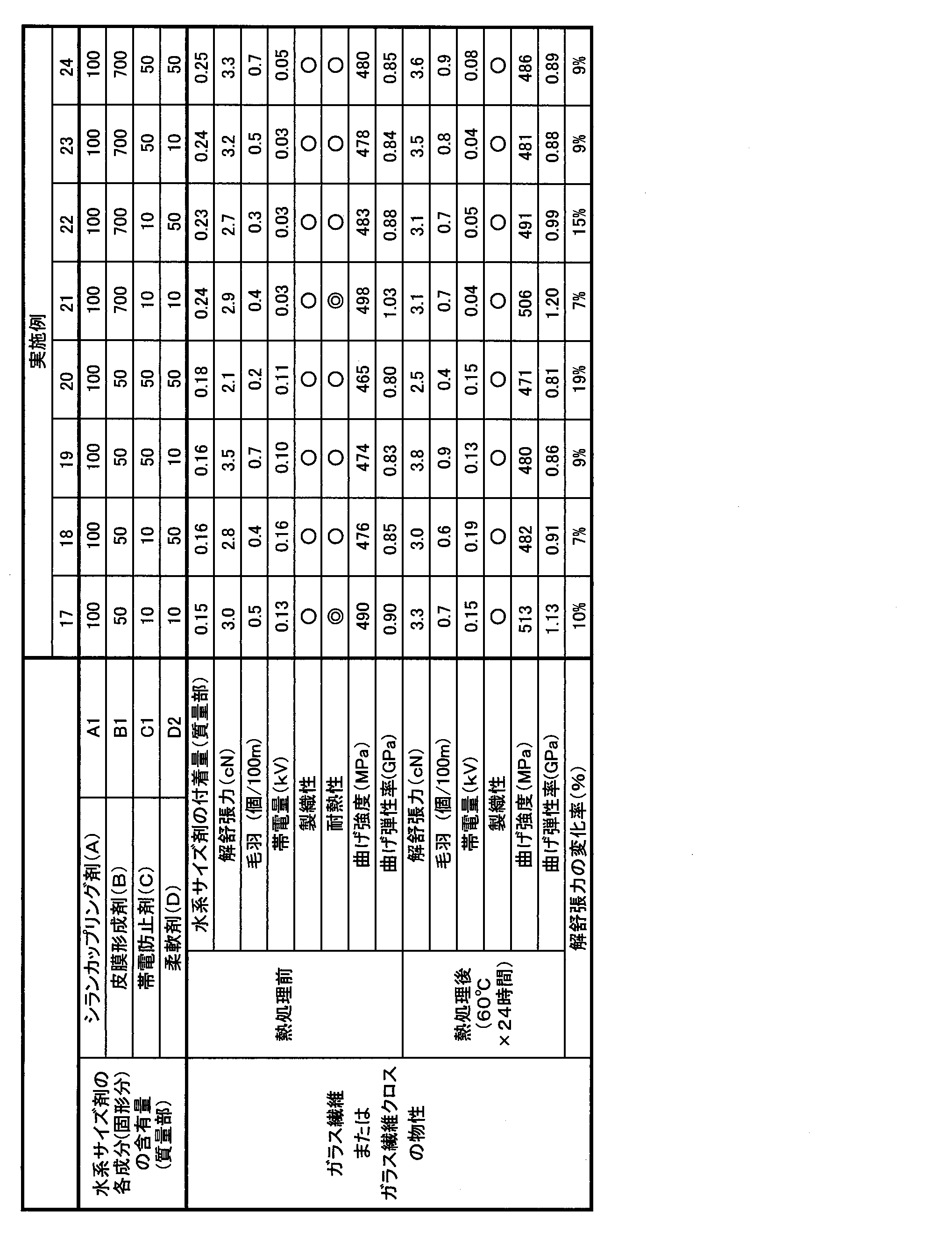
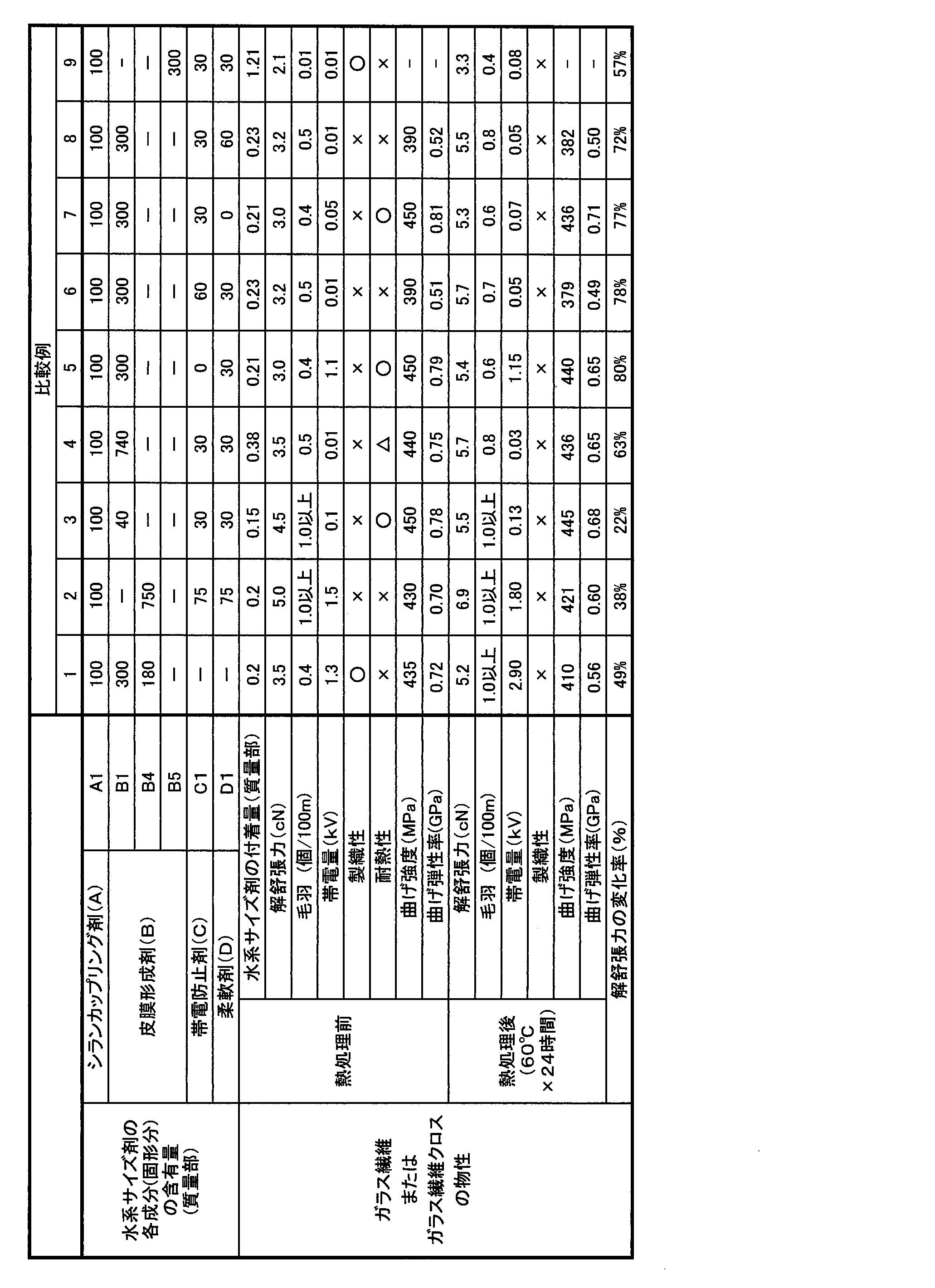
- Examples 1 to 24 and Comparative Examples 1 to 9 The silane coupling agent (A), film-forming agent (B), antistatic agent (C), and softening agent (D) were mixed with water to prepare an aqueous sizing agent.
- the silane coupling agent (A), the film forming agent (B), the antistatic agent (C), the softening agent (D), and the mixing ratio (parts by mass) of each solid component Were changed as shown in Tables 1-3.
- the amount of water added to the aqueous sizing agent was adjusted so that the solid content concentration (concentration of the total amount of the solid contents (A) to (D) above) was within the range of 4 to 8% by mass.
- the aqueous sizing agent obtained above was attached to a plurality of glass fiber filaments, and the glass fibers were converged into one bundle (strand). Next, this strand was wound around a tube without twisting to obtain a glass roving. A strand was unwound from the obtained glass roving and wound around a bobbin while twisting to obtain a glass yarn. Thus, a glass fiber for weaving was obtained.
- a glass yarn product number: C1200, average fiber diameter: 4.5 ⁇ m, total number of single fibers: 100, count: 4.2 tex, twist number: 1.0Z manufactured by Unitika Glass Fiber Co., Ltd. was used. .
- the adhesion amount of the aqueous sizing agent (solid content) to the glass fiber varies depending on the solid content concentration of the aqueous sizing agent.
- the adhesion amount of the aqueous sizing agent (solid content) is 100 mass in total of the glass fiber and the aqueous sizing agent (solid content) adhering to the glass fiber. 0.15 to 0.4 parts by mass with respect to parts.
- the glass fiber for weaving obtained above was woven using an air jet loom manufactured by Tsudakoma Kogyo Co., Ltd. to obtain a glass fiber cloth. Said various evaluation was performed about the water-system sizing agent, glass fiber, and glass fiber cloth which were obtained above. The evaluation results are shown in Tables 1 to 3.
- the glass fiber cloth obtained therefrom was excellent in heat resistance and mechanical properties. Since the glass fiber of Example 6 had a film forming agent content less than the preferred range of the present invention, the charge amount was slightly higher and the weaving property was slightly worse than Example 1. Moreover, the glass fiber cloth obtained therefrom had slightly low heat resistance and mechanical properties. Since the glass fiber of Example 7 had a film forming agent content higher than the preferred range of the present invention, the glass fiber cloth obtained therefrom was slightly lower in mechanical properties than Example 1.
- the content of the antistatic agent was less than the preferred range of the present invention. Therefore, compared with Example 1, the unraveling tension and the charge amount were slightly higher and the weaving property was slightly worse. Moreover, the glass fiber cloth obtained therefrom had slightly low mechanical properties.
- the glass fiber of Example 9 had an antistatic agent content higher than the preferred range of the present invention, and therefore, compared with Example 1, the unraveling tension was slightly higher and the weaving property was slightly worse. Moreover, the glass fiber cloth obtained therefrom had slightly low heat resistance and mechanical properties. Since the glass fiber of Example 10 had a softener content less than the preferred range of the present invention, compared with Example 1, the unraveling tension was slightly higher and the weaving property was slightly worse. Moreover, the glass fiber cloth obtained therefrom had slightly low mechanical properties.
- Example 11 Since the glass fiber of Example 11 had a softener content larger than the preferred range of the present invention, the unraveling tension was slightly higher and the weaving property was slightly worse as compared with Example 1. Moreover, the glass fiber cloth obtained therefrom had slightly low heat resistance and mechanical properties. Since the glass fibers of Examples 12 and 13 used a film forming agent having a hydroxyl value exceeding 200 mgKOH / g, compared with Example 1, the unraveling tension was large and the weaving property was slightly poor.
- the glass fiber of Comparative Example 1 used an aqueous sizing agent containing an epoxy resin as a film forming agent, when it was treated at a high temperature, the quality of the yarn changed and the weaving property was poor. Moreover, the glass fiber cloth obtained from it had low heat resistance. Since the glass fiber of Comparative Example 2 uses an aqueous sizing agent made of an epoxy resin as a film forming agent, a film having high unwinding tension, frequent fluff, high charge amount, and tackiness (stickiness) is formed. And weaving was poor. Moreover, the glass fiber cloth obtained from it had low heat resistance.
- the glass fiber of Comparative Example 3 had an excessively small film forming agent content, the glass fiber could not be sufficiently coated, fluff was generated, and the weaving property was poor.
- the content of the film forming agent was excessively large, so the amount of the aqueous sizing agent adhering to the glass fiber surface was excessively large, the glass fiber was sticky, and the weaving property was poor.
- the glass fiber of Comparative Example 5 did not contain an antistatic agent, the weaving became unstable due to the influence of static electricity, and the weaving property was poor.
- the glass fiber of Comparative Example 6 contained an excessively large amount of antistatic agent, the glass fiber cloth obtained from the glass fiber cloth had low heat resistance and mechanical properties.
- the glass fiber of Comparative Example 7 did not contain a softening agent, the flexibility of the yarn was lowered and the weaving property was poor. Since the glass fiber of Comparative Example 8 contained an excessive amount of softening agent, the glass fiber cloth obtained from the glass fiber cloth had low heat resistance and mechanical properties. In the glass fiber of Comparative Example 9, since the starch used as the film forming agent remained and the adhesion with the silane coupling agent was lowered, the glass fiber cloth obtained therefrom had low heat resistance.
Landscapes
- Life Sciences & Earth Sciences (AREA)
- Chemical & Material Sciences (AREA)
- General Life Sciences & Earth Sciences (AREA)
- Engineering & Computer Science (AREA)
- Chemical Kinetics & Catalysis (AREA)
- General Chemical & Material Sciences (AREA)
- Geochemistry & Mineralogy (AREA)
- Materials Engineering (AREA)
- Organic Chemistry (AREA)
- Treatments For Attaching Organic Compounds To Fibrous Goods (AREA)
- Surface Treatment Of Glass Fibres Or Filaments (AREA)
Abstract
本発明の水系サイズ剤は、シランカップリング剤(A)の100質量部と、皮膜形成剤(B)の50~700質量部と、帯電防止剤(C)の10~50質量部と、柔軟剤(D)の10~50質量部とを含有し、澱粉およびエポキシ樹脂を含有しない。
Description
本発明は、繊維に集束性を付与するための水系サイズ剤、その水系サイズ剤で表面処理されたガラス繊維、およびそのガラス繊維を用いたガラス繊維クロスに関する。
従来、電子機器または電子通信機器等に使用されるプリント基板の補強材料として、機械物性、寸法安定性、耐熱性、耐薬品性等の特性に優れているガラス繊維クロスが用いられている。
ところで、ガラス繊維に集束性を付与して、ガラス繊維の製織性を改善し、ガラス繊維クロスの生産性を高めるために、澱粉を含む水系サイズ剤がガラス繊維に付着されている。そして、ガラス繊維クロスをプリント基板の材料に用いる場合には、ガラス繊維に残留する澱粉がプリント基板の機械物性、電気特性等に悪影響を及ぼすことを防ぐ目的で、ガラス繊維クロスを製造した後、ガラス繊維に付着した澱粉を除去する必要がある。そこで、澱粉を除去するために、ガラス繊維クロスはヒートクリーニング処理が施されている。
またガラス繊維クロスは、表面を改質するために、表面処理(シランカップリング処理)が施されている。
ところで、ガラス繊維に集束性を付与して、ガラス繊維の製織性を改善し、ガラス繊維クロスの生産性を高めるために、澱粉を含む水系サイズ剤がガラス繊維に付着されている。そして、ガラス繊維クロスをプリント基板の材料に用いる場合には、ガラス繊維に残留する澱粉がプリント基板の機械物性、電気特性等に悪影響を及ぼすことを防ぐ目的で、ガラス繊維クロスを製造した後、ガラス繊維に付着した澱粉を除去する必要がある。そこで、澱粉を除去するために、ガラス繊維クロスはヒートクリーニング処理が施されている。
またガラス繊維クロスは、表面を改質するために、表面処理(シランカップリング処理)が施されている。
しかし、ヒートクリーニング処理では、ガラス繊維クロスが、400℃以上の高温に長時間曝されるため、熱によりガラス繊維が劣化して、その強度が低下するという不具合が生じる。また、表面処理では、高圧の水洗ジェットによりガラス繊維クロスが洗浄されるため、ヒートクリーニング処理の熱により劣化して強度が低下したガラス繊維が、傷つき、毛羽が発生するという不具合が生じる。特に、細番手のガラス繊維を適用する場合はこれらの処理工程による影響は大きい。
近年では、スマートフォン、タブレットにみられる電子機器の小型化、薄肉化の進行にともない、プリント基板材料であるガラス繊維クロス自体を薄くすることが求められている。ガラス繊維クロスを薄くするには、ガラス繊維の繊維径をさらに細くし、かつ束ねる本数を減らす必要がある。しかし、ガラス繊維の繊維径、本数を減らすと、上記したヒートクリーング処理および表面処理により生じる不具合が顕著となり、特に機械物性の曲げ剛性が著しく低下する。
そこで、ヒートクリーニング処理および表面処理を必要としない水系サイズ剤の検討が行われている。例えば、特許文献1では、エポキシ樹脂と、エチレンオキサイドが付加されたビスフェノールAエーテルと、シランカップリング剤とを含む水系サイズ剤を用いることが提案されている。
しかしながら、特許文献1に記載の水系サイズ剤では、皮膜形成剤としてのエポキシ樹脂が、高温環境下では、シランカップリング剤と反応するため、糸質が変動して、製織時にガラス繊維のフィードローラーへの巻付き不良が発生するという問題があった。
また、特許文献1に記載の水系サイズ剤は、エポキシ樹脂を含むため、静電気が発生しやすく、ガラス繊維を高回転でフィードローラーへ巻き付ける場合、送りだしが不安定になりショートピック等が生じ、連続して安定した製織を行うことができないという問題があった。
そこで、本発明は、上記課題を解決するために、澱粉を含む水系サイズ剤を用いた場合のヒートクリーニング処理および表面処理が不要であるとともに、高温環境下での糸質の変動および静電気の発生量の増大が抑制され、安定かつ優れた製織性を実現可能な水系サイズ剤を提供することを目的とする。
本発明者らは、上記課題を解決するために鋭意検討の結果、シランカップリング剤と、皮膜形成剤と、帯電防止剤と、柔軟剤とを特定の割合で含有した水系サイズ剤を用いることにより、上記目的を達成できることを見出し、本発明に到達した。すなわち、本発明の要旨は以下の通りである。
[1]シランカップリング剤(A)100質量部と、皮膜形成剤(B)50~700質量部と、帯電防止剤(C)10~50質量部と、柔軟剤(D)10~50質量部とを含有し、澱粉およびエポキシ樹脂を含有しないことを特徴とする水系サイズ剤。
[2]シランカップリング剤(A)がN-β-(N-ビニルベンジルアミノエチル)-γ-アミノプロピルトリメトキシシラン塩酸塩であることを特徴とする[1]記載の水系サイズ剤。
[3]皮膜形成剤(B)がポリオキシアルキレンビスフェノールAエーテルであることを特徴とする[1]または[2]記載の水系サイズ剤。
[4]ポリオキシアルキレンビスフェノールAエーテルがポリオキシエチレンビスフェノールAエーテルであることを特徴とする[3]記載の水系サイズ剤。
[3]皮膜形成剤(B)がポリオキシアルキレンビスフェノールAエーテルであることを特徴とする[1]または[2]記載の水系サイズ剤。
[4]ポリオキシアルキレンビスフェノールAエーテルがポリオキシエチレンビスフェノールAエーテルであることを特徴とする[3]記載の水系サイズ剤。
[5]ポリオキシアルキレンビスフェノールAエーテルの水酸基価が200mgKOH/g以下であることを特徴とする[3]記載の水系サイズ剤。
[6][1]~[5]のいずれかに記載の水系サイズ剤で表面が処理されたことを特徴とするガラス繊維。
[7][6]記載のガラス繊維を用いたことを特徴とするガラス繊維クロス。
[6][1]~[5]のいずれかに記載の水系サイズ剤で表面が処理されたことを特徴とするガラス繊維。
[7][6]記載のガラス繊維を用いたことを特徴とするガラス繊維クロス。
本発明によれば、澱粉を含む水系サイズ剤を用いた場合のヒートクリーニング処理および表面処理が不要であり、エポキシ樹脂を含む水系サイズ剤を用いた場合の静電気の発生量の増大、およびエポキシ樹脂を含む水系サイズ剤を用いた場合の高温環境下での糸質の変動が抑制され、安定かつ優れた製織性を実現可能な水系サイズ剤を提供することができる。また、本発明の水系サイズ剤で表面処理されたガラス繊維を用いたガラス繊維クロスは、耐熱性および機械物性に優れているため、電気機器等に使用されるプリント基板の補強材料として好適に使用することができる。
以下、本発明について詳細に説明する。
本発明は、シランカップリング剤(A)と、皮膜形成剤(B)と、帯電防止剤(C)と、柔軟剤(D)とを含む水系サイズ剤に関する。より具体的には、本発明の水系サイズ剤は、シランカップリング剤(A)と、皮膜形成剤(B)と、帯電防止剤(C)と、柔軟剤(D)とを水に分散させたものである。本発明の水系サイズ剤は、澱粉、およびエポキシ樹脂を含有しない。ここでいう、「含有しない」とは、実質的に含まないことを意味し、本発明の効果を損なわない範囲であれば、微量含んでもよい。
本発明は、シランカップリング剤(A)と、皮膜形成剤(B)と、帯電防止剤(C)と、柔軟剤(D)とを含む水系サイズ剤に関する。より具体的には、本発明の水系サイズ剤は、シランカップリング剤(A)と、皮膜形成剤(B)と、帯電防止剤(C)と、柔軟剤(D)とを水に分散させたものである。本発明の水系サイズ剤は、澱粉、およびエポキシ樹脂を含有しない。ここでいう、「含有しない」とは、実質的に含まないことを意味し、本発明の効果を損なわない範囲であれば、微量含んでもよい。
シランカップリング剤(A)は、繊維または繊維/樹脂の複合材料の耐熱性を改善し、その繊維を用いた織物または繊維/樹脂の複合材料の機械物性を改善する目的で用いられる。
シランカップリング剤(A)としては、一般式:Y-R-Si(CH3)3-nXnで示される加水分解性のシラン化合物が好ましい。官能基Yとしては、例えば、ビニル基、エポキシ基、メタクリル基、アミノ基、メルカプト基が挙げられ、これらの中でも、ビニル基、メタクリル基、アミノ基、メルカプト基が好ましい。Rとしては、直鎖状、分岐状のアルキレン基、フェニレン基、イミノ基などが挙げられ、またRを介さずに、YがSiに直接結合してもよい。官能基Xとしては、例えば、メトキシ基またはエトキシ基等のアルコキシ基、クロロ基、アセトキシ基、オキシム基、イソプロペノキシ基、アミノ基が挙げられる。nは2または3の整数である。nが2または3の場合、複数のXは、互いに同一であっても異なってもよい。
より具体的には、このような加水分解性のシラン化合物としては、ビニルトリエトキシシラン、ビニルトリメトキシシラン、γ-(メタクリロイルオキシプロピル)トリメトキシシラン、β-(3,4-エポキシシクロヘキシル)エチルトリメトキシシラン、γ-グリシジルオキシプロピルトリメトキシシラン、γ-グリシジルオキシプロピルメチルジエトキシシラン、γ-メルカプトプロピルトリメトキシシラン、γ-アミノプロピルトリエトキシシラン、N-β-(アミノエチル)-γ-アミノプロピルトリメトキシシラン、N-β-(N-ビニルベンジルアミノエチル)-γ-アミノプロピルトリメトキシシランが挙げられる。中でも、耐熱性の観点から、シランカップリング剤(A)は、N-β-(N-ビニルベンジルアミノエチル)-γ-アミノプロピルトリメトキシシランが好ましい。
シランカップリング剤(A)としては、一般式:Y-R-Si(CH3)3-nXnで示される加水分解性のシラン化合物が好ましい。官能基Yとしては、例えば、ビニル基、エポキシ基、メタクリル基、アミノ基、メルカプト基が挙げられ、これらの中でも、ビニル基、メタクリル基、アミノ基、メルカプト基が好ましい。Rとしては、直鎖状、分岐状のアルキレン基、フェニレン基、イミノ基などが挙げられ、またRを介さずに、YがSiに直接結合してもよい。官能基Xとしては、例えば、メトキシ基またはエトキシ基等のアルコキシ基、クロロ基、アセトキシ基、オキシム基、イソプロペノキシ基、アミノ基が挙げられる。nは2または3の整数である。nが2または3の場合、複数のXは、互いに同一であっても異なってもよい。
より具体的には、このような加水分解性のシラン化合物としては、ビニルトリエトキシシラン、ビニルトリメトキシシラン、γ-(メタクリロイルオキシプロピル)トリメトキシシラン、β-(3,4-エポキシシクロヘキシル)エチルトリメトキシシラン、γ-グリシジルオキシプロピルトリメトキシシラン、γ-グリシジルオキシプロピルメチルジエトキシシラン、γ-メルカプトプロピルトリメトキシシラン、γ-アミノプロピルトリエトキシシラン、N-β-(アミノエチル)-γ-アミノプロピルトリメトキシシラン、N-β-(N-ビニルベンジルアミノエチル)-γ-アミノプロピルトリメトキシシランが挙げられる。中でも、耐熱性の観点から、シランカップリング剤(A)は、N-β-(N-ビニルベンジルアミノエチル)-γ-アミノプロピルトリメトキシシランが好ましい。
N-β-(N-ビニルベンジルアミノエチル)-γ-アミノプロピルトリメトキシシランは、ガラス繊維とマトリクス樹脂の界面接着性に優れ、かつ、耐湿熱性にも優れることから、プリント基板の材料に用いられるガラス繊維に、好適に用いることができる。
皮膜形成剤(B)は、繊維に潤滑性を付与し繊維を接触具材との摩擦から保護し、帯電の防止や毛羽の発生を抑制し、さらに耐熱性を付与する目的で用いられる。皮膜形成剤(B)としては、例えば、ポリエーテルポリオールやポリエステルポリオールのようなポリオール、またはその誘導体が挙げられる。このようなポリオールとしては、例えば、アジペートジオール、ポリオキシプロピレングリコール、ポリオキシプロピレングリセリルエーテル、ポリオキシプロピレントリメチルロールプロパンエーテル、ポリオキシプロピレンソルビトールエーテル、ポリオキシアルキレンビスフェノールAエーテルが挙げられ、好ましくはエポキシ基を含まない。
中でも、皮膜による毛羽抑制および潤滑性付与の観点から、皮膜形成剤(B)としては、ポリオキシアルキレンビスフェノールAエーテルが好ましく、ポリオキシエチレンビスフェノールAエーテルまたはポリオキシプロピレンビスフェノールAエーテルがより好ましく、特に潤滑性に優れることから、ポリオキシエチレンビスフェノールAエーテルがさらに好ましい。
中でも、皮膜による毛羽抑制および潤滑性付与の観点から、皮膜形成剤(B)としては、ポリオキシアルキレンビスフェノールAエーテルが好ましく、ポリオキシエチレンビスフェノールAエーテルまたはポリオキシプロピレンビスフェノールAエーテルがより好ましく、特に潤滑性に優れることから、ポリオキシエチレンビスフェノールAエーテルがさらに好ましい。
ポリオキシアルキレンビスフェノールAエーテルの水酸基価は200mgKOH/g以下であることが好ましく、150mgKOH/g以下であることがより好ましい。ポリオキシアルキレンビスフェノールAエーテルの水酸基価が200mgKOH/g以下である場合、水への分散性が向上しガラス繊維の表面に均一に被覆することができる。さらに、高温環境下での糸質の変動および静電気量の増大が抑制される。ポリオキシアルキレンビスフェノールAエーテルの水酸基価が200mgKOH/gを超えると水に分散することが困難になり水系サイズ剤を作製することができない。
皮膜形成剤(B)の含有量は、シランカップリング剤(A)100質量部に対して、50~700質量部であることが必要で、150~450質量部であることが好ましい。皮膜形成剤(B)の含有量が50質量部未満の場合、毛羽の発生が多発し製織性が低下する。一方、皮膜形成剤(B)の含有量が700質量部を超える場合、マイグレーションが強くなる傾向にあり全長で安定した糸質を得ることが困難になり、製織性が低下する。
帯電防止剤(C)は、繊維の帯電性を低下させる目的で用いられる。
帯電防止剤(C)としては、例えば、脂肪族ポリアミド、ポリオキシアルキレンアルキルエステル、もしくはそれらの誘導体、第4級アンモニウム塩、または無機塩が用いられ、好ましくはエポキシ基を含まない。ポリオキシアルキレンアルキルエステルとしては、例えば、ポリオキシエチレンアルキルエステルが挙げられる。無機塩としては、例えば、アンモニウム塩やリチウム塩が挙げられる。より具体的には、無機塩としては、塩化アンモニウム、硫酸アンモニウム、塩化リチウムが挙げられる。
帯電防止剤(C)としては、例えば、脂肪族ポリアミド、ポリオキシアルキレンアルキルエステル、もしくはそれらの誘導体、第4級アンモニウム塩、または無機塩が用いられ、好ましくはエポキシ基を含まない。ポリオキシアルキレンアルキルエステルとしては、例えば、ポリオキシエチレンアルキルエステルが挙げられる。無機塩としては、例えば、アンモニウム塩やリチウム塩が挙げられる。より具体的には、無機塩としては、塩化アンモニウム、硫酸アンモニウム、塩化リチウムが挙げられる。
帯電防止剤(C)の含有量は、シランカップリング剤(A)100質量部に対して、10~50質量部であることが必要で、20~40質量部であることが好ましい。帯電防止剤(C)の含有量が10質量部未満の場合、帯電を防止することが困難になり、製織時の糸の解舒性が低下し、製織性が低下する。一方、帯電防止剤(C)の含有量が50質量部を超える場合、耐熱性や機械物性が低下する。
柔軟剤(D)は、繊維の柔軟性を向上する目的で用いられる。柔軟剤(D)としては、例えば、脂肪酸アミド、脂肪酸エステル、グリコール類、またはそれらの誘導体が挙げられ、好ましくはエポキシ基を含まない。
脂肪酸アミドとしては、例えば、ポリオキシエチレンステアリン酸アミドのようなポリオキシアルキレン脂肪酸アミドが挙げられる。また、脂肪酸アミドとしては、例えば、ポリエチレンアミンと、脂肪酸とで構成されるものが挙げられる。ポリエチレンアミンとしては、例えば、ジエチレントリアミン、トリエチレンテトラミン、テトラエチレンぺンタミンが挙げられる。脂肪酸としては、例えば、ラウリン酸、ミリスチン酸、パルミチン酸、ステアリン酸が挙げられる。
脂肪酸エステルとしては、ポリオキシエチレンステアリン酸エステルのようなポリオキシアルキレン脂肪酸エステル、ラウリン酸デシル、パルミチン酸イソプロピル、パルミチン酸セチル、ステアリン酸イソプロピル、アジピン酸エチレングリコール、トリオクタン酸トリメチルロールプロパンが挙げられる。
グリコール類としては、例えば、ポリエチレングリコール、ポリプロピレングリコールが挙げられる。
脂肪酸アミドとしては、例えば、ポリオキシエチレンステアリン酸アミドのようなポリオキシアルキレン脂肪酸アミドが挙げられる。また、脂肪酸アミドとしては、例えば、ポリエチレンアミンと、脂肪酸とで構成されるものが挙げられる。ポリエチレンアミンとしては、例えば、ジエチレントリアミン、トリエチレンテトラミン、テトラエチレンぺンタミンが挙げられる。脂肪酸としては、例えば、ラウリン酸、ミリスチン酸、パルミチン酸、ステアリン酸が挙げられる。
脂肪酸エステルとしては、ポリオキシエチレンステアリン酸エステルのようなポリオキシアルキレン脂肪酸エステル、ラウリン酸デシル、パルミチン酸イソプロピル、パルミチン酸セチル、ステアリン酸イソプロピル、アジピン酸エチレングリコール、トリオクタン酸トリメチルロールプロパンが挙げられる。
グリコール類としては、例えば、ポリエチレングリコール、ポリプロピレングリコールが挙げられる。
柔軟剤(D)の含有量は、シランカップリング剤(A)100質量部に対して、10~50質量部であることが必要で、20~40質量部であることが好ましい。柔軟剤(D)の含有量が10質量部未満の場合、柔軟性を発現することが困難になり、糸の飛走性が低下し、製織性が低下する。一方、柔軟剤(D)の含有量が50質量部を超える場合、耐熱性が低下する。また、機械物性が低下する。
本発明の水系サイズ剤は、無機繊維、天然繊維、合成繊維のような繊維の表面に付着させて用いる。無機繊維としては、例えば、ガラス、炭素、グラファイト、ムライト、酸化アルミニウムが挙げられる。天然繊維としては、例えば、綿、セルロース、天然ゴム、アマ、麻、カラムシ、サイザル、羊毛が挙げられる。合成繊維としては、例えば、熱可塑性樹脂を含む繊維が挙げられる。例えば、ポリアミド、ポリ乳酸、ポリアリレート、液晶ポリマー、ポリエステル、アクリル樹脂、ポリカーボネート、ポリウレタン、ポリビニル系樹脂、ポリオレフィン系樹脂を含む繊維が挙げられる。
本発明の水系サイズ剤で表面が被覆された繊維は、柔軟性、低摩擦性および低帯電性に優れ、毛羽の発生が抑制されるため、優れた製織性を有する。
本発明の水系サイズ剤は、エポキシ樹脂を含まない。よって、エポキシ樹脂を含む水系サイズ剤を用いた場合に生じる高温環境下での糸質の変動が抑制され安定した製織が可能となる。また、エポキシ樹脂を含む水系サイズ剤を用いた場合に生じる静電気量の増大が抑制される。ここで、エポキシ樹脂とは、例えば、ビスフェノール型エポキシ樹脂、アミン型エポキシ樹脂、フェノールノボラック型エポキシ樹脂、クレゾールノボラック型エポキシ樹脂、レゾルシノール型エポキシ樹脂、フェノールアラルキル型エポキシ樹脂、ナフトールアラルキル型エポキシ樹脂、ジシクロペンタジエン型エポキシ樹脂、ビフェニル骨格型エポキシ樹脂、イソシアネート変性エポキシ樹脂、テトラフェニルエタン型エポキシ樹脂、トリフェニルメタン型エポキシ樹脂、フルオレン型エポキシ樹脂が挙げられる。
本発明の水系サイズ剤は、エポキシ樹脂を含まない。よって、エポキシ樹脂を含む水系サイズ剤を用いた場合に生じる高温環境下での糸質の変動が抑制され安定した製織が可能となる。また、エポキシ樹脂を含む水系サイズ剤を用いた場合に生じる静電気量の増大が抑制される。ここで、エポキシ樹脂とは、例えば、ビスフェノール型エポキシ樹脂、アミン型エポキシ樹脂、フェノールノボラック型エポキシ樹脂、クレゾールノボラック型エポキシ樹脂、レゾルシノール型エポキシ樹脂、フェノールアラルキル型エポキシ樹脂、ナフトールアラルキル型エポキシ樹脂、ジシクロペンタジエン型エポキシ樹脂、ビフェニル骨格型エポキシ樹脂、イソシアネート変性エポキシ樹脂、テトラフェニルエタン型エポキシ樹脂、トリフェニルメタン型エポキシ樹脂、フルオレン型エポキシ樹脂が挙げられる。
本発明の水系サイズ剤は、澱粉を含まない。よって、本発明の水系サイズ剤で被覆された繊維で構成された織物では、澱粉を含む水系サイズ剤を用いる場合に行われていたヒートクリーニング処理および表面処理が不要であり、優れた耐熱性および機械物性が得られる。これらの処理が不要であることで得られる効果は、特に、電子機器等の小型化、薄肉化に伴い、ガラス繊維を束ねる本数を減らし、さらにガラス繊維の繊維径を小さくする場合に顕著である。
本発明の水系サイズ剤は低帯電性を示すため、静電気の発生による異物混入が問題となるような、高分子フィルム巻取り、電子機器のパッケージング、自動車の塗装等の工程を含む場合に好適に用いられる。
本発明の水系サイズ剤は低帯電性を示すため、静電気の発生による異物混入が問題となるような、高分子フィルム巻取り、電子機器のパッケージング、自動車の塗装等の工程を含む場合に好適に用いられる。
本発明の水系サイズ剤は、繊維の集束性の向上、毛羽の発生抑制を目的として、さらに水系樹脂を含んでもよい。水系樹脂としては、例えば、ポリビニルアルコール誘導体、ポリビニルピロリドン、スチレン-無水マレイン酸共重合体、エチレン-無水マレイン酸共重合体、ポリアクリルアミドおよびその誘導体、ポリエチレングリコール、スチレン-ブタジエン共重合体、ポリ酢酸ビニル、ポリウレタン、ポリアクリル酸エステル、塩化ビニル-酢酸ビニル共重合体、エチレン酢酸ビニル共重合体、エチレン-ブタジエン-アクリル系共重合体、ポリ塩化ビニリデン、変性ポリオレフィン、ダイマー酸ポリアミド、ポリエステル共重合体が挙げられる。水系樹脂は、単独で使用してもよいし、併用してもよい。
水系サイズ剤は、開繊性、製織性の向上および織物の機械物性の向上を目的として、さらに無機粒子を含んでもよい。無機粒子の材質としては、炭化ケイ素、窒化アルミニウム、シリカ、クレイ、窒化ホウ素、グラファイト、金属ジカルコゲナイド、ヨウ化カドミウム、硫化銀などの他、例えば、インジウム、タリウム、スズ、銅、亜鉛、金、および銀からなる群より選択される少なくとも1種の金属を含む金属無機物が挙げられる。中でも、開繊性、製織性、基板物性の向上の効果が高いことから、無機粒子の材質は窒化ホウ素であることが好ましい。無機粒子は、単独で使用してもよいし、併用してもよい。
本発明の水系サイズ剤は、さらに滑剤やpH調整剤を含んでもよい。滑剤としては、例えば、ラウリルトリメチルアンモニウムクロライド、アルキルトリメチルアンモニウム塩等の第4級アンモニウム塩が用いられる。pH調整剤としては、例えば、酢酸が用いられる。
本発明の水系サイズ剤は、さらに硬化触媒を含んでもよい。硬化触媒としては、例えば、トリス(ジメチルアミノメチル)フェノールのトリスエチルヘキシル酸塩が挙げられる。また、本発明の水系サイズ剤は、さらに硬化剤を含んでもよい。硬化剤としては、脂肪族ポリアミン、脂環式ポリアミン、アミン-エポキシ付加生成物、ポリアミドポリアミン、芳香族ポリアミン、グリシジルエーテル類、グリシジルエステル類などが挙げられる。
本発明の水系サイズ剤中における、上記の(A)~(D)を合計した固形分濃度は、2~10質量%であることが好ましい。固形分濃度が2質量%未満の場合、繊維に均一に被覆することが困難になり、毛羽が立ち易くなり、耐熱性、機械物性が低下する場合がある。一方、固形分濃度が10質量%を超えると、繊維への固形分の付着量が増すことで、繊維表面のべたつき、過剰なシランの付着により製織性、耐熱性が低下する場合がある。
本発明の水系サイズ剤は、必要に応じて、さらに、増粘剤、レベリング剤、酸化防止剤、難燃剤、難燃助剤、熱安定剤、繊維状補強材、機能性フィラーを含んでもよい。機能性フィラーとしては、例えば、熱伝導性フィラー、電磁波遮蔽粒フィラー、断熱フィラー、高誘電フィラーが挙げられる。
本発明の水系サイズ剤は、上記の(A)~(D)を水中に分散させることによって製造することができる。より具体的には、最初にシランカップリング剤(A)を水に混合し、25℃以下の温度で撹拌し、加水分解反応を進める。この加水分解反応がある程度進んだ段階で、皮膜形成剤(B)、帯電防止剤(C)、柔軟剤(D)をさらに加え、撹拌する。上記の(B)~(D)を、それぞれ、上記の(A)を含む水に加えて混合してもよく、上記の(B)~(D)を混合したものを、上記の(A)を含む水に加えて混合してもよい。
上記の(A)~(D)の混合物に硬化剤を加える場合、攪拌翼、ビーズミル、3本ロールミル、ジェットミルを用いて、上記の(A)~(D)の混合物および硬化剤を混合すればよい。上記の(A)~(D)の混合物と硬化剤に、無機物等の固形物を混合しない場合に限り、ディスパーまたは振動攪拌を用いて混合してもよい。
ディスパーの場合、回転数は500~3000rpmが好ましい。振動攪拌の場合、振動数は30~50Hzが好ましい。回転数および振動数が上記範囲内である場合、攪拌熱による発熱を抑制しながら水系サイズ剤を得ることができる。また、上記の(A)~(D)の混合物と硬化剤に固形物を混合するためにビーズミルを用いる場合、攪拌熱による発熱を抑制するため、チラーを用いてもよい。発熱を抑制することでシランカップリング剤の反応促進を抑制することができ、安定した水系サイズ剤を得ることができる。
また、本発明は、上記の水系サイズ剤で表面が処理されたガラス繊維に関する。
製織性、耐熱性の観点から、ガラス繊維に付着する水系サイズ剤(固形分)の量は、ガラス繊維および当該ガラス繊維に付着した水系サイズ剤(固形分)の合計100質量部に対して、0.15~0.3質量部であることが好ましく、0.18~0.25質量部であることがより好ましい。
本発明のガラス繊維(ガラス繊維ストランド)は、例えば、上記の水系サイズ剤を、公知の方法(例えば、ローラーサイジング法、ローラー浸漬法、スプレー法)でガラス繊維に塗布することで得られる。
製織性、耐熱性の観点から、ガラス繊維に付着する水系サイズ剤(固形分)の量は、ガラス繊維および当該ガラス繊維に付着した水系サイズ剤(固形分)の合計100質量部に対して、0.15~0.3質量部であることが好ましく、0.18~0.25質量部であることがより好ましい。
本発明のガラス繊維(ガラス繊維ストランド)は、例えば、上記の水系サイズ剤を、公知の方法(例えば、ローラーサイジング法、ローラー浸漬法、スプレー法)でガラス繊維に塗布することで得られる。
さらに、本発明は、上記の水系サイズ剤で表面が処理されたガラス繊維を用いたガラス繊維クロスに関する。
本発明のガラス繊維クロスは、例えば、水系サイズ剤で表面が処理されたガラス繊維を、公知の方法(例えば、シャトル織機、エアージェット織機、レピア織機を用いた方法)で製織することで得られる。製織用のガラス繊維は、例えば、ガラスヤーン(ストランドに撚りをかけたもの)やロービング(ストランドに撚りをかけずに巻き取ったもの)として用いられる。
本発明のガラス繊維クロスは、例えば、水系サイズ剤で表面が処理されたガラス繊維を、公知の方法(例えば、シャトル織機、エアージェット織機、レピア織機を用いた方法)で製織することで得られる。製織用のガラス繊維は、例えば、ガラスヤーン(ストランドに撚りをかけたもの)やロービング(ストランドに撚りをかけずに巻き取ったもの)として用いられる。
本発明のガラス繊維クロスは、プリント基板用のガラス繊維-樹脂の複合基板の補強材料として好適に用いられる。このガラス繊維クロスを用いたガラス繊維-樹脂の複合基板は、耐熱性に優れ、吸湿状態でもハンダ熱の影響を受けることなく、ガラス繊維と樹脂の界面接着性を強固に維持することができる。
本発明の水系サイズ剤は、従来の水系サイズ剤のように、エポキシ樹脂を含んでいないことから、高温環境下での糸質の変動や静電気の発生量の増大が抑制される。また、ヒートクリーニング工程および表面処理工程が不要であることで、これらの工程で生じるガラス繊維の劣化が抑制される。このため、本発明のガラス繊維クロスを用いることで、プリント基板用のガラス繊維-樹脂の複合基板の剛性が向上し、破壊され難い。
上記の点から、本発明のガラス繊維およびガラス繊維クロスは、スマートフォン、タブレット、パワーデバイス、パソコン、家庭用ゲーム機等のコンピュータ類の部品;DVDプレーヤー、DVDレコーダーの部品、HDDレコーダーの部品、家庭用テレビ、プラズマディスプレイ、液晶テレビ等のディスプレイ電源ユニット等の部品;携帯電話、各種AV機器、OA機器等の部品;カーステレオ、カーナビゲーションシステム、インバーター、照明、自動車電装部材、自動車エンジン部材、自動車ブレーキ部材、自動車内装部材、宇宙航空材料、スポーツ用途、アウトドア用途、一般産業資材に好適に用いることができる。
以下、本発明の実施例を具体的に説明するが、本発明はこれらの実施例に限定されない。
水系サイズ剤の特性の測定、評価する方法は下記のとおりである。
(1)水系サイズ剤のガラス繊維への付着量
ガラス繊維への水系サイズ剤の付着量の測定は、JIS R 3420に従い、強熱減量として以下のように測定した。
水系サイズ剤の付着したガラス繊維を110℃で熱風乾燥し、ガラス繊維から水分(水系サイズ剤由来の水分)を除去した。水を除去した後のガラス繊維の重量W1を測定した後、そのガラス繊維を電気炉用いて625℃の環境下で30分間静置し、ガラス繊維からさらに水系サイズ剤(固形分)を除去した。水系サイズ剤(固形分)を除去した後のガラス繊維の重量W2を測定した。
(1)水系サイズ剤のガラス繊維への付着量
ガラス繊維への水系サイズ剤の付着量の測定は、JIS R 3420に従い、強熱減量として以下のように測定した。
水系サイズ剤の付着したガラス繊維を110℃で熱風乾燥し、ガラス繊維から水分(水系サイズ剤由来の水分)を除去した。水を除去した後のガラス繊維の重量W1を測定した後、そのガラス繊維を電気炉用いて625℃の環境下で30分間静置し、ガラス繊維からさらに水系サイズ剤(固形分)を除去した。水系サイズ剤(固形分)を除去した後のガラス繊維の重量W2を測定した。
水系サイズ剤のガラス繊維への付着量は、以下の式から計算することができる。
ガラス繊維への付着量=[(水分除去後のガラス繊維重量W1)-(水系サイズ剤(固形分)除去後のガラス繊維重量W2)]/(水分除去後のガラス繊維重量W1)×100
ガラス繊維への付着量=[(水分除去後のガラス繊維重量W1)-(水系サイズ剤(固形分)除去後のガラス繊維重量W2)]/(水分除去後のガラス繊維重量W1)×100
(2)ガラス繊維の解舒張力
得られたガラス繊維を600m/分の速度で解舒して、テンションメーター(横河電子機器社製)を用いて解舒張力T1を測定した。また、得られたガラス繊維を60℃で24時間エージングし、エージング処理後のガラス繊維の解舒張力T2を測定した。
さらに、エージング処理前のガラス繊維の解舒張力T1およびエージング処理後のガラス繊維の解舒張力T2を用いて、下記式より解舒張力の変化率を求めた。
解舒張力の変化率(%)=(解舒張力T2-解舒張力T1)/(解舒張力T1)×100
実用上、解舒張力の変化率は20%以内であることが好ましい。
得られたガラス繊維を600m/分の速度で解舒して、テンションメーター(横河電子機器社製)を用いて解舒張力T1を測定した。また、得られたガラス繊維を60℃で24時間エージングし、エージング処理後のガラス繊維の解舒張力T2を測定した。
さらに、エージング処理前のガラス繊維の解舒張力T1およびエージング処理後のガラス繊維の解舒張力T2を用いて、下記式より解舒張力の変化率を求めた。
解舒張力の変化率(%)=(解舒張力T2-解舒張力T1)/(解舒張力T1)×100
実用上、解舒張力の変化率は20%以内であることが好ましい。
(3)ガラス繊維の毛羽
得られたガラス繊維について、300m/分の速度で解舒してテンションバーを通過した後の毛羽の数をセンサーにてカウントした。
また、別途、60℃で24時間エージングした後のガラス繊維を用いて、上記と同様の方法により毛羽の数をカウントした。
得られたガラス繊維について、300m/分の速度で解舒してテンションバーを通過した後の毛羽の数をセンサーにてカウントした。
また、別途、60℃で24時間エージングした後のガラス繊維を用いて、上記と同様の方法により毛羽の数をカウントした。
(4)ガラス繊維の静電気特性
得られたガラス繊維を検尺機で巻き取り、その巻き取り部である回転体の下部に静電気センサ(オムロン社製 ZJ-SD100)を設置し、糸が配列する過程で発生する静電気量を測定した。巻き取り回数を100回とした。
また、別途、60℃で24時間エージングした後のガラス繊維を用いて、上記と同様の方法により静電気の量を測定した。
得られたガラス繊維を検尺機で巻き取り、その巻き取り部である回転体の下部に静電気センサ(オムロン社製 ZJ-SD100)を設置し、糸が配列する過程で発生する静電気量を測定した。巻き取り回数を100回とした。
また、別途、60℃で24時間エージングした後のガラス繊維を用いて、上記と同様の方法により静電気の量を測定した。
(5)ガラス繊維の製織性
津田駒工業社製のエアージェット織機を用いてガラス繊維クロスを製織する際のガラス繊維のフィードローラーへの巻付きおよび飛走状態を目視にて観察し、1時間の製織時間において、製織を停止した回数をカウントした。なお、ガラス繊維の製織は、ガラス繊維のフィードローラーへの巻付き不良が発生したり、送り出しが不安定になりショートピック等が生じた場合等に停止する。
1回も停止しなかった場合「◎」、1回~4回停止した場合「○」、5回以上停止した場合「×」とした。
また、60℃で24時間エージングしたガラス繊維を用いた以外は、上記と同様の方法によりガラス繊維クロスを製織し、ガラス繊維の製織性を評価した。
津田駒工業社製のエアージェット織機を用いてガラス繊維クロスを製織する際のガラス繊維のフィードローラーへの巻付きおよび飛走状態を目視にて観察し、1時間の製織時間において、製織を停止した回数をカウントした。なお、ガラス繊維の製織は、ガラス繊維のフィードローラーへの巻付き不良が発生したり、送り出しが不安定になりショートピック等が生じた場合等に停止する。
1回も停止しなかった場合「◎」、1回~4回停止した場合「○」、5回以上停止した場合「×」とした。
また、60℃で24時間エージングしたガラス繊維を用いた以外は、上記と同様の方法によりガラス繊維クロスを製織し、ガラス繊維の製織性を評価した。
(6)ガラス繊維クロスの耐熱性
得られたガラス繊維クロスにエポキシ樹脂を含浸させて複合シートを作製した。そして、複合シートに湿熱処理および半田浴による熱履歴を与え、その後の複合シートの状態を評価した。
より具体的には、得られた複合シートについて、プレッシャークッカーを用いて、水蒸気圧力1.05kg/cm2Gおよび環境温度121℃の条件で6時間の湿熱処理を実施した。湿熱処理した後、複合シートを20~25℃の水に15分間浸した。水に浸漬した後、複合シートを引き上げ、260℃の半田浴に25秒浸漬させた。半田浴に浸漬した後の複合シートから、当該複合シートに張り付いた半田を削り落とした。半田を削り落とした後の複合シートの表面を、フラットベッドスキャナー(EPSON社製)を用いて観察し、「白化部」の占有度合い(複合シートの表面の総面積に対する白化した部分の面積の割合)を求めた。
白化部が1%未満の場合「◎」、1%以上~30%未満の場合「○」、30%以上~50%未満の場合「△」、50%以上の場合「×」とした。
得られたガラス繊維クロスにエポキシ樹脂を含浸させて複合シートを作製した。そして、複合シートに湿熱処理および半田浴による熱履歴を与え、その後の複合シートの状態を評価した。
より具体的には、得られた複合シートについて、プレッシャークッカーを用いて、水蒸気圧力1.05kg/cm2Gおよび環境温度121℃の条件で6時間の湿熱処理を実施した。湿熱処理した後、複合シートを20~25℃の水に15分間浸した。水に浸漬した後、複合シートを引き上げ、260℃の半田浴に25秒浸漬させた。半田浴に浸漬した後の複合シートから、当該複合シートに張り付いた半田を削り落とした。半田を削り落とした後の複合シートの表面を、フラットベッドスキャナー(EPSON社製)を用いて観察し、「白化部」の占有度合い(複合シートの表面の総面積に対する白化した部分の面積の割合)を求めた。
白化部が1%未満の場合「◎」、1%以上~30%未満の場合「○」、30%以上~50%未満の場合「△」、50%以上の場合「×」とした。
(7)ガラス繊維クロスの機械物性
得られたガラス繊維クロスにエポキシ樹脂を含浸させて複合シートを作製した。複合シートを12層積層させたものを真空ブレス機でプレスし、FR-4樹脂含浸基板(80mm×25mmの平板)を作製した。この基板を用いて、速度:5mm/分および支点間距離:16mmの条件で、JIS K 6911に準拠する3点曲げ試験に基づき、曲げ強度および曲げ弾性率を求めた。
また、ガラス繊維を60℃で24時間エージングした以外、後述と同様の方法によりガラス繊維クロスを作製した。このガラス繊維クロスについても、上記と同様の方法により曲げ強度および曲げ弾性率を求めた。
得られたガラス繊維クロスにエポキシ樹脂を含浸させて複合シートを作製した。複合シートを12層積層させたものを真空ブレス機でプレスし、FR-4樹脂含浸基板(80mm×25mmの平板)を作製した。この基板を用いて、速度:5mm/分および支点間距離:16mmの条件で、JIS K 6911に準拠する3点曲げ試験に基づき、曲げ強度および曲げ弾性率を求めた。
また、ガラス繊維を60℃で24時間エージングした以外、後述と同様の方法によりガラス繊維クロスを作製した。このガラス繊維クロスについても、上記と同様の方法により曲げ強度および曲げ弾性率を求めた。
(8)皮膜形成剤の水酸基価
皮膜形成剤10gを、無水酢酸およびピリジン(無水酢酸/ピリジン(体積比)=1/5)の混合液5mLに溶解させた後、100℃で1時間、無水酢酸と皮膜形成剤中の水酸基とを反応させた。その後、さらに蒸留水を添加し、100℃で10分間撹拌して、過剰の無水酢酸を分解し、試料液を得た。0.5モル/Lの水酸化カリウム水溶液を用いて試料液の滴定を行い、滴定量W3(mL)を求めた。同様に、皮膜形成剤を用いない場合(上記の混合液のみ)についても滴定を行い、滴定量W4(mL)を求めた。下記式より、水酸基価を算出した。
水酸基価(mgKOH/g)=(W4-W3)×f×28.05/10
(f:0.5モル/L水酸化カリウム水溶液の力価)
皮膜形成剤10gを、無水酢酸およびピリジン(無水酢酸/ピリジン(体積比)=1/5)の混合液5mLに溶解させた後、100℃で1時間、無水酢酸と皮膜形成剤中の水酸基とを反応させた。その後、さらに蒸留水を添加し、100℃で10分間撹拌して、過剰の無水酢酸を分解し、試料液を得た。0.5モル/Lの水酸化カリウム水溶液を用いて試料液の滴定を行い、滴定量W3(mL)を求めた。同様に、皮膜形成剤を用いない場合(上記の混合液のみ)についても滴定を行い、滴定量W4(mL)を求めた。下記式より、水酸基価を算出した。
水酸基価(mgKOH/g)=(W4-W3)×f×28.05/10
(f:0.5モル/L水酸化カリウム水溶液の力価)
水系サイズ剤を構成する材料を、以下に示す。
(I)シランカップリング剤(A)
(A1)N-β-(N-ビニルベンジルアミノエチル)-γ-アミノプロピルトリメトキシシラン塩酸塩と、90%酢酸と、水とからなる混合溶液(東レ・ダウコーニング社製、Z6032)
(I)シランカップリング剤(A)
(A1)N-β-(N-ビニルベンジルアミノエチル)-γ-アミノプロピルトリメトキシシラン塩酸塩と、90%酢酸と、水とからなる混合溶液(東レ・ダウコーニング社製、Z6032)
(II)皮膜形成剤(B)
(B1)ポリオキシエチレンビスフェノールAエーテル(吉村油化学社製、GF690、水酸基価123mgKOH/g)
(B2)ポリオキシエチレンビスフェノールAエーテル(三洋化成工業社製、ニューポール BPE-60、水酸基価228mgKOH/g)
(B3)ポリオキシプロピレンビスフェノールAエーテル(三洋化成工業社製、ニューポール BP-5P、水酸基価211mgKOH/g)
(B4)ビスフェノールA型エポキシ樹脂(シキボウ社製、エポリカ)
(B5)澱粉(日澱化学社製、パイオスターチ)
(B1)ポリオキシエチレンビスフェノールAエーテル(吉村油化学社製、GF690、水酸基価123mgKOH/g)
(B2)ポリオキシエチレンビスフェノールAエーテル(三洋化成工業社製、ニューポール BPE-60、水酸基価228mgKOH/g)
(B3)ポリオキシプロピレンビスフェノールAエーテル(三洋化成工業社製、ニューポール BP-5P、水酸基価211mgKOH/g)
(B4)ビスフェノールA型エポキシ樹脂(シキボウ社製、エポリカ)
(B5)澱粉(日澱化学社製、パイオスターチ)
(III)帯電防止剤(C)
(C1)ポリオキシエチレンアルキルエステル(一方社油脂工業社製、ノイラン)
(C2)第4級アンモニウム塩(第一工業薬品社製、カチオーゲン)
(C1)ポリオキシエチレンアルキルエステル(一方社油脂工業社製、ノイラン)
(C2)第4級アンモニウム塩(第一工業薬品社製、カチオーゲン)
(IV)柔軟剤(D)
(D1)カチオン性脂肪酸アミド(一方社油脂工業社製、KSK)
(D2)カチオン性ポリアミドアミン(第一工業薬品社製、DKSタフロン)
(D3)ポリエチレングリコール (三洋化成工業社製、PEG600)
(D1)カチオン性脂肪酸アミド(一方社油脂工業社製、KSK)
(D2)カチオン性ポリアミドアミン(第一工業薬品社製、DKSタフロン)
(D3)ポリエチレングリコール (三洋化成工業社製、PEG600)
《実施例1~24および比較例1~9》
上記のシランカップリング剤(A)、皮膜形成剤(B)、帯電防止剤(C)、および柔軟剤(D)と、水とを混合して、水系サイズ剤を作製した。
上記の水系サイズ剤の作製において、シランカップリング剤(A)、皮膜形成剤(B)、帯電防止剤(C)、柔軟剤(D)の種類、および各固形分の混合比率(質量部)を、表1~3に示すように変更した。
上記のシランカップリング剤(A)、皮膜形成剤(B)、帯電防止剤(C)、および柔軟剤(D)と、水とを混合して、水系サイズ剤を作製した。
上記の水系サイズ剤の作製において、シランカップリング剤(A)、皮膜形成剤(B)、帯電防止剤(C)、柔軟剤(D)の種類、および各固形分の混合比率(質量部)を、表1~3に示すように変更した。

水系サイズ剤は、固形分濃度(上記(A)~(D)の固形分を合計した量の濃度)が4~8質量%の範囲内に収まるように、添加する水の量を調整した。
上記で得られた水系サイズ剤を複数のガラス繊維フィラメントに付着させ、当該ガラス繊維を1本の束(ストランド)に集束させた。次いで、このストランドを、撚りをかけずにチューブに巻き取り、ガラスロービングを得た。得られたガラスロービングからストランドを解舒しつつ、撚りをかけながら、ボビンに巻き付け、ガラスヤーンを得た。このようにして、製織用のガラス繊維を得た。ガラス繊維には、ユニチカグラスファイバー社製のガラスヤーン(品番:C1200、平均繊維径:4.5μm、単繊維総本数:100本、番手:4.2tex、撚り数:1.0Z)を用いた。
なお、ガラス繊維への水系サイズ剤(固形分)の付着量は、水系サイズ剤の固形分濃度により変動する。水系サイズ剤中の固形分濃度が4~8質量%である場合、水系サイズ剤(固形分)の付着量は、ガラス繊維および当該ガラス繊維に付着した水系サイズ剤(固形分)の合計100質量部に対して0.15~0.4質量部となる。
上記で得られた製織用のガラス繊維を、津田駒工業社製のエアージェット織機を用いて製織し、ガラス繊維クロスを得た。
上記で得られた、水系サイズ剤、ガラス繊維、ガラス繊維クロスについて、上記の各種評価を行った。評価結果を表1~3に示す。
なお、ガラス繊維への水系サイズ剤(固形分)の付着量は、水系サイズ剤の固形分濃度により変動する。水系サイズ剤中の固形分濃度が4~8質量%である場合、水系サイズ剤(固形分)の付着量は、ガラス繊維および当該ガラス繊維に付着した水系サイズ剤(固形分)の合計100質量部に対して0.15~0.4質量部となる。
上記で得られた製織用のガラス繊維を、津田駒工業社製のエアージェット織機を用いて製織し、ガラス繊維クロスを得た。
上記で得られた、水系サイズ剤、ガラス繊維、ガラス繊維クロスについて、上記の各種評価を行った。評価結果を表1~3に示す。
実施例1~24のガラス繊維は、静電気の発生量の増大が抑制され、また高温環境に晒された場合でも、糸質の変動が抑制され、安定して製織できた。また、それから得られたガラス繊維クロスは、耐熱性や機械物性にも優れていた。
実施例6のガラス繊維は、皮膜形成剤の含有量が本発明の好ましい範囲よりも少なかったため、実施例1と対比して、帯電量がやや高く、製織性がやや悪かった。また、それから得られたガラス繊維クロスは、耐熱性や機械特性がやや低かった。
実施例7のガラス繊維は、皮膜形成剤の含有量が本発明の好ましい範囲よりも多かったため、実施例1と対比して、それから得られたガラス繊維クロスは、機械特性がやや低かった。
実施例8のガラス繊維は、帯電防止剤の含有量が本発明の好ましい範囲よりも少なかったため、実施例1と対比して、解舒張力と帯電量がやや高く、製織性がやや悪かった。また、それから得られたガラス繊維クロスは、機械特性がやや低かった。
実施例9のガラス繊維は、帯電防止剤の含有量が本発明の好ましい範囲よりも多かったため、実施例1と対比して、解舒張力がやや高く、製織性がやや悪かった。また、それから得られたガラス繊維クロスは、耐熱性や機械特性がやや低かった。
実施例10のガラス繊維は、柔軟剤の含有量が本発明の好ましい範囲よりも少なかったため、実施例1と対比して、解舒張力がやや高く、製織性がやや悪かった。また、それから得られたガラス繊維クロスは、機械特性がやや低かった。
実施例11のガラス繊維は、柔軟剤の含有量が本発明の好ましい範囲よりも多かったため、実施例1と対比して、解舒張力がやや高く、製織性がやや悪かった。また、それから得られたガラス繊維クロスは、耐熱性や機械特性がやや低かった。
実施例12、13のガラス繊維は、水酸基価が200mgKOH/gを超える皮膜成形剤を用いたため、実施例1と対比して、解舒張力が大きく、やや製織性が悪かった。
実施例6のガラス繊維は、皮膜形成剤の含有量が本発明の好ましい範囲よりも少なかったため、実施例1と対比して、帯電量がやや高く、製織性がやや悪かった。また、それから得られたガラス繊維クロスは、耐熱性や機械特性がやや低かった。
実施例7のガラス繊維は、皮膜形成剤の含有量が本発明の好ましい範囲よりも多かったため、実施例1と対比して、それから得られたガラス繊維クロスは、機械特性がやや低かった。
実施例8のガラス繊維は、帯電防止剤の含有量が本発明の好ましい範囲よりも少なかったため、実施例1と対比して、解舒張力と帯電量がやや高く、製織性がやや悪かった。また、それから得られたガラス繊維クロスは、機械特性がやや低かった。
実施例9のガラス繊維は、帯電防止剤の含有量が本発明の好ましい範囲よりも多かったため、実施例1と対比して、解舒張力がやや高く、製織性がやや悪かった。また、それから得られたガラス繊維クロスは、耐熱性や機械特性がやや低かった。
実施例10のガラス繊維は、柔軟剤の含有量が本発明の好ましい範囲よりも少なかったため、実施例1と対比して、解舒張力がやや高く、製織性がやや悪かった。また、それから得られたガラス繊維クロスは、機械特性がやや低かった。
実施例11のガラス繊維は、柔軟剤の含有量が本発明の好ましい範囲よりも多かったため、実施例1と対比して、解舒張力がやや高く、製織性がやや悪かった。また、それから得られたガラス繊維クロスは、耐熱性や機械特性がやや低かった。
実施例12、13のガラス繊維は、水酸基価が200mgKOH/gを超える皮膜成形剤を用いたため、実施例1と対比して、解舒張力が大きく、やや製織性が悪かった。
比較例1のガラス繊維は、皮膜形成剤としてエポキシ樹脂を含む水系サイズ剤を用いたため、高温処理すると、糸の変質が変動し、製織性が悪かった。また、それから得られたガラス繊維クロスは、耐熱性が低かった。
比較例2のガラス繊維は、皮膜形成剤としてエポキシ樹脂からなる水系サイズ剤を用いたため、解舒張力が高く、毛羽が多発し、帯電量が高く、タック性(べたつき感)のある皮膜が形成され、製織性が悪かった。また、それから得られたガラス繊維クロスは、耐熱性が低かった。
比較例3のガラス繊維は、皮膜形成剤の含有量が過度に少なかったため、ガラス繊維を十分に皮膜することができず、毛羽が発生し、製織性が悪かった。
比較例4のガラス繊維は、皮膜形成剤の含有量が過度に多かったため、ガラス繊維表面に付着する水系サイズ剤の量が過度に多くなり、ガラス繊維がべたつき、製織性が悪かった。
比較例5のガラス繊維は、帯電防止剤を含んでいなかったため、静電気の影響により製織が不安定になり、製織性が悪かった。
比較例6のガラス繊維は、帯電防止剤の含有量が過度に多かったため、それから得られたガラス繊維クロスは、耐熱性および機械物性が低かった。
比較例7のガラス繊維は、柔軟剤を含んでいなかったため、糸の柔軟性が低下し、製織性が悪かった。
比較例8のガラス繊維は、柔軟剤の含有量が過度に多かったため、それから得られたガラス繊維クロスは、耐熱性および機械物性が低かった。
比較例9のガラス繊維は、皮膜形成剤として使用した澱粉が残留して、シランカップリング剤との接着が低下したため、それから得られたガラス繊維クロスは、耐熱性が低かった。
比較例2のガラス繊維は、皮膜形成剤としてエポキシ樹脂からなる水系サイズ剤を用いたため、解舒張力が高く、毛羽が多発し、帯電量が高く、タック性(べたつき感)のある皮膜が形成され、製織性が悪かった。また、それから得られたガラス繊維クロスは、耐熱性が低かった。
比較例3のガラス繊維は、皮膜形成剤の含有量が過度に少なかったため、ガラス繊維を十分に皮膜することができず、毛羽が発生し、製織性が悪かった。
比較例4のガラス繊維は、皮膜形成剤の含有量が過度に多かったため、ガラス繊維表面に付着する水系サイズ剤の量が過度に多くなり、ガラス繊維がべたつき、製織性が悪かった。
比較例5のガラス繊維は、帯電防止剤を含んでいなかったため、静電気の影響により製織が不安定になり、製織性が悪かった。
比較例6のガラス繊維は、帯電防止剤の含有量が過度に多かったため、それから得られたガラス繊維クロスは、耐熱性および機械物性が低かった。
比較例7のガラス繊維は、柔軟剤を含んでいなかったため、糸の柔軟性が低下し、製織性が悪かった。
比較例8のガラス繊維は、柔軟剤の含有量が過度に多かったため、それから得られたガラス繊維クロスは、耐熱性および機械物性が低かった。
比較例9のガラス繊維は、皮膜形成剤として使用した澱粉が残留して、シランカップリング剤との接着が低下したため、それから得られたガラス繊維クロスは、耐熱性が低かった。
Claims (7)
- シランカップリング剤(A)100質量部と、皮膜形成剤(B)50~700質量部と、帯電防止剤(C)10~50質量部と、柔軟剤(D)10~50質量部とを含有し、澱粉およびエポキシ樹脂を含有しないことを特徴とする水系サイズ剤。
- シランカップリング剤(A)がN-β-(N-ビニルベンジルアミノエチル)-γ-アミノプロピルトリメトキシシラン塩酸塩であることを特徴とする請求項1記載の水系サイズ剤。
- 皮膜形成剤(B)がポリオキシアルキレンビスフェノールAエーテルであることを特徴とする請求項1または2記載の水系サイズ剤。
- ポリオキシアルキレンビスフェノールAエーテルがポリオキシエチレンビスフェノールAエーテルであることを特徴とする請求項3記載の水系サイズ剤。
- ポリオキシアルキレンビスフェノールAエーテルの水酸基価が200mgKOH/g以下であることを特徴とする請求項3記載の水系サイズ剤。
- 請求項1~5のいずれかに記載の水系サイズ剤で表面が処理されたことを特徴とするガラス繊維。
- 請求項6記載のガラス繊維を用いたことを特徴とするガラス繊維クロス。
Priority Applications (1)
| Application Number | Priority Date | Filing Date | Title |
|---|---|---|---|
| CN201480051079.9A CN105556027B (zh) | 2013-10-15 | 2014-09-22 | 水系上浆剂和使用该水系上浆剂的玻璃纤维以及玻璃纤维布 |
Applications Claiming Priority (2)
| Application Number | Priority Date | Filing Date | Title |
|---|---|---|---|
| JP2013214308A JP5512030B1 (ja) | 2013-10-15 | 2013-10-15 | 水系サイズ剤、ならびにそれを用いたガラス繊維およびガラス繊維クロス |
| JP2013-214308 | 2013-10-15 |
Publications (1)
| Publication Number | Publication Date |
|---|---|
| WO2015056529A1 true WO2015056529A1 (ja) | 2015-04-23 |
Family
ID=51031144
Family Applications (1)
| Application Number | Title | Priority Date | Filing Date |
|---|---|---|---|
| PCT/JP2014/074989 Ceased WO2015056529A1 (ja) | 2013-10-15 | 2014-09-22 | 水系サイズ剤、ならびにそれを用いたガラス繊維およびガラス繊維クロス |
Country Status (4)
| Country | Link |
|---|---|
| JP (1) | JP5512030B1 (ja) |
| CN (1) | CN105556027B (ja) |
| TW (1) | TWI599687B (ja) |
| WO (1) | WO2015056529A1 (ja) |
Cited By (5)
| Publication number | Priority date | Publication date | Assignee | Title |
|---|---|---|---|---|
| JP2016102285A (ja) * | 2014-11-12 | 2016-06-02 | ユニチカ株式会社 | 水系サイズ剤 |
| CN110218002A (zh) * | 2019-05-17 | 2019-09-10 | 重庆天泽新材料有限公司 | 一种玻璃纤维浸润剂及其制备方法 |
| WO2022202079A1 (ja) * | 2021-03-24 | 2022-09-29 | ユニチカ株式会社 | ガラスクロス |
| CN116535110A (zh) * | 2023-04-18 | 2023-08-04 | 石家庄市长安育才建材有限公司 | 玄武岩纤维耐碱剂及其制备方法 |
| CN118957993A (zh) * | 2024-10-16 | 2024-11-15 | 山东兴国大成电子材料有限公司 | 一种高耐磨低透气玻璃纤维布及其制备方法 |
Families Citing this family (5)
| Publication number | Priority date | Publication date | Assignee | Title |
|---|---|---|---|---|
| JP6573759B2 (ja) * | 2014-11-12 | 2019-09-11 | ユニチカ株式会社 | 水系サイズ剤 |
| CN106351010A (zh) * | 2016-08-31 | 2017-01-25 | 常熟市新宇服饰制品有限公司 | 亚麻织物纱线的浆纱工艺 |
| CN110117903A (zh) * | 2018-02-07 | 2019-08-13 | 中益(泰兴)环保科技有限公司 | 一种用于提高玻纤布ptfe浸渍效果和强度的上浆配方 |
| CN110305464B (zh) * | 2019-07-05 | 2021-11-16 | 天津工业大学 | 一种连续氮化硅纤维增强树脂基复合线材及其制备方法 |
| CN113445318A (zh) * | 2021-07-28 | 2021-09-28 | 沂水祥腾化工有限公司 | 一种纺织用纱线平滑剂及其制备方法 |
Citations (4)
| Publication number | Priority date | Publication date | Assignee | Title |
|---|---|---|---|---|
| JPS63165498A (ja) * | 1986-12-27 | 1988-07-08 | ライオン株式会社 | 柔軟仕上剤 |
| JP2002294200A (ja) * | 2001-03-29 | 2002-10-09 | Nitto Boseki Co Ltd | ガラス繊維用集束剤 |
| JP2002313672A (ja) * | 2001-04-13 | 2002-10-25 | Murata Mfg Co Ltd | 積層型セラミック電子部品およびその製造方法ならびにセラミックペーストおよびその製造方法 |
| JP2003268672A (ja) * | 1998-03-03 | 2003-09-25 | Ppg Ind Ohio Inc | 無機潤滑剤−コーティングガラス繊維ストランドおよびこれを含有する製品 |
Family Cites Families (3)
| Publication number | Priority date | Publication date | Assignee | Title |
|---|---|---|---|---|
| JPH07277778A (ja) * | 1994-04-04 | 1995-10-24 | Nippon Electric Glass Co Ltd | ガラス繊維 |
| CN1546765A (zh) * | 2003-12-05 | 2004-11-17 | 台湾必成股份有限公司 | 无捻玻璃纤维纱及制法、及将其作为纬纱制成的玻璃纤维布 |
| CN102776777B (zh) * | 2012-08-06 | 2014-05-07 | 四川省玻纤集团有限公司 | 一种玻璃纤维过滤布表面处理剂及玻璃纤维过滤布表面处理工艺 |
-
2013
- 2013-10-15 JP JP2013214308A patent/JP5512030B1/ja not_active Expired - Fee Related
-
2014
- 2014-09-22 WO PCT/JP2014/074989 patent/WO2015056529A1/ja not_active Ceased
- 2014-09-22 CN CN201480051079.9A patent/CN105556027B/zh not_active Expired - Fee Related
- 2014-09-30 TW TW103133902A patent/TWI599687B/zh active
Patent Citations (4)
| Publication number | Priority date | Publication date | Assignee | Title |
|---|---|---|---|---|
| JPS63165498A (ja) * | 1986-12-27 | 1988-07-08 | ライオン株式会社 | 柔軟仕上剤 |
| JP2003268672A (ja) * | 1998-03-03 | 2003-09-25 | Ppg Ind Ohio Inc | 無機潤滑剤−コーティングガラス繊維ストランドおよびこれを含有する製品 |
| JP2002294200A (ja) * | 2001-03-29 | 2002-10-09 | Nitto Boseki Co Ltd | ガラス繊維用集束剤 |
| JP2002313672A (ja) * | 2001-04-13 | 2002-10-25 | Murata Mfg Co Ltd | 積層型セラミック電子部品およびその製造方法ならびにセラミックペーストおよびその製造方法 |
Cited By (8)
| Publication number | Priority date | Publication date | Assignee | Title |
|---|---|---|---|---|
| JP2016102285A (ja) * | 2014-11-12 | 2016-06-02 | ユニチカ株式会社 | 水系サイズ剤 |
| CN110218002A (zh) * | 2019-05-17 | 2019-09-10 | 重庆天泽新材料有限公司 | 一种玻璃纤维浸润剂及其制备方法 |
| WO2022202079A1 (ja) * | 2021-03-24 | 2022-09-29 | ユニチカ株式会社 | ガラスクロス |
| JPWO2022202079A1 (ja) * | 2021-03-24 | 2022-09-29 | ||
| CN116964267A (zh) * | 2021-03-24 | 2023-10-27 | 尤尼吉可株式会社 | 玻璃布 |
| CN116535110A (zh) * | 2023-04-18 | 2023-08-04 | 石家庄市长安育才建材有限公司 | 玄武岩纤维耐碱剂及其制备方法 |
| CN116535110B (zh) * | 2023-04-18 | 2024-02-23 | 石家庄市长安育才建材有限公司 | 玄武岩纤维耐碱剂及其制备方法 |
| CN118957993A (zh) * | 2024-10-16 | 2024-11-15 | 山东兴国大成电子材料有限公司 | 一种高耐磨低透气玻璃纤维布及其制备方法 |
Also Published As
| Publication number | Publication date |
|---|---|
| CN105556027B (zh) | 2017-07-07 |
| JP5512030B1 (ja) | 2014-06-04 |
| CN105556027A (zh) | 2016-05-04 |
| JP2015078446A (ja) | 2015-04-23 |
| TWI599687B (zh) | 2017-09-21 |
| TW201516205A (zh) | 2015-05-01 |
Similar Documents
| Publication | Publication Date | Title |
|---|---|---|
| JP5512030B1 (ja) | 水系サイズ剤、ならびにそれを用いたガラス繊維およびガラス繊維クロス | |
| US9242897B2 (en) | Aqueous dispersions and methods of making same | |
| CN1159247C (zh) | 具有低非离子和阳离子润滑剂含量的用于玻璃纤维的浆料 | |
| CN101855183B (zh) | 用于玻璃纤维的施胶组合物、施胶的玻璃纤维、和包含其的增强制品 | |
| EP1756018A1 (en) | Epoxy sizing composition for filament winding | |
| TW201835241A (zh) | 經塗布上漿劑之碳纖維束、熱塑性樹脂組成物、成形體、經塗布上漿劑之碳纖維束之製造方法、及成形體之製造方法 | |
| JP6454135B2 (ja) | 石英ガラス繊維用集束剤、石英ガラス繊維、石英ガラスヤーン、並びに石英ガラスクロス | |
| CN105274706A (zh) | 一种聚氨酯玻璃纤维复合纤维布的制备方法 | |
| JP2016094674A (ja) | 水系サイズ剤 | |
| JP2003268672A (ja) | 無機潤滑剤−コーティングガラス繊維ストランドおよびこれを含有する製品 | |
| KR102209096B1 (ko) | 석영 유리 섬유용 집속제, 석영 유리 섬유, 석영 유리 실 및 석영 유리 클로스 | |
| US20140178685A1 (en) | Sizing Composition for Charges Used in Thermoplastic Polymeric Material Reinforcement, Reinforced Polymeric Materials and Method of Manufacture | |
| JP2016074604A (ja) | ガラス繊維ストランドおよびそれを含む強化された製品 | |
| US3116192A (en) | Glass fiber treatiment | |
| CN114729134A (zh) | 玻璃纤维强化树脂成型品、电子设备壳体、移动产品用内饰部件及移动产品用外饰部件 | |
| JP6573759B2 (ja) | 水系サイズ剤 | |
| JP2017193467A (ja) | 水系サイズ剤 | |
| JP2016216859A (ja) | 水系サイズ剤 | |
| JP6650735B2 (ja) | 水系サイズ剤 | |
| TWI895739B (zh) | 玻璃布、預浸體及印刷配線板 | |
| JP2013213294A (ja) | ガラス繊維、ガラスペーパーの製造方法及びガラスペーパー | |
| JP3130370B2 (ja) | ガラス繊維集束剤 | |
| JP2025087336A (ja) | 石英ガラスフィラメント、石英ガラスヤーン、及び石英ガラスクロス | |
| JP7836017B2 (ja) | ロール状ガラスクロス | |
| JP2024050155A (ja) | ガラス長繊維用集束剤、ガラスヤーン及びガラスクロス |
Legal Events
| Date | Code | Title | Description |
|---|---|---|---|
| WWE | Wipo information: entry into national phase |
Ref document number: 201480051079.9 Country of ref document: CN |
|
| 121 | Ep: the epo has been informed by wipo that ep was designated in this application |
Ref document number: 14853927 Country of ref document: EP Kind code of ref document: A1 |
|
| NENP | Non-entry into the national phase |
Ref country code: DE |
|
| 122 | Ep: pct application non-entry in european phase |
Ref document number: 14853927 Country of ref document: EP Kind code of ref document: A1 |