WO2015045876A1 - 感活性光線性又は感放射線性組成物、並びに、これを用いた、レジスト膜、パターン形成方法、レジスト塗布マスクブランクス、フォトマスクの製造方法、フォトマスク、電子デバイスの製造方法、及び、電子デバイス - Google Patents
感活性光線性又は感放射線性組成物、並びに、これを用いた、レジスト膜、パターン形成方法、レジスト塗布マスクブランクス、フォトマスクの製造方法、フォトマスク、電子デバイスの製造方法、及び、電子デバイス Download PDFInfo
- Publication number
- WO2015045876A1 WO2015045876A1 PCT/JP2014/073959 JP2014073959W WO2015045876A1 WO 2015045876 A1 WO2015045876 A1 WO 2015045876A1 JP 2014073959 W JP2014073959 W JP 2014073959W WO 2015045876 A1 WO2015045876 A1 WO 2015045876A1
- Authority
- WO
- WIPO (PCT)
- Prior art keywords
- group
- sensitive
- radiation
- compound
- acid
- Prior art date
- Legal status (The legal status is an assumption and is not a legal conclusion. Google has not performed a legal analysis and makes no representation as to the accuracy of the status listed.)
- Ceased
Links
Classifications
-
- G—PHYSICS
- G03—PHOTOGRAPHY; CINEMATOGRAPHY; ANALOGOUS TECHNIQUES USING WAVES OTHER THAN OPTICAL WAVES; ELECTROGRAPHY; HOLOGRAPHY
- G03F—PHOTOMECHANICAL PRODUCTION OF TEXTURED OR PATTERNED SURFACES, e.g. FOR PRINTING, FOR PROCESSING OF SEMICONDUCTOR DEVICES; MATERIALS THEREFOR; ORIGINALS THEREFOR; APPARATUS SPECIALLY ADAPTED THEREFOR
- G03F7/00—Photomechanical, e.g. photolithographic, production of textured or patterned surfaces, e.g. printing surfaces; Materials therefor, e.g. comprising photoresists; Apparatus specially adapted therefor
- G03F7/004—Photosensitive materials
- G03F7/039—Macromolecular compounds which are photodegradable, e.g. positive electron resists
-
- G—PHYSICS
- G03—PHOTOGRAPHY; CINEMATOGRAPHY; ANALOGOUS TECHNIQUES USING WAVES OTHER THAN OPTICAL WAVES; ELECTROGRAPHY; HOLOGRAPHY
- G03F—PHOTOMECHANICAL PRODUCTION OF TEXTURED OR PATTERNED SURFACES, e.g. FOR PRINTING, FOR PROCESSING OF SEMICONDUCTOR DEVICES; MATERIALS THEREFOR; ORIGINALS THEREFOR; APPARATUS SPECIALLY ADAPTED THEREFOR
- G03F7/00—Photomechanical, e.g. photolithographic, production of textured or patterned surfaces, e.g. printing surfaces; Materials therefor, e.g. comprising photoresists; Apparatus specially adapted therefor
- G03F7/004—Photosensitive materials
-
- G—PHYSICS
- G03—PHOTOGRAPHY; CINEMATOGRAPHY; ANALOGOUS TECHNIQUES USING WAVES OTHER THAN OPTICAL WAVES; ELECTROGRAPHY; HOLOGRAPHY
- G03F—PHOTOMECHANICAL PRODUCTION OF TEXTURED OR PATTERNED SURFACES, e.g. FOR PRINTING, FOR PROCESSING OF SEMICONDUCTOR DEVICES; MATERIALS THEREFOR; ORIGINALS THEREFOR; APPARATUS SPECIALLY ADAPTED THEREFOR
- G03F7/00—Photomechanical, e.g. photolithographic, production of textured or patterned surfaces, e.g. printing surfaces; Materials therefor, e.g. comprising photoresists; Apparatus specially adapted therefor
- G03F7/004—Photosensitive materials
- G03F7/0045—Photosensitive materials with organic non-macromolecular light-sensitive compounds not otherwise provided for, e.g. dissolution inhibitors
-
- G—PHYSICS
- G03—PHOTOGRAPHY; CINEMATOGRAPHY; ANALOGOUS TECHNIQUES USING WAVES OTHER THAN OPTICAL WAVES; ELECTROGRAPHY; HOLOGRAPHY
- G03F—PHOTOMECHANICAL PRODUCTION OF TEXTURED OR PATTERNED SURFACES, e.g. FOR PRINTING, FOR PROCESSING OF SEMICONDUCTOR DEVICES; MATERIALS THEREFOR; ORIGINALS THEREFOR; APPARATUS SPECIALLY ADAPTED THEREFOR
- G03F1/00—Originals for photomechanical production of textured or patterned surfaces, e.g., masks, photo-masks, reticles; Mask blanks or pellicles therefor; Containers specially adapted therefor; Preparation thereof
- G03F1/50—Mask blanks not covered by G03F1/20 - G03F1/34; Preparation thereof
-
- G—PHYSICS
- G03—PHOTOGRAPHY; CINEMATOGRAPHY; ANALOGOUS TECHNIQUES USING WAVES OTHER THAN OPTICAL WAVES; ELECTROGRAPHY; HOLOGRAPHY
- G03F—PHOTOMECHANICAL PRODUCTION OF TEXTURED OR PATTERNED SURFACES, e.g. FOR PRINTING, FOR PROCESSING OF SEMICONDUCTOR DEVICES; MATERIALS THEREFOR; ORIGINALS THEREFOR; APPARATUS SPECIALLY ADAPTED THEREFOR
- G03F1/00—Originals for photomechanical production of textured or patterned surfaces, e.g., masks, photo-masks, reticles; Mask blanks or pellicles therefor; Containers specially adapted therefor; Preparation thereof
- G03F1/68—Preparation processes not covered by groups G03F1/20 - G03F1/50
- G03F1/76—Patterning of masks by imaging
- G03F1/78—Patterning of masks by imaging by charged particle beam [CPB], e.g. electron beam patterning of masks
-
- G—PHYSICS
- G03—PHOTOGRAPHY; CINEMATOGRAPHY; ANALOGOUS TECHNIQUES USING WAVES OTHER THAN OPTICAL WAVES; ELECTROGRAPHY; HOLOGRAPHY
- G03F—PHOTOMECHANICAL PRODUCTION OF TEXTURED OR PATTERNED SURFACES, e.g. FOR PRINTING, FOR PROCESSING OF SEMICONDUCTOR DEVICES; MATERIALS THEREFOR; ORIGINALS THEREFOR; APPARATUS SPECIALLY ADAPTED THEREFOR
- G03F7/00—Photomechanical, e.g. photolithographic, production of textured or patterned surfaces, e.g. printing surfaces; Materials therefor, e.g. comprising photoresists; Apparatus specially adapted therefor
- G03F7/004—Photosensitive materials
- G03F7/0046—Photosensitive materials with perfluoro compounds, e.g. for dry lithography
-
- G—PHYSICS
- G03—PHOTOGRAPHY; CINEMATOGRAPHY; ANALOGOUS TECHNIQUES USING WAVES OTHER THAN OPTICAL WAVES; ELECTROGRAPHY; HOLOGRAPHY
- G03F—PHOTOMECHANICAL PRODUCTION OF TEXTURED OR PATTERNED SURFACES, e.g. FOR PRINTING, FOR PROCESSING OF SEMICONDUCTOR DEVICES; MATERIALS THEREFOR; ORIGINALS THEREFOR; APPARATUS SPECIALLY ADAPTED THEREFOR
- G03F7/00—Photomechanical, e.g. photolithographic, production of textured or patterned surfaces, e.g. printing surfaces; Materials therefor, e.g. comprising photoresists; Apparatus specially adapted therefor
- G03F7/004—Photosensitive materials
- G03F7/027—Non-macromolecular photopolymerisable compounds having carbon-to-carbon double bonds, e.g. ethylenic compounds
-
- G—PHYSICS
- G03—PHOTOGRAPHY; CINEMATOGRAPHY; ANALOGOUS TECHNIQUES USING WAVES OTHER THAN OPTICAL WAVES; ELECTROGRAPHY; HOLOGRAPHY
- G03F—PHOTOMECHANICAL PRODUCTION OF TEXTURED OR PATTERNED SURFACES, e.g. FOR PRINTING, FOR PROCESSING OF SEMICONDUCTOR DEVICES; MATERIALS THEREFOR; ORIGINALS THEREFOR; APPARATUS SPECIALLY ADAPTED THEREFOR
- G03F7/00—Photomechanical, e.g. photolithographic, production of textured or patterned surfaces, e.g. printing surfaces; Materials therefor, e.g. comprising photoresists; Apparatus specially adapted therefor
- G03F7/004—Photosensitive materials
- G03F7/038—Macromolecular compounds which are rendered insoluble or differentially wettable
-
- G—PHYSICS
- G03—PHOTOGRAPHY; CINEMATOGRAPHY; ANALOGOUS TECHNIQUES USING WAVES OTHER THAN OPTICAL WAVES; ELECTROGRAPHY; HOLOGRAPHY
- G03F—PHOTOMECHANICAL PRODUCTION OF TEXTURED OR PATTERNED SURFACES, e.g. FOR PRINTING, FOR PROCESSING OF SEMICONDUCTOR DEVICES; MATERIALS THEREFOR; ORIGINALS THEREFOR; APPARATUS SPECIALLY ADAPTED THEREFOR
- G03F7/00—Photomechanical, e.g. photolithographic, production of textured or patterned surfaces, e.g. printing surfaces; Materials therefor, e.g. comprising photoresists; Apparatus specially adapted therefor
- G03F7/004—Photosensitive materials
- G03F7/038—Macromolecular compounds which are rendered insoluble or differentially wettable
- G03F7/0382—Macromolecular compounds which are rendered insoluble or differentially wettable the macromolecular compound being present in a chemically amplified negative photoresist composition
-
- G—PHYSICS
- G03—PHOTOGRAPHY; CINEMATOGRAPHY; ANALOGOUS TECHNIQUES USING WAVES OTHER THAN OPTICAL WAVES; ELECTROGRAPHY; HOLOGRAPHY
- G03F—PHOTOMECHANICAL PRODUCTION OF TEXTURED OR PATTERNED SURFACES, e.g. FOR PRINTING, FOR PROCESSING OF SEMICONDUCTOR DEVICES; MATERIALS THEREFOR; ORIGINALS THEREFOR; APPARATUS SPECIALLY ADAPTED THEREFOR
- G03F7/00—Photomechanical, e.g. photolithographic, production of textured or patterned surfaces, e.g. printing surfaces; Materials therefor, e.g. comprising photoresists; Apparatus specially adapted therefor
- G03F7/004—Photosensitive materials
- G03F7/039—Macromolecular compounds which are photodegradable, e.g. positive electron resists
- G03F7/0392—Macromolecular compounds which are photodegradable, e.g. positive electron resists the macromolecular compound being present in a chemically amplified positive photoresist composition
-
- G—PHYSICS
- G03—PHOTOGRAPHY; CINEMATOGRAPHY; ANALOGOUS TECHNIQUES USING WAVES OTHER THAN OPTICAL WAVES; ELECTROGRAPHY; HOLOGRAPHY
- G03F—PHOTOMECHANICAL PRODUCTION OF TEXTURED OR PATTERNED SURFACES, e.g. FOR PRINTING, FOR PROCESSING OF SEMICONDUCTOR DEVICES; MATERIALS THEREFOR; ORIGINALS THEREFOR; APPARATUS SPECIALLY ADAPTED THEREFOR
- G03F7/00—Photomechanical, e.g. photolithographic, production of textured or patterned surfaces, e.g. printing surfaces; Materials therefor, e.g. comprising photoresists; Apparatus specially adapted therefor
- G03F7/004—Photosensitive materials
- G03F7/039—Macromolecular compounds which are photodegradable, e.g. positive electron resists
- G03F7/0392—Macromolecular compounds which are photodegradable, e.g. positive electron resists the macromolecular compound being present in a chemically amplified positive photoresist composition
- G03F7/0397—Macromolecular compounds which are photodegradable, e.g. positive electron resists the macromolecular compound being present in a chemically amplified positive photoresist composition the macromolecular compound having an alicyclic moiety in a side chain
-
- G—PHYSICS
- G03—PHOTOGRAPHY; CINEMATOGRAPHY; ANALOGOUS TECHNIQUES USING WAVES OTHER THAN OPTICAL WAVES; ELECTROGRAPHY; HOLOGRAPHY
- G03F—PHOTOMECHANICAL PRODUCTION OF TEXTURED OR PATTERNED SURFACES, e.g. FOR PRINTING, FOR PROCESSING OF SEMICONDUCTOR DEVICES; MATERIALS THEREFOR; ORIGINALS THEREFOR; APPARATUS SPECIALLY ADAPTED THEREFOR
- G03F7/00—Photomechanical, e.g. photolithographic, production of textured or patterned surfaces, e.g. printing surfaces; Materials therefor, e.g. comprising photoresists; Apparatus specially adapted therefor
- G03F7/20—Exposure; Apparatus therefor
-
- G—PHYSICS
- G03—PHOTOGRAPHY; CINEMATOGRAPHY; ANALOGOUS TECHNIQUES USING WAVES OTHER THAN OPTICAL WAVES; ELECTROGRAPHY; HOLOGRAPHY
- G03F—PHOTOMECHANICAL PRODUCTION OF TEXTURED OR PATTERNED SURFACES, e.g. FOR PRINTING, FOR PROCESSING OF SEMICONDUCTOR DEVICES; MATERIALS THEREFOR; ORIGINALS THEREFOR; APPARATUS SPECIALLY ADAPTED THEREFOR
- G03F7/00—Photomechanical, e.g. photolithographic, production of textured or patterned surfaces, e.g. printing surfaces; Materials therefor, e.g. comprising photoresists; Apparatus specially adapted therefor
- G03F7/26—Processing photosensitive materials; Apparatus therefor
- G03F7/30—Imagewise removal using liquid means
- G03F7/32—Liquid compositions therefor, e.g. developers
-
- G—PHYSICS
- G03—PHOTOGRAPHY; CINEMATOGRAPHY; ANALOGOUS TECHNIQUES USING WAVES OTHER THAN OPTICAL WAVES; ELECTROGRAPHY; HOLOGRAPHY
- G03F—PHOTOMECHANICAL PRODUCTION OF TEXTURED OR PATTERNED SURFACES, e.g. FOR PRINTING, FOR PROCESSING OF SEMICONDUCTOR DEVICES; MATERIALS THEREFOR; ORIGINALS THEREFOR; APPARATUS SPECIALLY ADAPTED THEREFOR
- G03F7/00—Photomechanical, e.g. photolithographic, production of textured or patterned surfaces, e.g. printing surfaces; Materials therefor, e.g. comprising photoresists; Apparatus specially adapted therefor
- G03F7/26—Processing photosensitive materials; Apparatus therefor
- G03F7/30—Imagewise removal using liquid means
- G03F7/32—Liquid compositions therefor, e.g. developers
- G03F7/322—Aqueous alkaline compositions
-
- H—ELECTRICITY
- H10—SEMICONDUCTOR DEVICES; ELECTRIC SOLID-STATE DEVICES NOT OTHERWISE PROVIDED FOR
- H10P—GENERIC PROCESSES OR APPARATUS FOR THE MANUFACTURE OR TREATMENT OF DEVICES COVERED BY CLASS H10
- H10P76/00—Manufacture or treatment of masks on semiconductor bodies, e.g. by lithography or photolithography
- H10P76/40—Manufacture or treatment of masks on semiconductor bodies, e.g. by lithography or photolithography of masks comprising inorganic materials
- H10P76/408—Manufacture or treatment of masks on semiconductor bodies, e.g. by lithography or photolithography of masks comprising inorganic materials characterised by their sizes, orientations, dispositions, behaviours or shapes
- H10P76/4085—Manufacture or treatment of masks on semiconductor bodies, e.g. by lithography or photolithography of masks comprising inorganic materials characterised by their sizes, orientations, dispositions, behaviours or shapes characterised by the processes involved to create the masks
Definitions
- the present invention relates to an actinic ray-sensitive or radiation-sensitive composition, and a resist film, a pattern forming method, a resist-coated mask blank, a photomask manufacturing method, a photomask, and an electronic device using the composition.
- the present invention relates to a manufacturing method and an electronic device.
- the present invention is suitable for an ultra-microlithography process applicable to a manufacturing process of a VLSI and a high-capacity microchip, a process for producing a mold for nanoimprinting, a manufacturing process of a high-density information recording medium, and other photofabrication processes.
- Actinic ray-sensitive or radiation-sensitive composition used for the above, and a resist film, a pattern forming method, a resist-coated mask blank, a photomask manufacturing method, a photomask, an electronic device manufacturing method, and It relates to electronic devices. More specifically, the present invention relates to an actinic ray-sensitive or radiation-sensitive composition that can be suitably used for microfabrication of a semiconductor device using an electron beam or EUV light, and a resist film and pattern formation using the composition. The present invention relates to a method, a resist-coated mask blank, a photomask manufacturing method, a photomask, an electronic device manufacturing method, and an electronic device.
- microfabrication with a resist composition is not only directly used for manufacturing an integrated circuit but also recently applied to manufacture a so-called imprint mold structure (see, for example, Patent Document 3).
- Japanese Unexamined Patent Publication No. 2002-148806 Japanese Unexamined Patent Publication No. 2008-268935 Japanese Unexamined Patent Publication No. 2002-6500 Japanese Patent No. 3723671 Japanese Unexamined Patent Publication No. 7-261392
- a very fine pattern for example, a line width of 50 nm or less
- various performances particularly, resolution, pattern shape and roughness performance
- it has become an important issue to be able to form in a satisfied state.
- it is extremely difficult to find an appropriate combination of a resin, a photoacid generator, a basic compound, an additive, a solvent and the like to be used from the viewpoint of overall performance as a resist.
- the situation is still not sufficient.
- Patent Document 4 discloses a negative photoresist composition containing polyhydroxystyrene in which 10% to 30% of hydroxy groups are protected or a mixture of this and a polyhydroxystyrene, and a crosslinking agent.
- Patent Document 5 discloses a chemically amplified resist containing a chemically amplified resist base resin having a hydrophobic atomic group cleaved by an acid in the side chain of the base resin, and a crosslinking agent. Even in the literature, there is no intention of forming a very fine pattern (for example, a line width of 50 nm or less) and improving its performance.
- the object of the present invention is to form an actinic ray-sensitive material that can satisfy a high resolution, an excellent pattern shape and a low line width roughness (LWR) at the same time in a high dimension in the formation of an extremely fine pattern (for example, a line width of 50 nm or less).
- the object is to provide a radiation-sensitive composition.
- Another object of the present invention is to provide a resist film, a pattern formation method, a resist-coated mask blank, a photomask manufacturing method, a photomask, an electronic device manufacturing method, and the like using the actinic ray-sensitive or radiation-sensitive composition. It is to provide an electronic device.
- the present invention has the following configuration, whereby the above object of the present invention is achieved.
- the content of the compound (N) is 10% by mass or more based on the total solid content of the actinic ray-sensitive or radiation-sensitive composition, and is a negative-type actinic ray-sensitive or radiation-sensitive composition.
- a 1 represents a keto group or a (n1 + 1) -valent aromatic ring group
- R 11 , R 12 and R 13 each independently represent a hydrogen atom, an alkyl group, a cycloalkyl group, a halogen atom, a cyano group or an alkoxycarbonyl group. Represents a group.
- R 13 may be bonded to A 1 to form a ring, in which case R 13 represents an alkylene group.
- Ra represents a hydrogen atom, an alkyl group, a cycloalkyl group, an aryl group, an aralkyl group, or a heterocyclic group
- Rb represents a hydrogen atom, an alkyl group, a cycloalkyl group, an aryl group, an aralkyl group, or a heterocyclic group
- M represents a single bond or a divalent linking group
- Q represents an alkyl group, a cycloalkyl group, an aryl group, an aralkyl group, or a heterocyclic group.
- Ra and Rb may combine to form a ring. At least two of Ra, M and Q may be bonded to form a ring.
- n 1 When A 1 is a keto group, n 1 represents 1. When A 1 is an (n + 1) -valent aromatic group, n 1 represents an integer of 1 to 4. When n1 is 2 or more, the plurality of Ra, the plurality of Rb, the plurality of M, and the plurality of Q may be the same as or different from each other. [6] The actinic ray-sensitive or radiation-sensitive composition according to any one of [3] to [5] above, wherein the compound (N) contains a compound having a molecular weight of 500 or more.
- (C) The actinic ray-sensitive or sensation according to any one of the above [3] to [8], further comprising a basic compound or an ammonium salt compound, the basicity of which decreases when irradiated with actinic rays or radiation. Radiation composition.
- the content of the compound (N) is 1% by mass or more based on the total solid content of the actinic ray-sensitive or radiation-sensitive composition, and is a positive-type actinic ray-sensitive or radiation-sensitive composition.
- X 1 represents a single bond or a divalent linking group.
- a 1 represents a keto group or a (n1 + 1) -valent aromatic ring group
- R 11 , R 12 and R 13 each independently represent a hydrogen atom, an alkyl group, a cycloalkyl group, a halogen atom, a cyano group or an alkoxycarbonyl group. Represents a group.
- R 13 may be bonded to A 1 to form a ring, in which case R 13 represents an alkylene group.
- Ra represents a hydrogen atom, an alkyl group, a cycloalkyl group, an aryl group, an aralkyl group, or a heterocyclic group
- Rb represents a hydrogen atom, an alkyl group, a cycloalkyl group, an aryl group, an aralkyl group, or a heterocyclic group
- M represents a single bond or a divalent linking group
- Q represents an alkyl group, a cycloalkyl group, an aryl group, an aralkyl group, or a heterocyclic group.
- Ra and Rb may combine to form a ring. At least two of Ra, M and Q may be bonded to form a ring.
- n 1 When A 1 is a keto group, n 1 represents 1. When A 1 is an (n + 1) -valent aromatic group, n 1 represents an integer of 1 to 4. When n1 is 2 or more, the plurality of Ra, the plurality of Rb, the plurality of M, and the plurality of Q may be the same as or different from each other. [14] The actinic ray-sensitive or radiation-sensitive composition according to any one of [11] to [13], wherein the compound (N) contains a compound having a molecular weight of 500 or more.
- (C) The actinic ray sensitive or radiation sensitive material according to any one of the above [11] to [16], further comprising a basic compound or an ammonium salt compound whose basicity is lowered by irradiation with an actinic ray or radiation. Sex composition.
- (C) The actinic ray-sensitive or radiation-sensitive composition according to [17] above, wherein the compound (C) is a sulfonium salt having a nitrogen atom on a cation.
- an actinic ray capable of simultaneously satisfying a high resolution, an excellent pattern shape, and a low line width roughness (LWR) in a high dimension in forming an extremely fine pattern (for example, a line width of 50 nm or less).
- radiation sensitive compositions can be provided.
- a resist film, a pattern forming method, a resist-coated mask blank, a photomask manufacturing method, a photomask, an electronic device manufacturing method, and the like using the actinic ray-sensitive or radiation-sensitive composition, and An electronic device can be provided.
- the notation which does not describe substitution and non-substitution includes the thing which has a substituent with the thing which does not have a substituent.
- the “alkyl group” includes not only an alkyl group having no substituent (unsubstituted alkyl group) but also an alkyl group having a substituent (substituted alkyl group).
- active light or “radiation” means, for example, an emission line spectrum of a mercury lamp, a deep ultraviolet ray represented by an excimer laser, an extreme ultraviolet ray (EUV light), an X-ray, an electron beam, an ion beam or other particle beam. Means.
- light means actinic rays or radiation.
- exposure in the present specification is not limited to exposure to far ultraviolet rays, X-rays, extreme ultraviolet rays (EUV light) and the like represented by mercury lamps and excimer lasers. It is also assumed that drawing by particle beams such as.
- the actinic ray-sensitive or radiation-sensitive composition of the present invention is (A) a compound that generates an acid upon irradiation with an actinic ray or radiation, (P) a compound whose solubility in an alkaline developer is increased by the action of an acid, and (N) at least one selected from the group consisting of the following [NA], [NB] and [NC] (Hereinafter collectively referred to as “compound (N)”) [NA] Resins whose solubility in an alkaline developer is reduced by the action of acid, actinic light or radiation, or active species [NB] Acid is generated by irradiation with actinic light or radiation, and acid, activity Compound whose solubility in alkaline developer is reduced by the action of light or radiation or active species [NC] Low in solubility in alkali developer due to the action of acid, actinic light or radiation or active species An actinic ray-sensitive or radiation-sensitive composition containing a molecular compound.
- the actinic ray-sensitive or radiation-sensitive composition of the present invention is preferably an actinic ray-sensitive or radiation-sensitive composition for alkali development type electron beam exposure or EUV exposure. That is, the composition of the present invention is preferably used in a pattern forming method in which a film formed using the composition is exposed to an electron beam or EUV light and developed with an alkaline developer.
- an actinic ray sensitivity capable of satisfying a high resolution, an excellent pattern shape, and a low line width roughness (LWR) at the same time in a high dimension or
- LWR line width roughness
- the actinic ray-sensitive or radiation-sensitive composition of the present invention comprises a compound whose solubility in an alkaline developer is increased by the action of an acid, and an alkali by the action of an acid, actinic ray or radiation, or an active species. And a compound whose solubility in an aqueous solution is reduced. That is, the actinic ray-sensitive or radiation-sensitive composition of the present invention is exactly opposite to the target image, that is, a positive image is formed for a negative image, and a negative image is formed for a positive image.
- the actinic ray-sensitive or radiation-sensitive composition according to the present invention is typically a positive or negative composition.
- the actinic ray-sensitive or radiation-sensitive composition according to the present invention is typically a chemically amplified resist composition. Hereinafter, the structure of this composition is demonstrated.
- the actinic ray-sensitive or radiation-sensitive composition of the present invention is a compound in which the solubility in an alkali developer is increased by the action of an acid ( P).
- the compound of the present invention that increases the solubility in an alkali developer by the action of an acid is not particularly limited, but is a resin [PA], an actinic ray or a radiation that increases the solubility in an alkali developer by the action of an acid.
- C and the like.
- [PA] Resin whose solubility in an alkaline developer increases due to the action of an acid is not particularly limited, but due to the action of an acid
- a resin having a group that decomposes to generate an alkali-soluble group (hereinafter also referred to as “acid-decomposable group”) is preferable.
- the acid-decomposable group preferably has a structure protected with a group capable of decomposing and leaving an alkali-soluble group by the action of an acid.
- Alkali-soluble groups include phenolic hydroxyl groups, carboxyl groups, fluorinated alcohol groups, sulfonic acid groups, sulfonamido groups, sulfonylimide groups, (alkylsulfonyl) (alkylcarbonyl) methylene groups, (alkylsulfonyl) (alkylcarbonyl) imides.
- Preferred alkali-soluble groups include phenolic hydroxyl groups, carboxyl groups, fluorinated alcohol groups (preferably hexafluoroisopropanol groups), and sulfonic acid groups.
- a preferable group as the acid-decomposable group is a group obtained by substituting the hydrogen atom of these alkali-soluble groups with a group capable of leaving with an acid.
- Examples of the group leaving with an acid include —C (R 36 ) (R 37 ) (R 38 ), —C (R 36 ) (R 37 ) (OR 39 ), —C (R 01 ) (R 02 ). ) (OR 39 ) and the like.
- R 36 to R 39 each independently represents an alkyl group, a cycloalkyl group, an aryl group, an aralkyl group or an alkenyl group.
- R 36 and R 37 may be bonded to each other to form a ring.
- R 01 and R 02 each independently represents a hydrogen atom, an alkyl group, a cycloalkyl group, an aryl group, an aralkyl group or an alkenyl group.
- the acid-decomposable group is preferably a cumyl ester group, an enol ester group, an acetal ester group, a tertiary alkyl ester group or the like. More preferably, it is a tertiary alkyl ester group.
- the resin [PA] is a resin having an acid-decomposable group
- the resin [PA] is preferably a resin having a repeating unit having an acid-decomposable group, and the following general formula (1) or A resin having a repeating unit represented by (V) is more preferable, and a resin having a repeating unit represented by the following general formula (1) is more preferable.
- X 1 represents a single bond or a divalent linking group.
- a 1 represents a keto group or a (n1 + 1) -valent aromatic ring group.
- R 11 , R 12 and R 13 each independently represents a hydrogen atom, an alkyl group, a cycloalkyl group, a halogen atom, a cyano group or an alkoxycarbonyl group.
- R 13 may be bonded to A 1 to form a ring, in which case R 13 represents an alkylene group.
- Ra represents a hydrogen atom, an alkyl group, a cycloalkyl group, an aryl group, an aralkyl group, or a heterocyclic group, and Ra is preferably a group having 2 or more carbon atoms.
- Rb represents a hydrogen atom, an alkyl group, a cyclo group. Represents an alkyl group, an aryl group, an aralkyl group, or a heterocyclic group; M represents a single bond or a divalent linking group.
- Q represents an alkyl group, a cycloalkyl group, an aryl group, an aralkyl group, or a heterocyclic group.
- Ra and Rb may combine to form a ring.
- At least two of Ra, M and Q may be bonded to form a ring.
- a 1 is a keto group
- n 1 represents 1.
- a 1 is an (n + 1) -valent aromatic group
- n 1 represents an integer of 1 to 4.
- n1 is 2 or more
- the plurality of Ra, the plurality of Rb, the plurality of M, and the plurality of Q may be the same as or different from each other.
- the alkyl group of R 11 to R 13 in the general formula (1) is preferably a methyl group, ethyl group, propyl group, isopropyl group, n-butyl group, sec-butyl group, which may have a substituent,
- An alkyl group having 20 or less carbon atoms such as a hexyl group, 2-ethylhexyl group, octyl group or dodecyl group is exemplified, and an alkyl group having 8 or less carbon atoms is more preferred.
- the alkyl group contained in the alkoxycarbonyl group the same alkyl groups as those described above for R 11 to R 13 are preferable.
- the cycloalkyl group may be monocyclic or polycyclic, and is preferably a monocyclic type having 3 to 10 carbon atoms such as a cyclopropyl group, cyclopentyl group or cyclohexyl group which may have a substituent.
- a cycloalkyl group is mentioned.
- the halogen atom include a fluorine atom, a chlorine atom, a bromine atom, and an iodine atom, and a fluorine atom is more preferable.
- Preferred substituents in each of the above groups include, for example, alkyl groups, cycloalkyl groups, aryl groups, amino groups, amide groups, ureido groups, urethane groups, hydroxyl groups, carboxyl groups, halogen atoms, alkoxy groups, thioether groups, acyls.
- the alkylene group is preferably an alkylene group having 1 to 8 carbon atoms such as a methylene group, an ethylene group, a propylene group, a butylene group, a hexylene group, or an octylene group. Groups. An alkylene group having 1 to 4 carbon atoms is more preferable, and an alkylene group having 1 to 2 carbon atoms is particularly preferable.
- the ring formed by combining R 13 and A 1 is particularly preferably a 5- or 6-membered ring.
- R 11 and R 12 in the formula (1) are more preferably a hydrogen atom, an alkyl group, or a halogen atom, and a hydrogen atom, a methyl group, an ethyl group, a trifluoromethyl group (—CF 3 ), a hydroxymethyl group (—CH 3 ).
- 2- OH), a chloromethyl group (—CH 2 —Cl), and a fluorine atom (—F) are particularly preferred.
- R 13 is more preferably a hydrogen atom, an alkyl group, a halogen atom, or an alkylene group (forming a ring with L 5 ), a hydrogen atom, a methyl group, an ethyl group, a trifluoromethyl group (—CF 3 ), a hydroxymethyl group Particularly preferred are (—CH 2 —OH), chloromethyl group (—CH 2 —Cl), fluorine atom (—F), methylene group (forms a ring with A 1 ), and ethylene group (forms a ring with A 1 ). .
- Examples of the divalent linking group represented by X 1 include —COO—, —CONR 14 — (wherein R 14 represents a hydrogen atom or an alkyl group), an alkylene group, and a combination of two or more thereof. Groups and the like.
- examples of the alkyl group of R 14 include the same alkyl groups as R 11 to R 13 .
- X 1 is preferably a single bond, —COO— or —CONH—, more preferably a single bond or —COO—, and even more preferably a single bond.
- a 1 represents a keto group or an (n1 + 1) -valent aromatic ring group, and is preferably an (n1 + 1) -valent aromatic ring group.
- the divalent aromatic ring group when n1 is 1 may have a substituent, for example, an arylene group having 6 to 18 carbon atoms such as a phenylene group, a tolylene group, or a naphthylene group, or, for example, Preferred examples include divalent aromatic ring groups containing heterocycles such as thiophene, furan, pyrrole, benzothiophene, benzofuran, benzopyrrole, triazine, imidazole, benzimidazole, triazole, thiadiazole, and thiazole.
- a substituent for example, an arylene group having 6 to 18 carbon atoms such as a phenylene group, a tolylene group, or a naphthylene group
- Preferred examples include divalent aromatic ring groups containing heterocycles such as thiophene, furan, pyrrole, benzothiophene, benzofuran, benzopyrrole, triazine,
- n1 + 1) -valent aromatic ring group in the case where n1 is an integer of 2 or more include (n1-1) arbitrary hydrogen atoms removed from the above-described specific examples of the divalent aromatic ring group.
- the group formed can be preferably mentioned.
- the (n1 + 1) -valent aromatic ring group may further have a substituent.
- Specific examples of the substituent that the above-described (n1 + 1) -valent aromatic ring group may have are the same as the substituents that each group represented by R 11 to R 13 may have.
- n1 is preferably 1 or 2, and more preferably 1.
- the alkyl group as Ra is, for example, an alkyl group having 2 to 8 carbon atoms, and specifically includes a methyl group, an ethyl group, a propyl group, an n-butyl group, a sec-butyl group, a t-butyl group, Preferred examples include a hexyl group and an octyl group.
- the alkyl group as Rb is, for example, an alkyl group having 1 to 8 carbon atoms, and specifically includes a methyl group, an ethyl group, a propyl group, an n-butyl group, a sec-butyl group, a t-butyl group, Preferred examples include a hexyl group and an octyl group.
- the cycloalkyl group as Ra and Rb is, for example, a cycloalkyl group having 3 to 15 carbon atoms, and specific examples thereof include a cyclopentyl group, a cyclohexyl group, a norbornyl group, an adamantyl group, and the like. .
- the aryl group as Ra and Rb is, for example, an aryl group having 6 to 15 carbon atoms, and specific examples thereof include a phenyl group, a tolyl group, a naphthyl group, an anthryl group, and the like.
- the aralkyl group as Ra and Rb is preferably an aralkyl group having 6 to 20 carbon atoms, and more preferably an aralkyl group having 7 to 12 carbon atoms.
- Specific examples of the aralkyl group of Ra and Rb include benzyl group, phenethyl group, naphthylmethyl group, naphthylethyl group and the like.
- the heterocyclic group as Ra and Rb is preferably a heterocyclic group having 6 to 20 carbon atoms, and more preferably a heterocyclic group having 6 to 12 carbon atoms.
- Specific examples of the heterocyclic group of Ra and Rb include, for example, pyridyl group, pyrazyl group, tetrahydrofuranyl group, tetrahydropyranyl group, tetrahydrothiophene group, piperidyl group, piperazyl group, furanyl group, pyranyl group, chromanyl group and the like. Can be mentioned.
- Ra is represented by an alkyl group having 2 or more carbon atoms or the following general formula (4) from the viewpoint of appropriate stability of the acid-decomposable group and appropriate acid-decomposition reactivity. More preferably, it is a group.
- Rb is preferably a hydrogen atom.
- Rd represents an alkyl group, a cycloalkyl group or an aryl group
- Re and Rf each independently represent a hydrogen atom, an alkyl group, a cycloalkyl group or an aryl group.
- Rd may be bonded to any or all of Re and Rf to form a ring structure.
- the alkyl group for Rd, Re, and Rf include the same alkyl groups as those described above as the alkyl group for Rb.
- Examples of the cycloalkyl group and aryl group of Rd, Re, and Rf include the same cycloalkyl groups and aryl groups as those described above as the cycloalkyl group and aryl group as Ra and Rb.
- the divalent linking group as M is, for example, an alkylene group (for example, methylene group, ethylene group, propylene group, butylene group, hexylene group, octylene group, etc.), cycloalkylene group (for example, cyclopentylene group, cyclohexylene group).
- alkylene group for example, methylene group, ethylene group, propylene group, butylene group, hexylene group, octylene group, etc.
- cycloalkylene group for example, cyclopentylene group, cyclohexylene group.
- alkenylene group eg, ethenylene group, propenylene group, butenylene group, etc.
- divalent aromatic ring group eg, phenylene group, tolylene group, naphthylene group, etc.
- S— —O
- R 0 is a hydrogen atom or an alkyl group (eg, an alkyl group having 1 to 8 carbon atoms, specifically, a methyl group, an ethyl group, a propyl group, an n-butyl group, a sec-butyl group, a hexyl group). Octyl group, etc.).
- alkyl group as Q Specific examples and preferred examples of the alkyl group as Q are the same as those described for the alkyl group as Rb described above.
- the cycloalkyl group as Q may be monocyclic or polycyclic.
- the cycloalkyl group preferably has 3 to 10 carbon atoms.
- Examples of the cycloalkyl group include a cyclopropyl group, a cyclobutyl group, a cyclopentyl group, a cyclohexyl group, a cycloheptyl group, a cyclooctyl group, a 1-adamantyl group, a 2-adamantyl group, a 1-norbornyl group, a 2-norbornyl group, Bornyl group, isobornyl group, 4-tetracyclo [6.2.1.1 3,6 .
- a 0 2,7 ] dodecyl group, an 8-tricyclo [5.2.1.0 2,6 ] decyl group, and a 2-bicyclo [2.2.1] heptyl group are preferable.
- a cyclopentyl group, a cyclohexyl group, a 2-adamantyl group, an 8-tricyclo [5.2.1.0 2,6 ] decyl group, and a 2-bicyclo [2.2.1] heptyl group are preferable.
- Specific examples and preferred examples of the aryl group as Q are the same as those described for the aryl group as Ra described above.
- Specific examples and preferred examples of the heterocyclic group as Q are the same as those described for the heterocyclic group as Ra described above, for example.
- the alkyl group, cycloalkyl group, aryl group and heterocyclic group as Q may have a substituent, and specific examples similar to the substituent which each group represented by R 11 to R 13 may have are as follows.
- At least two of Q, M, and Ra may combine to form a ring (preferably a 5-membered or 6-membered ring).
- the ring that may be formed by combining at least two of Q, M, and Ra includes at least two of Q, M, and Ra, for example, forming a propylene group and butylene group, and containing an oxygen atom Forming a 5- or 6-membered ring.
- Each group represented by Ra, Rb, M, and Q in the general formula (1) may have a substituent, for example, a substituent that each group represented by R 11 to R 13 may have The same specific example is mentioned and the number of carbon atoms of the substituent is preferably 8 or less.
- R 51 , R 52 , and R 53 each independently represent a hydrogen atom, an alkyl group, a cycloalkyl group, a halogen atom, a cyano group, or an alkoxycarbonyl group.
- R 52 may be bonded to L 5 to form a ring, and R 52 in this case represents an alkylene group.
- L 5 represents a single bond or a divalent linking group, and in the case of forming a ring with R 52 , represents a trivalent linking group.
- R 54 represents an alkyl group, and R 55 and R 56 each independently represent a hydrogen atom, an alkyl group, a cycloalkyl group, an aryl group, or an aralkyl group.
- R 55 and R 56 may combine with each other to form a ring. However, no and R 55 and R 56 are hydrogen atoms at the same time.
- the general formula (V) will be described in more detail.
- Specific examples and preferred examples of the alkyl group, alkoxycarbonyl group, cycloalkyl group and halogen atom of R 51 to R 53 in the general formula (V) include alkyl groups of R 11 to R 13 in the general formula (1), alkoxy Specific examples and preferred examples of the carbonyl group, cycloalkyl group and halogen atom are the same.
- L 1 represents an alkylene group, a cycloalkylene group, a divalent aromatic ring group, or a group in which an alkylene group and a divalent aromatic ring group are combined.
- L 5 is preferably a single bond, a group represented by —COO—L 1 —, or a divalent aromatic ring group.
- L 1 is preferably an alkylene group having 1 to 5 carbon atoms, more preferably a methylene or propylene group.
- examples of the trivalent linking group represented by L 5 examples include groups formed by removing any hydrogen atom.
- the alkyl group of R 54 to R 56 is preferably one having 1 to 20 carbon atoms, more preferably one having 1 to 10 carbon atoms, and includes a methyl group, an ethyl group, an n-propyl group, an isopropyl group, and an n-butyl group. Particularly preferred are those having 1 to 4 carbon atoms such as a group, isobutyl group and t-butyl group.
- the cycloalkyl group represented by R 55 and R 56 may be of monocyclic and cyclohexyl group, norbornyl group, adamantyl group, Polycyclic ones such as a tetracyclodecanyl group and a tetracyclododecanyl group may be used.
- the ring formed by combining R 55 and R 56 with each other preferably has 3 to 20 carbon atoms, and may be monocyclic such as a cyclopentyl group or a cyclohexyl group, or a norbornyl group.
- a polycyclic group such as an adamantyl group, a tetracyclodecanyl group, or a tetracyclododecanyl group.
- R 54 is preferably an alkyl group having 1 to 3 carbon atoms, more preferably a methyl group or an ethyl group.
- the aryl group represented by R 55 and R 56 may be monocyclic or polycyclic, may have a substituent.
- a phenyl group, 1-naphthyl group, 2-naphthyl group, 4-methylphenyl group, 4-methoxyphenyl group and the like can be mentioned.
- one of R 55 and R 56 is a hydrogen atom, the other is preferably an aryl group.
- the aralkyl group represented by R 55 and R 56 may be monocyclic or polycyclic and may have a substituent. Preferably, it has 7 to 21 carbon atoms, and examples thereof include a benzyl group and a 1-naphthylmethyl group.
- a general method for synthesizing a polymerizable group-containing ester can be applied and is not particularly limited.
- the resin [PA] is a resin having an acid-decomposable group
- the resin [PA] is preferably a resin having a repeating unit represented by the following general formula (AI).
- Xa 1 represents a hydrogen atom, an optionally substituted methyl group, or a group represented by —CH 2 —R 9 .
- R 9 represents a hydroxyl group or a monovalent organic group.
- the monovalent organic group include an alkyl group having 5 or less carbon atoms and an acyl group, preferably an alkyl group having 3 or less carbon atoms, and more preferably a methyl group.
- Xa 1 preferably represents a hydrogen atom, a methyl group, a trifluoromethyl group or a hydroxymethyl group.
- T represents a single bond or a divalent linking group.
- Rx 1 to Rx 3 each independently represents an alkyl group (straight or branched) or a cycloalkyl group (monocyclic or polycyclic). Two of Rx 1 to Rx 3 may combine to form a cycloalkyl group (monocyclic or polycyclic).
- Examples of the divalent linking group for T include an alkylene group, —COO—Rt— group, —O—Rt— group, and the like.
- Rt represents an alkylene group or a cycloalkylene group.
- T is preferably a single bond.
- Rt is preferably an alkylene group having 1 to 5 carbon atoms, more preferably a —CH 2 — group.
- the alkyl group of Rx 1 to Rx 3 is preferably a linear or branched group having 1 to 5 carbon atoms.
- the cycloalkyl group of Rx 1 to Rx 3 is preferably a monocyclic cycloalkyl group having 3 to 8 carbon atoms or a polycyclic cycloalkyl group having 7 to 20 carbon atoms.
- the cycloalkyl group of Rx 1 to Rx 3 may be a spiro ring.
- the cycloalkyl group formed by combining two of Rx 1 to Rx 3 is preferably a monocyclic cycloalkyl group having 3 to 8 carbon atoms or a polycyclic cycloalkyl group having 7 to 20 carbon atoms.
- a monocyclic cycloalkyl group having 5 to 6 carbon atoms is particularly preferred.
- the cycloalkyl group formed by combining two of Rx 1 to Rx 3 may be a spiro ring.
- An embodiment in which Rx 1 is a methyl group, an ethyl group, or an isopropyl group, and Rx 2 and Rx 3 are bonded to form the above-described cycloalkyl group is preferable.
- Rx and Xa 1 represent a hydrogen atom, CH 3 , CF 3 , or CH 2 OH.
- Rxa and Rxb each independently represent an alkyl group having 1 to 4 carbon atoms, an aryl group having 6 to 18 carbon atoms, or an aralkyl group having 7 to 19 carbon atoms.
- Z represents a substituent.
- p represents 0 or a positive integer, preferably 0 to 2, and more preferably 0 or 1. When a plurality of Z are present, they may be the same as or different from each other.
- Z is preferably a group consisting of only a hydrogen atom and a carbon atom, and is preferably a linear or branched alkyl group or cycloalkyl group, for example.
- one type of repeating unit having an acid-decomposable group may be used, or two or more types may be used in combination.
- a positive image is formed by alkali development (that is, when the actinic ray-sensitive or radiation-sensitive composition is a positive-type actinic ray-sensitive or radiation-sensitive composition)
- the content of the repeating unit having an acid-decomposable group is preferably 5 mol% or more and 70 mol% or less with respect to all repeating units in the resin [PA], and preferably 5 mol% or more and 60 mol% or less. More preferably, it is 10 mol% or more and 50 mol% or less.
- the content of the repeating unit having an acid-decomposable group is preferably 0.1 mol% or more and 50 mol% or less, and preferably 1 mol% or more and 40 mol% or less with respect to all repeating units in the resin [PA]. More preferred is 3 mol% or more and 30 mol% or less.
- the resin [PA] preferably has a repeating unit represented by the following general formula (3).
- R 31 , R 32 and R 33 each independently represents a hydrogen atom, an alkyl group, a cycloalkyl group, a halogen atom, a cyano group or an alkoxycarbonyl group.
- R 33 may be bonded to Ar 3 to form a ring, in which case R 33 represents an alkylene group.
- X 3 represents a single bond or a divalent linking group.
- Ar 3 represents an (n3 + 1) -valent aromatic ring group, and when bonded to R 33 to form a ring, represents an (n3 + 2) -valent aromatic ring group.
- n3 represents an integer of 1 to 4.
- alkyl group, cycloalkyl group, halogen atom, alkoxycarbonyl group of R 31 , R 32 , and R 33 in formula (3), and the substituents that these groups may have include the above general formula (1) Are the same as the specific examples described for the groups represented by R 11 , R 12 , and R 13 .
- Ar 3 represents an (n3 + 1) -valent aromatic ring group.
- the divalent aromatic ring group when n3 is 1 may have a substituent, for example, an arylene group having 6 to 18 carbon atoms such as a phenylene group, a tolylene group, a naphthylene group, an anthracenylene group, or the like, or Examples of preferred aromatic ring groups include heterocycles such as thiophene, furan, pyrrole, benzothiophene, benzofuran, benzopyrrole, triazine, imidazole, benzimidazole, triazole, thiadiazole, thiazole.
- n3 + 1) -valent aromatic ring group in the case where n3 is an integer of 2 or more include (n3-1) arbitrary hydrogen atoms removed from the above-described specific examples of the divalent aromatic ring group.
- the group formed can be preferably mentioned.
- the (n3 + 1) -valent aromatic ring group may further have a substituent.
- Examples of the substituent that the above-described alkylene group and (n3 + 1) -valent aromatic ring group may have include an alkyl group, a methoxy group, an ethoxy group, a hydroxyethoxy group, and a propoxy group, which are exemplified as R 51 to R 53 in the general formula (V).
- Examples of the divalent linking group for X 3 include —COO— and —CONR 64 —.
- -CONR 64 represented by X 3 - R 64 represents a hydrogen atom, an alkyl group
- the alkyl group for R 64 in, the same as the alkyl group of R 61 ⁇ R 63.
- X 3 is preferably a single bond, —COO— or —CONH—, and more preferably a single bond or —COO—.
- an optionally substituted aromatic ring group having 6 to 18 carbon atoms is more preferable, and a benzene ring group, a naphthalene ring group, and a biphenylene ring group are particularly preferable.
- the repeating unit (b) preferably has a hydroxystyrene structure. That is, Ar 3 is preferably a benzene ring group.
- N3 represents an integer of 1 to 4, preferably 1 or 2, and more preferably 1.
- a 1 or 2.
- Resin [PA] may contain two or more types of repeating units represented by the general formula (3).
- the content of the repeating unit represented by the general formula (3) (the total when including plural types) is within a range of 3 to 98 mol% with respect to all the repeating units in the resin [PA]. Preferably, it is in the range of 10 to 80 mol%, more preferably in the range of 25 to 70 mol%.
- the resin [PA] may contain a repeating unit (c) having a polar group different from the repeating unit represented by the general formula (3).
- the repeating unit (c) is preferably a non-acid-decomposable repeating unit (that is, having no acid-decomposable group).
- Examples of the “polar group” that can be contained in the repeating unit (c) include the following (1) to (4). In the following, “electronegativity” means a value by Pauling.
- Examples of such a polar group include a hydroxy group and the like. And a group containing a structure represented by O—H.
- Examples of the functional group such polar groups having an ionic sites, for example, a group having a moiety represented by N + or S +. Specific examples of the partial structure that can be included in the “polar group” are given below.
- the polar group is selected from a hydroxyl group, a cyano group, a lactone group, a sultone group, a carboxylic acid group, a sulfonic acid group, an amide group, a sulfonamide group, an ammonium group, a sulfonium group, and a group formed by combining two or more thereof.
- An alcoholic hydroxy group, a cyano group, a lactone group, a sultone group, or a group containing a cyanolactone structure is particularly preferable.
- the exposure latitude (EL) of the composition containing the resin can be further improved.
- the sensitivity of the composition containing the resin can be further improved.
- the resin further contains a repeating unit having a lactone group it is possible to further improve the dry etching resistance, the coating property, and the adhesion to the substrate of the composition containing the resin.
- the resin further contains a repeating unit having a group containing a lactone structure having a cyano group the sensitivity, dry etching resistance, coating property, and adhesion to the substrate of the resin-containing composition are further improved. Is also possible. In addition, this makes it possible for a single repeating unit to have a function attributable to each of the cyano group and the lactone group, thereby further increasing the degree of freedom in designing the resin.
- the polar group of the repeating unit (c) is an alcoholic hydroxy group
- it is preferably represented by at least one selected from the group consisting of the following general formulas (I-1H) to (I-10H).
- it is more preferably represented by at least one selected from the group consisting of the following general formulas (I-1H) to (I-3H), and may be represented by the following general formula (I-1H). Further preferred.
- Ra independently represents a hydrogen atom, an alkyl group or a group represented by —CH 2 —O—Ra 2 .
- Ra 2 represents a hydrogen atom, an alkyl group, or an acyl group.
- R 1 represents a (n + 1) -valent organic group.
- R 2 independently represents a single bond or an (n + 1) -valent organic group when m ⁇ 2.
- W represents a methylene group, an oxygen atom or a sulfur atom.
- n and m represent an integer of 1 or more.
- n is 1 when R 2 represents a single bond.
- l represents an integer of 0 or more.
- L 1 represents a linking group represented by —COO—, —OCO—, —CONH—, —O—, —Ar—, —SO 3 — or —SO 2 NH—.
- Ar represents a divalent aromatic ring group.
- Each R independently represents a hydrogen atom or an alkyl group.
- R 0 represents a hydrogen atom or an organic group.
- L 3 represents a (m + 2) -valent linking group.
- R L each independently represents an (n + 1) -valent linking group when m ⁇ 2.
- R S each independently represents a substituent when p ⁇ 2. For p ⁇ 2, plural structured R S may be bonded to each other to form a ring.
- p represents an integer of 0 to 3.
- Ra represents a hydrogen atom, an alkyl group, or a group represented by —CH 2 —O—Ra 2 .
- Ra is preferably a hydrogen atom or an alkyl group having 1 to 10 carbon atoms, more preferably a hydrogen atom or a methyl group.
- W represents a methylene group, an oxygen atom or a sulfur atom. W is preferably a methylene group or an oxygen atom.
- R 1 represents a (n + 1) -valent organic group.
- R 1 is preferably a non-aromatic hydrocarbon group. In this case, R 1 may be a chain hydrocarbon group or an alicyclic hydrocarbon group.
- R 1 is more preferably an alicyclic hydrocarbon group.
- R 2 represents a single bond or an (n + 1) valent organic group.
- R 2 is preferably a single bond or a non-aromatic hydrocarbon group.
- R 2 may be a chain hydrocarbon group or an alicyclic hydrocarbon group.
- the chain hydrocarbon group may be linear or branched.
- the chain hydrocarbon group preferably has 1 to 8 carbon atoms.
- R 1 and / or R 2 is an alkylene group
- R 1 and / or R 2 is a methylene group, ethylene group, n-propylene group, isopropylene group, n-butylene group, isobutylene group or sec- A butylene group is preferred.
- R 1 and / or R 2 is an alicyclic hydrocarbon group
- the alicyclic hydrocarbon group may be monocyclic or polycyclic.
- This alicyclic hydrocarbon group has, for example, a monocyclo, bicyclo, tricyclo or tetracyclo structure.
- the carbon number of the alicyclic hydrocarbon group is usually 5 or more, preferably 6 to 30, and more preferably 7 to 25.
- Examples of the alicyclic hydrocarbon group include those having the partial structures listed below. Each of these partial structures may have a substituent.
- the methylene group (—CH 2 —) includes an oxygen atom (—O—), a sulfur atom (—S—), a carbonyl group [—C ( ⁇ O) —], a sulfonyl group [— —S ( ⁇ O) 2 —], sulfinyl group [—S ( ⁇ O) —], or imino group [—N (R) —] (where R is a hydrogen atom or an alkyl group) may be substituted.
- R 1 and / or R 2 when R 1 and / or R 2 is a cycloalkylene group, R 1 and / or R 2 may be an adamantylene group, a noradamantylene group, a decahydronaphthylene group, a tricyclodecanylene group, a tetracyclododeca group.
- Nylene group, norbornylene group, cyclopentylene group, cyclohexylene group, cycloheptylene group, cyclooctylene group, cyclodecanylene group, or cyclododecanylene group are preferable, and adamantylene group, norbornylene group, cyclohexylene group, cyclopentylene It is more preferable that they are a len group, a tetracyclododecanylene group, or a tricyclodecanylene group.
- the non-aromatic hydrocarbon group of R 1 and / or R 2 may have a substituent.
- substituents examples include an alkyl group having 1 to 4 carbon atoms, a halogen atom, a hydroxy group, an alkoxy group having 1 to 4 carbon atoms, a carboxy group, and an alkoxycarbonyl group having 2 to 6 carbon atoms.
- the above alkyl group, alkoxy group and alkoxycarbonyl group may further have a substituent.
- a hydroxy group, a halogen atom, and an alkoxy group are mentioned, for example.
- L 1 represents a linking group represented by —COO—, —OCO—, —CONH—, —O—, —Ar—, —SO 3 — or —SO 2 NH—.
- Ar represents a divalent aromatic ring group.
- L 1 is preferably a linking group represented by —COO—, —CONH— or —Ar—, and more preferably a linking group represented by —COO— or —CONH—.
- R represents a hydrogen atom or an alkyl group.
- the alkyl group may be linear or branched.
- the alkyl group preferably has 1 to 6 carbon atoms, more preferably 1 to 3 carbon atoms.
- R is preferably a hydrogen atom or a methyl group, and more preferably a hydrogen atom.
- R 0 represents a hydrogen atom or an organic group.
- the organic group include an alkyl group, a cycloalkyl group, an aryl group, an alkynyl group, and an alkenyl group.
- R 0 is preferably a hydrogen atom or an alkyl group, more preferably a hydrogen atom or a methyl group.
- L 3 represents a (m + 2) -valent linking group. That is, L 3 represents a trivalent or higher linking group. Examples of such a linking group include corresponding groups in specific examples described later.
- R L represents a (n + 1) -valent linking group. That is, R L represents a divalent or higher linking group.
- R L may be bonded to each other or bonded to the following R S to form a ring structure.
- R S represents a substituent.
- the substituent include an alkyl group, an alkenyl group, an alkynyl group, an aryl group, an alkoxy group, an acyloxy group, an alkoxycarbonyl group, and a halogen atom.
- n is an integer of 1 or more.
- n is preferably an integer of 1 to 3, and more preferably 1 or 2. When n is 2 or more, it is possible to further improve the dissolution contrast with respect to a developer containing an organic solvent.
- m is an integer of 1 or more.
- m is preferably an integer of 1 to 3, and more preferably 1 or 2.
- l is an integer of 0 or more.
- l is preferably 0 or 1.
- p is an integer of 0 to 3.
- the content of the repeating unit having an alcoholic hydroxy group is preferably 1 to 60 mol%, more preferably 3 to 50 mol%, still more preferably 5 to 40 mol% based on all repeating units in the resin [PA]. Mol%.
- Specific examples of the repeating unit represented by any one of the general formulas (I-1H) to (I-10H) are shown below.
- Ra has the same meaning as that in formulas (I-1H) to (I-10H).
- the polar group of the repeating unit (c) is an alcoholic hydroxy group or a cyano group
- it is a repeating unit having an alicyclic hydrocarbon structure substituted with a hydroxyl group or a cyano group as one embodiment of a preferable repeating unit. Is mentioned.
- it is preferable not to have an acid-decomposable group.
- the alicyclic hydrocarbon structure in the alicyclic hydrocarbon structure substituted with a hydroxyl group or a cyano group is preferably an adamantyl group, a diamantyl group, or a norbornane group.
- partial structures represented by the following general formulas (VIIa) to (VIIc) are preferred. This improves the substrate adhesion and developer compatibility.
- R 2 c to R 4 c each independently represents a hydrogen atom, a hydroxyl group or a cyano group. However, at least one of R 2 c to R 4 c represents a hydroxyl group. Preferably, one or two of R 2 c to R 4 c are a hydroxyl group and the remaining is a hydrogen atom. In the general formula (VIIa), more preferably, two of R 2 c to R 4 c are a hydroxyl group and the rest are hydrogen atoms.
- Examples of the repeating unit having a partial structure represented by the general formulas (VIIa) to (VIIc) include the repeating units represented by the following general formulas (AIIa) to (AIIc).
- R 1 c represents a hydrogen atom, a methyl group, a trifluoromethyl group, or a hydroxymethyl group.
- R 2 c ⁇ R 4 c is in the general formula (VIIa) ⁇ (VIIc), the same meanings as R 2 c ⁇ R 4 c.
- the resin [PA] may or may not contain a repeating unit having a hydroxyl group or a cyano group, but when it is contained, the content of the repeating unit having a hydroxyl group or a cyano group is determined by the resin [P -A] is preferably from 1 to 60 mol%, more preferably from 3 to 50 mol%, still more preferably from 5 to 40 mol%, based on all repeating units in -A].
- repeating unit having a hydroxyl group or a cyano group are listed below, but the present invention is not limited thereto.
- the repeating unit (c) preferably contains a repeating unit having a lactone structure or a sultone (cyclic sulfonic acid ester) structure as a polar group.
- Any lactone group or sultone group can be used as long as it has a lactone structure or a sultone structure, but it is preferably a 5- to 7-membered lactone structure or a sultone structure, and a 5- to 7-membered lactone A structure in which another ring structure is condensed to form a bicyclo structure or a spiro structure in the structure or sultone structure is preferable.
- a lactone structure or a sultone structure may be directly bonded to the main chain.
- Preferred lactone structures or sultone structures are (LC1-1), (LC1-4), (LC1-5), (LC1-8), and more preferably (LC1-4).
- the lactone structure portion or the sultone structure portion may or may not have a substituent (Rb 2 ).
- Preferred substituents (Rb 2 ) include alkyl groups having 1 to 8 carbon atoms, cycloalkyl groups having 4 to 7 carbon atoms, alkoxy groups having 1 to 8 carbon atoms, alkoxycarbonyl groups having 2 to 8 carbon atoms, and carboxyl groups. , Halogen atom, hydroxyl group, cyano group, acid-decomposable group and the like. More preferred are an alkyl group having 1 to 4 carbon atoms, a cyano group, and an acid-decomposable group.
- n 2 represents an integer of 0 to 4.
- n 2 is 2 or more, a plurality of substituents (Rb 2 ) may be the same or different, and a plurality of substituents (Rb 2 ) may be bonded to form a ring.
- the resin [PA] preferably contains a repeating unit having a lactone structure or a sultone structure represented by the following general formula (III).
- A represents an ester bond (a group represented by —COO—) or an amide bond (a group represented by —CONH—).
- R 0 represents an alkylene group, a cycloalkylene group, or a combination thereof independently when there are a plurality of R 0 .
- Z is independently a single bond, an ether bond, an ester bond, an amide bond, or a urethane bond when there are a plurality of Z.
- R represents a hydrogen atom, an alkyl group, a cycloalkyl group, or an aryl group each independently.
- R 8 represents a monovalent organic group having a lactone structure or a sultone structure.
- n is the number of repetitions of the structure represented by —R 0 —Z—, and represents an integer of 0-2.
- R 7 represents a hydrogen atom, a halogen atom or an alkyl group.
- the alkylene group and cycloalkylene group represented by R 0 may have a substituent.
- Z is preferably an ether bond or an ester bond, and particularly preferably an ester bond.
- the alkyl group for R 7 is preferably an alkyl group having 1 to 4 carbon atoms, more preferably a methyl group or an ethyl group, and particularly preferably a methyl group.
- the alkylene group of R 0 , the cycloalkylene group, and the alkyl group in R 7 may each be substituted.
- the substituent include a halogen atom such as a fluorine atom, a chlorine atom, and a bromine atom, a mercapto group, and a hydroxy group.
- R 7 is preferably a hydrogen atom, a methyl group, a trifluoromethyl group, or a hydroxymethyl group.
- the preferred chain alkylene group for R 0 is preferably a chain alkylene having 1 to 10 carbon atoms, more preferably 1 to 5 carbon atoms, and examples thereof include a methylene group, an ethylene group, and a propylene group.
- a preferred cycloalkylene group is a cycloalkylene group having 3 to 20 carbon atoms, and examples thereof include a cyclohexylene group, a cyclopentylene group, a norbornylene group, and an adamantylene group.
- a chain alkylene group is more preferable, and a methylene group is particularly preferable.
- the monovalent organic group having a lactone structure or a sultone structure represented by R 8 is not limited as long as it has a lactone structure or a sultone structure, and is represented by the general formula (LC1-1) described above as a specific example.
- Examples include a lactone structure or a sultone structure represented by (LC1-17), (SL1-1), and (SL1-2), and a structure represented by (LC1-4) is particularly preferable. Further, n 2 in (LC1-1) to (LC1-17), (SL1-1) and (SL1-2) is more preferably 2 or less.
- R 8 is preferably a monovalent organic group having an unsubstituted lactone structure or sultone structure, or a monovalent organic group having a lactone structure or sultone structure having a methyl group, a cyano group or an alkoxycarbonyl group as a substituent.
- a monovalent organic group having a lactone structure (cyanolactone) or a sultone structure (cyanosultone) having a cyano group as a substituent is more preferable.
- n is 1 or 2.
- R represents a hydrogen atom, an alkyl group which may have a substituent, or a halogen atom, preferably a hydrogen atom, a methyl group, a hydroxymethyl group or an acetoxymethyl group.
- Me represents a methyl group.
- repeating unit having a lactone structure or a sultone structure a repeating unit represented by the following general formula (III-1) or (III-1 ′) is more preferable.
- R 7 , A, R 0 , Z, and n are as defined in the general formula (III).
- R 7 ′, A ′, R 0 ′, Z ′ and n ′ have the same meanings as R 7 , A, R 0 , Z and n in the general formula (III), respectively.
- R 9 independently represents an alkyl group, a cycloalkyl group, an alkoxycarbonyl group, a cyano group, a hydroxyl group or an alkoxy group when there are a plurality of R 9 s, and when there are a plurality of R 9 s , May be formed.
- R 9 ′ independently represents an alkyl group, a cycloalkyl group, an alkoxycarbonyl group, a cyano group, a hydroxyl group or an alkoxy group, and when there are a plurality of R 9 ′, two R 9 ′ are bonded to each other. , May form a ring.
- X and X ′ each independently represents an alkylene group, an oxygen atom or a sulfur atom.
- m and m ′ are the number of substituents and each independently represents an integer of 0 to 5.
- m and m ′ are preferably each independently 0 or 1.
- the alkyl group for R 9 and R 9 ′ is preferably an alkyl group having 1 to 4 carbon atoms, more preferably a methyl group or an ethyl group, and most preferably a methyl group.
- Examples of the cycloalkyl group include cyclopropyl, cyclobutyl, cyclopentyl, and cyclohexyl groups.
- Examples of the alkoxycarbonyl group include a methoxycarbonyl group, an ethoxycarbonyl group, an n-butoxycarbonyl group, and a t-butoxycarbonyl group.
- alkoxy group examples include a methoxy group, an ethoxy group, a propoxy group, an isopropoxy group, and a butoxy group. These groups may have a substituent, and examples of the substituent include an alkoxy group such as a hydroxy group, a methoxy group, and an ethoxy group, and a halogen atom such as a cyano group and a fluorine atom.
- R 9 and R 9 ′ are more preferably a methyl group, a cyano group or an alkoxycarbonyl group, and even more preferably a cyano group.
- alkylene group for X and X ′ include a methylene group and an ethylene group.
- X and X ′ are preferably an oxygen atom or a methylene group, more preferably a methylene group.
- m and m ′ are 1 or more, at least one of R 9 and R 9 ′ is preferably substituted at the ⁇ -position or ⁇ -position of the carbonyl group of the lactone, particularly preferably at the ⁇ -position.
- Specific examples of the group having a lactone structure represented by the general formula (III-1) or (III-1 ′) or the repeating unit having a sultone structure are shown below, but the present invention is not limited thereto.
- R represents a hydrogen atom, an alkyl group which may have a substituent, or a halogen atom, preferably a hydrogen atom, a methyl group, a hydroxymethyl group or an acetoxymethyl group.
- the resin [PA] may have one or more repeating units having a lactone structure or a sultone structure.
- the content of the repeating unit having a lactone structure or a sultone structure is preferably 1 to 50 mol%, more preferably 3 to 40 mol in total with respect to all repeating units in the resin [PA] when plural types are contained. %, More preferably 5 to 30 mol%.
- Specific examples of the repeating unit having a lactone group or a sultone group include the following in addition to the specific examples given above, but the present invention is not limited thereto.
- particularly preferred repeating units include the following repeating units.
- the repeating unit having a lactone group or a sultone group usually has an optical isomer, but any optical isomer may be used.
- One optical isomer may be used alone, or a plurality of optical isomers may be mixed and used.
- the optical purity (ee) thereof is preferably 90% or more, more preferably 95% or more.
- the polar group that the repeating unit (c) may have is an acidic group.
- Preferred acidic groups include phenolic hydroxyl groups, carboxylic acid groups, sulfonic acid groups, fluorinated alcohol groups (eg hexafluoroisopropanol group), sulfonamide groups, sulfonylimide groups, (alkylsulfonyl) (alkylcarbonyl) methylene groups, Alkylsulfonyl) (alkylcarbonyl) imide group, bis (alkylcarbonyl) methylene group, bis (alkylcarbonyl) imide group, bis (alkylsulfonyl) methylene group, bis (alkylsulfonyl) imide group, tris (alkylcarbonyl) methylene group, A tris (alkylsulfonyl) methylene group is mentioned.
- the repeating unit (c) is more preferably a repeating unit having a carboxyl group.
- the repeating unit having an acidic group includes a repeating unit in which an acidic group is directly bonded to the main chain of the resin, such as a repeating unit of acrylic acid or methacrylic acid, or an acidic group in the main chain of the resin through a linking group. It is preferable to use a polymerization initiator or a chain transfer agent having a repeating unit bonded to each other, or an acidic group, at the time of polymerization and introduce it at the end of the polymer chain. Particularly preferred are repeating units of acrylic acid or methacrylic acid.
- the acidic group that the repeating unit (c) may have may or may not contain an aromatic ring, but when it has an aromatic ring, it is preferably selected from acidic groups other than phenolic hydroxyl groups.
- the content of the repeating unit having an acidic group is preferably 30 mol% or less, and 20 mol% with respect to all the repeating units in the resin [PA]. The following is more preferable.
- the resin [PA] contains a repeating unit having an acidic group
- the content of the repeating unit having an acidic group in the resin [PA] is usually 1 mol% or more.
- Specific examples of the repeating unit having an acidic group are shown below, but the present invention is not limited thereto.
- Rx represents H, CH 3 , CH 2 OH, or CF 3 .
- the resin [PA] may have a repeating unit (d) having a plurality of aromatic rings represented by the following general formula (c1).
- R 3 represents a hydrogen atom, an alkyl group, a halogen atom, a cyano group or a nitro group
- Y represents a single bond or a divalent linking group
- Z represents a single bond or a divalent linking group
- Ar represents an aromatic ring group
- p represents an integer of 1 or more.
- the alkyl group as R 3 may be linear or branched.
- Preferred examples of the substituent include an alkoxy group, a hydroxyl group, a halogen atom, and a nitro group.
- examples of the alkyl group having a substituent include a CF 3 group, an alkyloxycarbonylmethyl group, an alkylcarbonyloxymethyl group, and hydroxymethyl.
- Group, alkoxymethyl group and the like are preferable.
- halogen atom as R 3 examples include a fluorine atom, a chlorine atom, a bromine atom and an iodine atom, and a fluorine atom is particularly preferable.
- Y represents a single bond or a divalent linking group, and examples of the divalent linking group include an ether group (oxygen atom), a thioether group (sulfur atom), an alkylene group, an arylene group, a carbonyl group, a sulfide group, Sulfone group, —COO—, —CONH—, —SO 2 NH—, —CF 2 —, —CF 2 CF 2 —, —OCF 2 O—, —CF 2 OCF 2 —, —SS—, —CH 2 SO 2 CH 2 —, —CH 2 COCH 2 —, —COCF 2 CO—, —COCO—, —OCOO—, —OSO 2 O—, amino group (nitrogen atom),
- Y is preferably a single bond, a —COO— group, a —COS— group, a —CONH— group, more preferably a —COO— group or a —CONH— group, and particularly preferably a —COO— group.
- Z represents a single bond or a divalent linking group
- the divalent linking group include an ether group (oxygen atom), a thioether group (sulfur atom), an alkylene group, an arylene group, a carbonyl group, a sulfide group, Sulfone group, —COO—, —CONH—, —SO 2 NH—, amino group (nitrogen atom), acyl group, alkylsulfonyl group, —CH ⁇ CH—, aminocarbonylamino group, aminosulfonylamino group, or these Examples include groups consisting of combinations.
- Z is preferably a single bond, an ether group, a carbonyl group, or —COO—, more preferably a single bond or an ether group, and particularly preferably a single bond.
- Ar represents an aromatic ring group, specifically, phenyl group, naphthyl group, anthracenyl group, phenanthrenyl group, quinolinyl group, furanyl group, thiophenyl group, fluorenyl-9-one-yl group, anthraquinonyl group, phenanthralkyl.
- a nonyl group, a pyrrole group, etc. are mentioned, A phenyl group is preferable.
- These aromatic ring groups may further have a substituent.
- Preferred examples of the substituent include an alkyl group, an alkoxy group, a hydroxyl group, a halogen atom, a nitro group, an acyl group, an acyloxy group, an acylamino group, and a sulfonylamino group.
- Group, aryl group such as phenyl group, aryloxy group, arylcarbonyl group, heterocyclic residue, etc. Among them, phenyl group suppresses deterioration of exposure latitude and pattern shape caused by out-of-band light It is preferable from the viewpoint.
- p is an integer of 1 or more, preferably an integer of 1 to 3.
- repeating unit (d) is a repeating unit represented by the following formula (c2).
- R 3 represents a hydrogen atom or an alkyl group.
- the thing preferable as an alkyl group as R ⁇ 3 > is the same as that of general formula (c1).
- the aromatic ring in the repeating unit (d) functions as an internal filter that can absorb the out-of-band light. Therefore, from the viewpoint of high resolution and low LWR, the resin [PA] preferably contains the repeating unit (d).
- the repeating unit (d) does not have a phenolic hydroxyl group (a hydroxyl group directly bonded on an aromatic ring) from the viewpoint of obtaining high resolution.
- repeating unit (d) Specific examples of the repeating unit (d) are shown below, but are not limited thereto.
- the resin [PA] may or may not contain the repeating unit (d), but when it is contained, the content of the repeating unit (d) is based on the total repeating unit of the resin [PA]. Thus, it is preferably in the range of 1 to 30 mol%, more preferably in the range of 1 to 20 mol%, still more preferably in the range of 1 to 15 mol%.
- the repeating unit (d) contained in the resin [PA] may contain a combination of two or more types.
- the resin [PA] in the present invention may optionally have a repeating unit other than the above-mentioned repeating units (hereinafter also referred to as “other repeating units”).
- a repeating unit other than the above-mentioned repeating units (hereinafter also referred to as “other repeating units”).
- other repeating units include repeating units represented by the general formula (IV).
- R 5 represents a hydrocarbon group having at least one cyclic structure and having no polar group.
- Ra represents a hydrogen atom, an alkyl group or -CH 2 -O-Ra 2 group.
- Ra 2 represents a hydrogen atom, an alkyl group, or an acyl group.
- Ra is preferably a hydrogen atom, a methyl group, a hydroxymethyl group or a trifluoromethyl group, particularly preferably a hydrogen atom or a methyl group.
- the cyclic structure possessed by R 5 includes a monocyclic hydrocarbon group and a polycyclic hydrocarbon group.
- the monocyclic hydrocarbon group include cycloalkenyl having 3 to 12 carbon atoms such as cyclopentyl group, cyclohexyl group, cycloheptyl group, cyclooctyl group and the like, and cycloalkyl groups having 3 to 12 carbon atoms and cyclohexenyl group.
- a preferred monocyclic hydrocarbon group is a monocyclic hydrocarbon group having 3 to 7 carbon atoms, and more preferred examples include a cyclopentyl group and a cyclohexyl group.
- the polycyclic hydrocarbon group includes a ring assembly hydrocarbon group and a bridged cyclic hydrocarbon group, and examples of the ring assembly hydrocarbon group include a bicyclohexyl group and a perhydronaphthalenyl group.
- the bridged cyclic hydrocarbon ring for example, bicyclic such as pinane, bornane, norpinane, norbornane, bicyclooctane ring (bicyclo [2.2.2] octane ring, bicyclo [3.2.1] octane ring, etc.)
- Hydrocarbon rings and tricyclic hydrocarbon rings such as homobredan, adamantane, tricyclo [5.2.1.0 2,6 ] decane, tricyclo [4.3.1.1 2,5 ] undecane ring, tetracyclo [ 4.4.0.1 2,5 .
- the bridged cyclic hydrocarbon ring includes a condensed cyclic hydrocarbon ring such as perhydronaphthalene (decalin), perhydroanthracene, perhydrophenanthrene, perhydroacenaphthene, perhydrofluorene, perhydroindene, perhydroindene.
- a condensed ring in which a plurality of 5- to 8-membered cycloalkane rings such as a phenalene ring are condensed is also included.
- Preferred examples of the bridged cyclic hydrocarbon ring include a norbornyl group, an adamantyl group, a bicyclooctanyl group, a tricyclo [5.2.1.0 2,6 ] decanyl group, and the like. More preferable examples of the bridged cyclic hydrocarbon ring include a norbornyl group and an adamantyl group.
- These alicyclic hydrocarbon groups may have a substituent.
- Preferred examples of the substituent include a halogen atom, an alkyl group, a hydroxyl group substituted with a hydrogen atom, and an amino group substituted with a hydrogen atom. It is done.
- Preferred halogen atoms include bromine, chlorine and fluorine atoms, and preferred alkyl groups include methyl, ethyl, butyl and t-butyl groups.
- the alkyl group described above may further have a substituent, and examples of the substituent that may further include a halogen atom, an alkyl group, a hydroxyl group substituted with a hydrogen atom, and an amino group substituted with a hydrogen atom. The group can be mentioned.
- Examples of the hydrogen atom substituent include an alkyl group, a cycloalkyl group, an aralkyl group, a substituted methyl group, a substituted ethyl group, an alkoxycarbonyl group, and an aralkyloxycarbonyl group.
- Preferred alkyl groups include alkyl groups having 1 to 4 carbon atoms
- preferred substituted methyl groups include methoxymethyl, methoxythiomethyl, benzyloxymethyl, t-butoxymethyl, 2-methoxyethoxymethyl groups, and preferred substituted ethyl groups.
- acyl groups include aliphatic acyl groups having 1 to 6 carbon atoms such as formyl, acetyl, propionyl, butyryl, isobutyryl, valeryl and pivaloyl groups, alkoxycarbonyl Examples of the group include an alkoxycarbonyl group having 1 to 4 carbon atoms.
- the resin [PA] may or may not contain a repeating unit that has an alicyclic hydrocarbon structure having no polar group and does not exhibit acid decomposability.
- the amount is preferably 1 to 20 mol%, more preferably 5 to 15 mol%, based on all repeating units in the resin [PA].
- Specific examples of the repeating unit having an alicyclic hydrocarbon structure having no polar group and not exhibiting acid decomposability are shown below, but the present invention is not limited thereto.
- Ra represents H, CH 3 , CH 2 OH, or CF 3 .
- the resin [PA] may contain the following monomer components in view of effects such as improvement in Tg, improvement in dry etching resistance, and the above-described internal filter for out-of-band light.
- the molar ratio of each repeating structural unit is determined by resist dry etching resistance, standard developer suitability, substrate adhesion, resist profile, and general resist characteristics. It is appropriately set in order to adjust the necessary performance such as resolving power, heat resistance, sensitivity, and the like.
- the form of the resin [PA] of the present invention may be any of random type, block type, comb type, and star type.
- the resin [PA] can be synthesized, for example, by radical, cation, or anionic polymerization of an unsaturated monomer corresponding to each structure. It is also possible to obtain the desired resin by conducting a polymer reaction after polymerization using an unsaturated monomer corresponding to the precursor of each structure. For example, as a general synthesis method, an unsaturated monomer and a polymerization initiator are dissolved in a solvent and the polymerization is performed by heating, and a solution of the unsaturated monomer and the polymerization initiator is added to the heating solvent for 1 to 10 hours. The dropping polymerization method etc. which are dropped and added over are mentioned, and the dropping polymerization method is preferable.
- the solvent used for the polymerization examples include a solvent that can be used when preparing an actinic ray-sensitive or radiation-sensitive composition described later, and more preferably, the composition of the present invention.
- Polymerization is preferably performed using the same solvent as the solvent used. Thereby, generation
- the polymerization reaction is preferably performed in an inert gas atmosphere such as nitrogen or argon.
- a polymerization initiator a commercially available radical initiator (azo initiator, peroxide, etc.) is used to initiate the polymerization.
- an azo initiator is preferable, and an azo initiator having an ester group, a cyano group, or a carboxyl group is preferable.
- Preferable initiators include azobisisobutyronitrile, azobisdimethylvaleronitrile, dimethyl 2,2′-azobis (2-methylpropionate) and the like. If necessary, the polymerization may be performed in the presence of a chain transfer agent (for example, alkyl mercaptan).
- the concentration of the reaction is 5 to 70% by mass, preferably 10 to 50% by mass.
- the reaction temperature is usually 10 ° C to 150 ° C, preferably 30 ° C to 120 ° C, more preferably 40 ° C to 100 ° C.
- the reaction time is usually 1 to 48 hours, preferably 1 to 24 hours, and more preferably 1 to 12 hours.
- Purification can be accomplished by a liquid-liquid extraction method that removes residual monomers and oligomer components by combining water and an appropriate solvent, and a purification method in a solution state such as ultrafiltration that extracts and removes only those having a specific molecular weight or less.
- Reprecipitation method that removes residual monomer by coagulating resin in poor solvent by dripping resin solution into poor solvent and purification in solid state such as washing filtered resin slurry with poor solvent
- a normal method such as a method can be applied.
- the resin is precipitated as a solid by contacting a solvent (poor solvent) in which the resin is hardly soluble or insoluble in a volume amount of 10 times or less, preferably 10 to 5 times that of the reaction solution.
- the solvent (precipitation or reprecipitation solvent) used in the precipitation or reprecipitation operation from the polymer solution may be a poor solvent for the polymer, and may be a hydrocarbon, halogenated hydrocarbon, nitro, depending on the type of polymer.
- a compound, ether, ketone, ester, carbonate, alcohol, carboxylic acid, water, a mixed solvent containing these solvents, and the like can be appropriately selected for use.
- a precipitation or reprecipitation solvent a solvent containing at least an alcohol (particularly methanol or the like) or water is preferable.
- the amount of the precipitation or reprecipitation solvent used can be appropriately selected in consideration of efficiency, yield, and the like, but generally, 100 to 10,000 parts by mass, preferably 200 to 2000 parts by mass with respect to 100 parts by mass of the polymer solution, More preferably, it is 300 to 1000 parts by mass.
- the temperature at the time of precipitation or reprecipitation can be appropriately selected in consideration of efficiency and operability, but is usually about 0 to 50 ° C., preferably around room temperature (for example, about 20 to 35 ° C.).
- the precipitation or reprecipitation operation can be performed by a known method such as a batch method or a continuous method using a conventional mixing vessel such as a stirring tank.
- the precipitated or re-precipitated polymer is usually subjected to conventional solid-liquid separation such as filtration and centrifugation, and dried before use. Filtration is performed using a solvent-resistant filter medium, preferably under pressure. Drying is performed at a temperature of about 30 to 100 ° C., preferably about 30 to 50 ° C. under normal pressure or reduced pressure (preferably under reduced pressure).
- the resin may be dissolved again in a solvent, and the resin may be brought into contact with a hardly soluble or insoluble solvent. That is, after completion of the radical polymerization reaction, a solvent in which the polymer is hardly soluble or insoluble is brought into contact, the resin is precipitated (step a), the resin is separated from the solution (step b), and dissolved again in the solvent. (Step c), and then contact the resin solution A with a solvent in which the resin is hardly soluble or insoluble in a volume amount less than 10 times that of the resin solution A (preferably 5 times or less volume). This may be a method including precipitating a resin solid (step d) and separating the precipitated resin (step e).
- the polymerization reaction is preferably performed in an inert gas atmosphere such as nitrogen or argon.
- a polymerization initiator a commercially available radical initiator (azo initiator, peroxide, etc.) is used to initiate the polymerization.
- azo initiator an azo initiator is preferable, and an azo initiator having an ester group, a cyano group, or a carboxyl group is preferable.
- Preferable initiators include azobisisobutyronitrile, azobisdimethylvaleronitrile, dimethyl 2,2′-azobis (2-methylpropionate) and the like.
- an initiator is added or added in portions, and after completion of the reaction, it is put into a solvent and a desired polymer is recovered by a method such as powder or solid recovery.
- the concentration of the reaction is 5 to 50% by mass, preferably 10 to 30% by mass.
- the reaction temperature is usually 10 ° C. to 150 ° C., preferably 30 ° C. to 120 ° C., more preferably 60 to 100 ° C.
- the molecular weight of the resin [PA] according to the present invention is not particularly limited, but the weight average molecular weight is preferably in the range of 1000 to 100,000, more preferably in the range of 1500 to 60000, and more preferably in the range of 2000 to 30000. A range is particularly preferred.
- the weight average molecular weight of the resin indicates a molecular weight in terms of polystyrene measured by GPC (carrier: THF or N-methyl-2-pyrrolidone (NMP)).
- the dispersity (Mw / Mn) is preferably 1.00 to 5.00, more preferably 1.00 to 3.50, and still more preferably 1.00 to 2.50.
- the weight average molecular weight (Mw) and dispersity of the resin are, for example, HLC-8120 (manufactured by Tosoh Corporation), and TSK gel Multipore HXL-M (manufactured by Tosoh Corporation, 7. 8 mm HD ⁇ 30.0 cm) can be determined by using THF (tetrahydrofuran) or NMP (N-methyl-2-pyrrolidone) as the eluent.
- THF tetrahydrofuran
- NMP N-methyl-2-pyrrolidone
- Resin [PA] may be the same component as compound [PB] described later or a different component, but is preferably a different component.
- the resin [PA] of the present invention can be used singly or in combination of two or more.
- the content of the resin [PA] is preferably 20 to 99% by mass, more preferably 30 to 99% by mass based on the total solid content in the actinic ray-sensitive or radiation-sensitive composition of the present invention. 40 to 99% by mass is more preferable.
- [PB] A compound that generates acid upon irradiation with actinic rays or radiation, and increases the solubility in an alkali developer by the action of an acid.
- the compound [PB] (hereinafter also simply referred to as an acid generator [PB]) having increased solubility in an aqueous developer solution generates an acid upon irradiation with actinic rays or radiation, and has an alkali-soluble group.
- It is a compound having a structure protected by a leaving group that decomposes and leaves by the action of an acid (similar to that described above for the resin [PA], hereinafter also referred to as “acid-decomposable group”). preferable.
- the molecular weight range of the compound [PB] is preferably 100 to 3000, more preferably 100 to 2000, and particularly preferably 100 to 1000.
- Specific examples and preferred examples of the alkali-soluble group include those similar to the specific examples and preferred examples of the polar group described above for the resin [PA].
- the acid-decomposable group is preferably a group that decomposes by the action of an acid to generate a phenolic hydroxyl group or a carboxyl group from the viewpoint of further increasing the solubility in an alkali developer.
- the phenolic hydroxyl group is a group formed by substituting a hydrogen atom of an aromatic ring group with a hydroxyl group.
- the aromatic ring is a monocyclic or polycyclic aromatic ring, and an aromatic hydrocarbon which may have a substituent having 6 to 18 carbon atoms such as a benzene ring, a naphthalene ring, an anthracene ring, a fluorene ring, and a phenanthrene ring
- a ring or a hetero ring such as a thiophene ring, furan ring, pyrrole ring, benzothiophene ring, benzofuran ring, benzopyrrole ring, triazine ring, imidazole ring, benzimidazole ring, triazole ring, thiadiazole ring, thiazole ring, etc.
- Aromatic heterocycles can be mentioned. Among these, a benzene ring and a naphthalene ring are preferable from the viewpoint of resolution, and a benzene ring is most preferable.
- Examples of the acid generator [PB] include compounds represented by the following general formula (ZI), (ZII) or (ZIII).
- R 201 , R 202 and R 203 each independently represents an organic group.
- the organic group as R 201 , R 202 and R 203 generally has 1 to 30 carbon atoms, preferably 1 to 20 carbon atoms.
- Two of R 201 to R 203 may be bonded to form a ring structure, and the ring may contain an oxygen atom, a sulfur atom, an ester bond, an amide bond, or a carbonyl group.
- Examples of the group formed by combining two members out of R 201 to R 203 include an alkylene group (eg, butylene group, pentylene group).
- Z ⁇ represents a non-nucleophilic anion.
- At least one of R 201 , R 202 , R 203 and Z ⁇ has an acid-decomposable group.
- the preferred embodiment of the acid-decomposable group is as described above.
- the decomposition product has an acid-decomposable group in the cation part where the degradation product becomes more hydrophobic, so that a more uniform dissolution contrast can be provided.
- non-nucleophilic anion as Z ⁇ examples include a sulfonate anion, a carboxylate anion, a sulfonylimide anion, a bis (alkylsulfonyl) imide anion, and a tris (alkylsulfonyl) methyl anion.
- a non-nucleophilic anion is an anion having a remarkably low ability to cause a nucleophilic reaction, and an anion capable of suppressing degradation with time due to an intramolecular nucleophilic reaction. Thereby, the temporal stability of the actinic ray-sensitive or radiation-sensitive composition is improved.
- sulfonate anion examples include an aliphatic sulfonate anion, an aromatic sulfonate anion, and a camphor sulfonate anion.
- carboxylate anion examples include an aliphatic carboxylate anion, an aromatic carboxylate anion, and an aralkylcarboxylate anion.
- the aliphatic moiety in the aliphatic sulfonate anion and the aliphatic carboxylate anion may be an alkyl group or a cycloalkyl group, preferably an alkyl group having 1 to 30 carbon atoms and a cycloalkyl group having 3 to 30 carbon atoms.
- Alkyl groups such as methyl, ethyl, propyl, isopropyl, n-butyl, isobutyl, sec-butyl, pentyl, neopentyl, hexyl, heptyl, octyl, nonyl, decyl , Undecyl group, dodecyl group, tridecyl group, tetradecyl group, pentadecyl group, hexadecyl group, heptadecyl group, octadecyl group, nonadecyl group, eicosyl group, cyclopropyl group, cyclopentyl group, cyclohexyl group, adamantyl group, norbornyl group, bornyl group, etc. Can be mentioned.
- the aromatic group in the aromatic sulfonate anion and aromatic carboxylate anion is preferably an aryl group having 6 to 14 carbon atoms, such as a phenyl group, a tolyl group, and a naphthyl group.
- the alkyl group, cycloalkyl group and aryl group in the aliphatic sulfonate anion and aromatic sulfonate anion may have a substituent.
- substituent of the alkyl group, cycloalkyl group, and aryl group in the aliphatic sulfonate anion and aromatic sulfonate anion include, for example, a nitro group, a halogen atom (fluorine atom, chlorine atom, bromine atom, iodine atom), carboxyl group Hydroxyl group, amino group, cyano group, alkoxy group (preferably having 1 to 15 carbon atoms), cycloalkyl group (preferably having 3 to 15 carbon atoms), aryl group (preferably having 6 to 14 carbon atoms), alkoxycarbonyl group ( Preferably 2 to 7 carbon atoms, acyl group (preferably 2 to 12 carbon atoms), alkoxycarbonyloxy group (preferably 2 to 7 carbon atoms
- aralkyl group in the aralkyl carboxylate anion preferably an aralkyl group having 7 to 12 carbon atoms such as benzyl group, phenethyl group, naphthylmethyl group, naphthylethyl group, naphthylbutyl group and the like can be mentioned.
- the alkyl group, cycloalkyl group, aryl group and aralkyl group in the aliphatic carboxylate anion, aromatic carboxylate anion and aralkylcarboxylate anion may have a substituent.
- this substituent include the same halogen atom, alkyl group, cycloalkyl group, alkoxy group, alkylthio group and the like as those in the aromatic sulfonate anion.
- Examples of the sulfonylimide anion include saccharin anion.
- the alkyl group in the bis (alkylsulfonyl) imide anion and tris (alkylsulfonyl) methide anion is preferably an alkyl group having 1 to 5 carbon atoms, such as a methyl group, ethyl group, propyl group, isopropyl group, n-butyl group, isobutyl. Group, sec-butyl group, pentyl group, neopentyl group and the like.
- substituents for these alkyl groups include halogen atoms, alkyl groups substituted with halogen atoms, alkoxy groups, alkylthio groups, alkyloxysulfonyl groups, aryloxysulfonyl groups, cycloalkylaryloxysulfonyl groups, and the like.
- Alkyl groups substituted with fluorine atoms are preferred.
- non-nucleophilic anions examples include fluorinated phosphorus, fluorinated boron, and fluorinated antimony.
- non-nucleophilic anion of Z ⁇ examples include an aliphatic sulfonate anion in which at least ⁇ position of the sulfonic acid is substituted with a fluorine atom, an aromatic sulfonate anion substituted with a fluorine atom or a group having a fluorine atom, an alkyl group Is preferably a bis (alkylsulfonyl) imide anion substituted with a fluorine atom, or a tris (alkylsulfonyl) methide anion wherein an alkyl group is substituted with a fluorine atom.
- the non-nucleophilic anion is more preferably a perfluoroaliphatic sulfonate anion having 4 to 8 carbon atoms, a benzenesulfonate anion having a fluorine atom, still more preferably a nonafluorobutanesulfonate anion, a perfluorooctanesulfonate anion, Pentafluorobenzenesulfonate anion, 3,5-bis (trifluoromethyl) benzenesulfonate anion.
- the non-nucleophilic anion as Z ⁇ is preferably an anion that generates an acid represented by the following formula (I).
- Xf each independently represents a fluorine atom or an alkyl group substituted with at least one fluorine atom.
- R 1 and R 2 each independently represents a hydrogen atom, a fluorine atom or an alkyl group, and when there are a plurality of R 1 and R 2 , R 1 and R 2 may be the same or different.
- L represents a divalent linking group, and when there are a plurality of L, L may be the same or different.
- Cy represents a cyclic organic group.
- A represents HO 3 S— or Rf—SO 2 —NH—SO 2 —.
- Rf represents an alkyl group having at least one fluorine atom, a cycloalkyl group having at least one fluorine atom, or an aryl group having at least one fluorine atom.
- substitution of cycloalkyl and aryl may be substitution by a fluorinated alkyl such as —CF 3 instead of a fluorine atom.
- alkyl group having at least one fluorine atom as Rf include the specific examples of Xf described later and Specific examples of the cycloalkyl group having at least one fluorine atom as Rf include perfluorocyclopentyl, perfluorocyclohexyl and the like, and specific examples of the aryl group having at least one fluorine atom as Rf Perfluorophenyl and the like, and each of these groups may be substituted with a substituent that does not contain a fluorine atom.
- x represents an integer of 1 to 20
- y represents an integer of 0 to 10
- z represents an integer of 0 to 10.
- the alkyl group in the alkyl group substituted with the fluorine atom of Xf preferably has 1 to 10 carbon atoms, more preferably 1 to 4 carbon atoms.
- the alkyl group substituted with a fluorine atom of Xf is preferably a perfluoroalkyl group.
- Xf is preferably a fluorine atom or a perfluoroalkyl group having 1 to 4 carbon atoms.
- Xf include fluorine atom, CF 3 , C 2 F 5 , C 3 F 7 , C 4 F 9 , C 5 F 11 , C 6 F 13 , C 7 F 15 , C 8 F 17 , CH 2 CF 3, CH 2 CH 2 CF 3, CH 2 C 2 F 5, CH 2 CH 2 C 2 F 5, CH 2 C 3 F 7, CH 2 CH 2 C 3 F 7, CH 2 C 4 F 9, CH 2 CH 2 C 4 F 9 is mentioned, among which a fluorine atom and CF 3 are preferable. In particular, it is preferable that both Xf are fluorine atoms.
- the alkyl group of R 1 and R 2 may have a substituent (preferably a fluorine atom) and preferably has 1 to 4 carbon atoms. More preferred is a perfluoroalkyl group having 1 to 4 carbon atoms. Specific examples of the alkyl group having a substituent for R 1 and R 2 include CF 3 , C 2 F 5 , C 3 F 7 , C 4 F 9 , C 5 F 11 , C 6 F 13 , and C 7 F 15.
- R 1 and R 2 are preferably a fluorine atom or CF 3 .
- the divalent linking group of L is not particularly limited, and is —COO—, —OCO—, —CO—, —O—, —S—, —SO—, —SO 2 —, an alkylene group, a cycloalkylene group, An alkenylene group or a linking group in which a plurality of these groups are combined is exemplified, and a linking group having a total carbon number of 12 or less is preferred.
- the cyclic organic group of Cy is not particularly limited as long as it has a cyclic structure, and includes an alicyclic group, an aryl group, and a heterocyclic group (not only those having an aromatic attribute but also those having no aromatic attribute). Including, for example, a tetrahydropyran ring and a lactone ring structure).
- the alicyclic group may be monocyclic or polycyclic, and may be a monocyclic cycloalkyl group such as a cyclopentyl group, a cyclohexyl group, or a cyclooctyl group, a norbornyl group, a tricyclodecanyl group, a tetracyclodecanyl group, or a tetracyclododecane group.
- a polycyclic cycloalkyl group such as a nyl group and an adamantyl group is preferred.
- an alicyclic group having a bulky structure having 7 or more carbon atoms such as a norbornyl group, a tricyclodecanyl group, a tetracyclodecanyl group, a tetracyclododecanyl group, and an adamantyl group is used in the PEB (post-exposure heating) step. It is preferable from the viewpoint of improving MEEF (mask error enhancement factor) because diffusibility in the film can be suppressed.
- MEEF mask error enhancement factor
- the aryl group may be monocyclic or polycyclic, and examples thereof include a benzene ring, a naphthalene ring, a phenanthrene ring, and an anthracene ring. Of these, naphthalene having low absorbance is preferred from the viewpoint of light absorbance at 193 nm.
- the heterocyclic group may be monocyclic or polycyclic, and examples thereof include those derived from a furan ring, a thiophene ring, a benzofuran ring, a benzothiophene ring, a dibenzofuran ring, a dibenzothiophene ring, a pyridine ring, and a decahydroisoquinoline ring. Of these, those derived from a furan ring, a thiophene ring, a pyridine ring, and a decahydroisoquinoline ring are preferred.
- the cyclic organic group may have a substituent, and examples of the substituent include an alkyl group (which may be linear, branched or cyclic, preferably having 1 to 12 carbon atoms), cyclo Alkyl group (which may be monocyclic, polycyclic, or spiro ring, preferably having 3 to 20 carbon atoms), aryl group (preferably having 6 to 14 carbon atoms), hydroxy group, alkoxy group, ester group, amide group, urethane Group, ureido group, thioether group, sulfonamide group, sulfonic acid ester group and the like.
- the carbon constituting the cyclic organic group (carbon contributing to ring formation) may be a carbonyl carbon.
- any group of Xf, R 1 , R 2 , L, Cy, and Rf is substituted with the acid-decomposable group.
- Cy or Rf is preferably substituted with an acid-decomposable group, and Cy is particularly preferably substituted with an acid-decomposable group.
- Such an acid-decomposable group is preferably a group that decomposes by the action of an acid to produce a phenolic hydroxyl group or a carboxyl group.
- the anion that generates the acid represented by the general formula (I) may be bonded to the anion via a divalent linking group, for example, Cy is a divalent linking group.
- a divalent linking group is not particularly limited, but is —COO—, —OCO—, —CO—, —O—, —S—, —SO—, —SO 2 —, an alkylene group, cycloalkylene Group, alkenylene group or a linking group in which a plurality of these groups are combined.
- the compound (A) is a compound represented by the following general formula (II-4) or (II-5) It is preferable.
- X + each independently represents a counter cation.
- Rf has the same meaning as Rf in A of the general formula (I).
- Xf 1 and Xf 2 are independently the same as Xf in the general formula (I).
- R 11 , R 12 , R 21 and R 22 are each independently synonymous with R 1 and R 2 in the general formula (I).
- L 1 and L 2 are each independently synonymous with L in the general formula (I).
- Cy 1 and Cy 2 are independently the same as Cy in the general formula (I).
- Xf 1 , R 11 , R 12 , L 1 and Cy 1 is substituted with a group (acid-decomposable group) having a structure in which a polar group is protected by a leaving group that decomposes and leaves by the action of an acid.
- Xf 2 , R 21 , R 22 , L 2 , Cy 2 and Rf may be substituted with an acid-decomposable group.
- x 1 and x 2 are independently the same as x in the general formula (I).
- y 1 and y 2 are each independently synonymous with y in the formula (I).
- z 1 and z 2 are each independently synonymous with z in the general formula (I).
- Examples of the counter cation for X + include a sulfonium cation in the general formula (ZI) and an iodonium cation in the general formula (ZII).
- ZI sulfonium cation in the general formula
- ZII iodonium cation in the general formula
- a ⁇ represents an organic acid anion.
- Y represents a divalent linking group.
- X + represents a counter cation.
- B represents an acid-decomposable group.
- a - Organic acid anion sulfonate anion, carboxylate anion, such as imidate anions include a sulfonate anion, and imide anion preferably, the sensitivity is enhanced.
- the divalent linking group as Y is preferably a divalent organic group having 1 to 8 carbon atoms, and examples thereof include an alkylene group and an arylene group (preferably a phenylene group).
- the divalent linking group as Y is more preferably an alkylene group, preferably having 1 to 6 carbon atoms, more preferably 1 to 4 carbon atoms.
- the alkylene chain may have a linking group containing an oxygen atom, a nitrogen atom, a sulfur atom, or the like.
- Alkylene group may be substituted is a fluorine atom, in which case, A - and more preferably bonded to the carbon having a fluorine atom.
- Examples of the counter cation for X + include a sulfonium cation in the general formula (ZI) and an iodonium cation in the general formula (ZII).
- B is preferably a group that decomposes by the action of an acid to produce a phenolic hydroxyl group or a carboxyl group.
- an acid anion in general formula (III) is given, this invention is not limited to this.
- Examples of the organic group represented by R 201 , R 202 and R 203 include the corresponding groups in the compounds (ZI-1), (ZI-2), (ZI-3) and (ZI-4) described later. Can be mentioned.
- the compound which has two or more structures represented by general formula (ZI) may be sufficient.
- at least one of R 201 to R 203 of the compound represented by the general formula (ZI) is a single bond or at least one of R 201 to R 203 of the other compound represented by the general formula (ZI). It may be a compound having a structure bonded through a linking group.
- (ZI) component examples include compounds (ZI-1), (ZI-2), (ZI-3) and (ZI-4) described below.
- the compound (ZI-1) is an arylsulfonium compound in which at least one of R 201 to R 203 in the general formula (ZI) is an aryl group, that is, a compound having arylsulfonium as a cation.
- R 201 to R 203 may be an aryl group, or a part of R 201 to R 203 may be an aryl group and the rest may be an alkyl group or a cycloalkyl group.
- arylsulfonium compound examples include a triarylsulfonium compound, a diarylalkylsulfonium compound, an aryldialkylsulfonium compound, a diarylcycloalkylsulfonium compound, and an aryldicycloalkylsulfonium compound.
- the aryl group of the arylsulfonium compound is preferably a phenyl group or a naphthyl group, and more preferably a phenyl group.
- the aryl group may be an aryl group having a heterocyclic structure having an oxygen atom, a nitrogen atom, a sulfur atom or the like. Examples of the heterocyclic structure include a pyrrole residue, a furan residue, a thiophene residue, an indole residue, a benzofuran residue, and a benzothiophene residue.
- the two or more aryl groups may be the same or different.
- the alkyl group or cycloalkyl group optionally possessed by the arylsulfonium compound is preferably a linear or branched alkyl group having 1 to 15 carbon atoms and a cycloalkyl group having 3 to 15 carbon atoms, such as a methyl group, Examples include an ethyl group, a propyl group, an n-butyl group, a sec-butyl group, a t-butyl group, a cyclopropyl group, a cyclobutyl group, and a cyclohexyl group.
- R 201 , R 202 and R 203 has an acid-decomposable group.
- the preferred embodiment of the acid-decomposable group is as described above.
- the aryl group, alkyl group and cycloalkyl group represented by R 201 to R 203 include an alkyl group (eg, having 1 to 15 carbon atoms), a cycloalkyl group (eg, having 3 to 15 carbon atoms), an aryl group (Eg, having 6 to 14 carbon atoms), alkoxy group (eg, having 1 to 15 carbon atoms), halogen atom, hydroxyl group, and phenylthio group may be substituted.
- Preferred substituents are linear or branched alkyl groups having 1 to 12 carbon atoms, cycloalkyl groups having 3 to 12 carbon atoms, and linear, branched or cyclic alkoxy groups having 1 to 12 carbon atoms, more preferably carbon atoms.
- the substituent may be substituted with any one of the three R 201 to R 203 or may be substituted with all three. Further, when R 201 to R 203 are an aryl group, the substituent is preferably substituted at the p-position of the aryl group.
- Compound (ZI-2) is a compound in which R 201 to R 203 in formula (ZI) each independently represents an organic group having no aromatic ring.
- the aromatic ring includes an aromatic ring containing a hetero atom.
- the organic group containing no aromatic ring as R 201 to R 203 generally has 1 to 30 carbon atoms, preferably 1 to 20 carbon atoms.
- R 201 to R 203 are each independently preferably an alkyl group, a cycloalkyl group, an allyl group, or a vinyl group, more preferably a linear or branched 2-oxoalkyl group, 2-oxocycloalkyl group, alkoxy group.
- a carbonylmethyl group particularly preferably a linear or branched 2-oxoalkyl group.
- the alkyl group and cycloalkyl group represented by R 201 to R 203 are preferably a linear or branched alkyl group having 1 to 10 carbon atoms (eg, a methyl group, an ethyl group, a propyl group, a butyl group, a pentyl group), a carbon Examples thereof include cycloalkyl groups having a number of 3 to 10 (cyclopentyl group, cyclohexyl group, norbornyl group). More preferred examples of the alkyl group include a 2-oxoalkyl group and an alkoxycarbonylmethyl group. More preferred examples of the cycloalkyl group include a 2-oxocycloalkyl group.
- the 2-oxoalkyl group may be linear or branched, and a group having> C ⁇ O at the 2-position of the above alkyl group is preferable.
- the 2-oxocycloalkyl group is preferably a group having> C ⁇ O at the 2-position of the above cycloalkyl group.
- the alkoxy group in the alkoxycarbonylmethyl group is preferably an alkoxy group having 1 to 5 carbon atoms (methoxy group, ethoxy group, propoxy group, butoxy group, pentoxy group).
- R 201 , R 202 and R 203 has an acid-decomposable group.
- the preferred embodiment of the acid-decomposable group is as described above.
- R 201 to R 203 may be further substituted with a halogen atom, an alkoxy group (for example, having 1 to 5 carbon atoms), a hydroxyl group, a cyano group, or a nitro group other than the acid-decomposable group.
- the compound (ZI-3) is a compound represented by the following general formula (ZI-3), which is a compound having a phenacylsulfonium salt structure.
- R 1c to R 5c are each independently a hydrogen atom, alkyl group, cycloalkyl group, aryl group, alkoxy group, aryloxy group, alkoxycarbonyl group, alkylcarbonyloxy group, cycloalkylcarbonyloxy group, halogen atom, hydroxyl group Represents a nitro group, an alkylthio group or an arylthio group.
- R 6c and R 7c each independently represents a hydrogen atom, an alkyl group, a cycloalkyl group, a halogen atom, a cyano group or an aryl group.
- R x and R y each independently represents an alkyl group, a cycloalkyl group, a 2-oxoalkyl group, a 2-oxocycloalkyl group, an alkoxycarbonylalkyl group, an allyl group, or a vinyl group.
- R 1c to R 5c , R 5c and R 6c , R 6c and R 7c , R 5c and R x , and R x and R y may be bonded to form a ring structure.
- the ring structure may include an oxygen atom, a sulfur atom, a ketone group, an ester bond, and an amide bond.
- Examples of the ring structure include an aromatic or non-aromatic hydrocarbon ring, an aromatic or non-aromatic heterocycle, or a polycyclic fused ring formed by combining two or more of these rings.
- Examples of the ring structure include 3- to 10-membered rings, preferably 4- to 8-membered rings, more preferably 5- or 6-membered rings.
- Examples of the group formed by combining any two or more of R 1c to R 5c , R 6c and R 7c , and R x and R y include a butylene group and a pentylene group.
- the group formed by combining R 5c and R 6c and R 5c and R x is preferably a single bond or an alkylene group, and examples of the alkylene group include a methylene group and an ethylene group. .
- Zc ⁇ represents a non-nucleophilic anion, and examples thereof include the same non-nucleophilic anion as Z ⁇ in formula (ZI).
- the alkyl group as R 1c to R 7c may be either linear or branched, for example, an alkyl group having 1 to 20 carbon atoms, preferably a linear or branched alkyl group having 1 to 12 carbon atoms ( Examples thereof include a methyl group, an ethyl group, a linear or branched propyl group, a linear or branched butyl group, and a linear or branched pentyl group.
- Examples of the cycloalkyl group include a cycloalkyl group having 3 to 10 carbon atoms.
- An alkyl group (for example, a cyclopentyl group, a cyclohexyl group) can be mentioned.
- the aryl group as R 1c to R 5c preferably has 5 to 15 carbon atoms, and examples thereof include a phenyl group and a naphthyl group.
- the alkoxy group as R 1c to R 5c may be linear, branched or cyclic, for example, an alkoxy group having 1 to 10 carbon atoms, preferably a linear or branched alkoxy group having 1 to 5 carbon atoms.
- an alkoxy group having 1 to 10 carbon atoms preferably a linear or branched alkoxy group having 1 to 5 carbon atoms.
- cyclic alkoxy group having 3 to 10 carbon atoms for example, cyclopentyloxy group, cyclohexyloxy group
- alkoxy group in the alkoxycarbonyl group as R 1c ⁇ R 5c are the same as specific examples of the alkoxy group of R 1c ⁇ R 5c.
- alkyl group in the alkylcarbonyloxy group and alkylthio group as R 1c ⁇ R 5c are the same as specific examples of the alkyl group of R 1c ⁇ R 5c.
- cycloalkyl group in the cycloalkyl carbonyl group as R 1c ⁇ R 5c are the same as specific examples of the cycloalkyl group of R 1c ⁇ R 5c.
- R 1c ⁇ R 5c Specific examples of the aryl group in the aryloxy group and arylthio group as R 1c ⁇ R 5c are the same as specific examples of the aryl group of R 1c ⁇ R 5c.
- any one of R 1c to R 5c is a linear or branched alkyl group, a cycloalkyl group, or a linear, branched or cyclic alkoxy group, and more preferably the sum of the carbon number of R 1c to R 5c Is 2-15.
- solvent solubility improves more and generation
- the ring structure which any two or more of R 1c to R 5c may be bonded to each other is preferably a 5-membered or 6-membered ring, particularly preferably a 6-membered ring (for example, a phenyl ring). It is done.
- the ring structure which may be formed by R 5c and R 6c are bonded to each other, bonded R 5c and R 6c are each other a single bond or an alkylene group (methylene group, ethylene group, etc.) by configuring the generally Examples thereof include a carbonyl carbon atom in formula (I) and a 4-membered ring (particularly preferably a 5-6 membered ring) formed together with the carbon atom.
- the aryl group as R 6c and R 7c preferably has 5 to 15 carbon atoms, and examples thereof include a phenyl group and a naphthyl group.
- the aspect of R 6c and R 7c, if both are an alkyl group is preferable.
- R 6c and R 7c are each a straight-chain or branched alkyl group having 1 to 4 carbon atoms, and it is particularly preferable that both are methyl groups.
- the group formed by combining R 6c and R 7c is preferably an alkylene group having 2 to 10 carbon atoms, such as an ethylene group , Propylene group, butylene group, pentylene group, hexylene group and the like.
- the ring formed by combining R 6c and R 7c may have a hetero atom such as an oxygen atom in the ring.
- Examples of the alkyl group and cycloalkyl group as R x and R y include the same alkyl group and cycloalkyl group as in R 1c to R 7c .
- Examples of the 2-oxoalkyl group and 2-oxocycloalkyl group as R x and R y include a group having> C ⁇ O at the 2-position of the alkyl group and cycloalkyl group as R 1c to R 7c. .
- Examples of the alkoxy group in the alkoxycarbonylalkyl group as R x and R y include the same alkoxy groups as in R 1c to R 5c .
- Examples of the alkyl group include an alkyl group having 1 to 12 carbon atoms, Preferably, a linear alkyl group having 1 to 5 carbon atoms (for example, a methyl group or an ethyl group) can be exemplified.
- the allyl group as R x and R y is not particularly limited, but is substituted with an unsubstituted allyl group or a monocyclic or polycyclic cycloalkyl group (preferably a cycloalkyl group having 3 to 10 carbon atoms). It is preferable that it is an allyl group.
- the vinyl group as R x and R y is not particularly limited, but may be substituted with an unsubstituted vinyl group or a monocyclic or polycyclic cycloalkyl group (preferably a cycloalkyl group having 3 to 10 carbon atoms). It is preferably a vinyl group.
- the ring structure which may be formed by R 5c and R x are bonded to each other, bonded R 5c and R x each other a single bond or an alkylene group (methylene group, ethylene group, etc.) by configuring the generally Examples thereof include a 5-membered ring (particularly preferably a 5-membered ring) formed together with the sulfur atom and the carbonyl carbon atom in the formula (I).
- R x and R y may combine with each other
- divalent R x and R y are represented by the general formula (ZI-3):
- R x and R y are preferably an alkyl group or cycloalkyl group having 4 or more carbon atoms, more preferably 6 or more, and still more preferably 8 or more alkyl groups or cycloalkyl groups.
- R 1c to R 7c , R x and R y has an acid-decomposable group.
- the preferred embodiment of the acid-decomposable group is as described above.
- R 1c to R 7c , R x and R y may further have a substituent in addition to the acid-decomposable group.
- Examples of such a substituent include a halogen atom (for example, a fluorine atom), a hydroxyl group, Carboxyl group, cyano group, nitro group, alkyl group, cycloalkyl group, aryl group, alkoxy group, aryloxy group, acyl group, arylcarbonyl group, alkoxyalkyl group, aryloxyalkyl group, alkoxycarbonyl group, aryloxycarbonyl group , An alkoxycarbonyloxy group, an aryloxycarbonyloxy group, and the like.
- a halogen atom for example, a fluorine atom
- a hydroxyl group Carboxyl group, cyano group, nitro group, alkyl group, cycloalkyl group, aryl group, alkoxy group, aryloxy group, acyl group, arylcarbonyl group, alkoxyalkyl group, aryloxyalkyl group, alk
- alkyl group examples include a methyl group, an ethyl group, an n-propyl group, an i-propyl group, an n-butyl group, a 2-methylpropyl group, a 1-methylpropyl group, and a t-butyl group. There may be mentioned up to 12 linear or branched alkyl groups.
- the cycloalkyl group examples include cycloalkyl groups having 3 to 10 carbon atoms such as a cyclopentyl group and a cyclohexyl group.
- aryl group examples include aryl groups having 6 to 15 carbon atoms such as a phenyl group and a naphthyl group.
- alkoxy group examples include methoxy group, ethoxy group, n-propoxy group, i-propoxy group, n-butoxy group, 2-methylpropoxy group, 1-methylpropoxy group, t-butoxy group, cyclopentyloxy group, Examples thereof include linear, branched or cyclic alkoxy groups having 1 to 20 carbon atoms such as a cyclohexyloxy group.
- aryloxy group examples include aryloxy groups having 6 to 10 carbon atoms such as phenyloxy group and naphthyloxy group.
- acyl group examples include carbon such as acetyl group, propionyl group, n-butanoyl group, i-butanoyl group, n-heptanoyl group, 2-methylbutanoyl group, 1-methylbutanoyl group and t-heptanoyl group.
- examples thereof include a linear or branched acyl group having 2 to 12 atoms.
- arylcarbonyl group examples include aryloxy groups having 6 to 10 carbon atoms such as phenylcarbonyl group and naphthylcarbonyl group.
- alkoxyalkyl group examples include straight chain having 2 to 21 carbon atoms such as methoxymethyl group, ethoxymethyl group, 1-methoxyethyl group, 2-methoxyethyl group, 1-ethoxyethyl group, 2-ethoxyethyl group and the like. Examples thereof include a chain, branched or cyclic alkoxyalkyl group.
- aryloxyalkyl group examples include aryloxy groups having 7 to 12 carbon atoms such as a phenyloxymethyl group, a phenyloxyethyl group, a naphthyloxymethyl group, and a naphthyloxyethyl group.
- alkoxycarbonyl group examples include methoxycarbonyl group, ethoxycarbonyl group, n-propoxycarbonyl group, i-propoxycarbonyl group, n-butoxycarbonyl group, 2-methylpropoxycarbonyl group, 1-methylpropoxycarbonyl group, t -Linear, branched or cyclic alkoxycarbonyl groups having 2 to 21 carbon atoms such as butoxycarbonyl group, cyclopentyloxycarbonyl group, cyclohexyloxycarbonyl and the like.
- aryloxycarbonyl group examples include aryloxycarbonyl groups having 7 to 11 carbon atoms such as phenyloxycarbonyl group and naphthyloxycarbonyl group.
- alkoxycarbonyloxy group examples include a methoxycarbonyloxy group, an ethoxycarbonyloxy group, an n-propoxycarbonyloxy group, an i-propoxycarbonyloxy group, an n-butoxycarbonyloxy group, a t-butoxycarbonyloxy group, and a cyclopentyloxy group.
- alkoxycarbonyloxy group examples include linear, branched or cyclic alkoxycarbonyloxy groups having 2 to 21 carbon atoms such as carbonyloxy group and cyclohexyloxycarbonyloxy.
- aryloxycarbonyloxy group examples include aryloxycarbonyloxy groups having 7 to 11 carbon atoms such as phenyloxycarbonyloxy group and naphthyloxycarbonyloxy group.
- R 1c , R 2c , R 4c and R 5c each independently represent a hydrogen atom
- R 3c is a group other than a hydrogen atom, that is, an alkyl group, a cycloalkyl group, More preferably, it represents an aryl group, alkoxy group, aryloxy group, alkoxycarbonyl group, alkylcarbonyloxy group, cycloalkylcarbonyloxy group, halogen atom, hydroxyl group, nitro group, alkylthio group or arylthio group.
- the compound (ZI-4) is represented by the following general formula (ZI-4).
- R 13 represents a hydrogen atom, a fluorine atom, a hydroxyl group, an alkyl group, a cycloalkyl group, an alkoxy group, an alkoxycarbonyl group, or a group having a cycloalkyl group. These groups may have a substituent.
- R 14 s each independently represents a group having a hydroxyl group, an alkyl group, a cycloalkyl group, an alkoxy group, an alkoxycarbonyl group, an alkylcarbonyl group, an alkylsulfonyl group, a cycloalkylsulfonyl group, or a cycloalkyl group.
- R 15 each independently represents an alkyl group, a cycloalkyl group or a naphthyl group. Two R 15 may be bonded to each other to form a ring.
- These groups may have a substituent.
- l represents an integer of 0-2.
- r represents an integer of 0 to 8.
- Z ⁇ represents a non-nucleophilic anion, and examples thereof include the same non-nucleophilic anion as Z ⁇ in formula (ZI).
- the alkyl group of R 13 , R 14 and R 15 is linear or branched and preferably has 1 to 10 carbon atoms, and is preferably a methyl group, an ethyl group, n -Propyl group, i-propyl group, n-butyl group, 2-methylpropyl group, 1-methylpropyl group, t-butyl group, n-pentyl group, neopentyl group, n-hexyl group, n-heptyl group, n Examples include -octyl group, 2-ethylhexyl group, n-nonyl group, n-decyl group and the like. Of these alkyl groups, a methyl group, an ethyl group, an n-butyl group, a t-butyl group, and the like are preferable.
- Examples of the cycloalkyl group represented by R 13 , R 14 and R 15 include monocyclic or polycyclic cycloalkyl groups (preferably a cycloalkyl group having 3 to 20 carbon atoms). Cyclopropyl, cyclobutyl, cyclopentyl, cyclohexyl , Cycloheptyl, cyclooctyl, cyclododecanyl, cyclopentenyl, cyclohexenyl, cyclooctadienyl, norbornyl, tricyclodecanyl, tetracyclodecanyl, adamantyl and the like, especially cyclopropyl, cyclopentyl, cyclohexyl, cyclo Heptyl and cyclooctyl are preferred.
- the alkoxy group of R 13 and R 14 is linear or branched and preferably has 1 to 10 carbon atoms.
- methoxy group, ethoxy group, n-propoxy group, i-propoxy group, n -Butoxy group 2-methylpropoxy group, 1-methylpropoxy group, t-butoxy group, n-pentyloxy group, neopentyloxy group, n-hexyloxy group, n-heptyloxy group, n-octyloxy group
- Examples include 2-ethylhexyloxy group, n-nonyloxy group, n-decyloxy group and the like.
- a methoxy group, an ethoxy group, an n-propoxy group, an n-butoxy group and the like are preferable.
- the alkoxycarbonyl group for R 13 and R 14 is linear or branched and preferably has 2 to 11 carbon atoms.
- Examples of the group having a cycloalkyl group represented by R 13 and R 14 include a monocyclic or polycyclic cycloalkyl group (preferably a cycloalkyl group having 3 to 20 carbon atoms), and examples thereof include a monocyclic or polycyclic cycloalkyl group. Examples thereof include a cycloalkyloxy group and an alkoxy group having a monocyclic or polycyclic cycloalkyl group. These groups may further have a substituent.
- the monocyclic or polycyclic cycloalkyloxy group of R 13 and R 14 preferably has a total carbon number of 7 or more, more preferably a total carbon number of 7 or more and 15 or less, and a monocyclic ring It is preferable to have a cycloalkyl group.
- Monocyclic cycloalkyloxy group having 7 or more carbon atoms in total is cyclopropyloxy group, cyclobutyloxy group, cyclopentyloxy group, cyclohexyloxy group, cycloheptyloxy group, cyclooctyloxy group, cyclododecanyloxy group, etc.
- Examples of the polycyclic cycloalkyloxy group having 7 or more total carbon atoms include a norbornyloxy group, a tricyclodecanyloxy group, a tetracyclodecanyloxy group, an adamantyloxy group, and the like.
- the alkoxy group having a monocyclic or polycyclic cycloalkyl group of R 13 and R 14 preferably has a total carbon number of 7 or more, more preferably a total carbon number of 7 or more and 15 or less, An alkoxy group having a monocyclic cycloalkyl group is preferable.
- the alkoxy group having a total of 7 or more carbon atoms and having a monocyclic cycloalkyl group is methoxy, ethoxy, propoxy, butoxy, pentyloxy, hexyloxy, heptoxy, octyloxy, dodecyloxy, 2-ethylhexyloxy, isopropoxy,
- a monocyclic cycloalkyl group that may have the above-mentioned substituents is substituted on an alkoxy group such as sec-butoxy, t-butoxy, iso-amyloxy, etc., and the total carbon number including the substituents is 7 or more Represents things.
- Examples thereof include a cyclohexylmethoxy group, a cyclopentylethoxy group, a cyclohexylethoxy group, and the like, and a cyclohexylmethoxy group is preferable.
- Examples of the alkoxy group having a polycyclic cycloalkyl group having a total carbon number of 7 or more include a norbornyl methoxy group, a norbornyl ethoxy group, a tricyclodecanyl methoxy group, a tricyclodecanyl ethoxy group, a tetracyclo group.
- a decanyl methoxy group, a tetracyclodecanyl ethoxy group, an adamantyl methoxy group, an adamantyl ethoxy group, etc. are mentioned, A norbornyl methoxy group, a norbornyl ethoxy group, etc. are preferable.
- the alkyl group of the alkyl group of R 14, include the same specific examples and the alkyl group as R 13 ⁇ R 15 described above.
- the alkylsulfonyl group and cycloalkylsulfonyl group represented by R 14 are linear, branched or cyclic, and preferably have 1 to 10 carbon atoms, such as methanesulfonyl group, ethanesulfonyl group, n-propanesulfonyl.
- n-butanesulfonyl group, tert-butanesulfonyl group, n-pentanesulfonyl group, neopentanesulfonyl group, n-hexanesulfonyl group, n-heptanesulfonyl group, n-octanesulfonyl group, 2-ethylhexanesulfonyl group n -Nonanesulfonyl group, n-decanesulfonyl group, cyclopentanesulfonyl group, cyclohexanesulfonyl group and the like can be mentioned.
- alkylsulfonyl and cycloalkylsulfonyl groups methanesulfonyl, ethanesulfonyl, n-propanesulfonyl, n-butanesulfonyl, cyclopentanesulfonyl, cyclohexanesulfonyl and the like are preferable.
- each of the above groups may have include a halogen atom (for example, a fluorine atom), a hydroxyl group, a carboxyl group, a cyano group, a nitro group, an alkoxy group, an alkoxyalkyl group, an alkoxycarbonyl group, and alkoxycarbonyloxy. Groups and the like.
- a halogen atom for example, a fluorine atom
- a hydroxyl group for example, a carboxyl group, a cyano group, a nitro group, an alkoxy group, an alkoxyalkyl group, an alkoxycarbonyl group, and alkoxycarbonyloxy.
- alkoxy group examples include methoxy group, ethoxy group, n-propoxy group, i-propoxy group, n-butoxy group, 2-methylpropoxy group, 1-methylpropoxy group, t-butoxy group, cyclopentyloxy group, Examples thereof include linear, branched or cyclic alkoxy groups having 1 to 20 carbon atoms such as a cyclohexyloxy group.
- alkoxyalkyl group examples include straight chain having 2 to 21 carbon atoms such as methoxymethyl group, ethoxymethyl group, 1-methoxyethyl group, 2-methoxyethyl group, 1-ethoxyethyl group, 2-ethoxyethyl group and the like. Examples thereof include a chain, branched or cyclic alkoxyalkyl group.
- alkoxycarbonyl group examples include methoxycarbonyl group, ethoxycarbonyl group, n-propoxycarbonyl group, i-propoxycarbonyl group, n-butoxycarbonyl group, 2-methylpropoxycarbonyl group, 1-methylpropoxycarbonyl group, t -Linear, branched or cyclic alkoxycarbonyl groups having 2 to 21 carbon atoms such as butoxycarbonyl group, cyclopentyloxycarbonyl group, cyclohexyloxycarbonyl and the like.
- alkoxycarbonyloxy group examples include a methoxycarbonyloxy group, an ethoxycarbonyloxy group, an n-propoxycarbonyloxy group, an i-propoxycarbonyloxy group, an n-butoxycarbonyloxy group, a t-butoxycarbonyloxy group, and a cyclopentyloxy group.
- alkoxycarbonyloxy group examples include linear, branched or cyclic alkoxycarbonyloxy groups having 2 to 21 carbon atoms such as carbonyloxy group and cyclohexyloxycarbonyloxy.
- the ring structure which two R 15 may be bonded to each other is a 5-membered or 6-membered ring formed by two divalent R 15 together with the sulfur atom in the general formula (ZI-4).
- a 5-membered ring that is, a tetrahydrothiophene ring
- This divalent R 15 may have a substituent.
- substituents examples include a hydroxyl group, a carboxyl group, a cyano group, a nitro group, an alkyl group, a cycloalkyl group, an alkoxy group, an alkoxyalkyl group, An alkoxycarbonyl group, an alkoxycarbonyloxy group, etc. can be mentioned.
- substituents for the ring structure may be bonded to each other to form a ring (aromatic or non-aromatic hydrocarbon ring, aromatic or non-aromatic heterocyclic ring, or these A polycyclic fused ring formed by combining two or more rings may be formed.
- R 15 in the general formula (ZI-4) is preferably a methyl group, an ethyl group, a naphthyl group, a divalent group in which two R 15s are bonded to each other to form a tetrahydrothiophene ring structure together with a sulfur atom.
- R 13, R 14 , and R 15 has an acid-decomposable group.
- the preferred embodiment of the acid-decomposable group is as described above.
- R 13 , R 14 and R 15 may have in addition to the acid-decomposable group, a hydroxyl group, an alkoxy group, an alkoxycarbonyl group, or a halogen atom (particularly a fluorine atom) is preferable.
- l is preferably 0 or 1, and more preferably 1.
- r is preferably from 0 to 2.
- R 204 to R 207 each independently represents an aryl group, an alkyl group, or a cycloalkyl group.
- R 204, R 205 and Z - at least one of having an acid-decomposable group.
- At least one of R 206 and R 207 has an acid-decomposable group.
- the preferred embodiment of the acid-decomposable group is as described above.
- the aryl group of R 204 to R 207 is preferably a phenyl group or a naphthyl group, more preferably a phenyl group.
- the aryl group of R 204 to R 207 may be an aryl group having a heterocyclic structure having an oxygen atom, a nitrogen atom, a sulfur atom, or the like.
- Examples of the skeleton of the aryl group having a heterocyclic structure include pyrrole, furan, thiophene, indole, benzofuran, and benzothiophene.
- the alkyl group and cycloalkyl group in R 204 to R 207 are preferably a linear or branched alkyl group having 1 to 10 carbon atoms (for example, methyl group, ethyl group, propyl group, butyl group, pentyl group), carbon Examples thereof include cycloalkyl groups having a number of 3 to 10 (cyclopentyl group, cyclohexyl group, norbornyl group).
- the aryl group, alkyl group, and cycloalkyl group of R 204 to R 207 may have a substituent other than the acid-decomposable group.
- Examples of the substituent other than the acid-decomposable group that the aryl group, alkyl group, and cycloalkyl group of R 204 to R 207 may have include, for example, an alkyl group (for example, 1 to 15 carbon atoms), a cycloalkyl group ( Examples thereof include 3 to 15 carbon atoms, aryl groups (for example, 6 to 15 carbon atoms), alkoxy groups (for example, 1 to 15 carbon atoms), halogen atoms, hydroxyl groups, and phenylthio groups.
- Z ⁇ represents a non-nucleophilic anion, and examples thereof include the same as the non-nucleophilic anion of Z ⁇ in formula (ZI).
- Examples of the acid generator further include compounds represented by the following general formulas (ZIV), (ZV), and (ZVI).
- Ar 3 and Ar 4 each independently represents an aryl group. At least one of Ar 3 and Ar 4 has an acid-decomposable group.
- R 208 represents an alkyl group, a cycloalkyl group, or an aryl group.
- A represents an alkylene group, an alkenylene group or an arylene group. At least one of R 208 and A has an acid-decomposable group.
- R 208 , R 209 and R 210 each independently represents an alkyl group, a cycloalkyl group or an aryl group. At least one of R 208 , R 209 and R 210 has an acid-decomposable group.
- Specific examples of the aryl group represented by Ar 3 , Ar 4 , R 208 , R 209, and R 210 are the same as the specific examples of the aryl group represented by R 201 , R 202, and R 203 in the general formula (ZI-1). Things can be mentioned.
- Specific examples of the alkyl group and cycloalkyl group represented by R 208 , R 209 and R 210 include specific examples of the alkyl group and cycloalkyl group represented by R 201 , R 202 and R 203 in the general formula (ZI-2), respectively. The same thing as an example can be mentioned.
- the alkylene group of A is alkylene having 1 to 12 carbon atoms (for example, methylene group, ethylene group, propylene group, isopropylene group, butylene group, isobutylene group, etc.), and the alkenylene group of A is 2 to 2 carbon atoms.
- 12 alkenylene groups for example, ethenylene group, propenylene group, butenylene group, etc.
- the arylene groups for A are arylene groups having 6 to 10 carbon atoms (for example, phenylene group, tolylene group, naphthylene group, etc.) Can be mentioned.
- the acid generator [PB] is any of the following general formulas (II-1) to (II-3) It is preferable that it is a compound represented by these.
- R 1d independently represents a hydrogen atom or a monovalent organic group. Two R 1d are bonded to each other, they may form a ring. In other words, two R 1d may be bonded to each other to form a single bond or a divalent linking group.
- the divalent linking group is preferably a linking group having 4 or less carbon atoms, and examples thereof include a methylene group, an ethylene group, an ether bond, a carbonyl group, and an ester group.
- Q 1 represents a single bond or a divalent linking group.
- B 1 represents a group that decomposes by the action of an acid to generate a phenolic hydroxyl group or a carboxyl group.
- Zd - represents a non-nucleophilic counter anion having a group represented by X number (B 1 -Q 1).
- l1 each independently represents an integer of 0 to 5.
- m1 each independently represents an integer of 0 to 5.
- X represents an integer of 0 to 3.
- at least one of the plurality of m1 and X represents an integer of 1 or more. Any of the plurality of m1 is preferably an integer of 1 or more.
- R 2d independently represents a hydrogen atom or a monovalent organic group. Two R 2d may be bonded to each other to form a ring.
- R 15d independently represents an alkyl group which may have a substituent.
- R 15d may be bonded to each other to form a ring.
- Two R 15d may be bonded to each other to form a ring.
- Q 2 represents a single bond or a divalent linking group.
- B 2 represents a group that decomposes by the action of an acid to generate a phenolic hydroxyl group or a carboxyl group.
- Zd - represents a non-nucleophilic counter anion having a group represented by X number (B 2 -Q 2). n represents 0 or 1.
- Each l2 independently represents an integer of 0 to 5.
- m2 each independently represents an integer of 0 to 5.
- X represents an integer of 0 to 3. However, at least one of m2 and X represents an integer of 1 or more.
- m2 is preferably an integer of 1 to 5.
- R 3d independently represents a hydrogen atom or a monovalent organic group. Two R 3d may be bonded to each other to form a ring.
- R 6d and R 7d each independently represent a hydrogen atom or a monovalent organic group.
- R 6d and R 7d may be bonded to each other to form a ring.
- R dx and R dy each independently represents an alkyl group which may have a substituent.
- R dx and R dy may be bonded to each other to form a ring.
- Q 3 are a single bond or a divalent linking group.
- B 3 represents a group that decomposes by the action of an acid to generate a phenolic hydroxyl group or a carboxyl group.
- Zd - represents a non-nucleophilic counter anion having a group represented by X number (B 3 -Q 3).
- l3 each independently represents an integer of 0 to 5.
- m3 each independently represents an integer of 0 to 5.
- X represents an integer of 0 to 3. However, at least one of m3 and X represents an integer of 1 or more.
- m3 is preferably an integer of 1 to 5.
- the organic group as R 1d , R 2d , and R 3d is preferably an alkyl group, a cycloalkyl group, an alkoxy group, or a halogen atom.
- Two or more R 4 may combine to form a ring structure, and this ring structure may contain an oxygen atom, a sulfur atom, an ester bond, or an amide bond.
- Examples of the group formed by combining two or more R 4 include a butylene group and a pentylene group.
- alkyl group cycloalkyl group and alkoxy group as R 1d , R 2d and R 3d
- the same alkyl group, cycloalkyl group and alkoxy group as R 1C to R 5C in formula (ZI-3) can be used. Can be mentioned.
- the alkyl group for R 15d , R dx , and R dy is linear or branched and preferably has 1 to 10 carbon atoms, and includes a methyl group, an ethyl group, an n-propyl group, an i-propyl group, n-butyl group, 2-methylpropyl group, 1-methylpropyl group, t-butyl group, n-pentyl group, neopentyl group, n-hexyl group, n-heptyl group, n-octyl group, 2-ethylhexyl group, Examples thereof include an n-nonyl group and an n-decyl group.
- a methyl group, an ethyl group, an n-butyl group, a t-butyl group, and the like are preferable. More preferably, a methyl group, an ethyl group, an n-propyl group, an n-butyl group, two R 15d are bonded to each other (or R dx and R dy are bonded to each other) and a tetrahydrothiophene ring structure together with a sulfur atom A divalent group or the like that forms is preferable.
- R 6d and R 7d As the organic group for R 6d and R 7d , an alkyl group and a cycloalkyl group are preferable.
- R 6d and R 7d may combine to form a ring structure, and this ring structure may contain an oxygen atom, a sulfur atom, an ester bond, or an amide bond.
- Examples of the group formed by combining R 6d and R 7d include a butylene group and a pentylene group.
- Examples of the alkyl group and cycloalkyl group in R 6d and R 7d include the same alkyl groups and cycloalkyl groups as R 6C to R 7C in formula (ZI-3).
- a 2-oxoalkyl group 2-oxocycloalkyl group and alkoxycarbonylmethyl group are more preferable.
- Examples of the 2-oxoalkyl group and 2-oxocycloalkyl group include a group having> C ⁇ O at the 2-position of the alkyl group or cycloalkyl group as R 1c to R 7c .
- alkoxy group in the alkoxycarbonylmethyl group the same alkoxy groups as in R 1c to R 5c can be exemplified.
- R 6d and R 7d are preferably a hydrogen atom, an alkyl group having 4 or more carbon atoms, or a cycloalkyl group, more preferably 6 or more, and still more preferably 8 or more alkyl groups or cycloalkyl groups.
- the divalent linking group for Q 1 , Q 2 , and Q 3 is preferably a divalent organic group having 1 to 8 carbon atoms, such as an alkylene group (eg, methylene group, ethylene group, propylene group). , Butylene group) and arylene group (phenylene group).
- the divalent linking group as Q 1 , Q 2 , and Q 3 is more preferably an alkylene group, preferably having 1 to 6 carbon atoms and more preferably 1 to 4 carbon atoms.
- the alkylene chain may have a linking group such as an oxygen atom or a sulfur atom.
- Zd ⁇ represents a non-nucleophilic counter anion, and examples thereof include the same non-nucleophilic anion as Z ⁇ in the general formula (ZI), which is an acid anion in the general formula (III). Also good.
- the acid generator [PB] can be used alone or in combination of two or more, and the content thereof is preferably Is 0.1 to 20% by mass, more preferably 0.5 to 15% by mass, and still more preferably 3 to 12% by mass based on the total solid content of the actinic ray-sensitive or radiation-sensitive composition.
- a low molecular compound having an acid-decomposable group is preferred.
- Specific examples of the acid-decomposable group can include those described for the acid-decomposable group of the resin [PA], and preferably include an acetal group, a carbonate group, or a tertiary ester group. it can.
- the low molecular weight compound [PC] is a group in which a hydrogen atom in an acid group such as a phenolic hydroxyl group, a carboxylic acid group, or a sulfonic acid group is replaced by a group that is decomposed and eliminated by the action of an acid. It is preferable that it is a low molecular weight compound.
- the molecular weight range of the low molecular compound [PC] is preferably 100 to 1000, more preferably 100 to 700, and particularly preferably 100 to 500.
- the low molecular weight compound in the present invention refers to a compound having an unsaturated bond (so-called polymerizable monomer) by cleaving the unsaturated bond using an initiator and growing the bond in a chain manner.
- the low molecular compound [PC] has a tertiary ester structure (that is, when the acid-decomposable group in the low molecular compound [PC] is a tertiary ester group), the low molecular compound [PC] Is particularly preferably a carboxylic acid ester or an unsaturated carboxylic acid ester represented by the following general formula (1a).
- each R 1 is independently a monovalent alicyclic hydrocarbon group (preferably having 4 to 20 carbon atoms) or a derivative thereof, or an alkyl group (preferably having 1 to 4 carbon atoms). And at least one of R 1 is the alicyclic hydrocarbon group or a derivative thereof, or any two R 1 are bonded to each other, and each of them is divalent together with the carbon atom to which each is bonded.
- An alicyclic hydrocarbon group (preferably having 4 to 20 carbon atoms) or a derivative thereof is formed, and the remaining R 1 is an alkyl group (preferably having 1 to 4 carbon atoms) or a monovalent alicyclic hydrocarbon group (Preferably having 4 to 20 carbon atoms) or a derivative thereof.
- X each independently represents a hydrogen atom or a hydroxy group, at least one of which is a hydroxy group.
- A represents a single bond or a group represented by —D—COO—, and D represents an alkylene group (preferably having 1 to 4 carbon atoms).
- A represents a single bond or a divalent linking group.
- the divalent linking group include a methylene group, a methylenecarbonyl group, a methylenecarbonyloxy group, an ethylene group, an ethylenecarbonyl group, and ethylene.
- a carbonyloxy group, a propylene group, a propylene carbonyl group, a propylene carbonyloxy group, etc. are mentioned. Particularly preferred is a methylenecarbonyloxy group.
- a monovalent alicyclic hydrocarbon group of R 1 (preferably having 4 to 20 carbon atoms), and a divalent alicyclic group formed by bonding any two R 1 to each other
- the hydrocarbon group (preferably having 4 to 20 carbon atoms) is derived from, for example, norbornane, tricyclodecane, tetracyclododecane, adamantane, cycloalkanes such as cyclobutane, cyclopentane, cyclohexane, cycloheptane, and cyclooctane.
- a group consisting of an alicyclic ring such as a methyl group, ethyl group, n-propyl group, i-propyl group, n-butyl group, 2-methylpropyl group, 1 Examples thereof include groups substituted with one or more alkyl groups having 1 to 4 carbon atoms such as methylpropyl group and t-butyl group, and cycloalkyl groups.
- alicyclic hydrocarbon groups a group consisting of an alicyclic ring derived from norbornane, tricyclodecane, tetracyclododecane, adamantane, cyclopentane or cyclohexane, or a group consisting of these alicyclic rings is described above.
- a group substituted with an alkyl group is preferred.
- Examples of the alicyclic hydrocarbon group derivative include hydroxyl group; carboxyl group; oxo group (that is, ⁇ O group); hydroxymethyl group, 1-hydroxyethyl group, 2-hydroxyethyl group, 1- Hydroxypropyl groups having 1 to 4 carbon atoms such as hydroxypropyl group, 2-hydroxypropyl group, 3-hydroxypropyl group, 1-hydroxybutyl group, 2-hydroxybutyl group, 3-hydroxybutyl group and 4-hydroxybutyl group
- An alkoxyl group having 1 to 4 carbon atoms such as a methoxy group, an ethoxy group, an n-propoxy group, an i-propoxy group, an n-butoxy group, a 2-methylpropoxy group, a 1-methylpropoxy group or a t-butoxy group; Group: 2-5 carbon atoms such as cyanomethyl group, 2-cyanoethyl group, 3-cyanopropyl group, 4-cyanobutyl group, etc.
- It can include one or more or one or more a group having a substituent such as a cyano group.
- a substituent such as a cyano group.
- a hydroxyl group, a carboxyl group, a hydroxymethyl group, a cyano group, a cyanomethyl group, and the like are preferable.
- Examples of the alkyl group for R 1 include a methyl group, an ethyl group, an n-propyl group, an i-propyl group, an n-butyl group, a 2-methylpropyl group, a 1-methylpropyl group, and a t-butyl group. And an alkyl group having 1 to 4 carbon atoms. Of these alkyl groups, a methyl group, an ethyl group, an n-propyl group, and an i-propyl group are preferable.
- Preferred specific examples include the following compounds.
- the low molecular compound [PC] may be a (meth) acrylic acid ester shown below. Although the specific example of the (meth) acrylic acid tertiary ester which has a tertiary ester group as an acid-decomposable group below is shown, it is not limited to these.
- the low molecular compound [PC] may be the same component as the above-mentioned compound [PB] or a different component, but is preferably a different component.
- the low molecular compound [PC] can be used singly or in combination of two or more, and the content is preferably Is 0.1 to 20% by mass, more preferably 0.5 to 10% by mass, and still more preferably 1 to 5% by mass based on the total solid content of the actinic ray-sensitive or radiation-sensitive composition.
- [NA] Resins whose solubility in an alkaline developer is reduced by the action of acid, actinic light or radiation, or active species
- Acid is generated by irradiation with actinic light or radiation, and acid, activity Compound whose solubility in alkaline developer is reduced by the action of light or radiation or active species
- NC Low in solubility in alkali developer due to the action of acid, actinic light or radiation or active species
- the resin [NA], the compound [NB], and the low molecular compound [NC] are represented by the following (N-1), (N-2), and (N-3), respectively. Any type of compound may be used.
- (N-1) A compound whose solubility in an alkali developer is reduced by the action of an acid
- (N-2) A compound whose solubility in an alkali developer is reduced by irradiation with actinic rays or radiation
- N-3 Action of an active species A compound whose solubility in an alkaline developer is reduced by the above.
- As the active species in the above (N-3), radicals, cation species, anion species and the like can be mentioned.
- [NA] Resin whose solubility in an alkali developer decreases due to the action of acid, actinic light or radiation, or active species
- the resin to be reduced is not particularly limited, but the acid generator (A) described in detail later by irradiation with actinic rays or radiation, the acid generator [PB], and the acid generator [N] described in detail later.
- Examples of the resin [NA] include resins having a group that is polymerized by the action of acid, active light or radiation, or active species, and are represented by the following general formulas (L-1) to (L-4). A resin having one or more repeating units selected from repeating units is preferable.
- R L1 represents a hydrogen atom, an alkyl group, or a cycloalkyl group.
- p represents 1 or 2.
- q represents an integer represented by (2-p). * Represents a bond with another atom constituting the repeating unit (L-1).
- the plurality of R L1 may be the same as or different from each other.
- the alkyl group in R L1 may be linear or branched, and may be an alkyl group having 1 to 20 carbon atoms (for example, methyl group, ethyl group, propyl group, isopropyl group, butyl group, isobutyl group) , T-butyl group, n-pentyl group, n-hexyl group, n-octyl group, n-dodecyl group, etc.).
- An alkyl group having 1 to 8 carbon atoms is preferable, an alkyl group having 1 to 6 carbon atoms is more preferable, and an alkyl group having 1 to 4 carbon atoms is particularly preferable.
- the cycloalkyl group in R L1 may be monocyclic or polycyclic, and includes a cycloalkyl group having 3 to 17 carbon atoms (for example, a cyclopentyl group, a cyclohexyl group, a norbornanyl group, an adamantyl group, etc.). Can be mentioned.
- a cycloalkyl group having 5 to 12 carbon atoms is preferable, a cycloalkyl group having 5 to 10 carbon atoms is more preferable, and a cycloalkyl group having 5 to 6 carbon atoms is particularly preferable.
- R L1 in formula (L-1) is preferably a hydrogen atom or an alkyl group having 1 to 8 carbon atoms, more preferably a hydrogen atom or an alkyl group having 1 to 6 carbon atoms, a hydrogen atom or an alkyl group having 1 to 4 carbon atoms.
- R L2 , R L3 and R L4 each independently represents a hydrogen atom, an alkyl group, a cycloalkyl group, a halogen atom, a cyano group or an alkoxycarbonyl group.
- X 1 represents a single bond or a linear or branched hydrocarbon group, a cyclic hydrocarbon group that may contain a hetero atom as a ring member, —O—, —S—, —CO—, — SO 2 —, —NR— (R represents a hydrogen atom, an alkyl group or a group represented by —CH 2 OR L1 ), and an (r + 1) -valent group selected from the group consisting of a combination thereof. .
- R L1 in the group represented by -CH 2 OR L1 has the same meaning as R L1 in formula (L1).
- r represents an integer of 1 to 5. However, r is 1 when X 1 is a single bond.
- Specific examples and preferred examples of the alkyl group in R L2 , R L3 and R L4 are the same as those described above for the alkyl group in R L1 .
- Specific examples and preferred examples of the cycloalkyl group in R L2 , R L3 and R L4 are the same as the above-described specific examples of the cycloalkyl group in R L1 .
- Examples of the halogen atom in R L2 , R L3 and R L4 include a fluorine atom, a chlorine atom, a bromine atom and an iodine atom, and a fluorine atom is more preferable.
- Specific examples and preferred examples of the alkyl moiety of the alkoxycarbonyl group in R L2 , R L3 and R L4 are the same as those described above for the alkyl group in R L1 .
- R L2 and R L3 are each independently preferably a hydrogen atom or an alkyl group, and more preferably a hydrogen atom.
- R L4 is preferably a hydrogen atom, an alkyl group, or a halogen atom, and more preferably a hydrogen atom or an alkyl group.
- linear or branched hydrocarbon group a linear or branched hydrocarbon group having 1 to 5 carbon atoms is preferable, and a linear or branched hydrocarbon group having 1 to 3 carbon atoms is preferable. .
- the cyclic hydrocarbon group which may contain a hetero atom as a ring member may be an aromatic ring group or a non-aromatic ring group.
- the aromatic ring in the aromatic ring group is preferably one having 3 to 12 carbon atoms, and more specifically, a benzene ring, naphthalene ring, furan ring, pyrrole ring, thiophene ring, pyrazole ring, oxazole ring, thiazole ring.
- non-aromatic ring in the non-aromatic ring group those having 4 to 12 carbon atoms are preferable, and more specifically, a cyclopentane ring, a cyclohexane ring, a tetrahydrofuran ring and the like can be mentioned.
- * represents a linking group (for example, an alkylene group, a carbonyl group, —O—, —S—, —CO—, —
- a ring may be formed by bonding to X 1 via SO 2 — or a combination thereof, but a hydrogen atom or a monovalent organic group (eg, alkyl group, cycloalkyl group) Group, a halogen atom, a cyano group, —O—, —S—, —CO—, —SO 2 — or a combination thereof).
- R is preferably an integer of 1 to 3, more preferably 1 or 2.
- R ′ represents a hydrogen atom or a methyl group.
- R 1 represents a hydrogen atom, a methyl group, or a halogen atom
- R 2 and R 3 represent a hydrogen atom, an alkyl group or a cycloalkyl group
- L represents a divalent linking group or a single bond
- Y represents a monovalent substituent excluding a methylol group
- Z represents a hydrogen atom or a monovalent substituent
- m represents an integer of 0 to 4
- n represents an integer of 1 to 5
- m + n is 5 or less
- the plurality of Y may be the same or different from each other, and the plurality of Y may be bonded to each other to form a ring structure
- the plurality of R 2 , R 3 and Z may be the same as or different from each other.
- Methyl group represented by R 1 may have a substituent, examples of the substituent include a fluorine atom, a chlorine atom, a bromine atom, a halogen atom, a hydroxyl group such as an iodine atom, include isopropyl Can do.
- Examples of the methyl group which may have a substituent include a methyl group, a trifluoromethyl group, and a hydroxymethyl group.
- Examples of the halogen atom for R 1 include fluorine, chlorine, bromine, and iodine.
- R 1 is preferably a hydrogen atom or a methyl group.
- Examples of the alkyl group represented by R 2 and R 3 include a linear or branched alkyl group having 1 to 10 carbon atoms, and examples of the cycloalkyl group include cycloalkyl having 3 to 10 carbon atoms.
- the group can be mentioned. Specific examples include a hydrogen atom, a methyl group, a cyclohexyl group, and a t-butyl group.
- the alkyl group and cycloalkyl group here may have a substituent. Examples of the substituent include those described later as the substituent of the monovalent substituent of Y.
- aromatic ring in L of the general formula (L-2) may have a substituent having 6 to 18 carbon atoms such as a benzene ring, a naphthalene ring, an anthracene ring, a fluorene ring, and a phenanthrene ring.
- Aromatic heterocycles including heterocycles can be mentioned. Among these, a benzene ring and a naphthalene ring are preferable from the viewpoint of resolution, and a benzene ring is most preferable.
- Examples of the monovalent substituent represented by Y include an alkyl group (which may be linear or branched, preferably 1 to 12 carbon atoms), an alkenyl group (preferably 2 to 12 carbon atoms), alkynyl.
- a group preferably having 2 to 12 carbon atoms
- a cycloalkyl group (monocyclic or polycyclic may be preferred, preferably having 3 to 12 carbon atoms)
- an aryl group preferably having 6 to 18 carbon atoms
- a hydroxy group Alkoxy groups, ester groups, amide groups, urethane groups, ureido groups, thioether groups, sulfonamido groups, halogen atoms, haloalkyl groups, and sulfonic acid ester groups.
- Preferable examples include an alkyl group, a cycloalkyl group, a halogen atom, a haloalkyl group, a hydroxy group, an alkoxy group, an aryloxy group, an ester group, and an aryl group, and more preferable examples include an alkyl group, a halogen atom, and a hydroxy group.
- the monovalent substituent of Y may further have a substituent. Examples of the substituent include a hydroxyl group, a halogen atom (for example, a fluorine atom), an alkyl group, a cycloalkyl group, an alkoxy group, and a carboxyl group.
- a plurality of Y may be bonded to each other through a single bond or a linking group to form a ring structure.
- the linking group in this case include an ether bond, a thioether bond, an ester bond, an amide bond, a carbonyl group, and an alkylene group.
- halogen atom examples are the same as those described for R 1 above.
- haloalkyl group examples include an alkyl group having 1 to 12 carbon atoms and a cycloalkyl group in which at least one hydrogen atom is substituted with a fluorine atom, a chlorine atom, a bromine atom, and an iodine atom.
- Specific examples include a fluoromethyl group, a trifluoromethyl group, a pentafluoroethyl group, a heptafluoropropyl group, and an undecafluorocyclohexyl group.
- Examples of the monovalent substituent represented by Z include an alkyl group (which may be linear or branched, preferably 1 to 12 carbon atoms), an alkenyl group (preferably 2 to 12 carbon atoms), alkynyl. A group (preferably having 2 to 12 carbon atoms), a cycloalkyl group (preferably having 3 to 8 carbon atoms), an aryl group (which may be monocyclic or polycyclic and preferably having 6 to 18 carbon atoms), a haloalkyl group Alkanoyl group, alkoxycarbonyl group, aryloxycarbonyl group, alkylsulfonyloxy group, arylsulfonyloxy group, alkylsulfonyl group, arylsulfonyl group, cyano group, alkylthio group, arylthio group, alkoxyalkyl group and heterocyclic group.
- alkyl group which may be linear or branched, preferably 1 to 12 carbon atoms
- Preferable examples include a hydrogen atom, an alkyl group, a cycloalkyl group, an alkanoyl group, an alkenyl group, a haloalkyl group, and an alkoxyalkyl group.
- haloalkyl group Preferred examples of the haloalkyl group are the same as those described above for Y in the general formula (L-2).
- the alkanoyl group is preferably an alkanoyl group having 2 to 20 carbon atoms.
- an alkoxycarbonyl group having 2 to 20 carbon atoms is preferable.
- aryloxycarbonyl group examples include aryloxycarbonyl groups having 7 to 30 carbon atoms, such as phenoxycarbonyl group, 1-naphthyloxycarbonyl group, 2-naphthyloxycarbonyl group, 4-methylsulfanylphenyloxycarbonyl group, 4-phenylsulfanylphenyloxycarbonyl group, 4-dimethylaminophenyloxycarbonyl group, 4-diethylaminophenyloxycarbonyl group, 2-chlorophenyloxycarbonyl group, 2-methylphenyloxycarbonyl group, 2-methoxyphenyloxycarbonyl group, 2 -Butoxyphenyloxycarbonyl group, 3-chlorophenyloxycarbonyl group, 3-trifluoromethylphenyloxycarbonyl group, 3-cyanophenyloxycarbonyl group, 3 Nitrophenyl oxycarbonyl group, 4-fluorophenyl oxycarbonyl group, 4-cyanophenyl
- the alkylsulfonyloxy group is preferably an alkylsulfonyloxy group having 1 to 20 carbon atoms.
- the arylsulfonyloxy group is preferably an arylsulfonyloxy group having 6 to 30 carbon atoms.
- an alkylsulfonyl group having 1 to 20 carbon atoms is preferable.
- the arylsulfonyl group is preferably an arylsulfonyl group having 6 to 30 carbon atoms, such as a phenylsulfonyl group, a 1-naphthylsulfonyl group, a 2-naphthylsulfonyl group, a 2-chlorophenylsulfonyl group, a 2-methylphenylsulfonyl group, 2 -Methoxyphenylsulfonyl group, 2-butoxyphenylsulfonyl group, 3-chlorophenylsulfonyl group, 3-trifluoromethylphenylsulfonyl group, 3-cyanophenylsulfonyl group, 3-nitrophenylsulfonyl group, 4-fluorophenylsulfonyl group, 4 -Cyanophenylsulfonyl group, 4-methoxyphenylsulfonyl
- alkylthio group examples include alkylthio groups having 1 to 30 carbon atoms, such as methylthio group, ethylthio group, propylthio group, n-butylthio group, trifluoromethylthio group, hexylthio group, t-butylthio group, 2-ethylhexylthio group. Group, cyclohexylthio group, decylthio group and dodecylthio group.
- arylthio group examples include arylthio groups having 6 to 30 carbon atoms, such as a phenylthio group, a 1-naphthylthio group, a 2-naphthylthio group, a tolylthio group, a methoxyphenylthio group, a naphthylthio group, a chlorophenylthio group, and trifluoromethyl.
- a phenylthio group, a cyanophenylthio group, and a nitrophenylthio group are mentioned.
- the heterocyclic group is preferably an aromatic or aliphatic heterocyclic group containing a nitrogen atom, an oxygen atom, a sulfur atom, or a phosphorus atom.
- the heterocyclic group include a thienyl group, a benzo [b] thienyl group, a naphtho [2,3-b] thienyl group, a thiantenyl group, a furyl group, a pyranyl group, an isobenzofuranyl group, a chromenyl group, and a xanthenyl group.
- Phenoxathiinyl group 2H-pyrrolyl group, pyrrolyl group, imidazolyl group, pyrazolyl group, pyridyl group, pyrazinyl group, pyrimidinyl group, pyridazinyl group, indolizinyl group, isoindolyl group, 3H-indolyl group, indolyl group, 1H-indazolyl Group, purinyl group, 4H-quinolidinyl group, isoquinolyl group, quinolyl group, phthalazinyl group, naphthyridinyl group, quinoxanilyl group, quinazolinyl group, cinnolinyl group, pteridinyl group, 4aH-carbazolyl group, carbazolyl group, ⁇ -carbolynyl group, phenanthridinyl group Le group, Cridinyl, perimidinyl, phenanthrol
- N is preferably an integer of 1 to 4, more preferably an integer of 2 to 4, and particularly preferably 2 or 3.
- m is preferably 0 or 1.
- the repeating unit represented by the general formula (L-2) is preferably a repeating unit represented by the following general formula (2) or (3).
- R 1 , R 2 , R 3 , Y, Z, m and n are as defined in the general formula (L-2).
- Ar represents an aromatic ring.
- W 1 and W 2 represent a divalent linking group or a single bond.
- R 1 , R 2 , R 3 , Y, Z, m and n are the same as those described in the general formula (L-2), and the preferred ranges are also the same.
- Specific examples of the aromatic ring represented by Ar include the same specific examples as those in the case where L in the general formula (L-2) is an aromatic ring, and the preferred range is also the same.
- Examples of the divalent linking group represented by W 1 and W 2 include a monocyclic or polycyclic aromatic hydrocarbon ring which may have a substituent having 6 to 18 carbon atoms, —C ( ⁇ O) — , —O—C ( ⁇ O) —, —CH 2 —O—C ( ⁇ O) —, a thiocarbonyl group, a linear or branched alkylene group (preferably having 1 to 10 carbon atoms, more preferably 1).
- a cycloalkylene group preferably having a carbon number of 3 to 10, more preferably 3 to 6
- a sulfonyl group —O—, —NH—, —S—, or a divalent linking group that is a combination thereof.
- repeating unit represented by the general formula (L-2) is more preferably a repeating unit represented by the following general formula (2 ′) or (3 ′).
- R 1 , Y, Z, m and n in the general formulas (2 ′) and (3 ′) have the same meanings as the groups in the general formula (L-2), and specific examples and preferred ranges thereof are also the same. .
- f is an integer of 0-6.
- An integer of 0 to 3 is preferable, and an integer of 1 to 3 is more preferable.
- g is 0 or 1.
- the repeating unit represented by the general formula (L-2) is particularly preferably a repeating unit represented by any one of the following general formulas (1-a) to (1-c).
- R 1 , Y and Z in the general formulas (1-a) to (1-c) have the same meanings as the respective groups in the general formula (L-2), and specific examples and preferred ranges thereof are also the same.
- U represents a phenylene group or a carbonyl group.
- Y ′′ represents a hydrogen atom or a monovalent substituent. Examples of the monovalent substituent include the same monovalent substituents as those described above for Y. However, Y ′′ represents methylol. It may be a group.
- R 4 represents a hydrogen atom or a monovalent substituent.
- the monovalent substituent include the same as those in the case where Z in the general formula (L-2) is a monovalent substituent.
- f represents an integer of 1 to 6.
- the preferred range is as described in the general formulas (2 ′) and (3 ′).
- m is 0 or 1
- n represents an integer of 1 to 3.
- R 4 is a hydrogen atom, an alkyl group (which may be linear or branched, and preferably has 1 to 12 carbon atoms), an alkenyl group ( 2 to 12 carbon atoms are preferred), an alkynyl group (preferably 2 to 12 carbon atoms), a cycloalkyl group (preferably 3 to 8 carbon atoms), an aryl group (monocyclic or polycyclic may be used) And a haloalkyl group, an alkanoyl group, an alkoxycarbonyl group, an aryloxycarbonyl group, an alkylsulfonyloxy group, an arylsulfonyloxy group, an alkylsulfonyl group, an arylsulfonyl group, a cyano group, an alkylthio group, an arylthio group, and A heterocyclic group is mentioned.
- Preferable examples include a hydrogen atom, an alkyl group, a cycloalkyl group, and an alkanoyl group.
- Specific examples of the haloalkyl group, alkanoyl group, alkoxycarbonyl group, aryloxycarbonyl group, alkylsulfonyloxy group, arylsulfonyloxy group, alkylsulfonyl group, arylsulfonyl group, cyano group, alkylthio group, arylthio group and heterocyclic group are as follows: It is the same as Y in the general formula (L-2), and the preferred range is also the same.
- repeating unit represented by the general formula (L-2) are shown below, but the present invention is not limited thereto.
- R L2, R L3 and R L4 have the same meanings as R L2, R L3 and R L4 in formula (L-1).
- X 3 represents a single bond or a linear or branched hydrocarbon group, a cyclic hydrocarbon group which may contain a hetero atom as a ring member, —O—, —S—, —CO—, — SO 2 —, —NR— (wherein R represents a hydrogen atom, an alkyl group or a group represented by —CH 2 OR L1 ), and a (m3 + 1) -valent group selected from the group consisting of a combination thereof .
- R L1 in the group represented by -CH 2 OR L1 has the same meaning as R L1 in formula (L1).
- E represents a group having an epoxy structure or an oxetane structure.
- m3 represents an integer of 1 to 5.
- R L2 , R L3 , R L4 and X 3 are the specific examples and preferred examples of R L2 , R L3 , R L4 and X 1 in the general formula (L-1), respectively. It is the same as that.
- R represents a hydrogen atom or a methyl group.
- R L2, R L3 and R L4 have the same meanings as R L2, R L3 and R L4 in formula (L-1).
- X 4 represents a single bond or a linear or branched hydrocarbon group, a cyclic hydrocarbon group which may contain a hetero atom as a ring member, —O—, —S—, —CO—, — SO 2 —, —NR— (R represents a hydrogen atom, an alkyl group or a group represented by —CH 2 OR L1 ), and an (m4 + 1) -valent group selected from the group consisting of a combination thereof. .
- R L1 in the group represented by -CH 2 OR L1 has the same meaning as R L1 in formula (L1).
- V represents a group having an ethylenically unsaturated bond.
- m4 represents an integer of 1 to 5.
- R L2 , R L3 , R L4 and X 4 are the specific examples and preferred examples of R L2 , R L3 , R L4 and X 1 in the general formula (L-1), respectively. It is the same as that.
- the group having an ethylenically unsaturated bond represented by V is particularly preferably a group represented by any one of the following general formulas (1) to (3).
- R 1 to R 3 each independently represents a hydrogen atom or a monovalent organic group, and R 1 is preferably a hydrogen atom or an alkyl which may have a substituent.
- a hydrogen atom or a methyl group is preferable because of high radical reactivity.
- R 2 and R 3 are each independently a hydrogen atom, a halogen atom, an amino group, a carboxyl group, an alkoxycarbonyl group, a sulfo group, a nitro group, a cyano group, an alkyl group which may have a substituent, or a substituted group.
- An alkyl group which may have a substituent and an aryl group which may have a substituent are preferable because of high radical reactivity.
- X represents an oxygen atom, a sulfur atom, or -N (R 12) - represents
- R 12 represents a hydrogen atom, or a monovalent organic group.
- the monovalent organic group include an alkyl group which may have a substituent.
- R 12 is a hydrogen atom, a methyl group, an ethyl group, or an isopropyl group having a high radical reactivity. Therefore, it is preferable.
- examples of the substituent that can be introduced include an alkyl group, an alkenyl group, an alkynyl group, an aryl group, an alkoxy group, an aryloxy group, a halogen atom, an amino group, an alkylamino group, an arylamino group, a carboxyl group, an alkoxycarbonyl group, A sulfo group, a nitro group, a cyano group, an amide group, an alkylsulfonyl group, an arylsulfonyl group and the like can be mentioned.
- R 4 to R 8 each independently represents a hydrogen atom or a monovalent organic group, and R 4 to R 8 are preferably a hydrogen atom, a halogen atom, an amino group, or a dialkyl.
- a hydrogen atom, a carboxyl group, an alkoxycarbonyl group, an alkyl group that may have a substituent
- R ⁇ 12 > is synonymous with the case of R ⁇ 12 > of General formula (1), and its preferable example is also the same.
- R 9 represents a hydrogen atom or a monovalent organic group, and preferably includes a hydrogen atom or an alkyl group which may have a substituent. Among them, a hydrogen atom A methyl group is preferred because of high radical reactivity.
- R 10 and R 11 are each independently a hydrogen atom, a halogen atom, an amino group, a dialkylamino group, a carboxyl group, an alkoxycarbonyl group, a sulfo group, a nitro group, a cyano group, or an alkyl group that may have a substituent.
- Z represents an oxygen atom, a sulfur atom, —N (R 12 ) — or a phenylene group.
- R 12 has the same meaning as R 12 in general formula (1), and preferred examples are also the same.
- R represents a hydrogen atom or a methyl group.
- the resin [NA] is explained in the above resin [PA] in addition to one or more repeating units selected from the repeating units represented by the general formulas (L-1) to (L-4).
- the repeating unit represented by the general formula (3), the repeating unit (c) having a polar group, the repeating unit (d) having a plurality of aromatic rings, and other repeating units may be contained.
- the preferred range of the content of the resin [NA] with respect to all the repeating units is the same as the preferred range of the content of each repeating unit with respect to all the repeating units of the resin [PA].
- the synthesis method of the resin [NA] the preferred range of the mass average molecular weight and the degree of dispersion are the same as those described for the resin [PA].
- the resin [NA] may be the same component as the above-mentioned resin [PA] or a different component.
- the resin includes the above repeating unit having an acid-decomposable group and the above general formulas (L-1) to (L-4). It is preferable that it is resin which has 1 or more types of repeating units selected from the repeating unit represented by these.
- the resin [NA] may be the same component as the compound [NB] described later or a different component, but is preferably a different component.
- the resin [NA] of the present invention can be used alone or in combination of two or more.
- the content of the resin [NA] is preferably 20 to 99% by mass, more preferably 30 to 99% by mass, based on the total solid content in the actinic ray-sensitive or radiation-sensitive composition of the present invention. 40 to 99% by mass is more preferable.
- a compound [NB] in which the solubility in an alkaline developer is reduced by the action of acid, actinic light or radiation, or active species (hereinafter also referred to simply as an acid generator [NB]) Is preferably a compound having a polymerizable group and generating an acid upon irradiation with actinic rays or radiation.
- the molecular weight range of the compound [NB] is preferably 100 to 3000, more preferably 100 to 2000, and particularly preferably 100 to 1000.
- the polymerizable group is preferably a polymerizable group that can be polymerized by the action of an acid, active light or radiation, or an active species, and is a polymerizable group that can be polymerized by the action of an acid or an active species (for example, a radical). It is preferable.
- the polymerizable group also includes a crosslinkable group.
- Examples of the acid generator [NB] include diazonium salts, phosphonium salts, sulfonium salts, iodonium salts, imide sulfonates, oxime sulfonates, diazodisulfones, disulfones, o-nitrobenzyl sulfonates, and oniums such as sulfonium salts. It is preferably a salt compound, and more preferably represented by the following general formula (ZI ′).
- R ′ 201 , R ′ 202 and R ′ 203 each independently represents an organic group.
- the organic group as R ′ 201 , R ′ 202 and R ′ 203 generally has 1 to 30 carbon atoms, preferably 1 to 20 carbon atoms.
- Two of R ′ 201 to R ′ 203 may be bonded to form a ring structure, and the ring may contain an oxygen atom, a sulfur atom, an ester bond, an amide bond, or a carbonyl group.
- Examples of the group formed by combining two of R ′ 201 to R ′ 203 include an alkylene group (eg, butylene group, pentylene group).
- Z '- represents a non-nucleophilic anion. At least one of R ′ 201 , R ′ 202 , R ′ 203 and Z ′ — has a polymerizable group.
- the diffusion of the generated acid from the viewpoint of suppressing Z '- preferably have a polymerizable group.
- the polymerizable group of the acid generator [NB] is not particularly limited, and examples thereof include an ethylenically unsaturated group, an epoxy group, an oxetane group, and a group represented by the following general formula (ZII).
- X represents an oxygen atom, a nitrogen atom or a (n + 2) valent aromatic group
- Ra and Rb each independently represent a hydrogen atom or a monovalent organic group.
- n represents an integer of 0 to 6; when X is an oxygen atom, n is 0; when X is a nitrogen atom, n is 1, and when X is an (n + 2) -valent aromatic group, n is 0 to It is an integer of 6. * Represents a bond.
- an aromatic group having 6 to 10 carbon atoms is preferable, and examples thereof include a benzene ring group and a naphthalene ring group.
- the monovalent organic group for Ra and Rb include an alkyl group, an aryl group, —COORc, —CON (Rc) 2 , and —CORc (Rc represents a monovalent organic group).
- Ra and Rb are particularly preferably a hydrogen atom, an alkyl group, a cycloalkyl group, an aryl group, —COORc, —CON (Rc) 2 or —CORc.
- Examples of the monovalent organic group for Rc include an alkyl group, a cycloalkyl group, and an aryl group, and an alkyl group or an aryl group is preferable.
- Examples of the alkyl group for Ra to Rc include alkyl groups having 1 to 10 carbon atoms, such as a methyl group, an ethyl group, an n-propyl group, an isopropyl group, an n-butyl group, an isobutyl group, and a t-butyl group. Those having 1 to 4 carbon atoms are preferred.
- Examples of the cycloalkyl group for Ra to Rc include a monocyclic cycloalkyl group having 3 to 20 carbon atoms such as a cyclopentyl group and a cyclohexyl group.
- Examples of the aryl group for Ra to Rc those having 6 to 10 carbon atoms are preferable, and specific examples thereof include a phenyl group and a naphthyl group.
- Examples of the ethylenically unsaturated group for the polymerizable group include a (meth) acrylate group, a vinyl group, a crotonate group, an isocrotonate group, an itaconate group, and a malate group, and a (meth) acrylate group or a vinyl group. It is preferable that it is (meth) acrylate group.
- the polymerizable group possessed by the acid generator [NB] is particularly preferably a (meth) acrylate group, an epoxy group, or a group represented by the general formula (ZII).
- the number of polymerizable groups in one molecule of the acid generator [NB] is not particularly limited, but is preferably 1 to 10, more preferably 1 to 5, and particularly preferably 1 to 3. preferable.
- Z '- specific examples and preferred examples of the non-nucleophilic anion as is Z in the general formula of the acid generator [P-B] (ZI) - the same as those described for the non-nucleophilic anion as is there.
- Z '- non-nucleophilic anion as preferably does not have an acid-decomposable group.
- the polymerizable group may be contained in any group of Xf, R 1 , R 2 , L, Cy, and Rf, but is preferably contained in Rf and Cy, and is contained in Cy. Particularly preferred.
- Specific examples and preferred examples of the polymerizable group are as described above.
- the anion Z ′ ⁇ for example, an anion that generates an acid represented by the general formula (I)
- the polymerizable group may be bonded to the anion via a divalent linking group.
- Such a divalent linking group is not particularly limited, and examples thereof include —COO—, —OCO—, —O—, an alkylene group, or a linking group in which a plurality of these are combined.
- Further preferred structures of the compound represented by the general formula (ZI ′) include the compounds (ZI-1), (ZI-2), (ZI-3) and the compounds described in the acid generator [PB]. (ZI-4). However, the compounds (ZI-1), (ZI-2), (ZI-3) and (ZI-4) as the compounds represented by the general formula (ZI ′) do not have an acid-decomposable group. Is preferred.
- R 201 to R 203 (respectively, R ′ 201 to R in the general formula (ZI ′)).
- R 201 to R 203 can have a polymerizable group.
- Specific examples and preferred examples of the polymerizable group that R 201 to R 203 may have are as described above. If at least one of polymerizable groups R 201 ⁇ R 203, polymerizable groups may be attached to the cation structure via a divalent linking group.
- Such a divalent linking group is not particularly limited, but includes —COO—, —OCO—, —O—, —CO—, —NH—, an alkylene group, or a linking group in which a plurality of these are combined.
- a divalent linking group is not particularly limited, but includes —COO—, —OCO—, —O—, —CO—, —NH—, an alkylene group, or a linking group in which a plurality of these are combined.
- the polymerizable group is a group represented by the general formula (ZII) and X in the general formula (ZII) is an (n + 2) -valent aromatic group
- One aryl group may be X of an (n + 2) -valent aromatic group.
- R 201 to R 203 (respectively, R ′ 201 to R in the general formula (ZI ′)).
- R 201 to R 203 can have a polymerizable group.
- Specific examples and preferred examples of the polymerizable group that R 201 to R 203 may have are as described above.
- the polymerizable group may be bonded to the cation structure via a divalent linking group.
- Such a divalent linking group is not particularly limited, but includes —COO—, —OCO—, —O—, —CO—, —NH—, an alkylene group, or a linking group in which a plurality of these are combined. Can be mentioned.
- compounds of the general formula as the compounds represented by (ZI ') in (ZI-3) having a polymerizable group on the cation may be any R 1c ⁇ R 7c polymerizable group, and At least one of R 1c to R 7c , R x and R y may have the polymerizable group as a substituent.
- the polymerizable group may be bonded to the cation structure via a divalent linking group.
- a divalent linking group is not particularly limited, but includes —COO—, —OCO—, —O—, —CO—, —NH—, an alkylene group, or a linking group in which a plurality of these are combined. Can be mentioned.
- polymerizable group is a group represented by the general formula (ZII) and X in the general formula (ZII) is an (n + 2) -valent aromatic group, the general formula (ZI-3)
- the benzene ring therein may be X of an (n + 2) -valent aromatic group.
- R 13 or R 14 may be a polymerizable group
- R At least one of 13 to R 15 may have the polymerizable group as a substituent.
- the polymerizable group may be bonded to the cation structure via a divalent linking group.
- a divalent linking group is not particularly limited, but includes —COO—, —OCO—, —O—, —CO—, —NH—, an alkylene group, or a linking group in which a plurality of these are combined. Can be mentioned. Specific examples and preferred examples of the polymerizable group are as described above.
- the polymerizable group is a group represented by the general formula (ZII)
- Ra in the general formula (ZII) and an aromatic ring to which R 13 in the general formula (ZI-4) is bonded may be bonded to each other to form a ring (preferably a 5-membered or 6-membered ring).
- the acid generator [NB] can be used singly or in combination of two or more. Preferably, it is 0.1 to 20% by mass, more preferably 0.5 to 15% by mass, and still more preferably 3 to 12% by mass based on the total solid content of the actinic ray-sensitive or radiation-sensitive composition. is there.
- [NC] Acid, actinic ray or radiation, or low molecular weight compound whose solubility in alkaline developer is reduced by the action of active species. Acid, actinic ray or radiation, or dissolution in alkali developer by the action of active species.
- the low molecular weight compound [NC] whose properties are reduced is not particularly limited, but the compound (A), the acid generator [PB], and the acid generator described later in detail by irradiation with actinic rays or radiation. Examples thereof include compounds that are polymerized by an active species such as an acid generated from an agent [NB] or a radical generated by irradiation with actinic rays or radiation, thereby reducing the solubility in an alkali developer.
- the molecular weight range of the low molecular weight compound [NC] is preferably 100 to 1000, more preferably 200 to 900, and particularly preferably 300 to 800.
- the low molecular weight compound in the present invention refers to a compound having an unsaturated bond (so-called polymerizable monomer) by cleaving the unsaturated bond using an initiator and growing the bond in a chain manner. It is not a so-called polymer or oligomer obtained, but a compound having a constant molecular weight of 100 to 1000 (more preferably 100 to 700, more preferably 100 to 500) (a compound having substantially no molecular weight distribution). .
- the low molecular compound [NC] examples include an addition polymerizable compound having a double bond.
- the low molecular compound [NC] is selected from compounds having at least one terminal ethylenically unsaturated bond, preferably two or more.
- Such a compound group is widely known in the industrial field, and can be used without any particular limitation in the present invention. These have chemical forms such as monomers, prepolymers, ie dimers, trimers and oligomers, or copolymers thereof and mixtures thereof.
- Examples of monomers include unsaturated carboxylic acids (for example, acrylic acid, methacrylic acid, itaconic acid, crotonic acid, isocrotonic acid, maleic acid, etc.), esters and amides thereof, preferably unsaturated carboxylic acids.
- unsaturated carboxylic acids for example, acrylic acid, methacrylic acid, itaconic acid, crotonic acid, isocrotonic acid, maleic acid, etc.
- esters and amides thereof preferably unsaturated carboxylic acids.
- An ester of an acid and an aliphatic polyhydric alcohol compound and an amide of an unsaturated carboxylic acid and an aliphatic polyamine compound are used.
- a dehydration condensation reaction product with a functional carboxylic acid is also preferably used.
- a substitution reaction product of an unsaturated carboxylic acid ester or amide having a leaving substituent such as a tosyloxy group and a monofunctional or polyfunctional alcohol, amine or thiol is also suitable.
- ester monomer of an aliphatic polyhydric alcohol compound and an unsaturated carboxylic acid include acrylic acid esters such as ethylene glycol diacrylate, triethylene glycol diacrylate, 1,3-butanediol diacrylate, and tetramethylene glycol.
- Methacrylic acid esters include tetramethylene glycol dimethacrylate, triethylene glycol dimethacrylate, neopentyl glycol dimethacrylate, trimethylolpropane trimethacrylate, trimethylolethane trimethacrylate, ethylene glycol dimethacrylate, 1,3-butanediol dimethacrylate, Hexanediol dimethacrylate, pentaerythritol dimethacrylate, pentaerythritol trimethacrylate, pentaerythritol tetramethacrylate, dipentaerythritol dimethacrylate, dipentaerythritol hexamethacrylate, sorbitol trimethacrylate, sorbitol tetramethacrylate, bis [p- (3-methacryloxy- 2-hydroxyp Epoxy) phenyl] dimethyl methane, bis - [p- (me
- Itaconic acid esters include ethylene glycol diitaconate, propylene glycol diitaconate, 1,3-butanediol diitaconate, 1,4-butanediol diitaconate, tetramethylene glycol diitaconate, pentaerythritol diitaconate And sorbitol tetritaconate.
- crotonic acid esters include ethylene glycol dicrotonate, tetramethylene glycol dicrotonate, pentaerythritol dicrotonate, and sorbitol tetradicrotonate.
- isocrotonic acid esters include ethylene glycol diisocrotonate, pentaerythritol diisocrotonate, and sorbitol tetraisocrotonate.
- maleic acid esters include ethylene glycol dimaleate, triethylene glycol dimaleate, pentaerythritol dimaleate, and sorbitol tetramaleate.
- esters examples include aliphatic alcohol esters described in JP-B-51-47334 and JP-A-57-196231, JP-A-59-5240, and JP-A-59-59. Those having an aromatic skeleton described in each publication of JP 5241 and JP-A-2-226149 and those containing an amino group described in JP-A-1-165613 are also preferably used. Furthermore, the ester monomers described above can also be used as a mixture.
- amide monomers of aliphatic polyvalent amine compounds and unsaturated carboxylic acids include methylene bis-acrylamide, methylene bis-methacrylamide, 1,6-hexamethylene bis-acrylamide, 1,6-hexamethylene bis. -Methacrylamide, diethylenetriamine trisacrylamide, xylylene bisacrylamide, xylylene bismethacrylamide and the like.
- examples of other preferable amide monomers include those having a cyclohexylene structure described in JP-B No. 54-21726.
- urethane-based addition-polymerizable compounds produced by using an addition reaction of isocyanate and hydroxyl group are also suitable. Specific examples thereof include, for example, one molecule described in JP-B-48-41708.
- a vinylurethane compound containing two or more polymerizable vinyl groups in one molecule obtained by adding a vinyl monomer containing a hydroxyl group represented by the following general formula (A) to a polyisocyanate compound having two or more isocyanate groups Etc.
- CH 2 C (R 4) COOCH 2 CH (R 5) OH (A) (However, R 4 and R 5 represent H or CH 3. )
- urethane acrylates as described in JP-A-51-37193, JP-B-2-32293, JP-B-2-16765, JP-B-58-49860, JP-B-56- Urethane compounds having an ethylene oxide skeleton described in Japanese Patent No. 17654, Japanese Patent Publication No. 62-39417, and Japanese Patent Publication No. 62-39418 are also suitable.
- addition polymerizable compounds having an amino structure or a sulfide structure in the molecule described in JP-A-63-277653, JP-A-63-260909, and JP-A-1-105238 are used. Depending on the case, it is possible to obtain a photopolymerizable composition excellent in the photosensitive speed.
- polyester acrylates examples include polyester acrylates, epoxy resins and (meth) acrylic acid described in JP-A-48-64183, JP-B-49-43191, JP-B-52-30490, and JP-B-52-30490. Mention may be made of polyfunctional acrylates and methacrylates such as reacted epoxy acrylates.
- specific unsaturated compounds described in JP-B-46-43946, JP-B-1-40337, and JP-B-1-40336, vinylphosphonic acid compounds described in JP-A-2-25493, and the like are also included. Can be mentioned.
- a structure containing a perfluoroalkyl group described in JP-A-61-22048 is preferably used.
- Journal of Japan Adhesion Association vol. 20, no. 7, pages 300 to 308 (1984), which are introduced as photocurable monomers and oligomers can also be used.
- a compound that crosslinks the resin (A) by the action of an acid described later (hereinafter referred to as a crosslinking agent) can be preferably exemplified.
- a known crosslinking agent can be used effectively.
- the crosslinking agent is, for example, a compound having a crosslinkable group capable of crosslinking the resin (A).
- the crosslinkable group is a hydroxymethyl group, an alkoxymethyl group, an acyloxymethyl group, or an alkoxymethyl ether group.
- alkoxymethylated, acyloxymethylated melamine compounds or resins More preferably, alkoxymethylated, acyloxymethylated melamine compounds or resins, alkoxymethylated, acyloxymethylated urea compounds or resins, hydroxymethylated or alkoxymethylated phenolic compounds or resins, and alkoxymethyletherified phenolic compounds or resins, etc. Is mentioned.
- the molecular weight is 1200 or less, the molecule contains 3 to 5 benzene rings, and further has 2 or more hydroxymethyl groups or alkoxymethyl groups.
- Phenol derivatives formed by concentrating on at least one of the benzene rings or binding and binding can be mentioned. By using such a phenol derivative, the effect of the present invention can be made more remarkable.
- the alkoxymethyl group bonded to the benzene ring those having 6 or less carbon atoms are preferable.
- the cross-linking agent is preferably a phenol compound having a benzene ring in the molecule, more preferably a phenol compound having two or more benzene rings in the molecule, and a phenol compound containing no nitrogen atom. Is preferred.
- the crosslinking agent is preferably a phenol compound having 2 to 8 crosslinkable groups per molecule that can crosslink the resin (A), and more preferably 3 to 6 crosslinkable groups.
- L 1 to L 8 represent a crosslinkable group such as an alkoxymethyl group and may be the same or different, and the crosslinkable group is preferably a hydroxymethyl group, a methoxymethyl group or an ethoxymethyl group. Show.
- the cross-linking agent a commercially available one can be used, or it can be synthesized by a known method.
- a phenol derivative having a hydroxymethyl group is obtained by reacting a corresponding phenol compound having no hydroxymethyl group (a compound in which L 1 to L 8 are hydrogen atoms in the above formula) with formaldehyde in the presence of a base catalyst. be able to.
- the reaction temperature is preferably 60 ° C. or lower.
- it can be synthesized by the methods described in JP-A-6-282067, JP-A-7-64285 and the like.
- a phenol derivative having an alkoxymethyl group can be obtained by reacting a corresponding phenol derivative having a hydroxymethyl group with an alcohol in the presence of an acid catalyst.
- the reaction temperature is preferably 100 ° C. or lower.
- a phenol derivative having a hydroxymethyl group or an alkoxymethyl group synthesized in this manner is preferable from the viewpoint of stability during storage, but a phenol derivative having an alkoxymethyl group is particularly preferable from the viewpoint of stability during storage.
- Such a phenol derivative having two or more hydroxymethyl groups or alkoxymethyl groups in total and concentrated on any benzene ring or distributed and bonded may be used alone or in combination of two kinds. A combination of the above may also be used.
- crosslinking agent examples include the following compounds (i) having an N-hydroxymethyl group, N-alkoxymethyl group, or N-acyloxymethyl group, and (ii) an epoxy compound.
- the compound having an N-hydroxymethyl group, an N-alkoxymethyl group, or an N-acyloxymethyl group has two or more partial structures represented by the following general formula (CLNM-1) (more preferably 2 To 8) are preferred.
- R NM1 represents a hydrogen atom, an alkyl group, a cycloalkyl group or an oxoalkyl group.
- the alkyl group of R NM1 is preferably a linear or branched alkyl group having 1 to 6 carbon atoms.
- the cycloalkyl group of R NM1 is preferably a cycloalkyl group having 5 to 6 carbon atoms.
- the oxoalkyl group of R NM1 is preferably an oxoalkyl group having 3 to 6 carbon atoms, and examples thereof include a ⁇ -oxopropyl group, a ⁇ -oxobutyl group, a ⁇ -oxopentyl group, and a ⁇ -oxohexyl group. it can.
- R NM1 independently, are those in formula (CLNM-1) at, the same as R NM1.
- R NM2 each independently represents a hydrogen atom, an alkyl group (preferably having 1 to 6 carbon atoms), or a cycloalkyl group (preferably having 5 to 6 carbon atoms).
- urea crosslinking agent represented by the general formula (CLNM-2) include, for example, N, N-di (methoxymethyl) urea, N, N-di (ethoxymethyl) urea, N, N-di (Propoxymethyl) urea, N, N-di (isopropoxymethyl) urea, N, N-di (butoxymethyl) urea, N, N-di (t-butoxymethyl) urea, N, N-di (cyclohexyloxy) Methyl) urea, N, N-di (cyclopentyloxymethyl) urea, N, N-di (adamantyloxymethyl) urea, N, N-di (norbornyloxymethyl) urea and the like.
- R NM1 independently, are those in formula (CLNM-1) at, the same as R NM1.
- R NM3 each independently represents a hydrogen atom, a hydroxyl group, a linear or branched alkyl group (preferably having 1 to 6 carbon atoms), a cycloalkyl group (preferably having 5 to 6 carbon atoms), an oxoalkyl group (having a carbon number) 1 to 6), an alkoxy group (preferably having 1 to 6 carbon atoms), or an oxoalkoxy group (preferably having 1 to 6 carbon atoms).
- G represents a single bond, an oxygen atom, a sulfur atom, an alkylene group (preferably having 1 to 3 carbon atoms) or a carbonyl group. More specific examples include a methylene group, an ethylene group, a propylene group, a 1-methylethylene group, a hydroxymethylene group, a cyanomethylene group, and the like.
- alkylene urea crosslinking agent represented by the general formula (CLNM-3) include, for example, N, N-di (methoxymethyl) -4,5-di (methoxymethyl) ethylene urea, N, N— Di (ethoxymethyl) -4,5-di (ethoxymethyl) ethyleneurea, N, N-di (propoxymethyl) -4,5-di (propoxymethyl) ethyleneurea, N, N-di (isopropoxymethyl) -4,5-di (isopropoxymethyl) ethyleneurea, N, N-di (butoxymethyl) -4,5-di (butoxymethyl) ethyleneurea, N, N-di (t-butoxymethyl) -4 5-di (t-butoxymethyl) ethyleneurea, N, N-di (cyclohexyloxymethyl) -4,5-di (cyclohexyloxymethyl) ethyleneurea, N, N-di (cycl Pentyloxymethyl)
- R NM1 independently, are those in formula (CLNM-1) at, the same as R NM1.
- R NM4 each independently represents a hydrogen atom, a hydroxyl group, an alkyl group, a cycloalkyl group or an alkoxy group.
- R NM4 alkyl group (preferably having 1 to 6 carbon atoms), cycloalkyl group (preferably having 5 to 6 carbon atoms), alkoxy group (preferably having 1 to 6 carbon atoms), more specifically, a methyl group
- examples include an ethyl group, a butyl group, a cyclopentyl group, a cyclohexyl group, a methoxy group, an ethoxy group, and a butoxy group.
- glycoluril-based crosslinking agent represented by the general formula (CLNM-4) include, for example, N, N, N, N-tetra (methoxymethyl) glycoluril, N, N, N, N-tetra ( Ethoxymethyl) glycoluril, N, N, N, N-tetra (propoxymethyl) glycoluril, N, N, N, N-tetra (isopropoxymethyl) glycoluril, N, N, N, N-tetra (butoxy) Methyl) glycoluril, N, N, N-tetra (t-butoxymethyl) glycoluril, N, N, N, N-tetra (cyclohexyloxymethyl) glycoluril, N, N, N, N-tetra ( Cyclopentyloxymethyl) glycoluril, N, N, N, N, N-tetra (adamantyloxymethyl) glycoluril, N, N, N, N Tetra (norborn
- R NM1 are those in formula (CLNM-1) at, the same as R NM1.
- R NM5 each independently represents a hydrogen atom, an alkyl group, a cycloalkyl group, an aryl group, or an atomic group represented by the following general formula (CLNM-5 ′).
- R NM6 represents a hydrogen atom, an alkyl group, a cycloalkyl group, an aryl group, or an atomic group represented by the following general formula (CLNM-5 ′′).
- R NM1 are those in formula (CLNM-1) at, the same as R NM1.
- R NM1 of the general formula are those (CLNM-1) in at, the same as R NM1,
- R NM5 are those formula (CLNM-5) in the same manner as in R NM5.
- Alkyl group R NM5 and R NM6 (preferably having 1 to 6 carbon atoms), a cycloalkyl group (preferably 5 to 6 carbon atoms), aryl group (preferably 6 to 10 carbon atoms), and more specifically, Examples thereof include a methyl group, an ethyl group, a propyl group, an isopropyl group, a butyl group, an isobutyl group, a t-butyl group, a pentyl group, a cyclopentyl group, a hexyl group, a cyclohexyl group, a phenyl group, and a naphthyl group.
- Examples of the melamine crosslinking agent represented by the general formula (CLNM-5) include N, N, N, N, N, N-hexa (methoxymethyl) melamine, N, N, N, N, N -Hexa (ethoxymethyl) melamine, N, N, N, N, N-hexa (propoxymethyl) melamine, N, N, N, N, N-hexa (isopropoxymethyl) melamine, N, N , N, N, N, N-hexa (butoxymethyl) melamine, N, N, N, N, N-hexa (t-butoxymethyl) melamine, N, N, N, N, N, N-hexa (Cyclohexyloxymethyl) melamine, N, N, N, N, N, N-hexa (cyclopentyloxymethyl) melamine, N, N, N, N, N, N-hexa (adamantyloxymethyl)
- the groups represented by R NM1 to R NM6 in the general formulas (CLNM-1) to (CLNM-5) may further have a substituent.
- substituents that R NM1 to R NM6 may have include, for example, a halogen atom, a hydroxyl group, a nitro group, a cyano group, a carboxyl group, a cycloalkyl group (preferably having a carbon number of 3 to 20), and an aryl group (preferably 6 to 14 carbon atoms), alkoxy group (preferably 1 to 20 carbon atoms), cycloalkoxy group (preferably 3 to 20 carbon atoms), acyl group (preferably 2 to 20 carbon atoms), acyloxy group (preferably carbon atoms) 2 to 20).
- Specific examples of the compound having two or more partial structures represented by the general formula (CLNM-1) are illustrated below, but the present invention is not limited thereto.
- Examples of the epoxy compound include compounds represented by the following general formula (EP1).
- R EP1 to R EP3 each independently represent a hydrogen atom, a halogen atom, an alkyl group or a cycloalkyl group, and the alkyl group and the cycloalkyl group may have a substituent.
- R EP1 and R EP2 , R EP2 and R EP3 may be bonded to each other to form a ring structure.
- alkyl group and cycloalkyl group may have include a hydroxyl group, a cyano group, an alkoxy group, an alkylcarbonyl group, an alkoxycarbonyl group, an alkylcarbonyloxy group, an alkylthio group, an alkylsulfone group, and an alkylsulfonyl group.
- QEP represents a single bond or an nEP- valent organic group.
- R EP1 ⁇ R EP3 may be combined to form a ring structure with Q EP not only with each other but.
- nEP represents an integer of 2 or more, preferably 2 to 10, and more preferably 2 to 6. However, nEP is 2 when QEP is a single bond.
- QEP is an organic group having an nEP value
- a linear or cyclic nEP- valent saturated hydrocarbon group preferably having 2 to 20 carbon atoms
- an nEP- valent aromatic ring group preferably having 6 to 30 carbon atoms
- a divalent linking group such as ether, ester, amide, sulfonamide, alkylene (preferably having 1 to 4 carbon atoms, more preferably methylene), or a linear or cyclic saturated hydrocarbon or aromatic hydrocarbon
- a trivalent linking group such as —N (—) 2 or an nEP valent organic group having a structure in which a combination thereof is linked is preferred.
- the low molecular compound [NC] may be used alone or in combination of two or more.
- the low molecular compound [NC] may be the same component as the above compound [NB] or a different component, but is preferably a different component.
- a low molecular compound [NC ] Is preferably 3 to 65% by mass, more preferably 5 to 50% by mass, and still more preferably 10 to 45% by mass in the total solid content of the actinic ray-sensitive or radiation-sensitive composition.
- a low molecular compound [NC ] Is preferably 0.1 to 20% by mass, more preferably 1 to 10% by mass in the total solid content of the actinic ray-sensitive or radiation-sensitive composition.
- the content of the compound (N) is 10% by mass or more based on the total solid content of the actinic-ray-sensitive or radiation-sensitive composition. Yes, embodiments that are negative-type actinic ray-sensitive or radiation-sensitive compositions are included.
- the content of the compound (N) is preferably 10 to 99% by mass, and preferably 10 to 70% by mass with respect to the total solid content of the actinic ray-sensitive or radiation-sensitive composition. It is more preferable.
- content of a compound (N) is 1 mass with respect to the total solid of the said actinic-light-sensitive or radiation-sensitive composition. %, And a positive type actinic ray-sensitive or radiation-sensitive composition.
- the content of the compound (N) is preferably 1 to 40% by mass, and preferably 1 to 20% by mass with respect to the total solid content of the actinic ray-sensitive or radiation-sensitive composition. It is more preferable.
- the actinic ray-sensitive or radiation-sensitive composition of the present invention preferably contains a compound having a molecular weight of 500 or more as the compound (N), whereby the preheating step, the postheating step, and It is possible to suppress volatilization from the film under vacuum during exposure.
- the actinic ray-sensitive or radiation-sensitive composition of the present invention preferably contains, as compound (N), compound (N-1) whose solubility in an alkaline developer is reduced by the action of the acid described above.
- compound (N) compound (N-1) whose solubility in an alkaline developer is reduced by the action of the acid described above.
- the actinic ray-sensitive or radiation-sensitive composition of the present invention contains the above-mentioned crosslinking agent as a low molecular compound [NC]
- the actinic ray-sensitive or radiation-sensitive composition is an acid. It is preferable to contain the resin (A) cross-linked by the cross-linking agent by the action of.
- the resin (A) may contain an acid group.
- acid groups include phenolic hydroxyl groups, carboxyl groups, fluorinated alcohol groups, sulfonic acid groups, sulfonamido groups, sulfonylimide groups, (alkylsulfonyl) (alkylcarbonyl) methylene groups, (alkylsulfonyl) (alkylcarbonyl) imide groups.
- Preferred acid groups include phenolic hydroxyl groups, carboxyl groups, fluorinated alcohol groups (preferably hexafluoroisopropanol), and sulfonic acid groups.
- hydroxystyrene, partially hydrogenated hydroxystyrene, novolak resin, (meth) acrylic polymer (such as (meth) acrylic acid-containing polymer), hydroxyl group-containing polymer, polyvinyl acetate, diene copolymer, epoxy group-containing polymer are preferable.
- resin (A) which can be used.
- the resin (A) preferably has a benzene ring, and the repeating unit represented by the general formula (3) described in the above resin [PA] It is more preferable to contain.
- Resin (A) may have at least one repeating unit represented by any one of the general formulas (a) to (c) together with the repeating unit represented by the general formula (3).
- A has the same meaning as R 32 in formula (3).
- X represents a single bond, —COO— group, —O— group, or —CON (R 16 ) — group, and R 16 represents a hydrogen atom or an alkyl group having 1 to 3 carbon atoms (methyl group, ethyl group, propyl group). Etc.).
- X is preferably a single bond, —COO—, or —CON (R 16 ) —, and particularly preferably a single bond or a —COO— group.
- the ring structure represented by Y represents a polycyclic aromatic hydrocarbon ring structure having three or more rings, and preferably represents any of the following structural formulas.
- R 11 to R 15 are each independently a hydrogen atom, halogen atom, alkyl group, cycloalkyl group, aryl group, alkenyl group, aralkyl group, alkoxy group, alkylcarbonyloxy group, alkylsulfonyloxy group, arylcarbonyloxy group, nitro Represents a group or a cyano group.
- R 11 to R 15 may be bonded to each other to form a ring (preferably a 5- or 6-membered ring).
- the arylcarbonyloxy group represented by R 11 to R 15 is preferably an arylcarbonyloxy group having 7 to 16 carbon atoms which may have a substituent.
- R 101 to R 106 are each independently a hydroxy group, a halogen atom (Cl, Br, F, I), a linear or branched alkyl group having 1 to 8 carbon atoms which may have a substituent, A linear or branched alkoxy group having 1 to 8 carbon atoms which may have a group, a linear or branched alkylcarbonyloxy group having 2 to 8 carbon atoms which may have a substituent, substituted A linear or branched alkylsulfonyloxy group having 1 to 8 carbon atoms which may have a group, an alkenyl group having 1 to 8 carbon atoms which may have a substituent, or a substituent.
- a halogen atom Cl, Br, F, I
- a linear or branched alkyl group having 1 to 8 carbon atoms which may have a substituent A linear or branched alkoxy group having 1 to 8 carbon atoms which may have a group, a linear or branched
- substituents include, for example, alkyl groups (methyl group, ethyl group, propyl group, isopropyl group, butyl group, t-butyl group, hexyl group, etc.), aryl groups (phenyl group, naphthyl group, etc.) Aralkyl group, hydroxyl group, alkoxy group (methoxy group, ethoxy group, butoxy group, octyloxy group, dodecyloxy group etc.), acyl group (acetyl group, propanoyl group, benzoyl group etc.), oxo group , Preferably a substituent having 15 or less carbon atoms.
- R 101 to R 106 are preferably each independently a halogen atom, an optionally substituted alkyl group having 1 to 4 carbon atoms, or an optionally substituted alkoxy group having 1 to 4 carbon atoms.
- the resin (A) used in the present invention is a resin having only one type of repeating unit represented by the general formula (3), a resin having two or more types of repeating units represented by the general formula (3), Any of resins having the repeating unit represented by the general formula (3) and at least one repeating unit represented by any one of the general formulas (a) to (c) may be used.
- Other polymerizable monomers that can control the film forming property and solvent solubility may be copolymerized.
- polymerizable monomers examples include styrene, alkyl-substituted styrene, alkoxy styrene, acyloxy styrene, hydrogenated hydroxy styrene, maleic anhydride, acrylic acid derivatives (acrylic acid, acrylic ester, etc.), methacrylic acid derivatives (methacrylic acid). Methacrylic acid esters, etc.), N-substituted maleimides, acrylonitrile, methacrylonitrile, etc., but are not limited thereto.
- the main chain (such as units derived from a monomer having an indene structure) unit having a cyclic structure, units having a naphthol structure, -C (CF 3) 2 OH groups Also included are repeating units having.
- resin (A) may be used independently and may be used in combination of 2 or more type.
- the range of the content of the repeating unit represented by the general formula (3) in the resin (A) used in the present invention is generally 50 to 100 mol%, preferably 70 to 100 mol%.
- the ratio of the repeating unit represented by the general formula (3) to the repeating unit represented by the general formulas (a) to (c) is preferably 100/0 to 50/50 in molar ratio. More preferably, it is 100/0 to 60/40, and particularly preferably 100/0 to 70/30.
- the preferred molecular weight of the resin (A) is 1,000 to 50,000, more preferably 2,000 to 20,000 as a weight average molecular weight.
- the preferred molecular weight distribution (Mw / Mn) of the resin (A) is 1.0 to 2.0, more preferably 1.0 to 1.35.
- the amount of resin (A) added (total amount when used in combination) is 30 to 95% by weight, preferably 40 to 90% by weight, particularly preferably 50 to 80% by weight, based on the total solid content of the composition.
- the molecular weight and molecular weight distribution of resin are defined as a polystyrene conversion value by GPC measurement.
- Resin (A) can be synthesized by a known radical polymerization method or anionic polymerization method.
- a vinyl monomer is dissolved in a suitable organic solvent, and a peroxide (benzoyl peroxide, etc.), a nitrile compound (azobisisobutyronitrile, etc.), or a redox compound (cumene hydroperoxide-first A polymer can be obtained by reacting at a room temperature or under a heating condition using an iron salt or the like) as an initiator.
- a vinyl monomer can be dissolved in a suitable organic solvent, and a polymer can be obtained usually by reacting under a cooling condition using a metal compound (such as butyl lithium) as an initiator.
- a metal compound such as butyl lithium
- n a positive integer.
- the actinic ray-sensitive or radiation-sensitive composition of the present invention is a compound (A) that generates an acid upon irradiation with actinic ray or radiation (hereinafter referred to as “A”). , Also referred to as “acid generator (A)”.
- the acid generator (A) may be the same component as the compound [PB] or a different component.
- the acid generator (A) may be the same component as the above compound [NB] or a different component.
- preferred examples and specific examples of the acid generator (A) are described in “Acid decomposables”. Except for excluding the requirement of “having a group” and the requirement of “having a polymerizable group”, the explanation of the above compound [PB] and the explanation of the compound [NB] can be incorporated, respectively.
- the acid generator (A) may be in the form of a low molecular compound or may be incorporated in a part of the polymer. Further, the form of the low molecular compound and the form incorporated in a part of the polymer may be used in combination.
- the molecular weight is preferably 3000 or less, more preferably 2000 or less, and even more preferably 1000 or less.
- the acid generator (A) is in a form incorporated in a part of the polymer, it is incorporated in the resin [PA], the resin [NA] or a part of the resin (A). Alternatively, the resin [PA], the resin [NA], and the resin (A) may be incorporated into a different resin.
- the acid generator (A) is preferably a resin containing a repeating unit having a site that generates an acid upon irradiation with actinic rays or radiation.
- the acid generator (A) is an acid having a volume of 240 3 or more by irradiation with actinic rays or radiation from the viewpoint of suppressing the diffusion of the acid generated by exposure to the non-exposed part and improving the resolution.
- Is preferably a compound that generates an acid having a volume of 300 to 3 or more, more preferably a compound that generates an acid having a volume of 350 to 3 or more, A compound that generates an acid having a volume of 400 3 or more is particularly preferable.
- the volume is preferably 2000 3 or less, and more preferably 1500 3 or less. The volume value was determined using “WinMOPAC” manufactured by Fujitsu Limited.
- the chemical structure of the acid according to each example is input, and then the most stable conformation of each acid is determined by molecular force field calculation using the MM3 method with this structure as the initial structure.
- the “accessible volume” of each acid can be calculated.
- particularly preferred acid generators are exemplified below.
- the calculated value of the volume is appended to a part of the example (unit 3 3 ).
- required here is a volume value of the acid which the proton couple
- An acid generator (A) can be used individually by 1 type or in combination of 2 or more types.
- the acid generator (A) The content in the composition is preferably 0.1 to 25% by mass, more preferably 0.5 to 20% by mass, and still more preferably 1 to 18% by mass, based on the total solid content of the composition.
- the acid generator (A) When a positive image is formed (that is, when the actinic ray-sensitive or radiation-sensitive composition is a positive-type actinic ray-sensitive or radiation-sensitive composition), the acid generator (A)
- the content in the composition is preferably 0.1 to 20% by mass, more preferably 0.5 to 15% by mass, and still more preferably 1 to 10% by mass, based on the total solid content of the composition.
- the acid generator (A) is incorporated into a part of the polymer, the polymer preferably contains a repeating unit having a site capable of generating an acid upon irradiation with actinic rays or radiation. Specific examples of the repeating unit having a site that generates an acid upon irradiation with an actinic ray or radiation are given below.
- the actinic ray-sensitive or radiation-sensitive composition of the present invention includes the compound (A) that generates an acid upon irradiation with an actinic ray or radiation, and a compound that increases the solubility in an alkali developer by the action of an acid.
- other components will be described.
- the actinic ray-sensitive or radiation-sensitive composition of the present invention may contain the resin (A) even when it does not contain a crosslinking agent as the low molecular compound [NC]. Details and content of the resin (A) are as described above.
- Resist solvent (coating solvent)
- the solvent that can be used in preparing the composition is not particularly limited as long as it can dissolve each component.
- alkylene glycol monoalkyl ether carboxylate propylene glycol monomethyl ether acetate (PGMEA; also known as 1-methoxy- 2-acetoxypropane)
- alkylene glycol monoalkyl ether propylene glycol monomethyl ether (PGME; 1-methoxy-2-propanol), etc.
- lactate alkyl ester ethyl lactate, methyl lactate, etc.
- cyclic lactone ⁇ -butyrolactone
- alkylene carbonate ethylene carbonate, propylene, etc.
- Boneto etc. alkyl acetate
- alkyl acetate such as carboxylic acid
- alkylene glycol monoalkyl ether carboxylate and alkylene glycol monoalkyl ether are preferred.
- solvents may be used alone or in combination of two or more.
- the mass ratio of the solvent having a hydroxyl group and the solvent having no hydroxyl group is from 1/99 to 99/1, preferably from 10/90 to 90/10, more preferably from 20/80 to 60/40.
- the solvent having a hydroxyl group is preferably an alkylene glycol monoalkyl ether, and the solvent having no hydroxyl group is preferably an alkylene glycol monoalkyl ether carboxylate.
- the actinic ray-sensitive or radiation-sensitive composition in the present invention preferably contains a basic compound.
- the actinic ray-sensitive or radiation-sensitive composition is a basic compound or an ammonium salt compound (C) (hereinafter referred to as “compound (C)”) whose basicity is reduced by irradiation with actinic rays or radiation. It is preferable to contain.
- the compound (C) is preferably a compound (C-1) having a basic functional group or an ammonium group and a group capable of generating an acidic functional group upon irradiation with actinic rays or radiation. That is, the compound (C) is a basic compound having a basic functional group and a group that generates an acidic functional group upon irradiation with actinic light or radiation, or an acidic functional group upon irradiation with an ammonium group and active light or radiation. An ammonium salt compound having a group to be generated is preferable.
- the compound (C) is more preferably a sulfonium salt having a nitrogen atom on the cation. Particularly preferable examples of the compound (C) are shown below.
- the molecular weight of the compound (C) is preferably 500 to 1,000.
- the actinic ray-sensitive or radiation-sensitive composition in the present invention may or may not contain the compound (C), but when it is contained, the content of the compound (C) is actinic ray-sensitive or radiation-sensitive.
- the content is preferably 0.1 to 20% by mass, more preferably 0.1 to 10% by mass based on the solid content of the composition.
- the actinic ray-sensitive or radiation-sensitive composition of the present invention is a basic compound (N ′) different from the compound (C) as a basic compound in order to reduce the change in performance over time from exposure to heating. ) May be contained.
- Preferred examples of the basic compound (N ′) include compounds having structures represented by the following formulas (A ′) to (E ′).
- RA 200 , RA 201 and RA 202 may be the same or different and are a hydrogen atom, an alkyl group (preferably having a carbon number of 1 to 20), a cycloalkyl group (preferably having a carbon number of 3 to 20) or an aryl group (having a carbon number of 6-20), where RA 201 and RA 202 may combine with each other to form a ring.
- RA 203 , RA 204 , RA 205 and RA 206 may be the same or different and each represents an alkyl group (preferably having 1 to 20 carbon atoms).
- the alkyl group may have a substituent.
- alkyl group having a substituent examples include an aminoalkyl group having 1 to 20 carbon atoms, a hydroxyalkyl group having 1 to 20 carbon atoms, and a carbon group having 1 to 20 carbon atoms.
- a cyanoalkyl group is preferred.
- the alkyl groups in the general formulas (A ′) and (E ′) are more preferably unsubstituted.
- the basic compound (N ′) include guanidine, aminopyrrolidine, pyrazole, pyrazoline, piperazine, aminomorpholine, aminoalkylmorpholine, piperidine, and more preferable specific examples include an imidazole structure. , Diazabicyclo structure, onium hydroxide structure, onium carboxylate structure, trialkylamine structure, aniline structure or pyridine structure compound, alkylamine derivative having hydroxyl group and / or ether bond, aniline derivative having hydroxyl group and / or ether bond Etc.
- Examples of the compound having an imidazole structure include imidazole, 2,4,5-triphenylimidazole, benzimidazole and the like.
- Examples of the compound having a diazabicyclo structure include 1,4-diazabicyclo [2,2,2] octane, 1,5-diazabicyclo [4,3,0] non-5-ene, 1,8-diazabicyclo [5,4, 0] Undecaker 7-ene and the like.
- Examples of the compound having an onium hydroxide structure include triarylsulfonium hydroxide, phenacylsulfonium hydroxide, sulfonium hydroxide having a 2-oxoalkyl group, specifically, triphenylsulfonium hydroxide, tris (t-butylphenyl) Examples include sulfonium hydroxide, bis (t-butylphenyl) iodonium hydroxide, phenacylthiophenium hydroxide, 2-oxopropylthiophenium hydroxide, and the like.
- Examples of the compound having an onium carboxylate structure are compounds in which the anion portion of the compound having an onium hydroxide structure is converted to a carboxylate, and examples thereof include acetate, adamantane-1-carboxylate, and perfluoroalkylcarboxylate.
- Examples of the compound having a trialkylamine structure include tri (n-butyl) amine and tri (n-octyl) amine.
- Examples of the compound having an aniline structure include 2,6-diisopropylaniline, N, N-dimethylaniline, N, N-dibutylaniline, N, N-dihexylaniline and the like.
- alkylamine derivative having a hydroxyl group and / or an ether bond examples include ethanolamine, diethanolamine, triethanolamine, and tris (methoxyethoxyethyl) amine.
- aniline derivatives having a hydroxyl group and / or an ether bond examples include N, N-bis (hydroxyethyl) aniline.
- Preferred examples of the basic compound further include an amine compound having a phenoxy group, an ammonium salt compound having a phenoxy group, an amine compound having a sulfonic acid ester group, and an ammonium salt compound having a sulfonic acid ester group.
- Specific examples thereof include, but are not limited to, compounds (C1-1) to (C3-3) exemplified in [0066] of US Patent Application Publication No. 2007/0224539. .
- a nitrogen-containing organic compound having a group capable of leaving by the action of an acid can also be used.
- this compound for example, specific examples of the compound are shown below.
- the above compound can be synthesized, for example, according to the method described in JP-A-2009-199021.
- a compound having an amine oxide structure can also be used as the basic compound (N ′).
- the molecular weight of the basic compound (N ′) is preferably 250 to 2000, more preferably 400 to 1000. From the viewpoint of further reduction in LWR and uniformity of local pattern dimensions, the molecular weight of the basic compound is preferably 400 or more, more preferably 500 or more, and even more preferably 600 or more. .
- These basic compounds (N ′) may be used in combination with the compound (C), or may be used alone or in combination of two or more.
- the actinic ray-sensitive or radiation-sensitive composition in the present invention may or may not contain the basic compound (N ′), but when it is contained, the amount of the basic compound (N ′) used is sensitive.
- the amount is usually 0.001 to 10% by mass, preferably 0.01 to 5% by mass, based on the solid content of the actinic ray-sensitive or radiation-sensitive composition.
- the actinic ray-sensitive or radiation-sensitive composition in the present invention is represented by a compound included in the formula (I) of JP 2012-189977 A, or a formula (I) of JP 2013-6827 A.
- An onium salt structure in one molecule such as a compound, a compound represented by the formula (I) in JP2013-8020A, a compound represented by the formula (I) in JP2012-252124A
- a compound having both an acid anion structure hereinafter also referred to as a betaine compound
- the onium salt structure include a sulfonium, iodonium, and ammonium structure, and a sulfonium or iodonium salt structure is preferable.
- an acid anion structure a sulfonate anion or a carboxylate anion is preferable. Examples of this compound include the following.
- the actinic ray-sensitive or radiation-sensitive composition of the present invention further includes one or two compounds that decompose by the action of an acid to generate an acid.
- the above may be included.
- the acid generated from the compound that decomposes by the action of the acid to generate an acid is preferably a sulfonic acid, a methide acid, or an imido acid.
- Examples of compounds that can be decomposed by the action of an acid that can be used in the present invention to generate an acid are shown below, but are not limited thereto.
- produces an acid can be used individually by 1 type or in combination of 2 or more types.
- the content of the compound that decomposes by the action of an acid to generate an acid is preferably 0.1 to 40% by mass based on the total solid content of the actinic ray-sensitive or radiation-sensitive composition.
- the content is more preferably 0.5 to 30% by mass, and still more preferably 1.0 to 20% by mass.
- Hydrophobic resin (HR) The actinic ray-sensitive or radiation-sensitive composition of the present invention has a hydrophobic resin (HR) separately from the resin [PA], the resin [NA] and the resin (A). Also good. Since the hydrophobic resin (HR) is unevenly distributed on the film surface, the hydrophobic resin (HR) preferably contains a group having a fluorine atom, a group having a silicon atom, or a hydrocarbon group having 5 or more carbon atoms. These groups may be present in the main chain of the resin or may be substituted on the side chain.
- hydrophobic resin When the hydrophobic resin is unevenly distributed on the surface of the resist film, it is possible to control the surface contact angle, suppress the penetration of the immersion liquid into the resist film, suppress the outgas, and the like.
- HR Hydrophobic resin
- hydrophobic resin those described in JP 2011-248019 A, JP 2010-175859 A, and JP 2012-032544 A can also be preferably used.
- composition according to the present invention may further contain a surfactant.
- a surfactant when an exposure light source having a wavelength of 250 nm or less, particularly 220 nm or less, is used, it is possible to form a pattern with less adhesion and development defects with good sensitivity and resolution. Become.
- the surfactant it is particularly preferable to use a fluorine-based and / or silicon-based surfactant.
- fluorine-based and / or silicon-based surfactant examples include surfactants described in [0276] of US Patent Application Publication No. 2008/0248425.
- F-top EF301 or EF303 manufactured by Shin-Akita Kasei Co., Ltd.
- Florard FC430, 431 or 4430 manufactured by Sumitomo 3M Co., Ltd.
- R08 manufactured by DIC Corporation
- Surflon S-382, SC101, 102, 103, 104, 105 or 106 manufactured by Asahi Glass Co., Ltd.
- Troisol S-366 manufactured by Troy Chemical Co., Ltd.
- GF-300 or GF-150 manufactured by Toa Synthetic Chemical Co., Ltd.
- Surflon S-393 manufactured by Seimi Chemical Co., Ltd.
- 01 manufactured by Gemco
- the surfactant is a fluoroaliphatic compound produced by a telomerization method (also referred to as a telomer method) or an oligomerization method (also referred to as an oligomer method). You may synthesize. Specifically, a polymer having a fluoroaliphatic group derived from this fluoroaliphatic compound may be used as a surfactant. This fluoroaliphatic compound can be synthesized, for example, by the method described in JP-A-2002-90991.
- the polymer having a fluoroaliphatic group is preferably a copolymer of a monomer having a fluoroaliphatic group and (poly (oxyalkylene)) acrylate or methacrylate and / or (poly (oxyalkylene)) methacrylate. Even if it distributes, block copolymerization may be sufficient.
- the poly (oxyalkylene) group include a poly (oxyethylene) group, a poly (oxypropylene) group, and a poly (oxybutylene) group.
- units having different chain length alkylene in the same chain such as poly (block connection body of oxyethylene, oxypropylene, and oxyethylene) and poly (block connection body of oxyethylene and oxypropylene) Also good.
- a copolymer of a monomer having a fluoroaliphatic group and (poly (oxyalkylene)) acrylate or methacrylate is composed of a monomer having two or more different fluoroaliphatic groups and two or more different (poly (oxyalkylene). )) It may be a ternary or higher copolymer obtained by copolymerizing acrylate or methacrylate simultaneously.
- Examples of commercially available surfactants include Megafac F178, F-470, F-473, F-475, F-476, and F-472 (manufactured by DIC Corporation).
- surfactants other than fluorine-based and / or silicon-based surfactants described in [0280] of US Patent Application Publication No. 2008/0248425 may be used.
- One of these surfactants may be used alone, or two or more thereof may be used in combination.
- the composition according to the present invention contains a surfactant, its content is preferably 0 to 2% by mass, more preferably 0.0001 to 2% by mass, based on the total solid content of the composition, More preferably, the content is 0.0005 to 1% by mass.
- the composition of the present invention has a molecular weight of 3000 or less as described in carboxylic acid, carboxylic acid onium salt, Proceeding of SPIE, 2724, 355 (1996), etc.
- a blocking compound, a dye, a plasticizer, a photosensitizer, a light absorber, an antioxidant, and the like can be appropriately contained.
- carboxylic acid is preferably used for improving the performance.
- aromatic carboxylic acids such as benzoic acid and naphthoic acid are preferable.
- the content of the carboxylic acid is preferably 0.01 to 10% by mass, more preferably 0.01 to 5% by mass, and still more preferably 0.01 to 3% by mass in the total solid content of the composition.
- the actinic ray-sensitive or radiation-sensitive composition in the present invention is preferably used in a film thickness of 10 to 250 nm, more preferably in a film thickness of 20 to 200 nm, from the viewpoint of improving resolution. More preferably, it is used at 30 to 100 nm.
- a film thickness can be obtained by setting the solid content concentration in the composition to an appropriate range to give an appropriate viscosity and improving the coating property and film forming property.
- the solid content concentration of the actinic ray-sensitive or radiation-sensitive composition in the present invention is usually 1.0 to 10% by mass, preferably 2.0 to 5.7% by mass, more preferably 2.0 to 5.3% by mass.
- the solid content concentration is 10% by mass or less, preferably 5.7% by mass or less, which suppresses aggregation of the material in the resist solution, particularly the photoacid generator. As a result, it is considered that a uniform resist film was formed.
- the solid content concentration is a weight percentage of the weight of other resist components excluding the solvent with respect to the total weight of the actinic ray-sensitive or radiation-sensitive composition.
- the actinic ray-sensitive or radiation-sensitive composition in the present invention is prepared by dissolving the above components in a predetermined organic solvent, preferably the mixed solvent, filtering the solution, and then applying the solution on a predetermined support (substrate).
- the pore size of the filter used for filter filtration is preferably 0.1 ⁇ m or less, more preferably 0.05 ⁇ m or less, and still more preferably 0.03 ⁇ m or less made of polytetrafluoroethylene, polyethylene, or nylon.
- filter filtration for example, as in JP-A-2002-62667, circulation filtration may be performed, or filtration may be performed by connecting a plurality of types of filters in series or in parallel.
- the composition may be filtered multiple times. Furthermore, you may perform a deaeration process etc. with respect to a composition before and behind filter filtration.
- the present invention also relates to a resist film formed using the above-described composition of the present invention.
- the pattern forming method of the present invention includes: (A) forming a resist film with an actinic ray-sensitive or radiation-sensitive composition; (B) at least a step of exposing the film; and (c) a step of developing the exposed film using an alkaline developer.
- the exposure in the step (a) is preferably a step of exposing with an electron beam or EUV light (extreme ultraviolet). Further, the exposure in the step (ii) may be immersion exposure.
- the pattern forming method of the present invention preferably comprises (i) a heating step after (b) the exposure step.
- the pattern forming method of the present invention may further include (e) a step of developing using a developer containing an organic solvent.
- the pattern formation method of this invention can have (b) exposure process in multiple times.
- the pattern formation method of this invention can have (e) a heating process in multiple times.
- the pattern formation method of this invention may have the process of forming a topcoat layer on a resist film.
- a known composition can be used as the composition for forming the topcoat layer.
- the resist film is formed from the actinic ray-sensitive or radiation-sensitive composition of the present invention described above, and more specifically, is preferably formed on a substrate.
- a step of forming a film with an actinic ray-sensitive or radiation-sensitive composition on a substrate, a step of exposing the film, and a developing step are performed by generally known methods. It can be carried out.
- This composition can be applied to, for example, a spinner and a substrate on a substrate (eg, silicon / silicon dioxide coating, silicon nitride and chromium-deposited quartz substrate) used for manufacturing precision integrated circuit elements and imprint molds. It is applied using a coater or the like. Thereafter, it can be dried to form an actinic ray-sensitive or radiation-sensitive film.
- a substrate eg, silicon / silicon dioxide coating, silicon nitride and chromium-deposited quartz substrate
- an antireflection film may be coated on the substrate in advance.
- the antireflection film any of an inorganic film type such as titanium, titanium dioxide, titanium nitride, chromium oxide, carbon, and amorphous silicon, and an organic film type made of a light absorber and a polymer material can be used.
- the organic antireflection film commercially available organic antireflection films such as Brewer Science DUV30 series, DUV-40 series, Shipley AR-2, AR-3 and AR-5 may be used. it can.
- PB preheating step
- PEB post-exposure heating step
- the heating temperature is preferably 70 to 120 ° C. for both PB and PEB, more preferably 80 to 110 ° C.
- the heating time is preferably 30 to 300 seconds, more preferably 30 to 180 seconds, and still more preferably 30 to 90 seconds. Heating can be performed by means provided in a normal exposure / developing machine, and may be performed using a hot plate or the like. The reaction of the exposed part is promoted by baking, and the sensitivity and pattern profile are improved.
- a heating step Post Bake
- the developing solution and the rinsing solution remaining between the patterns and inside the patterns are removed by baking.
- active light or radiation examples include infrared light, visible light, ultraviolet light, far ultraviolet light, X-rays, and electron beams.
- the substrate on which the film is formed is not particularly limited, and silicon, SiN, inorganic substrates such as SiO 2 and SiN, coated inorganic substrates such as SOG, semiconductor manufacturing processes such as IC, liquid crystal, and thermal head
- silicon, SiN, inorganic substrates such as SiO 2 and SiN coated inorganic substrates such as SOG
- semiconductor manufacturing processes such as IC, liquid crystal, and thermal head
- a substrate generally used in a circuit board manufacturing process or other photofabrication lithography process can be used.
- an organic antireflection film may be formed between the film and the substrate.
- alkali developer examples include inorganic alkalis such as sodium hydroxide, potassium hydroxide, sodium carbonate, sodium silicate, sodium metasilicate, and aqueous ammonia, primary amines such as ethylamine and n-propylamine, diethylamine, Secondary amines such as di-n-butylamine, tertiary amines such as triethylamine and methyldiethylamine, alcohol amines such as dimethylethanolamine and triethanolamine, tetramethylammonium hydroxide, tetraethylammonium hydroxide, tetrapropylammonium Hydroxide, tetrabutylammonium hydroxide, tetrapentylammonium hydroxide, tetrahexylammonium hydroxide, tetraoctylammonium hydroxide, ethyl Tetraalkylammonium hydroxide such as methylammonium hydrox
- Alkaline aqueous solutions such as quaternary ammonium salts, cyclic amines such as pyrrole and pihelidine can be used. Furthermore, an appropriate amount of alcohol or surfactant may be added to the alkaline aqueous solution.
- the alkali concentration of the alkali developer is usually from 0.1 to 20% by mass.
- the pH of the alkali developer is usually from 10.0 to 15.0.
- a 2.38 mass% aqueous solution of tetramethylammonium hydroxide is particularly desirable.
- a rinsing solution in the rinsing treatment performed after alkali development pure water can be used, and an appropriate amount of a surfactant can be added.
- a process of removing the developing solution or the rinsing liquid adhering to the pattern with a supercritical fluid can be performed.
- organic developer As the developer containing an organic solvent in the above step (e) (hereinafter also referred to as “organic developer”), ester solvents (butyl acetate, ethyl acetate, etc.), ketone solvents (2-heptanone, cyclohexanone, etc.) Polar solvents such as alcohol solvents, amide solvents, ether solvents, and hydrocarbon solvents can be used.
- the water content of the organic developer as a whole is preferably less than 10% by mass, and more preferably substantially free of moisture.
- the organic developer may contain an appropriate amount of a basic compound as required. Examples of the basic compound include those described above.
- a developing method for example, a method in which a substrate is immersed in a tank filled with a developer for a certain period of time (dip method), a method in which the developer is raised on the surface of the substrate by surface tension and is left stationary for a certain time (paddle) Method), a method of spraying the developer on the substrate surface (spray method), a method of continuously discharging the developer while scanning the developer discharge nozzle on the substrate rotating at a constant speed (dynamic dispensing method) Etc.
- dip method a method in which a substrate is immersed in a tank filled with a developer for a certain period of time
- paddle a method in which the developer is raised on the surface of the substrate by surface tension and is left stationary for a certain time
- spray method a method of spraying the developer on the substrate surface
- a wafer that has been developed using a developer containing an organic solvent is cleaned using the rinse solution containing the organic solvent.
- the cleaning method is not particularly limited. For example, a method of continuing to discharge the rinse liquid onto the substrate rotating at a constant speed (rotary coating method), or immersing the substrate in a tank filled with the rinse liquid for a certain period of time. A method (dip method), a method of spraying a rinsing liquid onto the substrate surface (spray method), etc. can be applied.
- a cleaning process is performed by a spin coating method, and after cleaning, the substrate is rotated at a speed of 2000 rpm to 4000 rpm. It is preferable to rotate and remove the rinse liquid from the substrate.
- the developing solution and the rinsing solution remaining between the patterns and inside the patterns are removed by baking.
- the heating step after the rinsing step is usually performed at 40 to 160 ° C., preferably 70 to 95 ° C., usually 10 seconds to 3 minutes, preferably 30 seconds to 90 seconds.
- the present invention also relates to a resist-coated mask blank coated with the actinic ray-sensitive or radiation-sensitive composition of the present invention, that is, coated with a resist film obtained as described above.
- a resist-coated mask blank coated with the actinic ray-sensitive or radiation-sensitive composition of the present invention, that is, coated with a resist film obtained as described above.
- the transparent substrate used include transparent substrates such as quartz and calcium fluoride. it can.
- a light-shielding film, an antireflection film, a phase shift film, and additional functional films such as an etching stopper film and an etching mask film are laminated on the substrate.
- a film containing a transition metal such as silicon or chromium, molybdenum, zirconium, tantalum, tungsten, titanium, niobium is laminated.
- silicon or a material containing oxygen and / or nitrogen in silicon as a main constituent material
- silicon compound material containing a transition metal-containing material as a main constituent material
- a transition metal in particular, one or more selected from chromium, molybdenum, zirconium, tantalum, tungsten, titanium, niobium, etc., or a material further containing one or more elements selected from oxygen, nitrogen, and carbon
- the transition metal compound material is exemplified.
- the light shielding film may be a single layer, but more preferably has a multilayer structure in which a plurality of materials are applied.
- the thickness of the film per layer is not particularly limited, but is preferably 5 nm to 100 nm, and more preferably 10 nm to 80 nm.
- the thickness of the entire light shielding film is not particularly limited, but is preferably 5 nm to 200 nm, and more preferably 10 nm to 150 nm.
- this resist-coated mask blank is exposed to an electron beam or EUV light, and preferably baked (usually 80 to 150 ° C., more preferably 90 to 130 ° C., usually 1 to 20 minutes, preferably 1 to 10 minutes). After the development, development is performed using an alkali developer. Thereby, a good pattern can be obtained. Then, using this pattern as a mask, etching processing, ion implantation, and the like are performed as appropriate to manufacture a semiconductor microcircuit, an imprint mold structure, a photomask, and the like.
- an imprint mold may be produced using the composition according to the present invention.
- Japanese Patent No. 4109085 Japanese Patent Application Laid-Open No. 2008-162101, and “Nanoimprint Basics and Technology”. See “Development and Application Development-Nanoimprint Substrate Technology and Latest Technology Development-Editing: Yoshihiko Hirai (Frontier Publishing)”.
- the present invention also relates to a photomask obtained by exposing and developing a resist-coated mask blank. The steps described above are applied as exposure and development.
- the photomask is suitably used for semiconductor manufacturing.
- the photomask in the present invention may be a light transmissive mask used in an ArF excimer laser or the like, or a light reflective mask used in reflective lithography using EUV light as a light source.
- the pattern forming method of the present invention is suitably used for the production of semiconductor microcircuits such as the manufacture of VLSI and high-capacity microchips.
- the patterned resist film is used for circuit formation and etching, and the remaining resist film portion is finally removed with a solvent or the like.
- the resist film derived from the actinic ray-sensitive or radiation-sensitive composition described in the present invention does not remain in the final product such as a microchip.
- the present invention also relates to an electronic device manufacturing method including the above-described pattern forming method of the present invention, and an electronic device manufactured by this manufacturing method.
- the electronic device of the present invention is suitably mounted on electrical and electronic equipment (home appliances, OA / media related equipment, optical equipment, communication equipment, etc.).
- the composition ratio (molar ratio) of the resin (P-1) was calculated by 1 H-NMR measurement. Further, by GPC (solvent: THF) measurement, the weight average molecular weight (Mw: polystyrene conversion), number average molecular weight (Mn: polystyrene conversion) and dispersity (Mw / Mn, hereinafter referred to as “Pd”) of the resin (P-1) Calculated). Mw and Pd are shown in the following chemical formula.
- polymers in the compounds (PAG-6) and (PAG-7) The composition ratio of each repeating unit in the structure is shown in molar ratio, and the compound (PAG-7) corresponds to the above resin [PA].
- SL-1 Propylene glycol monomethyl ether acetate (PGMEA; also known as 1-methoxy-2-acetoxypropane)
- SL-2 Propylene glycol monomethyl ether (PGME; 1-methoxy-2-propanol)
- SL-3 2-heptanone
- SL-4 ethyl lactate
- SL-5 cyclohexanone
- SL-6 ⁇ -butyrolactone
- SL-7 propylene carbonate
- ⁇ Surfactant> The following compounds were prepared as surfactants.
- the resist film obtained in the above (1) was subjected to an electron beam irradiation apparatus (JBX6000, JEOL Co., Ltd .; acceleration voltage 50 keV), and a line pattern (length direction 0.2 mm in a length direction of 30 nm) in 2.5 nm increments.
- the exposure was carried out by changing the irradiation amount so as to form 40 (the number of drawing) (also referred to as EB exposure (1)). After irradiation, it was heated on a hot plate at 100 ° C. for 90 seconds.
- TMAH tetramethylammonium hydroxide
- Examples EB-P1 to EB-P14 are used in the formation of extremely fine patterns (for example, a line width of 50 nm or less). It was found that high resolution, excellent pattern shape and low line width roughness (LWR) can be satisfied at a high level at the same time.
- extremely fine patterns for example, a line width of 50 nm or less.
- TMAH tetramethylammonium hydroxide
- Examples EB-N1 to EB-N14 are used in the formation of extremely fine patterns (for example, a line width of 50 nm or less). It was found that high resolution, excellent pattern shape and low line width roughness (LWR) can be satisfied at a high level at the same time.
- This actinic ray-sensitive or radiation-sensitive composition solution is applied onto a 6-inch Si wafer using a spin coater Mark8 manufactured by Tokyo Electron, and dried on a hot plate at 110 ° C. for 90 seconds to form a resist film having a thickness of 50 nm. Got. That is, resist-coated mask blanks were obtained.
- the obtained pattern was evaluated for resolution, line width roughness (LWR), and pattern shape by the following methods.
- Examples EUV-P1 to EUV-P14 are used in the formation of extremely fine patterns (for example, a line width of 50 nm or less). It was found that high resolution, excellent pattern shape and low line width roughness (LWR) can be satisfied at a high level at the same time.
- This actinic ray-sensitive or radiation-sensitive composition solution is applied onto a 6-inch Si wafer using a spin coater Mark8 manufactured by Tokyo Electron, and dried on a hot plate at 110 ° C. for 90 seconds to form a resist film having a thickness of 50 nm. Got. That is, resist-coated mask blanks were obtained.
- EUV exposure and development negative alkaline development
- the resist film obtained above was exposed using EUV light (wavelength 13 nm) through a reflective mask having a 1: 1 line and space pattern with a line width of 50 nm (EUV exposure (2)) And baked at 110 ° C. for 90 seconds. Then, it developed using the 2.38 mass% tetramethylammonium hydroxide (TMAH) aqueous solution.
- TMAH tetramethylammonium hydroxide
- the obtained pattern was evaluated for resolution, line width roughness (LWR), and pattern shape by the method described in [EUV exposure (positive alkali development)].
- Examples EUV-N1 to EUV-N14 are used in the formation of extremely fine patterns (for example, a line width of 50 nm or less). It was found that high resolution, excellent pattern shape and low line width roughness (LWR) can be satisfied at a high level at the same time.
- an actinic ray capable of simultaneously satisfying a high resolution, an excellent pattern shape, and a low line width roughness (LWR) in a high dimension in forming an extremely fine pattern (for example, a line width of 50 nm or less).
- radiation sensitive compositions can be provided.
- a resist film, a pattern forming method, a resist-coated mask blank, a photomask manufacturing method, a photomask, an electronic device manufacturing method, and the like using the actinic ray-sensitive or radiation-sensitive composition, and An electronic device can be provided.
Landscapes
- Physics & Mathematics (AREA)
- General Physics & Mathematics (AREA)
- Spectroscopy & Molecular Physics (AREA)
- Engineering & Computer Science (AREA)
- Plasma & Fusion (AREA)
- Materials For Photolithography (AREA)
- Exposure And Positioning Against Photoresist Photosensitive Materials (AREA)
- Addition Polymer Or Copolymer, Post-Treatments, Or Chemical Modifications (AREA)
Abstract
本発明は、(A)活性光線又は放射線の照射により酸を発生する化合物、(P)酸の作用によりアルカリ現像液に対する溶解性が増大する化合物、及び、(N)下記〔N-A〕、〔N-B〕及び〔N-C〕からなる群より選択される少なくとも1種の化合物を含有する感活性光線性又は感放射線性組成物により、極微細(例えば、線幅50nm以下)なパターンの形成において、高い解像力、優れたパターン形状及び低いラインウィズスラフネス(LWR)を同時に高次元で満足できる感活性光線性又は感放射線性組成物、並びに、これを用いた、レジスト膜、パターン形成方法、レジスト塗布マスクブランクス、フォトマスクの製造方法、フォトマスク、電子デバイスの製造方法、及び、電子デバイスを提供する。 〔N-A〕 酸、活性光線若しくは放射線、又は、活性種の作用によりアルカリ現像液に対する溶解性が減少する樹脂 〔N-B〕 活性光線又は放射線の照射により酸を発生し、かつ酸、活性光線若しくは放射線、又は、活性種の作用によりアルカリ現像液に対する溶解性が減少する化合物 〔N-C〕 酸、活性光線若しくは放射線、又は、活性種の作用によりアルカリ現像液に対する溶解性が減少する低分子化合物
Description
本発明は、感活性光線性又は感放射線性組成物、並びに、これを用いた、これを用いたレジスト膜、パターン形成方法、レジスト塗布マスクブランクス、フォトマスクの製造方法、フォトマスク、電子デバイスの製造方法、及び、電子デバイスに関する。特に本発明は、超LSI及び高容量マイクロチップの製造プロセス、ナノインプリント用モールド作成プロセス及び高密度情報記録媒体の製造プロセス等に適用可能な超マイクロリソグラフィプロセス、及び、その他のフォトファブリケーションプロセスに好適に用いられる感活性光線性又は感放射線性組成物、並びに、これを用いた、レジスト膜、パターン形成方法、レジスト塗布マスクブランクス、フォトマスクの製造方法、フォトマスク、電子デバイスの製造方法、及び、電子デバイスに関する。更に詳しくは、本発明は、電子線又はEUV光を用いる半導体素子の微細加工に好適に用いることができる感活性光線性又は感放射線性組成物、並びに、これを用いた、レジスト膜、パターン形成方法、レジスト塗布マスクブランクス、フォトマスクの製造方法、フォトマスク、電子デバイスの製造方法、及び、電子デバイスに関する。
従来、ICやLSIなどの半導体デバイスの製造プロセスにおいては、フォトレジスト組成物を用いたリソグラフィーによる微細加工が行われている。近年、集積回路の高集積化に伴い、サブミクロン領域やクオーターミクロン領域の超微細パターン形成が要求されるようになってきている。それに伴い、露光波長もg線からi線に、更にKrFエキシマレーザー光に、というように短波長化の傾向が見られる。更には、現在では、エキシマレーザー光以外にも、電子線やEUV光を用いたリソグラフィーも開発が進んでいる。
これら電子線やEUV光リソグラフィーは、次世代若しくは次々世代のパターン形成技術として位置付けられ、高感度、高解像性のレジスト組成物が望まれている。
特にウェハー処理時間の短縮化のため、高感度化は非常に重要な課題であるが、高感度化を追求しようとすると、パターン形状や、限界解像線幅で表される解像力が低下してしまい、これらの特性を同時に満足するレジスト組成物の開発が強く望まれている。
特にウェハー処理時間の短縮化のため、高感度化は非常に重要な課題であるが、高感度化を追求しようとすると、パターン形状や、限界解像線幅で表される解像力が低下してしまい、これらの特性を同時に満足するレジスト組成物の開発が強く望まれている。
高感度と、高解像性、良好なパターン形状はトレードオフの関係にあり、これを如何にして同時に満足させるかが非常に重要である。
かかる電子線あるいはEUV光を用いたリソグラフィープロセスに適した感活性光線性又は感放射線性組成物としては、高感度化の観点から主に酸触媒反応を利用した化学増幅型ポジ型レジスト組成物が検討されている。
かかる電子線あるいはEUV光を用いたリソグラフィープロセスに適した感活性光線性又は感放射線性組成物としては、高感度化の観点から主に酸触媒反応を利用した化学増幅型ポジ型レジスト組成物が検討されている。
一方、半導体素子等の製造にあたってはライン、トレンチ、ホール、など種々の形状を有するパターン形成の要請がある。種々の形状を有するパターン形成の要請に応えるためにはポジ型だけではなく、ネガ型の感活性光線性又は感放射線性樹脂組成物の開発も行われている(例えば、特許文献1、2参照)。
また、レジスト組成物による微細加工は、直接に集積回路の製造に用いられるだけでなく、近年ではいわゆるインプリント用モールド構造体の作製等にも適用されている(例えば、特許文献3参照)。
そのため、これらの用途に十分に対応すべく、電子線又はEUV光リソグラフィーにおいて、極微細(例えば、線幅50nm以下)のパターンを、各種性能(特に、解像性、パターン形状及びラフネス性能)を同時に満足した状態で形成できることが重要な課題となってきている。
しかしながら、レジストとしての総合性能の観点から、使用される樹脂、光酸発生剤、塩基性化合物、添加剤、溶剤等の適切な組み合わせを見い出すことは極めて困難であり、特に、極微細(例えば、線幅50nm以下)のパターンを高性能で形成するという昨今の要請を鑑みると、未だ十分とはいえないのが実情である。
なお、例えば、特許文献4は、ヒドロキシ基の10%~30%が保護されたポリヒドロキシスチレン又はこれとポリヒドロキシスチレンの混合物と、架橋剤とを含有するネガ型フォトレジスト組成物を開示し、特許文献5は、基材樹脂の側鎖に酸によって切断される疎水性の原子団を有する化学増幅レジスト基材樹脂と、架橋剤とを含有する化学増幅レジストを開示しているが、いずれの文献においても、極微細(例えば、線幅50nm以下)のパターンの形成、及び、その性能向上については全く意図されていない。
本発明の目的は、極微細(例えば、線幅50nm以下)なパターンの形成において、高い解像力、優れたパターン形状及び低いラインウィズスラフネス(LWR)を同時に高次元で満足できる感活性光線性又は感放射線性組成物を提供することにある。
本発明の別の目的は、上記感活性光線性又は感放射線性組成物を用いたレジスト膜、パターン形成方法、レジスト塗布マスクブランクス、フォトマスクの製造方法、フォトマスク、電子デバイスの製造方法、及び、電子デバイスを提供することにある。
しかしながら、レジストとしての総合性能の観点から、使用される樹脂、光酸発生剤、塩基性化合物、添加剤、溶剤等の適切な組み合わせを見い出すことは極めて困難であり、特に、極微細(例えば、線幅50nm以下)のパターンを高性能で形成するという昨今の要請を鑑みると、未だ十分とはいえないのが実情である。
なお、例えば、特許文献4は、ヒドロキシ基の10%~30%が保護されたポリヒドロキシスチレン又はこれとポリヒドロキシスチレンの混合物と、架橋剤とを含有するネガ型フォトレジスト組成物を開示し、特許文献5は、基材樹脂の側鎖に酸によって切断される疎水性の原子団を有する化学増幅レジスト基材樹脂と、架橋剤とを含有する化学増幅レジストを開示しているが、いずれの文献においても、極微細(例えば、線幅50nm以下)のパターンの形成、及び、その性能向上については全く意図されていない。
本発明の目的は、極微細(例えば、線幅50nm以下)なパターンの形成において、高い解像力、優れたパターン形状及び低いラインウィズスラフネス(LWR)を同時に高次元で満足できる感活性光線性又は感放射線性組成物を提供することにある。
本発明の別の目的は、上記感活性光線性又は感放射線性組成物を用いたレジスト膜、パターン形成方法、レジスト塗布マスクブランクス、フォトマスクの製造方法、フォトマスク、電子デバイスの製造方法、及び、電子デバイスを提供することにある。
本発明は、下記の構成であり、これにより本発明の上記目的が達成される。
〔1〕
(A)活性光線又は放射線の照射により酸を発生する化合物、
(P)酸の作用によりアルカリ現像液に対する溶解性が増大する化合物、及び
(N)下記〔N-A〕、〔N-B〕及び〔N-C〕からなる群より選択される少なくとも1種の化合物
〔N-A〕 酸、活性光線若しくは放射線、又は、活性種の作用によりアルカリ現像液に対する溶解性が減少する樹脂
〔N-B〕 活性光線又は放射線の照射により酸を発生し、かつ酸、活性光線若しくは放射線、又は、活性種の作用によりアルカリ現像液に対する溶解性が減少する化合物
〔N-C〕 酸、活性光線若しくは放射線、又は、活性種の作用によりアルカリ現像液に対する溶解性が減少する低分子化合物
を含有する感活性光線性又は感放射線性組成物。
〔2〕
前記感活性光線性又は感放射線性組成物が、アルカリ現像型電子線露光用又はEUV露光用感活性光線性又は感放射線性組成物である、上記〔1〕に記載の感活性光線性又は感放射線性組成物。
〔3〕
前記化合物(N)の含有量が前記感活性光線性又は感放射線性組成物の全固形分に対して10質量%以上であり、ネガ型の感活性光線性又は感放射線性組成物である、上記〔1〕又は〔2〕に記載の感活性光線性又は感放射線性組成物。
〔4〕
前記化合物(P)が、酸の作用によりアルカリ現像液に対する溶解性が増大する樹脂である、上記〔3〕に記載の感活性光線性又は感放射線性組成物。
〔5〕
前記化合物(P)が、下記一般式(1)で表される繰り返し単位を有する樹脂である、上記〔4〕に記載の感活性光線性又は感放射線性組成物。
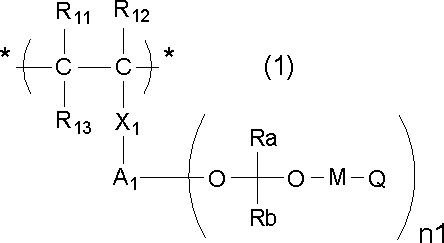
上記一般式(1)中、
X1は、単結合又は2価の連結基を表す。
A1は、ケト基又は(n1+1)価の芳香環基を表し、R11、R12及びR13は、各々独立に、水素原子、アルキル基、シクロアルキル基、ハロゲン原子、シアノ基又はアルコキシカルボニル基を表す。
R13は、A1と結合して環を形成していてもよく、その場合のR13はアルキレン基を表す。
Raは、水素原子、アルキル基、シクロアルキル基、アリール基、アラルキル基、又はヘテロ環基を表し、Rbは、水素原子、アルキル基、シクロアルキル基、アリール基、アラルキル基、又はヘテロ環基を表す。
Mは、単結合又は2価の連結基を表す。Qは、アルキル基、シクロアルキル基、アリール基、アラルキル基、又はヘテロ環基を表す。Ra及びRbが結合して環を形成してもよい。Ra、M及びQの少なくとも2つが結合して環を形成していてもよい。
A1がケト基のとき、n1は1を表し、A1が(n+1)価の芳香族基のとき、n1は、1~4の整数を表す。n1が2以上のとき、複数のRa、複数のRb、複数のM、及び複数のQは、それぞれ、互いに同一であっても異なっていてもよい。
〔6〕
前記化合物(N)として、分子量が500以上の化合物を含有する、上記〔3〕~〔5〕のいずれか1項に記載の感活性光線性又は感放射線性組成物。
〔7〕
前記化合物(N)として、酸の作用によりアルカリ現像液に対する溶解性が減少する化合物(N-1)を含有する、上記〔3〕~〔6〕のいずれか1項に記載の感活性光線性又は感放射線性組成物。
〔8〕
前記化合物(A)が、活性光線又は放射線の照射により酸を発生する部位を有する繰り返し単位を含有する樹脂である、上記〔3〕~〔7〕のいずれか1項に記載の感活性光線性又は感放射線性組成物。
〔9〕
(C)活性光線又は放射線の照射により塩基性が低下する、塩基性化合物又はアンモニウム塩化合物を更に含有する、上記〔3〕~〔8〕のいずれか1項に記載の感活性光線性又は感放射線性組成物。
〔10〕
前記化合物(C)が、カチオン上に窒素原子を有するスルホニウム塩である、上記〔9〕に記載の感活性光線性又は感放射線性組成物。
〔11〕
前記化合物(N)の含有量が前記感活性光線性又は感放射線性組成物の全固形分に対して1質量%以上であり、ポジ型の感活性光線性又は感放射線性組成物である、上記〔1〕又は〔2〕に記載の感活性光線性又は感放射線性組成物。
〔12〕
前記化合物(P)が、酸の作用によりアルカリ現像液に対する溶解性が増大する樹脂である、上記〔11〕に記載の感活性光線性又は感放射線性組成物。
〔13〕
前記化合物(P)が、下記一般式(1)で表される繰り返し単位を有する樹脂である、上記〔12〕に記載の感活性光線性又は感放射線性組成物。

上記一般式(1)中、
X1は、単結合又は2価の連結基を表す。
A1は、ケト基又は(n1+1)価の芳香環基を表し、R11、R12及びR13は、各々独立に、水素原子、アルキル基、シクロアルキル基、ハロゲン原子、シアノ基又はアルコキシカルボニル基を表す。
R13は、A1と結合して環を形成していてもよく、その場合のR13はアルキレン基を表す。
Raは、水素原子、アルキル基、シクロアルキル基、アリール基、アラルキル基、又はヘテロ環基を表し、Rbは、水素原子、アルキル基、シクロアルキル基、アリール基、アラルキル基、又はヘテロ環基を表す。
Mは、単結合又は2価の連結基を表す。Qは、アルキル基、シクロアルキル基、アリール基、アラルキル基、又はヘテロ環基を表す。Ra及びRbが結合して環を形成してもよい。Ra、M及びQの少なくとも2つが結合して環を形成していてもよい。
A1がケト基のとき、n1は1を表し、A1が(n+1)価の芳香族基のとき、n1は、1~4の整数を表す。n1が2以上のとき、複数のRa、複数のRb、複数のM、及び複数のQは、それぞれ、互いに同一であっても異なっていてもよい。
〔14〕
前記化合物(N)として、分子量が500以上の化合物を含有する、上記〔11〕~〔13〕のいずれか1項に記載の感活性光線性又は感放射線性組成物。
〔15〕
前記化合物(N)として、前記酸の作用によりアルカリ現像液に対する溶解性が減少する化合物(N-1)を含有する、上記〔11〕~〔14〕のいずれか1項に記載の感活性光線性又は感放射線性組成物。
〔16〕
前記化合物(A)が、活性光線又は放射線の照射により酸を発生する部位を有する繰り返し単位を含有する樹脂である、上記〔11〕~〔15〕のいずれか1項に記載の感活性光線性又は感放射線性組成物。
〔17〕
(C)活性光線又は放射線の照射により塩基性が低下する塩基性化合物又はアンモニウム塩化合物を更に含有する、上記〔11〕~〔16〕のいずれか1項に記載の感活性光線性又は感放射線性組成物。
〔18〕
前記化合物(C)が、カチオン上に窒素原子を有するスルホニウム塩である、上記〔17〕に記載の感活性光線性又は感放射線性組成物。
〔19〕
上記〔1〕~〔18〕のいずれか1項に記載の感活性光線性又は感放射線性組成物を用いて形成されるレジスト膜。
〔20〕
(ア)上記〔1〕~〔18〕のいずれか1項に記載の感活性光線性又は感放射線性組成物によって膜を形成する工程、
(イ)膜を露光する工程、及び
(ウ)露光された膜を、アルカリ現像液を用いて現像する工程
を含むパターン形成方法。
〔21〕
上記〔1〕~〔18〕のいずれか1項に記載の感活性光線性又は感放射線性組成物を塗布したレジスト塗布マスクブランクス。
〔22〕
上記〔21〕に記載のレジスト塗布マスクブランクスを電子線又はEUV光によって露光する工程、及び、露光されたマスクブランクスをアルカリ現像液によって現像する工程を含むフォトマスクの製造方法。
〔23〕
上記〔22〕に記載のフォトマスク製造方法によって得られるフォトマスク。
〔24〕
上記〔20〕に記載のパターン形成方法を含む電子デバイスの製造方法。
〔25〕
上記〔24〕に記載の電子デバイスの製造方法により製造された電子デバイス。
(A)活性光線又は放射線の照射により酸を発生する化合物、
(P)酸の作用によりアルカリ現像液に対する溶解性が増大する化合物、及び
(N)下記〔N-A〕、〔N-B〕及び〔N-C〕からなる群より選択される少なくとも1種の化合物
〔N-A〕 酸、活性光線若しくは放射線、又は、活性種の作用によりアルカリ現像液に対する溶解性が減少する樹脂
〔N-B〕 活性光線又は放射線の照射により酸を発生し、かつ酸、活性光線若しくは放射線、又は、活性種の作用によりアルカリ現像液に対する溶解性が減少する化合物
〔N-C〕 酸、活性光線若しくは放射線、又は、活性種の作用によりアルカリ現像液に対する溶解性が減少する低分子化合物
を含有する感活性光線性又は感放射線性組成物。
〔2〕
前記感活性光線性又は感放射線性組成物が、アルカリ現像型電子線露光用又はEUV露光用感活性光線性又は感放射線性組成物である、上記〔1〕に記載の感活性光線性又は感放射線性組成物。
〔3〕
前記化合物(N)の含有量が前記感活性光線性又は感放射線性組成物の全固形分に対して10質量%以上であり、ネガ型の感活性光線性又は感放射線性組成物である、上記〔1〕又は〔2〕に記載の感活性光線性又は感放射線性組成物。
〔4〕
前記化合物(P)が、酸の作用によりアルカリ現像液に対する溶解性が増大する樹脂である、上記〔3〕に記載の感活性光線性又は感放射線性組成物。
〔5〕
前記化合物(P)が、下記一般式(1)で表される繰り返し単位を有する樹脂である、上記〔4〕に記載の感活性光線性又は感放射線性組成物。
上記一般式(1)中、
X1は、単結合又は2価の連結基を表す。
A1は、ケト基又は(n1+1)価の芳香環基を表し、R11、R12及びR13は、各々独立に、水素原子、アルキル基、シクロアルキル基、ハロゲン原子、シアノ基又はアルコキシカルボニル基を表す。
R13は、A1と結合して環を形成していてもよく、その場合のR13はアルキレン基を表す。
Raは、水素原子、アルキル基、シクロアルキル基、アリール基、アラルキル基、又はヘテロ環基を表し、Rbは、水素原子、アルキル基、シクロアルキル基、アリール基、アラルキル基、又はヘテロ環基を表す。
Mは、単結合又は2価の連結基を表す。Qは、アルキル基、シクロアルキル基、アリール基、アラルキル基、又はヘテロ環基を表す。Ra及びRbが結合して環を形成してもよい。Ra、M及びQの少なくとも2つが結合して環を形成していてもよい。
A1がケト基のとき、n1は1を表し、A1が(n+1)価の芳香族基のとき、n1は、1~4の整数を表す。n1が2以上のとき、複数のRa、複数のRb、複数のM、及び複数のQは、それぞれ、互いに同一であっても異なっていてもよい。
〔6〕
前記化合物(N)として、分子量が500以上の化合物を含有する、上記〔3〕~〔5〕のいずれか1項に記載の感活性光線性又は感放射線性組成物。
〔7〕
前記化合物(N)として、酸の作用によりアルカリ現像液に対する溶解性が減少する化合物(N-1)を含有する、上記〔3〕~〔6〕のいずれか1項に記載の感活性光線性又は感放射線性組成物。
〔8〕
前記化合物(A)が、活性光線又は放射線の照射により酸を発生する部位を有する繰り返し単位を含有する樹脂である、上記〔3〕~〔7〕のいずれか1項に記載の感活性光線性又は感放射線性組成物。
〔9〕
(C)活性光線又は放射線の照射により塩基性が低下する、塩基性化合物又はアンモニウム塩化合物を更に含有する、上記〔3〕~〔8〕のいずれか1項に記載の感活性光線性又は感放射線性組成物。
〔10〕
前記化合物(C)が、カチオン上に窒素原子を有するスルホニウム塩である、上記〔9〕に記載の感活性光線性又は感放射線性組成物。
〔11〕
前記化合物(N)の含有量が前記感活性光線性又は感放射線性組成物の全固形分に対して1質量%以上であり、ポジ型の感活性光線性又は感放射線性組成物である、上記〔1〕又は〔2〕に記載の感活性光線性又は感放射線性組成物。
〔12〕
前記化合物(P)が、酸の作用によりアルカリ現像液に対する溶解性が増大する樹脂である、上記〔11〕に記載の感活性光線性又は感放射線性組成物。
〔13〕
前記化合物(P)が、下記一般式(1)で表される繰り返し単位を有する樹脂である、上記〔12〕に記載の感活性光線性又は感放射線性組成物。
上記一般式(1)中、
X1は、単結合又は2価の連結基を表す。
A1は、ケト基又は(n1+1)価の芳香環基を表し、R11、R12及びR13は、各々独立に、水素原子、アルキル基、シクロアルキル基、ハロゲン原子、シアノ基又はアルコキシカルボニル基を表す。
R13は、A1と結合して環を形成していてもよく、その場合のR13はアルキレン基を表す。
Raは、水素原子、アルキル基、シクロアルキル基、アリール基、アラルキル基、又はヘテロ環基を表し、Rbは、水素原子、アルキル基、シクロアルキル基、アリール基、アラルキル基、又はヘテロ環基を表す。
Mは、単結合又は2価の連結基を表す。Qは、アルキル基、シクロアルキル基、アリール基、アラルキル基、又はヘテロ環基を表す。Ra及びRbが結合して環を形成してもよい。Ra、M及びQの少なくとも2つが結合して環を形成していてもよい。
A1がケト基のとき、n1は1を表し、A1が(n+1)価の芳香族基のとき、n1は、1~4の整数を表す。n1が2以上のとき、複数のRa、複数のRb、複数のM、及び複数のQは、それぞれ、互いに同一であっても異なっていてもよい。
〔14〕
前記化合物(N)として、分子量が500以上の化合物を含有する、上記〔11〕~〔13〕のいずれか1項に記載の感活性光線性又は感放射線性組成物。
〔15〕
前記化合物(N)として、前記酸の作用によりアルカリ現像液に対する溶解性が減少する化合物(N-1)を含有する、上記〔11〕~〔14〕のいずれか1項に記載の感活性光線性又は感放射線性組成物。
〔16〕
前記化合物(A)が、活性光線又は放射線の照射により酸を発生する部位を有する繰り返し単位を含有する樹脂である、上記〔11〕~〔15〕のいずれか1項に記載の感活性光線性又は感放射線性組成物。
〔17〕
(C)活性光線又は放射線の照射により塩基性が低下する塩基性化合物又はアンモニウム塩化合物を更に含有する、上記〔11〕~〔16〕のいずれか1項に記載の感活性光線性又は感放射線性組成物。
〔18〕
前記化合物(C)が、カチオン上に窒素原子を有するスルホニウム塩である、上記〔17〕に記載の感活性光線性又は感放射線性組成物。
〔19〕
上記〔1〕~〔18〕のいずれか1項に記載の感活性光線性又は感放射線性組成物を用いて形成されるレジスト膜。
〔20〕
(ア)上記〔1〕~〔18〕のいずれか1項に記載の感活性光線性又は感放射線性組成物によって膜を形成する工程、
(イ)膜を露光する工程、及び
(ウ)露光された膜を、アルカリ現像液を用いて現像する工程
を含むパターン形成方法。
〔21〕
上記〔1〕~〔18〕のいずれか1項に記載の感活性光線性又は感放射線性組成物を塗布したレジスト塗布マスクブランクス。
〔22〕
上記〔21〕に記載のレジスト塗布マスクブランクスを電子線又はEUV光によって露光する工程、及び、露光されたマスクブランクスをアルカリ現像液によって現像する工程を含むフォトマスクの製造方法。
〔23〕
上記〔22〕に記載のフォトマスク製造方法によって得られるフォトマスク。
〔24〕
上記〔20〕に記載のパターン形成方法を含む電子デバイスの製造方法。
〔25〕
上記〔24〕に記載の電子デバイスの製造方法により製造された電子デバイス。
本発明によれば、極微細(例えば、線幅50nm以下)なパターンの形成において、高い解像力、優れたパターン形状、及び、低いラインウィズスラフネス(LWR)を同時に高次元で満足できる感活性光線性又は感放射線性組成物を提供することができる。
また、本発明によれば、上記感活性光線性又は感放射線性組成物を用いたレジスト膜、パターン形成方法、レジスト塗布マスクブランクス、フォトマスクの製造方法、フォトマスク、電子デバイスの製造方法、及び、電子デバイスを提供することができる。
また、本発明によれば、上記感活性光線性又は感放射線性組成物を用いたレジスト膜、パターン形成方法、レジスト塗布マスクブランクス、フォトマスクの製造方法、フォトマスク、電子デバイスの製造方法、及び、電子デバイスを提供することができる。
以下、本発明の実施形態について詳細に説明する。
本明細書に於ける基(原子団)の表記に於いて、置換及び無置換を記していない表記は、置換基を有さないものと共に置換基を有するものをも包含するものである。例えば、「アルキル基」とは、置換基を有さないアルキル基(無置換アルキル基)のみならず、置換基を有するアルキル基(置換アルキル基)をも包含するものである。
本発明において「活性光線」又は「放射線」とは、例えば、水銀灯の輝線スペクトル、エキシマレーザーに代表される遠紫外線、極紫外線(EUV光)、X線、電子線、イオンビーム等の粒子線等を意味する。また、本発明において「光」とは、活性光線又は放射線を意味する。
また、本明細書中における「露光」とは、特に断らない限り、水銀灯、エキシマレーザーに代表される遠紫外線、X線、極紫外線(EUV光)などによる露光のみならず、電子線、イオンビーム等の粒子線による描画も含まれるものとする。
本明細書に於ける基(原子団)の表記に於いて、置換及び無置換を記していない表記は、置換基を有さないものと共に置換基を有するものをも包含するものである。例えば、「アルキル基」とは、置換基を有さないアルキル基(無置換アルキル基)のみならず、置換基を有するアルキル基(置換アルキル基)をも包含するものである。
本発明において「活性光線」又は「放射線」とは、例えば、水銀灯の輝線スペクトル、エキシマレーザーに代表される遠紫外線、極紫外線(EUV光)、X線、電子線、イオンビーム等の粒子線等を意味する。また、本発明において「光」とは、活性光線又は放射線を意味する。
また、本明細書中における「露光」とは、特に断らない限り、水銀灯、エキシマレーザーに代表される遠紫外線、X線、極紫外線(EUV光)などによる露光のみならず、電子線、イオンビーム等の粒子線による描画も含まれるものとする。
本発明の感活性光線性又は感放射線性組成物は、
(A)活性光線又は放射線の照射により酸を発生する化合物、
(P)酸の作用によりアルカリ現像液に対する溶解性が増大する化合物、及び
(N)下記〔N-A〕、〔N-B〕及び〔N-C〕からなる群より選択される少なくとも1種の化合物(以下、纏めて、「化合物(N)」ともいう)
〔N-A〕 酸、活性光線若しくは放射線、又は、活性種の作用によりアルカリ現像液に対する溶解性が減少する樹脂
〔N-B〕 活性光線又は放射線の照射により酸を発生し、かつ酸、活性光線若しくは放射線、又は、活性種の作用によりアルカリ現像液に対する溶解性が減少する化合物
〔N-C〕 酸、活性光線若しくは放射線、又は、活性種の作用によりアルカリ現像液に対する溶解性が減少する低分子化合物
を含有する感活性光線性又は感放射線性組成物である。
本発明の感活性光線性又は感放射線性組成物は、好ましくはアルカリ現像型電子線露光用又はEUV露光用感活性光線性又は感放射線性組成物である。つまり、本発明の組成物は、該組成物を用いて形成された膜を、電子線又はEUV光によって露光し、アルカリ現像液で現像するパターン形成方法に使用されることが好ましい。
(A)活性光線又は放射線の照射により酸を発生する化合物、
(P)酸の作用によりアルカリ現像液に対する溶解性が増大する化合物、及び
(N)下記〔N-A〕、〔N-B〕及び〔N-C〕からなる群より選択される少なくとも1種の化合物(以下、纏めて、「化合物(N)」ともいう)
〔N-A〕 酸、活性光線若しくは放射線、又は、活性種の作用によりアルカリ現像液に対する溶解性が減少する樹脂
〔N-B〕 活性光線又は放射線の照射により酸を発生し、かつ酸、活性光線若しくは放射線、又は、活性種の作用によりアルカリ現像液に対する溶解性が減少する化合物
〔N-C〕 酸、活性光線若しくは放射線、又は、活性種の作用によりアルカリ現像液に対する溶解性が減少する低分子化合物
を含有する感活性光線性又は感放射線性組成物である。
本発明の感活性光線性又は感放射線性組成物は、好ましくはアルカリ現像型電子線露光用又はEUV露光用感活性光線性又は感放射線性組成物である。つまり、本発明の組成物は、該組成物を用いて形成された膜を、電子線又はEUV光によって露光し、アルカリ現像液で現像するパターン形成方法に使用されることが好ましい。
本発明により、極微細(例えば、線幅50nm以下)なパターンの形成において、高い解像力、優れたパターン形状、及び、低いラインウィズスラフネス(LWR)を同時に高次元で満足できる感活性光線性又は感放射線性組成物を提供できる理由は定かではないが、以下のように推定される。
本発明の感活性光線性又は感放射線性組成物は、上記したように、酸の作用によりアルカリ現像液に対する溶解性が増大する化合物と、酸、活性光線若しくは放射線、又は活性種の作用によりアルカリ水溶液に対する溶解性が減少する化合物とを含有する。すなわち、本発明の感活性光線性又は感放射線性組成物は、目的の画像とは真逆、すなわちネガ画像を目的とする場合はポジ画像を、ポジ画像を目的とする場合はネガ画像を構成する化合物を含有している。このような逆の形式の画像を形成する作用が、特に、電子線露光における前方散乱及び後方散乱、並びに、EUV露光におけるフレア光及びアウトオブバンド光(波長100~400nmの紫外光領域に発生する漏れ光)等による未露光部での望まない画像形成を打ち消すため、上記の効果が得られると考えられる。
本発明に係る感活性光線性又は感放射線性組成物は、代表的にはポジ型又はネガ型の組成物である。また本発明に係る感活性光線性又は感放射線性組成物は、典型的には化学増幅型のレジスト組成物である。以下、この組成物の構成を説明する。
[1](P)酸の作用によりアルカリ現像液に対する溶解性が増大する化合物
本発明の感活性光線性又は感放射線性組成物は、酸の作用によりアルカリ現像液に対する溶解性が増大する化合物(P)を含有している。
本発明の、酸の作用によりアルカリ現像液に対する溶解性が増大する化合物としては、特に限定されないが、酸の作用によりアルカリ現像液に対する溶解性が増大する樹脂〔P-A〕、活性光線又は放射線の照射により酸を発生し、かつ酸の作用によりアルカリ現像液に対する溶解性が増大する化合物〔P-B〕、及び、酸の作用によりアルカリ現像液に対する溶解性が増大する低分子化合物〔P-C〕等が挙げられる。
本発明の感活性光線性又は感放射線性組成物は、酸の作用によりアルカリ現像液に対する溶解性が増大する化合物(P)を含有している。
本発明の、酸の作用によりアルカリ現像液に対する溶解性が増大する化合物としては、特に限定されないが、酸の作用によりアルカリ現像液に対する溶解性が増大する樹脂〔P-A〕、活性光線又は放射線の照射により酸を発生し、かつ酸の作用によりアルカリ現像液に対する溶解性が増大する化合物〔P-B〕、及び、酸の作用によりアルカリ現像液に対する溶解性が増大する低分子化合物〔P-C〕等が挙げられる。
〔P-A〕酸の作用によりアルカリ現像液に対する溶解性が増大する樹脂
酸の作用によりアルカリ現像液に対する溶解性が増大する樹脂〔P-A〕としては、特に限定されないが、酸の作用により分解し、アルカリ可溶性基を生じる基(以下、「酸分解性基」ともいう)を有する樹脂であることが好ましい。
酸の作用によりアルカリ現像液に対する溶解性が増大する樹脂〔P-A〕としては、特に限定されないが、酸の作用により分解し、アルカリ可溶性基を生じる基(以下、「酸分解性基」ともいう)を有する樹脂であることが好ましい。
酸分解性基は、アルカリ可溶性基を酸の作用により分解し脱離する基で保護された構造を有することが好ましい。
アルカリ可溶性基としては、フェノール性水酸基、カルボキシル基、フッ素化アルコール基、スルホン酸基、スルホンアミド基、スルホニルイミド基、(アルキルスルホニル)(アルキルカルボニル)メチレン基、(アルキルスルホニル)(アルキルカルボニル)イミド基、ビス(アルキルカルボニル)メチレン基、ビス(アルキルカルボニル)イミド基、ビス(アルキルスルホニル)メチレン基、ビス(アルキルスルホニル)イミド基、トリス(アルキルカルボニル)メチレン基、トリス(アルキルスルホニル)メチレン基等が挙げられる。
アルカリ可溶性基としては、フェノール性水酸基、カルボキシル基、フッ素化アルコール基、スルホン酸基、スルホンアミド基、スルホニルイミド基、(アルキルスルホニル)(アルキルカルボニル)メチレン基、(アルキルスルホニル)(アルキルカルボニル)イミド基、ビス(アルキルカルボニル)メチレン基、ビス(アルキルカルボニル)イミド基、ビス(アルキルスルホニル)メチレン基、ビス(アルキルスルホニル)イミド基、トリス(アルキルカルボニル)メチレン基、トリス(アルキルスルホニル)メチレン基等が挙げられる。
好ましいアルカリ可溶性基としては、フェノール性水酸基、カルボキシル基、フッ素化アルコール基(好ましくはヘキサフルオロイソプロパノール基)、スルホン酸基が挙げられる。
酸分解性基として好ましい基は、これらのアルカリ可溶性基の水素原子を酸で脱離する基で置換した基である。
酸で脱離する基としては、例えば、-C(R36)(R37)(R38)、-C(R36)(R37)(OR39)、-C(R01)(R02)(OR39)等を挙げることができる。
式中、R36~R39は、各々独立に、アルキル基、シクロアルキル基、アリール基、アラルキル基又はアルケニル基を表す。R36とR37とは、互いに結合して環を形成してもよい。
酸で脱離する基としては、例えば、-C(R36)(R37)(R38)、-C(R36)(R37)(OR39)、-C(R01)(R02)(OR39)等を挙げることができる。
式中、R36~R39は、各々独立に、アルキル基、シクロアルキル基、アリール基、アラルキル基又はアルケニル基を表す。R36とR37とは、互いに結合して環を形成してもよい。
R01及びR02は、各々独立に、水素原子、アルキル基、シクロアルキル基、アリール基、アラルキル基又はアルケニル基を表す。
酸分解性基としては好ましくは、クミルエステル基、エノールエステル基、アセタールエステル基、第3級のアルキルエステル基等である。更に好ましくは、第3級アルキルエステル基である。
樹脂〔P-A〕が酸分解性基を有する樹脂である場合、樹脂〔P-A〕は、酸分解性基を有する繰り返し単位を有する樹脂であることが好ましく、下記一般式(1)又は(V)で表される繰り返し単位を有する樹脂であることがより好ましく、下記一般式(1)で表される繰り返し単位を有する樹脂であることが更に好ましい。
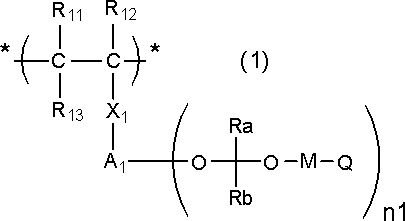
上記一般式(1)中、
X1は、単結合又は2価の連結基を表す。
A1は、ケト基、又は(n1+1)価の芳香環基を表す。
R11、R12及びR13は、各々独立に、水素原子、アルキル基、シクロアルキル基、ハロゲン原子、シアノ基又はアルコキシカルボニル基を表す。
R13は、A1と結合して環を形成していてもよく、その場合のR13はアルキレン基を表す。
Raは、水素原子、アルキル基、シクロアルキル基、アリール基、アラルキル基、又はヘテロ環基を表し、Raは炭素数2以上の基であることが好ましい、Rbは、水素原子、アルキル基、シクロアルキル基、アリール基、アラルキル基、又はヘテロ環基を表す。
Mは、単結合又は2価の連結基を表す。Qは、アルキル基、シクロアルキル基、アリール基、アラルキル基、又はヘテロ環基を表す。Ra及びRbが結合して環を形成してもよい。Ra、M及びQの少なくとも2つが結合して環を形成していてもよい。
A1がケト基のとき、n1は1を表し、A1が(n+1)価の芳香族基のとき、n1は、1~4の整数を表す。n1が2以上のとき、複数のRa、複数のRb、複数のM、及び複数のQは、それぞれ、互いに同一であっても異なっていてもよい。
X1は、単結合又は2価の連結基を表す。
A1は、ケト基、又は(n1+1)価の芳香環基を表す。
R11、R12及びR13は、各々独立に、水素原子、アルキル基、シクロアルキル基、ハロゲン原子、シアノ基又はアルコキシカルボニル基を表す。
R13は、A1と結合して環を形成していてもよく、その場合のR13はアルキレン基を表す。
Raは、水素原子、アルキル基、シクロアルキル基、アリール基、アラルキル基、又はヘテロ環基を表し、Raは炭素数2以上の基であることが好ましい、Rbは、水素原子、アルキル基、シクロアルキル基、アリール基、アラルキル基、又はヘテロ環基を表す。
Mは、単結合又は2価の連結基を表す。Qは、アルキル基、シクロアルキル基、アリール基、アラルキル基、又はヘテロ環基を表す。Ra及びRbが結合して環を形成してもよい。Ra、M及びQの少なくとも2つが結合して環を形成していてもよい。
A1がケト基のとき、n1は1を表し、A1が(n+1)価の芳香族基のとき、n1は、1~4の整数を表す。n1が2以上のとき、複数のRa、複数のRb、複数のM、及び複数のQは、それぞれ、互いに同一であっても異なっていてもよい。
一般式(1)におけるR11~R13のアルキル基としては、好ましくは置換基を有していてもよいメチル基、エチル基、プロピル基、イソプロピル基、n-ブチル基、sec-ブチル基、ヘキシル基、2-エチルヘキシル基、オクチル基、ドデシル基など炭素数20以下のアルキル基が挙げられ、より好ましくは炭素数8以下のアルキル基が挙げられる。
アルコキシカルボニル基に含まれるアルキル基としては、上記R11~R13におけるアルキル基と同様のものが好ましい。
シクロアルキル基としては、単環型でも多環型でもよく、好ましくは置換基を有していても良いシクロプロピル基、シクロペンチル基、シクロヘキシル基のような炭素数3~10個の単環型のシクロアルキル基が挙げられる。
ハロゲン原子としては、フッ素原子、塩素原子、臭素原子及びヨウ素原子が挙げられ、フッ素原子がより好ましい。
アルコキシカルボニル基に含まれるアルキル基としては、上記R11~R13におけるアルキル基と同様のものが好ましい。
シクロアルキル基としては、単環型でも多環型でもよく、好ましくは置換基を有していても良いシクロプロピル基、シクロペンチル基、シクロヘキシル基のような炭素数3~10個の単環型のシクロアルキル基が挙げられる。
ハロゲン原子としては、フッ素原子、塩素原子、臭素原子及びヨウ素原子が挙げられ、フッ素原子がより好ましい。
上記各基における好ましい置換基としては、例えば、アルキル基、シクロアルキル基、アリール基、アミノ基、アミド基、ウレイド基、ウレタン基、ヒドロキシル基、カルボキシル基、ハロゲン原子、アルコキシ基、チオエーテル基、アシル基、アシルオキシ基、アルコキシカルボニル基、シアノ基、ニトロ基等を挙げることができ、置換基の炭素数は8以下が好ましい。
またR13がアルキレン基でありA1と環を形成する場合、アルキレン基としては、好ましくはメチレン基、エチレン基、プロピレン基、ブチレン基、ヘキシレン基、オクチレン基等の炭素数1~8のアルキレン基が挙げられる。炭素数1~4のアルキレン基がより好ましく、炭素数1~2のアルキレン基が特に好ましい。R13とA1とが結合して形成する環は、5又は6員環であることが特に好ましい。
式(1)におけるR11及びR12としては、水素原子、アルキル基、ハロゲン原子がより好ましく、水素原子、メチル基、エチル基、トリフルオロメチル基(-CF3)、ヒドロキシメチル基(-CH2-OH)、クロロメチル基(-CH2-Cl)、フッ素原子(-F)が特に好ましい。R13としては、水素原子、アルキル基、ハロゲン原子、アルキレン基(L5と環を形成)がより好ましく、水素原子、メチル基、エチル基、トリフルオロメチル基(-CF3)、ヒドロキシメチル基(-CH2-OH)、クロロメチル基(-CH2-Cl)、フッ素原子(-F)、メチレン基(A1と環を形成)、エチレン基(A1と環を形成)が特に好ましい。
X1で表される2価の連結基としては、-COO-、-CONR14-(R14は、水素原子、アルキル基を表す)、アルキレン基、これらの2つ以上を組み合わせて形成される基等が挙げられる。ここで、R14のアルキル基としては、R11~R13のアルキル基と同様のものが挙げられる。
X1としては、単結合、-COO-、-CONH-が好ましく、単結合、-COO-がより好ましく、単結合であることが更に好ましい。
A1は、ケト基、又は(n1+1)価の芳香環基を表し、(n1+1)価の芳香環基であることが好ましい。
n1が1である場合における2価の芳香環基は、置換基を有していても良く、例えば、フェニレン基、トリレン基、ナフチレン基などの炭素数6~18のアリーレン基、あるいは、例えば、チオフェン、フラン、ピロール、ベンゾチオフェン、ベンゾフラン、ベンゾピロール、トリアジン、イミダゾール、ベンゾイミダゾール、トリアゾール、チアジアゾール、チアゾール等のヘテロ環を含む2価の芳香環基を好ましい例として挙げることができる。
X1としては、単結合、-COO-、-CONH-が好ましく、単結合、-COO-がより好ましく、単結合であることが更に好ましい。
A1は、ケト基、又は(n1+1)価の芳香環基を表し、(n1+1)価の芳香環基であることが好ましい。
n1が1である場合における2価の芳香環基は、置換基を有していても良く、例えば、フェニレン基、トリレン基、ナフチレン基などの炭素数6~18のアリーレン基、あるいは、例えば、チオフェン、フラン、ピロール、ベンゾチオフェン、ベンゾフラン、ベンゾピロール、トリアジン、イミダゾール、ベンゾイミダゾール、トリアゾール、チアジアゾール、チアゾール等のヘテロ環を含む2価の芳香環基を好ましい例として挙げることができる。
n1が2以上の整数である場合における(n1+1)価の芳香環基の具体例としては、2価の芳香環基の上記した具体例から、(n1-1)個の任意の水素原子を除してなる基を好適に挙げることができる。
(n1+1)価の芳香環基は、更に置換基を有していても良い。
上述した(n1+1)価の芳香環基が有し得る置換基としては、R11~R13により表わされる各基が有し得る置換基と同様の具体例が挙げられる。
A1が、(n1+1)価の芳香環基のとき、n1は1又は2であることが好ましく、1であることがより好ましい。
(n1+1)価の芳香環基は、更に置換基を有していても良い。
上述した(n1+1)価の芳香環基が有し得る置換基としては、R11~R13により表わされる各基が有し得る置換基と同様の具体例が挙げられる。
A1が、(n1+1)価の芳香環基のとき、n1は1又は2であることが好ましく、1であることがより好ましい。
Raとしてのアルキル基は、例えば炭素数2~8個のアルキル基であって、具体的には、メチル基、エチル基、プロピル基、n-ブチル基、sec-ブチル基、t-ブチル基、ヘキシル基、オクチル基を好ましく挙げることができる。
Rbとしてのアルキル基は、例えば炭素数1~8個のアルキル基であって、具体的には、メチル基、エチル基、プロピル基、n-ブチル基、sec-ブチル基、t-ブチル基、ヘキシル基、オクチル基を好ましく挙げることができる。
Ra及びRbとしてのシクロアルキル基は、例えば炭素数3~15個のシクロアルキル基であって、具体的には、シクロペンチル基、シクロヘキシル基、ノルボルニル基、アダマンチル基等を好ましい例として挙げることができる。
Rbとしてのアルキル基は、例えば炭素数1~8個のアルキル基であって、具体的には、メチル基、エチル基、プロピル基、n-ブチル基、sec-ブチル基、t-ブチル基、ヘキシル基、オクチル基を好ましく挙げることができる。
Ra及びRbとしてのシクロアルキル基は、例えば炭素数3~15個のシクロアルキル基であって、具体的には、シクロペンチル基、シクロヘキシル基、ノルボルニル基、アダマンチル基等を好ましい例として挙げることができる。
Ra及びRbとしてのアリール基は、例えば炭素数6~15個のアリール基であって、具体的には、フェニル基、トリル基、ナフチル基、アントリル基等を好ましい例として挙げることができる。
Ra及びRbとしてのアラルキル基は、炭素数6~20のアラルキル基であることが好ましく、炭素数7~12のアラルキル基であることより好ましい。Ra及びRbのアラルキル基の具体例としては、例えば、ベンジル基、フェネチル基、ナフチルメチル基、ナフチルエチル基等が挙げられる。
Ra及びRbとしてのヘテロ環基は、炭素数6~20のヘテロ環基であることが好ましく、炭素数6~12のヘテロ環基であることがより好ましい。Ra及びRbのヘテロ環基の具体例としては、例えば、ピリジル基、ピラジル基、テトラヒドロフラニル基、テトラヒドロピラニル基、テトラヒドロチオフェン基、ピペリジル基、ピペラジル基、フラニル基、ピラニル基、クロマニル基等が挙げられる。
Ra及びRbとしてのアラルキル基は、炭素数6~20のアラルキル基であることが好ましく、炭素数7~12のアラルキル基であることより好ましい。Ra及びRbのアラルキル基の具体例としては、例えば、ベンジル基、フェネチル基、ナフチルメチル基、ナフチルエチル基等が挙げられる。
Ra及びRbとしてのヘテロ環基は、炭素数6~20のヘテロ環基であることが好ましく、炭素数6~12のヘテロ環基であることがより好ましい。Ra及びRbのヘテロ環基の具体例としては、例えば、ピリジル基、ピラジル基、テトラヒドロフラニル基、テトラヒドロピラニル基、テトラヒドロチオフェン基、ピペリジル基、ピペラジル基、フラニル基、ピラニル基、クロマニル基等が挙げられる。
前記一般式(1)において、酸分解性基の適度な安定性と適度な酸分解反応性の観点から、Raは、炭素数2以上のアルキル基、又は、下記一般式(4)で表される基であることがより好ましい。また、Rbは水素原子であることが好ましい。

上記一般式(4)中、
Rdはアルキル基、シクロアルキル基又はアリール基を表し、Re及びRfは各々独立に水素原子、アルキル基、シクロアルキル基又はアリール基を表す。RdはRe及びRfのいずれか、又は全てと結合し、環構造を形成していてもよい。
Rd、Re、及びRfのアルキル基としては、Rbとしてのアルキル基として前述したアルキル基と同様のものが挙げられる。
Rd、Re、及びRfのシクロアルキル基、アリール基としては、Ra及びRbとしてのシクロアルキル基、アリール基として前述したシクロアルキル基、アリール基と同様のものが挙げられる。
Rdはアルキル基、シクロアルキル基又はアリール基を表し、Re及びRfは各々独立に水素原子、アルキル基、シクロアルキル基又はアリール基を表す。RdはRe及びRfのいずれか、又は全てと結合し、環構造を形成していてもよい。
Rd、Re、及びRfのアルキル基としては、Rbとしてのアルキル基として前述したアルキル基と同様のものが挙げられる。
Rd、Re、及びRfのシクロアルキル基、アリール基としては、Ra及びRbとしてのシクロアルキル基、アリール基として前述したシクロアルキル基、アリール基と同様のものが挙げられる。
Mとしての2価の連結基は、例えば、アルキレン基(例えば、メチレン基、エチレン基、プロピレン基、ブチレン基、ヘキシレン基、オクチレン基など)、シクロアルキレン基(例えば、シクロペンチレン基、シクロヘキシレン基、アダマンチレン基など)、アルケニレン基(例えば、エテニレン基、プロペニレン基、ブテニレン基など)、2価の芳香環基(例えば、フェニレン基、トリレン基、ナフチレン基など)、-S-、-O-、-CO-、-SO2-、-N(R0)-、及びこれらの複数を組み合わせた2価の連結基である。R0は、水素原子又はアルキル基(例えば炭素数1~8個のアルキル基であって、具体的には、メチル基、エチル基、プロピル基、n-ブチル基、sec-ブチル基、ヘキシル基、オクチル基など)である。
Qとしてのアルキル基の具体例及び好ましい例は、例えば、上述したRbとしてのアルキル基について記載したものと同様である。
Qとしてのアルキル基の具体例及び好ましい例は、例えば、上述したRbとしてのアルキル基について記載したものと同様である。
Qとしてのシクロアルキル基は、単環型であってもよく、多環型であってもよい。このシクロアルキル基の炭素数は、好ましくは3~10とする。このシクロアルキル基としては、例えば、シクロプロピル基、シクロブチル基、シクロペンチル基、シクロヘキシル基、シクロヘプチル基、シクロオクチル基、1-アダマンチル基、2-アダマンチル基、1-ノルボルニル基、2-ノルボルニル基、ボルニル基、イソボルニル基、4-テトラシクロ[6.2.1.13,6.02,7]ドデシル基、8-トリシクロ[5.2.1.02,6]デシル基、2-ビシクロ[2.2.1]ヘプチル基が挙げられる。中でも、シクロペンチル基、シクロヘキシル基、2-アダマンチル基、8-トリシクロ[5.2.1.02,6]デシル基、2-ビシクロ[2.2.1]ヘプチル基が好ましい。
Qとしてのアリール基の具体例及び好ましい例は、例えば、上述したRaとしてのアリール基について説明したものと同様である。
Qとしてのヘテロ環基の具体例及び好ましい例は、例えば、上述したRaとしてのヘテロ環基について説明したものと同様である。
Qとしてのアルキル基、シクロアルキル基、アリール基及びヘテロ環基は、置換基を有していてもよく、R11~R13により表わされる各基が有し得る置換基と同様の具体例が挙げられる。
Qとしてのアリール基の具体例及び好ましい例は、例えば、上述したRaとしてのアリール基について説明したものと同様である。
Qとしてのヘテロ環基の具体例及び好ましい例は、例えば、上述したRaとしてのヘテロ環基について説明したものと同様である。
Qとしてのアルキル基、シクロアルキル基、アリール基及びヘテロ環基は、置換基を有していてもよく、R11~R13により表わされる各基が有し得る置換基と同様の具体例が挙げられる。
Q、M、Raの少なくとも2つが結合して環(好ましくは、5員若しくは6員環)を形成してもよい。
Q、M、Raの少なくとも2つが結合して形成してもよい環としては、Q、M、Raの少なくとも2つが結合して、例えば、プロピレン基、ブチレン基を形成して、酸素原子を含有する5員又は6員環を形成する場合が挙げられる。
一般式(1)におけるRa、Rb、M、Qで表される各基は、置換基を有していてもよく、例えば、R11~R13により表わされる各基が有し得る置換基と同様の具体例が挙げられ、置換基の炭素数は8以下が好ましい。
Q、M、Raの少なくとも2つが結合して形成してもよい環としては、Q、M、Raの少なくとも2つが結合して、例えば、プロピレン基、ブチレン基を形成して、酸素原子を含有する5員又は6員環を形成する場合が挙げられる。
一般式(1)におけるRa、Rb、M、Qで表される各基は、置換基を有していてもよく、例えば、R11~R13により表わされる各基が有し得る置換基と同様の具体例が挙げられ、置換基の炭素数は8以下が好ましい。
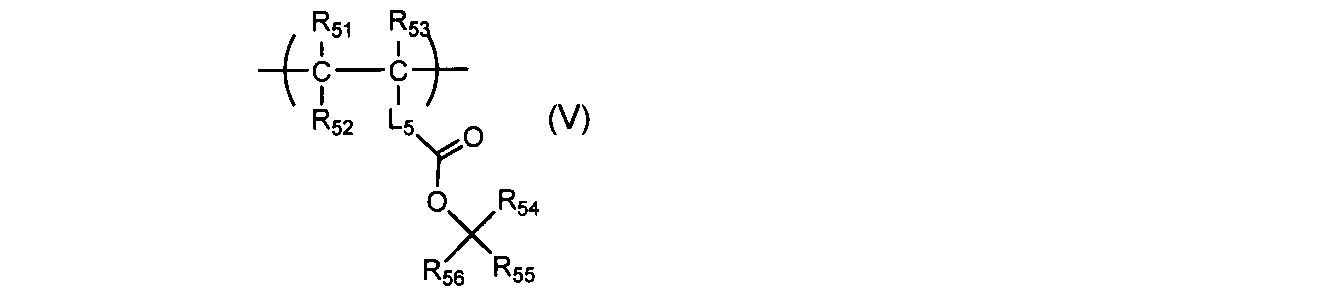
一般式(V)中、
R51、R52、及びR53は、各々独立に、水素原子、アルキル基、シクロアルキル基、ハロゲン原子、シアノ基、又はアルコキシカルボニル基を表す。R52はL5と結合して環を形成していてもよく、その場合のR52はアルキレン基を表す。
L5は、単結合又は2価の連結基を表し、R52と環を形成する場合には3価の連結基を表す。
R54はアルキル基を表し、R55及びR56は、各々独立に、水素原子、アルキル基、シクロアルキル基、アリール基、又はアラルキル基を表す。R55及びR56は互いに結合して環を形成してもよい。但し、R55とR56とが同時に水素原子であることはない。
R51、R52、及びR53は、各々独立に、水素原子、アルキル基、シクロアルキル基、ハロゲン原子、シアノ基、又はアルコキシカルボニル基を表す。R52はL5と結合して環を形成していてもよく、その場合のR52はアルキレン基を表す。
L5は、単結合又は2価の連結基を表し、R52と環を形成する場合には3価の連結基を表す。
R54はアルキル基を表し、R55及びR56は、各々独立に、水素原子、アルキル基、シクロアルキル基、アリール基、又はアラルキル基を表す。R55及びR56は互いに結合して環を形成してもよい。但し、R55とR56とが同時に水素原子であることはない。
一般式(V)について、更に詳細に説明する。
一般式(V)におけるR51~R53のアルキル基、アルコキシカルボニル基、シクロアルキル基、ハロゲン原子の具体例、好ましい例としては、一般式(1)におけるR11~R13のアルキル基、アルコキシカルボニル基、シクロアルキル基、ハロゲン原子の具体例、好ましい例と同様のものが挙げられる。
一般式(V)におけるR51~R53のアルキル基、アルコキシカルボニル基、シクロアルキル基、ハロゲン原子の具体例、好ましい例としては、一般式(1)におけるR11~R13のアルキル基、アルコキシカルボニル基、シクロアルキル基、ハロゲン原子の具体例、好ましい例と同様のものが挙げられる。
L5で表される2価の連結基としては、アルキレン基、2価の芳香環基、-COO-L1-、-O-L1-、これらの2つ以上を組み合わせて形成される基等が挙げられる。ここで、L1はアルキレン基、シクロアルキレン基、2価の芳香環基、アルキレン基と2価の芳香環基を組み合わせた基を表す。
L5は、単結合、-COO-L1-で表される基又は2価の芳香環基が好ましい。L1は炭素数1~5のアルキレン基が好ましく、メチレン、プロピレン基がより好ましい。2価の芳香環基としては、1,4-フェニレン基、1,3-フェニレン基、1,2-フェニレン基、1,4-ナフチレン基が好ましく、1,4-フェニレン基がより好ましい。
L5がR52と結合して環を形成する場合における、L5で表される3価の連結基としては、L5で表される2価の連結基の上記した具体例から1個の任意の水素原子を除してなる基を好適に挙げることができる。
R54~R56のアルキル基としては炭素数1~20のものが好ましく、より好ましくは炭素数1~10のものであり、メチル基、エチル基、n-プロピル基、イソプロピル基、n-ブチル基、イソブチル基、t-ブチル基などの炭素数1~4のものが特に好ましい。
R55及びR56で表されるシクロアルキル基としては、炭素数3~20のものが好ましく、シクロペンチル基、シクロヘキシル基等の単環性のものであってもよいし、ノルボニル基、アダマンチル基、テトラシクロデカニル基、テトラシクロドデカニル基、等の多環性のものであってもよい。
L5は、単結合、-COO-L1-で表される基又は2価の芳香環基が好ましい。L1は炭素数1~5のアルキレン基が好ましく、メチレン、プロピレン基がより好ましい。2価の芳香環基としては、1,4-フェニレン基、1,3-フェニレン基、1,2-フェニレン基、1,4-ナフチレン基が好ましく、1,4-フェニレン基がより好ましい。
L5がR52と結合して環を形成する場合における、L5で表される3価の連結基としては、L5で表される2価の連結基の上記した具体例から1個の任意の水素原子を除してなる基を好適に挙げることができる。
R54~R56のアルキル基としては炭素数1~20のものが好ましく、より好ましくは炭素数1~10のものであり、メチル基、エチル基、n-プロピル基、イソプロピル基、n-ブチル基、イソブチル基、t-ブチル基などの炭素数1~4のものが特に好ましい。
R55及びR56で表されるシクロアルキル基としては、炭素数3~20のものが好ましく、シクロペンチル基、シクロヘキシル基等の単環性のものであってもよいし、ノルボニル基、アダマンチル基、テトラシクロデカニル基、テトラシクロドデカニル基、等の多環性のものであってもよい。
また、R55及びR56が互いに結合して形成される環としては、炭素数3~20のものが好ましく、シクロペンチル基、シクロヘキシル基等の単環性のものであってもよいし、ノルボニル基、アダマンチル基、テトラシクロデカニル基、テトラシクロドデカニル基、等の多環性のものであってもよい。R55及びR56が互いに結合して環を形成する場合、R54は炭素数1~3のアルキル基が好ましく、メチル基、エチル基がより好ましい。
R55及びR56で表されるアリール基としては、炭素数6~20のものが好ましく、単環でも多環でもよく、置換基を有しても良い。例えば、フェニル基、1-ナフチル基、2-ナフチル基、4-メチルフェニル基、4―メトキシフェニル基等が挙げられる。R55及びR56のどちらか一方が水素原子の場合、他方はアリール基であることが好ましい。
R55及びR56で表されるアラルキル基としては、単環でも多環でもよく、置換基を有しても良い。好ましくは炭素数7~21であり、ベンジル基、1-ナフチルメチル基等が挙げられる。
R55及びR56で表されるアリール基としては、炭素数6~20のものが好ましく、単環でも多環でもよく、置換基を有しても良い。例えば、フェニル基、1-ナフチル基、2-ナフチル基、4-メチルフェニル基、4―メトキシフェニル基等が挙げられる。R55及びR56のどちらか一方が水素原子の場合、他方はアリール基であることが好ましい。
R55及びR56で表されるアラルキル基としては、単環でも多環でもよく、置換基を有しても良い。好ましくは炭素数7~21であり、ベンジル基、1-ナフチルメチル基等が挙げられる。
一般式(V)で表される繰り返し単位に相当するモノマーの合成方法としては、一般的な重合性基含有エステルの合成法を適用することが可能であり、特に限定されることはない。
樹脂〔P-A〕が酸分解性基を有する樹脂である場合、樹脂〔P-A〕は、下記一般式(AI)で表される繰り返し単位を有する樹脂であることが好ましい。
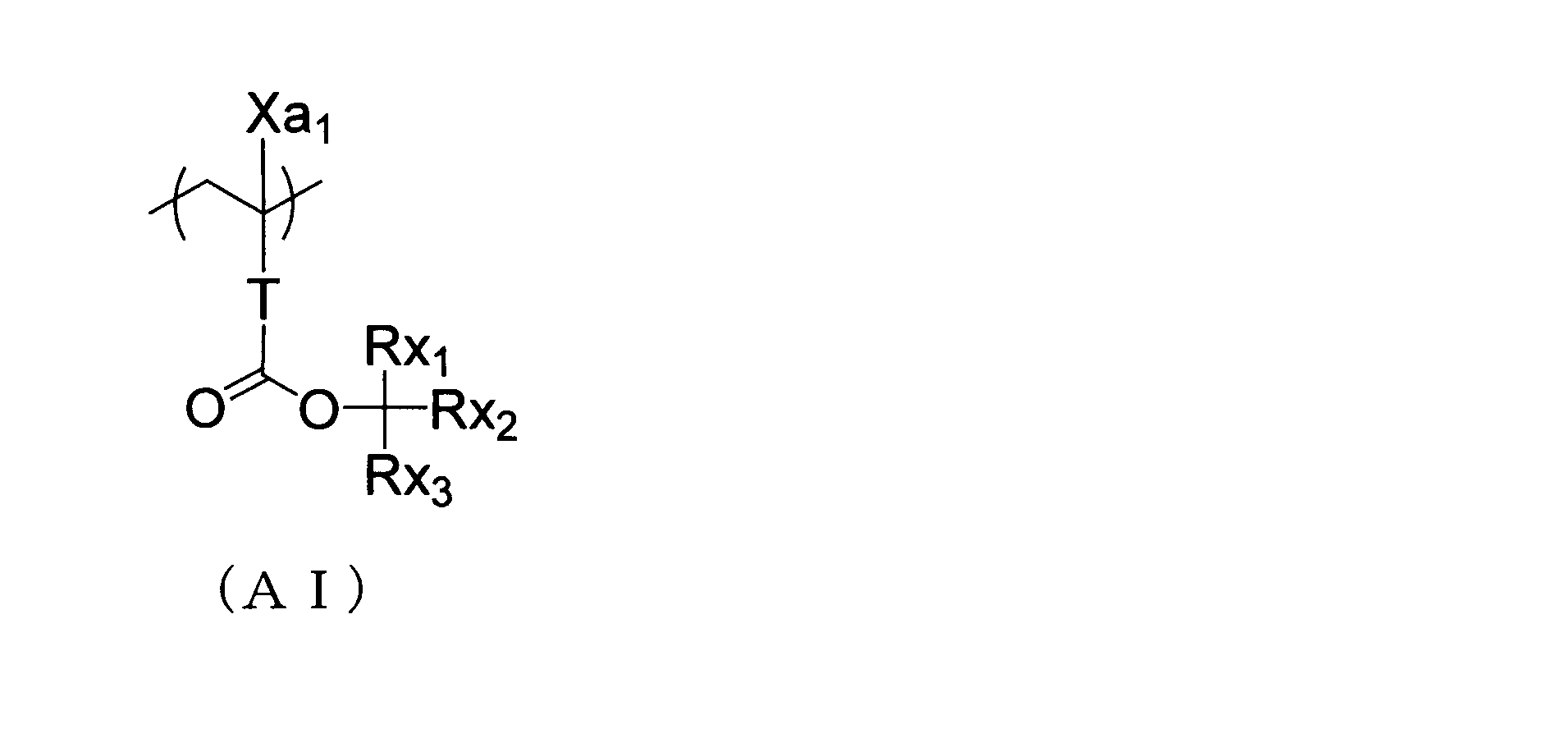
一般式(AI)に於いて、
Xa1は、水素原子、置換基を有していてもよいメチル基又は-CH2-R9で表される基を表す。R9は、水酸基又は1価の有機基を表す。1価の有機基としては、例えば、炭素数5以下のアルキル基、アシル基が挙げられ、好ましくは炭素数3以下のアルキル基であり、更に好ましくはメチル基である。Xa1は好ましくは水素原子、メチル基、トリフルオロメチル基又はヒドロキシメチル基を表す。
Tは、単結合又は2価の連結基を表す。
Rx1~Rx3は、それぞれ独立に、アルキル基(直鎖若しくは分岐)又はシクロアルキル基(単環若しくは多環)を表す。
Rx1~Rx3の2つが結合して、シクロアルキル基(単環若しくは多環)を形成してもよい。
Xa1は、水素原子、置換基を有していてもよいメチル基又は-CH2-R9で表される基を表す。R9は、水酸基又は1価の有機基を表す。1価の有機基としては、例えば、炭素数5以下のアルキル基、アシル基が挙げられ、好ましくは炭素数3以下のアルキル基であり、更に好ましくはメチル基である。Xa1は好ましくは水素原子、メチル基、トリフルオロメチル基又はヒドロキシメチル基を表す。
Tは、単結合又は2価の連結基を表す。
Rx1~Rx3は、それぞれ独立に、アルキル基(直鎖若しくは分岐)又はシクロアルキル基(単環若しくは多環)を表す。
Rx1~Rx3の2つが結合して、シクロアルキル基(単環若しくは多環)を形成してもよい。
Tの2価の連結基としては、アルキレン基、-COO-Rt-基、-O-Rt-基等が挙げられる。式中、Rtは、アルキレン基又はシクロアルキレン基を表す。
Tは、単結合が好ましい。Rtは、炭素数1~5のアルキレン基が好ましく、-CH2-基がより好ましい。
Rx1~Rx3のアルキル基としては、炭素数1~5の直鎖又は分岐状のものが好ましい。
Rx1~Rx3のシクロアルキル基としては、炭素数3~8の単環のシクロアルキル基、炭素数7~20の多環のシクロアルキル基が好ましい。Rx1~Rx3のシクロアルキル基はスピロ環でもよい。
Rx1~Rx3の2つが結合して形成されるシクロアルキル基としては、炭素数3~8の単環のシクロアルキル基、炭素数7~20の多環のシクロアルキル基が好ましい。炭素数5~6の単環のシクロアルキル基が特に好ましい。Rx1~Rx3の2つが結合して形成されるシクロアルキル基は、スピロ環でもよい。
Rx1がメチル基、エチル基、イソプロピル基であり、Rx2とRx3とが結合して上述のシクロアルキル基を形成している態様が好ましい。
Tは、単結合が好ましい。Rtは、炭素数1~5のアルキレン基が好ましく、-CH2-基がより好ましい。
Rx1~Rx3のアルキル基としては、炭素数1~5の直鎖又は分岐状のものが好ましい。
Rx1~Rx3のシクロアルキル基としては、炭素数3~8の単環のシクロアルキル基、炭素数7~20の多環のシクロアルキル基が好ましい。Rx1~Rx3のシクロアルキル基はスピロ環でもよい。
Rx1~Rx3の2つが結合して形成されるシクロアルキル基としては、炭素数3~8の単環のシクロアルキル基、炭素数7~20の多環のシクロアルキル基が好ましい。炭素数5~6の単環のシクロアルキル基が特に好ましい。Rx1~Rx3の2つが結合して形成されるシクロアルキル基は、スピロ環でもよい。
Rx1がメチル基、エチル基、イソプロピル基であり、Rx2とRx3とが結合して上述のシクロアルキル基を形成している態様が好ましい。
以下に、酸分解性基を有する繰り返し単位の具体例を示すが、本発明はこれに限定されるものではない。
具体例中、Rx、Xa1は、水素原子、CH3、CF3、又はCH2OHを表す。Rxa、Rxbは、それぞれ独立して、炭素数1~4のアルキル基、炭素数6~18のアリール基、又は、炭素数7~19のアラルキル基を表す。Zは、置換基を表す。pは0又は正の整数を表し、好ましくは0~2であり、より好ましくは0又は1である。Zが複数存在する場合、互いに同じでも異なっていてもよい。Zとしては、水素原子及び炭素原子のみからなる基が好適に挙げられ、例えば、直鎖又は分岐のアルキル基、シクロアルキル基であることが好ましい。
具体例中、Rx、Xa1は、水素原子、CH3、CF3、又はCH2OHを表す。Rxa、Rxbは、それぞれ独立して、炭素数1~4のアルキル基、炭素数6~18のアリール基、又は、炭素数7~19のアラルキル基を表す。Zは、置換基を表す。pは0又は正の整数を表し、好ましくは0~2であり、より好ましくは0又は1である。Zが複数存在する場合、互いに同じでも異なっていてもよい。Zとしては、水素原子及び炭素原子のみからなる基が好適に挙げられ、例えば、直鎖又は分岐のアルキル基、シクロアルキル基であることが好ましい。
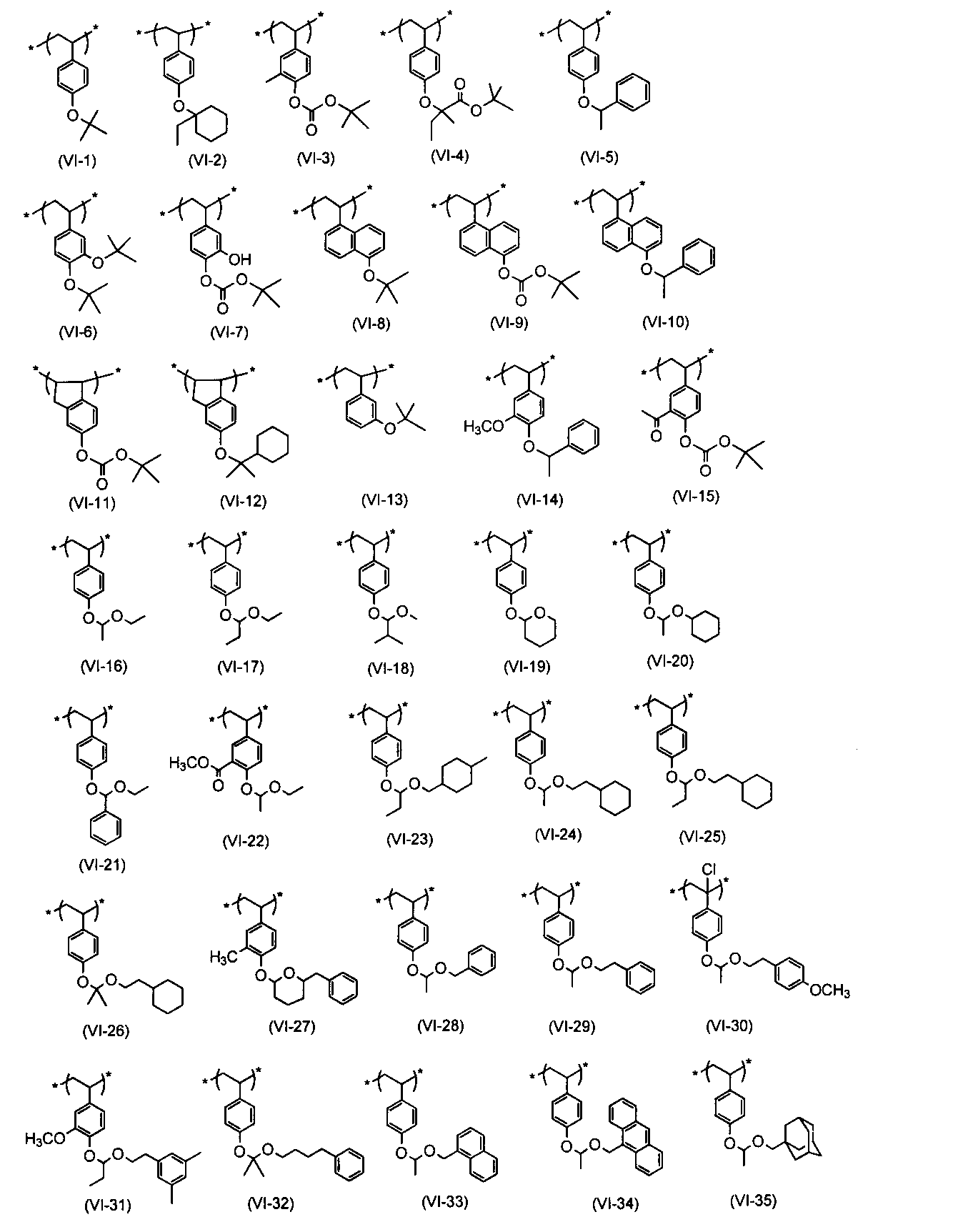

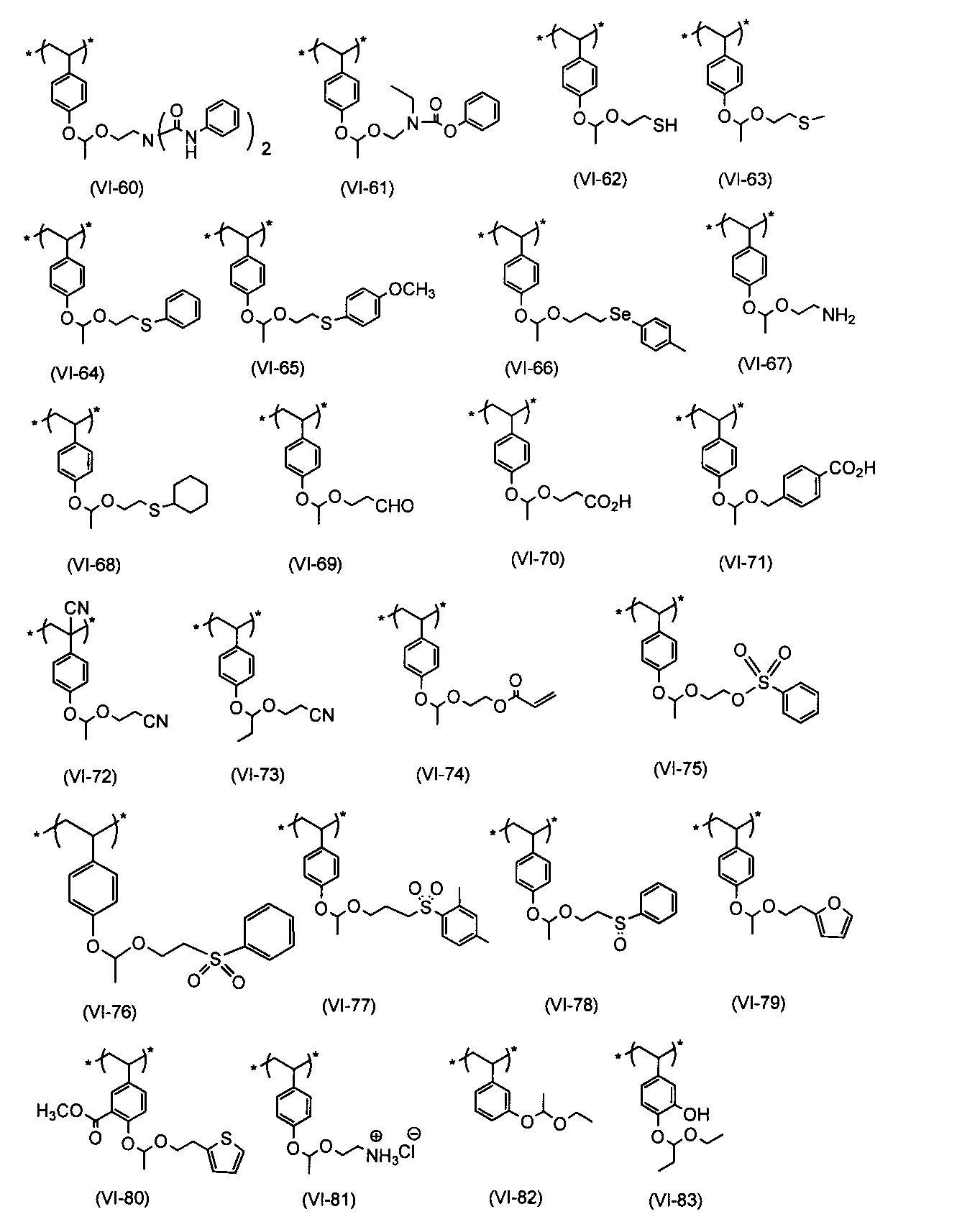
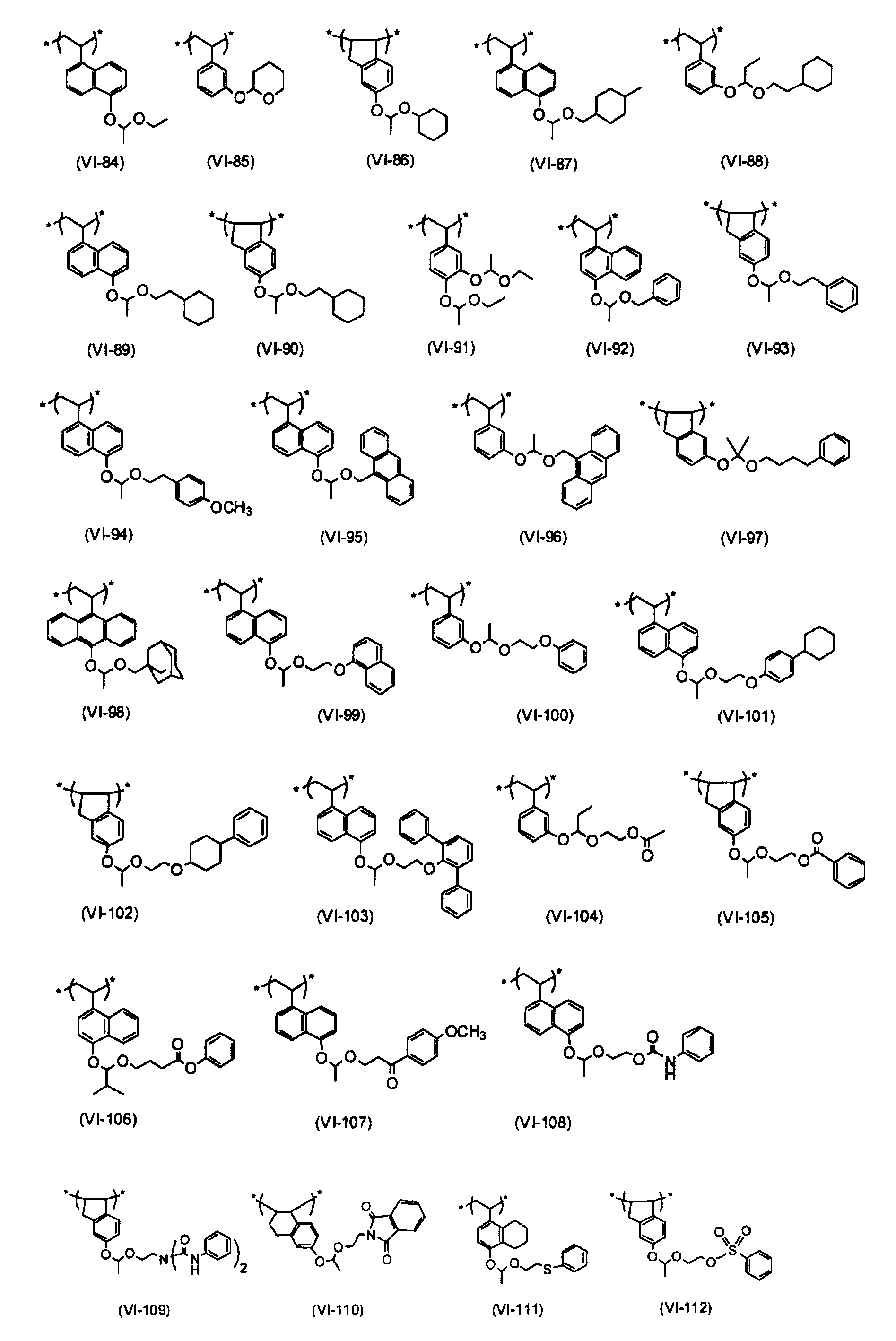


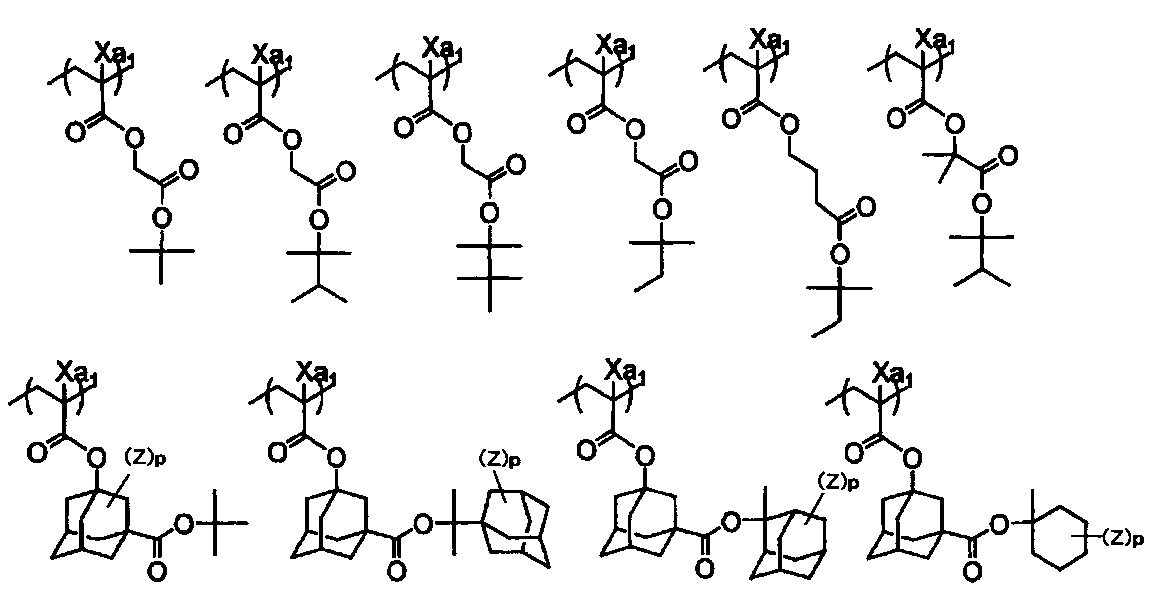

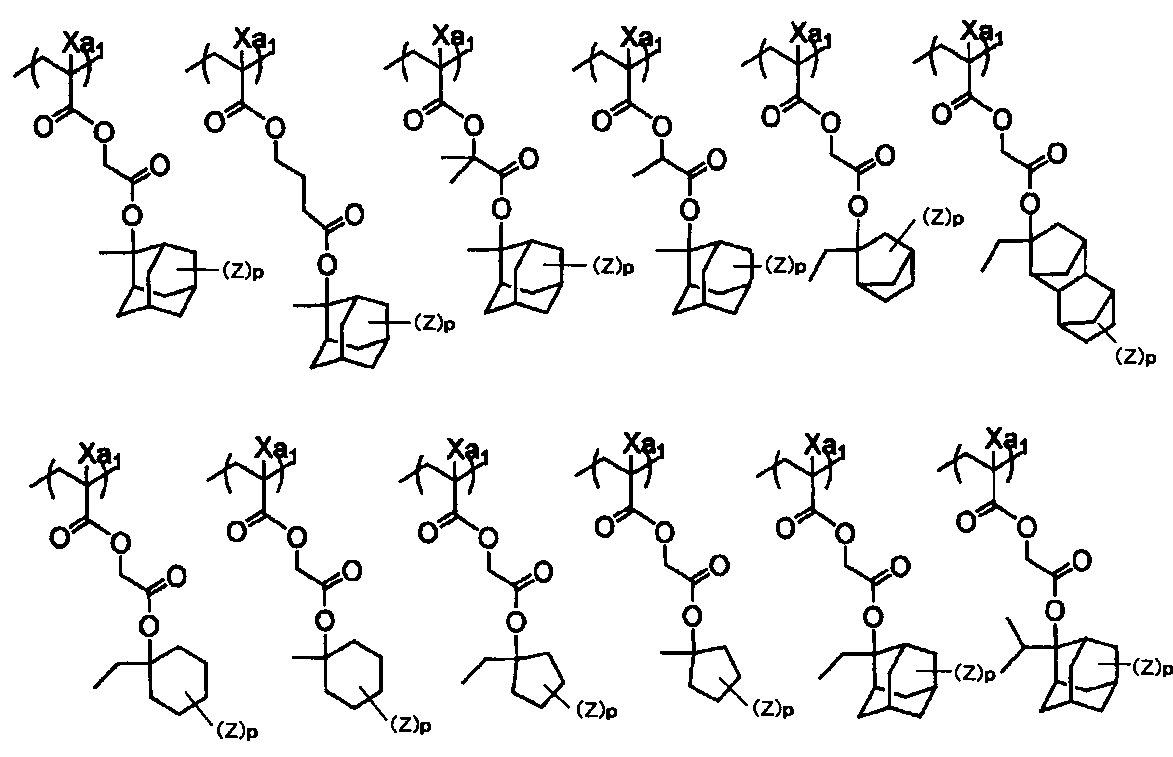

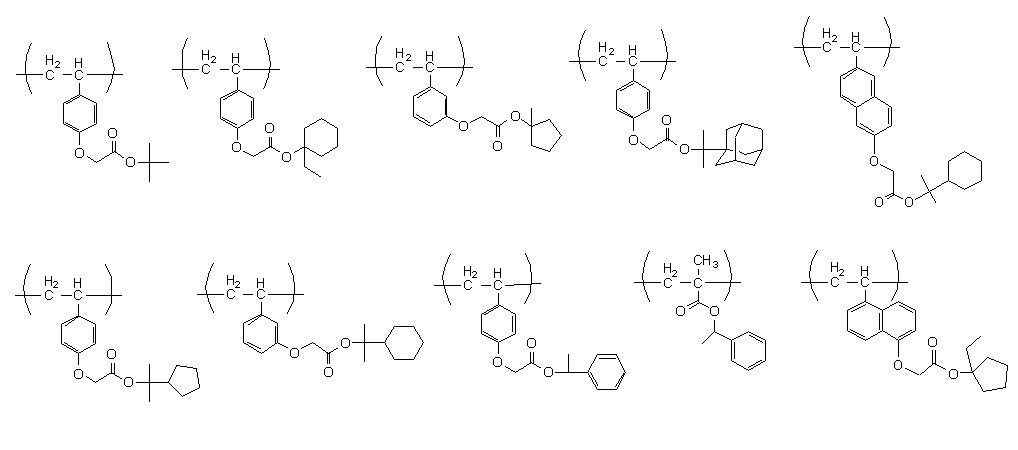
樹脂〔P-A〕において、酸分解性基を有する繰り返し単位は1種であってもよいし2種以上を併用していてもよい。
アルカリ現像によってポジ画像を形成する場合(すなわち、感活性光線性又は感放射線性組成物が、ポジ型の感活性光線性又は感放射線性組成物である場合)、樹脂〔P-A〕に含まれる酸分解性基を有する繰り返し単位の含有量は、樹脂〔P-A〕中の全繰り返し単位に対して5モル%以上70モル%以下であることが好ましく、5モル%以上60モル%以下であることがより好ましく、10モル%以上50モル%以下が特に好ましい。アルカリ現像によってネガ画像を形成する場合(すなわち、感活性光線性又は感放射線性組成物が、ネガ型の感活性光線性又は感放射線性組成物である場合)、樹脂〔P-A〕に含まれる酸分解性基を有する繰り返し単位の含有量は、樹脂〔P-A〕中の全繰り返し単位に対して0.1モル%以上50モル%以下が好ましく、1モル%以上40モル%以下がより好ましく、3モル%以上30モル%以下が特に好ましい。
アルカリ現像によってポジ画像を形成する場合(すなわち、感活性光線性又は感放射線性組成物が、ポジ型の感活性光線性又は感放射線性組成物である場合)、樹脂〔P-A〕に含まれる酸分解性基を有する繰り返し単位の含有量は、樹脂〔P-A〕中の全繰り返し単位に対して5モル%以上70モル%以下であることが好ましく、5モル%以上60モル%以下であることがより好ましく、10モル%以上50モル%以下が特に好ましい。アルカリ現像によってネガ画像を形成する場合(すなわち、感活性光線性又は感放射線性組成物が、ネガ型の感活性光線性又は感放射線性組成物である場合)、樹脂〔P-A〕に含まれる酸分解性基を有する繰り返し単位の含有量は、樹脂〔P-A〕中の全繰り返し単位に対して0.1モル%以上50モル%以下が好ましく、1モル%以上40モル%以下がより好ましく、3モル%以上30モル%以下が特に好ましい。
樹脂〔P-A〕は、下記一般式(3)で表される繰り返し単位を有することが好ましい。

上記一般式(3)中、
R31、R32及びR33は、各々独立に、水素原子、アルキル基、シクロアルキル基、ハロゲン原子、シアノ基又はアルコキシカルボニル基を表す。R33はAr3と結合して環を形成していてもよく、その場合のR33はアルキレン基を表す。
X3は、単結合又は2価の連結基を表す。
Ar3は、(n3+1)価の芳香環基を表し、R33と結合して環を形成する場合には(n3+2)価の芳香環基を表す。
n3は、1~4の整数を表す。
R31、R32及びR33は、各々独立に、水素原子、アルキル基、シクロアルキル基、ハロゲン原子、シアノ基又はアルコキシカルボニル基を表す。R33はAr3と結合して環を形成していてもよく、その場合のR33はアルキレン基を表す。
X3は、単結合又は2価の連結基を表す。
Ar3は、(n3+1)価の芳香環基を表し、R33と結合して環を形成する場合には(n3+2)価の芳香環基を表す。
n3は、1~4の整数を表す。
式(3)におけるR31、R32、R33のアルキル基、シクロアルキル基、ハロゲン原子、アルコキシカルボニル基、及びこれらの基が有し得る置換基の具体例としては、上記一般式(1)におけるR11、R12、及びR13により表される各基について説明した具体例と同様である。
Ar3は、(n3+1)価の芳香環基を表す。n3が1である場合における2価の芳香環基は、置換基を有していてもよく、例えば、フェニレン基、トリレン基、ナフチレン基、アントラセニレン基などの炭素数6~18のアリーレン基、あるいは、例えば、チオフェン、フラン、ピロール、ベンゾチオフェン、ベンゾフラン、ベンゾピロール、トリアジン、イミダゾール、ベンゾイミダゾール、トリアゾール、チアジアゾール、チアゾール等のヘテロ環を含む芳香環基を好ましい例として挙げることができる。
n3が2以上の整数である場合における(n3+1)価の芳香環基の具体例としては、2価の芳香環基の上記した具体例から、(n3-1)個の任意の水素原子を除してなる基を好適に挙げることができる。
(n3+1)価の芳香環基は、更に置換基を有していても良い。
(n3+1)価の芳香環基は、更に置換基を有していても良い。
上述したアルキレン基及び(n3+1)価の芳香環基が有し得る置換基としては、一般式(V)におけるR51~R53で挙げたアルキル基、メトキシ基、エトキシ基、ヒドロキシエトキシ基、プロポキシ基、ヒドロキシプロポキシ基、ブトキシ基等のアルコキシ基、フェニル基等のアリール基が挙げられる。
X3の2価の連結基としては、-COO-又は-CONR64-が挙げられる。
X3により表わされる-CONR64-(R64は、水素原子、アルキル基を表す)におけるR64のアルキル基としては、R61~R63のアルキル基と同様のものが挙げられる。
X3としては、単結合、-COO-、-CONH-が好ましく、単結合、-COO-がより好ましい。
X3により表わされる-CONR64-(R64は、水素原子、アルキル基を表す)におけるR64のアルキル基としては、R61~R63のアルキル基と同様のものが挙げられる。
X3としては、単結合、-COO-、-CONH-が好ましく、単結合、-COO-がより好ましい。
Ar3としては、置換基を有していても良い炭素数6~18の芳香環基がより好ましく、ベンゼン環基、ナフタレン環基、ビフェニレン環基が特に好ましい。
繰り返し単位(b)は、ヒドロキシスチレン構造を備えていることが好ましい。即ち、Ar3は、ベンゼン環基であることが好ましい。
繰り返し単位(b)は、ヒドロキシスチレン構造を備えていることが好ましい。即ち、Ar3は、ベンゼン環基であることが好ましい。
n3は1~4の整数を表し、1又は2を表すことが好ましく、1を表すことがより好ましい。
以下に、一般式(3)で表される繰り返し単位の具体例を示すが、本発明はこれに限定されるものではない。式中、aは1又は2を表す。


樹脂〔P-A〕は、一般式(3)で表される繰り返し単位を2種類以上含んでいてもよい。
一般式(3)で表される繰り返し単位の含有量(複数種含有する際はその合計)は、樹脂〔P-A〕中の全繰り返し単位に対して、3~98モル%の範囲内であることが好ましく、10~80モル%の範囲内であることがより好ましく、25~70モル%の範囲内であることが更に好ましい。
樹脂〔P-A〕は、一般式(3)で表される繰り返し単位とは異なる、極性基を有する繰り返し単位(c)を含んでいても良い。繰り返し単位(c)を含むことにより、例えば、樹脂を含んだ組成物の感度を向上させることができる。繰り返し単位(c)は、非酸分解性の繰り返し単位であること(すなわち、酸分解性基を有さないこと)が好ましい。
繰り返し単位(c)が含み得る「極性基」としては、例えば、以下の(1)~(4)が挙げられる。なお、以下において、「電気陰性度」とは、Paulingによる値を意味している。
繰り返し単位(c)が含み得る「極性基」としては、例えば、以下の(1)~(4)が挙げられる。なお、以下において、「電気陰性度」とは、Paulingによる値を意味している。
(1)酸素原子と、酸素原子との電気陰性度の差が1.1以上である原子とが、単結合により結合した構造を含む官能基
このような極性基としては、例えば、ヒドロキシ基などのO-Hにより表される構造を含んだ基が挙げられる。
(2)窒素原子と、窒素原子との電気陰性度の差が0.6以上である原子とが、単結合により結合した構造を含む官能基
このような極性基としては、例えば、アミノ基などのN-Hにより表される構造を含んだ基が挙げられる。
(3)電気陰性度が0.5以上異なる2つの原子が二重結合又は三重結合により結合した構造を含む官能基
このような極性基としては、例えば、C≡N、C=O、N=O、S=O又はC=Nにより表される構造を含んだ基が挙げられる。
(4)イオン性部位を有する官能基
このような極性基としては、例えば、N+又はS+により表される部位を有する基が挙げられる。
以下に、「極性基」が含み得る部分構造の具体例を挙げる。
このような極性基としては、例えば、ヒドロキシ基などのO-Hにより表される構造を含んだ基が挙げられる。
(2)窒素原子と、窒素原子との電気陰性度の差が0.6以上である原子とが、単結合により結合した構造を含む官能基
このような極性基としては、例えば、アミノ基などのN-Hにより表される構造を含んだ基が挙げられる。
(3)電気陰性度が0.5以上異なる2つの原子が二重結合又は三重結合により結合した構造を含む官能基
このような極性基としては、例えば、C≡N、C=O、N=O、S=O又はC=Nにより表される構造を含んだ基が挙げられる。
(4)イオン性部位を有する官能基
このような極性基としては、例えば、N+又はS+により表される部位を有する基が挙げられる。
以下に、「極性基」が含み得る部分構造の具体例を挙げる。
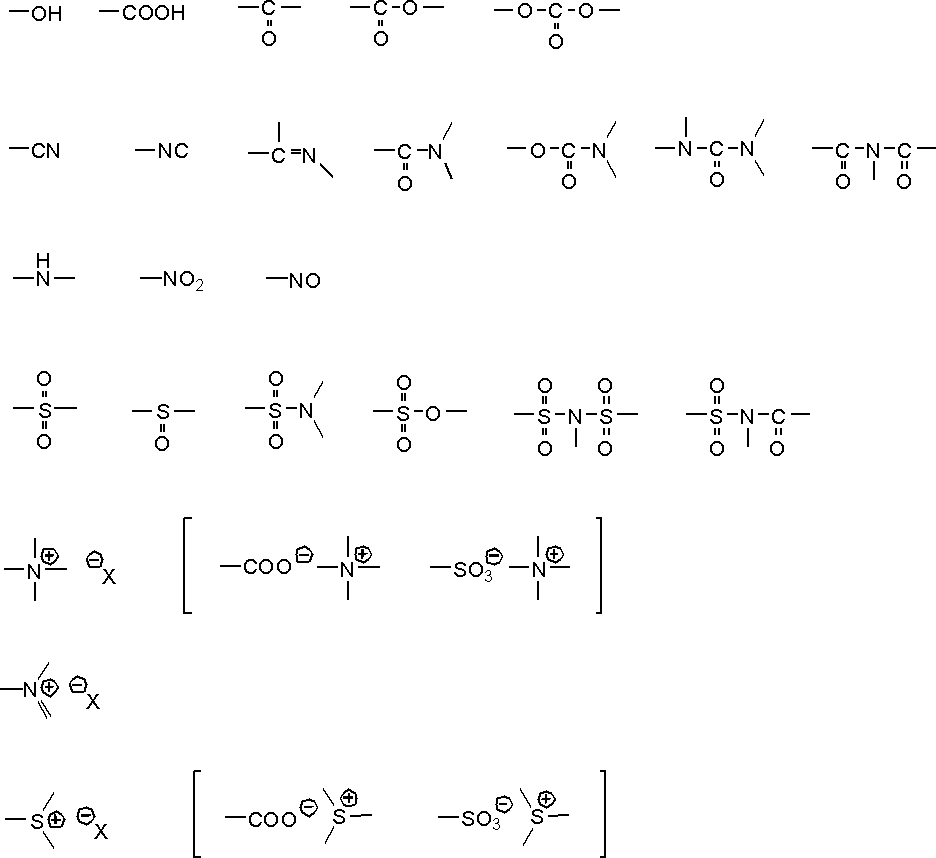
極性基は、ヒドロキシル基、シアノ基、ラクトン基、スルトン基、カルボン酸基、スルホン酸基、アミド基、スルホンアミド基、アンモニウム基、スルホニウム基及びこれらの2つ以上を組み合わせてなる基より選択されることが好ましく、アルコール性ヒドロキシ基、シアノ基、ラクトン基、スルトン基、又は、シアノラクトン構造を含んだ基であることが特に好ましい。
樹脂にアルコール性ヒドロキシ基を備えた繰り返し単位を更に含有させると、樹脂を含んだ組成物の露光ラチチュード(EL)を更に向上させることができる。
樹脂にシアノ基を備えた繰り返し単位を更に含有させると、樹脂を含んだ組成物の感度を更に向上させることができる。
樹脂にラクトン基を備えた繰り返し単位を更に含有させると、樹脂を含んだ組成物のドライエッチング耐性、塗布性、及び基板との密着性を更に向上させることも可能となる。
樹脂にシアノ基を有するラクトン構造を含んだ基を備えた繰り返し単位を更に含有させると、樹脂を含んだ組成物の感度、ドライエッチング耐性、塗布性、及び基板との密着性を更に向上させることも可能となる。加えて、こうすると、シアノ基及びラクトン基のそれぞれに起因した機能を単一の繰り返し単位に担わせることが可能となり、樹脂の設計の自由度を更に増大させることも可能となる。
樹脂にアルコール性ヒドロキシ基を備えた繰り返し単位を更に含有させると、樹脂を含んだ組成物の露光ラチチュード(EL)を更に向上させることができる。
樹脂にシアノ基を備えた繰り返し単位を更に含有させると、樹脂を含んだ組成物の感度を更に向上させることができる。
樹脂にラクトン基を備えた繰り返し単位を更に含有させると、樹脂を含んだ組成物のドライエッチング耐性、塗布性、及び基板との密着性を更に向上させることも可能となる。
樹脂にシアノ基を有するラクトン構造を含んだ基を備えた繰り返し単位を更に含有させると、樹脂を含んだ組成物の感度、ドライエッチング耐性、塗布性、及び基板との密着性を更に向上させることも可能となる。加えて、こうすると、シアノ基及びラクトン基のそれぞれに起因した機能を単一の繰り返し単位に担わせることが可能となり、樹脂の設計の自由度を更に増大させることも可能となる。
繰り返し単位(c)が有する極性基がアルコール性ヒドロキシ基である場合、下記一般式(I-1H)~(I-10H)からなる群より選択される少なくとも1つにより表されることが好ましい。特には、下記一般式(I-1H)~(I-3H)からなる群より選択される少なくとも1つにより表されることがより好ましく、下記一般式(I-1H)により表されることが更に好ましい。
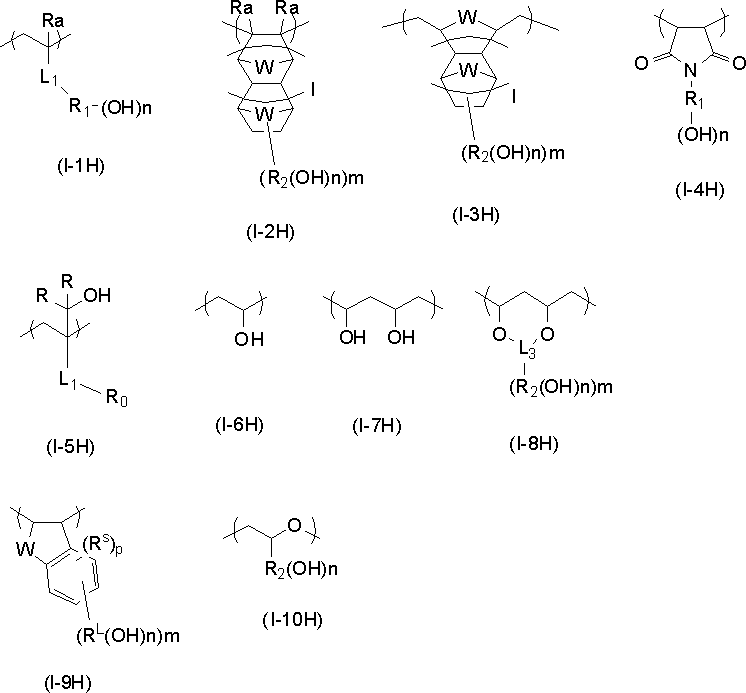
式中、
Raは、各々独立に、水素原子、アルキル基又は-CH2-O-Ra2により表される基を表す。ここで、Ra2は、水素原子、アルキル基又はアシル基を表す。
R1は、(n+1)価の有機基を表す。
R2は、m≧2の場合は各々独立に、単結合又は(n+1)価の有機基を表す。
Wは、メチレン基、酸素原子又は硫黄原子を表す。
n及びmは、1以上の整数を表す。なお、一般式(I-2H)、(I-3H)又は(I-8H)においてR2が単結合を表す場合、nは1である。
lは、0以上の整数を表す。
L1は、-COO-、-OCO-、-CONH-、-O-、-Ar-、-SO3-又は-SO2NH-により表される連結基を表す。ここで、Arは、2価の芳香環基を表す。
Rは、各々独立に、水素原子又はアルキル基を表す。
R0は、水素原子又は有機基を表す。
L3は、(m+2)価の連結基を表す。
RLは、m≧2の場合は各々独立に、(n+1)価の連結基を表す。
RSは、p≧2の場合は各々独立に、置換基を表す。p≧2の場合、複数のRSは、互いに結合して環を形成していてもよい。
pは、0~3の整数を表す。
Raは、各々独立に、水素原子、アルキル基又は-CH2-O-Ra2により表される基を表す。ここで、Ra2は、水素原子、アルキル基又はアシル基を表す。
R1は、(n+1)価の有機基を表す。
R2は、m≧2の場合は各々独立に、単結合又は(n+1)価の有機基を表す。
Wは、メチレン基、酸素原子又は硫黄原子を表す。
n及びmは、1以上の整数を表す。なお、一般式(I-2H)、(I-3H)又は(I-8H)においてR2が単結合を表す場合、nは1である。
lは、0以上の整数を表す。
L1は、-COO-、-OCO-、-CONH-、-O-、-Ar-、-SO3-又は-SO2NH-により表される連結基を表す。ここで、Arは、2価の芳香環基を表す。
Rは、各々独立に、水素原子又はアルキル基を表す。
R0は、水素原子又は有機基を表す。
L3は、(m+2)価の連結基を表す。
RLは、m≧2の場合は各々独立に、(n+1)価の連結基を表す。
RSは、p≧2の場合は各々独立に、置換基を表す。p≧2の場合、複数のRSは、互いに結合して環を形成していてもよい。
pは、0~3の整数を表す。
Raは、水素原子、アルキル基又は-CH2-O-Ra2により表される基を表す。Raは、水素原子又は炭素数が1~10のアルキル基であることが好ましく、水素原子又はメチル基であることがより好ましい。
Wは、メチレン基、酸素原子又は硫黄原子を表す。Wは、メチレン基又は酸素原子であることが好ましい。
R1は、(n+1)価の有機基を表す。R1は、好ましくは、非芳香族性の炭化水素基である。この場合、R1は、鎖状炭化水素基であってもよく、脂環状炭化水素基であってもよい。R1は、より好ましくは、脂環状炭化水素基である。
R2は、単結合又は(n+1)価の有機基を表す。R2は、好ましくは、単結合又は非芳香族性の炭化水素基である。この場合、R2は、鎖状炭化水素基であってもよく、脂環状炭化水素基であってもよい。
R1及び/又はR2が鎖状炭化水素基である場合、この鎖状炭化水素基は、直鎖状であってもよく、分岐鎖状であってもよい。また、この鎖状炭化水素基の炭素数は、1~8であることが好ましい。例えば、R1及び/又はR2がアルキレン基である場合、R1及び/又はR2は、メチレン基、エチレン基、n-プロピレン基、イソプロピレン基、n-ブチレン基、イソブチレン基又はsec-ブチレン基であることが好ましい。
R1及び/又はR2が脂環状炭化水素基である場合、この脂環状炭化水素基は、単環式であってもよく、多環式であってもよい。この脂環状炭化水素基は、例えば、モノシクロ、ビシクロ、トリシクロ又はテトラシクロ構造を備えている。この脂環状炭化水素基の炭素数は、通常は5以上であり、6~30であることが好ましく、7~25であることがより好ましい。
Wは、メチレン基、酸素原子又は硫黄原子を表す。Wは、メチレン基又は酸素原子であることが好ましい。
R1は、(n+1)価の有機基を表す。R1は、好ましくは、非芳香族性の炭化水素基である。この場合、R1は、鎖状炭化水素基であってもよく、脂環状炭化水素基であってもよい。R1は、より好ましくは、脂環状炭化水素基である。
R2は、単結合又は(n+1)価の有機基を表す。R2は、好ましくは、単結合又は非芳香族性の炭化水素基である。この場合、R2は、鎖状炭化水素基であってもよく、脂環状炭化水素基であってもよい。
R1及び/又はR2が鎖状炭化水素基である場合、この鎖状炭化水素基は、直鎖状であってもよく、分岐鎖状であってもよい。また、この鎖状炭化水素基の炭素数は、1~8であることが好ましい。例えば、R1及び/又はR2がアルキレン基である場合、R1及び/又はR2は、メチレン基、エチレン基、n-プロピレン基、イソプロピレン基、n-ブチレン基、イソブチレン基又はsec-ブチレン基であることが好ましい。
R1及び/又はR2が脂環状炭化水素基である場合、この脂環状炭化水素基は、単環式であってもよく、多環式であってもよい。この脂環状炭化水素基は、例えば、モノシクロ、ビシクロ、トリシクロ又はテトラシクロ構造を備えている。この脂環状炭化水素基の炭素数は、通常は5以上であり、6~30であることが好ましく、7~25であることがより好ましい。
この脂環状炭化水素基としては、例えば、以下に列挙する部分構造を備えたものが挙げられる。これら部分構造の各々は、置換基を有していてもよい。また、これら部分構造の各々において、メチレン基(-CH2-)は、酸素原子(-O-)、硫黄原子(-S-)、カルボニル基〔-C(=O)-〕、スルホニル基〔-S(=O)2-〕、スルフィニル基〔-S(=O)-〕、又はイミノ基〔-N(R)-〕(Rは水素原子若しくはアルキル基)によって置換されていてもよい。
例えば、R1及び/又はR2がシクロアルキレン基である場合、R1及び/又はR2は、アダマンチレン基、ノルアダマンチレン基、デカヒドロナフチレン基、トリシクロデカニレン基、テトラシクロドデカニレン基、ノルボルニレン基、シクロペンチレン基、シクロヘキシレン基、シクロヘプチレン基、シクロオクチレン基、シクロデカニレン基、又はシクロドデカニレン基であることが好ましく、アダマンチレン基、ノルボルニレン基、シクロヘキシレン基、シクロペンチレン基、テトラシクロドデカニレン基又はトリシクロデカニレン基であることがより好ましい。
R1及び/又はR2の非芳香族性の炭化水素基は、置換基を有していてもよい。この置換基としては、例えば、炭素数1~4のアルキル基、ハロゲン原子、ヒドロキシ基、炭素数1~4のアルコキシ基、カルボキシ基、及び炭素数2~6のアルコキシカルボニル基が挙げられる。上記のアルキル基、アルコキシ基及びアルコキシカルボニル基は、置換基を更に有していてもよい。この置換基としては、例えば、ヒドロキシ基、ハロゲン原子、及びアルコキシ基が挙げられる。
L1は、-COO-、-OCO-、-CONH-、-O-、-Ar-、-SO3-又は-SO2NH-により表される連結基を表す。ここで、Arは、2価の芳香環基を表す。L1は、好ましくは-COO-、-CONH-又は-Ar-により表される連結基であり、より好ましくは-COO-又は-CONH-により表される連結基である。
Rは、水素原子又はアルキル基を表す。アルキル基は、直鎖状であってもよく、分岐鎖状であってもよい。このアルキル基の炭素数は、好ましくは1~6であり、より好ましくは1~3である。Rは、好ましくは水素原子又はメチル基であり、より好ましくは水素原子である。
R1及び/又はR2の非芳香族性の炭化水素基は、置換基を有していてもよい。この置換基としては、例えば、炭素数1~4のアルキル基、ハロゲン原子、ヒドロキシ基、炭素数1~4のアルコキシ基、カルボキシ基、及び炭素数2~6のアルコキシカルボニル基が挙げられる。上記のアルキル基、アルコキシ基及びアルコキシカルボニル基は、置換基を更に有していてもよい。この置換基としては、例えば、ヒドロキシ基、ハロゲン原子、及びアルコキシ基が挙げられる。
L1は、-COO-、-OCO-、-CONH-、-O-、-Ar-、-SO3-又は-SO2NH-により表される連結基を表す。ここで、Arは、2価の芳香環基を表す。L1は、好ましくは-COO-、-CONH-又は-Ar-により表される連結基であり、より好ましくは-COO-又は-CONH-により表される連結基である。
Rは、水素原子又はアルキル基を表す。アルキル基は、直鎖状であってもよく、分岐鎖状であってもよい。このアルキル基の炭素数は、好ましくは1~6であり、より好ましくは1~3である。Rは、好ましくは水素原子又はメチル基であり、より好ましくは水素原子である。
R0は、水素原子又は有機基を表す。有機基としては、例えば、アルキル基、シクロアルキル基、アリール基、アルキニル基、及びアルケニル基が挙げられる。R0は、好ましくは、水素原子又はアルキル基であり、より好ましくは、水素原子又はメチル基である。
L3は、(m+2)価の連結基を表す。即ち、L3は、3価以上の連結基を表す。このような連結基としては、例えば、後掲の具体例における対応した基が挙げられる。
RLは、(n+1)価の連結基を表す。即ち、RLは、2価以上の連結基を表す。このような連結基としては、例えば、アルキレン基、シクロアルキレン基及び後掲の具体例における対応した基が挙げられる。RLは、互いに結合して又は下記RSと結合して、環構造を形成していてもよい。
RSは、置換基を表す。この置換基としては、例えば、アルキル基、アルケニル基、アルキニル基、アリール基、アルコキシ基、アシルオキシ基、アルコキシカルボニル基、及びハロゲン原子が挙げられる。
nは、1以上の整数である。nは、1~3の整数であることが好ましく、1又は2であることがより好ましい。また、nを2以上とすると、有機溶剤を含んだ現像液に対する溶解コントラストを更に向上させることが可能となる。従って、こうすると、限界解像力及びラフネス特性を更に向上させることができる。
mは、1以上の整数である。mは、1~3の整数であることが好ましく、1又は2であることがより好ましい。
lは、0以上の整数である。lは、0又は1であることが好ましい。
pは、0~3の整数である。
L3は、(m+2)価の連結基を表す。即ち、L3は、3価以上の連結基を表す。このような連結基としては、例えば、後掲の具体例における対応した基が挙げられる。
RLは、(n+1)価の連結基を表す。即ち、RLは、2価以上の連結基を表す。このような連結基としては、例えば、アルキレン基、シクロアルキレン基及び後掲の具体例における対応した基が挙げられる。RLは、互いに結合して又は下記RSと結合して、環構造を形成していてもよい。
RSは、置換基を表す。この置換基としては、例えば、アルキル基、アルケニル基、アルキニル基、アリール基、アルコキシ基、アシルオキシ基、アルコキシカルボニル基、及びハロゲン原子が挙げられる。
nは、1以上の整数である。nは、1~3の整数であることが好ましく、1又は2であることがより好ましい。また、nを2以上とすると、有機溶剤を含んだ現像液に対する溶解コントラストを更に向上させることが可能となる。従って、こうすると、限界解像力及びラフネス特性を更に向上させることができる。
mは、1以上の整数である。mは、1~3の整数であることが好ましく、1又は2であることがより好ましい。
lは、0以上の整数である。lは、0又は1であることが好ましい。
pは、0~3の整数である。
アルコール性ヒドロキシ基を有する繰り返し単位の含有率は、樹脂〔P-A〕中の全繰り返し単位に対し、1~60モル%が好ましく、より好ましくは3~50モル%、更に好ましくは5~40モル%である。
以下に、一般式(I-1H)~(I-10H)の何れかにより表される繰り返し単位の具体例を示す。なお、具体例中、Raは、一般式(I-1H)~(I-10H)におけるものと同義である。
以下に、一般式(I-1H)~(I-10H)の何れかにより表される繰り返し単位の具体例を示す。なお、具体例中、Raは、一般式(I-1H)~(I-10H)におけるものと同義である。

繰り返し単位(c)が有する極性基がアルコール性ヒドロキシ基又はシアノ基である場合、好ましい繰り返し単位の一つの態様として、水酸基又はシアノ基で置換された脂環炭化水素構造を有する繰り返し単位であることが挙げられる。このとき、酸分解性基を有さないことが好ましい。水酸基又はシアノ基で置換された脂環炭化水素構造に於ける、脂環炭化水素構造としては、アダマンチル基、ジアマンチル基、ノルボルナン基が好ましい。好ましい水酸基又はシアノ基で置換された脂環炭化水素構造としては、下記一般式(VIIa)~(VIIc)で表される部分構造が好ましい。これにより基板密着性、及び現像液親和性が向上する。
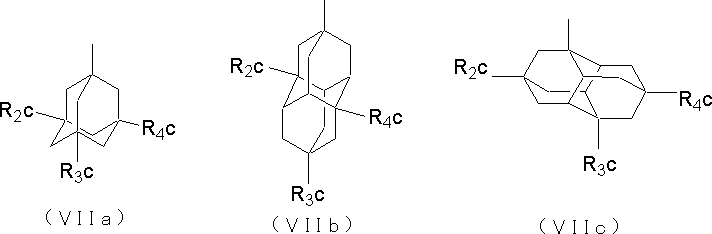
一般式(VIIa)~(VIIc)に於いて、
R2c~R4cは、各々独立に、水素原子又は水酸基又はシアノ基を表す。ただし、R2c~R4cの内の少なくとも1つは、水酸基を表す。好ましくは、R2c~R4cの内の1つ又は2つが、水酸基で、残りが水素原子である。一般式(VIIa)に於いて、更に好ましくは、R2c~R4cの内の2つが、水酸基で、残りが水素原子である。
R2c~R4cは、各々独立に、水素原子又は水酸基又はシアノ基を表す。ただし、R2c~R4cの内の少なくとも1つは、水酸基を表す。好ましくは、R2c~R4cの内の1つ又は2つが、水酸基で、残りが水素原子である。一般式(VIIa)に於いて、更に好ましくは、R2c~R4cの内の2つが、水酸基で、残りが水素原子である。
一般式(VIIa)~(VIIc)で表される部分構造を有する繰り返し単位としては、下記一般式(AIIa)~(AIIc)で表される繰り返し単位を挙げることができる。

一般式(AIIa)~(AIIc)に於いて、
R1cは、水素原子、メチル基、トリフロロメチル基又はヒドロキシメチル基を表す。
R1cは、水素原子、メチル基、トリフロロメチル基又はヒドロキシメチル基を表す。
R2c~R4cは、一般式(VIIa)~(VIIc)に於ける、R2c~R4cと同義である。
樹脂〔P-A〕は水酸基又はシアノ基を有する繰り返し単位を含有していても含有していなくてもよいが、含有する場合、水酸基又はシアノ基を有する繰り返し単位の含有量は、樹脂〔P-A〕中の全繰り返し単位に対し、1~60モル%が好ましく、より好ましくは3~50モル%、更に好ましくは5~40モル%である。
水酸基又はシアノ基を有する繰り返し単位の具体例を以下に挙げるが、本発明はこれらに限定されない。

繰り返し単位(c)は、極性基としてラクトン構造又はスルトン(環状スルホン酸エステル)構造を有する繰り返し単位を含有することが好ましい。
ラクトン基又はスルトン基としては、ラクトン構造又はスルトン構造を有していればいずれでも用いることができるが、好ましくは5~7員環のラクトン構造又はスルトン構造であり、5~7員環のラクトン構造又はスルトン構造にビシクロ構造、スピロ構造を形成する形で他の環構造が縮環しているものが好ましい。下記一般式(LC1-1)~(LC1-17)、(SL1-1)及び(SL1-2)のいずれかで表されるラクトン構造又はスルトン構造を有する繰り返し単位を有することがより好ましい。また、ラクトン構造又はスルトン構造が主鎖に直接結合していてもよい。好ましいラクトン構造又はスルトン構造としては(LC1-1)、(LC1-4)、(LC1-5)、(LC1-8)であり、(LC1-4)であることがより好ましい。特定のラクトン構造又はスルトン構造を用いることでLWR、現像欠陥が良好になる。
ラクトン基又はスルトン基としては、ラクトン構造又はスルトン構造を有していればいずれでも用いることができるが、好ましくは5~7員環のラクトン構造又はスルトン構造であり、5~7員環のラクトン構造又はスルトン構造にビシクロ構造、スピロ構造を形成する形で他の環構造が縮環しているものが好ましい。下記一般式(LC1-1)~(LC1-17)、(SL1-1)及び(SL1-2)のいずれかで表されるラクトン構造又はスルトン構造を有する繰り返し単位を有することがより好ましい。また、ラクトン構造又はスルトン構造が主鎖に直接結合していてもよい。好ましいラクトン構造又はスルトン構造としては(LC1-1)、(LC1-4)、(LC1-5)、(LC1-8)であり、(LC1-4)であることがより好ましい。特定のラクトン構造又はスルトン構造を用いることでLWR、現像欠陥が良好になる。
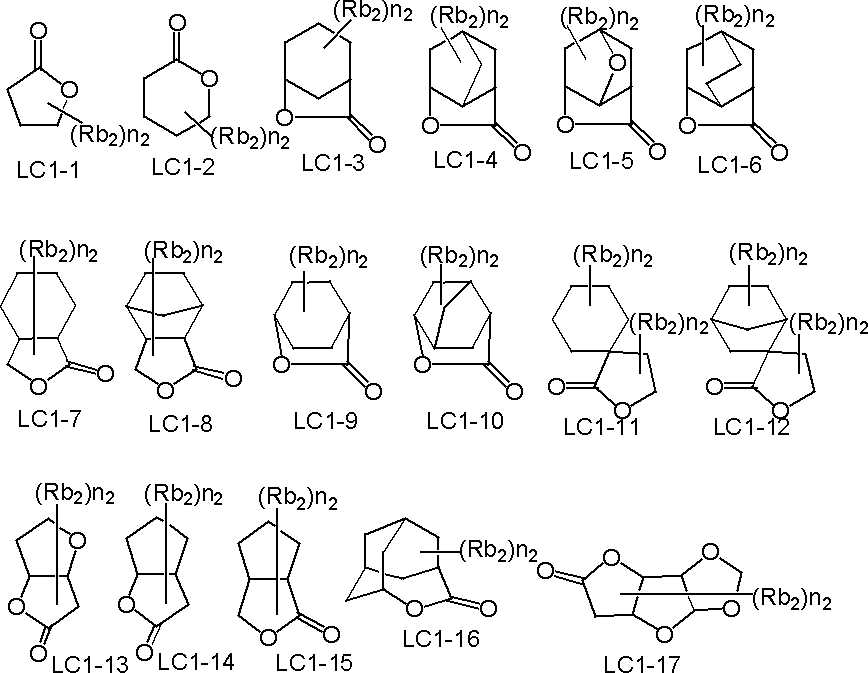
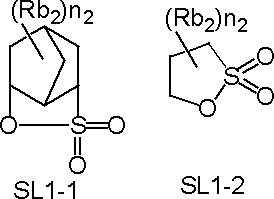
ラクトン構造部分又はスルトン構造部分は、置換基(Rb2)を有していても有していなくてもよい。好ましい置換基(Rb2)としては、炭素数1~8のアルキル基、炭素数4~7のシクロアルキル基、炭素数1~8のアルコキシ基、炭素数2~8のアルコキシカルボニル基、カルボキシル基、ハロゲン原子、水酸基、シアノ基、酸分解性基などが挙げられる。より好ましくは炭素数1~4のアルキル基、シアノ基、酸分解性基である。n2は、0~4の整数を表す。n2が2以上の時、複数存在する置換基(Rb2)は、同一でも異なっていてもよく、また、複数存在する置換基(Rb2)同士が結合して環を形成してもよい。
樹脂〔P-A〕は、下記一般式(III)で表されるラクトン構造又はスルトン構造を有する繰り返し単位を含有することが好ましい。
樹脂〔P-A〕は、下記一般式(III)で表されるラクトン構造又はスルトン構造を有する繰り返し単位を含有することが好ましい。

式(III)中、
Aは、エステル結合(-COO-で表される基)又はアミド結合(-CONH-で表される基)を表す。
R0は、複数個ある場合にはそれぞれ独立にアルキレン基、シクロアルキレン基、又はその組み合わせを表す。
Zは、複数個ある場合にはそれぞれ独立に、単結合、エーテル結合、エステル結合、アミド結合、ウレタン結合
Aは、エステル結合(-COO-で表される基)又はアミド結合(-CONH-で表される基)を表す。
R0は、複数個ある場合にはそれぞれ独立にアルキレン基、シクロアルキレン基、又はその組み合わせを表す。
Zは、複数個ある場合にはそれぞれ独立に、単結合、エーテル結合、エステル結合、アミド結合、ウレタン結合

又はウレア結合

を表す。ここで、Rは、各々独立して水素原子、アルキル基、シクロアルキル基又はアリール基を表す。
R8は、ラクトン構造又はスルトン構造を有する1価の有機基を表す。
nは、-R0-Z-で表される構造の繰り返し数であり、0~2の整数を表す。
R7は、水素原子、ハロゲン原子又はアルキル基を表す。
R0のアルキレン基、シクロアルキレン基は置換基を有してよい。
Zは好ましくは、エーテル結合、エステル結合であり、特に好ましくはエステル結合である。
R7のアルキル基は、炭素数1~4のアルキル基が好ましく、メチル基、エチル基がより好ましく、メチル基が特に好ましい。R0のアルキレン基、シクロアルキレン基、R7におけるアルキル基は、各々、置換されていてもよく、置換基としては、例えば、フッ素原子、塩素原子、臭素原子等のハロゲン原子やメルカプト基、ヒドロキシ基、メトキシ基、エトキシ基、イソプロポキシ基、t-ブトキシ基、ベンジルオキシ基等のアルコキシ基、アセチルオキシ基、プロピオニルオキシ基等のアセトキシ基が挙げられる。R7は、水素原子、メチル基、トリフルオロメチル基、ヒドロキシメチル基が好ましい。
R0における好ましい鎖状アルキレン基としては炭素数が1~10の鎖状のアルキレンが好ましく、より好ましくは炭素数1~5であり、例えば、メチレン基、エチレン基、プロピレン基等が挙げられる。好ましいシクロアルキレン基としては、炭素数3~20のシクロアルキレン基であり、例えば、シクロヘキシレン基、シクロペンチレン基、ノルボルニレン基、アダマンチレン基等が挙げられる。本発明の効果を発現するためには鎖状アルキレン基がより好ましく、メチレン基が特に好ましい。
R8で表されるラクトン構造又はスルトン構造を有する1価の有機基は、ラクトン構造又はスルトン構造を有していれば限定されるものではなく、具体例として上述した一般式(LC1-1)~(LC1-17)、(SL1-1)及び(SL1-2)で表されるラクトン構造又はスルトン構造が挙げられ、これらのうち(LC1-4)で表される構造が特に好ましい。また、(LC1-1)~(LC1-17)、(SL1-1)及び(SL1-2)におけるn2は2以下のものがより好ましい。
また、R8は無置換のラクトン構造又はスルトン構造を有する1価の有機基、或いはメチル基、シアノ基又はアルコキシカルボニル基を置換基として有するラクトン構造又はスルトン構造を有する1価の有機基が好ましく、シアノ基を置換基として有するラクトン構造(シアノラクトン)又はスルトン構造(シアノスルトン)を有する1価の有機基がより好ましい。
一般式(III)において、nが1又は2であることが好ましい。
以下に一般式(III)で表されるラクトン構造又はスルトン構造を有する基を有する繰り返し単位の具体例を示すが、本発明はこれに限定されるものではない。
下記具体例中、Rは、水素原子、置換基を有していてもよいアルキル基又はハロゲン原子を表し、好ましくは、水素原子、メチル基、ヒドロキシメチル基、アセトキシメチル基を表す。
下記式中、Meはメチル基を表す。
R8は、ラクトン構造又はスルトン構造を有する1価の有機基を表す。
nは、-R0-Z-で表される構造の繰り返し数であり、0~2の整数を表す。
R7は、水素原子、ハロゲン原子又はアルキル基を表す。
R0のアルキレン基、シクロアルキレン基は置換基を有してよい。
Zは好ましくは、エーテル結合、エステル結合であり、特に好ましくはエステル結合である。
R7のアルキル基は、炭素数1~4のアルキル基が好ましく、メチル基、エチル基がより好ましく、メチル基が特に好ましい。R0のアルキレン基、シクロアルキレン基、R7におけるアルキル基は、各々、置換されていてもよく、置換基としては、例えば、フッ素原子、塩素原子、臭素原子等のハロゲン原子やメルカプト基、ヒドロキシ基、メトキシ基、エトキシ基、イソプロポキシ基、t-ブトキシ基、ベンジルオキシ基等のアルコキシ基、アセチルオキシ基、プロピオニルオキシ基等のアセトキシ基が挙げられる。R7は、水素原子、メチル基、トリフルオロメチル基、ヒドロキシメチル基が好ましい。
R0における好ましい鎖状アルキレン基としては炭素数が1~10の鎖状のアルキレンが好ましく、より好ましくは炭素数1~5であり、例えば、メチレン基、エチレン基、プロピレン基等が挙げられる。好ましいシクロアルキレン基としては、炭素数3~20のシクロアルキレン基であり、例えば、シクロヘキシレン基、シクロペンチレン基、ノルボルニレン基、アダマンチレン基等が挙げられる。本発明の効果を発現するためには鎖状アルキレン基がより好ましく、メチレン基が特に好ましい。
R8で表されるラクトン構造又はスルトン構造を有する1価の有機基は、ラクトン構造又はスルトン構造を有していれば限定されるものではなく、具体例として上述した一般式(LC1-1)~(LC1-17)、(SL1-1)及び(SL1-2)で表されるラクトン構造又はスルトン構造が挙げられ、これらのうち(LC1-4)で表される構造が特に好ましい。また、(LC1-1)~(LC1-17)、(SL1-1)及び(SL1-2)におけるn2は2以下のものがより好ましい。
また、R8は無置換のラクトン構造又はスルトン構造を有する1価の有機基、或いはメチル基、シアノ基又はアルコキシカルボニル基を置換基として有するラクトン構造又はスルトン構造を有する1価の有機基が好ましく、シアノ基を置換基として有するラクトン構造(シアノラクトン)又はスルトン構造(シアノスルトン)を有する1価の有機基がより好ましい。
一般式(III)において、nが1又は2であることが好ましい。
以下に一般式(III)で表されるラクトン構造又はスルトン構造を有する基を有する繰り返し単位の具体例を示すが、本発明はこれに限定されるものではない。
下記具体例中、Rは、水素原子、置換基を有していてもよいアルキル基又はハロゲン原子を表し、好ましくは、水素原子、メチル基、ヒドロキシメチル基、アセトキシメチル基を表す。
下記式中、Meはメチル基を表す。
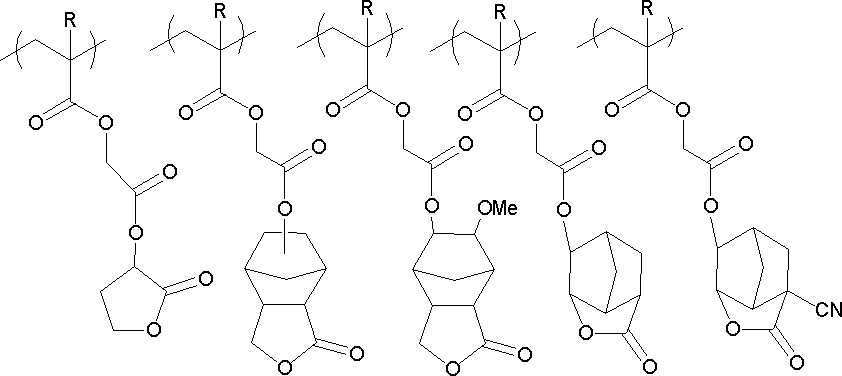
ラクトン構造又はスルトン構造を有する繰り返し単位としては、下記一般式(III-1)又は(III-1’)で表される繰り返し単位がより好ましい。
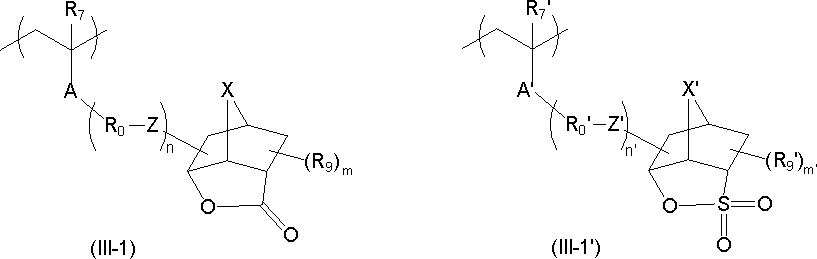
一般式(III-1)及び(III-1’)に於いて、
R7、A、R0、Z、及びnは、上記一般式(III)と同義である。
R7’、A’、R0’、Z’及びn’は、上記一般式(III)におけるR7、A、R0、Z及びnとそれぞれ同義である。
R9は、複数個ある場合にはそれぞれ独立に、アルキル基、シクロアルキル基、アルコキシカルボニル基、シアノ基、水酸基又はアルコキシ基を表し、複数個ある場合には2つのR9が結合し、環を形成していてもよい。
R9’は、複数個ある場合にはそれぞれ独立に、アルキル基、シクロアルキル基、アルコキシカルボニル基、シアノ基、水酸基又はアルコキシ基を表し、複数個ある場合には2つのR9’が結合し、環を形成していてもよい。
X及びX’は、それぞれ独立にアルキレン基、酸素原子又は硫黄原子を表す。
m及びm’は、置換基数であって、それぞれ独立に0~5の整数を表す。m及びm’はそれぞれ独立に0又は1であることが好ましい。
R9及びR9’のアルキル基としては、炭素数1~4のアルキル基が好ましく、メチル基、エチル基、がより好ましく、メチル基が最も好ましい。シクロアルキル基としては、シクロプロピル、シクロブチル、シクロペンチル、シクロヘキシル基を挙げることができる。アルコキシカルボニル基としてはメトキシカルボニル基、エトキシカルボニル基、n-ブトキシカルボニル基、t-ブトキシカルボニル基等を挙げることができる。アルコキシ基としては、メトキシ基、エトキシ基、プロポキシ基、イソプロポキシ基、ブトキシ基等を挙げることができる。これらの基は置換基を有していてもよく、該置換基としてはヒドロキシ基、メトキシ基、エトキシ基などのアルコキシ基、シアノ基、フッ素原子などのハロゲン原子を挙げることができる。R9及びR9’はメチル基、シアノ基又はアルコキシカルボニル基であることがより好ましく、シアノ基であることが更に好ましい。
X及びX’のアルキレン基としてはメチレン基、エチレン基等が挙げられる。X及びX’は酸素原子又はメチレン基であることが好ましく、メチレン基であることが更に好ましい。
m及びm’が1以上である場合、少なくとも1つのR9及びR9’はラクトンのカルボニル基のα位又はβ位に置換することが好ましく、特にα位に置換することが好ましい。
一般式(III-1)又は(III-1’)で表されるラクトン構造を有する基、又はスルトン構造を有する繰り返し単位の具体例を示すが、本発明はこれに限定されるものではない。下記具体例中、Rは、水素原子、置換基を有していてもよいアルキル基又はハロゲン原子を表し、好ましくは、水素原子、メチル基、ヒドロキシメチル基、アセトキシメチル基を表す。
R7、A、R0、Z、及びnは、上記一般式(III)と同義である。
R7’、A’、R0’、Z’及びn’は、上記一般式(III)におけるR7、A、R0、Z及びnとそれぞれ同義である。
R9は、複数個ある場合にはそれぞれ独立に、アルキル基、シクロアルキル基、アルコキシカルボニル基、シアノ基、水酸基又はアルコキシ基を表し、複数個ある場合には2つのR9が結合し、環を形成していてもよい。
R9’は、複数個ある場合にはそれぞれ独立に、アルキル基、シクロアルキル基、アルコキシカルボニル基、シアノ基、水酸基又はアルコキシ基を表し、複数個ある場合には2つのR9’が結合し、環を形成していてもよい。
X及びX’は、それぞれ独立にアルキレン基、酸素原子又は硫黄原子を表す。
m及びm’は、置換基数であって、それぞれ独立に0~5の整数を表す。m及びm’はそれぞれ独立に0又は1であることが好ましい。
R9及びR9’のアルキル基としては、炭素数1~4のアルキル基が好ましく、メチル基、エチル基、がより好ましく、メチル基が最も好ましい。シクロアルキル基としては、シクロプロピル、シクロブチル、シクロペンチル、シクロヘキシル基を挙げることができる。アルコキシカルボニル基としてはメトキシカルボニル基、エトキシカルボニル基、n-ブトキシカルボニル基、t-ブトキシカルボニル基等を挙げることができる。アルコキシ基としては、メトキシ基、エトキシ基、プロポキシ基、イソプロポキシ基、ブトキシ基等を挙げることができる。これらの基は置換基を有していてもよく、該置換基としてはヒドロキシ基、メトキシ基、エトキシ基などのアルコキシ基、シアノ基、フッ素原子などのハロゲン原子を挙げることができる。R9及びR9’はメチル基、シアノ基又はアルコキシカルボニル基であることがより好ましく、シアノ基であることが更に好ましい。
X及びX’のアルキレン基としてはメチレン基、エチレン基等が挙げられる。X及びX’は酸素原子又はメチレン基であることが好ましく、メチレン基であることが更に好ましい。
m及びm’が1以上である場合、少なくとも1つのR9及びR9’はラクトンのカルボニル基のα位又はβ位に置換することが好ましく、特にα位に置換することが好ましい。
一般式(III-1)又は(III-1’)で表されるラクトン構造を有する基、又はスルトン構造を有する繰り返し単位の具体例を示すが、本発明はこれに限定されるものではない。下記具体例中、Rは、水素原子、置換基を有していてもよいアルキル基又はハロゲン原子を表し、好ましくは、水素原子、メチル基、ヒドロキシメチル基、アセトキシメチル基を表す。


樹脂〔P-A〕は、ラクトン構造又はスルトン構造を有する繰り返し単位を1種で有していても2種以上で有していてもよい。
ラクトン構造又はスルトン構造を有する繰り返し単位の含有量は、複数種類含有する場合は合計して樹脂〔P-A〕中の全繰り返し単位に対し、1~50mol%が好ましく、より好ましくは3~40mol%、更に好ましくは5~30mol%である。
ラクトン基又はスルトン基を有する繰り返し単位の具体例として、上記に挙げた具体例に加え、以下を挙げるが、本発明はこれらに限定されない。
ラクトン構造又はスルトン構造を有する繰り返し単位の含有量は、複数種類含有する場合は合計して樹脂〔P-A〕中の全繰り返し単位に対し、1~50mol%が好ましく、より好ましくは3~40mol%、更に好ましくは5~30mol%である。
ラクトン基又はスルトン基を有する繰り返し単位の具体例として、上記に挙げた具体例に加え、以下を挙げるが、本発明はこれらに限定されない。
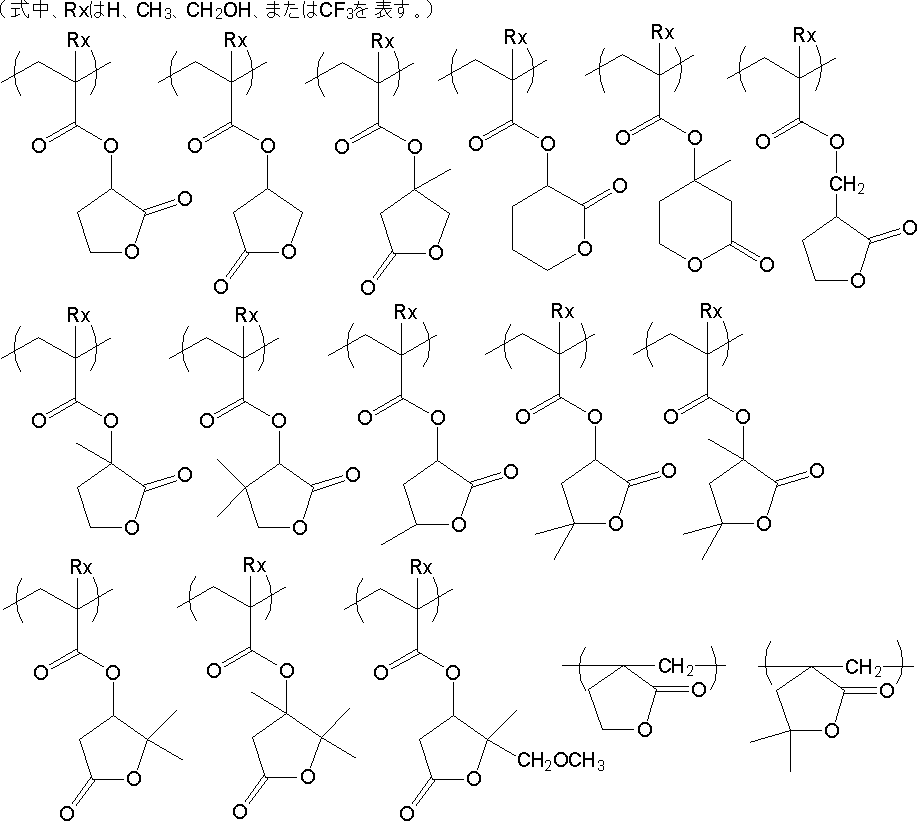
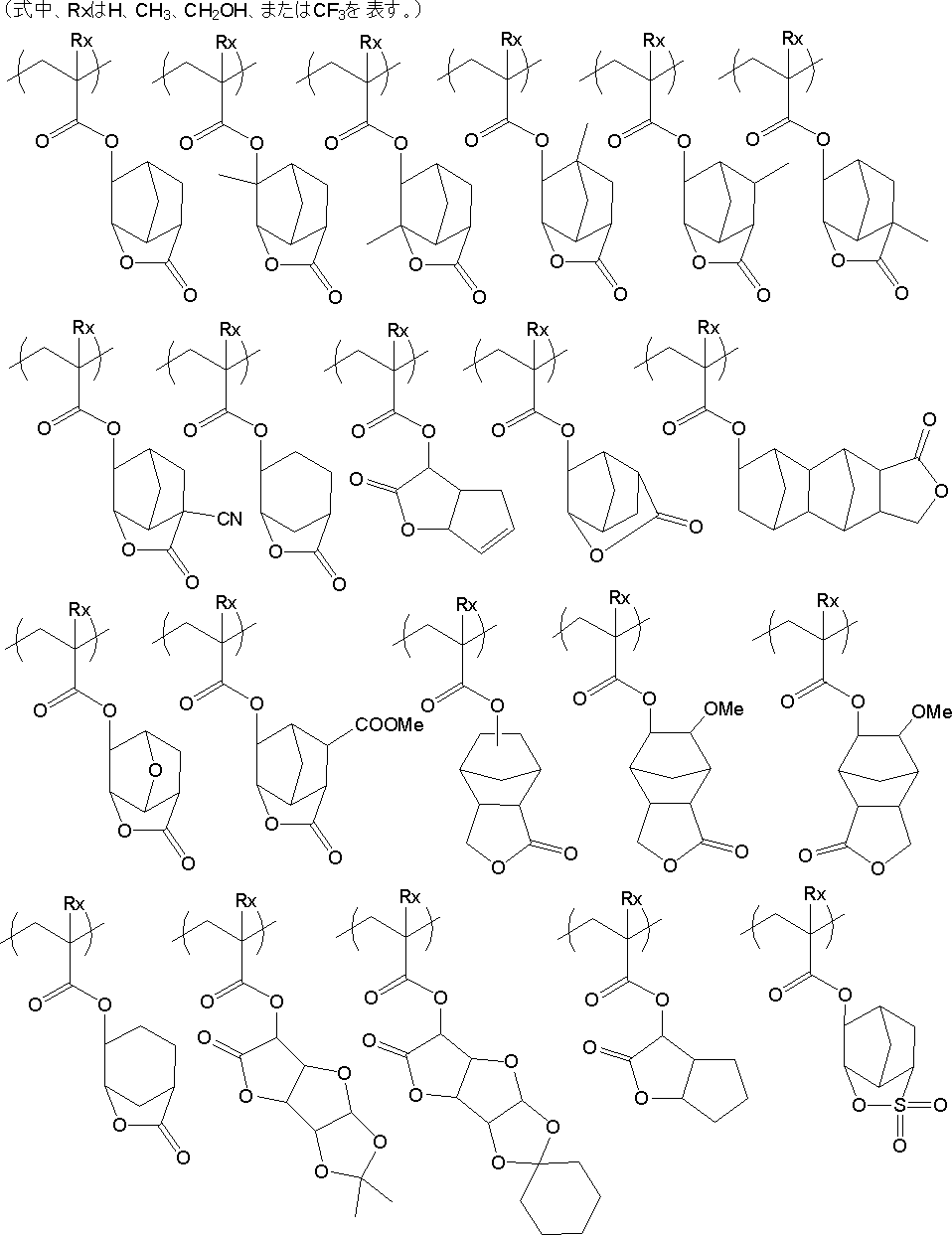

上記具体例の中で特に好ましい繰り返し単位としては、下記の繰り返し単位が挙げられる。最適なラクトン基又はスルトン基を選択することにより、パターンプロファイル、疎密依存性が良好となる。
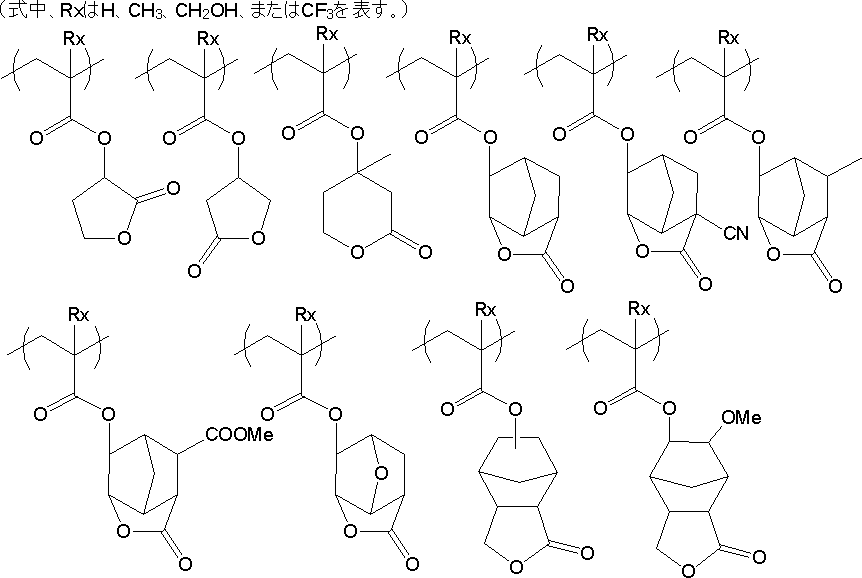
ラクトン基又はスルトン基を有する繰り返し単位は、通常光学異性体が存在するが、いずれの光学異性体を用いてもよい。また、1種の光学異性体を単独で用いても、複数の光学異性体を混合して用いてもよい。1種の光学異性体を主に用いる場合、その光学純度(ee)が90%以上のものが好ましく、より好ましくは95%以上である。
また、繰り返し単位(c)が有しうる極性基が酸性基であることも特に好ましい態様の一つである。好ましい酸性基としてはフェノール性ヒドロキシル基、カルボン酸基、スルホン酸基、フッ素化アルコール基(例えばヘキサフロロイソプロパノール基)、スルホンアミド基、スルホニルイミド基、(アルキルスルホニル)(アルキルカルボニル)メチレン基、(アルキルスルホニル)(アルキルカルボニル)イミド基、ビス(アルキルカルボニル)メチレン基、ビス(アルキルカルボニル)イミド基、ビス(アルキルスルホニル)メチレン基、ビス(アルキルスルホニル)イミド基、トリス(アルキルカルボニル)メチレン基、トリス(アルキルスルホニル)メチレン基が挙げられる。なかでも繰り返し単位(c)はカルボキシル基を有する繰り返し単位であることがより好ましい。酸性基を有する繰り返し単位を含有することによりコンタクトホール用途での解像性が増す。酸性基を有する繰り返し単位としては、アクリル酸、メタクリル酸による繰り返し単位のような樹脂の主鎖に直接酸性基が結合している繰り返し単位、あるいは連結基を介して樹脂の主鎖に酸性基が結合している繰り返し単位、更には酸性基を有する重合開始剤や連鎖移動剤を重合時に用いてポリマー鎖の末端に導入のいずれも好ましい。特に好ましくはアクリル酸、メタクリル酸による繰り返し単位である。
繰り返し単位(c)が有しうる酸性基は、芳香環を含んでいてもいなくてもよいが、芳香環を有する場合はフェノール性水酸基以外の酸性基から選ばれることが好ましい。繰り返し単位(c)が酸性基を有する場合、酸性基を有する繰り返し単位の含有量は、樹脂〔P-A〕中の全繰り返し単位に対し、30モル%以下であることが好ましく、20モル%以下であることがより好ましい。樹脂〔P-A〕が酸性基を有する繰り返し単位を含有する場合、樹脂〔P-A〕における酸性基を有する繰り返し単位の含有量は、通常、1モル%以上である。
酸性基を有する繰り返し単位の具体例を以下に示すが、本発明は、これに限定されるものではない。
具体例中、RxはH、CH3、CH2OH又はCF3を表す。
酸性基を有する繰り返し単位の具体例を以下に示すが、本発明は、これに限定されるものではない。
具体例中、RxはH、CH3、CH2OH又はCF3を表す。

(d)複数の芳香環を有する繰り返し単位
樹脂〔P-A〕は下記一般式(c1)で表される複数の芳香環を有する繰り返し単位(d)を有していても良い。
樹脂〔P-A〕は下記一般式(c1)で表される複数の芳香環を有する繰り返し単位(d)を有していても良い。
一般式(c1)中、
R3は、水素原子、アルキル基、ハロゲン原子、シアノ基又はニトロ基を表し、
Yは、単結合又は2価の連結基を表し、
Zは、単結合又は2価の連結基を表し、
Arは、芳香環基を表し、
pは1以上の整数を表す。
R3は、水素原子、アルキル基、ハロゲン原子、シアノ基又はニトロ基を表し、
Yは、単結合又は2価の連結基を表し、
Zは、単結合又は2価の連結基を表し、
Arは、芳香環基を表し、
pは1以上の整数を表す。
R3としてのアルキル基は、直鎖状、分岐状のいずれでもよく、例えば、メチル基、エチル基、n-プロピル基、i-プロピル基、n-ブチル基、sec-ブチル基、t-ブチル基、n-ペンチル基、n-ヘキシル基、n-ヘプチル基、n-オクチル基、n-ノニル基、n-デカニル基、i-ブチル基があげられ、更に置換基を有していても良く、好ましい置換基としては、アルコキシ基、水酸基、ハロゲン原子、ニトロ基等があげられ、中でも置換基を有するアルキル基としては、CF3基、アルキルオキシカルボニルメチル基、アルキルカルボニルオキシメチル基、ヒドロキシメチル基、アルコキシメチル基等が好ましい。
R3としてのハロゲン原子としては、フッ素原子、塩素原子、臭素原子及びヨウ素原子が挙げられ、フッ素原子が特に好ましい。
Yは、単結合又は2価の連結基を表し、2価の連結基としては、例えば、エーテル基(酸素原子)、チオエーテル基(硫黄原子)、アルキレン基、アリーレン基、カルボニル基、スルフィド基、スルホン基、-COO-、-CONH-、-SO2NH-、-CF2-、-CF2CF2-、-OCF2O-、-CF2OCF2-、-SS-、-CH2SO2CH2-、-CH2COCH2-、-COCF2CO-、-COCO-、-OCOO-、-OSO2O-、アミノ基(窒素原子)、アシル基、アルキルスルホニル基、-CH=CH-、-C≡C-、アミノカルボニルアミノ基、アミノスルホニルアミノ基、若しくはこれらの組み合わせからなる基があげられる。Yは、炭素数15以下が好ましく、炭素数10以下がより好ましい。
Yは、単結合又は2価の連結基を表し、2価の連結基としては、例えば、エーテル基(酸素原子)、チオエーテル基(硫黄原子)、アルキレン基、アリーレン基、カルボニル基、スルフィド基、スルホン基、-COO-、-CONH-、-SO2NH-、-CF2-、-CF2CF2-、-OCF2O-、-CF2OCF2-、-SS-、-CH2SO2CH2-、-CH2COCH2-、-COCF2CO-、-COCO-、-OCOO-、-OSO2O-、アミノ基(窒素原子)、アシル基、アルキルスルホニル基、-CH=CH-、-C≡C-、アミノカルボニルアミノ基、アミノスルホニルアミノ基、若しくはこれらの組み合わせからなる基があげられる。Yは、炭素数15以下が好ましく、炭素数10以下がより好ましい。
Yは、好ましくは単結合、-COO-基、-COS-基、-CONH-基、より好ましくは-COO-基、-CONH-基であり、特に好ましくは-COO-基である。
Zは、単結合又は2価の連結基を表し、2価の連結基としては、例えば、エーテル基(酸素原子)、チオエーテル基(硫黄原子)、アルキレン基、アリーレン基、カルボニル基、スルフィド基、スルホン基、-COO-、-CONH-、-SO2NH-、アミノ基(窒素原子)、アシル基、アルキルスルホニル基、-CH=CH-、アミノカルボニルアミノ基、アミノスルホニルアミノ基、若しくはこれらの組み合わせからなる基があげられる。
Zは、好ましくは単結合、エーテル基、カルボニル基、-COO-であり、更に好ましくは単結合、エーテル基であり、特に好ましくは単結合である。
Zは、単結合又は2価の連結基を表し、2価の連結基としては、例えば、エーテル基(酸素原子)、チオエーテル基(硫黄原子)、アルキレン基、アリーレン基、カルボニル基、スルフィド基、スルホン基、-COO-、-CONH-、-SO2NH-、アミノ基(窒素原子)、アシル基、アルキルスルホニル基、-CH=CH-、アミノカルボニルアミノ基、アミノスルホニルアミノ基、若しくはこれらの組み合わせからなる基があげられる。
Zは、好ましくは単結合、エーテル基、カルボニル基、-COO-であり、更に好ましくは単結合、エーテル基であり、特に好ましくは単結合である。
Arは、芳香環基を表し、具体的には、フェニル基、ナフチル基、アントラセニル基、フェナントレニル基、キノリニル基、フラニル基、チオフェニル基、フルオレニル-9-オン-イル基、アントラキノニル基、フェナントラキノニル基、ピロール基等が挙げられ、フェニル基であることが好ましい。これらの芳香環基は更に置換基を有していてもよく、好ましい置換基としては、例えば、アルキル基、アルコキシ基、水酸基、ハロゲン原子、ニトロ基、アシル基、アシルオキシ基、アシルアミノ基、スルホニルアミノ基、フェニル基等のアリール基、アリールオキシ基、アリールカルボニル基、ヘテロ環残基などが挙げられ、これらの中でも、フェニル基が、アウトバンド光に起因した露光ラチチュードやパターン形状の悪化を抑制する観点から好ましい。
pは、1以上の整数であり、1~3の整数であることが好ましい。
pは、1以上の整数であり、1~3の整数であることが好ましい。
繰り返し単位(d)として更に好ましいのは以下の式(c2)で表される繰り返し単位である。

一般式(c2)中、R3は、水素原子又はアルキル基を表す。R3としてのアルキル基として好ましいものは、一般式(c1)と同様である。
ここで、極紫外線(EUV光)露光に関しては、波長100~400nmの紫外線領域に発生する漏れ光(アウトオブバンド光)が表面ラフネスを悪化させ、結果、パターン間におけるブリッジや、パターンの断線によって、解像性及びLWR性能が低下する傾向となる。
しかしながら、繰り返し単位(d)における芳香環は、上記アウトオブバンド光を吸収可能な内部フィルターとして機能する。よって、高解像及び低LWRの観点から、樹脂〔P-A〕は、繰り返し単位(d)を含有することが好ましい。
ここで、繰り返し単位(d)は、高解像性を得る観点から、フェノール性水酸基(芳香環上に直接結合した水酸基)を有さないことが好ましい。
しかしながら、繰り返し単位(d)における芳香環は、上記アウトオブバンド光を吸収可能な内部フィルターとして機能する。よって、高解像及び低LWRの観点から、樹脂〔P-A〕は、繰り返し単位(d)を含有することが好ましい。
ここで、繰り返し単位(d)は、高解像性を得る観点から、フェノール性水酸基(芳香環上に直接結合した水酸基)を有さないことが好ましい。
繰り返し単位(d)の具体例を以下に示すが、これらに限定されるものではない。


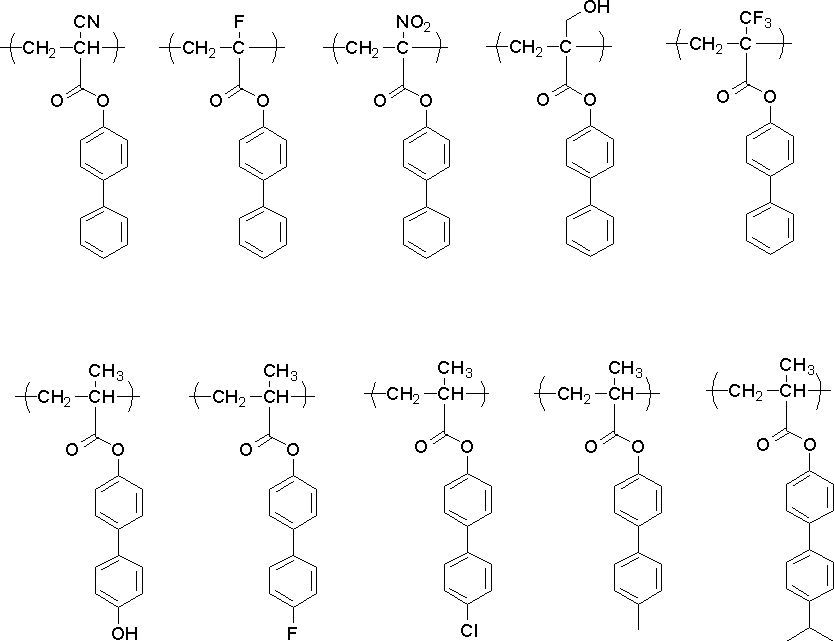
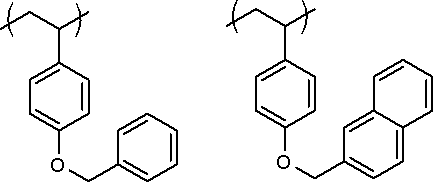
樹脂〔P-A〕は、繰り返し単位(d)を含有してもしなくても良いが、含有する場合、繰り返し単位(d)の含有率は、樹脂〔P-A〕の全繰り返し単位に対して、1~30モル%の範囲であることが好ましく、より好ましくは1~20モル%の範囲であり、更に好ましくは1~15モル%の範囲である。樹脂〔P-A〕に含まれる繰り返し単位(d)は2種類以上を組み合わせて含んでもよい。
本発明における樹脂〔P-A〕は、上記した繰り返し単位以外の繰り返し単位(以下、「その他の繰り返し単位」ともいう)を適宜有していてもよい。そのような繰り返し単位の一例として、更に極性基(例えば、前記酸基、水酸基、シアノ基)を持たない脂環炭化水素構造を有し、酸分解性を示さない繰り返し単位を有することができる。このようなその他の繰り返し単位としては、一般式(IV)で表される繰り返し単位が挙げられる。

一般式(IV)中、R5は少なくとも1つの環状構造を有し、極性基を有さない炭化水素基を表す。
Raは水素原子、アルキル基又は-CH2-O-Ra2基を表す。式中、Ra2は、水素原子、アルキル基又はアシル基を表す。Raは、水素原子、メチル基、ヒドロキシメチル基、トリフルオロメチル基が好ましく、水素原子、メチル基が特に好ましい。
Raは水素原子、アルキル基又は-CH2-O-Ra2基を表す。式中、Ra2は、水素原子、アルキル基又はアシル基を表す。Raは、水素原子、メチル基、ヒドロキシメチル基、トリフルオロメチル基が好ましく、水素原子、メチル基が特に好ましい。
R5が有する環状構造には、単環式炭化水素基及び多環式炭化水素基が含まれる。単環式炭化水素基としては、たとえば、シクロペンチル基、シクロヘキシル基、シクロへプチル基、シクロオクチル基などの炭素数3~12のシクロアルキル基、シクロへキセニル基など炭素数3~12のシクロアルケニル基が挙げられる。好ましい単環式炭化水素基としては、炭素数3~7の単環式炭化水素基であり、より好ましくは、シクロペンチル基、シクロヘキシル基が挙げられる。
多環式炭化水素基には環集合炭化水素基、架橋環式炭化水素基が含まれ、環集合炭化水素基の例としては、ビシクロヘキシル基、パーヒドロナフタレニル基などが含まれる。架橋環式炭化水素環として、例えば、ピナン、ボルナン、ノルピナン、ノルボルナン、ビシクロオクタン環(ビシクロ[2.2.2]オクタン環、ビシクロ[3.2.1]オクタン環等)などの2環式炭化水素環及び、ホモブレダン、アダマンタン、トリシクロ[5.2.1.02,6]デカン、トリシクロ[4.3.1.12,5]ウンデカン環などの3環式炭化水素環、テトラシクロ[4.4.0.12,5.17,10]ドデカン、パーヒドロ-1,4-メタノ-5,8-メタノナフタレン環などの4環式炭化水素環などが挙げられる。また、架橋環式炭化水素環には、縮合環式炭化水素環、例えば、パーヒドロナフタレン(デカリン)、パーヒドロアントラセン、パーヒドロフェナントレン、パーヒドロアセナフテン、パーヒドロフルオレン、パーヒドロインデン、パーヒドロフェナレン環などの5~8員シクロアルカン環が複数個縮合した縮合環も含まれる。
好ましい架橋環式炭化水素環として、ノルボルニル基、アダマンチル基、ビシクロオクタニル基、トリシクロ[5.2.1.02,6]デカニル基、などが挙げられる。より好ましい架橋環式炭化水素環としてノルボニル基、アダマンチル基が挙げられる。
これらの脂環式炭化水素基は置換基を有していても良く、好ましい置換基としてはハロゲン原子、アルキル基、水素原子が置換されたヒドロキシル基、水素原子が置換されたアミノ基などが挙げられる。好ましいハロゲン原子としては臭素、塩素、フッ素原子、好ましいアルキル基としてはメチル、エチル、ブチル、t-ブチル基が挙げられる。上記のアルキル基は更に置換基を有していても良く、更に有していてもよい置換基としては、ハロゲン原子、アルキル基、水素原子が置換されたヒドロキシル基、水素原子が置換されたアミノ基を挙げることができる。
上記水素原子の置換基としては、たとえばアルキル基、シクロアルキル基、アラルキル基、置換メチル基、置換エチル基、アルコキシカルボニル基、アラルキルオキシカルボニル基が挙げられる。好ましいアルキル基としては、炭素数1~4のアルキル基、好ましい置換メチル基としてはメトキシメチル、メトキシチオメチル、ベンジルオキシメチル、t-ブトキシメチル、2-メトキシエトキシメチル基、好ましい置換エチル基としては、1-エトキシエチル、1-メチル-1-メトキシエチル、好ましいアシル基としては、ホルミル、アセチル、プロピオニル、ブチリル、イソブチリル、バレリル、ピバロイル基などの炭素数1~6の脂肪族アシル基、アルコキシカルボニル基としては炭素数1~4のアルコキシカルボニル基などが挙げられる。
樹脂〔P-A〕は、極性基を持たない脂環炭化水素構造を有し、酸分解性を示さない繰り返し単位を含有してもしなくてもよいが、含有する場合、この繰り返し単位の含有量は、樹脂〔P-A〕中の全繰り返し単位に対し、1~20モル%が好ましく、より好ましくは5~15モル%である。
極性基を持たない脂環炭化水素構造を有し、酸分解性を示さない繰り返し単位の具体例を以下に挙げるが、本発明はこれらに限定されない。式中、Raは、H、CH3、CH2OH、又はCF3を表す。
極性基を持たない脂環炭化水素構造を有し、酸分解性を示さない繰り返し単位の具体例を以下に挙げるが、本発明はこれらに限定されない。式中、Raは、H、CH3、CH2OH、又はCF3を表す。
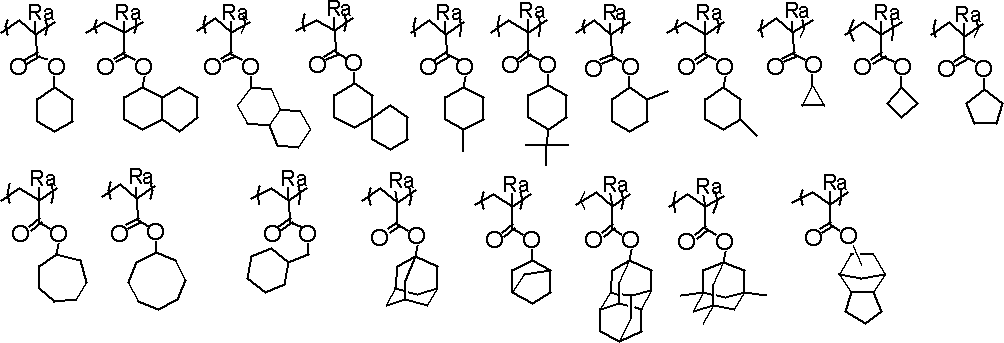
また、樹脂〔P-A〕は、Tgの向上やドライエッチング耐性の向上、先述のアウトオブバンド光の内部フィルター等の効果を鑑み、下記のモノマー成分を含んでも良い。

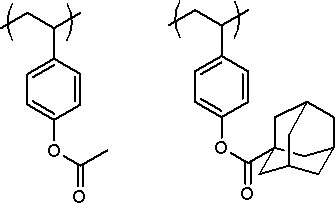
本発明の組成物に用いられる樹脂〔P-A〕において、各繰り返し構造単位の含有モル比は、レジストのドライエッチング耐性や標準現像液適性、基板密着性、レジストプロファイル、更にはレジストの一般的な必要性能である解像力、耐熱性、感度等を調節するために適宜設定される。
本発明の樹脂〔P-A〕の形態としては、ランダム型、ブロック型、クシ型、スター型のいずれの形態でもよい。
樹脂〔P-A〕は、例えば、各構造に対応する不飽和モノマーのラジカル、カチオン、又はアニオン重合により合成することができる。また各構造の前駆体に相当する不飽和モノマーを用いて重合した後に、高分子反応を行うことにより目的とする樹脂を得ることも可能である。
例えば、一般的合成方法としては、不飽和モノマー及び重合開始剤を溶剤に溶解させ、加熱することにより重合を行う一括重合法、加熱溶剤に不飽和モノマーと重合開始剤の溶液を1~10時間かけて滴下して加える滴下重合法などが挙げられ、滴下重合法が好ましい。
樹脂〔P-A〕は、例えば、各構造に対応する不飽和モノマーのラジカル、カチオン、又はアニオン重合により合成することができる。また各構造の前駆体に相当する不飽和モノマーを用いて重合した後に、高分子反応を行うことにより目的とする樹脂を得ることも可能である。
例えば、一般的合成方法としては、不飽和モノマー及び重合開始剤を溶剤に溶解させ、加熱することにより重合を行う一括重合法、加熱溶剤に不飽和モノマーと重合開始剤の溶液を1~10時間かけて滴下して加える滴下重合法などが挙げられ、滴下重合法が好ましい。
重合に使用される溶媒としては、例えば、後述の感活性光線性又は感放射線性組成物を調製する際に使用することができる溶剤等を挙げることができ、より好ましくは本発明の組成物に用いられる溶剤と同一の溶剤を用いて重合することが好ましい。これにより保存時のパーティクルの発生が抑制できる。
重合反応は窒素やアルゴンなど不活性ガス雰囲気下で行われることが好ましい。重合開始剤としては市販のラジカル開始剤(アゾ系開始剤、パーオキサイドなど)を用いて重合を開始させる。ラジカル開始剤としてはアゾ系開始剤が好ましく、エステル基、シアノ基、カルボキシル基を有するアゾ系開始剤が好ましい。好ましい開始剤としては、アゾビスイソブチロニトリル、アゾビスジメチルバレロニトリル、ジメチル2,2’-アゾビス(2-メチルプロピオネート)などが挙げられる。必要に応じて連鎖移動剤(例えば、アルキルメルカプタンなど)の存在下で重合を行ってもよい。
重合反応は窒素やアルゴンなど不活性ガス雰囲気下で行われることが好ましい。重合開始剤としては市販のラジカル開始剤(アゾ系開始剤、パーオキサイドなど)を用いて重合を開始させる。ラジカル開始剤としてはアゾ系開始剤が好ましく、エステル基、シアノ基、カルボキシル基を有するアゾ系開始剤が好ましい。好ましい開始剤としては、アゾビスイソブチロニトリル、アゾビスジメチルバレロニトリル、ジメチル2,2’-アゾビス(2-メチルプロピオネート)などが挙げられる。必要に応じて連鎖移動剤(例えば、アルキルメルカプタンなど)の存在下で重合を行ってもよい。
反応の濃度は5~70質量%であり、好ましくは10~50質量%である。反応温度は、通常10℃~150℃であり、好ましくは30℃~120℃、更に好ましくは40~100℃である。
反応時間は、通常1~48時間であり、好ましくは1~24時間、更に好ましくは1~12時間である。
反応終了後、室温まで放冷し、精製する。精製は、水洗や適切な溶媒を組み合わせることにより残留単量体やオリゴマー成分を除去する液々抽出法、特定の分子量以下のもののみを抽出除去する限外ろ過等の溶液状態での精製方法や、樹脂溶液を貧溶媒へ滴下することで樹脂を貧溶媒中に凝固させることにより残留単量体等を除去する再沈澱法やろ別した樹脂スラリーを貧溶媒で洗浄する等の固体状態での精製方法等の通常の方法を適用できる。例えば、上記樹脂が難溶あるいは不溶の溶媒(貧溶媒)を、該反応溶液の10倍以下の体積量、好ましくは10~5倍の体積量で、接触させることにより樹脂を固体として析出させる。
反応時間は、通常1~48時間であり、好ましくは1~24時間、更に好ましくは1~12時間である。
反応終了後、室温まで放冷し、精製する。精製は、水洗や適切な溶媒を組み合わせることにより残留単量体やオリゴマー成分を除去する液々抽出法、特定の分子量以下のもののみを抽出除去する限外ろ過等の溶液状態での精製方法や、樹脂溶液を貧溶媒へ滴下することで樹脂を貧溶媒中に凝固させることにより残留単量体等を除去する再沈澱法やろ別した樹脂スラリーを貧溶媒で洗浄する等の固体状態での精製方法等の通常の方法を適用できる。例えば、上記樹脂が難溶あるいは不溶の溶媒(貧溶媒)を、該反応溶液の10倍以下の体積量、好ましくは10~5倍の体積量で、接触させることにより樹脂を固体として析出させる。
ポリマー溶液からの沈殿又は再沈殿操作の際に用いる溶媒(沈殿又は再沈殿溶媒)としては、該ポリマーの貧溶媒であればよく、ポリマーの種類に応じて、炭化水素、ハロゲン化炭化水素、ニトロ化合物、エーテル、ケトン、エステル、カーボネート、アルコール、カルボン酸、水、これらの溶媒を含む混合溶媒等の中から適宜選択して使用できる。これらの中でも、沈殿又は再沈殿溶媒として、少なくともアルコール(特に、メタノールなど)又は水を含む溶媒が好ましい。
沈殿又は再沈殿溶媒の使用量は、効率や収率等を考慮して適宜選択できるが、一般には、ポリマー溶液100質量部に対して、100~10000質量部、好ましくは200~2000質量部、更に好ましくは300~1000質量部である。
沈殿又は再沈殿する際の温度としては、効率や操作性を考慮して適宜選択できるが、通常0~50℃程度、好ましくは室温付近(例えば20~35℃程度)である。沈殿又は再沈殿操作は、攪拌槽などの慣用の混合容器を用い、バッチ式、連続式等の公知の方法により行うことができる。
沈殿又は再沈殿したポリマーは、通常、濾過、遠心分離等の慣用の固液分離に付し、乾燥して使用に供される。濾過は、耐溶剤性の濾材を用い、好ましくは加圧下で行われる。乾燥は、常圧又は減圧下(好ましくは減圧下)、30~100℃程度、好ましくは30~50℃程度の温度で行われる。
沈殿又は再沈殿溶媒の使用量は、効率や収率等を考慮して適宜選択できるが、一般には、ポリマー溶液100質量部に対して、100~10000質量部、好ましくは200~2000質量部、更に好ましくは300~1000質量部である。
沈殿又は再沈殿する際の温度としては、効率や操作性を考慮して適宜選択できるが、通常0~50℃程度、好ましくは室温付近(例えば20~35℃程度)である。沈殿又は再沈殿操作は、攪拌槽などの慣用の混合容器を用い、バッチ式、連続式等の公知の方法により行うことができる。
沈殿又は再沈殿したポリマーは、通常、濾過、遠心分離等の慣用の固液分離に付し、乾燥して使用に供される。濾過は、耐溶剤性の濾材を用い、好ましくは加圧下で行われる。乾燥は、常圧又は減圧下(好ましくは減圧下)、30~100℃程度、好ましくは30~50℃程度の温度で行われる。
なお、一度、樹脂を析出させて、分離した後に、再び溶媒に溶解させ、該樹脂が難溶あるいは不溶の溶媒と接触させてもよい。即ち、上記ラジカル重合反応終了後、該ポリマーが難溶あるいは不溶の溶媒を接触させ、樹脂を析出させ(工程a)、樹脂を溶液から分離し(工程b)、改めて溶媒に溶解させ樹脂溶液Aを調製(工程c)、その後、該樹脂溶液Aに、該樹脂が難溶あるいは不溶の溶媒を、樹脂溶液Aの10倍未満の体積量(好ましくは5倍以下の体積量)で、接触させることにより樹脂固体を析出させ(工程d)、析出した樹脂を分離する(工程e)ことを含む方法でもよい。
重合反応は窒素やアルゴンなど不活性ガス雰囲気下で行われることが好ましい。重合開始剤としては市販のラジカル開始剤(アゾ系開始剤、パーオキサイドなど)を用いて重合を開始させる。ラジカル開始剤としてはアゾ系開始剤が好ましく、エステル基、シアノ基、カルボキシル基を有するアゾ系開始剤が好ましい。好ましい開始剤としては、アゾビスイソブチロニトリル、アゾビスジメチルバレロニトリル、ジメチル2,2‘-アゾビス(2-メチルプロピオネート)などが挙げられる。所望により開始剤を追加、あるいは分割で添加し、反応終了後、溶剤に投入して粉体あるいは固形回収等の方法で所望のポリマーを回収する。反応の濃度は5~50質量%であり、好ましくは10~30質量%である。反応温度は、通常10℃~150℃であり、好ましくは30℃~120℃、更に好ましくは60~100℃である。
重合反応は窒素やアルゴンなど不活性ガス雰囲気下で行われることが好ましい。重合開始剤としては市販のラジカル開始剤(アゾ系開始剤、パーオキサイドなど)を用いて重合を開始させる。ラジカル開始剤としてはアゾ系開始剤が好ましく、エステル基、シアノ基、カルボキシル基を有するアゾ系開始剤が好ましい。好ましい開始剤としては、アゾビスイソブチロニトリル、アゾビスジメチルバレロニトリル、ジメチル2,2‘-アゾビス(2-メチルプロピオネート)などが挙げられる。所望により開始剤を追加、あるいは分割で添加し、反応終了後、溶剤に投入して粉体あるいは固形回収等の方法で所望のポリマーを回収する。反応の濃度は5~50質量%であり、好ましくは10~30質量%である。反応温度は、通常10℃~150℃であり、好ましくは30℃~120℃、更に好ましくは60~100℃である。
本発明に係わる樹脂〔P-A〕の分子量は、特に制限されないが、重量平均分子量が1000~100000の範囲であることが好ましく、1500~60000の範囲であることがより好ましく、2000~30000の範囲であることが特に好ましい。重量平均分子量を1000~100000の範囲とすることにより、耐熱性やドライエッチング耐性の劣化を防ぐことができ、かつ現像性が劣化したり、粘度が高くなって製膜性が劣化することを防ぐことができる。ここで、樹脂の重量平均分子量は、GPC(キャリア:THFあるいはN-メチル-2-ピロリドン(NMP))によって測定したポリスチレン換算分子量を示す。
また分散度(Mw/Mn)は、好ましくは1.00~5.00、より好ましくは1.00~3.50であり、更に好ましくは、1.00~2.50である。分子量分布の小さいものほど、解像度、レジスト形状が優れ、かつレジストパターンの側壁がスムーズであり、ラフネス性に優れる。
本明細書において、樹脂の重量平均分子量(Mw)及び分散度は、例えば、HLC-8120(東ソー(株)製)を用い、カラムとしてTSK gel Multipore HXL-M(東ソー(株)製、7.8mmHD×30.0cm)を、溶離液としてTHF(テトラヒドロフラン)又はNMP(N-メチル-2-ピロリドン)を用いることによって求めることができる。
樹脂〔P-A〕は、後述の化合物〔P-B〕と同一の成分であっても、異なる成分であっても良いが、異なる成分であることが好ましい。
本発明の樹脂〔P-A〕は、1種類単独で、又は2種類以上を組み合わせて使用することができる。樹脂〔P-A〕の含有量は、本発明の感活性光線性又は感放射線性組成物中の全固形分を基準にして、20~99質量%が好ましく、30~99質量%がより好ましく、40~99質量%が更に好ましい。
〔P-B〕活性光線又は放射線の照射により酸を発生し、かつ酸の作用によりアルカリ現像液に対する溶解性が増大する化合物
活性光線又は放射線の照射により酸を発生し、かつ酸の作用によりアルカリ現像液水溶液に対する溶解性が増大する化合物〔P-B〕(以下、単に、酸発生剤〔P-B〕とも言う)は、活性光線又は放射線の照射により酸を発生し、かつアルカリ可溶性基を酸の作用により分解し脱離する脱離基で保護された構造(樹脂〔P-A〕について前述したものと同様に、以下、「酸分解性基」ともいう)を有する化合物であることが好ましい。
化合物〔P-B〕の分子量範囲は100~3000が好ましく、100~2000がより好ましく、100~1000が特に好ましい。
アルカリ可溶性基の具体例及び好ましい例としては樹脂〔P-A〕について前述した極性基の具体例及び好ましい例と同様のものが挙げられる。
酸分解性基のアルカリ可溶性基及び好ましい例としては樹脂〔P-A〕について前述した「アルカリ可溶性基が酸の作用により分解し脱離する基で保護された構造」の具体例及び好ましい例と同様のものが挙げられる。
活性光線又は放射線の照射により酸を発生し、かつ酸の作用によりアルカリ現像液水溶液に対する溶解性が増大する化合物〔P-B〕(以下、単に、酸発生剤〔P-B〕とも言う)は、活性光線又は放射線の照射により酸を発生し、かつアルカリ可溶性基を酸の作用により分解し脱離する脱離基で保護された構造(樹脂〔P-A〕について前述したものと同様に、以下、「酸分解性基」ともいう)を有する化合物であることが好ましい。
化合物〔P-B〕の分子量範囲は100~3000が好ましく、100~2000がより好ましく、100~1000が特に好ましい。
アルカリ可溶性基の具体例及び好ましい例としては樹脂〔P-A〕について前述した極性基の具体例及び好ましい例と同様のものが挙げられる。
酸分解性基のアルカリ可溶性基及び好ましい例としては樹脂〔P-A〕について前述した「アルカリ可溶性基が酸の作用により分解し脱離する基で保護された構造」の具体例及び好ましい例と同様のものが挙げられる。
化合物(P-B)において、前記酸分解性基は、アルカリ現像液に対する溶解度をより増大させる観点から、酸の作用により分解しフェノール性水酸基又はカルボキシル基を生じる基であることが好ましい。
本明細書において、フェノール性水酸基とは、芳香環基の水素原子を水酸基で置換してなる基である。該芳香環は単環又は多環の芳香環であり、ベンゼン環、ナフタレン環、アントラセン環、フルオレン環、フェナントレン環などの炭素数6~18の置換基を有していてもよい芳香族炭化水素環、又は、例えば、チオフェン環、フラン環、ピロール環、ベンゾチオフェン環、ベンゾフラン環、ベンゾピロール環、トリアジン環、イミダゾール環、ベンゾイミダゾール環、トリアゾール環、チアジアゾール環、チアゾール環等のヘテロ環を含む芳香環ヘテロ環を挙げることができる。中でも、ベンゼン環、ナフタレン環が解像性の観点で好ましく、ベンゼン環が最も好ましい。
本明細書において、フェノール性水酸基とは、芳香環基の水素原子を水酸基で置換してなる基である。該芳香環は単環又は多環の芳香環であり、ベンゼン環、ナフタレン環、アントラセン環、フルオレン環、フェナントレン環などの炭素数6~18の置換基を有していてもよい芳香族炭化水素環、又は、例えば、チオフェン環、フラン環、ピロール環、ベンゾチオフェン環、ベンゾフラン環、ベンゾピロール環、トリアジン環、イミダゾール環、ベンゾイミダゾール環、トリアゾール環、チアジアゾール環、チアゾール環等のヘテロ環を含む芳香環ヘテロ環を挙げることができる。中でも、ベンゼン環、ナフタレン環が解像性の観点で好ましく、ベンゼン環が最も好ましい。
酸発生剤〔P-B〕としては、下記一般式(ZI)、(ZII)又は(ZIII)で表される化合物を挙げることができる。

上記一般式(ZI)において、
R201、R202及びR203は、各々独立に、有機基を表す。
R201、R202及びR203としての有機基の炭素数は、一般的に1~30、好ましくは1~20である。
また、R201~R203のうち2つが結合して環構造を形成してもよく、環内に酸素原子、硫黄原子、エステル結合、アミド結合、カルボニル基を含んでいてもよい。R201~R203の内の2つが結合して形成する基としては、アルキレン基(例えば、ブチレン基、ペンチレン基)を挙げることができる。
Z-は、非求核性アニオンを表す。
R201、R202、R203及びZ-の少なくとも1つは酸分解性基を有する。酸分解性基の好ましい態様としては前述の通りである。
酸分解性基をカチオン部に有すると活性光線又は放射線によって分解する際に、分解物がより疎水的になるカチオン部に酸分解基を有することで、より均一に溶解コントラストを付与することができる観点から、R201、R202及びR203の少なくとも1つが酸分解性基を有することが好ましい。
R201、R202及びR203は、各々独立に、有機基を表す。
R201、R202及びR203としての有機基の炭素数は、一般的に1~30、好ましくは1~20である。
また、R201~R203のうち2つが結合して環構造を形成してもよく、環内に酸素原子、硫黄原子、エステル結合、アミド結合、カルボニル基を含んでいてもよい。R201~R203の内の2つが結合して形成する基としては、アルキレン基(例えば、ブチレン基、ペンチレン基)を挙げることができる。
Z-は、非求核性アニオンを表す。
R201、R202、R203及びZ-の少なくとも1つは酸分解性基を有する。酸分解性基の好ましい態様としては前述の通りである。
酸分解性基をカチオン部に有すると活性光線又は放射線によって分解する際に、分解物がより疎水的になるカチオン部に酸分解基を有することで、より均一に溶解コントラストを付与することができる観点から、R201、R202及びR203の少なくとも1つが酸分解性基を有することが好ましい。
Z-としての非求核性アニオンとしては、例えば、スルホン酸アニオン、カルボン酸アニオン、スルホニルイミドアニオン、ビス(アルキルスルホニル)イミドアニオン、トリス(アルキルスルホニル)メチルアニオン等を挙げることができる。
非求核性アニオンとは、求核反応を起こす能力が著しく低いアニオンであり、分子内求核反応による経時分解を抑制することができるアニオンである。これにより感活性光線性又は感放射線性組成物の経時安定性が向上する。
スルホン酸アニオンとしては、例えば、脂肪族スルホン酸アニオン、芳香族スルホン酸アニオン、カンファースルホン酸アニオンなどが挙げられる。
カルボン酸アニオンとしては、例えば、脂肪族カルボン酸アニオン、芳香族カルボン酸アニオン、アラルキルカルボン酸アニオンなどが挙げられる。
脂肪族スルホン酸アニオン及び脂肪族カルボン酸アニオンにおける脂肪族部位は、アルキル基であってもシクロアルキル基であってもよく、好ましくは炭素数1~30のアルキル基及び炭素数3~30のシクロアルキル基、例えば、メチル基、エチル基、プロピル基、イソプロピル基、n-ブチル基、イソブチル基、sec-ブチル基、ペンチル基、ネオペンチル基、ヘキシル基、ヘプチル基、オクチル基、ノニル基、デシル基、ウンデシル基、ドデシル基、トリデシル基、テトラデシル基、ペンタデシル基、ヘキサデシル基、ヘプタデシル基、オクタデシル基、ノナデシル基、エイコシル基、シクロプロピル基、シクロペンチル基、シクロヘキシル基、アダマンチル基、ノルボルニル基、ボルニル基等を挙げることができる。
芳香族スルホン酸アニオン及び芳香族カルボン酸アニオンにおける芳香族基としては、好ましくは炭素数6~14のアリール基、例えば、フェニル基、トリル基、ナフチル基等を挙げることができる。
脂肪族スルホン酸アニオン及び芳香族スルホン酸アニオンにおけるアルキル基、シクロアルキル基及びアリール基は、置換基を有していてもよい。脂肪族スルホン酸アニオン及び芳香族スルホン酸アニオンにおけるアルキル基、シクロアルキル基及びアリール基の置換基としては、例えば、ニトロ基、ハロゲン原子(フッ素原子、塩素原子、臭素原子、沃素原子)、カルボキシル基、水酸基、アミノ基、シアノ基、アルコキシ基(好ましくは炭素数1~15)、シクロアルキル基(好ましくは炭素数3~15)、アリール基(好ましくは炭素数6~14)、アルコキシカルボニル基(好ましくは炭素数2~7)、アシル基(好ましくは炭素数2~12)、アルコキシカルボニルオキシ基(好ましくは炭素数2~7)、アルキルチオ基(好ましくは炭素数1~15)、アルキルスルホニル基(好ましくは炭素数1~15)、アルキルイミノスルホニル基(好ましくは炭素数1~15)、アリールオキシスルホニル基(好ましくは炭素数6~20)、アルキルアリールオキシスルホニル基(好ましくは炭素数7~20)、シクロアルキルアリールオキシスルホニル基(好ましくは炭素数10~20)、アルキルオキシアルキルオキシ基(好ましくは炭素数5~20)、シクロアルキルアルキルオキシアルキルオキシ基(好ましくは炭素数8~20)等を挙げることができる。各基が有するアリール基及び環構造については、置換基として更にアルキル基(好ましくは炭素数1~15)を挙げることができる。
アラルキルカルボン酸アニオンにおけるアラルキル基としては、好ましくは炭素数7~12のアラルキル基、例えば、ベンジル基、フェネチル基、ナフチルメチル基、ナフチルエチル基、ナフチルブチル基等を挙げることができる。
脂肪族カルボン酸アニオン、芳香族カルボン酸アニオン及びアラルキルカルボン酸アニオンにおけるアルキル基、シクロアルキル基、アリール基及びアラルキル基は、置換基を有していてもよい。この置換基としては、例えば、芳香族スルホン酸アニオンにおけるものと同様のハロゲン原子、アルキル基、シクロアルキル基、アルコキシ基、アルキルチオ基等を挙げることができる。
スルホニルイミドアニオンとしては、例えば、サッカリンアニオンを挙げることができる。
ビス(アルキルスルホニル)イミドアニオン、トリス(アルキルスルホニル)メチドアニオンにおけるアルキル基は、炭素数1~5のアルキル基が好ましく、例えば、メチル基、エチル基、プロピル基、イソプロピル基、n-ブチル基、イソブチル基、sec-ブチル基、ペンチル基、ネオペンチル基等を挙げることができる。これらのアルキル基の置換基としてはハロゲン原子、ハロゲン原子で置換されたアルキル基、アルコキシ基、アルキルチオ基、アルキルオキシスルホニル基、アリールオキシスルホニル基、シクロアルキルアリールオキシスルホニル基等を挙げることができ、フッ素原子で置換されたアルキル基が好ましい。
その他の非求核性アニオンとしては、例えば、フッ素化燐、フッ素化硼素、フッ素化アンチモン等を挙げることができる。
Z-の非求核性アニオンとしては、スルホン酸の少なくともα位がフッ素原子で置換された脂肪族スルホン酸アニオン、フッ素原子又はフッ素原子を有する基で置換された芳香族スルホン酸アニオン、アルキル基がフッ素原子で置換されたビス(アルキルスルホニル)イミドアニオン、アルキル基がフッ素原子で置換されたトリス(アルキルスルホニル)メチドアニオンが好ましい。非求核性アニオンとして、より好ましくは炭素数4~8のパーフロロ脂肪族スルホン酸アニオン、フッ素原子を有するベンゼンスルホン酸アニオン、更により好ましくはノナフロロブタンスルホン酸アニオン、パーフロロオクタンスルホン酸アニオン、ペンタフロロベンゼンスルホン酸アニオン、3,5-ビス(トリフロロメチル)ベンゼンスルホン酸アニオンである。
Z-としての非求核性アニオンとしては、下記式(I)で表される酸を生じるアニオンであることも好ましい。
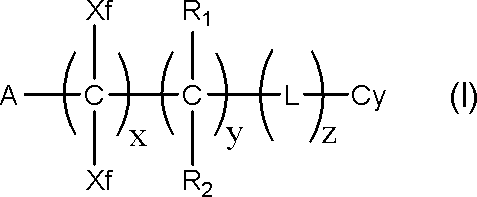
式中、
Xfは、それぞれ独立に、フッ素原子、又は少なくとも1つのフッ素原子で置換されたアルキル基を表す。
R1、R2は、それぞれ独立に、水素原子、フッ素原子又はアルキル基を表し、複数存在する場合のR1、R2は、それぞれ同一でも異なっていてもよい。
Lは、二価の連結基を表し、複数存在する場合のLは同一でも異なっていてもよい。
Cyは、環状の有機基を表す。
Aは、HO3S-又はRf-SO2-NH-SO2-を表す。Rfは、少なくとも1つのフッ素原子を有するアルキル基、少なくとも1つのフッ素原子を有するシクロアルキル基、又は少なくとも1つのフッ素原子を有するアリール基を表す。(シクロアルキルとアリールの置換は、フッ素原子でなく-CF3などフッ化アルキルによる置換でもよい。Rfとしての少なくとも1つのフッ素原子を有するアルキル基の具体例としては、Xfの後述の具体例と同様であり、Rfとしての少なくとも1つのフッ素原子を有するシクロアルキル基の具体例としては、パーフルオロシクロペンチル、パーフルオロシクロヘキシル等が挙げられ、Rfとしての少なくとも1つのフッ素原子を有するアリール基の具体例としては、パーフルオロフェニル等が挙げられ、これらの各基は、それぞれ、フッ素原子を含有しない置換基で置換されていてもよい。)
xは1~20の整数を表し、yは0~10の整数を表し、zは0~10の整数を表す。
Xfは、それぞれ独立に、フッ素原子、又は少なくとも1つのフッ素原子で置換されたアルキル基を表す。
R1、R2は、それぞれ独立に、水素原子、フッ素原子又はアルキル基を表し、複数存在する場合のR1、R2は、それぞれ同一でも異なっていてもよい。
Lは、二価の連結基を表し、複数存在する場合のLは同一でも異なっていてもよい。
Cyは、環状の有機基を表す。
Aは、HO3S-又はRf-SO2-NH-SO2-を表す。Rfは、少なくとも1つのフッ素原子を有するアルキル基、少なくとも1つのフッ素原子を有するシクロアルキル基、又は少なくとも1つのフッ素原子を有するアリール基を表す。(シクロアルキルとアリールの置換は、フッ素原子でなく-CF3などフッ化アルキルによる置換でもよい。Rfとしての少なくとも1つのフッ素原子を有するアルキル基の具体例としては、Xfの後述の具体例と同様であり、Rfとしての少なくとも1つのフッ素原子を有するシクロアルキル基の具体例としては、パーフルオロシクロペンチル、パーフルオロシクロヘキシル等が挙げられ、Rfとしての少なくとも1つのフッ素原子を有するアリール基の具体例としては、パーフルオロフェニル等が挙げられ、これらの各基は、それぞれ、フッ素原子を含有しない置換基で置換されていてもよい。)
xは1~20の整数を表し、yは0~10の整数を表し、zは0~10の整数を表す。
一般式(I)について、更に詳細に説明する。
Xfのフッ素原子で置換されたアルキル基におけるアルキル基としては、好ましくは炭素数1~10であり、より好ましくは炭素数1~4である。また、Xfのフッ素原子で置換されたアルキル基は、パーフルオロアルキル基であることが好ましい。
Xfとして、好ましくは、フッ素原子又は炭素数1~4のパーフルオロアルキル基である。Xfの具体例としては、フッ素原子、CF3、C2F5、C3F7、C4F9、C5F11、C6F13、C7F15、C8F17、CH2CF3、CH2CH2CF3、CH2C2F5、CH2CH2C2F5、CH2C3F7、CH2CH2C3F7、CH2C4F9、CH2CH2C4F9が挙げられ、中でもフッ素原子、CF3が好ましい。特に、双方のXfがフッ素原子であることが好ましい。
Xfのフッ素原子で置換されたアルキル基におけるアルキル基としては、好ましくは炭素数1~10であり、より好ましくは炭素数1~4である。また、Xfのフッ素原子で置換されたアルキル基は、パーフルオロアルキル基であることが好ましい。
Xfとして、好ましくは、フッ素原子又は炭素数1~4のパーフルオロアルキル基である。Xfの具体例としては、フッ素原子、CF3、C2F5、C3F7、C4F9、C5F11、C6F13、C7F15、C8F17、CH2CF3、CH2CH2CF3、CH2C2F5、CH2CH2C2F5、CH2C3F7、CH2CH2C3F7、CH2C4F9、CH2CH2C4F9が挙げられ、中でもフッ素原子、CF3が好ましい。特に、双方のXfがフッ素原子であることが好ましい。
R1、R2のアルキル基は、置換基(好ましくはフッ素原子)を有していてもよく炭素数1~4のものが好ましい。更に好ましくは炭素数1~4のパーフルオロアルキル基である。R1、R2の置換基を有するアルキル基の具体例としては、CF3、C2F5、C3F7、C4F9、C5F11、C6F13、C7F15、C8F17、CH2CF3、CH2CH2CF3、CH2C2F5、CH2CH2C2F5、CH2C3F7、CH2CH2C3F7、CH2C4F9、CH2CH2C4F9が挙げられ、中でもCF3が好ましい。
R1、R2としては、好ましくはフッ素原子又はCF3である。
R1、R2としては、好ましくはフッ素原子又はCF3である。
yは0~4が好ましく、0がより好ましい。xは1~8が好ましく、中でも1~4が好ましく、1が特に好ましい。zは0~8が好ましく、中でも0~4が好ましい。
Lの2価の連結基としては特に限定されず、―COO-、-OCO-、-CO-、-O-、-S―、-SO―、―SO2-、アルキレン基、シクロアルキレン基、アルケニレン基又はこれらの複数が組合された連結基などが挙げられ、総炭素数12以下の連結基が好ましい。これらのなかでも―COO-、-OCO-、-CO-、-O-、―SO2-が好ましく、―COO-、-OCO-、―SO2-がより好ましく、-SO2-であることが特に好ましい。
Lの2価の連結基としては特に限定されず、―COO-、-OCO-、-CO-、-O-、-S―、-SO―、―SO2-、アルキレン基、シクロアルキレン基、アルケニレン基又はこれらの複数が組合された連結基などが挙げられ、総炭素数12以下の連結基が好ましい。これらのなかでも―COO-、-OCO-、-CO-、-O-、―SO2-が好ましく、―COO-、-OCO-、―SO2-がより好ましく、-SO2-であることが特に好ましい。
Cyの環状の有機基としては、環状構造を有するものであれば特に限定されず、脂環基、アリール基、複素環基(芳香属性を有するものだけでなく、芳香属性を有さないものも含み、例えば、テトラヒドロピラン環、ラクトン環構造も含む。)等が挙げられる。
脂環基としては、単環でも多環でもよく、シクロペンチル基、シクロヘキシル基、シクロオクチル基などの単環のシクロアルキル基、ノルボルニル基、トリシクロデカニル基、テトラシクロデカニル基、テトラシクロドデカニル基、アダマンチル基などの多環のシクロアルキル基が好ましい。中でも、ノルボルニル基、トリシクロデカニル基、テトラシクロデカニル基、テトラシクロドデカニル基、アダマンチル基の炭素数7以上のかさ高い構造を有する脂環基が、PEB(露光後加熱)工程での膜中拡散性を抑制でき、MEEF(マスクエラーエンハンスメントファクター)向上の観点から好ましい。
アリール基としては、単環でも多環でもよく、ベンゼン環、ナフタレン環、フェナンスレン環、アントラセン環が挙げられる。中でも193nmにおける光吸光度の観点から低吸光度のナフタレンが好ましい。
複素環基としては、単環でも多環でもよく、フラン環、チオフェン環、ベンゾフラン環、ベンゾチオフェン環、ジベンゾフラン環、ジベンゾチオフェン環、ピリジン環、デカヒドロイソキノリン環由来のものが挙げられる。中でもフラン環、チオフェン環、ピリジン環、デカヒドロイソキノリン環由来のものが好ましい。
上記環状の有機基は、置換基を有していてもよく、該置換基としては、アルキル基(直鎖、分岐、環状のいずれであっても良く、炭素数1~12が好ましい)、シクロアルキル基(単環、多環、スピロ環のいずれでも良く、炭素数3~20が好ましい)、アリール基(炭素数6~14が好ましい)、ヒドロキシ基、アルコキシ基、エステル基、アミド基、ウレタン基、ウレイド基、チオエーテル基、スルホンアミド基、スルホン酸エステル基等が挙げられる。なお、環状の有機基を構成する炭素(環形成に寄与する炭素)は、カルボニル炭素であっても良い。
上記一般式(I)で表される酸を生じるアニオンが酸分解性基を有する場合、Xf、R1、R2、L、Cy、Rfのいずれの基が酸分解性基により置換されていても良いが、Cy又はRfが酸分解性基により置換されていることが好ましく、Cyが酸分解性基により置換されていることが特に好ましい。
また、そのような酸分解性基としては酸の作用により分解してフェノール性水酸基又はカルボキシル基を生じる基であることが好ましい。
上記一般式(I)で表される酸を生じるアニオンが酸分解性基を有する場合、2価の連結基を介して前記アニオンに結合していてもよく、例えば、Cyが2価の連結基を介して酸分解性基により置換されている態様が挙げられる。
そのような2価の連結基としては特に制限はないが、-COO-、-OCO-、-CO-、-O-、-S-、-SO-、-SO2-、アルキレン基、シクロアルキレン基、アルケニレン基又はこれらの複数が組合された連結基などが挙げられる。
また、そのような酸分解性基としては酸の作用により分解してフェノール性水酸基又はカルボキシル基を生じる基であることが好ましい。
上記一般式(I)で表される酸を生じるアニオンが酸分解性基を有する場合、2価の連結基を介して前記アニオンに結合していてもよく、例えば、Cyが2価の連結基を介して酸分解性基により置換されている態様が挙げられる。
そのような2価の連結基としては特に制限はないが、-COO-、-OCO-、-CO-、-O-、-S-、-SO-、-SO2-、アルキレン基、シクロアルキレン基、アルケニレン基又はこれらの複数が組合された連結基などが挙げられる。
上記一般式(I)で表される酸を生じるアニオンが酸分解性基を有する場合、前記化合物(A)が下記一般式(II-4)又は(II-5)で表される化合物であることが好ましい。

上記一般式中、
X+は、それぞれ独立に、対カチオンを表す。
Rfは、前記一般式(I)のAにおけるRfと同義である。
Xf1、Xf2は、それぞれ独立に、前記一般式(I)におけるXfと同義である。
R11、R12、R21、R22は、それぞれ独立に、前記一般式(I)におけるR1、R2と同義である。
L1、L2は、それぞれ独立に、前記一般式(I)におけるLと同義である。
Cy1、Cy2は、それぞれ独立に、前記一般式(I)におけるCyと同義である。
Xf1、R11、R12、L1及びCy1のいずれが、極性基が酸の作用により分解し脱離する脱離基で保護された構造を有する基(酸分解性基)により置換されていてもよく、Xf2、R21、R22、L2、Cy2及びRfのいずれが、酸分解性基により置換されていてもよい。
x1、x2は、それぞれ独立に、前記一般式(I)におけるxと同義である。
y1、y2は、それぞれ独立に、前記一般式(I)におけるyと同義である。
z1、z2は、それぞれ独立に、前記一般式(I)におけるzと同義である。
X+についての対カチオンとしては、上記一般式(ZI)におけるスルホニウムカチオン、上記一般式(ZII)におけるヨードニウムカチオンが挙げられる。
以下、酸分解性基を有し、かつ前記一般式(I)で表される酸を生じるアニオンの具体例を挙げるが、本発明は、これに限定されるものではない。
X+は、それぞれ独立に、対カチオンを表す。
Rfは、前記一般式(I)のAにおけるRfと同義である。
Xf1、Xf2は、それぞれ独立に、前記一般式(I)におけるXfと同義である。
R11、R12、R21、R22は、それぞれ独立に、前記一般式(I)におけるR1、R2と同義である。
L1、L2は、それぞれ独立に、前記一般式(I)におけるLと同義である。
Cy1、Cy2は、それぞれ独立に、前記一般式(I)におけるCyと同義である。
Xf1、R11、R12、L1及びCy1のいずれが、極性基が酸の作用により分解し脱離する脱離基で保護された構造を有する基(酸分解性基)により置換されていてもよく、Xf2、R21、R22、L2、Cy2及びRfのいずれが、酸分解性基により置換されていてもよい。
x1、x2は、それぞれ独立に、前記一般式(I)におけるxと同義である。
y1、y2は、それぞれ独立に、前記一般式(I)におけるyと同義である。
z1、z2は、それぞれ独立に、前記一般式(I)におけるzと同義である。
X+についての対カチオンとしては、上記一般式(ZI)におけるスルホニウムカチオン、上記一般式(ZII)におけるヨードニウムカチオンが挙げられる。
以下、酸分解性基を有し、かつ前記一般式(I)で表される酸を生じるアニオンの具体例を挙げるが、本発明は、これに限定されるものではない。

酸分解性基が上記一般式(ZI)~(ZIII)におけるZ-に含まれる場合、酸発生剤〔P-B〕が下記一般式(III)で表される化合物である態様も好ましい。
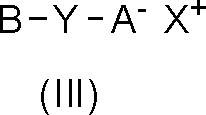
式中、
A-は有機酸アニオンを表す。
Yは2価の連結基を表す。
X+は、対カチオンを表す。
Bは酸分解性基を表す。
A-は有機酸アニオンを表す。
Yは2価の連結基を表す。
X+は、対カチオンを表す。
Bは酸分解性基を表す。
A-の有機酸アニオンはスルホン酸アニオン、カルボン酸アニオン、イミド酸アニオンなどが挙げられ、スルホン酸アニオン、及びイミド酸アニオンが好ましく、感度が向上する。
Yとしての2価の連結基は、好ましくは、炭素数1~8の2価の有機基であり、例えば、アルキレン基、アリーレン基(好ましくはフェニレン基)などが挙げられる。Yとしての2価の連結基は、より好ましくはアルキレン基であり、好ましい炭素数は1~6、より好ましい炭素数は1~4である。アルキレン鎖中に酸素原子、窒素原子、硫黄原子などを含む連結基を有していても良い。アルキレン基はフッ素原子が置換されていてもよく、その場合、A-と結合した炭素がフッ素原子を有することがより好ましい。
X+についての対カチオンとしては、上記一般式(ZI)におけるスルホニウムカチオン、上記一般式(ZII)におけるヨードニウムカチオンが挙げられる。
X+についての対カチオンとしては、上記一般式(ZI)におけるスルホニウムカチオン、上記一般式(ZII)におけるヨードニウムカチオンが挙げられる。
Bは酸の作用により分解してフェノール性水酸基又はカルボキシル基を生じる基であることが好ましい。
以下、一般式(III)における酸アニオンの具体例を挙げるが、本発明は、これに限定されるものではない。
以下、一般式(III)における酸アニオンの具体例を挙げるが、本発明は、これに限定されるものではない。
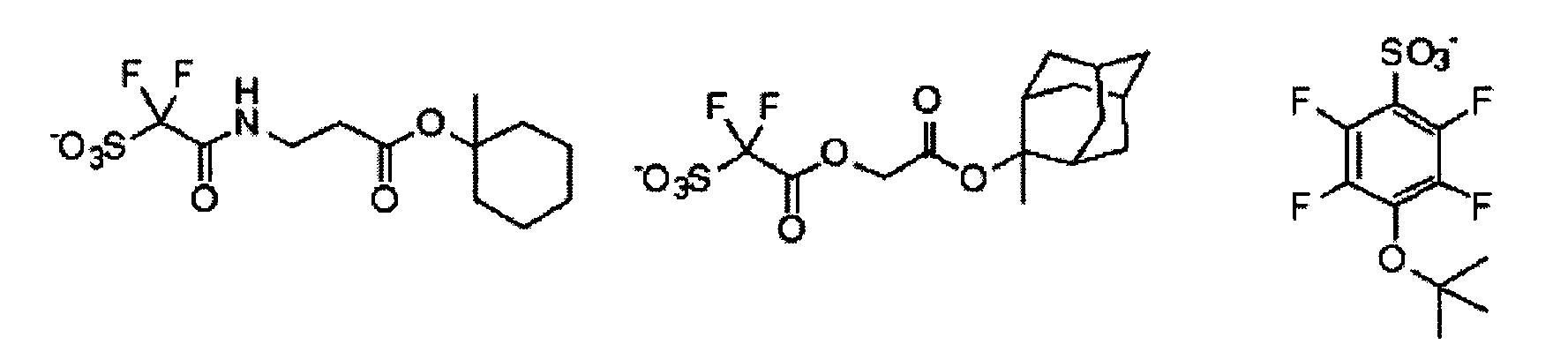
R201、R202及びR203により表される有機基としては、例えば、後述する化合物(ZI-1)、(ZI-2)、(ZI-3)及び(ZI-4)における対応する基を挙げることができる。
なお、一般式(ZI)で表される構造を複数有する化合物であってもよい。例えば、一般式(ZI)で表される化合物のR201~R203の少なくとも1つが、一般式(ZI)で表されるもうひとつの化合物のR201~R203の少なくとも一つと、単結合又は連結基を介して結合した構造を有する化合物であってもよい。
更に好ましい(ZI)成分として、以下に説明する化合物(ZI-1)、(ZI-2)、及び(ZI-3)及び(ZI-4)を挙げることができる。
化合物(ZI-1)は、上記一般式(ZI)のR201~R203の少なくとも1つがアリール基である、アリールスルホニウム化合物、即ち、アリールスルホニウムをカチオンとする化合物である。
アリールスルホニウム化合物は、R201~R203の全てがアリール基でもよいし、R201~R203の一部がアリール基で、残りがアルキル基又はシクロアルキル基でもよい。
アリールスルホニウム化合物としては、例えば、トリアリールスルホニウム化合物、ジアリールアルキルスルホニウム化合物、アリールジアルキルスルホニウム化合物、ジアリールシクロアルキルスルホニウム化合物、アリールジシクロアルキルスルホニウム化合物を挙げることができる。
アリールスルホニウム化合物のアリール基としてはフェニル基、ナフチル基が好ましく、更に好ましくはフェニル基である。アリール基は、酸素原子、窒素原子、硫黄原子等を有する複素環構造を有するアリール基であってもよい。複素環構造としては、ピロール残基、フラン残基、チオフェン残基、インドール残基、ベンゾフラン残基、ベンゾチオフェン残基等が挙げられる。アリールスルホニウム化合物が2つ以上のアリール基を有する場合に、2つ以上あるアリール基は同一であっても異なっていてもよい。
アリールスルホニウム化合物が必要に応じて有しているアルキル基又はシクロアルキル基は、炭素数1~15の直鎖又は分岐アルキル基及び炭素数3~15のシクロアルキル基が好ましく、例えば、メチル基、エチル基、プロピル基、n-ブチル基、sec-ブチル基、t-ブチル基、シクロプロピル基、シクロブチル基、シクロヘキシル基等を挙げることができる。
R201、R202及びR203の少なくとも1つが酸分解性基を有することが好ましい。酸分解性基の好ましい態様としては前述の通りである。
R201~R203のアリール基、アルキル基、シクロアルキル基は、酸分解性基以外にも、アルキル基(例えば炭素数1~15)、シクロアルキル基(例えば炭素数3~15)、アリール基(例えば炭素数6~14)、アルコキシ基(例えば炭素数1~15)、ハロゲン原子、水酸基、フェニルチオ基を置換基として有してもよい。好ましい置換基としては炭素数1~12の直鎖又は分岐アルキル基、炭素数3~12のシクロアルキル基、炭素数1~12の直鎖、分岐又は環状のアルコキシ基であり、より好ましくは炭素数1~4のアルキル基、炭素数1~4のアルコキシ基である。置換基は、3つのR201~R203のうちのいずれか1つに置換していてもよいし、3つ全てに置換していてもよい。また、R201~R203がアリール基の場合に、置換基はアリール基のp-位に置換していることが好ましい。
R201~R203のアリール基、アルキル基、シクロアルキル基は、酸分解性基以外にも、アルキル基(例えば炭素数1~15)、シクロアルキル基(例えば炭素数3~15)、アリール基(例えば炭素数6~14)、アルコキシ基(例えば炭素数1~15)、ハロゲン原子、水酸基、フェニルチオ基を置換基として有してもよい。好ましい置換基としては炭素数1~12の直鎖又は分岐アルキル基、炭素数3~12のシクロアルキル基、炭素数1~12の直鎖、分岐又は環状のアルコキシ基であり、より好ましくは炭素数1~4のアルキル基、炭素数1~4のアルコキシ基である。置換基は、3つのR201~R203のうちのいずれか1つに置換していてもよいし、3つ全てに置換していてもよい。また、R201~R203がアリール基の場合に、置換基はアリール基のp-位に置換していることが好ましい。
次に、化合物(ZI-2)について説明する。
化合物(ZI-2)は、式(ZI)におけるR201~R203が、各々独立に、芳香環を有さない有機基を表す化合物である。ここで芳香環とは、ヘテロ原子を含有する芳香族環も包含するものである。
化合物(ZI-2)は、式(ZI)におけるR201~R203が、各々独立に、芳香環を有さない有機基を表す化合物である。ここで芳香環とは、ヘテロ原子を含有する芳香族環も包含するものである。
R201~R203としての芳香環を含有しない有機基は、一般的に炭素数1~30、好ましくは炭素数1~20である。
R201~R203は、各々独立に、好ましくはアルキル基、シクロアルキル基、アリル基、ビニル基であり、更に好ましくは直鎖又は分岐の2-オキソアルキル基、2-オキソシクロアルキル基、アルコキシカルボニルメチル基、特に好ましくは直鎖又は分岐2-オキソアルキル基である。
R201~R203のアルキル基及びシクロアルキル基としては、好ましくは、炭素数1~10の直鎖又は分岐アルキル基(例えば、メチル基、エチル基、プロピル基、ブチル基、ペンチル基)、炭素数3~10のシクロアルキル基(シクロペンチル基、シクロヘキシル基、ノルボニル基)を挙げることができる。アルキル基として、より好ましくは2-オキソアルキル基、アルコキシカルボニルメチル基を挙げることができる。シクロアルキル基として、より好ましくは、2-オキソシクロアルキル基を挙げることができる。
2-オキソアルキル基は、直鎖又は分岐のいずれであってもよく、好ましくは、上記のアルキル基の2位に>C=Oを有する基を挙げることができる。
2-オキソシクロアルキル基は、好ましくは、上記のシクロアルキル基の2位に>C=Oを有する基を挙げることができる。
2-オキソシクロアルキル基は、好ましくは、上記のシクロアルキル基の2位に>C=Oを有する基を挙げることができる。
アルコキシカルボニルメチル基におけるアルコキシ基としては、好ましくは炭素数1~5のアルコキシ基(メトキシ基、エトキシ基、プロポキシ基、ブトキシ基、ペントキシ基)を挙げることができる。
R201、R202及びR203の少なくとも1つが酸分解性基を有することが好ましい。酸分解性基の好ましい態様としては前述の通りである。
R201~R203は、酸分解性基以外の、ハロゲン原子、アルコキシ基(例えば炭素数1~5)、水酸基、シアノ基、ニトロ基によって更に置換されていてもよい。
R201~R203は、酸分解性基以外の、ハロゲン原子、アルコキシ基(例えば炭素数1~5)、水酸基、シアノ基、ニトロ基によって更に置換されていてもよい。
次に、化合物(ZI-3)について説明する。
化合物(ZI-3)とは、以下の一般式(ZI-3)で表される化合物であり、フェナシルスルフォニウム塩構造を有する化合物である。
化合物(ZI-3)とは、以下の一般式(ZI-3)で表される化合物であり、フェナシルスルフォニウム塩構造を有する化合物である。
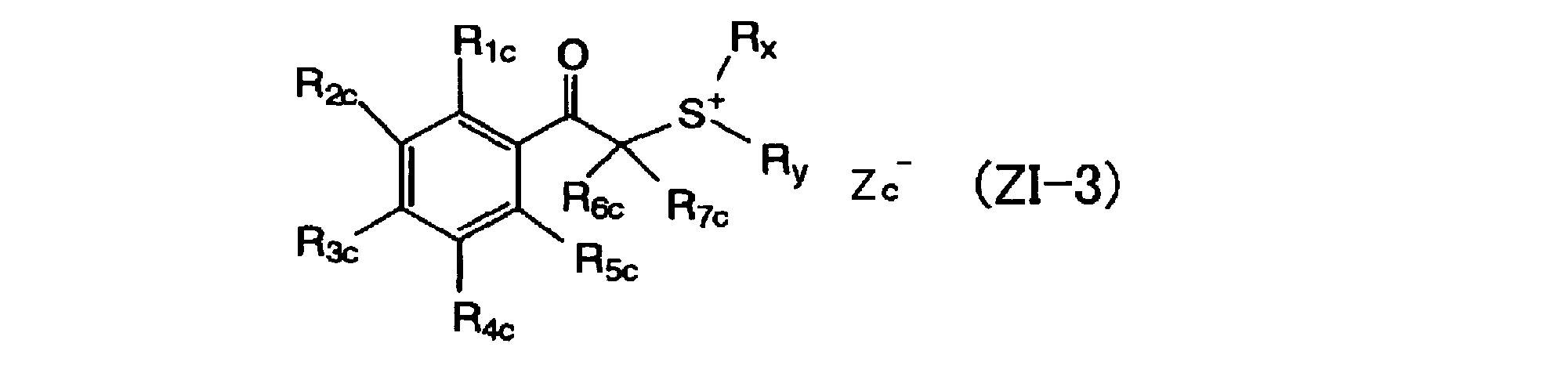
一般式(ZI-3)に於いて、
R1c~R5cは、各々独立に、水素原子、アルキル基、シクロアルキル基、アリール基、アルコキシ基、アリールオキシ基、アルコキシカルボニル基、アルキルカルボニルオキシ基、シクロアルキルカルボニルオキシ基、ハロゲン原子、水酸基、ニトロ基、アルキルチオ基又はアリールチオ基を表す。
R6c及びR7cは、各々独立に、水素原子、アルキル基、シクロアルキル基、ハロゲン原子、シアノ基又はアリール基を表す。
Rx及びRyは、各々独立に、アルキル基、シクロアルキル基、2-オキソアルキル基、2-オキソシクロアルキル基、アルコキシカルボニルアルキル基、アリル基又はビニル基を表す。
R1c~R5cは、各々独立に、水素原子、アルキル基、シクロアルキル基、アリール基、アルコキシ基、アリールオキシ基、アルコキシカルボニル基、アルキルカルボニルオキシ基、シクロアルキルカルボニルオキシ基、ハロゲン原子、水酸基、ニトロ基、アルキルチオ基又はアリールチオ基を表す。
R6c及びR7cは、各々独立に、水素原子、アルキル基、シクロアルキル基、ハロゲン原子、シアノ基又はアリール基を表す。
Rx及びRyは、各々独立に、アルキル基、シクロアルキル基、2-オキソアルキル基、2-オキソシクロアルキル基、アルコキシカルボニルアルキル基、アリル基又はビニル基を表す。
R1c~R5c中のいずれか2つ以上、R5cとR6c、R6cとR7c、R5cとRx、及びRxとRyは、それぞれ結合して環構造を形成しても良く、この環構造は、酸素原子、硫黄原子、ケトン基、エステル結合、アミド結合を含んでいてもよい。
上記環構造としては、芳香族若しくは非芳香族の炭化水素環、芳香族若しくは非芳香族の複素環、又は、これらの環が2つ以上組み合わされてなる多環縮合環を挙げることができる。環構造としては、3~10員環を挙げることができ、4~8員環であることが好ましく、5又は6員環であることがより好ましい。
R1c~R5c中のいずれか2つ以上、R6cとR7c、及びRxとRyが結合して形成する基としては、ブチレン基、ペンチレン基等を挙げることができる。
R5cとR6c、及び、R5cとRxが結合して形成する基としては、単結合又はアルキレン基であることが好ましく、アルキレン基としては、メチレン基、エチレン基等を挙げることができる。
上記環構造としては、芳香族若しくは非芳香族の炭化水素環、芳香族若しくは非芳香族の複素環、又は、これらの環が2つ以上組み合わされてなる多環縮合環を挙げることができる。環構造としては、3~10員環を挙げることができ、4~8員環であることが好ましく、5又は6員環であることがより好ましい。
R1c~R5c中のいずれか2つ以上、R6cとR7c、及びRxとRyが結合して形成する基としては、ブチレン基、ペンチレン基等を挙げることができる。
R5cとR6c、及び、R5cとRxが結合して形成する基としては、単結合又はアルキレン基であることが好ましく、アルキレン基としては、メチレン基、エチレン基等を挙げることができる。
Zc-は、非求核性アニオンを表し、一般式(ZI)に於けるZ-と同様の非求核性アニオンを挙げることができる。
R1c~R7cとしてのアルキル基は、直鎖又は分岐のいずれであってもよく、例えば炭素数1~20個のアルキル基、好ましくは炭素数1~12個の直鎖又は分岐アルキル基(例えば、メチル基、エチル基、直鎖又は分岐プロピル基、直鎖又は分岐ブチル基、直鎖又は分岐ペンチル基)を挙げることができ、シクロアルキル基としては、例えば炭素数3~10個のシクロアルキル基(例えば、シクロペンチル基、シクロヘキシル基)を挙げることができる。
R1c~R5cとしてのアリール基は、好ましくは炭素数5~15であり、例えば、フェニル基、ナフチル基を挙げることができる。
R1c~R5cとしてのアルコキシ基は、直鎖、分岐、環状のいずれであってもよく、例えば炭素数1~10のアルコキシ基、好ましくは、炭素数1~5の直鎖及び分岐アルコキシ基(例えば、メトキシ基、エトキシ基、直鎖又は分岐プロポキシ基、直鎖又は分岐ブトキシ基、直鎖又は分岐ペントキシ基)、炭素数3~10の環状アルコキシ基(例えば、シクロペンチルオキシ基、シクロヘキシルオキシ基)を挙げることができる。
R1c~R5cとしてのアルコキシカルボニル基におけるアルコキシ基の具体例は、前記R1c~R5cとしてのアルコキシ基の具体例と同様である。
R1c~R5cとしてのアルキルカルボニルオキシ基及びアルキルチオ基におけるアルキル基の具体例は、前記R1c~R5cとしてのアルキル基の具体例と同様である。
R1c~R5cとしてのシクロアルキルカルボニルオキシ基におけるシクロアルキル基の具体例は、前記R1c~R5cとしてのシクロアルキル基の具体例と同様である。
R1c~R5cとしてのアリールオキシ基及びアリールチオ基におけるアリール基の具体例は、前記R1c~R5cとしてのアリール基の具体例と同様である。
好ましくは、R1c~R5cの内のいずれかが直鎖又は分岐アルキル基、シクロアルキル基又は直鎖、分岐若しくは環状アルコキシ基であり、更に好ましくは、R1c~R5cの炭素数の和が2~15である。これにより、より溶剤溶解性が向上し、保存時にパーティクルの発生が抑制される。
好ましくは、R1c~R5cの内のいずれかが直鎖又は分岐アルキル基、シクロアルキル基又は直鎖、分岐若しくは環状アルコキシ基であり、更に好ましくは、R1c~R5cの炭素数の和が2~15である。これにより、より溶剤溶解性が向上し、保存時にパーティクルの発生が抑制される。
R1c~R5cのいずれか2つ以上が互いに結合して形成してもよい環構造としては、好ましくは5員又は6員の環、特に好ましくは6員の環(例えばフェニル環)が挙げられる。
R5c及びR6cが互いに結合して形成してもよい環構造としては、R5c及びR6cが互いに結合して単結合又はアルキレン基(メチレン基、エチレン基等)を構成することにより、一般式(I)中のカルボニル炭素原子及び炭素原子と共に形成する4員以上の環(特に好ましくは5~6員の環)が挙げられる。
R6c及びR7cとしてのアリール基としては、好ましくは炭素数5~15であり、例えば、フェニル基、ナフチル基を挙げることができる。
R6c及びR7cの態様としては、その両方がアルキル基である場合が好ましい。特に、R6c及びR7cが各々炭素数1~4の直鎖又は分岐状アルキル基である場合が好ましく、とりわけ、両方がメチル基である場合が好ましい。
R6c及びR7cの態様としては、その両方がアルキル基である場合が好ましい。特に、R6c及びR7cが各々炭素数1~4の直鎖又は分岐状アルキル基である場合が好ましく、とりわけ、両方がメチル基である場合が好ましい。
また、R6cとR7cとが結合して環を形成する場合に、R6cとR7cとが結合して形成する基としては、炭素数2~10のアルキレン基が好ましく、例えば、エチレン基、プロピレン基、ブチレン基、ペンチレン基、ヘキシレン基などを挙げることができる。また、R6cとR7cとが結合して形成する環は、環内に酸素原子等のヘテロ原子を有していてもよい。
Rx及びRyとしてのアルキル基及びシクロアルキル基は、R1c~R7cにおけると同様のアルキル基及びシクロアルキル基を挙げることができる。
Rx及びRyとしての2-オキソアルキル基及び2-オキソシクロアルキル基は、R1c~R7cとしてのアルキル基及びシクロアルキル基の2位に>C=Oを有する基を挙げることができる。
Rx及びRyとしてのアルコキシカルボニルアルキル基におけるアルコキシ基については、R1c~R5cおけると同様のアルコキシ基を挙げることができ、アルキル基については、例えば、炭素数1~12のアルキル基、好ましくは、炭素数1~5の直鎖のアルキル基(例えば、メチル基、エチル基)を挙げることができる。
Rx及びRyとしてのアリル基としては、特に制限は無いが、無置換のアリル基、又は、単環若しくは多環のシクロアルキル基(好ましくは炭素数3~10のシクロアルキル基)で置換されたアリル基であることが好ましい。
Rx及びRyとしてのビニル基としては特に制限は無いが、無置換のビニル基、又は、単環若しくは多環のシクロアルキル基(好ましくは炭素数3~10のシクロアルキル基)で置換されたビニル基であることが好ましい。
R5c及びRxが互いに結合して形成してもよい環構造としては、R5c及びRxが互いに結合して単結合又はアルキレン基(メチレン基、エチレン基等)を構成することにより、一般式(I)中の硫黄原子とカルボニル炭素原子と共に形成する5員以上の環(特に好ましくは5員の環)が挙げられる。
Rx及びRyが互いに結合して形成してもよい環構造としては、2価のRx及びRy(例えば、メチレン基、エチレンキ基、プロピレン基等)が一般式(ZI-3)中の硫黄原子と共に形成する5員又は6員の環、特に好ましくは5員の環(即ち、テトラヒドロチオフェン環)が挙げられる。
Rx及びRyは、好ましくは炭素数4個以上のアルキル基又はシクロアルキル基であり、より好ましくは6個以上、更に好ましくは8個以上のアルキル基又はシクロアルキル基である。
R1c~R7c、Rx及びRyの少なくとも1つが酸分解性基を有することが好ましい。酸分解性基の好ましい態様としては前述の通りである。
R1c~R7c、Rx及びRyは、酸分解性基以外にも更に置換基を有していてもよく、そのような置換基としては、ハロゲン原子(例えば、フッ素原子)、水酸基、カルボキシル基、シアノ基、ニトロ基、アルキル基、シクロアルキル基、アリール基、アルコキシ基、アリールオキシ基、アシル基、アリールカルボニル基、アルコキシアルキル基、アリールオシキアルキル基、アルコキシカルボニル基、アリールオキシカルボニル基、アルコキシカルボニルオキシ基、アリールオキシカルボニルオキシ基等を挙げることができる。
R1c~R7c、Rx及びRyは、酸分解性基以外にも更に置換基を有していてもよく、そのような置換基としては、ハロゲン原子(例えば、フッ素原子)、水酸基、カルボキシル基、シアノ基、ニトロ基、アルキル基、シクロアルキル基、アリール基、アルコキシ基、アリールオキシ基、アシル基、アリールカルボニル基、アルコキシアルキル基、アリールオシキアルキル基、アルコキシカルボニル基、アリールオキシカルボニル基、アルコキシカルボニルオキシ基、アリールオキシカルボニルオキシ基等を挙げることができる。
前記アルキル基としては、例えば、メチル基、エチル基、n-プロピル基、i-プロピル基、n-ブチル基、2-メチルプロピル基、1-メチルプロピル基、t-ブチル基等の炭素数1~12個の直鎖状若しくは分岐状のアルキル基を挙げることができる。
前記シクロアルキル基としては、例えば、シクロペンチル基、シクロヘキシル基等の炭素数3~10個のシクロアルキル基を挙げることができる。
前記アリール基としては、例えば、フェニル基、ナフチル基等の炭素数6~15のアリール基を挙げることができる。
前記シクロアルキル基としては、例えば、シクロペンチル基、シクロヘキシル基等の炭素数3~10個のシクロアルキル基を挙げることができる。
前記アリール基としては、例えば、フェニル基、ナフチル基等の炭素数6~15のアリール基を挙げることができる。
前記アルコキシ基としては、例えば、メトキシ基、エトキシ基、n-プロポキシ基、i-プロポキシ基、n-ブトキシ基、2-メチルプロポキシ基、1-メチルプロポキシ基、t-ブトキシ基、シクロペンチルオキシ基、シクロヘキシルオキシ基等の炭素原子数1~20の直鎖状、分岐状若しくは環状のアルコキシ基等を挙げることができる。
前記アリールオキシ基としては、例えば、フェニルオキシ基、ナフチルオキシ基等の炭素数6~10個のアリールオキシ基等を挙げることができる。
前記アシル基としては、例えば、アセチル基、プロピオニル基、n-ブタノイル基、i-ブタノイル基、n-ヘプタノイル基、2-メチルブタノイル基、1-メチルブタノイル基、t-ヘプタノイル基等の炭素原子数2~12の直鎖状若しくは分岐状のアシル基等を挙げることができる。
前記アリールカルボニル基としては、例えば、フェニルカルボニル基、ナフチルカルボニル基等の炭素数6~10個のアリールオキシ基等を挙げることができる。
前記アルコキシアルキル基としては、例えば、メトキシメチル基、エトキシメチル基、1-メトキシエチル基、2-メトキシエチル基、1-エトキシエチル基、2-エトキシエチル基等の炭素原子数2~21の直鎖状、分岐状若しくは環状のアルコキシアルキル基等を挙げることができる。
前記アリールオキシアルキル基としては、例えば、フェニルオキシメチル基、フェニルオキシエチル基、ナフチルオキシメチル基、ナフチルオキシエチル基等の炭素数7~12個のアリールオキシ基等を挙げることができる。
前記アルコキシカルボニル基としては、例えば、メトキシカルボニル基、エトキシカルボニル基、n-プロポキシカルボニル基、i-プロポキシカルボニル基、n-ブトキシカルボニル基、2-メチルプロポキシカルボニル基、1-メチルプロポキシカルボニル基、t-ブトキシカルボニル基、シクロペンチルオキシカルボニル基、シクロヘキシルオキシカルボニル等の炭素原子数2~21の直鎖状、分岐状若しくは環状のアルコキシカルボニル基等を挙げることができる。
前記アリールオキシカルボニル基としては、例えば、フェニルオキシカルボニル基、ナフチルオキシカルボニル基等の炭素数7~11個のアリールオキシカルボニル基等を挙げることができる。
前記アルコキシカルボニルオキシ基としては、例えば、メトキシカルボニルオキシ基、エトキシカルボニルオキシ基、n-プロポキシカルボニルオキシ基、i-プロポキシカルボニルオキシ基、n-ブトキシカルボニルオキシ基、t-ブトキシカルボニルオキシ基、シクロペンチルオキシカルボニルオキシ基、シクロヘキシルオキシカルボニルオキシ等の炭素原子数2~21の直鎖状、分岐状若しくは環状のアルコキシカルボニルオキシ基等を挙げることができる。
前記アリールオキシカルボニルオキシ基としては、例えば、フェニルオキシカルボニルオキシ基、ナフチルオキシカルボニルオキシ基等の炭素数7~11個のアリールオキシカルボニルオキシ基等を挙げることができる。
上記一般式(ZI-3)中、R1c、R2c、R4c及びR5cが、各々独立に、水素原子を表し、R3cが水素原子以外の基、すなわち、アルキル基、シクロアルキル基、アリール基、アルコキシ基、アリールオキシ基、アルコキシカルボニル基、アルキルカルボニルオキシ基、シクロアルキルカルボニルオキシ基、ハロゲン原子、水酸基、ニトロ基、アルキルチオ基又はアリールチオ基を表すことがより好ましい。
次に、化合物(ZI-4)について説明する。
化合物(ZI-4)は、下記一般式(ZI-4)で表される。
化合物(ZI-4)は、下記一般式(ZI-4)で表される。

一般式(ZI-4)中、
R13は水素原子、フッ素原子、水酸基、アルキル基、シクロアルキル基、アルコキシ基、アルコキシカルボニル基、又はシクロアルキル基を有する基を表す。これらの基は置換基を有してもよい。
R14は複数存在する場合は各々独立して、水酸基、アルキル基、シクロアルキル基、アルコキシ基、アルコキシカルボニル基、アルキルカルボニル基、アルキルスルホニル基、シクロアルキルスルホニル基、又はシクロアルキル基を有する基を表す。これらの基は置換基を有してもよい。
R15は各々独立して、アルキル基、シクロアルキル基又はナフチル基を表す。2個のR15が互いに結合して環を形成してもよい。これらの基は置換基を有してもよい。
lは0~2の整数を表す。
rは0~8の整数を表す。
Z-は、非求核性アニオンを表し、一般式(ZI)に於けるZ-と同様の非求核性アニオンを挙げることができる。
R13は水素原子、フッ素原子、水酸基、アルキル基、シクロアルキル基、アルコキシ基、アルコキシカルボニル基、又はシクロアルキル基を有する基を表す。これらの基は置換基を有してもよい。
R14は複数存在する場合は各々独立して、水酸基、アルキル基、シクロアルキル基、アルコキシ基、アルコキシカルボニル基、アルキルカルボニル基、アルキルスルホニル基、シクロアルキルスルホニル基、又はシクロアルキル基を有する基を表す。これらの基は置換基を有してもよい。
R15は各々独立して、アルキル基、シクロアルキル基又はナフチル基を表す。2個のR15が互いに結合して環を形成してもよい。これらの基は置換基を有してもよい。
lは0~2の整数を表す。
rは0~8の整数を表す。
Z-は、非求核性アニオンを表し、一般式(ZI)に於けるZ-と同様の非求核性アニオンを挙げることができる。
一般式(ZI-4)において、R13、R14及びR15のアルキル基としては、直鎖状若しくは分岐状であり、炭素原子数1~10のものが好ましく、メチル基、エチル基、n-プロピル基、i-プロピル基、n-ブチル基、2-メチルプロピル基、1-メチルプロピル基、t-ブチル基、n-ペンチル基、ネオペンチル基、n-ヘキシル基、n-ヘプチル基、n-オクチル基、2-エチルヘキシル基、n-ノニル基、n-デシル基等を挙げることができる。これらのアルキル基のうち、メチル基、エチル基、n-ブチル基、t-ブチル基等が好ましい。
R13、R14及びR15のシクロアルキル基としては、単環若しくは多環のシクロアルキル基(好ましくは炭素原子数3~20のシクロアルキル基)が挙げられ、シクロプロピル、シクロブチル、シクロペンチル、シクロヘキシル、シクロへプチル、シクロオクチル、シクロドデカニル、シクロペンテニル、シクロヘキセニル、シクロオクタジエニル、ノルボルニル、トリシクロデカニル、テトラシクロデカニル、アダマンチル等があげられ、特にシクロプロピル、シクロペンチル、シクロヘキシル、シクロヘプチル、シクロオクチルが好ましい。
R13及びR14のアルコキシ基としては、直鎖状若しくは分岐状であり、炭素原子数1~10のものが好ましく、例えば、メトキシ基、エトキシ基、n-プロポキシ基、i-プロポキシ基、n-ブトキシ基、2-メチルプロポキシ基、1-メチルプロポキシ基、t-ブトキシ基、n-ペンチルオキシ基、ネオペンチルオキシ基、n-ヘキシルオキシ基、n-ヘプチルオキシ基、n-オクチルオキシ基、2-エチルヘキシルオキシ基、n-ノニルオキシ基、n-デシルオキシ基等を挙げることができる。これらのアルコキシ基のうち、メトキシ基、エトキシ基、n-プロポキシ基、n-ブトキシ基等が好ましい。
R13及びR14のアルコキシカルボニル基としては、直鎖状若しくは分岐状であり、炭素原子数2~11のものが好ましく、例えば、メトキシカルボニル基、エトキシカルボニル基、n-プロポキシカルボニル基、i-プロポキシカルボニル基、n-ブトキシカルボニル基、2-メチルプロポキシカルボニル基、1-メチルプロポキシカルボニル基、t-ブトキシカルボニル基、n-ペンチルオキシカルボニル基、ネオペンチルオキシカルボニル基、n-ヘキシルオキシカルボニル基、n-ヘプチルオキシカルボニル基、n-オクチルオキシカルボニル基、2-エチルヘキシルオキシカルボニル基、n-ノニルオキシカルボニル基、n-デシルオキシカルボニル基等を挙げることができる。これらのアルコキシカルボニル基のうち、メトキシカルボニル基、エトキシカルボニル基、n-ブトキシカルボニル基等が好ましい。
R13及びR14のシクロアルキル基を有する基としては、単環若しくは多環のシクロアルキル基(好ましくは炭素原子数3~20のシクロアルキル基)が挙げられ、例えば、単環若しくは多環のシクロアルキルオキシ基、及び、単環若しくは多環のシクロアルキル基を有するアルコキシ基が挙げられる。これら基は、置換基を更に有していてもよい。
R13及びR14の単環若しくは多環のシクロアルキルオキシ基としては、総炭素数が7以上であることが好ましく、総炭素数が7以上15以下であることがより好ましく、また、単環のシクロアルキル基を有することが好ましい。総炭素数7以上の単環のシクロアルキルオキシ基とは、シクロプロピルオキシ基、シクロブチルオキシ基、シクロペンチルオキシ基、シクロヘキシルオキシ基、シクロヘプチルオキシ基、シクロオクチルオキシ基、シクロドデカニルオキシ基等のシクロアルキルオキシ基に、任意にメチル基、エチル基、プロピル基、ブチル基、ペンチル基、ヘキシル基、ヘプチル基、オクチル基、ドデシル基、2-エチルヘキシル基、イソプロピル基、sec-ブチル基、t-ブチル基、iso-アミル基等のアルキル基、水酸基、ハロゲン原子(フッ素、塩素、臭素、ヨウ素)、ニトロ基、シアノ基、アミド基、スルホンアミド基、メトキシ基、エトキシ基、ヒドロキシエトキシ基、プロポキシ基、ヒドロキシプロポキシ基、ブトキシ基等のアルコキシ基、メトキシカルボニル基、エトキシカルボニル基等のアルコキシカルボニル基、ホルミル基、アセチル基、ベンゾイル基等のアシル基、アセトキシ基、ブチリルオキシ基等のアシルオキシ基、カルボキシ基等の置換基を有する単環のシクロアルキルオキシ基であって、該シクロアルキル基上の任意の置換基と合わせた総炭素数が7以上のものを表す。
また、総炭素数が7以上の多環のシクロアルキルオキシ基としては、ノルボルニルオキシ基、トリシクロデカニルオキシ基、テトラシクロデカニルオキシ基、アダマンチルオキシ基等が挙げられる。
また、総炭素数が7以上の多環のシクロアルキルオキシ基としては、ノルボルニルオキシ基、トリシクロデカニルオキシ基、テトラシクロデカニルオキシ基、アダマンチルオキシ基等が挙げられる。
R13及びR14の単環若しくは多環のシクロアルキル基を有するアルコキシ基としては、総炭素数が7以上であることが好ましく、総炭素数が7以上15以下であることがより好ましく、また、単環のシクロアルキル基を有するアルコキシ基であることが好ましい。総炭素数7以上の、単環のシクロアルキル基を有するアルコキシ基とは、メトキシ、エトキシ、プロポキシ、ブトキシ、ペンチルオキシ、ヘキシルオキシ、ヘプトキシ、オクチルオキシ、ドデシルオキシ、2-エチルヘキシルオキシ、イソプロポキシ、sec-ブトキシ、t-ブトキシ、iso-アミルオキシ等のアルコキシ基に上述の置換基を有していてもよい単環シクロアルキル基が置換したものであり、置換基も含めた総炭素数が7以上のものを表す。たとえば、シクロヘキシルメトキシ基、シクロペンチルエトキシ基、シクロヘキシルエトキシ基等が挙げられ、シクロヘキシルメトキシ基が好ましい。
また、総炭素数が7以上の多環のシクロアルキル基を有するアルコキシ基としては、ノルボルニルメトキシ基、ノルボルニルエトキシ基、トリシクロデカニルメトキシ基、トリシクロデカニルエトキシ基、テトラシクロデカニルメトキシ基、テトラシクロデカニルエトキシ基、アダマンチルメトキシ基、アダマンチルエトキシ基等が挙げられ、ノルボルニルメトキシ基、ノルボルニルエトキシ基等が好ましい。
R14のアルキルカルボニル基のアルキル基としては、上述したR13~R15としてのアルキル基と同様の具体例が挙げられる。
R14のアルキルスルホニル基及びシクロアルキルスルホニル基としては、直鎖状、分岐状、環状であり、炭素原子数1~10のものが好ましく、例えば、メタンスルホニル基、エタンスルホニル基、n-プロパンスルホニル基、n-ブタンスルホニル基、tert-ブタンスルホニル基、n-ペンタンスルホニル基、ネオペンタンスルホニル基、n-ヘキサンスルホニル基、n-ヘプタンスルホニル基、n-オクタンスルホニル基、2-エチルヘキサンスルホニル基n-ノナンスルホニル基、n-デカンスルホニル基、シクロペンタンスルホニル基、シクロヘキサンスルホニル基等を挙げることができる。これらのアルキルスルホニル基及びシクロアルキルスルホニル基のうちメタンスルホニル基、エタンスルホニル基、n-プロパンスルホニル基、n-ブタンスルホニル基、シクロペンタンスルホニル基、シクロヘキサンスルホニル基等が好ましい。
上記各基が有していてもよい置換基としては、ハロゲン原子(例えば、フッ素原子)、ヒドロキシル基、カルボキシル基、シアノ基、ニトロ基、アルコキシ基、アルコキシアルキル基、アルコキシカルボニル基、アルコキシカルボニルオキシ基等を挙げることができる。
前記アルコキシ基としては、例えば、メトキシ基、エトキシ基、n-プロポキシ基、i-プロポキシ基、n-ブトキシ基、2-メチルプロポキシ基、1-メチルプロポキシ基、t-ブトキシ基、シクロペンチルオキシ基、シクロヘキシルオキシ基等の炭素原子数1~20の直鎖状、分岐状若しくは環状のアルコキシ基等を挙げることができる。
前記アルコキシアルキル基としては、例えば、メトキシメチル基、エトキシメチル基、1-メトキシエチル基、2-メトキシエチル基、1-エトキシエチル基、2-エトキシエチル基等の炭素原子数2~21の直鎖状、分岐状若しくは環状のアルコキシアルキル基等を挙げることができる。
前記アルコキシカルボニル基としては、例えば、メトキシカルボニル基、エトキシカルボニル基、n-プロポキシカルボニル基、i-プロポキシカルボニル基、n-ブトキシカルボニル基、2-メチルプロポキシカルボニル基、1-メチルプロポキシカルボニル基、t-ブトキシカルボニル基、シクロペンチルオキシカルボニル基、シクロヘキシルオキシカルボニル等の炭素原子数2~21の直鎖状、分岐状若しくは環状のアルコキシカルボニル基等を挙げることができる。
前記アルコキシカルボニルオキシ基としては、例えば、メトキシカルボニルオキシ基、エトキシカルボニルオキシ基、n-プロポキシカルボニルオキシ基、i-プロポキシカルボニルオキシ基、n-ブトキシカルボニルオキシ基、t-ブトキシカルボニルオキシ基、シクロペンチルオキシカルボニルオキシ基、シクロヘキシルオキシカルボニルオキシ等の炭素原子数2~21の直鎖状、分岐状若しくは環状のアルコキシカルボニルオキシ基等を挙げることができる。
2個のR15が互いに結合して形成してもよい環構造としては、2個の2価のR15が一般式(ZI-4)中の硫黄原子と共に形成する5員又は6員の環、特に好ましくは5員の環(即ち、テトラヒドロチオフェン環)が挙げられ、アリール基又はシクロアルキル基と縮環していてもよい。この2価のR15は置換基を有してもよく、置換基としては、例えば、ヒドロキシル基、カルボキシル基、シアノ基、ニトロ基、アルキル基、シクロアルキル基、アルコキシ基、アルコキアルキル基、アルコキシカルボニル基、アルコキシカルボニルオキシ基等を挙げることができる。前記環構造に対する置換基は、複数個存在しても良く、また、それらが互いに結合して環(芳香族若しくは非芳香族の炭化水素環、芳香族若しくは非芳香族の複素環、又はこれらの環が2つ以上組み合わされてなる多環縮合環など)を形成しても良い。
一般式(ZI-4)におけるR15としては、メチル基、エチル基、ナフチル基、2個のR15が互いに結合して硫黄原子と共にテトラヒドロチオフェン環構造を形成する2価の基等が好ましい。
一般式(ZI-4)におけるR15としては、メチル基、エチル基、ナフチル基、2個のR15が互いに結合して硫黄原子と共にテトラヒドロチオフェン環構造を形成する2価の基等が好ましい。
R13及びR14、及びR15の少なくとも1つが酸分解性基を有することが好ましい。酸分解性基の好ましい態様としては前述の通りである。
R13、R14及びR15が酸分解性基以外に有し得る置換基としては、水酸基、アルコキシ基、又はアルコキシカルボニル基、ハロゲン原子(特に、フッ素原子)が好ましい。
lとしては、0又は1が好ましく、1がより好ましい。
rとしては、0~2が好ましい。
R13、R14及びR15が酸分解性基以外に有し得る置換基としては、水酸基、アルコキシ基、又はアルコキシカルボニル基、ハロゲン原子(特に、フッ素原子)が好ましい。
lとしては、0又は1が好ましく、1がより好ましい。
rとしては、0~2が好ましい。
次に、一般式(ZII)、(ZIII)について説明する。
一般式(ZII)、(ZIII)中、
R204~R207は、各々独立に、アリール基、アルキル基又はシクロアルキル基を表す。
R204、R205及びZ-の少なくとも1つは酸分解性基を有する。
R206及びR207の少なくとも1つは酸分解性基を有する。酸分解性基の好ましい態様としては前述の通りである。
R204~R207のアリール基としてはフェニル基、ナフチル基が好ましく、更に好ましくはフェニル基である。R204~R207のアリール基は、酸素原子、窒素原子、硫黄原子等を有する複素環構造を有するアリール基であってもよい。複素環構造を有するアリール基の骨格としては、例えば、ピロール、フラン、チオフェン、インドール、ベンゾフラン、ベンゾチオフェン等を挙げることができる。
R204~R207におけるアルキル基及びシクロアルキル基としては、好ましくは、炭素数1~10の直鎖又は分岐アルキル基(例えば、メチル基、エチル基、プロピル基、ブチル基、ペンチル基)、炭素数3~10のシクロアルキル基(シクロペンチル基、シクロヘキシル基、ノルボニル基)を挙げることができる。
R204~R207のアリール基、アルキル基、シクロアルキル基は、酸分解性基以外の置換基を有していてもよい。R204~R207のアリール基、アルキル基、シクロアルキル基が有していてもよい酸分解性基以外の置換基としては、例えば、アルキル基(例えば炭素数1~15)、シクロアルキル基(例えば炭素数3~15)、アリール基(例えば炭素数6~15)、アルコキシ基(例えば炭素数1~15)、ハロゲン原子、水酸基、フェニルチオ基等を挙げることができる。
Z-は、非求核性アニオンを表し、一般式(ZI)に於けるZ-の非求核性アニオンと同様のものを挙げることができる。
一般式(ZII)、(ZIII)中、
R204~R207は、各々独立に、アリール基、アルキル基又はシクロアルキル基を表す。
R204、R205及びZ-の少なくとも1つは酸分解性基を有する。
R206及びR207の少なくとも1つは酸分解性基を有する。酸分解性基の好ましい態様としては前述の通りである。
R204~R207のアリール基としてはフェニル基、ナフチル基が好ましく、更に好ましくはフェニル基である。R204~R207のアリール基は、酸素原子、窒素原子、硫黄原子等を有する複素環構造を有するアリール基であってもよい。複素環構造を有するアリール基の骨格としては、例えば、ピロール、フラン、チオフェン、インドール、ベンゾフラン、ベンゾチオフェン等を挙げることができる。
R204~R207におけるアルキル基及びシクロアルキル基としては、好ましくは、炭素数1~10の直鎖又は分岐アルキル基(例えば、メチル基、エチル基、プロピル基、ブチル基、ペンチル基)、炭素数3~10のシクロアルキル基(シクロペンチル基、シクロヘキシル基、ノルボニル基)を挙げることができる。
R204~R207のアリール基、アルキル基、シクロアルキル基は、酸分解性基以外の置換基を有していてもよい。R204~R207のアリール基、アルキル基、シクロアルキル基が有していてもよい酸分解性基以外の置換基としては、例えば、アルキル基(例えば炭素数1~15)、シクロアルキル基(例えば炭素数3~15)、アリール基(例えば炭素数6~15)、アルコキシ基(例えば炭素数1~15)、ハロゲン原子、水酸基、フェニルチオ基等を挙げることができる。
Z-は、非求核性アニオンを表し、一般式(ZI)に於けるZ-の非求核性アニオンと同様のものを挙げることができる。
酸発生剤として、更に、下記一般式(ZIV)、(ZV)、(ZVI)で表される化合物も挙げられる。
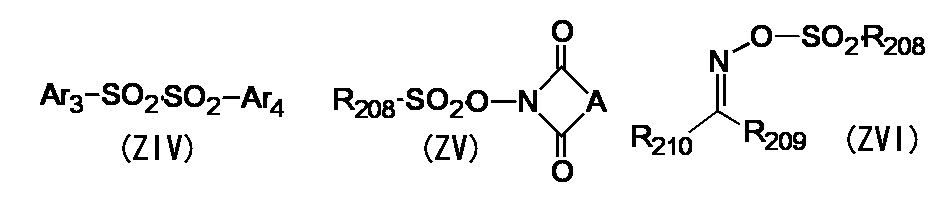
一般式(ZIV)~(ZVI)中、
Ar3及びAr4は、各々独立に、アリール基を表す。
Ar3及びAr4の少なくとも1つは酸分解性基を有する。
一般式(ZV)中、
R208は、アルキル基、シクロアルキル基又はアリール基を表す。
Aは、アルキレン基、アルケニレン基又はアリーレン基を表す。
R208及びAの少なくとも1つは酸分解性基を有する。
一般式(ZVI)中、
R208、R209及びR210は、各々独立に、アルキル基、シクロアルキル基又はアリール基を表す。
R208、R209及びR210の少なくとも1つは酸分解性基を有する。
Ar3、Ar4、R208、R209及びR210のアリール基の具体例としては、上記一般式(ZI-1)におけるR201、R202及びR203としてのアリール基の具体例と同様のものを挙げることができる。
R208、R209及びR210のアルキル基及びシクロアルキル基の具体例としては、それぞれ、上記一般式(ZI-2)におけるR201、R202及びR203としてのアルキル基及びシクロアルキル基の具体例と同様のものを挙げることができる。
Aのアルキレン基としては、炭素数1~12のアルキレン(例えば、メチレン基、エチレン基、プロピレン基、イソプロピレン基、ブチレン基、イソブチレン基など)を、Aのアルケニレン基としては、炭素数2~12のアルケニレン基(例えば、エテニレン基、プロペニレン基、ブテニレン基など)を、Aのアリーレン基としては、炭素数6~10のアリーレン基(例えば、フェニレン基、トリレン基、ナフチレン基など)を、それぞれ挙げることができる。
Ar3及びAr4は、各々独立に、アリール基を表す。
Ar3及びAr4の少なくとも1つは酸分解性基を有する。
一般式(ZV)中、
R208は、アルキル基、シクロアルキル基又はアリール基を表す。
Aは、アルキレン基、アルケニレン基又はアリーレン基を表す。
R208及びAの少なくとも1つは酸分解性基を有する。
一般式(ZVI)中、
R208、R209及びR210は、各々独立に、アルキル基、シクロアルキル基又はアリール基を表す。
R208、R209及びR210の少なくとも1つは酸分解性基を有する。
Ar3、Ar4、R208、R209及びR210のアリール基の具体例としては、上記一般式(ZI-1)におけるR201、R202及びR203としてのアリール基の具体例と同様のものを挙げることができる。
R208、R209及びR210のアルキル基及びシクロアルキル基の具体例としては、それぞれ、上記一般式(ZI-2)におけるR201、R202及びR203としてのアルキル基及びシクロアルキル基の具体例と同様のものを挙げることができる。
Aのアルキレン基としては、炭素数1~12のアルキレン(例えば、メチレン基、エチレン基、プロピレン基、イソプロピレン基、ブチレン基、イソブチレン基など)を、Aのアルケニレン基としては、炭素数2~12のアルケニレン基(例えば、エテニレン基、プロペニレン基、ブテニレン基など)を、Aのアリーレン基としては、炭素数6~10のアリーレン基(例えば、フェニレン基、トリレン基、ナフチレン基など)を、それぞれ挙げることができる。
酸分解性基が上記一般式(ZI)におけるR201、R202若しくはR203に含まれる場合、酸発生剤〔P-B〕は下記一般式(II-1)~(II-3)のいずれかで表される化合物であることが好ましい。

一般式(II-1)中、
R1dは、各々独立に、水素原子又は1価の有機基を表す。2つのR1dは、互いに結合して、環を形成していてもよい。換言すれば、2つのR1dが互いに結合して単結合又は2価の連結基を形成していてもよい。2価の連結基としては炭素数4以下の連結基であることが好ましく、例えば、メチレン基、エチレン基、エーテル結合、カルボニル基、エステル基等が挙げられる。
Q1は、単結合又は2価の連結基を表す。
B1は酸の作用により分解し、フェノール性水酸基又はカルボキシル基を生じる基を表す。
Zd-はX個の(B1-Q1)で表される基を有する非求核性の対アニオンを表す。
l1は、各々独立に、0~5の整数を表す。
m1は、各々独立に、0~5の整数を表す。
Xは、0~3の整数を表す。
ただし、複数のm1及びXの少なくとも1つは1以上の整数を表す。複数のm1のいずれかは1以上の整数であることが好ましい。
一般式(II-2)中、
R2dは、各々独立に、水素原子又は1価の有機基を表す。2つのR2dは、互いに結合して、環を形成していてもよい。
R15dは、各々独立に、置換基を有していても良いアルキル基を表す。2つのR15dは、互いに結合して、環を形成していても良い。2つのR15dは、互いに結合して、環を形成していてもよい。
-S+(R15d)(R15d)で表される基、m個の(B-Q)及びl個のR4は、それぞれ、一般式(II-2)中の、いずれの芳香環の任意の位置で置換していてよい。
Q2は、単結合又は2価の連結基を表す。
B2は酸の作用により分解し、フェノール性水酸基又はカルボキシル基を生じる基を表す。
Zd-はX個の(B2-Q2)で表される基を有する非求核性の対アニオンを表す。
nは0又は1を表す。
l2は、各々独立に、0~5の整数を表す。
m2は、各々独立に、0~5の整数を表す。
Xは、0~3の整数を表す。
ただし、m2及びXの少なくとも1つは1以上の整数を表す。m2は1~5の整数であることが好ましい。
一般式(II-3)中、
R3dは、各々独立に、水素原子又は1価の有機基を表す。2つのR3dは、互いに結合して、環を形成していてもよい。
R6d、R7dは、各々独立に、水素原子又は1価の有機基を表す。R6d、R7dは、互いに結合して、環を形成していてもよい。
Rdx、Rdyは、各々独立に、置換基を有していても良いアルキル基を表す。Rdx、Rdyは、互いに結合して、環を形成していても良い。
Q3は、単結合又は2価の連結基を表す。
B3は酸の作用により分解し、フェノール性水酸基又はカルボキシル基を生じる基を表す。
Zd-はX個の(B3-Q3)で表される基を有する非求核性の対アニオンを表す。
l3は、各々独立に、0~5の整数を表す。
m3は、各々独立に、0~5の整数を表す。
Xは、0~3の整数を表す。
ただし、m3及びXの少なくとも1つは1以上の整数を表す。m3は1~5の整数であることが好ましい。
R1dは、各々独立に、水素原子又は1価の有機基を表す。2つのR1dは、互いに結合して、環を形成していてもよい。換言すれば、2つのR1dが互いに結合して単結合又は2価の連結基を形成していてもよい。2価の連結基としては炭素数4以下の連結基であることが好ましく、例えば、メチレン基、エチレン基、エーテル結合、カルボニル基、エステル基等が挙げられる。
Q1は、単結合又は2価の連結基を表す。
B1は酸の作用により分解し、フェノール性水酸基又はカルボキシル基を生じる基を表す。
Zd-はX個の(B1-Q1)で表される基を有する非求核性の対アニオンを表す。
l1は、各々独立に、0~5の整数を表す。
m1は、各々独立に、0~5の整数を表す。
Xは、0~3の整数を表す。
ただし、複数のm1及びXの少なくとも1つは1以上の整数を表す。複数のm1のいずれかは1以上の整数であることが好ましい。
一般式(II-2)中、
R2dは、各々独立に、水素原子又は1価の有機基を表す。2つのR2dは、互いに結合して、環を形成していてもよい。
R15dは、各々独立に、置換基を有していても良いアルキル基を表す。2つのR15dは、互いに結合して、環を形成していても良い。2つのR15dは、互いに結合して、環を形成していてもよい。
-S+(R15d)(R15d)で表される基、m個の(B-Q)及びl個のR4は、それぞれ、一般式(II-2)中の、いずれの芳香環の任意の位置で置換していてよい。
Q2は、単結合又は2価の連結基を表す。
B2は酸の作用により分解し、フェノール性水酸基又はカルボキシル基を生じる基を表す。
Zd-はX個の(B2-Q2)で表される基を有する非求核性の対アニオンを表す。
nは0又は1を表す。
l2は、各々独立に、0~5の整数を表す。
m2は、各々独立に、0~5の整数を表す。
Xは、0~3の整数を表す。
ただし、m2及びXの少なくとも1つは1以上の整数を表す。m2は1~5の整数であることが好ましい。
一般式(II-3)中、
R3dは、各々独立に、水素原子又は1価の有機基を表す。2つのR3dは、互いに結合して、環を形成していてもよい。
R6d、R7dは、各々独立に、水素原子又は1価の有機基を表す。R6d、R7dは、互いに結合して、環を形成していてもよい。
Rdx、Rdyは、各々独立に、置換基を有していても良いアルキル基を表す。Rdx、Rdyは、互いに結合して、環を形成していても良い。
Q3は、単結合又は2価の連結基を表す。
B3は酸の作用により分解し、フェノール性水酸基又はカルボキシル基を生じる基を表す。
Zd-はX個の(B3-Q3)で表される基を有する非求核性の対アニオンを表す。
l3は、各々独立に、0~5の整数を表す。
m3は、各々独立に、0~5の整数を表す。
Xは、0~3の整数を表す。
ただし、m3及びXの少なくとも1つは1以上の整数を表す。m3は1~5の整数であることが好ましい。
R1d、R2d、R3dとしての有機基としてはアルキル基、シクロアルキル基、アルコキシ基又はハロゲン原子が好ましい。2つ以上のR4が結合して環構造を形成しても良く、この環構造は、酸素原子、硫黄原子、エステル結合、アミド結合を含んでいてもよい。2つ以上のR4が結合して形成する基としては、ブチレン基、ペンチレン基等を挙げることができる。
R1d、R2d、R3dとしてのアルキル基、シクロアルキル基、アルコキシ基としては、一般式(ZI-3)に於けるR1C~R5Cと同様のアルキル基、シクロアルキル基、アルコキシ基を挙げることができる。
R1d、R2d、R3dとしてのアルキル基、シクロアルキル基、アルコキシ基としては、一般式(ZI-3)に於けるR1C~R5Cと同様のアルキル基、シクロアルキル基、アルコキシ基を挙げることができる。
R15d、Rdx、Rdyについてのアルキル基としては直鎖状若しくは分岐状であり、炭素原子数1~10のものが好ましく、メチル基、エチル基、n-プロピル基、i-プロピル基、n-ブチル基、2-メチルプロピル基、1-メチルプロピル基、t-ブチル基、n-ペンチル基、ネオペンチル基、n-ヘキシル基、n-ヘプチル基、n-オクチル基、2-エチルヘキシル基、n-ノニル基、n-デシル基等を挙げることができる。これらのアルキル基のうち、メチル基、エチル基、n-ブチル基、t-ブチル基等が好ましい。更に好ましくは、メチル基、エチル基、n-プロピル基、n-ブチル基、2個のR15dが互いに結合して(又はRdx、Rdyが互いに結合して)硫黄原子と共にテトラヒドロチオフェン環構造を形成する2価の基等が好ましい。
R6d、R7dについての有機基としては、アルキル基、シクロアルキル基が好ましい。R6d、R7dが結合して環構造を形成しても良く、この環構造は、酸素原子、硫黄原子、エステル結合、アミド結合を含んでいてもよい。R6d、R7dが結合して形成する基としては、ブチレン基、ペンチレン基等を挙げることができる。
R6d、R7dにおけるアルキル基、シクロアルキル基としては、一般式(ZI-3)に於けるR6C~R7Cと同様のアルキル基、シクロアルキル基を挙げることができ、2-オキソアルキル基、2-オキソシクロアルキル基、アルコキシカルボニルメチル基がより好ましい。
R6d、R7dにおけるアルキル基、シクロアルキル基としては、一般式(ZI-3)に於けるR6C~R7Cと同様のアルキル基、シクロアルキル基を挙げることができ、2-オキソアルキル基、2-オキソシクロアルキル基、アルコキシカルボニルメチル基がより好ましい。
2-オキソアルキル基及び2-オキソシクロアルキル基は、R1c~R7cとしてのアルキル基及びシクロアルキル基の2位に>C=Oを有する基を挙げることができる。
アルコキシカルボニルメチル基におけるアルコキシ基については、R1c~R5cおけると同様のアルコキシ基を挙げることができる。
R6d、R7dは好ましくは水素原子、炭素数4個以上のアルキル基又はシクロアルキル基であり、より好ましくは6個以上、更に好ましくは8個以上のアルキル基又はシクロアルキル基である。
Q1、Q2、Q3についての2価の連結基としては、好ましくは、炭素数1~8の2価の有機基であり、例えば、アルキレン基(例えば、メチレン基、エチレン基、プロピレン基、ブチレン基)、アリーレン基(フェニレン基)などが挙げられる。Q1、Q2、Q3としての2価の連結基は、より好ましくはアルキレン基であり、好ましい炭素数は1~6、より好ましい炭素数は1~4である。アルキレン鎖中に酸素原子、硫黄原子などの連結基を有していても良い。
Zd-は、非求核性の対アニオンを表し、一般式(ZI)に於けるZ-と同様の非求核性アニオンを挙げることができ、上記一般式(III)における酸アニオンであってもよい。
以下、酸発生剤〔P-B〕におけるカチオンの具体例を挙げるが、本発明は、これに限定されるものではない。
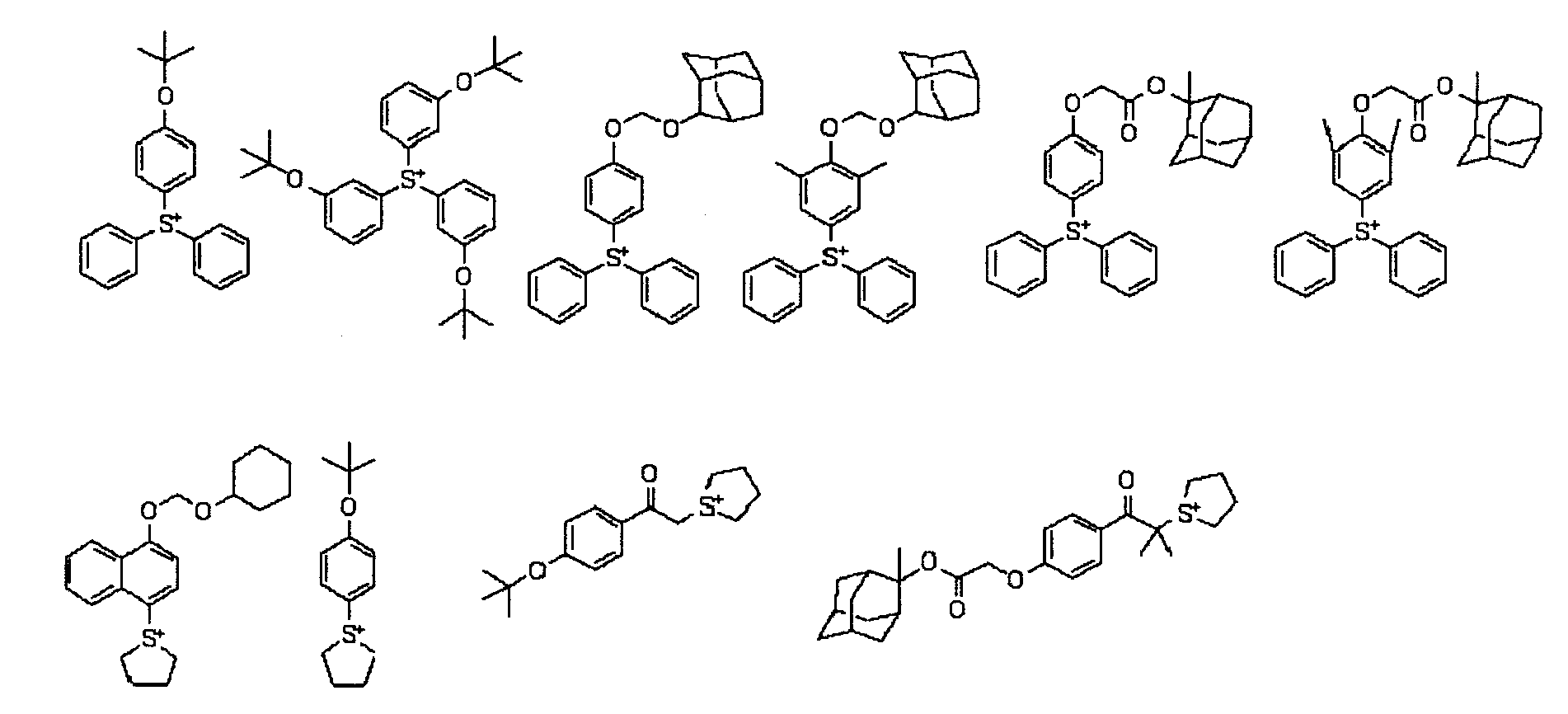
以下、酸発生剤〔P-B〕の具体例を挙げるが、本発明は、これに限定されるものではない。
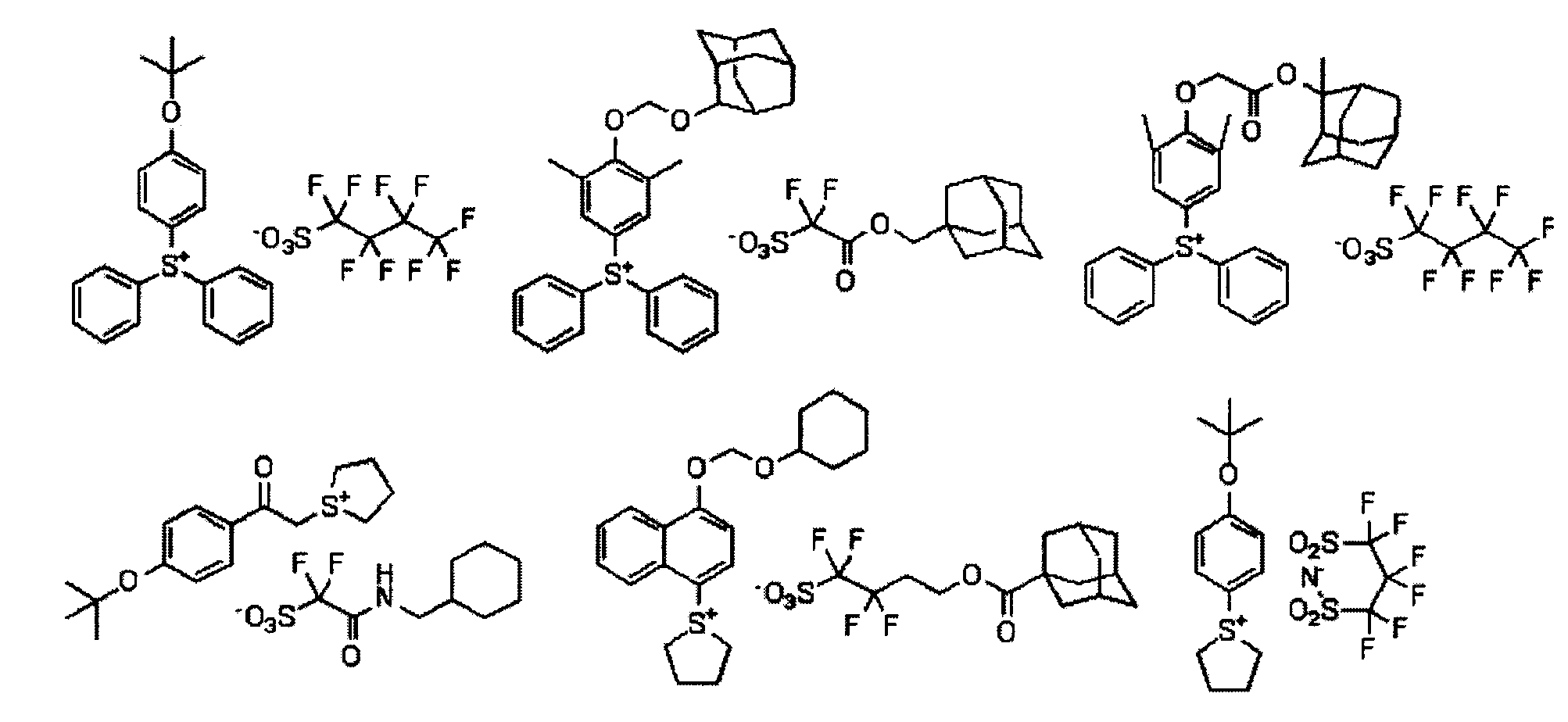


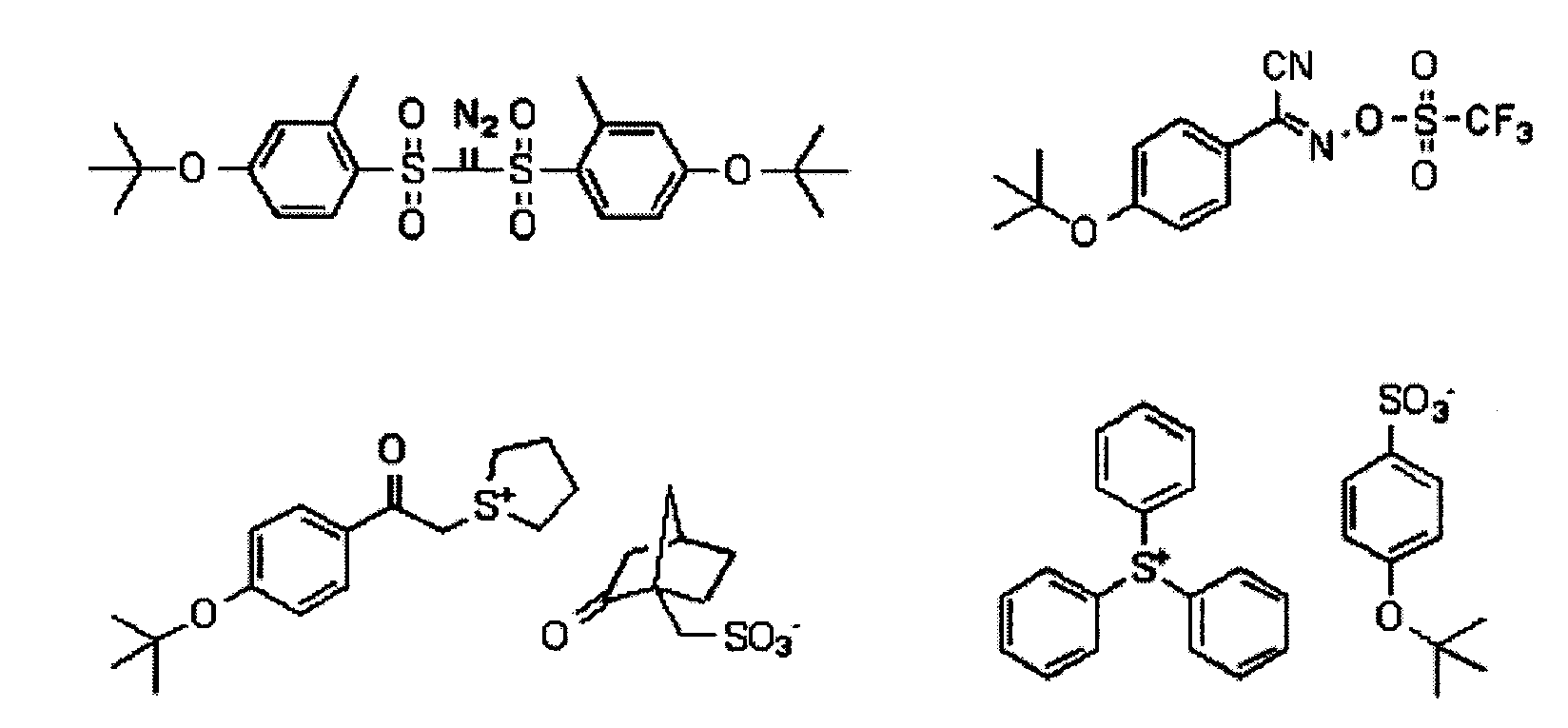
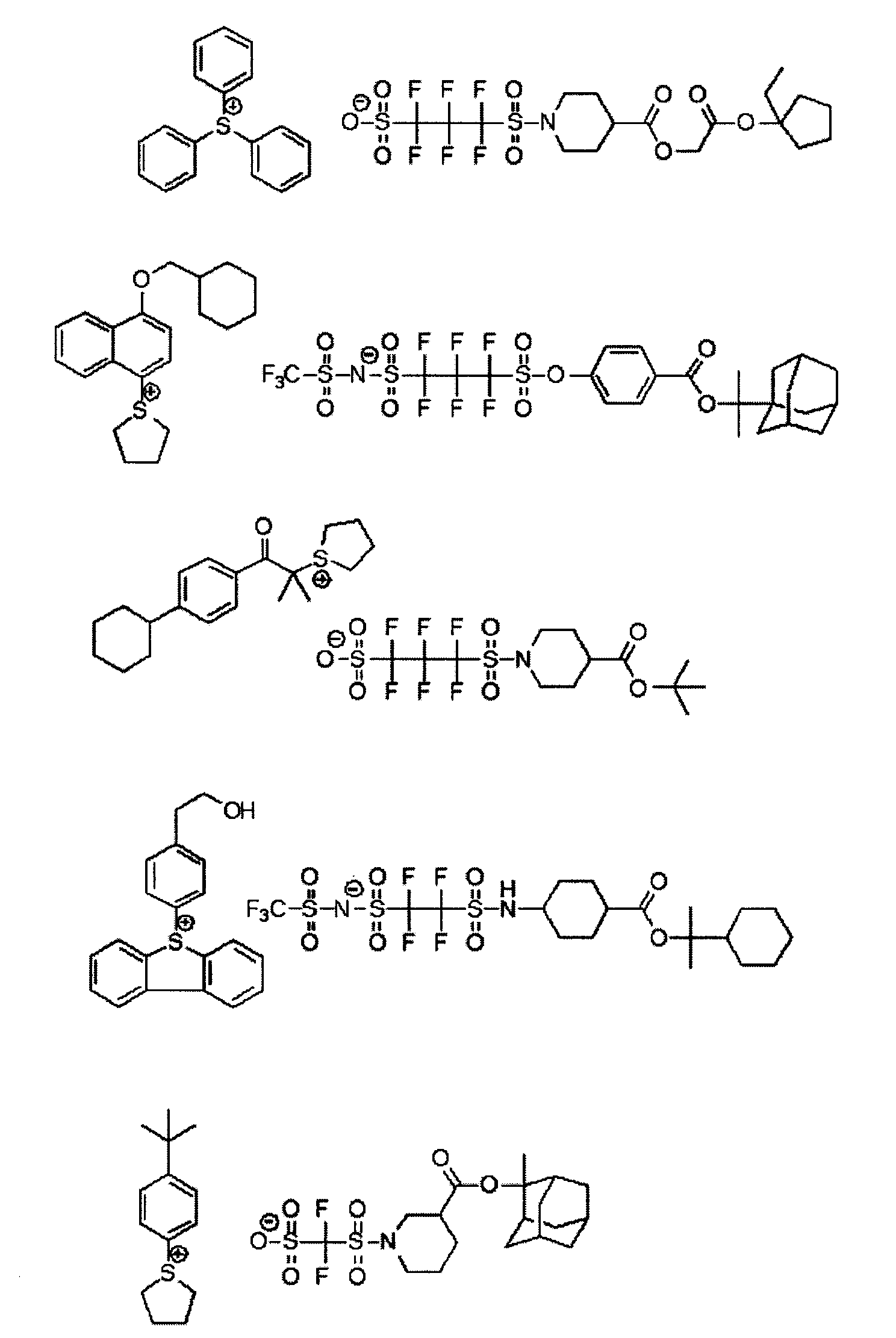
本発明の感活性光線性又は感放射線性組成物においては、酸発生剤〔P-B〕を、1種単独で、又は2種以上を組み合わせて使用することができ、その含有量は、好ましくは感活性光線性又は感放射線性組成物の全固形分を基準として0.1~20質量%であり、より好ましくは0.5~15質量%、更に好ましくは3~12質量%である。
〔P-C〕酸の作用によりアルカリ現像液に対する溶解性が増大する低分子化合物
酸の作用によりアルカリ現像液に対する溶解性が増大する低分子化合物〔P-C〕は、特に限定はされないが、酸分解性基を有する低分子化合物であることが好ましい。
酸分解性基の具体例は、樹脂〔P-A〕の酸分解性基において説明したものを同様に挙げることができ、アセタール基、カルボネート基、又は、3級エステル基を好適に挙げることができる。
低分子化合物〔P-C〕は、フェノール性水酸基、カルボン酸基、スルホン酸基等の酸基における水素原子が酸の作用により分解し脱離する基によって置き換えられた形で保護された基を有する低分子化合物であることが好ましい。
低分子化合物〔P-C〕の分子量範囲は100~1000が好ましく、100~700がより好ましく、100~500が特に好ましい。
ここで、本発明における低分子化合物とは、不飽和結合を持った化合物(いわゆる重合性モノマー)を、開始剤を使用しつつその不飽和結合を開裂させ、連鎖的に結合を成長させることによって得られる、いわゆるポリマーやオリゴマーではなく、分子量100~1000(より好ましくは100~700、更に好ましくは100~500)の一定の分子量を有する化合物(実質的に分子量分布を有さない化合物)である。
低分子化合物〔P-C〕が3級エステル構造を有する場合(すなわち、低分子化合物〔P-C〕における酸分解性基が3級エステル基である場合)、低分子化合物〔P-C〕は、特に下記一般式(1a)で表されるカルボン酸エステル又は不飽和カルボン酸エステルであることが好ましい。
酸の作用によりアルカリ現像液に対する溶解性が増大する低分子化合物〔P-C〕は、特に限定はされないが、酸分解性基を有する低分子化合物であることが好ましい。
酸分解性基の具体例は、樹脂〔P-A〕の酸分解性基において説明したものを同様に挙げることができ、アセタール基、カルボネート基、又は、3級エステル基を好適に挙げることができる。
低分子化合物〔P-C〕は、フェノール性水酸基、カルボン酸基、スルホン酸基等の酸基における水素原子が酸の作用により分解し脱離する基によって置き換えられた形で保護された基を有する低分子化合物であることが好ましい。
低分子化合物〔P-C〕の分子量範囲は100~1000が好ましく、100~700がより好ましく、100~500が特に好ましい。
ここで、本発明における低分子化合物とは、不飽和結合を持った化合物(いわゆる重合性モノマー)を、開始剤を使用しつつその不飽和結合を開裂させ、連鎖的に結合を成長させることによって得られる、いわゆるポリマーやオリゴマーではなく、分子量100~1000(より好ましくは100~700、更に好ましくは100~500)の一定の分子量を有する化合物(実質的に分子量分布を有さない化合物)である。
低分子化合物〔P-C〕が3級エステル構造を有する場合(すなわち、低分子化合物〔P-C〕における酸分解性基が3級エステル基である場合)、低分子化合物〔P-C〕は、特に下記一般式(1a)で表されるカルボン酸エステル又は不飽和カルボン酸エステルであることが好ましい。

(一般式(1a)において、R1は、それぞれ独立に、1価の脂環式炭化水素基(好ましくは炭素数4~20)若しくはその誘導体、又はアルキル基(好ましくは炭素数1~4)を表し、かつR1の少なくとも1つが該脂環式炭化水素基若しくはその誘導体であるか、或いは何れか2つのR1が相互に結合して、それぞれが結合している炭素原子とともに2価の脂環式炭化水素基(好ましくは炭素数4~20)若しくはその誘導体を形成し、残りのR1が、アルキル基(好ましくは炭素数1~4)、又は1価の脂環式炭化水素基(好ましくは炭素数4~20)若しくはその誘導体を示す。
Xは、それぞれ独立に、水素原子又はヒドロキシ基を示し、少なくとも一つがヒドロキシ基である。
Aは、単結合或いは-D-COO-で表される基を示し、Dはアルキレン基(好ましくは炭素数1~4)を示す。
Aは、単結合或いは-D-COO-で表される基を示し、Dはアルキレン基(好ましくは炭素数1~4)を示す。
一般式(1a)において、Aは、単結合或いは2価の連結基を示し、2価の連結基としては例えば、メチレン基、メチレンカルボニル基、メチレンカルボニルオキシ基、エチレン基、エチレンカルボニル基、エチレンカルボニルオキシ基、プロピレン基、プロピレンカルボニル基、プロピレンカルボニルオキシ基等が挙げられる。特に好ましくは、メチレンカルボニルオキシ基が挙げられる。
一般式(1a)において、R1の1価の脂環式炭化水素基(好ましくは炭素数4~20)、及び何れか2つのR1が相互に結合して形成した2価の脂環式炭化水素基(好ましくは炭素数4~20)としては、例えば、ノルボルナン、トリシクロデカン、テトラシクロドデカン、アダマンタンや、シクロブタン、シクロペンタン、シクロヘキサン、シクロヘプタン、シクロオクタン等のシクロアルカン類等に由来する脂環族環からなる基;これらの脂環族環からなる基を、例えば、メチル基、エチル基、n-プロピル基、i-プロピル基、n-ブチル基、2-メチルプロピル基、1-メチルプロピル基、t-ブチル基等の炭素数1~4のアルキル基及びシクロアルキル基の1種以上或いは1個以上で置換した基等を挙げることができる。これらの脂環式炭化水素基のうち、ノルボルナン、トリシクロデカン、テトラシクロドデカン、アダマンタン、シクロペンタン又はシクロヘキサンに由来する脂環族環からなる基や、これらの脂環族環からなる基を前記アルキル基で置換した基等が好ましい。
また、前記脂環式炭化水素基の誘導体としては、例えば、ヒドロキシル基;カルボキシル基;オキソ基(即ち、=O基);ヒドロキシメチル基、1-ヒドロキシエチル基、2-ヒドロキシエチル基、1-ヒドロキシプロピル基、2-ヒドロキシプロピル基、3-ヒドロキシプロピル基、1-ヒドロキシブチル基、2-ヒドロキシブチル基、3-ヒドロキシブチル基、4-ヒドロキシブチル基等の炭素数1~4のヒドロキシアルキル基;メトキシ基、エトキシ基、n-プロポキシ基、i-プロポキシ基、n-ブトキシ基、2-メチルプロポキシ基、1-メチルプロポキシ基、t-ブトキシ基等の炭素数1~4のアルコキシル基;シアノ基;シアノメチル基、2-シアノエチル基、3-シアノプロピル基、4-シアノブチル基等の炭素数2~5のシアノアルキル基等の置換基を1種以上或いは1個以上有する基を挙げることができる。これらの置換基のうち、ヒドロキシル基、カルボキシル基、ヒドロキシメチル基、シアノ基、シアノメチル基等が好ましい。
また、R1のアルキル基としては、例えば、メチル基、エチル基、n-プロピル基、i-プロピル基、n-ブチル基、2-メチルプロピル基、1-メチルプロピル基、t-ブチル基等の炭素数1~4のアルキル基を挙げることができる。これらのアルキル基のうち、メチル基、エチル基、n-プロピル基、i-プロピル基が好ましい。
好ましい具体例としては、下記化合物が挙げられる。
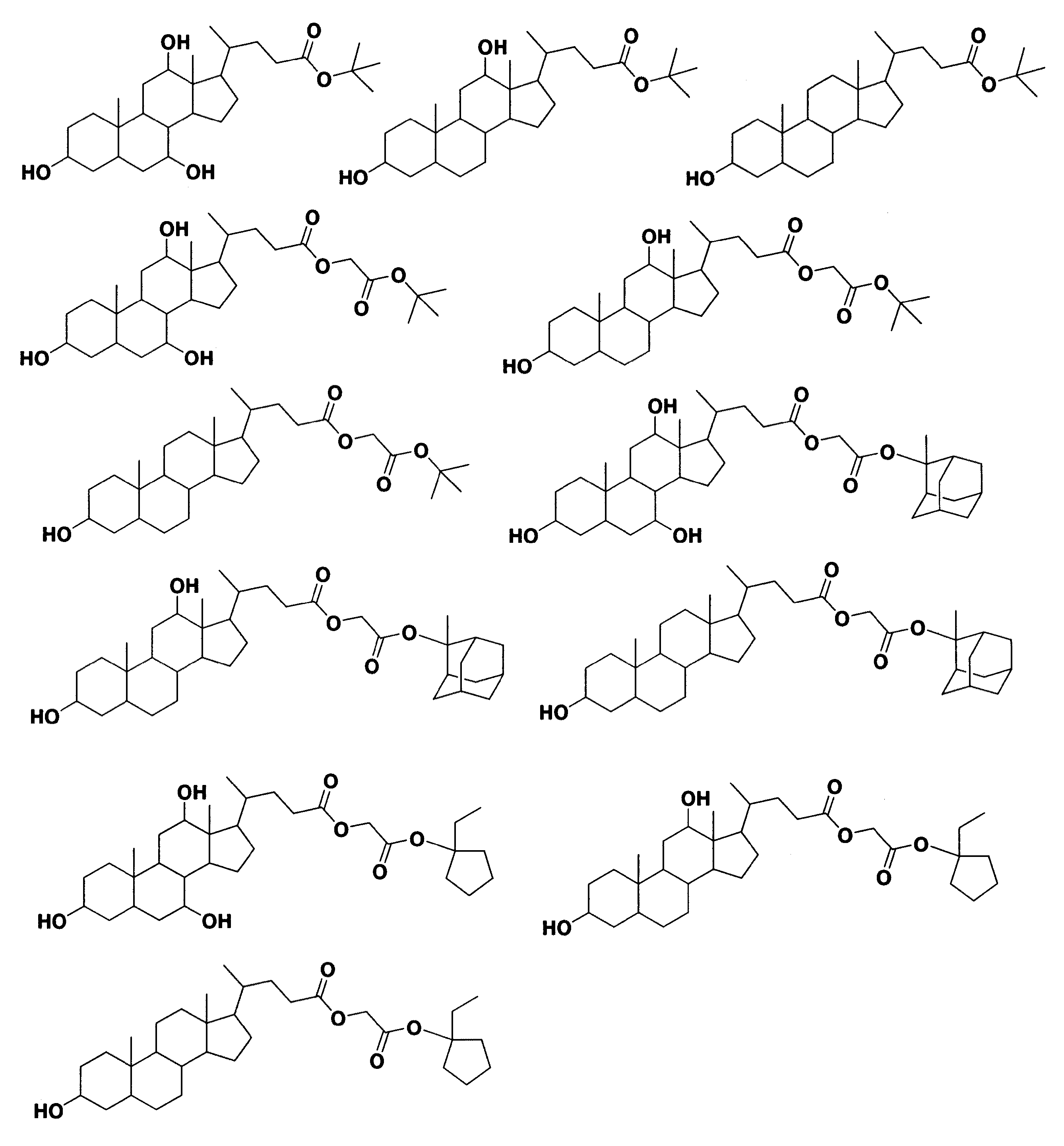
また低分子化合物〔P-C〕は以下に示す(メタ)アクリル酸エステルであっても良い。以下に、酸分解性基として3級エステル基を有する(メタ)アクリル酸3級エステルの具体例を示すが、これらに限定されるものではない。
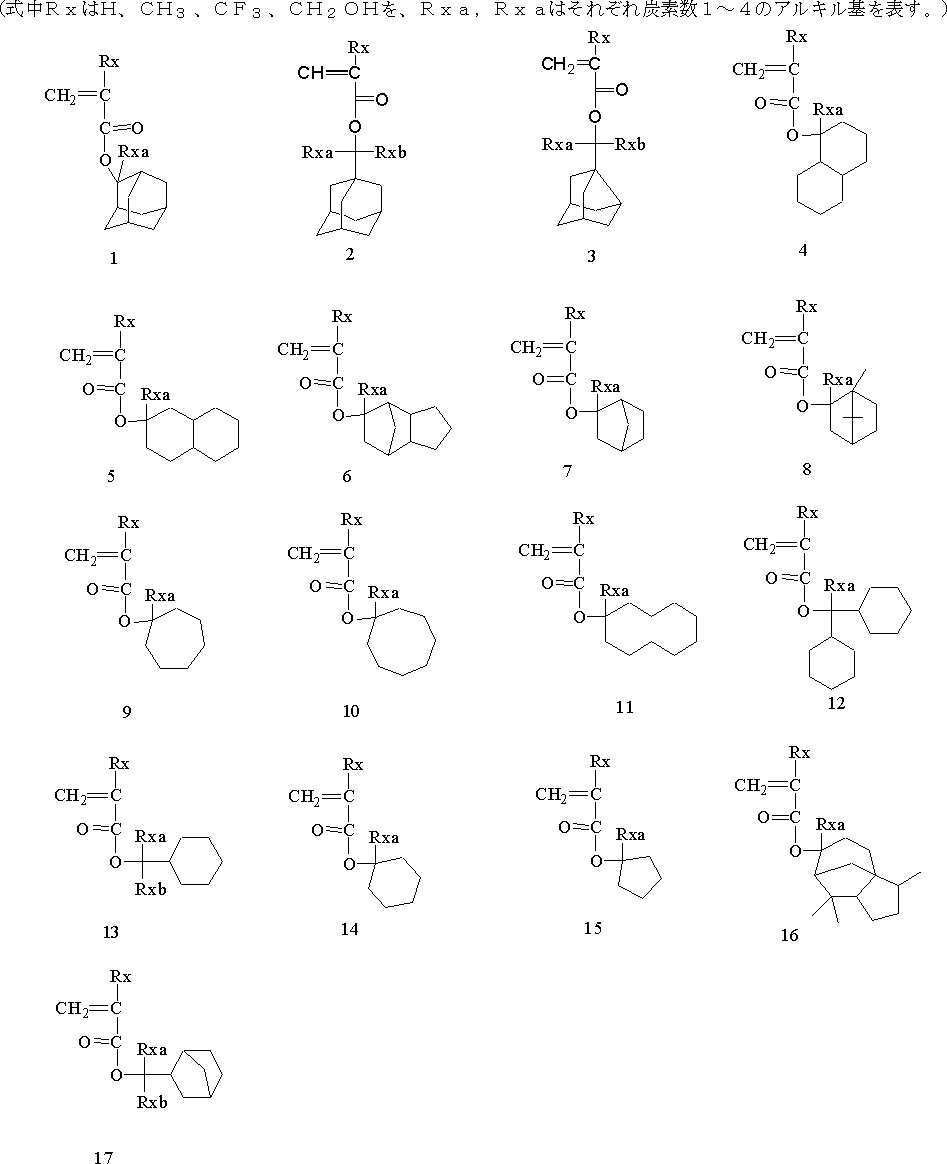
低分子化合物〔P-C〕は、前述の化合物〔P-B〕と同一の成分であっても、異なる成分であっても良いが、異なる成分であることが好ましい。
本発明の感活性光線性又は感放射線性組成物においては、低分子化合物〔P-C〕を、1種単独で、又は2種以上を組み合わせて使用することができ、その含有量は、好ましくは感活性光線性又は感放射線性組成物の全固形分を基準として0.1~20質量%であり、より好ましくは0.5~10質量%、更に好ましくは1~5質量%である。
[2](N)下記〔N-A〕、〔N-B〕及び〔N-C〕からなる群より選択される少なくとも1種の化合物
本発明の感活性光線性又は感放射線性組成物は、下記〔N-A〕、〔N-B〕及び〔N-C〕からなる群より選択される少なくとも1種の化合物(以下、化合物(N)ともいう)を含有している。
〔N-A〕 酸、活性光線若しくは放射線、又は、活性種の作用によりアルカリ現像液に対する溶解性が減少する樹脂
〔N-B〕 活性光線又は放射線の照射により酸を発生し、かつ酸、活性光線若しくは放射線、又は、活性種の作用によりアルカリ現像液に対する溶解性が減少する化合物
〔N-C〕 酸、活性光線若しくは放射線、又は、活性種の作用によりアルカリ現像液に対する溶解性が減少する低分子化合物
本発明の感活性光線性又は感放射線性組成物は、下記〔N-A〕、〔N-B〕及び〔N-C〕からなる群より選択される少なくとも1種の化合物(以下、化合物(N)ともいう)を含有している。
〔N-A〕 酸、活性光線若しくは放射線、又は、活性種の作用によりアルカリ現像液に対する溶解性が減少する樹脂
〔N-B〕 活性光線又は放射線の照射により酸を発生し、かつ酸、活性光線若しくは放射線、又は、活性種の作用によりアルカリ現像液に対する溶解性が減少する化合物
〔N-C〕 酸、活性光線若しくは放射線、又は、活性種の作用によりアルカリ現像液に対する溶解性が減少する低分子化合物
上記樹脂〔N-A〕、上記化合物〔N-B〕、及び、上記低分子化合物〔N-C〕は、それぞれ、下記(N-1)、(N-2)及び(N-3)のいずれの形式の化合物であってもよい。
(N-1) 酸の作用によりアルカリ現像液に対する溶解性が減少する化合物
(N-2) 活性光線又は放射線の照射によりアルカリ現像液に対する溶解性が減少する化合物
(N-3) 活性種の作用によりアルカリ現像液に対する溶解性が減少する化合物
ここで、上記(N-3)における活性種としては、ラジカル、カチオン種、アニオン種等を挙げることができる。
(N-1) 酸の作用によりアルカリ現像液に対する溶解性が減少する化合物
(N-2) 活性光線又は放射線の照射によりアルカリ現像液に対する溶解性が減少する化合物
(N-3) 活性種の作用によりアルカリ現像液に対する溶解性が減少する化合物
ここで、上記(N-3)における活性種としては、ラジカル、カチオン種、アニオン種等を挙げることができる。
以下、樹脂〔N-A〕、化合物〔N-B〕及び低分子化合物〔N-C〕について詳細に説明する。
〔N-A〕酸、活性光線若しくは放射線、又は、活性種の作用によりアルカリ現像液に対する溶解性が減少する樹脂
酸、活性光線若しくは放射線、又は、活性種の作用によりアルカリ現像液に対する溶解性が減少する樹脂としては、特に限定されないが、活性光線又は放射線の照射により後に詳述する酸発生剤(A)、上記酸発生剤〔P-B〕、及び、後に詳述する酸発生剤〔N-B〕などから発生した酸、又は、活性光線又は放射線の照射により発生したラジカル等の活性種の作用によってアルカリ現像液に対する溶解性が減少する樹脂であることが好ましい。
樹脂〔N-A〕は、酸、活性光線若しくは放射線、又は、活性種の作用によって重合する基を有する樹脂が挙げられ、下記一般式(L-1)~(L-4)で表される繰り返し単位から選択される1種以上の繰り返し単位を有する樹脂であることが好ましい。
酸、活性光線若しくは放射線、又は、活性種の作用によりアルカリ現像液に対する溶解性が減少する樹脂としては、特に限定されないが、活性光線又は放射線の照射により後に詳述する酸発生剤(A)、上記酸発生剤〔P-B〕、及び、後に詳述する酸発生剤〔N-B〕などから発生した酸、又は、活性光線又は放射線の照射により発生したラジカル等の活性種の作用によってアルカリ現像液に対する溶解性が減少する樹脂であることが好ましい。
樹脂〔N-A〕は、酸、活性光線若しくは放射線、又は、活性種の作用によって重合する基を有する樹脂が挙げられ、下記一般式(L-1)~(L-4)で表される繰り返し単位から選択される1種以上の繰り返し単位を有する樹脂であることが好ましい。

RL1は、水素原子、アルキル基又はシクロアルキル基を表す。pは1又は2を表す。qは(2-p)で表される整数を表す。*は、繰り返し単位(L-1)を構成する他の原子との結合手を表す。pが2である又はrが2以上である場合、複数のRL1は、互いに同一であっても異なっていてもよい。
RL1におけるアルキル基としては、直鎖状あるいは分岐状のいずれであってもよく、炭素数1~20のアルキル基(例えば、メチル基、エチル基、プロピル基、イソプロピル基、ブチル基、イソブチル基、t‐ブチル基、n‐ペンチル基、n‐ヘキシル基、n‐オクチル基、n‐ドデシル基等)が挙げられる。炭素数1~8のアルキル基が好ましく、炭素数1~6のアルキル基がより好ましく、炭素数1~4のアルキル基が特に好ましい。
RL1におけるシクロアルキル基としては、単環型あるいは多環型のいずれであってもよく、炭素数3~17のシクロアルキル基(例えば、シクロペンチル基、シクロヘキシル基、ノルボルナニル基、アダマンチル基等)が挙げられる。炭素数5~12のシクロアルキル基が好ましく、炭素数5~10のシクロアルキル基がより好ましく、炭素数5~6のシクロアルキル基が特に好ましい。
一般式(L-1)におけるRL1としては、水素原子、炭素数1~8のアルキル基が好ましく、水素原子、炭素数1~6のアルキル基がより好ましく、水素原子、炭素数1~4のアルキル基が特に好ましい。
RL2、RL3及びRL4は、各々独立に、水素原子、アルキル基、シクロアルキル基、ハロゲン原子、シアノ基又はアルコキシカルボニル基を表す。
X1は、単結合、又は、直鎖状又は分岐状の炭化水素基、環員としてヘテロ原子を含有しても良い環状の炭化水素基、-O-、-S-、-CO-、-SO2-、-NR-(Rは水素原子、アルキル基又は-CH2ORL1で表される基)、及び、これらを組み合わせた基からなる群より選択される(r+1)価の基を表す。なお、-CH2ORL1で表される基におけるRL1は、上記一般式(L-1)におけるRL1と同義である。
rは1~5の整数を表す。ただし、X1が単結合である場合、rは1である。
RL1におけるアルキル基としては、直鎖状あるいは分岐状のいずれであってもよく、炭素数1~20のアルキル基(例えば、メチル基、エチル基、プロピル基、イソプロピル基、ブチル基、イソブチル基、t‐ブチル基、n‐ペンチル基、n‐ヘキシル基、n‐オクチル基、n‐ドデシル基等)が挙げられる。炭素数1~8のアルキル基が好ましく、炭素数1~6のアルキル基がより好ましく、炭素数1~4のアルキル基が特に好ましい。
RL1におけるシクロアルキル基としては、単環型あるいは多環型のいずれであってもよく、炭素数3~17のシクロアルキル基(例えば、シクロペンチル基、シクロヘキシル基、ノルボルナニル基、アダマンチル基等)が挙げられる。炭素数5~12のシクロアルキル基が好ましく、炭素数5~10のシクロアルキル基がより好ましく、炭素数5~6のシクロアルキル基が特に好ましい。
一般式(L-1)におけるRL1としては、水素原子、炭素数1~8のアルキル基が好ましく、水素原子、炭素数1~6のアルキル基がより好ましく、水素原子、炭素数1~4のアルキル基が特に好ましい。
RL2、RL3及びRL4は、各々独立に、水素原子、アルキル基、シクロアルキル基、ハロゲン原子、シアノ基又はアルコキシカルボニル基を表す。
X1は、単結合、又は、直鎖状又は分岐状の炭化水素基、環員としてヘテロ原子を含有しても良い環状の炭化水素基、-O-、-S-、-CO-、-SO2-、-NR-(Rは水素原子、アルキル基又は-CH2ORL1で表される基)、及び、これらを組み合わせた基からなる群より選択される(r+1)価の基を表す。なお、-CH2ORL1で表される基におけるRL1は、上記一般式(L-1)におけるRL1と同義である。
rは1~5の整数を表す。ただし、X1が単結合である場合、rは1である。
RL2、RL3及びRL4におけるアルキル基の具体例及び好ましい例は、RL1におけるアルキル基において前掲したものと同様である。
RL2、RL3及びRL4におけるシクロアルキル基の具体例及び好ましい例は、RL1におけるシクロアルキル基の上記具体例と同様である。
RL2、RL3及びRL4におけるハロゲン原子としては、フッ素原子、塩素原子、臭素原子及びヨウ素原子を挙げることができ、フッ素原子であることがより好ましい。
RL2、RL3及びRL4におけるアルコキシカルボニル基のアルキル部位の具体例及び好ましい例は、RL1におけるアルキル基において前掲したものと同様である。
RL2、RL3及びRL4におけるシクロアルキル基の具体例及び好ましい例は、RL1におけるシクロアルキル基の上記具体例と同様である。
RL2、RL3及びRL4におけるハロゲン原子としては、フッ素原子、塩素原子、臭素原子及びヨウ素原子を挙げることができ、フッ素原子であることがより好ましい。
RL2、RL3及びRL4におけるアルコキシカルボニル基のアルキル部位の具体例及び好ましい例は、RL1におけるアルキル基において前掲したものと同様である。
RL2及びRL3は、各々独立に、水素原子又はアルキル基であることが好ましく、水素原子であることがより好ましい。
RL4は、水素原子、アルキル基又はハロゲン原子であることが好ましく、水素原子又はアルキル基であることがより好ましい。
RL4は、水素原子、アルキル基又はハロゲン原子であることが好ましく、水素原子又はアルキル基であることがより好ましい。
直鎖状又は分岐状の炭化水素基としては、炭素数1~5の直鎖状又は分岐状の炭化水素基が好ましく、炭素数1~3の直鎖状又は分岐状の炭化水素基が好ましい。
環員としてヘテロ原子を含有しても良い環状の炭化水素基は、芳香族環基であっても、非芳香族環基であってもよい。
芳香族環基における芳香族環としては、炭素数3~12のものが好ましく、より具体的には、ベンゼン環、ナフタレン環、フラン環、ピロール環、チオフェン環、ピラゾール環、オキサゾール環、チアゾール環、ピリジン環、ピラジン環、ピリミジン環、トリアジン環等を挙げることができる。
非芳香族環基における非芳香族環としては、炭素数4~12のものが好ましく、より具体的には、シクロペンタン環、シクロヘキサン環、テトラヒドロフラン環等を挙げることができる。
芳香族環基における芳香族環としては、炭素数3~12のものが好ましく、より具体的には、ベンゼン環、ナフタレン環、フラン環、ピロール環、チオフェン環、ピラゾール環、オキサゾール環、チアゾール環、ピリジン環、ピラジン環、ピリミジン環、トリアジン環等を挙げることができる。
非芳香族環基における非芳香族環としては、炭素数4~12のものが好ましく、より具体的には、シクロペンタン環、シクロヘキサン環、テトラヒドロフラン環等を挙げることができる。
一般式(L-1)において、p=1(すなわち、q=1)である場合、*は、連結基(例えば、アルキレン基、カルボニル基、-O-、-S-、-CO-、-SO2-又はこれらを組み合わせた基など)を介してX1に結合して環を形成する場合であっても良いが、水素原子、又は、1価の有機基(例えば、アルキル基、シクロアルキル基、ハロゲン原子、シアノ基、-O-、-S-、-CO-、-SO2-又はこれらを組み合わせた基)に結合することが好ましい。
rは1~3の整数であることが好ましく、1又は2であることがより好ましい。
以下、一般式(L-1)で表される繰り返し単位の具体例を示すが、これらに限定されるものではない。下記具体例中、R’は、水素原子又はメチル基を表す。
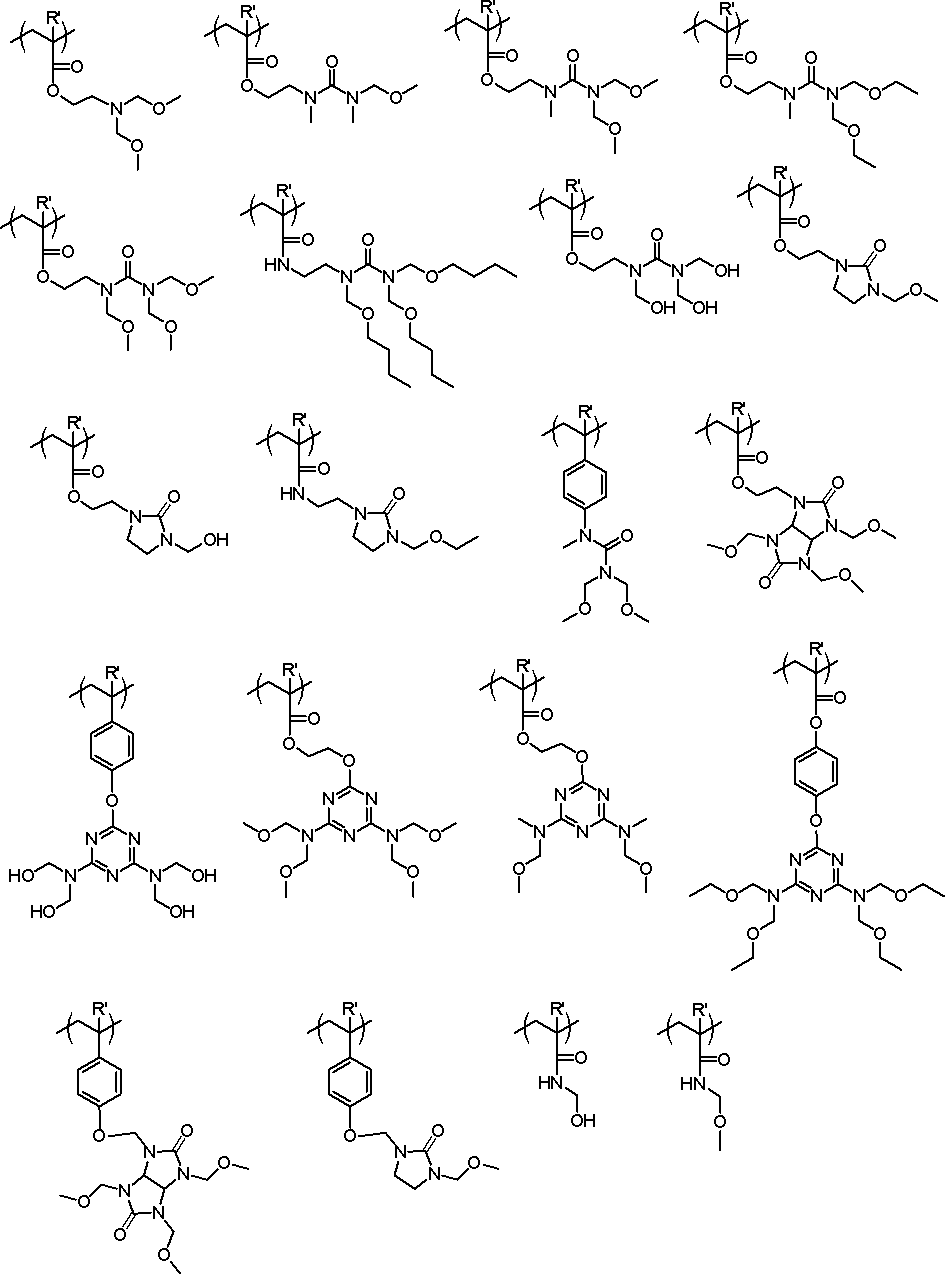

一般式(L-2)において、
R1は、水素原子、メチル基、又はハロゲン原子を表し;
R2及びR3は、水素原子、アルキル基又はシクロアルキル基を表し;
Lは、2価の連結基若しくは単結合を表し;
Yは、メチロール基を除く1価の置換基を表し;
Zは、水素原子又は1価の置換基を表し;
mは、0~4の整数を表し;
nは、1~5の整数を表し;
m+nは5以下であり;
mが2以上である場合、複数のYは互いに同一であっても異なっていてもよく、複数のYは互いに結合して環構造を形成していてもよく;
nが2以上である場合、複数のR2、R3及びZは互いに同一であっても異なっていてもよい。
R1は、水素原子、メチル基、又はハロゲン原子を表し;
R2及びR3は、水素原子、アルキル基又はシクロアルキル基を表し;
Lは、2価の連結基若しくは単結合を表し;
Yは、メチロール基を除く1価の置換基を表し;
Zは、水素原子又は1価の置換基を表し;
mは、0~4の整数を表し;
nは、1~5の整数を表し;
m+nは5以下であり;
mが2以上である場合、複数のYは互いに同一であっても異なっていてもよく、複数のYは互いに結合して環構造を形成していてもよく;
nが2以上である場合、複数のR2、R3及びZは互いに同一であっても異なっていてもよい。
R1で表されるメチル基は置換基を有していてもよく、置換基としては、例えば、フッ素原子、塩素原子、臭素原子、ヨウ素原子等のハロゲン原子、ヒドロキシル基、イソプロピル基を挙げることができる。置換基を有していてもよいメチル基としては、メチル基、トリフルオロメチル基、ヒドロキシメチル基等を挙げることができる。R1のハロゲン原子としては、フッ素、塩素、臭素、ヨウ素が挙げられる。
R1は、水素原子又はメチル基であることが好ましい。
R1は、水素原子又はメチル基であることが好ましい。
R2及びR3で表されるアルキル基としては、炭素数1~10の直鎖状又は分岐状のアルキル基等を挙げることができ、シクロアルキル基としては、炭素数3~10のシクロアルキル基を挙げることができる。具体的には、水素原子、メチル基、シクロヘキシル基、t-ブチル基が挙げられる。ここでのアルキル基及びシクロアルキル基は、置換基を有していてもよい。この置換基としては、Yの1価の置換基が有する置換基として後述するものと同様のものが挙げられる。
Lで表される2価の連結基としては、炭素数6~18の置換基を有しても良い単環若しくは多環の芳香環、-C(=O)-、-O-C(=O)-、-CH2-O-C(=O)-、チオカルボニル基、直鎖状若しくは分岐状のアルキレン基(好ましくは炭素数1~10、より好ましくは1~6)、シクロアルキレン基(好ましくは炭素数3~10、より好ましくは3~6)、スルホニル基、-O-、-NH-、-S-、又はこれらを組み合わせた2価の連結基(好ましくは総炭素数1~50、より好ましくは総炭素数1~30、更に好ましくは総炭素数1~20)が挙げられる。
上記一般式(L-2)のLにおける芳香環の好ましい例としては、ベンゼン環、ナフタレン環、アントラセン環、フルオレン環、フェナントレン環などの炭素数6~18の置換基を有していてもよい芳香族炭化水素環、又は、例えば、チオフェン環、フラン環、ピロール環、ベンゾチオフェン環、ベンゾフラン環、ベンゾピロール環、トリアジン環、イミダゾール環、ベンゾイミダゾール環、トリアゾール環、チアジアゾール環、チアゾール環等のヘテロ環を含む芳香環ヘテロ環を挙げることができる。中でも、ベンゼン環、ナフタレン環が解像性の観点で好ましく、ベンゼン環が最も好ましい。
Yで表される1価の置換基としては、アルキル基(直鎖又は分岐のいずれであってもよく、炭素数1~12が好ましい)、アルケニル基(炭素数2~12が好ましい)、アルキニル基(炭素数2~12が好ましい)、シクロアルキル基(単環、多環のいずれであってもよく炭素数3~12が好ましい)、アリール基(炭素数6~18が好ましい)、ヒドロキシ基、アルコキシ基、エステル基、アミド基、ウレタン基、ウレイド基、チオエーテル基、スルホンアミド基、ハロゲン原子、ハロアルキル基及びスルホン酸エステル基が挙げられる。好ましい例としては、アルキル基、シクロアルキル基、ハロゲン原子、ハロアルキル基、ヒドロキシ基、アルコキシ基、アリールオキシ基、エステル基、アリール基が挙げられ、更に好ましい例としては、アルキル基、ハロゲン原子、ヒドロキシ基、アルコキシ基が挙げられる。
Yの1価の置換基は、更に置換基を有していてもよく、置換基としては、例えば、ヒドロキシル基、ハロゲン原子(例えば、フッ素原子)、アルキル基、シクロアルキル基、アルコキシ基、カルボキシル基、アルコキシカルボニル基、アリール基、アルコキシアルキル基、これらを組み合わせた基が挙げられ、炭素数8以下が好ましい。
また、mが2以上の時、複数のYが単結合又は連結基を介して互いに結合し、環構造を形成していてもよい。この場合の連結基としては、エーテル結合、チオエーテル結合、エステル結合、アミド結合、カルボニル基、アルキレン基等が挙げられる。
Yの1価の置換基は、更に置換基を有していてもよく、置換基としては、例えば、ヒドロキシル基、ハロゲン原子(例えば、フッ素原子)、アルキル基、シクロアルキル基、アルコキシ基、カルボキシル基、アルコキシカルボニル基、アリール基、アルコキシアルキル基、これらを組み合わせた基が挙げられ、炭素数8以下が好ましい。
また、mが2以上の時、複数のYが単結合又は連結基を介して互いに結合し、環構造を形成していてもよい。この場合の連結基としては、エーテル結合、チオエーテル結合、エステル結合、アミド結合、カルボニル基、アルキレン基等が挙げられる。
ハロゲン原子としては、上記R1で挙げたものと同様のものが挙げられる。
ハロアルキル基としては、少なくとも1つ以上の水素原子がフッ素原子、塩素原子、臭素原子、及びヨウ素原子で置換された炭素数1~12のアルキル基、シクロアルキル基が挙げられる。具体例としては、フルオロメチル基、トリフルオロメチル基、ペンタフルオロエチル基、ヘプタフルオロプロピル基、ウンデカフルオロシクロヘキシル基が挙げられる。
Zで表される1価の置換基としては、アルキル基(直鎖又は分岐のいずれであってもよく、炭素数1~12が好ましい)、アルケニル基(炭素数2~12が好ましい)、アルキニル基(炭素数2~12が好ましい)、シクロアルキル基(炭素数3~8が好ましい)、アリール基(単環、多環のいずれであってもよく炭素数6~18が好ましい)、ハロアルキル基、アルカノイル基、アルコキシカルボニル基、アリールオキシカルボニル基、アルキルスルホニルオキシ基、アリールスルホニルオキシ基、アルキルスルホニル基、アリールスルホニル基、シアノ基、アルキルチオ基、アリールチオ基、アルコキシアルキル基及び複素環基が挙げられる。好ましい例としては、水素原子、アルキル基、シクロアルキル基、アルカノイル基、アルケニル基、ハロアルキル基、アルコキシアルキル基が挙げられる。
ハロアルキル基として好ましいものは、上記一般式(L-2)のYで挙げたものと同様である。
アルカノイル基としては、炭素数2~20のアルカノイル基が好ましく、例えば、アセチル基、プロパノイル基、ブタノイル基、トリフルオロメチルカルボニル基、ペンタノイル基、ベンゾイル基、1-ナフトイル基、2-ナフトイル基、4-メチルスルファニルベンゾイル基、4-フェニルスルファニルベンゾイル基、4-ジメチルアミノベンゾイル基、4-ジエチルアミノベンゾイル基、2-クロロベンゾイル基、2-メチルベンゾイル基、2-メトキシベンゾイル基、2-ブトキシベンゾイル基、3-クロロベンゾイル基、3-トリフルオロメチルベンゾイル基、3-シアノベンゾイル基、3-ニトロベンゾイル基、4-フルオロベンゾイル基、4-シアノベンゾイル基及び4-メトキシベンゾイル基が挙げられる。
アルコキシカルボニル基としては、炭素数2~20のアルコキシカルボニル基が好ましく、例えば、メトキシカルボニル基、エトキシカルボニル基、プロポキシカルボニル基、ブトキシカルボニル基、ヘキシルオキシカルボニル基、オクチルオキシカルボニル基、デシルオキシカルボニル基、オクタデシルオキシカルボニル基及びトリフルオロメチルオキシカルボニル基が挙げられる。
アリールオキシカルボニル基としては、炭素数7~30のアリールオキシカルボニル基が挙げられ、例えば、フェノキシカルボニル基、1-ナフチルオキシカルボニル基、2-ナフチルオキシカルボニル基、4-メチルスルファニルフェニルオキシカルボニル基、4-フェニルスルファニルフェニルオキシカルボニル基、4-ジメチルアミノフェニルオキシカルボニル基、4-ジエチルアミノフェニルオキシカルボニル基、2-クロロフェニルオキシカルボニル基、2-メチルフェニルオキシカルボニル基、2-メトキシフェニルオキシカルボニル基、2-ブトキシフェニルオキシカルボニル基、3-クロロフェニルオキシカルボニル基、3-トリフルオロメチルフェニルオキシカルボニル基、3-シアノフェニルオキシカルボニル基、3-ニトロフェニルオキシカルボニル基、4-フルオロフェニルオキシカルボニル基、4-シアノフェニルオキシカルボニル基及び4-メトキシフェニルオキシカルボニル基が挙げられる。
アルキルスルホニルオキシ基としては、炭素数1~20のアルキルスルホニルオキシ基が好ましく、例えば、メチルスルホニルオキシ基、エチルスルホニルオキシ基、プロピルスルホニルオキシ基、イソプロピルスルホニルオキシ基、ブチルスルホニルオキシ基、ヘキシルスルホニルオキシ基、シクロヘキシルスルホニルオキシ基、オクチルスルホニルオキシ基、2-エチルヘキシルスルホニルオキシ基、デカノイルスルホニルオキシ基、ドデカノイルスルホニルオキシ基、オクタデカノイルスルホニルオキシ基、シアノメチルスルホニルオキシ基、メトキシメチルスルホニルオキシ基及びパーフルオロアルキルスルホニルオキシ基が挙げられる。
アリールスルホニルオキシ基としては、炭素数6~30のアリールスルホニルオキシ基が好ましく、例えば、フェニルスルホニルオキシ基、1-ナフチルスルホニルオキシ基、2-ナフチルスルホニルオキシ基、2-クロロフェニルスルホニルオキシ基、2-メチルフェニルスルホニルオキシ基、2-メトキシフェニルスルホニルオキシ基、2-ブトキシフェニルスルホニルオキシ基、3-クロロフェニルスルホニルオキシ基、3-トリフルオロメチルフェニルスルホニルオキシ基、3-シアノフェニルスルホニルオキシ基、3-ニトロフェニルスルホニルオキシ基、4-フルオロフェニルスルホニルオキシ基、4-シアノフェニルスルホニルオキシ基、4-メトキシフェニルスルホニルオキシ基、4-メチルスルファニルフェニルスルホニルオキシ基、4-フェニルスルファニルフェニルスルホニルオキシ基及び4-ジメチルアミノフェニルスルホニルオキシ基が挙げられる。
アルキルスルホニル基としては、炭素数1~20のアルキルスルホニル基が好ましく、例えば、メチルスルホニル基、エチルスルホニル基、プロピルスルホニル基、イソプロピルスルホニル基、ブチルスルホニル基、ヘキシルスルホニル基、シクロヘキシルスルホニル基、オクチルスルホニル基、2-エチルヘキシルスルホニル基、デカノイルスルホニル基、ドデカノイルスルホニル基、オクタデカノイルスルホニル基、シアノメチルスルホニル基、メトキシメチルスルホニル基及びパーフルオロアルキルスルホニル基が挙げられる。
アリールスルホニル基としては、炭素数6~30のアリールスルホニル基が好ましく、例えば、フェニルスルホニル基、1-ナフチルスルホニル基、2-ナフチルスルホニル基、2-クロロフェニルスルホニル基、2-メチルフェニルスルホニル基、2-メトキシフェニルスルホニル基、2-ブトキシフェニルスルホニル基、3-クロロフェニルスルホニル基、3-トリフルオロメチルフェニルスルホニル基、3-シアノフェニルスルホニル基、3-ニトロフェニルスルホニル基、4-フルオロフェニルスルホニル基、4-シアノフェニルスルホニル基、4-メトキシフェニルスルホニル基、4-メチルスルファニルフェニルスルホニル基、4-フェニルスルファニルフェニルスルホニル基及び4-ジメチルアミノフェニルスルホニル基が挙げられる。
アルキルチオ基としては、炭素数1~30のアルキルチオ基が挙げられ、例えば、メチルチオ基、エチルチオ基、プロピルチオ基、n-ブチルチオ基、トリフルオロメチルチオ基、ヘキシルチオ基、t-ブチルチオ基、2-エチルヘキシルチオ基、シクロヘキシルチオ基、デシルチオ基及びドデシルチオ基が挙げられる。
アリールチオ基としては、炭素数6~30のアリールチオ基が挙げられ、例えば、フェニルチオ基、1-ナフチルチオ基、2-ナフチルチオ基、トリルチオ基、メトキシフェニルチオ基、ナフチルチオ基、クロロフェニルチオ基、トリフルオロメチルフェニルチオ基、シアノフェニルチオ基及びニトロフェニルチオ基が挙げられる。
複素環基としては、好ましくは、窒素原子、酸素原子、硫黄原子又はリン原子を含んだ芳香族若しくは脂肪族の複素環基が挙げられる。この複素環基としては、例えば、チエニル基、ベンゾ[b]チエニル基、ナフト[2,3-b]チエニル基、チアントレニル基、フリル基、ピラニル基、イソベンゾフラニル基、クロメニル基、キサンテニル基、フェノキサチイニル基、2H-ピロリル基、ピロリル基、イミダゾリル基、ピラゾリル基、ピリジル基、ピラジニル基、ピリミジニル基、ピリダジニル基、インドリジニル基、イソインドリル基、3H-インドリル基、インドリル基、1H-インダゾリル基、プリニル基、4H-キノリジニル基、イソキノリル基、キノリル基、フタラジニル基、ナフチリジニル基、キノキサニリル基、キナゾリニル基、シンノリニル基、プテリジニル基、4aH-カルバゾリル基、カルバゾリル基、β-カルボリニル基、フェナントリジニル基、アクリジニル基、ペリミジニル基、フェナントロリニル基、フェナジニル基、フェナルサジニル基、イソチアゾリル基、フェノチアジニル基、イソキサゾリル基、フラザニル基、フェノキサジニル基、イソクロマニル基、クロマニル基、ピロリジニル基、ピロリニル基、イミダゾリジニル基、イミダゾリニル基、ピラゾリジニル基、ピラゾリニル基、ピペリジル基、ピペラジニル基、インドリニル基、イソインドリニル基、キヌクリジニル基、テトラヒドロピリミニジル基、テトラヒドロ-2-ピリミジノニル基、トリアジニル基、モルホリニル基及びチオキサントリル基が挙げられる。
nは、好ましくは1~4の整数を表し、より好ましくは2~4の整数を表し、特に好ましくは2又は3である。mは、好ましくは0又は1である。
また、一般式(L-2)で表される繰り返し単位は、好ましくは下記一般式(2)又は(3)で表される繰り返し単位であることが好ましい。
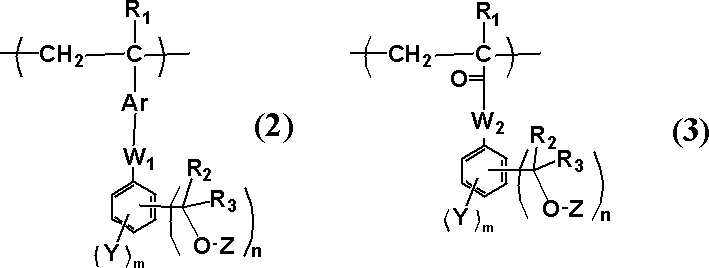
一般式(2)及び(3)において、
R1、R2、R3、Y、Z、m及びnは、前記一般式(L-2)で定義した通りである。
Arは、芳香環を表す。
W1及びW2は、2価の連結基又は単結合を表す。
R1、R2、R3、Y、Z、m及びnの具体例としては、それぞれ上記一般式(L-2)において述べたものと同様のものが挙げられ、好ましい範囲も同様である。
Arで表される芳香環の具体例としては、上記一般式(L-2)におけるLが芳香環である場合の具体例と同様のものが挙げられ、好ましい範囲も同様である。
W1及びW2で表される2価の連結基としては、炭素数6~18の置換基を有しても良い単環若しくは多環の芳香族炭化水素環、-C(=O)-、-O-C(=O)-、-CH2-O-C(=O)-、チオカルボニル基、直鎖状若しくは分岐状のアルキレン基(好ましくは炭素数1~10、より好ましくは1~6)、シクロアルキレン基(好ましくは炭素数3~10、より好ましくは3~6)、スルホニル基、-O-、-NH-、-S-、又はこれらを組み合わせた2価の連結基が挙げられる。
R1、R2、R3、Y、Z、m及びnは、前記一般式(L-2)で定義した通りである。
Arは、芳香環を表す。
W1及びW2は、2価の連結基又は単結合を表す。
R1、R2、R3、Y、Z、m及びnの具体例としては、それぞれ上記一般式(L-2)において述べたものと同様のものが挙げられ、好ましい範囲も同様である。
Arで表される芳香環の具体例としては、上記一般式(L-2)におけるLが芳香環である場合の具体例と同様のものが挙げられ、好ましい範囲も同様である。
W1及びW2で表される2価の連結基としては、炭素数6~18の置換基を有しても良い単環若しくは多環の芳香族炭化水素環、-C(=O)-、-O-C(=O)-、-CH2-O-C(=O)-、チオカルボニル基、直鎖状若しくは分岐状のアルキレン基(好ましくは炭素数1~10、より好ましくは1~6)、シクロアルキレン基(好ましくは炭素数3~10、より好ましくは3~6)、スルホニル基、-O-、-NH-、-S-、又はこれらを組み合わせた2価の連結基が挙げられる。
また、一般式(L-2)で表される繰り返し単位は、下記一般式(2’)又は(3’)で表される繰り返し単位であることがより好ましい。
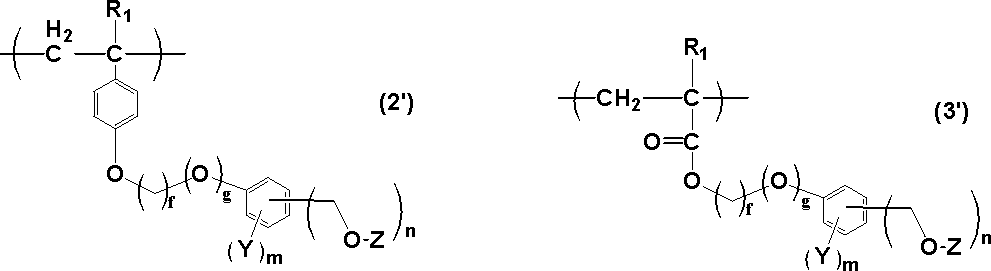
上記一般式(2’)及び(3’)におけるR1、Y、Z、m及びnは、上記一般式(L-2)における各基と同義であり、具体例及び好ましい範囲も同様である。
上記一般式(2’)及び(3’)において、fは0~6の整数である。0~3の整数であることが好ましく、1~3の整数であることがより好ましい。
上記一般式(2’)及び(3’)において、gは0又は1である。
また、一般式(L-2)で表される繰り返し単位は、下記一般式(1-a)~(1-c)のいずれかで表される繰り返し単位であることが特に好ましい。
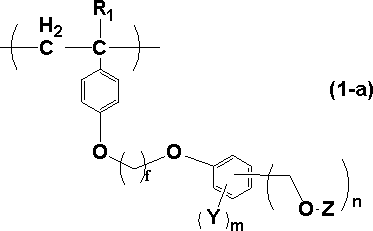
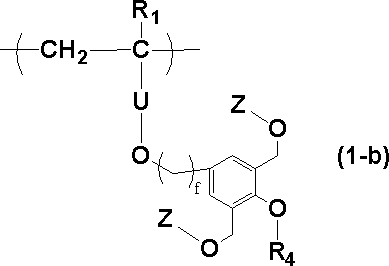

上記一般式(1-a)~(1-c)におけるR1、Y及びZは、上記一般式(L-2)における各基と同義であり、具体例及び好ましい範囲も同様である。
上記一般式(1-b)~(1-c)において、Uはフェニレン基又はカルボニル基を表す。
Y”は、水素原子又は1価の置換基を表す。1価の置換基としては、上述したYで表される1価の置換基と同様のものが挙げられる。ただし、Y”は、メチロール基であってもよい。
R4は、水素原子又は1価の置換基を表す。1価の置換基の具体例は、一般式(L-2)におけるZが1価の置換基である場合と同様のものが挙げられる。
fは1~6の整数を表す。好ましい範囲は、一般式(2’)及び(3’)で述べた通りである。
mは0又は1であり、nは1~3の整数を表す。
上記一般式(1-b)~(1-c)において、Uはフェニレン基又はカルボニル基を表す。
Y”は、水素原子又は1価の置換基を表す。1価の置換基としては、上述したYで表される1価の置換基と同様のものが挙げられる。ただし、Y”は、メチロール基であってもよい。
R4は、水素原子又は1価の置換基を表す。1価の置換基の具体例は、一般式(L-2)におけるZが1価の置換基である場合と同様のものが挙げられる。
fは1~6の整数を表す。好ましい範囲は、一般式(2’)及び(3’)で述べた通りである。
mは0又は1であり、nは1~3の整数を表す。
上記一般式(1-b)及び(1-c)において、R4は水素原子、アルキル基、(直鎖又は分岐のいずれであってもよく、炭素数1~12が好ましい)、アルケニル基(炭素数2~12が好ましい)、アルキニル基(炭素数2~12が好ましい)、シクロアルキル基(炭素数3~8が好ましい)、アリール基(単環、多環のいずれであってもよく炭素数6~18が好ましい)、ハロアルキル基、アルカノイル基、アルコキシカルボニル基、アリールオキシカルボニル基、アルキルスルホニルオキシ基、アリールスルホニルオキシ基、アルキルスルホニル基、アリールスルホニル基、シアノ基、アルキルチオ基、アリールチオ基及び複素環基が挙げられる。好ましい例としては、水素原子、アルキル基、シクロアルキル基、アルカノイル基、が挙げられる。
ハロアルキル基、アルカノイル基、アルコキシカルボニル基、アリールオキシカルボニル基、アルキルスルホニルオキシ基、アリールスルホニルオキシ基、アルキルスルホニル基、アリールスルホニル基、シアノ基、アルキルチオ基、アリールチオ基及び複素環基の具体例は、上記一般式(L-2)のYと同様であり、好ましい範囲も同様である。
ハロアルキル基、アルカノイル基、アルコキシカルボニル基、アリールオキシカルボニル基、アルキルスルホニルオキシ基、アリールスルホニルオキシ基、アルキルスルホニル基、アリールスルホニル基、シアノ基、アルキルチオ基、アリールチオ基及び複素環基の具体例は、上記一般式(L-2)のYと同様であり、好ましい範囲も同様である。
一般式(L-2)で表される繰り返し単位の具体例を以下に示すが、本発明はこれに限定されるものではない。

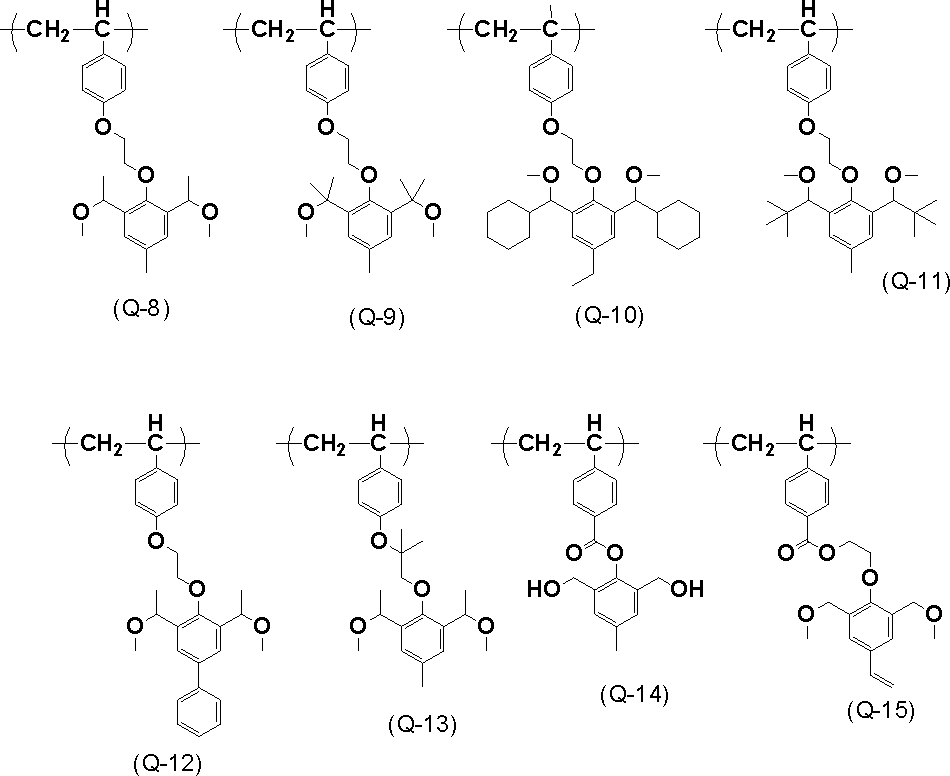
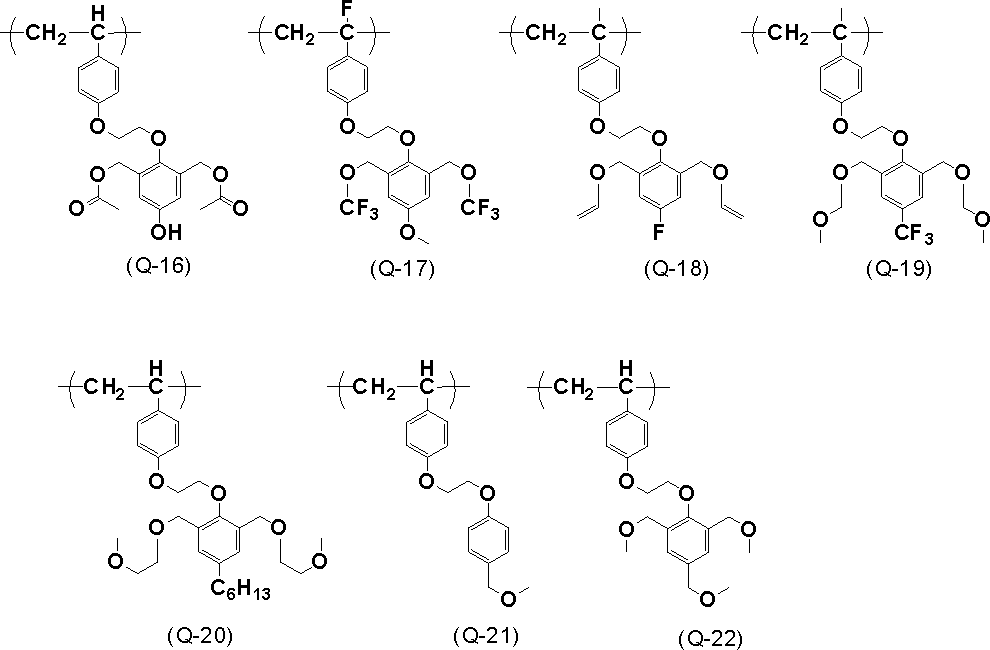
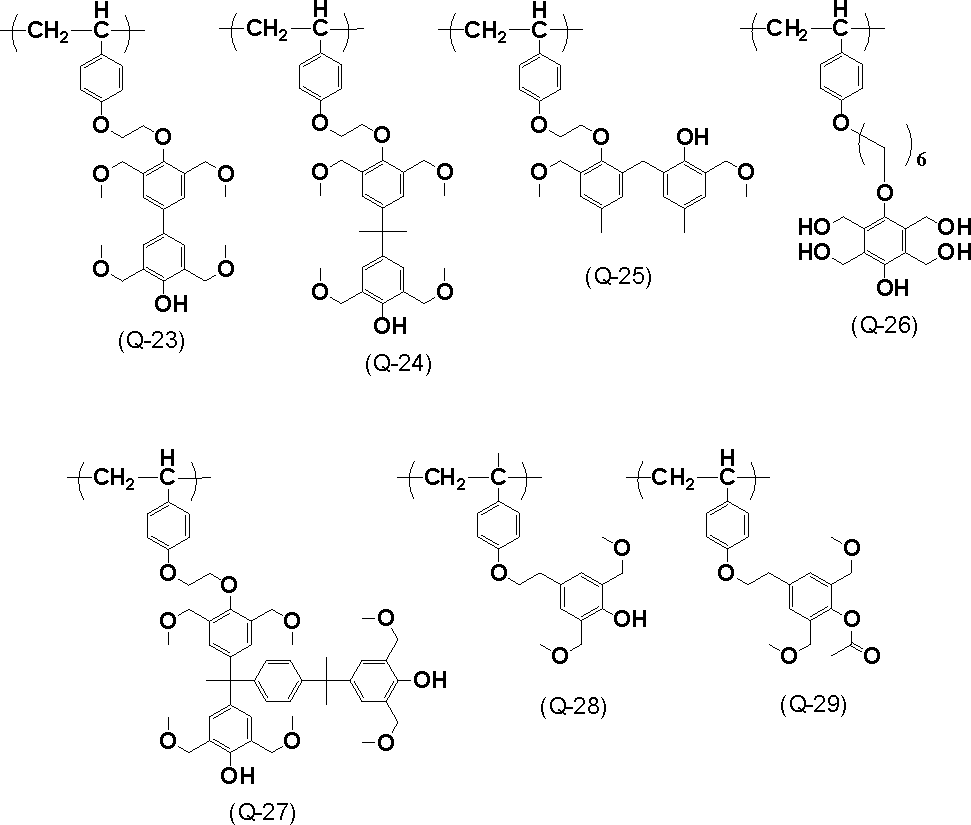

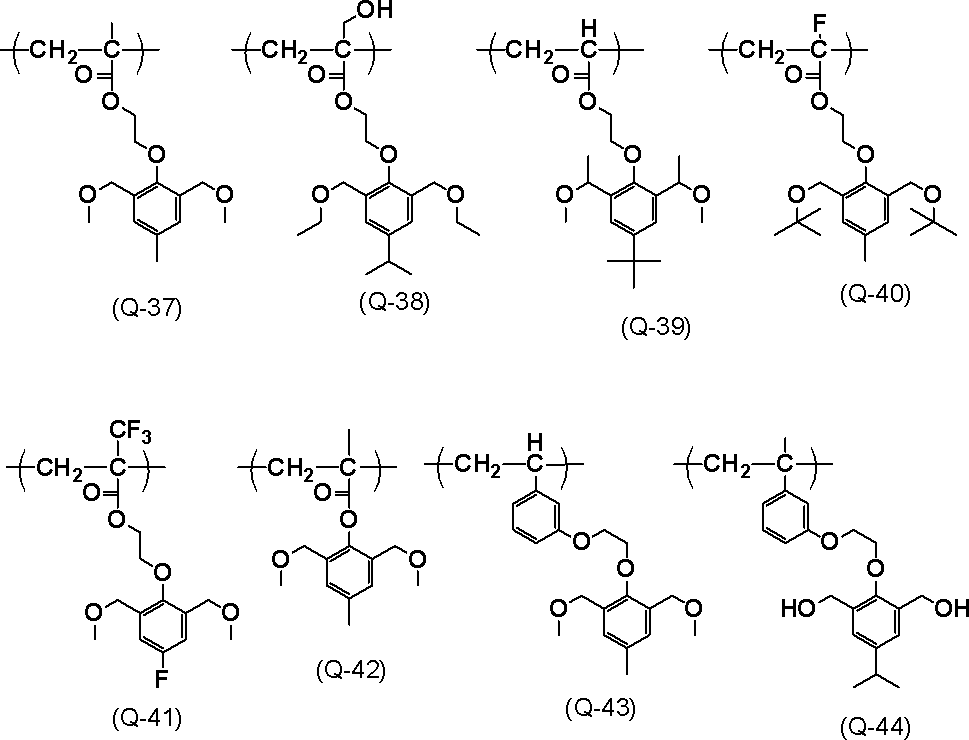
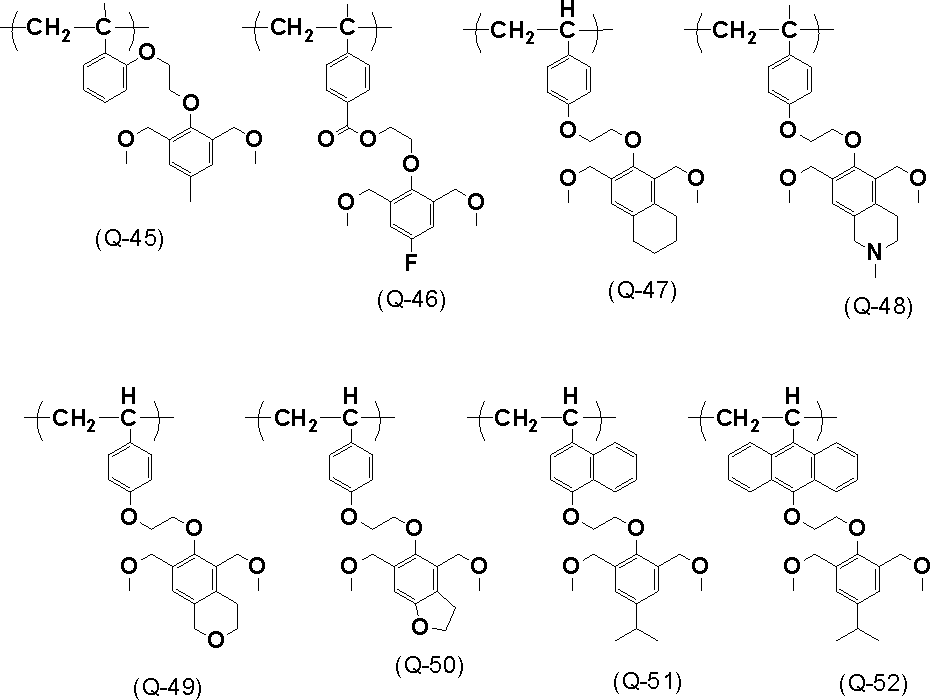
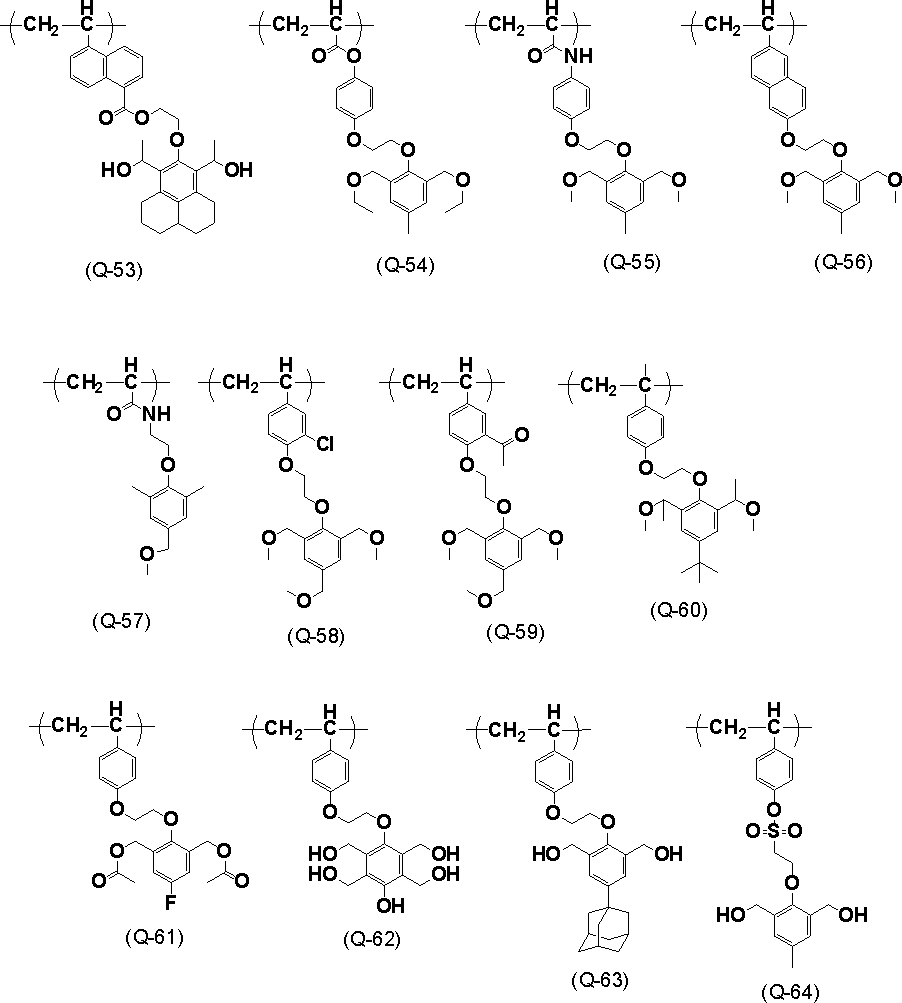
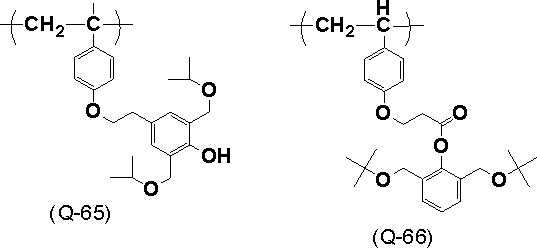
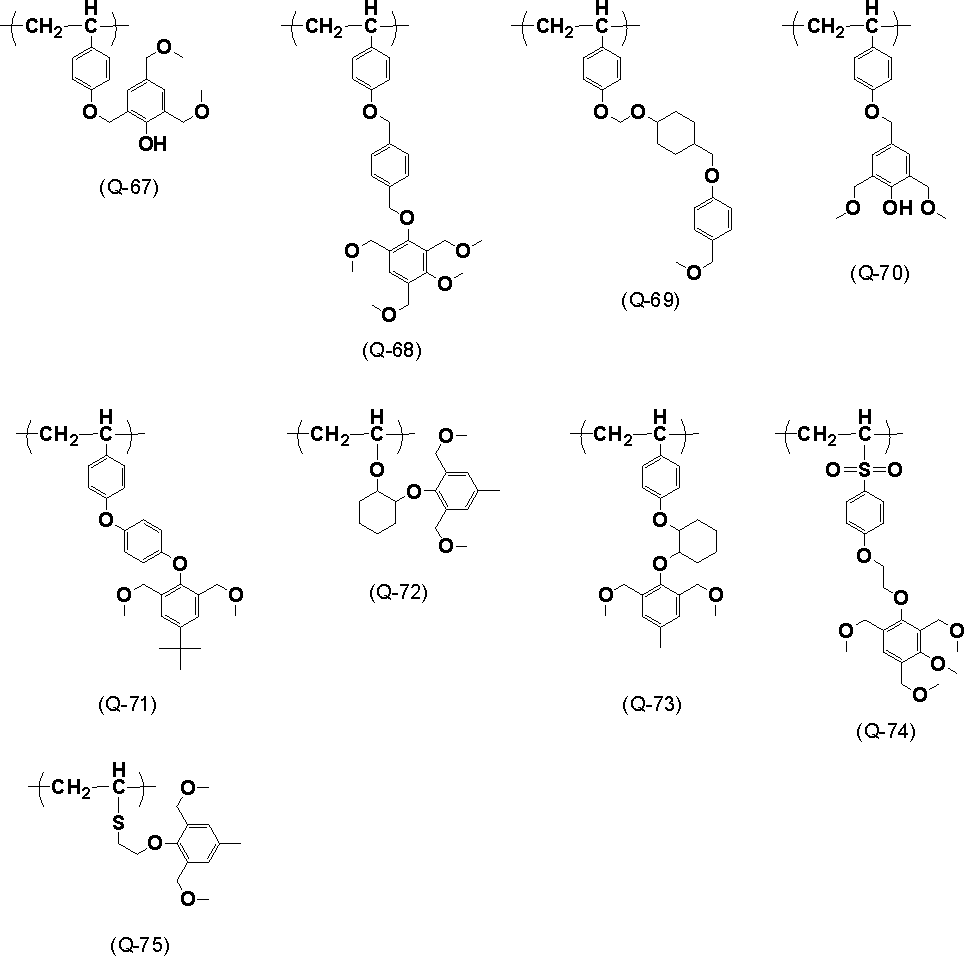


一般式(L-3)中、RL2、RL3及びRL4は、上記一般式(L-1)におけるRL2、RL3及びRL4と同義である。X3は、単結合、又は、直鎖状又は分岐状の炭化水素基、環員としてヘテロ原子を含有しても良い環状の炭化水素基、-O-、-S-、-CO-、-SO2-、-NR-(Rは水素原子、アルキル基又は-CH2ORL1で表される基)、及び、これらを組み合わせた基からなる群より選択される(m3+1)価の基を表す。なお、-CH2ORL1で表される基におけるRL1は、上記一般式(L-1)におけるRL1と同義である。
Eは、エポキシ構造又はオキセタン構造を有する基を表す。m3は1~5の整数を表す。
Eは、エポキシ構造又はオキセタン構造を有する基を表す。m3は1~5の整数を表す。
RL2、RL3、RL4及びX3の具体例及び好ましい例は、それぞれ、上記一般式(L-1)のRL2、RL3、RL4及びX1の具体例及び好ましい例で挙げたものと同様である。
一般式(L-3)で表される繰り返し単位の具体例を以下に示すが、本発明はこれに限定されるものではない。下記具体例中、Rは、水素原子又はメチル基を表す。
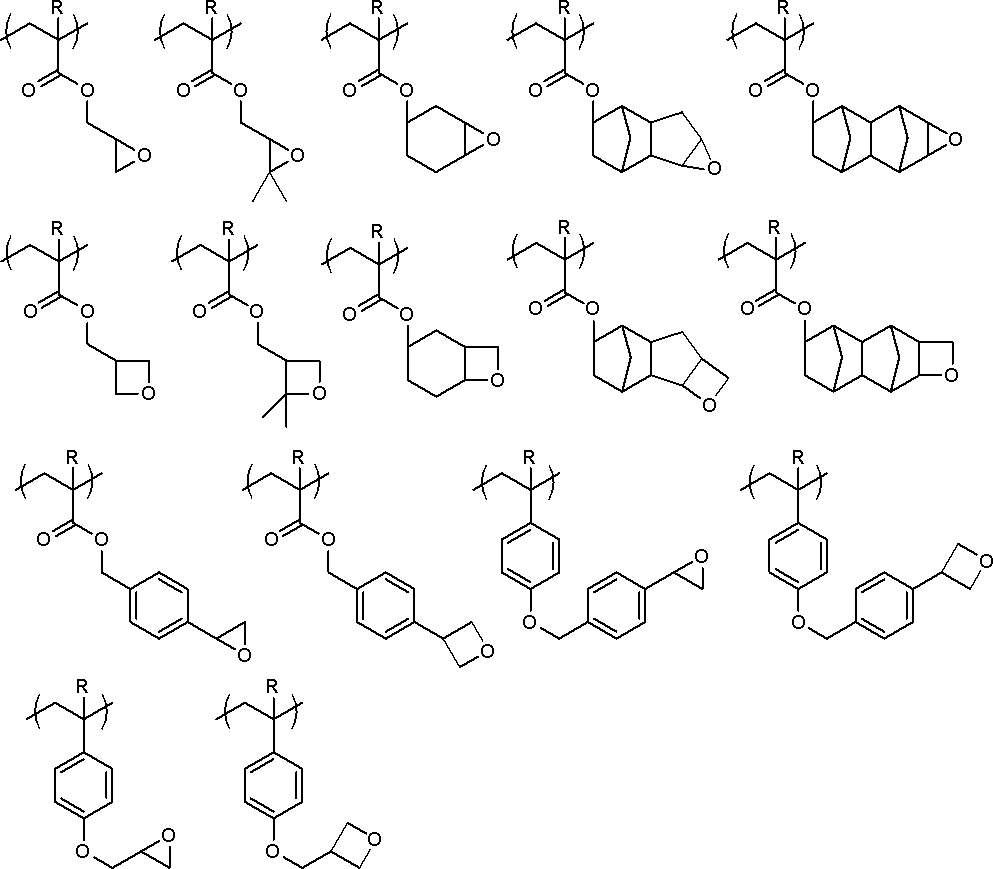

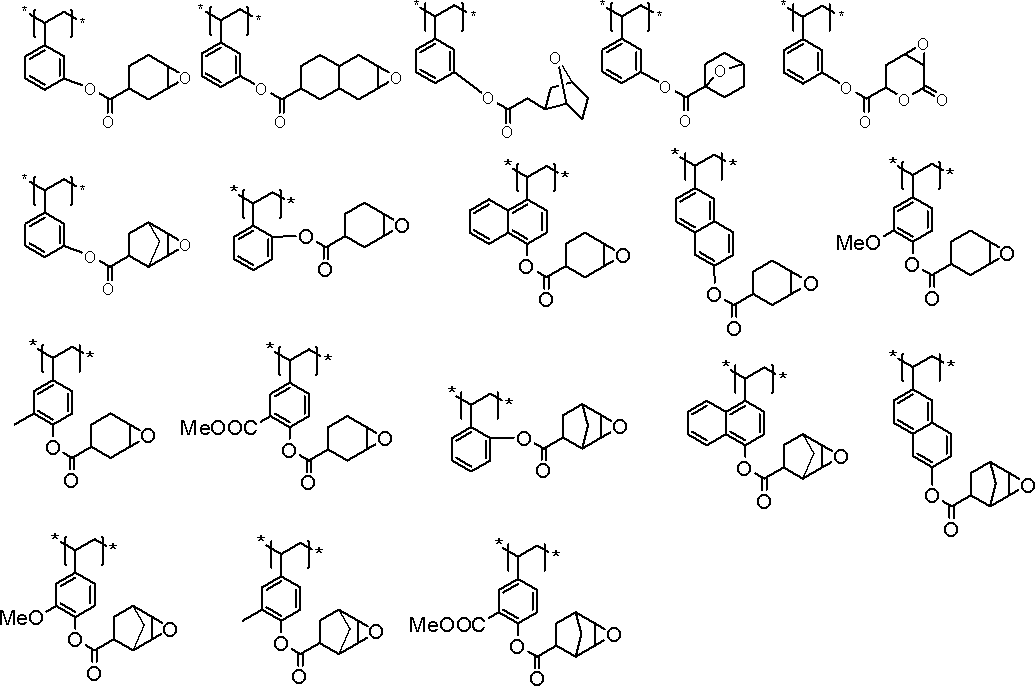
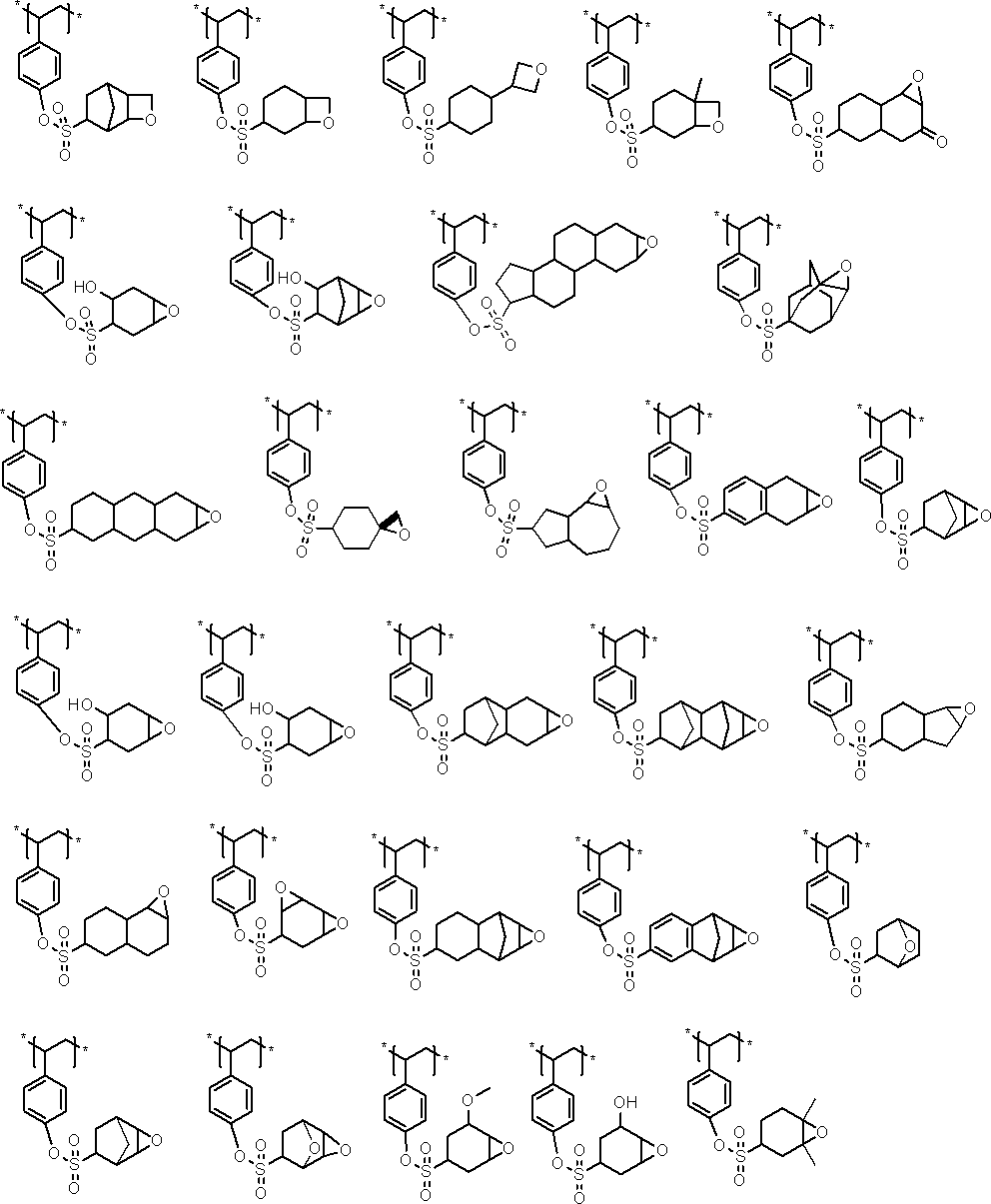

一般式(L-4)中、RL2、RL3及びRL4は、上記一般式(L-1)におけるRL2、RL3及びRL4と同義である。X4は、単結合、又は、直鎖状又は分岐状の炭化水素基、環員としてヘテロ原子を含有しても良い環状の炭化水素基、-O-、-S-、-CO-、-SO2-、-NR-(Rは水素原子、アルキル基又は-CH2ORL1で表される基)、及び、これらを組み合わせた基からなる群より選択される(m4+1)価の基を表す。なお、-CH2ORL1で表される基におけるRL1は、上記一般式(L-1)におけるRL1と同義である。
Vは、エチレン性不飽和結合を有する基を表す。m4は1~5の整数を表す。
Vは、エチレン性不飽和結合を有する基を表す。m4は1~5の整数を表す。
RL2、RL3、RL4及びX4の具体例及び好ましい例は、それぞれ、上記一般式(L-1)のRL2、RL3、RL4及びX1の具体例及び好ましい例で挙げたものと同様である。
Vで表されるエチレン性不飽和結合を有する基は、特に下記一般式(1)~(3)のいずれかで表される基が特に好ましい。
Vで表されるエチレン性不飽和結合を有する基は、特に下記一般式(1)~(3)のいずれかで表される基が特に好ましい。

上記一般式(1)において、Rl~R3はそれぞれ独立に、水素原子又は1価の有機基を表すが、R1としては、好ましくは、水素原子又は置換基を有してもよいアルキル基などが挙げられ、なかでも、水素原子、メチル基がラジカル反応性が高いことから好ましい。また、R2及びR3は、それぞれ独立に、水素原子、ハロゲン原子、アミノ基、カルボキシル基、アルコキシカルボニル基、スルホ基、ニトロ基、シアノ基、置換基を有してもよいアルキル基、置換基を有してもよいアリール基、置換基を有してもよいアルコキシ基、置換基を有してもよいアリールオキシ基、置換基を有してもよいアルキルアミノ基、置換基を有してもよいアリールアミノ基、置換基を有してもよいアルキルスルホニル基、置換基を有してもよいアリールスルホニル基などが挙げられ、なかでも、水素原子、カルボキシル基、アルコキシカルボニル基、置換基を有してもよいアルキル基、置換基を有してもよいアリール基がラジカル反応性が高いことから好ましい。
Xは、酸素原子、硫黄原子、又は-N(R12)-を表し、R12は、水素原子、又は1価の有機基を表す。ここで、1価の有機基としては、置換基を有してもよいアルキル基などが挙げられ、なかでも、R12は、水素原子、メチル基、エチル基、イソプロピル基がラジカル反応性が高いことから好ましい。
ここで、導入し得る置換基としては、アルキル基、アルケニル基、アルキニル基、アリール基、アルコキシ基、アリーロキシ基、ハロゲン原子、アミノ基、アルキルアミノ基、アリールアミノ基、カルボキシル基、アルコキシカルボニル基、スルホ基、ニトロ基、シアノ基、アミド基、アルキルスルホニル基、アリールスルホニル基などが挙げられる。
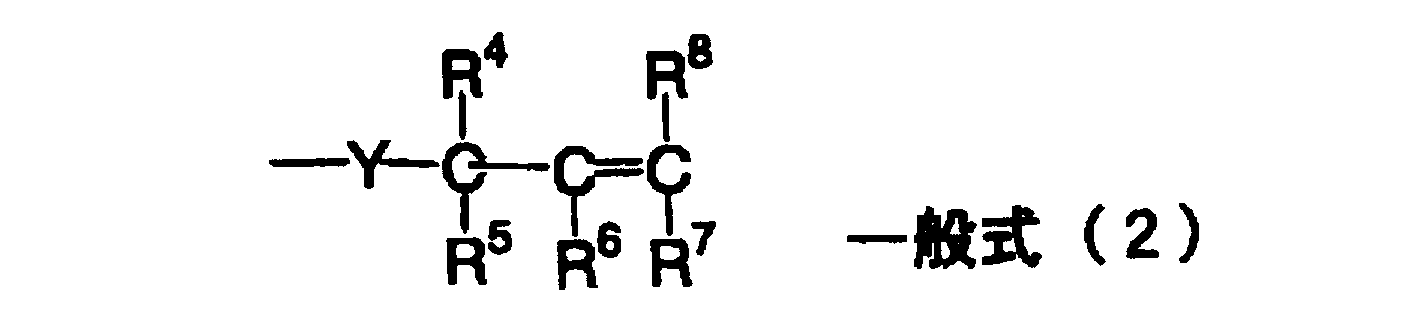
上記一般式(2)において、R4~R8は、それぞれ独立に水素原子又は1価の有機基を表すが、R4~R8は、好ましくは、水素原子、ハロゲン原子、アミノ基、ジアルキルアミノ基、カルボキシル基、アルコキシカルボニル基、スルホ基、ニトロ基、シアノ基、置換基を有してもよいアルキル基、置換基を有してもよいアリール基、置換基を有してもよいアルコキシ基、置換基を有してもよいアリールオキシ基、置換基を有してもよいアルキルアミノ基、置換基を有してもよいアリールアミノ基、置換基を有してもよいアルキルスルホニル基、置換基を有してもよいアリールスルホニル基などが挙げられ、なかでも、水素原子、カルボキシル基、アルコキシカルボニル基、置換基を有してもよいアルキル基、置換基を有してもよいアリール基が好ましい。
導入し得る置換基としては、一般式(1)と同様のものが例示される。また、Yは、酸素原子、硫黄原子、又は-N(R12)-を表す。R12は、一般式(1)のR12の場合と同義であり、好ましい例も同様である。
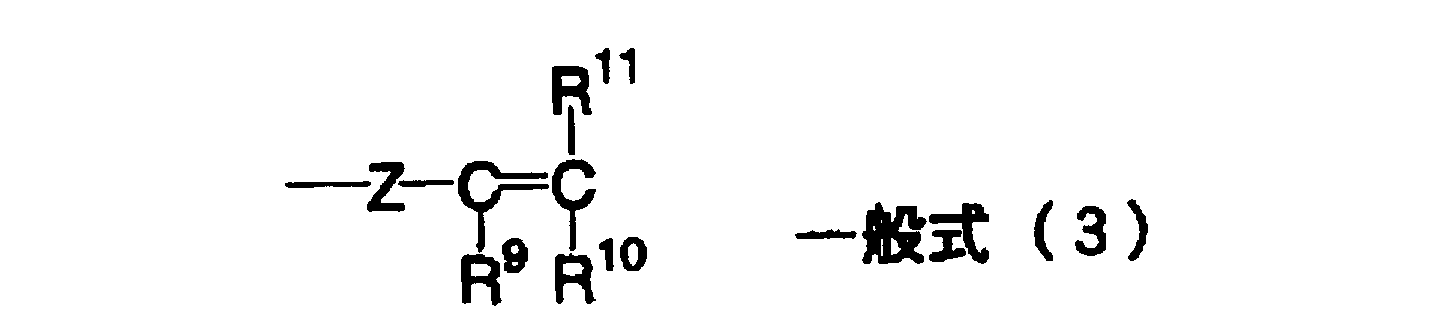
上記一般式(3)において、R9としては、水素原子又は1価の有機基を表し、好ましくは、水素原子又は置換基を有してもよいアルキル基などが挙げられ、なかでも、水素原子、メチル基がラジカル反応性が高いことから好ましい。R10、R11は、それぞれ独立に、水素原子、ハロゲン原子、アミノ基、ジアルキルアミノ基、カルボキシル基、アルコキシカルボニル基、スルホ基、ニトロ基、シアノ基、置換基を有してもよいアルキル基、置換基を有してもよいアリール基、置換基を有してもよいアルコキシ基、置換基を有してもよいアリールオキシ基、置換基を有してもよいアルキルアミノ基、置換基を有してもよいアリールアミノ基、置換基を有してもよいアルキルスルホニル基、置換基を有してもよいアリールスルホニル基などが挙げられ、なかでも、水素原子、カルボキシル基、アルコキシカルボニル基、置換基を有してもよいアルキル基、置換基を有してもよいアリール基がラジカル反応性が高いことから好ましい。
Zは、酸素原子、硫黄原子、-N(R12)-又はフェニレン基を表す。R12としては、一般式(1)のR12の場合と同義であり、好ましい例も同様である。
Zは、酸素原子、硫黄原子、-N(R12)-又はフェニレン基を表す。R12としては、一般式(1)のR12の場合と同義であり、好ましい例も同様である。
一般式(L-4)で表される繰り返し単位の具体例を以下に示すが、本発明はこれに限定されるものではない。下記具体例中、Rは、水素原子又はメチル基を表す。
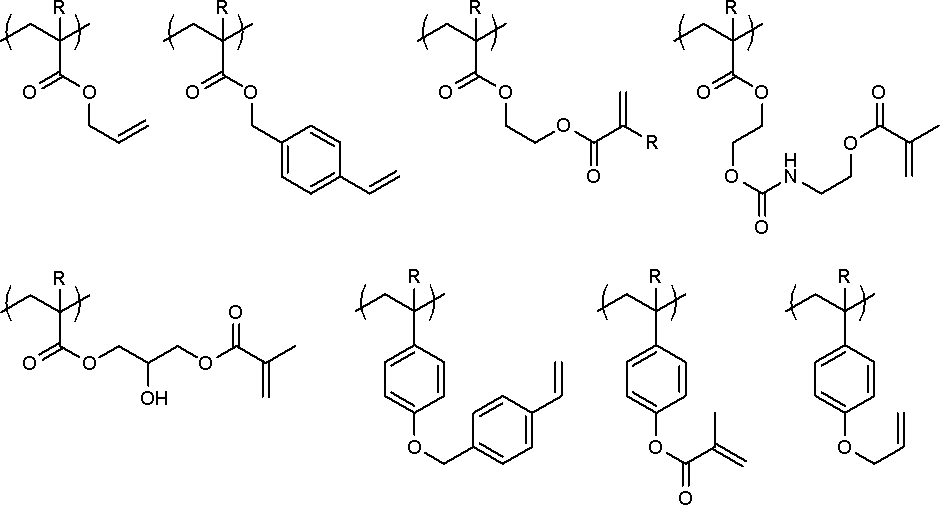
ネガ型の画像を形成する場合(すなわち、感活性光線性又は感放射線性組成物が、ネガ型の感活性光線性又は感放射線性組成物である場合)には、上記一般式(L-1)~(L-4)で表される繰り返し単位から選択される1種以上の繰り返し単位の含有量は、樹脂〔N-A〕に含まれる全繰り返し単位に対して5~50モル%であることが好ましく、10~40モル%であることがより好ましい。ポジ型の画像を形成する場合(すなわち、感活性光線性又は感放射線性組成物が、ポジ型の感活性光線性又は感放射線性組成物である場合)には、上記一般式(L-1)~(L-4)で表される繰り返し単位から選択される1種以上の繰り返し単位の含有量は、0.1~30モル%であることが好ましく、1~20モル%であることがより好ましく、1~10モル%であることが特に好ましい。
樹脂〔N-A〕は、上記一般式(L-1)~(L-4)で表される繰り返し単位から選択される1種以上の繰り返し単位以外に、上記樹脂〔P-A〕において説明した、一般式(3)で表される繰り返し単位、極性基を有する繰り返し単位(c)、複数の芳香環を有する繰り返し単位(d)、その他の繰り返し単位を含有してもよく、各繰り返し単位の、樹脂〔N-A〕の全繰り返し単位に対する含有量の好ましい範囲は、各繰り返し単位の、樹脂〔P-A〕の全繰り返し単位に対する含有量の好ましい範囲と同様である。
また、樹脂〔N-A〕の合成方法、質量平均分子量及び分散度の好ましい範囲も、樹脂〔P-A〕において説明したものと同様である。
また、樹脂〔N-A〕の合成方法、質量平均分子量及び分散度の好ましい範囲も、樹脂〔P-A〕において説明したものと同様である。
樹脂〔N-A〕は、前述の樹脂〔P-A〕と同一の成分であっても、異なる成分であっても良い。樹脂〔N-A〕と樹脂〔P-A〕とが同一の成分である場合における樹脂は、上記酸分解性基を有する繰り返し単位と、上記一般式(L-1)~(L-4)で表される繰り返し単位から選択される1種以上の繰り返し単位とを有する樹脂であることが好ましい。
また、樹脂〔N-A〕は、後述の化合物〔N-B〕と同一の成分であっても、異なる成分であっても良いが、異なる成分であることが好ましい。
また、樹脂〔N-A〕は、後述の化合物〔N-B〕と同一の成分であっても、異なる成分であっても良いが、異なる成分であることが好ましい。
本発明の樹脂〔N-A〕は、1種類単独で、又は2種類以上を組み合わせて使用することができる。樹脂〔N-A〕の含有量は、本発明の感活性光線性又は感放射線性組成物中の全固形分を基準にして、20~99質量%が好ましく、30~99質量%がより好ましく、40~99質量%が更に好ましい。
〔N-B〕活性光線又は放射線の照射により酸を発生し、かつ酸、活性光線若しくは放射線、又は、活性種の作用によりアルカリ現像液に対する溶解性が減少する化合物
活性光線又は放射線の照射により酸を発生し、かつ酸、活性光線若しくは放射線、又は、活性種の作用によりアルカリ現像液に対する溶解性が減少する化合物〔N-B〕(以下、単に、酸発生剤〔N-B〕とも言う)は、重合性基を有し、かつ活性光線又は放射線の照射により酸を発生する化合物であることが好ましい。
化合物〔N-B〕の分子量範囲は100~3000が好ましく、100~2000がより好ましく、100~1000が特に好ましい。
重合性基は、酸、活性光線若しくは放射線、又は、活性種の作用により重合し得る重合性基であることが好ましく、酸又は活性種(例えばラジカル)の作用により重合し得る重合性基であることが好ましい。また、重合性基には、架橋性基をも含むものとする。
酸発生剤〔N-B〕は、例えば、ジアゾニウム塩、ホスホニウム塩、スルホニウム塩、ヨードニウム塩、イミドスルホネート、オキシムスルホネート、ジアゾジスルホン、ジスルホン、o-ニトロベンジルスルホネート等が挙げられ、スルホニウム塩などのオニウム塩化合物であることが好ましく、下記一般式(ZI’)で表されることがより好ましい。
活性光線又は放射線の照射により酸を発生し、かつ酸、活性光線若しくは放射線、又は、活性種の作用によりアルカリ現像液に対する溶解性が減少する化合物〔N-B〕(以下、単に、酸発生剤〔N-B〕とも言う)は、重合性基を有し、かつ活性光線又は放射線の照射により酸を発生する化合物であることが好ましい。
化合物〔N-B〕の分子量範囲は100~3000が好ましく、100~2000がより好ましく、100~1000が特に好ましい。
重合性基は、酸、活性光線若しくは放射線、又は、活性種の作用により重合し得る重合性基であることが好ましく、酸又は活性種(例えばラジカル)の作用により重合し得る重合性基であることが好ましい。また、重合性基には、架橋性基をも含むものとする。
酸発生剤〔N-B〕は、例えば、ジアゾニウム塩、ホスホニウム塩、スルホニウム塩、ヨードニウム塩、イミドスルホネート、オキシムスルホネート、ジアゾジスルホン、ジスルホン、o-ニトロベンジルスルホネート等が挙げられ、スルホニウム塩などのオニウム塩化合物であることが好ましく、下記一般式(ZI’)で表されることがより好ましい。

上記一般式(ZI’)において、
R’201、R’202及びR’203は、各々独立に、有機基を表す。
R’201、R’202及びR’203としての有機基の炭素数は、一般的に1~30、好ましくは1~20である。
また、R’201~R’203のうち2つが結合して環構造を形成してもよく、環内に酸素原子、硫黄原子、エステル結合、アミド結合、カルボニル基を含んでいてもよい。R’201~R’203の内の2つが結合して形成する基としては、アルキレン基(例えば、ブチレン基、ペンチレン基)を挙げることができる。
Z’-は、非求核性アニオンを表す。
R’201、R’202、R’203及びZ’-の少なくとも1つは重合性基を有する。発生酸の拡散を抑制する観点からZ’-が重合性基を有することが好ましい。
酸発生剤〔N-B〕の重合性基としては特に制限はないが、例えば、エチレン性不飽和基、エポキシ基、オキセタン基、下記一般式(ZII)で表される基等が挙げられる。
R’201、R’202及びR’203は、各々独立に、有機基を表す。
R’201、R’202及びR’203としての有機基の炭素数は、一般的に1~30、好ましくは1~20である。
また、R’201~R’203のうち2つが結合して環構造を形成してもよく、環内に酸素原子、硫黄原子、エステル結合、アミド結合、カルボニル基を含んでいてもよい。R’201~R’203の内の2つが結合して形成する基としては、アルキレン基(例えば、ブチレン基、ペンチレン基)を挙げることができる。
Z’-は、非求核性アニオンを表す。
R’201、R’202、R’203及びZ’-の少なくとも1つは重合性基を有する。発生酸の拡散を抑制する観点からZ’-が重合性基を有することが好ましい。
酸発生剤〔N-B〕の重合性基としては特に制限はないが、例えば、エチレン性不飽和基、エポキシ基、オキセタン基、下記一般式(ZII)で表される基等が挙げられる。
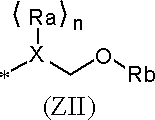
上記一般式(ZII)中、Xは酸素原子、窒素原子又は(n+2)価の芳香族基を表し、Ra及びRbはそれぞれ独立に水素原子又は1価の有機基を表す。
nは0~6の整数を表し、Xが酸素原子の場合nは0であり、Xが窒素原子の場合nは1であり、Xが(n+2)価の芳香族基の場合nは0~6の整数である。*は結合手を表す。
nは0~6の整数を表し、Xが酸素原子の場合nは0であり、Xが窒素原子の場合nは1であり、Xが(n+2)価の芳香族基の場合nは0~6の整数である。*は結合手を表す。
Xについての(n+2)価の芳香族基としては、炭素数6~10の芳香族基が好ましく、ベンゼン環基、ナフタレン環基等が挙げられる。
Ra及びRbについての1価の有機基としては、アルキル基、アリール基、-COORc、-CON(Rc)2、-CORc等が挙げられる(Rcは1価の有機基を表す)。
Ra及びRbとしては、特に、水素原子、アルキル基、シクロアルキル基、アリール基、-COORc、-CON(Rc)2又は-CORcであることが好ましい。
Rcについての1価の有機基としては、アルキル基、シクロアルキル基、アリール基等が挙げられ、アルキル基又はアリール基であることが好ましい。
Ra~Rcについてのアルキル基としては、炭素数1~10のアルキル基が挙げられ、メチル基、エチル基、n-プロピル基、イソプロピル基、n-ブチル基、イソブチル基、t-ブチル基などの炭素数1~4のものが好ましい。
Ra~Rcについてのシクロアルキル基としては、シクロペンチル基、シクロヘキシル基などの炭素数3~20の単環のシクロアルキル基などが挙げられる。
Ra~Rcについてのアリール基としては、炭素数6~10のものが好ましく、具体的には、フェニル基、ナフチル基を挙げることができる。
重合性基についてのエチレン性不飽和基としては、例えば、(メタ)アクリレート基、ビニル基、クロトネート基、イソクロトネート基、イタコネート基、マレート基等が挙げられ、(メタ)アクリレート基又はビニル基であることが好ましく、(メタ)アクリレート基であることがより好ましい。
Ra及びRbについての1価の有機基としては、アルキル基、アリール基、-COORc、-CON(Rc)2、-CORc等が挙げられる(Rcは1価の有機基を表す)。
Ra及びRbとしては、特に、水素原子、アルキル基、シクロアルキル基、アリール基、-COORc、-CON(Rc)2又は-CORcであることが好ましい。
Rcについての1価の有機基としては、アルキル基、シクロアルキル基、アリール基等が挙げられ、アルキル基又はアリール基であることが好ましい。
Ra~Rcについてのアルキル基としては、炭素数1~10のアルキル基が挙げられ、メチル基、エチル基、n-プロピル基、イソプロピル基、n-ブチル基、イソブチル基、t-ブチル基などの炭素数1~4のものが好ましい。
Ra~Rcについてのシクロアルキル基としては、シクロペンチル基、シクロヘキシル基などの炭素数3~20の単環のシクロアルキル基などが挙げられる。
Ra~Rcについてのアリール基としては、炭素数6~10のものが好ましく、具体的には、フェニル基、ナフチル基を挙げることができる。
重合性基についてのエチレン性不飽和基としては、例えば、(メタ)アクリレート基、ビニル基、クロトネート基、イソクロトネート基、イタコネート基、マレート基等が挙げられ、(メタ)アクリレート基又はビニル基であることが好ましく、(メタ)アクリレート基であることがより好ましい。
酸発生剤〔N-B〕が有する重合性基としては、(メタ)アクリレート基、エポキシ基、又は前記一般式(ZII)で表される基であることが特に好ましい。
酸発生剤〔N-B〕1分子中の重合性基の数は特に制限されないが、1~10であることが好ましく、1~5であることがより好ましく、1~3であることが特に好ましい。
酸発生剤〔N-B〕1分子中の重合性基の数は特に制限されないが、1~10であることが好ましく、1~5であることがより好ましく、1~3であることが特に好ましい。
Z’-としての非求核性アニオンの具体例及び好ましい例は、上記酸発生剤〔P-B〕の一般式(ZI)におけるZ-としての非求核性アニオンについて説明したものと同様である。ただし、Z’-としての非求核性アニオンは、酸分解性基を有していないことが好ましい。
Z’-としての非求核性アニオンが、上記酸発生剤〔P-B〕における上記一般式(I)で表されるとともに、重合性基が当該一般式(I)で表されるアニオンに含まれる場合はXf、R1、R2、L、Cy、Rfのいずれの基に含まれていても良いが、Rf、Cyに含まれていることが好ましく、Cyに含まれていることが特に好ましい。
重合性基の具体例及び好ましい例については上述の通りである。
アニオンZ’-(例えば、上記一般式(I)で表される酸を生じるアニオン)が重合性基を有する場合、重合性基は2価の連結基を介して前記アニオンに結合していてもよく、例えば、Cyが2価の連結基を介して重合性基により置換されている態様が挙げられる。
そのような2価の連結基としては特に制限はないが、-COO-、-OCO-、-O-、アルキレン基又はこれらの複数が組合された連結基などが挙げられる。
重合性基の具体例及び好ましい例については上述の通りである。
アニオンZ’-(例えば、上記一般式(I)で表される酸を生じるアニオン)が重合性基を有する場合、重合性基は2価の連結基を介して前記アニオンに結合していてもよく、例えば、Cyが2価の連結基を介して重合性基により置換されている態様が挙げられる。
そのような2価の連結基としては特に制限はないが、-COO-、-OCO-、-O-、アルキレン基又はこれらの複数が組合された連結基などが挙げられる。
一般式(ZI’)で表される化合物の更なる好ましい構造としては、上記酸発生剤〔P-B〕において説明した化合物(ZI-1)、(ZI-2)、(ZI-3)及び(ZI-4)を挙げることができる。ただし、一般式(ZI’)で表される化合物としての化合物(ZI-1)、(ZI-2)、(ZI-3)及び(ZI-4)は、酸分解性基を有さないことが好ましい。
一般式(ZI’)で表される化合物としての化合物(ZI-1)においてカチオン上に重合性基を有する場合、R201~R203(それぞれ、一般式(ZI’)におけるR’201~R’203に対応)の少なくとも1つが重合性基を有することができる。
R201~R203が有し得る重合性基の具体例及び好ましい例については上述の通りである。
R201~R203の少なくとも1つが重合性基を有する場合、重合性基は2価の連結基を介して前記カチオン構造に結合していてもよい。
そのような2価の連結基としては特に制限はないが、-COO-、-OCO-、-O-、-CO-、-NH-、アルキレン基又はこれらの複数が組合された連結基などが挙げられる。
特に、重合性基が前記一般式(ZII)で表される基であって、前記一般式(ZII)中のXが(n+2)価の芳香族基である場合、R201~R203の少なくとも1つのアリール基が、(n+2)価の芳香族基のXであってもよい。
R201~R203が有し得る重合性基の具体例及び好ましい例については上述の通りである。
R201~R203の少なくとも1つが重合性基を有する場合、重合性基は2価の連結基を介して前記カチオン構造に結合していてもよい。
そのような2価の連結基としては特に制限はないが、-COO-、-OCO-、-O-、-CO-、-NH-、アルキレン基又はこれらの複数が組合された連結基などが挙げられる。
特に、重合性基が前記一般式(ZII)で表される基であって、前記一般式(ZII)中のXが(n+2)価の芳香族基である場合、R201~R203の少なくとも1つのアリール基が、(n+2)価の芳香族基のXであってもよい。
一般式(ZI’)で表される化合物としての化合物(ZI-2)においてカチオン上に重合性基を有する場合、R201~R203(それぞれ、一般式(ZI’)におけるR’201~R’203に対応)の少なくとも1つが重合性基を有することができる。
R201~R203が有し得る重合性基の具体例及び好ましい例については上述の通りである。
R201~R203の少なくとも1つが重合性基を有する場合、重合性基は2価の連結基を介して前記カチオン構造に結合していてもよい。
そのような2価の連結基としては特に制限はないが、-COO-、-OCO-、-O-、-CO-、-NH-、アルキレン基又はこれらの複数が組合された連結基などが挙げられる。
R201~R203が有し得る重合性基の具体例及び好ましい例については上述の通りである。
R201~R203の少なくとも1つが重合性基を有する場合、重合性基は2価の連結基を介して前記カチオン構造に結合していてもよい。
そのような2価の連結基としては特に制限はないが、-COO-、-OCO-、-O-、-CO-、-NH-、アルキレン基又はこれらの複数が組合された連結基などが挙げられる。
一般式(ZI’)で表される化合物としての化合物(ZI-3)においてカチオン上に重合性基を有する場合、R1c~R7cのいずれかが重合性基であってもよく、また、R1c~R7c、Rx及びRyの少なくとも1つが置換基として前記重合性基を有していてもよい。
また、重合性基は2価の連結基を介してカチオン構造に結合していてもよい。
そのような2価の連結基としては特に制限はないが、-COO-、-OCO-、-O-、-CO-、-NH-、アルキレン基又はこれらの複数が組合された連結基などが挙げられる。
前記重合性基の具体例及び好ましい例については上述の通りである。
特に、重合性基が前記一般式(ZII)で表される基であって、前記一般式(ZII)中のXが(n+2)価の芳香族基である場合、一般式(ZI-3)中のベンゼン環が、(n+2)価の芳香族基のXであってもよい。
また、重合性基は2価の連結基を介してカチオン構造に結合していてもよい。
そのような2価の連結基としては特に制限はないが、-COO-、-OCO-、-O-、-CO-、-NH-、アルキレン基又はこれらの複数が組合された連結基などが挙げられる。
前記重合性基の具体例及び好ましい例については上述の通りである。
特に、重合性基が前記一般式(ZII)で表される基であって、前記一般式(ZII)中のXが(n+2)価の芳香族基である場合、一般式(ZI-3)中のベンゼン環が、(n+2)価の芳香族基のXであってもよい。
一般式(ZI’)で表される化合物としての化合物(ZI-4)においてカチオン上に重合性基を有する場合、R13、R14のいずれかが重合性基であってもよく、またR13~R15の少なくとも1つが置換基として前記重合性基を有していてもよい。
また、重合性基は2価の連結基を介してカチオン構造に結合していてもよい。
そのような2価の連結基としては特に制限はないが、-COO-、-OCO-、-O-、-CO-、-NH-、アルキレン基又はこれらの複数が組合された連結基などが挙げられる。
前記重合性基の具体例及び好ましい例については上述の通りである。
特に、重合性基が前記一般式(ZII)で表される基である場合、前記一般式(ZII)中のRaと前記一般式(ZI-4)中のR13が結合する芳香環とが互いに結合して環(好ましくは、5員又は6員環)を形成していてもよい。
また、重合性基は2価の連結基を介してカチオン構造に結合していてもよい。
そのような2価の連結基としては特に制限はないが、-COO-、-OCO-、-O-、-CO-、-NH-、アルキレン基又はこれらの複数が組合された連結基などが挙げられる。
前記重合性基の具体例及び好ましい例については上述の通りである。
特に、重合性基が前記一般式(ZII)で表される基である場合、前記一般式(ZII)中のRaと前記一般式(ZI-4)中のR13が結合する芳香環とが互いに結合して環(好ましくは、5員又は6員環)を形成していてもよい。
以下に、酸発生剤〔N-B〕の具体例を挙げるが、本発明はこれに限定されるものではない。
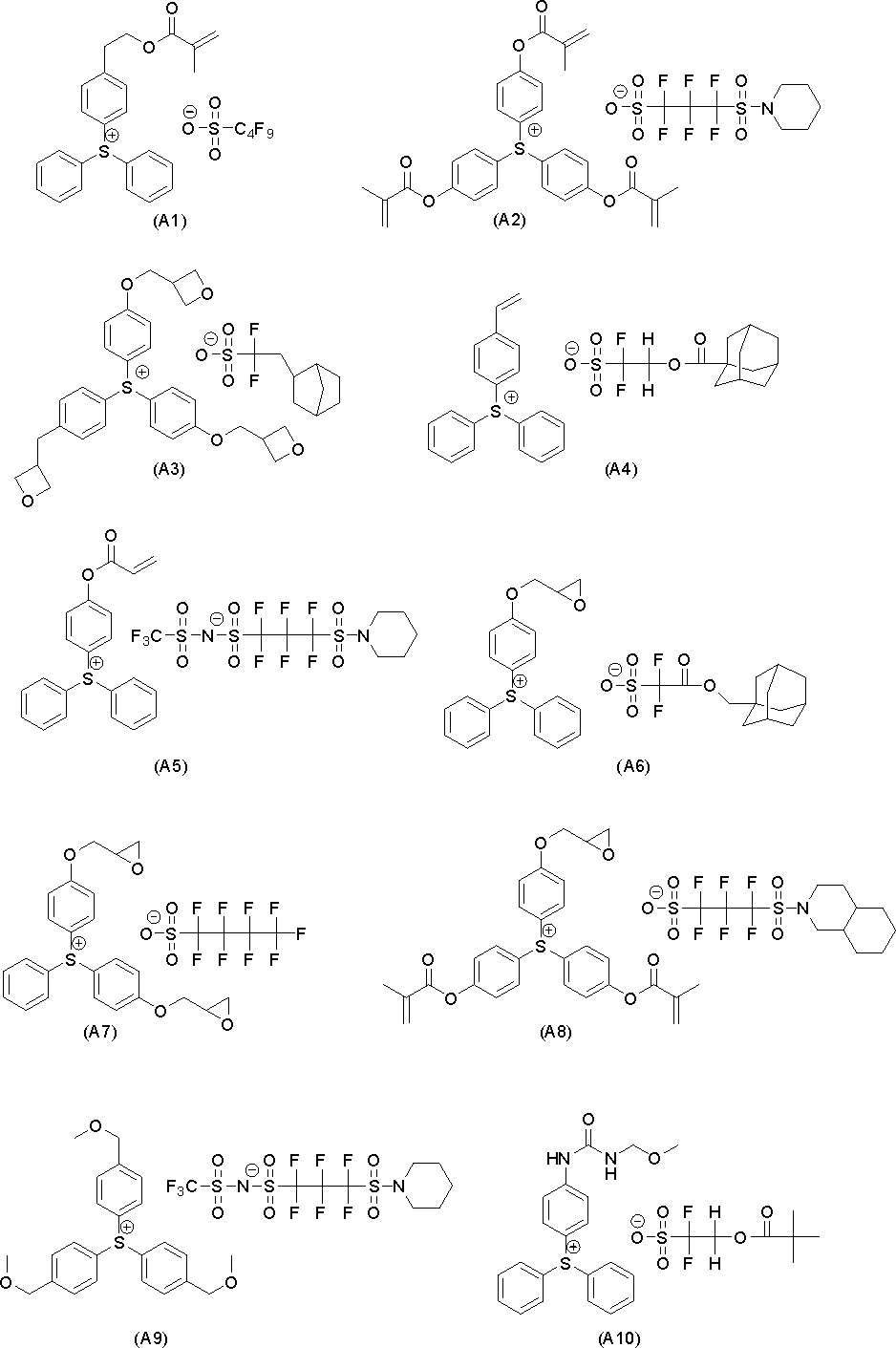
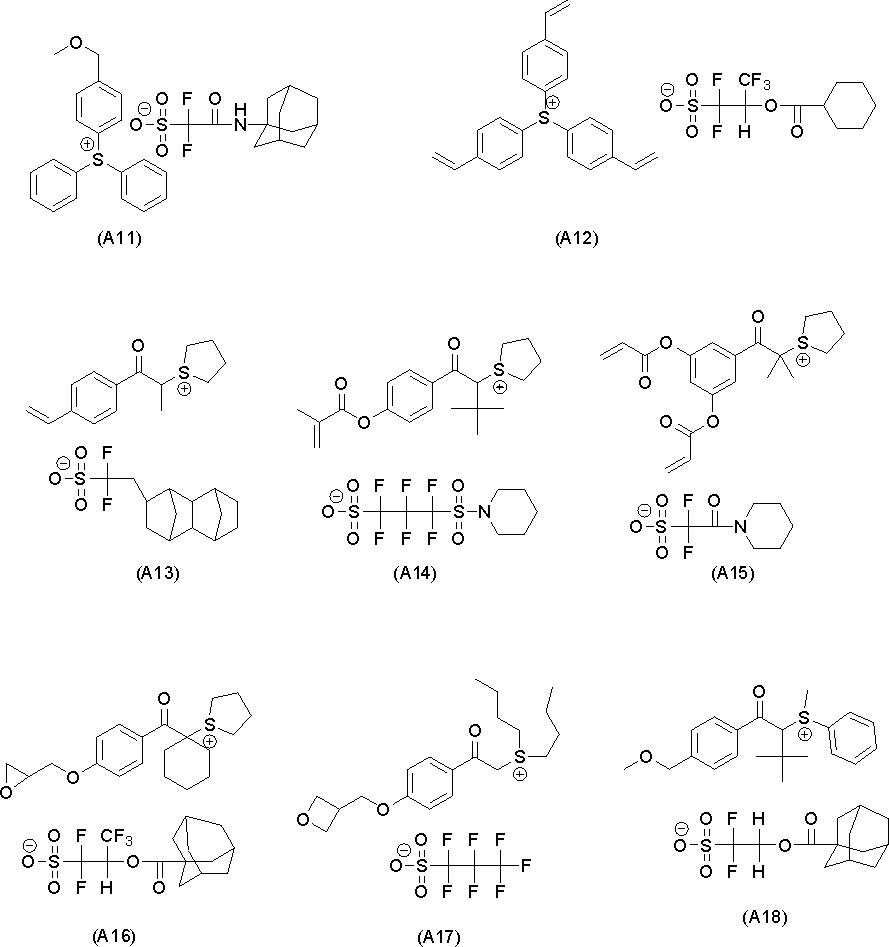


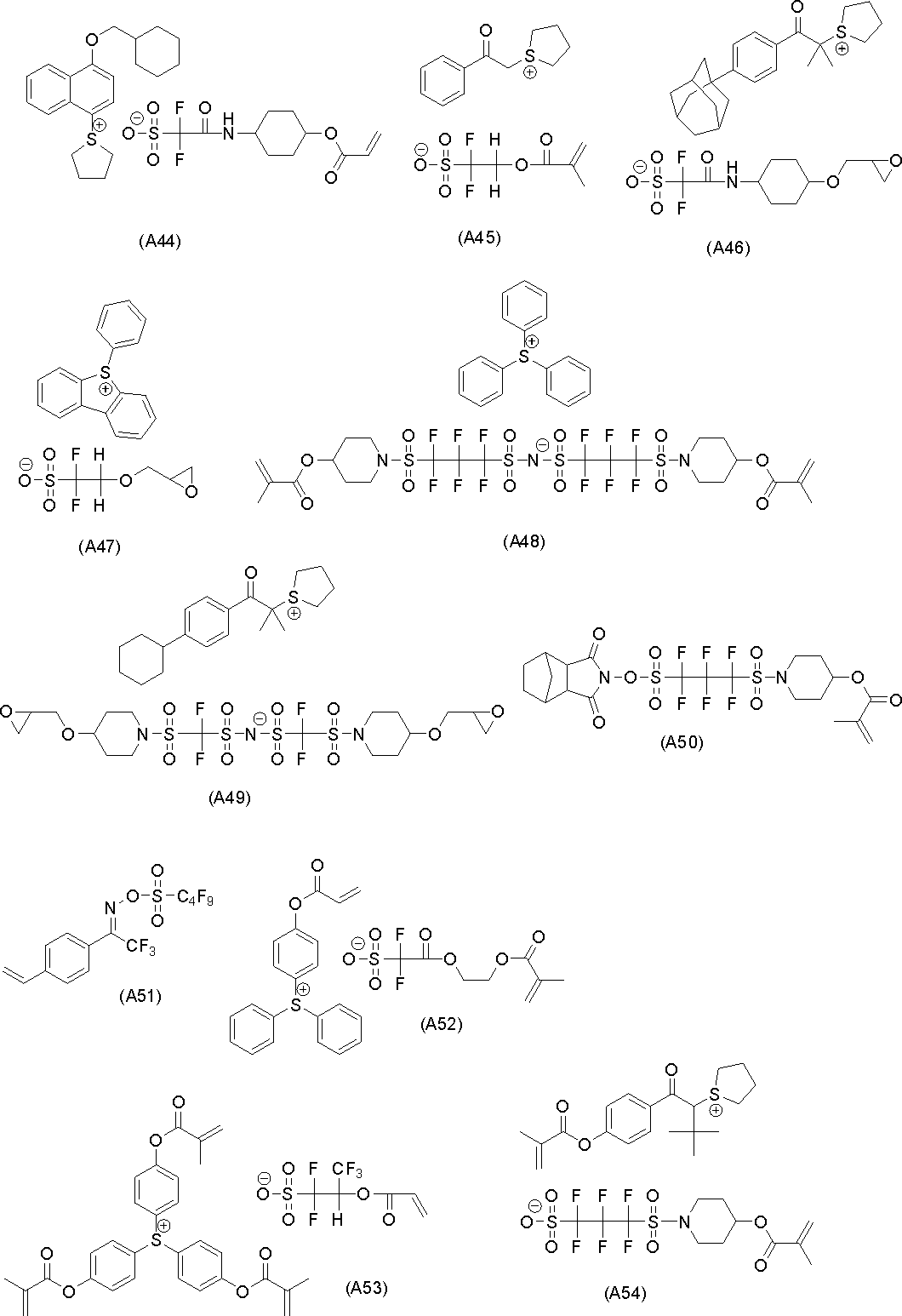

本発明に係る感活性光線性又は感放射線性組成物においては、上記酸発生剤〔N-B〕を、1種単独で、又は2種以上を組み合わせて使用することができ、その含有量は、好ましくは感活性光線性又は感放射線性組成物の全固形分を基準として0.1~20質量%であり、より好ましくは0.5~15質量%、更に好ましくは3~12質量%である。
〔N-C〕酸、活性光線若しくは放射線、又は、活性種の作用によりアルカリ現像液に対する溶解性が減少する低分子化合物
酸、活性光線若しくは放射線、又は、活性種の作用によりアルカリ現像液に対する溶解性が減少する低分子化合物〔N-C〕は特に限定はされないが、活性光線又は放射線の照射により後に詳述する化合物(A)、上記酸発生剤〔P-B〕、及び、上記酸発生剤〔N-B〕などから発生した酸、又は、活性光線又は放射線の照射により発生したラジカル等の活性種によって重合し、アルカリ現像液に対する溶解性が減少する化合物が挙げられる。
低分子化合物〔N-C〕の分子量範囲は100~1000が好ましく、200~900がより好ましく、300~800が特に好ましい。
ここで、本発明における低分子化合物とは、不飽和結合を持った化合物(いわゆる重合性モノマー)を、開始剤を使用しつつその不飽和結合を開裂させ、連鎖的に結合を成長させることによって得られる、いわゆるポリマーやオリゴマーではなく、分子量100~1000(より好ましくは100~700、更に好ましくは100~500)の一定の分子量を有する化合物(実質的に分子量分布を有さない化合物)である。
酸、活性光線若しくは放射線、又は、活性種の作用によりアルカリ現像液に対する溶解性が減少する低分子化合物〔N-C〕は特に限定はされないが、活性光線又は放射線の照射により後に詳述する化合物(A)、上記酸発生剤〔P-B〕、及び、上記酸発生剤〔N-B〕などから発生した酸、又は、活性光線又は放射線の照射により発生したラジカル等の活性種によって重合し、アルカリ現像液に対する溶解性が減少する化合物が挙げられる。
低分子化合物〔N-C〕の分子量範囲は100~1000が好ましく、200~900がより好ましく、300~800が特に好ましい。
ここで、本発明における低分子化合物とは、不飽和結合を持った化合物(いわゆる重合性モノマー)を、開始剤を使用しつつその不飽和結合を開裂させ、連鎖的に結合を成長させることによって得られる、いわゆるポリマーやオリゴマーではなく、分子量100~1000(より好ましくは100~700、更に好ましくは100~500)の一定の分子量を有する化合物(実質的に分子量分布を有さない化合物)である。
低分子化合物〔N-C〕としては、二重結合を有する付加重合性化合物を挙げることができる。この場合、低分子化合物〔N-C〕は末端エチレン性不飽和結合を少なくとも1個、好ましくは2個以上有する化合物から選ばれる。このような化合物群は当該産業分野において広く知られるものであり、本発明においてはこれらを特に限定無く用いることができる。これらは、例えばモノマー、プレポリマー、すなわち2量体、3量体及びオリゴマー、又はそれらの共重合体並びにそれらの混合物などの化学的形態をもつ。モノマーの例としては、不飽和カルボン酸(例えば、アクリル酸、メタクリル酸、イタコン酸、クロトン酸、イソクロトン酸、マレイン酸など)や、そのエステル類、アミド類が挙げられ、好ましくは、不飽和カルボン酸と脂肪族多価アルコール化合物とのエステル、不飽和カルボン酸と脂肪族多価アミン化合物とのアミド類が用いられる。また、ヒドロキシル基やアミノ基、メルカプト基等の求核性置換基を有する不飽和カルボン酸エステル或いはアミド類と単官能若しくは多官能イソシアネート類或いはエポキシ類との付加反応物、及び単官能若しくは、多官能のカルボン酸との脱水縮合反応物等も好適に使用される。また、イソシアネート基や、エポキシ基等の親電子性置換基を有する不飽和カルボン酸エステル或いはアミド類と単官能若しくは多官能のアルコール類、アミン類、チオール類との付加反応物、更にハロゲン基や、トシルオキシ基等の脱離性置換基を有する不飽和カルボン酸エステル或いはアミド類と単官能若しくは多官能のアルコール類、アミン類、チオール類との置換反応物も好適である。また、別の例として、上記の不飽和カルボン酸の代わりに、不飽和ホスホン酸、スチレン、ビニルエーテル等に置き換えた化合物群を使用することも可能である。
脂肪族多価アルコール化合物と不飽和カルボン酸とのエステルのモノマーの具体例としては、アクリル酸エステルとして、エチレングリコールジアクリレート、トリエチレングリコールジアクリレート、1,3-ブタンジオールジアクリレート、テトラメチレングリコールジアクリレート、プロピレングリコールジアクリレート、ネオペンチルグリコールジアクリレート、トリメチロールプロパントリアクリレート、トリメチロールプロパントリ(アクリロイルオキシプロピル)エーテル、トリメチロールエタントリアクリレート、ヘキサンジオールジアクリレート、1,4-シクロヘキサンジオールジアクリレート、テトラエチレングリコールジアクリレート、ペンタエリスリトールジアクリレート、ペンタエリスリトールトリアクリレート、ペンタエリスリトールテトラアクリレート、ジペンタエリスリトールジアクリレート、ジペンタエリスリトールヘキサアクリレート、ソルビトールトリアクリレート、ソルビトールテトラアクリレート、ソルビトールペンタアクリレート、ソルビトールヘキサアクリレート、トリ(アクリロイルオキシエチル)イソシアヌレート、イソシアヌール酸エチレンオキシド(EO)変性トリアクリレート、ポリエステルアクリレートオリゴマー等がある。
メタクリル酸エステルとしては、テトラメチレングリコールジメタクリレート、トリエチレングリコールジメタクリレート、ネオペンチルグリコールジメタクリレート、トリメチロールプロパントリメタクリレート、トリメチロールエタントリメタクリレート、エチレングリコールジメタクリレート、1,3-ブタンジオールジメタクリレート、ヘキサンジオールジメタクリレート、ペンタエリスリトールジメタクリレート、ペンタエリスリトールトリメタクリレート、ペンタエリスリトールテトラメタクリレート、ジペンタエリスリトールジメタクリレート、ジペンタエリスリトールヘキサメタクリレート、ソルビトールトリメタクリレート、ソルビトールテトラメタクリレート、ビス〔p-(3-メタクリルオキシ-2-ヒドロキシプロポキシ)フェニル〕ジメチルメタン、ビス-〔p-(メタクリルオキシエトキシ)フェニル〕ジメチルメタン等がある。
イタコン酸エステルとしては、エチレングリコールジイタコネート、プロピレングリコールジイタコネート、1,3-ブタンジオールジイタコネート、1,4-ブタンジオールジイタコネート、テトラメチレングリコールジイタコネート、ペンタエリスリトールジイタコネート、ソルビトールテトライタコネート等がある。クロトン酸エステルとしては、エチレングリコールジクロトネート、テトラメチレングリコールジクロトネート、ペンタエリスリトールジクロトネート、ソルビトールテトラジクロトネート等がある。イソクロトン酸エステルとしては、エチレングリコールジイソクロトネート、ペンタエリスリトールジイソクロトネート、ソルビトールテトライソクロトネート等がある。マレイン酸エステルとしては、エチレングリコールジマレート、トリエチレングリコールジマレート、ペンタエリスリトールジマレート、ソルビトールテトラマレート等がある。
その他のエステルの例として、例えば、特公昭51-47334号、特開昭57-196231号の各公報に記載の脂肪族アルコール系エステル類や、特開昭59-5240号、特開昭59-5241号、特開平2-226149号の各公報に記載の芳香族系骨格を有するもの、特開平1-165613号公報記載のアミノ基を含有するもの等も好適に用いられる。更に、前述のエステルモノマーは混合物としても使用することができる。
また、脂肪族多価アミン化合物と不飽和カルボン酸とのアミドのモノマーの具体例としては、メチレンビス-アクリルアミド、メチレンビス-メタクリルアミド、1,6-ヘキサメチレンビス-アクリルアミド、1,6-ヘキサメチレンビス-メタクリルアミド、ジエチレントリアミントリスアクリルアミド、キシリレンビスアクリルアミド、キシリレンビスメタクリルアミド等がある。その他の好ましいアミド系モノマーの例としては、特公昭54-21726号公報記載のシクロへキシレン構造を有すものを挙げることができる。
また、イソシアネートと水酸基の付加反応を用いて製造されるウレタン系付加重合性化合物も好適であり、そのような具体例としては、例えば、特公昭48-41708号公報に記載されている1分子に2個以上のイソシアネート基を有するポリイソシアネート化合物に、下記一般式(A)で示される水酸基を含有するビニルモノマーを付加させた1分子中に2個以上の重合性ビニル基を含有するビニルウレタン化合物等が挙げられる。
CH2=C(R4)COOCH2CH(R5)OH (A)
(ただし、R4及びR5は、H又はCH3を示す。)
(ただし、R4及びR5は、H又はCH3を示す。)
また、特開昭51-37193号公報、特公平2-32293号公報、特公平2-16765号公報に記載されているようなウレタンアクリレート類や、特公昭58-49860号公報、特公昭56-17654号公報、特公昭62-39417号公報、特公昭62-39418号公報記載のエチレンオキサイド系骨格を有するウレタン化合物類も好適である。更に、特開昭63-277653号公報、特開昭63-260909号公報、特開平1-105238号公報に記載される、分子内にアミノ構造やスルフィド構造を有する付加重合性化合物類を用いることによっては、非常に感光スピードに優れた光重合性組成物を得ることができる。
その他の例としては、特開昭48-64183号、特公昭49-43191号、特公昭52-30490号、各公報に記載されているようなポリエステルアクリレート類、エポキシ樹脂と(メタ)アクリル酸を反応させたエポキシアクリレート類等の多官能のアクリレートやメタクリレートを挙げることができる。また、特公昭46-43946号、特公平1-40337号、特公平1-40336号各公報に記載の特定の不飽和化合物や、特開平2-25493号公報記載のビニルホスホン酸系化合物等も挙げることができる。また、ある場合には、特開昭61-22048号公報記載のペルフルオロアルキル基を含有する構造が好適に使用される。更に日本接着協会誌vol.20、No.7、300~308ページ(1984年)に光硬化性モノマー及びオリゴマーとして紹介されているものも使用することができる。
また、低分子化合物〔N-C〕としては、後述する酸の作用により樹脂(A)を架橋する化合物(以下、架橋剤と称する)を好適に挙げることができる。ここでは公知の架橋剤を有効に使用することができる。
架橋剤は、例えば、樹脂(A)を架橋しうる架橋性基を有している化合物であり、好ましくは架橋性基として、ヒドロキシメチル基、アルコキシメチル基、アシルオキシメチル基、又はアルコキシメチルエーテル基を2個以上有する化合物あるいは樹脂、又はエポキシ化合物である。
更に好ましくは、アルコキシメチル化、アシルオキシメチル化メラミン化合物あるいは樹脂、アルコキシメチル化、アシルオキシメチル化ウレア化合物あるいは樹脂、ヒドロキシメチル化又はアルコキシメチル化フェノール化合物あるいは樹脂、及びアルコキシメチルエーテル化フェノール化合物あるいは樹脂等が挙げられる。
架橋剤は、例えば、樹脂(A)を架橋しうる架橋性基を有している化合物であり、好ましくは架橋性基として、ヒドロキシメチル基、アルコキシメチル基、アシルオキシメチル基、又はアルコキシメチルエーテル基を2個以上有する化合物あるいは樹脂、又はエポキシ化合物である。
更に好ましくは、アルコキシメチル化、アシルオキシメチル化メラミン化合物あるいは樹脂、アルコキシメチル化、アシルオキシメチル化ウレア化合物あるいは樹脂、ヒドロキシメチル化又はアルコキシメチル化フェノール化合物あるいは樹脂、及びアルコキシメチルエーテル化フェノール化合物あるいは樹脂等が挙げられる。
特に好ましい架橋剤としては、分子量が1200以下、分子内にベンゼン環を3~5個含み、更にヒドロキシメチル基又はアルコキシメチル基を合わせて2個以上有し、そのヒドロキシメチル基、アルコキシメチル基を少なくともいずれかのベンゼン環に集中させ、あるいは振り分けて結合してなるフェノール誘導体を挙げることができる。このようなフェノール誘導体を用いることにより、本発明の効果をより顕著にすることができる。ベンゼン環に結合するアルコキシメチル基としては、炭素数6個以下のものが好ましい。具体的にはメトキシメチル基、エトキシメチル基、n-プロポキシメチル基、i-プロポキシメチル基、n-ブトキシメチル基、i-ブトキシメチル基、sec-ブトキシメチル基、t-ブトキシメチル基が好ましい。更に、2-メトキシエトキシ基及び、2-メトキシ-1-プロポキシ基の様に、アルコキシ置換されたアルコキシ基も好ましい。
架橋剤は、分子内にベンゼン環を有するフェノール化合物であることが好ましく、分子内にベンゼン環を2個以上有するフェノール化合物であることがより好ましく、また、窒素原子を含まないフェノール化合物であることが好ましい。
架橋剤は、樹脂(A)を架橋しうる架橋性基を1分子あたり2~8個有するフェノール化合物であることが好ましく、架橋性基を3~6個有することがより好ましい。
架橋剤は、分子内にベンゼン環を有するフェノール化合物であることが好ましく、分子内にベンゼン環を2個以上有するフェノール化合物であることがより好ましく、また、窒素原子を含まないフェノール化合物であることが好ましい。
架橋剤は、樹脂(A)を架橋しうる架橋性基を1分子あたり2~8個有するフェノール化合物であることが好ましく、架橋性基を3~6個有することがより好ましい。
これらのフェノール誘導体の内、特に好ましいものを以下に挙げる。式中、L1~L8はアルコキシメチル基等の架橋性基を示し、同じであっても異なっていてもよく、架橋性基としては好ましくはヒドロキシメチル基、メトキシメチル基又はエトキシメチル基を示す。


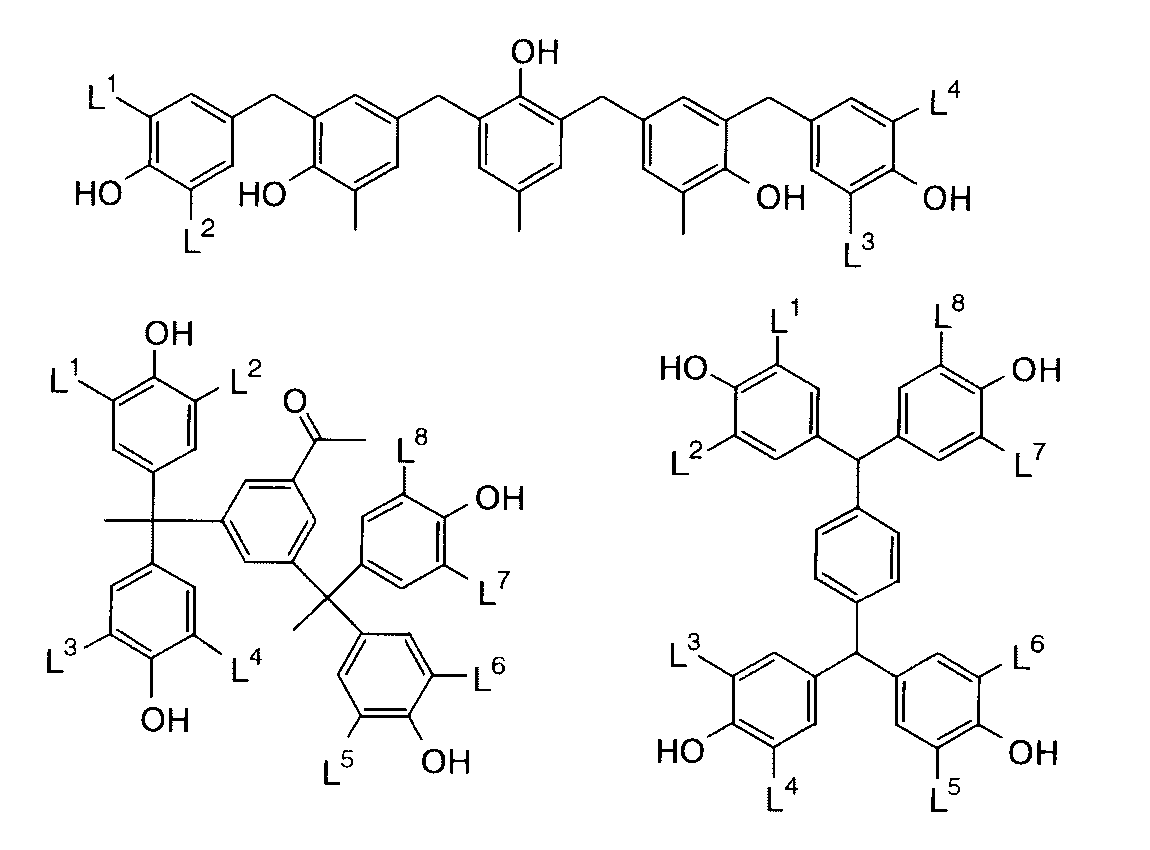

架橋剤は、市販されているものを用いることもでき、また公知の方法で合成することもできる。例えば、ヒドロキシメチル基を有するフェノール誘導体は、対応するヒドロキシメチル基を有さないフェノール化合物(上記式においてL1~L8が水素原子である化合物)とホルムアルデヒドを塩基触媒下で反応させることによって得ることができる。この際、樹脂化やゲル化を防ぐために、反応温度を60℃以下で行うことが好ましい。具体的には、特開平6-282067号、特開平7-64285号等に記載されている方法にて合成することができる。
アルコキシメチル基を有するフェノール誘導体は、対応するヒドロキシメチル基を有するフェノール誘導体とアルコールを酸触媒下で反応させることによって得ることができる。この際、樹脂化やゲル化を防ぐために、反応温度を100℃以下で行うことが好ましい。具体的には、EP632003A1等に記載されている方法にて合成することができる。このようにして合成されたヒドロキシメチル基又はアルコキシメチル基を有するフェノール誘導体は、保存時の安定性の点で好ましいが、アルコキシメチル基を有するフェノール誘導体は保存時の安定性の観点から特に好ましい。ヒドロキシメチル基又はアルコキシメチル基を合わせて2個以上有し、いずれかのベンゼン環に集中させ、あるいは振り分けて結合してなるこのようなフェノール誘導体は、単独で使用してもよく、また2種以上を組み合わせて使用してもよい。
また架橋剤としては、以下の(i)N-ヒドロキシメチル基、N-アルコキシメチル基、若しくはN-アシルオキシメチル基を有する化合物、及び(ii)エポキシ化合物も挙げることができる。
(i)N-ヒドロキシメチル基、N-アルコキシメチル基、若しくはN-アシルオキシメチル基を有する化合物としては、下記一般式(CLNM-1)で表される部分構造を2個以上(より好ましくは2~8個)有する化合物が好ましい。
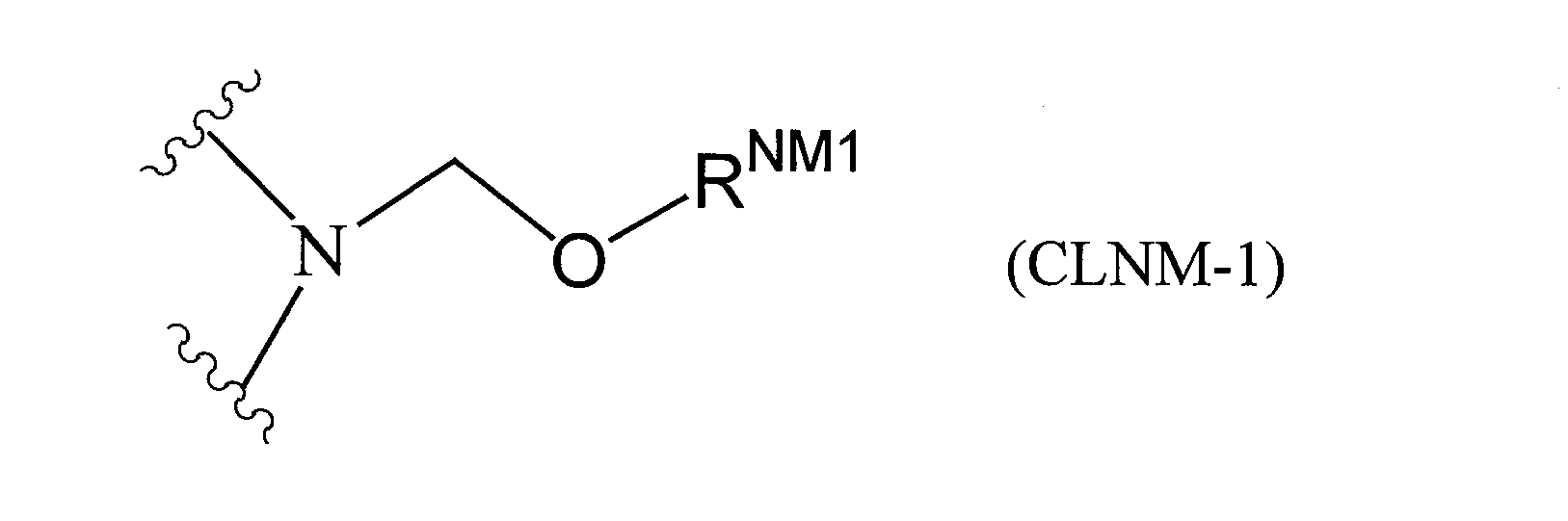
一般式(CLNM-1)に於いて、
RNM1は、水素原子、アルキル基、シクロアルキル基又はオキソアルキル基を表す。
RNM1は、水素原子、アルキル基、シクロアルキル基又はオキソアルキル基を表す。
一般式(CLNM-1)に於ける、RNM1のアルキル基は、炭素数1~6の直鎖又は分岐のアルキル基が好ましい。RNM1のシクロアルキル基は、炭素数5~6のシクロアルキル基が好ましい。RNM1のオキソアルキル基は、炭素数3~6のオキソアルキル基が好ましく、例えば、β‐オキソプロピル基、β‐オキソブチル基、β‐オキソペンチル基、β‐オキソへキシル基等を挙げることができる。
一般式(CLNM-1)で表される部分構造を2個以上有する化合物のより好ましい態様として、下記一般式(CLNM-2)で表されるウレア系架橋剤、下記一般式(CLNM-3)で表されるアルキレンウレア系架橋剤、下記一般式(CLNM-4)で表されるグリコールウリル系架橋剤、下記一般式(CLNM-5)で表されるメラミン系架橋剤が挙げられる。

一般式(CLNM-2)に於いて、
RNM1は、各々独立に、一般式(CLNM-1)に於ける、RNM1と同様のものである。
RNM2は、各々独立に、水素原子、アルキル基(炭素数1~6が好ましい)、又はシクロアルキル基(炭素数5~6が好ましい)を表す。
RNM1は、各々独立に、一般式(CLNM-1)に於ける、RNM1と同様のものである。
RNM2は、各々独立に、水素原子、アルキル基(炭素数1~6が好ましい)、又はシクロアルキル基(炭素数5~6が好ましい)を表す。
一般式(CLNM-2)で表されるウレア系架橋剤の具体例としては、例えば、N,N-ジ(メトキシメチル)ウレア、N,N-ジ(エトキシメチル)ウレア、N,N-ジ(プロポキシメチル)ウレア、N,N-ジ(イソプロポキシメチル)ウレア、N,N-ジ(ブトキシメチル)ウレア、N,N-ジ(t-ブトキシメチル)ウレア、N,N-ジ(シクロヘキシルオキシメチル)ウレア、N,N-ジ(シクロペンチルオキシメチル)ウレア、N,N-ジ(アダマンチルオキシメチル)ウレア、N,N-ジ(ノルボルニルオキシメチル)ウレア等が挙げられる。
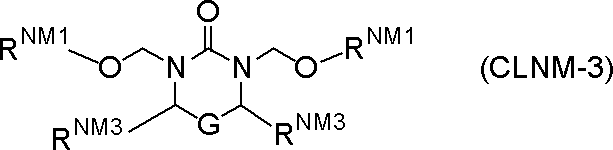
一般式(CLNM-3)に於いて、
RNM1は、各々独立に、一般式(CLNM-1)に於ける、RNM1と同様のものである。
RNM3は、各々独立に、水素原子、ヒドロキシル基、直鎖又は分岐のアルキル基(炭素数1~6が好ましい)、シクロアルキル基(炭素数5~6が好ましい)、オキソアルキル基(炭素数1~6が好ましい)、アルコキシ基(炭素数1~6が好ましい)又はオキソアルコキシ基(炭素数1~6が好ましい)を表す。
Gは、単結合、酸素原子、硫黄原子、アルキレン基(炭素数1~3が好ましい)又はカルボニル基を表す。より具体的には、メチレン基、エチレン基、プロピレン基、1-メチルエチレン基、ヒドロキシメチレン基、シアノメチレン基等が挙げられる。
RNM1は、各々独立に、一般式(CLNM-1)に於ける、RNM1と同様のものである。
RNM3は、各々独立に、水素原子、ヒドロキシル基、直鎖又は分岐のアルキル基(炭素数1~6が好ましい)、シクロアルキル基(炭素数5~6が好ましい)、オキソアルキル基(炭素数1~6が好ましい)、アルコキシ基(炭素数1~6が好ましい)又はオキソアルコキシ基(炭素数1~6が好ましい)を表す。
Gは、単結合、酸素原子、硫黄原子、アルキレン基(炭素数1~3が好ましい)又はカルボニル基を表す。より具体的には、メチレン基、エチレン基、プロピレン基、1-メチルエチレン基、ヒドロキシメチレン基、シアノメチレン基等が挙げられる。
一般式(CLNM-3)で表されるアルキレンウレア系架橋剤の具体例としては、例えば、N,N-ジ(メトキシメチル)‐4,5-ジ(メトキシメチル)エチレンウレア、N,N-ジ(エトキシメチル)‐4,5-ジ(エトキシメチル)エチレンウレア、N,N-ジ(プロポキシメチル)‐4,5-ジ(プロポキシメチル)エチレンウレア、N,N-ジ(イソプロポキシメチル)‐4,5-ジ(イソプロポキシメチル)エチレンウレア、N,N-ジ(ブトキシメチル)‐4,5-ジ(ブトキシメチル)エチレンウレア、N,N-ジ(t-ブトキシメチル)‐4,5-ジ(t-ブトキシメチル)エチレンウレア、N,N-ジ(シクロヘキシルオキシメチル)‐4,5-ジ(シクロヘキシルオキシメチル)エチレンウレア、N,N-ジ(シクロペンチルオキシメチル)‐4,5-ジ(シクロペンチルオキシメチル)エチレンウレア、N,N-ジ(アダマンチルオキシメチル)‐4,5-ジ(アダマンチルオキシメチル)エチレンウレア、N,N-ジ(ノルボルニルオキシメチル)‐4,5-ジ(ノルボルニルオキシメチル)エチレンウレア等が挙げられる。

一般式(CLNM-4)に於いて、
RNM1は、各々独立に、一般式(CLNM-1)に於ける、RNM1と同様のものである。
RNM4は、各々独立に、水素原子、ヒドロキシル基、アルキル基、シクロアルキル基又はアルコキシ基を表す。
RNM1は、各々独立に、一般式(CLNM-1)に於ける、RNM1と同様のものである。
RNM4は、各々独立に、水素原子、ヒドロキシル基、アルキル基、シクロアルキル基又はアルコキシ基を表す。
RNM4のアルキル基(炭素数1~6が好ましい)、シクロアルキル基(炭素数5~6が好ましい)、アルコキシ基(炭素数1~6が好ましい)として、より具体的には、メチル基、エチル基、ブチル基、シクロペンチル基、シクロヘキシル基、メトキシ基、エトキシ基、ブトキシ基等が挙げられる。
一般式(CLNM-4)で表されるグリコールウリル系架橋剤の具体例としては、例えば、N,N,N,N-テトラ(メトキシメチル)グリコールウリル、N,N,N,N-テトラ(エトキシメチル)グリコールウリル、N,N,N,N-テトラ(プロポキシメチル)グリコールウリル、N,N,N,N-テトラ(イソプロポキシメチル)グリコールウリル、N,N,N,N-テトラ(ブトキシメチル)グリコールウリル、N,N,N,N-テトラ(t-ブトキシメチル)グリコールウリル、N,N,N,N-テトラ(シクロヘキシルオキシメチル)グリコールウリル、N,N,N,N-テトラ(シクロペンチルオキシメチル)グリコールウリル、N,N,N,N-テトラ(アダマンチルオキシメチル)グリコールウリル、N,N,N,N-テトラ(ノルボルニルオキシメチル)グリコールウリル等が挙げられる。
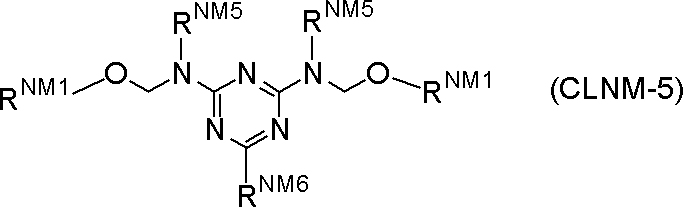
一般式(CLNM-5)に於いて、
RNM1は、各々独立に、一般式(CLNM-1)に於ける、RNM1と同様のものである。
RNM5は、各々独立に、水素原子、アルキル基、シクロアルキル基、アリール基、又は下記一般式(CLNM-5´)で表される原子団を表す。
RNM6は、水素原子、アルキル基、シクロアルキル基、アリール基、又は下記一般式(CLNM-5´´)で表される原子団を表す。
RNM1は、各々独立に、一般式(CLNM-1)に於ける、RNM1と同様のものである。
RNM5は、各々独立に、水素原子、アルキル基、シクロアルキル基、アリール基、又は下記一般式(CLNM-5´)で表される原子団を表す。
RNM6は、水素原子、アルキル基、シクロアルキル基、アリール基、又は下記一般式(CLNM-5´´)で表される原子団を表す。

一般式(CLNM-5´)において、
RNM1は、一般式(CLNM-1)に於ける、RNM1と同様のものである。
一般式(CLNM-5´´)において、
RNM1は、一般式(CLNM-1)に於ける、RNM1と同様のものであり、RNM5は、一般式(CLNM-5)に於けるRNM5と同様のものである。
RNM1は、一般式(CLNM-1)に於ける、RNM1と同様のものである。
一般式(CLNM-5´´)において、
RNM1は、一般式(CLNM-1)に於ける、RNM1と同様のものであり、RNM5は、一般式(CLNM-5)に於けるRNM5と同様のものである。
RNM5及びRNM6のアルキル基(炭素数1~6が好ましい)、シクロアルキル基(炭素数5~6が好ましい)、アリール基(炭素数6~10が好ましい)として、より具体的には、メチル基、エチル基、プロピル基、イソプロピル基、ブチル基、イソブチル基、t‐ブチル基、ペンチル基、シクロペンチル基、ヘキシル基、シクロヘキシル基、フェニル基、ナフチル基等が挙げられる。
一般式(CLNM-5)で表されるメラミン系架橋剤としては、例えば、N,N,N,N,N,N-ヘキサ(メトキシメチル)メラミン、N,N,N,N,N,N-ヘキサ(エトキシメチル)メラミン、N,N,N,N,N,N-ヘキサ(プロポキシメチル)メラミン、N,N,N,N,N,N-ヘキサ(イソプロポキシメチル)メラミン、N,N,N,N,N,N-ヘキサ(ブトキシメチル)メラミン、N,N,N,N,N,N-ヘキサ(t-ブトキシメチル)メラミン、N,N,N,N,N,N-ヘキサ(シクロヘキシルオキシメチル)メラミン、N,N,N,N,N,N-ヘキサ(シクロペンチルオキシメチル)メラミン、N,N,N,N,N,N-ヘキサ(アダマンチルオキシメチル)メラミン、N,N,N,N,N,N-ヘキサ(ノルボルニルオキシメチル)メラミン、N,N,N,N,N,N-ヘキサ(メトキシメチル)アセトグアナミン、N,N,N,N,N,N-ヘキサ(エトキシメチル)アセトグアナミン、N,N,N,N,N,N-ヘキサ(プロポキシメチル)アセトグアナミン、N,N,N,N,N,N-ヘキサ(イソプロポキシメチル)アセトグアナミン、N,N,N,N,N,N-ヘキサ(ブトキシメチル)アセトグアナミン、N,N,N,N,N,N-ヘキサ(t-ブトキシメチル)アセトグアナミン、N,N,N,N,N,N-ヘキサ(メトキシメチル)ベンゾグアナミン、N,N,N,N,N,N-ヘキサ(エトキシメチル)ベンゾグアナミン、N,N,N,N,N,N-ヘキサ(プロポキシメチル)ベンゾグアナミン、N,N,N,N,N,N-ヘキサ(イソプロポキシメチル)ベンゾグアナミン、N,N,N,N,N,N-ヘキサ(ブトキシメチル)ベンゾグアナミン、N,N,N,N,N,N-ヘキサ(t-ブトキシメチル)ベンゾグアナミン、等が挙げられる。
一般式(CLNM-1)~(CLNM-5)に於ける、RNM1~RNM6で表される基は、更に置換基を有してもよい。RNM1~RNM6が有してもよい置換基としては、例えば、ハロゲン原子、水酸基、ニトロ基、シアノ基、カルボキシル基、シクロアルキル基(好ましくは炭素数3~20)、アリール基(好ましくは炭素数6~14)、アルコキシ基(好ましくは炭素数1~20)、シクロアルコキシ基(好ましくは炭素数3~20)、アシル基(好ましくは炭素数2~20)、アシルオキシ基(好ましくは炭素数2~20)等を挙げることができる。
以下に、上記一般式(CLNM-1)で表される部分構造を2個以上有する化合物の具体例を例示するが、本発明はこれらに限定されるものではない。
以下に、上記一般式(CLNM-1)で表される部分構造を2個以上有する化合物の具体例を例示するが、本発明はこれらに限定されるものではない。
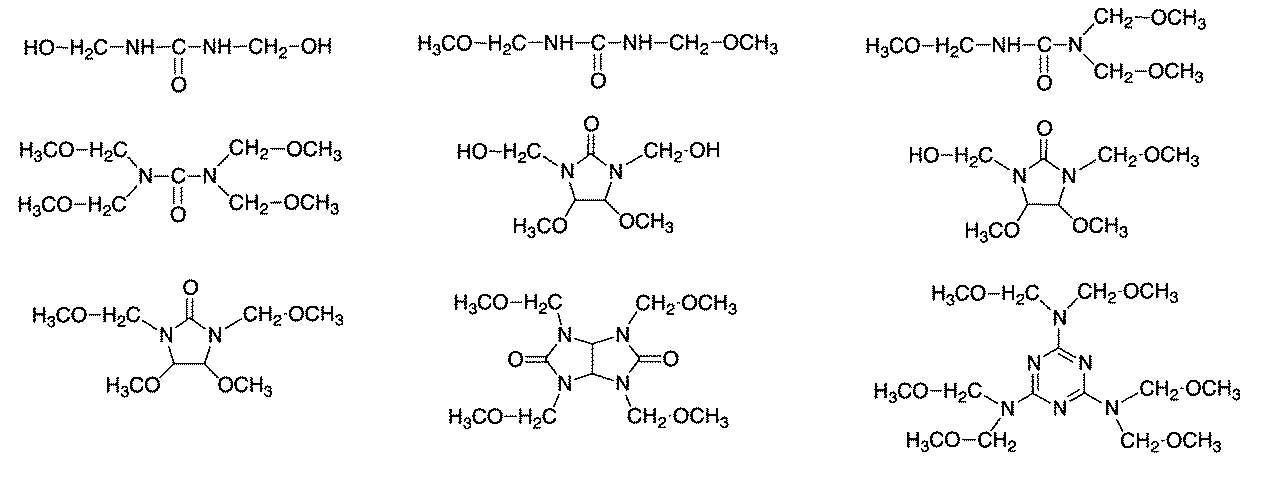
(ii)エポキシ化合物としては、下記一般式(EP1)で表される化合物が挙げられる。

式(EP1)中、
REP1~REP3は各々独立に、水素原子、ハロゲン原子、アルキル基又はシクロアルキル基を表し、該アルキル基及びシクロアルキル基は置換基を有していてもよい。またREP1とREP2、REP2とREP3は、互いに結合して環構造を形成していてもよい。
アルキル基及びシクロアルキル基が有していてもよい置換基としては例えば、ヒドロキシル基、シアノ基、アルコキシ基、アルキルカルボニル基、アルコキシカルボニル基、アルキルカルボニルオキシ基、アルキルチオ基、アルキルスルホン基、アルキルスルホニル基、アルキルアミノ基、アルキルアミド基、などが挙げられる。
QEPは単結合若しくはnEP価の有機基を表す。REP1~REP3は、これら同士だけでなくQEPとも結合して環構造を形成していても良い。
nEPは2以上の整数を表し、好ましくは2~10、更に好ましくは2~6である。但しQEPが単結合の場合、nEPは2である。
REP1~REP3は各々独立に、水素原子、ハロゲン原子、アルキル基又はシクロアルキル基を表し、該アルキル基及びシクロアルキル基は置換基を有していてもよい。またREP1とREP2、REP2とREP3は、互いに結合して環構造を形成していてもよい。
アルキル基及びシクロアルキル基が有していてもよい置換基としては例えば、ヒドロキシル基、シアノ基、アルコキシ基、アルキルカルボニル基、アルコキシカルボニル基、アルキルカルボニルオキシ基、アルキルチオ基、アルキルスルホン基、アルキルスルホニル基、アルキルアミノ基、アルキルアミド基、などが挙げられる。
QEPは単結合若しくはnEP価の有機基を表す。REP1~REP3は、これら同士だけでなくQEPとも結合して環構造を形成していても良い。
nEPは2以上の整数を表し、好ましくは2~10、更に好ましくは2~6である。但しQEPが単結合の場合、nEPは2である。
QEPがnEP価の有機基の場合、鎖状若しくは環状のnEP価の飽和炭化水素基(炭素数2~20が好ましい)、nEP価の芳香環基(炭素数6~30が好ましい)、又は鎖状若しくは環状の飽和炭化水素若しくは芳香族炭化水素に、エーテル、エステル、アミド、スルホンアミド、アルキレン(炭素数1~4が好ましく、メチレンがより好ましい)等の2価の連結基、-N(-)2等の3価の連結基又はこれらの組み合わせが連結した構造を有するnEP価の有機基などが好ましい。
以下に(B)エポキシ構造を有する化合物の具体例を例示するが、本発明はこれらに限定されるものではない。
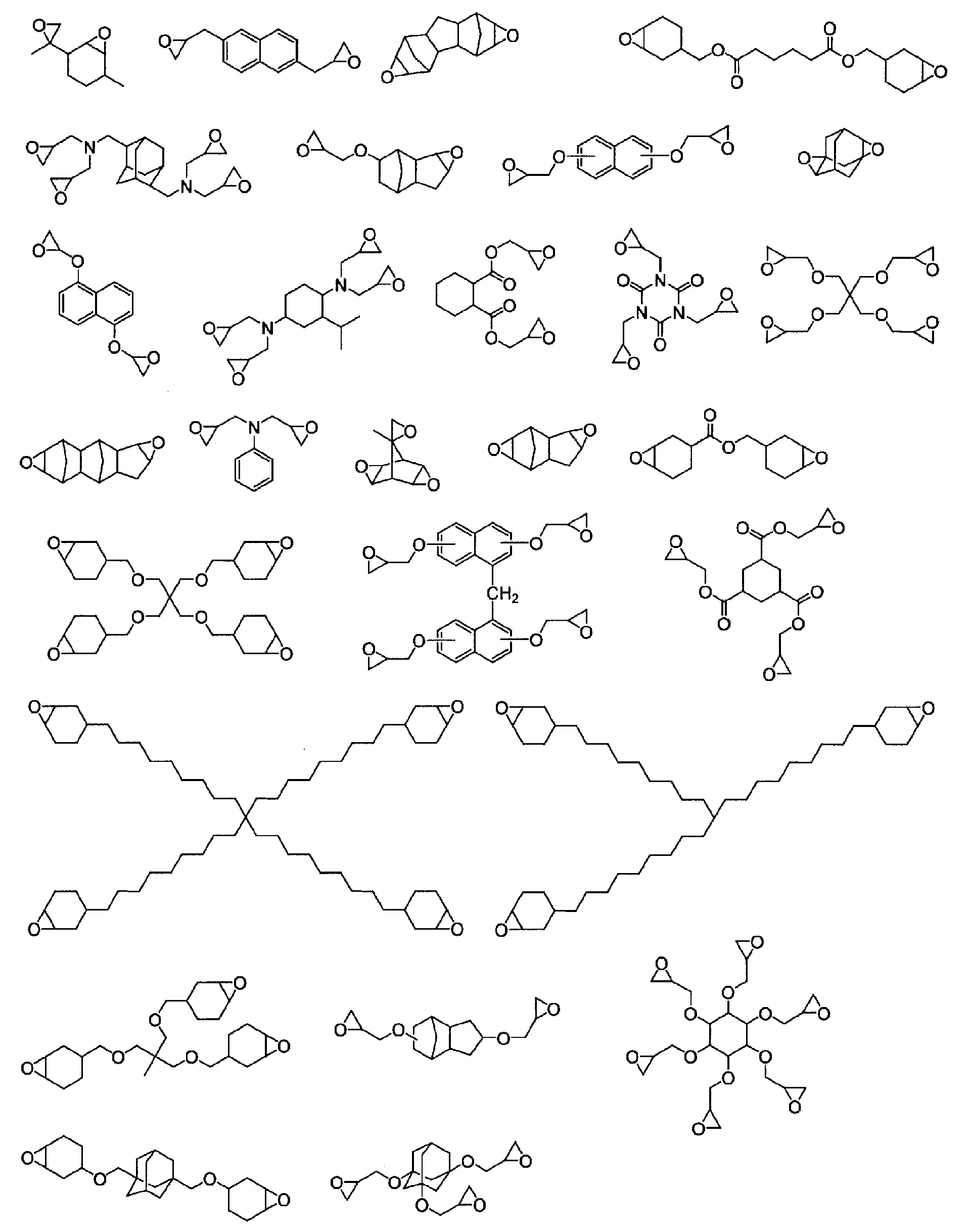
本発明において、低分子化合物〔N-C〕は単独で用いてもよいし、2種以上組み合わせて用いてもよい。
低分子化合物〔N-C〕は、前述の化合物〔N-B〕と同一の成分であっても、異なる成分であっても良いが、異なる成分であることが好ましい。
ネガ型の画像を形成する場合(すなわち、感活性光線性又は感放射線性組成物が、ネガ型の感活性光線性又は感放射線性組成物である場合)には、低分子化合物〔N-C〕の含有量は、感活性光線性又は感放射線性組成物の全固形分中、好ましくは3~65質量%、より好ましくは5~50質量%、更に好ましくは10~45質量%である。ポジ型の画像を形成する場合(すなわち、感活性光線性又は感放射線性組成物が、ポジ型の感活性光線性又は感放射線性組成物である場合)には、低分子化合物〔N-C〕の含有量は、感活性光線性又は感放射線性組成物の全固形分中、好ましくは0.1~20質量%、より好ましくは1~10質量%である。
本発明の感活性光線性又は感放射線性組成物の好ましい実施形態としては、化合物(N)の含有量が感活性光線性又は感放射線性組成物の全固形分に対して10質量%以上であり、ネガ型の感活性光線性又は感放射線性組成物である実施形態が挙げられる。この実施形態において、化合物(N)の含有量は、感活性光線性又は感放射線性組成物の全固形分に対して、10~99質量%であることが好ましく、10~70質量%であることがより好ましい。
また、本発明の感活性光線性又は感放射線性組成物の好ましい実施形態としては、化合物(N)の含有量が前記感活性光線性又は感放射線性組成物の全固形分に対して1質量%以上であり、ポジ型の感活性光線性又は感放射線性組成物である形態が挙げられる。この実施形態において、化合物(N)の含有量は、感活性光線性又は感放射線性組成物の全固形分に対して、1~40質量%であることが好ましく、1~20質量%であることがより好ましい。
また、本発明の感活性光線性又は感放射線性組成物の好ましい実施形態としては、化合物(N)の含有量が前記感活性光線性又は感放射線性組成物の全固形分に対して1質量%以上であり、ポジ型の感活性光線性又は感放射線性組成物である形態が挙げられる。この実施形態において、化合物(N)の含有量は、感活性光線性又は感放射線性組成物の全固形分に対して、1~40質量%であることが好ましく、1~20質量%であることがより好ましい。
また、本発明の感活性光線性又は感放射線性組成物は、化合物(N)として、分子量が500以上の化合物を含有することが好ましく、これにより、前加熱工程時、後加熱工程時、及び、露光時における真空下において、膜中から揮発することを抑制できる。
また、本発明の感活性光線性又は感放射線性組成物は、化合物(N)として、上記した酸の作用によりアルカリ現像液に対する溶解性が減少する化合物(N-1)を含有することが好ましく、これにより、より高い添加効果(高解像力、パターン形状、LWR)を得ることができる、これは酸による反応が膜中での失活が少なく連鎖的に起こるためだと推定している。
特に、本発明の感活性光線性又は感放射線性組成物が、低分子化合物〔N-C〕としての上記架橋剤を含有する形態においては、感活性光線性又は感放射線性組成物は、酸の作用により架橋剤によって架橋される樹脂(A)を含有することが好ましい。
樹脂(A)としては、架橋剤(B)と架橋することができる公知の樹脂を使用することができる。
樹脂(A)は、酸基を含有していてもよい。
酸基としては、フェノール性水酸基、カルボキシル基、フッ素化アルコール基、スルホン酸基、スルホンアミド基、スルホニルイミド基、(アルキルスルホニル)(アルキルカルボニル)メチレン基、(アルキルスルホニル)(アルキルカルボニル)イミド基、ビス(アルキルカルボニル)メチレン基、ビス(アルキルカルボニル)イミド基、ビス(アルキルスルホニル)メチレン基、ビス(アルキルスルホニル)イミド基、トリス(アルキルカルボニル)メチレン基、トリス(アルキルスルホニル)メチレン基等が挙げられる。
好ましい酸基としては、フェノール性水酸基、カルボキシル基、フッ素化アルコール基(好ましくはヘキサフルオロイソプロパノール)、スルホン酸基が挙げられる。
例えば、ヒドロキシスチレン、部分水添ヒドロキシスチレン、ノボラック樹脂、(メタ)アクリル系ポリマー((メタ)アクリル酸含有ポリマーなど)、水酸基含有ポリマー、ポリ酢酸ビニル、ジエンコポリマー、エポキシ基含有ポリマー等を、好ましく使用できる樹脂(A)として挙げることが出来る。
電子線やEUV露光における二次電子発生効率の観点から、樹脂(A)はベンゼン環を有することが好ましく、上記樹脂〔P-A〕で説明した一般式(3)で表される繰り返し単位を含有することが更に好ましい。
樹脂(A)は、酸基を含有していてもよい。
酸基としては、フェノール性水酸基、カルボキシル基、フッ素化アルコール基、スルホン酸基、スルホンアミド基、スルホニルイミド基、(アルキルスルホニル)(アルキルカルボニル)メチレン基、(アルキルスルホニル)(アルキルカルボニル)イミド基、ビス(アルキルカルボニル)メチレン基、ビス(アルキルカルボニル)イミド基、ビス(アルキルスルホニル)メチレン基、ビス(アルキルスルホニル)イミド基、トリス(アルキルカルボニル)メチレン基、トリス(アルキルスルホニル)メチレン基等が挙げられる。
好ましい酸基としては、フェノール性水酸基、カルボキシル基、フッ素化アルコール基(好ましくはヘキサフルオロイソプロパノール)、スルホン酸基が挙げられる。
例えば、ヒドロキシスチレン、部分水添ヒドロキシスチレン、ノボラック樹脂、(メタ)アクリル系ポリマー((メタ)アクリル酸含有ポリマーなど)、水酸基含有ポリマー、ポリ酢酸ビニル、ジエンコポリマー、エポキシ基含有ポリマー等を、好ましく使用できる樹脂(A)として挙げることが出来る。
電子線やEUV露光における二次電子発生効率の観点から、樹脂(A)はベンゼン環を有することが好ましく、上記樹脂〔P-A〕で説明した一般式(3)で表される繰り返し単位を含有することが更に好ましい。
樹脂(A)は、上記一般式(3)で表される繰り返し単位とともに、一般式(a)~(c)のいずれかで表される繰り返し単位の少なくとも一種を有することもできる。
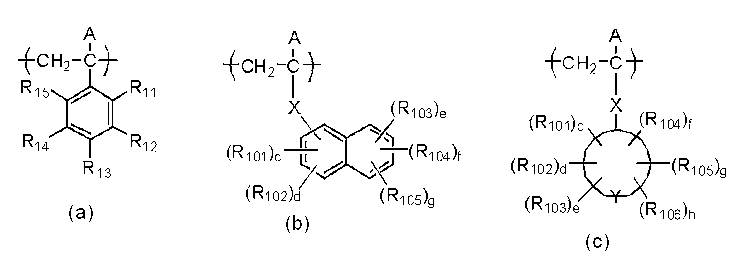
一般式(a)~(c)において、
Aは前記一般式(3)のR32と同義である。
Xは単結合、-COO-基、-O-基、又は-CON(R16)-基を表し、R16は水素原子又は炭素数1~3のアルキル基(メチル基、エチル基、プロピル基等)を表す。Xとして好ましくは、単結合、-COO-、-CON(R16)-であり、特に好ましくは単結合、-COO-基である。
Yで示される環構造は、3環以上の多環芳香族炭化水素環構造を表し、好ましくは下記構造式で表されるいずれかを表す。
Aは前記一般式(3)のR32と同義である。
Xは単結合、-COO-基、-O-基、又は-CON(R16)-基を表し、R16は水素原子又は炭素数1~3のアルキル基(メチル基、エチル基、プロピル基等)を表す。Xとして好ましくは、単結合、-COO-、-CON(R16)-であり、特に好ましくは単結合、-COO-基である。
Yで示される環構造は、3環以上の多環芳香族炭化水素環構造を表し、好ましくは下記構造式で表されるいずれかを表す。
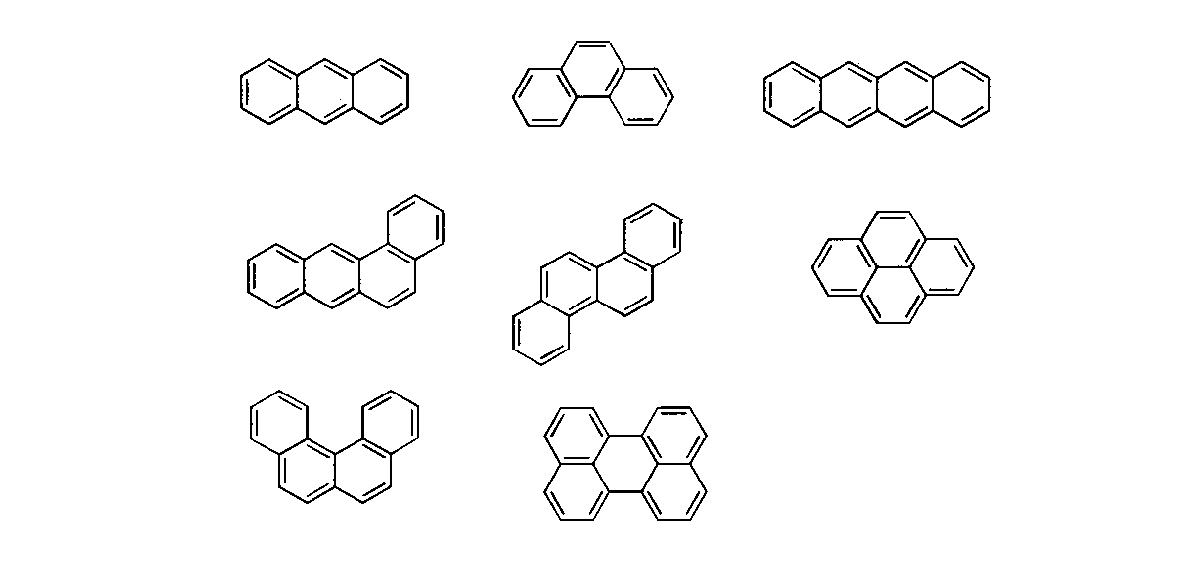
R11~R15はそれぞれ独立に水素原子、ハロゲン原子、アルキル基、シクロアルキル基、アリール基、アルケニル基、アラルキル基、アルコキシ基、アルキルカルボニルオキシ基、アルキルスルホニルオキシ基、アリールカルボニルオキシ基、ニトロ基又はシアノ基を表す。R11~R15は互いに結合し、環(好ましくは5又は6員環)を形成してもよい。R11~R15で表されるハロゲン原子、アルキル基、シクロアルキル基、アリール基、アルケニル基、アラルキル基、アルコキシ基、アルキルカルボニルオキシ基及びアルキルスルホニルオキシ基は、具体的には一般式(1)のRと同様のものが挙げられる。R11~R15で表されるアリールカルボニルオキシ基は、好ましくは置換基を有していてもよい炭素数7~16のアリールカルボニルオキシ基である。
R101~R106はそれぞれ独立に、ヒドロキシ基、ハロゲン原子(Cl、Br、F、I)、置換基を有していてもよい炭素数1~8の直鎖又は分岐状のアルキル基、置換基を有していてもよい炭素数1~8の直鎖又は分岐状のアルコキシ基、置換基を有していてもよい炭素数2~8の直鎖又は分岐状のアルキルカルボニルオキシ基、置換基を有していてもよい炭素数1~8の直鎖又は分岐状のアルキルスルホニルオキシ基、置換基を有していてもよい炭素数1~8のアルケニル基、置換基を有していてもよい炭素数6~15のアリール基、置換基を有していてもよい炭素数7~16のアラルキル基、カルボキシ基、水酸基を有していてもよい炭素数1~4のパーフルオロアルキル基を表す。
c~hはそれぞれ独立に0~3の整数を表す。
R101~R106はそれぞれ独立に、ヒドロキシ基、ハロゲン原子(Cl、Br、F、I)、置換基を有していてもよい炭素数1~8の直鎖又は分岐状のアルキル基、置換基を有していてもよい炭素数1~8の直鎖又は分岐状のアルコキシ基、置換基を有していてもよい炭素数2~8の直鎖又は分岐状のアルキルカルボニルオキシ基、置換基を有していてもよい炭素数1~8の直鎖又は分岐状のアルキルスルホニルオキシ基、置換基を有していてもよい炭素数1~8のアルケニル基、置換基を有していてもよい炭素数6~15のアリール基、置換基を有していてもよい炭素数7~16のアラルキル基、カルボキシ基、水酸基を有していてもよい炭素数1~4のパーフルオロアルキル基を表す。
c~hはそれぞれ独立に0~3の整数を表す。
これらの置換基の具体例としては、例えば、アルキル基(メチル基、エチル基、プロピル基、イソプロピル基、ブチル基、t-ブチル基、ヘキシル基等)、アリール基(フェニル基、ナフチル基等)、アラルキル基、ヒドロキシル基、アルコキシ基(メトキシ基、エトキシ基、ブトキシ基、オクチルオキシ基、ドデシルオキシ基等)、アシル基(アセチル基、プロパノイル基、ベンゾイル基等)、オキソ基を挙げることができ、好ましくは炭素数15以下の置換基である。
R101~R106として好ましくは、それぞれ独立に、ハロゲン原子、置換基を有していてもよい炭素数1~4のアルキル基、置換基を有していてもよい炭素数1~4のアルコキシ基、置換基を有していてもよい炭素数2~4のアルキルカルボニルオキシ基であり、特に好ましくは、塩素原子、臭素原子、ヨウ素原子、炭素数1~3のアルキル基(メチル基、エチル基、プロピル基、イソプロピル基)、炭素数1~3のアルコキシ基(メトキシ基、エトキシ基、プロピルオキシ基、イソプロピルオキシ基)、炭素数2又は3のアルキルカルボニルオキシ基(アセトキシ基、プロピオニルオキシ基等)である。
R101~R106として好ましくは、それぞれ独立に、ハロゲン原子、置換基を有していてもよい炭素数1~4のアルキル基、置換基を有していてもよい炭素数1~4のアルコキシ基、置換基を有していてもよい炭素数2~4のアルキルカルボニルオキシ基であり、特に好ましくは、塩素原子、臭素原子、ヨウ素原子、炭素数1~3のアルキル基(メチル基、エチル基、プロピル基、イソプロピル基)、炭素数1~3のアルコキシ基(メトキシ基、エトキシ基、プロピルオキシ基、イソプロピルオキシ基)、炭素数2又は3のアルキルカルボニルオキシ基(アセトキシ基、プロピオニルオキシ基等)である。
本発明で用いられる樹脂(A)は、上記一般式(3)で表される繰り返し単位を1種のみを有する樹脂、上記一般式(3)で表される繰り返し単位を2種以上有する樹脂、上記一般式(3)で表される繰り返し単位と、上記一般式(a)~(c)のいずれかで表される繰り返し単位の少なくとも1種とを有する樹脂のいずれであってもよいが、製膜性や溶剤溶解性を制御できるような他の重合性モノマーを共重合させてもよい。
これらの重合性モノマーの例としては、スチレン、アルキル置換スチレン、アルコキシスチレン、アシルオキシスチレン、水素化ヒドロキシスチレン、無水マレイン酸、アクリル酸誘導体(アクリル酸、アクリル酸エステル等)、メタクリル酸誘導体(メタクリル酸、メタクリル酸エステル等)、N-置換マレイミド、アクリロニトリル、メタクリロニトリル等を挙げることができるが、これらに限定されるものではない。
また、上記とは別に、好ましい樹脂の繰り返し単位として、主鎖に環状構造を有する単位(インデン構造を有するモノマーに由来する単位など)、ナフトール構造を有する単位、-C(CF3)2OH基を有する繰り返し単位なども挙げられる。
本発明において、樹脂(A)は単独で用いてもよいし、2種以上組み合わせて用いてもよい。
これらの重合性モノマーの例としては、スチレン、アルキル置換スチレン、アルコキシスチレン、アシルオキシスチレン、水素化ヒドロキシスチレン、無水マレイン酸、アクリル酸誘導体(アクリル酸、アクリル酸エステル等)、メタクリル酸誘導体(メタクリル酸、メタクリル酸エステル等)、N-置換マレイミド、アクリロニトリル、メタクリロニトリル等を挙げることができるが、これらに限定されるものではない。
また、上記とは別に、好ましい樹脂の繰り返し単位として、主鎖に環状構造を有する単位(インデン構造を有するモノマーに由来する単位など)、ナフトール構造を有する単位、-C(CF3)2OH基を有する繰り返し単位なども挙げられる。
本発明において、樹脂(A)は単独で用いてもよいし、2種以上組み合わせて用いてもよい。
本発明に用いられる樹脂(A)における一般式(3)で表される繰り返し単位の含有量の範囲は、一般的に50~100モル%、好ましくは70~100モル%である。
樹脂(A)において、一般式(3)で表される繰り返し単位と、一般式(a)~(c)で表される繰り返し単位の比率は、モル比で100/0~50/50が好ましく、より好ましくは100/0~60/40であり、特に好ましくは100/0~70/30である。
樹脂(A)の好ましい分子量は、質量平均分子量として1000~50000であり、更に好ましくは2000~20000である。
樹脂(A)の好ましい分子量分布(Mw/Mn)は、1.0~2.0であり、より好ましくは1.0~1.35である。
樹脂(A)の添加量(複数併用する場合は合計の量)は組成物の全固形分に対して、30~95質量%、好ましくは40~90質量%、特に好ましくは50~80質量%で用いられる。なお、樹脂の分子量及び分子量分布は、GPC測定によるポリスチレン換算値として定義される。
樹脂(A)において、一般式(3)で表される繰り返し単位と、一般式(a)~(c)で表される繰り返し単位の比率は、モル比で100/0~50/50が好ましく、より好ましくは100/0~60/40であり、特に好ましくは100/0~70/30である。
樹脂(A)の好ましい分子量は、質量平均分子量として1000~50000であり、更に好ましくは2000~20000である。
樹脂(A)の好ましい分子量分布(Mw/Mn)は、1.0~2.0であり、より好ましくは1.0~1.35である。
樹脂(A)の添加量(複数併用する場合は合計の量)は組成物の全固形分に対して、30~95質量%、好ましくは40~90質量%、特に好ましくは50~80質量%で用いられる。なお、樹脂の分子量及び分子量分布は、GPC測定によるポリスチレン換算値として定義される。
樹脂(A)は、公知のラジカル重合法やアニオン重合法により合成することができる。例えば、ラジカル重合法では、ビニルモノマーを適当な有機溶媒に溶解し、過酸化物(過酸化ベンゾイル等)やニトリル化合物(アゾビスイソブチロニトリル等)、又はレドックス化合物(クメンヒドロペルオキシド-第一鉄塩等)を開始剤として、室温又は加温条件下で反応させて重合体を得ることができる。また、アニオン重合法では、ビニルモノマーを適当な有機溶媒に溶解し、金属化合物(ブチルリチウム等)を開始剤として、通常、冷却条件化で反応させて重合体を得ることができる。
以下に本発明で使用される樹脂(A)の具体例を示すが、本発明はこれらに限定されるものではない。
具体例中のnは正の整数を表す。
x、y、zは樹脂組成のモル比を表し、2成分からなる樹脂では、x=10~95、y=5~90、好ましくはx=40~90、y=10~60の範囲で使用される。3成分からなる樹脂では、x=10~90、y=5~85、z=5~85、好ましくはx=40~80、y=10~50、z=10~50の範囲で使用される。また、これらは単独で使用してもよいし、2種以上を混合して使用してもよい。
具体例中のnは正の整数を表す。
x、y、zは樹脂組成のモル比を表し、2成分からなる樹脂では、x=10~95、y=5~90、好ましくはx=40~90、y=10~60の範囲で使用される。3成分からなる樹脂では、x=10~90、y=5~85、z=5~85、好ましくはx=40~80、y=10~50、z=10~50の範囲で使用される。また、これらは単独で使用してもよいし、2種以上を混合して使用してもよい。

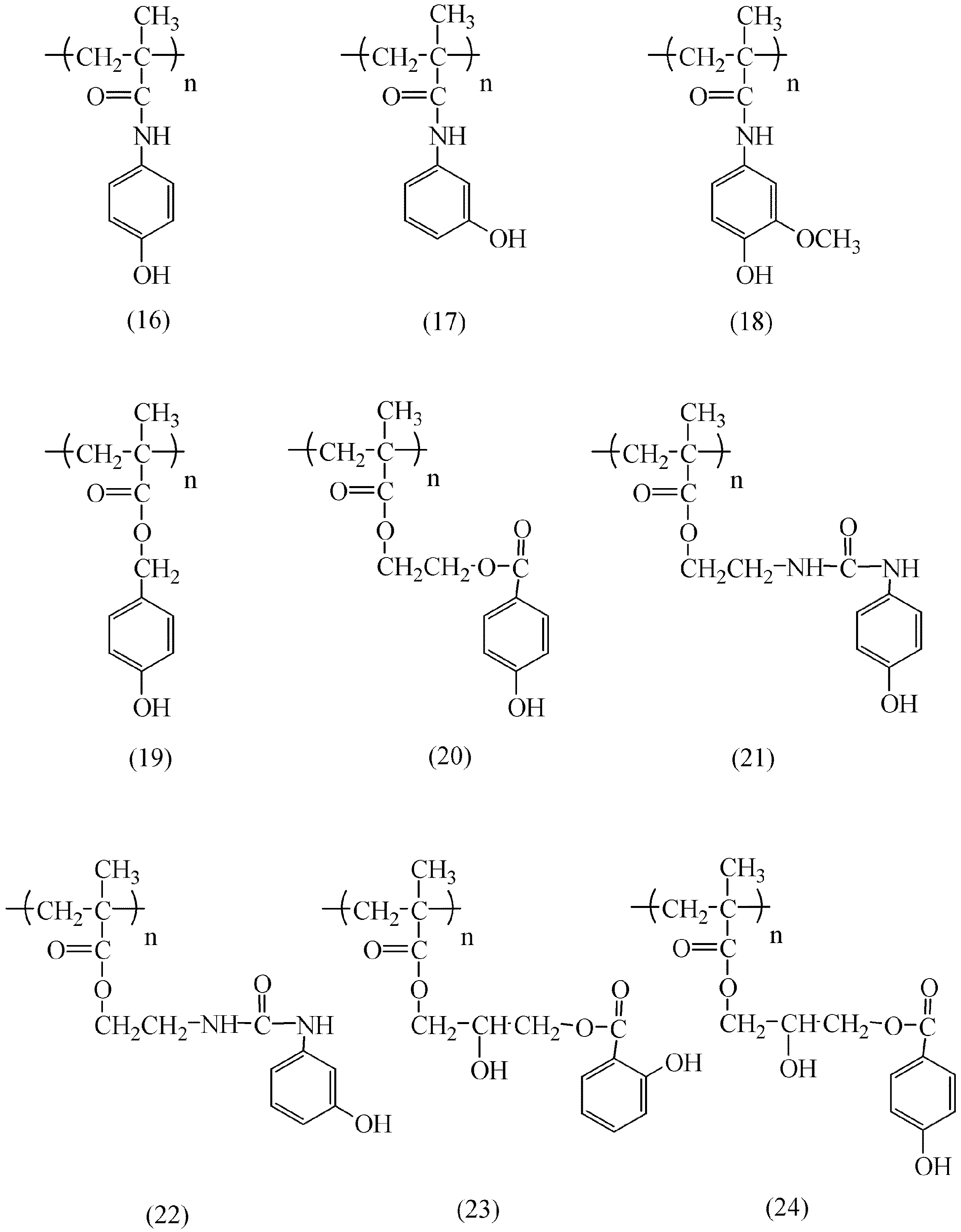
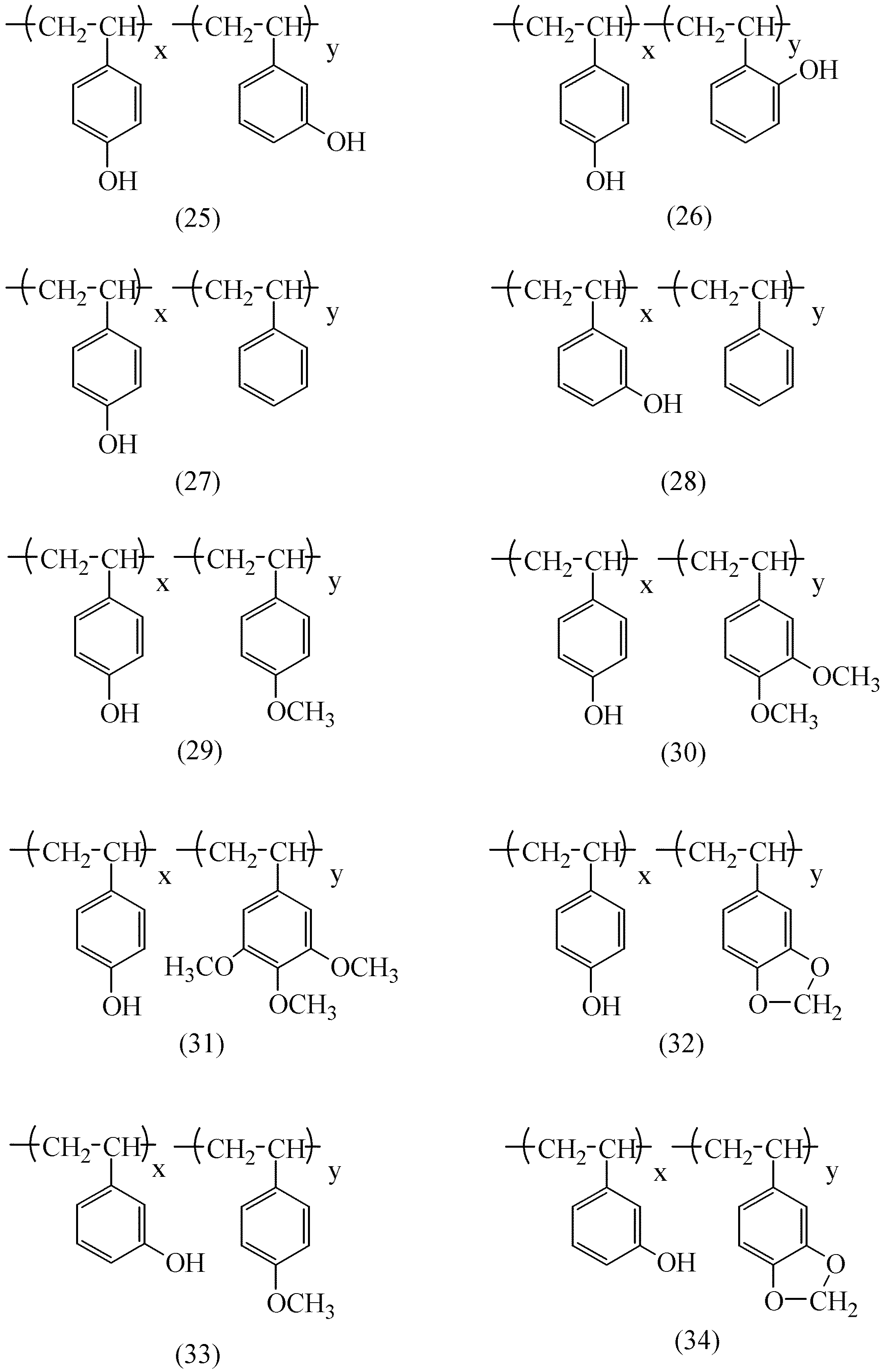
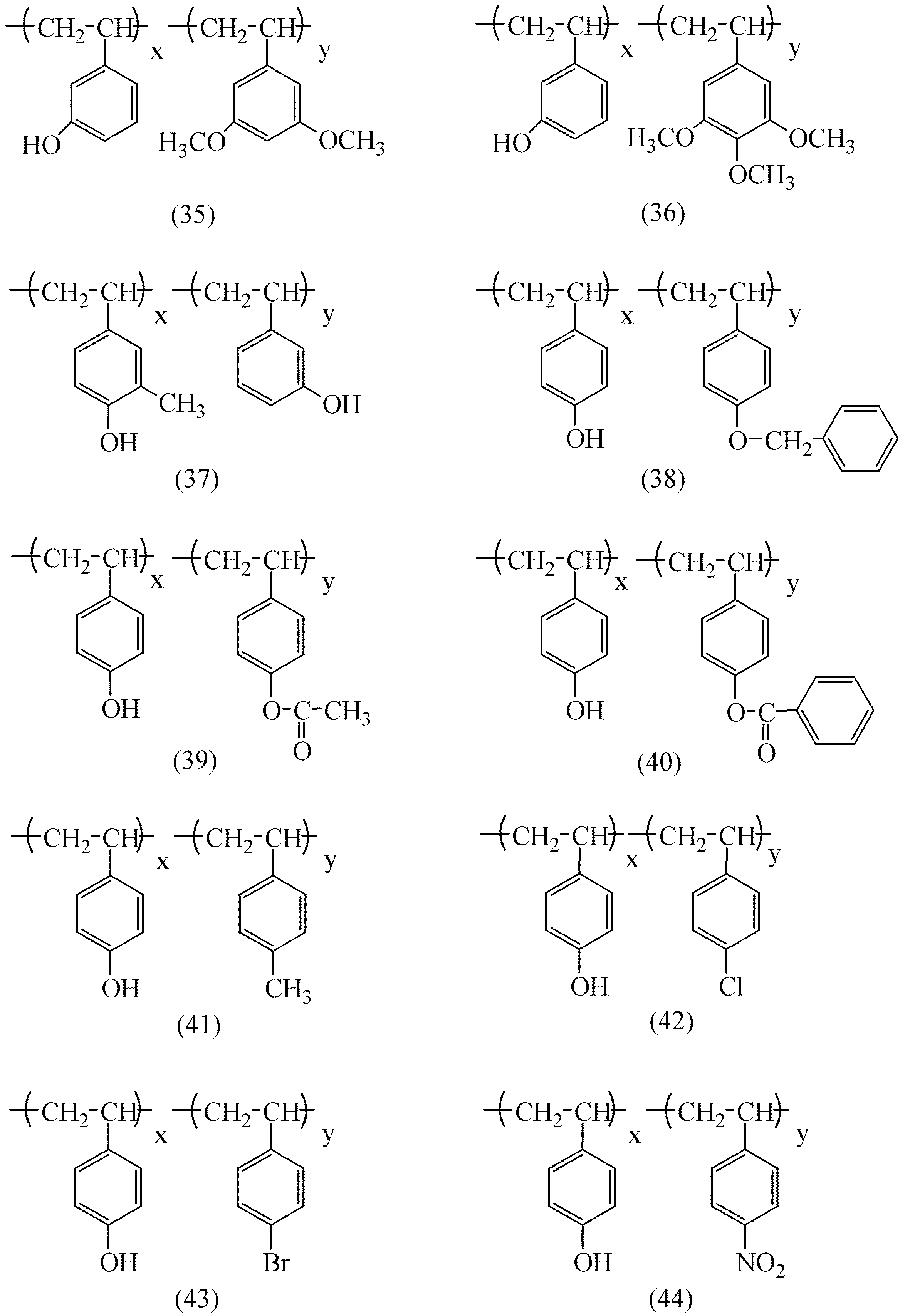


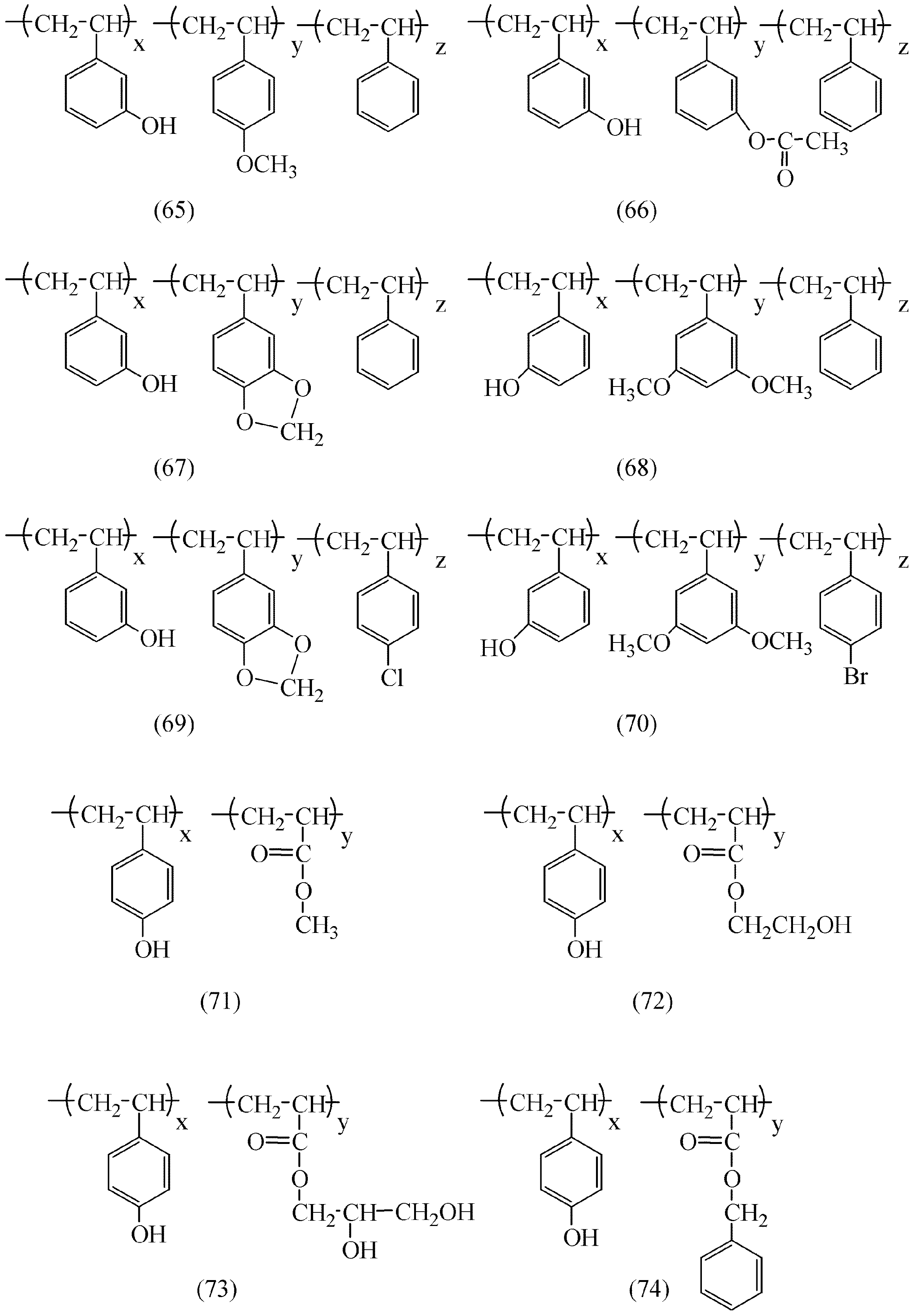
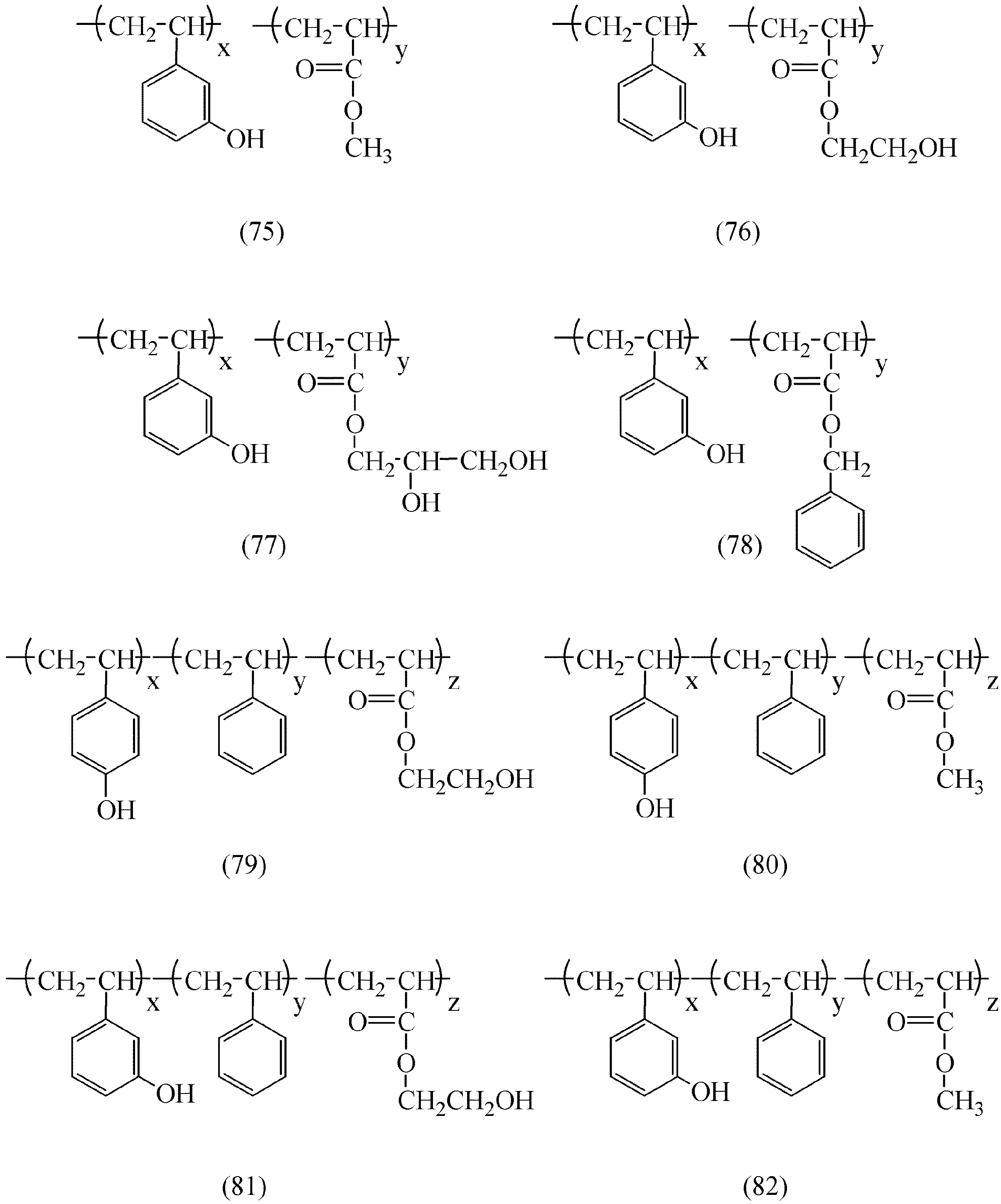


[3](A)活性光線又は放射線の照射により酸を発生する化合物
本発明の感活性光線性又は感放射線性組成物は、活性光線又は放射線の照射により酸を発生する化合物(A)(以下、「酸発生剤(A)」ともいう)を含有している。
酸発生剤(A)は、上記化合物〔P-B〕と同じ成分であってもよく、異なる成分であってもよい。また、酸発生剤(A)は、上記化合物〔N-B〕と同一の成分であってもよく、異なる成分であってもよい。
酸発生剤(A)が、上記化合物〔P-B〕及び化合物〔N-B〕とは異なる成分である場合、酸発生剤(A)の好ましい例及び具体例等については、“酸分解性基を有する”との要件、及び、“重合性基を有する”との要件を除外する以外は、それぞれ、上記化合物〔P-B〕における説明及び化合物〔N-B〕における説明を援用できる。
本発明の感活性光線性又は感放射線性組成物は、活性光線又は放射線の照射により酸を発生する化合物(A)(以下、「酸発生剤(A)」ともいう)を含有している。
酸発生剤(A)は、上記化合物〔P-B〕と同じ成分であってもよく、異なる成分であってもよい。また、酸発生剤(A)は、上記化合物〔N-B〕と同一の成分であってもよく、異なる成分であってもよい。
酸発生剤(A)が、上記化合物〔P-B〕及び化合物〔N-B〕とは異なる成分である場合、酸発生剤(A)の好ましい例及び具体例等については、“酸分解性基を有する”との要件、及び、“重合性基を有する”との要件を除外する以外は、それぞれ、上記化合物〔P-B〕における説明及び化合物〔N-B〕における説明を援用できる。
酸発生剤(A)は、低分子化合物の形態であっても良く、重合体の一部に組み込まれた形態であっても良い。また、低分子化合物の形態と重合体の一部に組み込まれた形態を併用しても良い。
酸発生剤(A)が、低分子化合物の形態である場合、分子量が3000以下であることが好ましく、2000以下であることがより好ましく、1000以下であることが更に好ましい。
酸発生剤(A)が、重合体の一部に組み込まれた形態である場合、上記樹脂〔P-A〕、上記樹脂〔N-A〕又は上記樹脂(A)の一部に組み込まれても良く、上記樹脂〔P-A〕、上記樹脂〔N-A〕及び上記樹脂(A)とは異なる樹脂に組み込まれても良い。この場合、酸発生剤(A)は、活性光線又は放射線の照射により酸を発生する部位を有する繰り返し単位を含有する樹脂であることが好ましい。
酸発生剤(A)が、低分子化合物の形態である場合、分子量が3000以下であることが好ましく、2000以下であることがより好ましく、1000以下であることが更に好ましい。
酸発生剤(A)が、重合体の一部に組み込まれた形態である場合、上記樹脂〔P-A〕、上記樹脂〔N-A〕又は上記樹脂(A)の一部に組み込まれても良く、上記樹脂〔P-A〕、上記樹脂〔N-A〕及び上記樹脂(A)とは異なる樹脂に組み込まれても良い。この場合、酸発生剤(A)は、活性光線又は放射線の照射により酸を発生する部位を有する繰り返し単位を含有する樹脂であることが好ましい。
酸発生剤(A)の中で、特に好ましい例を以下に挙げる。


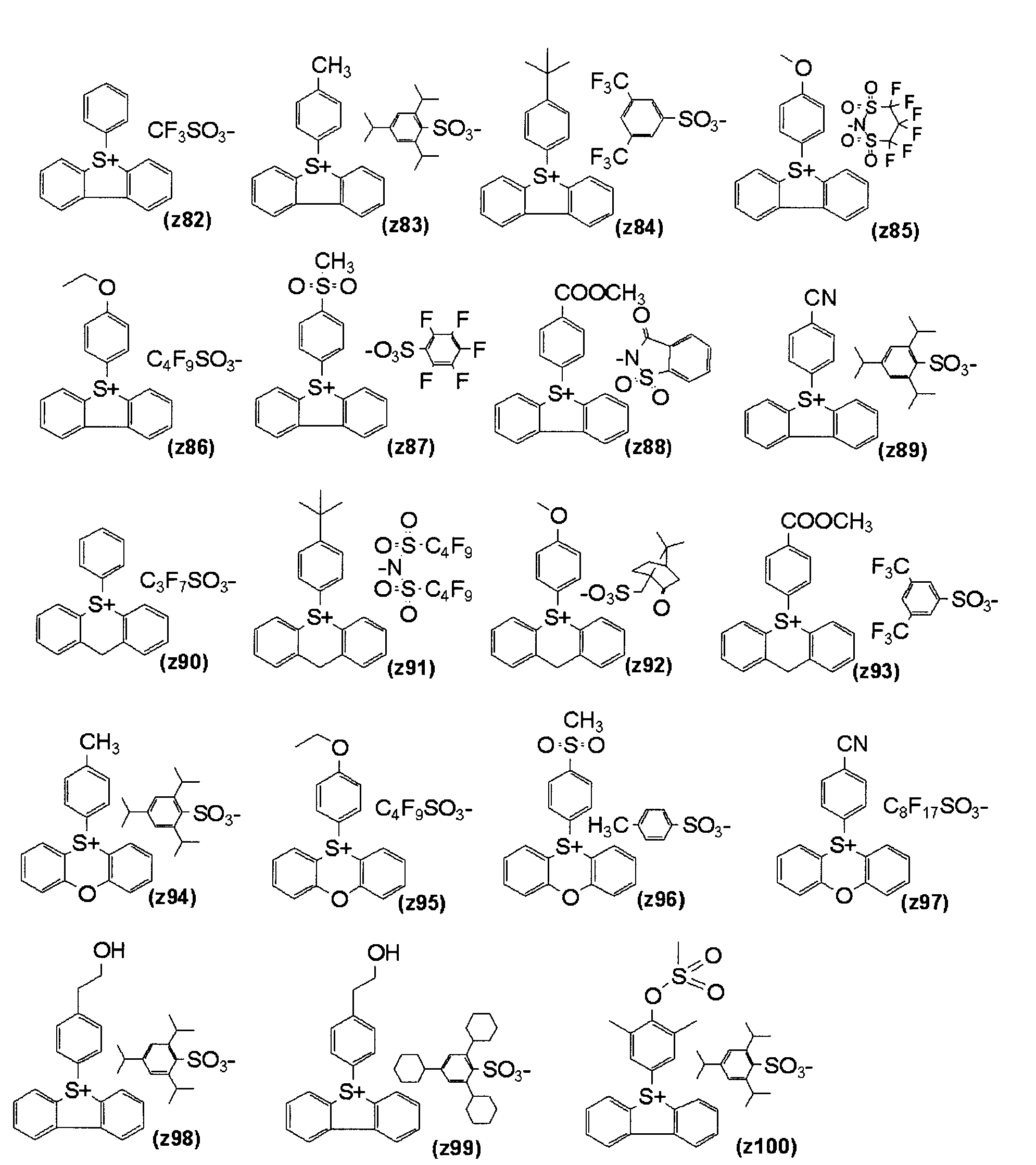

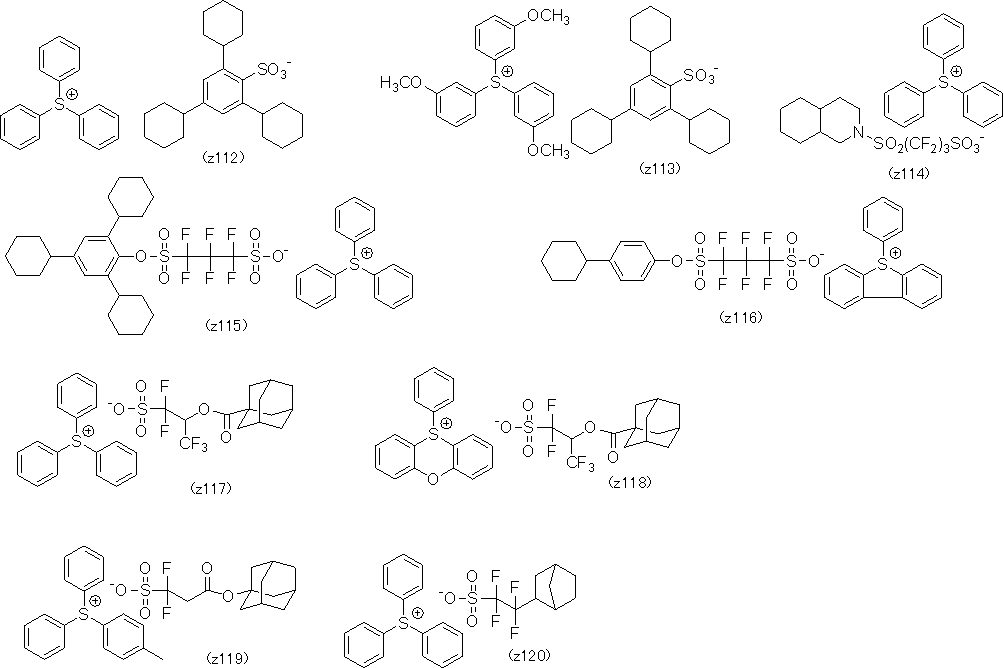

酸発生剤(A)は、露光で発生した酸の非露光部への拡散を抑制し解像性を良好にする観点から、活性光線又は放射線の照射により、体積240Å3以上の大きさの酸を発生する化合物であることが好ましく、体積300Å3以上の大きさの酸を発生する化合物であることがより好ましく、体積350Å3以上の大きさの酸を発生する化合物であることが更に好ましく、体積400Å3以上の大きさの酸を発生する化合物であることが特に好ましい。ただし、感度や塗布溶剤溶解性の観点から、上記体積は、2000Å3以下であることが好ましく、1500Å3以下であることが更に好ましい。上記体積の値は、富士通株式会社製の「WinMOPAC」を用いて求めた。すなわち、まず、各例に係る酸の化学構造を入力し、次に、この構造を初期構造としてMM3法を用いた分子力場計算により、各酸の最安定立体配座を決定し、その後、これら最安定立体配座についてPM3法を用いた分子軌道計算を行うことにより、各酸の「accessible volume」を計算することができる。
以下に本発明において、特に好ましい酸発生剤を以下に例示する。なお、例の一部には、体積の計算値を付記している(単位Å3)。なお、ここで求めた計算値は、アニオン部にプロトンが結合した酸の体積値である。
以下に本発明において、特に好ましい酸発生剤を以下に例示する。なお、例の一部には、体積の計算値を付記している(単位Å3)。なお、ここで求めた計算値は、アニオン部にプロトンが結合した酸の体積値である。
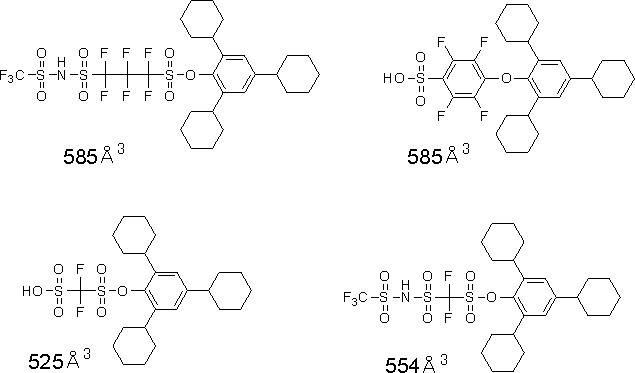
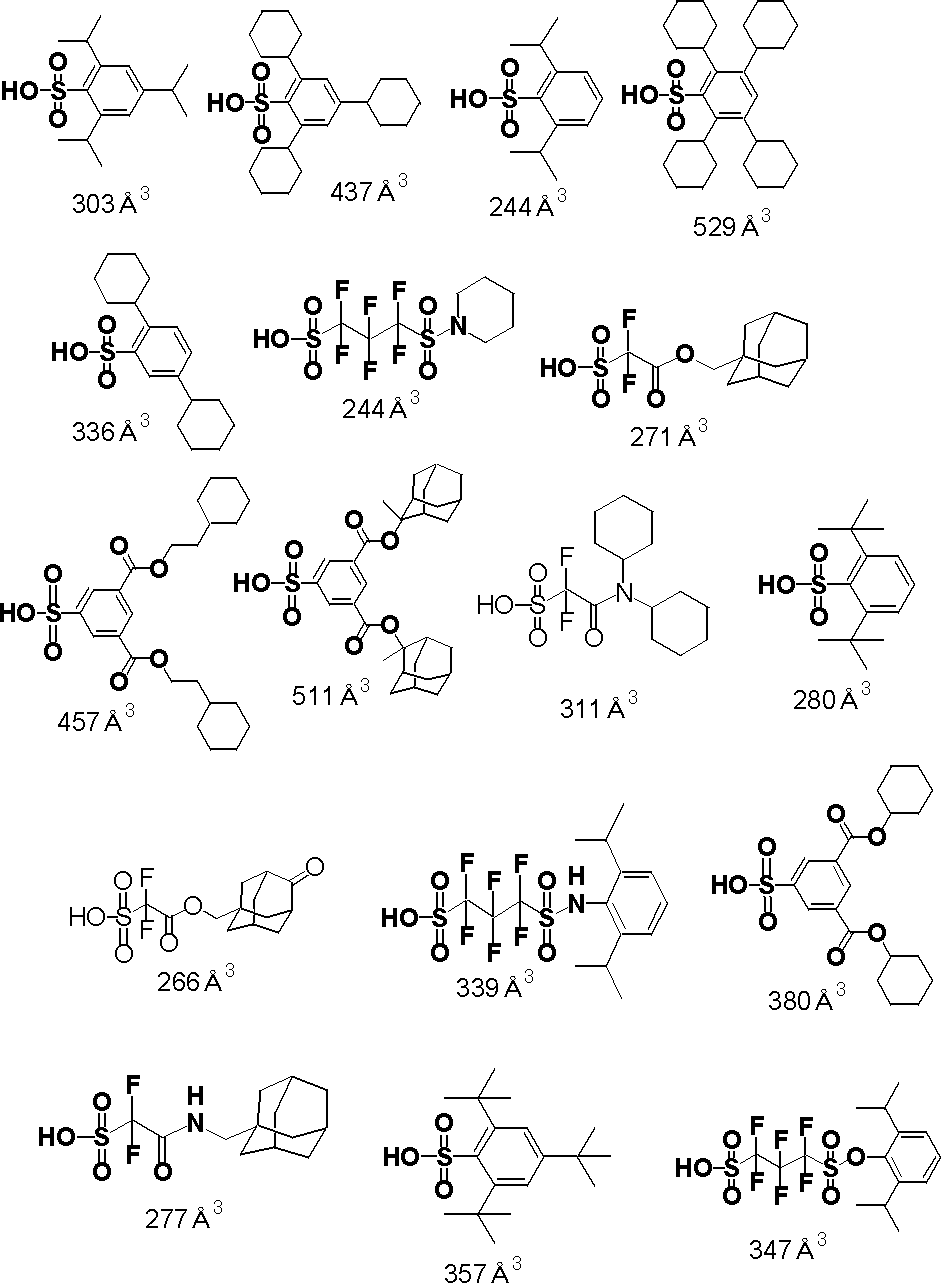
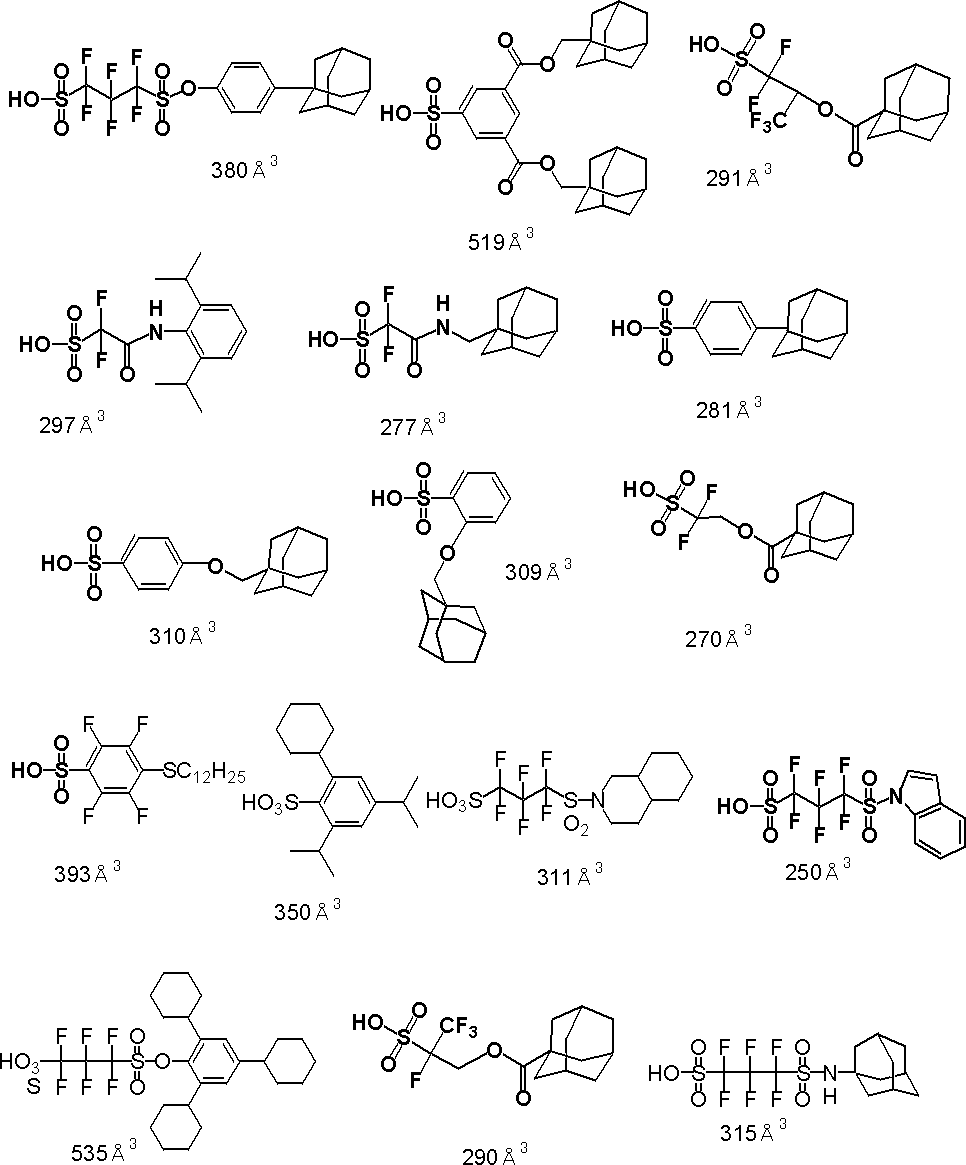
酸発生剤(A)は、1種類単独で又は2種類以上を組み合わせて使用することができる。
ネガ型の画像を形成する場合(すなわち、感活性光線性又は感放射線性組成物が、ネガ型の感活性光線性又は感放射線性組成物である場合)には、酸発生剤(A)の組成物中の含有率は、組成物の全固形分を基準として、0.1~25質量%が好ましく、より好ましくは0.5~20質量%、更に好ましくは1~18質量%である。ポジ型の画像を形成する場合(すなわち、感活性光線性又は感放射線性組成物が、ポジ型の感活性光線性又は感放射線性組成物である場合)には、酸発生剤(A)の組成物中の含有率は、組成物の全固形分を基準として、0.1~20質量%が好ましく、より好ましくは0.5~15質量%、更に好ましくは1~10質量%である。
酸発生剤(A)が重合体の一部に組み込まれた形態である場合、重合体は活性光線又は放射線の照射により酸を発生する部位を有する繰り返し単位を含有することが好ましい。活性光線又は放射線の照射により酸を発生する部位を有する繰り返し単位の具体例を以下に挙げる。
ネガ型の画像を形成する場合(すなわち、感活性光線性又は感放射線性組成物が、ネガ型の感活性光線性又は感放射線性組成物である場合)には、酸発生剤(A)の組成物中の含有率は、組成物の全固形分を基準として、0.1~25質量%が好ましく、より好ましくは0.5~20質量%、更に好ましくは1~18質量%である。ポジ型の画像を形成する場合(すなわち、感活性光線性又は感放射線性組成物が、ポジ型の感活性光線性又は感放射線性組成物である場合)には、酸発生剤(A)の組成物中の含有率は、組成物の全固形分を基準として、0.1~20質量%が好ましく、より好ましくは0.5~15質量%、更に好ましくは1~10質量%である。
酸発生剤(A)が重合体の一部に組み込まれた形態である場合、重合体は活性光線又は放射線の照射により酸を発生する部位を有する繰り返し単位を含有することが好ましい。活性光線又は放射線の照射により酸を発生する部位を有する繰り返し単位の具体例を以下に挙げる。
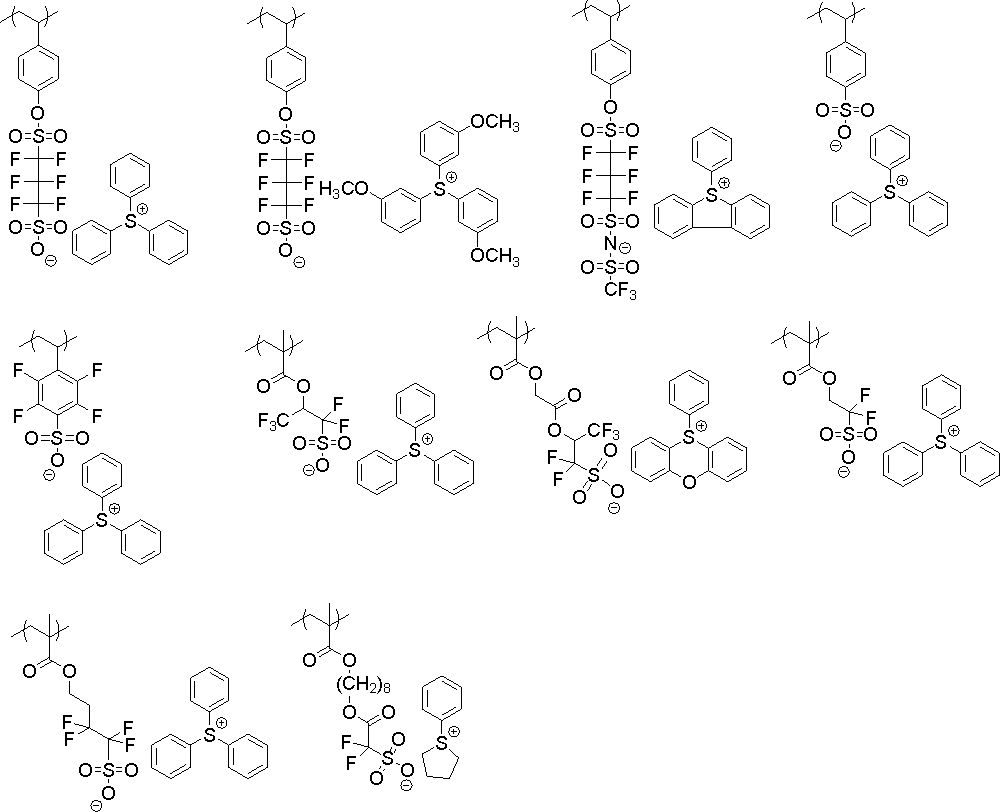
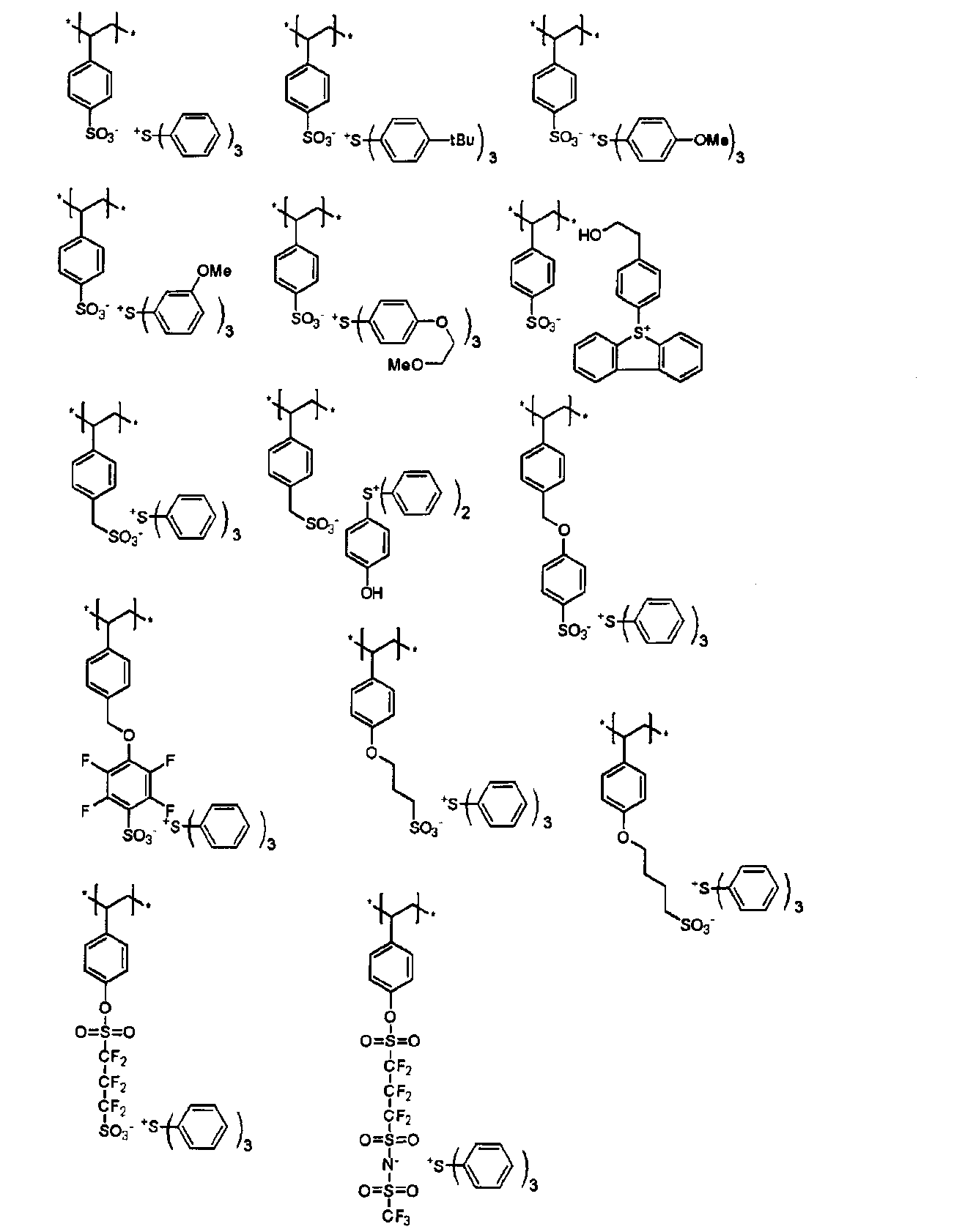


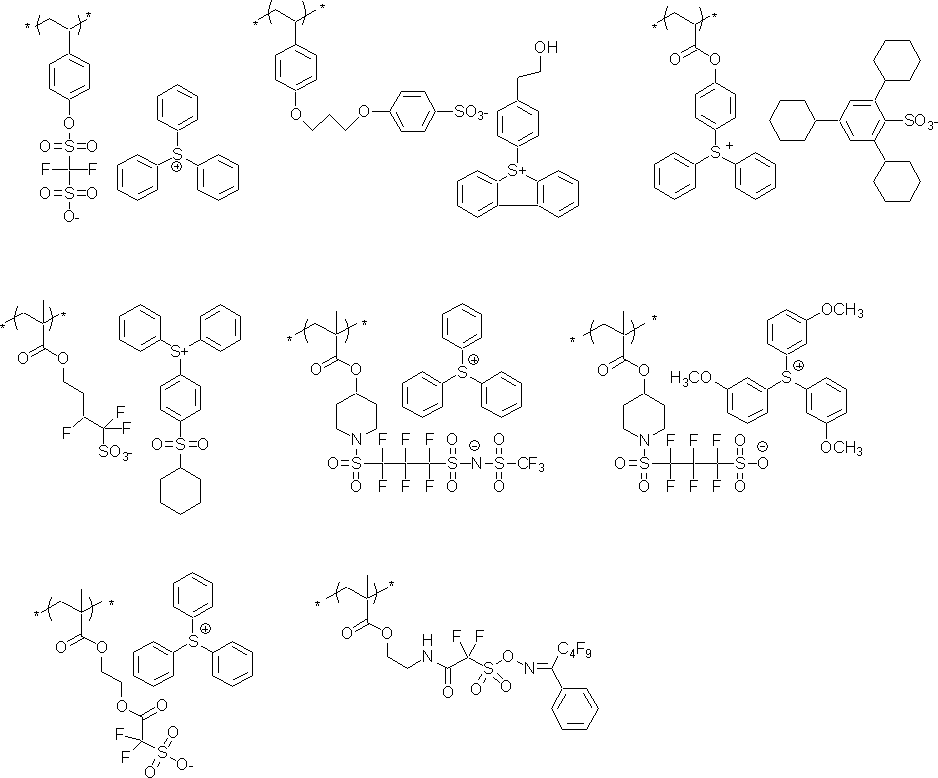
以上のように、本発明の感活性光線性又は感放射線性組成物は、活性光線又は放射線の照射により酸を発生する化合物(A)、酸の作用によりアルカリ現像液に対する溶解性が増大する化合物(P)、及び、上記(N-1)~(N-3)からなる群より選択される少なくとも1種の化合物(N)を含有するものであるが、その他の成分を含有することができる。以下、その他の成分について説明する。
本発明の感活性光線性又は感放射線性組成物は、上記低分子化合物〔N-C〕としての架橋剤を含有しない場合であっても、上記樹脂(A)を含有してもよい。樹脂(A)の詳細及び含有量等は、上記した通りである。
[4]レジスト溶剤(塗布溶媒)
組成物を調製する際に使用できる溶剤としては、各成分を溶解するものである限り特に限定されないが、例えば、アルキレングリコールモノアルキルエーテルカルボキシレート(プロピレングリコールモノメチルエーテルアセテート(PGMEA;別名1-メトキシ-2-アセトキシプロパン)など)、アルキレングリコールモノアルキルエーテル(プロピレングリコールモノメチルエーテル(PGME;1-メトキシ-2-プロパノール)など)、乳酸アルキルエステル(乳酸エチル、乳酸メチルなど)、環状ラクトン(γ-ブチロラクトンなど、好ましくは炭素数4~10)、鎖状又は環状のケトン(2-ヘプタノン、シクロヘキサノンなど、好ましくは炭素数4~10)、アルキレンカーボネート(エチレンカーボネート、プロピレンカーボネートなど)、カルボン酸アルキル(酢酸ブチルなどの酢酸アルキルが好ましい)、アルコキシ酢酸アルキル(エトキシプロピオン酸エチル)などが挙げられる。その他使用可能な溶媒として、例えば、米国特許出願公開第2008/0248425A1号明細書の[0244]以降に記載されている溶剤などが挙げられる。
組成物を調製する際に使用できる溶剤としては、各成分を溶解するものである限り特に限定されないが、例えば、アルキレングリコールモノアルキルエーテルカルボキシレート(プロピレングリコールモノメチルエーテルアセテート(PGMEA;別名1-メトキシ-2-アセトキシプロパン)など)、アルキレングリコールモノアルキルエーテル(プロピレングリコールモノメチルエーテル(PGME;1-メトキシ-2-プロパノール)など)、乳酸アルキルエステル(乳酸エチル、乳酸メチルなど)、環状ラクトン(γ-ブチロラクトンなど、好ましくは炭素数4~10)、鎖状又は環状のケトン(2-ヘプタノン、シクロヘキサノンなど、好ましくは炭素数4~10)、アルキレンカーボネート(エチレンカーボネート、プロピレンカーボネートなど)、カルボン酸アルキル(酢酸ブチルなどの酢酸アルキルが好ましい)、アルコキシ酢酸アルキル(エトキシプロピオン酸エチル)などが挙げられる。その他使用可能な溶媒として、例えば、米国特許出願公開第2008/0248425A1号明細書の[0244]以降に記載されている溶剤などが挙げられる。
上記のうち、アルキレングリコールモノアルキルエーテルカルボキシレート及びアルキレングリコールモノアルキルエーテルが好ましい。
これら溶媒は、単独で用いても2種以上を混合して用いてもよい。2種以上を混合する場合、水酸基を有する溶剤と水酸基を有しない溶剤とを混合することが好ましい。水酸基を有する溶剤と水酸基を有しない溶剤との質量比は、1/99~99/1、好ましくは10/90~90/10、更に好ましくは20/80~60/40である。
水酸基を有する溶剤としてはアルキレングリコールモノアルキルエーテルが好ましく、水酸基を有しない溶剤としてはアルキレングリコールモノアルキルエーテルカルボキシレートが好ましい。
水酸基を有する溶剤としてはアルキレングリコールモノアルキルエーテルが好ましく、水酸基を有しない溶剤としてはアルキレングリコールモノアルキルエーテルカルボキシレートが好ましい。
[5]塩基性化合物
本発明における感活性光線性又は感放射線性組成物は、塩基性化合物を含有することが好ましい。
感活性光線性又は感放射線性組成物は、塩基性化合物として、活性光線又は放射線の照射により塩基性が低下する、塩基性化合物又はアンモニウム塩化合物(C)(以下、「化合物(C)」ともいう)を含有することが好ましい。
本発明における感活性光線性又は感放射線性組成物は、塩基性化合物を含有することが好ましい。
感活性光線性又は感放射線性組成物は、塩基性化合物として、活性光線又は放射線の照射により塩基性が低下する、塩基性化合物又はアンモニウム塩化合物(C)(以下、「化合物(C)」ともいう)を含有することが好ましい。
化合物(C)は、塩基性官能基又はアンモニウム基と、活性光線又は放射線の照射により酸性官能基を発生する基とを有する化合物(C-1)であることが好ましい。すなわち、化合物(C)は、塩基性官能基と活性光線若しくは放射線の照射により酸性官能基を発生する基とを有する塩基性化合物、又は、アンモニウム基と活性光線若しくは放射線の照射により酸性官能基を発生する基とを有するアンモニウム塩化合物であることが好ましい。化合物(C)は、カチオン上に窒素原子を有するスルホニウム塩であることがより好ましい。
化合物(C)の例として、特に好ましいものを以下に例示する。また、そのほか、US2012/0156617A号明細書の5ページ以降、(A-1)~(A-23)として例示されている化合物、US2006/0264528A号明細書の9ページ以降、(A-1)~(A-44)として挙げられている化合物なども好ましく挙げられる。
化合物(C)の例として、特に好ましいものを以下に例示する。また、そのほか、US2012/0156617A号明細書の5ページ以降、(A-1)~(A-23)として例示されている化合物、US2006/0264528A号明細書の9ページ以降、(A-1)~(A-44)として挙げられている化合物なども好ましく挙げられる。

これらの化合物は、特開2006-330098号公報の合成例などに準じて合成することができる。
化合物(C)の分子量は、500~1000であることが好ましい。
化合物(C)の分子量は、500~1000であることが好ましい。
本発明における感活性光線性又は感放射線性組成物は化合物(C)を含有してもしていなくてもよいが、含有する場合、化合物(C)の含有量は、感活性光線性又は感放射線性組成物の固形分を基準として、0.1~20質量%が好ましく、より好ましくは0.1~10質量%である。
本発明における感活性光線性又は感放射線性組成物は、露光から加熱までの経時による性能変化を低減するために、塩基性化合物として、前記化合物(C)とは異なる、塩基性化合物(N’)を含有していてもよい。
塩基性化合物(N’)としては、好ましくは、下記式(A’)~(E’)で示される構造を有する化合物を挙げることができる。
塩基性化合物(N’)としては、好ましくは、下記式(A’)~(E’)で示される構造を有する化合物を挙げることができる。

一般式(A’)と(E’)において、
RA200、RA201及びRA202は、同一でも異なってもよく、水素原子、アルキル基(好ましくは炭素数1~20)、シクロアルキル基(好ましくは炭素数3~20)又はアリール基(炭素数6~20)を表し、ここで、RA201とRA202は、互いに結合して環を形成してもよい。RA203、RA204、RA205及びRA206は、同一でも異なってもよく、アルキル基(好ましくは炭素数1~20)を表す。
上記アルキル基は、置換基を有していてもよく、置換基を有するアルキル基としては、炭素数1~20のアミノアルキル基、炭素数1~20のヒドロキシアルキル基又は炭素数1~20のシアノアルキル基が好ましい。
これら一般式(A’)と(E’)中のアルキル基は、無置換であることがより好ましい。
RA200、RA201及びRA202は、同一でも異なってもよく、水素原子、アルキル基(好ましくは炭素数1~20)、シクロアルキル基(好ましくは炭素数3~20)又はアリール基(炭素数6~20)を表し、ここで、RA201とRA202は、互いに結合して環を形成してもよい。RA203、RA204、RA205及びRA206は、同一でも異なってもよく、アルキル基(好ましくは炭素数1~20)を表す。
上記アルキル基は、置換基を有していてもよく、置換基を有するアルキル基としては、炭素数1~20のアミノアルキル基、炭素数1~20のヒドロキシアルキル基又は炭素数1~20のシアノアルキル基が好ましい。
これら一般式(A’)と(E’)中のアルキル基は、無置換であることがより好ましい。
塩基性化合物(N’)の好ましい具体例としては、グアニジン、アミノピロリジン、ピラゾール、ピラゾリン、ピペラジン、アミノモルホリン、アミノアルキルモルフォリン、ピペリジン等を挙げることができ、更に好ましい具体例としては、イミダゾール構造、ジアザビシクロ構造、オニウムヒドロキシド構造、オニウムカルボキシレート構造、トリアルキルアミン構造、アニリン構造又はピリジン構造を有する化合物、水酸基及び/又はエーテル結合を有するアルキルアミン誘導体、水酸基及び/又はエーテル結合を有するアニリン誘導体等を挙げることができる。
イミダゾール構造を有する化合物としては、イミダゾール、2、4、5-トリフェニルイミダゾール、ベンズイミダゾール等が挙げられる。ジアザビシクロ構造を有する化合物としては、1、4-ジアザビシクロ[2,2,2]オクタン、1、5-ジアザビシクロ[4,3,0]ノナ-5-エン、1、8-ジアザビシクロ[5,4,0]ウンデカー7-エン等が挙げられる。オニウムヒドロキシド構造を有する化合物としては、トリアリールスルホニウムヒドロキシド、フェナシルスルホニウムヒドロキシド、2-オキソアルキル基を有するスルホニウムヒドロキシド、具体的にはトリフェニルスルホニウムヒドロキシド、トリス(t-ブチルフェニル)スルホニウムヒドロキシド、ビス(t-ブチルフェニル)ヨードニウムヒドロキシド、フェナシルチオフェニウムヒドロキシド、2-オキソプロピルチオフェニウムヒドロキシド等が挙げられる。オニウムカルボキシレート構造を有する化合物としては、オニウムヒドロキシド構造を有する化合物のアニオン部がカルボキシレートになったものであり、例えばアセテート、アダマンタン-1-カルボキシレート、パーフロロアルキルカルボキシレート等が挙げられる。トリアルキルアミン構造を有する化合物としては、トリ(n-ブチル)アミン、トリ(n-オクチル)アミン等を挙げることができる。アニリン構造を有する化合物としては、2,6-ジイソプロピルアニリン、N,N-ジメチルアニリン、N,N-ジブチルアニリン、N,N-ジヘキシルアニリン等を挙げることができる。水酸基及び/又はエーテル結合を有するアルキルアミン誘導体としては、エタノールアミン、ジエタノールアミン、トリエタノールアミン、トリス(メトキシエトキシエチル)アミン等を挙げることができる。水酸基及び/又はエーテル結合を有するアニリン誘導体としては、N,N-ビス(ヒドロキシエチル)アニリン等を挙げることができる。
好ましい塩基性化合物として、更に、フェノキシ基を有するアミン化合物、フェノキシ基を有するアンモニウム塩化合物、スルホン酸エステル基を有するアミン化合物及びスルホン酸エステル基を有するアンモニウム塩化合物を挙げることができる。この具体例としては、米国特許出願公開2007/0224539号明細書の[0066]に例示されている化合物(C1-1)~(C3-3)が挙げられるが、これらに限定されるものではない。
また、塩基性化合物の1種として、酸の作用により脱離する基を有する含窒素有機化合物を用いることもできる。この化合物の例として、例えば、化合物の具体例を以下に示す。
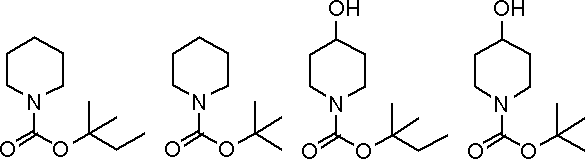
上記化合物は、例えば、特開2009-199021号公報に記載の方法に準じて合成することができる。
また、塩基性化合物(N’)としては、アミンオキシド構造を有する化合物も用いることもできる。この化合物の具体例としては、トリエチルアミンピリジン N-オキシド、トリブチルアミン N-オキシド、トリエタノールアミン N-オキシド、トリス(メトキシエチル)アミン N-オキシド、トリス(2-(メトキシメトキシ)エチル)アミン=オキシド、2,2’,2”-ニトリロトリエチルプロピオネート N-オキシド、N-2-(2-メトキシエトキシ)メトキシエチルモルホリン N-オキシド、その他特開2008-102383に例示されたアミンオキシド化合物が使用可能である。
塩基性化合物(N’)の分子量は、250~2000であることが好ましく、更に好ましくは400~1000である。LWRのさらなる低減及び局所的なパターン寸法の均一性の観点からは、塩基性化合物の分子量は、400以上であることが好ましく、500以上であることがより好ましく、600以上であることが更に好ましい。
これらの塩基性化合物(N’)は、前記化合物(C)と併用していてもよいし、単独であるいは2種以上一緒に用いられる。
本発明における感活性光線性又は感放射線性組成物は塩基性化合物(N’)を含有してもしていなくてもよいが、含有する場合、塩基性化合物(N’)の使用量は、感活性光線性又は感放射線性組成物の固形分を基準として、通常、0.001~10質量%、好ましくは0.01~5質量%である。
また、本発明における感活性光線性又は感放射線性組成物は、特開2012-189977号公報の式(I)に含まれる化合物、特開2013-6827号公報の式(I)で表される化合物、特開2013-8020号公報の式(I)で表される化合物、特開2012-252124号公報の式(I)で表される化合物などのような、1分子内にオニウム塩構造と酸アニオン構造の両方を有する化合物(以下、ベタイン化合物ともいう)も好ましく用いることができる。このオニウム塩構造としては、スルホニウム、ヨードニウム、アンモニウム構造が挙げられ、スルホニウム又はヨードニウム塩構造であることが好ましい。また、酸アニオン構造としては、スルホン酸アニオン又はカルボン酸アニオンが好ましい。この化合物例としては、例えば以下が挙げられる。
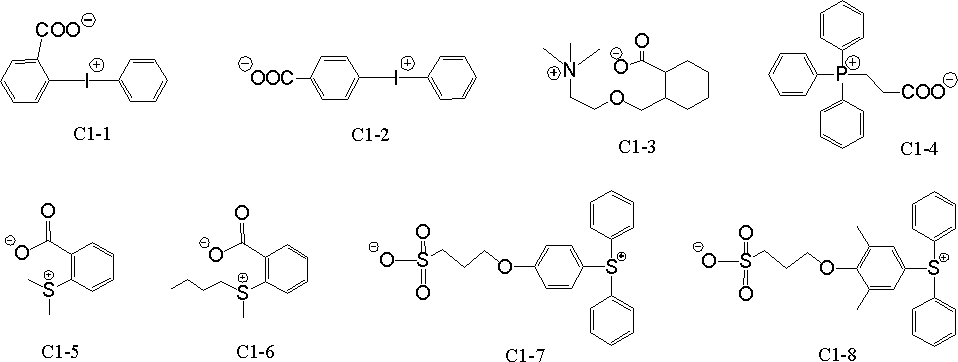
[6]酸の作用により分解して酸を発生する化合物
本発明の感活性光線性又は感放射線性組成物は、更に、酸の作用により分解して酸を発生する化合物を1種又は2種以上含んでいてもよい。上記酸の作用により分解して酸を発生する化合物が発生する酸は、スルホン酸、メチド酸又はイミド酸であることが好ましい。
本発明の感活性光線性又は感放射線性組成物は、更に、酸の作用により分解して酸を発生する化合物を1種又は2種以上含んでいてもよい。上記酸の作用により分解して酸を発生する化合物が発生する酸は、スルホン酸、メチド酸又はイミド酸であることが好ましい。
以下に本発明に用いることができる酸の作用により分解して酸を発生する化合物の例を示すが、これらに限定されるものではない。
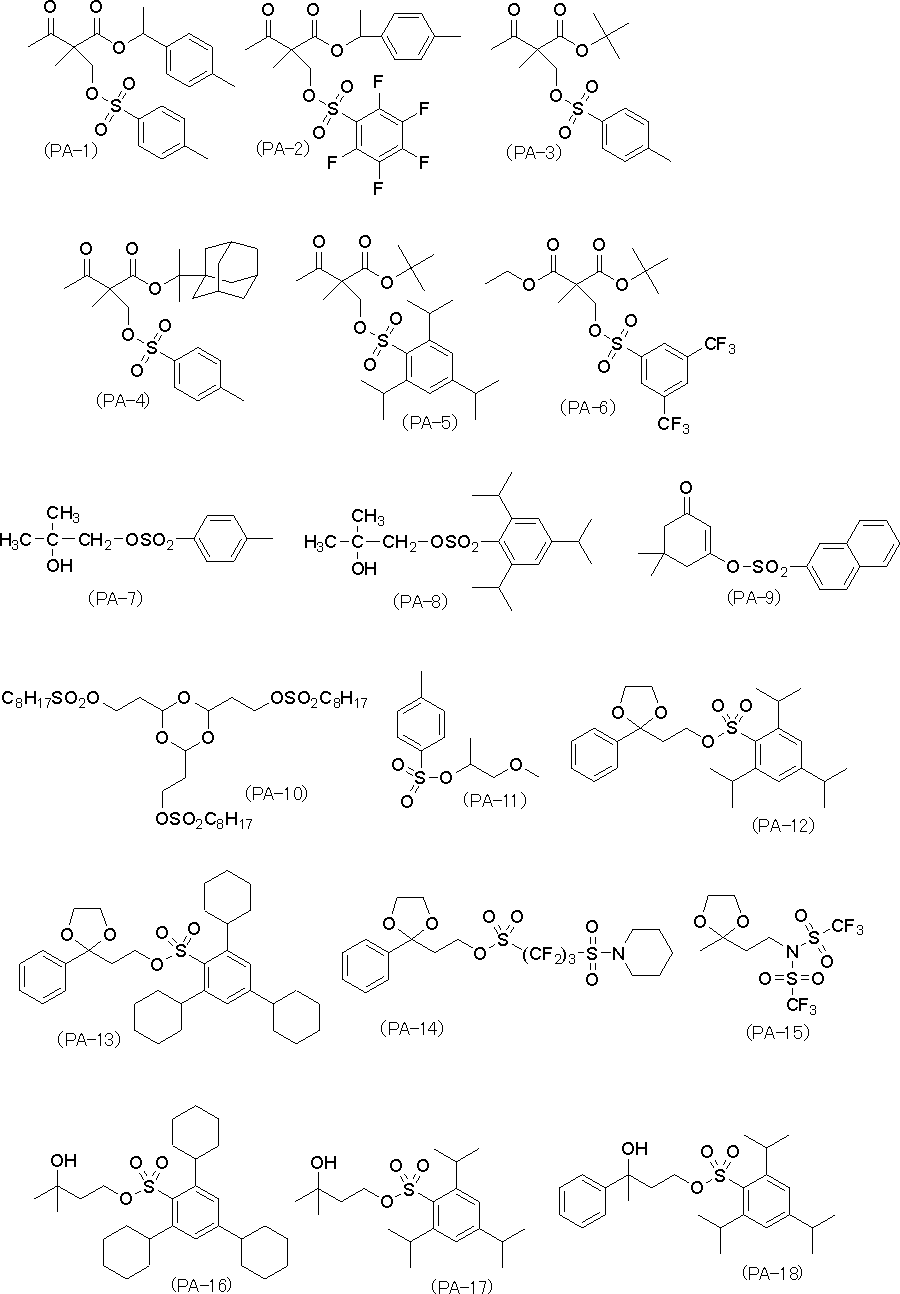
前記酸の作用により分解して酸を発生する化合物は、1種単独で又は2種以上を組合せて使用することができる。
なお、酸の作用により分解して酸を発生する化合物の含有量は、前記感活性光線性又は感放射線性組成物の全固形分を基準として、0.1~40質量%であることが好ましく、0.5~30質量%であることがより好ましく、1.0~20質量%であることが更に好ましい。
なお、酸の作用により分解して酸を発生する化合物の含有量は、前記感活性光線性又は感放射線性組成物の全固形分を基準として、0.1~40質量%であることが好ましく、0.5~30質量%であることがより好ましく、1.0~20質量%であることが更に好ましい。
[7]疎水性樹脂(HR)
本発明の感活性光線性又は感放射線性組成物は、上記樹脂〔P-A〕、上記樹脂〔N-A〕及び上記樹脂(A)とは別に疎水性樹脂(HR)を有していてもよい。
上記疎水性樹脂(HR)は、膜表面に偏在するために、フッ素原子を有する基、珪素原子を有する基、又は炭素数5以上の炭化水素基を含有することが好ましい。これらの基は樹脂の主鎖中に有していても、側鎖に置換していてもよい。疎水性樹脂がレジスト膜表面に偏在することにより、表面接触角の制御、液浸液のレジスト膜への浸透抑制、アウトガス抑制などが可能となる。以下に疎水性樹脂(HR)の具体例を示す。
本発明の感活性光線性又は感放射線性組成物は、上記樹脂〔P-A〕、上記樹脂〔N-A〕及び上記樹脂(A)とは別に疎水性樹脂(HR)を有していてもよい。
上記疎水性樹脂(HR)は、膜表面に偏在するために、フッ素原子を有する基、珪素原子を有する基、又は炭素数5以上の炭化水素基を含有することが好ましい。これらの基は樹脂の主鎖中に有していても、側鎖に置換していてもよい。疎水性樹脂がレジスト膜表面に偏在することにより、表面接触角の制御、液浸液のレジスト膜への浸透抑制、アウトガス抑制などが可能となる。以下に疎水性樹脂(HR)の具体例を示す。

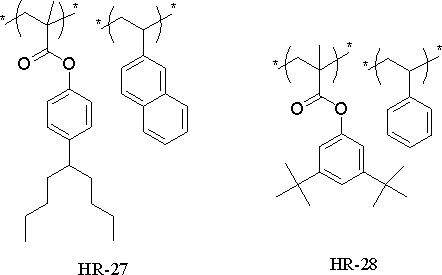
なお、疎水性樹脂としてはこの他にも特開2011-248019号公報、特開2010-175859号公報、特開2012-032544号公報記載のものも好ましく用いることができる。
[8]界面活性剤
本発明に係る組成物は、界面活性剤を更に含んでいてもよい。界面活性剤を含有することにより、波長が250nm以下、特には220nm以下の露光光源を使用した場合に、良好な感度及び解像度で、密着性及び現像欠陥のより少ないパターンを形成することが可能となる。
界面活性剤としては、フッ素系及び/又はシリコン系界面活性剤を用いることが特に好ましい。
本発明に係る組成物は、界面活性剤を更に含んでいてもよい。界面活性剤を含有することにより、波長が250nm以下、特には220nm以下の露光光源を使用した場合に、良好な感度及び解像度で、密着性及び現像欠陥のより少ないパターンを形成することが可能となる。
界面活性剤としては、フッ素系及び/又はシリコン系界面活性剤を用いることが特に好ましい。
フッ素系及び/又はシリコン系界面活性剤としては、例えば、米国特許出願公開第2008/0248425号明細書の[0276]に記載の界面活性剤が挙げられる。また、エフトップEF301若しくはEF303(新秋田化成(株)製);フロラードFC430、431若しくは4430(住友スリーエム(株)製);メガファックF171、F173、F176、F189、F113、F110、F177、F120若しくはR08(DIC(株)製);サーフロンS-382、SC101、102、103、104、105若しくは106(旭硝子(株)製);トロイゾルS-366(トロイケミカル(株)製);GF-300若しくはGF-150(東亜合成化学(株)製)、サーフロンS-393(セイミケミカル(株)製);エフトップEF121、EF122A、EF122B、RF122C、EF125M、EF135M、EF351、EF352、EF801、EF802若しくはEF601((株)ジェムコ製);PF636、PF656、PF6320若しくはPF6520(OMNOVA社製);又は、FTX-204G、208G、218G、230G、204D、208D、212D、218D若しくは222D((株)ネオス製)を用いてもよい。なお、ポリシロキサンポリマーKP-341(信越化学工業(株)製)も、シリコン系界面活性剤として用いることができる。
また、界面活性剤は、上記に示すような公知のものの他に、テロメリゼーション法(テロマー法ともいわれる)又はオリゴメリゼーション法(オリゴマー法ともいわれる)により製造されたフルオロ脂肪族化合物を用いて合成してもよい。具体的には、このフルオロ脂肪族化合物から導かれたフルオロ脂肪族基を備えた重合体を、界面活性剤として用いてもよい。このフルオロ脂肪族化合物は、例えば、特開2002-90991号公報に記載された方法によって合成することができる。
フルオロ脂肪族基を有する重合体としては、フルオロ脂肪族基を有するモノマーと(ポリ(オキシアルキレン))アクリレート若しくはメタクリレート及び/又は(ポリ(オキシアルキレン))メタクリレートとの共重合体が好ましく、不規則に分布していても、ブロック共重合していてもよい。
ポリ(オキシアルキレン)基としては、例えば、ポリ(オキシエチレン)基、ポリ(オキシプロピレン)基及びポリ(オキシブチレン)基が挙げられる。また、ポリ(オキシエチレンとオキシプロピレンとオキシエチレンとのブロック連結体)及びポリ(オキシエチレンとオキシプロピレンとのブロック連結体)等の、同じ鎖内に異なる鎖長のアルキレンを有するユニットであってもよい。
ポリ(オキシアルキレン)基としては、例えば、ポリ(オキシエチレン)基、ポリ(オキシプロピレン)基及びポリ(オキシブチレン)基が挙げられる。また、ポリ(オキシエチレンとオキシプロピレンとオキシエチレンとのブロック連結体)及びポリ(オキシエチレンとオキシプロピレンとのブロック連結体)等の、同じ鎖内に異なる鎖長のアルキレンを有するユニットであってもよい。
更に、フルオロ脂肪族基を有するモノマーと(ポリ(オキシアルキレン))アクリレート若しくはメタクリレートとの共重合体は、異なる2種以上のフルオロ脂肪族基を有するモノマー及び異なる2種以上の(ポリ(オキシアルキレン))アクリレート若しくはメタクリレート等を同時に共重合してなる3元系以上の共重合体であってもよい。
例えば、市販の界面活性剤として、メガファックF178、F-470、F-473、F-475、F-476及びF-472(DIC(株)製)が挙げられる。更に、C6F13基を有するアクリレート若しくはメタクリレートと(ポリ(オキシアルキレン))アクリレート若しくはメタクリレートとの共重合体、C6F13基を有するアクリレート若しくはメタクリレートと(ポリ(オキシエチレン))アクリレート若しくはメタクリレートと(ポリ(オキシプロピレン))アクリレート若しくはメタクリレートとの共重合体、C8F17基を有するアクリレート若しくはメタクリレートと(ポリ(オキシアルキレン))アクリレート若しくはメタクリレートとの共重合体、及び、C8F17基を有するアクリレート若しくはメタクリレートと(ポリ(オキシエチレン))アクリレート若しくはメタクリレートと(ポリ(オキシプロピレン))アクリレート若しくはメタクリレートとの共重合体等が挙げられる。
例えば、市販の界面活性剤として、メガファックF178、F-470、F-473、F-475、F-476及びF-472(DIC(株)製)が挙げられる。更に、C6F13基を有するアクリレート若しくはメタクリレートと(ポリ(オキシアルキレン))アクリレート若しくはメタクリレートとの共重合体、C6F13基を有するアクリレート若しくはメタクリレートと(ポリ(オキシエチレン))アクリレート若しくはメタクリレートと(ポリ(オキシプロピレン))アクリレート若しくはメタクリレートとの共重合体、C8F17基を有するアクリレート若しくはメタクリレートと(ポリ(オキシアルキレン))アクリレート若しくはメタクリレートとの共重合体、及び、C8F17基を有するアクリレート若しくはメタクリレートと(ポリ(オキシエチレン))アクリレート若しくはメタクリレートと(ポリ(オキシプロピレン))アクリレート若しくはメタクリレートとの共重合体等が挙げられる。
また、米国特許出願公開第2008/0248425号明細書の[0280]に記載されているフッ素系及び/又はシリコン系以外の界面活性剤を使用してもよい。
これら界面活性剤は、1種類を単独で用いてもよく、2種類以上を組み合わせて用いてもよい。
本発明に係る組成物が界面活性剤を含んでいる場合、その含有量は、組成物の全固形分を基準として、好ましくは0~2質量%、より好ましくは0.0001~2質量%、更に好ましくは0.0005~1質量%である。
これら界面活性剤は、1種類を単独で用いてもよく、2種類以上を組み合わせて用いてもよい。
本発明に係る組成物が界面活性剤を含んでいる場合、その含有量は、組成物の全固形分を基準として、好ましくは0~2質量%、より好ましくは0.0001~2質量%、更に好ましくは0.0005~1質量%である。
[9]その他の添加剤
本発明の組成物は、上記に説明した成分以外にも、カルボン酸、カルボン酸オニウム塩、Proceeding of SPIE, 2724,355 (1996)等に記載の分子量3000以下の溶解阻止化合物、染料、可塑剤、光増感剤、光吸収剤、酸化防止剤などを適宜含有することができる。
特にカルボン酸は、性能向上のために好適に用いられる。カルボン酸としては、安息香酸、ナフトエ酸などの、芳香族カルボン酸が好ましい。
カルボン酸の含有量は、組成物の全固形分濃度中、0.01~10質量%が好ましく、より好ましくは0.01~5質量%、更に好ましくは0.01~3質量%である。
本発明の組成物は、上記に説明した成分以外にも、カルボン酸、カルボン酸オニウム塩、Proceeding of SPIE, 2724,355 (1996)等に記載の分子量3000以下の溶解阻止化合物、染料、可塑剤、光増感剤、光吸収剤、酸化防止剤などを適宜含有することができる。
特にカルボン酸は、性能向上のために好適に用いられる。カルボン酸としては、安息香酸、ナフトエ酸などの、芳香族カルボン酸が好ましい。
カルボン酸の含有量は、組成物の全固形分濃度中、0.01~10質量%が好ましく、より好ましくは0.01~5質量%、更に好ましくは0.01~3質量%である。
本発明における感活性光線性又は感放射線性組成物は、解像力向上の観点から、膜厚10~250nmで使用されることが好ましく、より好ましくは、膜厚20~200nmで使用されることが好ましく、更に好ましくは30~100nmで使用されることが好ましい。組成物中の固形分濃度を適切な範囲に設定して適度な粘度をもたせ、塗布性、製膜性を向上させることにより、このような膜厚とすることができる。
本発明における感活性光線性又は感放射線性組成物の固形分濃度は、通常1.0~10質量%であり、好ましくは、2.0~5.7質量%、更に好ましくは2.0~5.3質量%である。固形分濃度を前記範囲とすることで、レジスト溶液を基板上に均一に塗布することができ、更にはラインウィズスラフネスに優れたレジストパターンを形成することが可能になる。その理由は明らかではないが、恐らく、固形分濃度を10質量%以下、好ましくは5.7質量%以下とすることで、レジスト溶液中での素材、特には光酸発生剤の凝集が抑制され、その結果として、均一なレジスト膜が形成できたものと考えられる。
固形分濃度とは、感活性光線性又は感放射線性組成物の総重量に対する、溶剤を除く他のレジスト成分の重量の重量百分率である。
本発明における感活性光線性又は感放射線性組成物の固形分濃度は、通常1.0~10質量%であり、好ましくは、2.0~5.7質量%、更に好ましくは2.0~5.3質量%である。固形分濃度を前記範囲とすることで、レジスト溶液を基板上に均一に塗布することができ、更にはラインウィズスラフネスに優れたレジストパターンを形成することが可能になる。その理由は明らかではないが、恐らく、固形分濃度を10質量%以下、好ましくは5.7質量%以下とすることで、レジスト溶液中での素材、特には光酸発生剤の凝集が抑制され、その結果として、均一なレジスト膜が形成できたものと考えられる。
固形分濃度とは、感活性光線性又は感放射線性組成物の総重量に対する、溶剤を除く他のレジスト成分の重量の重量百分率である。
本発明における感活性光線性又は感放射線性組成物は、上記の成分を所定の有機溶剤、好ましくは前記混合溶剤に溶解し、フィルター濾過した後、所定の支持体(基板)上に塗布して用いる。フィルター濾過に用いるフィルターのポアサイズは0.1μm以下、より好ましくは0.05μm以下、更に好ましくは0.03μm以下のポリテトラフロロエチレン製、ポリエチレン製、ナイロン製のものが好ましい。フィルター濾過においては、例えば特開2002-62667号公報のように、循環的な濾過を行ったり、複数種類のフィルターを直列又は並列に接続して濾過を行ったりしてもよい。また、組成物を複数回濾過してもよい。更に、フィルター濾過の前後で、組成物に対して脱気処理などを行ってもよい。
[10]パターン形成方法
本発明は、上記した本発明の組成物を用いて形成されたレジスト膜にも関する。
また、本発明のパターン形成方法は、
(ア)感活性光線性又は感放射線性組成物によりレジスト膜を形成する工程、
(イ)該膜を露光する工程、及び
(ウ)該露光された膜を、アルカリ現像液を用いて現像する工程
を少なくとも有する。
上記工程(イ)における露光は、電子線又はEUV光(極紫外線)によって露光する工程であることが好ましい。
また上記工程(イ)における露光が、液浸露光であってもよい。
本発明のパターン形成方法は、(イ)露光工程の後に、(エ)加熱工程を有することが好ましい。
本発明のパターン形成方法は、(オ)有機溶剤を含む現像液を用いて現像する工程を更に有していてもよい。
本発明のパターン形成方法は、(イ)露光工程を、複数回有することができる。
本発明のパターン形成方法は、(オ)加熱工程を、複数回有することができる。
本発明のパターン形成方法は、レジスト膜上にトップコート層を形成する工程を有しても良い。トップコート層形成用組成物としては、公知の組成物を用いることができる。
本発明は、上記した本発明の組成物を用いて形成されたレジスト膜にも関する。
また、本発明のパターン形成方法は、
(ア)感活性光線性又は感放射線性組成物によりレジスト膜を形成する工程、
(イ)該膜を露光する工程、及び
(ウ)該露光された膜を、アルカリ現像液を用いて現像する工程
を少なくとも有する。
上記工程(イ)における露光は、電子線又はEUV光(極紫外線)によって露光する工程であることが好ましい。
また上記工程(イ)における露光が、液浸露光であってもよい。
本発明のパターン形成方法は、(イ)露光工程の後に、(エ)加熱工程を有することが好ましい。
本発明のパターン形成方法は、(オ)有機溶剤を含む現像液を用いて現像する工程を更に有していてもよい。
本発明のパターン形成方法は、(イ)露光工程を、複数回有することができる。
本発明のパターン形成方法は、(オ)加熱工程を、複数回有することができる。
本発明のパターン形成方法は、レジスト膜上にトップコート層を形成する工程を有しても良い。トップコート層形成用組成物としては、公知の組成物を用いることができる。
レジスト膜は、上記した本発明の感活性光線性又は感放射線性組成物から形成されるものであり、より具体的には、基板上に形成されることが好ましい。本発明のパターン形成方法に於いて、感活性光線性又は感放射線性組成物による膜を基板上に形成する工程、膜を露光する工程、及び現像工程は、一般的に知られている方法により行うことができる。
この組成物は、例えば、精密集積回路素子やインプリント用モールドなどの製造等に使用される基板(例:シリコン/二酸化シリコン被覆、窒化シリコン及びクロム蒸着された石英基板など)上に、スピナー及びコーター等を用いて塗布される。その後、これを乾燥させて、感活性光線性又は感放射線性の膜を形成することができる。
レジスト膜を形成する前に、基板上に予め反射防止膜を塗設してもよい。
反射防止膜としては、チタン、二酸化チタン、窒化チタン、酸化クロム、カーボン、アモルファスシリコン等の無機膜型と、吸光剤とポリマー材料からなる有機膜型のいずれも用いることができる。また、有機反射防止膜として、ブリューワーサイエンス社製のDUV30シリーズや、DUV-40シリーズ、シプレー社製のAR-2、AR-3、AR-5等の市販の有機反射防止膜を使用することもできる。
反射防止膜としては、チタン、二酸化チタン、窒化チタン、酸化クロム、カーボン、アモルファスシリコン等の無機膜型と、吸光剤とポリマー材料からなる有機膜型のいずれも用いることができる。また、有機反射防止膜として、ブリューワーサイエンス社製のDUV30シリーズや、DUV-40シリーズ、シプレー社製のAR-2、AR-3、AR-5等の市販の有機反射防止膜を使用することもできる。
製膜後、露光工程の前に、前加熱工程(PB;Prebake)を含むことも好ましい。また、露光工程の後かつ現像工程の前に、露光後加熱工程(PEB;Post Exposure Bake)を含むことも好ましい。
加熱温度はPB、PEB共に70~120℃で行うことが好ましく、80~110℃で行うことがより好ましい。
加熱時間は30~300秒が好ましく、30~180秒がより好ましく、30~90秒が更に好ましい。
加熱は通常の露光・現像機に備わっている手段で行うことができ、ホットプレート等を用いて行っても良い。
ベークにより露光部の反応が促進され、感度やパターンプロファイルが改善する。
またリンス工程の後に加熱工程(Post Bake)を含むことも好ましい。ベークによりパターン間及びパターン内部に残留した現像液及びリンス液が除去される。
加熱温度はPB、PEB共に70~120℃で行うことが好ましく、80~110℃で行うことがより好ましい。
加熱時間は30~300秒が好ましく、30~180秒がより好ましく、30~90秒が更に好ましい。
加熱は通常の露光・現像機に備わっている手段で行うことができ、ホットプレート等を用いて行っても良い。
ベークにより露光部の反応が促進され、感度やパターンプロファイルが改善する。
またリンス工程の後に加熱工程(Post Bake)を含むことも好ましい。ベークによりパターン間及びパターン内部に残留した現像液及びリンス液が除去される。
活性光線又は放射線としては、例えば、赤外光、可視光、紫外光、遠紫外光、X線、及び電子線が挙げられる。
本発明において膜を形成する基板は特に限定されるものではなく、シリコン、SiN、SiO2やSiN等の無機基板、SOG等の塗布系無機基板等、IC等の半導体製造工程、液晶、サーマルヘッド等の回路基板の製造工程、更にはその他のフォトファブリケーションのリソグラフィー工程で一般的に用いられる基板を用いることができる。更に、必要に応じて有機反射防止膜を膜と基板の間に形成させても良い。
アルカリ現像液としては、例えば、水酸化ナトリウム、水酸化カリウム、炭酸ナトリウム、ケイ酸ナトリウム、メタケイ酸ナトリウム、アンモニア水等の無機アルカリ類、エチルアミン、n-プロピルアミン等の第一アミン類、ジエチルアミン、ジ-n-ブチルアミン等の第二アミン類、トリエチルアミン、メチルジエチルアミン等の第三アミン類、ジメチルエタノールアミン、トリエタノールアミン等のアルコールアミン類、テトラメチルアンモニウムヒドロキシド、テトラエチルアンモニウムヒドロキシド、テトラプロピルアンモニウムヒドドキシド、テトラブチルアンモニウムヒドロキシド、テトラペンチルアンモニウムヒドロキシド、テトラヘキシルアンモニウムヒドロキシド、テトラオクチルアンモニウムヒドロキシド、エチルトリメチルアンモニウムヒドロキシド、ブチルトリメチルアンモニウムヒドロキシド、メチルトリアミルアンモニウムヒドロキシド、ジブチルジペンチルアンモニウムヒドロキシド等のテトラアルキルアンモニウムヒドロキシド、トリメチルフェニルアンモニウムヒドロキシド、トリメチルベンジルアンモニウムヒドロキシド、トリエチルベンジルアンモニウムヒドロキシド等の第四級アンモニウム塩、ピロール、ピヘリジン等の環状アミン類等のアルカリ性水溶液を使用することができる。
更に、上記アルカリ性水溶液にアルコール類、界面活性剤を適当量添加して使用することもできる。
アルカリ現像液のアルカリ濃度は、通常0.1~20質量%である。
アルカリ現像液のpHは、通常10.0~15.0である。
アルカリ現像液としては、特に、テトラメチルアンモニウムヒドロキシドの2.38質量%の水溶液が望ましい。
更に、上記アルカリ性水溶液にアルコール類、界面活性剤を適当量添加して使用することもできる。
アルカリ現像液のアルカリ濃度は、通常0.1~20質量%である。
アルカリ現像液のpHは、通常10.0~15.0である。
アルカリ現像液としては、特に、テトラメチルアンモニウムヒドロキシドの2.38質量%の水溶液が望ましい。
アルカリ現像の後に行うリンス処理におけるリンス液としては、純水を使用し、界面活性剤を適当量添加して使用することもできる。
また、現像処理又はリンス処理の後に、パターン上に付着している現像液又はリンス液を超臨界流体により除去する処理を行うことができる。
また、現像処理又はリンス処理の後に、パターン上に付着している現像液又はリンス液を超臨界流体により除去する処理を行うことができる。
上記工程(オ)における有機溶剤を含む現像液(以下、「有機系現像液」ともいう)としては、エステル系溶剤(酢酸ブチル、酢酸エチルなど)、ケトン系溶剤(2-ヘプタノン、シクロヘキサノンなど)、アルコール系溶剤、アミド系溶剤、エーテル系溶剤等の極性溶剤及び炭化水素系溶剤を用いることができる。有機系現像液全体としての含水率は10質量%未満であることが好ましく、実質的に水分を含有しないことがより好ましい。
また、有機系現像液は、必要に応じて塩基性化合物を適当量含有していてもよい。塩基性化合物の例としては前述したものを挙げることができる。
また、有機系現像液は、必要に応じて塩基性化合物を適当量含有していてもよい。塩基性化合物の例としては前述したものを挙げることができる。
現像方法としては、たとえば、現像液が満たされた槽中に基板を一定時間浸漬する方法(ディップ法)、基板表面に現像液を表面張力によって盛り上げて一定時間静止することで現像する方法(パドル法)、基板表面に現像液を噴霧する方法(スプレー法)、一定速度で回転している基板上に一定速度で現像液吐出ノズルをスキャンしながら現像液を吐出しつづける方法(ダイナミックディスペンス法)などを適用することができる。
リンス工程においては、有機溶剤を含む現像液を用いる現像を行ったウェハを前記の有機溶剤を含むリンス液を用いて洗浄処理する。洗浄処理の方法は特に限定されないが、たとえば、一定速度で回転している基板上にリンス液を吐出しつづける方法(回転塗布法)、リンス液が満たされた槽中に基板を一定時間浸漬する方法(ディップ法)、基板表面にリンス液を噴霧する方法(スプレー法)、などを適用することができ、この中でも回転塗布方法で洗浄処理を行い、洗浄後に基板を2000rpm~4000rpmの回転数で回転させ、リンス液を基板上から除去することが好ましい。また、リンス工程の後に加熱工程(Post Bake)を含むことも好ましい。ベークによりパターン間及びパターン内部に残留した現像液及びリンス液が除去される。リンス工程の後の加熱工程は、通常40~160℃、好ましくは70~95℃で、通常10秒~3分、好ましくは30秒から90秒間行う。
また、本発明は、本発明の感活性光線性又は感放射線性組成物を塗布した、すなわち、上記のようにして得られるレジスト膜を塗布した、レジスト塗布マスクブランクスにも関する。このようなレジスト塗布マスクブランクスを得るために、フォトマスク作製用のフォトマスクブランクス上にレジストパターンを形成する場合、使用される透明基板としては、石英、フッ化カルシウム等の透明基板を挙げることができる。一般には、該基板上に、遮光膜、反射防止膜、更に位相シフト膜、追加的にはエッチングストッパー膜、エッチングマスク膜といった機能性膜の必要なものを積層する。機能性膜の材料としては、ケイ素、又はクロム、モリブデン、ジルコニウム、タンタル、タングステン、チタン、ニオブ等の遷移金属を含有する膜が積層される。また、最表層に用いられる材料としては、ケイ素又はケイ素に酸素及び/又は窒素を含有する材料を主構成材料とするもの、更にそれらに遷移金属を含有する材料を主構成材料とするケイ素化合物材料や、遷移金属、特にクロム、モリブデン、ジルコニウム、タンタル、タングステン、チタン、ニオブ等より選ばれる1種以上、又は更にそれらに酸素、窒素、炭素より選ばれる元素を1以上含む材料を主構成材料とする遷移金属化合物材料が例示される。
遮光膜は単層でも良いが、複数の材料を塗り重ねた複層構造であることがより好ましい。複層構造の場合、1層当たりの膜の厚みは、特に限定されないが、5nm~100nmであることが好ましく、10nm~80nmであることがより好ましい。遮光膜全体の厚みとしては、特に限定されないが、5nm~200nmであることが好ましく、10nm~150nmであることがより好ましい。
遮光膜は単層でも良いが、複数の材料を塗り重ねた複層構造であることがより好ましい。複層構造の場合、1層当たりの膜の厚みは、特に限定されないが、5nm~100nmであることが好ましく、10nm~80nmであることがより好ましい。遮光膜全体の厚みとしては、特に限定されないが、5nm~200nmであることが好ましく、10nm~150nmであることがより好ましい。
これらの材料のうち、一般にクロムに酸素や窒素を含有する材料を最表層に持つフォトマスクブランク上でネガ型化学増幅型レジスト組成物を用いてパターン形成を行った場合、基板付近でくびれ形状が形成される、いわゆるアンダーカット形状となりやすいが、本発明の感活性光線性又は感放射線性組成物を用いた場合、従来のものに比べてアンダーカット問題を改善することができる。
次いで、このレジスト塗布マスクブランクスを電子線又はEUV光によって露光し、好ましくはベーク(通常80~150℃、より好ましくは90~130℃で、通常1~20分間、好ましくは1~10分間)を行った後、アルカリ現像液を用いて現像する。これにより良好なパターンを得ることができる。そして、このパターンをマスクとして用いて、適宜エッチング処理及びイオン注入などを行い、半導体微細回路及びインプリント用モールド構造体やフォトマスク等を製造する。
次いで、このレジスト塗布マスクブランクスを電子線又はEUV光によって露光し、好ましくはベーク(通常80~150℃、より好ましくは90~130℃で、通常1~20分間、好ましくは1~10分間)を行った後、アルカリ現像液を用いて現像する。これにより良好なパターンを得ることができる。そして、このパターンをマスクとして用いて、適宜エッチング処理及びイオン注入などを行い、半導体微細回路及びインプリント用モールド構造体やフォトマスク等を製造する。
なお、本発明に係る組成物を用いてインプリント用モールドを作製してもよく、その詳細については、例えば、特許第4109085号公報、特開2008-162101号公報、及び「ナノインプリントの基礎と技術開発・応用展開―ナノインプリントの基板技術と最新の技術展開―編集:平井義彦(フロンティア出版)」を参照されたい。
また本発明は、レジスト塗布マスクブランクスを、露光及び現像して得られるフォトマスクにも関する。露光及び現像としては、上記に記載の工程が適用される。該フォトマスクは半導体製造用として好適に使用される。
本発明におけるフォトマスクは、ArFエキシマレーザー等で用いられる光透過型マスクであっても、EUV光を光源とする反射系リソグラフィーで用いられる光反射型マスクであっても良い。
本発明におけるフォトマスクは、ArFエキシマレーザー等で用いられる光透過型マスクであっても、EUV光を光源とする反射系リソグラフィーで用いられる光反射型マスクであっても良い。
[用途]
本発明のパターン形成方法は、超LSIや高容量マイクロチップの製造などの半導体微細回路作成に好適に用いられる。なお、半導体微細回路作成時には、パターンを形成されたレジスト膜は回路形成やエッチングに供された後、残ったレジスト膜部は、最終的には溶剤等で除去されるため、プリント基板等に用いられるいわゆる永久レジストとは異なり、マイクロチップ等の最終製品には、本発明に記載の感活性光線性又は感放射線性組成物に由来するレジスト膜は残存しない。
本発明のパターン形成方法は、超LSIや高容量マイクロチップの製造などの半導体微細回路作成に好適に用いられる。なお、半導体微細回路作成時には、パターンを形成されたレジスト膜は回路形成やエッチングに供された後、残ったレジスト膜部は、最終的には溶剤等で除去されるため、プリント基板等に用いられるいわゆる永久レジストとは異なり、マイクロチップ等の最終製品には、本発明に記載の感活性光線性又は感放射線性組成物に由来するレジスト膜は残存しない。
また、本発明は、上記した本発明のパターン形成方法を含む、電子デバイスの製造方法、及び、この製造方法により製造された電子デバイスにも関する。
本発明の電子デバイスは、電気電子機器(家電、OA・メディア関連機器、光学用機器及び通信機器等)に、好適に、搭載されるものである。
本発明の電子デバイスは、電気電子機器(家電、OA・メディア関連機器、光学用機器及び通信機器等)に、好適に、搭載されるものである。
以下、本発明を実施例によって更に具体的に説明するが、本発明は以下の実施例に限定されるものではない。
<合成例1:樹脂(PA-1)の合成>
フェニルアセトアルデヒドジメチルアセタール41.4gに対し、塩化アセチル23.5gを加え、45℃の水浴で6時間攪拌した。室温に戻した後、減圧条件で未反応の塩化アセチルを除去することで、クロロエーテル化合物として、下記に示す化合物Cl-1を得た。
フェニルアセトアルデヒドジメチルアセタール41.4gに対し、塩化アセチル23.5gを加え、45℃の水浴で6時間攪拌した。室温に戻した後、減圧条件で未反応の塩化アセチルを除去することで、クロロエーテル化合物として、下記に示す化合物Cl-1を得た。

ポリヒドロキシスチレン化合物としてのポリ(p-ヒドロキシスチレン)(VP-2500,日本曹達株式会社製)10.0gをテトラヒドロフラン(THF)50gに溶解し、トリエチルアミン8.85gを加え、氷水浴中で攪拌した。反応液に、上記で得られた化合物Cl-1を含む混合液(0.71g)を滴下し、4時間攪拌した。反応液を少量採取して1H-NMRを測定したところ、保護率は4.1%であった。その後、少量の化合物Cl-1を含む混合液を追添して1時間攪拌し、1H-NMRを測定する操作を繰り返し、保護率が目標値である5%を超えた時点で蒸留水を加えて反応を停止した。THFを減圧留去して反応物を酢酸エチルに溶解した。得られた有機層を蒸留水で5回洗浄した後、有機層をヘキサン1.5L中に滴下した。得られた沈殿を濾別し、少量のヘキサンで洗浄した後、プロピレングリコールモノメチルエーテルアセテート(PGMEA)35gに溶解した。得られた溶液からエバポレーターで低沸点溶媒を除去することで、樹脂(P-1)のPGMEA溶液(25.4質量%)が41.3g得られた。
得られた樹脂(P-1)につき、1H-NMR測定により、樹脂(P-1)の組成比(モル比)を算出した。また、GPC(溶媒:THF)測定により、樹脂(P-1)の重量平均分子量(Mw:ポリスチレン換算)、数平均分子量(Mn:ポリスチレン換算)及び分散度(Mw/Mn、以下「Pd」ともいう)を算出した。Mw及びPdを、以下の化学式中に示す。
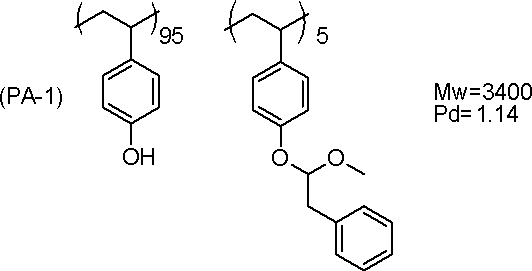
<合成例2~14:樹脂(PA-2)~(PA-8)及び(NA-1)~(NA-6)の合成>
使用するポリヒドロキシスチレン化合物、及びクロロエーテル化合物を適宜変更した以外は、合成例1と同様の方法で樹脂(PA-2)~(PA-8)及び(NA-1)~(NA-6)を合成した。なお、使用したクロロエーテル化合物は、合成例1と同様、対応するアセタール化合物より合成した。
合成したポリマー構造、重量平均分子量(Mw)及び分散度(Pd)を以下に記す。また、下記ポリマー構造の各繰り返し単位の組成比をモル比で示した。
使用するポリヒドロキシスチレン化合物、及びクロロエーテル化合物を適宜変更した以外は、合成例1と同様の方法で樹脂(PA-2)~(PA-8)及び(NA-1)~(NA-6)を合成した。なお、使用したクロロエーテル化合物は、合成例1と同様、対応するアセタール化合物より合成した。
合成したポリマー構造、重量平均分子量(Mw)及び分散度(Pd)を以下に記す。また、下記ポリマー構造の各繰り返し単位の組成比をモル比で示した。
<樹脂〔P-A〕>


<樹脂〔N-A〕>
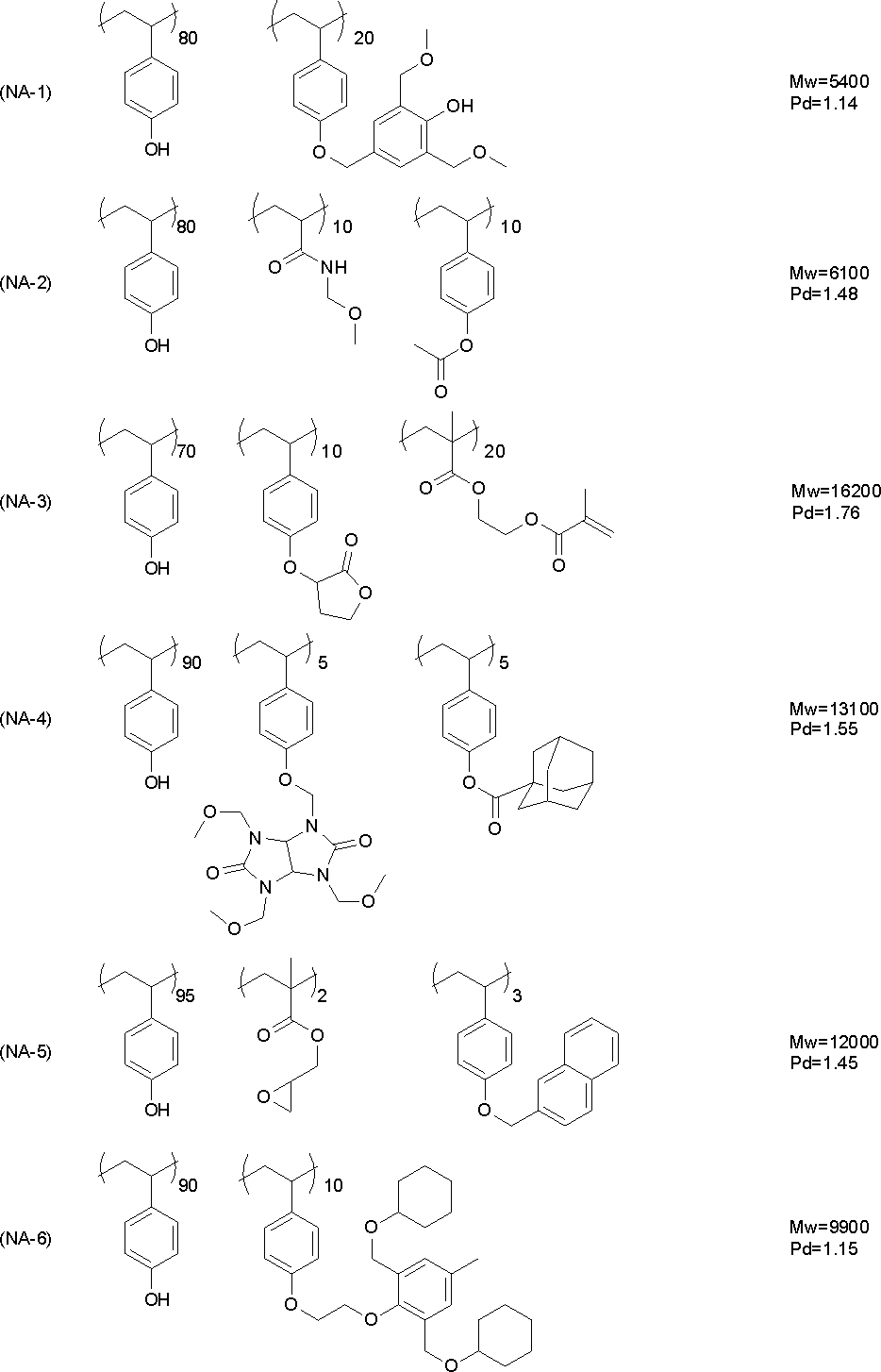
<酸発生剤〔P-B〕>
酸発生剤〔P-B〕として、下記化合物を準備した。
酸発生剤〔P-B〕として、下記化合物を準備した。

<低分子化合物〔P-C〕>
低分子化合物〔P-C〕として、下記化合物を準備した。
低分子化合物〔P-C〕として、下記化合物を準備した。
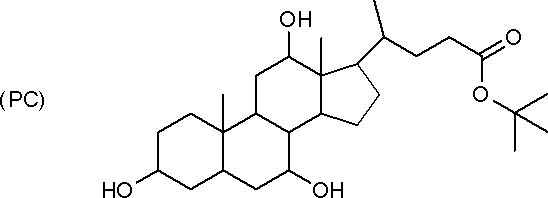
<酸発生剤〔N-B〕>
酸発生剤〔N-B〕として、下記化合物を準備した。
酸発生剤〔N-B〕として、下記化合物を準備した。

<樹脂〔P-A〕と樹脂〔N-A〕とが同一成分である場合における樹脂>
樹脂〔P-A〕と樹脂〔N-A〕とが同一成分である場合における樹脂に関し、以下に、ポリマー構造、及び、各繰り返し単位の組成比(モル比)で示した。
樹脂〔P-A〕と樹脂〔N-A〕とが同一成分である場合における樹脂に関し、以下に、ポリマー構造、及び、各繰り返し単位の組成比(モル比)で示した。
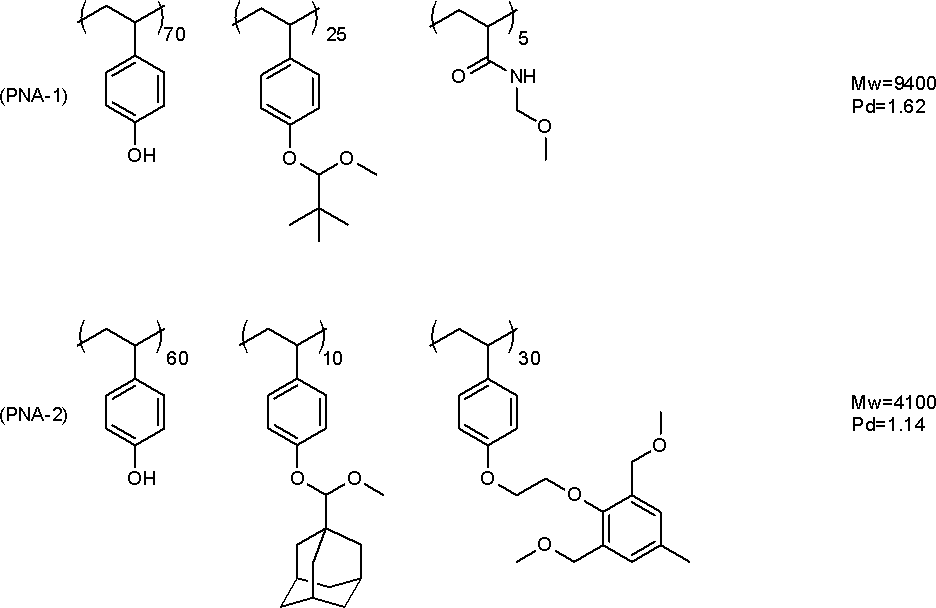
<低分子化合物〔N-C〕>
低分子化合物〔N-C〕として、下記化合物を準備した。
低分子化合物〔N-C〕として、下記化合物を準備した。
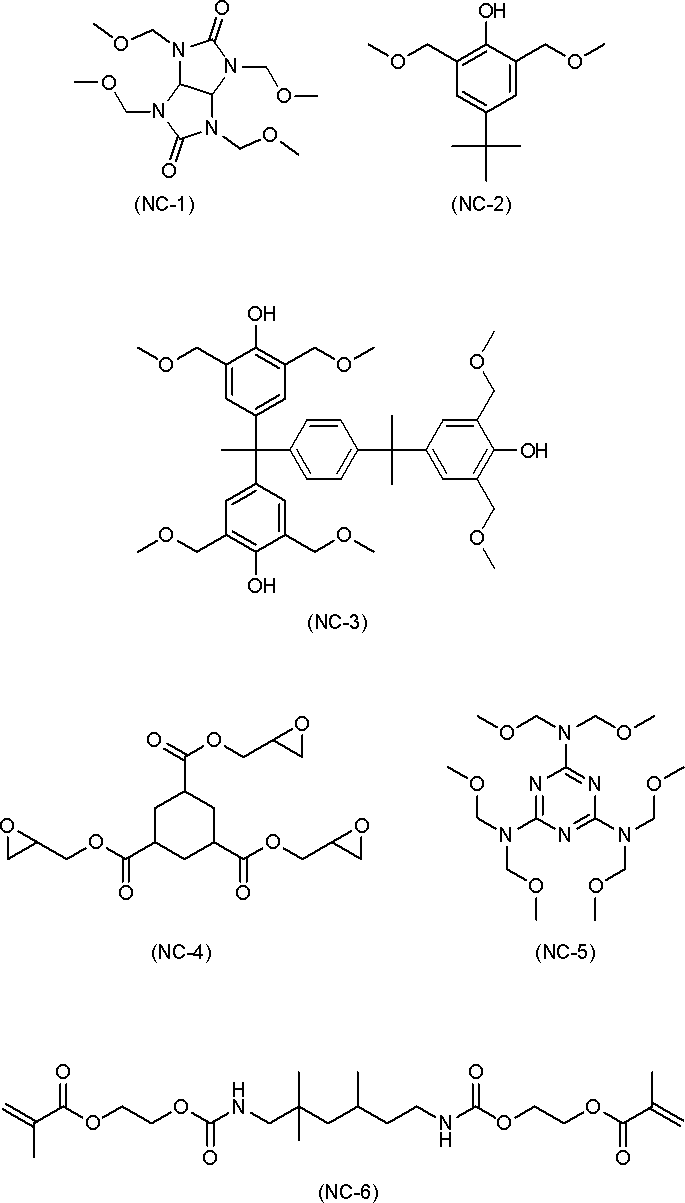
<酸発生剤〔A〕>
酸発生剤〔A〕として、下記化合物を準備した。化合物(PAG-6)及び(PAG-7)については、(Mw重量平均分子量(Mw)及び分散度(Pd)を以下に記す。また、化合物(PAG-6)及び(PAG-7)におけるポリマー構造の各繰り返し単位の組成比をモル比で示した。なお、化合物(PAG-7)は、上記樹脂〔P-A〕にも相当する。
酸発生剤〔A〕として、下記化合物を準備した。化合物(PAG-6)及び(PAG-7)については、(Mw重量平均分子量(Mw)及び分散度(Pd)を以下に記す。また、化合物(PAG-6)及び(PAG-7)におけるポリマー構造の各繰り返し単位の組成比をモル比で示した。なお、化合物(PAG-7)は、上記樹脂〔P-A〕にも相当する。
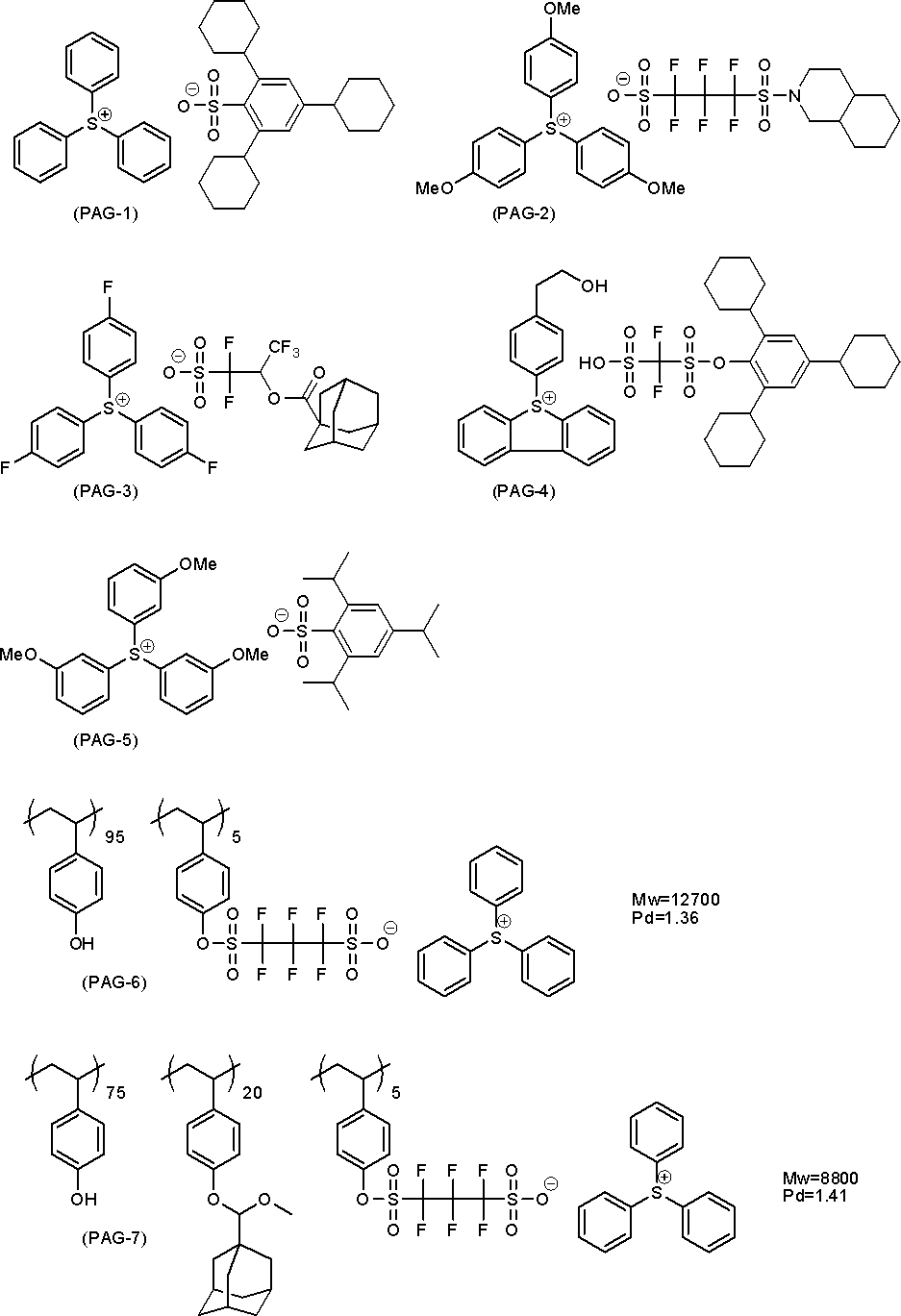
<樹脂〔A〕>
樹脂〔A〕として、下記樹脂を準備した。下記ポリマー構造の各繰り返し単位の組成比をモル比で示した。
樹脂〔A〕として、下記樹脂を準備した。下記ポリマー構造の各繰り返し単位の組成比をモル比で示した。
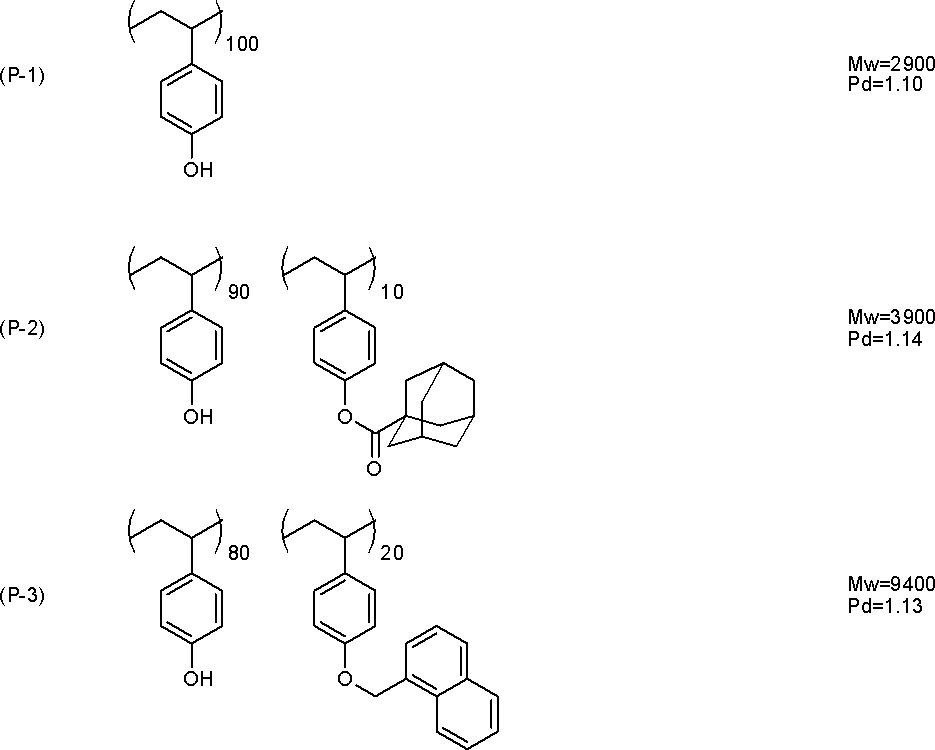
<塩基性化合物>
塩基性化合物として、下記化合物を準備した。
塩基性化合物として、下記化合物を準備した。
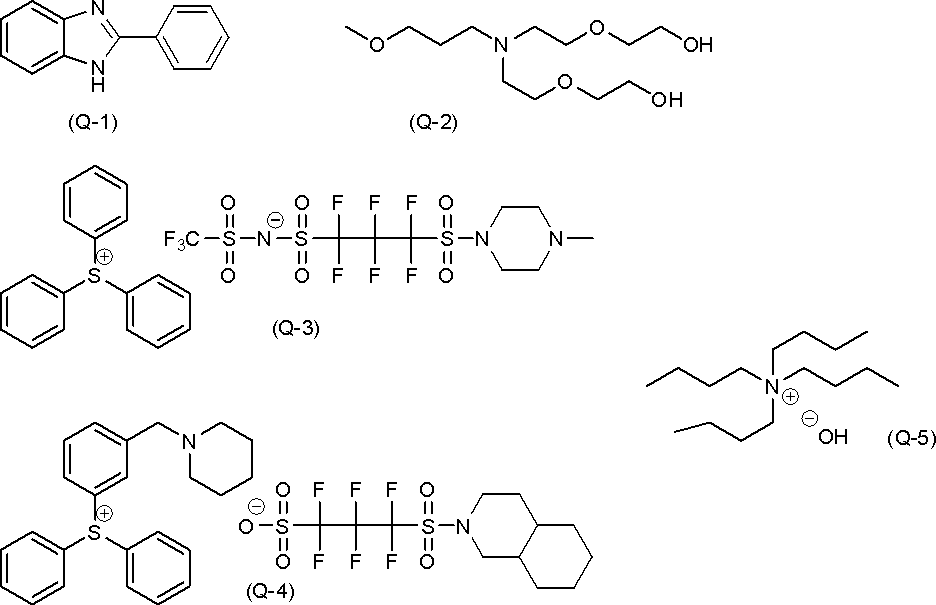
<溶剤>
溶剤として、下記溶剤を準備した。
SL-1:プロピレングリコールモノメチルエーテルアセテート(PGMEA;別名1-メトキシ-2-アセトキシプロパン)
SL-2:プロピレングリコールモノメチルエーテル(PGME;1-メトキシ-2-プロパノール)
SL-3:2-ヘプタノン
SL-4:乳酸エチル
SL-5:シクロヘキサノン
SL-6:γ-ブチロラクトン
SL-7:プロピレンカーボネート
溶剤として、下記溶剤を準備した。
SL-1:プロピレングリコールモノメチルエーテルアセテート(PGMEA;別名1-メトキシ-2-アセトキシプロパン)
SL-2:プロピレングリコールモノメチルエーテル(PGME;1-メトキシ-2-プロパノール)
SL-3:2-ヘプタノン
SL-4:乳酸エチル
SL-5:シクロヘキサノン
SL-6:γ-ブチロラクトン
SL-7:プロピレンカーボネート
<界面活性剤>
界面活性剤として、下記化合物を準備した。
W-1:PF6320(OMNOVA(株)製)
W-2:メガファックF176(DIC(株)製;フッ素系)
W-3:ポリシロキサンポリマーKP-341(信越化学工業(株)製;シリコン系)
界面活性剤として、下記化合物を準備した。
W-1:PF6320(OMNOVA(株)製)
W-2:メガファックF176(DIC(株)製;フッ素系)
W-3:ポリシロキサンポリマーKP-341(信越化学工業(株)製;シリコン系)
〔EB露光(ポジ型アルカリ現像):実施例EB-P1~EB-P14、比較例C-EB-P1〕
(1)感活性光線性又は感放射線性組成物の塗液調製及び塗設
下記表1に示した組成を有する塗液組成物を0.1μm孔径のメンブレンフィルターで精密ろ過して、感活性光線性又は感放射線性組成物(ポジ型レジスト組成物)溶液を得た。
この感活性光線性又は感放射線性組成物溶液をヘキサメチルジシラザン(HMDS)処理を施した8インチSiウェハー上に東京エレクトロン製スピンコーターMark8を用いて塗布し、110℃、90秒間ホットプレート上で乾燥して、膜厚50nmのレジスト膜を得た。
(1)感活性光線性又は感放射線性組成物の塗液調製及び塗設
下記表1に示した組成を有する塗液組成物を0.1μm孔径のメンブレンフィルターで精密ろ過して、感活性光線性又は感放射線性組成物(ポジ型レジスト組成物)溶液を得た。
この感活性光線性又は感放射線性組成物溶液をヘキサメチルジシラザン(HMDS)処理を施した8インチSiウェハー上に東京エレクトロン製スピンコーターMark8を用いて塗布し、110℃、90秒間ホットプレート上で乾燥して、膜厚50nmのレジスト膜を得た。

(2)EB露光及び現像(ポジ型アルカリ現像)
上記(1)で得られたレジスト膜に、電子線照射装置((株)JEOL製 JBX6000;加速電圧50keV)を用いて、2.5nm刻みで線幅30nmのラインパターン(長さ方向0.2mm、描画本数40本)が形成されるように照射量を変えて露光した(EB露光(1)ともいう)。照射後に、100℃、90秒間ホットプレート上で加熱した。
続いて、2.38質量%テトラメチルアンモニウムハイドロオキサイド(TMAH)水溶液を用いて30秒間現像し、その後純水で洗浄し、最後に2000回転(rpm)で20秒間高速回転して乾燥させた。
得られたパターンを下記の方法で、解像力、ラインウィスズラフネス(LWR)、パターン形状について評価した。評価結果を下記表2に示した。
上記(1)で得られたレジスト膜に、電子線照射装置((株)JEOL製 JBX6000;加速電圧50keV)を用いて、2.5nm刻みで線幅30nmのラインパターン(長さ方向0.2mm、描画本数40本)が形成されるように照射量を変えて露光した(EB露光(1)ともいう)。照射後に、100℃、90秒間ホットプレート上で加熱した。
続いて、2.38質量%テトラメチルアンモニウムハイドロオキサイド(TMAH)水溶液を用いて30秒間現像し、その後純水で洗浄し、最後に2000回転(rpm)で20秒間高速回転して乾燥させた。
得られたパターンを下記の方法で、解像力、ラインウィスズラフネス(LWR)、パターン形状について評価した。評価結果を下記表2に示した。
(2-1)解像力(LS解像力)
得られたパターンの断面形状を走査型電子顕微鏡((株)日立製作所製S-4300)を用いて観察した。線幅30nmの1:1ラインアンドスペースのレジストパターンを解像するときの照射量(感度)における限界解像力(ラインとスペース(ライン:スペース=1:1)が分離解像する最小の線幅)を解像力(nm)とした。この値が小さいほど性能が良好であることを示す。
得られたパターンの断面形状を走査型電子顕微鏡((株)日立製作所製S-4300)を用いて観察した。線幅30nmの1:1ラインアンドスペースのレジストパターンを解像するときの照射量(感度)における限界解像力(ラインとスペース(ライン:スペース=1:1)が分離解像する最小の線幅)を解像力(nm)とした。この値が小さいほど性能が良好であることを示す。
(2-2)ラインウィズスラフネス(LWR)
上記の感度を示す照射量における線幅30nmのラインパターンの長さ方向5μmにおける任意の30点について線幅を測定し、そのバラツキを3σで評価した。この値が小さいほど性能が良好であることを示す。
上記の感度を示す照射量における線幅30nmのラインパターンの長さ方向5μmにおける任意の30点について線幅を測定し、そのバラツキを3σで評価した。この値が小さいほど性能が良好であることを示す。
(2-3)パタ-ン形状
上記の感度を示す照射量における線幅30nmの1:1ラインアンドスペースパターンの断面形状を走査型電子顕微鏡((株)日立製作所製S-4800)を用いて観察したラインパターンの断面形状において、[ラインパターンのトップ部(表面部)における線幅/ラインパターンの中部(ラインパターンの高さの半分の高さ位置)における線幅]で表される比率が1.2以上のものを「逆テーパー」とし、該比率が1.05以上1.2未満のものを「やや逆テーパー」とし、該比率が1.05未満のものを「矩形」として、評価を行った。
上記の感度を示す照射量における線幅30nmの1:1ラインアンドスペースパターンの断面形状を走査型電子顕微鏡((株)日立製作所製S-4800)を用いて観察したラインパターンの断面形状において、[ラインパターンのトップ部(表面部)における線幅/ラインパターンの中部(ラインパターンの高さの半分の高さ位置)における線幅]で表される比率が1.2以上のものを「逆テーパー」とし、該比率が1.05以上1.2未満のものを「やや逆テーパー」とし、該比率が1.05未満のものを「矩形」として、評価を行った。

表2に示した結果から明らかなように、比較例C-EB-P1と比較して、実施例EB-P1~EB-P14は、極微細(例えば、線幅50nm以下)なパターンの形成において、高い解像力、優れたパターン形状及び低いラインウィズスラフネス(LWR)を同時に高次元で満足できることが分かった。
〔EB露光(ネガ型アルカリ現像):実施例EB-N1~EB-N14、比較例C-EB-N1〕
(1)感活性光線性又は感放射線性組成物の塗液調製及び塗設
下記表3に示した組成を有する塗液組成物を0.1μm孔径のメンブレンフィルターで精密ろ過して、感活性光線性又は感放射線性組成物(ネガ型レジスト組成物)溶液を得た。
この感活性光線性又は感放射線性組成物溶液をヘキサメチルジシラザン(HMDS)処理を施した8インチSiウェハー上に東京エレクトロン製スピンコーターMark8を用いて塗布し、110℃、90秒間ホットプレート上で乾燥して、膜厚50nmのレジスト膜を得た。
(1)感活性光線性又は感放射線性組成物の塗液調製及び塗設
下記表3に示した組成を有する塗液組成物を0.1μm孔径のメンブレンフィルターで精密ろ過して、感活性光線性又は感放射線性組成物(ネガ型レジスト組成物)溶液を得た。
この感活性光線性又は感放射線性組成物溶液をヘキサメチルジシラザン(HMDS)処理を施した8インチSiウェハー上に東京エレクトロン製スピンコーターMark8を用いて塗布し、110℃、90秒間ホットプレート上で乾燥して、膜厚50nmのレジスト膜を得た。
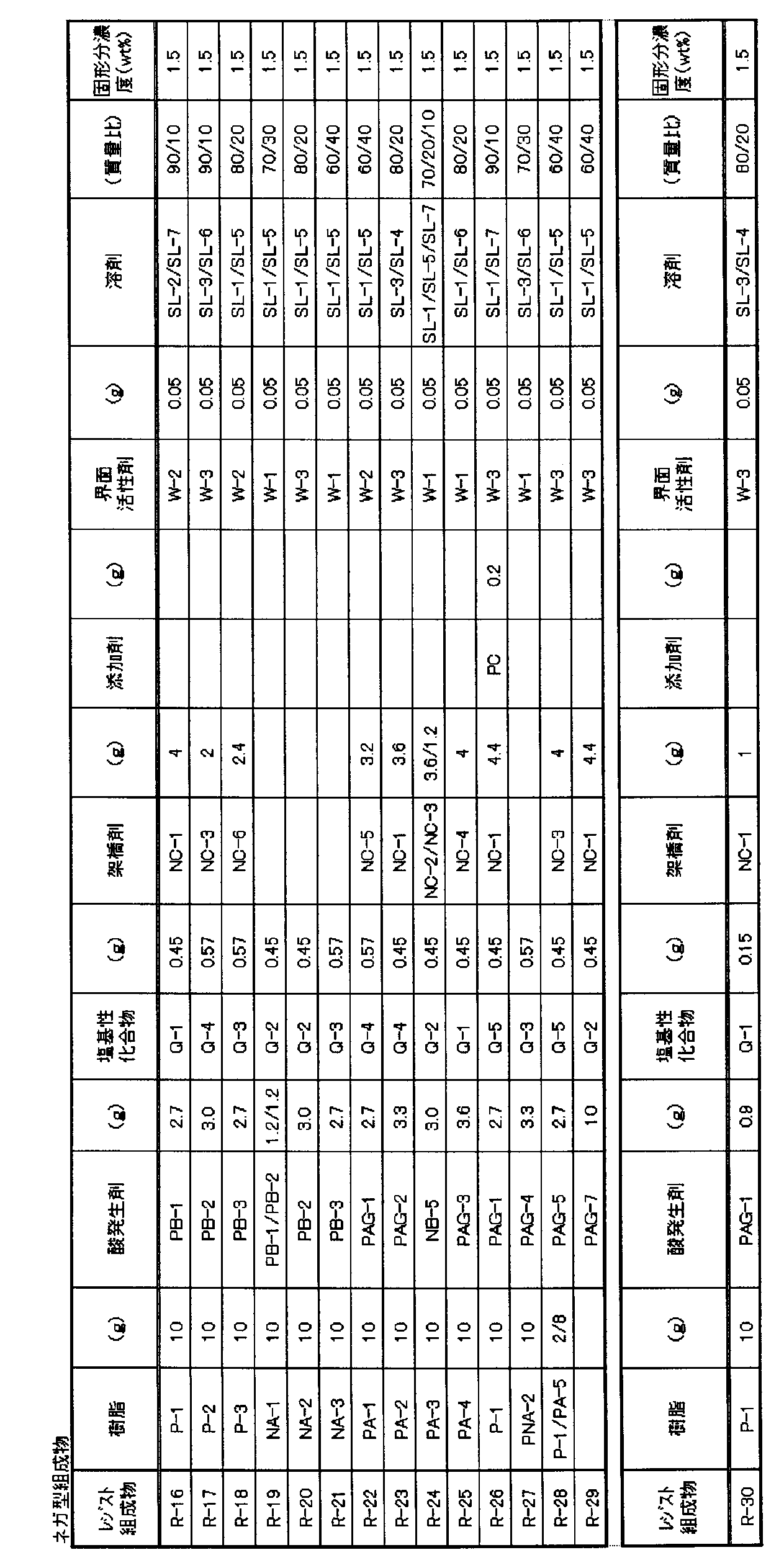
(2)EB露光及び現像(ネガ型アルカリ現像)
上記で得られたレジスト膜に、電子線照射装置((株)JEOL製 JBX6000;加速電圧50keV)を用いて、2.5nm刻みで線幅25nm~40nmのラインパターン(長さ方向0.2mm、描画本数40本)が形成されるように照射量を変えて露光した(EB露光(2)ともいう)。照射後に、100℃、90秒間ホットプレート上で加熱した。
続いて、2.38質量%テトラメチルアンモニウムハイドロオキサイド(TMAH)水溶液を用いて30秒間現像し、その後純水で洗浄し、最後に2000回転(rpm)で20秒間高速回転して乾燥させた。
得られたパターンを、上記〔EB露光(ポジ型アルカリ現像)〕に記載の方法と同様の方法で、解像力、ラインウィスズラフネス、及び、パターン形状について評価した。評価結果を下記表4に示した。
上記で得られたレジスト膜に、電子線照射装置((株)JEOL製 JBX6000;加速電圧50keV)を用いて、2.5nm刻みで線幅25nm~40nmのラインパターン(長さ方向0.2mm、描画本数40本)が形成されるように照射量を変えて露光した(EB露光(2)ともいう)。照射後に、100℃、90秒間ホットプレート上で加熱した。
続いて、2.38質量%テトラメチルアンモニウムハイドロオキサイド(TMAH)水溶液を用いて30秒間現像し、その後純水で洗浄し、最後に2000回転(rpm)で20秒間高速回転して乾燥させた。
得られたパターンを、上記〔EB露光(ポジ型アルカリ現像)〕に記載の方法と同様の方法で、解像力、ラインウィスズラフネス、及び、パターン形状について評価した。評価結果を下記表4に示した。

表4に示した結果から明らかなように、比較例C-EB-N1と比較して、実施例EB-N1~EB-N14は、極微細(例えば、線幅50nm以下)なパターンの形成において、高い解像力、優れたパターン形状及び低いラインウィズスラフネス(LWR)を同時に高次元で満足できることが分かった。
〔EUV露光(ポジ型アルカリ現像):実施例EUV-P1~EUV-P14、比較例C-EUV-P1〕
(1)感活性光線性又は感放射線性組成物の塗液調製及び塗設
上記表1に示すポジ型レジスト組成物を0.04μmの孔径を有するポリテトラフルオロエチレンフィルターで精密ろ過して、感活性光線性又は感放射線性組成物(ポジ型レジスト組成物)溶液を得た。
(1)感活性光線性又は感放射線性組成物の塗液調製及び塗設
上記表1に示すポジ型レジスト組成物を0.04μmの孔径を有するポリテトラフルオロエチレンフィルターで精密ろ過して、感活性光線性又は感放射線性組成物(ポジ型レジスト組成物)溶液を得た。
この感活性光線性又は感放射線性組成物溶液を6インチSiウェハー上に東京エレクトロン製スピンコーターMark8を用いて塗布し、110℃、90秒間ホットプレート上で乾燥して、膜厚50nmのレジスト膜を得た。すなわち、レジスト塗布マスクブランクスを得た。
(2)EUV露光及び現像(ポジ型アルカリ現像)
上記(1)で得られたレジスト塗布マスクブランクスのレジスト膜に、EUV光(波長13nm)を用いて、線幅50nmの1:1ラインアンドスペースパターンの反射型マスクを介して、露光を行った(EUV露光(1)ともいう)後、110℃で90秒間ベークした。その後、2.38質量%テトラメチルアンモニウムハイドロオキサイド(TMAH)水溶液を用いて現像した。
上記(1)で得られたレジスト塗布マスクブランクスのレジスト膜に、EUV光(波長13nm)を用いて、線幅50nmの1:1ラインアンドスペースパターンの反射型マスクを介して、露光を行った(EUV露光(1)ともいう)後、110℃で90秒間ベークした。その後、2.38質量%テトラメチルアンモニウムハイドロオキサイド(TMAH)水溶液を用いて現像した。
得られたパターンを下記の方法で解像力、ラインウィスズラフネス(LWR)、パタ-ン形状について評価した。
(2-1)解像力(LS解像力)
得られたパターンの断面形状を走査型電子顕微鏡((株)日立製作所製S-4300)を用いて観察した。線幅50nmの1:1ラインアンドスペースのレジストパターンを解像するときの露光量(感度)における限界解像力(ラインとスペース(ライン:スペース=1:1)が分離解像する最小の線幅)を解像力(nm)とした。
得られたパターンの断面形状を走査型電子顕微鏡((株)日立製作所製S-4300)を用いて観察した。線幅50nmの1:1ラインアンドスペースのレジストパターンを解像するときの露光量(感度)における限界解像力(ラインとスペース(ライン:スペース=1:1)が分離解像する最小の線幅)を解像力(nm)とした。
(2-2)ラインエッジラフネス(LWR)
上記の感度を示す露光量における線幅50nmのラインパターンの長さ方向50μmにおける任意の30点について線幅を測定し、そのバラツキを3σで評価した。この値が小さいほど性能が良好であることを示す。
上記の感度を示す露光量における線幅50nmのラインパターンの長さ方向50μmにおける任意の30点について線幅を測定し、そのバラツキを3σで評価した。この値が小さいほど性能が良好であることを示す。
(2-3)パタ-ン形状
上記の感度を示す露光量における線幅50nmの1:1ラインアンドスペースパターンの断面形状を走査型電子顕微鏡((株)日立製作所製S-4300)を用いて観察した。ラインパターンの断面形状において、[ラインパターンのトップ部(表面部)における線幅/ラインパターンの中部(ラインパターンの高さの半分の高さ位置)における線幅]で表される比率が1.2以上のものを「逆テーパー」とし、該比率が1.05以上1.2未満のものを「やや逆テーパー」とし、該比率が0.95以上1.05未満のものを「矩形」とし、0.95未満のものを「テーパー」として評価を行った。パターン形状としては「矩形」が好ましい。
上記の感度を示す露光量における線幅50nmの1:1ラインアンドスペースパターンの断面形状を走査型電子顕微鏡((株)日立製作所製S-4300)を用いて観察した。ラインパターンの断面形状において、[ラインパターンのトップ部(表面部)における線幅/ラインパターンの中部(ラインパターンの高さの半分の高さ位置)における線幅]で表される比率が1.2以上のものを「逆テーパー」とし、該比率が1.05以上1.2未満のものを「やや逆テーパー」とし、該比率が0.95以上1.05未満のものを「矩形」とし、0.95未満のものを「テーパー」として評価を行った。パターン形状としては「矩形」が好ましい。
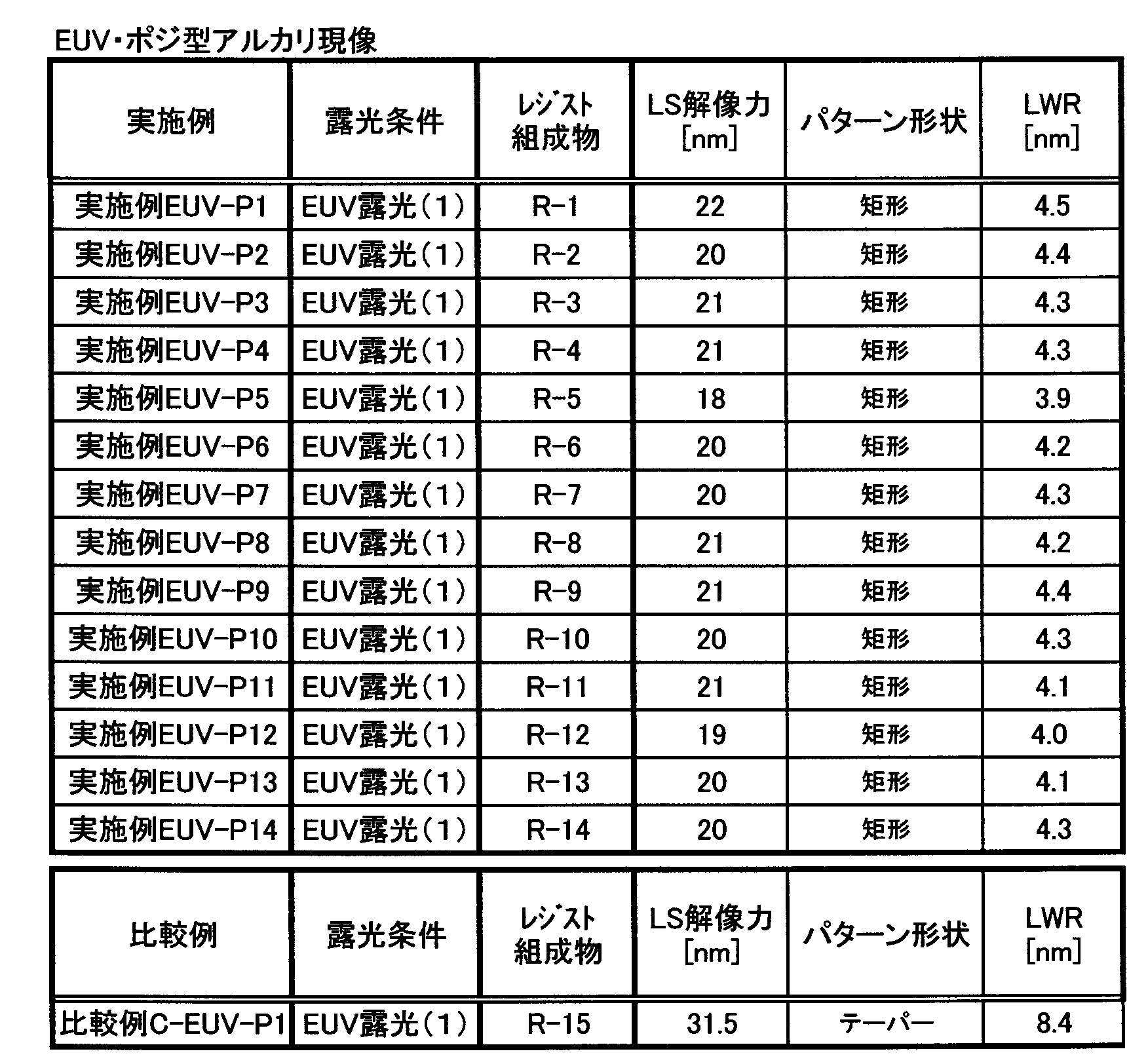
表5に示した結果から明らかなように、比較例C-EUV-P1と比較して、実施例EUV-P1~EUV-P14は、極微細(例えば、線幅50nm以下)なパターンの形成において、高い解像力、優れたパターン形状及び低いラインウィズスラフネス(LWR)を同時に高次元で満足できることが分かった。
〔EUV露光(ネガ型アルカリ現像):実施例EUV-N1~EUV-N14、比較例C-EUV-N1〕
(1)感活性光線性又は感放射線性組成物の塗液調製及び塗設
上記表3に示すネガ型レジスト組成物を0.04μmの孔径を有するポリテトラフルオロエチレンフィルターで精密ろ過して、感活性光線性又は感放射線性組成物(ネガ型レジスト組成物)溶液を得た。
(1)感活性光線性又は感放射線性組成物の塗液調製及び塗設
上記表3に示すネガ型レジスト組成物を0.04μmの孔径を有するポリテトラフルオロエチレンフィルターで精密ろ過して、感活性光線性又は感放射線性組成物(ネガ型レジスト組成物)溶液を得た。
この感活性光線性又は感放射線性組成物溶液を6インチSiウェハー上に東京エレクトロン製スピンコーターMark8を用いて塗布し、110℃、90秒間ホットプレート上で乾燥して、膜厚50nmのレジスト膜を得た。すなわち、レジスト塗布マスクブランクスを得た。
(2)EUV露光及び現像(ネガ型アルカリ現像)
上記で得られたレジスト膜に、EUV光(波長13nm)を用いて、線幅50nmの1:1ラインアンドスペースパターンの反射型マスクを介して、露光を行った後(EUV露光(2)ともいう)、110℃で90秒間ベークした。その後、2.38質量%テトラメチルアンモニウムハイドロオキサイド(TMAH)水溶液を用いて現像した。
上記で得られたレジスト膜に、EUV光(波長13nm)を用いて、線幅50nmの1:1ラインアンドスペースパターンの反射型マスクを介して、露光を行った後(EUV露光(2)ともいう)、110℃で90秒間ベークした。その後、2.38質量%テトラメチルアンモニウムハイドロオキサイド(TMAH)水溶液を用いて現像した。
得られたパターンを上記〔EUV露光(ポジ型アルカリ現像)〕に記載の方法で解像力、ラインウィスズラフネス(LWR)、パタ-ン形状について評価した。
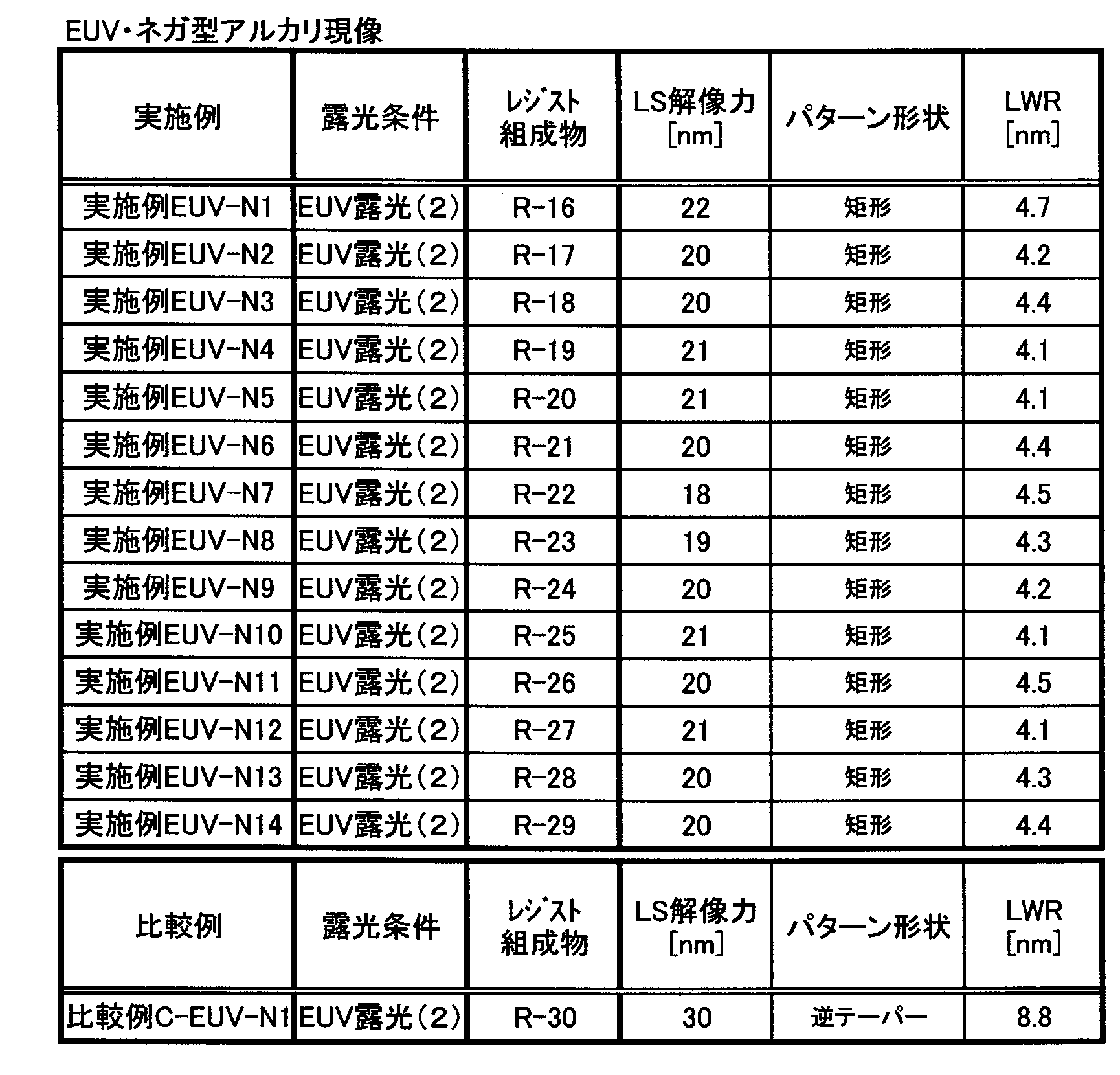
表6に示した結果から明らかなように、比較例C-EUV-N1と比較して、実施例EUV-N1~EUV-N14は、極微細(例えば、線幅50nm以下)なパターンの形成において、高い解像力、優れたパターン形状及び低いラインウィズスラフネス(LWR)を同時に高次元で満足できることが分かった。
本発明によれば、極微細(例えば、線幅50nm以下)なパターンの形成において、高い解像力、優れたパターン形状、及び、低いラインウィズスラフネス(LWR)を同時に高次元で満足できる感活性光線性又は感放射線性組成物を提供することができる。
また、本発明によれば、上記感活性光線性又は感放射線性組成物を用いたレジスト膜、パターン形成方法、レジスト塗布マスクブランクス、フォトマスクの製造方法、フォトマスク、電子デバイスの製造方法、及び、電子デバイスを提供することができる。
また、本発明によれば、上記感活性光線性又は感放射線性組成物を用いたレジスト膜、パターン形成方法、レジスト塗布マスクブランクス、フォトマスクの製造方法、フォトマスク、電子デバイスの製造方法、及び、電子デバイスを提供することができる。
本発明を詳細にまた特定の実施態様を参照して説明したが、本発明の精神と範囲を逸脱することなく様々な変更や修正を加えることができることは当業者にとって明らかである。
本出願は、2013年9月26日出願の日本特許出願(特願2013-200599)に基づくものであり、その内容はここに参照として取り込まれる。
本出願は、2013年9月26日出願の日本特許出願(特願2013-200599)に基づくものであり、その内容はここに参照として取り込まれる。
Claims (25)
- (A)活性光線又は放射線の照射により酸を発生する化合物、
(P)酸の作用によりアルカリ現像液に対する溶解性が増大する化合物、及び
(N)下記〔N-A〕、〔N-B〕及び〔N-C〕からなる群より選択される少なくとも1種の化合物
〔N-A〕 酸、活性光線若しくは放射線、又は、活性種の作用によりアルカリ現像液に対する溶解性が減少する樹脂
〔N-B〕 活性光線又は放射線の照射により酸を発生し、かつ酸、活性光線若しくは放射線、又は、活性種の作用によりアルカリ現像液に対する溶解性が減少する化合物
〔N-C〕 酸、活性光線若しくは放射線、又は、活性種の作用によりアルカリ現像液に対する溶解性が減少する低分子化合物
を含有する感活性光線性又は感放射線性組成物。 - 前記感活性光線性又は感放射線性組成物が、アルカリ現像型電子線露光用又はEUV露光用感活性光線性又は感放射線性組成物である、請求項1に記載の感活性光線性又は感放射線性組成物。
- 前記化合物(N)の含有量が前記感活性光線性又は感放射線性組成物の全固形分に対して10質量%以上であり、ネガ型の感活性光線性又は感放射線性組成物である、請求項1又は2に記載の感活性光線性又は感放射線性組成物。
- 前記化合物(P)が、酸の作用によりアルカリ現像液に対する溶解性が増大する樹脂である、請求項3に記載の感活性光線性又は感放射線性組成物。
- 前記化合物(P)が、下記一般式(1)で表される繰り返し単位を有する樹脂である、請求項4に記載の感活性光線性又は感放射線性組成物。

上記一般式(1)中、
X1は、単結合又は2価の連結基を表す。
A1は、ケト基又は(n1+1)価の芳香環基を表し、R11、R12及びR13は、各々独立に、水素原子、アルキル基、シクロアルキル基、ハロゲン原子、シアノ基又はアルコキシカルボニル基を表す。
R13は、A1と結合して環を形成していてもよく、その場合のR13はアルキレン基を表す。
Raは、水素原子、アルキル基、シクロアルキル基、アリール基、アラルキル基、又はヘテロ環基を表し、Rbは水素原子、アルキル基、シクロアルキル基、アリール基、アラルキル基、又はヘテロ環基を表す。
Mは、単結合又は2価の連結基を表す。Qは、アルキル基、シクロアルキル基、アリール基、アラルキル基、又はヘテロ環基を表す。Ra及びRbが結合して環を形成してもよい。Ra、M及びQの少なくとも2つが結合して環を形成していてもよい。
A1がケト基のとき、n1は1を表し、A1が(n+1)価の芳香族基のとき、n1は、1~4の整数を表す。n1が2以上のとき、複数のRa、複数のRb、複数のM、及び複数のQは、それぞれ、互いに同一であっても異なっていてもよい。 - 前記化合物(N)として、分子量が500以上の化合物を含有する、請求項3~5のいずれか1項に記載の感活性光線性又は感放射線性組成物。
- 前記化合物(N)として、酸の作用によりアルカリ現像液に対する溶解性が減少する化合物(N-1)を含有する、請求項3~6のいずれか1項に記載の感活性光線性又は感放射線性組成物。
- 前記化合物(A)が、活性光線又は放射線の照射により酸を発生する部位を有する繰り返し単位を含有する樹脂である、請求項3~7のいずれか1項に記載の感活性光線性又は感放射線性組成物。
- (C)活性光線又は放射線の照射により塩基性が低下する、塩基性化合物又はアンモニウム塩化合物を更に含有する、請求項3~8のいずれか1項に記載の感活性光線性又は感放射線性組成物。
- 前記化合物(C)が、カチオン上に窒素原子を有するスルホニウム塩である、請求項9に記載の感活性光線性又は感放射線性組成物。
- 前記化合物(N)の含有量が前記感活性光線性又は感放射線性組成物の全固形分に対して1質量%以上であり、ポジ型の感活性光線性又は感放射線性組成物である、請求項1又は2に記載の感活性光線性又は感放射線性組成物。
- 前記化合物(P)が、酸の作用によりアルカリ現像液に対する溶解性が増大する樹脂である、請求項11に記載の感活性光線性又は感放射線性組成物。
- 前記化合物(P)が、下記一般式(1)で表される繰り返し単位を有する樹脂である、請求項12に記載の感活性光線性又は感放射線性組成物。
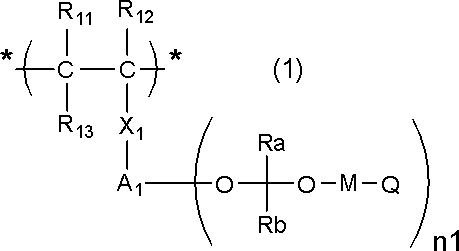
上記一般式(1)中、
X1は、単結合又は2価の連結基を表す。
A1は、ケト基又は(n1+1)価の芳香環基を表し、R11、R12及びR13は、各々独立に、水素原子、アルキル基、シクロアルキル基、ハロゲン原子、シアノ基又はアルコキシカルボニル基を表す。
R13は、A1と結合して環を形成していてもよく、その場合のR13はアルキレン基を表す。
Raは、水素原子、アルキル基、シクロアルキル基、アリール基、アラルキル基、又はヘテロ環基を表し、Rbは、水素原子、アルキル基、シクロアルキル基、アリール基、アラルキル基、又はヘテロ環基を表す。
Mは、単結合又は2価の連結基を表す。Qは、アルキル基、シクロアルキル基、アリール基、アラルキル基、又はヘテロ環基を表す。Ra及びRbが結合して環を形成してもよい。Ra、M及びQの少なくとも2つが結合して環を形成していてもよい。
A1がケト基のとき、n1は1を表し、A1が(n+1)価の芳香族基のとき、n1は、1~4の整数を表す。n1が2以上のとき、複数のRa、複数のRb、複数のM、及び複数のQは、それぞれ、互いに同一であっても異なっていてもよい。 - 前記化合物(N)として、分子量が500以上の化合物を含有する、請求項11~13のいずれか1項に記載の感活性光線性又は感放射線性組成物。
- 前記化合物(N)として、酸の作用によりアルカリ現像液に対する溶解性が減少する化合物(N-1)を含有する、請求項11~14のいずれか1項に記載の感活性光線性又は感放射線性組成物。
- 前記化合物(A)が、活性光線又は放射線の照射により酸を発生する部位を有する繰り返し単位を含有する樹脂である、請求項11~15のいずれか1項に記載の感活性光線性又は感放射線性組成物。
- (C)活性光線又は放射線の照射により塩基性が低下する塩基性化合物又はアンモニウム塩化合物を更に含有する、請求項11~16のいずれか1項に記載の感活性光線性又は感放射線性組成物。
- 前記化合物(C)が、カチオン上に窒素原子を有するスルホニウム塩である、請求項17に記載の感活性光線性又は感放射線性組成物。
- 請求項1~18のいずれか1項に記載の感活性光線性又は感放射線性組成物を用いて形成されるレジスト膜。
- (ア)請求項1~18のいずれか1項に記載の感活性光線性又は感放射線性組成物によって膜を形成する工程、
(イ)膜を露光する工程、及び
(ウ)露光された膜を、アルカリ現像液を用いて現像する工程
を含むパターン形成方法。 - 請求項1~18のいずれか1項に記載の感活性光線性又は感放射線性組成物を塗布したレジスト塗布マスクブランクス。
- 請求項21に記載のレジスト塗布マスクブランクスを電子線又はEUV光によって露光する工程、及び、露光されたマスクブランクスをアルカリ現像液によって現像する工程を含むフォトマスクの製造方法。
- 請求項22に記載のフォトマスク製造方法によって得られるフォトマスク。
- 請求項20に記載のパターン形成方法を含む電子デバイスの製造方法。
- 請求項24に記載の電子デバイスの製造方法により製造された電子デバイス。
Priority Applications (2)
| Application Number | Priority Date | Filing Date | Title |
|---|---|---|---|
| KR1020167008116A KR20160047560A (ko) | 2013-09-26 | 2014-09-10 | 감활성 광선성 또는 감방사선성 조성물, 그리고 이를 이용한, 레지스트막, 패턴 형성 방법, 레지스트 도포 마스크 블랭크, 포토마스크의 제조 방법, 포토마스크, 전자 디바이스의 제조 방법, 및 전자 디바이스 |
| US15/081,089 US20160209747A1 (en) | 2013-09-26 | 2016-03-25 | Active light sensitive or radiation sensitive composition, and resist film, pattern forming method, resist-coated mask blank, method for producing photomask, photomask, method for manufacturing electronic device, and electronic device, each of which uses said active light sensitive or radiation sensitive composition |
Applications Claiming Priority (2)
| Application Number | Priority Date | Filing Date | Title |
|---|---|---|---|
| JP2013200599A JP6438645B2 (ja) | 2013-09-26 | 2013-09-26 | 感活性光線性又は感放射線性組成物、並びに、これを用いた、レジスト膜、パターン形成方法、レジスト塗布マスクブランクス、フォトマスクの製造方法、及び電子デバイスの製造方法 |
| JP2013-200599 | 2013-09-26 |
Related Child Applications (1)
| Application Number | Title | Priority Date | Filing Date |
|---|---|---|---|
| US15/081,089 Continuation US20160209747A1 (en) | 2013-09-26 | 2016-03-25 | Active light sensitive or radiation sensitive composition, and resist film, pattern forming method, resist-coated mask blank, method for producing photomask, photomask, method for manufacturing electronic device, and electronic device, each of which uses said active light sensitive or radiation sensitive composition |
Publications (1)
| Publication Number | Publication Date |
|---|---|
| WO2015045876A1 true WO2015045876A1 (ja) | 2015-04-02 |
Family
ID=52743020
Family Applications (1)
| Application Number | Title | Priority Date | Filing Date |
|---|---|---|---|
| PCT/JP2014/073959 Ceased WO2015045876A1 (ja) | 2013-09-26 | 2014-09-10 | 感活性光線性又は感放射線性組成物、並びに、これを用いた、レジスト膜、パターン形成方法、レジスト塗布マスクブランクス、フォトマスクの製造方法、フォトマスク、電子デバイスの製造方法、及び、電子デバイス |
Country Status (5)
| Country | Link |
|---|---|
| US (1) | US20160209747A1 (ja) |
| JP (1) | JP6438645B2 (ja) |
| KR (1) | KR20160047560A (ja) |
| TW (1) | TW201523134A (ja) |
| WO (1) | WO2015045876A1 (ja) |
Cited By (3)
| Publication number | Priority date | Publication date | Assignee | Title |
|---|---|---|---|---|
| CN107728428A (zh) * | 2016-08-11 | 2018-02-23 | 东友精细化工有限公司 | 化学增幅型感光性树脂组合物及由其制造的绝缘膜 |
| TWI695224B (zh) * | 2015-08-31 | 2020-06-01 | 日商富士軟片股份有限公司 | 感光性組成物、硬化膜的製造方法、液晶顯示裝置的製造方法、有機電激發光顯示裝置的製造方法以及觸控面板的製造方法 |
| US20210198468A1 (en) * | 2019-12-31 | 2021-07-01 | Taiwan Semiconductor Manufacturing Co., Ltd. | Photoresist composition and method of manufacturing a semiconductor device |
Families Citing this family (16)
| Publication number | Priority date | Publication date | Assignee | Title |
|---|---|---|---|---|
| JP5919122B2 (ja) * | 2012-07-27 | 2016-05-18 | 富士フイルム株式会社 | 樹脂組成物及びそれを用いたパターン形成方法 |
| KR102171947B1 (ko) * | 2015-06-30 | 2020-10-30 | 후지필름 가부시키가이샤 | 감활성광선성 또는 감방사선성 수지 조성물, 감활성광선성 또는 감방사선성막, 감활성광선성 또는 감방사선성막을 구비한 마스크 블랭크, 패턴 형성 방법, 및 전자 디바이스의 제조 방법 |
| WO2017122528A1 (ja) * | 2016-01-13 | 2017-07-20 | Jsr株式会社 | 感放射線性樹脂組成物、レジストパターン形成方法及び酸拡散制御剤 |
| JP6734109B2 (ja) * | 2016-04-28 | 2020-08-05 | 東京応化工業株式会社 | 化学増幅型ポジ型感光性樹脂組成物 |
| KR102635564B1 (ko) * | 2016-05-03 | 2024-02-08 | 동우 화인켐 주식회사 | 포지티브형 감광성 수지 조성물 및 이로부터 제조된 절연막 |
| KR102134381B1 (ko) * | 2017-07-31 | 2020-07-15 | 주식회사 엘지화학 | 포지티브형 포토레지스트 조성물, 이로부터 제조되는 패턴, 및 패턴 제조방법 |
| KR102374206B1 (ko) | 2017-12-05 | 2022-03-14 | 삼성전자주식회사 | 반도체 장치 제조 방법 |
| KR101967580B1 (ko) | 2017-12-21 | 2019-04-10 | 경희대학교 산학협력단 | 무선 전력 전송 시스템에서 수신기 자유도 개선을 위한 입력 전류의 크기 및 위상 제어 장치 및 방법 |
| KR102051270B1 (ko) | 2017-12-21 | 2020-01-08 | 경희대학교 산학협력단 | 수신기 자유도 개선을 위한 무선 전력 전송 시스템 |
| JP6967655B2 (ja) * | 2018-02-28 | 2021-11-17 | 富士フイルム株式会社 | 感活性光線性又は感放射線性樹脂組成物、感活性光線性又は感放射線性膜、パターン形成方法、及び電子デバイスの製造方法 |
| US11054749B2 (en) * | 2018-05-22 | 2021-07-06 | Versum Materials Us, Llc | Photoresist stripping composition and method |
| JP7378274B2 (ja) * | 2019-11-07 | 2023-11-13 | 東京応化工業株式会社 | レジスト組成物及びレジストパターン形成方法 |
| JP7484745B2 (ja) * | 2020-02-27 | 2024-05-16 | 信越化学工業株式会社 | レジスト材料及びパターン形成方法 |
| KR102675074B1 (ko) * | 2020-11-20 | 2024-06-12 | 삼성에스디아이 주식회사 | 레지스트 하층막용 조성물 및 이를 이용한 패턴형성방법 |
| JP7844244B2 (ja) * | 2021-05-07 | 2026-04-13 | 住友化学株式会社 | レジスト組成物及びレジストパターンの製造方法 |
| JP2024151731A (ja) * | 2023-04-13 | 2024-10-25 | 信越化学工業株式会社 | 分子レジスト組成物及びパターン形成方法 |
Citations (10)
| Publication number | Priority date | Publication date | Assignee | Title |
|---|---|---|---|---|
| JPH07261392A (ja) * | 1994-03-17 | 1995-10-13 | Fujitsu Ltd | 化学増幅レジスト及びこれを用いるレジストパターンの形成方法 |
| JPH10104839A (ja) * | 1996-09-16 | 1998-04-24 | Internatl Business Mach Corp <Ibm> | 低”k”係数ハイブリッド・フォトレジスト |
| JP2001019799A (ja) * | 1999-05-31 | 2001-01-23 | Samsung Electronics Co Ltd | 熱架橋型光酸発生剤およびこれを用いたフォトレジスト |
| JP2002169294A (ja) * | 2000-09-06 | 2002-06-14 | Fuji Photo Film Co Ltd | ポジ型レジスト組成物 |
| JP2010271707A (ja) * | 2009-04-23 | 2010-12-02 | Sumitomo Chemical Co Ltd | レジストパターンの製造方法 |
| JP2012173438A (ja) * | 2011-02-18 | 2012-09-10 | Fujifilm Corp | パターン形成方法、感活性光線性又は感放射線性樹脂組成物、及びレジスト膜 |
| JP2012242556A (ja) * | 2011-05-18 | 2012-12-10 | Fujifilm Corp | パターン形成方法、感活性光線性又は感放射線性樹脂組成物、レジスト膜、電子デバイスの製造方法、及び、電子デバイス |
| WO2012169620A1 (ja) * | 2011-06-10 | 2012-12-13 | 東京応化工業株式会社 | 溶剤現像ネガ型レジスト組成物、レジストパターン形成方法、ブロックコポリマーを含む層のパターン形成方法 |
| JP2013064988A (ja) * | 2011-08-26 | 2013-04-11 | Shin Etsu Chem Co Ltd | パターン形成方法及びレジスト組成物 |
| JP2013174660A (ja) * | 2012-02-23 | 2013-09-05 | Fujifilm Corp | 感光性樹脂組成物、硬化膜の製造方法、硬化膜、有機el表示装置および液晶表示装置 |
Family Cites Families (10)
| Publication number | Priority date | Publication date | Assignee | Title |
|---|---|---|---|---|
| JP3579946B2 (ja) * | 1995-02-13 | 2004-10-20 | Jsr株式会社 | 化学増幅型感放射線性樹脂組成物 |
| US6114082A (en) * | 1996-09-16 | 2000-09-05 | International Business Machines Corporation | Frequency doubling hybrid photoresist having negative and positive tone components and method of preparing the same |
| JPH11237737A (ja) * | 1997-12-19 | 1999-08-31 | Kansai Shingijutsu Kenkyusho:Kk | 感光性樹脂組成物およびその製造方法 |
| TWI289238B (en) * | 2000-01-13 | 2007-11-01 | Fujifilm Corp | Negative resist compositions using for electronic irradiation |
| JP5417422B2 (ja) * | 2010-12-13 | 2014-02-12 | 富士フイルム株式会社 | ポジ型感光性樹脂組成物 |
| JP5635449B2 (ja) * | 2011-03-11 | 2014-12-03 | 富士フイルム株式会社 | 樹脂パターン及びその製造方法、mems構造体の製造方法、半導体素子の製造方法、並びに、メッキパターン製造方法 |
| JP6022788B2 (ja) * | 2011-04-07 | 2016-11-09 | 住友化学株式会社 | レジスト組成物及びレジストパターンの製造方法 |
| JP6039223B2 (ja) * | 2011-04-26 | 2016-12-07 | 住友化学株式会社 | レジスト組成物及びレジストパターンの製造方法 |
| JP5335045B2 (ja) * | 2011-08-31 | 2013-11-06 | 富士フイルム株式会社 | 感光性樹脂組成物、オキシムスルホネート化合物、硬化膜の形成方法、硬化膜、有機el表示装置、及び、液晶表示装置 |
| JP5794241B2 (ja) * | 2013-02-06 | 2015-10-14 | 信越化学工業株式会社 | マイクロ構造体用樹脂構造体の製造方法及びマイクロ構造体の製造方法 |
-
2013
- 2013-09-26 JP JP2013200599A patent/JP6438645B2/ja active Active
-
2014
- 2014-09-10 WO PCT/JP2014/073959 patent/WO2015045876A1/ja not_active Ceased
- 2014-09-10 KR KR1020167008116A patent/KR20160047560A/ko not_active Ceased
- 2014-09-26 TW TW103133406A patent/TW201523134A/zh unknown
-
2016
- 2016-03-25 US US15/081,089 patent/US20160209747A1/en not_active Abandoned
Patent Citations (10)
| Publication number | Priority date | Publication date | Assignee | Title |
|---|---|---|---|---|
| JPH07261392A (ja) * | 1994-03-17 | 1995-10-13 | Fujitsu Ltd | 化学増幅レジスト及びこれを用いるレジストパターンの形成方法 |
| JPH10104839A (ja) * | 1996-09-16 | 1998-04-24 | Internatl Business Mach Corp <Ibm> | 低”k”係数ハイブリッド・フォトレジスト |
| JP2001019799A (ja) * | 1999-05-31 | 2001-01-23 | Samsung Electronics Co Ltd | 熱架橋型光酸発生剤およびこれを用いたフォトレジスト |
| JP2002169294A (ja) * | 2000-09-06 | 2002-06-14 | Fuji Photo Film Co Ltd | ポジ型レジスト組成物 |
| JP2010271707A (ja) * | 2009-04-23 | 2010-12-02 | Sumitomo Chemical Co Ltd | レジストパターンの製造方法 |
| JP2012173438A (ja) * | 2011-02-18 | 2012-09-10 | Fujifilm Corp | パターン形成方法、感活性光線性又は感放射線性樹脂組成物、及びレジスト膜 |
| JP2012242556A (ja) * | 2011-05-18 | 2012-12-10 | Fujifilm Corp | パターン形成方法、感活性光線性又は感放射線性樹脂組成物、レジスト膜、電子デバイスの製造方法、及び、電子デバイス |
| WO2012169620A1 (ja) * | 2011-06-10 | 2012-12-13 | 東京応化工業株式会社 | 溶剤現像ネガ型レジスト組成物、レジストパターン形成方法、ブロックコポリマーを含む層のパターン形成方法 |
| JP2013064988A (ja) * | 2011-08-26 | 2013-04-11 | Shin Etsu Chem Co Ltd | パターン形成方法及びレジスト組成物 |
| JP2013174660A (ja) * | 2012-02-23 | 2013-09-05 | Fujifilm Corp | 感光性樹脂組成物、硬化膜の製造方法、硬化膜、有機el表示装置および液晶表示装置 |
Cited By (5)
| Publication number | Priority date | Publication date | Assignee | Title |
|---|---|---|---|---|
| TWI695224B (zh) * | 2015-08-31 | 2020-06-01 | 日商富士軟片股份有限公司 | 感光性組成物、硬化膜的製造方法、液晶顯示裝置的製造方法、有機電激發光顯示裝置的製造方法以及觸控面板的製造方法 |
| CN107728428A (zh) * | 2016-08-11 | 2018-02-23 | 东友精细化工有限公司 | 化学增幅型感光性树脂组合物及由其制造的绝缘膜 |
| CN107728428B (zh) * | 2016-08-11 | 2022-02-08 | 东友精细化工有限公司 | 化学增幅型感光性树脂组合物及由其制造的绝缘膜 |
| US20210198468A1 (en) * | 2019-12-31 | 2021-07-01 | Taiwan Semiconductor Manufacturing Co., Ltd. | Photoresist composition and method of manufacturing a semiconductor device |
| US12134690B2 (en) * | 2019-12-31 | 2024-11-05 | Taiwan Semiconductor Manufacturing Company, Ltd. | Photoresist composition and method of manufacturing a semiconductor device |
Also Published As
| Publication number | Publication date |
|---|---|
| TW201523134A (zh) | 2015-06-16 |
| JP2015068860A (ja) | 2015-04-13 |
| US20160209747A1 (en) | 2016-07-21 |
| KR20160047560A (ko) | 2016-05-02 |
| JP6438645B2 (ja) | 2018-12-19 |
Similar Documents
| Publication | Publication Date | Title |
|---|---|---|
| JP6438645B2 (ja) | 感活性光線性又は感放射線性組成物、並びに、これを用いた、レジスト膜、パターン形成方法、レジスト塗布マスクブランクス、フォトマスクの製造方法、及び電子デバイスの製造方法 | |
| JP5386527B2 (ja) | パターン形成方法、感活性光線性又は感放射線性樹脂組成物、及びレジスト膜 | |
| JP5542043B2 (ja) | パターン形成方法、感活性光線性又は感放射線性樹脂組成物、及びレジスト膜 | |
| TWI585533B (zh) | 圖案形成方法、感光化射線性樹脂組成物、感放射線性樹脂組成物、抗蝕劑膜、電子元件的製造方法及電子元件 | |
| JP5723842B2 (ja) | 感活性光線性又は感放射線性樹脂組成物、それを用いたレジスト膜及びパターン形成方法、半導体デバイスの製造方法及び半導体デバイス、並びに、樹脂の製造方法 | |
| JP6482650B2 (ja) | パターン形成方法、フォトマスクの製造方法及び電子デバイスの製造方法 | |
| TW201900698A (zh) | 感光化射線性或感放射線性樹脂組成物、抗蝕劑膜、圖案形成方法及電子元件的製造方法 | |
| JP5799050B2 (ja) | 感活性光線性又は感放射線性樹脂組成物、それを用いたレジスト膜、パターン形成方法、及び電子デバイスの製造方法 | |
| JP2014199357A (ja) | 化合物、感活性光線性又は感放射線性樹脂組成物、レジスト膜、パターン形成方法、並びに、これらを用いた電子デバイスの製造方法、及び、電子デバイス | |
| JP6410926B2 (ja) | パターン形成方法、及び電子デバイスの製造方法 | |
| WO2015159830A1 (ja) | 感活性光線性又は感放射線性樹脂組成物、該組成物を用いた感活性光線性又は感放射線性膜及びパターン形成方法、並びに電子デバイスの製造方法及び電子デバイス | |
| JP6205280B2 (ja) | パターン形成方法、及び電子デバイスの製造方法 | |
| TW201403219A (zh) | 圖案形成方法、用於其的組成物、電子元件的製造方法及電子元件 | |
| WO2015118769A1 (ja) | 感活性光線性又は感放射線性樹脂組成物、感活性光線性又は感放射線性膜、感活性光線性又は感放射線性膜を備えたマスクブランクス、フォトマスク、パターン形成方法、電子デバイスの製造方法、電子デバイス、化合物、及び、化合物の製造方法 | |
| WO2013146812A1 (ja) | 感活性光線性又は感放射線性組成物、それを用いたレジスト膜、レジスト塗布マスクブランクス、レジストパターン形成方法、及びフォトマスク | |
| TW202020561A (zh) | 感光化射線性或感放射線性樹脂組成物、抗蝕劑膜、圖案形成方法及電子器件的製造方法 | |
| WO2015045977A1 (ja) | 感活性光線性又は感放射線性樹脂組成物、パターン形成方法、電子デバイスの製造方法、電子デバイス、及び、化合物 | |
| JP6101540B2 (ja) | 感活性光線性又は感放射線性樹脂組成物、レジスト膜、レジスト塗布マスクブランクス、フォトマスクの製造方法、及び、パターン形成方法、並びに、これらを用いた電子デバイスの製造方法 | |
| WO2020129476A1 (ja) | 感活性光線性又は感放射線性樹脂組成物、レジスト膜、パターン形成方法、及び電子デバイスの製造方法 | |
| WO2015087676A1 (ja) | 感活性光線性又は感放射線性樹脂組成物、パターン形成方法、電子デバイスの製造方法、電子デバイス | |
| JP7210364B2 (ja) | パターン形成方法、イオン注入方法及び、電子デバイスの製造方法 | |
| JP6175401B2 (ja) | パターン形成方法、電子デバイス及びその製造方法 | |
| JP2018128477A (ja) | パターン形成方法、及び、電子デバイスの製造方法 | |
| WO2019187783A1 (ja) | 感活性光線性又は感放射線性樹脂組成物、レジスト膜、パターン形成方法、電子デバイスの製造方法 | |
| JP6408021B2 (ja) | 感活性光線性又は感放射線性樹脂組成物、感活性光線性又は感放射線性膜、感活性光線性又は感放射線性膜を備えたマスクブランクス、パターン形成方法、及び電子デバイスの製造方法 |
Legal Events
| Date | Code | Title | Description |
|---|---|---|---|
| 121 | Ep: the epo has been informed by wipo that ep was designated in this application |
Ref document number: 14848988 Country of ref document: EP Kind code of ref document: A1 |
|
| ENP | Entry into the national phase |
Ref document number: 20167008116 Country of ref document: KR Kind code of ref document: A |
|
| NENP | Non-entry into the national phase |
Ref country code: DE |
|
| 122 | Ep: pct application non-entry in european phase |
Ref document number: 14848988 Country of ref document: EP Kind code of ref document: A1 |