WO2015045790A1 - 感光性樹脂組成物、その樹脂硬化物およびカラーフィルター - Google Patents
感光性樹脂組成物、その樹脂硬化物およびカラーフィルター Download PDFInfo
- Publication number
- WO2015045790A1 WO2015045790A1 PCT/JP2014/073409 JP2014073409W WO2015045790A1 WO 2015045790 A1 WO2015045790 A1 WO 2015045790A1 JP 2014073409 W JP2014073409 W JP 2014073409W WO 2015045790 A1 WO2015045790 A1 WO 2015045790A1
- Authority
- WO
- WIPO (PCT)
- Prior art keywords
- group
- mass
- resin composition
- photosensitive resin
- pigment
- Prior art date
- Legal status (The legal status is an assumption and is not a legal conclusion. Google has not performed a legal analysis and makes no representation as to the accuracy of the status listed.)
- Ceased
Links
Images

Classifications
-
- G—PHYSICS
- G02—OPTICS
- G02B—OPTICAL ELEMENTS, SYSTEMS OR APPARATUS
- G02B5/00—Optical elements other than lenses
- G02B5/20—Filters
- G02B5/201—Filters in the form of arrays
-
- G—PHYSICS
- G03—PHOTOGRAPHY; CINEMATOGRAPHY; ANALOGOUS TECHNIQUES USING WAVES OTHER THAN OPTICAL WAVES; ELECTROGRAPHY; HOLOGRAPHY
- G03F—PHOTOMECHANICAL PRODUCTION OF TEXTURED OR PATTERNED SURFACES, e.g. FOR PRINTING, FOR PROCESSING OF SEMICONDUCTOR DEVICES; MATERIALS THEREFOR; ORIGINALS THEREFOR; APPARATUS SPECIALLY ADAPTED THEREFOR
- G03F7/00—Photomechanical, e.g. photolithographic, production of textured or patterned surfaces, e.g. printing surfaces; Materials therefor, e.g. comprising photoresists; Apparatus specially adapted therefor
- G03F7/0005—Production of optical devices or components in so far as characterised by the lithographic processes or materials used therefor
- G03F7/0007—Filters, e.g. additive colour filters; Components for display devices
-
- G—PHYSICS
- G03—PHOTOGRAPHY; CINEMATOGRAPHY; ANALOGOUS TECHNIQUES USING WAVES OTHER THAN OPTICAL WAVES; ELECTROGRAPHY; HOLOGRAPHY
- G03F—PHOTOMECHANICAL PRODUCTION OF TEXTURED OR PATTERNED SURFACES, e.g. FOR PRINTING, FOR PROCESSING OF SEMICONDUCTOR DEVICES; MATERIALS THEREFOR; ORIGINALS THEREFOR; APPARATUS SPECIALLY ADAPTED THEREFOR
- G03F7/00—Photomechanical, e.g. photolithographic, production of textured or patterned surfaces, e.g. printing surfaces; Materials therefor, e.g. comprising photoresists; Apparatus specially adapted therefor
- G03F7/004—Photosensitive materials
- G03F7/027—Non-macromolecular photopolymerisable compounds having carbon-to-carbon double bonds, e.g. ethylenic compounds
- G03F7/032—Non-macromolecular photopolymerisable compounds having carbon-to-carbon double bonds, e.g. ethylenic compounds with binders
- G03F7/033—Non-macromolecular photopolymerisable compounds having carbon-to-carbon double bonds, e.g. ethylenic compounds with binders the binders being polymers obtained by reactions only involving carbon-to-carbon unsaturated bonds, e.g. vinyl polymers
-
- G—PHYSICS
- G03—PHOTOGRAPHY; CINEMATOGRAPHY; ANALOGOUS TECHNIQUES USING WAVES OTHER THAN OPTICAL WAVES; ELECTROGRAPHY; HOLOGRAPHY
- G03F—PHOTOMECHANICAL PRODUCTION OF TEXTURED OR PATTERNED SURFACES, e.g. FOR PRINTING, FOR PROCESSING OF SEMICONDUCTOR DEVICES; MATERIALS THEREFOR; ORIGINALS THEREFOR; APPARATUS SPECIALLY ADAPTED THEREFOR
- G03F7/00—Photomechanical, e.g. photolithographic, production of textured or patterned surfaces, e.g. printing surfaces; Materials therefor, e.g. comprising photoresists; Apparatus specially adapted therefor
- G03F7/004—Photosensitive materials
- G03F7/038—Macromolecular compounds which are rendered insoluble or differentially wettable
-
- G—PHYSICS
- G03—PHOTOGRAPHY; CINEMATOGRAPHY; ANALOGOUS TECHNIQUES USING WAVES OTHER THAN OPTICAL WAVES; ELECTROGRAPHY; HOLOGRAPHY
- G03F—PHOTOMECHANICAL PRODUCTION OF TEXTURED OR PATTERNED SURFACES, e.g. FOR PRINTING, FOR PROCESSING OF SEMICONDUCTOR DEVICES; MATERIALS THEREFOR; ORIGINALS THEREFOR; APPARATUS SPECIALLY ADAPTED THEREFOR
- G03F7/00—Photomechanical, e.g. photolithographic, production of textured or patterned surfaces, e.g. printing surfaces; Materials therefor, e.g. comprising photoresists; Apparatus specially adapted therefor
- G03F7/004—Photosensitive materials
- G03F7/038—Macromolecular compounds which are rendered insoluble or differentially wettable
- G03F7/0388—Macromolecular compounds which are rendered insoluble or differentially wettable with ethylenic or acetylenic bands in the side chains of the photopolymer
-
- G—PHYSICS
- G03—PHOTOGRAPHY; CINEMATOGRAPHY; ANALOGOUS TECHNIQUES USING WAVES OTHER THAN OPTICAL WAVES; ELECTROGRAPHY; HOLOGRAPHY
- G03F—PHOTOMECHANICAL PRODUCTION OF TEXTURED OR PATTERNED SURFACES, e.g. FOR PRINTING, FOR PROCESSING OF SEMICONDUCTOR DEVICES; MATERIALS THEREFOR; ORIGINALS THEREFOR; APPARATUS SPECIALLY ADAPTED THEREFOR
- G03F7/00—Photomechanical, e.g. photolithographic, production of textured or patterned surfaces, e.g. printing surfaces; Materials therefor, e.g. comprising photoresists; Apparatus specially adapted therefor
- G03F7/004—Photosensitive materials
- G03F7/09—Photosensitive materials characterised by structural details, e.g. supports, auxiliary layers
- G03F7/105—Photosensitive materials characterised by structural details, e.g. supports, auxiliary layers having substances, e.g. indicators, for forming visible images
Definitions
- the present invention relates to a photosensitive resin composition, a cured resin product thereof, and a color filter.
- the color filter generally has a thin plate-like structure in which pixel portions composed of three colors of red (R), green (G), and blue (B) are formed and arranged in an array called a Bayer pattern. Thereby, the color is spatially separated.
- pixel portions composed of three colors of red (R), green (G), and blue (B) are formed and arranged in an array called a Bayer pattern.
- an image sensor includes a plurality of pixels that convert incident light into an electrical signal, a CMOS sensor that selectively reads each pixel, and a CCD that charges transfer signal charges read from each pixel through a silicon substrate. is there.
- CMOS sensor that selectively reads each pixel
- CCD that charges transfer signal charges read from each pixel through a silicon substrate.
- the above-mentioned Patent Document 2 shows in detail the spectral characteristics that are the design target.
- the required hue is not necessarily uniform and may vary depending on the user's preference.
- the spectral characteristic set there is one standard.
- the pixel pattern When observed from above, the linearity of the pixel pattern sidewall (hereinafter referred to as “pattern linearity”) tends to be inferior.
- inferior pattern linearity means that when the pixel pattern is observed from above, large irregularities (backlash) are recognized on the pattern side wall, and the pattern is not linear.
- the red composition tended to be inferior in temporal stability of fine color unevenness (hereinafter referred to as “zara”) when used as a color filter.
- zara fine color unevenness
- the red cured film obtained from the red composition is heated at a high temperature, needle-shaped foreign matters may be generated on the film, and in particular, the red cured film obtained from the red composition contains a specific green pigment. It has been found that acicular growth (acicular foreign matter) is prominently produced when heated at a high temperature in the state adjacent to the green cured product.
- the present invention is excellent in pattern linearity of the pixel pattern and stability over time, and when the cured product is heated at a high temperature (particularly in a state where it is adjacent to a green cured product (pixel) containing a specific green pigment). It is an object of the present invention to provide a photosensitive resin composition that does not generate needle-like foreign matters even when heated, a cured resin product thereof, and a color filter produced using the same.
- a red photosensitive resin composition containing a pigment, an acidic or neutral dye derivative, a basic dispersant, and a developing resin, wherein the pigment is C.I. I. P. R. 254 and C.I. I. P. O. 71, C.I. I. P. Y. 139.
- the photosensitive resin composition containing 139.
- the photosensitive resin composition according to [1] further containing a polymerizable compound.
- the pigment is C.I. I. P. R. 177 and / or C.I. I. P. R.
- the photosensitive resin composition according to any one of [1] to [3], wherein the basic dispersant includes any of the following (1), (2), and (3).
- (1) (b-1) a monomer having at least one group selected from an amino group and a nitrogen-containing heterocyclic group, (b-2) a monomer having a carboxyl group, and (b-3) a weight average molecular weight.
- Copolymer containing 1,000 or more and 50,000 or less macromonomer as a structural unit (2) A repeating unit represented by the following formula (I-1) and a repeating unit represented by the formula (I-2a) A resin containing a repeating unit represented by formula (I-1) and a repeating unit represented by formula (I-2b) (R 1 and R 2 each independently represents a hydrogen atom, a halogen atom or an alkyl group. A independently represents an integer of 1 to 5. * represents a connecting portion between repeating units. R 8 and R 9 are the same groups as R 1.
- L represents a single bond, an alkylene group, an alkenylene group, an arylene group, a heteroarylene group, an imino group, an ether group, a thioether group, a carbonyl group, or a combination thereof.
- L a is a structural moiety that forms a ring structure with CR 8 CR 9 and N.
- X represents a group having a functional group of pKa 14 or less, Y represents a number average molecular weight of 500 to 100,000.
- a block copolymer comprising (3-a) a nitrogen-containing copolymer block and (3-b) a pigment carrier affinity copolymer block [5]
- the dye derivative is represented by the following formula (I): The photosensitive resin composition according to any one of [1] to [4].
- Q x is an organic dye residue.
- X 1 is a basic group.
- Y 1 is an acidic group.
- N is an integer of 1 to 4.
- r is 0 to the maximum number of substituents.
- M is an integer of 0 or more and 4 or less, satisfying n ⁇ m.
- T represents a substituent.
- the developing resin includes a polymer compound in which a compound represented by the following formula (A1) is copolymerized.
- A1 represents a hydrogen atom or a methyl group.
- R A2 represents an alkylene group having 2 or 3 carbon atoms.
- R A3 represents a hydrogen atom or an alkyl having 1 to 20 carbon atoms which may contain a benzene ring.
- N represents an integer of 1 to 15.
- n is 2 or more, a plurality of R A2 may be the same or different, and m represents an integer of 1 to 5.
- the cured green resin film is C.I. I. P. G. 58.
- a red resin cured product obtained by applying and curing the photosensitive resin composition according to any one of [1] to [15].
- [17] A color filter comprising the red resin cured product according to [16].
- the color filter according to [17] comprising the red resin cured product and a green resin cured product disposed adjacent to the red resin cured product.
- the cured green resin is C.I. I. P. G. 58.
- the photosensitive resin composition of the present invention is a resin cured product (pixel of a color filter), it has excellent pattern linearity and stability over time, and when the cured product is heated at a high temperature (particularly specific Even when heated at a high temperature in the state of being adjacent to a green cured product (pixel) containing a green pigment, it exhibits excellent performance that does not cause acicular foreign matter.
- the color filter of this invention implement
- FIG. 1 is a partial cross-sectional view of a solid-state imaging device according to a preferred embodiment of the present invention.
- the photosensitive resin composition for a color filter of the present invention has specific spectral characteristics and can be suitably applied to a solid-state imaging device. In addition, it is excellent in pattern linearity when forming a fine pixel and stability over time, and can suppress or prevent needle-like foreign matters that occur in some cases, thereby providing a high-quality color filter.
- the photosensitive resin composition is a red photosensitive resin composition containing a pigment, an acidic or neutral dye derivative, a basic dispersant, and a developing resin, and the pigment is a red pigment, C . I. P. O. 71, C.I. I. P. Y. 139, and this red pigment is C.I. I. P. R. 254.
- the photosensitive resin composition according to the present invention will be described in detail based on its preferred embodiments. First, a solid-state imaging device which is a preferred application form thereof will be described.
- FIG. 1 is a partial cross-sectional view of a solid-state imaging device according to a preferred embodiment of the present invention.
- the solid-state imaging device 10 is shown only on the upper side (light incident side) of the lower planarizing film 12.
- the lower side includes a circuit, a light receiving element, and the like, but the illustration is omitted.
- a light receiving element photodiode
- a color filter 20 provided on a silicon substrate (not shown)
- Consists of The upper planarizing film 11 and the lower planarizing film 12 are not necessarily provided.
- the ratios of the thicknesses and widths are disregarded and some of them are exaggerated.
- the color filter 20 includes red (R), green (G), and blue (B) color filter pixel portions 20R, 20G, and 20B.
- R red
- G green
- B blue
- the constituent unit of each color of the color filter is referred to as a “pixel portion”, but an area (g in the drawing) partitioned by the pixel portion is referred to as a “pixel”, and is distinguished from each other. There are things to do.
- the color filter 20 includes a plurality of colored pixel portions 20G, 20R, and 20B that are two-dimensionally arranged. In the present embodiment, there is no black matrix between them.
- Each of the colored pixel portions 20R, 20G, and 20B is formed above the light receiving element.
- the green pixel portion 20G is formed in a Bayer pattern (checkered pattern), and the blue pixel portion 20B and the red pixel portion 20R are formed between the green pixel portions 20G.
- the colored pixel portions 20R, 20G, and 20B are displayed in a line in order to explain that the color filter 20 includes three color pixel portions.
- the upper planarization film 11 is formed so as to cover the upper surface of the color filter 20 and planarizes the surface of the color filter 20.
- the microlens 15 is a condensing lens disposed with the convex surface facing upward, and is provided above the upper planarizing film 11 and above the light receiving element. That is, the microlens 15, the color filter pixel unit, and the light receiving element are arranged in series along the light incident direction, and the light from the outside is efficiently guided to each light receiving element. Although a detailed description of the light receiving element and the microlens 15 is omitted, what is normally applied to this type of product can be used as appropriate.
- the width g of the pixel portion is not particularly limited, but since the effect is remarkably exhibited, it is preferably 5 ⁇ m or less, more preferably 3 ⁇ m or less, and even more preferably 2 ⁇ m or less. It is especially preferable that it is 1 micrometer or less. Although there is no lower limit in particular, it is practical that it is 0.5 ⁇ m or more.
- each pixel part is adjacent.
- “ ⁇ (sq)” means the length of one side of the square.
- the thickness of the pixel portion is preferably 0.2 ⁇ m or more, more preferably 0.3 ⁇ m or more, and particularly preferably 0.4 ⁇ m or more.
- the upper limit is preferably 2 ⁇ m or less, more preferably 1.55 ⁇ m or less, and particularly preferably 0.8 ⁇ m or less.
- the thickness of the film is a value measured using a contact-type film thickness measuring device (Dektak 150; manufactured by Bruker). However, sampling was the average of the values measured at 5 points.
- the cured film has an appropriate absorption in the rising region related to the spectral distribution, and the spectral characteristics in which the absorption in the peak transmission region is sufficiently suppressed. Can be obtained.
- the spectral characteristics show sufficient transmission in the region of about 600 nm or more and the spectral distribution curve becomes oblique in the vicinity of 575 nm.
- the transmittance reaches 50% or more within a wavelength range of 575 to 585 nm.
- the transmittance in the wavelength range of 450 to 500 nm is preferably 5% or less.
- the ratio (T550 / 500) of the transmittance (T500) at a wavelength of 500 nm and the transmittance (T550) at a wavelength of 550 nm is preferably 3 or more. There is no upper limit for T550 / 500, but it is practically 50 or less.
- the transmittance at a wavelength of 600 nm is preferably 70% or more.
- the film thickness of the coating film satisfying the above conditions is preferably 0.5 to 2.5 ⁇ m, and more preferably 0.5 to 1 ⁇ m.
- the measuring method of spectral characteristics shall be based on the conditions measured by the following method.
- ⁇ Evaluation of spectral characteristics> The above composition is applied on a 7.5 cm ⁇ 7.5 cm glass substrate with a spin coater so as to form a coating film having a thickness of 0.8 ⁇ m. Then, it heat-drys for 2 minutes at 100 degreeC using a hotplate. Next, heating is performed at 200 ° C. for 5 minutes, and the coating film is cured to form a colored layer.
- the obtained colored layer-formed substrate is spectroscopically measured with MCPD-3000 (manufactured by Otsuka Electronics Co., Ltd.). The measurement temperature was 25 ° C.
- Each pixel portion of the color filter according to a preferred embodiment of the present invention is preferably formed by curing the following photosensitive resin composition.
- the photosensitive resin composition of this embodiment contains a pigment (a), a dispersant (b), a developing resin (c), and an acidic or neutral dye derivative (d). Furthermore, you may contain polymeric compound (e), a polymerization initiator (f), etc.
- pigment red 254 C.I.P.R.254
- pigment orange 71 C.I.P.O.71
- pigment yellow 139 pigment yellow 139
- the pigment preferably further contains Pigment Red 177 (CIPR 177) and / or Pigment Red 122 (CIPR 122).
- the average primary particle diameter of the pigment is practically 10 nm or more.
- the upper limit is preferably 1 ⁇ m or less, more preferably 500 nm or less, further preferably 200 nm or less, further preferably 100 nm or less, and particularly preferably 50 nm or less from the viewpoint of obtaining better contrast.
- the ratio (Mv / Mn) of the volume average particle diameter (Mv) and the number average particle diameter (Mn) is used as an index representing the monodispersity of the particles unless otherwise specified.
- the monodispersity of the pigment fine particles (primary particles), that is, Mv / Mn is preferably 1.0 to 2.0, more preferably 1.0 to 1.8, and 1.0 to 1. 5 is particularly preferred.
- the average primary particle diameter of the particles is obtained by obtaining the equivalent circle diameter from an image observed with a transmission electron microscope, and taking the average value of the 500 particles.
- the pigment particles may be pulverized by milling (breakdown method), or prepared by precipitation using a good solvent and a poor solvent (build-up method). May be.
- breakdown method a pigment particle can be refined
- build-up method is also referred to as a reprecipitation method and the like.
- JP 2011-026452 A, JP 2011-012214 A, JP 2011-001501 A, JP 2010-235895 A Reference can be made to JP 2010-2091 A, JP 2010-209160 A, and the like.
- the concentration of the colorant (pigment) contained in the photosensitive resin composition is preferably 10% by mass or more, more preferably 20% by mass or more, and more preferably 30% by mass in the total solid content of the photosensitive resin composition. % Or more is more preferable. Although there is no restriction
- the total amount of 71 is particularly preferably 98% by mass or more. 50 to 300 parts by weight of C.I.
- red pigments include C.I. I. P. R. 254, C.I. I. P. R. 122 and C.I. I. P. R. 177. That is, the C.I. I. P. R. 254 (including when CIPR 122 and / or CIPR 177 are used) and C.I.P.R.177. I. P. O.
- the relationship with 71 100 parts by mass of C.I. I. P. R. 254, C.I. I. P. O.
- 71 is preferably contained in an amount of 50 parts by mass or more, more preferably 75 parts by mass or more, and particularly preferably 100 parts by mass or more.
- regulation of an upper limit side it is preferable to contain at 300 mass parts or less, It is more preferable to contain at 200 mass parts or less, It is especially preferable to contain at 150 mass parts or less.
- the total of these is 100 parts by mass. I. P. O. It is preferable to contain 71 within the above range. Further, 5 to 100 parts by mass of C.I. I. P. Y.
- C.I. I. P. R. 254 (including when CIPR 122 and / or CIPR 177 are used) and C.I.P.R.177.
- I. P. Y. 139 100 parts by mass of C.I. I. P. R. 254, C.I. I. P. Y. 139 is preferably contained in an amount of 5 parts by mass or more, more preferably 10 parts by mass or more, and particularly preferably 20 parts by mass or more.
- the upper limit is preferably 100 parts by mass or less, more preferably 70 parts by mass or less, and particularly preferably 40 parts by mass or less. Note that C.I. I. P. R. 254 and C.I. I. P. R.
- C.I. I. P. R. 177 is preferably contained in an amount of 100 parts by mass or more, more preferably 150 parts by mass or more, and particularly preferably 200 parts by mass or more.
- the content is preferably 300 parts by mass or less, more preferably 250 parts by mass or less, and particularly preferably 220 parts by mass or less.
- C. I. P. R. 254 and C.I. I. P. R. 122 and C.I. I. P. R. 177 is used in combination with C.I. I. P. R. 122 and C.I. I. P. R. 177, respectively, I. P. R. It is preferable to contain in the said range with respect to 254.
- the photosensitive resin composition of the present invention may be appropriately added with a colorant such as a known inorganic pigment, organic pigment, or dye.
- inorganic pigments include metal compounds represented by metal oxides, metal complex salts, and the like. Specifically, iron, cobalt, aluminum, cadmium, lead, copper, titanium, magnesium, chromium, zinc, antimony, etc. And black pigments such as composite oxides of the above metals, carbon black, and titanium black.
- organic pigment for example, C. I. Pigment yellow 11,24,31,53,83,93,99,108,109,110,138,147,150,151,154,155,167,180,185,199; C. I. Pigment orange 36, 38, 43; C. I. Pigment red 81,105,122,149,150,155,171,175,176,209,220,224,242,255,264,270; C. I. Pigment violet 19, 23, 32, 39; C. I. Pigment Blue 1, 2, 15, 15: 1, 15: 3, 15: 6, 16, 22, 60, 66; C. I. Pigment green 7, 36, 37, 58; C. I. Pigment brown 25, 28; C. I. Pigment black 1; and the like.
- Known dyes include, for example, Japanese Patent Application Laid-Open No. 64-90403, Japanese Patent Application Laid-Open No. 64-91102, Japanese Patent Application Laid-Open No. 1-94301, Japanese Patent Application Laid-Open No. 6-11614, Japanese Patent Application No. 2592207, and US Pat. No. 4,808,501. Specification, US Pat. No. 5,667,920, US Pat. No. 505950, US Pat. No. 5,667,920, JP-A-5-333207, JP-A-6-35183, JP-A-6-51115, JP-A-6-51115 The dyes disclosed in JP-A No. 6-194828 can be used.
- pyrazole azo compounds When classified as a chemical structure, pyrazole azo compounds, pyromethene compounds, anilinoazo compounds, triphenylmethane compounds, anthraquinone compounds, benzylidene compounds, oxonol compounds, pyrazolotriazole azo compounds, pyridone azo compounds, cyanine compounds, phenothiazine compounds, pyrrolopyrazole azomethine compounds, etc. Can be used.
- a dye multimer may be used as the dye. Examples of the dye multimer include compounds described in JP2011-213925A and JP2013-041097A.
- a basic dispersant is included as a pigment dispersant.
- the basic dispersant in the present invention means a dispersant made of a resin having a basic group.
- a resin having a basic group in which the pKa of the corresponding conjugate acid is 5 or more as an adsorptive group adsorbed on the pigment particle surface.
- the pKa value of the conjugate acid of the basic group is preferably 7 or more. Although there is no upper limit in particular, it is practical that it is 12 or less.
- Examples of the basic group having a pKa of the corresponding conjugate acid of 5 or more include an amino group (NR N 2 ).
- the definition of pKa value is synonymous with what is mentioned later by the pigment derivative.
- RN is a hydrogen atom or an alkyl group having 1 to 6 carbon atoms.
- the basic dispersant used in the present invention is a resin having a pigment affinity part having a property of adsorbing to the pigment surface and a part compatible with the pigment carrier, and adsorbing to the pigment surface to absorb the pigment pigment carrier. It works to stabilize dispersion in the water.
- Examples of such basic dispersants include those made of polyester-based, acrylic-based, or urethane-based linear or comb-like resins. The main chain or terminal of the linear resin, the main chain of the comb-shaped resin, and the like. Alternatively, those having a basic group, an acidic group, an aromatic group or the like in the side chain in a block or randomly are preferable. A commercially available product can be used as such a basic dispersant.
- Solsperse 20000 Solsperse 24000 (manufactured by Nihon Lubrizol), Disperbyk-160, Disperbyk-161, Disperbyk-162, Disperbyk-163, Disperbyk-170 (manufactured by BYK Chemie), Adisper PB711, PB821 Commercial products can be used.
- the compounds corresponding to the following (1) to (3) may be referred to as basic dispersants (1) to (3), respectively.
- (1) (b-1) a monomer having at least one group selected from an amino group and a nitrogen-containing heterocyclic group,
- (b-2) a monomer having a carboxyl group, and
- (b-3) a weight average molecular weight.
- R 1 and R 2 each independently represents a hydrogen atom, a halogen atom or an alkyl group (preferably having a carbon number of 1 to 6). Each a independently represents an integer of 1 to 5. * represents repetition.
- R 8 and R 9 are groups having the same meaning as R 1.
- L is a single bond, an alkylene group (preferably having 1 to 6 carbon atoms), or an alkenylene group (preferably having 2 to 6 carbon atoms).
- the linking group is preferably a single bond or —CR 5 R 6 —NR 7 — (where the imino group is X or Y), where R 5 , R 6 Each independently represents a hydrogen atom, .R 7 to Gen atom, an alkyl group (1-6 carbon atoms is preferred) is a hydrogen atom or an alkyl group having a carbon number of 1 to 6 .L a structure sites ring structure formed together with CR 8 CR 9 and N It is preferably a structural part that forms a non-aromatic heterocyclic group having 3 to 7 carbon atoms together with the carbon atom of CR 8 CR 9 , and more preferably a carbon atom and N (nitrogen atom) of CR 8 CR 9
- the structural moiety may further have a substituent such as an alkyl group, X represents a group having a functional group of pKa14 or less, and Y represents a number average molecular weight of 500 to 100,000.
- a certain It represents a mer chain or polymer chain.
- Examples of the resin corresponding to the above (1) include the following embodiments.
- the copolymer according to (1) comprises monomer (b-1), monomer (b-2), macromonomer (b-3), and any other monomer as required. And is produced by copolymerizing these.
- Monomer (b-1) (B-1) A monomer having at least one group selected from an amino group and a nitrogen-containing heterocyclic group (hereinafter, appropriately referred to as “monomer (b-1)”) is converted into an amino group and a nitrogen-containing group. It is preferably a monomer having at least one group selected from a telocyclic group and having a molecular weight of 50 or more and 1,000 or less.
- Examples of the amino group that the monomer (b-1) has include primary, secondary, and tertiary amino groups. From the viewpoint of dispersion stability, a secondary or tertiary amino group is preferable. It is more preferably a tertiary amino group.
- a linear or branched alkyl group having 1 to 10 carbon atoms, a cycloalkyl group having 3 to 10 carbon atoms, or an amino group having an aryl group having 6 to 15 carbon atoms is preferable. Most preferred are amino groups having from 5 to 5 linear or branched alkyl groups.
- the nitrogen-containing heterocyclic group contained in the monomer (b-1) is a cyclic substituent having at least one nitrogen atom in the ring structure, and the ring structure is a saturated ring or an unsaturated ring. It may be a single ring or a condensed ring, and may be unsubstituted or may have a substituent (for example, substituent T described later).
- the nitrogen-containing heterocyclic group derived from the monomer (b-1) may be contained in the side chain structure or the main chain structure in the copolymer (1). From the viewpoints of dispersibility and dispersion stability, it is more preferable to be contained in the side chain structure.
- nitrogen-containing heterocyclic group examples include, for example, pyrrolidine, pyrroline, tetrahydropyridine, piperazine, homopiperazine, piperidine, triazine, morpholine, hexamethylenetetramine, diazabicycloundecene, decahydroquinoline, diazabicyclooctane.
- the monomer (b-1) is a monomer having an amino group, pyridinyl group, imidazolyl group, phthalimide group, naphthalimide group, benzimidazole group, or acridone group from the viewpoints of dispersion stability, developability, and light resistance.
- a monomer having an amino group or a naphthalimide group is more preferable.
- the monomer (b-1) a known monomer having at least one group selected from an amino group and a nitrogen-containing heterocyclic group and having a weight average molecular weight of 50 to 1,000 can be used. It can.
- the monomer is preferably an acrylic monomer or a styrene monomer from the viewpoint of polymerizability, and an acrylic ester monomer represented by the following formula (K) or a styrene represented by the following formula (L). Most preferred are system monomers.
- R A represents a hydrogen atom, a methyl group, a trifluoromethyl group, a hydroxymethyl group, a fluorine atom, or a chlorine atom.
- B represents an oxygen atom, —N (R B ) —.
- R B is a hydrogen atom, an alkyl group (preferably having 1 to 12 carbon atoms, more preferably 1 to 6 carbon atoms, particularly preferably 1 to 3 carbon atoms), a cycloalkyl group (preferably having 3 to 12 carbon atoms, more preferably 3 to 6 carbon atoms). Or an aryl group (preferably having 6 to 22 carbon atoms, more preferably 6 to 14 carbon atoms).
- C represents a divalent linking group.
- A represents an amino group or a nitrogen-containing heterocyclic group.
- Examples of the divalent linking group represented by C include alkylene groups having 2 to 20 carbon atoms, alkyleneaminocarbonyl groups having 2 to 20 carbon atoms, cycloalkylene groups having 5 to 10 carbon atoms, and 6 to 10 carbon atoms.
- An arylene group is preferable, and an alkylene group having 2 to 10 carbon atoms and an alkyleneaminocarbonyl group having 2 to 10 carbon atoms are most preferable.
- the amino group or nitrogen-containing heterocyclic group represented by A is as defined above for the amino group or heterocyclic group that the monomer (b-1) has, and the preferred range is also the same.
- A has the same meaning as the formula (K).
- Specific examples of the monomer (b-1) are shown below, but the present invention is not limited thereto.
- Monomer (b-2) (B-2)
- a monomer having a carboxyl group (hereinafter, appropriately referred to as “monomer (b-2)”) is a monomer having at least one carboxyl group and having a weight average molecular weight of 50 or more and 500 or less. Preferably there is.
- Monomer (b-2) is preferably an acrylic monomer or a styrene monomer, and most preferably a (meth) acrylic ester monomer and a (meth) acrylic amide monomer, from the viewpoint of polymerizability.
- Macromonomer (b-3) (B-3) A macromonomer having a weight average molecular weight of 1,000 or more and 50,000 or less (hereinafter appropriately referred to as “macromonomer (b-3)”) has the weight average molecular weight and has a terminal It is preferably an oligomer or polymer having a polymerizable group.
- the weight average molecular weight of the macromonomer (b-3) is 1,000 or more and 50,000 or less, preferably 1,000 or more and 20,000 or less, and more preferably 2,000 or more and 10,000 or less. More preferably, it is 2,000 or more and 5,000 or less.
- the weight average molecular weight of the macromonomer (b-3) is within this range, the dispersibility and dispersion stability of the pigment dispersion and the developability exhibited by the photosensitive resin composition using the pigment dispersion are improved.
- the said weight average molecular weight is a polystyrene conversion value measured by GPC (gel permeation chromatography) method defined below.
- GPC gel permeation chromatography
- Examples of the macromonomer (b-3) include macromonomer AA-6 (polymethyl methacrylate whose terminal group is a methacryloyl group) and AS-6 (polystyrene whose terminal group is a methacryloyl group) manufactured by Toa Gosei Co., Ltd. ), AN-6S (a copolymer of styrene and acrylonitrile whose end groups are methacryloyl groups), AB-6 (polybutyl acrylate whose end groups are methacryloyl groups), Placel Cell FM5 manufactured by Daicel Chemical Industries, Ltd.
- AA-6 polymethyl methacrylate whose terminal group is a methacryloyl group
- AS-6 polystyrene whose terminal group is a methacryloyl group
- AN-6S a copolymer of styrene and acrylonitrile whose end groups are methacryloyl groups
- AB-6 polybutyl
- polyester-based macromonomer that is particularly flexible and excellent in solvophilicity has the dispersibility of the pigment dispersion, the dispersion stability, and the developability and light resistance of the photosensitive resin composition using the pigment dispersion.
- the polyester macromonomer represented by the following formula (M) is most preferable from the viewpoint.
- R 1A represents a hydrogen atom or a methyl group.
- R 2A represents an alkylene group.
- R 3A represents an alkyl group.
- n represents an integer of 5 to 100.
- R 2A is particularly preferably a linear or branched alkylene group having 5 to 20 carbon atoms, and most preferably — (CH 2 ) 5 —.
- R 3A is preferably a linear or branched alkyl group having 5 to 20 carbon atoms.
- n is preferably an integer of 5 to 30, and most preferably an integer of 10 to 20.
- the macromonomer (b-3) may be used alone or in combination of two or more.
- the copolymer (1) preferably contains 10 to 50% by mass and preferably 15 to 45% by mass of the repeating unit derived from the monomer (b-1) with respect to the total mass of the copolymer.
- the content is more preferably 20 to 40% by mass.
- the repeating unit derived from the monomer (b-1) preferably contains an amino group from the viewpoint of dispersibility and dispersion stability, and preferably contains both an amino group and a nitrogen-containing heterocyclic group.
- the nitrogen-containing heterocyclic group is more preferably contained in the side chain structure of the copolymer.
- the content ratio (amino group: nitrogen-containing heterocyclic group, mass ratio) of the amino group and the nitrogen-containing heterocyclic group in the repeating unit derived from the monomer (b-1) is preferably 100: 0 to 5:95, 100: 0 to 10:90 is more preferable, and 100: 0 to 15:85 is most preferable.
- the acid value of the copolymer (1) is preferably 10 mgKOH / g to 200 mgKOH / g, more preferably 20 mgKOH / g to 150 mgKOH / g, and most preferably 40 mgKOH / g to 100 mgKOH / g.
- the repeating unit derived from the monomer (b-2) is preferably contained in the copolymer so that the acid value of the copolymer (1) is in the above range.
- the copolymer (1) preferably contains 15 to 90% by mass, preferably 25 to 80% by mass, of repeating units derived from the macromonomer (b-3), based on the total mass of the copolymer. More preferably, the content is 35 to 60% by mass.
- Content ratio of repeating unit derived from monomer (b-1), repeating unit derived from monomer (b-2), and repeating unit derived from macromonomer (b-3) (b-1: b-2: b -3, mass ratio) is preferably 10 to 50: 2 to 30:30 to 80, more preferably 20 to 50: 5 to 20:40 to 70, and 20 to 40: 8 to 20:40 to 60 Further preferred.
- the copolymer (1) may exhibit curability.
- a polymerizable group may be further introduced.
- the method for introducing a polymerizable group include a method of reacting a carboxyl group and an epoxy group-containing (meth) acrylate (for example, glycidyl methacrylate), a hydroxyl group and an isocyanate group-containing (meth) acrylate or polymerization.
- Known methods such as a method of reacting with a cyclic acid anhydride containing a functional group can be used.
- the repeating unit having a polymerizable group is preferably contained in an amount of 5 to 50% by mass relative to the total mass of the copolymer. More preferably.
- the copolymer (1) may contain a repeating unit other than those described above in order to improve solubility in a solvent and coatability.
- repeating units include alkyl (meth) acrylate, cycloalkyl (meth) acrylate, aralkyl (meth) acrylate, (meth) acrylate amide, 2-hydroxyethyl (meth) acrylate, styrene And repeating units derived from the above.
- the copolymer (1) is prepared by radical polymerization using a monomer (b-1), a monomer (b-2), a macromonomer (b-3), and any other monomer as necessary as a raw material. It is preferable to manufacture. Polymerization conditions such as temperature, pressure, type and amount of radical initiator, type of solvent, etc. in the production by the radical polymerization method are the same as in the conventional method.
- the resin (dispersion resin (2)) according to (2) includes a poly (lower alkyleneimine) -based repeating unit, a polyallylamine-based repeating unit, a polydiallylamine-based repeating unit, a metaxylenediamine-epichlorohydrin polycondensate-based repeating unit, and A repeating unit having at least one basic nitrogen atom selected from polyvinylamine-based repeating units and having a partial structure X bonded to the basic nitrogen atom and having a functional group of pKa14 or less
- a dispersion resin having (i) and a side chain (ii) including a side chain Y having a number average molecular weight of 500 to 100,000 is particularly preferable.
- the adsorptive power of the dispersed resin to the particle surface can be improved and the interaction between the particles can be reduced.
- the poly (lower alkyleneimine) may be a chain or a network.
- the lower alkylene imine preferably means an alkylene imine containing an alkylene chain having 1 to 5 carbon atoms.
- the repeating unit (i) preferably forms a main chain portion in the specific dispersion resin.
- the number average molecular weight of the main chain portion that is, the number average molecular weight of the portion excluding the side chain including the side chain Y portion from the dispersion resin is preferably 100 to 10,000, more preferably 200 to 5,000. 300 to 2,000 is most preferable.
- the number average molecular weight of the main chain portion can be measured by a polystyrene conversion value by GPC method of the prepolymer before introducing the side chain.
- dispersion resin (2) a dispersion resin containing a repeating unit represented by the following formula (I-1) and a repeating unit represented by the formula (I-2a), or represented by the formula (I-1): And a dispersion resin containing a repeating unit represented by formula (I-2b).
- R 1 and R 2 each independently represents a hydrogen atom, a halogen atom or an alkyl group (preferably having 1 to 6 carbon atoms).
- a independently represents an integer of 1 to 5; * Represents a connecting part between repeating units.
- R 8 and R 9 are the same groups as R 1 .
- L is a single bond, an alkylene group (preferably having 1 to 6 carbon atoms), an alkenylene group (preferably having 2 to 6 carbon atoms), an arylene group (preferably having 6 to 24 carbon atoms), a heteroarylene group (having 1 to 6 carbon atoms).
- an imino group preferably having a carbon number of 0 to 6
- an ether group preferably having a carbon number of 0 to 6
- a thioether group preferably having a carbonyl group, or a combination group thereof.
- a single bond or —CR 5 R 6 —NR 7 — is preferable.
- R 5 and R 6 each independently represents a hydrogen atom, a halogen atom, or an alkyl group (preferably having 1 to 6 carbon atoms).
- R 7 is a hydrogen atom or an alkyl group having 1 to 6 carbon atoms.
- L a is a structural site ring structure formed together with CR 8 CR 9 and N, it is preferable together with the carbon atom of CR 8 CR 9 is a structural site that form a non-aromatic heterocyclic ring having 3 to 7 carbon atoms . More preferably, it is a structural part that forms a 5- to 7-membered non-aromatic heterocyclic ring by combining the carbon atom and N (nitrogen atom) of CR 8 CR 9 , and more preferably forms a 5-membered non-aromatic heterocyclic ring It is particularly preferred that it is a structural site that forms pyrrolidine. However, the structural site may further have a substituent such as an alkyl group.
- X represents a group having a functional group of pKa14 or less.
- Y represents a side chain (more specifically, an oligomer chain or a polymer chain) having a number average molecular weight of 500 to 100,000.
- the basic dispersion resin (2) preferably further has a repeating unit represented by formula (I-3), formula (I-4), or formula (I-5) as a copolymerization component. By including such a repeating unit, the dispersion performance can be further improved.
- R 1 , R 2 , R 8 , R 9 , L, La, and a are as defined in formulas (I-1), (I-2a), and (I-2b).
- Ya represents the anionic group of the side chain Y.
- the repeating unit represented by the formula (I-3) is reacted by adding an oligomer or polymer having a group that reacts with an amine to form a salt to a resin having a primary or secondary amino group in the main chain.
- Ya is preferably represented by the following formula (III-2).
- the dispersion resin (2) may further contain a lower alkyleneimine containing a primary or tertiary amino group as a repeating unit.
- the group shown by said X, Y, or Ya may couple
- Resin containing both the repeating unit to which the group represented by X is bonded to the main chain structure and the repeating unit to which Y is bonded is also included in the dispersion resin (2).
- the repeating unit represented by the formula (I-1) is preferably contained in an amount of 1 to 80 mol% in all repeating units contained in the dispersion resin (2) from the viewpoint of storage stability and developability. It is most preferable to contain 50 mol%. From the viewpoint of storage stability, the repeating unit represented by the formula (I-2a) or (I-2b) (hereinafter referred to as “formula (I-2)”) is all contained in the dispersion resin (2).
- the repeating unit preferably contains 10 to 90 mol%, and most preferably 30 to 70 mol%.
- the content ratio [(I-1) :( I-2)] of the repeating unit (I-1) and the repeating unit (I-2) is 10 in molar ratio.
- the range is preferably 1: 1 to 1: 100, and more preferably 1: 1 to 1:10.
- the repeating unit represented by the formula (I-3) used in combination may be contained in an amount of 0.5 to 20 mol% from the viewpoint of effects among all the repeating units contained in the dispersion resin (2).
- the content is preferably 1 to 10 mol%, and most preferably.
- the explanation regarding the copolymerization ratio of the formula (I-2) is also the same for the repeating units represented by the formulas (I-4) and (I-5), and when both are included, the total amount is meant. To do.
- Partial structure X The partial structure X in the above formula (I-1) has a functional group having a pKa of 14 or less at a water temperature of 25 ° C.
- pKa has the definition described in Chemical Handbook (II) (4th revised edition, 1993, edited by The Chemical Society of Japan, Maruzen Co., Ltd.).
- the “functional group of pKa14 or less” is not particularly limited as long as the physical properties satisfy this condition, and examples thereof include those having a pKa satisfying the above range with known functional groups.
- the following functional groups are preferred, and those having a pKa of 11 or less are particularly preferred. Although there is no particular lower limit, it is practical that it is -5 or more.
- partial structure X examples include, for example, a carboxylic acid group (pKa: about 3 to 5), a sulfonic acid (pKa: about ⁇ 3 to ⁇ 2), —COCH 2 CO— (pKa: about 8 to 10), —COCH 2 CN (pKa: about 8 to 11), —CONHCO—, phenolic hydroxyl group, —R F CH 2 OH or — (R F ) 2 CHOH (R F represents a perfluoroalkylene group or a perfluoroalkyl group.
- PKa About 9 to 11
- sulfonamide groups pKa: about 9 to 11
- carboxylic acid groups pKa: about 3 to 5
- sulfonic acid groups pKa: about -3 to -2
- —COCH 2 CO— pKa: about 8 to 10.
- the partial structure X is preferably single-bonded to the basic nitrogen atom in the repeating unit having the basic nitrogen atom.
- the partial structures X may be linked not only by a covalent bond but also in a form in which a salt is formed by ionic bonding.
- the partial structure X those having a structure represented by the following formula (V-1), formula (V-2) or formula (V-3) are particularly preferable.
- U represents a single bond or a divalent linking group.
- d and e each independently represents 0 or 1;
- Q represents an acyl group or an alkoxycarbonyl group.
- Examples of the divalent linking group represented by U include alkylene (more specifically, for example, —CH 2 —, —CH 2 CH 2 —, —CH 2 CHMe— (Me is a methyl group), — (CH 2 ) 5 —, —CH 2 CH (n—C 10 H 21 ) —, etc.), an oxygen-containing alkylene (more specifically, for example, —CH 2 OCH 2 —, —CH 2 CH 2 OCH 2 CH 2-, etc.), arylene groups (eg, phenylene, tolylene, biphenylene, naphthylene, furylene, pyrrolylene, etc.), alkyleneoxy (eg, ethyleneoxy, propyleneoxy, phenyleneoxy, etc.), etc.
- alkylene more specifically, for example, —CH 2 —, —CH 2 CH 2 —, —CH 2 CHMe— (Me is a methyl group), — (CH 2 ) 5 —, —CH 2
- An alkylene group having 1 to 30 carbon atoms or an arylene group having 6 to 20 carbon atoms is preferable, and an alkylene group having 1 to 20 carbon atoms or an arylene group having 6 to 15 carbon atoms is most preferable.
- Q represents an acyl group or an alkoxycarbonyl group.
- acyl group in Q an acyl group having 1 to 30 carbon atoms (eg, formyl, acetyl, n-propanoyl, benzoyl, etc.) is preferable, and acetyl is particularly preferable.
- alkoxycarbonyl group in Q Q is particularly preferably an acyl group, and an acetyl group is preferable from the viewpoint of ease of production and availability of a raw material (precursor X a of X).
- the partial structure X is preferably bonded to the basic nitrogen atom in the repeating unit having a basic nitrogen atom. Thereby, the dispersibility and dispersion stability of the pigment particles are dramatically improved. Partial structure X is also considered to contribute to dispersion stability by imparting solvent solubility and suppressing resin precipitation over time. Furthermore, since the partial structure X contains a functional group of pKa14 or less, it also functions as an alkali-soluble group. Thereby, developability is improved, and it is considered that both dispersibility, dispersion stability, and developability can be achieved.
- the content of the functional group of pKa14 or less in the partial structure X is not particularly limited, but is preferably 0.01 to 5 mmol, particularly preferably 0.05 to 1 mmol with respect to 1 g of the dispersion resin (2). . Further, from the viewpoint of the developability, it is preferable that the acid value of the dispersion resin (2) is contained in an amount of about 5 to 50 mgKOH / g. ⁇ Side chain Y Examples of Y include known polymer chains such as polyester, polyamide, polyimide, and poly (meth) acrylate that can be connected to the main chain portion of the specific dispersion resin (2). The binding site with the specific dispersion resin (2) in Y is preferably the terminal of the side chain Y.
- Y is at least one selected from a poly (lower alkyleneimine) -based repeating unit, a polyallylamine-based repeating unit, a polydiallylamine-based repeating unit, a metaxylenediamine-epichlorohydrin polycondensate-based repeating unit, and a polyvinylamine-based repeating unit. It is preferably bonded to the nitrogen atom of the repeating unit having a nitrogen atom.
- the bonding mode between the main chain portion such as a repeating unit having a nitrogen atom and Y is a covalent bond, an ionic bond, or a mixture of a covalent bond and an ionic bond.
- Y is preferably ionically bonded to the nitrogen atom of the repeating unit having the basic nitrogen atom as an amide bond or carboxylate.
- the number average molecular weight of Y can be measured by the polystyrene conversion value by GPC method according to the following definition. At this time, it is practical to measure the molecular weight of Y before being incorporated into the resin.
- the number average molecular weight of Y is preferably 500 or more, and more preferably 1,000 or more.
- the upper limit is preferably 100,000 or less, more preferably 50,000 or less, and particularly preferably 30,000 or less. It is most preferable that the molecular weight of Y is within this range from the viewpoints of dispersibility, dispersion stability, and developability.
- the molecular weight of Y can be specified from the polymer compound used as the raw material for Y, and the measurement method is based on the measurement conditions by GPC described later. It is preferable that two or more side chain structures represented by Y are connected to the main chain in one molecule of the resin, and more preferably five or more are connected.
- Y preferably has a structure represented by the formula (III-1).
- Z is a polymer or oligomer having a polyester chain as a partial structure, and represents a residue obtained by removing a carboxyl group from a polyester having a free carboxylic acid represented by HO—CO—Z.
- Ya is preferably the formula (III-2).
- Z has the same meaning as Z in formula (III-1).
- a polyester having a carboxyl group at one end is a polycondensation of a carboxylic acid and a lactone, a polycondensation of a hydroxy group-containing carboxylic acid, a polycondensation of a dihydric alcohol and a divalent carboxylic acid (or a cyclic acid anhydride). It can be obtained by condensation or the like.
- Z is preferably-(L B ) nB -Z B.
- Z B represents a hydrogen atom or a monovalent organic group.
- Z B is an organic group, an alkyl group (preferably having 1 to 30 carbon atoms), an aryl group, a heterocyclic group, or the like is preferable.
- Z B may further have a substituent, and examples of the substituent include an aryl group having 6 to 24 carbon atoms and a heterocyclic group having 3 to 24 carbon atoms.
- L B is an alkylene group (having 1 to 6 carbon atoms is preferred), an alkenylene group (2 to 6 carbon atoms is preferred), an arylene group (6 to 24 carbon atoms is preferred), heteroarylene groups (having 1 to 6 carbon atoms Preferred), an imino group (preferably having a carbon number of 0 to 6), an ether group, a thioether group, a carbonyl group, or a combination thereof.
- an alkylene group preferably having 1 to 6 carbon atoms
- an ether group, a carbonyl group, or a linking group relating to a combination thereof is preferable.
- the alkylene group may be branched or linear.
- the alkylene group may have a substituent, and preferred substituents include an alkyl group (preferably 1 to 6 carbon atoms), an acyl group (preferably 2 to 6 carbon atoms), an alkoxy group (preferably 1 to 6 carbon atoms). Or an alkoxycarbonyl group (preferably having 2 to 8 carbon atoms).
- nB is an integer of 5 to 100,000. nB number of L B may have a different structure, respectively.
- p and q represent the number of linked polyester chains, and each independently represents 5 to 100,000.
- R a represents a hydrogen atom or an alkoxycarbonyl group.
- a resin having a primary or secondary amino group in the main chain is synthesized, and then the precursor X of x and the precursor y of Y are reacted with the resin to polymerize nitrogen atoms present in the main chain. It is preferable to produce by introducing by reaction.
- JP2009-203462A for details of the manufacturing method, reference can be made to JP2009-203462A.
- the resin-type pigment dispersant has a portion adsorbed on the surface of the pigment particles (hereinafter abbreviated as “adsorption portion”) and a portion having a high affinity for the pigment carrier (hereinafter abbreviated as “affinity portion”). It is common to have.
- the affinity part has an effect of preventing aggregation of pigments and improving dispersion stability. When the affinity part and the adsorption part are randomly arranged, the adsorption of the dispersant to the pigment particle surface becomes insufficient, the dispersion becomes unstable, and the pigment particles may be precipitated.
- the (3-a) nitrogen-containing copolymer block that is an adsorption part for the pigment particle surface and the (3-b) pigment carrier-affinity copolymer block that is an affinity part for the pigment carrier are on the same molecule.
- nitrogen-containing copolymer blocks include N, N-dimethylaminoethyl (meth) acrylate, N, N-diethylaminoethyl (meth) acrylate, and N, N-dimethylaminopropyl (meth) acrylate.
- a copolymer having a primary amino group-containing monomer unit such as an allylamine copolymer, polyethyleneimine, polyethylene polyamine, polyxylylene poly (hydroxypropylene) polyamine, poly (aminomethylated) epoxy resin, etc. Can, but not necessarily limited to these Not intended to be.
- a copolymer having an N, N-disubstituted amino group-containing vinyl monomer unit, in which the resin design of the block copolymer is easy and excellent in various resistances is preferred.
- the N, N-disubstituted amino group-containing vinyl monomer unit contained in the nitrogen-containing copolymer block is 60 to 100% by weight, more preferably 80 to 100% by weight.
- the vinyl monomer unit other than the group-containing vinyl monomer unit is preferably a vinyl monomer unit described in (3-b) Pigment Carrier Affinity Copolymer Block.
- N, N-disubstituted amino group-containing monomers examples include N, N-dimethylaminoethyl (meth) acrylate, N, N-diethylaminoethyl (meth) acrylate, N, N-dimethylaminopropyl (meth) acrylate, N, N N-diethylaminopropyl (meth) acrylate is preferred.
- the (3-b) pigment carrier-affinity copolymer block is preferably a vinyl monomer copolymer that allows easy resin design of the block copolymer and is excellent in various resistances. Furthermore, it is preferable that an alkyl (meth) acrylate (preferably having 4 to 24 carbon atoms) is contained as a vinyl monomer unit. In particular, (3-b) 60 to 100% by weight, more preferably 80 to 100% by weight, is contained in the pigment carrier affinity copolymer block.
- alkyl (meth) acrylate examples include methyl (meth) acrylate, ethyl (meth) acrylate, n-propyl (meth) acrylate, isopropyl (meth) acrylate, n-butyl (meth) acrylate, isobutyl (meth) acrylate, It is obtained by reacting an unsaturated monocarboxylic acid such as 2-ethylhexyl (meth) acrylate, cyclohexyl (meth) acrylate, stearyl (meth) acrylate, or lauryl (meth) acrylate with an alkyl alcohol having 1 to 18 carbon atoms (meta ) Acrylic esters and the like, but are not necessarily limited thereto.
- an unsaturated monocarboxylic acid such as 2-ethylhexyl (meth) acrylate, cyclohexyl (meth) acrylate, stearyl (meth) acrylate,
- alkyl (meth) acrylate having 4 to 24 carbon atoms include n-propyl (meth) acrylate, isopropyl (meth) acrylate, n-butyl (meth) acrylate, isobutyl (meth) acrylate, and 2-ethylhexyl (meth).
- the (3-b) pigment carrier affinity copolymer block preferably does not contain any vinyl-based monomer unit containing an amino group, but may be contained, for example, if it is less than 10% by weight.
- vinyl monomer units that may be included in the pigment carrier affinity copolymer block include nitro group-containing vinyl monomers such as (meth) acrylonitrile, styrene, ⁇ -methylstyrene, or Vinyl aromatic monomers such as benzyl (meth) acrylate, hydroxyl group-containing vinyl monomers such as 2-hydroxyethyl (meth) acrylate, hydroxypropyl (meth) acrylate, or polyethylene glycol (meth) acrylate, (meth) acrylamide Amide group-containing vinyl monomers such as N, N-dimethylacrylamide, N-isopropylacrylamide, and diacetone acrylamide, vinyl monomers such as N-methylol (meth) acrylamide, and dimethylol (meth) acrylamide, and N-meth Alkoxymethyl group-containing vinyl monomers such as cymethyl (meth) acrylamide or N-butoxymethyl (meth) acrylamide, olefins
- this block copolymer can be produced by a known method.
- (1) a method using living polymerization, or (2) (3-a) Nitrogen-containing copolymer block precursor (a) having a reactive functional group at the terminal and (3-b) Pigment carrier affinity copolymer block having a reactive functional group at the terminal A polymer coupling method in which the precursor (b) is reacted is preferable.
- (1) a method using living polymerization is particularly preferable.
- Living polymerization method In the living polymerization method, side reactions occurring in general radical polymerization are suppressed, and further, the growth of polymerization occurs uniformly, so that a block polymer or a resin having a uniform molecular weight can be easily synthesized.
- the atom transfer radical polymerization method using organic halides and sulfonyl halide compounds as initiators and transition metal complexes as catalysts can be applied to a wide range of monomers and employs a polymerization temperature applicable to existing equipment. It is preferable in that it can be performed.
- the atom transfer radical polymerization method can be carried out by the methods described in References 1 to 8 below. (Reference 1) Fukuda et al., Prog. Polym. Sci.
- a transition metal complex such as copper, ruthenium, iron and nickel is used as a redox catalyst.
- Specific examples of the transition metal complex include low-valent halogenated transition metals such as copper (I) chloride and copper (I) bromide.
- a well-known method is used. High valent transition metals such as copper (II) chloride and copper (II) bromide may be added to the polymerization system.
- the chain transfer agent having a carboxyl group is mercaptopropionic acid
- the chain transfer agent having a primary amino group is cysteamine
- the chain transfer agent having a hydroxyl group is mercaptoethanol
- the chain transfer agent having an alkoxysilyl group is 3- Examples thereof include mercaptopropylmethylmethoxysilane and 3-mercaptopropyltrimethoxysilane.
- the coupling reaction between the precursor (a) and the precursor (b) can be performed by, for example, known reactions shown in Table A below. What is necessary is just to select what is used for this kind of reaction suitably as a binder.
- the molecular weight of the basic dispersants (1) to (3) is preferably 3,000 to 100,000, more preferably 5,000 to 55,000 in terms of weight average molecular weight.
- the weight average molecular weight is within the above range, a plurality of basic adsorption sites introduced into the basic dispersants (1) to (3) can be efficiently adsorbed on the surface of the pigment particles, thereby improving dispersion stability. It becomes possible to obtain an excellent composition, which is preferable.
- the molecular weight of the polymer compound is a value measured by gel permeation chromatography (GPC), and unless otherwise specified, HLC-8020GPC (manufactured by Tosoh Corporation) is used, and the column is TSKgel SuperHZM.
- the carrier may be appropriately selected, but tetrahydrofuran is used as long as it can be dissolved.
- the amine value thereof is 35 to 100 mgKOH / g, more preferably 50 to 75 mgKOH / g. If the amine value is too small, it may not be sufficiently adsorbed by the pigment and may result in poor dispersion. is there.
- composition weight ratio of the (3-a) nitrogen-containing copolymer block and the (3-b) pigment carrier affinity copolymer block and the number average molecular weight of each block are the number average molecular weight of the entire resin-type dispersant and the amine. It is preferable that the value can be arbitrarily designed so as to be within the above-mentioned preferable range.
- the concentration of the basic dispersant is preferably 1 part by mass or more, more preferably 5 parts by mass or more, and particularly preferably 10 parts by mass or more with respect to 100 parts by mass of the pigment.
- the upper limit is preferably 80 parts by mass or less, more preferably 70 parts by mass or less, and still more preferably 60 parts by mass or less.
- the basic dispersant is preferably 3% by mass or more, and more preferably 4% by mass or more with respect to the total solid content of the photosensitive resin composition. As an upper limit, it is preferable that it is 15 mass% or less, and it is more preferable that it is 10 mass% or less.
- (C) Developing resin In the photosensitive resin composition of the present invention, a polymer compound having the following alkali-soluble site is preferably used as the developing resin. Furthermore, it is good also as a high molecular compound which introduce
- alkali-soluble part In developing resin, it is preferable to have an alkali-soluble part in consideration of the alkali solubility.
- alkali group examples include a carboxyl group, a phosphoric acid group, a sulfonic acid group, and a phenolic hydroxyl group. Of these, (meth) acrylic acid is particularly preferable.
- polymerization it is preferable to incorporate a repeating unit having a hydroxyl group, an epoxy group, or an isocyanate group into the resin and convert these groups into an acid group.
- the monomer that can give an acid group after polymerization include, for example, a monomer having a hydroxyl group such as 2-hydroxyethyl (meth) acrylate, a monomer having an epoxy group such as glycidyl (meth) acrylate, and 2-isocyanatoethyl (meth). And monomers having an isocyanate group such as acrylate.
- a treatment for imparting an acid group after polymerization is required by a conventional method.
- the ratio of the alkali-soluble structure part is preferably 10 or more, more preferably 20 or more in the molecule (the total amount is 100) in terms of molar copolymerization ratio.
- As an upper limit it is preferable that it is 50 or less, and it is more preferable that it is 40 or less. By setting it as such a range, alkali developability improves and the formation property of a rectangular pattern is achieved more effectively.
- part) which has a polymeric group has an acrylic structure.
- the acrylic structure serving as the base of the polymerizable group-containing moiety preferably has a (meth) acryloyl group, and is a (meth) acryloyloxy group (CH 2 ⁇ C (R) COO—) or a (meth) acryloylamino group ( More preferably, it has CH 2 ⁇ C (R) CONR N —).
- R here is a hydrogen atom or a methyl group.
- RN is a hydrogen atom or an alkyl group having 1 to 6 carbon atoms.
- Examples of the polymerizable group include an ethylenically unsaturated bond group (vinyl group, allyl group, etc.), an epoxy group, an oxetane group, and an isocyanate group.
- the ratio of the polymerizable group-containing part is preferably 5 or more, more preferably 10 or more in the molecule (the total amount is 100) in terms of molar copolymerization ratio.
- As an upper limit it is preferable that it is 50 or less, and it is more preferable that it is 40 or less.
- ED ED
- ether dimer a compound represented by the following formula (ED) (hereinafter "ether dimer") Is preferably a repeating unit obtained by polymerizing a monomer component.
- R D1 and R D2 each independently represent a hydrogen atom or a hydrocarbon group having 1 to 25 carbon atoms which may have a substituent.
- the hydrocarbon group having 1 to 25 carbon atoms which may have a substituent represented by R D1 and R D2 is not particularly limited, but includes, for example, a linear or branched alkyl group (carbon number 1 to 12 is preferable, 1 to 6 is more preferable, and 1 to 3 is particularly preferable.)
- Aryl group preferably having 6 to 22 carbon atoms, more preferably 6 to 14
- An alicyclic group such as dienyl, tricyclodecanyl, isobornyl, adamantyl, 2-methyl-2-adamantyl (preferably having 3 to 12 carbon atoms, more preferably 3 to 6); an alkyl group substituted with alkoxy ( Preferably having 2 to 12 carbon atoms, more
- ether dimer examples include specific examples of the ether dimer described in paragraph [0565] of JP2012-208494A (corresponding to [0694] of the corresponding US Patent Application Publication No. 2012/235099), These contents are incorporated herein.
- Specific examples of the ether dimer include dimethyl-2,2 ′-[oxybis (methylene)] bis-2-propenoate, diethyl-2,2 ′-[oxybis (methylene)] bis-2-propenoate, dicyclohexyl-2, 2 ′-[oxybis (methylene)] bis-2-propenoate and dibenzyl-2,2 ′-[oxybis (methylene)] bis-2-propenoate are preferred.
- Examples of the repeating unit obtained by polymerizing the ether dimer include the following structures.
- Me is a methyl group. * Is a bond.
- the repeating unit having no polymerizable group is preferably a repeating unit obtained by polymerizing a polymerizable monomer component having 2 to 6 hydroxyl groups. Specifically, a repeating unit obtained by polymerizing a polymerizable monomer component having the following formula (AE) is preferable.
- R E1 and R E4 each independently represent a hydrogen atom or an optionally substituted alkyl group having 1 to 5 carbon atoms
- R E2 represents an alkylene group having 1 to 4 carbon atoms
- R E3 represents a carbon number Represents an alkylene group of 1 to 4 or a single bond
- n represents an integer of 2 or more and 6 or less.
- Examples of the monomer represented by the above formula (AE) include monoesters of polyhydric alcohols having an ethylenically unsaturated double bond, and glycerol mono (meth) acrylate is preferred.
- the ratio of the polymerizable group-free portion is preferably 10 or more, more preferably 20 or more in the molecule (the total amount is 100) in terms of molar copolymerization ratio.
- As an upper limit it is preferable that it is 80 or less, and it is more preferable that it is 70 or less. By setting it as such a range, the solubility to a solvent is achieved more effectively.
- the developing resin contains a polymer compound in which a compound represented by the following formula (A1) is copolymerized, because the effects of the present invention are excellent.
- R A1 represents a hydrogen atom or a methyl group.
- n represents an integer of 1 to 15. When n is 2 or more, the plurality of R A2 may be the same or different.
- m represents an integer of 0 to 5.
- R A2 represents an alkylene group having 2 or 3 carbon atoms, and when n is 2 or more, the plurality of R A2 may be the same or different.
- R A3 represents an alkyl group having 1 to 20 carbon atoms which may contain a benzene ring. The alkyl group is preferably an alkyl group having 1 to 10 carbon atoms.
- Examples thereof include a methyl group, an ethyl group, a propyl group, a butyl group, a pentyl group, a hexyl group, a heptyl group, an octyl group, a nonyl group, and a decyl group.
- alkyl group containing a benzene ring examples include 1-phenylethyl group, 1-phenylpropyl group, 1-phenylbutyl group, 1-phenylpentyl group, 1-phenylhexyl group, 1-phenylheptyl group, 1-phenyloctyl group 1-phenylnonyl group, 1-phenyldecyl group, benzyl group, 2-phenyl (iso) propyl group, and the like. Of these, a benzyl group and a 2-phenyl (iso) propyl group are preferable.
- Examples of the compound represented by the formula (A1) include phenol ethylene oxide (EO) -modified (meth) acrylate, paracumylphenol EO or propylene oxide (PO) -modified (meth) acrylate, and nonylphenol EO-modified (meth) acrylate. And PO-modified (meth) acrylate of nonylphenol.
- a developing resin obtained by copolymerizing EO or PO-modified (meth) acrylate of paracumylphenol is particularly preferable for sufficiently obtaining the effects of the present invention.
- the copolymerization ratio is preferably 5 or more in the molecule (the total amount is 100) in terms of molar copolymerization ratio. More preferably, it is 10 or more. As an upper limit, it is preferable that it is 30 or less, and it is more preferable that it is 20 or less.
- a known radical polymerization method For production of the developing resin, for example, a known radical polymerization method can be applied. Polymerization conditions such as temperature, pressure, type and amount of radical initiator, type of solvent, etc. when the resin is produced by the radical polymerization method can be easily set by those skilled in the art, and the conditions are determined experimentally. You can also
- the developing resin is preferably 1% by mass or more, and more preferably 3% by mass or more.
- the upper limit is preferably 20% by mass or less, more preferably 15% by mass or less, and still more preferably 10% by mass or less.
- the developing resin component is preferably 10% by mass or more, and more preferably 20% by mass or more, based on the total solid content.
- the upper limit is preferably 50% by mass or less, and more preferably 40% by mass or less.
- the developing resin is preferably contained in an amount of 10 parts by mass or more, more preferably 25 parts by mass or more, and particularly preferably 50 parts by mass or more with respect to 100 parts by mass of the pigment.
- the upper limit is preferably 100 parts by mass or less, more preferably 80 parts by mass or less, and particularly preferably 60 parts by mass or less.
- the acid value of the developing resin is preferably 10 to 200 mgKOH / g, and more preferably 20 to 150 mgKOH / g. By setting it as this range, it becomes possible to reduce the residue of the unexposed part after image development.
- the developing resin preferably has a weight average molecular weight of 50,000 or less, particularly preferably 30,000 or less.
- the lower limit is preferably 3,000 or more, particularly preferably 5,000 or more.
- the photosensitive resin composition of the present invention further contains an acidic or neutral dye derivative.
- an acidic or neutral pigment derivative By containing an acidic or neutral pigment derivative, the effect of the present invention is suitably exhibited in combination with the action of blending the basic dispersant.
- the “acidic dye derivative” in the present invention refers to a compound having an acidic group in the organic dye skeleton.
- the acidic group is preferably a functional group having a pKa value of 5 or less, and examples thereof include carboxylic acid, phosphoric acid group, and sulfonic acid group, and a sulfonic acid group is preferable.
- the pKa value is further preferably 4.8 or less. Although there is no particular lower limit, it is practical that it is -15 or more.
- the “neutral dye derivative” in the present invention refers to a compound having an acidic group and a basic group in the organic dye skeleton, and is a compound in which the acidic group and the basic group are substantially equivalently substituted.
- the preferable range of the pKa value of the acidic group is the same as described above.
- the basic group is preferably a functional group having a pKa value of the corresponding conjugate acid of 5 or more.
- the pKa value of the conjugate acid is preferably 7 or more. Although there is no upper limit in particular, it is practical that it is 12 or less.
- Specific examples of the basic group include an amino group (NR N 2 ).
- RN is a hydrogen atom or an alkyl group having 1 to 6 carbon atoms.
- RN is an alkyl group, a plurality thereof may be linked.
- Groups for this coupling containing a hetero atom (O, S, CO, NR N , etc.) may be interposed a.
- an acidic group and a basic group are substituted by an equivalent amount, the acid base is neutralized, and the molecule as a whole is substantially neutral.
- “Substantially neutral” means a state in which the acid-basicity of the molecule as a whole is not biased and neither acid nor basic is exhibited.
- the “pKa value” as used herein is a definition described in Chemical Handbook (II) (4th revised edition, 1993, edited by the Chemical Society of Japan, Maruzen Co., Ltd.). It is. When evaluating as the pKa of the substituent, the CH 3 group is supplemented to determine its value.
- the dye derivative contained in the photosensitive resin composition of the present invention may be used as a mixture containing a basic dye derivative as long as it contains an acidic or neutral dye derivative based on the above definition. .
- the dye derivative is preferably one represented by the following formula (I).
- Q x is an organic dye residue.
- the dye compound constituting the dye residue include pyrazole azo compounds, pyromethene compounds, anilinoazo compounds, triphenylmethane compounds, anthraquinone compounds, benzylidene compounds, oxonol compounds, pyrazolotriazole azo compounds, pyridone azo compounds, cyanine compounds, phenothiazine compounds.
- a pyrrolopyrazole azomethine compound and the like are preferable.
- a dye compound represented by any one of the following formulas (I-1) to (I-6) is more preferable.
- Y 1 is an acidic group.
- the acidic group include a carboxyl group, a sulfonic acid group, a phosphoric acid group, and a phosphonic acid group, and a sulfonic acid group is preferable. These acidic groups may form a salt.
- the counter salt is preferably an alkali salt such as sodium or potassium, and may be ammonium ion or the like. Examples of ammonium ions include + NH (CH 2 ) 4 N (C 2 H 5 ) 2 .
- N is an integer from 1 to 4
- m is an integer from 0 to 4
- r is an integer not less than 0 or greater than the maximum number of substituents, means the maximum number that can be organic pigment residue Q X replaces the "maximum number of substituents.” For example, 5 for a phenyl group.
- T represents a substituent, and is preferably a substituent selected from the following.
- An alkyl group preferably an alkyl group having 1 to 20 carbon atoms, such as methyl, ethyl, isopropyl, t-butyl, pentyl, heptyl, 1-ethylpentyl, benzyl, 2-ethoxyethyl, 1-carboxymethyl, etc.
- alkenyl A group preferably an alkenyl group having 2 to 20 carbon atoms such as vinyl, allyl, oleyl and the like
- an alkynyl group preferably an alkynyl group having 2 to 20 carbon atoms such as ethynyl, butadiynyl, phenylethynyl and the like
- a cycloalkyl group preferably a cycloalkyl group having 3 to 20 carbon atoms, such as cyclopropyl, cyclopentyl, cycl
- a carbamoyl group (preferably a carbamo having 1 to 20 carbon atoms) Yl group such as N, N-dimethylcarbamoyl, N-phenylcarbamoyl, etc.), acylamino group (preferably an acylamino group having 1 to 20 carbon atoms such as acetylamino, benzoylamino, etc.), sulfonamide group (preferably A sulfamoyl group having 0 to 20 carbon atoms, such as methanesulfonamide, benzenesulfonamide, N-methylmethanesulfonamide, N-ethylbenzenesulfonamide, etc., an alkylthio group (preferably an alkylthio group having 1 to 20 carbon atoms, For example, methylthio, ethylthio, isopropylthio, benzylthio, etc.), arylthio groups (preferably arylthio groups
- X 1 is a basic group for neutralizing with the acidic group Y 1 when the dye derivative is neutral, and is preferably a group having an amino group (NR N 2 ), represented by the following formula (2) or A basic group represented by (3) is more preferable.
- X represents a single bond, -S -, - O -, - SO 2 -, - CO -, - SO 2 NR -, - NRSO 2 -, - CONR -, - CH 2 NRCOCH 2 NR -, - (CH 2 ) K NH—, or a combination thereof, preferably each of them.
- k represents an integer of 1 or more and 10 or less.
- R represents a hydrogen atom, an alkyl group having 1 to 20 carbon atoms, an alkenyl group having 2 to 20 carbon atoms, or an aryl group having 6 to 20 carbon atoms.
- Y is a substituted group containing a single bond, an alkylene group having 1 to 20 carbon atoms, an alkenylene group having 2 to 20 carbon atoms, an arylene group having 6 to 20 carbon atoms, a nitrogen, oxygen or sulfur atom.
- Y 12 represents a single bond, -NR -, - O -, - SO 2 -, - CO -, - S -, - SO 2 NR -, - NRSO 2 -, - CONR -, - CH 2 NRCOCH 2 NR- , — (CH 2 ) k NR—, or a combination thereof, each of which is preferred.
- R is as defined above.
- the linking group means any direction in the definition by the element symbol.
- — (CH 2 ) k NR— of Y 12 may be CH 2 on the X side or N side.
- R 1 and R 2 each independently represents a hydrogen atom, a saturated or unsaturated alkyl group having 1 to 30 carbon atoms, and R 1 and R 2 are substituted containing a nitrogen, oxygen or sulfur atom. May form a good heterocyclic ring.
- Y is an alkylene group having 1 to 20 carbon atoms, an alkenylene group having 2 to 20 carbon atoms, an arylene group having 6 to 20 carbon atoms, an optionally substituted heterocyclic ring containing nitrogen, oxygen, or a sulfur atom.
- R 1 and Y and / or R 2 and Y may be bonded to each other to form a ring.
- Z is a single bond, -CH 2 NR'COCH 2 NR '- , - CH 2 NR'COCH 2 NR'-G -, - NR' -, - NR'-G-CO -, - NR'-G- CONR '-, - NR'-G -SO 2 -, - NR'-G-SO 2 NR' -, - O-G-CO -, - O-G-CONR '-, - SO 2 -, - O —G—SO 2 — or —O—G—SO 2 NR′— is represented.
- G has an alkylene group having 20 or less carbon atoms which may have a substituent, an alkenylene group having 20 or less carbon atoms which may have a substituent, or a substituent.
- R ′ represents a hydrogen atom, an alkyl group having 20 or less carbon atoms which may have a substituent, and an optionally substituted carbon group having 20 carbon atoms.
- the following alkenyl groups or aryl groups having 20 or less carbon atoms which may have a substituent are represented.
- R 3 , R 4 , R 5 and R 6 are each independently a hydrogen atom, an alkyl group having 1 to 20 carbon atoms, an alkenyl group having 2 to 20 carbon atoms, or 6 to 20 carbon atoms. Represents an aryl group.
- R 7 represents a hydrogen atom, an alkyl group having 1 to 20 carbon atoms, or an alkenyl group having 3 to 20 carbon atoms.
- the basic group possessed by the neutral dye derivative is preferably a basic group represented by the above formula (2) or formula (3). If it prescribes
- Y 14 represents a linear, branched or cyclic alkylene group having 1 to 10 carbon atoms, preferably 2 to 6 carbon atoms.
- R 8 and R 9 each independently represents a saturated or unsaturated, linear, branched or cyclic alkyl group having 10 or less carbon atoms which may have a substituent.
- R 8 and R 9 may be bonded to each other to form a heterocyclic ring which may have a substituent containing a nitrogen, oxygen or sulfur atom.
- R 8 and R 9 have a substituent
- preferred examples include a hydroxyl group, an alkoxy group having 1 to 10 carbon atoms, an ester group having 1 to 10 carbon atoms, and an amide group having 1 to 10 carbon atoms, and more A hydroxyl group is preferred.
- examples of the substituent that the heterocyclic ring has include an amino group, N, N-dimethylamino group, N, N— A diethylamino group, an N, N-methylethylamino group, a hydroxyl group, an alkoxy group having 1 to 10 carbon atoms, an ester group having 1 to 10 carbon atoms, an amide group having 1 to 10 carbon atoms, preferably an amino group, N, N-dimethylamino group, N, N-diethylamino group, N, N-methylethylamino group, most preferably N, N-dimethylamino group.
- n and m each independently represents an integer of 1 to 6.
- the following (1) to (16) corresponding to the basic group represented by the above formula (4) are more preferable, the following (1) to (12) are more preferable, and the following ( 1) to (3).
- the density of the said pigment derivative it is preferable that it is 3 mass parts or more with respect to 100 mass parts of pigments, 4 mass parts or more are more preferable, and 5 mass parts or more are especially preferable.
- the upper limit is preferably 20 parts by mass or less, more preferably 15 parts by mass or less, and still more preferably 10 parts by mass or less.
- the acidic or neutral pigment derivative is preferably 1% by mass or more, and more preferably 3% by mass or more. As an upper limit, it is preferable that it is 10 mass% or less, and it is more preferable that it is 6 mass% or less.
- basic pigment derivatives may be added.
- the content at this time is preferably such an amount that the effect of adding an acidic or neutral pigment derivative is manifested, and specific examples include the above-described content range.
- the content of the basic derivative is not particularly limited as long as it does not inhibit the effects of the present invention. It is preferable to suppress to 1,000 parts by mass or less, more preferably to 800 parts by mass or less, and particularly preferably to suppress the basic dye derivative to 700 parts by mass or less.
- (E) Polymerizable compound As the polymerizable compound, a monomer having an ethylenically unsaturated double bond is preferred. As the monomer having an ethylenically unsaturated double bond (hereinafter sometimes referred to as “polyfunctional monomer”), these can be used without any particular limitation. A polyfunctional monomer may be used individually by 1 type, and may use 2 or more types together. The polyfunctional monomer is preferably a (meth) acrylate monomer. As these specific compounds, the compounds described in paragraph numbers 0095 to 0108 of JP-A-2009-288705 can also be suitably used in this embodiment.
- the polyfunctional monomer preferably has the following reactive group RA in the molecule.
- Reactive group RA vinyl group, (meth) acryloyl group, or (meth) acryloyloxy group
- a radical polymerizable monomer represented by any of the following formulas (MO-1) to (MO-8) can be preferably used.
- T is an oxyalkylene group
- the terminal on the carbon atom side is bonded to R.
- R is a group having a hydroxy group or a vinyl group at the terminal. However, it has one or more vinyl groups in the molecule, preferably two or more vinyl groups, and more preferably three or more. R is preferably a substituent of any of R1 to R5 below.
- T is a linking group, preferably a linking group of any one of the following T1 to T5 or a combination thereof.
- Z is a linking group and is preferably the following Z1.
- Z 2 is a linking group, and is preferably the following formula Z2. The directions of T1 to T5 may be reversed according to the formula.
- n is an integer, each preferably 0 to 14, more preferably 0 to 5, and particularly preferably 1 to 3.
- Each m is 1 to 8, more preferably 1 to 5, and particularly preferably 1 to 3.
- a plurality of R, T and Z present in one molecule may be the same or different.
- T is an oxyalkylene group
- the terminal on the carbon atom side is bonded to R.
- At least two of R are preferably polymerizable groups, and more preferably three are polymerizable groups.
- Z 3 is preferably an alkylene group having 1 to 12 carbon atoms, and more preferably an alkylene group having 1 to 6 carbon atoms. Of these, a 2,2-propanediyl group is particularly preferable.
- the radical polymerizable monomer compounds described in paragraph Nos. 0248 to 0251 of JP-A No. 2007-2699779 can be suitably used in this embodiment.
- dipentaerythritol triacrylate (KAYARAD D-330 as a commercial product; manufactured by Nippon Kayaku Co., Ltd.), dipentaerythritol tetraacrylate (as a commercial product, KAYARAD D-320; Nippon Kayaku Co., Ltd.) Company-made), dipentaerythritol penta (meth) acrylate (as a commercial product, KAYARAD D-310; manufactured by Nippon Kayaku Co., Ltd.), dipentaerythritol hexa (meth) acrylate (as a commercial product, KAYARAD DPHA; Nippon Kayaku Co., Ltd.) Company), and the structure in which these (meth) acryloyl groups are mediated by ethylene glycol and propylene glycol residues, diglycerin EO (ethylene oxide) modified (meth) acrylate (commercially available product is M-460 Toagos
- the polyfunctional monomer is particularly preferably at least one selected from a compound represented by the following formula (i) and a compound represented by the formula (ii).
- E represents — ((CH 2 ) y CH 2 O) — or — ((CH 2 ) y CH (CH 3 ) O) —, and — ((CH 2 ) y CH 2 O)-is preferred.
- Each y represents an integer of 1 to 10, preferably an integer of 1 to 5, and more preferably an integer of 1 to 3.
- X represents a hydrogen atom, an acryloyl group, a methacryloyl group, or a carboxyl group, respectively.
- the total number of acryloyl groups and methacryloyl groups is preferably 3 or 4, more preferably 4.
- m represents an integer of 0 to 10 and is preferably an integer of 1 to 5.
- the total of each m is an integer of 1 to 40, and an integer of 4 to 20 is preferable.
- the total number of acryloyl groups and methacryloyl groups is preferably 5 or 6, and more preferably 6.
- n represents an integer of 0 to 10, and an integer of 1 to 5 is preferable.
- the total of n is an integer of 1 to 60, and an integer of 4 to 30 is preferable.
- the polyfunctional monomer may have an acid group such as a carboxyl group, a sulfonic acid group, or a phosphoric acid group. Therefore, it is preferable that the ethylenic compound has an unreacted carboxyl group as in the case of a mixture as described above, and this can be used as it is.
- the hydroxyl group may be reacted with a non-aromatic carboxylic anhydride to introduce an acid group.
- non-aromatic carboxylic acid anhydride examples include tetrahydrophthalic anhydride, alkylated tetrahydrophthalic anhydride, hexahydrophthalic anhydride, alkylated hexahydrophthalic anhydride, succinic anhydride, anhydrous Maleic acid is mentioned.
- the monomer having an acid group is an ester of an aliphatic polyhydroxy compound and an unsaturated carboxylic acid, and an unreacted hydroxyl group of the aliphatic polyhydroxy compound is reacted with a non-aromatic carboxylic acid anhydride to form an acid group.
- the polyfunctional monomer provided is preferred, and particularly preferably in this ester, the aliphatic polyhydroxy compound is pentaerythritol and / or dipentaerythritol. Examples of commercially available products include Aronix series M-305, M-510, and M-520 as polybasic acid-modified acrylic oligomers manufactured by Toagosei Co., Ltd.
- a preferable acid value of the polyfunctional monomer having an acid group is 0.1 to 40 mgKOH / g, and particularly preferably 5 to 30 mgKOH / g.
- polyfunctional monomers the details of usage such as the structure, single use or combination, addition amount, etc. can be arbitrarily set according to the final performance design of the composition.
- a method of adjusting both sensitivity and strength by using different functional numbers and / or different polymerizable groups for example, acrylic acid ester, methacrylic acid ester, styrene compound, vinyl ether compound).
- acrylic acid ester, methacrylic acid ester, styrene compound, vinyl ether compound is also effective.
- a polyfunctional monomer having an ethylene oxide chain length of 3 or more and 8 or less in that the developability of the composition can be adjusted and an excellent pattern forming ability can be obtained.
- polyfunctional monomers is important for compatibility and dispersibility with other components (for example, polymerization initiators, colorants (pigments), resins, etc.) contained in the composition.
- compatibility may be improved by the use of a low-purity compound or a combination of two or more.
- a specific structure may be selected from the viewpoint of improving adhesion to a hard surface such as a substrate.
- the concentration (mixing ratio) of the polymerizable compound is preferably 1% by mass or more, and preferably 5% by mass or more, based on the total solid content in the photosensitive resin composition.
- concentration limiting in particular about an upper limit, It is preferable that it is 50 mass% or less, and it is more preferable that it is 40 mass% or less.
- the polymerization initiator is not particularly limited as long as it has the ability to initiate the polymerization of the polyfunctional monomer, and can be appropriately selected from known polymerization initiators. Those having photosensitivity to the line are preferred. It may be an activator that generates an active radical by generating some action with a photoexcited sensitizer, and may be an initiator that initiates cationic polymerization according to the type of monomer.
- the polymerization initiator preferably contains at least one component having a molecular extinction coefficient of at least about 50 within a range of about 300 to 800 nm (more preferably 330 to 500 nm).
- polymerization initiator examples include halogenated hydrocarbon derivatives (for example, those having a triazine skeleton, those having an oxadiazole skeleton, etc.), acylphosphine compounds such as acylphosphine oxide, hexaarylbiimidazole, oxime derivatives. Oxime compounds such as organic peroxides, thio compounds, ketone compounds, aromatic onium salts, ketoxime ethers, aminoacetophenone compounds, and hydroxyacetophenones.
- halogenated hydrocarbon derivatives for example, those having a triazine skeleton, those having an oxadiazole skeleton, etc.
- acylphosphine compounds such as acylphosphine oxide, hexaarylbiimidazole, oxime derivatives.
- Oxime compounds such as organic peroxides, thio compounds, ketone compounds, aromatic onium salts, ketoxime ethers, aminoaceto
- halogenated hydrocarbon compound having a triazine skeleton examples include those described in Wakabayashi et al., Bull. Chem. Soc. Japan, 42, 2924 (1969), a compound described in British Patent No. 1388492, a compound described in JP-A-53-133428, a compound described in German Patent No. 3337024, F.I. C. J. Schaefer et al. Org. Chem. 29, 1527 (1964), compound described in JP-A-62-258241, compound described in JP-A-5-281728, compound described in JP-A-5-34920, US Pat. No. 4,221,976 And the compounds described in the book.
- Examples of the compounds described in US Pat. No. 4,221,976 include, for example, compounds having an oxadiazole skeleton, JP-A-53-133428, JP-B-57-1819, JP-A-57-6096. And compounds described in US Pat. No. 3,615,455.
- hydroxyacetophenone compounds As the polymerization initiator, hydroxyacetophenone compounds, aminoacetophenone compounds, and acylphosphine compounds can also be suitably used. More specifically, for example, aminoacetophenone initiators described in JP-A-10-291969 and acylphosphine oxide initiators described in Japanese Patent No. 4225898 can also be used.
- hydroxyacetophenone-based initiator IRGACURE-184, DAROCUR-1173, IRGACURE-500, IRGACURE-2959, IRGACURE-127 (trade names: all manufactured by BASF) can be used.
- aminoacetophenone-based initiator commercially available products IRGACURE-907, IRGACURE-369, and IRGACURE-379 (trade names: all manufactured by BASF) can be used.
- aminoacetophenone-based initiator compounds described in JP-A-2009-191179 whose absorption wavelength is matched with a long wave light source of 365 nm or 405 nm can also be used.
- acylphosphine initiator commercially available products such as IRGACURE-819 and DAROCUR-TPO (trade names: both manufactured by BASF) can be used.
- More preferable examples of the polymerization initiator include oxime compounds.
- Specific examples of the oxime compound include compounds described in JP-A No. 2001-233842, compounds described in JP-A No. 2000-80068, and compounds described in JP-A No. 2006-342166.
- the oxime N—O bond may be an (E) oxime compound, a (Z) oxime compound, or a mixture of (E) and (Z) isomers. .
- oxime compound serving as a polymerization initiator those represented by the following formula (OX) are preferred, and those represented by the formula (OX-1) are more preferred.
- ⁇ A 1 A 1 is preferably —AC or an alkyl group of the formula (OX-1).
- the alkyl group preferably has 1 to 12 carbon atoms, and more preferably 1 to 6 carbon atoms.
- the alkyl group may have a substituent O described later. Further, the substituent O may be substituted via a linking group L described later.
- ⁇ C C represents SAr or COAr.
- ⁇ R R represents a monovalent substituent, and is preferably a monovalent nonmetallic atomic group.
- the monovalent non-metallic atomic group include an alkyl group (preferably having 1 to 12 carbon atoms, more preferably 1 to 6, particularly preferably 1 to 3), and an aryl group (preferably having 6 to 14 carbon atoms, more preferably 6-10), an acyl group (preferably 2-12 carbon atoms, more preferably 2-6, particularly preferably 2-3), an aryloyl group (preferably 7-15 carbon atoms, more preferably 7-11).
- An alkoxycarbonyl group (preferably having a carbon number of 2 to 12, more preferably 2 to 6, particularly preferably 2 to 3), an aryloxycarbonyl group (preferably having a carbon number of 7 to 15, more preferably 7 to 11), a complex A cyclic group (preferably having 2 to 12 carbon atoms, more preferably 2 to 6 carbon atoms), an alkylthiocarbonyl group (preferably having 2 to 12 carbon atoms, more preferably 2 to 6 carbon atoms, particularly preferably 2 to 3 carbon atoms), Over thiocarbonyl group include (preferably having 7 to 15, more preferably from 7 to 11 carbon atoms) and the like. Moreover, these groups may have one or more substituents.
- substituent O may be further substituted with another substituent O.
- substituent O a halogen atom, an alkyl group (preferably having 1 to 12 carbon atoms, more preferably 1 to 6 carbon atoms, particularly preferably 1 to 3 carbon atoms), an aryl group (preferably having 6 to 14 carbon atoms, more preferably 6 to 6 carbon atoms). 10) and the like.
- Substituent O is via an optional linking group L (an alkylene group having 1 to 6 carbon atoms, O, S, CO, NR N , or a combination thereof: RN is a hydrogen atom or an alkyl group having 1 to 6 carbon atoms). May be substituted.
- ⁇ B B represents a monovalent substituent, and is an alkyl group (preferably having 1 to 12 carbon atoms), an aryl group (preferably having 6 to 14 carbon atoms, more preferably 6 to 10 carbon atoms), a heterocyclic group (preferably having carbon atoms). 2 to 18, more preferably 2 to 12 carbon atoms.
- These groups may be bonded via a linking group L.
- these groups may have one or more substituents O.
- Substituent O may also be substituted via any linking group L.
- Specific examples of B include the following. * Indicates a bonding position, but may be bonded at different positions. Further, these groups may be further accompanied by a substituent O. Specific examples include a benzoyl group, a phenylthio group, and a phenyloxy group.
- ⁇ A A is a single bond or a linking group.
- the linking group include the linking group L or the arylene group (preferably having 6 to 14 carbon atoms, more preferably 6 to 10 carbon atoms) or a heterocyclic linking group (preferably an aromatic heterocyclic linking group) (preferably Has 2 to 18 carbon atoms, more preferably 2 to 12 carbon atoms.
- Ar Ar is an aryl group or heteroaryl (aromatic heterocyclic group).
- the aryl group preferably has 6 to 14 carbon atoms, more preferably 6 to 10 carbon atoms, and is preferably a phenyl group or a naphthyl group.
- the heteroaryl group is preferably a carbazolyl group having preferably 2 to 18 carbon atoms, more preferably 2 to 12 carbon atoms, and optionally having a substituent such as an alkyl group at the N-position.
- PIox-1 to (PIox-13) of preferably used oxime compounds are shown below, but the present invention is not limited thereto.
- the oxime compound has a function as a thermal polymerization initiator that is decomposed by heat to start and accelerate polymerization.
- the above oxime compound (PIox-1) is preferable because of its particularly high sensitivity at i-line (365 nm). Further, the above oxime compound (particularly PIox-2) has very high reactivity and can be suitably applied in the present invention.
- the oxime compounds (especially PIox-1 and PIox-2) are highly sensitive to the exposure wavelength and high in reactivity, so that they are sufficient for the exposure light source of the optical system (small luminous flux) with a narrowed ⁇ . Since it has an image forming ability, its use is particularly effective in the present invention.
- the oxime compound preferably has a maximum absorption wavelength in a wavelength region of 350 nm to 500 nm, more preferably has an absorption wavelength in a wavelength region of 360 nm to 480 nm, and particularly preferably has a high absorbance at 365 nm and 455 nm. .
- the molar extinction coefficient at 365 nm or 405 nm of the oxime compound is preferably 1,000 to 300,000, more preferably 2,000 to 300,000, more preferably 5,000 to 200, from the viewpoint of sensitivity. Is particularly preferred. A known method can be used for the molar extinction coefficient of the compound.
- an ultraviolet-visible spectrophotometer (Vary Inc., Carry-5 spectrophotometer) is used with an ethyl acetate solvent. It is preferable to measure at a concentration of / L.
- an ultraviolet-visible spectrophotometer Vary Inc., Carry-5 spectrophotometer
- ethyl acetate solvent ethyl acetate solvent
- concentration of / L ethyl acetate solvent
- commercially available products such as IRGACURE OXE01 and IRGACURE OXE02 (both manufactured by BASF) and TR-PBG-304 (manufactured by Changzhou Power Electronics New Materials Co., Ltd.) can also be suitably used.
- Polymerization initiators may be used in combination of two or more as required.
- concentration of the polymerization initiator in the photosensitive resin composition is preferably in the range of 0.1 to 20% by mass with respect to the total solid content of the photosensitive resin composition.
- a more preferred range is 0.5 to 10% by mass, and a particularly preferred range is 1 to 8% by mass. Within this range, good sensitivity and pattern formability can be obtained.
- a sensitizer may be contained for the purpose of improving the radical generation efficiency of the polymerization initiator and increasing the photosensitive wavelength.
- a sensitizer that can be used in this embodiment a sensitizer that sensitizes a polymerization initiator by an electron transfer mechanism or an energy transfer mechanism is preferable.
- the sensitizer examples include compounds described in paragraph numbers 0101 to 0154 of JP-A-2008-32803.
- the concentration of the sensitizer in the composition is preferably 0.1% by mass to 20% by mass in terms of solid content from the viewpoint of light absorption efficiency into the deep part and starting decomposition efficiency, 0.5% by mass to 15% by mass is more preferable.
- a sensitizer may be used individually by 1 type and may use 2 or more types together.
- substituent T examples include the following.
- An alkyl group preferably an alkyl group having 1 to 20 carbon atoms, such as methyl, ethyl, isopropyl, t-butyl, pentyl, heptyl, 1-ethylpentyl, benzyl, 2-ethoxyethyl, 1-carboxymethyl, etc.
- alkenyl A group preferably an alkenyl group having 2 to 20 carbon atoms such as vinyl, allyl, oleyl and the like
- an alkynyl group preferably an alkynyl group having 2 to 20 carbon atoms such as ethynyl, butadiynyl, phenylethynyl and the like
- a cycloalkyl group preferably a cycloalkyl group having 3 to 20 carbon atoms, such as cyclopropyl, cyclopentyl, cyclohexyl, 4-methylcyclohex
- a carbamoyl group (preferably a carbamo having 1 to 20 carbon atoms) Yl group such as N, N-dimethylcarbamoyl, N-phenylcarbamoyl, etc.), acylamino group (preferably an acylamino group having 1 to 20 carbon atoms such as acetylamino, benzoylamino, etc.), sulfonamide group (preferably A sulfamoyl group having 0 to 20 carbon atoms, such as methanesulfonamide, benzenesulfonamide, N-methylmethanesulfonamide, N-ethylbenzenesulfonamide, etc., an alkylthio group (preferably an alkylthio group having 1 to 20 carbon atoms, For example, methylthio, ethylthio, isopropylthio, benzylthio, etc.), arylthio groups (preferably arylthio groups
- the photosensitive resin composition can also contain other components.
- other components include a solvent, a surfactant, a UV absorber, a polymerization inhibitor, and an adhesion improver.
- the photosensitive resin composition can generally be comprised using a solvent.
- the solvent is basically not particularly limited as long as it satisfies the solubility of each component and the applicability of the photosensitive resin composition, but in particular, considers the solubility, applicability, and safety of the UV absorber and binder resin. Are preferably selected.
- the solvent examples include esters such as ethyl acetate, n-butyl acetate, isobutyl acetate, amyl formate, isoamyl acetate, butyl propionate, isopropyl butyrate, ethyl butyrate, butyl butyrate, methyl lactate, ethyl lactate, and alkyl oxyacetate.
- esters such as ethyl acetate, n-butyl acetate, isobutyl acetate, amyl formate, isoamyl acetate, butyl propionate, isopropyl butyrate, ethyl butyrate, butyl butyrate, methyl lactate, ethyl lactate, and alkyl oxyacetate.
- methyl oxyacetate, ethyl oxyacetate, butyl oxyacetate eg, methyl methoxyacetate, ethyl methoxyacetate, butyl methoxyacetate, methyl ethoxyacetate, ethyl ethoxyacetate
- 3-oxypropionic acid alkyl esters example : Methyl 3-oxypropionate, ethyl 3-oxypropionate, etc.
- Alkyl esters eg, methyl 2-oxypropionate, ethyl 2-oxypropionate, propyl 2-oxypropionate, etc.
- ethers include diethylene Glycol dimethyl ether, tetrahydrofuran, ethylene glycol monomethyl ether, ethylene glycol monoethyl ether, ethylene glyco
- the concentration of the solvent in the photosensitive resin composition is preferably such that the total solid content of the composition is 5 to 80% by mass, more preferably 5 to 60% by mass, from the viewpoint of applicability. ⁇ 50% by weight is particularly preferred.
- surfactant You may add various surfactant to the said composition from a viewpoint which improves applicability
- various surfactants such as a fluorine-based surfactant, a nonionic surfactant, a cationic surfactant, an anionic surfactant, and a silicone-based surfactant can be used.
- the addition amount of the surfactant is preferably 0.001% by mass to 2% by mass and more preferably 0.005% by mass to 1% by mass with respect to the total mass of the composition.
- Polymerization inhibitors include hydroquinone, p-methoxyphenol, o-methoxyphenol, di-t-butyl-p-cresol, pyrogallol, t-butylcatechol, benzoquinone, 4,4'-thiobis (3-methyl-6- t-butylphenol), 2,2'-methylenebis (4-methyl-6-t-butylphenol), N-nitrosophenylhydroxyamine primary cerium salt and the like.
- the photosensitive resin composition may contain a co-sensitizer for the purpose of further improving the sensitivity of the sensitizing dye or initiator to actinic radiation or suppressing polymerization inhibition of the polyfunctional monomer by oxygen.
- a co-sensitizer for the purpose of further improving the sensitivity of the sensitizing dye or initiator to actinic radiation or suppressing polymerization inhibition of the polyfunctional monomer by oxygen.
- the addition amount is preferably in the range of 0.001% by mass to 0.015% by mass in the total solid content in the colored photosensitive resin composition, and 0.03% by mass to 0.09 mass% is more preferable.
- the addition amount in the case of using an adhesion improver is preferably in the range of 0.1% by mass to 5% by mass in the total solid content in the colored photosensitive resin composition, and 0.2% by mass. % To 3% by mass is more preferable.
- the photosensitive resin composition may contain an ultraviolet absorber.
- an ultraviolet absorber As the ultraviolet absorber, salicylate-based, benzophenone-based, benzotriazole-based, substituted acrylonitrile-based, and triazine-based ultraviolet absorbers can be used.
- the concentration of the ultraviolet absorber is preferably 0.001% by mass or more and 1% by mass or less, and 0.01% by mass or more and 0.1% by mass or less with respect to the total solid mass. It is more preferable that
- a cured film obtained by curing the composition has high color purity, a high absorption coefficient in a thin layer, and good fastness (especially heat resistance and light resistance). Taking advantage of this advantage, it is used for forming colored pixels in a color filter for a solid-state imaging device or a liquid crystal display device.
- the manufacturing method of a cured film includes the process of applying the photosensitive resin composition on a board
- a patterned cured film when forming a patterned cured film, it may be applied on a substrate by an inkjet recording method, or a known printing method such as textile printing or offset printing may be applied, but a high-definition pattern is formed. From the viewpoint of being able to be obtained, a method is preferred in which a photosensitive resin composition layer is formed on a substrate, exposed in a pattern, and then developed to remove unexposed portions of the photosensitive resin composition layer. This method will be described later.
- the method for producing a color filter includes a step of applying a photosensitive resin composition onto a substrate and a step of pattern exposure of the photosensitive resin composition. Specifically, a step of forming the photosensitive resin composition layer by applying the above-described photosensitive resin composition on the support (hereinafter also referred to as “photosensitive resin composition layer forming step”), A step of pattern exposure of the photosensitive resin composition layer through a mask (hereinafter also referred to as “exposure step”), and development of the exposed photosensitive resin composition layer to form a colored pattern (hereinafter referred to as “colored pixel”). (Hereinafter also referred to as “developing step”).
- a photosensitive resin composition is applied on a support or the like to form a layer of the photosensitive resin composition.
- a support for example, a substrate for a solid-state imaging device in which an imaging device (light receiving device) such as a CCD (Charge Coupled Device) or a CMOS (Complementary Metal-Oxide Semiconductor) is provided on a substrate (for example, a silicon substrate) is used. be able to.
- the coloring pattern may be formed on the imaging element forming surface side (front surface) of the solid-state imaging element substrate, or may be formed on the imaging element non-forming surface side (back surface).
- a light-shielding film may be provided between the image sensors on the solid-state image sensor substrate or on the back surface of the solid-state image sensor substrate.
- an undercoat layer may be provided on the support for improving adhesion with the upper layer, preventing diffusion of substances, or flattening the substrate surface.
- the photosensitive resin composition on the support As a method for applying the photosensitive resin composition on the support, various coating methods such as slit coating, ink jet method, spin coating, cast coating, roll coating, and screen printing can be applied.
- the photosensitive resin composition layer coated on the support can be dried (prebaked) at a temperature of 50 ° C. to 140 ° C. for 10 seconds to 300 seconds using a hot plate, oven, or the like.
- the layer of the photosensitive resin composition is subjected to pattern exposure through a mask having a predetermined mask pattern, for example, using an exposure apparatus such as a stepper.
- the exposure energy is preferably irradiated by active energy rays selected from g-line, h-line, i-line, KrF line (excimer laser line), and ArF line (excimer laser line).
- illuminance of the exposure energy is 5000 W / m 2 or more, more preferably 7000 W / m 2 or more, and particularly preferably 8000W / m 2 or more.
- the provisions of the upper limit is preferably 18000W / m 2 or less, more preferably 15000W / m 2 or less, particularly preferably 10000 W / m 2 or less.
- a normal apparatus may be used as appropriate.
- a reduced projection exposure apparatus can be used.
- active energy rays emitted from a specific light source are incident on a projection lens (projection lens) via a condenser lens.
- a mask with a predetermined pattern is installed before or after the condenser lens so that the active energy rays having the predetermined pattern reach the projection lens.
- it is preferable to appropriately set the conditions such as the numerical aperture (NA 1 ) on the condenser lens side and the numerical aperture (NA 2 ) on the projection lens side within a desired range.
- the active energy ray that has passed through the reduction projection optical system is emitted from the opposite side and irradiated onto the exposure substrate (work).
- the photosensitive resin composition layer on the substrate is exposed by irradiation with this active energy ray.
- the numerical aperture (NA 3 ) on the exit side of the projection lens which is preferably a negative type (exposure curable) that cures the exposed portion, is preferably set to a desired range as appropriate.
- the photosensitive resin composition layer in the light unirradiated part in the exposure process is eluted in the alkaline aqueous solution, and only the photocured part remains.
- the developer is preferably an organic alkali developer that does not cause damage to the underlying image sensor or circuit.
- the development temperature is usually 20 ° C. to 30 ° C., and the development time is, for example, 20 seconds to 90 seconds.
- the treatment may be performed for 120 seconds to 180 seconds.
- the process of shaking off the developer every 60 seconds and further supplying a new developer may be repeated several times.
- an alkaline aqueous solution prepared by dissolving an alkaline compound so as to have a concentration of 0.001 to 10% by mass, preferably 0.01 to 5% by mass is suitable.
- Alkaline compounds include, for example, sodium hydroxide, potassium hydroxide, sodium carbonate, sodium oxalate, sodium metasuccinate, aqueous ammonia, ethylamine, diethylamine, dimethylethanolamine, tetramethylammonium hydroxide, tetraethylammonium hydroxide, tetrapropyl Ammonium hydroxide, tetrabutylammonium hydroxy, benzyltrimethylammonium hydroxide, choline, pyrrole, piperidine, 1,8-diazabicyclo [5.4.0] -7-undecene, and the like (among these, organic alkali is preferable). ).
- a washing treatment with water is generally performed after development.
- Post-baking is a heat treatment after development for complete curing.
- the heating temperature is preferably 240 ° C. or lower, more preferably 220 ° C. or lower, further preferably 200 ° C. or lower, and particularly preferably 190 ° C. or lower from the viewpoint of suppressing damage to the organic photoelectric conversion part.
- thermosetting treatment of 50 ° C.
- This post-bake treatment is performed continuously or batchwise using a heating means such as a hot plate, a convection oven (hot air circulation dryer), a high-frequency heater, or the like so that the coating film after development is in the above-described condition. be able to.
- a heating means such as a hot plate, a convection oven (hot air circulation dryer), a high-frequency heater, or the like so that the coating film after development is in the above-described condition. be able to.
- the pixel of the color filter may be cured by UV (ultraviolet) irradiation instead of post-baking by heating.
- the UV curing agent is preferably one that can be cured at a wavelength shorter than 365 nm, which is the exposure wavelength of the initiator added for the lithography process by normal i-line exposure.
- Examples of the UV curing agent include Ciba Irgacure 2959 (trade name).
- the specific wavelength of the UV irradiation light is preferably 340 nm or less. Although there is no lower limit of wavelength, it is generally 220 nm or more.
- the exposure amount of UV irradiation is preferably 100 to 5000 mJ, more preferably 300 to 4000 mJ, and further preferably 800 to 3500 mJ.
- This UV curing step is preferably performed after the lithography step in order to perform low-temperature curing more effectively.
- the exposure light source is preferably an ozoneless mercury lamp.
- the oxygen concentration is preferably 19% (volume basis), more preferably 15% (volume basis), further preferably 10% (volume basis), and 7% (volume basis). More preferably, it is 3% (volume basis). There is no particular lower limit, but 10 ppm (volume basis) or more is practical.
- cured material (pixel part) formed with the green photosensitive resin composition adjoin. Acicular defects that may occur due to such a configuration can be suitably suppressed or prevented, and the advantages of the present invention become significant.
- the coloring material contained in the green photosensitive resin composition is preferably Pigment Green 58 (C.I.P.G.58) from the viewpoint of the occurrence of the acicular defects.
- the color filter according to a preferred embodiment of the present invention can be used for a liquid crystal display device, a solid-state imaging device, and an organic EL device, and is particularly suitable for solid-state imaging applications.
- the solid-state imaging device according to a preferred embodiment of the present invention has already been described with reference to FIG. 1, and examples thereof include the following configurations.
- a transfer electrode made of a plurality of photodiodes and polysilicon constituting a light receiving area of a solid-state imaging device (CCD image sensor, CMOS image sensor, etc.) is provided on the support, Having a light-shielding film made of tungsten or the like that is opened only in the light-receiving part of the photodiode, and having a device protective film made of silicon nitride or the like formed on the light-shielding film so as to cover the entire surface of the light-shielding film and the photodiode light-receiving part, In this configuration, a color filter for a solid-state image sensor is provided on the device protective film.
- a configuration having light collecting means for example, a microlens, etc., the same shall apply hereinafter
- a structure having the light collecting means on the color filter on the side close to the support
- n-octanoic acid 200 g of ⁇ -caprolactone and 5 g of titanium (IV) tetrabutoxide were mixed, heated at 160 ° C. for 8 hours, and then cooled to room temperature to obtain a polyester.
- a synthesis scheme is shown below.
- (B-2) 10 g of polyethyleneimine (SP-018, number average molecular weight 1,800, manufactured by Nippon Shokubai) and 100 g of the polyester obtained above were mixed and heated at 120 ° C. for 3 hours to obtain an intermediate (J-1B). . Thereafter, the intermediate (J-1B) was allowed to cool to 65 ° C., and 200 g of propylene glycol 1-monomethyl ether 2-acetate (hereinafter referred to as “PGMEA”) containing 3.8 g of succinic anhydride was slowly added thereto. Added and stirred for 2 hours. Thereafter, PGMEA was further added to obtain a 20% by weight PGMEA solution of the basic dispersant (b-2) of (2).
- the basic dispersant (b-2) has a side chain derived from polyester and a group having a functional group (carboxyl group) having a pKa derived from succinic anhydride of 14 or less.
- a synthesis scheme is shown below.
- l1, l2, x, y, m1, m2, n, and k are arbitrary integers.
- the acid value was 0.11 mmol / g.
- the acid value was 0.31 mmol / g and the base value was 0.83 mmol / g. That is, from the difference between the acid value of the basic dispersant (b-2) and the acid value of the intermediate (J-1B), k is the base number of the basic dispersant (b-2) and the nitrogen of the resin before the reaction.
- the polymerization solution was sampled, and after confirming that the polymerization yield was 95% or more from the solid content of the polymerization, 24.0 g of N, N-dimethylaminoethyl methacrylate and 30.0 g of methyl ethyl ketone were added thereto. Further polymerization was carried out by addition. Two hours later, it was confirmed that the polymerization yield was 97% or more from the solid content of the polymerization solution, and the polymerization was stopped by cooling to room temperature to obtain a resin solution.
- 100 g of the obtained resin solution was diluted with 100 g of methyl ethyl ketone, 60 g of cation exchange resin “Diaion PK228 (manufactured by Mitsubishi Chemical Corporation)” was added thereto and stirred at room temperature for 1 hour, and further an adsorbent for acidic substances “Kyoward 500 (manufactured by Kyowa Chemical Industry Co., Ltd.)” was added and stirred for 30 minutes.
- the cation exchange resin and adsorbent were removed by filtration to remove the polymerization catalyst residue.
- the solvent was replaced with PGMEA to obtain a basic dispersant (b-3) solution of (3) having a nonvolatile content of 40% by mass.
- the basic dispersant (b-3) is a resin obtained by block copolymerization of n-butyl acrylate and N, N-dimethylaminoethyl methacrylate. Moreover, the weight average molecular weight by GPC method of the basic dispersant (b-3) was 12,200.
- PGMEA ⁇ (C) Development resin synthesis> PGMEA was placed in a reaction vessel equipped with a thermometer, a cooling tube, a nitrogen gas introduction tube and a stirring device in a separable four-necked flask, and heated to 100 ° C. while introducing nitrogen gas into the reaction vessel.
- a mixture of 123.3 g of benzyl methacrylate, 25.8 g of methacrylic acid and 10.0 g of azobisisobutyronitrile was dropped into the reaction vessel over 1 hour to obtain a resin solution. After cooling the reaction vessel to room temperature, about 3 g of the resin solution was sampled and heated and dried at 180 ° C. for 20 minutes to measure the nonvolatile content.
- PGMEA was added to the resin solution so that the non-volatile content was 40% by mass to obtain a solution of the developing resin (c-1).
- the weight average molecular weight of the developing resin (c-1) by the GPC method was 30,000.
- Developing resins (c-2) and (c-3) were synthesized by the same method as described in (c-1) except that the raw material monomers used were appropriately changed.
- the structures of the developing resins (c-1) to (c-3) and the weight average molecular weight (Mw) measured by the GPC method are shown below.
- the numerical value appended to the lower right corner of each repeating structural unit is the composition of each repeating structural unit written in a molar ratio.
- the repeating unit at the right end of the developing resin (c-2) in the following structural formula is paracumylphenol ethylene oxide modified acrylate (“Aronix M110” manufactured by Toagosei Co., Ltd., which corresponds to the compound represented by the formula (A1)) ).
- red pigment dispersion composition A mixture having the following composition was uniformly stirred and mixed, and then mixed and dispersed by a bead mill for 3 hours to prepare a red pigment dispersion composition (101).
- Diketopyrrolopyrrole red pigment CI Pigment Red254
- Diketopyrrolopyrrole-based orange pigment CI Pigment Orange 71
- Isoindoline-based yellow pigment CI Pigment Yellow 139
- Acidic pigment derivative (d-1) 1.5 parts by mass of an aluminum salt of a compound represented by the following chemical formula (d-1)
- the red pigment dispersion compositions in Tables 1-1 and 1-2 were prepared in the same manner as the red pigment dispersion composition (101) except that the compositions described in Tables 1-1 and 1-2 were changed. Was prepared.
- the red pigment dispersion compositions in Tables 1-1 and 1-2 there are those containing PGME (propylene glycol monomethyl ether) as a solvent, which is obtained by adding a basic dispersant (b-1) as a PGME solution. It is derived from what is being done.
- a red photosensitive resin composition was prepared by uniformly stirring and mixing a mixture having the following composition.
- Red pigment dispersion composition (101) 69.5 parts by weight
- Developing resin c-3) 1.9 parts by weight (as 40% by weight resin solution)
- Photopolymerization initiator (F-1) 0.8 parts by mass
- Ethylenically unsaturated compound (E-1) 0.6 parts by mass
- Fluorine-based surfactant 4.2 parts by mass (propylene glycol monomethyl ether having a nonvolatile content of 1% by mass) As acetate solution)
- p-Methoxyphenol 0.0003 parts by mass Propylene glycol monomethyl ether acetate (PGMEA) 23.0 parts by mass
- Photopolymerization initiator (F-1) 1,2-octanedione, 1- [4- (phenylthio)-, 2- (O-benzoyloxime)] (manufactured by BASF, IRGACURE OXE01)
- Ethylenically unsaturated compound (E-1) Dipentaerythritol hexaacrylate modified with ethylene oxide (manufactured by Shin-Nakamura Chemical Co., Ltd., NK ester A-DPH-12E)
- Fluorosurfactant (Dainippon Ink Co., Ltd., MegaFuck F-781F)
- Each red photosensitive resin composition shown in Tables 1-1 and 1-2 was prepared in the same manner as the red photosensitive resin composition (RR-a) except that the red pigment dispersion composition to be used was changed. did.
- the red photosensitive resin composition obtained above was applied on a glass substrate using a spin coater so that the film thickness after drying was 0.6 ⁇ m, and prebaked at 100 ° C. for 120 seconds to obtain a colored coating film 1 It was. Further, after the red photosensitive resin composition obtained in the above manner was aged at room temperature for 6 months, it was applied onto a glass substrate using a spin coater so that the film thickness after drying was 0.6 ⁇ m. And pre-baked for 120 seconds to obtain a colored coating film 2.
- the obtained colored coating film 1 and the colored coating film 2 are placed between an observation lens and a light source of an optical microscope and irradiated with light toward the observation lens, and the transmitted light state is a digital camera with a magnification of 1000 times.
- the transmitted light state is a digital camera with a magnification of 1000 times.
- a digital camera installed in the optical microscope is equipped with a CCD with 1.28 million pixels, and the surface of the coating film in a transmitted light state was photographed.
- the photographed image was stored as digitally converted data (digital image) in an 8-bit bitmap format.
- photography of the coating film surface of a colored coating film was performed with respect to 20 area
- the digitally converted data was digitized and stored as a density distribution of 256 gradations in which the luminance of each of the three primary colors RGB was 0 to 255.
- the stored digital image was divided into a grid shape so that one grid size corresponds to 0.5 ⁇ m square on the actual substrate, and the luminance in one section was averaged.
- 0.5 ⁇ m on the actual substrate is 0.5 mm on the taken image. Since the image size on the display was 452 mm ⁇ 352 mm, the total number of sections in one area was 636416.
- the average total number of textures in the colored coating film 1 is the value of the texture immediately after preparation
- the average total number of textures in the color coating film 2 is the value of the texture after 6 months of room temperature
- the value of the texture immediately after preparation is 6 months at room temperature.
- Tables 1-1 and 1-2 collectively show the value obtained by dividing the zara value after the lapse of time as the zara increase rate.
- Green pigment dispersion G-1 was prepared by mixing and dispersing a mixture of 2.7 parts of the developing resin (c-1) described above and 78.3 parts of PEGMEA as a solvent using a bead mill for 15 hours.
- C.I. I. Pigment Green 58 instead of C.I. I. Green pigment dispersion G-2 was prepared in the same manner as Green pigment dispersion G-1, except that CI Pigment Green 36 was used.
- a green colored curable composition was prepared in the same manner as described above except that the green pigment dispersion used was changed from G-1 to G-2.
- the chemical structural formulas of monomer 2 (M-305, manufactured by Toagosei Co., Ltd.) and epoxy resin (EHPE3150, manufactured by Daicel Chemical Industries, Ltd.) used for the preparation of the green colored curable composition are shown below.
- the exposed silicon wafer was placed on a horizontal rotary table of a spin shower developing machine (DW-30 type; manufactured by Chemitronics Co., Ltd.), and CD-2000 (manufactured by FUJIFILM Electronics Materials Co., Ltd.) 40 Paddle development was performed at 23 ° C. for 180 seconds using a% diluted solution to form a green colored pattern on the silicon wafer.
- a silicon wafer on which a green colored pattern is formed is fixed to the horizontal rotary table by a vacuum chuck method, and pure water is showered from an ejection nozzle from above the rotation center while rotating the silicon wafer at a rotation speed of 50 rpm by a rotating device.
- the product was supplied in the form of a rinse and then spray-dried. Next, this silicon wafer was heated for 5 minutes on a 200 ° C. hot plate to obtain a color filter on which a green pixel pattern was formed.
- the green pixel pattern thus obtained is the same as Green except that the exposure pattern is exposed through a 1.4 ⁇ m square island pattern mask using the above-described Blue coloring curable composition and red photosensitive resin composition.
- a color filter having red (R), green (G) and blue (B) pixel patterns adjacent to each other was obtained.
- G-1 used as the green pigment used in the present invention
- G-2 green pigment used was CI PigmentGreen 58
- Evaluation was performed using a green pigment containing CI Pigment Green 36).
- AA generation of needle-like foreign matter is not recognized at all and no problem is observed
- A generation of fine needle-like foreign matter is recognized, but no problem is observed
- B occurrence of needle-like foreign matter is recognized, but acceptable
- C The occurrence of needle-like foreign matters is recognized more than evaluation B, but is acceptable
- D The occurrence of needle-like foreign matters is more than the above evaluation C and is outside the allowable range
- each symbol means the following compound.
- PR254 Diketopyrrolopyrrole red pigment (CI PigmentRed254)
- PR122 quinacridone red pigment (CI PigmentRed122)
- PR177 Anthraquinone red pigment (CI PigmentRed177)
- PO71 diketopyrrolopyrrole-based orange pigment (CI Pigment Orange 71)
- PY139 Isoindolin yellow pigment (CI Pigment Yellow 139)
- B-4) Solsperse 20000 (manufactured by Nihon Lubrizol)
- D-1) Aluminum salt of a compound represented by the following chemical formula (d-1)
- the red photosensitive resin compositions of Comparative Examples c11 to c14 do not contain an acidic or neutral dye derivative that is an essential component of the composition of the present invention. It can be seen that there are significant problems in pattern linearity, increase in roughness, and generation of needle-like foreign matters.
- Comparative Example c12 using PG36 for the adjacent green pixel pattern Comparative Example c11 using PG58 for the adjacent green pixel pattern was particularly prominent in the occurrence of needle-like foreign matters. This is a result showing that the red photosensitive resin composition of the comparative example has poor compatibility with PG58.
- the red photosensitive resin composition of the present invention shown in Examples 101 to 102 contains an acidic or neutral dye derivative and a basic dispersant, which are essential components for the composition of the present invention. It can be seen that the pattern linearity, the roughness increase with time, and the occurrence of acicular foreign matter are improved. In addition, it can be seen that the occurrence of needle-like foreign matters is suppressed more in Example 101 using PG58 for the adjacent green pixel pattern than in Example 102 using PG36 for the adjacent green pixel pattern. This is a result showing that the red photosensitive resin composition of the present invention is excellent in compatibility with PG58. Further, it can be seen that the use of the compound (C-2) of the formula (A1) as the developing resin in this example has a remarkable effect in suppressing the occurrence of needle-like foreign matters.
- Solid-state image sensor 11 Upper planarizing film 12
- Lower planarizing film 15 Micro lens 20 Color filter 20B, 20G, 20R Color filter pixel part
Landscapes
- Physics & Mathematics (AREA)
- General Physics & Mathematics (AREA)
- Spectroscopy & Molecular Physics (AREA)
- Chemical & Material Sciences (AREA)
- Chemical Kinetics & Catalysis (AREA)
- Optics & Photonics (AREA)
- Engineering & Computer Science (AREA)
- Architecture (AREA)
- Structural Engineering (AREA)
- Materials For Photolithography (AREA)
- Optical Filters (AREA)
- Addition Polymer Or Copolymer, Post-Treatments, Or Chemical Modifications (AREA)
Abstract
画素パターンのパターン直線性やザラの経時安定性に優れ、かつその硬化物を高温加熱した時(特に特定の緑色顔料を含む緑色硬化物(画素)と隣接させた状態で高温加熱した時)にも針状異物を生じない感光性樹脂組成物、その樹脂硬化物およびこれを用いて作製したカラーフィルターを提供する。顔料と、酸性もしくは中性の色素誘導体と、塩基性分散剤と、現像樹脂とを含有する赤色の感光性樹脂組成物であって、顔料が赤色顔料と、C.I.P.O.71と、C.I.P.Y.139とを含み、赤色顔料がC.I.P.R.254を含む感光性樹脂組成物。
Description
本発明は、感光性樹脂組成物、その樹脂硬化物およびカラーフィルターに関する。
カラーフィルターは、赤(R)、緑(G)、青(B)の3色からなる画素部が形成され、ベイヤーパターンとよばれる配列で配置された薄板状の構造が一般的である。これにより、空間的に色を分解する。表示装置であればその色の光を外部に放出し、撮像素子であればその色の入射光としてセンサーに正確に到達するよう構成される。
とりわけ、昨今技術開発が進む固体撮像装置は、微細な部材が多数組み込まれた精密半導体製品である。例えば、イメージセンサーには、入射光を電気信号に変換する複数の画素と、各画素を選択的に読み出すCMOSセンサーと、さらにシリコン基板内を通して各画素から読み出した信号電荷を電荷転送するCCDとがある。このセンサーにより、適正かつ高感度で光の情報を取り込むよう、カラーフィルターの画素の色相の調整も高度に求められてくる。これを受け、特定の配合で、画素部を形成する着色材料を混合することを提案した例がある(特許文献1~3参照)。
赤色(R)のカラーフィルター画素部の色相については、前記特許文献2がその設計目標となる分光特性を詳しく示している。求められる色相は必ずしも一様ではなく、利用者の好みによって変わる部分もあるが、人間の目に近い色分解性を考慮するときには、そこで設定されている分光特性が1つの目安となる。
一方、本発明者が研究開発を進めるなかで見出した現象として、上記特許文献2に記載されているような特定の顔料を配合した赤色組成物は、微細画素パターンを形成した際、当該画素パターンを上方から観察した際の画素パターン側壁の直線性(以下、「パターン直線性」と呼ぶ)に劣る傾向が見られた。ここで、「パターン直線性に劣る」とは、画素パターンを上方から観察した際に、パターン側壁に大きな凹凸(ガタつき)が認められ、直線状ではないことをいう。また、当該赤色組成物は、カラーフィルタとした際の微細な色ムラ(以下、「ザラ」と呼ぶ)の経時安定性に劣る傾向が見られた。加えて、当該赤色組成物から得られる赤色硬化膜を高温加熱すると、膜上に針状の異物を生成することがあり、特に当該赤色組成物から得られる赤色硬化膜が特定の緑色顔料を含む緑色硬化物と隣接した状態で高温加熱したとき、針状の成長物(針状異物)を顕著に生じることが分かってきた。
そこで本発明は、画素パターンのパターン直線性やザラの経時安定性に優れ、かつその硬化物を高温加熱したとき(特に特定の緑色顔料を含む緑色硬化物(画素)と隣接させた状態で高温加熱したとき)にも針状異物を生じない感光性樹脂組成物、その樹脂硬化物およびこれを用いて作製したカラーフィルターの提供を目的とする。
一方、本発明者が研究開発を進めるなかで見出した現象として、上記特許文献2に記載されているような特定の顔料を配合した赤色組成物は、微細画素パターンを形成した際、当該画素パターンを上方から観察した際の画素パターン側壁の直線性(以下、「パターン直線性」と呼ぶ)に劣る傾向が見られた。ここで、「パターン直線性に劣る」とは、画素パターンを上方から観察した際に、パターン側壁に大きな凹凸(ガタつき)が認められ、直線状ではないことをいう。また、当該赤色組成物は、カラーフィルタとした際の微細な色ムラ(以下、「ザラ」と呼ぶ)の経時安定性に劣る傾向が見られた。加えて、当該赤色組成物から得られる赤色硬化膜を高温加熱すると、膜上に針状の異物を生成することがあり、特に当該赤色組成物から得られる赤色硬化膜が特定の緑色顔料を含む緑色硬化物と隣接した状態で高温加熱したとき、針状の成長物(針状異物)を顕著に生じることが分かってきた。
そこで本発明は、画素パターンのパターン直線性やザラの経時安定性に優れ、かつその硬化物を高温加熱したとき(特に特定の緑色顔料を含む緑色硬化物(画素)と隣接させた状態で高温加熱したとき)にも針状異物を生じない感光性樹脂組成物、その樹脂硬化物およびこれを用いて作製したカラーフィルターの提供を目的とする。
上記の課題は下記の手段により解決された。
〔1〕顔料と酸性もしくは中性の色素誘導体と塩基性分散剤と現像樹脂とを含有する赤色の感光性樹脂組成物であって、上記顔料がC.I.P.R.254と、C.I.P.O.71と、C.I.P.Y.139とを含む感光性樹脂組成物。
〔2〕さらに、重合性化合物を含有する〔1〕に記載の感光性樹脂組成物。
〔3〕上記顔料がC.I.P.R.177及び/又はC.I.P.R.122をさらに含む〔1〕または〔2〕に記載の感光性樹脂組成物。
〔4〕上記塩基性分散剤が下記(1)、(2)、(3)のいずれかを含む〔1〕~〔3〕のいずれか1つに記載の感光性樹脂組成物。
(1)(b-1)アミノ基及び含窒素へテロ環基から選択された少なくとも一つの基を有するモノマー、(b-2)カルボキシル基を有するモノマー、及び(b-3)重量平均分子量が1,000以上50,000以下のマクロモノマー、を構成単位として含む共重合体
(2)下記式(I-1)で表される繰り返し単位及び式(I-2a)で表される繰り返し単位を含む樹脂、又は、式(I-1)で表される繰り返し単位及び式(I-2b)で表される繰り返し単位を含む樹脂

(R1及びR2は、各々独立に、水素原子、ハロゲン原子又はアルキル基を表す。aは、各々独立に、1~5の整数を表す。*は繰り返し単位間の連結部を表す。R8及びR9はR1と同義の基である。Lは単結合、アルキレン基、アルケニレン基、アリーレン基、ヘテロアリーレン基、イミノ基、エーテル基、チオエーテル基、カルボニル基、またはこれらの組合せに係る連結基である。LaはCR8CR9とNとともに環構造形成する構造部位である。XはpKa14以下の官能基を有する基を表す。Yは数平均分子量が500~100,000であるオリゴマー鎖又はポリマー鎖を表す。)
(3)(3-a)含窒素共重合体ブロックと、(3-b)顔料担体親和性共重合体ブロックを含むブロック共重合体
〔5〕上記色素誘導体が下記式(I)で表される〔1〕~〔4〕のいずれか1つに記載の感光性樹脂組成物。

(式中、Qxは有機色素残基である。X1は塩基性基である。Y1は酸性基である。nは1以上4以下の整数である。rは0以上最大置換基数以下の整数である。mは0以上4以下の整数である。n≧mを満たす。Tは置換基を表す。)
〔6〕上記現像樹脂が下記式(A1)で表される化合物が共重合された高分子化合物を含む〔1〕~〔5〕のいずれか1つに記載の感光性樹脂組成物。

(式中、RA1は水素原子またはメチル基を表す。RA2は炭素数2または3のアルキレン基を表す。RA3は水素原子またはベンゼン環を含んでいても良い炭素数1~20のアルキル基を表す。nは1~15の整数を表す。nが2以上の場合、複数のRA2は、それぞれ同一であってもよく異なっていてもよい。mは1~5の整数を表す。)
〔7〕上記顔料を全固形分中30質量%以上80質量%以下で含有する〔1〕~〔6〕のいずれか1つに記載の感光性樹脂組成物。
〔8〕上記C.I.P.R.254(C.I.P.R.122及び/又はC.I.P.R.177を用いる場合はこれを含む) 100質量部に対して、C.I.P.O.71を50~300質量部で含有させた〔1〕~〔7〕のいずれか1つに記載の感光性樹脂組成物。
〔9〕上記C.I.P.R.254(C.I.P.R.122及び/又はC.I.P.R.177を用いる場合はこれを含む) 100質量部に対して、C.I.P.Y.139を5~100質量部で含有させた〔1〕~〔8〕のいずれか1つに記載の感光性樹脂組成物。
〔10〕上記C.I.P.R.254 100質量部に対して、C.I.P.R.177及び/又はC.I.P.R.122を100~300質量部で含有させた〔3〕~〔9〕のいずれか1つに記載の感光性樹脂組成物。
〔11〕上記塩基性分散剤を顔料100質量部に対して1~80質量部で含有させた〔1〕~〔10〕のいずれか1つに記載の感光性樹脂組成物。
〔12〕上記現像樹脂を顔料100質量部に対して10~100質量部で含有させた〔1〕~〔11〕のいずれか1つに記載の感光性樹脂組成物。
〔13〕上記色素誘導体を顔料100質量部に対して3~20質量部で含有させた〔1〕~〔12〕のいずれか1つに記載の感光性樹脂組成物。
〔14〕上記感光性樹脂組成物がその硬化膜として利用するものであり、緑色の樹脂硬化膜と隣接して用いる〔1〕~〔13〕のいずれか1つに記載の感光性樹脂組成物。
〔15〕上記緑色の樹脂硬化膜がC.I.P.G.58を含む〔14〕に記載の感光性樹脂組成物。
〔16〕〔1〕~〔15〕のいずれか1つに記載の感光性樹脂組成物を塗布し硬化してなる赤色の樹脂硬化物。
〔17〕〔16〕に記載の赤色の樹脂硬化物を有してなるカラーフィルター。
〔18〕上記赤色の樹脂硬化物と、赤色の樹脂硬化物に隣接して配置された緑色の樹脂硬化物と、を有する〔17〕に記載のカラーフィルター。
〔19〕上記緑色の樹脂硬化物がC.I.P.G.58である〔18〕に記載のカラーフィルター。
〔1〕顔料と酸性もしくは中性の色素誘導体と塩基性分散剤と現像樹脂とを含有する赤色の感光性樹脂組成物であって、上記顔料がC.I.P.R.254と、C.I.P.O.71と、C.I.P.Y.139とを含む感光性樹脂組成物。
〔2〕さらに、重合性化合物を含有する〔1〕に記載の感光性樹脂組成物。
〔3〕上記顔料がC.I.P.R.177及び/又はC.I.P.R.122をさらに含む〔1〕または〔2〕に記載の感光性樹脂組成物。
〔4〕上記塩基性分散剤が下記(1)、(2)、(3)のいずれかを含む〔1〕~〔3〕のいずれか1つに記載の感光性樹脂組成物。
(1)(b-1)アミノ基及び含窒素へテロ環基から選択された少なくとも一つの基を有するモノマー、(b-2)カルボキシル基を有するモノマー、及び(b-3)重量平均分子量が1,000以上50,000以下のマクロモノマー、を構成単位として含む共重合体
(2)下記式(I-1)で表される繰り返し単位及び式(I-2a)で表される繰り返し単位を含む樹脂、又は、式(I-1)で表される繰り返し単位及び式(I-2b)で表される繰り返し単位を含む樹脂
(3)(3-a)含窒素共重合体ブロックと、(3-b)顔料担体親和性共重合体ブロックを含むブロック共重合体
〔5〕上記色素誘導体が下記式(I)で表される〔1〕~〔4〕のいずれか1つに記載の感光性樹脂組成物。
〔6〕上記現像樹脂が下記式(A1)で表される化合物が共重合された高分子化合物を含む〔1〕~〔5〕のいずれか1つに記載の感光性樹脂組成物。
〔7〕上記顔料を全固形分中30質量%以上80質量%以下で含有する〔1〕~〔6〕のいずれか1つに記載の感光性樹脂組成物。
〔8〕上記C.I.P.R.254(C.I.P.R.122及び/又はC.I.P.R.177を用いる場合はこれを含む) 100質量部に対して、C.I.P.O.71を50~300質量部で含有させた〔1〕~〔7〕のいずれか1つに記載の感光性樹脂組成物。
〔9〕上記C.I.P.R.254(C.I.P.R.122及び/又はC.I.P.R.177を用いる場合はこれを含む) 100質量部に対して、C.I.P.Y.139を5~100質量部で含有させた〔1〕~〔8〕のいずれか1つに記載の感光性樹脂組成物。
〔10〕上記C.I.P.R.254 100質量部に対して、C.I.P.R.177及び/又はC.I.P.R.122を100~300質量部で含有させた〔3〕~〔9〕のいずれか1つに記載の感光性樹脂組成物。
〔11〕上記塩基性分散剤を顔料100質量部に対して1~80質量部で含有させた〔1〕~〔10〕のいずれか1つに記載の感光性樹脂組成物。
〔12〕上記現像樹脂を顔料100質量部に対して10~100質量部で含有させた〔1〕~〔11〕のいずれか1つに記載の感光性樹脂組成物。
〔13〕上記色素誘導体を顔料100質量部に対して3~20質量部で含有させた〔1〕~〔12〕のいずれか1つに記載の感光性樹脂組成物。
〔14〕上記感光性樹脂組成物がその硬化膜として利用するものであり、緑色の樹脂硬化膜と隣接して用いる〔1〕~〔13〕のいずれか1つに記載の感光性樹脂組成物。
〔15〕上記緑色の樹脂硬化膜がC.I.P.G.58を含む〔14〕に記載の感光性樹脂組成物。
〔16〕〔1〕~〔15〕のいずれか1つに記載の感光性樹脂組成物を塗布し硬化してなる赤色の樹脂硬化物。
〔17〕〔16〕に記載の赤色の樹脂硬化物を有してなるカラーフィルター。
〔18〕上記赤色の樹脂硬化物と、赤色の樹脂硬化物に隣接して配置された緑色の樹脂硬化物と、を有する〔17〕に記載のカラーフィルター。
〔19〕上記緑色の樹脂硬化物がC.I.P.G.58である〔18〕に記載のカラーフィルター。
本発明の感光性樹脂組成物は、樹脂硬化物(カラーフィルターの画素)としたときに、そのパターン直線性やザラの経時安定性に優れ、かつその硬化物を高温加熱したとき(特に特定の緑色顔料を含む緑色硬化物(画素)と隣接させた状態で高温加熱したとき)にも針状異物を生じさせない優れた性能を発揮する。
本発明のカラーフィルターは、上記樹脂硬化物(画素)に係る優れた性能に基づき、高い耐久性と高品質を実現する。
本発明のカラーフィルターは、上記樹脂硬化物(画素)に係る優れた性能に基づき、高い耐久性と高品質を実現する。
本発明のカラーフィルター用の感光性樹脂組成物は、特有の分光特性を有し、固体撮像素子に好適に適用することができる。また、微細画素を形成した際のパターン直線性やザラの経時安定性に優れ、場合により生じる針状異物を抑制ないし防止し、高品位のカラーフィルターを提供することができる。感光性樹脂組成物は、顔料と、酸性もしくは中性の色素誘導体と、塩基性分散剤と、現像樹脂とを含有する赤色の感光性樹脂組成物であって、この顔料が赤色顔料と、C.I.P.O.71と、C.I.P.Y.139とを含み、この赤色顔料がC.I.P.R.254を含む。本発明に係る感光性樹脂組成物についてその好ましい実施形態に基づき詳細に説明するが、まずその好適な応用形態である固体撮像素子について説明する。
[固体撮像素子]
図1は、本発明の好ましい実施形態に係る固体撮像素子の一部断面図である。同図では固体撮像素子10を、下部平坦化膜12の上側(光入射側)のみ図示している。その下側には、回路や受光素子等が含まれるが、図示を省略した。本実施形態の固体撮像素子10においては、シリコン基板(図示せず)の上に設けられた受光素子(フォトダイオード)(図示せず)、カラーフィルター20、上部平坦化膜11、マイクロレンズ15等から構成される。上部平坦化膜11及び下部平坦化膜12は必ずしも設ける必要はない。なお、図1では、各部を明確にするため、相互の厚みや幅の比率は無視して一部誇張して表示している。
図1は、本発明の好ましい実施形態に係る固体撮像素子の一部断面図である。同図では固体撮像素子10を、下部平坦化膜12の上側(光入射側)のみ図示している。その下側には、回路や受光素子等が含まれるが、図示を省略した。本実施形態の固体撮像素子10においては、シリコン基板(図示せず)の上に設けられた受光素子(フォトダイオード)(図示せず)、カラーフィルター20、上部平坦化膜11、マイクロレンズ15等から構成される。上部平坦化膜11及び下部平坦化膜12は必ずしも設ける必要はない。なお、図1では、各部を明確にするため、相互の厚みや幅の比率は無視して一部誇張して表示している。
カラーフィルター20は赤(R)、緑(G)、青(B)の各カラーフィルター画素部20R、20G、20Bで構成されている。なお、本明細書においては、上記のように、カラーフィルターの各色の構成単位を「画素部」というが、その画素部で区画される領域(図中のg)を「画素」といい、区別することがある。
カラーフィルター20は、前記のとおり、2次元配列された複数の着色画素部20G、20R、20Bで構成されている。本実施形態においては、その間にブラックマトリックスを有していない。各着色画素部20R,20G,20Bは、それぞれ受光素子の上方位置に形成されている。緑色画素部20GがBayerパターン(市松模様)に形成されるとともに、青色画素部20B及び赤色画素部20Rは、各緑色画素部20Gの間に形成されている。なお、図1では、カラーフィルター20が3色の画素部から構成されていることを説明するために、各着色画素部20R,20G,20Bを1列に並べて表示している。
上部平坦化膜11は、カラーフィルター20の上面を覆うように形成されており、カラーフィルター20の表面を平坦化している。マイクロレンズ15は、凸面を上にして配置された集光レンズであり、上部平坦化膜11の上方でかつ受光素子の上方に設けられている。すなわち、光の入射方向に沿って、マイクロレンズ15、カラーフィルター画素部および受光素子が直列に並ぶ配置とされ、外部からの光を効率良く各受光素子へ導く構造とされている。なお、受光素子およびマイクロレンズ15について詳細な説明を省略するが、この種の製品に通常適用されるものを適宜利用することができる。
本発明において、画素部の幅gは特に制限されないが、その効果が顕著に現われることから、5μm以下であることが好ましく、3μm以下であることがより好ましく、2μm以下であることがさらに好ましく、1μm以下であることが特に好ましい。下限値は特にないが、0.5μm以上であることが実際的である。ベイヤーパターンの矩形画素として言えば、平面視において、5μm□以下であることが好ましく、3μm□以下であることがより好ましく、2μm□以下であることがさらに好ましく、1μm□以下であることが特に好ましい。下限値は特にないが、0.5μm□以上であることが実際的である。また、本発明の好ましい実施形態に係る効果が際立つことから、各画素部は隣接していることが好ましい。なお、「□(sq)」とは正方形の一辺の長さであることを意味する。
画素部の厚さは、例えば、0.2μm以上とすることが好ましく、0.3μm以上とすることがより好ましく、0.4μm以上とすることが特に好ましい。上限としては、2μm以下とすることが好ましく、1.55μm以下とすることがより好ましく、0.8μm以下とすることが特に好ましい。
本明細書において、膜の厚さは特に断らない限り、接触式膜厚測定器(Dektak150;ブルカー社製)を用いて測定した値とする。ただし、サンプリングは5点を測定した値の平均とした。
画素部の厚さは、例えば、0.2μm以上とすることが好ましく、0.3μm以上とすることがより好ましく、0.4μm以上とすることが特に好ましい。上限としては、2μm以下とすることが好ましく、1.55μm以下とすることがより好ましく、0.8μm以下とすることが特に好ましい。
本明細書において、膜の厚さは特に断らない限り、接触式膜厚測定器(Dektak150;ブルカー社製)を用いて測定した値とする。ただし、サンプリングは5点を測定した値の平均とした。
[分光特性]
本発明の好ましい実施形態に係る赤色の感光性樹脂組成物によれば、その硬化膜において、分光分布に係る立ち上がり領域に適度な吸収を持ち、ピーク透過領域の吸収は十分に抑えられた分光特性を得ることができる。これは換言すると、好ましい実施形態として、約600nm以上の領域では十分な透過を示し、575nm付近では分光分布曲線が斜めになる分光特性ということができる。
本発明の好ましい実施形態に係る赤色の感光性樹脂組成物によれば、その硬化膜において、分光分布に係る立ち上がり領域に適度な吸収を持ち、ピーク透過領域の吸収は十分に抑えられた分光特性を得ることができる。これは換言すると、好ましい実施形態として、約600nm以上の領域では十分な透過を示し、575nm付近では分光分布曲線が斜めになる分光特性ということができる。
さらに具体的には、下記条件<A>を満たすことが好ましい。すなわち、条件<A>は、
波長575~585nmの範囲内で透過率50%以上に達することが好ましい。
波長450~500nmの範囲内の透過率が5%以下であることが好ましい。
波長500nmにおける透過率(T500)と波長550nmにおける透過率(T550)との比(T550/500)が3以上であることが好ましい。T550/500に上限値はないが、概ね50以下であることが実際的である。
波長600nmの透過率が70%以上となることが好ましい。
上記の条件を満たす塗膜の膜厚が0.5~2.5μmであることが好ましく、0.5~1μmであることがより好ましい。
波長575~585nmの範囲内で透過率50%以上に達することが好ましい。
波長450~500nmの範囲内の透過率が5%以下であることが好ましい。
波長500nmにおける透過率(T500)と波長550nmにおける透過率(T550)との比(T550/500)が3以上であることが好ましい。T550/500に上限値はないが、概ね50以下であることが実際的である。
波長600nmの透過率が70%以上となることが好ましい。
上記の条件を満たす塗膜の膜厚が0.5~2.5μmであることが好ましく、0.5~1μmであることがより好ましい。
このような分光特性(条件<A>)を示すことにより、やや広がりのある入射光の色の分解につながる可能性があり、例えば人間の目に近い性能をもつ固体撮像素子の新たな設計に資するものと解される。なお、分光特性の測定方法は、特に断らない限り、下記の方法で測定した条件によるものとする。
<分光特性の評価>
7.5cm×7.5cmのガラス基板上にスピンコーターにて、上述の組成物を膜厚0.8μmの塗布膜となるように塗布する。その後、ホットプレートを使用して100℃で2分間加熱乾燥する。次いで200℃で5分間の加熱を行い、塗布膜の硬化を行って着色層を形成する。得られた着色層形成基板をMCPD-3000(大塚電子社製)により分光測定する。測定温度は25℃とした。
<分光特性の評価>
7.5cm×7.5cmのガラス基板上にスピンコーターにて、上述の組成物を膜厚0.8μmの塗布膜となるように塗布する。その後、ホットプレートを使用して100℃で2分間加熱乾燥する。次いで200℃で5分間の加熱を行い、塗布膜の硬化を行って着色層を形成する。得られた着色層形成基板をMCPD-3000(大塚電子社製)により分光測定する。測定温度は25℃とした。
[樹脂硬化物(カラーフィルター)]
本発明の好ましい実施形態に係るカラーフィルターの各画素部は、下記の感光性樹脂組成物を硬化させてなることが好ましい。本実施形態の感光性樹脂組成物は、顔料(a)と、分散剤(b)と、現像樹脂(c)と、酸性もしくは中性の色素誘導体(d)とを含有する。さらに、重合性化合物(e)、重合開始剤(f)等を含有していてもよい。
本発明の好ましい実施形態に係るカラーフィルターの各画素部は、下記の感光性樹脂組成物を硬化させてなることが好ましい。本実施形態の感光性樹脂組成物は、顔料(a)と、分散剤(b)と、現像樹脂(c)と、酸性もしくは中性の色素誘導体(d)とを含有する。さらに、重合性化合物(e)、重合開始剤(f)等を含有していてもよい。
(a)顔料
本発明においては、着色剤となる顔料として、ピグメントレッド254(C.I.P.R.254)とピグメントオレンジ71(C.I.P.O.71)とピグメントイエロー139(C.I.P.Y.139)とを含む。前記顔料としては、さらにピグメントレッド177(C.I.P.R.177)および/またはピグメントレッド122(C.I.P.R.122)を含むことが好ましい。
本発明においては、着色剤となる顔料として、ピグメントレッド254(C.I.P.R.254)とピグメントオレンジ71(C.I.P.O.71)とピグメントイエロー139(C.I.P.Y.139)とを含む。前記顔料としては、さらにピグメントレッド177(C.I.P.R.177)および/またはピグメントレッド122(C.I.P.R.122)を含むことが好ましい。
顔料の平均一次粒子径は、10nm以上が実際的である。上限としては、より良好なコントラストを得る観点から、1μm以下が好ましく、500nm以下がより好ましく、200nm以下がさらに好ましく、100nm以下がさらに好ましく、50nm以下が特に好ましい。また、粒子の単分散性を表す指標として、本発明においては、特に断りのない限り、体積平均粒径(Mv)と数平均粒径(Mn)の比(Mv/Mn)を用いる。顔料微粒子(一次粒子)の単分散性、つまりMv/Mnは、1.0~2.0であることが好ましく、1.0~1.8であることがより好ましく、1.0~1.5であることが特に好ましい。なお、本発明において粒子の平均一次粒径は、透過型電子顕微鏡により観察した画像から、円相当直径を求め、その500個の平均値とする。
顔料粒子の調製方法としては通常の方法によればよく、例えば、ミリングにより粉砕して調製(ブレイクダウン法)してもよいし、良溶媒と貧溶媒を用いて析出により調製(ビルドアップ法)してもよい。前者(ブレイクダウン法)については、ビーズミルなどを用いて定法により顔料粒子を微細化することができる。例えば、日本画像学会誌,第45巻,第5号(2006)12-21頁の「機械的解砕」の項に記載された説明を参照することができる。後者(ビルドアップ法)については再沈法などとも呼ばれ、例えば、特開2011-026452号公報、特開2011-012214号公報、特開2011-001501号公報、特開2010-235895号公報、特開2010-2091号公報、特開2010-209160号公報などを参照することができる。
感光性樹脂組成物に含有される着色剤(顔料)の濃度としては、感光性樹脂組成物の全固形分中、10質量%以上であることが好ましく、20質量%以上がより好ましく、30質量%以上が更に好ましい。上限については特に制限はないが、好ましくは80質量%以下である。具体的な顔料種としていうと、採用される顔料中で、C.I.P.R.254,C.I.P.R.122,C.I.P.R.177,C.I.P.Y.139及びC.I.P.O.71の総量が98質量%以上であることが特に好ましい。
100質量部の赤色顔料に対して、50~300質量部のC.I.P.O.71を含有することが好ましい。赤色顔料としては、C.I.P.R.254,C.I.P.R.122及びC.I.P.R.177が挙げられる。すなわち、前記C.I.P.R.254(C.I.P.R.122及び/又はC.I.P.R.177を用いる場合はこれを含む)とC.I.P.O.71との関係についていうと、100質量部のC.I.P.R.254に対して、C.I.P.O.71を50質量部以上で含有させることが好ましく、75質量部以上で含有させることがより好ましく、100質量部以上で含有させることが特に好ましい。上限側の規定としては、300質量部以下で含有させることが好ましく、200質量部以下で含有させることがより好ましく、150質量部以下で含有させることが特に好ましい。なお、C.I.P.R.254と、C.I.P.R.122及び/又はC.I.P.R.177とを併用する場合は、これらの合計を100質量部として、C.I.P.O.71を上記範囲で含有させることが好ましい。 また、100質量部の赤色顔料に対して、5~100質量部のC.I.P.Y.139を含有することが好ましい。すなわち、前記C.I.P.R.254(C.I.P.R.122及び/又はC.I.P.R.177を用いる場合はこれを含む)とC.I.P.Y.139との関係についていうと、100質量部のC.I.P.R.254に対して、C.I.P.Y.139を5質量部以上で含有させることが好ましく、10質量部以上で含有させることがより好ましく、20質量部以上で含有させることが特に好ましい。上限側の規定としては、100質量部以下で含有させることが好ましく、70質量部以下で含有させることがより好ましく、40質量部以下で含有させることが特に好ましい。なお、C.I.P.R.254と、C.I.P.R.122及び/又はC.I.P.R.177とを併用する場合は、これらの合計を100質量部として、C.I.P.Y.139を上記範囲で含有させることが好ましい。
前記C.I.P.R.254とC.I.P.R.177との関係についていうと、100質量部のC.I.P.R.254に対して、C.I.P.R.177を100質量部以上で含有させることが好ましく、150質量部以上で含有させることがより好ましく、200質量部以上で含有させることが特に好ましい。上限側の規定としては、300質量部以下で含有させることが好ましく、250質量部以下で含有させることがより好ましく、220質量部以下で含有させることが特に好ましい。
前記C.I.P.R.254とC.I.P.R.122との関係についていうと、100質量部のC.I.P.R.254に対して、C.I.P.R.122を100質量部以上で含有させることが好ましく、150質量部以上で含有させることがより好ましく、200質量部以上で含有させることが特に好ましい。上限側の規定としては、300質量部以下で含有させることが好ましく、250質量部以下で含有させることがより好ましく、220質量部以下で含有させることが特に好ましい。 C.I.P.R.254と、C.I.P.R.122及びC.I.P.R.177とを併用する場合は、C.I.P.R.122及びC.I.P.R.177それぞれが、C.I.P.R.254に対して上記範囲で含有されることが好ましい。
100質量部の赤色顔料に対して、50~300質量部のC.I.P.O.71を含有することが好ましい。赤色顔料としては、C.I.P.R.254,C.I.P.R.122及びC.I.P.R.177が挙げられる。すなわち、前記C.I.P.R.254(C.I.P.R.122及び/又はC.I.P.R.177を用いる場合はこれを含む)とC.I.P.O.71との関係についていうと、100質量部のC.I.P.R.254に対して、C.I.P.O.71を50質量部以上で含有させることが好ましく、75質量部以上で含有させることがより好ましく、100質量部以上で含有させることが特に好ましい。上限側の規定としては、300質量部以下で含有させることが好ましく、200質量部以下で含有させることがより好ましく、150質量部以下で含有させることが特に好ましい。なお、C.I.P.R.254と、C.I.P.R.122及び/又はC.I.P.R.177とを併用する場合は、これらの合計を100質量部として、C.I.P.O.71を上記範囲で含有させることが好ましい。 また、100質量部の赤色顔料に対して、5~100質量部のC.I.P.Y.139を含有することが好ましい。すなわち、前記C.I.P.R.254(C.I.P.R.122及び/又はC.I.P.R.177を用いる場合はこれを含む)とC.I.P.Y.139との関係についていうと、100質量部のC.I.P.R.254に対して、C.I.P.Y.139を5質量部以上で含有させることが好ましく、10質量部以上で含有させることがより好ましく、20質量部以上で含有させることが特に好ましい。上限側の規定としては、100質量部以下で含有させることが好ましく、70質量部以下で含有させることがより好ましく、40質量部以下で含有させることが特に好ましい。なお、C.I.P.R.254と、C.I.P.R.122及び/又はC.I.P.R.177とを併用する場合は、これらの合計を100質量部として、C.I.P.Y.139を上記範囲で含有させることが好ましい。
前記C.I.P.R.254とC.I.P.R.177との関係についていうと、100質量部のC.I.P.R.254に対して、C.I.P.R.177を100質量部以上で含有させることが好ましく、150質量部以上で含有させることがより好ましく、200質量部以上で含有させることが特に好ましい。上限側の規定としては、300質量部以下で含有させることが好ましく、250質量部以下で含有させることがより好ましく、220質量部以下で含有させることが特に好ましい。
前記C.I.P.R.254とC.I.P.R.122との関係についていうと、100質量部のC.I.P.R.254に対して、C.I.P.R.122を100質量部以上で含有させることが好ましく、150質量部以上で含有させることがより好ましく、200質量部以上で含有させることが特に好ましい。上限側の規定としては、300質量部以下で含有させることが好ましく、250質量部以下で含有させることがより好ましく、220質量部以下で含有させることが特に好ましい。 C.I.P.R.254と、C.I.P.R.122及びC.I.P.R.177とを併用する場合は、C.I.P.R.122及びC.I.P.R.177それぞれが、C.I.P.R.254に対して上記範囲で含有されることが好ましい。
本発明の感光性樹脂組成物は、公知の無機顔料、有機顔料、染料などの着色剤を適宜添加してもよい。
無機顔料としては、金属酸化物、金属錯塩等で示される金属化合物を挙げることができ、具体的には、鉄、コバルト、アルミニウム、カドミウム、鉛、銅、チタン、マグネシウム、クロム、亜鉛、アンチモン等の金属酸化物、および前記金属の複合酸化物、カーボンブラック、チタンブラック等の黒色顔料を挙げることができる。
有機顔料としては、例えば、
C.I.ピグメントイエロー11,24,31,53,83,93,99,108,109,110,138,147,150,151,154,155,167,180,185,199;
C.I.ピグメントオレンジ36,38,43;
C.I.ピグメントレッド81,105,122,149,150,155,171,175,176,209,220,224,242,255,264,270;
C.I.ピグメントバイオレット19,23,32,39;
C.I.ピグメントブルー1,2,15,15:1,15:3,15:6,16,22,60,66;
C.I.ピグメントグリーン7,36,37,58;
C.I.ピグメントブラウン25,28;
C.I.ピグメントブラック1;等を挙げることができる。
C.I.ピグメントイエロー11,24,31,53,83,93,99,108,109,110,138,147,150,151,154,155,167,180,185,199;
C.I.ピグメントオレンジ36,38,43;
C.I.ピグメントレッド81,105,122,149,150,155,171,175,176,209,220,224,242,255,264,270;
C.I.ピグメントバイオレット19,23,32,39;
C.I.ピグメントブルー1,2,15,15:1,15:3,15:6,16,22,60,66;
C.I.ピグメントグリーン7,36,37,58;
C.I.ピグメントブラウン25,28;
C.I.ピグメントブラック1;等を挙げることができる。
公知の染料としては、例えば特開昭64-90403号公報、特開昭64-91102号公報、特開平1-94301号公報、特開平6-11614号公報、特登2592207号、米国特許4808501号明細書、米国特許5667920号明細書、米国特許505950号明細書、米国特許5667920号明細書、特開平5-333207号公報、特開平6-35183号公報、特開平6-51115号公報、特開平6-194828号公報等に開示されている色素を使用できる。化学構造として区分すると、ピラゾールアゾ化合物、ピロメテン化合物、アニリノアゾ化合物、トリフェニルメタン化合物、アントラキノン化合物、ベンジリデン化合物、オキソノール化合物、ピラゾロトリアゾールアゾ化合物、ピリドンアゾ化合物、シアニン化合物、フェノチアジン化合物、ピロロピラゾールアゾメチン化合物等を使用できる。また、染料としては色素多量体を用いてもよい。色素多量体としては、特開2011-213925、特開2013-041097に記載されている化合物が挙げられる。
(b)塩基性分散剤
本発明においては、顔料分散剤として塩基性分散剤を含む。本発明における塩基性分散剤とは、塩基性基を有する樹脂からなる分散剤を意味する。好ましくは、顔料粒子表面に吸着する吸着性基として対応する共役酸のpKaが5以上の塩基性基を有する樹脂を指す。塩基性基の共役酸のpKa値はさらに7以上であることが好ましい。上限は特にないが12以下であることが実際的である。対応する共役酸のpKaが5以上の塩基性基としては、アミノ基(NRN 2)が挙げられる。なお、pKa値の定義は色素誘導体で後述するものと同義である。RNは水素原子または炭素数1~6のアルキル基である。
本発明においては、顔料分散剤として塩基性分散剤を含む。本発明における塩基性分散剤とは、塩基性基を有する樹脂からなる分散剤を意味する。好ましくは、顔料粒子表面に吸着する吸着性基として対応する共役酸のpKaが5以上の塩基性基を有する樹脂を指す。塩基性基の共役酸のpKa値はさらに7以上であることが好ましい。上限は特にないが12以下であることが実際的である。対応する共役酸のpKaが5以上の塩基性基としては、アミノ基(NRN 2)が挙げられる。なお、pKa値の定義は色素誘導体で後述するものと同義である。RNは水素原子または炭素数1~6のアルキル基である。
本発明に用いられる塩基性分散剤は、顔料表面に吸着する性質を有する顔料親和性部位と、顔料担体と相溶性のある部位とを有する樹脂であり、顔料表面に吸着して顔料の顔料担体への分散を安定化する働きをするものである。このような塩基性分散剤としては、ポリエステル系、アクリル系、ウレタン系の直鎖状または櫛状の樹脂からなるものが挙げられ、直鎖状樹脂の主鎖もしくは末端、櫛状樹脂の主鎖または側鎖に、ブロックまたはランダムに塩基性基、酸性基、芳香族基等を有するものが好ましい。
このような塩基性分散剤として、市販品を使用することができる。例えば、Solsperse20000、Solsperse24000(日本ルーブリゾール製)、Disperbyk-160、Disperbyk-161、Disperbyk-162、Disperbyk-163、Disperbyk-170(ビックケミー社製)、アジスパーPB711、PB821(味の素ファインテクノ株式会社製)等の市販品を使用することができる。
このような塩基性分散剤として、市販品を使用することができる。例えば、Solsperse20000、Solsperse24000(日本ルーブリゾール製)、Disperbyk-160、Disperbyk-161、Disperbyk-162、Disperbyk-163、Disperbyk-170(ビックケミー社製)、アジスパーPB711、PB821(味の素ファインテクノ株式会社製)等の市販品を使用することができる。
本発明に用いられる塩基性分散剤として上述のような市販品を用いても良いが、下記(1)、(2)、(3)に該当する化合物の少なくともいずれかを用いることが好ましく、(3)に該当する化合物を用いることが特に好ましい。下記(1)~(3)に該当する化合物をそれぞれ、塩基性分散剤(1)~(3)と称する場合がある。
(1) (b-1)アミノ基及び含窒素へテロ環基から選択された少なくとも一つの基を有するモノマー、(b-2)カルボキシル基を有するモノマー、及び(b-3)重量平均分子量が1,000以上50,000以下のマクロモノマー、を構成単位として含む共重合体
(2)下記式(I-1)で表される繰り返し単位及び式(I-2a)で表される繰り返し単位、又は、式(I-1)で表される繰り返し単位及び式(I-2b)で表される繰り返し単位を含む樹脂
(1) (b-1)アミノ基及び含窒素へテロ環基から選択された少なくとも一つの基を有するモノマー、(b-2)カルボキシル基を有するモノマー、及び(b-3)重量平均分子量が1,000以上50,000以下のマクロモノマー、を構成単位として含む共重合体
(2)下記式(I-1)で表される繰り返し単位及び式(I-2a)で表される繰り返し単位、又は、式(I-1)で表される繰り返し単位及び式(I-2b)で表される繰り返し単位を含む樹脂

(3) (3-a)含窒素共重合体ブロックと、(3-b)顔料担体親和性共重合体ブロックとを含むブロック共重合体
以下に上記(1)、(2)、(3)に該当する樹脂について、詳細を説明する。
上記(1)に該当する樹脂としては、下記の実施形態が挙げられる。
<(1)に係る共重合体>
(1)に係る共重合体(共重合体(1))は、モノマー(b-1)、モノマー(b-2)、マクロモノマー(b-3)、及び必要に応じて任意の他のモノマーを用い、これらを共重合することにより製造されるものである。
(1)に係る共重合体(共重合体(1))は、モノマー(b-1)、モノマー(b-2)、マクロモノマー(b-3)、及び必要に応じて任意の他のモノマーを用い、これらを共重合することにより製造されるものである。
モノマー(b-1)
(b-1)アミノ基及び含窒素へテロ環基から選択された少なくとも一つの基を有するモノマー(以下、適宜、「モノマー(b-1)」と称する。)は、アミノ基及び含窒素へテロ環基から選択された少なくとも一つの基を有し、且つ分子量が50以上1,000以下のモノマーであることが好ましい。
(b-1)アミノ基及び含窒素へテロ環基から選択された少なくとも一つの基を有するモノマー(以下、適宜、「モノマー(b-1)」と称する。)は、アミノ基及び含窒素へテロ環基から選択された少なくとも一つの基を有し、且つ分子量が50以上1,000以下のモノマーであることが好ましい。
モノマー(b-1)が有するアミノ基としては、1級、2級及び3級のアミノ基が挙げられ、分散安定性の観点からは、2級又は3級のアミノ基であることが好ましく、3級のアミノ基であることがより好ましい。該アミノ基としては、炭素数1~10の直鎖若しくは分岐状のアルキル基、炭素数3~10のシクロアルキル基、又は炭素数6~15のアリール基を有するアミノ基が好ましく、炭素数1~5の直鎖若しくは分岐状のアルキル基を有するアミノ基が最も好ましい。該アミノ基の具体例としては、-NHMe、-NHEt、-NHPr、-NHiPr、-NHBu、-NH(tert-Bu)、-NMe2、-NEt2、-NPr2、-NPh2、モルホリノ基等が挙げられる。(ここで、Meはメチル基を表し、Etはエチル基を表し、Prはプロピル基を表し、Buはブチル基を表し、Phはフェニル基を表す。)
モノマー(b-1)が有する含窒素へテロ環基は、環構造内に少なくとも一つの窒素原子を有する環状置換基であり、該環構造は、飽和環であっても、不飽和環であってもよく、単環であっても縮合環であってもよく、無置換であっても置換基(例えば後記置換基T)を有していてもよい。また、モノマー(b-1)に由来する含窒素へテロ環基は、共重合体(1)において、側鎖構造中に含まれていても、主鎖構造中に含まれていてもよいが、分散性及び分散安定性の観点からは、側鎖構造中に含まれることがより好ましい。
含窒素へテロ環基の具体例としては、例えば、ピロリジン、ピロリン、テトラヒドロピリジン、ピペラジン、ホモピペラジン、ピペリジン、トリアジン、モルホリン、ヘキサメチレンテトラミン、ジアザビシクロウンデセン、デカヒドロキノリン、ジアザビシクロオクタン、ピロリジノン、δ-バレロラクタム、スクシンイミド、グルタルイミド、イミダゾリドン、テトラヒドロピリミドン、ウラゾール、ジヒドロウラシル、バルビツール酸、インドール、カルバゾール、ジュロリジン、フェノキサジン、フェノチアジン、オキシンドール、フェナンスリジノン、イサチン、フタルイミド、ジイミノイソインドリン、イミノイソインドリノン、ジイミノベンズイソインドリン、ナフタルイミド、キナゾリンジオン、ピロール、ポルフィリン、ポルフィリン金属錯体、フタロシアニン、フタロシアニン金属錯体、ナフタロシアニン、ナフタロシアニン金属錯体、ピラゾール、イミダゾール、トリアゾール、テトラゾール、イソキサゾール、オキサゾール、イソチアゾール、チアゾール、チアジアゾール、チアトリアゾール、イミノスチルベン、アザインドール、インダゾール、ベンズイミダゾール、ベンゾトリアゾール、アザベンズイミダゾール、アンスラニル、ベンズイソキサゾール、ベンズオキサゾール、ベンゾチアゾール、ベンゾフラザン、ベンゾチアジアゾール、トリアゾールピリミジン、トリアゾールピリジン、プリン、キサンチン、ピリジン、ピリダジン、ピリミジン、ピリミドン、ウラシル、ピラジン、キノリン、アクリジン、シンノリン、ベンゾシンノリン、キノキサリン、キナゾリン、フェナジン、フェナンスロリン、ペリミジン、アクリドン等の含窒素ヘテロ環基を挙げることができ、これらは無置換であっても置換基を有していてもよい。
モノマー(b-1)としては、分散安定性、現像性及び耐光性の観点から、アミノ基、ピリジニル基、イミダゾイル基、フタルイミド基、ナフタルイミド基、ベンズイミダゾール基、又はアクリドン基を有するモノマーであることが好ましく、アミノ基又はナフタルイミド基を有するモノマーであることが更に好ましい。
モノマー(b-1)としては、アミノ基及び含窒素へテロ環基から選択された少なくとも一つの基を有し、且つ重量平均分子量が50以上1,000以下の公知のモノマーを使用することができる。該モノマーとしては、重合性の観点からは、アクリル系モノマー又はスチレン系モノマーであることが好ましく、下記式(K)で表されるアクリル系エステルモノマー、又は下記式(L)で表されるスチレン系モノマーであることが最も好ましい。

式(K)中、RAは、水素原子、メチル基、トリフルオロメチル基、ヒドロキシメチル基、フッ素原子、又は塩素原子を表す。Bは、酸素原子、-N(RB)-を表す。RBは、水素原子、アルキル基(炭素数1~12が好ましく、1~6がより好ましく、1~3が特に好ましい)、シクロアルキル基(炭素数3~12が好ましく、3~6がより好ましい)、又はアリール基(炭素数6~22が好ましく、6~14がより好ましい)を表す。Cは、二価の連結基を表す。Aは、アミノ基又は含窒素へテロ環基を表す。
Cで表される二価の連結基としては、炭素数2~20のアルキレン基、炭素数2~20のアルキレンアミノカルボニル基、炭素数5~10のシクロアルキレン基、及び炭素数6~10のアリーレン基が好ましく、炭素数2~10のアルキレン基、及び炭素数2~10のアルキレンアミノカルボニル基が最も好ましい。
Aで表されるアミノ基又は含窒素ヘテロ環基としては、モノマー(b-1)が有するアミノ基又はヘテロ環基として前記したものと同義であり、好ましい範囲も同一である。
Aで表されるアミノ基又は含窒素ヘテロ環基としては、モノマー(b-1)が有するアミノ基又はヘテロ環基として前記したものと同義であり、好ましい範囲も同一である。

式(L)中、Aは、式(K)と同義である。
以下、モノマー(b-1)の具体例を示すが、本発明はこれらに限定されるものではない。
以下、モノマー(b-1)の具体例を示すが、本発明はこれらに限定されるものではない。


モノマー(b-2)
(b-2)カルボキシル基を有するモノマー(以下、適宜、「モノマー(b-2)」と称する。)は、少なくとも1つのカルボキシル基を有し、且つ重量平均分子量が50以上500以下のモノマーであることが好ましい。
(b-2)カルボキシル基を有するモノマー(以下、適宜、「モノマー(b-2)」と称する。)は、少なくとも1つのカルボキシル基を有し、且つ重量平均分子量が50以上500以下のモノマーであることが好ましい。
モノマ(b-2)としては、重合性の観点からは、アクリル系モノマー又はスチレン系モノマーであることが好ましく、(メタ)アクリル系エステルモノマー及び(メタ)アクリル系アミドモノマーが最も好ましい。
以下、モノマー(b-2)の具体例を示すが、本発明はこれらに限定されるものではない。

マクロモノマー(b-3)
(b-3)重量平均分子量が1,000以上50,000以下のマクロモノマー(以下、適宜、「マクロモノマー(b-3)」と称する。)は、当該重量平均分子量を有し、且つ末端に重合性基を有するオリゴマー又はポリマーであることが好ましい。 マクロモノマー(b-3)の重量平均分子量は、1,000以上50,000以下であり、1,000以上20,000以下であることが好ましく、2,000以上10,000以下であることがさらに好ましく、2,000以上5,000以下であることが最も好ましい。マクロモノマー(b-3)の重量平均分子量がこの範囲にあることにより、顔料分散物の分散性、分散安定性、及び顔料分散物を用いた感光性樹脂組成物が示す現像性が向上する。
なお、上記重量平均分子量は、下記で定義されるGPC(ゲルパーミエーションクロマトグラフィー)法で測定されたポリスチレン換算値である。
マクロモノマー(b-3)としては、公知のマクロモノマーを用いることできる。
マクロモノマー(b-3)の例としては、東亜合成(株)製のマクロモノマーAA-6(末端基がメタクリロイル基であるポリメタクリル酸メチル)、AS-6(末端基がメタクリロイル基であるポリスチレン)、AN-6S(末端基がメタクリロイル基であるスチレンとアクリロニトリルの共重合体)、AB-6(末端基がメタクリロイル基であるポリアクリル酸ブチル)、ダイセル化学工業(株)製のプラクセルFM5(メタクリル酸2-ヒドロキシエチルのε-カプロラクトン5モル当量付加品)、FA10L(アクリル酸2-ヒドロキシエチルのε-カプロラクトン10モル当量付加品)、及び特開平2-272009号公報に記載のポリエステル系マクロモノマーが挙げられる。これらの中でも、特に柔軟性且つ親溶剤性に優れるポリエステル系マクロモノマーが、顔料分散物の分散性、分散安定性、及び顔料分散物を用いた感光性樹脂組成物が示す現像性、耐光性の観点から特に好ましく、更に、下記式(M)で表されるポリエステル系マクロモノマーが最も好ましい。
(b-3)重量平均分子量が1,000以上50,000以下のマクロモノマー(以下、適宜、「マクロモノマー(b-3)」と称する。)は、当該重量平均分子量を有し、且つ末端に重合性基を有するオリゴマー又はポリマーであることが好ましい。 マクロモノマー(b-3)の重量平均分子量は、1,000以上50,000以下であり、1,000以上20,000以下であることが好ましく、2,000以上10,000以下であることがさらに好ましく、2,000以上5,000以下であることが最も好ましい。マクロモノマー(b-3)の重量平均分子量がこの範囲にあることにより、顔料分散物の分散性、分散安定性、及び顔料分散物を用いた感光性樹脂組成物が示す現像性が向上する。
なお、上記重量平均分子量は、下記で定義されるGPC(ゲルパーミエーションクロマトグラフィー)法で測定されたポリスチレン換算値である。
マクロモノマー(b-3)としては、公知のマクロモノマーを用いることできる。
マクロモノマー(b-3)の例としては、東亜合成(株)製のマクロモノマーAA-6(末端基がメタクリロイル基であるポリメタクリル酸メチル)、AS-6(末端基がメタクリロイル基であるポリスチレン)、AN-6S(末端基がメタクリロイル基であるスチレンとアクリロニトリルの共重合体)、AB-6(末端基がメタクリロイル基であるポリアクリル酸ブチル)、ダイセル化学工業(株)製のプラクセルFM5(メタクリル酸2-ヒドロキシエチルのε-カプロラクトン5モル当量付加品)、FA10L(アクリル酸2-ヒドロキシエチルのε-カプロラクトン10モル当量付加品)、及び特開平2-272009号公報に記載のポリエステル系マクロモノマーが挙げられる。これらの中でも、特に柔軟性且つ親溶剤性に優れるポリエステル系マクロモノマーが、顔料分散物の分散性、分散安定性、及び顔料分散物を用いた感光性樹脂組成物が示す現像性、耐光性の観点から特に好ましく、更に、下記式(M)で表されるポリエステル系マクロモノマーが最も好ましい。

R2Aとしては、特に炭素数5~20の直鎖又は分岐のアルキレン基が好ましく、-(CH2)5-が最も好ましい。R3Aとしては、炭素数5~20の直鎖又は分岐のアルキル基が好ましい。nとしては、5~30の整数が好ましく、10~20の整数が最も好ましい。
マクロモノマー(b-3)は、1種のみを用いてもよいし、2種以上を併用してもよい。
共重合体(1)は、モノマー(b-1)に由来する繰り返し単位を、当該共重合体の全質量に対して、10~50質量%含有することが好ましく、15~45質量%含有することがさらに好ましく、20~40質量%含有することが最も好ましい。モノマー(b-1)に由来する繰り返し単位の含有量がこの範囲にあることにより、顔料分散液の分散性及び分散安定性と、顔料分散物を用いた着色硬化性組成物が示す現像性とがさらに向上する。モノマー(b-1)に由来する繰り返し単位は、アミノ基を必須に含有することが、分散性及び分散安定性の観点から好ましく、アミノ基及び含窒素へテロ環基の双方を含有することがより好ましく、該含窒素へテロ環基を共重合体の側鎖構造中に含有することがさらに好ましい。
モノマー(b-1)に由来する繰り返し単位におけるアミノ基と含窒素へテロ環基との含有比率(アミノ基:含窒素ヘテロ環基、質量比)は、100:0~5:95が好ましく、100:0~10:90がさらに好ましく、100:0~15:85が最も好ましい。
共重合体(1)の酸価は、10mgKOH/g~200mgKOH/gであることが好ましく、20mgKOH/g~150mgKOH/gであることがさらに好ましく、40mgKOH/g~100mgKOH/gであることが最も好ましい。当該共重合体の酸価がこの範囲にあることにより、顔料分散液の分散性及び分散安定性と、顔料分散物を用いた感光性樹脂組成物の現像性が向上する。この酸価は、塩基滴定により測定することができる。
モノマー(b-2)に由来する繰り返し単位は、共重合体(1)の酸価が、上記の範囲となるように、当該共重合体中に含まれることが好ましい。
共重合体(1)は、マクロモノマー(b-3)に由来する繰り返し単位を、当該共重合体の全質量に対して、15~90質量%含有することが好ましく、25~80質量%含有することがさらに好ましく、35~60質量%含有することが最も好ましい。マクロモノマー(b-3)に由来する繰り返し単位の含有量がこの範囲にあることにより、顔料分散液の分散性及び分散安定性と、顔料分散物を用いた感光性樹脂組成物の現像性とがさらに向上する。
モノマー(b-1)に由来する繰り返し単位、モノマー(b-2)に由来する繰り返し単位、及びマクロモノマー(b-3)に由来する繰り返し単位の含有比(b-1:b-2:b-3、質量比)としては、10~50:2~30:30~80が好ましく、20~50:5~20:40~70がより好ましく、20~40:8~20:40~60が更に好ましい。
共重合体(1)は、硬化性を示すものであってもよい。その硬化性を向上させるためには、更に重合性基を導入してもよい。重合性基の導入方法としては、例えば、カルボキシル基とエポキシ基を含有する(メタ)アクリレート(例えば、メタクリル酸グリシジル等)を反応させる方法、ヒドロキシル基とイソシアネート基を含有する(メタ)アクリレート又は重合性基を含有する環状酸無水物とを反応させる方法、等の公知の方法を用いることができる。
共重合体(1)が重合性を有する場合、重合性基を有する繰り返し単位は、当該共重合体の全質量に対し、5~50質量%含有されることが好ましく、10~40質量%含有されることがより好ましい。
共重合体(1)は、溶剤への溶解性や塗布性を向上させるため、前記以外の繰り返し単位を含有してもよい。そのような繰り返し単位の例としては、(メタ)アクリル酸アルキル、(メタ)アクリル酸シクロアルキル、(メタ)アクリル酸アラルキル、(メタ)アクリル酸アミド、(メタ)アクリル酸2-ヒドロキシエチル、スチレン等に由来する繰り返し単位が挙げられる。
共重合体(1)は、原料物質として、モノマー(b-1)、モノマー(b-2)、マクロモノマー(b-3)、及び必要に応じて任意の他のモノマーを用い、ラジカル重合で製造することが好ましい。ラジカル重合法で製造する際の温度、圧力、ラジカル開始剤の種類及びその量、溶媒の種類等々の重合条件は、常法と同様である。
モノマー(b-1)に由来する繰り返し単位におけるアミノ基と含窒素へテロ環基との含有比率(アミノ基:含窒素ヘテロ環基、質量比)は、100:0~5:95が好ましく、100:0~10:90がさらに好ましく、100:0~15:85が最も好ましい。
共重合体(1)の酸価は、10mgKOH/g~200mgKOH/gであることが好ましく、20mgKOH/g~150mgKOH/gであることがさらに好ましく、40mgKOH/g~100mgKOH/gであることが最も好ましい。当該共重合体の酸価がこの範囲にあることにより、顔料分散液の分散性及び分散安定性と、顔料分散物を用いた感光性樹脂組成物の現像性が向上する。この酸価は、塩基滴定により測定することができる。
モノマー(b-2)に由来する繰り返し単位は、共重合体(1)の酸価が、上記の範囲となるように、当該共重合体中に含まれることが好ましい。
共重合体(1)は、マクロモノマー(b-3)に由来する繰り返し単位を、当該共重合体の全質量に対して、15~90質量%含有することが好ましく、25~80質量%含有することがさらに好ましく、35~60質量%含有することが最も好ましい。マクロモノマー(b-3)に由来する繰り返し単位の含有量がこの範囲にあることにより、顔料分散液の分散性及び分散安定性と、顔料分散物を用いた感光性樹脂組成物の現像性とがさらに向上する。
モノマー(b-1)に由来する繰り返し単位、モノマー(b-2)に由来する繰り返し単位、及びマクロモノマー(b-3)に由来する繰り返し単位の含有比(b-1:b-2:b-3、質量比)としては、10~50:2~30:30~80が好ましく、20~50:5~20:40~70がより好ましく、20~40:8~20:40~60が更に好ましい。
共重合体(1)は、硬化性を示すものであってもよい。その硬化性を向上させるためには、更に重合性基を導入してもよい。重合性基の導入方法としては、例えば、カルボキシル基とエポキシ基を含有する(メタ)アクリレート(例えば、メタクリル酸グリシジル等)を反応させる方法、ヒドロキシル基とイソシアネート基を含有する(メタ)アクリレート又は重合性基を含有する環状酸無水物とを反応させる方法、等の公知の方法を用いることができる。
共重合体(1)が重合性を有する場合、重合性基を有する繰り返し単位は、当該共重合体の全質量に対し、5~50質量%含有されることが好ましく、10~40質量%含有されることがより好ましい。
共重合体(1)は、溶剤への溶解性や塗布性を向上させるため、前記以外の繰り返し単位を含有してもよい。そのような繰り返し単位の例としては、(メタ)アクリル酸アルキル、(メタ)アクリル酸シクロアルキル、(メタ)アクリル酸アラルキル、(メタ)アクリル酸アミド、(メタ)アクリル酸2-ヒドロキシエチル、スチレン等に由来する繰り返し単位が挙げられる。
共重合体(1)は、原料物質として、モノマー(b-1)、モノマー(b-2)、マクロモノマー(b-3)、及び必要に応じて任意の他のモノマーを用い、ラジカル重合で製造することが好ましい。ラジカル重合法で製造する際の温度、圧力、ラジカル開始剤の種類及びその量、溶媒の種類等々の重合条件は、常法と同様である。
<(2)に係る樹脂>
(2)に係る樹脂(分散樹脂(2))は、ポリ(低級アルキレンイミン)系繰り返し単位、ポリアリルアミン系繰り返し単位、ポリジアリルアミン系繰り返し単位、メタキシレンジアミン-エピクロルヒドリン重縮合物系繰り返し単位、及びポリビニルアミン系繰り返し単位から選択される少なくとも1種の、塩基性窒素原子を有する繰り返し単位であって、前記塩基性窒素原子に結合し、かつpKa14以下の官能基を有する部分構造Xを有する繰り返し単位(i)と、数平均分子量500~100,000の側鎖Yを含む側鎖(ii)とを有する分散樹脂であることが特に好ましい。
(2)に係る樹脂(分散樹脂(2))は、ポリ(低級アルキレンイミン)系繰り返し単位、ポリアリルアミン系繰り返し単位、ポリジアリルアミン系繰り返し単位、メタキシレンジアミン-エピクロルヒドリン重縮合物系繰り返し単位、及びポリビニルアミン系繰り返し単位から選択される少なくとも1種の、塩基性窒素原子を有する繰り返し単位であって、前記塩基性窒素原子に結合し、かつpKa14以下の官能基を有する部分構造Xを有する繰り返し単位(i)と、数平均分子量500~100,000の側鎖Yを含む側鎖(ii)とを有する分散樹脂であることが特に好ましい。
前記繰り返し単位(i)を有することにより、粒子表面へ分散樹脂の吸着力が向上し、且つ粒子間の相互作用が低減できる。ポリ(低級アルキレンイミン)は鎖状であっても網目状であってもよい。ここで、低級アルキレンイミンとは、好ましくは、炭素数1~5のアルキレン鎖を含むアルキレンイミンを意味する。前記繰り返し単位(i)は、特定分散樹脂における主鎖部を形成することが好ましい。該主鎖部の数平均分子量、すなわち、上記分散樹脂から前記側鎖Y部分を含む側鎖を除いた部分の数平均分子量は、100~10,000が好ましく、200~5,000がさらに好ましく、300~2,000が最も好ましい。主鎖部の数平均分子量は、側鎖を導入する前のプレポリマーのGPC法によるポリスチレン換算値により測定することができる。
分散樹脂(2)としては、下記式(I-1)で表される繰り返し単位及び式(I-2a)で表される繰り返し単位を含む分散樹脂、又は、式(I-1)で表される繰り返し単位及び式(I-2b)で表される繰り返し単位を含む分散樹脂であることが好ましい。

R8及びR9はR1と同義の基である。
Lは単結合、アルキレン基(炭素数1~6が好ましい)、アルケニレン基(炭素数2~6が好ましい)、アリーレン基(炭素数6~24が好ましい)、ヘテロアリーレン基(炭素数1~6が好ましい)、イミノ基(炭素数0~6が好ましい)、エーテル基、チオエーテル基、カルボニル基、またはこれらの組合せに係る連結基である。なかでも、単結合もしくは-CR5R6-NR7-(イミノ基がXもしくはYの方になる)であることが好ましい。ここで、R5、R6は各々独立に、水素原子、ハロゲン原子、アルキル基(炭素数1~6が好ましい)を表す。R7は水素原子または炭素数1~6のアルキル基である。
LaはCR8CR9とNとともに環構造形成する構造部位であり、CR8CR9の炭素原子と合わせて炭素数3~7の非芳香族複素環を形成する構造部位であることが好ましい。さらに好ましくはCR8CR9の炭素原子及びN(窒素原子)を合わせて5~7員の非芳香族複素環を形成する構造部位であり、より好ましくは5員の非芳香族複素環を形成する構造部位であり、ピロリジンを形成する構造部位であることが特に好ましい。ただし、当該構造部位はさらにアルキル基等の置換基を有していてもよい。
XはpKa14以下の官能基を有する基を表す。
Yは数平均分子量500~100,000の側鎖(より具体的には、オリゴマー鎖又はポリマー鎖)を表す。
塩基性分散樹脂(2)は、さらに式(I-3)、式(I-4)、または式(I-5)で表される繰り返し単位を共重合成分として有することが好ましい。このような繰り返し単位を含むことで、分散性能を更に向上させることができる。

Yaは前記側鎖Yのアニオン基を表す。式(I-3)で表される繰り返し単位は、主鎖部に一級又は二級アミノ基を有する樹脂に、アミンと反応して塩を形成する基を有するオリゴマー又はポリマーを添加して反応させることで形成することが可能である。Yaは後記式(III-2)であることが好ましい。
分散樹脂(2)は、さらに一級又は三級のアミノ基を含有する低級アルキレンイミンを繰り返し単位として含んでいてもよい。なお、そのような低級アルキレンイミン繰り返し単位における窒素原子には、さらに、前記X、Y又はYaで示される基が結合していてもよい。このような主鎖構造に、Xで示される基が結合した繰り返し単位とYが結合した繰り返し単位の双方を含む樹脂もまた、分散樹脂(2)に包含される。
式(I-1)で表される繰り返し単位は、保存安定性及び現像性の観点から、分散樹脂(2)に含まれる全繰り返し単位中、1~80モル%含有することが好ましく、3~50モル%含有することが最も好ましい。式(I-2a)又は(I-2b)(以下、「式(I-2)」と言う)で表される繰り返し単位は、保存安定性の観点から、分散樹脂(2)に含まれる全繰り返し単位中、10~90モル%含有されることが好ましく、30~70モル%含有されることが最も好ましい。分散安定性及び親疎水性のバランスの観点からは、繰り返し単位(I-1)及び繰り返し単位(I-2)の含有比〔(I-1):(I-2)〕は、モル比で10:1~1:100の範囲であることが好ましく、1:1~1:10の範囲であることがより好ましい。所望により併用される式(I-3)で表される繰り返し単位は、分散樹脂(2)に含まれる全繰り返し単位中、効果の観点からは、0.5~20モル%含有されることが好ましく、1~10モル%含有されることが最も好ましい。なお、ポリマー鎖Yaがイオン的に結合していることは、赤外分光法や塩基滴定により確認できる。
なお、上記式(I-2)の共重合比に関する説明は、式(I-4)、式(I-5)で表される繰り返し単位についても同義であり、両者を含むときにはその総量を意味する。
なお、上記式(I-2)の共重合比に関する説明は、式(I-4)、式(I-5)で表される繰り返し単位についても同義であり、両者を含むときにはその総量を意味する。
・部分構造X
上記式(I-1)中の部分構造Xは、水温25℃でのpKaが14以下の官能基を有する。ここでいう「pKa」とは、化学便覧(II)(改訂4版、1993年、日本化学会編、丸善株式会社)に記載されている定義のものである。「pKa14以下の官能基」は、物性がこの条件を満たすものであれば、その構造などは特に限定されず、公知の官能基でpKaが上記範囲を満たすものが挙げられるが、特にpKaが12以下である官能基が好ましく、pKaが11以下である官能基が特に好ましい。下限値は特にないが、-5以上であることが実際的である。部分構造Xとして具体的には、例えば、カルボン酸基(pKa:3~5程度)、スルホン酸(pKa:-3~-2程度)、-COCH2CO-(pKa:8~10程度)、-COCH2CN(pKa:8~11程度)、-CONHCO-、フェノール性水酸基、-RFCH2OH又は-(RF)2CHOH(RFはペルフルオロアルキレン基もしくはペルフルオロアルキル基を表す。pKa:9~11程度)、スルホンアミド基(pKa:9~11程度)等が挙げられ、特にカルボン酸基(pKa:3~5程度)、スルホン酸基(pKa:-3~-2程度)、-COCH2CO-(pKa:8~10程度)が好ましい。
上記式(I-1)中の部分構造Xは、水温25℃でのpKaが14以下の官能基を有する。ここでいう「pKa」とは、化学便覧(II)(改訂4版、1993年、日本化学会編、丸善株式会社)に記載されている定義のものである。「pKa14以下の官能基」は、物性がこの条件を満たすものであれば、その構造などは特に限定されず、公知の官能基でpKaが上記範囲を満たすものが挙げられるが、特にpKaが12以下である官能基が好ましく、pKaが11以下である官能基が特に好ましい。下限値は特にないが、-5以上であることが実際的である。部分構造Xとして具体的には、例えば、カルボン酸基(pKa:3~5程度)、スルホン酸(pKa:-3~-2程度)、-COCH2CO-(pKa:8~10程度)、-COCH2CN(pKa:8~11程度)、-CONHCO-、フェノール性水酸基、-RFCH2OH又は-(RF)2CHOH(RFはペルフルオロアルキレン基もしくはペルフルオロアルキル基を表す。pKa:9~11程度)、スルホンアミド基(pKa:9~11程度)等が挙げられ、特にカルボン酸基(pKa:3~5程度)、スルホン酸基(pKa:-3~-2程度)、-COCH2CO-(pKa:8~10程度)が好ましい。
部分構造Xが有する官能基のpKaが14以下であることにより、顔料粒子との相互作用を達成することができる。部分構造Xは、前記塩基性窒素原子を有する繰り返し単位における塩基性窒素原子に単結合することが好ましい。部分構造Xは、共有結合のみならず、イオン結合して塩を形成する態様で連結していてもよい。部分構造Xとしては、特に、下記式(V-1)、式(V-2)又は式(V-3)で表される構造を有するものが好ましい。

d及びeは、それぞれ独立して0又は1を表す。
Qはアシル基又はアルコキシカルボニル基を表す。
Uで表される2価の連結基としては、例えば、アルキレン(より具体的には、例えば、-CH2-、-CH2CH2-、-CH2CHMe-(Meはメチル基)、-(CH2)5-、-CH2CH(n-C10H21)-等)、酸素を含有するアルキレン(より具体的には、例えば、-CH2OCH2-、-CH2CH2OCH2CH2-等)、アリーレン基(例えば、フェニレン、トリレン、ビフェニレン、ナフチレン、フラニレン、ピロリレン等)、アルキレンオキシ(例えば、エチレンオキシ、プロピレンオキシ、フェニレンオキシ等)等が挙げられるが、特に炭素数1~30のアルキレン基又は炭素数6~20のアリーレン基が好ましく、炭素数1~20のアルキレン又は炭素数6~15のアリーレン基が最も好ましい。
生産性の観点から、dは1が好ましく、eは0が好ましい。
生産性の観点から、dは1が好ましく、eは0が好ましい。
Qはアシル基又はアルコキシカルボニル基を表す。Qにおけるアシル基としては、炭素数1~30のアシル基(例えば、ホルミル、アセチル、n-プロパノイル、ベンゾイル等)が好ましく、特にアセチルが好ましい。Qにおけるアルコキシカルボニル基としては、Qは、特にアシル基が好ましく、アセチル基が製造のし易さ、原料(Xの前駆体Xa)の入手性の観点から好ましい。
部分構造Xは、塩基性窒素原子を有する繰り返し単位における該塩基性窒素原子と結合していることが好ましい。これにより、顔料粒子の分散性・分散安定性が飛躍的に向上する。部分構造Xは溶剤溶解性をも付与し、経時における樹脂の析出を抑え、これにより分散安定性に寄与すると考えられる。さらに、部分構造Xは、pKa14以下の官能基を含むものであるため、アルカリ可溶性基としても機能する。それにより、現像性が向上し、分散性、分散安定性及び現像性の両立が可能になると考えられる。
部分構造XにおけるpKa14以下の官能基の含有量は特に制限がないが、分散樹脂(2)1gに対し、0.01~5mmolであることが好ましく、0.05~1mmolであることが特に好ましい。また、酸価の観点からは、分散樹脂(2)の酸価が5~50mgKOH/g程度となる量、含まれることが、現像性の観点から好ましい。
・側鎖Y
Yとしては、特定分散樹脂(2)の主鎖部と連結できるポリエステル、ポリアミド、ポリイミド、ポリ(メタ)アクリル酸エステル等の公知のポリマー鎖が挙げられる。Yにおける特定分散樹脂(2)との結合部位は、側鎖Yの末端であることが好ましい。
・側鎖Y
Yとしては、特定分散樹脂(2)の主鎖部と連結できるポリエステル、ポリアミド、ポリイミド、ポリ(メタ)アクリル酸エステル等の公知のポリマー鎖が挙げられる。Yにおける特定分散樹脂(2)との結合部位は、側鎖Yの末端であることが好ましい。
Yは、ポリ(低級アルキレンイミン)系繰り返し単位、ポリアリルアミン系繰り返し単位、ポリジアリルアミン系繰り返し単位、メタキシレンジアミン-エピクロルヒドリン重縮合物系繰り返し単位、及びポリビニルアミン系繰り返し単位から選択される少なくとも1種の窒素原子を有する繰り返し単位の前記窒素原子と結合していることが好ましい。ポリ(低級アルキレンイミン)系繰り返し単位、ポリアリルアミン系繰り返し単位、ポリジアリルアミン系繰り返し単位、メタキシレンジアミン-エピクロルヒドリン重縮合物系繰り返し単位、及びポリビニルアミン系繰り返し単位から選択される少なくとも1種の塩基性窒素原子を有する繰り返し単位などの主鎖部とYとの結合様式は、共有結合、イオン結合、又は、共有結合及びイオン結合の混合である。Yと前記主鎖部の結合様式の比率は、共有結合:イオン結合=100:0~0:100であるが、95:5~5:95が好ましく、90:10~10:90が特に好ましい。
Yは、前記塩基性窒素原子を有する繰り返し単位の前記窒素原子とアミド結合、又はカルボン酸塩としてイオン結合していることが好ましい。
Yは、前記塩基性窒素原子を有する繰り返し単位の前記窒素原子とアミド結合、又はカルボン酸塩としてイオン結合していることが好ましい。
また、Yの数平均分子量は、下記の定義に従ってGPC法によるポリスチレン換算値により測定することができる。このとき、Yは樹脂に組み込む前の状態でその分子量を測定することが実際的である。Yの数平均分子量は、500以上が好ましく、1,000以上がより好ましい。上限は、100,000以下が好ましく、50,000以下がより好ましく、30,000以下が特に好ましい。Yの分子量をこの範囲とすることが、分散性、分散安定性及び現像性の観点から最も好ましい。Yの分子量は、Yの原料となる高分子化合物から特定することができ、その測定方法は後記GPCによる測定条件に準ずるものとする。
Yで示される側鎖構造は、主鎖連鎖に対し、樹脂1分子中に、2つ以上連結していることが好ましく、5つ以上連結していることが特に好ましい。
Yで示される側鎖構造は、主鎖連鎖に対し、樹脂1分子中に、2つ以上連結していることが好ましく、5つ以上連結していることが特に好ましい。
特に、Yは式(III-1)で表される構造を有するものが好ましい。

式(III-1)中、Zはポリエステル鎖を部分構造として有するポリマー又はオリゴマーであり、HO-CO-Zで表される遊離のカルボン酸を有するポリエステルからカルボキシル基を除いた残基を表す。分散樹脂(2)が式(I-3)~(I-5)で表される繰り返し単位を含有する場合、Yaが式(III-2)であることが好ましい。

式(III-2)中、Zは式(III-1)におけるZと同義である。上記部分構造Zに関して、片末端にカルボキシル基を有するポリエステルは、カルボン酸とラクトンの重縮合、ヒドロキシ基含有カルボン酸の重縮合、二価アルコールと二価カルボン酸(もしくは環状酸無水物)の重縮合などにより得ることができる。
Zは、-(LB)nB-ZBであることが好ましい。
ZBは、水素原子又は1価の有機基を表す。ZBが有機基であるとき、アルキル基(好ましくは炭素数1~30)、アリール基、複素環基などが好ましい。ZBはさらに置換基を有していてもよく、当該置換基としては、炭素数6~24のアリール基、炭素数3~24の複素環基が挙げられる。
LBは、アルキレン基(炭素数1~6が好ましい)、アルケニレン基(炭素数2~6が好ましい)、アリーレン基(炭素数6~24が好ましい)、ヘテロアリーレン基(炭素数1~6が好ましい)、イミノ基(炭素数0~6が好ましい)、エーテル基、チオエーテル基、カルボニル基、またはこれらの組合せに係る連結基である。なかでも、アルキレン基(炭素数1~6が好ましい)、エーテル基、カルボニル基、またはこれらの組合せに係る連結基であることが好ましい。アルキレン基は分岐でも直鎖であってもよい。アルキレン基は置換基を有していてもよく、好ましい置換基としては、アルキル基(好ましい炭素数1~6)、アシル基(好ましい炭素数2~6)、アルコキシ基(好ましい炭素数1~6)、またはアルコキシカルボニル基(好ましい炭素数2~8)である。nBは5~100,000の整数である。nB個のLBはそれぞれ異なる構造であってもよい。
ZBは、水素原子又は1価の有機基を表す。ZBが有機基であるとき、アルキル基(好ましくは炭素数1~30)、アリール基、複素環基などが好ましい。ZBはさらに置換基を有していてもよく、当該置換基としては、炭素数6~24のアリール基、炭素数3~24の複素環基が挙げられる。
LBは、アルキレン基(炭素数1~6が好ましい)、アルケニレン基(炭素数2~6が好ましい)、アリーレン基(炭素数6~24が好ましい)、ヘテロアリーレン基(炭素数1~6が好ましい)、イミノ基(炭素数0~6が好ましい)、エーテル基、チオエーテル基、カルボニル基、またはこれらの組合せに係る連結基である。なかでも、アルキレン基(炭素数1~6が好ましい)、エーテル基、カルボニル基、またはこれらの組合せに係る連結基であることが好ましい。アルキレン基は分岐でも直鎖であってもよい。アルキレン基は置換基を有していてもよく、好ましい置換基としては、アルキル基(好ましい炭素数1~6)、アシル基(好ましい炭素数2~6)、アルコキシ基(好ましい炭素数1~6)、またはアルコキシカルボニル基(好ましい炭素数2~8)である。nBは5~100,000の整数である。nB個のLBはそれぞれ異なる構造であってもよい。
分散樹脂(2)の具体的態様を、樹脂が有する繰り返し単位の具体的構造とその組合せにより以下に示すが、本発明はこれに限定されるものではない。下記式中、k、l、m、及びnはそれぞれ繰り返し単位の重合モル比を示し、kは1~80、lは10~90、mは0~80、nは0~70であり、且つk+l+m+n=100である。k、l、mで定義されるもの、k、lのみで定義されるものは、それぞれ、k+l+m=100、k+l=100を意味する。p及びqはポリエステル鎖の連結数を示し、それぞれ独立に5~100,000を表す。Raは水素原子又はアルコキシカルボニル基を表す。
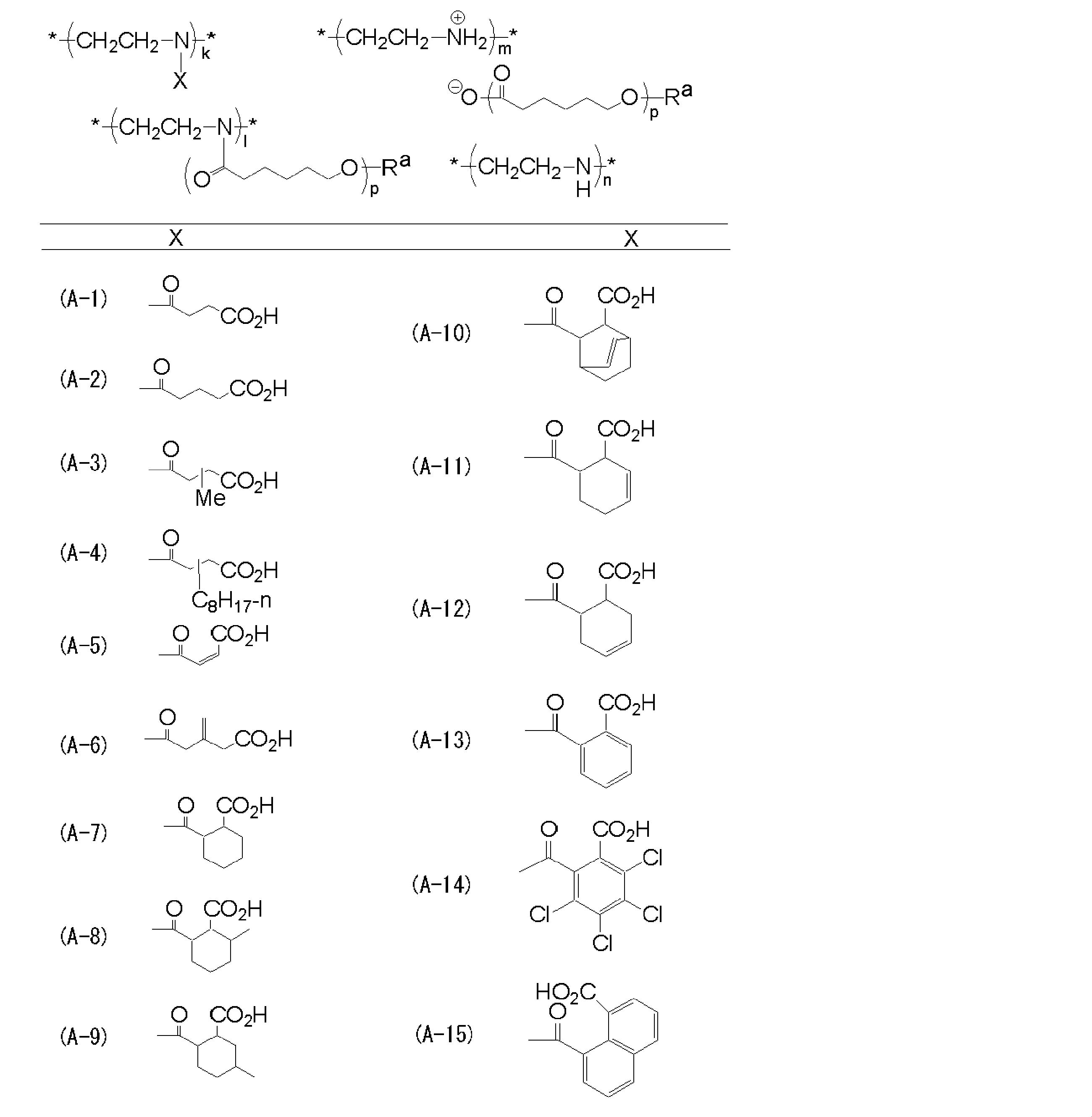
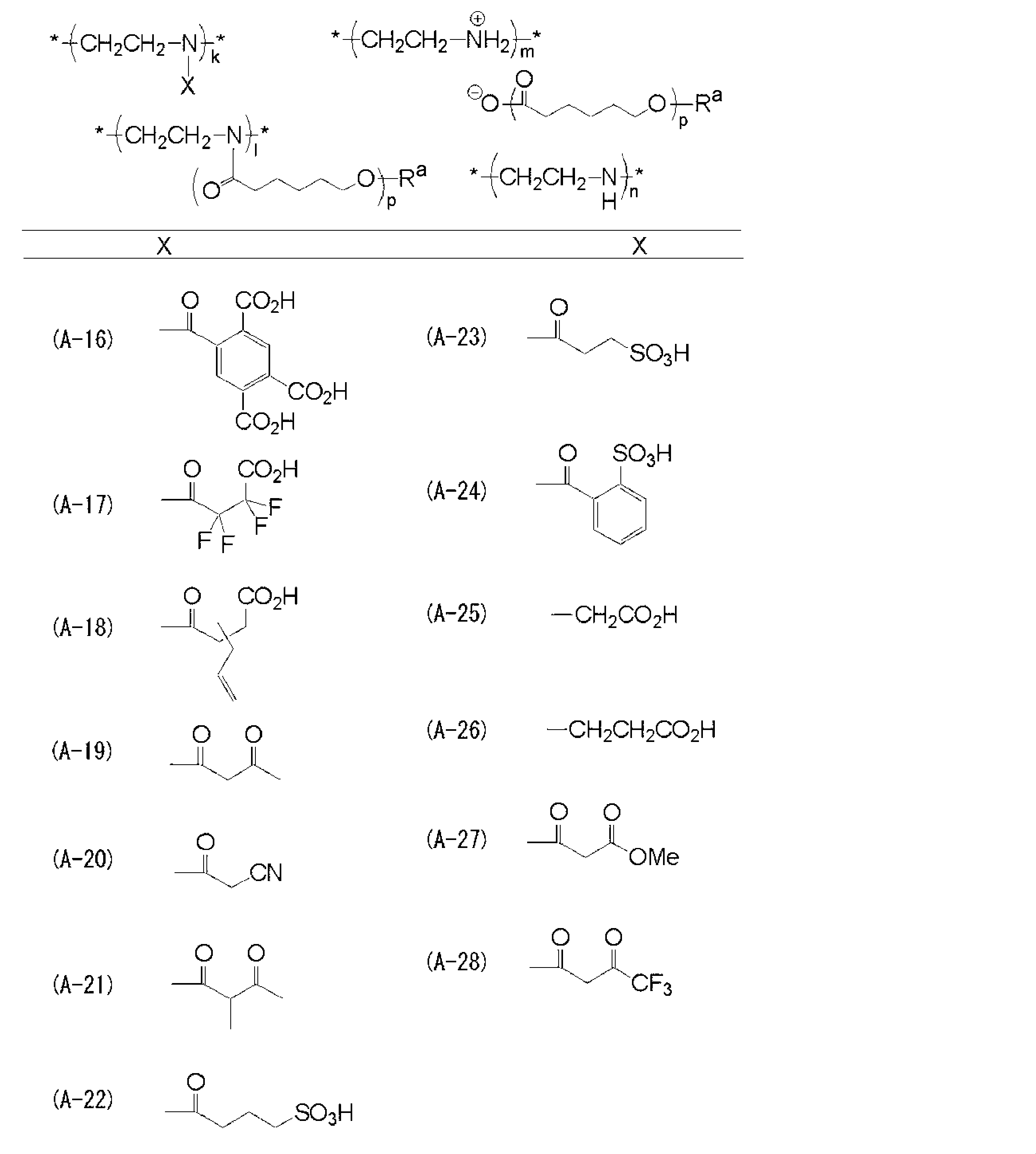


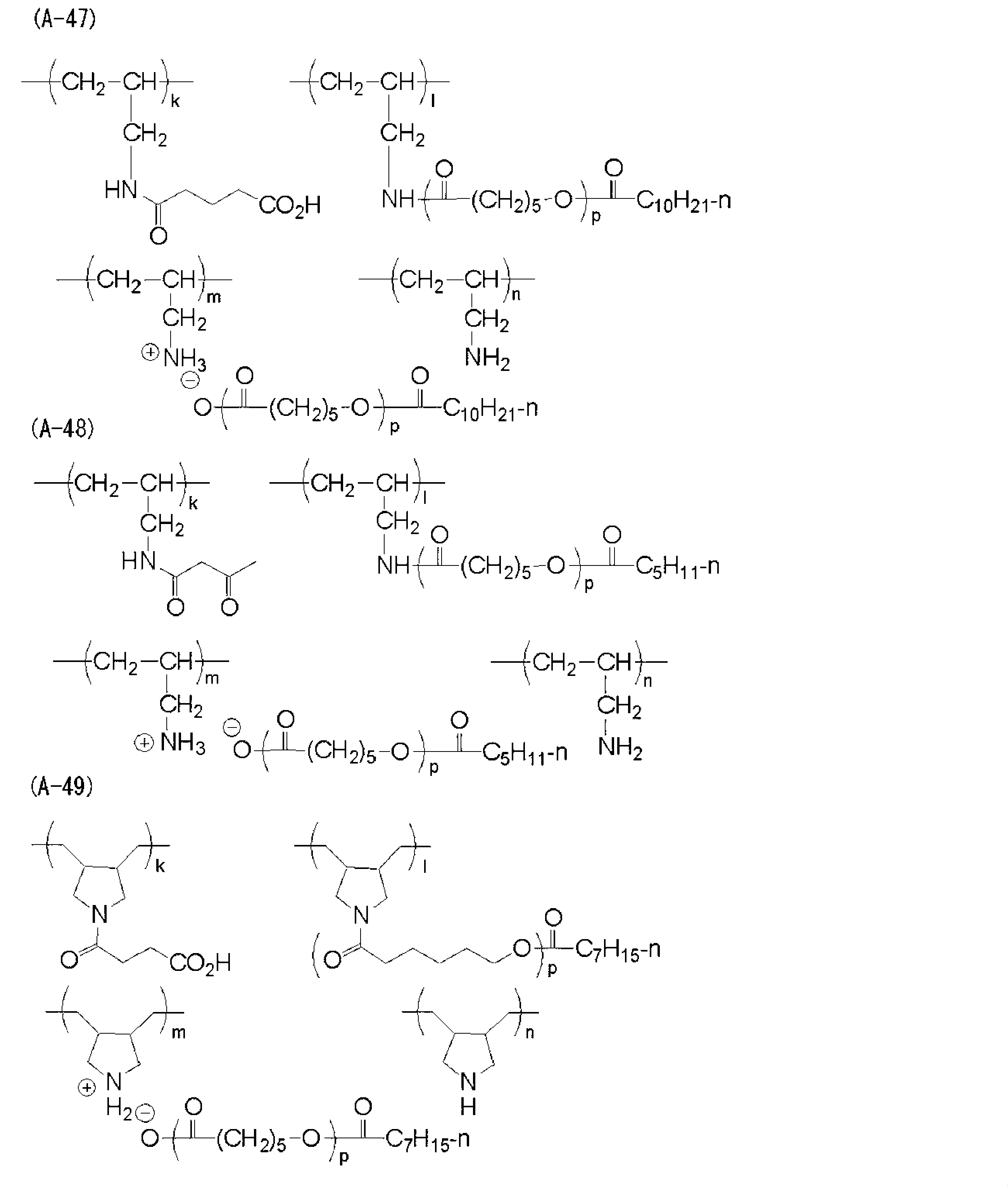


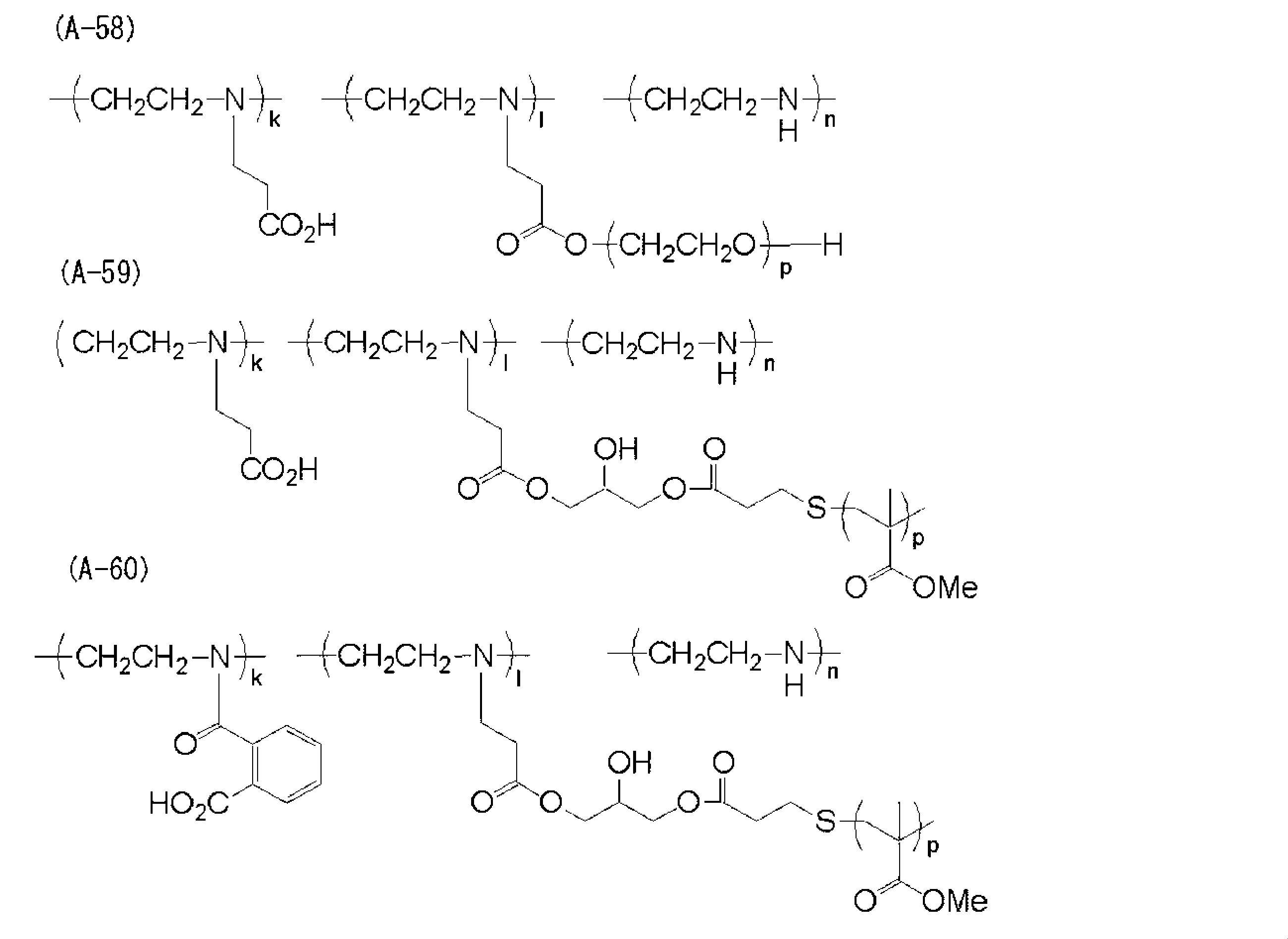
分散樹脂(2)を合成するには、(1)一級又は二級アミノ基を有する樹脂と、部分構造Xの前駆体x、及びYの前駆体yとを反応させる方法、(2)部分構造Xに対応する構造を含有するモノマーとYを含有するマクロモノマーとの重合による方法などにより製造することが可能である。まず、一級又は二級アミノ基を主鎖に有する樹脂を合成し、その後、該樹脂に、Xの前駆体x及びYの前駆体yを反応させて、主鎖に存在する窒素原子に高分子反応により導入することで製造することが好ましい。当該製造方法の詳細は、特開2009-203462等を参照することができる。
<(3)に係るブロック共重合体>
樹脂型の顔料分散剤は、顔料粒子表面に吸着する部位(以下、「吸着部」と略記する)と、顔料担体に対する親和性が高い部位(以下、「親和性部」と略記する)とを有するのが一般的である。親和性部は、顔料同士の凝集を防ぎ、分散安定性を高める効果をもたらす。この親和性部と吸着部とが、ランダムに配列していると、顔料粒子表面への分散剤の吸着が不十分となり、分散不安定となり、顔料粒子が析出してしまうことがある。そうなると、微細画素パターンを形成した時に、そのパターン側壁に顔料析出物が現れてパターン直線性が損なわれたり、あるいは、経時で析出した顔料粒子がカラーフィルターの微細な色ムラ(ザラ)となって現れてしまうことがある。そこで、顔料粒子表面に対する吸着部である(3-a)含窒素共重合体ブロックと、顔料担体に対する親和性部である(3-b)顔料担体親和性共重合体ブロックが、同一分子上に分かれて存在しているブロック共重合体樹脂を塩基性分散剤として用いることにより、画素パターンのパターン直線性やザラの経時安定性に特に優れた組成物を提供することが可能となる。
(3)ブロック共重合体を構成する(3-a)含窒素共重合体ブロックと、(3-b)顔料担体親和性共重合体ブロックとは、それぞれ様々な樹脂系を選択することができるが、樹脂設計が容易でかつ諸耐性に優れたビニル系共重合体が望ましい。
樹脂型の顔料分散剤は、顔料粒子表面に吸着する部位(以下、「吸着部」と略記する)と、顔料担体に対する親和性が高い部位(以下、「親和性部」と略記する)とを有するのが一般的である。親和性部は、顔料同士の凝集を防ぎ、分散安定性を高める効果をもたらす。この親和性部と吸着部とが、ランダムに配列していると、顔料粒子表面への分散剤の吸着が不十分となり、分散不安定となり、顔料粒子が析出してしまうことがある。そうなると、微細画素パターンを形成した時に、そのパターン側壁に顔料析出物が現れてパターン直線性が損なわれたり、あるいは、経時で析出した顔料粒子がカラーフィルターの微細な色ムラ(ザラ)となって現れてしまうことがある。そこで、顔料粒子表面に対する吸着部である(3-a)含窒素共重合体ブロックと、顔料担体に対する親和性部である(3-b)顔料担体親和性共重合体ブロックが、同一分子上に分かれて存在しているブロック共重合体樹脂を塩基性分散剤として用いることにより、画素パターンのパターン直線性やザラの経時安定性に特に優れた組成物を提供することが可能となる。
(3)ブロック共重合体を構成する(3-a)含窒素共重合体ブロックと、(3-b)顔料担体親和性共重合体ブロックとは、それぞれ様々な樹脂系を選択することができるが、樹脂設計が容易でかつ諸耐性に優れたビニル系共重合体が望ましい。
(3-a)含窒素共重合体ブロックの具体例として、N,N-ジメチルアミノエチル(メタ)アクリレート、N,N-ジエチルアミノエチル(メタ)アクリレート、N,N-ジメチルアミノプロピル(メタ)アクリレート、N,N-ジエチルアミノプロピル(メタ)アクリレート、N,N-ジメチルアミノエチル(メタ)アクリルアミド、N,N-ジエチルアミノエチル(メタ)アクリルアミド等のN,N-ジ置換アミノ基含有ビニル系モノマー単位を有する共重合体、アリルアミン等の1級アミノ基含有モノマー単位を有する重合体、又は、ポリエチレンイミン、ポリエチレンポリアミン、ポリキシリレンポリ(ヒドロキシプロピレン)ポリアミン、ポリ(アミノメチル化)エポキシ樹脂等を挙げることができるが、必ずしもこれらに限定されるものではない。
この中で、特に、ブロック共重合体の樹脂設計が容易でかつ諸耐性に優れたN,N-ジ置換アミノ基含有ビニル系モノマー単位を有する共重合体が好ましく、この場合、(3-a)含窒素共重合体ブロック中に含まれるN,N-ジ置換アミノ基含有ビニル系モノマー単位は60~100重量%、更に好ましくは、80~100重量%であり、N,N-ジ置換アミノ基含有ビニル系モノマー単位以外のビニル系モノマー単位としては(3-b)顔料担体親和性共重合体ブロックで説明するビニル系モノマー単位であることが好ましい。N,N-ジ置換アミノ基含有モノマーとしては、N,N-ジメチルアミノエチル(メタ)アクリレート、N,N-ジエチルアミノエチル(メタ)アクリレート、N,N-ジメチルアミノプロピル(メタ)アクリレート、N,N-ジエチルアミノプロピル(メタ)アクリレートが好ましい。
この中で、特に、ブロック共重合体の樹脂設計が容易でかつ諸耐性に優れたN,N-ジ置換アミノ基含有ビニル系モノマー単位を有する共重合体が好ましく、この場合、(3-a)含窒素共重合体ブロック中に含まれるN,N-ジ置換アミノ基含有ビニル系モノマー単位は60~100重量%、更に好ましくは、80~100重量%であり、N,N-ジ置換アミノ基含有ビニル系モノマー単位以外のビニル系モノマー単位としては(3-b)顔料担体親和性共重合体ブロックで説明するビニル系モノマー単位であることが好ましい。N,N-ジ置換アミノ基含有モノマーとしては、N,N-ジメチルアミノエチル(メタ)アクリレート、N,N-ジエチルアミノエチル(メタ)アクリレート、N,N-ジメチルアミノプロピル(メタ)アクリレート、N,N-ジエチルアミノプロピル(メタ)アクリレートが好ましい。
(3-b)顔料担体親和性共重合体ブロックは、ブロック共重合体の樹脂設計が容易でかつ諸耐性に優れたビニル系モノマー共重合体であることが好ましい。更に、ビニル系モノマー単位としてアルキル(メタ)アクリレート(好ましくは炭素数4~24)を含むことが好ましい。特に(3-b)顔料担体親和性共重合体ブロック中に60~100重量%、更に好ましくは、80~100重量%含む。アルキル(メタ)アクリレートとしては、例えば、メチル(メタ)アクリレート、エチル(メタ)アクリレート、n-プロピル(メタ)アクリレート、イソプロピル(メタ)アクリレート、n-ブチル(メタ)アクリレート、イソブチル(メタ)アクリレート、2-エチルヘキシル(メタ)アクリレート、シクロヘキシル(メタ)アクリレート、ステアリル(メタ)アクリレート、又はラウリル(メタ)アクリレート等の不飽和モノカルボン酸と炭素数1~18のアルキルアルコールとの反応で得られる(メタ)アクリルエステル類等が挙げられるが、必ずしもこれらに限定されるものではない。炭素数4~24のアルキル(メタ)アクリレートの好ましいものとして、n-プロピル(メタ)アクリレート、イソプロピル(メタ)アクリレート、n-ブチル(メタ)アクリレート、イソブチル(メタ)アクリレート、2-エチルヘキシル(メタ)アクリレート、シクロヘキシル(メタ)アクリレートであり、最も好ましくはn-ブチル(メタ)アクリレートが挙げられる。
(3-b)顔料担体親和性共重合体ブロックには、アミノ基を含むビニル系モノマー単位を全く含有しないことが好ましいが、例えば10重量%未満であれば含まれていても構わない。
(3-b)顔料担体親和性共重合体ブロックに含まれても良いその他のビニル系モノマー単位としては、(メタ)アクリロニトリル等のニトロ基含有ビニル系モノマー類、スチレン、α-メチルスチレン、又はベンジル(メタ)アクリレート等のビニル系芳香族モノマー類、2-ヒドロキシエチル(メタ)アクリレート、ヒドロキシプロピル(メタ)アクリレート、又はポリエチレングリコール(メタ)アクリレート等の水酸基含有ビニル系モノマー類、(メタ)アクリルアミド、N,N-ジメチルアクリルアミド、N-イソプロピルアクリルアミド、ダイアセトンアクリルアミド等のアミド基含有ビニル系モノマー類、N-メチロール(メタ)アクリルアミド、又はジメチロール(メタ)アクリルアミド等のビニル系モノマー類、N-メトキシメチル(メタ)アクリルアミド、又はN-ブトキシメチル(メタ)アクリルアミド等のアルコキシメチル基含有ビニル系モノマー類、エチレン、プロピレン、又はイソプレン等のオレフィン類;クロロプレン、又はブタジエン等のジエン類、メチルビニルエーテル、エチルビニルエーテル、n-プロピルビニルエーテル、イソプロピルビニルエーテル、n-ブチルビニルエーテル、又はイソブチルビニルエーテル等のビニルエーテル類、あるいは、酢酸ビニル、プロピオン酸ビニル等の脂肪酸ビニル類等が挙げられるが、必ずしもこれらに限定されるものではない。
(3-b)顔料担体親和性共重合体ブロックには、アミノ基を含むビニル系モノマー単位を全く含有しないことが好ましいが、例えば10重量%未満であれば含まれていても構わない。
(3-b)顔料担体親和性共重合体ブロックに含まれても良いその他のビニル系モノマー単位としては、(メタ)アクリロニトリル等のニトロ基含有ビニル系モノマー類、スチレン、α-メチルスチレン、又はベンジル(メタ)アクリレート等のビニル系芳香族モノマー類、2-ヒドロキシエチル(メタ)アクリレート、ヒドロキシプロピル(メタ)アクリレート、又はポリエチレングリコール(メタ)アクリレート等の水酸基含有ビニル系モノマー類、(メタ)アクリルアミド、N,N-ジメチルアクリルアミド、N-イソプロピルアクリルアミド、ダイアセトンアクリルアミド等のアミド基含有ビニル系モノマー類、N-メチロール(メタ)アクリルアミド、又はジメチロール(メタ)アクリルアミド等のビニル系モノマー類、N-メトキシメチル(メタ)アクリルアミド、又はN-ブトキシメチル(メタ)アクリルアミド等のアルコキシメチル基含有ビニル系モノマー類、エチレン、プロピレン、又はイソプレン等のオレフィン類;クロロプレン、又はブタジエン等のジエン類、メチルビニルエーテル、エチルビニルエーテル、n-プロピルビニルエーテル、イソプロピルビニルエーテル、n-ブチルビニルエーテル、又はイソブチルビニルエーテル等のビニルエーテル類、あるいは、酢酸ビニル、プロピオン酸ビニル等の脂肪酸ビニル類等が挙げられるが、必ずしもこれらに限定されるものではない。
<(3)ブロック共重合体樹脂の製造方法>
本発明の塩基性分散剤として上述の(3)ブロック共重合体を用いる場合、このブロック共重合体は公知の方法で製造することができるが、特に、(1)リビング重合を用いる方法、又は(2)末端に反応性官能基を有する(3-a)含窒素共重合体ブロックの前駆体(a)と末端に反応性官能基を有する(3-b)顔料担体親和性共重合体ブロックの前駆体(b)とを反応させるポリマーカップリング法が好ましい。この中で、特に(1)リビング重合を用いた方法が好ましい。
本発明の塩基性分散剤として上述の(3)ブロック共重合体を用いる場合、このブロック共重合体は公知の方法で製造することができるが、特に、(1)リビング重合を用いる方法、又は(2)末端に反応性官能基を有する(3-a)含窒素共重合体ブロックの前駆体(a)と末端に反応性官能基を有する(3-b)顔料担体親和性共重合体ブロックの前駆体(b)とを反応させるポリマーカップリング法が好ましい。この中で、特に(1)リビング重合を用いた方法が好ましい。
(1)リビング重合法
リビング重合法は、一般的なラジカル重合に起こる副反応が抑制され、更には、重合の成長が均一に起こる為、容易にブロックポリマーや分子量の揃った樹脂を合成できる。中でも、有機ハロゲン化物、ハロゲン化スルホニル化合物を開始剤とし、遷移金属錯体を触媒とする原子移動ラジカル重合法は、広範囲の単量体に適応できる点、既存の設備に適応可能な重合温度を採用できる点で好ましい。原子移動ラジカル重合法は、下記の参考文献1~8等に記載された方法で行うことができる。
(参考文献1)Fukudaら、Prog. Polym. Sci. 2004, 29 , 329
(参考文献2)Matyjaszewskiら、Chem.R e v.2001,101,2921
(参考文献3)Matyjaszewskiら、J.Am.Chem.Soc.1995,117,5614
(参考文献4) Macromolecules 1995,28,7901,Science, 1996,272,866
(参考文献5)国際公開第96/30421号パンフレット
(参考文献6)国際公開第97/18247号パンフレット
(参考文献7)特開平9-208616号公報
(参考文献8)特開平8-41117号公報
原子移動ラジカル重合法では、レドックス触媒として銅、ルテニウム、鉄、及びニッケル等の遷移金属錯体を用いて行われる。遷移金属錯体の具体的な例としては、塩化銅(I)、臭化銅(I)等の低原子価のハロゲン化遷移金属が挙げられるが、重合速度をコントロールするために、周知の方法に従って塩化銅(II)や臭化銅(II)等の高原子価の遷移金属を重合系に添加してもよい。
リビング重合法は、一般的なラジカル重合に起こる副反応が抑制され、更には、重合の成長が均一に起こる為、容易にブロックポリマーや分子量の揃った樹脂を合成できる。中でも、有機ハロゲン化物、ハロゲン化スルホニル化合物を開始剤とし、遷移金属錯体を触媒とする原子移動ラジカル重合法は、広範囲の単量体に適応できる点、既存の設備に適応可能な重合温度を採用できる点で好ましい。原子移動ラジカル重合法は、下記の参考文献1~8等に記載された方法で行うことができる。
(参考文献1)Fukudaら、Prog. Polym. Sci. 2004, 29 , 329
(参考文献2)Matyjaszewskiら、Chem.R e v.2001,101,2921
(参考文献3)Matyjaszewskiら、J.Am.Chem.Soc.1995,117,5614
(参考文献4) Macromolecules 1995,28,7901,Science, 1996,272,866
(参考文献5)国際公開第96/30421号パンフレット
(参考文献6)国際公開第97/18247号パンフレット
(参考文献7)特開平9-208616号公報
(参考文献8)特開平8-41117号公報
原子移動ラジカル重合法では、レドックス触媒として銅、ルテニウム、鉄、及びニッケル等の遷移金属錯体を用いて行われる。遷移金属錯体の具体的な例としては、塩化銅(I)、臭化銅(I)等の低原子価のハロゲン化遷移金属が挙げられるが、重合速度をコントロールするために、周知の方法に従って塩化銅(II)や臭化銅(II)等の高原子価の遷移金属を重合系に添加してもよい。
(2)ポリマーカップリング法
ポリマーカップリング法の(3-a)含窒素共重合体ブロックの前駆体(a)及び(3-b)顔料担体親和性共重合体ブロックの前駆体(b)の末端の反応性官能基として好ましいものとして、具体的には、カルボキシル基、1級アミノ基、水酸基、及びアルコキシシリル基等が挙げられる。
(3-a)含窒素共重合体ブロックの前駆体(a)及び(3-b)顔料担体親和性共重合体ブロックの前駆体(b)の末端に反応性官能基を導入する方法としては、上述した反応性官能基とチオール基を有する連鎖移動剤を用いて、ラジカル重合する方法が好ましい。カルボキシル基を有する連鎖移動剤としてはメルカプトプロピオン酸、1級アミノ基を有する連鎖移動剤としてはシステアミン、水酸基を有する連鎖移動剤としてはメルカプトエタノール、アルコキシシリル基を有する連鎖移動剤としては、3-メルカプトプロピルメチルメトキシシラン、及び3-メルカプトプロピルトリメトキシシランがそれぞれ例示できる。
前駆体(a)と、前駆体(b)とのカップリング反応は、例えば、以下の表Aに示す公知の反応で可能である。結合剤としては、適宜、この種の反応に用いられるものを選定すればよい。
ポリマーカップリング法の(3-a)含窒素共重合体ブロックの前駆体(a)及び(3-b)顔料担体親和性共重合体ブロックの前駆体(b)の末端の反応性官能基として好ましいものとして、具体的には、カルボキシル基、1級アミノ基、水酸基、及びアルコキシシリル基等が挙げられる。
(3-a)含窒素共重合体ブロックの前駆体(a)及び(3-b)顔料担体親和性共重合体ブロックの前駆体(b)の末端に反応性官能基を導入する方法としては、上述した反応性官能基とチオール基を有する連鎖移動剤を用いて、ラジカル重合する方法が好ましい。カルボキシル基を有する連鎖移動剤としてはメルカプトプロピオン酸、1級アミノ基を有する連鎖移動剤としてはシステアミン、水酸基を有する連鎖移動剤としてはメルカプトエタノール、アルコキシシリル基を有する連鎖移動剤としては、3-メルカプトプロピルメチルメトキシシラン、及び3-メルカプトプロピルトリメトキシシランがそれぞれ例示できる。
前駆体(a)と、前駆体(b)とのカップリング反応は、例えば、以下の表Aに示す公知の反応で可能である。結合剤としては、適宜、この種の反応に用いられるものを選定すればよい。
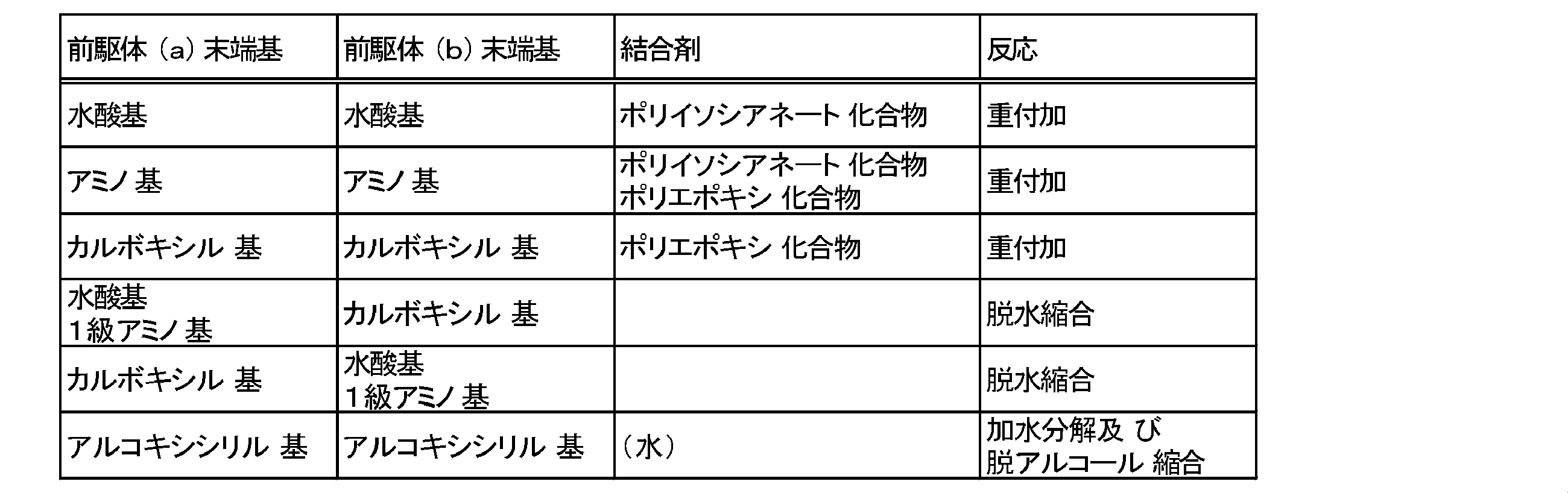
塩基性分散剤(1)~(3)の分子量としては、重量平均分子量で3,000~100,000であることが好ましく、更に5,000~55,000であることが好ましい。重量平均分子量が上記の範囲であると、塩基性分散剤(1)~(3)に導入された複数の塩基性吸着部位が効率的に顔料粒子表面に吸着することができ、分散安定性に優れた組成物を得ることが可能となり好ましい。
なお、本明細書において、高分子化合物の分子量はゲルパーミエーションクロマトグラフィー(GPC)により測定した値を言い、特に断らない限り、HLC-8020GPC(東ソー(株)製)を用い、カラムをTSKgel SuperHZM-H、TSKgel SuperHZ4000、TSKgel SuperHZ200(東ソー社製)として測定した。キャリアは適宜選定すればよいが、溶解可能であるかぎり、テトラヒドロフランを用いることにする。
また、本発明で用いる塩基性分散剤として(3)ブロック共重合体を用いる場合、そのアミン価は、35~100mgKOH/gであり、更に、好ましくは50~75mgKOH/gである。アミン価が小さすぎると、顔料に十分吸着されず分散不良となることがあり、大きすぎると顔料担体中の酸性成分に対する吸着又は反応により、顔料に対する吸着効率が悪くなり、分散不良となることがある。
(3-a)含窒素共重合体ブロックと(3-b)顔料担体親和性共重合体ブロックの構成重量比率及びそれぞれのブロックの数平均分子量は、樹脂型分散剤全体の数平均分子量及びアミン価が、前記の好適な範囲になるように任意に設計できることが好ましい。
なお、本明細書において、高分子化合物の分子量はゲルパーミエーションクロマトグラフィー(GPC)により測定した値を言い、特に断らない限り、HLC-8020GPC(東ソー(株)製)を用い、カラムをTSKgel SuperHZM-H、TSKgel SuperHZ4000、TSKgel SuperHZ200(東ソー社製)として測定した。キャリアは適宜選定すればよいが、溶解可能であるかぎり、テトラヒドロフランを用いることにする。
また、本発明で用いる塩基性分散剤として(3)ブロック共重合体を用いる場合、そのアミン価は、35~100mgKOH/gであり、更に、好ましくは50~75mgKOH/gである。アミン価が小さすぎると、顔料に十分吸着されず分散不良となることがあり、大きすぎると顔料担体中の酸性成分に対する吸着又は反応により、顔料に対する吸着効率が悪くなり、分散不良となることがある。
(3-a)含窒素共重合体ブロックと(3-b)顔料担体親和性共重合体ブロックの構成重量比率及びそれぞれのブロックの数平均分子量は、樹脂型分散剤全体の数平均分子量及びアミン価が、前記の好適な範囲になるように任意に設計できることが好ましい。
塩基性分散剤の濃度としては、顔料100質量部に対して、1質量部以上であることが好ましく、5質量部以上がより好ましく、10質量部以上が特に好ましい。上限側の規定としては、80質量部以下であることが好ましく、70質量部以下がさらに好ましく、60質量部以下がさらに好ましい。
感光性樹脂組成物全固形分に対しては、塩基性分散剤が、3質量%以上であることが好ましく、4質量%以上であることがより好ましい。上限としては、15質量%以下であることが好ましく、10質量%以下であることがより好ましい。
塩基性分散剤の量を上記の範囲とすることで、感光性樹脂組成物のリソグラフィー直線性の良化やザラの経時安定性の良化といった本発明の効果を一層効果的に実現することができ好ましい。
感光性樹脂組成物全固形分に対しては、塩基性分散剤が、3質量%以上であることが好ましく、4質量%以上であることがより好ましい。上限としては、15質量%以下であることが好ましく、10質量%以下であることがより好ましい。
塩基性分散剤の量を上記の範囲とすることで、感光性樹脂組成物のリソグラフィー直線性の良化やザラの経時安定性の良化といった本発明の効果を一層効果的に実現することができ好ましい。
(c)現像樹脂
本発明の感光性樹脂組成物については、現像樹脂として、下記アルカリ可溶性部位を有する高分子化合物を用いることが好ましい。さらに、要求に応じて、重合性基含有部位や重合性基非含有部位を導入した高分子化合物としてもよい。
本発明の感光性樹脂組成物については、現像樹脂として、下記アルカリ可溶性部位を有する高分子化合物を用いることが好ましい。さらに、要求に応じて、重合性基含有部位や重合性基非含有部位を導入した高分子化合物としてもよい。
・アルカリ可溶性部位
現像樹脂においては、そのアルカリ可溶性を考慮して、アルカリ可溶性部位を有することが好ましい。アルカリ可溶性を促進する基(以下、「酸基」ともいう)としては、例えば、カルボキシル基、リン酸基、スルホン酸基、フェノール性水酸基などが挙げられる。なかでも(メタ)アクリル酸が特に好ましい。
現像樹脂においては、そのアルカリ可溶性を考慮して、アルカリ可溶性部位を有することが好ましい。アルカリ可溶性を促進する基(以下、「酸基」ともいう)としては、例えば、カルボキシル基、リン酸基、スルホン酸基、フェノール性水酸基などが挙げられる。なかでも(メタ)アクリル酸が特に好ましい。
重合後に酸基を付与しうるモノマーを用いてもよい。その場合には、例えば、水酸基やエポキシ基、イソシアネート基を有する繰り返し単位を樹脂に組み込んでおいて、それらの基を酸基に変換することが好ましい。重合後に酸基を付与しうるモノマーとしては、例えば、2-ヒドロキシエチル(メタ)アクリレート等の水酸基を有するモノマー、グリシジル(メタ)アクリレート等のエポキシ基を有するモノマー、2-イソシアナートエチル(メタ)アクリレート等のイソシアネート基を有するモノマー等が挙げられる。
なお、重合後に酸基を付与しうるモノマーを単量体成分として酸基を導入する場合には、定法により、重合後に酸基を付与するための処理が必要となる。
なお、重合後に酸基を付与しうるモノマーを単量体成分として酸基を導入する場合には、定法により、重合後に酸基を付与するための処理が必要となる。
アルカリ可溶性構造部の割合としては、モル共重合比率で、分子中(全量を100とする)、10以上であるのが好ましく、20以上であるのがより好ましい。上限としては、50以下であるのが好ましく、40以下であるのがより好ましい。このような範囲とすることにより、アルカリ現像性が向上し、矩形パターンの形成性がより効果的に達成される。
・重合性基含有部位
重合性基を有する繰り返し単位(重合性基含有部位)は、アクリル構造を有することが好ましい。重合性基含有部位の基部となるアクリル構造としては、(メタ)アクリロイル基を有することが好ましく、(メタ)アクリロイルオキシ基(CH2=C(R)COO-)または(メタ)アクリロイルアミノ基(CH2=C(R)CONRN-)を有することがより好ましい。ここでのRは水素原子またはメチル基である。RNは水素原子または炭素数1~6のアルキル基である。
重合性基を有する繰り返し単位(重合性基含有部位)は、アクリル構造を有することが好ましい。重合性基含有部位の基部となるアクリル構造としては、(メタ)アクリロイル基を有することが好ましく、(メタ)アクリロイルオキシ基(CH2=C(R)COO-)または(メタ)アクリロイルアミノ基(CH2=C(R)CONRN-)を有することがより好ましい。ここでのRは水素原子またはメチル基である。RNは水素原子または炭素数1~6のアルキル基である。
重合性基としては、エチレン性不飽和結合基(ビニル基、アリル基等)、エポキシ基、オキセタン基、イソシアネート基が挙げられる。
重合性基含有部の割合としては、モル共重合比率で、分子中(全量を100とする)、5以上であるのが好ましく、10以上であるのがより好ましい。上限としては、50以下であるのが好ましく、40以下であるのがより好ましい。このような範囲とすることにより、後述する膜面荒れの防止と現像性との両立がより効果的に達成される。
・重合性基非含有部位
重合性基を有さない繰り返し単位(重合性基非含有部位)としては、任意の構造を適用できるが、下記式(ED)で表される化合物(以下「エーテルダイマー」と称することもある。)を単量体成分を重合してなる繰り返し単位であることが好ましい。
重合性基を有さない繰り返し単位(重合性基非含有部位)としては、任意の構造を適用できるが、下記式(ED)で表される化合物(以下「エーテルダイマー」と称することもある。)を単量体成分を重合してなる繰り返し単位であることが好ましい。

式中、RD1及びRD2は、それぞれ独立して、水素原子又は置換基を有していてもよい炭素数1~25の炭化水素基を表す。RD1及びRD2で表される置換基を有していてもよい炭素数1~25の炭化水素基としては、特に制限はないが、例えば、直鎖状又は分岐状のアルキル基(炭素数1~12が好ましく、1~6がより好ましく、1~3が特に好ましい);アリール基(炭素数6~22が好ましく、6~14がより好ましい);シクロヘキシル、t-ブチルシクロヘキシル、ジシクロペンタジエニル、トリシクロデカニル、イソボルニル、アダマンチル、2-メチル-2-アダマンチル等の脂環式基(炭素数3~12が好ましく、3~6がより好ましい);アルコキシで置換されたアルキル基(炭素数2~12が好ましく、2~6がより好ましく、2~3が特に好ましい);ベンジル等のアリール基で置換されたアルキル基(炭素数7~23が好ましく、7~15がより好ましい);等が挙げられる。これらの中でも特に、メチル、エチル、シクロヘキシル、ベンジル等のような酸や熱で脱離しにくい1級又は2級炭素の置換基が耐熱性の点で好ましい。
エーテルダイマーの具体例としては、特開2012-208494号の段落[0565](対応する米国特許出願公開第2012/235099号明細書の[0694])に記載のエーテルダイマーの具体例が挙げられ、これらの内容は本願明細書に組み込まれる。
エーテルダイマーの具体例としては、ジメチル-2,2’-[オキシビス(メチレン)]ビス-2-プロペノエート、ジエチル-2,2’-[オキシビス(メチレン)]ビス-2-プロペノエート、ジシクロヘキシル-2,2’-[オキシビス(メチレン)]ビス-2-プロペノエート、ジベンジル-2,2’-[オキシビス(メチレン)]ビス-2-プロペノエートが好ましい。
エーテルダイマーの具体例としては、ジメチル-2,2’-[オキシビス(メチレン)]ビス-2-プロペノエート、ジエチル-2,2’-[オキシビス(メチレン)]ビス-2-プロペノエート、ジシクロヘキシル-2,2’-[オキシビス(メチレン)]ビス-2-プロペノエート、ジベンジル-2,2’-[オキシビス(メチレン)]ビス-2-プロペノエートが好ましい。
上記エーテルダイマーを重合させてなる繰り返し単位としては、下記のような構造を挙げることができる。Meはメチル基である。*は結合手である。nXは整数であり、1~100が好ましく、2~30がより好ましく、5~15が特に好ましい。具体例はnX=10である。

重合性基を有さない繰り返し単位(重合性基非含有部位)としては、2個以上6個以下の水酸基を有する重合性単量体成分を重合してなる繰り返し単位であることが好ましい。具体的には、下記式(AE)を有する重合性単量体成分を重合してなる繰り返し単位であることが好ましい。

式中、RE1及びRE4はそれぞれ独立に水素原子、炭素数1~5の置換されてもよいアルキル基を表し、RE2は炭素数1~4のアルキレン基を表し、RE3は炭素数1~4のアルキレン基、または単結合を表し、nは2以上6以下の整数を表す。
上記式(AE)で示されるモノマーとしては、エチレン性不飽和二重結合を有する多価アルコールのモノエステルなどが挙げられるが、好ましいのはグリセロールモノ(メタ)アクリレートである。
重合性基非含有部の割合としては、モル共重合比率で、分子中(全量を100とする)、10以上であるのが好ましく、20以上であるのがより好ましい。上限としては、80以下であるのが好ましく、70以下であるのがより好ましい。このような範囲とすることにより、溶剤への溶解性がより効果的に達成される。
本発明においては、現像樹脂に下記式(A1)で表される化合物が共重合されている高分子化合物が含まれると、本発明の効果に優れるようになり、特に好ましい。

RA1は水素原子またはメチル基を表す。nは1~15の整数を表す。nが2以上の場合、複数のRA2は同一であってもよく、異なっていてもよい。mは0~5の整数を表す。
RA2は、炭素数2または3のアルキレン基を表し、nが2以上の場合、複数のRA2は同一であってもよく、異なっていてもよい。
RA3はベンゼン環を含んでいても良い炭素数1~20のアルキル基を表す。アルキル基は、好ましくは炭素数1~10のアルキル基である。メチル基、エチル基、プロピル基、ブチル基、ペンチル基、ヘキシル基、ヘプチル基、オクチル基、ノニル基、デシル基等を挙げることができる。ベンゼン環を含むアルキル基としては、1-フェニルエチル基、1-フェニルプロピル基、1-フェニルブチル基、1-フェニルペンチル基、1-フェニルヘキシル基、1-フェニルヘプチル基、1-フェニルオクチル基、1-フェニルノニル基、1-フェニルデシル基、ベンジル基、2-フェニル(イソ)プロピル基等を挙げることができる。これらの中でも、ベンジル基、2-フェニル(イソ)プロピル基が好ましい。
RA2は、炭素数2または3のアルキレン基を表し、nが2以上の場合、複数のRA2は同一であってもよく、異なっていてもよい。
RA3はベンゼン環を含んでいても良い炭素数1~20のアルキル基を表す。アルキル基は、好ましくは炭素数1~10のアルキル基である。メチル基、エチル基、プロピル基、ブチル基、ペンチル基、ヘキシル基、ヘプチル基、オクチル基、ノニル基、デシル基等を挙げることができる。ベンゼン環を含むアルキル基としては、1-フェニルエチル基、1-フェニルプロピル基、1-フェニルブチル基、1-フェニルペンチル基、1-フェニルヘキシル基、1-フェニルヘプチル基、1-フェニルオクチル基、1-フェニルノニル基、1-フェニルデシル基、ベンジル基、2-フェニル(イソ)プロピル基等を挙げることができる。これらの中でも、ベンジル基、2-フェニル(イソ)プロピル基が好ましい。
式(A1)で表される化合物としては、フェノールのエチレンオキサイド(EO)変性(メタ)アクリレート、パラクミルフェノールのEOまたはプロピレンオキサイド(PO)変性(メタ)アクリレート、ノニルフェノールのEO変性(メタ)アクリレート、ノニルフェノールのPO変性(メタ)アクリレート等が挙げられる。これら化合物のうち、パラクミルフェノールのEOまたはPO変性(メタ)アクリレートを共重合した現像樹脂は本発明の効果を充分に得る上で特に好ましい。
式(A1)で表される化合物を現像樹脂の共重合成分として用いる場合、その共重合割合としては、モル共重合比率で、分子中(全量を100とする)、5以上であるのが好ましく、10以上であるのがより好ましい。上限としては、30以下であるのが好ましく、20以下であるのがより好ましい。
現像樹脂の製造には、例えば、公知のラジカル重合法による方法を適用することができる。ラジカル重合法で樹脂を製造する際の温度、圧力、ラジカル開始剤の種類及びその量、溶剤の種類等々の重合条件は、当業者において容易に設定可能であり、実験的に条件を定めるようにすることもできる。
・現像樹脂の諸元
現像樹脂は、感光性樹脂組成物中、1質量%以上であることが好ましく、3質量%以上であることがより好ましい。上限側の規定としては、20質量%以下であることが好ましく、15質量%以下であることがより好ましく、10質量%以下であることがさらに好ましい。
現像樹脂成分は、全固形分の10質量%以上であることが好ましく、20質量%以上であることがさらに好ましい。上限側の規定としては、50質量%以下であることが好ましく、40質量%以下であることがさらに好ましい。
顔料100質量部に対しては、現像樹脂を10質量部以上で含有させることが好ましく、25質量部以上で含有させることがより好ましく、50質量部以上で含有させることが特に好ましい。上限側の規定としては、100質量部以下で含有させることが好ましく、80質量部以下で含有させることがより好ましく、60質量部以下で含有させることが特に好ましい。
現像樹脂を上記の範囲とすることにより、硬化させて着色層を形成する際に膜収縮が起こりにくく、パターン形成性に優れ、表面荒れの少ない着色層が形成できる。
現像樹脂は、感光性樹脂組成物中、1質量%以上であることが好ましく、3質量%以上であることがより好ましい。上限側の規定としては、20質量%以下であることが好ましく、15質量%以下であることがより好ましく、10質量%以下であることがさらに好ましい。
現像樹脂成分は、全固形分の10質量%以上であることが好ましく、20質量%以上であることがさらに好ましい。上限側の規定としては、50質量%以下であることが好ましく、40質量%以下であることがさらに好ましい。
顔料100質量部に対しては、現像樹脂を10質量部以上で含有させることが好ましく、25質量部以上で含有させることがより好ましく、50質量部以上で含有させることが特に好ましい。上限側の規定としては、100質量部以下で含有させることが好ましく、80質量部以下で含有させることがより好ましく、60質量部以下で含有させることが特に好ましい。
現像樹脂を上記の範囲とすることにより、硬化させて着色層を形成する際に膜収縮が起こりにくく、パターン形成性に優れ、表面荒れの少ない着色層が形成できる。
現像樹脂の酸価は、10~200mgKOH/gであることが好ましく、20~150mgKOH/gであることがより好ましい。この範囲とすることにより、現像後の未露光部の残渣を低減することが可能になる。
現像樹脂は、重量平均分子量が50,000以下であることが好ましく、30,000以下であることが特に好ましい。下限側の規定としては、3,000以上であることが好ましく、5,000以上であることが特に好ましい。
(d)色素誘導体
本発明の感光性樹脂組成物は、さらに酸性もしくは中性の色素誘導体を含有する。酸性もしくは中性の色素誘導体を含有することで、前記塩基性分散剤を配合したことの作用と相まって、本発明の効果が好適に発揮される。
本発明における「酸性の色素誘導体」とは、有機色素骨格に酸性基を有する化合物を指す。酸性基はpKa値が5以下の官能基が好ましく、例えば、カルボン酸、リン酸基、スルホン酸基などが挙げられ、好ましくはスルホン酸基である。pKa値はさらに4.8以下であることが好ましい。下限は特にないが-15以上であることが実際的である。
一方、本発明における「中性の色素誘導体」とは、有機色素骨格に酸性基と塩基性基とを有する化合物を指し、酸性基と塩基性基とがそれぞれ実質的に当量置換された化合物であることが好ましい。ここで、酸性基の好ましいpKa値の範囲は前記と同じである。塩基性基は対応する共役酸のpKa値が5以上の官能基が好ましい。共役酸のpKa値はさらに7以上であることが好ましい。上限は特にないが12以下であることが実際的である。塩基性基の具体例としては、アミノ基(NRN 2)が挙げられる。RNは水素原子または炭素数1~6のアルキル基である。RNがアルキル基であるとき、その複数のものが連結してもよい。この連結にはヘテロ原子を含む基(O,S,CO,NRN等)を介在していてもよい。本発明の中性の色素誘導体は、酸性基と塩基性基がそれぞれ当量置換されており、酸塩基が中和しあって、分子全体としては実質的に中性となっているものである。「実質的に中性」とは分子全体としての酸塩基性に偏りが無く、酸性も塩基性も呈さない状態を意味する。
なお、ここでいう「pKa値」とは、化学便覧(II)(改訂4版、1993年、日本化学会編、丸善株式会社)に記載されている定義のものであり、25℃水中における値である。置換基のpKaとして評価するときに、CH3基を補ってその値を定めることとする。
なお、本発明の感光性樹脂組成物に含まれる色素誘導体としては、上記定義に基づく酸性もしくは中性の色素誘導体を含有していれば、塩基性の色素誘導体を含んだ混合物として用いても良い。
本発明の感光性樹脂組成物は、さらに酸性もしくは中性の色素誘導体を含有する。酸性もしくは中性の色素誘導体を含有することで、前記塩基性分散剤を配合したことの作用と相まって、本発明の効果が好適に発揮される。
本発明における「酸性の色素誘導体」とは、有機色素骨格に酸性基を有する化合物を指す。酸性基はpKa値が5以下の官能基が好ましく、例えば、カルボン酸、リン酸基、スルホン酸基などが挙げられ、好ましくはスルホン酸基である。pKa値はさらに4.8以下であることが好ましい。下限は特にないが-15以上であることが実際的である。
一方、本発明における「中性の色素誘導体」とは、有機色素骨格に酸性基と塩基性基とを有する化合物を指し、酸性基と塩基性基とがそれぞれ実質的に当量置換された化合物であることが好ましい。ここで、酸性基の好ましいpKa値の範囲は前記と同じである。塩基性基は対応する共役酸のpKa値が5以上の官能基が好ましい。共役酸のpKa値はさらに7以上であることが好ましい。上限は特にないが12以下であることが実際的である。塩基性基の具体例としては、アミノ基(NRN 2)が挙げられる。RNは水素原子または炭素数1~6のアルキル基である。RNがアルキル基であるとき、その複数のものが連結してもよい。この連結にはヘテロ原子を含む基(O,S,CO,NRN等)を介在していてもよい。本発明の中性の色素誘導体は、酸性基と塩基性基がそれぞれ当量置換されており、酸塩基が中和しあって、分子全体としては実質的に中性となっているものである。「実質的に中性」とは分子全体としての酸塩基性に偏りが無く、酸性も塩基性も呈さない状態を意味する。
なお、ここでいう「pKa値」とは、化学便覧(II)(改訂4版、1993年、日本化学会編、丸善株式会社)に記載されている定義のものであり、25℃水中における値である。置換基のpKaとして評価するときに、CH3基を補ってその値を定めることとする。
なお、本発明の感光性樹脂組成物に含まれる色素誘導体としては、上記定義に基づく酸性もしくは中性の色素誘導体を含有していれば、塩基性の色素誘導体を含んだ混合物として用いても良い。
当該の色素誘導体は下記式(I)で表されるものであることが好ましい。

式中、Qxは有機色素残基である。当該色素残基を構成する色素化合物としては、ピラゾールアゾ化合物、ピロメテン化合物、アニリノアゾ化合物、トリフェニルメタン化合物、アントラキノン化合物、ベンジリデン化合物、オキソノール化合物、ピラゾロトリアゾールアゾ化合物、ピリドンアゾ化合物、シアニン化合物、フェノチアジン化合物、ピロロピラゾールアゾメチン化合物等が好ましい。さらに、下記式(I-1)~(I-6)のいずれかで表される色素化合物がより好ましい。
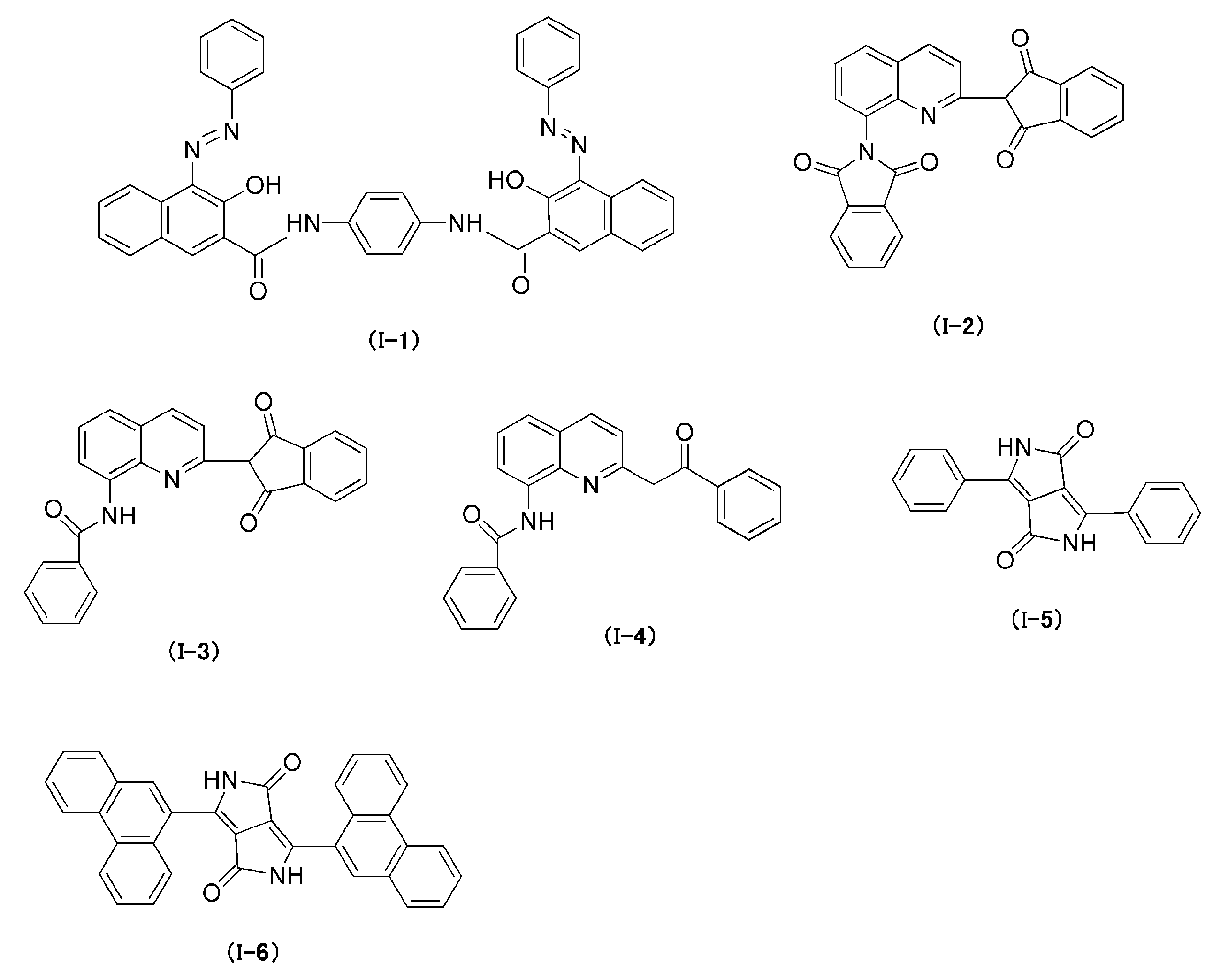
Y1は酸性基である。酸性基はカルボキシル基、スルホン酸基、リン酸基、ホスホン酸基が挙げられ、好ましくはスルホン酸基である。これらの酸性基は塩を形成していてもよい。対塩としては、例えば、ナトリウム、カリウムなどのアルカリ塩などが好ましく、アンモニウムイオンなどでもよい。アンモニウムイオンとしては、+NH(CH2)4N(C2H5)2が挙げられる。
nは1以上4以下の整数であり、mは0以上4以下の整数であり、n≧mを満たす。
rは0以上最大置換基数以下の整数であり、「最大置換基数」とは有機色素残基QXが置換することができる最大数を言う。例えば、フェニル基であれば5である。
Tは置換基を表し、以下から選択される置換基であることが好ましい。
アルキル基(好ましくは炭素原子数1~20のアルキル基、例えばメチル、エチル、イソプロピル、t-ブチル、ペンチル、ヘプチル、1-エチルペンチル、ベンジル、2-エトキシエチル、1-カルボキシメチル等)、アルケニル基(好ましくは炭素原子数2~20のアルケニル基、例えば、ビニル、アリル、オレイル等)、アルキニル基(好ましくは炭素原子数2~20のアルキニル基、例えば、エチニル、ブタジイニル、フェニルエチニル等)、シクロアルキル基(好ましくは炭素原子数3~20のシクロアルキル基、例えば、シクロプロピル、シクロペンチル、シクロヘキシル、4-メチルシクロヘキシル等)、アリール基(好ましくは炭素原子数6~26のアリール基、例えば、フェニル、1-ナフチル、4-メトキシフェニル、2-クロロフェニル、3-メチルフェニル等)、ヘテロ環基(好ましくは炭素原子数2~20のヘテロ環基、より好ましくは、少なくとも1つの酸素原子、硫黄原子、窒素原子を有する5または6員環のヘテロ環基、例えば、2-ピリジル、4-ピリジル、2-イミダゾリル、2-ベンゾイミダゾリル、2-チアゾリル、2-オキサゾリル等)、アルコキシ基(好ましくは炭素原子数1~20のアルコキシ基、例えば、メトキシ、エトキシ、イソプロピルオキシ、ベンジルオキシ等)、アリールオキシ基(好ましくは炭素原子数6~26のアリールオキシ基、例えば、フェノキシ、1-ナフチルオキシ、3-メチルフェノキシ、4-メトキシフェノキシ等)、アルコキシカルボニル基(好ましくは炭素原子数2~20のアルコキシカルボニル基、例えば、エトキシカルボニル、2-エチルヘキシルオキシカルボニル等)、アミノ基(好ましくは炭素原子数0~20のアミノ基、アルキルアミノ基、アリールアミノ基を含み、例えば、アミノ、N,N-ジメチルアミノ、N,N-ジエチルアミノ、N-エチルアミノ、アニリノ等)、スルファモイル基(好ましくは炭素原子数0~20のスルホンアミド基、例えば、N,N-ジメチルスルファモイル、N-フェニルスルファモイル等)、アシル基(好ましくは炭素原子数1~20のアシル基、例えば、アセチル、プロピオニル、ブチリル、ベンゾイル等)、アシルオキシ基(好ましくは炭素原子数1~20のアシルオキシ基、例えば、アセチルオキシ、ベンゾイルオキシ等)、カルバモイル基(好ましくは炭素原子数1~20のカルバモイル基、例えば、N,N-ジメチルカルバモイル、N-フェニルカルバモイル等)、アシルアミノ基(好ましくは炭素原子数1~20のアシルアミノ基、例えば、アセチルアミノ、ベンゾイルアミノ等)、スルホンアミド基(好ましくは炭素原子数0~20のスルファモイル基、例えば、メタンスルホンアミド、ベンゼンスルホンアミド、N-メチルメタンスルホンアミド、N-エチルベンゼンスルホンアミド等)、アルキルチオ基(好ましくは炭素原子数1~20のアルキルチオ基、例えば、メチルチオ、エチルチオ、イソプロピルチオ、ベンジルチオ等)、アリールチオ基(好ましくは炭素原子数6~26のアリールチオ基、例えば、フェニルチオ、1-ナフチルチオ、3-メチルフェニルチオ、4-メトキシフェニルチオ等)、アルキルもしくはアリールスルホニル基(好ましくは炭素原子数1~20のアルキルもしくはアリールスルホニル基、例えば、メチルスルホニル、エチルスルホニル、ベンゼンスルホニル等)、ヒドロキシル基、シアノ基、ハロゲン原子(例えばフッ素原子、塩素原子、臭素原子、ヨウ素原子等)であり、より好ましくはアルキル基、アルケニル基、アリール基、ヘテロ環基、アルコキシ基、アリールオキシ基、アルコキシカルボニル基、アミノ基、アシルアミノ基、ヒドロキシル基またはハロゲン原子であり、特に好ましくはアルキル基、アルケニル基、ヘテロ環基、アルコキシ基、アルコキシカルボニル基、アミノ基、アシルアミノ基またはヒドロキシル基である。
アルキル基(好ましくは炭素原子数1~20のアルキル基、例えばメチル、エチル、イソプロピル、t-ブチル、ペンチル、ヘプチル、1-エチルペンチル、ベンジル、2-エトキシエチル、1-カルボキシメチル等)、アルケニル基(好ましくは炭素原子数2~20のアルケニル基、例えば、ビニル、アリル、オレイル等)、アルキニル基(好ましくは炭素原子数2~20のアルキニル基、例えば、エチニル、ブタジイニル、フェニルエチニル等)、シクロアルキル基(好ましくは炭素原子数3~20のシクロアルキル基、例えば、シクロプロピル、シクロペンチル、シクロヘキシル、4-メチルシクロヘキシル等)、アリール基(好ましくは炭素原子数6~26のアリール基、例えば、フェニル、1-ナフチル、4-メトキシフェニル、2-クロロフェニル、3-メチルフェニル等)、ヘテロ環基(好ましくは炭素原子数2~20のヘテロ環基、より好ましくは、少なくとも1つの酸素原子、硫黄原子、窒素原子を有する5または6員環のヘテロ環基、例えば、2-ピリジル、4-ピリジル、2-イミダゾリル、2-ベンゾイミダゾリル、2-チアゾリル、2-オキサゾリル等)、アルコキシ基(好ましくは炭素原子数1~20のアルコキシ基、例えば、メトキシ、エトキシ、イソプロピルオキシ、ベンジルオキシ等)、アリールオキシ基(好ましくは炭素原子数6~26のアリールオキシ基、例えば、フェノキシ、1-ナフチルオキシ、3-メチルフェノキシ、4-メトキシフェノキシ等)、アルコキシカルボニル基(好ましくは炭素原子数2~20のアルコキシカルボニル基、例えば、エトキシカルボニル、2-エチルヘキシルオキシカルボニル等)、アミノ基(好ましくは炭素原子数0~20のアミノ基、アルキルアミノ基、アリールアミノ基を含み、例えば、アミノ、N,N-ジメチルアミノ、N,N-ジエチルアミノ、N-エチルアミノ、アニリノ等)、スルファモイル基(好ましくは炭素原子数0~20のスルホンアミド基、例えば、N,N-ジメチルスルファモイル、N-フェニルスルファモイル等)、アシル基(好ましくは炭素原子数1~20のアシル基、例えば、アセチル、プロピオニル、ブチリル、ベンゾイル等)、アシルオキシ基(好ましくは炭素原子数1~20のアシルオキシ基、例えば、アセチルオキシ、ベンゾイルオキシ等)、カルバモイル基(好ましくは炭素原子数1~20のカルバモイル基、例えば、N,N-ジメチルカルバモイル、N-フェニルカルバモイル等)、アシルアミノ基(好ましくは炭素原子数1~20のアシルアミノ基、例えば、アセチルアミノ、ベンゾイルアミノ等)、スルホンアミド基(好ましくは炭素原子数0~20のスルファモイル基、例えば、メタンスルホンアミド、ベンゼンスルホンアミド、N-メチルメタンスルホンアミド、N-エチルベンゼンスルホンアミド等)、アルキルチオ基(好ましくは炭素原子数1~20のアルキルチオ基、例えば、メチルチオ、エチルチオ、イソプロピルチオ、ベンジルチオ等)、アリールチオ基(好ましくは炭素原子数6~26のアリールチオ基、例えば、フェニルチオ、1-ナフチルチオ、3-メチルフェニルチオ、4-メトキシフェニルチオ等)、アルキルもしくはアリールスルホニル基(好ましくは炭素原子数1~20のアルキルもしくはアリールスルホニル基、例えば、メチルスルホニル、エチルスルホニル、ベンゼンスルホニル等)、ヒドロキシル基、シアノ基、ハロゲン原子(例えばフッ素原子、塩素原子、臭素原子、ヨウ素原子等)であり、より好ましくはアルキル基、アルケニル基、アリール基、ヘテロ環基、アルコキシ基、アリールオキシ基、アルコキシカルボニル基、アミノ基、アシルアミノ基、ヒドロキシル基またはハロゲン原子であり、特に好ましくはアルキル基、アルケニル基、ヘテロ環基、アルコキシ基、アルコキシカルボニル基、アミノ基、アシルアミノ基またはヒドロキシル基である。
X1は色素誘導体が中性である場合に有する、酸性基Y1と中和しあうための塩基性基であり、アミノ基(NRN
2)を有する基が好ましく、下記式(2)または(3)で表される塩基性基であることがより好ましい。

Xは、単結合、-S-、-O-、-SO2-、-CO-、-SO2NR-、-NRSO2-、-CONR-、-CH2NRCOCH2NR-、-(CH2)kNH-、またはその組合せを表し、そのそれぞれであることが好ましい。ただし、kは、1以上10以下の整数を表す。Rは、水素原子、炭素数が1以上20以下のアルキル基、炭素数が2以上20以下のアルケニル基、または炭素数が6以上20以下のアリール基を表す。
Yは、単結合、炭素数が1以上20以下のアルキレン基、炭素数が2以上20以下のアルケニレン基、炭素数が6以上20以下のアリーレン基、窒素、酸素もしくは硫黄原子を含む置換されていてもよい複素環、または-Y11-Y12-Y13-を表す。Y11およびY13は、それぞれ独立に、単結合、炭素数が1以上20以下のアルキレン基、炭素数が2以上20以下のアルケニレン基、炭素数が6以上20以下のアリーレン基、または、窒素、酸素もしくは硫黄原子を含む置換されていてもよい複素環を表す。Y12は、単結合、-NR-、-O-、-SO2-、-CO-、-S-、-SO2NR-、-NRSO2-、-CONR-、-CH2NRCOCH2NR-、-(CH2)kNR-、またはその組合せを表し、そのそれぞれであることが好ましい。Rは上記定義のとおりである。
なお、本明細書において連結基は、その元素記号による規定においてどちらの向きでもよい意味である。例えば、式(2)において、Y12の-(CH2)kNR-、は、CH2がX側であっても、N側であってもよい。
なお、本明細書において連結基は、その元素記号による規定においてどちらの向きでもよい意味である。例えば、式(2)において、Y12の-(CH2)kNR-、は、CH2がX側であっても、N側であってもよい。
R1およびR2は、それぞれ独立に、水素原子、炭素数が1以上30以下の飽和または不飽和のアルキル基を表し、R1およびR2で窒素、酸素または硫黄原子を含む置換されていてもよい複素環を形成していてもよい。また、Yが炭素数1以上20以下のアルキレン基、炭素数2以上20以下のアルケニレン基、炭素数6以上20以下のアリーレン基、窒素、酸素もしくは硫黄原子を含む置換されていてもよい複素環を表す場合、R1とY、および/またはR2とYが互いに結合して環を形成していても良い。
Zは、単結合、-CH2NR’COCH2NR’-、-CH2NR’COCH2NR’-G-、-NR’-、-NR’-G-CO-、-NR’-G-CONR’-、-NR’-G-SO2-、-NR’-G-SO2NR’-、-O-G-CO-、-O-G-CONR’-、-SO2-、-O-G-SO2-、または-O-G-SO2NR’-を表す。ここで、Gは、置換基を有していてもよい炭素数が20以下のアルキレン基、置換基を有していてもよい炭素数が20以下のアルケニレン基、または置換基を有していてもよい炭素数20以下のアリーレン基を表し、R’は、水素原子、置換基を有していてもよい炭素数が20以下のアルキル基、置換基を有していてもよい炭素数が20以下のアルケニル基、または置換基を有していてもよい炭素数が20以下のアリール基を表す。
R3、R4、R5、R6は、それぞれ独立に、水素原子、炭素数が1以上20以下のアルキル基、炭素数が2以上20以下のアルケニル基、または炭素数が6以上20以下のアリール基を表す。
R7は、水素原子、炭素数が1以上20以下のアルキル基、または炭素数が3以上20以下のアルケニル基を表す。
中性の色素誘導体が有する塩基性基としては、上述した式(2)や式(3)で表される塩基性基が好ましい。その他の態様として規定すると、色素誘導体が有する塩基性基は、下記式(4)で表される塩基性基である事が特に好ましい。

式(4)において、Y14は炭素数1~10、好ましくは炭素数2~6の直鎖状もしくは分岐状もしくは環状のアルキレン基を表す。R8、R9はそれぞれ独立して、置換基を有していてもよい炭素数10以下の飽和もしくは不飽和、かつ直鎖状もしくは分岐状もしくは環状のアルキル基を表す。R8、R9が互いに連結して窒素、酸素、硫黄原子を含む置換基を有していてもよい複素環を形成していてもよい。
R8、R9が置換基を有する場合、好ましいものとしてはヒドロキシル基、炭素数1~10のアルコキシ基、炭素数1~10のエステル基、炭素数1~10のアミド基が挙げられ、より好ましくはヒドロキシル基である。
R8、R9が互いに連結して窒素、酸素、硫黄原子を含む複素環を形成する場合、当該複素環が有する置換基としては、アミノ基、N,N-ジメチルアミノ基、N,N-ジエチルアミノ基、N,N-メチルエチルアミノ基、ヒドロキシル基、炭素数1~10のアルコキシ基、炭素数1~10のエステル基、炭素数1~10のアミド基が挙げられ、好ましくはアミノ基、N,N-ジメチルアミノ基、N,N-ジエチルアミノ基、N,N-メチルエチルアミノ基であり、最も好ましくはN,N-ジメチルアミノ基である。
R8、R9が置換基を有する場合、好ましいものとしてはヒドロキシル基、炭素数1~10のアルコキシ基、炭素数1~10のエステル基、炭素数1~10のアミド基が挙げられ、より好ましくはヒドロキシル基である。
R8、R9が互いに連結して窒素、酸素、硫黄原子を含む複素環を形成する場合、当該複素環が有する置換基としては、アミノ基、N,N-ジメチルアミノ基、N,N-ジエチルアミノ基、N,N-メチルエチルアミノ基、ヒドロキシル基、炭素数1~10のアルコキシ基、炭素数1~10のエステル基、炭素数1~10のアミド基が挙げられ、好ましくはアミノ基、N,N-ジメチルアミノ基、N,N-ジエチルアミノ基、N,N-メチルエチルアミノ基であり、最も好ましくはN,N-ジメチルアミノ基である。
上記式(2)や上記式(3)で表される塩基性基の好ましい具体例として、以下のような基を挙げる事ができるが、本発明はこれらに限定されるものではない。なお、下記式において、n、mは各々独立に1~6の整数を表す。
下記の中でも、上記式(4)で表される塩基性基に該当する下記(1)~(16)が更に好ましく、更に好ましくは下記(1)~(12)が好ましく、最も好ましくは下記(1)~(3)である。
下記の中でも、上記式(4)で表される塩基性基に該当する下記(1)~(16)が更に好ましく、更に好ましくは下記(1)~(12)が好ましく、最も好ましくは下記(1)~(3)である。

前記色素誘導体の濃度としては、顔料100質量部に対して、3質量部以上であることが好ましく、4質量部以上がより好ましく、5質量部以上が特に好ましい。上限側の規定としては、20質量部以下であることが好ましく、15質量部以下がさらに好ましく、10質量部以下がさらに好ましい。
感光性樹脂組成物全固形分に対しては、酸性もしくは中性の色素誘導体が、1質量%以上であることが好ましく、3質量%以上であることがより好ましい。上限としては、10質量%以下であることが好ましく、6質量%以下であることがより好ましい。
酸性もしくは中性の色素誘導体の量を上記の範囲とすることで、本発明の効果を一層効果的に実現することができ好ましい。
なお、酸性もしくは中性の色素誘導体に加えて、塩基性の色素誘導体を添加してもよい。このときの含有量は、酸性もしくは中性の色素誘導体を加えた効果が発現する量であることが好ましく、具体的には上記の含有量の範囲が挙げられる。逆に、塩基性誘導体の含有量は、本発明の効果を阻害しない範囲であれば特に制限はなく、酸性もしくは中性の色素誘導体の総量100質量部に対して、塩基性の色素誘導体を1,000質量部以下に抑えることが好ましく、800質量部以下に抑えることがより好ましく、塩基性の色素誘導体を700質量部以下に抑えることが特に好ましい。
感光性樹脂組成物全固形分に対しては、酸性もしくは中性の色素誘導体が、1質量%以上であることが好ましく、3質量%以上であることがより好ましい。上限としては、10質量%以下であることが好ましく、6質量%以下であることがより好ましい。
酸性もしくは中性の色素誘導体の量を上記の範囲とすることで、本発明の効果を一層効果的に実現することができ好ましい。
なお、酸性もしくは中性の色素誘導体に加えて、塩基性の色素誘導体を添加してもよい。このときの含有量は、酸性もしくは中性の色素誘導体を加えた効果が発現する量であることが好ましく、具体的には上記の含有量の範囲が挙げられる。逆に、塩基性誘導体の含有量は、本発明の効果を阻害しない範囲であれば特に制限はなく、酸性もしくは中性の色素誘導体の総量100質量部に対して、塩基性の色素誘導体を1,000質量部以下に抑えることが好ましく、800質量部以下に抑えることがより好ましく、塩基性の色素誘導体を700質量部以下に抑えることが特に好ましい。
(e)重合性化合物
重合性化合物としては、エチレン性不飽和二重結合を有するモノマーが好ましい。エチレン性不飽和二重結合を有するモノマー(以下、「多官能モノマー」ということがある)はこれらを特に限定なく用いることができる。多官能モノマーは一種単独で用いてもよいし、2種以上を併用してもよい。多官能モノマーは、(メタ)アクリレートモノマーが好ましい。これらの具体的な化合物としては、特開2009-288705号公報の段落番号0095~0108に記載されている化合物を本実施形態においても好適に用いることができる。
重合性化合物としては、エチレン性不飽和二重結合を有するモノマーが好ましい。エチレン性不飽和二重結合を有するモノマー(以下、「多官能モノマー」ということがある)はこれらを特に限定なく用いることができる。多官能モノマーは一種単独で用いてもよいし、2種以上を併用してもよい。多官能モノマーは、(メタ)アクリレートモノマーが好ましい。これらの具体的な化合物としては、特開2009-288705号公報の段落番号0095~0108に記載されている化合物を本実施形態においても好適に用いることができる。
前記多官能モノマーは、下記反応性基RAを分子内にもつものであることが好ましい。(反応性基RA:ビニル基、(メタ)アクリロイル基、または(メタ)アクリロイルオキシ基)
前記モノマーは、さらに、下記式(MO-1)~(MO-8)のいずれかで表される、ラジカル重合性モノマーを好適に用いることができる。なお、式中、Tがオキシアルキレン基の場合には、炭素原子側の末端がRに結合する。
前記モノマーは、さらに、下記式(MO-1)~(MO-8)のいずれかで表される、ラジカル重合性モノマーを好適に用いることができる。なお、式中、Tがオキシアルキレン基の場合には、炭素原子側の末端がRに結合する。

式中、Rは末端にヒドロキシ基またはビニル基を有する基である。ただし、分子内に1つ以上のビニル基を有し、ビニル基が2つ以上であることが好ましく、3つ以上であることがより好ましい。Rは好ましくは、下記R1~R5のいずれかの置換基である。Tは連結基であり、好ましくは下記T1~T5のいずれかまたはその組合せの連結基である。Zは連結基であり、下記Z1であることが好ましい。Z2は連結基であり、下記式Z2であることが好ましい。なお、T1~T5の向きは式に合わせて逆であってもよい。
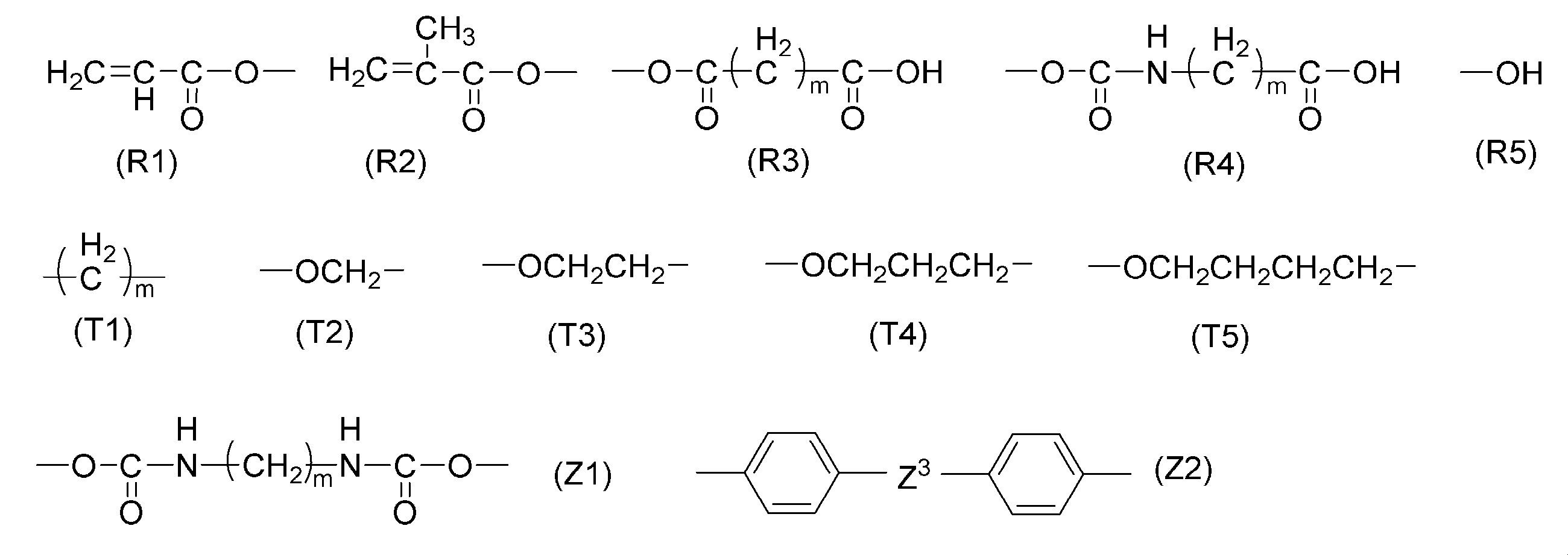
式中、nは整数であり、それぞれ0~14であることが好ましく、0~5がより好ましく、1~3が特に好ましい。mはそれぞれ1~8であり、1~5がより好ましく、1~3が特に好ましい。一分子内に複数存在するR、TおよびZは、それぞれ、同一であっても、異なっていてもよい。Tがオキシアルキレン基の場合には、炭素原子側の末端がRに結合する。Rのうち少なくとも2つが重合性基であることが好ましく、3つが重合性基であることがより好ましい。Z3は炭素数1~12のアルキレン基であることが好ましく、炭素数1~6のアルキレン基であることがより好ましい。なかでも、2,2-プロパンジイル基であることが、特に好ましい。
上記ラジカル重合性モノマーの具体例としては、特開2007-269779号公報の段落番号0248~段落番号0251に記載されている化合物を本実施形態においても好適に用いることができる。
上記ラジカル重合性モノマーの具体例としては、特開2007-269779号公報の段落番号0248~段落番号0251に記載されている化合物を本実施形態においても好適に用いることができる。
中でも、多官能モノマーとしては、ジペンタエリスリトールトリアクリレート(市販品としては KAYARAD D-330;日本化薬株式会社製)、ジペンタエリスリトールテトラアクリレート(市販品としては KAYARAD D-320;日本化薬株式会社製)、ジペンタエリスリトールペンタ(メタ)アクリレート(市販品としては KAYARAD D-310;日本化薬株式会社製)、ジペンタエリスリトールヘキサ(メタ)アクリレート(市販品としては KAYARAD DPHA;日本化薬株式会社製)、及びこれらの(メタ)アクリロイル基がエチレングリコール、プロピレングリコール残基を介している構造や、ジグリセリンEO(エチレンオキシド)変性(メタ)アクリレート(市販品としては M-460;東亜合成製)が好ましい。これらのオリゴマータイプも使用できる。
多官能モノマーは、特に好ましくは、下記式(i)で表される化合物および式(ii)で表される化合物から選択される少なくとも1種である。
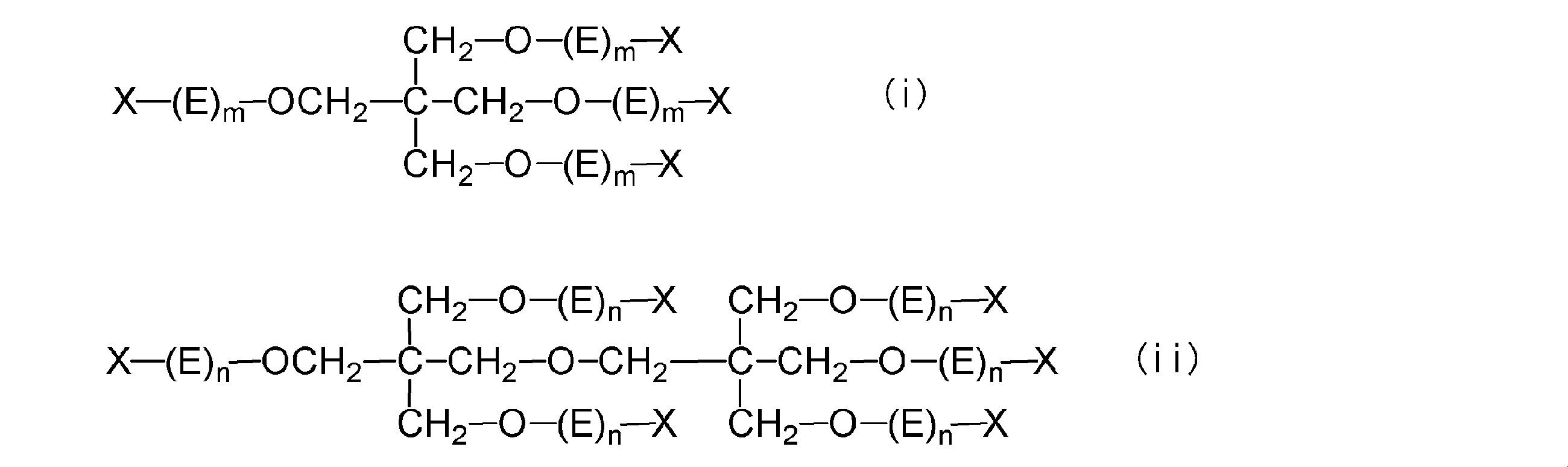
上記式中、Eは、それぞれ、-((CH2)yCH2O)-、または-((CH2)yCH(CH3)O)-を表し、-((CH2)yCH2O)-が好ましい。yは、それぞれ、1~10の整数を表し、1~5の整数が好ましく、1~3の整数がより好ましい。
Xは、それぞれ、水素原子、アクリロイル基、メタクリロイル基、または、カルボキシル基を表す。
式(i)中、アクリロイル基およびメタクリロイル基の合計は3個または4個であることが好ましく、4個がより好ましい。
mは、それぞれ、0~10の整数を表し、1~5の整数が好ましい。それぞれのmの合計は1~40の整数であり、4~20の整数が好ましい。
式(ii)中、アクリロイル基およびメタクリロイル基の合計は5個または6個であることが好ましく、6個がより好ましい。
nは、それぞれ、0~10の整数を表し、1~5の整数が好ましい。それぞれnの合計は1~60の整数であり、4~30の整数が好ましい。
Xは、それぞれ、水素原子、アクリロイル基、メタクリロイル基、または、カルボキシル基を表す。
式(i)中、アクリロイル基およびメタクリロイル基の合計は3個または4個であることが好ましく、4個がより好ましい。
mは、それぞれ、0~10の整数を表し、1~5の整数が好ましい。それぞれのmの合計は1~40の整数であり、4~20の整数が好ましい。
式(ii)中、アクリロイル基およびメタクリロイル基の合計は5個または6個であることが好ましく、6個がより好ましい。
nは、それぞれ、0~10の整数を表し、1~5の整数が好ましい。それぞれnの合計は1~60の整数であり、4~30の整数が好ましい。
多官能モノマーとしては、カルボキシル基、スルホン酸基、リン酸基等の酸基を有していても良い。従って、エチレン性化合物が、上記のように混合物である場合のように未反応のカルボキシル基を有するものであることが好ましく、これをそのまま利用することができるが、必要において、上述のエチレン性化合物のヒドロキシル基に非芳香族カルボン酸無水物を反応させて酸基を導入しても良い。この場合、使用される非芳香族カルボン酸無水物の具体例としては、無水テトラヒドロフタル酸、アルキル化無水テトラヒドロフタル酸、無水ヘキサヒドロフタル酸、アルキル化無水ヘキサヒドロフタル酸、無水コハク酸、無水マレイン酸が挙げられる。
酸基を有するモノマーとしては、脂肪族ポリヒドロキシ化合物と不飽和カルボン酸とのエステルであり、脂肪族ポリヒドロキシ化合物の未反応のヒドロキシル基に非芳香族カルボン酸無水物を反応させて酸基を持たせた多官能モノマーが好ましく、特に好ましくは、このエステルにおいて、脂肪族ポリヒドロキシ化合物がペンタエリスリトール及び/又はジペンタエリスリトールであるものである。市販品としては、例えば、東亞合成株式会社製の多塩基酸変性アクリルオリゴマーとして、アロニックスシリーズのM-305、M-510、M-520などが挙げられる。
酸基を有する多官能モノマーの好ましい酸価としては、0.1~40mgKOH/gであり、特に好ましくは5~30mgKOH/gである。
酸基を有する多官能モノマーの好ましい酸価としては、0.1~40mgKOH/gであり、特に好ましくは5~30mgKOH/gである。
これらの多官能モノマーについて、その構造、単独使用か併用か、添加量等の使用方法の詳細は、組成物の最終的な性能設計にあわせて任意に設定できる。本実施形態では、異なる官能数および/または異なる重合性基(例えばアクリル酸エステル、メタクリル酸エステル、スチレン系化合物、ビニルエーテル系化合物)のものを併用することで、感度と強度の両方を調節する方法も有効である。さらに、3官能以上8官能以下でエチレンオキサイド鎖長の異なる多官能モノマーを併用することが、組成物の現像性を調節することができ、優れたパターン形成能が得られるという点で好ましい。また、組成物に含有される他の成分(例えば、重合開始剤、着色剤(顔料)、樹脂等)との相溶性、分散性に対しても、多官能モノマーの選択・使用法は重要な要因であり、例えば、低純度化合物の使用や2種以上の併用により相溶性を向上させうることがある。また、基板などの硬質表面との密着性を向上させる観点で特定の構造を選択することもあり得る。
重合性化合物の濃度(配合率)は、感光性樹脂組成物中の全固形分中1質量%以上であることが好ましく、5質量%以上であることが好ましい。上限については特に制限はないが、50質量%以下であることが好ましく、40質量%以下であることがより好ましい。
(f)重合開始剤
重合開始剤としては、前記多官能モノマーの重合を開始する能力を有する限り、特に制限はなく、公知の重合開始剤の中から適宜選択することができ、例えば、活性エネルギー線に対して感光性を有するものが好ましい。光励起された増感剤と何らかの作用を生じ、活性ラジカルを生成する活性剤であってもよく、モノマーの種類に応じてカチオン重合を開始させるような開始剤であってもよい。前記重合開始剤は、約300~800nm(330~500nmがより好ましい。)の範囲内に少なくとも約50の分子吸光係数を有する成分を少なくとも1種含有していることが好ましい。
重合開始剤としては、前記多官能モノマーの重合を開始する能力を有する限り、特に制限はなく、公知の重合開始剤の中から適宜選択することができ、例えば、活性エネルギー線に対して感光性を有するものが好ましい。光励起された増感剤と何らかの作用を生じ、活性ラジカルを生成する活性剤であってもよく、モノマーの種類に応じてカチオン重合を開始させるような開始剤であってもよい。前記重合開始剤は、約300~800nm(330~500nmがより好ましい。)の範囲内に少なくとも約50の分子吸光係数を有する成分を少なくとも1種含有していることが好ましい。
前記重合開始剤としては、例えば、ハロゲン化炭化水素誘導体(例えば、トリアジン骨格を有するもの、オキサジアゾール骨格を有するもの、など)、アシルホスフィンオキサイド等のアシルホスフィン化合物、ヘキサアリールビイミダゾール、オキシム誘導体等のオキシム化合物、有機過酸化物、チオ化合物、ケトン化合物、芳香族オニウム塩、ケトオキシムエーテル、アミノアセトフェノン化合物、ヒドロキシアセトフェノンなどが挙げられる。
前記トリアジン骨格を有するハロゲン化炭化水素化合物としては、例えば、若林ら著、Bull.Chem.Soc.Japan,42、2924(1969)記載の化合物、英国特許1388492号明細書記載の化合物、特開昭53-133428号公報記載の化合物、独国特許3337024号明細書記載の化合物、F.C.SchaeferなどによるJ.Org.Chem.;29、1527(1964)記載の化合物、特開昭62-58241号公報記載の化合物、特開平5-281728号公報記載の化合物、特開平5-34920号公報記載化合物、米国特許第4212976号明細書に記載されている化合物、などが挙げられる。
前記米国特許第4212976号明細書に記載されている化合物としては、例えば、オキサジアゾール骨格を有する化合物、特開昭53-133428号公報、特公昭57-1819号公報、同57-6096号公報、及び米国特許第3615455号明細書に記載された化合物などが挙げられる。
重合開始剤としては、ヒドロキシアセトフェノン化合物、アミノアセトフェノン化合物、及び、アシルホスフィン化合物も好適に用いることができる。より具体的には、例えば、特開平10-291969号公報に記載のアミノアセトフェノン系開始剤、特許第4225898号公報に記載のアシルホスフィンオキシド系開始剤も用いることができる。
ヒドロキシアセトフェノン系開始剤としては、IRGACURE-184、DAROCUR-1173、IRGACURE-500、IRGACURE-2959,IRGACURE-127(商品名:いずれもBASF社製)を用いることができる。アミノアセトフェノン系開始剤としては、市販品であるIRGACURE-907、IRGACURE-369、及び、IRGACURE-379(商品名:いずれもBASF社製)を用いることができる。アミノアセトフェノン系開始剤として、365nmまたは405nm等の長波光源に吸収波長がマッチングされた特開2009-191179公報に記載の化合物も用いることができる。また アシルホスフィン系開始剤としては市販品であるIRGACURE-819やDAROCUR-TPO(商品名:いずれもBASF社製)を用いることができる。
ヒドロキシアセトフェノン系開始剤としては、IRGACURE-184、DAROCUR-1173、IRGACURE-500、IRGACURE-2959,IRGACURE-127(商品名:いずれもBASF社製)を用いることができる。アミノアセトフェノン系開始剤としては、市販品であるIRGACURE-907、IRGACURE-369、及び、IRGACURE-379(商品名:いずれもBASF社製)を用いることができる。アミノアセトフェノン系開始剤として、365nmまたは405nm等の長波光源に吸収波長がマッチングされた特開2009-191179公報に記載の化合物も用いることができる。また アシルホスフィン系開始剤としては市販品であるIRGACURE-819やDAROCUR-TPO(商品名:いずれもBASF社製)を用いることができる。
重合開始剤として、より好ましくはオキシム系化合物が挙げられる。オキシム系化合物の具体例としては、特開2001-233842号記載の化合物、特開2000-80068号記載の化合物、特開2006-342166号記載の化合物を用いることができる。
本実施形態で重合開始剤として好適に用いられるオキシム誘導体等のオキシム化合物としては、例えば、3-ベンゾイロキシイミノブタン-2-オン、3-アセトキシイミノブタン-2-オン、3-プロピオニルオキシイミノブタン-2-オン、2-アセトキシイミノペンタン-3-オン、2-アセトキシイミノ-1-フェニルプロパン-1-オン、2-ベンゾイロキシイミノ-1-フェニルプロパン-1-オン、3-(4-トルエンスルホニルオキシ)イミノブタン-2-オン、及び2-エトキシカルボニルオキシイミノ-1-フェニルプロパン-1-オンなどが挙げられる。
なお、オキシムのN-O結合が(E)体のオキシム化合物であっても、(Z)体のオキシム化合物であっても、(E)体と(Z)体との混合物であってもよい。
なお、オキシムのN-O結合が(E)体のオキシム化合物であっても、(Z)体のオキシム化合物であっても、(E)体と(Z)体との混合物であってもよい。
重合開始剤となるオキシム化合物としては、下記式(OX)で表されるものが好ましく、式(OX-1)で表されるものがより好ましい。

・A1
A1は式(OX-1)の-A-Cまたはアルキル基であることが好ましい。アルキル基は、炭素数1~12が好ましく、1~6であることがより好ましい。アルキル基は、後記置換基Oを有していてもよい。また、置換基Oは後記連結基Lを介在して置換していてもよい。
A1は式(OX-1)の-A-Cまたはアルキル基であることが好ましい。アルキル基は、炭素数1~12が好ましく、1~6であることがより好ましい。アルキル基は、後記置換基Oを有していてもよい。また、置換基Oは後記連結基Lを介在して置換していてもよい。
・C
CはSArもしくはCOArを表す。
・R
Rは一価の置換基を表し、一価の非金属原子団であることが好ましい。前記一価の非金属原子団としては、アルキル基(好ましくは炭素数1~12、より好ましくは1~6、特に好ましくは1~3)、アリール基(好ましくは炭素数6~14、より好ましくは6~10)、アシル基(好ましくは炭素数2~12、より好ましくは2~6、特に好ましくは2~3)、アリーロイル基(好ましくは炭素数7~15、より好ましくは7~11)、アルコキシカルボニル基(好ましくは炭素数2~12、より好ましくは2~6、特に好ましくは2~3)、アリールオキシカルボニル基(好ましくは炭素数7~15、より好ましくは7~11)、複素環基(好ましくは炭素数2~12、より好ましくは2~6)、アルキルチオカルボニル基(好ましくは炭素数2~12、より好ましくは2~6、特に好ましくは2~3)、アリールチオカルボニル基(好ましくは炭素数7~15、より好ましくは7~11)等が挙げられる。また、これらの基は、1以上の置換基を有していてもよい。また、前述した置換基は、さらに他の置換基Oで置換されていてもよい。置換基Oとしてはハロゲン原子、アルキル基(好ましくは炭素数1~12、より好ましくは1~6、特に好ましくは1~3)、アリール基(好ましくは炭素数6~14、より好ましくは6~10)等が挙げられる。置換基Oは任意の連結基L(炭素数1~6のアルキレン基,O,S,CO,NRN,またはこれらの組み合わせ:RNは水素原子または炭素数1~6のアルキル基)を介して置換していてもよい。
CはSArもしくはCOArを表す。
・R
Rは一価の置換基を表し、一価の非金属原子団であることが好ましい。前記一価の非金属原子団としては、アルキル基(好ましくは炭素数1~12、より好ましくは1~6、特に好ましくは1~3)、アリール基(好ましくは炭素数6~14、より好ましくは6~10)、アシル基(好ましくは炭素数2~12、より好ましくは2~6、特に好ましくは2~3)、アリーロイル基(好ましくは炭素数7~15、より好ましくは7~11)、アルコキシカルボニル基(好ましくは炭素数2~12、より好ましくは2~6、特に好ましくは2~3)、アリールオキシカルボニル基(好ましくは炭素数7~15、より好ましくは7~11)、複素環基(好ましくは炭素数2~12、より好ましくは2~6)、アルキルチオカルボニル基(好ましくは炭素数2~12、より好ましくは2~6、特に好ましくは2~3)、アリールチオカルボニル基(好ましくは炭素数7~15、より好ましくは7~11)等が挙げられる。また、これらの基は、1以上の置換基を有していてもよい。また、前述した置換基は、さらに他の置換基Oで置換されていてもよい。置換基Oとしてはハロゲン原子、アルキル基(好ましくは炭素数1~12、より好ましくは1~6、特に好ましくは1~3)、アリール基(好ましくは炭素数6~14、より好ましくは6~10)等が挙げられる。置換基Oは任意の連結基L(炭素数1~6のアルキレン基,O,S,CO,NRN,またはこれらの組み合わせ:RNは水素原子または炭素数1~6のアルキル基)を介して置換していてもよい。
・B
Bは一価の置換基を表し、アルキル基(好ましくは炭素数1~12)、アリール基(好ましくは炭素数6~14、より好ましくは炭素数6~10)、複素環基(好ましくは炭素数2~18、より好ましくは炭素数2~12)を表す。これらの基は、連結基Lを介して結合していてもよい。また、これらの基は1以上の置換基Oを有していてもよい。置換基Oも任意の連結基Lを介して置換していてもよい。Bの具体的な基として下記が挙げられる。*は結合位置を示すが、異なる位置で結合していてもよい。また、これらの基はさらに置換基Oを伴っていてもよい。具体的には、ベンゾイル基、フェニルチオ基、フェニルオキシ基が挙げられる。
Bは一価の置換基を表し、アルキル基(好ましくは炭素数1~12)、アリール基(好ましくは炭素数6~14、より好ましくは炭素数6~10)、複素環基(好ましくは炭素数2~18、より好ましくは炭素数2~12)を表す。これらの基は、連結基Lを介して結合していてもよい。また、これらの基は1以上の置換基Oを有していてもよい。置換基Oも任意の連結基Lを介して置換していてもよい。Bの具体的な基として下記が挙げられる。*は結合位置を示すが、異なる位置で結合していてもよい。また、これらの基はさらに置換基Oを伴っていてもよい。具体的には、ベンゾイル基、フェニルチオ基、フェニルオキシ基が挙げられる。

・A
Aは単結合または連結基である。連結基の好ましい例としては、前記連結基Lまたはアリーレン基(好ましくは炭素数6~14、より好ましくは炭素数6~10)または複素環連結基(好ましくは芳香族複素環連結基)(好ましくは炭素数2~18、より好ましくは炭素数2~12)である。
Aは単結合または連結基である。連結基の好ましい例としては、前記連結基Lまたはアリーレン基(好ましくは炭素数6~14、より好ましくは炭素数6~10)または複素環連結基(好ましくは芳香族複素環連結基)(好ましくは炭素数2~18、より好ましくは炭素数2~12)である。
・Ar
Arはアリール基またはヘテロアリール(芳香族複素環基)である。アリール基としては、好ましくは炭素数6~14、より好ましくは炭素数6~10であり、フェニル基、ナフチル基が好ましい。ヘテロアリール基としては、好ましくは炭素数2~18、より好ましくは炭素数2~12であり、N位にアルキル基等の置換基を有していてもよいカルバゾリル基が好ましい。
Arはアリール基またはヘテロアリール(芳香族複素環基)である。アリール基としては、好ましくは炭素数6~14、より好ましくは炭素数6~10であり、フェニル基、ナフチル基が好ましい。ヘテロアリール基としては、好ましくは炭素数2~18、より好ましくは炭素数2~12であり、N位にアルキル基等の置換基を有していてもよいカルバゾリル基が好ましい。
オキシム開始剤としては、特開2012-208494号公報段落0513(対応する米国特許出願公開第2012/235099号明細書の[0632])以降の式(OX-1)、(OX-2)または(OX-3)で表される化合物の説明を参酌でき、これらの内容は本願明細書に組み込まれる。
好適に用いられるオキシム化合物の具体例(PIox-1)~(PIox-13)を以下に示すが、本発明はこれらに限定されるものではない。

オキシム化合物は、熱により分解し重合を開始、促進する熱重合開始剤としての機能を有する。上記のオキシム化合物(PIox-1)は、i線(365nm)での感度が特に高く好ましい。また上記のオキシム化合物(特にPIox-2)は、非常に高い反応性を有しており、本発明において好適に適用することができる。総合すると、前記オキシム化合物(特にPIox-1およびPIox-2)は、露光波長の感度が高くまた反応性が高いため、σを絞った光学系(光束が少ない)の露光光源に対し、十分な像形成能を有するため、特に本発明においてその使用が効果的である。
オキシム化合物は、350nm~500nmの波長領域に極大吸収波長を有することが好ましく、360nm~480nmの波長領域に吸収波長を有するものであることがより好ましく、365nm及び455nmの吸光度が高いものが特に好ましい。
オキシム化合物は、365nm又は405nmにおけるモル吸光係数は、感度の観点から、1,000~300,000であることが好ましく、2,000~300,000であることがより好ましく、5,000~200,000であることが特に好ましい。化合物のモル吸光係数は、公知の方法を用いることができるが、具体的には、例えば、紫外可視分光光度計(Varian社製Carry-5 spectrophotometer)にて、酢酸エチル溶媒を用い、0.01g/Lの濃度で測定することが好ましい。
オキシム化合物としては、IRGACURE OXE01、及び、IRGACURE OXE02などの市販品(いずれも、BASF社製)、TR-PBG-304(常州強力電子新材料有限公司製)も好適に使用できる。
オキシム化合物は、365nm又は405nmにおけるモル吸光係数は、感度の観点から、1,000~300,000であることが好ましく、2,000~300,000であることがより好ましく、5,000~200,000であることが特に好ましい。化合物のモル吸光係数は、公知の方法を用いることができるが、具体的には、例えば、紫外可視分光光度計(Varian社製Carry-5 spectrophotometer)にて、酢酸エチル溶媒を用い、0.01g/Lの濃度で測定することが好ましい。
オキシム化合物としては、IRGACURE OXE01、及び、IRGACURE OXE02などの市販品(いずれも、BASF社製)、TR-PBG-304(常州強力電子新材料有限公司製)も好適に使用できる。
重合開始剤は、必要に応じて2種以上を組み合わせて使用しても良い。重合開始剤の感光性樹脂組成物中における濃度(2種以上の場合は総濃度)としては、感光性樹脂組成物の全固形分に対して、0.1~20質量%の範囲が好ましく、より好ましくは0.5~10質量%の範囲、特に好ましくは1~8質量%の範囲である。この範囲内であると、良好な感度とパターン形成性が得られる。
重合開始剤のラジカル発生効率の向上、感光波長の長波長化の目的で、増感剤を含有していてもよい。本実施形態に用いることができる増感剤としては、重合開始剤に対し、電子移動機構又はエネルギー移動機構で増感させるものが好ましい。
増感剤としては、例えば、特開2008-32803号公報の段落番号0101~0154に記載される化合物が挙げられる。
前記組成物中における増感剤の濃度は、配合する場合、深部への光吸収効率と開始分解効率の観点から、固形分換算で、0.1質量%~20質量%であることが好ましく、0.5質量%~15質量%がより好ましい。
増感剤は、1種単独で用いてもよいし、2種以上を併用してもよい。
前記組成物中における増感剤の濃度は、配合する場合、深部への光吸収効率と開始分解効率の観点から、固形分換算で、0.1質量%~20質量%であることが好ましく、0.5質量%~15質量%がより好ましい。
増感剤は、1種単独で用いてもよいし、2種以上を併用してもよい。
置換基Tとしては、下記のものが挙げられる。
アルキル基(好ましくは炭素原子数1~20のアルキル基、例えばメチル、エチル、イソプロピル、t-ブチル、ペンチル、ヘプチル、1-エチルペンチル、ベンジル、2-エトキシエチル、1-カルボキシメチル等)、アルケニル基(好ましくは炭素原子数2~20のアルケニル基、例えば、ビニル、アリル、オレイル等)、アルキニル基(好ましくは炭素原子数2~20のアルキニル基、例えば、エチニル、ブタジイニル、フェニルエチニル等)、シクロアルキル基(好ましくは炭素原子数3~20のシクロアルキル基、例えば、シクロプロピル、シクロペンチル、シクロヘキシル、4-メチルシクロヘキシル等)、アリール基(好ましくは炭素原子数6~26のアリール基、例えば、フェニル、1-ナフチル、4-メトキシフェニル、2-クロロフェニル、3-メチルフェニル等)、ヘテロ環基(好ましくは炭素原子数2~20のヘテロ環基、より好ましくは、少なくとも1つの酸素原子、硫黄原子、窒素原子を有する5または6員環のヘテロ環基、例えば、2-ピリジル、4-ピリジル、2-イミダゾリル、2-ベンゾイミダゾリル、2-チアゾリル、2-オキサゾリル等)、アルコキシ基(好ましくは炭素原子数1~20のアルコキシ基、例えば、メトキシ、エトキシ、イソプロピルオキシ、ベンジルオキシ等)、アリールオキシ基(好ましくは炭素原子数6~26のアリールオキシ基、例えば、フェノキシ、1-ナフチルオキシ、3-メチルフェノキシ、4-メトキシフェノキシ等)、アルコキシカルボニル基(好ましくは炭素原子数2~20のアルコキシカルボニル基、例えば、エトキシカルボニル、2-エチルヘキシルオキシカルボニル等)、アミノ基(好ましくは炭素原子数0~20のアミノ基、アルキルアミノ基、アリールアミノ基を含み、例えば、アミノ、N,N-ジメチルアミノ、N,N-ジエチルアミノ、N-エチルアミノ、アニリノ等)、スルファモイル基(好ましくは炭素原子数0~20のスルホンアミド基、例えば、N,N-ジメチルスルファモイル、N-フェニルスルファモイル等)、アシル基(好ましくは炭素原子数1~20のアシル基、例えば、アセチル、プロピオニル、ブチリル、ベンゾイル等)、アシルオキシ基(好ましくは炭素原子数1~20のアシルオキシ基、例えば、アセチルオキシ、ベンゾイルオキシ等)、カルバモイル基(好ましくは炭素原子数1~20のカルバモイル基、例えば、N,N-ジメチルカルバモイル、N-フェニルカルバモイル等)、アシルアミノ基(好ましくは炭素原子数1~20のアシルアミノ基、例えば、アセチルアミノ、ベンゾイルアミノ等)、スルホンアミド基(好ましくは炭素原子数0~20のスルファモイル基、例えば、メタンスルホンアミド、ベンゼンスルホンアミド、N-メチルメタンスルホンアミド、N-エチルベンゼンスルホンアミド等)、アルキルチオ基(好ましくは炭素原子数1~20のアルキルチオ基、例えば、メチルチオ、エチルチオ、イソプロピルチオ、ベンジルチオ等)、アリールチオ基(好ましくは炭素原子数6~26のアリールチオ基、例えば、フェニルチオ、1-ナフチルチオ、3-メチルフェニルチオ、4-メトキシフェニルチオ等)、アルキルもしくはアリールスルホニル基(好ましくは炭素原子数1~20のアルキルもしくはアリールスルホニル基、例えば、メチルスルホニル、エチルスルホニル、ベンゼンスルホニル等)、ヒドロキシル基、シアノ基、ハロゲン原子(例えばフッ素原子、塩素原子、臭素原子、ヨウ素原子等)であり、より好ましくはアルキル基、アルケニル基、アリール基、ヘテロ環基、アルコキシ基、アリールオキシ基、アルコキシカルボニル基、アミノ基、アシルアミノ基、ヒドロキシル基またはハロゲン原子であり、特に好ましくはアルキル基、アルケニル基、ヘテロ環基、アルコキシ基、アルコキシカルボニル基、アミノ基、アシルアミノ基またはヒドロキシル基である。
アルキル基(好ましくは炭素原子数1~20のアルキル基、例えばメチル、エチル、イソプロピル、t-ブチル、ペンチル、ヘプチル、1-エチルペンチル、ベンジル、2-エトキシエチル、1-カルボキシメチル等)、アルケニル基(好ましくは炭素原子数2~20のアルケニル基、例えば、ビニル、アリル、オレイル等)、アルキニル基(好ましくは炭素原子数2~20のアルキニル基、例えば、エチニル、ブタジイニル、フェニルエチニル等)、シクロアルキル基(好ましくは炭素原子数3~20のシクロアルキル基、例えば、シクロプロピル、シクロペンチル、シクロヘキシル、4-メチルシクロヘキシル等)、アリール基(好ましくは炭素原子数6~26のアリール基、例えば、フェニル、1-ナフチル、4-メトキシフェニル、2-クロロフェニル、3-メチルフェニル等)、ヘテロ環基(好ましくは炭素原子数2~20のヘテロ環基、より好ましくは、少なくとも1つの酸素原子、硫黄原子、窒素原子を有する5または6員環のヘテロ環基、例えば、2-ピリジル、4-ピリジル、2-イミダゾリル、2-ベンゾイミダゾリル、2-チアゾリル、2-オキサゾリル等)、アルコキシ基(好ましくは炭素原子数1~20のアルコキシ基、例えば、メトキシ、エトキシ、イソプロピルオキシ、ベンジルオキシ等)、アリールオキシ基(好ましくは炭素原子数6~26のアリールオキシ基、例えば、フェノキシ、1-ナフチルオキシ、3-メチルフェノキシ、4-メトキシフェノキシ等)、アルコキシカルボニル基(好ましくは炭素原子数2~20のアルコキシカルボニル基、例えば、エトキシカルボニル、2-エチルヘキシルオキシカルボニル等)、アミノ基(好ましくは炭素原子数0~20のアミノ基、アルキルアミノ基、アリールアミノ基を含み、例えば、アミノ、N,N-ジメチルアミノ、N,N-ジエチルアミノ、N-エチルアミノ、アニリノ等)、スルファモイル基(好ましくは炭素原子数0~20のスルホンアミド基、例えば、N,N-ジメチルスルファモイル、N-フェニルスルファモイル等)、アシル基(好ましくは炭素原子数1~20のアシル基、例えば、アセチル、プロピオニル、ブチリル、ベンゾイル等)、アシルオキシ基(好ましくは炭素原子数1~20のアシルオキシ基、例えば、アセチルオキシ、ベンゾイルオキシ等)、カルバモイル基(好ましくは炭素原子数1~20のカルバモイル基、例えば、N,N-ジメチルカルバモイル、N-フェニルカルバモイル等)、アシルアミノ基(好ましくは炭素原子数1~20のアシルアミノ基、例えば、アセチルアミノ、ベンゾイルアミノ等)、スルホンアミド基(好ましくは炭素原子数0~20のスルファモイル基、例えば、メタンスルホンアミド、ベンゼンスルホンアミド、N-メチルメタンスルホンアミド、N-エチルベンゼンスルホンアミド等)、アルキルチオ基(好ましくは炭素原子数1~20のアルキルチオ基、例えば、メチルチオ、エチルチオ、イソプロピルチオ、ベンジルチオ等)、アリールチオ基(好ましくは炭素原子数6~26のアリールチオ基、例えば、フェニルチオ、1-ナフチルチオ、3-メチルフェニルチオ、4-メトキシフェニルチオ等)、アルキルもしくはアリールスルホニル基(好ましくは炭素原子数1~20のアルキルもしくはアリールスルホニル基、例えば、メチルスルホニル、エチルスルホニル、ベンゼンスルホニル等)、ヒドロキシル基、シアノ基、ハロゲン原子(例えばフッ素原子、塩素原子、臭素原子、ヨウ素原子等)であり、より好ましくはアルキル基、アルケニル基、アリール基、ヘテロ環基、アルコキシ基、アリールオキシ基、アルコキシカルボニル基、アミノ基、アシルアミノ基、ヒドロキシル基またはハロゲン原子であり、特に好ましくはアルキル基、アルケニル基、ヘテロ環基、アルコキシ基、アルコキシカルボニル基、アミノ基、アシルアミノ基またはヒドロキシル基である。
(g)その他
感光性樹脂組成物は、その他の成分を含有させることもできる。その他の成分としては、溶剤、界面活性剤、UV吸収剤、重合禁止剤、密着向上剤などが挙げられる。
感光性樹脂組成物は、その他の成分を含有させることもできる。その他の成分としては、溶剤、界面活性剤、UV吸収剤、重合禁止剤、密着向上剤などが挙げられる。
・溶剤
感光性樹脂組成物は、一般には、溶剤を用いて構成することができる。溶剤は、各成分の溶解性や感光性樹脂組成物の塗布性を満足すれば基本的には特に制限はないが、特に紫外線吸収剤、バインダー樹脂の溶解性、塗布性、安全性を考慮して選ばれることが好ましい。また、感光性樹脂組成物を調製する際には、少なくとも2種類の溶剤を含むことが好ましい。
感光性樹脂組成物は、一般には、溶剤を用いて構成することができる。溶剤は、各成分の溶解性や感光性樹脂組成物の塗布性を満足すれば基本的には特に制限はないが、特に紫外線吸収剤、バインダー樹脂の溶解性、塗布性、安全性を考慮して選ばれることが好ましい。また、感光性樹脂組成物を調製する際には、少なくとも2種類の溶剤を含むことが好ましい。
溶剤としては、エステル類として、例えば、酢酸エチル、酢酸-n-ブチル、酢酸イソブチル、ギ酸アミル、酢酸イソアミル、プロピオン酸ブチル、酪酸イソプロピル、酪酸エチル、酪酸ブチル、乳酸メチル、乳酸エチル、オキシ酢酸アルキル(例:オキシ酢酸メチル、オキシ酢酸エチル、オキシ酢酸ブチル(例えば、メトキシ酢酸メチル、メトキシ酢酸エチル、メトキシ酢酸ブチル、エトキシ酢酸メチル、エトキシ酢酸エチル等))、3-オキシプロピオン酸アルキルエステル類(例:3-オキシプロピオン酸メチル、3-オキシプロピオン酸エチル等(例えば、3-メトキシプロピオン酸メチル、3-メトキシプロピオン酸エチル、3-エトキシプロピオン酸メチル、3-エトキシプロピオン酸エチル等))、2-オキシプロピオン酸アルキルエステル類(例:2-オキシプロピオン酸メチル、2-オキシプロピオン酸エチル、2-オキシプロピオン酸プロピル等(例えば、2-メトキシプロピオン酸メチル、2-メトキシプロピオン酸エチル、2-メトキシプロピオン酸プロピル、2-エトキシプロピオン酸メチル、2-エトキシプロピオン酸エチル))、2-オキシ-2-メチルプロピオン酸メチル及び2-オキシ-2-メチルプロピオン酸エチル(例えば、2-メトキシ-2-メチルプロピオン酸メチル、2-エトキシ-2-メチルプロピオン酸エチル等)、ピルビン酸メチル、ピルビン酸エチル、ピルビン酸プロピル、アセト酢酸メチル、アセト酢酸エチル、2-オキソブタン酸メチル、2-オキソブタン酸エチル等、並びに、エーテル類として、例えば、ジエチレングリコールジメチルエーテル、テトラヒドロフラン、エチレングリコールモノメチルエーテル、エチレングリコールモノエチルエーテル、エチレングリコールモノブチルエーテルアセテート、メチルセロソルブアセテート、エチルセロソルブアセテート、ジエチレングリコールモノメチルエーテル、ジエチレングリコールモノエチルエーテル、ジエチレングリコールモノブチルエーテル、プロピレングリコールモノメチルエーテル、プロピレングリコールモノメチルエーテルアセテート、プロピレングリコールモノエチルエーテルアセテート、プロピレングリコールモノプロピルエーテルアセテート等、並びに、ケトン類として、例えば、メチルエチルケトン、シクロヘキサノン、2-ヘプタノン、3-ヘプタノン等、並びに、芳香族炭化水素類として、例えば、キシレン等が好適に挙げられる。
溶剤の感光性樹脂組成物中における濃度は、塗布性の観点から、組成物の全固形分濃度が5~80質量%になる量とすることが好ましく、5~60質量%が更に好ましく、10~50質量%が特に好ましい。
・界面活性剤
前記組成物には、塗布性をより向上させる観点から、各種の界面活性剤を添加してもよい。界面活性剤としては、フッ素系界面活性剤、ノニオン系界面活性剤、カチオン系界面活性剤、アニオン系界面活性剤、シリコーン系界面活性剤などの各種界面活性剤を使用できる。界面活性剤の添加量は配合する場合、組成物の全質量に対して、0.001質量%~2質量%が好ましく、より好ましくは0.005質量%~1質量%である。
前記組成物には、塗布性をより向上させる観点から、各種の界面活性剤を添加してもよい。界面活性剤としては、フッ素系界面活性剤、ノニオン系界面活性剤、カチオン系界面活性剤、アニオン系界面活性剤、シリコーン系界面活性剤などの各種界面活性剤を使用できる。界面活性剤の添加量は配合する場合、組成物の全質量に対して、0.001質量%~2質量%が好ましく、より好ましくは0.005質量%~1質量%である。
・重合禁止剤
組成物の製造中又は保存中において、多官能モノマーの不要な熱重合を阻止するために、少量の重合禁止剤を添加することが望ましい。重合禁止剤としては、ハイドロキノン、p-メトキシフェノール、o-メトキシフェノール、ジ-t-ブチル-p-クレゾール、ピロガロール、t-ブチルカテコール、ベンゾキノン、4,4′-チオビス(3-メチル-6-t-ブチルフェノール)、2,2′-メチレンビス(4-メチル-6-t-ブチルフェノール)、N-ニトロソフェニルヒドロキシアミン第一セリウム塩等が挙げられる。更に、感光性樹脂組成物は、増感色素や開始剤の活性放射線に対する感度を一層向上させる、或いは酸素による多官能モノマーの重合阻害を抑制する等の目的で共増感剤を含有してもよい。また、硬化皮膜の物性を改良するために、希釈剤、可塑剤、感脂化剤等の公知の添加剤を必要に応じて加えてもよい。重合禁止剤を用いる場合の添加量としては、着色感光性樹脂組成物中の全固形分中、0.001質量%~0.015質量%の範囲であることが好ましく、0.03質量%~0.09質量%がより好ましい。
組成物の製造中又は保存中において、多官能モノマーの不要な熱重合を阻止するために、少量の重合禁止剤を添加することが望ましい。重合禁止剤としては、ハイドロキノン、p-メトキシフェノール、o-メトキシフェノール、ジ-t-ブチル-p-クレゾール、ピロガロール、t-ブチルカテコール、ベンゾキノン、4,4′-チオビス(3-メチル-6-t-ブチルフェノール)、2,2′-メチレンビス(4-メチル-6-t-ブチルフェノール)、N-ニトロソフェニルヒドロキシアミン第一セリウム塩等が挙げられる。更に、感光性樹脂組成物は、増感色素や開始剤の活性放射線に対する感度を一層向上させる、或いは酸素による多官能モノマーの重合阻害を抑制する等の目的で共増感剤を含有してもよい。また、硬化皮膜の物性を改良するために、希釈剤、可塑剤、感脂化剤等の公知の添加剤を必要に応じて加えてもよい。重合禁止剤を用いる場合の添加量としては、着色感光性樹脂組成物中の全固形分中、0.001質量%~0.015質量%の範囲であることが好ましく、0.03質量%~0.09質量%がより好ましい。
・密着向上剤
密着向上剤を用いる場合の添加量としては、着色感光性樹脂組成物中の全固形分中、0.1質量%~5質量%の範囲であることが好ましく、0.2質量%~3質量%がより好ましい。
密着向上剤を用いる場合の添加量としては、着色感光性樹脂組成物中の全固形分中、0.1質量%~5質量%の範囲であることが好ましく、0.2質量%~3質量%がより好ましい。
・紫外線吸収剤
感光性樹脂組成物は、紫外線吸収剤を含有しても良い。紫外線吸収剤としては、サリシレート系、ベンゾフェノン系、ベンゾトリアゾール系、置換アクリロニトリル系、トリアジン系の紫外線吸収剤を使用することができる。紫外線吸収剤を含む場合、紫外線吸収剤の濃度は、全固形分質量に対して、0.001質量%以上1質量%以下であることが好ましく、0.01質量%以上0.1質量%以下であることがより好ましい。
感光性樹脂組成物は、紫外線吸収剤を含有しても良い。紫外線吸収剤としては、サリシレート系、ベンゾフェノン系、ベンゾトリアゾール系、置換アクリロニトリル系、トリアジン系の紫外線吸収剤を使用することができる。紫外線吸収剤を含む場合、紫外線吸収剤の濃度は、全固形分質量に対して、0.001質量%以上1質量%以下であることが好ましく、0.01質量%以上0.1質量%以下であることがより好ましい。
(感光性樹脂組成物の調製)
感光性樹脂組成物の調製態様については特に制限されないが、例えば、必須成分、及び、所望により併用される各種の添加剤を混合し、調製することができる。
感光性樹脂組成物の調製態様については特に制限されないが、例えば、必須成分、及び、所望により併用される各種の添加剤を混合し、調製することができる。
(硬化膜及びその製造方法)
組成物を硬化してなる硬化膜は、色純度が高く、薄層で高い吸光係数が得られ、堅牢性(特に耐熱性及び耐光性)が良好である。かかる利点を活かして、固体撮像素子や液晶表示装置用のカラーフィルターにおける着色画素の形成に用いられる。
硬化膜の製造方法は、感光性樹脂組成物を基板上に適用する工程と、該感光性樹脂組成物を露光する工程とを含む。具体的には、任意の基板又は基材上に硬化膜を形成する際には、感光性樹脂組成物を塗布するか、或いは、基板等を感光性樹脂組成物に浸漬して感光性樹脂組成物層を形成し、これを硬化させてもよい。また、パターン状の硬化膜を形成する場合、基板上にインクジェット記録方法により適用してもよく、捺染やオフセット印刷などの公知の印刷法を適用してもよいが、高精細なパターンを形成しうるという観点からは、基板上に感光性樹脂組成物層を形成し、パターン状に露光した後、現像して感光性樹脂組成物層の未露光部を除去する方法が好ましい。この方法については、後述する。
組成物を硬化してなる硬化膜は、色純度が高く、薄層で高い吸光係数が得られ、堅牢性(特に耐熱性及び耐光性)が良好である。かかる利点を活かして、固体撮像素子や液晶表示装置用のカラーフィルターにおける着色画素の形成に用いられる。
硬化膜の製造方法は、感光性樹脂組成物を基板上に適用する工程と、該感光性樹脂組成物を露光する工程とを含む。具体的には、任意の基板又は基材上に硬化膜を形成する際には、感光性樹脂組成物を塗布するか、或いは、基板等を感光性樹脂組成物に浸漬して感光性樹脂組成物層を形成し、これを硬化させてもよい。また、パターン状の硬化膜を形成する場合、基板上にインクジェット記録方法により適用してもよく、捺染やオフセット印刷などの公知の印刷法を適用してもよいが、高精細なパターンを形成しうるという観点からは、基板上に感光性樹脂組成物層を形成し、パターン状に露光した後、現像して感光性樹脂組成物層の未露光部を除去する方法が好ましい。この方法については、後述する。
カラーフィルター及びその製造方法:
カラーフィルターの製造方法は、その一例において、感光性樹脂組成物を基板上に適用する工程と、該感光性樹脂組成物をパターン露光する工程とを含む。具体的には、支持体上に、既述の感光性樹脂組成物を適用して感光性樹脂組成物層を形成する工程(以下、「感光性樹脂組成物層形成工程」ともいう)と、前記感光性樹脂組成物層をマスクを介してパターン露光する工程(以下、「露光工程」ともいう)と、露光後の感光性樹脂組成物層を現像して着色パターン(以下、「着色画素」ともいう)を形成する工程(以下、「現像工程」ともいう)とを含む。
カラーフィルターの製造方法は、その一例において、感光性樹脂組成物を基板上に適用する工程と、該感光性樹脂組成物をパターン露光する工程とを含む。具体的には、支持体上に、既述の感光性樹脂組成物を適用して感光性樹脂組成物層を形成する工程(以下、「感光性樹脂組成物層形成工程」ともいう)と、前記感光性樹脂組成物層をマスクを介してパターン露光する工程(以下、「露光工程」ともいう)と、露光後の感光性樹脂組成物層を現像して着色パターン(以下、「着色画素」ともいう)を形成する工程(以下、「現像工程」ともいう)とを含む。
・露光工程
製造方法に係る好ましい実施形態においては、上記の感光性樹脂組成物に露光エネルギーを照射し、その露光部分を現像して樹脂硬化物のパターンを形成する。本実施形態においては、上記の露光に先立ち、支持体等の上に、感光性樹脂組成物を付与して感光性樹脂組成物の層を形成する。支持体としては、例えば、基板(例えば、シリコン基板)上にCCD(Charge Coupled Device)やCMOS(Complementary Metal-Oxide Semiconductor)等の撮像素子(受光素子)が設けられた固体撮像素子用基板を用いることができる。着色パターンは、固体撮像素子用基板の撮像素子形成面側(おもて面)に形成されてもよいし、撮像素子非形成面側(裏面)に形成されてもよい。固体撮像素子用基板における各撮像素子間や、固体撮像素子用基板の裏面には、遮光膜が設けられていてもよい。また、支持体上には、必要により、上部の層との密着改良、物質の拡散防止或いは基板表面の平坦化のために下塗り層を設けてもよい。
製造方法に係る好ましい実施形態においては、上記の感光性樹脂組成物に露光エネルギーを照射し、その露光部分を現像して樹脂硬化物のパターンを形成する。本実施形態においては、上記の露光に先立ち、支持体等の上に、感光性樹脂組成物を付与して感光性樹脂組成物の層を形成する。支持体としては、例えば、基板(例えば、シリコン基板)上にCCD(Charge Coupled Device)やCMOS(Complementary Metal-Oxide Semiconductor)等の撮像素子(受光素子)が設けられた固体撮像素子用基板を用いることができる。着色パターンは、固体撮像素子用基板の撮像素子形成面側(おもて面)に形成されてもよいし、撮像素子非形成面側(裏面)に形成されてもよい。固体撮像素子用基板における各撮像素子間や、固体撮像素子用基板の裏面には、遮光膜が設けられていてもよい。また、支持体上には、必要により、上部の層との密着改良、物質の拡散防止或いは基板表面の平坦化のために下塗り層を設けてもよい。
支持体上への感光性樹脂組成物の適用方法としては、スリット塗布、インクジェット法、回転塗布、流延塗布、ロール塗布、スクリーン印刷法等の各種の塗布方法を適用することができる。支持体上に塗布された感光性樹脂組成物層の乾燥(プリベーク)は、ホットプレート、オーブン等で50℃~140℃の温度で10秒~300秒で行うことができる。
露光工程では、感光性樹脂組成物の層を、例えば、ステッパー等の露光装置を用い、所定のマスクパターンを有するマスクを介してパターン露光する。前記露光エネルギーの照射は、g線、h線、i線、KrF線(エキシマレーザー線)、およびArF線(エキシマレーザー線)から選ばれる活性エネルギー線の照射により行われることが好ましい。上記露光エネルギーの照度が5000W/m2以上であることが好ましく、7000W/m2以上であることがより好ましく、8000W/m2以上であることが特に好ましい。上限側の規定としては、18000W/m2以下であることが好ましく、15000W/m2以下であることがより好ましく、10000W/m2以下であることが特に好ましい。この範囲の照射エネルギーとすることで、良好なパターンの解像度を得ることができる。
露光装置等は、適宜通常のものを利用すればよいが、例えば縮小投影露光装置を用いることができる。投影露光装置においては、例えば、特定の光源から発せられた活性エネルギー線がコンデンサーレンズを介して、プロジェクションレンズ(投影レンズ)に入射する。本投影光学系においては、コンデンサーレンズの前または後には、所定のパターンを付したマスクが設置され、所定のパターンとされた活性エネルギー線がプロジェクションレンズに到達するようにされている。このとき、コンデンサーレンズ側の開口数(NA1)、プロジェクションレンズ側の開口数(NA2)などの条件を適宜所望の範囲に設定することが好ましい。縮小投影光学系を透過した活性エネルギー線は、その反対側から出射され、露光基板(ワーク)へと照射される。この活性エネルギー線の照射により、その基板上の感光性樹脂組成物層は露光される。なお、その露光部分が硬化するネガ型(露光硬化性)のものが好ましいプロジェクションレンズの出射側の開口数(NA3)についても適宜所望の範囲に設定することが好ましい。
・現像工程
次いでアルカリ現像処理等の現像を行うことにより、露光工程における光未照射部分の感光性樹脂組成物層がアルカリ水溶液に溶出し、光硬化した部分だけが残る。現像液としては、下地の撮像素子や回路などにダメージを起さない、有機アルカリ現像液が望ましい。現像温度としては通常20℃~30℃であり、現像時間は、例えば、20秒~90秒である。より残渣を除去するため、120秒~180秒実施する場合もある。さらには、より残渣除去性を向上するため、現像液を60秒ごとに振り切り、さらに新たに現像液を供給する工程を数回繰り返す場合もある。
次いでアルカリ現像処理等の現像を行うことにより、露光工程における光未照射部分の感光性樹脂組成物層がアルカリ水溶液に溶出し、光硬化した部分だけが残る。現像液としては、下地の撮像素子や回路などにダメージを起さない、有機アルカリ現像液が望ましい。現像温度としては通常20℃~30℃であり、現像時間は、例えば、20秒~90秒である。より残渣を除去するため、120秒~180秒実施する場合もある。さらには、より残渣除去性を向上するため、現像液を60秒ごとに振り切り、さらに新たに現像液を供給する工程を数回繰り返す場合もある。
アルカリ性の水溶液としては、アルカリ性化合物を濃度が0.001~10質量%、好ましくは0.01~5質量%となるように溶解して調製されたアルカリ性水溶液が好適である。
アルカリ性化合物は、例えば、水酸化ナトリウム、水酸化カリウム、炭酸ナトリウム、硅酸ナトリウム、メタ硅酸ナトリウム、アンモニア水、エチルアミン、ジエチルアミン、ジメチルエタノールアミン、テトラメチルアンモニウムヒドロキシド、テトラエチルアンモニウムヒドロキシド、テトラプロピルアンモニウムヒドロキシド、テトラブチルアンモニウムヒドロキシ、ベンジルトリメチルアンモニウムヒドロキシド、コリン、ピロール、ピペリジン、1,8-ジアザビシクロ[5.4.0]-7-ウンデセン等が挙げられる(このうち、有機アルカリが好ましい。)。
なお、アルカリ性水溶液を現像液として用いた場合は、一般に現像後に水で洗浄処理が施される。
なお、アルカリ性水溶液を現像液として用いた場合は、一般に現像後に水で洗浄処理が施される。
・ポストベーク
次いで、乾燥を施した後に加熱処理(ポストベーク)を行うことが好ましい。多色の着色パターンを形成するので、各色ごとに前記工程を順次繰り返して硬化皮膜を製造することが好ましい。これによりカラーフィルターが得られる。ポストベークは、硬化を完全なものとするための現像後の加熱処理である。その加熱温度は、有機光電変換部の損傷を抑制する観点から、240℃以下が好ましく、220℃以下がより好ましく、200℃以下がさらに好ましく、190℃以下が特に好ましい。下限は特にないが、効率的かつ効果的な処理を考慮すると、50℃以上の熱硬化処理を行うことが好ましく、100℃以上がより好ましい。
このポストベーク処理は、現像後の塗布膜を、上記条件になるようにホットプレートやコンベクションオーブン(熱風循環式乾燥機)、高周波加熱機等の加熱手段を用いて、連続式あるいはバッチ式で行うことができる。
次いで、乾燥を施した後に加熱処理(ポストベーク)を行うことが好ましい。多色の着色パターンを形成するので、各色ごとに前記工程を順次繰り返して硬化皮膜を製造することが好ましい。これによりカラーフィルターが得られる。ポストベークは、硬化を完全なものとするための現像後の加熱処理である。その加熱温度は、有機光電変換部の損傷を抑制する観点から、240℃以下が好ましく、220℃以下がより好ましく、200℃以下がさらに好ましく、190℃以下が特に好ましい。下限は特にないが、効率的かつ効果的な処理を考慮すると、50℃以上の熱硬化処理を行うことが好ましく、100℃以上がより好ましい。
このポストベーク処理は、現像後の塗布膜を、上記条件になるようにホットプレートやコンベクションオーブン(熱風循環式乾燥機)、高周波加熱機等の加熱手段を用いて、連続式あるいはバッチ式で行うことができる。
上記の加熱によるポストベークに代え、UV(紫外線)照射によってカラーフィルターの画素を硬化させてもよい。このとき、UV硬化剤は、通常のi線露光によるリソグラフィー工程のために添加する開始剤の露光波長である365nmより短波の波長で硬化できるものが好ましい。UV硬化剤としては、例えば、チバ イルガキュア 2959(商品名)が挙げられる。UV照射光の具体的波長としては、340nm以下であることが好ましい。波長の下限値は特にないが、220nm以上であることが一般的である。またUV照射の露光量は100~5000mJが好ましく、300~4000mJがより好ましく、800~3500mJがさらに好ましい。このUV硬化工程は、リソグラフィー工程の後に行うことが、低温硬化をより効果的に行うために、好ましい。露光光源はオゾンレス水銀ランプを使用することが好ましい。
上記の感光性樹脂組成物のポストベークを、低酸素濃度の雰囲気下で行うことが好ましい。その酸素濃度は、19%(体積基準)であることが好ましく、15%(体積基準)であることがより好ましく、10%(体積基準)であることがさらに好ましく、7%(体積基準)であることがさらに好ましく、3%(体積基準)であることが特に好ましい。下限は特にないが、10ppm(体積基準)以上が実際的である。
・応用形態
本発明においては、前記の感光性樹脂組成物で形成した硬化物(画素部)と緑色の感光性樹脂組成物で形成した硬化物(画素部)とが隣接することが好ましい。このような形態とすることにより発生することがある針状欠陥を好適に抑制ないし防止することができ、本発明の利点が顕著となる。緑色の感光性樹脂組成物に含有させる色材としては、上記針状欠陥の発生の観点から、ピグメントグリーン58(C.I.P.G.58)であることが好ましい。
本発明においては、前記の感光性樹脂組成物で形成した硬化物(画素部)と緑色の感光性樹脂組成物で形成した硬化物(画素部)とが隣接することが好ましい。このような形態とすることにより発生することがある針状欠陥を好適に抑制ないし防止することができ、本発明の利点が顕著となる。緑色の感光性樹脂組成物に含有させる色材としては、上記針状欠陥の発生の観点から、ピグメントグリーン58(C.I.P.G.58)であることが好ましい。
本発明の好ましい実施形態に係るカラーフィルターは、液晶表示装置や固体撮像素子や有機EL装置に用いることができ、特に固体撮像用途に好適である。本発明の好ましい実施形態に係る固体撮像素子は、既に図1に基づいて述べたが、例えば、以下のような構成が挙げられる。支持体上に、固体撮像素子(CCDイメージセンサー、CMOSイメージセンサー、等)の受光エリアを構成する複数のフォトダイオード及びポリシリコン等からなる転送電極を有し、前記フォトダイオード及び前記転送電極上にフォトダイオードの受光部のみ開口したタングステン等からなる遮光膜を有し、遮光膜上に遮光膜全面及びフォトダイオード受光部を覆うように形成された窒化シリコン等からなるデバイス保護膜を有し、前記デバイス保護膜上に、固体撮像素子用カラーフィルターを有する構成である。更に、前記デバイス保護層上であってカラーフィルターの下(支持体に近い側)に集光手段(例えば、マイクロレンズ等。以下同じ)を有する構成や、カラーフィルター上に集光手段を有する構成等であってもよい。
以下、本発明を実施例により更に具体的に説明するが、これにより本発明は限定して解釈されるものではない。なお、特に断りのない限り、「部」、「%」は、質量基準である。
(実施例1)
<(b)塩基性分散剤の合成>
(b-1)
下図に示すマクロモノマー(N-1)131g、N,N-ジメチルアミノエチルメタクリレート74g、メタクリル酸37g、及びドデカンチオール6gをプロピレングリコールモノメチルエーテル233gに加え、窒素雰囲気下、75℃で一時間攪拌した。ここに、2,2’-ビスイソ酪酸ジメチル(V-601、和光純薬製)0.5gを加え、2時間加熱した。さらに、2,2’-アゾビス(イソ酪酸メチル)0.5gを加え、2時間加熱した。その後、90℃で2時間加熱した後、放冷し、(1)の塩基性分散剤(b-1)(重量平均分子量14,000)の30質量%溶液を得た。合成スキームを以下に示す(Meはメチル基を表す)。
(b-1)
下図に示すマクロモノマー(N-1)131g、N,N-ジメチルアミノエチルメタクリレート74g、メタクリル酸37g、及びドデカンチオール6gをプロピレングリコールモノメチルエーテル233gに加え、窒素雰囲気下、75℃で一時間攪拌した。ここに、2,2’-ビスイソ酪酸ジメチル(V-601、和光純薬製)0.5gを加え、2時間加熱した。さらに、2,2’-アゾビス(イソ酪酸メチル)0.5gを加え、2時間加熱した。その後、90℃で2時間加熱した後、放冷し、(1)の塩基性分散剤(b-1)(重量平均分子量14,000)の30質量%溶液を得た。合成スキームを以下に示す(Meはメチル基を表す)。

n-オクタン酸6.4g、ε-カプロラクトン200g及びチタン(IV)テトラブトキシド5gを混合し、160℃で8時間加熱した後、室温まで冷却しポリエステルを得た。合成スキームを以下に示す。

(b-2)
ポリエチレンイミン(SP-018、数平均分子量1,800、日本触媒製)10g及び上記で得られたポリエステル100gを混合し、120℃で3時間加熱して、中間体(J-1B)を得た。その後、中間体(J-1B)を65℃まで放冷し、ここに、無水コハク酸3.8gを含有するプロピレングリコール1-モノメチルエーテル2-アセテート(以下、「PGMEA」とよぶ)200gをゆっくり添加し2時間攪拌した。その後、PGMEAをさらに添加し、(2)の塩基性分散剤(b-2)のPGMEA20重量%溶液を得た。塩基性分散剤(b-2)は、ポリエステル由来の側鎖と無水コハク酸由来のpKaが14以下である官能基(カルボキシル基)を有する基を有するものである。合成スキームを以下に示す。
ポリエチレンイミン(SP-018、数平均分子量1,800、日本触媒製)10g及び上記で得られたポリエステル100gを混合し、120℃で3時間加熱して、中間体(J-1B)を得た。その後、中間体(J-1B)を65℃まで放冷し、ここに、無水コハク酸3.8gを含有するプロピレングリコール1-モノメチルエーテル2-アセテート(以下、「PGMEA」とよぶ)200gをゆっくり添加し2時間攪拌した。その後、PGMEAをさらに添加し、(2)の塩基性分散剤(b-2)のPGMEA20重量%溶液を得た。塩基性分散剤(b-2)は、ポリエステル由来の側鎖と無水コハク酸由来のpKaが14以下である官能基(カルボキシル基)を有する基を有するものである。合成スキームを以下に示す。
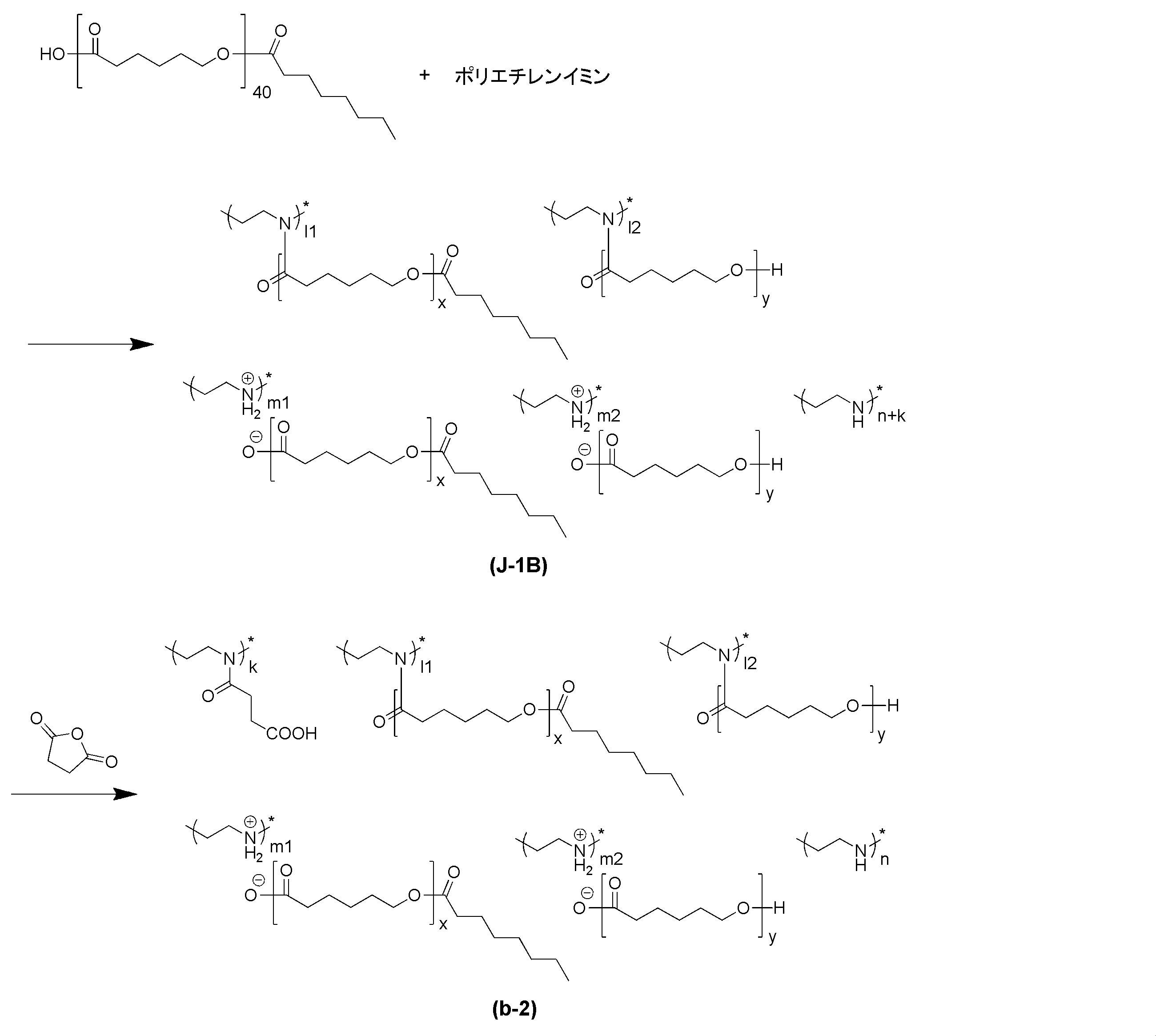
中間体(J-1B)の塩基滴定を行ったところ、酸価が0.11mmol/gであることが確認できた。また、塩基性分散剤(b-2)の塩基滴定、酸滴定を行ったところ、酸価が0.31mmol/g、塩基価が0.83mmol/gであった。すなわち、塩基性分散剤(b-2)の酸価と中間体(J-1B)の酸価の差よりkが、塩基性分散剤(b-2)の塩基価と反応前の樹脂の窒素原子数の差よりl1+l2が、中間体(J-1B)の酸価よりm1+m2が計算でき、k/(l1+l2)/(m1+m2)/n=10/50/5/35となる。また、塩基性分散剤(b-2)のGPC法による重量平均分子量は24,000であった。
(b-3)
温度計、撹拌機、蒸留管及び冷却器を具備した4つ口セパラブルフラスコに、メチルエチルケトン70.0g、n-ブチルアクリレート76.0g、スパルテイン2.8g及びブロモイソ酪酸エチル1.9gを仕込み、窒素気流下で40℃に昇温した。ここに塩化第一銅1.1gを投入し、75℃まで昇温して重合を開始した。3時間重合後、重合溶液をサンプリングし、重合の固形分から重合収率が95%以上であることを確認した後、ここにN,N-ジメチルアミノエチルメタクリレート24.0g、及びメチルエチルケトン30.0gを添加して更に重合を行った。2時間後、重合溶液の固形分から重合収率が97%以上であるのを確認し、室温に冷却して重合を停止して、樹脂溶液を得た。得られた樹脂溶液100gをメチルエチルケトン100gで希釈し、ここにカチオン交換樹脂「ダイヤイオン PK228(三菱化学(株)製)」60gを添加して室温で1時間撹拌し、更に、酸性物質の吸着剤として「キョーワード500(協和化学工業(株)製)」を添加し30分撹拌した。濾過によってカチオン交換樹脂と吸着剤を除去して、重合触媒の残渣を取り除いた。更に、樹脂溶液を濃縮した上で溶剤をPGMEAに置換して、不揮発分40質量%の(3)の塩基性分散剤(b-3)溶液を得た。塩基性分散剤(b-3)は、n-ブチルアクリレートとN,N-ジメチルアミノエチルメタクリレートがブロック共重合した樹脂となっている。また、塩基性分散剤(b-3)のGPC法による重量平均分子量は12,200であった。
温度計、撹拌機、蒸留管及び冷却器を具備した4つ口セパラブルフラスコに、メチルエチルケトン70.0g、n-ブチルアクリレート76.0g、スパルテイン2.8g及びブロモイソ酪酸エチル1.9gを仕込み、窒素気流下で40℃に昇温した。ここに塩化第一銅1.1gを投入し、75℃まで昇温して重合を開始した。3時間重合後、重合溶液をサンプリングし、重合の固形分から重合収率が95%以上であることを確認した後、ここにN,N-ジメチルアミノエチルメタクリレート24.0g、及びメチルエチルケトン30.0gを添加して更に重合を行った。2時間後、重合溶液の固形分から重合収率が97%以上であるのを確認し、室温に冷却して重合を停止して、樹脂溶液を得た。得られた樹脂溶液100gをメチルエチルケトン100gで希釈し、ここにカチオン交換樹脂「ダイヤイオン PK228(三菱化学(株)製)」60gを添加して室温で1時間撹拌し、更に、酸性物質の吸着剤として「キョーワード500(協和化学工業(株)製)」を添加し30分撹拌した。濾過によってカチオン交換樹脂と吸着剤を除去して、重合触媒の残渣を取り除いた。更に、樹脂溶液を濃縮した上で溶剤をPGMEAに置換して、不揮発分40質量%の(3)の塩基性分散剤(b-3)溶液を得た。塩基性分散剤(b-3)は、n-ブチルアクリレートとN,N-ジメチルアミノエチルメタクリレートがブロック共重合した樹脂となっている。また、塩基性分散剤(b-3)のGPC法による重量平均分子量は12,200であった。
<(c)現像樹脂の合成>
セパラブル四口フラスコに温度計、冷却管、窒素ガス導入管及び攪拌装置が取り付けられた反応容器に、PGMEAを入れ、この反応容器に窒素ガスを導入しながら100℃に加熱して、同温度の反応容器に、滴下管よりベンジルメタクリレート123.3g、メタクリル酸25.8g及びアゾビスイソブチロニトリル10.0gの混合物を1時間かけて滴下して重合反応を行い、樹脂溶液を得た。
反応容器を室温まで冷却した後、樹脂溶液を約3gサンプリングして180℃20分加熱乾燥して不揮発分を測定した。次いで、測定した不揮発分に基づいて、樹脂溶液に不揮発分が40質量%となるようにPGMEAを添加して、現像樹脂(c-1)の溶液を得た。現像樹脂(c-1)のGPC法による重量平均分子量は30,000であった。
セパラブル四口フラスコに温度計、冷却管、窒素ガス導入管及び攪拌装置が取り付けられた反応容器に、PGMEAを入れ、この反応容器に窒素ガスを導入しながら100℃に加熱して、同温度の反応容器に、滴下管よりベンジルメタクリレート123.3g、メタクリル酸25.8g及びアゾビスイソブチロニトリル10.0gの混合物を1時間かけて滴下して重合反応を行い、樹脂溶液を得た。
反応容器を室温まで冷却した後、樹脂溶液を約3gサンプリングして180℃20分加熱乾燥して不揮発分を測定した。次いで、測定した不揮発分に基づいて、樹脂溶液に不揮発分が40質量%となるようにPGMEAを添加して、現像樹脂(c-1)の溶液を得た。現像樹脂(c-1)のGPC法による重量平均分子量は30,000であった。
使用する原料モノマーを適宜変更する以外は上記(c-1)に記載した方法と同様の方法で、現像樹脂(c-2)、(c-3)を合成した。下記に、現像樹脂(c-1)~(c-3)の構造と、GPC法にて測定した重量平均分子量(Mw)を示す。なお、下記において、各繰り返し構造単位のカッコ右下に添え書きした数値は、各繰り返し構造単位の組成をモル比で記入したものである。また、下記構造式における現像樹脂(c-2)の右端の繰り返し単位は、パラクミルフェノールエチレンオキサイド変性アクリレート(東亞合成株式会社製「アロニックスM110」、前記式(A1)で表される化合物に相当)に由来する繰り返し単位である。
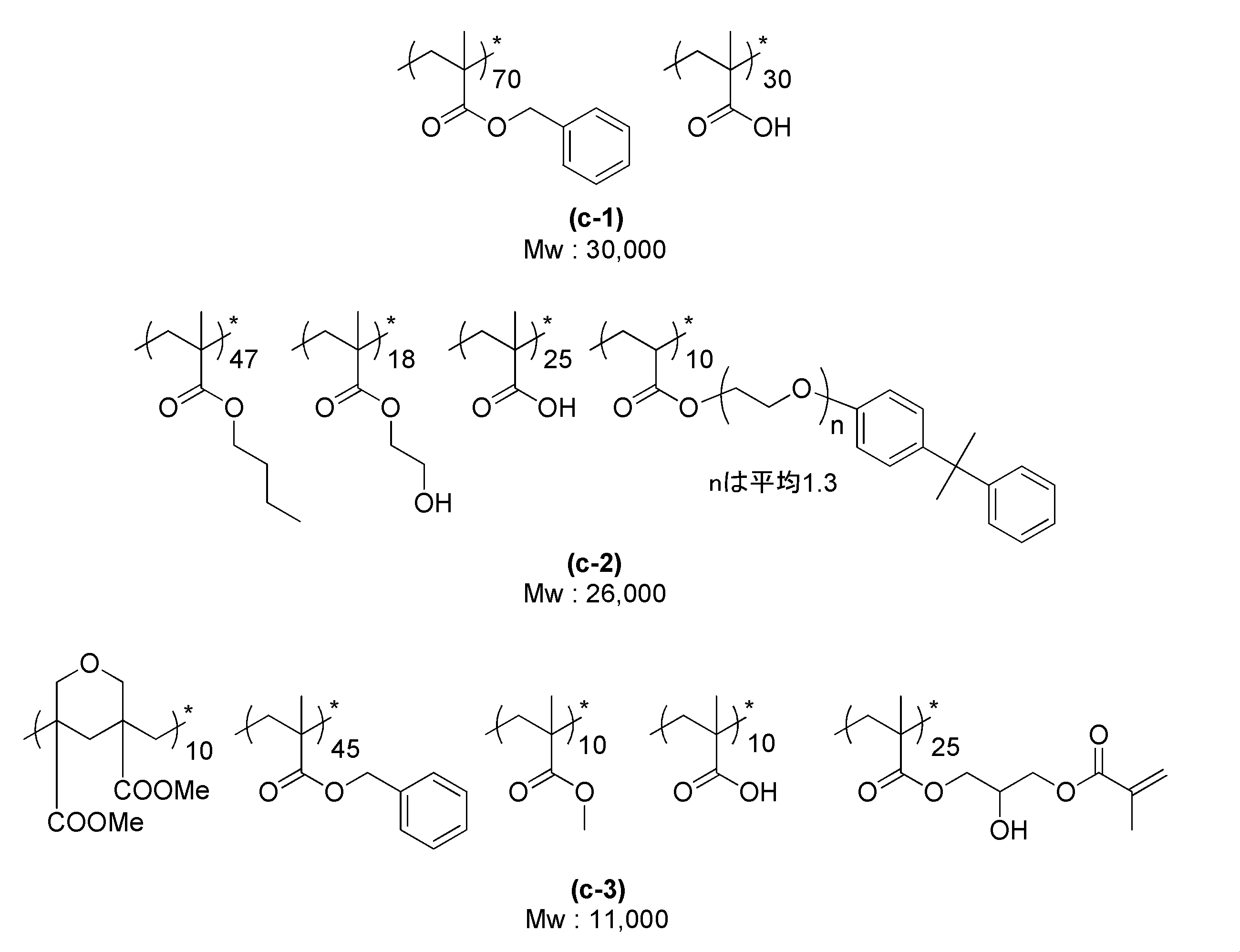
<赤色顔料分散組成物の調製>
下記の組成の混合物を均一に攪拌混合した後、ビーズミルにより3時間混合及び分散して赤色顔料分散組成物(101)を調製した。
ジケトピロロピロール系赤色顔料
(C.I.Pigment Red254)
4.4質量部
ジケトピロロピロール系オレンジ色顔料
(C.I.PigmentOrange71)
5.4質量部
イソインドリン系黄色顔料
(C.I.Pigment Yellow139)
1.2質量部
酸性の色素誘導体(d-1):
下記化学式(d-1)で表される化合物のアルミニウム塩
1.5質量部
塩基性分散剤(b-4):
ソルスパース20000(日本ルーブリゾール製)
1.2質量部
現像樹脂(c-1) 5.6質量部(不揮発分)
PGMEA 80.9質量部
下記の組成の混合物を均一に攪拌混合した後、ビーズミルにより3時間混合及び分散して赤色顔料分散組成物(101)を調製した。
ジケトピロロピロール系赤色顔料
(C.I.Pigment Red254)
4.4質量部
ジケトピロロピロール系オレンジ色顔料
(C.I.PigmentOrange71)
5.4質量部
イソインドリン系黄色顔料
(C.I.Pigment Yellow139)
1.2質量部
酸性の色素誘導体(d-1):
下記化学式(d-1)で表される化合物のアルミニウム塩
1.5質量部
塩基性分散剤(b-4):
ソルスパース20000(日本ルーブリゾール製)
1.2質量部
現像樹脂(c-1) 5.6質量部(不揮発分)
PGMEA 80.9質量部

表1-1及び1-2に記載した組成に変更した以外は、上述の赤色顔料分散組成物(101)と同様の方法で、表1-1及び1-2の中の赤色顔料分散組成物を調製した。なお、表1-1及び1-2の赤色顔料分散組成物のうち溶剤としてPGME(プロピレングリコールモノメチルエーテル)を含むものがあるが、これは塩基性分散剤(b-1)をPGME溶液として添加していることに由来するものである。
<赤色感光性樹脂組成物の調製>
下記の組成の混合物を均一に攪拌混合して、赤色感光性樹脂組成物(RR-a)を調製した。
赤色顔料分散組成物(101) 69.5質量部
現像樹脂(c-3) 1.9質量部
(40質量%樹脂溶液として)
光重合開始剤(F-1) 0.8質量部
エチレン性不飽和化合物(E-1) 0.6質量部
フッ素系界面活性剤 4.2質量部
(不揮発分1質量%のプロピレングリコールモノメチルエーテルアセテート溶液として)
p-メトキシフェノール 0.0003質量部
プロピレングリコールモノメチルエーテルアセテート(PGMEA)
23.0質量部
下記の組成の混合物を均一に攪拌混合して、赤色感光性樹脂組成物(RR-a)を調製した。
赤色顔料分散組成物(101) 69.5質量部
現像樹脂(c-3) 1.9質量部
(40質量%樹脂溶液として)
光重合開始剤(F-1) 0.8質量部
エチレン性不飽和化合物(E-1) 0.6質量部
フッ素系界面活性剤 4.2質量部
(不揮発分1質量%のプロピレングリコールモノメチルエーテルアセテート溶液として)
p-メトキシフェノール 0.0003質量部
プロピレングリコールモノメチルエーテルアセテート(PGMEA)
23.0質量部
光重合開始剤(F-1):1,2-オクタンジオン,1-[4-(フェニルチオ)-,2-(O-ベンゾイルオキシム)](BASF社製、IRGACURE OXE01)
エチレン性不飽和化合物(E-1):ジペンタエリスリトールヘキサアクリレートのエチレンオキシド変性品(新中村化学工業株式会社製、NKエステル A-DPH-12E)
フッ素系界面活性剤:(大日本インキ株式会社製、メガファックF-781F)
使用する赤色顔料分散組成物を変更する以外は、上述の赤色感光性樹脂組成物(RR-a)と同様にして、表1-1及び1-2中の各赤色感光性樹脂組成物を調製した。
エチレン性不飽和化合物(E-1):ジペンタエリスリトールヘキサアクリレートのエチレンオキシド変性品(新中村化学工業株式会社製、NKエステル A-DPH-12E)
フッ素系界面活性剤:(大日本インキ株式会社製、メガファックF-781F)
使用する赤色顔料分散組成物を変更する以外は、上述の赤色感光性樹脂組成物(RR-a)と同様にして、表1-1及び1-2中の各赤色感光性樹脂組成物を調製した。
<評価>
(パターン直線性の評価)
上記で得た赤色感光性樹脂組成物を、予めヘキサメチルジシラザンを噴霧した8インチのシリコンウエハの上に、乾燥後膜厚が0.6μmになるようにスピンコーターを用いて塗布し、100℃で120秒間プリベークして、塗布膜を形成した。
i線ステッパー露光装置FPA-i5+(キヤノン(株)製)を使用して、365nmの波長で、1.4μm四方のアイランドパターンを有するマスクを通し、1.4μm四方のアイランドパターンが形成される最適な露光量で、塗布膜に照射した。露光後、アルカリ現像液CD-2000(富士フイルムエレクトロニクスマテリアルズ(株)製)を使用して、25℃40秒間の条件で現像した。その後、流水で30秒間リンスした後、スプレー乾燥し、着色パターンを得た。
得られた1.4μm四方のアイランドパターンについて、走査型電子顕微鏡((株)日立製作所製S-9220)を用いてパターン上方から観察し、パターン側壁の直線性を下記4段階で評価した。
A:パターン側壁にガタつきが全く認められず、問題は無い
B:パターン側壁に微小なガタつきが認められるものの、問題は無い
C:パターン側壁にガタつきが認められるが、許容可能である
D:パターン側壁に大きなガタつきがあり、許容範囲外である
このパターン直線性評価結果をまとめて表1-1及び1-2に示す。
(パターン直線性の評価)
上記で得た赤色感光性樹脂組成物を、予めヘキサメチルジシラザンを噴霧した8インチのシリコンウエハの上に、乾燥後膜厚が0.6μmになるようにスピンコーターを用いて塗布し、100℃で120秒間プリベークして、塗布膜を形成した。
i線ステッパー露光装置FPA-i5+(キヤノン(株)製)を使用して、365nmの波長で、1.4μm四方のアイランドパターンを有するマスクを通し、1.4μm四方のアイランドパターンが形成される最適な露光量で、塗布膜に照射した。露光後、アルカリ現像液CD-2000(富士フイルムエレクトロニクスマテリアルズ(株)製)を使用して、25℃40秒間の条件で現像した。その後、流水で30秒間リンスした後、スプレー乾燥し、着色パターンを得た。
得られた1.4μm四方のアイランドパターンについて、走査型電子顕微鏡((株)日立製作所製S-9220)を用いてパターン上方から観察し、パターン側壁の直線性を下記4段階で評価した。
A:パターン側壁にガタつきが全く認められず、問題は無い
B:パターン側壁に微小なガタつきが認められるものの、問題は無い
C:パターン側壁にガタつきが認められるが、許容可能である
D:パターン側壁に大きなガタつきがあり、許容範囲外である
このパターン直線性評価結果をまとめて表1-1及び1-2に示す。
(ザラ(色ムラ)の評価)
上記で得た赤色感光性樹脂組成物を、ガラス基板上に乾燥後膜厚が0.6μmになるようにスピンコーターを用いて塗布し、100℃で120秒間プリベークして着色塗膜1を得た。
また、上記要領で得た赤色感光性樹脂組成物を室温で6ヶ月間経時させた後、ガラス基板上に乾燥後膜厚が0.6μmになるようにスピンコーターを用いて塗布し、100℃で120秒間プリベークして着色塗膜2を得た。
得られた着色塗膜1および着色塗膜2を光学顕微鏡の観測レンズと光源との間に設置して光を観測レンズに向けて照射し、その透過光状態を、倍率が1000倍のデジタルカメラが設置された光学顕微鏡によって観察した。光学顕微鏡に設置されたデジタルカメラには128万画素のCCDが搭載されており、透過光状態にある被膜表面を撮影した。撮影画像は8ビットのビットマップ形式でデジタル変換したデータ(デジタル画像)として保存した。
なお、着色塗膜の被膜表面の撮影は任意に選択した20の領域に対して行った。また、デジタル変換したデータは、撮影画像をRGBの3原色それぞれの輝度を0~255までの256階調の濃度分布として数値化して保存した。
次いで、保存されたデジタル画像について、1つの格子サイズが実基板上の0.5μm四方に相当するように、格子状に区分し、一つの区画内での輝度を平均化した。本実施例においては、128万画素のデジタルカメラで光学1000倍の画像を撮影したため、実基板上の0.5μmは撮影画像上の0.5mmとなる。ディスプレイ上における画像サイズが452mm×352mmであったことから、一つの領域における総区画数は636416個であった。
各領域の全区画について、任意の1区画とそれに隣接する全ての隣接区画の平均輝度とを計測した。隣接区画の平均輝度との差が5以上の区画を有意差区画と認定し、全領域の有意差区画の平均総数を算出した。この数値が小さいほど、隣接する区画との濃度差が小さく、ザラが少なく、カラーフィルターとしての特性に優れることを表す。
着色塗膜1のザラの平均総数を調製直後のザラの値として、着色塗膜2のザラの平均総数を室温6ヶ月経時後のザラの値として、さらに調製直後のザラの値で室温6ヶ月経時後のザラの値を割った値をザラの増大率として、これらをまとめて表1-1及び1-2に示す。
上記で得た赤色感光性樹脂組成物を、ガラス基板上に乾燥後膜厚が0.6μmになるようにスピンコーターを用いて塗布し、100℃で120秒間プリベークして着色塗膜1を得た。
また、上記要領で得た赤色感光性樹脂組成物を室温で6ヶ月間経時させた後、ガラス基板上に乾燥後膜厚が0.6μmになるようにスピンコーターを用いて塗布し、100℃で120秒間プリベークして着色塗膜2を得た。
得られた着色塗膜1および着色塗膜2を光学顕微鏡の観測レンズと光源との間に設置して光を観測レンズに向けて照射し、その透過光状態を、倍率が1000倍のデジタルカメラが設置された光学顕微鏡によって観察した。光学顕微鏡に設置されたデジタルカメラには128万画素のCCDが搭載されており、透過光状態にある被膜表面を撮影した。撮影画像は8ビットのビットマップ形式でデジタル変換したデータ(デジタル画像)として保存した。
なお、着色塗膜の被膜表面の撮影は任意に選択した20の領域に対して行った。また、デジタル変換したデータは、撮影画像をRGBの3原色それぞれの輝度を0~255までの256階調の濃度分布として数値化して保存した。
次いで、保存されたデジタル画像について、1つの格子サイズが実基板上の0.5μm四方に相当するように、格子状に区分し、一つの区画内での輝度を平均化した。本実施例においては、128万画素のデジタルカメラで光学1000倍の画像を撮影したため、実基板上の0.5μmは撮影画像上の0.5mmとなる。ディスプレイ上における画像サイズが452mm×352mmであったことから、一つの領域における総区画数は636416個であった。
各領域の全区画について、任意の1区画とそれに隣接する全ての隣接区画の平均輝度とを計測した。隣接区画の平均輝度との差が5以上の区画を有意差区画と認定し、全領域の有意差区画の平均総数を算出した。この数値が小さいほど、隣接する区画との濃度差が小さく、ザラが少なく、カラーフィルターとしての特性に優れることを表す。
着色塗膜1のザラの平均総数を調製直後のザラの値として、着色塗膜2のザラの平均総数を室温6ヶ月経時後のザラの値として、さらに調製直後のザラの値で室温6ヶ月経時後のザラの値を割った値をザラの増大率として、これらをまとめて表1-1及び1-2に示す。
(針状異物の評価)
(1)Green顔料分散液の調製
顔料としてC.I.ピグメント・グリーン58とC.I.ピグメント・イエロー139との100/55(質量比)混合物12.6部と、分散剤としてDisperbyk2001(ビックケミー(BYK)社製、固形分濃度45.1質量%)5.2部と、分散樹脂として上述の現像樹脂(c-1)を2.7部と、溶媒としてPEGMEA78.3部とからなる混合液を、ビーズミルにより15時間混合及び分散して、Green顔料分散液G-1を調製した。
(1)Green顔料分散液の調製
顔料としてC.I.ピグメント・グリーン58とC.I.ピグメント・イエロー139との100/55(質量比)混合物12.6部と、分散剤としてDisperbyk2001(ビックケミー(BYK)社製、固形分濃度45.1質量%)5.2部と、分散樹脂として上述の現像樹脂(c-1)を2.7部と、溶媒としてPEGMEA78.3部とからなる混合液を、ビーズミルにより15時間混合及び分散して、Green顔料分散液G-1を調製した。
顔料としてC.I.ピグメント・グリーン58の代わりにC.I.ピグメント・グリーン36を使用する以外は上記Green顔料分散液G-1と同様の方法で、Green顔料分散液G-2を調製した。
(2)Blue顔料分散液の調製
顔料としてC.I.ピグメント・ブルー15:6とC.I.ピグメント・バイオレット23との100/25(質量比)混合物14部と、分散剤としてDisperbyk2001(ビックケミー(BYK)社製、固形分濃度45.1質量%)4.7部と、分散樹脂として上述の現像樹脂(c-1)を3.5部と、溶媒としてPEGMEA77.8部とからなる混合液を、ビーズミルにより15時間混合及び分散して、Blue顔料分散液を調製した。
顔料としてC.I.ピグメント・ブルー15:6とC.I.ピグメント・バイオレット23との100/25(質量比)混合物14部と、分散剤としてDisperbyk2001(ビックケミー(BYK)社製、固形分濃度45.1質量%)4.7部と、分散樹脂として上述の現像樹脂(c-1)を3.5部と、溶媒としてPEGMEA77.8部とからなる混合液を、ビーズミルにより15時間混合及び分散して、Blue顔料分散液を調製した。
(3)Green着色硬化性組成物(塗布液)の調製
上記で得られたGreen顔料分散液G-1を用い、下記組成となるように混合、撹拌して緑色着色硬化性組成物を調製した。
上記で得られたGreen顔料分散液G-1を用い、下記組成となるように混合、撹拌して緑色着色硬化性組成物を調製した。
<組成>
・前記Green顔料分散液G-1 83.3部
・現像樹脂(c-3) 1.0部
・1,2-オクタンジオン,1-[4-(フェニルチオ)-,2-(O-ベンゾイルオキシム)]
(BASF社製の光重合開始剤、IRGACURE OXE01)
1.2部
・モノマー1:ジペンタエリスリトールヘキサアクリレートのエチレンオキシド変性品
(新中村化学工業株式会社製、NKエステル A-DPH-12E)
1.4部
・モノマー2:M-305(東亞合成社製) 1.4部
・エポキシ樹脂:EHPE3150(ダイセル化学工業株式会社製)
〔分子内に約15個のエポキシ基を含むエポキシ化合物〕
1.05部
・p-メトキシフェノール 0.001部
・PGMEA(溶媒) 7.4部
・界面活性剤
(商品名:F-781、大日本インキ化学工業(株)製のPGMEA0.2%溶液)
4.2部
・前記Green顔料分散液G-1 83.3部
・現像樹脂(c-3) 1.0部
・1,2-オクタンジオン,1-[4-(フェニルチオ)-,2-(O-ベンゾイルオキシム)]
(BASF社製の光重合開始剤、IRGACURE OXE01)
1.2部
・モノマー1:ジペンタエリスリトールヘキサアクリレートのエチレンオキシド変性品
(新中村化学工業株式会社製、NKエステル A-DPH-12E)
1.4部
・モノマー2:M-305(東亞合成社製) 1.4部
・エポキシ樹脂:EHPE3150(ダイセル化学工業株式会社製)
〔分子内に約15個のエポキシ基を含むエポキシ化合物〕
1.05部
・p-メトキシフェノール 0.001部
・PGMEA(溶媒) 7.4部
・界面活性剤
(商品名:F-781、大日本インキ化学工業(株)製のPGMEA0.2%溶液)
4.2部
更に、使用するGreen顔料分散液をG-1からG-2に変更する以外は上記と同様の方法で、緑色着色硬化性組成物を調製した。
なお、上記緑色着色硬化性組成物の調製に用いたモノマー2(M-305、東亞合成社製)とエポキシ樹脂(EHPE3150、ダイセル化学工業株式会社製)の化学構造式を以下に示す。
なお、上記緑色着色硬化性組成物の調製に用いたモノマー2(M-305、東亞合成社製)とエポキシ樹脂(EHPE3150、ダイセル化学工業株式会社製)の化学構造式を以下に示す。

(4)Blue着色硬化性組成物(塗布液)の調製
上記のBlue顔料分散液を用い、下記組成となるように混合、撹拌して青色着色硬化性組成物を調製した。
上記のBlue顔料分散液を用い、下記組成となるように混合、撹拌して青色着色硬化性組成物を調製した。
<組成>
・前記Blue顔料分散液 50.6部
・現像樹脂(c-3) 2.1部
・1,2-オクタンジオン,1-[4-(フェニルチオ)-,2-(O-ベンゾイルオキシム)]
(BASF社製の光重合開始剤、IRGACURE OXE01)
1.2部
・モノマー1:ジペンタエリスリトールヘキサアクリレートのエチレンオキシド変性品
(新中村化学工業株式会社製、NKエステル A-DPH-12E)
3.5部
・モノマー2:SR-494(サートマー社製) 1.2部
・p-メトキシフェノール 0.002部
・PGMEA(溶媒) 36部
・界面活性剤
(商品名:F-781、大日本インキ化学工業(株)製のPGMEA0.2%溶液)
4.2部
・前記Blue顔料分散液 50.6部
・現像樹脂(c-3) 2.1部
・1,2-オクタンジオン,1-[4-(フェニルチオ)-,2-(O-ベンゾイルオキシム)]
(BASF社製の光重合開始剤、IRGACURE OXE01)
1.2部
・モノマー1:ジペンタエリスリトールヘキサアクリレートのエチレンオキシド変性品
(新中村化学工業株式会社製、NKエステル A-DPH-12E)
3.5部
・モノマー2:SR-494(サートマー社製) 1.2部
・p-メトキシフェノール 0.002部
・PGMEA(溶媒) 36部
・界面活性剤
(商品名:F-781、大日本インキ化学工業(株)製のPGMEA0.2%溶液)
4.2部
(5)カラーフィルターの形成
前記において調製されたGreen着色硬化性組成物を、あらかじめヘキサメチルジシラザンを噴霧した8インチのシリコンウエハの上に、乾燥後膜厚が0.6μmになるようにスピンコーターを用いて塗布し、100℃で120秒間プリベークして、塗布膜を形成した。次いで、i線ステッパー露光装置FPA-3000i5+(Canon(株)製)を使用して、365nmの波長で、1.4μm四方のベイヤーパターンマスクを通して1.4μmのベイヤーパターンが形成される最適な露光量にて、塗布膜に照射した。露光後のシリコンウエハをスピン・シャワー現像機(DW-30型;(株)ケミトロニクス製)の水平回転テーブル上に載置し、CD-2000(富士フイルムエレクトロニクスマテリアルズ(株)製)の40%希釈液を用いて23℃で180秒間パドル現像を行ない、シリコンウエハ上に緑色着色パターンを形成した。
緑色着色パターンが形成されたシリコンウエハを真空チャック方式で前記水平回転テーブルに固定し、回転装置によって該シリコンウエハを回転数50rpmで回転させつつ、その回転中心の上方より噴出ノズルから純水をシャワー状に供給してリンス処理を行ない、その後スプレー乾燥した。
次に、200℃のホットプレートにてこのシリコンウエハを5分間加熱し、緑色の画素パターンが形成されたカラーフィルタを得た。
前記において調製されたGreen着色硬化性組成物を、あらかじめヘキサメチルジシラザンを噴霧した8インチのシリコンウエハの上に、乾燥後膜厚が0.6μmになるようにスピンコーターを用いて塗布し、100℃で120秒間プリベークして、塗布膜を形成した。次いで、i線ステッパー露光装置FPA-3000i5+(Canon(株)製)を使用して、365nmの波長で、1.4μm四方のベイヤーパターンマスクを通して1.4μmのベイヤーパターンが形成される最適な露光量にて、塗布膜に照射した。露光後のシリコンウエハをスピン・シャワー現像機(DW-30型;(株)ケミトロニクス製)の水平回転テーブル上に載置し、CD-2000(富士フイルムエレクトロニクスマテリアルズ(株)製)の40%希釈液を用いて23℃で180秒間パドル現像を行ない、シリコンウエハ上に緑色着色パターンを形成した。
緑色着色パターンが形成されたシリコンウエハを真空チャック方式で前記水平回転テーブルに固定し、回転装置によって該シリコンウエハを回転数50rpmで回転させつつ、その回転中心の上方より噴出ノズルから純水をシャワー状に供給してリンス処理を行ない、その後スプレー乾燥した。
次に、200℃のホットプレートにてこのシリコンウエハを5分間加熱し、緑色の画素パターンが形成されたカラーフィルタを得た。
こうして得られた緑色の画素パターン上に、上述のBlue着色硬化性組成物および赤色感光性樹脂組成物を用いて露光パターンを1.4μm四方のアイランドパターンマスクを通して露光する以外は、Greenと同様の工程を繰り返すことにより、赤色(R)、緑色(G)及び青色(B)の画素パターンが互いに隣接した状態のカラーフィルターを得た。
なお、一部の実施例および一部の比較例では、Green着色硬化性組成物としてG-1(使用している緑色顔料がC.I.PigmentGreen58)の代わりに、G-2(使用している緑色顔料がC.I.PigmentGreen36)を配合したものを使用して評価を行った。
(6)針状異物発生の有無
上記(1)~(5)の要領で得られた、赤色(R)、緑色(G)及び青色(B)の画素パターンが互いに隣接した状態のカラーフィルタを260℃のホットプレートにて5分加熱し、そのパターンを、走査型電子顕微鏡(SEM)を用いて20,000倍で観察し、下記の評価基準にしたがって針状異物発生の程度を評価した。評価結果を表1-1及び1-2にまとめて示す。
<評価基準>
AA:針状異物の発生が全く認められず、問題は無い
A:微小な針状異物の発生が認められるが、問題は無い
B:針状異物の発生が認められるが、許容可能である
C:針状異物の発生が評価Bよりも多く認められるが、許容可能である
D:針状異物の発生が上記評価Cよりも更に多く、許容範囲外である
上記(1)~(5)の要領で得られた、赤色(R)、緑色(G)及び青色(B)の画素パターンが互いに隣接した状態のカラーフィルタを260℃のホットプレートにて5分加熱し、そのパターンを、走査型電子顕微鏡(SEM)を用いて20,000倍で観察し、下記の評価基準にしたがって針状異物発生の程度を評価した。評価結果を表1-1及び1-2にまとめて示す。
<評価基準>
AA:針状異物の発生が全く認められず、問題は無い
A:微小な針状異物の発生が認められるが、問題は無い
B:針状異物の発生が認められるが、許容可能である
C:針状異物の発生が評価Bよりも多く認められるが、許容可能である
D:針状異物の発生が上記評価Cよりも更に多く、許容範囲外である

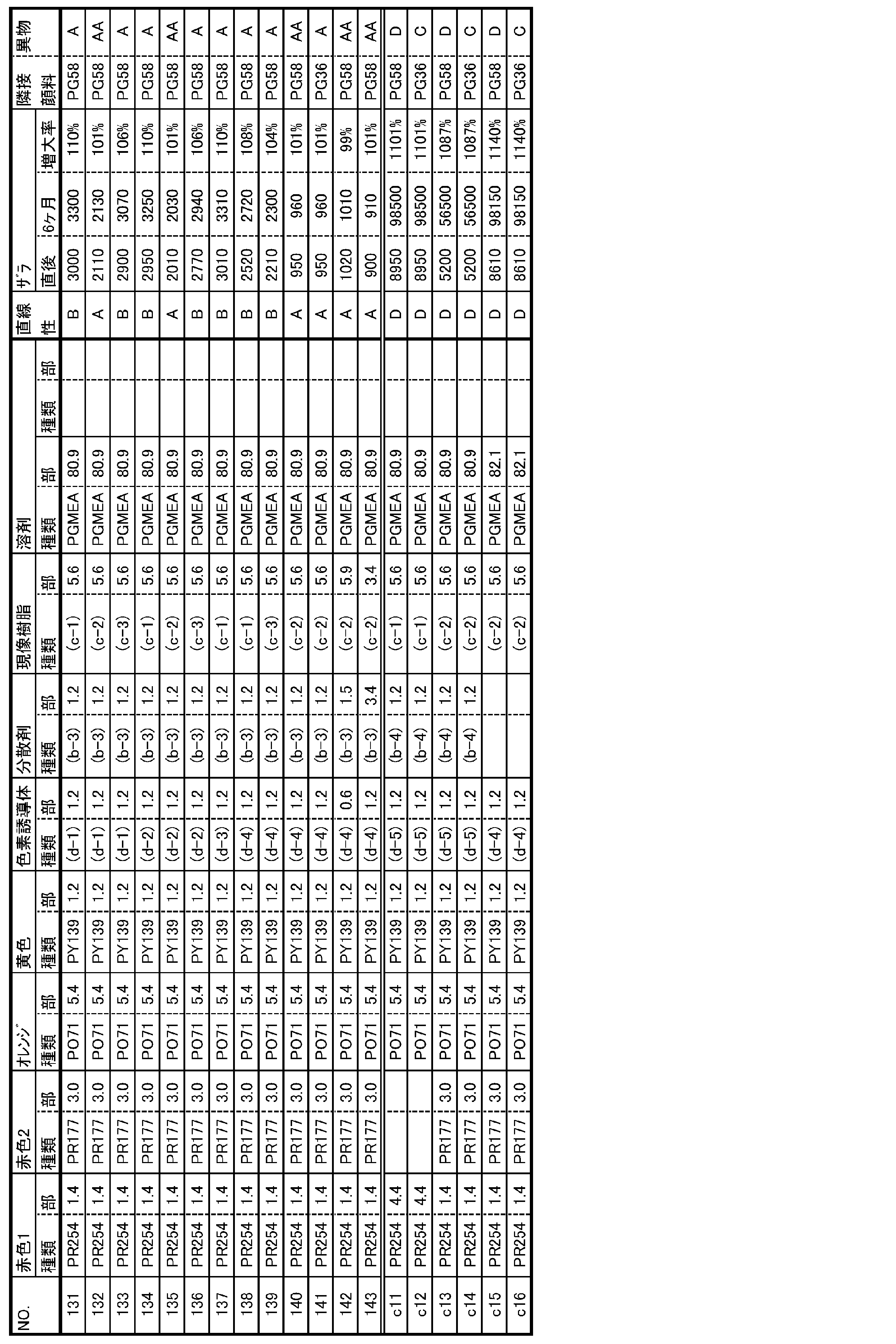
<表の注釈>
・分散剤と現像樹脂の配合量は不揮発分である
・直線性:パターン直線性
・直後:調製直後
・6ヶ月:室温6ヶ月経過後
・隣接顔料:隣接する緑色画素パターンに使用されている顔料
・異物:針状異物
・分散剤と現像樹脂の配合量は不揮発分である
・直線性:パターン直線性
・直後:調製直後
・6ヶ月:室温6ヶ月経過後
・隣接顔料:隣接する緑色画素パターンに使用されている顔料
・異物:針状異物
表1-1及び1-2において、各記号は以下の化合物を意味する。
PR254:ジケトピロロピロール系赤色顔料(C.I.PigmentRed254)
PR122:キナクリドン系赤色顔料(C.I.PigmentRed122)
PR177:アントラキノン系赤色顔料(C.I.PigmentRed177)
PO71:ジケトピロロピロール系オレンジ色顔料(C.I.PigmentOrange71)
PY139:イソインドリン系黄色顔料(C.I.PigmentYellow139)
(b-4):ソルスパース20000(日本ルーブリゾール製)
(d-1):下記化学式(d-1)で表される化合物のアルミニウム塩
PR254:ジケトピロロピロール系赤色顔料(C.I.PigmentRed254)
PR122:キナクリドン系赤色顔料(C.I.PigmentRed122)
PR177:アントラキノン系赤色顔料(C.I.PigmentRed177)
PO71:ジケトピロロピロール系オレンジ色顔料(C.I.PigmentOrange71)
PY139:イソインドリン系黄色顔料(C.I.PigmentYellow139)
(b-4):ソルスパース20000(日本ルーブリゾール製)
(d-1):下記化学式(d-1)で表される化合物のアルミニウム塩

(d-2):下記構造式の化合物(d-2)のアルミニウム塩
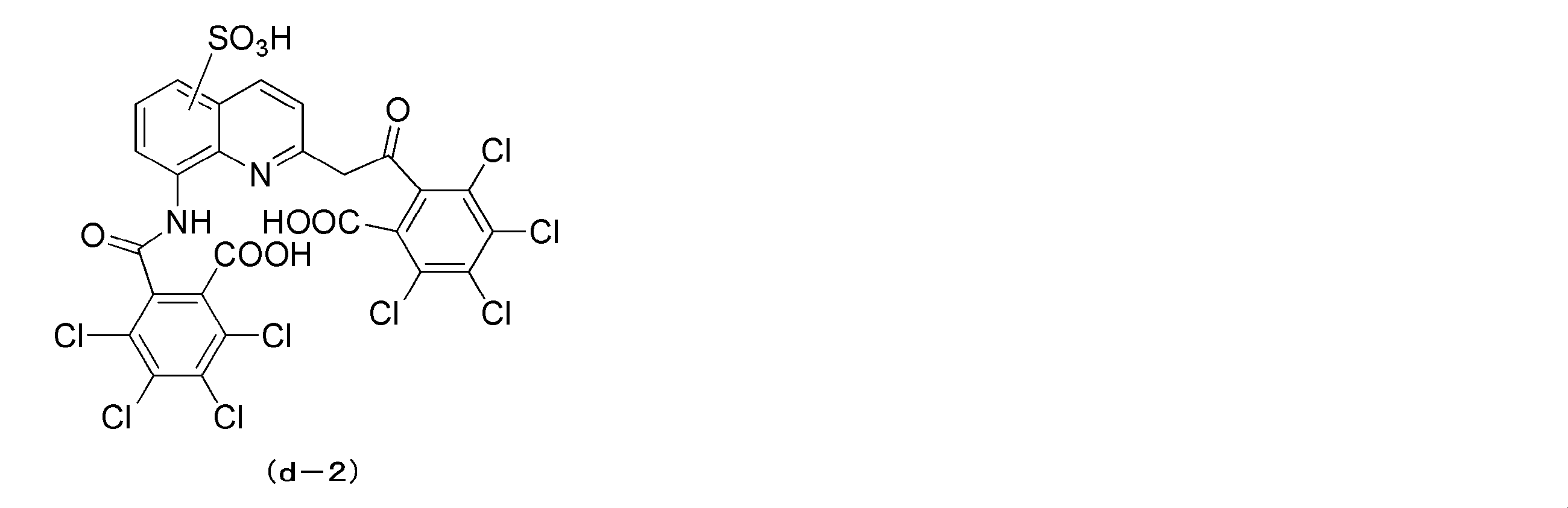
(d-3):下記構造式の化合物
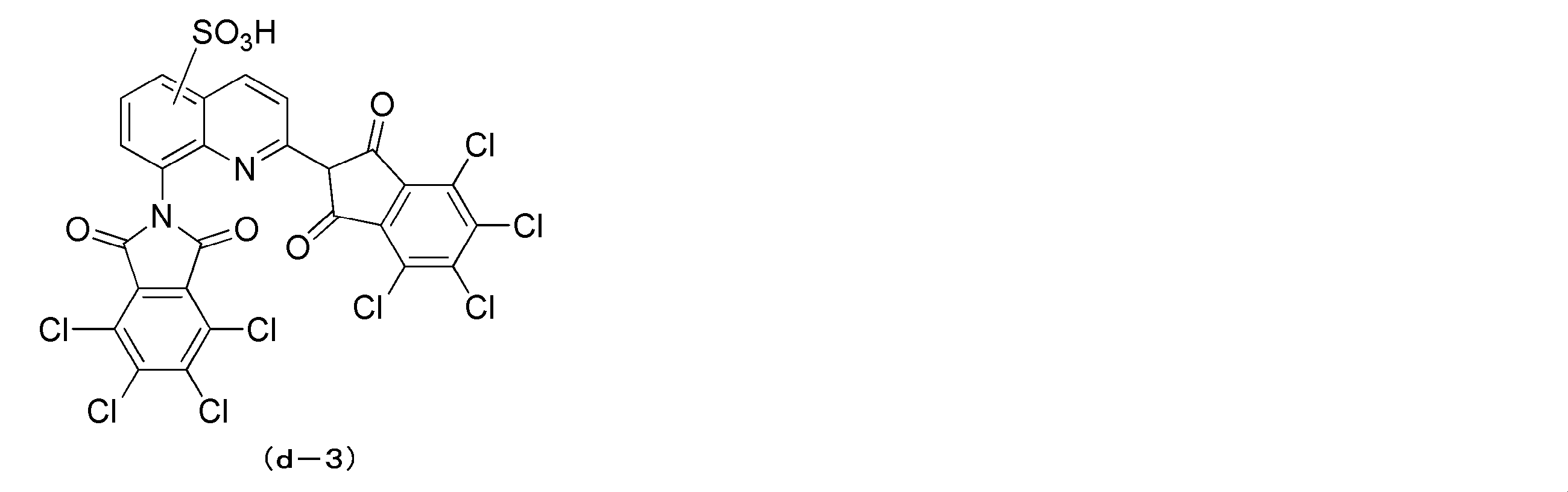
(d-4):下記構造式の化合物(d-4)’と(d-4)’’の86:14混合物、下記(d-4)’は塩基性の色素誘導体であり、下記(d-4)’’は中性の色素誘導体に相当する。すなわち、(d-4)は中性の色素誘導体(d-4)’’を構成成分として含有しているため、(d-4)を含有する組成物は、「中性の色素誘導体」を含有することを意味する。

(d-5):下記構造式の化合物(塩基性の色素誘導体)
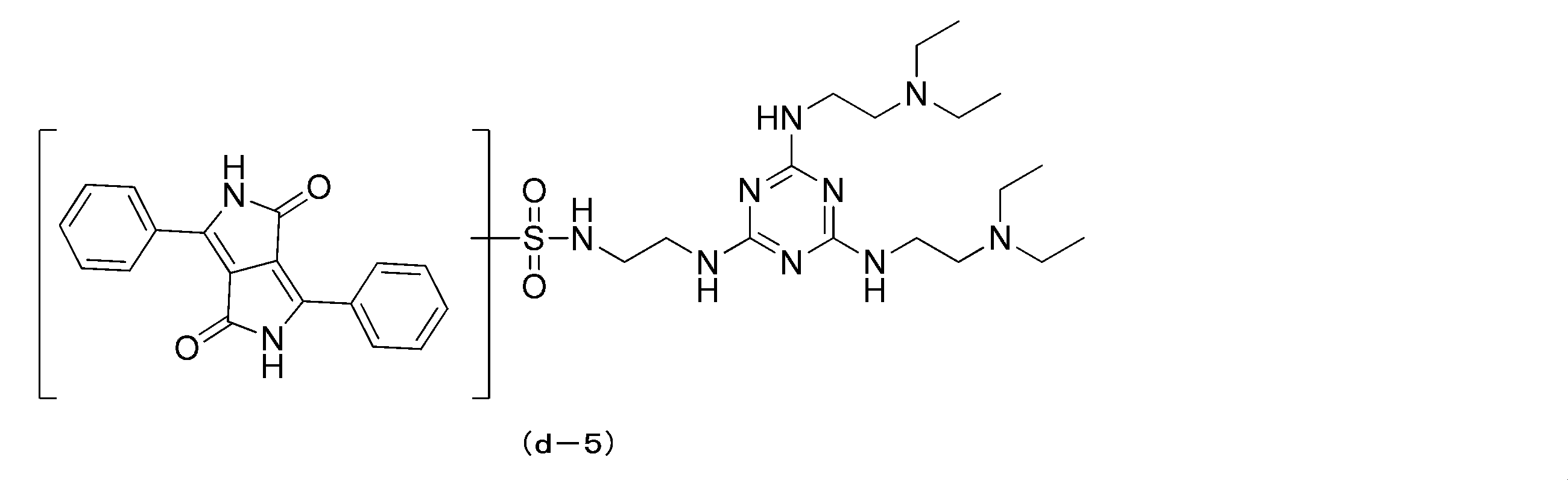
上記表1-1及び1-2に示す結果より、比較例c11~c14の赤色感光性樹脂組成物は、本発明の組成物に必須の成分である酸性もしくは中性の色素誘導体を含まないため、パターン直線性やザラの経時増大、ならびに針状異物の発生に大きな問題があることが判る。また、隣接する緑色画素パターンにPG36を用いた比較例c12に比べ、隣接する緑色画素パターンにPG58を用いた比較例c11は針状異物の発生が特に顕著であった。これは、比較例の赤色感光性樹脂組成物が、PG58との相性が悪いことを示す結果である。
これに比べ、例えば実施例101~102に示す本発明の赤色感光性樹脂組成物は、本発明の組成物に必須の成分である酸性もしくは中性の色素誘導体と塩基性分散剤を含むため、パターン直線性やザラの経時増大、ならびに針状異物の発生が改善されていることが判る。また、隣接する緑色画素パターンにPG36を用いた実施例102に比べ、隣接する緑色画素パターンにPG58を用いた実施例101の方が針状異物の発生がより抑えられていることが判る。これは、本発明の赤色感光性樹脂組成物が、PG58との相性に優れていることを示す結果である。さらに、本実施例の中で現像樹脂として式(A1)の化合物(C-2)を用いたものが、針状異物の発生抑制において顕著な効果を奏することが分かる。
これに比べ、例えば実施例101~102に示す本発明の赤色感光性樹脂組成物は、本発明の組成物に必須の成分である酸性もしくは中性の色素誘導体と塩基性分散剤を含むため、パターン直線性やザラの経時増大、ならびに針状異物の発生が改善されていることが判る。また、隣接する緑色画素パターンにPG36を用いた実施例102に比べ、隣接する緑色画素パターンにPG58を用いた実施例101の方が針状異物の発生がより抑えられていることが判る。これは、本発明の赤色感光性樹脂組成物が、PG58との相性に優れていることを示す結果である。さらに、本実施例の中で現像樹脂として式(A1)の化合物(C-2)を用いたものが、針状異物の発生抑制において顕著な効果を奏することが分かる。
さらに、上記表1-1及び1-2に示した実施例赤色感光性樹脂組成物(101)~(143)について、その色相を確認した結果、そのすべてが前記分光特性に係る条件<A>を満たすことを確認した。
10 固体撮像素子
11 上部平坦化膜
12 下部平坦化膜
15 マイクロレンズ
20 カラーフィルター
20B,20G,20R カラーフィルター画素部
11 上部平坦化膜
12 下部平坦化膜
15 マイクロレンズ
20 カラーフィルター
20B,20G,20R カラーフィルター画素部
Claims (19)
- 顔料と、酸性もしくは中性の色素誘導体と、塩基性分散剤と、現像樹脂とを含有する赤色の感光性樹脂組成物であって、
前記顔料がC.I.P.R.254と、C.I.P.O.71と、C.I.P.Y.139とを含む感光性樹脂組成物。
- さらに、重合性化合物を含有する請求項1に記載の感光性樹脂組成物。
- 前記顔料が、C.I.P.R.177及び/又はC.I.P.R.122をさらに含む請求項1または2に記載の感光性樹脂組成物。
- 前記塩基性分散剤が、下記(1)、(2)、(3)のいずれかを含む請求項1~3のいずれか1項に記載の感光性樹脂組成物。
(1)(b-1)アミノ基及び含窒素へテロ環基から選択された少なくとも一つの基を有するモノマー、(b-2)カルボキシル基を有するモノマー、及び(b-3)重量平均分子量が1,000以上50,000以下のマクロモノマー、を構成単位として含む共重合体
(2)下記式(I-1)で表される繰り返し単位及び式(I-2a)で表される繰り返し単位を含む樹脂、又は、式(I-1)で表される繰り返し単位及び式(I-2b)で表される繰り返し単位を含む樹脂

(3)(3-a)含窒素共重合体ブロックと、(3-b)顔料担体親和性共重合体ブロックとを含むブロック共重合体
- 前記色素誘導体が、下記式(I)で表される請求項1~4のいずれか1項に記載の感光性樹脂組成物。

- 前記現像樹脂が、下記式(A1)で表される化合物が共重合された高分子化合物を含む請求項1~5のいずれか1項に記載の感光性樹脂組成物。

- 前記顔料を全固形分中30質量%以上80質量%以下で含有する請求項1~6のいずれか1項に記載の感光性樹脂組成物。
- 100質量部の赤色顔料に対して、前記C.I.P.O.71を50~300質量部で含有させた請求項1~7のいずれか1項に記載の感光性樹脂組成物。
- 100質量部の赤色顔料に対して、前記C.I.P.Y.139を5~100質量部で含有させた請求項1~8のいずれか1項に記載の感光性樹脂組成物。
- 100質量部の前記C.I.P.R.254に対して、前記C.I.P.R.177及び/又は前記C.I.P.R.122を100~300質量部で含有させた請求項3~9のいずれか1項に記載の感光性樹脂組成物。
- 100質量部の顔料に対して、前記塩基性分散剤を1~80質量部で含有させた請求項1~10のいずれか1項に記載の感光性樹脂組成物。
- 100質量部の顔料に対して、前記現像樹脂を10~100質量部で含有させた請求項1~11のいずれか1項に記載の感光性樹脂組成物。
- 100質量部の顔料に対して、前記色素誘導体を3~20質量部で含有させた請求項1~12のいずれか1項に記載の感光性樹脂組成物。
- 前記感光性樹脂組成物がその硬化膜として利用するものであり、緑色の樹脂硬化膜と隣接して用いる請求項1~13のいずれか1項に記載の感光性樹脂組成物。
- 前記緑色の樹脂硬化膜がC.I.P.G.58を含む請求項14に記載の感光性樹脂組成物。
- 請求項1~15のいずれか1項に記載の感光性樹脂組成物を塗布し硬化してなる赤色の樹脂硬化物。
- 請求項16に記載の赤色の樹脂硬化物を有してなるカラーフィルター。
- 前記赤色の樹脂硬化物と、
前記赤色の樹脂硬化物に隣接して配置された緑色の樹脂硬化物と、
を有する請求項17に記載のカラーフィルター。
- 前記緑色の樹脂硬化物がC.I.P.G.58である請求項18に記載のカラーフィルター。
Priority Applications (1)
| Application Number | Priority Date | Filing Date | Title |
|---|---|---|---|
| KR1020167003202A KR101733024B1 (ko) | 2013-09-30 | 2014-09-05 | 감광성 수지 조성물, 그 수지 경화물 및 컬러 필터 |
Applications Claiming Priority (2)
| Application Number | Priority Date | Filing Date | Title |
|---|---|---|---|
| JP2013205143A JP6233775B2 (ja) | 2013-09-30 | 2013-09-30 | 感光性樹脂組成物、その樹脂硬化物およびカラーフィルター |
| JP2013-205143 | 2013-09-30 |
Publications (1)
| Publication Number | Publication Date |
|---|---|
| WO2015045790A1 true WO2015045790A1 (ja) | 2015-04-02 |
Family
ID=52742937
Family Applications (1)
| Application Number | Title | Priority Date | Filing Date |
|---|---|---|---|
| PCT/JP2014/073409 Ceased WO2015045790A1 (ja) | 2013-09-30 | 2014-09-05 | 感光性樹脂組成物、その樹脂硬化物およびカラーフィルター |
Country Status (4)
| Country | Link |
|---|---|
| JP (1) | JP6233775B2 (ja) |
| KR (1) | KR101733024B1 (ja) |
| TW (1) | TWI644994B (ja) |
| WO (1) | WO2015045790A1 (ja) |
Cited By (1)
| Publication number | Priority date | Publication date | Assignee | Title |
|---|---|---|---|---|
| CN115803682A (zh) * | 2020-08-31 | 2023-03-14 | 富士胶片株式会社 | 着色组成物、硬化膜、滤色器及显示装置 |
Families Citing this family (7)
| Publication number | Priority date | Publication date | Assignee | Title |
|---|---|---|---|---|
| JPWO2017038708A1 (ja) * | 2015-08-31 | 2018-02-22 | 富士フイルム株式会社 | 着色感光性組成物、硬化膜、カラーフィルタ、遮光膜、固体撮像素子、画像表示装置、および、硬化膜の製造方法 |
| JP6906356B2 (ja) * | 2016-06-21 | 2021-07-21 | 日本化薬株式会社 | ナフタロシアニンを含む青色着色樹脂組成物、カラーフィルター、固体撮像素子 |
| CN110073493A (zh) * | 2016-12-27 | 2019-07-30 | 凸版印刷株式会社 | 固体拍摄元件及其制造方法 |
| KR102210117B1 (ko) * | 2019-04-23 | 2021-02-01 | 인하대학교 산학협력단 | 온도감응성 고분자 박막을 갖는 광공진기를 포함하는 컬러 필터 |
| JP7594962B2 (ja) | 2021-03-30 | 2024-12-05 | 住友化学株式会社 | 赤色着色組成物 |
| CN118355327A (zh) * | 2021-12-24 | 2024-07-16 | Dnp精细化工股份有限公司 | 感光性着色树脂组合物、彩色滤光片及显示装置 |
| WO2025121175A1 (ja) * | 2023-12-06 | 2025-06-12 | 富士フイルム株式会社 | 組成物、膜、光学フィルタ、固体撮像素子および画像表示装置 |
Citations (11)
| Publication number | Priority date | Publication date | Assignee | Title |
|---|---|---|---|---|
| JP2006079064A (ja) * | 2004-08-09 | 2006-03-23 | Mitsubishi Chemicals Corp | 感光性樹脂組成物、カラーフィルタ及び液晶表示装置 |
| JP2007212654A (ja) * | 2006-02-08 | 2007-08-23 | Toyo Ink Mfg Co Ltd | 感光性着色組成物およびカラーフィルタ |
| JP2009216952A (ja) * | 2008-03-10 | 2009-09-24 | Toyo Ink Mfg Co Ltd | カラーフィルタ用赤色着色組成物およびカラーフィルタ |
| JP2010072293A (ja) * | 2008-09-18 | 2010-04-02 | Fujifilm Corp | カラーフィルタ用着色組成物、カラーフィルタ、及びカラーフィルタの製造方法 |
| JP2010191304A (ja) * | 2009-02-20 | 2010-09-02 | Toyo Ink Mfg Co Ltd | カラーフィルタ用着色組成物、及びそれを用いたカラーフィルタ |
| JP2012108266A (ja) * | 2010-11-16 | 2012-06-07 | Fujifilm Corp | 着色硬化性組成物、パターン形成方法、カラーフィルタの製造方法、カラーフィルタ及びそれを備えた表示装置 |
| JP2012162684A (ja) * | 2011-02-08 | 2012-08-30 | Fujifilm Corp | 加工顔料、並びに、これを用いた顔料分散組成物、着色感活性光線性又は感放射線性組成物、カラーフィルタ、パターン形成方法、固体撮像素子用カラーフィルタの製造方法、固体撮像素子用カラーフィルタ、固体撮像素子 |
| JP2012173356A (ja) * | 2011-02-17 | 2012-09-10 | Fujifilm Corp | 着色感放射線性組成物、カラーフィルタの製造方法、カラーフィルタおよび固体撮像素子 |
| JP2013015817A (ja) * | 2011-06-06 | 2013-01-24 | Fujifilm Corp | カラーフィルタ、ccdセンサ、cmosセンサ、有機cmosセンサ、および固体撮像素子 |
| JP2013148857A (ja) * | 2011-12-22 | 2013-08-01 | Tokyo Ohka Kogyo Co Ltd | 感光性樹脂組成物、カラーフィルタ及び液晶表示装置 |
| JP2013164586A (ja) * | 2012-01-11 | 2013-08-22 | Toyo Ink Sc Holdings Co Ltd | カラーフィルタ用着色組成物、およびカラーフィルタ |
-
2013
- 2013-09-30 JP JP2013205143A patent/JP6233775B2/ja active Active
-
2014
- 2014-09-05 WO PCT/JP2014/073409 patent/WO2015045790A1/ja not_active Ceased
- 2014-09-05 KR KR1020167003202A patent/KR101733024B1/ko active Active
- 2014-09-25 TW TW103133132A patent/TWI644994B/zh active
Patent Citations (11)
| Publication number | Priority date | Publication date | Assignee | Title |
|---|---|---|---|---|
| JP2006079064A (ja) * | 2004-08-09 | 2006-03-23 | Mitsubishi Chemicals Corp | 感光性樹脂組成物、カラーフィルタ及び液晶表示装置 |
| JP2007212654A (ja) * | 2006-02-08 | 2007-08-23 | Toyo Ink Mfg Co Ltd | 感光性着色組成物およびカラーフィルタ |
| JP2009216952A (ja) * | 2008-03-10 | 2009-09-24 | Toyo Ink Mfg Co Ltd | カラーフィルタ用赤色着色組成物およびカラーフィルタ |
| JP2010072293A (ja) * | 2008-09-18 | 2010-04-02 | Fujifilm Corp | カラーフィルタ用着色組成物、カラーフィルタ、及びカラーフィルタの製造方法 |
| JP2010191304A (ja) * | 2009-02-20 | 2010-09-02 | Toyo Ink Mfg Co Ltd | カラーフィルタ用着色組成物、及びそれを用いたカラーフィルタ |
| JP2012108266A (ja) * | 2010-11-16 | 2012-06-07 | Fujifilm Corp | 着色硬化性組成物、パターン形成方法、カラーフィルタの製造方法、カラーフィルタ及びそれを備えた表示装置 |
| JP2012162684A (ja) * | 2011-02-08 | 2012-08-30 | Fujifilm Corp | 加工顔料、並びに、これを用いた顔料分散組成物、着色感活性光線性又は感放射線性組成物、カラーフィルタ、パターン形成方法、固体撮像素子用カラーフィルタの製造方法、固体撮像素子用カラーフィルタ、固体撮像素子 |
| JP2012173356A (ja) * | 2011-02-17 | 2012-09-10 | Fujifilm Corp | 着色感放射線性組成物、カラーフィルタの製造方法、カラーフィルタおよび固体撮像素子 |
| JP2013015817A (ja) * | 2011-06-06 | 2013-01-24 | Fujifilm Corp | カラーフィルタ、ccdセンサ、cmosセンサ、有機cmosセンサ、および固体撮像素子 |
| JP2013148857A (ja) * | 2011-12-22 | 2013-08-01 | Tokyo Ohka Kogyo Co Ltd | 感光性樹脂組成物、カラーフィルタ及び液晶表示装置 |
| JP2013164586A (ja) * | 2012-01-11 | 2013-08-22 | Toyo Ink Sc Holdings Co Ltd | カラーフィルタ用着色組成物、およびカラーフィルタ |
Cited By (1)
| Publication number | Priority date | Publication date | Assignee | Title |
|---|---|---|---|---|
| CN115803682A (zh) * | 2020-08-31 | 2023-03-14 | 富士胶片株式会社 | 着色组成物、硬化膜、滤色器及显示装置 |
Also Published As
| Publication number | Publication date |
|---|---|
| TW201512313A (zh) | 2015-04-01 |
| KR101733024B1 (ko) | 2017-05-08 |
| JP2015069125A (ja) | 2015-04-13 |
| JP6233775B2 (ja) | 2017-11-22 |
| KR20160030257A (ko) | 2016-03-16 |
| TWI644994B (zh) | 2018-12-21 |
Similar Documents
| Publication | Publication Date | Title |
|---|---|---|
| JP6233775B2 (ja) | 感光性樹脂組成物、その樹脂硬化物およびカラーフィルター | |
| TWI663218B (zh) | 組成物、組成物的製造方法、硬化性組成物、硬化膜、近紅外線截止濾波器、固體攝像元件、紅外線感測器、照相機模組及化合物 | |
| JP6159348B2 (ja) | 着色組成物、硬化膜、カラーフィルタ、パターン形成方法、カラーフィルタの製造方法、固体撮像素子、および、画像表示装置 | |
| JP6277283B2 (ja) | 近赤外線吸収組成物、硬化性組成物、硬化膜、近赤外線カットフィルタ、固体撮像素子、赤外線センサ、カメラモジュール、加工色素および加工色素の製造方法 | |
| KR101892548B1 (ko) | 착색 조성물, 및 이것을 이용한 경화막, 컬러 필터, 패턴 형성 방법, 컬러 필터의 제조 방법, 고체 촬상 소자 및 화상 표시 장치 | |
| JP6082705B2 (ja) | 着色組成物、およびこれを用いた硬化膜、カラーフィルタ、パターン形成方法、カラーフィルタの製造方法、固体撮像素子および画像表示装置 | |
| JP7126537B2 (ja) | 着色組成物、着色組成物の製造方法、カラーフィルタ、パターン形成方法、固体撮像素子、および、画像表示装置 | |
| JP6205288B2 (ja) | 着色組成物、硬化膜、カラーフィルタ、パターン形成方法、カラーフィルタの製造方法、固体撮像素子、および、画像表示装置 | |
| WO2019176409A1 (ja) | 硬化膜の製造方法、固体撮像素子の製造方法 | |
| TWI621913B (zh) | 感光性樹脂組成物、其樹脂硬化物及彩色濾光片 | |
| WO2020059484A1 (ja) | 組成物、膜、光学フィルタ、固体撮像素子、赤外線センサ、光学フィルタの製造方法、カメラモジュール、化合物、及び、分散組成物 | |
| WO2016072259A1 (ja) | 着色硬化性組成物、カラーフィルタ、パターン形成方法、カラーフィルタの製造方法、固体撮像素子、および、画像表示装置 | |
| JP6691604B2 (ja) | 硬化性組成物、硬化膜、カラーフィルタ、固体撮像素子、赤外線センサ、硬化膜の製造方法、及び、カラーフィルタの製造方法 | |
| WO2018061644A1 (ja) | 金属窒化物含有粒子、分散組成物、硬化性組成物、硬化膜、及びそれらの製造方法、並びにカラーフィルタ、固体撮像素子、固体撮像装置、赤外線センサ | |
| JP6071816B2 (ja) | 樹脂硬化物の製造方法、これを用いた固体撮像素子および液晶表示装置の製造方法 | |
| JP6771675B2 (ja) | 組成物及びその製造方法、膜、光学フィルタ、積層体、固体撮像素子、画像表示装置、並びに、赤外線センサ | |
| JPWO2020059483A1 (ja) | 組成物、膜、光学フィルタ、固体撮像素子、赤外線センサ、光学フィルタの製造方法、カメラモジュール、化合物、及び、分散組成物 | |
| JP2015052754A (ja) | 樹脂硬化物の製造方法、並びにこれを用いた固体撮像素子および液晶表示装置の製造方法 | |
| JP2023127878A (ja) | ジケトピロロピロール顔料、顔料組成物、着色組成物、カラーフィルタおよびセンサ | |
| JP2015145440A (ja) | 着色組成物、パターン形成方法、カラーフィルタの製造方法、カラーフィルタ、固体撮像素子、画像表示装置および着色組成物の製造方法 |
Legal Events
| Date | Code | Title | Description |
|---|---|---|---|
| 121 | Ep: the epo has been informed by wipo that ep was designated in this application |
Ref document number: 14847136 Country of ref document: EP Kind code of ref document: A1 |
|
| ENP | Entry into the national phase |
Ref document number: 20167003202 Country of ref document: KR Kind code of ref document: A |
|
| NENP | Non-entry into the national phase |
Ref country code: DE |
|
| 122 | Ep: pct application non-entry in european phase |
Ref document number: 14847136 Country of ref document: EP Kind code of ref document: A1 |