WO2015045340A1 - 非水電解質二次電池用正極活物質及びそれを用いた非水電解質二次電池 - Google Patents
非水電解質二次電池用正極活物質及びそれを用いた非水電解質二次電池 Download PDFInfo
- Publication number
- WO2015045340A1 WO2015045340A1 PCT/JP2014/004812 JP2014004812W WO2015045340A1 WO 2015045340 A1 WO2015045340 A1 WO 2015045340A1 JP 2014004812 W JP2014004812 W JP 2014004812W WO 2015045340 A1 WO2015045340 A1 WO 2015045340A1
- Authority
- WO
- WIPO (PCT)
- Prior art keywords
- lithium
- electrolyte secondary
- transition metal
- positive electrode
- metal oxide
- Prior art date
- Legal status (The legal status is an assumption and is not a legal conclusion. Google has not performed a legal analysis and makes no representation as to the accuracy of the status listed.)
- Ceased
Links
Images
Classifications
-
- H—ELECTRICITY
- H01—ELECTRIC ELEMENTS
- H01M—PROCESSES OR MEANS, e.g. BATTERIES, FOR THE DIRECT CONVERSION OF CHEMICAL ENERGY INTO ELECTRICAL ENERGY
- H01M4/00—Electrodes
- H01M4/02—Electrodes composed of, or comprising, active material
- H01M4/13—Electrodes for accumulators with non-aqueous electrolyte, e.g. for lithium-accumulators; Processes of manufacture thereof
- H01M4/131—Electrodes based on mixed oxides or hydroxides, or on mixtures of oxides or hydroxides, e.g. LiCoOx
-
- H—ELECTRICITY
- H01—ELECTRIC ELEMENTS
- H01M—PROCESSES OR MEANS, e.g. BATTERIES, FOR THE DIRECT CONVERSION OF CHEMICAL ENERGY INTO ELECTRICAL ENERGY
- H01M4/00—Electrodes
- H01M4/02—Electrodes composed of, or comprising, active material
- H01M4/36—Selection of substances as active materials, active masses, active liquids
- H01M4/362—Composites
- H01M4/366—Composites as layered products
-
- H—ELECTRICITY
- H01—ELECTRIC ELEMENTS
- H01M—PROCESSES OR MEANS, e.g. BATTERIES, FOR THE DIRECT CONVERSION OF CHEMICAL ENERGY INTO ELECTRICAL ENERGY
- H01M10/00—Secondary cells; Manufacture thereof
- H01M10/05—Accumulators with non-aqueous electrolyte
- H01M10/052—Li-accumulators
-
- H—ELECTRICITY
- H01—ELECTRIC ELEMENTS
- H01M—PROCESSES OR MEANS, e.g. BATTERIES, FOR THE DIRECT CONVERSION OF CHEMICAL ENERGY INTO ELECTRICAL ENERGY
- H01M10/00—Secondary cells; Manufacture thereof
- H01M10/05—Accumulators with non-aqueous electrolyte
- H01M10/052—Li-accumulators
- H01M10/0525—Rocking-chair batteries, i.e. batteries with lithium insertion or intercalation in both electrodes; Lithium-ion batteries
-
- H—ELECTRICITY
- H01—ELECTRIC ELEMENTS
- H01M—PROCESSES OR MEANS, e.g. BATTERIES, FOR THE DIRECT CONVERSION OF CHEMICAL ENERGY INTO ELECTRICAL ENERGY
- H01M10/00—Secondary cells; Manufacture thereof
- H01M10/05—Accumulators with non-aqueous electrolyte
- H01M10/056—Accumulators with non-aqueous electrolyte characterised by the materials used as electrolytes, e.g. mixed inorganic/organic electrolytes
- H01M10/0564—Accumulators with non-aqueous electrolyte characterised by the materials used as electrolytes, e.g. mixed inorganic/organic electrolytes the electrolyte being constituted of organic materials only
- H01M10/0566—Liquid materials
- H01M10/0567—Liquid materials characterised by the additives
-
- H—ELECTRICITY
- H01—ELECTRIC ELEMENTS
- H01M—PROCESSES OR MEANS, e.g. BATTERIES, FOR THE DIRECT CONVERSION OF CHEMICAL ENERGY INTO ELECTRICAL ENERGY
- H01M4/00—Electrodes
- H01M4/02—Electrodes composed of, or comprising, active material
- H01M4/36—Selection of substances as active materials, active masses, active liquids
- H01M4/48—Selection of substances as active materials, active masses, active liquids of inorganic oxides or hydroxides
- H01M4/52—Selection of substances as active materials, active masses, active liquids of inorganic oxides or hydroxides of nickel, cobalt or iron
- H01M4/525—Selection of substances as active materials, active masses, active liquids of inorganic oxides or hydroxides of nickel, cobalt or iron of mixed oxides or hydroxides containing iron, cobalt or nickel for inserting or intercalating light metals, e.g. LiNiO2, LiCoO2 or LiCoOxFy
-
- H—ELECTRICITY
- H01—ELECTRIC ELEMENTS
- H01M—PROCESSES OR MEANS, e.g. BATTERIES, FOR THE DIRECT CONVERSION OF CHEMICAL ENERGY INTO ELECTRICAL ENERGY
- H01M4/00—Electrodes
- H01M4/02—Electrodes composed of, or comprising, active material
- H01M4/62—Selection of inactive substances as ingredients for active masses, e.g. binders, fillers
- H01M4/624—Electric conductive fillers
- H01M4/626—Metals
-
- H—ELECTRICITY
- H01—ELECTRIC ELEMENTS
- H01M—PROCESSES OR MEANS, e.g. BATTERIES, FOR THE DIRECT CONVERSION OF CHEMICAL ENERGY INTO ELECTRICAL ENERGY
- H01M4/00—Electrodes
- H01M4/02—Electrodes composed of, or comprising, active material
- H01M2004/026—Electrodes composed of, or comprising, active material characterised by the polarity
- H01M2004/028—Positive electrodes
-
- H—ELECTRICITY
- H01—ELECTRIC ELEMENTS
- H01M—PROCESSES OR MEANS, e.g. BATTERIES, FOR THE DIRECT CONVERSION OF CHEMICAL ENERGY INTO ELECTRICAL ENERGY
- H01M2220/00—Batteries for particular applications
- H01M2220/20—Batteries in motive systems, e.g. vehicle, ship, plane
-
- H—ELECTRICITY
- H01—ELECTRIC ELEMENTS
- H01M—PROCESSES OR MEANS, e.g. BATTERIES, FOR THE DIRECT CONVERSION OF CHEMICAL ENERGY INTO ELECTRICAL ENERGY
- H01M2220/00—Batteries for particular applications
- H01M2220/30—Batteries in portable systems, e.g. mobile phone, laptop
-
- Y—GENERAL TAGGING OF NEW TECHNOLOGICAL DEVELOPMENTS; GENERAL TAGGING OF CROSS-SECTIONAL TECHNOLOGIES SPANNING OVER SEVERAL SECTIONS OF THE IPC; TECHNICAL SUBJECTS COVERED BY FORMER USPC CROSS-REFERENCE ART COLLECTIONS [XRACs] AND DIGESTS
- Y02—TECHNOLOGIES OR APPLICATIONS FOR MITIGATION OR ADAPTATION AGAINST CLIMATE CHANGE
- Y02E—REDUCTION OF GREENHOUSE GAS [GHG] EMISSIONS, RELATED TO ENERGY GENERATION, TRANSMISSION OR DISTRIBUTION
- Y02E60/00—Enabling technologies; Technologies with a potential or indirect contribution to GHG emissions mitigation
- Y02E60/10—Energy storage using batteries
-
- Y—GENERAL TAGGING OF NEW TECHNOLOGICAL DEVELOPMENTS; GENERAL TAGGING OF CROSS-SECTIONAL TECHNOLOGIES SPANNING OVER SEVERAL SECTIONS OF THE IPC; TECHNICAL SUBJECTS COVERED BY FORMER USPC CROSS-REFERENCE ART COLLECTIONS [XRACs] AND DIGESTS
- Y02—TECHNOLOGIES OR APPLICATIONS FOR MITIGATION OR ADAPTATION AGAINST CLIMATE CHANGE
- Y02T—CLIMATE CHANGE MITIGATION TECHNOLOGIES RELATED TO TRANSPORTATION
- Y02T10/00—Road transport of goods or passengers
- Y02T10/60—Other road transportation technologies with climate change mitigation effect
- Y02T10/70—Energy storage systems for electromobility, e.g. batteries
Definitions
- One embodiment of the present invention relates to a positive electrode active material for a non-aqueous electrolyte secondary battery and a non-aqueous electrolyte secondary battery using the same.
- a non-aqueous electrolyte secondary battery that performs charge / discharge by moving lithium ions between the positive and negative electrodes along with charge / discharge has a high energy density and a high capacity. Widely used as a drive power source.
- non-aqueous electrolyte secondary batteries are also attracting attention as power sources for power tools, electric vehicles, and the like, and further applications are expected.
- Such a power source is required to have both high capacity that can be used for a long time and high output characteristics.
- Patent Document 1 proposes nickel cobalt lithium aluminum oxide that defines the Li site occupancy of the Li site in the crystal and the metal site occupancy of the metal site. Yes.
- the positive electrode active material of Patent Document 1 is insufficient in increasing the output and needs further improvement.
- Patent Document 2 discloses a general formula: LiNi 1-xy Co x E y O 2 (where E is one or more elements selected from the group consisting of Mn, Al, and Ti, 0.10 ⁇ x ⁇ 0.20, 0.02 ⁇ y ⁇ 0.10) Primary particles having a composition represented by Zr and Li oxides, and suggested heat loss when the temperature is raised to 750 ° C in an inert gas atmosphere It has been proposed to satisfy both high capacity and thermal stability. However, Patent Document 2 does not describe a high output.
- the present invention provides a positive electrode active material for a non-aqueous electrolyte secondary battery that achieves both high capacity and high output, and a non-aqueous electrolyte secondary battery using the same.
- One embodiment of the present invention is a lithium-containing transition metal oxide having a layered structure and containing at least Ni as a transition metal in a positive electrode active material for a non-aqueous electrolyte secondary battery.
- the ratio of Ni element to the total molar amount of metal elements excluding lithium is 89 mol% or more, and a zirconium compound is present on the surface of the lithium-containing transition metal oxide.
- output characteristics can be improved while maintaining a high capacity.
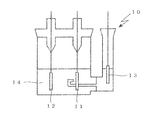
- the schematic diagram which shows schematic structure of the three-electrode type test cell which concerns on one Embodiment of this invention.
- the positive electrode active material for a non-aqueous electrolyte secondary battery and the non-aqueous electrolyte secondary battery according to an embodiment of the present invention will be described in detail using various experimental examples.
- the following experimental examples are illustrated to show examples of the positive electrode active material for a non-aqueous electrolyte secondary battery and the non-aqueous electrolyte secondary battery for embodying the technical idea of the present invention. It is not intended to limit the invention to any of these experimental examples.
- the present invention can be equally applied to those in which various modifications are made to those shown in these experimental examples without departing from the technical idea shown in the claims.
- the positive electrode active material 100 parts by mass of the positive electrode active material is mixed with 1 part by mass of acetylene black as a carbon conductive agent and 0.9 part by mass of polyvinylidene fluoride as a binder, and further, NMP (N-methyl- A positive electrode slurry was prepared by adding an appropriate amount of 2-pyrrolidone).
- NMP N-methyl- A positive electrode slurry was prepared by adding an appropriate amount of 2-pyrrolidone.
- the positive electrode slurry was applied to both sides of a positive electrode current collector made of aluminum and dried.
- the positive electrode was produced by cutting to a predetermined electrode size, rolling using a roller, and attaching a positive electrode lead to the positive electrode current collector.
- a three-electrode test cell 10 as shown in FIG. 1 was produced.
- the positive electrode was used as the working electrode 11
- metallic lithium was used for the counter electrode 12
- the reference electrode 13 serving as the negative electrode.
- LiPF 6 is mixed to a concentration of 1.0 mol / liter in a mixed solvent in which ethylene carbonate, ethyl methyl carbonate, and dimethyl carbonate are mixed at a volume ratio of 30:30:40.
- 1% by mass of vinylene carbonate was used.
- the cell thus produced is referred to as the battery of Experimental Example 1.
- Example 2 A cell was fabricated in the same manner as in Experimental Example 1 except that no Zr compound was present on the surface of lithium nickel cobalt aluminate represented by LiNi 0.91 Co 0.06 Al 0.03 O 2 . The produced cell is referred to as the battery of Experimental Example 2.
- Example 3 A cell was produced in the same manner as in Experimental Example 1 except that lithium nickel cobaltaluminum oxide represented by LiNi 0.89 Co 0.08 Al 0.03 O 2 was used. The produced cell is referred to as the battery of Experimental Example 3.
- Example 4 The above except that the nickel cobalt lithium aluminum oxide represented by LiNi 0.89 Co 0.08 Al 0.03 O 2 was used and no Zr compound was present on the surface of the lithium nickel cobalt aluminum oxide.
- a cell was fabricated in the same manner as in Experimental Example 1. The produced cell is referred to as the battery of Experimental Example 4.
- Example 5 A cell was fabricated in the same manner as in Experimental Example 1 except that lithium nickel cobaltaluminum oxide represented by LiNi 0.82 Co 0.15 Al 0.03 O 2 was used. The produced cell is referred to as the battery of Experimental Example 5.
- Example 6 The above except that the nickel cobalt lithium aluminum oxide represented by LiNi 0.82 Co 0.15 Al 0.03 O 2 was used and no Zr compound was present on the surface of the lithium nickel cobalt aluminum oxide.
- a cell was fabricated in the same manner as in Experimental Example 1. The produced cell is referred to as the battery of Experimental Example 6.
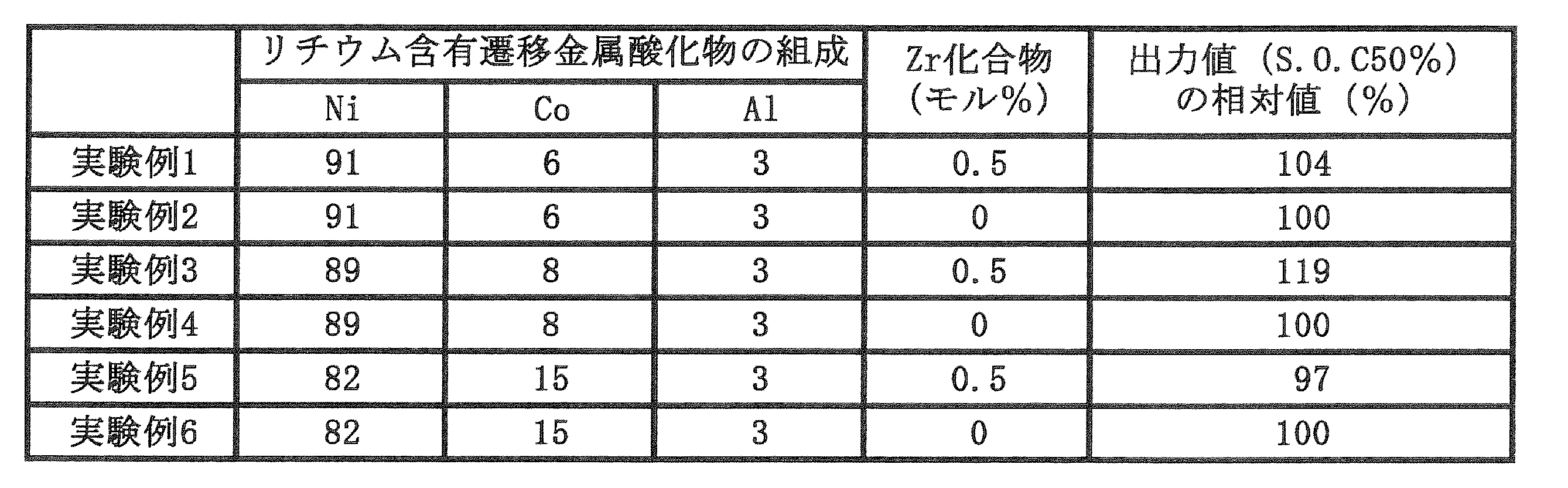
- the output values of the batteries of Experimental Examples 1, 3, and 5 are the same as those of Experimental Examples 1, 3, 5 and lithium nickel cobalt aluminate, and there is a Zr compound on the surface of the lithium nickel cobalt aluminum oxide.
- the relative value with respect to the case where the output value in each of the batteries of Experimental Examples 2, 4, and 6 is 100% was determined. The results are shown in Table 2.
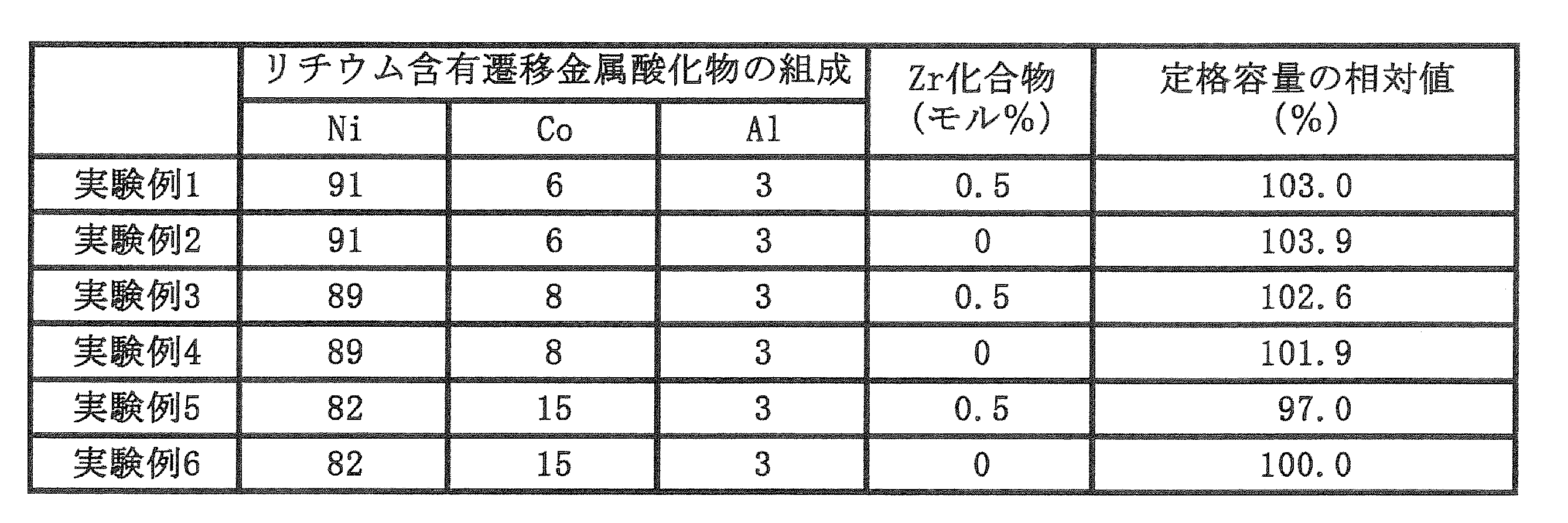
- the batteries of Experimental Examples 1 and 3 in which the Ni element ratio is 89% or more have the Ni element ratio of 82%.
- the rated capacity is improved.
- the batteries of Experimental Examples 2 and 4 in which the Ni element ratio is 89% or more are the same as those in Experimental Example 6 in which the Ni element ratio is 82%.
- the rated capacity is improved. From this, it can be seen that the rated capacity improves as the proportion of Ni element increases.
- the output values of the batteries of Experimental Examples 1 and 3 in which the Zr compound is present on the surface of the nickel cobalt lithium aluminum oxide are: It is larger than the output values of the batteries of Experimental Examples 2 and 4 in which no Zr compound is present on the surface of lithium nickel cobaltaluminate.
- the output value of the battery of Experimental Example 5 is It is smaller than the output value of the battery of Experimental Example 6 in which no Zr compound is present on the surface of lithium nickel cobaltaluminate.
- the effect of improving the output value described above is due to the configuration in which a lithium-containing transition metal oxide having a Ni element ratio of 89% or more is used and a Zr compound is present on the surface of the lithium-containing transition metal oxide. It turns out that it is an effect obtained.
- Lithium-containing transition metal oxides having a Ni element ratio of 89% or more change the crystal structure (phase transition) when the Li content in the Li site is in the range of 0.25 to 0.4, so that monoclinic and hexagonal crystals are formed. It will be in a coexisting state.
- this phase transition occurs at a high potential of 4.15 V to 4.2 V on the basis of Li, so that a Zr compound is formed on the surface of the lithium transition metal oxide.
- the lithium-containing transition metal oxide is nickel cobalt lithium aluminum oxide
- the Ni element ratio may be 89% or more
- the ratio of Ni element being 89% or more means that the ratio of Ni element to the total molar amount of metal elements excluding lithium in the lithium-containing transition metal oxide is 89 mol% or more.
- the proportion of Ni element is 89% to 98 %%, preferably 89 to 95%, more preferably 89 to 91%.
- LiPF 6 was added to a mixed solvent in which ethylene carbonate, ethyl methyl carbonate, and dimethyl carbonate were mixed at a volume ratio of 30:30:40 as a non-aqueous electrolyte using the positive electrode active material obtained above. Except that it was dissolved to a concentration of 1.0 mol / liter and 1% by weight of vinylene carbonate and 0.5% by weight of adiponitrile were used, the same procedure as in Experimental Example 1 was repeated. An electrode type test cell was produced. The cell thus produced is referred to as the battery of Experimental Example 7.
- Example 8 A cell was produced in the same manner as in Experimental Example 7 except that adiponitrile was not dissolved in the nonaqueous electrolytic solution. The produced cell is referred to as the battery of Experimental Example 8.
- Example 9 A cell was fabricated in the same manner as in Experimental Example 7 except that no Zr compound was present on the surface of lithium nickel cobalt aluminate represented by LiNi 0.89 Co 0.08 Al 0.03 O 2 .
- the produced cell is referred to as the battery of Experimental Example 9.
- Example 10 Except that the Zr compound was not present on the surface of the nickel cobalt lithium aluminum oxide represented by LiNi 0.89 Co 0.08 Al 0.03 O 2 and that adiponitrile was not dissolved in the non-aqueous electrolyte.
- a cell was fabricated in the same manner as in Experimental Example 7 above. The produced cell is referred to as the battery of Experimental Example 10.
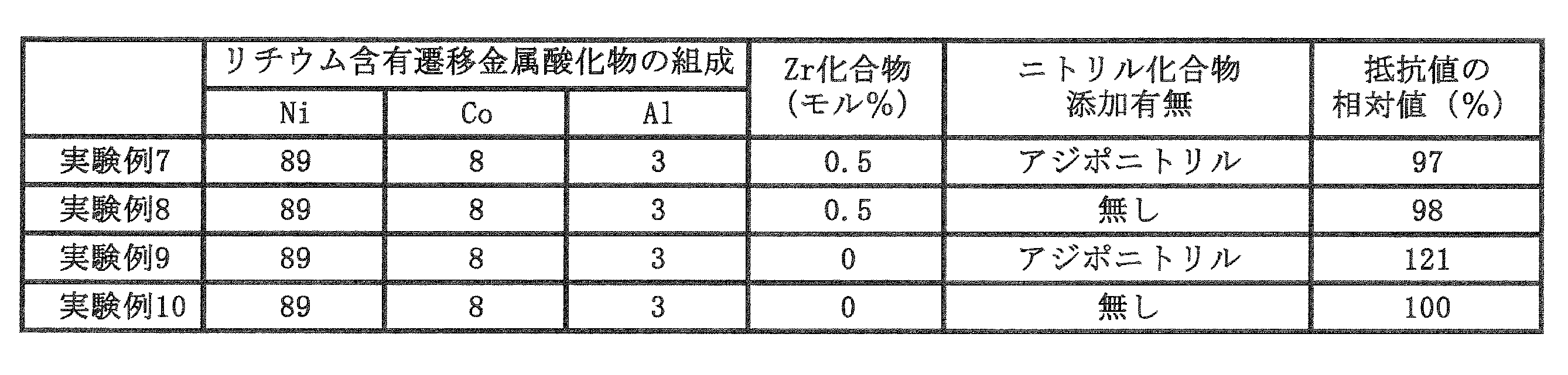
- the resistance values of the batteries of Experimental Examples 7 to 10 are shown as relative values with respect to the case where the resistance value of the battery of Experimental Example 10 is 100%. The results are shown in Table 3.
- the battery of Experimental Example 9 containing adiponitrile in the non-aqueous electrolyte is larger than the battery of Experimental Example 10 containing no adiponitrile. Resistance has increased.
- the battery of Experimental Example 7 containing adiponitrile in the non-aqueous electrolyte is more resistant than the battery of Experimental Example 8 containing no adiponitrile. Is decreasing without increasing.
- the effect of reducing the resistance value by adding adiponitrile is the case where a lithium-containing transition metal oxide having a Ni element ratio of 89% or more is used and a Zr compound is present on the surface of the lithium-containing transition metal oxide. It turns out that it is a peculiar effect.
- the CN bond of the nitrile compound present in the non-aqueous electrolyte is a lithium-containing transition metal oxide. It is considered that a high-quality film having both electron conductivity and ion permeability was formed by reacting with zirconium present on the surface of the film. Therefore, in the non-aqueous electrolyte secondary battery using the lithium-containing transition metal oxide having the configuration of the present invention, it is more preferable that the non-aqueous electrolyte contains a nitrile compound.
- nitrile compound is adiponitrile
- the nitrile compound only needs to contain a CN bond, and the number of carbon atoms is not limited.
- Such a nitrile compound has the same effect. More preferred are dinitrile compounds, still more preferred are adiponitrile, succinonitrile, pimelonitrile and the like.
- One embodiment of the present invention is a general formula: Li a Ni x M 1-x O 2 (where 0.9 ⁇ a ⁇ 1.2, 0.89 ⁇ x, M is selected from Co, Mn, and Al) It is preferred that a zirconium compound is present on the surface of the lithium-containing transition metal oxide represented by at least one element.
- 0.89 ⁇ x ⁇ 1 more preferably 0.89 ⁇ x ⁇ 0.98, more preferably 0.89 ⁇ x ⁇ 0.95, and still more preferably 0.89 ⁇ x ⁇ 0.91. is there.
- the zirconium compound may be present on the surface of the lithium-containing transition metal oxide, and the state of the compound is not particularly defined. For this reason, oxides, hydroxides, sulfides, sulfates, nitrides, nitrates, chlorides, silicides, silicates, tungstates, phosphates and carbonates may be used.
- the state of Zr may be an organic salt, and specific examples include Zr (C 11 H 23 COO) 2 O, Zr (OC 3 H 7 ) 4 , Zr (OC 4 H 9 ) 4 and the like.
- the average particle size of the zirconium compound is preferably 1 nm or more and 5000 nm or less.
- the average particle size of the zirconium compound exceeds 5000 nm, the particle size of the zirconium compound is too large relative to the particle size of the lithium-containing transition metal oxide particle, and therefore the surface of the lithium-containing transition metal oxide particle is caused by the zirconium compound. It will not be covered precisely. Therefore, the area where the lithium-containing transition metal oxide particles and the non-aqueous electrolyte are in direct contact with each other increases, so that a film having high ion permeability cannot be formed, and output characteristics are deteriorated.
- the average particle size of the zirconium compound is less than 1 nm, the surface of the lithium-containing transition metal oxide particle is too densely covered with the zirconium compound, so that lithium ions are occluded on the lithium-containing transition metal oxide particle surface. , The discharge performance is degraded, and the output characteristics are degraded. Considering this, it is more preferable that the average particle size of the zirconium compound is 10 nm or more and 3000 nm or less.
- the method of allowing the zirconium to exist on the surface of the lithium-containing transition metal oxide there is no particular limitation on the method of allowing the zirconium to exist on the surface of the lithium-containing transition metal oxide.
- the lithium compound, a method of mixing and firing a zirconium compound together with the transition metal oxide, a lithium-containing transition metal examples thereof include a method in which an aqueous solution in which a zirconium salt is dissolved is mixed with a solution in which an oxide is dispersed, and a method in which a zirconium compound is added at the time of preparing a positive electrode slurry.
- a method of mixing and firing a zirconium compound together with a lithium compound and a transition metal oxide, or a method of adding a zirconium compound when preparing a positive electrode slurry is more preferable.
- the ratio of the zirconium element to the total molar amount of the metal excluding lithium in the lithium-containing transition metal oxide is preferably 0.001 mol% or more and 2.0 mol% or less.
- the proportion is less than 0.001 mol%, the effect of zirconium present on the surface of the lithium-containing transition metal oxide may not be sufficiently exhibited.
- the proportion exceeds 2.0 mol%, lithium is contained. The lithium ion permeability on the particle surface of the transition metal oxide may be lowered, and the output characteristics may be deteriorated.
- the lithium-containing transition metal oxide is at least one selected from the group consisting of magnesium, aluminum, titanium, chromium, vanadium, iron, copper, zinc, niobium, molybdenum, zirconium, tin, tungsten, sodium, and potassium. Further, it is preferable that aluminum is included. Specific examples of lithium-containing transition metal oxides preferably used include LiNi 0.9 Co 0.1 O 2 , LiNi 0.9 Mn 0.1 O 2 , LiNi 0.9 Co 0.05 Mn 0.05 O 2 , LiNi 0.90 Co 0.05 Al 0.05 O 2 and the like. More preferably, lithium nickel cobalt manganate and lithium nickel cobalt aluminum oxide are used.
- the lithium-containing transition metal oxide may be one in which part of oxygen is substituted with fluorine or the like.
- Li a Ni x Co y Al z O 2 (where 0.9 ⁇ a ⁇ 1.2, 0.89 ⁇ x ⁇ 1, 0 ⁇ y + z ⁇ 0. 11, 0 ⁇ y, 0 ⁇ z) are preferred. More preferably, 0.89 ⁇ x ⁇ 0.98, further preferably 0.89 ⁇ x ⁇ 0.95, and more preferably 0.89 ⁇ x ⁇ 0.91.
- the solvent of the nonaqueous electrolyte is not particularly limited, and a solvent that has been conventionally used for nonaqueous electrolyte secondary batteries can be used.
- cyclic carbonates such as ethylene carbonate, propylene carbonate, butylene carbonate, vinylene carbonate, chain carbonates such as dimethyl carbonate, ethyl methyl carbonate, diethyl carbonate, methyl acetate, ethyl acetate, propyl acetate, methyl propionate, propionic acid
- esters such as ethyl and ⁇ -butyrolactone
- compounds containing sulfone groups such as propane sultone, 1,2-dimethoxyethane, 1,2-diethoxyethane, tetrahydrofuran, 1,2-dioxane, 1,4 -Compounds containing ethers such as dioxane and 2-methyltetrahydrofuran, butyronitrile,
- a solvent in which a part of these H is substituted with F is preferably used. Further, these can be used alone or in combination, and a solvent in which a cyclic carbonate and a chain carbonate are combined, and a solvent in which a compound containing a small amount of nitrile or an ether is further combined with these is preferable. .
- an ionic liquid can also be used as the non-aqueous solvent for the non-aqueous electrolyte.
- the cation species and the anion species are not particularly limited, but low viscosity, electrochemical stability, and hydrophobic properties. From the viewpoint, a combination using a pyridinium cation, an imidazolium cation, or a quaternary ammonium cation as the cation and a fluorine-containing imide anion as the anion is particularly preferable.
- a known lithium salt that has been conventionally used in nonaqueous electrolyte secondary batteries can be used.
- a lithium salt a lithium salt containing one or more elements among P, B, F, O, S, N, and Cl can be used.
- LiPF 6 LiBF 4 , LiCF 3 SO 3 , LiN (FSO 2 ) 2 , LiN (CF 3 SO 2 ) 2 , LiN (C 2 F 5 SO 2 ) 2 , LiN (CF 3 SO 2 ) (C 4 F 9 SO 2 ), Lithium salts such as LiC (C 2 F 5 SO 2 ) 3 , LiAsF 6 , LiClO 4 and mixtures thereof can be used.
- LiPF 6 is preferably used in order to enhance the high rate charge / discharge characteristics in the nonaqueous electrolyte secondary battery.
- a lithium salt having an oxalato complex as an anion can also be used.
- a lithium salt having this oxalato complex as an anion in addition to LiBOB [lithium bisoxalatoborate], a lithium salt having an anion in which C 2 O 4 2 ⁇ is coordinated to the central atom, for example, Li [M (C 2 O 4 ) x R y ] (wherein M is a transition metal, III of the periodic table)
- An element selected from group b, IVb, and Vb, R is a group selected from halogen, an alkyl group, and a halogen-substituted alkyl group, x is a positive integer, and y is 0 or a positive integer.
- the said solute may be used not only independently but in mixture of 2 or more types.
- the concentration of the solute is not particularly limited, but is preferably 0.8 to 1.7 mol per liter of the non-aqueous electrolyte.
- the concentration of the solute is desirably 1.0 to 1.6 mol per liter of the non-aqueous electrolyte.
- the negative electrode active material is not particularly limited as long as it can reversibly occlude and release lithium.
- a carbon material, a metal or alloy material alloyed with lithium, a metal oxide, or the like is used. be able to.
- a carbon material for the negative electrode active material For example, natural graphite, artificial graphite, mesophase pitch-based carbon fiber (MCF), mesocarbon microbeads (MCMB), coke, hard carbon Etc. can be used.
- MCF mesophase pitch-based carbon fiber
- MCMB mesocarbon microbeads
- coke hard carbon Etc.
- a carbon material obtained by coating a graphite material with low crystalline carbon is preferable to use.
- the separator conventionally used can be used. Specifically, not only a separator made of polyethylene but also a material in which a layer made of polypropylene is formed on the surface of polyethylene or a material in which an aramid resin or the like is applied to the surface of a polyethylene separator may be used.
- a layer containing an inorganic filler that has been conventionally used can be formed at the interface between the positive electrode and the separator or the interface between the negative electrode and the separator.
- the filler it is also possible to use an oxide or a phosphoric acid compound that uses titanium, aluminum, silicon, magnesium, etc., which has been used conventionally or a plurality thereof, and whose surface is treated with a hydroxide or the like. it can.
- the filler layer is formed by a method in which a filler-containing slurry is directly applied to a positive electrode, a negative electrode, or a separator, or a method in which a sheet formed with a filler is attached to a positive electrode, a negative electrode, or a separator. be able to.
- One mode of the present invention can be expected to be developed for driving power sources for mobile information terminals such as mobile phones, laptop computers, smartphones, high power driving power sources such as electric vehicles, HEVs and electric tools, and power sources related to power storage. .
Landscapes
- Chemical & Material Sciences (AREA)
- Chemical Kinetics & Catalysis (AREA)
- Electrochemistry (AREA)
- General Chemical & Material Sciences (AREA)
- Engineering & Computer Science (AREA)
- Manufacturing & Machinery (AREA)
- Inorganic Chemistry (AREA)
- Composite Materials (AREA)
- Materials Engineering (AREA)
- Physics & Mathematics (AREA)
- Condensed Matter Physics & Semiconductors (AREA)
- General Physics & Mathematics (AREA)
- Battery Electrode And Active Subsutance (AREA)
- Secondary Cells (AREA)
Abstract
Description
イトのLi席占有率とメタルサイトのメタル席占有率を規定したニッケルコバルトアルミニウム酸リチウムが提案されている。しかし、特許文献1の正極活物質では、高出力化が不十分であり、更なる改善が必要である。
(実験例1)
〔正極の作製〕
LiNi0.91Co0.06Al0.03O2で表されるニッケルコバルトアルミニウム酸リチウム100gに酸化ジルコニウムZrO2(平均粒子径:1μm)を0.64g投入し混合することにより、表面にジルコニウム化合物が均一に存在するニッケルコバルトアルミニウム酸リチウムを得た。尚、上記ジルコニウム化合物の量は、上記ニッケルコバルトアルミニウム酸リチウムのリチウム以外の金属元素の総モル量に対して、ジルコニウム元素換算で、0.5モル%であった。
図1に示すような三電極式試験セル10を作製した。この際、上記正極を作用極11として用いる一方、負極となる対極12及び参照極13にそれぞれ金属リチウムを用いた。また、非水電解液14として、エチレンカーボネートとエチルメチルカーボネートとジメチルカーボネートとを30:30:40の体積比で混合させた混合溶媒に、LiPF6を1.0モル/リットルの濃度になるように溶解させ、さらにビニレンカーボネートを1質量%溶解させたものを用いた。このようにして作製したセルを実験例1の電池と称する。
LiNi0.91Co0.06Al0.03O2で表されるニッケルコバルトアルミニウム酸リチウムの表面にZr化合物を存在させなかったこと以外は、上記実験例1と同様にしてセルを作製した。作製したセルを実験例2の電池と称する。
LiNi0.89Co0.08Al0.03O2で表されるニッケルコバルトアルミニウム酸リチウムを用いたこと以外は、上記実験例1と同様にしてセルを作製した。作製したセルを実験例3の電池と称する。
LiNi0.89Co0.08Al0.03O2で表されるニッケルコバルトアルミニウム酸リチウムを用いたことと、該ニッケルコバルトアルミニウム酸リチウムの表面にZr化合物を存在させなかったこと以外は、上記実験例1と同様にしてセルを作製した。作製したセルを実験例4の電池とする。
LiNi0.82Co0.15Al0.03O2で表されるニッケルコバルトアルミニウム酸リチウムを用いたこと以外は、上記実験例1と同様にしてセルを作製した。作製したセルを実験例5の電池と称する。
LiNi0.82Co0.15Al0.03O2で表されるニッケルコバルトアルミニウム酸リチウムを用いたことと、該ニッケルコバルトアルミニウム酸リチウムの表面にZr化合物を存在させなかったこと以外は、上記実験例1と同様にしてセルを作製した。作製したセルを実験例6の電池と称する。
〔定格容量の測定〕
上述のようにして作製された実験例1~6の電池を、それぞれ25℃の温度条件下において、0.2mA/cm2の電流密度で4.3V(vs.Li/Li+)まで定電流充電を行い、4.3V(vs.Li/Li+)の定電圧で電流密度が0.04mA/cm2になるまで定電圧充電を行った後、0.2mA/cm2の電流密度で2.5V(vs.Li/Li+)まで定電流放電を行った。このときの放電容量を測定し、上記実験例1~6の各電池の定格容量とした。そして、実験例6の電池の定格容量を100%とした場合に対する、実験例1~5の電池の定格容量の相対値を求めた。その結果を表1に示した。
次に、上記実験例1~6の電池を、0.2mA/cm2の電流密度で上記定格容量の50%まで(即ち、充電深度SOCが50%となるまで)充電させた後、それぞれ25℃との条件の下で、開回路電圧から0.08mA/cm2、0.4mA/cm2、0.8mA/cm2、1.6mA/cm2の各電流値でそれぞれ10秒間放電を行い、10秒後の電圧を各電流値に対してプロットして、上記実験例1~6の各電池における電流-電圧直線を求めた。そして、求めた各電流-電圧直線より、放電終止電圧が2.5Vでの電流値Ipを求め、下記の式(1)により25℃での出力値を算出した。
出力値=Ip×2.5・・・式(1)
(実験例7)
〔正極活物質の合成〕
Ni0.89Co0.08Al0.03O2で表されるニッケルコバルトアルミニウム複合酸化物100gに対してニッケルコバルトアルミニウム複合酸化物のリチウム以外の金属元素の総モル量に対してリチウム元素が1.025の割合になるように水酸化リチウムリチウムを混合し、さらにニッケルコバルトアルミニウム複合酸化物のリチウム以外の金属元素の総モル量に対してジルコニウム元素換算で0.5モル%となるように酸化ジルコニウムを混合した。混合後、酸素雰囲気下で18時間焼成することで、表面にジルコニウム化合物が存在するLiNi0.89Co0.08Al0.03O2で表されるニッケルコバルトアルミニウム酸リチウムを得た。
上記で得られた正極活物質を用いたことと、非水電解液として、エチレンカーボネートとエチルメチルカーボネートとジメチルカーボネートとを30:30:40の体積比で混合させた混合溶媒に、LiPF6を1.0モル/リットルの濃度になるように溶解させ、さらにビニレンカーボネートを1質量%、アジポニトリルを0.5質量%溶解させたものを用いたこと以外は、上記実験例1と同様にして三電極式試験セルを作製した。このようにして作製したセルを実験例7の電池と称する。
非水電解液にアジポニトリルを溶解しなかったこと以外は、上記実験例7と同様にしてセルを作製した。作製したセルを実験例8の電池と称する。
LiNi0.89Co0.08Al0.03O2で表されるニッケルコバルトアルミニウム酸リチウムの表面にZr化合物を存在させなかったこと以外は、上記実験例7と同様にしてセルを作製した。作製したセルを実験例9の電池と称する。
LiNi0.89Co0.08Al0.03O2で表されるニッケルコバルトアルミニウム酸リチウムの表面にZr化合物を存在させなかったことと、非水電解液にアジポニトリルを溶解しなかったこと以外は、上記実験例7と同様にしてセルを作製した。作製したセルを実験例10の電池と称する。
上述のようにして作製された実験例7~10の電池を、それぞれ25℃の温度条件下において、0.2mA/cm2の電流密度で4.3V(vs.Li/Li+)まで定電流充電を行い、4.3V(vs.Li/Li+)の定電圧で電流密度が0.04mA/cm2になるまで定電圧充電を行った後、0.2mA/cm2の電流密度で2.5V(vs.Li/Li+)まで定電流放電を行った。
次に、上記実験例7~10の電池について、25℃の温度条件下において、0.2mA/cm2の電流密度で4.3V(vs.Li/Li+)まで定電流充電を行い、4.3V(vs.Li/Li+)の定電圧で電流密度が0.04mA/cm2になるまで定電圧充電を行った後、0.2mA/cm2の電流密度で放電し、放電開始0.1秒後の電位と放電開始直前の電位より、下記の式(2)を用いて、抵抗値を算出した。
抵抗値=(放電開始直前の電位-放電開始0.1秒後の電位)/(放電電流密度×電極面積)・・・式(2)
(1)非水電解質の溶媒は特に限定するものではなく、非水電解質二次電池に従来から用いられてきた溶媒を使用することができる。例えば、エチレンカーボネート、プロピレンカーボネート、ブチレンカーボネート、ビニレンカーボネート等の環状カーボネートや、ジメチルカーボネート、エチルメチルカーボネート、ジエチルカーボネート等の鎖状カーボネートや、酢酸メチル、酢酸エチル、酢酸プロピル、プロピオン酸メチル、プロピオン酸エチル、γ-ブチロラクトン等のエステルを含む化合物や、プロパンスルトン等のスルホン基を含む化合物や、1,2-ジメトキシエタン、1,2-ジエトキシエタン、テトラヒドロフラン、1,2-ジオキサン、1,4-ジオキサン、2-メチルテトラヒドロフラン等のエーテルを含む化合物や、ブチロニトリル、バレロニトリル、n-ヘプタンニトリル、スクシノニトリル、グルタルニトリル、アジポニトリル、ピメロニトリル、1,2,3-プロパントリカルボニトリル、1,3,5-ペンタントリカルボニトリル等のニトリルを含む化合物や、ジメチルホルムアミド等のアミドを含む化合物等を用いることができる。特に、これらのHの一部がFにより置換されている溶媒が好ましく用いられる。また、これらを単独又は複数組み合わせて使用することができ、特に環状カーボネートと鎖状カーボネートとを組み合わせた溶媒や、さらにこれらに少量のニトリルを含む化合物やエーテルを含む化合物が組み合わされた溶媒が好ましい。
b族,IVb族,Vb族から選択される元素、Rはハロゲン、アルキル基、ハロゲン置換アルキル基から選択される基、xは正の整数、yは0又は正の整数である。)で表わされるものを用いることができる。具体的には、Li[P(C2O4)3]等がある。但し、高温環境下においても負極の表面に安定な被膜を形成するためには、LiBOBを用いることが最も好ましい。尚、上記溶質は、単独で用いるのみならず、2種以上を混合して用いても良い。また、溶質の濃度は特に限定されないが、非水電解液1リットル当り0.8~1.7モルであることが望ましい。更に、大電電流での放電を必要とする用途では、上記溶質の濃度が非水電解液1リットル当たり1.0~1.6モルであることが望ましい。
11 作用極
12 対極
13 参照極
14 非水電解液
Claims (6)
- 層状構造を有し、遷移金属として少なくともNiを含有するリチウム含有遷移金属酸化物において、該リチウム含有遷移金属酸化物中のリチウムを除く金属元素の総モル量に対するNi元素の割合が89モル%以上であり、かつ前記リチウム含有遷移金属酸化物の表面にジルコニウム化合物が存在する非水電解質二次電池用正極活物質。
- 前記リチウム含有遷移金属酸化物が、一般式:LiaNixM1-xO2(ただし、0.9≦a≦1.2、0.89≦x、MはCo、Mn、Alから選択される少なくとも1種の元素)で表わされる、請求項1に記載の非水電解質二次電池用正極活物質。
- 前記ジルコニウム化合物が、酸化ジルコニウムである、請求項1又は2に記載の非水電解質二次電池用正極活物質。
- 前記リチウム含有遷移金属酸化物が、4.15V(vsLi/Li+)以上の電位で相転移が生じる、請求項1~3のいずれか1項に記載の非水電解質二次電池用正極活物質。
- 請求項1~4のいずれか1項に記載の非水電解質二次電池用正極活物質を用いた正極と、負極と、ニトリル化合物が含有された非水電解液と、を備えた非水電解質二次電池。
- 前記ニトリル化合物が、アジポニトリルである、請求項5に記載の非水電解質二次電池。
Priority Applications (3)
| Application Number | Priority Date | Filing Date | Title |
|---|---|---|---|
| JP2015538891A JP6252593B2 (ja) | 2013-09-30 | 2014-09-18 | 非水電解質二次電池用正極活物質及びそれを用いた非水電解質二次電池 |
| US14/910,359 US20160204414A1 (en) | 2013-09-30 | 2014-09-18 | Positive electrode active material for nonaqueous electrolyte secondary batteries and nonaqueous electrolyte secondary battery using the same |
| CN201480048106.7A CN105493321A (zh) | 2013-09-30 | 2014-09-18 | 非水电解质二次电池用正极活性物质以及使用其的非水电解质二次电池 |
Applications Claiming Priority (2)
| Application Number | Priority Date | Filing Date | Title |
|---|---|---|---|
| JP2013-203347 | 2013-09-30 | ||
| JP2013203347 | 2013-09-30 |
Publications (1)
| Publication Number | Publication Date |
|---|---|
| WO2015045340A1 true WO2015045340A1 (ja) | 2015-04-02 |
Family
ID=52742512
Family Applications (1)
| Application Number | Title | Priority Date | Filing Date |
|---|---|---|---|
| PCT/JP2014/004812 Ceased WO2015045340A1 (ja) | 2013-09-30 | 2014-09-18 | 非水電解質二次電池用正極活物質及びそれを用いた非水電解質二次電池 |
Country Status (4)
| Country | Link |
|---|---|
| US (1) | US20160204414A1 (ja) |
| JP (1) | JP6252593B2 (ja) |
| CN (1) | CN105493321A (ja) |
| WO (1) | WO2015045340A1 (ja) |
Cited By (6)
| Publication number | Priority date | Publication date | Assignee | Title |
|---|---|---|---|---|
| WO2015163356A1 (ja) * | 2014-04-22 | 2015-10-29 | 三菱化学株式会社 | 非水二次電池用正極活物質及び非水二次電池 |
| JP2017045537A (ja) * | 2015-08-24 | 2017-03-02 | トヨタ自動車株式会社 | リチウムイオン二次電池用負極の製造方法およびリチウムイオン二次電池用負極 |
| JP2017139128A (ja) * | 2016-02-03 | 2017-08-10 | Jx金属株式会社 | リチウムイオン電池用正極活物質、リチウムイオン電池用正極及びリチウムイオン電池 |
| JP2018073737A (ja) * | 2016-11-02 | 2018-05-10 | Jx金属株式会社 | リチウムイオン二次電池用正極活物質、リチウムイオン二次電池用正極、及びリチウムイオン二次電池 |
| JP2018098161A (ja) * | 2016-12-07 | 2018-06-21 | 新日鐵住金株式会社 | 正極活物質の製造方法 |
| WO2021039178A1 (ja) * | 2019-08-30 | 2021-03-04 | パナソニックIpマネジメント株式会社 | 非水電解質二次電池 |
Families Citing this family (7)
| Publication number | Priority date | Publication date | Assignee | Title |
|---|---|---|---|---|
| CN111492514B (zh) * | 2017-12-26 | 2022-12-02 | 松下知识产权经营株式会社 | 非水电解质二次电池用正极活性物质和非水电解质二次电池 |
| US11626588B2 (en) * | 2018-08-29 | 2023-04-11 | Panasonic Intellectual Property Management Co., Ltd. | Positive electrode active material for non-aqueous electrolyte secondary batteries, and non-aqueous electrolyte secondary battery |
| KR102702589B1 (ko) * | 2018-10-15 | 2024-09-04 | 삼성전자주식회사 | 리튬전지 |
| TWI761920B (zh) * | 2019-08-27 | 2022-04-21 | 德商贏創運營有限公司 | 含有熱解生產的含鋯氧化物之混合鋰過渡金屬氧化物 |
| TWI778405B (zh) | 2019-08-27 | 2022-09-21 | 德商贏創運營有限公司 | 塗覆有熱解製造的含鋯氧化物之混合鋰過渡金屬氧化物 |
| US20220352502A1 (en) * | 2021-03-12 | 2022-11-03 | Samsung Sdi Co., Ltd. | Positive electrode for rechargeable lithium battery and rechargeable lithium battery including the same |
| WO2024152233A1 (zh) * | 2023-01-18 | 2024-07-25 | 宁德时代新能源科技股份有限公司 | 正极活性材料、正极极片、二次电池和用电装置 |
Citations (4)
| Publication number | Priority date | Publication date | Assignee | Title |
|---|---|---|---|---|
| WO2006101138A1 (ja) * | 2005-03-23 | 2006-09-28 | Matsushita Electric Industrial Co., Ltd. | リチウムイオン二次電池およびその製造法 |
| WO2010147179A1 (ja) * | 2009-06-17 | 2010-12-23 | 日立マクセル株式会社 | 電気化学素子用電極及びそれを用いた電気化学素子 |
| JP2011054560A (ja) * | 2009-09-03 | 2011-03-17 | Samsung Sdi Co Ltd | リチウム電池用電解液、リチウム電池及びリチウム電池の作動方法 |
| JP2011192395A (ja) * | 2010-03-11 | 2011-09-29 | Sanyo Electric Co Ltd | 非水電解質二次電池 |
Family Cites Families (2)
| Publication number | Priority date | Publication date | Assignee | Title |
|---|---|---|---|---|
| KR100814826B1 (ko) * | 2006-11-20 | 2008-03-20 | 삼성에스디아이 주식회사 | 리튬 이차 전지 |
| US10637054B2 (en) * | 2013-06-06 | 2020-04-28 | Nec Corporation | Positive electrode material for lithium ion secondary batteries, and method for producing same |
-
2014
- 2014-09-18 US US14/910,359 patent/US20160204414A1/en not_active Abandoned
- 2014-09-18 CN CN201480048106.7A patent/CN105493321A/zh active Pending
- 2014-09-18 WO PCT/JP2014/004812 patent/WO2015045340A1/ja not_active Ceased
- 2014-09-18 JP JP2015538891A patent/JP6252593B2/ja active Active
Patent Citations (4)
| Publication number | Priority date | Publication date | Assignee | Title |
|---|---|---|---|---|
| WO2006101138A1 (ja) * | 2005-03-23 | 2006-09-28 | Matsushita Electric Industrial Co., Ltd. | リチウムイオン二次電池およびその製造法 |
| WO2010147179A1 (ja) * | 2009-06-17 | 2010-12-23 | 日立マクセル株式会社 | 電気化学素子用電極及びそれを用いた電気化学素子 |
| JP2011054560A (ja) * | 2009-09-03 | 2011-03-17 | Samsung Sdi Co Ltd | リチウム電池用電解液、リチウム電池及びリチウム電池の作動方法 |
| JP2011192395A (ja) * | 2010-03-11 | 2011-09-29 | Sanyo Electric Co Ltd | 非水電解質二次電池 |
Non-Patent Citations (1)
| Title |
|---|
| JAEPHIL CHO ET AL.: "High-Performance ZrO2- Coated LiNiO2 Cathode Material", ELECTROCHEMICAL AND SOLID-STATE LETTERS, vol. 4, no. ISSUE, 14 August 2001 (2001-08-14), pages A159 - A161 * |
Cited By (10)
| Publication number | Priority date | Publication date | Assignee | Title |
|---|---|---|---|---|
| WO2015163356A1 (ja) * | 2014-04-22 | 2015-10-29 | 三菱化学株式会社 | 非水二次電池用正極活物質及び非水二次電池 |
| JP2019165010A (ja) * | 2014-04-22 | 2019-09-26 | 三菱ケミカル株式会社 | 非水二次電池 |
| JP2017045537A (ja) * | 2015-08-24 | 2017-03-02 | トヨタ自動車株式会社 | リチウムイオン二次電池用負極の製造方法およびリチウムイオン二次電池用負極 |
| JP2017139128A (ja) * | 2016-02-03 | 2017-08-10 | Jx金属株式会社 | リチウムイオン電池用正極活物質、リチウムイオン電池用正極及びリチウムイオン電池 |
| JP7037873B2 (ja) | 2016-02-03 | 2022-03-17 | Jx金属株式会社 | リチウムイオン電池用正極活物質、リチウムイオン電池用正極及びリチウムイオン電池 |
| JP2018073737A (ja) * | 2016-11-02 | 2018-05-10 | Jx金属株式会社 | リチウムイオン二次電池用正極活物質、リチウムイオン二次電池用正極、及びリチウムイオン二次電池 |
| JP2018098161A (ja) * | 2016-12-07 | 2018-06-21 | 新日鐵住金株式会社 | 正極活物質の製造方法 |
| WO2021039178A1 (ja) * | 2019-08-30 | 2021-03-04 | パナソニックIpマネジメント株式会社 | 非水電解質二次電池 |
| JPWO2021039178A1 (ja) * | 2019-08-30 | 2021-03-04 | ||
| JP7493165B2 (ja) | 2019-08-30 | 2024-05-31 | パナソニックIpマネジメント株式会社 | 非水電解質二次電池 |
Also Published As
| Publication number | Publication date |
|---|---|
| JPWO2015045340A1 (ja) | 2017-03-09 |
| US20160204414A1 (en) | 2016-07-14 |
| CN105493321A (zh) | 2016-04-13 |
| JP6252593B2 (ja) | 2017-12-27 |
Similar Documents
| Publication | Publication Date | Title |
|---|---|---|
| JP6252593B2 (ja) | 非水電解質二次電池用正極活物質及びそれを用いた非水電解質二次電池 | |
| JP6178320B2 (ja) | 非水電解質二次電池 | |
| JP6072688B2 (ja) | 非水電解質二次電池及び非水電解質二次電池の製造方法 | |
| US10511021B2 (en) | Non-aqueous electrolyte secondary battery | |
| US10276894B2 (en) | Non-aqueous liquid electrolyte and lithium secondary battery comprising the same | |
| WO2013090417A1 (en) | Low temperature electrolyte for high capacity lithium based batteries | |
| CN106133979A (zh) | 长寿命锂离子电池 | |
| JP2013084547A (ja) | 非水電解質二次電池 | |
| CN107078346A (zh) | 非水液体电解质以及包含该非水液体电解质的锂二次电池 | |
| WO2011016553A1 (ja) | 非水電解質二次電池 | |
| KR102829174B1 (ko) | 사이클 특성이 향상된 리튬 이차전지 | |
| WO2015146024A1 (ja) | 非水電解質二次電池 | |
| US8216726B2 (en) | Battery | |
| JP7134555B2 (ja) | 非水電解液添加剤、これを含むリチウム二次電池用非水電解液及びリチウム二次電池 | |
| JP2022528246A (ja) | リチウム二次電池用非水電解液添加剤、これを含むリチウム二次電池用非水電解液及びリチウム二次電池 | |
| WO2011117992A1 (ja) | 電池用活物質および電池 | |
| JP2009218112A (ja) | 非水電解質二次電池及びその製造方法 | |
| JP2014060029A (ja) | 非水電解質二次電池 | |
| KR20150116222A (ko) | 리튬 이차전지용 양극 활물질, 이의 제조방법, 및 이를 포함하는 리튬 이차전지 | |
| CN101494303B (zh) | 非水电解质电池和电极及其制造方法 | |
| JP2024542550A (ja) | 非水系電解質組成物およびそれを含むリチウム二次電池 | |
| WO2014141932A1 (ja) | リチウム二次電池 | |
| JP2015164109A (ja) | 非水電解液二次電池 | |
| JP5666561B2 (ja) | 非水電解質二次電池 | |
| WO2015098022A1 (ja) | 非水電解質二次電池 |
Legal Events
| Date | Code | Title | Description |
|---|---|---|---|
| WWE | Wipo information: entry into national phase |
Ref document number: 201480048106.7 Country of ref document: CN |
|
| 121 | Ep: the epo has been informed by wipo that ep was designated in this application |
Ref document number: 14847306 Country of ref document: EP Kind code of ref document: A1 |
|
| ENP | Entry into the national phase |
Ref document number: 2015538891 Country of ref document: JP Kind code of ref document: A |
|
| WWE | Wipo information: entry into national phase |
Ref document number: 14910359 Country of ref document: US |
|
| NENP | Non-entry into the national phase |
Ref country code: DE |
|
| 122 | Ep: pct application non-entry in european phase |
Ref document number: 14847306 Country of ref document: EP Kind code of ref document: A1 |