WO2015045314A1 - 非水電解質二次電池 - Google Patents
非水電解質二次電池 Download PDFInfo
- Publication number
- WO2015045314A1 WO2015045314A1 PCT/JP2014/004690 JP2014004690W WO2015045314A1 WO 2015045314 A1 WO2015045314 A1 WO 2015045314A1 JP 2014004690 W JP2014004690 W JP 2014004690W WO 2015045314 A1 WO2015045314 A1 WO 2015045314A1
- Authority
- WO
- WIPO (PCT)
- Prior art keywords
- negative electrode
- lithium
- positive electrode
- surface area
- aqueous electrolyte
- Prior art date
- Legal status (The legal status is an assumption and is not a legal conclusion. Google has not performed a legal analysis and makes no representation as to the accuracy of the status listed.)
- Ceased
Links
Classifications
-
- H—ELECTRICITY
- H01—ELECTRIC ELEMENTS
- H01M—PROCESSES OR MEANS, e.g. BATTERIES, FOR THE DIRECT CONVERSION OF CHEMICAL ENERGY INTO ELECTRICAL ENERGY
- H01M4/00—Electrodes
- H01M4/02—Electrodes composed of, or comprising, active material
- H01M4/36—Selection of substances as active materials, active masses, active liquids
- H01M4/48—Selection of substances as active materials, active masses, active liquids of inorganic oxides or hydroxides
- H01M4/483—Selection of substances as active materials, active masses, active liquids of inorganic oxides or hydroxides for non-aqueous cells
-
- H—ELECTRICITY
- H01—ELECTRIC ELEMENTS
- H01M—PROCESSES OR MEANS, e.g. BATTERIES, FOR THE DIRECT CONVERSION OF CHEMICAL ENERGY INTO ELECTRICAL ENERGY
- H01M10/00—Secondary cells; Manufacture thereof
- H01M10/05—Accumulators with non-aqueous electrolyte
- H01M10/052—Li-accumulators
- H01M10/0525—Rocking-chair batteries, i.e. batteries with lithium insertion or intercalation in both electrodes; Lithium-ion batteries
-
- H—ELECTRICITY
- H01—ELECTRIC ELEMENTS
- H01M—PROCESSES OR MEANS, e.g. BATTERIES, FOR THE DIRECT CONVERSION OF CHEMICAL ENERGY INTO ELECTRICAL ENERGY
- H01M4/00—Electrodes
- H01M4/02—Electrodes composed of, or comprising, active material
- H01M4/13—Electrodes for accumulators with non-aqueous electrolyte, e.g. for lithium-accumulators; Processes of manufacture thereof
- H01M4/131—Electrodes based on mixed oxides or hydroxides, or on mixtures of oxides or hydroxides, e.g. LiCoOx
-
- H—ELECTRICITY
- H01—ELECTRIC ELEMENTS
- H01M—PROCESSES OR MEANS, e.g. BATTERIES, FOR THE DIRECT CONVERSION OF CHEMICAL ENERGY INTO ELECTRICAL ENERGY
- H01M4/00—Electrodes
- H01M4/02—Electrodes composed of, or comprising, active material
- H01M4/13—Electrodes for accumulators with non-aqueous electrolyte, e.g. for lithium-accumulators; Processes of manufacture thereof
- H01M4/133—Electrodes based on carbonaceous material, e.g. graphite-intercalation compounds or CFx
-
- H—ELECTRICITY
- H01—ELECTRIC ELEMENTS
- H01M—PROCESSES OR MEANS, e.g. BATTERIES, FOR THE DIRECT CONVERSION OF CHEMICAL ENERGY INTO ELECTRICAL ENERGY
- H01M4/00—Electrodes
- H01M4/02—Electrodes composed of, or comprising, active material
- H01M4/36—Selection of substances as active materials, active masses, active liquids
- H01M4/362—Composites
- H01M4/364—Composites as mixtures
-
- H—ELECTRICITY
- H01—ELECTRIC ELEMENTS
- H01M—PROCESSES OR MEANS, e.g. BATTERIES, FOR THE DIRECT CONVERSION OF CHEMICAL ENERGY INTO ELECTRICAL ENERGY
- H01M4/00—Electrodes
- H01M4/02—Electrodes composed of, or comprising, active material
- H01M4/36—Selection of substances as active materials, active masses, active liquids
- H01M4/48—Selection of substances as active materials, active masses, active liquids of inorganic oxides or hydroxides
- H01M4/52—Selection of substances as active materials, active masses, active liquids of inorganic oxides or hydroxides of nickel, cobalt or iron
- H01M4/525—Selection of substances as active materials, active masses, active liquids of inorganic oxides or hydroxides of nickel, cobalt or iron of mixed oxides or hydroxides containing iron, cobalt or nickel for inserting or intercalating light metals, e.g. LiNiO2, LiCoO2 or LiCoOxFy
-
- H—ELECTRICITY
- H01—ELECTRIC ELEMENTS
- H01M—PROCESSES OR MEANS, e.g. BATTERIES, FOR THE DIRECT CONVERSION OF CHEMICAL ENERGY INTO ELECTRICAL ENERGY
- H01M4/00—Electrodes
- H01M4/02—Electrodes composed of, or comprising, active material
- H01M4/36—Selection of substances as active materials, active masses, active liquids
- H01M4/58—Selection of substances as active materials, active masses, active liquids of inorganic compounds other than oxides or hydroxides, e.g. sulfides, selenides, tellurides, halogenides or LiCoFy; of polyanionic structures, e.g. phosphates, silicates or borates
- H01M4/583—Carbonaceous material, e.g. graphite-intercalation compounds or CFx
- H01M4/587—Carbonaceous material, e.g. graphite-intercalation compounds or CFx for inserting or intercalating light metals
-
- H—ELECTRICITY
- H01—ELECTRIC ELEMENTS
- H01M—PROCESSES OR MEANS, e.g. BATTERIES, FOR THE DIRECT CONVERSION OF CHEMICAL ENERGY INTO ELECTRICAL ENERGY
- H01M10/00—Secondary cells; Manufacture thereof
- H01M10/05—Accumulators with non-aqueous electrolyte
- H01M10/056—Accumulators with non-aqueous electrolyte characterised by the materials used as electrolytes, e.g. mixed inorganic/organic electrolytes
- H01M10/0564—Accumulators with non-aqueous electrolyte characterised by the materials used as electrolytes, e.g. mixed inorganic/organic electrolytes the electrolyte being constituted of organic materials only
- H01M10/0566—Liquid materials
-
- Y—GENERAL TAGGING OF NEW TECHNOLOGICAL DEVELOPMENTS; GENERAL TAGGING OF CROSS-SECTIONAL TECHNOLOGIES SPANNING OVER SEVERAL SECTIONS OF THE IPC; TECHNICAL SUBJECTS COVERED BY FORMER USPC CROSS-REFERENCE ART COLLECTIONS [XRACs] AND DIGESTS
- Y02—TECHNOLOGIES OR APPLICATIONS FOR MITIGATION OR ADAPTATION AGAINST CLIMATE CHANGE
- Y02E—REDUCTION OF GREENHOUSE GAS [GHG] EMISSIONS, RELATED TO ENERGY GENERATION, TRANSMISSION OR DISTRIBUTION
- Y02E60/00—Enabling technologies; Technologies with a potential or indirect contribution to GHG emissions mitigation
- Y02E60/10—Energy storage using batteries
-
- Y—GENERAL TAGGING OF NEW TECHNOLOGICAL DEVELOPMENTS; GENERAL TAGGING OF CROSS-SECTIONAL TECHNOLOGIES SPANNING OVER SEVERAL SECTIONS OF THE IPC; TECHNICAL SUBJECTS COVERED BY FORMER USPC CROSS-REFERENCE ART COLLECTIONS [XRACs] AND DIGESTS
- Y02—TECHNOLOGIES OR APPLICATIONS FOR MITIGATION OR ADAPTATION AGAINST CLIMATE CHANGE
- Y02P—CLIMATE CHANGE MITIGATION TECHNOLOGIES IN THE PRODUCTION OR PROCESSING OF GOODS
- Y02P70/00—Climate change mitigation technologies in the production process for final industrial or consumer products
- Y02P70/50—Manufacturing or production processes characterised by the final manufactured product
Definitions
- the present invention relates to a non-aqueous electrolyte secondary battery.
- Metal materials that can be alloyed with lithium such as silicon, germanium, tin and zinc instead of carbonaceous materials such as graphite as negative electrode active materials, and these metals for higher energy density and higher output of lithium ion batteries
- silicon, germanium, tin and zinc instead of carbonaceous materials such as graphite as negative electrode active materials, and these metals for higher energy density and higher output of lithium ion batteries
- carbonaceous materials such as graphite
- Patent Document 1 discloses a non-aqueous electrolyte secondary battery in which SiO x is used as a negative electrode active material and lithium for an irreversible capacity is supplemented in advance.
- a non-aqueous electrolyte secondary battery is a non-aqueous electrolyte secondary battery using a positive electrode, a negative electrode, and a non-aqueous electrolyte
- the positive electrode includes lithium, a metal element M
- the metal element M contains at least one selected from the group containing cobalt and nickel
- / graphite and BET ratio of less than g includes a surface area 10 m 2 / g or more materials, the lithium amount of total a contained in the positive electrode and the negative electrode, and the amount M C of the metal element M contained in the oxide the ratio a / M C is characterized by greater than 1.01.
- the generation of oxidizing gas during high temperature storage can be suppressed, so that high temperature storage characteristics can be improved.
- a nonaqueous electrolyte secondary battery which is an example of an embodiment of the present invention includes a positive electrode including a positive electrode active material, a negative electrode including a negative electrode active material, a nonaqueous electrolyte including a nonaqueous solvent, and a separator.
- a positive electrode including a positive electrode active material a positive electrode active material
- a negative electrode including a negative electrode active material a nonaqueous electrolyte including a nonaqueous solvent
- separator As an example of the non-aqueous electrolyte secondary battery, there is a structure in which an electrode body in which a positive electrode and a negative electrode are wound via a separator and a non-aqueous electrolyte are accommodated in an exterior body.
- the positive electrode is preferably composed of a positive electrode current collector and a positive electrode active material layer formed on the positive electrode current collector.
- a positive electrode current collector for example, a conductive thin film, particularly a metal foil or alloy foil that is stable in the potential range of the positive electrode such as aluminum, or a film having a metal surface layer such as aluminum is used.
- the positive electrode active material layer preferably contains a conductive material and a binder in addition to the positive electrode active material.
- the positive electrode active material includes an oxide including lithium and a metal element M, and the metal element M includes at least one selected from the group including cobalt and nickel.
- Preferred is a lithium-containing transition metal oxide.
- the lithium-containing transition metal oxide may contain non-transition metal elements such as Mg and Al. Specific examples include lithium-containing transition metal oxides such as lithium cobaltate, Ni—Co—Mn, Ni—Mn—Al, and Ni—Co—Al. These positive electrode active materials may be used alone or in combination of two or more.
- the negative electrode preferably includes a negative electrode current collector and a negative electrode active material layer formed on the negative electrode current collector.
- a negative electrode current collector for example, a conductive thin film, particularly a metal foil or alloy foil that is stable in the potential range of the negative electrode such as copper, or a film having a metal surface layer such as copper is used.
- the negative electrode active material layer preferably contains a binder in addition to the negative electrode active material.
- the binder polytetrafluoroethylene or the like can be used, but styrene-butadiene rubber (SBR), polyimide, or the like is preferably used.
- SBR styrene-butadiene rubber
- the binder may be used in combination with a thickener such as carboxymethylcellulose.
- the SiO x particles preferably have a conductive coating layer covering at least a part of the surface.
- the covering layer is a conductive layer made of a material having higher conductivity than SiO x .
- the conductive material constituting the coating layer is preferably an electrochemically stable material, and is preferably at least one selected from the group consisting of a carbon material, a metal, and a metal compound.
- the BET specific surface area of the SiO x particles having a conductive coating layer covering at least a part of the surface is less than 10 m 2 / g. It is preferably 1 to 5 m 2 / g or less.
- the mass ratio of SiO x to graphite is preferably 1:99 to 50:50, more preferably 10:90 to 20:80.
- the ratio of SiO x to the total mass of the negative electrode active material is lower than 1% by mass, the merit of increasing the capacity using SiO x is reduced.
- the BET specific surface area of graphite is preferably larger than 0.5 m 2 / g. If it is smaller than 0.5 m 2 / g, the acceptability of Li ions tends to be low.
- the BET specific surface area of graphite is more preferably 1 to 4 m 2 / g.
- a material having a BET specific surface area of 10 m 2 / g or more preferably has a BET specific surface area of 300 m 2 / g or less. Furthermore, the BET specific surface area is preferably 20 m 2 / g or more, more preferably 40 m 2 / g or more. When the BET specific surface area is less than 10 m 2 / g, the effect of suppressing the generation of oxidizing gas during high temperature storage tends to be reduced. When the BET specific surface area is larger than 300 m 2 / g, the irreversible capacity tends to increase and the energy density tends to decrease.
- the BET specific surface area of 10 m 2 / g or more materials has more than 10 m 2 / g, acetylene black, ketjen black, activated carbon, carbon nanofiber, carbon nanotube and the like.
- the material having a BET specific surface area of 10 m 2 / g or more is preferably a conductive material.
- the material having a BET specific surface area of 10 m 2 / g or more is preferably contained in an amount of 5 to 50% by mass with respect to SiO x . If it is less than 5% by mass, the effect of suppressing the generation of oxidizing gas may be reduced. However, even if it is less than 5% by mass, this is not the case as long as a material having a large BET specific surface area is used. If it exceeds 50% by mass, the battery capacity tends to decrease.
- the non-aqueous electrolyte secondary battery is pre-filled with irreversible capacity lithium.
- As means for preliminarily replenishing lithium for the irreversible capacity it is preferable to replenish the negative electrode with lithium for the irreversible capacity in advance.
- As a means for preliminarily filling the negative electrode with lithium for an irreversible capacity a method for charging lithium to the negative electrode electrochemically, a method for attaching lithium metal to the negative electrode, a method for depositing lithium on the negative electrode surface, The method of supplementing a lithium compound is illustrated.
- the means for replenishing lithium for the irreversible capacity in advance is not limited to the replenishment to the negative electrode, but may be replenished to the separator or the positive electrode.
- a ratio a / M C to the amount M C of the metal element M contained in the oxides of the above is preferably greater than 1.01, more preferably greater than 1.03. If the ratio a / M C is within the above range, so that the proportion of lithium ions supplied to the battery is quite large. That is, it is advantageous in terms of compensation for irreversible capacity.
- the ratio a / M C for example, the amount or the like for attaching the lithium metal foil to the negative electrode varies.
- the ratio a / M C is the amount M C of the metal element M contained in the lithium amount a positive electrode active material contained in the positive electrode and the negative electrode, were quantified, respectively, dividing the amount of a an amount M C of the metal element M This can be calculated.
- the amount M C of lithium amount a and the metal element M can be quantified as follows. First, the battery is completely discharged and then decomposed to remove the nonaqueous electrolyte, and the inside of the battery is washed with a solvent such as dimethyl carbonate. Next, a predetermined amount of each of the positive electrode and the negative electrode is sampled, and the amount of lithium contained in the positive electrode and the negative electrode is quantified by ICP analysis to obtain the molar amount a of lithium. Also, as in the case of the amount of lithium in the positive electrode, the amount M C of the metal element M contained in the positive electrode is quantified by ICP analysis.
- Non-aqueous electrolyte examples include LiClO 4 , LiBF 4 , LiPF 6 , LiAlCl 4 , LiSbF 6 , LiSCN, LiCF 3 SO 3 , LiCF 3 CO 2 , LiAsF 6 , LiB 10 Cl 10 , lower aliphatic carboxylic acid.
- Lithium, LiCl, LiBr, LiI, chloroborane lithium, borates, imide salts, and the like can be used.
- LiPF 6 is preferably used from the viewpoints of ion conductivity and electrochemical stability.
- One electrolyte salt may be used alone, or two or more electrolyte salts may be used in combination. These electrolyte salts are preferably contained at a ratio of 0.8 to 1.5 mol with respect to 1 L of the nonaqueous electrolyte.
- non-aqueous electrolyte solvent for example, a cyclic carbonate, a chain carbonate, a cyclic carboxylic acid ester or the like is used.
- cyclic carbonate examples include propylene carbonate (PC), ethylene carbonate (EC), and fluoroethylene carbonate (FEC).
- chain carbonate examples include diethyl carbonate (DEC), ethyl methyl carbonate (EMC), and dimethyl carbonate (DMC).
- examples of the cyclic carboxylic acid ester include ⁇ -butyrolactone (GBL) and ⁇ -valerolactone (GVL).
- examples of the chain carboxylic acid ester examples include methyl propionate (MP) fluoromethyl propionate (FMP).
- a non-aqueous solvent may be used individually by 1 type, and may be used in combination of 2 or more type.
- separator a porous sheet having ion permeability and insulating properties is used.
- the porous sheet include a microporous thin film, a woven fabric, and a nonwoven fabric.
- material of the separator polyolefin such as polyethylene and polypropylene is suitable.
- this positive electrode slurry is applied to both surfaces of a positive electrode current collector made of aluminum foil, dried, and then rolled by a rolling roller to produce a positive electrode in which a positive electrode mixture layer is formed on both surfaces of the positive electrode current collector. did.
- the filling density in the positive electrode mixture layer was 3.60 g / ml.
- the negative electrode active material artificial graphite powder (SP5030, manufactured by Nippon Graphite Co., Ltd.) (average primary particle size: 5 ⁇ m, BET specific surface area: 65 m 2 / g), carboxymethylcellulose (CMC) as a thickener, and binder SBR (styrene-butadiene rubber) as an agent was mixed at a mass ratio of 93: 5: 1: 1, and water as a diluent solvent was added. This was stirred using a mixer (manufactured by Primics, TK Hibismix) to prepare a negative electrode slurry.
- SP5030 artificial graphite powder
- BET specific surface area 65 m 2 / g
- binder SBR styrene-butadiene rubber
- the said negative electrode slurry was apply
- the filling density in the negative electrode mixture layer was 1.60 g / ml.
- Lithium supplementation A lithium foil having a thickness of 5 ⁇ m corresponding to the irreversible capacity was attached to the prepared negative electrode to compensate for lithium.
- a tab was attached to each of the electrodes, and the positive electrode and the negative electrode were wound in a spiral shape through a separator so that the tab was positioned on the outermost periphery, thereby preparing a wound electrode body.
- the electrode body is inserted into an exterior body made of an aluminum laminate sheet and vacuum-dried at 105 ° C. for 2 hours, and then the non-aqueous electrolyte is injected, and the opening of the exterior body is sealed to prepare the battery A1.
- the design capacity of the battery A1 is 800 mAh.
- a battery A2 was produced in the same manner as the battery A1, except that in the production of the negative electrode, lithium supplementation was not performed.
- the battery was prepared in the same manner as the battery A1, except that the negative electrode active material, CMC, and SBR were mixed at a mass ratio of 98: 1: 1 and lithium supplementation was not performed. A3 was produced.
- the battery after the first charge / discharge was charged at a constant current of 1.0 it (800 mA) until the battery voltage was 4.2 V, and then the current value was 0.05 it (40 mA) at a voltage of 4.2 V. After carrying out constant voltage charge until it became, it preserve
- the amount of gas generated was measured by the buoyancy method. Specifically, the difference between the mass of the battery after storage in water and the mass of the battery before storage in water was defined as the amount of gas generated during storage.
- the main component of the generated gas was an oxidizing gas.
- batteries A1 to A3 using graphite having a BET specific surface area of less than 10 m 2 / g and SiO x as the negative electrode active material include materials having a BET specific surface area of 10 m 2 / g or more.
- the amount of gas generated after high-temperature storage is drastically reduced to about 17 times that of the battery A2.
- the batteries B1 and B2 which use only graphite as the negative electrode active material which use only graphite as the negative electrode active material, the amount of gas generated after high-temperature storage is slightly reduced even if a material having a BET specific surface area of 10 m 2 / g or more is included. In the battery using only graphite as the active material, it can be seen that there is no problem of gas generation after high temperature storage.
- a negative electrode active material having a mass ratio of graphite to SiO x of 10:90 was used, but as the mass ratio of SiO x to the whole negative electrode active material increased, the BET specific surface area was 10 m 2 / It is considered that the effect of reducing the amount of gas generation is increased by including a material of g or more.
- 1 mol of SiOx and 0.2 mol of LiOH were mixed in a powder state (the ratio of LiOH to SiOx is 20 mol%), and LiOH was adhered to the surface of SiO x .
- heat treatment was performed in an Ar atmosphere at 800 ° C. for 10 hours to produce SiOx having a lithium silicate phase formed therein.
- the SiO x after this heat treatment was analyzed by XRD (the radiation source was CuK ⁇ ), peaks of lithium silicates Li 4 SiO 4 and Li 2 SiO 3 were confirmed.
- Batteries Y1 and Y2 were produced in the same manner as Reference Experiment 1 and Reference Experiment 2, respectively, except that SiO x in which no lithium silicate phase was formed was used as the negative electrode active material in the production of the negative electrode.
Landscapes
- Chemical & Material Sciences (AREA)
- Chemical Kinetics & Catalysis (AREA)
- Electrochemistry (AREA)
- General Chemical & Material Sciences (AREA)
- Engineering & Computer Science (AREA)
- Inorganic Chemistry (AREA)
- Materials Engineering (AREA)
- Composite Materials (AREA)
- Manufacturing & Machinery (AREA)
- Secondary Cells (AREA)
- Battery Electrode And Active Subsutance (AREA)
Abstract
Description
正極は、正極集電体と、正極集電体上に形成された正極活物質層とで構成されることが好適である。正極集電体には、例えば、導電性を有する薄膜体、特にアルミニウムなどの正極の電位範囲で安定な金属箔や合金箔、アルミニウムなどの金属表層を有するフィルムが用いられる。正極活物質層は、正極活物質の他に、導電材及び結着剤を含むことが好ましい。
負極は、負極集電体と、負極集電体上に形成された負極活物質層とを備えることが好適である。負極集電体には、例えば、導電性を有する薄膜体、特に銅などの負極の電位範囲で安定な金属箔や合金箔、銅などの金属表層を有するフィルムが用いられる。負極活物質層は、負極活物質の他に、結着剤を含むことが好適である。結着剤としてはポリテトラフルオロエチレン等を用いることもできるが、スチレン-ブタジエンゴム(SBR)やポリイミド等を用いることが好ましい。結着剤は、カルボキシメチルセルロース等の増粘剤と併用されてもよい。
非水電解質二次電池は、不可逆容量分のリチウムが、予め補填されている。不可逆容量分のリチウムを予め補填する手段としては、負極に不可逆容量分のリチウムを予め補填するのが好適である。負極に不可逆容量分のリチウムを予め補填する手段としては、負極に電気化学的にリチウムを充電する方法、負極にリチウム金属を貼り付ける方法、負極表面にリチウムを蒸着する方法、負極活物質に予めリチウム化合物を補填する方法、が例示される。不可逆容量分のリチウムを予め補填する手段は、負極への補填のみに制限されず、セパレータや正極等に補填してもよい。
まず、電池を、完全に放電した後、分解し、非水電解質を除去して、電池内部をジメチルカーボネートなどの溶媒を用いて洗浄する。次いで、正極および負極をそれぞれ所定の質量だけ採取し、ICP分析により、正極および負極に含まれるリチウム量を定量することにより、リチウム量モル量aを求める。また、正極中のリチウム量の場合と同様にして、正極に含まれる金属元素Mの量MCをICP分析により定量する。
非水電解質の電解質塩としては、例えばLiClO4、LiBF4、LiPF6、LiAlCl4、LiSbF6、LiSCN、LiCF3SO3、LiCF3CO2、LiAsF6、LiB10Cl10、低級脂肪族カルボン酸リチウム、LiCl、LiBr、LiI、クロロボランリチウム、ホウ酸塩類、イミド塩類などを用いることができる。この中でも、イオン伝導性と電気化学的安定性の観点から、LiPF6を用いることが好ましい。電解質塩は、1種を単独で用いてもよく、2種以上を組み合わせて用いてもよい。これら電解質塩は、非水電解質1Lに対し0.8~1.5molの割合で含まれていることが好ましい。
セパレータには、イオン透過性及び絶縁性を有する多孔性シートが用いられる。多孔性シートの具体例としては、微多孔薄膜、織布、不織布等が挙げられる。セパレータの材質としては、ポリエチレン、ポリプロピレン等のポリオレフィンが好適である。
<実験1>
(正極の作製)
コバルト酸リチウムと、アセチレンブラック(電気化学工業社製、HS100)と、ポリフッ化ビニリデン(PVdF)とを、質量比が95.0:2.5:2.5の割合になるように秤量、混合し、分散媒としてのN-メチル-2-ピロリドン(NMP)を添加した。次に、これを混合機(プライミクス社製、T.K.ハイビスミックス)を用いて攪拌し、正極スラリーを調製した。次に、この正極スラリーを、アルミニウム箔から成る正極集電体の両面に塗布、乾燥した後、圧延ローラにより圧延して、正極集電体の両面に正極合剤層が形成された正極を作製した。尚、正極合剤層における充填密度は3.60g/mlとした。
表面を炭素で被覆したSiOx(x=0.93、平均一次粒子径:6.0μm)と黒鉛(平均一次粒子径:10μm、BET比表面積:2.5m2/g)とを、質量比10:90で混合したものを負極活物質として用いた。上記負極活物質と、人造黒鉛粉末(SP5030、日本黒鉛社製)(平均一次粒子径:5μm、BET比表面積:65m2/g)と、増粘剤としてのカルボキシメチルセルロース(CMC)と、結着剤としてのSBR(スチレン-ブタジエンゴム)とを、質量比で93:5:1:1となるように混合し、希釈溶媒としての水を添加した。これを、混合機(プライミクス社製、T.K.ハイビスミックス)を用いて攪拌し、負極スラリーを調製した。次に、上記負極スラリーを、銅箔から成る負極集電体の両面に、負極合剤層の1m2当たりの質量が190gとなるように均一に塗布した。次いで、これを大気中105℃で乾燥させた後、圧延ローラにより圧延して、負極集電体の両面に負極合剤層が形成された負極を作製した。尚、負極合剤層における充填密度は1.60g/mlとした。
上記作製した負極に、不可逆容量相当となる厚さ5μmのリチウム箔を貼り付けて、リチウムを補填した。
エチレンカーボネート(EC)とジエチルカーボネート(DEC)とを、体積比が3:7の割合となるように混合した混合溶媒に、六フッ化リン酸リチウム(LiPF6)を、1.0モル/リットル添加して非水電解液を調製した。
上記各電極にタブをそれぞれ取り付け、タブが最外周部に位置するようにセパレータを介して上記正極及び上記負極を渦巻き状に巻回して巻回電極体を作製した。当該電極体をアルミニウムラミネートシートで構成される外装体に挿入して、105℃で2時間真空乾燥した後、上記非水電解液を注入し、外装体の開口部を封止して電池A1を作製した。電池A1の設計容量は800mAhである。
負極の作製において、リチウム補填を行わなかったこと以外は、電池A1と同様にして電池A2を作製した。
負極の作製において、負極活物質と、CMCと、SBRとを、質量比98:1:1となるように混合し、また、リチウム補填を行わなかったこと以外は、電池A1と同様にして電池A3を作製した。
負極の作製において、負極活物質として、SiOxを用いず黒鉛(平均一次粒子径:10μm、BET比表面積:2.5m2/g)のみを用い、また、リチウム補填を行わなかったこと以外は、電池A1と同様にして電池B1を作製した。
負極の作製において、負極活物質として、SiOxを用いず黒鉛(平均一次粒子径:10μm、BET比表面積:2.5m2/g)のみを用い、負極活物質と、CMCと、SBRとを、質量比98:1:1となるように混合し、また、リチウム補填を行わなかったこと以外は、電池A1と同様にして電池B2を作製した。
上記電池A1~A3及びB1~B2を、以下の条件で充放電し、下記(1)式で示す初回充放電効率を調べたので、その結果を表1に示す。
1.0it(800mA)電流で電池電圧が4.2Vとなるまで定電流充電を行った後、4.2Vの電圧で電流値が0.05it(40mA)となるまで定電圧充電を行った。10分間休止した後、1.0it(800mA)電流で電池電圧が2.75Vとなるまで定電流放電を行った。
初回充放電効率(%)
=(1サイクル目の放電容量/1サイクル目の充電容量)×100・・・(1)

以下の参考実験においては、充放電前の電池にリチウム補填がなされた場合のa/MC比について検討した。
表面を炭素で被覆したSiOx(x=0.93、平均一次粒子径:5.0μm)を準備した。上記SiOx1モルとLiOH0.2モルとを粉状態で混合して(SiOxに対するLiOHの割合は20モル%となっている)、SiOxの表面にLiOHを付着させた。次に、Ar雰囲気中、800℃で10時間熱処理することにより、内部にリチウムシリケート相が形成されたSiOxを作製した。この熱処理後のSiOxをXRD(線源はCuKαである)で解析したところ、リチウムシリケートであるLi4SiO4とLi2SiO3とのピークが確認された。
上記負極の作製において、負極活物質の総量に対する熱処理後のSiOxの割合を10質量%としたこと以外は、参考実験1と同様にして電池E2を作製した。
負極の作製において、リチウムシリケート相を形成させていないSiOxを負極活物質として用いたこと以外は、参考実験1及び参考実験2と同様にして、それぞれ電池Y1、Y2を作製した。
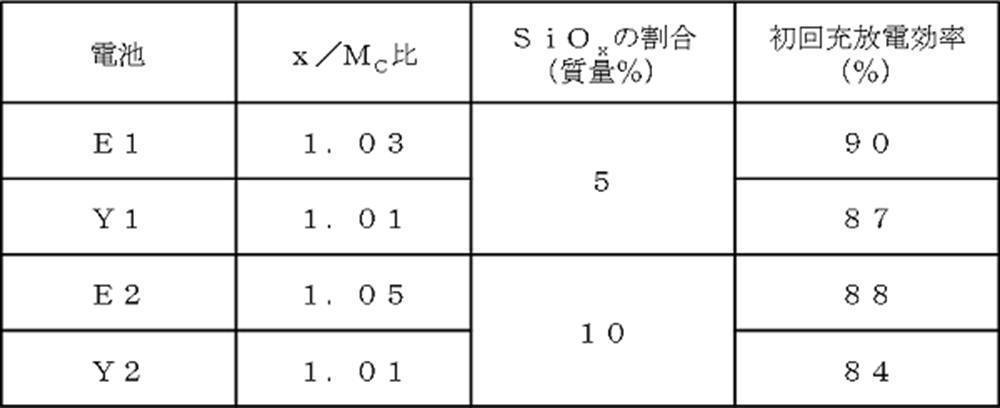
上記電池E1、E2、Y1、Y2を、以下の条件で充放電し、上記(1)式で示した初回充放電効率を調べたので、それらの結果を表2に示す。
1.0it(800mA)電流で電池電圧が4.2Vとなるまで定電流充電を行った後、4.2Vの電圧で電流値が0.05it(40mA)となるまで定電圧充電を行った。10分間休止した後、1.0it(800mA)電流で電池電圧が2.75Vとなるまで定電流放電を行った。
これらの電池において正極および負極中に含まれるリチウム量aと、正極材料に含まれる金属元素Mの量MCとを、既述のように定量し、a/MC比を算出した結果を、表2に示す。
Claims (3)
- 正極、負極及び非水電解液を用いる非水電解質二次電池であって、
前記正極は、リチウムと、金属元素Mとを含む酸化物を含み、前記金属元素Mは、コバルト、ニッケルを含む群より選択される少なくとも一種を含み、
前記負極はSiOx(x=0.5~1.5)、BET比表面積10m2/g未満の黒鉛及びBET比表面積10m2/g以上の材料を含み、
前記正極および前記負極に含まれるリチウム量の総和aと、前記酸化物に含まれる前記金属元素Mの量MCとの比率a/MCが、1.01より大きい、
非水電解質二次電池。 - 前記BET比表面積10m2/g以上の材料のBET比表面積は、10~300m2/gである、請求項1に記載の非水電解質二次電池。
- 前記BET比表面積10m2/g以上の材料は、導電性物質である、請求項1または請求項2に記載の非水電解質二次電池。
Priority Applications (3)
| Application Number | Priority Date | Filing Date | Title |
|---|---|---|---|
| US14/910,868 US20160204430A1 (en) | 2013-09-30 | 2014-09-11 | Nonaqueous electrolyte secondary battery |
| CN201480047612.4A CN105493330A (zh) | 2013-09-30 | 2014-09-11 | 非水电解质二次电池 |
| JP2015538881A JPWO2015045314A1 (ja) | 2013-09-30 | 2014-09-11 | 非水電解質二次電池 |
Applications Claiming Priority (2)
| Application Number | Priority Date | Filing Date | Title |
|---|---|---|---|
| JP2013203348 | 2013-09-30 | ||
| JP2013-203348 | 2013-09-30 |
Publications (1)
| Publication Number | Publication Date |
|---|---|
| WO2015045314A1 true WO2015045314A1 (ja) | 2015-04-02 |
Family
ID=52742487
Family Applications (1)
| Application Number | Title | Priority Date | Filing Date |
|---|---|---|---|
| PCT/JP2014/004690 Ceased WO2015045314A1 (ja) | 2013-09-30 | 2014-09-11 | 非水電解質二次電池 |
Country Status (4)
| Country | Link |
|---|---|
| US (1) | US20160204430A1 (ja) |
| JP (1) | JPWO2015045314A1 (ja) |
| CN (1) | CN105493330A (ja) |
| WO (1) | WO2015045314A1 (ja) |
Cited By (3)
| Publication number | Priority date | Publication date | Assignee | Title |
|---|---|---|---|---|
| WO2024202300A1 (ja) * | 2023-03-29 | 2024-10-03 | 株式会社Aescジャパン | 非水電解質二次電池用負極およびそれを用いた非水電解質二次電池 |
| WO2024202302A1 (ja) * | 2023-03-29 | 2024-10-03 | 株式会社Aescジャパン | 非水電解質二次電池用負極およびそれを用いた非水電解質二次電池 |
| WO2024202298A1 (ja) * | 2023-03-29 | 2024-10-03 | 株式会社Aescジャパン | 非水電解質二次電池用負極およびそれを用いた非水電解質二次電池 |
Families Citing this family (5)
| Publication number | Priority date | Publication date | Assignee | Title |
|---|---|---|---|---|
| US11362321B2 (en) * | 2017-03-30 | 2022-06-14 | Panasonic Intellectual Property Management Co., Ltd. | Negative electrode material and non-aqueous electrolyte secondary battery |
| KR20190101807A (ko) * | 2018-02-23 | 2019-09-02 | 주식회사 엘지화학 | 리튬 이차전지용 음극, 이의 제조방법 및 상기 리튬 이차전지용 음극을 포함하는 리튬 이차전지 |
| CN113711382B (zh) * | 2019-04-19 | 2024-07-23 | 松下控股株式会社 | 非水电解质二次电池用的负极及非水电解质二次电池 |
| EP4270522A4 (en) * | 2020-12-24 | 2025-05-07 | Panasonic Intellectual Property Management Co., Ltd. | Negative electrode for a secondary battery with anhydrous electrolyte and secondary battery with anhydrous electrolyte |
| EP4216301A4 (en) * | 2021-05-28 | 2025-01-01 | LG Energy Solution, Ltd. | All-solid lithium secondary battery and preparation method thereof |
Citations (4)
| Publication number | Priority date | Publication date | Assignee | Title |
|---|---|---|---|---|
| JP2001023686A (ja) * | 1999-07-09 | 2001-01-26 | Sony Corp | 非水電解質電池 |
| JP2007242590A (ja) * | 2006-02-13 | 2007-09-20 | Hitachi Maxell Ltd | 非水二次電池 |
| JP2013041807A (ja) * | 2011-07-15 | 2013-02-28 | Mitsubishi Chemicals Corp | リチウム二次電池用正極およびそれを用いたリチウム二次電池 |
| WO2013054481A1 (ja) * | 2011-10-12 | 2013-04-18 | 株式会社豊田自動織機 | リチウムイオン二次電池、リチウムイオン二次電池用負極及びリチウムイオン二次電池用負極材料 |
Family Cites Families (7)
| Publication number | Priority date | Publication date | Assignee | Title |
|---|---|---|---|---|
| CN1953247B (zh) * | 2002-09-27 | 2010-06-16 | Tdk株式会社 | 锂二次电池 |
| JP3975923B2 (ja) * | 2003-01-20 | 2007-09-12 | ソニー株式会社 | 非水電解質電池 |
| US8216719B2 (en) * | 2006-02-13 | 2012-07-10 | Hitachi Maxell Energy, Ltd. | Non-aqueous secondary battery and method for producing the same |
| US9537139B2 (en) * | 2010-08-03 | 2017-01-03 | Hitachi Maxell Ltd. | Negative electrode for non-aqueous secondary battery, and a non-aqueous secondary battery |
| JP5768968B2 (ja) * | 2011-03-08 | 2015-08-26 | 日産自動車株式会社 | リチウムイオン二次電池用負極活物質 |
| KR101347639B1 (ko) * | 2011-10-06 | 2014-01-06 | 쇼와 덴코 가부시키가이샤 | 흑연 재료, 그 제조 방법, 전지전극용 탄소 재료, 및 전지 |
| JP5817754B2 (ja) * | 2013-02-25 | 2015-11-18 | 株式会社豊田自動織機 | 非水系二次電池用負極とその製造方法及び非水系二次電池 |
-
2014
- 2014-09-11 JP JP2015538881A patent/JPWO2015045314A1/ja active Pending
- 2014-09-11 US US14/910,868 patent/US20160204430A1/en not_active Abandoned
- 2014-09-11 CN CN201480047612.4A patent/CN105493330A/zh active Pending
- 2014-09-11 WO PCT/JP2014/004690 patent/WO2015045314A1/ja not_active Ceased
Patent Citations (4)
| Publication number | Priority date | Publication date | Assignee | Title |
|---|---|---|---|---|
| JP2001023686A (ja) * | 1999-07-09 | 2001-01-26 | Sony Corp | 非水電解質電池 |
| JP2007242590A (ja) * | 2006-02-13 | 2007-09-20 | Hitachi Maxell Ltd | 非水二次電池 |
| JP2013041807A (ja) * | 2011-07-15 | 2013-02-28 | Mitsubishi Chemicals Corp | リチウム二次電池用正極およびそれを用いたリチウム二次電池 |
| WO2013054481A1 (ja) * | 2011-10-12 | 2013-04-18 | 株式会社豊田自動織機 | リチウムイオン二次電池、リチウムイオン二次電池用負極及びリチウムイオン二次電池用負極材料 |
Cited By (3)
| Publication number | Priority date | Publication date | Assignee | Title |
|---|---|---|---|---|
| WO2024202300A1 (ja) * | 2023-03-29 | 2024-10-03 | 株式会社Aescジャパン | 非水電解質二次電池用負極およびそれを用いた非水電解質二次電池 |
| WO2024202302A1 (ja) * | 2023-03-29 | 2024-10-03 | 株式会社Aescジャパン | 非水電解質二次電池用負極およびそれを用いた非水電解質二次電池 |
| WO2024202298A1 (ja) * | 2023-03-29 | 2024-10-03 | 株式会社Aescジャパン | 非水電解質二次電池用負極およびそれを用いた非水電解質二次電池 |
Also Published As
| Publication number | Publication date |
|---|---|
| JPWO2015045314A1 (ja) | 2017-03-09 |
| US20160204430A1 (en) | 2016-07-14 |
| CN105493330A (zh) | 2016-04-13 |
Similar Documents
| Publication | Publication Date | Title |
|---|---|---|
| JP5854279B2 (ja) | 非水電解液二次電池の製造方法 | |
| JP6589856B2 (ja) | 非水電解質二次電池 | |
| JP6314990B2 (ja) | 非水電解質二次電池用負極活物質及びその負極活物質を用いた非水電解質二次電池 | |
| JPWO2015136922A1 (ja) | 非水電解質二次電池 | |
| JP6394612B2 (ja) | 非水電解質二次電池用負極 | |
| JPWO2015045314A1 (ja) | 非水電解質二次電池 | |
| JP4798964B2 (ja) | 非水電解質二次電池 | |
| CN106063014B (zh) | 非水电解质二次电池 | |
| JP5813336B2 (ja) | 非水電解質二次電池 | |
| JP2023009668A (ja) | 非水電解質二次電池用被覆正極活物質及び該被覆正極活物質を含有する非水電解質二次電池。 | |
| WO2018201427A1 (en) | Lithium ion battery and prelithiation method of anode | |
| CN105074975B (zh) | 非水电解质二次电池用负极以及非水电解质二次电池 | |
| WO2015098023A1 (ja) | 非水電解質二次電池用負極 | |
| JP6509363B2 (ja) | 電気化学素子用電極、その製造方法、およびこれを含む電気化学素子 | |
| US20170012290A1 (en) | Negative electrode for non-aqueous electrolyte secondary battery | |
| CN110100335A (zh) | 锂离子电池及其制备方法 | |
| WO2016035274A1 (ja) | 非水電解質二次電池用負極活物質 | |
| EP4270521A1 (en) | Positive electrode for secondary battery, and secondary battery | |
| JPWO2018150843A1 (ja) | 非水電解質二次電池 | |
| JP2014067490A (ja) | 非水電解質二次電池 | |
| US9172089B2 (en) | Anode active material, method of preparing the same, anode including the anode active material, and lithium battery including the anode | |
| WO2015118833A1 (ja) | 非水電解質二次電池 | |
| WO2014132578A1 (ja) | 非水電解質二次電池 | |
| JP2022068418A (ja) | 正極活物質 |
Legal Events
| Date | Code | Title | Description |
|---|---|---|---|
| WWE | Wipo information: entry into national phase |
Ref document number: 201480047612.4 Country of ref document: CN |
|
| 121 | Ep: the epo has been informed by wipo that ep was designated in this application |
Ref document number: 14849267 Country of ref document: EP Kind code of ref document: A1 |
|
| ENP | Entry into the national phase |
Ref document number: 2015538881 Country of ref document: JP Kind code of ref document: A |
|
| WWE | Wipo information: entry into national phase |
Ref document number: 14910868 Country of ref document: US |
|
| NENP | Non-entry into the national phase |
Ref country code: DE |
|
| 122 | Ep: pct application non-entry in european phase |
Ref document number: 14849267 Country of ref document: EP Kind code of ref document: A1 |