WO2015029926A1 - 眼科用組成物 - Google Patents
眼科用組成物 Download PDFInfo
- Publication number
- WO2015029926A1 WO2015029926A1 PCT/JP2014/072103 JP2014072103W WO2015029926A1 WO 2015029926 A1 WO2015029926 A1 WO 2015029926A1 JP 2014072103 W JP2014072103 W JP 2014072103W WO 2015029926 A1 WO2015029926 A1 WO 2015029926A1
- Authority
- WO
- WIPO (PCT)
- Prior art keywords
- weight
- parts
- gga
- geranylgeranylacetone
- surfactant
- Prior art date
- Legal status (The legal status is an assumption and is not a legal conclusion. Google has not performed a legal analysis and makes no representation as to the accuracy of the status listed.)
- Ceased
Links
Images

Classifications
-
- A—HUMAN NECESSITIES
- A61—MEDICAL OR VETERINARY SCIENCE; HYGIENE
- A61K—PREPARATIONS FOR MEDICAL, DENTAL OR TOILETRY PURPOSES
- A61K31/00—Medicinal preparations containing organic active ingredients
- A61K31/12—Ketones
- A61K31/121—Ketones acyclic
-
- A—HUMAN NECESSITIES
- A61—MEDICAL OR VETERINARY SCIENCE; HYGIENE
- A61K—PREPARATIONS FOR MEDICAL, DENTAL OR TOILETRY PURPOSES
- A61K9/00—Medicinal preparations characterised by special physical form
- A61K9/0012—Galenical forms characterised by the site of application
- A61K9/0048—Eye, e.g. artificial tears
-
- A—HUMAN NECESSITIES
- A61—MEDICAL OR VETERINARY SCIENCE; HYGIENE
- A61P—SPECIFIC THERAPEUTIC ACTIVITY OF CHEMICAL COMPOUNDS OR MEDICINAL PREPARATIONS
- A61P27/00—Drugs for disorders of the senses
- A61P27/02—Ophthalmic agents
-
- A—HUMAN NECESSITIES
- A61—MEDICAL OR VETERINARY SCIENCE; HYGIENE
- A61P—SPECIFIC THERAPEUTIC ACTIVITY OF CHEMICAL COMPOUNDS OR MEDICINAL PREPARATIONS
- A61P27/00—Drugs for disorders of the senses
- A61P27/02—Ophthalmic agents
- A61P27/04—Artificial tears; Irrigation solutions
Definitions
- the present invention relates to an ophthalmic composition.
- Teprenone (Eisai) is a mixture containing 5E, 9E, 13E geranylgeranylacetone and 5Z, 9E, 13E geranylgeranylacetone in a weight ratio of 3: 2. Teprenone is widely used as a therapeutic agent for peptic ulcer for oral administration. It has also been proposed to use teprenone in the ophthalmic field. For example, Patent Document 1 teaches the use of teprenone as an active ingredient in a preventive or therapeutic agent for dry eye, fatigued eye, or dry eye.
- Non-Patent Document 1 teaches that when geranylgeranylacetone was intraperitoneally administered to an animal into which retinal detachment was introduced, expression of heat shock protein 70 was induced, and apoptosis of photoreceptor cells was significantly reduced.
- Geranylgeranylacetone used in Non-Patent Document 1 is teprenone.
- Patent Document 2 discloses that a clear eye drop can be obtained by adding a phospholipid in addition to a synthetic surfactant to an eye drop containing teprenone.
- a clear eye drop can be obtained by adding a phospholipid in addition to a synthetic surfactant to an eye drop containing teprenone.
- the actual situation is that studies for putting an ophthalmic composition containing geranylgeranylacetone into practice are not sufficiently conducted.
- An object of the present invention is to provide an ophthalmic composition containing geranylgeranylacetone, which is practically satisfactory.
- the present inventor has conducted research to solve the above-mentioned problems, and has found that geranylgeranylacetone is a component that is very easily adsorbed to a container.
- the present inventors have found that the degree is orders of magnitude greater than vitamin A, vitamin E, and the like, which are ophthalmic components known to be easily adsorbed in containers.
- the present inventors have surprisingly found that adsorption of geranylgeranylacetone to the container is suppressed by blending two or more surfactants with the ophthalmic composition containing geranylgeranylacetone. .
- An ophthalmic composition comprising geranylgeranylacetone and two or more surfactants.
- Surfactant is polyoxyethylene-polyoxypropylene block copolymer, ethylenediamine polyoxyethylene-polyoxypropylene block copolymer adduct, polyoxyethylene sorbitan fatty acid ester, polyoxyethylene hydrogenated castor oil, polyoxyethylene castor oil, polyoxyethylene Group consisting of oxyethylene alkyl ether, polyoxyethylene alkyl phenyl ether, polyoxyl stearate, polyoxydiethyl castor oil, glycine-type amphoteric surfactant, betaine-type amphoteric surfactant, alkyl quaternary ammonium salt, and sodium alkylbenzene sulfonate Item 2.
- composition according to Item 1 which is more selected.
- Item 3. As two or more surfactants, (a) a combination of two or more nonionic surfactants, (b) a combination of at least one nonionic surfactant and at least one cationic surfactant Item 3.
- Item 5. Item 5.
- composition according to any one of Items 1 to 4 which is an aqueous composition or an oily composition.
- Item 6. The composition according to any one of Items 1 to 5, which is liquid, fluid, gel, semi-solid, or solid.
- Item 7. Item 7. The composition according to any one of Items 1 to 6, comprising geranylgeranylacetone in an amount of 0.00001 to 10% by weight based on the total amount of the composition.
- Item 8. Item 8. The composition according to any one of Items 1 to 7, wherein the surfactant is contained in a total amount of the surfactant of 0.0001 to 20% by weight with respect to the total amount of the composition.
- Item 9. Item 9.
- Item 10. The composition according to any one of Items 1 to 9, wherein adsorption of geranylgeranylacetone to the container and / or contact lens is suppressed.
- Item 11. Item 11. The composition according to any one of Items 1 to 10, wherein the corneal permeability of geranylgeranylacetone and / or the affinity for retinal cells are improved.
- Item 12. A method for suppressing adsorption of geranylgeranylacetone to a container by allowing geranylgeranylacetone and two or more surfactants to coexist in an ophthalmic composition.
- Item 13. A method for suppressing adsorption of geranylgeranylacetone to a contact lens by allowing geranylgeranylacetone and two or more surfactants to coexist in an ophthalmic composition.
- Item 14 A method for improving the corneal permeability of geranylgeranylacetone by causing geranylgeranylacetone and two or more surfactants to coexist in an ophthalmic composition.
- Item 15. A method for improving the affinity of geranylgeranylacetone for retinal cells by allowing geranylgeranylacetone and two or more surfactants to coexist in an ophthalmic composition.
- the adsorption of geranylgeranylacetone (hereinafter sometimes referred to as “GGA”) to the container is reduced by blending two or more surfactants. Therefore, the decrease in the content or concentration of GGA in the ophthalmic composition is extremely small.
- GGA geranylgeranylacetone
- the present inventors have also found the following effect.
- the present inventor has found that GGA is easily adsorbed to a contact lens, and has found that the adsorption of GGA to the contact lens is reduced by further blending two or more surfactants. Therefore, the ophthalmic composition of the present invention suppresses the adsorption of GGA to the contact lens, and suppresses the contamination of the contact lens by GGA and the deterioration of the visual field.
- the ophthalmic composition of the present invention is very easy to transfer GGA to the retina even by eye drops. Furthermore, this inventor discovered that the affinity to the retinal cell of geranylgeranylacetone improved more by mix
- the ophthalmic composition of the present invention is excellent as an agent for preventing, ameliorating, or treating retinal diseases, and is particularly suitable as an eye drop for preventing, ameliorating, or treating retinal diseases that can be easily used by patients. Can be used.
- the ophthalmic composition of the present invention is highly stable because the content of the component is difficult to decrease even when it comes into contact with a container or a contact lens, and is effective and safe for eye diseases, particularly retinal diseases. Is also excellent.
- the ophthalmic composition of the present invention is a composition containing GGA and two or more surfactants.
- Geranylgeranylacetone (1) Types of geometric isomers GGA has eight types of geometric isomers. Specifically, (5E, 9E, 13E) -6,10,14,18-tetramethyl-5,9,13,17-nonadecatetraen-2-one (5E, 9E, 13EGGA) (all-trans body), (5Z, 9E, 13E) -6,10,14,18-tetramethyl-5,9,13,17-nonadecatetraen-2-one (5Z, 9E, 13EGGA) (5Z monocis form), (5Z, 9Z, 13E) -6,10,14,18-Tetramethyl-5,9,13,17-nonadecatetraen-2-one (5Z, 9Z, 13EGGA) (13E monotrans form) (5Z, 9Z, 13Z) -6,10,14,18-tetramethyl-5,9,13,17-nonadecatetraen-2-one (5Z, 9Z, 13ZGGA) (all c
- the type of GGA is not limited, and one type can be used alone, or two or more types can be used in any combination.
- the ratio of all-trans isomer is preferably 82% by weight or more, more preferably 84% by weight or more, still more preferably 86% by weight or more, and 88% by weight. Or more, more preferably 90% by weight or more, still more preferably 92% by weight or more, still more preferably 94% by weight or more, still more preferably 96% by weight or more, and even more preferably 98% by weight or more. . If it is the said range, it will come to show a remarkable effect in prevention, improvement, or treatment of a retinal disease.
- the ratio of the monocis isomer is preferably 82% by weight or more, more preferably 84% by weight or more, still more preferably 86% by weight or more, and 88% by weight. Or more, more preferably 90% by weight or more, still more preferably 92% by weight or more, still more preferably 94% by weight or more, still more preferably 96% by weight or more, and even more preferably 98% by weight or more. . If it is the said range, it will come to show a remarkable effect in prevention, improvement, or treatment of a retinal disease.
- a general-purpose geometric isomer mixture containing an all-trans isomer and a 5Z monocis isomer at a weight ratio of 3: 2 is preferable from the viewpoint of easy availability.
- the all-trans isomer can be synthesized by the method described in Bull. Korean Chem. Soc., 2009, Vol. 30, No. 9, 215-217, for example.
- a method shown in the following synthesis scheme is described. Specifically, in the above reaction formula, geranyl linalool 1, compound 2 and aluminum isopropoxide are mixed, and this mixture is gradually heated to 130 ° C. and reacted. At the end of the reaction, the residual compound 2 is removed and the reaction mixture is diluted with 5% sodium carbonate to quench the residual aluminum propoxide. Thereby, an all-trans form is obtained. Further, the all-trans isomer may be purified by silica gel chromatography using dichloromethane as an eluent.
- ⁇ Monocis> 5Z, 9E, 13EGGA 5Z monocis
- 5Z monocis has the following structural formula It is a compound represented by these.
- 5Z monocis can be obtained by separation of commercially available teprenone.
- GGA geometric isomers can also be produced by those skilled in the art with reference to the above method.
- a mixture of an all-trans isomer and a 5Z monocis isomer containing more than 60% by weight of the all-trans isomer can be obtained by adding the all-trans isomer to commercially available teprenone.
- a mixture of 5Z monocis and all-trans isomers containing more than 40% by weight of 5Z monocis can be obtained by adding 5Z monocis to commercial teprenone.
- the content of GGA in the ophthalmic composition is preferably 0.00001% by weight or more, more preferably 0.00005% by weight or more, and 0.0001% by weight or more based on the total amount of the composition. Is more preferable, 0.0005% by weight or more is more preferable, and 0.001% by weight or more is even more preferable. Further, it may be 0.005% by weight or more, 0.01% by weight or more, 0.05% by weight or more, 0.1% by weight or more, It may be 0.5% by weight or more, or 1% by weight or more. If it is the said range, the pharmacological activity of GGA will be fully acquired by application to eyes.
- the content of GGA in the ophthalmic composition is preferably 10% by weight or less, more preferably 8% by weight or less, more preferably 5% by weight or less, and more preferably 4% by weight or less based on the total amount of the composition. Is more preferable, and 3% by weight or less is even more preferable. It may be 2% by weight or less. If it is the said range, while being able to fully obtain the pharmacological activity of GGA by application to eyes, it will become a clearer formulation which is hard to produce fog vision.
- the content of GGA in the ophthalmic composition is about 0.00001 to 10% by weight, about 0.00001 to 8% by weight, about 0.00001 to 5% by weight, 0.00001-4 wt%, about 0.00001-3 wt%, about 0.00001-2 wt%, about 0.00005-10 wt%, about 0.00005-8 wt%, about 0.00005-5 %, About 0.00005-4%, about 0.00005-3%, about 0.00005-2%, about 0.0001-10%, about 0.0001-8%, about 0% .0001-5 wt%, about 0.0001-4 wt%, about 0.0001-3 wt%, about 0.0001-2 wt%, about 0.0005-10 wt%, about 0.0005-8 wt% %, About 0.0005 to 5% by weight, about 0.0005 to 4% by weight About 0.0005 to 3 wt%, about 0.0005 to 2 wt%, about 0.001 to 10 wt%, about 0.001 to 8 w
- the surfactant is not particularly limited as long as it is a surfactant that can be used in an ophthalmic composition.
- polyoxyethylene (hereinafter also referred to as “POE”)-polyoxypropylene (hereinafter also referred to as “POP”) block copolymer polyoxamer 407, poloxamer 235, poloxamer 188, etc.
- POP polyoxypropylene
- ethylenediamine POE-POP Block copolymer adducts such as poloxamine
- POE sorbitan fatty acid esters such as polysorbate 20, polysorbate 60, polysorbate 65, polysorbate 80 (TO-10, etc.)
- POE hydrogenated castor oil POE (5) hydrogenated castor oil, POE (10 ) Hardened castor oil, POE (20) hardened castor oil, POE (40) hardened castor oil, POE (50) hardened castor oil, POE (60) hardened castor oil (HCO-60, etc.), PO
- nonionic surfactants are preferable, and at least one of the two or more surfactants is preferably a nonionic surfactant.
- nonionic surfactant POE sorbitan fatty acid ester, POE hydrogenated castor oil, POE castor oil, polyoxyl stearate, and POE-POP block copolymer are more preferable.
- poloxamer 407, polysorbate 80, POE hydrogenated castor oil 60, POE hydrogenated castor oil 40, POE castor oil 35, and POE castor oil 10 are more preferable.
- Preferred combinations of two nonionic surfactants include a combination of poloxamer 407 and polysorbate 80, a combination of poloxamer 407 and POE hydrogenated castor oil 60, a combination of poloxamer 407 and POE hydrogenated castor oil 40, poloxamer 407 and POE.
- a combination with castor oil 10 and the like can be mentioned.
- Preferred combinations of three types of nonionic surfactants include a combination of polysorbate 80, POE hydrogenated castor oil 60 and POE castor oil 10, a combination of polysorbate 80, POE hydrogenated castor oil 60 and poloxamer 407, and POE hydrogenated castor oil 60. And a combination of POE castor oil 10 and Poloxamer 407.
- Two or more surfactants can be used in combination. Suitable combinations of two or more surfactants include a combination of two or more nonionic surfactants, a combination of at least one nonionic surfactant and at least one cationic surfactant, A combination of at least one nonionic surfactant and at least one amphoteric surfactant is preferred.
- the combination of two or more kinds of nonionic surfactants is a nonionic surfactant selected from the group consisting of POE sorbitan fatty acid ester, POE hydrogenated castor oil, POE castor oil, polyoxyl stearate, and POE-POP block copolymer Of these, a combination of two or more is preferred.
- a surfactant having the same chemical structure as the basic skeleton in other words, a surfactant of the same series or the same genus, for example, a combination of two or more of POE castor oil, may be used.
- surfactants having different chemical structures for example, a combination of at least one POE sorbitan fatty acid ester and at least one POE hydrogenated castor oil.
- it is a combination of two or more surfactants having different chemical structures as the basic skeleton.
- one kind of POE sorbitan fatty acid ester (for example, polysorbate 80) or more and one kind of POE hydrogenated castor oil for example, a combination of POE hydrogenated castor oil 60) or more, a combination of one or more POE sorbitan fatty acid esters (for example, polysorbate 80) and one or more kinds of POE castor oil (for example, POE castor oil 10), POE A combination of one or more of sorbitan fatty acid esters (for example, polysorbate 80) and one or more of polyoxyl stearate (for example, polyoxyl 40 stearate), one or more of POE sorbitan fatty acid esters (for example, polysorbate 80) And POE-POP In combination with one or more of the copolymer (for example, Poloxamer 407), one or more of the POE hydrogenated castor oil (for example, polysorbate 80) and POE-POP In combination with one or more of the copolymer (for example, Polox
- a combination of two or more nonionic surfactants having the same chemical structure as the basic skeleton a combination of two or more of POE castor oil (for example, POE castor oil 35 and POE castor oil 10) or more, POE Two kinds of sorbitan fatty acid esters (for example, polysorbate 80 and polysorbate 65) or combinations thereof, and two kinds of POE hydrogenated castor oil (for example, POE hydrogenated castor oil 60 and POE hydrogenated castor oil 40) or more A combination of two or more of polyoxyl stearates and a combination of two or more of POE-POP block copolymers (for example, poloxamer 407 and poloxamer 235) or more.
- a combination of two or more kinds of nonionic surfactants having different chemical structures serving as a basic skeleton is more preferable in that the effect of the present invention is more remarkably exhibited.
- the combination of two or more nonionic surfactants is more preferably a combination of two or more nonionic surfactants having different HLB.
- the HLB is preferably 10 or more, more preferably 12 or more, and still more preferably 14 or more.
- the HLB is preferably less than 14, more preferably less than 12, still more preferably less than 10, and particularly preferably less than 8.
- a combination of two kinds of nonionic surfactants having an HLB of 14 or more, a combination of a nonionic surfactant having an HLB of 14 or more and a nonionic surfactant of less than 14, and a nonion having an HLB of 14 or more A combination of a surfactant and a nonionic surfactant having an HLB of less than 12, a combination of a nonionic surfactant having an HLB of 14 or more and a nonionic surfactant having an HLB of less than 10, and a nonionic surfactant having an HLB of 14 or more
- a combination of a nonionic surfactant with an HLB of 12 or more and a nonionic surfactant of less than 12 a combination of a nonionic surfactant with an HLB of 12 or more and a nonionic surfactant of less than 10 an HLB of 12 or more
- a combination of a nonionic surfactant having an HLB of 10 or more and a nonionic surfactant having a HLB of less than 10 and a combination of a nonionic surfactant having an HLB of 10 or more and a nonionic surfactant having an HLB of less than 8 may be mentioned.
- a combination of a nonionic surfactant having an HLB of 12 or more and a nonionic surfactant having a HLB of less than 12 is preferable, and a combination of a nonionic surfactant having an HLB of 14 or more and a nonionic surfactant having a HLB of less than 10 is preferable. Further preferred.
- Preferable combinations include, specifically, a combination of polysorbate 80 and POE (10) castor oil, a combination of POE (60) hydrogenated castor oil and POE (10) castor oil, POE (40) hydrogenated castor oil and POE ( 10) A combination with castor oil, a combination of polyoxyl stearate 40 with POE (10) castor oil, a combination of poloxamer 407 and POE (10) castor oil, and the like.
- HLB Is 1 part by weight of the content of any one nonionic surfactant having a lower HLB, and one kind of nonionic surfactant having a higher HLB is 0.001 part by weight or more, more preferably 0 0.003 part by weight or more, more preferably 0.005 part by weight or more, more preferably 0.008 part by weight or more, more preferably 0.01 part by weight or more, more preferably 0.03 part by weight or more, more preferably 0.
- the nonionic surfactant having a higher HLB is 1000 parts by weight or less, more preferably 800 parts by weight or less, more preferably 1 part by weight of the content of the nonionic surfactant having a lower HLB. It is 500 parts by weight or less, more preferably 300 parts by weight or less, more preferably 100 parts by weight or less, more preferably 80 parts by weight or less, and particularly preferably 50 parts by weight or less.
- the ratio of the content of the nonionic surfactant having a higher HLB to 1 part by weight of the nonionic surfactant having a lower HLB is about 0.001 to 1000 parts by weight, about 0.001 to 800 parts by weight, about 0.001 to 500 parts by weight, about 0.001 to 300 parts by weight, about 0.001 to 100 parts by weight, about 0.001 to 80 parts by weight, 0.001 to 50 parts by weight, about 0 .003-1000 parts by weight, about 0.003-800 parts by weight, about 0.003-500 parts by weight, about 0.003-300 parts by weight, about 0.003-100 parts by weight, about 0.003-80 parts by weight Parts, 0.003 to 50 parts by weight, about 0.005 to 1000 parts by weight, about 0.005 to 800 parts by weight, about 0.005 to 500 parts by weight, about 0.005 to 300 parts by weight, about 0.005 ⁇ 100 parts by weight, about 0.005 to 80 parts Parts, 0.005 to 50 parts by weight, about 0.008
- the combination of the nonionic surfactant and the cationic surfactant is one selected from the group consisting of POE sorbitan fatty acid ester, POE hydrogenated castor oil, POE castor oil, polyoxyl stearate and POE-POP block copolymer.
- a combination of the above nonionic surfactant and a quaternary ammonium type surfactant or a tertiary ammonium type surfactant is preferred.
- Suitable combinations include, for example, a combination of POE sorbitan fatty acid ester and benzalkonium chloride, a combination of POE sorbitan fatty acid ester and polyhexamethylene biguanide hydrochloride, a combination of POE hydrogenated castor oil and benzalkonium chloride, and POE hydrogenated castor.
- the combination of the nonionic surfactant and the amphoteric surfactant includes at least one selected from the group consisting of POE sorbitan fatty acid ester, POE hydrogenated castor oil, POE castor oil, polyoxyl stearate, and POE-POP block copolymer.
- a combination of a nonionic surfactant and a glycine type amphoteric surfactant is preferred.
- a suitable combination includes a combination of POE sorbitan fatty acid ester and alkyldiaminoethylglycine hydrochloride, a combination of POE hydrogenated castor oil and alkyldiaminoethylglycine hydrochloride, a combination of POE castor oil and alkyldiaminoethylglycine hydrochloride, and the like.
- the substance which has surface active action is contained also in phospholipid, phospholipid is remove
- the content of the surfactant in the ophthalmic composition is preferably 0.0001% by weight or more and 0.0003% by weight as the total amount of the surfactant with respect to the total amount of the composition. More preferably, 0.0005% by weight or more is more preferable, 0.0008% by weight or more is more preferable, 0.001% by weight or more is preferable, 0.003% by weight or more is more preferable, 0.005% by weight or more. Is more preferably 0.008% by weight or more, more preferably 0.01% by weight or more, more preferably 0.03% by weight or more, more preferably 0.05% by weight or more, and 0.08% by weight or more. Is more preferable, and 0.1% by weight or more is even more preferable.
- the content of the surfactant in the ophthalmic composition is preferably 20% by weight or less, more preferably 10% by weight or less, and more preferably 8% by weight as the total amount of the surfactant with respect to the total amount of the composition. The following is more preferable, and 5% by weight or less is even more preferable. If it is the said range, eye irritation is suppressed.
- the total amount of the surfactant is about 0.0001 to 20% by weight, about 0.0003 to 20% by weight, about about the total amount of the composition.
- the content of the surfactant is preferably 0.001 part by weight or more, more preferably 0.003 part by weight or more, and more preferably 0.005 part by weight as the total amount of the surfactant with respect to 1 part by weight of GGA. Or more, more preferably 0.008 parts by weight or more, more preferably 0.01 parts by weight or more, more preferably 0.03 parts by weight or more, more preferably 0.05 parts by weight or more, and 0.08 parts by weight. The above is more preferable, and 0.1 part by weight or more is even more preferable.
- the content of the surfactant in the ophthalmic composition is preferably 1000 parts by weight or less, more preferably 800 parts by weight or less, and more preferably 500 parts by weight as the total amount of the surfactant with respect to 1 part by weight of GGA.
- 300 parts by weight or less is more preferable, 100 parts by weight or less is more preferable, 80 parts by weight or less is more preferable, and 50 parts by weight or less is even more preferable. If it is the said range, eye irritation is suppressed.
- the surfactant content relative to 1 part by weight of GGA is about 0.001 to 1000 parts by weight, about 0.003 to 1000 parts by weight, about 0.005 to 1000 parts by weight, 0.008-1000 parts by weight, about 0.01-1000 parts by weight, about 0.03-1000 parts by weight, about 0.05-1000 parts by weight, about 0.08-1000 parts by weight, about 0.1-1000 Parts by weight, about 0.001 to 800 parts by weight, about 0.003 to 800 parts by weight, about 0.005 to 800 parts by weight, about 0.008 to 800 parts by weight, about 0.01 to 800 parts by weight, about 0 0.03 to 800 parts by weight, about 0.05 to 800 parts by weight, about 0.08 to 800 parts by weight, about 0.1 to 800 parts by weight, about 0.001 to 500 parts by weight, about 0.003 to 500 parts by weight Parts, about 0.005 to 500 parts by weight, about 0. 0.
- the property of the pharmaceutical ophthalmic composition is not particularly limited, and may be any property such as liquid, fluid, gel, semi-solid, or solid.
- liquids, fluids, gels, semi-solids, solids, and the like that have been prepared at the time of use are also included.
- the semi-solid state refers to a property having plasticity that can be deformed by applying force, such as an ointment.
- the type of ophthalmic preparation is not particularly limited.
- eye drops including eye drops when wearing contact lenses
- eye wash contact lens mounting liquid
- contact lens liquid cleaning liquid
- preservative liquid disinfecting liquid
- multipurpose solution multipurpose solution
- package solution transplant cornea
- Preservatives for isolated ocular tissues, perfusate during surgery ointment (water-soluble ointment, oil-soluble ointment), intraocular injection (eg, intravitreal injection), sustained-release intraocular implant, and Examples include sustained-release contact lens preparations.
- eye drops, intraocular injections, eye ointments, and eye washes are preferable, and eye drops are more preferable in terms of good transferability to the affected area.
- the sustained-release intraocular implant includes preparations such as solid, semi-solid, gel, fluid, and liquid
- the sustained-release contact lens preparation includes solid, semi-solid, Gelled and other preparations are included.
- the ophthalmic agent may be an aqueous composition (mainly including an aqueous or hydrophilic base or carrier), and an oily composition (an oil or hydrophobic base or carrier is mainly used). Included).
- the content of water in the case of the aqueous composition is preferably 50% by weight or more, more preferably 75% by weight or more, and still more preferably 90% by weight or more based on the total amount of the preparation.
- the base or carrier may be composed only of water.
- the content of water in the case of an oily composition is preferably 50% by weight or less, more preferably 30% by weight or less, and still more preferably 20% by weight or less based on the total amount of the preparation.
- GGA is a pharmaceutically acceptable base or carrier, if necessary, a pharmaceutically acceptable ophthalmic composition additive, and other active ingredients (physiologically active or pharmacologically active ingredients other than GGA). It can be prepared by mixing with.
- Base or carrier examples include water; aqueous solvents such as polar solvents; polyhydric alcohols; vegetable oils; Examples of the base or carrier for intraocular injection include distilled water for injection and physiological saline.
- carrier can be used individually by 1 type or in combination of 2 or more types.
- additives include, for example, preservatives, thickeners, fragrances or refreshing agents, pH adjusters, isotonic agents, chelating agents, buffers, stabilizers, and anti-oxidants.
- An oxidizing agent etc. are mentioned.
- Intraocular injections may contain solubilizers, suspending agents, isotonic agents, buffers, soothing agents, stabilizers, and the like.
- An additive can be used individually by 1 type or in combination of 2 or more types.
- Preservatives for example, sodium benzoate, ethanol, chlorhexidine gluconate, chlorobutanol, sorbic acid, potassium sorbate, sodium dehydroacetate, methyl paraoxybenzoate, ethyl paraoxybenzoate, propyl paraoxybenzoate, butyl paraoxybenzoate, sulfuric acid Oxyquinoline, phenethyl alcohol, benzyl alcohol, and glowkill (made by Rhodia).
- Thickening agent guar gum, hydroxypropyl guar gum, methylcellulose, ethylcellulose, hydroxypropylmethylcellulose, hydroxyethylcellulose, cellulose polymer such as sodium carboxymethylcellulose, gum arabic, karaya gum, xanthan gum, agar, alginic acid, alginate (sodium salt) ⁇ -cyclodextrin, dextrin, dextran, heparin, heparinoid, heparin sulfate, heparan sulfate, hyaluronic acid, hyaluronate (sodium salt, etc.), chondroitin sulfate sodium, starch, chitin and derivatives thereof, chitosan and derivatives thereof, Polymers such as carrageenan, sorbitol, polyvinylpyrrolidone, polyvinyl alcohol, and polyvinyl methacrylate Vinyl polymer compounds, polyacrylic acid alkali metal
- Perfume or refreshing agent for example, camphor, borneol, terpenes (which may be d-form, l-form or dl-form), mint water, eucalyptus oil, bergamot oil, anethole, eugenol, geraniol, menthol, limonene, Essential oils such as peppermint oil, peppermint oil, and rose oil.
- PH adjuster For example, hydrochloric acid, sodium hydroxide, potassium hydroxide, calcium hydroxide, magnesium hydroxide, triethanolamine, monoethanolamine, diisopropanolamine, sulfuric acid, phosphoric acid and the like.
- Isotonizing agents for example, sodium bisulfite, sodium sulfite, potassium chloride, calcium chloride, sodium chloride, magnesium chloride, potassium acetate, sodium acetate, sodium bicarbonate, sodium carbonate, sodium thiosulfate, magnesium sulfate, dihydrogen phosphate Sodium, sodium dihydrogen phosphate, potassium dihydrogen phosphate, glycerin, propylene glycol and the like.
- Chelating agent For example, ascorbic acid, tetrasodium edetate, sodium edetate, and citric acid.
- Buffers For example, phosphate buffers; citrate buffers such as citric acid and sodium citrate; acetate buffers such as acetic acid, potassium acetate and sodium acetate; carbonate buffers such as sodium bicarbonate and sodium carbonate Boric acid buffers such as boric acid and borax; taurine, aspartic acid and salts thereof (such as potassium salt), amino acid buffers such as epsilon-aminocaproic acid, and the like.
- citrate buffers such as citric acid and sodium citrate
- acetate buffers such as acetic acid, potassium acetate and sodium acetate
- carbonate buffers such as sodium bicarbonate and sodium carbonate
- Boric acid buffers such as boric acid and borax
- taurine aspartic acid and salts thereof (such as potassium salt), amino acid buffers such as epsilon-aminocaproic acid, and the like.
- a phosphate buffer it is preferable to adjust the pH using a phosphate buffer, whereby the adsorption of GGA to the container wall and thus the decrease in the content of GGA in the composition is further suppressed. Further, white turbidity during storage at low temperature is suppressed, adsorption of GGA to the contact lens is further suppressed, and an effect that stability against heat and light is improved can be obtained.
- a phosphate buffer can be used individually by 1 type or in combination of 2 or more types. The phosphate buffer is not particularly limited.
- phosphoric acid disodium hydrogen phosphate, sodium dihydrogen phosphate, trisodium phosphate, dipotassium hydrogen phosphate, potassium dihydrogen phosphate, and tripotassium phosphate
- Alkali metal salts of phosphoric acid such as: calcium phosphate, calcium hydrogen phosphate, calcium dihydrogen phosphate, monomagnesium phosphate, dimagnesium phosphate (magnesium hydrogen phosphate), alkalis of phosphoric acid such as trimagnesium phosphate Earth metal salts; ammonium salts of phosphoric acid such as diammonium hydrogen phosphate and ammonium dihydrogen phosphate.
- the phosphate buffer may be either an anhydride or a hydrate.
- phosphoric acid and alkali metal salts of phosphoric acid it is preferable to use at least one selected from the group consisting of phosphoric acid and alkali metal salts of phosphoric acid, and more preferable to use at least one selected from the group consisting of phosphoric acid and sodium salt of phosphoric acid. preferable.
- a combination of phosphoric acid, disodium hydrogen phosphate, sodium dihydrogen phosphate and trisodium phosphate a combination of phosphoric acid, disodium hydrogen phosphate and sodium dihydrogen phosphate, Combination of phosphoric acid, disodium hydrogen phosphate and trisodium phosphate, combination of phosphoric acid, sodium dihydrogen phosphate and trisodium phosphate, disodium hydrogen phosphate, sodium dihydrogen phosphate and trisodium phosphate
- disodium hydrogen phosphate and sodium dihydrogen phosphate In combination with disodium hydrogen phosphate and trisodium phosphate
- sodium dihydrogen phosphate and phosphoric acid trisodium phosphate a combination of phosphoric acid, disodium
- a combination of phosphoric acid, disodium hydrogen phosphate and sodium dihydrogen phosphate, a combination of phosphoric acid and disodium hydrogen phosphate, a combination of phosphoric acid and sodium dihydrogen phosphate, disodium hydrogen phosphate and A combination with sodium dihydrogen phosphate is preferred, and a combination of disodium hydrogen phosphate and sodium dihydrogen phosphate is more preferred.
- the content of the phosphate buffer is preferably 0.001% by weight or more, more preferably 0.005% by weight or more, and more preferably 0.01% by weight or more based on the total amount of the composition in terms of anhydride. Even more preferred is 0.05% by weight or more. If it is the said range, the stabilization effect of GGA, the low-temperature white turbidity suppression effect, and the adsorption
- the content of the phosphate buffer is about 0.001 to 10% by weight, about 0.001 to 7% by weight, and about 0.001 to 5% based on the total amount of the ophthalmic agent in terms of anhydride. %, About 0.001 to 3%, about 0.005 to 10%, about 0.005 to 7%, about 0.005 to 5%, about 0.005 to 3%, about 0% 0.01 to 10% by weight, about 0.01 to 7% by weight, about 0.01 to 5% by weight, about 0.01 to 3% by weight, about 0.05 to 10% by weight, about 0.05 to 7% by weight %, About 0.05 to 5% by weight, and about 0.05 to 3% by weight.
- the content of the phosphate buffer is preferably 0.0005 parts by weight or more, more preferably 0.001 parts by weight or more, and more preferably 0.005 parts by weight with respect to 1 part by weight of GGA in terms of anhydride. Part or more is even more preferable, and 0.01 part by weight or more is even more preferable. If it is the said range, the stabilization effect of GGA, the low-temperature white turbidity suppression effect, and the adsorption
- the content of the phosphate buffer in the ophthalmic composition is preferably 5000 parts by weight or less, more preferably 1000 parts by weight or less, more preferably 500 parts by weight, in terms of anhydride, with respect to 1 part by weight of GGA. Part or less is even more preferable, and 200 parts by weight or less is even more preferable. If it is the said range, there is little irritation
- the content of the phosphate buffer is about 0.0005 to 5000 parts by weight, about 0.0005 to 1000 parts by weight, and about 0.0005 to 500 parts per 1 part by weight of GGA in terms of anhydride.
- Stabilizer trometamol, sodium formaldehyde sulfoxylate (Longalite), tocopherol, sodium pyrosulfite, monoethanolamine, aluminum monostearate, glyceryl monostearate and the like.
- Antioxidants Ascorbic acid, ascorbic acid derivatives (ascorbic acid-2-sodium sulfate, sodium ascorbate, ascorbic acid-2-magnesium phosphate, ascorbic acid-2-sodium phosphate, etc.), sodium bisulfite, sodium sulfite Water-soluble antioxidants such as sodium thiosulfate.
- the ophthalmic composition may contain a fat-soluble antioxidant, which further suppresses the adsorption of the ophthalmic composition to the wall of the ophthalmic container and consequently the decrease in the content of GGA in the composition. Is done. Further, the adsorption of GGA to the contact lens is further suppressed, and the stability of GGA to heat and light is improved.
- the fat-soluble antioxidant examples include butyl group-containing phenols such as butylhydroxytoluene (BHT) and butylhydroxyanisole (BHA); nordihydroguaiaretic acid (NDGA); ascorbyl palmitate, ascorbate stearate, Ascorbic acid esters such as aminopropyl phosphate, ascorbyl phosphate tocopherol, ascorbyl triphosphate, ascorbyl phosphate palmitate; ⁇ -tocopherol, ⁇ -tocopherol, ⁇ -tocopherol, tocopherols such as ⁇ -tocopherol; Tocopherol derivatives such as tocopherol acetate, tocopherol nicotinate, tocopherol succinate; ethyl gallate, propyl gallate, octyl gallate, dodecyl gallate Gallate; propyl gallate; 3-butyl-4-hydroxyquinolin-2one; vegetable oils such as soybean oil, rapeseed
- butyl group-containing phenol NDGA, ascorbic acid ester, tocopherol, tocopherol derivative, gallic acid ester, propyl gallate, 3-butyl-4-hydroxyquinolin-2-one, vegetable oil, and vitamin A are preferable.
- butyl group-containing phenols, tocopherols, tocopherol derivatives, vegetable oils and vitamin A are preferred, butyl group-containing phenols, vegetable oils, retinol or retinol esters are more preferred, and BHT, BHA, sesame oil, and retinol palmitate are even more preferred.
- the fat-soluble antioxidant can be used alone or in combination of two or more.
- the content of the fat-soluble antioxidant in the ophthalmic composition is preferably 0.00001% by weight or more, more preferably 0.00005% by weight or more, and 0.0001% by weight or more based on the total amount of the composition. Even more preferred is 0.0005% by weight or more. If it is the said range, the GGA adsorption
- the content of the fat-soluble antioxidant in the ophthalmic composition is preferably 10% by weight or less, more preferably 5% by weight or less, still more preferably 2% by weight or less, based on the total amount of the composition. 1% by weight or less is even more preferable. Within the above range, there is little eye irritation.
- the content of the fat-soluble antioxidant in the ophthalmic agent is about 0.00001 to 10% by weight, about 0.00001 to 5% by weight, and about 0.00001 to 2% by weight with respect to the total amount of the ophthalmic agent.
- % About 0.00001-1 wt%, about 0.00005-10 wt%, about 0.00005-5 wt%, about 0.00005-2 wt%, about 0.00005-1 wt%, about 0.0. 0001-10 wt%, about 0.0001-5 wt%, about 0.0001-2 wt%, about 0.0001-1 wt%, about 0.0005-10 wt%, about 0.0005-5 wt% About 0.0005 to 2% by weight, about 0.0005 to 1% by weight.
- the content of the fat-soluble antioxidant in the ophthalmic composition is preferably 0.0001 parts by weight or more, more preferably 0.001 parts by weight or more, and 0.005 parts by weight with respect to 1 part by weight of GGA. Part or more is even more preferable, and 0.01 part by weight or more is even more preferable. If it is the said range, the GGA adsorption
- the content of the fat-soluble antioxidant in the ophthalmic composition is preferably 100 parts by weight or less, more preferably 50 parts by weight or less, and still more preferably 10 parts by weight or less, relative to 1 part by weight of GGA. Even more preferably 5 parts by weight or less. If it is the said range, there is also little irritation
- the content of the fat-soluble antioxidant in the ophthalmic preparation is about 0.0001 to 100 parts by weight, about 0.0001 to 50 parts by weight, and about 0.0001 to 10 parts by weight with respect to 1 part by weight of GGA. Parts, about 0.0001-5 parts by weight, about 0.001-100 parts by weight, about 0.001-50 parts by weight, about 0.001-10 parts by weight, about 0.001-5 parts by weight, about 0. 005-100 parts by weight, about 0.005-50 parts by weight, about 0.005-10 parts by weight, about 0.005-5 parts by weight, about 0.01-100 parts by weight, about 0.01-50 parts by weight About 0.01 to 10 parts by weight, and about 0.01 to 5 parts by weight.
- the ophthalmic composition of the present invention may contain a component for preventing or treating retinal diseases by a mechanism of action different from that of GGA. That is, the ophthalmic composition of the present invention can contain a combination of GGA and other components as an active ingredient for preventing, improving, or treating retinal diseases. Components for preventing, improving, or treating retinal diseases other than GGA can be used singly or in combination of two or more.
- Such combinations include, but are not limited to, for example, combinations of GGA and prost drugs (GGA and latanoprost, GGA and travoprost, GGA and tafluprost, GGA and bimatoprost, etc.), combinations of GGA and prostone drugs
- a combination of GGA and a prostaglandin F2 ⁇ derivative such as (GGA and isopropyl unoprostone); a combination of GGA and a ⁇ -blocker (GGA and timolol maleate, GGA and gelled timolol, GGA and carteolol hydrochloride, GGA And gelled carteolol), combinations of GGA and ⁇ 1 blockers (such as GGA and betaxolol hydrochloride), combinations of GGA and ⁇ blockers (such as GGA and levobunolol hydrochloride, GGA and nipradilol), GGA and ⁇ 1 blockers Combinations of GGA and sympathetic blockers
- the combination of GGA and a prostaglandin F2 ⁇ derivative, the combination of GGA and a sympathetic nerve blocker are mentioned.
- a combination of GGA and a ROCK inhibitor, and a combination of GGA and a carbonic anhydrase inhibitor are preferred.
- the ophthalmic composition of the present invention may contain a pharmacologically active component or a physiologically active component other than a preventive, ameliorative, or therapeutic component for retinal diseases.
- pharmacologically active ingredients or physiologically active ingredients can be used singly or in combination of two or more.
- examples of such pharmacologically active components and physiologically active components include neurotrophic factor, decongestant component, eye muscle modulator component, anti-inflammatory component or astringent component, antihistamine component or antiallergic component, vitamins, Examples include amino acids, antibacterial components or bactericidal components, saccharides, polymer compounds, cellulose or derivatives thereof, and local anesthetic components. Specific examples of these drugs are illustrated below.
- Neurotrophic factor Nerve growth factor (NGF), brain-derived neurotrophic factor (BDNF), glial cell line-derived neurotrophic factor (GDNF) and the like.
- NGF Nerve growth factor
- BDNF brain-derived neurotrophic factor
- GDNF glial cell line-derived neurotrophic factor
- serum contains nutrient factors including neurotrophic factor, it is possible to add a serum collected from a patient to prepare a preparation for use in the patient.
- Decongestant for example, ⁇ -adrenergic agonist, specifically epinephrine, epinephrine hydrochloride, ephedrine hydrochloride, oxymetazoline hydrochloride, tetrahydrozoline hydrochloride, naphazoline hydrochloride, phenylephrine hydrochloride, methylephedrine hydrochloride, epinephrine hydrogen tartrate, and naphazoline nitrate .
- ⁇ -adrenergic agonist specifically epinephrine, epinephrine hydrochloride, ephedrine hydrochloride, oxymetazoline hydrochloride, tetrahydrozoline hydrochloride, naphazoline hydrochloride, phenylephrine hydrochloride, methylephedrine hydrochloride, epinephrine hydrogen tartrate, and naphazoline nitrate .
- Eye muscle modulator component For example, cholinesterase inhibitor having an active center similar to acetylcholine, specifically, neostigmine methyl sulfate, tropicamide, helenien, and atropine sulfate.
- Anti-inflammatory component or astringent component for example, zinc sulfate, zinc lactate, allantoin, epsilon-aminocaproic acid, indomethacin, lysozyme chloride, silver nitrate, pranoprofen, sodium azulenesulfonate, dipotassium glycyrrhizinate, diammonium glycyrrhizinate, Diclofenac sodium, bromfenac sodium, berberine chloride, and berberine sulfate.
- astringent component for example, zinc sulfate, zinc lactate, allantoin, epsilon-aminocaproic acid, indomethacin, lysozyme chloride, silver nitrate, pranoprofen, sodium azulenesulfonate, dipotassium glycyrrhizinate, diammonium glycyrr
- Antihistamine component or antiallergic agent component for example, salt such as acitazanolast, diphenhydramine or its hydrochloride, chlorpheniramine maleate, ketotifen fumarate, levocabastine or its hydrochloride, etc., anlexanox, ibudilast, tazanolast, tranilast, Salts such as oxatomide, suplatast or its tosylate, sodium cromoglycate, and pemirolast potassium.
- salt such as acitazanolast, diphenhydramine or its hydrochloride, chlorpheniramine maleate, ketotifen fumarate, levocabastine or its hydrochloride, etc.
- anlexanox ibudilast
- tazanolast tranilast
- Salts such as oxatomide, suplatast or its tosylate, sodium cromoglycate, and pemirolast potassium.
- Vitamins for example, retinol acetate, retinol palmitate, pyridoxine hydrochloride, flavin adenine dinucleotide sodium, pyridoxal phosphate, cyanocobalamin, panthenol, calcium pantothenate, sodium pantothenate, ascorbic acid, tocopherol acetate, tocopherol nicotinate, succinic acid Tocopherol, calcium tocopherol succinate, and ubiquinone derivatives.
- Amino acids for example, aminoethyl sulfonic acid (taurine), glutamic acid, creatinine, sodium aspartate, potassium aspartate, magnesium aspartate, magnesium aspartate mixture, glutamic acid, sodium glutamate, magnesium glutamate, epsilon-aminocaproic acid, glycine , Alanine, arginine, lysine, ⁇ -aminobutyric acid, ⁇ -aminovaleric acid, sodium chondroitin sulfate and the like. These may be d-form, l-form or dl-form.
- Antibacterial component or bactericidal component for example, alkylpolyaminoethylglycine, chloramphenicol, sulfamethoxazole, sulfisoxazole, sulfamethoxazole sodium, sulfisoxazole diethanolamine, sulfisoxa Zole monoethanolamine, sodium sulfisomezole, sodium sulfisomidine, ofloxacin, norfloxacin, levofloxacin, lomefloxacin hydrochloride, and acyclovir.
- alkylpolyaminoethylglycine for example, chloramphenicol, sulfamethoxazole, sulfisoxazole, sulfamethoxazole sodium, sulfisoxazole diethanolamine, sulfisoxa Zole monoethanolamine, sodium sulfisomezole, sodium s
- Sugars For example, monosaccharides and disaccharides, specifically glucose, maltose, trehalose, sucrose, cyclodextrin, xylitol, sorbitol, mannitol and the like.
- Macromolecular compounds for example, alginic acid, sodium alginate, dextrin, dextran, pectin, hyaluronic acid, chondroitin sulfate, polyvinyl alcohol (completely or partially saponified), polyvinylpyrrolidone, carboxyvinyl polymer, macrogol and its pharmaceutically acceptable Such as salt.
- Cellulose or derivatives thereof For example, ethyl cellulose, hydroxyethyl cellulose, hydroxypropyl cellulose, hydroxypropyl methyl cellulose, methyl cellulose, carboxymethyl cellulose, carboxymethyl cellulose sodium, carboxyethyl cellulose, nitrocellulose and the like.
- Local anesthetic ingredients for example, chlorobutanol, procaine hydrochloride, lidocaine hydrochloride, etc.
- the pH of the composition is preferably 4 or more, more preferably 5.5 or more, even more preferably 6 or more, and even more preferably 6.5 or more. . If it is the said range, it will become a formulation with favorable stability with respect to the heat
- the viscosity of the ophthalmic composition of the present invention is within a physiologically or pharmaceutically acceptable range, it depends on the type and content of the compounding ingredients, the use of the ophthalmic composition, the formulation form, the method of use, etc. Set as appropriate.
- the viscosity at 20 ° C. measured with a rotational viscometer is preferably 0.01 to 10000 mPa ⁇ s, and 0.05 to 8000 mPas. More preferred is s, and more preferred is 0.5 to 1000 mPa ⁇ s.
- Kits The composition of the present invention may consist of a one-drug composition containing all components, or may be any type of kit, such as a two-drug type or a three-drug type.
- a kit a kit comprising a composition containing GGA and a surfactant and a composition containing a pharmacologically active ingredient or a physiologically active ingredient other than GGA and a surfactant, and a composition containing a specific additive, A kit provided separately from the composition containing GGA and a surfactant is included.
- each composition may be filled in a separate container, or may be a ready-to-use composition filled in a container that can be mixed at the time of use.
- the composition of the present invention is a kit of a composition containing GGA and a surfactant and a composition containing other components, it is also a kit prepared at the time of use even in a kit in which each composition is filled in a separate container.
- the GGA content and the surfactant content of each preparation described above are ratios relative to the total amount after mixing the respective compositions.
- the ophthalmic composition of the present invention is usually contained or filled in a container (particularly an ophthalmic container).
- a container particularly an ophthalmic container.
- the kind of container is not specifically limited, For example, a plastic container, a metal container, a glass container, etc. are mentioned.
- at least a part or all of the contact surface with the preparation is made of plastic (for example, polyolefin, acrylic resin, terephthalic acid ester, 2,6-naphthalenedicarboxylic acid ester, polycarbonate, polymethylterpene, fluororesin, polyvinyl chloride , Polyamide, ABS resin, AS resin, polyacetal, modified polyphenylene ether, polyarylate, polysulfone, polyimide, cellulose acetate, hydrocarbons optionally substituted with halogen atoms), metals (such as aluminum), and glass
- plastic for example, polyolefin, acrylic resin, terephthalic acid ester, 2,6-naphthalenedicar
- the container comprised with said material is 50 weight% or more per weight of container (main body), Preferably it is 60 weight% or more, More preferably, it is a ratio of 70 weight% or more.
- Container containing Further, a mixture of the above materials or a copolymer may be used.
- polyolefins examples include polyethylene (including high density polyethylene, low density polyethylene, ultra low density polyethylene, linear low density polyethylene, ultra high molecular weight polyethylene, etc.), polypropylene (isotactic polypropylene, syndiotactic polypropylene, atactic polypropylene). And ethylene-propylene copolymer.
- acrylic resin examples include acrylic esters such as methyl acrylate, methacrylic esters such as methyl methacrylate, cyclohexyl methacrylate, and t-butyl cyclohexyl methacrylate.
- terephthalic acid ester examples include polyethylene terephthalate, polytrimethylene terephthalate, and polybutylene terephthalate.
- 2,6-naphthalenedicarboxylic acid esters examples include polyethylene naphthalate and polybutylene naphthalate.
- Fluorine resins include fluorine-substituted polyethylene (polytetrafluoroethylene, polychlorotrifluoroethylene, etc.), polyvinylidene fluoride, polyvinyl fluoride, perfluoroalkoxy fluororesin, tetrafluoroethylene / hexafluoropropylene copolymer, ethylene / tetra Examples thereof include a fluorinated ethylene copolymer and an ethylene / chlorotrifluoroethylene copolymer.
- polyamide examples include nylon.
- polyacetals include those containing only oxymethylene units and those containing some oxyethylene units.
- modified polyphenylene ether examples include polystyrene-modified polyphenylene ether.
- polyarylate examples include amorphous polyarylate.
- polyimide examples include aromatic polyimides such as those obtained by polymerizing pyromellitic dianhydride and 4,4'-diaminodiphenyl ether.
- cellulose acetate examples include cellulose diacetate and cellulose triacetate.
- hydrocarbons such as methane, ethane, propane, butane, ethylene, propylene, 1-butene, 2-butene, 1,3-butadiene; fluoromethane, difluoromethane, fluoro Form, tetrafluoromethane, 1,1-difluoroethane, 1,2-difluoroethane, 1-fluoropropane, 2-fluoropropane, 1,2-fluoropropane, 1,3-fluoropropane, 1-fluorobutane, 2- Fluorobutane, vinyl fluoride, 1,1-difluoroethylene, 1,2-difluoroethylene, trifluoroethylene, tetrafluoroethylene, 3-fluoropropene, 1,3-fluoropropene, 1,1,4,4-tetra Hydrocarbons substituted with fluorine atoms such as fluorobutadiene and perflu
- Container materials are terephthalic acid ester (especially polyethylene terephthalate), polycarbonate, polymethylterpene, fluorine-substituted polyethylene (especially polytetrafluoroethylene), 2,6-naphthalenedicarboxylic acid ester (especially polyethylene naphthalate, polybutylene naphthalate). It is preferably at least one selected from the group consisting of phthalates), polyolefins (particularly polyethylene, polypropylene), and methacrylic acid esters (particularly methyl methacrylate).
- the container may be formed with a layer or film composed of the above material on the inner surface of the container, or the container itself may be molded with the above material. Moreover, it is sufficient that at least a part of the surface in contact with the ophthalmic composition is composed of the above material, but it is preferable that the entire contact surface is composed of the above material.
- the container may be integrally molded, or may be a container composed of two or more types of parts.
- a container composed of two or more kinds of parts only one kind or two or more kinds of parts may be composed of the above materials, and different kinds of materials are used for each part among the above materials. May be.
- the entire part including the spout or nozzle may be formed of the above-mentioned material, and other than the spout or nozzle. Only the main body portion may be molded from the above material.
- the layer or film comprised with the said material may be formed in the inner surface of all the parts, and the layer or film comprised with the said material may be formed only in the inner surface of the main-body part.
- the shape of the container, the capacity, the thickness of the container wall, etc. are not particularly limited. Depending on the type of container, commonly used shapes, capacities, and container wall thicknesses can be employed.
- the volume of the container may be about 0.01 to 1000 mL, preferably about 0.1 to 500 mL, more preferably about 1 to 100 mL, and more preferably about 1 to 20 mL.
- the thickness of the container wall is about 0.01 to 10 mm, preferably about 0.05 to 5 mm, more preferably about 0.1 to 3 mm.
- the layer or film which consists of said material when the layer or film which consists of said material is formed in the container inner wall, what was laminated
- molded layer or film may be a layer or by vapor deposition, plasma CVD, plasma polymerization, sputtering etc. A film may be formed.
- the thickness of the layer or film made of the above material is not particularly limited, and can be, for example, about 10 nm to 5 mm.
- the ophthalmic composition of the present invention can target retinal diseases, and the retinal diseases include diseases in which degeneration, damage, or cell death of cells constituting the retina occurs, or cells that constitute the retina. Any disease caused by degeneration, disorder, or cell death may be used, such as glaucoma, retinitis pigmentosa, age-related macular degeneration, diabetic retinopathy, retinal detachment, diabetic macular disease, hypertensive retinopathy, retinal vascular occlusion ( Retinal artery occlusion; central retinal vein occlusion, retinal vein occlusion such as central retinal vein branch occlusion), retinal arteriosclerosis, retinal tear, retinal hole, macular hole, fundus hemorrhage, posterior vitreous detachment, pigmented Paravenous choroidal atrophy, cerebral reticular choroidal atrophy, choroideremia, crystal retinopathy, punctate retinopathy, pyramidal dystrophy, central crested
- the ophthalmic composition of the present invention can be used for diseases in which any cell constituting the retina is damaged or diseases caused by any cell damage constituting the retina.
- retinal constituent cells include retinal ganglion cells, amacrine cells, horizontal cells, Müller glial cells, bipolar cells, retinal photoreceptor cells (cones and rods), and retinal pigment epithelial cells.
- a disorder in which retinal ganglion cells or retinal pigment epithelial cells are damaged or caused by the damage of these cells is preferred.
- the ophthalmic composition of the present invention comprises a layer constituting the retina, that is, an inner boundary membrane, a nerve fiber layer, a ganglion cell layer, an inner reticular membrane, an inner granular layer, an outer reticular layer, an outer granular layer, an outer boundary.
- a disease in which any of the membrane, the photoreceptor layer, and the retinal pigment epithelium layer is damaged, or a disease caused by a failure in any of these layers is also a target.
- disorder of the ganglion cell layer, inner granule layer, or outer granule layer is a suitable subject.
- the retinal disease can be one type or two or more types.
- prevention includes avoidance, delay, or reduction in the incidence of onset
- improvement includes amelioration of symptoms, suppression of progression of symptoms, and cure or completeness.
- the ophthalmic composition of the present invention is administered, for example, to patients with retinal diseases.
- the composition of the present invention is an eye drop
- the eye drop containing GGA at the above concentration is, for example, about 1 to 5 drops, preferably 1 to 3 drops, more preferably about 1 to 2 drops, It may be applied about 1 to 7 times, preferably about 1 to 5 times, more preferably about 1 to 3 times a day.
- the composition of the present invention is an eye wash
- the eye wash containing GGA at the above concentration is used, for example, about 1 to 20 mL per time, about 1 to 10 times a day, preferably about 1 to Wash 5 times.
- an eye ointment containing GGA at the above concentration is, for example, about 0.001 to 5 g per time, about 1 to 7 times a day, preferably about a day. It may be applied to the eye 1 to 5 times, more preferably about 1 to 3 times.
- the injection containing GGA at the above concentration is about 0.005 to 1 mL per time, about 1 to 3 times on 1 to 14 days, preferably One injection is sufficient.
- composition of the present invention is a contact lens solution (cleaning solution, preservative solution, disinfectant solution, multipurpose solution, package solution), a preservative for an isolated ocular tissue such as a cornea for transplantation, or a perfusion solution during surgery.
- compositions containing GGA at the above concentrations may be used at the usual dosage of these formulations.
- the daily dose of GGA is preferably 50 ng or more, more preferably 500 ng or more, and even more preferably 5 ⁇ g or more.
- the daily dose of GGA is preferably 50 mg or less, more preferably 20 mg or less, and even more preferably 10 mg or less.
- the daily dosage of GGA is about 50 ng to 50 mg, about 50 ng to 20 mg, about 50 ng to 10 mg, about 500 ng to 50 mg, about 500 ng to 20 mg, about 500 ng to 10 mg, about 5 ⁇ g to 50 mg, about 5 ⁇ g to 20 mg, about Examples include 5 ⁇ g to 10 mg.
- the administration period varies depending on the type of disease, stage, age, weight, sex, route of administration, etc., but can be appropriately selected within a range of about 1 day to 30 years, for example.
- retinal diseases such as glaucoma, retinitis pigmentosa, age-related macular degeneration, and diabetic retinopathy
- retinal diseases can be prevented and improved in a short administration period of about 1 to 20 years, particularly about 1 to 10 years. Or may be treatable.
- the ophthalmic composition of the present invention suppresses the progression of retinal disease due to the retinal protective action, it may continue to be administered.
- the present invention includes a method for suppressing adsorption of GGA to a contact lens, in which GGA and two or more surfactants coexist in the ophthalmic composition.
- this method is a method of suppressing the property of adsorbing to the contact lens of GGA by coexisting GGA and two or more surfactants in the ophthalmic composition.
- the contact lens may be a soft contact lens or a hard contact lens.
- Soft contact lens materials include hydroxyethyl methacrylate (HEMA), 2,3-dihydroxypropyl methacrylate (GMA), N-vinylpyrrolidone (NVP), methacrylic acid or its salt (MA), silicone elastomer polydimethylsiloxane (PDMSi), n-butyl methacrylate (BMA), n-butyl acrylate (BA), and copolymers thereof.
- HEMA hydroxyethyl methacrylate
- GMA 2,3-dihydroxypropyl methacrylate
- NDP N-vinylpyrrolidone
- MA methacrylic acid or its salt
- PDMSi silicone elastomer polydimethylsiloxane
- BMA n-butyl methacrylate
- BA n-butyl acrylate
- Hard contact lens materials include methyl methacrylate (MMA), cellulose acetate butyrate (CAB), siloxanyl styrene, fluoro methacrylate, siloxanyl methacrylate, fluorine-containing methacrylate (FMA), silicone-containing methacrylate (SiMA), methacryl Examples thereof include acids, dimethacrylic acid esters, dextran esters, fluorosilicones, and co-polymers thereof. Since GGA and two or more surfactants coexist, the adsorption of GGA to contact lenses is suppressed, but it is preferable to coexist for 1 day or more, 3 days or more, or 1 week or more. .
- the coexistence may be performed at a temperature of about 1 to 80 ° C., particularly about 1 to 70 ° C., and more preferably about 1 to 30 ° C.
- the coexistence may be performed under light shielding or non-light shielding, but is preferably performed under light shielding.
- the present invention includes a method for suppressing adsorption of GGA to a container (particularly, an ophthalmic container) in which GGA and two or more surfactants coexist in the ophthalmic composition.
- this method is a method of suppressing the property of GGA adsorbing to an ophthalmic container by allowing GGA and two or more surfactants to coexist in the ophthalmic composition.
- the types of containers (particularly ophthalmic containers) are as described for the ophthalmic composition of the present invention.
- the coexistence may be performed at a temperature of about 1 to 80 ° C., particularly about 1 to 70 ° C., and particularly about 1 to 30 ° C.
- the coexistence may be performed under light shielding or non-light shielding, but is preferably performed under light shielding.
- the present invention also includes a method for improving corneal permeability of GGA, wherein GGA and two or more surfactants are allowed to coexist in the ophthalmic composition.
- the corneal permeability of GGA is improved from the coexistence of GGA and two or more surfactants, it is preferable to coexist for 1 day or more, 3 days or more, or 1 week or more.
- the coexistence may be performed at a temperature of about 1 to 80 ° C., particularly about 1 to 70 ° C., and particularly about 1 to 30 ° C.
- the coexistence may be performed under light shielding or non-light shielding, but is preferably performed under light shielding.
- the present invention also includes a method for improving the affinity or migration of GGA to retinal cells, wherein GGA and two or more surfactants coexist in the ophthalmic composition.
- the method of the present invention can improve the affinity or transferability of GGA to any retinal cell, but is particularly excellent in the action of improving the affinity or transferability to retinal ganglion cells and retinal pigment epithelial cells. From the coexistence of GGA and two or more surfactants, the affinity or transferability of GGA to retinal cells is improved, but preferably it can coexist for 1 day or more, 3 days or more, or 1 week or more. That's fine.
- the coexistence may be performed at a temperature of about 1 to 80 ° C., particularly about 1 to 70 ° C., and particularly about 1 to 30 ° C.
- the coexistence may be performed under light shielding or non-light shielding, but is preferably performed under light shielding.
- the prepared ophthalmic composition is usually stored at a temperature of about 1 to 30 ° C., but during the preparation of the ophthalmic composition, a temperature of about 1 ° C. or more and about 70 ° C. or less or about 80 ° C. or less. May be placed underneath.
- the ophthalmic composition being prepared also corresponds to the ophthalmic composition. That is, each method of the present invention corresponds to “coexistence” from the time when (a) GGA and (b) component are both present in the composition to be an ophthalmic composition.
- each method of the present invention whether or not an ophthalmic composition containing (a) GGA and component (b) or an ophthalmic composition being prepared is contained in a container (particularly an ophthalmic container) is used. If (a) GGA and (b) component are contained in the ophthalmic composition or the ophthalmic composition being prepared, it falls under “coexistence of (a) GGA and (b) component”. .
- each component of the ophthalmic composition is as described for the ophthalmic composition of the present invention.
- the content of the component may be expressed in w / v%. However, if the composition of each of these samples is taken into consideration, the component content expressed in w / v% is weight%. It becomes substantially the same value as the component content indicated by.
- the container used in the following tests has a thickness of about 0.5 to 1.5 mm.
- the concentration of GGA was measured by the following method.
- Teprenone Waako Pure Chemical Industries
- the area value (Ac) of the 5Z monocis isomer and the all-trans isomer under the following HPLC measurement conditions From the area value (At), the concentration of GGA contained in each eye drop was measured.
- Detector UV absorption photometer (measurement wavelength: 210 nm)
- Column YMC-Pack ODS-A (inner diameter 4.6 mm, length 15 cm, particle size 3 ⁇ m)
- Column temperature 30 ° C
- Mobile phase 90% acetonitrile solution
- Flow rate 1.2 to 1.3 mL / min (eluted in the order of 5Z monocis and all-trans)
- Injection amount 5 ⁇ L injection of 0.05 g / 100 mL sample
- Adsorption rate (%) [(GGA content in blank liquid ⁇ GGA content in immersion liquid) / GGA content in blank solution] ⁇ 100
- Adsorption inhibition rate (%) for Comparative Example 1 was calculated by the following formula.
- Adsorption suppression rate (%) [(Adsorption rate of Comparative Example 1 ⁇ Adsorption rate of Example 1) / Adsorption rate of Comparative Example 1] ⁇ 100
- sterile eye drops were prepared after confirming beforehand by HPLC that will be described later that teprenone is adsorbed on an instrument or the like and the content does not decrease.
- Each eye drop was dispensed in 5 mL portions into various containers (containers are described in Table 3) with a glass whole pipette and sealed.
- the container material and capacity are described in Table 3. These were left standing at 40 ° C. and 75% RH for 8 hours in a state of being erect in a test tube stand.
- GGA g / 100 mL
- the residual ratio (%) of GGA in each preparation was calculated using the following formula.
- Residual rate (%) [GGA content after standing for a predetermined time (g / 100 mL) / GGA content immediately after preparation (g / 100 mL)] ⁇ 100
- Stability improvement rate (%) [(Residual rate of Example 2 / residual rate of Comparative Example 2) -1] ⁇ 100
- HCET Human corneal epithelial cells
- CORNING Transwell / 24-well microplate
- DMSO Dulbecco's modified Eagle basal medium / ham F12 equivalence ratio with 10 ng / mL epidermal growth nutrient factor (R & D), 5 ⁇ g / mL insulin (Invitrogen), and 5% (v / v) fetal calf serum (first chemical)
- the cells were cultured in a mixed liquid medium (DMEM / F-12, manufactured by Invitrogen) at 37 ° C. and 5% CO 2 .
- DMEM mixed liquid medium
- Example 3-1 more GGA permeates than Comparative Example 3-1
- Example 3-2 more GGA permeates than Comparative Example 3-2. It was.
- the corneal permeability of GGA could be improved.
- a human-derived retinal pigment epithelial cell line (ARPE-19) was seeded in a 96-well microplate (CORNING) so as to be 4.0 ⁇ 10 4 cells per well, and 10% (v / v) fetal bovine serum ( The cells were cultured in Dulbecco's modified Eagle basal medium / Ham F12 equimixed liquid medium (DMEM / F-12, manufactured by Invitrogen) supplemented with the first chemical under conditions of 37 ° C. and 5% CO 2 . Next, the culture supernatant was removed by aspiration, and 100 ⁇ L each of eye drops diluted 10-fold with a medium was added. After culturing at 37 ° C.
- DMEM / F-12 Dulbecco's modified Eagle basal medium / Ham F12 equimixed liquid medium
- the culture supernatant was again removed by aspiration, and each well was washed twice with PBS.
- Acetonitrile (Wako Pure Chemical Industries, Ltd.) was added thereto 100 ⁇ L at a time, and GGA contained in the cells was eluted in acetonitrile by sonicating the whole plate. Finally, the acetonitrile solution was collected, and the GGA contained therein was quantified to determine the transfer rate (%) of GGA to retinal cells.
- the ophthalmic composition of the present invention is excellent as a preparation in that adsorption to GGA containers and / or contact lenses is suppressed. Moreover, since the ophthalmic composition of the present invention is excellent in corneal permeability of GGA and / or affinity for retinal cells, it is excellent in prevention, improvement, or treatment effect of retinal diseases.
Landscapes
- Health & Medical Sciences (AREA)
- Veterinary Medicine (AREA)
- Chemical & Material Sciences (AREA)
- Medicinal Chemistry (AREA)
- Pharmacology & Pharmacy (AREA)
- Life Sciences & Earth Sciences (AREA)
- Animal Behavior & Ethology (AREA)
- General Health & Medical Sciences (AREA)
- Public Health (AREA)
- Ophthalmology & Optometry (AREA)
- Epidemiology (AREA)
- Engineering & Computer Science (AREA)
- Bioinformatics & Cheminformatics (AREA)
- Chemical Kinetics & Catalysis (AREA)
- General Chemical & Material Sciences (AREA)
- Nuclear Medicine, Radiotherapy & Molecular Imaging (AREA)
- Organic Chemistry (AREA)
- Medicinal Preparation (AREA)
- Agricultural Chemicals And Associated Chemicals (AREA)
- Eyeglasses (AREA)
- Acyclic And Carbocyclic Compounds In Medicinal Compositions (AREA)
Abstract
ゲラニルゲラニルアセトンを含む眼科用組成物に、2種以上の界面活性剤を共存させることにより、GGAの容器及び/又はコンタクトレンズへの吸着が抑制され、角膜透過性が向上し、網膜細胞への親和性又は移行性が向上する。これにより、実用上満足できる眼科用組成物となる。
Description
本発明は、眼科用組成物に関する。
テプレノン(エーザイ社)は、5E,9E,13Eゲラニルゲラニルアセトンと5Z,9E,13Eゲラニルゲラニルアセトンとを、重量比3:2で含む混合物である。テプレノンは、経口投与用の消化性潰瘍治療剤として広く使用されている。
また、テプレノンを、眼科領域で使用することも提案されている。例えば、特許文献1は、テプレノンをドライアイ、疲れ目、又は乾き目の予防若しくは治療剤の有効成分として使用することを教えている。また、非特許文献1は、網膜剥離を導入した動物にゲラニルゲラニルアセトンを腹腔内投与したところ、ヒートショックタンパク質70の発現が誘導され、視細胞のアポトーシスが有意に減少したことを教えている。非特許文献1で用いられているゲラニルゲラニルアセトンはテプレノンである。
また、テプレノンを、眼科領域で使用することも提案されている。例えば、特許文献1は、テプレノンをドライアイ、疲れ目、又は乾き目の予防若しくは治療剤の有効成分として使用することを教えている。また、非特許文献1は、網膜剥離を導入した動物にゲラニルゲラニルアセトンを腹腔内投与したところ、ヒートショックタンパク質70の発現が誘導され、視細胞のアポトーシスが有意に減少したことを教えている。非特許文献1で用いられているゲラニルゲラニルアセトンはテプレノンである。
点眼剤に関して、特許文献2は、テプレノンを含む点眼剤に、合成界面活性剤に加えてリン脂質を配合することにより、澄明な点眼剤が得られることを開示している。
しかし、ゲラニルゲラニルアセトンを含む眼科用組成物を実用化するための検討は、十分に行われていないのが実情である。
しかし、ゲラニルゲラニルアセトンを含む眼科用組成物を実用化するための検討は、十分に行われていないのが実情である。
The American Journal of Pathology, Vol.178, No.3, March 2011, 1080-1090
本発明は、ゲラニルゲラニルアセトンを含む眼科用組成物であって、実用上満足できる組成物を提供することを課題とする。
本発明者は上記課題を解決するために研究を重ね、ゲラニルゲラニルアセトンが、容器に非常に吸着し易い成分であることを見出した。また、その程度は、容器に吸着し易いことが知られている眼科用成分であるビタミンA、ビタミンEなどに比べても桁違いに大きいことを見出した。
さらに、本発明者は、意外なことに、ゲラニルゲラニルアセトンを含む眼科用組成物に、2種以上の界面活性剤を配合することにより、ゲラニルゲラニルアセトンの容器への吸着が抑制されることを見出した。
さらに、本発明者は、意外なことに、ゲラニルゲラニルアセトンを含む眼科用組成物に、2種以上の界面活性剤を配合することにより、ゲラニルゲラニルアセトンの容器への吸着が抑制されることを見出した。
本発明は、上記知見に基づき完成されたものであり、下記の眼科用組成物を提供する。
項1. ゲラニルゲラニルアセトン、及び2種以上の界面活性剤を含む眼科用組成物。
項2. 界面活性剤が、ポリオキシエチレン-ポリオキシプロピレンブロックコポリマー、エチレンジアミンのポリオキシエチレン-ポリオキシプロピレンブロックコポリマー付加物、ポリオキシエチレンソルビタン脂肪酸エステル、ポリオキシエチレン硬化ヒマシ油、ポリオキシエチレンヒマシ油、ポリオキシエチレンアルキルエーテル、ポリオキシエチレンアルキルフェニルエーテル、ステアリン酸ポリオキシル、ポリオキシジエチルヒマシ油、グリシン型両性界面活性剤、ベタイン型両性界面活性剤、アルキル4級アンモニウム塩、及びアルキルベンゼンスルホン酸ナトリウムからなる群より選ばれるものである項1に記載の組成物。
項3. 2種以上の界面活性剤として、(a)2種以上の非イオン界面活性剤の組み合わせ、(b)少なくとも1種の非イオン界面活性剤と少なくとも1種の陽イオン性界面活性剤との組み合わせ、又は(c)少なくとも1種の非イオン界面活性剤と少なくとも1種の両性界面活性剤との組み合わせを用いる項1又は2に記載の組成物。
項4. 点眼剤、眼内注射剤、眼軟膏、洗眼剤、コンタクトレンズ装着液、コンタクトレンズ用液、移植用の角膜の摘出眼組織の保存剤、又は手術時潅流液である項1~3の何れかに記載の組成物。
項5. 水性組成物又は油性組成物である項1~4の何れかに記載の組成物。
項6. 液体状、流動状、ゲル状、半固形状、又は固形状である項1~5の何れかに記載の組成物。
項7. ゲラニルゲラニルアセトンを、組成物の全量に対して、0.00001~10重量%含む項1~6の何れかに記載の組成物。
項8. 界面活性剤を、組成物の全量に対して、界面活性剤の総量として、0.0001~20重量%含む項1~7の何れかに記載の組成物。
項9. 界面活性剤を、ゲラニルゲラニルアセトンの1重量部に対して、界面活性剤の総量として、0.001~1000重量部含む項1~8の何れかに記載の組成物。
項10. ゲラニルゲラニルアセトンの容器及び/又はコンタクトレンズへの吸着が抑制されている項1~9の何れかに記載の組成物。
項11. ゲラニルゲラニルアセトンの角膜透過性、及び/又は網膜細胞に対する親和性が向上している項1~10の何れかに記載の組成物。
項1. ゲラニルゲラニルアセトン、及び2種以上の界面活性剤を含む眼科用組成物。
項2. 界面活性剤が、ポリオキシエチレン-ポリオキシプロピレンブロックコポリマー、エチレンジアミンのポリオキシエチレン-ポリオキシプロピレンブロックコポリマー付加物、ポリオキシエチレンソルビタン脂肪酸エステル、ポリオキシエチレン硬化ヒマシ油、ポリオキシエチレンヒマシ油、ポリオキシエチレンアルキルエーテル、ポリオキシエチレンアルキルフェニルエーテル、ステアリン酸ポリオキシル、ポリオキシジエチルヒマシ油、グリシン型両性界面活性剤、ベタイン型両性界面活性剤、アルキル4級アンモニウム塩、及びアルキルベンゼンスルホン酸ナトリウムからなる群より選ばれるものである項1に記載の組成物。
項3. 2種以上の界面活性剤として、(a)2種以上の非イオン界面活性剤の組み合わせ、(b)少なくとも1種の非イオン界面活性剤と少なくとも1種の陽イオン性界面活性剤との組み合わせ、又は(c)少なくとも1種の非イオン界面活性剤と少なくとも1種の両性界面活性剤との組み合わせを用いる項1又は2に記載の組成物。
項4. 点眼剤、眼内注射剤、眼軟膏、洗眼剤、コンタクトレンズ装着液、コンタクトレンズ用液、移植用の角膜の摘出眼組織の保存剤、又は手術時潅流液である項1~3の何れかに記載の組成物。
項5. 水性組成物又は油性組成物である項1~4の何れかに記載の組成物。
項6. 液体状、流動状、ゲル状、半固形状、又は固形状である項1~5の何れかに記載の組成物。
項7. ゲラニルゲラニルアセトンを、組成物の全量に対して、0.00001~10重量%含む項1~6の何れかに記載の組成物。
項8. 界面活性剤を、組成物の全量に対して、界面活性剤の総量として、0.0001~20重量%含む項1~7の何れかに記載の組成物。
項9. 界面活性剤を、ゲラニルゲラニルアセトンの1重量部に対して、界面活性剤の総量として、0.001~1000重量部含む項1~8の何れかに記載の組成物。
項10. ゲラニルゲラニルアセトンの容器及び/又はコンタクトレンズへの吸着が抑制されている項1~9の何れかに記載の組成物。
項11. ゲラニルゲラニルアセトンの角膜透過性、及び/又は網膜細胞に対する親和性が向上している項1~10の何れかに記載の組成物。
項12. 眼科用組成物中に、ゲラニルゲラニルアセトンと、2種以上の界面活性剤とを共存させることにより、ゲラニルゲラニルアセトンの容器への吸着を抑制する方法。
項13. 眼科用組成物中に、ゲラニルゲラニルアセトンと、2種以上の界面活性剤とを共存させることにより、ゲラニルゲラニルアセトンのコンタクトレンズへの吸着を抑制する方法。
項14. 眼科用組成物中に、ゲラニルゲラニルアセトンと、2種以上の界面活性剤とを共存させることにより、ゲラニルゲラニルアセトンの角膜透過性を向上させる方法。
項15. 眼科用組成物中に、ゲラニルゲラニルアセトンと、2種以上の界面活性剤とを共存させることにより、ゲラニルゲラニルアセトンの網膜細胞に対する親和性を向上させる方法。
項13. 眼科用組成物中に、ゲラニルゲラニルアセトンと、2種以上の界面活性剤とを共存させることにより、ゲラニルゲラニルアセトンのコンタクトレンズへの吸着を抑制する方法。
項14. 眼科用組成物中に、ゲラニルゲラニルアセトンと、2種以上の界面活性剤とを共存させることにより、ゲラニルゲラニルアセトンの角膜透過性を向上させる方法。
項15. 眼科用組成物中に、ゲラニルゲラニルアセトンと、2種以上の界面活性剤とを共存させることにより、ゲラニルゲラニルアセトンの網膜細胞に対する親和性を向上させる方法。
本発明の眼科用組成物は、2種以上の界面活性剤の配合により、ゲラニルゲラニルアセトン(以下、「GGA」ということもある)の容器への吸着が減少している。従って、眼科用組成物中のGGAの含有率の低下もしくは濃度の低下が極めて少ない。
また、付加的な効果として、本発明者は以下の効果も見出した。
本発明者は、GGAがコンタクトレンズに吸着し易いことを初めて見出した上で、さらに2種以上の界面活性剤を配合することでGGAのコンタクトレンズへの吸着が少なくなることを見出した。従って、本発明の眼科用組成物は、GGAのコンタクトレンズへの吸着が抑制され、GGAによるコンタクトレンズの汚染や視界の悪化が抑えられている。
本発明者は、GGAがコンタクトレンズに吸着し易いことを初めて見出した上で、さらに2種以上の界面活性剤を配合することでGGAのコンタクトレンズへの吸着が少なくなることを見出した。従って、本発明の眼科用組成物は、GGAのコンタクトレンズへの吸着が抑制され、GGAによるコンタクトレンズの汚染や視界の悪化が抑えられている。
ここで、点眼により薬剤を網膜のような後眼部に移行させることは、極めて困難である。これは、角膜から前房部に薬剤を移行させるに当たり、角膜上皮のタイトジャンクションがバリアになっていることが大きな原因である。従って、後眼部の重篤な疾患に対しては、従来、薬剤の内服、静脈注射、硝子体内注射、Tenon嚢下注射などの複数経路で、高濃度の薬剤を後眼部の病変に移行させている。しかし、内服や注射では、眼での有効濃度を遥かに超える高濃度の薬剤が全身の血中に入るという難点がある。
ここで、本発明者は、ゲラニルゲラニルアセトンを含む眼科用組成物に、2種以上の界面活性剤を配合することにより、ゲラニルゲラニルアセトンの角膜透過性がより向上することを見出した。したがって、本発明の眼科用組成物は、点眼によってもGGAを網膜に非常に移行させ易い。
さらに、本発明者は、ゲラニルゲラニルアセトンを含む眼科用組成物に、2種以上の界面活性剤を配合することにより、ゲラニルゲラニルアセトンの網膜細胞への親和性がより向上することを見出した。
従って、本発明の眼科用組成物は、網膜疾患の予防、改善、又は治療剤として優れており、特に、患者が簡便に使用できる網膜疾患の予防、改善、又は治療用の点眼剤として好適に使用できる。
このように、本発明の眼科用組成物は、容器やコンタクトレンズと接触しても成分の含有量が減少し難いため安定性が高く、また眼疾患、特に網膜疾患に対する有効性や安全性などにおいても優れている。
ここで、本発明者は、ゲラニルゲラニルアセトンを含む眼科用組成物に、2種以上の界面活性剤を配合することにより、ゲラニルゲラニルアセトンの角膜透過性がより向上することを見出した。したがって、本発明の眼科用組成物は、点眼によってもGGAを網膜に非常に移行させ易い。
さらに、本発明者は、ゲラニルゲラニルアセトンを含む眼科用組成物に、2種以上の界面活性剤を配合することにより、ゲラニルゲラニルアセトンの網膜細胞への親和性がより向上することを見出した。
従って、本発明の眼科用組成物は、網膜疾患の予防、改善、又は治療剤として優れており、特に、患者が簡便に使用できる網膜疾患の予防、改善、又は治療用の点眼剤として好適に使用できる。
このように、本発明の眼科用組成物は、容器やコンタクトレンズと接触しても成分の含有量が減少し難いため安定性が高く、また眼疾患、特に網膜疾患に対する有効性や安全性などにおいても優れている。
以下、本発明を詳細に説明する。
本発明の眼科用組成物は、GGA、及び2種以上の界面活性剤を含む組成物である。
本発明の眼科用組成物は、GGA、及び2種以上の界面活性剤を含む組成物である。
ゲラニルゲラニルアセトン
(1)幾何異性体の種類
GGAには、8種類の幾何異性体が存在する。具体的には、(5E,9E,13E)-6,10,14,18-テトラメチル-5,9,13,17-ノナデカテトラエン-2-オン(5E,9E,13EGGA)(オールトランス体)、
(5Z,9E,13E)-6,10,14,18-テトラメチル-5,9,13,17-ノナデカテトラエン-2-オン(5Z,9E,13EGGA)(5Zモノシス体)、
(5Z,9Z,13E)-6,10,14,18-テトラメチル-5,9,13,17-ノナデカテトラエン-2-オン(5Z,9Z,13EGGA)(13Eモノトランス体)
(5Z,9Z,13Z)-6,10,14,18-テトラメチル-5,9,13,17-ノナデカテトラエン-2-オン(5Z,9Z,13ZGGA)(オールシス体)、
(5E,9Z,13E)-6,10,14,18-テトラメチル-5,9,13,17-ノナデカテトラエン-2-オン(5E,9Z,13EGGA)(9Zモノシス体)、
(5E,9Z,13Z)-6,10,14,18-テトラメチル-5,9,13,17-ノナデカテトラエン-2-オン(5E,9Z,13ZGGA)(5Eモノトランス体)
(5E,9E,13Z)-6,10,14,18-テトラメチル-5,9,13,17-ノナデカテトラエン-2-オン(5E,9E,13ZGGA)(13Zモノシス体)、及び
(5Z,9E,13Z)-6,10,14,18-テトラメチル-5,9,13,17-ノナデカテトラエン-2-オン(5Z,9E,13ZGGA)(9Eモノトランス体)の8種である。
なお、5Zモノシス体、9Zモノシス体、13Zモノシス体をまとめてモノシス体と記載することもある。
(1)幾何異性体の種類
GGAには、8種類の幾何異性体が存在する。具体的には、(5E,9E,13E)-6,10,14,18-テトラメチル-5,9,13,17-ノナデカテトラエン-2-オン(5E,9E,13EGGA)(オールトランス体)、
(5Z,9E,13E)-6,10,14,18-テトラメチル-5,9,13,17-ノナデカテトラエン-2-オン(5Z,9E,13EGGA)(5Zモノシス体)、
(5Z,9Z,13E)-6,10,14,18-テトラメチル-5,9,13,17-ノナデカテトラエン-2-オン(5Z,9Z,13EGGA)(13Eモノトランス体)
(5Z,9Z,13Z)-6,10,14,18-テトラメチル-5,9,13,17-ノナデカテトラエン-2-オン(5Z,9Z,13ZGGA)(オールシス体)、
(5E,9Z,13E)-6,10,14,18-テトラメチル-5,9,13,17-ノナデカテトラエン-2-オン(5E,9Z,13EGGA)(9Zモノシス体)、
(5E,9Z,13Z)-6,10,14,18-テトラメチル-5,9,13,17-ノナデカテトラエン-2-オン(5E,9Z,13ZGGA)(5Eモノトランス体)
(5E,9E,13Z)-6,10,14,18-テトラメチル-5,9,13,17-ノナデカテトラエン-2-オン(5E,9E,13ZGGA)(13Zモノシス体)、及び
(5Z,9E,13Z)-6,10,14,18-テトラメチル-5,9,13,17-ノナデカテトラエン-2-オン(5Z,9E,13ZGGA)(9Eモノトランス体)の8種である。
なお、5Zモノシス体、9Zモノシス体、13Zモノシス体をまとめてモノシス体と記載することもある。
本発明において、GGAの種類は限定されず、1種を単独で、又は2種以上を任意に組み合わせて使用することができる。
中でも、網膜疾患の改善効果のほか、本願の効果をより顕著に発揮するなどの点で、オールトランス体、オールトランス体を80重量%以上含むGGA幾何異性体混合物(特に、オールトランス体とモノシス体(特に、5Zモノシス体)を含み、オールトランス体の比率が80重量%以上である混合物)、モノシス体、及びモノシス体を80重量%以上含むGGA幾何異性体混合物(特に、モノシス体(特に、5Zモノシス体)とオールトランス体を含み、モノシス体の比率が80重量%以上である混合物)、オールトランス体と5Zモノシス体とを重量比3:2で含む汎用の幾何異性体混合物が好ましい。
中でも、網膜疾患の改善効果のほか、本願の効果をより顕著に発揮するなどの点で、オールトランス体、オールトランス体を80重量%以上含むGGA幾何異性体混合物(特に、オールトランス体とモノシス体(特に、5Zモノシス体)を含み、オールトランス体の比率が80重量%以上である混合物)、モノシス体、及びモノシス体を80重量%以上含むGGA幾何異性体混合物(特に、モノシス体(特に、5Zモノシス体)とオールトランス体を含み、モノシス体の比率が80重量%以上である混合物)、オールトランス体と5Zモノシス体とを重量比3:2で含む汎用の幾何異性体混合物が好ましい。
オールトランス体を80重量%以上含むGGA幾何異性体混合物において、オールトランス体の比率は、82重量%以上が好ましく、84重量%以上がより好ましく、86重量%以上がさらにより好ましく、88重量%以上がさらにより好ましく、90重量%以上がさらにより好ましく、92重量%以上がさらにより好ましく、94重量%以上がさらにより好ましく、96重量%以上がさらにより好ましく、98重量%以上がさらにより好ましい。上記範囲であれば、網膜疾患の予防、改善、又は治療に著効を示すようになる。
また、モノシス体を80重量%以上含むGGA幾何異性体混合物において、モノシス体の比率は、82重量%以上が好ましく、84重量%以上がより好ましく、86重量%以上がさらにより好ましく、88重量%以上がさらにより好ましく、90重量%以上がさらにより好ましく、92重量%以上がさらにより好ましく、94重量%以上がさらにより好ましく、96重量%以上がさらにより好ましく、98重量%以上がさらにより好ましい。上記範囲であれば、網膜疾患の予防、改善、又は治療に著効を示すようになる。
また、オールトランス体と5Zモノシス体とを重量比3:2で含む汎用の幾何異性体混合物は、入手容易な点でも好ましい。
(2)GGA幾何異性体の製造方法
<オールトランス体>
5E,9E,13EGGA(オールトランス体)は、以下の構造式

で表される化合物である。
オールトランス体は、例えば、Rionlon社から購入できる。
また、市販テプレノン(エーザイ社、和光純薬、陽進堂)を、例えば、n-ヘキサン:酢酸エチル=9:1の移動相を用いたシリカゲルクロマトグラフィーにより5Zモノシス体と分離することによっても得られる。市販テプレノンの5Zモノシス体とオールトランス体との分離は、例えば、神戸天然物化学社に依頼して行うこともできる。
<オールトランス体>
5E,9E,13EGGA(オールトランス体)は、以下の構造式
オールトランス体は、例えば、Rionlon社から購入できる。
また、市販テプレノン(エーザイ社、和光純薬、陽進堂)を、例えば、n-ヘキサン:酢酸エチル=9:1の移動相を用いたシリカゲルクロマトグラフィーにより5Zモノシス体と分離することによっても得られる。市販テプレノンの5Zモノシス体とオールトランス体との分離は、例えば、神戸天然物化学社に依頼して行うこともできる。
さらに、オールトランス体は、例えば、Bull. Korean Chem. Soc., 2009, Vol.30, No.9, 215-217に記載の方法で合成できる。同文献には、例えば、下記合成スキームに示す方法が記載されている。
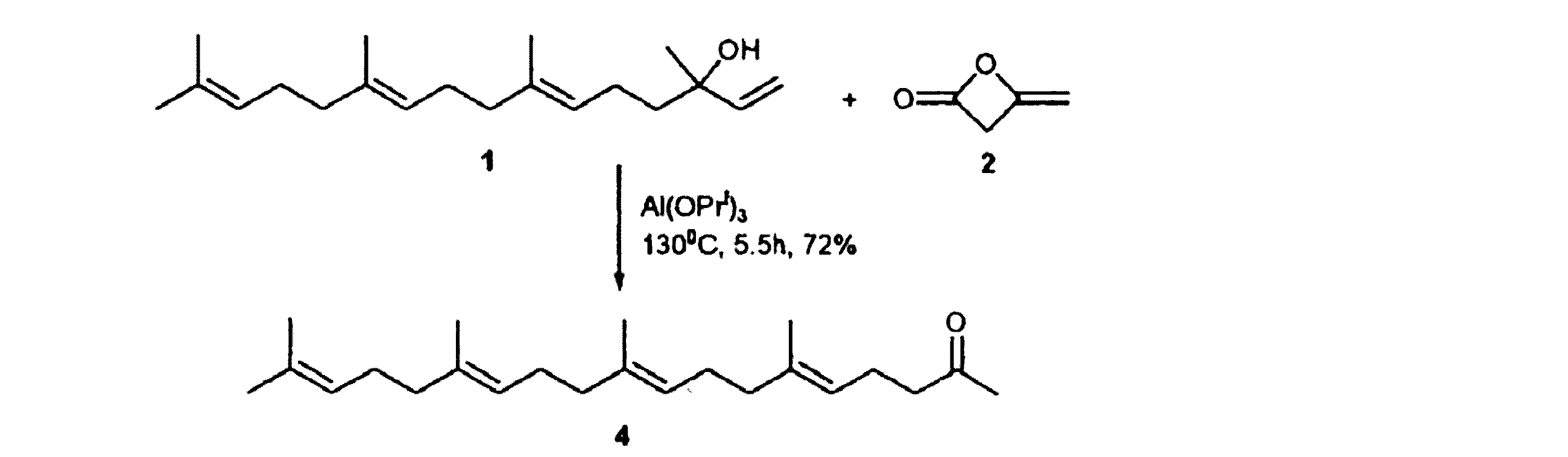
具体的には、上記反応式において、ゲラニルリナロール1と化合物2とアルミニウムイソプロポキシドとを混合し、この混合物を徐々に130℃まで昇温して反応させる。反応終了後、残渣の化合物2を除去し、反応混合物を5%炭酸ナトリウムで希釈して、残渣のアルミニウムプロポキシドをクエンチングする。これにより、オールトランス体が得られる。さらに、ジクロロメタンを溶出液として用いたシリカゲルクロマトグラフィー等でオールトランス体を精製すればよい。
<モノシス体>
5Z,9E,13EGGA(5Zモノシス体)は、以下の構造式

で表される化合物である。
5Zモノシス体は、市販テプレノンの分離により得ることができる。
5Z,9E,13EGGA(5Zモノシス体)は、以下の構造式
5Zモノシス体は、市販テプレノンの分離により得ることができる。
<その他>
その他のGGA幾何異性体も、上記方法を参考にして当業者が製造することができる。
例えば、オールトランス体と5Zモノシス体との混合物であって、オールトランス体を60重量%を超えて含むものは、市販テプレノンに、オールトランス体を添加することにより得ることができる。また、5Zモノシス体とオールトランス体との混合物であって、5Zモノシス体を40重量%を超えて含むものは、市販テプレノンに、5Zモノシス体を添加することにより得ることができる。
その他のGGA幾何異性体も、上記方法を参考にして当業者が製造することができる。
例えば、オールトランス体と5Zモノシス体との混合物であって、オールトランス体を60重量%を超えて含むものは、市販テプレノンに、オールトランス体を添加することにより得ることができる。また、5Zモノシス体とオールトランス体との混合物であって、5Zモノシス体を40重量%を超えて含むものは、市販テプレノンに、5Zモノシス体を添加することにより得ることができる。
GGAの含有量
眼科用組成物中のGGAの含有量は、組成物の全体量に対して、0.00001重量%以上が好ましく、0.00005重量%以上がより好ましく、0.0001重量%以上がより好ましく、0.0005重量%以上がより好ましく、0.001重量%以上がさらにより好ましい。また、0.005重量%以上であってもよく、0.01重量%以上であってもよく、0.05重量%以上であってもよく、0.1重量%以上であってもよく、0.5重量%以上であってもよく、1重量%以上であってもよい。上記範囲であれば、眼への適用によりGGAの薬理活性が十分に得られる。
また、眼科用組成物中のGGAの含有量は、組成物の全体量に対して、10重量%以下が好ましく、8重量%以下がより好ましく、5重量%以下がより好ましく、4重量%以下がより好ましく、3重量%以下がさらにより好ましい。2重量%以下であってもよい。上記範囲であれば、眼への適用によりGGAの薬理活性が十分に得られると共に、より澄明で、霧視が生じ難い製剤となる。
眼科用組成物中のGGAの含有量は、組成物の全体量に対して、0.00001重量%以上が好ましく、0.00005重量%以上がより好ましく、0.0001重量%以上がより好ましく、0.0005重量%以上がより好ましく、0.001重量%以上がさらにより好ましい。また、0.005重量%以上であってもよく、0.01重量%以上であってもよく、0.05重量%以上であってもよく、0.1重量%以上であってもよく、0.5重量%以上であってもよく、1重量%以上であってもよい。上記範囲であれば、眼への適用によりGGAの薬理活性が十分に得られる。
また、眼科用組成物中のGGAの含有量は、組成物の全体量に対して、10重量%以下が好ましく、8重量%以下がより好ましく、5重量%以下がより好ましく、4重量%以下がより好ましく、3重量%以下がさらにより好ましい。2重量%以下であってもよい。上記範囲であれば、眼への適用によりGGAの薬理活性が十分に得られると共に、より澄明で、霧視が生じ難い製剤となる。
眼科用組成物中のGGAの含有量としては、組成物の全体量に対して、約0.00001~10重量%、約0.00001~8重量%、約0.00001~5重量%、約0.00001~4重量%、約0.00001~3重量%、約0.00001~2重量%、約0.00005~10重量%、約0.00005~8重量%、約0.00005~5重量%、約0.00005~4重量%、約0.00005~3重量%、約0.00005~2重量%、約0.0001~10重量%、約0.0001~8重量%、約0.0001~5重量%、約0.0001~4重量%、約0.0001~3重量%、約0.0001~2重量%、約0.0005~10重量%、約0.0005~8重量%、約0.0005~5重量%、約0.0005~4重量%、約0.0005~3重量%、約0.0005~2重量%、約0.001~10重量%、約0.001~8重量%、約0.001~5重量%、約0.001~4重量%、約0.001~3重量%、約0.001~2重量%、約0.005~10重量%、約0.005~8重量%、約0.005~5重量%、約0.005~4重量%、約0.005~3重量%、約0.005~2重量%、約0.01~10重量%、約0.01~8重量%、約0.01~5重量%、約0.01~4重量%、約0.01~3重量%、約0.01~2重量%、約0.05~10重量%、約0.05~8重量%、約0.05~5重量%、約0.05~4重量%、約0.05~3重量%、約0.05~2重量%、約0.1~10重量%、0.1~8重量%、約0.1~5重量%、0.1~4重量%、約0.1~3重量%、0.1~2重量%、約0.5~10重量%、約0.5~8重量%、約0.5~5重量%、約0.5~4重量%、約0.5~3重量%、約0.5~2重量%、約1~10重量%、約1~8重量%、約1~5重量%、約1~4重量%、約1~3重量%、約1~2重量%が挙げられる。
界面活性剤
界面活性剤は、眼科用組成物に使用され得る界面活性剤であればよく、特に限定されない。例えば、ポリオキシエチレン(以下、「POE」ということもある)-ポリオキシプロピレン(以下、「POP」ということもある)ブロックコポリマー(ポロクサマー407、ポロクサマー235、ポロクサマー188など)、エチレンジアミンのPOE-POPブロックコポリマー付加物(ポロキサミンなど)、POEソルビタン脂肪酸エステル(ポリソルベート20、ポリソルベート60、ポリソルベート65、ポリソルベート80(TO-10等)など)、POE硬化ヒマシ油(POE(5)硬化ヒマシ油、POE(10)硬化ヒマシ油、POE(20)硬化ヒマシ油、POE(40)硬化ヒマシ油、POE(50)硬化ヒマシ油、POE(60)硬化ヒマシ油(HCO-60等)、POE(100)硬化ヒマシ油など)、POEヒマシ油(POE(3)ヒマシ油、POE(10)ヒマシ油、POE(35)ヒマシ油、POE(40)ヒマシ油など)、POEアルキルエーテル(ポリオキシエチレン(9)ラウリルエーテル、ポリオキシエチレン(20)ポリオキシプロピレン(4)セチルエーテルなど)、POEアルキルフェニルエーテル(POE(10)ノニルフェニルエーテルなど)、ステアリン酸ポリオキシル(ステアリン酸ポリオキシル40など)、ポリオキシジエチルヒマシ油(クレモフォア)のような非イオン界面活性剤;グリシン型両性界面活性剤(例えば、アルキルジアミノエチルグリシン、アルキルポリアミノエチルグリシン、又はそれらの塩、及びベタイン型両性界面活性剤(例えば、ラウリルジメチルアミノ酢酸ベタイン、イミダゾリニウムベタイン)のような両性界面活性剤;アルキル4級アンモニウム塩又はアルキル3級アンモニウム塩(例えば、塩化ベンザルコニウム、塩化ベンゼトニウム、塩化ポリドロニウム、ビグアニド化合物(具体的には、塩酸ポリヘキサメチレンビグアニド又はその塩酸塩など))のような陽イオン界面活性剤;アルキルベンゼンスルホン酸ナトリウムのような陰イオン界面活性剤などが挙げられる。なお、括弧内の数字は付加モル数を示す。
界面活性剤は、眼科用組成物に使用され得る界面活性剤であればよく、特に限定されない。例えば、ポリオキシエチレン(以下、「POE」ということもある)-ポリオキシプロピレン(以下、「POP」ということもある)ブロックコポリマー(ポロクサマー407、ポロクサマー235、ポロクサマー188など)、エチレンジアミンのPOE-POPブロックコポリマー付加物(ポロキサミンなど)、POEソルビタン脂肪酸エステル(ポリソルベート20、ポリソルベート60、ポリソルベート65、ポリソルベート80(TO-10等)など)、POE硬化ヒマシ油(POE(5)硬化ヒマシ油、POE(10)硬化ヒマシ油、POE(20)硬化ヒマシ油、POE(40)硬化ヒマシ油、POE(50)硬化ヒマシ油、POE(60)硬化ヒマシ油(HCO-60等)、POE(100)硬化ヒマシ油など)、POEヒマシ油(POE(3)ヒマシ油、POE(10)ヒマシ油、POE(35)ヒマシ油、POE(40)ヒマシ油など)、POEアルキルエーテル(ポリオキシエチレン(9)ラウリルエーテル、ポリオキシエチレン(20)ポリオキシプロピレン(4)セチルエーテルなど)、POEアルキルフェニルエーテル(POE(10)ノニルフェニルエーテルなど)、ステアリン酸ポリオキシル(ステアリン酸ポリオキシル40など)、ポリオキシジエチルヒマシ油(クレモフォア)のような非イオン界面活性剤;グリシン型両性界面活性剤(例えば、アルキルジアミノエチルグリシン、アルキルポリアミノエチルグリシン、又はそれらの塩、及びベタイン型両性界面活性剤(例えば、ラウリルジメチルアミノ酢酸ベタイン、イミダゾリニウムベタイン)のような両性界面活性剤;アルキル4級アンモニウム塩又はアルキル3級アンモニウム塩(例えば、塩化ベンザルコニウム、塩化ベンゼトニウム、塩化ポリドロニウム、ビグアニド化合物(具体的には、塩酸ポリヘキサメチレンビグアニド又はその塩酸塩など))のような陽イオン界面活性剤;アルキルベンゼンスルホン酸ナトリウムのような陰イオン界面活性剤などが挙げられる。なお、括弧内の数字は付加モル数を示す。
中でも、非イオン界面活性剤が好ましく、2種以上の界面活性剤のうち、少なくとも1種が非イオン界面活性剤であることが好ましい。非イオン界面活性剤としては、POEソルビタン脂肪酸エステル、POE硬化ヒマシ油、POEヒマシ油、ステアリン酸ポリオキシル、及びPOE-POPブロックコポリマーがより好ましい。中でも、ポロクサマー407、ポリソルベート80、POE硬化ヒマシ油60、POE硬化ヒマシ油40、POEヒマシ油35、及びPOEヒマシ油10がさらに好ましい。
2種の非イオン界面活性剤の好ましい組み合わせとして、ポロクサマー407とポリソルベート80との組み合わせ、ポロクサマー407とPOE硬化ヒマシ油60との組み合わせ、ポロクサマー407とPOE硬化ヒマシ油40との組み合わせ、ポロクサマー407とPOEヒマシ油35との組み合わせ、ポロクサマー407とPOEヒマシ油10との組み合わせ、ポリソルベート80とPOE硬化ヒマシ油60との組み合わせ、ポリソルベート80とPOE硬化ヒマシ油40との組み合わせ、ポリソルベート80とPOEヒマシ油35との組み合わせ、ポリソルベート80とPOEヒマシ油10との組み合わせ、POE硬化ヒマシ油60とPOE硬化ヒマシ油40との組み合わせ、POE硬化ヒマシ油60とPOEヒマシ油35との組み合わせ、POE硬化ヒマシ油60とPOEヒマシ油10との組み合わせ、POE硬化ヒマシ油40とPOEヒマシ油35との組み合わせ、POE硬化ヒマシ油40とPOEヒマシ油10との組み合わせ、POEヒマシ油35とPOEヒマシ油10との組み合わせ等が挙げられる。
3種の非イオン界面活性剤の好ましい組み合わせとして、ポリソルベート80とPOE硬化ヒマシ油60とPOEヒマシ油10との組み合わせ、ポリソルベート80とPOE硬化ヒマシ油60とポロクサマー407との組み合わせ、POE硬化ヒマシ油60とPOEヒマシ油10とポロクサマー407との組み合わせなどが挙げられる。
3種の非イオン界面活性剤の好ましい組み合わせとして、ポリソルベート80とPOE硬化ヒマシ油60とPOEヒマシ油10との組み合わせ、ポリソルベート80とPOE硬化ヒマシ油60とポロクサマー407との組み合わせ、POE硬化ヒマシ油60とPOEヒマシ油10とポロクサマー407との組み合わせなどが挙げられる。
界面活性剤は、2種、又は3種以上を組み合わせて使用できる。
2種以上の界面活性剤の好適な組み合わせとしては、2種以上の非イオン界面活性剤の組み合わせ、少なくとも1種の非イオン界面活性剤と少なくとも1種の陽イオン性界面活性剤との組み合わせ、少なくとも1種の非イオン界面活性剤と少なくとも1種の両性界面活性剤との組み合わせが好ましい。
2種以上の界面活性剤の好適な組み合わせとしては、2種以上の非イオン界面活性剤の組み合わせ、少なくとも1種の非イオン界面活性剤と少なくとも1種の陽イオン性界面活性剤との組み合わせ、少なくとも1種の非イオン界面活性剤と少なくとも1種の両性界面活性剤との組み合わせが好ましい。
2種以上の非イオン界面活性剤の組み合わせとしては、POEソルビタン脂肪酸エステル、POE硬化ヒマシ油、POEヒマシ油、ステアリン酸ポリオキシル、及びPOE-POPブロックコポリマーからなる群より選択される非イオン界面活性剤のうち、2種以上の組み合わせが好ましい。この場合、基本骨格となる化学構造が同じ界面活性剤、換言すれば同系列ないしは同属の界面活性剤、例えば、POEヒマシ油の中から2種以上の組み合わせの場合もあり得るし、基本骨格となる化学構造が異なる界面活性剤、例えば、少なくとも1種のPOEソルビタン脂肪酸エステルと少なくとも1種のPOE硬化ヒマシ油との組み合わせの場合もあり得る。好ましくは、基本骨格となる化学構造が異なる界面活性剤の2種以上の組み合わせである。
より好ましくは、基本骨格となる化学構造の異なる非イオン界面活性剤2種以上の組み合わせとして、POEソルビタン脂肪酸エステルの中から1種(例えばポリソルベート80)以上とPOE硬化ヒマシ油の中から1種(例えばPOE硬化ヒマシ油60)以上との組み合わせ、POEソルビタン脂肪酸エステルの中から1種(例えばポリソルベート80)以上とPOEヒマシ油の中から1種(例えば、POEヒマシ油10)以上との組み合わせ、POEソルビタン脂肪酸エステルの中から1種(例えばポリソルベート80)以上とステアリン酸ポリオキシルの中から1種(例えばステアリン酸ポリオキシル40)以上との組み合わせ、POEソルビタン脂肪酸エステルの中から1種(例えばポリソルベート80)以上とPOE-POPブロックコポリマーの中から1種(例えばポロクサマー407)以上との組み合わせ、POE硬化ヒマシ油の中から1種(例えばPOE硬化ヒマシ油60)以上とPOEヒマシ油の中から1種(例えば、POEヒマシ油10)以上との組み合わせ、POE硬化ヒマシ油の中から1種(例えばPOE硬化ヒマシ油60)以上とステアリン酸ポリオキシルの中から1種(例えばステアリン酸ポリオキシル40)以上との組み合わせ、POE硬化ヒマシ油の中から1種(例えばPOE硬化ヒマシ油60)以上とPOE-POPブロックコポリマーの中から1種(例えばポロクサマー407)以上との組み合わせ、POEヒマシ油の中から1種(例えば、POEヒマシ油10)以上とステアリン酸ポリオキシルの中から1種(例えばステアリン酸ポリオキシル40)以上との組み合わせ、POEヒマシ油の中から1種(例えば、POEヒマシ油10)以上とPOE-POPブロックコポリマーの中から1種(例えばポロクサマー407)以上との組み合わせ、ステアリン酸ポリオキシルの中から1種(例えばステアリン酸ポリオキシル40)以上とPOE-POPブロックコポリマーの中から1種(例えばポロクサマー407)以上との組み合わせ等が挙げられる。
また、基本骨格となる化学構造が同じ非イオン界面活性剤2種以上の組み合わせとして、POEヒマシ油の中から2種(例えば、POEヒマシ油35とPOEヒマシ油10)又はそれ以上の組み合わせ、POEソルビタン脂肪酸エステルの中から2種(例えば、ポリソルベート80とポリソルベート65)又はそれ以上の組み合わせ、POE硬化ヒマシ油の中から2種(例えば、POE硬化ヒマシ油60とPOE硬化ヒマシ油40)又はそれ以上の組み合わせ、ステアリン酸ポリオキシルの中から2種以上、及びPOE-POPブロックコポリマーの中から2種(例えば、ポロクサマー407とポロクサマー235)又はそれ以上の組み合わせ等が挙げられる。
本願発明の効果をより顕著に奏する点で、基本骨格となる化学構造の異なる非イオン界面活性剤2種以上の組み合わせがさらに好適である。
本願発明の効果をより顕著に奏する点で、基本骨格となる化学構造の異なる非イオン界面活性剤2種以上の組み合わせがさらに好適である。
また別の観点から、非イオン界面活性剤2種以上の組み合わせとしては、HLBの異なる2種以上の非イオン性界面活性剤を組み合わせることがより好ましい。例えば、HLBのより高い界面活性剤としては、HLBが10以上が好ましく、12以上がより好ましく、14以上がさらに好ましい。また、HLBのより低い界面活性剤として、HLBが14未満が好ましく、12未満がより好ましく、10未満がさらに好ましく、8未満が特に好ましい。HLBの異なる2種以上の非イオン性界面活性剤を組み合わせることにより、本願発明の効果をより顕著に奏する。
具体的には、HLBが14以上の非イオン界面活性剤2種の組み合わせ、HLBが14以上の非イオン界面活性剤と14未満の非イオン界面活性剤との組み合わせ、HLBが14以上の非イオン界面活性剤と12未満の非イオン界面活性剤との組み合わせ、HLBが14以上の非イオン界面活性剤と10未満の非イオン界面活性剤との組み合わせ、HLBが14以上の非イオン界面活性剤と8未満の非イオン界面活性剤との組み合わせ、
HLBが12以上の非イオン界面活性剤と12未満の非イオン界面活性剤との組み合わせ、HLBが12以上の非イオン界面活性剤と10未満の非イオン界面活性剤との組み合わせ、HLBが12以上の非イオン界面活性剤と8未満の非イオン界面活性剤との組み合わせ、
HLBが10以上の非イオン界面活性剤と10未満の非イオン界面活性剤との組み合わせ、HLBが10以上の非イオン界面活性剤と8未満の非イオン界面活性剤との組み合わせなどが挙げられる。
中でも、HLBが12以上の非イオン界面活性剤と12未満の非イオン界面活性剤との組み合わせが好ましく、HLBが14以上の非イオン界面活性剤と10未満の非イオン界面活性剤との組み合わせがさらに好ましい。
好ましい組み合わせとして、具体的には、ポリソルベート80とPOE(10)ヒマシ油との組み合わせ、POE(60)硬化ヒマシ油とPOE(10)ヒマシ油との組み合わせ、POE(40)硬化ヒマシ油とPOE(10)ヒマシ油との組み合わせ、ステアリン酸ポリオキシル40とPOE(10)ヒマシ油との組み合わせ、ポロクサマー407とPOE(10)ヒマシ油との組み合わせなどが挙げられる。
HLBが12以上の非イオン界面活性剤と12未満の非イオン界面活性剤との組み合わせ、HLBが12以上の非イオン界面活性剤と10未満の非イオン界面活性剤との組み合わせ、HLBが12以上の非イオン界面活性剤と8未満の非イオン界面活性剤との組み合わせ、
HLBが10以上の非イオン界面活性剤と10未満の非イオン界面活性剤との組み合わせ、HLBが10以上の非イオン界面活性剤と8未満の非イオン界面活性剤との組み合わせなどが挙げられる。
中でも、HLBが12以上の非イオン界面活性剤と12未満の非イオン界面活性剤との組み合わせが好ましく、HLBが14以上の非イオン界面活性剤と10未満の非イオン界面活性剤との組み合わせがさらに好ましい。
好ましい組み合わせとして、具体的には、ポリソルベート80とPOE(10)ヒマシ油との組み合わせ、POE(60)硬化ヒマシ油とPOE(10)ヒマシ油との組み合わせ、POE(40)硬化ヒマシ油とPOE(10)ヒマシ油との組み合わせ、ステアリン酸ポリオキシル40とPOE(10)ヒマシ油との組み合わせ、ポロクサマー407とPOE(10)ヒマシ油との組み合わせなどが挙げられる。
また、HLBが異なる2種以上の非イオン界面活性剤を組み合わせる場合、その含有量の比率は任意に定めることができるが、好ましくは、組成物に含有される非イオン界面活性剤のうち、HLBがより低いいずれか1種の非イオン界面活性剤の含有量の1重量部に対し、HLBがより高いいずれかの1種の非イオン界面活性剤が0.001重量部以上、より好ましくは0.003重量部以上、より好ましくは0.005重量部以上、より好ましくは0.008重量部以上、より好ましくは0.01重量部以上、より好ましくは0.03重量部以上、より好ましくは0.05重量部以上、より好ましくは0.08重量部以上、より好ましくは0.1重量部以上、より好ましくは0.3重量部以上、特に好ましくは0.5重量部以上である。
また、好ましくは、HLBがより低い非イオン界面活性剤の含有量の1重量部に対し、HLBがより高い非イオン界面活性剤が1000重量部以下、より好ましくは800重量部以下、より好ましくは500重量部以下、より好ましくは300重量部以下、より好ましくは100重量部以下、より好ましくは80重量部以下、特に好ましくは50重量部以下である。
また、好ましくは、HLBがより低い非イオン界面活性剤の含有量の1重量部に対し、HLBがより高い非イオン界面活性剤が1000重量部以下、より好ましくは800重量部以下、より好ましくは500重量部以下、より好ましくは300重量部以下、より好ましくは100重量部以下、より好ましくは80重量部以下、特に好ましくは50重量部以下である。
HLBがより低い非イオン界面活性剤の含有量の1重量部に対し、HLBがより高い非イオン界面活性剤の含有量の比率としては、約0.001~1000重量部、約0.001~800重量部、約0.001~500重量部、約0.001~300重量部、約0.001~100重量部、約0.001~80重量部、0.001~50重量部、約0.003~1000重量部、約0.003~800重量部、約0.003~500重量部、約0.003~300重量部、約0.003~100重量部、約0.003~80重量部、0.003~50重量部、約0.005~1000重量部、約0.005~800重量部、約0.005~500重量部、約0.005~300重量部、約0.005~100重量部、約0.005~80重量部、0.005~50重量部、約0.008~1000重量部、約0.008~800重量部、約0.008~500重量部、約0.008~300重量部、約0.008~100重量部、約0.008~80重量部、0.008~50重量部、約0.01~1000重量部、約0.01~800重量部、約0.01~500重量部、約0.01~300重量部、約0.01~100重量部、約0.01~80重量部、0.01~50重量部、約0.03~1000重量部、約0.03~800重量部、約0.03~500重量部、約0.03~300重量部、約0.03~100重量部、約0.03~80重量部、0.03~50重量部、約0.05~1000重量部、約0.05~800重量部、約0.05~500重量部、約0.05~300重量部、約0.05~100重量部、約0.05~80重量部、0.05~50重量部、約0.08~1000重量部、約0.08~800重量部、約0.08~500重量部、約0.08~300重量部、約0.08~100重量部、約0.08~80重量部、0.08~50重量部、約0.1~1000重量部、約0.1~800重量部、約0.1~500重量部、約0.1~300重量部、約0.1~100重量部、約0.1~80重量部、0.1~50重量部、約0.3~1000重量部、約0.3~800重量部、約0.3~500重量部、約0.3~300重量部、約0.3~100重量部、約0.3~80重量部、0.3~50重量部、約0.5~1000重量部、約0.5~800重量部、約0.5~500重量部、約0.5~300重量部、約0.5~100重量部、約0.5~80重量部、0.5~50重量部が挙げられる。
非イオン界面活性剤と陽イオン性界面活性剤との組み合わせとしては、POEソルビタン脂肪酸エステル、POE硬化ヒマシ油、POEヒマシ油、ステアリン酸ポリオキシル及びPOE-POPブロックコポリマーからなる群より選択される1種以上の非イオン界面活性剤と、四級アンモニウム型界面活性剤又は三級アンモニウム型界面活性剤との組み合わせが好ましい。
好適な組み合わせとして、例えば、POEソルビタン脂肪酸エステルと塩化ベンザルコニウムとの組み合わせ、POEソルビタン脂肪酸エステルと塩酸ポリヘキサメチレンビグアニドとの組み合わせ、POE硬化ヒマシ油と塩化ベンザルコニウムとの組み合わせ、POE硬化ヒマシ油と塩酸ポリヘキサメチレンビグアニドとの組み合わせ、POEヒマシ油と塩化ベンザルコニウムとの組み合わせ、POEヒマシ油と塩酸ポリヘキサメチレンビグアニドとの組み合わせなどが挙げられる。
好適な組み合わせとして、例えば、POEソルビタン脂肪酸エステルと塩化ベンザルコニウムとの組み合わせ、POEソルビタン脂肪酸エステルと塩酸ポリヘキサメチレンビグアニドとの組み合わせ、POE硬化ヒマシ油と塩化ベンザルコニウムとの組み合わせ、POE硬化ヒマシ油と塩酸ポリヘキサメチレンビグアニドとの組み合わせ、POEヒマシ油と塩化ベンザルコニウムとの組み合わせ、POEヒマシ油と塩酸ポリヘキサメチレンビグアニドとの組み合わせなどが挙げられる。
非イオン界面活性剤と両性界面活性剤との組み合わせとしては、POEソルビタン脂肪酸エステル、POE硬化ヒマシ油、POEヒマシ油、ステアリン酸ポリオキシル及びPOE-POPブロックコポリマーからなる群より選択される1種以上の非イオン界面活性剤と、グリシン型両性界面活性剤との組み合わせが好ましい。
例えば、好適な組み合わせとして、POEソルビタン脂肪酸エステルと塩酸アルキルジアミノエチルグリシンとの組み合わせ、POE硬化ヒマシ油と塩酸アルキルジアミノエチルグリシンとの組み合わせ、POEヒマシ油と塩酸アルキルジアミノエチルグリシン組み合わせなどが挙げられる。
例えば、好適な組み合わせとして、POEソルビタン脂肪酸エステルと塩酸アルキルジアミノエチルグリシンとの組み合わせ、POE硬化ヒマシ油と塩酸アルキルジアミノエチルグリシンとの組み合わせ、POEヒマシ油と塩酸アルキルジアミノエチルグリシン組み合わせなどが挙げられる。
なお、リン脂質にも界面活性作用を有する物質が含まれるが、本発明にいう界面活性剤からはリン脂質は除かれる。即ち、本発明の眼科用組成物はリン脂質を含んでいて良いが、リン脂質以外の界面活性剤を2種以上含む。
界面活性剤の含有量
眼科用組成物中の界面活性剤の含有量は、組成物の全体量に対して、界面活性剤の総量として、0.0001重量%以上が好ましく、0.0003重量%以上がより好ましく、0.0005重量%以上がより好ましく、0.0008重量%以上がより好ましく、0.001重量%以上が好ましく、0.003重量%以上がより好ましく、0.005重量%以上がより好ましく、0.008重量%以上がより好ましく、0.01重量%以上がより好ましく、0.03重量%以上がより好ましく、0.05重量%以上がより好ましく、0.08重量%以上がより好ましく、0.1重量%以上がさらにより好ましい。上記範囲であれば、乳化作用が十分に得られると共に、GGAの容器及び/又はコンタクトレンズへの吸着が抑えられ、GGAの角膜透過性及び/又は網膜細胞への親和性が向上する。
また、眼科用組成物中の界面活性剤の含有量は、組成物の全体量に対して、界面活性剤の総量として、20重量%以下が好ましく、10重量%以下がより好ましく、8重量%以下がより好ましく、5重量%以下がさらにより好ましい。上記範囲であれば、眼刺激性が抑えられる。
眼科用組成物中の界面活性剤の含有量は、組成物の全体量に対して、界面活性剤の総量として、0.0001重量%以上が好ましく、0.0003重量%以上がより好ましく、0.0005重量%以上がより好ましく、0.0008重量%以上がより好ましく、0.001重量%以上が好ましく、0.003重量%以上がより好ましく、0.005重量%以上がより好ましく、0.008重量%以上がより好ましく、0.01重量%以上がより好ましく、0.03重量%以上がより好ましく、0.05重量%以上がより好ましく、0.08重量%以上がより好ましく、0.1重量%以上がさらにより好ましい。上記範囲であれば、乳化作用が十分に得られると共に、GGAの容器及び/又はコンタクトレンズへの吸着が抑えられ、GGAの角膜透過性及び/又は網膜細胞への親和性が向上する。
また、眼科用組成物中の界面活性剤の含有量は、組成物の全体量に対して、界面活性剤の総量として、20重量%以下が好ましく、10重量%以下がより好ましく、8重量%以下がより好ましく、5重量%以下がさらにより好ましい。上記範囲であれば、眼刺激性が抑えられる。
眼科用組成物中の界面活性剤の含有量としては、組成物の全体量に対して、界面活性剤の総量として、約0.0001~20重量%、約0.0003~20重量%、約0.0005~20重量%、約0.0008~20重量%、約0.001~20重量%、約0.003~20重量%、約0.005~20重量%、約0.008~20重量%、約0.01~20重量%、約0.03~20重量%、約0.05~20重量%、約0.08~20重量%、約0.1~20重量%、約0.0001~10重量%、約0.0003~10重量%、約0.0005~10重量%、約0.0008~10重量%、約0.001~10重量%、約0.003~10重量%、約0.005~10重量%、約0.008~10重量%、約0.01~10重量%、約0.03~10重量%、約0.05~10重量%、約0.08~10重量%、約0.1~10重量%、約0.0001~8重量%、約0.0003~8重量%、約0.0005~8重量%、約0.0008~8重量%、約0.001~8重量%、約0.003~8重量%、約0.005~8重量%、約0.008~8重量%、約0.01~8重量%、約0.03~8重量%、約0.05~8重量%、約0.08~8重量%、約0.1~8重量%、約0.0001~5重量%、約0.0003~5重量%、約0.0005~5重量%、約0.0008~5重量%、約0.001~5重量%、約0.003~5重量%、約0.005~5重量%、約0.008~5重量%、約0.01~5重量%、約0.03~5重量%、約0.05~5重量%、約0.08~5重量%、約0.1~5重量%が挙げられる。
また、界面活性剤の含有量は、GGAの1重量部に対して、界面活性剤の総量として、0.001重量部以上が好ましく、0.003重量部以上がより好ましく、0.005重量部以上がより好ましく、0.008重量部以上がより好ましく、0.01重量部以上がより好ましく、0.03重量部以上がより好ましく、0.05重量部以上がより好ましく、0.08重量部以上がより好ましく、0.1重量部以上がさらにより好ましい。上記範囲であれば、乳化作用が十分に得られると共に、GGAの容器及び/又はコンタクトレンズへの吸着が抑えられ、GGAの角膜透過性及び/又は網膜細胞への親和性が向上する。
また、眼科用組成物中の界面活性剤の含有量は、GGAの1重量部に対して、界面活性剤の総量として、1000重量部以下が好ましく、800重量部以下がより好ましく、500重量部以下がより好ましく、300重量部以下がより好ましく、100重量部以下がより好ましく、80重量部以下がより好ましく、50重量部以下がさらにより好ましい。上記範囲であれば、眼刺激性が抑えられる。
また、眼科用組成物中の界面活性剤の含有量は、GGAの1重量部に対して、界面活性剤の総量として、1000重量部以下が好ましく、800重量部以下がより好ましく、500重量部以下がより好ましく、300重量部以下がより好ましく、100重量部以下がより好ましく、80重量部以下がより好ましく、50重量部以下がさらにより好ましい。上記範囲であれば、眼刺激性が抑えられる。
GGAの1重量部に対する界面活性剤の含有量としては、界面活性剤の総量として、約0.001~1000重量部、約0.003~1000重量部、約0.005~1000重量部、約0.008~1000重量部、約0.01~1000重量部、約0.03~1000重量部、約0.05~1000重量部、約0.08~1000重量部、約0.1~1000重量部、約0.001~800重量部、約0.003~800重量部、約0.005~800重量部、約0.008~800重量部、約0.01~800重量部、約0.03~800重量部、約0.05~800重量部、約0.08~800重量部、約0.1~800重量部、約0.001~500重量部、約0.003~500重量部、約0.005~500重量部、約0.008~500重量部、約0.01~500重量部、約0.03~500重量部、約0.05~500重量部、約0.08~500重量部、約0.1~500重量部、約0.001~300重量部、約0.003~300重量部、約0.005~300重量部、約0.008~300重量部、約0.01~300重量部、約0.03~300重量部、約0.05~300重量部、約0.08~300重量部、約0.1~300重量部、約0.001~100重量部、約0.003~100重量部、約0.005~100重量部、約0.008~100重量部、約0.01~100重量部、約0.03~100重量部、約0.05~100重量部、約0.08~100重量部、約0.1~100重量部、約0.001~80重量部、約0.003~80重量部、約0.005~80重量部、約0.008~80重量部、約0.01~80重量部、約0.03~80重量部、約0.05~80重量部、約0.08~80重量部、約0.1~80重量部、約0.001~50重量部、約0.003~50重量部、約0.005~50重量部、約0.008~50重量部、約0.01~50重量部、約0.03~50重量部、約0.05~50重量部、約0.08~50重量部、約0.1~50重量部が挙げられる。
製剤
眼科用組成物の性状は特に限定されず、例えば、液体状、流動状、ゲル状、半固形状、又は固形状などの何れの性状であってもよい。また、用時調製により、液体状、流動状、ゲル状、半固形状、又は固形状などになったものも含まれる。半固形状は、例えば、軟膏剤のように、力を加えることにより変形させ得る塑性を有する性状をいう。
眼科用組成物の性状は特に限定されず、例えば、液体状、流動状、ゲル状、半固形状、又は固形状などの何れの性状であってもよい。また、用時調製により、液体状、流動状、ゲル状、半固形状、又は固形状などになったものも含まれる。半固形状は、例えば、軟膏剤のように、力を加えることにより変形させ得る塑性を有する性状をいう。
眼科用製剤の種類は特に限定されない。例えば、点眼剤(コンタクトレンズ装用時に点眼するものも含む)、洗眼剤、コンタクトレンズ装着液、コンタクトレンズ用液(洗浄液、保存液、消毒液、マルチパーパスソリューション、パッケージソリューション)、移植用の角膜等の摘出眼組織の保存剤、手術時潅流液、眼軟膏(水溶性眼軟膏、油溶性眼軟膏)、眼内注射剤(例えば、硝子体内注射剤)、徐放性眼内埋植剤、及び徐放性コンタクトレンズ製剤などが挙げられる。中でも、患部への移行性が良好である点で、点眼剤、眼内注射剤、眼軟膏、及び洗眼剤が好ましく、点眼剤がより好ましい。
なお、徐放性眼内埋植剤には、固形状、半固形状、ゲル状、流動状、液状などの製剤が含まれ、徐放性コンタクトレンズ製剤には、固形状、半固形状、ゲル状などの製剤が含まれる。
なお、徐放性眼内埋植剤には、固形状、半固形状、ゲル状、流動状、液状などの製剤が含まれ、徐放性コンタクトレンズ製剤には、固形状、半固形状、ゲル状などの製剤が含まれる。
また、眼科用剤は、水性組成物(基剤又は担体として水性ないしは親水性のものを主に含む)であってもよく、油性組成物(基剤又は担体として油性ないしは疎水性のものを主に含む)であっても良い。
水性組成物の場合の水の含有量は、製剤の全量に対して、50重量%以上が好ましく、75重量%以上がより好ましく、90重量%以上がさらにより好ましい。また、基剤又は担体が水のみからなっていてもよい。
油性組成物の場合の水の含有量は、製剤の全量に対して、50重量%以下が好ましく、30重量%以下がより好ましく、20重量%以下がさらにより好ましい。
水性組成物の場合の水の含有量は、製剤の全量に対して、50重量%以上が好ましく、75重量%以上がより好ましく、90重量%以上がさらにより好ましい。また、基剤又は担体が水のみからなっていてもよい。
油性組成物の場合の水の含有量は、製剤の全量に対して、50重量%以下が好ましく、30重量%以下がより好ましく、20重量%以下がさらにより好ましい。
眼科用組成物の調製方法は良く知られている。GGAを、薬学的に許容される基剤又は担体、必要に応じて、薬学的に許容される眼科用組成物の添加剤、及びその他の有効成分(GGA以外の生理活性成分又は薬理活性成分)と混合することにより調製できる。
<基剤又は担体>
基剤又は担体として、例えば、水;極性溶媒のような水性溶媒;多価アルコール;植物油;油性基剤などが挙げられる。眼内注射剤の基剤又は担体としては、注射用蒸留水または生理用食塩水が挙げられる。
基剤又は担体は、1種を単独で、又は2種以上を組み合わせて使用できる。
基剤又は担体として、例えば、水;極性溶媒のような水性溶媒;多価アルコール;植物油;油性基剤などが挙げられる。眼内注射剤の基剤又は担体としては、注射用蒸留水または生理用食塩水が挙げられる。
基剤又は担体は、1種を単独で、又は2種以上を組み合わせて使用できる。
<添加剤>
添加剤としては、界面活性剤の他にも、例えば、防腐剤、粘稠化剤、香料又は清涼化剤、pH調節剤、等張化剤、キレート剤、緩衝剤、安定化剤、及び抗酸化剤などが挙げられる。眼内注射剤には、溶解補助剤、懸濁化剤、等張化剤、緩衝剤、無痛化剤、及び安定化剤などが含まれていてもよい。
添加剤は、1種を単独で、又は2種以上を組み合わせて使用できる。
添加剤としては、界面活性剤の他にも、例えば、防腐剤、粘稠化剤、香料又は清涼化剤、pH調節剤、等張化剤、キレート剤、緩衝剤、安定化剤、及び抗酸化剤などが挙げられる。眼内注射剤には、溶解補助剤、懸濁化剤、等張化剤、緩衝剤、無痛化剤、及び安定化剤などが含まれていてもよい。
添加剤は、1種を単独で、又は2種以上を組み合わせて使用できる。
添加剤の具体例を以下に例示する。
防腐剤:例えば、安息香酸ナトリウム、エタノール、グルコン酸クロルヘキシジン、クロロブタノール、ソルビン酸、ソルビン酸カリウム、デヒドロ酢酸ナトリウム、パラオキシ安息香酸メチル、パラオキシ安息香酸エチル、パラオキシ安息香酸プロピル、パラオキシ安息香酸ブチル、硫酸オキシキノリン、フェネチルアルコール、ベンジルアルコール、及びグローキル(ローディア社製)など。
粘稠化剤:グアーガム、ヒドロキシプロピルグアーガム、メチルセルロース、エチルセルロース、ヒドロキシプロピルメチルセルロース、ヒドロキシエチルセルロース、カルボキシメチルセルロースナトリウムのようなセルロース系高分子化合物、アラビアゴム、カラヤガム、キサンタンガム、寒天、アルギン酸、アルギン酸塩(ナトリウム塩など)、α-シクロデキストリン、デキストリン、デキストラン、ヘパリン、ヘパリノイド、ヘパリン硫酸、ヘパラン硫酸、ヒアルロン酸、ヒアルロン酸塩(ナトリウム塩など)、コンドロイチン硫酸ナトリウム、デンプン、キチン及びその誘導体、キトサン及びその誘導体、カラギーナン、ソルビトール、ポリビニルピロリドン、ポリビニルアルコール、ポリビニルメタアクリレートのようなポリビニル系高分子化合物、ポリアクリル酸のアルカリ金属塩(ナトリウム塩、及びカリウム塩など)、ポリアクリル酸のアミン塩(モノエタノールアミン塩、ジエタノールアミン塩、トリエタノールアミン塩など)、ポリアクリル酸のアンモニウム塩のようなカルボキシビニルポリマー、カゼイン、ゼラチン、コラーゲン、ペクチン、エラスチン、セラミド、流動パラフィン、グリセリン、ポリエチレングリコール、マクロゴール、ポリエチレンイミンアルギン酸塩(ナトリウム塩など)、アルギン酸エステル(プロピレングリコールエステルなど)、トラガント末、並びにトリイソプロパノールアミンなど。
香料又は清涼化剤:例えば、カンフル、ボルネオール、テルペン類(これらはd体、l体又はdl体のいずれでもよい)、ハッカ水、ユーカリ油、ベルガモット油、アネトール、オイゲノール、ゲラニオール、メントール、リモネン、ハッカ油、ペパーミント油、及びローズ油のような精油など。
pH調節剤:例えば、塩酸、水酸化ナトリウム、水酸化カリウム、水酸化カルシウム、水酸化マグネシウム、トリエタノールアミン、モノエタノールアミン、ジイソプロパノールアミン、硫酸、及びリン酸など。
等張化剤:例えば、亜硫酸水素ナトリウム、亜硫酸ナトリウム、塩化カリウム、塩化カルシウム、塩化ナトリウム、塩化マグネシウム、酢酸カリウム、酢酸ナトリウム、炭酸水素ナトリウム、炭酸ナトリウム、チオ硫酸ナトリウム、硫酸マグネシウム、リン酸水素二ナトリウム、リン酸二水素ナトリウム、リン酸二水素カリウム、グリセリン、及びプロピレングリコールなど。
キレート剤:例えば、アスコルビン酸、エデト酸四ナトリウム、エデト酸ナトリウム、及びクエン酸など。
緩衝剤:例えば、リン酸緩衝剤;クエン酸、クエン酸ナトリウムのようなクエン酸緩衝剤;酢酸、酢酸カリウム、酢酸ナトリウムのような酢酸緩衝剤;炭酸水素ナトリウム、炭酸ナトリウムのような炭酸緩衝剤;ホウ酸、ホウ砂のようなホウ酸緩衝剤;タウリン、アスパラギン酸及びその塩類(カリウム塩など)、イプシロン-アミノカプロン酸のようなアミノ酸緩衝剤など。
中でも、リン酸緩衝剤を用いてpHを調整するのが好ましく、それにより、容器壁へのGGAの吸着、ひいては組成物中のGGAの含有率の低下が一層抑制される。また、低温保存時の白濁が抑制され、コンタクトレンズへのGGAの吸着が一層抑制され、熱及び光に対する安定性が良好なものとなるという効果も得られる。
リン酸緩衝剤は1種を単独で、又は2種以上を組み合わせて使用できる。
リン酸緩衝剤は、特に限定されないが、例えば、リン酸;リン酸水素二ナトリウム、リン酸二水素ナトリウム、リン酸三ナトリウム、リン酸水素二カリウム、リン酸二水素カリウム、及びリン酸三カリウムのようなリン酸のアルカリ金属塩;リン酸カルシウム、リン酸水素カルシウム、リン酸二水素カルシウム、リン酸一マグネシウム、リン酸二マグネシウム(リン酸水素マグネシウム)、リン酸三マグネシウムのようなリン酸のアルカリ土類金属塩;リン酸水素二アンモニウム、リン酸二水素アンモニウムのようなリン酸のアンモニウム塩などが挙げられる。リン酸緩衝剤は、無水物又は水和物のいずれでもよい。
リン酸緩衝剤は1種を単独で、又は2種以上を組み合わせて使用できる。
リン酸緩衝剤は、特に限定されないが、例えば、リン酸;リン酸水素二ナトリウム、リン酸二水素ナトリウム、リン酸三ナトリウム、リン酸水素二カリウム、リン酸二水素カリウム、及びリン酸三カリウムのようなリン酸のアルカリ金属塩;リン酸カルシウム、リン酸水素カルシウム、リン酸二水素カルシウム、リン酸一マグネシウム、リン酸二マグネシウム(リン酸水素マグネシウム)、リン酸三マグネシウムのようなリン酸のアルカリ土類金属塩;リン酸水素二アンモニウム、リン酸二水素アンモニウムのようなリン酸のアンモニウム塩などが挙げられる。リン酸緩衝剤は、無水物又は水和物のいずれでもよい。
中でも、リン酸、及びリン酸のアルカリ金属塩からなる群より選ばれる少なくとも一種を使用するのが好ましく、リン酸、及びリン酸のナトリウム塩からなる群より選ばれる少なくとも一種を使用するのがより好ましい。
リン酸緩衝剤の好ましい組み合わせとして、リン酸とリン酸水素二ナトリウムとリン酸二水素ナトリウムとリン酸三ナトリウムとの組み合わせ、リン酸とリン酸水素二ナトリウムとリン酸二水素ナトリウムとの組み合わせ、リン酸とリン酸水素二ナトリウムとリン酸三ナトリウムとの組み合わせ、リン酸とリン酸二水素ナトリウムとリン酸三ナトリウムとの組み合わせ、リン酸水素二ナトリウムとリン酸二水素ナトリウムとリン酸三ナトリウムとの組み合わせ、リン酸とリン酸水素二ナトリウムとの組み合わせ、リン酸とリン酸二水素ナトリウムとの組み合わせ、リン酸とリン酸三ナトリウムとの組み合わせ、リン酸水素二ナトリウムとリン酸二水素ナトリウムとの組み合わせ、リン酸水素二ナトリウムとリン酸三ナトリウムとの組み合わせ、リン酸二水素ナトリウムとリン酸三ナトリウムとの組み合わせが挙げられる。
中でも、リン酸とリン酸水素二ナトリウムとリン酸二水素ナトリウムとの組み合わせ、リン酸とリン酸水素二ナトリウムとの組み合わせ、リン酸とリン酸二水素ナトリウムとの組み合わせ、リン酸水素二ナトリウムとリン酸二水素ナトリウムとの組み合わせが好ましく、リン酸水素二ナトリウムとリン酸二水素ナトリウムとの組み合わせがより好ましい。
リン酸緩衝剤の好ましい組み合わせとして、リン酸とリン酸水素二ナトリウムとリン酸二水素ナトリウムとリン酸三ナトリウムとの組み合わせ、リン酸とリン酸水素二ナトリウムとリン酸二水素ナトリウムとの組み合わせ、リン酸とリン酸水素二ナトリウムとリン酸三ナトリウムとの組み合わせ、リン酸とリン酸二水素ナトリウムとリン酸三ナトリウムとの組み合わせ、リン酸水素二ナトリウムとリン酸二水素ナトリウムとリン酸三ナトリウムとの組み合わせ、リン酸とリン酸水素二ナトリウムとの組み合わせ、リン酸とリン酸二水素ナトリウムとの組み合わせ、リン酸とリン酸三ナトリウムとの組み合わせ、リン酸水素二ナトリウムとリン酸二水素ナトリウムとの組み合わせ、リン酸水素二ナトリウムとリン酸三ナトリウムとの組み合わせ、リン酸二水素ナトリウムとリン酸三ナトリウムとの組み合わせが挙げられる。
中でも、リン酸とリン酸水素二ナトリウムとリン酸二水素ナトリウムとの組み合わせ、リン酸とリン酸水素二ナトリウムとの組み合わせ、リン酸とリン酸二水素ナトリウムとの組み合わせ、リン酸水素二ナトリウムとリン酸二水素ナトリウムとの組み合わせが好ましく、リン酸水素二ナトリウムとリン酸二水素ナトリウムとの組み合わせがより好ましい。
リン酸緩衝剤の含有量は、無水物に換算して、組成物の全量に対して、0.001重量%以上が好ましく、0.005重量%以上がより好ましく、0.01重量%以上がさらにより好ましく、0.05重量%以上がさらにより好ましい。上記範囲であれば、リン酸緩衝剤添加による、GGAの安定化効果、低温白濁抑制効果、GGAの容器壁及びコンタクトレンズへの吸着抑制効果が十分に得られる。
また、眼科用組成物中のリン酸緩衝剤の含有量は、無水物に換算して、組成物の全量に対して、10重量%以下が好ましく、7重量%以下がより好ましく、5重量%以下がさらにより好ましく、3重量%以下がさらにより好ましい。上記範囲であれば、眼への刺激が少ない。
また、眼科用組成物中のリン酸緩衝剤の含有量は、無水物に換算して、組成物の全量に対して、10重量%以下が好ましく、7重量%以下がより好ましく、5重量%以下がさらにより好ましく、3重量%以下がさらにより好ましい。上記範囲であれば、眼への刺激が少ない。
リン酸緩衝剤の含有量としては、無水物に換算して、眼科用剤の全量に対して、約0.001~10重量%、約0.001~7重量%、約0.001~5重量%、約0.001~3重量%、約0.005~10重量%、約0.005~7重量%、約0.005~5重量%、約0.005~3重量%、約0.01~10重量%、約0.01~7重量%、約0.01~5重量%、約0.01~3重量%、約0.05~10重量%、約0.05~7重量%、約0.05~5重量%、約0.05~3重量%が挙げられる。
また、リン酸緩衝剤の含有量は、無水物に換算して、GGAの1重量部に対して、0.0005重量部以上が好ましく、0.001重量部以上がより好ましく、0.005重量部以上がさらにより好ましく、0.01重量部以上がさらにより好ましい。上記範囲であれば、リン酸緩衝剤添加による、GGAの安定化効果、低温白濁抑制効果、GGAの容器壁及びコンタクトレンズへの吸着抑制効果が十分に得られる。
また、眼科用組成物中のリン酸緩衝剤の含有量は、無水物に換算して、GGAの1重量部に対して、5000重量部以下が好ましく、1000重量部以下がより好ましく、500重量部以下がさらにより好ましく、200重量部以下がさらにより好ましい。上記範囲であれば、眼への刺激が少ない。
また、眼科用組成物中のリン酸緩衝剤の含有量は、無水物に換算して、GGAの1重量部に対して、5000重量部以下が好ましく、1000重量部以下がより好ましく、500重量部以下がさらにより好ましく、200重量部以下がさらにより好ましい。上記範囲であれば、眼への刺激が少ない。
リン酸緩衝剤の含有量としては、無水物に換算して、GGAの1重量部に対して、約0.0005~5000重量部、約0.0005~1000重量部、約0.0005~500重量部、約0.0005~200重量部、約0.001~5000重量部、約0.001~1000重量部、約0.001~500重量部、約0.001~200重量部、約0.005~5000重量部、約0.005~1000重量部、約0.005~500重量部、約0.005~200重量部、約0.01~5000重量部、約0.01~1000重量部、約0.01~500重量部、約0.01~200重量部が挙げられる。
安定化剤:トロメタモール、ナトリウムホルムアルデヒドスルホキシレート(ロンガリット)、トコフェロール、ピロ亜硫酸ナトリウム、モノエタノールアミン、モノステアリン酸アルミニウム、及びモノステアリン酸グリセリンなど。
抗酸化剤:アスコルビン酸、アスコルビン酸誘導体(アスコルビン酸-2-硫酸2ナトリウム、アスコルビン酸ナトリウム、アスコルビン酸-2-リン酸マグネシウム、アスコルビン酸-2-リン酸ナトリウムなど)、亜硫酸水素ナトリウム、亜硫酸ナトリウム、チオ硫酸ナトリウムなどの水溶性抗酸化剤など。
眼科用組成物には、脂溶性抗酸化剤が含まれていてもよく、これにより、眼科用容器壁への眼科用組成物の吸着、ひいては組成物中のGGAの含有率の低下が一層抑制される。また、コンタクトレンズへのGGAの吸着が一層抑制され、GGAの熱及び光に対する安定性も向上する。
脂溶性抗酸化剤としては、例えば、ブチルヒドロキシトルエン(BHT)、ブチルヒドロキシアニソール(BHA)のようなブチル基含有フェノール;ノルジヒドログアヤレチック酸(NDGA);アスコルビン酸パルミテート、アスコルビン酸ステアレート、アスコルビン酸リン酸アミノプロピル、アスコルビン酸リン酸トコフェロール、アスコルビン酸トリリン酸、アスコルビン酸リン酸パルミテートのようなアスコルビン酸エステル;α-トコフェロール、β-トコフェロール、γ-トコフェロール、δ-トコフェロールのようなトコフェロール;酢酸トコフェロール、ニコチン酸トコフェロール、コハク酸トコフェロールのようなトコフェロール誘導体;没食子酸エチル、没食子酸プロピル、没食子酸オクチル、没食子酸ドデシルのような没食子酸エステル;プロピルガラート; 3-ブチル-4-ヒドロキシキノリン-2オン;大豆油、菜種油、オリーブ油、ゴマ油のような植物油;ルテイン、アスタキサンチンのようなカロテノイド類;アントシアニン類、カテキン、タンニン、クルクミンなどのポリフェノール類;レチノール、レチノールエステル(酢酸レチノール、プロピオン酸レチノール、酪酸レチノール、オクチル酸レチノール、ラウリル酸レチノール、ステアリン酸レチノール、ミリスチン酸レチノール、オレイン酸レチノール、リノレン酸レチノール、リノール酸レチノール、パルミチン酸レチノールなど)、レチナール、レチナールエステル(酢酸レチナール、プロピオン酸レチナール、パルミチン酸レチナールなど)、レチノイン酸、レチノイン酸エステル(レチノイン酸メチル、レチノイン酸エチル、レチノイン酸レチノール、レチノイン酸トコフェロールなど)、レチノールデヒドロ体、レチナールデヒドロ体、レチノイン酸デヒドロ体、プロビタミンA(α-カロチン、β-カロチン、γ-カロチン、δ-カロチン、リコピン、ゼアキサンチン、β-クリプトキサンチン、エキネノンなど)、ビタミンAなどのビタミンA類;CoQ10などが挙げられる。これらの化合物は市販されている。
中でも、ブチル基含有フェノール、NDGA、アスコルビン酸エステル、トコフェロール、トコフェロール誘導体、没食子酸エステル、プロピルガラート、及び3-ブチル-4-ヒドロキシキノリン-2オン、植物油、ビタミンA類が好ましい。中でも、ブチル基含有フェノール、トコフェロール、トコフェロール誘導体、植物油、ビタミンA類が好ましく、ブチル基含有フェノール、植物油、レチノール又はレチノールエステルがより好ましく、BHT、BHA、ゴマ油、パルミチン酸レチノールがさらにより好ましい。
脂溶性抗酸化剤は、1種を単独で、又は2種以上を組み合わせて使用できる。
脂溶性抗酸化剤としては、例えば、ブチルヒドロキシトルエン(BHT)、ブチルヒドロキシアニソール(BHA)のようなブチル基含有フェノール;ノルジヒドログアヤレチック酸(NDGA);アスコルビン酸パルミテート、アスコルビン酸ステアレート、アスコルビン酸リン酸アミノプロピル、アスコルビン酸リン酸トコフェロール、アスコルビン酸トリリン酸、アスコルビン酸リン酸パルミテートのようなアスコルビン酸エステル;α-トコフェロール、β-トコフェロール、γ-トコフェロール、δ-トコフェロールのようなトコフェロール;酢酸トコフェロール、ニコチン酸トコフェロール、コハク酸トコフェロールのようなトコフェロール誘導体;没食子酸エチル、没食子酸プロピル、没食子酸オクチル、没食子酸ドデシルのような没食子酸エステル;プロピルガラート; 3-ブチル-4-ヒドロキシキノリン-2オン;大豆油、菜種油、オリーブ油、ゴマ油のような植物油;ルテイン、アスタキサンチンのようなカロテノイド類;アントシアニン類、カテキン、タンニン、クルクミンなどのポリフェノール類;レチノール、レチノールエステル(酢酸レチノール、プロピオン酸レチノール、酪酸レチノール、オクチル酸レチノール、ラウリル酸レチノール、ステアリン酸レチノール、ミリスチン酸レチノール、オレイン酸レチノール、リノレン酸レチノール、リノール酸レチノール、パルミチン酸レチノールなど)、レチナール、レチナールエステル(酢酸レチナール、プロピオン酸レチナール、パルミチン酸レチナールなど)、レチノイン酸、レチノイン酸エステル(レチノイン酸メチル、レチノイン酸エチル、レチノイン酸レチノール、レチノイン酸トコフェロールなど)、レチノールデヒドロ体、レチナールデヒドロ体、レチノイン酸デヒドロ体、プロビタミンA(α-カロチン、β-カロチン、γ-カロチン、δ-カロチン、リコピン、ゼアキサンチン、β-クリプトキサンチン、エキネノンなど)、ビタミンAなどのビタミンA類;CoQ10などが挙げられる。これらの化合物は市販されている。
中でも、ブチル基含有フェノール、NDGA、アスコルビン酸エステル、トコフェロール、トコフェロール誘導体、没食子酸エステル、プロピルガラート、及び3-ブチル-4-ヒドロキシキノリン-2オン、植物油、ビタミンA類が好ましい。中でも、ブチル基含有フェノール、トコフェロール、トコフェロール誘導体、植物油、ビタミンA類が好ましく、ブチル基含有フェノール、植物油、レチノール又はレチノールエステルがより好ましく、BHT、BHA、ゴマ油、パルミチン酸レチノールがさらにより好ましい。
脂溶性抗酸化剤は、1種を単独で、又は2種以上を組み合わせて使用できる。
眼科用組成物中の脂溶性抗酸化剤の含有量は、組成物の全量に対して、0.00001重量%以上が好ましく、0.00005重量%以上がより好ましく、0.0001重量%以上がさらにより好ましく、0.0005重量%以上がさらにより好ましい。上記範囲であれば、脂溶性抗酸化剤の添加による容器壁へのGGAの吸着抑制効果(GGAの含有率低下の抑制効果)、コンタクトレンズへのGGAの吸着抑制効果、並びにGGAの熱及び光に対する安定性向上効果が十分に得られる。
また、眼科用組成物中の脂溶性抗酸化剤の含有量は、組成物の全量に対して、10重量%以下が好ましく、5重量%以下がより好ましく、2重量%以下がさらにより好ましく、1重量%以下がさらにより好ましい。上記範囲であれば、眼の刺激も少ない。
また、眼科用組成物中の脂溶性抗酸化剤の含有量は、組成物の全量に対して、10重量%以下が好ましく、5重量%以下がより好ましく、2重量%以下がさらにより好ましく、1重量%以下がさらにより好ましい。上記範囲であれば、眼の刺激も少ない。
眼科用剤中の脂溶性抗酸化剤の含有量としては、眼科用剤の全量に対して、約0.00001~10重量%、約0.00001~5重量%、約0.00001~2重量%、約0.00001~1重量%、約0.00005~10重量%、約0.00005~5重量%、約0.00005~2重量%、約0.00005~1重量%、約0.0001~10重量%、約0.0001~5重量%、約0.0001~2重量%、約0.0001~1重量%、約0.0005~10重量%、約0.0005~5重量%、約0.0005~2重量%、約0.0005~1重量%が挙げられる。
また、眼科用組成物中の脂溶性抗酸化剤の含有量は、GGAの1重量部に対して、0.0001重量部以上が好ましく、0.001重量部以上がより好ましく、0.005重量部以上がさらにより好ましく、0.01重量部以上がさらにより好ましい。上記範囲であれば、脂溶性抗酸化剤の添加による容器壁へのGGAの吸着抑制効果(GGAの含有率低下の抑制効果)、コンタクトレンズへのGGAの吸着抑制効果、並びにGGAの熱及び光に対する安定性向上効果が十分に得られる。
また、眼科用組成物中の脂溶性抗酸化剤の含有量は、GGAの1重量部に対して、100重量部以下が好ましく、50重量部以下がより好ましく、10重量部以下がさらにより好ましく、5重量部以下がさらにより好ましい。上記範囲であれば、眼への刺激も少ない。
また、眼科用組成物中の脂溶性抗酸化剤の含有量は、GGAの1重量部に対して、100重量部以下が好ましく、50重量部以下がより好ましく、10重量部以下がさらにより好ましく、5重量部以下がさらにより好ましい。上記範囲であれば、眼への刺激も少ない。
眼科用剤中の脂溶性抗酸化剤の含有量としては、GGAの1重量部に対して、約0.0001~100重量部、約0.0001~50重量部、約0.0001~10重量部、約0.0001~5重量部、約0.001~100重量部、約0.001~50重量部、約0.001~10重量部、約0.001~5重量部、約0.005~100重量部、約0.005~50重量部、約0.005~10重量部、約0.005~5重量部、約0.01~100重量部、約0.01~50重量部、約0.01~10重量部、約0.01~5重量部が挙げられる。
<その他の網膜疾患の予防、改善、又は治療成分>
本発明の眼科用組成物は、GGAに加えて、GGAとは異なる作用機序で網膜疾患を予防又は治療する成分を含むことができる。即ち、本発明の眼科用組成物は、網膜疾患の予防、改善、又は治療の有効成分として、GGAとその他の成分との組み合わせを含むことができる。
GGA以外の網膜疾患の予防、改善、又は治療成分は、1種を単独で、又は2種以上を組み合わせて使用できる。
このような組み合わせとして、それには限定されないが、例えば、GGAとプロスト系薬剤との組み合わせ(GGAとラタノプロスト、GGAとトラボプロスト、GGAとタフルプロスト、GGAとビマトプロストなど)、GGAとプロストン系薬剤との組み合わせ(GGAとイソプロピルウノプロストン)のようなGGAとプロスタグランジンF2α誘導体との組み合わせ;GGAとβ遮断薬との組み合わせ(GGAとマレイン酸チモロール、GGAとゲル化チモロール、GGAと塩酸カルテオロール、GGAとゲル化カルテオロールなど)、GGAとβ1遮断薬との組み合わせ(GGAと塩酸ベタキソロールなど)、GGAとαβ遮断薬との組み合わせ(GGAと塩酸レボブノロール、GGAとニプラジロールなど)、GGAとα1遮断薬との組み合わせ(GGAと塩酸ブナゾシンなど)のようなGGAと交感神経遮断薬との組み合わせ;GGAと塩酸ピロカルピン、GGAと臭化ジスチグミンのようなGGAと副交感神経作動薬との組み合わせ;GGAとエピネフリン、GGAと酒石酸水素エピネフリン、GGAと塩酸ジピベフィリン、GGAとα2作動薬との組み合わせ(GGAとブリモニジン酒石酸塩)のようなGGAと交感神経作動薬との組み合わせ;GGAとアセタゾラミド、GGAとドルゾラミド塩酸塩、GGAとブリンゾラミドのようなGGAと炭酸脱水酵素阻害剤との組み合わせ;GGAと塩酸ファスジル、GGAとY-27632、GGAとAR-12286、GGAとINS-117548、GGAとSNJ-1656、GGAとK-115のようなGGAとROCK(Rho-associated coiled coil forming protein kinase)の特異的阻害剤との組み合わせ;GGAとロメリジン塩酸塩のようなGGAとカルシウム拮抗剤との組み合わせ;GGAとDE-117のようなGGAとEP2アゴニストとの組み合わせ;GGAとOPA-6566のようなGGAとアデノシンA2a受容体作動薬との組み合わせ;GGAとVEGFアプタマーとの組み合わせ(GGAとペガプタニブナトリウム)、GGAとVEGF阻害剤との組み合わせ(GGAとラニビズマブ、GGAとベバシズマブ)のようなGGAと加齢黄斑変性症治療剤との組み合わせなどが挙げられる。
中でも、網膜疾患の予防、改善、治療効果が非常に高くなる点で、GGAとプロスタグランジンF2α誘導体との組み合わせ、GGAと交感神経遮断薬との組み合わせ(特に、GGAとβ遮断薬との組み合わせ)、GGAとROCK阻害剤との組み合わせ、及びGGAと炭酸脱水酵素阻害剤との組み合わせが好ましい。
本発明の眼科用組成物は、GGAに加えて、GGAとは異なる作用機序で網膜疾患を予防又は治療する成分を含むことができる。即ち、本発明の眼科用組成物は、網膜疾患の予防、改善、又は治療の有効成分として、GGAとその他の成分との組み合わせを含むことができる。
GGA以外の網膜疾患の予防、改善、又は治療成分は、1種を単独で、又は2種以上を組み合わせて使用できる。
このような組み合わせとして、それには限定されないが、例えば、GGAとプロスト系薬剤との組み合わせ(GGAとラタノプロスト、GGAとトラボプロスト、GGAとタフルプロスト、GGAとビマトプロストなど)、GGAとプロストン系薬剤との組み合わせ(GGAとイソプロピルウノプロストン)のようなGGAとプロスタグランジンF2α誘導体との組み合わせ;GGAとβ遮断薬との組み合わせ(GGAとマレイン酸チモロール、GGAとゲル化チモロール、GGAと塩酸カルテオロール、GGAとゲル化カルテオロールなど)、GGAとβ1遮断薬との組み合わせ(GGAと塩酸ベタキソロールなど)、GGAとαβ遮断薬との組み合わせ(GGAと塩酸レボブノロール、GGAとニプラジロールなど)、GGAとα1遮断薬との組み合わせ(GGAと塩酸ブナゾシンなど)のようなGGAと交感神経遮断薬との組み合わせ;GGAと塩酸ピロカルピン、GGAと臭化ジスチグミンのようなGGAと副交感神経作動薬との組み合わせ;GGAとエピネフリン、GGAと酒石酸水素エピネフリン、GGAと塩酸ジピベフィリン、GGAとα2作動薬との組み合わせ(GGAとブリモニジン酒石酸塩)のようなGGAと交感神経作動薬との組み合わせ;GGAとアセタゾラミド、GGAとドルゾラミド塩酸塩、GGAとブリンゾラミドのようなGGAと炭酸脱水酵素阻害剤との組み合わせ;GGAと塩酸ファスジル、GGAとY-27632、GGAとAR-12286、GGAとINS-117548、GGAとSNJ-1656、GGAとK-115のようなGGAとROCK(Rho-associated coiled coil forming protein kinase)の特異的阻害剤との組み合わせ;GGAとロメリジン塩酸塩のようなGGAとカルシウム拮抗剤との組み合わせ;GGAとDE-117のようなGGAとEP2アゴニストとの組み合わせ;GGAとOPA-6566のようなGGAとアデノシンA2a受容体作動薬との組み合わせ;GGAとVEGFアプタマーとの組み合わせ(GGAとペガプタニブナトリウム)、GGAとVEGF阻害剤との組み合わせ(GGAとラニビズマブ、GGAとベバシズマブ)のようなGGAと加齢黄斑変性症治療剤との組み合わせなどが挙げられる。
中でも、網膜疾患の予防、改善、治療効果が非常に高くなる点で、GGAとプロスタグランジンF2α誘導体との組み合わせ、GGAと交感神経遮断薬との組み合わせ(特に、GGAとβ遮断薬との組み合わせ)、GGAとROCK阻害剤との組み合わせ、及びGGAと炭酸脱水酵素阻害剤との組み合わせが好ましい。
<その他の薬理活性成分又は生理活性成分>
また、本発明の眼科用組成物には、網膜疾患の予防、改善、又は治療成分以外の薬理活性成分又は生理活性成分を配合することができる。このような薬理活性成分又は生理活性成分は、1種を単独で、又は2種以上を組み合わせて使用できる。
このような薬理活性成分や生理活性成分として、例えば、神経栄養因子、充血除去成分、眼筋調節薬成分、抗炎症薬成分又は収斂薬成分、抗ヒスタミン薬成分又は抗アレルギー薬成分、ビタミン類、アミノ酸類、抗菌薬成分又は殺菌薬成分、糖類、高分子化合物、セルロース又はその誘導体、及び局所麻酔薬成分などが挙げられる。これらの薬剤の具体例を以下に例示する。
また、本発明の眼科用組成物には、網膜疾患の予防、改善、又は治療成分以外の薬理活性成分又は生理活性成分を配合することができる。このような薬理活性成分又は生理活性成分は、1種を単独で、又は2種以上を組み合わせて使用できる。
このような薬理活性成分や生理活性成分として、例えば、神経栄養因子、充血除去成分、眼筋調節薬成分、抗炎症薬成分又は収斂薬成分、抗ヒスタミン薬成分又は抗アレルギー薬成分、ビタミン類、アミノ酸類、抗菌薬成分又は殺菌薬成分、糖類、高分子化合物、セルロース又はその誘導体、及び局所麻酔薬成分などが挙げられる。これらの薬剤の具体例を以下に例示する。
神経栄養因子:神経栄養因子(NGF:Nerve growth factor)、脳由来神経栄養因子(BDNF:brain-derived neurotrophic factor)、及びグリア細胞由来神経栄養因子(GDNF:glial cell line-derived neurotrophic factor)など。
また、血清は神経栄養因子を始めとする栄養因子を含むため、患者から採取した血清を添加してその患者に用いる製剤にすることもできる。
また、血清は神経栄養因子を始めとする栄養因子を含むため、患者から採取した血清を添加してその患者に用いる製剤にすることもできる。
充血除去成分:例えば、α-アドレナリン作動薬、具体的にはエピネフリン、塩酸エピネフリン、塩酸エフェドリン、塩酸オキシメタゾリン、塩酸テトラヒドロゾリン、塩酸ナファゾリン、塩酸フェニレフリン、塩酸メチルエフェドリン、酒石酸水素エピネフリン、及び硝酸ナファゾリンなど。これらはd体、l体又はdl体のいずれでもよい。
眼筋調節薬成分:例えば、アセチルコリンと類似した活性中心を有するコリンエステラーゼ阻害剤、具体的にはメチル硫酸ネオスチグミン、トロピカミド、ヘレニエン、及び硫酸アトロピンなど。
抗炎症薬成分又は収斂薬成分:例えば、硫酸亜鉛、乳酸亜鉛、アラントイン、イプシロン-アミノカプロン酸、インドメタシン、塩化リゾチーム、硝酸銀、プラノプロフェン、アズレンスルホン酸ナトリウム、グリチルリチン酸二カリウム、グリチルリチン酸二アンモニウム、ジクロフェナクナトリウム、ブロムフェナクナトリウム、塩化ベルベリン、及び硫酸ベルベリンなど。
抗ヒスタミン薬成分又は抗アレルギー薬成分:例えば、アシタザノラスト、ジフェンヒドラミン又はその塩酸塩などの塩、マレイン酸クロルフェニラミン、フマル酸ケトチフェン、レボカバスチン又はその塩酸塩など、アンレキサノクス、イブジラスト、タザノラスト、トラニラスト、オキサトミド、スプラタスト又はそのトシル酸塩などの塩、クロモグリク酸ナトリウム、及びペミロラストカリウムなど。
ビタミン類:例えば、酢酸レチノール、パルミチン酸レチノール、塩酸ピリドキシン、フラビンアデニンジヌクレオチドナトリウム、リン酸ピリドキサール、シアノコバラミン、パンテノール、パントテン酸カルシウム、パントテン酸ナトリウム、アスコルビン酸、酢酸トコフェロール、ニコチン酸トコフェロール、コハク酸トコフェロール、コハク酸トコフェロールカルシウム、及びユビキノン誘導体など。
アミノ酸類:例えば、アミノエチルスルホン酸(タウリン)、グルタミン酸、クレアチニン、アスパラギン酸ナトリウム、アスパラギン酸カリウム、アスパラギン酸マグネシウム、アスパラギン酸マグネシウム・カリウム混合物、グルタミン酸、グルタミン酸ナトリウム、グルタミン酸マグネシウム、イプシロン-アミノカプロン酸、グリシン、アラニン、アルギニン、リジン、γ-アミノ酪酸、γ-アミノ吉草酸、及びコンドロイチン硫酸ナトリウムなど。これらはd体、l体又はdl体のいずれでもよい。
抗菌薬成分又は殺菌薬成分:例えば、アルキルポリアミノエチルグリシン、クロラムフェニコール、スルファメトキサゾール、スルフイソキサゾール、スルファメトキサゾールナトリウム、スルフイソキサゾールジエタノールアミン、スルフイソキサゾールモノエタノールアミン、スルフイソメゾールナトリウム、スルフイソミジンナトリウム、オフロキサシン、ノルフロキサシン、レボフロキサシン、塩酸ロメフロキサシン、及びアシクロビルなど。
糖類:例えば、単糖類、二糖類、具体的にはグルコース、マルトース、トレハロース、スクロース、シクロデキストリン、キシリトール、ソルビトール、マンニトールなど。
高分子化合物:例えば、アルギン酸、アルギン酸ナトリウム、デキストリン、デキストラン、ペクチン、ヒアルロン酸、コンドロイチン硫酸、ポリビニルアルコール(完全、または部分ケン化物)、ポリビニルピロリドン、カルボキシビニルポリマー、マクロゴールおよびその薬学的に許容される塩類など。
セルロース又はその誘導体:例えば、エチルセルロース、ヒドロキシエチルセルロース、ヒドロキシプロピルセルロース、ヒドロキシプロピルメチルセルロース、メチルセルロース、カルボキシメチルセルロース、カルボキシメチルセルロースナトリウム、カルボキシエチルセルロース、ニトロセルロースなど。
局所麻酔薬成分:例えば、クロロブタノール、塩酸プロカイン、塩酸リドカインなど。
pH
本発明の眼科用組成物が水分を含む製剤である場合の組成物のpHは、4以上が好ましく、5.5以上がより好ましく、6以上がさらにより好ましく、6.5以上がさらにより好ましい。上記範囲であれば、GGAの熱及び光に対する安定性が良好な製剤になるほか、本願発明の効果がより顕著に発揮される。
また、9以下が好ましく、8.5以下がより好ましく、8以下がさらにより好ましく、7.5以下がさらにより好ましい。上記範囲であれば、眼への刺激が抑えられる。
本発明の眼科用組成物が水分を含む製剤である場合の組成物のpHは、4以上が好ましく、5.5以上がより好ましく、6以上がさらにより好ましく、6.5以上がさらにより好ましい。上記範囲であれば、GGAの熱及び光に対する安定性が良好な製剤になるほか、本願発明の効果がより顕著に発揮される。
また、9以下が好ましく、8.5以下がより好ましく、8以下がさらにより好ましく、7.5以下がさらにより好ましい。上記範囲であれば、眼への刺激が抑えられる。
本発明の眼科用組成物の粘度は、生理学的に又は薬学的に許容される範囲であれば、配合成分の種類及び含有量、眼科用組成物の用途、製剤形態、使用方法等に応じて適宜設定される。回転粘度計(RE550型粘度計、東機産業社製、ロータ;1°34‘×R24)で測定した20℃における粘度が0.01~10000mPa・sであることが好ましく、0.05~8000mPa・sであることがより好ましく、0.5~1000mPa・sであることが更に好ましい。
キット
本発明の組成物は、全成分を含む1剤型の組成物からなるものであってもよく、2剤型、又は3剤型など任意のタイプのキットであってのよい。キットとしては、GGA及び界面活性剤を含む組成物と、GGA及び界面活性剤以外の薬理活性成分又は生理活性成分を含む組成物とを別々に備えるキット、特定の添加剤を含む組成物を、GGA及び界面活性剤を含む組成物とは別に備えるキットなどが挙げられる。キットである場合、各組成物は別容器に充填されていてもよく、又は用時混合できる容器に充填されている用時調製型組成物であってもよい。
本発明の組成物は、全成分を含む1剤型の組成物からなるものであってもよく、2剤型、又は3剤型など任意のタイプのキットであってのよい。キットとしては、GGA及び界面活性剤を含む組成物と、GGA及び界面活性剤以外の薬理活性成分又は生理活性成分を含む組成物とを別々に備えるキット、特定の添加剤を含む組成物を、GGA及び界面活性剤を含む組成物とは別に備えるキットなどが挙げられる。キットである場合、各組成物は別容器に充填されていてもよく、又は用時混合できる容器に充填されている用時調製型組成物であってもよい。
本発明の組成物がGGA及び界面活性剤を含む組成物とその他の成分を含む組成物とのキットであるときは、各組成物が別容器に充填されたキットの場合も、用時調製型のキットの場合も、上記説明した各製剤のGGA含有量、及び界面活性剤含有量は、各組成物を混合した後の全体量に対する比率である。
容器
本発明の眼科用組成物は、通常、容器(特に、眼科用容器)に収容ないしは充填される。容器の種類は特に限定されないが、例えば、プラスチック製容器、金属製容器、ガラス製容器などが挙げられる。また、少なくとも製剤との接触面の一部又は全部が、プラスチック(例えば、ポリオレフィン、アクリル酸樹脂、テレフタル酸エステル、2,6-ナフタレンジカルボン酸エステル、ポリカーボネート、ポリメチルテルペン、フッ素樹脂、ポリ塩化ビニル、ポリアミド、ABS樹脂、AS樹脂、ポリアセタール、変性ポリフェニレンエテル、ポリアリレート、ポリスルホン、ポリイミド、セルロースアセテート、ハロゲン原子で置換されていてよい炭化水素など)、金属(アルミニウムなど)、及びガラスなどからなる群より選ばれる少なくとも1種の材料で構成されている容器が挙げられる。なお、上記の材料で構成されている容器とは、上記材料を容器(本体)1個分の重量あたり、50重量%以上、好ましくは60重量%以上、さらに好ましくは70重量%以上の割合で含む容器である。また、上記材料の混合物や、共重合体を用いても良い。
本発明の眼科用組成物は、通常、容器(特に、眼科用容器)に収容ないしは充填される。容器の種類は特に限定されないが、例えば、プラスチック製容器、金属製容器、ガラス製容器などが挙げられる。また、少なくとも製剤との接触面の一部又は全部が、プラスチック(例えば、ポリオレフィン、アクリル酸樹脂、テレフタル酸エステル、2,6-ナフタレンジカルボン酸エステル、ポリカーボネート、ポリメチルテルペン、フッ素樹脂、ポリ塩化ビニル、ポリアミド、ABS樹脂、AS樹脂、ポリアセタール、変性ポリフェニレンエテル、ポリアリレート、ポリスルホン、ポリイミド、セルロースアセテート、ハロゲン原子で置換されていてよい炭化水素など)、金属(アルミニウムなど)、及びガラスなどからなる群より選ばれる少なくとも1種の材料で構成されている容器が挙げられる。なお、上記の材料で構成されている容器とは、上記材料を容器(本体)1個分の重量あたり、50重量%以上、好ましくは60重量%以上、さらに好ましくは70重量%以上の割合で含む容器である。また、上記材料の混合物や、共重合体を用いても良い。
ポリオレフィンとしては、ポリエチレン(高密度ポリエチレン、低密度ポリエチレン、超低密度ポリエチレン、直鎖状低密度ポリエチレン、超高分子量ポリエチレンなどを含む)、ポリプロピレン(アイソタクチックポリプロピレン、シンジオタクチックポリプロピレン、アタクチックポリプロピレンなどを含む)、及びエチレン・プロピレンコポリマーなどが挙げられる。
アクリル酸樹脂としては、アクリル酸メチルのようなアクリル酸エステル、メタクリル酸メチル、メタクリル酸シクロヘキシル、メタクリル酸t-ブチルシクロヘキシルのようなメタクリル酸エステルなどが挙げられる。
テレフタル酸エステルとしては、ポリエチレンテレフタレート、ポリトリメチレンテレフタレート、ポリブチレンテレフタレートなどが挙げられる。
2,6-ナフタレンジカルボン酸エステルとしては、ポリエチレンナフタレート、ポリブチレンナフタレートなどが挙げられる。
フッ素樹脂としては、フッ素置換ポリエチレン(ポリテトラフルオロエチレン、ポリクロロトリフルオロエチレンなど)、ポリフッ化ビニリデン、ポリフッ化ビニル、パーフルオロアルコキシフッ素樹脂、四フッ化エチレン・六フッ化プロピレンコポリマー、エチレン・四フッ化エチレンコポリマー、エチレン・クロロトリフルオロエチレンコポリマーなどが挙げられる。
ポリアミドとしては、ナイロンなどが挙げられる。
ポリアセタールとしては、オキシメチレン単位のみからなるものの他、一部にオキシエチレン単位を含むものが挙げられる。
変性ポリフェニレンエテルとしては、ポリスチレン変性ポリフェニレンエテルなどが挙げられる。
ポリアリレートとしては、非晶質ポリアリレートなどが挙げられる。
ポリイミドとしては、芳香族ポリイミド、例えばピロメリット酸二無水物と4,4’-ジアミノジフェニルエーテルとを重合させたものが挙げられる。
セルロースアセテートとしては、セルロースジアセテート、セルローストリアセテートなどが挙げられる。
ハロゲン原子で置換されていてよい炭化水素としては、メタン、エタン、プロパン、ブタン、エチレン、プロピレン、1-ブテン、2-ブテン、1,3-ブタジエン等の炭化水素;フルオロメタン、ジフルオロメタン、フルオロホルム、テトラフルオロメタン、1,1-ジフルオロエタン、1,2-ジフルオロエタン、1-フルオロプロパン、2-フルオロプロパン、1,2-フルオロロプロパン、1,3-フルオロプロパン、1-フルオロブタン、2-フルオロブタン、フッ化ビニル、1,1-ジフルオロエチレン、1,2-ジフルオロエチレン、トリフルオロエチレン、テトラフルオロエチレン、3-フルオロプロペン、1,3-フルオロプロペン、1,1,4,4-テトラフルオロブタジエン、ペルフルオロブタジエン等のフッ素原子で置換された炭化水素;クロロメタン、ジクロロメタン、クロロホルム、テトラクロロメタン、1,1-ジクロロエタン、1,2-ジクロロエタン、1-クロロプロパン、2-クロロプロパン、1,2-クロロプロパン、1,3-クロロプロパン、1-クロロブタン、2-クロロブタン、塩化ビニル、1,1-ジクロロエチレン、1,2-ジクロロエチレン、トリクロロエチレン、テトラクロロエチレン、3-クロロプロペン、1,3-クロロプロペン、1,1,4,4-テトラクロロブタジエン、ペルクロロブタジエン等の塩素原子で置換された炭化水素;ブロモメタン、ジブロモメタン、ブロモホルム、テトラブロモメタン、1,1-ジブロモエタン、1,2-ジブロモエタン、1-ブロモプロパン、2-ブロモプロパン、1,2-ブロモロプロパン、1,3-ブロモプロパン、1-ブロモブタン、2-ブロモブタン、臭化ビニル、1,1-ジブロモエチレン、1,2-ジブロモエチレン、トリブロモエチレン、テトラブロモエチレン、3-ブロモプロペン、1,3-ブロモプロペン、1,1,4,4-テトラブロモブタジエン、ペルブロモブタジエン等の臭素原子で置換された炭化水素;ヨードメタン、ジヨードメタン、ヨードホルム、テトラヨードメタン、1,1-ジヨードエタン、1,2-ジヨードエタン、1-ヨードプロパン、2-ヨードプロパン、1,2-ヨードロプロパン、1,3-ヨードプロパン、1-ヨードブタン、2-ヨードブタン、ヨウ化ビニル、1,1-ジヨードエチレン、1,2-ジヨードエチレン、トリヨードエチレン、テトラヨードエチレン、3-ヨードプロペン、1,3-ヨードプロペン、1,1,4,4-テトラヨードブタジエン、ペルヨードブタジエン等のヨウ素原子で置換された炭化水素等が例示される。
容器材料は、テレフタル酸エステル(特に、ポリエチレンテレフタレート)、ポリカーボネート、ポリメチルテルペン、フッ素置換ポリエチレン(特に、ポリテトラフルオロエチレン)、2,6-ナフタレンジカルボン酸エステル(特に、ポリエチレンナフタレート、ポリブチレンナフタレート)、ポリオレフィン(特に、ポリエチレン、ポリプロピレン)、メタクリル酸エステル(特に、メタクリル酸メチル)からなる群より選ばれる少なくとも1種であるのが好ましい。
容器は、容器内面に上記材料で構成された層又はフィルムが形成されていてもよく、容器自体が上記材料で成型されていてもよい。また、眼科用組成物と接触する面の少なくとも一部が上記材料で構成されていればよいが、接触面の全部が上記材料で構成されているのが好ましい。
また、容器は、一体成型されていてもよく、または2種以上の部品から構成される容器であってもよい。2種以上の部品から構成される容器の場合には、部品のうち1種のみ又は2種以上が上記材料で構成されていてもよく、上記材料のうち部品ごとに異なる種類の材料が用いられてもよい。例えば点眼剤容器、洗眼剤容器、眼軟膏剤容器のように、注出口又はノズルを有する容器では、注出口又はノズルを含む全部分が上記材料で成型されていてもよく、注出口又はノズル以外の本体部分だけ上記材料で成型されていてもよい。また、全部分の内面に上記材料で構成された層又はフィルムが形成されていてもよく、本体部分の内面にだけ上記材料で構成された層又はフィルムが形成されていてもよい。
容器の形状、容量、容器壁の厚みなどは特に限定されない。容器の種類に応じて、通常使用されている形状、容量、容器壁の厚みを採用できる。
例えば、容器の容量としては、約0.01~1000mL、好ましくは約0.1~500mL、さらに好ましくは約1~100mL、さらに好ましくは約1~20mLが挙げられる。また、容器壁の厚みとしては、約0.01~10mm、好ましくは約0.05~5mm、さらに好ましくは約0.1~3mmが挙げられる。
また、容器内壁に上記材料からなる層又はフィルムが形成されている場合、成型された層又はフィルムを本体に積層したものであってもよく、蒸着、プラズマCVD、プラズマ重合、スパッタリング等により層又はフィルムが形成されたものであってもよい。上記材料からなる層又はフィルムの厚みは、特に限定されず、例えば、約10nm~5mmとすることができる。
例えば、容器の容量としては、約0.01~1000mL、好ましくは約0.1~500mL、さらに好ましくは約1~100mL、さらに好ましくは約1~20mLが挙げられる。また、容器壁の厚みとしては、約0.01~10mm、好ましくは約0.05~5mm、さらに好ましくは約0.1~3mmが挙げられる。
また、容器内壁に上記材料からなる層又はフィルムが形成されている場合、成型された層又はフィルムを本体に積層したものであってもよく、蒸着、プラズマCVD、プラズマ重合、スパッタリング等により層又はフィルムが形成されたものであってもよい。上記材料からなる層又はフィルムの厚みは、特に限定されず、例えば、約10nm~5mmとすることができる。
対象疾患
本発明の眼科用組成物は、網膜疾患を対象とすることができ、網膜疾患としては、網膜を構成する細胞の変性、障害、若しくは細胞死が生じる疾患、又は網膜を構成する細胞の変性、障害、若しくは細胞死に起因する疾患であればよく、例えば、緑内障、網膜色素変性、加齢黄斑変性、糖尿病性網膜症、網膜剥離、糖尿病性黄斑症、高血圧性網膜症、網膜血管閉塞(網膜動脈閉塞;網膜中心静脈閉塞、網膜中心静脈分枝閉塞のような網膜静脈閉塞等)、網膜動脈硬化症、網膜裂孔、網膜円孔、黄斑円孔、眼底出血、後部硝子体剥離、色素性傍静脈網脈絡膜萎縮、脳回状網脈絡膜萎縮、コロイデレミア、クリスタリン網膜症、白点状網膜症、錐体ジストロフィー、中心性輪紋状脈絡膜ジストロフィー、ドインハチの巣状網膜ジストロフィー、卵黄状黄斑ジストロフィー、嚢腫状組織黄斑浮腫、オカルト黄斑ジストロフィー、スターガルト病、網膜分離症、中心性しょう液性網脈絡膜症(中心性網膜症)、脊髄小脳変性症7型、家族性滲出性硝子体網膜症、S錐体増強症候群、網膜色素線条、常染色体優性視神経萎縮、常染色体優性ドルーゼン、家族性ドルーゼン、急性帯状潜在性網膜外層症、癌関連網膜症、光損傷、及び虚血性網膜症などが挙げられる。
中でも、緑内障、網膜色素変性、加齢黄斑変性、糖尿病性網膜症が好適な対象疾患であり、緑内障がより好適な対象疾患である。
本発明の眼科用組成物は、網膜疾患を対象とすることができ、網膜疾患としては、網膜を構成する細胞の変性、障害、若しくは細胞死が生じる疾患、又は網膜を構成する細胞の変性、障害、若しくは細胞死に起因する疾患であればよく、例えば、緑内障、網膜色素変性、加齢黄斑変性、糖尿病性網膜症、網膜剥離、糖尿病性黄斑症、高血圧性網膜症、網膜血管閉塞(網膜動脈閉塞;網膜中心静脈閉塞、網膜中心静脈分枝閉塞のような網膜静脈閉塞等)、網膜動脈硬化症、網膜裂孔、網膜円孔、黄斑円孔、眼底出血、後部硝子体剥離、色素性傍静脈網脈絡膜萎縮、脳回状網脈絡膜萎縮、コロイデレミア、クリスタリン網膜症、白点状網膜症、錐体ジストロフィー、中心性輪紋状脈絡膜ジストロフィー、ドインハチの巣状網膜ジストロフィー、卵黄状黄斑ジストロフィー、嚢腫状組織黄斑浮腫、オカルト黄斑ジストロフィー、スターガルト病、網膜分離症、中心性しょう液性網脈絡膜症(中心性網膜症)、脊髄小脳変性症7型、家族性滲出性硝子体網膜症、S錐体増強症候群、網膜色素線条、常染色体優性視神経萎縮、常染色体優性ドルーゼン、家族性ドルーゼン、急性帯状潜在性網膜外層症、癌関連網膜症、光損傷、及び虚血性網膜症などが挙げられる。
中でも、緑内障、網膜色素変性、加齢黄斑変性、糖尿病性網膜症が好適な対象疾患であり、緑内障がより好適な対象疾患である。
また、本発明の眼科用組成物は、網膜を構成する何れの細胞が障害を受けている疾患、又は網膜を構成する何れの細胞の障害が原因となる疾患でも対象とできる。網膜構成細胞としては、網膜神経節細胞、アマクリン細胞、水平細胞、ミュラーグリア細胞、双極細胞、網膜視細胞(錐体、桿体)、及び網膜色素上皮細胞などが挙げられる。特に網膜神経節細胞、若しくは網膜色素上皮細胞の障害が認められる、又はこれらの細胞の障害に起因する疾患が好適である。
また、本発明の眼科用組成物は、網膜を構成する層、即ち、内境界膜、神経線維層、神経節細胞層、内網状膜、内顆粒層、外網状層、外顆粒層、外境界膜、視細胞層、及び網膜色素上皮層の何れが障害を受けている疾患、又はこれらの何れの層の障害が原因となる疾患でも対象となる。特に、神経節細胞層、内顆粒層、又は外顆粒層の障害疾患が好適な対象となる。
網膜疾患は、1種、又は2種以上であり得る。
また、本発明の眼科用組成物は、網膜を構成する層、即ち、内境界膜、神経線維層、神経節細胞層、内網状膜、内顆粒層、外網状層、外顆粒層、外境界膜、視細胞層、及び網膜色素上皮層の何れが障害を受けている疾患、又はこれらの何れの層の障害が原因となる疾患でも対象となる。特に、神経節細胞層、内顆粒層、又は外顆粒層の障害疾患が好適な対象となる。
網膜疾患は、1種、又は2種以上であり得る。
本発明において、「予防」は、発症の回避、遅延、又は発症率の低下を包含し、「改善」及び「治療」は、症状の軽快、症状の進行抑制、及び治癒ないしは完快を包含する。
使用方法
本発明の眼科用組成物は、例えば、網膜疾患患者に投与される。
本発明の組成物が点眼剤である場合、上記濃度でGGAを含む点眼剤を、例えば、1回当たり、約1~5滴、好ましくは1~3滴、さらに好ましくは約1~2滴、1日約1~7回、好ましくは約1~5回、さらに好ましくは約1~3回点眼すればよい。
また、本発明の組成物が洗眼剤である場合、上記濃度でGGAを含む洗眼剤を、例えば、1回当たり、約1~20mL用いて、1日約1~10回、好ましくは約1~5回洗眼すればよい。
また、本発明の組成物が眼軟膏である場合、上記濃度でGGAを含む眼軟膏を、例えば、1回当たり、約0.001~5g、1日約1~7回、好ましくは1日約1~5回、さらに好ましくは約1~3回眼に塗布すればよい。
また、本発明の組成物が眼内注射剤である場合、上記濃度でGGAを含む注射剤を、1回当たり、約0.005~1mL、1~14日に約1~3回、好ましくは1回注入すればよい。
また、本発明の組成物が、コンタクトレンズ用液(洗浄液、保存液、消毒液、マルチパーパスソリューション、パッケージソリューション)、移植用の角膜等の摘出眼組織の保存剤、又は手術時潅流液である場合、上記濃度でGGAを含む組成物を、これらの製剤の通常の用法用量で使用すればよい。
本発明の眼科用組成物は、例えば、網膜疾患患者に投与される。
本発明の組成物が点眼剤である場合、上記濃度でGGAを含む点眼剤を、例えば、1回当たり、約1~5滴、好ましくは1~3滴、さらに好ましくは約1~2滴、1日約1~7回、好ましくは約1~5回、さらに好ましくは約1~3回点眼すればよい。
また、本発明の組成物が洗眼剤である場合、上記濃度でGGAを含む洗眼剤を、例えば、1回当たり、約1~20mL用いて、1日約1~10回、好ましくは約1~5回洗眼すればよい。
また、本発明の組成物が眼軟膏である場合、上記濃度でGGAを含む眼軟膏を、例えば、1回当たり、約0.001~5g、1日約1~7回、好ましくは1日約1~5回、さらに好ましくは約1~3回眼に塗布すればよい。
また、本発明の組成物が眼内注射剤である場合、上記濃度でGGAを含む注射剤を、1回当たり、約0.005~1mL、1~14日に約1~3回、好ましくは1回注入すればよい。
また、本発明の組成物が、コンタクトレンズ用液(洗浄液、保存液、消毒液、マルチパーパスソリューション、パッケージソリューション)、移植用の角膜等の摘出眼組織の保存剤、又は手術時潅流液である場合、上記濃度でGGAを含む組成物を、これらの製剤の通常の用法用量で使用すればよい。
何れの製剤の場合も、本発明の眼科用組成物を投与するに当たり、GGAの1日投与量は、50ng以上が好ましく、500ng以上がより好ましく、5μg以上がさらにより好ましい。また、GGAの1日投与量は、50mg以下が好ましく、20mg以下がより好ましく、10mg以下がさらにより好ましい。
GGAの1日投与量としては、約50ng~50mg、約50ng~20mg、約50ng~10mg、約500ng~50mg、約500ng~20mg、約500ng~10mg、約5μg~50mg、約5μg~20mg、約5μg~10mgが挙げられる。
GGAの1日投与量としては、約50ng~50mg、約50ng~20mg、約50ng~10mg、約500ng~50mg、約500ng~20mg、約500ng~10mg、約5μg~50mg、約5μg~20mg、約5μg~10mgが挙げられる。
投与期間は、疾患の種類やステージ、年齢、体重、性別、投与経路などによって異なるが、例えば、約1日~30年の範囲で適宜選択できる。例えば、緑内障、網膜色素変性、加齢黄斑変性、及び糖尿病性網膜症などの網膜疾患であるとき、約1~20年、特に約1~10年という短い投与期間で、網膜疾患を予防、改善、又は治療できる場合がある。本発明の眼科用組成物が、網膜保護作用により網膜疾患の進行を抑制するときは、投与し続ける場合もある。
その他
本発明は、眼科用組成物中に、GGAと2種以上の界面活性剤とを共存させる、GGAのコンタクトレンズへの吸着抑制方法を包含する。この方法は、換言すれば、眼科用組成物中に、GGAと2種以上の界面活性剤とを共存させることにより、GGAのコンタクトレンズに吸着する性質を抑制する方法である。
コンタクトレンズは、ソフトコンタクトレンズ、又はハードコンタクトレンズの何れであっても良い。ソフトコンタクトレンズの材質としては、ヒドロキシエチルメタクリレート(HEMA)、2,3-ジヒドロキシプロピルメタクリレート(GMA)、N-ビニルピロリドン(NVP)、メタクリル酸又はその塩(MA)、シリコーン系エラストマーポリジメチルシロキサン(PDMSi)、n-ブチルメタクリレート(BMA)、n-ブチルアクリレート(BA)、及びこれらの共系重合体等が挙げられる。ハードコンタクトレンズの材質としては、メチルメタクリレート(MMA)、セルロースアセテートブチレート(CAB)、シロキサニルスチレン、フルオロメタクリレート、シロキサニルメタクリレート、含フッ素メタクリレート(FMA)、含シリコーンメタクリレート(SiMA)、メタクリル酸、ジメタクリル酸エステル、デキストランエステル、フルオロシリコーン、及びこれらの共系重合体等が挙げられる。
GGAと2種以上の界面活性剤とを共存させたときから、GGAのコンタクトレンズへの吸着が抑制されるが、好ましくは、1日以上、3日以上、又は1週間以上共存させればよい。また、共存は、約1~80℃、中でも、約1~70℃、中でも約1~30℃の温度下で行えばよい。また、共存は、遮光下で行ってもよく、非遮光下で行っても良いが、遮光下で行うのが好ましい。
本発明は、眼科用組成物中に、GGAと2種以上の界面活性剤とを共存させる、GGAのコンタクトレンズへの吸着抑制方法を包含する。この方法は、換言すれば、眼科用組成物中に、GGAと2種以上の界面活性剤とを共存させることにより、GGAのコンタクトレンズに吸着する性質を抑制する方法である。
コンタクトレンズは、ソフトコンタクトレンズ、又はハードコンタクトレンズの何れであっても良い。ソフトコンタクトレンズの材質としては、ヒドロキシエチルメタクリレート(HEMA)、2,3-ジヒドロキシプロピルメタクリレート(GMA)、N-ビニルピロリドン(NVP)、メタクリル酸又はその塩(MA)、シリコーン系エラストマーポリジメチルシロキサン(PDMSi)、n-ブチルメタクリレート(BMA)、n-ブチルアクリレート(BA)、及びこれらの共系重合体等が挙げられる。ハードコンタクトレンズの材質としては、メチルメタクリレート(MMA)、セルロースアセテートブチレート(CAB)、シロキサニルスチレン、フルオロメタクリレート、シロキサニルメタクリレート、含フッ素メタクリレート(FMA)、含シリコーンメタクリレート(SiMA)、メタクリル酸、ジメタクリル酸エステル、デキストランエステル、フルオロシリコーン、及びこれらの共系重合体等が挙げられる。
GGAと2種以上の界面活性剤とを共存させたときから、GGAのコンタクトレンズへの吸着が抑制されるが、好ましくは、1日以上、3日以上、又は1週間以上共存させればよい。また、共存は、約1~80℃、中でも、約1~70℃、中でも約1~30℃の温度下で行えばよい。また、共存は、遮光下で行ってもよく、非遮光下で行っても良いが、遮光下で行うのが好ましい。
本発明は、眼科用組成物中に、GGAと2種以上の界面活性剤とを共存させる、GGAの容器(特に、眼科用容器)への吸着抑制方法を包含する。この方法は、換言すれば、眼科用組成物中に、GGAと2種以上の界面活性剤とを共存させることにより、GGAの眼科用容器に吸着する性質を抑制する方法である。
容器(特に、眼科用容器)の種類は、本発明の眼科用組成物について説明した通りである。
GGAと2種以上の界面活性剤とを共存させたときから、GGAの容器への吸着が抑制されるが、好ましくは、1日以上、3日以上、又は1週間以上共存させればよい。また、共存は、約1~80℃、中でも、約1~70℃、中でも、約1~30℃の温度下で行えばよい。また、共存は、遮光下で行ってもよく、非遮光下で行っても良いが、遮光下で行うのが好ましい。
容器(特に、眼科用容器)の種類は、本発明の眼科用組成物について説明した通りである。
GGAと2種以上の界面活性剤とを共存させたときから、GGAの容器への吸着が抑制されるが、好ましくは、1日以上、3日以上、又は1週間以上共存させればよい。また、共存は、約1~80℃、中でも、約1~70℃、中でも、約1~30℃の温度下で行えばよい。また、共存は、遮光下で行ってもよく、非遮光下で行っても良いが、遮光下で行うのが好ましい。
また、本発明は、眼科用組成物中に、GGAと2種以上の界面活性剤とを共存させる、GGAの角膜透過性の向上方法を包含する。
GGAと2種以上の界面活性剤とを共存させたときから、GGAの角膜透過性が向上するが、好ましくは、1日以上、3日以上、又は1週間以上共存させればよい。また、共存は、約1~80℃、中でも、約1~70℃、中でも、約1~30℃の温度下で行えばよい。また、共存は、遮光下で行ってもよく、非遮光下で行っても良いが、遮光下で行うのが好ましい。
GGAと2種以上の界面活性剤とを共存させたときから、GGAの角膜透過性が向上するが、好ましくは、1日以上、3日以上、又は1週間以上共存させればよい。また、共存は、約1~80℃、中でも、約1~70℃、中でも、約1~30℃の温度下で行えばよい。また、共存は、遮光下で行ってもよく、非遮光下で行っても良いが、遮光下で行うのが好ましい。
また、本発明は、眼科用組成物中に、GGAと2種以上の界面活性剤とを共存させる、GGAの網膜細胞に対する親和性又は移行性の向上方法を包含する。本発明の方法は、何れの網膜細胞に対するGGAの親和性又は移行性も向上させ得るが、特に、網膜神経節細胞、及び網膜色素上皮細胞に対する親和性又は移行性の向上作用に優れる。
GGAと2種以上の界面活性剤とを共存させたときから、GGAの網膜細胞に対する親和性又は移行性が向上するが、好ましくは、1日以上、3日以上、又は1週間以上共存させればよい。また、共存は、約1~80℃、中でも、約1~70℃、中でも、約1~30℃の温度下で行えばよい。また、共存は、遮光下で行ってもよく、非遮光下で行っても良いが、遮光下で行うのが好ましい。
調製された眼科用組成物は、通常、約1~30℃の温度下で保存されるが、眼科用組成物の調製中に、約1℃以上で約70℃以下又は約80℃以下の温度下に置かれる場合もある。
GGAと2種以上の界面活性剤とを共存させたときから、GGAの網膜細胞に対する親和性又は移行性が向上するが、好ましくは、1日以上、3日以上、又は1週間以上共存させればよい。また、共存は、約1~80℃、中でも、約1~70℃、中でも、約1~30℃の温度下で行えばよい。また、共存は、遮光下で行ってもよく、非遮光下で行っても良いが、遮光下で行うのが好ましい。
調製された眼科用組成物は、通常、約1~30℃の温度下で保存されるが、眼科用組成物の調製中に、約1℃以上で約70℃以下又は約80℃以下の温度下に置かれる場合もある。
本発明の各方法では、調製中の眼科用組成物も眼科用組成物に該当する。即ち、本発明の各方法では、眼科用組成物になる組成物中で(a)GGAと(b)成分とが共に存在したときから「共存」に該当する。
本発明の各方法では、(a)GGAと(b)成分とを含む眼科用組成物又は調製中の眼科用組成物が、容器(特に、眼科用容器)に収容されているか否かに拘わらず、眼科用組成物又は調製中の眼科用組成物中に(a)GGAと(b)成分とが含まれていれば、「(a)GGAと(b)成分との共存」に該当する。
本発明の各方法では、(a)GGAと(b)成分とを含む眼科用組成物又は調製中の眼科用組成物が、容器(特に、眼科用容器)に収容されているか否かに拘わらず、眼科用組成物又は調製中の眼科用組成物中に(a)GGAと(b)成分とが含まれていれば、「(a)GGAと(b)成分との共存」に該当する。
上記の各方法において、眼科用組成物の各成分、それらの使用量、組成物の性状、剤型などは、本発明の眼科用組成物について説明した通りである。
以下、本発明を実施例を挙げてより詳細に説明するが、本発明はこれらの実施例に限定されるものではない。なお、以下の実施例中で、成分の含有量をw/v%で表示することがあるが、これらの各試料の組成を考慮すれば、w/v%で表した成分含有量は重量%で表示した成分含有量と実質的に同じ値になる。
なお、以下の試験で使用した容器は、厚さが約0.5~1.5mmのものである。
なお、以下の試験で使用した容器は、厚さが約0.5~1.5mmのものである。
GGA濃度の測定方法
本明細書の各実施例において、GGAの濃度は以下の方法で測定した。
日本薬局方「テプレノン標準品(オールトランス体:5Zモノシス体=重量比約6:4、一般財団法人 医薬品医療機器レギュラトリーサイエンス財団製)」、又はテプレノン(和光純薬社)を標準品として、薬食審査発第0412007号「テプレノン100mg/g細粒」に記載された溶出試験の測定条件に準じて、以下のHPLC測定条件にて、5Zモノシス体の面積値(Ac)、及びオールトランス体の面積値(At)から、各点眼剤に含まれるGGAの濃度を測定した。テプレノン(オールトランス体:5Zモノシス体=重量比3:2)は、オールトランス体及び5Zモノシス体の総量をGGA含量として計算した。
本明細書の各実施例において、GGAの濃度は以下の方法で測定した。
日本薬局方「テプレノン標準品(オールトランス体:5Zモノシス体=重量比約6:4、一般財団法人 医薬品医療機器レギュラトリーサイエンス財団製)」、又はテプレノン(和光純薬社)を標準品として、薬食審査発第0412007号「テプレノン100mg/g細粒」に記載された溶出試験の測定条件に準じて、以下のHPLC測定条件にて、5Zモノシス体の面積値(Ac)、及びオールトランス体の面積値(At)から、各点眼剤に含まれるGGAの濃度を測定した。テプレノン(オールトランス体:5Zモノシス体=重量比3:2)は、オールトランス体及び5Zモノシス体の総量をGGA含量として計算した。
<GGAのHPLC測定条件>
検出器:紫外吸光光度計(測定波長:210nm)
カラム:YMC-Pack ODS-A(内径4.6mm、長さ15cm、粒径3μm)
カラム温度:30℃
移動相:90%アセトニトリル溶液
流量:1.2~1.3mL/min(5Zモノシス体、オールトランス体の順に溶出される)
注入量:0.05g/100mLの試料を5μL注入
検出器:紫外吸光光度計(測定波長:210nm)
カラム:YMC-Pack ODS-A(内径4.6mm、長さ15cm、粒径3μm)
カラム温度:30℃
移動相:90%アセトニトリル溶液
流量:1.2~1.3mL/min(5Zモノシス体、オールトランス体の順に溶出される)
注入量:0.05g/100mLの試料を5μL注入
(1)界面活性剤によるGGAのコンタクトレンズへの吸着の抑制の評価
表1に示す組成の点眼剤を調製した。具体的には、65℃に加温した界面活性剤(実施例1はポリソルベート80及びPOEヒマシ油10、比較例1はポリソルベート80)に、テプレノン(和光純薬)を投入して65℃の湯浴中で2分間撹拌溶解させ、さらに65℃の水を加えた後、各緩衝液を混和撹拌して均一溶液とし、塩酸又は水酸化ナトリウムによりpH及び浸透圧を調整した。これらの液を孔径0.2μmのメンブレンフィルター(サーモフィッシャーサイエンティフィック社製ボトルトップフィルター)でろ過して、澄明な無菌点眼剤とした。なお、各操作において、テプレノンが器具などに吸着して含量低下しないことを、HPLCにより予め確認した後に無菌点眼剤を調製した。
表1に示す組成の点眼剤を調製した。具体的には、65℃に加温した界面活性剤(実施例1はポリソルベート80及びPOEヒマシ油10、比較例1はポリソルベート80)に、テプレノン(和光純薬)を投入して65℃の湯浴中で2分間撹拌溶解させ、さらに65℃の水を加えた後、各緩衝液を混和撹拌して均一溶液とし、塩酸又は水酸化ナトリウムによりpH及び浸透圧を調整した。これらの液を孔径0.2μmのメンブレンフィルター(サーモフィッシャーサイエンティフィック社製ボトルトップフィルター)でろ過して、澄明な無菌点眼剤とした。なお、各操作において、テプレノンが器具などに吸着して含量低下しないことを、HPLCにより予め確認した後に無菌点眼剤を調製した。
これらの点眼剤を、10mL容量透明ガラス製容器(日電理化硝子製)に4mL充てんした。各点眼剤に4mLにつき1枚のソフトコンタクトレンズ(以下SCL)のアキュビュー オアシス(ジョンソン・エンド・ジョンソン製、承認番号21800BZY10252000、ベースカーブ8.4mm、直径14.0mm、パワー-3.00D)を浸漬し、25℃60%RHで24時間、正立静置保存した(浸漬液)。なお、SCLはパッケージ液から取り出した後、SCL1枚あたり生理食塩液(大塚生食注)10mLに一晩浸漬して初期化したものを使用した。
また、SCLを浸漬していない点眼剤(ブランク液)4mLを、SCLを浸漬した点眼剤(浸漬液)と同様に、25℃60%RHで24時間、正立静置保存した。
ブランク液と浸漬液中のGGA含量をHPLCにて定量し、吸着率を下記の式により算出した。
吸着率(%)=[(ブランク液中のGGA含量-浸漬液中のGGA含量)/
ブランク液中のGGA含量]×100
さらに、得られた吸着率(%)の値を用いて、下記の式により、比較例1に対する吸着抑制率(%)を算出した。
吸着抑制率(%)
=[(比較例1の吸着率-実施例1の吸着率)/比較例1の吸着率]×100
また、SCLを浸漬していない点眼剤(ブランク液)4mLを、SCLを浸漬した点眼剤(浸漬液)と同様に、25℃60%RHで24時間、正立静置保存した。
ブランク液と浸漬液中のGGA含量をHPLCにて定量し、吸着率を下記の式により算出した。
吸着率(%)=[(ブランク液中のGGA含量-浸漬液中のGGA含量)/
ブランク液中のGGA含量]×100
さらに、得られた吸着率(%)の値を用いて、下記の式により、比較例1に対する吸着抑制率(%)を算出した。
吸着抑制率(%)
=[(比較例1の吸着率-実施例1の吸着率)/比較例1の吸着率]×100
結果を表1に併せて示す。

GGAを含む点眼剤に、界面活性剤を2種配合することにより、明らかにコンタクトレンズへのGGAの吸着が抑制された。
(2)界面活性剤による容器へのGGAの吸着の抑制の評価
表2に示す組成の点眼剤を調製した。具体的には、65℃に加温した界面活性剤(実施例2はポリソルベート80及びPOEヒマシ油、比較例2はポリソルベート80)に、テプレノン(和光純薬)を投入して65℃の湯浴中で2分間撹拌溶解させ、さらに65℃の水を加えた後、各緩衝液を混和撹拌して均一溶液とし、塩酸又は水酸化ナトリウムによりpH及び浸透圧を調整した。これらの液を孔径0.2μmのメンブレンフィルター(サーモフィッシャーサイエンティフィック社製ボトルトップフィルター)でろ過して、澄明な無菌点眼剤とした。なお、各操作において、テプレノンが器具などに吸着して含量低下しないことを、後述するHPLCにより予め確認した後に無菌点眼剤を調製した。
表2に示す組成の点眼剤を調製した。具体的には、65℃に加温した界面活性剤(実施例2はポリソルベート80及びPOEヒマシ油、比較例2はポリソルベート80)に、テプレノン(和光純薬)を投入して65℃の湯浴中で2分間撹拌溶解させ、さらに65℃の水を加えた後、各緩衝液を混和撹拌して均一溶液とし、塩酸又は水酸化ナトリウムによりpH及び浸透圧を調整した。これらの液を孔径0.2μmのメンブレンフィルター(サーモフィッシャーサイエンティフィック社製ボトルトップフィルター)でろ過して、澄明な無菌点眼剤とした。なお、各操作において、テプレノンが器具などに吸着して含量低下しないことを、後述するHPLCにより予め確認した後に無菌点眼剤を調製した。
各点眼剤を各種容器(容器を表3に説明する)に5mLずつガラス製ホールピペットで分注し、密栓した。容器材質及び容量は、表3に説明する。これらを試験管立てに正立させた状態で、40℃75%RHで、8時間静置した。前述するHPLC条件により、製造直後及び8時間静置後、各製剤中のGGA(g/100mL)を定量し、下記式を用いて各製剤中のGGAの残存率(%)を算出した。
残存率(%)=[所定時間静置後のGGA含量(g/100mL)/
調製直後のGGA含量(g/100mL)]×100
次に、求められた残存率(%)の値を用いて、下記式によって、比較例2に対する安定性改善率(%)を求めた。
安定性改善率(%)
=[(実施例2の残存率/比較例2の残存率)-1]×100
残存率(%)=[所定時間静置後のGGA含量(g/100mL)/
調製直後のGGA含量(g/100mL)]×100
次に、求められた残存率(%)の値を用いて、下記式によって、比較例2に対する安定性改善率(%)を求めた。
安定性改善率(%)
=[(実施例2の残存率/比較例2の残存率)-1]×100
結果を表2に併せて示す。
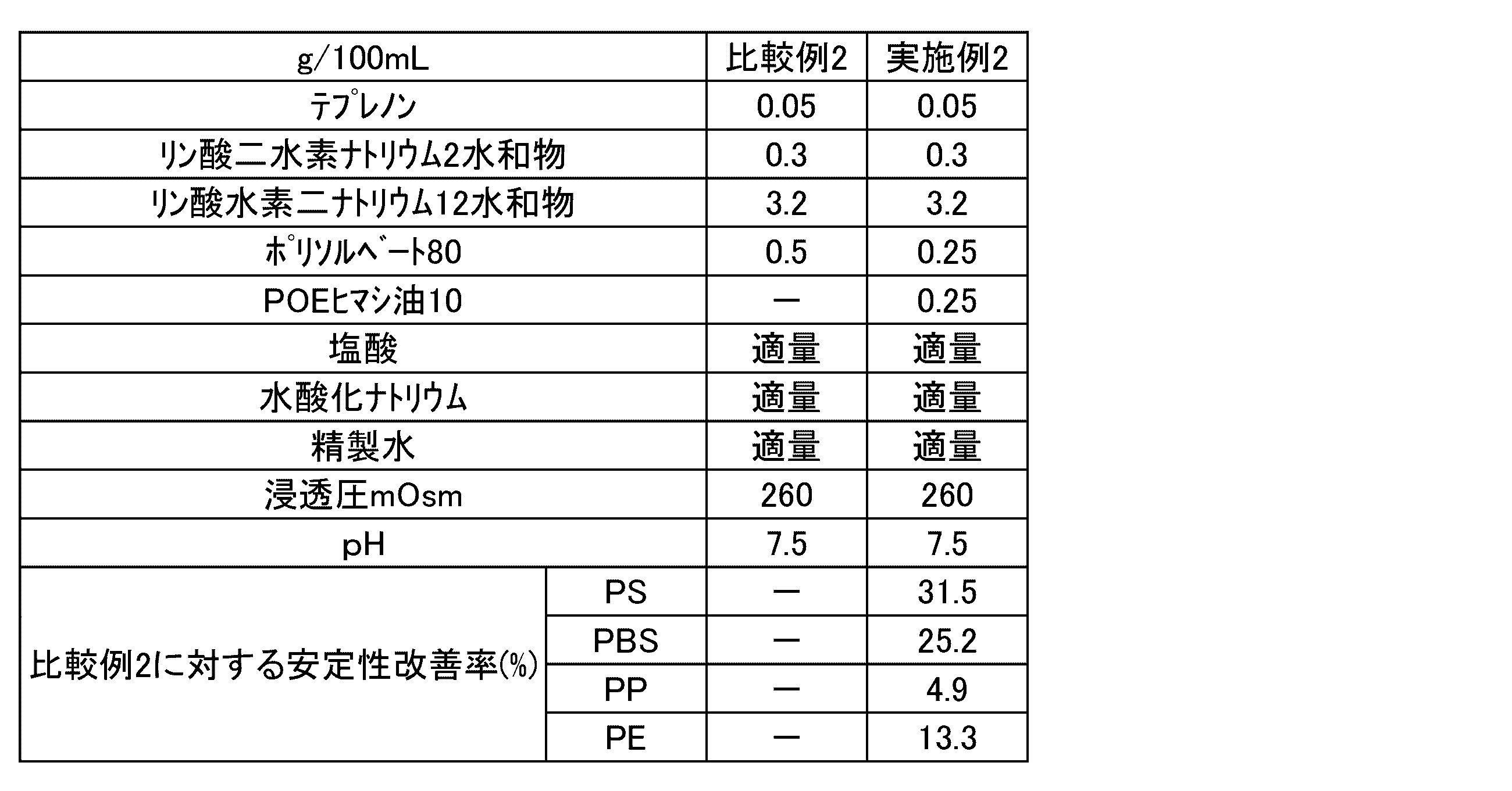
GGA含有点眼剤に2種の界面活性剤を配合することにより、GGAの残存率が明らかに向上した。
2種の界面活性剤の配合により、容器への吸着が抑制されて組成物中のGGA残存率が向上し、安定性が改善されることが分かる。
2種の界面活性剤の配合により、容器への吸着が抑制されて組成物中のGGA残存率が向上し、安定性が改善されることが分かる。

(3)界面活性剤によるGGAの角膜細胞透過性の向上の評価
オールトランス体と5Zモノシス体の重量比が10:0のGGAを用いて、表4に組成を示す点眼液を調製した。なお、試験に用いたポリソルベート80はHLB値が15、ポリオキシエチレンヒマシ油10はHLB値が6.5である。
オールトランス体と5Zモノシス体の重量比が10:0のGGAを用いて、表4に組成を示す点眼液を調製した。なお、試験に用いたポリソルベート80はHLB値が15、ポリオキシエチレンヒマシ油10はHLB値が6.5である。
ヒト角膜上皮細胞(HCET)を、トランズウェル・24穴マイクロプレート(CORNING)に、1ウェルあたり1.0×10⁵cellsになるように播種し、0.5%DMSO(和光純薬工業)、10ng/mL 上皮成長栄養因子(R&D)、5 μg/mL インスリン(Invitrogen)、及び5%(v/v)牛胎仔血清(第一化学薬品)を添加したダルベッコ改変イーグル基礎培地/ハムF12等比混合液体培地(DMEM/F-12、Invitrogen製)にて37℃、5%CO2の条件で培養した。トランズウェルの下には各細胞の培養に用いたのと同じ培地を600μLずつ添加した。
次に培養上清を吸引除去し、GGA溶液を培地で10倍希釈したものを100μLずつ加え、37℃、5%CO2の条件で培養した。
その後トランズウェルの培養上清を回収し、上清中に残存しているGGAを測定した。GGAの残存率(%)を100から引き、これを細胞が播種されたトランズウェルに対するGGAの透過率(%)とした。
次に培養上清を吸引除去し、GGA溶液を培地で10倍希釈したものを100μLずつ加え、37℃、5%CO2の条件で培養した。
その後トランズウェルの培養上清を回収し、上清中に残存しているGGAを測定した。GGAの残存率(%)を100から引き、これを細胞が播種されたトランズウェルに対するGGAの透過率(%)とした。
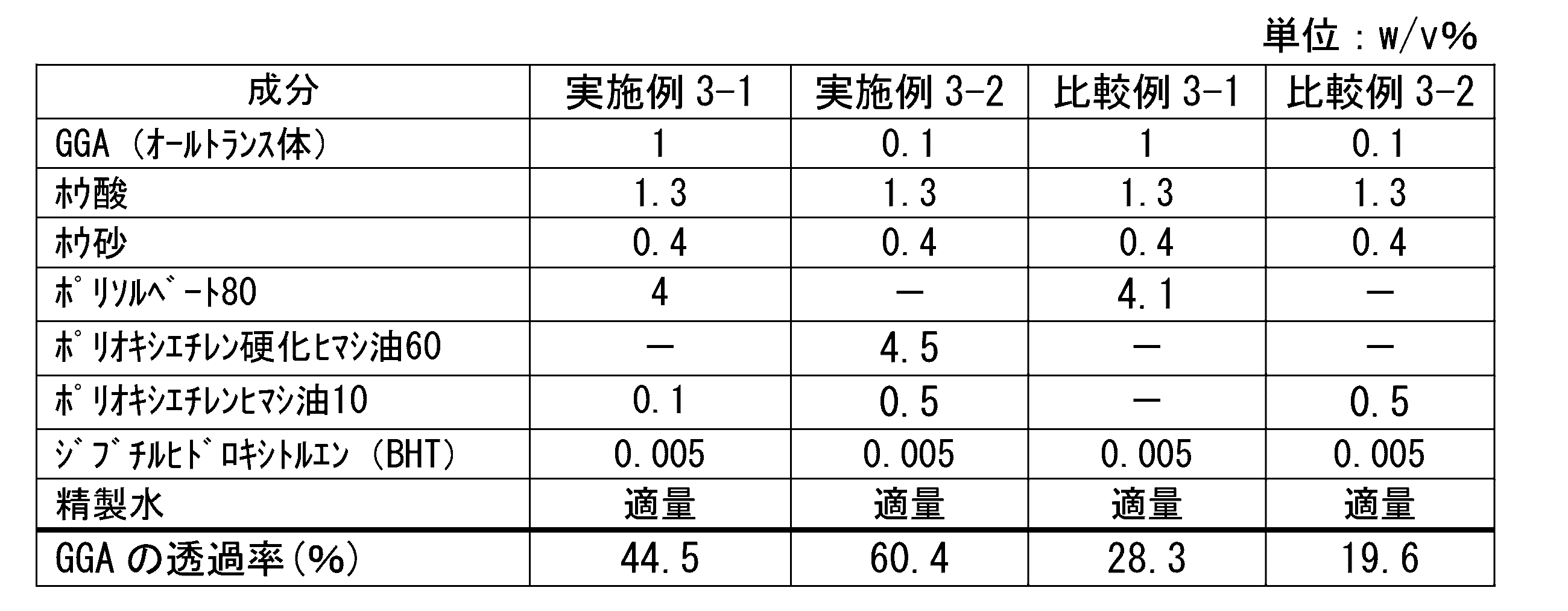
結果を表4及び図1に示す。表4及び図1から明らかなように、実施例3-1では比較例3-1よりも多くのGGAが透過し、実施例3-2では比較例3-2よりも多くのGGAが透過していた。界面活性剤を1種類ではなく2種類用いることで、GGAの角膜透過性を高めることができた。
(4)界面活性剤による網膜細胞に対するGGAの親和性の向上の評価
オールトランス体と5Zモノシス体の重量比が6:4のGGA(テプレノン、和光純薬工業)を用いて、表5に組成を示す点眼液を調製した。なお、試験に用いたポリソルベート80はHLB値が15、ポリオキシエチレンヒマシ油10はHLB値が6.5である。
オールトランス体と5Zモノシス体の重量比が6:4のGGA(テプレノン、和光純薬工業)を用いて、表5に組成を示す点眼液を調製した。なお、試験に用いたポリソルベート80はHLB値が15、ポリオキシエチレンヒマシ油10はHLB値が6.5である。
ヒト由来網膜色素上皮細胞株(ARPE-19)を96穴マイクロプレート(CORNING)に、1ウェルあたり4.0×10⁴cellsになるように播種し、10%(v/v)牛胎仔血清(第一化学薬品)を添加したダルベッコ改変イーグル基礎培地/ハムF12等比混合液体培地(DMEM/F-12、Invitrogen製)にて37℃、5%CO2の条件で培養した。
次に培養上清を吸引除去し、点眼液を培地で10倍希釈したものを100μLずつ加えた。37℃、5%CO2の条件で培養した後、培養上清を再び吸引除去し、PBSで各ウェルを2回洗浄した。ここにアセトニトリル(和光純薬工業)を100μLずつ添加し、プレートごと超音波にかけることで、細胞に含まれていたGGAをアセトニトリル中に溶出させた。最後にアセトニトリル液を回収し、ここに含まれるGGAを定量することで、網膜細胞に対するGGAの移行率(%)を求めた。
次に培養上清を吸引除去し、点眼液を培地で10倍希釈したものを100μLずつ加えた。37℃、5%CO2の条件で培養した後、培養上清を再び吸引除去し、PBSで各ウェルを2回洗浄した。ここにアセトニトリル(和光純薬工業)を100μLずつ添加し、プレートごと超音波にかけることで、細胞に含まれていたGGAをアセトニトリル中に溶出させた。最後にアセトニトリル液を回収し、ここに含まれるGGAを定量することで、網膜細胞に対するGGAの移行率(%)を求めた。

試験の結果、実施例4では比較例4よりも多くのGGAが移行していた。これより、界面活性剤を1種類ではなく2種類用いることで、GGAの網膜細胞に対する親和性が向上したことが分かる。
本発明の眼科用組成物は、GGAの容器及び/又はコンタクトレンズへの吸着が抑制されている点で製剤として優れたものである。また、本発明の眼科用組成物は、GGAの角膜透過性及び/又は網膜細胞への親和性に優れているため、網膜疾患の予防、改善、又は治療効果に優れる。
Claims (15)
- ゲラニルゲラニルアセトン、及び2種以上の界面活性剤を含む眼科用組成物。
- 界面活性剤が、ポリオキシエチレン-ポリオキシプロピレンブロックコポリマー、エチレンジアミンのポリオキシエチレン-ポリオキシプロピレンブロックコポリマー付加物、ポリオキシエチレンソルビタン脂肪酸エステル、ポリオキシエチレン硬化ヒマシ油、ポリオキシエチレンヒマシ油、ポリオキシエチレンアルキルエーテル、ポリオキシエチレンアルキルフェニルエーテル、ステアリン酸ポリオキシル、ポリオキシジエチルヒマシ油、グリシン型両性界面活性剤、ベタイン型両性界面活性剤、アルキル4級アンモニウム塩、及びアルキルベンゼンスルホン酸ナトリウムからなる群より選ばれるものである請求項1に記載の組成物。
- 2種以上の界面活性剤として、(a)2種以上の非イオン界面活性剤の組み合わせ、(b)少なくとも1種の非イオン界面活性剤と少なくとも1種の陽イオン性界面活性剤との組み合わせ、又は(c)少なくとも1種の非イオン界面活性剤と少なくとも1種の両性界面活性剤との組み合わせを用いる請求項1に記載の組成物。
- 点眼剤、眼内注射剤、眼軟膏、洗眼剤、コンタクトレンズ装着液、コンタクトレンズ用液、移植用の角膜の摘出眼組織の保存剤、又は手術時潅流液である請求項1に記載の組成物。
- 水性組成物又は油性組成物である請求項1に記載の組成物。
- 液体状、流動状、ゲル状、半固形状、又は固形状である請求項1に記載の組成物。
- ゲラニルゲラニルアセトンを、組成物の全量に対して、0.00001~10重量%含む請求項1に記載の組成物。
- 界面活性剤を、組成物の全量に対して、界面活性剤の総量として、0.0001~20重量%含む請求項1に記載の組成物。
- 界面活性剤を、ゲラニルゲラニルアセトンの1重量部に対して、界面活性剤の総量として、0.001~1000重量部含む請求項1に記載の組成物。
- ゲラニルゲラニルアセトンの容器及び/又はコンタクトレンズへの吸着が抑制されている請求項1に記載の組成物。
- ゲラニルゲラニルアセトンの角膜透過性、及び/又は網膜細胞に対する親和性が向上している請求項1に記載の組成物。
- 眼科用組成物中に、ゲラニルゲラニルアセトンと、2種以上の界面活性剤とを共存させることにより、ゲラニルゲラニルアセトンの容器への吸着を抑制する方法。
- 眼科用組成物中に、ゲラニルゲラニルアセトンと、2種以上の界面活性剤とを共存させることにより、ゲラニルゲラニルアセトンのコンタクトレンズへの吸着を抑制する方法。
- 眼科用組成物中に、ゲラニルゲラニルアセトンと、2種以上の界面活性剤とを共存させることにより、ゲラニルゲラニルアセトンの角膜透過性を向上させる方法。
- 眼科用組成物中に、ゲラニルゲラニルアセトンと、2種以上の界面活性剤とを共存させることにより、ゲラニルゲラニルアセトンの網膜細胞に対する親和性を向上させる方法。
Priority Applications (1)
| Application Number | Priority Date | Filing Date | Title |
|---|---|---|---|
| JP2015534190A JPWO2015029926A1 (ja) | 2013-08-26 | 2014-08-25 | 眼科用組成物 |
Applications Claiming Priority (2)
| Application Number | Priority Date | Filing Date | Title |
|---|---|---|---|
| JP2013-175079 | 2013-08-26 | ||
| JP2013175079 | 2013-08-26 |
Publications (1)
| Publication Number | Publication Date |
|---|---|
| WO2015029926A1 true WO2015029926A1 (ja) | 2015-03-05 |
Family
ID=52586484
Family Applications (1)
| Application Number | Title | Priority Date | Filing Date |
|---|---|---|---|
| PCT/JP2014/072103 Ceased WO2015029926A1 (ja) | 2013-08-26 | 2014-08-25 | 眼科用組成物 |
Country Status (3)
| Country | Link |
|---|---|
| JP (1) | JPWO2015029926A1 (ja) |
| TW (1) | TW201524499A (ja) |
| WO (1) | WO2015029926A1 (ja) |
Cited By (3)
| Publication number | Priority date | Publication date | Assignee | Title |
|---|---|---|---|---|
| JP2017218401A (ja) * | 2016-06-06 | 2017-12-14 | ライオン株式会社 | 液体充填製品及び油性成分の吸着抑制方法 |
| JP2020125258A (ja) * | 2019-02-04 | 2020-08-20 | 富士フイルム株式会社 | 組成物、スプレー、ワイパー |
| JPWO2020090546A1 (ja) * | 2018-10-31 | 2021-09-09 | 富士フイルム株式会社 | 組成物、スプレー、ワイパー |
Families Citing this family (1)
| Publication number | Priority date | Publication date | Assignee | Title |
|---|---|---|---|---|
| US11950848B2 (en) * | 2020-08-10 | 2024-04-09 | Welch Allyn, Inc. | Fundus imaging for microvascular assessment |
Citations (7)
| Publication number | Priority date | Publication date | Assignee | Title |
|---|---|---|---|---|
| JPH04300830A (ja) * | 1991-03-28 | 1992-10-23 | Zeria Pharmaceut Co Ltd | ビタミンe類の水溶液の製剤 |
| JPH08133967A (ja) * | 1994-11-02 | 1996-05-28 | Eisai Co Ltd | ドライアイ治療剤 |
| JPH11180858A (ja) * | 1997-12-18 | 1999-07-06 | Rohto Pharmaceut Co Ltd | 清涼化剤を含有するコンタクトレンズ用点眼剤 |
| JP2000319170A (ja) * | 1999-03-05 | 2000-11-21 | Eisai Co Ltd | テプレノン含有点眼剤 |
| WO2012090985A1 (ja) * | 2010-12-28 | 2012-07-05 | ロート製薬株式会社 | 水性眼科組成物 |
| WO2013129319A1 (ja) * | 2012-02-27 | 2013-09-06 | ロート製薬株式会社 | 眼科用組成物 |
| WO2013129322A1 (ja) * | 2012-02-27 | 2013-09-06 | ロート製薬株式会社 | 眼科用組成物 |
-
2014
- 2014-08-25 TW TW103129155A patent/TW201524499A/zh unknown
- 2014-08-25 WO PCT/JP2014/072103 patent/WO2015029926A1/ja not_active Ceased
- 2014-08-25 JP JP2015534190A patent/JPWO2015029926A1/ja active Pending
Patent Citations (7)
| Publication number | Priority date | Publication date | Assignee | Title |
|---|---|---|---|---|
| JPH04300830A (ja) * | 1991-03-28 | 1992-10-23 | Zeria Pharmaceut Co Ltd | ビタミンe類の水溶液の製剤 |
| JPH08133967A (ja) * | 1994-11-02 | 1996-05-28 | Eisai Co Ltd | ドライアイ治療剤 |
| JPH11180858A (ja) * | 1997-12-18 | 1999-07-06 | Rohto Pharmaceut Co Ltd | 清涼化剤を含有するコンタクトレンズ用点眼剤 |
| JP2000319170A (ja) * | 1999-03-05 | 2000-11-21 | Eisai Co Ltd | テプレノン含有点眼剤 |
| WO2012090985A1 (ja) * | 2010-12-28 | 2012-07-05 | ロート製薬株式会社 | 水性眼科組成物 |
| WO2013129319A1 (ja) * | 2012-02-27 | 2013-09-06 | ロート製薬株式会社 | 眼科用組成物 |
| WO2013129322A1 (ja) * | 2012-02-27 | 2013-09-06 | ロート製薬株式会社 | 眼科用組成物 |
Cited By (5)
| Publication number | Priority date | Publication date | Assignee | Title |
|---|---|---|---|---|
| JP2017218401A (ja) * | 2016-06-06 | 2017-12-14 | ライオン株式会社 | 液体充填製品及び油性成分の吸着抑制方法 |
| JPWO2020090546A1 (ja) * | 2018-10-31 | 2021-09-09 | 富士フイルム株式会社 | 組成物、スプレー、ワイパー |
| JP7168678B2 (ja) | 2018-10-31 | 2022-11-09 | 富士フイルム株式会社 | 組成物、スプレー、ワイパー |
| JP2020125258A (ja) * | 2019-02-04 | 2020-08-20 | 富士フイルム株式会社 | 組成物、スプレー、ワイパー |
| JP7173888B2 (ja) | 2019-02-04 | 2022-11-16 | 富士フイルム株式会社 | 組成物、スプレー、ワイパー |
Also Published As
| Publication number | Publication date |
|---|---|
| TW201524499A (zh) | 2015-07-01 |
| JPWO2015029926A1 (ja) | 2017-03-02 |
Similar Documents
| Publication | Publication Date | Title |
|---|---|---|
| JP5345743B1 (ja) | 眼科用組成物キット | |
| JP5345746B1 (ja) | 眼科用組成物 | |
| JPWO2013129315A1 (ja) | 網膜疾患の予防、改善、又は治療剤 | |
| JPWO2015029924A1 (ja) | 眼科用組成物 | |
| JP5345745B1 (ja) | 眼科用組成物 | |
| WO2015029926A1 (ja) | 眼科用組成物 | |
| JP5358748B1 (ja) | ゲラニルゲラニルアセトンを含む眼科用組成物 | |
| WO2015029923A1 (ja) | 眼科用製剤 | |
| JP5687395B2 (ja) | 網膜疾患の予防、改善、又は治療用粘膜適用剤 | |
| JP5483513B1 (ja) | 網膜疾患の予防、改善、又は治療用粘膜適用剤 |
Legal Events
| Date | Code | Title | Description |
|---|---|---|---|
| 121 | Ep: the epo has been informed by wipo that ep was designated in this application |
Ref document number: 14841136 Country of ref document: EP Kind code of ref document: A1 |
|
| ENP | Entry into the national phase |
Ref document number: 2015534190 Country of ref document: JP Kind code of ref document: A |
|
| NENP | Non-entry into the national phase |
Ref country code: DE |
|
| 122 | Ep: pct application non-entry in european phase |
Ref document number: 14841136 Country of ref document: EP Kind code of ref document: A1 |