WO2015029447A1 - 光学活性カルビノール化合物の製造方法 - Google Patents
光学活性カルビノール化合物の製造方法 Download PDFInfo
- Publication number
- WO2015029447A1 WO2015029447A1 PCT/JP2014/004447 JP2014004447W WO2015029447A1 WO 2015029447 A1 WO2015029447 A1 WO 2015029447A1 JP 2014004447 W JP2014004447 W JP 2014004447W WO 2015029447 A1 WO2015029447 A1 WO 2015029447A1
- Authority
- WO
- WIPO (PCT)
- Prior art keywords
- formula
- compound represented
- group
- compound
- defined above
- Prior art date
- Legal status (The legal status is an assumption and is not a legal conclusion. Google has not performed a legal analysis and makes no representation as to the accuracy of the status listed.)
- Ceased
Links
- 0 CC(*)(C(N1CC(N(CC2*)*(*)CN2c2c(*)cc(C(C(F)(F)F)(C(F)(F)F)O)cc2)=O)=O)NC1=O Chemical compound CC(*)(C(N1CC(N(CC2*)*(*)CN2c2c(*)cc(C(C(F)(F)F)(C(F)(F)F)O)cc2)=O)=O)NC1=O 0.000 description 5
Classifications
-
- C—CHEMISTRY; METALLURGY
- C07—ORGANIC CHEMISTRY
- C07D—HETEROCYCLIC COMPOUNDS
- C07D241/00—Heterocyclic compounds containing 1,4-diazine or hydrogenated 1,4-diazine rings
- C07D241/02—Heterocyclic compounds containing 1,4-diazine or hydrogenated 1,4-diazine rings not condensed with other rings
- C07D241/04—Heterocyclic compounds containing 1,4-diazine or hydrogenated 1,4-diazine rings not condensed with other rings having no double bonds between ring members or between ring members and non-ring members
-
- C—CHEMISTRY; METALLURGY
- C07—ORGANIC CHEMISTRY
- C07D—HETEROCYCLIC COMPOUNDS
- C07D403/00—Heterocyclic compounds containing two or more hetero rings, having nitrogen atoms as the only ring hetero atoms, not provided for by group C07D401/00
- C07D403/02—Heterocyclic compounds containing two or more hetero rings, having nitrogen atoms as the only ring hetero atoms, not provided for by group C07D401/00 containing two hetero rings
- C07D403/06—Heterocyclic compounds containing two or more hetero rings, having nitrogen atoms as the only ring hetero atoms, not provided for by group C07D401/00 containing two hetero rings linked by a carbon chain containing only aliphatic carbon atoms
Definitions
- the present invention relates to a method for producing an optically active carbinol compound having an LXR ⁇ activation effect and a production intermediate thereof.
- Liver X receptor is a nuclear receptor in which a part of oxysterols including 22-R-hydroxycholesterol acts as a ligand (Non-Patent Documents 1 to 3).
- LXR ⁇ is specifically expressed in tissues involved in cholesterol metabolism such as liver, small intestine, adipose tissue, and LXR ⁇ is ubiquitously expressed in almost all tissues examined. It recognizes similar sequences and activates transcription of nearby target genes (Non-Patent Documents 4 and 5).
- LXR target genes are genes (ApoE, CETP, and LPL) involved in reverse cholesterol transport (RCT) including ABC transporters (ABCA1, ABCG1, ABCG5, ABCG8). is there.
- RCT reverse cholesterol transport
- ABCA1, ABCG1, ABCG5, ABCG8 ABC transporters
- Patent Document 1 The compounds (A) to (J) having the chemical structure represented by are found and a patent application has been filed (Patent Document 1). These compounds are all optically active 2- (4- (2,5-dimethylpiperazin-1-yl) -3-propylphenyl) -1,1,1,3,3,3-hexafluoropropane-2. -Common in that it has an all structure.
- Patent Document 1 reports a method via production of a piperazine derivative (a13) as shown in the following reaction process diagram. That is, L-alanine methyl ester (a1) is used as a starting material and compound (a3) is obtained in 13 steps in 6 steps, or trans-2,5-dimethylpiperazine (b1) is used as a starting material in 21 steps in 4 steps and compound (a3) is obtained.
- the compound (a5) is produced by carrying out a coupling reaction with a separately produced benzoic acid ester (a4). After that, 8 steps are taken to carry out side chain construction and protection / deprotection reaction to produce a piperazine derivative (a13) as a common intermediate.
- the total yield is reduced to 13% at the stage of producing the intermediate (a3) from the starting material (a1) and the reduction reaction of the amide of the diketopiperazine (a2) It has been known that epimerization occurs and has a problem in reproducibility.
- the production of (a13) from L-alanine methyl ester is as long as 15 steps in total, and since the starting material (a1) has an asymmetric center, asymmetry is controlled in all reaction steps. There was a problem such as being necessary.
- the preferential crystallization is performed using (L) or (D) -tartaric acid.
- the total yield is reduced to 21% at the stage of producing the intermediate (a3) by the optical resolution method, the theoretical yield is 50% or less, and trans-2,5-dimethyl Piperazine (b1) is very expensive in terms of market availability, and has problems such as being unsuitable for mass production as a starting material.
- Non-patent Document 8 a method for producing a homopiperazine derivative
- the present invention relates to optically active 2- (4- (2,5-dialkylpiperazin-1-yl) -3-alkylphenyl) -1,1,1,3,3,3-hexafluoropropan-2-ol. It is an object of the present invention to provide a method for obtaining an optically active carbinol compound having an LXR ⁇ selective activation action in high yield and high optical purity.
- the present invention also provides optically active 2- (4- (2,5-dialkylpiperazin-1-yl) -3-alkylphenyl) -1,1,1, which is useful as an intermediate for the production of optically active carbinol compounds.
- An object is to provide a 3,3,3-hexafluoropropan-2-ol compound.
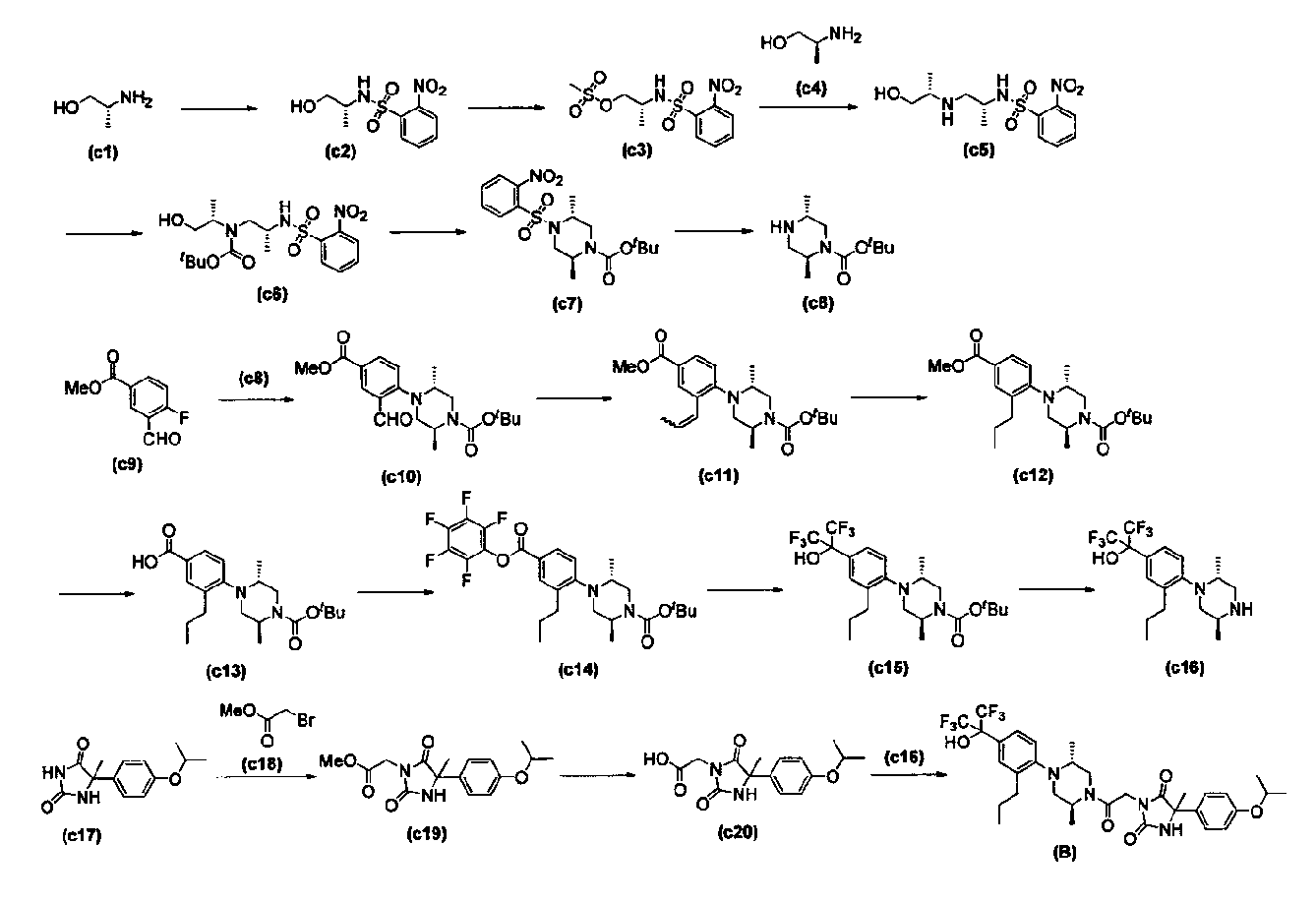
- Compound (c15) is obtained by carbinolization reaction using methyltrimethylsilane, and the optically active 2- (4- (2,5-dimethylpiperazin-1-yl) -3 is obtained by deprotecting the piperazine compound.
- the hydantoin compound (c17) and the compound (c18) are alkylated to give a compound (c19), which is hydrolyzed to give a compound (c20), which is then condensed with the compound (c16).
- the present inventors have found that the optically active carbinol compound (B) can be obtained in a total of 16 steps with a yield of 17% without impairing the optical purity.
- the present invention has been completed based on this finding.
- R 1 may be a C 2-3 alkyl group
- R 2 and R 3 may be the same or different, each represents a C 1-3 alkyl group
- * represents an asymmetric carbon atom
- R 4 represents
- R 1 may be a C 2-3 alkyl group
- R 2 and R 3 may be the same or different, each represents a C 1-3 alkyl group
- * represents an asymmetric carbon atom
- R 4 represents
- R 5 represents a C 1-3 alkyl group and X 1 represents a halogen atom
- R 2 and R 3 may be the same or different and each represents a C 1-3 alkyl group, * represents an asymmetric carbon atom, and P 1 represents an amino-protecting group]
- the compound is reacted to give the formula (6):
- R 6 represents a hydrogen atom or a methyl group
- the wavy line is a single bond
- the configuration of each double bond is independently an E configuration or a Z configuration, or a mixture thereof
- R 2 may be the same or different and represents a C 1-3 alkyl group, and * represents an asymmetric carbon atom] :
- R 3 may be the same or different, each represents a C 1-3 alkyl group, and * has the same definition as above], and a compound represented by formula (16):
- the method further comprises the step of producing the compound represented by the formula (5) by deprotecting the protecting group P 2 of the compound represented by the formula (18) [2] or [3 ] The manufacturing method of description.
- R 9 represents a C 1-3 alkyl group and X 2 represents a halogen atom
- the method further comprises the step of producing a compound represented by the formula (3) by hydrolyzing the compound represented by the formula (21), [1], [3] and [4] The production method according to any one of [4].
- the compound represented by the formula (1) is 3- (2- ⁇ (2S, 5R) -4- [4- (1,1,1,3,3,3-hexafluoro-2-hydroxypropane-2- Yl) -2-propylphenyl] -2,5-dimethylpiperazin-1-yl ⁇ -2-oxoethyl) -5- [4- (1-methylethoxy) phenyl] -5-methylimidazolidine-2,4- The production method according to any one of [1] to [5], which is dione.
- R 1 represents a C 2-3 alkyl group
- R 2 and R 3 represent the same or different C 1-3 alkyl group
- * represents an asymmetric carbon
- the method of the present invention can produce the target compound (1) in a higher yield than the conventional method, as shown in the Examples below.
- the asymmetric carbon of the 2,5-dimethylpiperazine compound (3) introduced as an asymmetric center can be constructed without epimerization by following this method. Further, other than the protecting group of one amino group of the 2,5-dimethylpiperazine compound (3), it can be constructed without using a protecting group. Therefore, by using the method of the present invention, compound (1) useful as an LXR ⁇ selective agonist can be produced with high yield and high optical purity.
- the C 1-3 alkyl group means a linear or branched alkyl group having 1 to 3 carbon atoms, and examples thereof include a methyl group, an ethyl group, a propyl group, and an isopropyl group.
- the C 1-3 alkyl group for R 1 is preferably a propyl group.
- the C 1-3 alkyl group for R 2 is preferably a methyl group.
- the C 1-3 alkyl group for R 3 is preferably a methyl group.
- the C 1-3 alkyl group for R 5 is preferably a methyl group.
- R 6 is preferably a methyl group.
- examples of the acid halide in C (O) R 7 include acid fluorides and acid chlorides.
- examples of the acid anhydride in C (O) R 7 include aliphatic carboxylic acids such as acetic acid and acid anhydrides with aromatic carboxylic acids such as benzoic acid.
- examples of the ester in C (O) R 7 include an ester with an aliphatic alcohol such as methanol, an ester with an aromatic alcohol such as pentafluorophenol, and the like.
- C (O) R 7 is preferably an ester, and more preferably a pentafluorophenoxycarbonyl group.
- the C 1-3 alkyl group for R 8 is preferably a methyl group.
- the C 1-3 alkyl group for R 9 is preferably a methyl group.
- the amino-protecting group includes tert-butoxycarbonyl group (Boc), benzyloxycarbonyl group (Cbz), 9-fluorenylmethyloxycarbonyl group (Fmoc), and 2,2,2-trichloroethoxy.
- the amino-protecting group P 1 includes a tert-butoxycarbonyl group, a 9-fluorenylmethyloxycarbonyl group (Fmoc), 2, 2,2-trichloroethoxycarbonyl group (Troc), allyloxycarbonyl group (Alloc), trifluoroacetyl group (CF 3 CO-), phthaloyl group (Pht), p-toluenesulfonyl group (Ts), 2-nitrobenzenesulfonyl A group (Ns) and a trityl group (Tr) are preferable, and a tert-butoxycarbonyl group is more preferable.
- the amino-protecting group P 2 includes a tert-butoxycarbonyl group, a 9-fluorenylmethyloxycarbonyl group (Fmoc), 2, 2,2-trichloroethoxycarbonyl group (Troc), allyloxycarbonyl group (Alloc), trifluoroacetyl group (CF 3 CO-), phthaloyl group (Pht), p-toluenesulfonyl group (Ts), 2-nitrobenzenesulfonyl
- the group (Ns), 4-nitrobenzenesulfonyl group (Ns) and trityl group (Tr) are preferable, and the 2-nitrobenzenesulfonyl group (Ns) is more preferable.
- examples of the halogen atom X 1 include a fluorine atom, a chlorine atom, a bromine atom, and an iodine atom.
- a fluorine atom and a chlorine atom are preferable, and a fluorine atom is more preferable.
- the halogen atom X 2 a chlorine atom, a bromine atom, an iodine atom.
- (12a) and (15b) as raw materials for constructing the three-dimensional structure (2a); (12b) and (15a); (2c) three-dimensional structures as the raw material for constructing the three-dimensional structure (2b) (12b) and (15b) may be used as raw materials for constructing the three-dimensional structure of (12a) and (15a); (2d).
- (2a) or (2b) is preferable, and (2b) is particularly preferable.
- (2a) to (2d) can be used as raw materials for constructing the eight steric structures of the general formula (1) of the present invention.
- As a raw material for constructing the three-dimensional structure of (1g), (2d) may be used as a raw material for constructing the three-dimensional structure of (2c); (1d) and (1h).
- the steric structure of the general formula (1) of the present invention is preferably (1a), (1b), (1e), or (1f), more preferably (1b) or (1f).
- a preferred structure of the formula (1) is a compound in which R 1 is propyl, R 2 and R 3 are methyl groups, and R 4 is a 4- (1-methylethoxy) phenyl group.
- the wavy line is a single bond, and the configuration of the double bond to which the wavy line is bonded is independently an E configuration, a Z configuration, or a mixture thereof. It shows that.
- the general formula (7) of the present invention is represented by the following (7a) and (7b):
- reaction process diagrams are shown, and the reaction of each process will be described in detail.
- Step 1 This step is a step for producing a compound (13) by protecting the amino group of the compound (12).
- the protecting group represented by P 2 can be protected with reference to, for example, literature (Protective Groups in Organic Synthesis Third Edition, John Wiley & Sons, Inc.).
- compound (13) can be produced by reacting compound (12) with 2-nitrobenzenesulfonyl chloride or the like in the presence or absence of a solvent in the presence of a base.
- the solvent is not particularly limited, but N, N-dimethylformamide, tetrahydrofuran, dioxane, acetonitrile, nitromethane, acetone, ethyl acetate, benzene, chlorobenzene, toluene, chloroform, methylene chloride, and the like can be used. Among these, methylene chloride is preferable. .
- the base is not particularly limited, and organic bases such as triethylamine, diisopropylethylamine, pyridine, lutidine, and picoline; inorganic bases such as potassium carbonate and sodium carbonate can be used, and among these, triethylamine is preferable.
- the reaction conditions are ⁇ 20 ° C. to 100 ° C., preferably 0 ° C. to 50 ° C., for 1 minute to 24 hours, preferably 5 minutes to 24 hours.
- Step 2 This step is a step for producing a compound (14) by carrying out a sulfonylation reaction of the compound (13).
- Compound (14) is produced by adding compound (13) to a leaving group such as a sulfonyloxy group by adding a sulfonic acid halide reagent or an alkyl or aralkylsulfonic acid anhydride reagent in the presence of a base in a solvent. can do.
- N, N-dimethylformamide, tetrahydrofuran, dioxane, acetonitrile, nitromethane, acetone, ethyl acetate, benzene, chlorobenzene, toluene, chloroform, methylene chloride and the like can be used, among which tetrahydrofuran, dioxane Acetonitrile, benzene, chlorobenzene, toluene, chloroform and methylene chloride are preferred, and methylene chloride is particularly preferred.
- the base is not particularly limited.
- alkali metal hydrides such as lithium hydride, sodium hydride and potassium hydride
- alkali metal hydroxides such as lithium hydroxide, sodium hydroxide and potassium hydroxide
- Alkali metal carbonates such as lithium, sodium carbonate, potassium carbonate, cesium carbonate
- metal salts of alcohols such as sodium methoxide, potassium methoxide, sodium ethoxide, potassium ethoxide, tert-butoxy sodium, tert-butoxy potassium
- lithium Metal amides such as diisopropylamide, sodium diisopropylamide, potassium diisopropylamide, lithium hexamethyldisilazide, sodium hexamethyldisilazide, potassium hexamethyldisilazide
- n-butyllithium, sec- Organometallic compounds such as til lithium and tert-butyl lithium; triethylamine, N, N-diisopropylethylamine, N
- Organic amines such as triethylamine, N, N-diisopropylethylamine, N-methylmorpholine, pyridine, 2-picoline, 3-picoline, 4-picoline, 2,3-lutidine, 2,4- Preferred are lutidine, 2,5-lutidine, 2,6-lutidine, 3,4-lutidine, 3,5-lutidine, 2,3,5-collidine, 2,4,6-collidine, triethylamine, N-methylmorpholine 2,6-lutidine and 2,4,6-collidine are particularly preferred.
- the sulfonic acid halide reagent is not particularly limited, and for example, methanesulfonic acid chloride, benzenesulfonic acid chloride, p-toluenesulfonic acid chloride, 2-nitrobenzenesulfonic acid chloride and the like are preferable.
- the alkyl or aralkyl sulfonic acid anhydride reagent is not particularly limited, but for example, methane sulfonic acid anhydride and trifluoromethane sulfonic acid anhydride are preferable.
- the reaction conditions are ⁇ 78 ° C. to 100 ° C., preferably 0 ° C. to 50 ° C., for 5 minutes to 48 hours, preferably 30 minutes to 24 hours.
- Step 3 is a step for producing a compound (16) by reacting the compound (14) with an amino alcohol form (15) in a solvent in the presence or absence of a base.
- the solvent is not particularly limited.
- tetrahydrofuran, toluene, dioxane, N, N-dimethylformamide, N-methylpyrrolidone, dimethyl sulfoxide, acetonitrile, propionitrile, acetone, methyl ethyl ketone, etc. may be used alone or in combination. Of these, tetrahydrofuran and acetonitrile are preferred.
- Examples of the base include alkali metal hydrides such as lithium hydride, sodium hydride and potassium hydride; alkali metal hydroxides such as lithium hydroxide, sodium hydroxide and potassium hydroxide; lithium carbonate, sodium carbonate and carbonate Alkali metal carbonates such as potassium and cesium carbonate; metal salts of alcohols such as sodium methoxide, potassium methoxide, sodium ethoxide, potassium ethoxide, tert-butoxy sodium and tert-butoxy potassium; lithium diisopropylamide, sodium diisopropylamide Metal amides such as potassium diisopropylamide, lithium hexamethyldisilazide, sodium hexamethyldisilazide, potassium hexamethyldisilazide; n-butyllithium, sec-butyllithium, t Organometallic compounds such as rt-butyllithium; alkali metal halides such as lithium chloride, lithium bromide, lithium
- Step 4 This step is a step for producing the compound (17) by protecting the amino group of the compound (16).
- the protecting group represented by P 1 can be protected with reference to, for example, literature (Protective Groups in Organic Synthesis Third Edition, John Wiley & Sons, Inc.).
- compound (17) can be produced by reacting compound (16) with di-tert-butyl dicarbonate in the presence of a base in a solvent or without a solvent. It can.
- the solvent is not particularly limited, and N, N-dimethylformamide, tetrahydrofuran, dioxane, acetonitrile, nitromethane, acetone, ethyl acetate, benzene, chlorobenzene, toluene, chloroform, methylene chloride and the like can be used, among which acetonitrile, Tetrahydrofuran is preferred.
- the base is not particularly limited, and organic bases such as triethylamine, diisopropylethylamine, pyridine, lutidine, and picoline; inorganic bases such as potassium carbonate and sodium carbonate can be used. Among them, triethylamine and potassium carbonate are preferable.
- the reaction conditions are ⁇ 20 ° C. to 100 ° C., preferably 0 ° C. to 50 ° C., for 1 minute to 24 hours, preferably 5 minutes to 24 hours.
- Step 5 is a step for producing a piperazine derivative (18) by carrying out an intramolecular ring closure reaction of the compound (17).
- Compound (17) is introduced into a leaving group such as a sulfonyloxy group by adding a sulfonic acid halide reagent or an alkyl or aralkylsulfonic acid anhydride reagent in a solvent in the presence of a base to advance the cyclization reaction.
- a leaving group such as a sulfonyloxy group by adding a sulfonic acid halide reagent or an alkyl or aralkylsulfonic acid anhydride reagent in a solvent in the presence of a base to advance the cyclization reaction.
- N, N-dimethylformamide, tetrahydrofuran, dioxane, acetonitrile, nitromethane, acetone, ethyl acetate, benzene, chlorobenzene, toluene, chloroform, methylene chloride and the like can be used, among which tetrahydrofuran, dioxane, acetonitrile, benzene, Chlorobenzene, toluene, chloroform and methylene chloride are preferred, and toluene and tetrahydrofuran are particularly preferred.
- the base is not particularly limited.
- alkali metal hydrides such as lithium hydride, sodium hydride and potassium hydride
- alkali metal hydroxides such as lithium hydroxide, sodium hydroxide and potassium hydroxide
- Alkali metal carbonates such as lithium, sodium carbonate, potassium carbonate, cesium carbonate
- metal salts of alcohols such as sodium methoxide, potassium methoxide, sodium ethoxide, potassium ethoxide, tert-butoxy sodium, tert-butoxy potassium
- lithium Metal amides such as diisopropylamide, sodium diisopropylamide, potassium diisopropylamide, lithium hexamethyldisilazide, sodium hexamethyldisilazide, potassium hexamethyldisilazide
- n-butyllithium, sec- Organometallic compounds such as til lithium and tert-butyl lithium; triethylamine, N, N-diisopropylethylamine, N
- Organic amines such as triethylamine, N, N-diisopropylethylamine, pyridine, 2-picoline, 3-picoline, 4-picoline, 2,3-lutidine, 2,4-lutidine, 2,5- Preferred are lutidine, 2,6-lutidine, 3,4-lutidine, 3,5-lutidine, 2,3,5-collidine, 2,4,6-collidine, pyridine, 2,6-lutidine, 2,4, 6-collidine is particularly preferred.
- the sulfonic acid halide reagent is not particularly limited, and for example, methanesulfonic acid chloride, benzenesulfonic acid chloride, p-toluenesulfonic acid chloride, 2-nitrobenzenesulfonic acid chloride and the like are preferable.
- the alkyl or aralkyl sulfonic acid anhydride reagent is not particularly limited, but for example, methane sulfonic acid anhydride and trifluoromethane sulfonic acid anhydride are preferable.
- the reaction conditions are ⁇ 78 ° C. to 100 ° C., preferably ⁇ 20 ° C. to 0 ° C., for 5 minutes to 24 hours, preferably 30 minutes to 12 hours.
- the piperazine derivative (18) can also be produced by reacting the compound (17) in a solvent with a phosphine reagent and an azo reagent or ethylenedicarboxylic acid reagent.
- a solvent N, N-dimethylformamide, tetrahydrofuran, dioxane, acetonitrile, nitromethane, acetone, ethyl acetate, benzene, chlorobenzene, toluene, chloroform, methylene chloride and the like can be used alone or in combination.
- N-dimethylformamide, tetrahydrofuran, dioxane, acetonitrile and tetrahydrofuran / toluene are preferred, and N, N-dimethylformamide, tetrahydrofuran and tetrahydrofuran / toluene are particularly preferred.
- phosphine reagent examples include trialkylphosphine such as trimethylphosphine, triethylphosphine, tripropylphosphine, triisopropylphosphine, tributylphosphine, triisobutylphosphine, tricyclohexylphosphine, and triarylphosphine, and triarylphosphine such as diphenylphosphinopolystyrene Examples include phosphine, among which trimethylphosphine, tributylphosphine, and triphenylphosphine are preferable.
- Examples of the azo reagent or ethylenedicarboxylic acid reagent include diethyl azodicarboxylate (DEAD), diisopropyl azodicarboxylate (DIAD), 1,1′-azobis (N, N-dimethylformamide) (TMAD), 1,1 ′. -(Azodicarbonyl) dipiperidine (ADDP), 1,1'-azobis (N, N-diisopropylformamide) (TIPA), 1,6-dimethyl-1,5,7-hexahydro-1,4,6,7 -Tetrazocine-2,5-dione (DHTD) and the like, with diisopropyl azodicarboxylate being particularly preferred.
- the reaction conditions are 0 ° C. to 100 ° C., preferably 0 ° C. to room temperature, 30 minutes to 1 day.
- This process is a process of manufacturing a compound (5) by deprotecting the amino group of a compound (18).
- the protecting group represented by P 2 can be deprotected with reference to, for example, literature (Protective Groups in Organic Synthesis Third Edition, John Wiley & Sons, Inc.).
- compound (5) can be produced by reacting compound (18) with a thiol compound in the presence of a base in a solvent or without a solvent.
- the solvent is not particularly limited, and N, N-dimethylformamide, tetrahydrofuran, dioxane, acetonitrile, nitromethane, acetone, ethyl acetate, benzene, chlorobenzene, toluene, chloroform, methylene chloride and the like can be used. N-dimethylformamide and acetonitrile are preferred.
- Inorganic bases such as lithium carbonate, sodium carbonate, potassium carbonate, cesium carbonate, can be used, and potassium carbonate is especially preferable.
- Examples of the thiol compound include benzenethiol and 1-dodecanethiol, and benzenethiol is preferable.
- the reaction conditions are ⁇ 20 ° C. to 100 ° C., preferably 0 ° C. to 60 ° C., for 1 minute to 24 hours, preferably 5 minutes to 24 hours.
- Step 7 is a step for producing a compound (6) by reacting the compound (4) with a compound (5) in a solvent in the presence or absence of a base.
- the solvent is not particularly limited, but for example, tetrahydrofuran, toluene, dioxane, N, N-dimethylformamide, N-methylpyrrolidone, dimethyl sulfoxide, acetonitrile, propionitrile, acetone, methyl ethyl ketone, water, etc. are used alone or in combination. can do.
- the base is not particularly limited.
- alkali metal hydrides such as lithium hydride, sodium hydride and potassium hydride
- alkali metal hydroxides such as lithium hydroxide, sodium hydroxide and potassium hydroxide
- Alkali metal carbonates such as lithium, sodium carbonate, potassium carbonate, cesium carbonate
- metal salts of alcohols such as sodium methoxide, potassium methoxide, sodium ethoxide, potassium ethoxide, tert-butoxy sodium, tert-butoxy potassium
- lithium Metal amides such as diisopropylamide, sodium diisopropylamide, potassium diisopropylamide, lithium hexamethyldisilazide, sodium hexamethyldisilazide, potassium hexamethyldisilazide
- n-butyllithium, sec- Organometallic compounds such as til lithium and tert-butyl lithium
- lithium fluoride lithium chloride, lithium bromide, lithium iodide, sodium fluor
- Step 8 This step is a step for producing a compound (7) by reacting the compound (6) with a Wittig reagent or Horner-Wadsworth-Emmons (HWE) reagent in a solvent in the presence or absence of a base. is there.
- a Wittig reagent or Horner-Wadsworth-Emmons (HWE) reagent in a solvent in the presence or absence of a base. is there.
- N, N-dimethylformamide, tetrahydrofuran, dioxane, acetonitrile, nitromethane, acetone, ethyl acetate, benzene, chlorobenzene, toluene, chloroform, methylene chloride and the like can be used, among which tetrahydrofuran, ethyl acetate, toluene, Chloroform and methylene chloride are preferred.
- phosphonium salts such as stable ylides and unstable ylides (methyltriphenylphosphonium bromide, ethyltriphenylphosphonium bromide, etc.) can be used.
- a phosphonic acid ester can be used as the HWE reagent.
- the base is not particularly limited.
- alkali metal hydrides such as lithium hydride, sodium hydride and potassium hydride
- alkali metal hydroxides such as lithium hydroxide, sodium hydroxide and potassium hydroxide
- Alkali metal carbonates such as lithium, sodium carbonate, potassium carbonate, cesium carbonate
- metal salts of alcohols such as sodium methoxide, potassium methoxide, sodium ethoxide, potassium ethoxide, tert-butoxy sodium, tert-butoxy potassium
- lithium Metal amides such as diisopropylamide, sodium diisopropylamide, potassium diisopropylamide, lithium hexamethyldisilazide, sodium hexamethyldisilazide, potassium hexamethyldisilazide
- n-butyllithium, sec- Organometallic compounds such as til lithium and tert
- Step 9 is a step for producing a compound (8) by reacting the compound (7) in a solvent in the presence of metallic carbon under a hydrogen atmosphere.
- the solvent is not particularly limited, and may be used alone or in combination with toluene, esters such as methyl acetate and ethyl acetate, and alcohols such as methanol, ethanol, 1-propanol and 2-propanol.
- the metal carbon include palladium carbon, platinum carbon, rhodium carbon, ruthenium carbon and the like.
- the reaction conditions are ⁇ 80 ° C. to 150 ° C., preferably 0 ° C. to 100 ° C., for 1 minute to 5 days, preferably 1 hour to 3 days.
- Step 10 is a step for producing a compound (9) by reacting the compound (8) in a solvent in the presence of a base or an acid.
- the solvent is not particularly limited.
- the base is not particularly limited.
- alkali metal hydroxides such as lithium hydroxide, sodium hydroxide and potassium hydroxide
- alkali carbonates such as lithium carbonate, sodium carbonate, potassium carbonate and cesium carbonate
- an acid For example, hydrochloric acid, a sulfuric acid, an acetic acid, a tosylic acid etc. can be used.
- the reaction conditions are ⁇ 80 ° C. to 150 ° C., preferably 0 ° C. to 100 ° C., for 1 minute to 5 days, preferably 1 hour to 3 days.
- Step 11 is a step of removing the compound (9) in a solvent or in the absence of a solvent, in the presence or absence of a condensing agent, in the presence or absence of a reaction accelerator, in the presence or absence of an acid or a base.
- compound (10) is produced by the reaction below.
- the substituent represented by R 7 can be converted into an acid halide, an acid anhydride, or an ester with reference to, for example, literature (Comprehensive Organic Transformations Second Edition, John Wiley & Sons, Inc.).
- acid halides include acid fluorides and acid chlorides.
- Examples of the acid anhydride include an acid anhydride with an aliphatic carboxylic acid such as acetic acid, an acid anhydride with an aromatic carboxylic acid such as benzoic acid, and the like.
- Examples of the ester include an ester with an aliphatic alcohol such as methanol, an ester with an aromatic alcohol such as pentafluorophenol, and the like.
- R 7 is a pentafluorophenoxy group
- the solvent is not particularly limited.
- tetrahydrofuran, toluene, dioxane, N, N-dimethylformamide, N-methylpyrrolidone, dimethyl sulfoxide, acetonitrile, propionitrile, acetone, Methyl ethyl ketone, ethyl acetate and the like can be used alone or in combination.
- condensing agent examples include carbodiimide reagents such as dicyclohexylcarbodiimide (DCC), 1-ethyl-3- (3-dimethylaminopropyl) carbodiimide (EDC), and diisopropylcarbodiimide (DIPCDI).
- DCC dicyclohexylcarbodiimide
- EDC 1-ethyl-3- (3-dimethylaminopropyl) carbodiimide
- DIPCDI diisopropylcarbodiimide
- dicyclohexylcarbodiimide, Ethyl-3- (3-dimethylaminopropyl) carbodiimide is preferred.
- the base is not particularly limited, but for example, alkali metal hydroxides such as lithium hydroxide, sodium hydroxide and potassium hydroxide, alkali carbonates such as lithium carbonate, sodium carbonate, potassium carbonate and cesium carbonate, triethylamine, Organic amines such as N, N-diisopropylethylamine, N-methylmorpholine, pyridine, 3,4-lutidine, 2,6-lutidine, 2,4,6-collidine and the like can be used.
- an acid For example, hydrochloric acid, a sulfuric acid, an acetic acid, a tosylic acid etc. can be used.
- the reaction conditions are ⁇ 80 ° C. to 150 ° C., preferably 0 ° C. to 100 ° C., for 1 minute to 5 days, preferably 1 hour to 3 days.
- Step 12 is a step for producing the compound (10) into the hexafluorocarbinol compound (11) using a trifluoromethylating reagent in a solvent in the presence of a base.
- a solvent dimethoxyethane, tetrahydrofuran, toluene, dioxane, ethylene glycol dimethyl ether, N, N-dimethylformamide, N-methylpyrrolidone, tetramethylurea, dimethyl sulfoxide, acetonitrile, propionitrile, etc. should be used alone or in combination.
- ethylene glycol dimethyl ether is preferable.
- Trifluoromethylating reagents include (trifluoromethyl) trimethylsilane, triethyl (trifluoromethyl) silane, triisopropyl (trifluoromethyl) silane, methyldiphenyl (trifluoromethyl) silane, dimethyl (diphenyl) trifluoromethylsilane Etc.
- the reaction conditions are ⁇ 80 ° C. to 150 ° C., preferably ⁇ 30 ° C. to 50 ° C., for 1 minute to 5 days, preferably 1 hour to 3 days.
- Step 13 This step is a step of producing the compound (2) by deprotecting the amino group of the compound (11).
- the protecting group represented by P 1 can be deprotected with reference to literature (Protective Groups in Organic Synthesis Third Edition, John Wiley & Sons, Inc.), for example.
- compound (2) can be produced by reacting compound (11) with an acid in a solvent or without a solvent.
- the solvent is not particularly limited, but N, N-dimethylformamide, tetrahydrofuran, dioxane, acetonitrile, nitromethane, acetone, ethyl acetate, benzene, chlorobenzene, toluene, chloroform, methylene chloride, water, methanol, ethanol, 1-propanol, 2 -Propanol or the like can be used alone or in combination.
- the acid is not particularly limited, but hydrochloric acid, hydrochloric acid / ethyl acetate solution, hydrochloric acid / dioxane solution, hydrochloric acid / methanol solution, hydrobromic acid, sulfuric acid, nitric acid, etc. can be used. Among them, hydrochloric acid / ethyl acetate solution A hydrochloric acid / methanol solution is preferred.
- the reaction conditions are ⁇ 20 ° C. to 100 ° C., preferably 0 ° C. to 50 ° C., for 1 minute to 24 hours, preferably 5 minutes to 12 hours.
- Step 14 is a step for producing a compound (21) by reacting the hydantoin derivative (19) and the compound (20) in a solvent in the presence or absence of a base.
- the solvent is not particularly limited.
- alkali metal hydrides such as lithium hydride, sodium hydride, potassium hydride, Alkali metal hydroxides, such as lithium hydroxide, sodium hydroxide, potassium hydroxide; Alkali metal carbonates such as lithium, sodium carbonate, potassium carbonate, cesium carbonate; metal salts of alcohols such as sodium methoxide, potassium methoxide, sodium ethoxide, potassium ethoxide, tert-butoxy sodium, tert-butoxy potassium; lithium Metal amides such as diisopropylamide, sodium diisopropylamide, potassium diisopropylamide, lithium hexamethyldisilazide, sodium hexamethyldisilazide, potassium hexamethyldisilazide; n-butyllithium, sec- Organometallic compounds such as til lithium and tert-butyl lithium; triethylamine, N, N
- the imidazolidine-2,4-dione derivative (19) used in this step is converted into a diastereomeric salt with a general optically active acid such as tartaric acid, or optically resolved, or optically active column chromatography is used.
- a general optically active acid such as tartaric acid, or optically resolved, or optically active column chromatography is used.
- optically pure isomers by general racemic resolution methods such as
- Step 15 is a step for producing a compound (3) by reacting the compound (21) in a solvent in the presence of a base or an acid.
- the solvent is not particularly limited.
- the base is not particularly limited, and examples thereof include alkali metal hydroxides such as lithium hydroxide, sodium hydroxide, and potassium hydroxide, alkali carbonate metals such as lithium carbonate, sodium carbonate, potassium carbonate, and cesium carbonate. Can be used. Although there is no restriction
- the reaction conditions are ⁇ 80 ° C. to 150 ° C., preferably 0 ° C. to 100 ° C., for 1 minute to 5 days, preferably 1 hour to 3 days.
- Step 16 This step comprises reacting compound (2) and compound (3) in a solvent in the presence of a condensing agent, in the presence or absence of a reaction accelerator, in the presence or absence of a base.
- a condensing agent in the presence or absence of a reaction accelerator, in the presence or absence of a base.
- This is a process for producing a carbinol derivative (1).
- the solvent N, N-dimethylformamide, N-methylpyrrolidone, dimethyl sulfoxide, tetrahydrofuran, dioxane, acetonitrile, nitromethane, acetone, ethyl acetate, benzene, chlorobenzene, toluene, chloroform, methylene chloride and the like can be used.
- Dimethyl sulfoxide, acetonitrile and methylene chloride are preferred.
- the condensing agent include carbodiimide reagents such as dicyclohexylcarbodiimide (DCC), 1-ethyl-3- (3-dimethylaminopropyl) carbodiimide (EDC), diisopropylcarbodiimide (DIPCDI); (1H-benzotriazol-1-yloxy) Tris (dimethylamino) phosphonium hexafluorophosphate (BOP), (1H-benzotriazol-1-yloxy) tris (pyrrolidino) phosphonium hexafluorophosphate (PyBOP), 1- [bis (dimethylamino) methylene] -1H- 1,2,3-triazolo (4,5-b) pyridium-3-oxodohexafluorophosphate (HATU), 1- [bis (dimethylamino)
- reaction accelerator examples include 1-hydroxybenzotriazole (HOBt), 6-chloro-1-hydroxybenzotriazole (6-Cl-HOBt), 3,4-dihydro-3-hydroxy-4-oxo-1,2 1,3-benzotriazine (HOOBt), 1-hydroxy-7-azabenzotriazole (HOAt) and the like can be used.
- alkali metal hydrides such as lithium hydride, sodium hydride, potassium hydride, Alkali metal hydroxides, such as lithium hydroxide, sodium hydroxide, potassium hydroxide; Alkali metal carbonates such as lithium, sodium carbonate, potassium carbonate, cesium carbonate; metal salts of alcohols such as sodium methoxide, potassium methoxide, sodium ethoxide, potassium ethoxide, tert-butoxy sodium, tert-butoxy potassium; lithium Metal amides such as diisopropylamide, sodium diisopropylamide, potassium diisopropylamide, lithium hexamethyldisilazide, sodium hexamethyldisilazide, potassium hexamethyldisilazide; n-butyllithium, sec- Organometallic compounds such as til lithium and tert-butyl lithium; triethylamine, N, N
- This step can also be carried out by applying a Mitsunobu reaction in which the compound (2) and the compound (3) are reacted with an azo reagent or an ethylenedicarboxylic acid reagent in a solvent in the presence of a phosphine reagent.
- a Mitsunobu reaction in which the compound (2) and the compound (3) are reacted with an azo reagent or an ethylenedicarboxylic acid reagent in a solvent in the presence of a phosphine reagent.
- the solvent N, N-dimethylformamide, N-methylpyrrolidone, dimethyl sulfoxide, tetrahydrofuran, dioxane, acetonitrile, nitromethane, acetone, ethyl acetate, benzene, chlorobenzene, toluene, chloroform, methylene chloride and the like can be used.
- phosphine reagent examples include trialkylphosphine such as trimethylphosphine, triethylphosphine, tripropylphosphine, triisopropylphosphine, tributylphosphine, triisobutylphosphine, tricyclohexylphosphine, and triphenylphosphine, diphenylphosphinopolystyrene, and the like. Can be used.
- trialkylphosphine such as trimethylphosphine, triethylphosphine, tripropylphosphine, triisopropylphosphine, tributylphosphine, triisobutylphosphine, tricyclohexylphosphine, and triphenylphosphine, diphenylphosphinopolystyrene, and the like.
- trialkylphosphine such as trimethylphosphine, trie
- Examples of the azo reagent or ethylenedicarboxylic acid reagent include diethyl azodicarboxylate (DEAD), diisopropyl azodicarboxylate (DIAD), 1,1′-azobis (N, N-dimethylformamide) (TMAD), 1,1′- (Azodicarbonyl) dipiperidine (ADDP), 1,1′-azobis (N, N-diisopropylformamide) (TIPA), 1,6-dimethyl-1,5,7-hexahydro-1,4,6,7- Tetrazocine-2,5-dione (DHTD) or the like can be used.
- the reaction conditions are ⁇ 80 ° C. to 150 ° C., preferably 0 ° C. to 100 ° C., for 1 minute to 5 days, preferably 1 hour to 3 days.
- compound (3) is reacted with an acid halogenating agent in a solvent to produce an acid halide derivative, and this is then combined with compound (2) in a solvent in the presence or absence of a base.
- Carbinol derivative (1) can also be produced by reacting.
- Examples of the acid halogenating agent include N, N-diethylaminosulfur trifluoride (DAST), selenium tetrafluoride or its pyridine adduct, thionyl chloride, oxalyl chloride, pyrocatekylphosphotrichloride, dichlorotriphenylphosphorane, Thionyl bromide, dibromotriphenylphosphorane, 1-dimethyl-1-iodo-2-methylpropene and the like can be used.
- DAST N-diethylaminosulfur trifluoride
- selenium tetrafluoride or its pyridine adduct thionyl chloride
- oxalyl chloride oxalyl chloride
- pyrocatekylphosphotrichloride dichlorotriphenylphosphorane
- Thionyl bromide Thionyl bromide
- dibromotriphenylphosphorane 1-dimethyl-1-i
- the solvent is not particularly limited, and for example, toluene, N, N-dimethylformamide, N-methylpyrrolidone, acetonitrile, dichloromethane, 1,2-dichloroethane and the like can be used alone or in combination.
- alkali metal hydrides such as lithium hydride, sodium hydride, potassium hydride, Alkali metal hydroxides, such as lithium hydroxide, sodium hydroxide, potassium hydroxide; Alkali metal carbonates such as lithium, sodium carbonate, potassium carbonate, cesium carbonate; metal salts of alcohols such as sodium methoxide, potassium methoxide, sodium ethoxide, potassium ethoxide, tert-butoxy sodium, tert-butoxy potassium; lithium Metal amides such as diisopropylamide, sodium diisopropylamide, potassium diisopropylamide, lithium hexamethyldisilazide, sodium hexamethyldisilazide, potassium hexamethyldisilazide; n-butyllithium, sec- Organometallic compounds such as til lithium and tert-butyl lithium; triethylamine, N, N
- salts allowed in the optically active compound represented by the general formula (2) of the present invention include acid addition salts with inorganic acids and organic acids, or base addition salts with inorganic bases and organic bases. Etc.
- solvate of the optically active compound represented by the general formula (2) of the present invention and acceptable salts thereof include hydrates and various solvates.
- Step I Preparation of (R) -N- (1-hydroxypropan-2-yl) -2-nitrobenzenesulfonamide (c2): (R) -2-Aminopropan-1-ol (2.03 g, 29.8 mmol) was dissolved in dichloromethane (27 mL). Triethylamine (3.74 g, 36.9 mmol) and 2-nitrobenzene-1-sulfonyl chloride (6.0 g, 27.1 mmol) were added at 0 ° C., and the mixture was stirred at room temperature for 16 hours. After confirming the completion of the reaction, dichloromethane and water were added to the reaction solution at 0 ° C.
- Step II Preparation of methanesulfonic acid (R) -2- (2-nitrophenylsulfonamido) propyl (c3): (R) -N- (1-hydroxypropan-2-yl) -2-nitrobenzenesulfonamide (8.58 g, 27.1 mmol) was dissolved in dichloromethane (90 mL). Triethylamine (4.10 g, 40.6 mmol) and methanesulfonyl chloride (2.98 g, 29.9 mmol) were added at 0 ° C., and the mixture was stirred at room temperature for 18 hours. After confirming the completion of the reaction, water was added to the reaction solution at 0 ° C.
- Step III Preparation of N-[(R) -1- ⁇ [(S) -1-hydroxypropan-2-yl] amino ⁇ propan-2-yl] -2-nitrobenzenesulfonamide (c5): Methanesulfonic acid (R) -2- (2-nitrophenylsulfonamido) propyl (9.06 g, 27.1 mmol) was dissolved in tetrahydrofuran (135 mL). (S) -2-Aminopropan-1-ol (10.2 g, 135 mmol) was added at room temperature, and the mixture was stirred for 15 hours under reflux. After confirming the completion of the reaction, the reaction solution was concentrated under reduced pressure. The obtained residue was purified using silica gel column chromatography (chloroform / methanol) to obtain the title compound (5.14 g, yield 60%) as a yellow oily substance.
- Step IV Preparation of [(S) -1-hydroxypropan-2-yl] [(R) -2- (2-nitrophenylsulfonamido) propyl] carbamate tert-butyl (c6): N-[(R) -1- ⁇ [(S) -1-hydroxypropan-2-yl] amino ⁇ propan-2-yl] -2-nitrobenzenesulfonamide (7.09 g, 22.3 mmol) Dissolved in tetrahydrofuran (110 mL).
- Step V Preparation of 2,5-dimethyl-4-[(2-nitrophenyl) sulfonyl] piperazine-1-carboxylic acid (2S, 5R) -tert-butyl (c7): [(S) -1-Hydroxypropan-2-yl] [(R) -2- (2-nitrophenylsulfonamido) propyl] carbamate tert-butyl (3.38 g, 8.08 mmol) under vacuum After drying, it was dissolved in tetrahydrofuran (54 mL) under an argon atmosphere.
- triphenylphosphine (3.18 g, 12.1 mmol) and diisopropyl azodicarboxylate (DIAD) (7.1 mL, 1.7 M toluene solution 12.1 mmol) were added, and 2 at room temperature. Stir for hours. After confirming the completion of the reaction, the reaction solution was concentrated under reduced pressure, and the resulting residue was purified using silica gel column chromatography (chloroform / methanol) to give 3.11 g (yield 96%) of the title compound as an orange oil. Got as.
- Step VI Preparation of 2,5-dimethylpiperazine-1-carboxylic acid (2S, 5R) -tert-butyl (c8): 2,5-Dimethyl-4-[(2-nitrophenyl) sulfonyl] piperazine-1-carboxylic acid (2S, 5R) -tert-butyl (3.21 g, 8.04 mmol) in acetonitrile (47 mL) Dissolved. At room temperature, potassium carbonate (3.33 g, 24.1 mmol) and benzenethiol (1.33 g, 12.1 mmol) were added, and the mixture was stirred at 50 ° C. for 3 hours.
- Step VII Preparation of 4- [2-formyl-4- (methoxycarbonyl) phenyl] -2,5-dimethylpiperazine-1-carboxylic acid (2S, 5R) -tert-butyl (c10): Cesium fluoride (14.0 g, 91.89 mmol) was dried at 120 ° C. under reduced pressure for 2 hours, and N, N-dimethylformamide (52 mL) was added at room temperature under an argon atmosphere.
- Step VIII 4- [4- (methoxycarbonyl) -2- (prop-1-en-1-yl) phenyl] -2,5-dimethylpiperazine-1-carboxylic acid (2S, 5R) -tert-butyl
- Ethyltriphenylphosphonium bromide 25.8 g, 69.46 mmol
- potassium methoxide 4.87 g, 69.46 mmol
- cis-c11 4- ⁇ 4- (methoxycarbonyl) -2-[(Z) -prop-1-en-1-yl] phenyl ⁇ -2,5-dimethylpiperazine-1-carboxylic acid (2S, 5R) -tert-butyl
- trans-c11 4- ⁇ 4- (methoxycarbonyl) -2-[(E) -prop-1-en-1-yl] phenyl ⁇ -2,5-dimethylpiperazine-1-carboxylic acid (2S, 5R) -tert-butyl
- Step IX Preparation of 4- [4- (methoxycarbonyl) -2-propylphenyl] -2,5-dimethylpiperazine-1-carboxylic acid (2S, 5R) -tert-butyl (c12): 4- [4- (Methoxycarbonyl) -2- (prop-1-en-1-yl) phenyl] -2,5-dimethylpiperazine-1-carboxylic acid (2S, 5R) -tert-butyl (4.76) g, 12.25 mmol) was dissolved in methanol (123 mL), and palladium on carbon was added under an argon atmosphere. Thereafter, the mixture was stirred at room temperature for 24 hours under a hydrogen atmosphere.
- Step X Preparation of 4-[(2R, 5S) -4- (tert-butoxycarbonyl) -2,5-dimethylpiperazin-1-yl] -3-propylbenzoic acid (c13): 4- [4- (methoxycarbonyl) -2-propylphenyl] -2,5-dimethylpiperazine-1-carboxylic acid (2S, 5R) -tert-butyl (4.72 g, 12.09 mmol) was added to methanol ( 121N), 4N-aqueous sodium hydroxide solution (18.1 mL, 72.52 mmol) was added at 0 ° C., and the mixture was stirred at 60 ° C. for 2 hours.
- Step XI Preparation of 2,5-dimethyl-4- ⁇ 4-[(perfluorophenoxy) carbonyl] -2-propylphenyl ⁇ piperazine-1-carboxylic acid (2S, 5R) -tert-butyl (c14): 4-[(2R, 5S) -4- (tert-butoxycarbonyl) -2,5-dimethylpiperazin-1-yl] -3-propylbenzoic acid (1.0 g, 2.656 mmol) was added to ethyl acetate ( 18 mL), and 2,3,4,5,6-pentafluorophenol (513 mg, 2.789 mmol), N, N′-dicyclohexylcarbodiimide (575 mg, 2.789 mol) in this order at room temperature.
- Step XII 4- [4- (1,1,1,3,3,3-hexafluoro-2-hydroxypropan-2-yl) -2-propylphenyl] -2,5-dimethylpiperazine-1-carboxyl
- 2S, 5R -tert-butyl
- 2S, 5R 2,5-Dimethyl-4- ⁇ 4-[(perfluorophenoxy) carbonyl] -2-propylphenyl ⁇ piperazine-1-carboxylic acid (2S, 5R) -tert-butyl (5.75 g, 10.6 mmol)
- 2S, 5R -tert-butyl
- Step XIII 2- ⁇ 4-[(2R, 5S) -2,5-dimethylpiperazin-1-yl] -3-propylphenyl ⁇ -1,1,1,3,3,3-hexafluoropropane-2 -Manufacture of all (c16): 4- [4- (1,1,1,3,3,3-Hexafluoro-2-hydroxypropan-2-yl) -2-propylphenyl] -2,5-dimethylpiperazine-1-carboxylic acid (2S , 5R) -tert-butyl (4.53 g, 9.08 mmol) dissolved in methanol (14 mL), 2N hydrochloric acid methanol solution (41 mL, 81.7 mmol) was added at 0 ° C., and 35 Stir at 5 ° C.
- Step XIV 2- ⁇ 4- [4- (1-methylethoxy) phenyl] -4-methyl-2,5-dioxoimidazolidin-1-yl ⁇ acetic acid (S) -methyl ((S) -c19) Manufacturing of: Obtained by optical resolution of 5- [4- (1-methylethoxy) phenyl-4-yl] -5-methylimidazolidine-2,4-dione produced according to WO2009 / 144961 using the optical column described below.
- Step XV (S) -2- ⁇ 4- [4- (1-methylethoxy) phenyl] -4-methyl-2,5-dioxoimidazolidin-1-yl ⁇ acetic acid ((S) -c20) Manufacturing: 2- ⁇ 4- [4- (1-methylethoxy) phenyl] -4-methyl-2,5-dioxoimidazolidin-1-yl ⁇ acetic acid (S) -methyl (6.05 g, 18.9 mmol) was dissolved in methanol (30 mL), 2M aqueous potassium carbonate solution (18.9 mL, 37.8 mmol) was added at 0 ° C., and the mixture was stirred at 45 ° C.
- Step XVI-1 (S) -3- (2- ⁇ (2S, 5R) -4- [4- (1,1,1,3,3,3-hexafluoro-2-hydroxypropan-2-yl) ) -2-Propylphenyl] -2,5-dimethylpiperazin-1-yl ⁇ -2-oxoethyl) -5- [4- (1-methylethoxy) phenyl] -5-methylimidazolidine-2,4-dione Production of ((S) -B): 2- ⁇ 4-[(2R, 5S) -2,5-dimethylpiperazin-1-yl] -3-propylphenyl ⁇ -1,1,1,3,3,3-hexafluoropropan-2-ol ( 200 mg, 0.502 mmol) was dissolved in dichloromethane (2.0 mL) and (S) -2- ⁇ 4- [4- (1-methylethoxy) phenyl] -4-methyl-2,
- Step XVI-2 (S) -3- (2- ⁇ (2S, 5R) -4- [4- (1,1,1,3,3,3-hexafluoro-2-hydroxypropan-2-yl) ) -2-Propylphenyl] -2,5-dimethylpiperazin-1-yl ⁇ -2-oxoethyl) -5- [4- (1-methylethoxy) phenyl] -5-methylimidazolidine-2,4-dione Production of ((S) -B): (S) -2- ⁇ 4- [4- (1-Methylethoxy) phenyl] -4-methyl-2,5-dioxoimidazolidin-1-yl ⁇ acetic acid (100 mg, 0.326 mmol) was dissolved in toluene.
- the present invention provides a method for producing a high yield and high optical purity of the optically active carbinol compound (1) represented by the general formula (1).
- Compound (1) has an LXR ⁇ agonistic action, and atherosclerosis such as atherosclerosis, arteriosclerosis, and diabetes caused by diabetes; dyslipidemia; hypercholesterolemia; lipid-related disease; inflammation Inflammatory diseases caused by sex cytokines; skin diseases such as allergic skin diseases; diabetes; or Alzheimer's disease preventive and / or therapeutic agents, etc. Has the above applicability.
Landscapes
- Chemical & Material Sciences (AREA)
- Organic Chemistry (AREA)
- Organic Low-Molecular-Weight Compounds And Preparation Thereof (AREA)
- Plural Heterocyclic Compounds (AREA)
- Pharmaceuticals Containing Other Organic And Inorganic Compounds (AREA)
Abstract
本発明は、LXRβ活性化作用を有する光学活性カルビノール化合物の製造法およびその製造中間体を提供することである。 本発明においては、式(2)で表される化合物および式(3)で表される化合物を反応することにより、式(1)で表される光学活性カルビノール化合物を製造する。式(1)~(3)中、R1はC2-3アルキル基、R2、R3は同一又は異なってもよくC1-3アルキル基を示し、*は不斉炭素原子を示し、R4は、A~Eから選択される構造のうちいずれかひとつを示す。
Description
本発明は、LXRβ活性化作用を有する光学活性カルビノール化合物の製造法およびその製造中間体に関する。
肝臓X受容体(LXR)は、22-R-ヒドロキシコレステロールをはじめとするオキシステロール類の一部がリガンドとして作用する核内受容体である(非特許文献1~3)。哺乳類では二種のLXR遺伝子(α及びβ)の存在が知られている。LXRαは肝臓、小腸、脂肪組織などのコレステロール代謝に関わる組織に特異的に発現し、LXRβは調べられたほぼ全ての組織で普遍的に発現しているが、この受容体は共に、DNA上の同様の配列を認識し、付近の標的遺伝子の転写を活性化する(非特許文献4、5)。LXRの標的遺伝子として同定された遺伝子群のうちの多くは、ABCトランスポーター(ABCA1,ABCG1,ABCG5,ABCG8)をはじめとするコレステロール逆輸送(RCT)に関わる遺伝子(ApoE,CETP,及びLPL)である。このため、LXRの活性化はこれらの遺伝子発現上昇およびコレステロール逆輸送系経路を活性化して末梢からのコレステロール流出を増加させ、HDLコレステロールを増加させることにより、動脈硬化病変部位のコレステロール含量を減少させるものと期待されている(非特許文献6)。
斯かる状況の下、本発明者らはLXRβ選択的活性化作用を有する化合物として、下記式:

で示される化学構造を有する化合物(A)~(J)を見出し、特許出願している(特許文献1)。これらの化合物は、全て光学活性な2-(4-(2,5-ジメチルピペラジン-1-イル)-3-プロピルフェニル)-1,1,1,3,3,3-ヘキサフルオロプロパン-2-オール構造を持つという点で共通している。
上記化合物(A)~(J)の製造方法は、特許文献1において、例えば、以下の反応工程図に示すようなピペラジン誘導体(a13)の製造を経由した方法が報告されている。すなわち、L-アラニンメチルエステル(a1)を出発原料として6工程13%で化合物(a3)を又はトランス-2,5-ジメチルピペラジン(b1)を出発原料として4工程21%で化合物(a3)を製造し、別途製造した安息香酸エステル(a4)とカップリング反応を行うことによって、化合物(a5)を製造する。その後、8工程をかけて側鎖の構築や保護・脱保護反応を行い、共通中間体となるピペラジン誘導体(a13)を製造している。
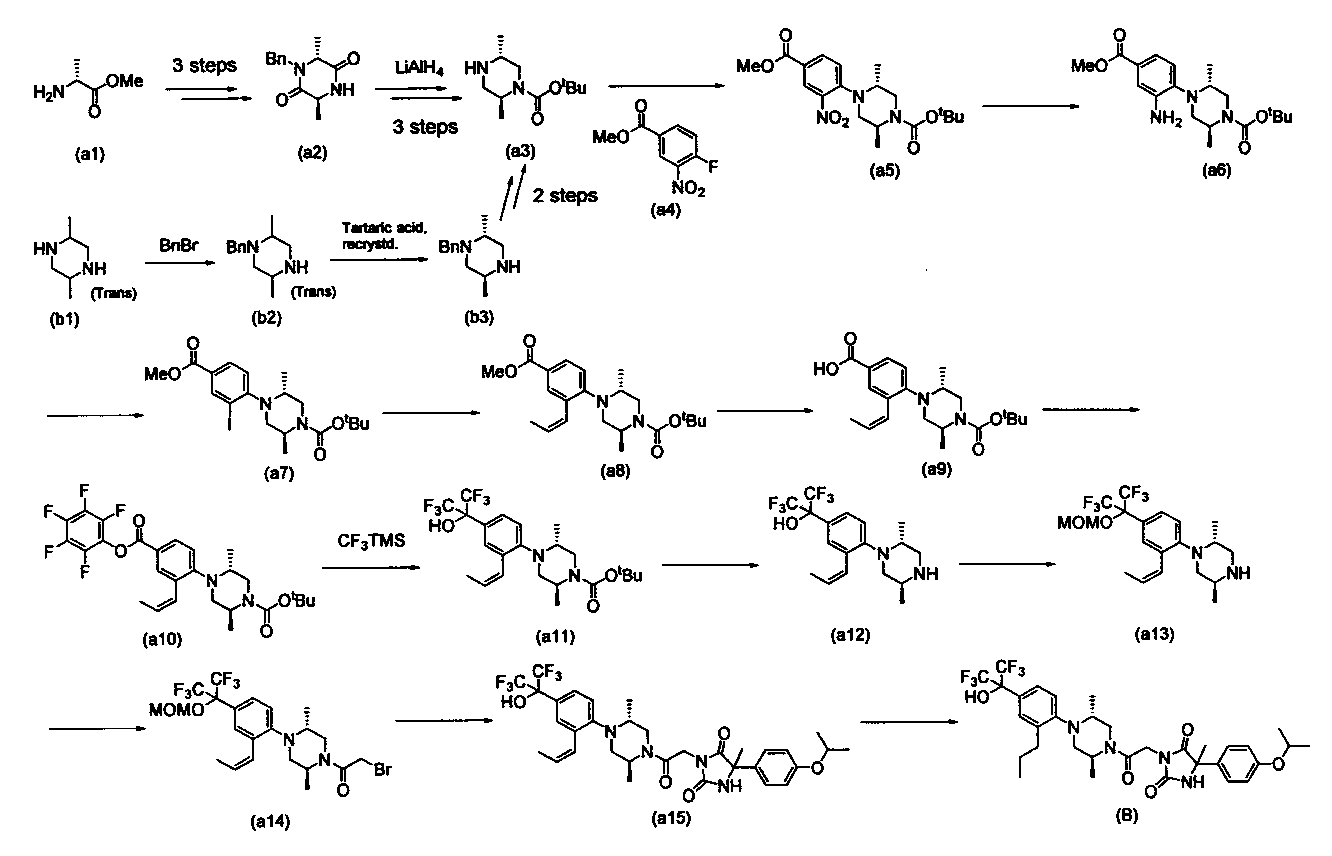
しかしながら、当該文献の方法では出発原料(a1)から中間体(a3)を製造する段階で総収率が13%に低下してしまうこと且つジケトピペラジン体(a2)のアミドの還元反応にてエピメリ化が生じることが知られており、再現性において問題を抱えていた。また、L-アラニンメチルエステルからの(a13)の製造には、全15工程と長いこと、さらに出発原料(a1)が不斉中心を有していることから、全反応工程において不斉の管理が必要であるなどの問題点を有していた。またトランス-2,5-ジメチルピペラジン(b1)の一つのアミノ基のみを選択的に保護し得られる化合物(b2)を用いる手法では、(L)又は(D)-酒石酸を用いて優先晶析法による光学分割法で中間体(a3)を製造する段階で総収率が21%に低下してしまうこと、理論的に収率が50%以下となること、さらにトランス-2,5-ジメチルピペラジン(b1)が市場利用性にしても非常に高価であり、出発原料としても大量製造には適していないなどの問題点を有していた。
また、フェニルピペラジン誘導体の製造方法は、報告例があるものの、ベンゼン環及びピペラジン環上に共に置換基を有する例がなく、ピペラジン環上の置換基の立体制御には適応できない(非特許文献7)、極めて低収率である(特許文献2、3)等の課題があり、ベンゼン環及びピペラジン環上に共に置換基を有した化合物の効率的な製造法とは言い難い。
また、ホモピペラジン誘導体の製造方法として、所望の立体構造を有するアミノアルコール体から6工程にてホモピペラジン体を製造する方法が報告されているが、複数の不斉炭素原子が含まれる際に適応できるかは言及していない(非特許文献8)。
Janowskiら、Nature ,383, pp.728-731, 1996
Lehmannら、J. Biol. Chem., 272, pp.3137-3140, 1997
Fuら、J. Biol. Chem., 276, pp.38378-38387, 2001
Auboeufら、Diabetes, 46, pp.1319-1327, 1997
Luら、J. Biol. Chem., 276, pp.37735-37738, 2001
Zelcerら、J. Clin. Invest., 116, pp.607-614, 2006
Rongら、J. Org. Chem., 75, pp.7451-7453, 2010
Gomiら、Synthesis, 44, pp.3171-3178, 2012
本発明は、光学活性2-(4-(2,5-ジアルキルピペラジン-1-イル)-3-アルキルフェニル)-1,1,1,3,3,3-ヘキサフルオロプロパン-2-オールを経由して、LXRβ選択的活性化作用を有する光学活性カルビノール化合物を高収率且つ高光学純度で得る方法を提供することを目的とする。また、本発明は、光学活性カルビノール化合物の製造中間体として有用な光学活性2-(4-(2,5-ジアルキルピペラジン-1-イル)-3-アルキルフェニル)-1,1,1,3,3,3-ヘキサフルオロプロパン-2-オール化合物を提供することを目的とする。
前記の通り、光学活性カルビノール化合物を効率的且つ光学純度よく製造することは、医薬品、特にLXRβ選択的活性化剤の製造において非常に有用であると考えられる。そこで本発明者らは、前記化合物(B)で示される光学活性カルビノール体の有用な製造法について鋭意研究を行った結果、下図に示すように、アミノアルコール体(c1)のアミノ基を保護して化合物(c2)にし、塩基の存在下にてメタンスルホン酸クロライドを用いて化合物(c3)とし、これと光学活性2-アミノプロパノール体(c4)とを反応することにより化合物(c5)とし、アミノ基を保護してアミノアルコール体(c6)とし、福山-光延反応条件下にて環化反応することにより、環状アミン化合物(c7)とし、2-ニトロベンゼンスルホニル基を脱保護してピペラジン体(c8)とし、これと安息香酸エステル体(c9)とを反応させることにより、化合物(c10)とし、これをWittig反応することにより化合物(c11)にし、不飽和結合を水素添加反応することにより化合物(c12)にし、これを加水分解することにより化合物(c13)にし、これを反応することにより化合物(c14)にし、トリフルオロメチルトリメチルシランを用いてカルビノール化反応することにより化合物(c15)にし、ピペラジン体の脱保護を行うことで光学活性な2-(4-(2,5-ジメチルピペラジン-1-イル)-3-プロピルフェニル)-1,1,1,3,3,3-ヘキサフルオロプロパン-2-オール化合物(c16)とした。次にヒダントイン体(c17)と化合物(c18)とをアルキル化させることにより化合物(c19)にし、これを加水分解させることにより化合物(c20)にし、これと化合物(c16)とを縮合させることで、光学純度を損なうことなく光学活性カルビノール体(B)を全16工程、収率17%で得ることができることを見出した。本発明は、この知見に基づいて完成されたものである。
すなわち本発明は、以下の発明に関する。
[1]式(1):
[1]式(1):
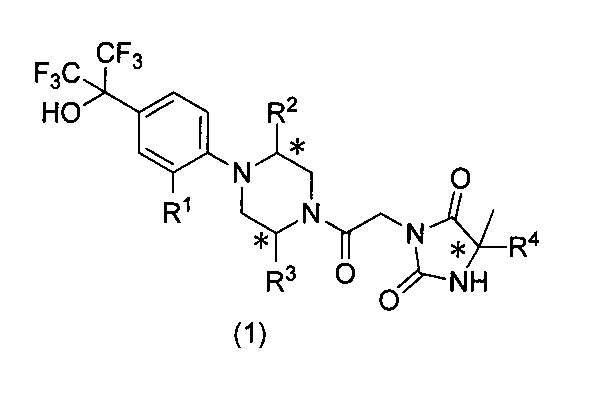
[式中、R1はC2-3アルキル基、R2、R3は同一又は異なってもよく、C1-3アルキル基を示し、*は不斉炭素原子を示し、R4は、
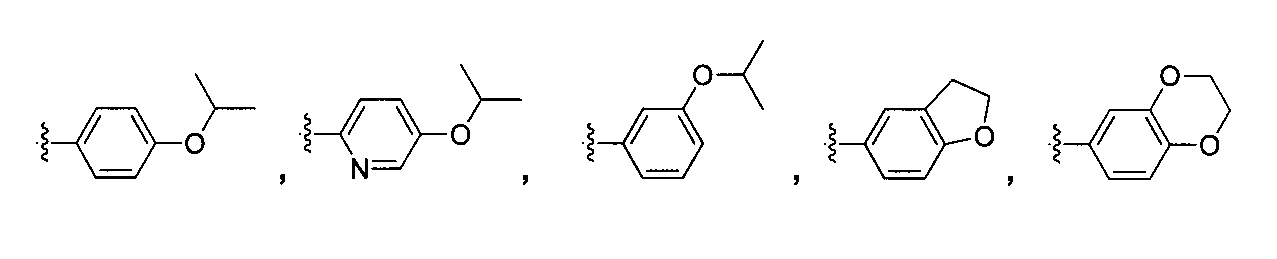
から選択される構造のうちいずれかひとつを示す]で表される光学活性化合物の製造方法であって、
式(2):
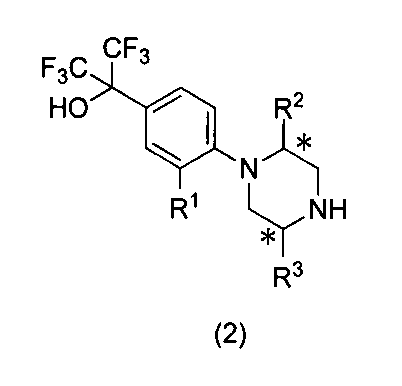
式(2):
[式中、R1、R2、R3、*は前記と同じ定義である]で表される化合物と、式(3):

[式中、R4、*は前記と同じ定義である]で表される化合物を反応することにより、式(1)で表される化合物を製造することを特徴とする方法。
[2]
式(1):
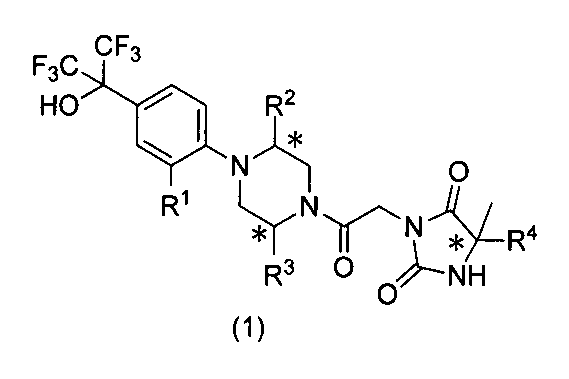
式(1):
[式中、R1はC2-3アルキル基、R2、R3は同一又は異なってもよく、C1-3アルキル基を示し、*は不斉炭素原子を示し、R4は、

から選択される構造のうちいずれかひとつを示す]で表される光学活性化合物の製造方法であって、
i) 式(4):
i) 式(4):

[式中、R5は、C1-3アルキル基を示し、X1は、ハロゲン原子を示す]で表される化合物と、式(5):
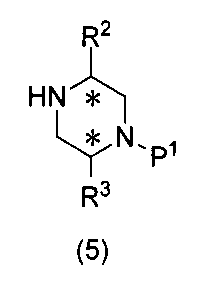
[式中、R2、R3は同一又は異なってもよく、C1-3アルキル基を示し、*は不斉炭素原子を示し、P1はアミノ基の保護基を示す]で表される化合物を反応して、式(6):
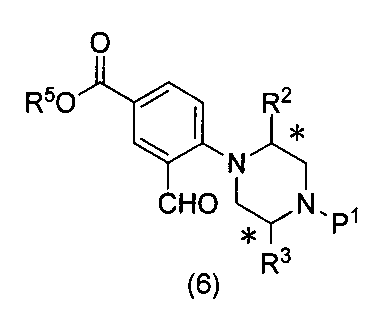
[式中、P1、R2、R3、R5、*は、前記と同じ定義である]で表される化合物を製造し、次いで、
ii) 式(6)で表されるアルデヒドをオレフィンに変換して、式(7):
ii) 式(6)で表されるアルデヒドをオレフィンに変換して、式(7):

[式中、P1、R2、R3、R5、*は、前記と同じ定義であり、R6は、水素原子又はメチル基を示し、波線は単結合であって、それが結合している二重結合についての立体配置が、それぞれ独立して、E配置若しくはZ配置、又はそれらの混合であることを示す]で表される化合物を製造し、次いで、
iii) 式(7)で表されるオレフィンを還元して、式(8):
iii) 式(7)で表されるオレフィンを還元して、式(8):
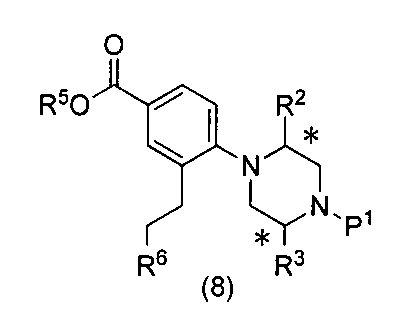
[式中、P1、R2、R3、R5、R6、*は、前記と同じ定義である]で表される化合物を製造し、次いで、
iv) 式(8)で表されるエステルを加水分解して、式(9):
iv) 式(8)で表されるエステルを加水分解して、式(9):
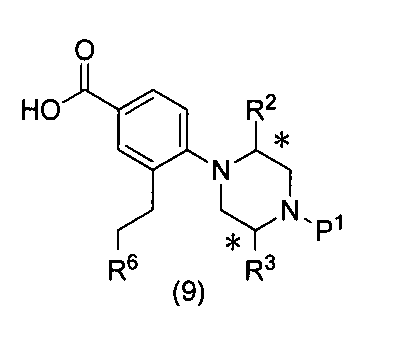
[式中、P1、R2、R3、R6、*は、前記と同じ定義である]で表される化合物を製造し、次いで、
v) 式(9)で表されるカルボン酸を酸ハロゲン化物、酸無水物又はエステルに変換して、式(10):
v) 式(9)で表されるカルボン酸を酸ハロゲン化物、酸無水物又はエステルに変換して、式(10):

[式中、P1、R2、R3、R6、*は、前記と同じ定義であり、C(O)R7は酸ハロゲン化物、酸無水物又はエステルを示す]で表される化合物を製造し、次いで、
vi) 式(10)で表される化合物とトリフルオロメチル化試薬を反応して、式(11):
vi) 式(10)で表される化合物とトリフルオロメチル化試薬を反応して、式(11):
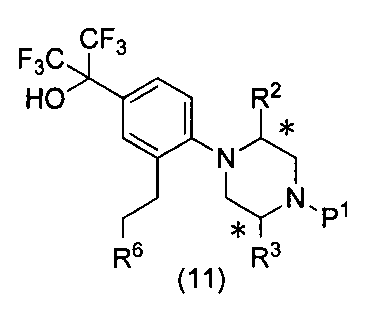
[式中、P1、R2、R3、R6、*は、前記と同じ定義である]で表される化合物を製造し、次いで、
vii) 式(11)で表される化合物の保護基P1を脱保護することにより、式(2)

[式中、R1、R2、R3、*は前記と同じ定義である]で表される化合物を製造することを含むことを特徴とする方法。
vii) 式(11)で表される化合物の保護基P1を脱保護することにより、式(2)
[3]
式(2)で表される化合物を[2]に記載の方法により製造することをさらに含むことを特徴とする[1]に記載の方法。
式(2)で表される化合物を[2]に記載の方法により製造することをさらに含むことを特徴とする[1]に記載の方法。
[4]
i) 式(12):
i) 式(12):
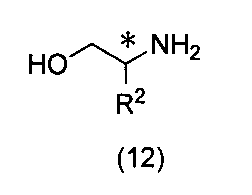
[式中、R2は同一又は異なってもよく、C1-3アルキル基を示し、*は不斉炭素原子を示す]で表されるアミノアルコール体のアミノ基を保護して式(13):
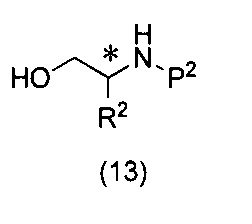
[式中、R2および*は前記と同じ定義であり、P2はアミノ基の保護基を示す]で表される化合物を製造し、次いで、
ii) 式(13)で表される化合物の水酸基のスルホニル化反応を行い、式(14):
ii) 式(13)で表される化合物の水酸基のスルホニル化反応を行い、式(14):
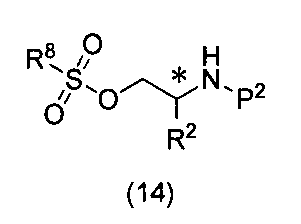
[式中、P2およびR2は前記と同じ定義であり、R8はトリフルオロメチル基、メチル基、トルイル基又はニトロフェニル基を示す]で表される化合物を製造し、次いで、
iii) 式(14)で表される化合物と式(15):
iii) 式(14)で表される化合物と式(15):
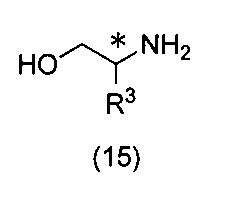
[式中、R3は同一又は異なってもよく、C1-3アルキル基を示し、*は前記と同じ定義である]で表される化合物を反応して、式(16):
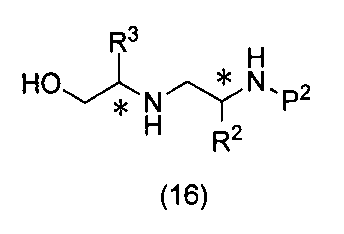
[式中、P2、R2、R3および*は前記と同じ定義である]で表される化合物を製造し、次いで、
iv) 式(16)で表される化合物のアミノ基を保護して、式(17):
iv) 式(16)で表される化合物のアミノ基を保護して、式(17):

[式中、P1はアミノ基の保護基を示し、P2、R2、R3および*は前記と同じ定義である]で表される化合物を製造し、次いで、
v) 式(17)で表される化合物の環化反応を行い、式(18):
v) 式(17)で表される化合物の環化反応を行い、式(18):
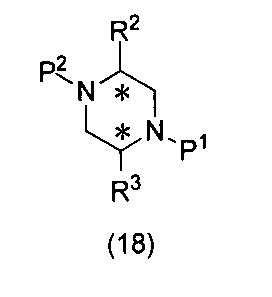
[式中、P1、P2、R2、R3および*は前記と同じ定義である]で表される化合物を製造し、次いで、
vi)式(18)で表される化合物の保護基P2を脱保護することにより式(5)で表される化合物を製造する工程をさらに含むことを特徴とする、[2]又は[3]に記載の製造方法。
vi)式(18)で表される化合物の保護基P2を脱保護することにより式(5)で表される化合物を製造する工程をさらに含むことを特徴とする、[2]又は[3]に記載の製造方法。
[5]
i) 式(19):

i) 式(19):
[式中、R4、

から選択される構造のうちいずれかひとつを示し、*は不斉炭素原子を示す]で表される化合物と、式(20):

[式中、R9はC1-3のアルキル基を示し、X2はハロゲン原子を示す]で表される化合物を反応して、式(21):
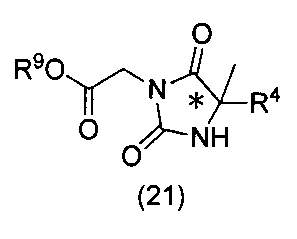
[式中、R4、R9、*は前記と同じ定義である]で表される化合物を製造し、次いで、
ii)式(21)で表される化合物の加水分解反応をすることにより、式(3)で表される化合物を製造する工程をさらに含むことを特徴とする、[1]、[3]及び[4]のいずれかに記載の製造方法。
ii)式(21)で表される化合物の加水分解反応をすることにより、式(3)で表される化合物を製造する工程をさらに含むことを特徴とする、[1]、[3]及び[4]のいずれかに記載の製造方法。
[6]
式(1)で表される化合物が3-(2-{(2S,5R)-4-[4-(1,1,1,3,3,3-ヘキサフルオロ-2-ヒドロキシプロパン-2-イル)-2-プロピルフェニル]-2,5-ジメチルピペラジン-1-イル}-2-オキソエチル)-5-[4-(1-メチルエトキシ)フェニル]-5-メチルイミダゾリジン-2,4-ジオンである[1]~[5]のいずれかに記載の製造方法。
式(1)で表される化合物が3-(2-{(2S,5R)-4-[4-(1,1,1,3,3,3-ヘキサフルオロ-2-ヒドロキシプロパン-2-イル)-2-プロピルフェニル]-2,5-ジメチルピペラジン-1-イル}-2-オキソエチル)-5-[4-(1-メチルエトキシ)フェニル]-5-メチルイミダゾリジン-2,4-ジオンである[1]~[5]のいずれかに記載の製造方法。
[7]
式(2)
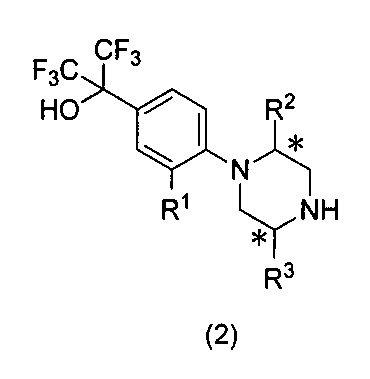
式(2)
[式中、R1はC2-3アルキル基、R2、R3は同一又は異なってもよいC1-3アルキル基を示し、*は不斉炭素を示す]で表される化合物及びその塩又はそれらの溶媒和物。
本発明の方法は、後記実施例に示すとおり、従来の方法に比べて高収率で目的の化合物(1)を製造することができる。また不斉中心として導入する2,5-ジメチルピペラジン体(3)の不斉炭素は、本方法に従う事によりエピメリ化が起こる事無く構築することができる。さらに、2,5-ジメチルピペラジン体(3)の一つのアミノ基の保護基以外は保護基を使用する事無く構築することができる。従って、本発明の方法を用いることにより、LXRβ選択的アゴニストとして有用な化合物(1)を高収率且つ高光学純度で製造できる。
本発明の用語の定義は以下の通りである。
本発明において、C1-3アルキル基とは、炭素数が1~3の直鎖又は分岐鎖のアルキル基を意味し、例えば、メチル基、エチル基、プロピル基、イソプロピル基が挙げられる。
一般式(1)~(2)中、R1のC1-3アルキル基としては、プロピル基が好ましい。
一般式(1)~(2)、(5)~(14)及び(16)~(18)中、R2のC1-3アルキル基としては、メチル基が好ましい。
一般式(1)~(2)、(5)~(11)及び(15)~(18)中、R3のC1-3アルキル基としては、メチル基が好ましい。
一般式(1)、(3)、(19)及び(21)中、R4としては、
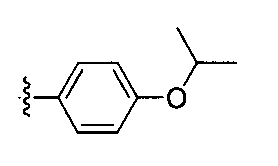
一般式(4)、(6)~(8)中、R5のC1-3アルキル基としては、メチル基が好ましい。
一般式(7)~(11)中、R6としては、メチル基が好ましい。
一般式(10)中、C(O)R7における酸ハロゲン化物としては、酸フッ化物、酸塩化物等が挙げられる。
一般式(10)中、C(O)R7における酸無水物としては、酢酸等の脂肪族カルボン酸、安息香酸等の芳香族カルボン酸との酸無水物等が挙げられる。
一般式(10)中、C(O)R7におけるエステルとしては、メタノール等の脂肪族アルコールとのエステル、ペンタフルオロフェノール等の芳香族アルコールとのエステル等が挙げられる。
一般式(10)中、C(O)R7としては、エステルが好ましく、ペンタフルオロフェノキシカルボニル基がさらに好ましい。
一般式(14)中、R8のC1-3アルキル基としては、メチル基が好ましい。
一般式(20)、(21)中、R9のC1-3アルキル基としては、メチル基が好ましい。
本発明において、アミノ基の保護基としては、tert-ブトキシカルボニル基(Boc)、ベンジルオキシカルボニル基(Cbz)、9-フルオレニルメチルオキシカルボニル基(Fmoc)、2,2,2-トリクロロエトキシカルボニル基(Troc)、アリルオキシカルボニル基(Alloc)、トリフルオロアセチル基(CF3CO-)、フタロイル基(Pht)、p-トルエンスルホニル基(Ts)、2-ニトロベンゼンスルホニル基(Ns)、トリチル基(Tr)等が挙げられる。
一般式(5)~(11)、(17)、(18)中、アミノ基の保護基P1としては、tert-ブトキシカルボニル基、9-フルオレニルメチルオキシカルボニル基(Fmoc)、2,2,2-トリクロロエトキシカルボニル基(Troc)、アリルオキシカルボニル基(Alloc)、トリフルオロアセチル基(CF3CO-)、フタロイル基(Pht)、p-トルエンスルホニル基(Ts)、2-ニトロベンゼンスルホニル基(Ns)、トリチル基(Tr)が好ましく、tert-ブトキシカルボニル基がより好ましい。
一般式(13)、(14)、(16)~(18)中、アミノ基の保護基P2としては、tert-ブトキシカルボニル基、9-フルオレニルメチルオキシカルボニル基(Fmoc)、2,2,2-トリクロロエトキシカルボニル基(Troc)、アリルオキシカルボニル基(Alloc)、トリフルオロアセチル基(CF3CO-)、フタロイル基(Pht)、p-トルエンスルホニル基(Ts)、2-ニトロベンゼンスルホニル基(Ns)、4-ニトロベンゼンスルホニル基(Ns)、トリチル基(Tr)が好ましく、2-ニトロベンゼンスルホニル基(Ns)がより好ましい。
一般式(4)中、ハロゲン原子X1としては、フッ素原子、塩素原子、臭素原子、ヨウ素原子が挙げられ、フッ素原子、塩素原子が好ましく、フッ素原子がより好ましい。
一般式(20)中、ハロゲン原子X2としては、塩素原子、臭素原子、ヨウ素原子が好ましい。
本発明において、*は不斉炭素原子を示す。本発明の一般式(2)は、下記(2a)~(2d):

に示す4つの構造を包含している。
一般式(2)の4つの立体構造(2a)~(2d)を構築するための原料として、具体的にはアミノアルコール誘導体(12a)、(12b)、(15a)および(15b):
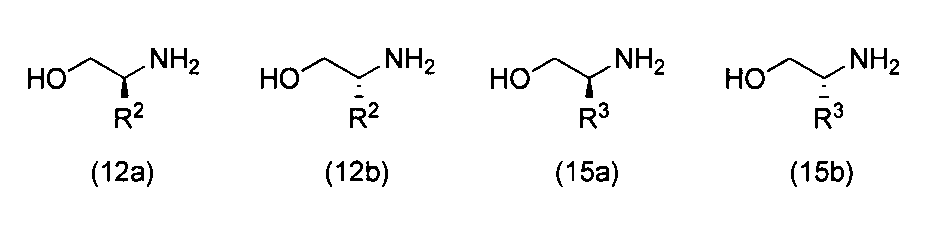
を用いることができる。(2a)の立体構造を構築するための原料としては(12a)と(15b);(2b)の立体構造を構築するための原料としては(12b)と(15a);(2c)の立体構造を構築するための原料としては(12a)と(15a);(2d)の立体構造を構築するための原料としては(12b)と(15b)を用いればよい。具体例として、(S)-(+)-2-アミノ-1-プロパノール、(R)-(-)-2-アミノ-1-プロパノール、(S)-(+)-2-アミノ-1-ブタノール、(R)-(-)-2-アミノ-1-ブタノール、(S)-(+)-2-アミノ-1-ペンタノール、(R)-(-)-2-アミノ-1-ペンタノール、L-バリノール、D-バリノールなどが、Aldrich社、東京化成工業、渡辺化学工業、和光純薬工業、関東化学、AlfaAesar等から販売されている。
本発明の一般式(2)の立体構造としては、(2a)又は(2b)が好ましく、(2b)が特に好ましい。
本発明の一般式(2)の特に好ましい構造として、立体構造は(2b)であり、R1がプロピル基であり、R2およびR3がメチル基である化合物を挙げることができる。
本発明の一般式(1)は、下記(1a)~(1h):
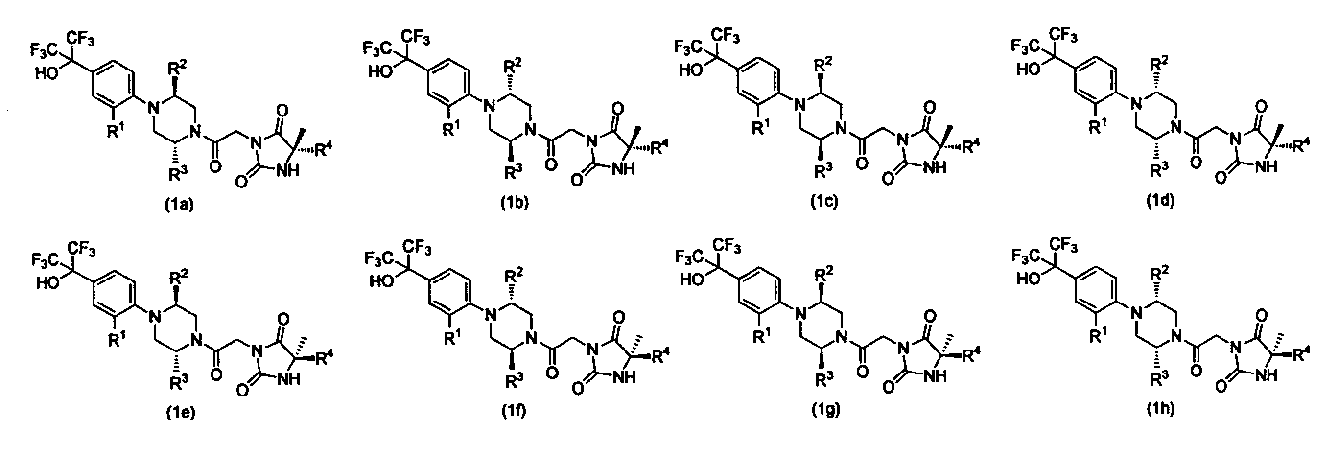
に示す8つの構造を含んでいる。
本発明の一般式(1)の8つの立体構造を構築するための原料として、(2a)~(2d)を用いることができる。(1a)および(1e)の立体構造を構築するための原料としては、(2a);(1b)および(1f)の立体構造を構築するための原料としては、(2b);(1c)および(1g)の立体構造を構築するための原料としては、(2c);(1d)および(1h)の立体構造を構築するための原料としては、(2d)を用いればよい。
本発明の一般式(1)立体構造としては、(1a)、(1b)、(1e)、又は(1f)が好ましく、より好ましくは、(1b)又は(1f)であり、本発明の一般式(1)の好ましい構造としては、R1がプロピルであり、R2およびR3がメチル基、R4が4-(1-メチルエトキシ)フェニル基である化合物が好ましい。
本発明の一般式(7)において、波線は単結合であって、それが結合している二重結合についての立体配置が、それぞれ独立して、E配置若しくはZ配置、又はそれらの混合であることを示す。本発明の、一般式(7)は、下記(7a)および(7b):
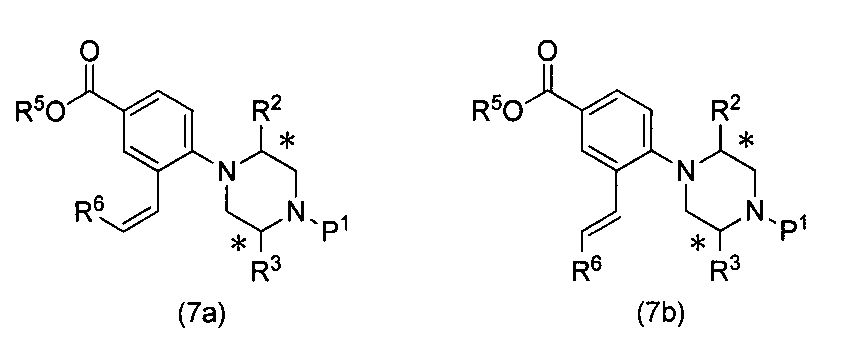
に示す2つの構造を包含している。
以下、本発明製造法について、反応工程図を示し、各工程の反応について詳細に説明する。

工程1:本工程は、化合物(12)のアミノ基を保護して化合物(13)を製造する工程である。P2で示される保護基は、例えば文献(Protective Groups in Organic Synthesis Third Edition, John Wiley & Sons, Inc.)を参考にして保護を行うことができる。
P2が2-ニトロベンゼンスルホニル基の場合は、化合物(12)を溶媒中又は無溶媒で、塩基の存在下、2-ニトロベンゼンスルホニルクロライド等と反応することにより化合物(13)を製造することができる。溶媒は特に制限はないが、N,N-ジメチルホルムアミド、テトラヒドロフラン、ジオキサン、アセトニトリル、ニトロメタン、アセトン、酢酸エチル、ベンゼン、クロロベンゼン、トルエン、クロロホルム、塩化メチレン等を用いることができ、中でも塩化メチレンが好ましい。塩基としては、特に制限はないが、トリエチルアミン、ジイソプロピルエチルアミン、ピリジン、ルチジン、ピコリン等の有機塩基;炭酸カリウム、炭酸ナトリウム等の無機塩基を用いることができ、中でも、トリエチルアミンが好ましい。反応条件としては、-20℃~100℃、好ましくは0℃~50℃で、1分~24時間、好ましくは5分~24時間である。
工程2:本工程は、化合物(13)のスルホニル化反応を行い、化合物(14)を製造する工程である。化合物(13)を溶媒中、塩基の存在下、スルホン酸ハライド試薬、又は、アルキル若しくはアラルキルスルホン酸無水物試薬を加えてスルホニルオキシ基等の脱離基へ誘導させることで化合物(14)を製造することができる。本反応で用いられる溶媒としては、N,N-ジメチルホルムアミド、テトラヒドロフラン、ジオキサン、アセトニトリル、ニトロメタン、アセトン、酢酸エチル、ベンゼン、クロロベンゼン、トルエン、クロロホルム、塩化メチレン等を用いることができ、中でもテトラヒドロフラン、ジオキサン、アセトニトリル、ベンゼン、クロロベンゼン、トルエン、クロロホルム、塩化メチレンが好ましく、塩化メチレンが特に好ましい。塩基としては、特に制限はないが、例えば水素化リチウム、水素化ナトリウム、水素化カリウム等の水素化アルカリ金属類;水酸化リチウム、水酸化ナトリウム、水酸化カリウム等の水酸化アルカリ金属類;炭酸リチウム、炭酸ナトリウム、炭酸カリウム、炭酸セシウム等の炭酸アルカリ金属類;ナトリウムメトキシド、カリウムメトキシド、ナトリウムエトキシド、カリウムエトキシド、tert-ブトキシナトリウム、tert-ブトキシカリウム等のアルコールの金属塩類;リチウムジイソプロピルアミド、ナトリウムジイソプロピルアミド、カリウムジイソプロピルアミド、リチウムヘキサメチルジシラジド、ナトリウムヘキサメチルジシラジド、カリウムヘキサメチルジシラジド等の金属アミド類;n-ブチルリチウム、sec-ブチルリチウム、tert-ブチルリチウム等の有機金属化合物類;トリエチルアミン、N,N-ジイソプロピルエチルアミン、N-メチルモルホリン、ピリジン、3,4-ルチジン、2,6-ルチジン、2,4,6-コリジン等の有機アミン類等を用いることができ、中でもトリエチルアミン、N,N-ジイソプロピルエチルアミン、N-メチルモルホリン、ピリジン、2-ピコリン、3-ピコリン、4-ピコリン、2,3-ルチジン、2,4-ルチジン、2,5-ルチジン、2,6-ルチジン、3,4-ルチジン、3,5-ルチジン、2,3,5-コリジン、2,4,6-コリジンが好ましく、トリエチルアミン、N-メチルモルホリン、2,6-ルチジン、2,4,6-コリジンが特に好ましい。スルホン酸ハライド試薬としては、特に制限はないが、例えば、メタンスルホン酸クロライド、ベンゼンスルホン酸クロライド、p-トルエンスルホン酸クロライド、2-ニトロベンゼンスルホン酸クロライド等が好ましい。アルキル又はアラルキルスルホン酸無水物試薬としては、特に制限はないが、例えば、メタンスルホン酸無水物、トリフルオロメタンスルホン酸無水物が好ましい。反応条件としては、-78℃~100℃、好ましくは、0℃~50℃で、5分~48時間、好ましくは30分~24時間である。
工程3:本工程は、化合物(14)とアミノアルコール体(15)とを、溶媒中、塩基の存在下又は非存在下で反応させることにより化合物(16)を製造する工程である。溶媒としては、特に制限は無いが、例えばテトラヒドロフラン、トルエン、ジオキサン、N,N-ジメチルホルムアミド、N-メチルピロリドン、ジメチルスルホキシド、アセトニトリル、プロピオニトリル、アセトン、メチルエチルケトン等を単独又は組み合わせて使用することができ、中でも、テトラヒドロフラン、アセトニトリルが好ましい。塩基としては、例えば水素化リチウム、水素化ナトリウム、水素化カリウム等の水素化アルカリ金属類;水酸化リチウム、水酸化ナトリウム、水酸化カリウム等の水酸化アルカリ金属類;炭酸リチウム、炭酸ナトリウム、炭酸カリウム、炭酸セシウム等の炭酸アルカリ金属類;ナトリウムメトキシド、カリウムメトキシド、ナトリウムエトキシド、カリウムエトキシド、tert-ブトキシナトリウム、tert-ブトキシカリウム等のアルコールの金属塩類;リチウムジイソプロピルアミド、ナトリウムジイソプロピルアミド、カリウムジイソプロピルアミド、リチウムヘキサメチルジシラジド、ナトリウムヘキサメチルジシラジド、カリウムヘキサメチルジシラジド等の金属アミド類;n-ブチルリチウム、sec-ブチルリチウム、tert-ブチルリチウム等の有機金属化合物類;塩化リチウム、臭化リチウム、ヨウ化リチウム、塩化ナトリウム、臭化ナトリウム、ヨウ化ナトリウム、塩化カリウム、臭化カリウム、ヨウ化カリウム等のハロゲン化アルカリ金属類等を使用することができる。反応条件としては、-80℃~150℃、好ましくは0℃~100℃にて、1分~5日間、好ましくは1時間~3日間である。
工程4:本工程は、化合物(16)のアミノ基を保護して化合物(17)を製造する工程である。P1で示される保護基は、例えば文献(Protective Groups in Organic Synthesis Third Edition, John Wiley & Sons, Inc.)を参考にして保護を行うことができる。
P1がtert-ブトキシカルボニル基の場合は、化合物(16)を溶媒中又は無溶媒で、塩基の存在下、二炭酸ジ-tert-ブチルと反応することにより化合物(17)を製造することができる。溶媒としては、特に制限はないが、N,N-ジメチルホルムアミド、テトラヒドロフラン、ジオキサン、アセトニトリル、ニトロメタン、アセトン、酢酸エチル、ベンゼン、クロロベンゼン、トルエン、クロロホルム、塩化メチレン等を用いることができ、中でもアセトニトリル、テトラヒドロフランが好ましい。塩基としては、特に制限はないが、トリエチルアミン、ジイソプロピルエチルアミン、ピリジン、ルチジン、ピコリン等の有機塩基;炭酸カリウム、炭酸ナトリウム等の無機塩基を用いることができ、中でも、トリエチルアミン、炭酸カリウムが好ましい。反応条件としては、-20℃~100℃、好ましくは0℃~50℃で、1分~24時間、好ましくは5分~24時間である。
工程5:本工程は、化合物(17)の分子内閉環反応を行い、ピペラジン誘導体(18)を製造する工程である。化合物(17)を溶媒中、塩基の存在下、スルホン酸ハライド試薬、又は、アルキル若しくはアラルキルスルホン酸無水物試薬を加えてスルホニルオキシ基等の脱離基へ誘導し、環化反応を進行させることでピペラジン誘導体(18)を製造することができる。溶媒としては、N,N-ジメチルホルムアミド、テトラヒドロフラン、ジオキサン、アセトニトリル、ニトロメタン、アセトン、酢酸エチル、ベンゼン、クロロベンゼン、トルエン、クロロホルム、塩化メチレン等を用いることができ、中でもテトラヒドロフラン、ジオキサン、アセトニトリル、ベンゼン、クロロベンゼン、トルエン、クロロホルム、塩化メチレンが好ましく、トルエン、テトラヒドロフランが特に好ましい。塩基としては、特に制限はないが、例えば水素化リチウム、水素化ナトリウム、水素化カリウム等の水素化アルカリ金属類;水酸化リチウム、水酸化ナトリウム、水酸化カリウム等の水酸化アルカリ金属類;炭酸リチウム、炭酸ナトリウム、炭酸カリウム、炭酸セシウム等の炭酸アルカリ金属類;ナトリウムメトキシド、カリウムメトキシド、ナトリウムエトキシド、カリウムエトキシド、tert-ブトキシナトリウム、tert-ブトキシカリウム等のアルコールの金属塩類;リチウムジイソプロピルアミド、ナトリウムジイソプロピルアミド、カリウムジイソプロピルアミド、リチウムヘキサメチルジシラジド、ナトリウムヘキサメチルジシラジド、カリウムヘキサメチルジシラジド等の金属アミド類;n-ブチルリチウム、sec-ブチルリチウム、tert-ブチルリチウム等の有機金属化合物類;トリエチルアミン、N,N-ジイソプロピルエチルアミン、N-メチルモルホリン、ピリジン、3,4-ルチジン、2,6-ルチジン、2,4,6-コリジン等の有機アミン類を用いることができ、中でもトリエチルアミン、N,N-ジイソプロピルエチルアミン、ピリジン、2-ピコリン、3-ピコリン、4-ピコリン、2,3-ルチジン、2,4-ルチジン、2,5-ルチジン、2,6-ルチジン、3,4-ルチジン、3,5-ルチジン、2,3,5-コリジン、2,4,6-コリジンが好ましく、ピリジン、2,6-ルチジン、2,4,6-コリジンが特に好ましい。スルホン酸ハライド試薬としては、特に制限はないが、例えば、メタンスルホン酸クロライド、ベンゼンスルホン酸クロライド、p-トルエンスルホン酸クロライド、2-ニトロベンゼンスルホン酸クロライド等が好ましい。アルキル又はアラルキルスルホン酸無水物試薬としては、特に制限はないが、例えば、メタンスルホン酸無水物、トリフルオロメタンスルホン酸無水物が好ましい。反応条件としては-78℃~100℃、好ましくは、-20℃~0℃で、5分~24時間、好ましくは30分~12時間反応である。
また本工程は、化合物(17)を溶媒中、ホスフィン試薬とアゾ系試薬又はエチレンジカルボン酸試薬とを反応することによってもピペラジン誘導体(18)を製造することができる。溶媒としては、N,N-ジメチルホルムアミド、テトラヒドロフラン、ジオキサン、アセトニトリル、ニトロメタン、アセトン、酢酸エチル、ベンゼン、クロロベンゼン、トルエン、クロロホルム、塩化メチレン等を単独若しくは組み合わせて使用することができ、中でも、N,N-ジメチルホルムアミド、テトラヒドロフラン、ジオキサン、アセトニトリル、テトラヒドロフラン/トルエンが好ましく、N,N-ジメチルホルムアミド、テトラヒドロフラン、テトラヒドロフラン/トルエンが特に好ましい。ホスフィン試薬としては、例えば、トリメチルホスフィン、トリエチルホスフィン、トリプロピルホスフィン、トリイソプロピルホスフィン、トリブチルホスフィン、トリイソブチルホスフィン、トリシクロへキシルホスフィン等のトリアルキルホスフィン及びトリフェニルホスフィン、ジフェニルホスフィノポリスチレン等のトリアリールホスフィンが挙げられ、このうちトリメチルホスフィン、トリブチルホスフィン、トリフェニルホスフィンが好ましい。アゾ系試薬又はエチレンジカルボン酸試薬としては、例えばアゾジカルボン酸ジエチル(DEAD)、アゾジカルボン酸ジイソプロピル(DIAD)、1,1’-アゾビス(N,N-ジメチルホルムアミド)(TMAD)、1,1’-(アゾジカルボニル)ジピペリジン(ADDP)、1,1’-アゾビス(N,N-ジイソプロピルホルムアミド)(TIPA)、1,6-ジメチル-1,5,7-ヘキサヒドロ-1,4,6,7-テトラゾシン-2,5-ジオン(DHTD)等が挙げられ、特にアゾジカルボン酸ジイソプロピルが好ましい。反応条件としては0℃~100℃、好ましくは、0℃~室温で、30分~1日間である。
工程6:本工程は、化合物(18)のアミノ基を脱保護して化合物(5)を製造する工程である。P2で示される保護基は、例えば文献(Protective Groups in Organic Synthesis Third Edition, John Wiley & Sons, Inc.)を参考にして脱保護を行うことができる。
P2が2-ニトロベンゼンスルホニル基の場合は、化合物(18)を溶媒中又は無溶媒で、塩基の存在下、チオール化合物と反応することにより化合物(5)を製造することができる。溶媒としては、特に制限はないが、N,N-ジメチルホルムアミド、テトラヒドロフラン、ジオキサン、アセトニトリル、ニトロメタン、アセトン、酢酸エチル、ベンゼン、クロロベンゼン、トルエン、クロロホルム、塩化メチレン等を用いることができ、中でもN,N-ジメチルホルムアミド、アセトニトリルが好ましい。塩基としては、特に制限はないが、炭酸リチウム、炭酸ナトリウム、炭酸カリウム、炭酸セシウム等の無機塩基を使用することができ、中でも炭酸カリウムが好ましい。チオール化合物としては、ベンゼンチオール、1-ドデカンチオール等が挙げられ、ベンゼンチオールが好ましい。反応条件としては、-20℃~100℃、好ましくは0℃~60℃で、1分~24時間、好ましくは5分~24時間である。
工程7:本工程は、化合物(4)を溶媒中、塩基の存在下又は非存在下、化合物(5)と反応させることにより化合物(6)を製造する工程である。溶媒としては、特に制限は無いが、例えばテトラヒドロフラン、トルエン、ジオキサン、N,N-ジメチルホルムアミド、N-メチルピロリドン、ジメチルスルホキシド、アセトニトリル、プロピオニトリル、アセトン、メチルエチルケトン、水等を単独又は組み合わせて使用することができる。塩基としては、特に制限はないが、例えば水素化リチウム、水素化ナトリウム、水素化カリウム等の水素化アルカリ金属類;水酸化リチウム、水酸化ナトリウム、水酸化カリウム等の水酸化アルカリ金属類;炭酸リチウム、炭酸ナトリウム、炭酸カリウム、炭酸セシウム等の炭酸アルカリ金属類;ナトリウムメトキシド、カリウムメトキシド、ナトリウムエトキシド、カリウムエトキシド、tert-ブトキシナトリウム、tert-ブトキシカリウム等のアルコールの金属塩類;リチウムジイソプロピルアミド、ナトリウムジイソプロピルアミド、カリウムジイソプロピルアミド、リチウムヘキサメチルジシラジド、ナトリウムヘキサメチルジシラジド、カリウムヘキサメチルジシラジド等の金属アミド類;n-ブチルリチウム、sec-ブチルリチウム、tert-ブチルリチウム等の有機金属化合物類;フッ化リチウム、塩化リチウム、臭化リチウム、ヨウ化リチウム、フッ化ナトリウム、塩化ナトリウム、臭化ナトリウム、ヨウ化ナトリウム、フッ化カリウム、塩化カリウム、臭化カリウム、ヨウ化カリウム、フッ化セシウム、塩化セシウム、臭化セシウム、ヨウ化セシウム等のハロゲン化アルカリ金属類;トリエチルアミン、N,N-ジイソプロピルエチルアミン、N-メチルモルホリン、ピリジン、3,4-ルチジン、2,6-ルチジン、2,4,6-コリジン等の有機アミン類を用いることができ、中でもトリエチルアミン、N,N-ジイソプロピルエチルアミンが好ましい。反応条件としては、-80℃~150℃、好ましくは0℃~100℃にて、1分~5日間、好ましくは1時間~3日間である。
工程8:本工程は、化合物(6)を溶媒中、塩基の存在下又は非存在下、Wittig試薬又はHorner-Wadsworth-Emmons(HWE)試薬を反応させることにより化合物(7)を製造する工程である。溶媒としては、N,N-ジメチルホルムアミド、テトラヒドロフラン、ジオキサン、アセトニトリル、ニトロメタン、アセトン、酢酸エチル、ベンゼン、クロロベンゼン、トルエン、クロロホルム、塩化メチレン等を用いることができ、中でも、テトラヒドロフラン、酢酸エチル、トルエン、クロロホルム、塩化メチレンが好ましい。Wittig試薬としては、安定イリド、不安定イリド(臭化メチルトリフェニルホスホニウム、臭化エチルトリフェニルホスホニウム等)等のホスホニウム塩を用いることができる。またHWE試薬としては、ホスホン酸エステルを用いることができる。塩基としては、特に制限はないが、例えば水素化リチウム、水素化ナトリウム、水素化カリウム等の水素化アルカリ金属類;水酸化リチウム、水酸化ナトリウム、水酸化カリウム等の水酸化アルカリ金属類;炭酸リチウム、炭酸ナトリウム、炭酸カリウム、炭酸セシウム等の炭酸アルカリ金属類;ナトリウムメトキシド、カリウムメトキシド、ナトリウムエトキシド、カリウムエトキシド、tert-ブトキシナトリウム、tert-ブトキシカリウム等のアルコールの金属塩類;リチウムジイソプロピルアミド、ナトリウムジイソプロピルアミド、カリウムジイソプロピルアミド、リチウムヘキサメチルジシラジド、ナトリウムヘキサメチルジシラジド、カリウムヘキサメチルジシラジド等の金属アミド類;n-ブチルリチウム、sec-ブチルリチウム、tert-ブチルリチウム等の有機金属化合物類;塩化リチウム、臭化リチウム、ヨウ化リチウム、フッ化ナトリウム、塩化ナトリウム、臭化ナトリウム、ヨウ化ナトリウム、塩化カリウム、臭化カリウム、ヨウ化カリウム、塩化セシウム、臭化セシウム、ヨウ化セシウム、等のハロゲン化アルカリ金属類等を使用することができる。反応条件としては、-80℃~150℃、好ましくは0℃~100℃にて、1分~5日間、好ましくは1時間~3日間である。
工程9:本工程は、化合物(7)を溶媒中、金属炭素存在下、水素雰囲気下に反応させることにより化合物(8)を製造する工程である。溶媒としては、特に制限は無いが、トルエン、酢酸メチルや酢酸エチル等のエステル類等、メタノール、エタノール、1-プロパノール、2-プロパノール等のアルコール類等を単独又は組み合わせて使用することができる。金属炭素としては、例えば、パラジウム炭素、白金炭素、ロジウム炭素、ルテニウム炭素等が挙げられる。反応条件としては、-80℃~150℃、好ましくは0℃~100℃にて、1分~5日間、好ましくは1時間~3日間である。
工程10:本工程は、化合物(8)を溶媒中、塩基又は酸の存在下、反応させることにより化合物(9)を製造する工程である。溶媒としては、特に制限は無いが、例えばテトラヒドロフラン、トルエン、ジオキサン、N,N-ジメチルホルムアミド、N-メチルピロリドン、ジメチルスルホキシド、アセトニトリル、プロピオニトリル、アセトン、メチルエチルケトン、水やメタノール、エタノール、1-プロパノール、2-プロパノール等のアルコール類等を単独又は組み合わせて使用することができる。塩基としては、特に制限はないが、例えば水酸化リチウム、水酸化ナトリウム、水酸化カリウム等の水酸化アルカリ金属類、炭酸リチウム、炭酸ナトリウム、炭酸カリウム、炭酸セシウム等の炭酸アルカリ金属類等を使用することができる。酸としては、特に制限はないが、例えば塩酸、硫酸、酢酸、トシル酸等を使用することができる。反応条件としては、-80℃~150℃、好ましくは0℃~100℃にて、1分~5日間、好ましくは1時間~3日間である。
工程11:本工程は、化合物(9)を溶媒中又は無溶媒中で、縮合剤の存在下又は非存在下、反応促進剤の存在下又は非存在下、酸又は塩基の存在下又は非存在下に反応して、化合物(10)を製造する工程である。R7で示される置換基としては、例えば文献(Comprehensive Organic Transformations Second Edition, John Wiley & Sons, Inc.)を参考に、酸ハロゲン化物、酸無水物又はエステルに変換する事ができる。酸ハロゲン化物としては、酸フッ化物、酸塩化物等が挙げられる。酸無水物としては、酢酸等の脂肪族カルボン酸との酸無水物、安息香酸等の芳香族カルボン酸との酸無水物等が挙げられる。エステルとしては、メタノール等の脂肪族アルコールとのエステル、ペンタフルオロフェノール等の芳香族アルコールとのエステル等が挙げられる。
R7がペンタフルオロフェノキシ基の場合、溶媒としては、特に制限は無いが、例えばテトラヒドロフラン、トルエン、ジオキサン、N,N-ジメチルホルムアミド、N-メチルピロリドン、ジメチルスルホキシド、アセトニトリル、プロピオニトリル、アセトン、メチルエチルケトン、酢酸エチル等を単独又は組み合わせて使用することができる。縮合剤としては、ジシクロヘキシルカルボジイミド(DCC)、1-エチル-3-(3-ジメチルアミノプロピル)カルボジイミド(EDC)、ジイソプロピルカルボジイミド(DIPCDI)等のカルボジイミド系試薬が挙げられ、中でも、ジシクロヘキシルカルボジイミド、1-エチル-3-(3-ジメチルアミノプロピル)カルボジイミドが好ましい。塩基としては、特に制限はないが、例えば水酸化リチウム、水酸化ナトリウム、水酸化カリウム等の水酸化アルカリ金属類、炭酸リチウム、炭酸ナトリウム、炭酸カリウム、炭酸セシウム等の炭酸アルカリ金属類、トリエチルアミン、N,N-ジイソプロピルエチルアミン、N-メチルモルホリン、ピリジン、3,4-ルチジン、2,6-ルチジン、2,4,6-コリジン等の有機アミン類等を使用することができる。酸としては、特に制限はないが、例えば塩酸、硫酸、酢酸、トシル酸等を使用することができる。反応条件としては、-80℃~150℃、好ましくは0℃~100℃にて、1分~5日間、好ましくは1時間~3日間である。
工程12:本工程は、化合物(10)を溶媒中、塩基の存在下、トリフルオロメチル化試薬を用いて、ヘキサフルオロカルビノール化合物(11)へと製造する工程である。溶媒としては、ジメトキシエタン、テトラヒドロフラン、トルエン、ジオキサン、エチレングリコールジメチルエーテル、N,N-ジメチルホルムアミド、N-メチルピロリドン、テトラメチルウレア、ジメチルスルホキシド、アセトニトリル、プロピオニトリル等を単独又は組み合わせて使用することができ、中でもエチレングリコールジメチルエーテルが好ましい。塩基としては、テトラメチルアンモニウムフルオリド、テトラエチルアンモニウムフルオリド、テトラブチルアンモニウムフルオリド等のテトラアルキルアンモニウム塩や、フッ化リチウム、フッ化ナトリウム、フッ化カリウム、フッ化セシウム等のフッ化アルカリ金属塩等が挙げられる。トリフルオロメチル化試薬としては、(トリフルオロメチル)トリメチルシラン、トリエチル(トリフルオロメチル)シラン、トリイソプロピル(トリフルオロメチル)シラン、メチルジフェニル(トリフルオロメチル)シラン、ジメチル(ジフェニル)トリフルオロメチルシラン等が挙げられる。反応条件としては、-80℃~150℃、好ましくは-30℃~50℃にて、1分~5日間、好ましくは1時間~3日間である。
工程13:本工程は、化合物(11)のアミノ基を脱保護して化合物(2)を製造する工程である。P1で示される保護基は、例えば文献(Protective Groups in Organic Synthesis Third Edition, John Wiley & Sons, Inc.)を参考にして脱保護を行うことができる。
P1がtert-ブトキシカルボニル基の場合は、化合物(11)を溶媒中又は無溶媒で、酸と反応することにより化合物(2)を製造することができる。溶媒は特に制限はないが、N,N-ジメチルホルムアミド、テトラヒドロフラン、ジオキサン、アセトニトリル、ニトロメタン、アセトン、酢酸エチル、ベンゼン、クロロベンゼン、トルエン、クロロホルム、塩化メチレン、水やメタノール、エタノール、1-プロパノール、2-プロパノール等を単独又は組み合わせて用いることができる。酸としては、特に制限はないが、塩酸、塩酸/酢酸エチル溶液、塩酸/ジオキサン溶液、塩酸/メタノール溶液、臭化水素酸、硫酸、硝酸等を使用することができ、中でも塩酸/酢酸エチル溶液、塩酸/メタノール溶液が好ましい。反応条件としては、-20℃~100℃、好ましくは0℃~50℃で、1分~24時間、好ましくは5分~12時間である。
工程14:本工程は、ヒダントイン誘導体(19)と化合物(20)とを、溶媒中、塩基の存在下又は非存在下で反応させることにより化合物(21)を製造する工程である。溶媒としては、特に制限は無いが、例えばテトラヒドロフラン、トルエン、ジオキサン、N,N-ジメチルホルムアミド、N-メチルピロリドン、ジメチルスルホキシド、アセトニトリル、プロピオニトリル、アセトン、メチルエチルケトン、水やメタノール、エタノール、1-プロパノール、2-プロパノール等のアルコール類等を単独又は組み合わせて使用することができる。塩基としては、特に制限はないが、例えば水素化リチウム、水素化ナトリウム、水素化カリウム等の水素化アルカリ金属類、水酸化リチウム、水酸化ナトリウム、水酸化カリウム等の水酸化アルカリ金属類;炭酸リチウム、炭酸ナトリウム、炭酸カリウム、炭酸セシウム等の炭酸アルカリ金属類;ナトリウムメトキシド、カリウムメトキシド、ナトリウムエトキシド、カリウムエトキシド、tert-ブトキシナトリウム、tert-ブトキシカリウム等のアルコールの金属塩類;リチウムジイソプロピルアミド、ナトリウムジイソプロピルアミド、カリウムジイソプロピルアミド、リチウムヘキサメチルジシラジド、ナトリウムヘキサメチルジシラジド、カリウムヘキサメチルジシラジド等の金属アミド類;n-ブチルリチウム、sec-ブチルリチウム、tert-ブチルリチウム等の有機金属化合物類;トリエチルアミン、N,N-ジイソプロピルエチルアミン、N-メチルモルホリン、ピリジン、3,4-ルチジン、2,6-ルチジン、2,4,6-コリジン等の有機アミン類を使用することができる。反応条件としては、-80℃~150℃、好ましくは0℃~100℃にて、1分~5日間、好ましくは1時間~3日間である。
また本工程で用いるイミダゾリジン-2,4-ジオン誘導体(19)の製造法は、ドイツ特許335993号又はWO2010/125811号(特許文献1)に記載されており、この特許を参考に種々のイミダゾリジン-2,4-ジオン誘導体を製造することができる。
また本工程で用いるイミダゾリジン-2、4-ジオン誘導体(19)は、酒石酸等の一般的な光学活性酸とのジアステレオマー塩に導き光学分割する方法、又は、光学活性カラムクロマトグラフィーを用いた方法等の一般的ラセミ分割法により、光学的に純粋な異性体に導くことができる。
工程15:本工程は、化合物(21)を溶媒中、塩基又は酸の存在下で反応させることにより化合物(3)を製造する工程である。溶媒としては、特に制限は無いが、例えばテトラヒドロフラン、トルエン、ジオキサン、N,N-ジメチルホルムアミド、N-メチルピロリドン、ジメチルスルホキシド、アセトニトリル、プロピオニトリル、アセトン、メチルエチルケトン、エチレングリコールジメチルエーテル、水やメタノール、エタノール、1-プロパノール、2-プロパノール等のアルコール類等を単独又は組み合わせて使用することができる。塩基としては、特に制限はないが、例えば水酸化リチウム、水酸化ナトリウム、水酸化カリウム等の水酸化アルカリ金属類、炭酸リチウム、炭酸ナトリウム、炭酸カリウム、炭酸セシウム等の炭酸アルカリ金属類、等を使用することができる。酸としては、特に制限はないが、例えば塩酸、硫酸、酢酸、トシル酸、等を使用することができる。反応条件としては、-80℃~150℃、好ましくは0℃~100℃にて、1分~5日間、好ましくは1時間~3日間である。
工程16:本工程は、化合物(2)と化合物(3)を溶媒中、縮合剤の存在下、反応促進剤の存在下又は非存在下、塩基の存在下又は非存在下で反応することにより、カルビノール誘導体(1)を製造する工程である。溶媒としては、N,N-ジメチルホルムアミド、N-メチルピロリドン、ジメチルスルホキシド、テトラヒドロフラン、ジオキサン、アセトニトリル、ニトロメタン、アセトン、酢酸エチル、ベンゼン、クロロベンゼン、トルエン、クロロホルム、塩化メチレン等を用いることができ、中でもジメチルスルホキシド、アセトニトリル、塩化メチレンが好ましい。縮合剤としては、ジシクロヘキシルカルボジイミド(DCC)、1-エチル-3-(3-ジメチルアミノプロピル)カルボジイミド(EDC)、ジイソプロピルカルボジイミド(DIPCDI)等のカルボジイミド系試薬;(1H-ベンゾトリアゾール-1-イルオキシ)トリス(ジメチルアミノ)ホスホニウムヘキサフルオロホスファート(BOP)、(1H-ベンゾトリアゾール-1-イルオキシ)トリス(ピロリジノ)ホスホニウムヘキサフルオロホスファート(PyBOP)、1-[ビス(ジメチルアミノ)メチレン]-1H-1,2,3-トリアゾロ(4,5-b)ピリジウム-3-オキソドヘキサフルオロホスファート(HATU)、1-[ビス(ジメチルアミノ)メチレン]-1H-ベンゾトリアゾリウム-3-オキシドヘキサフルオロホスファート(HBTU)、1-[ビス(ジメチルアミノ)メチレン]-1H-ベンゾトリアゾリウム-3-オキシドテトラフルオロボラート(TBTU)、1-[ビス(ジメチルアミノ)メチレン]-5-クロロ-1H-ベンゾトリアゾリウム-3-オキシドヘキサフルオロホスファート(HCTU)、1-[ビス(ジメチルアミノ)メチレン]-5-クロロ-1H-ベンゾトリアゾリウム-3-オキシドテトラフルオロボラート(TCTU)等のホスホニウム塩型あるいはグアニジウム塩型試薬が挙げられ、このうち1-エチル-3-(3-ジメチルアミノプロピル)カルボジイミド(EDC)、1H-ベンゾトリアゾール-1-イルオキシ)トリス(ジメチルアミノ)ホスホニウムヘキサフルオロホスファート(BOP)、(1H-ベンゾトリアゾール-1-イルオキシ)トリス(ピロリジノ)ホスホニウムヘキサフルオロホスファート(PyBOP)、1-[ビス(ジメチルアミノ)メチレン]-1H-1,2,3-トリアゾロ(4,5-b)ピリジウム-3-オキソドヘキサフルオロホスファート(HATU)、1-[ビス(ジメチルアミノ)メチレン]-1H-ベンゾトリアゾリウム-3-オキシドヘキサフルオロホスファート(HBTU)が好ましい。反応促進剤としては、例えば1-ヒドロキシベンゾトリアゾール(HOBt)、6-クロロ-1-ヒドロキシベンゾトリアゾール(6-Cl-HOBt)、3,4-ジヒドロ-3-ヒドロキシ-4-オキソ―1,2,3―ベンゾトリアジン(HOOBt)、1-ヒドロキシ-7-アザベンゾトリアゾール(HOAt)等を使用することができる。塩基としては、特に制限はないが、例えば水素化リチウム、水素化ナトリウム、水素化カリウム等の水素化アルカリ金属類、水酸化リチウム、水酸化ナトリウム、水酸化カリウム等の水酸化アルカリ金属類;炭酸リチウム、炭酸ナトリウム、炭酸カリウム、炭酸セシウム等の炭酸アルカリ金属類;ナトリウムメトキシド、カリウムメトキシド、ナトリウムエトキシド、カリウムエトキシド、tert-ブトキシナトリウム、tert-ブトキシカリウム等のアルコールの金属塩類;リチウムジイソプロピルアミド、ナトリウムジイソプロピルアミド、カリウムジイソプロピルアミド、リチウムヘキサメチルジシラジド、ナトリウムヘキサメチルジシラジド、カリウムヘキサメチルジシラジド等の金属アミド類;n-ブチルリチウム、sec-ブチルリチウム、tert-ブチルリチウム等の有機金属化合物類;トリエチルアミン、N,N-ジイソプロピルエチルアミン、N-メチルモルホリン、ピリジン、3,4-ルチジン、2,6-ルチジン、2,4,6-コリジン等の有機アミン類を使用することができる。反応条件としては、-80℃~150℃、好ましくは0℃~100℃にて、1分~5日間、好ましくは1時間~3日間である。
また本工程は、化合物(2)と化合物(3)を溶媒中、ホスフィン試薬の存在下、アゾ系試薬又はエチレンジカルボン酸試薬で反応する光延反応を適応することによっても、カルビノール誘導体(1)を製造することができる。溶媒としては、N,N-ジメチルホルムアミド、N-メチルピロリドン、ジメチルスルホキシド、テトラヒドロフラン、ジオキサン、アセトニトリル、ニトロメタン、アセトン、酢酸エチル、ベンゼン、クロロベンゼン、トルエン、クロロホルム、塩化メチレン等を用いることができる。ホスフィン試薬としては、トリメチルホスフィン、トリエチルホスフィン、トリプロピルホスフィン、トリイソプロピルホスフィン、トリブチルホスフィン、トリイソブチルホスフィン、トリシクロへキシルホスフィン等のトリアルキルホスフィン及びトリフェニルホスフィン、ジフェニルホスフィノポリスチレン等のトリアリールホスフィン等を用いることができる。アゾ系試薬又はエチレンジカルボン酸試薬としては、アゾジカルボン酸ジエチル(DEAD)、アゾジカルボン酸ジイソプロピル(DIAD)、1,1’-アゾビス(N,N-ジメチルホルムアミド)(TMAD)、1,1’-(アゾジカルボニル)ジピペリジン(ADDP)、1,1’-アゾビス(N,N-ジイソプロピルホルムアミド)(TIPA)、1,6-ジメチル-1,5,7-ヘキサヒドロ-1,4,6,7-テトラゾシン-2,5-ジオン(DHTD)等を用いることができる。反応条件としては、-80℃~150℃、好ましくは0℃~100℃にて、1分~5日間、好ましくは1時間~3日間である。
また本工程は、化合物(3)を溶媒中、酸ハロゲン化剤と反応して酸ハライド誘導体を製造し、その後、これと化合物(2)とを溶媒中、塩基の存在下又は非存在下で反応させることによっても、カルビノール誘導体(1)を製造することができる。酸ハロゲン化剤としては、三フッ化N,N-ジエチルアミノ硫黄(DAST)、四フッ化セレン又はそのピリジン付加物、塩化チオニル、塩化オキサリル、ピロカテキルホスホ三塩化物、ジクロロトリフェニルホスホラン、臭化チオニル、ジブロモトリフェニルホスホラン、1-ジメチル-1-ヨード-2-メチルプロペン等を使用することができる。溶媒としては、特に制限は無いが、例えばトルエン、N,N-ジメチルホルムアミド、N-メチルピロリドン、アセトニトリル、ジクロロメタン、1,2-ジクロロエタン等を単独又は組み合わせて使用することができる。塩基としては、特に制限はないが、例えば水素化リチウム、水素化ナトリウム、水素化カリウム等の水素化アルカリ金属類、水酸化リチウム、水酸化ナトリウム、水酸化カリウム等の水酸化アルカリ金属類;炭酸リチウム、炭酸ナトリウム、炭酸カリウム、炭酸セシウム等の炭酸アルカリ金属類;ナトリウムメトキシド、カリウムメトキシド、ナトリウムエトキシド、カリウムエトキシド、tert-ブトキシナトリウム、tert-ブトキシカリウム等のアルコールの金属塩類;リチウムジイソプロピルアミド、ナトリウムジイソプロピルアミド、カリウムジイソプロピルアミド、リチウムヘキサメチルジシラジド、ナトリウムヘキサメチルジシラジド、カリウムヘキサメチルジシラジド等の金属アミド類;n-ブチルリチウム、sec-ブチルリチウム、tert-ブチルリチウム等の有機金属化合物類;トリエチルアミン、N,N-ジイソプロピルエチルアミン、N-メチルモルホリン、ピリジン、3,4-ルチジン、2,6-ルチジン、2,4,6-コリジン等の有機アミン類を使用することができる。反応条件としては、-80℃~150℃、好ましくは0℃~100℃にて、1分~5日間、好ましくは1時間~3日間である。
本発明の一般式(2)で表される光学活性化合物において許容される塩としては、具体的には、無機酸や有機酸との酸付加塩、又は無機塩基や有機塩基との塩基付加塩等が挙げられる。
本発明の一般式(2)で表される光学活性化合物、及びその許容される塩の溶媒和物としては、具体的には水和物や各種の溶媒和物が挙げられる。
以下に、実施例を挙げて本発明を更に詳細に説明する。
[実施例]
実施例:(S)-3-(2-{(2S,5R)-4-[4-(1,1,1,3,3,3-ヘキサフルオロ-2-ヒドロキシプロパン-2-イル)-2-プロピルフェニル]-2,5-ジメチルピペラジン-1-イル}-2-オキソエチル)-5-[4-(1-メチルエトキシ)フェニル]-5-メチルイミダゾリジン-2,4-ジオン((S)-B)の製造
[実施例]
実施例:(S)-3-(2-{(2S,5R)-4-[4-(1,1,1,3,3,3-ヘキサフルオロ-2-ヒドロキシプロパン-2-イル)-2-プロピルフェニル]-2,5-ジメチルピペラジン-1-イル}-2-オキソエチル)-5-[4-(1-メチルエトキシ)フェニル]-5-メチルイミダゾリジン-2,4-ジオン((S)-B)の製造

工程I:(R)-N-(1-ヒドロキシプロパン-2-イル)-2-ニトロベンゼンスルホンアミド(c2)の製造:
(R)-2-アミノプロパン-1-オール(2.03 g, 29.8 mmol)をジクロロメタン(27 mL)に溶解させた。0℃にて、トリエチルアミン (3.74 g, 36.9 mmol)、塩化 2-ニトロベンゼン-1-スルホニル(6.0 g, 27.1 mmol)を加え、室温にて16時間撹拌した。反応完結を確認後、反応液に、を0℃にて、ジクロロメタン、水を加えた。その後、反応液をジクロロメタンにて抽出し、有機層を飽和食塩水にて洗浄し、無水硫酸ナトリウムを用いて乾燥し、減圧下濃縮し、表題化合物 8.58 g (収率>99%)を褐色油状物として得た。
(R)-2-アミノプロパン-1-オール(2.03 g, 29.8 mmol)をジクロロメタン(27 mL)に溶解させた。0℃にて、トリエチルアミン (3.74 g, 36.9 mmol)、塩化 2-ニトロベンゼン-1-スルホニル(6.0 g, 27.1 mmol)を加え、室温にて16時間撹拌した。反応完結を確認後、反応液に、を0℃にて、ジクロロメタン、水を加えた。その後、反応液をジクロロメタンにて抽出し、有機層を飽和食塩水にて洗浄し、無水硫酸ナトリウムを用いて乾燥し、減圧下濃縮し、表題化合物 8.58 g (収率>99%)を褐色油状物として得た。
1H-NMR (CDCl3) δ: 1.14 (3H, d, J = 6.8 Hz), 3.49-3.53 (1H, m), 1.85 (1H, brs), 3.47-3.66 (3H, m), 5.48 (1H, d, J = 6.8 Hz), 7.72-7.79 (2H, m), 7.86-7.92 (1H, m), 8.15-8.20 (1H, m).
工程II:メタンスルホン酸 (R)-2-(2-ニトロフェニルスルホンアミド)プロピル(c3)の製造:
(R)-N-(1-ヒドロキシプロパン-2-イル)-2-ニトロベンゼンスルホンアミド(8.58 g, 27.1 mmol)をジクロロメタン(90 mL)に溶解させた。0℃にて、トリエチルアミン(4.10 g, 40.6 mmol)、塩化メタンスルホニル(2.98 g, 29.9 mmol)を加え、室温にて18時間撹拌した。反応完結を確認後、反応液に、を0℃にて、水を加えた。その後、反応液をクロロホルムにて抽出し、有機層を飽和食塩水にて洗浄し、無水硫酸ナトリウムを用いて乾燥し、減圧下濃縮し、表題化合物 9.06 g (収率>99%)を褐色油状物として得た。
(R)-N-(1-ヒドロキシプロパン-2-イル)-2-ニトロベンゼンスルホンアミド(8.58 g, 27.1 mmol)をジクロロメタン(90 mL)に溶解させた。0℃にて、トリエチルアミン(4.10 g, 40.6 mmol)、塩化メタンスルホニル(2.98 g, 29.9 mmol)を加え、室温にて18時間撹拌した。反応完結を確認後、反応液に、を0℃にて、水を加えた。その後、反応液をクロロホルムにて抽出し、有機層を飽和食塩水にて洗浄し、無水硫酸ナトリウムを用いて乾燥し、減圧下濃縮し、表題化合物 9.06 g (収率>99%)を褐色油状物として得た。
1H-NMR (CDCl3) δ: 1.25 (3H, d, J = 6.8 Hz), 3.00 (3H, s), 3.84-3.94 (1H, m), 4.11-4.19 (2H, m), 5.54 (1H, d, J = 7.6 Hz), 7.74-7.80 (2H, m), 7.88-7.94 (1H, m), 8.14-8.20 (1H, m).
工程III:N-[(R)-1-{[(S)-1-ヒドロキシプロパン-2-イル]アミノ}プロパン-2-イル]-2-ニトロベンゼンスルホンアミド(c5)の製造:
メタンスルホン酸 (R)-2-(2-ニトロフェニルスルホンアミド)プロピル(9.06 g, 27.1 mmol)をテトラヒドロフラン(135 mL)に溶解させた。室温にて、(S)-2-アミノプロパン-1-オール (10.2 g, 135 mmol)を加え、還流下15時間撹拌した。反応完結を確認後、反応液を減圧下濃縮した。得られた残渣をシリカゲルカラムクロマトグラフィー(クロロホルム/メタノール)を用いて精製し、表題化合物 5.14 g (収率60%)を黄色油状物として得た。
メタンスルホン酸 (R)-2-(2-ニトロフェニルスルホンアミド)プロピル(9.06 g, 27.1 mmol)をテトラヒドロフラン(135 mL)に溶解させた。室温にて、(S)-2-アミノプロパン-1-オール (10.2 g, 135 mmol)を加え、還流下15時間撹拌した。反応完結を確認後、反応液を減圧下濃縮した。得られた残渣をシリカゲルカラムクロマトグラフィー(クロロホルム/メタノール)を用いて精製し、表題化合物 5.14 g (収率60%)を黄色油状物として得た。
1H-NMR (CDCl3) δ: 1.17 (3H, d, J = 6.8 Hz), 1.26 (3H, d, J = 6.4 Hz), 2.51 (1H, dd, J = 6.8, 12.4 Hz), 2.74-2.66 (1H, m), 2.79 (1H, dd, J = 4.8, 12.4 Hz), 3.23 (1H, dd, J = 6.8, 10.8 Hz), 3.59-3.67 (1H, m), 3.72 (1H, dd, J = 3.8, 10.8 Hz), 7.72-7.77 (2H, m), 7.85-7.89 (1H, m), 8.14-8.19 (1H, m).
工程IV:[(S)-1-ヒドロキシプロパン-2-イル][(R)-2-(2-ニトロフェニルスルホンアミド)プロピル]カルバミン酸 tert-ブチル(c6)の製造:
N-[(R)-1-{[(S)-1-ヒドロキシプロパン-2-イル]アミノ}プロパン-2-イル]-2-ニトロベンゼンスルホンアミド(7.09 g, 22.3 mmol)をテトラヒドロフラン(110 mL)に溶解させた。0℃にて、トリエチルアミン (4.97 g, 49.1 mmol)、二炭酸ジ-tert-ブチル(Boc2O)(5.36 g, 24.6 mmol)を加えた。その後、0℃にて15分間攪拌し、さらに室温にて終夜撹拌した。反応完結を確認後、反応液を減圧下濃縮し、得られた残渣をシリカゲルカラムクロマトグラフィー(クロロホルム/メタノール)を用いて精製し、表題化合物 7.55 g (収率81%)を橙色油状物として得た。
N-[(R)-1-{[(S)-1-ヒドロキシプロパン-2-イル]アミノ}プロパン-2-イル]-2-ニトロベンゼンスルホンアミド(7.09 g, 22.3 mmol)をテトラヒドロフラン(110 mL)に溶解させた。0℃にて、トリエチルアミン (4.97 g, 49.1 mmol)、二炭酸ジ-tert-ブチル(Boc2O)(5.36 g, 24.6 mmol)を加えた。その後、0℃にて15分間攪拌し、さらに室温にて終夜撹拌した。反応完結を確認後、反応液を減圧下濃縮し、得られた残渣をシリカゲルカラムクロマトグラフィー(クロロホルム/メタノール)を用いて精製し、表題化合物 7.55 g (収率81%)を橙色油状物として得た。
1H-NMR (CDCl3) δ: 1.06 (3H, d, J = 6.8 Hz), 1.16 (3H, d, J = 7.2 Hz), 1.48 (9H, s), 3.14-3.18 (1H, m), 3.29-3.38 (1H, m), 3.60-3.73 (2H, m), 3.76-3.84 (2H, m), 7.71-7.73 (2H, m), 7.82-7.84 (1H, m), 8.12-8.16 (1H, m).
工程V:2,5-ジメチル-4-[(2-ニトロフェニル)スルホニル]ピペラジン-1-カルボン酸 (2S,5R)-tert-ブチル(c7)の製造:
[(S)-1-ヒドロキシプロパン-2-イル][(R)-2-(2-ニトロフェニルスルホンアミド)プロピル]カルバミン酸 tert-ブチル(3.38 g, 8.08 mmol)を真空下乾燥した後、アルゴン雰囲気下テトラヒドロフラン(54 mL)に溶解させた。0℃にて、トリフェニルホスフィン(3.18 g, 12.1 mmol)、アゾジカルボン酸ジイソプロピル(DIAD)(7.1 mL, 1.7M トルエン溶液12.1 mmol)を加え、室温にて2時間撹拌した。反応完結を確認後、反応液を減圧下濃縮し、得られた残渣をシリカゲルカラムクロマトグラフィー(クロロホルム/メタノール)を用いて精製し、表題化合物 3.11 g (収率96%)を橙色油状物として得た。
[(S)-1-ヒドロキシプロパン-2-イル][(R)-2-(2-ニトロフェニルスルホンアミド)プロピル]カルバミン酸 tert-ブチル(3.38 g, 8.08 mmol)を真空下乾燥した後、アルゴン雰囲気下テトラヒドロフラン(54 mL)に溶解させた。0℃にて、トリフェニルホスフィン(3.18 g, 12.1 mmol)、アゾジカルボン酸ジイソプロピル(DIAD)(7.1 mL, 1.7M トルエン溶液12.1 mmol)を加え、室温にて2時間撹拌した。反応完結を確認後、反応液を減圧下濃縮し、得られた残渣をシリカゲルカラムクロマトグラフィー(クロロホルム/メタノール)を用いて精製し、表題化合物 3.11 g (収率96%)を橙色油状物として得た。
1H-NMR (CDCl3) δ: 1.10 (3H, d, J = 6.8 Hz), 1.32 (3H, d, J = 6.8 Hz), 1.45 (9H, s), 3.26-3.50 (3H, m), 3.67-3.81 (1H, m), 4.13-4.18 (1H, m), 4.26-4.46 (1H, m), 7.64-7.73 (3H, m), 8.04-8.05 (1H, m).
工程VI:2,5-ジメチルピペラジン-1-カルボン酸 (2S,5R)-tert-ブチル(c8)の製造:
2,5-ジメチル-4-[(2-ニトロフェニル)スルホニル]ピペラジン-1-カルボン酸 (2S,5R)-tert-ブチル(3.21 g, 8.04 mmol)をアセトニトリル(47 mL)に溶解させた。室温にて、炭酸カリウム (3.33 g, 24.1 mmol)、ベンゼンチオール(1.33 g, 12.1 mmol)を加え、50℃にて3時間撹拌した。反応完結を確認後、反応液を0℃にて、水を加えた。その後、反応液を酢酸エチルにて抽出し、有機層を飽和食塩水にて洗浄し、無水硫酸ナトリウムを用いて乾燥し、減圧下濃縮した。得られた残渣をシリカゲルカラムクロマトグラフィー(クロロホルム/メタノール)を用いて精製し、表題化合物 1.23 g (収率72%)を黄色油状物として得た。
2,5-ジメチル-4-[(2-ニトロフェニル)スルホニル]ピペラジン-1-カルボン酸 (2S,5R)-tert-ブチル(3.21 g, 8.04 mmol)をアセトニトリル(47 mL)に溶解させた。室温にて、炭酸カリウム (3.33 g, 24.1 mmol)、ベンゼンチオール(1.33 g, 12.1 mmol)を加え、50℃にて3時間撹拌した。反応完結を確認後、反応液を0℃にて、水を加えた。その後、反応液を酢酸エチルにて抽出し、有機層を飽和食塩水にて洗浄し、無水硫酸ナトリウムを用いて乾燥し、減圧下濃縮した。得られた残渣をシリカゲルカラムクロマトグラフィー(クロロホルム/メタノール)を用いて精製し、表題化合物 1.23 g (収率72%)を黄色油状物として得た。
1H-NMR (CDCl3) δ: 1.17 (3H, d, J = 6.8 Hz), 1.21 (3H, d, J = 6.8 Hz), 1.45 (9H, s), 2.48 (1H, dd, J = 2.8, 13.0 Hz), 3.09-3.16 (1H, m), 3.19 (1H, dd, J = 5.2, 5.2 Hz), 3.22 (1H, dd, J = 4.6, 5.2 Hz), 3.54 (1H, dd, J = 1.6, 13.0 Hz), 4.08-4.15 (1H, m).
工程VII:4-[2-ホルミル-4-(メトキシカルボニル)フェニル]-2,5-ジメチルピペラジン-1-カルボン酸 (2S,5R)-tert-ブチル(c10)の製造:
フッ化セシウム(14.0 g, 91.89 mmol)を減圧下120℃にて2時間乾燥後、アルゴン雰囲気下、室温にてN,N-ジメチルホルムアミド(52 mL)を加えた。その後、2,5-ジメチルピペラジン-1-カルボン酸 (2S,5R)-tert-ブチル(14.2 g, 61.26 mmol)のN,N-ジメチルホルムアミド(50 mL)溶液、4-フルオロ-3-ホルミル安息香酸メチルエステル(11.15 g, 61.26 mmol)の順に加え、100℃にて18時間攪拌した。反応終結を確認後、0℃にて、反応液にトルエン、水を加えた。その後、トルエンで抽出し、有機層を飽和食塩水で洗浄し、無水硫酸ナトリウムを用いて乾燥し、減圧濃縮した。得られた残渣をシリカゲルカラムクロマトグラフィー(ヘキサン/酢酸エチル)を用いて精製し、表題化合物 19.57 g(収率85%)を黄色アモルファスとして得た。
フッ化セシウム(14.0 g, 91.89 mmol)を減圧下120℃にて2時間乾燥後、アルゴン雰囲気下、室温にてN,N-ジメチルホルムアミド(52 mL)を加えた。その後、2,5-ジメチルピペラジン-1-カルボン酸 (2S,5R)-tert-ブチル(14.2 g, 61.26 mmol)のN,N-ジメチルホルムアミド(50 mL)溶液、4-フルオロ-3-ホルミル安息香酸メチルエステル(11.15 g, 61.26 mmol)の順に加え、100℃にて18時間攪拌した。反応終結を確認後、0℃にて、反応液にトルエン、水を加えた。その後、トルエンで抽出し、有機層を飽和食塩水で洗浄し、無水硫酸ナトリウムを用いて乾燥し、減圧濃縮した。得られた残渣をシリカゲルカラムクロマトグラフィー(ヘキサン/酢酸エチル)を用いて精製し、表題化合物 19.57 g(収率85%)を黄色アモルファスとして得た。
1H-NMR (CDCl3) δ:1.00 (3H, d, J = 6.0 Hz), 1.28 (3H, d, J = 6.4 Hz), 1.49 (9H, s), 2.86 (1H, d, J = 11.6 Hz), 3.63-3.70 (3H, m), 3.77 (1H, d, J = 12.6 Hz), 3.91 (3H, s), 4.44-4.49 (1H, m), 6.99 (1H, d, J = 8.8 Hz), 8.13 (1H, dd, J = 2.4, 8.8 Hz), 8.45 (1H, d, J = 2.4 Hz), 10.12 (1H, s).
工程VIII:4-[4-(メトキシカルボニル)-2-(プロパ-1-エン-1-イル)フェニル]-2,5-ジメチルピペラジン-1-カルボン酸 (2S,5R)-tert-ブチル(c11)の製造:
臭化エチルトリフェニルホスホニウム(25.8 g, 69.46 mmol)をテトラヒドロフラン(140mL)に溶解させ、アルゴン雰囲気下、0℃にてカリウムメトキシド(4.87 g, 69.46 mmol)を加えた。0℃にて1.5時間攪拌後、4-[2-ホルミル-4-(メトキシカルボニル)フェニル]-2,5-ジメチルピペラジン-1-カルボン酸 (2S,5R)-tert-ブチル(5.23 g, 13.89 mmol)のテトラヒドロフラン(140mL)溶液を加え、室温にて2.5時間攪拌した。反応終結を確認後、0℃にて反応液に水を加えた。その後、トルエンで抽出し、有機層を飽和食塩水で洗浄し、無水硫酸ナトリウムを用いて乾燥し、減圧濃縮した。得られた残渣をシリカゲルカラムクロマトグラフィー(ヘキサン/酢酸エチル)を用いて精製し、表題化合物 4.76 g(収率88%、cis/trans=0.7/1)を黄色アモルファスとして得た。
臭化エチルトリフェニルホスホニウム(25.8 g, 69.46 mmol)をテトラヒドロフラン(140mL)に溶解させ、アルゴン雰囲気下、0℃にてカリウムメトキシド(4.87 g, 69.46 mmol)を加えた。0℃にて1.5時間攪拌後、4-[2-ホルミル-4-(メトキシカルボニル)フェニル]-2,5-ジメチルピペラジン-1-カルボン酸 (2S,5R)-tert-ブチル(5.23 g, 13.89 mmol)のテトラヒドロフラン(140mL)溶液を加え、室温にて2.5時間攪拌した。反応終結を確認後、0℃にて反応液に水を加えた。その後、トルエンで抽出し、有機層を飽和食塩水で洗浄し、無水硫酸ナトリウムを用いて乾燥し、減圧濃縮した。得られた残渣をシリカゲルカラムクロマトグラフィー(ヘキサン/酢酸エチル)を用いて精製し、表題化合物 4.76 g(収率88%、cis/trans=0.7/1)を黄色アモルファスとして得た。
cis-c11: 4-{4-(メトキシカルボニル)-2-[(Z)-プロパ-1-エン-1-イル]フェニル}-2,5-ジメチルピペラジン-1-カルボン酸 (2S,5R)-tert-ブチル

1H-NMR (CDCl3) δ:0.87 (3H, d, J = 6.8 Hz), 1.30 (3H, d, J = 6.8 Hz), 1.48 (9H, s), 1.90-1.92 (3H, m), 2.71 (1H, d, J = 11.6 Hz), 3.41-3.44 (1H, m), 3.53-3.58 (1H, m), 3.69-3.72 (2H, m), 3.86 (3H, s), 4.41-4.46 (1H, m), 5.81 (1H, dd, J = 6.8, 11.4 Hz), 6.42 (1H, dd, J = 1.6, 11.4 Hz), 6.84 (1H, d, J = 8.6 Hz), 7.84 (1H, dd, J = 2.0, 8.6 Hz), 7.90 (1H, d, J = 1.6 Hz).
trans-c11: 4-{4-(メトキシカルボニル)-2-[(E)-プロパ-1-エン-1-イル]フェニル}-2,5-ジメチルピペラジン-1-カルボン酸 (2S,5R)-tert-ブチル

1H-NMR (CDCl3) δ:0.85 (3H, d, J = 6.8 Hz), 1.26 (3H, d, J = 6.8 Hz), 1.46 (9H, s), 1.87-1.89 (3H, m), 2.67 (1H, d, J = 12.0 Hz), 3.39-3.59 (3H, m), 3.67-3.73 (1H, m), 3.86 (3H, s), 4.41 (1H, brs), 6.25 (1H, dd, J = 6.4, 15.6 Hz), 6.54 (1H, dd, J = 1.6, 15.6 Hz), 6.80 (1H, d, J = 8.8 Hz), 7.80 (1H, dd, J = 1.6, 8.8 Hz), 8.03 (1H, d, J = 1.6 Hz).
工程IX:4-[4-(メトキシカルボニル)-2-プロピルフェニル]-2,5-ジメチルピペラジン-1-カルボン酸 (2S,5R)-tert-ブチル(c12)の製造:
4-[4-(メトキシカルボニル) -2-(プロパ-1-エン-1-イル)フェニル]-2,5-ジメチルピペラジン-1-カルボン酸 (2S,5R)-tert-ブチル(4.76 g, 12.25 mmol)をメタノール(123mL)に溶解させ、アルゴン雰囲気下、パラジウム炭素を加えた。その後、水素雰囲気下、室温にて24時間攪拌した。反応終結を確認後、セライトろ過し、酢酸エチルで洗浄し、減圧濃縮した。得られた残渣をシリカゲルカラムクロマトグラフィー(ヘキサン/酢酸エチル)を用いて精製し、表題化合物 4.72 g(収率99%)を無色油状物として得た。
4-[4-(メトキシカルボニル) -2-(プロパ-1-エン-1-イル)フェニル]-2,5-ジメチルピペラジン-1-カルボン酸 (2S,5R)-tert-ブチル(4.76 g, 12.25 mmol)をメタノール(123mL)に溶解させ、アルゴン雰囲気下、パラジウム炭素を加えた。その後、水素雰囲気下、室温にて24時間攪拌した。反応終結を確認後、セライトろ過し、酢酸エチルで洗浄し、減圧濃縮した。得られた残渣をシリカゲルカラムクロマトグラフィー(ヘキサン/酢酸エチル)を用いて精製し、表題化合物 4.72 g(収率99%)を無色油状物として得た。
1H-NMR (CDCl3) δ:0.91 (3H, d, J = 6.4 Hz), 0.97 (3H, t, J = 7.2 Hz), 1.30 (3H, d, J = 6.4 Hz), 1.49 (9H, s), 1.70 (2H, tq, J = 7.2, 7.6 Hz), 2.49-2.56 (2H, m), 2.79 (1H, td, J = 7.6, 14.4 Hz), 3.35-3.40 (1H, m), 3.51 (1H, dd, J = 3.2, 13.2 Hz), 3.61 (1H, dd, J = 4.0, 11.4 Hz), 3.74 (1H, dd, J = 1.6, 13.2 Hz), 3.88 (3H, s), 4.38-4.44 (1H, m), 6.90 (1H, d, J = 8.0 Hz), 7.80 (1H, dd, J = 2.0, 8.0 Hz), 7.89 (1H, d, J = 2.0 Hz).
工程X:4-[(2R,5S)-4-(tert-ブトキシカルボニル)-2,5-ジメチルピペラジン-1-イル]-3-プロピル安息香酸(c13)の製造:
4-[4-(メトキシカルボニル)-2-プロピルフェニル]-2,5-ジメチルピペラジン-1-カルボン酸 (2S,5R)-tert-ブチル(4.72 g, 12.09 mmol)をメタノール(121mL)に溶解させ、0℃にて4N-水酸化ナトリウム水溶液(18.1 mL, 72.52 mmol)を加え、60℃にて2時間攪拌した。反応終結を確認後、0℃にて反応液に塩酸アンモニウム水溶液を用いて中和し(pH=7)、を加えた。その後、クロロホルムで抽出し、有機層を飽和食塩水で洗浄し、無水硫酸ナトリウムを用いて乾燥し、減圧濃縮し、表題化合物 4.48 g(収率99%)を無色アモルファスとして得た。
4-[4-(メトキシカルボニル)-2-プロピルフェニル]-2,5-ジメチルピペラジン-1-カルボン酸 (2S,5R)-tert-ブチル(4.72 g, 12.09 mmol)をメタノール(121mL)に溶解させ、0℃にて4N-水酸化ナトリウム水溶液(18.1 mL, 72.52 mmol)を加え、60℃にて2時間攪拌した。反応終結を確認後、0℃にて反応液に塩酸アンモニウム水溶液を用いて中和し(pH=7)、を加えた。その後、クロロホルムで抽出し、有機層を飽和食塩水で洗浄し、無水硫酸ナトリウムを用いて乾燥し、減圧濃縮し、表題化合物 4.48 g(収率99%)を無色アモルファスとして得た。
1H-NMR (CDCl3) δ: 0.92 (3H, d, J = 6.8 Hz), 0.97 (3H, t, J = 7.2 Hz), 1.30 (3H, d, J = 6.8 Hz), 1.49 (9H, s), 1.71 (2H, tq, J = 7.2, 7.6 Hz), 2.50-2.58 (2H, m), 2.79 (1H, td, J = 7.6, 14.0 Hz), 3.37-3.43 (1H, m), 3.52 (1H, dd, J = 3.6, 12.8 Hz), 3.61 (1H, dd, J = 4.0, 11.4 Hz), 3.75 (1H, dd, J = 1.6, 11.6 Hz), 4.39-4.44 (1H, m), 6.91 (1H, d, J = 8.0 Hz), 7.87 (1H, dd, J = 2.0, 8.0 Hz), 7.94 (1H, d, J = 2.0 Hz).
工程XI:2,5-ジメチル-4-{4-[(ペルフルオロフェノキシ)カルボニル]-2-プロピルフェニル}ピペラジン-1-カルボン酸 (2S,5R)-tert-ブチル(c14)の製造:
4-[(2R,5S)-4-(tert-ブトキシカルボニル)-2,5-ジメチルピペラジン-1-イル]-3-プロピル安息香酸(1.0 g, 2.656 mmol)を酢酸エチル(18mL)に溶解させ、室温にて2,3,4,5,6-ペンタフルオロフェノール(513 mg, 2.789 mmol)、N, N’-ジシクロヘキシルカルボジイミド(575 mg, 2.789 mol)を順に加えた。室温にて18時間攪拌した。反応終結を確認後、0℃にて反応液に水を加えた。その後、酢酸エチルで抽出し、有機層を飽和食塩水で洗浄し、無水硫酸ナトリウムを用いて乾燥し、減圧濃縮した。得られた残渣をシリカゲルカラムクロマトグラフィー(ヘキサン/酢酸エチル)を用いて精製し、表題化合物 1.43 g(収率>99%)を橙色油状物として得た。
4-[(2R,5S)-4-(tert-ブトキシカルボニル)-2,5-ジメチルピペラジン-1-イル]-3-プロピル安息香酸(1.0 g, 2.656 mmol)を酢酸エチル(18mL)に溶解させ、室温にて2,3,4,5,6-ペンタフルオロフェノール(513 mg, 2.789 mmol)、N, N’-ジシクロヘキシルカルボジイミド(575 mg, 2.789 mol)を順に加えた。室温にて18時間攪拌した。反応終結を確認後、0℃にて反応液に水を加えた。その後、酢酸エチルで抽出し、有機層を飽和食塩水で洗浄し、無水硫酸ナトリウムを用いて乾燥し、減圧濃縮した。得られた残渣をシリカゲルカラムクロマトグラフィー(ヘキサン/酢酸エチル)を用いて精製し、表題化合物 1.43 g(収率>99%)を橙色油状物として得た。
1H-NMR (CDCl3) δ: 0.96 (3H, d, J = 6.6 Hz), 1.00 (3H, t, J = 7.3 Hz), 1.31 (3H, d, J = 6.8 Hz), 1.50 (9H, s), 1.74 (2H, tq, J = 7.2, 8.2 Hz), 2.54-2.63 (2H, m), 2.81 (1H, td, J = 8.2, 14.1 Hz), 3.45-3.51 (1H, m), 3.54 (1H, dd, J = 3.6, 12.9 Hz), 3.65 (1H, dd, J = 4.1, 11.7 Hz), 3.77 (1H, dd, J = 1.4, 12.8 Hz), 4.41-4.47 (1H, m), 6.98 (1H, d, J = 8.5 Hz), 7.98 (1H, dd, J = 2.2, 8.5 Hz), 8.03 (1H, d, J = 2.2 Hz).
工程XII: 4-[4-(1,1,1,3,3,3-ヘキサフルオロ-2-ヒドロキシプロパン-2-イル)-2-プロピルフェニル]-2,5-ジメチルピペラジン-1-カルボン酸 (2S,5R)-tert-ブチル(c15)の製造:
2,5-ジメチル-4-{4-[(ペルフルオロフェノキシ)カルボニル]-2-プロピルフェニル}ピペラジン-1-カルボン酸 (2S,5R)-tert-ブチル(5.75 g, 10.6 mmol)を減圧下100℃にて1時間乾燥後、アルゴン雰囲気下、室温にてエチレングリコールジメチルエーテル(110 mL)を加えた。その後、-15℃にてトリフルオロメチルトリメチルシラン(3.32 g, 23.3 mmol)、フッ化セシウム(7.08 g, 46.6 mmol)の順に加えた。その後、-15℃にて1時間攪拌後、室温にて3.5時間攪拌した。反応終結を確認後、0℃にて反応液に1N-塩酸水溶液、トルエンを加えた。その後、トルエンで抽出し、有機層を飽和食塩水で洗浄し、無水硫酸ナトリウムを用いて乾燥し、減圧濃縮した。得られた残渣をシリカゲルカラムクロマトグラフィー(ヘキサン/酢酸エチル)を用いて精製し、表題化合物 4.98 g,(収率90%)を褐色結晶性固体として得た。
2,5-ジメチル-4-{4-[(ペルフルオロフェノキシ)カルボニル]-2-プロピルフェニル}ピペラジン-1-カルボン酸 (2S,5R)-tert-ブチル(5.75 g, 10.6 mmol)を減圧下100℃にて1時間乾燥後、アルゴン雰囲気下、室温にてエチレングリコールジメチルエーテル(110 mL)を加えた。その後、-15℃にてトリフルオロメチルトリメチルシラン(3.32 g, 23.3 mmol)、フッ化セシウム(7.08 g, 46.6 mmol)の順に加えた。その後、-15℃にて1時間攪拌後、室温にて3.5時間攪拌した。反応終結を確認後、0℃にて反応液に1N-塩酸水溶液、トルエンを加えた。その後、トルエンで抽出し、有機層を飽和食塩水で洗浄し、無水硫酸ナトリウムを用いて乾燥し、減圧濃縮した。得られた残渣をシリカゲルカラムクロマトグラフィー(ヘキサン/酢酸エチル)を用いて精製し、表題化合物 4.98 g,(収率90%)を褐色結晶性固体として得た。
1H-NMR (CDCl3) δ: 0.92 (3H, d, J = 6.8 Hz), 0.97 (3H, t, J = 7.2 Hz), 1.30 (3H, d, J = 6.8 Hz), 1.48 (9H, s), 1.67 (2H, tq, J = 7.2, 8.0 Hz), 2.47-2.56 (2H, m), 2.82 (1H, td, J = 8.0, 14.0 Hz), 3.28-3.34 (1H, m), 3.50 (1H, dd, J = 3.2, 13.6 Hz), 3.53 (1H, s), 3.59 (1H, dd, J = 4.0, 11.6 Hz), 3.74 (1H, dd, J = 1.6, 12.4 Hz), 4.37-4.43 (1H, m), 6.93 (1H, d, J = 8.4 Hz), 7.44 (1H, dd, J = 2.0, 8.4 Hz), 7.51 (1H, d, J = 2.0 Hz). Mp:170-172℃.
工程XIII:2-{4-[(2R,5S)-2,5-ジメチルピペラジン-1-イル]-3-プロピルフェニル}-1,1,1,3,3,3-ヘキサフルオロプロパン-2-オール(c16)の製造:
4-[4-(1,1,1,3,3,3-ヘキサフルオロ-2-ヒドロキシプロパン-2-イル)-2-プロピルフェニル]-2,5-ジメチルピペラジン-1-カルボン酸 (2S,5R)-tert-ブチル(4.53 g, 9.08 mmol)をメタノール(14 mL)に溶解させ、0℃にて2N-塩酸メタノール溶液(41 mL, 81.7 mmol)を加え、35℃にて5時間攪拌した。反応終結を確認後、反応溶液を減圧濃縮した。残渣に水を加え、水酸化ナトリウム水溶液を用いてpH=8~9にし、ジクロロメタンにて抽出し、有機層を飽和炭酸水素ナトリウム水溶液、飽和食塩水で洗浄し、硫酸ナトリウムにて乾燥後、減圧濃縮した。得られた残渣をヘプタンにて洗浄し、乾燥することにより表題化合物 3.43 g(収率95%)を淡黄色結晶性固体して得た。
4-[4-(1,1,1,3,3,3-ヘキサフルオロ-2-ヒドロキシプロパン-2-イル)-2-プロピルフェニル]-2,5-ジメチルピペラジン-1-カルボン酸 (2S,5R)-tert-ブチル(4.53 g, 9.08 mmol)をメタノール(14 mL)に溶解させ、0℃にて2N-塩酸メタノール溶液(41 mL, 81.7 mmol)を加え、35℃にて5時間攪拌した。反応終結を確認後、反応溶液を減圧濃縮した。残渣に水を加え、水酸化ナトリウム水溶液を用いてpH=8~9にし、ジクロロメタンにて抽出し、有機層を飽和炭酸水素ナトリウム水溶液、飽和食塩水で洗浄し、硫酸ナトリウムにて乾燥後、減圧濃縮した。得られた残渣をヘプタンにて洗浄し、乾燥することにより表題化合物 3.43 g(収率95%)を淡黄色結晶性固体して得た。
1H-NMR (CDCl3) δ:0.76 (3H, d, J = 6.0 Hz), 0.95 (3H, t, J = 7.2 Hz), 1.04 (3H, d, J = 6.4 Hz), 1.63 (2H, qt, J = 7.2, 7.6 Hz), 2.17 (2H, brs), 2.30 (1H, d, J = 10.4 Hz), 2.33 (1H, d, J = 10.4 Hz), 2.63-2.77 (3H, m), 2.81 (1H, dd, J = 2.8, 11.8 Hz), 2.97-3.05 (2H, m), 7.22 (1H, d, J = 9.2 Hz), 7.52-7.54 (2H, m).Mp:165-167℃.
工程XIV: 2-{4-[4-(1-メチルエトキシ)フェニル]-4-メチル-2,5-ジオキソイミダゾリジン-1-イル}酢酸 (S)-メチル((S)-c19)の製造:
WO2009/144961号に従い製造される5-[4-(1-メチルエトキシ)フェニル-4-イル]-5-メチルイミダゾリジン-2,4-ジオンを下述した光学カラムにて光学分割して得た(S)-5-[4-(1-メチルエトキシ)フェニル-4-イル]-5-メチルイミダゾリジン-2,4-ジオン(5.0 g, 20.1 mmol)をアセトニトリル(50 mL)に溶解させ、室温にて炭酸カリウム(3.06 g, 22.2 mmol)を加えた後、0℃にてブロモ酢酸メチルエステル(3.12 g, 20.1 mmol)を加え、室温にて36時間攪拌した。反応終結を確認後、反応液を濾過し、ろ液をアセトニトリルで洗浄し、減圧濃縮し、表題化合物 6.05 g(収率>99%)を無色油状物として得た。
WO2009/144961号に従い製造される5-[4-(1-メチルエトキシ)フェニル-4-イル]-5-メチルイミダゾリジン-2,4-ジオンを下述した光学カラムにて光学分割して得た(S)-5-[4-(1-メチルエトキシ)フェニル-4-イル]-5-メチルイミダゾリジン-2,4-ジオン(5.0 g, 20.1 mmol)をアセトニトリル(50 mL)に溶解させ、室温にて炭酸カリウム(3.06 g, 22.2 mmol)を加えた後、0℃にてブロモ酢酸メチルエステル(3.12 g, 20.1 mmol)を加え、室温にて36時間攪拌した。反応終結を確認後、反応液を濾過し、ろ液をアセトニトリルで洗浄し、減圧濃縮し、表題化合物 6.05 g(収率>99%)を無色油状物として得た。
1H-NMR (CDCl3) σ: 1.33 (6H, d, J = 5.6 Hz), 1.87 (3H, s), 3.76 (3H, s), 4.25 (1H, d, J = 17.6 Hz), 4.29 (1H, d, J = 17.6 Hz), 4.54 (1H, sept, J = 5.6 Hz), 5.80 (1H, brs), 6.89 (2H, d, J = 8.8 Hz), 7.40 (2H, d, J = 8.8 Hz).
上記の(S)-5-[4-(1-メチルエトキシ)フェニル-4-イル]-5-メチルイミダゾリジン-2,4-ジオンは、以下の光学分割条件に従って得ることができる。
カラム名:CHIRALPAK AD-H
溶媒:nHexane:EtOH=40:60
流速:0.1mL/min
保持時間:(S)-isomer:9.51min((R)-isomer:4.51min)
カラム名:CHIRALPAK AD-H
溶媒:nHexane:EtOH=40:60
流速:0.1mL/min
保持時間:(S)-isomer:9.51min((R)-isomer:4.51min)
工程XV:(S)-2-{4-[4-(1-メチルエトキシ)フェニル]-4-メチル-2,5-ジオキソイミダゾリジン-1-イル}酢酸((S)-c20)の製造:
2-{4-[4-(1-メチルエトキシ)フェニル]-4-メチル-2,5-ジオキソイミダゾリジン-1-イル}酢酸 (S)-メチル(6.05g, 18.9 mmol)をメタノール(30mL)に溶解させ、0℃にて2M-炭酸カリウム水溶液(18.9 mL, 37.8 mmol)を加え、45℃にて3時間攪拌した。反応終結を確認後、反応溶液を減圧濃縮によりメタノールを留去した。得られた残渣に酢酸エチルを加え、酢酸エチルで抽出した。その後、水層に0℃にて塩酸水溶液を加えて、pH=2にし、酢酸エチルで抽出した。得られた有機層を合わせ、pH=1にし、酢酸エチルで抽出し、リン酸緩衝液、飽和食塩水で洗浄し、無水硫酸ナトリウムを用いて乾燥し、減圧濃縮し、表題化合物 5.20 g(収率90%)を無色油状物として得た。
2-{4-[4-(1-メチルエトキシ)フェニル]-4-メチル-2,5-ジオキソイミダゾリジン-1-イル}酢酸 (S)-メチル(6.05g, 18.9 mmol)をメタノール(30mL)に溶解させ、0℃にて2M-炭酸カリウム水溶液(18.9 mL, 37.8 mmol)を加え、45℃にて3時間攪拌した。反応終結を確認後、反応溶液を減圧濃縮によりメタノールを留去した。得られた残渣に酢酸エチルを加え、酢酸エチルで抽出した。その後、水層に0℃にて塩酸水溶液を加えて、pH=2にし、酢酸エチルで抽出した。得られた有機層を合わせ、pH=1にし、酢酸エチルで抽出し、リン酸緩衝液、飽和食塩水で洗浄し、無水硫酸ナトリウムを用いて乾燥し、減圧濃縮し、表題化合物 5.20 g(収率90%)を無色油状物として得た。
1H-NMR (CDCl3) σ: 1.32 (6H, d, J = 6.0 Hz), 1.84 (3H, s), 4.27 (1H, d, J = 18.0 Hz), 4.32 (1H, d, J = 18.0 Hz), 4.52 (1H, sept, J = 6.0 Hz), 6.50 (1H, brs), 6.87 (2H, d, J = 8.8 Hz), 7.38 (2H, d, J = 8.8 Hz).
工程XVI-1:(S)-3-(2-{(2S,5R)-4-[4-(1,1,1,3,3,3-ヘキサフルオロ-2-ヒドロキシプロパン-2-イル)-2-プロピルフェニル]-2,5-ジメチルピペラジン-1-イル}-2-オキソエチル)-5-[4-(1-メチルエトキシ)フェニル]-5-メチルイミダゾリジン-2,4-ジオン((S)-B)の製造:
2-{4-[(2R,5S)-2,5-ジメチルピペラジン-1-イル]-3-プロピルフェニル}-1,1,1,3,3,3-ヘキサフルオロプロパン-2-オール(200 mg, 0.502 mmol)をジクロロメタン(2.0mL)に溶解させ、室温にて(S)-2-{4-[4-(1-メチルエトキシ)フェニル]-4-メチル-2,5-ジオキソイミダゾリジン-1-イル}酢酸(169 mg, 0.552 mmol)を加えた。その後、0℃にてO-(ベンゾトリアゾール-1-イル)-N,N,N’,N’-テトラメチルウロニウム ヘキサフルオロリン酸塩(HBTU)(228 mg, 0.602 mmol)、ジイソプロピルエチルアミン(156 mg, 1.20 mmol)の順に加えた。反応溶液を0℃にて10分間攪拌した後、室温にて20時間攪拌した。反応終結を確認後、減圧濃縮し、得られた残渣に水、メチル-tert-ブチルエーテルを加え、メチル-tert-ブチルエーテルで抽出した。有機層を20%リン酸カリウム水溶液、1N-塩酸水溶液、飽和食塩水で洗浄し、無水硫酸ナトリウムを用いて乾燥し、減圧濃縮した。得られた残渣をシリカゲルカラムクロマトグラフィー(ヘキサン/酢酸エチル)を用いて精製し、表題化合物 294 mg(収率85%)を淡黄色アモルファスとして得た。
2-{4-[(2R,5S)-2,5-ジメチルピペラジン-1-イル]-3-プロピルフェニル}-1,1,1,3,3,3-ヘキサフルオロプロパン-2-オール(200 mg, 0.502 mmol)をジクロロメタン(2.0mL)に溶解させ、室温にて(S)-2-{4-[4-(1-メチルエトキシ)フェニル]-4-メチル-2,5-ジオキソイミダゾリジン-1-イル}酢酸(169 mg, 0.552 mmol)を加えた。その後、0℃にてO-(ベンゾトリアゾール-1-イル)-N,N,N’,N’-テトラメチルウロニウム ヘキサフルオロリン酸塩(HBTU)(228 mg, 0.602 mmol)、ジイソプロピルエチルアミン(156 mg, 1.20 mmol)の順に加えた。反応溶液を0℃にて10分間攪拌した後、室温にて20時間攪拌した。反応終結を確認後、減圧濃縮し、得られた残渣に水、メチル-tert-ブチルエーテルを加え、メチル-tert-ブチルエーテルで抽出した。有機層を20%リン酸カリウム水溶液、1N-塩酸水溶液、飽和食塩水で洗浄し、無水硫酸ナトリウムを用いて乾燥し、減圧濃縮した。得られた残渣をシリカゲルカラムクロマトグラフィー(ヘキサン/酢酸エチル)を用いて精製し、表題化合物 294 mg(収率85%)を淡黄色アモルファスとして得た。
工程XVI-2:(S)- 3-(2-{(2S,5R)-4-[4-(1,1,1,3,3,3-ヘキサフルオロ-2-ヒドロキシプロパン-2-イル)-2-プロピルフェニル]-2,5-ジメチルピペラジン-1-イル}-2-オキソエチル)-5-[4-(1-メチルエトキシ)フェニル]-5-メチルイミダゾリジン-2,4-ジオン((S)-B)の製造:
(S)-2-{4-[4-(1-メチルエトキシ)フェニル]-4-メチル-2,5-ジオキソイミダゾリジン-1-イル}酢酸(100 mg, 0.326 mmol)をトルエン(2.0 mL)に溶解させ、N,N-ジメチルホルムアミド(2.6 mg)、塩化チオニル(77.7 mg)を順に加え、120℃にて1時間攪拌した。反応終結を確認後、反応溶液を減圧濃縮して残渣を得た。次に、2-{4-[(2R,5S)-2,5-ジメチルピペラジン-1-イル]-3-プロピルフェニル}-1,1,1,3,3,3-ヘキサフルオロプロパン-2-オール(130 mg, 0.326 mmol)をジクロロメタン(3.9 mL)に溶解させ、室温にてトリエチルアミン(66.1 mg, 0.653 mmol)を加えた。0℃にて先に得られた残渣を加え、0℃にて5分間攪拌した後、室温にて14時間攪拌した。反応終結を確認後、0℃にて水を加え、クロロホルムで抽出し、有機層を飽和食塩水で洗浄し、無水硫酸ナトリウムを用いて乾燥し、減圧濃縮した。得られた残渣をシリカゲルカラムクロマトグラフィー(クロロホルム/メタノール)を用いて精製し、表題化合物 176 mg,(収率78%)を無色アモルファスとして得た。
(S)-2-{4-[4-(1-メチルエトキシ)フェニル]-4-メチル-2,5-ジオキソイミダゾリジン-1-イル}酢酸(100 mg, 0.326 mmol)をトルエン(2.0 mL)に溶解させ、N,N-ジメチルホルムアミド(2.6 mg)、塩化チオニル(77.7 mg)を順に加え、120℃にて1時間攪拌した。反応終結を確認後、反応溶液を減圧濃縮して残渣を得た。次に、2-{4-[(2R,5S)-2,5-ジメチルピペラジン-1-イル]-3-プロピルフェニル}-1,1,1,3,3,3-ヘキサフルオロプロパン-2-オール(130 mg, 0.326 mmol)をジクロロメタン(3.9 mL)に溶解させ、室温にてトリエチルアミン(66.1 mg, 0.653 mmol)を加えた。0℃にて先に得られた残渣を加え、0℃にて5分間攪拌した後、室温にて14時間攪拌した。反応終結を確認後、0℃にて水を加え、クロロホルムで抽出し、有機層を飽和食塩水で洗浄し、無水硫酸ナトリウムを用いて乾燥し、減圧濃縮した。得られた残渣をシリカゲルカラムクロマトグラフィー(クロロホルム/メタノール)を用いて精製し、表題化合物 176 mg,(収率78%)を無色アモルファスとして得た。
1H-NMR (CDCl3) δ:0.96-0.99 (6H, m), 1.32-1.33 (9H, m), 1.68 (2H, qt, J = 7.0, 7.6 Hz), 1.90 (3H, s), 2.48-2.63 (2H, m), 2.79-2.87 (1H, m), 3.39-3.66 (4H, m), 4.29-4.33 (2H, m), 4.54 (1H, sept, J= 5.9 Hz), 4.84 (1H, s), 5.63 (1H, s), 6.90 (2H, d, J = 8.8 Hz), 6.93 (1H, d, J = 8.8 Hz), 7.45 (1H, d, J = 8.8 Hz), 7.46 (2H, d, J = 8.8 Hz), 7.52 (1H, d, J = 2.2 Hz).
光学純度:99% ee
測定条件:HPLC
カラム:CHIRALPAK AD-H
溶媒:ヘキサン/イソプロピルアルコール=25/75
流速:0.6 mL/min
保持時間:化合物(S)-B;23.4 min
(異性体1;9.7 min、異性体2;13.3 min、異性体3;14.1 min、異性体4;15.0min、異性体5;17.9 min、異性体6;20.5 min、異性体7;54.9 min)
測定条件:HPLC
カラム:CHIRALPAK AD-H
溶媒:ヘキサン/イソプロピルアルコール=25/75
流速:0.6 mL/min
保持時間:化合物(S)-B;23.4 min
(異性体1;9.7 min、異性体2;13.3 min、異性体3;14.1 min、異性体4;15.0min、異性体5;17.9 min、異性体6;20.5 min、異性体7;54.9 min)
[比較例1]

WO2010/125811号記載の上記合成法では6工程13%, 98% eeでピペラジン体(a3)を合成することでできる。
[比較例2]
比較例1で得られたピペラジン体(a3)を用いて、次いでWO2010/125811号における上記合成法により光学活性カルビノール化合物(B)を合成することができるが、ピペラジン体(a3)から12工程(5.3%)を要し、光学活性アラニンメチルエステル体(a1)から18工程0.7%である。一方で、本発明の製造方法では、ピペラジン体(c8)から10工程(50%)を要し、光学活性アラニノール体(c1)から16工程17%(99.0%ee)で最終生成物(B)を製造することが可能である。以上より、本発明がWO2010/125811号に記載の方法と比較して高収率且つ高光学純度の光学活性カルビノール化合物(1)製造方法であることが実験的に確認された。
比較例1で得られたピペラジン体(a3)を用いて、次いでWO2010/125811号における上記合成法により光学活性カルビノール化合物(B)を合成することができるが、ピペラジン体(a3)から12工程(5.3%)を要し、光学活性アラニンメチルエステル体(a1)から18工程0.7%である。一方で、本発明の製造方法では、ピペラジン体(c8)から10工程(50%)を要し、光学活性アラニノール体(c1)から16工程17%(99.0%ee)で最終生成物(B)を製造することが可能である。以上より、本発明がWO2010/125811号に記載の方法と比較して高収率且つ高光学純度の光学活性カルビノール化合物(1)製造方法であることが実験的に確認された。
本発明は、前記一般式(1)で表される光学活性カルビノール化合物(1)の高収率且つ高光学純度製造法を提供するものである。化合物(1)は、LXRβアゴニスト作用を有し、アテローム性動脈硬化症、動脈硬化症、糖尿病に起因する動脈硬化症等の動脈硬化症;脂質異常症;高コレステロール血症;脂質関連疾患;炎症性サイトカインにより引き起こされる炎症性疾患;アレルギー性皮膚疾患等の皮膚疾患;糖尿病;又は、アルツハイマー病の予防及び/又は治療剤等として有用なため、その高収率且つ高光学純度製造法は、産業上の利用可能性を有している。
Claims (7)
- 式(1):
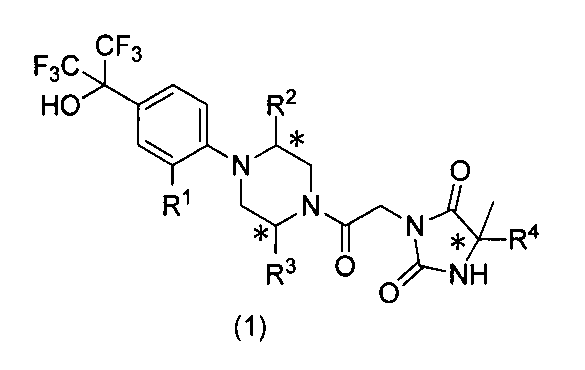

式(2):

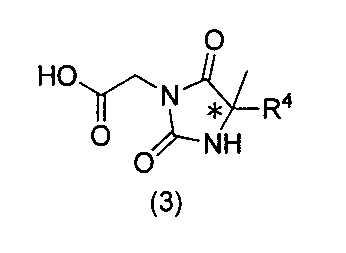
- 式(1):
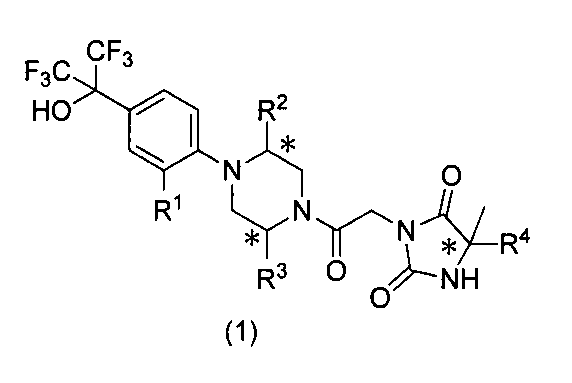

i) 式(4):
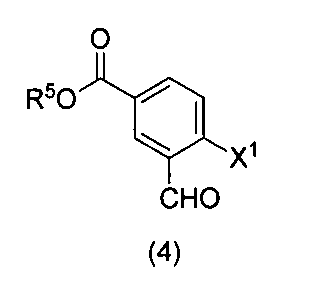
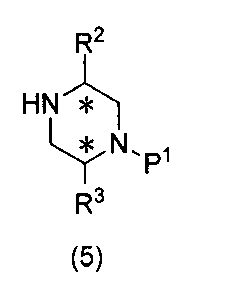

ii) 式(6)で表されるアルデヒドをオレフィンに変換して、式(7):
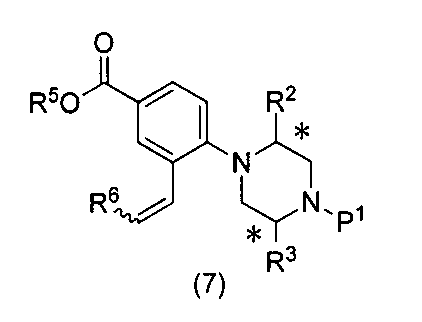
iii) 式(7)で表されるオレフィンを還元して、式(8):
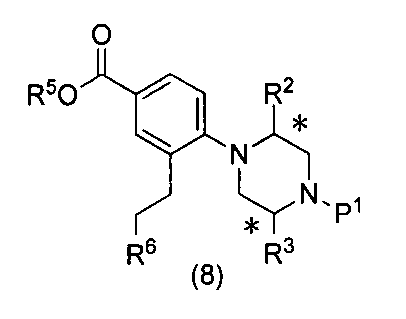
iv) 式(8)で表されるエステルを加水分解して、式(9):

v) 式(9)で表されるカルボン酸を酸ハロゲン化物、酸無水物又はエステルに変換して、式(10):

vi) 式(10)で表される化合物とトリフルオロメチル化試薬を反応して、式(11):
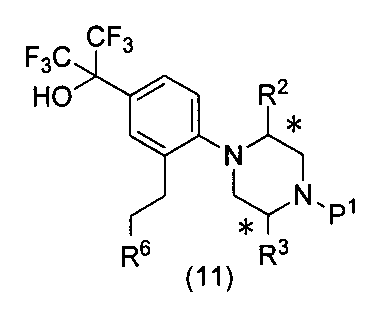
vii) 式(11)で表される化合物の保護基P1を脱保護することにより、式(2)

- 式(2)で表される化合物を請求項2に記載の方法により製造することをさらに含むことを特徴とする請求項1に記載の方法。
- i) 式(12):


[式中、R2および*は前記と同じ定義であり、P2はアミノ基の保護基を示す]で表される化合物を製造し、次いで、
ii) 式(13)で表される化合物の水酸基のスルホニル化反応を行い、式(14):

iii) 式(14)で表される化合物と式(15):
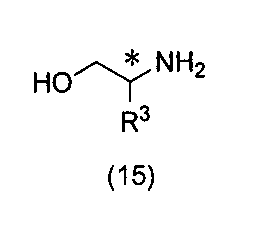

iv) 式(16)で表される化合物のアミノ基を保護して、式(17):
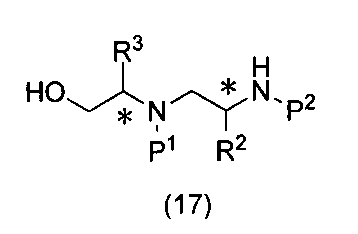
v)式(17)で表される化合物の環化反応を行い、式(18):
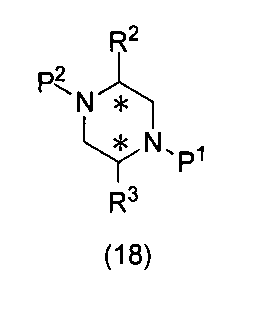
vi)式(18)で表される化合物の保護基P2を脱保護することにより式(5)で表される化合物を製造する工程をさらに含むことを特徴とする、請求項2又は3に記載の製造方法。 - i) 式(19):
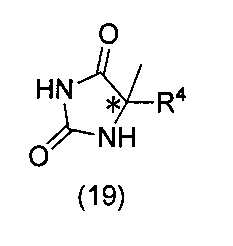


ii)式(21)で表される化合物の加水分解反応をすることにより、式(3)で表される化合物を製造する工程をさらに含むことを特徴とする、請求項1、3及び4のいずれかに記載の製造方法。 - 式(1)で表される化合物が3-(2-{(2S,5R)-4-[4-(1,1,1,3,3,3-ヘキサフルオロ-2-ヒドロキシプロパン-2-イル)-2-プロピルフェニル]-2,5-ジメチルピペラジン-1-イル}-2-オキソエチル)-5-[4-(1-メチルエトキシ)フェニル]-5-メチルイミダゾリジン-2,4-ジオンである請求項1~5のいずれかに記載の製造方法。
- 式(2)

Priority Applications (1)
| Application Number | Priority Date | Filing Date | Title |
|---|---|---|---|
| JP2015534004A JPWO2015029447A1 (ja) | 2013-08-30 | 2014-08-29 | 光学活性カルビノール化合物の製造方法 |
Applications Claiming Priority (2)
| Application Number | Priority Date | Filing Date | Title |
|---|---|---|---|
| JP2013180480 | 2013-08-30 | ||
| JP2013-180480 | 2013-08-30 |
Publications (1)
| Publication Number | Publication Date |
|---|---|
| WO2015029447A1 true WO2015029447A1 (ja) | 2015-03-05 |
Family
ID=52586035
Family Applications (1)
| Application Number | Title | Priority Date | Filing Date |
|---|---|---|---|
| PCT/JP2014/004447 Ceased WO2015029447A1 (ja) | 2013-08-30 | 2014-08-29 | 光学活性カルビノール化合物の製造方法 |
Country Status (2)
| Country | Link |
|---|---|
| JP (1) | JPWO2015029447A1 (ja) |
| WO (1) | WO2015029447A1 (ja) |
Citations (8)
| Publication number | Priority date | Publication date | Assignee | Title |
|---|---|---|---|---|
| PL120693B1 (en) * | 1979-05-21 | 1982-03-31 | Inst Farmakologii Pan | Process for preparing novel derivatives of 5,5-diphenyl-3-n-hydantoinacetic acididantoinuksusnojj kisloty |
| JPH1059947A (ja) * | 1996-06-20 | 1998-03-03 | Hoechst Ag | キラルで、非ラセミの(4−アリール−2,5−ジオキソイミダゾリジン−1−イル)酢酸の製造方法 |
| JP2000508310A (ja) * | 1996-04-05 | 2000-07-04 | ソシエテ・ド・コンセイユ・ド・ルシエルシエ・エ・ダアツプリカーシヨン・シヤンテイフイツク・(エス.セー.エール.アー.エス) | α▲下1▼―交感神経受容体拮抗薬 |
| JP2004534826A (ja) * | 2001-06-21 | 2004-11-18 | アベンティス・フアーマ・リミテッド | アザインドール |
| WO2005040109A1 (en) * | 2003-10-22 | 2005-05-06 | Neurocrine Biosciences, Inc. | Ligands of melanocortin receptors and compositions and methods related thereto |
| JP2009541318A (ja) * | 2006-06-22 | 2009-11-26 | メルク エンド カムパニー インコーポレーテッド | チロシンキナーゼ阻害剤 |
| WO2010125811A1 (ja) * | 2009-04-29 | 2010-11-04 | 興和株式会社 | ヘテロ環リンカーを有するカルビノール化合物 |
| WO2012161812A1 (en) * | 2011-02-28 | 2012-11-29 | Abbott Laboratories | Tricyclic inhibitors of kinases |
-
2014
- 2014-08-29 WO PCT/JP2014/004447 patent/WO2015029447A1/ja not_active Ceased
- 2014-08-29 JP JP2015534004A patent/JPWO2015029447A1/ja active Pending
Patent Citations (8)
| Publication number | Priority date | Publication date | Assignee | Title |
|---|---|---|---|---|
| PL120693B1 (en) * | 1979-05-21 | 1982-03-31 | Inst Farmakologii Pan | Process for preparing novel derivatives of 5,5-diphenyl-3-n-hydantoinacetic acididantoinuksusnojj kisloty |
| JP2000508310A (ja) * | 1996-04-05 | 2000-07-04 | ソシエテ・ド・コンセイユ・ド・ルシエルシエ・エ・ダアツプリカーシヨン・シヤンテイフイツク・(エス.セー.エール.アー.エス) | α▲下1▼―交感神経受容体拮抗薬 |
| JPH1059947A (ja) * | 1996-06-20 | 1998-03-03 | Hoechst Ag | キラルで、非ラセミの(4−アリール−2,5−ジオキソイミダゾリジン−1−イル)酢酸の製造方法 |
| JP2004534826A (ja) * | 2001-06-21 | 2004-11-18 | アベンティス・フアーマ・リミテッド | アザインドール |
| WO2005040109A1 (en) * | 2003-10-22 | 2005-05-06 | Neurocrine Biosciences, Inc. | Ligands of melanocortin receptors and compositions and methods related thereto |
| JP2009541318A (ja) * | 2006-06-22 | 2009-11-26 | メルク エンド カムパニー インコーポレーテッド | チロシンキナーゼ阻害剤 |
| WO2010125811A1 (ja) * | 2009-04-29 | 2010-11-04 | 興和株式会社 | ヘテロ環リンカーを有するカルビノール化合物 |
| WO2012161812A1 (en) * | 2011-02-28 | 2012-11-29 | Abbott Laboratories | Tricyclic inhibitors of kinases |
Non-Patent Citations (1)
| Title |
|---|
| BIOORGANIC & MEDICINAL CHEMISTRY, vol. 15, 2007, pages 5166 - 5176 * |
Also Published As
| Publication number | Publication date |
|---|---|
| JPWO2015029447A1 (ja) | 2017-03-02 |
Similar Documents
| Publication | Publication Date | Title |
|---|---|---|
| Yajima et al. | Photoinduced radical hydroperfluoroalkylation and the synthesis of fluorinated amino acids and peptides | |
| US8981095B2 (en) | Intermediate compounds and process for the preparation of lurasidone and salts thereof | |
| CN1203589A (zh) | 新的化合物 | |
| JP2010521453A (ja) | 新規プロドラッグ | |
| JP5666468B2 (ja) | システインプロテアーゼ阻害剤 | |
| US20120122950A1 (en) | Libraries of 1-(sulfonyl)-n-phenylpyrrolidine-2-carboxamides for drug discovery | |
| US20190375717A1 (en) | Production method for pyrazole-amide compound | |
| JP2006500407A (ja) | チュブリン阻害剤の合成に有用な中間体の合成方法 | |
| US20220227715A1 (en) | Sulfonylurea derivatives and uses thereof | |
| US20260103451A1 (en) | Process for preparing pyrimidinyl bipyridine compound and intermediate therefor | |
| JP5858917B2 (ja) | イソキノリン誘導体又はその塩の新規製造方法 | |
| WO2015029447A1 (ja) | 光学活性カルビノール化合物の製造方法 | |
| JP2015048324A (ja) | 光学活性カルビノール化合物の製法 | |
| JP2005179281A (ja) | ビフェニル化合物 | |
| US20120122710A1 (en) | Libraries of n-substituted-n-phenylethylsulfonamides for the identification of biological and pharmacological activity | |
| US10093625B2 (en) | Process for the preparation of [[2(S)-[[4(R)-(3-hydroxyphenyl)-3(R),4-dimethyl-1-piperidinyl]methyl]-1-oxo-3-phenylpropyl]amino]acetic acid dihydrate | |
| US20120122920A1 (en) | Libraries of n-substituted-n-phenylethylsulfonamides for drug discovery | |
| Asada et al. | 3-(2-Aminocarbonylphenyl) propanoic acid analogs as potent and selective EP3 receptor antagonists. Part 1: discovery and exploration of the carboxyamide side chain | |
| WO1994025450A1 (fr) | Derive de serine | |
| WO2015037243A1 (ja) | 光学活性ヒダントイン化合物の製造方法 | |
| TW200403222A (en) | Process for the preparation of amino-pyrrolidine derivatives | |
| WO2007148775A1 (ja) | 鎖状アミン化合物 | |
| CN101189231B (zh) | 环状氨基苯基链烷酸衍生物 | |
| JP2019014716A (ja) | 4,4,7−トリフルオロ−1,2,3,4−テトラヒドロ−5h−1−ベンゾアゼピン化合物の製造方法及びその合成中間体 | |
| CA2694320C (en) | Method of producing optically active n-(halopropyl)amino acid derivative |
Legal Events
| Date | Code | Title | Description |
|---|---|---|---|
| 121 | Ep: the epo has been informed by wipo that ep was designated in this application |
Ref document number: 14840836 Country of ref document: EP Kind code of ref document: A1 |
|
| ENP | Entry into the national phase |
Ref document number: 2015534004 Country of ref document: JP Kind code of ref document: A |
|
| NENP | Non-entry into the national phase |
Ref country code: DE |
|
| 122 | Ep: pct application non-entry in european phase |
Ref document number: 14840836 Country of ref document: EP Kind code of ref document: A1 |