WO2015012156A1 - 2,6-ジフルオロフェニルエーテル構造を持つ液晶性化合物及びその液晶組成物 - Google Patents
2,6-ジフルオロフェニルエーテル構造を持つ液晶性化合物及びその液晶組成物 Download PDFInfo
- Publication number
- WO2015012156A1 WO2015012156A1 PCT/JP2014/068784 JP2014068784W WO2015012156A1 WO 2015012156 A1 WO2015012156 A1 WO 2015012156A1 JP 2014068784 W JP2014068784 W JP 2014068784W WO 2015012156 A1 WO2015012156 A1 WO 2015012156A1
- Authority
- WO
- WIPO (PCT)
- Prior art keywords
- group
- atom
- present
- replaced
- general formula
- Prior art date
- Legal status (The legal status is an assumption and is not a legal conclusion. Google has not performed a legal analysis and makes no representation as to the accuracy of the status listed.)
- Ceased
Links
- 0 Cc1cc(*)c(C)c(*)c1 Chemical compound Cc1cc(*)c(C)c(*)c1 0.000 description 9
- YEJCHVFCLNKZPU-UHFFFAOYSA-N CC1COC(C)CC1 Chemical compound CC1COC(C)CC1 YEJCHVFCLNKZPU-UHFFFAOYSA-N 0.000 description 1
- RPMUDXVQHUECRE-UHFFFAOYSA-N CC1COC(C)OC1 Chemical compound CC1COC(C)OC1 RPMUDXVQHUECRE-UHFFFAOYSA-N 0.000 description 1
- YLUCGURBBYPRDQ-UHFFFAOYSA-N Cc(cc1)cc2c1c(F)c(C)c(F)c2 Chemical compound Cc(cc1)cc2c1c(F)c(C)c(F)c2 YLUCGURBBYPRDQ-UHFFFAOYSA-N 0.000 description 1
- HBXFIXSFKULBOG-UHFFFAOYSA-N Cc1cc(F)c(C)c(F)c1 Chemical compound Cc1cc(F)c(C)c(F)c1 HBXFIXSFKULBOG-UHFFFAOYSA-N 0.000 description 1
- WJAVYWPXOXAOBS-UHFFFAOYSA-N Cc1ccc(C)c(F)c1 Chemical compound Cc1ccc(C)c(F)c1 WJAVYWPXOXAOBS-UHFFFAOYSA-N 0.000 description 1
- YGYNBBAUIYTWBF-UHFFFAOYSA-N Cc1ccc(cc(C)cc2)c2c1 Chemical compound Cc1ccc(cc(C)cc2)c2c1 YGYNBBAUIYTWBF-UHFFFAOYSA-N 0.000 description 1
- CDWQZDHRPZSNQJ-UHFFFAOYSA-N Cc1ccc2c(F)c(C)ccc2c1 Chemical compound Cc1ccc2c(F)c(C)ccc2c1 CDWQZDHRPZSNQJ-UHFFFAOYSA-N 0.000 description 1
Images

Classifications
-
- C—CHEMISTRY; METALLURGY
- C07—ORGANIC CHEMISTRY
- C07D—HETEROCYCLIC COMPOUNDS
- C07D319/00—Heterocyclic compounds containing six-membered rings having two oxygen atoms as the only ring hetero atoms
- C07D319/04—1,3-Dioxanes; Hydrogenated 1,3-dioxanes
- C07D319/06—1,3-Dioxanes; Hydrogenated 1,3-dioxanes not condensed with other rings
-
- C—CHEMISTRY; METALLURGY
- C09—DYES; PAINTS; POLISHES; NATURAL RESINS; ADHESIVES; COMPOSITIONS NOT OTHERWISE PROVIDED FOR; APPLICATIONS OF MATERIALS NOT OTHERWISE PROVIDED FOR
- C09K—MATERIALS FOR MISCELLANEOUS APPLICATIONS, NOT PROVIDED FOR ELSEWHERE
- C09K19/00—Liquid crystal materials
- C09K19/04—Liquid crystal materials characterised by the chemical structure of the liquid crystal components, e.g. by a specific unit
- C09K19/0403—Liquid crystal materials characterised by the chemical structure of the liquid crystal components, e.g. by a specific unit the structure containing one or more specific, optionally substituted ring or ring systems
-
- C—CHEMISTRY; METALLURGY
- C09—DYES; PAINTS; POLISHES; NATURAL RESINS; ADHESIVES; COMPOSITIONS NOT OTHERWISE PROVIDED FOR; APPLICATIONS OF MATERIALS NOT OTHERWISE PROVIDED FOR
- C09K—MATERIALS FOR MISCELLANEOUS APPLICATIONS, NOT PROVIDED FOR ELSEWHERE
- C09K19/00—Liquid crystal materials
- C09K19/04—Liquid crystal materials characterised by the chemical structure of the liquid crystal components, e.g. by a specific unit
- C09K19/06—Non-steroidal liquid crystal compounds
- C09K19/34—Non-steroidal liquid crystal compounds containing at least one heterocyclic ring
- C09K19/3402—Non-steroidal liquid crystal compounds containing at least one heterocyclic ring having oxygen as hetero atom
-
- C—CHEMISTRY; METALLURGY
- C09—DYES; PAINTS; POLISHES; NATURAL RESINS; ADHESIVES; COMPOSITIONS NOT OTHERWISE PROVIDED FOR; APPLICATIONS OF MATERIALS NOT OTHERWISE PROVIDED FOR
- C09K—MATERIALS FOR MISCELLANEOUS APPLICATIONS, NOT PROVIDED FOR ELSEWHERE
- C09K19/00—Liquid crystal materials
- C09K19/04—Liquid crystal materials characterised by the chemical structure of the liquid crystal components, e.g. by a specific unit
- C09K19/06—Non-steroidal liquid crystal compounds
- C09K19/34—Non-steroidal liquid crystal compounds containing at least one heterocyclic ring
- C09K19/3402—Non-steroidal liquid crystal compounds containing at least one heterocyclic ring having oxygen as hetero atom
- C09K2019/3422—Non-steroidal liquid crystal compounds containing at least one heterocyclic ring having oxygen as hetero atom the heterocyclic ring being a six-membered ring
Definitions
- the present invention relates to a compound having a 2,6-difluorophenyl ether structure which is useful as an organic electronic material, medical pesticide, particularly a material for a liquid crystal display element, and an effective production method thereof.
- Liquid crystal display elements are used in various measuring instruments, automobile panels, word processors, electronic notebooks, printers, computers, televisions, clocks, advertisement display boards, etc., including watches and calculators.
- Typical liquid crystal display methods include TN (twisted nematic) type, STN (super twisted nematic) type, vertical alignment type using TFT (thin film transistor) and IPS (in-plane switching) type.
- Etc The liquid crystal compositions used in these liquid crystal display elements are stable against external factors such as moisture, air, heat, and light, and the liquid crystal phase (nematic phase, smectic phase) in the widest possible temperature range centering on room temperature. Phase, blue phase, etc.), low viscosity, and low driving voltage.
- the liquid crystal composition is selected from several to several tens of kinds of compounds in order to optimize the dielectric anisotropy ( ⁇ ) and the refractive index anisotropy ( ⁇ n) according to the individual display elements, It is configured.
- a liquid crystal composition having a positive ⁇ is used in a TN type, STN type, or IPS type horizontal alignment type display.
- a driving method has been reported in which a liquid crystal composition having a positive ⁇ is vertically aligned when no voltage is applied and a horizontal electric field is applied to display the liquid crystal composition, and the necessity of a liquid crystal composition having a positive ⁇ is further increased. Yes.
- an improvement in response speed is required in all driving systems, and in order to solve this problem, a liquid crystal composition having a viscosity lower than that of the present is required. In order to obtain a low-viscosity liquid crystal composition, it is effective to reduce the viscosity of each polar compound itself constituting the liquid crystal composition.
- liquid crystal composition As a display element etc., it is calculated
- individual components constituting the liquid crystal composition In order to maintain a nematic phase in a wide temperature range, it is required that individual components constituting the liquid crystal composition have high miscibility with other components and a high clearing point (T 1 ⁇ i ).
- Patent Documents 1 to 8 It has been clarified that the introduction of a linking group can improve the miscibility with the liquid crystal composition, although the viscosity slightly increases.
- the molecules having a linking group generally have a high viscosity and have a problem of significantly reducing T 1 ⁇ i .
- Patent Document 9 describes the following compounds as compounds having relatively high T 1 ⁇ i , large ⁇ , low viscosity, and high miscibility in a liquid crystal composition. However, the T ⁇ i was not high enough.
- the problem to be solved by the present invention is to provide a compound having a large ⁇ , a relatively high T ⁇ i , a low viscosity ( ⁇ ), and a high miscibility with other liquid crystal compounds. It is to provide a liquid crystal composition and a liquid crystal display element.
- the present invention is represented by the general formula (1)
- R represents an alkyl group having 1 to 15 carbon atoms or an alkenyl group having 2 to 15 carbon atoms, one —CH 2 — present in these groups or two or more not adjacent to each other
- —CH 2 — may be replaced by —O—, —S—, —COO—, —OCO— or —CO—, and a hydrogen atom present in these groups may be replaced with a fluorine atom.
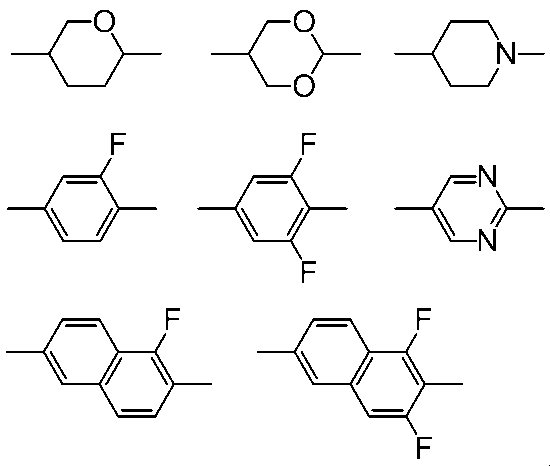
- a 1 , A 2 , A 3 and A 4 are each independently (a) a 1,4-cyclohexylene group (one —CH 2 — or two or more non-adjacent groups present in this group).
- —CH 2 — may be replaced by —O— or —S—.
- the hydrogen atom to be substituted may be replaced by a fluorine atom.
- a group selected from the group consisting of: Z 1 , Z 2 , Z 3 and Z 4 are each independently —CH 2 O—, —OCH 2 —, —CF 2 O—, —OCF 2 —, —CH 2 CH 2 —, —CF 2 CF 2 —, —CH ⁇ CH—, —CF ⁇ CF—, —C ⁇ C— or a single bond,
- a 5 is
- W represents a fluorine atom, a chlorine atom, a cyano group, —CF 3 , —OCH 2 F, —OCHF 2 or —OCF 3
- Y 1 , Y 2 , Y 3 , Y 4 and Y 5 are each Independently represents a fluorine atom, a chlorine atom or a hydrogen atom
- m, n, p and r each independently represents 0 or 1, but m + n + p + r is 0, 1, 2 or 3.
- the novel liquid crystal compound represented by the general formula (1) provided by the present invention can be easily produced industrially, and the obtained compound represented by the general formula (1) is relatively large. It has ⁇ , relatively high T ⁇ i , low viscosity, and high miscibility in the liquid crystal composition.
- a liquid crystal composition exhibiting a liquid crystal phase with a low viscosity and a wide temperature range can be obtained. For this reason, it is very useful as a component of a liquid crystal composition for a liquid crystal display element that requires a high-speed response.
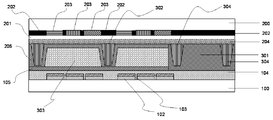
- a board having 100 to 105 is called a “back plane”, and a board having 200 to 205 is called a “front plane”. It is a figure of the exposure process using the pattern for columnar spacer preparation formed on a black matrix as a photomask pattern.
- R is preferably an alkyl group having 1 to 8 carbon atoms or an alkenyl group having 2 to 8 carbon atoms in order to reduce the viscosity, and alkyl having 1 to 5 carbon atoms.
- a group or an alkenyl group having 2 to 5 carbon atoms is particularly preferred. Moreover, it is preferable that it is linear.
- a 1 , A 2 , A 3 and A 4 are each independently a trans-1,4-cyclohexylene group, an unsubstituted naphthalene-2,6-diyl group or an unsubstituted 1 group for decreasing the viscosity.
- 4-phenylene group is preferable, and trans-1,4-cyclohexylene group is more preferable.
- a trans-1,4-cyclohexylene group or an unsubstituted 1,4-phenylene group is preferable.
- Y 1 , Y 2 , Y 3 , Y 4 and Y 5 are each independently preferably a hydrogen atom for decreasing the viscosity and increasing T 1 ⁇ i , and a fluorine atom for increasing ⁇ . It is preferable that
- W is preferably a fluorine atom, a cyano group, —CF 3 or —OCF 3 for increasing ⁇ , and is preferably a fluorine atom for decreasing the viscosity.
- m + n + p + r is preferably 0 or 1 when emphasizing ⁇ , and p and r are more preferably 0, and m + n + p + r when emphasizing T ⁇ i. Is preferably 1 or 2.
- m + n + p + r is preferably 0 or 1.
- an alkyl group having 1 to 8 carbon atoms or an alkenyl group having 2 to 8 carbon atoms Preferably an alkyl group having 1 to 5 carbon atoms or 2 to 5 carbon atoms. It is particularly preferably an alkenyl group, Y 1 and Y 2 are each independently preferably a hydrogen atom or a fluorine atom, and W is a fluorine atom, a cyano group, —CF 3 , or —OCF 3. preferable.
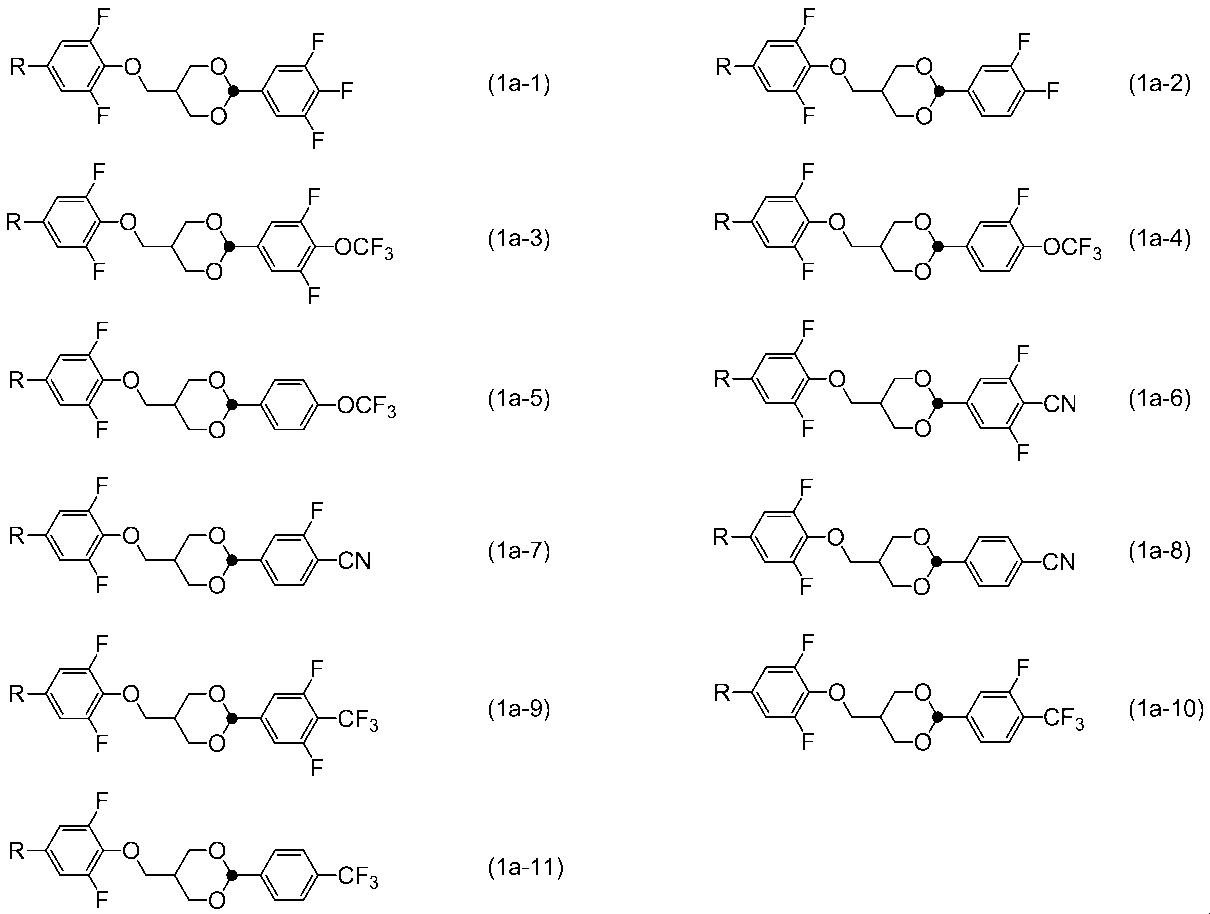
- the compounds represented by the general formula (1a) the following general formulas (1a-1) to (1a-11) are more preferable, and the compounds represented by the general formula (1a-1) are more preferable.
- each R independently represents an alkyl group having 1 to 12 carbon atoms, an alkenyl group having 2 to 12 carbon atoms, an alkoxy group having 1 to 12 carbon atoms, or an alkenyloxy group having 2 to 12 carbon atoms.
- R is preferably an alkyl group having 1 to 8 carbon atoms or an alkenyl group having 2 to 8 carbon atoms, and an alkyl group having 1 to 5 carbon atoms or Particularly preferred is an alkenyl group having 2 to 5 carbon atoms.
- Y 1 , Y 2 , Y 6 and Y 7 are each independently preferably a hydrogen atom or a fluorine atom, and W is a fluorine atom, cyano. group, or preferably -OCF is 3, a 7 are each independently 1,4-cyclohexylene group, 1,4-phenylene group, or
- each R independently represents an alkyl group having 1 to 12 carbon atoms, an alkenyl group having 2 to 12 carbon atoms, an alkoxy group having 1 to 12 carbon atoms, or an alkenyloxy group having 2 to 12 carbon atoms.
- a 7 is a 1,4-cyclohexylene group (one —CH 2 — present in this group or two or more —CH 2 not adjacent to each other). - May be replaced by —O— or —S—.
- the following formulas (1b-17) to (1b-32) are more preferable.
- each R independently represents an alkyl group having 1 to 12 carbon atoms, an alkenyl group having 2 to 12 carbon atoms, an alkoxy group having 1 to 12 carbon atoms, or an alkenyloxy group having 2 to 12 carbon atoms.
- R is preferably an alkyl group having 1 to 8 carbon atoms or an alkenyl group having 2 to 8 carbon atoms, and an alkyl group having 1 to 5 carbon atoms or Particularly preferred is an alkenyl group having 2 to 5 carbon atoms
- Y 1 and Y 2 are preferably each independently a hydrogen atom or a fluorine atom
- W is a fluorine atom, a cyano group, or —OCF 3 .
- a 8 is a trans-1,4-cyclohexylene group, or
- each R independently represents an alkyl group having 1 to 12 carbon atoms, an alkenyl group having 2 to 12 carbon atoms, an alkoxy group having 1 to 12 carbon atoms, or an alkenyloxy group having 2 to 12 carbon atoms.
- R is preferably an alkyl group having 1 to 8 carbon atoms or an alkenyl group having 2 to 8 carbon atoms, and an alkyl group having 1 to 5 carbon atoms or Particularly preferred is an alkenyl group having 2 to 5 carbon atoms
- Y 1 and Y 2 are preferably each independently a hydrogen atom or a fluorine atom
- W is a fluorine atom, a cyano group, or —OCF 3 .
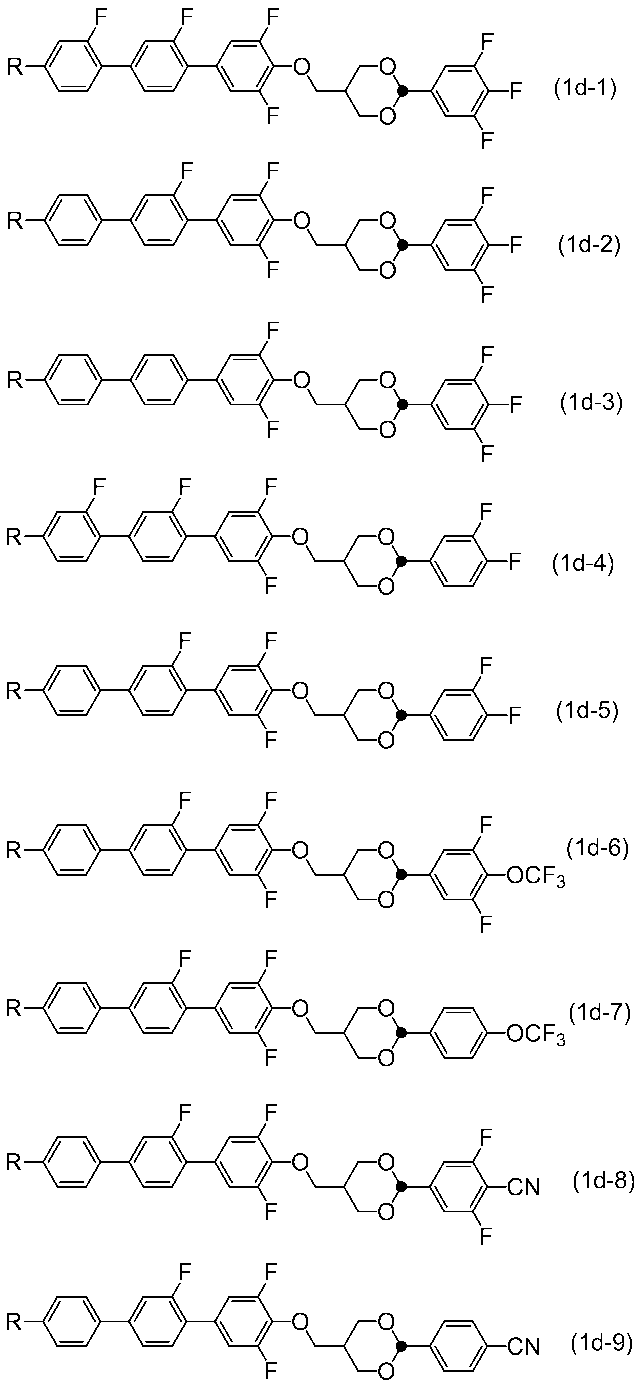
- the compound represented by the general formula (1d) the following general formulas (1d-1) to (1d-9) are more preferable.
- each R independently represents an alkyl group having 1 to 12 carbon atoms, an alkenyl group having 2 to 12 carbon atoms, an alkoxy group having 1 to 12 carbon atoms, or an alkenyloxy group having 2 to 12 carbon atoms.
- R is preferably an alkyl group having 1 to 8 carbon atoms or an alkenyl group having 2 to 8 carbon atoms, and an alkyl group having 1 to 5 carbon atoms or Particularly preferred is an alkenyl group having 2 to 5 carbon atoms
- Y 1 , Y 2 and Y 12 are each independently preferably a hydrogen atom or a fluorine atom
- W is a fluorine atom or —OCF 3 .
- the compound represented by the general formula (1e) the following general formulas (1e-1) to (1e-8) are more preferable, and the general formula (1e-1) and the general formula (1e-8) are more preferable.
- preferable is an alkyl group having 1 to 12 carbon atoms,
- each R independently represents an alkyl group having 1 to 12 carbon atoms, an alkenyl group having 2 to 12 carbon atoms, an alkoxy group having 1 to 12 carbon atoms, or an alkenyloxy group having 2 to 12 carbon atoms.
- R is preferably an alkyl group having 1 to 8 carbon atoms or an alkenyl group having 2 to 8 carbon atoms, and an alkyl group having 1 to 5 carbon atoms or Particularly preferred is an alkenyl group having 2 to 5 carbon atoms
- Y 1 , Y 2 and Y 13 are preferably each independently a hydrogen atom or a fluorine atom
- W is a fluorine atom or —OCF 3 .
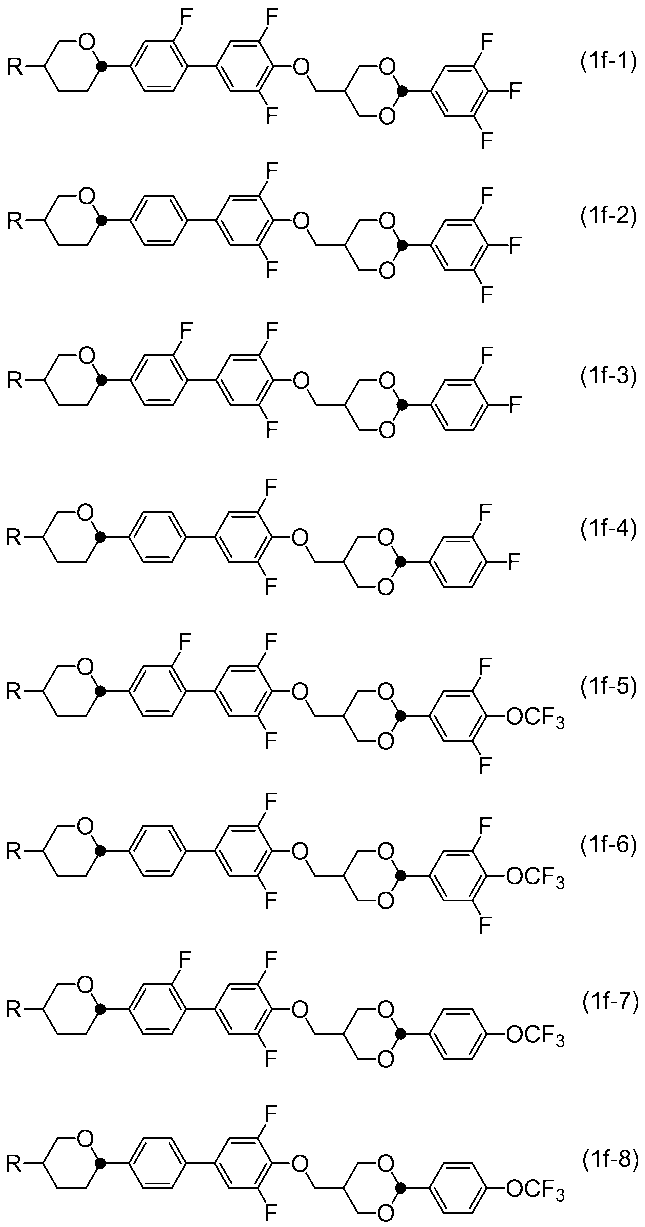
- the compound represented by the general formula (1f) the following general formulas (1f-1) to (1f-8) are more preferable.
- each R independently represents an alkyl group having 1 to 12 carbon atoms, an alkenyl group having 2 to 12 carbon atoms, an alkoxy group having 1 to 12 carbon atoms, or an alkenyloxy group having 2 to 12 carbon atoms.
- R is preferably an alkyl group having 1 to 8 carbon atoms or an alkenyl group having 2 to 8 carbon atoms, and an alkyl group having 1 to 5 carbon atoms or Particularly preferred is an alkenyl group having 2 to 5 carbon atoms
- Y 3 to Y 5 are preferably each independently a hydrogen atom or a fluorine atom
- W is a fluorine atom, a cyano group or —OCF 3 .
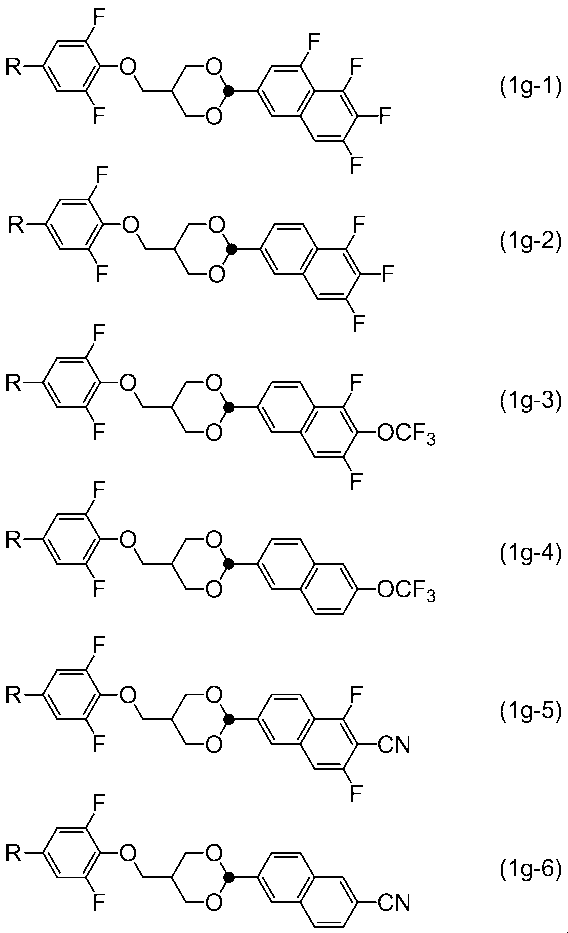
- the compound represented by the general formula (1g) the following general formulas (1g-1) to (1g-6) are more preferable, and the general formula (1g-2) is more preferable.
- each R independently represents an alkyl group having 1 to 12 carbon atoms, an alkenyl group having 2 to 12 carbon atoms, an alkoxy group having 1 to 12 carbon atoms, or an alkenyloxy group having 2 to 12 carbon atoms.
- R is preferably an alkyl group having 1 to 8 carbon atoms or an alkenyl group having 2 to 8 carbon atoms, and an alkyl group having 1 to 5 carbon atoms or An alkenyl group having 2 to 5 carbon atoms is particularly preferred, and Y 3 , Y 4 , Y 5 , Y 14 and Y 15 are each independently preferably a hydrogen atom or a fluorine atom, and W is a fluorine atom. , A cyano group, or —OCF 3 .
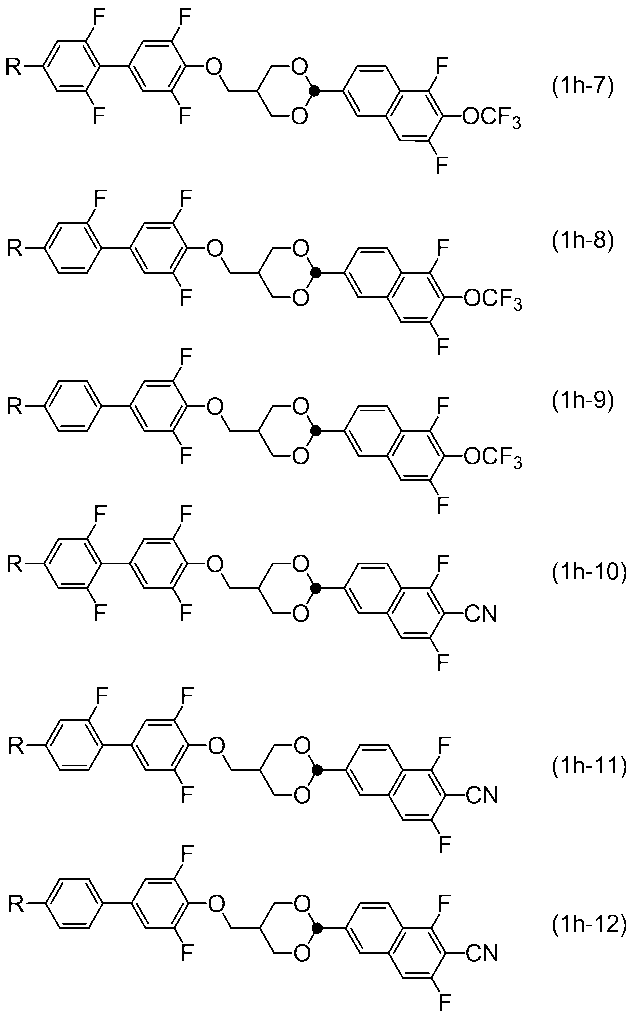
- the following general formulas (1h-1) to (1h-12) are more preferable.
- each R independently represents an alkyl group having 1 to 12 carbon atoms, an alkenyl group having 2 to 12 carbon atoms, an alkoxy group having 1 to 12 carbon atoms, or an alkenyloxy group having 2 to 12 carbon atoms.
- R is preferably an alkyl group having 1 to 8 carbon atoms or an alkenyl group having 2 to 8 carbon atoms, and an alkyl group having 1 to 5 carbon atoms or Particularly preferred is an alkenyl group having 2 to 5 carbon atoms
- Y 3 to Y 5 are preferably each independently a hydrogen atom or a fluorine atom
- W is a fluorine atom, a cyano group or —OCF 3 .
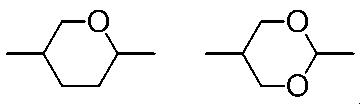
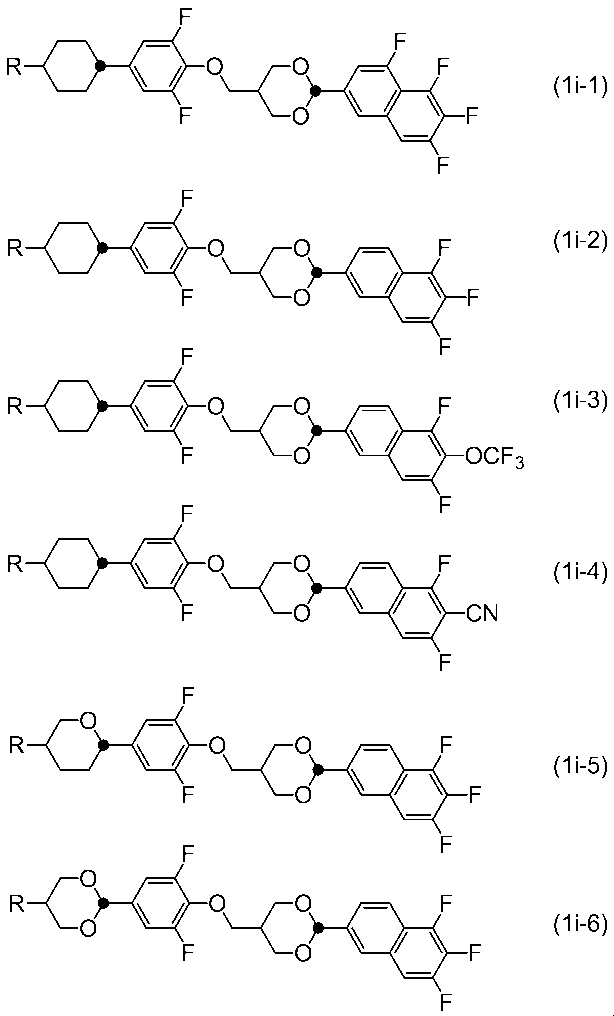
- a 9 is a trans-1,4-cyclohexylene group, or
- each R independently represents an alkyl group having 1 to 12 carbon atoms, an alkenyl group having 2 to 12 carbon atoms, an alkoxy group having 1 to 12 carbon atoms, or an alkenyloxy group having 2 to 12 carbon atoms.
- R is preferably an alkyl group having 1 to 8 carbon atoms or an alkenyl group having 2 to 8 carbon atoms, and an alkyl group having 1 to 5 carbon atoms or Particularly preferred is an alkenyl group having 2 to 5 carbon atoms
- Y 3 to Y 5 are each independently preferably a hydrogen atom or a fluorine atom
- W is preferably a fluorine atom
- a 9 is Each independently 1,4-cyclohexylene group, 1,4-phenylene group, or
- each R independently represents an alkyl group having 1 to 12 carbon atoms, an alkenyl group having 2 to 12 carbon atoms, an alkoxy group having 1 to 12 carbon atoms, or an alkenyloxy group having 2 to 12 carbon atoms.
- the lower limit value in the composition is 1% by mass (hereinafter,% in the composition is mass). %).), Preferably 2% or more, more preferably 5% or more.
- the upper limit value is preferably 50% or less, more preferably 30% or less, still more preferably 20% or less. % Or less is particularly preferable.
- the compound represented by General formula (1) can also be used by 1 type, you may use 2 or more types of compounds simultaneously.
- a compound other than the compound represented by the general formula (1) may be used.
- a compound having a liquid crystal phase a compound having no liquid crystal phase may be used as necessary. It can also be added.
- the general component (1) At least one compound represented by formula (1), but it is preferable to contain at least one of the following second to fourth components as other components.
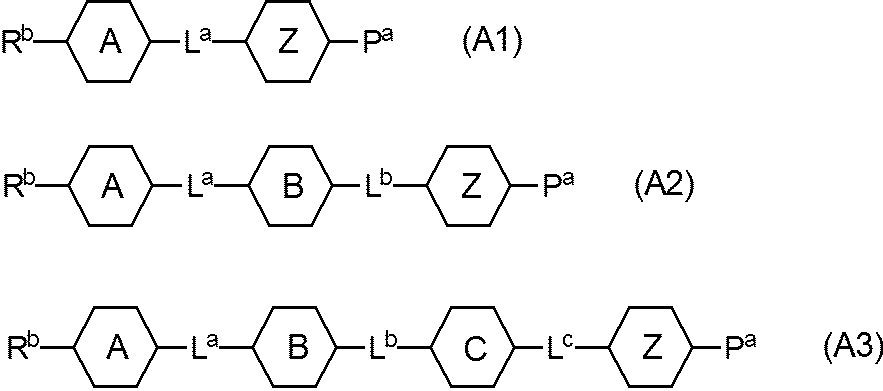
- the second component is a so-called fluorine-based (halogen-based) p-type liquid crystal compound, and examples thereof include compounds represented by the following general formulas (A1) to (A3).
- R b represents an alkyl group having 1 to 12 carbon atoms, which may be linear or branched, and has a 3- to 6-membered cyclic structure. Any —CH 2 — present in the group may be replaced by —O—, —CH ⁇ CH—, —CH ⁇ CF—, —CF ⁇ CH—, —CF ⁇ CF— or —C ⁇ C—.
- Any hydrogen atom present in the group may be substituted by a fluorine atom or a trifluoromethoxy group, but a linear alkyl group having 1 to 7 carbon atoms, 2 to A linear 1-alkenyl group having 7 carbon atoms, a linear 3-alkenyl group having 4 to 7 carbon atoms, and an alkyl group having 1 to 5 carbon atoms substituted with an alkoxy group having 1 to 3 carbon atoms at the end.
- the compound may be optically active or racemic.
- Ring A, Ring B and Ring C are each independently a trans-1,4-cyclohexylene group (one CH 2 group present in this group or two or more non-adjacent CH 2 groups are oxygen atoms) Transdecahydronaphthalene-trans-2,6-diyl group, 1,4-phenylene group (one CH group present in this group or two or more which are not adjacent to each other)
- the CH group may be substituted with a nitrogen atom.
- Selected from the group consisting of naphthalene-2,6-diyl group, tetrahydronaphthalene-2,6-diyl group, or 1,4-cyclohexenylene group Represents a group, one or more hydrogen atoms contained in these groups may each be substituted with F, Cl, CF 3 or OCF 3 .
- ring A, ring B and ring C may each independently be substituted with a trans-1,4-cyclohexylene group, a transdecahydronaphthalene-trans-2,6-diyl group, or a fluorine atom.
- a good naphthalene-2,6-diyl group or a 1,4-phenylene group optionally substituted by 1 to 2 fluorine atoms is preferred.
- ring B is a trans-1,4-cyclohexylene group or a transdecahydronaphthalene-trans-2,6-diyl group
- ring A may be a trans-1,4-cyclohexylene group.
- ring C is a trans-1,4-cyclohexylene group or a transdecahydronaphthalene-trans-2,6-diyl group
- ring B and ring A are trans-1,4-cyclohexylene groups.
- ring A is preferably a trans-1,4-cyclohexylene group.
- L a , L b and L c are each a linking group and each independently represents a single bond, an ethylene group (—CH 2 CH 2 —), a 1,2-propylene group (—CH (CH 3 ) CH 2 — and —CH 2 CH (CH 3 ) —), 1,4-butylene group, —COO—, —OCO—, —OCF 2 —, —CF 2 O—, —CH ⁇ CH—, —CH ⁇ CF—, — CF ⁇ CH—, —CF ⁇ CF—, —C ⁇ C—, OCH 2 , CH 2 O or —CH ⁇ NN ⁇ CH— represents a single bond, ethylene group, 1,4-butylene group, —COO —, —OCF 2 —, —CF 2 O—, —CF ⁇ CF— or —C ⁇ C— are preferred, and a single bond or an ethylene group is particularly preferred. Further, it is preferable that at least one of (A2) represents a single bond and at least
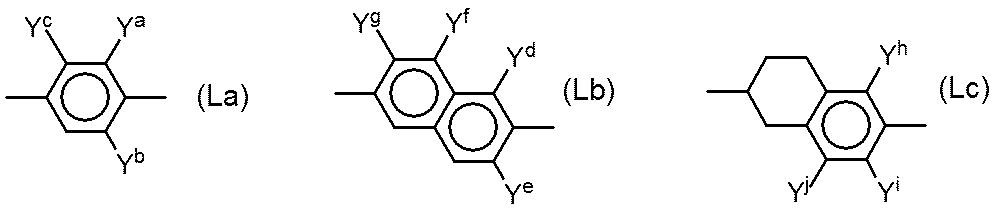
- Ring Z is an aromatic ring and represents any one of the following general formulas (La) to (Lc).
- Y a to Y j each independently represent a hydrogen atom or a fluorine atom.
- at least one of Y a and Y b is preferably a fluorine atom
- at least one of Y d to Y f is preferably a fluorine atom, particularly preferably Y d is a fluorine atom
- at least one of Y h and Y i is a fluorine atom.
- Y h is more preferably a fluorine atom.
- Terminal group P a represents a fluorine atom, a chlorine atom, trifluoromethoxy group, difluoromethoxy group, trifluoromethyl group or difluoromethyl group, two or more carbon atoms substituted by fluorine atoms 2 or 3 alkoxy groups, 2 An alkyl group having 2 or 3 carbon atoms substituted by 2 or more fluorine atoms, an alkenyl group having 2 or 3 carbon atoms substituted by 2 or more fluorine atoms, or a carbon substituted by 2 or more fluorine atoms Although an alkenyloxy group having 2 or 3 atoms is represented, a fluorine atom, a trifluoromethoxy group or a difluoromethoxy group is preferable, and a fluorine atom is particularly preferable.
- the third component is a so-called cyano p-type liquid crystal compound, and examples thereof include compounds represented by the following general formulas (B1) to (B3).
- R c represents an alkyl group having 1 to 12 carbon atoms, which may be linear or branched, and has a 3- to 6-membered cyclic structure. Any —CH 2 — present in the group may be replaced by —O—, —CH ⁇ CH—, —CH ⁇ CF—, —CF ⁇ CH—, —CF ⁇ CF— or —C ⁇ C—.
- Any hydrogen atom present in the group may be substituted by a fluorine atom or a trifluoromethoxy group, but a linear alkyl group having 1 to 7 carbon atoms, 2 to A linear 1-alkenyl group having 7 carbon atoms, a linear 3-alkenyl group having 4 to 7 carbon atoms, and an alkyl group having 1 to 5 carbon atoms substituted with an alkoxy group having 1 to 3 carbon atoms at the end.
- the compound may be optically active or racemic.
- Ring D, Ring E and Ring F are each independently a trans-1,4-cyclohexylene group (one CH 2 group present in this group or two or more non-adjacent CH 2 groups are oxygen atoms) Transdecahydronaphthalene-trans-2,6-diyl group, 1,4-phenylene group (one CH group present in this group or two or more which are not adjacent to each other)
- the CH group may be substituted with a nitrogen atom.
- Selected from the group consisting of naphthalene-2,6-diyl group, tetrahydronaphthalene-2,6-diyl group, or 1,4-cyclohexenylene group Represents a group, one or more hydrogen atoms contained in these groups may each be substituted with F, Cl, CF 3 or OCF 3 .
- ring D, ring E, and ring F may be each independently substituted with a trans-1,4-cyclohexylene group, a transdecahydronaphthalene-trans-2,6-diyl group, or a fluorine atom.
- a good naphthalene-2,6-diyl group or a 1,4-phenylene group optionally substituted by 1 to 2 fluorine atoms is preferred.
- ring E is a trans-1,4-cyclohexylene group or a transdecahydronaphthalene-trans-2,6-diyl group
- ring D may be a trans-1,4-cyclohexylene group.
- Ring D and Ring E are trans-1,4-cyclohexylene groups.
- ring D is preferably a trans-1,4-cyclohexylene group.
- L d , L e and L f are each a linking group and each independently represents a single bond, an ethylene group (—CH 2 CH 2 —), a 1,2-propylene group (—CH (CH 3 ) CH 2 — and ) —CH 2 CH (CH 3 ) —), 1,4-butylene group, —COO—, —OCO—, —OCF 2 —, —CF 2 O—, —CH ⁇ CH—, —CH ⁇ CF—, —CF ⁇ CH—, —CF ⁇ CF—, —C ⁇ C—, —OCH 2 —, —CH 2 O— or —CH ⁇ NN ⁇ CH— represents a single bond, an ethylene group, —COO—, —OCF 2 —, —CF 2 O—, —CF ⁇ CF— or —C ⁇ C— are preferred, and a single bond, an ethylene group or —COO— is particularly preferred.
- at least one of them preferably represents a
- P b represents a cyano group
- Ring Y is an aromatic ring and represents any one of the following general formulas (Ld) to (Lf).
- Y k to Y q each independently represent a hydrogen atom or a fluorine atom.
- at least one of Y k and Y l is preferably a fluorine atom
- Y m to Y o are preferably fluorine atoms, particularly Y m is more preferably a fluorine atom
- at least one of Y p and Y q is a fluorine atom.
- Y p is a fluorine atom.
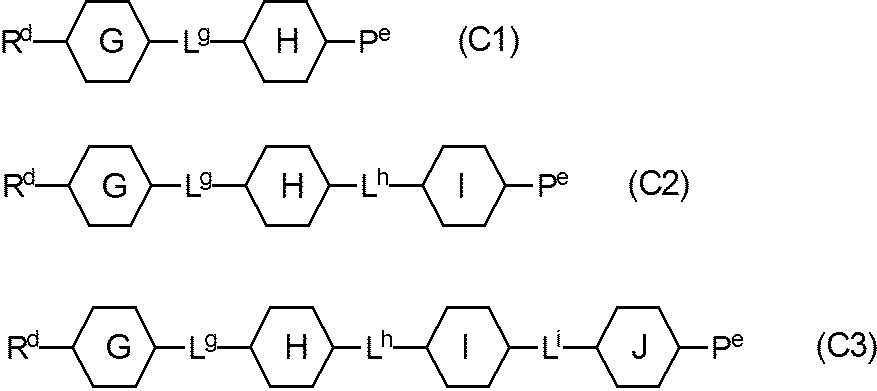
- the fourth component is a so-called nonpolar liquid crystal compound having a dielectric anisotropy of about 0, and examples thereof include compounds represented by the following general formulas (C1) to (C3).
- R d and Pe each independently represent an alkyl group having 1 to 12 carbon atoms, which may be linear or branched, and may be a 3- to 6-membered ring
- Any —CH 2 — that may have a cyclic structure and is present in the group is —O—, —CH ⁇ CH—, —CH ⁇ CF—, —CF ⁇ CH—, —CF ⁇ CF— or Any hydrogen atom present in the group may be substituted by —C ⁇ C— and may be substituted by a fluorine atom or a trifluoromethoxy group, but a linear alkyl having 1 to 7 carbon atoms A straight-chain 1-alkenyl group having 2 to 7 carbon atoms, a straight-chain 3-alkenyl group having 4 to 7 carbon atoms, a straight-chain alkoxy group having 1 to 3 carbon atoms, or a terminal having the number of carbon atoms A linear alkyl group having 1 to 5 carbon atoms substituted with 1 to 3 alkoxy
- Ring G, Ring H, Ring I and Ring J are each independently a trans-1,4-cyclohexylene group (one CH 2 group present in this group or two or more non-adjacent CH Two groups may be substituted with an oxygen atom.), A transdecahydronaphthalene-trans-2,6-diyl group, one or two fluorine atoms, or a 1,4-optionally substituted methyl group A phenylene group (one CH group present in this group or two or more CH groups not adjacent to each other may be substituted with a nitrogen atom), or may be substituted with one or more fluorine atoms A good naphthalene-2,6-diyl group, a tetrahydronaphthalene-2,6-diyl group optionally substituted by 1 to 2 fluorine atoms, or an optionally substituted 1 or 2 fluorine atom , 4-Cyclohexeni In each compound, a transdecahydronaphthalene-trans-2,
- a 1,4-phenylene group which may be substituted with a fluorine atom or a methyl group is preferable.
- the total number of fluorine atoms present in ring G, ring H, ring I and ring J is preferably 2 or less, and preferably 0 or 1.
- L g , L h and Li are each a linking group and each independently represents a single bond, an ethylene group (—CH 2 CH 2 —), a 1,2-propylene group (—CH (CH 3 ) CH 2 — and ) —CH 2 CH (CH 3 ) —), 1,4-butylene group, —COO—, —OCO—, —OCF 2 —, —CF 2 O—, —CH ⁇ CH—, —CH ⁇ CF—, —CF ⁇ CH—, —CF ⁇ CF—, —C ⁇ C—, OCH 2 , CH 2 O or —CH ⁇ NN ⁇ CH— represents a single bond, ethylene group, 1,4-butylene group, COO—, —OCO—, —OCF 2 —, —CF 2 O—, —CF ⁇ CF—, —C ⁇ C— or —CH ⁇ NN ⁇ CH— are preferred, and at least one of them in the general formula (C2) In general formula (C3), at least two of them
- the compounds represented by the general formulas (C1) to (C3) exclude the compounds represented by the general formulas (A1) to (A3) and the compounds represented by the general formulas (B1) to (B3).
- X 1 represents a chlorine atom, a bromine atom, a methanesulfonyloxy group, a p-toluenesulfonyloxy group, or a hydroxyl group).
- a 3, A 4, Z 3, Z 4, A 5, p and r are A 3 in the general formula (1) each independently, A 4, Z 3, Z 4, A 5, p and r
- X 1 represents a chlorine atom, a bromine atom, a methanesulfonyloxy group, a p-toluenesulfonyloxy group or a hydroxyl group).
- any solvent can be used as long as the reaction proceeds suitably.
- An aromatic solvent such as toluene, benzene and xylene, an ether solvent such as tetrahydrofuran (THF), diethyl ether and diisopropyl ether, Halogen solvents such as dichloromethane, chloroform and carbon tetrachloride are preferred, and benzene, toluene or dichloromethane are preferred.
- the reaction temperature may be any temperature that allows the reaction to proceed suitably, but is preferably a temperature from room temperature to the reflux of the reaction solvent, and when the solvent used is azeotropic with water. It is particularly preferable to separate and remove the water produced by the reaction under reflux using a Dean Stark apparatus or the like.
- Any acid catalyst may be used as long as it allows the reaction to proceed appropriately, but p-toluenesulfonic acid, chlorotrimethylsilane, sulfuric acid and the like are preferable, and p-toluenesulfonic acid or sulfuric acid is more preferable.
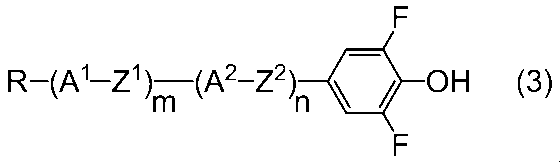
- a 1, A 2, and Z 1, Z 2, R, A 1, A 2 m and n are each independently of the general formula (1), Z 1, Z 2, R, m and n
- the compound represented by general formula (1) can be obtained by reacting the compound represented by the same meaning.
- the solvent to be used may be any as long as it allows the reaction to proceed suitably, but ether solvents such as THF, diethyl ether and diisopropyl ether, aromatic solvents such as benzene, toluene and xylene, dichloromethane, chloroform, Halogen solvents such as carbon tetrachloride are preferred, and THF and toluene are more preferred.
- ether solvents such as THF, diethyl ether and diisopropyl ether
- aromatic solvents such as benzene, toluene and xylene, dichloromethane, chloroform
- Halogen solvents such as carbon tetrachloride are preferred, and THF and toluene are more preferred.
- the reaction temperature may be any temperature that allows the reaction to proceed suitably, but is preferably from ⁇ 30 ° C. to 40 ° C., more preferably from ⁇ 20 ° C. to 20 ° C., and from ⁇ 20 ° C. to ice-cooling temperature. This is particularly preferred.
- the azodicarboxylic acid ester to be used may be any as long as it allows the reaction to proceed suitably, but diethyl azodicarboxylate or diisopropyl azodicarboxylate is preferred.
- Triphenylphosphine is preferable as the phosphine to be used.
- a compound represented by the general formula (2) in which X 1 represents a chlorine atom, a bromine atom, a methanesulfonyloxy group or a p-toluenesulfonyloxy group is converted into a compound represented by the general formula (3) in the presence of a base.
- the compound represented by the general formula (1) can be obtained.
- reaction solvent Any reaction solvent may be used as long as it allows the reaction to proceed suitably.
- Ether solvents such as THF, diethyl ether, and diisopropyl ether, N, N-dimethylformamide (DMF), N, N— Amide solvents such as dimethylacetamide and N-methylpyrrolidone, dimethyl sulfoxide and the like are preferable, and THF or DMF is more preferable.
- the reaction temperature may be any temperature that allows the reaction to proceed suitably, but a temperature from room temperature to reflux of the solvent is preferred, and a temperature from 40 ° C. to reflux of the solvent is more preferred.
- the base to be used is preferably an alkali metal hydroxide such as sodium hydroxide or potassium hydroxide, or a carbonate such as sodium carbonate, potassium carbonate or cesium carbonate, and more preferably potassium carbonate or cesium carbonate.
- Alkali metal hydroxide such as sodium hydroxide or potassium hydroxide
- a carbonate such as sodium carbonate, potassium carbonate or cesium carbonate, and more preferably potassium carbonate or cesium carbonate.
- R, A 1 , A 2 , A 3 , A 5 , Z 1 , Z 2 and Z 3 are R, A 1 , A 2 , A 3 , A 5 , Z 1 , Z 2 and Z 3 have the same meaning,
- a 4 represents a 1,4-phenylene group (a hydrogen atom present in this group may be substituted with a fluorine atom), and m, n, and p are Each independently represents 0 or 1, m + n + p represents 0, 1 or 2)
- the compound represented by can be manufactured as follows. In the presence of azodicarboxylic acid diesters and phosphines, the compound represented by general formula (3) is converted to general formula (4).
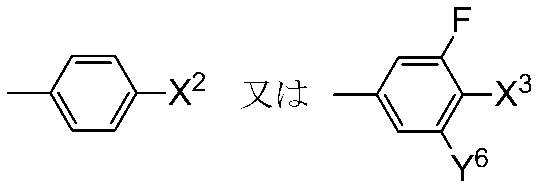
- X 2 represents a chlorine atom, bromine atom, iodine atom or trifluoromethanesulfonyloxy group
- X 3 represents a hydrogen atom, chlorine atom, bromine atom, iodine atom or trifluoromethanesulfonyloxy group
- Y 6 represents hydrogen. Represents an atom or a fluorine atom).
- R, A 1 , A 2 , A 3 , Z 1 , Z 2 , Z 3 , m, n, and p are R, A 1 , A 2 , A 3 , Z in the general formula (1-1). 1 , Z 2 , Z 3 , m, n and p have the same meaning, A 6 represents the same meaning as A 6 in formula (4)) Can be obtained.
- the solvent to be used may be any as long as it allows the reaction to proceed suitably, but ether solvents such as THF, diethyl ether and diisopropyl ether, aromatic solvents such as benzene, toluene and xylene, dichloromethane, chloroform, Halogen solvents such as carbon tetrachloride are preferred, and THF and toluene are more preferred.
- ether solvents such as THF, diethyl ether and diisopropyl ether
- aromatic solvents such as benzene, toluene and xylene, dichloromethane, chloroform
- Halogen solvents such as carbon tetrachloride are preferred, and THF and toluene are more preferred.
- the reaction temperature may be any temperature that allows the reaction to proceed suitably, but is preferably from ⁇ 30 ° C. to 40 ° C., more preferably from ⁇ 20 ° C. to 20 ° C., and from ⁇ 20 ° C. to ice-cooling temperature. This is particularly preferred.
- the azodicarboxylic acid ester to be used may be any as long as it allows the reaction to proceed suitably, but diethyl azodicarboxylate or diisopropyl azodicarboxylate is preferred.
- Triphenylphosphine is preferable as the phosphine to be used.
- a compound represented by the general formula (4) in which X 11 represents a chlorine atom, a bromine atom, a methanesulfonyloxy group, or a p-toluenesulfonyloxy group is converted into a compound represented by the general formula (3) in the presence of a base.
- the compound represented by the general formula (5) can be obtained.
- reaction solvent Any reaction solvent may be used as long as it allows the reaction to proceed suitably.
- Ether solvents such as THF, diethyl ether, and diisopropyl ether, N, N-dimethylformamide (DMF), N, N— Amide solvents such as dimethylacetamide and N-methylpyrrolidone, dimethyl sulfoxide and the like are preferable, and THF or DMF is more preferable.
- the reaction temperature may be any temperature that allows the reaction to proceed suitably, but a temperature from room temperature to reflux of the solvent is preferred, and a temperature from 40 ° C. to reflux of the solvent is more preferred.
- the base to be used is preferably an alkali metal hydroxide such as sodium hydroxide or potassium hydroxide, or a carbonate such as sodium carbonate, potassium carbonate or cesium carbonate, more preferably potassium carbonate or cesium carbonate.
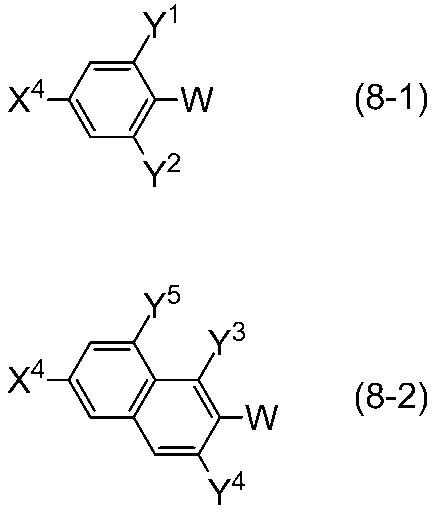
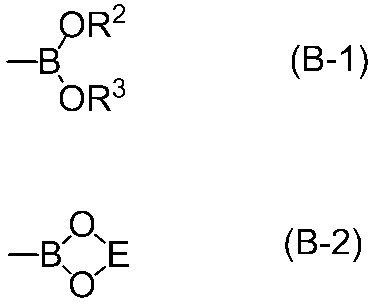
- Y 1, Y 2, Y 3, Y 4, Y 5 and W have the same meanings as in the general formula (Y 1, Y 2, Y 3 in 1-1), Y 4, Y 5 and W , X 4 is represented by the general formula (B-1) or (B-2)
- R 2 and R 3 each independently represents a linear or branched alkyl group having 1 to 5 carbon atoms, and E represents one or more hydrogen atoms present in the group
- Each of the atoms independently represents a — (CH 2 ) s — which may be substituted with a methyl group, and s represents 2, 3 or 4.
- the compound represented by the general formula (1-1) can be obtained by reacting with the compound represented by ().
- Any solvent can be used as long as it allows the reaction to proceed suitably.
- Ether solvents such as THF, diethyl ether and diisopropyl ether, aromatic solvents such as benzene, toluene and xylene, DMF, N Amide solvents such as N, dimethylacetamide and N-methylpyrrolidone are preferred, THF, DMF and toluene are preferred, and these solvents may be used alone or in admixture as necessary, and further reacted. You may add water in order to advance suitably.
- the reaction temperature may be any temperature that allows the reaction to proceed suitably, but a temperature from room temperature to reflux of the solvent is preferred, and a temperature from 40 ° C. to reflux of the solvent is more preferred.
- Any transition metal catalyst may be used as long as it allows the reaction to proceed suitably. Tetrakis (triphenylphosphine) palladium (0), palladium (II) acetate, bis (triphenylphosphine) palladium dichloride (II), palladium such as [1,1′-bis (diphenylphosphino) ferrocene] palladium (II) dichloride, bis [di-tert-butyl (4-dimethylaminophenyl) phosphine] palladium (II) dichloride Transition metal catalysts or nickel-based transition metal catalysts are preferred, and tetrakis (triphenylphosphine) palladium (0), palladium (II) acetate, bis [di-tert-butyl (4-dimethylaminophenyl) phosphine] palladium ( II) or dichloride [1,1′-bis (diphenylphos I Roh) fer
- R, A 2 , A 3 , A 4 , A 5 , Z 2 , Z 3 and Z 4 are R, A 2 , A 3 , A 4 , A 5 , Z 2 , Z 3 and Z 4 have the same meaning
- a 1 represents a 1,4-phenylene group (a hydrogen atom present in this group may be substituted with a fluorine atom)
- n, p and r are each Independently represents 0 or 1, but n + p + r represents 0, 1 or 2.
- a 2, A 3, A 4, A 5, Z 2, Z 3, Z 4, n, p and r are the general formula A compound represented by the same meaning as A 2 , A 3 , A 4 , A 5 , Z 2 , Z 3 , Z 4 , n, p and r in (1-2) can be obtained.
- the solvent to be used may be any as long as it allows the reaction to proceed suitably, but ether solvents such as THF, diethyl ether and diisopropyl ether, aromatic solvents such as benzene, toluene and xylene, dichloromethane, chloroform, Halogen solvents such as carbon tetrachloride are preferred, and THF and toluene are more preferred.
- ether solvents such as THF, diethyl ether and diisopropyl ether
- aromatic solvents such as benzene, toluene and xylene, dichloromethane, chloroform
- Halogen solvents such as carbon tetrachloride are preferred, and THF and toluene are more preferred.
- the reaction temperature may be any temperature that allows the reaction to proceed suitably, but is preferably from ⁇ 30 ° C. to 40 ° C., more preferably from ⁇ 20 ° C. to 20 ° C., and from ⁇ 20 ° C. to ice-cooling temperature. This is particularly preferred.
- the azodicarboxylic acid ester to be used may be any as long as it allows the reaction to proceed suitably, but diethyl azodicarboxylate or diisopropyl azodicarboxylate is preferred.
- Triphenylphosphine is preferable as the phosphine to be used.
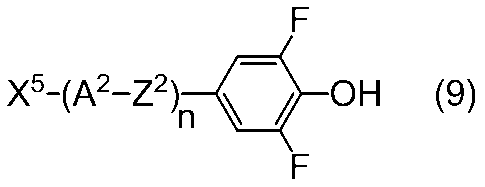
- a compound represented by the general formula (2) in which X 1 represents a chlorine atom, a bromine atom, a methanesulfonyloxy group or a p-toluenesulfonyloxy group is converted into a compound represented by the general formula (9) in the presence of a base.
- the compound represented by the general formula (10) can be obtained.
- reaction solvent Any reaction solvent may be used as long as it allows the reaction to proceed suitably.
- Ether solvents such as THF, diethyl ether, and diisopropyl ether, N, N-dimethylformamide (DMF), N, N— Amide solvents such as dimethylacetamide and N-methylpyrrolidone, dimethyl sulfoxide and the like are preferable, and THF or DMF is more preferable.
- the reaction temperature may be any temperature that allows the reaction to proceed suitably, but a temperature from room temperature to reflux of the solvent is preferred, and a temperature from 40 ° C. to reflux of the solvent is more preferred.
- the base to be used is preferably an alkali metal hydroxide such as sodium hydroxide or potassium hydroxide, or a carbonate such as sodium carbonate, potassium carbonate or cesium carbonate, more preferably potassium carbonate or cesium carbonate.
- R 2 and R 3 each independently represents a linear or branched alkyl group having 1 to 5 carbon atoms, and E represents one or more hydrogen atoms present in the group
- Each of the atoms independently represents a — (CH 2 ) s — which may be substituted with a methyl group, and s represents 2, 3 or 4.
- a transition metal catalyst In the presence of a transition metal catalyst, a compound represented by the general formula (1-2) can be obtained.
- Any solvent can be used as long as it allows the reaction to proceed suitably.
- Ether solvents such as THF, diethyl ether and diisopropyl ether, aromatic solvents such as benzene, toluene and xylene, DMF, N Amide solvents such as N, dimethylacetamide and N-methylpyrrolidone are preferred, THF, DMF and toluene are preferred, and these solvents may be used alone or in admixture as necessary, and further reacted. You may add water in order to advance suitably.
- the reaction temperature may be any temperature that allows the reaction to proceed suitably, but a temperature from room temperature to reflux of the solvent is preferred, and a temperature from 40 ° C. to reflux of the solvent is more preferred.
- Any transition metal catalyst may be used as long as it allows the reaction to proceed suitably. Tetrakis (triphenylphosphine) palladium (0), palladium (II) acetate, bis (triphenylphosphine) palladium dichloride (II), palladium such as [1,1′-bis (diphenylphosphino) ferrocene] palladium (II) dichloride, bis [di-tert-butyl (4-dimethylaminophenyl) phosphine] palladium (II) dichloride Transition metal catalysts or nickel-based transition metal catalysts are preferred, and tetrakis (triphenylphosphine) palladium (0), palladium (II) acetate, bis [di-tert-butyl (4-dimethylaminophenyl) phosphine] palladium ( II) or dichloride [1,1′-bis (diphenyl) Sufino)
- liquid crystal display device using the liquid crystal composition containing the compound of the present invention is useful for achieving both high-speed response and suppression of display failure, and is particularly useful for a liquid crystal display device for driving an active matrix, and has a VA mode. , PSVA mode, PSA mode, IPS mode or ECB mode liquid crystal display element.
- FIG. 1 is a cross-sectional view showing a liquid crystal display element including two substrates facing each other, a sealing material provided between the substrates, and liquid crystal sealed in a sealing region surrounded by the sealing material. It is.
- the TFT layer 102 and the pixel electrode 103 are provided on the substrate a100, the backplane on which the passivation film 104 and the alignment film a105 are provided, and the black matrix 202, the color filter 203, A planarizing film (overcoat layer) 201 and a transparent electrode 204 are provided, an alignment film b205 is provided thereon, a front plane facing the back plane, a sealing material 301 provided between the substrates, and the seal A specific mode of a liquid crystal display element including a liquid crystal layer 303 sealed in a sealing region surrounded by a material and provided with a protrusion 304 on a substrate surface in contact with the sealing material 301 is shown.
- the substrate a or the substrate b is not particularly limited as long as it is substantially transparent, and glass, ceramics, plastics, or the like can be used.
- Plastic substrates include cellulose derivatives such as cellulose, triacetyl cellulose, diacetyl cellulose, polycycloolefin derivatives, polyesters such as polyethylene terephthalate and polyethylene naphthalate, polypropylene, polyethylene, etc.
- Inorganic-organic composite materials such as glass fiber-acrylic resin can be used.
- the function of the barrier film is to reduce the moisture permeability of the plastic substrate and to improve the reliability of the electrical characteristics of the liquid crystal display element.
- the barrier film is not particularly limited as long as it has high transparency and low water vapor permeability. Generally, vapor deposition, sputtering, chemical vapor deposition method (CVD method) using an inorganic material such as silicon oxide is used. ) Is used.
- the same material or different materials may be used as the substrate a or the substrate b, and there is no particular limitation.
- a glass substrate is preferable because a liquid crystal display element having excellent heat resistance and dimensional stability can be produced.
- a plastic substrate is preferable because it is suitable for a manufacturing method using a roll-to-roll method and is suitable for weight reduction or flexibility. For the purpose of imparting flatness and heat resistance, good results can be obtained by combining a plastic substrate and a glass substrate.
- a TFT layer 102 and a pixel electrode 103 are provided on a substrate a100. These are manufactured by a normal array process.
- a backplane is obtained by providing a passivation film 104 and an alignment film a105 thereon.
- a passivation film 104 (also referred to as an inorganic protective film) is a film for protecting the TFT layer.
- a nitride film (SiNx), an oxide film (SiOx), or the like is formed by a chemical vapor deposition (CVD) technique or the like.
- the alignment film a105 is a film having a function of aligning liquid crystals, and a polymer material such as polyimide is usually used in many cases.
- a coating solution an alignment agent solution composed of a polymer material and a solvent is used. Since the alignment film may hinder the adhesive force with the sealing material, a pattern is applied in the sealing region.
- a printing method such as a flexographic printing method or a droplet discharge method such as an ink jet is used.
- the applied alignment agent solution is crosslinked and cured by baking after the solvent is evaporated by temporary drying. Thereafter, an alignment process is performed to provide an alignment function.
- Alignment treatment is usually performed by a rubbing method.
- the polymer film formed as described above is rubbed in one direction using a rubbing cloth made of fibers such as rayon, thereby producing liquid crystal alignment ability.
- a photo-alignment method is a method of generating alignment ability by irradiating polarized light on an alignment film containing an organic material having photosensitivity, and does not cause the generation of scratches or dust on the substrate due to the rubbing method.
- the organic material in the photo-alignment method include a material containing a dichroic dye.
- Dichroic dyes include molecular orientation induction or isomerization reaction (eg, azobenzene group), dimerization reaction (eg, cinnamoyl group), photocrosslinking reaction (eg, benzophenone group) due to Weigert effect resulting from photodichroism.
- a photo-alignment group that causes a photoreaction that causes liquid crystal alignment ability
- a photolysis reaction eg, polyimide group
- the applied alignment agent solution is irradiated with light having an arbitrary deflection (polarized light), whereby an alignment film having alignment ability in an arbitrary direction can be obtained.
- One front plane is provided with a black matrix 202, a color filter 203, a planarizing film 201, a transparent electrode 204, and an alignment film b205 on a substrate b200.
- the black matrix 202 is produced by, for example, a pigment dispersion method. Specifically, a color resin solution in which a black colorant is uniformly dispersed for forming a black matrix is applied on a substrate b200 provided with a barrier film 201, thereby forming a colored layer. Subsequently, the colored layer is baked and cured. A photoresist is applied on this and prebaked. After exposing the photoresist through a mask pattern, development is performed to pattern the colored layer. Thereafter, the photoresist layer is peeled off and the colored layer is baked to complete the black matrix 202.
- a pigment dispersion method Specifically, a color resin solution in which a black colorant is uniformly dispersed for forming a black matrix is applied on a substrate b200 provided with a barrier film 201, thereby forming a colored layer. Subsequently, the colored layer is baked and cured. A photoresist is applied on this and prebaked. After exposing the photore
- a photoresist type pigment dispersion may be used.
- a photoresist-type pigment dispersion is applied, pre-baked, exposed through a mask pattern, and then developed to pattern the colored layer. Thereafter, the photoresist layer is peeled off and the colored layer is baked to complete the black matrix 202.
- the color filter 203 is prepared by a pigment dispersion method, an electrodeposition method, a printing method, a dyeing method, or the like.
- a pigment dispersion method as an example, a color resin solution in which a pigment (for example, red) is uniformly dispersed is applied onto the substrate b200, and after baking and curing, a photoresist is applied thereon and prebaked. After the photoresist is exposed through a mask pattern, development is performed and patterning is performed. Thereafter, the photoresist layer is peeled off and baked again to complete the (red) color filter 203. There is no particular limitation on the color order to be created. Similarly, a green color filter 203 and a blue color filter 203 are formed.
- the transparent electrode 204 is provided on the color filter 203 (if necessary, an overcoat layer (201) may be provided on the color filter 203 for surface flattening).
- the transparent electrode 204 preferably has a high transmittance, and preferably has a low electrical resistance.
- the transparent electrode 204 is formed by sputtering an oxide film such as ITO.
- a passivation film may be provided on the transparent electrode 204 for the purpose of protecting the transparent electrode 204.
- the alignment film b205 is the same as the alignment film a105 described above.
- the shape of the columnar spacer is not particularly limited, and the horizontal cross section can be various shapes such as a circle and a polygon such as a quadrangle. A polygonal shape is particularly preferable.
- the protrusion shape is preferably a truncated cone or a truncated pyramid.
- the material of the columnar spacer is not particularly limited as long as it is a sealing material, an organic solvent used for the sealing material, or a material that does not dissolve in liquid crystal, but it may be a synthetic resin (curable resin) in terms of processing and weight reduction. preferable.
- the protrusion can be provided on the surface of the first substrate in contact with the sealing material by a photolithography method or a droplet discharge method. For these reasons, it is preferable to use a photocurable resin suitable for a photolithography method or a droplet discharge method.
- a resin solution for forming columnar spacers (not containing a colorant) is applied on the transparent electrode 204 of the front plane. Subsequently, the resin layer is baked and cured. A photoresist is applied on this and prebaked. After exposing the photoresist through a mask pattern, development is performed to pattern the resin layer. Thereafter, the photoresist layer is peeled off, and the resin layer is baked to complete the columnar spacer.
- the formation position of the columnar spacer can be determined at a desired position by the mask pattern. Therefore, both the inside of the sealing region of the liquid crystal display element and the outside of the sealing region (sealing material application portion) can be created at the same time.
- the columnar spacer is preferably formed so as to be positioned on the black matrix so that the quality of the sealing region does not deteriorate.
- a columnar spacer manufactured by a photolithography method in this way is sometimes called a column spacer or a photospacer.
- a mixture of a negative water-soluble resin such as PVA-stilbazo photosensitive resin, a polyfunctional acrylic monomer, an acrylic acid copolymer, a triazole initiator, or the like is used.
- a color resin in which a colorant is dispersed in a polyimide resin there is no particular limitation, and a spacer can be obtained from a known material in accordance with the compatibility with the liquid crystal or the sealing material to be used.
- a sealing material (301 in FIG. 1) is applied to the surface of the backplane that contacts the sealing material.
- the material of the sealing material is not particularly limited, and a curable resin composition in which a polymerization initiator is added to an epoxy or acrylic photocurable, thermosetting, or photothermal combination curable resin is used.
- a curable resin composition in which a polymerization initiator is added to an epoxy or acrylic photocurable, thermosetting, or photothermal combination curable resin is used.
- fillers made of inorganic or organic substances may be added.
- the shape of these fillers is not particularly limited, and includes a spherical shape, a fiber shape, and an amorphous shape.
- a spherical or fibrous gap material having a monodisperse diameter is mixed, or in order to further strengthen the adhesive force with the substrate, a fibrous substance that is easily entangled with the protrusion on the substrate is used. You may mix.
- the diameter of the fibrous material used at this time is desirably about 1/5 to 1/10 or less of the cell gap, and the length of the fibrous material is desirably shorter than the seal coating width.
- the material of the fibrous substance is not particularly limited as long as a predetermined shape can be obtained, and synthetic fibers such as cellulose, polyamide, and polyester, and inorganic materials such as glass and carbon can be appropriately selected.
- the sealing material As a method for applying the sealing material, there are a printing method and a dispensing method, but a dispensing method with a small amount of the sealing material used is desirable.
- the application position of the sealing material is usually on the black matrix so as not to adversely affect the sealing area.
- the sealing material application shape is a closed loop shape.
- the liquid crystal is dropped on the closed loop shape (sealing region) of the front plane coated with the sealing material.
- a dispenser is used. Since the amount of liquid crystal to be dropped coincides with the volume of the liquid crystal cell, the amount is basically the same as the volume obtained by multiplying the height of the column spacer and the seal application area. However, in order to optimize liquid crystal leakage and display characteristics in the cell bonding process, the amount of liquid crystal to be dropped may be adjusted as appropriate, or the liquid crystal dropping position may be dispersed.
- the back plane is bonded to the front plane where the sealing material is applied and the liquid crystal is dropped.
- the front plane and the back plane are adsorbed on a stage having a mechanism for adsorbing a substrate such as an electrostatic chuck, and the alignment film b on the front plane and the alignment film a on the back plane face each other. It is arranged at a position (distance) where the sealing material does not contact the other substrate.
- the system is depressurized. After decompression is completed, the positions of both substrates are adjusted while confirming the bonding position between the front plane and the back plane (alignment operation).
- the substrate is brought close to a position where the sealing material on the front plane and the back plane are in contact with each other.
- the system is filled with an inert gas, and the pressure is gradually returned to normal pressure while releasing the reduced pressure.
- the front plane and the back plane are bonded together by atmospheric pressure, and a cell gap is formed at the height of the columnar spacer.
- the sealing material is irradiated with ultraviolet rays to cure the sealing material, thereby forming a liquid crystal cell.
- a heating step is added in some cases to promote curing of the sealing material. A heating process is often added to enhance the adhesive strength of the sealing material and improve the reliability of electrical characteristics.
- the phase transition temperature was measured using a polarizing microscope equipped with a temperature control stage and a differential scanning calorimeter (DSC).
- T n-i nematic phase - represents the transition temperature of the isotropic phase.
- THF Tetrahydrofuran Me: Methyl group, Pr: n-propyl group, Bu: n-butyl group (Example 1) trans-2- (3,4,5-trifluorophenyl) -5-[(2,6- Production of difluoro-4-propylphenyloxy) methyl] -1,3-dioxane (1-1)
- the organic layer was washed with water (200 mL), saturated aqueous sodium hydrogen carbonate solution (200 mL) and saturated brine (200 mL), and dried over anhydrous sodium sulfate.
- the organic solvent was distilled off under reduced pressure, and the residue was purified by silica gel column chromatography to obtain trifluoromethanesulfonic acid 5,6,7-trifluoro-naphthalen-2-yl (82.1 g).
- a liquid crystal composition (MA) comprising 15% of 1,3-dioxane was prepared. The physical properties of this composition are as follows.
- T n ⁇ i 92.6 ° C. ⁇ : 9.66 ⁇ n: 0.0884 ⁇ 20 : 22.4 mPa ⁇ s
- the prepared liquid crystal composition (MA) maintained a uniform nematic liquid crystal state for one month or more at room temperature.
- liquid crystal display device manufactured using the liquid crystal composition (MA) showed excellent display characteristics and maintained stable display characteristics over a long period of time.
- Example 8 Preparation of liquid crystal composition-2 Base liquid crystal (H) 85% and trans-2- [4- (3,4,5-trifluorophenyl) phenyl] -5-[(2,6-difluoro-4-propylphenyl) obtained in Example 2 A liquid crystal composition (MB) comprising 15% of (oxy) methyl] -1,3-dioxane was prepared.
- the physical properties of this composition are as follows.
- T n ⁇ i 116.1 ° C. ⁇ : 9.65 ⁇ n: 0.0991 ⁇ 20 : 27.0 mPa ⁇ s
- the prepared liquid crystal composition (MB) maintained a uniform nematic liquid crystal state for one month or more at room temperature.
- Example 9 Preparation of Liquid Crystal Composition-3 Base liquid crystal (H) 85% and trans-2- [4- (3,4,5-trifluorophenyl) -3-fluorophenyl] -5-[(2,6-difluoro-) obtained in Example 3
- a liquid crystal composition (MC) comprising 15% of 4-propylphenyloxy) methyl] -1,3-dioxane was prepared.
- the physical properties of this composition are as follows.
- T n ⁇ i 113.3 ° C.
- ⁇ 10.28 ⁇ n: 0.0967 ⁇ 20 : 27.5 mPa ⁇ s
- the prepared liquid crystal composition (MC) maintained a uniform nematic liquid crystal state for one month or more at room temperature.
- Example 10 Preparation of Liquid Crystal Composition-4 90% of the base liquid crystal (H) and trans-2- [4- (3,4,5-trifluorophenyl) -3,5-difluorophenyl] -5-[(2,6- A liquid crystal composition (MD) comprising 10% of difluoro-4-propylphenyloxy) methyl] -1,3-dioxane was prepared.
- the physical properties of this composition are as follows.
- the prepared liquid crystal composition (MD) maintained a uniform nematic liquid crystal state for one month or more at room temperature.
- Example 11 Preparation of Liquid Crystal Composition-5 85% of base liquid crystal (H) and trans-2- (5,6,7-trifluoronaphthalen-2-yl) -5-[(2,6-difluoro-4-propylphenyloxy) obtained in Example 5 )
- a liquid crystal composition (ME) comprising 15% of methyl] -1,3-dioxane was prepared.
- the physical properties of this composition are as follows.
- the prepared liquid crystal composition (ME) maintained a uniform nematic liquid crystal state for one month or more at room temperature.
- Example 12 Preparation of Liquid Crystal Composition-6 90% of base liquid crystal (H) and 2- (4-trifluoromethoxyphenyl) -6- [2,6-difluoro-4- (4- (trans-4-propylcyclohexyl) phenyl) obtained in Example 6
- a liquid crystal composition (MF) comprising 10% of phenyloxymethyl] -1,3-dioxane was prepared.
- the physical properties of this composition are as follows.
- T n ⁇ i 130.9 ° C. ⁇ : 6.13 ⁇ n: 0.0984 ⁇ 20 : 27.0 mPa ⁇ s
- the prepared liquid crystal composition (MF) maintained a uniform nematic liquid crystal state for one month or more at room temperature.
- a liquid crystal display device manufactured using the liquid crystal composition (MF) showed excellent display characteristics and maintained stable display characteristics for a long time.
- Comparative Example 2 Preparation of Liquid Crystal Composition-7 85% of base liquid crystal (H) and trans-4- [3,5-difluoro-4- (3,4,5-trifluorophenyl) phenyl] cyclohexyl- (2,6-difluoro obtained in Comparative Example 1
- a liquid crystal composition (MG) comprising 15% of -4-propylphenyloxy) methane was prepared.
- the physical properties of this composition are as follows.
- T n ⁇ i 111.0 ° C. ⁇ : 9.11 ⁇ n: 0.0951 ⁇ 20 : 26.5 mPa ⁇ s
- the prepared liquid crystal composition (MG) maintained a uniform nematic liquid crystal state for one month or more at room temperature.
Landscapes
- Chemical & Material Sciences (AREA)
- Organic Chemistry (AREA)
- Crystallography & Structural Chemistry (AREA)
- Engineering & Computer Science (AREA)
- Materials Engineering (AREA)
- Liquid Crystal Substances (AREA)
- Organic Low-Molecular-Weight Compounds And Preparation Thereof (AREA)
- Heterocyclic Compounds That Contain Two Or More Ring Oxygen Atoms (AREA)
- Low-Molecular Organic Synthesis Reactions Using Catalysts (AREA)
- Heterocyclic Carbon Compounds Containing A Hetero Ring Having Oxygen Or Sulfur (AREA)
Abstract
Description


A1、A2、A3及びA4は各々独立して
(a)1,4-シクロへキシレン基(この基中に存在する1個の-CH2-又は隣接していない2個以上の-CH2-は-O-又は-S-に置き換えられても良い。)
(b)1,4-フェニレン基(この基中に存在する1個の-CH=又は隣接していない2個以上の-CH=は-N=に置き換えられても良く、この基中に存在する水素原子はフッ素原子に置換されても良い。)
(c)ナフタレン-2,6-ジエニル基(この基中に存在する水素原子はフッ素原子に置換されても良い。)
からなる群より選ばれる基であり、
Z1、Z2、Z3及びZ4は各々独立して-CH2O-、-OCH2-、-CF2O-、-OCF2-、-CH2CH2-、-CF2CF2-、-CH=CH-、-CF=CF-、-C≡C-又は単結合を表し、
A5は
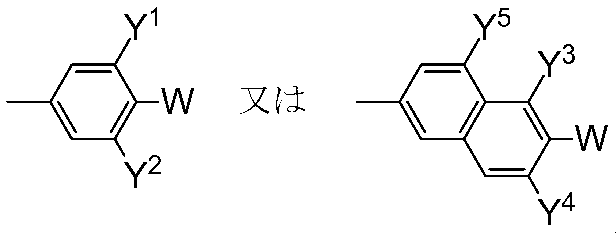
m、n、p及びrは各々独立して0又は1を表すが、m+n+p+rは0、1、2又は3である。)で表される化合物を提供し、併せて当該化合物を含有する液晶組成物及び当該液晶組成物を用いた液晶表示素子を提供する。
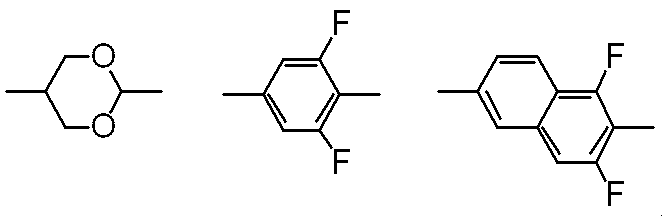
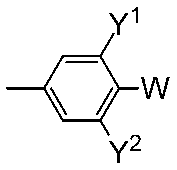
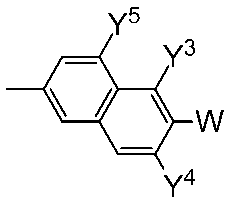

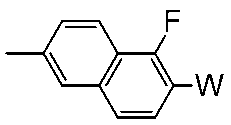

(a)1,4-シクロへキシレン基(この基中に存在する1個の-CH2-又は隣接していない2個以上の-CH2-は-O-又は-S-に置き換えられても良い。)
(b)1,4-フェニレン基(この基中に存在する1個の-CH=又は隣接していない2個以上の-CH=は-N=に置き換えられても良く、この基中に存在する水素原子はフッ素原子に置換されても良い。)
一般式(1a)で表される化合物としては、Rは炭素数1から12のアルキル基、炭素数2から12のアルケニル基、炭素数1から12のアルコキシ基又は炭素数2から12のアルケニルオキシ基を表すことが好ましく、炭素原子数1~8のアルキル基又は炭素原子数2~8のアルケニル基であることがより好ましく、炭素原子数1~5のアルキル基又は炭素原子数2~5のアルケニル基であることが特に好ましく、Y1及びY2は各々独立して水素原子又はフッ素原子であることが好ましく、Wはフッ素原子、シアノ基、-CF3、又は-OCF3であることが好ましい。一般式(1a)で表される化合物としては、下記一般式(1a-1)~一般式(1a-11)がより好ましく、一般式(1a-1)で表される化合物が更に好ましい。
一般式(1b)で表される化合物としては、Rは炭素原子数1~8のアルキル基又は炭素原子数2~8のアルケニル基であることが好ましく、炭素原子数1~5のアルキル基又は炭素原子数2~5のアルケニル基であることが特に好ましく、Y1、Y2、Y6、及びY7は各々独立して水素原子又はフッ素原子であることが好ましく、Wはフッ素原子、シアノ基、又は-OCF3であることが好ましく、A7は各々独立して1,4-シクロへキシレン基、1,4-フェニレン基、又は


一般式(1b)で表される化合物のうち、A7が1,4-シクロへキシレン基(この基中に存在する1個の-CH2-又は隣接していない2個以上の-CH2-は-O-又は-S-に置き換えられても良い。)であるものとしては、下記一般式(1b-17)~一般式(1b-32)がより好ましい。
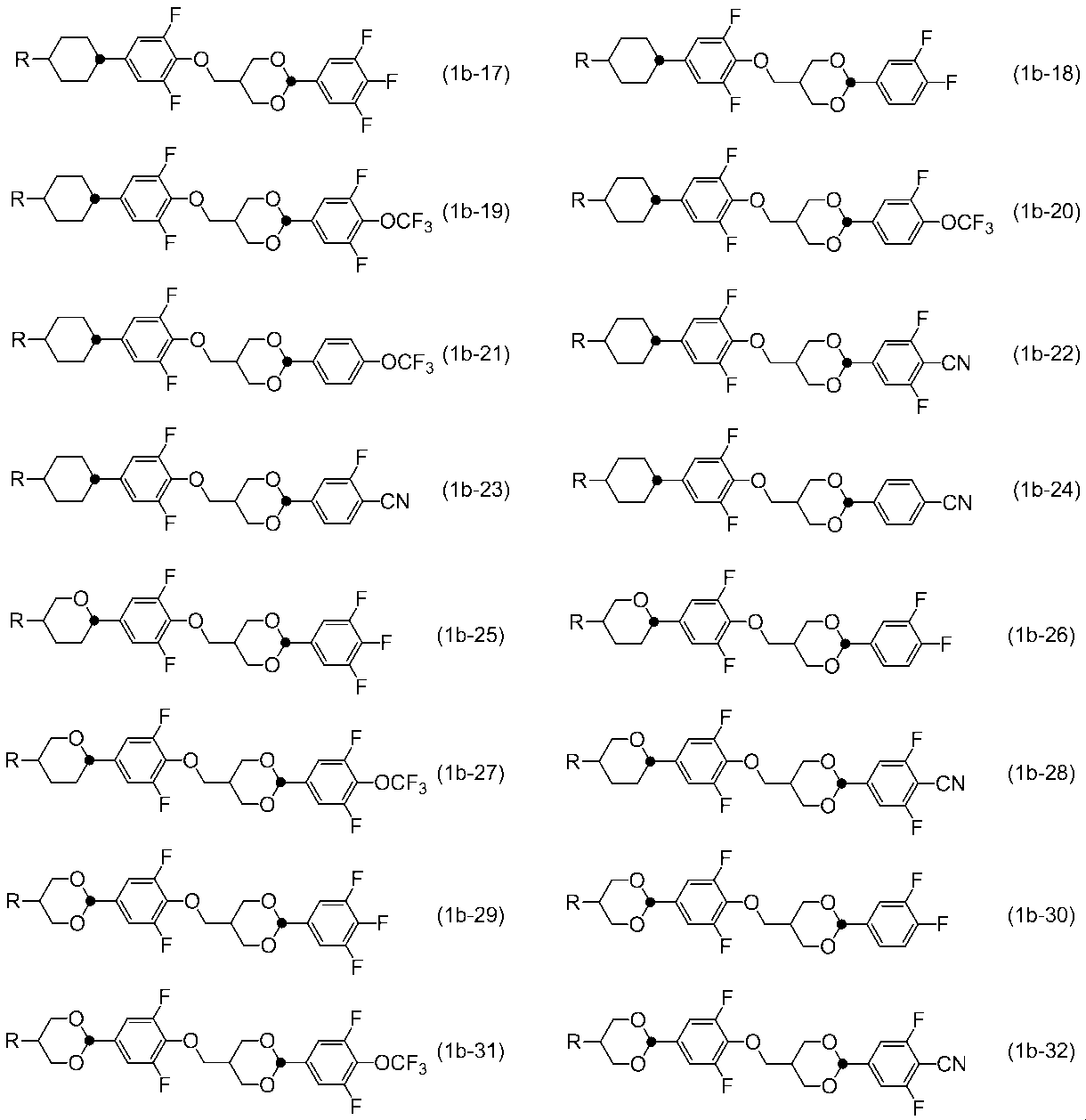
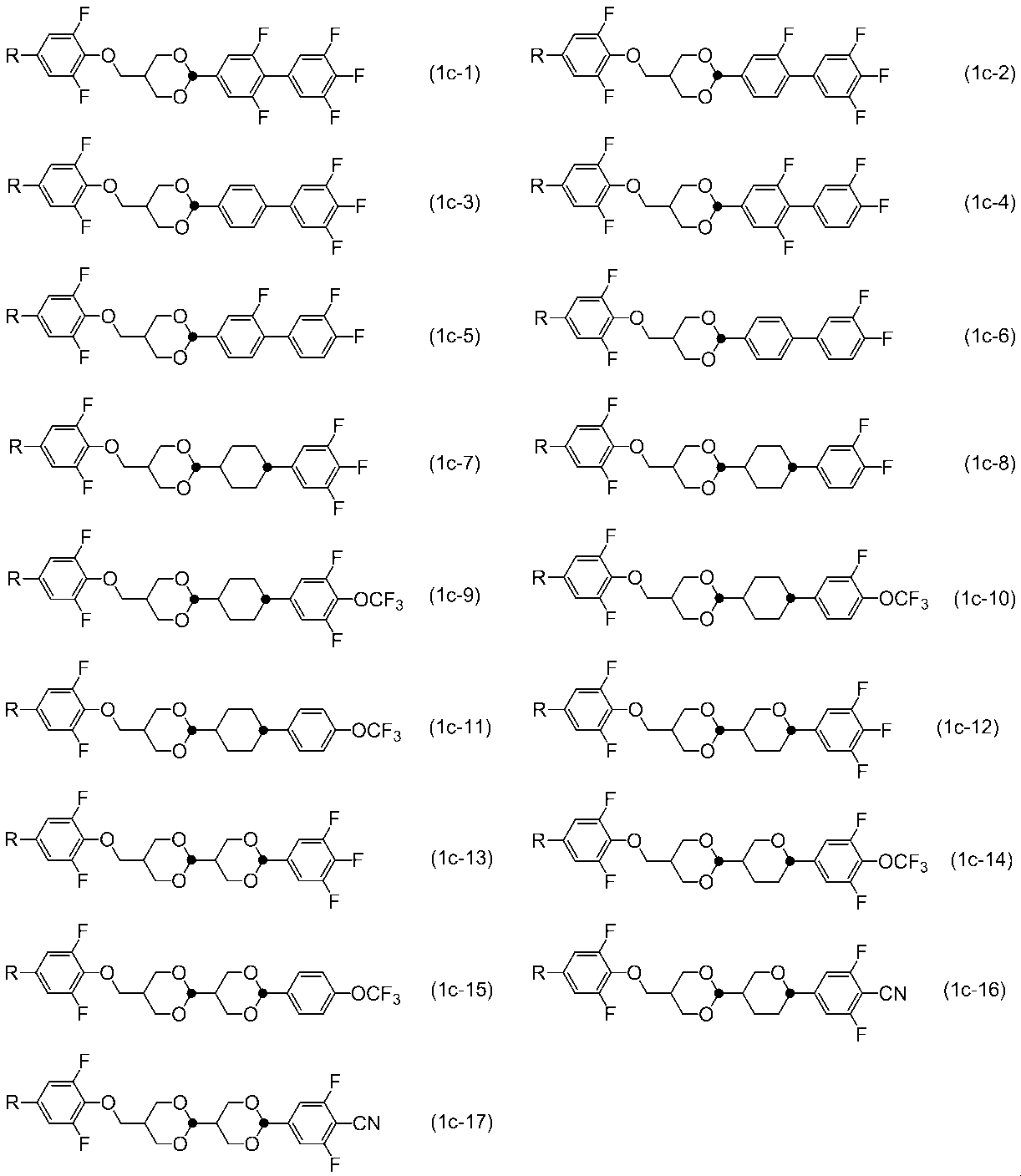
一般式(1c)で表される化合物としては、Rは炭素原子数1~8のアルキル基又は炭素原子数2~8のアルケニル基であることが好ましく、炭素原子数1~5のアルキル基又は炭素原子数2~5のアルケニル基であることが特に好ましく、Y1及びY2は各々独立して水素原子又はフッ素原子であることが好ましく、Wはフッ素原子、シアノ基、又は-OCF3であることが好ましく、A8はトランス-1,4-シクロヘキシレン基、又は

一般式(1d)で表される化合物としては、Rは炭素原子数1~8のアルキル基又は炭素原子数2~8のアルケニル基であることが好ましく、炭素原子数1~5のアルキル基又は炭素原子数2~5のアルケニル基であることが特に好ましく、Y1及びY2は各々独立して水素原子又はフッ素原子であることが好ましく、Wはフッ素原子、シアノ基、又は-OCF3であることが好ましい。一般式(1d)で表される化合物としては、下記一般式(1d-1)~一般式(1d-9)がより好ましい。
一般式(1e)で表される化合物としては、Rは炭素原子数1~8のアルキル基又は炭素原子数2~8のアルケニル基であることが好ましく、炭素原子数1~5のアルキル基又は炭素原子数2~5のアルケニル基であることが特に好ましく、Y1、Y2及びY12は各々独立して水素原子又はフッ素原子であることが好ましく、Wはフッ素原子、又は-OCF3であることが好ましい。一般式(1e)で表される化合物としては、下記一般式(1e-1)~一般式(1e-8)がより好ましく、一般式(1e-1)及び一般式(1e-8)が更に好ましい。

一般式(1f)で表される化合物としては、Rは炭素原子数1~8のアルキル基又は炭素原子数2~8のアルケニル基であることが好ましく、炭素原子数1~5のアルキル基又は炭素原子数2~5のアルケニル基であることが特に好ましく、Y1、Y2及びY13は各々独立して水素原子又はフッ素原子であることが好ましく、Wはフッ素原子、又は-OCF3であることが好ましい。一般式(1f)で表される化合物としては、下記一般式(1f-1)~一般式(1f-8)がより好ましい。
一般式(1g)で表される化合物としては、Rは炭素原子数1~8のアルキル基又は炭素原子数2~8のアルケニル基であることが好ましく、炭素原子数1~5のアルキル基又は炭素原子数2~5のアルケニル基であることが特に好ましく、Y3~Y5は各々独立して水素原子又はフッ素原子であることが好ましく、Wはフッ素原子、シアノ基、又は-OCF3であることが好ましい。一般式(1g)で表される化合物としては、下記一般式(1g-1)~一般式(1g-6)がより好ましく、一般式(1g-2)である事が更に好ましい。
一般式(1h)で表される化合物としては、Rは炭素原子数1~8のアルキル基又は炭素原子数2~8のアルケニル基であることが好ましく、炭素原子数1~5のアルキル基又は炭素原子数2~5のアルケニル基であることが特に好ましく、Y3、Y4、Y5、Y14及びY15は各々独立して水素原子又はフッ素原子であることが好ましく、Wはフッ素原子、シアノ基、又は-OCF3であることが好ましい。一般式(1h)で表される化合物としては、下記一般式(1h-1)~一般式(1h-12)がより好ましい。

一般式(1i)で表される化合物としては、Rは炭素原子数1~8のアルキル基又は炭素原子数2~8のアルケニル基であることが好ましく、炭素原子数1~5のアルキル基又は炭素原子数2~5のアルケニル基であることが特に好ましく、Y3~Y5は各々独立して水素原子又はフッ素原子であることが好ましく、Wはフッ素原子、シアノ基、又は-OCF3であることが好ましく、A9はトランス-1,4-シクロヘキシレン基、又は
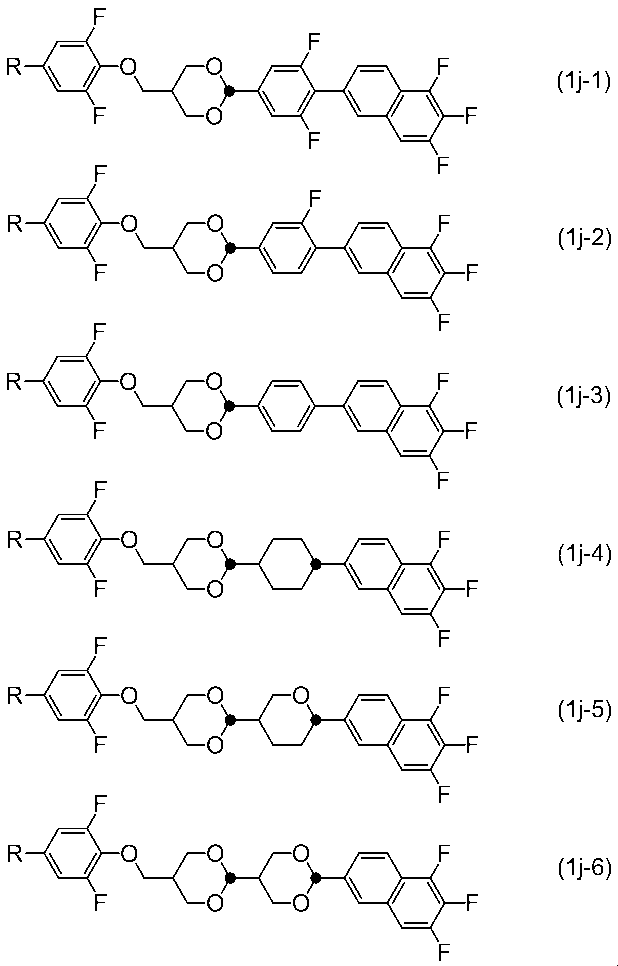
一般式(1j)で表される化合物としては、Rは炭素原子数1~8のアルキル基又は炭素原子数2~8のアルケニル基であることが好ましく、炭素原子数1~5のアルキル基又は炭素原子数2~5のアルケニル基であることが特に好ましく、Y3~Y5は各々独立して水素原子又はフッ素原子であることが好ましく、Wはフッ素原子であることが好ましく、A9は各々独立して1,4-シクロへキシレン基、1,4-フェニレン基、又は

本発明の液晶組成物において一般式(1)で表される化合物の含有量が少ないとその効果が現れないため、組成物中に下限値として、1質量%(以下組成物中の%は質量%を表す。)以上含有することが好ましく、2%以上含有することが好ましく、5%以上含有することが更に好ましい。又、含有量が多いと析出等の問題を引き起こすため、上限値としては、50%以下含有することが好ましく、30%以下含有することがより好ましく、20%以下含有することが更に好ましく、10%以下含有することが特に好ましい。一般式(1)で表される化合物は1種のみで使用することもできるが、2種以上の化合物を同時に使用してもよい。


(製法1)
一般式(6)



(製法2)
一般式(1)で表される化合物のうち、一般式(1-1)

で表される化合物は、以下のようにして製造することができる。 一般式(3)で表される化合物をアゾジカルボン酸ジエステル類及びホスフィン類存在下、一般式(4)

で表される化合物と反応させる事により一般式(5)

A6は一般式(4)におけるA6と同じ意味を表す)
で表される化合物を得る事ができる。

(製法3)
一般式(1)で表される化合物のうち、一般式(1-2)

で表される化合物は、以下のようにして製造する事ができる。


前記基板a又は前記基板bは、実質的に透明であれば材質に特に限定はなく、ガラス、セラミックス、プラスチック等を使用することができる。プラスチック基板としてはセルロ-ス、トリアセチルセルロ-ス、ジアセチルセルロ-ス等のセルロ-ス誘導体、ポリシクロオレフィン誘導体、ポリエチレンテレフタレ-ト、ポリエチレンナフタレ-ト等のポリエステル、ポリプロピレン、ポリエチレン等のポリオレフィン、ポリカーボネート、ポリビニルアルコ-ル、ポリ塩化ビニル、ポリ塩化ビニリデン、ポリアミド、ポリイミド、ポリイミドアミド、ポリスチレン、ポリアクリレート、ポリメチルメタクリレ-ト、ポリエーテルサルホン、ポリアリレート、更にガラス繊維-エポキシ樹脂、ガラス繊維-アクリル樹脂などの無機-有機複合材料などを用いることができる。
Me:メチル基、Pr:n-プロピル基、Bu:n-ブチル基
(実施例1)trans-2-(3,4,5-トリフルオロフェニル)-5-[(2,6-ジフルオロ-4-プロピルフェニルオキシ)メチル]-1,3-ジオキサン(1-1)の製造

(1-2) 窒素雰囲気下、(1-1)にて得られた5-ヒドロキシメチル-2-(3,4,5-トリフルオロフェニル)-1,3-ジオキサン(11.3g)、2,6-ジフルオロ-4-プロピルフェノール(7.9g,WO2012/161178記載の方法により製造)及びトリフェニルホスフィン(13.2g)をTHF(50mL)に溶解させた。氷冷下、アゾジカルボン酸ジイソプロピル(9.7g)をゆっくりと加えた後、室温にて5時間撹拌した。水(5mL)を加え、溶媒を減圧留去し、ヘキサン(100mL)及びトルエン(20mL)を加えて懸濁させ、不溶物を濾過した。得られたろ液を減圧濃縮し、シリカゲルカラムクロマトグラフィーにて精製した後、メタノールから3回再結晶する事で、trans-2-(3,4,5-トリフルオロフェニル)-5-[(2,6-ジフルオロ-4-プロピルフェニルオキシ)メチル]-1,3-ジオキサン(2.2g)を得た。
MS m/z:402[M+]
相転移温度(℃):Cr 61 Iso
1HNMR(CDCl3、TMS内部標準)δ(ppm)=7.15(2H,t,J=7.2Hz),6.71(2H,d,J=8.8Hz),5.38(1H,s),4.39(2H,dd,J1=4.4Hz,J2=11.4Hz),3.95-3.86(4H,m),2.63-2.48(3H,m),1.64-1.55(2H, m),0.92(3H,t,J=7.2Hz)
(実施例2)trans-2-[4-(3,4,5-トリフルオロフェニル)フェニル]-5-[(2,6-ジフルオロ-4-プロピルフェニルオキシ)メチル]-1,3-ジオキサンの製造
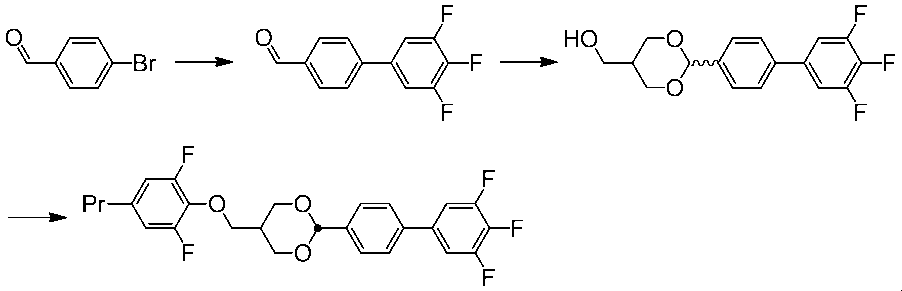
MS m/z:478[M+]
相転移温度(℃):Cr 68 SmA 129 N 137 Iso
1HNMR(CDCl3、TMS内部標準)δ(ppm)=7.59(2H,d,J=8.2Hz),7.50(2H,d,J=8.3Hz),7.18(2H,dd,J1=6.6Hz,J2=8.6Hz),6.57(2H,d,J=9.1Hz),5.52(1H,s),4.43(2H,dd,J1=4.5Hz,J2=11.7Hz),3.97-3.90(4H,m),2.68-2.60(1H,m),2.51(2H,t,J=7.4Hz),1.65-1.55(2H, m),0.93(3H,t,J=7.2Hz)
(実施例3)trans-2-[4-(3,4,5-トリフルオロフェニル)-3-フルオロフェニル]-5-[(2,6-ジフルオロ-4-プロピルフェニルオキシ)メチル]-1,3-ジオキサンの製造

(3-2) 窒素雰囲気下、(3-1)にて得られた5-ヒドロキシメチル-2-(3-フルオロフェニル)-1,3-ジオキサン(10.1g)、トリフェニルホスフィン(12.7g)及び2,6-ジフルオロ-4-プロピルフェノール(8.3g)をTHF(50mL)に溶解させ、0℃に冷却し、アゾジカルボン酸ジイソプロピル(9.8g)をゆっくりと滴下した。室温にて1時間撹拌した後、水(3mL)を加え、溶媒を減圧留去した。残渣にヘキサン(100mL)、トルエン(25mL)、メタノール(100mL)及び水(50mL)を加えて分液した。有機層を水(100mL)及び飽和食塩水(100mL)にて洗浄し、無水硫酸ナトリウムにて乾燥した。有機溶媒を減圧留去した後、シリカゲルカラムクロマトグラフィーにて精製し、メタノールから3回再結晶する事で、trans-2-(-3-フルオロフェニル)-5-(2,6-ジフルオロ-4-プロピルフェニルオキシ)メチル-1,3-ジオキサン(4.5g)を得た。
MS m/z:366[M+]
1HNMR(CDCl3、TMS内部標準)δ(ppm)=7.33-7.29(1H,m),7.19-7.12(2H,m),6.88(1H,d,J=8.9Hz),6.71(2H,d,J=8.8Hz),5.50(1H,s),4.44(2H,dd,J1=4.3Hz,J2=11.2Hz),3.97-3.90(4H,m),2.68-2.60(1H,m),2.53(2H,t,J=7.4Hz),1.65-1.55(2H, m),0.94(3H,t,J=7.2Hz)
(3-3) 窒素雰囲気下、(3-2)にて得られた2-(-3-フルオロフェニル)-5-(2,6-ジフルオロ-4-プロピルフェニルオキシ)メチル-1,3-ジオキサン(16.7g)をTHF(120mL)に溶解させ、-78℃に冷却した。冷却下、1mol/L sec-ブチルリチウム/ヘキサン溶液(45mL)をゆっくりと加え、-78℃にて3時間撹拌した。ホウ酸トリイソプロピル(11.0g)をゆっくりと加え、-78℃にて1時間撹拌し、室温までゆっくりと昇温させた。水(20mL)及び飽和塩化アンモニウム水溶液(100mL)を加えて分液した。有機層を水(100mL)及び飽和食塩水(100mL)にて洗浄し、無水硫酸ナトリウムを加えて乾燥した。残渣をヘキサン/トルエン混合溶媒から再結晶する事で、2-フルオロ-4-(5-(2,6-ジフルオロ-4-プロピルフェニルオキシメチル)-1,3-ジオキサン-2-イル)フェニルホウ酸(9.9g)を得た。
(3-4) 窒素雰囲気下、3,4,5-トリフルオロブロモベンゼン(4.6g)、テトラキス(トリフェニルホスフィン)パラジウム(0)(1.0g)、2mol/L炭酸カリウム水溶液(25mL)及びTHF(40mL)を混合し、60℃に加熱した。加熱下、(3-3)にて得られた2-フルオロ-4-(5-(2,6-ジフルオロ-4-プロピルフェニルオキシメチル)-1,3-ジオキサン-2-イル)フェニルホウ酸(9.9g)をTHF(50mL)に溶解させた溶液をゆっくりと滴下し、60℃にて5時間撹拌した。室温まで放冷し、トルエン(30mL)を加えて不溶物を濾過により除去し、分液した。有機層を飽和食塩水(150mL)にて二回洗浄し、無水硫酸ナトリウムを加えて乾燥した。有機溶媒を減圧留去し、残渣をシリカゲルカラムクロマトグラフィーにより精製し、エタノール/アセトン混合溶媒から3回再結晶する事でtrans-2-[4-(3,4,5-トリフルオロフェニル)-3-フルオロフェニル]-5-[(2,6-ジフルオロ-4-プロピルフェニルオキシ)メチル]-1,3-ジオキサン(5.4g)を得た。
MS m/z:496[M+]
1HNMR(CDCl3、TMS内部標準)δ(ppm)=7.29-7.25(1H,m),7.17(2H,dd,J1=6.6Hz,J2=8.5Hz),7.06-6.97(2H,m),6.59(2H,d,J=9.0Hz),5.50(1H,s),4.44(2H,dd,J1=4.3Hz,J2=11.2Hz),3.97-3.90(4H,m),2.68-2.60(1H,m),2.53(2H,t,J=7.4Hz),1.65-1.55(2H, m),0.94(3H,t,J=7.2Hz)
(実施例4)trans-2-[4-(3,4,5-トリフルオロフェニル)-3,5-ジフルオロフェニル]-5-[(2,6-ジフルオロ-4-プロピルフェニルオキシ)メチル]-1,3-ジオキサンの製造

MS m/z:514[M+]
1HNMR(CDCl3、TMS内部標準)δ(ppm)=7.11(2H,t,J=7.6Hz),6.86(2H,d,J=9.3Hz),6.71(2H,d,J=9.2Hz),5.50(1H,s),4.44(2H,dd,J1=4.3Hz,J2=11.4Hz),3.97-3.90(4H,m),2.68-2.60(1H,m),2.51(2H,t,J=7.4Hz),1.65-1.55(2H, m),0.93(3H,t,J=7.2Hz)
(実施例5)trans-2-(5,6,7-トリフルオロナフタレン-2-イル)-5-[(2,6-ジフルオロ-4-プロピルフェニルオキシ)メチル]-1,3-ジオキサンの製造

(5-2) 窒素雰囲気下、(5-1)で得られたトリフルオロメタンスルホン酸5,6,7-トリフルオロナフタレン-2-イル(60g)、シアン化カリウム(23.7g)、二臭化ビス(トリフェニルホスフィン)ニッケル(II)(6.3g)、トリフェニルホスフィン(4.8g)及び金属亜鉛(1.2g)をアセトニトリル(270mL)に懸濁させた溶液を80℃に加熱し16時間撹拌した。室温まで冷却した後、水(150mL)及びトルエン(100mL)を加えて分液し、有機層を水(100mL)にて二回洗浄した。得られた有機層に70%tert-ブチルヒドロぺルオキシド水溶液(8mL)を加えて室温にて1時間撹拌した。分液し、有機層を飽和食塩水(100mL)にて洗浄し、無水硫酸ナトリウムにて乾燥した。溶媒を減圧留去した後、シリカゲルカラムクロマトグラフィーにより精製し、エタノールから再結晶する事で2-シアノ-5,6,7-トリフルオロナフタレン(17.0g)を得た。
(5-3) 窒素雰囲気下、(5-2)で得られた2-シアノ-5,6,7-トリフルオロナフタレン(17.0g)をトルエン(350mL)に溶解させ、氷冷下1.5mol/L水素化ジイソブチルアルミニウム・トルエン溶液(58mL)をゆっくりと加えた。室温にて1時間撹拌した後、氷冷下1mol/L塩酸(100mL)を加えた。室温にて更に1時間撹拌した後分液し、有機層を1mol/L塩酸(50mL)、飽和食塩水(100mL)にて洗浄し、有機層をアルミナカラムを通過させる事で、粗製5,6,7-トリフルオロ-2-ナフトアルデヒド(15.1g,A)を得た。
(5-4) 窒素雰囲気下、マロン酸ジエチル(80g)をTHF(400mL)に溶解させ、氷冷下tert-ブチルオキシカリウム(56.1g)をTHF(560mL)に溶解させた溶液をゆっくりと滴下した。室温にて3時間撹拌した後、氷冷し、ベンジル=クロロメチル=エーテル(78.3g)をTHF(150mL)に溶解させた溶液をゆっくりと加えた。室温にて3時間撹拌したのち、水(100mL)及び1mol/L塩酸(300mL)を加えて分液し、水層に酢酸エチル(300mL)を加えて抽出した。有機層を併せ、水(300mL)、飽和炭酸水素ナトリウム水溶液(300mL)及び飽和食塩水(300mL)にて洗浄し、無水硫酸ナトリウムを加えて乾燥した。有機溶媒を減圧留去し、残渣をシリカゲルカラムクロマトグラフィーにて精製する事で、粗製2-ベンジルオキシメチル-マロン酸ジエチル(137.0g)を得た。
(5-5) (5-4)にて得られた2-ベンジルオキシメチル-マロン酸ジエチル(137.0g)及び5%パラジウム炭素(6.9g)をエタノール(600mL)及び酢酸(30mL)に懸濁させ、オートクレーブ中、水素雰囲気下(0.3MPa)、室温にて5時間撹拌した。不溶物を濾過により除去し、ろ液を減圧濃縮する事で、粗製2-ヒドロキシメチル-マロン酸ジエチル(85.1g)を得た。
(5-6) 窒素雰囲気下、(5-5)にて得られた2-ヒドロキシメチル-マロン酸ジエチル(85.1g)、2,6-ジフルオロ-4-プロピルフェノール(76.9g)及びトリフェニルホスフィン(129.0g)をTHF(400mL)に溶解させ、氷冷した。氷冷下、アゾジカルボン酸ジイソプロピル(94.8g)をゆっくりと滴下した。室温にて1時間撹拌した後、水(30mL)を加え、有機溶媒を減圧留去した。得られた残渣にヘキサン(400mL)及びトルエン(100mL)を加えて懸濁させ、不溶物を濾過により除去した。ろ液を減圧濃縮し、残渣をシリカゲルカラムクロマトグラフィーにより精製する事で、粗製2-(2,6-ジフルオロ-4-プロピルフェニルオキシメチル)マロン酸ジエチル(134.6g)を得た。
(5-7) 窒素雰囲気下、水素化リチウムアルミニウム(59.4g)をTHF(300mL)に溶解させ、氷冷下(5-6)にて得られた2-(2,6-ジフルオロ-4-プロピルフェニルオキシメチル)マロン酸ジエチル(134.6g)をTHF(650mL)に溶解させた溶液をゆっくりと加えた後、還流下3時間撹拌した。氷冷し、水(50mL)をゆっくりと加えた後、1mol/L塩酸(500mL)を加えて分液し、水層にトルエン(100mL)及びTHF(300mL)を加えて抽出した。有機層を併せ、飽和炭酸水素ナトリウム水溶液(600mL)、飽和食塩水(600mL)にて洗浄し、無水硫酸ナトリウムを加えて乾燥した。溶媒を減圧留去する事で、粗製2-(2,6-ジフルオロ-4-プロピルフェニルオキシメチル)-1,3-プロパンジオール(91.1g)を得た。
(5-8) 窒素雰囲気下、(5-8)にて得られた2-(2,6-ジフルオロ-4-プロピルフェニルオキシメチル)-1,3-プロパンジオール(18.7g)、(5-3)にて得られた5,6,7-トリフルオロ-2-ナフトアルデヒド(15.1g)、p-トルエンスルホン酸一水和物(0.7g)をトルエン(120mL)に懸濁させ、還流下生成する水を留去しながら3時間撹拌した。室温まで放冷し、飽和炭酸水素ナトリウム水溶液(80mL)を加えて分液し、有機層を飽和食塩水(80mL)で洗浄し、無水硫酸ナトリウムを加えて乾燥した。残渣をシリカゲルカラムクロマトグラフィーにより精製した後、エタノール・アセトン混合溶媒から再結晶し、さらにヘキサン・トルエン混合溶媒から再結晶する事で、trans-2-(5,6,7-トリフルオロナフタレン-2-イル)-5-[(2,6-ジフルオロ-4-プロピルフェニルオキシ)メチル]-1,3-ジオキサン(10.1g)を得た。
MS m/z:514[M+]
1HNMR(CDCl3、TMS内部標準)δ(ppm)=8.05(1H,d,J=8.7Hz),7.87(1H,s),7.75(1H,d,J=8.7Hz),7.40-7.34(1H,m),6.71(2H,d,J=8.5Hz),5.35(1H,s),4.40(2H,dd,J1=4.4Hz,J2=11.3Hz),3.95-3.86(4H,m),2.63-2.48(3H,m),1.64-1.55(2H,m),0.93(3H,t,J=7.2Hz)
(実施例6)2-(4-トリフルオロメトキシフェニル)-6-[2,6-ジフルオロ-4-(4-(trans-4-プロピルシクロヘキシル)フェニル)フェニルオキシメチル]-1,3-ジオキサンの製造

MS m/z:590[M+]
1HNMR(CDCl3、TMS内部標準)δ(ppm)=7.60(2H,d,J=8.2Hz),7.51(2H,d,J=8.4Hz),7.47(2H,d,J=8.4Hz),7.21(2H,d,J=8.4Hz),7.16-7.12(2H,m),5.37(1H,s),4.41-4.37(2H,m),3.95-3.86(4H,m),2.63-2.52(1H,m),2.49(1H,tt,J1=3.0Hz,J2=12.1Hz),1.93-1.85(4H,m),1.48-1.18(7H,m),1.10-0.99(2H,m),0.90(3H,t,J=7.1Hz)
(比較例1)trans-4-[3,5-ジフルオロ-4-(3,4,5-トリフルオロフェニル)フェニル]シクロヘキシル-(2,6-ジフルオロ-4-プロピルフェニルオキシ)メタンの製造
(実施例7) 液晶組成物の調製-1
以下の組成からなるホスト液晶組成物(H)

誘電率異方性(Δε):4.76
屈折率異方性(Δn):0.0873
粘度(η20):20.5mPa・s
この母体液晶(H)85%と、実施例1で得られたtrans-2-(3,4,5-トリフルオロフェニル)-5-[(2,6-ジフルオロ-4-プロピルフェニルオキシ)メチル]-1,3-ジオキサン15%からなる液晶組成物(M-A)を調製した。この組成物の物性値は以下の通りである。
Δε:9.66
Δn:0.0884
η20:22.4mPa・s
調製した液晶組成物(M-A)は、室温にて一ヶ月間以上均一なネマチック液晶状態を維持した。
母体液晶(H)85%と実施例2で得られたtrans-2-[4-(3,4,5-トリフルオロフェニル)フェニル]-5-[(2,6-ジフルオロ-4-プロピルフェニルオキシ)メチル]-1,3-ジオキサン15%からなる液晶組成物(M-B)を調製した。この組成物の物性値は以下の通りである。
Δε:9.65
Δn:0.0991
η20:27.0mPa・s
調製した液晶組成物(M-B)は、室温にて一ヶ月間以上均一なネマチック液晶状態を維持した。
(実施例9)液晶組成物の調製-3
母体液晶(H)85%と実施例3で得られたtrans-2-[4-(3,4,5-トリフルオロフェニル)-3-フルオロフェニル]-5-[(2,6-ジフルオロ-4-プロピルフェニルオキシ)メチル]-1,3-ジオキサン15%からなる液晶組成物(M-C)を調製した。この組成物の物性値は以下の通りである。
Δε:10.28
Δn:0.0967
η20:27.5mPa・s
調製した液晶組成物(M-C)は、室温にて一ヶ月間以上均一なネマチック液晶状態を維持した。
(実施例10)液晶組成物の調製-4
母体液晶(H)90%と実施例4で得られたtrans-2-[4-(3,4,5-トリフルオロフェニル)-3,5-ジフルオロフェニル]-5-[(2,6-ジフルオロ-4-プロピルフェニルオキシ)メチル]-1,3-ジオキサン10%からなる液晶組成物(M-D)を調製した。この組成物の物性値は以下の通りである。
Δε:8.97
Δn:0.0921
η20:26.3mPa・s
調製した液晶組成物(M-D)は、室温にて一ヶ月間以上均一なネマチック液晶状態を維持した。
(実施例11)液晶組成物の調製-5
母体液晶(H)85%と実施例5で得られたtrans-2-(5,6,7-トリフルオロナフタレン-2-イル)-5-[(2,6-ジフルオロ-4-プロピルフェニルオキシ)メチル]-1,3-ジオキサン15%からなる液晶組成物(M-E)を調製した。この組成物の物性値は以下の通りである。
Δε:10.71
Δn:0.1017
η20:25.4mPa・s
調製した液晶組成物(M-E)は、室温にて一ヶ月間以上均一なネマチック液晶状態を維持した。
(実施例12)液晶組成物の調製-6
母体液晶(H)90%と実施例6で得られた2-(4-トリフルオロメトキシフェニル)-6-[2,6-ジフルオロ-4-(4-(trans-4-プロピルシクロヘキシル)フェニル)フェニルオキシメチル]-1,3-ジオキサン10%からなる液晶組成物(M-F)を調製した。この組成物の物性値は以下の通りである。
Δε:6.13
Δn:0.0984
η20:27.0mPa・s
調製した液晶組成物(M-F)は、室温にて一ヶ月間以上均一なネマチック液晶状態を維持した。
母体液晶(H)85%と比較例1にて得られたtrans-4-[3,5-ジフルオロ-4-(3,4,5-トリフルオロフェニル)フェニル]シクロヘキシル-(2,6-ジフルオロ-4-プロピルフェニルオキシ)メタン15%からなる液晶組成物(M-G)を調製した。この組成物の物性値は以下の通りである。
Δε:9.11
Δn:0.0951
η20:26.5mPa・s
調製した液晶組成物(M-G)は、室温にて一ヶ月間以上均一なネマチック液晶状態を維持した。
Claims (15)
- 一般式(1)

A1、A2、A3及びA4は各々独立して
(a)1,4-シクロへキシレン基(この基中に存在する1個の-CH2-又は隣接していない2個以上の-CH2-は-O-又は-S-に置き換えられても良い。)
(b)1,4-フェニレン基(この基中に存在する1個の-CH=又は隣接していない2個以上の-CH=は-N=に置き換えられても良く、この基中に存在する水素原子はフッ素原子に置換されても良い。)
(c)ナフタレン-2,6-ジイル基(この基中に存在する水素原子はフッ素原子に置換されても良い。)
からなる群より選ばれる基であり、
Z1、Z2、Z3及びZ4は各々独立して-CH2O-、-OCH2-、-CF2O-、-OCF2-、-CH2CH2-、-CF2CF2-、-CH=CH-、-CF=CF-、-C≡C-又は単結合を表し、
A5は

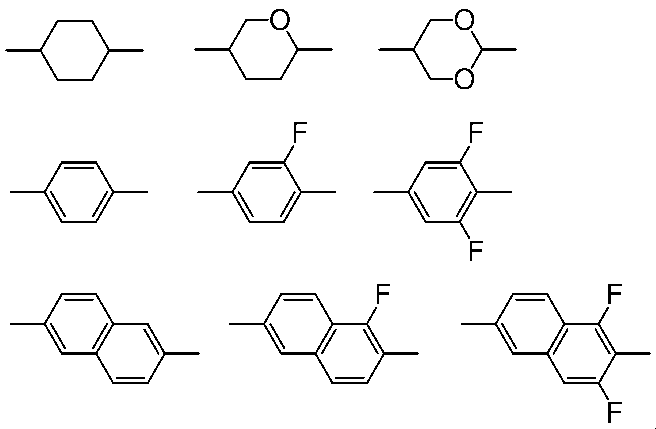
m、n、p及びrは各々独立して0又は1を表すが、m+n+p+rは0、1、2又は3である。)で表される化合物。 - 一般式(1)において、A1、A2、A3及びA4が各々独立に
- 一般式(1)において、Z1、Z2、Z3及びZ4が各々独立して-OCH2-、-CF2O-、-CH2CH2-、-C≡C-又は単結合を表す、請求項1又は2に記載の化合物。
- 一般式(1)において、Wがフッ素原子、シアノ基又は-OCF3を表す、請求項1から3いずれか一項に記載の化合物。
- 一般式(1)において、A5が
- 一般式(1)において、A5が

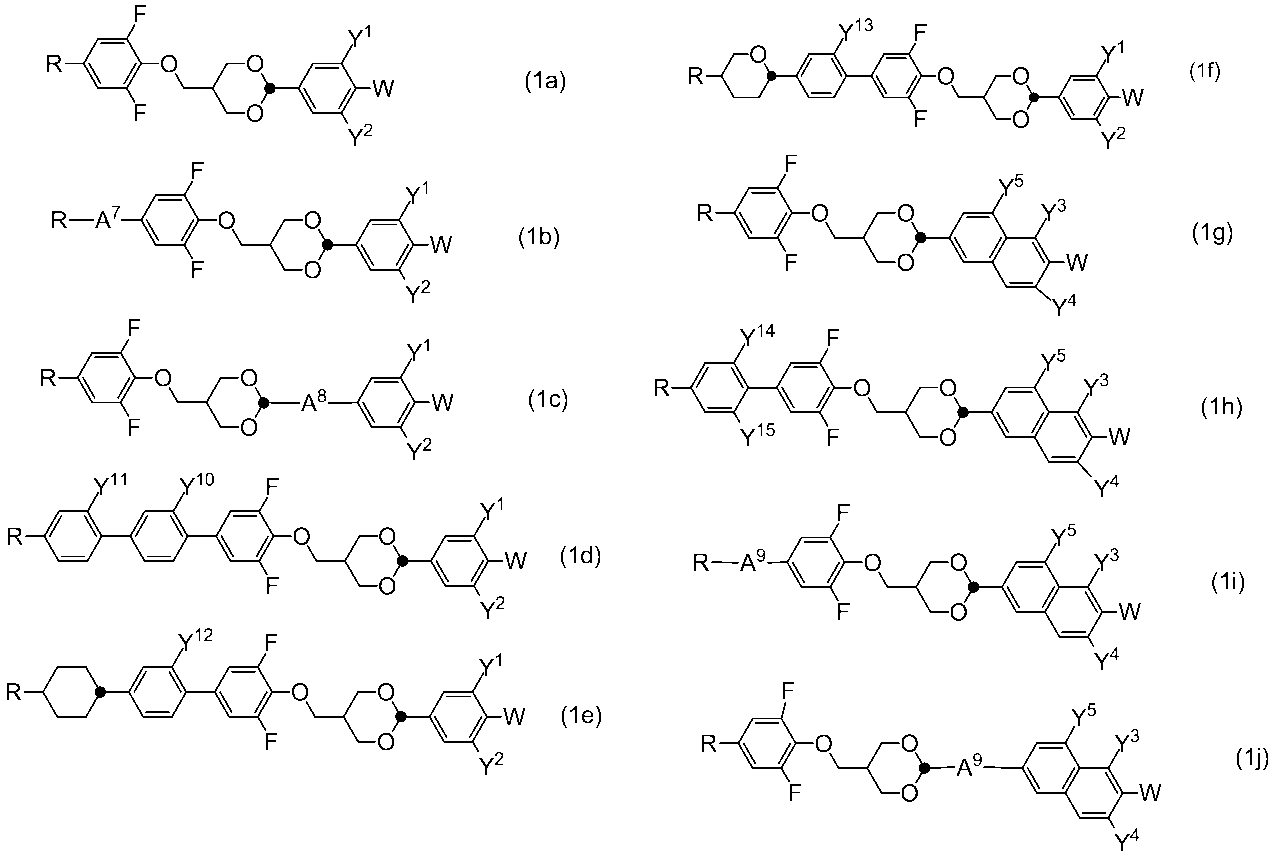
- 一般式(1)で表される化合物は、一般式(1a)~一般式(1j)
(a)1,4-シクロへキシレン基(この基中に存在する1個の-CH2-又は隣接していない2個以上の-CH2-は-O-又は-S-に置き換えられても良い。)
(b)1,4-フェニレン基(この基中に存在する1個の-CH=又は隣接していない2個以上の-CH=は-N=に置き換えられても良く、この基中に存在する水素原子はフッ素原子に置換されても良い。)
を表す。)
で表される化合物である、請求項1に記載の化合物。 - 請求項1から7のいずれか一項に記載の化合物を一種又は二種以上含有する液晶組成物。
- 請求項8記載の液晶組成物を使用した液晶表示素子。
- 一般式(5)

A1、A2、及びA3は各々独立して
(a)1,4-シクロへキシレン基(この基中に存在する1個の-CH2-又は隣接していない2個以上の-CH2-は-O-又は-S-に置き換えられても良い。)
(b)1,4-フェニレン基(この基中に存在する1個の-CH=又は隣接していない2個以上の-CH=は-N=に置き換えられても良く、この基中に存在する水素原子はフッ素原子に置換されても良い。)
(c)ナフタレン-2,6-ジイル基(この基中に存在する水素原子はフッ素原子に置換されても良い。)
からなる群より選ばれる基であり、
Z1、Z2、及びZ3は各々独立して-CH2O-、-OCH2-、-CF2O-、-OCF2-、-CH2CH2-、-CF2CF2-、-CH=CH-、-CF=CF-、-C≡C-又は単結合を表し、
A6は

X3は水素原子、臭素原子、ヨウ素原子又はトリフルオロメタンスルホニルオキシ基を表し、
Y6は水素原子又はフッ素原子を表し、
m,n及びpは各々独立して0又は1を表すが、m+n+pは0、1又は2である。)で表される化合物。 - 一般式(10)

(a)1,4-シクロへキシレン基(この基中に存在する1個の-CH2-又は隣接していない2個以上の-CH2-は-O-又は-S-に置き換えられても良い。)
(b)1,4-フェニレン基(この基中に存在する1個の-CH=又は隣接していない2個以上の-CH=は-N=に置き換えられても良く、この基中に存在する水素原子はフッ素原子に置換されても良い。)
(c)ナフタレン-2,6-ジイル基(この基中に存在する水素原子はフッ素原子に置換されても良い。)
からなる群より選ばれる基であり、
Z2、Z3及びZ4は各々独立して-CH2O-、-OCH2-、-CF2O-、-OCF2-、-CH2CH2-、-CF2CF2-、-CH=CH-、-CF=CF-、-C≡C-又は単結合を表し、
A5は

X5は塩素原子、臭素原子、ヨウ素原子又はトリフルオロメタンスルホニルオキシ基を表し、
n、p及びrは各々独立して0又は1を表すが、n+p+rは0、1又は2である。)で表される化合物。 - 一般式(2)

A3A4、A5、Z3、Z4、p及びrは、下記一般式(1)におけるA3、A4、A5、Z3、Z4、p及びrと同じ意味を表す。)で表される化合物と、一般式(3)


(式中、Rは炭素原子数1から15のアルキル基又は炭素原子数2から15のアルケニル基を表し、これらの基中に存在する1個の-CH2-又は隣接していない2個以上の-CH2-は-O-、-S-、-COO-、-OCO-又は-CO-により置き換えられても良く、これらの基中に存在する水素原子はフッ素原子に置換されても良く、
A1、A2、A3及びA4は各々独立して
(a)1,4-シクロへキシレン基(この基中に存在する1個の-CH2-又は隣接していない2個以上の-CH2-は-O-又は-S-に置き換えられても良い。)
(b)1,4-フェニレン基(この基中に存在する1個の-CH=又は隣接していない2個以上の-CH=は-N=に置き換えられても良く、この基中に存在する水素原子はフッ素原子に置換されても良い。)
(c)ナフタレン-2,6-ジイル基(この基中に存在する水素原子はフッ素原子に置換されても良い。)
からなる群より選ばれる基であり、
Z1、Z2、Z3及びZ4は各々独立して-CH2O-、-OCH2-、-CF2O-、-OCF2-、-CH2CH2-、-CF2CF2-、-CH=CH-、-CF=CF-、-C≡C-又は単結合を表し、
A5は
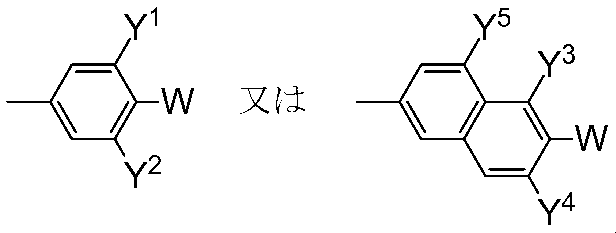
m、n、p及びrは各々独立して0又は1を表すが、m+n+p+rは0、1、2又は3である。)で表される化合物を得る製造方法。 - 一般式(3)


す。)で表される化合物と反応させる事により一般式(5)

A1、A2、及びA3は各々独立して
(a)1,4-シクロへキシレン基(この基中に存在する1個の-CH2-又は隣接していない2個以上の-CH2-は-O-又は-S-に置き換えられても良い。)
(b)1,4-フェニレン基(この基中に存在する1個の-CH=又は隣接していない2個以上の-CH=は-N=に置き換えられても良く、この基中に存在する水素原子はフッ素原子に置換されても良い。)
(c)ナフタレン-2,6-ジイル基(この基中に存在する水素原子はフッ素原子に置換されても良い。)
からなる群より選ばれる基であり、
Z1、Z2、及びZ3は各々独立して-CH2O-、-OCH2-、-CF2O-、-OCF2-、-CH2CH2-、-CF2CF2-、-CH=CH-、-CF=CF-、-C≡C-又は単結合を表し、
A6は

X3は水素原子、塩素原子、臭素原子、ヨウ素原子又はトリフルオロメタンスルホニルオキシ基を表し、
Y6は水素原子又はフッ素原子を表し、
m,n及びpは各々独立して0又は1を表すが、m+n+pは0、1又は2である。)
)で表される化合物を得る製造方法。 - 一般式(5)

A6は
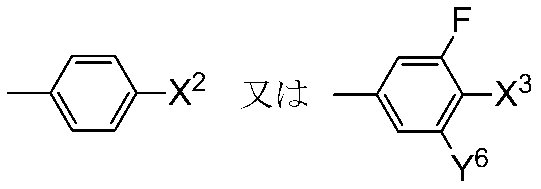
X3は水素原子、塩素原子、臭素原子、ヨウ素原子又はトリフルオロメタンスルホニルオキシ基を表し、
Y6は水素原子又はフッ素原子を表す。)
を表す。)
で表される化合物を、一般式(8-1)又は一般式(8-2)


Eは基中に存在する一つ以上の水素原子が各々独立してメチル基に置換されていても良い-(CH2)s-を表し、
sは2,3又は4を表す。)を表す。)
で表される化合物と反応させる事で、一般式(1-1)

A1、A2、及びA3は各々独立して
(a)1,4-シクロへキシレン基(この基中に存在する1個の-CH2-又は隣接していない2個以上の-CH2-は-O-又は-S-に置き換えられても良い。)
(b)1,4-フェニレン基(この基中に存在する1個の-CH=又は隣接していない2個以上の-CH=は-N=に置き換えられても良く、この基中に存在する水素原子はフッ素原子に置換されても良い。)
(c)ナフタレン-2,6-ジイル基(この基中に存在する水素原子はフッ素原子に置換されても良い。)
からなる群より選ばれる基であり、
A4は1,4-フェニレン基(この基中に存在する水素原子はフッ素原子に置換されても良い。)であり、
Z1、Z2及びZ3は各々独立して-CH2O-、-OCH2-、-CF2O-、-OCF2-、-CH2CH2-、-CF2CF2-、-CH=CH-、-CF=CF-、-C≡C-又は単結合を表し、
A5は

を表し、
m、n、及びpは各々独立して0又は1を表すが、m+n+p+rは0、1又は2を表す。)で表される化合物を得る製造方法。 - 一般式(10)


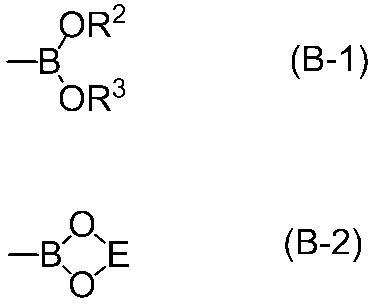

A1は1,4-フェニレン基(この基中に存在する水素原子はフッ素原子に置換されていても良い。)を表し、
A2、A3及びA4は各々独立して
(a)1,4-シクロへキシレン基(この基中に存在する1個の-CH2-又は隣接していない2個以上の-CH2-は-O-又は-S-に置き換えられても良い。)
(b)1,4-フェニレン基(この基中に存在する1個の-CH=又は隣接していない2個以上の-CH=は-N=に置き換えられても良く、この基中に存在する水素原子はフッ素原子に置換されても良い。)
(c)ナフタレン-2,6-ジイル基(この基中に存在する水素原子はフッ素原子に置換されても良い。)
からなる群より選ばれる基であり、
Z2、Z3及びZ4は各々独立して-CH2O-、-OCH2-、-CF2O-、-OCF2-、-CH2CH2-、-CF2CF2-、-CH=CH-、-CF=CF-、-C≡C-又は単結合を表し、
A5は
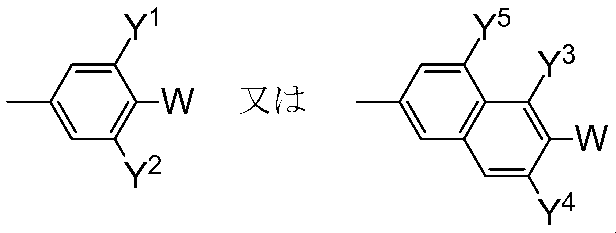
n、p及びrは各々独立して0又は1を表すが、n+p+rは0、1又は2である。)で表される化合物を得る製造方法。
Priority Applications (4)
| Application Number | Priority Date | Filing Date | Title |
|---|---|---|---|
| JP2014556873A JP5741987B1 (ja) | 2013-07-25 | 2014-07-15 | 2,6−ジフルオロフェニルエーテル構造を持つ液晶性化合物及びその液晶組成物 |
| KR1020157030917A KR101613602B1 (ko) | 2013-07-25 | 2014-07-15 | 2,6-디플루오로페닐에테르 구조를 갖는 액정성 화합물 및 그 액정 조성물 |
| CN201480033081.3A CN105308028B (zh) | 2013-07-25 | 2014-07-15 | 具有2,6‑二氟苯醚结构的液晶性化合物及其液晶组合物 |
| US14/904,226 US9637466B2 (en) | 2013-07-25 | 2014-07-15 | Liquid crystal compound having 2, 6-difluorophenyl ether structure and liquid crystal composition thereof |
Applications Claiming Priority (2)
| Application Number | Priority Date | Filing Date | Title |
|---|---|---|---|
| JP2013154499 | 2013-07-25 | ||
| JP2013-154499 | 2013-07-25 |
Publications (1)
| Publication Number | Publication Date |
|---|---|
| WO2015012156A1 true WO2015012156A1 (ja) | 2015-01-29 |
Family
ID=52393200
Family Applications (1)
| Application Number | Title | Priority Date | Filing Date |
|---|---|---|---|
| PCT/JP2014/068784 Ceased WO2015012156A1 (ja) | 2013-07-25 | 2014-07-15 | 2,6-ジフルオロフェニルエーテル構造を持つ液晶性化合物及びその液晶組成物 |
Country Status (5)
| Country | Link |
|---|---|
| US (1) | US9637466B2 (ja) |
| JP (1) | JP5741987B1 (ja) |
| KR (1) | KR101613602B1 (ja) |
| CN (1) | CN105308028B (ja) |
| WO (1) | WO2015012156A1 (ja) |
Cited By (1)
| Publication number | Priority date | Publication date | Assignee | Title |
|---|---|---|---|---|
| JP2019147759A (ja) * | 2018-02-27 | 2019-09-05 | 国立大学法人 奈良先端科学技術大学院大学 | トリメチレンカーボネート誘導体の製造方法 |
Families Citing this family (5)
| Publication number | Priority date | Publication date | Assignee | Title |
|---|---|---|---|---|
| JP5776864B1 (ja) | 2013-08-30 | 2015-09-09 | Dic株式会社 | ネマチック液晶組成物 |
| JP5910800B1 (ja) * | 2014-07-31 | 2016-04-27 | Dic株式会社 | ネマチック液晶組成物 |
| WO2016017615A1 (ja) | 2014-07-31 | 2016-02-04 | Dic株式会社 | ネマチック液晶組成物 |
| CN107573948B (zh) * | 2017-09-11 | 2020-08-04 | 陕西莱特光电材料股份有限公司 | 一种环己烷噁烷类液晶单体化合物及其制备方法 |
| CN121271546B (zh) * | 2025-12-08 | 2026-03-10 | 山西师范大学 | 一种稀土掺杂M3ScF6纳米晶及其制备方法 |
Citations (3)
| Publication number | Priority date | Publication date | Assignee | Title |
|---|---|---|---|---|
| WO2012161178A1 (ja) * | 2011-05-26 | 2012-11-29 | Dic株式会社 | 2-フルオロフェニルオキシメタン構造を持つ化合物 |
| WO2013099754A1 (ja) * | 2011-12-26 | 2013-07-04 | Dic株式会社 | 2-フルオロフェニルオキシメタン構造を持つ化合物 |
| WO2013172162A1 (ja) * | 2012-05-15 | 2013-11-21 | Dic株式会社 | 2-フルオロフェニルオキシメタン構造を持つ化合物 |
Family Cites Families (29)
| Publication number | Priority date | Publication date | Assignee | Title |
|---|---|---|---|---|
| DE3732284A1 (de) | 1987-09-25 | 1989-04-13 | Merck Patent Gmbh | Substituierte phenyltrifluormethylether |
| US5324449A (en) | 1987-09-25 | 1994-06-28 | Merck Patent Gesellschaft Mit Beschrankter Haftung | Substituted phenyl trifluoromethyl ethers |
| JP2696557B2 (ja) | 1989-03-07 | 1998-01-14 | チッソ株式会社 | トリフルオロベンゼン誘導体 |
| ES2069089T3 (es) | 1989-09-06 | 1995-05-01 | Merck Patent Gmbh | Derivados de fluorobenceno y medio fluidocristalino. |
| JPH03157202A (ja) | 1989-11-14 | 1991-07-05 | Nissan Motor Co Ltd | ハブのボルト圧入部構造 |
| KR0184869B1 (ko) | 1989-12-06 | 1999-05-15 | 위르겐 호이만 | 1,4-이치환된 2,6-디플루오로벤젠 화합물 및 액정 매질 |
| JP2935746B2 (ja) | 1989-12-06 | 1999-08-16 | メルク・パテント・ゲゼルシャフト・ミット・ベシュレンクテル・ハフツング | 1,4―ジ置換2,6―ジフルオロベンゼン化合物、および液晶相 |
| US6579577B2 (en) | 1996-09-25 | 2003-06-17 | Chisso Corporation | Substituted benzene derivative, liquid crystal composition, and liquid crystal display element |
| JP2961650B2 (ja) | 1996-09-25 | 1999-10-12 | チッソ株式会社 | 置換ベンゼン誘導体、液晶組成物および液晶表示素子 |
| JP4044618B2 (ja) | 1996-11-28 | 2008-02-06 | チッソ株式会社 | フッ素置換ベンゼン誘導体、液晶組成物および液晶表示素子 |
| JP5152947B2 (ja) | 1999-06-15 | 2013-02-27 | Dic株式会社 | 2−フルオロナフタレン誘導体である新規液晶性化合物とそれを含有する液晶組成物 |
| JP4547732B2 (ja) | 1999-07-06 | 2010-09-22 | Dic株式会社 | 6−フルオロナフタレン誘導体である新規液晶性化合物とそれを含有する液晶組成物 |
| AU2003244469A1 (en) | 2002-02-05 | 2003-09-02 | Merck Patent Gmbh | Liquid crystalline medium and liquid crystal display |
| US6951884B2 (en) | 2002-06-12 | 2005-10-04 | Hoffmann-La Roche Inc. | Fluorobenzamides and uses thereof |
| ATE340836T1 (de) | 2003-05-27 | 2006-10-15 | Merck Patent Gmbh | Pyranderivate |
| JP2004355560A (ja) | 2003-05-30 | 2004-12-16 | Sony Corp | 起動装置 |
| US8129002B2 (en) | 2003-08-25 | 2012-03-06 | Merck Patent Gmbh | Compounds for use in liquid crystal media |
| JP4961700B2 (ja) | 2005-09-08 | 2012-06-27 | Jnc株式会社 | 末端が水素であるナフタレン誘導体、この誘導体を含有する液晶組成物およびこの液晶組成物を含有する液晶表示素子 |
| WO2008105286A1 (ja) | 2007-02-28 | 2008-09-04 | Chisso Corporation | Cf2o結合基を有する5環液晶化合物、液晶組成物および液晶表示素子 |
| JP5143475B2 (ja) * | 2007-05-17 | 2013-02-13 | Dic株式会社 | ネマチック液晶組成物及びバイステイブルネマチック液晶表示素子 |
| JP2009067780A (ja) | 2007-08-22 | 2009-04-02 | Chisso Corp | クロロナフタレン部位を有する液晶化合物、液晶組成物および光素子 |
| CN101827805B (zh) | 2007-09-10 | 2013-07-10 | Jnc株式会社 | 液晶性化合物、液晶组成物以及液晶显示元件 |
| EP2284148B1 (en) | 2008-06-09 | 2016-03-02 | JNC Corporation | Pentacyclic liquid crystal compound having cyclohexane ring, liquid crystal composition and liquid crystal display element |
| US8475888B2 (en) | 2008-10-21 | 2013-07-02 | Jnc Corporation | Five-ring liquid crystal compound having a nitrogen-containing heterocyclic ring, liquid crystal composition and liquid crystal display device |
| KR101488314B1 (ko) * | 2011-08-02 | 2015-01-30 | 디아이씨 가부시끼가이샤 | 네마틱 액정 조성물 |
| JP5780431B2 (ja) | 2012-02-22 | 2015-09-16 | Dic株式会社 | ネマチック液晶組成物 |
| TWI570221B (zh) | 2012-03-19 | 2017-02-11 | Dainippon Ink & Chemicals | Nematic liquid crystal composition |
| JP5622066B2 (ja) | 2012-10-09 | 2014-11-12 | Dic株式会社 | フッ素化ナフタレン構造を持つ化合物及びその液晶組成物 |
| JP6070110B2 (ja) | 2012-11-27 | 2017-02-01 | Dic株式会社 | フッ素化ナフタレン構造を持つ化合物 |
-
2014
- 2014-07-15 WO PCT/JP2014/068784 patent/WO2015012156A1/ja not_active Ceased
- 2014-07-15 US US14/904,226 patent/US9637466B2/en active Active
- 2014-07-15 JP JP2014556873A patent/JP5741987B1/ja not_active Expired - Fee Related
- 2014-07-15 CN CN201480033081.3A patent/CN105308028B/zh active Active
- 2014-07-15 KR KR1020157030917A patent/KR101613602B1/ko not_active Expired - Fee Related
Patent Citations (3)
| Publication number | Priority date | Publication date | Assignee | Title |
|---|---|---|---|---|
| WO2012161178A1 (ja) * | 2011-05-26 | 2012-11-29 | Dic株式会社 | 2-フルオロフェニルオキシメタン構造を持つ化合物 |
| WO2013099754A1 (ja) * | 2011-12-26 | 2013-07-04 | Dic株式会社 | 2-フルオロフェニルオキシメタン構造を持つ化合物 |
| WO2013172162A1 (ja) * | 2012-05-15 | 2013-11-21 | Dic株式会社 | 2-フルオロフェニルオキシメタン構造を持つ化合物 |
Cited By (2)
| Publication number | Priority date | Publication date | Assignee | Title |
|---|---|---|---|---|
| JP2019147759A (ja) * | 2018-02-27 | 2019-09-05 | 国立大学法人 奈良先端科学技術大学院大学 | トリメチレンカーボネート誘導体の製造方法 |
| JP6992976B2 (ja) | 2018-02-27 | 2022-02-15 | 国立大学法人 奈良先端科学技術大学院大学 | トリメチレンカーボネート誘導体の製造方法 |
Also Published As
| Publication number | Publication date |
|---|---|
| US20160152589A1 (en) | 2016-06-02 |
| JPWO2015012156A1 (ja) | 2017-03-02 |
| US9637466B2 (en) | 2017-05-02 |
| KR101613602B1 (ko) | 2016-04-19 |
| CN105308028A (zh) | 2016-02-03 |
| CN105308028B (zh) | 2017-04-05 |
| JP5741987B1 (ja) | 2015-07-01 |
| KR20150126417A (ko) | 2015-11-11 |
Similar Documents
| Publication | Publication Date | Title |
|---|---|---|
| TWI586645B (zh) | 聚合性化合物、液晶組成物及液晶顯示元件 | |
| JP5741987B1 (ja) | 2,6−ジフルオロフェニルエーテル構造を持つ液晶性化合物及びその液晶組成物 | |
| TWI621700B (zh) | Liquid crystal composition and liquid crystal display element using same | |
| JP5862996B2 (ja) | アルケニルエーテル化合物及びこれを用いた液晶組成物 | |
| CN107629805B (zh) | 液晶组合物和使用其的液晶显示元件 | |
| JP5741986B1 (ja) | 2,6−ジフルオロフェニルエーテル構造を持つ液晶性化合物及びその液晶組成物 | |
| JP5561438B1 (ja) | フルオロビフェニル含有組成物 | |
| JP5376094B1 (ja) | ネマチック液晶組成物及びこれを用いた液晶表示素子 | |
| JP6365002B2 (ja) | 新規液晶性化合物及びそれを用いた液晶組成物 | |
| WO2014102972A1 (ja) | フルオロビフェニル含有組成物 | |
| CN103987808B (zh) | 向列型液晶组合物以及使用该组合物的液晶显示元件 | |
| JP6728738B2 (ja) | 液晶化合物の製造方法及びその化合物 | |
| JP6048782B1 (ja) | エタン結合を有する液晶化合物 | |
| WO2015199061A1 (ja) | 液晶組成物及びこれを用いた液晶表示素子 | |
| TWI482840B (zh) | 向列型液晶組成物及使用其之液晶顯示元件 | |
| KR20140112468A (ko) | 액정 조성물, 액정 표시 소자 및 액정 디스플레이 |
Legal Events
| Date | Code | Title | Description |
|---|---|---|---|
| WWE | Wipo information: entry into national phase |
Ref document number: 201480033081.3 Country of ref document: CN |
|
| ENP | Entry into the national phase |
Ref document number: 2014556873 Country of ref document: JP Kind code of ref document: A |
|
| 121 | Ep: the epo has been informed by wipo that ep was designated in this application |
Ref document number: 14828956 Country of ref document: EP Kind code of ref document: A1 |
|
| ENP | Entry into the national phase |
Ref document number: 20157030917 Country of ref document: KR Kind code of ref document: A |
|
| WWE | Wipo information: entry into national phase |
Ref document number: 14904226 Country of ref document: US |
|
| NENP | Non-entry into the national phase |
Ref country code: DE |
|
| 122 | Ep: pct application non-entry in european phase |
Ref document number: 14828956 Country of ref document: EP Kind code of ref document: A1 |