WO2014208749A1 - 紫外線硬化型ハードコート樹脂組成物 - Google Patents
紫外線硬化型ハードコート樹脂組成物 Download PDFInfo
- Publication number
- WO2014208749A1 WO2014208749A1 PCT/JP2014/067252 JP2014067252W WO2014208749A1 WO 2014208749 A1 WO2014208749 A1 WO 2014208749A1 JP 2014067252 W JP2014067252 W JP 2014067252W WO 2014208749 A1 WO2014208749 A1 WO 2014208749A1
- Authority
- WO
- WIPO (PCT)
- Prior art keywords
- resin composition
- group
- hard coat
- meth
- acrylate
- Prior art date
- Legal status (The legal status is an assumption and is not a legal conclusion. Google has not performed a legal analysis and makes no representation as to the accuracy of the status listed.)
- Ceased
Links
- KZFUMWVJJNDGAU-UHFFFAOYSA-N CCN(CC)c(cc1)cc(O2)c1C=C(c1nc(cccc3)c3[n]1C)C2=O Chemical compound CCN(CC)c(cc1)cc(O2)c1C=C(c1nc(cccc3)c3[n]1C)C2=O KZFUMWVJJNDGAU-UHFFFAOYSA-N 0.000 description 1
- OQRCWBYIXJBYJG-UHFFFAOYSA-N CN(C)c(cc1)cc(O2)c1C=C(c1nc(cccc3)c3[nH]1)C2=O Chemical compound CN(C)c(cc1)cc(O2)c1C=C(c1nc(cccc3)c3[nH]1)C2=O OQRCWBYIXJBYJG-UHFFFAOYSA-N 0.000 description 1
- YHBPQYQLMJZJPI-UHFFFAOYSA-N OC(c(cccc1)c1C1=O)=C1c1nc2ccccc2cc1 Chemical compound OC(c(cccc1)c1C1=O)=C1c1nc2ccccc2cc1 YHBPQYQLMJZJPI-UHFFFAOYSA-N 0.000 description 1
Classifications
-
- G02B1/105—
-
- C—CHEMISTRY; METALLURGY
- C08—ORGANIC MACROMOLECULAR COMPOUNDS; THEIR PREPARATION OR CHEMICAL WORKING-UP; COMPOSITIONS BASED THEREON
- C08F—MACROMOLECULAR COMPOUNDS OBTAINED BY REACTIONS ONLY INVOLVING CARBON-TO-CARBON UNSATURATED BONDS
- C08F222/00—Copolymers of compounds having one or more unsaturated aliphatic radicals, each having only one carbon-to-carbon double bond, and at least one being terminated by a carboxyl radical and containing at least one other carboxyl radical in the molecule; Salts, anhydrides, esters, amides, imides, or nitriles thereof
- C08F222/10—Esters
- C08F222/1006—Esters of polyhydric alcohols or polyhydric phenols
- C08F222/106—Esters of polycondensation macromers
-
- C—CHEMISTRY; METALLURGY
- C09—DYES; PAINTS; POLISHES; NATURAL RESINS; ADHESIVES; COMPOSITIONS NOT OTHERWISE PROVIDED FOR; APPLICATIONS OF MATERIALS NOT OTHERWISE PROVIDED FOR
- C09D—COATING COMPOSITIONS, e.g. PAINTS, VARNISHES OR LACQUERS; FILLING PASTES; CHEMICAL PAINT OR INK REMOVERS; INKS; CORRECTING FLUIDS; WOODSTAINS; PASTES OR SOLIDS FOR COLOURING OR PRINTING; USE OF MATERIALS THEREFOR
- C09D5/00—Coating compositions, e.g. paints, varnishes or lacquers, characterised by their physical nature or the effects produced; Filling pastes
-
- C—CHEMISTRY; METALLURGY
- C09—DYES; PAINTS; POLISHES; NATURAL RESINS; ADHESIVES; COMPOSITIONS NOT OTHERWISE PROVIDED FOR; APPLICATIONS OF MATERIALS NOT OTHERWISE PROVIDED FOR
- C09D—COATING COMPOSITIONS, e.g. PAINTS, VARNISHES OR LACQUERS; FILLING PASTES; CHEMICAL PAINT OR INK REMOVERS; INKS; CORRECTING FLUIDS; WOODSTAINS; PASTES OR SOLIDS FOR COLOURING OR PRINTING; USE OF MATERIALS THEREFOR
- C09D7/00—Features of coating compositions, not provided for in group C09D5/00; Processes for incorporating ingredients in coating compositions
- C09D7/40—Additives
- C09D7/41—Organic pigments; Organic dyes
-
- G—PHYSICS
- G02—OPTICS
- G02B—OPTICAL ELEMENTS, SYSTEMS OR APPARATUS
- G02B1/00—Optical elements characterised by the material of which they are made; Optical coatings for optical elements
- G02B1/10—Optical coatings produced by application to, or surface treatment of, optical elements
- G02B1/14—Protective coatings, e.g. hard coatings
-
- C—CHEMISTRY; METALLURGY
- C08—ORGANIC MACROMOLECULAR COMPOUNDS; THEIR PREPARATION OR CHEMICAL WORKING-UP; COMPOSITIONS BASED THEREON
- C08K—Use of inorganic or non-macromolecular organic substances as compounding ingredients
- C08K5/00—Use of organic ingredients
- C08K5/0008—Organic ingredients according to more than one of the "one dot" groups of C08K5/01 - C08K5/59
- C08K5/0041—Optical brightening agents, organic pigments
-
- C—CHEMISTRY; METALLURGY
- C08—ORGANIC MACROMOLECULAR COMPOUNDS; THEIR PREPARATION OR CHEMICAL WORKING-UP; COMPOSITIONS BASED THEREON
- C08K—Use of inorganic or non-macromolecular organic substances as compounding ingredients
- C08K5/00—Use of organic ingredients
- C08K5/16—Nitrogen-containing compounds
- C08K5/34—Heterocyclic compounds having nitrogen in the ring
- C08K5/3442—Heterocyclic compounds having nitrogen in the ring having two nitrogen atoms in the ring
-
- G—PHYSICS
- G02—OPTICS
- G02F—OPTICAL DEVICES OR ARRANGEMENTS FOR THE CONTROL OF LIGHT BY MODIFICATION OF THE OPTICAL PROPERTIES OF THE MEDIA OF THE ELEMENTS INVOLVED THEREIN; NON-LINEAR OPTICS; FREQUENCY-CHANGING OF LIGHT; OPTICAL LOGIC ELEMENTS; OPTICAL ANALOGUE/DIGITAL CONVERTERS
- G02F1/00—Devices or arrangements for the control of the intensity, colour, phase, polarisation or direction of light arriving from an independent light source, e.g. switching, gating or modulating; Non-linear optics
- G02F1/01—Devices or arrangements for the control of the intensity, colour, phase, polarisation or direction of light arriving from an independent light source, e.g. switching, gating or modulating; Non-linear optics for the control of the intensity, phase, polarisation or colour
- G02F1/13—Devices or arrangements for the control of the intensity, colour, phase, polarisation or direction of light arriving from an independent light source, e.g. switching, gating or modulating; Non-linear optics for the control of the intensity, phase, polarisation or colour based on liquid crystals, e.g. single liquid crystal display cells
- G02F1/133—Constructional arrangements; Operation of liquid crystal cells; Circuit arrangements
- G02F1/1333—Constructional arrangements; Manufacturing methods
- G02F1/1335—Structural association of cells with optical devices, e.g. polarisers or reflectors
- G02F1/133528—Polarisers
Definitions
- the present invention relates to an ultraviolet curable hard coat resin composition that imparts scratch resistance and blue light cut property to a plastic surface. More specifically, the present invention relates to a UV curable hard coat resin composition that is suitable for application to a plastic surface such as polyester, acrylic, triacetyl cellulose, polycarbonate, etc., and has excellent scratch resistance, chemical resistance, and blue light cut property. .
- the film and sheet coated with this hard coat resin composition are particularly suitable for displays such as smartphones, tablet PCs, notebook computers, and liquid crystal monitors with LED backlights because of their excellent blue light cutting properties. ing.
- the present invention provides a hard coat film capable of obtaining a molded product having the blue light cut characteristics without causing cracks in the curved surface portion of the molded product surface by selecting a flexible resin composition. give. It is particularly suitable for in-mold molding and film integral molding, and is also suitable for imparting a blue light cut function to sunglasses.
- plastics are used in large quantities in various industries including the automobile industry, home appliance industry, and electrical and electronics industry.
- the reason why such a large amount of plastic is used is that, in addition to its processability and transparency, it is lightweight, inexpensive and has excellent optical properties.
- it has disadvantages such as being softer than glass and being easily scratched on the surface.
- it is a common means to coat the surface with a hard coating agent.
- the hard coat agent thermosetting hard coat agents such as silicone paints, acrylic paints, and melamine paints are used.
- silicone hard coat agents are particularly frequently used because of their high hardness and excellent quality.
- it has a long curing time, is expensive, and cannot be said to be suitable for a hard coat layer provided on a continuously processed film.
- photosensitive acrylic hard coating agents have been developed and used (see Patent Document 1).
- the photosensitive hard coat agent is cured immediately upon irradiation with radiation such as ultraviolet rays to form a hard film, so the processing speed is fast, and it has excellent performance in terms of hardness and scratch resistance. Now it has become the mainstream in the hard coat field because it is cheaper. It is particularly suitable for continuous processing of films such as polyester.
- plastic films include polyester film, acrylic film, polycarbonate film, vinyl chloride film, triacetyl cellulose film, and polyethersulfone film. Polyester film and triacetyl cellulose film are widely used due to various excellent properties. ing.
- This polyester film is a glass anti-scattering film, an automobile light-shielding film, a whiteboard surface film, a system kitchen surface antifouling film, and electronic materials such as CRT flat TVs, touch panels, liquid crystal displays, plasma displays, etc. Widely used as a functional film.
- the triacetyl cellulose film is used as a protective film of a polarizing plate used for a liquid crystal display. All of these are coated with a hard coat so as not to scratch the surface.
- polycarbonate and acrylic sheets and substrates with hard coatings are also used for liquid crystal related members around optical disks and backlights.
- a fluorine material or silicone oil is mixed in the coating composition to improve the surface water / oil repellency, or similar to sebum components.
- a method for improving fingerprint wiping as a fingerprint resistance for example, a fluorine material or silicone oil is mixed in the coating composition to improve the surface water / oil repellency, or similar to sebum components.
- the component is used in the coating composition so that the attached fingerprint becomes familiar, difficult to see, and easy to wipe (see Patent Document 4).
- Blue light refers to light with a short wavelength of 380 nm to 495 nm among visible light, and is said to be emitted from a liquid crystal monitor that uses LEDs as a backlight.
- This blue light is a major cause of eye strain, and it is also said that it disturbs the biological rhythm and causes sleep disturbance, and blue light cuts are attracting attention, and it is desirable to cut light of that wavelength
- 460 nm light is one of the main emission wavelengths of the LED light source, and there has been a demand to cut light of 440 nm, which is the other wavelength, without largely cutting the wavelength.
- An object of the present invention is to provide an ultraviolet curable hard coat resin composition having high transparency, high hardness, and excellent blue light cut function by stably dissolving a dye having a specific structure.
- an ultraviolet curable hard coat resin composition having a specific compound and composition can solve the above problems, and have reached the present invention.
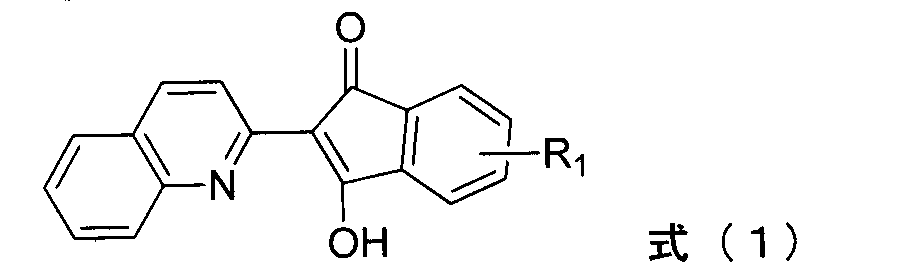
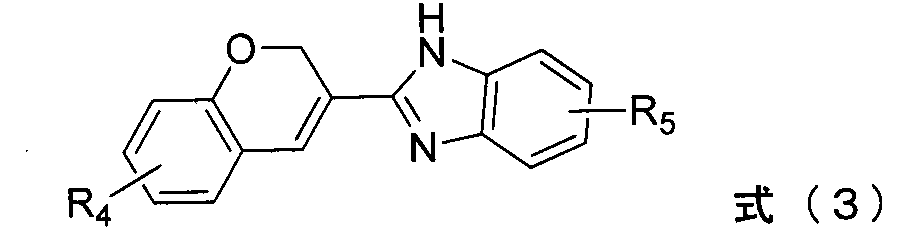
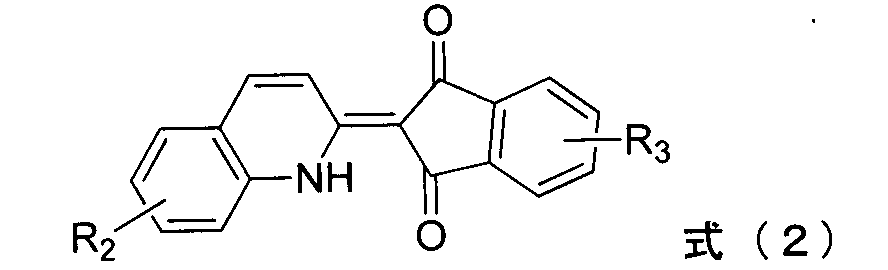
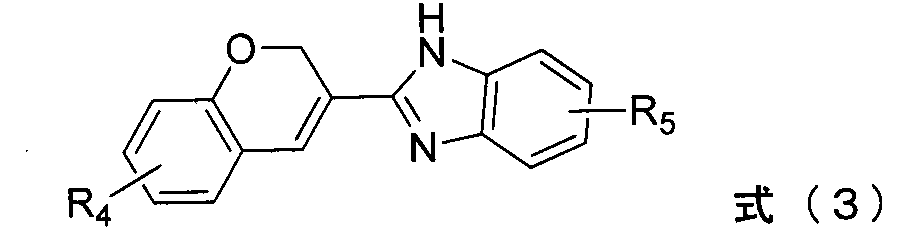
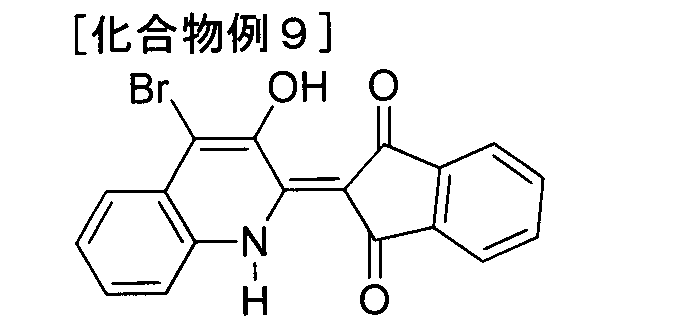
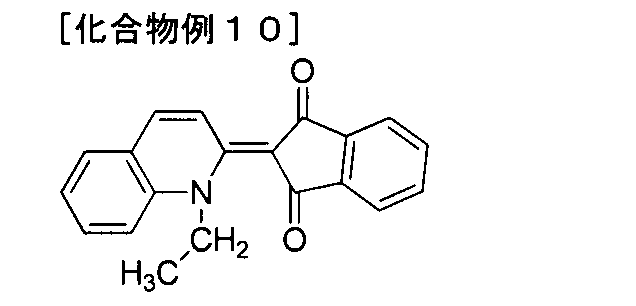
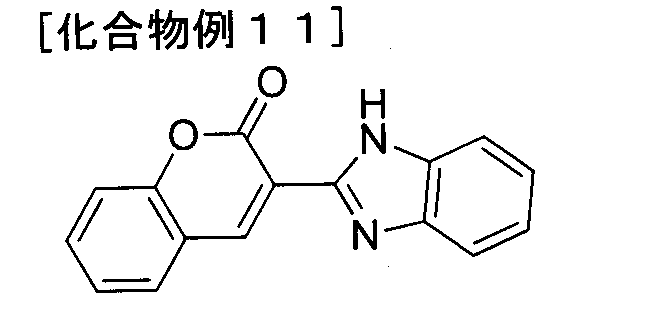
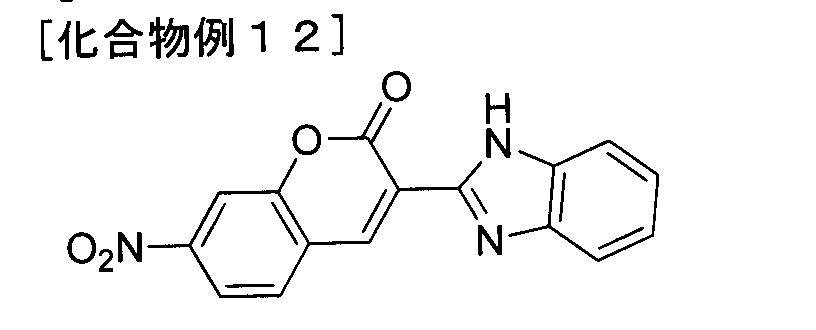
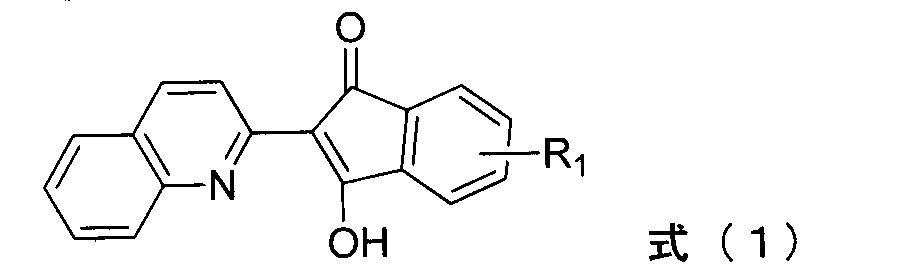
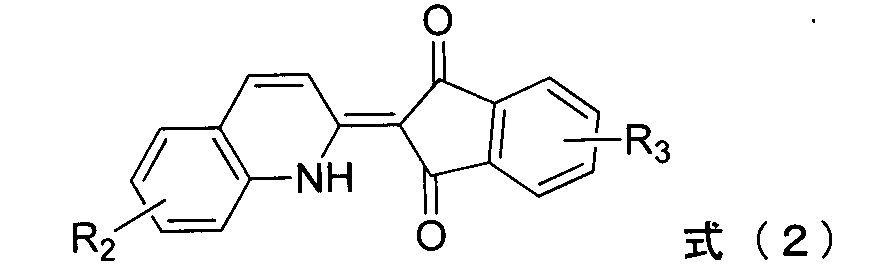
- the present invention “(1) Contains a UV-curable polyfunctional (meth) acrylate having at least two (meth) acryloyl groups in the molecule and a dye having any one of formulas (1) to (3)” UV curable hard coat resin composition,
- R 1 represents a hydrogen atom, a carbonyl group, an alkyl group having 1 to 3 carbon atoms, a sulfo group having a substituent, or an amide group having a substituent.
- R 2 and R 3 each independently represent a hydrogen atom, a carbonyl group, an alkyl group having 1 to 3 carbon atoms, a sulfo group having a substituent, an amide group having a substituent, a halogen atom, or a hydroxyl group.
- R 4 and R 5 each independently represents a hydrogen atom, an alkyl group having 1 to 3 carbon atoms, a sulfo group, a sulfo group having a substituent, an amino group having
- the ultraviolet curable hard coat resin composition according to (1) which contains a photopolymerization initiator, (3) The ultraviolet curable hard coat resin composition according to (1) or (2), comprising a diluent, (4) The ultraviolet curable hard coat resin composition according to any one of (1) to (3), which contains organic and / or inorganic particles.
- the base material according to (5) which is a transparent polymer or a film thereof, (7) The substrate according to (5) or (6), wherein the total light transmittance is 90% or more and the transmittance at 460 nm is 10% or more higher than the transmittance at 440 nm.
- a polarizing plate comprising a cured layer of the ultraviolet curable hard coat resin composition according to any one of (1) to (4), (9) A liquid crystal display device comprising a cured layer of the ultraviolet curable hard coat resin composition according to any one of (1) to (4), (10) A molded article having a cured layer of the ultraviolet curable hard coat resin composition according to any one of (1) to (4). ".
- an ultraviolet curable hard coat resin composition having excellent blue light cut property, scratch resistance, high hardness and transparency can be provided.
- Examples of the ultraviolet curable polyfunctional (meth) acrylate (A) having at least two (meth) acryloyl groups in the molecule used in the present invention include polyethylene glycol di (meth) acrylate, tripropylene glycol di ( Di (meth) acrylate of ⁇ -caprolactone adduct of (meth) acrylate, hydroxypivalate neopentyl glycol (for example, KAYARAD HX-220, HX-620 etc., manufactured by Nippon Kayaku Co., Ltd.), EO adduct of bisphenol A Di (meth) acrylate, 1,4-butanediol diacrylate, 1,6-hexanediol diacrylate, 1,9-nonanediol diacrylate, trimethylolpropane tri (meth) acrylate, trimethylolpropane polyethoxytri ( Acrylate), epichlorohydrin (ECH) modified glycerol tri (me
- Examples of the polyfunctional (meth) acrylate having active hydrogen include pentaerythritol tri (meth) acrylate, dipentaerythritol hexa (meth) acrylate, dipentaerythritol penta (meth) acrylate, and dipentaerythritol tetra (meth).
- Pentaerythritols such as acrylate, dipentaerythritol tri (meth) acrylate, dipentaerythritol di (meth) acrylate, methylols such as trimethylolpropane di (meth) acrylate, epoxy acrylates such as bisphenol A diepoxy acrylate, etc. Can be mentioned. Of these, pentaerythritol triacrylate and dipentaerythritol pentaacrylate are preferable.
- These polyfunctional (meth) acrylates having active hydrogen may be used alone or in admixture of two or
- polyisocyanate polyisocyanates composed of chain saturated hydrocarbons, cyclic saturated hydrocarbons (alicyclic), and aromatic hydrocarbons can be used.
- polyisocyanates include chain saturated hydrocarbon polyisocyanates such as tetramethylene diisocyanate, hexamethylene diisocyanate, and 2,2,4-trimethylhexamethylene diisocyanate, isophorone diisocyanate, dicyclohexylmethane diisocyanate, and methylenebis (4-cyclohexyl).
- Isocyanate hydrogenated diphenylmethane diisocyanate, hydrogenated xylene diisocyanate, hydrogenated toluene diisocyanate, etc., cyclic saturated hydrocarbon (alicyclic) polyisocyanate, 2,4-tolylene diisocyanate, 1,3-xylylene diisocyanate, p-phenylene Diisocyanate, 3,3′-dimethyl-4,4′-diisocyanate, 6-isopropyl-1,3-phenyl diisocyanate Aromatic polyisocyanates such as 1,5-naphthalene diisocyanate. Of these, isophorone diisocyanate and hexamethylene diisocyanate are preferable. These polyisocyanates may be used alone or in combination of two or more.
- the polyfunctional urethane (meth) acrylate is obtained by reacting the polyfunctional (meth) acrylate having active hydrogen with a polyisocyanate.
- polyisocyanate is usually in the range of 0.1 to 50 equivalent, preferably in the range of 0.1 to 10 equivalent as the isocyanate group equivalent. is there.
- the reaction temperature is usually in the range of 30 to 150 ° C, preferably 50 to 100 ° C.
- the end point of the reaction is the time when the polyisocyanate calculated by the method of reacting residual isocyanate with excess n-butylamine and back titrating with 1N hydrochloric acid is 0.5% by weight or less.
- a catalyst may be added for the purpose of shortening the reaction time.
- a basic catalyst or an acidic catalyst is used.
- the basic catalyst include amines such as triethylamine, diethylamine, dibutylamine, and ammonia, phosphines such as tributylphosphine and triphenylphosphine, pyridine, pyrrole, and the like.
- the acidic catalyst examples include metal salts such as copper naphthenate, cobalt naphthenate, zinc naphthenate, tributoxyaluminum, trititanium tetrabutoxide, zirconium tetrabutoxide, Lewis acids such as aluminum chloride, 2-ethylhexanetin, Examples thereof include tin compounds such as octyltin trilaurate, dibutyltin dilaurate, and octyltin diacetate. When these catalysts are used, the amount added is usually about 0.1 to 1 part by weight per 100 parts by weight of the polyisocyanate.
- a polymerization inhibitor for example, methoquinone, hydroquinone, methylhydroquinone, phenothiazine, etc.
- the amount used is 0.01 weight with respect to the reaction mixture. % To about 1% by weight, preferably about 0.05% to 0.5% by weight.
- the reaction temperature is 60 to 150 ° C, preferably 80 to 120 ° C.
- the amount of the ultraviolet curable polyfunctional (meth) acrylate having at least two (meth) acryloyl groups in the molecule is 100% by weight based on the solid content of the resin composition of the present invention. In this case, it is usually 80 to 95% by weight, preferably 90 to 95% by weight.
- a (meth) acrylate compound other than the ultraviolet curable polyfunctional (meth) acrylate having at least two (meth) acryloyl groups in the molecule is optionally used as necessary.
- Examples of (meth) acrylate compounds include (meth) acrylate monomers.
- Examples of the (meth) acrylate monomer include tricyclodecane (meth) acrylate, dicyclopentadieneoxyethyl (meth) acrylate, dicyclopentanyl (meth) acrylate, isobornyl (meth) acrylate, adamantane (meth) acrylate, benzyl ( (Meth) acrylate, tetrahydrofurfuryl (meth) acrylate, morpholine (meth) acrylate, phenylglycidyl (meth) acrylate, 2-hydroxyethyl (meth) acrylate, 2-hydroxypropyl (meth) acrylate, 4-hydroxybutyl ( And meth) acrylate and ethyl carbitol (meth) acrylate.
- the present invention further contains an ultraviolet curable polyfunctional (meth) acrylate having at least two (meth) acryloyl groups in the molecule and a dye having a structure of formulas (1) to (3).
- the ultraviolet curable hard coat resin composition which is a feature and contains the pigment, can provide an ultraviolet curable hard coat resin composition having high transparency, high hardness, and excellent blue light cut function.
- a dye other than that described in Formula (1) is used, not only the blue light cut function is lowered, but also transparency is lowered, hardness is lowered, and the ultraviolet curable resin is not yet treated after the polymerization reaction. Problems such as an increase in reactive residual monomers occur.
- R 1 represents a hydrogen atom, a carbonyl group, an alkyl group having 1 to 3 carbon atoms, a sulfo group having a substituent, or an amide group having a substituent.
- R 2 and R 3 each independently represent a hydrogen atom, a carbonyl group, an alkyl group having 1 to 3 carbon atoms, a sulfo group having a substituent, an amide group having a substituent, a halogen atom, or a hydroxyl group.
- R 4 and R 5 each independently represents a hydrogen atom, an alkyl group having 1 to 3 carbon atoms, a sulfo group, a sulfo group having a substituent, an amino group having a substituent, a benzoyl group, a nitro group, or a halogen atom. .
- the total light transmittance is 90% or more, and the transmittance at 460 nm is 10% or more higher than the transmittance at 440 nm.
- a characteristic film or substrate can be produced, and a film or substrate having a high surface hardness can be obtained.
- permeability of 460 nm is higher than 440 nm, the blue light cut film or base material which can cut light of 440 nm can be implement
- a method for synthesizing such a dye for example, it can be produced by the method described in Non-Patent Document 1. In particular, it can be manufactured according to the Quinoline Yellow manufacturing method described on page 309.
- Examples of the alkyl group having 1 to 3 carbon atoms in the formula (1) include a methyl group, an ethyl group, and a propyl group, and examples of the sulfo group having a substituent include sulfophenyl, sulfomethyl, and sulfoethyl.
- Examples of the amide group include a dimethylamide group.
- Examples of the alkyl group having 1 to 3 carbon atoms in the formula (2) include a methyl group, an ethyl group, and a propyl group.
- Examples of the sulfo group having a substituent include sulfophenyl, sulfomethyl, and sulfoethyl.
- Examples of the amide group possessed include a dimethylamide group.
- Examples of the alkyl group having 1 to 3 carbon atoms in the formula (3) include a methyl group, an ethyl group, and a propyl group, and examples of the sulfo group having a substituent include sulfophenyl, sulfomethyl, and sulfoethyl.
- Examples of the amide group include a dimethylamide group.
- photopolymerization initiator used in the present invention examples include benzoins such as benzoin, benzoin methyl ether, benzoin ethyl ether, benzoin propyl ether, and benzoin isobutyl ether; acetophenone, 2,2-diethoxy-2-phenylacetophenone, 1, 1-dichloroacetophenone, 2-hydroxy-2-methyl-phenylpropan-1-one, diethoxyacetophenone, 1-hydroxycyclohexyl phenyl ketone, 2-methyl-1- [4- (methylthio) phenyl] -2-morpholinopropane Acetophenones such as 1-one; anthraquinones such as 2-ethylanthraquinone, 2-t-butylanthraquinone, 2-chloroanthraquinone, 2-amylanthraquinone; 2,4-diethylthio Thioxanthones such as xanthone, 2-iso
- Irgacure 184 (1-hydroxycyclohexyl phenyl ketone), Irgacure 907 (2-methyl-1- (4- (methylthio) phenyl) -2- (4-morpholinyl)-produced by BASF Corporation 1-propanone), lucillin TPO (2,4,6-trimethylbenzoyldiphenylphosphine oxide) and the like are easily available. Moreover, you may use these individually or in mixture of 2 or more types.
- the amount used when the photopolymerization initiator component is used is 0.5 to 10% by weight when the solid content of the resin composition of the present invention is 100% by weight. It is preferably 1 to 7% by weight.
- the above photopolymerization initiator can be used in combination with a curing accelerator.
- the curing accelerator that can be used in combination include triethanolamine, diethanolamine, N-methyldiethanolamine, 2-methylaminoethylbenzoate, dimethylaminoacetophenone, p-dimethylaminobenzoic acid isoamino ester, amines such as EPA, 2- And hydrogen donors such as mercaptobenzothiazole.
- the amount of these curing accelerators used is 0 to 5% by weight when the solid content of the resin composition of the present invention is 100% by weight.
- Examples of the diluent that can be used in the present invention include lactones such as ⁇ -butyrolactone, ⁇ -valerolactone, ⁇ -caprolactone, ⁇ -heptalactone, ⁇ -acetyl- ⁇ -butyrolactone, and ⁇ -caprolactone; 2-dimethoxymethane, diethylene glycol dimethyl ether, diethylene glycol diethyl ether, diethylene glycol dibutyl ether, propylene glycol monomethyl ether, propylene glycol monoethyl ether, triethylene glycol dimethyl ether, triethylene glycol diethyl ether, tetraethylene glycol dimethyl ether, tetraethylene glycol diethyl ether, etc.
- lactones such as ⁇ -butyrolactone, ⁇ -valerolactone, ⁇ -caprolactone, ⁇ -heptalactone, ⁇ -acetyl- ⁇ -butyrolactone, and ⁇
- Ethers carbonates such as ethylene carbonate and propylene carbonate; Ketones such as ruethylketone, methylisobutylketone, cyclopentanone, cyclohexanone, acetophenone; phenols such as phenol, cresol, xylenol; ethyl acetate, butyl acetate, ethyl lactate, ethyl cellosolve acetate, butyl cellosolve acetate, carbitol acetate, butylcarbi Esters such as tall acetate and propylene glycol monomethyl ether acetate; Hydrocarbons such as toluene, xylene, diethylbenzene and cyclohexane; Halogenated hydrocarbons such as trichloroethane, tetrachloroethane and monochlorobenzene; Petroleum such as petroleum ether and petroleum naphtha Organic solvents such as organic solvents, flu
- the amount used when the diluent component is used is in the range of 20 to 80% by weight, preferably 30 to 70% by weight, based on the total amount of the resin composition of the present invention. It is.
- organic and / or inorganic particles can be added to impart an antiglare property and an antireflection function.
- the organic particles include plastic beads, melamine beads, acrylic beads, acrylic-styrene beads, polycarbonate beads, polyethylene beads, and polystyrene beads.
- the inorganic particles include amorphous particles of silicon dioxide as silica, true spherical particles, and metal oxides such as tin oxide, zinc oxide, titanium oxide, and alumina. The particle size and addition amount of these particles can be adjusted according to the target haze and other characteristics.
- a leveling agent, an antifoaming agent, an ultraviolet absorber, a light stabilizer, an antioxidant, a polymerization inhibitor and the like are added to the photosensitive resin composition of the present invention as necessary.
- antioxidants include phenolic compounds
- polymerization inhibitors include methoquinone, methylhydroquinone, hydroquinone, and the like.
- the resin composition of the present invention comprises the above-mentioned ultraviolet curable polyfunctional (meth) acrylate having at least two (meth) acryloyl groups, a dye exemplified by formula (1), a photopolymerization initiator, and a diluent. It can be obtained by mixing and mixing other components as required.
- the resin composition of the present invention thus obtained is stable over time.
- the UV curable hard coat resin composition of the present invention is applied onto a substrate so that the film thickness after drying of the resin composition is usually 0.1 to 20 ⁇ m, preferably 1 to 10 ⁇ m, and dried. It can obtain as a hard coat film by irradiating back ultraviolet rays and forming a cured film.
- examples of the substrate film include polyester, polypropylene, polyethylene, polyacrylate, polycarbonate, triacetylcellulose, polyethersulfone, and cycloolefin polymer.
- the film may be a thick sheet.
- the film to be used may be one provided with a handle or an easy-adhesion layer, or one subjected to surface treatment such as corona treatment.
- Examples of the coating method of the resin composition include bar coater coating, Mayer bar coating, air knife coating, gravure coating, reverse gravure coating, micro gravure coating, micro reverse gravure coater, and die coater. Examples thereof include coating, dip coating, spin coating coating, and spray coating.
- ultraviolet rays are irradiated for curing
- an electron beam or the like can also be used.
- an ultraviolet irradiation device having a xenon lamp, a high-pressure mercury lamp, a metal halide lamp or the like is used as a light source, and the light amount, the arrangement of the light source, etc. are adjusted as necessary.
- a high-pressure mercury lamp it is preferable to cure at 100 to 1000 mJ / cm 2 at a conveyance speed of 5 to 60 m / min with respect to one lamp having energy of 80 to 160 W / cm 2 .
- an electron beam accelerator having an energy of 100 to 500 eV.
- a transparent polymer or a film thereof is preferable.
- the transparent polymer or film to be formed is preferably a transparent polymer or film having high mechanical strength and good thermal stability.
- a substance used as a transparent protective layer for example, cellulose acetate resin such as triacetyl cellulose or diacetyl cellulose or film thereof, acrylic resin or film thereof, polyvinyl chloride resin or film thereof, nylon resin or film thereof, polyester resin or film thereof Film, polyarylate resin or film thereof, cyclic polyolefin resin or film thereof using cyclic olefin such as norbornene as a monomer, polyethylene, polypropylene, polyolefin having cyclo or norbornene skeleton or copolymer thereof, main chain or side chain Examples include imide and / or amide resins or polymers or films thereof.
- the obtained base material can be bonded via a polarizing element made of a polyvinyl alcohol resin film, or a polarizing plate in which the polarizing element is laminated with triacetyl cellulose, an adhesive, or the like, for example.
- the film thus obtained becomes a hard coat film or substrate suitable for fields requiring hardness, transparency, scratch resistance and blue light cut in addition to the polarizing function when provided in a liquid crystal cell.
- the resin composition of the present invention can be used for resin molding of films, lenses and the like, the resin composition of the present invention can be used even when such molded parts or molded bodies are produced.
- Formulation Example 1 500 cc Kolben, 60 parts of a mixture of pentaerythritol triacrylate and pentaerythritol tetraacrylate (trade name: KAYARAD PET-30, manufactured by Nippon Kayaku Co., Ltd.), polyfunctional urethane acrylate (trade name: KAYARAD UX-5000, Japan 40 parts of Kayaku Co., Ltd.), 5 parts of 1-hydroxycyclohexyl phenyl ketone (trade name: Irgacure 184, manufactured by BASF) and 66.7 parts of toluene are mixed and dissolved at room temperature to obtain a master solution having a solid content of 60%. 1 was produced.
- KAYARAD PET-30 manufactured by Nippon Kayaku Co., Ltd.
- polyfunctional urethane acrylate trade name: KAYARAD UX-5000, Japan 40 parts of Kayaku Co., Ltd.
- Irgacure 184 manufactured by BASF
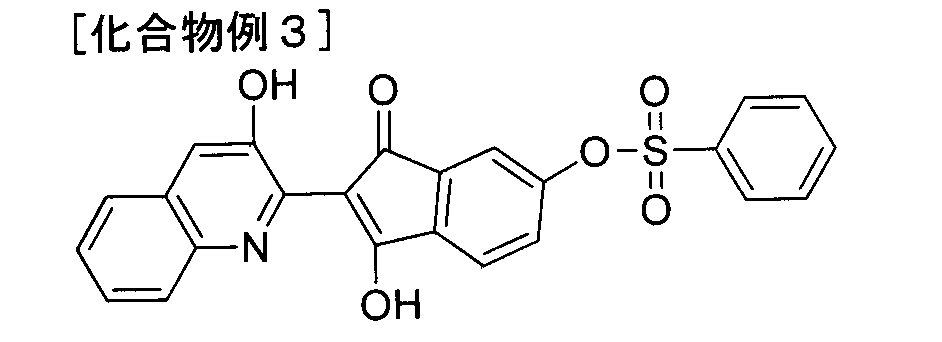
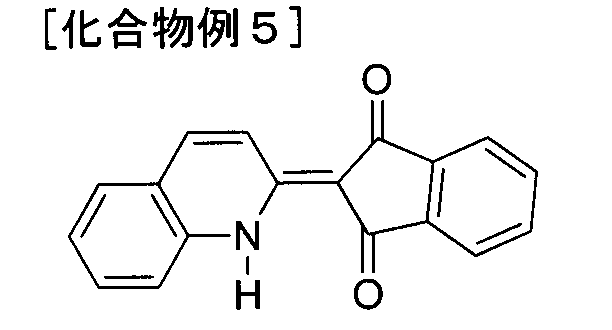
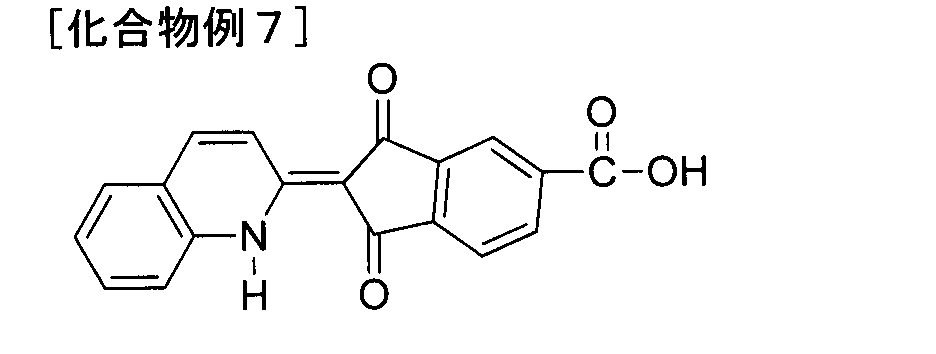
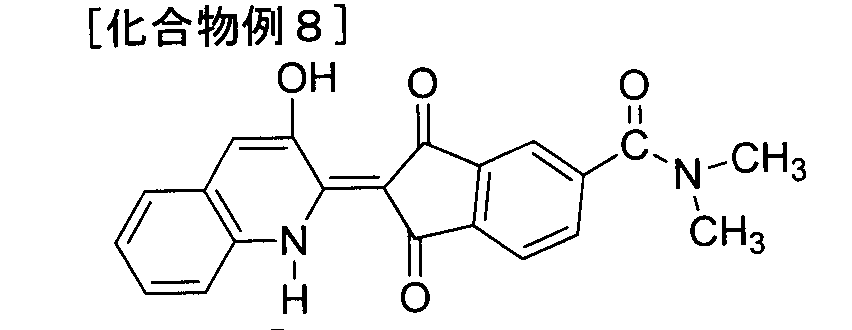
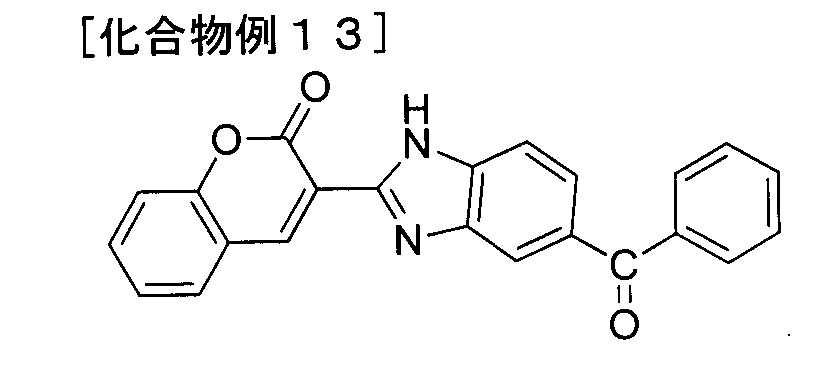
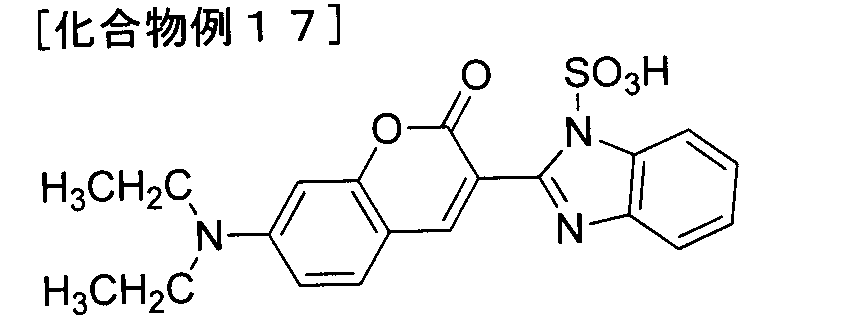
- Formulation Example 2 A mixture of the same amount of 0.1 wt% of the dye of Compound Example 1 having the highest absorbance at 448 nm and the dye of Compound Example 5 having the highest absorbance at 424 nm obtained using the formulation described in Non-Patent Document 1 was used. And 19.9 parts of toluene were mixed and dissolved to prepare a master liquid 2.
- Formulation Example 3 A master solution 3 was prepared by mixing and dissolving 0.1 part of the dye of Compound Example 15 having the highest absorbance at 431 nm obtained using the formulation described in Non-Patent Document 1 and 19.9 parts of toluene.
- Comparative Example 1 The master liquid 1 was applied onto an 80 ⁇ m triacetylcellulose film with a bar coater, dried for 2 minutes in an 80 ° C. dryer, and then cured with an ultraviolet light irradiation apparatus equipped with a 160 W high-pressure mercury lamp at an integrated light amount of 250 mJ / cm 2 A hard coat film having a thickness of 4 to 5 ⁇ m was obtained.
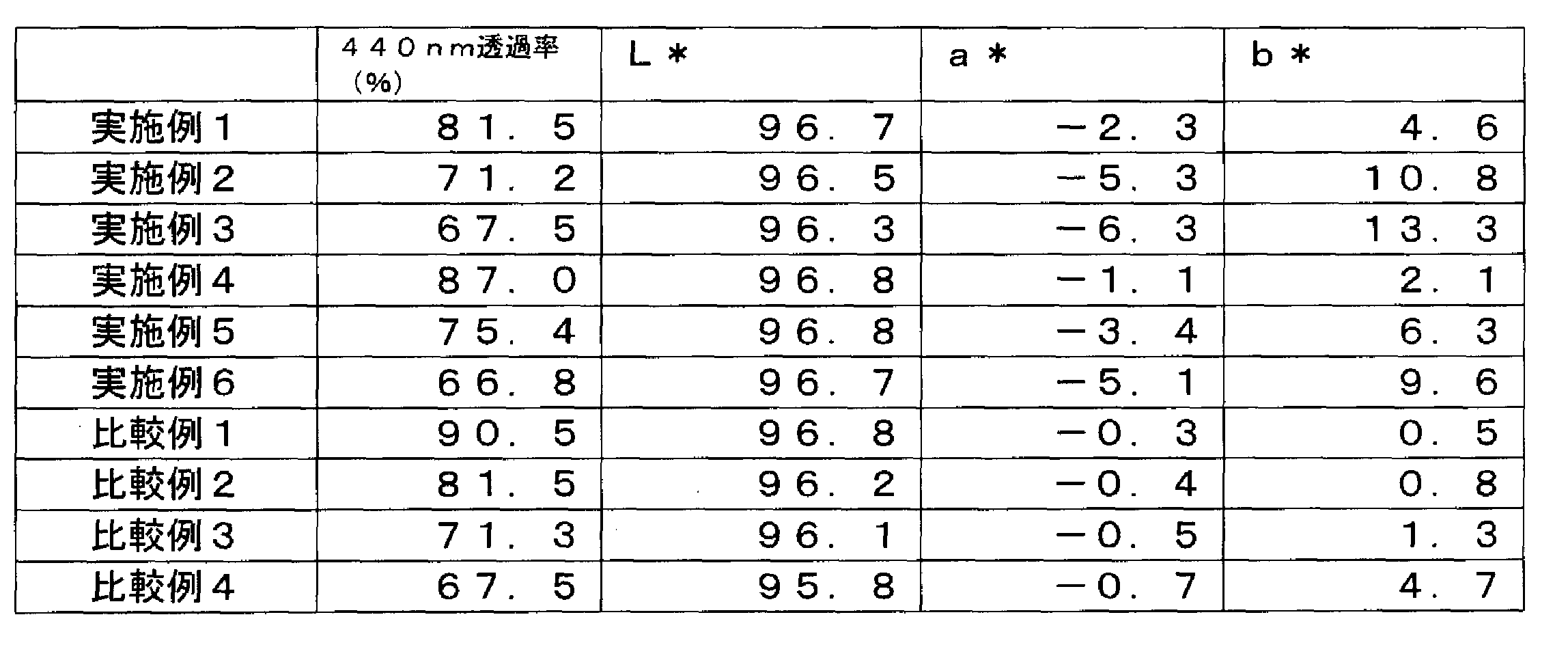
- Examples 1 to 6 The resin composition containing the materials shown in Table 1 below was coated on an 80 ⁇ m triacetylcellulose film with a bar coater, dried in an 80 ° C. dryer for 2 minutes, and then integrated with a UV irradiation device equipped with a 160 W high-pressure mercury lamp. Curing was performed at 250 mJ / cm 2 to obtain a blue light-cut hard coat film having a thickness of 4 to 5 ⁇ m. In Table 1, the unit indicates “part”.
- Comparative Examples 2 to 4 Except for changing the dye used in Examples 1 to 3 to Yellow Dye Flavine FG manufactured by Nippon Kayaku Co., Ltd. having a maximum absorption wavelength at 420 nm that does not have the structure of the formulas (1) to (3) described in the present application. It implemented similarly and it was set as Comparative Examples 2-4.
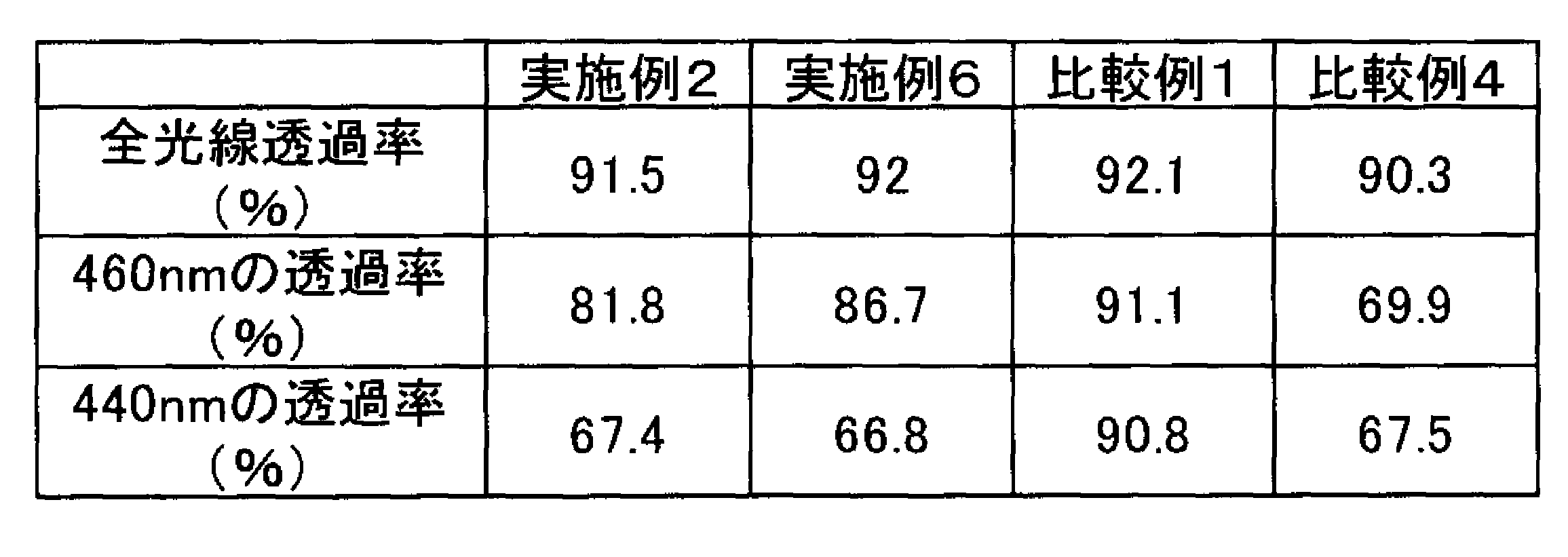
- Table 4 shows that the total light transmittance is 90% or more.
- the relationship between the transmittance at 460 nm when the transmittance at 440 nm is adjusted to 65% to 70% is shown.
- the pencil hardness of the coated film having the above composition was measured using a pencil scratch tester. Specifically, on the polyester film having the cured film to be measured, the pencil is applied with a load of 750 g from the top at a 45 degree angle, and is scratched for about 5 mm. expressed.
- Total light transmittance Measurement was performed using HM-150 manufactured by Murakami Color Research Laboratory.
- Example 1 to 6 it was possible to cut the transmittance at 440 nm, which is the blue light cut region, while maintaining the total light transmittance at 90% or more. Moreover, it was confirmed by the comparison with a comparative example that the characteristic as a hard coat film is maintained. That is, the blue light cut function could be imparted without causing deterioration of the pigment while maintaining the characteristics of the conventional hard coat film. Moreover, it turns out that the film film or base material whose transmittance
- the blue light cut function can be imparted without causing deterioration of the pigment despite the high transparency and hardness, and the light emission of the LED It can be seen that a film or a substrate with little reduction in efficiency can be obtained.
- the hard coat film obtained with the resin composition of the present invention has excellent blue light cutability, high transparency, and good hardness, especially a smartphone equipped with a touch panel, a tablet PC, a notebook PC, a plastic optical component, etc. It is a hard coat film suitable for fields requiring hardness, transparency, scratch resistance and blue light cut.
Landscapes
- Chemical & Material Sciences (AREA)
- Organic Chemistry (AREA)
- Physics & Mathematics (AREA)
- Optics & Photonics (AREA)
- Chemical Kinetics & Catalysis (AREA)
- Materials Engineering (AREA)
- Engineering & Computer Science (AREA)
- General Physics & Mathematics (AREA)
- Life Sciences & Earth Sciences (AREA)
- Health & Medical Sciences (AREA)
- Wood Science & Technology (AREA)
- Medicinal Chemistry (AREA)
- Polymers & Plastics (AREA)
- Paints Or Removers (AREA)
- Polarising Elements (AREA)
- Surface Treatment Of Optical Elements (AREA)
- Laminated Bodies (AREA)
Abstract
Description
「(1)分子中に少なくとも2個以上の(メタ)アクリロイル基を有する紫外線硬化型多官能(メタ)アクリレート、及び、式(1)乃至式(3)のいずれかの構造を有する色素を含有する紫外線硬化型ハードコート樹脂組成物、

(2)光重合開始剤を含有することを特徴とする(1)に記載の紫外線硬化型ハードコート樹脂組成物、
(3)希釈剤を含有することを特徴とする(1)または(2)に記載の紫外線硬化型ハードコート樹脂組成物、
(4)有機及び/又は無機粒子を含有することを特徴とする(1)乃至(3)のいずれか一項に記載の紫外線硬化型ハードコート樹脂組成物。
(5)(1)乃至(4)のいずれか一項に記載の紫外線硬化型ハードコート樹脂組成物よりなる硬化層を有する基材、
(6)透明ポリマーまたはそのフィルムである、(5)に記載の基材、
(7)全光線透過率が90%以上であって、かつ、440nmの透過率に対して460nmの透過率が10%以上高いことを特徴とする(5)または(6)に記載の基材、
(8)(1)乃至(4)のいずれか一項に記載の紫外線硬化型ハードコート樹脂組成物の硬化層を含む偏光板、
(9)(1)乃至(4)のいずれか一項に記載の紫外線硬化型ハードコート樹脂組成物の硬化層を含む液晶表示装置、
(10)(1)乃至(4)のいずれか一項に記載の紫外線硬化型ハードコート樹脂組成物の硬化層を有する成型物。」、に関する。







500ccコルベンに、ペンタエリスリトールトリアクリレートとペンタエリスリトールテトラアクリレートの混合物(商品名:KAYARAD PET-30、日本化薬(株)製)を60部、多官能ウレタンアクリレート(商品名:KAYARAD UX-5000、日本化薬(株)製)を40部、1-ヒドロキシシクロヘキシルフェニルケトン(商品名:イルガキュア184、BASF製)を5部、トルエン66.7部を室温で混合溶解し、固形分60%のマスター液1を作製した。
非特許文献1の記載の処方を用いて得られた448nmに最も吸光度が高い化合物例1の色素と、424nmに最も吸光度が高い化合物例5の色素を重量比として同量の混合物を0.1部と、トルエン19.9部を混合溶解し、マスター液2を作製した。
非特許文献1の記載の処方を用いて得られた431nmに最も吸光度が高い化合物例15の色素を0.1部と、トルエン19.9部を混合溶解し、マスター液3を作製した。
マスター液1を80μmトリアセチルセルロースフィルム上にバーコーターにて塗布し、80℃乾燥機中で2分乾燥後、160W高圧水銀灯を設置した紫外線照射装置により積算光量250mJ/cm2にて硬化させ、膜厚4~5μmのハードコートフィルムを得た。
下表1に示す材料を配合した樹脂組成物を80μmトリアセチルセルロースフィルム上にバーコーターにて塗布し、80℃乾燥機中で2分乾燥後、160W高圧水銀灯を設置した紫外線照射装置により積算光量250mJ/cm2にて硬化させ、膜厚4~5μmのブルーライトカット性ハードコートフィルムを得た。尚、表1において単位は「部」を示す。

実施例1乃至3において使用した色素を、本願記載の式(1)乃至式(3)の構造を有しない420nmに極大吸収波長を有する日本化薬社製のYellow色素 Flavine FGに変えた以外は同様に実施し、比較例2乃至4とした。
JIS K 5400に従い、鉛筆引っかき試験機を用いて、上記組成の塗工フィルムの鉛筆硬度を測定した。詳しくは、測定する硬化皮膜を有するポリエステルフィルム上に、鉛筆を45度の角度で、上から750gの荷重を掛け5mm程度引っかき、5回中、4回以上傷の付かなかった鉛筆の硬さで表した。
(株)村上色彩技術研究所製、HM-150を使用し測定した。
(株)村上色彩技術研究所製、HM-150を使用し測定した。
(株)日立製作所 U-4100を使用し、ハロゲンランプでのL*、a*、b*を測定した。
スチールウール#0000を使用し、250g/cm2の荷重にて1往復/にて、10往復摩耗した後、摩耗面を観察し、下記の評価を実施した。
評価・・・○:傷無し、×:傷発生
実施例のハードコート層に1mm間隔で100個のマス目をカッターで作製し、セロテープをしっかり密着させた後、90度方向に一気に剥がし、下記の評価を実施した。
評価・・・○:100/100密着良好、×:剥れ発生

Claims (10)
- 分子中に少なくとも2個以上の(メタ)アクリロイル基を有する紫外線硬化型多官能(メタ)アクリレート、及び、式(1)乃至式(3)のいずれかの構造を有する色素を含有する紫外線硬化型ハードコート樹脂組成物。

- 光重合開始剤を含有することを特徴とする請求項1に記載の紫外線硬化型ハードコート樹脂組成物。
- 希釈剤を含有することを特徴とする請求項1または2に記載の紫外線硬化型ハードコート樹脂組成物。
- 有機及び/又は無機粒子を含有することを特徴とする請求項1乃至請求項3のいずれか一項に記載の紫外線硬化型ハードコート樹脂組成物。
- 請求項1乃至4のいずれか一項に記載の紫外線硬化型ハードコート樹脂組成物よりなる硬化層を有する基材。
- 透明ポリマーまたはそのフィルムである、請求項5に記載の基材。
- 全光線透過率が90%以上であって、かつ、440nmの透過率に対して460nmの透過率が10%以上高いことを特徴とする請求項5または6に記載の基材。
- 請求項1乃至4のいずれか一項に記載の紫外線硬化型ハードコート樹脂組成物の硬化層を含む偏光板。
- 請求項1乃至4のいずれか一項に記載の紫外線硬化型ハードコート樹脂組成物の硬化層を含む液晶表示装置。
- 請求項1乃至4のいずれか一項に記載の紫外線硬化型ハードコート樹脂組成物の硬化層を有する成型物。
Priority Applications (1)
| Application Number | Priority Date | Filing Date | Title |
|---|---|---|---|
| JP2015524143A JPWO2014208749A1 (ja) | 2013-06-28 | 2014-06-27 | 紫外線硬化型ハードコート樹脂組成物 |
Applications Claiming Priority (2)
| Application Number | Priority Date | Filing Date | Title |
|---|---|---|---|
| JP2013-136703 | 2013-06-28 | ||
| JP2013136703 | 2013-06-28 |
Publications (1)
| Publication Number | Publication Date |
|---|---|
| WO2014208749A1 true WO2014208749A1 (ja) | 2014-12-31 |
Family
ID=52142072
Family Applications (1)
| Application Number | Title | Priority Date | Filing Date |
|---|---|---|---|
| PCT/JP2014/067252 Ceased WO2014208749A1 (ja) | 2013-06-28 | 2014-06-27 | 紫外線硬化型ハードコート樹脂組成物 |
Country Status (3)
| Country | Link |
|---|---|
| JP (1) | JPWO2014208749A1 (ja) |
| TW (1) | TW201510118A (ja) |
| WO (1) | WO2014208749A1 (ja) |
Cited By (5)
| Publication number | Priority date | Publication date | Assignee | Title |
|---|---|---|---|---|
| JP2016143026A (ja) * | 2015-02-05 | 2016-08-08 | 住友化学株式会社 | 複合偏光板及び液晶表示装置 |
| JP2017088827A (ja) * | 2015-11-17 | 2017-05-25 | カナヱ塗料株式会社 | 肌荒れ防止光硬化性組成物 |
| CN109154687A (zh) * | 2016-06-30 | 2019-01-04 | 日本化药株式会社 | 高耐久性的偏光板及使用该偏光板的影像显示装置、以及偏光板的制造方法 |
| US11860390B2 (en) | 2020-02-25 | 2024-01-02 | Fujifilm Corporation | Wavelength selective absorption filter, organic electroluminescent display device, and liquid crystal display device |
| US12619006B2 (en) | 2020-12-25 | 2026-05-05 | Fujifilm Corporation | Wavelength selective absorption filter and display device |
Citations (7)
| Publication number | Priority date | Publication date | Assignee | Title |
|---|---|---|---|---|
| JPS6131449A (ja) * | 1984-07-23 | 1986-02-13 | Nippon Kayaku Co Ltd | 紫外線硬化型樹脂組成物 |
| JPH05112780A (ja) * | 1991-10-23 | 1993-05-07 | Mitsubishi Kasei Corp | 調光材料およびそれを含む調光素子 |
| JPH10204304A (ja) * | 1997-01-28 | 1998-08-04 | Kyowa Hakko Kogyo Co Ltd | 合成樹脂成形体 |
| JP2002334729A (ja) * | 2001-03-09 | 2002-11-22 | Nippon Kayaku Co Ltd | 色素増感光電変換素子 |
| JP2003149605A (ja) * | 2001-11-16 | 2003-05-21 | Nippon Sheet Glass Co Ltd | 防眩用光学物品 |
| JP2010078723A (ja) * | 2008-09-24 | 2010-04-08 | Panasonic Electric Works Co Ltd | 光学部材 |
| US20110183241A1 (en) * | 2010-01-25 | 2011-07-28 | Xerox Corporation | Protective photoreceptor outer layer |
-
2014
- 2014-06-27 WO PCT/JP2014/067252 patent/WO2014208749A1/ja not_active Ceased
- 2014-06-27 TW TW103122390A patent/TW201510118A/zh unknown
- 2014-06-27 JP JP2015524143A patent/JPWO2014208749A1/ja active Pending
Patent Citations (7)
| Publication number | Priority date | Publication date | Assignee | Title |
|---|---|---|---|---|
| JPS6131449A (ja) * | 1984-07-23 | 1986-02-13 | Nippon Kayaku Co Ltd | 紫外線硬化型樹脂組成物 |
| JPH05112780A (ja) * | 1991-10-23 | 1993-05-07 | Mitsubishi Kasei Corp | 調光材料およびそれを含む調光素子 |
| JPH10204304A (ja) * | 1997-01-28 | 1998-08-04 | Kyowa Hakko Kogyo Co Ltd | 合成樹脂成形体 |
| JP2002334729A (ja) * | 2001-03-09 | 2002-11-22 | Nippon Kayaku Co Ltd | 色素増感光電変換素子 |
| JP2003149605A (ja) * | 2001-11-16 | 2003-05-21 | Nippon Sheet Glass Co Ltd | 防眩用光学物品 |
| JP2010078723A (ja) * | 2008-09-24 | 2010-04-08 | Panasonic Electric Works Co Ltd | 光学部材 |
| US20110183241A1 (en) * | 2010-01-25 | 2011-07-28 | Xerox Corporation | Protective photoreceptor outer layer |
Cited By (5)
| Publication number | Priority date | Publication date | Assignee | Title |
|---|---|---|---|---|
| JP2016143026A (ja) * | 2015-02-05 | 2016-08-08 | 住友化学株式会社 | 複合偏光板及び液晶表示装置 |
| JP2017088827A (ja) * | 2015-11-17 | 2017-05-25 | カナヱ塗料株式会社 | 肌荒れ防止光硬化性組成物 |
| CN109154687A (zh) * | 2016-06-30 | 2019-01-04 | 日本化药株式会社 | 高耐久性的偏光板及使用该偏光板的影像显示装置、以及偏光板的制造方法 |
| US11860390B2 (en) | 2020-02-25 | 2024-01-02 | Fujifilm Corporation | Wavelength selective absorption filter, organic electroluminescent display device, and liquid crystal display device |
| US12619006B2 (en) | 2020-12-25 | 2026-05-05 | Fujifilm Corporation | Wavelength selective absorption filter and display device |
Also Published As
| Publication number | Publication date |
|---|---|
| TW201510118A (zh) | 2015-03-16 |
| JPWO2014208749A1 (ja) | 2017-02-23 |
Similar Documents
| Publication | Publication Date | Title |
|---|---|---|
| JP4552480B2 (ja) | ハードコートフィルム及びその製造方法 | |
| EP2878607B1 (en) | Photosensitive resin composition and antireflection film | |
| JP5527871B2 (ja) | 紫外線硬化型ハードコート樹脂組成物 | |
| KR101686644B1 (ko) | 플라스틱 필름 적층체 | |
| WO2010090116A1 (ja) | 活性エネルギー線硬化型ハードコート用樹脂組成物とその用途 | |
| KR20140114292A (ko) | 플라스틱 필름 | |
| JP2013095108A (ja) | ハードコートフィルム | |
| JP2001262011A (ja) | 含フッ素硬化性塗液、用途及び製造方法 | |
| JPWO2014208749A1 (ja) | 紫外線硬化型ハードコート樹脂組成物 | |
| JP2001205179A (ja) | ハードコートフィルムの製造方法及びその方法を用いて得られるハードコートフィルム | |
| KR20160037097A (ko) | 자외선 경화성 도공 조성물, 하드 코트 필름 및 그의 제조 방법 | |
| WO2014208748A1 (ja) | 紫外線硬化型ハードコート樹脂組成物 | |
| JP2008173856A (ja) | ハードコートフィルム | |
| JP2009185548A (ja) | 床用活性エネルギー線硬化型ハードコートフィルム又はシート及びそれを有する建築部材 | |
| JPWO2019235206A1 (ja) | 活性エネルギー線硬化性組成物及びそれを用いたフィルム | |
| JP2012007028A (ja) | 活性エネルギー線硬化型ハードコート用樹脂組成物とその用途 | |
| JPWO2019221000A1 (ja) | 感光性樹脂組成物及び防眩性フィルム | |
| JP2022085047A (ja) | 活性エネルギー線硬化性ハードコート剤、ハードコート層、光学部材および電子機器 | |
| JP5628617B2 (ja) | ハードコート層付き光学部材の製造方法、ハードコート層表面形成用フィルム、及びハードコート層付き光学部材 | |
| KR101851364B1 (ko) | 하드코팅용 수지조성물, 이를 이용한 하드코팅필름, 이를 포함하는 편광판 및 화상표시장치 | |
| WO2016043241A1 (ja) | 偏光板 | |
| JP2009001598A (ja) | 活性エネルギー線硬化型帯電防止性ハードコート樹脂組成物 | |
| JP2003306561A (ja) | 帯電防止ハードコートフィルム及びその製造方法 | |
| JP2013200488A (ja) | 低屈折率層形成用樹脂組成物および反射防止フィルム | |
| JP4985051B2 (ja) | 反射防止フィルム |
Legal Events
| Date | Code | Title | Description |
|---|---|---|---|
| 121 | Ep: the epo has been informed by wipo that ep was designated in this application |
Ref document number: 14816883 Country of ref document: EP Kind code of ref document: A1 |
|
| ENP | Entry into the national phase |
Ref document number: 2015524143 Country of ref document: JP Kind code of ref document: A |
|
| WWE | Wipo information: entry into national phase |
Ref document number: 1020157030755 Country of ref document: KR |
|
| NENP | Non-entry into the national phase |
Ref country code: DE |
|
| 122 | Ep: pct application non-entry in european phase |
Ref document number: 14816883 Country of ref document: EP Kind code of ref document: A1 |