WO2014208380A1 - 増粘安定剤、及びそれを用いた増粘安定化組成物 - Google Patents
増粘安定剤、及びそれを用いた増粘安定化組成物 Download PDFInfo
- Publication number
- WO2014208380A1 WO2014208380A1 PCT/JP2014/065876 JP2014065876W WO2014208380A1 WO 2014208380 A1 WO2014208380 A1 WO 2014208380A1 JP 2014065876 W JP2014065876 W JP 2014065876W WO 2014208380 A1 WO2014208380 A1 WO 2014208380A1
- Authority
- WO
- WIPO (PCT)
- Prior art keywords
- thickening
- formula
- group
- carbon atoms
- compound
- Prior art date
- Legal status (The legal status is an assumption and is not a legal conclusion. Google has not performed a legal analysis and makes no representation as to the accuracy of the status listed.)
- Ceased
Links
Classifications
-
- C—CHEMISTRY; METALLURGY
- C07—ORGANIC CHEMISTRY
- C07C—ACYCLIC OR CARBOCYCLIC COMPOUNDS
- C07C233/00—Carboxylic acid amides
- C07C233/64—Carboxylic acid amides having carbon atoms of carboxamide groups bound to carbon atoms of six-membered aromatic rings
- C07C233/65—Carboxylic acid amides having carbon atoms of carboxamide groups bound to carbon atoms of six-membered aromatic rings having the nitrogen atoms of the carboxamide groups bound to hydrogen atoms or to carbon atoms of unsubstituted hydrocarbon radicals
-
- A—HUMAN NECESSITIES
- A61—MEDICAL OR VETERINARY SCIENCE; HYGIENE
- A61K—PREPARATIONS FOR MEDICAL, DENTAL OR TOILETRY PURPOSES
- A61K8/00—Cosmetics or similar toiletry preparations
- A61K8/18—Cosmetics or similar toiletry preparations characterised by the composition
- A61K8/30—Cosmetics or similar toiletry preparations characterised by the composition containing organic compounds
- A61K8/40—Cosmetics or similar toiletry preparations characterised by the composition containing organic compounds containing nitrogen
- A61K8/42—Amides
-
- A—HUMAN NECESSITIES
- A61—MEDICAL OR VETERINARY SCIENCE; HYGIENE
- A61Q—SPECIFIC USE OF COSMETICS OR SIMILAR TOILETRY PREPARATIONS
- A61Q19/00—Preparations for care of the skin
-
- C—CHEMISTRY; METALLURGY
- C09—DYES; PAINTS; POLISHES; NATURAL RESINS; ADHESIVES; COMPOSITIONS NOT OTHERWISE PROVIDED FOR; APPLICATIONS OF MATERIALS NOT OTHERWISE PROVIDED FOR
- C09K—MATERIALS FOR MISCELLANEOUS APPLICATIONS, NOT PROVIDED FOR ELSEWHERE
- C09K3/00—Materials not provided for elsewhere
-
- A—HUMAN NECESSITIES
- A61—MEDICAL OR VETERINARY SCIENCE; HYGIENE
- A61K—PREPARATIONS FOR MEDICAL, DENTAL OR TOILETRY PURPOSES
- A61K2800/00—Properties of cosmetic compositions or active ingredients thereof or formulation aids used therein and process related aspects
- A61K2800/40—Chemical, physico-chemical or functional or structural properties of particular ingredients
- A61K2800/48—Thickener, Thickening system
-
- A—HUMAN NECESSITIES
- A61—MEDICAL OR VETERINARY SCIENCE; HYGIENE
- A61K—PREPARATIONS FOR MEDICAL, DENTAL OR TOILETRY PURPOSES
- A61K2800/00—Properties of cosmetic compositions or active ingredients thereof or formulation aids used therein and process related aspects
- A61K2800/40—Chemical, physico-chemical or functional or structural properties of particular ingredients
- A61K2800/52—Stabilizers
Definitions
- the present invention relates to a novel compound having an action of thickening and stabilizing fluid organic substances such as oil, a thickening stabilizer using the same, and a thickening and stabilizing composition containing the same.
- the method of thickening and stabilizing the liquid is a very important technology in the industry.
- a metastable emulsion of mayonnaise or salad dressing can stably maintain the emulsion for a long period of time. This is because the aqueous component is thickened and stabilized. For this reason, various thickening stabilizers have been developed.
- alkyl acrylate copolymers are known as thickening stabilizers for aqueous media.
- 12-hydroxystearic acid is known as a thickening stabilizer for fluid organic substances (for example, organic substances having fluidity such as oily media) (Patent Document 1, etc.).
- 12-Hydroxystearic acid is mainly used for its gelling action for disposal of edible oil.
- 12-hydroxystearic acid was unable to adjust the degree of gelation and could only be induced to either solidify or remain liquid.
- Japanese Patent Laid-Open No. 01-163111 Japanese Patent Laid-Open No. 10-231465 JP 2004-339434 A Japanese Patent Laid-Open No. 10-273477 JP 2000-72736 A
- an object of the present invention is to provide a compound that thickens or gels a flowable organic material to a desired viscosity, or uniformly stabilizes a composition containing the flowable organic material.
- Another object of the present invention is to provide a thickening stabilizer containing the compound, a thickening and stabilizing composition thickened, gelled or stabilized by the thickening stabilizer, and a method for producing the same. It is in.
- a compound having a specific structure thickens, gels, or uniformly stabilizes a composition containing a fluid organic substance.
- a composition containing a fluid organic substance Prevents sedimentation, local aggregation, or concentration of the composition, and maintains a uniform state stably
- the fluid organic material It has been found that a composition containing a flowable organic substance can be uniformly stabilized by thickening or gelling to a desired viscosity.
- the present invention has been completed based on these findings.
- the present invention provides the following formula (1): (R 2 -HNOC) m -R 1- (CONH-R 3 ) n (1)
- m + n is 3 or 4.
- R 1 is a group obtained by removing three hydrogen atoms from a benzene ring
- R 2 is an aliphatic hydrocarbon having 6 or more carbon atoms.
- the present invention also provides a thickening stabilizer containing the compound.
- the present invention also provides a thickening and stabilizing composition comprising the thickening stabilizer and a flowable organic substance.
- the present invention also provides a method for producing a thickened and stabilized composition comprising a step of making the thickening stabilizer and a flowable organic material compatible.
- a compound represented by [2] The compound according to [1], wherein the tetravalent group containing two or more benzene rings in R 1 is a group obtained by removing four hydrogen atoms from benzophenone, biphenyl, or naphthalene.
- R 2 and R 3 are linear or branched alkyl groups having 6 or more carbon atoms, or linear or branched alkenyl groups having 6 or more carbon atoms.
- a thickening stabilizer comprising the compound according to any one of [1] to [3].
- a thickening / stabilizing composition comprising the thickening stabilizer according to [4] and a flowable organic substance.
- the fluid organic substance is at least one selected from hydrocarbon oils, ethers, halogenated hydrocarbons, petroleum components, animal and vegetable oils, silicone oils, esters, aromatic carboxylic acids, and pyridines
- a method for producing a thickened / stabilized composition comprising a step of making the thickener / stabilizer according to [4] compatible with a flowable organic substance.
- the compound represented by the formula (1) of the present invention can easily thicken or gel a fluid organic material or make a composition containing the fluid organic material uniform by making it compatible with the fluid organic material. Can be stabilized. Moreover, the compound thickened and stabilized by the compound represented by the formula (1) of the present invention can stably maintain the thickened or gelled state. Therefore, the compound represented by the formula (1) of the present invention can be suitably used as a thickening stabilizer for cosmetics, paints, foods, pharmaceuticals, etc., and the compound represented by the formula (1) of the present invention. By using these, their viscosity can be adjusted to a desired range, their composition can be kept uniform, and their usability can be improved.
- m + n is 3 or 4.
- R 1 is a group obtained by removing three hydrogen atoms from a benzene ring
- R 2 is a group selected from an aliphatic hydrocarbon group having 6 or more carbon atoms and an aromatic hydrocarbon group It is.
- n is an integer of 1 to 3
- R 1 is a tetravalent group containing two or more benzene rings
- R 2 and R 3 are different from each other, an aliphatic hydrocarbon group having 6 or more carbon atoms
- It is a group selected from aromatic hydrocarbon groups.
- Examples of the aliphatic hydrocarbon group having 6 or more carbon atoms in R 2 and R 3 include about 6 to 20 carbon atoms such as hexyl, octyl, 2-ethylhexyl, decyl, lauryl, myristyl, stearyl, and nonadecyl groups (preferably 6-18) linear or branched alkyl group; 6-carbon such as 2-hexenyl, 3-hexenyl, 4-hexenyl, 5-hexenyl, 7-octenyl, 9-decenyl, 11-dodecenyl, oleyl group, etc.
- About 20 to 20 (preferably 6 to 18) linear or branched alkenyl group; about 6 to 20 carbon atoms (preferably 6 to 18, particularly preferably 12) such as hexynyl, octynyl, decynyl, pentadecynyl, octadecynyl group To 18) or a linear or branched alkynyl group.
- aromatic hydrocarbon group having 6 or more carbon atoms in R 2 and R 3 examples include aromatic hydrocarbon groups having about 6 to 20 carbon atoms (preferably 6 to 14) such as phenyl and naphthyl groups. it can.
- Examples of the compound having m + n of 3 in the compound represented by the formula (1) include a compound represented by the following formula (1-1).
- all three R 2 s are the same group selected from an aliphatic hydrocarbon group having 6 or more carbon atoms and an aromatic hydrocarbon group, and among them, an aliphatic hydrocarbon group having 6 or more carbon atoms is A linear or branched alkyl group having 6 or more carbon atoms, or a linear or branched alkenyl group having 6 or more carbon atoms, and most preferably a linear chain having 6 to 20 carbon atoms is most preferable. Alternatively, it is a branched alkyl group, or a linear or branched alkenyl group having 6 to 20 carbon atoms.
- R 1 represents a tetravalent group containing two or more benzene rings, for example, an aromatic hydrocarbon selected from benzophenone, biphenyl, naphthalene, etc. (preferably containing two benzene rings) A group obtained by removing four hydrogen atoms from an aromatic hydrocarbon).
- n represents an integer of 1 to 3, preferably 2.
- Examples of the compound represented by formula (1) where m + n is 4 include compounds represented by the following formulas (1-2) to (1-15).
- R 2 and R 3 are groups different from each other and selected from an aliphatic hydrocarbon group having 6 or more carbon atoms and an aromatic hydrocarbon group, and in particular, an aliphatic hydrocarbon group having 6 or more carbon atoms.
- R 2 and R 3 include a combination of a linear alkyl group and a branched alkyl group, a combination of a linear alkenyl group and a branched alkyl group, a linear alkyl group and a linear alkenyl group. It is a combination.
- the compound represented by Formula (1) can be manufactured by the following method etc., for example. 1. An aromatic carboxylic acid is reacted with thionyl chloride to obtain an aromatic carboxylic acid chloride, and an amine [when m + n in the compound represented by the formula (1) is 3 is produced in the compound represented by formula (1)] Is a method of reacting R 2 —NH 2 with R 3 —NH 2 ] in the case of producing R 2 —NH 2 , a compound in which m + n in the compound represented by formula (1) is 4.
- Amine acid (1) (R 2 —NH 2 ) is reacted with the aromatic carboxylic acid anhydride corresponding to the aromatic carboxylic acid to obtain an amic acid, and further amine (2) [compound represented by formula (1) R 2 —NH 2 in the case of producing a compound in which m + n is 3 in the formula, and R 3 —NH 2 ] in the case of producing a compound in which m + n is 4 in the compound represented by the formula (1)
- the aromatic carboxylic acid may be represented by the following formula R 1- (COOH) 4 (R 1 represents a tetravalent group containing two or more benzene rings)
- R 1 represents a tetravalent group containing two or more benzene rings
- the compound represented by these can be used.
- 3,3 ′, 4,4′-benzophenone tetracarboxylic acid, 1,1′-biphenyl-2,3,3 ′, 4′-tetracarboxylic acid, 1,4,5,8-naphthalene Examples include compounds in which four carboxyl groups are bonded to an aromatic hydrocarbon group containing two or more benzene rings such as tetracarboxylic acid.
- Examples of the amine include, for example, hexylamine, octylamine, 2-ethylhexylamine, decylamine, laurylamine, myristylamine, stearylamine
- An amine having 6 or more carbon atoms preferably 6 to 20 carbon atoms), preferably a linear or branched alkyl group, alkenyl group, or alkynyl group, such as oleylamine Can be mentioned.
- the reaction between the aromatic carboxylic acid chloride and the amine can be performed, for example, by dropping the aromatic carboxylic acid chloride into the system charged with the amine.
- the amount of amine used (the total amount when R 2 —NH 2 and R 3 —NH 2 are used in combination) is, for example, about 3 to 8 mol, preferably 3 to 6 mol, per mol of aromatic carboxylic acid chloride. It is.
- the reaction between the aromatic carboxylic acid chloride and the amine can be carried out in the presence or absence of a solvent.
- the solvent include saturated or unsaturated hydrocarbon solvents such as pentane, hexane, heptane, octane and petroleum ether; aromatic hydrocarbon solvents such as benzene, toluene and xylene; methylene chloride, chloroform, 1, 2 -Halogenated hydrocarbon solvents such as dichloroethane, chlorobenzene, bromobenzene; ether solvents such as diethyl ether, diisopropyl ether, dibutyl ether, tetrahydrofuran, dioxane, 1,2-dimethoxyethane, cyclopentyl methyl ether; acetonitrile, benzonitrile, etc.
- Nitrile solvents such as dimethyl sulfoxide
- sulfolane solvents such as sulfolane
- amide solvents such as dimethylformamide
- high-boiling solvents such as silicone oil.
- the amount of the solvent used is, for example, about 50 to 300% by weight, preferably 100 to 250% by weight, based on the total amount of aromatic carboxylic acid chloride and amine.
- concentration of a reaction component will become low and there exists a tendency for reaction rate to fall.
- an aging step may be provided. When the aging step is provided, the aging temperature is, for example, about 30 to 60 ° C., and the aging time is, for example, about 1 to 5 hours.
- the reaction can be carried out by any method such as batch, semi-batch and continuous methods.
- the obtained reaction product can be separated and purified by separation means such as filtration, concentration, distillation, extraction, crystallization, adsorption, recrystallization, column chromatography, etc., or a combination means combining these.
- an aromatic carboxylic acid anhydride, an amine (1) and the following solvent are charged into the system and aged to form an amic acid, and then the amine (2) and a condensing agent (for example, , Carbodiimide or a salt thereof) and aging, the compound represented by the formula (1) can be produced.
- a condensing agent for example, , Carbodiimide or a salt thereof
- aromatic carboxylic acid anhydride an anhydride corresponding to the aromatic carboxylic acid can be used, and in the case of producing a compound in which m + n in the compound represented by the formula (1) is 3, for example, Mention may be made of trimellitic anhydride.
- examples of the aromatic carboxylic acid anhydride include 3,3 ′, 4,4′-benzophenonetetracarboxylic dianhydride. 1,1′-biphenyl-2,3,3 ′, 4′-tetracarboxylic acid-2,3: 3 ′, 4′-dianhydride, naphthalene-1,4,5,8-tetracarboxylic acid- And 1,8: 4,5-dianhydride.
- the same compounds as the amine used in the production method of 1 above can be used.
- the amount of amine (1) used is, for example, about 2 to 4 moles, preferably 2 to 3 moles per mole of aromatic carboxylic acid anhydride.
- the amount of amine (2) to be used is, for example, about 2 to 4 mol, preferably 2 to 3 mol, per 1 mol of aromatic carboxylic anhydride.
- R and R ′ are, for example, a linear or branched alkyl group having 3 to 8 carbon atoms, which may have a heteroatom-containing substituent, or a 3- to 8-membered cyclo group. It is an alkyl group. R and R ′ may be the same or different. R and R ′ may be bonded to each other to form a ring together with the —N ⁇ C ⁇ N— group.
- linear or branched alkyl group having 3 to 8 carbon atoms examples include propyl, isopropyl, butyl, isobutyl, s-butyl, t-butyl, pentyl, isopentyl, s-pentyl, t-pentyl, Examples include hexyl, isohexyl, s-hexyl, t-hexyl groups and the like.
- Examples of the 3- to 8-membered cycloalkyl group include cyclopropyl, cyclobutyl, cyclopentyl, cyclohexyl, and cyclooctyl groups.
- heteroatom-containing substituents examples include nitrogen atom-containing substituents such as di (C 1-3 ) alkylamino groups such as amino groups and dimethylamino groups.
- carbodiimide examples include diisopropylcarbodiimide, dicyclohexylcarbodiimide, N- (3-dimethylaminopropyl) -N′-ethylcarbodiimide, and the like.
- carbodiimide salt examples include hydrochloride (specifically, N- (3-dimethylaminopropyl) -N′-ethylcarbodiimide hydrochloride).
- the amount of carbodiimide used is, for example, about 2 to 6 moles, preferably 2 to 4 moles per mole of aromatic carboxylic anhydride.
- the solvent for example, it is preferable to use a proton-accepting solvent excellent in solubility of amic acid such as pyridine, triethylamine, tributylamine and the like. These can be used individually by 1 type or in mixture of 2 or more types.
- the amount of the solvent used is, for example, about 50 to 300% by weight, preferably 100 to 250% by weight, based on the total amount of amic acid.
- concentration of a reaction component will become low and there exists a tendency for reaction rate to fall.
- the above reaction is usually performed under normal pressure.
- the atmosphere of the reaction is not particularly limited as long as the reaction is not inhibited, and may be any of an air atmosphere, a nitrogen atmosphere, an argon atmosphere, and the like.
- the aging temperature (reaction temperature) is, for example, about 30 to 70 ° C.
- the aging time of the aromatic carboxylic acid anhydride and the amine is, for example, about 0.5 to 5 hours, and the aging time of the amic acid and the amine is, for example, about 0.5 to 20 hours.
- the reaction can be carried out by any method such as batch, semi-batch and continuous methods.
- the obtained reaction product can be separated and purified by separation means such as filtration, concentration, distillation, extraction, crystallization, adsorption, recrystallization, column chromatography, etc., or a combination means combining these.
- the compound represented by the formula (1) can self-associate by hydrogen bonding at the amide bond site to form a fibrous self-assembly. Furthermore, since the R 2 group (in the case where m + n in the compound represented by the formula (1) is 4), the R 2 and R 3 groups have affinity for the fluid organic substance, the fluid organic By compatibilizing with the substance, the fluid organic substance can be thickened, gelled, or the composition containing the fluid organic substance can be uniformly stabilized. Furthermore, since the compound represented by the formula (1) where m + n is 4 has two different groups (R 2 and R 3 groups), it has moderate crystallinity. Therefore, if it is a fluid organic substance, it can be thickened and stabilized without particular limitation.
- the fluid organic material When the fluid organic material has transparency, it can be thickened and stabilized while maintaining its transparency, and a thickened and stabilized composition that is stable over time can be formed. Therefore, for example, it is useful as a thickening stabilizer (more specifically, a thickening agent, a gelling agent, or a stabilizer) of a fluid organic substance.
- a thickening stabilizer more specifically, a thickening agent, a gelling agent, or a stabilizer
- the thickening stabilizer of this invention is characterized by including the compound represented by the said Formula (1) individually by 1 type or in combination of 2 or more types.
- the thickening stabilizer is a compound that dissolves in a flowable organic substance to generate viscosity
- the “thickening stabilizer” is a thickening agent that imparts viscosity to the flowable organic substance. It is a concept including a gelling agent that gels a substance and a stabilizer that increases the viscosity for the purpose of uniformly stabilizing a composition containing a flowable organic substance.
- the thickening stabilizer of the present invention may contain other components (for example, bases, hydroxy fatty acids, acrylic polymers, dextrin fatty acid esters, etc.) as necessary. Ester, particles of metal oxides, etc.) may be contained, but the content of the other components is that of the compound represented by the above formula (1) in the total amount of the thickening stabilizer (100% by weight).
- the content (the total amount when two or more are contained) is, for example, 0.5% by weight or more, preferably 1% by weight or more, more preferably 10% by weight or more, particularly preferably 30% by weight or more, and most preferably 60%. It is within the range of at least 80% by weight, more preferably at least 80% by weight.
- the upper limit of the content of the compound represented by the above formula (1) is 100% by weight. When the content of the compound represented by the above formula (1) is out of the above range, it is difficult to thicken the fluid organic substance, gelate it, or to uniformly stabilize the composition containing the fluid organic substance. Tend to be.
- dosage form of the thickening stabilizer of the present invention various dosage forms such as powder, granule, liquid, and emulsion can be employed.
- the thickening stabilizer of the present invention thickens the flowable organic substance by making it compatible with the flowable organic substance (preferably by mixing, heating, making it compatible, and cooling). Alternatively, it can be gelled, and the flowable organic substance can be thickened or gelled to a desired viscosity according to the application within a range of more than 1 to 600 times.
- the thickening and stabilizing composition of the present invention comprises the above thickening stabilizer and a flowable organic substance, and the thickening stabilizer causes the flowable organic substance to thicken, gel, or contain the flowable organic substance. It is a composition in which the product is uniformly stabilized.
- the thickening / stabilizing composition of the present invention can be produced through a process in which a thickening stabilizer and a flowable organic substance are combined. More specifically, it can be produced by mixing a thickening stabilizer with a fluid organic substance (total amount), heating and dissolving them, and then cooling. In addition, a thickening stabilizer is mixed with a part of the fluid organic substance, heated and mixed, and then cooled to produce a thickened and stabilized composition, which is then used as the remaining fluid organic substance. It can also be produced by a method of mixing the two.
- the flowable organic material as the raw material is an organic material having a viscosity [ ⁇ at 25 ° C., shear rate 10 (1 / s)] of less than 0.1 Pa ⁇ s by a rheometer, for example, hydrocarbon oil ( Hexane, cyclohexane, isododecane, benzene, toluene, poly-alpha olefin, liquid paraffin, etc., ethers (tetrahydrofuran, etc.), halogenated hydrocarbons (carbon tetrachloride, chlorobenzene, etc.), petroleum components (kerosene, gasoline, light oil, heavy oil, etc.) ), Animal and vegetable oils (sunflower oil, olive oil, soybean oil, corn oil, sunflower oil, beef tallow, jojoba oil, squalane, etc.), silicones (silicone oils such as dimethylpolysiloxane, methylphenylpolysiloxane, decamethylcyclopen
- the mixing amount (or use amount) of the thickening stabilizer is, for example, 0.1 to 100 parts by weight, preferably 0. The amount is 5 to 90 parts by weight, particularly preferably 1 to 80 parts by weight.
- the thickening / stabilizing composition of the present invention may contain other components in addition to the thickening stabilizer and the flowable organic substance as long as the effects of the present invention are not impaired.
- the other components include general compounds (for example, medicinal ingredients, pigments, fragrances, etc.) contained in a composition desired to be thickened and stabilized such as cosmetics, paints, foods, and pharmaceuticals. it can.
- the temperature at the time of compatibilization is appropriately selected depending on the type of thickening stabilizer used and the flowable organic substance, and is not particularly limited as long as the thickening stabilizer and the flowable organic substance are compatible with each other. However, it is preferable not to exceed 100 ° C., and when the boiling point of the fluid organic substance is 100 ° C. or lower, the boiling point is preferable.
- the cooling after the compatibilization is only required to be able to cool to 25 ° C. or lower, and may be gradually cooled at room temperature or rapidly by ice cooling or the like.
- the viscosity [viscosity ( ⁇ ) at 25 ° C., shear rate 10 (1 / s)] of the thickening and stabilizing composition of the present invention exceeds 1 times the viscosity of the fluid organic material as a raw material. Within the range of 600 times or less, it can be appropriately adjusted according to the application.
- the thickening / stabilizing composition of the present invention is not particularly limited as long as it contains a fluid organic substance and thickening / stabilization is desired.
- Example 1 Synthesis of thickening stabilizer (1) (1,2,4-trimellitic acid tri-n-hexylamide)]
- a 100 mL four-neck separable flask equipped with a Dimroth condenser, nitrogen inlet, dropping funnel, and thermocouple was charged with 20 mL of chloroform and 9.56 g (0.0945 mol) of n-hexylamine.
- the system temperature was set to 40 ° C., 4.18 g (0.0158 mol) of 1,2,4-trimellitic acid trichloride was added dropwise over 2.5 hours, and aging was further performed for 2 hours.
- Example 2 [Synthesis of thickening stabilizer (2) (1,2,4-trimellitic acid tri-n-octylamide)] 1,2,4-trimellitic acid as a white solid in the same manner as in Example 1 except that 9.56 g (0.0945 mol) of n-hexylamine was changed to 12.22 g (0.0945 mol) of n-octylamine. 4.1 g of tri-n-octylamide was obtained (yield: 48%).
- Example 3 [Thickening Stabilizer (3) (Synthesis of 1,2,4-trimellitic acid tri-2-ethylhexylamide)] 1,2,4-trimellitic acid as a white solid in the same manner as in Example 1 except that 9.56 g (0.0945 mol) of n-hexylamine was changed to 12.22 g (0.0945 mol) of 2-ethylhexylamine. 5.1 g of tri-2-ethylhexylamide was obtained (yield: 54%).
- Example 4 Synthesis of thickening stabilizer (4) (1,2,4-trimellitic acid trilaurylamide)] Except that 9.56 g (0.0945 mol) of n-hexylamine was changed to 17.52 g (0.0945 mol) of laurylamine, it was the same as in Example 1 except that trilauryl 1,2,4-trimellitic acid was used as a white solid. 8.0 g of amide was obtained (yield: 62%).
- Example 5 [Synthesis of thickening stabilizer (5) (1,2,4-trimellitic acid trimyristylamide)] Trimyristyl 1,2,4-trimellitic acid as a white solid in the same manner as in Example 1 except that 9.56 g (0.0945 mol) of n-hexylamine was changed to 20.16 g (0.0945 mol) of myristylamine. 7.4 g of amide was obtained (yield: 59%).
- Example 6 [Synthesis of thickening stabilizer (6) (1,2,4-trimellitic acid tristearylamide)] Tristearyl 1,2,4-trimellitic acid as a white solid in the same manner as in Example 1 except that 9.56 g (0.0945 mol) of n-hexylamine was changed to 25.47 g (0.0945 mol) of stearylamine. 7.2 g of amide was obtained (yield: 47%).
- Example 7 [Synthesis of thickener stabilizer (7) (1,2,4-trimellitic acid trioleylamide)] 9.95 g (0.0945 mol) of n-hexylamine was changed to 14.07 g (0.0526 mol) of oleylamine, and the dropping amount of 1,2,4-trimellitic acid trichloride was changed from 4.18 g (0.0158 mol) to 2. Except that the amount was changed to 0.33 g (0.0088 mol), 4.1 g of 1,2,4-trimellitic acid trioleylamide was obtained as a white paste in the same manner as in Example 1 (yield: 48%).
- Example 8 Synthesis of thickening stabilizer (8) (3,3 ′, 4,4′-benzophenonetetracarboxylic acid di2-ethylhexylamide dioleylamide)]
- a Dimroth condenser nitrogen inlet, dropping funnel, and thermocouple
- 20 mL of pyridine 3.0 g of 3,3 ′, 4,4′-benzophenonetetracarboxylic dianhydride (0. 012 mol) and 6.47 g (0.024 mol) of oleylamine were charged.
- the system temperature was set to 50 ° C. and aged for 3 hours.
- Example 9 Synthesis of thickening stabilizer (9) (3,3 ′, 4,4′-benzophenonetetracarboxylic acid di2-ethylhexylamide distearylamide)]
- a Dimroth condenser nitrogen inlet, dropping funnel, and thermocouple
- 20 mL of pyridine 3.0 g (0.012 mol) of 3,3 ′, 4,4′benzophenone tetracarboxylic dianhydride
- 6.52 g (0.024 mol) of stearylamine was charged.
- the system temperature was set to 70 ° C. and aged for 3 hours.
- Example 10 Synthesis of thickening stabilizer (10) (3,3 ′, 4,4′-benzophenone tetracarboxylic acid distearylamide dioleylamide)] Into a 100 mL four-necked separable flask equipped with a Dimroth condenser, nitrogen inlet, dropping funnel, and thermocouple, 20 mL of pyridine, 3.0 g of 3,3 ′, 4,4′-benzophenonetetracarboxylic dianhydride (0. 012 mol) and 6.47 g (0.024 mol) of oleylamine were charged. The system temperature was set to 50 ° C. and aged for 3 hours.
- the viscosity of the resulting thickened and stabilized composition was measured to confirm how many times the viscosity of various fluid organic substances was increased, and the thickened stability was evaluated according to the following criteria.
- Viscosity of various flowable organic substances and thickening and stabilizing compositions is equipped with a cone plate sensor (60 mm diameter, cone angle 1 °, 35 mm diameter cone angles 1 °, 2 °, 4 °) and Peltier temperature controller.
- a cone plate sensor 60 mm diameter, cone angle 1 °, 35 mm diameter cone angles 1 °, 2 °, 4 °
- Peltier temperature controller Using a measured viscosity / viscoelasticity measuring device (rheometer) (trade name “Rheo Stress 600”, manufactured by HAAKE) under a normal viscosity measurement mode under a 25 ° C.
- the shear rate is 0.001 to 100 (1 / s)
- the viscosity was measured to obtain a viscosity curve
- the viscosity at a shear rate of 10 (1 / s) was determined from the obtained viscosity curve, and this was used as the viscosity of the present invention.
- each plot used the value when the torque value fluctuation
- the compound represented by the formula (1) of the present invention can easily thicken or gel a fluid organic material or make a composition containing the fluid organic material uniform by making it compatible with the fluid organic material. Can be stabilized. Moreover, the composition thickened and stabilized by the compound represented by the formula (1) of the present invention can stably maintain the thickened or gelled state. Therefore, the compound represented by the formula (1) of the present invention can be suitably used as a thickening stabilizer for cosmetics, paints, foods, pharmaceuticals and the like.
Landscapes
- Chemical & Material Sciences (AREA)
- Organic Chemistry (AREA)
- Health & Medical Sciences (AREA)
- Life Sciences & Earth Sciences (AREA)
- Animal Behavior & Ethology (AREA)
- General Health & Medical Sciences (AREA)
- Public Health (AREA)
- Veterinary Medicine (AREA)
- Materials Engineering (AREA)
- Dermatology (AREA)
- Engineering & Computer Science (AREA)
- Birds (AREA)
- Epidemiology (AREA)
- Organic Low-Molecular-Weight Compounds And Preparation Thereof (AREA)
Abstract
流動性有機物質を所望の粘度に増粘若しくはゲル化、又は流動性有機物質を含有する組成物を均一に安定化する化合物、前記化合物を含む増粘安定剤、前記増粘安定剤と流動性有機物質を含む増粘安定化組成物、及びその製造方法を提供する。 本発明の化合物は、下記式(1)で表される。 (R2-HNOC)m-R1-(CONH-R3)n (1) (式中、m+nは3又は4である。m+nが3の時、nは0、R1はベンゼン環から3個の水素原子を除いた基、R2は炭素数6以上の脂肪族炭化水素基及び芳香族炭化水素基から選択される基である。m+nが4の時、nは1~3の整数、R1はベンゼン環を2個以上含む4価の基、R2、R3は互いに異なって、炭素数6以上の脂肪族炭化水素基及び芳香族炭化水素基から選択される基である)
Description
本発明は、オイル等の流動性有機物質を増粘安定化する作用を有する新規な化合物、及びそれを用いた増粘安定剤、並びにそれを含有する増粘安定化組成物に関する。本願は、2013年6月25日に日本に出願した、特願2013-132494号、及び特願2013-132495号の優先権を主張し、その内容をここに援用する。
液体を増粘安定化する方法は産業上非常に重要な技術であり、例えば、準安定状態の乳化物であるマヨネーズやサラダドレッシング等が長期間安定的にその乳化状態を維持することができるのは、水性成分が増粘安定化されているためである。そのため、種々の増粘安定剤が開発されてきた。
水性媒体の増粘安定剤としては、例えば、アルキルアクリレートコポリマー等が知られている。
一方、流動性有機物質(例えば、油性媒体等の流動性を有する有機物質)の増粘安定剤としては、12-ヒドロキシステアリン酸が知られている(特許文献1等)。12-ヒドロキシステアリン酸は、主に、食用油の廃棄処理にそのゲル化作用が利用されている。しかし、12-ヒドロキシステアリン酸はゲル化の程度を調整することができず、完全に固化するか液体のままかの何れかの状態にしか誘導することができなかった。
その他、流動性有機物質の増粘安定剤としては、アミド結合を増粘安定化の駆動力とする化合物(例えば、特許文献2~5に記載の化合物)が知られている。しかし、これらの化合物で増粘された化合物は経時的に結晶が析出しやすく、組成を均一に安定化することが困難であった。
従って、本発明の目的は、流動性有機物質を所望の粘度に増粘若しくはゲル化、又は流動性有機物質を含有する組成物を均一に安定化する化合物を提供することにある。
本発明の他の目的は、前記化合物を含有する増粘安定剤、前記増粘安定剤により増粘、ゲル化、又は安定化された増粘安定化組成物、及びその製造方法を提供することにある。
本発明の他の目的は、前記化合物を含有する増粘安定剤、前記増粘安定剤により増粘、ゲル化、又は安定化された増粘安定化組成物、及びその製造方法を提供することにある。
本発明者等は上記課題を解決するため鋭意検討した結果、特定の構造を有する化合物は流動性有機物質を増粘、ゲル化、又は流動性有機物質を含有する組成物を均一に安定化すること(=組成物の沈降、局所的な凝集、又は濃縮を防ぎ、均一状態を安定的に維持すること)ができること、流動性有機物質の種類により選択して使用することにより、流動性有機物質の粘度を所望の粘度にまで増粘又はゲル化、若しくは流動性有機物質を含有する組成物を均一に安定化することができることを見いだした。本発明はこれらの知見に基づいて完成させたものである。
すなわち、本発明は、下記式(1)
(R2-HNOC)m-R1-(CONH-R3)n (1)
(式中、m+nは3又は4である。m+nが3の時、nは0、R1はベンゼン環から3個の水素原子を除いた基、R2は炭素数6以上の脂肪族炭化水素基及び芳香族炭化水素基から選択される基である。m+nが4の時、nは1~3の整数、R1はベンゼン環を2個以上含む4価の基、R2、R3は互いに異なって、炭素数6以上の脂肪族炭化水素基及び芳香族炭化水素基から選択される基である)
で表される化合物を提供する。
(R2-HNOC)m-R1-(CONH-R3)n (1)
(式中、m+nは3又は4である。m+nが3の時、nは0、R1はベンゼン環から3個の水素原子を除いた基、R2は炭素数6以上の脂肪族炭化水素基及び芳香族炭化水素基から選択される基である。m+nが4の時、nは1~3の整数、R1はベンゼン環を2個以上含む4価の基、R2、R3は互いに異なって、炭素数6以上の脂肪族炭化水素基及び芳香族炭化水素基から選択される基である)
で表される化合物を提供する。
本発明は、また、前記化合物を含む増粘安定剤を提供する。
本発明は、また、前記増粘安定剤と流動性有機物質を含む増粘安定化組成物を提供する。
本発明は、また、前記増粘安定剤と流動性有機物質を相溶させる工程を含む増粘安定化組成物の製造方法を提供する。
すなわち、本発明は以下に関する。
[1] 下記式(1)
(R2-HNOC)m-R1-(CONH-R3)n (1)
(式中、m+nは3又は4である。m+nが3の時、nは0、R1はベンゼン環から3個の水素原子を除いた基、R2は炭素数6以上の脂肪族炭化水素基及び芳香族炭化水素基から選択される基である。m+nが4の時、nは1~3の整数、R1はベンゼン環を2個以上含む4価の基、R2、R3は互いに異なって、炭素数6以上の脂肪族炭化水素基及び芳香族炭化水素基から選択される基である)
で表される化合物。
[2] R1におけるベンゼン環を2個以上含む4価の基が、ベンゾフェノン、ビフェニル、又はナフタレンから4個の水素原子を除いた基である[1]に記載の化合物。
[3] R2、R3が、炭素数6以上の直鎖状若しくは分岐鎖状アルキル基、又は炭素数6以上の直鎖状若しくは分岐鎖状アルケニル基である[1]又は[2]に記載の化合物。
[4] [1]~[3]の何れか1つに記載の化合物を含む増粘安定剤。
[5] [4]に記載の増粘安定剤と流動性有機物質を含む増粘安定化組成物。
[6] 流動性有機物質が、炭化水素油、エーテル、ハロゲン化炭化水素、石油成分、動植物油、シリコーン油、エステル、芳香族カルボン酸、及びピリジンから選択される少なくとも1種である[5]に記載の増粘安定化組成物。
[7] [4]に記載の増粘安定剤と流動性有機物質を相溶させる工程を含む増粘安定化組成物の製造方法。
[1] 下記式(1)
(R2-HNOC)m-R1-(CONH-R3)n (1)
(式中、m+nは3又は4である。m+nが3の時、nは0、R1はベンゼン環から3個の水素原子を除いた基、R2は炭素数6以上の脂肪族炭化水素基及び芳香族炭化水素基から選択される基である。m+nが4の時、nは1~3の整数、R1はベンゼン環を2個以上含む4価の基、R2、R3は互いに異なって、炭素数6以上の脂肪族炭化水素基及び芳香族炭化水素基から選択される基である)
で表される化合物。
[2] R1におけるベンゼン環を2個以上含む4価の基が、ベンゾフェノン、ビフェニル、又はナフタレンから4個の水素原子を除いた基である[1]に記載の化合物。
[3] R2、R3が、炭素数6以上の直鎖状若しくは分岐鎖状アルキル基、又は炭素数6以上の直鎖状若しくは分岐鎖状アルケニル基である[1]又は[2]に記載の化合物。
[4] [1]~[3]の何れか1つに記載の化合物を含む増粘安定剤。
[5] [4]に記載の増粘安定剤と流動性有機物質を含む増粘安定化組成物。
[6] 流動性有機物質が、炭化水素油、エーテル、ハロゲン化炭化水素、石油成分、動植物油、シリコーン油、エステル、芳香族カルボン酸、及びピリジンから選択される少なくとも1種である[5]に記載の増粘安定化組成物。
[7] [4]に記載の増粘安定剤と流動性有機物質を相溶させる工程を含む増粘安定化組成物の製造方法。
本発明の式(1)で表される化合物は、流動性有機物質と相溶させることにより、容易に流動性有機物質を増粘若しくはゲル化、又は流動性有機物質を含有する組成物を均一に安定化することができる。また、本発明の式(1)で表される化合物で増粘安定化された化合物は、増粘若しくはゲル化された状態を安定的に維持することができる。そのため、本発明の式(1)で表される化合物は、化粧料、塗料、食品、医薬品等の増粘安定剤として好適に使用することができ、発明の式(1)で表される化合物を使用することによりそれらの粘度を所望の範囲に調整することができ、それらの組成を均一に維持することができ、それらの使用性を向上することができる。
[式(1)で表される化合物]
本発明の化合物は下記式(1)で表される。
(R2-HNOC)m-R1-(CONH-R3)n (1)
本発明の化合物は下記式(1)で表される。
(R2-HNOC)m-R1-(CONH-R3)n (1)
式中、m+nは3又は4である。m+nが3の時、nは0、R1はベンゼン環から3個の水素原子を除いた基、R2は炭素数6以上の脂肪族炭化水素基及び芳香族炭化水素基から選択される基である。m+nが4の時、nは1~3の整数、R1はベンゼン環を2個以上含む4価の基、R2、R3は互いに異なって、炭素数6以上の脂肪族炭化水素基及び芳香族炭化水素基から選択される基である。
R2、R3における炭素数6以上の脂肪族炭化水素基としては、例えば、ヘキシル、オクチル、2-エチルヘキシル、デシル、ラウリル、ミリスチル、ステアリル、ノナデシル基等の炭素数6~20程度(好ましくは6~18)の直鎖状若しくは分岐鎖状アルキル基;2-ヘキセニル、3-ヘキセニル、4-ヘキセニル、5-ヘキセニル、7-オクテニル、9-デセニル、11-ドデセニル、オレイル基等の炭素数6~20程度(好ましくは6~18)の直鎖状若しくは分岐鎖状アルケニル基;ヘキシニル、オクチニル、デシニル、ペンタデシニル、オクタデシニル基等の炭素数6~20程度(好ましくは6~18、特に好ましくは12~18)の直鎖状若しくは分岐鎖状アルキニル基等を挙げることができる。
R2、R3における炭素数6以上の芳香族炭化水素基としては、例えば、フェニル、ナフチル基等の炭素数6~20程度(好ましくは6~14)の芳香族炭化水素基を挙げることができる。
式(1)で表される化合物におけるm+nが3である化合物としては、例えば、下記式(1-1)で表される化合物等を挙げることができる。

上記式中、3個のR2は全て同一に炭素数6以上の脂肪族炭化水素基及び芳香族炭化水素基から選択される基であり、なかでも炭素数6以上の脂肪族炭化水素基が好ましく、特に好ましくは炭素数6以上の直鎖状若しくは分岐鎖状アルキル基、又は炭素数6以上の直鎖状若しくは分岐鎖状アルケニル基であり、最も好ましくは炭素数6~20の直鎖状若しくは分岐鎖状アルキル基、又は炭素数6~20の直鎖状若しくは分岐鎖状アルケニル基である。
m+nが4の時、R1はベンゼン環を2個以上含む4価の基を示し、例えば、ベンゾフェノン、ビフェニル、及びナフタレン等から選択される芳香族炭化水素(好ましくは、ベンゼン環を2個含む芳香族炭化水素)から4個の水素原子を除いた基を挙げることができる。
m+nが4の時、nは1~3の整数を示し、好ましくは2である。
式(1)で表される化合物におけるm+nが4である化合物としては、例えば、下記式(1-2)~(1-15)で表される化合物等を挙げることができる。

上記式中、R2、R3は互いに異なって、炭素数6以上の脂肪族炭化水素基及び芳香族炭化水素基から選択される基であり、なかでも炭素数6以上の脂肪族炭化水素基が好ましく、特に好ましくは炭素数6~20(好ましくは6~18、特に好ましくは8~18)の直鎖状又は分岐鎖状アルキル基、炭素数6~20(好ましくは6~18、特に好ましくは12~18)の直鎖状又は分岐鎖状アルケニル基である。R2、R3の好ましい組み合わせとしては、直鎖状アルキル基と分岐鎖状アルキル基の組み合わせ、直鎖状アルケニル基と分岐鎖状アルキル基の組み合わせ、直鎖状アルキル基と直鎖状アルケニル基の組み合わせである。
式(1)で表される化合物は、例えば、下記方法等により製造することができる。
1.芳香族カルボン酸を塩化チオニルと反応させて芳香族カルボン酸クロライドを得、得られた芳香族カルボン酸クロライドにアミン[式(1)で表される化合物におけるm+nが3である化合物を製造する場合は、R2-NH2、式(1)で表される化合物におけるm+nが4である化合物を製造する場合は、R2-NH2とR3-NH2]を反応させる方法
2.前記芳香族カルボン酸に対応する芳香族カルボン酸無水物にアミン(1)(R2-NH2)を反応させてアミック酸を得、更にアミン(2)[式(1)で表される化合物におけるm+nが3である化合物を製造する場合は、R2-NH2、式(1)で表される化合物におけるm+nが4である化合物を製造する場合は、R3-NH2]を縮合剤を用いて縮合させる方法
1.芳香族カルボン酸を塩化チオニルと反応させて芳香族カルボン酸クロライドを得、得られた芳香族カルボン酸クロライドにアミン[式(1)で表される化合物におけるm+nが3である化合物を製造する場合は、R2-NH2、式(1)で表される化合物におけるm+nが4である化合物を製造する場合は、R2-NH2とR3-NH2]を反応させる方法
2.前記芳香族カルボン酸に対応する芳香族カルボン酸無水物にアミン(1)(R2-NH2)を反応させてアミック酸を得、更にアミン(2)[式(1)で表される化合物におけるm+nが3である化合物を製造する場合は、R2-NH2、式(1)で表される化合物におけるm+nが4である化合物を製造する場合は、R3-NH2]を縮合剤を用いて縮合させる方法
式(1)で表される化合物におけるm+nが3である化合物を製造する場合、前記芳香族カルボン酸としては、1,2,4-ベンゼントリカルボン酸(=トリメリット酸)を使用することができる。
式(1)で表される化合物におけるm+nが4である化合物を製造する場合、前記芳香族カルボン酸としては、下記式
R1-(COOH)4
(R1はベンゼン環を2個以上含む4価の基を示す)
で表される化合物を使用することができる。具体的には、3,3’,4,4’-ベンゾフェノンテトラカルボン酸、1,1’-ビフェニル-2,3,3’,4’-テトラカルボン酸、1,4,5,8-ナフタレンテトラカルボン酸等のベンゼン環を2個以上含む芳香族炭化水素基に4個のカルボキシル基が結合してなる化合物を挙げることができる。
R1-(COOH)4
(R1はベンゼン環を2個以上含む4価の基を示す)
で表される化合物を使用することができる。具体的には、3,3’,4,4’-ベンゾフェノンテトラカルボン酸、1,1’-ビフェニル-2,3,3’,4’-テトラカルボン酸、1,4,5,8-ナフタレンテトラカルボン酸等のベンゼン環を2個以上含む芳香族炭化水素基に4個のカルボキシル基が結合してなる化合物を挙げることができる。
アミン(R2-NH2、R3-NH2;R2、R3は前記に同じ)としては、例えば、へキシルアミン、オクチルアミン、2-エチルヘキシルアミン、デシルアミン、ラウリルアミン、ミリスチルアミン、ステアリルアミン、オレイルアミン等の、炭素数6以上(好ましくは、炭素数6~20)の脂肪族炭化水素基(好ましくは、直鎖状若しくは分岐鎖状のアルキル基、アルケニル基、又はアルキニル基)であるアミンを挙げることができる。
上記1の方法において、芳香族カルボン酸クロライドとアミンの反応は、例えばアミンを仕込んだ系内に芳香族カルボン酸クロライドを滴下することにより行うことができる。
アミンの使用量(R2-NH2とR3-NH2を併用する場合はその総量)は、芳香族カルボン酸クロライド1モルに対して、例えば3~8モル程度、好ましくは3~6モルである。
そして、R2-NH2とR3-NH2を併用する場合は、その使用割合を調整することにより、得られる式(1)で表される化合物中の(CONH-R2)基と(CONH-R3)基の数をコントロールすることができる。
芳香族カルボン酸クロライドとアミンの反応は、溶媒の存在下又は非存在下で行うことができる。前記溶媒としては、例えば、ペンタン、ヘキサン、ヘプタン、オクタン、石油エーテル等の飽和又は不飽和炭化水素系溶媒;ベンゼン、トルエン、キシレン等の芳香族炭化水素系溶媒;塩化メチレン、クロロホルム、1,2-ジクロロエタン、クロロベンゼン、ブロモベンゼン等のハロゲン化炭化水素系溶媒;ジエチルエーテル、ジイソプロピルエーテル、ジブチルエーテル、テトラヒドロフラン、ジオキサン、1,2-ジメトキシエタン、シクロペンチルメチルエーテル等のエーテル系溶媒;アセトニトリル、ベンゾニトリル等のニトリル系溶媒;ジメチルスルホキシド等のスルホキシド系溶媒;スルホラン等のスルホラン系溶媒;ジメチルホルムアミド等のアミド系溶媒;シリコーンオイル等の高沸点溶媒等を挙げることができる。これらは1種を単独で、又は2種以上を混合して使用することができる。
前記溶媒の使用量としては、芳香族カルボン酸クロライドとアミンの総量に対して、例えば50~300重量%程度、好ましくは100~250重量%である。溶媒の使用量が上記範囲を上回ると反応成分の濃度が低くなり、反応速度が低下する傾向がある。
芳香族カルボン酸クロライドとアミンの反応(=滴下)は、通常、常圧下で行われる。また、上記反応(=滴下時)の雰囲気としては反応を阻害しない限り特に限定されず、例えば、空気雰囲気、窒素雰囲気、アルゴン雰囲気等の何れであってもよい。反応温度(=滴下時温度)は、例えば30~60℃程度である。反応時間(=滴下時間)は、例えば0.5~20時間程度である。反応(=滴下)終了後は、熟成工程を設けてもよい。熟成工程を設ける場合、熟成温度は例えば30~60℃程度、熟成時間は例えば1~5時間程度である。また、反応はバッチ式、セミバッチ式、連続式等の何れの方法でも行うことができる。
反応終了後、得られた反応生成物は、例えば、濾過、濃縮、蒸留、抽出、晶析、吸着、再結晶、カラムクロマトグラフィー等の分離手段や、これらを組み合わせた分離手段により分離精製できる。
上記2の製造方法では、例えば、芳香族カルボン酸無水物とアミン(1)及び下記溶媒を系内に仕込み、熟成させることによりアミック酸を形成し、その後、アミン(2)と縮合剤(例えば、カルボジイミド又はその塩)を仕込み、熟成させることにより式(1)で表される化合物を製造することができる。
前記芳香族カルボン酸無水物としては、上記芳香族カルボン酸に対応する無水物を使用することができ、式(1)で表される化合物におけるm+nが3である化合物を製造する場合、例えば、トリメリット酸無水物を挙げることができる。
式(1)で表される化合物におけるm+nが4である化合物を製造する場合、前記芳香族カルボン酸無水物としては、例えば、3,3’,4,4’-ベンゾフェノンテトラカルボン酸二無水物、1,1’-ビフェニル-2,3,3’,4’-テトラカルボン酸-2,3:3’,4’-二無水物、ナフタレン-1,4,5,8-テトラカルボン酸-1,8:4,5-二無水物等を挙げることができる。
前記アミン(1)、(2)としては、上記1の製造方法で使用されるアミンと同様の化合物を使用することができる。
アミン(1)の使用量としては、芳香族カルボン酸無水物1モルに対して、例えば2~4モル程度、好ましくは2~3モルである。また、アミン(2)の使用量としては、芳香族カルボン酸無水物1モルに対して、例えば2~4モル程度、好ましくは2~3モルである。
前記カルボジイミドは下記式で表される。
R-N=C=N-R’
上記式中、R、R’としては、例えば、ヘテロ原子含有置換基を有していてもよい、炭素数3~8の直鎖状若しくは分岐鎖状のアルキル基、又は3~8員のシクロアルキル基である。R、R’は同一であってもよく、異なっていてもよい。また、RとR’は互いに結合して-N=C=N-基と共に環を形成していてもよい。
R-N=C=N-R’
上記式中、R、R’としては、例えば、ヘテロ原子含有置換基を有していてもよい、炭素数3~8の直鎖状若しくは分岐鎖状のアルキル基、又は3~8員のシクロアルキル基である。R、R’は同一であってもよく、異なっていてもよい。また、RとR’は互いに結合して-N=C=N-基と共に環を形成していてもよい。
前記炭素数3~8の直鎖状若しくは分岐鎖状のアルキル基としては、例えば、プロピル、イソプロピル、ブチル、イソブチル、s-ブチル、t-ブチル、ペンチル、イソペンチル、s-ペンチル、t-ペンチル、ヘキシル、イソヘキシル、s-ヘキシル、t-ヘキシル基等を挙げることができる。
前記3~8員のシクロアルキル基としては、例えば、シクロプロピル、シクロブチル、シクロペンチル、シクロヘキシル、シクロオクチル基等を挙げることができる。
前記ヘテロ原子含有置換基としては、アミノ基、ジメチルアミノ基等のジ(C1-3)アルキルアミノ基等の窒素原子含有置換基を挙げることができる。
カルボジイミドとしては、例えば、ジイソプロピルカルボジイミド、ジシクロヘキシルカルボジイミド、N-(3-ジメチルアミノプロピル)-N’-エチルカルボジイミド等を挙げることができる。また、カルボジイミドの塩としては、例えば、塩酸塩(具体的には、N-(3-ジメチルアミノプロピル)-N’-エチルカルボジイミド塩酸塩等)等を挙げることができる。
カルボジイミドの使用量としては、芳香族カルボン酸無水物1モルに対して、例えば2~6モル程度、好ましくは2~4モルである。
前記溶媒としては、例えば、ピリジン、トリエチルアミン、トリブチルアミン等のアミック酸の溶解性に優れるプロトン受容性溶媒を使用することが好ましい。これらは1種を単独で、又は2種以上を混合して使用することができる。
前記溶媒の使用量としては、アミック酸の総量に対して、例えば50~300重量%程度、好ましくは100~250重量%である。溶媒の使用量が上記範囲を上回ると反応成分の濃度が低くなり、反応速度が低下する傾向がある。
上記反応は、通常、常圧下で行われる。また、上記反応の雰囲気としては反応を阻害しない限り特に限定されず、例えば、空気雰囲気、窒素雰囲気、アルゴン雰囲気等の何れであってもよい。熟成温度(反応温度)は、例えば30~70℃程度である。芳香族カルボン酸無水物とアミンの熟成時間は、例えば0.5~5時間程度であり、アミック酸とアミンの熟成時間は、例えば0.5~20時間程度である。また、反応はバッチ式、セミバッチ式、連続式等の何れの方法でも行うことができる。
反応終了後、得られた反応生成物は、例えば、濾過、濃縮、蒸留、抽出、晶析、吸着、再結晶、カラムクロマトグラフィー等の分離手段や、これらを組み合わせた分離手段により分離精製できる。
式(1)で表される化合物はアミド結合部位において水素結合により自己会合してファイバー状の自己組織体を形成することができる。更に、R2基(式(1)で表される化合物におけるm+nが4である化合物の場合は、R2、R3基)が流動性有機物質に対して親和性を有するため、流動性有機物質と相溶させることにより、流動性有機物質を増粘、ゲル化、又は流動性有機物質を含有する組成物を均一に安定化することができる。更にまた、式(1)で表される化合物におけるm+nが4である化合物は互いに異なる2種類の基(R2、R3基)を有するため適度の結晶性を有する。そのため、流動性有機物質であれば特に制限なく増粘安定化することができる。そして、流動性有機物質が透明性を有する場合はその透明性を維持しつつ増粘安定化することができ、経時的に安定な増粘安定化組成物を形成することができる。そのため、例えば、流動性有機物質の増粘安定剤(更に詳細には、増粘剤、ゲル化剤、又は安定剤)として有用である。
[増粘安定剤]
本発明の増粘安定剤は、上記式(1)で表される化合物を1種単独で、又は2種以上を組み合わせて含むことを特徴とする。
本発明の増粘安定剤は、上記式(1)で表される化合物を1種単独で、又は2種以上を組み合わせて含むことを特徴とする。
尚、本発明において増粘安定剤とは流動性有機物質に溶解して粘性を生じる化合物であり、「増粘安定剤」は、流動性有機物質に粘性を付与する増粘剤、流動性有機物質をゲル化するゲル化剤、及び流動性有機物質を含有する組成物を均一に安定化することを目的としてその粘性を高める安定剤を含む概念である。
本発明の増粘安定剤には、上記式(1)で表される化合物以外にも、必要に応じて他の成分(例えば、基剤、ヒドロキシ脂肪酸類、アクリルポリマー、デキストリン脂肪酸エステル等のオリゴマーエステル類、金属酸化物等の粒子等)を含有していてもよいが、他の成分の含有量は、増粘安定剤全量(100重量%)において上記式(1)で表される化合物の含有量(2種以上含有する場合はその総量)が、例えば0.5重量%以上、好ましくは1重量%以上、より好ましくは10重量%以上、特に好ましくは30重量%以上、最も好ましくは60重量%以上、更に好ましくは80重量%以上となる範囲内である。尚、上記式(1)で表される化合物の含有量の上限は100重量%である。上記式(1)で表される化合物の含有量が上記範囲を外れると、流動性有機物質を増粘、ゲル化、又は流動性有機物質を含有する組成物を均一に安定化することが困難となる傾向がある。
本発明の増粘安定剤の剤型としては、例えば、粉末状、顆粒状、液状、乳液状等の種々の剤型を採用することが可能である。
本発明の増粘安定剤は、流動性有機物質と相溶させることにより(好ましくは、混合して加温し、相溶させた後、冷却することにより)、前記流動性有機物質を増粘又はゲル化することができ、前記流動性有機物質を、1倍を超え600倍以下程度の範囲内において用途に応じた所望の粘度に増粘又はゲル化することができる。
[増粘安定化組成物]
本発明の増粘安定化組成物は、上記増粘安定剤と流動性有機物質を含み、前記増粘安定剤により流動性有機物質が増粘、ゲル化、又は流動性有機物質を含有する組成物が均一に安定化された組成物である。
本発明の増粘安定化組成物は、上記増粘安定剤と流動性有機物質を含み、前記増粘安定剤により流動性有機物質が増粘、ゲル化、又は流動性有機物質を含有する組成物が均一に安定化された組成物である。
本発明の増粘安定化組成物は、増粘安定剤と流動性有機物質を相溶させる工程を経て製造することができる。より詳細には、流動性有機物質(全量)に増粘安定剤を混合して加温し、相溶させた後、冷却することにより製造することができる。また、流動性有機物質の一部に増粘安定剤を混合して、加温、相溶させた後、冷却して、増粘安定化組成物を製造し、これを残りの流動性有機物質に混合する方法でも製造することができる。
原料としての流動性有機物質は、レオメーターによる粘度[25℃、せん断速度10(1/s)における粘度(η)]が、例えば0.1Pa・s未満の有機物質であり、炭化水素油(ヘキサン、シクロヘキサン、イソドデカン、ベンゼン、トルエン、ポリαオレフィン、流動パラフィン等)、エーテル類(テトラヒドロフラン等)、ハロゲン化炭化水素(四塩化炭素、クロロベンゼン等)、石油成分(ケロシン、ガソリン、軽油、重油等)、動植物油(ヒマワリ油、オリーブ油、大豆油、コーン油、ヒマシ油、牛脂、ホホバ油、スクワラン等)、シリコーン類(ジメチルポリシロキサン、メチルフェニルポリシロキサン、デカメチルシクロペンタシロキサン等のシリコーン油)、エステル類(オレイン酸オクチルドデシル、オクタン酸セチル、エチルヘキサン酸セチル、グリセリルトリイソオクタネート、ネオペンチルグリコールジイソオクタネート等)、芳香族カルボン酸、ピリジン等を挙げることができる。これらは1種を単独で、又は2種以上を組み合わせて使用することができる。
増粘安定剤の混合量(若しくは使用量)としては、流動性有機物質の種類にもよるが、流動性有機物質1000重量部に対して、例えば0.1~100重量部、好ましくは0.5~90重量部、特に好ましくは1~80重量部である。増粘安定剤を上記範囲で混合(若しくは使用)することにより、流動性有機物質が増粘、若しくはゲル化された組成物、又は組成が均一に安定化された組成物が得られる。
本発明の増粘安定化組成物は、上記増粘安定剤と流動性有機物質以外にも本発明の効果を損なわない範囲内で他の成分を含有していてもよい。他の成分としては、例えば、化粧料、塗料、食品、医薬品等の増粘安定化を所望する組成物に含有される一般的な化合物(例えば、薬効成分、顔料、香料等)を挙げることができる。
相溶の際の温度は、使用する増粘安定剤と流動性有機物質の種類によって適宜選択されるものであり、増粘安定剤と流動性有機物質が相溶する温度であれば特に制限されないが、100℃を越えないことが好ましく、流動性有機物質の沸点が100℃以下の場合には沸点程度が好ましい。
相溶後の冷却は、25℃以下にまで冷却することができればよく、室温で徐々に冷却してもよいし、氷冷等により急速に冷却してもよい。
そして、本発明の増粘安定化組成物のレオメーターによる粘度[25℃、せん断速度10(1/s)における粘度(η)]は、原料としての流動性有機物質の粘度の1倍を超え600倍以下の範囲内において、用途に応じて適宜調整することができる。
本発明の増粘安定化組成物としては、流動性有機物質を含有し、増粘安定化が望まれる組成物であれば特に制限されることがなく、例えば、化粧料、塗料、食品、医薬品等を挙げることができる。
以下、実施例により本発明をより具体的に説明するが、本発明はこれらの実施例により限定されるものではない。
実施例1[増粘安定剤(1)(1,2,4-トリメリット酸トリn-ヘキシルアミド)の合成]
ジムロート冷却管、窒素導入口、滴下ロート、及び熱電対を備えた100mL4つ口セパラブルフラスコにクロロホルム20mL、n-ヘキシルアミン9.56g(0.0945mol)を仕込んだ。系内温度を40℃に設定し、1,2,4-トリメリット酸トリクロリド4.18g(0.0158mol)を2.5時間かけて滴下し、さらに2時間熟成を行った。その後、得られた粗液の低沸分をエバポレータにて除去し、溶剤洗浄し、白色固体として1,2,4-トリメリット酸トリn-ヘキシルアミドを4.1g得た(収率:56%)。生成物の構造は1H-NMRにより確認した。
1H-NMR (270MHz, CDCl3): δ 0.89(t,J=7.0Hz,9H), 1.21-1.40(m,18H), 1.45-1.72(m,6H), 3.33-3.47(m, 6H), 6.79(t,J=5.9Hz,1H), 7.40(d,J=6.2Hz,1H), 7.57-7.73(m,3H), 7.74(s,1H)
ジムロート冷却管、窒素導入口、滴下ロート、及び熱電対を備えた100mL4つ口セパラブルフラスコにクロロホルム20mL、n-ヘキシルアミン9.56g(0.0945mol)を仕込んだ。系内温度を40℃に設定し、1,2,4-トリメリット酸トリクロリド4.18g(0.0158mol)を2.5時間かけて滴下し、さらに2時間熟成を行った。その後、得られた粗液の低沸分をエバポレータにて除去し、溶剤洗浄し、白色固体として1,2,4-トリメリット酸トリn-ヘキシルアミドを4.1g得た(収率:56%)。生成物の構造は1H-NMRにより確認した。
1H-NMR (270MHz, CDCl3): δ 0.89(t,J=7.0Hz,9H), 1.21-1.40(m,18H), 1.45-1.72(m,6H), 3.33-3.47(m, 6H), 6.79(t,J=5.9Hz,1H), 7.40(d,J=6.2Hz,1H), 7.57-7.73(m,3H), 7.74(s,1H)
実施例2[増粘安定剤(2)(1,2,4-トリメリット酸トリn-オクチルアミド)の合成]
n-ヘキシルアミン9.56g(0.0945mol)をn-オクチルアミン12.22g(0.0945mol)に変更した以外は実施例1と同様にして、白色固体として1,2,4-トリメリット酸トリn-オクチルアミドを4.1g得た(収率:48%)。
1H-NMR (270MHz, CDCl3): δ 0.87(t,J=7.0Hz,9H), 1.18-1.34(m,30H), 1.45-1.81(m,6H), 3.35-3.46(m, 6H), 6.76(t,J=5.4Hz,1H), 7.40(d,J=8.1Hz,1H), 7.59-7.74(m,3H), 7.75(s,1H)
n-ヘキシルアミン9.56g(0.0945mol)をn-オクチルアミン12.22g(0.0945mol)に変更した以外は実施例1と同様にして、白色固体として1,2,4-トリメリット酸トリn-オクチルアミドを4.1g得た(収率:48%)。
1H-NMR (270MHz, CDCl3): δ 0.87(t,J=7.0Hz,9H), 1.18-1.34(m,30H), 1.45-1.81(m,6H), 3.35-3.46(m, 6H), 6.76(t,J=5.4Hz,1H), 7.40(d,J=8.1Hz,1H), 7.59-7.74(m,3H), 7.75(s,1H)
実施例3[増粘安定剤(3)(1,2,4-トリメリット酸トリ2-エチルヘキシルアミド)の合成)
n-ヘキシルアミン9.56g(0.0945mol)を2-エチルヘキシルアミン12.22g(0.0945mol)に変更した以外は実施例1と同様にして、白色固体として1,2,4-トリメリット酸トリ2-エチルヘキシルアミドを5.1g得た(収率:54%)。
1H-NMR (270MHz, CDCl3): δ 0.89(t,J=7.0Hz,18H), 1.33-1.46(m,24H), 1.50-1.75(m,3H), 3.28-3.47(m,6H), 6.73(t,J=5.8Hz,1H), 7.38(d,J=7.8Hz,1H), 7.59(dd,J=7.8,1.6Hz,1H), 7.74(d,J=1.6Hz,1H), 7.78-7.85(m,2H)
n-ヘキシルアミン9.56g(0.0945mol)を2-エチルヘキシルアミン12.22g(0.0945mol)に変更した以外は実施例1と同様にして、白色固体として1,2,4-トリメリット酸トリ2-エチルヘキシルアミドを5.1g得た(収率:54%)。
1H-NMR (270MHz, CDCl3): δ 0.89(t,J=7.0Hz,18H), 1.33-1.46(m,24H), 1.50-1.75(m,3H), 3.28-3.47(m,6H), 6.73(t,J=5.8Hz,1H), 7.38(d,J=7.8Hz,1H), 7.59(dd,J=7.8,1.6Hz,1H), 7.74(d,J=1.6Hz,1H), 7.78-7.85(m,2H)
実施例4[増粘安定剤(4)(1,2,4-トリメリット酸トリラウリルアミド)の合成]
n-ヘキシルアミン9.56g(0.0945mol)をラウリルアミン17.52g(0.0945mol)に変更した以外は実施例1と同様にして、白色固体として1,2,4-トリメリット酸トリラウリルアミドを8.0g得た(収率:62%)。
1H-NMR (270MHz, CDCl3): δ 0.88(t,J=6.8Hz,9H), 1.18-1.34(m,54H), 1.45-1.85(m,6H), 3.33-3.47(m, 6H), 6.74(t,J=5.7Hz,1H), 7.40(d,J=7.8Hz,1H), 7.59-7.65(m,3H), 7.75(s,1H)
n-ヘキシルアミン9.56g(0.0945mol)をラウリルアミン17.52g(0.0945mol)に変更した以外は実施例1と同様にして、白色固体として1,2,4-トリメリット酸トリラウリルアミドを8.0g得た(収率:62%)。
1H-NMR (270MHz, CDCl3): δ 0.88(t,J=6.8Hz,9H), 1.18-1.34(m,54H), 1.45-1.85(m,6H), 3.33-3.47(m, 6H), 6.74(t,J=5.7Hz,1H), 7.40(d,J=7.8Hz,1H), 7.59-7.65(m,3H), 7.75(s,1H)
実施例5[増粘安定剤(5)(1,2,4-トリメリット酸トリミリスチルアミド)の合成]
n-ヘキシルアミン9.56g(0.0945mol)をミリスチルアミン20.16g(0.0945mol)に変更した以外は実施例1と同様にして、白色固体として1,2,4-トリメリット酸トリミリスチルアミドを7.4g得た(収率:59%)。
1H-NMR (270MHz, CDCl3): δ 0.89(t,J=6.8Hz,9H), 1.18-1.41(m,66H), 1.46-1.85(m,6H), 3.34-3.50(m, 6H), 6.74(t,J=5.1Hz,1H), 7.47(d,J=8.1Hz,1H), 7.69-7.72(m,3H), 7.81(s,1H)
n-ヘキシルアミン9.56g(0.0945mol)をミリスチルアミン20.16g(0.0945mol)に変更した以外は実施例1と同様にして、白色固体として1,2,4-トリメリット酸トリミリスチルアミドを7.4g得た(収率:59%)。
1H-NMR (270MHz, CDCl3): δ 0.89(t,J=6.8Hz,9H), 1.18-1.41(m,66H), 1.46-1.85(m,6H), 3.34-3.50(m, 6H), 6.74(t,J=5.1Hz,1H), 7.47(d,J=8.1Hz,1H), 7.69-7.72(m,3H), 7.81(s,1H)
実施例6[増粘安定剤(6)(1,2,4-トリメリット酸トリステアリルアミド)の合成]
n-ヘキシルアミン9.56g(0.0945mol)をステアリルアミン25.47g(0.0945mol)に変更した以外は実施例1と同様にして、白色固体として1,2,4-トリメリット酸トリステアリルアミドを7.2g得た(収率:47%)。
1H-NMR (270MHz, CDCl3): δ 0.88(t,J=7.0Hz,9H), 1.10-1.45(m,90H), 1.51-1.65(m,6H), 3.34-3.45(m,6H), 6.75(t,J=5.4Hz,1H), 7.52(d,J=7.8Hz,1H), 7.72-7.75(m,3H), 7.84(s,1H)
n-ヘキシルアミン9.56g(0.0945mol)をステアリルアミン25.47g(0.0945mol)に変更した以外は実施例1と同様にして、白色固体として1,2,4-トリメリット酸トリステアリルアミドを7.2g得た(収率:47%)。
1H-NMR (270MHz, CDCl3): δ 0.88(t,J=7.0Hz,9H), 1.10-1.45(m,90H), 1.51-1.65(m,6H), 3.34-3.45(m,6H), 6.75(t,J=5.4Hz,1H), 7.52(d,J=7.8Hz,1H), 7.72-7.75(m,3H), 7.84(s,1H)
実施例7[増粘安定剤(7)(1,2,4-トリメリット酸トリオレイルアミド)の合成]
n-ヘキシルアミン9.56g(0.0945mol)をオレイルアミン14.07g(0.0526mol)に変更し、1,2,4-トリメリット酸トリクロリドの滴下量を4.18g(0.0158mol)から2.33g(0.0088mol)に変更した以外は実施例1と同様にして、白色ペーストとして1,2,4-トリメリット酸トリオレイルアミドを4.1g得た(収率:48%)。
1H-NMR (270MHz, CDCl3): δ 0.88(t,J=7.0Hz,9H), 1.10-1.45(m,66H), 1.50-1.65(m,6H), 1.96-2.05(m,12H), 3.33-3.46(m,6H), 5.29-5.40(m,6H), 6.76(m,1H), 7.43(d,J=8.1Hz,1H), 7.50-7.67(m,3H), 7.75(s,1H)
n-ヘキシルアミン9.56g(0.0945mol)をオレイルアミン14.07g(0.0526mol)に変更し、1,2,4-トリメリット酸トリクロリドの滴下量を4.18g(0.0158mol)から2.33g(0.0088mol)に変更した以外は実施例1と同様にして、白色ペーストとして1,2,4-トリメリット酸トリオレイルアミドを4.1g得た(収率:48%)。
1H-NMR (270MHz, CDCl3): δ 0.88(t,J=7.0Hz,9H), 1.10-1.45(m,66H), 1.50-1.65(m,6H), 1.96-2.05(m,12H), 3.33-3.46(m,6H), 5.29-5.40(m,6H), 6.76(m,1H), 7.43(d,J=8.1Hz,1H), 7.50-7.67(m,3H), 7.75(s,1H)
実施例8[増粘安定剤(8)(3,3’,4,4’-ベンゾフェノンテトラカルボン酸ジ2-エチルヘキシルアミドジオレイルアミド)の合成]
ジムロート冷却管、窒素導入口、滴下ロート、及び熱電対を備えた100mL4つ口セパラブルフラスコにピリジン20mL、3,3’,4,4’-ベンゾフェノンテトラカルボン酸二無水物3.0g(0.012mol)、オレイルアミン6.47g(0.024mol)を仕込んだ。系内温度を50℃に設定し、3時間熟成した。
その後、2-エチルヘキシルアミン3.1g(0.024mol)、ジイソプロピルカルボジイミド6.1g(0.048mol)を仕込み、更に8時間熟成を行った。
その後、得られた粗液の低沸分をエバポレータにて除去し、メタノールで洗浄し、淡黄色の湿粉を得た。更に得られた湿粉についてCHCl3/CH3OH(70/30(v/v))で再結晶を行い、3,3’,4,4’-ベンゾフェノンテトラカルボン酸ジ2-エチルヘキシルアミドジオレイルアミドを5.3g得た(収率:41%)。
1H-NMR (270MHz, CDCl3): δ 0.83-0.96(m,18H), 1.35-1.45(m,60H), 1.55-1.72(m,6H), 1.90-2.08(m,8H), 3.31-3.43(m,8H), 5.40-5.49(m,4H), 7.45-7.54(m,4H), 7.65-7.73(m,6H)
ジムロート冷却管、窒素導入口、滴下ロート、及び熱電対を備えた100mL4つ口セパラブルフラスコにピリジン20mL、3,3’,4,4’-ベンゾフェノンテトラカルボン酸二無水物3.0g(0.012mol)、オレイルアミン6.47g(0.024mol)を仕込んだ。系内温度を50℃に設定し、3時間熟成した。
その後、2-エチルヘキシルアミン3.1g(0.024mol)、ジイソプロピルカルボジイミド6.1g(0.048mol)を仕込み、更に8時間熟成を行った。
その後、得られた粗液の低沸分をエバポレータにて除去し、メタノールで洗浄し、淡黄色の湿粉を得た。更に得られた湿粉についてCHCl3/CH3OH(70/30(v/v))で再結晶を行い、3,3’,4,4’-ベンゾフェノンテトラカルボン酸ジ2-エチルヘキシルアミドジオレイルアミドを5.3g得た(収率:41%)。
1H-NMR (270MHz, CDCl3): δ 0.83-0.96(m,18H), 1.35-1.45(m,60H), 1.55-1.72(m,6H), 1.90-2.08(m,8H), 3.31-3.43(m,8H), 5.40-5.49(m,4H), 7.45-7.54(m,4H), 7.65-7.73(m,6H)
実施例9[増粘安定剤(9)(3,3’,4,4’-ベンゾフェノンテトラカルボン酸ジ2-エチルヘキシルアミドジステアリルアミド)の合成]
ジムロート冷却管、窒素導入口、滴下ロート、及び熱電対を備えた100mL4つ口セパラブルフラスコにピリジン20mL、3,3’,4,4’ベンゾフェノンテトラカルボン酸二無水物3.0g(0.012mol)、ステアリルアミン6.52g(0.024mol)を仕込んだ。系内温度を70℃に設定し、3時間熟成した。
その後、2-エチルヘキシルアミン3.1g(0.024mol)、ジイソプロピルカルボジイミド6.1g(0.048mol)を仕込み、更に8時間熟成を行った。
その後、得られた粗液の低沸分をエバポレータにて除去し、メタノールで洗浄し、淡黄色の湿粉を得た。更に得られた湿粉についてCHCl3/CH3OH(70/30(v/v))で再結晶を行い、3,3’,4,4’-ベンゾフェノンテトラカルボン酸ジ2-エチルヘキシルアミドジステアリルアミドを5.8g得た(収率:44%)。
1H-NMR (270MHz, CDCl3): δ 0.83-0.96(m,18H), 1.28-1.51(m,76H), 1.55-1.72(m,6H) , 3.31-3.45(m,8H) , 7.45-7.54(m,4H), 7.65-7.92(m,6H)
ジムロート冷却管、窒素導入口、滴下ロート、及び熱電対を備えた100mL4つ口セパラブルフラスコにピリジン20mL、3,3’,4,4’ベンゾフェノンテトラカルボン酸二無水物3.0g(0.012mol)、ステアリルアミン6.52g(0.024mol)を仕込んだ。系内温度を70℃に設定し、3時間熟成した。
その後、2-エチルヘキシルアミン3.1g(0.024mol)、ジイソプロピルカルボジイミド6.1g(0.048mol)を仕込み、更に8時間熟成を行った。
その後、得られた粗液の低沸分をエバポレータにて除去し、メタノールで洗浄し、淡黄色の湿粉を得た。更に得られた湿粉についてCHCl3/CH3OH(70/30(v/v))で再結晶を行い、3,3’,4,4’-ベンゾフェノンテトラカルボン酸ジ2-エチルヘキシルアミドジステアリルアミドを5.8g得た(収率:44%)。
1H-NMR (270MHz, CDCl3): δ 0.83-0.96(m,18H), 1.28-1.51(m,76H), 1.55-1.72(m,6H) , 3.31-3.45(m,8H) , 7.45-7.54(m,4H), 7.65-7.92(m,6H)
実施例10[増粘安定剤(10)(3,3’,4,4’-ベンゾフェノンテトラカルボン酸ジステアリルアミドジオレイルアミド)の合成]
ジムロート冷却管、窒素導入口、滴下ロート、及び熱電対を備えた100mL4つ口セパラブルフラスコにピリジン20mL、3,3’,4,4’-ベンゾフェノンテトラカルボン酸二無水物3.0g(0.012mol)、オレイルアミン6.47g(0.024mol)を仕込んだ。系内温度を50℃に設定し、3時間熟成した。
その後、ステアリルアミン6.5g(0.024mol)、ジイソプロピルカルボジイミド6.1g(0.048mol)を仕込み、更に8時間熟成を行った。
その後、得られた粗液の低沸分をエバポレータにて除去し、メタノールで洗浄し、淡黄色の湿粉を得た。更に得られた湿粉についてCHCl3/CH3OH(70/30(v/v))で再結晶を行い、3,3’,4,4’-ベンゾフェノンテトラカルボン酸ジステアリルアミドジオレイルアミドを7.1g得た(収率:43%)。
1H-NMR (270MHz, CDCl3): δ 0.82-0.93(m,12H), 1.21-1.35(m,104H), 1.55-1.71(m,8H), 1.90-2.08(m,8H), 3.35-3.42(m,8H), 5.33-5.37(m,4H), 7.45-7.54(m,4H), 7.65-7.73 (m,6H)
ジムロート冷却管、窒素導入口、滴下ロート、及び熱電対を備えた100mL4つ口セパラブルフラスコにピリジン20mL、3,3’,4,4’-ベンゾフェノンテトラカルボン酸二無水物3.0g(0.012mol)、オレイルアミン6.47g(0.024mol)を仕込んだ。系内温度を50℃に設定し、3時間熟成した。
その後、ステアリルアミン6.5g(0.024mol)、ジイソプロピルカルボジイミド6.1g(0.048mol)を仕込み、更に8時間熟成を行った。
その後、得られた粗液の低沸分をエバポレータにて除去し、メタノールで洗浄し、淡黄色の湿粉を得た。更に得られた湿粉についてCHCl3/CH3OH(70/30(v/v))で再結晶を行い、3,3’,4,4’-ベンゾフェノンテトラカルボン酸ジステアリルアミドジオレイルアミドを7.1g得た(収率:43%)。
1H-NMR (270MHz, CDCl3): δ 0.82-0.93(m,12H), 1.21-1.35(m,104H), 1.55-1.71(m,8H), 1.90-2.08(m,8H), 3.35-3.42(m,8H), 5.33-5.37(m,4H), 7.45-7.54(m,4H), 7.65-7.73 (m,6H)
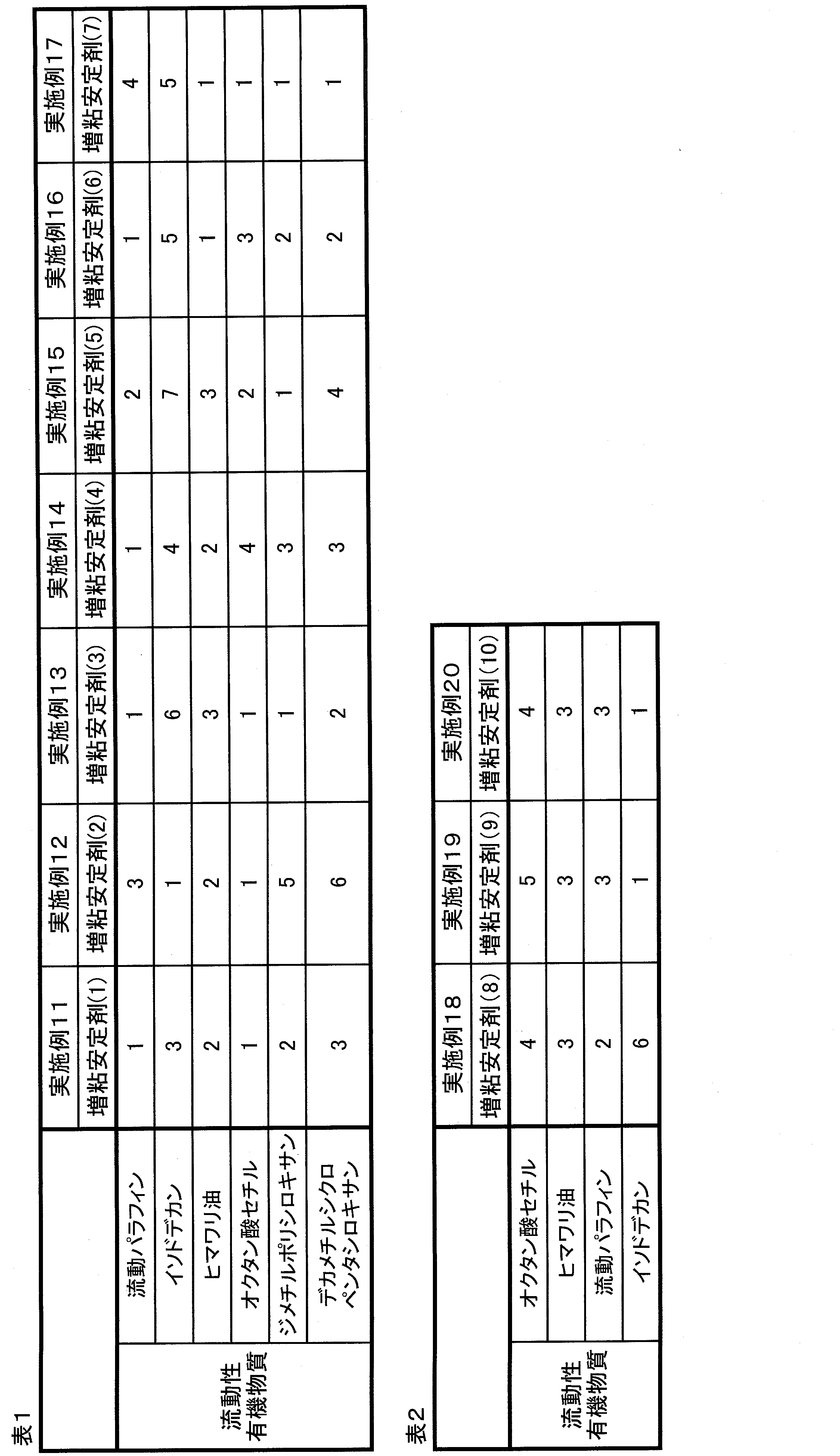
実施例11~20
表に示す各種流動性有機物質を試験管に1cm3ずつ秤とり、これに上記実施例1~10で得られた増粘安定剤(1)~(10)をそれぞれ10mg加えて混合し、各流動性有機物質についての適温(沸点が100℃未満の流動性有機物質については沸点又はそれ以下の温度(40~80℃)、沸点が100℃以上の流動性有機物質については80~100℃で加熱した。具体的には、流動性有機物質として流動パラフィンを使用した場合:80℃、イソドデカンを使用した場合:80℃、ヒマワリ油を使用した場合:100℃、オクタン酸セチルを使用した場合:100℃、ジメチルポリシロキサンを使用した場合:100℃、デカメチルシクロペンタシロキサンを使用した場合:80℃)で加熱撹拌して流動性有機物質と増粘安定剤を相溶させ、25℃まで冷却して増粘安定化組成物を得た。
得られた増粘安定化組成物の粘度を測定し、各種流動性有機物質の粘度が何倍に増粘されたかを確認し、下記基準に従って増粘安定性を評価した。
<評価基準>
1: 1.0倍を超え、2.0倍以下
2: 2.0倍を超え、4.8倍以下
3: 4.8倍を超え、10倍以下
4: 10倍を超え、50倍以下
5: 50倍を超え、100倍以下
6: 100倍を超え、600倍以下
7: 600倍を超えた
表に示す各種流動性有機物質を試験管に1cm3ずつ秤とり、これに上記実施例1~10で得られた増粘安定剤(1)~(10)をそれぞれ10mg加えて混合し、各流動性有機物質についての適温(沸点が100℃未満の流動性有機物質については沸点又はそれ以下の温度(40~80℃)、沸点が100℃以上の流動性有機物質については80~100℃で加熱した。具体的には、流動性有機物質として流動パラフィンを使用した場合:80℃、イソドデカンを使用した場合:80℃、ヒマワリ油を使用した場合:100℃、オクタン酸セチルを使用した場合:100℃、ジメチルポリシロキサンを使用した場合:100℃、デカメチルシクロペンタシロキサンを使用した場合:80℃)で加熱撹拌して流動性有機物質と増粘安定剤を相溶させ、25℃まで冷却して増粘安定化組成物を得た。
得られた増粘安定化組成物の粘度を測定し、各種流動性有機物質の粘度が何倍に増粘されたかを確認し、下記基準に従って増粘安定性を評価した。
<評価基準>
1: 1.0倍を超え、2.0倍以下
2: 2.0倍を超え、4.8倍以下
3: 4.8倍を超え、10倍以下
4: 10倍を超え、50倍以下
5: 50倍を超え、100倍以下
6: 100倍を超え、600倍以下
7: 600倍を超えた
各種流動性有機物質、及び増粘安定化組成物の粘度はコーンプレートセンサー(直径60mmでコーン角1°、直径35mmでコーン角1°、2°、4°を使用)とペルチェ温度コントローラーを装着した粘度・粘弾性測定装置(レオメータ)(商品名「RheoStress600」、HAAKE社製)を用い、25℃条件下、常流粘度測定モードにより、せん断速度を対数きざみで0.001~100(1/s)まで変化させて粘度を測定して粘度曲線を得、得られた粘度曲線からせん断速度10(1/s)における粘度を求め、それを本発明の粘度とした。尚、各プロットは装置のトルク値変動が5%範囲に収まり、データが安定した時点での値を採用した。
上記結果を下記表にまとめて示す。
本発明の式(1)で表される化合物は、流動性有機物質と相溶させることにより、容易に流動性有機物質を増粘若しくはゲル化、又は流動性有機物質を含有する組成物を均一に安定化することができる。また、本発明の式(1)で表される化合物で増粘安定化された組成物は、増粘若しくはゲル化された状態を安定的に維持することができる。そのため、本発明の式(1)で表される化合物は、化粧料、塗料、食品、医薬品等の増粘安定剤として好適に使用することができる。
Claims (4)
- 下記式(1)
(R2-HNOC)m-R1-(CONH-R3)n (1)
(式中、m+nは3又は4である。m+nが3の時、nは0、R1はベンゼン環から3個の水素原子を除いた基、R2は炭素数6以上の脂肪族炭化水素基及び芳香族炭化水素基から選択される基である。m+nが4の時、nは1~3の整数、R1はベンゼン環を2個以上含む4価の基、R2、R3は互いに異なって、炭素数6以上の脂肪族炭化水素基及び芳香族炭化水素基から選択される基である)
で表される化合物。 - 請求項1に記載の化合物を含む増粘安定剤。
- 請求項2に記載の増粘安定剤と流動性有機物質を含む増粘安定化組成物。
- 請求項2に記載の増粘安定剤と流動性有機物質を相溶させる工程を含む増粘安定化組成物の製造方法。
Priority Applications (1)
| Application Number | Priority Date | Filing Date | Title |
|---|---|---|---|
| JP2015523986A JP6312669B2 (ja) | 2013-06-25 | 2014-06-16 | 増粘安定剤、及びそれを用いた増粘安定化組成物 |
Applications Claiming Priority (4)
| Application Number | Priority Date | Filing Date | Title |
|---|---|---|---|
| JP2013132495 | 2013-06-25 | ||
| JP2013-132494 | 2013-06-25 | ||
| JP2013-132495 | 2013-06-25 | ||
| JP2013132494 | 2013-06-25 |
Publications (1)
| Publication Number | Publication Date |
|---|---|
| WO2014208380A1 true WO2014208380A1 (ja) | 2014-12-31 |
Family
ID=52141722
Family Applications (1)
| Application Number | Title | Priority Date | Filing Date |
|---|---|---|---|
| PCT/JP2014/065876 Ceased WO2014208380A1 (ja) | 2013-06-25 | 2014-06-16 | 増粘安定剤、及びそれを用いた増粘安定化組成物 |
Country Status (2)
| Country | Link |
|---|---|
| JP (1) | JP6312669B2 (ja) |
| WO (1) | WO2014208380A1 (ja) |
Cited By (10)
| Publication number | Priority date | Publication date | Assignee | Title |
|---|---|---|---|---|
| WO2015087811A1 (ja) * | 2013-12-09 | 2015-06-18 | 株式会社ダイセル | 電気デバイス製造用溶剤組成物 |
| WO2015174343A1 (ja) * | 2014-05-14 | 2015-11-19 | 株式会社ダイセル | ヘアオイル |
| WO2016006590A1 (ja) * | 2014-07-07 | 2016-01-14 | 株式会社ダイセル | 増粘安定剤、及びそれを用いた増粘安定化組成物 |
| WO2016158969A1 (ja) * | 2015-04-02 | 2016-10-06 | 株式会社ダイセル | 電気デバイス製造用溶剤組成物 |
| JP2016193847A (ja) * | 2015-03-31 | 2016-11-17 | 小林製薬株式会社 | 外用組成物 |
| JP2016213301A (ja) * | 2015-05-07 | 2016-12-15 | コスモ石油ルブリカンツ株式会社 | 磁気粘性剤組成物 |
| CN106478475A (zh) * | 2015-08-31 | 2017-03-08 | 株式会社大赛璐 | 增稠稳定剂、以及使用该增稠稳定剂的增稠稳定化组合物 |
| WO2018042933A1 (ja) * | 2016-08-29 | 2018-03-08 | 株式会社ダイセル | 増粘安定剤 |
| CN111662201A (zh) * | 2020-06-30 | 2020-09-15 | 新岸诺亚(北京)催化科技有限公司 | 3,3′,4,4′-联苯四甲酰四烷基胺及其制备方法和应用 |
| CN111675628A (zh) * | 2019-07-04 | 2020-09-18 | 新岸诺亚(北京)催化科技有限公司 | 3,3′,4,4′-联苯四甲酰四辛胺及其制备方法和应用 |
Families Citing this family (1)
| Publication number | Priority date | Publication date | Assignee | Title |
|---|---|---|---|---|
| JP6401097B2 (ja) * | 2015-03-30 | 2018-10-03 | トヨタ自動車株式会社 | 潜熱蓄熱材 |
Citations (5)
| Publication number | Priority date | Publication date | Assignee | Title |
|---|---|---|---|---|
| JPS5889393A (ja) * | 1981-11-20 | 1983-05-27 | Nippon Oil & Fats Co Ltd | 感熱記録材料 |
| JP2009263520A (ja) * | 2008-04-25 | 2009-11-12 | Adeka Corp | バイオディーゼル燃料用低温流動性向上剤 |
| JP2009263521A (ja) * | 2008-04-25 | 2009-11-12 | Adeka Corp | バイオディーゼル燃料用低温流動性向上剤 |
| JP2010121084A (ja) * | 2008-11-21 | 2010-06-03 | Adeka Corp | バイオディーゼル燃料用低温流動性向上剤 |
| JP2011145587A (ja) * | 2010-01-18 | 2011-07-28 | Konica Minolta Business Technologies Inc | 電子写真用トナー及び電子写真用トナーの製造方法 |
-
2014
- 2014-06-16 JP JP2015523986A patent/JP6312669B2/ja active Active
- 2014-06-16 WO PCT/JP2014/065876 patent/WO2014208380A1/ja not_active Ceased
Patent Citations (5)
| Publication number | Priority date | Publication date | Assignee | Title |
|---|---|---|---|---|
| JPS5889393A (ja) * | 1981-11-20 | 1983-05-27 | Nippon Oil & Fats Co Ltd | 感熱記録材料 |
| JP2009263520A (ja) * | 2008-04-25 | 2009-11-12 | Adeka Corp | バイオディーゼル燃料用低温流動性向上剤 |
| JP2009263521A (ja) * | 2008-04-25 | 2009-11-12 | Adeka Corp | バイオディーゼル燃料用低温流動性向上剤 |
| JP2010121084A (ja) * | 2008-11-21 | 2010-06-03 | Adeka Corp | バイオディーゼル燃料用低温流動性向上剤 |
| JP2011145587A (ja) * | 2010-01-18 | 2011-07-28 | Konica Minolta Business Technologies Inc | 電子写真用トナー及び電子写真用トナーの製造方法 |
Non-Patent Citations (2)
| Title |
|---|
| DAISAKU INOUE ET AL.: "Gelator and Thickener Derived from Dimethyl 5-Aminoisophthalate", CHEMISTRY LETTERS, vol. 34, no. 3, 2005, pages 348 - 349, XP055236685, DOI: doi:10.1246/cl.2005.348 * |
| KUAN-HUNG CHEN ET AL.: "A Fluorescence Sensor for Detection of Geranyl Pyrophosphate by the Chemo-Ensemble Method", JOURNAL OF ORGANIC CHEMISTRY, vol. 74, no. 2, 2009, pages 895 - 898 * |
Cited By (17)
| Publication number | Priority date | Publication date | Assignee | Title |
|---|---|---|---|---|
| JPWO2015087811A1 (ja) * | 2013-12-09 | 2017-03-16 | 株式会社ダイセル | 電気デバイス製造用溶剤組成物 |
| WO2015087811A1 (ja) * | 2013-12-09 | 2015-06-18 | 株式会社ダイセル | 電気デバイス製造用溶剤組成物 |
| WO2015174343A1 (ja) * | 2014-05-14 | 2015-11-19 | 株式会社ダイセル | ヘアオイル |
| JPWO2015174343A1 (ja) * | 2014-05-14 | 2017-04-20 | 株式会社ダイセル | ヘアオイル |
| WO2016006590A1 (ja) * | 2014-07-07 | 2016-01-14 | 株式会社ダイセル | 増粘安定剤、及びそれを用いた増粘安定化組成物 |
| US10011561B2 (en) | 2014-07-07 | 2018-07-03 | Daicel Corporation | Thickening/stabilizing agent and thickened/stabilized composition using the same |
| JP2016193847A (ja) * | 2015-03-31 | 2016-11-17 | 小林製薬株式会社 | 外用組成物 |
| WO2016158969A1 (ja) * | 2015-04-02 | 2016-10-06 | 株式会社ダイセル | 電気デバイス製造用溶剤組成物 |
| JP2016213301A (ja) * | 2015-05-07 | 2016-12-15 | コスモ石油ルブリカンツ株式会社 | 磁気粘性剤組成物 |
| JP2017048120A (ja) * | 2015-08-31 | 2017-03-09 | 株式会社ダイセル | 増粘安定剤、及びそれを用いた増粘安定化組成物 |
| CN106478475A (zh) * | 2015-08-31 | 2017-03-08 | 株式会社大赛璐 | 增稠稳定剂、以及使用该增稠稳定剂的增稠稳定化组合物 |
| CN106478475B (zh) * | 2015-08-31 | 2019-12-06 | 株式会社大赛璐 | 增稠稳定剂、以及使用该增稠稳定剂的增稠稳定化组合物 |
| WO2018042933A1 (ja) * | 2016-08-29 | 2018-03-08 | 株式会社ダイセル | 増粘安定剤 |
| JPWO2018042933A1 (ja) * | 2016-08-29 | 2019-07-11 | 株式会社ダイセル | 増粘安定剤 |
| JP7026355B2 (ja) | 2016-08-29 | 2022-02-28 | 株式会社ダイセル | 増粘安定剤 |
| CN111675628A (zh) * | 2019-07-04 | 2020-09-18 | 新岸诺亚(北京)催化科技有限公司 | 3,3′,4,4′-联苯四甲酰四辛胺及其制备方法和应用 |
| CN111662201A (zh) * | 2020-06-30 | 2020-09-15 | 新岸诺亚(北京)催化科技有限公司 | 3,3′,4,4′-联苯四甲酰四烷基胺及其制备方法和应用 |
Also Published As
| Publication number | Publication date |
|---|---|
| JPWO2014208380A1 (ja) | 2017-02-23 |
| JP6312669B2 (ja) | 2018-04-18 |
Similar Documents
| Publication | Publication Date | Title |
|---|---|---|
| JP6312669B2 (ja) | 増粘安定剤、及びそれを用いた増粘安定化組成物 | |
| JP6246138B2 (ja) | 増粘安定剤、及びそれを用いた増粘安定化組成物 | |
| JP6620349B2 (ja) | 増粘安定剤、及びそれを用いた増粘安定化組成物 | |
| JP6588338B2 (ja) | 増粘安定剤、及びそれを用いた増粘安定化組成物 | |
| WO2018163989A1 (ja) | 増粘安定剤、及びそれを用いた増粘安定化組成物 | |
| JP6464428B2 (ja) | 増粘安定剤、及びそれを用いた増粘安定化組成物 | |
| JP6558705B2 (ja) | 増粘安定剤、及びそれを用いた増粘安定化組成物 | |
| TWI760294B (zh) | 增黏安定劑、及使用其之增黏安定化組成物 | |
| JP7026355B2 (ja) | 増粘安定剤 | |
| JP6655025B2 (ja) | 増粘安定剤、及びそれを用いた増粘安定化組成物 | |
| TWI662016B (zh) | 增黏安定劑、及使用其之增黏安定化組成物 |
Legal Events
| Date | Code | Title | Description |
|---|---|---|---|
| 121 | Ep: the epo has been informed by wipo that ep was designated in this application |
Ref document number: 14816756 Country of ref document: EP Kind code of ref document: A1 |
|
| ENP | Entry into the national phase |
Ref document number: 2015523986 Country of ref document: JP Kind code of ref document: A |
|
| NENP | Non-entry into the national phase |
Ref country code: DE |
|
| 122 | Ep: pct application non-entry in european phase |
Ref document number: 14816756 Country of ref document: EP Kind code of ref document: A1 |