WO2014208156A1 - 新規肺癌マーカー(liph) - Google Patents
新規肺癌マーカー(liph) Download PDFInfo
- Publication number
- WO2014208156A1 WO2014208156A1 PCT/JP2014/058147 JP2014058147W WO2014208156A1 WO 2014208156 A1 WO2014208156 A1 WO 2014208156A1 JP 2014058147 W JP2014058147 W JP 2014058147W WO 2014208156 A1 WO2014208156 A1 WO 2014208156A1
- Authority
- WO
- WIPO (PCT)
- Prior art keywords
- cancer
- lung
- liph
- lung cancer
- marker
- Prior art date
- Legal status (The legal status is an assumption and is not a legal conclusion. Google has not performed a legal analysis and makes no representation as to the accuracy of the status listed.)
- Ceased
Links
Images




Classifications
-
- C—CHEMISTRY; METALLURGY
- C12—BIOCHEMISTRY; BEER; SPIRITS; WINE; VINEGAR; MICROBIOLOGY; ENZYMOLOGY; MUTATION OR GENETIC ENGINEERING
- C12Q—MEASURING OR TESTING PROCESSES INVOLVING ENZYMES, NUCLEIC ACIDS OR MICROORGANISMS; COMPOSITIONS OR TEST PAPERS THEREFOR; PROCESSES OF PREPARING SUCH COMPOSITIONS; CONDITION-RESPONSIVE CONTROL IN MICROBIOLOGICAL OR ENZYMOLOGICAL PROCESSES
- C12Q1/00—Measuring or testing processes involving enzymes, nucleic acids or microorganisms; Compositions therefor; Processes of preparing such compositions
- C12Q1/68—Measuring or testing processes involving enzymes, nucleic acids or microorganisms; Compositions therefor; Processes of preparing such compositions involving nucleic acids
- C12Q1/6876—Nucleic acid products used in the analysis of nucleic acids, e.g. primers or probes
- C12Q1/6883—Nucleic acid products used in the analysis of nucleic acids, e.g. primers or probes for diseases caused by alterations of genetic material
- C12Q1/6886—Nucleic acid products used in the analysis of nucleic acids, e.g. primers or probes for diseases caused by alterations of genetic material for cancer
-
- C—CHEMISTRY; METALLURGY
- C12—BIOCHEMISTRY; BEER; SPIRITS; WINE; VINEGAR; MICROBIOLOGY; ENZYMOLOGY; MUTATION OR GENETIC ENGINEERING
- C12N—MICROORGANISMS OR ENZYMES; COMPOSITIONS THEREOF; PROPAGATING, PRESERVING, OR MAINTAINING MICROORGANISMS; MUTATION OR GENETIC ENGINEERING; CULTURE MEDIA
- C12N9/00—Enzymes; Proenzymes; Compositions thereof; Processes for preparing, activating, inhibiting, separating or purifying enzymes
- C12N9/14—Hydrolases (3)
- C12N9/16—Hydrolases (3) acting on ester bonds (3.1)
- C12N9/18—Carboxylic ester hydrolases (3.1.1)
- C12N9/20—Triglyceride splitting, e.g. by means of lipase
-
- C—CHEMISTRY; METALLURGY
- C12—BIOCHEMISTRY; BEER; SPIRITS; WINE; VINEGAR; MICROBIOLOGY; ENZYMOLOGY; MUTATION OR GENETIC ENGINEERING
- C12Y—ENZYMES
- C12Y301/00—Hydrolases acting on ester bonds (3.1)
- C12Y301/01—Carboxylic ester hydrolases (3.1.1)
-
- G—PHYSICS
- G01—MEASURING; TESTING
- G01N—INVESTIGATING OR ANALYSING MATERIALS BY DETERMINING THEIR CHEMICAL OR PHYSICAL PROPERTIES
- G01N33/00—Investigating or analysing materials by specific methods not covered by groups G01N1/00 - G01N31/00
- G01N33/48—Biological material, e.g. blood, urine; Haemocytometers
- G01N33/50—Chemical analysis of biological material, e.g. blood, urine; Testing involving biospecific ligand binding methods; Immunological testing
- G01N33/53—Immunoassay; Biospecific binding assay; Materials therefor
- G01N33/575—Immunoassay; Biospecific binding assay; Materials therefor for cancer
- G01N33/57557—Immunoassay; Biospecific binding assay; Materials therefor for cancer of other specific parts of the body, e.g. brain
-
- G—PHYSICS
- G01—MEASURING; TESTING
- G01N—INVESTIGATING OR ANALYSING MATERIALS BY DETERMINING THEIR CHEMICAL OR PHYSICAL PROPERTIES
- G01N33/00—Investigating or analysing materials by specific methods not covered by groups G01N1/00 - G01N31/00
- G01N33/48—Biological material, e.g. blood, urine; Haemocytometers
- G01N33/50—Chemical analysis of biological material, e.g. blood, urine; Testing involving biospecific ligand binding methods; Immunological testing
- G01N33/53—Immunoassay; Biospecific binding assay; Materials therefor
- G01N33/575—Immunoassay; Biospecific binding assay; Materials therefor for cancer
- G01N33/5758—Immunoassay; Biospecific binding assay; Materials therefor for cancer involving compounds serving as markers for tumours, cancers or neoplasias, e.g. cellular determinants, receptors, heat shock/stress proteins, A-protein, oligosaccharides or metabolites
- G01N33/57585—Immunoassay; Biospecific binding assay; Materials therefor for cancer involving compounds serving as markers for tumours, cancers or neoplasias, e.g. cellular determinants, receptors, heat shock/stress proteins, A-protein, oligosaccharides or metabolites involving compounds identifiable in body fluids
-
- C—CHEMISTRY; METALLURGY
- C12—BIOCHEMISTRY; BEER; SPIRITS; WINE; VINEGAR; MICROBIOLOGY; ENZYMOLOGY; MUTATION OR GENETIC ENGINEERING
- C12Q—MEASURING OR TESTING PROCESSES INVOLVING ENZYMES, NUCLEIC ACIDS OR MICROORGANISMS; COMPOSITIONS OR TEST PAPERS THEREFOR; PROCESSES OF PREPARING SUCH COMPOSITIONS; CONDITION-RESPONSIVE CONTROL IN MICROBIOLOGICAL OR ENZYMOLOGICAL PROCESSES
- C12Q2600/00—Oligonucleotides characterized by their use
-
- C—CHEMISTRY; METALLURGY
- C12—BIOCHEMISTRY; BEER; SPIRITS; WINE; VINEGAR; MICROBIOLOGY; ENZYMOLOGY; MUTATION OR GENETIC ENGINEERING
- C12Q—MEASURING OR TESTING PROCESSES INVOLVING ENZYMES, NUCLEIC ACIDS OR MICROORGANISMS; COMPOSITIONS OR TEST PAPERS THEREFOR; PROCESSES OF PREPARING SUCH COMPOSITIONS; CONDITION-RESPONSIVE CONTROL IN MICROBIOLOGICAL OR ENZYMOLOGICAL PROCESSES
- C12Q2600/00—Oligonucleotides characterized by their use
- C12Q2600/158—Expression markers
-
- G—PHYSICS
- G01—MEASURING; TESTING
- G01N—INVESTIGATING OR ANALYSING MATERIALS BY DETERMINING THEIR CHEMICAL OR PHYSICAL PROPERTIES
- G01N2333/00—Assays involving biological materials from specific organisms or of a specific nature
- G01N2333/90—Enzymes; Proenzymes
- G01N2333/914—Hydrolases (3)
- G01N2333/916—Hydrolases (3) acting on ester bonds (3.1), e.g. phosphatases (3.1.3), phospholipases C or phospholipases D (3.1.4)
- G01N2333/918—Carboxylic ester hydrolases (3.1.1)
-
- G—PHYSICS
- G01—MEASURING; TESTING
- G01N—INVESTIGATING OR ANALYSING MATERIALS BY DETERMINING THEIR CHEMICAL OR PHYSICAL PROPERTIES
- G01N33/00—Investigating or analysing materials by specific methods not covered by groups G01N1/00 - G01N31/00
- G01N33/48—Biological material, e.g. blood, urine; Haemocytometers
- G01N33/50—Chemical analysis of biological material, e.g. blood, urine; Testing involving biospecific ligand binding methods; Immunological testing
- G01N33/53—Immunoassay; Biospecific binding assay; Materials therefor
- G01N33/575—Immunoassay; Biospecific binding assay; Materials therefor for cancer
- G01N33/5752—Immunoassay; Biospecific binding assay; Materials therefor for cancer of the lungs
Definitions
- the present invention relates to the technical field of clinical diagnostic agents that assist in the diagnosis of cancer. Furthermore, the present invention relates to a cancer marker, particularly a lung cancer marker for detecting lung cancer, and an esophageal cancer marker for detecting esophageal cancer.
- Cancer is increasing due to the aging of the population, etc., and in 2012, cancer patients reached 32 million in the world, and it is said that 14.2 million people were newly diagnosed with cancer in one year. In Japan, cancer is the leading cause of death, with 340,000 deaths annually. Cancer has become a disease that can be treated if detected early, and early detection of cancer is important. Endoscopic examination, PET, CT, and the like have been developed for early detection of cancer, but development of cancer markers is indispensable for efficiently examining a large number of subjects. Various cancer markers have already been developed. In lung cancer and esophageal cancer, further development of cancer markers is desired. Lung cancer is one of the diseases with a poor prognosis whose early detection is difficult and its 5-year survival rate is less than 20%.
- the type (histological type) of lung cancer is classified pathologically into small cell lung cancer and non-small cell lung cancer, and the latter is further classified into squamous cell carcinoma, adenocarcinoma, and large cell carcinoma.
- CYFRA 21-1, CEA, SLX, SCC, ProGRP, NSE, and the like are currently frequently used as lung cancer markers.
- CEA is the most common tumor marker, and SLX is highly specific for adenocarcinoma.
- CYFRA 21-1 and SCC are said to be highly specific for squamous cell carcinoma
- ProGRP and NSE are said to be highly specific for small cell carcinoma.
- Patent Document 1 reports that the sensitivity is improved when NNMT is used in combination with conventional markers such as CYFRA 21-1, CEA, NSE, and SCC.
- Non-Patent Document 1 reports a lung cancer marker using a sugar chain.
- esophageal cancer is one of the most fatal malignant tumors in the digestive tract, and when esophageal cancer is discovered by examination, the pathological condition has often progressed considerably. Even after radical treatment at stage 1, the survival rate after 5 years is still as low as 40-60%.
- Non-patent Document 2 Opa interacting protein 5 has been reported as a biomarker for lung cancer and esophageal cancer.
- Cancer markers used clinically such as CEA, still have a low detection rate. For example, early lung cancer has a detection rate of about 30%, and a new marker with higher sensitivity is desired. Then, this invention makes it a 1st subject to provide a novel cancer marker. Moreover, this invention makes it a 2nd subject to provide a cancer marker with high detection efficiency. Furthermore, this invention makes it a 3rd subject to provide a novel lung cancer marker. Moreover, this invention makes it a 4th subject to provide a lung cancer marker with high detection efficiency. Moreover, this invention makes it a 5th subject to provide the lung cancer marker which can specify the kind (tissue type
- a sixth object to provide a lung cancer marker that can improve detection efficiency and / or detection specificity by combining with other lung cancer markers. Furthermore, this invention makes it the 7th subject to provide a novel esophageal cancer marker. Moreover, this invention makes it an 8th subject to provide an esophageal cancer marker with high detection efficiency. In addition, a ninth object is to provide an esophageal cancer marker that can improve detection efficiency and / or detection specificity by combining with other esophageal cancer markers.
- LIPH lipase, member H
- adenocarcinoma-derived cell lines whose expression is enhanced compared to normal lung-derived epithelial cells, and may be highly expressed in lung cancer and esophageal cancer.
- the present invention was completed.
- the inventors of the present application showed that LIPH was stained in lung tumor tissue but not in stromal tissue, and even in the protein level of clinical samples. It was clarified that expression in the tissue was enhanced.
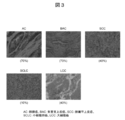
- the expression of LIPH protein by lung cancer histological type showed high positive rate of 70% for lung adenocarcinoma and 70% for bronchioloalveolar carcinoma, while 30% for lung squamous cell carcinoma
- the expression was confirmed in only 1 out of 10 samples in cell cancer, which was slightly low at 20%, and the LIPH protein was found to be a protein specifically expressed in lung adenocarcinoma.
- the present inventors provide a marker that identifies the lung cancer tissue type.
- the present invention is excellent in providing a novel and highly reliable lung cancer marker.
- LIPH is an excellent marker in that lung adenocarcinoma can be specifically detected.
- FIG. 1 shows the expression of lung cancer markers in lung cancer cell lines.
- FIG. 2 shows the expression of lung cancer marker LIPH in lung cancer tissue.
- FIG. 3 shows the results of observing the expression of LIPH by lung cancer histology.
- FIG. 4 shows the amount of LIPH detected in the serum of healthy individuals and cancer patients.
- FIG. 5 shows a correlation plot with CEA.
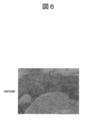
- FIG. 6 shows the results of observing the expression of LIPH for each esophageal cancer histological type.
- the inventors of the present application first selected candidate genes that are expected to be significantly higher in lung cancer. Among the candidate genes, a plurality of lung cancer-derived cell lines having higher expression levels than normal lung-derived epithelial cells were further selected to complete the cancer marker. 2. Cancer marker gene, lung cancer marker gene, esophageal cancer marker gene The present inventors have identified a LIPH (lipase, member H) gene as a cancer marker. Furthermore, the present inventors have identified the LIPH (lipase, member H) gene as a lung cancer marker and an esophageal cancer marker.
- LIPH lipase, member H
- Confirmation of expression of cancer marker gene, lung cancer marker gene, and / or esophageal cancer marker gene For confirmation of gene expression, a well-known method for detecting mRNA of the gene or a protein encoded by the gene can be used. As a method for confirming the presence of mRNA, for example, a LAMP method, a PCR method, a microarray method, or the like can be used. As a protein confirmation method, a method using an antibody such as an immunostaining method or an ELISA method can be used. 4).
- a method for confirming the presence of cancer cells using a cancer marker a method for assisting cancer diagnosis, a method for confirming the presence of lung cancer cells using a lung cancer marker, a method for assisting diagnosis of lung cancer, and an esophageal cancer marker 4.
- Sample as a sample (sample) for use in the method for confirming the presence of cancer cells, lung cancer cells or esophageal cancer cells, any sample can be used.
- biopsy samples can be obtained by crushing cells and extracting total RNA by conventional methods such as surfactants, homogenizers, or freeze sawing.
- a LAMP method for quantification of the target mRNA, a LAMP method, a differential display method, a method using a DNA array (DNA chip), a quantitative PCR method, a real-time PCR method, or a competitive PCR method can be used.
- the real-time PCR method there is a method of monitoring and analyzing production of marker gene amplification products in real time. Examples of the real-time monitoring reagent include SYBRGreen I and TaqMan probe.
- cDNA is prepared from intracellular total RNA or mRNA using reverse transcriptase, and the cDNA and DNA competitor are reacted in the same tube.
- examples include a method of reacting by adding an RNA competitor together with mRNA.
- the internal sequence other than the competitor primer sequence may be, for example, a sequence homologous to the sequence of the amplification-target mRNA or a non-homologous sequence.
- cDNA can be prepared from total extracted RNA by reverse transcription reaction using Oligo dT primer, and this can be measured by real-time PCR.
- ISOGEN method Nippon Gene
- PrimeScript® II 1st strand cDNA Synthesis Kit can be used for reverse transcription.
- the amplification product can be measured using THUNDERBIRD (trademark) SYBR Mix (TOYOBO), TaqMan probe, or the like.
- THUNDERBIRD trademark
- TOYOBO Tip-Bridge
- TaqMan probe or the like.
- the primer may be any primer as long as it can amplify the LIPH gene, which is a cancer marker gene, lung cancer marker gene and / or esophageal cancer marker gene, by a gene amplification method such as PCR.
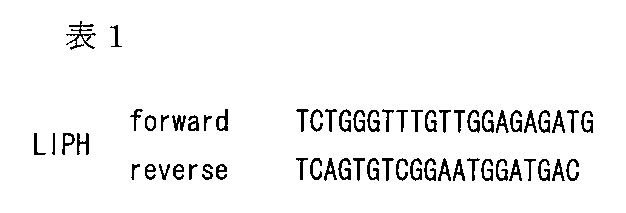
- any sequence of 15 or more bases in length A primer having a length of preferably 16-30 bases, more preferably 18-28 bases can be used. Specifically, those described in Table 1 below can be used.
- a differential display method or a DNA array (DNA chip) can also be used.
- a labeled probe having a sequence complementary to the sequence represented by SEQ ID NO: 1 or a sequence in which 1 to several bases are deleted, substituted, and / or added to the same sequence is used. it can.
- the probe label examples include radioisotopes, fluorescent substances, luminescent substances, enzymes, and the like.
- radioisotope for example, [32P], [33P], [125I], [131I] and the like can be used.
- fluorescent substance for example, Cy2, Cy3, Cy5, Cy5.5, Cy7, fluorescein isothiocyanate, fluorescamine, rhodamine and the like can be used.
- the enzyme include alkaline phosphatase, peroxidase, ⁇ -galactosidase, ⁇ -glucosidase, malate dehydrogenase and the like, which are commonly used as labels. 4-2-1.
- kits for carrying out the mRNA detection method include (1) a primer or a set of primers (primers) that can amplify a LIPH (lipase, member H) lung cancer or esophageal cancer marker gene by a gene amplification method such as the LAMP method.
- Method for detecting a protein in a sample In the present invention, any method can be used as a method for detecting a marker protein as long as it can specifically detect the marker protein, such as a method for detection using an antibody or mass spectrometry. good.
- an antibody against a protein encoded by the LIPH gene may be a commercially available one, but may be prepared by a conventional method.
- Marker protein detection methods using antibodies include immunostaining, immunofluorescence, various enzyme immunoassays, radioimmunoassay (RIA) / enzyme linked immunoassay (ELISA), double monoclonal antibody sandwich immunoassay, monoclonal polyclonal antibody Examples include a sandwich assay method, a Western blotting method, a biotin-avidin method, and an immunoprecipitation method. 4-3-1.
- a kit for carrying out the above-mentioned protein detection method of 4.3 the following may be mentioned.
- kits for carrying out the sandwich ELISA method include the following reagents.
- (2) (i) Monoclonal antibody or polyclonal antibody, (ii) Enzyme labeled monoclonal antibody or polyclonal antibody, and (iii) Substrate solution A kit for carrying out the biotin-avidin method contains the following reagents.
- the kit for carrying out the sandwich ELISA method and the biotin-avidin method comprises the following reagents: Is included.
- (4) (i) monoclonal antibody or polyclonal antibody, (ii) biotinylated monoclonal antibody or polyclonal antibody, (iii) enzyme-labeled avidin or streptavidin, and (iv) substrate solution.
- the substrate solution is labeled with alkaline phosphatase (AP)
- p-nitrophenyl phosphate-containing buffer solution is used.
- HRPO horseradish peroxidase
- o-phenylenediamine-containing buffer solution is used.
- galactosidase a buffer containing 4-methylumbellyl ferryl- ⁇ -galactoside can be used.
- a method using a biotinylated antibody a known method can be used.
- a method of binding a conjugate of streptavidin and peroxidase to biotin is used. Examples of such peroxidase include horseradish peroxidase.
- the inventors of the present application obtained eight kinds of novel lung cancer marker candidate factors by a preliminary study in which candidate genes that are expected to be significantly high in lung cancer are first selected.
- qPCR was performed using a lung cancer-derived cell line to verify the expression of each candidate factor at the mRNA level.
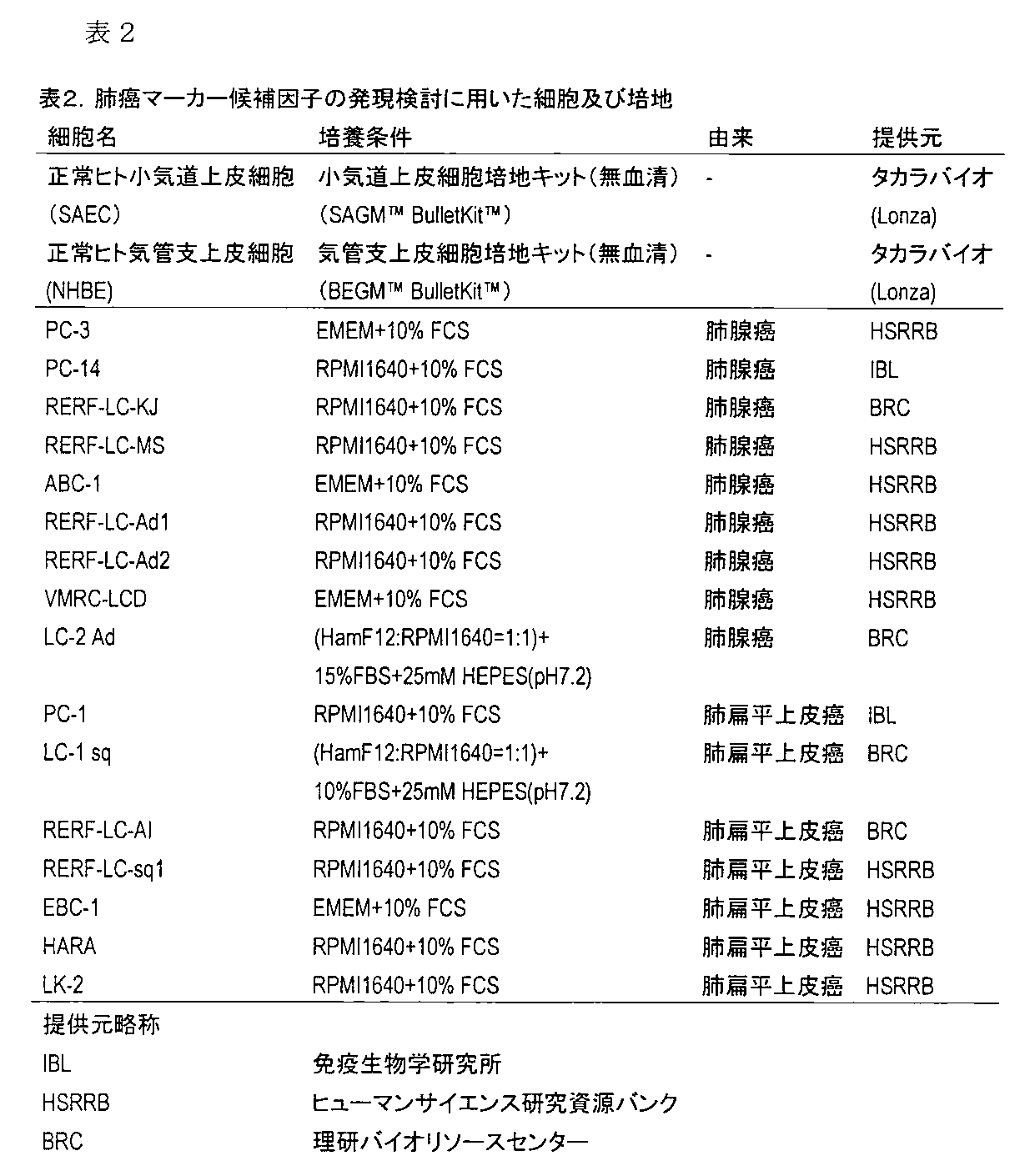
- 16 types of lung cancer-derived cell lines and 2 types of normal lung-derived cells were cultured to confluence on 6-well plates using the cells described in Table 2.
- RNA extraction was performed using ISOGEN (Nippon Gene) or RNA easy mini kit (QIAGEN). Using the extracted 500 ng of total RNA as a template, cDNA was synthesized using PrimeScript II 1st strand synthesis kit (Takara Bio Inc.).
- qPCR was performed using THUNDERBIRD SYBR Mix (TOYOBO) using the synthesized cDNA as a template.
- the results for LIPH lipase, member H are shown in FIG.
- SAEC small airway epithelial cells
- NHBE alveolar epithelial cells
- expression was more than doubled in multiple lung adenocarcinoma cell lines.
- expression was increased in lung squamous cell carcinoma cell lines.
- the vertical axis of the graph in the figure indicates the value obtained by dividing the gene expression level by the expression level of the internal standard gene GAPDH as a relative value to the expression level of the PC-3 cells.
- tissue microarray (Shanghai Outdo) using a proteintech anti-LIPH rabbit polyclonal antibody.
- the tissue microarray used is spotted with 60 specimens of lung cancer tissue and formalin-fixed paraffin-embedded sections of 60 specimens of peripheral normal tissue derived from the same donor as the cancer specimen.
- the types of lung cancer are lung squamous cell carcinoma, lung adenocarcinoma, lung adenosquamous cell carcinoma, bronchioloalveolar carcinoma, 10 large cell carcinomas and 10 small cell lung cancer samples.
- the tumor cells were positive for cytoplasm in lung adenocarcinoma, cell surface in bronchial epithelial cancer, membrane and nucleus in squamous cell carcinoma, and mainly in nucleus in small cell lung cancer.
- Lung cancer patient serum was purchased from Bizcom Japan, and healthy human serum samples were procured from Eiken.
- 100 ⁇ g / well of anti-LIPH rabbit polyclonal antibody (Proteintech) was immobilized on Maxisoap (nunc) at 4 ° C. overnight, followed by overnight blocking at 25 ° C. using 25% Block Ace. After removing the blocking solution, 100 ⁇ g / well of a serum sample diluted 10-fold with 10% Block Ace was added and reacted at room temperature for 1 hour. After washing 3 times with 10 mM PBS (pH 7.2), an anti-LIPH mouse polyclonal antibody (Sigma) diluted 1: 500 was added and reacted at room temperature for 1 hour.
- the CEA value of the serum sample used in Example 4 was measured.
- An E test “TOSOH” II CEA immunoreaction reagent (Tosoh) was used as a measuring reagent, and AIA-800 (Tosoh) was used as a measuring apparatus.
- tissue microarray (Shanghai Outdo) using an anti-LIPH rabbit polyclonal antibody manufactured by Proteintech.
- the tissue microarray used is spotted with formalin-fixed paraffin-embedded sections of 6 specimens of esophageal cancer tissue and 6 surrounding normal tissues derived from the same donor as the cancer specimen. All esophageal cancer specimens were squamous cell carcinoma. First, xylene treatment for 10 minutes, twice with 100% EtOH (ethanol) for 10 minutes, followed by treatment with 90% EtOH for 10 minutes, and finally treatment with 70% EtOH ethanol for 10 minutes.
- the present invention can be used in industries that manufacture diagnostic agents and diagnostic kits. More specifically, tumor diagnostic agents and diagnostic kits can be used in the manufacturing industry. All publications, patents and patent applications cited herein are incorporated herein by reference in their entirety.
Landscapes
- Health & Medical Sciences (AREA)
- Chemical & Material Sciences (AREA)
- Life Sciences & Earth Sciences (AREA)
- Engineering & Computer Science (AREA)
- Organic Chemistry (AREA)
- Zoology (AREA)
- Wood Science & Technology (AREA)
- Genetics & Genomics (AREA)
- Immunology (AREA)
- Biochemistry (AREA)
- Bioinformatics & Cheminformatics (AREA)
- General Health & Medical Sciences (AREA)
- Molecular Biology (AREA)
- Proteomics, Peptides & Aminoacids (AREA)
- General Engineering & Computer Science (AREA)
- Pathology (AREA)
- Analytical Chemistry (AREA)
- Microbiology (AREA)
- Biotechnology (AREA)
- Biomedical Technology (AREA)
- Physics & Mathematics (AREA)
- Hematology (AREA)
- Urology & Nephrology (AREA)
- Medicinal Chemistry (AREA)
- Hospice & Palliative Care (AREA)
- Oncology (AREA)
- Biophysics (AREA)
- Food Science & Technology (AREA)
- Cell Biology (AREA)
- General Physics & Mathematics (AREA)
- Measuring Or Testing Involving Enzymes Or Micro-Organisms (AREA)
- Peptides Or Proteins (AREA)
- Investigating Or Analysing Biological Materials (AREA)
Abstract
Description
すでに、種々の癌マーカーが開発されているが、肺癌及び食道癌では、更なる癌マーカーの開発が望まれている。
肺癌は早期発見が困難でその5年生存率は20%に満たない予後不良な疾患の一つである。しかし、Stage IA、IBの早期肺癌に限ればその5年生存率は70%程度と大幅に上昇する。肺癌の種類(組織型)は病理学的にはその形態から小細胞性肺癌及び非小細胞性肺癌に分類され、後者はさらに扁平上皮癌、腺癌、大細胞癌に分類されている。肺癌マーカーとして現在良く使用されているものには、CYFRA21−1、CEA、SLX、SCC、ProGRP、NSEなどがある。CEAはもっとも一般的な腫瘍マーカーであり、SLXは腺癌に特異性が高い。CYFRA21−1やSCCは扁平上皮癌に特異性が高いとされ、ProGRPやNSEは小細胞癌に特異性が高いといわれている。
また、例えば、特許文献1には、従来からのCYFRA 21−1、CEA、NSE、SCC等のマーカーと組み合わせてNNMTを用いると感度が向上することを報告している。非特許文献1には、糖鎖を利用した肺癌マーカーが報告されている。
また、食道癌は、消化器での一番の致死性の悪性腫瘍の一つであり、検査で食道癌が発見されたときには、すでに病状が相当に進行していることが多い。ステージ1で根治的治療をしても5年後生存率は、依然、40−60%と低いのが現状である。しかしながら、食道癌マーカーについては、診断、治療効果判定、予後評価のいずれかにでも有用であるものは残念ながら少ない現状である。扁平上皮癌では、SCCとCEAが、腺癌ではCEAが使われ、他に食道癌マーカーとしてはp53抗体、及びCYFRA21−1がある。
なお、肺癌、食道癌のバイオマーカーとして、Opa interacting protein 5が報告されている(非特許文献2)。
更に、本願発明は、新規な食道癌マーカーを提供することを第7の課題とする。また、本願発明は、検出効率が高い食道癌マーカーを提供することを第8の課題とする。その上、他の食道癌マーカーと組み合わせることにより、検出効率及び/又は検出特異性を向上させることができる食道癌マーカーを提供することを第9の課題とする。
本願発明者らは、LIPH(lipase,member H)は複数の肺腺癌由来細胞株で正常肺由来上皮細胞と比較して発現が亢進し、肺癌及び食道癌において高発現している可能性が高いことを見出し、本願発明を完成させた。
さらに本願発明者らは、肺癌組織マイクロアレイを用いた免疫組織染色の結果、LIPHは肺腫瘍組織で染色が見られたが間質組織では染色が見られず、臨床サンプルのタンパク質レベルにおいても肺腫瘍組織での発現が亢進することを明らかにした。LIPHタンパク質の発現を肺癌の組織型別に見てみると、肺腺癌で70%、細気管支肺胞上皮癌で70%と高い陽性率を示した一方で、肺扁平上皮癌で30%、大細胞癌で20%とやや低く、小細胞癌では10検体中1検体のみでその発現が確認され、LIPHタンパク質が肺腺癌に特異的に発現するタンパク質であることを見出した。これらの知見に基づき、本願発明者らは、肺癌の組織型を特定するマーカーを提供する。
本願発明は、新規な、高い信頼性の肺癌マーカーを提供するという優れたものである。特にLIPHは、肺腺癌を特異的に検出できる点で優れたマーカーである。
また本願発明者らは、食道癌の組織マイクロアレイを用いた免疫組織染色の結果、LIPHは食道癌組織で染色が見られたが間質組織では染色が見られなかった。
本明細書は本願の優先権の基礎である日本国特許出願2013−136820号の明細書および/または図面に記載される内容を包含する。
図2は、肺癌マーカーLIPHの肺癌組織における発現を示す。
図3は、LIPHの発現を肺癌組織型別に観察した結果を示す。
図4は、健常人とがん患者におけるLIPHの血清中の検出量を示す。
図5は、CEAとの相関プロットを示す。
図6は、LIPHの発現を食道癌組織型別に観察した結果を示す。
本願発明者らは、癌マーカーを開発するために、肺癌で発現が有意に高いと予想される候補遺伝子をまず選抜した。その候補遺伝子の中から、複数の肺癌由来細胞株で正常肺由来上皮細胞と比較して発現量が高いものを更に選抜し、癌マーカーを完成させた。
2.癌マーカー遺伝子、肺癌マーカー遺伝子、食道癌マーカー遺伝子
本願発明者らは、癌マーカーとして、LIPH(lipase,member H)遺伝子を同定した。
さらに、本願発明者らは、LIPH(lipase,member H)遺伝子を肺癌マーカー及び食道癌マーカーとして同定した。
以下の実施例に示されるとおり、上記遺伝子は、複数の種類の肺癌由来細胞株で、正常肺由来細胞と比較して発現が亢進していたことが確認されている。さらに、免疫染色により、肺癌組織及び食道癌組織から上記遺伝子産物であるLIPHが検出されている。また、本マーカーは、肺癌及び食道癌への特異性に加え、肺癌切除後の予後との相関性が高く、肺癌の予後予測に使える可能性が非常に高いマーカーである。
3.癌マーカー遺伝子、肺癌マーカー遺伝子,及び/又は食道癌マーカー遺伝子の発現の確認
遺伝子発現の確認には、当該遺伝子のmRNA又は当該遺伝子がコードする蛋白質を検出する周知の方法を用いることができる。mRNAの存在を確認する方法としては、例えば、LAMP法、PCR法、マイクロアレイ法などを用いることができる。蛋白質の確認方法としては、免疫染色法、ELISA法などの抗体を用いる方法などを用いることができる。
4.癌マーカーを用いた、癌細胞の存在を確認する方法及び癌診断を補助する方法、肺癌マーカーを用いた、肺癌細胞の存在を確認する方法及び肺癌診断を補助する方法、食道癌マーカーを用いた、食道癌細胞の存在を確認する方法及び食道癌診断を補助する方法
4−1.サンプル
癌細胞、肺癌細胞又は食道癌細胞の存在を確認する方法に使用するためのサンプル(試料)としては、任意の試料を用いることができるが、好適には被験者からの採取物、具体的には、任意の採取された体液、生検された試料を挙げることができる。特に好適には、被験者の肺疾患部又は食道疾患部の生検試料または喀痰試料を挙げることができる。
4−2.サンプル中のmRNAの検出法並びにそのための試薬及びキット
例えば、生検試料は、細胞を、例えば、界面活性剤、ホモジナイザー、又はフリーズソーイングなどの定法により、破砕し、全RNAを抽出することができる。目的のmRNAの定量には、LAMP法、ディファレンシャルディスプレイ法やDNAアレイ(DNAチップ)を用いる方法、定量PCR法、リアルタイムPCR法、コンペティティブPCR法を利用することができる。
例えば、リアルタイムPCR法では、マーカー遺伝子の増幅産物の生成をリアルタイムでモニタリングし、解析する方法があげられる。前記リアルタイムモニタリング試薬としては、例えば、SYBRGreen I、TaqManプローブ等が挙げられる。
また、コンペティティブPCR法としては、例えば、細胞内の全RNAやmRNAから逆転写酵素を用いてcDNAを調製し、当該cDNA及びDNAコンペティターを同一チューブ内で反応させる方法や、さらに前記逆転写反応時にmRNAとともにRNAコンペティターを加えて反応させる方法等があげられる。またコンペティターのプライマー配列以外の内部配列としては、例えば、増幅目的mRNAの配列と相同配列でもよく、非相同な配列でもよい。
また、リアルタイムPCR法を利用する場合について、より具体的に例示すると、全抽出RNAからOligo dTプライマーを用いて逆転写反応で、cDNAを調製し、これをリアルタイムPCRで計測することができる。RNA抽出には、例えば、ISOGEN法(ニッポンジーン)を用いることができる。また、逆転写法には、例えば、PrimeScript(R) II 1st strand cDNA Synthesis Kitを用いることができる。リアルタイムPCRには、例えば、THUNDERBIRD(商標) SYBR Mix(TOYOBO社)やTaqManプローブなどを用いて増幅産物を測定することができる。
また、LIPH遺伝子の配列又は同配列に1から数個の塩基が欠失、置換、及び/又は付加された配列に相補的な配列の標識したプローブによるハイブリダイゼーション方法も含まれる。
なお、プライマーとしては、癌マーカー遺伝子、肺癌マーカー遺伝子及び/又は食道癌マーカー遺伝子であるLIPH遺伝子をPCR法などの遺伝子増幅方法で増幅できるプライマーであれば、いずれのプライマーでもよい。LIPH遺伝子、例えば、配列番号1で示される配列又は同配列に1から数個の塩基が欠失、置換、及び/又は付加された配列について、その配列の任意の連続する15塩基長以上の塩基、好ましくは16−30塩基長、より好ましくは、18~28塩基長からなるプライマーを使用することができる。具体的には、以下の表1に記載のものを用いることができる。
更にハイブリダイゼーション法には、配列番号1で示される配列又は同配列に1から数個の塩基が欠失、置換、及び/又は付加された配列に相補的な配列の標識したプローブを用いることができる。
プローブの標識としては、例えば、放射性同位元素、蛍光物質、発光物質、酵素などを挙げることができる。放射性同位元素としては、例えば、〔32P〕、〔33P〕、〔125I〕、〔131I〕などを用いることができる。蛍光物質としては、例えば、Cy2、Cy3、Cy5、Cy5.5、Cy7、フルオレセインイソチオシアネート、フルオレスカミン、ローダミンなどを用いることができる。酵素としては、例えば、標識として常用される、アルカリフォスファターゼ、パーオキシダーゼ、β−ガラクトシダーゼ、β−グルコシダーゼ、リンゴ酸脱水素酵素などが挙げられる。
4−2−1.
上記mRNA検出方法を実施するためのキットとしては、例えば、(1)LIPH(lipase,member H)肺癌又は食道癌マーカー遺伝子をLAMP法などの遺伝子増幅方法で増幅できるプライマー又は1組のプライマー(プライマーセット)を含むキット、(2)一例を挙げれば、表1に掲げた1組のプライマー(プライマーセット)を含むキットが挙げられる。
4−3.サンプル中のタンパク質の検出方法
本願発明では、マーカー蛋白質の検出法として、例えば、抗体を用いて検出する方法や質量分析法などマーカー蛋白質を特異的に検出できる方法であればいかなる方法を用いても良い。抗体を用いる方法では、上記LIPH遺伝子によりコードされるタンパク質に対する抗体は、既に市販されているものを利用しても良いが、定法により調製してもよい。抗体を用いるマーカー蛋白質の検出法としては、免疫染色法、免疫蛍光法、各種のエンザイムイムノアッセイ、ラジオイムノアッセイ(RIA)・酵素結合免疫測定法(ELISA)、二重モノクローナル抗体サンドイッチイムノアッセイ法、モノクローナルポリクローナル抗体サンドイッチアッセイ法、ウェスタンブロッティング法、ビオチン−アビジン法、免疫沈降法などを挙げることができる。
4−3−1.
例えば、上記4.3のタンパク質検出方法を実施するためのキットとしては次のようなものが挙げられる。
(1)(i)酵素標識化モノクローナル抗体及び(ii)基質溶液
サンドイッチELISA法を実施するためのキットとしては下記の試薬を含むものがある。
(2)(i)モノクローナル抗体又はポリクローナル抗体、(ii)酵素標識化モノクローナル抗体又はポリクローナル抗体、及び(iii)基質溶液
ビオチン−アビジン法を実施するためのキットは下記の試薬を含むものである。
(3)(i)ビオチン化モノクローナル抗体又はポリクローナル抗体、(ii)酵素標識化アビジン又はストレプトアビジン、及び(iii)基質溶液
サンドイッチELISA法及びビオチン−アビジン法を実施するためのキットは下記の試薬を含むものである。
(4)(i)モノクローナル抗体又はポリクローナル抗体、(ii)ビオチン化モノクローナル抗体又はポリクローナル抗体、(iii)酵素標識化アビジン又はストレプトアビジン及び(iv)基質溶液
なお上記の基質溶液とは、抗体に標識した酵素の基質であって、酵素反応により検出可能な変化を生じる基質を含有する溶液のことである。例えば、基質溶液としては、アルカリフォスファターゼ(AP)で標識した場合はp−ニトロフェニルリン酸含有緩衝液が、ホースラディシュパーオキシダーゼ(HRPO)で標識した場合はo−フェニレンジアミン含有緩衝液が、β−ガラクトシダーゼで標識した場合は、4−メチルウンベリルフェリル−β−ガラクトシドを含有する緩衝液を用いることができる。
ビオチン化抗体を用いる方法としては公知の方法を用いることができるが、好ましくはストレプトアビジンとパーオキシダーゼとのコンジュゲートをビオチンに結合させる方法を用いる。このようなパーオキシダーゼとしては、ホースラディッシュパーオキシダーゼが挙げられる。さらに、パーオキシダーゼの検出には、そのパーオキシダーゼの作用によって発色する物質を用いることが好ましい。
以下に本願発明を、実施例を用いてより具体的に説明する。但し、本願は以下の実施例により限定されるものではない。
LIPH(lipase,member H)についての結果を図1に示す。正常肺由来上皮細胞(SAEC :小気道上皮細胞、NHBE:肺胞上皮細胞)と比較し、複数の肺腺癌細胞株で2倍以上の発現が確認された。また、肺扁平上皮癌細胞株で発現が上昇していた。図中グラフの縦軸は遺伝子の発現量を内部標準遺伝子GAPDHの発現量で除した値を、PC−3細胞の発現量との相対値で示している。
まず、キシレン処理を10分間、2回、100%EtOH(エタノール)で10分間処理を2回、した後、90%EtOHで10分間処理し、最後に、70%EtOHエタノールで10分間処理して、脱パラフィンし、親水化した。
次に、10mMクエン酸緩衝液中で110℃10分間オートクレーブを行うことで抗原の賦活化を行った。0.3%H2O2/MeOHで30分処理して、内在性ペルオキシダーゼを失活させた。その後、Vectastain ABCキット(Vector社)を用いて免疫染色を行い、DAB Peroxidase Substrate Kit(Vector社)を用いて発色を行った。また、免疫染色後にヘマトキシリン(Sigma社)で対比染色を行った。
顕微鏡(BX50(OLYMPUS社)、EOS kiss X6iで観察し、撮影した結果を図2に示す。肺腺癌組織において、腫瘍細胞の細胞質で強く発現していることが明らかとなった。
まず、キシレン処理を10分間、2回、100%EtOH(エタノール)で10分間処理を2回、した後、90%EtOHで10分間処理し、最後に、70%EtOHエタノールで10分間処理して、脱パラフィンし、親水化した。
抗原の賦活化は10mMクエン酸緩衝液(pH6.0)中で100℃、20分間加熱処理することで行い、内在性ペルオキシダーゼを失活させるため、0.3%過酸化水素/メタノールで30分間スライドを処理した。染色にはタイラマイドを利用したビオチンフリー免疫染色増感システムCASII(Dako社)を使用し、製造者のプロトコールに従って行った。DAB Peroxidase Substrate Kit(Vector社)を用いて発色を行った後、ヘマトキシリン(Sigma社)で対比染色を行った。観察はIX59顕微鏡(オリンパス)を用い、EOS Kiss X6i(Canon)を用いて画像を取得した。
結果を図6に示す。図6より、LIPHは、食道癌のマーカーとしても用いることができることが明らかとなった。
本明細書で引用した全ての刊行物、特許および特許出願をそのまま参考として本明細書にとり入れるものとする。
Claims (15)
- LIPH遺伝子によりコードされるポリペプチドである癌マーカー。
- 癌が肺癌又は食道癌である請求の範囲第1項記載の癌マーカー。
- LIPHをコードするmRNAである癌マーカー。
- 癌が肺癌又は食道癌である請求の範囲第3項記載の癌マーカー。
- 配列番号1で示される配列又は同配列に1から数個の塩基が欠失、置換、及び/又は付加された配列に相補的な配列の標識した癌検出用プローブ。
- 癌が肺癌又は食道癌である請求の範囲第5項記載の癌検出用プローブ。
- LIPH遺伝子を検出するためのLIPH遺伝子配列中の連続する15塩基以上の塩基を含む癌検出用プライマー。
- 癌が肺癌又は食道癌である請求の範囲第7項記載の癌検出用プライマー。
- 配列番号1で示される配列又は同配列に1から数個の塩基が欠失、置換、及び/又は付加された配列について、その配列の任意の連続する15塩基長以上の塩基を含む癌検出用プライマー。
- 癌が肺癌又は食道癌である請求の範囲第9項記載の癌検出用プライマー。
- LIPHに対する抗体を含む癌検出剤。
- 癌が肺癌又は食道癌である請求の範囲第11項記載の癌検出剤。
- 抗体がモノクローナル抗体である請求の範囲第11又は12項記載の肺癌検出剤。
- 請求の範囲第7~10項いずれか1項記載のプライマーを含む肺癌検出キット。
- 請求の範囲第11~13項いずれか1項記載の肺癌検出剤を含む肺癌検出キット。
Priority Applications (2)
| Application Number | Priority Date | Filing Date | Title |
|---|---|---|---|
| US14/901,578 US20160369349A1 (en) | 2013-06-28 | 2014-03-18 | Novel lung cancer biomarker (liph) |
| JP2015523892A JP6099109B2 (ja) | 2013-06-28 | 2014-03-18 | 新規肺癌マーカー(liph) |
Applications Claiming Priority (2)
| Application Number | Priority Date | Filing Date | Title |
|---|---|---|---|
| JP2013-136820 | 2013-06-28 | ||
| JP2013136820 | 2013-06-28 |
Publications (1)
| Publication Number | Publication Date |
|---|---|
| WO2014208156A1 true WO2014208156A1 (ja) | 2014-12-31 |
Family
ID=52141511
Family Applications (1)
| Application Number | Title | Priority Date | Filing Date |
|---|---|---|---|
| PCT/JP2014/058147 Ceased WO2014208156A1 (ja) | 2013-06-28 | 2014-03-18 | 新規肺癌マーカー(liph) |
Country Status (3)
| Country | Link |
|---|---|
| US (1) | US20160369349A1 (ja) |
| JP (1) | JP6099109B2 (ja) |
| WO (1) | WO2014208156A1 (ja) |
Families Citing this family (1)
| Publication number | Priority date | Publication date | Assignee | Title |
|---|---|---|---|---|
| CN110208537A (zh) * | 2019-07-18 | 2019-09-06 | 天津市肿瘤医院 | 肺癌尿液分子标志物mdh2在用于肺癌辅助诊断方面的应用 |
Citations (3)
| Publication number | Priority date | Publication date | Assignee | Title |
|---|---|---|---|---|
| JP2009502116A (ja) * | 2005-07-27 | 2009-01-29 | オンコセラピー・サイエンス株式会社 | 食道癌を診断する方法 |
| JP2009545731A (ja) * | 2006-08-01 | 2009-12-24 | エフ.ホフマン−ラ ロシュ アーゲー | 肺癌用マーカーとしてのnnmtの使用 |
| WO2010079833A1 (ja) * | 2009-01-08 | 2010-07-15 | 株式会社癌免疫研究所 | 新規癌抗原eEF2 |
-
2014
- 2014-03-18 JP JP2015523892A patent/JP6099109B2/ja not_active Expired - Fee Related
- 2014-03-18 WO PCT/JP2014/058147 patent/WO2014208156A1/ja not_active Ceased
- 2014-03-18 US US14/901,578 patent/US20160369349A1/en not_active Abandoned
Patent Citations (3)
| Publication number | Priority date | Publication date | Assignee | Title |
|---|---|---|---|---|
| JP2009502116A (ja) * | 2005-07-27 | 2009-01-29 | オンコセラピー・サイエンス株式会社 | 食道癌を診断する方法 |
| JP2009545731A (ja) * | 2006-08-01 | 2009-12-24 | エフ.ホフマン−ラ ロシュ アーゲー | 肺癌用マーカーとしてのnnmtの使用 |
| WO2010079833A1 (ja) * | 2009-01-08 | 2010-07-15 | 株式会社癌免疫研究所 | 新規癌抗原eEF2 |
Non-Patent Citations (3)
| Title |
|---|
| JUNKICHI KOINUMA ET AL.: "Characterization of an Opa interacting protein 5 involved in lung and esophageal car cinogenesis", CANCER SCIENCE, vol. 103, no. 3, March 2012 (2012-03-01), pages 577 - 586 * |
| WEIJUN JIN ET AL.: "Lipase H, a New Member of the Triglyceride Lipase Family Synthesized by the Intestine", GENOMICS, vol. 80, no. ISSUE, September 2002 (2002-09-01), pages 268 - 273, XP026099938, DOI: doi:10.1006/geno.2002.6837 * |
| YASUHIRO SEKI ET AL.: "Lipase member H is a novel secreted protein selectively upregulated in human lung adenocarcinomas and bronchioloalveolar carcinomas", BIOCHEM. BIOPHYS. RES. COMMUN., vol. 443, no. 4, January 2014 (2014-01-01), pages 1141 - 1147, XP028605545, DOI: doi:10.1016/j.bbrc.2013.12.106 * |
Also Published As
| Publication number | Publication date |
|---|---|
| US20160369349A1 (en) | 2016-12-22 |
| JPWO2014208156A1 (ja) | 2017-02-23 |
| JP6099109B2 (ja) | 2017-03-22 |
Similar Documents
| Publication | Publication Date | Title |
|---|---|---|
| JP6138154B2 (ja) | 乳癌の予測および診断のためのバイオマーカー | |
| Brisuda et al. | Urinary cell-free DNA quantification as non-invasive biomarker in patients with bladder cancer | |
| JP2017060489A (ja) | 膀胱癌を検出するための尿マーカー | |
| JP6192123B2 (ja) | 乳癌の予測および診断のためのバイオマーカー | |
| US8900813B2 (en) | CIP2A as a biomarker in detection of cervical cancer | |
| US20230204583A1 (en) | Keratins as biomarkers for cervical cancer and survival | |
| KR102384848B1 (ko) | 방광암용 바이오마커로서의 케라틴 17 | |
| CN111373056A (zh) | 基于过表达gcc2基因或蛋白的外泌体的用于诊断肺癌或预测预后的标志物组合物 | |
| WO2016195051A1 (ja) | 膵がんを診断するための血漿バイオマーカーパネル | |
| KR102000387B1 (ko) | 췌관내유두상점액종양의 악성도를 감별할 수 있는 단백질 바이오마커 및 그 용도 | |
| JP6192122B2 (ja) | 結腸直腸癌診断および予測のためのバイオマーカー | |
| WO2023162878A1 (ja) | 膵がんの診断補助方法、膵がん検出用のバイオマーカー、大腸がんの診断補助方法、又は、大腸がん検出用のバイオマーカー | |
| EP2581745B1 (en) | Composition for diagnosis of lung cancer and diagnosis kit of lung cancer | |
| JP6099109B2 (ja) | 新規肺癌マーカー(liph) | |
| KR101416475B1 (ko) | 암진단용 마커 단백질, 그리고 이를 이용한 암진단방법 및암 진단키트 | |
| CN104531878B (zh) | 一种联合lncRNA和AR3检测试剂盒及应用 | |
| CN111763736B (zh) | 用于诊断甲状腺乳头状癌淋巴结转移的液体活检试剂盒 | |
| KR102350228B1 (ko) | 신장이식 후 t세포 매개성 거부반응의 진단 또는 예측을 위한 소변 엑소좀 바이오마커 | |
| WO2014208157A1 (ja) | 新規肺癌マーカー(prdx4) | |
| EP1333278B1 (en) | Methods for monitoring and prognosis of disease course of gastrointestinal tumors | |
| WO2009103779A1 (en) | BRCA1 mRNA EXPRESSION PREDICTS SURVIVAL IN PATIENTS WITH BLADDER CANCER TREATED WITH NEOADJUVANT CISPLATIN-BASED CHEMOTHERAPY | |
| KR102347899B1 (ko) | 신장이식 후 bk 바이러스 신병증의 진단 또는 예후 예측을 위한 소변 엑소좀 바이오마커 | |
| EP4253567A1 (en) | A method of predicting risk of an aggressive or recurrent cancer | |
| CN119162323A (zh) | Lrtor在nsclc奥希替尼耐药及转移的预警、指引奥希替尼临床用药及疾病预后中的应用 | |
| EP3329283B1 (en) | Method for the normalization of immunological tests |
Legal Events
| Date | Code | Title | Description |
|---|---|---|---|
| 121 | Ep: the epo has been informed by wipo that ep was designated in this application |
Ref document number: 14817739 Country of ref document: EP Kind code of ref document: A1 |
|
| ENP | Entry into the national phase |
Ref document number: 2015523892 Country of ref document: JP Kind code of ref document: A |
|
| NENP | Non-entry into the national phase |
Ref country code: DE |
|
| WWE | Wipo information: entry into national phase |
Ref document number: 14901578 Country of ref document: US |
|
| 122 | Ep: pct application non-entry in european phase |
Ref document number: 14817739 Country of ref document: EP Kind code of ref document: A1 |