WO2014203567A1 - ネマチック液晶組成物及びこれを用いた液晶表示素子 - Google Patents
ネマチック液晶組成物及びこれを用いた液晶表示素子 Download PDFInfo
- Publication number
- WO2014203567A1 WO2014203567A1 PCT/JP2014/055823 JP2014055823W WO2014203567A1 WO 2014203567 A1 WO2014203567 A1 WO 2014203567A1 JP 2014055823 W JP2014055823 W JP 2014055823W WO 2014203567 A1 WO2014203567 A1 WO 2014203567A1
- Authority
- WO
- WIPO (PCT)
- Prior art keywords
- group
- carbon atoms
- liquid crystal
- general formula
- crystal composition
- Prior art date
- Legal status (The legal status is an assumption and is not a legal conclusion. Google has not performed a legal analysis and makes no representation as to the accuracy of the status listed.)
- Ceased
Links
- NLZUEZXRPGMBCV-UHFFFAOYSA-N CC(C)(C)c1cc(C)cc(C(C)(C)C)c1O Chemical compound CC(C)(C)c1cc(C)cc(C(C)(C)C)c1O NLZUEZXRPGMBCV-UHFFFAOYSA-N 0.000 description 1
Classifications
-
- C—CHEMISTRY; METALLURGY
- C09—DYES; PAINTS; POLISHES; NATURAL RESINS; ADHESIVES; COMPOSITIONS NOT OTHERWISE PROVIDED FOR; APPLICATIONS OF MATERIALS NOT OTHERWISE PROVIDED FOR
- C09K—MATERIALS FOR MISCELLANEOUS APPLICATIONS, NOT PROVIDED FOR ELSEWHERE
- C09K19/00—Liquid crystal materials
- C09K19/04—Liquid crystal materials characterised by the chemical structure of the liquid crystal components, e.g. by a specific unit
- C09K19/06—Non-steroidal liquid crystal compounds
- C09K19/32—Non-steroidal liquid crystal compounds containing condensed ring systems, i.e. fused, bridged or spiro ring systems
- C09K19/322—Compounds containing a naphthalene ring or a completely or partially hydrogenated naphthalene ring
-
- C—CHEMISTRY; METALLURGY
- C09—DYES; PAINTS; POLISHES; NATURAL RESINS; ADHESIVES; COMPOSITIONS NOT OTHERWISE PROVIDED FOR; APPLICATIONS OF MATERIALS NOT OTHERWISE PROVIDED FOR
- C09K—MATERIALS FOR MISCELLANEOUS APPLICATIONS, NOT PROVIDED FOR ELSEWHERE
- C09K19/00—Liquid crystal materials
- C09K19/02—Liquid crystal materials characterised by optical, electrical or physical properties of the components, in general
- C09K19/0216—Super Birefringence Effect (S.B.E.); Electrically Controlled Birefringence (E.C.B.)
-
- C—CHEMISTRY; METALLURGY
- C09—DYES; PAINTS; POLISHES; NATURAL RESINS; ADHESIVES; COMPOSITIONS NOT OTHERWISE PROVIDED FOR; APPLICATIONS OF MATERIALS NOT OTHERWISE PROVIDED FOR
- C09K—MATERIALS FOR MISCELLANEOUS APPLICATIONS, NOT PROVIDED FOR ELSEWHERE
- C09K19/00—Liquid crystal materials
- C09K19/04—Liquid crystal materials characterised by the chemical structure of the liquid crystal components, e.g. by a specific unit
- C09K19/06—Non-steroidal liquid crystal compounds
- C09K19/08—Non-steroidal liquid crystal compounds containing at least two non-condensed rings
- C09K19/30—Non-steroidal liquid crystal compounds containing at least two non-condensed rings containing saturated or unsaturated non-aromatic rings, e.g. cyclohexane rings
- C09K19/3001—Cyclohexane rings
- C09K19/3003—Compounds containing at least two rings in which the different rings are directly linked (covalent bond)
-
- C—CHEMISTRY; METALLURGY
- C09—DYES; PAINTS; POLISHES; NATURAL RESINS; ADHESIVES; COMPOSITIONS NOT OTHERWISE PROVIDED FOR; APPLICATIONS OF MATERIALS NOT OTHERWISE PROVIDED FOR
- C09K—MATERIALS FOR MISCELLANEOUS APPLICATIONS, NOT PROVIDED FOR ELSEWHERE
- C09K19/00—Liquid crystal materials
- C09K19/04—Liquid crystal materials characterised by the chemical structure of the liquid crystal components, e.g. by a specific unit
- C09K19/42—Mixtures of liquid crystal compounds covered by two or more of the preceding groups C09K19/06 - C09K19/40
- C09K19/44—Mixtures of liquid crystal compounds covered by two or more of the preceding groups C09K19/06 - C09K19/40 containing compounds with benzene rings directly linked
-
- C—CHEMISTRY; METALLURGY
- C09—DYES; PAINTS; POLISHES; NATURAL RESINS; ADHESIVES; COMPOSITIONS NOT OTHERWISE PROVIDED FOR; APPLICATIONS OF MATERIALS NOT OTHERWISE PROVIDED FOR
- C09K—MATERIALS FOR MISCELLANEOUS APPLICATIONS, NOT PROVIDED FOR ELSEWHERE
- C09K19/00—Liquid crystal materials
- C09K19/52—Liquid crystal materials characterised by components which are not liquid crystals, e.g. additives with special physical aspect: solvents, solid particles
- C09K19/54—Additives having no specific mesophase characterised by their chemical composition
- C09K19/542—Macromolecular compounds
-
- C—CHEMISTRY; METALLURGY
- C09—DYES; PAINTS; POLISHES; NATURAL RESINS; ADHESIVES; COMPOSITIONS NOT OTHERWISE PROVIDED FOR; APPLICATIONS OF MATERIALS NOT OTHERWISE PROVIDED FOR
- C09K—MATERIALS FOR MISCELLANEOUS APPLICATIONS, NOT PROVIDED FOR ELSEWHERE
- C09K19/00—Liquid crystal materials
- C09K19/04—Liquid crystal materials characterised by the chemical structure of the liquid crystal components, e.g. by a specific unit
- C09K2019/0444—Liquid crystal materials characterised by the chemical structure of the liquid crystal components, e.g. by a specific unit characterized by a linking chain between rings or ring systems, a bridging chain between extensive mesogenic moieties or an end chain group
-
- C—CHEMISTRY; METALLURGY
- C09—DYES; PAINTS; POLISHES; NATURAL RESINS; ADHESIVES; COMPOSITIONS NOT OTHERWISE PROVIDED FOR; APPLICATIONS OF MATERIALS NOT OTHERWISE PROVIDED FOR
- C09K—MATERIALS FOR MISCELLANEOUS APPLICATIONS, NOT PROVIDED FOR ELSEWHERE
- C09K19/00—Liquid crystal materials
- C09K19/04—Liquid crystal materials characterised by the chemical structure of the liquid crystal components, e.g. by a specific unit
- C09K2019/0444—Liquid crystal materials characterised by the chemical structure of the liquid crystal components, e.g. by a specific unit characterized by a linking chain between rings or ring systems, a bridging chain between extensive mesogenic moieties or an end chain group
- C09K2019/0448—Liquid crystal materials characterised by the chemical structure of the liquid crystal components, e.g. by a specific unit characterized by a linking chain between rings or ring systems, a bridging chain between extensive mesogenic moieties or an end chain group the end chain group being a polymerizable end group, e.g. -Sp-P or acrylate
-
- C—CHEMISTRY; METALLURGY
- C09—DYES; PAINTS; POLISHES; NATURAL RESINS; ADHESIVES; COMPOSITIONS NOT OTHERWISE PROVIDED FOR; APPLICATIONS OF MATERIALS NOT OTHERWISE PROVIDED FOR
- C09K—MATERIALS FOR MISCELLANEOUS APPLICATIONS, NOT PROVIDED FOR ELSEWHERE
- C09K19/00—Liquid crystal materials
- C09K19/04—Liquid crystal materials characterised by the chemical structure of the liquid crystal components, e.g. by a specific unit
- C09K19/06—Non-steroidal liquid crystal compounds
- C09K19/08—Non-steroidal liquid crystal compounds containing at least two non-condensed rings
- C09K19/10—Non-steroidal liquid crystal compounds containing at least two non-condensed rings containing at least two benzene rings
- C09K19/12—Non-steroidal liquid crystal compounds containing at least two non-condensed rings containing at least two benzene rings at least two benzene rings directly linked, e.g. biphenyls
- C09K2019/121—Compounds containing phenylene-1,4-diyl (-Ph-)
- C09K2019/122—Ph-Ph
-
- C—CHEMISTRY; METALLURGY
- C09—DYES; PAINTS; POLISHES; NATURAL RESINS; ADHESIVES; COMPOSITIONS NOT OTHERWISE PROVIDED FOR; APPLICATIONS OF MATERIALS NOT OTHERWISE PROVIDED FOR
- C09K—MATERIALS FOR MISCELLANEOUS APPLICATIONS, NOT PROVIDED FOR ELSEWHERE
- C09K19/00—Liquid crystal materials
- C09K19/04—Liquid crystal materials characterised by the chemical structure of the liquid crystal components, e.g. by a specific unit
- C09K19/06—Non-steroidal liquid crystal compounds
- C09K19/08—Non-steroidal liquid crystal compounds containing at least two non-condensed rings
- C09K19/10—Non-steroidal liquid crystal compounds containing at least two non-condensed rings containing at least two benzene rings
- C09K19/12—Non-steroidal liquid crystal compounds containing at least two non-condensed rings containing at least two benzene rings at least two benzene rings directly linked, e.g. biphenyls
- C09K2019/121—Compounds containing phenylene-1,4-diyl (-Ph-)
- C09K2019/123—Ph-Ph-Ph
-
- C—CHEMISTRY; METALLURGY
- C09—DYES; PAINTS; POLISHES; NATURAL RESINS; ADHESIVES; COMPOSITIONS NOT OTHERWISE PROVIDED FOR; APPLICATIONS OF MATERIALS NOT OTHERWISE PROVIDED FOR
- C09K—MATERIALS FOR MISCELLANEOUS APPLICATIONS, NOT PROVIDED FOR ELSEWHERE
- C09K19/00—Liquid crystal materials
- C09K19/04—Liquid crystal materials characterised by the chemical structure of the liquid crystal components, e.g. by a specific unit
- C09K19/06—Non-steroidal liquid crystal compounds
- C09K19/08—Non-steroidal liquid crystal compounds containing at least two non-condensed rings
- C09K19/10—Non-steroidal liquid crystal compounds containing at least two non-condensed rings containing at least two benzene rings
- C09K19/12—Non-steroidal liquid crystal compounds containing at least two non-condensed rings containing at least two benzene rings at least two benzene rings directly linked, e.g. biphenyls
- C09K2019/121—Compounds containing phenylene-1,4-diyl (-Ph-)
- C09K2019/124—Ph-Ph-Ph-Ph
-
- C—CHEMISTRY; METALLURGY
- C09—DYES; PAINTS; POLISHES; NATURAL RESINS; ADHESIVES; COMPOSITIONS NOT OTHERWISE PROVIDED FOR; APPLICATIONS OF MATERIALS NOT OTHERWISE PROVIDED FOR
- C09K—MATERIALS FOR MISCELLANEOUS APPLICATIONS, NOT PROVIDED FOR ELSEWHERE
- C09K19/00—Liquid crystal materials
- C09K19/04—Liquid crystal materials characterised by the chemical structure of the liquid crystal components, e.g. by a specific unit
- C09K19/06—Non-steroidal liquid crystal compounds
- C09K19/08—Non-steroidal liquid crystal compounds containing at least two non-condensed rings
- C09K19/30—Non-steroidal liquid crystal compounds containing at least two non-condensed rings containing saturated or unsaturated non-aromatic rings, e.g. cyclohexane rings
- C09K19/3001—Cyclohexane rings
- C09K19/3003—Compounds containing at least two rings in which the different rings are directly linked (covalent bond)
- C09K2019/3004—Cy-Cy
-
- C—CHEMISTRY; METALLURGY
- C09—DYES; PAINTS; POLISHES; NATURAL RESINS; ADHESIVES; COMPOSITIONS NOT OTHERWISE PROVIDED FOR; APPLICATIONS OF MATERIALS NOT OTHERWISE PROVIDED FOR
- C09K—MATERIALS FOR MISCELLANEOUS APPLICATIONS, NOT PROVIDED FOR ELSEWHERE
- C09K19/00—Liquid crystal materials
- C09K19/04—Liquid crystal materials characterised by the chemical structure of the liquid crystal components, e.g. by a specific unit
- C09K19/06—Non-steroidal liquid crystal compounds
- C09K19/08—Non-steroidal liquid crystal compounds containing at least two non-condensed rings
- C09K19/30—Non-steroidal liquid crystal compounds containing at least two non-condensed rings containing saturated or unsaturated non-aromatic rings, e.g. cyclohexane rings
- C09K19/3001—Cyclohexane rings
- C09K19/3003—Compounds containing at least two rings in which the different rings are directly linked (covalent bond)
- C09K2019/3009—Cy-Ph
-
- C—CHEMISTRY; METALLURGY
- C09—DYES; PAINTS; POLISHES; NATURAL RESINS; ADHESIVES; COMPOSITIONS NOT OTHERWISE PROVIDED FOR; APPLICATIONS OF MATERIALS NOT OTHERWISE PROVIDED FOR
- C09K—MATERIALS FOR MISCELLANEOUS APPLICATIONS, NOT PROVIDED FOR ELSEWHERE
- C09K19/00—Liquid crystal materials
- C09K19/04—Liquid crystal materials characterised by the chemical structure of the liquid crystal components, e.g. by a specific unit
- C09K19/06—Non-steroidal liquid crystal compounds
- C09K19/08—Non-steroidal liquid crystal compounds containing at least two non-condensed rings
- C09K19/30—Non-steroidal liquid crystal compounds containing at least two non-condensed rings containing saturated or unsaturated non-aromatic rings, e.g. cyclohexane rings
- C09K19/3001—Cyclohexane rings
- C09K19/3003—Compounds containing at least two rings in which the different rings are directly linked (covalent bond)
- C09K2019/301—Cy-Cy-Ph
-
- C—CHEMISTRY; METALLURGY
- C09—DYES; PAINTS; POLISHES; NATURAL RESINS; ADHESIVES; COMPOSITIONS NOT OTHERWISE PROVIDED FOR; APPLICATIONS OF MATERIALS NOT OTHERWISE PROVIDED FOR
- C09K—MATERIALS FOR MISCELLANEOUS APPLICATIONS, NOT PROVIDED FOR ELSEWHERE
- C09K19/00—Liquid crystal materials
- C09K19/04—Liquid crystal materials characterised by the chemical structure of the liquid crystal components, e.g. by a specific unit
- C09K19/06—Non-steroidal liquid crystal compounds
- C09K19/08—Non-steroidal liquid crystal compounds containing at least two non-condensed rings
- C09K19/30—Non-steroidal liquid crystal compounds containing at least two non-condensed rings containing saturated or unsaturated non-aromatic rings, e.g. cyclohexane rings
- C09K19/3001—Cyclohexane rings
- C09K19/3003—Compounds containing at least two rings in which the different rings are directly linked (covalent bond)
- C09K2019/3016—Cy-Ph-Ph
-
- C—CHEMISTRY; METALLURGY
- C09—DYES; PAINTS; POLISHES; NATURAL RESINS; ADHESIVES; COMPOSITIONS NOT OTHERWISE PROVIDED FOR; APPLICATIONS OF MATERIALS NOT OTHERWISE PROVIDED FOR
- C09K—MATERIALS FOR MISCELLANEOUS APPLICATIONS, NOT PROVIDED FOR ELSEWHERE
- C09K19/00—Liquid crystal materials
- C09K19/04—Liquid crystal materials characterised by the chemical structure of the liquid crystal components, e.g. by a specific unit
- C09K19/06—Non-steroidal liquid crystal compounds
- C09K19/08—Non-steroidal liquid crystal compounds containing at least two non-condensed rings
- C09K19/30—Non-steroidal liquid crystal compounds containing at least two non-condensed rings containing saturated or unsaturated non-aromatic rings, e.g. cyclohexane rings
- C09K19/3001—Cyclohexane rings
- C09K19/3003—Compounds containing at least two rings in which the different rings are directly linked (covalent bond)
- C09K2019/3027—Compounds comprising 1,4-cyclohexylene and 2,3-difluoro-1,4-phenylene
-
- C—CHEMISTRY; METALLURGY
- C09—DYES; PAINTS; POLISHES; NATURAL RESINS; ADHESIVES; COMPOSITIONS NOT OTHERWISE PROVIDED FOR; APPLICATIONS OF MATERIALS NOT OTHERWISE PROVIDED FOR
- C09K—MATERIALS FOR MISCELLANEOUS APPLICATIONS, NOT PROVIDED FOR ELSEWHERE
- C09K19/00—Liquid crystal materials
- C09K19/52—Liquid crystal materials characterised by components which are not liquid crystals, e.g. additives with special physical aspect: solvents, solid particles
- C09K19/54—Additives having no specific mesophase characterised by their chemical composition
- C09K19/542—Macromolecular compounds
- C09K2019/548—Macromolecular compounds stabilizing the alignment; Polymer stabilized alignment
-
- G—PHYSICS
- G02—OPTICS
- G02F—OPTICAL DEVICES OR ARRANGEMENTS FOR THE CONTROL OF LIGHT BY MODIFICATION OF THE OPTICAL PROPERTIES OF THE MEDIA OF THE ELEMENTS INVOLVED THEREIN; NON-LINEAR OPTICS; FREQUENCY-CHANGING OF LIGHT; OPTICAL LOGIC ELEMENTS; OPTICAL ANALOGUE/DIGITAL CONVERTERS
- G02F1/00—Devices or arrangements for the control of the intensity, colour, phase, polarisation or direction of light arriving from an independent light source, e.g. switching, gating or modulating; Non-linear optics
- G02F1/01—Devices or arrangements for the control of the intensity, colour, phase, polarisation or direction of light arriving from an independent light source, e.g. switching, gating or modulating; Non-linear optics for the control of the intensity, phase, polarisation or colour
- G02F1/13—Devices or arrangements for the control of the intensity, colour, phase, polarisation or direction of light arriving from an independent light source, e.g. switching, gating or modulating; Non-linear optics for the control of the intensity, phase, polarisation or colour based on liquid crystals, e.g. single liquid crystal display cells
- G02F1/137—Devices or arrangements for the control of the intensity, colour, phase, polarisation or direction of light arriving from an independent light source, e.g. switching, gating or modulating; Non-linear optics for the control of the intensity, phase, polarisation or colour based on liquid crystals, e.g. single liquid crystal display cells characterised by the electro-optical or magneto-optical effect, e.g. field-induced phase transition, orientation effect, guest-host interaction or dynamic scattering
- G02F1/139—Devices or arrangements for the control of the intensity, colour, phase, polarisation or direction of light arriving from an independent light source, e.g. switching, gating or modulating; Non-linear optics for the control of the intensity, phase, polarisation or colour based on liquid crystals, e.g. single liquid crystal display cells characterised by the electro-optical or magneto-optical effect, e.g. field-induced phase transition, orientation effect, guest-host interaction or dynamic scattering based on orientation effects in which the liquid crystal remains transparent
- G02F1/1393—Devices or arrangements for the control of the intensity, colour, phase, polarisation or direction of light arriving from an independent light source, e.g. switching, gating or modulating; Non-linear optics for the control of the intensity, phase, polarisation or colour based on liquid crystals, e.g. single liquid crystal display cells characterised by the electro-optical or magneto-optical effect, e.g. field-induced phase transition, orientation effect, guest-host interaction or dynamic scattering based on orientation effects in which the liquid crystal remains transparent the birefringence of the liquid crystal being electrically controlled, e.g. ECB-, DAP-, HAN-, PI-LC cells
Definitions
- the present invention relates to a nematic liquid crystal composition having a negative dielectric anisotropy ( ⁇ ) useful as a liquid crystal display material, and a liquid crystal display device using the same.
- Liquid crystal display elements are used in clocks, calculators, various household electrical devices, measuring devices, automotive panels, word processors, electronic notebooks, printers, computers, televisions, and the like.
- Typical liquid crystal display methods include TN (twisted nematic), STN (super twisted nematic), DS (dynamic light scattering), GH (guest / host), and IPS (in-plane switching).
- Type OCB (optical compensation birefringence) type, ECB (voltage controlled birefringence) type, VA (vertical alignment) type, CSH (color super homeotropic) type, FLC (ferroelectric liquid crystal), etc.
- Examples of the driving method include static driving, multiplex driving, simple matrix method, active matrix (AM) method driven by TFT (thin film transistor), TFD (thin film diode), and the like.
- the IPS type, ECB type, VA type, CSH type, and the like have a feature that a liquid crystal material having a negative value of ⁇ is used.
- the VA type display method by AM driving is used for a display element that requires a high speed and a wide viewing angle, such as a television.
- a nematic liquid crystal composition used for a display method such as a VA type is required to have a low voltage drive, a high-speed response, and a wide operating temperature range. That is, ⁇ is negative, the absolute value is large, the viscosity is low, and a high nematic phase-isotropic liquid phase transition temperature (T ni ) is required. Further, from the setting of ⁇ n ⁇ d, which is the product of refractive index anisotropy ( ⁇ n) and cell gap (d), it is necessary to adjust ⁇ n of the liquid crystal material to an appropriate range according to the cell gap. In addition, when applying a liquid crystal display element to a television or the like, since high-speed response is important, a liquid crystal material having a low viscosity ( ⁇ ) is required.
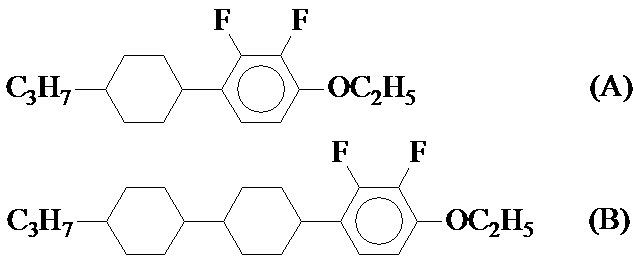
- a liquid crystal composition using the following compounds (A) and (B) having a 2,3-difluorophenylene skeleton (see Patent Document 1) as a liquid crystal material having a negative ⁇ is disclosed.
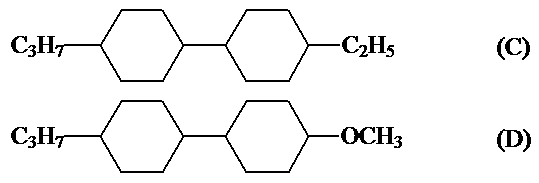
- This liquid crystal composition uses the compounds (C) and (D) as compounds having ⁇ of almost 0, but this liquid crystal composition is sufficient for a liquid crystal composition that requires a high-speed response such as a liquid crystal television. Has not yet achieved a low viscosity.
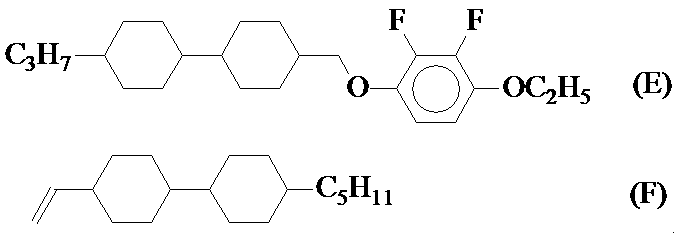
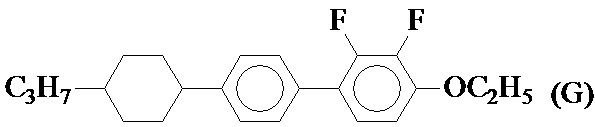
- liquid crystal composition using a compound represented by the formula (G) has been disclosed (see Patent Document 4), and this liquid crystal composition also includes an alkenyl compound like the above compound (F). Therefore, there is a problem that display defects such as image sticking and display unevenness are likely to occur.
- Patent Documents 6 and 7 have already disclosed liquid crystal compositions using a compound having a fluorine-substituted terphenyl structure.
- Patent Document 8 discloses that the response speed of a homeotropic liquid crystal cell is improved by using a liquid crystal material having a large index (FoM) represented by (Equation 1), which is described in the specification. The improvement in the response speed of the liquid crystal composition used has not been sufficient.
- JP-A-8-104869 European Patent Application No. 0474402 JP 2006-37054 A JP 2001-354967 A JP 2008-144135 A WO2007 / 077872 JP 2003-327965 A JP 2006-301643 A
- the problem to be solved by the present invention is that the solid phase-nematic phase transition temperature (T cn ) without lowering the refractive index anisotropy ( ⁇ n) and the nematic phase-isotropic liquid phase transition temperature (T ni ).
- T cn solid phase-nematic phase transition temperature
- T ni nematic phase-isotropic liquid phase transition temperature
- the present inventors have studied compounds having various alkyl side chains and alkenyl side chains, and found that the above problems can be solved by combining specific compounds, and have completed the present invention.
- the liquid crystal composition contains one or more compounds having alkenyl side chains in the liquid crystal composition, and the total content of the compounds having alkenyl side chains in the liquid crystal composition is 5 to 100% by mass.
- a liquid crystal display device using the same is provided.
- the liquid crystal composition of the present invention has a sufficient solid phase-nematic phase transition temperature (T cn ) without lowering the refractive index anisotropy ( ⁇ n) and the nematic phase-isotropic liquid phase transition temperature (T ni ).
- the compound having a 1-propenyl group in [2] is represented by the general formula (I)
- R 11 represents an alkyl group having 1 to 8 carbon atoms, an alkoxyl group having 1 to 8 carbon atoms, an alkenyl group having 3 to 8 carbon atoms, or an alkenyloxyl group having 2 to 8 carbon atoms
- -CH in group 2 - or nonadjacent two or more -CH 2 - may be substituted each independently -O- or -S-, also one present in the group or 2
- Two or more hydrogen atoms may be independently substituted with fluorine atoms or chlorine atoms, m and n each independently represent 0, 1 or 2, while m + n represents 1, 2, 3 or 4;
- Z 11 and Z 12 each independently represent —OCH 2 —, —CH 2 O—, —CF 2 O—, —OCF 2 —, —CH 2 CH 2 —, —CF 2 CF 2 — or a single bond.
- Ring A and Ring B are each independently a trans-1,4-cyclohexylene group, 1,4-phenylene group, 2-fluoro-1,4-phenylene group, 3-fluoro-1,4-phenylene group, 3,5-difluoro-1,4-phenylene group, 2,3-difluoro-1,4-phenylene group, 1,4-cyclohexenylene group, 1,4-bicyclo [2.2.2] octylene group, Represents a piperidine-1,4-diyl group, naphthalene-2,6-diyl group, decahydronaphthalene-2,6-diyl group or 1,2,3,4-tetrahydronaphthalene-2,6-diyl group, When a plurality of A and ring B are present, they may be the same or different. ) And general formula (In)
- R q represents an alkyl group having 1 to 8 carbon atoms, an alkoxyl group having 1 to 8 carbon atoms, an alkenyl group having 3 to 8 carbon atoms, or an alkenyloxyl group having 2 to 8 carbon atoms).
- —CH 2 — or two or more non-adjacent —CH 2 — may be each independently substituted with —O— or —S—, and two or more hydrogen atoms may be substituted each independently a fluorine atom or a chlorine atom
- Z 11 and Z 12 are each independently -OCH 2 -, - CH 2 O -, - CF 2 O-, —OCF 2 —, —CH 2 CH 2 —, —CF 2 CF 2 — or a single bond, and when there are a plurality of Z 11 and Z 12, they may be the same or different, d represents 0, 1 or 2;
- Ring D, Ring I and Ring C are each independently a trans-1,4-cyclohexylene group, 1,4-phenylene group, 2-fluoro-1,4-phenylene group or 3-fluoro-1,4-
- a phenylene group is represented, and when there are a plurality of rings D, they may be the same or different.
- the liquid crystal composition according to claim 2 which is one or more compounds selected from the group consisting of compounds represented by: [4] The liquid crystal composition according to [3], containing one or more compounds represented by general formula (I). [5] The liquid crystal composition according to [3], which contains one or more compounds represented by the general formula (In). [6] Containing one or more compounds represented by general formula (I), and containing one or more compounds represented by general formula (In) The liquid crystal composition described. [7] Furthermore, general formula (N3)
- R p and R q are each independently an alkyl group having 1 to 10 carbon atoms, an alkoxy group having 1 to 10 carbon atoms, an alkenyl group having 2 to 10 carbon atoms, or 2 to 10 carbon atoms.
- —CH 2 — or two or more non-adjacent —CH 2 — may be each independently substituted with —O— or —S—.
- 1 or 2 or more hydrogen atoms present in each may be independently substituted with a fluorine atom or a chlorine atom
- ring J, ring F and ring K are each independently trans-1,4-cyclo Xylene, 1,4-phenylene, 2-fluoro-1,4-phenylene, 3-fluoro-1,4-phenylene, 3,5-difluoro-1,4-phenylene, 1,4-cyclohex Senylene group, 1,4-bisic [2.2.2]
- Z 11 and Z 12 are each independently —OCH 2 —, —CH 2 O—, —CF 2 O—, —OCF 2 —, —CH 2 CH 2 —, —CF
- R 1 and R 2 are each independently an alkyl group having 1 to 10 carbon atoms, an alkoxy group having 1 to 10 carbon atoms, an alkenyl group having 2 to 10 carbon atoms, or 2 carbon atoms
- one -CH 2 present in the radical - or nonadjacent two or more -CH 2 - may be replaced each independently -O- or -S-
- one or more hydrogen atoms present in the group may be each independently substituted with a fluorine atom or a chlorine atom
- each ring A may be independently trans-1,4-cyclo Hexylene, 1,4-phenylene, 2-fluoro-1,4-phenylene, 3-fluoro-1,4-phenylene, 3,5-difluoro-1,4-phenylene, 2,3- Difluoro-1,4-phenylene group 1,4-cyclohexenylene group, 1,4-bicyclo [2.2.2] octylene
- R 5 is an alkyl group having 1 to 5 carbon atoms or an alkenyl group having 2 to 5 carbon atoms
- R 6 is an alkyl group having 1 to 5 carbon atoms, an alkoxyl group having 1 to 5 carbon atoms
- . represents an alkenyloxy group having an alkenyl group or a carbon atom number of 2 to 5 2 to 5 carbon atoms group present in one -CH 2 - or nonadjacent two or more -CH 2 - respectively
- the group may be independently substituted with —O— or —S—, and one or more hydrogen atoms present in the group may be independently substituted with fluorine atoms.
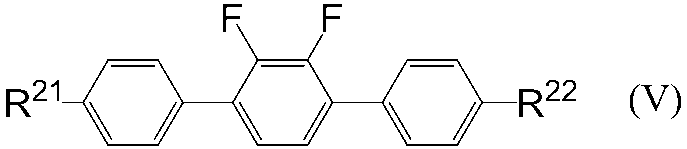
- R 21 and R 22 are each independently an alkyl group having 1 to 8 carbon atoms, an alkoxyl group having 1 to 8 carbon atoms, an alkenyl group having 2 to 8 carbon atoms, or 2 to 8 carbon atoms.
- one —CH 2 — or two or more non-adjacent —CH 2 — may be independently substituted with —O— or —S—.
- one or two or more hydrogen atoms present in the group may be each independently substituted with a fluorine atom, except for the compound represented by formula (I) according to claim 3.
- the polymerizable compound is represented by the general formula (RM-1).
- Z M1 and Z M2 are each independently
- X M1 to X M5 represent a hydrogen atom, a fluorine atom or
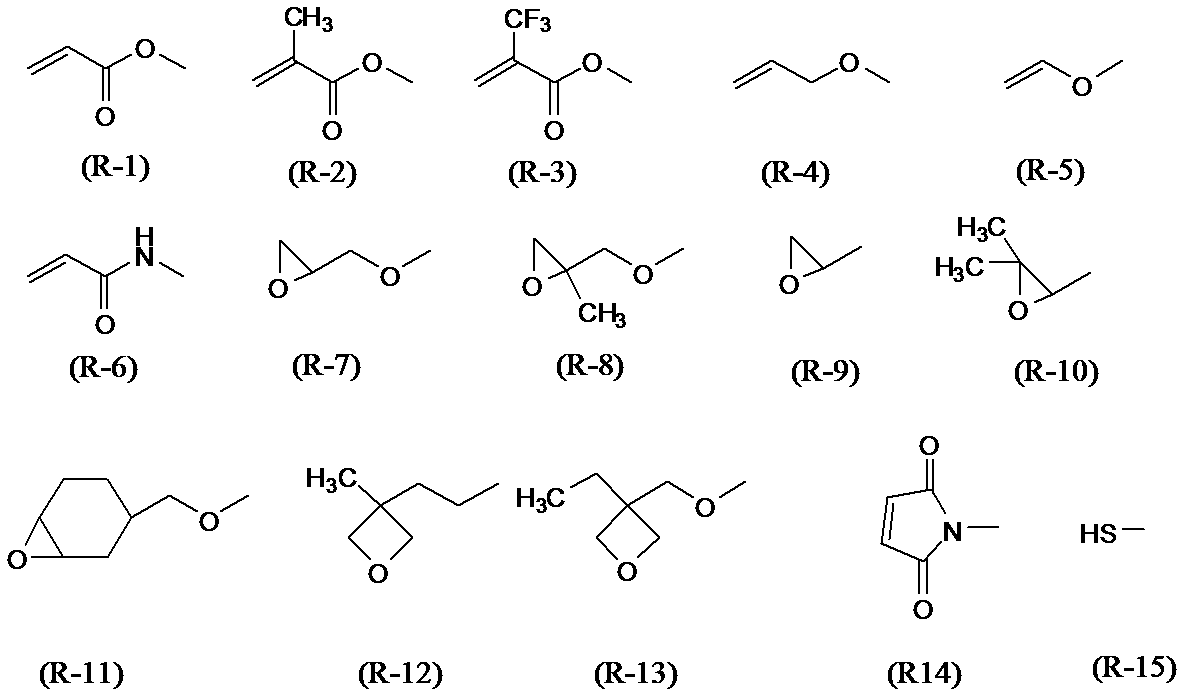
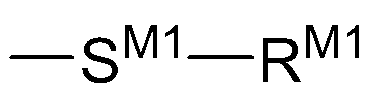
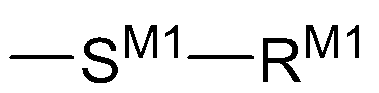
- S M1 represents an alkylene group having 1 to 12 carbon atoms or a single bond, and —CH 2 — in the alkylene group is an oxygen atom, —COO—, —OCO—, wherein oxygen atoms are not directly bonded to each other. Or may be replaced by -OCOO- R M1 represents the following formulas (R-1) to (R-15)
- m M1 represents 0, 1 or 2
- X M1 to X M5 , S M1 , R M1 , L M2 and / or M M1 they may be the same or different.
- the viscosity ( ⁇ ) at 20 ° C. is in the range of 5 to 30 mPa ⁇ s, the rotational viscosity ( ⁇ 1) at 20 ° C.
- liquid crystal composition is in the range of 50 to 150 mPa ⁇ s, and the nematic phase-isotropic liquid phase transition temperature
- a liquid crystal display device using the liquid crystal composition according to any one of [1] to [13].
- the liquid crystal composition of the present invention contains one or more compounds having an alkenyl side chain, and the content thereof is 5 to 100% by mass, preferably 5 to 90% by mass. More preferably, it is 80% by mass, and particularly preferably 5 to 70% by mass.
- the lower limit is preferably 5%, preferably 8%, preferably 10%, preferably 15%, 20% is preferable, 25% is preferable, and 30% is preferable.
- the upper limit is preferably 100%. 95% is preferable, 80% is preferable, 75% is preferable, 70% is preferable, 65% is preferable, 60% is preferable, 55% is preferable, 50% is preferable, 45% is preferable, and 40% is preferable.
- the ratio of the total mass of all compounds having a 1-propenyl group as a side chain to the total mass of all compounds having an alkenyl side chain as a side chain contained in these liquid crystal compositions is 30 to 100% by mass. Preferably, it is 35 to 100% by mass, more preferably 40 to 100% by mass, and particularly preferably 60 to 100% by mass.
- the lower limit is preferably 30%, preferably 35%, preferably 40%, preferably 45%, preferably 50%, 55 %, 60% is preferred, 63% is preferred, 65% is preferred, 68% is preferred, 70% is preferred, 73% is preferred, 75% is preferred, 78% is preferred, 80% is preferred, 83% % Is preferred, 85% is preferred, 88% is preferred, 90% is preferred, 93% is preferred, 95% is preferred, 96% is preferred, 97% is preferred, 98% is preferred, 99% is preferred, 100% is preferred %, And the compound having an alkenyl side chain preferably contains substantially no compound other than a compound having a 1-propenyl group.
- substantially means that all of the compounds added intentionally as non-polymerizable low-molecular compounds having alkenyl side chains are compounds having a 1-propenyl group, and are unintentionally mixed in the production process. This means that the compound that has been removed is excluded.
- the upper limit is preferably 95%, 97% is preferable, 98% is preferable, 99% is preferable, and 100% is preferable, and it is preferable not to contain substantially any compound other than a compound having a 1-propenyl group.
- R 11 represents an alkyl group having 1 to 8 carbon atoms, an alkoxyl group having 1 to 8 carbon atoms, an alkenyl group having 2 to 8 carbon atoms, or carbon.
- An alkenyl group having 2 to 5 atoms is preferred.
- -CH in group 2 - or nonadjacent two or more -CH 2 - may be substituted each independently -O- or -S-, also one present in the group or 2
- Two or more hydrogen atoms may be independently substituted with fluorine atoms or chlorine atoms.
- a straight chain is preferred and unsubstituted.
- R 11 represents an alkenyl group
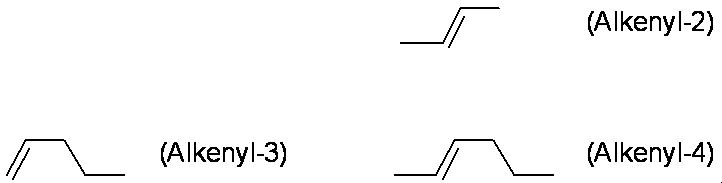
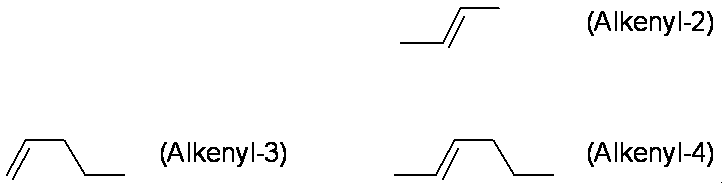
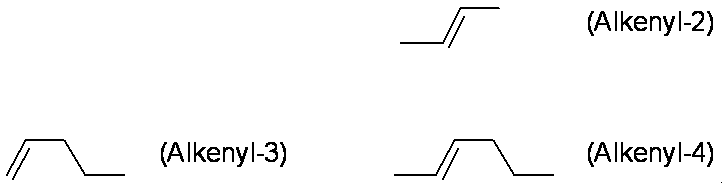
- examples of the alkenyl group include the following formulas (Alkenyl-2) to (Alkenyl-4)
- Z 11 and Z 12 each independently represent —OCH 2 —, —CH 2 O—, —CF 2 O—, —OCF 2 —, —CH 2 CH 2 —, —CF 2 CF 2 — or a single bond.
- Ring A and Ring B are each independently a trans-1,4-cyclohexylene group, 1,4-phenylene group, 2-fluoro-1,4-phenylene group, 3-fluoro-1,4-phenylene group, 3,5-difluoro-1,4-phenylene group, 2,3-difluoro-1,4-phenylene group, 1,4-cyclohexenylene group, 1,4-bicyclo [2.2.2] octylene group, Represents a piperidine-1,4-diyl group, naphthalene-2,6-diyl group, decahydronaphthalene-2,6-diyl group or 1,2,3,4-tetrahydronaphthalene-2,6-diyl group, Trans-1,4-cyclohexylene group, 1,4-phenylene group, 2-fluoro-1,4-phenylene group, 3-fluoro-1,4-phenylene group, 3,5-difluoro-1,4-
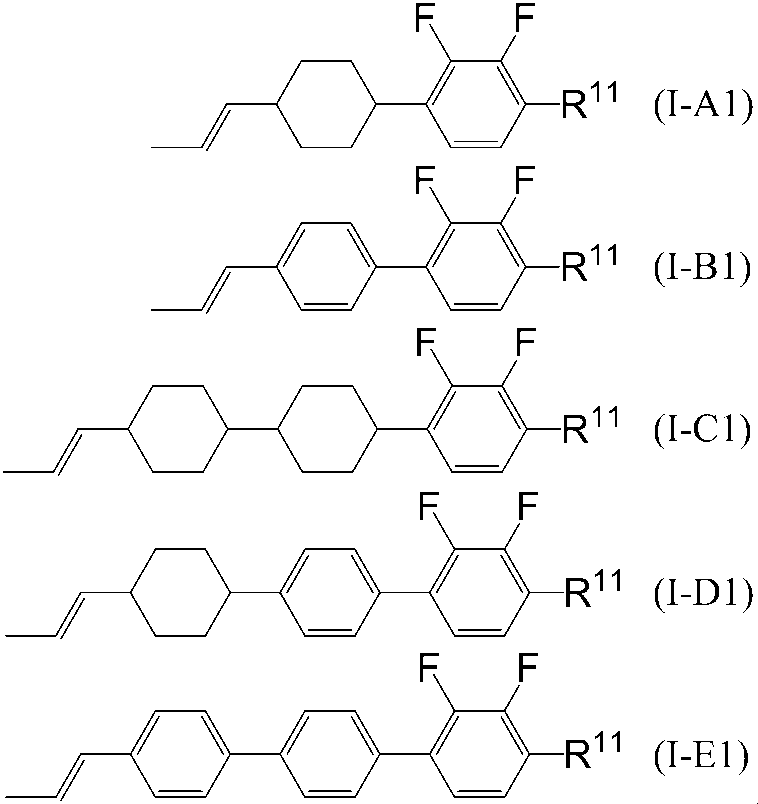
- the compounds represented by the general formula (I) include, for example, the general formulas (I-A1), (I-B1), (I-C1), (I-D1), (I-E1), (I-A2). ), (I-B2), (I-C2), (I-D2), (I-E2), (I-AA), (I-AB), (I-BA) or (I-BB) Preferably there is.
- R 11 is as described above, and the general formulas (I-AB) and (I-BA) do not represent the same compound.
- R q each independently represents an alkyl group having 1 to 8 carbon atoms, an alkoxyl group having 1 to 8 carbon atoms, an alkoxyl group having 2 to 8 carbon atoms, or 2 carbon atoms.
- -CH in group 2 - or nonadjacent two or more -CH 2 - may be substituted each independently -O- or -S-, also one present in the group or 2
- Two or more hydrogen atoms may be independently substituted with fluorine atoms or chlorine atoms.
- a straight chain is preferred and unsubstituted.
- R q represents an alkenyl group
- examples of the alkenyl group include the following formulas (Alkenyl-2) to (Alkenyl-4)
- Ring D, Ring I and Ring C are each independently a trans-1,4-cyclohexylene group, 1,4-phenylene group, 2-fluoro-1,4-phenylene group or 3-fluoro-1,4- A phenylene group is preferred.
- Z 11 and Z 12 each independently represent —OCH 2 —, —CH 2 O—, —CF 2 O—, —OCF 2 —, —CH 2 CH 2 —, —CF 2 CF 2 — or a single bond.
- Z 11 and Z 12 in the general formulas (I) and (In) may be the same or different.
- D represents 0, 1 or 2, with 0 or 1 being preferred.
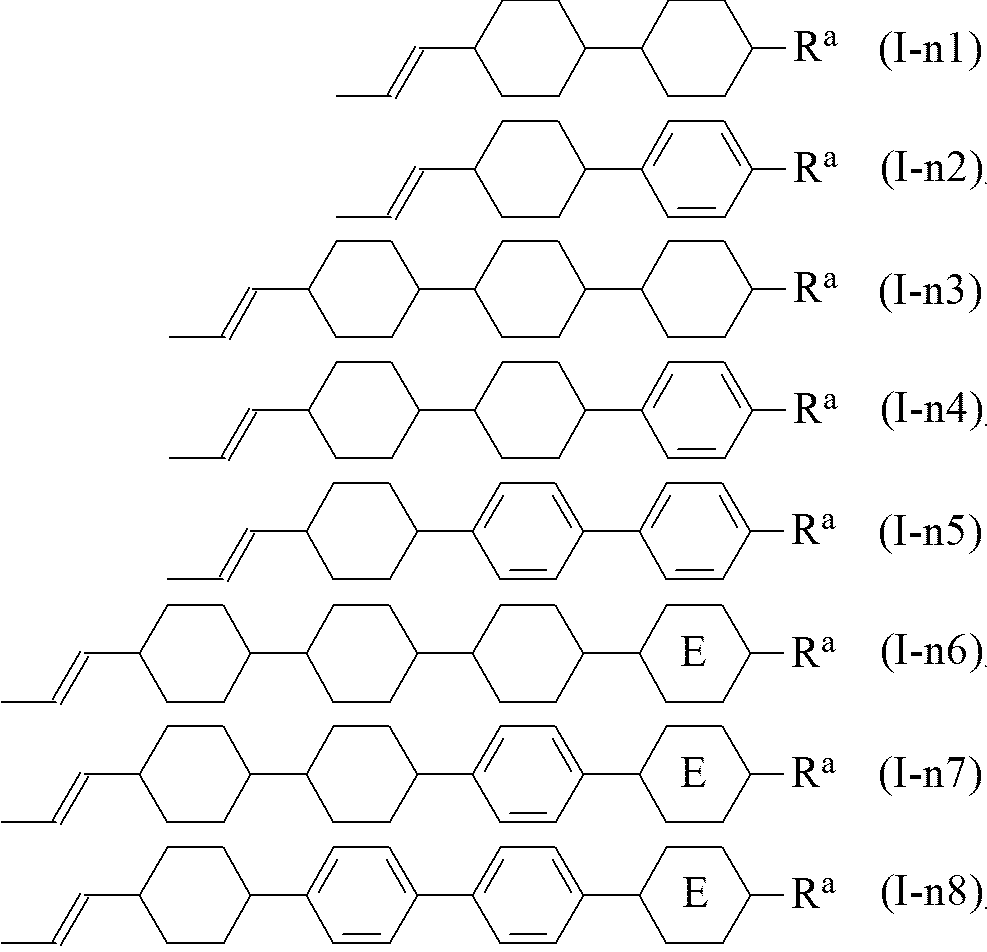
- R a has the same meaning as R q
- ring E represents a trans-1,4-cyclohexylene group or a 1,4-phenylene group.
- the hydrogen atoms in the rings of the general formulas (In-1) to (In8) may be each independently substituted with a fluorine atom.
- the general formula (In) is more preferably a compound represented by the general formula (Inn1), the general formula (Inn2), the general formula (Inn4), or the general formula (Inn5). Particularly preferred are compounds represented by general formula (In1), general formula (Inn4) and general formula (Inn5). However, when a liquid crystal composition having a high Tni is required, in addition to the general formula (In-1), the general formula (Inn4), and the general formula (Inn5), the general formula (Inn6), It is also preferable that a part of the compound represented by the general formula (In7) or the general formula (In8) is contained.
- the liquid crystal compound can further contain one or more compounds having a negative ⁇ and an absolute value greater than 3, preferably 1 to 15 compounds, preferably 1 to 10 compounds. It is more preferable to contain, and it is especially preferable to contain 2 to 10 types.
- the total content of these compounds is preferably 5 to 90% by mass, more preferably 10 to 70% by mass, and particularly preferably 10 to 50% by mass.
- the compound represented by general formula (I) is excluded.
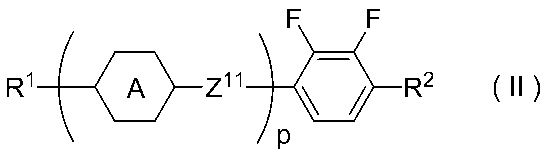
- a compound having a negative ⁇ and an absolute value larger than 3 is preferably a compound represented by the general formula (II).
- R 1 and R 2 are each independently an alkyl group having 1 to 10 carbon atoms, an alkoxyl group having 1 to 10 carbon atoms, an alkenyl group having 2 to 10 carbon atoms, or 2 to 10 carbon atoms. of represents alkenyloxy group, one -CH present in group 2 - or nonadjacent two or more -CH 2 - may be substituted each independently -O- or -S- In addition, one or two or more hydrogen atoms present in the group may be independently substituted with a fluorine atom or a chlorine atom. In addition, linear is preferable and it is preferable that it is unsubstituted.
- examples of the alkenyl group include the following formulas (Alkenyl-2) to (Alkenyl-4)
- Ring A is trans-1,4-cyclohexylene group, 1,4-phenylene group, 2-fluoro-1,4-phenylene group, 3-fluoro-1,4-phenylene group, 3,5-difluoro- 1,4-phenylene group, 2,3-difluoro-1,4-phenylene group, 1,4-cyclohexenylene group, 1,4-bicyclo [2.2.2] octylene group, piperidine-1,4- Diyl group, naphthalene-2,6-diyl group, decahydronaphthalene-2,6-diyl group or 1,2,3,4-tetrahydronaphthalene-2,6-diyl group, but trans-1,4- Cyclohexylene group, 1,4-phenylene group, 2-fluoro-1,4-phenylene group, 3-fluoro-1,4-phenylene group, 3,5-difluoro-1,4-phenylene group or 2,3 -Diflu
- Z 11 is, -OCH 2 -, - CH 2 O -, - CF 2 O -, - OCF 2 -, - CH 2 CH 2 -, - CF 2 CF 2 - or represents a single bond, -CH 2 O It preferably represents —, —CF 2 O— or a single bond, and more preferably represents —CH 2 O— or a single bond.
- R 1 and R 2 in the formula are each independently an alkyl group having 1 to 5 carbon atoms, an alkoxyl group having 1 to 5 carbon atoms, an alkenyl group having 2 to 5 carbon atoms, or 2 to 5 carbon atoms.
- R 1 is an alkyl group having 1 to 5 carbon atoms or an alkenyl group having 2 to 5 carbon atoms
- R 2 is an alkoxyl group having 1 to 5 carbon atoms. Particularly preferred is a straight chain.
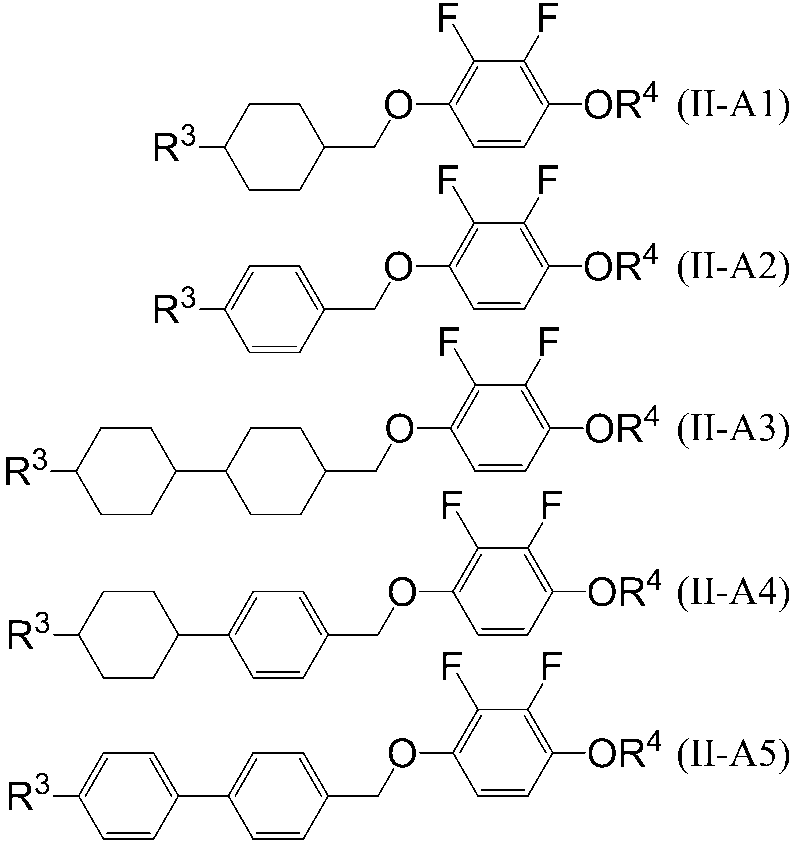
- the general formula (II) is preferably a compound represented by the general formula (II-A1) to general formula (II-A5) and the general formula (II-B1) to general formula (II-B5). More preferred are compounds of formula (II-A1) to general formula (II-A5), particularly preferred are compounds of general formula (II-A1) or general formula (II-A3).
- each of R 3 and R 4 independently represents an alkyl group having 1 to 5 carbon atoms or an alkenyl group having 2 to 5 carbon atoms, and one —CH 2 — or adjacent group present in the group Two or more —CH 2 — that are not present may be independently substituted with —O— or —S—.
- one or two or more hydrogen atoms present in the group may be independently substituted with fluorine atoms.
- a substantially dielectrically neutral compound in the liquid crystal composition By including a substantially dielectrically neutral compound in the liquid crystal composition, other physical properties such as a nematic phase-isotropic liquid phase transition temperature (without affecting the dielectric anisotropy ( ⁇ )) ( T NI ), liquid crystal phase temperature range, phase transition temperature viscosity ( ⁇ ), rotational viscosity ( ⁇ 1 ) refractive index anisotropy ( ⁇ n) can be adjusted to preferable ranges.
- T NI nematic phase-isotropic liquid phase transition temperature
- T NI liquid crystal phase temperature range
- phase transition temperature viscosity ( ⁇ ) ⁇
- rotational viscosity ( ⁇ 1 ) refractive index anisotropy ( ⁇ n) can be adjusted to preferable ranges.
- N3 a compound represented by the following general formula (N3) is preferable.
- R p and R q are independently of each other an alkyl group having 1 to 10 carbon atoms or an alkenyl group having 2 to 10 carbon atoms (one —CH 2 — present in these groups or not adjacent 2
- One or more —CH 2 — is substituted by —O— or —S—, and one or two or more hydrogen atoms present in these groups are substituted by fluorine atoms or chlorine atoms.
- an alkyl group having 1 to 5 carbon atoms, an alkoxy group having 1 to 5 carbon atoms, an alkenyl group having 2 to 5 carbon atoms, or an alkenyloxy group having 3 to 6 carbon atoms is particularly preferable.
- an alkyl group having 1 to 5 carbon atoms or an alkoxy group having 1 to 5 carbon atoms is particularly preferable.
- examples of the alkenyl group include the following formulas (Alkenyl-2) to (Alkenyl-4)
- Ring J, ring F and ring K is independently of one another, are a trans-1,4-cyclohexylene group (present in the group one -CH 2 - or non-adjacent two -CH 2 - is - 1-phenylene group (including one substituted with O—), or one —CH ⁇ or two or more non-adjacent —CH ⁇ present in this group is replaced with —N ⁇ .
- Octylene group piperidine-1,4-diyl group, naphthalene-2,6-diyl group, decahydronaphthalene-2,6-diyl group or 1,2,3,4-tetrahydronaphthalene-2,6-diyl Group is preferred, trans-1,4-cyclohexylene Of 1,4-phenylene group or 1,4-bicyclo [2.2.2] octylene group, more preferably trans-1,4-cyclohexylene group or 1,4-phenylene group. o is preferably 0, 1 or 2, and more preferably 0 or 1.
- Z 11 and Z 12 each independently represent —OCH 2 —, —CH 2 O—, —CF 2 O—, —OCF 2 —, —CH 2 CH 2 —, —CF 2 CF 2 — or a single bond.
- the general formula (N3) is preferably a compound represented by the following general formula (N3-1) to general formula (N3-9) as a specific structure.
- R p and R q are each independently an alkyl group having 1 to 10 carbon atoms, an alkoxy group having 1 to 10 carbon atoms, or the number of carbon atoms. Represents an alkenyl group having 2 to 10 carbon atoms or an alkenyloxy group having 3 to 10 carbon atoms, excluding the compound represented by the general formula (In).
- R p and R q are each independently preferably an alkyl group having 1 to 10 carbon atoms, an alkoxy group having 1 to 10 carbon atoms or an alkenyl group having 2 to 10 carbon atoms, and preferably having 1 to 5 carbon atoms. More preferred are alkyl groups or alkoxy groups having 1 to 10 carbon atoms. More preferably, it is linear.
- the compound represented by the general formula (N-3) is contained.
- the nonpolar compound having a value of ⁇ n of approximately 0 one compound selected from the group of compounds represented by general formula (IV-1) to general formula (IV-3) or Although containing 2 or more types, 1 to 10 types are preferable, and 1 to 5 types are more preferable. Further, the total content is preferably 5 to 70% by mass, more preferably 5 to 50% by mass, and particularly preferably 5 to 40% by mass.
- R 5 is an alkyl group having 1 to 5 carbon atoms or an alkenyl group having 2 to 5 carbon atoms
- R 6 is an alkyl group having 1 to 5 carbon atoms, an alkoxyl group having 1 to 5 carbon atoms, carbon
- An alkenyl group having 2 to 5 atoms or an alkenyloxy group having 2 to 5 carbon atoms is represented.
- One —CH 2 — present in the group or two or more non-adjacent —CH 2 — may be each independently substituted with —O— or —S—, and may be present in the group.
- One or two or more hydrogen atoms may be independently substituted with fluorine atoms.
- the compound represented by the general formula (In) is excluded.
- the liquid crystal composition preferably further contains one or more compounds represented by the general formula (Np-1) or the general formula (Np-2).
- R Np1 and R Np2 each independently represent an alkyl group having 1 to 5 carbon atoms, an alkoxyl group having 1 to 5 carbon atoms, an alkenyl group having 2 to 5 carbon atoms, or an alkyl group having 2 to 5 carbon atoms. Although it represents an alkenyloxy group, it is preferably an alkyl group having 1 to 5 carbon atoms.
- one of the -CH 2 that is present in the radical - or nonadjacent two or more -CH 2 - may be substituted each independently -O- or -S-, also, in the radical
- One or two or more hydrogen atoms present in may be each independently substituted with a fluorine atom.
- X Np1 , X Np2 , X Np3 , X Np4 and X Np5 each independently represent a hydrogen atom or a fluorine atom, but preferably at least one is a fluorine atom, and at least two are fluorine atoms. Further preferred.
- the liquid crystal composition of the present invention preferably contains one or more compounds selected from general formula (I) as the compound having a 1-propenyl group, and is a compound selected from general formula (In) Is preferably one or more, more preferably two or more compounds selected from general formula (I) and general formula (In), and the general formula (I) and general formula ( It is also preferred to contain simultaneously the compounds represented by In).
- the liquid crystal composition of the present invention preferably contains a compound represented by general formula (I-A1) or general formula (Inn1) at the same time, and is represented by general formula (I-C1) or general formula (Inn1). It is preferable that the compound represented by formula (I-D1) and the compound represented by formula (Inn1) are simultaneously contained, and the compound represented by formula (I-A2), It is preferable to simultaneously contain a compound represented by the general formula (Inn1), and it is preferable to simultaneously contain a compound represented by the general formula (I-C2) or the general formula (Inn1).
- the liquid crystal composition of the present invention contains one compound selected from the compound group represented by the general formula (I) and one compound selected from the compound group represented by the general formula (In). It is also preferable to contain two compounds selected from the compound group represented by the general formula (I) and two compounds selected from the compound group represented by the general formula (In).
- the total content of the aforementioned preferred compounds is preferably 85 to 100% by mass, and more preferably 90 to 100% by mass.
- the content thereof is preferably 2 to 30% by mass, more preferably 2 to 25% by mass. To 20% by mass is particularly preferred.
- R 21 and R 22 are each independently an alkyl group having 1 to 8 carbon atoms, an alkoxyl group having 1 to 8 carbon atoms, an alkenyl group having 2 to 8 carbon atoms, or an alkyl group having 2 to 8 carbon atoms.
- an alkenyloxyl group is represented, an alkyl group having 1 to 5 carbon atoms or an alkenyl group having 2 to 5 carbon atoms is preferable.
- One —CH 2 — present in the group or two or more non-adjacent —CH 2 — may be each independently substituted with —O— or —S—, and may be present in the group.
- One or two or more hydrogen atoms may be independently substituted with fluorine atoms.
- R 21 and R 22 are each independently more preferably an alkyl group having 1 to 3 carbon atoms, and particularly preferably the formula (V-55).
- the general formula (I), the general formula (In), the general formula (N3), the general formula (II), and the general formula (IV-1) to the general formula (IV) -3) The total content of the compounds represented by the general formula (V) is preferably 80% or more, preferably 85% or more, preferably 88% or more, 90% Preferably, it is 92% or more, preferably 94% or more, preferably 95% or more, preferably 97% or more, and 98% or more. Preferably, it is 99% or more, and it is preferable that other components are not substantially contained.
- substantially means general formula (I), general formula (In), general formula (N3), general formula (II), general formula (IV-1) to general formula (IV-3),
- the compound represented by the formula (V) it means that no compound other than the compound which is unintentionally mixed in the production process is contained.
- A may be the same or different, and the general formula (I), the general formula (In), the general formula (N3), and the general formula (N Z 11 in II) may be the same or different, and Z 12 in general formula (I), general formula (In) and general formula (N3) may be the same or different.
- R q in the general formula (I-n) and the general formula (N3) may be different even in the same.
- the liquid crystal composition of the present invention has a dielectric anisotropy ( ⁇ ) at ⁇ 25 ° C. of ⁇ 2.0 to ⁇ 8.0, preferably ⁇ 2.0 to ⁇ 6.0, -5.0 is more preferable, and -2.5 to -4.0 is particularly preferable.
- the liquid crystal composition of the present invention has a refractive index anisotropy ( ⁇ n) at 20 ° C. of 0.08 to 0.14, more preferably 0.09 to 0.13, and 0.09 to 0.12. Particularly preferred. More specifically, it is preferably 0.10 to 0.13 when dealing with a thin cell gap, and preferably 0.08 to 0.10 when dealing with a thick cell gap.
- the liquid crystal composition of the present invention has a viscosity ( ⁇ ) at 20 ° C. of 10 to 30 mPa ⁇ s, more preferably 10 to 25 mPa ⁇ s, and particularly preferably 10 to 22 mPa ⁇ s.
- the liquid crystal composition of the present invention has a rotational viscosity ( ⁇ 1 ) at 20 ° C. of 60 to 130 mPa ⁇ s, more preferably 60 to 110 mPa ⁇ s, and particularly preferably 60 to 100 mPa ⁇ s. .
- the liquid crystal composition of the present invention has a nematic phase-isotropic liquid phase transition temperature (T ni ) of 60 ° C. to 120 ° C., more preferably 70 ° C. to 100 ° C., and particularly preferably 70 ° C. to 85 ° C.
- T ni nematic phase-isotropic liquid phase transition temperature
- the liquid crystal composition of the present invention may contain a normal nematic liquid crystal, smectic liquid crystal, cholesteric liquid crystal, antioxidant, ultraviolet absorber, polymerizable monomer and the like in addition to the above-mentioned compounds.
- the liquid crystal composition of the present invention preferably contains one or more polymerizable compounds represented by the general formula (RM-1).
- Z M1 and Z M2 are each independently
- X M1 to X M5 represent hydrogen, fluorine or
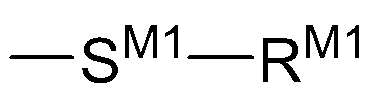
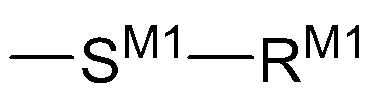
- S M1 represents an alkyl group having 1 to 12 carbon atoms or a single bond, and the methylene group in the alkyl group is an oxygen atom, —COO—, —OCO—, or — It may be replaced with OCOO-.
- R M1 represents the following formulas (R-1) to (R-15)
- M M1 represents a 1,4-phenylene group, a 1,4-cyclohexylene group, a naphthalene-2,6-diyl group independently of each other, and M M1 is independently of each other an unsubstituted or
- a hydrogen atom contained in the group is a fluorine atom, a chlorine atom, an alkyl group having 1 to 8 carbon atoms, a halogenated alkyl group, a halogenated alkoxy group, an alkoxy group, a nitro group, or
- M M1 when there are a plurality of M M1, they may be the same or different, but are preferably 1,4-phenylene groups which are unsubstituted or in these groups Are preferably substituted with a fluorine atom, an alkyl group having 1 to 8 carbon atoms or an alkoxy group. In that case, when there are a plurality of M M1 , they may be the same or different.
- n M1 represents 0, 1 or 2, with 0 or 1 being preferred.
- the compound represented by the general formula (RM-1) which is a polymerizable compound specifically includes a compound represented by the following general formula (RM-1A).
- R M1 and S M1 represent the same meaning as R M1 and S M1 in Formula (RM-1A)
- X M1 ⁇ X M8 is hydrogen, fluorine or
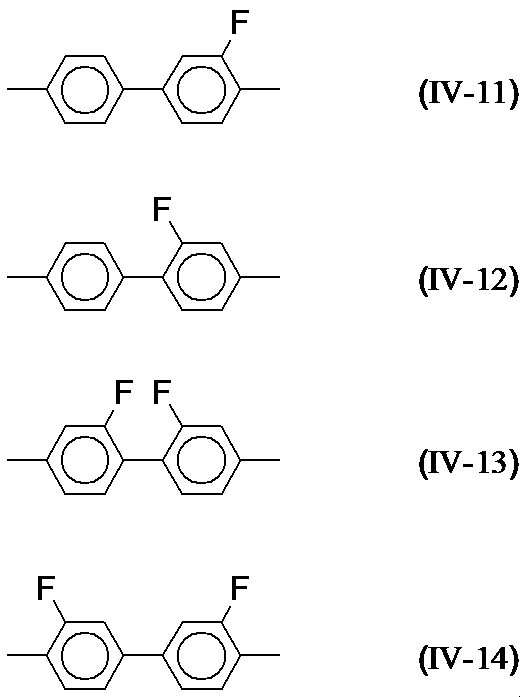
- the structure of the biphenyl skeleton is preferably unsubstituted or represented by the formula (IV-11) to the formula (IV-14). (IV-11) is preferred.
- a polymerizable compound containing a biphenyl skeleton which is unsubstituted or represented by the formulas (IV-11) to (IV-14) has an optimum orientation regulating force after polymerization, and a good orientation state can be obtained.
- examples of the compound represented by the general formula (RM-1) include a compound represented by the general formula (RM-1B).
- R M1, S M1, L M1 , L M2, M M1 and m M1 includes a general formula (RM-1) in R M1, S M1, L M1 , L M2, M M1 and m M1 X M1 to X M5 represent the same meaning, hydrogen, fluorine or
- RM-1 polymerizable compound represented by the general formula (RM-1)
- M1-13 polymerizable compound represented by the general formula (RM-1)
- M2-1 polymerizable compound represented by the general formula (M2-8)
- M4-1) to (M4-7) Compounds represented by (M4-1) to (M4-7) and (I-1) to (I-40) are preferred.
- (M1-1) to (M1-8) (M1-10) to (M1-13), (M2-2) to (M2-5), (M3-1), (M3-4), (M3 -5), (M4-1), (M4-2), (M4-4), (M4-6), (M4-7), (I-1) to (I-11), (I-22) ) To (I-25) and (I-28) to (I-40) are preferred, In particular, (M1-1), (M1-3), (M1-6) to (M1-8), (M1-11), (M1-12), (M2-2), (M2-4), ( The compounds represented by (M3-1), (M3-5), (M4-2), (M4-6), (M4-7) and (I-33) to (I-37) are preferred.
- the polymerizable compound-containing liquid crystal composition containing the general formula (I) and / or the general formula (1-n) of the present invention and the general formula (RM-1) which is a polymerizable compound simultaneously has a low viscosity ( ⁇ ), Since a low rotational viscosity ( ⁇ 1 ), a large elastic constant (K 33 ), and a high VHR can be obtained, a PSA mode or PSVA mode liquid crystal display device using this can achieve both high-speed response and high reliability.
- a compound selected from the group consisting of a general formula (RM-1) which is a polymerizable compound and includes general formula (I), general formula (In), general formula (N-3), Containing simultaneously a compound selected from the group consisting of general formula (II), general formulas (IV-1) to (IV-2), general formula (V) and general formula (RM-1) which is a polymerizable compound Is more preferable.
- a compound selected from the group consisting of a general formula (RM-1) which is a polymerizable compound and includes general formula (I), general formula (In), general formula (N-3), Containing simultaneously a compound selected from the group consisting of general formula (II), general formulas (IV-1) to (IV-2), general formula (V) and general formula (RM-1) which is a polymerizable compound Is more preferable.
- the content of the polymerizable monomer is preferably 5% by mass, preferably 3% by mass, preferably 2% by mass, and 1% by mass with respect to the liquid crystal composition.
- it is 0.8 mass%, preferably 0.5 mass%, preferably 0.4 mass%, preferably 0.3 mass%, 0.2 mass% %,
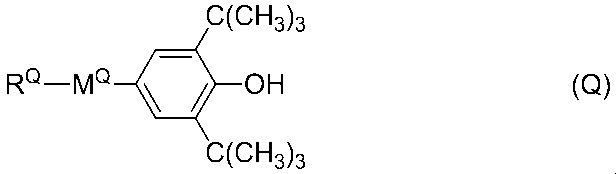
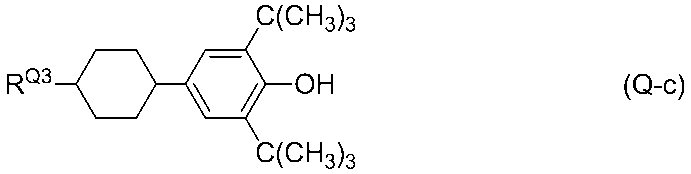
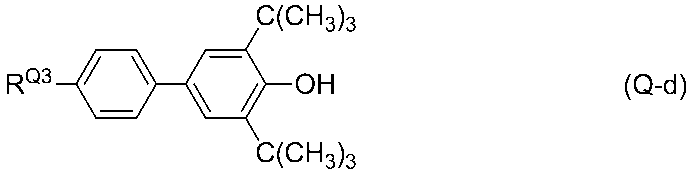
- the liquid crystal composition of the present invention may further contain a compound represented by the general formula (Q).
- R Q represents a linear or branched alkyl group having 1 to 22 carbon atoms, and one or two or more non-adjacent CH 2 groups in the group are —O—, —CH ⁇ CH—, —CO—, —OCO—, —COO—, —C ⁇ C—, —CF 2 O—, —OCF 2 — may be substituted.
- MQ represents a trans-1,4-cyclohexylene group, a 1,4-phenylene group or a single bond.
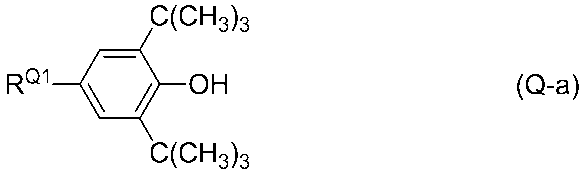
- the compound represented by the general formula (Q) is preferably a compound represented by the following general formula (Qa) to general formula (Qe).
- R Q1 is preferably a linear alkyl group or a branched alkyl group having 1 to 10 carbon atoms.
- R Q2 is preferably a linear alkyl group having 1 to 20 carbon atoms or a branched alkyl group.
- R Q3 is preferably a linear alkyl group having 1 to 8 carbon atoms, a branched alkyl group, a linear alkoxy group, or a branched alkoxy group.
- L Q is preferably a linear alkylene group having 1 to 8 carbon atoms or a branched alkylene group.
- L Q2 is preferably a linear alkylene group having 2 to 12 carbon atoms or a branched alkylene group.
- the liquid crystal composition of the present invention may contain one or more compounds represented by the general formula (Q), preferably 1 to 5 compounds, and preferably 1 to 3 compounds. More preferably, it is particularly preferable to contain one kind. Further, the content is preferably 0.001% by mass to 1% by mass, more preferably 0.001% by mass to 0.1% by mass, and particularly preferably 0.001% by mass to 0.05% by mass. .
- the polymerizable compound-containing liquid crystal composition simultaneously containing the liquid crystal composition of the present invention and the polymerizable compound (RM-1) has a low viscosity ( ⁇ ), a low rotational viscosity ( ⁇ 1 ), a large elastic constant ( K 33 ) and a high VHR can be obtained, so that a PSA mode or PSVA mode liquid crystal display device using this can achieve both high-speed response and high reliability.
- the liquid crystal display device using the liquid crystal composition of the present invention has a remarkable feature of high-speed response, and is particularly useful for a liquid crystal display device for active matrix driving, and includes VA mode, PSVA mode, PSA mode, IPS. Applicable for mode or ECB mode.
- the measured characteristics are as follows.
- T ni Nematic phase-isotropic liquid phase transition temperature (° C.)
- T cn Solid phase-nematic phase transition temperature (° C)
- ⁇ n Refractive index anisotropy at 20 ° C.
- ⁇ Dielectric anisotropy at 20 ° C.
- Viscosity at 20 ° C. (mPa ⁇ s) ⁇ 1 rotational viscosity at 20 ° C. (mPa ⁇ s) K 33 : Elastic constant at 20 ° C.
- the liquid crystal compositions LC-1, LC-2 and LC-3 of the present invention have a small rotational viscosity ( ⁇ 1 ), a large elastic constant (K 33 ), and ⁇ 1 / K 33 of 7.0, 6 respectively. 7 and 6.7, which were significantly smaller than those of the comparative example LC-A.
- LC-1, LC-2 and LC-3 had sufficiently high-speed response, and were 20% or more faster than LC-A.
- the cell thickness was 3.25 ⁇ m
- the alignment film was JALS2096
- the response speed measurement conditions were Von 5 V, Voff 1 V, measurement temperature 25 ° C.
- DMS301 manufactured by AUTRONIC-MELCHERS was used.
- VHR voltage holding ratio
- LC-1, LC-2 and LC-3 had sufficiently high voltage holding ratios similar to LC-A.
- the cell thickness was 6 ⁇ m
- the alignment film was AL-1051
- VHR measurement conditions were a voltage of 1 V, a frequency of 60 Hz, and a temperature of 60 ° C., and VHR-1 manufactured by Toyo Technica Co., Ltd. was used.
- the liquid crystal composition of the present invention has a sufficient rotational viscosity ( ⁇ 1) without lowering the refractive index anisotropy ( ⁇ n) and the nematic phase-isotropic liquid phase transition temperature (T ni ).
- Small, large elastic constant (K 33 ), high voltage holding ratio (VHR), and large absolute value has negative dielectric anisotropy ( ⁇ ). Therefore, VA type, PSA type, PSVA type using this It was confirmed that the liquid crystal display elements such as the above had no display defects or were suppressed and had excellent display quality and high response speed.
- Example 4 and 5 which changed the structure of the liquid crystal composition.
- Comparative Example 3 Comparative Example 4, Example 6 and Example 7
- LC-C Comparative Example 3
- LC-D Comparative Example 4
- LC-6 Example 6
- LC-7 Example 7
- the liquid crystal composition LC-6 of the present invention has a small rotational viscosity ( ⁇ 1 ), a large elastic constant (K 33 ), and ⁇ 1 / K 33 of 7.7, which is that of the comparative example LC-C. The value was significantly smaller than that.
- LC-6 was sufficiently fast and 15% or more faster than LC-C.
- the cell thickness was 3.25 ⁇ m
- the alignment film was JALS2096
- the response speed measurement conditions were Von 5 V, Voff 1 V, measurement temperature 25 ° C.
- DMS301 manufactured by AUTRONIC-MELCHERS was used.
- LC-6 When the voltage holding ratio (VHR) after UV irradiation was measured, LC-6 had a sufficiently high voltage holding ratio similar to LC-C.
- the cell thickness was 6 ⁇ m
- the alignment film was AL-1051
- VHR measurement conditions were a voltage of 1 V, a frequency of 60 Hz, and a temperature of 60 ° C., and VHR-1 manufactured by Toyo Technica Co., Ltd. was used.
- the liquid crystal composition LC-7 of the present invention has a small rotational viscosity ( ⁇ 1 ), a large elastic constant (K 33 ), and a ⁇ 1 / K 33 of 6.1, which is the same as LC-D as a comparative example. The value was about or less than that.
- LC-7 was sufficiently fast and faster than LC-D.
- the cell thickness was 3.25 ⁇ m
- the alignment film was JALS2096
- the response speed measurement conditions were Von 5 V, Voff 1 V, measurement temperature 25 ° C.
- DMS301 manufactured by AUTRONIC-MELCHERS was used.
- LC-7 When the voltage holding ratio (VHR) after UV irradiation was measured, LC-7 was significantly higher in voltage holding ratio than LC-D.
- the cell thickness was 6 ⁇ m
- the alignment film was AL-1051
- VHR measurement conditions were a voltage of 1 V, a frequency of 60 Hz, and a temperature of 60 ° C., and VHR-1 manufactured by Toyo Technica Co., Ltd. was used.
- the liquid crystal composition of the present invention has a sufficient rotational viscosity ( ⁇ 1) without lowering the refractive index anisotropy ( ⁇ n) and the nematic phase-isotropic liquid phase transition temperature (T ni ).
- Small, large elastic constant (K 33 ), high voltage holding ratio (VHR), and large absolute value has negative dielectric anisotropy ( ⁇ ). Therefore, VA type, PSA type, PSVA type using this It was confirmed that the liquid crystal display elements such as the above had no display defects or were suppressed and had excellent display quality and high response speed.
- the liquid crystal composition LC-8 of the present invention has a small rotational viscosity ( ⁇ 1 ), a large elastic constant (K 33 ), and ⁇ 1 / K 33 is 7.5, which is that of LC-E as a comparative example. The value was significantly smaller than that.
- LC-8 was sufficiently fast and 10% or more faster than LC-E.
- the cell thickness was 3.25 ⁇ m
- the alignment film was JALS2096
- the response speed measurement conditions were Von 5 V, Voff 1 V, measurement temperature 25 ° C.
- DMS301 manufactured by AUTRONIC-MELCHERS was used.
- LC-8 When the voltage holding ratio (VHR) after UV irradiation was measured, LC-8 had a sufficiently high voltage holding ratio comparable to LC-E.
- the cell thickness was 6 ⁇ m
- the alignment film was AL-1051
- VHR measurement conditions were a voltage of 1 V, a frequency of 60 Hz, and a temperature of 60 ° C., and VHR-1 manufactured by Toyo Technica Co., Ltd. was used.
- the liquid crystal compositions LC-9 and LC-10 of the present invention have comparatively low rotational viscosity ( ⁇ 1 ), large elastic constant (K 33 ), and ⁇ 1 / K 33 of about 6.7. The value was similar to LC-F.
- LC-9 and LC-10 were sufficiently fast.
- the cell thickness was 3.25 ⁇ m
- the alignment film was JALS2096
- the response speed measurement conditions were Von 5 V, Voff 1 V, measurement temperature 25 ° C.
- DMS301 manufactured by AUTRONIC-MELCHERS was used.
- VHR voltage holding ratio
- LC-9 and LC-10 were significantly higher in voltage holding ratio than LC-F.
- the cell thickness was 6 ⁇ m
- the alignment film was AL-1051
- VHR measurement conditions were a voltage of 1 V, a frequency of 60 Hz, and a temperature of 60 ° C., and VHR-1 manufactured by Toyo Technica Co., Ltd. was used.
- the liquid crystal composition of the present invention has a sufficient rotational viscosity ( ⁇ 1) without lowering the refractive index anisotropy ( ⁇ n) and the nematic phase-isotropic liquid phase transition temperature (T ni ).
- Small, large elastic constant (K 33 ), high voltage holding ratio (VHR), and large absolute value has negative dielectric anisotropy ( ⁇ ). Therefore, VA type, PSA type, PSVA type using this It was confirmed that the liquid crystal display elements such as the above had no display defects or were suppressed and had excellent display quality and high response speed.
Landscapes
- Chemical & Material Sciences (AREA)
- Crystallography & Structural Chemistry (AREA)
- Engineering & Computer Science (AREA)
- Materials Engineering (AREA)
- Organic Chemistry (AREA)
- Liquid Crystal Substances (AREA)
- Physics & Mathematics (AREA)
- Nonlinear Science (AREA)
- General Physics & Mathematics (AREA)
- Optics & Photonics (AREA)
Abstract
Description
また、式(A)及び式(G)にΔεがほぼゼロである式(III-F31)を組み合わせた液晶組成物(特許文献6参照)が開示されている。しかし、液晶表示素子の製造工程では液晶組成物を液晶セルに注入する際の極低圧で、蒸気圧が低い化合物は揮発してしまうため、その含有量を増やすことが出来ないと考えられていた。このため、該液晶組成物は式(III-F31)の含有量を限定してしまっており、大きなΔnを示すものの、粘度が著しく高いという問題があった。
また、特許文献8において、(式1)で示される指数(FoM)が大きい液晶材料を使用することでホメオトロピック液晶セルの応答速度を向上させることが開示されているが、明細書中に記載されている液晶組成物の応答速度の改善は十分とは言えるものではなかった。

〔2〕 液晶組成物中のアルケニル側鎖を有する化合物における、1-プロペニル基を有する化合物の合計の含有量が5から100質量%である〔1〕に記載の液晶組成物。
〔3〕 〔2〕における1-プロペニル基を有する化合物が、一般式(I)

m及びnはそれぞれ独立的に0、1又は2を表すが、m+nは1、2、3又は4を表し、
Z11及びZ12はそれぞれ独立的に-OCH2-、-CH2O-、-CF2O-、-OCF2-、-CH2CH2-、-CF2CF2-又は単結合を表し、Z11及びZ12が複数存在する場合はそれらは同一でも異なっていてもよく、
環A及び環Bはそれぞれ独立的にトランス-1,4-シクロへキシレン基、1,4-フェニレン基、2-フルオロ-1,4-フェニレン基、3-フルオロ-1,4-フェニレン基、3,5-ジフルオロ-1,4-フェニレン基、2,3-ジフルオロ-1,4-フェニレン基、1,4-シクロヘキセニレン基、1,4-ビシクロ[2.2.2]オクチレン基、ピペリジン-1,4-ジイル基、ナフタレン-2,6-ジイル基、デカヒドロナフタレン-2,6-ジイル基又は1,2,3,4-テトラヒドロナフタレン-2,6-ジイル基を表し、環A及び環Bが複数存在する場合はそれらは同一でも異なっていてもよい。)
および一般式(I-n)

dは0、1又は2を表し、
環D、環I及び環Cはそれぞれ独立的にトランス-1,4-シクロへキシレン基、1,4-フェニレン基、2-フルオロ-1,4-フェニレン基又は3-フルオロ-1,4-フェニレン基を表し、環Dが複数存在する場合はそれらは同一でも異なっていてもよい。)で表される化合物からなる群より選ばれる1種又は2種以上の化合物である第2請求項記載の液晶組成物。
〔4〕 一般式(I)で表される化合物を1種又は2種以上含有する〔3〕に記載の液晶組成物。
〔5〕 一般式(I-n)で表される化合物を1種又は2種以上含有する〔3〕に記載の液晶組成物。
〔6〕 一般式(I)で表される化合物を1種又は2種以上含有し、かつ、一般式(I-n)で表される化合物を1種又は2種以上含有する〔3〕に記載の液晶組成物。
〔7〕 更に一般式(N3)

〔8〕 更に一般式(II)

〔9〕 更に一般式(IV-1)から一般式(IV-3)
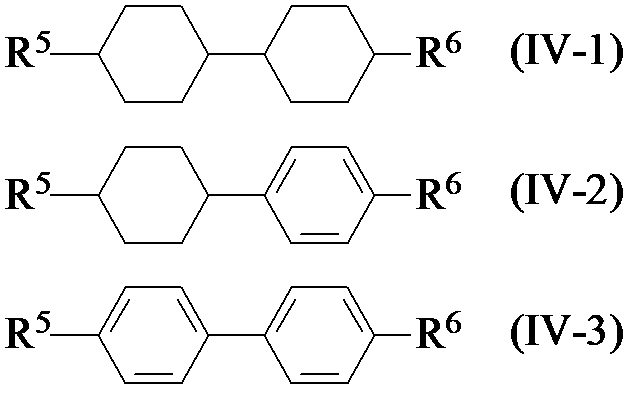
〔10〕 更に一般式(V)
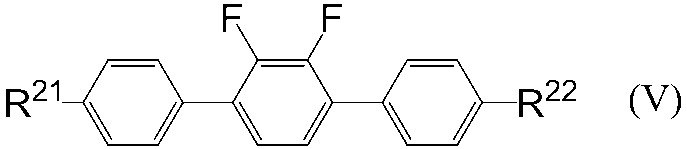
〔11〕 更に重合性化合物を1種又は2種以上含有する〔1〕から〔10〕のいずれかに記載の液晶組成物。
〔12〕 重合性化合物が一般式(RM-1)
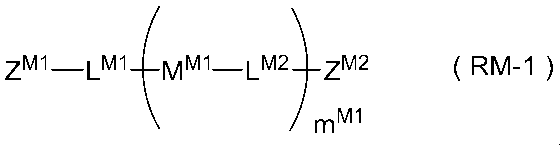

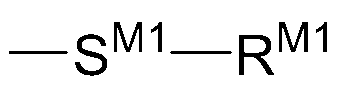
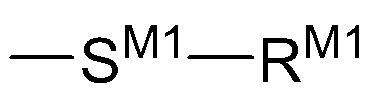
SM1は、炭素原子数1~12のアルキレン基、又は単結合を表し、該アルキレン基中の-CH2-は酸素原子同士が直接結合しないものとして酸素原子、-COO-、-OCO-、又は-OCOO-に置き換えられても良く、
RM1は以下の式(R-1)から式(R-15)
LM1及びLM2はお互い独立して、単結合、-O-、-CH2-、-OCH2-、-CH2O-、-CO-、-C2H4-、―COO-、-OCO-、―CH=CH-COO-、-COO―CH=CH-、-OCO-CH=CH-、-CH=CH-OCO-、―COOC2H4-、―OCOC2H4-、―C2H4OCO-、―C2H4COO-、-OCOCH2-、―CH2COO-、-CH=CH-、-CF=CH-、-CH=CF-、-CF=CF-、-CF2-、-CF2O-、-OCF2-、-CF2CH2-、-CH2CF2-、-CF2CF2-又は-C≡C-を表し、LM2が複数存在する場合はそれらは同一でも異なっていてもよく、
MM1は、1,4-フェニレン基、1,4-シクロヘキシレン基、ナフタレン-2,6-ジイル基を表すが、MM1は、お互い独立して無置換であるか又はこれらの基中に含まれる水素原子がフッ素原子、塩素原子、又は炭素原子数1~8のアルキル基、ハロゲン化アルキル基、ハロゲン化アルコキシ基、アルコキシ基、ニトロ基、又は

mM1は0、1又は2を表すが、
XM1~XM5、SM1、RM1、LM2及び/又はMM1が複数存在する場合にはそれらは同一であっても異なっていてもよい。)で表される化合物である請求項11に記載の液晶組成物。
〔13〕 25℃における誘電率異方性(Δε)が-2.0から-8.0の範囲であり、20℃における屈折率異方性(Δn)が0.08から0.14の範囲であり、20℃における粘度(η)が5から30mPa・sの範囲であり、20℃における回転粘性(γ1)が50から150mPa・sの範囲であり、ネマチック相-等方性液体相転移温度(Tni)が60℃から120℃の範囲である〔1〕から〔13〕のいずれかに記載の液晶組成物。
〔14〕 〔1〕から〔13〕のいずれかに記載の液晶組成物を用いた液晶表示素子。
〔15〕 〔1〕から〔13〕のいずれかに記載の液晶組成物を用いたアクティブマトリックス駆動用液晶表示素子。
〔16〕 〔1〕から〔13〕のいずれかに記載の液晶組成物を用いたVAモード、PSAモード、PSVAモード、IPSモード又はECBモード用液晶表示素子。

で表される置換基が好ましい。


で表される置換基が好ましい。
一般式(I)で表される化合物を除く。

で表される置換基が好ましい。


で表される置換基が好ましい。
Rp及びRqはそれぞれ独立的に炭素原子数1から10のアルキル基、炭素原子数1から10のアルコキシ基又は炭素原子数2から10のアルケニル基がより好ましく、炭素原子数1から5のアルキル基又は炭素原子数1から10のアルコキシ基が更に好ましい。直鎖状であることが更に好ましい。







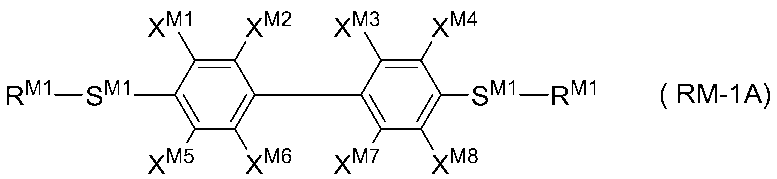
一般式(RM-1A)で表される化合物において、上記のビフェニル骨格の構造は、無置換であるか式(IV-11)から式(IV-14)であることが好ましく、無置換または式(IV-11)であることが好ましい。

重合性化合物である一般式(RM-1)で表される化合物として、具体的に以下の構造式(M1-1)~(M1-13)、(M2-1)~(M2-8)、(M3-1)~(M3-6)、(M4-1)~(M4-7)および(I-1)~(I-40)で表される化合物が好ましい。
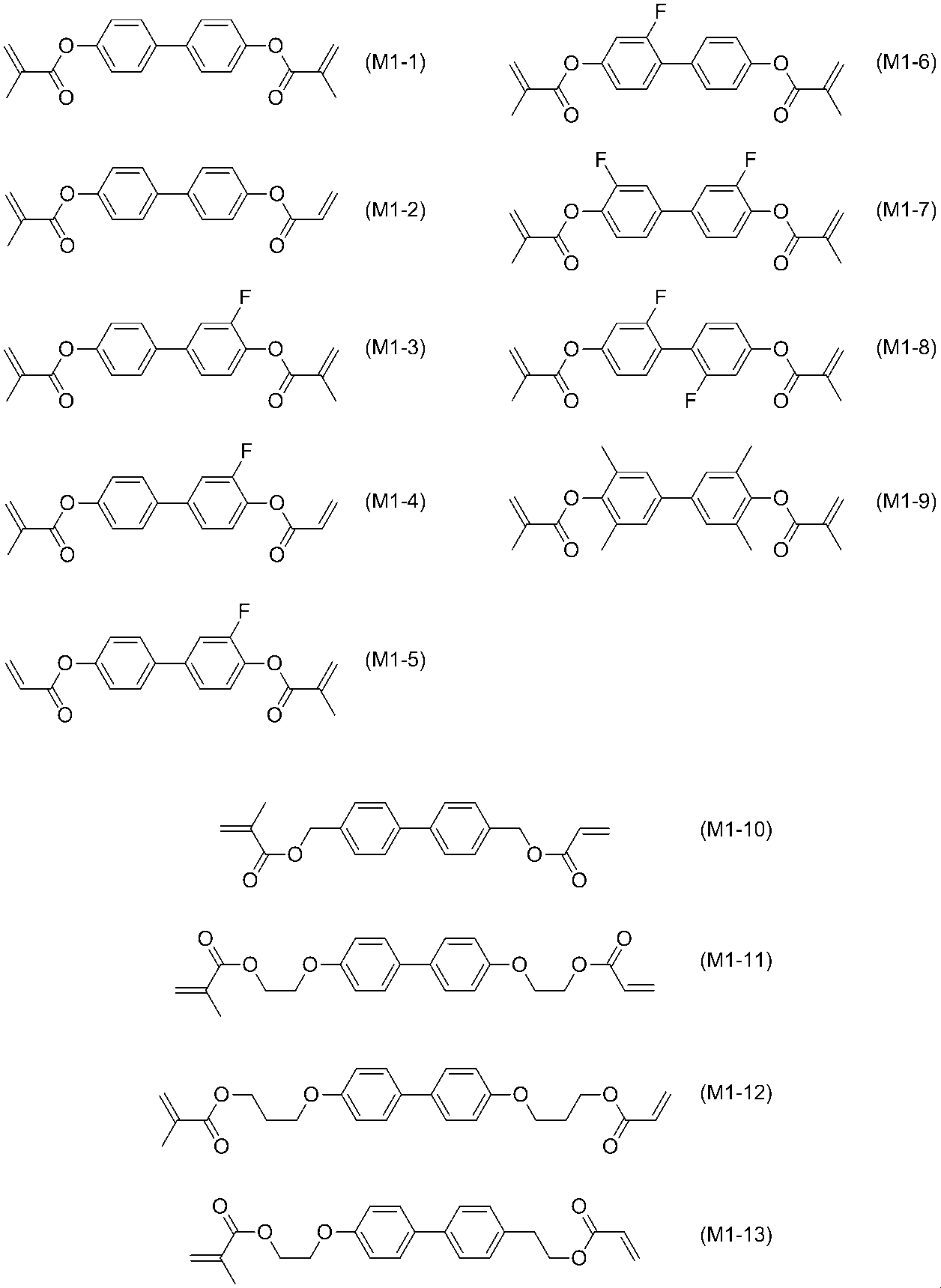
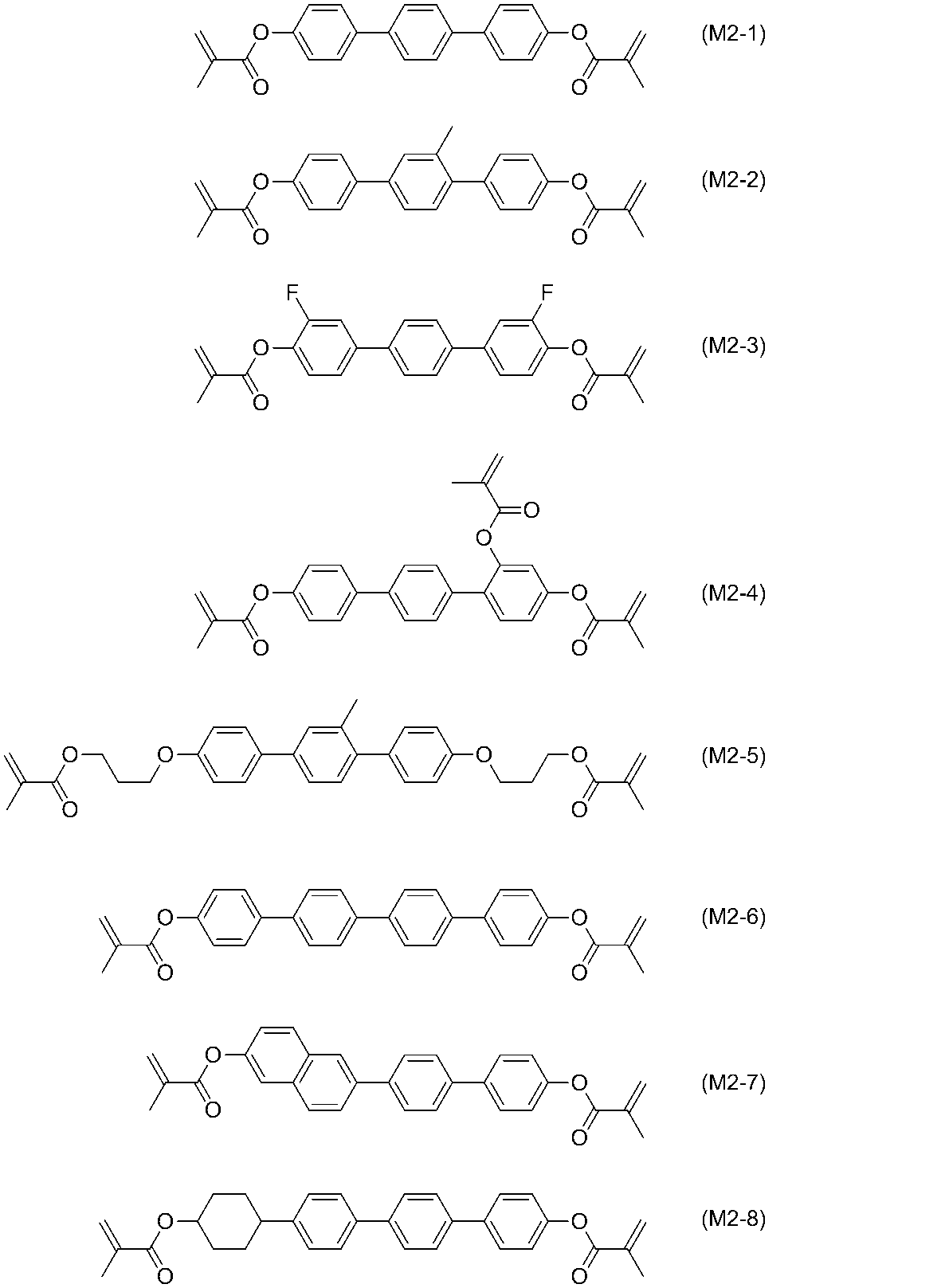

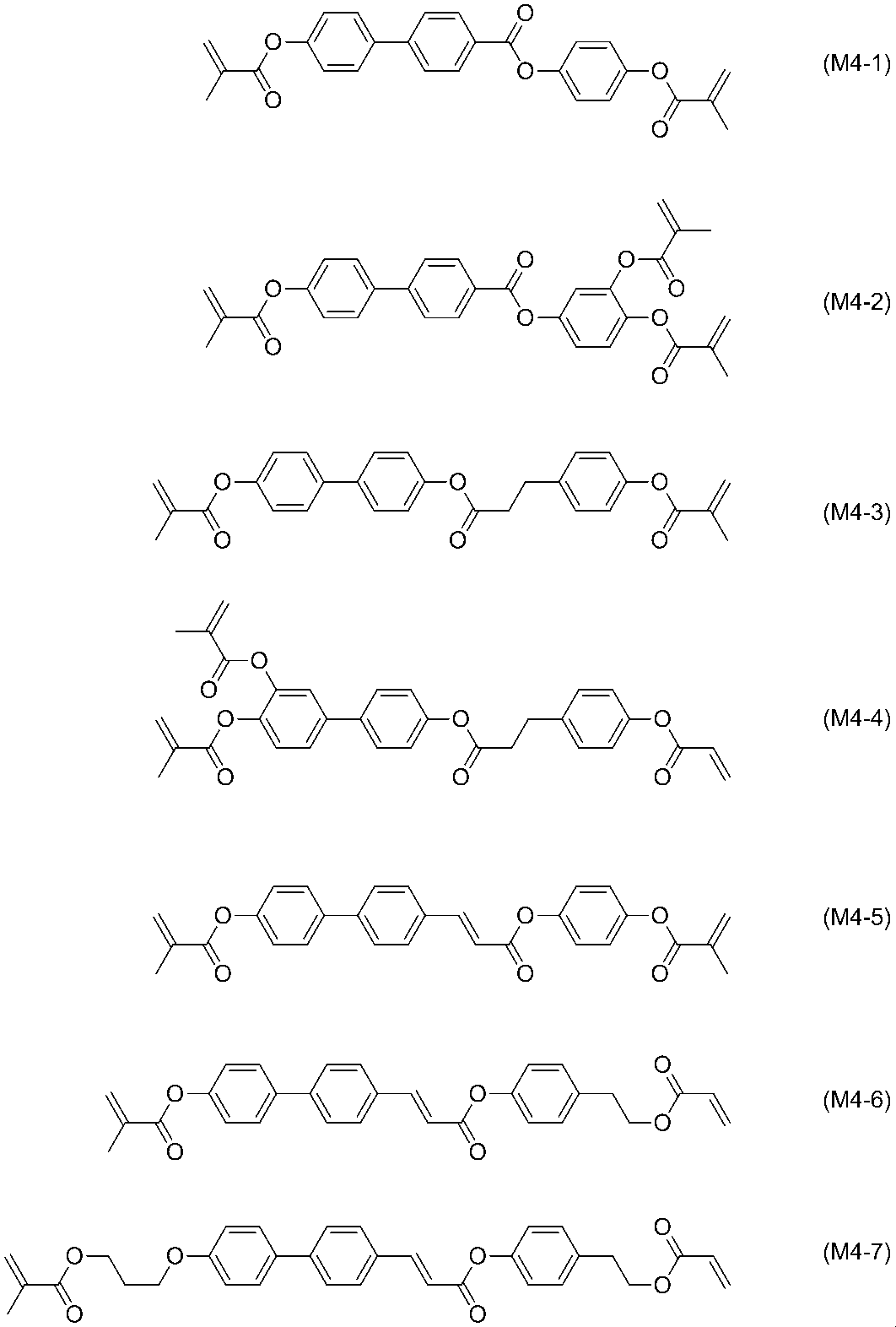

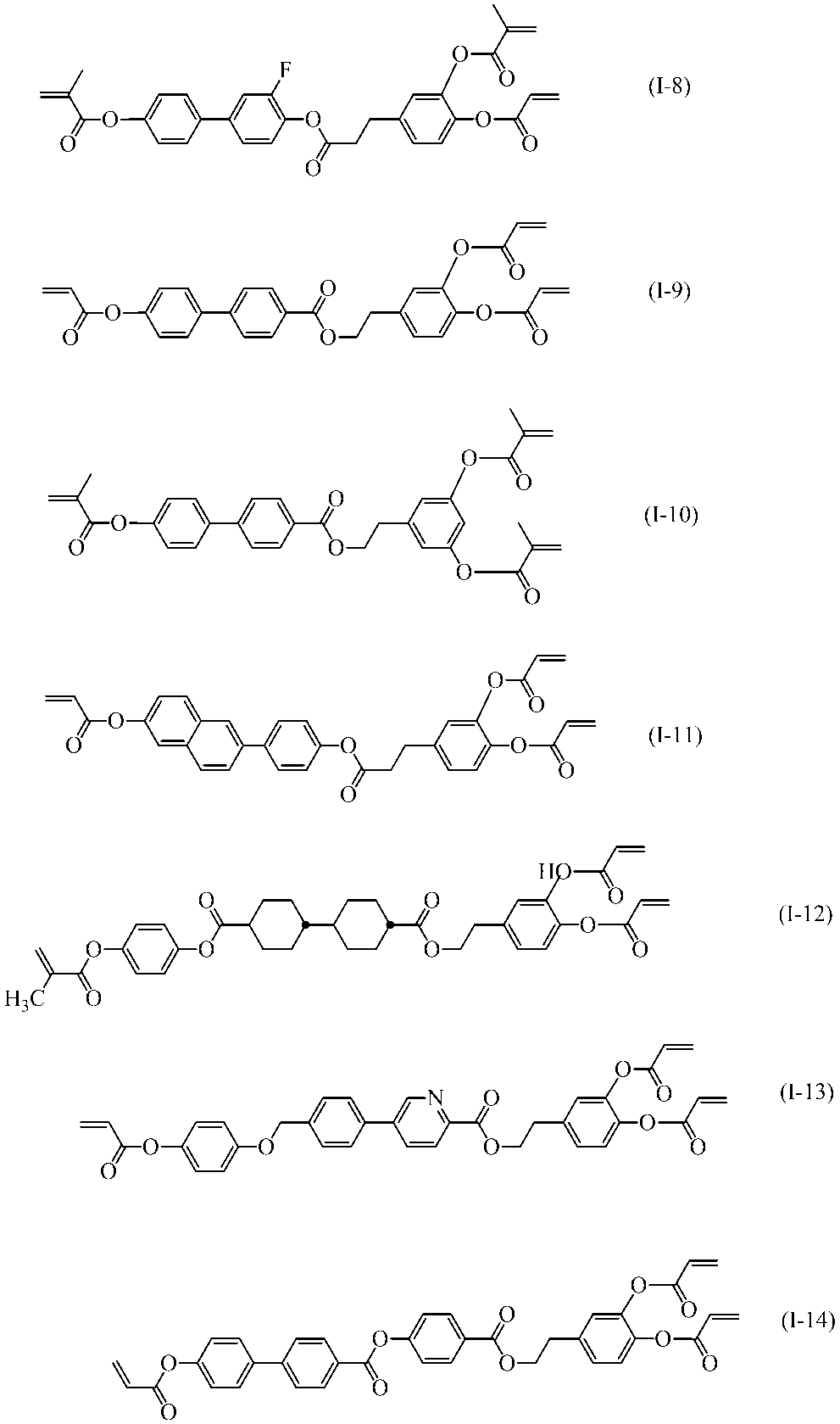
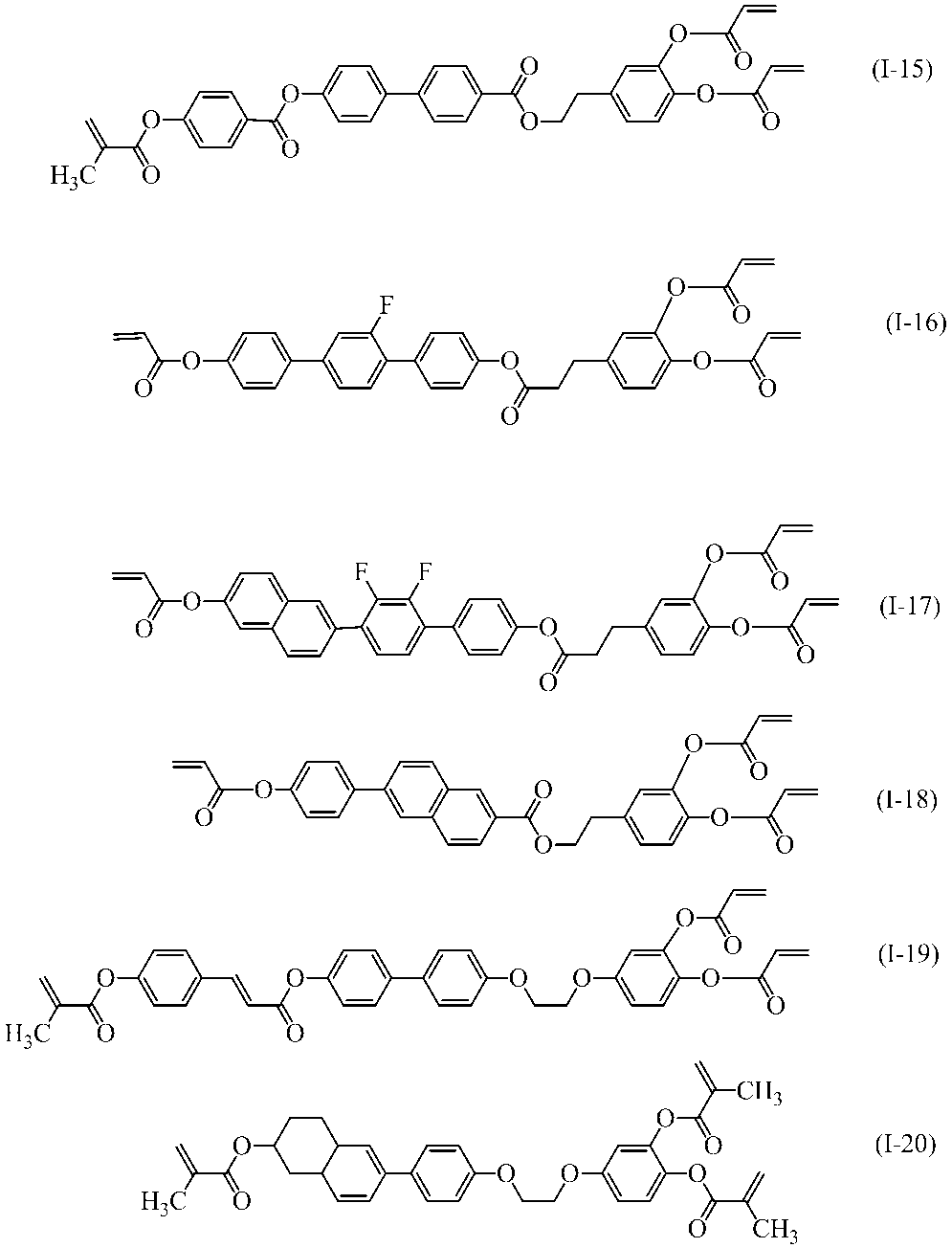
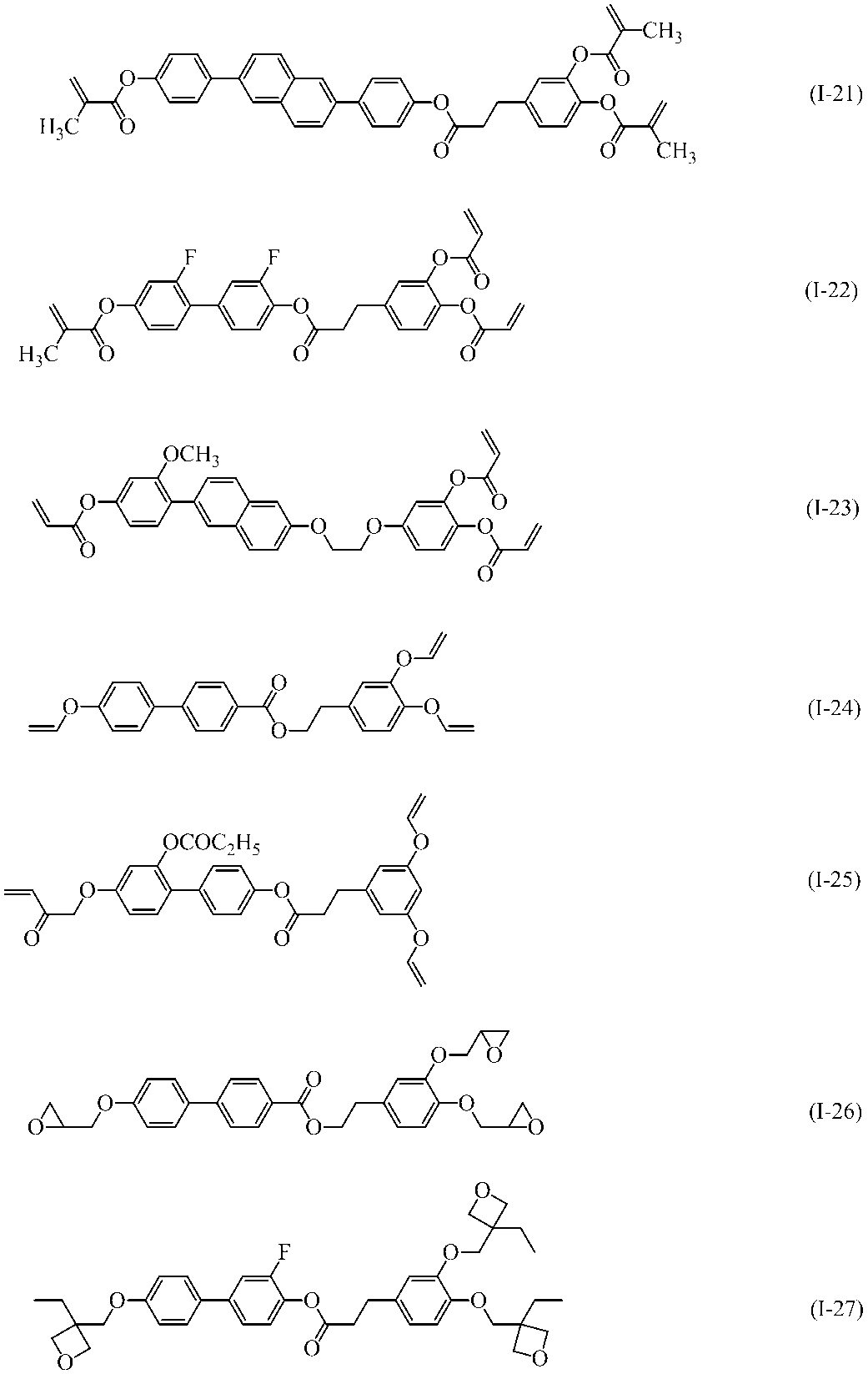

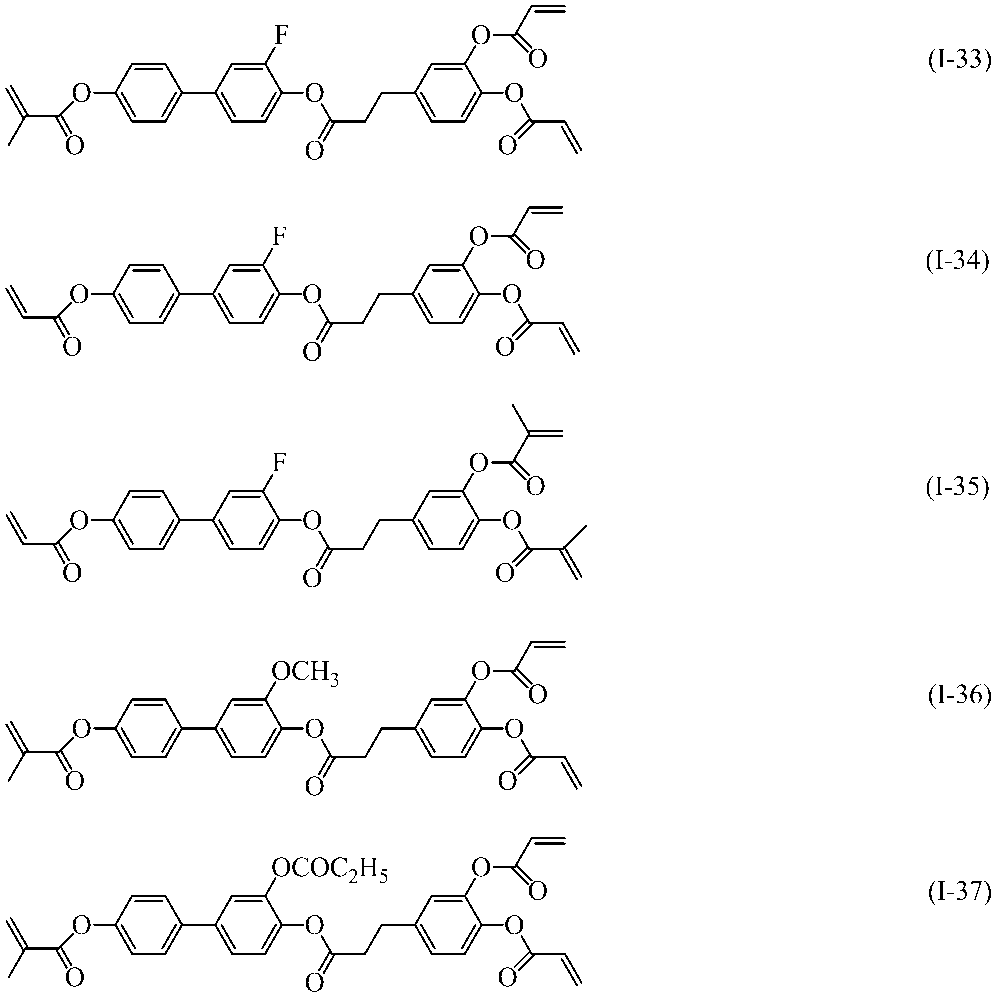



特に(M1-1)、(M1-3)、(M1-6)~(M1-8)、(M1-11)、(M1-12)、(M2-2)、(M2-4)、(M3-1)、(M3-5)、(M4-2)、(M4-6)、(M4-7)および(I-33)~(I-37)で表される化合物が好ましい。


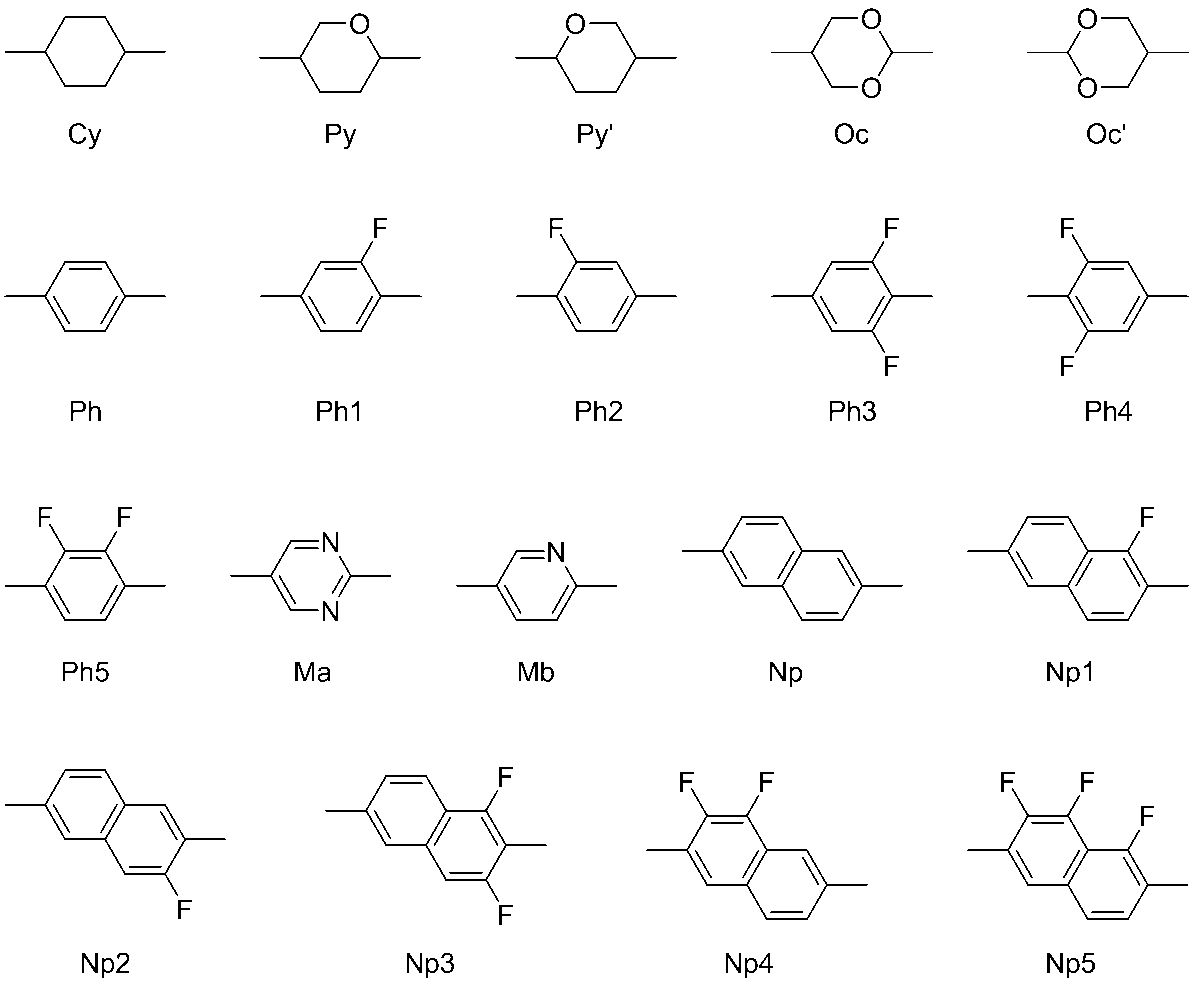
実施例において化合物の記載について以下の略号を用いる。
(側鎖)
-n -CnH2n+1 炭素原子数nの直鎖状のアルキル基
n- CnH2n+1- 炭素原子数nの直鎖状のアルキル基
-On -OCnH2n+1 炭素原子数nの直鎖状のアルコキシル基
nO- CnH2n+1O- 炭素原子数nの直鎖状のアルコキシル基
-V -CH=CH2
V- CH2=CH-
-V1 -CH=CH-CH3
1V- CH3-CH=CH-
-2V -CH2-CH2-CH=CH3
V2- CH3=CH-CH2-CH2-
-2V1 -CH2-CH2-CH=CH-CH3
1V2- CH3-CH=CH-CH2-CH2
(環構造)
Tcn :固体相-ネマチック相転移温度(℃)
Δn :20℃における屈折率異方性
Δε :20℃における誘電率異方性
η :20℃における粘度(mPa・s)
γ1 :20℃における回転粘性(mPa・s)
K33 :20℃における弾性定数K33(pN)
VHR :UVを60J照射した後の電圧保持率(%)
(比較例1、比較例2、実施例1、実施例2及び実施例3)
LC-A(比較例1)、LC-B(比較例2)、LC-1(実施例1)、LC-2(実施例2)及びLC-3(実施例3)の液晶組成物を調製し、その物性値を測定した。液晶組成物の構成とその物性値の結果は表1のとおりであった。

(比較例3、比較例4、実施例6及び実施例7)
LC-C(比較例3)、LC-D(比較例4)、LC-6(実施例6)及びLC-7(実施例7)の液晶組成物を調製し、その物性値を測定した。液晶組成物の構成とその物性値の結果は表2のとおりであった。

(比較例5、比較例6、実施例8、実施例9及び実施例10)
LC-E(比較例5)、LC-F(比較例6)、LC-8(実施例8)、LC-9(実施例9)及びLC-10(実施例10)の液晶組成物を調製し、その物性値を測定した。液晶組成物の構成とその物性値の結果は表3のとおりであった。

Claims (15)
- 液晶組成物中にアルケニル側鎖を有する化合物を1種又は2種以上含有し、液晶組成物中におけるアルケニル側鎖を有する化合物の合計の含有率が5から100質量%であり、アルケニル側鎖を有する化合物として1-プロペニル基を有する化合物を1種又は2種以上含有し、液晶組成物中のアルケニル側鎖を有する化合物における、1-プロペニル基を有する化合物の合計の含有量が30から100質量%である液晶組成物。
- 請求項1における1-プロペニル基を有する化合物が、一般式(I)

m及びnはそれぞれ独立的に0、1又は2を表すが、m+nは1、2、3又は4を表し、
Z11及びZ12はそれぞれ独立的に-OCH2-、-CH2O-、-CF2O-、-OCF2-、-CH2CH2-、-CF2CF2-又は単結合を表し、Z11及びZ12が複数存在する場合はそれらは同一でも異なっていてもよく、
環A及び環Bはそれぞれ独立的にトランス-1,4-シクロへキシレン基、1,4-フェニレン基、2-フルオロ-1,4-フェニレン基、3-フルオロ-1,4-フェニレン基、3,5-ジフルオロ-1,4-フェニレン基、2,3-ジフルオロ-1,4-フェニレン基、1,4-シクロヘキセニレン基、1,4-ビシクロ[2.2.2]オクチレン基、ピペリジン-1,4-ジイル基、ナフタレン-2,6-ジイル基、デカヒドロナフタレン-2,6-ジイル基又は1,2,3,4-テトラヒドロナフタレン-2,6-ジイル基を表し、環A及び環Bが複数存在する場合はそれらは同一でも異なっていてもよい。)
および一般式(I-n)

dは0、1又は2を表し、
環D、環I及び環Cはそれぞれ独立的にトランス-1,4-シクロへキシレン基、1,4-フェニレン基、2-フルオロ-1,4-フェニレン基又は3-フルオロ-1,4-フェニレン基を表し、環Dが複数存在する場合はそれらは同一でも異なっていてもよい。)で表される化合物からなる群より選ばれる1種又は2種以上の化合物である第1請求項記載の液晶組成物。 - 一般式(I)で表される化合物を1種又は2種以上含有する請求項2に記載の液晶組成物。
- 一般式(I-n)で表される化合物を1種又は2種以上含有する請求項2に記載の液晶組成物。
- 一般式(I)で表される化合物を1種又は2種以上含有し、かつ、一般式(I-n)で表される化合物を1種又は2種以上含有する請求項2に記載の液晶組成物。
- 更に一般式(N3)

- 更に一般式(II)
- 更に一般式(IV-1)から一般式(IV-3)

- 更に一般式(V)
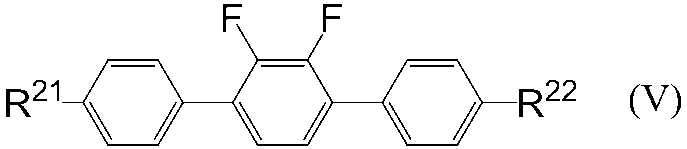
- 更に重合性化合物を1種又は2種以上含有する請求項1から9のいずれか1項に記載の液晶組成物。
- 重合性化合物が一般式(RM-1)
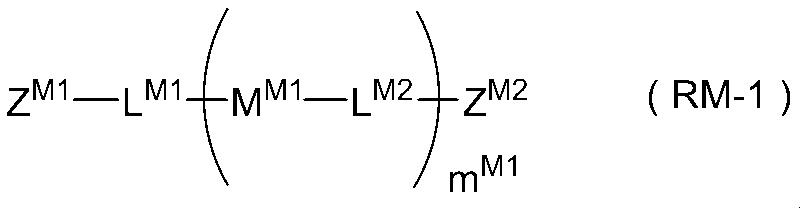

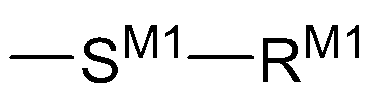

SM1は、炭素原子数1~12のアルキレン基、又は単結合を表し、該アルキレン基中の-CH2-は酸素原子同士が直接結合しないものとして酸素原子、-COO-、-OCO-、又は-OCOO-に置き換えられても良く、
RM1は以下の式(R-1)から式(R-15)

LM1及びLM2はお互い独立して、単結合、-O-、-CH2-、-OCH2-、-CH2O-、-CO-、-C2H4-、―COO-、-OCO-、―CH=CH-COO-、-COO―CH=CH-、-OCO-CH=CH-、-CH=CH-OCO-、―COOC2H4-、―OCOC2H4-、―C2H4OCO-、―C2H4COO-、-OCOCH2-、―CH2COO-、-CH=CH-、-CF=CH-、-CH=CF-、-CF=CF-、-CF2-、-CF2O-、-OCF2-、-CF2CH2-、-CH2CF2-、-CF2CF2-又は-C≡C-を表し、LM2が複数存在する場合はそれらは同一でも異なっていてもよく、
MM1は、1,4-フェニレン基、1,4-シクロヘキシレン基、ナフタレン-2,6-ジイル基を表すが、MM1は、お互い独立して無置換であるか又はこれらの基中に含まれる水素原子がフッ素原子、塩素原子、又は炭素原子数1~8のアルキル基、ハロゲン化アルキル基、ハロゲン化アルコキシ基、アルコキシ基、ニトロ基、又は
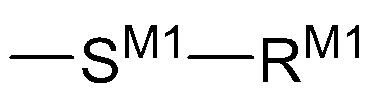
mM1は0、1又は2を表すが、
XM1~XM5、SM1、RM1、LM2及び/又はMM1が複数存在する場合にはそれらは同一であっても異なっていてもよい。)で表される化合物である請求項10に記載の液晶組成物。 - 25℃における誘電率異方性(Δε)が-2.0から-8.0の範囲であり、20℃における屈折率異方性(Δn)が0.08から0.14の範囲であり、20℃における粘度(η)が5から30mPa・sの範囲であり、20℃における回転粘性(γ1)が50から150mPa・sの範囲であり、ネマチック相-等方性液体相転移温度(Tni)が60℃から120℃の範囲である請求項1から11いずれか1項に記載の液晶組成物。
- 請求項1から12のいずれか1項に記載の液晶組成物を用いた液晶表示素子。
- 請求項1から12のいずれか1項に記載の液晶組成物を用いたアクティブマトリックス駆動用液晶表示素子。
- 請求項1から12のいずれか1項に記載の液晶組成物を用いたVAモード、PSAモード、PSVAモード、IPSモード又はECBモード用液晶表示素子。
Priority Applications (4)
| Application Number | Priority Date | Filing Date | Title |
|---|---|---|---|
| US14/898,544 US20160319191A1 (en) | 2013-06-17 | 2014-03-06 | Nematic liquid-crystal composition and liquid-crystal display element obtained using same |
| KR1020167001210A KR101793986B1 (ko) | 2013-06-17 | 2014-03-06 | 네마틱 액정 조성물 및 이를 사용한 액정 표시 소자 |
| JP2014550562A JP5850283B2 (ja) | 2013-06-17 | 2014-03-06 | ネマチック液晶組成物及びこれを用いた液晶表示素子 |
| CN201480034629.6A CN105324461A (zh) | 2013-06-17 | 2014-03-06 | 向列型液晶组合物及使用其的液晶显示元件 |
Applications Claiming Priority (2)
| Application Number | Priority Date | Filing Date | Title |
|---|---|---|---|
| JP2013126572 | 2013-06-17 | ||
| JP2013-126572 | 2013-06-17 |
Publications (1)
| Publication Number | Publication Date |
|---|---|
| WO2014203567A1 true WO2014203567A1 (ja) | 2014-12-24 |
Family
ID=52104313
Family Applications (1)
| Application Number | Title | Priority Date | Filing Date |
|---|---|---|---|
| PCT/JP2014/055823 Ceased WO2014203567A1 (ja) | 2013-06-17 | 2014-03-06 | ネマチック液晶組成物及びこれを用いた液晶表示素子 |
Country Status (6)
| Country | Link |
|---|---|
| US (1) | US20160319191A1 (ja) |
| JP (2) | JP5850283B2 (ja) |
| KR (1) | KR101793986B1 (ja) |
| CN (1) | CN105324461A (ja) |
| TW (1) | TWI632230B (ja) |
| WO (1) | WO2014203567A1 (ja) |
Cited By (2)
| Publication number | Priority date | Publication date | Assignee | Title |
|---|---|---|---|---|
| CN105093689A (zh) * | 2015-07-17 | 2015-11-25 | 深圳市华星光电技术有限公司 | 彩色滤光片整合晶体管式液晶面板及其制造方法 |
| US11555152B2 (en) | 2016-04-27 | 2023-01-17 | Dic Corporation | Liquid crystal composition and liquid crystal display element |
Families Citing this family (11)
| Publication number | Priority date | Publication date | Assignee | Title |
|---|---|---|---|---|
| EP3040398B1 (en) * | 2013-10-08 | 2018-08-15 | DIC Corporation | Nematic liquid crystal composition and liquid crystal display element using same |
| CN106062134B (zh) * | 2014-05-13 | 2021-09-14 | Dic株式会社 | 向列液晶组合物及使用其的液晶显示元件 |
| KR101826643B1 (ko) | 2014-09-05 | 2018-02-07 | 디아이씨 가부시끼가이샤 | 네마틱 액정 조성물 및 이것을 사용한 액정 표시 소자 |
| WO2016098478A1 (ja) * | 2014-12-15 | 2016-06-23 | Dic株式会社 | 組成物及びそれを使用した液晶表示素子 |
| WO2016098480A1 (ja) * | 2014-12-15 | 2016-06-23 | Dic株式会社 | 組成物及びそれを使用した液晶表示素子 |
| WO2016104165A1 (ja) | 2014-12-25 | 2016-06-30 | Dic株式会社 | ネマチック液晶組成物及びこれを用いた液晶表示素子 |
| KR20170079970A (ko) * | 2015-12-31 | 2017-07-10 | 주식회사 동진쎄미켐 | 액정 조성물 및 이를 포함하는 액정 표시 장치 |
| CN112574757B (zh) * | 2019-09-30 | 2022-08-23 | 江苏和成显示科技有限公司 | 一种液晶组合物及光电显示器件 |
| CN113667492B (zh) * | 2021-09-01 | 2024-06-25 | 重庆汉朗精工科技有限公司 | 一种快速响应的负性液晶组合物及其应用 |
| CN114395403A (zh) * | 2021-12-24 | 2022-04-26 | 南昌虚拟现实研究院股份有限公司 | 液晶组合物以及液晶光学元件 |
| CN117511565A (zh) * | 2023-05-16 | 2024-02-06 | Tcl华星光电技术有限公司 | 液晶组合物与液晶显示面板 |
Citations (8)
| Publication number | Priority date | Publication date | Assignee | Title |
|---|---|---|---|---|
| JPH11140447A (ja) * | 1997-08-29 | 1999-05-25 | Merck Patent Gmbh | 液晶媒体 |
| JP2001354967A (ja) * | 2000-04-14 | 2001-12-25 | Merck Patent Gmbh | 液晶媒体 |
| US20040099842A1 (en) * | 2000-12-23 | 2004-05-27 | Melanie Klasen-Memmer | Liquid crystalline medium |
| JP2004532344A (ja) * | 2001-06-01 | 2004-10-21 | メルク パテント ゲゼルシャフト ミット ベシュレンクテル ハフトング | 液晶媒体 |
| JP2005320511A (ja) * | 2004-04-09 | 2005-11-17 | Chisso Corp | 液晶組成物および液晶表示素子 |
| JP2008208365A (ja) * | 2007-02-13 | 2008-09-11 | Merck Patent Gmbh | 液晶媒体 |
| JP2011144274A (ja) * | 2010-01-15 | 2011-07-28 | Jnc Corp | 液晶組成物および液晶表示素子 |
| JP2012097222A (ja) * | 2010-11-04 | 2012-05-24 | Dic Corp | ネマチック液晶組成物及びこれを用いた液晶表示素子 |
Family Cites Families (12)
| Publication number | Priority date | Publication date | Assignee | Title |
|---|---|---|---|---|
| DE4027981A1 (de) | 1990-09-04 | 1992-04-30 | Merck Patent Gmbh | Matrix-fluessigkristallanzeige |
| US5599480A (en) | 1994-07-28 | 1997-02-04 | Merck Patent Gesellschaft Mit Beschrankter Haftung | Liquid-crystalline medium |
| DE10216197B4 (de) | 2002-04-12 | 2013-02-07 | Merck Patent Gmbh | Flüssigkristallmedium und und seine Verwendung in einer elektrooptischen Anzeige |
| JP2004035698A (ja) * | 2002-07-02 | 2004-02-05 | Chisso Corp | 液晶組成物および液晶表示素子 |
| JP4883336B2 (ja) | 2004-07-30 | 2012-02-22 | Dic株式会社 | ネマチック液晶組成物及びこれを用いた液晶表示素子 |
| US20060238696A1 (en) | 2005-04-20 | 2006-10-26 | Chien-Hui Wen | Method of aligning negative dielectric anisotropic liquid crystals |
| JP2007002132A (ja) * | 2005-06-24 | 2007-01-11 | Chisso Corp | 液晶組成物および液晶表示素子 |
| JP2007023071A (ja) * | 2005-07-12 | 2007-02-01 | Chisso Corp | 液晶組成物および液晶表示素子 |
| CN101351432B (zh) | 2006-01-06 | 2011-08-31 | 智索株式会社 | 具有烯基的单氟化联三苯化合物、液晶组成物及液晶显示元件 |
| KR101373734B1 (ko) | 2006-12-11 | 2014-03-14 | 삼성디스플레이 주식회사 | 액정 조성물 및 이를 포함하는 액정 표시 장치 |
| WO2014007118A1 (ja) * | 2012-07-04 | 2014-01-09 | Dic株式会社 | ネマチック液晶組成物及びこれを用いた液晶表示素子 |
| TWI621699B (zh) * | 2013-01-21 | 2018-04-21 | Dainippon Ink & Chemicals | Nematic liquid crystal composition and liquid crystal display element using same |
-
2014
- 2014-03-06 US US14/898,544 patent/US20160319191A1/en not_active Abandoned
- 2014-03-06 JP JP2014550562A patent/JP5850283B2/ja active Active
- 2014-03-06 CN CN201480034629.6A patent/CN105324461A/zh active Pending
- 2014-03-06 KR KR1020167001210A patent/KR101793986B1/ko active Active
- 2014-03-06 WO PCT/JP2014/055823 patent/WO2014203567A1/ja not_active Ceased
- 2014-03-17 TW TW103109886A patent/TWI632230B/zh active
-
2015
- 2015-06-18 JP JP2015122888A patent/JP6365430B2/ja active Active
Patent Citations (8)
| Publication number | Priority date | Publication date | Assignee | Title |
|---|---|---|---|---|
| JPH11140447A (ja) * | 1997-08-29 | 1999-05-25 | Merck Patent Gmbh | 液晶媒体 |
| JP2001354967A (ja) * | 2000-04-14 | 2001-12-25 | Merck Patent Gmbh | 液晶媒体 |
| US20040099842A1 (en) * | 2000-12-23 | 2004-05-27 | Melanie Klasen-Memmer | Liquid crystalline medium |
| JP2004532344A (ja) * | 2001-06-01 | 2004-10-21 | メルク パテント ゲゼルシャフト ミット ベシュレンクテル ハフトング | 液晶媒体 |
| JP2005320511A (ja) * | 2004-04-09 | 2005-11-17 | Chisso Corp | 液晶組成物および液晶表示素子 |
| JP2008208365A (ja) * | 2007-02-13 | 2008-09-11 | Merck Patent Gmbh | 液晶媒体 |
| JP2011144274A (ja) * | 2010-01-15 | 2011-07-28 | Jnc Corp | 液晶組成物および液晶表示素子 |
| JP2012097222A (ja) * | 2010-11-04 | 2012-05-24 | Dic Corp | ネマチック液晶組成物及びこれを用いた液晶表示素子 |
Cited By (3)
| Publication number | Priority date | Publication date | Assignee | Title |
|---|---|---|---|---|
| CN105093689A (zh) * | 2015-07-17 | 2015-11-25 | 深圳市华星光电技术有限公司 | 彩色滤光片整合晶体管式液晶面板及其制造方法 |
| US10216030B2 (en) | 2015-07-17 | 2019-02-26 | Shenzhen China Star Optoelectronics Technology Co., Ltd. | Color filter on array type liquid crystal panel and manufacturing method for the same |
| US11555152B2 (en) | 2016-04-27 | 2023-01-17 | Dic Corporation | Liquid crystal composition and liquid crystal display element |
Also Published As
| Publication number | Publication date |
|---|---|
| TW201502256A (zh) | 2015-01-16 |
| JP5850283B2 (ja) | 2016-02-03 |
| KR101793986B1 (ko) | 2017-11-06 |
| KR20160022876A (ko) | 2016-03-02 |
| CN105324461A (zh) | 2016-02-10 |
| JP2015199968A (ja) | 2015-11-12 |
| JPWO2014203567A1 (ja) | 2017-02-23 |
| TWI632230B (zh) | 2018-08-11 |
| US20160319191A1 (en) | 2016-11-03 |
| JP6365430B2 (ja) | 2018-08-01 |
Similar Documents
| Publication | Publication Date | Title |
|---|---|---|
| JP6365430B2 (ja) | ネマチック液晶組成物及びこれを用いた液晶表示素子 | |
| JP5790899B2 (ja) | ネマチック液晶組成物及びこれを用いた液晶表示素子 | |
| JP5633661B2 (ja) | ネマチック液晶組成物及びこれを用いた液晶表示素子 | |
| JP5618031B1 (ja) | ネマチック液晶組成物及びこれを用いた液晶表示素子 | |
| JP5761479B1 (ja) | ネマチック液晶組成物及びこれを用いた液晶表示素子 | |
| JP5664824B2 (ja) | ネマチック液晶組成物及びこれを用いた液晶表示素子 | |
| JP5668895B2 (ja) | ネマチック液晶組成物及びこれを用いた液晶表示素子 | |
| JP6128660B2 (ja) | ネマチック液晶組成物及びこれを用いた液晶表示素子 | |
| TWI600748B (zh) | A nematic liquid crystal composition, and a liquid crystal display device using the nematic liquid crystal composition | |
| TW202111095A (zh) | 液晶介質及含彼之液晶顯示器及化合物 |
Legal Events
| Date | Code | Title | Description |
|---|---|---|---|
| WWE | Wipo information: entry into national phase |
Ref document number: 201480034629.6 Country of ref document: CN |
|
| ENP | Entry into the national phase |
Ref document number: 2014550562 Country of ref document: JP Kind code of ref document: A |
|
| 121 | Ep: the epo has been informed by wipo that ep was designated in this application |
Ref document number: 14813683 Country of ref document: EP Kind code of ref document: A1 |
|
| NENP | Non-entry into the national phase |
Ref country code: DE |
|
| ENP | Entry into the national phase |
Ref document number: 20167001210 Country of ref document: KR Kind code of ref document: A |
|
| WWE | Wipo information: entry into national phase |
Ref document number: 14898544 Country of ref document: US |
|
| 122 | Ep: pct application non-entry in european phase |
Ref document number: 14813683 Country of ref document: EP Kind code of ref document: A1 |