WO2014200013A1 - 感光性樹脂組成物、パターンの製造方法、有機el表示装置または液晶表示装置の製造方法、および硬化膜 - Google Patents
感光性樹脂組成物、パターンの製造方法、有機el表示装置または液晶表示装置の製造方法、および硬化膜 Download PDFInfo
- Publication number
- WO2014200013A1 WO2014200013A1 PCT/JP2014/065430 JP2014065430W WO2014200013A1 WO 2014200013 A1 WO2014200013 A1 WO 2014200013A1 JP 2014065430 W JP2014065430 W JP 2014065430W WO 2014200013 A1 WO2014200013 A1 WO 2014200013A1
- Authority
- WO
- WIPO (PCT)
- Prior art keywords
- group
- resin composition
- photosensitive resin
- general formula
- alkyl group
- Prior art date
- Legal status (The legal status is an assumption and is not a legal conclusion. Google has not performed a legal analysis and makes no representation as to the accuracy of the status listed.)
- Ceased
Links
- 0 *S(ON=C(c1ccccc1)C#N)(=O)=O Chemical compound *S(ON=C(c1ccccc1)C#N)(=O)=O 0.000 description 3
Images

Classifications
-
- C—CHEMISTRY; METALLURGY
- C08—ORGANIC MACROMOLECULAR COMPOUNDS; THEIR PREPARATION OR CHEMICAL WORKING-UP; COMPOSITIONS BASED THEREON
- C08F—MACROMOLECULAR COMPOUNDS OBTAINED BY REACTIONS ONLY INVOLVING CARBON-TO-CARBON UNSATURATED BONDS
- C08F212/00—Copolymers of compounds having one or more unsaturated aliphatic radicals, each having only one carbon-to-carbon double bond, and at least one being terminated by an aromatic carbocyclic ring
- C08F212/02—Monomers containing only one unsaturated aliphatic radical
- C08F212/04—Monomers containing only one unsaturated aliphatic radical containing one ring
- C08F212/14—Monomers containing only one unsaturated aliphatic radical containing one ring substituted by heteroatoms or groups containing heteroatoms
- C08F212/22—Oxygen
- C08F212/24—Phenols or alcohols
-
- C—CHEMISTRY; METALLURGY
- C08—ORGANIC MACROMOLECULAR COMPOUNDS; THEIR PREPARATION OR CHEMICAL WORKING-UP; COMPOSITIONS BASED THEREON
- C08F—MACROMOLECULAR COMPOUNDS OBTAINED BY REACTIONS ONLY INVOLVING CARBON-TO-CARBON UNSATURATED BONDS
- C08F212/00—Copolymers of compounds having one or more unsaturated aliphatic radicals, each having only one carbon-to-carbon double bond, and at least one being terminated by an aromatic carbocyclic ring
- C08F212/02—Monomers containing only one unsaturated aliphatic radical
- C08F212/04—Monomers containing only one unsaturated aliphatic radical containing one ring
- C08F212/14—Monomers containing only one unsaturated aliphatic radical containing one ring substituted by heteroatoms or groups containing heteroatoms
- C08F212/22—Oxygen
-
- C—CHEMISTRY; METALLURGY
- C08—ORGANIC MACROMOLECULAR COMPOUNDS; THEIR PREPARATION OR CHEMICAL WORKING-UP; COMPOSITIONS BASED THEREON
- C08F—MACROMOLECULAR COMPOUNDS OBTAINED BY REACTIONS ONLY INVOLVING CARBON-TO-CARBON UNSATURATED BONDS
- C08F220/00—Copolymers of compounds having one or more unsaturated aliphatic radicals, each having only one carbon-to-carbon double bond, and only one being terminated by only one carboxyl radical or a salt, anhydride ester, amide, imide or nitrile thereof
- C08F220/02—Monocarboxylic acids having less than ten carbon atoms; Derivatives thereof
- C08F220/04—Acids; Metal salts or ammonium salts thereof
- C08F220/06—Acrylic acid; Methacrylic acid; Metal salts or ammonium salts thereof
-
- C—CHEMISTRY; METALLURGY
- C09—DYES; PAINTS; POLISHES; NATURAL RESINS; ADHESIVES; COMPOSITIONS NOT OTHERWISE PROVIDED FOR; APPLICATIONS OF MATERIALS NOT OTHERWISE PROVIDED FOR
- C09J—ADHESIVES; NON-MECHANICAL ASPECTS OF ADHESIVE PROCESSES IN GENERAL; ADHESIVE PROCESSES NOT PROVIDED FOR ELSEWHERE; USE OF MATERIALS AS ADHESIVES
- C09J4/00—Adhesives based on organic non-macromolecular compounds having at least one polymerisable carbon-to-carbon unsaturated bond ; adhesives, based on monomers of macromolecular compounds of groups C09J183/00 - C09J183/16
- C09J4/06—Organic non-macromolecular compounds having at least one polymerisable carbon-to-carbon unsaturated bond in combination with a macromolecular compound other than an unsaturated polymer of groups C09J159/00 - C09J187/00
-
- G—PHYSICS
- G03—PHOTOGRAPHY; CINEMATOGRAPHY; ANALOGOUS TECHNIQUES USING WAVES OTHER THAN OPTICAL WAVES; ELECTROGRAPHY; HOLOGRAPHY
- G03F—PHOTOMECHANICAL PRODUCTION OF TEXTURED OR PATTERNED SURFACES, e.g. FOR PRINTING, FOR PROCESSING OF SEMICONDUCTOR DEVICES; MATERIALS THEREFOR; ORIGINALS THEREFOR; APPARATUS SPECIALLY ADAPTED THEREFOR
- G03F7/00—Photomechanical, e.g. photolithographic, production of textured or patterned surfaces, e.g. printing surfaces; Materials therefor, e.g. comprising photoresists; Apparatus specially adapted therefor
- G03F7/004—Photosensitive materials
- G03F7/0045—Photosensitive materials with organic non-macromolecular light-sensitive compounds not otherwise provided for, e.g. dissolution inhibitors
-
- G—PHYSICS
- G03—PHOTOGRAPHY; CINEMATOGRAPHY; ANALOGOUS TECHNIQUES USING WAVES OTHER THAN OPTICAL WAVES; ELECTROGRAPHY; HOLOGRAPHY
- G03F—PHOTOMECHANICAL PRODUCTION OF TEXTURED OR PATTERNED SURFACES, e.g. FOR PRINTING, FOR PROCESSING OF SEMICONDUCTOR DEVICES; MATERIALS THEREFOR; ORIGINALS THEREFOR; APPARATUS SPECIALLY ADAPTED THEREFOR
- G03F7/00—Photomechanical, e.g. photolithographic, production of textured or patterned surfaces, e.g. printing surfaces; Materials therefor, e.g. comprising photoresists; Apparatus specially adapted therefor
- G03F7/004—Photosensitive materials
- G03F7/039—Macromolecular compounds which are photodegradable, e.g. positive electron resists
- G03F7/0392—Macromolecular compounds which are photodegradable, e.g. positive electron resists the macromolecular compound being present in a chemically amplified positive photoresist composition
-
- G—PHYSICS
- G03—PHOTOGRAPHY; CINEMATOGRAPHY; ANALOGOUS TECHNIQUES USING WAVES OTHER THAN OPTICAL WAVES; ELECTROGRAPHY; HOLOGRAPHY
- G03F—PHOTOMECHANICAL PRODUCTION OF TEXTURED OR PATTERNED SURFACES, e.g. FOR PRINTING, FOR PROCESSING OF SEMICONDUCTOR DEVICES; MATERIALS THEREFOR; ORIGINALS THEREFOR; APPARATUS SPECIALLY ADAPTED THEREFOR
- G03F7/00—Photomechanical, e.g. photolithographic, production of textured or patterned surfaces, e.g. printing surfaces; Materials therefor, e.g. comprising photoresists; Apparatus specially adapted therefor
- G03F7/004—Photosensitive materials
- G03F7/039—Macromolecular compounds which are photodegradable, e.g. positive electron resists
- G03F7/0392—Macromolecular compounds which are photodegradable, e.g. positive electron resists the macromolecular compound being present in a chemically amplified positive photoresist composition
- G03F7/0397—Macromolecular compounds which are photodegradable, e.g. positive electron resists the macromolecular compound being present in a chemically amplified positive photoresist composition the macromolecular compound having an alicyclic moiety in a side chain
Definitions
- the present invention relates to a photosensitive resin composition and a method for producing a pattern using the same. Furthermore, the present invention relates to a method for manufacturing an organic EL display device or a liquid crystal display device including the pattern manufacturing method. Furthermore, it is related with the cured film formed by hardening
- the TFT (Thin Film Transistor) substrate used in flat panel display devices such as organic EL display devices and liquid crystal display devices has an insulating inorganic transparent film such as SiOx and SiNx, and an oxide transparent conductive film such as ITO and IZO. , Al, Mo, Ti, Cu, W, a metal film made of a laminated film thereof, and a semiconductor film such as Si or an oxide semiconductor are provided in a pattern.
- a photosensitive resin composition etching resist
- solvent removal solvent removal
- JP 9-325473 A Japanese Patent Laid-Open No. 10-326015
- the photosensitive resin composition used therefor is required to have further improved characteristics with respect to sensitivity.
- there are a wide variety of types of functional inorganic films that form patterns by etching, and etching resists having excellent adhesion to various functional inorganic films are required.
- the object of the present invention is to solve such a demand, and an object of the present invention is to provide a photosensitive resin composition having further improved sensitivity.
- a photosensitive resin composition capable of obtaining a pattern with high sensitivity can be obtained by adding a photoacid generator having a predetermined structure to the photosensitive resin composition.
- the present invention has been completed.
- ⁇ 1> A polymer having a structural unit (a1) represented by the following general formula (1) and / or (A2) a structural unit (a2) represented by the following general formula (2)
- R 1 and R 2 each independently represent a hydrogen atom, an alkyl group or an aryl group, at least one of R 1 and R 2 is an alkyl group or an aryl group, and R 3 is an alkyl group Or an aryl group, R 1 or R 2 and R 3 may be linked to form a cyclic ether, and R 4 represents a hydrogen atom or a methyl group
- R 1 and R 2 each independently represent a hydrogen atom, an alkyl group or an aryl group, at least one of R 1 and R 2 is an alkyl group or an aryl group, and R 3 is an alkyl group Or an aryl group,
- R 1 in the general formula (3) is an alkyl group having 3 to 10 carbon atoms or an aryl group having 6 to 12 carbon atoms.
- R 1 in the general formula (3) is an alkyl group having a branched structure, a cyclic alkyl group, or a phenyl group.
- the polymer component has (A1) a polymer having the structural unit (a1) represented by the general formula (1), and (A2) a structural unit represented by the general formula (2) ( The photosensitive resin composition according to any one of ⁇ 1> to ⁇ 4>, comprising both a polymer having a2).
- the solvent is (C1) a solvent containing two or more acetate structures in the molecule, and (C1) another solvent (C2) different from the solvent containing two or more acetate structures in the molecule;
- ⁇ 11> A cured film obtained by curing the photosensitive resin composition according to any one of ⁇ 1> to ⁇ 10>.
- ⁇ 12> (1) A step of applying the photosensitive resin composition according to any one of ⁇ 1> to ⁇ 10> to at least one surface of the substrate, (2) a step of volatilizing an organic solvent by drying to form a photosensitive resin composition layer, (3) a step of exposing the photosensitive resin composition layer; (4) A process for producing a pattern comprising a step of developing the exposed photosensitive resin composition layer.
- a method for manufacturing a pattern comprising: ⁇ 14> A method for producing an organic EL display device or a liquid crystal display device, comprising the method for producing a pattern according to ⁇ 12> or the method for producing a pattern according to ⁇ 13>.
- the present invention makes it possible to provide a photosensitive resin composition with high sensitivity.
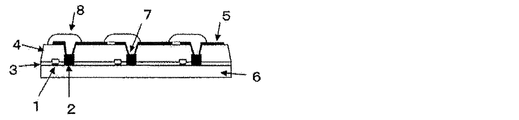
- 1 shows a conceptual diagram of a configuration of an example of an organic EL display device.
- 1 is a schematic cross-sectional view of a substrate in a bottom emission type organic EL display device.
- 1 is a conceptual diagram of a configuration of an example of a liquid crystal display device.
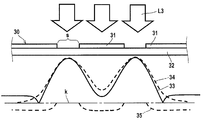
- 1 is a schematic cross-sectional view of an active matrix substrate in a liquid crystal display device. It is the figure which showed typically an example of the exposure form using a halftone phase difference mask.
- the organic EL display device in the present invention refers to an organic electroluminescence display device.
- the polydispersity in the present invention refers to the value of Mw / Mn.
- substitution and non-substitution includes what has a substituent with what does not have a substituent.
- the “alkyl group” includes not only an alkyl group having no substituent (unsubstituted alkyl group) but also an alkyl group having a substituent (substituted alkyl group).
- (meth) acrylic acid means acrylic acid and / or methacrylic acid.
- the solid content in the present invention refers to a solid content at 25 ° C.
- the weight average molecular weight and the number average molecular weight are defined as polystyrene converted values by GPC measurement.
- the weight average molecular weight (Mw) and the number average molecular weight (Mn) are, for example, HLC-8220 (manufactured by Tosoh Corporation) and TSKgelgSuper AWM-H (manufactured by Tosoh Corporation, 6) as a column.
- 0.0 mm ID ⁇ 15.0 cm can be determined by using a 10 mmol / L lithium bromide NMP (N-methylpyrrolidinone) solution as an eluent.
- the composition of the present invention includes (A) (A1) a polymer having a structural unit (a1) represented by the following general formula (1), and / Or (A2) a polymer component including a polymer containing the structural unit (a2) represented by the following general formula (2), (B) a compound represented by the following general formula (3), and (C) It contains a solvent.
- R 1 and R 2 each independently represent a hydrogen atom, an alkyl group or an aryl group, at least one of R 1 and R 2 is an alkyl group or an aryl group, and R 3 is an alkyl group.
- R 1 or R 2 and R 3 may be linked to form a cyclic ether, and R 4 represents a hydrogen atom or a methyl group.
- R 1 and R 2 each independently represents a hydrogen atom, an alkyl group or an aryl group, at least one of R 1 and R 2 is an alkyl group or an aryl group, and R 3 is an alkyl group.
- R 1 or R 2 and R 3 may be linked to form a cyclic ether
- R 4 represents a hydrogen atom or a methyl group
- X 0 represents a single bond or an arylene group.
- R 1 represents an alkyl group or an aryl group
- R 2 represents an alkyl group, an aryl group, or a heteroaryl group
- R 3 to R 6 each independently represents a hydrogen atom.
- the composition of the present invention is preferably used as a chemically amplified positive photosensitive resin composition.
- it is preferably used as a photosensitive resin composition for an etching resist (for example, a photosensitive resin composition for an etching resist used for forming a display panel substrate).
- a photosensitive resin composition for an etching resist for example, a photosensitive resin composition for an etching resist used for forming a display panel substrate.
- the composition of the present invention comprises (A1) a polymer component having the structural unit (a1) represented by the general formula (1) and / or (A2) the following general formula (2) as the polymer component (A).
- the polymer component which has a structural unit (a2) represented by this is included.
- the polymer component may contain a polymer other than the structural unit (a1) represented by the general formula (1).
- (A2) polymer component may contain polymers other than the structural unit (a2) represented by General formula (2).
- the composition of the present invention contains at least one of (A1) polymer and (A2) polymer, and may contain only one type or two or more types.
- the polymer component in the composition of the present invention is preferably alkali-insoluble, and the structural unit represented by the general formula (1) and / or the acid-decomposable group of the structural unit represented by the general formula (2) It is preferable that the resin be alkali-soluble when decomposed.
- alkali-soluble means a coating film (thickness 3 ⁇ m) of a compound (resin) formed by applying a compound (resin) solution on a substrate and heating at 90 ° C. for 2 minutes.
- the dissolution rate in a 0.4% tetramethylammonium hydroxide aqueous solution at 23 ° C. is 0.01 ⁇ m / second or more.
- Alkali insoluble means that a compound (resin) solution is applied onto a substrate.
- the dissolution rate of the coating film (thickness 3 ⁇ m) of the compound (resin) formed by heating at 90 ° C. for 2 minutes with respect to a 0.4% tetramethylammonium hydroxide aqueous solution at 23 ° C. is 0.01 ⁇ m / It means less than a second.
- the (A1) polymer component in the present invention is a polymer component including a polymer having the structural unit (a1) represented by the general formula (1).
- the structural unit (a1) represented by the general formula (1) is a structural unit having a protected phenolic hydroxyl group in which the phenolic hydroxyl group is protected with an acid-decomposable group.
- the protected phenolic hydroxyl group can be produced by the decomposition of the protecting group with an acid.
- R 1 and R 2 each independently represent a hydrogen atom, an alkyl group or an aryl group, at least one of R 1 and R 2 is an alkyl group or an aryl group, and R 3 is an alkyl group.
- a group or an aryl group, R 1 or R 2 and R 3 may be linked to form a cyclic ether, and R 4 represents a hydrogen atom or a methyl group.
- R 1 and R 2 each independently represent a hydrogen atom, an alkyl group or an aryl group, and at least one of R 1 and R 2 is an alkyl group or an aryl group.
- an alkyl group having 1 to 10 carbon atoms is preferable, an alkyl group having 1 to 8 carbon atoms is more preferable, and an alkyl group having 1 to 6 carbon atoms is more preferable.
- the alkyl group may have a substituent.
- the alkyl group may be linear, branched or cyclic, but is preferably a linear alkyl group.
- alkyl group examples include a methyl group, an ethyl group, a propyl group, a butyl group, a t-butyl group, a pentyl group, a hexyl group, and a cyclohexyl group.
- aryl group an aryl group having 6 to 20 carbon atoms is preferable, an aryl group having 6 to 14 carbon atoms is more preferable, and an aryl group having 6 to 10 carbon atoms is more preferable.
- the aryl group may have a substituent. Examples of the aryl group include a phenyl group, a naphthyl group, and an anthracenyl group.
- alkyl group and aryl group may have include an alkyl group having 1 to 10 carbon atoms, an alkoxy group having 1 to 10 carbon atoms, a thioalkoxy group having 1 to 10 carbon atoms, a hydroxyl group, and a cyano group. And halogen atoms (fluorine atom, chlorine atom, bromine atom, iodine atom) and the like. These substituents may further have a substituent.
- R 1 and R 2 are preferably a hydrogen atom or an alkyl group, more preferably a hydrogen atom or a methyl group, one of R 1 and R 2 is a methyl group, and the other is a hydrogen atom. Particularly preferred is an atom.
- R 3 represents an alkyl group or an aryl group.
- the alkyl group and aryl group represented by R 3 have the same meanings as the alkyl group and aryl group in R 1 and R 2 .
- R 3 is preferably a methyl group, an ethyl group, or a propyl group, and more preferably an ethyl group or a propyl group.
- R 3 may be linked to R 1 or R 2 to form a cyclic ether.
- the cyclic ether formed by linking to R 1 or R 2 is preferably a 3- to 6-membered cyclic ether, more preferably a 5- to 6-membered cyclic ether.
- the structural unit represented by the general formula (1) is preferably 5 to 40 mol%, more preferably 10 to 40 mol% of the structural unit of the polymer component (A1). Preferably, 20 to 35 mol% is more preferable.
- the polymer component preferably contains a polymer having a structural unit (a4) represented by the following general formula (5) in addition to the structural unit (a1) from the viewpoint of high sensitivity.
- General formula (5) (In general formula (5), R 4 is a hydrogen atom or a methyl group.)
- R 4 is preferably a hydrogen atom.
- the OH group may be any of p-, m-, and o-, but is preferably bonded to the p-position.
- the structural unit represented by the general formula (5) is preferably 50 to 80 mol%, more preferably 60 to 70 mol% of the structural unit of the polymer component (A1). By setting it to 50 mol% or more, the effect of the present invention is more effectively exhibited, and by setting it to 80 mol% or less, it is possible to suppress excessive sensitivity and to make the exposure process margin more appropriate. be able to.
- the polymer may contain other structural units in addition to the structural unit represented by the general formula (1) and the structural unit represented by the general formula (5). As such a structural unit, the other structural unit (a3) mentioned later is illustrated.
- the proportion of the other structural unit (a3) in the polymer (A1) is preferably 60 mol% or less, more preferably 50 mol% or less, and even more preferably 40 mol% or less.
- As a lower limit although 0 mol% may be sufficient, it can be set as 1 mol% or more, for example, Furthermore, it can be set as 5 mol% or more. When it is within the above numerical range, various properties of the cured film obtained from the photosensitive resin composition are improved.
- the protection rate of the polymer is preferably 1 to 60%, more preferably 5 to 50%, and still more preferably 10 to 40%. By setting it as such a range, an image disk and a sensitivity, resolution, and rectangularity will become favorable.
- the protection rate refers to the molar ratio of the acid-protected structural unit, where the total of the acidic structural unit and the acid-protected structural unit in the polymer (A1) is 100 mol%.
- the weight average molecular weight (Mw) of the polymer (A1) is preferably in the range of 2000 to 15000, more preferably 5000 to 12000, and still more preferably 7500 to 12000.
- the polydispersity (weight average molecular weight (Mw) / number average molecular weight (Mn)) of the polymer (A1) is preferably 1.0 to 3.0, more preferably 1.0 to 2.0. 0 to 1.5 is more preferable. By setting it as such a range, the rectangularity of a pixel becomes favorable.
- the (A2) polymer component in the present invention is a polymer component including a polymer having the structural unit (a2) represented by the general formula (2).
- the structural unit (a2) represented by the general formula (2) is a structural unit having a protected carboxyl group in which the carboxyl group is protected with an acid-decomposable group.
- the protected carboxyl group can be generated by the decomposition of the protective group with an acid.
- the structural unit having a protected carboxyl group protected by an acid-decomposable group examples include the structural unit having a protected carboxyl group protected by an acid-decomposable group described in paragraphs 0021 to 0055 of JP2012-155288A.
- Examples of the structural unit having a protected carboxyl group protected with an acid-decomposable group described in paragraphs 0020 to 0052 of JP 2012-133301 A are exemplified, the contents of which are incorporated herein.
- the polymer component (A2) is preferably a polymer component having a structural unit (a2) having a group in which an acid group having a structure represented by the following general formula (2) is protected with an acid-decomposable group.
- the acid group in the present invention means a proton dissociable group having a pKa of less than 7.
- the acid group is usually incorporated into the polymer as a structural unit containing an acid group using a monomer capable of forming an acid group.
- the polymer tends to be easily dissolved in an alkaline developer.
- a highly sensitive photosensitive resin composition can be obtained.
- R 1 and R 2 each independently represents a hydrogen atom, an alkyl group or an aryl group, at least one of R 1 and R 2 is an alkyl group or an aryl group, and R 3 is an alkyl group.
- R 1 or R 2 and R 3 may be linked to form a cyclic ether
- R 4 represents a hydrogen atom or a methyl group
- X 0 represents a single bond or an arylene group. .
- R 1 and R 2 are alkyl groups, alkyl groups having 1 to 10 carbon atoms are preferred. When R 1 and R 2 are aryl groups, a phenyl group is preferred. R 1 and R 2 are each preferably a hydrogen atom or an alkyl group having 1 to 4 carbon atoms. R 3 represents an alkyl group or an aryl group, preferably an alkyl group having 1 to 10 carbon atoms, more preferably an alkyl group having 1 to 6 carbon atoms.
- X 0 represents a single bond or an arylene group, and a single bond is preferable.
- R represents a hydrogen atom or a methyl group.
- the structural unit represented by the general formula (2) is preferably 10 to 80 mol%, more preferably 20 to 80 mol%, and more preferably 30 to 70 mol% of the structural unit of the polymer component (A2).
- the content of constituent units other than the constituent unit represented by the general formula (2) is preferably 60 mol% or less, more preferably 50 mol% or less, 40 mol% or less is more preferable.
- a lower limit although 0 mol% may be sufficient, it can be set as 1 mol% or more, for example, Furthermore, it can be set as 5 mol% or more.
- the protection ratio of the polymer component is preferably 20 to 100%, more preferably 40 to 90%, and still more preferably 60 to 90%. By setting it as such a range, a sensitivity improves and the difference (discrimination) of the solubility of an exposed part and an unexposed part becomes favorable.
- the protection rate refers to the molar ratio of the acid-protected structural unit, where the total of the acidic structural unit and the acid-protected structural unit in the polymer (A2) is 100 mol%.
- the weight average molecular weight (Mw) of the polymer component (A2) is preferably in the range of 2000 to 50000, more preferably 5000 to 20000, and further preferably 7500 to 15000.
- Mw weight average molecular weight
- the weight average molecular weight is defined by a polystyrene conversion value of gel permeation chromatography.
- the polydispersity (weight average molecular weight (Mw) / number average molecular weight (Mn)) of the polymer component (A2) is preferably 1.0 to 4.0, more preferably 1.2 to 3.0. More preferably, it is 5 to 2.0. By setting it as such a range, the characteristic excellent in the sensitivity and the rectangularity can be acquired.
- composition of this invention contains both (A1) and (A2) as a polymer component.
- These mass ratios are preferably 2: 8 to 8: 2, more preferably 3: 7 to 7: 3, and still more preferably 4: 6 to 6: 4. By setting it as such a range, it exists in the tendency for the effect of this invention to be exhibited more effectively.
- the component (A) may have another structural unit (a3) in addition to the structural units (a1) and (a2). These structural units may contain either one of the polymer components (A1) and (A2), or both.
- the polymer component (A3) having substantially only (a1) and / or (a2) and having only the other structural unit (a3). You may have.
- the polymer component (A3) having substantially only (a1) and / or (a2) and having only another structural unit (a3) is included.
- the blending amount of the polymer component is preferably 60% by mass or less, more preferably 40% by mass or less, and still more preferably 20% by mass or less in the total polymer component.
- a monomer used as structural unit (a3) For example, styrenes, (meth) acrylic acid alkyl ester, (meth) acrylic acid cyclic alkyl ester, (meth) acrylic acid aryl ester, unsaturated dicarboxylic acid Examples include diesters, bicyclounsaturated compounds, maleimide compounds, unsaturated aromatic compounds, conjugated diene compounds, unsaturated monocarboxylic acids, unsaturated dicarboxylic acids, unsaturated dicarboxylic acid anhydrides, and other unsaturated compounds. it can. Moreover, you may have the structural unit which has an acid group so that it may mention later.
- the monomer which becomes another structural unit (a3) can be used individually or in combination of 2 or more types.
- the structural unit (a3) is styrene, methyl styrene, hydroxy styrene, ⁇ -methyl styrene, acetoxy styrene, methoxy styrene, ethoxy styrene, chlorostyrene, methyl vinyl benzoate, ethyl vinyl benzoate, 4-hydroxy Benzoic acid (3-methacryloyloxypropyl) ester, (meth) acrylic acid, methyl (meth) acrylate, ethyl (meth) acrylate, n-propyl (meth) acrylate, isopropyl (meth) acrylate, (meth) 2-hydroxyethyl acrylate, 2-hydroxypropyl (meth) acrylate, benzyl (meth) acrylate, isobornyl (meth) acrylate, (meth) acryloylmorpholine, N-cyclohexylmale
- the other structural unit (a3) it is preferable to include a repeating unit containing an acid group.
- the acid group in the present invention means a proton dissociable group having a pKa of less than 7.
- the acid group is usually incorporated into the polymer as a structural unit containing an acid group using a monomer capable of forming an acid group. By including such a structural unit containing an acid group in the polymer, the polymer tends to be easily dissolved in an alkaline developer.
- Acid groups used in the present invention include those derived from carboxylic acid groups, those derived from sulfonamide groups, those derived from phosphonic acid groups, those derived from sulfonic acid groups, those derived from phenolic hydroxyl groups, sulfones Examples include amide groups, sulfonylimide groups, and the like, and those derived from carboxylic acid groups and / or those derived from phenolic hydroxyl groups are preferred.
- the structural unit containing an acid group used in the present invention is more preferably a structural unit derived from styrene, a structural unit derived from a vinyl compound, a structural unit derived from (meth) acrylic acid and / or an ester thereof. .
- the structural unit containing an acid group is preferably 1 to 80% by mole, more preferably 1 to 50% by mole, and still more preferably 5 to 40% by mole of the structural unit of all polymer components.
- the coalescence component (A3) may be included.
- Such a polymer is preferably a resin having a carboxyl group in the side chain.
- a resin having a carboxyl group in the side chain For example, JP-A-59-44615, JP-B-54-34327, JP-B-58-12777, JP-B-54-25957, JP-A-59-53836, JP-A-59-71048
- methacrylic acid copolymer, acrylic acid copolymer, itaconic acid copolymer, crotonic acid copolymer, maleic acid copolymer, partially esterified maleic acid copolymer, etc. and side chain
- acidic cellulose derivatives having a carboxyl group those obtained by adding an acid anhydride to a polymer having a hydroxyl group
- high molecular polymers having a (meth) acryloyl group in the side chain examples thereof include acidic cellulose derivatives having a carboxyl group, those obtained by adding an acid anhydride to a
- benzyl (meth) acrylate / (meth) acrylic acid co-A-2-hydroxyethyl (meth) acrylate / benzyl (meth) acrylate / (meth) acrylic acid copolymer described in JP-A-7-140654 2-hydroxypropyl (meth) acrylate / polystyrene macromonomer / benzyl methacrylate / methacrylic acid co-A-2-hydroxy-3-phenoxypropyl acrylate / polymethyl methacrylate macromonomer / benzyl methacrylate / methacrylic acid co-A-2-hydroxyethyl Methacrylate / polystyrene macromonomer / methyl methacrylate / methacrylic acid copolymer A-2-hydroxyethyl methacrylate / polystyrene macromonomer / benzyl methacrylate / methacrylic acid copolymer It is below.
- Known polymer compounds described in JP-A-2003-233179, JP-A-2009-52020, and the like can be used, and the contents thereof are incorporated herein. These polymers may contain only 1 type and may contain 2 or more types.
- ARUFON UC-3000, ARUFON UC-3510, ARUFON UC are commercially available as these polymers.
- -3900, ARUFON UC-3910, ARUFON UC-3920, ARUFON UC-3080 (above, manufactured by Toagosei Co., Ltd.), Joncry 690, Joncry 678, Joncry 67, Joncryl 586 (manufactured by BASF) or the like can also be used.
- composition of the present invention preferably contains the polymer component in a proportion of 60% by mass or more, more preferably 80% by mass or more, based on the total solid content.
- composition of this invention contains the compound represented by (B) general formula (3), and the compound represented by (B) general formula (3) functions as a photo-acid generator.
- R 1 represents an alkyl group or an aryl group
- R 2 represents an alkyl group, an aryl group, or a heteroaryl group.
- R 3 to R 6 each independently represents a hydrogen atom.
- R 1 represents an alkyl group or an aryl group.
- the alkyl group is preferably a branched alkyl group or a cyclic alkyl group.
- the alkyl group preferably has 3 to 10 carbon atoms. In particular, when the alkyl group has a branched structure, an alkyl group having 3 to 6 carbon atoms is preferable, and when the alkyl group has a cyclic structure, an alkyl group having 5 to 7 carbon atoms is preferable.
- alkyl group examples include propyl group, isopropyl group, n-butyl group, s-butyl group, isobutyl group, tert-butyl group, pentyl group, isopentyl group, neopentyl group, 1,1-dimethylpropyl group, hexyl group. , 2-ethylhexyl group, cyclohexyl group, cyclopentyl group, octyl group and the like, preferably isopropyl group, tert-butyl group, neopentyl group, and cyclohexyl group.
- the aryl group preferably has 6 to 12 carbon atoms, more preferably 6 to 8 carbon atoms, and still more preferably 6 to 7 carbon atoms.
- Examples of the aryl group include a phenyl group and a naphthyl group, and a phenyl group is preferable.
- the alkyl group and aryl group represented by R 1 may have a substituent.
- substituents examples include a halogen atom (a fluorine atom, a chloro atom, a bromine atom, an iodine atom), a linear, branched or cyclic alkyl group (for example, a methyl group, an ethyl group, a propyl group, etc.), an alkenyl group, an alkynyl group, Aryl group, acyl group, alkoxycarbonyl group, aryloxycarbonyl group, carbamoyl group, cyano group, carboxyl group, hydroxyl group, alkoxy group, aryloxy group, alkylthio group, arylthio group, heterocyclic oxy group, acyloxy group, amino group, A nitro group, a hydrazino group, a heterocyclic group, etc. are mentioned. Further, these groups may be further substituted. Preferably, they are a halogen atom and a methyl group.
- R 1 is preferably an alkyl group from the viewpoint of transparency, and R 1 is an alkyl group having a branched structure having 3 to 6 carbon atoms from the viewpoint of achieving both storage stability and sensitivity.
- An alkyl group having a cyclic structure having 5 to 7 carbon atoms or a phenyl group is preferable, and an alkyl group having a branched structure having 3 to 6 carbon atoms or an alkyl group having a cyclic structure having 5 to 7 carbon atoms is more preferable.
- an isopropyl group, a tert-butyl group, a neopentyl group, and a cyclohexyl group are preferable, and a tert-butyl group and a cyclohexyl group are more preferable.
- R 2 represents an alkyl group, an aryl group, or a heteroaryl group.
- the alkyl group represented by R 2 is preferably a linear, branched or cyclic alkyl group having 1 to 10 carbon atoms.
- Examples of the alkyl group include a methyl group, an ethyl group, a propyl group, an isopropyl group, an n-butyl group, a tert-butyl group, a pentyl group, a neopentyl group, a hexyl group, and a cyclohexyl group, and preferably a methyl group It is.
- the aryl group an aryl group having 6 to 10 carbon atoms is preferable.
- Examples of the aryl group include a phenyl group, a naphthyl group, and a p-toluyl group (p-methylphenyl group), and a phenyl group and a p-toluyl group are preferable.
- Examples of the heteroaryl group include a pyrrole group, an indole group, a carbazole group, a furan group, and a thiophene group.
- the alkyl group, aryl group, and heteroaryl group represented by R 2 may have a substituent. As a substituent, it is synonymous with the substituent which the alkyl group and aryl group which R1 represents may have.
- R 2 is preferably an alkyl group or an aryl group, more preferably an aryl group, and more preferably a phenyl group.
- As the substituent for the phenyl group a methyl group is preferred.
- R 3 to R 6 each represent a hydrogen atom, an alkyl group, an aryl group, or a halogen atom (a fluorine atom, a chloro atom, a bromine atom, or an iodine atom).
- the alkyl group represented by R 3 to R 6 has the same meaning as the alkyl group represented by R 2 , and the preferred range is also the same.
- the aryl group represented by R 3 to R 6 has the same meaning as the aryl group represented by R 1 , and the preferred range is also the same.
- R 3 to R 6 may combine to form a ring, and the ring may form an alicyclic ring or an aromatic ring. It is preferable that a benzene ring is more preferable.
- R 3 to R 6 are each a hydrogen atom, an alkyl group, a halogen atom (fluorine atom, chloro atom, bromine atom), or R 3 and R 4 , R 4 and R 5 , or R 5 and R 6.
- a benzene ring is preferably formed, and a hydrogen atom, a methyl group, a fluorine atom, a chloro atom, a bromine atom, or R 3 and R 4 , R 4 and R 5 , or R 5 and R 6 are combined to form a benzene ring Is more preferable.
- R 3 to R 6 are as follows.
- at least one is a hydrogen atom and at least two are hydrogen atoms.
- the number of alkyl groups, aryl groups, or halogen atoms is 3 or less in total. Preferably it is one or less.
- X represents -O- or -S-.
- Ts represents a tosyl group (p-toluenesulfonyl group)
- Me represents a methyl group
- Bu represents an n-butyl group
- Ph represents a phenyl group.
- (B) the compound represented by the general formula (3) is 100 parts by mass of the total resin components (preferably the total solid content, more preferably the total of the polymer) in the photosensitive resin composition.
- 0.1 to 10 parts by mass is preferably used, and 0.5 to 5 parts by mass is more preferably used. Two or more kinds can be used in combination.
- photoacid generators may be included.
- an oxime sulfonate compound is preferable.
- the oxime sulfonate compound preferably used in the present invention will be described.
- the first embodiment of the oxime sulfonate compound as another photoacid generator that can be used in the present invention is an oxime sulfonate compound represented by the general formula (B1-2).
- General formula (B1-2) (In the formula (B1-2), R 42 represents an optionally substituted alkyl group or aryl group, X represents an alkyl group, an alkoxy group, or a halogen atom, and m4 represents 0-3. Represents an integer, and when m4 is 2 or 3, a plurality of Xs may be the same or different.
- the alkyl group as X is preferably a linear or branched alkyl group having 1 to 4 carbon atoms.
- the alkoxy group as X is preferably a linear or branched alkoxy group having 1 to 4 carbon atoms.
- the halogen atom as X is preferably a chlorine atom or a fluorine atom.
- m4 is preferably 0 or 1.
- m4 is 1
- X is a methyl group
- substitution position of X is the ortho position
- R 42 is a linear alkyl group having 1 to 10 carbon atoms
- 7,7- A compound that is a dimethyl-2-oxonorbornylmethyl group or a p-toluyl group is particularly preferred.
- a second embodiment of the oxime sulfonate compound as another photoacid generator that can be used in the present invention is an oxime sulfonate compound represented by the general formula (B1-3).
- General formula (B1-3) (In Formula (B1-3), R 43 has the same meaning as R 42 in Formula (B1-2), and X 1 is a halogen atom, a hydroxyl group, an alkyl group having 1 to 4 carbon atoms, or an alkyl group having 1 to 4 carbon atoms. Represents an alkoxy group, a cyano group or a nitro group, and n4 represents an integer of 0 to 5.)
- R 43 in the above general formula (B1-3) is methyl group, ethyl group, n-propyl group, n-butyl group, n-octyl group, trifluoromethyl group, pentafluoroethyl group, perfluoro-n—.
- a propyl group, a perfluoro-n-butyl group, a p-tolyl group, a 4-chlorophenyl group or a pentafluorophenyl group is preferable, and an n-octyl group is particularly preferable.
- X 1 is preferably an alkoxy group having 1 to 5 carbon atoms, and more preferably a methoxy group.
- n4 is preferably from 0 to 2, particularly preferably from 0 to 1.
- the description in paragraphs 0080 to 0082 of JP2012-163937A can be referred to, and the contents thereof are described in this application. Incorporated in the description.
- a third embodiment of the oxime sulfonate compound as another photoacid generator that can be used in the present invention is a compound represented by the general formula (OS-1).
- R 101 represents a hydrogen atom, an alkyl group, an alkenyl group, an alkoxy group, an alkoxycarbonyl group, an acyl group, a carbamoyl group, a sulfamoyl group, a sulfo group, a cyano group, an aryl group, or Represents a heteroaryl group.
- R102 represents an alkyl group or an aryl group.
- X 101 represents —O—, —S—, —NH—, —NR 105 —, —CH 2 —, —CR 106 H—, or —CR 105 R 107 —, wherein R 105 to R 107 are alkyl groups.
- R 121 to R 124 each independently represents a hydrogen atom, a halogen atom, an alkyl group, an alkenyl group, an alkoxy group, an amino group, an alkoxycarbonyl group, an alkylcarbonyl group, an arylcarbonyl group, an amide group, a sulfo group, a cyano group, Or an aryl group is represented. Two of R 121 to R 124 may be bonded to each other to form a ring.
- R 121 to R 124 are preferably a hydrogen atom, a halogen atom and an alkyl group, and an embodiment in which at least two of R 121 to R 124 are bonded to each other to form an aryl group is also preferred. Among these, an embodiment in which R 121 to R 124 are all hydrogen atoms is preferable from the viewpoint of sensitivity. Any of the aforementioned functional groups may further have a substituent.
- the compound represented by the general formula (OS-1) is, for example, a compound represented by the general formula (OS-2) described in paragraph numbers 0087 to 0089 of JP2012-163937A Which is hereby incorporated by reference.
- the compound represented by the general formula (OS-1) that can be suitably used in the present invention include compounds described in paragraph numbers 0128 to 0132 of JP2011-221494A (exemplified compounds b-1 to b-34), but the present invention is not limited thereto.
- the fourth embodiment of the oxime sulfonate compound as another photoacid generator that can be used in the present invention is represented by the following general formula (OS-3), general formula (OS-4), or An oxime sulfonate compound represented by the general formula (OS-5) is preferable.
- R 22 , R 25 and R 28 each independently represents an alkyl group, an aryl group or a heteroaryl group
- R 23 , R 26 and R 29 Each independently represents a hydrogen atom, an alkyl group, an aryl group or a halogen atom
- R 24 , R 27 and R 30 each independently represent a halogen atom, an alkyl group, an alkyloxy group, a sulfonic acid group, an aminosulfonyl group or an alkoxysulfonyl group.
- X 1 to X 3 each independently represents an oxygen atom or a sulfur atom
- n 1 to n 3 each independently represents 1 or 2
- m 1 to m 3 each independently represents an integer of 0 to 6 Represents.
- a fifth embodiment of the oxime sulfonate compound as another photoacid generator that can be used in the present invention is described in, for example, paragraph 0117 of JP2012-163937A.
- Preferred ranges in the above general formulas (OS-6) to (OS-11) are preferred ranges of (OS-6) to (OS-11) described in paragraph numbers 0110 to 0112 of JP2011-221494A.
- Specific examples of the oxime sulfonate compound represented by the general formula (OS-3) to the general formula (OS-5) include compounds described in paragraph numbers 0114 to 0120 of JP2011-221494A. The contents of which are incorporated herein by reference.
- the present invention is not limited to these.
- the sixth embodiment of the oxime sulfonate compound as another photoacid generator that can be used in the present invention is an oxime sulfonate compound represented by the general formula (B1-4).
- General formula (B1-4) (In the general formula (B1-4), R 1 represents an alkyl group or an aryl group, R 2 represents an alkyl group, an aryl group, or a heteroaryl group. R 3 to R 6 each represents a hydrogen atom. Represents an alkyl group, an aryl group, or a halogen atom, provided that R 3 and R 4 , R 4 and R 5 , or R 5 and R 6 may combine to form an alicyclic ring or aromatic ring. , -O- or S-.
- R 1 represents an alkyl group or an aryl group.
- the alkyl group is preferably a branched alkyl group or a cyclic alkyl group.
- the alkyl group preferably has 3 to 10 carbon atoms. In particular, when the alkyl group has a branched structure, an alkyl group having 3 to 6 carbon atoms is preferable, and when the alkyl group has a cyclic structure, an alkyl group having 5 to 7 carbon atoms is preferable.
- alkyl group examples include propyl group, isopropyl group, n-butyl group, s-butyl group, isobutyl group, tert-butyl group, pentyl group, isopentyl group, neopentyl group, 1,1-dimethylpropyl group, hexyl group. 2-ethylhexyl group, cyclohexyl group, octyl group and the like, preferably isopropyl group, tert-butyl group, neopentyl group, and cyclohexyl group.
- the aryl group preferably has 6 to 12 carbon atoms, more preferably 6 to 8 carbon atoms, and still more preferably 6 to 7 carbon atoms.
- Examples of the aryl group include a phenyl group and a naphthyl group, and a phenyl group is preferable.
- the alkyl group and aryl group represented by R 1 may have a substituent.
- substituents examples include a halogen atom (a fluorine atom, a chloro atom, a bromine atom, an iodine atom), a linear, branched or cyclic alkyl group (for example, a methyl group, an ethyl group, a propyl group, etc.), an alkenyl group, an alkynyl group, Aryl group, acyl group, alkoxycarbonyl group, aryloxycarbonyl group, carbamoyl group, cyano group, carboxyl group, hydroxyl group, alkoxy group, aryloxy group, alkylthio group, arylthio group, heterocyclic oxy group, acyloxy group, amino group, A nitro group, a hydrazino group, a heterocyclic group, etc. are mentioned. Further, these groups may be further substituted. Preferably, they are a halogen atom and a methyl group.
- R 1 is preferably an alkyl group from the viewpoint of transparency, and R 1 has a branched structure having 3 to 6 carbon atoms from the viewpoint of achieving both storage stability and sensitivity.
- An alkyl group, an alkyl group having a cyclic structure having 5 to 7 carbon atoms, or a phenyl group is preferable, and an alkyl group having a branched structure having 3 to 6 carbon atoms or an alkyl group having a cyclic structure having 5 to 7 carbon atoms is more preferable. .
- an isopropyl group, a tert-butyl group, a neopentyl group, and a cyclohexyl group are preferable, and a tert-butyl group and a cyclohexyl group are more preferable.
- R 2 represents an alkyl group, an aryl group, or a heteroaryl group.
- the alkyl group represented by R 2 is preferably a linear, branched or cyclic alkyl group having 1 to 10 carbon atoms.
- Examples of the alkyl group include a methyl group, an ethyl group, a propyl group, an isopropyl group, an n-butyl group, a tert-butyl group, a pentyl group, a neopentyl group, a hexyl group, and a cyclohexyl group. It is a group.
- As the aryl group an aryl group having 6 to 10 carbon atoms is preferable.
- Examples of the aryl group include a phenyl group, a naphthyl group, a p-toluyl group (p-methylphenyl group), and a phenyl group and a p-toluyl group are preferable.
- Examples of the heteroaryl group include a pyrrole group, an indole group, a carbazole group, a furan group, and a thiophene group.
- the alkyl group, aryl group, and heteroaryl group represented by R 2 may have a substituent. As a substituent, it is synonymous with the substituent which the alkyl group and aryl group which R ⁇ 1 > may have.
- R 2 is preferably an alkyl group or an aryl group, more preferably an aryl group, and more preferably a phenyl group.
- As the substituent for the phenyl group a methyl group is preferred.
- R 3 to R 6 each represent a hydrogen atom, an alkyl group, an aryl group, or a halogen atom (a fluorine atom, a chloro atom, a bromine atom, or an iodine atom).
- the alkyl group represented by R 3 to R 6 has the same meaning as the alkyl group represented by R 2 , and the preferred range is also the same.
- the aryl group represented by R 3 to R 6 has the same meaning as the aryl group represented by R 1 , and the preferred range is also the same.
- R 3 to R 6 may combine to form a ring, and the ring may form an alicyclic ring or an aromatic ring. It is preferable that a benzene ring is more preferable.
- R 3 to R 6 are each a hydrogen atom, an alkyl group, a halogen atom (fluorine atom, chloro atom, bromine atom), or R 3 and R 4 , R 4 and R 5 , or R 5 and R 6.
- a benzene ring is preferably formed, and a hydrogen atom, a methyl group, a fluorine atom, a chloro atom, a bromine atom, or R 3 and R 4 , R 4 and R 5 , or R 5 and R 6 are combined to form a benzene ring Is more preferable.
- Preferred embodiments of R 3 to R 6 are as follows.
- At least two are hydrogen atoms.
- the number of alkyl groups, aryl groups, or halogen atoms is one or less.
- Aspect 3) R 3 and R 4 , R 4 and R 5 , or R 5 and R 6 are combined to form a benzene ring.
- X represents —O— or S—.
- the blending amount thereof is the total resin component (preferably the total solid content) in the photosensitive resin composition. More preferably, the total of the polymer) is preferably 0.1 to 10 parts by weight, more preferably 0.5 to 5 parts by weight, based on 100 parts by weight. Two or more kinds can be used in combination.
- the composition of the present invention contains (C) a solvent containing two or more acetate structures in the molecule as the (C) solvent. By blending such a solvent, it becomes a plasticizer for an appropriate coating film, and by promoting the appropriate capture of an acid by a quencher and an alicyclic epoxy compound described later, sensitivity and line width stability It becomes possible to improve resolution and rectangularity. It is preferable that the composition of this invention is prepared as a solution which melt
- the solvent containing two or more acetate structures in the molecule is not particularly limited as long as it contains two or more acetate structures in the molecule, but the number of acetate structures in the molecule is preferably 2 to 4 Two are more preferred. Further, (C1) the solvent containing two or more acetate structures in the molecule is preferably a solvent having a boiling point of 130 ° C. or higher and lower than 300 ° C., preferably a solvent having a boiling point of 180 ° C. or higher and lower than 270 ° C., and 200 ° C. or higher and lower than 270 ° C. Those are more preferred.
- the boiling point is a boiling point at 1 atm unless otherwise specified. Further, in the case of a solvent mixture containing two or more kinds of solvents, the boiling point is a weighted average of the boiling points of the respective solvents with respect to the total solvent at respective weight ratios.
- Examples of the solvent containing two or more acetate structures in the molecule include 1,2-ethylenediol diacetate, 1,2-propanediol diacetate, 1,3-propanediol diacetate, Examples include 1,2-butanediol diacetate, 1,3-butanediol diacetate, 1,4-butanediol diacetate, 1,6-hexanediol diacetate, triacetin, and the like.
- numerator can be used individually by 1 type or in mixture of 2 or more types.
- the content of the solvent (C1) having two or more acetate structures in the molecule is preferably 1 to 10 parts by mass per 100 parts by mass of the photosensitive resin composition. More preferably, it is part by mass.
- (C2) another solvent is further added to the solvent (C1) containing two or more acetate structures in the molecule, if necessary, to obtain a mixed solvent.
- a mixed solvent it is preferable to select (C2) another solvent so that the weighted average of the boiling points of the respective solvents with respect to the total solvent is 130 ° C. or higher and lower than 300 ° C.
- Other solvents may be used alone or in combination of two or more.
- the other solvent is preferably a solvent having a boiling point of 130 ° C. or higher and lower than 160 ° C., or a solvent having a boiling point of 160 ° C. or higher.
- propylene glycol monomethyl ether acetate (boiling point 146 ° C.)
- propylene glycol mono Solvents containing one acetate structure in the molecule such as ethyl ether acetate (boiling point 158 ° C); propylene glycol methyl-n-butyl ether (boiling point 155 ° C), propylene glycol methyl-n-propyl ether (boiling point 131 ° C) it can.
- Solvents having a boiling point of 160 ° C or higher include ethyl 3-ethoxypropionate (boiling point 170 ° C), diethylene glycol methyl ethyl ether (boiling point 176 ° C), propylene glycol monomethyl ether propionate (boiling point 160 ° C), dipropylene glycol methyl ether acetate.
- solvents such as ethylene glycol monoalkyl ethers, ethylene glycol dialkyl ethers, ethylene glycol monoalkyl ether acetates, propylene glycol monoalkyl ethers, propylene glycol dialkyl ethers.
- specific examples of the (C2) solvent used in the composition of the present invention include the solvents described in paragraph numbers 0174 to 0178 of JP 2011-221494A, the contents of which are incorporated herein. It is.
- the solvent that can be used in the present invention is a single type or a combination of two types, more preferably a combination of two types, propylene glycol monoalkyl ether acetates or dialkyl ethers, diacetates. And diethylene glycol dialkyl ethers or esters and butylene glycol alkyl ether acetates are more preferably used in combination.
- the content of the (C2) solvent in the composition of the present invention is preferably 70 to 95 parts by mass, more preferably 80 to 95 parts by mass per 100 parts by mass of the photosensitive resin composition.
- the amount of the (C) solvent in the present invention is preferably 70% by mass or more of the photosensitive resin composition, more preferably 85% by mass or more, and particularly preferably 90% by mass or more.
- the upper limit is preferably 99% by mass or less.
- the blending ratio (mass ratio) of the (C1) solvent and the (C2) solvent is preferably 0.1 to 10: 99.9 to 90, more preferably 0.5 to 5: 99.5 to 95. .
- the viscosity of the photosensitive resin composition used in the present invention is preferably in the range of 2.0 to 8 mPa ⁇ s, more preferably in the range of 2.5 to 6 mPa ⁇ s.
- the viscosity in this invention shall be a viscosity in 25 degreeC.
- the composition of the present invention may contain a basic compound.
- the basic compound can be arbitrarily selected from those used in chemically amplified resists. Examples include aliphatic amines, aromatic amines, heterocyclic amines, quaternary ammonium hydroxides, quaternary ammonium salts of carboxylic acids, and the like. Specific examples thereof include compounds described in JP-A 2011-212494, paragraphs 0204 to 0207, the contents of which are incorporated herein. These basic compounds may be used alone or in combination of two or more.
- composition of this invention contains the compound represented by (D) following General formula (4).
- General formula (4) (In general formula (4), R 1 represents a group containing at least one nitrogen atom, A represents a divalent linking group, and R 2 represents an organic group.)
- R 1 represents a group containing at least one nitrogen atom, preferably a group containing 1 to 3 nitrogen atoms, and more preferably a group represented by —NR 3 R 4 .
- R 1 is preferably a group composed of 1 to 10 carbon atoms, an oxygen atom, and 1 to 3 heteroatoms including at least one nitrogen atom.
- examples of the hetero atom include an oxygen atom and a sulfur atom, and an oxygen atom is preferable.
- R 1 is preferably a cyclic group, more preferably a 5-membered or 6-membered cyclic group.
- R 3 and R 4 each represents an organic group.
- R 3 and R 4 are each preferably a group having 1 to 3 carbon atoms. R 3 and R 4 may be bonded to each other to form a ring, and preferably forms a ring.
- R 1 Preferred embodiments of R 1 include the following embodiments. (1) An embodiment in which R 1 is a group represented by —NR 3 R 4 and R 3 and R 4 are bonded to each other to form a ring, or R 3 and R 4 are each The aspect which is an aliphatic hydrocarbon group. (2) Embodiment in which R 1 is a group represented by —NR 3 R 4 and R 3 and R 4 are bonded to each other to form a 5-membered or 6-membered ring, or R 3 and R 4 Are each a linear or branched aliphatic hydrocarbon group having 1 to 4 carbon atoms.
- R 1 is a group represented by —NR 3 R 4 , and R 3 and R 4 are bonded to each other to form two or more heteroatoms (at least one is a nitrogen atom and the rest are oxygen atoms or A mode in which a 5-membered ring or a 6-membered ring is formed, or a straight-chain aliphatic hydrocarbon group having 1 to 4 carbon atoms, each of R 3 and R 4 The aspect which is.
- R 1 examples include, for example, morpholino group, hydrazino group, pyridyl group, imidazolyl group, quinolyl group, piperidyl group, pyrrolidinyl group, pyrazonyl group, oxazolyl group, thiazolyl group, benzoxazolyl group, benzimidazolyl group, A benzthiazolyl group, a pyrazinyl group, a diethylamino group, etc. are mentioned. Of these, a morpholino group is preferable.
- R 2 represents an organic group.
- the organic group is preferably a hydrocarbon group or a group comprising a hydrocarbon group and at least one of —O— and —C ( ⁇ O) —.
- R 2 preferably has 1 to 20 carbon atoms, and more preferably 1 to 10 carbon atoms.
- R 2 is more preferably an alkyl group having 1 to 20 carbon atoms or an aryl group having 6 to 12 carbon atoms, or a group composed of these and at least one of —O— and —C ( ⁇ O) —.
- These groups may have a substituent, and examples of the substituent include a halogen atom.
- R 2 is an alkyl group
- a linear or branched alkyl group having 1 to 8 carbon atoms or a cyclic alkyl group is preferable.
- R 2 is a cyclic alkyl group
- a 5-membered or 6-membered cyclic alkyl group is preferred.
- R 2 is an aryl group
- a phenyl group and a naphthyl group are exemplified, and a phenyl group is more preferable.
- R 2 include the following embodiments. (1) A mode of being a straight-chain alkylene group having 1 to 4 carbon atoms (preferably 2 or 3).
- A represents a divalent linking group, preferably a hydrocarbon group having 1 to 20 carbon atoms, more preferably a hydrocarbon group having 1 to 10 carbon atoms, and further preferably a hydrocarbon group having 2 to 6 carbon atoms.
- the hydrocarbon group include an alkylene group and an arylene group, and an alkylene group is preferable.
- the alkylene group include a methylene group, an ethylene group, a propylene group, a cyclohexylene group, and a cyclopentylene group.
- the arylene group include a 1,2-phenylene group, a 1,3-phenylene group, a 1,4-phenylene group, and a naphthylene group.
- a methylene group, an ethylene group, and a propylene group are particularly preferable, and an ethylene group or a propylene group is more preferable.
- Preferred embodiments of A include the following embodiments. (1) An embodiment in which the alkyl group is a linear or branched alkyl group having 1 to 4 carbon atoms, a 5- or 6-membered cyclic alkyl group, or a phenyl group.
- the compound represented by the general formula (4) is preferably represented by the general formula (4-2).
- R 2 represents an organic group, and A represents a divalent linking group.
- R 2 has the same meaning as R 2 in the general formula (4), the preferred range is also the same.
- A is synonymous with A in General formula (4), and its preferable range is also synonymous.
- the following embodiments are preferable. (1) An embodiment in which A is a linear alkylene group having 1 to 4 carbon atoms, and R 2 is a linear, branched, or cyclic alkyl group. (2) A mode in which A is an alkylene group having 2 or 3 carbon atoms, and R 2 is a linear, branched or cyclic alkyl group having 2 to 6 carbon atoms.
- Specific examples of the general formula (4) include the following compounds, but the present invention is not particularly limited thereto.
- Et represents an ethyl group.
- the composition of the present invention preferably contains the component (D) in a proportion of 0.001 to 5 parts by mass, more preferably 0.003 to 2 parts by mass with respect to 100 parts by mass of the total solid content.
- the content is preferably 0.005 to 1 part by mass.
- the composition of the present invention preferably contains an alicyclic epoxy compound as a crosslinking agent. Since the alicyclic epoxy compound quickly traps the acid generated by the acid generator, the compound is considered to be a photosensitive resin composition excellent in sensitivity, line width stability, resolution and rectangularity. It is done.
- the alicyclic epoxy group possessed by the alicyclic epoxy compound used in the present invention is not particularly limited, and examples thereof include an alicyclic epoxy group directly added to a cyclic aliphatic hydrocarbon. Is preferably a 3- to 10-membered ring, and more preferably a 5- to 6-membered ring. Among them, preferred is an alicyclic epoxy group represented by the following.
- the alicyclic epoxy compound is preferably represented by the following general formula (6).
- n represents an integer of 1 to 4.
- R 1 represents an organic group having 1 to 15 carbon atoms.
- R 1 represents an organic group having 1 to 15 carbon atoms, may be branched or have an unsaturated bond, and may have an aliphatic or aromatic ring structure. These groups may have oxygen, sulfur, nitrogen, phosphorus, boron, or halogen atoms. Moreover, you may have a substituent and substituents may mutually form a bond. R 1 is an n-valent linking group.
- the number of carbon atoms in the organic group represented by R 1 is preferably 1-8, and more preferably 1-6.
- the organic group is a hydrocarbon group, a hydrocarbon group, a silyl group, —O—, —CO—, —S—, and —NR— (R represents a hydrogen atom or an alkyl group having 1 to 7 carbon atoms). ) Is preferred, and a hydrocarbon group or a group consisting of a hydrocarbon group and —O— and / or —CO— is more preferred.
- the hydrocarbon group is preferably a linear or branched group, and more preferably a linear group.
- the hydrocarbon group preferably has 1 to 4 carbon atoms. Two or more hydrocarbon groups may be contained in one organic group.
- n represents an integer of 1 to 4, preferably an integer of 1 to 3, and more preferably 1 or 2.
- a preferred embodiment of the alicyclic epoxy compound is exemplified by a compound represented by the following general formula (6-2).
- R 2 represents an organic group having 1 to 15 carbon atoms.
- R 2 represents an organic group having 1 to 15 carbon atoms, may be branched or have an unsaturated bond, and may have an aliphatic ring or an aromatic ring structure. These groups may have oxygen, sulfur, nitrogen, phosphorus, boron, or halogen atoms. Moreover, you may have a substituent and substituents may mutually form a bond.
- R 2 is a divalent linking group.
- the organic group of R 2 preferably has 1 to 8 carbon atoms, and more preferably 1 to 6 carbon atoms.
- the organic group is at least a hydrocarbon group, a hydrocarbon group, and —O—, —CO—, —S—, and —NR— (R represents a hydrogen atom or an alkyl group having 1 to 7 carbon atoms).
- R represents a hydrogen atom or an alkyl group having 1 to 7 carbon atoms.
- a group consisting of one combination is preferred, and a hydrocarbon group or a group consisting of a hydrocarbon group and —O— and / or —CO— is more preferred.
- the hydrocarbon group is preferably a linear or branched group, and more preferably a linear group.
- the hydrocarbon group preferably has 1 to 4 carbon atoms. Two or more hydrocarbon groups may be contained in one organic group.
- the hydrocarbon group is preferably an alkylene group.
- R 3 represents an organic group having 1 to 15 carbon atoms.
- R 3 represents an organic group having 1 to 15 carbon atoms, may be branched or have an unsaturated bond, and may have an aliphatic or aromatic ring structure. These groups may have oxygen, sulfur, nitrogen, phosphorus, boron, or halogen atoms. Moreover, you may have a substituent and substituents may mutually form a bond.
- R 3 is a divalent linking group.
- the number of carbon atoms in the organic group of R 3 is preferably 1-8, and more preferably 1-6.
- the organic group is at least a hydrocarbon group, a hydrocarbon group, and —O—, —CO—, —S—, and —NR— (R represents a hydrogen atom or an alkyl group having 1 to 7 carbon atoms).
- R represents a hydrogen atom or an alkyl group having 1 to 7 carbon atoms.
- a group consisting of one combination is preferred, and a hydrocarbon group or a group consisting of a hydrocarbon group and —O— and / or —CO— is more preferred.
- the hydrocarbon group is preferably a linear or branched group, and more preferably a linear group.
- the hydrocarbon group preferably has 1 to 4 carbon atoms. Two or more hydrocarbon groups may be contained in one organic group.
- the hydrocarbon group is preferably an alkylene group.
- the production method of the alicyclic epoxy compound used in the present invention is not limited.
- Maruzen KK Publishing, 4th Edition Experimental Chemistry Course 20 Organic Synthesis II, 213-, 1992, Ed. by Alfred Hasfner The chemistry of heterocyclic compounds-Small Ring Heterocycles part3 oxiranes, John & Wiley and Sons, An Interscience Publication, New York, 1985, Yoshimura, adhesive, Vol. 29 No. 12, 32,1985, Yoshimura, adhesive, Vol. 30, No. 5 42, 1986, Yoshimura, Adhesion, Vol. 30, No. 7, 42, 1986, JP-A-1-100388, Japanese Patent No. 2906245, Japanese Patent No. 2926262, and the like.
- the molecular weight of the alicyclic epoxy compound used in the present invention is preferably less than 1000, and more preferably less than 500. By setting it as such a range, it exists in the tendency for the effect of this invention to be exhibited more effectively.
- the lower limit is not particularly defined, but is usually 100 or more.
- the addition amount of the alicyclic epoxy compound in the composition of the present invention is preferably 0.05 to 5 parts by mass with respect to 100 parts by mass of the total solid content of the photosensitive resin composition, preferably 0.1 to 3 The amount is more preferably part by mass, and further preferably 0.1 to 1.5 parts by mass.
- a plurality of alicyclic epoxy compounds may be used in combination, and in that case, all the alicyclic epoxy compounds are added together to calculate the content.
- the composition of the present invention includes (F) an alkoxysilane compound, (G) a crosslinking agent, (H) a sensitizer, (J) a surfactant, and (K) an oxidation, as necessary.
- An inhibitor can be preferably added.
- the composition of the present invention includes known acid proliferating agents, development accelerators, plasticizers, thermal radical generators, thermal acid generators, ultraviolet absorbers, thickeners, and organic or inorganic precipitation inhibitors. Additives can be added. Examples of other components include compounds described in [0180] [0228] of JP2011-221494A.
- the composition of the present invention preferably contains (F) an alkoxysilane compound (also referred to as “(F) component”).
- an alkoxysilane compound also referred to as “(F) component.
- the alkoxysilane compound is used, the adhesion between the film formed from the composition of the present invention and the substrate can be further improved, and the properties of the film formed from the composition of the present invention can be adjusted.
- the alkoxysilane compound a dialkoxysilane compound or a trialkoxysilane compound is preferable, and a trialkoxysilane compound is more preferable.
- the alkoxy group contained in the alkoxysilane compound preferably has 1 to 5 carbon atoms.
- the (F) alkoxysilane compound that can be used in the composition of the present invention is an inorganic material serving as a substrate, for example, a silicon compound such as silicon, silicon oxide, or silicon nitride, or a metal such as gold, copper, molybdenum, titanium, or aluminum.
- a silicon compound such as silicon, silicon oxide, or silicon nitride
- a metal such as gold, copper, molybdenum, titanium, or aluminum.
- the compound improves the adhesion between the insulating film and the insulating film.
- a known silane coupling agent or the like is also effective.
- silane coupling agents include ⁇ -aminopropyltrimethoxysilane, ⁇ -aminopropyltriethoxysilane, ⁇ -glycidoxypropyltrialkoxysilane, ⁇ -glycidoxypropylalkyldialkoxysilane, and ⁇ -methacryloxy.
- ⁇ -glycidoxypropyltrialkoxysilane and ⁇ -methacryloxypropyltrialkoxysilane are more preferable, ⁇ -glycidoxypropyltrialkoxysilane is more preferable, and 3-glycidoxypropyltrimethoxysilane is more preferable. Further preferred.
- Ph is a phenyl group.
- the (F) alkoxysilane compound in the composition of the present invention is not limited to the above, and a known one can be used.
- An alkoxysilane compound can be used individually by 1 type or in combination of 2 or more types.
- the content of the (F) alkoxysilane compound in the composition of the present invention is preferably 0.1 to 30 parts by mass, and 0.5 to 20 parts by mass with respect to 100 parts by mass of the total solid content in the photosensitive composition. Is more preferable. When 2 or more types are included, the total amount is preferably within the above range.
- (G) Crosslinking agent It is preferable that the composition of this invention contains crosslinking agents other than the compound mentioned above as needed. By adding a crosslinking agent, the cured film obtained by the composition of the present invention can be made a stronger film.
- the cross-linking agent reference can be made to the incorporated description in paragraphs 0157 to 0168 of JP2013-210607A, the contents of which are incorporated herein.
- the composition of the present invention preferably contains a sensitizer in order to promote its decomposition in combination with the compound represented by (B) the general formula (3).
- the sensitizer absorbs actinic rays or radiation and enters an electronically excited state.
- the sensitizer in an electronically excited state comes into contact with the photoacid generator, and effects such as electron transfer, energy transfer, and heat generation occur. Thereby, a photo-acid generator raise
- Examples of preferred sensitizers include compounds belonging to the following compounds and having an absorption wavelength in any of the wavelength ranges from 350 nm to 450 nm.
- Polynuclear aromatics eg, pyrene, perylene, triphenylene, anthracene, 9,10-dibutoxyanthracene, 9,10-diethoxyanthracene, 3,7-dimethoxyanthracene, 9,10-dipropyloxyanthracene
- xanthenes Eg, fluorescein, eosin, erythrosine, rhodamine B, rose bengal
- xanthones eg, xanthone, thioxanthone, dimethylthioxanthone, diethylthioxanthone
- cyanines eg, thiacarbocyanine, oxacarbocyanine
- merocyanines For example, merocyanine, carbomerocyanine), rhodocyanines, oxonols, thiazines (eg, thionine, methylene blue, to
- polynuclear aromatics polynuclear aromatics, acridones, styryls, base styryls, and coumarins are preferable, and polynuclear aromatics are more preferable.
- polynuclear aromatics anthracene derivatives are most preferred.
- the addition amount of the sensitizer in the composition of the present invention is preferably 0 to 1000 parts by mass with respect to 100 parts by mass of the photoacid generator of the photosensitive resin composition, and is 10 to 500 parts by mass. Is more preferably 50 to 200 parts by mass.
- a sensitizer may be used individually by 1 type and can also use 2 or more types together.
- composition of the present invention may contain (J) a surfactant.
- a surfactant any of anionic, cationic, nonionic or amphoteric can be used, but a preferred surfactant is a nonionic surfactant.
- nonionic surfactants include polyoxyethylene higher alkyl ethers, polyoxyethylene higher alkyl phenyl ethers, higher fatty acid diesters of polyoxyethylene glycol, silicone-based and fluorine-based surfactants. .
- KP manufactured by Shin-Etsu Chemical Co., Ltd.
- Polyflow manufactured by Kyoeisha Chemical Co., Ltd.
- F-Top manufactured by JEMCO
- MegaFac manufactured by DIC Corporation
- Florard Suditomo 3M
- Surflon manufactured by Asahi Glass Co., Ltd.
- PolyFox manufactured by OMNOVA
- SH-8400 Toray Dow Corning Silicone
- the surfactant contains the structural unit A and the structural unit B represented by the following general formula (J-1), and is converted to polystyrene measured by gel permeation chromatography using tetrahydrofuran (THF) as a solvent.
- a copolymer having a weight average molecular weight (Mw) of 1,000 or more and 10,000 or less can be given as a preferred example.
- R 401 and R 403 each represent a hydrogen atom or a methyl group
- R 402 represents a linear alkylene group having 1 to 4 carbon atoms
- R 404 represents a hydrogen atom or a carbon number
- 1 represents an alkyl group having 1 to 4 carbon atoms
- L represents an alkylene group having 3 to 6 carbon atoms
- p and q are mass percentages representing a polymerization ratio
- p is a numerical value of 10 mass% to 80 mass%.
- Q represents a numerical value of 20% to 90% by mass
- r represents an integer of 1 to 18, and s represents an integer of 1 to 10.
- L is preferably a branched alkylene group represented by the following general formula (J-2).
- R 405 in formula (J-2) represents an alkyl group having 1 to 4 carbon atoms, and is preferably an alkyl group having 1 to 3 carbon atoms in terms of compatibility and wettability to the coated surface. A number 2 or 3 alkyl group is more preferred.
- the weight average molecular weight (Mw) of the copolymer is more preferably from 1,500 to 5,000.
- the amount of (J) surfactant added is preferably 10 parts by mass or less with respect to 100 parts by mass of the total solid content in the photosensitive resin composition.
- the amount is more preferably 001 to 10 parts by mass, and further preferably 0.01 to 3 parts by mass.
- the composition of the present invention may contain an antioxidant.
- an antioxidant a well-known antioxidant can be contained. By adding an antioxidant, there is an advantage that coloring of the cured film can be prevented, or a decrease in film thickness due to decomposition can be reduced, and heat-resistant transparency is excellent.
- antioxidants include phosphorus antioxidants, amides, hydrazides, hindered amine antioxidants, sulfur antioxidants, phenol antioxidants, ascorbic acids, zinc sulfate, sugars, Examples thereof include nitrates, sulfites, thiosulfates, and hydroxylamine derivatives.
- phenolic antioxidants hindered amine antioxidants, phosphorus antioxidants, amide antioxidants, hydrazide antioxidants, sulfur oxidations, in particular, from the viewpoint of coloring of the cured film and reduction of film thickness Inhibitors are preferred. These may be used individually by 1 type and may mix 2 or more types. Examples of commercially available phenolic antioxidants include ADK STAB AO-15, ADK STAB AO-18, ADK STAB AO-20, ADK STAB AO-23, ADK STAB AO-30, ADK STAB AO-37, ADK STAB AO-40, and ADK STAB AO.
- ADK STAB AO-51 ADK STAB LA-52, ADK STAB AO-60, ADK STAB AO-70, ADK STAB AO-80, ADK STAB LA-81, ADK STAB AO-330, ADK STAB AO-412S, ADK STAB AO-503, ADK STAB A -611, ADK STAB A-612, ADK STAB A-613, ADK STAB PEP-4C, ADK STAB PEP-8, ADK STAB PEP-8W, ADK STAB PEP-24G, ADK STAB PEP-36, ADK STAB P-10-Z, ADK STAB HP-10, ADK STAB 2112, ADK STAB 260, ADK STAB 522A, ADK STAB 1178, ADK STAB 1500, ADK STAB C, ADK STAB 135A, ADK STAB 3010, ADK STAB TPP, ADK STAB CDA-6, ADK STAB CDA-6S 27, ADK STAB ZS-90,
- ADK STAB AO-60 ADK STAB AO-80
- Irganox 1726 Irganox 1035
- Irganox 1098 are listed. Can be preferably used.
- the content of the antioxidant is preferably 0.1 to 10% by mass, more preferably 0.2 to 5% by mass, based on the total solid content of the photosensitive resin composition.
- the content is preferably 0.5 to 4% by mass. By setting it within this range, sufficient transparency of the formed film can be obtained, and the sensitivity at the time of pattern formation becomes good.
- various ultraviolet absorbers described in “New Development of Polymer Additives (Nikkan Kogyo Shimbun Co., Ltd.)”, metal deactivators and the like are used in the composition of the present invention. You may add to.
- (L) Ultraviolet absorber An ultraviolet absorber can be used for the composition of this invention. By using the ultraviolet absorber, the linearity of the resist pattern during patterning on a substrate having a non-smooth surface is improved.
- the ultraviolet absorber that can be used in the present invention a known one can be used as long as it has absorbance at the photosensitive wavelength of the photoacid generator.
- the ultraviolet absorber benzotriazole, benzophenone, triazine, stilbene, coumarin, anthracene, azo dye, pararosolic acid, curcumin and the like can be used. Among these, benzophenone series, azo dyes, curcumin, and the like are preferable from the viewpoints of solubility and developability of materials.
- the description in paragraph 0080 of JP 2010-059267 A can be referred to, and the contents thereof are incorporated in the present specification.
- the content of the ultraviolet absorber is preferably 0.01 to 20 parts by mass with respect to 100 parts by mass of the total solid content of the photosensitive resin composition, 0.1 Is more preferably 5 parts by mass, and further preferably 0.5-2 parts by mass.
- An ultraviolet absorber may be used individually by 1 type, and may mix 2 or more types. When two or more types of ultraviolet absorbers are included, the total amount is preferably within the above range.
- the composition of the present invention can use an acid proliferating agent for the purpose of improving sensitivity.
- the acid proliferating agent that can be used in the present invention is a compound that can further generate an acid by an acid-catalyzed reaction to increase the acid concentration in the reaction system, and is a compound that exists stably in the absence of an acid. is there. In such a compound, since one or more acids increase in one reaction, the reaction proceeds at an accelerated rate as the reaction proceeds. However, the generated acid itself induces self-decomposition, and is generated here.
- the acid strength is preferably 3 or less as an acid dissociation constant, pKa, and particularly preferably 2 or less.
- the acid proliferating agent examples include paragraph numbers 0203 to 0223 of JP-A-10-1508, paragraphs 0016 to 0055 of JP-A-10-282642, and page 39 of JP-T 9-512498.
- the compounds described on line 12 to page 47, line 2 can be mentioned, the contents of which are incorporated herein.
- the acid proliferating agent that can be used in the present invention include pKa such as dichloroacetic acid, trichloroacetic acid, methanesulfonic acid, benzenesulfonic acid, trifluoromethanesulfonic acid, and phenylphosphonic acid, which are decomposed by an acid generated from the acid generator. Examples include compounds that generate 3 or less acids.
- the content of the acid proliferating agent in the photosensitive composition is 10 to 1,000 parts by mass with respect to 100 parts by mass of the photoacid generator. From the viewpoint of contrast, it is more preferably 20 to 500 parts by mass. Only one type of acid proliferating agent may be included, or two or more types thereof may be included. When two or more types are included, the total amount is preferably within the above range.
- the composition of the present invention can contain a development accelerator.
- a development accelerator the description in paragraphs 0171 to 0172 of JP2012-042837A can be referred to, and the contents thereof are incorporated in the present specification.
- a development accelerator may be used individually by 1 type, and can also use 2 or more types together.
- the development accelerator in the composition of the present invention is preferably 0 to 30 parts by mass, preferably 0.1 to 30 parts by mass with respect to 100 parts by mass of the total solid content of the photosensitive composition from the viewpoint of sensitivity and residual film ratio. 20 parts by mass is more preferable, and 0.5 to 10 parts by mass is most preferable.
- the total amount is preferably within the above range.
- thermal radical generators described in paragraphs 0120 to 0121 of JP2012-8223A, nitrogen-containing compounds and thermal acid generators described in WO2011-133604A1 can be used. Is incorporated herein by reference.
- a resin composition can be prepared by preparing a solution in which components are dissolved in a solvent in advance and then mixing them in a predetermined ratio.
- the composition solution prepared as described above can be used after being filtered using a filter having a pore size of 0.2 ⁇ m or the like.
- the pattern manufacturing method of the present invention includes at least the following steps. (1) Step of applying the photosensitive resin composition for use in the present invention to at least one surface of the substrate (2) Step of volatilizing the organic solvent by drying to form a photosensitive resin composition layer (3) The above photosensitive Step of exposing the photosensitive resin composition layer (4) Step of developing the exposed photosensitive resin composition layer
- the present invention also discloses a pattern manufacturing method in which a pattern is formed by etching using the pattern obtained by the pattern manufacturing method. That is, a step of forming a pattern by the above pattern manufacturing method, (5) a step of etching using the obtained pattern as an etching resist, and (6) a plasma treatment or a chemical treatment of the etched pattern. Disclosed is a method for manufacturing a pattern.
- the coating step (1) it is preferable to apply the composition of the present invention on a substrate to form a wet film containing a solvent.
- substrate cleaning such as alkali cleaning or plasma cleaning
- the method for treating the substrate surface with hexamethyldisilazane is not particularly limited, and examples thereof include a method in which the substrate is exposed to hexamethyldisilazane vapor.
- the substrate include an inorganic substrate, a resin, and a resin composite material.
- a chromium film, a molybdenum film, a molybdenum alloy film, a tantalum film, a tantalum alloy film, a tungsten film, a tungsten alloy film, and an oxide doped with tin oxide For example, a chromium film, a molybdenum film, a molybdenum alloy film, a tantalum film, a tantalum alloy film, a tungsten film, a tungsten alloy film, and an oxide doped with tin oxide.
- Metal substrates such as indium (ITO, IZO) film, tin oxide film, Ni, Cu, Fe, Al, etc .; quartz (SiOx), glass, silicon nitride film, silicone, silicone nitride, polysilicon, silicone oxide, amorphous silicone film IGZO and other oxide semiconductor films, SOG, silicon substrates such as glass square substrates for manufacturing liquid crystal elements; polymer substrates such as paper, polyester film, polycarbonate film, polyimide film, and other polymer substrates used in organic EL display devices ; Ceramic material, Ti substrate, Al substrate Etc. can be used.
- an ITO substrate, a molybdenum substrate, a silicon substrate, a SiOx substrate, a SiNx substrate, a Cu substrate, or an Al substrate is preferable, and an ITO substrate, a molybdenum substrate, a SiOx substrate, a SiNx substrate, or a silicon substrate is preferable. It is more preferable.
- the shape of the substrate may be a plate shape or a roll shape.
- the film may be a film with only a few nm of the ideogram or the material of the whole substrate.
- the base-material surface is the composite surface of the said material (board
- the coating method on the substrate is not particularly limited, and for example, a slit coating method, a spray method, a roll coating method, a spin coating method, a casting coating method, a slit and spin method, or the like can be used. Furthermore, it is also possible to apply a so-called pre-wet method as described in JP-A-2009-145395.
- the wet film thickness when applied is not particularly limited, and can be applied with a film thickness according to the application, but it is usually used in the range of 0.5 to 10 ⁇ m.
- the heating conditions of the drying step of removing the solvent from the applied film by vacuum (vacuum) and / or heating to form a dry coating film on the substrate are preferably 70.
- the temperature is about 130 ° C. for about 30 to 300 seconds. When the temperature and time are in the above ranges, the pattern adhesiveness is better and the residue tends to be further reduced.
- the substrate provided with the coating film is irradiated with actinic rays through a mask having a predetermined pattern.
- the photoacid generator is decomposed to generate an acid.
- the acid-decomposable group contained in the coating film component is hydrolyzed to produce a carboxyl group or a phenolic hydroxyl group.
- an exposure light source using actinic light a low-pressure mercury lamp, a high-pressure mercury lamp, an ultrahigh-pressure mercury lamp, a chemical lamp, an LED light source, an excimer laser generator, etc.
- g-line (436 nm), i-line (365 nm), Actinic rays having a wavelength of 300 nm to 450 nm, such as 405 nm), can be preferably used.
- irradiation light can also be adjusted through spectral filters, such as a long wavelength cut filter, a short wavelength cut filter, and a band pass filter, as needed.
- various types of exposure machines such as a mirror projection aligner, a stepper, a scanner, a proximity, a contact, a microlens array, and a laser exposure can be used.
- PEB Post Exposure Bake
- the temperature for performing PEB is preferably 30 ° C. or higher and 130 ° C. or lower, more preferably 40 ° C. or higher and 110 ° C. or lower, and particularly preferably 50 ° C. or higher and 100 ° C. or lower.
- the acid-decomposable group in the present invention has low activation energy for acid decomposition and is easily decomposed by an acid derived from an acid generator by exposure to generate a carboxyl group or a phenolic hydroxyl group, PEB is not necessarily performed.
- a positive image can also be formed by development.
- the halftone (HT) phase difference mask is a mask that cancels the diffracted light to the periphery of the pattern at the time of exposure with light having an opposite phase.
- a transparent substrate 32 provided with a phase shifter portion (phase change film 31) having a specific transmittance on the outer periphery of an exposure pattern is used as the halftone (HT) phase difference mask 30. An exposure mode using this is schematically shown in FIG. In FIG.
- s indicates a transmission part
- k indicates an exposure part (substrate)
- 33 indicates a light intensity distribution
- 34 indicates a light amplitude distribution (positive phase)
- 35 indicates a light amplitude distribution (reverse phase).
- a laminated mask in which the phase shifter layer is divided into a transmittance adjustment layer and a phase adjustment layer may be used.
- a halftone phase difference mask refers to a mask having a transmission part and a phase shifter part.
- a phase You may use the mask which has a shifter part and a light-shielding part.
- a copolymer having a liberated carboxyl group or phenolic hydroxyl group is developed using an alkaline developer.
- a positive image is formed by removing an exposed area containing a resin composition having an acid group that easily dissolves in an alkaline developer, such as a carboxyl group or a phenolic hydroxyl group.
- the developer used in the development step preferably contains an aqueous solution of a basic compound.
- Examples of basic compounds include alkali metal hydroxides such as lithium hydroxide, sodium hydroxide, and potassium hydroxide; alkali metal carbonates such as sodium carbonate, potassium carbonate, and cesium carbonate; sodium bicarbonate, potassium bicarbonate Alkali metal bicarbonates such as: tetramethylammonium hydroxide, tetraethylammonium hydroxide, tetrapropylammonium hydroxide, tetrabutylammonium hydroxide, diethyldimethylammonium hydroxide, and other tetraalkylammonium hydroxides: Alkyl) trialkylammonium hydroxides; silicates such as sodium silicate and sodium metasilicate; ethylamine, propylamine, diethylamine, triethylammonium Alkylamines such as diamine; alcohol amines such as dimethylethanolamine and triethanolamine; 1,8-diazabicyclo- [5.4.0] -7-und
- sodium hydroxide, potassium hydroxide, tetramethylammonium hydroxide, tetraethylammonium hydroxide, tetrapropylammonium hydroxide, tetrabutylammonium hydroxide, and choline (2-hydroxyethyltrimethylammonium hydroxide) are preferable.
- An aqueous solution obtained by adding an appropriate amount of a water-soluble organic solvent such as methanol or ethanol or a surfactant to the alkaline aqueous solution can also be used as a developer.
- the pH of the developer is preferably from 9.0 to 15.0, more preferably from 10.0 to 14.0.
- the concentration of the developer is preferably from 0.1 to 20% by mass, more preferably from 0.1 to 5.0% by mass.
- the development time is preferably 30 to 180 seconds, and the development method may be any of a liquid piling method, a dip method, a shower method, and the like. After development, washing with running water can be performed for 30 to 300 seconds to form a desired pattern.
- a rinsing step can also be performed after development. In the rinsing step, the developed substrate and the development residue are removed by washing the developed substrate with pure water or the like.
- a known method can be used as the rinsing method. For example, shower rinse and dip rinse can be mentioned.
- the method for etching the substrate using the resist pattern as a mask is not particularly limited, and a known method can be used.
- the pattern manufacturing method of the present invention may include (6) a step of removing the resist pattern.
- a step of removing the resist pattern There is no restriction
- the removal of the resist pattern is preferably performed by plasma treatment or chemical treatment.
- the pattern corresponding to the unexposed area obtained by development is predetermined at a predetermined temperature, for example, 100 to 250 ° C., using a heating device such as a hot plate or an oven.
- a heating device such as a hot plate or an oven.
- a cured film having excellent hardness and the like can be formed by performing the heat treatment for 5 to 60 minutes on a hot plate, and 30 to 90 minutes on an oven.
- transparency of a cured film can also be improved by performing in nitrogen atmosphere.
- the substrate on which the cured film is formed in a pattern can be re-exposed with actinic rays and then heated.
- the exposure in the re-exposure step may be performed by the same means as in the exposure step.
- the entire surface of the substrate on which the film is formed by the composition of the present invention is exposed. It is preferable.
- a preferable exposure amount for the re-exposure step is 100 to 1,000 mJ / cm 2 .
- the pattern of the present invention is a pattern obtained by etching the substrate using a resist pattern obtained by curing the composition of the present invention as a mask.
- the pattern of the present invention is preferably ITO, molybdenum, silicon, SiOx, SiNx, Cu, or Al, and more preferably ITO, molybdenum, SiOx, SiNx, or silicon. Since the composition of the present invention is excellent in sensitivity, resolution, and exposure margin, and has excellent adhesion to materials on various substrate surfaces, a resist pattern having excellent rectangularity can be obtained. Since the pattern of the present invention is obtained by the method for producing a pattern of the present invention using the resist pattern, it can be finely processed, and an organic EL display device or a liquid crystal display device can have high definition display characteristics.
- the liquid crystal display device of the present invention comprises a pattern of a functional inorganic film formed using the photosensitive resin composition of the present invention. That is, it has the pattern manufactured by the pattern manufacturing method of the present invention.
- the liquid crystal display device of the present invention is not particularly limited except that it has a pattern of a functional inorganic film formed using the photosensitive resin composition of the present invention, and known liquid crystal display devices having various structures are used. Can be mentioned.
- specific examples of TFT (Thin-Film Transistor) included in the liquid crystal display device of the present invention include amorphous silicon-TFT, low-temperature polysilicon-TFT, oxide semiconductor TFT, and the like.
- the cured film of the present invention is excellent in electrical characteristics, it can be preferably used in combination with these TFTs.
- the liquid crystal driving methods that can be adopted by the liquid crystal display device of the present invention include TN (Twisted Nematic) method, VA (Virtual Alignment) method, IPS (In-Place-Switching) method, FFS (Frings Field Switching) method, OCB (Optical). Compensated Bend) method and the like.
- the cured film of the present invention can also be used in a COA (Color Filter on Array) type liquid crystal display device.
- the organic insulating film (115) of JP-A-2005-284291, -346054 can be used as the organic insulating film (212).
- Specific examples of the alignment method of the liquid crystal alignment film that the liquid crystal display device of the present invention can take include a rubbing alignment method and a photo alignment method.
- the polymer orientation may be supported by a PSA (Polymer Sustained Alignment) technique described in JP-A Nos. 2003-149647 and 2011-257734.
- the photosensitive resin composition of this invention and the cured film of this invention are not limited to the said use, It can be used for various uses.
- FIG. 2 is a conceptual cross-sectional view showing an example of the active matrix type liquid crystal display device 10.
- the color liquid crystal display device 10 is a liquid crystal panel having a backlight unit 12 on the back surface, and the liquid crystal panel includes all pixels disposed between two glass substrates 14 and 15 having a polarizing film attached thereto.
- the elements of the TFT 16 corresponding to are arranged.
- Each element formed on the glass substrate is wired with an ITO transparent electrode 19 that forms a pixel electrode through a contact hole 18 formed in the cured film 17.
- an RGB color filter 22 in which a liquid crystal 20 layer and a black matrix are arranged is provided.
- the light source of the backlight is not particularly limited, and a known light source can be used.
- a white LED, a multicolor LED such as blue, red, and green, a fluorescent lamp (cold cathode tube), and an organic EL can be used.
- the liquid crystal display device can be a 3D (stereoscopic) type or a touch panel type. It is also possible to make it flexible.
- the organic EL display device of the present invention includes a functional inorganic film pattern formed using a photosensitive resin composition. That is, it has the pattern manufactured by the pattern manufacturing method of the present invention.
- the organic EL display device of the present invention is not particularly limited except that it has a pattern of a functional inorganic film formed using the photosensitive resin composition, and various known organic EL display devices having various structures. And a liquid crystal display device.
- specific examples of TFT (Thin-Film Transistor) included in the organic EL display device of the present invention include amorphous silicon-TFT, low-temperature polysilicon-TFT, oxide semiconductor TFT, and the like.
- FIG. 1 is a conceptual diagram of a configuration of an example of an organic EL display device.
- 1 is a schematic cross-sectional view of a substrate in a bottom emission type organic EL display device.
- a bottom gate type TFT 1 is formed on a glass substrate 6, and an insulating film 3 made of Si 3 N 4 is formed so as to cover the TFT 1.
- a contact hole (not shown) is formed in the insulating film 3, and then a wiring 2 (height: 1.0 ⁇ m) connected to the TFT 1 through the contact hole is formed on the insulating film 3.
- the wiring 2 is for connecting the TFT 1 with an organic EL element formed between the TFTs 1 or in a later process. Further, in order to flatten the unevenness due to the formation of the wiring 2, the flattening layer 4 is formed on the insulating film 3 in a state where the unevenness due to the wiring 2 is embedded. On the planarizing film 4, a bottom emission type organic EL element is formed. That is, the first electrode 5 made of ITO is formed on the planarizing film 4 so as to be connected to the wiring 2 through the contact hole 7. The first electrode 5 corresponds to the anode of the organic EL element. An insulating film 8 having a shape covering the periphery of the first electrode 5 is formed.
- a short circuit between the first electrode 5 and the second electrode formed in the subsequent process is prevented. can do.
- a hole transport layer, an organic light emitting layer, and an electron transport layer are sequentially deposited through a desired pattern mask, and then a first layer made of Al is formed on the entire surface above the substrate.
- An EL display device is obtained.
- a resist pattern formed using the composition of the present invention is used as a partition wall of a MEMS device.
- MEMS devices include parts such as SAW filters, BAW filters, gyro sensors, display micro shutters, image sensors, electronic paper, inkjet heads, biochips, sealants, and the like. More specific examples are exemplified in JP-T-2007-522531, JP-A-2008-250200, JP-A-2009-263544, and the like.
- MAEVE 1-ethoxyethyl methacrylate
- MATH Tetrahydro-2H-furan-2-yl methacrylate
- PHS parahydroxystyrene
- BzMA (benzyl methacrylate) (manufactured by Wako Pure Chemical Industries, Ltd.)
- MMA Methyl methacrylate
- MAA Methacrylic acid (manufactured by Wako Pure Chemical Industries, Ltd.)
- HEMA Hydroxyethyl methacrylate (Wako Pure Chemical Industries, Ltd.)
- EDM (diethylene glycol ethyl methyl ether) (manufactured by Toho Chemical Industry Co., Ltd.)
- PGMEA Propylene glycol monomethyl ether acetate
- V-65 2,2′-azobis (2,4-dimethylvaleronitrile) (manufactured by Wako Pure Chemical Industries)
- V-601 Dimethyl-2,2′-
- A-1 alkali-soluble resin A-1 protected with an acid-decomposable group. It was.
- the weight average molecular weight of the obtained resin was 11,000.
- the polydispersity was 1.13.
- the structure of A-1 is a 1-ethoxyethyl protected body of p-hydroxystyrene / p-hydroxystyrene copolymer (30 mol% / 70 mol%).
- alkali-soluble resin VP-8000 manufactured by Nippon Soda Co., Ltd.
- PGMEA propylene glycol monomethyl ether acetate
- A-2 is a soluble resin having a protection rate of 25 mol%.
- the weight average molecular weight of the obtained resin was 12,000.
- the polydispersity was 1.13.
- the structure of A-2 is a 2-tetrahydrofuranyl protected product of p-hydroxystyrene / p-hydroxystyrene copolymer (30 mol% / 70 mol%).
- A-3 as a copolymer was synthesized as follows. To 144.2 parts (2 molar equivalents) of ethyl vinyl ether, 0.5 part of phenothiazine was added, and 86.1 parts (1 molar equivalent) of methacrylic acid was added dropwise while cooling the reaction system to 10 ° C. or lower. ) For 4 hours. After adding 5.0 parts of pyridinium p-toluenesulfonate, the mixture was stirred at room temperature for 2 hours and allowed to stand overnight at room temperature. To the reaction solution, 5 parts of sodium bicarbonate and 5 parts of sodium sulfate were added, and the mixture was stirred at room temperature for 1 hour.
- B-2 was synthesized in the same manner as B-1, except that pivaloyl acetonitrile in the synthesis of B-1 was changed to benzoyl acetonitrile (manufactured by Tokyo Chemical Industry).
- B-6A (2.0 g) and p-xylene (10 mL) were mixed, 0.3 g of p-toluenesulfonic acid monohydrate (manufactured by Wako Pure Chemical Industries, Ltd.) was added, and the mixture was heated at 140 ° C. for 6 hours. After allowing to cool, water and ethyl acetate were added to the reaction mixture and the phases were separated. The organic phase was dried over magnesium sulfate, filtered and concentrated to give crude B-6B.
- p-toluenesulfonic acid monohydrate manufactured by Wako Pure Chemical Industries, Ltd.
- B-7 was synthesized in the same manner as B-1, except that o-aminothiophenol in the synthesis of B-1 was changed to 2-amino-4-chlorobenzenethiol (manufactured by Tokyo Chemical Industry).
- B-8 was synthesized in the same manner as B-6 except that 2-aminophenol in the synthesis of B-6 was changed to 2-amino-1-naphthol hydrochloride (manufactured by Tokyo Chemical Industry).
- Crude B-9A was purified by silica gel column chromatography to obtain 1.7 g of intermediate B-9A.
- B-9A (1.7 g) and p-xylene (6 mL) were mixed, 0.23 g of p-toluenesulfonic acid monohydrate (manufactured by Wako Pure Chemical Industries, Ltd.) was added, and the mixture was heated at 140 ° C. for 2 hours. After allowing to cool, water and ethyl acetate were added to the reaction mixture and the phases were separated.
- B-16 was synthesized in the same manner as B-1, except that p-toluenesulfonyl chloride in the synthesis of B-1 was changed to 2-thiophenesulfonyl chloride (manufactured by Tokyo Chemical Industry).
- the organic phase was dried over magnesium sulfate, filtered and concentrated to give crude B- 23A (4.9 g) was obtained.
- the obtained crude B-23A (4.9 g) was added to ethylene glycol (50 mL), a 50% aqueous solution of sodium hydroxide (12.2 g) was added, and the mixture was heated to reflux for 48 hours under a nitrogen atmosphere. After allowing to cool, the reaction mixture was added to a mixture of acetic acid (40 mL) and water (120 mL) with ice cooling, and the mixture was partitioned with diethyl ether (150 mL). The organic phase was dried over magnesium sulfate, filtered and concentrated to obtain crude B-23B.
- the total amount of the obtained crude B-23B was mixed with pivaloylacetonitrile (manufactured by Tokyo Chemical Industry) and stirred at 140 ° C. for 6 hours. After allowing to cool, the crude product was purified by silica gel column chromatography to obtain 2.1 g of Intermediate B-23C. THF (3 mL) and B-23C (2.0 g) were mixed. Under ice-cooling, 2 M hydrochloric acid / THF solution 7.1 mL was added dropwise, and then isopentyl nitrite (manufactured by Wako Pure Chemical Industries, Ltd.) (1.0 g) was added dropwise to room temperature. It stirred for 2 hours after temperature rising.
- pivaloylacetonitrile manufactured by Tokyo Chemical Industry
- B-24 was synthesized in the same manner as B-6 except that 2-aminophenol in the synthesis of B-6 was changed to 3-amino-2-naphthol (manufactured by Tokyo Chemical Industry).
- B-26 was synthesized in the same manner as B-6 except that 2-aminophenol in the synthesis of B-6 was changed to 6-amino-2,4-dichloro-3-methylphenol (Wako Pure Chemical Industries, Ltd.).
- B-27 was synthesized in the same manner as B-6 except that 2-aminophenol in the synthesis of B-6 was changed to 2-amino-4-phenylphenol (manufactured by Tokyo Chemical Industry).
- B-28 was prepared in the same manner as B-9 except that methyl 4,4-dimethyl-3-oxovalerate in the synthesis of B-9 was changed to methyl 4-methyl-3-oxovalerate (manufactured by Tokyo Chemical Industry). Was synthesized.
- B-29 was synthesized in the same manner as B-9 except that methyl 4,4-dimethyl-3-oxovalerate in the synthesis of B-6 was changed to ethyl benzoyl acetate (manufactured by Tokyo Chemical Industry).
- PGMEA Methoxypropyl acetate (manufactured by Showa Denko)
- PGDA 1,2-propanediol diacetate (boiling point 190 ° C., manufacturer: manufactured by Daicel Corporation, product number: PGDA)
- 1,3-BGDA 1,3-butanediol diacetate (boiling point 232 ° C., manufacturer: manufactured by Daicel Corporation, product number: 1,3-BGDA)
- 1,6-HDDA 1,6-hexanediol diacetate (boiling point 260 ° C., manufacturer: manufactured by Daicel Corporation, product number: 1,6-HDDA)
- DRA-150 Triacetin (boiling point 260 ° C., manufacturer: manufactured by Daicel Corporation, product number: DRA-150)
- D-1 Structure shown below
- D-2 Structure shown below
- D-3 Structure shown below
- D-4 DBN (1,5-diazabicyclo [4,3,0] -5-nonene (manufactured by Tokyo Chemical Industry Co., Ltd.))
- D-5 TPI (2,4,5-triphenylimidazole (manufactured by Tokyo Chemical Industry Co., Ltd.))
- E-1 The following compound (manufacturer: manufactured by Daicel Chemical Industries, Ltd., product number: Celoxide 2021P)
- E-2 The following compound (manufacturer: Shin-Etsu Chemical Co., Ltd., product number: KBM-303)
- E-3 The following compound (manufacturer: Daicel Chemical Industries, product number: Celoxide 2081)
- E-4 The following compound (manufacturer: manufactured by Daicel Chemical Industries, Ltd., product number: Epolide GT-401)
- L-1 The following compound (manufacturer: Wako Pure Chemical Industries, Ltd., product number)
- L-2 The following compound (manufacturer: Wako Pure Chemical Industries, Ltd.)
- L-3 The following compound (manufacturer: Wako Pure Chemical Industries, Ltd.)
- L-4 The following compound (manufacturer: Wako Pure Chemical Industries, Ltd.)
- L-5 The following compound (manufacturer: Wako Pure Chemical Industries, Ltd.)
- (C2) solvent It prepared so that the non volatile matter of a composition might be 20 weight%.
- -(C1) Solvent (C1) When adding a solvent, it is 3.0 mass parts with respect to 100 mass parts of all the solvents.
- (C2) solvent It prepared so that the non volatile matter of a composition might be 20 weight%.
- -(C1) Solvent (C1) When adding a solvent, it is 3.0 mass parts with respect to 100 mass parts of all the solvents.
- Each photosensitive resin composition is slit-coated on a cleaned, HMDS-treated glass substrate (Corning 1737, 0.7 mm thick (manufactured by Corning)), and then pre-baked on a hot plate at 95 ° C. for 140 seconds to remove the solvent.
- the photosensitive resin composition layer having a film thickness of 1.3 ⁇ m was formed by volatilization.
- the obtained photosensitive resin composition layer was exposed through a predetermined mask using MPA 5500CF (extra high pressure mercury lamp) manufactured by Canon Inc.
- the exposed photosensitive resin composition layer was developed with an alkali developer (2.38 mass% tetramethylammonium hydroxide aqueous solution) at 23 ° C./60 seconds, and then rinsed with ultrapure water for 20 seconds.
- the sensitivity was evaluated with the exposure amount at which the 10 ⁇ m line and space pattern was exactly 10 ⁇ m as the optimum exposure amount. Three or more are practical levels.
- An exposure dose of 50 mJ / cm 2 or more is required 2: An exposure dose of 20 mJ / cm 2 or more and less than 50 mJ is required 3: An exposure dose of 15 mJ / cm 2 or more and less than 20 mJ is required 4: 10 mJ / cm 2 or more and less than 15 mJ Exposure amount 5: Exposure amount less than 10 mJ / cm 2
- Standard deviation ⁇ is 0.4 ⁇ m or more 2: Standard deviation ⁇ is 0.2 ⁇ m or more and less than 0.4 ⁇ m 3: Standard deviation ⁇ is 0.15 ⁇ m or more and less than 0.25 ⁇ m 4: Standard deviation ⁇ is 0.1 ⁇ m or more , Less than 0.15 ⁇ m 5: standard deviation ⁇ is less than 0.1 ⁇ m
- Each photosensitive resin composition is slit-coated on a cleaned, HMDS-treated glass substrate (Corning 1737, 0.7 mm thick (manufactured by Corning)), and then pre-baked on a hot plate at 95 ° C. for 140 seconds to remove the solvent.
- the photosensitive resin composition layer having a film thickness of 1.3 ⁇ m was formed by volatilization.
- the MPA 5500CF extra-high pressure mercury lamp
- the exposed photosensitive resin composition layer was developed with an alkali developer (2.38 mass% tetramethylammonium hydroxide aqueous solution) at 23 ° C./60 seconds, and then rinsed with ultrapure water for 20 seconds.
- alkali developer (2.38 mass% tetramethylammonium hydroxide aqueous solution) at 23 ° C./60 seconds, and then rinsed with ultrapure water for 20 seconds.
- alkali developer 2.38 mass% tetramethylammonium hydroxide aqueous solution
- the taper angle is less than 30 ° 2: The taper angle is 30 ° or more and less than 45 ° 3: The taper angle is 45 ° or more and less than 60 ° 4: The taper angle is 60 ° or more and less than 75 ° 5: The taper angle is 75 ° or more
- the difference between the maximum value and the minimum value when the line width is measured 10 times is 1.0 ⁇ m or more 2: The difference between the maximum value and the minimum value when the line width is measured 10 times is 0.5 ⁇ m or more to 1.0 ⁇ m Less than 3: The difference between the maximum value and the minimum value when the line width is measured 10 times is 0.3 ⁇ m or more to less than 0.5 ⁇ m 4: The difference between the maximum value and the minimum value when the line width is measured 10 times is 0. 1 ⁇ m to less than 0.3 ⁇ m 5: The difference between the maximum value and the minimum value when the line width is measured 10 times is less than 0.1 ⁇ m
- the photosensitive resin composition of each example had excellent results for evaluation of either sensitivity or substrate adhesion in comparison with the photosensitive resin composition of each comparative example. I found out. Furthermore, the photosensitive resin composition excellent also in evaluation of line width stability, resolution, and rectangularity was obtained. Moreover, it turned out that the photosensitive resin composition which was notably excellent comprehensively by using (A1) and (A2) together as a polymer component especially.
- Example 74 An organic EL display device having an ITO pattern was produced by the following method (see FIG. 1). A bottom gate type TFT 1 was formed on a glass substrate 6, and an insulating film 3 made of Si 3 N 4 was formed so as to cover the TFT 1. Next, a contact hole (not shown) is formed in the insulating film 3, and then a wiring 2 (height 1.0 ⁇ m) connected to the TFT 1 through the contact hole is formed on the insulating film 3. . The wiring 2 is used to connect the TFT 1 with an organic EL element formed between TFTs 1 or in a later process.
- the planarizing film 4 was formed on the insulating film 3 in a state where the unevenness due to the wiring 2 was embedded.
- the planarization film 4 is formed on the insulating film 3 by spin-coating the photosensitive resin composition described in Example 1 of JP-A-2009-98616 on a substrate and pre-baking (90 ° C. ⁇ 90 ° C.) on a hot plate.
- a bottom emission type organic EL element was formed on the obtained planarization film 4.
- a first electrode 5 made of ITO was formed on the planarizing film 4 so as to be connected to the wiring 2 through the contact hole 7.
- the photosensitive resin composition of Example 8 was spin-coated on an ITO substrate, pre-baked on a hot plate (90 ° C. ⁇ 2 minutes), and then subjected to i-line (365 nm) using a high-pressure mercury lamp from the mask at 20 mJ. After irradiation with / cm 2 (illuminance 20 mW / cm 2 ), the pattern was formed by developing with an alkaline aqueous solution.
- the post-baking heat processing for 3 minutes were performed at 140 degreeC before the etching process.
- ITO was patterned by wet etching by dipping in an ITO etchant (3% aqueous oxalic acid solution) at 40 ° C./1 min. Thereafter, the resist pattern was peeled off by being immersed in a resist stripping solution (MS2001, manufactured by Fuji Film Electronics Materials Co., Ltd.) at 70 ° C. for 7 minutes.
- the first electrode 5 thus obtained corresponds to the anode of the organic EL element.
- an insulating film 8 having a shape covering the periphery of the first electrode 5 was formed.
- the photosensitive resin composition described in Example 1 of JP2009-98616A was used, and the insulating film 8 was formed by the same method as described above. By providing this insulating film 8, it is possible to prevent a short circuit between the first electrode 5 and the second electrode formed in the subsequent process.
- a hole transport layer, an organic light emitting layer, and an electron transport layer were sequentially deposited through a desired pattern mask in a vacuum deposition apparatus.
- a second electrode made of Al was formed on the entire surface above the substrate.
- substrate was taken out from the vapor deposition machine, and it sealed by bonding together using the glass plate for sealing, and an ultraviolet curable epoxy resin.
- an organic EL display device having an active matrix type ITO pattern formed by connecting each organic EL element to TFT 1 for driving the organic EL element was obtained.
- a voltage was applied via the drive circuit, it was found that the organic EL display device showed good display characteristics and high reliability.
- Example 75 A liquid crystal display device having an ITO pattern was produced by the following method.
- the pixel electrode 4 was formed using the photosensitive resin composition of Example 1 as a mask, and the liquid crystal display device of Example 75 was obtained. That is, the pixel electrode 4 was formed by the same method as the method for forming the first electrode 5 of the organic EL display device in Example 74.
- TFT Thin Film Transistor
- Wiring 3 Insulating film 4: Flattened film 5: First electrode 6: Glass substrate 7: Contact hole 8: Insulating film 10: Liquid crystal display device 12: Backlight unit 14, 15: Glass substrate 16: TFT 17: Cured film 18: Contact hole 19: ITO transparent electrode 20: Liquid crystal 22: Color filter 30
- Halftone mask 32 Transparent base material 31 Phase shifter part (phase change film) 33, 34, 35 Exposure intensity curve s: Transmission part k: Exposure part (substrate) 33: Light intensity distribution 34: Light amplitude distribution (positive phase) 35: Light amplitude distribution (antiphase)
Landscapes
- Chemical & Material Sciences (AREA)
- Health & Medical Sciences (AREA)
- Physics & Mathematics (AREA)
- Organic Chemistry (AREA)
- Spectroscopy & Molecular Physics (AREA)
- Chemical Kinetics & Catalysis (AREA)
- Polymers & Plastics (AREA)
- Medicinal Chemistry (AREA)
- Emergency Medicine (AREA)
- General Physics & Mathematics (AREA)
- Materials For Photolithography (AREA)
- Liquid Crystal (AREA)
- Electroluminescent Light Sources (AREA)
- Addition Polymer Or Copolymer, Post-Treatments, Or Chemical Modifications (AREA)
Abstract
Description
<1>(A)(A1)下記一般式(1)で表される構成単位(a1)を有する重合体、および/または、(A2)下記一般式(2)で表される構成単位(a2)を含む重合体を含む重合体成分、
(B)下記一般式(3)で表される化合物、ならびに、
(C)溶剤、
を含有する、感光性樹脂組成物;


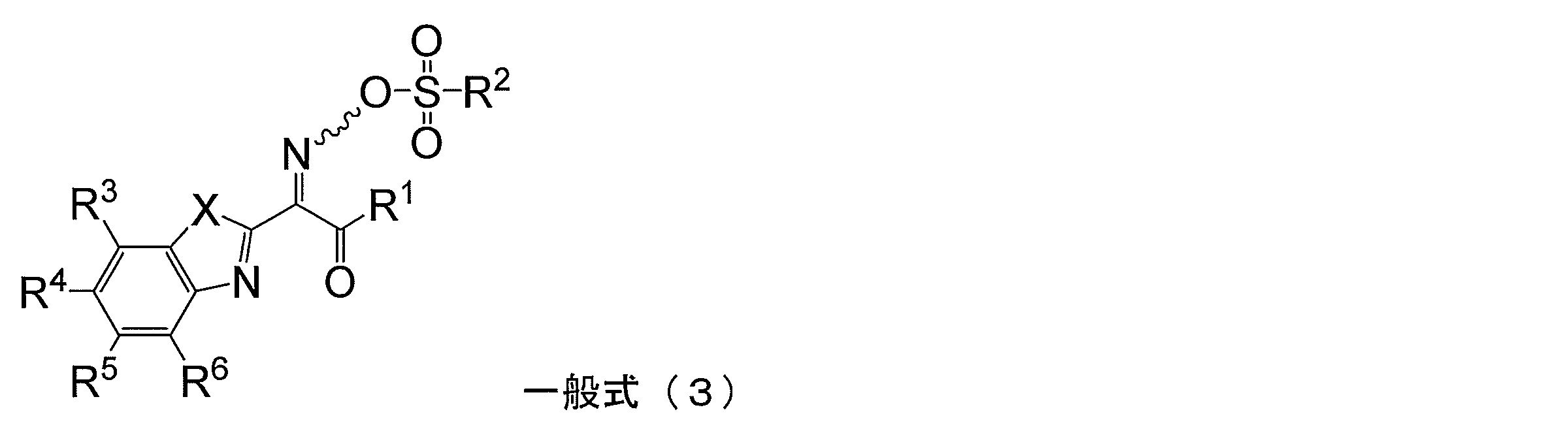
<2>一般式(3)中のR1が、炭素数が3~10のアルキル基または炭素数が6~12のアリール基である、<1>に記載の感光性樹脂組成物。
<3>一般式(3)中のR1が、分岐構造を有するアルキル基、環状のアルキル基、またはフェニル基である、<1>または<2>に記載の感光性樹脂組成物。
<4>一般式(3)で表される化合物が、下記化合物から選択される、<1>~<3>のいずれかに記載の感光性樹脂組成物;

<6>(D)一般式(4)で表される化合物をさらに含有する、<1>~<5>のいずれかに記載の感光性樹脂組成物;

<7>(E)脂環式エポキシ化合物をさらに含有する、<1>~<6>のいずれかに記載の感光性樹脂組成物。
<8>(C)溶剤が、(C1)分子内にアセテート構造を2つ以上含有する溶剤と、(C1)分子内にアセテート構造を2つ以上含有する溶剤と異なる他の溶剤(C2)とを含む、<1>~<7>のいずれかに記載の感光性樹脂組成物。
<9>ディスプレイパネル基板形成に用いられるエッチングレジスト用感光性樹脂組成物である、<1>~<8>のいずれかに記載の感光性樹脂組成物。
<10>エッチングレジスト用感光性樹脂組成物である、<1>~<9>のいずれかに記載の感光性樹脂組成物。
<11><1>~<10>のいずれかに記載の感光性樹脂組成物を硬化してなる硬化膜。
<12>(1)基板の少なくとも一方の面に、<1>~<10>のいずれかに記載の感光性樹脂組成物を塗布する工程、
(2)乾燥により有機溶剤を揮発させ、感光性樹脂組成物層を形成する工程、
(3)感光性樹脂組成物層を露光する工程、
(4)露光された感光性樹脂組成物層を現像する工程、を含むパターンの製造方法。
<13><12>に記載の方法でパターンを形成する工程、得られたパターンをエッチング用レジストとして用いてエッチングを行う工程、およびエッチングを行ったパターンをプラズマ処理または薬品処理により除去する工程、を含む、パターンの製造方法。
<14><12>に記載のパターンの製造方法または<13>に記載のパターンの製造方法を含む、有機EL表示装置または液晶表示装置の製造方法。
さらに、(メタ)アクリル酸とは、アクリル酸および/またはメタクリル酸を意味する。
本発明における固形分とは、25℃における固形分をいう。
(B)下記一般式(3)で表される化合物、ならびに、
(C)溶剤、を含有する、ことを特徴とする。
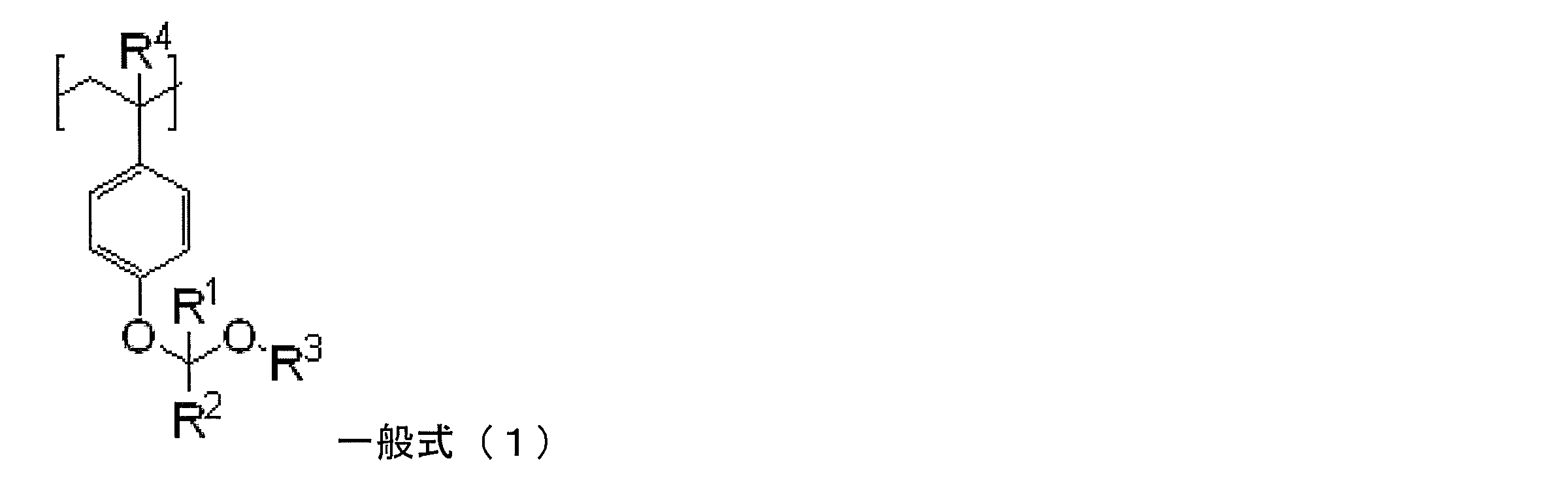
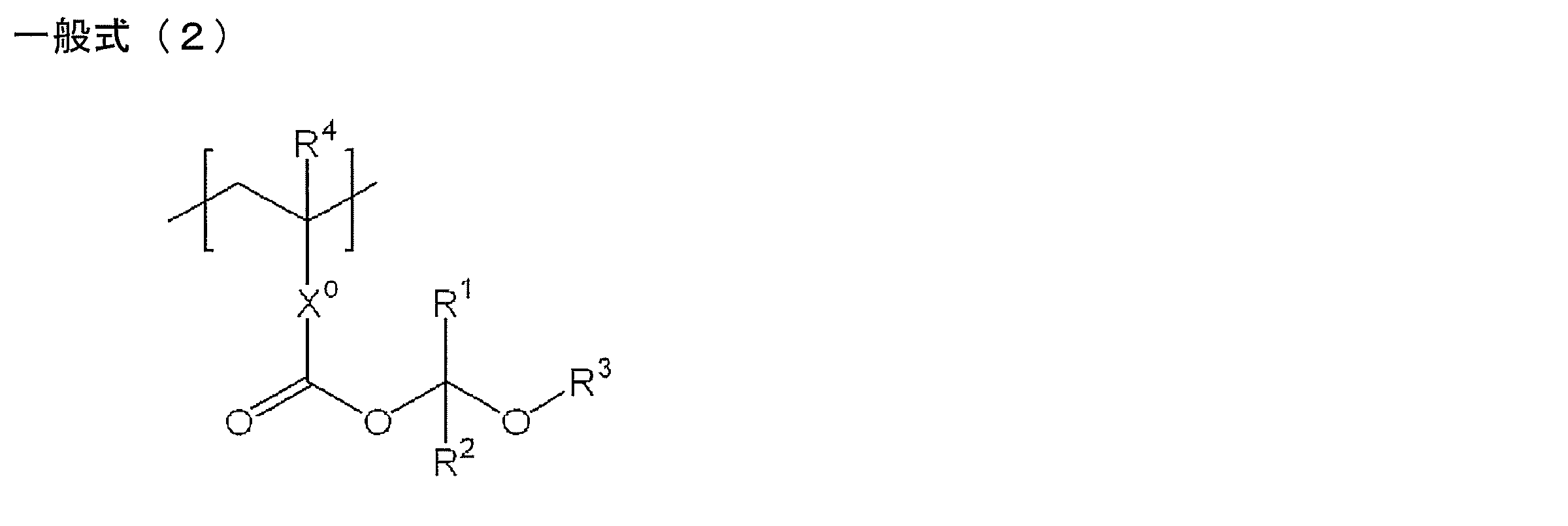

本発明の組成物は、化学増幅型ポジ型感光性樹脂組成物として好ましく用いられる。特に、エッチングレジスト用感光性樹脂組成物(例えばディスプレイパネル基板形成に用いられるエッチングレジスト用感光性樹脂組成物)として好ましく用いられる。
以下、本発明の組成物について詳細に説明する。
本発明の組成物は、重合体成分(A)として、(A1)一般式(1)で表される構成単位(a1)を有する重合体成分、および/または、(A2)下記一般式(2)で表される構成単位(a2)を有する重合体成分を含む。(A1)重合体成分は、一般式(1)で表される構成単位(a1)以外の重合体を含んでいてもよい。また、(A2)重合体成分は、一般式(2)で表される構成単位(a2)以外の重合体を含んでいてもよい。本発明の組成物は、(A1)重合体および(A2)重合体の少なくとも一方を含み、それぞれ、1種類のみ含んでいても良いし、2種類以上含んでいても良い。
以下、これらの重合体成分について説明する。
本発明における(A1)重合体成分は、一般式(1)で表される構成単位(a1)を有する重合体を含む重合体成分である。(A1)成分が構成単位(a1)を有することにより解像力および矩形性に優れる感光性樹脂組成物とすることができる。一般式(1)で表される構成単位(a1)は、フェノール性水酸基が酸分解性基で保護されている保護フェノール性水酸基を有する構成単位である。保護フェノール性水酸基は、酸により保護基が分解することによって、フェノール性水酸基が生成可能である。

アルキル基としては、炭素数1~10のアルキル基が好ましく、炭素数1~8のアルキル基がより好ましく、炭素数1~6のアルキル基がさらに好ましい。アルキル基は、置換基を有していてもよい。また、アルキル基は、直鎖、分岐、環状のいずれであってもよいが、直鎖のアルキル基が好ましい。アルキル基としては、例えば、メチル基、エチル基、プロピル基、ブチル基、t-ブチル基、ペンチル基、ヘキシル基、シクロヘキシル基等が例示される。
アリール基としては、炭素数6~20のアリール基が好ましく、炭素数6~14のアリール基がより好ましく、炭素数6~10のアリール基がさらに好ましい。アリール基は、置換基を有していてもよい。アリール基としては、例えば、フェニル基、ナフチル基、アントラセニル基等が例示される。
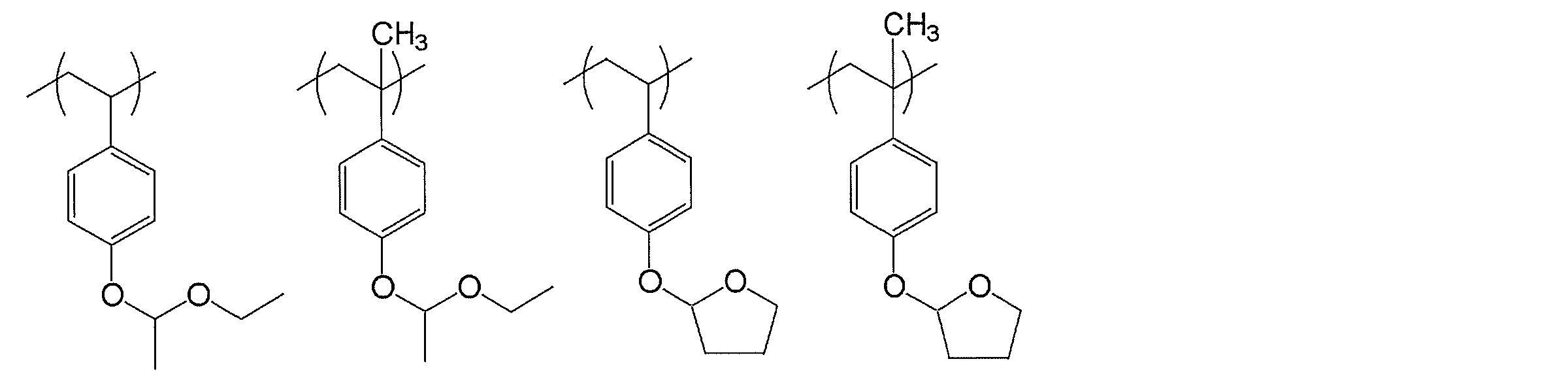
一般式(5)

OH基は、p-、m-、o-のいずれでもよいが、p位に結合していることが好ましい。
本発明における(A2)重合体成分は、一般式(2)で表される構成単位(a2)を有する重合体を含む重合体成分である。(A2)成分が構成単位(a2)を有することにより感度に優れる感光性樹脂組成物とすることができる。一般式(2)で表される構成単位(a2)は、カルボキシル基が酸分解性基で保護されている保護カルボキシル基を有する構成単位である。保護カルボキシル基は、酸により保護基が分解することによって、カルボキシル基が生成可能である。
一般式(2)

R3は、アルキル基またはアリール基を表し、炭素数1~10のアルキル基が好ましく、1~6のアルキル基がより好ましい。
X0は単結合またはアリーレン基を表し、単結合が好ましい。
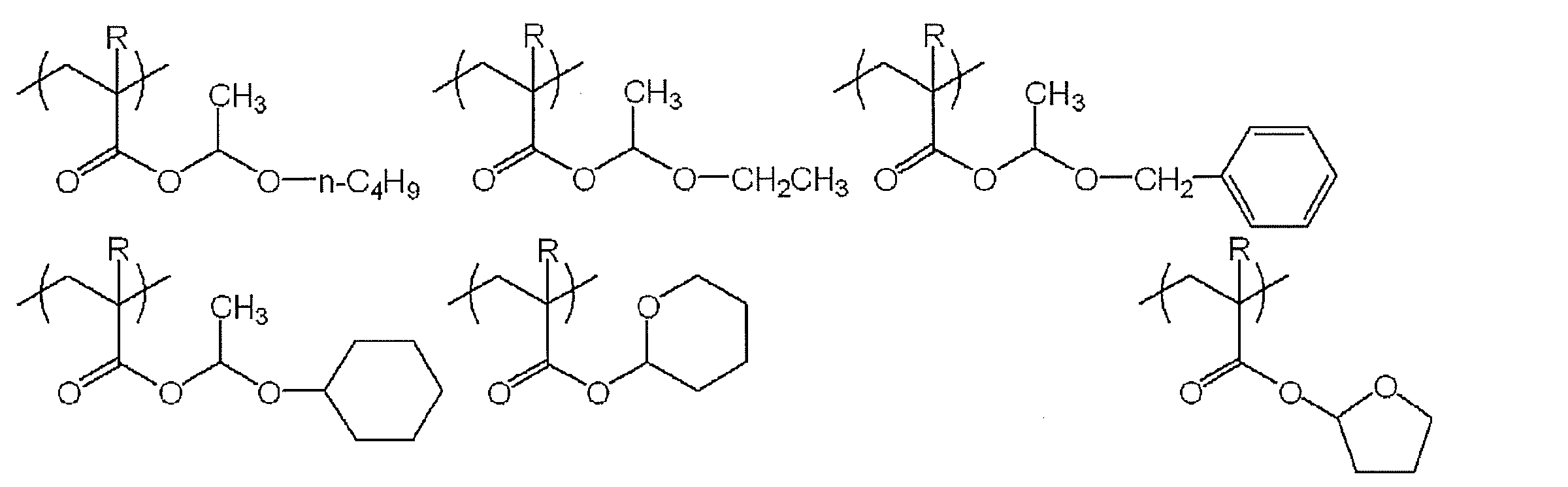
本発明の組成物は、重合体成分として、(A1)と(A2)の両方を含むことが好ましい。これらの質量比は、2:8~8:2が好ましく、3:7~7:3がより好ましく、4:6~6:4がさらに好ましい。このような範囲とすることにより、本発明の効果がより効果的に発揮される傾向にある。
本発明において、(A)成分は、上記構成単位(a1)、および(a2)に加えて、これら以外の他の構成単位(a3)を有していてもよい。これらの構成単位は、上記重合体成分(A1)および(A2)のいずれか一方が含んでいても良く、両方が含んでいてもよい。また、上記重合体成分(A1)または(A2)とは別に、実質的に(a1)、および/または(a2)を含まずに他の構成単位(a3)のみを有する重合体成分(A3)を有していてもよい。上記重合体成分(A1)または(A2)とは別に、実質的に(a1)、および/または(a2)を含まずに他の構成単位(a3)のみを有する重合体成分(A3)を含む場合、重合体成分の配合量は、全重合体成分中、60質量%以下であることが好ましく、40質量%以下であることがより好ましく、20質量%以下であることがさらに好ましい。
本発明で用いられる酸基としては、カルボン酸基由来のもの、スルホンアミド基に由来のもの、ホスホン酸基に由来のもの、スルホン酸基に由来のもの、フェノール性水酸基に由来するもの、スルホンアミド基、スルホニルイミド基等が例示され、カルボン酸基由来のもの及び/又はフェノール性水酸基に由来のものが好ましい。
本発明で用いられる酸基を含む構成単位は、スチレンに由来する構成単位や、ビニル化合物に由来する構成単位、(メタ)アクリル酸及び/又はそのエステルに由来する構成単位であることがより好ましい。例えば、特開2012-88459号公報の段落番号0021~0023及び段落番号0029~0044記載の化合物を用いることができ、この内容は本願明細書に組み込まれる。なかでも、p-ヒドロキシスチレン、(メタ)アクリル酸、マレイン酸、無水マレイン酸に由来する構成単位が好ましい。
その他にも、特開平7-207211号公報、特開平8-259876号公報、特開平10-300922号公報、特開平11-140144号公報、特開平11-174224号公報、特開2000-56118号公報、特開2003-233179号公報、特開2009-52020号公報等に記載の公知の高分子化合物を使用することができ、これらの内容は本願明細書に組み込まれる。
これらの重合体は、1種類のみ含んでいてもよいし、2種類以上含んでいてもよい。
67、Joncryl 586(以上、BASF製)等を用いることもできる。
本発明の組成物は、(B)一般式(3)で表される化合物を含有し、(B)一般式(3)で表される化合物は、光酸発生剤として機能する。

R1が表すアルキル基およびアリール基は、置換基を有していてもよい。置換基としては、例えばハロゲン原子(フッ素原子、クロロ原子、臭素原子、ヨウ素原子)、直鎖、分岐または環状のアルキル基(例えばメチル基、エチル基、プロピル基など)、アルケニル基、アルキニル基、アリール基、アシル基、アルコキシカルボニル基、アリールオキシカルボニル基、カルバモイル基、シアノ基、カルボキシル基、水酸基、アルコキシ基、アリールオキシ基、アルキルチオ基、アリールチオ基、ヘテロ環オキシ基、アシルオキシ基、アミノ基、ニトロ基、ヒドラジノ基、ヘテロ環基などが挙げられる。また、これらの基によってさらに置換されていてもよい。好ましくは、ハロゲン原子、メチル基である。
かさ高い置換基の中でも、イソプロピル基、tert-ブチル基、ネオペンチル基、シクロヘキシル基が好ましく、tert-ブチル基、シクロヘキシル基がより好ましい。
アリール基としては、炭素数6~10のアリール基が好ましい。アリール基としては、フェニル基、ナフチル基、p-トルイル基(p-メチルフェニル基)などが挙げられ、好ましくは、フェニル基、p-トルイル基である。ヘテロアリール基としては、例えば、ピロール基、インドール基、カルバゾール基、フラン基、チオフェン基などが挙げられる。
R2が表すアルキル基、アリール基、およびヘテロアリール基は、置換基を有していてもよい。置換基としては、R1が表すアルキル基およびアリール基が有していてもよい置換基と同義である。
R2は、アルキル基またはアリール基が好ましく、アリール基がより好ましく、フェニル基がより好ましい。フェニル基の置換基としてはメチル基が好ましい。
R3~R6のうち、R3とR4、R4とR5、またはR5とR6が結合して環を形成してもよく、環としては、脂環または芳香環を形成していることが好ましく、ベンゼン環がより好ましい。
R3~R6は、水素原子、アルキル基、ハロゲン原子(フッ素原子、クロロ原子、臭素原子)、または、R3とR4、R4とR5、またはR5とR6が結合してベンゼン環を構成していることが好ましく、水素原子、メチル基、フッ素原子、クロロ原子、臭素原子またはR3とR4、R4とR5、またはR5とR6が結合してベンゼン環を構成していることがより好ましい。
R3~R6の好ましい態様は以下の通りである。
(態様1)少なくとも1つが水素原子であり、少なくとも2つが水素原子であることが好ましい。
(態様2)アルキル基、アリール基、またはハロゲン原子の数は、合計で3つ以下である。好ましくは1つ以下である。
(態様3)R3とR4、R4とR5、またはR5とR6が結合してベンゼン環を構成している。
(態様4)上記態様1と2を満たす態様、および/または、上記態様1と3を満たす態様。

一般式(B1-2)

Xとしてのアルキル基は、炭素数1~4の直鎖状または分岐状アルキル基が好ましい。また、Xとしてのアルコキシ基は、炭素数1~4の直鎖状または分岐状アルコキシ基が好ましい。また、Xとしてのハロゲン原子は、塩素原子またはフッ素原子が好ましい。
m4は、0または1が好ましい。上記一般式(B2)中、m4が1であり、Xがメチル基であり、Xの置換位置がオルト位であり、R42が炭素数1~10の直鎖状アルキル基、7,7-ジメチル-2-オキソノルボルニルメチル基、またはp-トルイル基である化合物が特に好ましい。
一般式(B1-3)

X1としては、炭素数1~5のアルコキシ基が好ましく、メトキシ基がより好ましい。
n4としては、0~2が好ましく、0~1が特に好ましい。
上記一般式(B1-3)で表される化合物の具体例および好ましいオキシムスルホネート化合物の具体例としては、特開2012-163937号公報の段落番号0080~0082の記載を参酌でき、この内容は本願明細書に組み込まれる。
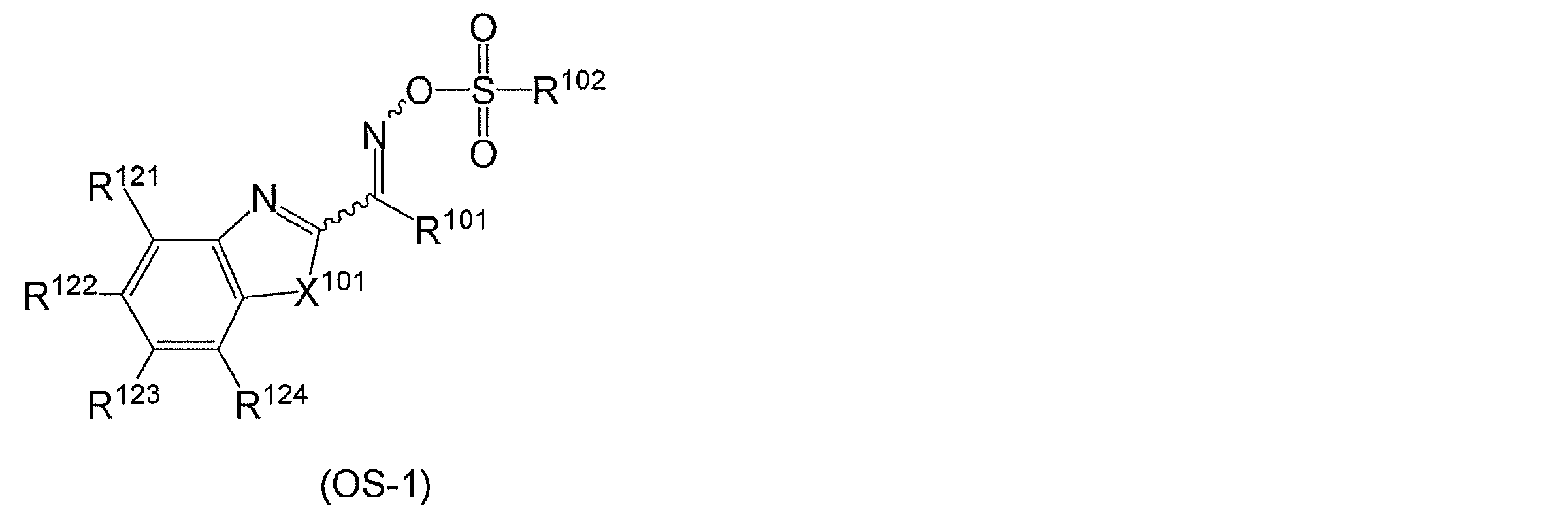
X101は-O-、-S-、-NH-、-NR105-、-CH2-、-CR106H-、または、-CR105R107-を表し、R105~R107はアルキル基、または、アリール基を表す。
R121~R124は、それぞれ独立に、水素原子、ハロゲン原子、アルキル基、アルケニル基、アルコキシ基、アミノ基、アルコキシカルボニル基、アルキルカルボニル基、アリールカルボニル基、アミド基、スルホ基、シアノ基、または、アリール基を表す。R121~R124のうち2つは、それぞれ互いに結合して環を形成してもよい。
R121~R124としては、水素原子、ハロゲン原子、および、アルキル基が好ましく、また、R121~R124のうち少なくとも2つが互いに結合してアリール基を形成する態様もまた、好ましく挙げられる。中でも、R121~R124がいずれも水素原子である態様が感度の観点から好ましい。
既述の官能基は、いずれも、さらに置換基を有していてもよい。
上記一般式(OS-1)で表される化合物は、例えば、特開2012-163937号公報の段落番号0087~0089に記載されている一般式(OS-2)で表される化合物であることが好ましく、この内容は本願明細書に組み込まれる。
本発明では、本発明で用いることができる、他の光酸発生剤としてのオキシムスルホネート化合物の第四の実施形態は、下記一般式(OS-3)、下記一般式(OS-4)または下記一般式(OS-5)で表されるオキシムスルホネート化合物であることが好ましい。

上記一般式(OS-3)~(OS-5)については、例えば、特開2012-163937号公報の段落番号0098~0115の記載を参酌でき、この内容は本願明細書に組み込まれる。
上記一般式(OS-6)~(OS-11)における好ましい範囲は、特開2011-221494号公報の段落番号0110~0112に記載される(OS-6)~(OS-11)の好ましい範囲と同様であり、この内容は本願明細書に組み込まれる。
上記一般式(OS-3)~上記一般式(OS-5)で表されるオキシムスルホネート化合物の具体例としては、特開2011-221494号公報の段落番号0114~0120に記載の化合物が挙げられ、この内容は本願明細書に組み込まれる。本発明は、これらに限定されるものではない。
一般式(B1-4)
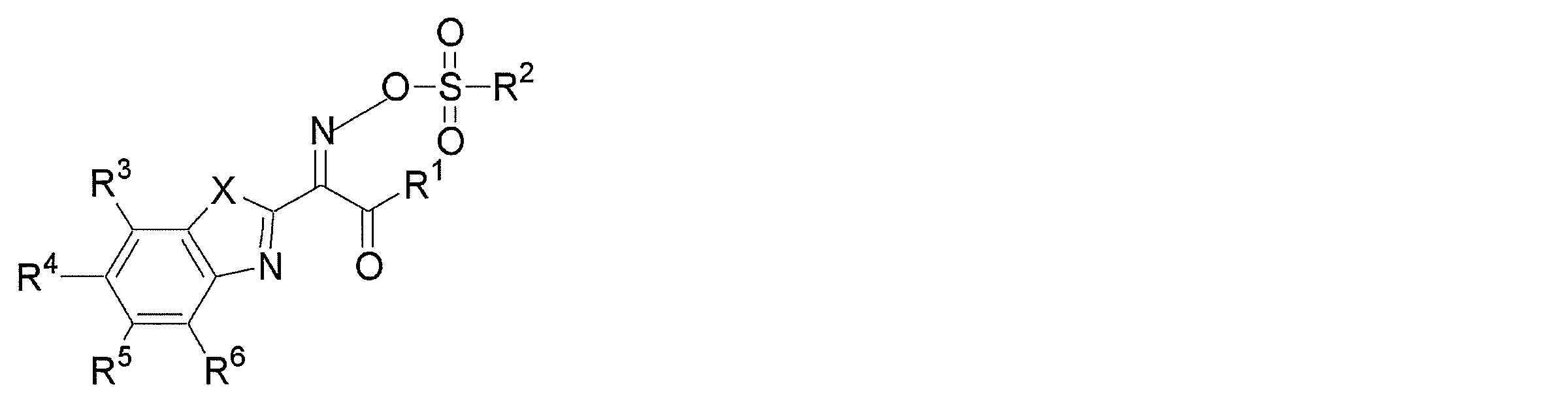
アルキル基の炭素数は、好ましくは3~10である。特にアルキル基が分岐構造を有する場合、炭素数3~6のアルキル基が好ましく、環状構造を有する場合、炭素数5~7のアルキル基が好ましい。
アルキル基としては、例えば、プロピル基、イソプロピル基、n-ブチル基、s-ブチル基、イソブチル基、tert-ブチル基、ペンチル基、イソペンチル基、ネオペンチル基、1,1-ジメチルプロピル基、ヘキシル基、2-エチルヘキシル基、シクロヘキシル基、オクチル基などが挙げられ、好ましくは、イソプロピル基、tert-ブチル基、ネオペンチル基、シクロヘキシル基である。
アリール基の炭素数は、好ましくは6~12であり、より好ましくは6~8であり、さらに好ましくは6~7である。上記アリール基としては、フェニル基、ナフチル基などが挙げられ、好ましくは、フェニル基である。
R1が表すアルキル基およびアリール基は、置換基を有していてもよい。置換基としては、例えばハロゲン原子(フッ素原子、クロロ原子、臭素原子、ヨウ素原子)、直鎖、分岐または環状のアルキル基(例えばメチル基、エチル基、プロピル基など)、アルケニル基、アルキニル基、アリール基、アシル基、アルコキシカルボニル基、アリールオキシカルボニル基、カルバモイル基、シアノ基、カルボキシル基、水酸基、アルコキシ基、アリールオキシ基、アルキルチオ基、アリールチオ基、ヘテロ環オキシ基、アシルオキシ基、アミノ基、ニトロ基、ヒドラジノ基、ヘテロ環基などが挙げられる。また、これらの基によってさらに置換されていてもよい。好ましくは、ハロゲン原子、メチル基である。
かさ高い置換基の中でも、イソプロピル基、tert-ブチル基、ネオペンチル基、シクロヘキシル基が好ましく、tert-ブチル基、シクロヘキシル基がより好ましい。
アリール基としては、炭素数6~10のアリール基が好ましい。上記アリール基としては、フェニル基、ナフチル基、p-トルイル基(p-メチルフェニル基)などが挙げられ、好ましくは、フェニル基、p-トルイル基である。
ヘテロアリール基としては、例えば、ピロール基、インドール基、カルバゾール基、フラン基、チオフェン基などが挙げられる。
R2が表すアルキル基、アリール基、およびヘテロアリール基は、置換基を有していてもよい。置換基としては、R1が表すアルキル基およびアリール基が有していてもよい置換基と同義である。
R2は、アルキル基またはアリール基が好ましく、アリール基がより好ましく、フェニル基がより好ましい。フェニル基の置換基としてはメチル基が好ましい。
R3~R6のうち、R3とR4、R4とR5、またはR5とR6が結合して環を形成してもよく、環としては、脂環または芳香環を形成していることが好ましく、ベンゼン環がより好ましい。
R3~R6は、水素原子、アルキル基、ハロゲン原子(フッ素原子、クロロ原子、臭素原子)、または、R3とR4、R4とR5、またはR5とR6が結合してベンゼン環を構成していることが好ましく、水素原子、メチル基、フッ素原子、クロロ原子、臭素原子またはR3とR4、R4とR5、またはR5とR6が結合してベンゼン環を構成していることがより好ましい。
R3~R6の好ましい態様は以下の通りである。
(態様1)少なくとも2つは水素原子である。
(態様2)アルキル基、アリール基、またはハロゲン原子の数は、1つ以下である。
(態様3)R3とR4、R4とR5、またはR5とR6が結合してベンゼン環を構成している。
(態様4)上記態様1と2を満たす態様、および/または、上記態様1と3を満たす態様。
Xは、-O-またはS-を表す。
本発明の組成物は、(C)溶剤として、(C1)分子内にアセテート構造を2つ以上含有する溶剤を含有する。このような溶媒を配合することにより、適度な塗膜の可塑剤になり、また、クエンチャーと、後述する脂環エポキシ化合物よる酸の適度な捕捉を促進することにより、感度、線幅安定性、解像性および矩形性を向上させることが可能になる。本発明の組成物は、本発明の必須成分と、さらに後述の任意の成分を(C)溶剤に溶解した溶液として調製されることが好ましい。
また、(C1)分子内にアセテート構造を2つ以上含有する溶剤は、沸点が130℃以上300℃未満の溶剤が好ましく、180℃以上270℃未満の溶剤が好ましく、200℃以上270℃未満のものがより好ましい。なお、沸点は、特に断りがない限り1気圧における沸点である。また、溶剤を2種類以上含む溶媒混合の場合、沸点は、全溶媒に対する各溶媒の沸点をそれぞれの重量割合にて加重平均したものとする。
沸点160℃以上の溶剤としては、3-エトキシプロピオン酸エチル(沸点170℃)、ジエチレングリコールメチルエチルエーテル(沸点176℃)、プロピレングリコールモノメチルエーテルプロピオネート(沸点160℃)、ジプロピレングリコールメチルエーテルアセテート(沸点213℃)、3-メトキシブチルエーテルアセテート(沸点171℃)、ジエチレングリコールジエチエルエーテル(沸点189℃)、ジエチレングリコールジメチルエーテル(沸点162℃)、ジエチレングリコールモノエチルエーテルアセテート(沸点220℃)、ジプロピレングリコールジメチルエーテル(沸点175℃)、が例示できる。
本発明における、(C1)溶剤と(C2)溶剤の配合比(質量比)は、0.1~10:99.9~90が好ましく、0.5~5:99.5~95がより好ましい。本発明で用いる感光性樹脂組成物の粘度は、2.0~8mPa・sの範囲にあることが好ましく、2.5~6mPa・sの範囲にあることがさらに好ましい。また、本発明のおける粘度は、25℃における粘度とする。
本発明の組成物は、塩基性化合物を含有してもよい。塩基性化合物としては、化学増幅レジストで用いられるものの中から任意に選択して使用することができる。例えば、脂肪族アミン、芳香族アミン、複素環式アミン、第四級アンモニウムヒドロキシド、カルボン酸の第四級アンモニウム塩等が挙げられる。これらの具体例としては、特開2011-221494号公報の段落番号0204~0207に記載の化合物が挙げられ、これらの内容は本願明細書に組み込まれる。
これらの塩基性化合物は、1種単独で使用しても、2種以上を併用してもよい。
一般式(4)

R1は、1~10つの炭素原子と、酸素原子、少なくとも1つ以上の窒素原子を含むヘテロ原子1~3つから構成される基であることが好ましい。この場合のヘテロ原子としては、酸素原子、硫黄原子が挙げられ、酸素原子が好ましい。R1は環状基であることが好ましく、5員環または6員環の環状基であることがより好ましい。
R3およびR4は、それぞれ、有機基を表す。有機基としては、アルキル基、アルケニル基、または、これらと、-O-、-S-および-N-の少なくとも1つの組み合わせからなる基が好ましい。R3およびR4は、それぞれ、炭素数1~3の基であることが好ましい。R3およびR4は、互いに結合して、環を形成していてもよく、環を形成していることが好ましい。
(1)R1が-NR3R4で表される基であり、R3とR4が互いに結合して環を形成している態様、または、R3とR4が、ぞれぞれ、脂肪族炭化水素基である態様。
(2)R1が-NR3R4で表される基であり、R3とR4が互いに結合して5員環または6員環を形成している態様、または、R3とR4が、ぞれぞれ、炭素数1~4の直鎖または分岐の脂肪族炭化水素基である態様。
(3)R1が-NR3R4で表される基であり、R3とR4が互いに結合して2つ以上のヘテロ原子(少なくとも1つは窒素原子であり、残りは酸素原子または窒素原子が好ましい)を含む、5員環または6員環を形成している態様、または、R3とR4が、ぞれぞれ、炭素数1~4の直鎖の脂肪族炭化水素基である態様。
R2は、炭素数1~20のアルキル基または炭素数6~12のアリール基、または、これらと-O-および-C(=O)-の少なくとも1つの組み合わせからなる基がさらに好ましい。これらの基は置換基を有していてもよく、置換基としてはハロゲン原子が例示される。
R2がアルキル基である場合、炭素数1~8の直鎖または分岐のアルキル基、または、環状アルキル基が好ましい。R2が環状アルキル基である場合、5員環または6員環の環状アルキル基が好ましい。
R2がアリール基である場合、フェニル基およびナフチル基が例示され、フェニル基がより好ましい。
(1)炭素数1~4(好ましくは2または3)の直鎖のアルキレン基である態様。
アルキレン基としては、例えば、メチレン基、エチレン基、プロピレン基、シクロへキシレン基、シクロペンチレン基等が例示される。アリーレン基としては、例えば、1,2-フェニレン基、1,3-フェニレン基、1,4-フェニレン基、ナフチレン基等が例示される。本発明では特に、メチレン基、エチレン基、プロピレン基が好ましく、エチレン基またはプロピレン基がより好ましい。
(1)炭素数1~4の直鎖または分岐のアルキル基、5員環または6員環の環状アルキル基、または、フェニル基である態様。

R2は、一般式(4)におけるR2と同義であり、好ましい範囲も同義である。
Aは、一般式(4)におけるAと同義であり、好ましい範囲も同義である。
特に、一般式(4-2)において、以下の態様が好ましい。
(1)Aは炭素数1~4の直鎖のアルキレン基であり、R2は、直鎖、分岐、または環状のアルキル基である態様。
(2)Aは炭素数2または3のアルキレン基であり、R2は、炭素数2~6の直鎖、分岐、または環状のアルキル基である態様。
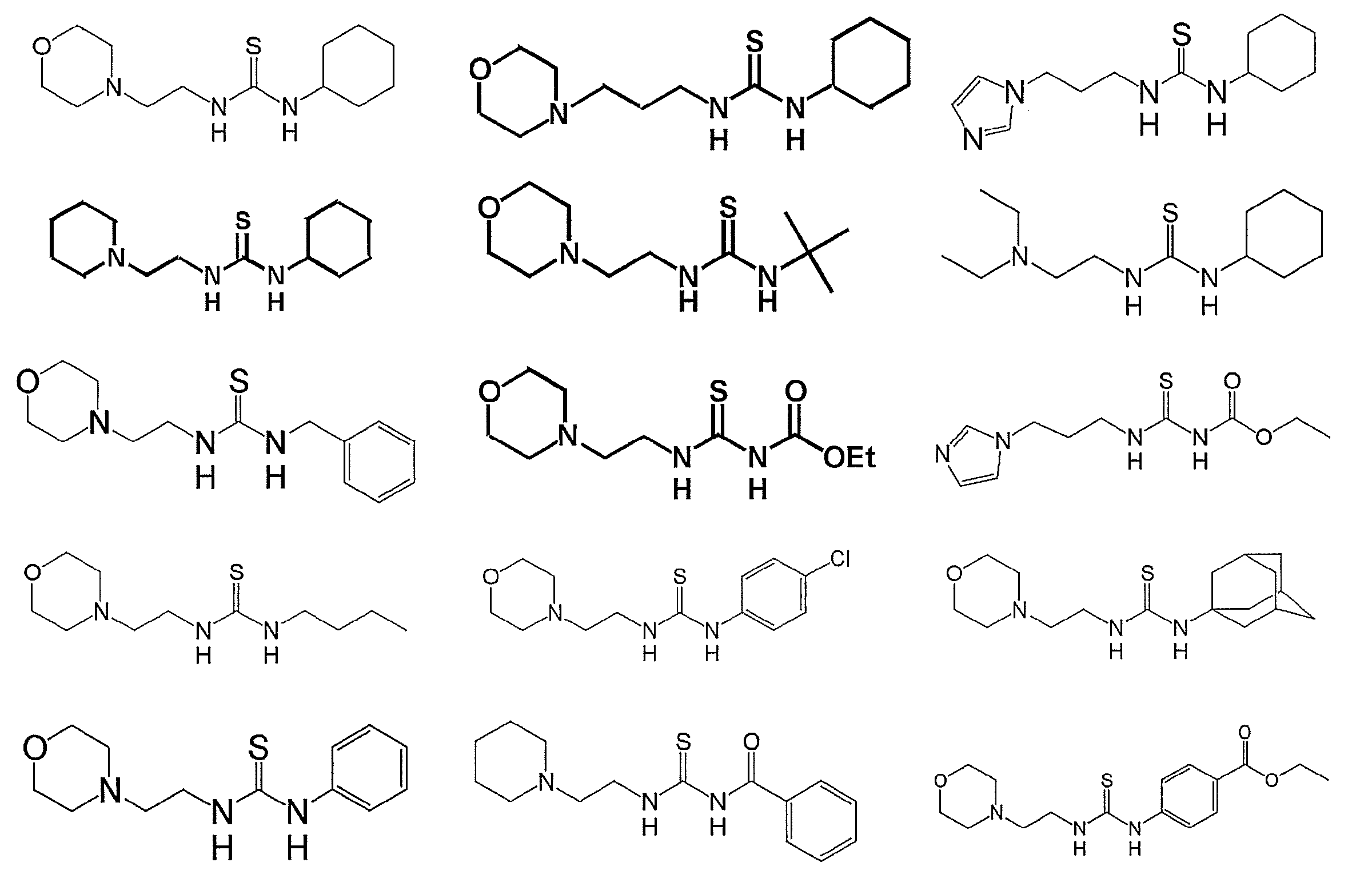
本発明の組成物は、架橋剤として脂環式エポキシ化合物を含有することが好ましい。脂環式エポキシ化合物は、酸発生剤による酸を素早くトラップするため、かかる化合物を配合することにより、感度、線幅安定性、解像性および矩形性に優れた感光性樹脂組成物となると考えられる。
本発明で用いる脂環式エポキシ化合物が有する脂環式エポキシ基としては、特に限定されず、例えば環状脂肪族炭化水素に直接付加した脂環式エポキシ基などが例示され、環状脂肪族炭化水素としては、3~10員環が好ましく、5~6員環がより好ましい。中でも、好ましくは下記で表される脂環式エポキシ基である。



R2は炭素数1~15の有機基を表し、分岐していても不飽和結合を有していてもよく、脂肪族環または芳香環の環状構造を有してもよい。また、これらの基は、酸素、硫黄、窒素、リン、ホウ素、ハロゲン原子を有していてもよい。また、置換基を有していてもよく、置換基同士が互いに結合を形成していても良い。また、R2は2価の連結基である。

R3は炭素数1~15の有機基を表し、分岐していても不飽和結合を有していてもよく、脂肪族環または芳香環の環状構造を有してもよい。また、これらの基は、酸素、硫黄、窒素、リン、ホウ素、ハロゲン原子を有していてもよい。また、置換基を有していてもよく、置換基同士が互いに結合を形成していても良い。また、R3は2価の連結基である。
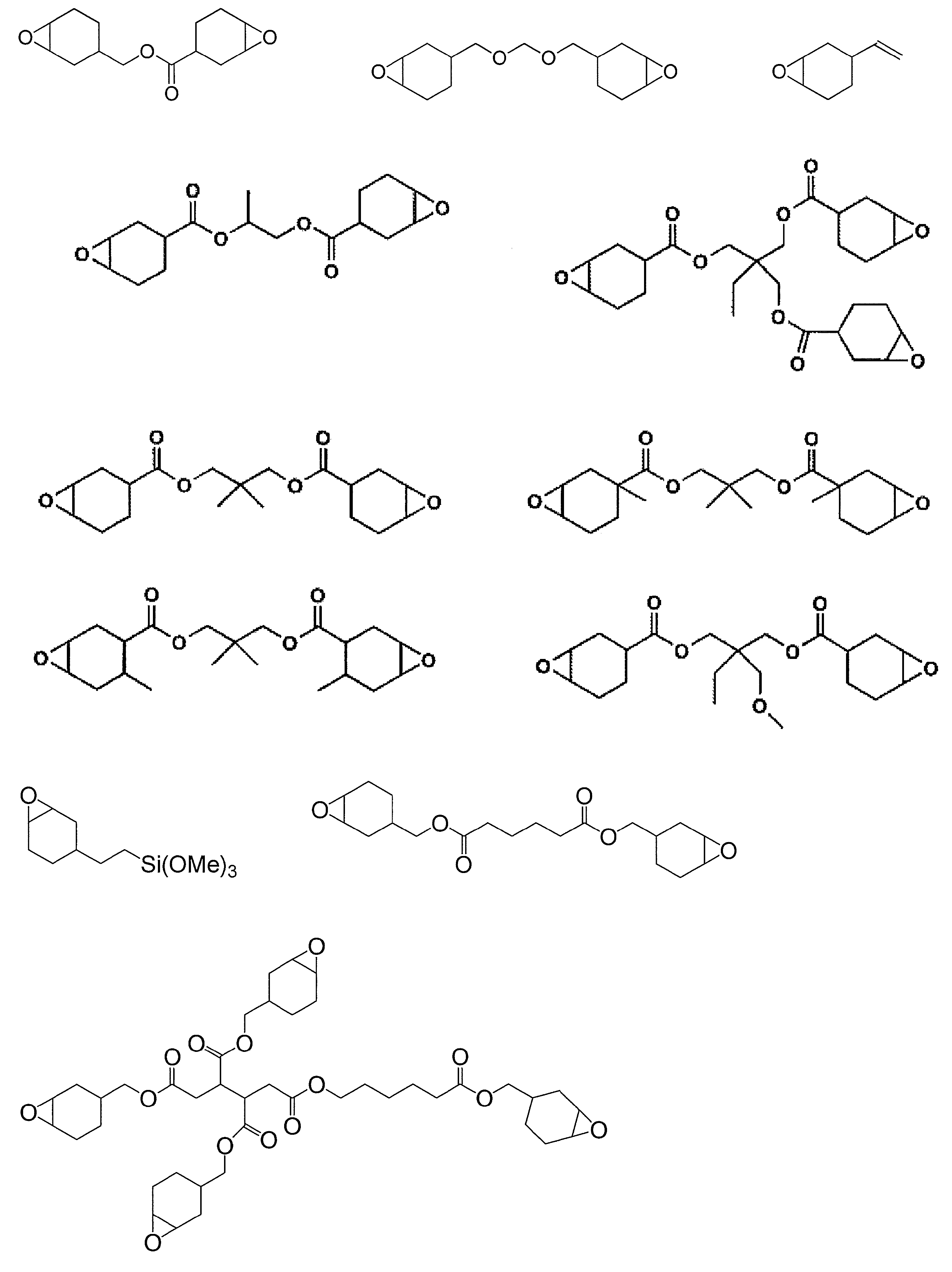
本発明の組成物には、上記成分に加えて、必要に応じて、(F)アルコキシシラン化合物、(G)架橋剤、(H)増感剤、(J)界面活性剤、(K)酸化防止剤、を好ましく加えることができる。さらに本発明の組成物には、酸増殖剤、現像促進剤、可塑剤、熱ラジカル発生剤、熱酸発生剤、紫外線吸収剤、増粘剤、および、有機または無機の沈殿防止剤などの公知の添加剤を加えることができる。その他の成分として特開2011-221494号公報の[0180][0228]記載の化合物を挙げることができる。
本発明の組成物は、(F)アルコキシシラン化合物(「(F)成分」ともいう)を含有することが好ましい。アルコキシシラン化合物を用いると、本発明の組成物により形成された膜と基板との密着性をより向上できたり、本発明の組成物により形成された膜の性質を調整することができる。アルコキシシラン化合物としては、ジアルコキシシラン化合物またはトリアルコキシシラン化合物が好ましく、トリアルコキシシラン化合物がより好ましい。アルコキシシラン化合物が有するアルコキシ基の炭素数は1~5が好ましい。
本発明の組成物に用いることができる(F)アルコキシシラン化合物は、基材となる無機物、例えば、シリコン、酸化シリコン、窒化シリコン等のシリコン化合物、金、銅、モリブデン、チタン、アルミニウム等の金属と絶縁膜との密着性を向上させる化合物であることが好ましい。具体的には、公知のシランカップリング剤等も有効である。
シランカップリング剤としては、例えば、γ-アミノプロピルトリメトキシシラン、γ-アミノプロピルトリエトキシシラン、γ-グリシドキシプロピルトリアルコキシシラン、γ-グリシドキシプロピルアルキルジアルコキシシラン、γ-メタクリロキシプロピルトリアルコキシシラン、γ-メタクリロキシプロピルアルキルジアルコキシシラン、γ-クロロプロピルトリアルコキシシラン、γ-メルカプトプロピルトリアルコキシシラン、β-(3,4-エポキシシクロヘキシル)エチルトリアルコキシシラン、ビニルトリアルコキシシランが挙げられる。これらのうち、γ-グリシドキシプロピルトリアルコキシシランやγ-メタクリロキシプロピルトリアルコキシシランがより好ましく、γ-グリシドキシプロピルトリアルコキシシランがさらに好ましく、3-グリシドキシプロピルトリメトキシシランがよりさらに好ましい。
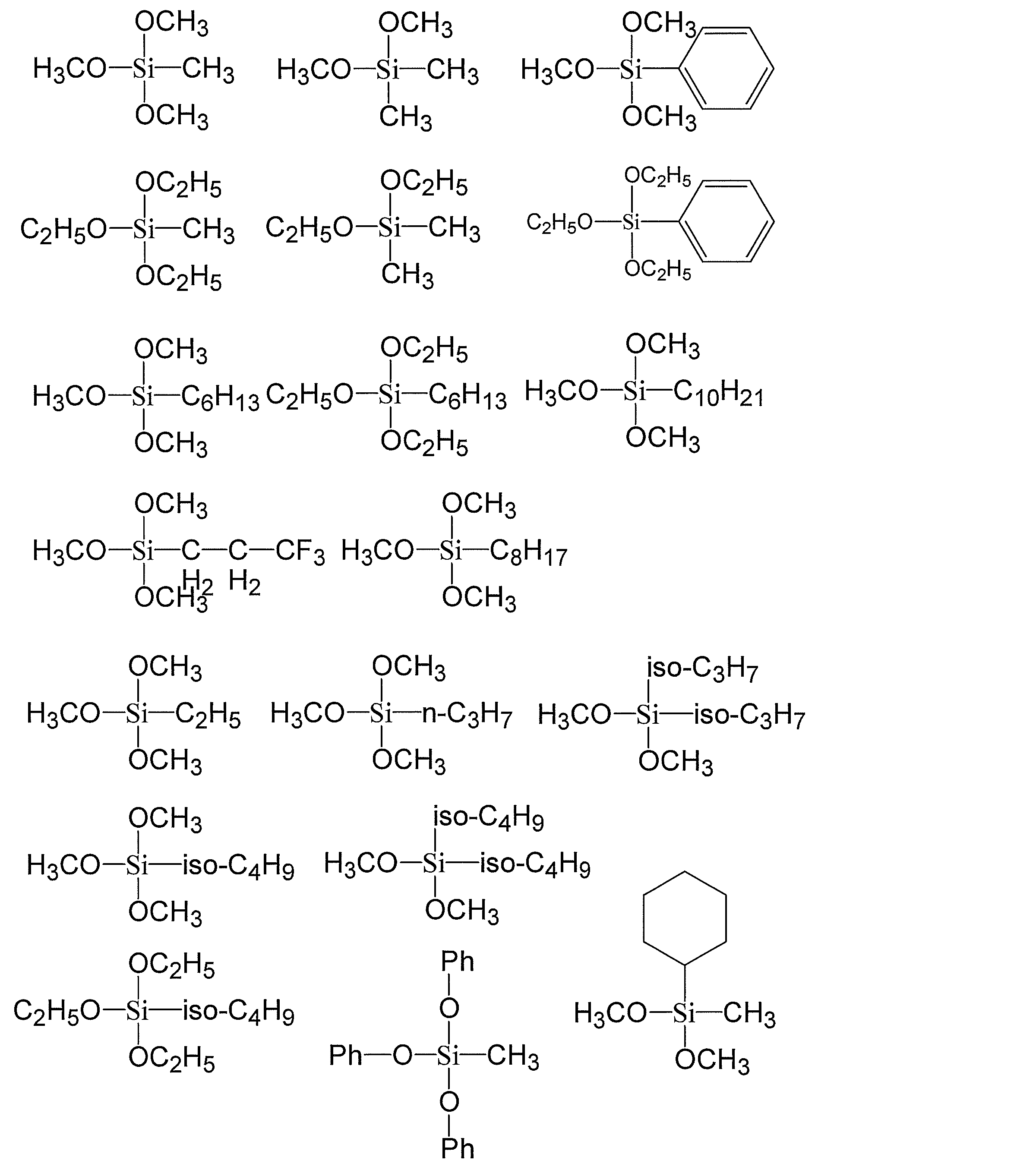
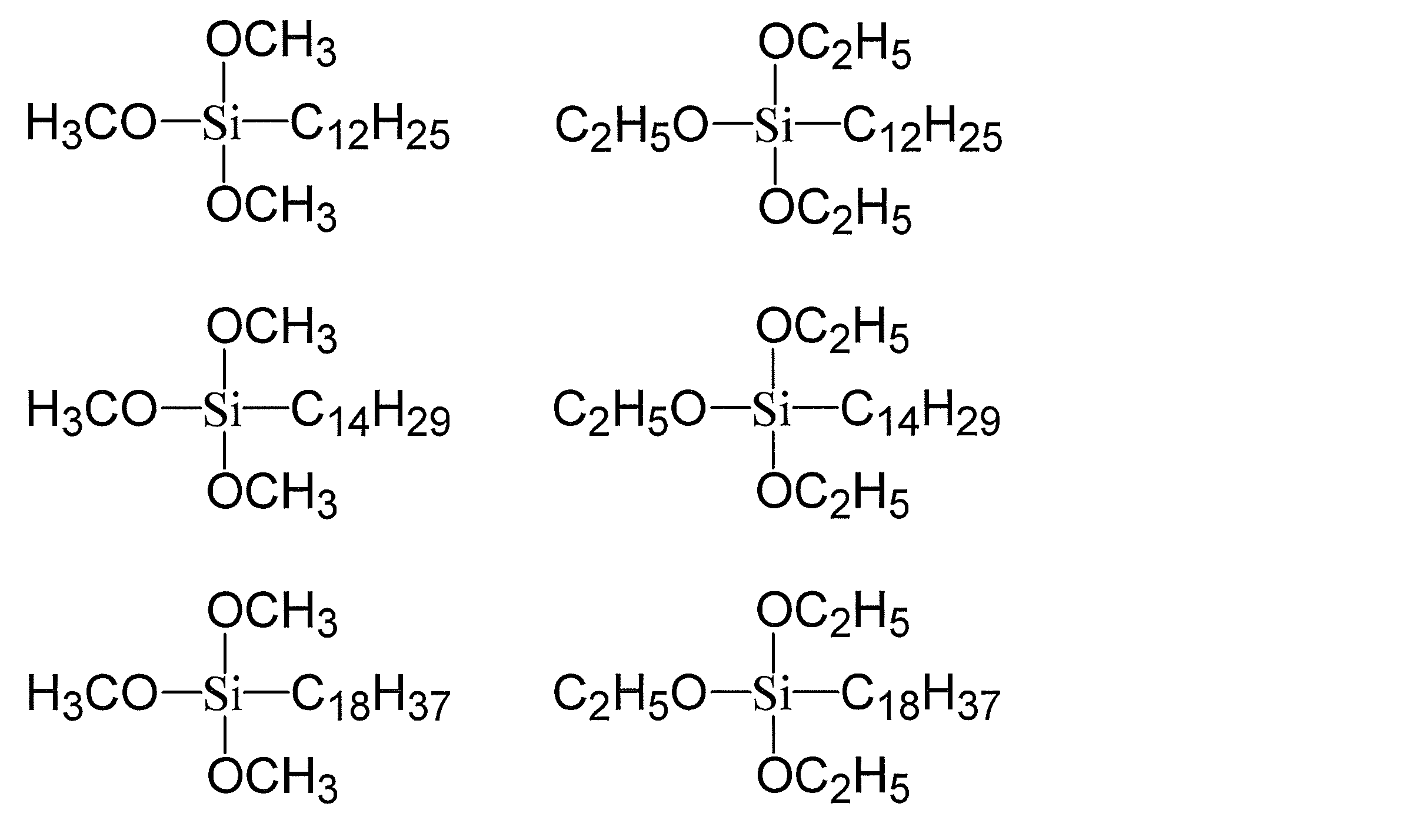
本発明の組成物における(F)アルコキシシラン化合物の含有量は、感光性組成物中の全固形分100質量部に対して、0.1~30質量部が好ましく、0.5~20質量部がより好ましい。2種以上含む場合、合計量が上記範囲となることが好ましい。
本発明の組成物は、必要に応じ、上述した化合物以外の架橋剤を含有することが好ましい。架橋剤を添加することにより、本発明の組成物により得られる硬化膜をより強固な膜とすることができる。
架橋剤としては、特開2013-210607号公報の段落番号0157~0168の援用記載を参酌でき、これらの内容は本願明細書に組み込まれる。
本発明の組成物は、(B)一般式(3)で表わされる化合物との組み合わせにおいて、その分解を促進させるために、増感剤を含有することが好ましい。増感剤は、活性光線または放射線を吸収して電子励起状態となる。電子励起状態となった増感剤は、光酸発生剤と接触して、電子移動、エネルギー移動、発熱などの作用が生じる。これにより光酸発生剤は化学変化を起こして分解し、酸を生成する。好ましい増感剤の例としては、以下の化合物類に属しており、かつ350nmから450nmの波長域のいずれかに吸収波長を有する化合物を挙げることができる。
これら増感剤の中でも、多核芳香族類、アクリドン類、スチリル類、ベーススチリル類、クマリン類が好ましく、多核芳香族類がより好ましい。多核芳香族類の中でもアントラセン誘導体が最も好ましい。
増感剤は、1種単独で用いてもよいし、2種以上を併用することもできる。
本発明の組成物は、(J)界面活性剤を含有してもよい。(J)界面活性剤としては、アニオン系、カチオン系、ノニオン系、または、両性のいずれでも使用することができるが、好ましい界面活性剤はノニオン界面活性剤である。
ノニオン系界面活性剤の例としては、ポリオキシエチレン高級アルキルエーテル類、ポリオキシエチレン高級アルキルフェニルエーテル類、ポリオキシエチレングリコールの高級脂肪酸ジエステル類、シリコーン系、フッ素系界面活性剤を挙げることができる。また、以下商品名で、KP(信越化学工業(株)製)、ポリフロー(共栄社化学(株)製)、エフトップ(JEMCO社製)、メガファック(DIC(株)製)、フロラード(住友スリーエム(株)製)、アサヒガード、サーフロン(旭硝子(株)製)、PolyFox(OMNOVA社製)、SH-8400(東レ・ダウコーニングシリコーン)等の各シリーズを挙げることができる。
また、界面活性剤として、下記一般式(J-1)で表される構成単位Aおよび構成単位Bを含み、テトラヒドロフラン(THF)を溶剤とした場合のゲルパーミエーションクロマトグラフィーで測定されるポリスチレン換算の重量平均分子量(Mw)が1,000以上10,000以下である共重合体を好ましい例として挙げることができる。


本発明の組成物における(J)界面活性剤の添加量は、配合する場合、感光性樹脂組成物中の全固形分100質量部に対して、10質量部以下であることが好ましく、0.001~10質量部であることがより好ましく、0.01~3質量部であることがさらに好ましい。
本発明の組成物は、酸化防止剤を含有してもよい。酸化防止剤としては、公知の酸化防止剤を含有することができる。酸化防止剤を添加することにより、硬化膜の着色を防止できる、または、分解による膜厚減少を低減でき、また、耐熱透明性に優れるという利点がある。
このような酸化防止剤としては、例えば、リン系酸化防止剤、アミド類、ヒドラジド類、ヒンダードアミン系酸化防止剤、イオウ系酸化防止剤、フェノール系酸化防止剤、アスコルビン酸類、硫酸亜鉛、糖類、亜硝酸塩、亜硫酸塩、チオ硫酸塩、ヒドロキシルアミン誘導体などを挙げることができる。これらの中では、硬化膜の着色、膜厚減少の観点から特にフェノール系酸化防止剤、ヒンダードアミン系酸化防止剤、リン系酸化防止剤、アミド系酸化防止剤、ヒドラジド系酸化防止剤、イオウ系酸化防止剤が好ましい。これらは1種単独で用いてもよいし、2種以上を混合してもよい。
フェノール系酸化防止剤の市販品としては、例えば、アデカスタブAO-15、アデカスタブAO-18、アデカスタブAO-20、アデカスタブAO-23、アデカスタブAO-30、アデカスタブAO-37、アデカスタブAO-40、アデカスタブAO-50、アデカスタブAO-51、アデカスタブLA-52、アデカスタブAO-60、アデカスタブAO-70、アデカスタブAO-80、アデカスタブLA-81、アデカスタブAO-330、アデカスタブAO-412S、アデカスタブAO-503、アデカスタブA-611、アデカスタブA-612、アデカスタブA-613、アデカスタブPEP-4C、アデカスタブPEP-8、アデカスタブPEP-8W、アデカスタブPEP-24G、アデカスタブPEP-36、アデカスタブPEP-36Z、アデカスタブHP-10、アデカスタブ2112、アデカスタブ260、アデカスタブ522A、アデカスタブ1178、アデカスタブ1500、アデカスタブC、アデカスタブ135A、アデカスタブ3010、アデカスタブTPP、アデカスタブCDA-1、アデカスタブCDA-6、アデカスタブZS-27、アデカスタブZS-90、アデカスタブZS-91(以上、(株)ADEKA製)、イルガノックス245FF、イルガノックス1010FF、イルガノックス1010、イルガノックスMD1024、イルガノックス1035FF、イルガノックス1035、イルガノックス1098、イルガノックス1330、イルガノックス1520L、イルガノックス3114、イルガノックス1726、イルガフォス168、イルガモッド295、チヌビン144(BASF(株)製)、Santonox R(モンサント社)などが挙げられる。このほか、特開2011-227106号公報の段落0108~0116に記載の化合物も挙げることができる。中でも、アデカスタブAO-60、アデカスタブAO-80、イルガノックス1726、イルガノックス1035、イルガノックス1098が挙げられる。
を好適に使用することができる。
また、酸化防止剤以外の添加剤として、“高分子添加剤の新展開((株)日刊工業新聞社)”に記載の各種紫外線吸収剤や、金属不活性化剤等を本発明の組成物に添加してもよい。
本発明の組成物には、紫外線吸収剤を用いることができる。紫外線吸収剤を用いることで、表面が平滑でない基板上でのパターンニングの際のレジストパターンの直線性がより良好となる。
本発明で用いることのできる紫外線吸収剤としては、光酸発生剤の感光波長に吸光度を有するものであれば周知のものを用いることができる。
紫外線吸収剤としては、ベンゾトリアゾール系、ベンゾフェノン系、トリアジン系、スチルベン系、クマリン系、アントラセン系、アゾ染料、パラロゾール酸、クルクミン等を用いることができる。これらの中でも、ベンゾフェノン系、アゾ染料、クルクミン等が素材の溶解性、現像性の観点から好ましい。
紫外線吸収剤の具体例としては、例えば特開2010-059267号公報の段落0080の記載を参酌でき、この内容は本願明細書に組み込まれる。
感光性樹脂組成物が紫外線吸収剤を含有する場合、紫外線吸収剤の含有量は、感光性樹脂組成物の全固形分100質量部に対し、0.01~20質量部が好ましく、0.1~5質量部がより好ましく、0.5~2質量部がさらに好ましい。
紫外線吸収剤は、1種単独で用いてもよいし、2種以上を混合してもよい。紫外線吸収剤を2種類以上含む場合、合計量が上記範囲となることが好ましい。
本発明の組成物は、感度向上を目的に、酸増殖剤を用いることができる。
本発明に用いることができる酸増殖剤は、酸触媒反応によってさらに酸を発生して反応系内の酸濃度を上昇させることができる化合物であり、酸が存在しない状態では安定に存在する化合物である。このような化合物は、1回の反応で1つ以上の酸が増えるため、反応の進行に伴って加速的に反応が進むが、発生した酸自体が自己分解を誘起するため、ここで発生する酸の強度は、酸解離定数、pKaとして3以下であるのが好ましく、特に2以下であるのが好ましい。
酸増殖剤の具体例としては、特開平10-1508号公報の段落番号0203~0223、特開平10-282642号公報の段落番号0016~0055、および、特表平9-512498号公報第39頁12行目~第47頁2行目に記載の化合物を挙げることができ、これらの内容は本願明細書に組み込まれる。
本発明で用いることができる酸増殖剤としては、酸発生剤から発生した酸によって分解し、ジクロロ酢酸、トリクロロ酢酸、メタンスルホン酸、ベンゼンスルホン酸、トリフルオロメタンスルホン酸、フェニルホスホン酸などのpKaが3以下の酸を発生させる化合物を挙げることができる。
具体的には

酸増殖剤の感光性組成物への含有量は、配合する場合、光酸発生剤100質量部に対して、10~1,000質量部とするのが、露光部と未露光部との溶解コントラストの観点から好ましく、20~500質量部とするのがさらに好ましい。酸増殖剤は、1種類のみ含んでいても良いし、2種類以上含んでいても良い。2種類以上含む場合は、合計量が上記範囲となることが好ましい。
本発明の組成物は、現像促進剤を含有することができる。
現像促進剤としては、特開2012-042837号公報の段落番号0171~0172の記載を参酌でき、かかる内容は本願明細書に組み込まれる。
本発明の組成物における現像促進剤は、配合する場合、感度と残膜率の観点から、感光性組成物の全固形分100質量部に対し、0~30質量部が好ましく、0.1~20質量部がより好ましく、0.5~10質量部であることが最も好ましい。現像促進剤を2種類以上含む場合は、合計量が上記範囲となることが好ましい。
また、その他の添加剤としては特開2012-8223号公報の段落番号0120~0121に記載の熱ラジカル発生剤、WO2011/136074A1に記載の窒素含有化合物および熱酸発生剤も用いることができ、これらの内容は本願明細書に組み込まれる。
各成分を所定の割合でかつ任意の方法で混合し、撹拌溶解して感光性樹脂組成物を調製する。例えば、成分を、それぞれ予め溶剤に溶解させた溶液とした後、これらを所定の割合で混合して樹脂組成物を調製することもできる。以上のように調製した組成物溶液は、孔径0.2μmのフィルター等を用いてろ過した後に、使用に供することもできる。
次に、本発明のパターンの製造方法を説明する。
本発明のパターンの製造方法は、少なくとも以下の工程を含む。
(1)基板の少なくとも一方の面に、本発明の用感光性樹脂組成物を塗布する工程
(2)乾燥により有機溶剤を揮発させ、感光性樹脂組成物層を形成する工程
(3)上記感光性樹脂組成物層を露光する工程
(4)露光された上記感光性樹脂組成物層を現像する工程
上記の基板としては、無機基板、樹脂、樹脂複合材料などが挙げられ、例えばクロム膜、モリブデン膜、モリブデン合金膜、タンタル膜、タンタル合金膜、タングステン膜、タングステン合金膜、酸化錫をドープした酸化インジウム(ITO、IZO)膜や酸化錫膜、Ni、Cu、Fe、Al、などのメタル基板;石英(SiOx)、ガラス、窒化珪素膜、シリコーン、窒化シリコーン、ポリシリコーン、酸化シリコーン、アモルファスシリコーン膜、IGZOなどの酸化物半導体膜、SOG、液晶素子製造用のガラス角基板などのシリコン基板;紙、ポリエステルフイルム、ポリカーボネートフィルム、ポリイミドフィルム、有機EL表示装置に用いられるその他のポリマー基板などのポリマー基板;セラミック材料、Ti基板、Al基板などを用いることができる。その中でも本発明では、ITO基板、モリブデン基板、シリコン基板、SiOx基板、SiNx基板、Cu基板、または、Al基板であることが好ましく、ITO基板、モリブデン基板、SiOx基板、SiNx基板またはシリコン基板であることがより好ましい。
基板の形状は、板状でもよいし、ロール状でもよい。また、エッチングする無機膜の厚みには限定がなく、表意面の数nmのみの膜でもよいし、基材全体の材質でもよい。また、基材表面が上記材質(基板)の複合表面になっている場合でもよい。
基板への塗布方法は特に限定されず、例えば、スリットコート法、スプレー法、ロールコート法、回転塗布法、流延塗布法、スリットアンドスピン法等の方法を用いることができる。さらに、特開2009-145395号公報に記載されているような、所謂プリウェット法を適用することも可能である。
塗布したときのウエット膜厚は特に限定されるものではなく、用途に応じた膜厚で塗布することができるが、通常は0.5~10μmの範囲で使用される。
活性光線による露光光源としては、低圧水銀灯、高圧水銀灯、超高圧水銀灯、ケミカルランプ、LED光源、エキシマレーザー発生装置などを用いることができ、g線(436nm)、i線(365nm)、h線(405nm)などの波長300nm以上450nm以下の波長を有する活性光線が好ましく使用できる。また、必要に応じて長波長カットフィルター、短波長カットフィルター、バンドパスフィルターのような分光フィルターを通して照射光を調整することもできる。
露光装置としては、ミラープロジェクションアライナー、ステッパー、スキャナー、プロキシミティ、コンタクト、マイクロレンズアレイ、レーザー露光、など各種方式の露光機を用いることができる。
酸触媒の生成した領域において、上記の加水分解反応を加速させるために、露光後加熱処理:Post Exposure Bake(以下、「PEB」ともいう。)を行うことができる。PEBにより、酸分解性基からのカルボキシル基またはフェノール性水酸基の生成を促進させることができる。PEBを行う場合の温度は、30℃以上130℃以下であることが好ましく、40℃以上110℃以下がより好ましく、50℃以上100℃以下が特に好ましい。
ただし、本発明における酸分解性基は、酸分解の活性化エネルギーが低く、露光による酸発生剤由来の酸により容易に分解し、カルボキシル基またはフェノール性水酸基を生じるため、必ずしもPEBを行うことなく、現像によりポジ画像を形成することもできる。
<ハーフトーン位相差マスク>
ハーフトーン(HT)位相差マスクは、露光時のパターン周辺部への回折光を、逆位相の光によってキャンセルさせるマスクを言う。ハーフトーン(HT)位相差マスク30は、透明基材32上に、露光パターンの外周に特定の透過率の位相シフタ部(位相変更膜31)を設けたものが用いられる。これを利用した露光形態を模式的に図3に示した。図3中、sは透過部を、kは露光部(基板)を、33は光強度分布を、34は光振幅分布(正位相)を、35は光振幅分布(逆位相)をそれぞれ示している。同図からも分かるとおり、この露光形態によれば、波形の反転した光が互いに隣接して照射されるため、パターンのエッジ部分の光量差が大きくなり、露光解像度を向上させることができる。このような露光方式を採用した加工方法は知られており、例えば、特開2010-8868号公報、特開2007-241136号公報に記載された手順や条件を参考にすることができる。なお、本発明に適用されるハーフトーン位相差マスクの形態は特に限定されず、例えば、位相シフタ層が透過率調整層と位相調整層とに別れた積層型のマスクであってもよい。
また、上述のとおり、ハーフトーン位相差マスクとは、透過部と位相シフタ部を有するマスクのことを指すが、本発明においては、透過部、位相シフタ部を有するマスクのほか、透過部、位相シフタ部、遮光部を有するマスクを用いてもよい。
現像工程で使用する現像液には、塩基性化合物の水溶液が含まれることが好ましい。塩基性化合物としては、例えば、水酸化リチウム、水酸化ナトリウム、水酸化カリウムなどのアルカリ金属水酸化物類;炭酸ナトリウム、炭酸カリウム、炭酸セシウムなどのアルカリ金属炭酸塩類;重炭酸ナトリウム、重炭酸カリウムなどのアルカリ金属重炭酸塩類;テトラメチルアンモニウムヒドロキシド、テトラエチルアンモニウムヒドロキシド、テトラプロピルアンモニウムヒドロキシド、テトラブチルアンモニウムヒドロキシド、ジエチルジメチルアンモニウムヒドロキシド等のテトラアルキルアンモニウムヒドロキシド類:コリン等の(ヒドロキシアルキル)トリアルキルアンモニウムヒドロキシド類;ケイ酸ナトリウム、メタケイ酸ナトリウムなどのケイ酸塩類;エチルアミン、プロピルアミン、ジエチルアミン、トリエチルアミン等のアルキルアミン類;ジメチルエタノールアミン、トリエタノールアミン等のアルコールアミン類;1,8-ジアザビシクロ‐[5.4.0]-7-ウンデセン、1,5-ジアザビシクロ-[4.3.0]-5-ノネン等の脂環式アミン類を使用することができる。
これらのうち、水酸化ナトリウム、水酸化カリウム、テトラメチルアンモニウムヒドロキシド、テトラエチルアンモニウムヒドロキシド、テトラプロピルアンモニウムヒドロキシド、テトラブチルアンモニウムヒドロキシド、コリン(2-ヒドロキシエチルトリメチルアンモニウムヒドロキシド)が好ましい。
また、上記アルカリ類の水溶液にメタノールやエタノールなどの水溶性有機溶剤や界面活性剤を適当量添加した水溶液を現像液として使用することもできる。
現像時間は、好ましくは30~180秒間であり、また、現像の手法は液盛り法、ディップ法、シャワー法等の何れでもよい。現像後は、流水洗浄を30~300秒間行い、所望のパターンを形成させることができる。現像の後に、リンス工程を行うこともできる。リンス工程では、現像後の基板を純水などで洗うことで、付着している現像液除去、現像残渣除去を行う。リンス方法は公知の方法を用いることができる。例えばシャワーリンスやディップリンスなどを挙げる事ができる。
本発明では、(4)現像する工程後、現像により得られた未露光領域に対応するパターンについて、ホットプレートやオーブン等の加熱装置を用いて、所定の温度、例えば、100~250℃で所定の時間、例えばホットプレート上なら5~60分間、オーブンならば30~90分間、加熱処理をすることにより、硬度等に優れた硬化膜を形成することができる。
また、加熱処理を行う際は、窒素雰囲気下で行うことにより、硬化膜の透明性を向上させることもできる。
なお、加熱処理に先立ち、硬化膜がパターン状に形成した基板に活性光線により再露光した後、加熱することもできる。
本発明のパターンは、本発明の組成物を硬化して得られたレジストパターンをマスクとして用いて、上記基板をエッチングして得られたパターンである。本発明のパターンはITO、モリブデン、シリコン、SiOx、SiNx、Cu、または、Alであることが好ましく、ITO、モリブデン、SiOx、SiNxまたはシリコンであることがより好ましい。
本発明の組成物は感度、解像性および露光マージンに優れ、各種基板表面の材質に対する密着性に優れるため、矩形性に優れたレジストパターンが得られる。本発明のパターンは、上記レジストパターンを用いる本発明のパターンの製造方法で得られるため、微細加工することができ、有機EL表示装置や液晶表示装置を高精細な表示特性とすることができる。
本発明の液晶表示装置は、本発明の感光性樹脂組成物を用いて形成された機能性無機膜のパターンを具備することを特徴とする。すなわち、本発明のパターンの製造方法によって製造されたパターンを有することを特徴とする。
本発明の液晶表示装置としては、本発明の感光性樹脂組成物を用いて形成された機能性無機膜のパターンを有すること以外は特に制限されず、様々な構造をとる公知の液晶表示装置を挙げることができる。
例えば、本発明の液晶表示装置が具備するTFT(Thin-Film Transistor)の具体例としては、アモルファスシリコン-TFT、低温ポリシリコンーTFT、酸化物半導体TFT等が挙げられる。本発明の硬化膜は電気特性に優れるため、これらのTFTに組み合わせて好ましく用いることができる。
また、本発明の液晶表示装置が取りうる液晶駆動方式としてはTN(TwistedNematic)方式、VA(Virtical Alignment)方式、IPS(In-Place-Switching)方式、FFS(Frings Field Switching)方式、OCB(Optical Compensated Bend)方式などが挙げられる。
パネル構成においては、COA(Color Filter on Allay)方式の液晶表示装置でも本発明の硬化膜を用いることができ、例えば、特開2005-284291号公報の有機絶縁膜(115)や、特開2005-346054号公報の有機絶縁膜(212)として用いることができる。
また、本発明の液晶表示装置が取りうる液晶配向膜の具体的な配向方式としてはラビング配向法、光配向方などが挙げられる。また、特開2003-149647号公報や特開2011-257734号公報に記載のPSA(Polymer Sustained Alignment)技術によってポリマー配向支持されていてもよい。
また、本発明の感光性樹脂組成物および本発明の硬化膜は、上記用途に限定されず種々の用途に使用することができる。例えば、平坦化膜や層間絶縁膜以外にも、カラーフィルターの保護膜や、液晶表示装置における液晶層の厚みを一定に保持するためのスペーサーや固体撮像素子においてカラーフィルター上に設けられるマイクロレンズ等に好適に用いることができる。
図2は、アクティブマトリックス方式の液晶表示装置10の一例を示す概念的断面図である。このカラー液晶表示装置10は、背面にバックライトユニット12を有する液晶パネルであって、液晶パネルは、偏光フィルムが貼り付けられた2枚のガラス基板14,15の間に配置されたすべての画素に対応するTFT16の素子が配置されている。ガラス基板上に形成された各素子には、硬化膜17中に形成されたコンタクトホール18を通して、画素電極を形成するITO透明電極19が配線されている。ITO透明電極19の上には、液晶20の層とブラックマトリックスを配置したRGBカラーフィルター22が設けられている。
バックライトの光源としては、特に限定されず公知の光源を用いることができる。例えば白色LED、青色・赤色・緑色などの多色LED、蛍光灯(冷陰極管)、有機ELなどを挙げる事ができる。
また、液晶表示装置は、3D(立体視)型のものとしたり、タッチパネル型のものとしたりすることも可能である。さらにフレキシブル型にすることも可能である。
本発明の有機EL表示装置は、感光性樹脂組成物を用いて形成された機能性無機膜のパターンを具備することを特徴とする。すなわち、本発明のパターンの製造方法によって製造されたパターンを有することを特徴とする。
本発明の有機EL表示装置としては、上記感光性樹脂組成物を用いて形成された機能性無機膜のパターンを有すること以外は特に制限されず、様々な構造をとる公知の各種有機EL表示装置や液晶表示装置を挙げることができる。
例えば、本発明の有機EL表示装置が具備するTFT(Thin-Film Transistor)の具体例としては、アモルファスシリコン-TFT、低温ポリシリコンーTFT、酸化物半導体TFT等が挙げられる。本発明の硬化膜は電気特性に優れるため、これらのTFTに組み合わせて好ましく用いることができる。
図1は、有機EL表示装置の一例の構成概念図である。ボトムエミッション型の有機EL表示装置における基板の模式的断面図を示している。
ガラス基板6上にボトムゲート型のTFT1を形成し、このTFT1を覆う状態でSi3N4から成る絶縁膜3が形成されている。絶縁膜3に、ここでは図示を省略したコンタクトホールを形成した後、このコンタクトホールを介してTFT1に接続される配線2(高さ1.0μm)が絶縁膜3上に形成されている。配線2は、TFT1間または、後の工程で形成される有機EL素子とTFT1とを接続するためのものである。
さらに、配線2の形成による凹凸を平坦化するために、配線2による凹凸を埋め込む状態で絶縁膜3上に平坦化層4が形成されている。
平坦化膜4上には、ボトムエミッション型の有機EL素子が形成されている。すなわち、平坦化膜4上に、ITOからなる第一電極5が、コンタクトホール7を介して配線2に接続させて形成されている。また、第一電極5は、有機EL素子の陽極に相当する。
第一電極5の周縁を覆う形状の絶縁膜8が形成されており、この絶縁膜8を設けることによって、第一電極5とこの後の工程で形成する第二電極との間のショートを防止することができる。
さらに、図1には図示していないが、所望のパターンマスクを介して、正孔輸送層、有機発光層、電子輸送層を順次蒸着して設け、次いで、基板上方の全面にAlから成る第二電極を形成し、封止用ガラス板と紫外線硬化型エポキシ樹脂を用いて貼り合わせることで封止し、各有機EL素子にこれを駆動するためのTFT1が接続されてなるアクティブマトリックス型の有機EL表示装置が得られる。
MAEVE:メタクリル酸1-エトキシエチル
MATHF:メタクリル酸テトラヒドロ-2H-フラン-2-イル
PHS:パラヒドロキシスチレン
BzMA:(ベンジルメタクリレート)(和光純薬社製)
MMA:メチルメタクリレート
MAA:メタクリル酸(和光純薬工業社製)
HEMA:ヒドロキシエチルメタクリレート(和光純薬社製)
EDM:(ジエチレングリコールエチルメチルエーテル)(東邦化学工業社製)
PGMEA:プロピレングリコールモノメチルエーテルアセテート
V-65:2,2’-アゾビス(2,4-ジメチルバレロニトリル)(和光純薬工業製)
V-601:ジメチル-2,2’-アゾビス(2-メチルプロピオネート)(和光純薬工業製)
<<合成例1:A-1の合成>>
アルカリ可溶性樹脂(VP-8000 日本曹達(株)社製)20gおよびプロピレングリコールモノメチルエーテルアセテート(PGMEA)320gをフラスコ中で溶解し、減圧蒸留を行い、水とPGMEAを共沸留去した。含水が十分低くなったことを確認した後、エチルビニルエーテル24gおよびp-トルエンスルホン酸0.35gを加え、室温にて1時間撹拌した。そこへトリエチルアミンを0.28g加えて反応を止めた。反応液に酢酸エチルを添加、さらに水洗した後、減圧留去によって酢酸エチル、水、共沸分のPGMEAを留去し、酸分解性基で保護されたアルカリ可溶性樹脂であるA-1を得た。得られた樹脂の重量平均分子量は11,000であった。また、多分散度は、1.13であった。
A-1の構造は、p-ヒドロキシスチレンの1-エトキシエチル保護体/p-ヒドロキシスチレン共重合体(30モル%/70モル%)である。

アルカリ可溶性樹脂(VP-8000 日本曹達(株)社製)15.6gおよびプロピレングリコールモノメチルエーテルアセテート(PGMEA)100gをフラスコ中で溶解し、減圧蒸留を行い、水とPGMEAを共沸留去した。含水が十分低くなったことを確認した後、2,3-ジヒドロフラン2.7gおよびp-トルエンスルホン酸0.015gを加え、室温にて2時間撹拌した。そこへトリエチルアミンを0.090g加えて反応を止めた。反応液に酢酸エチルを添加、さらに水洗した後、減圧留去によって酢酸エチル、水を留去し、保護率25モル%の可溶性樹脂であるA-2を得た。得られた樹脂の重量平均分子量は12,000であった。また、多分散度は、1.13であった。
A-2の構造は、p-ヒドロキシスチレンの2-テトラヒドロフラニル保護体/p-ヒドロキシスチレン共重合体(30モル%/70モル%)である。
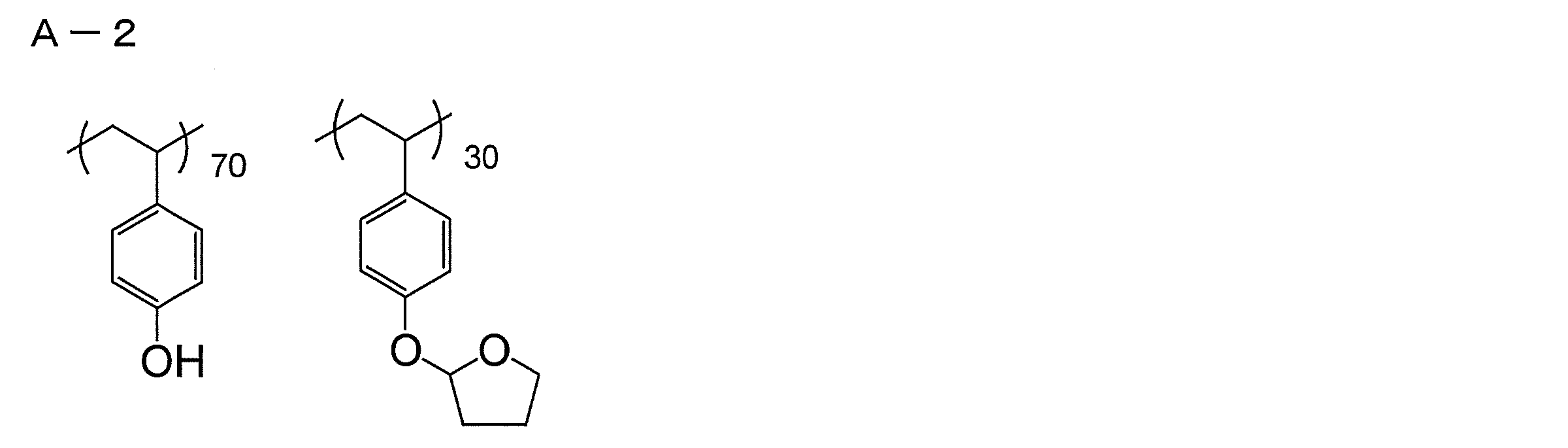
共重合体であるA-3を以下のごとく合成した。
エチルビニルエーテル144.2部(2モル当量)にフェノチアジン0.5部を添加し、反応系中を10℃以下に冷却しながらメタクリル酸86.1部(1モル当量)を滴下後、室温(25℃)で4時間撹拌した。p-トルエンスルホン酸ピリジニウム5.0部を添加後、室温で2時間撹拌し、一夜室温放置した。反応液に炭酸水素ナトリウム5部および硫酸ナトリウム5部を添加し、室温で1時間撹拌し、不溶物を濾過後40℃以下で減圧濃縮し、残渣の黄色油状物を減圧蒸留して沸点(bp.)43~45℃/7mmHg留分のメタクリル酸1-エトキシエチル(MAEVE)134.0部を無色油状物として得た。
得られたメタクリル酸1-エトキシエチル(63.28部(0.4モル当量))、BzMA(52.83部(0.3モル当量))、MAA(8.61部(0.1モル当量))、HEMA(26.03部(0.2モル当量))およびEDM(110.8部)の混合溶液を窒素気流下、70℃に加熱した。この混合溶液を撹拌しながら、ラジカル重合開始剤V-65(商品名、和光純薬工業(株)製、4部)およびEDM(100.0部)の混合溶液を2.5時間かけて滴下した。滴下が終了してから、70℃で4時間反応させることにより、重合体のEDM溶液(固形分濃度:40%)を得た。
得られたA-3のゲルパーミエーションクロマトグラフィー(GPC)により測定した重量平均分子量は、15,000であった。

メタクリル酸(86g、1mol)を15℃に冷却しておき、カンファースルホン酸(4.6g,0.02mol)添加した。その溶液に、2-ジヒドロフラン(71g、1mol、1.0当量)を滴下した。1時間撹拌した後に、飽和炭酸水素ナトリウム(500mL)を加え、酢酸エチル(500mL)で抽出し、硫酸マグネシウムで乾燥後、不溶物を濾過後40℃以下で減圧濃縮し、残渣の黄色油状物を減圧蒸留して沸点(bp.)54~56℃/3.5mmHg留分のメタクリル酸テトラヒドロ-2H-フラン-2-イル(MATHF)125gを無色油状物として得た(収率80%)。
A-3の合成と同様にして、A-4も合成した。
A-4

使用した各モノマーおよびその使用量を、下記表に記載のものに変更した以外は、重合体A-3の合成と同様にして、他の共重合体を合成した。
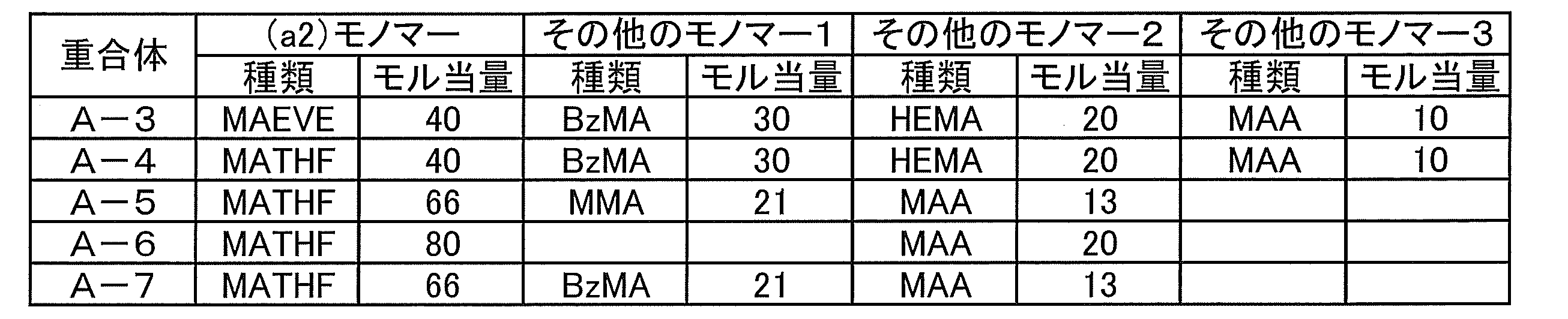
<<B-1の合成>>
o-アミノチオフェノール(和光純薬製)5.0gとピバロイルアセトニトリル(東京化成製)5.0gを混合し、120℃で2時間攪拌した。放冷後、粗生成物をシリカゲルカラムクロマトグラフィー精製して、中間体B-1Aを5.7g得た。
THF(3mL)とB-1A(5.6g)を混合し、氷冷下2M塩酸/THF溶液24mL、次いで亜硝酸イソペンチル(和光純薬製)(3.4g)を滴下し、室温まで昇温後2時間攪拌した。得られた反応混合物に水、酢酸エチルを添加して分液し、有機層を水で洗浄後、硫酸マグネシウムで乾燥し、ろ過、濃縮して中間体粗B-1Bを得た。
中間体粗B-1Bをアセトン(20mL)と混合し、氷冷下でトリエチルアミン(和光純薬製)(4.9g)、p-トルエンスルホニルクロリド(東京化成製)(5.9g)を添加後、室温まで昇温して1時間攪拌した。得られた反応混合液に水、酢酸エチルを添加して分液し、有機相を硫酸マグネシウムで乾燥後、ろ過、濃縮して粗B-1を得た。粗B-1をメタノールでリスラリー後、ろ過、乾燥してB-1(6.0g)を得た。
B-1の合成におけるピバロイルアセトニトリルをベンゾイルアセトニトリル(東京化成製)に変更した以外はB-1と同様にして、B-2を合成した。
B-1の合成にならって、常法に従い合成した。
2-アミノフェノール(東京化成製)3.0gと4,4-ジメチルー3-オキソ吉草酸メチル(和光純薬製)8.7gを混合し、p-トルエンスルホン酸一水和物(和光純薬製)0.5gを添加して窒素雰囲気下120℃で2時間加熱した。放冷後、粗生成物をシリカゲルカラムクロマトグラフィー精製して、中間体B-6Aを4.4g得た。
B-6A(2.0g)とp-キシレン(10mL)を混合し、p-トルエンスルホン酸一水和物(和光純薬製)0.3gを添加して140℃で6時間加熱した。放冷後、反応混合液に水、酢酸エチルを添加して分液し、有機相を硫酸マグネシウムで乾燥後、ろ過、濃縮して粗B-6Bを得た。
THF(1.5mL)と粗B-6B全量を混合し、氷冷下2M塩酸/THF溶液8.5mL、次いで亜硝酸イソペンチル(和光純薬製)(1.2g)を滴下し、室温まで昇温後2時間攪拌した。得られた反応混合物に水、酢酸エチルを添加して分液し、有機層を水で洗浄後、硫酸マグネシウムで乾燥し、ろ過、濃縮して中間体粗B-6Cを得た。
中間体粗B-6C(1.0g)をアセトン(10mL)と混合し、氷冷下でトリエチルアミン(和光純薬製)(0.74g)、p-トルエンスルホニルクロリド(東京化成製)(1.0g)を添加後、室温まで昇温して1時間攪拌した。得られた反応混合液に水、酢酸エチルを添加して分液し、有機相を硫酸マグネシウムで乾燥後、ろ過、濃縮して粗B-6を得た。粗B-6をメタノールでリスラリー後、ろ過、乾燥してB-6(1.0g)を得た。
B-1の合成におけるo-アミノチオフェノールを2-アミノー4-クロロベンゼンチオール(東京化成製)に変更した以外はB-1と同様にして、B-7を合成した。
B-6の合成における2-アミノフェノールを2-アミノー1-ナフトール塩酸塩(東京化成製)に変更した以外はB-6と同様にして、B-8を合成した。
1-アミノー2-ナフトール塩酸塩(東京化成製)4.0gをN-メチルピロリドン(和光純薬精)16gに懸濁させ、炭酸水素ナトリウム(和光純薬製)3.4gを添加後、4,4-ジメチル-3-オキソ吉草酸メチル(和光純薬製)4.9gを滴下し、窒素雰囲気下120℃で2時間加熱した。放冷後、反応混合液に水、酢酸エチルを添加して分液し、有機相を硫酸マグネシウムで乾燥し、ろ過、濃縮して粗B-9Aを得た。粗B-9Aをシリカゲルカラムクロマトグラフィー精製して、中間体B-9Aを1.7g得た。
B-9A(1.7g)とp-キシレン(6mL)を混合し、p-トルエンスルホン酸一水和物(和光純薬製)0.23gを添加して140℃で2時間加熱した。放冷後、反応混合液に水、酢酸エチルを添加して分液し、有機相を硫酸マグネシウムで乾燥後、ろ過、濃縮して粗B-9Bを得た。
THF(2mL)と粗B-9B全量を混合し、氷冷下2M塩酸/THF溶液6.0mL、次いで亜硝酸イソペンチル(和光純薬製)(0.84g)を滴下し、室温まで昇温後2時間攪拌した。得られた反応混合物に水、酢酸エチルを添加して分液し、有機層を水で洗浄後、硫酸マグネシウムで乾燥し、ろ過、濃縮して中間体粗B-9Cを得た。
中間体粗B-9C全量をアセトン(10mL)と混合し、氷冷下でトリエチルアミン(和光純薬製)(1.2g)、p-トルエンスルホニルクロリド(東京化成製)(1.4g)を添加後、室温まで昇温して1時間攪拌した。
得られた反応混合液に水、酢酸エチルを添加して分液し、有機相を硫酸マグネシウムで乾燥後、ろ過、濃縮して粗B-9を得た。粗B-9を冷メタノールでリスラリー後、ろ過、乾燥してB-9(1.2g)を得た。
B-6の合成にならい、常法に従い合成した。
B-1の合成におけるp-トルエンスルホニルクロリドを2-チオフェンスルホニルクロリド(東京化成製)に変更した以外はB-1と同様にして、B-16を合成した。
B-6の合成にならい、常法に従い合成した。
B-1の合成にならい、常法に従い合成した。
1-(1-ナフチル)-2-チオ尿素(和光純薬製)5.0gを酢酸100mLに懸濁させ、ベンジルトリメチルアンモニウムトリブロミド(東京化成製)9.6gを分割添加し、室温で8時間攪拌した。反応混合液を、氷浴中、飽和炭酸水素ナトリウム水溶液(1.6L)に滴下し、酢酸エチル(300mL)で分液し、有機相を硫酸マグネシウムで乾燥後、ろ過、濃縮して
粗B-23A(4.9g)を得た。
得られた粗B-23A(4.9g)をエチレングリコール(50mL)に添加し、水酸化ナトリウム(12.2g)の50%水溶液を添加後、窒素雰囲気下48時間加熱還流させた。放冷後、反応混合液を酢酸(40mL)と水(120mL)の混合液に氷冷しながら添加し、ジエチルエーテル(150mL)で分液した。有機相を硫酸マグネシウムで乾燥後、ろ過、濃縮して粗B-23Bを得た。
得られた粗B-23B全量をピバロイルアセトニトリル(東京化成製)と混合し、140℃で6時間攪拌した。放冷後、粗生成物をシリカゲルカラムクロマトグラフィー精製して、中間体B-23Cを2.1g得た。
THF(3mL)とB-23C(2.0g)を混合し、氷冷下2M塩酸/THF溶液7.1mL、次いで亜硝酸イソペンチル(和光純薬製)(1.0g)を滴下し、室温まで昇温後2時間攪拌した。得られた反応混合物に水、酢酸エチルを添加して分液し、有機層を水で洗浄後、硫酸マグネシウムで乾燥し、ろ過、濃縮して中間体粗B-23Dを得た。
中間体粗B-23Dをアセトン(10mL)と混合し、氷冷下でトリエチルアミン(和光純薬製)(1.1g)、p-トルエンスルホニルクロリド(東京化成製)(1.35g)を添加後、室温まで昇温して1時間攪拌した。
得られた反応混合液に水、酢酸エチルを添加して分液し、有機相を硫酸マグネシウムで乾燥後、ろ過、濃縮して粗B-23を得た。粗B-23を冷メタノールでリスラリー後、ろ過、乾燥してB-23(1.7g)を得た。
B-23の合成にならい、常法に従い合成した。
B-6の合成における2-アミノフェノールを3-アミノー2-ナフトール(東京化成製)に変更した以外はB-6と同様にして、B-24を合成した。
<<B-26の合成>>
B-6の合成における2-アミノフェノールを6-アミノー2,4-ジク
ロロ-3-メチルフェノール(和光純薬製)に変更した以外はB-6と同様にして、B-26を合成した。
B-6の合成における2-アミノフェノールを2-アミノー4-フェニルフェノール(東京化成製)に変更した以外はB-6と同様にして、B-27を合成した。
B-9の合成における4,4-ジメチル-3-オキソ吉草酸メチルを4-メチル-3-オキソ吉草酸メチル(東京化成製)に変更した以外はB-9と同様にして、B-28を合成した。
B-6の合成における4,4-ジメチル-3-オキソ吉草酸メチルをベンゾイル酢酸エチル(東京化成製)に変更した以外はB-9と同様にして、B-29を合成した。
<<B’-30の合成>>
特表2002-528451号公報の段落番号0108の記載に従って合成した。
2-ナフトール(10g)、クロロベンゼン(30mL)の懸濁溶液に塩化アルミニウム(10.6g)、2-クロロプロピオニルクロリド(10.1g)を添加し、混合液を40℃に加熱して2時間反応させた。氷冷下、反応液に4NHCl水溶液(60mL)を滴下し、酢酸エチル(50mL)を添加して分液した。有機層に炭酸カリウム(19.2g)を加え、40℃で1時間反応させた後、2NHCl水溶液(60mL)を添加して分液し、有機層を濃縮後、結晶をジイソプロピルエーテル(10mL)でリスラリーし、ろ過、乾燥してケトン化合物(6.5g)を得た。
得られたケトン化合物(3.0g)、メタノール(30mL)の懸濁溶液に酢酸(7.3g)、50質量%ヒドロキシルアミン水溶液(8.0g)を添加し、加熱還流した。放冷後、水(50mL)を加え、析出した結晶をろ過、冷メタノール洗浄後、乾燥してオキシム化合物(2.4g)を得た。
得られたオキシム化合物(1.8g)をアセトン(20mL)に溶解させ、氷冷下トリエチルアミン(1.5g)、p-トルエンスルホニルクロリド(2.4g)を添加し、室温に昇温して1時間反応させた。反応液に水(50mL)を添加し、析出した結晶をろ過後、メタノール(20mL)でリスラリーし、ろ過、乾燥してB’-31の化合物(上述の構造)(2.3g)を得た。
なお、B’-31の1H-NMRスペクトル(300MHz、CDCl3)は、δ=8.3(d,1H),8.0(d,2H),7.9(d,1H),7.8(d,1H),7.6(dd,1H),7.4(dd,1H)7.3(d,2H),7.1(d.1H),5.6(q,1H),2.4(s,3H),1.7(d,3H)であった。
PGMEA:メトキシプロピルアセテート(昭和電工社製)
PGDA:1,2-プロパンジオールジアセタート(沸点190℃、製造元:株式会社ダイセル社製 品番:PGDA)
1,3-BGDA:1,3-ブタンジオールジアセテート(沸点232℃、製造元:株式会社ダイセル社製 品番:1,3-BGDA)
1,6-HDDA:1,6-ヘキサンジオールジアセタート(沸点260℃、製造元:株式会社ダイセル社製 品番:1,6-HDDA)
DRA-150:トリアセチン(沸点260℃、製造元:株式会社ダイセル社製 品番:DRA-150)
D-1:下記に示す構造
D-2:下記に示す構造
D-3:下記に示す構造

D-5:TPI(2,4,5-トリフェニルイミダゾール(東京化成工業(株)製)))
E-1:下記化合物(製造元:ダイセル化学工業株式会社製、品番:セロキサイド2021P)



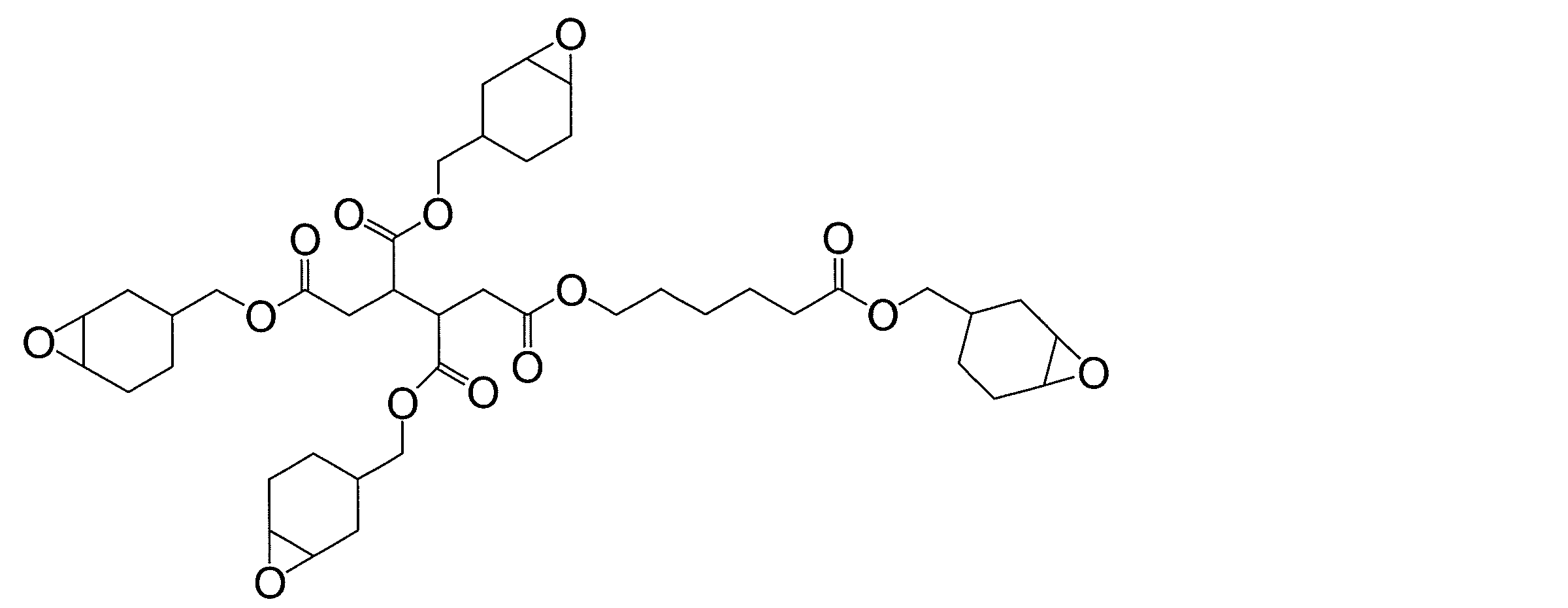
H-1:9,10-ジブトキシアントラセン
L-1:下記化合物(製造元:和光純薬工業株式会社製、品番)





下記表に示す組成となるように、各成分を溶解混合し、口径0.2μmのポリテトラフルオロエチレン製フィルターで濾過して、実施例1~49、53~55、57、59、62、63、67の感光性樹脂組成物を得た。尚、配合比は下記表のとおりとした。
・(A)重合体:表に示す割合(質量比)で、(A1)と(A2)をブレンドした。
・(B)一般式(3)で表される化合物:重合体(A)100質量部に対し、1.5質量部
・(C2)溶剤:組成物の不揮発分が20重量%となるように調製した。
・(C1)溶剤:(C1)溶剤を添加する場合は、全溶剤100質量部に対し、3.0質量部
・(D)一般式(4)で表される化合物:重合体(A)100質量部に対し、0.2質量部
・(E)脂環式エポキシ化合物:重合体(A)100質量部に対し、0.5質量部
・(H)増感剤:増感剤を添加する場合は、重合体(A)100質量部に対し、1.5質量部
下記表に示す組成となるように、各成分を溶解混合し、口径0.2μmのポリテトラフルオロエチレン製フィルターで濾過して、実施例50~52、56、58、60、61、64~66、68および比較例1~10の感光性樹脂組成物を得た。尚、配合比は下記表のとおりとした。
・(A)重合体:表に示す割合(質量比)で、(A1)と(A2)をブレンドした。
・(B)一般式(3)で表される化合物:重合体(A)100質量部に対し、0.5質量部
・(B’)一般式(3)以外の酸発生剤:重合体(A)100質量部に対し、1.0質量部
・(C2)溶剤:組成物の不揮発分が20重量%となるように調製した。
・(C1)溶剤:(C1)溶剤を添加する場合は、全溶剤100質量部に対し、3.0質量部
・(D)一般式(4)で表される化合物:重合体 (A)100質量部に対し、0.2質量部
・(E)脂環式エポキシ化合物:重合体(A)100質量部に対し、0.5質量部
下記表に示す組成となるように、各成分を溶解混合し、口径0.2μmのポリテトラフルオロエチレン製フィルターで濾過して、実施例69~73および比較例11の感光性樹脂組成物を得た。尚、配合比は下記表のとおりとした。
・(A)重合体:表に示す割合(質量比)で、(A1)と(A2)をブレンドした。
・(B)一般式(3)で表される化合物:重合体(A)100質量部に対し、0.5質量部
・(B’)一般式(3)以外の酸発生剤:重合体(A)100質量部に対し、1.0質量部
・(C2)溶剤:組成物の不揮発分が20重量%となるように調製した。
・(C1)溶剤:(C1)溶剤を添加する場合は、全溶剤100質量部に対して、3.0質量部
・(D)一般式(4)で表される化合物:重合体 (A)100質量部に対し、0.2質量部
・(E)脂環式エポキシ化合物:重合体(A)100質量部に対し、0.5質量部
・(L)紫外線吸収剤:重合体(A)100質量部に対し、1.0質量部
洗浄、HMDS処理したガラス基板(コーニング1737、0.7mm厚(コーニング社製))上に、各感光性樹脂組成物をスリット塗布した後、95℃/140秒ホットプレート上でプリベークして溶剤を揮発させ、膜厚1.3μmの感光性樹脂組成物層を形成した。
次に、得られた感光性樹脂組成物層を、キヤノン(株)製 MPA 5500CF(超高圧水銀ランプ)を用いて、所定のマスクを介して露光した。そして、露光後の感光性樹脂組成物層を、アルカリ現像液(2.38質量%のテトラメチルアンモニウムヒドロキシド水溶液)で23℃/60秒間現像した後、超純水で20秒リンスした。
10μmのラインアンドスペースパターンがちょうど10μmとなる露光量を最適露光量として感度を評価した。3以上が実用レベルである。
1:50mJ/cm2以上の露光量を必要
2:20mJ/cm2以上50mJ未満の露光量が必要
3:15mJ/cm2以上20mJ未満の露光量が必要
4:10mJ/cm2以上15mJ未満の露光量
5:10mJ/cm2未満の露光量
洗浄、HMDS処理した550mm×650mmガラス基板に1.3μmの膜厚でスピン塗布し、ホットプレート上でプリベーク(95℃×140秒)した後、キヤノン(株)製 MPA 5500CF(超高圧水銀ランプ)を用いて、所定のマスクを介して10μmのラインアンドスペースパターンがちょうど10μmとなる露光量にて露光後、アルカリ現像液(2.38質量%のテトラメチルアンモニウムヒドロキシド水溶液)で23℃/60秒間現像し、かかるラインアンドスペースパターン付き基板を10枚準備し、基板1枚ごとに10点、光学式計測器ZYGO New View7200(ZYGO corp.製)にて、10μmのライン幅を測定し、計100点の実測線幅の標準偏差(σ)を計算した。評価基準は下記の通りであり、3以上が実用レベルである。
1:標準偏差σが0.4μm以上
2:標準偏差σが0.2μm以上、0.4μm未満
3:標準偏差σが0.15μm以上、0.25μm未満
4:標準偏差σが0.1μm以上、0.15μm未満
5:標準偏差σが0.1μm未満
洗浄、HMDS処理したガラス基板(コーニング1737、0.7mm厚(コーニング社製))上に、各感光性樹脂組成物をスリット塗布した後、95℃/140秒ホットプレート上でプリベークして溶剤を揮発させ、膜厚1.3μmの感光性樹脂組成物層を形成した。
次に、得られた感光性樹脂組成物層を、キヤノン(株)製 MPA 5500CF(超高圧水銀ランプ)を用いて、所定のマスクを介して10μmのラインアンドスペースパターンがちょうど10μmとなる露光量で露光した。そして、露光後の感光性樹脂組成物層を、アルカリ現像液(2.38質量%のテトラメチルアンモニウムヒドロキシド水溶液)で23℃/60秒間現像した後、超純水で20秒リンスした。3以上が実用レベルである。
1:解像度が5μm以上
2:3.0μmが解像するが2.5μmは解像しない
3:2.5μmが解像するが2.0μmは解像しない
4:2.0μmが解像するが1.5μmは解像しない
5:1.5μmが解像する。
洗浄、HMDS処理したガラス基板(コーニング1737、0.7mm厚(コーニング社製))に1.3μmの膜厚でスピン塗布し、ホットプレート上でプリベーク(95℃×140秒)した後、キヤノン(株)製 MPA 5500CF(超高圧水銀ランプ)を用いて、所定のマスクを介して10μmのラインアンドスペースパターンがちょうど10μmとなる露光量にて露光後、アルカリ現像液(2.38質量%のテトラメチルアンモニウムヒドロキシド水溶液)で23℃/60秒間現像して形成した基板を、ホットプレートを用いて140℃の温度で3分間PostBakeし、3μmのL&Sの画素のテーパー角度を測定しこれを矩形性とした。3以上が実用レベルである。
1:テーパー角度が30°未満
2:テーパー角度が30°以上45°未満
3:テーパー角度が45°以上60°未満
4:テーパー角度が60°以上75°未満
5:テーパー角度が75°以上
洗浄したMoコートしたガラス基板に1.3μmの膜厚で塗布し、マスクを介して10μmのラインアンドスペースパターンがちょうど10μmとなる露光量にて露光、現像して形成した基板のブライトフィールドでのラインアンドスペースパターンを観察し、画素の基板密着性とした。3以上が実用レベルである。
1:画素が全く密着しない。
2:10μm以上の線幅のL&Sパターンが密着している。
3:5μm以上の線幅のL&Sパターンが密着している。
4:3μm以上の線幅のL&Sパターンが密着している。
5:2μmの線幅のL&Sパターンが密着している。
洗浄したMo/Al/Moをこの順でコートしたガラス基板に1.3μmの膜厚で塗布し、マスクを介して10μmのラインアンドスペースパターンがちょうど10μmとなる露光量にて露光、現像して形成した基板のブライトフィールドでのラインアンドスペースパターンをSEM(Scanning Electron Microscopy)観察し、画素の直線性とした。3以上が実用レベルである。
1:線幅を10回測定した際の最大値と最小値の差が1.0μm以上
2:線幅を10回測定した際の最大値と最小値の差が0.5μm以上~1.0μm未満
3:線幅を10回測定した際の最大値と最小値の差が0.3μm以上~0.5μm未満
4:線幅を10回測定した際の最大値と最小値の差が0.1μm以上~0.3μm未満
5:線幅を10回測定した際の最大値と最小値の差が0.1μm未満

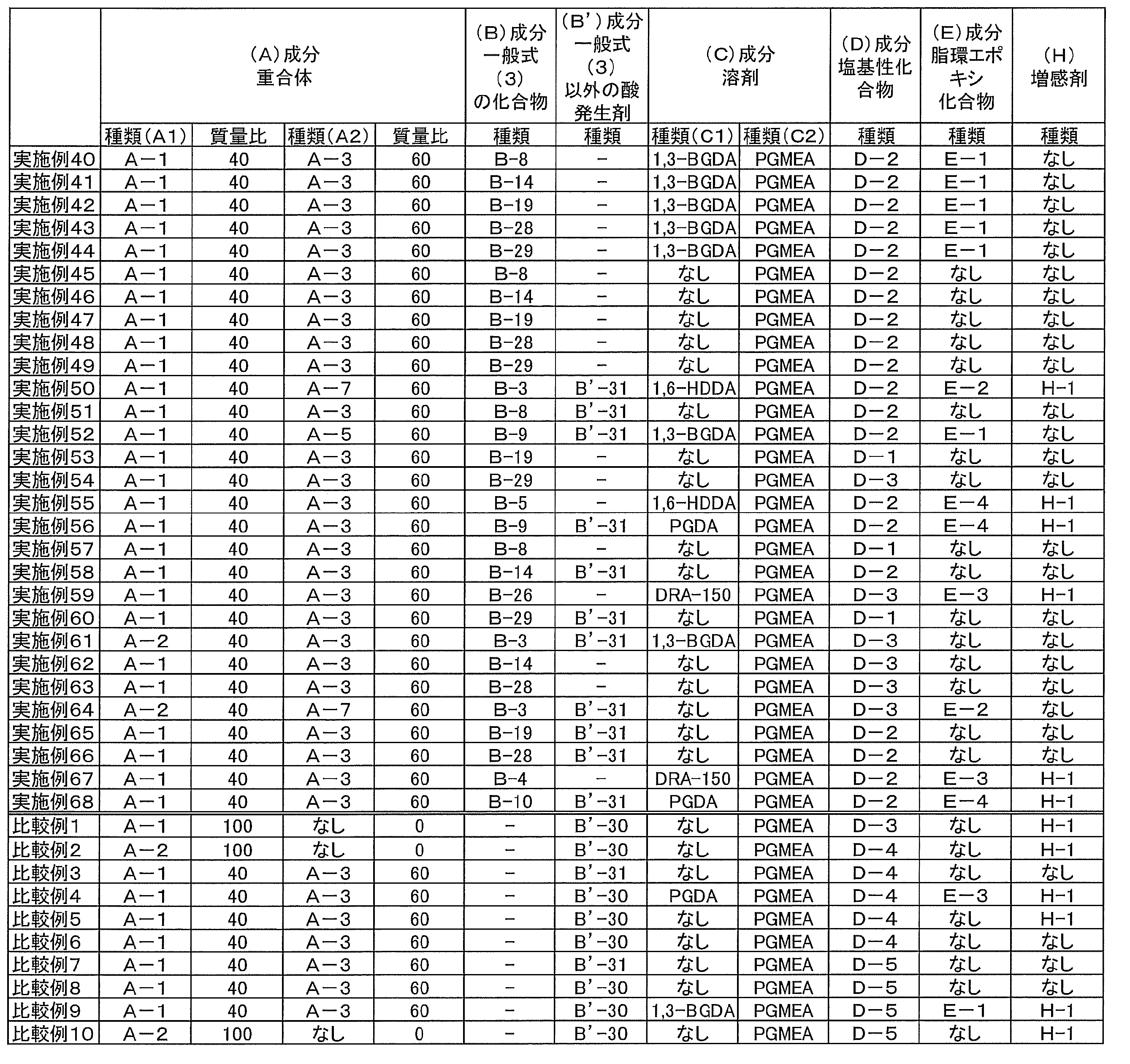
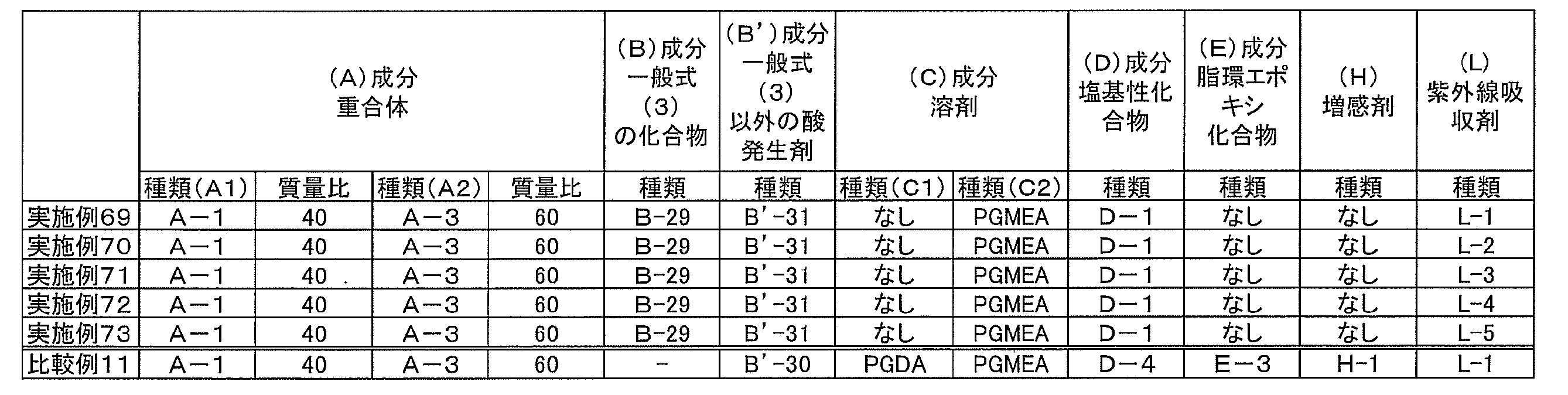
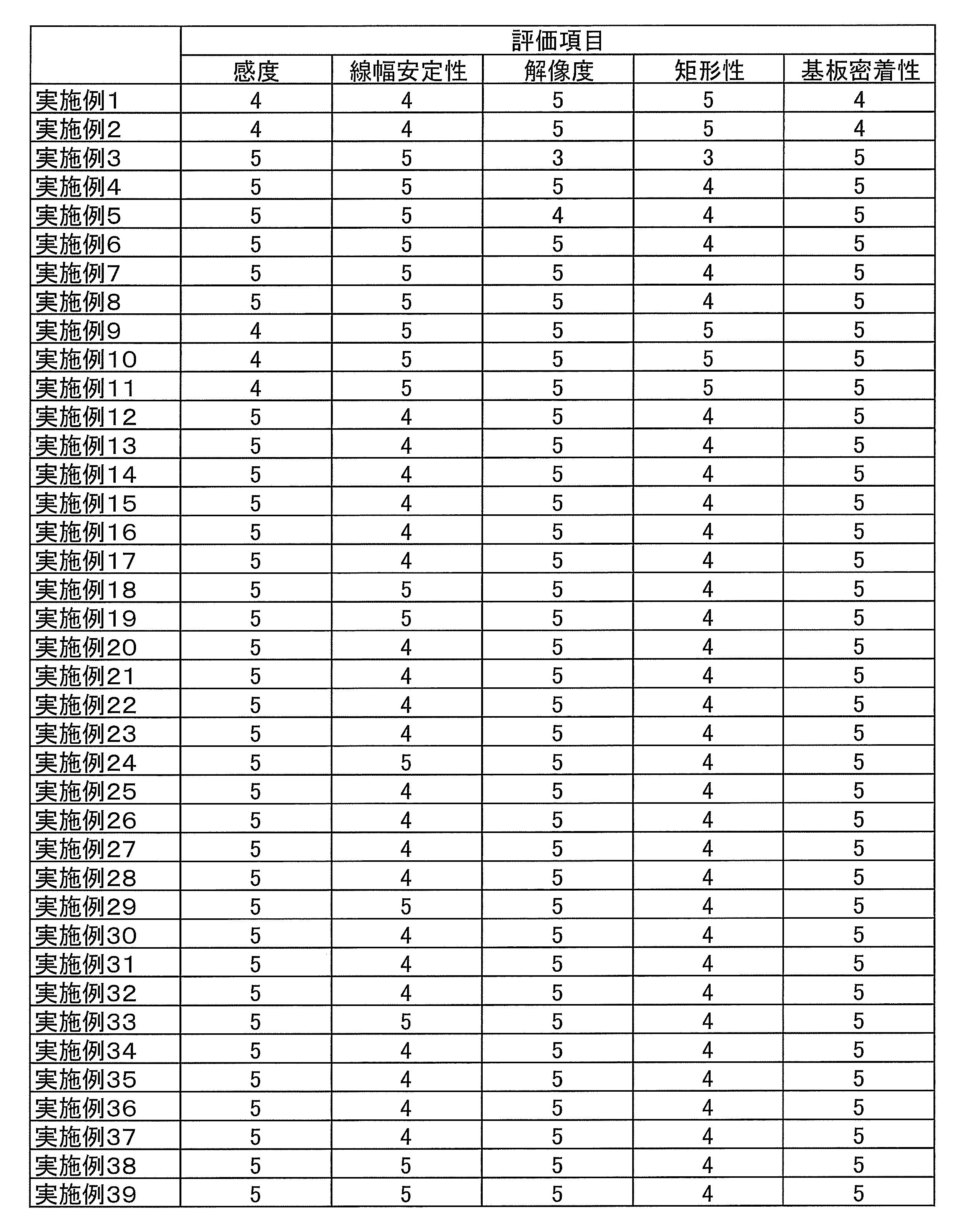


<有機EL表示装置>
ITOパターンを具備する有機EL表示装置を以下の方法で作製した(図1参照)。
ガラス基板6上にボトムゲート型のTFT1を形成し、このTFT1を覆う状態でSi3N4から成る絶縁膜3を形成した。次に、この絶縁膜3に、ここでは図示を省略したコンタクトホールを形成した後、このコンタクトホールを介してTFT1に接続される配線2(高さ1.0μm)を絶縁膜3上に形成した。この配線2は、TFT1間または、後の工程で形成される有機EL素子とTFT1とを接続するためのものである。
感光性樹脂組成物を塗布する際の塗布性は良好で、露光、現像、焼成の後に得られた硬化膜には、しわやクラックの発生は認められなかった。さらに、配線2の平均段差は500nm、作製した平坦化膜4の膜厚は2,000nmであった。
<液晶表示装置>
ITOパターンを具備する液晶表示装置を以下の方法で作製した。
特許第3321003号公報の図1に記載のアクティブマトリクス型液晶表示装置において、画素電極4を実施例1の感光性樹脂組成物をマスクとして用い形成し、実施例75の液晶表示装置を得た。
すなわち、上記実施例74における有機EL表示装置の第一電極5の形成方法と同様の方法で、画素電極4を形成した。
2:配線
3:絶縁膜
4:平坦化膜
5:第一電極
6:ガラス基板
7:コンタクトホール
8:絶縁膜
10:液晶表示装置
12:バックライトユニット
14,15:ガラス基板
16:TFT
17:硬化膜
18:コンタクトホール
19:ITO透明電極
20:液晶
22:カラーフィルター
30 ハーフトーンマスク
32 透明基材
31 位相シフタ部(位相変更膜)
33、34、35 露光強度曲線
s:透過部
k:露光部(基板)
33:光強度分布
34:光振幅分布(正位相)
35:光振幅分布(逆位相)
Claims (14)
- (A)(A1)下記一般式(1)で表される構成単位(a1)を有する重合体、および/または、(A2)下記一般式(2)で表される構成単位(a2)を含む重合体を含む重合体成分、
(B)下記一般式(3)で表される化合物、ならびに、
(C)溶剤、
を含有する、感光性樹脂組成物;

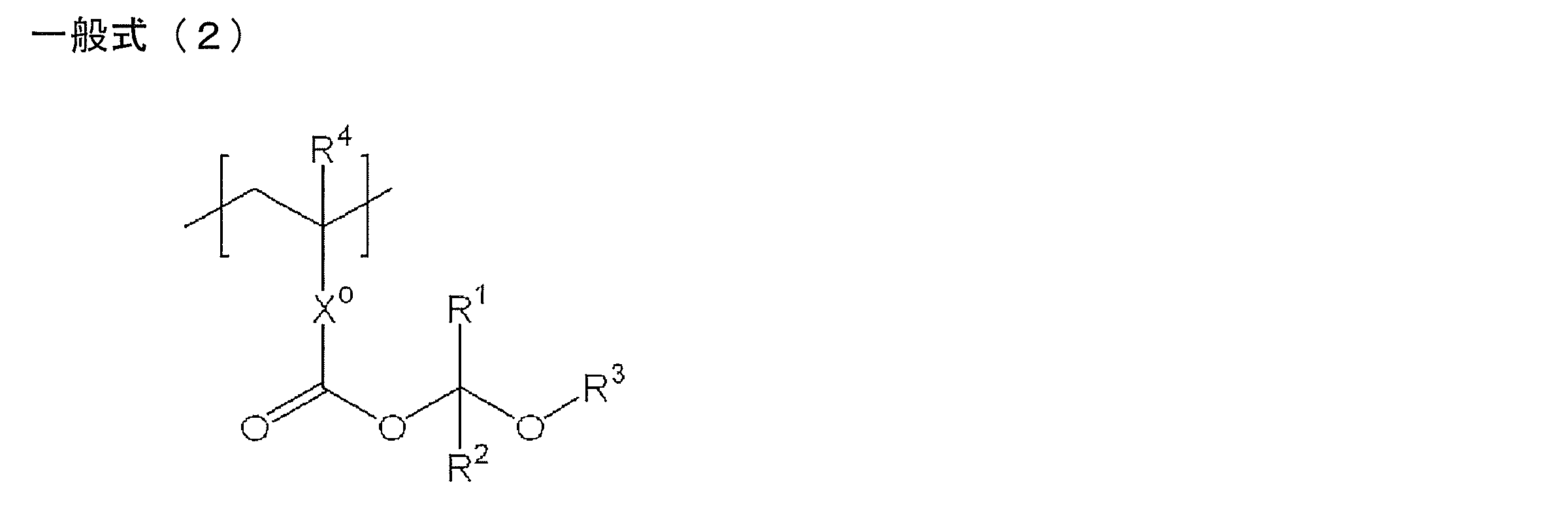
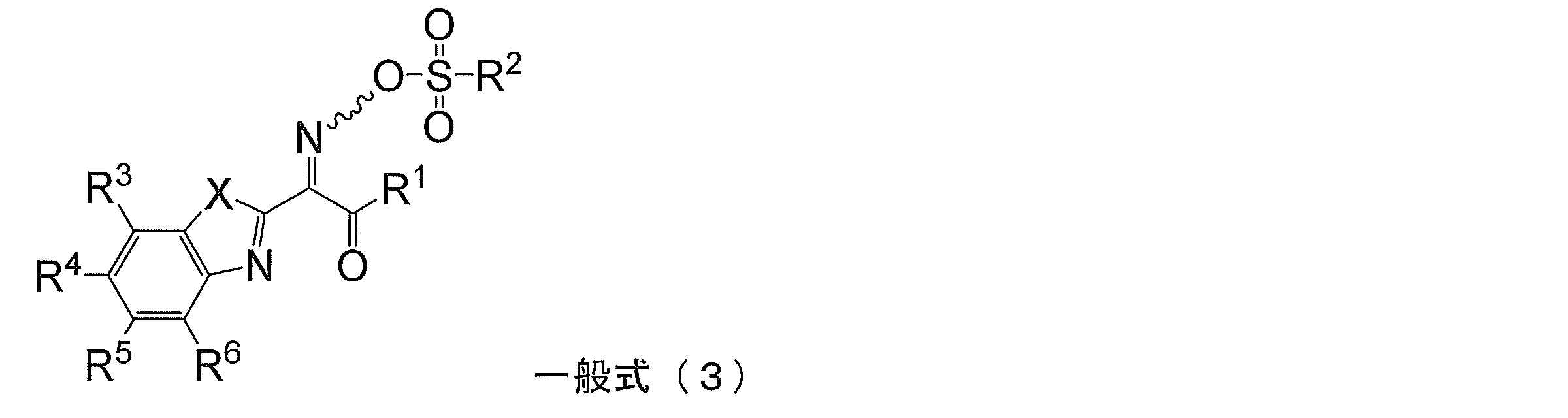
- 前記一般式(3)中のR1が、炭素数が3~10のアルキル基または炭素数が6~12のアリール基である、請求項1に記載の感光性樹脂組成物。
- 前記一般式(3)中のR1が、分岐構造を有するアルキル基、環状のアルキル基、またはフェニル基である、請求項1または2に記載の感光性樹脂組成物。
- 前記一般式(3)で表される化合物が、下記化合物から選択される、請求項1~3のいずれか1項に記載の感光性樹脂組成物。
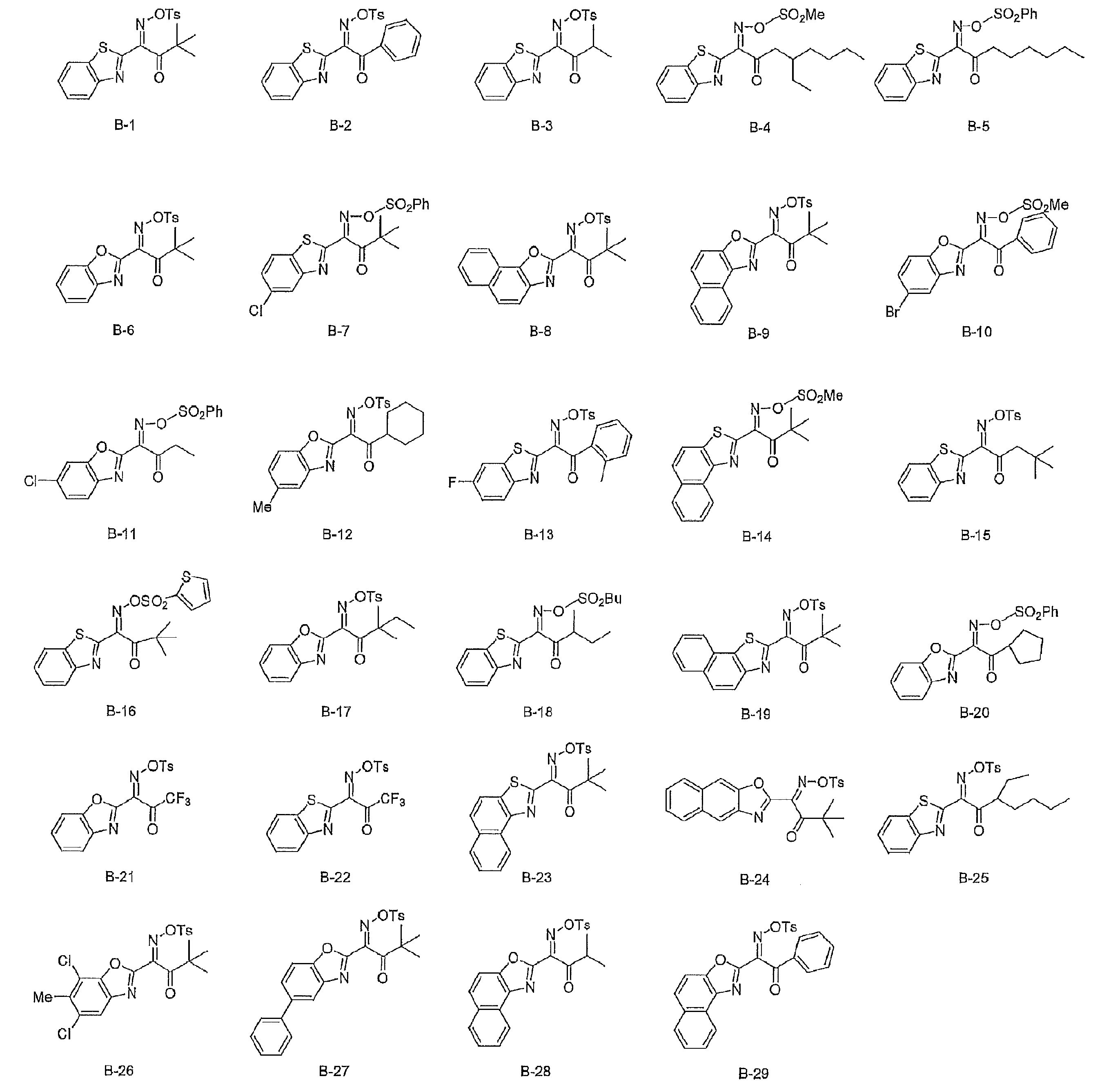
- (A)重合体成分が、(A1)前記一般式(1)で表される構成単位(a1)を有する重合体、および、(A2)前記一般式(2)で表される構成単位(a2)を有する重合体、の両方を含む、請求項1~4のいずれか1項に記載の感光性樹脂組成物。
- (D)一般式(4)で表される化合物をさらに含有する、請求項1~5のいずれか1項に記載の感光性樹脂組成物;

- (E)脂環式エポキシ化合物をさらに含有する、請求項1~6のいずれか1項に記載の感光性樹脂組成物。
- 前記(C)溶剤が、(C1)分子内にアセテート構造を2つ以上含有する溶剤と、(C1)分子内にアセテート構造を2つ以上含有する溶剤と異なる他の溶剤(C2)とを含む、請求項1~7のいずれか1項に記載の感光性樹脂組成物。
- ディスプレイパネル基板形成に用いられるエッチングレジスト用感光性樹脂組成物である、請求項1~8のいずれか1項に記載の感光性樹脂組成物。
- エッチングレジスト用感光性樹脂組成物である、請求項1~9のいずれか1項に記載の感光性樹脂組成物。
- 請求項1~10のいずれか1項に記載の感光性樹脂組成物を硬化してなる硬化膜。
- (1)基板の少なくとも一方の面に、請求項1~10のいずれか1項に記載の感光性樹脂組成物を塗布する工程、
(2)乾燥により有機溶剤を揮発させ、感光性樹脂組成物層を形成する工程、
(3)前記感光性樹脂組成物層を露光する工程、
(4)露光された前記感光性樹脂組成物層を現像する工程、を含むパターンの製造方法。 - 請求項12に記載の方法でパターンを形成する工程、得られたパターンをエッチング用レジストとして用いてエッチングを行う工程、および前記エッチングを行ったパターンをプラズマ処理または薬品処理により除去する工程、を含む、パターンの製造方法。
- 請求項12に記載のパターンの製造方法または請求項13に記載のパターンの製造方法を含む、有機EL表示装置または液晶表示装置の製造方法。
Priority Applications (2)
| Application Number | Priority Date | Filing Date | Title |
|---|---|---|---|
| KR1020157033638A KR101824519B1 (ko) | 2013-06-11 | 2014-06-11 | 감광성 수지 조성물, 패턴의 제조 방법, 유기 el 표시 장치 또는 액정 표시 장치의 제조 방법, 및 경화막 |
| JP2015522808A JP6035418B2 (ja) | 2013-06-11 | 2014-06-11 | 感光性樹脂組成物、パターンの製造方法、有機el表示装置または液晶表示装置の製造方法、および硬化膜 |
Applications Claiming Priority (4)
| Application Number | Priority Date | Filing Date | Title |
|---|---|---|---|
| JP2013-122288 | 2013-06-11 | ||
| JP2013122288 | 2013-06-11 | ||
| JP2014-010945 | 2014-01-24 | ||
| JP2014010945 | 2014-01-24 |
Publications (1)
| Publication Number | Publication Date |
|---|---|
| WO2014200013A1 true WO2014200013A1 (ja) | 2014-12-18 |
Family
ID=52022304
Family Applications (1)
| Application Number | Title | Priority Date | Filing Date |
|---|---|---|---|
| PCT/JP2014/065430 Ceased WO2014200013A1 (ja) | 2013-06-11 | 2014-06-11 | 感光性樹脂組成物、パターンの製造方法、有機el表示装置または液晶表示装置の製造方法、および硬化膜 |
Country Status (3)
| Country | Link |
|---|---|
| JP (1) | JP6035418B2 (ja) |
| KR (1) | KR101824519B1 (ja) |
| WO (1) | WO2014200013A1 (ja) |
Cited By (4)
| Publication number | Priority date | Publication date | Assignee | Title |
|---|---|---|---|---|
| KR101609234B1 (ko) | 2015-01-13 | 2016-04-05 | 동우 화인켐 주식회사 | 감광성 수지 조성물, 이로부터 형성된 광경화 패턴 및 이를 포함하는 화상 표시 장치 |
| CN110119068A (zh) * | 2018-02-06 | 2019-08-13 | 东友精细化工有限公司 | 正型感光性树脂组合物、绝缘膜及图像显示装置 |
| CN113260922A (zh) * | 2018-12-31 | 2021-08-13 | 株式会社东进世美肯 | 正型感光性树脂组合物 |
| CN114276239A (zh) * | 2021-12-29 | 2022-04-05 | 徐州博康信息化学品有限公司 | 一种含缩酮结构酸敏感光刻胶树脂单体的制备方法 |
Families Citing this family (2)
| Publication number | Priority date | Publication date | Assignee | Title |
|---|---|---|---|---|
| KR102134633B1 (ko) | 2016-11-25 | 2020-07-16 | 삼성에스디아이 주식회사 | 감광성 수지 조성물, 이를 이용한 블랙 화소 격벽층 및 디스플레이 장치 |
| WO2023228661A1 (ja) * | 2022-05-24 | 2023-11-30 | 日産化学株式会社 | 薬液耐性保護膜 |
Citations (4)
| Publication number | Priority date | Publication date | Assignee | Title |
|---|---|---|---|---|
| JPS5749669A (en) * | 1980-07-14 | 1982-03-23 | Akzo Nv | Thermosetting paint composition containing blocking acid catalyst |
| JP2011227106A (ja) * | 2010-04-15 | 2011-11-10 | Jsr Corp | ポジ型感放射線性組成物、層間絶縁膜及びその形成方法 |
| JP2012133211A (ja) * | 2010-12-22 | 2012-07-12 | Fujifilm Corp | ポジ型感光性樹脂組成物 |
| WO2014020984A1 (ja) * | 2012-07-30 | 2014-02-06 | 富士フイルム株式会社 | 感光性樹脂組成物、硬化膜の製造方法、硬化膜、有機el表示装置および液晶表示装置 |
Family Cites Families (4)
| Publication number | Priority date | Publication date | Assignee | Title |
|---|---|---|---|---|
| JP3735945B2 (ja) | 1996-05-31 | 2006-01-18 | Jsr株式会社 | 感放射線性樹脂組成物 |
| JP3414197B2 (ja) | 1997-05-26 | 2003-06-09 | 住友化学工業株式会社 | フォトレジスト組成物 |
| JP5715967B2 (ja) * | 2011-08-19 | 2015-05-13 | 富士フイルム株式会社 | ポジ型感光性樹脂組成物、硬化膜の形成方法、硬化膜、液晶表示装置、及び、有機el表示装置 |
| JP2014197155A (ja) * | 2013-03-29 | 2014-10-16 | 富士フイルム株式会社 | 感光性樹脂組成物、硬化膜の製造方法、硬化膜、液晶表示装置及び有機el表示装置 |
-
2014
- 2014-06-11 WO PCT/JP2014/065430 patent/WO2014200013A1/ja not_active Ceased
- 2014-06-11 JP JP2015522808A patent/JP6035418B2/ja active Active
- 2014-06-11 KR KR1020157033638A patent/KR101824519B1/ko active Active
Patent Citations (4)
| Publication number | Priority date | Publication date | Assignee | Title |
|---|---|---|---|---|
| JPS5749669A (en) * | 1980-07-14 | 1982-03-23 | Akzo Nv | Thermosetting paint composition containing blocking acid catalyst |
| JP2011227106A (ja) * | 2010-04-15 | 2011-11-10 | Jsr Corp | ポジ型感放射線性組成物、層間絶縁膜及びその形成方法 |
| JP2012133211A (ja) * | 2010-12-22 | 2012-07-12 | Fujifilm Corp | ポジ型感光性樹脂組成物 |
| WO2014020984A1 (ja) * | 2012-07-30 | 2014-02-06 | 富士フイルム株式会社 | 感光性樹脂組成物、硬化膜の製造方法、硬化膜、有機el表示装置および液晶表示装置 |
Cited By (9)
| Publication number | Priority date | Publication date | Assignee | Title |
|---|---|---|---|---|
| KR101609234B1 (ko) | 2015-01-13 | 2016-04-05 | 동우 화인켐 주식회사 | 감광성 수지 조성물, 이로부터 형성된 광경화 패턴 및 이를 포함하는 화상 표시 장치 |
| CN105785717A (zh) * | 2015-01-13 | 2016-07-20 | 东友精细化工有限公司 | 感光性树脂组合物、由它们形成的光固化图案和使用了其的图像显示装置 |
| TWI681255B (zh) * | 2015-01-13 | 2020-01-01 | 南韓商東友精細化工有限公司 | 感光性樹脂組成物、由該組成物所形成的可光硬化圖案及包含該圖案的圖像顯示器 |
| CN110119068A (zh) * | 2018-02-06 | 2019-08-13 | 东友精细化工有限公司 | 正型感光性树脂组合物、绝缘膜及图像显示装置 |
| CN110119068B (zh) * | 2018-02-06 | 2023-03-24 | 东友精细化工有限公司 | 正型感光性树脂组合物、绝缘膜及图像显示装置 |
| CN113260922A (zh) * | 2018-12-31 | 2021-08-13 | 株式会社东进世美肯 | 正型感光性树脂组合物 |
| TWI796541B (zh) * | 2018-12-31 | 2023-03-21 | 南韓商東進世美肯股份有限公司 | 正型感光性樹脂組合物、使用其組合物的顯示元件的圖案形成方法及包含其組合物的固化物的顯示元件 |
| CN114276239A (zh) * | 2021-12-29 | 2022-04-05 | 徐州博康信息化学品有限公司 | 一种含缩酮结构酸敏感光刻胶树脂单体的制备方法 |
| CN114276239B (zh) * | 2021-12-29 | 2023-10-27 | 徐州博康信息化学品有限公司 | 一种含缩酮结构酸敏感光刻胶树脂单体的制备方法 |
Also Published As
| Publication number | Publication date |
|---|---|
| KR101824519B1 (ko) | 2018-02-01 |
| KR20160003113A (ko) | 2016-01-08 |
| JP6035418B2 (ja) | 2016-11-30 |
| JPWO2014200013A1 (ja) | 2017-02-23 |
Similar Documents
| Publication | Publication Date | Title |
|---|---|---|
| JP5623896B2 (ja) | 感光性樹脂組成物、硬化膜の形成方法、硬化膜、有機el表示装置、及び、液晶表示装置 | |
| JP6279614B2 (ja) | 感光性樹脂組成物、硬化膜の製造方法、硬化膜、液晶表示装置および有機el表示装置 | |
| JP5846622B2 (ja) | 感光性樹脂組成物、硬化膜、硬化膜の形成方法、有機el表示装置、及び、液晶表示装置 | |
| JP6096202B2 (ja) | 感光性樹脂組成物、これを用いたパターンの製造方法 | |
| JP5417422B2 (ja) | ポジ型感光性樹脂組成物 | |
| JP6240147B2 (ja) | 感光性樹脂組成物、これを用いた硬化膜の製造方法、硬化膜、液晶表示装置および有機el表示装置 | |
| JP6038951B2 (ja) | 感光性樹脂組成物、硬化膜の製造方法、硬化膜、有機el表示装置および液晶表示装置 | |
| JP6209617B2 (ja) | 感光性樹脂組成物、パターンの製造方法、硬化膜、有機el表示装置の製造方法、および液晶表示装置の製造方法 | |
| JP6035418B2 (ja) | 感光性樹脂組成物、パターンの製造方法、有機el表示装置または液晶表示装置の製造方法、および硬化膜 | |
| JP5814144B2 (ja) | 感光性樹脂組成物、これを用いたパターンの製造方法 | |
| CN105895661A (zh) | 薄膜晶体管基板的制造方法及其应用 | |
| JP5941543B2 (ja) | 感光性樹脂組成物、硬化膜の製造方法、硬化膜、有機el表示装置および液晶表示装置 | |
| JP5914663B2 (ja) | 感光性樹脂組成物、硬化膜の製造方法、硬化膜、有機el表示装置および液晶表示装置 | |
| JP5524036B2 (ja) | ポジ型感光性樹脂組成物、硬化膜の形成方法、硬化膜、液晶表示装置、及び、有機el表示装置 | |
| JP6216801B2 (ja) | 感光性樹脂組成物、パターンの製造方法、硬化膜、有機el表示装置の製造方法、および液晶表示装置の製造方法 | |
| JP6017301B2 (ja) | 感光性樹脂組成物、硬化膜の製造方法、硬化膜、液晶表示装置および有機el表示装置 | |
| JP6272338B2 (ja) | 感光性樹脂組成物、硬化膜の製造方法、硬化膜、液晶表示装置及び有機el表示装置 | |
| JP2015099320A (ja) | 感光性樹脂組成物、硬化膜の製造方法、硬化膜、有機el表示装置および液晶表示装置 | |
| JP5589101B2 (ja) | 感光性樹脂組成物、これを用いたパターンの製造方法 | |
| WO2015033880A1 (ja) | 樹脂組成物、硬化膜の製造方法、硬化膜、液晶表示装置および有機el表示装置 | |
| JP2013060537A (ja) | フォトレジスト用共重合体およびその製造方法 | |
| JP5734152B2 (ja) | 感光性樹脂組成物、硬化膜並びにその製造方法 | |
| JP6219949B2 (ja) | 感光性樹脂組成物、硬化膜の製造方法、硬化膜、液晶表示装置および有機el表示装置 |
Legal Events
| Date | Code | Title | Description |
|---|---|---|---|
| 121 | Ep: the epo has been informed by wipo that ep was designated in this application |
Ref document number: 14810827 Country of ref document: EP Kind code of ref document: A1 |
|
| ENP | Entry into the national phase |
Ref document number: 20157033638 Country of ref document: KR Kind code of ref document: A |
|
| ENP | Entry into the national phase |
Ref document number: 2015522808 Country of ref document: JP Kind code of ref document: A |
|
| NENP | Non-entry into the national phase |
Ref country code: DE |
|
| 122 | Ep: pct application non-entry in european phase |
Ref document number: 14810827 Country of ref document: EP Kind code of ref document: A1 |