WO2014199996A1 - 製紙用添加剤及び製紙用添加剤の製造方法並びに紙の製造方法 - Google Patents
製紙用添加剤及び製紙用添加剤の製造方法並びに紙の製造方法 Download PDFInfo
- Publication number
- WO2014199996A1 WO2014199996A1 PCT/JP2014/065381 JP2014065381W WO2014199996A1 WO 2014199996 A1 WO2014199996 A1 WO 2014199996A1 JP 2014065381 W JP2014065381 W JP 2014065381W WO 2014199996 A1 WO2014199996 A1 WO 2014199996A1
- Authority
- WO
- WIPO (PCT)
- Prior art keywords
- vinyl monomer
- polymer
- cationic
- mass
- cationic polymer
- Prior art date
- Legal status (The legal status is an assumption and is not a legal conclusion. Google has not performed a legal analysis and makes no representation as to the accuracy of the status listed.)
- Ceased
Links
Classifications
-
- D—TEXTILES; PAPER
- D21—PAPER-MAKING; PRODUCTION OF CELLULOSE
- D21H—PULP COMPOSITIONS; PREPARATION THEREOF NOT COVERED BY SUBCLASSES D21C OR D21D; IMPREGNATING OR COATING OF PAPER; TREATMENT OF FINISHED PAPER NOT COVERED BY CLASS B31 OR SUBCLASS D21G; PAPER NOT OTHERWISE PROVIDED FOR
- D21H17/00—Non-fibrous material added to the pulp, characterised by its constitution; Paper-impregnating material characterised by its constitution
- D21H17/20—Macromolecular organic compounds
- D21H17/33—Synthetic macromolecular compounds
- D21H17/34—Synthetic macromolecular compounds obtained by reactions only involving carbon-to-carbon unsaturated bonds
- D21H17/41—Synthetic macromolecular compounds obtained by reactions only involving carbon-to-carbon unsaturated bonds containing ionic groups
- D21H17/44—Synthetic macromolecular compounds obtained by reactions only involving carbon-to-carbon unsaturated bonds containing ionic groups cationic
-
- D—TEXTILES; PAPER
- D21—PAPER-MAKING; PRODUCTION OF CELLULOSE
- D21H—PULP COMPOSITIONS; PREPARATION THEREOF NOT COVERED BY SUBCLASSES D21C OR D21D; IMPREGNATING OR COATING OF PAPER; TREATMENT OF FINISHED PAPER NOT COVERED BY CLASS B31 OR SUBCLASS D21G; PAPER NOT OTHERWISE PROVIDED FOR
- D21H21/00—Non-fibrous material added to the pulp, characterised by its function, form or properties; Paper-impregnating or coating material, characterised by its function, form or properties
- D21H21/06—Paper forming aids
- D21H21/10—Retention agents or drainage improvers
Definitions
- the present invention relates to a papermaking additive, a method for producing a papermaking additive, and a method for producing paper. More specifically, the present invention relates to a papermaking additive suitably used as a freeness improver.
- Patent Document 1 describes a method of improving the yield by adding cationic starch and colloidal silica to the paper before dehydration.
- Patent Document 2 also describes that a first synthetic cationic polymer is added before a specific shearing step and bentonite after the shearing step in order to improve drainage, retention, drying and formation characteristics.
- a method of adding is disclosed.
- Patent Document 3 discloses a yield improving method in which a cationic polymer and anionic polymer fine particles are contained in a paper stock.
- Patent Document 4 discloses a dual system in which a crosslinked polymer and bentonite are used in combination.
- Patent Document 5 discloses that polymerization of a monomer aqueous solution is started under the conditions of free radical polymerization to form a polymerization reaction solution, and after the monomer polymerization has progressed 30% or more, one or more structural modifiers are added to the polymerization reaction solution.
- modified structurally modified polymers are disclosed.
- Patent Document 6 proposes a method of using a cationic polymer and an anionic polymer together
- Patent Document 7 discloses a cationic monomer and an anionic property.
- An amphoteric polymer having a monomer as a component has been proposed.
- waste paper In recent years, in the paper industry, there are more opportunities to use waste paper from the viewpoint of waste reduction and countermeasures against global warming. However, as the use of waste paper increases as a raw material for papermaking, the raw material situation gets worse and further improvements in drainage and yield are desired.
- the main object of the present invention is to provide an additive for papermaking that can improve drainage with a relatively small addition amount, and thus without causing problems of lowering the formation of paper products and increasing costs. To do.
- the present inventors have achieved excellent results with a paper additive containing a specific cationic polymer and a specific amphoteric polymer or a specific carboxylic acid in a specific ratio.
- the present inventors have found that it has an effect of improving drainage and have completed the present invention.
- the present invention (A): a cationic polymer obtained by polymerizing a monomer component containing a cationic vinyl monomer represented by the following general formula (I); (B): an anionic vinyl monomer of (meth) acrylic acid and / or sodium (meth) acrylate, 10 to 50 mol%, and 5 to 45 mol% of the cationic vinyl monomer, An amphoteric polymer obtained by polymerizing a monomer component having a molar ratio of an anionic vinyl monomer of 1 or more and having an intrinsic viscosity of 5 dl / g or more in a 1N NaCl aqueous solution at 30 ° C., or (C): 1 A carboxylic acid having two or more carboxyl groups in the molecule, In the case of containing (B), 0.01 to 2 parts by mass of (B) with respect to 100 parts by mass of (A), When it contains (C), it contains 0.01 to 10 mol% of (C) with respect to the total amount of mono
- R 1 is H or CH 3
- A is O or NH
- R 2 is an alkyl group having 2 to 4 carbon atoms which may have a hydroxyl group as a substituent
- R 3 Is H or an alkyl group having 1 to 3 carbon atoms
- R 4 is H, an alkyl group having 1 to 3 carbon atoms which may have a hydroxyl group as a substituent, or a benzyl group
- X ⁇ is (It is a halogen ion, a sulfonate ion, a methyl sulfate ion, or a hydroxide ion.)
- the present invention comprises (A) 100 parts by mass and (B) 0.01-2 parts by mass,
- the (A) is obtained by polymerizing a monomer component containing the cationic vinyl monomer and a nonionic vinyl monomer copolymerizable with the cationic vinyl monomer
- the (B) may be a papermaking additive obtained by polymerizing a monomer component containing the anionic vinyl monomer, the cationic vinyl monomer, and the nonionic vinyl monomer.
- (A) may have an intrinsic viscosity of 8 dl / g or more in a 1 N aqueous NaCl solution at 30 ° C.
- the (A) may be obtained by polymerizing the cationic vinyl monomer and the monomer component containing the nonionic vinyl monomer in the solution of (B).
- the (B) and the (A) obtained by polymerizing the monomer component containing the cationic vinyl monomer and the nonionic vinyl monomer in the solution of the (B).
- It may be a paper additive containing a polymer mixture containing and having an intrinsic viscosity of 8 dl / g or more in a 1N NaCl aqueous solution at 30 ° C.
- this invention contains the said (A) and the said (C),
- the ratio of (C) is 0.01 to 10 mol% with respect to the total amount of monomer components constituting the (A)
- the (A) may be a papermaking additive obtained by polymerizing the cationic vinyl monomer, a nonionic vinyl monomer copolymerizable with the cationic vinyl monomer, and a monomer component containing a crosslinkable vinyl monomer.
- (A) may have an intrinsic viscosity of 8 dl / g or more in a 1 N aqueous NaCl solution at 30 ° C.
- the (A) may be obtained by polymerizing the monomer component containing the cationic vinyl monomer, the nonionic vinyl monomer, and the crosslinkable vinyl monomer in the solution of (C). Good.
- the (C) and the (C) solution obtained by polymerizing the monomer component containing the cationic vinyl monomer, the nonionic vinyl monomer, and the crosslinkable vinyl monomer.
- (A) and a paper mixture additive having an intrinsic viscosity of 8 dl / g or more in a 1 N aqueous NaCl solution at 30 ° C ..
- the description “(meth) acryl” means both “acryl” and “methacryl”.
- paper produced by the present invention includes paperboard.
- the “intrinsic viscosity” refers to an intrinsic viscosity in a 1N NaCl aqueous solution at 30 ° C. unless otherwise specified. “Intrinsic viscosity” in the present disclosure is a value calculated using a Huggins equation and a Mead-Fuoss equation from a measured value obtained by measuring a flow time using a Canon Fenceke viscometer.
- the papermaking additive according to the present invention can improve the drainage with a relatively small addition amount, and without causing the problem of lowering the formation of the product and increasing the cost.
- the paper additive of the present invention comprises (A) a cationic polymer obtained by polymerizing a monomer component containing a cationic vinyl monomer represented by the following general formula (I) (hereinafter referred to as “(A) cationic At least “polymer”.).
- R 1 is H or CH 3
- A is O or NH
- R 2 is an alkyl group having 2 to 4 carbon atoms which may have a hydroxyl group as a substituent.
- R 3 is H or an alkyl group having 1 to 3 carbon atoms
- R 4 is H, an alkyl group having 1 to 3 carbon atoms which may have a hydroxyl group as a substituent, or a benzyl group.
- X ⁇ is a halogen ion, a sulfonate ion, a methyl sulfate ion, or a hydroxide ion.
- the additive for papermaking of this invention contains the following component (B) or component (C) with the said (A) cationic polymer.
- B) containing 10 to 50 mol% of anionic vinyl monomer of (meth) acrylic acid and / or sodium (meth) acrylate, and 5 to 45 mol% of the cationic vinyl monomer, and anionic to the cationic vinyl monomer
- An amphoteric polymer (hereinafter referred to as “(B) amphoteric polymer” or simply “(B)”) having an intrinsic viscosity of 5 dl / g or more, obtained by polymerizing a monomer component having a vinyl monomer molar ratio of 1 or more. May be written.)
- C) Carboxylic acids having two or more carboxyl groups in one molecule (hereinafter sometimes referred to as “(C) carboxylic acids” or simply “(C)”).
- the additive for papermaking of the present invention contains (B) an amphoteric polymer, it contains 0.01 to 2 parts by mass of (B) with respect to 100 parts by mass of (A) the cationic polymer. Or the intrinsic viscosity of the polymer mixture containing (A) and (B) is 8 dl / g or more.
- the paper additive of the present invention contains (C) carboxylic acids, (A) 0.01 to 10 mol% of (C) with respect to the total amount of monomer components constituting the cationic polymer, The intrinsic viscosity of (A) or the intrinsic viscosity of the polymer mixture containing (A) and (C) is 8 dl / g or more.
- the papermaking additive of the first embodiment contains (A) 100 parts by weight of a cationic polymer and (B) 0.01-2 parts by weight of an amphoteric polymer.
- the paper additive has an intrinsic viscosity of (A) a cationic polymer or an intrinsic viscosity of a polymer mixture containing (A) a cationic polymer and (B) an amphoteric polymer of 8 dl / g or more.
- the cationic polymer is preferably obtained by polymerizing a monomer component containing the cationic vinyl monomer and a nonionic vinyl monomer copolymerizable with the cationic vinyl monomer.
- the amphoteric polymer can be obtained by polymerizing a monomer component containing 10 to 50 mol% of the anionic vinyl monomer, 5 to 45 mol% of the cationic vinyl monomer, and a nonionic vinyl monomer. preferable.
- the (A) cationic polymer having an intrinsic viscosity of 8 dl / g or more can be used.
- (A) As a 2nd aspect of a cationic polymer (B) It obtained by superposing
- the intrinsic viscosity of the (A) cationic polymer is not particularly limited, but (B) the amphoteric polymer and its (B) The intrinsic viscosity of the polymer mixture containing (A) the cationic polymer obtained in the amphoteric polymer solution is 8 dl / g or more.
- the cationic polymer (A) contained in the papermaking additive of the present embodiment is obtained by polymerizing a monomer component containing the cationic vinyl monomer represented by the general formula (I).
- This cationic polymer (A) can be said to have a structural unit derived from the cationic vinyl monomer represented by the general formula (I) in the molecule.
- the cationic polymer is preferably obtained by copolymerizing the above-mentioned cationic vinyl monomer and a monomer component containing a nonionic vinyl monomer copolymerizable with the cationic vinyl monomer.
- This cationic polymer includes a structural unit derived from a cationic vinyl monomer represented by the general formula (I) in the molecule and a nonionic vinyl monomer copolymerizable with the cationic vinyl monomer. It is preferable that the copolymer has
- (Cationic vinyl monomer) As the cationic vinyl monomer constituting the monomer component that is a raw material of the cationic polymer, a compound represented by the above general formula (I) can be used.
- R 1 is more preferably H, and A is more preferably O.
- R 2 is more preferably a C 2-4 alkyl group having no substituent, and more preferably an ethyl group.
- R 3 is more preferably an alkyl group having 1 to 3 carbon atoms, and even more preferably a methyl group.
- R 4 is more preferably H or an alkyl group having 1 to 3 carbon atoms having no substituent, and more preferably a methyl group.
- X ⁇ is more preferably a halogen ion, and even more preferably a chloride ion.
- Examples of the cationic vinyl monomer represented by the general formula (I) include dialkylaminoalkyl (meth) acrylates such as diethylaminoethyl (meth) acrylate, quaternary salts and acid salts thereof; and dialkylaminoalkyls. Mention may be made of (meth) acrylamide, quaternary salts and acid salts thereof.
- (meth) acrylic-acid dialkylaminoalkyl and its quaternary salt and acid salt For example, dimethylaminoethyl acrylate methyl chloride quaternary salt, dimethylaminoethyl benzyl chloride quaternary salt, acrylic acid Examples thereof include dimethylaminoethyl hydrochloride, dimethylaminoethyl methacrylate methyl chloride quaternary salt, dimethylaminoethyl methacrylate benzyl chloride quaternary salt, and dimethylaminoethyl methacrylate hydrochloride.
- dialkylaminoalkyl (meth) acrylamide and its quaternary salts and acid salts are not particularly limited, and examples thereof include acrylamidopropyltrimethylammonium chloride, dimethylaminopropylacrylamide hydrochloride, methacrylamidopropyltrimethylammonium chloride, and dimethylaminopropyl methacrylic acid. Examples thereof include amide hydrochloride. One or two or more of these cationic vinyl monomers can be used.
- a dialkylaminoalkyl quaternary salt of (meth) acrylate is preferable, and among these, a dimethylaminoethyl methyl chloride quaternary salt of (meth) acrylate is more preferable, and acryloyloxyethyltrimethylammonium chloride is preferable. Further preferred.
- Nonionic vinyl monomer (A) The nonionic vinyl monomer which comprises the monomer component used as the raw material of a cationic polymer will not be specifically limited if it can be copolymerized with the above-mentioned cationic vinyl monomer.
- Nonionic vinyl monomers include, for example, water-soluble substances such as (meth) acrylamide, N-methylacrylamide, N-ethylacrylamide, N, N-dimethylacrylamide, N-isopropylacrylamide, N-methylolacrylamide, and diacetone acrylamide.
- N-substituted lower alkyl acrylamides methacrylonitrile, acrylonitrile, alkyl acrylates, hydroxy acrylates, vinyl acetate and the like.
- (meth) acrylamide is preferable, and acrylamide is more preferable.
- 1 type (s) or 2 or more types can be used for a nonionic vinyl monomer.
- the monomer component used as the raw material of the cationic polymer may contain a crosslinkable vinyl monomer in addition to the above-described cationic vinyl monomer and nonionic vinyl monomer.
- the crosslinkable vinyl monomer (A) brings about a branched structure in the cationic polymer, and a monomer having two or more double bonds in one molecule can be used.
- Typical preferred crosslinkable vinyl monomers include N, N-methylenebisacrylamide, N, N-methylenebismethacrylamide, ethylene glycol dimethacrylate, diethylene glycol dimethacrylate, polyethylene glycol diacrylate, triethylene glycol dimethacrylate. And polyethylene glycol dimethacrylate. Of these, N, N-methylenebisacrylamide is preferred. These crosslinkable vinyl monomers may be used alone or in combination of two or more.
- (A) The manufacturing method of a cationic polymer will not be specifically limited if it is radical polymerization, A water solution polymerization, suspension polymerization, emulsion polymerization, etc. can be selected as needed.
- the polymerization initiator used in radical polymerization is not particularly limited, but is preferably water-soluble.
- the polymerization initiator include persulfate-based and peroxide-based compounds such as ammonium persulfate, potassium persulfate, sodium persulfate, hydrogen peroxide, benzoyl peroxide, and tert-butyl peroxide.
- a polymerization initiator may be used individually by 1 type, or may use 2 or more types together, but it is preferable to use 1 type independently.
- a polymerization initiator may be used as a redox polymerization initiator in combination with a reducing agent.
- Examples of the reducing agent in this case include sulfites, sulfites and hydrogen sulfites, low-order ionic salts such as iron, copper, and cobalt, and organic amines such as N, N, N ′, N′-tetramethylethylenediamine. Furthermore, reducing sugars such as aldose and ketose can be mentioned.
- An azo compound can also be used as a polymerization initiator.
- the azo compound include 2,2′-azobis-2-methylpropionamidine hydrochloride, 2,2′-azobis-2,4-dimethylvaleronitrile, 2,2′-azobis-N, N′-di. Methyleneisobutylamidine hydrochloride, 2,2′-azobis-2-methyl-N- (2-hydroxyethyl) -propionamide, 2,2′-azobis-2- (2-imidazolin-2-yl) -propane and The salt etc. can be used. These azo compounds may be used alone or in combination of two or more.
- a chain transfer agent may be used to adjust the molecular weight of the cationic polymer to be synthesized.
- the chain transfer agent is not particularly limited, and examples of typical chain transfer agents include alcohols, sulfur compounds, carboxylic acids and salts thereof, phosphate phosphates such as sodium hypophosphite, and combinations thereof.
- examples of the alcohol include methanol, ethanol, 1-propanol, 2-propanol, butyl alcohol and glycerol. Of these, 2-propanol is preferable.
- the sulfurized compound include sulfonic acid compounds such as alkylthiol, thiourea, sulfite, and disulfide.
- ethanethiol one or more selected from the group consisting of ethanethiol, thiourea, and sodium bisulfite.
- carboxylic acid and its salt include formic acid, malic acid, and salts thereof, and among these, one or more selected from formic acid and its salt are preferable.
- chain transfer agents it is more preferable to use sodium hypophosphite and / or sodium formate.
- (A) As a polymerization method of the cationic polymer there is a batch polymerization method in which all the monomer components that are the raw materials of the cationic polymer are charged in a reaction vessel at once and polymerized.
- a polymerization initiator is used. May be added to the polymerization apparatus in advance or at the time of polymerization, and may be continuously or intermittently supplied during the polymerization. When supplying at the time of superposition
- the polymerization temperature when synthesizing the cationic polymer is generally 30 to 100 ° C.
- the polymerization temperature may be kept constant or varied during the polymerization, and cooling and heating can be performed as necessary.
- the atmosphere in the polymerization vessel is not particularly limited, but it is preferable to substitute with an inert gas such as nitrogen gas in order to carry out the polymerization quickly.
- the cationic polymer is preferably water-soluble.
- the molecular structure of the cationic polymer may be either a linear structure or a branched structure.
- the amount (content) of the above-mentioned cationic vinyl monomer in the monomer component used as the raw material for the cationic polymer is not particularly limited, but is preferably 5 to 50 mol%, preferably 5 to 30 mol%. More preferred is 5 to 25 mol%.
- the amount (content) of the nonionic vinyl monomer in the monomer component is particularly limited. However, it is preferably 50 to 95 mol%, more preferably 70 to 95 mol%, and even more preferably 75 to 95 mol%.
- the ratio of the cationic vinyl monomer and nonionic vinyl monomer used as a raw material for the cationic polymer can be arbitrarily selected according to the water quality to be treated.
- the molar ratio of cationic vinyl monomer: nonionic vinyl monomer is preferably 5:95 to 95: 5, more preferably 5:95 to 50:50, and even more preferably 5:95 to 35:65.
- the introduction ratio of the crosslinkable vinyl monomer is based on the total amount of monomer components as the raw material of the cationic polymer. 5.0 ⁇ 10 ⁇ 3 mol% or less is preferable, and 2.0 ⁇ 10 ⁇ 3 mol% or less is more preferable.
- the introduction ratio of the crosslinkable vinyl monomer is within the above range, the cationic polymer is hardly insolubilized, and a cationic polymer having an intrinsic viscosity of 8 dl / g or more is easily obtained.
- a cationic polymer having an intrinsic viscosity of 8 dl / g or more can be produced as a first aspect. Since the intrinsic viscosity of the (A) cationic polymer is 8 dl / g or more, the (A) cationic polymer has a high molecular weight and high cohesive strength.
- the upper limit of the intrinsic viscosity of the cationic polymer is not particularly limited. However, in consideration of the cationic polymer that can be actually produced, the upper limit is about 20 dl / g or less.
- the range of the intrinsic viscosity of the cationic polymer is preferably 8 to 20 dl / g, more preferably 9 to 20 dl / g, still more preferably 10 to 20 dl / g.
- the cationic polymer having an intrinsic viscosity of 8 dl / g or more in addition to the cationic polymer having an intrinsic viscosity of 8 dl / g or more, it is obtained by polymerizing monomer components including the cationic vinyl monomer and the like in a solution of an amphoteric polymer (B) described later.
- the cationic polymer (A) of the second embodiment can also be used.
- the paper additive of the present embodiment was obtained by polymerizing monomer components such as a cationic vinyl monomer in a solution of (B) amphoteric polymer and (B) amphoteric polymer (A And) a cationic polymer.
- the intrinsic viscosity of the (A) cationic polymer obtained in the amphoteric polymer solution is not particularly limited, but (B) the amphoteric polymer and (B) obtained in the amphoteric polymer solution (A)
- the intrinsic viscosity of the polymer mixture containing the cationic polymer is 8 dl / g or more.
- the upper limit of the intrinsic viscosity of the polymer mixture containing the component (A) and the component (B) is not particularly limited, it is preferably 20 dl / g or less in consideration of the polymer mixture that can be actually produced.
- the range of the intrinsic viscosity of this polymer mixture is preferably 8 to 20 dl / g, more preferably 9 to 20 dl / g, still more preferably 10 to 20 dl / g.
- the solvent for preparing the solution of the amphoteric polymer (B) when synthesizing the cationic polymer (A) in the solution of the amphoteric polymer (B) is not particularly limited, and for example, water can be used,
- an aqueous solution in which (B) the amphoteric polymer is diluted and dissolved can be used.
- the concentration of the amphoteric polymer in the solution of the (B) amphoteric polymer is not particularly limited, but is preferably 0.01 to 0.5% by mass, for example, 0.1 to 0.3% by mass. More preferably.
- the additive for papermaking of this embodiment contains (B) amphoteric polymer with the above-mentioned (A) cationic polymer.
- the amphoteric polymer is a polymer containing an anionic structural unit and a cationic structural unit in the molecule, and may further have a nonionic structural unit.
- the amphoteric polymer is an anionic vinyl monomer of 10 to 50 mol% of (meth) acrylic acid and / or sodium (meth) acrylate, a cationic vinyl monomer represented by the above general formula (I) It is obtained by copolymerizing a monomer component containing 5 to 45 mol%, and preferably further containing a nonionic vinyl monomer, and having a molar ratio of the anionic vinyl monomer to the cationic vinyl monomer of 1 or more. Due to this monomer component, the resulting amphoteric polymer (B) tends to have a good amphoteric functional group action.
- this (B) amphoteric polymer is obtained by copolymerizing monomer components, it is derived from an anionic vinyl monomer of (meth) acrylic acid and / or sodium (meth) acrylate in the molecule. And a structural unit derived from the cationic vinyl monomer represented by the general formula (I), and preferably a structural unit derived from a nonionic vinyl monomer.
- the content of the anionic vinyl monomer of (meth) acrylic acid and / or sodium (meth) acrylate is 10 to 50 mol%, more preferably 12 to It is 45 mol%, more preferably 15 to 40 mol%.
- the content of the anionic vinyl monomer is within the above range, it becomes easy to have an anionic group action, and the formation of a complex due to the reaction with the cationic polymer is suppressed. The reduction of the effective concentration of can be suppressed.
- sodium (meth) acrylate is more preferable and sodium acrylate is further more preferable.
- the cationic vinyl monomer used as the raw material of the amphoteric polymer is represented by the following general formula (I) as described above as the raw material of the cationic polymer.
- R 1 is H or CH 3
- A is O or NH
- R 2 is an alkyl group having 2 to 4 carbon atoms which may have a hydroxyl group as a substituent.
- R 3 is H or an alkyl group having 1 to 3 carbon atoms
- R 4 is H, an alkyl group having 1 to 3 carbon atoms which may have a hydroxyl group as a substituent, or a benzyl group.
- X ⁇ is a halogen ion, a sulfonate ion, a methyl sulfate ion, or a hydroxide ion.
- R 1 is more preferably H or a methyl group, and A is more preferably O.
- R 2 is more preferably a C 2-4 alkyl group having no substituent, and more preferably an ethyl group.
- R 3 is more preferably an alkyl group having 1 to 3 carbon atoms, and even more preferably a methyl group.
- R 4 is more preferably H or an alkyl group having 1 to 3 carbon atoms having no substituent, and more preferably a methyl group.
- X ⁇ is more preferably a halogen ion, and even more preferably a chloride ion.
- cationic vinyl monomer used as the monomer component constituting the amphoteric polymer are the same as those used as the monomer component used as the raw material of the above-mentioned cationic vinyl polymer. Species or two or more can be used.
- the cationic vinyl monomer used as a raw material for the amphoteric polymer is preferably, for example, a (meth) acrylic acid dialkylaminoalkyl quaternary salt, (Meth) acrylic acid dimethylaminoethyl methyl chloride quaternary salt is preferred, and acryloyloxyethyltrimethylammonium chloride, methacryloyloxyethyltrimethylammonium chloride, and combinations thereof are more preferred.
- the content of the cationic vinyl monomer in the monomer component used as the raw material for the amphoteric polymer is 5 to 45 mol%, more preferably 8 to 40 mol%, and still more preferably from the viewpoint of improving drainage. 10 to 30 mol%.
- the monomer component constituting the amphoteric polymer may contain a nonionic vinyl monomer in addition to the anionic vinyl monomer and the cationic vinyl monomer.
- the nonionic vinyl monomer include water-soluble substances such as (meth) acrylamide, N-methylacrylamide, N-ethylacrylamide, N, N-dimethylacrylamide, N-isopropylacrylamide, N-methylolacrylamide, and diacetone acrylamide. And N-substituted lower alkyl acrylamide.
- (meth) acrylamide is preferred.
- these nonionic vinyl monomers can use 1 type (s) or 2 or more types.
- the content of the nonionic vinyl monomer in the monomer component used as the raw material for the amphoteric polymer is not particularly limited, but is preferably 5 to 85 mol%, more preferably 15 to 80 mol% from the viewpoint of improving drainage. 30 to 75 mol% is more preferable.
- amphoteric polymer (B) when synthesizing the amphoteric polymer (B), it is possible to polymerize the monomer component as a raw material of the amphoteric polymer (B) using the polymerization initiator described in the explanation of the cationic polymer. .
- the (B) amphoteric polymer used for the papermaking additive of the present embodiment has an intrinsic viscosity of 5 dl / g or more.
- the upper limit of the intrinsic viscosity of the amphoteric polymer is not particularly limited, but it is preferably 12 dl / g or less in consideration of the amphoteric polymer that can be actually produced.
- the intrinsic viscosity range of the amphoteric polymer is preferably 5 to 12 dl / g, more preferably 5 to 10 dl / g.
- (A) the cationic polymer and (B) the amphoteric polymer are (B) the amphoteric polymer 0.01-2 parts by mass with respect to 100 parts by mass of the (A) cationic polymer. Is included in the ratio. Since (A) cationic polymer and (B) amphoteric polymer are used in combination at this ratio, a synergistic effect is achieved by the combined use of (A) cationic polymer and (B) amphoteric polymer, and (A) cationic Precipitates (polyion complexes) due to the reaction between the polymer and (B) the amphoteric polymer are difficult to form, and as a result, the concentration of the active ingredient can be increased.
- the range of the intrinsic viscosity of the papermaking additive is not particularly limited, but is preferably 8 to 20 dl / g.
- the papermaking additive of the present embodiment includes, for example, (A) a cationic polymer and (B) a step of separately synthesizing an amphoteric polymer, and 0.01 to 2 mass of the amphoteric polymer with respect to 100 parts by mass of the cationic polymer. It can manufacture by performing the process of mixing (A) cationic polymer and (B) amphoteric polymer in the ratio of a part.
- (A) Cationic polymer and (B) amphoteric polymer are mixed in the form (for example, powder, emulsion, liquid, etc.) when (A) cationic polymer and (B) amphoteric polymer are respectively synthesized. May be.
- a solution may be prepared after mixing (A) the cationic polymer and (B) the amphoteric polymer. Each polymer in each form is dissolved separately, and then each solution is mixed to form one solution. And may be added to the paper pulp slurry to be treated.
- the mixture containing (A) the cationic polymer and (B) the amphoteric polymer preferably has an intrinsic viscosity of 8 dl / g or more, and preferably 8 dl / g to 20 dl / g.
- the papermaking additive of the present embodiment can be produced using the (A) cationic polymer of the second aspect described in the papermaking additive of the first embodiment described above.
- a cationic polymer is synthesized by polymerizing monomer components constituting (A) a cationic polymer in a solution of (B) an amphoteric polymer, and (A) It is to obtain a polymer mixture containing 0.01 to 2 parts by mass of (B) with respect to 100 parts by mass and having an intrinsic viscosity of 8 dl / g or more.
- a polymer mixture containing 0.01 to 2 parts by mass of (B) with respect to 100 parts by mass and having an intrinsic viscosity of 8 dl / g or more.
- the amount of the polymerization initiator used when (A) the cationic polymer is synthesized it is possible to give a desired intrinsic viscosity to the resulting papermaking additive.
- a cationic polymer is synthesized in a solution of (B) an amphoteric polymer. Therefore, (A) a cationic polymer and ( B) Mixing with an amphoteric polymer is performed, and a paper additive can be produced with high efficiency. Furthermore, by adopting this paper additive manufacturing method at the site of the paper manufacturing process, the manufacture of the paper additive and the paper manufacturing are performed consistently, and the paper can be manufactured efficiently. Become.
- ⁇ Paper manufacturing method> In the paper production method of the first embodiment, the above-mentioned (A) cationic polymer and (B) amphoteric polymer are mixed with (B) amphoteric polymer 0.01-2 with respect to 100 parts by mass of (A) cationic polymer. It is to be added to the paper stock at a ratio of parts by mass. Thereafter, paper is manufactured through processes conventionally performed in the paper industry such as dehydration and drying.
- (A) Cationic polymer and (B) amphoteric polymer can be blended with (A) cationic polymer and (B) amphoteric polymer separately synthesized and added to paper stock as an additive for papermaking.
- the (A) cationic polymer and the (B) amphoteric polymer are obtained by synthesizing the (A) cationic polymer in a solution of the (B) amphoteric polymer, and the resulting (A) cationic polymer and (B) As a papermaking additive containing a polymer mixture containing an amphoteric polymer, it can be added to the paper stock.
- the (A) cationic polymer and (B) the amphoteric polymer are separately dissolved and added to the paper stock, the (A) cationic polymer and (B) amphoteric are treated with respect to the paper pulp slurry to be treated.
- the polymer can also be added separately.
- (A) the cationic polymer and (B) the amphoteric polymer may be added simultaneously, or may be added with a time difference.
- the amount added to the stock Is not particularly limited.
- the amount of the paper additive added to the stock is 50 to 300 ppm as the total amount of the active ingredients (A) cationic polymer and (B) amphoteric polymer, based on the total solid content of the stock. It is preferable to set it to 100 to 250 ppm.
- the papermaking additive according to the present embodiment can be filtered without causing problems of lowering the formation of paper products and increasing costs even if the amount added to the stock is relatively small. Aqueous property can be improved. Therefore, the papermaking additive according to the embodiment is suitably used as a freeness improver. Further, since the drainage is improved by adding the paper additive according to the present embodiment to the paper stock, it is also possible to improve the yield. Therefore, the papermaking additive according to the present embodiment is also suitably used as a yield / drainage improver. According to the paper manufacturing method using the paper additive, it is possible to manufacture high quality paper even when raw paper-based raw materials are used.
- the additive for papermaking according to the present embodiment comprises (A) a cationic polymer and (B) an amphoteric in the range of 0.01 to 2 parts by weight of (B) amphoteric polymer with respect to 100 parts by weight of (A) cationic polymer.
- a polymer is used in combination.
- the (A) cationic polymer in the papermaking additive of this embodiment is excellent in aggregating effect, for example, in order to reuse pulp fibers contained in whitewater, a papermaking additive is added to whitewater. Thus, it can be used for the purpose of aggregating and collecting pulp fibers. At this time, the pulp fibers can be aggregated by adding about 1 to 2 ppm of a papermaking additive with respect to the mass of white water.
- the papermaking additive of the second embodiment contains (A) a cationic polymer and (C) carboxylic acids.
- (A) Cationic polymer and (C) carboxylic acids have a ratio of (C) carboxylic acids in the additive for papermaking of 0.01 to the total amount of monomer components constituting (A) cationic polymer. It is contained at 10 mol%.
- (A) the intrinsic viscosity of the cationic polymer, or (A) the intrinsic viscosity of the polymer mixture containing the cationic polymer and (C) the carboxylic acid is 8 dl / g or more. It is.
- the cationic polymer is obtained by polymerizing a monomer component including the cationic vinyl monomer, a nonionic vinyl monomer copolymerizable with the cationic vinyl monomer, and a crosslinkable vinyl monomer. More preferably.
- the (A) cationic polymer having an intrinsic viscosity of 8 dl / g or more can be used.
- (A) As a 2nd aspect of a cationic polymer it obtained by superposing
- the intrinsic viscosity of the (A) cationic polymer is not particularly limited, but the (C) carboxylic acid and its (C) The intrinsic viscosity of the polymer mixture containing (A) the cationic polymer obtained in the carboxylic acid solution is 8 dl / g or more.
- the (A) cationic polymer of the first aspect used for the papermaking additive of the present embodiment is the same as the (A) cationic polymer that can be used for the papermaking additive of the first embodiment. Can do.
- the (A) cationic polymer contained in the papermaking additive of the present embodiment is obtained by polymerizing a monomer component containing the cationic vinyl monomer represented by the general formula (I).
- This cationic polymer (A) can be said to have a structural unit derived from the cationic vinyl monomer represented by the general formula (I) in the molecule.
- the cationic polymer (A) used in this embodiment is obtained by copolymerizing a monomer component including the cationic vinyl monomer, a nonionic vinyl monomer copolymerizable with the cationic vinyl monomer, and a crosslinkable vinyl monomer. Is preferably obtained.
- the cationic polymer is more preferably a structural unit derived from the cationic vinyl monomer represented by the general formula (I) in the molecule, preferably a structural unit derived from the nonionic vinyl monomer.
- the introduction ratio of the crosslinkable vinyl monomer used for the monomer component that is the raw material of the cationic polymer is 5.0 ⁇ 10 ⁇ 3 mol% or less with respect to the total amount of the monomer component that is the raw material of the cationic polymer. It is preferably 1.0 ⁇ 10 ⁇ 3 mol% or less, and more preferably in the range of 0.5 ⁇ 10 ⁇ 4 to 8.0 ⁇ 10 ⁇ 4 mol%.
- the introduction ratio of the crosslinkable vinyl monomer is within the above range, the cationic polymer is hardly insolubilized, and a cationic polymer having an intrinsic viscosity of 8 dl / g or more is easily obtained.
- the cationic polymer (A) of the first aspect contained in the papermaking additive of this embodiment has a property that the intrinsic viscosity is 8 dl / g or more. Since the intrinsic viscosity of the (A) cationic polymer is 8 dl / g or more, the (A) cationic polymer has a high molecular weight and high cohesive strength.
- the upper limit of the intrinsic viscosity of the cationic polymer is not particularly limited. However, in consideration of the cationic polymer that can be actually produced, the upper limit is about 20 dl / g or less.
- the range of the intrinsic viscosity of the cationic polymer is preferably 8 to 20 dl / g, more preferably 9 to 20 dl / g, still more preferably 10 to 20 dl / g.
- a cationic polymer having an intrinsic viscosity of 8 dl / g or more in addition to a cationic polymer having an intrinsic viscosity of 8 dl / g or more, it is obtained by polymerizing a monomer component containing the cationic vinyl monomer and the like in a solution of (C) carboxylic acids described later.
- the cationic polymer (A) of the second embodiment can also be used.
- the additive for papermaking of this embodiment was obtained by polymerizing monomer components such as a cationic vinyl monomer in a solution of (C) carboxylic acids and the (C) carboxylic acids (A And) a cationic polymer.
- the intrinsic viscosity of the cationic polymer (A) obtained in the solution of carboxylic acids is not particularly limited, but (C) the carboxylic acids and (C) obtained in the solution of the (C) carboxylic acids.
- the intrinsic viscosity of the polymer mixture containing the cationic polymer is 8 dl / g or more.
- the upper limit of the intrinsic viscosity of the polymer mixture containing (A) and (C) is not particularly limited, but it is preferably 20 dl / g or less in consideration of the polymer mixture that can be actually produced.
- the range of the intrinsic viscosity of this polymer mixture is preferably 8 to 20 dl / g, more preferably 9 to 20 dl / g, still more preferably 10 to 20 dl / g.
- the solvent for preparing the solution of the (C) carboxylic acid when synthesizing the cationic polymer (A) in the solution of the (C) carboxylic acid is not particularly limited, and for example, water can be used.
- the solution of (C) carboxylic acids an aqueous solution obtained by diluting and dissolving (C) carboxylic acids can be used.
- the concentration of the carboxylic acid in the solution of the (C) carboxylic acid is not particularly limited, but can be arbitrarily set within a range of 0.01 to 20% by mass, for example.
- the ratio of (C) carboxylic acids is 0.01 to the total amount of monomer components constituting the cationic polymer. ⁇ 10 mol%. Since (A) cationic polymer and (C) carboxylic acids are used in combination at this ratio, a synergistic effect is achieved by the combined use of (A) cationic polymer and (C) carboxylic acids. Precipitates due to the reaction between the polymer and (C) carboxylic acids are less likely to be produced, and as a result, the concentration of the active ingredient can be increased. From this viewpoint, the ratio of (C) carboxylic acids is more preferably in the range of 0.02 to 8.0 mol% with respect to the total amount of monomer components constituting (A) the cationic polymer.
- the papermaking additive of the present embodiment contains (C) a carboxylic acid having two or more carboxyl groups in one molecule, together with the above-described (A) cationic polymer.
- Examples of carboxylic acids having two or more carboxyl groups in one molecule include, for example, dicarboxylic acids having two carboxyl groups, three tricarboxylic acids having four carboxyl groups in one molecule, and tetracarboxylic acids having five.
- One or more selected from the group consisting of one or more polycarboxylic acids can be used.
- these (C) carboxylic acids one or more selected from the group consisting of dicarboxylic acids and tricarboxylic acids are preferred.
- aliphatic carboxylic acids and / or aromatic carboxylic acids can be used as these (C) carboxylic acids.
- Carboxylic acids having two or more carboxyl groups in one molecule include carboxylic acids having two or more carboxyl groups in one molecule and salts thereof.
- the “carboxylic acids” also include hydroxy acids having two or more carboxyl groups in one molecule and a hydroxyl group and salts thereof.
- salt of the carboxylic acid a salt of a typical element is used.
- the salt of the typical element include salts of Group 1 elements of the periodic table such as Li, Na, K, and Rb, and salts of Group 2 elements of the periodic table such as Mg, Ca, and Ba.
- these “salts”, sodium salts and potassium salts are more preferable.
- the carboxylic acid salt a salt of a transition element may be used as long as it does not contradict the purpose of the present invention.
- the valence of the metal element is not particularly limited, and examples thereof include divalent, trivalent, and tetravalent.
- dicarboxylic acids include oxalic acid, malonic acid, succinic acid, glutaric acid, adipic acid, pimelic acid, maleic acid, phthalic acid, isophthalic acid, terephthalic acid, tartronic acid, malic acid, tartaric acid, and the like, and These salts are mentioned.
- tricarboxylic acids include trimellitic acid, hemimellitic acid, trimesic acid, propanetricarboxylic acid, citric acid, and the like, and salts thereof.
- tetracarboxylic acids include pyromellitic acid, ethylenetetracarboxylic acid, naphthalenetetracarboxylic acid, butanetetracarboxylic acid, and salts thereof.
- polyvalent carboxylic acids include benzenepentacarboxylic acid and benzenehexacarboxylic acid, and salts thereof. Specific examples of the above carboxylic acids may be used alone or in combination of two or more.
- the number of carbon atoms of the (C) carboxylic acids used in the present embodiment is not particularly limited, but is preferably 2 to 30, more preferably 2 to 15, and still more preferably 4 to 10. Further, the molecular weight (chemical formula weight) of the (C) carboxylic acids is preferably 1000 or less, more preferably 90 to 1000, and further preferably 120 to 500.
- (C) carboxylic acids used in the present embodiment include oxalic acid, malonic acid, succinic acid, adipic acid, maleic acid, phthalic acid, terephthalic acid, trimellitic acid, and pyromellitic acid, and these One or more selected from the group consisting of salts are preferred. Further, specific examples of the (C) carboxylic acids are more preferably one or more selected from the group consisting of succinic acid, adipic acid, maleic acid, terephthalic acid, trimellitic acid, and salts thereof.
- carboxylic acids having two or more carboxyl groups in one molecule (C) can be used.
- the ratio of the carboxylic acids (C) is 0.01 to 10 mol% with respect to the total amount of the monomer components constituting the cationic polymer (A). And (C) carboxylic acids and (A) a cationic polymer. Since (A) cationic polymer and (C) carboxylic acids are used in combination at this ratio, a synergistic effect is achieved by the combined use of (A) cationic polymer and (C) carboxylic acids. Precipitates due to the reaction between the polymer and (C) carboxylic acids are less likely to be produced, and as a result, the concentration of the active ingredient can be increased.
- the ratio of (C) carboxylic acids is preferably in the range of 0.05 to 10 mol%, preferably 0.1 to 10 mol%, based on the total amount of monomer components constituting (A) the cationic polymer. % Is more preferable, and the range of 0.5 to 8 mol% is more preferable.
- the range of the intrinsic viscosity of the paper additive of this embodiment after mixing the above (A) cationic polymer and the above (C) carboxylic acid is not particularly limited, but is preferably 8 to 20 dl / g, preferably 8 to 15 dl. / G is more preferable.
- the papermaking additive of the present embodiment includes, for example, (A) a cationic polymer and (C) a step of separately preparing carboxylic acids, and (A) the total amount of monomer components constituting the cationic polymer.
- (C) Carboxylic acids can be produced by performing (A) a cationic polymer and (C) carboxylic acids at a ratio of 0.01 to 10 mol%.
- the form of mixing (A) cationic polymer and (C) carboxylic acids can be arbitrarily selected depending on the product form of (A) cationic polymer and (C) carboxylic acids.
- the cationic polymer when it is in a powder form, it can be mixed with a powdered (C) carboxylic acid.
- a solution may be prepared after mixing (A) the cationic polymer and (C) the carboxylic acid, and (A) the cationic polymer and (C) the carboxylic acid are separately dissolved, and then each solution is dissolved. May be mixed into a single solution and added to the paper pulp slurry to be treated.
- the mixture containing (A) the cationic polymer and (C) carboxylic acids preferably has an intrinsic viscosity of 8 dl / g or more, and preferably 8 dl / g to 20 dl / g.
- the papermaking additive of the present embodiment can be produced using the (A) cationic polymer of the second aspect described in the papermaking additive of the first embodiment described above.
- the papermaking additive of the present embodiment can be produced using the papermaking additive using the cationic polymer (A) of the second aspect described above.
- a cationic polymer is synthesized by polymerizing monomer components constituting (A) a cationic polymer in a solution of (C) carboxylic acids, and (A) Is a polymer mixture containing 0.01 to 10 mol% of (C) and having an intrinsic viscosity of 8 dl / g or more with respect to the total amount of monomer components constituting the above.
- a cationic polymer is synthesized by polymerizing monomer components constituting (A) a cationic polymer in a solution of (C) carboxylic acids, and (A) Is a polymer mixture containing 0.01 to 10 mol% of (C) and having an intrinsic viscosity of 8 dl / g or more with respect to the total amount of monomer components constituting the above.
- the addition amount of the polymerization initiator used when synthesizing the cationic polymer it is possible to give the obtained papermaking additive a desired intrinsic viscosity.
- ⁇ Paper manufacturing method> In the method for producing paper of the second embodiment, the above-mentioned (A) cationic polymer and (C) carboxylic acids are combined with (C) the total amount of monomer components constituting (A) the cationic polymer. Carboxylic acids are added to the stock at a ratio of 0.01 to 10 mol%. Thereafter, paper is manufactured through processes conventionally performed in the paper industry such as dehydration and drying.
- (A) Cationic polymer and (C) carboxylic acids can be blended with (A) cationic polymer and (C) carboxylic acids prepared separately, respectively, and added to the paper stock as an additive for papermaking.
- (A) cationic polymer and (C) carboxylic acids are synthesized from (A) cationic polymer in a solution of (C) carboxylic acids, and (A) cationic polymer and (C) obtained as a result. It can also be added to the paper stock as an additive for papermaking containing a polymer mixture containing carboxylic acids.
- the (A) cationic polymer and (C) carboxylic acids are separately dissolved and added to the paper stock
- the (A) cationic polymer and (C) carvone are added to the paper pulp slurry to be treated. Acids can also be added separately.
- the (A) cationic polymer and the (C) carboxylic acid may be added simultaneously, or may be added with a time difference.
- the amount added to the stock Is not particularly limited.
- the amount of the paper additive added to the paper stock is 50 to 300 ppm based on the total solid content of the paper stock as the total amount of the active ingredients (A) cationic polymer and (C) carboxylic acids. It is preferable to set it to 100 to 250 ppm.
- a paper strength enhancer Additives such as sizing agents and dyes may be added to the stock.
- calcium carbonate, clay, talc, silica, and the like may be added as fillers for paper stock such as pulp slurry.
- the papermaking additive according to the present embodiment can be filtered without causing problems of lowering the formation of paper products and increasing costs even if the amount added to the stock is relatively small. Aqueous property can be improved. Therefore, the papermaking additive according to the embodiment is suitably used as a freeness improver. Moreover, since the drainage is improved by adding the papermaking additive according to the embodiment to the paper stock, the yield can be improved. Therefore, the papermaking additive according to the embodiment is also suitably used as a yield / drainage improver. According to the paper manufacturing method using the paper additive, it is possible to manufacture high quality paper even when raw paper-based raw materials are used.
- the additive for papermaking of the present embodiment comprises (A) a cation at a ratio of (C) carboxylic acids of 0.01 to 10 mol% with respect to the total amount of monomer components constituting (A) the cationic polymer. From the fact that the conductive polymer and the (C) carboxylic acid are used in combination, it is considered that the polymer does not have strong electrostatic adsorption between the cation and the anion that causes precipitation, but has a moderately crosslinked structure. As a result, it is considered that the effect of capturing inorganic fine particles such as pulp fibers and calcium carbonate is improved, and it is considered that excellent drainage is exhibited.
- the (A) cationic polymer in the papermaking additive of this embodiment is excellent in aggregating effect, for example, in order to reuse pulp fibers contained in whitewater, a papermaking additive is added to whitewater. Thus, it can be used for the purpose of aggregating and collecting pulp fibers. At this time, the pulp fibers can be aggregated by adding about 1 to 2 ppm of a papermaking additive with respect to the mass of white water.
- an amphoteric polymer obtained by polymerizing a monomer component containing a predetermined amount of an anionic vinyl monomer, a cationic vinyl monomer, and a nonionic vinyl monomer was used.
- this amphoteric polymer eight types having different monomer component compositions and different intrinsic viscosities in a 1N NaCl aqueous solution at 30 ° C. were used. Specifically, each monomer component was used in the composition ratio shown in Table 1, and the total monomer concentration was set to 3 mol / l, and heat-initiated radical aqueous solution polymerization was performed to synthesize an amphoteric polymer.
- DAA acryloyloxyethyltrimethylammonium chloride
- AAm acrylamide
- the aqueous solution was put into a 300 ml separable flask equipped with a cooling tube, a nitrogen introduction tube, and a thermometer, and after nitrogen bubbling, 1 ml of an aqueous solution of potassium persulfate (hereinafter abbreviated as “KPS”) prepared to 1.36% by mass was added. Then, the polymerization was carried out for 12 hours by heating to 40 ° C. A part of the obtained polymer gel was precipitated with acetone, and the solid concentration determined by vacuum drying the precipitate was 27.1% by mass, and the polymerization rate was 99.6%. The intrinsic viscosity of this polymer mixture was 10.9 dl / g. The sample name of this polymer mixture is “DX1”.
- a cationic polymer was synthesized in an amphoteric polymer solution under the same conditions as in Production Example 1 except that the amphoteric polymer in Production Example 1 was changed from X1 having a concentration of 0.01% by mass to X2 having a concentration of 0.06% by mass.
- a polymer mixture was obtained.
- the solid concentration was 27.2% by mass, the polymerization rate was 100%, and the intrinsic viscosity was 11.1 dl / g.
- the sample name of this polymer mixture is “DX2”.
- the ratio of the amphoteric polymer X2 to the cationic polymer was 0.11% by mass (X2 was 0.11 part by mass with respect to 100 parts by mass of the cationic polymer).
- a cationic polymer was obtained by synthesis under the same conditions as in Production Example 1 except that the amphoteric polymer in Production Example 1 was not used.
- the solid concentration was 27.2% by mass, the polymerization rate was 100%, and the intrinsic viscosity was 11.8 dl / g.
- the sample name of this cationic polymer is “D2”.
- a cationic polymer was synthesized in an amphoteric polymer solution under the same conditions as in Production Example 1 except that the amphoteric polymer in Production Example 1 was changed from X1 having a concentration of 0.01% by mass to X4 having a concentration of 0.01% by mass.
- a polymer mixture was obtained.
- the solid concentration was 27.1% by mass
- the polymerization rate was 99.6%
- the intrinsic viscosity was 10.5 dl / g.
- the sample name of this polymer mixture is “DX6”.
- the ratio of the amphoteric polymer X4 to the cationic polymer was 0.02% by mass (X4 is 0.02 part by mass with respect to 100 parts by mass of the cationic polymer).
- a cationic polymer was synthesized in an amphoteric polymer solution under the same conditions as in Production Example 1 except that the amphoteric polymer in Production Example 1 was changed from X1 having a concentration of 0.01% by mass to X5 having a concentration of 0.06% by mass.
- a polymer mixture was obtained.
- the solid concentration was 26.9% by mass, the polymerization rate was 98.8%, and the intrinsic viscosity was 10.8 dl / g.
- the sample name of this polymer mixture is “DX7”.
- the ratio of the amphoteric polymer X5 to the cationic polymer was 0.11% by mass (X5 is 0.11 part by mass with respect to 100 parts by mass of the cationic polymer).
- a cationic polymer was synthesized in the amphoteric polymer solution under the same conditions as in Production Example 1 except that the amphoteric polymer in Production Example 1 was changed from X1 having a concentration of 0.01% by mass to X7 having a concentration of 0.03% by mass.
- a polymer mixture was obtained.
- the solid concentration was 27.1% by mass
- the polymerization rate was 99.6%
- the intrinsic viscosity was 11.0 dl / g.
- the sample name of this polymer mixture is “DX9”.
- the ratio of the amphoteric polymer X7 to the cationic polymer was 0.02% by mass (X7 is 0.06 parts by mass with respect to 100 parts by mass of the cationic polymer).
- ⁇ Production Example 13> The same conditions as in Production Example 1 except that the amphoteric polymer in Production Example 1 was changed from X1 having a concentration of 0.01% by mass to X8 having a concentration of 0.6% by mass, and 0.6 ml of a 1.36% by mass KPS aqueous solution was used.
- the cationic polymer was synthesized in an amphoteric polymer solution to obtain a polymer mixture.
- the solid concentration was 27.0% by mass, the polymerization rate was 99.2%, and the intrinsic viscosity was 10.5 dl / g.
- the sample name of this polymer mixture is “DX10”.
- the ratio of the amphoteric polymer X8 to the cationic polymer was 1.1% by mass (X8 is 1.1 parts by mass with respect to 100 parts by mass of the cationic polymer).
- a cationic polymer was synthesized in the amphoteric polymer solution under the same conditions as in Production Example 1 except that the amphoteric polymer in Production Example 1 was changed from X1 having a concentration of 0.01% by mass to X1 having a concentration of 0.0025% by mass.
- a polymer mixture was obtained.
- the solid concentration was 27.2% by mass, the polymerization rate was 100%, and the intrinsic viscosity was 11.2 dl / g.
- the sample name of this polymer mixture is “DX11”.
- the ratio of the amphoteric polymer X1 to the cationic polymer was 0.005% by mass (X1 is 0.005 parts by mass with respect to 100 parts by mass of the cationic polymer).
- Table 2 shows a sample list of each production example described above.
- Example 1 a drainage test was performed using the polymer mixture “DX1” obtained in Production Example 1 as an additive.
- a drainage test was performed using the polymer mixture “DX2” obtained in Production Example 2 as an additive.
- a drainage test was performed using the polymer mixture “DX3” obtained in Production Example 3 as an additive.
- a drainage test was performed using the polymer mixture “DX4” obtained in Production Example 4 as an additive.
- Example 5 With respect to 100 parts by mass of the cationic polymer “D1” obtained in Production Example 5, 0.06 parts by mass of the amphoteric polymer “X1” (“X1” with respect to “D1” was set to 0.0. (06 mass%) The added water was used as an additive to conduct a drainage test.
- Example 6 with respect to 100 parts by mass of the cationic polymer “D2” obtained in Production Example 6, 0.55 parts by mass of the amphoteric polymer “X2” (“X2” with respect to “D2” was set to 0.005 parts by mass). A drainage test was conducted using the added material as an additive.
- Example 7 with respect to 100 parts by mass of the cationic polymer “D3” obtained in Production Example 7, 1.10 parts by mass of the amphoteric polymer X3 (“X3” with respect to “D3” was 1.10 parts by mass). %) The added water was used as an additive to conduct a drainage test.
- Comparative Example 1 a drainage test was conducted using the cationic polymer “D1” obtained in Production Example 5 as an additive.
- Comparative Examples 10 to 13> In Comparative Example 10, with respect to 100 parts by mass of the cationic polymer “D1” obtained in Production Example 5 above, 0.11 part by mass of the amphoteric polymer “X4” (“X4” with respect to “D1” was set to 0.001 part). 11 mass%) was used as an additive, and a drainage test was conducted. In Comparative Example 11, 1.1 parts by mass of amphoteric polymer “X5” (1.1 parts of “X5” with respect to “D2”) was 1.100 parts by mass of cationic polymer “D2” obtained in Production Example 6 above. A drainage test was carried out using 1% by mass) as an additive.
- Comparative Example 12 with respect to 100 parts by mass of the cationic polymer “D3” obtained in Production Example 7, 0.005 parts by mass of the amphoteric polymer “X2” (“X2” with respect to “D3” was set to 0.005 parts by mass). 005 mass%) was added as an additive and a drainage test was conducted.
- Comparative Example 13 with respect to 100 parts by mass of the cationic polymer “D1” obtained in Production Example 5, 2.3 parts by mass of the amphoteric polymer “X3” (2. A drainage test was carried out using the additive as an additive.
- Table 3 shows a list of test conditions for each example and comparative example, and Table 4 shows the test results.
- Comparative Example 1 since the amphoteric polymer was not used and only the cationic polymer “D1” was used as an additive, it was considered that the amount of filtrate was smaller and the water content was higher than in the Example. .
- Comparative Example 2 since the intrinsic viscosity of the polymer mixture “DX5” used was as low as 6.5 dl / g, it was considered that the amount of filtrate was smaller and the water content was higher than in the Example. It is done.
- Comparative Examples 3 and 10 the amount of sodium acrylate, which is one of the raw material monomer components of the amphoteric polymer “X4” used, was as high as 55 mol%, so the amount of filtrate was less than in the examples. It is considered that the water content was high.
- Comparative Examples 4 and 11 the amount of sodium acrylate, which is one of the raw material monomer components of the amphoteric polymer “X5” used, was as low as 8 mol%, so the amount of filtrate was small compared to the examples. It is considered that the water content was high.
- Comparative Example 5 the amount of the cationic vinyl monomer, which is a raw material monomer component of the amphoteric polymer “X6” used in the polymerization of the cationic polymer, was as small as 3 mol%. It is thought that the result was that the liquid volume was small and the water content was high.
- Comparative Example 6 in the raw material monomer component of the amphoteric polymer “X7” used in the polymerization of the cationic polymer, the molar ratio of the anionic vinyl monomer to the cationic vinyl monomer was less than 1. Compared to this, it is considered that the filtrate amount was small and the water content was high.
- the papermaking additives of the examples are obtained by using a specific cationic polymer and a specific amphoteric polymer in combination at a specific ratio, so that the amount of the paper additive is relatively small. It was confirmed that the drainage can be improved without causing the problem of lowering the formation and cost increase.
- DAAm acryloyloxyethyltrimethylammonium chloride
- MSA methylenebisacrylamide
- the aqueous solution was put into a 300 ml separable flask equipped with a cooling tube, a nitrogen introduction tube, and a thermometer, and after nitrogen bubbling, 1 ml of an aqueous solution of potassium persulfate (hereinafter abbreviated as “KPS”) prepared to 1.36% by mass was added. Then, the polymerization was carried out for 12 hours by heating to 40 ° C. A part of the obtained polymer gel was precipitated with acetone, and the solid concentration determined by vacuum drying the precipitate was 26.7% by mass, and the polymerization rate was 99.6%.
- KPS potassium persulfate
- the intrinsic viscosity of the mixture of the cationic polymer and the carboxylic acids C1 obtained by synthesizing the cationic polymer in a solution of the carboxylic acids “C1” was 10.9 dl / g.
- the sample name of this mixture is “CX1”.
- the ratio of the carboxylic acids “C1” is composed of the cationic polymer. It was 1.2 mol% with respect to the total amount of the monomer component to make.
- the MBA ratio is very small compared to DAA and AAm, so it is described as mol% with respect to the total of DAA and AAm, and the descriptions in Table 6 and Table 7 below are also the same.
- a cationic polymer was synthesized in a carboxylic acid solution under the same conditions and operation as in Production Example 16 except that the aqueous solution was changed to 0.7 ml, to obtain a mixture of carboxylic acids “C3” and the cationic polymer.
- the solid concentration after purification was 28.6% by mass, the polymerization rate was 99.8%, and the intrinsic viscosity was 13.2 dl / g.
- the sample name of this mixture is “CX3”.
- the ratio of carboxylic acids “C3” was 8.0 mol% with respect to the total amount of monomer components constituting the cationic polymer.
- the sample name of this mixture is “CX4”.
- the ratio of the carboxylic acids “C4” was 0.55 mol% with respect to the total amount of the monomer components constituting the cationic polymer.
- a cationic polymer was synthesized in a carboxylic acid solution under the same conditions and operation as in Production Example 16 except that the amount was changed to 8 ml, to obtain a mixture of carboxylic acids “C5” and a cationic polymer.
- the solid concentration after purification was 26.81% by mass, the polymerization rate was 100%, and the intrinsic viscosity was 13.2 dl / g.
- the sample name of this mixture is “CX5”.
- the ratio of the carboxylic acids “C5” was 4.0 mol% with respect to the total amount of the monomer components constituting the cationic polymer.
- ⁇ Production Example 21> A cationic polymer was synthesized in a carboxylic acid solution under the same conditions and operation as in Production Example 16 except that the KPS 1.36% by mass aqueous solution in Production Example 16 was changed to 8 ml, and the carboxylic acid “C1” and the cationic polymer were synthesized. A mixture with was obtained. The solid concentration after purification was 26.79% by mass, the polymerization rate was 99.9%, and the intrinsic viscosity was 7.5 dl / g. The sample name of this mixture is “CX6”. In this mixture, the ratio of the carboxylic acids “C1” was 1.2 mol% with respect to the total amount of the monomer components constituting the cationic polymer.
- ⁇ Production Example 22> The same conditions and operation as in Production Example 16 except that the carboxylic acids in Production Example 16 were changed to 1 ml (1.5 ⁇ 10 ⁇ 5 mol) of a 0.243 mass% aqueous solution of disodium succinate (carboxylic acids “C2”).
- the cationic polymer was synthesized in a carboxylic acid solution to obtain a mixture of the carboxylic acid “C2” and the cationic polymer.
- the solid concentration after purification was 26.78% by mass, the polymerization rate was 99.9%, and the intrinsic viscosity was 11.1 dl / g.
- the sample name of this mixture is “CX7”.
- the ratio of the carboxylic acids “C2” was 0.005 mol% with respect to the total amount of the monomer components constituting the cationic polymer.
- Table 6 shows a sample list of each manufacturing example described above.
- Example 8 a drainage test was performed using the mixture “CX1” obtained in Production Example 16 as an additive.
- Example 9 a drainage test was performed using the mixture “CX2” obtained in Production Example 17 as an additive.
- Example 10 a drainage test was performed using the mixture “CX3” obtained in Production Example 18 as an additive.
- Example 11 a drainage test was performed using the mixture “CX4” obtained in Production Example 19 as an additive.
- Example 12 a drainage test was performed using the mixture “CX5” obtained in Production Example 20 as an additive.
- Example 13 a drainage test was conducted using the cationic polymer “Cp1” obtained in Production Example 24 and dipotassium adipate (carboxylic acids “C1”) as additives. At this time, the carboxylic acid “C1” was added so that the ratio of the carboxylic acid “C1” was 0.55 mol% with respect to the total amount of the monomer components constituting the cationic polymer “Cp1”. In Example 14, a drainage test was performed using the cationic polymer “Cp2” obtained in Production Example 25 and disodium succinate (carboxylic acids “C2”) as additives.
- Example 15 a drainage test was performed using the cationic polymer “Cp1” obtained in Production Example 24 and disodium maleate (carboxylic acids “C5”) as additives. At this time, the carboxylic acid “C5” was added so that the ratio thereof was 6.5 mol% with respect to the total amount of the monomer components constituting the cationic polymer “Cp1”.
- Comparative Examples 18 to 21 a drainage test was performed using the cationic polymer “Cp1” obtained in Production Example 24 and acetic acid (referred to as “C6”) as additives. At this time, the acetic acid “C6” was added so that the ratio of the acetic acid “C6” was 2.0 mol% with respect to the total amount of the monomer components constituting the cationic polymer “Cp1”. In Comparative Example 19, a drainage test was performed using the cationic polymer “Cp1” obtained in Production Example 24 and dipotassium adipate (carboxylic acids “C1”) as additives.
- the carboxylic acid “C1” was added so that the ratio thereof was 0.005 mol% with respect to the total amount of the monomer components constituting the cationic polymer “Cp1”.
- a drainage test was performed using the cationic polymer “Cp2” obtained in Production Example 25 and disodium succinate (carboxylic acids “C2”) as additives.
- the carboxylic acid “C2” was added so that the ratio thereof was 12.0 mol% with respect to the total amount of monomer components constituting the cationic polymer “Cp2”.
- Comparative Example 21 a drainage test was conducted using the cationic polymer “Cp3” obtained in Production Example 26 and disodium terephthalate (carboxylic acids “C3”) as additives. At this time, the carboxylic acid “C3” was added such that the ratio thereof was 3.5 mol% with respect to the total amount of monomer components constituting the cationic polymer “Cp3”.
- Table 7 shows a list of test conditions for each example and comparative example, and Table 8 shows the test results.
- Comparative Example 14 since the carboxylic acid having two or more carboxyl groups in one molecule was not used and only the cationic polymer “Cp1” was used as an additive, the amount of filtrate was small and the water content was lower than that of the Example. It is thought that the result was high.
- Comparative Example 15 since the intrinsic viscosity of the mixture “CX6” used as an additive was less than 8 dl / g, the amount of filtrate was smaller and the water content was higher than in Example. Conceivable.
- Comparative Example 18 since acetic acid, which is a monocarboxylic acid, was used instead of carboxylic acids having two or more carboxyl groups in one molecule, the amount of filtrate was smaller and the water content was higher than in Examples. It is thought that it became.
- Comparative Example 21 since the intrinsic viscosity of the cationic polymer “Cp3” used in combination with the carboxylic acid “C3” was less than 8 dl / g, the result was that the filtrate amount was small and the water content was high compared to the Examples. It is thought that it became.
- the papermaking additives of the Examples are compared with the paper stock by using a specific cationic polymer and a carboxylic acid having two or more carboxyl groups in one molecule in a specific ratio. Therefore, it was confirmed that the drainage can be improved with a small amount of addition, and thus without causing problems of lowering the formation of paper products and increasing costs.
Landscapes
- Chemical & Material Sciences (AREA)
- Chemical Kinetics & Catalysis (AREA)
- Paper (AREA)
- Addition Polymer Or Copolymer, Post-Treatments, Or Chemical Modifications (AREA)
Abstract
(A):一般式(I)で表されるカチオン性ビニルモノマーを成分を重合して得られるカチオン性ポリマーと、(B):(メタ)アクリル酸及び/又は(メタ)アクリル酸ナトリウムのアニオン性ビニルモノマー10~50モル%、前記カチオン性ビニルモノマー5~45モル%を含み、前記カチオン性ビニルモノマーに対する前記アニオン性ビニルモノマーのモル比が1以上である成分を重合して得られ、固有粘度が5dl/g以上である両性ポリマー、又は(C):1分子中にカルボキシル基を2個以上有するカルボン酸類と、を所定の含有量で含有し、所定の固有粘度を有する製紙用添加剤を提供する。 (式中、R1はH又はCH3であり、AはO又はNHであり、R2はヒドロキシル基を置換基として有していてもよい炭素数2~4のアルキル基であり、R3はH、又は炭素数1~3のアルキル基であり、R4はH、ヒドロキシル基を置換基として有していてもよい炭素数1~3のアルキル基、又はベンジル基であり、X-はハロゲンイオン、スルホン酸イオン、メチル硫酸イオン、又は水酸化物イオンである。)
Description
本発明は、製紙用添加剤及び製紙用添加剤の製造方法並びに紙の製造方法に関する。より詳しくは、濾水性向上剤として好適に用いられる製紙用添加剤に関する。
従来から、紙を製造する製紙工程では、紙力増強剤、サイズ剤及び歩留濾水性向上剤といった様々な製紙用添加剤が使用されている。特に、製紙業界においては、製紙原料の節約や、製紙効率及び品質を高める観点などから、濾水性及び/又は歩留を向上させる添加剤(歩留・濾水性向上剤)が使用されることが多いものとなっている。
例えば、特許文献1には、カチオン性スターチ及びコロイドシリカを脱水前の紙料に添加して歩留を改善する方法が記載されている。また、特許文献2には、濾水性、歩留性、乾燥及び地合特性を改善すべく、特定の剪断ステップの前に第1の合成カチオン性ポリマーを加え、かつその剪断ステップの後でベントナイトを加える方法が開示されている。さらに特許文献3には、カチオン性ポリマーとアニオン性高分子微粒子を紙料中に含有させる歩留改善方法が開示されている。
一方、紙料に添加するポリマーの量を増加させると、製品の地合低下やコストアップの問題が生じることがある。こうした問題に対して、特許文献4には、架橋ポリマーとベントナイトを併用するデュアルシステムが開示されている。また、特許文献5には、フリーラジカル重合の条件下、モノマー水溶液の重合を開始して重合反応液を形成し、モノマー重合が30%以上進行後、1種以上の構造修飾剤を重合反応液へ加えて調整された構造修飾ポリマーが開示されている。
さらにまた、ポリマーとパルプ繊維を強固に反応させることを目的に、特許文献6には、カチオン性ポリマーとアニオン性ポリマーとの併用方法が提案され、特許文献7には、カチオン性モノマーとアニオン性モノマーを成分とする両性ポリマーが提案されている。
近年の製紙業界においては、廃棄物削減への対応、地球温暖化対策の観点などから、古紙を利用する機会が多くなってきている。しかしながら、製紙原料として古紙の利用が増加することで、原料事情はますます悪化し、さらなる濾水性や歩留の向上などが望まれる。
そこで本発明は、比較的少ない添加量で、従って、紙製品の地合低下やコストアップの問題を引き起こすことなく、濾水性を向上させることができる製紙用添加剤を提供することを主目的とする。
本発明者らは、上記課題を解決すべく鋭意検討を重ねた結果、特定のカチオン性ポリマーと、特定の両性ポリマー又は特定のカルボン酸類とを特定の割合で含む製紙用添加剤により、優れた濾水性向上効果を示すことを見出し、本発明を完成させるに至った。
すなわち、本発明は、
(A):下記一般式(I)で表されるカチオン性ビニルモノマーを含む単量体成分を重合して得られるカチオン性ポリマーと、
(B):(メタ)アクリル酸及び/又は(メタ)アクリル酸ナトリウムのアニオン性ビニルモノマー10~50モル%、並びに前記カチオン性ビニルモノマー5~45モル%を含み、前記カチオン性ビニルモノマーに対する前記アニオン性ビニルモノマーのモル比が1以上である単量体成分を重合して得られる、30℃の1規定NaCl水溶液中における固有粘度が5dl/g以上である両性ポリマー、又は
(C):1分子中にカルボキシル基を2個以上有するカルボン酸類と、を含有し、
前記(B)を含む場合、前記(A)100質量部に対して、前記(B)を0.01~2質量部含み、
前記(C)を含む場合、前記(A)を構成する単量体成分の総量に対して、前記(C)を0.01~10モル%含み、
前記(A)、前記(A)及び前記(B)を含むポリマー混合物、又は前記(A)及び前記(C)を含むポリマー混合物の30℃の1規定NaCl水溶液中における固有粘度が8dl/g以上である、製紙用添加剤を提供する。
(A):下記一般式(I)で表されるカチオン性ビニルモノマーを含む単量体成分を重合して得られるカチオン性ポリマーと、
(B):(メタ)アクリル酸及び/又は(メタ)アクリル酸ナトリウムのアニオン性ビニルモノマー10~50モル%、並びに前記カチオン性ビニルモノマー5~45モル%を含み、前記カチオン性ビニルモノマーに対する前記アニオン性ビニルモノマーのモル比が1以上である単量体成分を重合して得られる、30℃の1規定NaCl水溶液中における固有粘度が5dl/g以上である両性ポリマー、又は
(C):1分子中にカルボキシル基を2個以上有するカルボン酸類と、を含有し、
前記(B)を含む場合、前記(A)100質量部に対して、前記(B)を0.01~2質量部含み、
前記(C)を含む場合、前記(A)を構成する単量体成分の総量に対して、前記(C)を0.01~10モル%含み、
前記(A)、前記(A)及び前記(B)を含むポリマー混合物、又は前記(A)及び前記(C)を含むポリマー混合物の30℃の1規定NaCl水溶液中における固有粘度が8dl/g以上である、製紙用添加剤を提供する。

本発明は、前記(A)100質量部と、前記(B)0.01~2質量部と、を含有し、
前記(A)は、前記カチオン性ビニルモノマー、及び該カチオン性ビニルモノマーと共重合可能なノニオン性ビニルモノマーを含む単量体成分を重合して得られ、
前記(B)は、前記アニオン性ビニルモノマー、前記カチオン性ビニルモノマー、及びノニオン性ビニルモノマーを含む単量体成分を重合して得られる製紙用添加剤でもよい。
この製紙用添加剤では、前記(A)は、30℃の1規定NaCl水溶液中における固有粘度が8dl/g以上であってもよい。また、前記(A)は、前記(B)の溶液中で、前記カチオン性ビニルモノマー、及び前記ノニオン性ビニルモノマーを含む単量体成分を重合して得られたものでもよい。この場合、前記(B)と、前記(B)の溶液中で、前記カチオン性ビニルモノマー、及び前記ノニオン性ビニルモノマーを含む単量体成分を重合して得られた前記(A)と、を含むポリマー混合物を含有し、このポリマー混合物の30℃の1規定NaCl水溶液中における固有粘度が8dl/g以上である製紙用添加剤でもよい。
また、本発明は、前記(A)と、前記(C)と、を含有し、
前記(C)の比率が、前記(A)を構成する単量体成分の総量に対して、0.01~10モル%であり、
前記(A)は、前記カチオン性ビニルモノマー、該カチオン性ビニルモノマーと共重合可能なノニオン性ビニルモノマー、及び架橋性ビニルモノマーを含む単量体成分を重合して得られる製紙用添加剤でもよい。
この製紙用添加剤では、前記(A)は、30℃の1規定NaCl水溶液中における固有粘度が8dl/g以上であってもよい。また、前記(A)は、前記(C)の溶液中で、前記カチオン性ビニルモノマー、前記ノニオン性ビニルモノマー、及び前記架橋性ビニルモノマーを含む単量体成分を重合して得られたものでもよい。この場合、前記(C)と、前記(C)の溶液中で、前記カチオン性ビニルモノマー、前記ノニオン性ビニルモノマー、及び前記架橋性ビニルモノマーを含む単量体成分を重合して得られた前記(A)と、を含むポリマー混合物を含有し、このポリマー混合物の30℃の1規定NaCl水溶液中における固有粘度が8dl/g以上である製紙用添加剤でもよい。
前記(A)は、前記カチオン性ビニルモノマー、及び該カチオン性ビニルモノマーと共重合可能なノニオン性ビニルモノマーを含む単量体成分を重合して得られ、
前記(B)は、前記アニオン性ビニルモノマー、前記カチオン性ビニルモノマー、及びノニオン性ビニルモノマーを含む単量体成分を重合して得られる製紙用添加剤でもよい。
この製紙用添加剤では、前記(A)は、30℃の1規定NaCl水溶液中における固有粘度が8dl/g以上であってもよい。また、前記(A)は、前記(B)の溶液中で、前記カチオン性ビニルモノマー、及び前記ノニオン性ビニルモノマーを含む単量体成分を重合して得られたものでもよい。この場合、前記(B)と、前記(B)の溶液中で、前記カチオン性ビニルモノマー、及び前記ノニオン性ビニルモノマーを含む単量体成分を重合して得られた前記(A)と、を含むポリマー混合物を含有し、このポリマー混合物の30℃の1規定NaCl水溶液中における固有粘度が8dl/g以上である製紙用添加剤でもよい。
また、本発明は、前記(A)と、前記(C)と、を含有し、
前記(C)の比率が、前記(A)を構成する単量体成分の総量に対して、0.01~10モル%であり、
前記(A)は、前記カチオン性ビニルモノマー、該カチオン性ビニルモノマーと共重合可能なノニオン性ビニルモノマー、及び架橋性ビニルモノマーを含む単量体成分を重合して得られる製紙用添加剤でもよい。
この製紙用添加剤では、前記(A)は、30℃の1規定NaCl水溶液中における固有粘度が8dl/g以上であってもよい。また、前記(A)は、前記(C)の溶液中で、前記カチオン性ビニルモノマー、前記ノニオン性ビニルモノマー、及び前記架橋性ビニルモノマーを含む単量体成分を重合して得られたものでもよい。この場合、前記(C)と、前記(C)の溶液中で、前記カチオン性ビニルモノマー、前記ノニオン性ビニルモノマー、及び前記架橋性ビニルモノマーを含む単量体成分を重合して得られた前記(A)と、を含むポリマー混合物を含有し、このポリマー混合物の30℃の1規定NaCl水溶液中における固有粘度が8dl/g以上である製紙用添加剤でもよい。
なお、本開示において、「(メタ)アクリル」との記載は、「アクリル」及び「メタクリル」の両方を意味する。
また、本開示において、本発明で製造される「紙」には、板紙も含まれる。
さらに、本開示において、「固有粘度」は、特に断りのない限り、30℃の1規定NaCl水溶液中における固有粘度をいう。本開示における「固有粘度」は、キャノンフェンスケ型粘度計を使用して流下時間を測定し、その測定値から、Hugginsの式及びMead-Fuossの式を用いて算出した値である。
また、本開示において、本発明で製造される「紙」には、板紙も含まれる。
さらに、本開示において、「固有粘度」は、特に断りのない限り、30℃の1規定NaCl水溶液中における固有粘度をいう。本開示における「固有粘度」は、キャノンフェンスケ型粘度計を使用して流下時間を測定し、その測定値から、Hugginsの式及びMead-Fuossの式を用いて算出した値である。
本発明に係る製紙用添加剤によれば、比較的少ない添加量で、従って、製品の地合低下やコストアップの問題を引き起こすことなく、濾水性を向上することができる。
以下、本発明を実施するための形態について、詳細に説明する。なお、本発明は、以下に説明する実施形態に限定されるものではない。
本発明の製紙用添加剤は、(A)下記一般式(I)で表されるカチオン性ビニルモノマーを含む単量体成分を重合して得られるカチオン性ポリマー(以下、「(A)カチオン性ポリマー」と記すことがある。)を少なくとも含有する。

上記一般式(I)において、R1はH又はCH3であり、AはO又はNHであり、R2はヒドロキシル基を置換基として有していてもよい炭素数2~4のアルキル基であり、R3はH、又は炭素数1~3のアルキル基であり、R4はH、ヒドロキシル基を置換基として有していてもよい炭素数1~3のアルキル基、又はベンジル基であり、X-はハロゲンイオン、スルホン酸イオン、メチル硫酸イオン、又は水酸化物イオンである。
本発明の製紙用添加剤は、上記(A)カチオン性ポリマーと共に、以下の成分(B)又は成分(C)を含有する。
(B):(メタ)アクリル酸及び/又は(メタ)アクリル酸ナトリウムのアニオン性ビニルモノマー10~50モル%、並びに前記カチオン性ビニルモノマー5~45モル%を含み、カチオン性ビニルモノマーに対するアニオン性ビニルモノマーのモル比が1以上である単量体成分を重合して得られる、固有粘度が5dl/g以上である両性ポリマー(以下、「(B)両性ポリマー」、又は単に「(B)」と記すことがある。)。
(C):1分子中にカルボキシル基を2個以上有するカルボン酸類(以下、「(C)カルボン酸類」、又は単に「(C)」と記すことがある。)。
(B):(メタ)アクリル酸及び/又は(メタ)アクリル酸ナトリウムのアニオン性ビニルモノマー10~50モル%、並びに前記カチオン性ビニルモノマー5~45モル%を含み、カチオン性ビニルモノマーに対するアニオン性ビニルモノマーのモル比が1以上である単量体成分を重合して得られる、固有粘度が5dl/g以上である両性ポリマー(以下、「(B)両性ポリマー」、又は単に「(B)」と記すことがある。)。
(C):1分子中にカルボキシル基を2個以上有するカルボン酸類(以下、「(C)カルボン酸類」、又は単に「(C)」と記すことがある。)。
本発明の製紙用添加剤は、(B)両性ポリマーを含む場合、(A)カチオン性ポリマー100質量部に対して、(B)を0.01~2質量部含み、(A)の固有粘度、又は(A)と(B)とを含むポリマー混合物の固有粘度が、8dl/g以上である。
本発明の製紙用添加剤は、(C)カルボン酸類を含む場合、(A)カチオン性ポリマーを構成する単量体成分の総量に対して、(C)を0.01~10モル%含み、(A)の固有粘度、又は(A)と(C)とを含むポリマー混合物の固有粘度が、8dl/g以上である。
本発明の製紙用添加剤は、(C)カルボン酸類を含む場合、(A)カチオン性ポリマーを構成する単量体成分の総量に対して、(C)を0.01~10モル%含み、(A)の固有粘度、又は(A)と(C)とを含むポリマー混合物の固有粘度が、8dl/g以上である。
以下、本発明に係る製紙用添加剤、製紙用添加剤の製造方法及び紙の製造方法の各実施形態について、(B)両性ポリマーを含む場合を第1実施形態、(C)カルボン酸類を含む場合を第2実施形態として、それぞれ具体的に説明する。
[第1実施形態]
<製紙用添加剤>
第1実施形態の製紙用添加剤は、(A)カチオン性ポリマー100質量部と、(B)両性ポリマー0.01~2質量部と、を含有する。
そして、この製紙用添加剤は、(A)カチオン性ポリマーの固有粘度、又は(A)カチオン性ポリマーと(B)両性ポリマーとを含むポリマー混合物の固有粘度が、8dl/g以上である。
<製紙用添加剤>
第1実施形態の製紙用添加剤は、(A)カチオン性ポリマー100質量部と、(B)両性ポリマー0.01~2質量部と、を含有する。
そして、この製紙用添加剤は、(A)カチオン性ポリマーの固有粘度、又は(A)カチオン性ポリマーと(B)両性ポリマーとを含むポリマー混合物の固有粘度が、8dl/g以上である。
本実施形態では、(A)カチオン性ポリマーは、上記カチオン性ビニルモノマーと、該カチオン性ビニルモノマーと共重合可能なノニオン性ビニルモノマーを含む単量体成分を重合して得られることが好ましい。
また、(B)両性ポリマーは、上記アニオン性ビニルモノマー10~50モル%、上記カチオン性ビニルモノマー5~45モル%、及びノニオン性ビニルモノマーを含む単量体成分を重合して得られることが好ましい。
また、(B)両性ポリマーは、上記アニオン性ビニルモノマー10~50モル%、上記カチオン性ビニルモノマー5~45モル%、及びノニオン性ビニルモノマーを含む単量体成分を重合して得られることが好ましい。
本実施形態では、(A)カチオン性ポリマーの第一態様として、固有粘度が8dl/g以上である(A)カチオン性ポリマーを用いることができる。
また、本実施形態では、(A)カチオン性ポリマーの第二態様として、(B)両性ポリマーの溶液中で、(A)カチオン性ポリマーを構成する単量体成分を重合して得られた(A)カチオン性ポリマーを用いることができる。(A)カチオン性ポリマーが(B)両性ポリマーの溶液中で重合されたものである場合、(A)カチオン性ポリマーの固有粘度は特に限定されないが、(B)両性ポリマーと、その(B)両性ポリマーの溶液中で得られた(A)カチオン性ポリマーとを含むポリマー混合物の固有粘度は8dl/g以上である。
また、本実施形態では、(A)カチオン性ポリマーの第二態様として、(B)両性ポリマーの溶液中で、(A)カチオン性ポリマーを構成する単量体成分を重合して得られた(A)カチオン性ポリマーを用いることができる。(A)カチオン性ポリマーが(B)両性ポリマーの溶液中で重合されたものである場合、(A)カチオン性ポリマーの固有粘度は特に限定されないが、(B)両性ポリマーと、その(B)両性ポリマーの溶液中で得られた(A)カチオン性ポリマーとを含むポリマー混合物の固有粘度は8dl/g以上である。
以下、本実施形態の製紙用添加剤に含まれる成分について具体的に説明する。
((A)カチオン性ポリマー)
本実施形態の製紙用添加剤に含まれる(A)カチオン性ポリマーは、上記一般式(I)で表されるカチオン性ビニルモノマーを含む単量体成分を重合して得られるものである。この(A)カチオン性ポリマーは、分子中に、上記一般式(I)で表されるカチオン性ビニルモノマーに由来する構造単位を有するともいえる。
(A)カチオン性ポリマーは、上記カチオン性ビニルモノマー、及びそのカチオン性ビニルモノマーと共重合可能なノニオン性ビニルモノマーを含む単量体成分を共重合して得られることが好ましい。このカチオン性ポリマーは、分子中に、上記一般式(I)で表されるカチオン性ビニルモノマーに由来する構造単位と、そのカチオン性ビニルモノマーと共重合可能なノニオン性ビニルモノマーに由来する構造単位と、を有する共重合体であることが好ましい。
本実施形態の製紙用添加剤に含まれる(A)カチオン性ポリマーは、上記一般式(I)で表されるカチオン性ビニルモノマーを含む単量体成分を重合して得られるものである。この(A)カチオン性ポリマーは、分子中に、上記一般式(I)で表されるカチオン性ビニルモノマーに由来する構造単位を有するともいえる。
(A)カチオン性ポリマーは、上記カチオン性ビニルモノマー、及びそのカチオン性ビニルモノマーと共重合可能なノニオン性ビニルモノマーを含む単量体成分を共重合して得られることが好ましい。このカチオン性ポリマーは、分子中に、上記一般式(I)で表されるカチオン性ビニルモノマーに由来する構造単位と、そのカチオン性ビニルモノマーと共重合可能なノニオン性ビニルモノマーに由来する構造単位と、を有する共重合体であることが好ましい。
(カチオン性ビニルモノマー)
(A)カチオン性ポリマーの原料となる単量体成分を構成するカチオン性ビニルモノマーは、上記一般式(I)で表される化合物を用いることができる。
上記一般式(I)において、R1としてはHがより好ましく、AとしてはOがより好ましい。また、R2としては、置換基を有さない炭素数2~4のアルキル基がより好ましく、エチル基がさらに好ましい。R3としては、炭素数1~3のアルキル基がより好ましく、メチル基がさらに好ましい。R4としては、H、又は置換基を有さない炭素数1~3のアルキル基がより好ましく、メチル基がさらに好ましい。X-としては、ハロゲンイオンがより好ましく、塩化物イオンがさらに好ましい。
(A)カチオン性ポリマーの原料となる単量体成分を構成するカチオン性ビニルモノマーは、上記一般式(I)で表される化合物を用いることができる。
上記一般式(I)において、R1としてはHがより好ましく、AとしてはOがより好ましい。また、R2としては、置換基を有さない炭素数2~4のアルキル基がより好ましく、エチル基がさらに好ましい。R3としては、炭素数1~3のアルキル基がより好ましく、メチル基がさらに好ましい。R4としては、H、又は置換基を有さない炭素数1~3のアルキル基がより好ましく、メチル基がさらに好ましい。X-としては、ハロゲンイオンがより好ましく、塩化物イオンがさらに好ましい。
上記一般式(I)で表されるカチオン性ビニルモノマーとしては、例えば、(メタ)アクリル酸ジエチルアミノエチルのような(メタ)アクリル酸ジアルキルアミノアルキル、その4級塩及び酸塩; 並びにジアルキルアミノアルキル(メタ)アクリルアミド、その4級塩及び酸塩を挙げることができる。
(メタ)アクリル酸ジアルキルアミノアルキル並びにその4級塩及び酸塩としては、特に限定されないが、例えば、アクリル酸ジメチルアミノエチル塩化メチル4級塩、アクリル酸ジメチルアミノエチル塩化ベンジル4級塩、アクリル酸ジメチルアミノエチル塩酸塩、メタクリル酸ジメチルアミノエチル塩化メチル4級塩、メタクリル酸ジメチルアミノエチル塩化ベンジル4級塩、及びメタクリル酸ジメチルアミノエチル塩酸塩などを挙げることができる。
ジアルキルアミノアルキル(メタ)アクリルアミド並びにその4級塩及び酸塩としては、特に限定されないが、例えば、塩化アクリルアミドプロピルトリメチルアンモニウム、ジメチルアミノプロピルアクリルアミド塩酸塩、塩化メタクリルアミドプロピルトリメチルアンモニウム、及びジメチルアミノプロピルメタクリルアミド塩酸塩などを挙げることができる。
これらのカチオン性ビニルモノマーは、1種又は2種以上を用いることができる。
カチオン性ビニルモノマーとしては、例えば、(メタ)アクリル酸ジアルキルアミノアルキル4級塩が好ましく、このうち、(メタ)アクリル酸ジメチルアミノエチル塩化メチル4級塩がより好ましく、アクリロイルオキシエチルトリメチルアンモニウムクロリドがさらに好ましい。
(メタ)アクリル酸ジアルキルアミノアルキル並びにその4級塩及び酸塩としては、特に限定されないが、例えば、アクリル酸ジメチルアミノエチル塩化メチル4級塩、アクリル酸ジメチルアミノエチル塩化ベンジル4級塩、アクリル酸ジメチルアミノエチル塩酸塩、メタクリル酸ジメチルアミノエチル塩化メチル4級塩、メタクリル酸ジメチルアミノエチル塩化ベンジル4級塩、及びメタクリル酸ジメチルアミノエチル塩酸塩などを挙げることができる。
ジアルキルアミノアルキル(メタ)アクリルアミド並びにその4級塩及び酸塩としては、特に限定されないが、例えば、塩化アクリルアミドプロピルトリメチルアンモニウム、ジメチルアミノプロピルアクリルアミド塩酸塩、塩化メタクリルアミドプロピルトリメチルアンモニウム、及びジメチルアミノプロピルメタクリルアミド塩酸塩などを挙げることができる。
これらのカチオン性ビニルモノマーは、1種又は2種以上を用いることができる。
カチオン性ビニルモノマーとしては、例えば、(メタ)アクリル酸ジアルキルアミノアルキル4級塩が好ましく、このうち、(メタ)アクリル酸ジメチルアミノエチル塩化メチル4級塩がより好ましく、アクリロイルオキシエチルトリメチルアンモニウムクロリドがさらに好ましい。
(ノニオン性ビニルモノマー)
(A)カチオン性ポリマーの原料となる単量体成分を構成するノニオン性ビニルモノマーは、前述のカチオン性ビニルモノマーと共重合可能であれば特に限定されない。
ノニオン性ビニルモノマーとしては、例えば、(メタ)アクリルアミド、N-メチルアクリルアミド、N-エチルアクリルアミド、N,N-ジメチルアクリルアミド、N-イソプロピルアクリルアミド、N-メチロールアクリルアミド、及びダイアセトンアクリルアミド等の水溶性であるN置換低級アルキルアクリルアミド、メタクリロニトリル、アクリロニトリル、アルキルアクリレート、ヒドロキシアクリレート、並びに酢酸ビニル等が挙げられる。これらのうち、例えば、(メタ)アクリルアミドが好適であり、アクリルアミドがより好ましい。
ノニオン性ビニルモノマーは、1種又は2種以上を用いることができる。
(A)カチオン性ポリマーの原料となる単量体成分を構成するノニオン性ビニルモノマーは、前述のカチオン性ビニルモノマーと共重合可能であれば特に限定されない。
ノニオン性ビニルモノマーとしては、例えば、(メタ)アクリルアミド、N-メチルアクリルアミド、N-エチルアクリルアミド、N,N-ジメチルアクリルアミド、N-イソプロピルアクリルアミド、N-メチロールアクリルアミド、及びダイアセトンアクリルアミド等の水溶性であるN置換低級アルキルアクリルアミド、メタクリロニトリル、アクリロニトリル、アルキルアクリレート、ヒドロキシアクリレート、並びに酢酸ビニル等が挙げられる。これらのうち、例えば、(メタ)アクリルアミドが好適であり、アクリルアミドがより好ましい。
ノニオン性ビニルモノマーは、1種又は2種以上を用いることができる。
(架橋性ビニルモノマー)
(A)カチオン性ポリマーの原料となる単量体成分は、前述のカチオン性ビニルモノマー及びノニオン性ビニルモノマーの他に、架橋性ビニルモノマーを含んでいてもよい。
架橋性ビニルモノマーは、(A)カチオン性ポリマーに分岐構造をもたらすものであり、1分子中に2個以上の二重結合を有するモノマーを用いることができる。
(A)カチオン性ポリマーの原料となる単量体成分は、前述のカチオン性ビニルモノマー及びノニオン性ビニルモノマーの他に、架橋性ビニルモノマーを含んでいてもよい。
架橋性ビニルモノマーは、(A)カチオン性ポリマーに分岐構造をもたらすものであり、1分子中に2個以上の二重結合を有するモノマーを用いることができる。
代表的な好ましい架橋性ビニルモノマーとしては、N,N-メチレンビスアクリルアミド、N,N-メチレンビスメタクリルアミド、ジメタクリル酸エチレングリコール、ジメタクリル酸ジエチレングリコール、ジアクリル酸ポリエチレングリコール、ジメタクリル酸トリエチレングリコール、及びジメタクリル酸ポリエチレングリコール等が挙げられる。これらのうち、N,N-メチレンビスアクリルアミドが好ましい。
これらの架橋性ビニルモノマーは1種を単独で用いてもよく、2種以上を併用してもよい。
これらの架橋性ビニルモノマーは1種を単独で用いてもよく、2種以上を併用してもよい。
((A)カチオン性ポリマーの製造例)
(A)カチオン性ポリマーの製造方法は、ラジカル重合であれば特に限定されず、水溶液重合、懸濁重合及び乳化重合など、必要に応じて選択することができる。
(A)カチオン性ポリマーの製造方法は、ラジカル重合であれば特に限定されず、水溶液重合、懸濁重合及び乳化重合など、必要に応じて選択することができる。
ラジカル重合において使用する重合開始剤は、特に限定されないが、水溶性のものが好ましい。重合開始剤としては、例えば、過硫酸塩系及び過酸化物系では、例えば過硫酸アンモニウム、過硫酸カリウム、過硫酸ナトリウム、過酸化水素、過酸化ベンゾイル、及びtert-ブチルパーオキサイド等が挙げられる。
重合開始剤は1種を単独で用いても、2種以上を併用してもよいが、1種を単独で使用することが好ましい。また、重合開始剤を還元剤と組合せてレドックス系重合開始剤として使用してもよい。この場合の還元剤としては、例えば亜硫酸、亜硫酸塩並びに亜硫酸水素塩、鉄、銅、並びにコバルト等の低次イオン価の塩、N,N,N’,N’-テトラメチルエチレンジアミン等の有機アミン、更にはアルドース、ケトース等の還元糖などを挙げることができる。
重合開始剤は1種を単独で用いても、2種以上を併用してもよいが、1種を単独で使用することが好ましい。また、重合開始剤を還元剤と組合せてレドックス系重合開始剤として使用してもよい。この場合の還元剤としては、例えば亜硫酸、亜硫酸塩並びに亜硫酸水素塩、鉄、銅、並びにコバルト等の低次イオン価の塩、N,N,N’,N’-テトラメチルエチレンジアミン等の有機アミン、更にはアルドース、ケトース等の還元糖などを挙げることができる。
重合開始剤として、アゾ化合物を用いることもできる。アゾ化合物としては、例えば、2,2’-アゾビス-2-メチルプロピオンアミジン塩酸塩、2,2’-アゾビス-2,4-ジメチルバレロニトリル、2,2’-アゾビス-N,N’-ジメチレンイソブチルアミジン塩酸塩、2,2’-アゾビス-2-メチル-N-(2-ヒドロキシエチル)-プロピオンアミド、2,2’-アゾビス-2-(2-イミダゾリン-2-イル)-プロパン及びその塩等を使用することができる。これらのアゾ化合物は、1種を単独で用いても、2種以上を併用してもよい。
カチオン性ポリマーを合成する際に、合成するカチオン性ポリマーの分子量を調節するために、連鎖移動剤を使用してもよい。
連鎖移動剤は特に限定されず、代表的な連鎖移動剤としては、例えば、アルコール、硫黄化合物、カルボン酸及びその塩、次亜リン酸ナトリウムなどのリン酸塩リン酸塩、並びにそれらの組み合わせが挙げられる。
アルコールとしては、メタノール、エタノール、1-プロパノール、2-プロパノール、ブチルアルコール及びグリセロールなどが挙げられ、これらのうち、2-プロパノールが好ましい。
硫黄化化合物としては、アルキルチオール、チオウレア、亜硫酸塩及び二硫化物などのスルホン酸化合物が挙げられ、これらのうち、エタンチオール、チオウレア及び重亜硫酸ナトリウムからなる群から選ばれる1種又は2種以上が好ましい。
カルボン酸及びその塩としては、ギ酸及びリンゴ酸並びにそれらの塩が挙げられ、これらのうち、ギ酸及びその塩から選ばれる1種又は2種以上が好ましい。
これらの連鎖移動剤としては、次亜リン酸ナトリウム及び/又はギ酸ナトリウムを用いるのがより好ましい。
連鎖移動剤は特に限定されず、代表的な連鎖移動剤としては、例えば、アルコール、硫黄化合物、カルボン酸及びその塩、次亜リン酸ナトリウムなどのリン酸塩リン酸塩、並びにそれらの組み合わせが挙げられる。
アルコールとしては、メタノール、エタノール、1-プロパノール、2-プロパノール、ブチルアルコール及びグリセロールなどが挙げられ、これらのうち、2-プロパノールが好ましい。
硫黄化化合物としては、アルキルチオール、チオウレア、亜硫酸塩及び二硫化物などのスルホン酸化合物が挙げられ、これらのうち、エタンチオール、チオウレア及び重亜硫酸ナトリウムからなる群から選ばれる1種又は2種以上が好ましい。
カルボン酸及びその塩としては、ギ酸及びリンゴ酸並びにそれらの塩が挙げられ、これらのうち、ギ酸及びその塩から選ばれる1種又は2種以上が好ましい。
これらの連鎖移動剤としては、次亜リン酸ナトリウム及び/又はギ酸ナトリウムを用いるのがより好ましい。
(A)カチオン性ポリマーの重合方法としては、カチオン性ポリマーの原料となる全単量体成分を反応容器に一括で仕込んで重合する回分(バッチ)重合法が挙げられ、この際、重合開始剤は、重合器に予め又は重合時に一括添加してもよく、重合中に連続的又は間欠的に供給してもよい。重合時に供給する場合は必要に応じて添加速度を変更することができる。
(A)カチオン性ポリマーを合成する際の重合温度は、単一の重合開始剤を用いる場合、一般に30~100℃であり、レドックス系重合開始剤の場合はより低く、一般に5~90℃である。重合温度は重合中一定に保っても変動させてもよく、必要に応じて冷却、加熱を実施することができる。
重合容器内の雰囲気は特に制限はないが、重合を速やかに行わせるには窒素ガスのような不活性ガスで置換した方が好ましい。
(A)カチオン性ポリマーを合成する際の重合温度は、単一の重合開始剤を用いる場合、一般に30~100℃であり、レドックス系重合開始剤の場合はより低く、一般に5~90℃である。重合温度は重合中一定に保っても変動させてもよく、必要に応じて冷却、加熱を実施することができる。
重合容器内の雰囲気は特に制限はないが、重合を速やかに行わせるには窒素ガスのような不活性ガスで置換した方が好ましい。
また、(A)カチオン性ポリマーは水溶性であることが好ましい。カチオン性ポリマーの分子構造は直鎖構造及び分岐構造のいずれであってもよい。
(A)カチオン性ポリマーの原料となる単量体成分中の前述のカチオン性ビニルモノマーの使用量(含有量)は、特に限定されないが、5~50モル%が好ましく、5~30モル%がより好ましく、5~25モル%がさらに好ましい。
また、(A)カチオン性ポリマーの原料となる単量体成分に前述のノニオン性ビニルモノマーを使用する場合、当該単量体成分中のノニオン性ビニルモノマーの使用量(含有量)は、特に限定されないが、50~95モル%が好ましく、70~95モル%がより好ましく、75~95モル%がさらに好ましい。
また、(A)カチオン性ポリマーの原料となる単量体成分に前述のノニオン性ビニルモノマーを使用する場合、当該単量体成分中のノニオン性ビニルモノマーの使用量(含有量)は、特に限定されないが、50~95モル%が好ましく、70~95モル%がより好ましく、75~95モル%がさらに好ましい。
(A)カチオン性ポリマーの原料となるカチオン性ビニルモノマー及びノニオン性ビニルモノマーの使用比率は、処理対象となる水質に応じて、任意に選定することができる。例えば、カチオン性ビニルモノマー:ノニオン性ビニルモノマーは、モル比で5:95~95:5が好ましく、5:95~50:50がより好ましく、5:95~35:65がさらに好ましい。
(A)カチオン性ポリマーの合成に際し、前述の架橋性ビニルモノマーを使用する場合、架橋性ビニルモノマーの導入比率は、カチオン性ポリマーの原料となる単量体成分の全単量体に対して、5.0×10⁻³モル%以下が好ましく、2.0×10⁻³モル%以下がより好ましい。架橋性ビニルモノマーの導入比率が上記範囲であることにより、カチオン性ポリマーが不溶化し難く、また、固有粘度が8dl/g以上のカチオン性ポリマーが得易くなる。
上述の本実施形態の製紙用添加剤の製造例により、第一態様として、固有粘度が8dl/g以上である(A)カチオン性ポリマーを製造することが可能である。(A)カチオン性ポリマーの固有粘度が8dl/g以上であることにより、この(A)カチオン性ポリマーは、分子量が高く、高い凝集力を有する。
(A)カチオン性ポリマーの固有粘度の上限は特に限定されるものではないが、実際に製造可能なカチオン性ポリマーを考慮すると、20dl/g程度以下となる。カチオン性ポリマーの固有粘度の範囲は、8~20dl/gが好ましく、9~20dl/gがより好ましく、10~20dl/gがさらに好ましい。
(A)カチオン性ポリマーの固有粘度の上限は特に限定されるものではないが、実際に製造可能なカチオン性ポリマーを考慮すると、20dl/g程度以下となる。カチオン性ポリマーの固有粘度の範囲は、8~20dl/gが好ましく、9~20dl/gがより好ましく、10~20dl/gがさらに好ましい。
本実施形態では、固有粘度が8dl/g以上であるカチオン性ポリマーのほか、後述する(B)両性ポリマーの溶液中で、上記カチオン性ビニルモノマー等を含む単量体成分を重合して得られた第二態様の(A)カチオン性ポリマーを用いることもできる。
この場合、本実施形態の製紙用添加剤は、(B)両性ポリマーと、その(B)両性ポリマーの溶液中で、カチオン性ビニルモノマー等の単量体成分を重合して得られた(A)カチオン性ポリマーと、を含むポリマー混合物を含有する。
この場合、本実施形態の製紙用添加剤は、(B)両性ポリマーと、その(B)両性ポリマーの溶液中で、カチオン性ビニルモノマー等の単量体成分を重合して得られた(A)カチオン性ポリマーと、を含むポリマー混合物を含有する。
(B)両性ポリマーの溶液中で得られた(A)カチオン性ポリマーの固有粘度は特に限定されないが、(B)両性ポリマーと、その(B)両性ポリマーの溶液中で得られた(A)カチオン性ポリマーとを含むポリマー混合物の固有粘度は8dl/g以上である。
(A)成分と(B)成分とを含むポリマー混合物の固有粘度の上限は特に限定されないが、実際に製造可能なポリマー混合物を考慮すると、20dl/g以下であることが好ましい。このポリマー混合物の固有粘度の範囲は、8~20dl/gが好ましく、9~20dl/gがより好ましく、10~20dl/gがさらに好ましい。
(A)成分と(B)成分とを含むポリマー混合物の固有粘度の上限は特に限定されないが、実際に製造可能なポリマー混合物を考慮すると、20dl/g以下であることが好ましい。このポリマー混合物の固有粘度の範囲は、8~20dl/gが好ましく、9~20dl/gがより好ましく、10~20dl/gがさらに好ましい。
なお、(B)両性ポリマーの溶液中で(A)カチオン性ポリマーを合成する際の(B)両性ポリマーの溶液を調製するための溶媒は特に限定されず、例えば、水を用いることができ、(B)両性ポリマーの溶液として、(B)両性ポリマーを希釈溶解した水溶液を用いることができる。この場合、(B)両性ポリマーの溶液中の両性ポリマーの濃度は、特に限定されないが、例えば、0.01~0.5質量%とすることが好ましく、0.1~0.3質量%とすることがより好ましい。
((B)両性ポリマー)
本実施形態の製紙用添加剤は、前述の(A)カチオン性ポリマーと共に、(B)両性ポリマーを含有する。(B)両性ポリマーは、分子内にアニオン性を有する構造単位と、カチオン性を有する構造単位を含むポリマーであり、さらにノニオン性を有する構造単位を有していてもよい。
本実施形態の製紙用添加剤は、前述の(A)カチオン性ポリマーと共に、(B)両性ポリマーを含有する。(B)両性ポリマーは、分子内にアニオン性を有する構造単位と、カチオン性を有する構造単位を含むポリマーであり、さらにノニオン性を有する構造単位を有していてもよい。
ここで、この(B)両性ポリマーは、(メタ)アクリル酸及び/又は(メタ)アクリル酸ナトリウムのアニオン性ビニルモノマー10~50モル%、上記一般式(I)で表されるカチオン性ビニルモノマー5~45モル%、並びに好ましくはさらにノニオン性ビニルモノマーを含み、カチオン性ビニルモノマーに対するアニオン性ビニルモノマーのモル比が1以上である単量体成分を共重合して得られるものである。この単量体成分により、得られる(B)両性ポリマーにおいて、良好な両性の官能基の作用を有し易い。
この(B)両性ポリマーは、単量体成分を共重合して得られるものであることから、分子中に、(メタ)アクリル酸及び/又は(メタ)アクリル酸ナトリウムのアニオン性ビニルモノマーに由来する構造単位と、上記一般式(I)で表されるカチオン性ビニルモノマーに由来する構造単位と、好ましくはノニオン性ビニルモノマーに由来する構造単位と、を有する共重合体ともいえる。
この(B)両性ポリマーは、単量体成分を共重合して得られるものであることから、分子中に、(メタ)アクリル酸及び/又は(メタ)アクリル酸ナトリウムのアニオン性ビニルモノマーに由来する構造単位と、上記一般式(I)で表されるカチオン性ビニルモノマーに由来する構造単位と、好ましくはノニオン性ビニルモノマーに由来する構造単位と、を有する共重合体ともいえる。
(アニオン性ビニルモノマー)
(B)両性ポリマーの原料となる単量体成分において、(メタ)アクリル酸及び/又は(メタ)アクリル酸ナトリウムのアニオン性ビニルモノマーの含有量は10~50モル%とし、より好ましくは12~45モル%、さらに好ましくは15~40モル%とする。
このアニオン性ビニルモノマーの含有量が上記範囲内にあることにより、アニオン性基の作用を有し易くなり、また、カチオン性ポリマーとの反応によるコンプレックスの生成を抑制し、カチオン及びアニオンの官能基の有効濃度の低下を抑制することができる。
また、このアニオン性ビニルモノマーとしては、(メタ)アクリル酸ナトリウムがより好ましく、アクリル酸ナトリウムがさらに好ましい。
(B)両性ポリマーの原料となる単量体成分において、(メタ)アクリル酸及び/又は(メタ)アクリル酸ナトリウムのアニオン性ビニルモノマーの含有量は10~50モル%とし、より好ましくは12~45モル%、さらに好ましくは15~40モル%とする。
このアニオン性ビニルモノマーの含有量が上記範囲内にあることにより、アニオン性基の作用を有し易くなり、また、カチオン性ポリマーとの反応によるコンプレックスの生成を抑制し、カチオン及びアニオンの官能基の有効濃度の低下を抑制することができる。
また、このアニオン性ビニルモノマーとしては、(メタ)アクリル酸ナトリウムがより好ましく、アクリル酸ナトリウムがさらに好ましい。
(カチオン性ビニルモノマー)
(B)両性ポリマーの原料として用いられるカチオン性ビニルモノマーは、前述のカチオン性ポリマーの原料として説明したように、下記一般式(I)で表される。
(B)両性ポリマーの原料として用いられるカチオン性ビニルモノマーは、前述のカチオン性ポリマーの原料として説明したように、下記一般式(I)で表される。

上記一般式(I)において、R1はH又はCH3であり、AはO又はNHであり、R2はヒドロキシル基を置換基として有していてもよい炭素数2~4のアルキル基であり、R3はH、又は炭素数1~3のアルキル基であり、R4はH、ヒドロキシル基を置換基として有していてもよい炭素数1~3のアルキル基、又はベンジル基であり、X-はハロゲンイオン、スルホン酸イオン、メチル硫酸イオン、又は水酸化物イオンである。
(B)両性ポリマーの原料となる単量体成分を構成するカチオン性ビニルモノマーとしては、上記一般式(I)において、R1としてはH又はメチル基がより好ましく、AとしてはOがより好ましい。また、R2としては、置換基を有さない炭素数2~4のアルキル基がより好ましく、エチル基がさらに好ましい。R3としては、炭素数1~3のアルキル基がより好ましく、メチル基がさらに好ましい。R4としては、H、又は置換基を有さない炭素数1~3のアルキル基がより好ましく、メチル基がさらに好ましい。X-としては、ハロゲンイオンがより好ましく、塩化物イオンがさらに好ましい。
(B)両性ポリマーを構成する単量体成分として用いられるカチオン性ビニルモノマーの具体例は、前述のカチオン性ビニルポリマーの原料となる単量体成分として用いられるものと同様であり、また、1種又は2種以上を用いることができる。
前述のカチオン性ビニルモノマーの具体例のうち、(B)両性ポリマーの原料として用いられるカチオン性ビニルモノマーとしては、例えば、(メタ)アクリル酸ジアルキルアミノアルキル4級塩が好適であり、このうち、(メタ)アクリル酸ジメチルアミノエチル塩化メチル4級塩が好ましく、アクリロイルオキシエチルトリメチルアンモニウムクロリド、メタクリロイルオキシエチルトリメチルアンモニウムクロリド、及びこれらの組み合わせがさらに好ましい。
前述のカチオン性ビニルモノマーの具体例のうち、(B)両性ポリマーの原料として用いられるカチオン性ビニルモノマーとしては、例えば、(メタ)アクリル酸ジアルキルアミノアルキル4級塩が好適であり、このうち、(メタ)アクリル酸ジメチルアミノエチル塩化メチル4級塩が好ましく、アクリロイルオキシエチルトリメチルアンモニウムクロリド、メタクリロイルオキシエチルトリメチルアンモニウムクロリド、及びこれらの組み合わせがさらに好ましい。
(B)両性ポリマーの原料となる単量体成分において、カチオン性ビニルモノマーの含有量は、濾水性向上の観点から、5~45モル%とし、より好ましくは8~40モル%、さらに好ましくは10~30モル%とする。
(ノニオン性ビニルモノマー)
(B)両性ポリマーを構成する単量体成分には、上記アニオン性ビニルモノマー及び上記カチオン性ビニルモノマーのほか、ノニオン性ビニルモノマーが含まれていてもよい。このノニオン性ビニルモノマーとしては、例えば、(メタ)アクリルアミド、N-メチルアクリルアミド、N-エチルアクリルアミド、N,N-ジメチルアクリルアミド、N-イソプロピルアクリルアミド、N-メチロールアクリルアミド、及びダイアセトンアクリルアミド等の水溶性であるN置換低級アルキルアクリルアミド等が挙げられる。
これらのノニオン性ビニルモノマーのうち、(メタ)アクリルアミドが好ましい。また、これらのノニオン性ビニルモノマーは1種又は2種以上を用いることができる。
(B)両性ポリマーを構成する単量体成分には、上記アニオン性ビニルモノマー及び上記カチオン性ビニルモノマーのほか、ノニオン性ビニルモノマーが含まれていてもよい。このノニオン性ビニルモノマーとしては、例えば、(メタ)アクリルアミド、N-メチルアクリルアミド、N-エチルアクリルアミド、N,N-ジメチルアクリルアミド、N-イソプロピルアクリルアミド、N-メチロールアクリルアミド、及びダイアセトンアクリルアミド等の水溶性であるN置換低級アルキルアクリルアミド等が挙げられる。
これらのノニオン性ビニルモノマーのうち、(メタ)アクリルアミドが好ましい。また、これらのノニオン性ビニルモノマーは1種又は2種以上を用いることができる。
(B)両性ポリマーの原料となる単量体成分におけるノニオン性ビニルモノマーの含有量は、特に限定されないが、濾水性向上の観点から、5~85モル%が好ましく、15~80モル%がより好ましく、30~75モル%がさらに好ましい。
なお、(B)両性ポリマーを合成する際にも、カチオン性ポリマーの説明で述べた重合開始剤を用いて、(B)両性ポリマーの原料となる単量体成分を重合することが可能である。
本実施形態の製紙用添加剤に用いられる(B)両性ポリマーは、固有粘度が5dl/g以上である。
固有粘度が5dl/g以上の(B)両性ポリマーを用いることにより、前述の(A)カチオン性ポリマーとの相乗効果が得易くなる。
(B)両性ポリマーの固有粘度の上限は特に限定されないが、実際に製造可能な両性ポリマーを考慮すると、12dl/g以下であることが好ましい。(B)両性ポリマーの固有粘度の範囲は、5~12dl/gが好ましく、5~10dl/gがより好ましい。
固有粘度が5dl/g以上の(B)両性ポリマーを用いることにより、前述の(A)カチオン性ポリマーとの相乗効果が得易くなる。
(B)両性ポリマーの固有粘度の上限は特に限定されないが、実際に製造可能な両性ポリマーを考慮すると、12dl/g以下であることが好ましい。(B)両性ポリマーの固有粘度の範囲は、5~12dl/gが好ましく、5~10dl/gがより好ましい。
本実施形態の製紙用添加剤には、(A)カチオン性ポリマーと(B)両性ポリマーとが、(A)カチオン性ポリマー100質量部に対して(B)両性ポリマー0.01~2質量部の割合で含まれている。この割合で(A)カチオン性ポリマーと(B)両性ポリマーとを併用しているため、(A)カチオン性ポリマーと(B)両性ポリマーとの併用による相乗効果が奏され、(A)カチオン性ポリマーと(B)両性ポリマーとの反応による析出物(ポリイオンコンプレックス)が生成し難くなり、その結果、有効成分の濃度を高めることが可能となる。
本実施形態の製紙用添加剤に、固有粘度が8dl/g以上の(A)カチオン性ポリマーを用いた場合、その(A)カチオン性ポリマーと(B)両性ポリマーとを混合した後の混合物又は製紙用添加剤の固有粘度の範囲は特に限定されないが、8~20dl/gが好ましい。
<製紙用添加剤の製造方法>
本実施形態の製紙用添加剤は、例えば、(A)カチオン性ポリマー及び(B)両性ポリマーをそれぞれ別々に合成する工程と、カチオン性ポリマー100質量部に対して両性ポリマー0.01~2質量部の割合で、(A)カチオン性ポリマーと(B)両性ポリマーとを混合する工程と、を行うことで製造することができる。
本実施形態の製紙用添加剤は、例えば、(A)カチオン性ポリマー及び(B)両性ポリマーをそれぞれ別々に合成する工程と、カチオン性ポリマー100質量部に対して両性ポリマー0.01~2質量部の割合で、(A)カチオン性ポリマーと(B)両性ポリマーとを混合する工程と、を行うことで製造することができる。
(A)カチオン性ポリマーと(B)両性ポリマーとの混合は、(A)カチオン性ポリマー及び(B)両性ポリマーをそれぞれ合成したときの形態(例えば、粉末状、エマルション状及び液状など)で行ってもよい。また、(A)カチオン性ポリマーと(B)両性ポリマーを混合した後に溶解液を調製してもよく、各形態のそれぞれのポリマーを各々別に溶解し、その後に各溶解液を混合して一液とし、処理対象の紙パルプスラリーに添加してもよい。この場合、(A)カチオン性ポリマーと(B)両性ポリマーとを含む混合物は、固有粘度が8dl/g以上であることが好ましく、8dl/g~20dl/gであることが好ましい。
また、本実施形態の製紙用添加剤は、前述の第1実施形態の製紙用添加剤において説明した、第二態様の(A)カチオン性ポリマーを用いて製造することができる。
その製紙用添加剤の製造方法は、(B)両性ポリマーの溶液中で、(A)カチオン性ポリマーを構成する単量体成分を重合して(A)カチオン性ポリマーを合成し、(A)100質量部に対して、(B)を0.01~2質量部含み、かつ、固有粘度が8dl/g以上であるポリマー混合物を得ることである。
例えば、(A)カチオン性ポリマーを合成する際に用いられる重合開始剤の添加量を調整することで、得られる製紙用添加剤に所望の固有粘度をもたせることが可能である。
例えば、(A)カチオン性ポリマーを合成する際に用いられる重合開始剤の添加量を調整することで、得られる製紙用添加剤に所望の固有粘度をもたせることが可能である。
この製紙用添加剤の製造方法では、(B)両性ポリマーの溶液中で(A)カチオン性ポリマーを合成することから、(A)カチオン性ポリマーの合成に伴い、(A)カチオン性ポリマーと(B)両性ポリマーとの混合が行われ、高効率で製紙用添加剤を製造することができる。
さらには、この製紙用添加剤の製造方法を製紙工程の現場において採用することで、製紙用添加剤の製造と製紙とが一貫して行われ、紙の製造も効率的に行うことが可能となる。
さらには、この製紙用添加剤の製造方法を製紙工程の現場において採用することで、製紙用添加剤の製造と製紙とが一貫して行われ、紙の製造も効率的に行うことが可能となる。
<紙の製造方法>
第1実施形態の紙の製造方法は、前述の(A)カチオン性ポリマーと(B)両性ポリマーとを、(A)カチオン性ポリマー100質量部に対して(B)両性ポリマー0.01~2質量部の割合で紙料に添加することである。その後、脱水及び乾燥等の製紙業において従来から行われている工程を経て、紙の製造が行われる。
第1実施形態の紙の製造方法は、前述の(A)カチオン性ポリマーと(B)両性ポリマーとを、(A)カチオン性ポリマー100質量部に対して(B)両性ポリマー0.01~2質量部の割合で紙料に添加することである。その後、脱水及び乾燥等の製紙業において従来から行われている工程を経て、紙の製造が行われる。
(A)カチオン性ポリマー及び(B)両性ポリマーは、それぞれ別々に合成した(A)カチオン性ポリマー及び(B)両性ポリマーをブレンドし、製紙用添加剤として、紙料に添加することができる。
また、(A)カチオン性ポリマー及び(B)両性ポリマーは、(B)両性ポリマーの溶液中で(A)カチオン性ポリマーを合成し、その結果得られる、(A)カチオン性ポリマー及び(B)両性ポリマーを含むポリマー混合物を含有する製紙用添加剤として、紙料に添加することもできる。
さらに、(A)カチオン性ポリマーと(B)両性ポリマーをそれぞれ別々に溶解し、紙料に添加するに際し、処理対象となる紙パルプスラリーに対して、(A)カチオン性ポリマーと(B)両性ポリマーとを別々に添加することもできる。この場合、(A)カチオン性ポリマーと(B)両性ポリマーとは同時に添加してもよく、時間差をつけて添加してもよい。
前述の第1実施形態に係る製紙用添加剤を紙料に添加する場合、又は(A)カチオン性ポリマーと(B)両性ポリマーを別々に紙料に添加する場合、その紙料への添加量は特に限定されない。例えば、その製紙用添加剤の紙料への添加量は、有効成分の(A)カチオン性ポリマー及び(B)両性ポリマーの合計量として、紙料の全固形分に対して、50~300ppmとすることが好ましく、100~250ppmとすることがより好ましい。
本実施形態の紙の製造方法では、前述の第1実施形態に係る製紙用添加剤のほかに、製紙業界において従来から使用されているその他の添加剤を用いることができ、例えば紙力増強剤、サイズ剤、及び染料などを紙料に添加してもよい。また、パルプスラリー等の紙料への填料として、炭酸カルシウム、クレー、タルク、及びシリカなどを添加してもよい。
以上詳述したように、本実施形態に係る製紙用添加剤は、紙料への添加量が比較的少なくても、従って、紙製品の地合低下やコストアップの問題を引き起こすことなく、濾水性を向上することができる。そのため、実施形態に係る製紙用添加剤は、濾水性向上剤として好適に用いられる。
また、本実施形態に係る製紙用添加剤を紙料に添加することで濾水性が向上することから、歩留の向上を図ることも可能となる。そのため、本実施形態に係る製紙用添加剤は、歩留・濾水性向上剤としても好適に用いられる。
この製紙用添加剤を用いる紙の製造方法によれば、古紙主体の原料を用いる場合であっても、高品質の紙を製造することが可能となる。
また、本実施形態に係る製紙用添加剤を紙料に添加することで濾水性が向上することから、歩留の向上を図ることも可能となる。そのため、本実施形態に係る製紙用添加剤は、歩留・濾水性向上剤としても好適に用いられる。
この製紙用添加剤を用いる紙の製造方法によれば、古紙主体の原料を用いる場合であっても、高品質の紙を製造することが可能となる。
本実施形態の製紙用添加剤が、優れた濾水性を示す理由は明らかではないが、次のように考えられる。
本実施形態に係る製紙用添加剤は、(A)カチオン性ポリマー100質量部に対して(B)両性ポリマー0.01~2質量部の範囲で、(A)カチオン性ポリマー及び(B)両性ポリマーが併用されている。これにより、沈殿を起こすようなカチオンとアニオンとの強い静電的吸着ではなく、緩やかな架橋構造をとるものと考えられる。その結果、パルプ繊維や炭酸カルシウムなどの無機微粒子を捕捉する効果が向上するものと考えられ、優れた濾水性を示すものと考えられる。
本実施形態に係る製紙用添加剤は、(A)カチオン性ポリマー100質量部に対して(B)両性ポリマー0.01~2質量部の範囲で、(A)カチオン性ポリマー及び(B)両性ポリマーが併用されている。これにより、沈殿を起こすようなカチオンとアニオンとの強い静電的吸着ではなく、緩やかな架橋構造をとるものと考えられる。その結果、パルプ繊維や炭酸カルシウムなどの無機微粒子を捕捉する効果が向上するものと考えられ、優れた濾水性を示すものと考えられる。
本実施形態の製紙用添加剤が奏する効果に対して、前述の背景技術で挙げられた特許文献6及び7に開示されたようなポリマーでは、そのポリマー中のカチオン基とアニオン基の反応が強固に起こるものと考えられる。そのため、ポリマーそのものの沈殿を生じて効率よくパルプ繊維と反応することができない可能性があり、汚れの原因となることや必要添加濃度が増えることなどが考えられる。
なお、本実施形態の製紙用添加剤における(A)カチオン性ポリマーは、凝集効果に優れることから、例えば、白水に含まれるパルプ繊維を再利用するために、製紙用添加剤を白水に添加してパルプ繊維を凝集させ、これを回収する用途にも用いることができる。この際には、白水の質量に対して1~2ppm程度の製紙用添加剤を添加することによってパルプ繊維を凝集させることができる。
[第2実施形態]
<製紙用添加剤>
第2実施形態の製紙用添加剤は、(A)カチオン性ポリマーと、(C)カルボン酸類と、を含有する。(A)カチオン性ポリマー及び(C)カルボン酸類は、製紙用添加剤中、(C)カルボン酸類の比率が(A)カチオン性ポリマーを構成する単量体成分の総量に対して0.01~10モル%で含まれている。
ここで、本実施形態の製紙用添加剤では、(A)カチオン性ポリマーの固有粘度、又は(A)カチオン性ポリマーと(C)カルボン酸類とを含むポリマー混合物の固有粘度が、8dl/g以上である。
<製紙用添加剤>
第2実施形態の製紙用添加剤は、(A)カチオン性ポリマーと、(C)カルボン酸類と、を含有する。(A)カチオン性ポリマー及び(C)カルボン酸類は、製紙用添加剤中、(C)カルボン酸類の比率が(A)カチオン性ポリマーを構成する単量体成分の総量に対して0.01~10モル%で含まれている。
ここで、本実施形態の製紙用添加剤では、(A)カチオン性ポリマーの固有粘度、又は(A)カチオン性ポリマーと(C)カルボン酸類とを含むポリマー混合物の固有粘度が、8dl/g以上である。
本実施形態では、(A)カチオン性ポリマーは、上記カチオン性ビニルモノマー、そのカチオン性ビニルモノマーと共重合可能なノニオン性ビニルモノマー、及び架橋性ビニルモノマーを含む単量体成分を重合して得られることがより好ましい。
本実施形態では、(A)カチオン性ポリマーの第一態様として、固有粘度が8dl/g以上である(A)カチオン性ポリマーを用いることができる。
また、本実施形態では、(A)カチオン性ポリマーの第二態様として、(C)カルボン酸類の溶液中で、(A)カチオン性ポリマーを構成する単量体成分を重合して得られた(A)カチオン性ポリマーを用いることができる。(A)カチオン性ポリマーが(C)カルボン酸類の溶液中で得られたものである場合、(A)カチオン性ポリマーの固有粘度は特に限定されないが、(C)カルボン酸類と、その(C)カルボン酸類の溶液中で得られた(A)カチオン性ポリマーとを含むポリマー混合物の固有粘度は8dl/g以上である。
また、本実施形態では、(A)カチオン性ポリマーの第二態様として、(C)カルボン酸類の溶液中で、(A)カチオン性ポリマーを構成する単量体成分を重合して得られた(A)カチオン性ポリマーを用いることができる。(A)カチオン性ポリマーが(C)カルボン酸類の溶液中で得られたものである場合、(A)カチオン性ポリマーの固有粘度は特に限定されないが、(C)カルボン酸類と、その(C)カルボン酸類の溶液中で得られた(A)カチオン性ポリマーとを含むポリマー混合物の固有粘度は8dl/g以上である。
以下、本実施形態の製紙用添加剤に含まれる成分について具体的に説明する。
((A)カチオン性ポリマー)
本実施形態の製紙用添加剤に用いられる第一態様の(A)カチオン性ポリマーは、第1実施形態の製紙用添加剤に用いることができる(A)カチオン性ポリマーと同様のものを用いることができる。
本実施形態の製紙用添加剤に用いられる第一態様の(A)カチオン性ポリマーは、第1実施形態の製紙用添加剤に用いることができる(A)カチオン性ポリマーと同様のものを用いることができる。
本実施形態の製紙用添加剤に含まれる(A)カチオン性ポリマーは、上記一般式(I)で表されるカチオン性ビニルモノマーを含む単量体成分を重合して得られるものである。この(A)カチオン性ポリマーは、分子中に、上記一般式(I)で表されるカチオン性ビニルモノマーに由来する構造単位を有するともいえる。
本実施形態で用いられる(A)カチオン性ポリマーは、上記カチオン性ビニルモノマー、そのカチオン性ビニルモノマーと共重合可能なノニオン性ビニルモノマー、及び架橋性ビニルモノマーを含む単量体成分を共重合して得られることが好ましい。
この場合、このカチオン性ポリマーは、分子中に、上記一般式(I)で表されるカチオン性ビニルモノマーに由来する構造単位と、好ましくは、ノニオン性ビニルモノマーに由来する構造単位と、より好ましくは架橋性ビニルモノマーに由来する構造単位とを有する共重合体ともいえる。
この場合、このカチオン性ポリマーは、分子中に、上記一般式(I)で表されるカチオン性ビニルモノマーに由来する構造単位と、好ましくは、ノニオン性ビニルモノマーに由来する構造単位と、より好ましくは架橋性ビニルモノマーに由来する構造単位とを有する共重合体ともいえる。
カチオン性ポリマーの原料となる単量体成分に使用する架橋性ビニルモノマーの導入比率は、カチオン性ポリマーの原料となる単量体成分の総量に対して、5.0×10⁻³モル%以下が好ましく、1.0×10⁻³モル%以下がより好ましく、0.5×10⁻⁴~8.0×10⁻⁴モル%の範囲がさらに好ましい。架橋性ビニルモノマーの導入比率が上記範囲であることにより、カチオン性ポリマーが不溶化し難く、また、固有粘度が8dl/g以上のカチオン性ポリマーが得易くなる。
本実施形態の製紙用添加剤に含まれる第一態様の(A)カチオン性ポリマーは、固有粘度が8dl/g以上である性質を有する。(A)カチオン性ポリマーの固有粘度が8dl/g以上であることにより、この(A)カチオン性ポリマーは、分子量が高く、高い凝集力を有する。
(A)カチオン性ポリマーの固有粘度の上限は特に限定されるものではないが、実際に製造可能なカチオン性ポリマーを考慮すると、20dl/g程度以下となる。カチオン性ポリマーの固有粘度の範囲は、8~20dl/gが好ましく、9~20dl/gがより好ましく、10~20dl/gがさらに好ましい。
(A)カチオン性ポリマーの固有粘度の上限は特に限定されるものではないが、実際に製造可能なカチオン性ポリマーを考慮すると、20dl/g程度以下となる。カチオン性ポリマーの固有粘度の範囲は、8~20dl/gが好ましく、9~20dl/gがより好ましく、10~20dl/gがさらに好ましい。
本実施形態では、固有粘度が8dl/g以上であるカチオン性ポリマーのほか、後述する(C)カルボン酸類の溶液中で、上記カチオン性ビニルモノマー等を含む単量体成分を重合して得られた、第二態様の(A)カチオン性ポリマーを用いることもできる。
この場合、本実施形態の製紙用添加剤は、(C)カルボン酸類と、その(C)カルボン酸類の溶液中で、カチオン性ビニルモノマー等の単量体成分を重合して得られた(A)カチオン性ポリマーと、を含むポリマー混合物を含有する。
この場合、本実施形態の製紙用添加剤は、(C)カルボン酸類と、その(C)カルボン酸類の溶液中で、カチオン性ビニルモノマー等の単量体成分を重合して得られた(A)カチオン性ポリマーと、を含むポリマー混合物を含有する。
(C)カルボン酸類の溶液中で得られた(A)カチオン性ポリマーの固有粘度は特に限定されないが、(C)カルボン酸類と、その(C)カルボン酸類の溶液中で得られた(A)カチオン性ポリマーとを含むポリマー混合物の固有粘度は8dl/g以上である。
(A)と(C)とを含むポリマー混合物の固有粘度の上限は特に限定されないが、実際に製造可能なポリマー混合物を考慮すると、20dl/g以下であることが好ましい。このポリマー混合物の固有粘度の範囲は、8~20dl/gが好ましく、9~20dl/gがより好ましく、10~20dl/gがさらに好ましい。
(A)と(C)とを含むポリマー混合物の固有粘度の上限は特に限定されないが、実際に製造可能なポリマー混合物を考慮すると、20dl/g以下であることが好ましい。このポリマー混合物の固有粘度の範囲は、8~20dl/gが好ましく、9~20dl/gがより好ましく、10~20dl/gがさらに好ましい。
なお、(C)カルボン酸類の溶液中で(A)カチオン性ポリマーを合成する際の(C)カルボン酸類の溶液を調製するための溶媒は特に限定されず、例えば、水を用いることができる。また、(C)カルボン酸類の溶液として、(C)カルボン酸類を希釈溶解した水溶液を用いることができる。この場合、(C)カルボン酸類の溶液中のそのカルボン酸類の濃度は、特に限定されないが、例えば、0.01~20質量%の範囲で任意に設定することができる。
(C)カルボン酸類の溶液中で得られた(A)カチオン性ポリマーを用いる場合、(C)カルボン酸類の比率は、カチオン性ポリマーを構成する単量体成分の総量に対して、0.01~10モル%とする。この割合で(A)カチオン性ポリマーと(C)カルボン酸類とが併用されているため、(A)カチオン性ポリマーと(C)カルボン酸類との併用による相乗効果が奏され、(A)カチオン性ポリマーと(C)カルボン酸類との反応による析出物が生成し難くなり、その結果、有効成分の濃度を高めることが可能となる。この観点から、(C)カルボン酸類の比率は、(A)カチオン性ポリマーを構成する単量体成分の総量に対して、0.02~8.0モル%の範囲がより好ましい。
((C)カルボン酸類)
本実施形態の製紙用添加剤は、前述の(A)カチオン性ポリマーと共に、(C)1分子中にカルボキシル基を2個以上有するカルボン酸類を含有する。
本実施形態の製紙用添加剤は、前述の(A)カチオン性ポリマーと共に、(C)1分子中にカルボキシル基を2個以上有するカルボン酸類を含有する。
(C)1分子中にカルボキシル基を2個以上有するカルボン酸類としては、例えば、1分子中にカルボキシル基を、2個有するジカルボン酸類、3個有するトリカルボン酸類、4個有するテトラカルボン酸類、及び5個以上有する多価カルボン酸類からなる群から選択される1種以上を用いることができる。これらの(C)カルボン酸類のうち、ジカルボン酸類、及びトリカルボン酸類からなる群から選択される1種以上が好ましい。
また、これらの(C)カルボン酸類としては、脂肪族カルボン酸類及び/又は芳香族カルボン酸類を用いることができる。
また、これらの(C)カルボン酸類としては、脂肪族カルボン酸類及び/又は芳香族カルボン酸類を用いることができる。
(C)1分子中にカルボキシル基を2個以上有する「カルボン酸類」には、1分子中にカルボキシル基を2個以上有するカルボン酸及びその塩が含まれる。また、この「カルボン酸類」には、1分子中にカルボキシル基を2個以上有し、かつ、ヒドロキシル基を有するヒドロキシ酸及びその塩も含まれる。
前述のカルボン酸の「塩」としては、典型元素の塩が用いられる。この典型元素の塩としては、例えば、Li、Na、K、及びRb等の周期表第1族元素の塩、Mg、Ca、及びBa等の周期表第2族元素の塩が挙げられる。これらの「塩」としては、ナトリウム塩、カリウム塩がより好ましい。
なお、上記カルボン酸の塩には、本発明の目的に反しない限りにおいて、遷移元素の塩が用いられてもよい。また、金属元素の原子価は特に限定されず、例えば、2価、3価、及び4価等が挙げられる。
なお、上記カルボン酸の塩には、本発明の目的に反しない限りにおいて、遷移元素の塩が用いられてもよい。また、金属元素の原子価は特に限定されず、例えば、2価、3価、及び4価等が挙げられる。
上記ジカルボン酸類の具体例としては、シュウ酸、マロン酸、コハク酸、グルタル酸、アジピン酸、ピメリン酸、マレイン酸、フタル酸、イソフタル酸、テレフタル酸、タルトロン酸、リンゴ酸、及び酒石酸等、並びにこれらの塩が挙げられる。
上記トリカルボン酸類の具体例としては、トリメリット酸、ヘミメリット酸、トリメシン酸、プロパントリカルボン酸、及びクエン酸等、並びにこれらの塩が挙げられる。
上記テトラカルボン酸類の具体例としては、ピロメリット酸、エチレンテトラカルボン酸、ナフタレンテトラカルボン酸、及びブタンテトラカルボン酸等、並びにこれらの塩が挙げられる。
上記多価カルボン酸類の具体例としては、ベンゼンペンタカルボン酸、及びベンゼンヘキサカルボン酸等、並びにこれらの塩が挙げられる。
上記のカルボン酸類の具体例は、1種を単独で用いても、2種以上を併用してもよい。
上記トリカルボン酸類の具体例としては、トリメリット酸、ヘミメリット酸、トリメシン酸、プロパントリカルボン酸、及びクエン酸等、並びにこれらの塩が挙げられる。
上記テトラカルボン酸類の具体例としては、ピロメリット酸、エチレンテトラカルボン酸、ナフタレンテトラカルボン酸、及びブタンテトラカルボン酸等、並びにこれらの塩が挙げられる。
上記多価カルボン酸類の具体例としては、ベンゼンペンタカルボン酸、及びベンゼンヘキサカルボン酸等、並びにこれらの塩が挙げられる。
上記のカルボン酸類の具体例は、1種を単独で用いても、2種以上を併用してもよい。
本実施形態で用いられる(C)カルボン酸類の炭素数は、特に限定されないが、2~30が好ましく、2~15がより好ましく、4~10がさらに好ましい。
また、その(C)カルボン酸類の分子量(化学式量)は、1000以下が好ましく、90~1000がより好ましく、120~500がさらに好ましい。
また、その(C)カルボン酸類の分子量(化学式量)は、1000以下が好ましく、90~1000がより好ましく、120~500がさらに好ましい。
本実施形態で用いられる(C)カルボン酸類の具体例としては、シュウ酸、マロン酸、コハク酸、アジピン酸、マレイン酸、フタル酸、テレフタル酸、トリメリット酸、及びピロメリット酸、並びにこれらの塩からなる群から選択される1種以上が好ましい。
さらに、この(C)カルボン酸類の具体例としては、コハク酸、アジピン酸、マレイン酸、テレフタル酸、及びトリメリット酸、並びにこれらの塩からなる群から選択される1種以上がより好ましい。
さらに、この(C)カルボン酸類の具体例としては、コハク酸、アジピン酸、マレイン酸、テレフタル酸、及びトリメリット酸、並びにこれらの塩からなる群から選択される1種以上がより好ましい。
上記の(C)1分子中にカルボキシル基を2個以上有するカルボン酸類は、市販されているものを用いることができる。
本実施形態の製紙用添加剤は、前述の(C)カルボン酸類の比率が前述の(A)カチオン性ポリマーを構成する単量体成分の総量に対して0.01~10モル%の割合で、前述の(C)カルボン酸類及び(A)カチオン性ポリマーを含有する。
この割合で(A)カチオン性ポリマーと(C)カルボン酸類とが併用されているため、(A)カチオン性ポリマーと(C)カルボン酸類との併用による相乗効果が奏され、(A)カチオン性ポリマーと(C)カルボン酸類との反応による析出物が生成し難くなり、その結果、有効成分の濃度を高めることが可能となる。この観点から、(C)カルボン酸類の比率は、(A)カチオン性ポリマーを構成する単量体成分の総量に対して、0.05~10モル%の範囲が好ましく、0.1~10モル%の範囲がより好ましく、0.5~8モル%の範囲がさらに好ましい。
この割合で(A)カチオン性ポリマーと(C)カルボン酸類とが併用されているため、(A)カチオン性ポリマーと(C)カルボン酸類との併用による相乗効果が奏され、(A)カチオン性ポリマーと(C)カルボン酸類との反応による析出物が生成し難くなり、その結果、有効成分の濃度を高めることが可能となる。この観点から、(C)カルボン酸類の比率は、(A)カチオン性ポリマーを構成する単量体成分の総量に対して、0.05~10モル%の範囲が好ましく、0.1~10モル%の範囲がより好ましく、0.5~8モル%の範囲がさらに好ましい。
上記(A)カチオン性ポリマーと上記(C)カルボン酸類とを混合した後の本実施形態の製紙用添加剤の固有粘度の範囲は特に限定されないが、8~20dl/gが好ましく、8~15dl/gがより好ましい。
<製紙用添加剤の製造方法>
本実施形態の製紙用添加剤は、例えば、(A)カチオン性ポリマー及び(C)カルボン酸類をそれぞれ別々に調製する工程と、(A)カチオン性ポリマーを構成する単量体成分の総量に対して、(C)カルボン酸類0.01~10モル%の割合で、(A)カチオン性ポリマーと(C)カルボン酸類とを混合する工程と、を行うことで製造することができる。
本実施形態の製紙用添加剤は、例えば、(A)カチオン性ポリマー及び(C)カルボン酸類をそれぞれ別々に調製する工程と、(A)カチオン性ポリマーを構成する単量体成分の総量に対して、(C)カルボン酸類0.01~10モル%の割合で、(A)カチオン性ポリマーと(C)カルボン酸類とを混合する工程と、を行うことで製造することができる。
(A)カチオン性ポリマーと(C)カルボン酸類との混合の形態は、(A)カチオン性ポリマー及び(C)カルボン酸類の製品形態によって任意に選択することができる。
(A)カチオン性ポリマーを水に溶解させた場合、(A)カチオン性ポリマーの形態が粉末、水溶液状、エマルション状等のいかなる形態であってもその水溶液と(C)カルボン酸類を混合することができる。
(A)カチオン性ポリマー製品に(C)カルボン酸類を混合する場合では、(A)カチオン性ポリマーの形態が水溶液状の場合、(C)カルボン酸類が粉末であっても液状であっても混合することが可能である。(A)カチオン性ポリマーが粉末状の場合、粉末状の(C)カルボン酸類との混合が可能となる。また、(A)カチオン性ポリマーと(C)カルボン酸類を混合した後に溶解液を調製してもよく、(A)カチオン性ポリマーと(C)カルボン酸類を各々別に溶解し、その後に各溶解液を混合して一液とし、処理対象の紙パルプスラリーに添加してもよい。この場合、(A)カチオン性ポリマーと(C)カルボン酸類とを含む混合物は、固有粘度が8dl/g以上であることが好ましく、8dl/g~20dl/gであることが好ましい。
(A)カチオン性ポリマーを水に溶解させた場合、(A)カチオン性ポリマーの形態が粉末、水溶液状、エマルション状等のいかなる形態であってもその水溶液と(C)カルボン酸類を混合することができる。
(A)カチオン性ポリマー製品に(C)カルボン酸類を混合する場合では、(A)カチオン性ポリマーの形態が水溶液状の場合、(C)カルボン酸類が粉末であっても液状であっても混合することが可能である。(A)カチオン性ポリマーが粉末状の場合、粉末状の(C)カルボン酸類との混合が可能となる。また、(A)カチオン性ポリマーと(C)カルボン酸類を混合した後に溶解液を調製してもよく、(A)カチオン性ポリマーと(C)カルボン酸類を各々別に溶解し、その後に各溶解液を混合して一液とし、処理対象の紙パルプスラリーに添加してもよい。この場合、(A)カチオン性ポリマーと(C)カルボン酸類とを含む混合物は、固有粘度が8dl/g以上であることが好ましく、8dl/g~20dl/gであることが好ましい。
また、本実施形態の製紙用添加剤は、前述の第1実施形態の製紙用添加剤において説明した、第二態様の(A)カチオン性ポリマーを用いて製造することができる。
また、本実施形態の製紙用添加剤は、前述の第二態様の(A)カチオン性ポリマーを用いる製紙用添加剤を用いて製造することができる。
その製紙用添加剤の製造方法は、(C)カルボン酸類の溶液中で、(A)カチオン性ポリマーを構成する単量体成分を重合して(A)カチオン性ポリマーを合成し、(A)を構成する単量体成分の総量に対して、(C)を0.01~10モル%含み、かつ、固有粘度が8dl/g以上であるポリマー混合物を得ることである。
例えば、カチオン性ポリマーを合成する際に用いられる重合開始剤の添加量を調整することで、得られる製紙用添加剤に所望の固有粘度をもたせることが可能である。
例えば、カチオン性ポリマーを合成する際に用いられる重合開始剤の添加量を調整することで、得られる製紙用添加剤に所望の固有粘度をもたせることが可能である。
この製紙用添加剤の製造方法では、(C)カルボン酸類の溶液中で(A)カチオン性ポリマーを合成することから、(A)カチオン性ポリマーの合成に伴い、(A)カチオン性ポリマーと(C)カルボン酸類との混合が行われ、高効率で製紙用添加剤を製造することができる。
さらには、この製紙用添加剤の製造方法を製紙工程の現場において採用することで、製紙用添加剤の製造と製紙とが一貫して行われ、紙の製造も効率的に行うことが可能となる。
さらには、この製紙用添加剤の製造方法を製紙工程の現場において採用することで、製紙用添加剤の製造と製紙とが一貫して行われ、紙の製造も効率的に行うことが可能となる。
<紙の製造方法>
第2実施形態の紙の製造方法は、前述の(A)カチオン性ポリマーと(C)カルボン酸類とを、(A)カチオン性ポリマーを構成する単量体成分の総量に対して、(C)カルボン酸類0.01~10モル%の割合で紙料に添加することである。その後、脱水及び乾燥等の製紙業において従来から行われている工程を経て、紙の製造が行われる。
第2実施形態の紙の製造方法は、前述の(A)カチオン性ポリマーと(C)カルボン酸類とを、(A)カチオン性ポリマーを構成する単量体成分の総量に対して、(C)カルボン酸類0.01~10モル%の割合で紙料に添加することである。その後、脱水及び乾燥等の製紙業において従来から行われている工程を経て、紙の製造が行われる。
(A)カチオン性ポリマー及び(C)カルボン酸類は、それぞれ別々に調製した(A)カチオン性ポリマー及び(C)カルボン酸類をブレンドし、製紙用添加剤として、紙料に添加することができる。
また、(A)カチオン性ポリマー及び(C)カルボン酸類は、(C)カルボン酸類の溶液中で(A)カチオン性ポリマーを合成し、その結果得られる、(A)カチオン性ポリマー及び(C)カルボン酸類を含むポリマー混合物を含有する製紙用添加剤として、紙料に添加することもできる。
さらに、(A)カチオン性ポリマーと(C)カルボン酸類をそれぞれ別々に溶解し、紙料に添加するに際し、処理対象となる紙パルプスラリーに対して、(A)カチオン性ポリマーと(C)カルボン酸類とを別々に添加することもできる。この場合、(A)カチオン性ポリマーと(C)カルボン酸類とは同時に添加してもよく、時間差をつけて添加してもよい。
前述の第2実施形態に係る製紙用添加剤を紙料に添加する場合、又は(A)カチオン性ポリマーと(C)カルボン酸類を別々に紙料に添加する場合、その紙料への添加量は特に限定されない。例えば、その製紙用添加剤の紙料への添加量は、有効成分の(A)カチオン性ポリマー及び(C)カルボン酸類の合計量として、紙料の全固形分に対して、50~300ppmとすることが好ましく、100~250ppmとすることがより好ましい。
本実施形態の紙の製造方法では、前述の第2実施形態に係る製紙用添加剤のほかに、製紙業界において従来から使用されているその他の添加剤を用いることができ、例えば紙力増強剤、サイズ剤、及び染料などの添加剤を紙料に添加してもよい。また、パルプスラリー等の紙料への填料として、炭酸カルシウム、クレー、タルク、及びシリカなどを添加してもよい。
以上詳述したように、本実施形態に係る製紙用添加剤は、紙料への添加量が比較的少なくても、従って、紙製品の地合低下やコストアップの問題を引き起こすことなく、濾水性を向上することができる。そのため、実施形態に係る製紙用添加剤は、濾水性向上剤として好適に用いられる。
また、実施形態に係る製紙用添加剤を紙料に添加することで濾水性が向上することから、歩留の向上を図ることも可能となる。そのため、実施形態に係る製紙用添加剤は、歩留・濾水性向上剤としても好適に用いられる。
この製紙用添加剤を用いる紙の製造方法によれば、古紙主体の原料を用いる場合であっても、高品質の紙を製造することが可能となる。
また、実施形態に係る製紙用添加剤を紙料に添加することで濾水性が向上することから、歩留の向上を図ることも可能となる。そのため、実施形態に係る製紙用添加剤は、歩留・濾水性向上剤としても好適に用いられる。
この製紙用添加剤を用いる紙の製造方法によれば、古紙主体の原料を用いる場合であっても、高品質の紙を製造することが可能となる。
本実施形態の製紙用添加剤が、優れた濾水性を示す理由は明らかではないが、次のように考えられる。
本実施形態の製紙用添加剤は、(A)カチオン性ポリマーを構成する単量体成分の総量に対して、(C)カルボン酸類0.01~10モル%の割合にて、(A)カチオン性ポリマーと(C)カルボン酸類とが併用されていることから、沈殿を起こすようなカチオンとアニオンとの強い静電的吸着ではなく、緩やかな架橋構造をとるものと考えられる。その結果、パルプ繊維や炭酸カルシウムなどの無機微粒子を捕捉する効果が向上するものと考えられ、優れた濾水性を示すものと考えられる。
本実施形態の製紙用添加剤は、(A)カチオン性ポリマーを構成する単量体成分の総量に対して、(C)カルボン酸類0.01~10モル%の割合にて、(A)カチオン性ポリマーと(C)カルボン酸類とが併用されていることから、沈殿を起こすようなカチオンとアニオンとの強い静電的吸着ではなく、緩やかな架橋構造をとるものと考えられる。その結果、パルプ繊維や炭酸カルシウムなどの無機微粒子を捕捉する効果が向上するものと考えられ、優れた濾水性を示すものと考えられる。
本実施形態の製紙用添加剤が奏する効果に対して、前述の背景技術で挙げられた特許文献6及び7に開示されたようなポリマーでは、そのポリマー中のカチオン基とアニオン基の反応が強固に起こるものと考えられる。そのため、ポリマーそのものの沈殿を生じて効率よくパルプ繊維と反応することができない可能性があり、汚れの原因となることや必要添加濃度が増えることなどが考えられる。
なお、本実施形態の製紙用添加剤における(A)カチオン性ポリマーは、凝集効果に優れることから、例えば、白水に含まれるパルプ繊維を再利用するために、製紙用添加剤を白水に添加してパルプ繊維を凝集させ、これを回収する用途にも用いることができる。この際には、白水の質量に対して1~2ppm程度の製紙用添加剤を添加することによってパルプ繊維を凝集させることができる。
以下に、製造例、実施例及び比較例を挙げて本発明をより具体的に説明する。
<第1実験例>
第1実験例において、アニオン性ビニルモノマー、カチオン性ビニルモノマー、及びノニオン性ビニルモノマーを所定量含む単量体成分を重合して得た両性ポリマーを用いた。この両性ポリマーとしては、単量体成分の組成が異なり、30℃の1規定NaCl水溶液中における固有粘度が異なる8種を用いた。
具体的には、各単量体成分を表1に記載の組成比にて用い、全モノマー濃度を3mol/lとして、熱開始ラジカル水溶液重合を行い、両性ポリマーを合成した。重合の際には、開始剤として、単量体の全量に対して0.003~0.03モル%の範囲で過硫酸カリウムを用い、重合温度45℃で12時間重合を行った。使用した両性ポリマーの組成と固有粘度を表1に示した。以下では、使用した両性ポリマーは、表1記載のサンプル番号(No.)を用いて示す。なお、表1に記載の単量体の略記は表1の欄外に示した。
第1実験例において、アニオン性ビニルモノマー、カチオン性ビニルモノマー、及びノニオン性ビニルモノマーを所定量含む単量体成分を重合して得た両性ポリマーを用いた。この両性ポリマーとしては、単量体成分の組成が異なり、30℃の1規定NaCl水溶液中における固有粘度が異なる8種を用いた。
具体的には、各単量体成分を表1に記載の組成比にて用い、全モノマー濃度を3mol/lとして、熱開始ラジカル水溶液重合を行い、両性ポリマーを合成した。重合の際には、開始剤として、単量体の全量に対して0.003~0.03モル%の範囲で過硫酸カリウムを用い、重合温度45℃で12時間重合を行った。使用した両性ポリマーの組成と固有粘度を表1に示した。以下では、使用した両性ポリマーは、表1記載のサンプル番号(No.)を用いて示す。なお、表1に記載の単量体の略記は表1の欄外に示した。
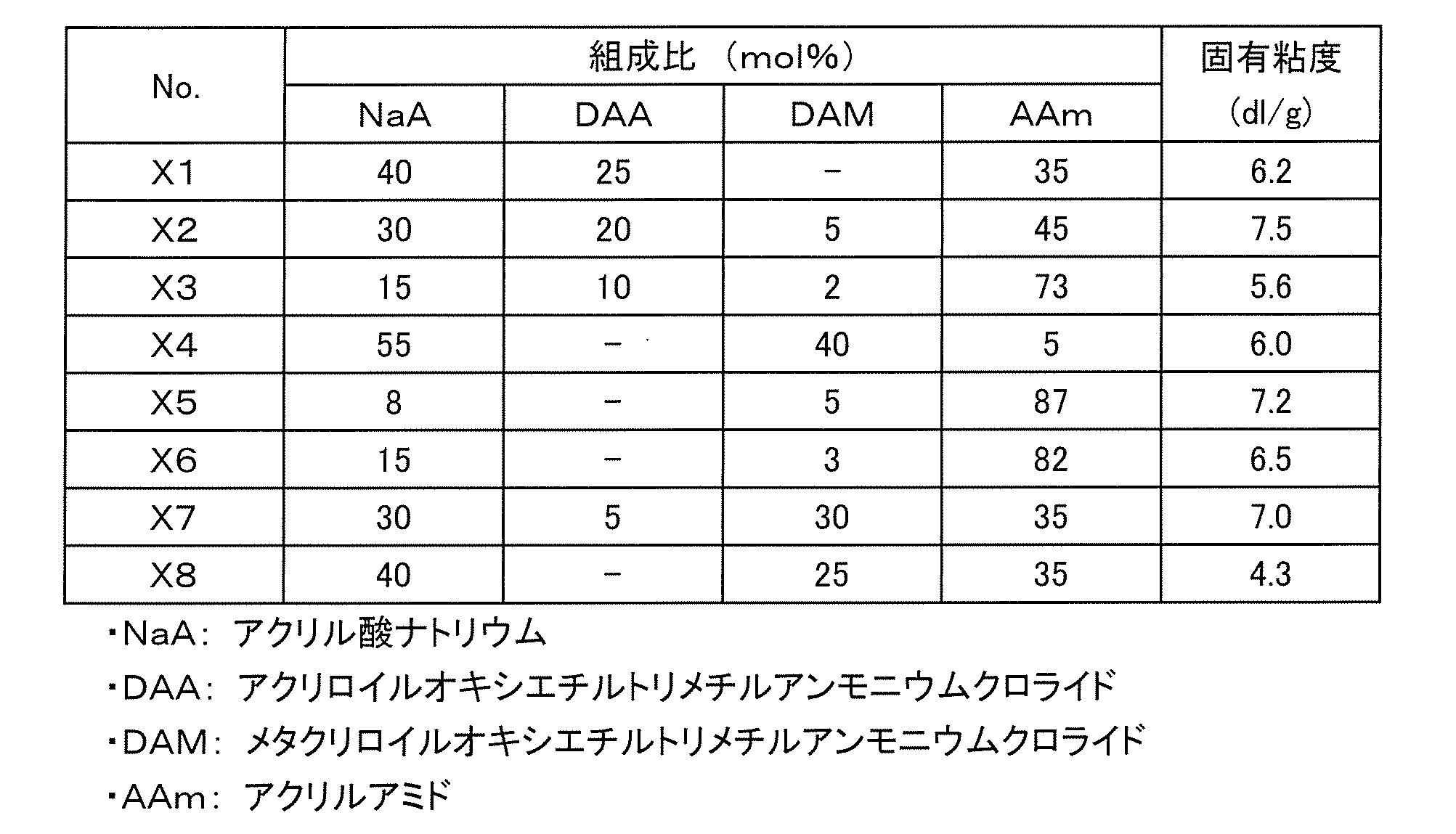
<製造例1>
両性ポリマーX1の0.01質量%水溶液50mlに、アクリロイルオキシエチルトリメチルアンモニウムクロリド(以下「DAA」と略す、分子量193.5)の80質量%水溶液10.9g、粉末アクリルアミド(以下「AAm」と略す、分子量71)18.5g、及びN,N’-メチレンビスアクリルアミド(以下「MBA」と略す、分子量140)の0.009質量%水溶液2.5mlを混合し、最終的に純水にて全体を100mlにメスアップした。その水溶液を、冷却管、窒素導入管、温度計を備えた300mlセパラブルフラスコに入れ、窒素バブリング後、1.36質量%に調製した過硫酸カリウム(以下「KPS」と略す)水溶液を1ml添加し、40℃に加熱して重合を12時間行った。
得られた重合ゲルの一部をアセトンで沈殿させ、析出物を真空乾燥することにより求めた固形物濃度は27.1質量%で、重合率は99.6%であった。このポリマー混合物の固有粘度は10.9dl/gであった。このポリマー混合物のサンプル名を「DX1」とする。
なお、両性ポリマーの溶液中で合成したカチオン性ポリマーの原料単量体の組成比は、DAA/AAm/MBA=15/85/5×10-4(モル%)であった。また、このカチオン性ポリマーに対する両性ポリマーX1の比率は0.02質量%(カチオン性ポリマー100質量部に対し、X1は0.02質量部)であった。なお、カチオン性ポリマーの組成比において、MBAの比率は、DAA及びAAmに比べて微量のため、DAAとAAmの合計に対するモル%として記し、後記表2及び表3の記載も同様とした。
両性ポリマーX1の0.01質量%水溶液50mlに、アクリロイルオキシエチルトリメチルアンモニウムクロリド(以下「DAA」と略す、分子量193.5)の80質量%水溶液10.9g、粉末アクリルアミド(以下「AAm」と略す、分子量71)18.5g、及びN,N’-メチレンビスアクリルアミド(以下「MBA」と略す、分子量140)の0.009質量%水溶液2.5mlを混合し、最終的に純水にて全体を100mlにメスアップした。その水溶液を、冷却管、窒素導入管、温度計を備えた300mlセパラブルフラスコに入れ、窒素バブリング後、1.36質量%に調製した過硫酸カリウム(以下「KPS」と略す)水溶液を1ml添加し、40℃に加熱して重合を12時間行った。
得られた重合ゲルの一部をアセトンで沈殿させ、析出物を真空乾燥することにより求めた固形物濃度は27.1質量%で、重合率は99.6%であった。このポリマー混合物の固有粘度は10.9dl/gであった。このポリマー混合物のサンプル名を「DX1」とする。
なお、両性ポリマーの溶液中で合成したカチオン性ポリマーの原料単量体の組成比は、DAA/AAm/MBA=15/85/5×10-4(モル%)であった。また、このカチオン性ポリマーに対する両性ポリマーX1の比率は0.02質量%(カチオン性ポリマー100質量部に対し、X1は0.02質量部)であった。なお、カチオン性ポリマーの組成比において、MBAの比率は、DAA及びAAmに比べて微量のため、DAAとAAmの合計に対するモル%として記し、後記表2及び表3の記載も同様とした。
<製造例2>
製造例1における両性ポリマーを濃度0.01質量%のX1から濃度0.06質量%のX2とした以外は製造例1と同じ条件にて、両性ポリマー溶液中でカチオン性ポリマーの合成を行い、ポリマー混合物を得た。固形物濃度は27.2質量%、重合率は100%、固有粘度は11.1dl/gであった。このポリマー混合物のサンプル名を「DX2」とする。
なお、このカチオン性ポリマーに対する両性ポリマーX2の比率は0.11質量%(カチオン性ポリマー100質量部に対し、X2は0.11質量部)であった。
製造例1における両性ポリマーを濃度0.01質量%のX1から濃度0.06質量%のX2とした以外は製造例1と同じ条件にて、両性ポリマー溶液中でカチオン性ポリマーの合成を行い、ポリマー混合物を得た。固形物濃度は27.2質量%、重合率は100%、固有粘度は11.1dl/gであった。このポリマー混合物のサンプル名を「DX2」とする。
なお、このカチオン性ポリマーに対する両性ポリマーX2の比率は0.11質量%(カチオン性ポリマー100質量部に対し、X2は0.11質量部)であった。
<製造例3>
製造例1における両性ポリマーを濃度0.01質量%のX1から濃度1.0質量%のX3とし、1.36質量%のKPS水溶液を1mlから0.7mlとした以外は製造例1と同じ条件にて、両性ポリマー溶液中でカチオン性ポリマーの合成を行い、ポリマー混合物を得た。固形物濃度は27.1質量%、重合率は99.4%、固有粘度は、13.2dl/gであった。このポリマー混合物のサンプル名を「DX3」とする。
なお、このカチオン性ポリマーに対する両性ポリマーX3の比率は1.84質量%(カチオン性ポリマー100質量部に対し、X3は1.84質量部)であった。
製造例1における両性ポリマーを濃度0.01質量%のX1から濃度1.0質量%のX3とし、1.36質量%のKPS水溶液を1mlから0.7mlとした以外は製造例1と同じ条件にて、両性ポリマー溶液中でカチオン性ポリマーの合成を行い、ポリマー混合物を得た。固形物濃度は27.1質量%、重合率は99.4%、固有粘度は、13.2dl/gであった。このポリマー混合物のサンプル名を「DX3」とする。
なお、このカチオン性ポリマーに対する両性ポリマーX3の比率は1.84質量%(カチオン性ポリマー100質量部に対し、X3は1.84質量部)であった。
<製造例4>
製造例1における両性ポリマーを濃度0.01質量%のX1から濃度0.3質量%のX1とし、また、MBAを用いなかった以外は製造例1と同じ条件にて、両性ポリマー溶液中でカチオン性ポリマーの合成を行い、ポリマー混合物を得た。固形物濃度は27.1質量%、重合率は99.6%、固有粘度は、11.4dl/gであった。このポリマー混合物のサンプル名を「DX4」とする。
なお、このカチオン性ポリマーに対する両性ポリマーX1の比率は0.55質量%(カチオン性ポリマー100質量部に対し、X1は0.55質量部)であった。
製造例1における両性ポリマーを濃度0.01質量%のX1から濃度0.3質量%のX1とし、また、MBAを用いなかった以外は製造例1と同じ条件にて、両性ポリマー溶液中でカチオン性ポリマーの合成を行い、ポリマー混合物を得た。固形物濃度は27.1質量%、重合率は99.6%、固有粘度は、11.4dl/gであった。このポリマー混合物のサンプル名を「DX4」とする。
なお、このカチオン性ポリマーに対する両性ポリマーX1の比率は0.55質量%(カチオン性ポリマー100質量部に対し、X1は0.55質量部)であった。
<製造例5>
製造例1における両性ポリマーを用いず、1.36質量%のKPSを0.8ml添加した以外は製造例1と同じ条件で合成を行い、カチオン性ポリマーを得た。固形物濃度は27.2質量%、重合率は100%、固有粘度は12.4dl/gであった。このカチオン性ポリマーのサンプル名を「D1」とする。
製造例1における両性ポリマーを用いず、1.36質量%のKPSを0.8ml添加した以外は製造例1と同じ条件で合成を行い、カチオン性ポリマーを得た。固形物濃度は27.2質量%、重合率は100%、固有粘度は12.4dl/gであった。このカチオン性ポリマーのサンプル名を「D1」とする。
<製造例6>
製造例1における両性ポリマーを用いなかった以外は、製造例1と同じ条件で合成を行い、カチオン性ポリマーを得た。固形物濃度は27.2質量%、重合率は100%、固有粘度は11.8dl/gであった。このカチオン性ポリマーのサンプル名を「D2」とする。
製造例1における両性ポリマーを用いなかった以外は、製造例1と同じ条件で合成を行い、カチオン性ポリマーを得た。固形物濃度は27.2質量%、重合率は100%、固有粘度は11.8dl/gであった。このカチオン性ポリマーのサンプル名を「D2」とする。
<製造例7>
製造例1における両性ポリマー及びMBAを用いなかった以外は、製造例1と同じ条件で合成を行い、カチオン性ポリマーを得た。固形物濃度は27.1質量%、重合率は99.6%、固有粘度は10.9dl/gであった。このカチオン性ポリマーのサンプル名を「D3」とする。
製造例1における両性ポリマー及びMBAを用いなかった以外は、製造例1と同じ条件で合成を行い、カチオン性ポリマーを得た。固形物濃度は27.1質量%、重合率は99.6%、固有粘度は10.9dl/gであった。このカチオン性ポリマーのサンプル名を「D3」とする。
<製造例8>
製造例1における両性ポリマーを濃度0.01質量%のX1から濃度0.3質量%のX1とし、1.36質量%のKPS水溶液を10mlとした以外は製造例1と同じ条件にて、両性ポリマー溶液中でカチオン性ポリマーの合成を行い、ポリマー混合物を得た。固形物濃度は27.0質量%、重合率は99.2%、固有粘度は6.5dl/gであった。このポリマー混合物のサンプル名を「DX5」とする。
なお、このカチオン性ポリマーに対する両性ポリマーX1の比率は0.55質量%(カチオン性ポリマー100質量部に対し、X1は0.55質量部)であった。
製造例1における両性ポリマーを濃度0.01質量%のX1から濃度0.3質量%のX1とし、1.36質量%のKPS水溶液を10mlとした以外は製造例1と同じ条件にて、両性ポリマー溶液中でカチオン性ポリマーの合成を行い、ポリマー混合物を得た。固形物濃度は27.0質量%、重合率は99.2%、固有粘度は6.5dl/gであった。このポリマー混合物のサンプル名を「DX5」とする。
なお、このカチオン性ポリマーに対する両性ポリマーX1の比率は0.55質量%(カチオン性ポリマー100質量部に対し、X1は0.55質量部)であった。
<製造例9>
製造例1における両性ポリマーを濃度0.01質量%のX1から濃度0.01質量%のX4とした以外は製造例1と同じ条件にて、両性ポリマー溶液中でカチオン性ポリマーの合成を行い、ポリマー混合物を得た。固形物濃度は27.1質量%、重合率は99.6%、固有粘度は10.5dl/gであった。このポリマー混合物のサンプル名を「DX6」とする。
なお、このカチオン性ポリマーに対する両性ポリマーX4の比率は0.02質量%(カチオン性ポリマー100質量部に対し、X4は0.02質量部)であった。
製造例1における両性ポリマーを濃度0.01質量%のX1から濃度0.01質量%のX4とした以外は製造例1と同じ条件にて、両性ポリマー溶液中でカチオン性ポリマーの合成を行い、ポリマー混合物を得た。固形物濃度は27.1質量%、重合率は99.6%、固有粘度は10.5dl/gであった。このポリマー混合物のサンプル名を「DX6」とする。
なお、このカチオン性ポリマーに対する両性ポリマーX4の比率は0.02質量%(カチオン性ポリマー100質量部に対し、X4は0.02質量部)であった。
<製造例10>
製造例1における両性ポリマーを濃度0.01質量%のX1から濃度0.06質量%のX5とした以外は製造例1と同じ条件にて、両性ポリマー溶液中でカチオン性ポリマーの合成を行い、ポリマー混合物を得た。固形物濃度は26.9質量%、重合率は98.8%、固有粘度は10.8dl/gであった。このポリマー混合物のサンプル名を「DX7」とする。
なお、このカチオン性ポリマーに対する両性ポリマーX5の比率は0.11質量%(カチオン性ポリマー100質量部に対し、X5は0.11質量部)であった。
製造例1における両性ポリマーを濃度0.01質量%のX1から濃度0.06質量%のX5とした以外は製造例1と同じ条件にて、両性ポリマー溶液中でカチオン性ポリマーの合成を行い、ポリマー混合物を得た。固形物濃度は26.9質量%、重合率は98.8%、固有粘度は10.8dl/gであった。このポリマー混合物のサンプル名を「DX7」とする。
なお、このカチオン性ポリマーに対する両性ポリマーX5の比率は0.11質量%(カチオン性ポリマー100質量部に対し、X5は0.11質量部)であった。
<製造例11>
製造例1における両性ポリマーを濃度0.01質量%のX1から濃度1.0質量%のX6とし、1.36質量%のKPS水溶液を0.6mlとした以外は製造例1と同じ条件にて、両性ポリマー溶液中でカチオン性ポリマーの合成を行い、ポリマー混合物を得た。固形物濃度は27.1質量%、重合率は99.6%、固有粘度は10.5dl/gであった。このポリマー混合物のサンプル名を「DX8」とする。
なお、このカチオン性ポリマーに対する両性ポリマーX6の比率は0.02質量%(カチオン性ポリマー100質量部に対し、X6は0.02質量部)であった。
製造例1における両性ポリマーを濃度0.01質量%のX1から濃度1.0質量%のX6とし、1.36質量%のKPS水溶液を0.6mlとした以外は製造例1と同じ条件にて、両性ポリマー溶液中でカチオン性ポリマーの合成を行い、ポリマー混合物を得た。固形物濃度は27.1質量%、重合率は99.6%、固有粘度は10.5dl/gであった。このポリマー混合物のサンプル名を「DX8」とする。
なお、このカチオン性ポリマーに対する両性ポリマーX6の比率は0.02質量%(カチオン性ポリマー100質量部に対し、X6は0.02質量部)であった。
<製造例12>
製造例1における両性ポリマーを濃度0.01質量%のX1から濃度0.03質量%のX7とした以外は製造例1と同じ条件にて、両性ポリマー溶液中でカチオン性ポリマーの合成を行い、ポリマー混合物を得た。固形物濃度は27.1質量%、重合率は99.6%、固有粘度は11.0dl/gであった。このポリマー混合物のサンプル名を「DX9」とする。
なお、このカチオン性ポリマーに対する両性ポリマーX7の比率は0.02質量%(カチオン性ポリマー100質量部に対し、X7は0.06質量部)であった。
製造例1における両性ポリマーを濃度0.01質量%のX1から濃度0.03質量%のX7とした以外は製造例1と同じ条件にて、両性ポリマー溶液中でカチオン性ポリマーの合成を行い、ポリマー混合物を得た。固形物濃度は27.1質量%、重合率は99.6%、固有粘度は11.0dl/gであった。このポリマー混合物のサンプル名を「DX9」とする。
なお、このカチオン性ポリマーに対する両性ポリマーX7の比率は0.02質量%(カチオン性ポリマー100質量部に対し、X7は0.06質量部)であった。
<製造例13>
製造例1における両性ポリマーを濃度0.01質量%のX1から濃度0.6質量%のX8とし、1.36質量%のKPS水溶液を0.6mlとした以外は製造例1と同じ条件にて、両性ポリマー溶液中でカチオン性ポリマーの合成を行い、ポリマー混合物を得た。固形物濃度は27.0質量%、重合率は99.2%、固有粘度は10.5dl/gであった。このポリマー混合物のサンプル名を「DX10」とする。
なお、このカチオン性ポリマーに対する両性ポリマーX8の比率は1.1質量%(カチオン性ポリマー100質量部に対し、X8は1.1質量部)であった。
製造例1における両性ポリマーを濃度0.01質量%のX1から濃度0.6質量%のX8とし、1.36質量%のKPS水溶液を0.6mlとした以外は製造例1と同じ条件にて、両性ポリマー溶液中でカチオン性ポリマーの合成を行い、ポリマー混合物を得た。固形物濃度は27.0質量%、重合率は99.2%、固有粘度は10.5dl/gであった。このポリマー混合物のサンプル名を「DX10」とする。
なお、このカチオン性ポリマーに対する両性ポリマーX8の比率は1.1質量%(カチオン性ポリマー100質量部に対し、X8は1.1質量部)であった。
<製造例14>
製造例1における両性ポリマーを濃度0.01質量%のX1から濃度0.0025質量%のX1とした以外は製造例1と同じ条件にて、両性ポリマー溶液中でカチオン性ポリマーの合成を行い、ポリマー混合物を得た。固形物濃度は27.2質量%、重合率は100%、固有粘度は11.2dl/gであった。このポリマー混合物のサンプル名を「DX11」とする。
なお、このカチオン性ポリマーに対する両性ポリマーX1の比率は0.005質量%(カチオン性ポリマー100質量部に対し、X1は0.005質量部)であった。
製造例1における両性ポリマーを濃度0.01質量%のX1から濃度0.0025質量%のX1とした以外は製造例1と同じ条件にて、両性ポリマー溶液中でカチオン性ポリマーの合成を行い、ポリマー混合物を得た。固形物濃度は27.2質量%、重合率は100%、固有粘度は11.2dl/gであった。このポリマー混合物のサンプル名を「DX11」とする。
なお、このカチオン性ポリマーに対する両性ポリマーX1の比率は0.005質量%(カチオン性ポリマー100質量部に対し、X1は0.005質量部)であった。
<製造例15>
製造例1における両性ポリマーを濃度0.01質量%のX1から濃度1.36質量%のX2とし、MBAを用いなかった以外は製造例1と同じ条件で合成を行い、ポリマー混合物を得た。固形物濃度は26.9質量%、重合率は98.8%、固有粘度は、11.1dl/gであった。このポリマー混合物のサンプル名を「DX12」とする。
なお、このカチオン性ポリマーに対する両性ポリマーX2の比率は2.5質量%(カチオン性ポリマー100質量部に対し、X2は2.5質量部)であった。
製造例1における両性ポリマーを濃度0.01質量%のX1から濃度1.36質量%のX2とし、MBAを用いなかった以外は製造例1と同じ条件で合成を行い、ポリマー混合物を得た。固形物濃度は26.9質量%、重合率は98.8%、固有粘度は、11.1dl/gであった。このポリマー混合物のサンプル名を「DX12」とする。
なお、このカチオン性ポリマーに対する両性ポリマーX2の比率は2.5質量%(カチオン性ポリマー100質量部に対し、X2は2.5質量部)であった。
以上述べた各製造例のサンプル一覧を表2に示した。
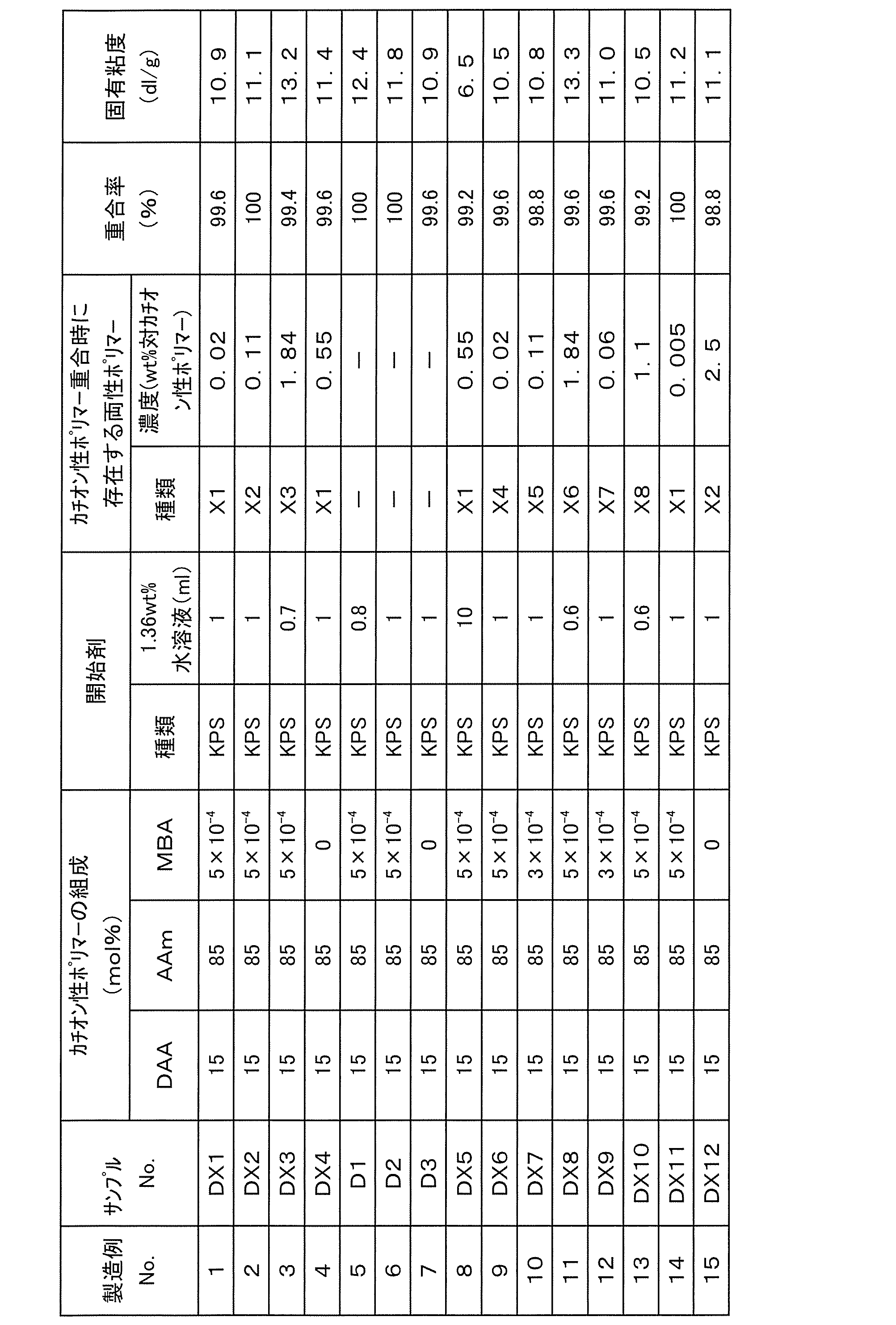
次に、後述する実施例及び比較例において以下の濾水試験を行った。なお、各実施例及び比較例で使用した製紙用添加剤については後述する。
<濾水試験>
カナディアン・スタンダード・フリーネス(CSF)450mlに叩解した新聞故紙を絶乾質量が0.6質量%になるように添加した後、これに軽質炭酸カルシウム(ブリリアント1500 白石工業株式会社製)を絶乾紙料に対して40質量%になるように加えたものを試料(パルプスラリー)とした。
パルプスラリー180mlを容量300mlのポリビーカーにとり、そこに後述する各実施例及び比較例で用いる「添加剤」の0.1質量%水溶液を添加し、タービン羽根を備えた撹拌機を用いて、250rpmで20秒間撹拌を行った。次いで、ナイロン濾布を敷いたヌッチェロートに、内径50mmの金属製の円筒を置き、その中へ凝集したパルプスラリーを注ぎ込み、メスシリンダーを用いて10秒後のろ液量を測定した。さらに、濾布上に残った湿紙をポリエステル濾布にとり、3.0kg/cm2の圧力をかけて60秒圧搾し、プレス後の湿紙の含水率を測定した。
<濾水試験>
カナディアン・スタンダード・フリーネス(CSF)450mlに叩解した新聞故紙を絶乾質量が0.6質量%になるように添加した後、これに軽質炭酸カルシウム(ブリリアント1500 白石工業株式会社製)を絶乾紙料に対して40質量%になるように加えたものを試料(パルプスラリー)とした。
パルプスラリー180mlを容量300mlのポリビーカーにとり、そこに後述する各実施例及び比較例で用いる「添加剤」の0.1質量%水溶液を添加し、タービン羽根を備えた撹拌機を用いて、250rpmで20秒間撹拌を行った。次いで、ナイロン濾布を敷いたヌッチェロートに、内径50mmの金属製の円筒を置き、その中へ凝集したパルプスラリーを注ぎ込み、メスシリンダーを用いて10秒後のろ液量を測定した。さらに、濾布上に残った湿紙をポリエステル濾布にとり、3.0kg/cm2の圧力をかけて60秒圧搾し、プレス後の湿紙の含水率を測定した。
<実施例1~4>
実施例1では、上記製造例1で得たポリマー混合物「DX1」を添加剤として用い、濾水試験を行った。
実施例2では、上記製造例2で得たポリマー混合物「DX2」を添加剤として用い、濾水試験を行った。
実施例3では、上記製造例3で得たポリマー混合物「DX3」を添加剤として用い、濾水試験を行った。
実施例4では、上記製造例4で得たポリマー混合物「DX4」を添加剤として用い、濾水試験を行った。
実施例1では、上記製造例1で得たポリマー混合物「DX1」を添加剤として用い、濾水試験を行った。
実施例2では、上記製造例2で得たポリマー混合物「DX2」を添加剤として用い、濾水試験を行った。
実施例3では、上記製造例3で得たポリマー混合物「DX3」を添加剤として用い、濾水試験を行った。
実施例4では、上記製造例4で得たポリマー混合物「DX4」を添加剤として用い、濾水試験を行った。
<実施例5~7>
実施例5では、上記製造例5で得たカチオン性ポリマー「D1」の100質量部に対して、両性ポリマー「X1」を0.06質量部(「D1」に対して「X1」を0.06質量%)加えたものを添加剤として用い、濾水試験を行った。
実施例6では、上記製造例6で得たカチオン性ポリマー「D2」の100質量部に対して、両性ポリマー「X2」を0.55質量部(「D2」に対して「X2」を0.55質量%)加えたものを添加剤として用い、濾水試験を行った。
実施例7では、上記製造例7で得たカチオン性ポリマー「D3」の100質量部に対して、両性ポリマーX3を1.10質量部(「D3」に対して「X3」を1.10質量%)加えたものを添加剤として用い、濾水試験を行った。
実施例5では、上記製造例5で得たカチオン性ポリマー「D1」の100質量部に対して、両性ポリマー「X1」を0.06質量部(「D1」に対して「X1」を0.06質量%)加えたものを添加剤として用い、濾水試験を行った。
実施例6では、上記製造例6で得たカチオン性ポリマー「D2」の100質量部に対して、両性ポリマー「X2」を0.55質量部(「D2」に対して「X2」を0.55質量%)加えたものを添加剤として用い、濾水試験を行った。
実施例7では、上記製造例7で得たカチオン性ポリマー「D3」の100質量部に対して、両性ポリマーX3を1.10質量部(「D3」に対して「X3」を1.10質量%)加えたものを添加剤として用い、濾水試験を行った。
<比較例1>
比較例1では、上記製造例5で得たカチオン性ポリマー「D1」を添加剤として用い、の濾水試験を行った。
比較例1では、上記製造例5で得たカチオン性ポリマー「D1」を添加剤として用い、の濾水試験を行った。
<比較例2~9>
比較例2では上記製造例8で得たポリマー混合物「DX5」を用い、比較例3では上記製造例9で得たポリマー混合物「DX6」を用い、比較例4では上記製造例10で得たポリマー混合物「DX7」を用い、それぞれ濾水試験を行った。
比較例5では上記製造例11で得たポリマー混合物「DX8」を用い、比較例6では上記製造例12で得たポリマー混合物「DX9」を用い、比較例7では上記製造例13で得たポリマー混合物「DX10」を用い、それぞれ濾水試験を行った。
また、比較例8では上記製造例14で得たポリマー混合物「DX11」を用い、比較例9では上記製造例15で得たポリマー混合物「DX12」を用い、それぞれ濾水試験を行った。
比較例2では上記製造例8で得たポリマー混合物「DX5」を用い、比較例3では上記製造例9で得たポリマー混合物「DX6」を用い、比較例4では上記製造例10で得たポリマー混合物「DX7」を用い、それぞれ濾水試験を行った。
比較例5では上記製造例11で得たポリマー混合物「DX8」を用い、比較例6では上記製造例12で得たポリマー混合物「DX9」を用い、比較例7では上記製造例13で得たポリマー混合物「DX10」を用い、それぞれ濾水試験を行った。
また、比較例8では上記製造例14で得たポリマー混合物「DX11」を用い、比較例9では上記製造例15で得たポリマー混合物「DX12」を用い、それぞれ濾水試験を行った。
<比較例10~13>
比較例10では、上記製造例5で得たカチオン性ポリマー「D1」の100質量部に対して、両性ポリマー「X4」を0.11質量部(「D1」に対して「X4」を0.11質量%)加えたものを添加剤として用い、濾水試験を行った。
比較例11では、上記製造例6で得たカチオン性ポリマー「D2」の100質量部に対して、両性ポリマー「X5」を1.1質量部(「D2」に対して「X5」を1.1質量%)加えたものを添加剤として用い、濾水試験を行った。
比較例12では、上記製造例7で得たカチオン性ポリマー「D3」の100質量部に対して、両性ポリマー「X2」を0.005質量部(「D3」に対して「X2」を0.005質量%)加えたものを添加剤として用い、濾水試験を行った。
比較例13では、上記製造例5で得たカチオン性ポリマー「D1」の100質量部に対して、両性ポリマー「X3」を2.3質量部(「D1」に対して「X3」を2.3質量%)加えたものを添加剤として用い、濾水試験を行った。
比較例10では、上記製造例5で得たカチオン性ポリマー「D1」の100質量部に対して、両性ポリマー「X4」を0.11質量部(「D1」に対して「X4」を0.11質量%)加えたものを添加剤として用い、濾水試験を行った。
比較例11では、上記製造例6で得たカチオン性ポリマー「D2」の100質量部に対して、両性ポリマー「X5」を1.1質量部(「D2」に対して「X5」を1.1質量%)加えたものを添加剤として用い、濾水試験を行った。
比較例12では、上記製造例7で得たカチオン性ポリマー「D3」の100質量部に対して、両性ポリマー「X2」を0.005質量部(「D3」に対して「X2」を0.005質量%)加えたものを添加剤として用い、濾水試験を行った。
比較例13では、上記製造例5で得たカチオン性ポリマー「D1」の100質量部に対して、両性ポリマー「X3」を2.3質量部(「D1」に対して「X3」を2.3質量%)加えたものを添加剤として用い、濾水試験を行った。
各実施例及び比較例の試験条件一覧を表3に示し、各試験結果を表4に示す。
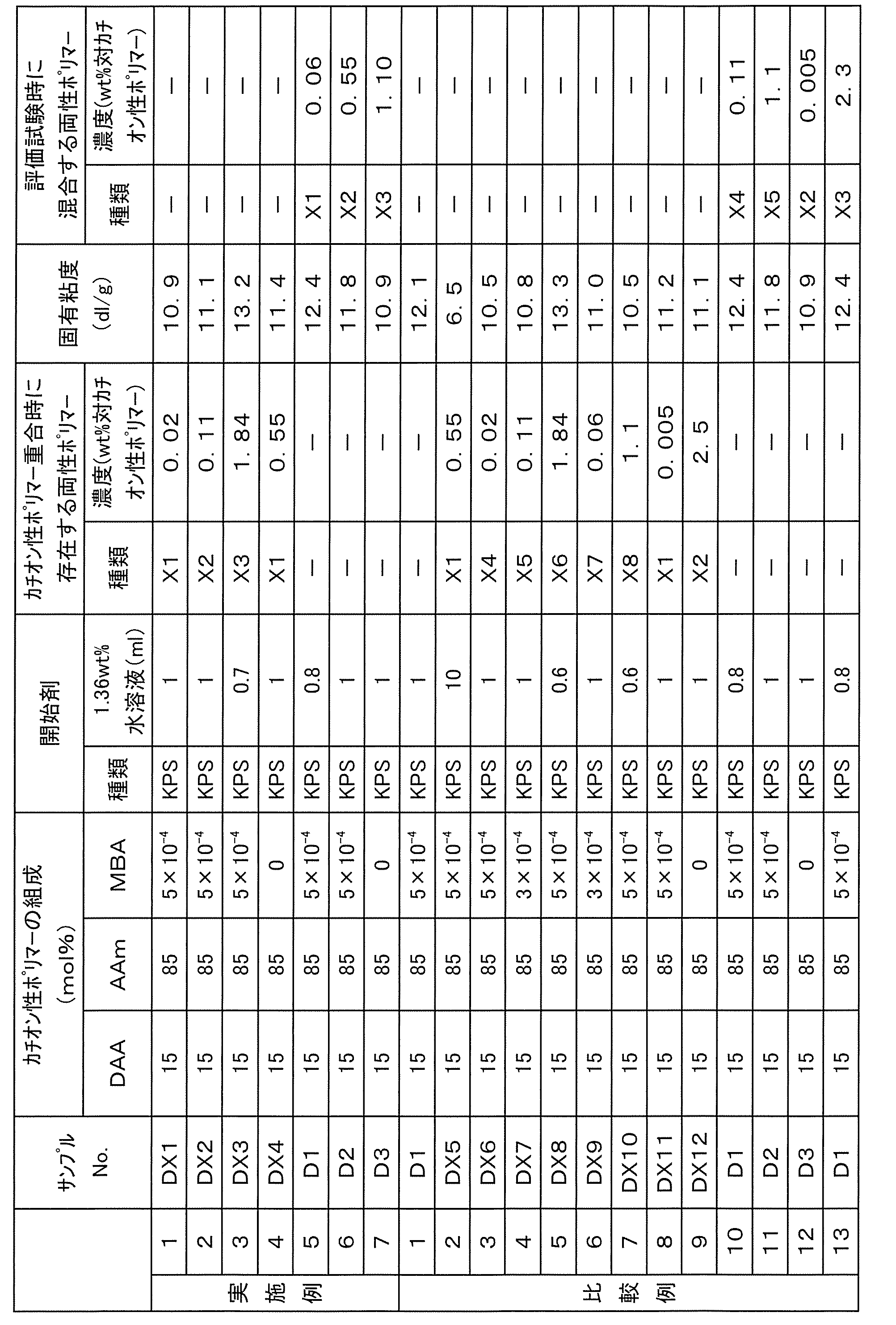

実施例1~7においては、比較例1~13よりも、10秒後のろ液量が多く、プレス後の含水率が低いことが確認された。
比較例1では、両性ポリマーを用いず、カチオン性ポリマー「D1」のみを添加剤として用いたため、実施例に比べて、ろ液量が少なく、含水率が高いという結果になったものと考えられる。
比較例2では、使用したポリマー混合物「DX5」の固有粘度が6.5dl/gと低かったために、実施例に比べて、ろ液量が少なく、含水率が高いという結果になったものと考えられる。
比較例2では、使用したポリマー混合物「DX5」の固有粘度が6.5dl/gと低かったために、実施例に比べて、ろ液量が少なく、含水率が高いという結果になったものと考えられる。
比較例3及び10では、使用した両性ポリマー「X4」の原料単量体成分の一つであるアクリル酸ナトリウムの使用量が55モル%と多かったため、実施例に比べて、ろ液量が少なく、含水率が高いという結果になったものと考えられる。
比較例4及び11では、使用した両性ポリマー「X5」の原料単量体成分の一つであるアクリル酸ナトリウムの使用量が8モル%と少なかったため、実施例に比べて、ろ液量が少なく、含水率が高いという結果になったものと考えられる。
比較例4及び11では、使用した両性ポリマー「X5」の原料単量体成分の一つであるアクリル酸ナトリウムの使用量が8モル%と少なかったため、実施例に比べて、ろ液量が少なく、含水率が高いという結果になったものと考えられる。
比較例5では、カチオン性ポリマーの重合の際に用いた両性ポリマー「X6」の原料単量体成分であるカチオン性ビニルモノマーの使用量が3モル%と少なかったため、実施例に比べて、ろ液量が少なく、含水率が高いという結果になったものと考えられる。
比較例6では、カチオン性ポリマーの重合の際に用いた両性ポリマー「X7」の原料単量体成分において、カチオン性ビニルモノマーに対するアニオン性ビニルモノマーのモル比が1未満であったため、実施例に比べて、ろ液量が少なく、含水率が高いという結果になったものと考えられる。
比較例7では、カチオン性ポリマーの重合の際に用いた両性ポリマー「X8」の固有粘度が4.3dl/gと低かったために、実施例に比べて、ろ液量が少なく、含水率が高いという結果になったものと考えられる。
比較例6では、カチオン性ポリマーの重合の際に用いた両性ポリマー「X7」の原料単量体成分において、カチオン性ビニルモノマーに対するアニオン性ビニルモノマーのモル比が1未満であったため、実施例に比べて、ろ液量が少なく、含水率が高いという結果になったものと考えられる。
比較例7では、カチオン性ポリマーの重合の際に用いた両性ポリマー「X8」の固有粘度が4.3dl/gと低かったために、実施例に比べて、ろ液量が少なく、含水率が高いという結果になったものと考えられる。
比較例8及び12では、使用した添加剤における両性ポリマーの含有量が少なかったために、また、比較例9及び13では、使用した添加剤における両性ポリマーの含有量が多かったために、実施例に比べて、ろ液量が少なく、含水率が高いという結果になったものと考えられる。
以上の結果より、実施例の製紙用添加剤は、特定のカチオン性ポリマーと特定の両性ポリマーとをそれぞれ特定割合で併用することにより、紙料に対し比較的少ない添加量で、従って、紙製品の地合低下やコストアップの問題を引き起こすことなく、濾水性を向上することができることが確認された。
<第2実験例>
第2実験例において、実施例、比較例に用いたカルボン酸類を、入手先及び分子量と共に表5に示した。
第2実験例において、実施例、比較例に用いたカルボン酸類を、入手先及び分子量と共に表5に示した。

<製造例16>
アクリロイルオキシエチルトリメチルアンモニウムクロリド(以下「DAA」と略す、分子量193.5)の80質量%水溶液10.9g、粉末アクリルアミド(以下「AAm」と略す、分子量71)18.1g、及びN,N’-メチレンビスアクリルアミド(以下「MBA」と略す、分子量140)の0.0084質量%水溶液2.5mlを混合し、アジピン酸二カリウム(カルボン酸類「C1」)を0.80g(0.0036モル)、最終的に純水にて全体を100mlにメスアップした。その水溶液を、冷却管、窒素導入管、温度計を備えた300mlセパラブルフラスコに入れ、窒素バブリング後、1.36質量%に調製した過硫酸カリウム(以下「KPS」と略す)水溶液を1ml添加し、40℃に加熱して重合を12時間行った。
得られた重合ゲルの一部をアセトンで沈殿させ、析出物を真空乾燥することにより求めた固形物濃度は26.7質量%で、重合率は99.6%であった。カルボン酸類「C1」の溶液中でカチオン性ポリマーを合成して得られた、カチオン性ポリマーとカルボン酸類C1との混合物の固有粘度は、10.9dl/gであった。この混合物のサンプル名を「CX1」とする。
製造例16において、合成したカチオン性ポリマーの組成比は、DAA/AAm/MBA=15/85/5×10-4(モル%)で、カルボン酸類「C1」の比率は、カチオン性ポリマーを構成する単量体成分の総量に対して、1.2モル%であった。なお、カチオン性ポリマーの組成比において、MBAの比率は、DAA及びAAmに比べて微量のため、DAAとAAmの合計に対するモル%として記し、後記表6及び表7の記載も同様とした。
アクリロイルオキシエチルトリメチルアンモニウムクロリド(以下「DAA」と略す、分子量193.5)の80質量%水溶液10.9g、粉末アクリルアミド(以下「AAm」と略す、分子量71)18.1g、及びN,N’-メチレンビスアクリルアミド(以下「MBA」と略す、分子量140)の0.0084質量%水溶液2.5mlを混合し、アジピン酸二カリウム(カルボン酸類「C1」)を0.80g(0.0036モル)、最終的に純水にて全体を100mlにメスアップした。その水溶液を、冷却管、窒素導入管、温度計を備えた300mlセパラブルフラスコに入れ、窒素バブリング後、1.36質量%に調製した過硫酸カリウム(以下「KPS」と略す)水溶液を1ml添加し、40℃に加熱して重合を12時間行った。
得られた重合ゲルの一部をアセトンで沈殿させ、析出物を真空乾燥することにより求めた固形物濃度は26.7質量%で、重合率は99.6%であった。カルボン酸類「C1」の溶液中でカチオン性ポリマーを合成して得られた、カチオン性ポリマーとカルボン酸類C1との混合物の固有粘度は、10.9dl/gであった。この混合物のサンプル名を「CX1」とする。
製造例16において、合成したカチオン性ポリマーの組成比は、DAA/AAm/MBA=15/85/5×10-4(モル%)で、カルボン酸類「C1」の比率は、カチオン性ポリマーを構成する単量体成分の総量に対して、1.2モル%であった。なお、カチオン性ポリマーの組成比において、MBAの比率は、DAA及びAAmに比べて微量のため、DAAとAAmの合計に対するモル%として記し、後記表6及び表7の記載も同様とした。
<製造例17>
製造例16において、MBAの0.0084質量%水溶液を1.5ml、カルボン酸類をコハク酸二ナトリウム(カルボン酸類「C2」)とし、この「C2」の0.97質量%水溶液を1mlに変更した以外は、製造例16と同じ条件、操作で、カルボン酸類溶液中でカチオン性ポリマーの合成を行い、カルボン酸類「C2」とカチオン性ポリマーとの混合物を得た。精製後の固形物濃度は26.8質量%、重合率は100%、固有粘度は、11.1dl/gであった。この混合物のサンプル名を「CX2」とする。
なお、この混合物において、カルボン酸類「C2」の比率は、カチオン性ポリマーを構成する単量体成分の総量に対して、0.02モル%であった。
製造例16において、MBAの0.0084質量%水溶液を1.5ml、カルボン酸類をコハク酸二ナトリウム(カルボン酸類「C2」)とし、この「C2」の0.97質量%水溶液を1mlに変更した以外は、製造例16と同じ条件、操作で、カルボン酸類溶液中でカチオン性ポリマーの合成を行い、カルボン酸類「C2」とカチオン性ポリマーとの混合物を得た。精製後の固形物濃度は26.8質量%、重合率は100%、固有粘度は、11.1dl/gであった。この混合物のサンプル名を「CX2」とする。
なお、この混合物において、カルボン酸類「C2」の比率は、カチオン性ポリマーを構成する単量体成分の総量に対して、0.02モル%であった。
<製造例18>
製造例16におけるDAAの80質量%水溶液を14.5g、AAmを17.0g、カルボン酸類をテレフタル酸二ナトリウム(カルボン酸類「C3」)5.04g(0.024モル)、KPS1.36質量%水溶液を0.7mlに変更した以外は、製造例16と同じ条件、操作で、カルボン酸類溶液中でカチオン性ポリマーの合成を行い、カルボン酸類「C3」とカチオン性ポリマーとの混合物を得た。精製後の固形物濃度は28.6質量%、重合率は99.8%、固有粘度は、13.2dl/gであった。この混合物のサンプル名を「CX3」とする。
なお、この混合物において、カルボン酸類「C3」の比率は、カチオン性ポリマーを構成する単量体成分の総量に対して、8.0モル%であった。
製造例16におけるDAAの80質量%水溶液を14.5g、AAmを17.0g、カルボン酸類をテレフタル酸二ナトリウム(カルボン酸類「C3」)5.04g(0.024モル)、KPS1.36質量%水溶液を0.7mlに変更した以外は、製造例16と同じ条件、操作で、カルボン酸類溶液中でカチオン性ポリマーの合成を行い、カルボン酸類「C3」とカチオン性ポリマーとの混合物を得た。精製後の固形物濃度は28.6質量%、重合率は99.8%、固有粘度は、13.2dl/gであった。この混合物のサンプル名を「CX3」とする。
なお、この混合物において、カルボン酸類「C3」の比率は、カチオン性ポリマーを構成する単量体成分の総量に対して、8.0モル%であった。
<製造例19>
製造例16におけるMBAの0.0084質量%水溶液を20ml、カルボン酸類をトリメリット酸(カルボン酸類「C4」)0.35g(0.002モル)、KPS1.36質量%水溶液を5mlに変更した以外は、製造例16と同じ条件、操作で、カルボン酸類溶液中でカチオン性ポリマーの合成を行い、カルボン酸類「C4」とカチオン性ポリマーとの混合物を得た。
精製後の固形物濃度は26.8質量%、重合率は99.9%、固有粘度は、8.1dl/gであった。この混合物のサンプル名を「CX4」とする。
なお、この混合物において、カルボン酸類「C4」の比率は、カチオン性ポリマーを構成する単量体成分の総量に対して、0.55モル%であった。
製造例16におけるMBAの0.0084質量%水溶液を20ml、カルボン酸類をトリメリット酸(カルボン酸類「C4」)0.35g(0.002モル)、KPS1.36質量%水溶液を5mlに変更した以外は、製造例16と同じ条件、操作で、カルボン酸類溶液中でカチオン性ポリマーの合成を行い、カルボン酸類「C4」とカチオン性ポリマーとの混合物を得た。
精製後の固形物濃度は26.8質量%、重合率は99.9%、固有粘度は、8.1dl/gであった。この混合物のサンプル名を「CX4」とする。
なお、この混合物において、カルボン酸類「C4」の比率は、カチオン性ポリマーを構成する単量体成分の総量に対して、0.55モル%であった。
<製造例20>
製造例16におけるMBAの0.0084質量%水溶液を0.25ml、カルボン酸類をマレイン酸二ナトリウム(カルボン酸類「C5」)1.92g(0.012モル)、KPS1.36質量%水溶液を0.8mlに変更した以外は、製造例16と同じ条件、操作で、カルボン酸類溶液中でカチオン性ポリマーの合成を行い、カルボン酸類「C5」とカチオン性ポリマーとの混合物を得た。精製後の固形物濃度は26.81質量%、重合率は100%、固有粘度は、13.2dl/gであった。この混合物のサンプル名を「CX5」とする。
なお、この混合物において、カルボン酸類「C5」の比率は、カチオン性ポリマーを構成する単量体成分の総量に対して、4.0モル%であった。
製造例16におけるMBAの0.0084質量%水溶液を0.25ml、カルボン酸類をマレイン酸二ナトリウム(カルボン酸類「C5」)1.92g(0.012モル)、KPS1.36質量%水溶液を0.8mlに変更した以外は、製造例16と同じ条件、操作で、カルボン酸類溶液中でカチオン性ポリマーの合成を行い、カルボン酸類「C5」とカチオン性ポリマーとの混合物を得た。精製後の固形物濃度は26.81質量%、重合率は100%、固有粘度は、13.2dl/gであった。この混合物のサンプル名を「CX5」とする。
なお、この混合物において、カルボン酸類「C5」の比率は、カチオン性ポリマーを構成する単量体成分の総量に対して、4.0モル%であった。
<製造例21>
製造例16におけるKPS1.36質量%水溶液を8mlに変更した以外は、製造例16と同じ条件、操作で、カルボン酸類溶液中でカチオン性ポリマーの合成を行い、カルボン酸類「C1」とカチオン性ポリマーとの混合物を得た。精製後の固形物濃度は26.79質量%、重合率は99.9%、固有粘度は7.5dl/gであった。この混合物のサンプル名を「CX6」とする。
なお、この混合物において、カルボン酸類「C1」の比率は、カチオン性ポリマーを構成する単量体成分の総量に対して、1.2モル%であった。
製造例16におけるKPS1.36質量%水溶液を8mlに変更した以外は、製造例16と同じ条件、操作で、カルボン酸類溶液中でカチオン性ポリマーの合成を行い、カルボン酸類「C1」とカチオン性ポリマーとの混合物を得た。精製後の固形物濃度は26.79質量%、重合率は99.9%、固有粘度は7.5dl/gであった。この混合物のサンプル名を「CX6」とする。
なお、この混合物において、カルボン酸類「C1」の比率は、カチオン性ポリマーを構成する単量体成分の総量に対して、1.2モル%であった。
<製造例22>
製造例16におけるカルボン酸類をコハク酸二ナトリウム(カルボン酸類「C2」)の0.243質量%水溶液1ml(1.5×10⁻⁵モル)に変更した以外は、製造例16と同じ条件、操作で、カルボン酸類溶液中でカチオン性ポリマーの合成を行い、カルボン酸類「C2」とカチオン性ポリマーとの混合物を得た。精製後の固形物濃度は26.78質量%、重合率は99.9%、固有粘度は11.1dl/gであった。この混合物のサンプル名を「CX7」とする。
なお、この混合物において、カルボン酸類「C2」の比率は、カチオン性ポリマーを構成する単量体成分の総量に対して、0.005モル%であった。
製造例16におけるカルボン酸類をコハク酸二ナトリウム(カルボン酸類「C2」)の0.243質量%水溶液1ml(1.5×10⁻⁵モル)に変更した以外は、製造例16と同じ条件、操作で、カルボン酸類溶液中でカチオン性ポリマーの合成を行い、カルボン酸類「C2」とカチオン性ポリマーとの混合物を得た。精製後の固形物濃度は26.78質量%、重合率は99.9%、固有粘度は11.1dl/gであった。この混合物のサンプル名を「CX7」とする。
なお、この混合物において、カルボン酸類「C2」の比率は、カチオン性ポリマーを構成する単量体成分の総量に対して、0.005モル%であった。
<製造例23>
製造例16におけるMBAの0.0084質量%水溶液を1.5ml、カルボン酸類をテレフタル酸二ナトリウム(カルボン酸類「C3」)7.56g(0.036モル)に変更した添加した以外は、製造例16と同じ条件、操作で、カルボン酸類溶液中でカチオン性ポリマーの合成を行い、カルボン酸類「C3」とカチオン性ポリマーとの混合物を得た。精製後の固形物濃度は26.81質量%、重合率は100%、固有粘度は10.8dl/gであった。この混合物のサンプル名を「CX8」とする。
なお、この混合物において、カルボン酸類「C3」の比率は、カチオン性ポリマーを構成する単量体成分の総量に対して、12モル%であった。
製造例16におけるMBAの0.0084質量%水溶液を1.5ml、カルボン酸類をテレフタル酸二ナトリウム(カルボン酸類「C3」)7.56g(0.036モル)に変更した添加した以外は、製造例16と同じ条件、操作で、カルボン酸類溶液中でカチオン性ポリマーの合成を行い、カルボン酸類「C3」とカチオン性ポリマーとの混合物を得た。精製後の固形物濃度は26.81質量%、重合率は100%、固有粘度は10.8dl/gであった。この混合物のサンプル名を「CX8」とする。
なお、この混合物において、カルボン酸類「C3」の比率は、カチオン性ポリマーを構成する単量体成分の総量に対して、12モル%であった。
<製造例24>
製造例16におけるカルボン酸類「C1」を用いなかった以外は、製造例16と同じ条件、操作で、カチオン性ポリマーの合成を行った。精製後の固形物濃度は26.75質量%、重合率は99.8%、固有粘度は11.8dl/gであった。このカチオン性ポリマーのサンプル名を「Cp1」とする。
製造例16におけるカルボン酸類「C1」を用いなかった以外は、製造例16と同じ条件、操作で、カチオン性ポリマーの合成を行った。精製後の固形物濃度は26.75質量%、重合率は99.8%、固有粘度は11.8dl/gであった。このカチオン性ポリマーのサンプル名を「Cp1」とする。
<製造例25>
製造例16におけるDAAの80質量%水溶液を14.5g、AAmを17.0g、KPS1.36質量%水溶液を4ml、MBAの0.0084質量%水溶液を0.5mlに変更し、かつ、カルボン酸類を用いなかった以外は、製造例16と同じ条件、操作で、カチオン性ポリマーの合成を行った。精製後の固形物濃度は26.8質量%、重合率は100%、固有粘度は8.2dl/gであった。このカチオン性ポリマーのサンプル名を「Cp2」とする。
製造例16におけるDAAの80質量%水溶液を14.5g、AAmを17.0g、KPS1.36質量%水溶液を4ml、MBAの0.0084質量%水溶液を0.5mlに変更し、かつ、カルボン酸類を用いなかった以外は、製造例16と同じ条件、操作で、カチオン性ポリマーの合成を行った。精製後の固形物濃度は26.8質量%、重合率は100%、固有粘度は8.2dl/gであった。このカチオン性ポリマーのサンプル名を「Cp2」とする。
<製造例26>
製造例16におけるDAAの80質量%水溶液を14.5g、AAmを17.0g、KPS1.36質量%水溶液を10mlに変更し、かつ、カルボン酸類を用いなかった以外は、製造例16と同じ条件、操作で、カチオン性ポリマーの合成を行った。精製後の固形物濃度は26.72質量%、重合率は99.7%、固有粘度は7.0dl/gであった。このカチオン性ポリマーのサンプル名を「Cp3」とする。
製造例16におけるDAAの80質量%水溶液を14.5g、AAmを17.0g、KPS1.36質量%水溶液を10mlに変更し、かつ、カルボン酸類を用いなかった以外は、製造例16と同じ条件、操作で、カチオン性ポリマーの合成を行った。精製後の固形物濃度は26.72質量%、重合率は99.7%、固有粘度は7.0dl/gであった。このカチオン性ポリマーのサンプル名を「Cp3」とする。
以上述べた各製造例のサンプル一覧を表6に示した。
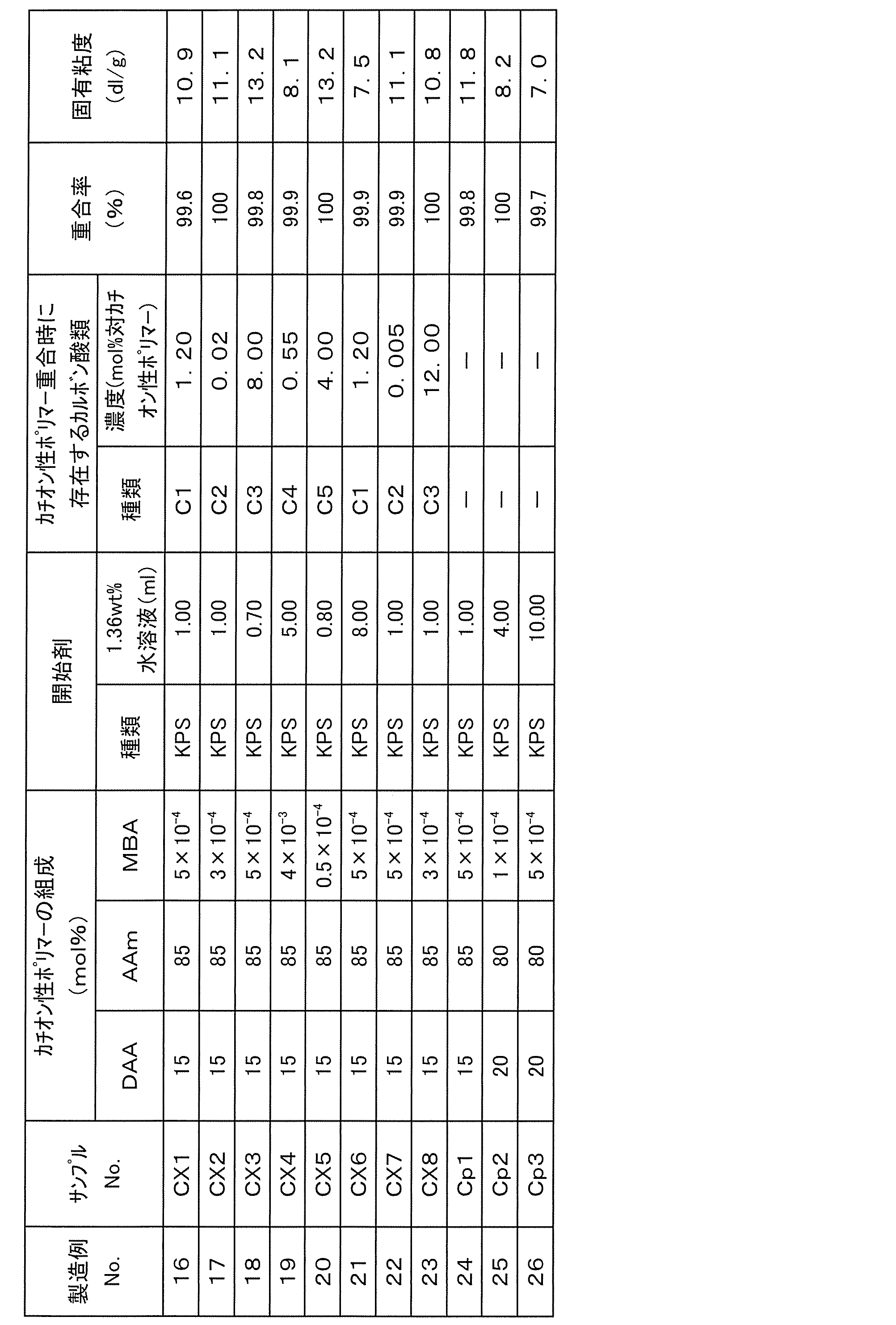
次に、後述する実施例及び比較例において以下の濾水試験を行った。なお、各実施例及び比較例で使用した製紙用添加剤については後述する。
<濾水試験>
カナディアン・スタンダード・フリーネス(CSF)450mlに叩解した新聞故紙を絶乾質量が0.6質量%になるように添加した後、これに軽質炭酸カルシウム(ブリリアント1500 白石工業株式会社製)を絶乾紙料に対して40質量%になるように加えたものを試料(パルプスラリー)とした。
パルプスラリー180mlを容量300mlのポリビーカーにとり、そこに後述する各実施例及び比較例で用いる「添加剤」の0.1質量%水溶液を添加し、タービン羽根を備えた撹拌機を用いて、250rpmで20秒間撹拌を行った。次いで、ナイロン濾布を敷いたヌッチェロートに、内径50mmの金属製の円筒を置き、その中へ凝集したパルプスラリーを注ぎ込み、メスシリンダーを用いて10秒後のろ液量を測定した。さらに、濾布上に残った湿紙をポリエステル濾布にとり、3.0kg/cm2の圧力をかけて60秒圧搾し、プレス後の湿紙の含水率を測定した。
<濾水試験>
カナディアン・スタンダード・フリーネス(CSF)450mlに叩解した新聞故紙を絶乾質量が0.6質量%になるように添加した後、これに軽質炭酸カルシウム(ブリリアント1500 白石工業株式会社製)を絶乾紙料に対して40質量%になるように加えたものを試料(パルプスラリー)とした。
パルプスラリー180mlを容量300mlのポリビーカーにとり、そこに後述する各実施例及び比較例で用いる「添加剤」の0.1質量%水溶液を添加し、タービン羽根を備えた撹拌機を用いて、250rpmで20秒間撹拌を行った。次いで、ナイロン濾布を敷いたヌッチェロートに、内径50mmの金属製の円筒を置き、その中へ凝集したパルプスラリーを注ぎ込み、メスシリンダーを用いて10秒後のろ液量を測定した。さらに、濾布上に残った湿紙をポリエステル濾布にとり、3.0kg/cm2の圧力をかけて60秒圧搾し、プレス後の湿紙の含水率を測定した。
<実施例8~12>
実施例8では、上記製造例16で得た混合物「CX1」を添加剤として用い、濾水試験を行った。
実施例9は、上記製造例17で得た混合物「CX2」を添加剤として用い、濾水試験を行った。
実施例10では、上記製造例18で得た混合物「CX3」を添加剤として用い、濾水試験を行った。
実施例11では、上記製造例19で得た混合物「CX4」を添加剤として用い、濾水試験を行った。
実施例12では、上記製造例20で得た混合物「CX5」を添加剤として用い、濾水試験を行った。
実施例8では、上記製造例16で得た混合物「CX1」を添加剤として用い、濾水試験を行った。
実施例9は、上記製造例17で得た混合物「CX2」を添加剤として用い、濾水試験を行った。
実施例10では、上記製造例18で得た混合物「CX3」を添加剤として用い、濾水試験を行った。
実施例11では、上記製造例19で得た混合物「CX4」を添加剤として用い、濾水試験を行った。
実施例12では、上記製造例20で得た混合物「CX5」を添加剤として用い、濾水試験を行った。
<実施例13~15>
実施例13では、上記製造例24で得たカチオン性ポリマー「Cp1」と、アジピン酸二カリウム(カルボン酸類「C1」)とを添加剤として用い、濾水試験を行った。この際、カルボン酸類「C1」の比率が、カチオン性ポリマー「Cp1」を構成する単量体成分の総量に対して、0.55モル%となるように添加した。
実施例14では、上記製造例25で得たカチオン性ポリマー「Cp2」と、コハク酸二ナトリウム(カルボン酸類「C2」)とを添加剤として用い、濾水試験を行った。この際、カルボン酸類「C2」の比率が、カチオン性ポリマー「Cp2」を構成する単量体成分の総量に対して、1.1モル%となるように添加した。
実施例15では、上記製造例24で得たカチオン性ポリマー「Cp1」と、マレイン酸二ナトリウム(カルボン酸類「C5」)とを添加剤として用い、濾水試験を行った。この際、カルボン酸類「C5」の比率が、カチオン性ポリマー「Cp1」を構成する単量体成分の総量に対して、6.5モル%となるように添加した。
実施例13では、上記製造例24で得たカチオン性ポリマー「Cp1」と、アジピン酸二カリウム(カルボン酸類「C1」)とを添加剤として用い、濾水試験を行った。この際、カルボン酸類「C1」の比率が、カチオン性ポリマー「Cp1」を構成する単量体成分の総量に対して、0.55モル%となるように添加した。
実施例14では、上記製造例25で得たカチオン性ポリマー「Cp2」と、コハク酸二ナトリウム(カルボン酸類「C2」)とを添加剤として用い、濾水試験を行った。この際、カルボン酸類「C2」の比率が、カチオン性ポリマー「Cp2」を構成する単量体成分の総量に対して、1.1モル%となるように添加した。
実施例15では、上記製造例24で得たカチオン性ポリマー「Cp1」と、マレイン酸二ナトリウム(カルボン酸類「C5」)とを添加剤として用い、濾水試験を行った。この際、カルボン酸類「C5」の比率が、カチオン性ポリマー「Cp1」を構成する単量体成分の総量に対して、6.5モル%となるように添加した。
<比較例14>
比較例14では、上記製造例24で得たカチオン性ポリマー「Cp1」を添加剤として用い、濾水試験を行った。
比較例14では、上記製造例24で得たカチオン性ポリマー「Cp1」を添加剤として用い、濾水試験を行った。
<比較例15~17>
比較例15では上記製造例21で得た混合物「CX6」を添加剤として用い、比較例16では上記製造例22で得た混合物「CX7」を添加剤として用い、比較例17では上記製造例23で得た混合物「CX8」を添加剤として用い、それぞれ濾水試験を行った。
比較例15では上記製造例21で得た混合物「CX6」を添加剤として用い、比較例16では上記製造例22で得た混合物「CX7」を添加剤として用い、比較例17では上記製造例23で得た混合物「CX8」を添加剤として用い、それぞれ濾水試験を行った。
<比較例18~21>
比較例18では、上記製造例24で得たカチオン性ポリマー「Cp1」と、酢酸(「C6」と記す)とを添加剤として用い、濾水試験を行った。この際、酢酸「C6」の比率が、カチオン性ポリマー「Cp1」を構成する単量体成分の総量に対して、2.0モル%となるように添加した。
比較例19では、上記製造例24で得たカチオン性ポリマー「Cp1」と、アジピン酸二カリウム(カルボン酸類「C1」)とを添加剤として用い、濾水試験を行った。この際、カルボン酸類「C1」の比率が、カチオン性ポリマー「Cp1」を構成する単量体成分の総量に対して、0.005モル%となるように添加した。
比較例20では、上記製造例25で得たカチオン性ポリマー「Cp2」と、コハク酸二ナトリウム(カルボン酸類「C2」)とを添加剤として用い、濾水試験を行った。この際、カルボン酸類「C2」の比率が、カチオン性ポリマー「Cp2」を構成する単量体成分の総量に対して、12.0モル%となるように添加した。
比較例21では、上記製造例26で得たカチオン性ポリマー「Cp3」と、テレフタル酸二ナトリウム(カルボン酸類「C3」)とを添加剤として用い、濾水試験を行った。この際、カルボン酸類「C3」の比率が、カチオン性ポリマー「Cp3」を構成する単量体成分の総量に対して、3.5モル%となるように添加した。
比較例18では、上記製造例24で得たカチオン性ポリマー「Cp1」と、酢酸(「C6」と記す)とを添加剤として用い、濾水試験を行った。この際、酢酸「C6」の比率が、カチオン性ポリマー「Cp1」を構成する単量体成分の総量に対して、2.0モル%となるように添加した。
比較例19では、上記製造例24で得たカチオン性ポリマー「Cp1」と、アジピン酸二カリウム(カルボン酸類「C1」)とを添加剤として用い、濾水試験を行った。この際、カルボン酸類「C1」の比率が、カチオン性ポリマー「Cp1」を構成する単量体成分の総量に対して、0.005モル%となるように添加した。
比較例20では、上記製造例25で得たカチオン性ポリマー「Cp2」と、コハク酸二ナトリウム(カルボン酸類「C2」)とを添加剤として用い、濾水試験を行った。この際、カルボン酸類「C2」の比率が、カチオン性ポリマー「Cp2」を構成する単量体成分の総量に対して、12.0モル%となるように添加した。
比較例21では、上記製造例26で得たカチオン性ポリマー「Cp3」と、テレフタル酸二ナトリウム(カルボン酸類「C3」)とを添加剤として用い、濾水試験を行った。この際、カルボン酸類「C3」の比率が、カチオン性ポリマー「Cp3」を構成する単量体成分の総量に対して、3.5モル%となるように添加した。
各実施例及び比較例の試験条件一覧を表7に、各試験結果を表8に示した。
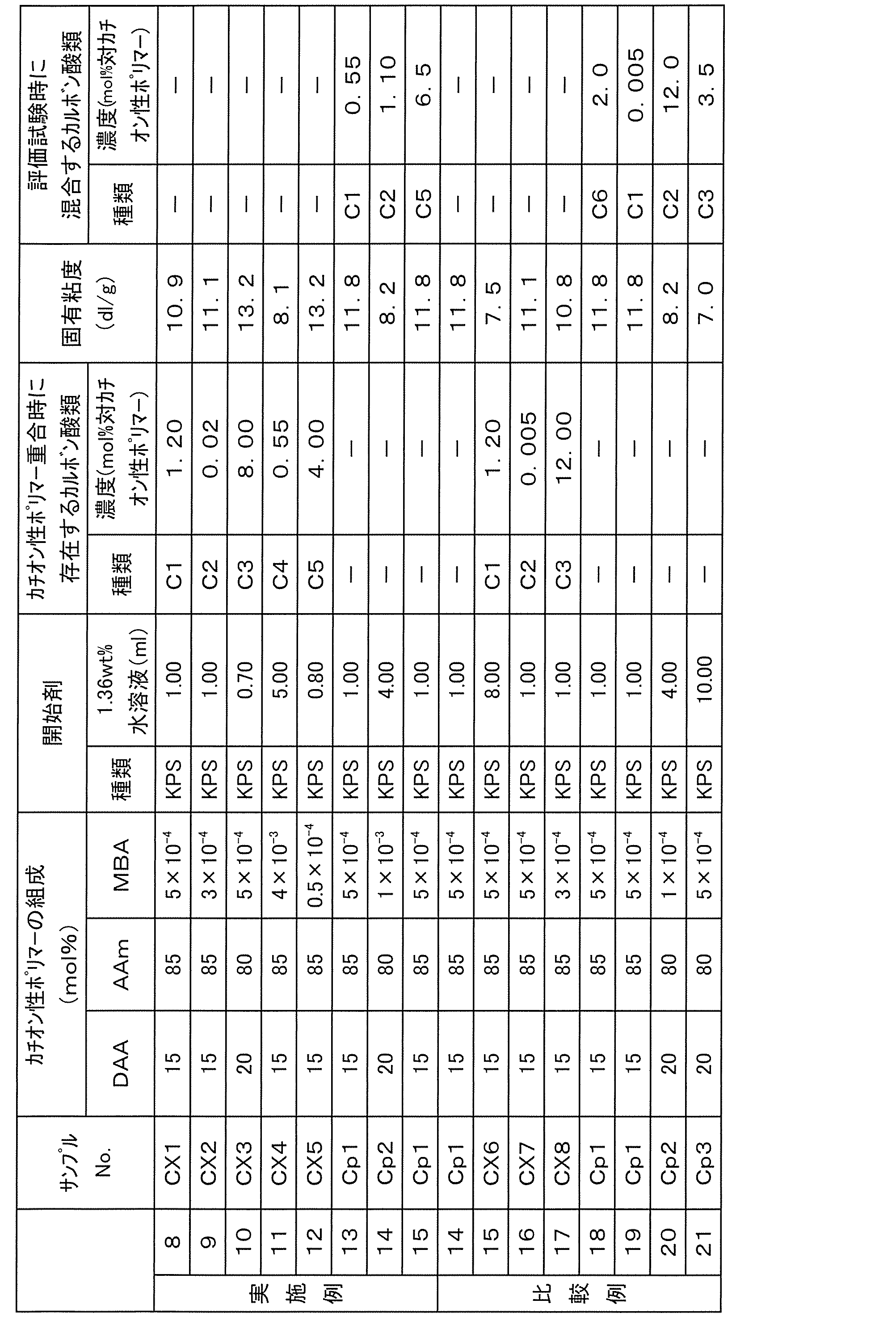
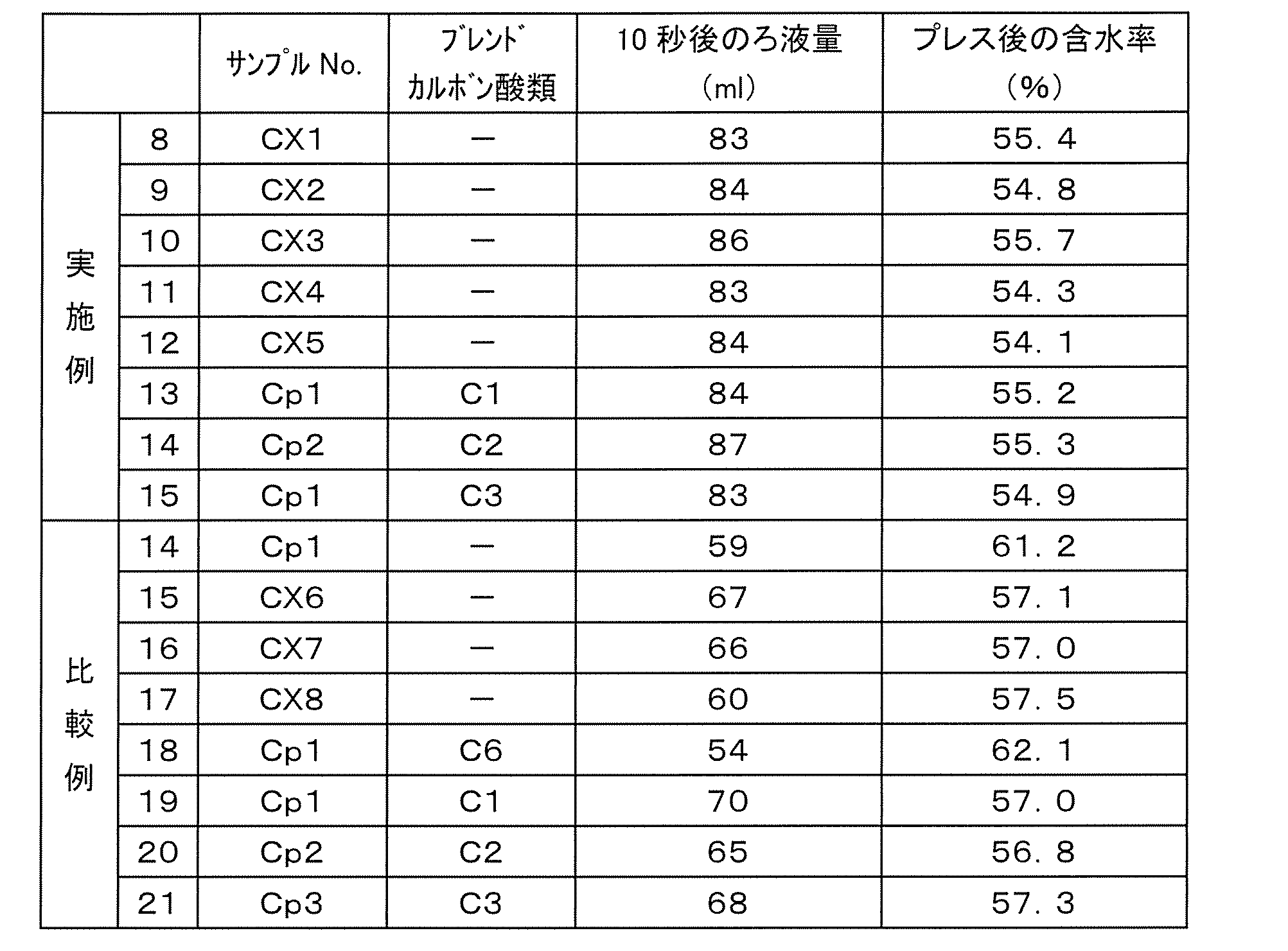
実施例8~15においては、比較例14~21よりも、10秒後のろ液量が多く、プレス後の含水率が低いことが確認された。
比較例14では、1分子中にカルボキシル基を2個以上有するカルボン酸類を用いず、カチオン性ポリマー「Cp1」のみを添加剤として用いたため、実施例に比べて、ろ液量が少なく、含水率が高いという結果になったものと考えられる。
比較例15では、添加剤として使用した混合物「CX6」の固有粘度が8dl/g未満であったために、実施例に比べて、ろ液量が少なく、含水率が高いという結果になったものと考えられる。
比較例15では、添加剤として使用した混合物「CX6」の固有粘度が8dl/g未満であったために、実施例に比べて、ろ液量が少なく、含水率が高いという結果になったものと考えられる。
比較例16及び19では、それぞれ使用したカルボン酸類「C2」及び「C1」の使用量が少なかったため、また、比較例17及び20では、それぞれ使用したカルボン酸類「C3」及び「C2」の使用量が多かったため、実施例に比べて、ろ液量が少なく、含水率が高いという結果になったものと考えられる。
比較例18では、1分子中にカルボキシル基を2個以上有するカルボン酸類ではなく、モノカルボン酸である酢酸を用いたため、実施例に比べて、ろ液量が少なく、含水率が高いという結果になったものと考えられる。
比較例21では、カルボン酸類「C3」と併用したカチオン性ポリマー「Cp3」の固有粘度が8dl/g未満であったために、実施例に比べて、ろ液量が少なく、含水率が高いという結果になったものと考えられる。
比較例21では、カルボン酸類「C3」と併用したカチオン性ポリマー「Cp3」の固有粘度が8dl/g未満であったために、実施例に比べて、ろ液量が少なく、含水率が高いという結果になったものと考えられる。
以上の結果より、実施例の製紙用添加剤は、特定のカチオン性ポリマーと、1分子中にカルボキシル基を2個以上有するカルボン酸類とをそれぞれ特定割合で併用することにより、紙料に対し比較的少ない添加量で、従って、紙製品の地合低下やコストアップの問題を引き起こすことなく、濾水性を向上することができることが確認された。
Claims (12)
- (A):下記一般式(I)で表されるカチオン性ビニルモノマーを含む単量体成分を重合して得られるカチオン性ポリマーと、
(B):(メタ)アクリル酸及び/又は(メタ)アクリル酸ナトリウムのアニオン性ビニルモノマー10~50モル%、並びに前記カチオン性ビニルモノマー5~45モル%を含み、前記カチオン性ビニルモノマーに対する前記アニオン性ビニルモノマーのモル比が1以上である単量体成分を重合して得られる、30℃の1規定NaCl水溶液中における固有粘度が5dl/g以上である両性ポリマー、又は
(C):1分子中にカルボキシル基を2個以上有するカルボン酸類と、を含有し、
前記(B)を含む場合、前記(A)100質量部に対して、前記(B)を0.01~2質量部含み、
前記(C)を含む場合、前記(A)を構成する単量体成分の総量に対して、前記(C)を0.01~10モル%含み、
前記(A)、前記(A)及び前記(B)を含むポリマー混合物、又は前記(A)及び前記(C)を含むポリマー混合物の30℃の1規定NaCl水溶液中における固有粘度が8dl/g以上である、製紙用添加剤。

- 前記(A)100質量部と、前記(B)0.01~2質量部と、を含有し、
前記(A)は、前記カチオン性ビニルモノマー、及び該カチオン性ビニルモノマーと共重合可能なノニオン性ビニルモノマーを含む単量体成分を重合して得られ、
前記(B)は、前記アニオン性ビニルモノマー、前記カチオン性ビニルモノマー、及びノニオン性ビニルモノマーを含む単量体成分を重合して得られる、請求項1記載の製紙用添加剤。 - 前記(A)の30℃の1規定NaCl水溶液中における固有粘度が8dl/g以上である、請求項2記載の製紙用添加剤。
- 前記(B)と、
前記(B)の溶液中で、前記カチオン性ビニルモノマー、及び前記ノニオン性ビニルモノマーを含む単量体成分を重合して得られた前記(A)と、を含むポリマー混合物を含有し、
該ポリマー混合物の30℃の1規定NaCl水溶液中における固有粘度が8dl/g以上である、請求項2記載の製紙用添加剤。 - 前記(A)と、前記(C)と、を含有し、
前記(C)の比率が、前記(A)を構成する単量体成分の総量に対して、0.01~10モル%であり、
前記(A)は、前記カチオン性ビニルモノマー、該カチオン性ビニルモノマーと共重合可能なノニオン性ビニルモノマー、及び架橋性ビニルモノマーを含む単量体成分を重合して得られる、請求項1記載の製紙用添加剤。 - 前記(A)の30℃の1規定NaCl水溶液中における固有粘度が8dl/g以上である、請求項5記載の製紙用添加剤。
- 前記(C)と、
前記(C)の溶液中で、前記カチオン性ビニルモノマー、前記ノニオン性ビニルモノマー、及び前記架橋性ビニルモノマーを含む単量体成分を重合して得られた前記(A)と、を含むポリマー混合物を含有し、
該ポリマー混合物の30℃の1規定NaCl水溶液中における固有粘度が8dl/g以上である、請求項5記載の製紙用添加剤。 - 前記(C)は、ジカルボン酸類及びトリカルボン酸類からなる群から選択される1種以上である、請求項5~7の何れか1項記載の製紙用添加剤。
- (B):(メタ)アクリル酸及び/又は(メタ)アクリル酸ナトリウムのアニオン性ビニルモノマー10~50モル%、下記一般式(I)で表されるカチオン性ビニルモノマー5~45モル%、並びにノニオン性ビニルモノマーを含み、前記カチオン性ビニルモノマーに対する前記アニオン性ビニルモノマーのモル比が1以上である単量体成分を重合して得られる、30℃の1規定NaCl水溶液中における固有粘度が5dl/g以上である両性ポリマー、又は
(C):1分子中にカルボキシル基を2個以上有するカルボン酸類、を用い、
前記(B)の溶液中又は前記(C)の溶液中で、
(A):前記カチオン性ビニルモノマーを含む単量体成分を重合してカチオン性ポリマーを合成し、
前記(A)100質量部と前記(B)0.01~2質量部とを含むか、又は前記(A)と、該(A)を構成する単量体成分の総量に対して0.01~10モル%の比率で含まれる前記(C)とを含み、かつ、30℃の1規定NaCl水溶液中における固有粘度が8dl/g以上であるポリマー混合物を得る、製紙用添加剤の製造方法。

- 前記(B)の溶液中で、前記カチオン性ビニルモノマー、及び該カチオン性ビニルモノマーと共重合可能なノニオン性ビニルモノマーを含む単量体成分を重合して前記(A)を合成し、
前記(A)100質量部と、前記(B)0.01~2質量部とを含み、かつ、30℃の1規定NaCl水溶液中における固有粘度が8dl/g以上であるポリマー混合物を得る、請求項9記載の製紙用添加剤の製造方法。 - 前記(C)の溶液中で、前記カチオン性ビニルモノマー、該カチオン性ビニルモノマーと共重合可能なノニオン性ビニルモノマー、及び架橋性ビニルモノマーを含む単量体成分を重合して前記(A)を合成し、
前記(A)を構成する単量体成分の総量に対して、前記(C)を0.01~10モル%含み、かつ、30℃の1規定NaCl水溶液中における固有粘度が8dl/g以上であるポリマー混合物を得る、請求項9記載の製紙用添加剤の製造方法。 - 請求項1~8の何れか1項に記載の製紙用添加剤を紙料に添加する紙の製造方法。
Applications Claiming Priority (4)
| Application Number | Priority Date | Filing Date | Title |
|---|---|---|---|
| JP2013-125053 | 2013-06-13 | ||
| JP2013-125054 | 2013-06-13 | ||
| JP2013125054A JP5713054B2 (ja) | 2013-06-13 | 2013-06-13 | 製紙用添加剤及び製紙用添加剤の製造方法並びに紙の製造方法 |
| JP2013125053A JP5713053B2 (ja) | 2013-06-13 | 2013-06-13 | 製紙用添加剤及び製紙用添加剤の製造方法並びに紙の製造方法 |
Publications (1)
| Publication Number | Publication Date |
|---|---|
| WO2014199996A1 true WO2014199996A1 (ja) | 2014-12-18 |
Family
ID=52022288
Family Applications (1)
| Application Number | Title | Priority Date | Filing Date |
|---|---|---|---|
| PCT/JP2014/065381 Ceased WO2014199996A1 (ja) | 2013-06-13 | 2014-06-10 | 製紙用添加剤及び製紙用添加剤の製造方法並びに紙の製造方法 |
Country Status (1)
| Country | Link |
|---|---|
| WO (1) | WO2014199996A1 (ja) |
Cited By (1)
| Publication number | Priority date | Publication date | Assignee | Title |
|---|---|---|---|---|
| US10767315B2 (en) | 2016-03-22 | 2020-09-08 | Kemira Oyj | System and method for manufacture of paper, board or the like |
Citations (12)
| Publication number | Priority date | Publication date | Assignee | Title |
|---|---|---|---|---|
| JPS6245798A (ja) * | 1985-08-22 | 1987-02-27 | デイック・ハーキユレス株式会社 | 製紙用添加剤 |
| JPS62104998A (ja) * | 1985-11-01 | 1987-05-15 | デイツク・ハ−キユレス株式会社 | 製紙用添加剤 |
| JPH06212597A (ja) * | 1993-01-20 | 1994-08-02 | Nitto Boseki Co Ltd | 製紙用薬剤 |
| JP2003193395A (ja) * | 2001-12-21 | 2003-07-09 | Hymo Corp | 抄紙方法 |
| JP2004300634A (ja) * | 2003-03-31 | 2004-10-28 | Somar Corp | 紙の製造方法 |
| JP2005194651A (ja) * | 2004-01-05 | 2005-07-21 | Kurita Water Ind Ltd | 紙および板紙の製造方法 |
| WO2006070853A1 (ja) * | 2004-12-28 | 2006-07-06 | Toagosei Co., Ltd. | 歩留向上剤用組成物 |
| JP2007016086A (ja) * | 2005-07-06 | 2007-01-25 | Hymo Corp | 水溶性重合体分散液及びそれを用いた抄紙方法 |
| JP2007326952A (ja) * | 2006-06-07 | 2007-12-20 | Kurita Water Ind Ltd | 製紙用添加剤並びに紙および板紙の製造方法 |
| JP2008025054A (ja) * | 2006-07-21 | 2008-02-07 | Hymo Corp | 抄紙用薬剤 |
| JP2008031584A (ja) * | 2006-07-28 | 2008-02-14 | Hymo Corp | 抄紙方法 |
| JP2011012354A (ja) * | 2009-06-30 | 2011-01-20 | Hymo Corp | 濾水性向上方法 |
-
2014
- 2014-06-10 WO PCT/JP2014/065381 patent/WO2014199996A1/ja not_active Ceased
Patent Citations (12)
| Publication number | Priority date | Publication date | Assignee | Title |
|---|---|---|---|---|
| JPS6245798A (ja) * | 1985-08-22 | 1987-02-27 | デイック・ハーキユレス株式会社 | 製紙用添加剤 |
| JPS62104998A (ja) * | 1985-11-01 | 1987-05-15 | デイツク・ハ−キユレス株式会社 | 製紙用添加剤 |
| JPH06212597A (ja) * | 1993-01-20 | 1994-08-02 | Nitto Boseki Co Ltd | 製紙用薬剤 |
| JP2003193395A (ja) * | 2001-12-21 | 2003-07-09 | Hymo Corp | 抄紙方法 |
| JP2004300634A (ja) * | 2003-03-31 | 2004-10-28 | Somar Corp | 紙の製造方法 |
| JP2005194651A (ja) * | 2004-01-05 | 2005-07-21 | Kurita Water Ind Ltd | 紙および板紙の製造方法 |
| WO2006070853A1 (ja) * | 2004-12-28 | 2006-07-06 | Toagosei Co., Ltd. | 歩留向上剤用組成物 |
| JP2007016086A (ja) * | 2005-07-06 | 2007-01-25 | Hymo Corp | 水溶性重合体分散液及びそれを用いた抄紙方法 |
| JP2007326952A (ja) * | 2006-06-07 | 2007-12-20 | Kurita Water Ind Ltd | 製紙用添加剤並びに紙および板紙の製造方法 |
| JP2008025054A (ja) * | 2006-07-21 | 2008-02-07 | Hymo Corp | 抄紙用薬剤 |
| JP2008031584A (ja) * | 2006-07-28 | 2008-02-14 | Hymo Corp | 抄紙方法 |
| JP2011012354A (ja) * | 2009-06-30 | 2011-01-20 | Hymo Corp | 濾水性向上方法 |
Cited By (1)
| Publication number | Priority date | Publication date | Assignee | Title |
|---|---|---|---|---|
| US10767315B2 (en) | 2016-03-22 | 2020-09-08 | Kemira Oyj | System and method for manufacture of paper, board or the like |
Similar Documents
| Publication | Publication Date | Title |
|---|---|---|
| JP4013188B2 (ja) | (メタ)アクリルアミド系ポリマー、その製造方法、製紙用薬品、及びそれを含有する紙 | |
| JP6354417B2 (ja) | 紙力増強剤、それにより得られる紙及び紙の製造方法 | |
| JP4894264B2 (ja) | 両性水溶性高分子を含む組成物 | |
| JP5640458B2 (ja) | 製紙用紙力増強剤の製造方法 | |
| JP4100049B2 (ja) | 高分子分散剤、水性分散液、サイズ剤及び紙 | |
| JP2017186725A (ja) | 高灰分紙用紙力増強剤、高灰分紙の製造方法、及び高灰分紙 | |
| WO2014199996A1 (ja) | 製紙用添加剤及び製紙用添加剤の製造方法並びに紙の製造方法 | |
| JP4158145B2 (ja) | 製紙用添加剤及び製紙用添加剤の製造方法 | |
| JP5713054B2 (ja) | 製紙用添加剤及び製紙用添加剤の製造方法並びに紙の製造方法 | |
| CN103459716B (zh) | 板纸制造方法 | |
| JP2000212229A (ja) | 製紙用添加剤およびその製造方法 | |
| JP5713053B2 (ja) | 製紙用添加剤及び製紙用添加剤の製造方法並びに紙の製造方法 | |
| JP4942415B2 (ja) | 抄紙方法 | |
| JP2014148770A (ja) | 製紙用添加剤及び製紙用添加剤の製造方法並びに紙の製造方法 | |
| JP2014148769A (ja) | 製紙用添加剤及び製紙用添加剤の製造方法並びに紙の製造方法 | |
| JP2009022840A (ja) | 高分子凝集剤及びその用途 | |
| JP5609253B2 (ja) | 板紙の製造方法 | |
| JP5835314B2 (ja) | 紙の製造方法 | |
| JP2001279599A (ja) | 製紙方法 | |
| JPH1046489A (ja) | 製紙用添加剤 | |
| JP2000282390A (ja) | 製紙用歩留り・濾水性向上剤組成物、製紙方法及び紙 | |
| JP2000273790A (ja) | 製紙用内部添加剤および紙の製造方法 | |
| WO2024211468A1 (en) | Additive compositions for papermaking | |
| WO2026088891A1 (ja) | 重合体組成物及びその製造方法、油中水型エマルション、製紙用歩留向上剤、並びに製紙方法 | |
| JP2007126770A (ja) | 紙の製造方法 |
Legal Events
| Date | Code | Title | Description |
|---|---|---|---|
| 121 | Ep: the epo has been informed by wipo that ep was designated in this application |
Ref document number: 14810924 Country of ref document: EP Kind code of ref document: A1 |
|
| NENP | Non-entry into the national phase |
Ref country code: DE |
|
| 122 | Ep: pct application non-entry in european phase |
Ref document number: 14810924 Country of ref document: EP Kind code of ref document: A1 |