WO2014181838A1 - 黒色粉末およびその製造方法 - Google Patents
黒色粉末およびその製造方法 Download PDFInfo
- Publication number
- WO2014181838A1 WO2014181838A1 PCT/JP2014/062388 JP2014062388W WO2014181838A1 WO 2014181838 A1 WO2014181838 A1 WO 2014181838A1 JP 2014062388 W JP2014062388 W JP 2014062388W WO 2014181838 A1 WO2014181838 A1 WO 2014181838A1
- Authority
- WO
- WIPO (PCT)
- Prior art keywords
- vanadium
- oxide
- black powder
- black
- hydroxide
- Prior art date
- Legal status (The legal status is an assumption and is not a legal conclusion. Google has not performed a legal analysis and makes no representation as to the accuracy of the status listed.)
- Ceased
Links
Images


Classifications
-
- C—CHEMISTRY; METALLURGY
- C01—INORGANIC CHEMISTRY
- C01G—COMPOUNDS CONTAINING METALS NOT COVERED BY SUBCLASSES C01D OR C01F
- C01G31/00—Compounds of vanadium
-
- C—CHEMISTRY; METALLURGY
- C01—INORGANIC CHEMISTRY
- C01G—COMPOUNDS CONTAINING METALS NOT COVERED BY SUBCLASSES C01D OR C01F
- C01G31/00—Compounds of vanadium
- C01G31/02—Oxides
-
- C—CHEMISTRY; METALLURGY
- C09—DYES; PAINTS; POLISHES; NATURAL RESINS; ADHESIVES; COMPOSITIONS NOT OTHERWISE PROVIDED FOR; APPLICATIONS OF MATERIALS NOT OTHERWISE PROVIDED FOR
- C09D—COATING COMPOSITIONS, e.g. PAINTS, VARNISHES OR LACQUERS; FILLING PASTES; CHEMICAL PAINT OR INK REMOVERS; INKS; CORRECTING FLUIDS; WOODSTAINS; PASTES OR SOLIDS FOR COLOURING OR PRINTING; USE OF MATERIALS THEREFOR
- C09D17/00—Pigment pastes, e.g. for mixing in paints
-
- C—CHEMISTRY; METALLURGY
- C01—INORGANIC CHEMISTRY
- C01P—INDEXING SCHEME RELATING TO STRUCTURAL AND PHYSICAL ASPECTS OF SOLID INORGANIC COMPOUNDS
- C01P2002/00—Crystal-structural characteristics
- C01P2002/50—Solid solutions
- C01P2002/52—Solid solutions containing elements as dopants
-
- C—CHEMISTRY; METALLURGY
- C01—INORGANIC CHEMISTRY
- C01P—INDEXING SCHEME RELATING TO STRUCTURAL AND PHYSICAL ASPECTS OF SOLID INORGANIC COMPOUNDS
- C01P2004/00—Particle morphology
- C01P2004/60—Particles characterised by their size
- C01P2004/64—Nanometer sized, i.e. from 1-100 nanometer
-
- C—CHEMISTRY; METALLURGY
- C01—INORGANIC CHEMISTRY
- C01P—INDEXING SCHEME RELATING TO STRUCTURAL AND PHYSICAL ASPECTS OF SOLID INORGANIC COMPOUNDS
- C01P2004/00—Particle morphology
- C01P2004/80—Particles consisting of a mixture of two or more inorganic phases
- C01P2004/82—Particles consisting of a mixture of two or more inorganic phases two phases having the same anion, e.g. both oxidic phases
- C01P2004/84—Particles consisting of a mixture of two or more inorganic phases two phases having the same anion, e.g. both oxidic phases one phase coated with the other
-
- C—CHEMISTRY; METALLURGY
- C01—INORGANIC CHEMISTRY
- C01P—INDEXING SCHEME RELATING TO STRUCTURAL AND PHYSICAL ASPECTS OF SOLID INORGANIC COMPOUNDS
- C01P2006/00—Physical properties of inorganic compounds
- C01P2006/10—Solid density
-
- C—CHEMISTRY; METALLURGY
- C01—INORGANIC CHEMISTRY
- C01P—INDEXING SCHEME RELATING TO STRUCTURAL AND PHYSICAL ASPECTS OF SOLID INORGANIC COMPOUNDS
- C01P2006/00—Physical properties of inorganic compounds
- C01P2006/12—Surface area
Definitions
- the present invention provides a black powder that has high blackness, light shielding properties, and high insulation properties and shields the entire visible light region.
- black powder powders such as carbon black, iron oxide, low-order titanium oxide, and titanium oxynitride are currently known.
- Carbon black is excellent in both blackness and coloration and has high conductivity, but it is bulky and difficult to handle and does not fit well with resin. Moreover, since it is accompanied by 3,4-benzpyrene, a carcinogenic substance derived from raw materials, although it is a trace amount, its safety is a problem.
- Iron oxide has agglomeration due to magnetism and is inferior in dispersibility. The heat resistance is also poor and it is oxidized to brown ⁇ -Fe 2 O 3 at around 150 ° C. in the atmosphere.
- Low-order titanium oxide is a powder obtained by reducing titanium dioxide powder with Ti powder or H 2 gas at a temperature of 1000 ° C. or higher, and is a mixture having various structures such as Ti 3 O 5 and Ti 2 O 3 . Since low-order titanium oxide undergoes a reduction reaction at high temperature, sintering and grain growth are remarkable, resulting in coarse particles (1.0 ⁇ m or more) that are unsuitable for pigments.
- titanium oxynitride which is a black pigment described in Patent Document 1
- titanium black which is a black pigment described in Patent Document 1
- Titanium oxynitride is also optimal as a raw material for plastics for foods and beverages and cosmetics because it does not contain harmful substances.
- resin BM black matrix
- Titanium oxynitride has excellent properties as a black pigment for black matrix, such as high concealability and high insulation, and is expected to be increasingly applied in the future.
- low-order titanium oxide or titanium oxynitride obtained by reducing titanium dioxide is a bluish black or dark blue pigment that is not black, and transmits a short wavelength side of visible light, specifically a wavelength around 450 nm.
- the blue light strongly demanded by the image element could not be shielded.
- the black vanadium powder has a specific gravity as large as 5.0 and a particle size larger than 100 nm and titanium oxynitride powder, when used as a liquid thin film forming agent dispersed in a dispersion, There is a problem that it is not suitable for long-term storage due to sedimentation.
- the present inventor has intensively studied to solve the above-described problems and suppress the precipitation of the black powder in the dispersion liquid.
- the raw material vanadium oxide is changed to SiO 2 , ZrO 2 , TiO 2 , GeO 2 , Al.
- a reduction reaction After coating one or two or more inorganic oxides selected from 2 O 3 , Y 2 O 3 , and P 2 O 5 , grain growth during the reduction reaction is suppressed and produced. It has been found that the particle size of the product can be made fine. Based on this knowledge, the present invention has the following solutions.
- the black powder of the present invention comprises vanadium oxynitride represented by the general formula VO x N y (where x and y satisfy the conditions 0 ⁇ x ⁇ 1.1 and 0 ⁇ y ⁇ 1.2).
- the vanadium concentration in the mixture is 50% by mass or more and 80% by mass or less, the total concentration of the inorganic oxides is 5% by mass or more and 20% by mass or less, and the average primary particle diameter is 70 nm. It is as follows.
- This black powder has an average primary particle size as small as 70 nm or less, and can suppress sedimentation in the dispersion.
- the vanadium concentration is less than 50% by mass, the desired light shielding property cannot be obtained, and the blackness is lowered.
- the vanadium concentration exceeds 80% by mass, the inorganic oxide is relatively insufficient, and thus the primary particle size becomes large, and it becomes difficult to suppress sedimentation.
- the total concentration of the inorganic oxide is less than 5% by mass, the effect of suppressing the increase in the particle size is poor, the primary particle size is increased, and the problem of sedimentation is not improved.
- the total concentration of the inorganic oxides exceeds 20% by mass, the desired light-shielding property cannot be exhibited, the blackness is lowered, and the dispersion stability is also insufficient.
- the specific surface area is preferably 40 m 2 / g or more, and the primary particle diameter can be 70 nm or less when the specific surface area is 40 m 2 / g or more.
- the L value of this black powder is preferably 15 or less, and the blackness is higher as the L value is smaller.
- the inorganic oxide includes both those covering the entire surface of vanadium oxynitride and those partially covering the vanadium oxynitride.
- the vanadium concentration in the mixture may be 50 mass% or more and 75 mass% or less, and the average primary particle diameter may be 50 nm or less.
- the specific surface area is preferably 60 m 2 / g or more, and when the specific surface area is 60 m 2 / g or more, the primary particle diameter can be 50 nm or less.
- this inorganic oxide shall include both what coat
- the vanadium oxide powder is one or more selected from SiO 2 , ZrO 2 , TiO 2 , GeO 2 , Al 2 O 3 , Y 2 O 3 , and P 2 O 5.
- vanadium oxide powder is coated with an inorganic oxide in advance and then subjected to a reduction treatment, the sintering of vanadium oxide is suppressed by the inorganic oxide, and a black powder having a small primary particle diameter can be obtained.
- the specific surface area of the vanadium oxide powder coated with the inorganic oxide in the oxide coating step is preferably 30 m 2 / g or more.
- the oxide coating step includes pulverizing the vanadium oxide powder in water, and adding the obtained aqueous dispersion from among Si, Zr, Ti, Ge, Al, Y, and P.
- a water-soluble inorganic compound containing one or more selected elements may be added, and the dispersion may be dried and fired.
- vanadium oxide powder coated with SiO 2 in the oxide coating step can be produced by using sodium silicate as the water-soluble inorganic compound.
- vanadium oxide powder is pulverized in an organic solvent, and the resulting slurry is selected from one or more elements selected from Si, Zr, Ti, Ge, Al, Y, and P. It is also possible to add an organic metal compound such as an organic dispersion metal alkoxide containing, and dry and fire the dispersion.
- the present inventor generates a vanadium hydroxide coated with an inorganic hydroxide by adding a water-soluble oxide element to an aqueous solution in which a water-soluble vanadium compound is dissolved and coprecipitating them.
- the inventors have found that the particle diameter can be further reduced by reducing the obtained mixed hydroxide.
- the method for producing a black powder according to the present invention comprises an aqueous solution in which a water-soluble vanadium compound is dissolved, and one or more elements selected from Si, Zr, Ti, Ge, Al, Y, and P.
- An inorganic hydroxide that forms a vanadium hydroxide coated with an inorganic hydroxide by adding a water-soluble inorganic compound containing a precipitate to precipitate a vanadium mixed hydroxide and drying the vanadium mixed hydroxide.
- a reduction step of reducing the vanadium hydroxide coated with the inorganic hydroxide with ammonia gas is reducing the vanadium hydroxide coated with the inorganic hydroxide with ammonia gas.
- the water-soluble vanadium compound may be vanadium oxide, vanadium chloride, or vanadium oxychloride.
- the water-soluble inorganic compound is sodium silicate, and vanadium hydroxide coated with silica hydroxide in the hydroxide coating step may be produced.
- this invention can be set as the optical component produced with the black paste containing the said black powder, the black thin film formed by apply
- the black paste contains black ink, and the optical components include an image display device, an optical filter, an image light receiving element, and the like.
- the average value of the primary particle diameter is small, sedimentation in the dispersion can be suppressed, and a black powder suitable for long-term storage can be obtained.
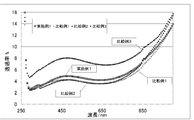
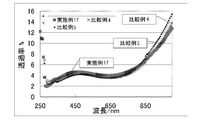
- Example 4 is a graph showing transmittance curves of Example 1 of the present invention and Comparative Examples 1 to 3. It is an electron micrograph of Example 1 of the present invention. It is a graph which shows the transmittance
- This black powder has vanadium oxynitride represented by the general formula VO x N y (where x and y satisfy the conditions of 0 ⁇ x ⁇ 1.1 and 0 ⁇ y ⁇ 1.2), A mixture of one or more inorganic oxides selected from SiO 2 , ZrO 2 , TiO 2 , GeO 2 , Al 2 O 3 , Y 2 O 3 and P 2 O 5 covering vanadium oxynitride
- the vanadium concentration in the mixture is 50% by mass or more and 80% by mass or less, the total concentration of inorganic oxides is 5% by mass or more and 20% by mass or less, and the average primary particle diameter is 70 nm or less.
- the vanadium oxynitride is obtained by reducing vanadium oxide with ammonia gas at a high temperature, as will be described later.
- vanadium oxide is coated with one or more inorganic oxides selected from SiO 2 , ZrO 2 , TiO 2 , GeO 2 , Al 2 O 3 , Y 2 O 3 and P 2 O 5.
- a powder made of a mixture of vanadium oxynitride and an inorganic oxide is obtained by reducing the vanadium oxide coated with the inorganic oxide.
- the amount of ammonia gas or the like is adjusted so that x and y in the formula of VO x N y are controlled to satisfy 0 ⁇ x ⁇ 1.1 and 0 ⁇ y ⁇ 1.2.
- the vanadium concentration in the black powder is 50% by mass or more and 80% by mass or less, and the total concentration of the inorganic oxide is 5% by mass or more and 20% by mass or less. If the vanadium concentration is less than 50% by mass, the desired light shielding properties cannot be obtained, and the blackness is lowered. When the vanadium concentration exceeds 80% by mass, the inorganic oxide is relatively insufficient, and thus the primary particle size becomes large, and it becomes difficult to suppress sedimentation. If the total concentration of the inorganic oxide is less than 5% by mass, the effect of suppressing the increase in the particle size is poor, the primary particle size is increased, and the problem of sedimentation is not improved. When the total concentration of the inorganic oxides exceeds 20% by mass, the desired light-shielding property cannot be exhibited, the blackness is lowered, and the dispersion stability is also insufficient.
- the coating of the inorganic oxide on the vanadium oxynitride includes a partial case.
- the average primary particle diameter By setting the average primary particle diameter to 70 nm or less, sedimentation in the dispersion when stored as a liquid thin film forming agent can be suppressed.
- the primary particles are apparent single particles that do not include aggregated particles. This particle diameter is measured by using a transmission electron microscope, for example, arbitrarily 10 times at a photographing magnification of 100,000, and the average of all the particles that have been photographed as a whole in each field of view. Calculate from the value.
- the specific surface area of this black powder is 40 m ⁇ 2 > / g or more.
- the primary particle diameter can be 70 nm or less.
- the L value of the L, a, b color system of this black powder is 15 or less. The smaller the L value, the higher the blackness.
- a black powder is manufactured by an oxide coating process in which vanadium oxide powder is coated with a specific inorganic oxide and a reduction process in which the vanadium oxide powder coated with the inorganic oxide is reduced.
- an oxide coating process in which vanadium oxide powder is coated with a specific inorganic oxide
- a reduction process in which the vanadium oxide powder coated with the inorganic oxide is reduced.
- vanadium oxide powder is prepared, and one or more inorganic materials selected from SiO 2 , ZrO 2 , TiO 2 , GeO 2 , Al 2 O 3 , Y 2 O 3 , and P 2 O 5 are prepared. Cover the oxide.
- Vanadium oxide powder is formed by crushing.
- the pulverization method include a method using a ball mill, an attritor, a bead mill and the like, but a method using a bead mill is effective for uniformly pulverizing in a short time.
- An oxide raw material for example, sodium silicate
- An oxide raw material for example, sodium silicate
- excess alkali ions are removed by decantation, ion exchange resin or the like, and then dried.
- An inorganic oxide coating is applied to the powder surface by a sol-gel reaction by adding an organometallic compound such as baked at a high temperature.
- any method has an effect of covering the vanadium oxide with an inorganic oxide.
- Oxidizing with one or more inorganic oxides selected from SiO 2 , ZrO 2 , TiO 2 , GeO 2 , Al 2 O 3 , Y 2 O 3 , and P 2 O 5 by this wet coating method A powder of vanadium (hereinafter also referred to as oxide coating) is obtained.
- the powder preferably has a specific surface area of 30 m 2 / g or more.
- the specific surface area of the vanadium oxide coated with the inorganic oxide before the reduction treatment is less than 30 m 2 / g, it is difficult to make the primary particle diameter of the black powder obtained after the reduction treatment 70 nm or less.
- x and y in the formula of VO x N y as vanadium oxynitride are 0 ⁇ x ⁇ 1.1 and 0 ⁇ y ⁇ 1.2.
- vanadium oxide not coated with an inorganic oxide when a high-temperature reduction treatment is performed, the vanadium oxide powder grows while being sintered, and the particle diameter of the resulting vanadium oxynitride increases.
- reducing the vanadium oxide coated with the inorganic oxide sintering and grain growth are suppressed by the inorganic oxide, and primary particles having an average particle diameter of 70 nm or less can be obtained.
- the coated inorganic oxide can be partially reduced to become a low-order oxide, the effect of suppressing the grain growth of vanadium oxynitride remains unchanged even when the low-order oxide is formed.
- the black powder thus produced can be dispersed in a dispersion and used as a black paint.
- the black resist produced using this black dispersion can be applied as a resin BM material for a color filter, whereby a liquid crystal panel with high definition and good visibility can be obtained.
- this black powder is applied to an optical filter for attenuating visible light incorporated in an image light receiving element, an optical filter having a good absorption characteristic showing a uniform attenuation characteristic in the visible light region can be obtained.
- this black powder can be applied to a display member such as a peripheral frame material of a touch panel, a lens unit, a light adjusting material for an image sensor, and the like.
- Example 1 A vanadium oxide powder having a specific surface area of 8 m 2 / g is pulverized in water by a bead mill, and the resulting water slurry is obtained with sodium silicate (water glass). The inorganic oxide concentration in the black powder is 11% by mass.
- the silica (SiO 2 ) was coated by adding to and dried to obtain an oxide coating. The specific surface area of the oxide coating product at this time was 40 m 2 / g.
- the obtained oxide coating product was heated to 800 ° C. at 7 ° C./min in an N 2 atmosphere, and then ammonia gas was allowed to flow for a predetermined time to obtain a nitrided and reduced black powder. It was 52 nm when the primary particle diameter was confirmed with the transmission electron microscope about this black powder. Table 1 shows the physical property values of the obtained black powder.
- the measurement conditions in Table 1 are as follows (same in each example and comparative example).
- the x value of VO x N y was measured by an inert gas melting-infrared absorption method, and the y value was measured by an inert gas melting-heat conduction method.
- the vanadium concentration (V concentration) was measured by titration after acid decomposition of the sample.
- the oxide concentration (total concentration of inorganic oxides) was measured by ICP emission spectrometry.
- the L value was measured according to the standard JISZ8722.
- the primary particle diameter is measured 10 times arbitrarily using a transmission electron microscope at an imaging magnification of 100,000, and the average of all the particles in which the entire single particle is photographed within each field of view is measured. The value was determined.
- the specific surface area was measured according to the standard JISZ8830.
- the transmittance was measured according to the standard JIS R3106.
- the resulting black powder was subjected to a dispersion treatment in a PGM-Ac solvent using a circulating horizontal bead mill (media: zirconia) and an amine dispersant, and the prepared dispersion was diluted 100,000 times. Then, a transmittance curve was measured. The measurement results are shown in FIG. As shown in FIG. 1, a particularly highly light-shielding spectrum around 450 nm was obtained.
- the dispersion liquid in which the concentration of the black powder is adjusted to 25% by mass is stored in a glass container, and after 1 month, the supernatant liquid (upper liquid) is collected and measured for non-volatile content by evaporation to dryness (analysis accuracy is ⁇ 0 0.1%), the solid content reduction rate was 0.1% by mass, and it was confirmed that there was almost no sedimentation.
- Table 1 shows the concentrations immediately after the production of the dispersion and after one month.
- Example 2 A vanadium oxide powder having a specific surface area of 8 m 2 / g is pulverized in ethanol by a bead mill, and the resulting slurry is obtained so that tetraethoxysilane (TEOS) is obtained.
- the inorganic oxide concentration in the black powder is 5% by mass.
- silica (SiO 2 ) was coated by applying a drying treatment. The specific surface area of the oxide coating product at this time was 45 m 2 / g.
- the obtained oxide coating product was heated to 800 ° C. at 7 ° C./min in an N 2 atmosphere, and then ammonia gas was allowed to flow for a predetermined time to obtain a nitrided and reduced black powder. It was 68 nm when the primary particle diameter was confirmed with the transmission electron microscope about this black powder. Table 1 shows the physical properties of the obtained black powder and dispersion.
- Examples 3 to 16 Various black powders were prepared using various oxide coatings in the same manner as in Examples 1 and 2, and the dispersions obtained by dispersing the obtained black powders were evaluated. Production conditions, powder properties, and dispersion properties are shown in Table 1.
- the resulting black powder was subjected to a dispersion treatment in a PGM-Ac solvent using a circulating horizontal bead mill (media: zirconia) and an amine dispersant, and the prepared dispersion was diluted 100,000 times.
- the transmittance curve was measured. As shown in Example 1, a highly light-shielding spectrum around 450 nm was obtained.
- the dispersion liquid adjusted to a black powder concentration of 25% by mass was stored in a glass container, and after 1 month, the supernatant liquid (upper liquid) was collected and subjected to non-volatile content measurement.
- the solid content concentration was 5.1% by mass. Yes, it was confirmed that it was sinking.
- the physical properties of this dispersion are shown in Table 1.
- Vanadium oxide powder is pulverized in water by a bead mill, and the resulting water slurry is added so that the inorganic oxide concentration in the black powder from which sodium silicate (water glass) can be obtained is 4% by mass, followed by drying treatment.
- Silica (SiO 2 ) was coated by application. The specific surface area of the oxide coating powder was 25 m 2 / g.
- the obtained oxide raw material was heated to 800 ° C. at 7 ° C./min in an N 2 atmosphere, and then ammonia gas was allowed to flow for a predetermined time to obtain a nitrided and reduced black powder.
- the primary particle diameter of the black powder measured with a transmission electron microscope was 75 nm. Table 1 shows the physical property values of the obtained black powder.
- the resulting black powder was subjected to a dispersion treatment in a PGM-Ac solvent using a circulating horizontal bead mill (media: zirconia) and an amine dispersant, and the prepared dispersion was diluted 100,000 times.
- the transmittance curve was measured. As shown in Example 1, a highly light-shielding spectrum around 450 nm was obtained.
- the dispersion liquid adjusted to a black powder concentration of 25% by mass was stored in a glass container, and after 1 month, the supernatant liquid (upper liquid) was collected and the non-volatile content was measured.
- the solid content concentration was 23.1% by mass. Yes, it was confirmed that it was sinking.
- the physical properties of this dispersion are shown in Table 1.
- Vanadium oxide powder is pulverized in water by a bead mill, and the resulting water slurry is added so that the inorganic oxide concentration in the black powder from which sodium silicate (water glass) can be obtained is 22% by mass, followed by drying treatment. Silica (SiO 2 ) was coated by application.
- the obtained oxide coating product was heated to 800 ° C. at 7 ° C./min in an N 2 atmosphere, and then ammonia gas was allowed to flow for a predetermined time to obtain a nitrided and reduced black powder.
- Table 1 shows the physical property values of the obtained black powder.
- the resulting black powder was subjected to a dispersion treatment in a PGM-Ac solvent using a circulating horizontal bead mill (media: zirconia) and an amine dispersant, and the prepared dispersion was diluted 100,000 times.
- the transmittance curve was measured. The measurement results are shown in FIG. As shown in Example 1, a highly light-shielding spectrum around 450 nm was obtained.
- the dispersion liquid adjusted to a black powder concentration of 25% by mass was stored in a glass container, and after 1 month, the supernatant liquid (upper liquid) was collected and an attempt was made to measure the non-volatile content. The nonvolatile content could not be measured.
- the physical properties of this dispersion are shown in Table 1.
- the vanadium concentration is 50% by mass or more and 80% by mass or less
- the total concentration of the inorganic oxides is 5% by mass or more and 20% by mass or less
- the average primary particle diameter is 70 nm or less.
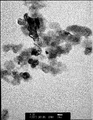
- FIG. 2 is a photomicrograph of Example 1, and it can be seen that black vanadium oxynitride exists so as to be included in silica.
- the insulating properties of the black powders of Examples 1 to 16 were measured by measuring the powder volume resistivity.
- the powder volume resistivity is measured by filling a cylindrical jig with powder, sandwiching the upper and lower sides with metal electrodes, applying a pressure of 50 kg / cm 2 with a hydraulic press, and measuring the resistance between the upper and lower electrodes with a digital multimeter (stock) Measured by the company Advantest).
- a digital multimeter stock
- the optical filter for attenuating visible light incorporated in the image light receiving element was produced using the black powder of Example 1, an optical with good absorption characteristics showing uniform attenuation characteristics even in the visible light region of 380 nm to 780 nm. A filter was obtained.
- This black powder is composed of vanadium oxynitride represented by the general formula VO x N y (where x and y satisfy the conditions 0 ⁇ x ⁇ 1.1 and 0 ⁇ y ⁇ 1.2), SiO 2 2 , ZrO 2 , TiO 2 , GeO 2 , Al 2 O 3 , Y 2 O 3 , P 2 O 5 , a mixture with one or more inorganic oxides, and vanadium in the mixture
- the concentration is 50% by mass or more and 75% by mass or less, the total concentration of inorganic oxides is 5% by mass or more and 20% by mass or less, and the average primary particle diameter is 50 nm or less.
- vanadium oxynitride is a mixture of vanadium hydroxide and an inorganic hydroxide containing one or more elements selected from Si, Zr, Ti, Ge, Al, Y, and P. It is a powder made of a mixture of vanadium oxynitride and inorganic oxide, which can be obtained by reducing hydroxide with ammonia gas at high temperature. In this reduction treatment, the amount of ammonia gas or the like is adjusted so that x and y in the formula of VO x N y are controlled to satisfy 0 ⁇ x ⁇ 1.1 and 0 ⁇ y ⁇ 1.2.
- the vanadium concentration in the black powder is 50% by mass to 75% by mass, and the total concentration of the inorganic oxide is 5% by mass to 20% by mass. If the vanadium concentration is less than 50% by mass, the desired light shielding properties cannot be obtained, and the blackness is lowered. When the vanadium concentration exceeds 75% by mass, the inorganic oxide is relatively insufficient, so that the primary particle size is increased and it is difficult to suppress sedimentation. If the total concentration of the inorganic oxide is less than 5% by mass, the effect of suppressing the increase in the particle size is poor, the primary particle size is increased, and the problem of sedimentation is not improved. When the total concentration of the inorganic oxides exceeds 20% by mass, the desired light-shielding property cannot be exhibited, the blackness is lowered, and the dispersion stability is also insufficient.
- the coating of the inorganic oxide on the vanadium oxynitride includes a partial case.
- the primary particles are apparent single particles that do not include aggregated particles.
- This particle diameter is measured by using a transmission electron microscope, for example, arbitrarily 10 times at a photographing magnification of 100,000, and the average of all the particles that have been photographed as a whole in each field of view. Calculate from the value.
- the specific surface area of this black powder is 60 m ⁇ 2 > / g or more.
- the primary particle diameter can be 50 nm or less.
- the L value of the L, a, b color system of this black powder is 15 or less. The smaller the L value, the higher the blackness.
- This production method comprises an inorganic hydroxide coating step for coating vanadium hydroxide with a specific inorganic hydroxide, and a reduction step for reducing the vanadium hydroxide coated with the inorganic hydroxide.
- a powder is produced.
- it demonstrates in order of this process.
- a water-soluble vanadium compound is dissolved in water to prepare a vanadium aqueous solution. You may add alcohol partially to water.
- the water-soluble vanadium compound vanadium chloride, vanadium oxide, vanadium oxychloride, or the like can be used.
- the obtained vanadium aqueous solution contains one or more elements selected from Si, Zr, Ti, Ge, Al, Y, P, such as water-soluble silica element, alumina element, phosphoric acid, zirconia element, etc.
- a water-soluble inorganic compound is added to produce a mixed hydroxide by coprecipitation reaction.
- sodium silicate, tetraethoxysilane (TEOS), ammonium chloride, phosphoric acid, hypophosphorous acid, phosphorous acid, zirconium chloride, titanium chloride, germanium chloride, aluminum chloride, yttrium chloride, and the like can be used.
- TEOS tetraethoxysilane
- ammonium chloride phosphoric acid, hypophosphorous acid, phosphorous acid, zirconium chloride, titanium chloride, germanium chloride, aluminum chloride, yttrium chloride, and the like
- titanium chloride germanium chloride
- aluminum chloride aluminum chloride
- yttrium chloride aluminum chloride
- a neutralizing agent for pH adjustment is added.
- the neutralizing agent ammonia, caustic soda, potassium hydroxide, ammonium bicarbonate, calcium hydroxide, or magnesium hydroxide can be used.
- a mixed hydroxide of the vanadium hydroxide and the inorganic hydroxide precipitates, and the precipitate is subjected to a drying treatment.
- the obtained mixed hydroxide becomes a powder of vanadium hydroxide (hereinafter also referred to as hydroxide coating product) coated with an inorganic hydroxide.
- This powder has a small specific surface area, for example, 40 m 2 / g or less.
- the hydroxide may be used as it is in the reduction process, but if it is hygroscopic and poor in stability, it may be heat treated in the atmosphere to form an oxide.
- the heat treatment temperature is 200 ° C. to 500 ° C., more preferably 250 ° C. to 350 ° C.
- the vanadium hydroxide coated with the inorganic hydroxide is heated in a nitrogen atmosphere and reduced with ammonia gas at a temperature of 700 to 1000 ° C. for 1 to 30 hours.
- a black powder made of a mixture of an inorganic oxide and vanadium oxynitride, specifically, a vanadium oxynitride black powder coated with an inorganic oxide is generated.
- This black powder is a black powder having a small primary particle size and capable of suppressing sedimentation.
- x and y in the formula of VO x N y as vanadium oxynitride are 0 ⁇ x ⁇ 1.1 and 0 ⁇ y ⁇ 1.2.
- vanadium hydroxide or vanadium oxide not covered with inorganic hydroxide if a high temperature reduction treatment is performed, the powder grows while it is sintered and the particle size of the resulting vanadium oxynitride increases. .
- reducing the vanadium hydroxide coated with the inorganic hydroxide sintering and grain growth are suppressed by the inorganic oxide, and primary particles having an average particle diameter of 50 nm or less can be obtained.
- the coated oxide can be partially reduced to become a low-order oxide, but even if it becomes a low-order oxide, the effect of suppressing the growth of vanadium oxynitride grains remains unchanged.
- the black powder thus produced can be dispersed in a dispersion and used as a black paint.
- the black resist produced using this black dispersion can be applied as a resin BM material for a color filter, whereby a liquid crystal panel with high definition and good visibility can be obtained.
- this black powder is applied to an optical filter for attenuating visible light incorporated in an image light receiving element, an optical filter having a good absorption characteristic showing a uniform attenuation characteristic in the visible light region can be obtained.
- this black powder can be applied to a display member such as a peripheral frame material of a touch panel, a lens unit, a light adjusting material for an image sensor, and the like.
- Example 17 Dissolve the vanadium chloride powder in water, add sodium silicate (water glass) to the resulting aqueous solution so that the silica is 10% by mass with respect to the total amount, add caustic soda to adjust the pH, and then dry the solution.
- a silica vanadium mixed hydroxide V (OH) 3 + Si (OH) 2
- the specific surface area of the hydroxide at this time was 3 m 2 / g.
- the obtained hydroxide coating product was heated to 800 ° C. at 7 ° C./min in an N 2 atmosphere, and then ammonia gas was allowed to flow for a predetermined time to obtain a nitridation-reduced black powder. It was 16 nm when the primary particle diameter was confirmed with the transmission electron microscope about this black powder. Table 2 shows the physical property values of the obtained black powder.
- the measurement conditions in Table 2 are as follows (same in each example and comparative example).
- the x value of VO x N y was measured by an inert gas melting-infrared absorption method, and the y value was measured by an inert gas melting-heat conduction method.
- the vanadium concentration (V concentration) was measured by titration after acid decomposition of the sample.
- the oxide concentration was measured by ICP emission spectrometry.
- the L value was measured according to the standard JISZ8722.
- the primary particle diameter is measured 10 times arbitrarily using a transmission electron microscope at an imaging magnification of 100,000, and the average of all the particles in which the entire single particle is photographed within each field of view is measured. The value was determined.
- the specific surface area was measured according to the standard JISZ8830.
- the transmittance was measured according to the standard JIS R3106.
- a paint was prepared as follows. When the paint was applied and the OD value (optical density) was measured with an OD meter (Macbeth D200), the OD value per film thickness of 1 ⁇ m was 3.5.
- the prepared paint (dispersion) was diluted 100,000 times and the transmittance curve was measured. The measurement results are shown in FIG. As shown in FIG. 3, a spectrum with particularly high light shielding properties around 450 nm was obtained.
- the paint was stored in a glass container, and after 1 month, the supernatant liquid (upper liquid) was collected and measured for non-volatile content by the evaporation to dryness method (analysis accuracy ⁇ 0.1%). The reduction rate was within 3% by mass, and it was confirmed that there was almost no sedimentation.
- Table 2 shows the concentrations immediately after the production of the dispersion and after one month.
- Example 18 Vanadium chloride powder was dissolved in water, and the resulting aqueous solution was added so that the inorganic oxide concentration in the black powder from which tetraethoxysilane (TEOS) was obtained was 12% by mass, and caustic soda was added for pH adjustment. Then, the silica vanadium mixed hydroxide was produced by performing a drying process. At this time, the specific surface area of the hydroxide was 3 m 2 / g.
- TEOS tetraethoxysilane
- the obtained hydroxide coating product was heated to 800 ° C. at 7 ° C./min in an N 2 atmosphere, and then ammonia gas was allowed to flow for a predetermined time to obtain a nitridation-reduced black powder. It was 35 nm when the primary particle diameter was confirmed with the transmission electron microscope about this black powder.
- Table 2 shows the physical properties of the obtained black powder and dispersion.
- Example 19 to 29 Various hydroxide coatings were prepared in the same manner as in Examples 17 and 17, and various black powders were obtained. Evaluation of a dispersion obtained by dispersing the obtained black powder in the same manner as in Example 17 was performed. Table 2 shows the production conditions, powder properties, and dispersion properties.
- a coating material was prepared as described above, and the prepared coating material (dispersion) was diluted 100,000 times and a transmittance curve was measured. As shown in Example 17, a highly light-shielding spectrum around 450 nm was obtained.
- the paint was stored in a glass container, and after 1 month, the supernatant liquid (upper liquid) was collected and the nonvolatile content was measured. As a result, the solid content concentration was 5.1% by mass, and it was confirmed that the liquid was settled. It was done.
- the physical properties of this dispersion are shown in Table 2.
- the obtained hydroxide raw material was heated to 800 ° C. at 7 ° C./min in an N 2 atmosphere, and then ammonia gas was allowed to flow for a predetermined time to obtain a black powder that was nitrided and reduced. At this time, the primary particle diameter of the black powder measured with a transmission electron microscope was 65 nm. Table 2 shows the physical property values of the obtained black powder.
- the obtained black powder is dispersed in a PGM-Ac solvent using a circulating horizontal bead mill (media: zirconia), and an acrylic resin is added to increase the produced paint (dispersion) by a factor of 100,000. Dilution and transmission curves were measured. As shown in Example 17, a highly light-shielding spectrum around 450 nm was obtained.
- This paint was stored in a glass container, and after 1 month, the supernatant liquid (upper liquid) was collected and the non-volatile content was measured. As a result, the solid content concentration was 20.1% by mass, and it was confirmed that the liquid had settled. It was done.
- the physical properties of this dispersion are shown in Table 2.
- Comparative Examples 6 and 7 Various hydroxides were prepared in the same manner as in Comparative Example 5 to obtain various black powders. Evaluation of the dispersion liquid which carried out the dispersion process of the obtained black powder similarly to the comparative example 5 was implemented. Table 2 shows the production conditions, powder properties, and dispersion properties. These dispersions were gelled and the nonvolatile content could not be measured.
- FIG. 4 is a photomicrograph of Example 17, showing that black vanadium oxynitride exists so as to be included in silica.
- FIG. 5 is a photomicrograph of Comparative Example 5, in which the particle size is large, whereas the example in FIG. 4 has a small particle size.
- the insulating properties of the black powders of Examples 17 to 24 were measured by measuring the powder volume resistivity.
- the powder volume resistivity is measured by filling a cylindrical jig with powder, sandwiching the upper and lower sides with metal electrodes, applying a pressure of 50 kg / cm 2 with a hydraulic press, and measuring the resistance between the upper and lower electrodes with a digital multimeter (stock) Measured by the company Advantest). As a result, all had high insulation of 1.0 ⁇ 10 5 ⁇ ⁇ cm or more.
- Example 17 when the black light powder of Example 17 was used to produce an optical filter for attenuating visible light incorporated in an image light receiving element, an optical filter having good absorption characteristics showing uniform attenuation characteristics in any visible light region was obtained. It was.
- the average value of the primary particle diameter is small, it is possible to obtain a black powder suitable for long-term storage by suppressing sedimentation in the dispersion.
Landscapes
- Chemical & Material Sciences (AREA)
- Organic Chemistry (AREA)
- Inorganic Chemistry (AREA)
- Life Sciences & Earth Sciences (AREA)
- Engineering & Computer Science (AREA)
- Materials Engineering (AREA)
- Wood Science & Technology (AREA)
- Inorganic Compounds Of Heavy Metals (AREA)
- Pigments, Carbon Blacks, Or Wood Stains (AREA)
Abstract
分散液中での黒色バナジウム酸窒化物粉末の沈降を抑制するため、酸化バナジウム粉末に、SiO2,ZrO2,TiO2,GeO2,Al2O3,Y2O3,P2O5の中から選ばれる一種または二種以上の酸化物を被覆した後に還元反応を生じさせることにより、一般式VOxNy(式中のx,yは、0<x<1.1,0<y<1.2の条件を満たす)で表わされるバナジウム酸窒化物と、このバナジウム酸窒化物を被覆する上記酸化物との混合物であり、混合物中のバナジウム濃度が50質量%以上80質量%以下であり、酸化物の合計濃度が5質量%以上20質量%以下であり、一次粒子径の平均値が70nm以下である黒色粉末を得た。
Description
本発明は、高い黒色度、遮光性、高い絶縁性を有し、全可視光領域を遮蔽する黒色粉末を提供するものである。
本願は、2013年5月9日に出願された特願2013-099422号、および2013年5月10日に出願された特願2013-099982号に基づき優先権を主張し、その内容をここに援用する。
本願は、2013年5月9日に出願された特願2013-099422号、および2013年5月10日に出願された特願2013-099982号に基づき優先権を主張し、その内容をここに援用する。
黒色粉末としては現在、カーボンブラック、酸化鉄、低次酸化チタン、酸窒化チタンなどの粉末が知られている。
カーボンブラックは黒色度、着色度とも優れており高い導電性を有しているが、嵩が大きいため、取り扱いが難しくまた樹脂とのなじみが良くない。また極微量ではあるが原料起因の発ガン性物質、3,4-ベンズピレンを伴うため、その安全性が問題となっている。
酸化鉄は磁性による凝集があり、分散性に劣る。耐熱性も悪く、大気中150℃付近で茶色のγ-Fe2O3に酸化される。
低次酸化チタンは二酸化チタン粉末をTi粉末、またはH2ガスにより1000℃以上の温度で還元して得られる粉末で、Ti3O5、Ti2O3等多種の構造を持つ混合物である。低次酸化チタンは高温での還元反応を行うため焼結、粒成長が著しく、顔料用としては不適な粗大粒子(1.0μm以上)となってしまう。
一方、特許文献1に記載されている黒色顔料である酸窒化チタン(チタンブラック)は二酸化チタンをアンモニアにより還元して得られ、半導電性を示す青みを帯びた特徴のある黒色を示す粒子径60nm~90nmの黒色顔料である。酸窒化チタンはまた、有害物質を含まないため、飲食品用プラスチックス、化粧品の原料として最適である。また近年、黒色顔料を樹脂に分散させ、フォトリソ法などでパターニングする事により液晶カラーフィルタ等画像形成素子のブラックマトリックス(以下樹脂BM)として応用する例が多数見受けられる。酸窒化チタンは高い隠蔽性や高絶縁性等ブラックマトリックス用黒色顔料としての優れた性質があり、今後益々の応用が期待される。
しかしながら、二酸化チタンを還元処理した低次酸化チタン、または酸窒化チタンは青みのある黒、あるいは黒色ではなく濃い青色顔料であり、可視光の短波長側、具体的には450nm付近の波長を透過してしまう問題があり、画像素子によって強く要求される青色光を遮蔽することが出来なかった。
このような課題を解決するために、低次酸化チタンや酸窒化チタンを赤みのある黒色であるカーボンブラックと混ぜることも提案されているが、カーボンは導電性があるためにブラックマトリックスとして要求される絶縁性が悪くなる、また、低次酸化チタンや酸窒化チタンは、カーボンと混ぜることにより凝集が起こり、均一な色味を出すことが困難であるという課題があった。
そこで発明者らが鋭意検討を行い、周期律表の5族の元素であるバナジウムやニオブの酸窒化物をアンモニアガスで還元処理することにより、従来得られなかった青色光を遮蔽する黒色顔料粉末が得られることを特許文献2に開示した。その中でもバナジウム酸窒化物については450nm付近の光の遮蔽効果により、遮光性も同時に向上することを開示した。
しかしながら、上記黒色バナジウム粉末は比重が5.0と大きく、また粒子径が100nm以上と酸窒化チタン粉末以上に大きいため、液状の薄膜形成剤として分散液に分散して使用する場合、固形物が沈降するため長期保存に適さないという課題がある。
本発明者は、上記課題を解決し、分散液中での黒色粉末の沈降を抑制するため鋭意検討を行ったところ、原料である酸化バナジウムにSiO2,ZrO2,TiO2,GeO2,Al2O3,Y2O3,P2O5の中から選ばれる一種または二種以上の無機酸化物を被覆した後に還元反応を生じさせることにより、還元反応時の粒成長を抑制し、生成物の粒子径を細かくすることが出来ることを見出した。本発明は、かかる知見の下、以下の解決手段とした。
本発明の黒色粉末は、一般式VOxNy(式中のx,yは、0<x<1.1,0<y<1.2の条件を満たす)で表わされるバナジウム酸窒化物と、該バナジウム酸窒化物を被覆するSiO2,ZrO2,TiO2,GeO2,Al2O3,Y2O3,P2O5の中から選ばれる一種または二種以上の無機酸化物との混合物であり、該混合物中のバナジウム濃度が50質量%以上80質量%以下であり、前記無機酸化物の合計濃度が5質量%以上20質量%以下であり、一次粒子径の平均値が70nm以下である。
この黒色粉末は一次粒子径の平均値が70nm以下と小さく、分散液中での沈降を抑制することができる。この場合、バナジウム濃度が50質量%未満であると、目的の遮光性が得られず、黒色度が低くなる。バナジウム濃度が80質量%を超えると、無機酸化物が相対的に不足することにより、一次粒子径が大きくなって、沈降を抑えることが難しくなる。無機酸化物の合計濃度は5質量%未満であると、粒子径の増大を抑制する効果に乏しく、一次粒子径が大きくなって沈降の問題が改善されない。無機酸化物の合計濃度が20質量%を超えると、目的の遮光性が発揮できずに黒色度が低下し、また分散液の安定性も不足する。
この黒色粉末において、比表面積は40m2/g以上であるとよく、比表面積が40m2/g以上であることにより、一次粒子径70nm以下とすることができる。
また、この黒色粉末のL値は15以下であるとよく、L値が小さいほど黒色度が高い。
なお、この黒色粉末において、無機酸化物は、バナジウム酸窒化物の全面を被覆するもの、及びバナジウム酸窒化物を部分的に被覆するものの両方を含むものとする。
この黒色粉末において前記混合物中のバナジウム濃度が50質量%以上75質量%以下であり、一次粒子径の平均値が50nm以下であってもよい。
この黒色粉末において、比表面積は60m2/g以上であるとよく、比表面積が60m2/g以上であることにより、一次粒子径50nm以下とすることができる。
なお、この無機酸化物は、バナジウム酸窒化物の全面を被覆するもの、及びバナジウム酸窒化物を部分的に被覆するものの両方を含むものとする。
本発明の黒色粉末の製造方法は、酸化バナジウム粉末をSiO2,ZrO2,TiO2,GeO2,Al2O3,Y2O3,P2O5の中から選ばれる一種または二種以上の無機酸化物により被覆する酸化物被覆工程と、前記無機酸化物で被覆された酸化バナジウム粉末をアンモニアガスにより還元処理する還元工程とを有する。
この製造方法では、酸化バナジウム粉末を予め無機酸化物によって被覆した後、還元処理するので、酸化バナジウムの焼結が無機酸化物により抑制され、一次粒子径の小さい黒色粉末を得ることができる。
本発明の黒色粉末の製造方法において、前記酸化物被覆工程により無機酸化物を被覆した酸化バナジウム粉末の比表面積が30m2/g以上であるとよい。
本発明の黒色粉末の製造方法において、前記酸化物被覆工程は、酸化バナジウム粉末を水中にて粉砕し、得られた水分散液にSi,Zr,Ti,Ge,Al,Y,Pの中から選ばれる一種または二種以上の元素を含む水溶性無機化合物を添加し、その分散液を乾燥、焼成するとよい。
この場合、前記水溶性無機化合物を珪酸ナトリウムとすることにより、前記酸化物被覆工程でSiO2を被覆した酸化バナジウム粉末を作製することができる。
また、前記酸化物被覆工程は、酸化バナジウム粉末を有機溶剤中で粉砕し、得られたスラリーにSi,Zr,Ti,Ge,Al,Y,Pの中から選ばれる一種または二種以上の元素を含む有機分散液金属アルコキシドなどの有機金属化合物を添加し、その分散液を乾燥、焼成するものとしてもよい。
また、本発明者は、水溶性バナジウム化合物を溶解した水溶液に、水溶性の酸化物元を加えて、これらを共沈反応させることにより、無機水酸化物で被覆したバナジウム水酸化物を生成し、得られたた混合水酸化物を還元すると、粒子径をより小さくすることができることを見出した。
かかる知見の下、本発明の黒色粉末の製造方法は、水溶性バナジウム化合物を溶解した水溶液に、Si,Zr,Ti,Ge,Al,Y,Pの中から選ばれる一種または二種以上の元素を含む水溶性無機化合物を添加してバナジウム混合水酸化物を沈殿析出させ、該バナジウム混合水酸化物を乾燥することにより、無機水酸化物で被覆されたバナジウム水酸化物を生成する無機水酸化物被覆工程と、前記無機水酸化物で被覆されたバナジウム水酸化物をアンモニアガスにより還元処理する還元工程とを有する。
この製造方法では、水溶性バナジウム化合物と水溶性無機化合物とを共沈させることにより、無機水酸化物によって被覆されたバナジウム水酸化物を得ることができ、これを乾燥した後、還元処理することにより、酸化バナジウムの焼結が無機酸化物により抑制され、一次粒子径の小さい黒色粉末を得ることができる。
本発明の黒色粉末の製造方法において、前記水溶性バナジウム化合物が酸化バナジウム、塩化バナジウム、オキシ塩化バナジウムであるとよい。
また、この製造方法において、前記水溶性無機化合物が珪酸ナトリウムであり、前記水酸化物被覆工程でシリカ水酸化物を被覆したバナジウム水酸化物を作製するとよい。
そして、本発明は、上記黒色粉末を含有する黒色ペースト、その黒色ペーストを塗布して形成した黒色薄膜、その黒色薄膜により作製された光学部品とすることができる。
黒色ペーストには黒色インキを含むものとし、光学部品には、画像表示装置、光学フィルター、画像受光素子等を含む。
本発明によれば、一次粒子径の平均値が小さいので、分散液中での沈降を抑制して、長期保存に適した黒色粉末を得ることができる。
以下、本発明の黒色粉末の第1実施形態について説明する。
この黒色粉末は、一般式VOxNy(式中のx,yは、0<x<1.1,0<y<1.2の条件を満たす)で表わされるバナジウム酸窒化物と、このバナジウム酸窒化物を被覆するSiO2,ZrO2,TiO2,GeO2,Al2O3,Y2O3,P2O5の中から選ばれる一種または二種以上の無機酸化物との混合物であり、その混合物中のバナジウム濃度が50質量%以上80質量%以下であり、無機酸化物の合計濃度が5質量%以上20質量%以下であり、一次粒子径の平均値が70nm以下である。
この黒色粉末は、一般式VOxNy(式中のx,yは、0<x<1.1,0<y<1.2の条件を満たす)で表わされるバナジウム酸窒化物と、このバナジウム酸窒化物を被覆するSiO2,ZrO2,TiO2,GeO2,Al2O3,Y2O3,P2O5の中から選ばれる一種または二種以上の無機酸化物との混合物であり、その混合物中のバナジウム濃度が50質量%以上80質量%以下であり、無機酸化物の合計濃度が5質量%以上20質量%以下であり、一次粒子径の平均値が70nm以下である。
バナジウム酸窒化物は、後述するように、酸化バナジウムを高温でアンモニアガスにより還元処理することにより得られる。この場合、SiO2,ZrO2,TiO2,GeO2,Al2O3,Y2O3,P2O5の中から選ばれる一種または二種以上の無機酸化物により酸化バナジウムを被覆処理しておき、その無機酸化物にて被覆処理した酸化バナジウムを還元処理することにより、バナジウム酸窒化物と無機酸化物との混合物からなる粉末が得られる。この還元処理において、アンモニアガス量等を調整して、VOxNyの式中のx,yが、0<x<1.1,0<y<1.2となるように制御する。
この黒色粉末中のバナジウム濃度は50質量%以上80質量%以下であり、無機酸化物の合計濃度は5質量%以上20質量%以下である。バナジウム濃度が50質量%未満であると、目的の遮光性が得られず、黒色度が低くなる。バナジウム濃度が80質量%を超えると、無機酸化物が相対的に不足することにより、一次粒子径が大きくなって、沈降を抑えることが難しくなる。無機酸化物の合計濃度は5質量%未満であると、粒子径の増大を抑制する効果に乏しく、一次粒子径が大きくなって沈降の問題が改善されない。無機酸化物の合計濃度が20質量%を超えると、目的の遮光性が発揮できずに黒色度が低下し、また分散液の安定性も不足する。
なお、バナジウム酸窒化物に対する無機酸化物の被覆は部分的である場合も含むものとする。
一次粒子径の平均値を70nm以下とすることにより、液状の薄膜形成剤として保管する際の分散液中での沈降を抑えることができる。尚、ここでの一次粒子は外見上の単一粒子で、凝集しているものを含まないものを指す。この粒子径は透過型電子顕微鏡を使用し、例えば、撮影倍率100000倍で任意に10回測定し、それぞれの視野内で一粒子の全体が撮影されているすべての粒子の径を測定して平均値から算出する。
また、この黒色粉末の比表面積は40m2/g以上である。比表面積が40m2/g以上であることにより、一次粒子径70nm以下とすることができる。
この黒色粉末のL、a、b表色系のL値は15以下である。L値が小さいほど黒色度が高い。
次に、この黒色粉末の製造方法について説明する。この製造方法は、酸化バナジウム粉末を特定の無機酸化物で被覆処理する酸化物被覆工程と、その無機酸化物で被覆した酸化バナジウム粉末を還元処理する還元工程とにより、黒色粉末を製造する。以下、この工程順に説明する。
<酸化物被覆工程>
まず、酸化バナジウムの粉末を用意し、これにSiO2,ZrO2,TiO2,GeO2,Al2O3,Y2O3,P2O5の中から選ばれる一種または二種以上の無機酸化物を被覆する。
まず、酸化バナジウムの粉末を用意し、これにSiO2,ZrO2,TiO2,GeO2,Al2O3,Y2O3,P2O5の中から選ばれる一種または二種以上の無機酸化物を被覆する。
酸化バナジウムの粉末は破砕により形成される。粉砕方法はボールミル、アトライタ、ビーズミルなどを用いた方法が挙げられるが、均一に短時間で粉砕するためにはビーズミルを用いた方法が有効である。
この破砕された酸化バナジウムに上記の無機酸化物を被覆する代表的な方法として次の湿式コーティング法が挙げられる。
(1)破砕された酸化バナジウムを水に混合して得たスラリーに、Si,Zr,Ti,Ge,Al,Y,Pの中から選ばれる一種または二種以上の元素を含む水溶性の無機酸化物原料(例えば珪ケイ酸ナトリウム)を反応させ、余分なアルカリイオンをデカンテーション、イオン交換樹脂などで除去した後に乾燥する。
(2)破砕された酸化バナジウムをアルコールなどの有機溶剤に混合して得たスラリーにSi,Zr,Ti,Ge,Al,Y,Pの中から選ばれる一種または二種以上の元素を含むアルコキシドなどの有機金属化合物を添加し、高温で焼成を行うことでゾルゲル反応により粉末表面に無機酸化物のコーティングを施す。
いずれの方法でも酸化バナジウムに無機酸化物を被覆する効果があることが確認されている。
この湿式コーティング法により、SiO2,ZrO2,TiO2,GeO2,Al2O3,Y2O3,P2O5の中から選ばれる一種または二種以上の無機酸化物を被覆した酸化バナジウム(以下酸化物コーティング物ともいう)の粉末が得られる。この粉末は、比表面積が30m2/g以上とすることが望ましい。この還元処理前の無機酸化物を被覆した酸化バナジウムの比表面積が30m2/g未満では、還元処理後に得られる黒色粉末の一次粒子径を70nm以下とするのが難しい。
<還元工程>
次に、無機酸化物を被覆した酸化バナジウムを窒素雰囲気にて昇温し、アンモニアガスを用いて700℃~1000℃の温度で1時間~30時間還元処理する。この還元処理により、一次粒子径が小さく、沈降を抑えられる黒色粉末を得ることができる。なお、無機酸化物で全面を被覆した場合でも還元反応は進む。これは還元処理用のガスが被覆部を透過することで、還元反応が進むのではないかと思われる。
次に、無機酸化物を被覆した酸化バナジウムを窒素雰囲気にて昇温し、アンモニアガスを用いて700℃~1000℃の温度で1時間~30時間還元処理する。この還元処理により、一次粒子径が小さく、沈降を抑えられる黒色粉末を得ることができる。なお、無機酸化物で全面を被覆した場合でも還元反応は進む。これは還元処理用のガスが被覆部を透過することで、還元反応が進むのではないかと思われる。
前述したように、アンモニアガスの流量等を調整することにより、バナジウム酸窒化物としてのVOxNyの式中のx,yが、0<x<1.1,0<y<1.2となるように制御する。
無機酸化物により被覆されていない酸化バナジウムの場合、高温の還元処理を施すと、酸化バナジウム粉末が焼結しながら粒成長して、得られるバナジウム酸窒化物の粒子径が大きくなる。無機酸化物により被覆した酸化バナジウムを還元処理することにより、焼結と粒成長が無機酸化物により抑制され、平均粒子径70nm以下の一次粒子を得ることができる。
尚、被覆した無機酸化物は部分的に還元され、低次酸化物となりうるが、低次酸化物となってもバナジウム酸窒化物の粒成長を抑制する効果に変わりはない。
このようにして製造された黒色粉末は、分散液に分散して黒色塗料として用いることができる。この黒色の分散液を使用して作製した黒色レジストは、カラーフィルタの樹脂BM材として適用することができ、これにより高精細かつ視認性の良好な液晶パネルを得ることができる。
さらに、この黒色粉末を画像受光素子に組み込まれる可視光減衰用光学フィルターに適用すれば、可視光領域において均等な減衰特性を示す、良好な吸収特性の光学フィルターを得ることができる。その他、この黒色粉末は、タッチパネルの周辺額縁材等のディスプレイ部材、レンズユニット、イメージセンサー用光調整材等に適用することができる。
(実施例1)
比表面積8m2/gの酸化バナジウム粉末をビーズミルにより水中で粉砕処理を施し、得られた水スラリーに珪酸ナトリウム(水ガラス)を得られる黒色粉末中の無機酸化物濃度が11質量%となるように添加し、乾燥処理を施すことによりシリカ(SiO2)をコーティングし、酸化物コーティング物を得た。この時の酸化物コーティング物の比表面積は40m2/gであった。
比表面積8m2/gの酸化バナジウム粉末をビーズミルにより水中で粉砕処理を施し、得られた水スラリーに珪酸ナトリウム(水ガラス)を得られる黒色粉末中の無機酸化物濃度が11質量%となるように添加し、乾燥処理を施すことによりシリカ(SiO2)をコーティングし、酸化物コーティング物を得た。この時の酸化物コーティング物の比表面積は40m2/gであった。
得られた酸化物コーティング物をN2雰囲気にて7℃/minで800℃まで昇温後、所定時間アンモニアガスを流して窒化還元された黒色粉末を得た。この黒色粉末について透過型電子顕微鏡により一次粒子径を確認したところ、52nmであった。得られた黒色粉末の物性値を表1に示す。
表1における測定条件は以下の通りである(各実施例、比較例において同じ)。
VOxNyのx値は不活性ガス融解-赤外線吸収法、y値は不活性ガス融解-熱伝導法により、それぞれ測定した。
バナジウム濃度(V濃度)は試料を酸分解後、滴定法により測定した。
酸化物濃度(無機酸化物の合計濃度)は、ICP発光分光測定法により測定した。
L値は規格JISZ8722に従って測定した。
一次粒子径は、透過型電子顕微鏡を使用して、撮影倍率100000倍で任意に10回測定し、それぞれの視野内で一粒子の全体が撮影されているすべての粒子の径を測定して平均値を求めた。
比表面積は規格JISZ8830に従って測定した。
透過率は規格JISR3106に従って測定した。
VOxNyのx値は不活性ガス融解-赤外線吸収法、y値は不活性ガス融解-熱伝導法により、それぞれ測定した。
バナジウム濃度(V濃度)は試料を酸分解後、滴定法により測定した。
酸化物濃度(無機酸化物の合計濃度)は、ICP発光分光測定法により測定した。
L値は規格JISZ8722に従って測定した。
一次粒子径は、透過型電子顕微鏡を使用して、撮影倍率100000倍で任意に10回測定し、それぞれの視野内で一粒子の全体が撮影されているすべての粒子の径を測定して平均値を求めた。
比表面積は規格JISZ8830に従って測定した。
透過率は規格JISR3106に従って測定した。
得られた黒色粉末を循環式横型ビーズミル(メディア:ジルコニア)を使用し、アミン系分散剤を使用しPGM-Ac溶剤中での分散処理を行った後、作製した分散液を10万倍に希釈して透過率曲線を測定した。測定結果を図1に示す。図1に示すように特に450nm付近の遮光性の高いスペクトルが得られた。
また、黒色粉末の濃度を25質量%に調整した分散液をガラス容器にて保管し、1ヶ月経過後に上澄み液(上部液)を採取、蒸発乾固法により不揮発分測定(分析精度は±0.1%)を実施したところ、固形分減少率は0.1質量%であり、沈降をほとんどしていないことが確認された。分散液製造直後と1ヶ月経過後の濃度を表1に示す。
(実施例2)
比表面積8m2/gの酸化バナジウム粉末をビーズミルによりエタノール中で粉砕処理を施し、得られたスラリーにテトラエトキシシラン(TEOS)を得られる黒色粉末中の無機酸化物濃度が5質量%となるように添加し、乾燥処理を施すことによりシリカ(SiO2)をコーティングした。この時の酸化物コーティング物の比表面積は45m2/gであった。
比表面積8m2/gの酸化バナジウム粉末をビーズミルによりエタノール中で粉砕処理を施し、得られたスラリーにテトラエトキシシラン(TEOS)を得られる黒色粉末中の無機酸化物濃度が5質量%となるように添加し、乾燥処理を施すことによりシリカ(SiO2)をコーティングした。この時の酸化物コーティング物の比表面積は45m2/gであった。
得られた酸化物コーティング物をN2雰囲気にて7℃/minで800℃まで昇温後、所定時間アンモニアガスを流して窒化還元された黒色粉末を得た。この黒色粉末について透過型電子顕微鏡により一次粒子径を確認したところ、68nmであった。得られた黒色粉末及び分散液の物性値を表1に示す。
(実施例3~16)
実施例1及び2と同様な手法で各種酸化物コーティング物を使用し種々の黒色粉末を作製し、得られた黒色粉末を分散処理した分散液の評価を実施した。製造条件、粉末物性、分散液物性を表1に示す。
実施例1及び2と同様な手法で各種酸化物コーティング物を使用し種々の黒色粉末を作製し、得られた黒色粉末を分散処理した分散液の評価を実施した。製造条件、粉末物性、分散液物性を表1に示す。
(比較例1)
比表面積8m2/gの酸化バナジウム粉末をN2雰囲気にて7℃/minで800℃まで昇温後、所定時間アンモニアガスを流して窒化還元された黒色粉末を得た。得られた黒色粉末の物性値を表1に示す。
比表面積8m2/gの酸化バナジウム粉末をN2雰囲気にて7℃/minで800℃まで昇温後、所定時間アンモニアガスを流して窒化還元された黒色粉末を得た。得られた黒色粉末の物性値を表1に示す。
得られた黒色粉末を循環式横型ビーズミル(メディア:ジルコニア)を使用し、アミン系分散剤を使用しPGM-Ac溶剤中での分散処理を行った後、作製した分散液を10万倍に希釈し透過率曲線を測定した。実施例1に示すのと同様、450nm付近の遮光性の高いスペクトルが得られた。
黒色粉末濃度25質量%に調整した分散液をガラス容器にて保管し、1ヶ月経過後に上澄み液(上部液)を採取、不揮発分測定を実施したところ、固形分濃度は5.1質量%であり、沈降していることが確認された。この分散液の物性を表1に示す。
(比較例2)
酸化バナジウム粉末をビーズミルにより水中で粉砕処理を施し、得られた水スラリーに珪酸ナトリウム(水ガラス)を得られる黒色粉末中の無機酸化物濃度が4質量%となるように添加し、乾燥処理を施すことによりシリカ(SiO2)をコーティングした。この酸化物コーティング物粉末の比表面積は25m2/gであった。
酸化バナジウム粉末をビーズミルにより水中で粉砕処理を施し、得られた水スラリーに珪酸ナトリウム(水ガラス)を得られる黒色粉末中の無機酸化物濃度が4質量%となるように添加し、乾燥処理を施すことによりシリカ(SiO2)をコーティングした。この酸化物コーティング物粉末の比表面積は25m2/gであった。
得られた酸化物原料をN2雰囲気にて7℃/minで800℃まで昇温後、所定時間アンモニアガスを流して窒化還元された黒色粉末を得た。このとき透過型電子顕微鏡から測定された黒色粉末の一次粒子径は75nmだった。得られた黒色粉末の物性値を表1に示す。
得られた黒色粉末を循環式横型ビーズミル(メディア:ジルコニア)を使用し、アミン系分散剤を使用しPGM-Ac溶剤中での分散処理を行った後、作製した分散液を10万倍に希釈し透過率曲線を測定した。実施例1に示すのと同様、450nm付近の遮光性の高いスペクトルが得られた。
黒色粉末濃度25質量%に調整した分散液をガラス容器にて保管し、1ヶ月経過後に上澄み液(上部液)を採取、不揮発分測定を実施したところ、固形分濃度は23.1質量%であり、沈降していることが確認された。この分散液の物性を表1に示す。
(比較例3)
酸化バナジウム粉末をビーズミルにより水中で粉砕処理を施し、得られた水スラリーに珪酸ナトリウム(水ガラス)を得られる黒色粉末中の無機酸化物濃度が22質量%となるように添加し、乾燥処理を施すことによりシリカ(SiO2)をコーティングした。
酸化バナジウム粉末をビーズミルにより水中で粉砕処理を施し、得られた水スラリーに珪酸ナトリウム(水ガラス)を得られる黒色粉末中の無機酸化物濃度が22質量%となるように添加し、乾燥処理を施すことによりシリカ(SiO2)をコーティングした。
得られた酸化物コーティング物をN2雰囲気にて7℃/minで800℃まで昇温後、所定時間アンモニアガスを流して窒化還元された黒色粉末を得た。得られた黒色粉末の物性値を表1に示す。
得られた黒色粉末を循環式横型ビーズミル(メディア:ジルコニア)を使用し、アミン系分散剤を使用しPGM-Ac溶剤中での分散処理を行った後、作製した分散液を10万倍に希釈し透過率曲線を測定した。測定結果を図1に示す。実施例1に示すのと同様、450nm付近の遮光性の高いスペクトルが得られた。
黒色粉末濃度25質量%に調整した分散液をガラス容器にて保管し、1ヶ月経過後に上澄み液(上部液)を採取、不揮発分測定を実施しようとしたが、分散液がゲル化しており、不揮発分の測定ができなかった。この分散液の物性を表1に示す。

表1からわかるように、バナジウム濃度が50質量%以上80質量%以下、無機酸化物の合計濃度が5質量%以上20質量%以下、一次粒子径の平均値が70nm以下であると、分散液での沈降を抑えることができる黒色粉末が得られる。
図2は、実施例1の顕微鏡写真であり、黒色のバナジウム酸窒化物がシリカに包含されるように存在していることがわかる。
なお、実施例1~16の黒色粉末について、圧粉体積抵抗率を測定することにより絶縁性を測定した。圧粉体積抵抗率は粉末を円筒状の治具に充填後、上下を金属製電極ではさみ、油圧プレスにより50kg/cm2の圧力を印加、上下の電極間の抵抗値をデジタルマルチメーター(株式会社アドバンテスト製)により測定した。その結果、いずれも1.0×105Ω・cm以上の高い絶縁性を有していた。
また、実施例1の黒色分散液を使用して黒色レジストを作製し、カラーフィルタの樹脂BM材として適用したところ、高精細かつ視認性の良好な液晶パネルが得られた。
さらに、実施例1の黒色粉末を使用して画像受光素子に組み込まれる可視光減衰用光学フィルターを作製したところ、380nm~780nmの可視光領域でも均等な減衰特性を示す、良好な吸収特性の光学フィルターが得られた。
以下、本発明の黒色粉末の第2実施形態について説明する。
この黒色粉末は、一般式VOxNy(式中のx,yは、0<x<1.1,0<y<1.2の条件を満たす)で表わされるバナジウム酸窒化物と、SiO2,ZrO2,TiO2,GeO2,Al2O3,Y2O3,P2O5の中から選ばれる一種または二種以上の無機酸化物との混合物であり、その混合物中のバナジウム濃度が50質量%以上75質量%以下であり、無機酸化物の合計濃度が5質量%以上20質量%以下であり、一次粒子径の平均値が50nm以下である。
この黒色粉末は、一般式VOxNy(式中のx,yは、0<x<1.1,0<y<1.2の条件を満たす)で表わされるバナジウム酸窒化物と、SiO2,ZrO2,TiO2,GeO2,Al2O3,Y2O3,P2O5の中から選ばれる一種または二種以上の無機酸化物との混合物であり、その混合物中のバナジウム濃度が50質量%以上75質量%以下であり、無機酸化物の合計濃度が5質量%以上20質量%以下であり、一次粒子径の平均値が50nm以下である。
バナジウム酸窒化物は、後述するように、水酸化バナジウムと、Si,Zr,Ti,Ge,Al,Y,Pの中から選ばれる一種または二種以上の元素を含む無機水酸化物との混合水酸化物を高温でアンモニアガスによって還元処理することにより得ることができ、バナジウム酸窒化物と無機酸化物との混合物からなる粉末である。この還元処理において、アンモニアガス量等を調整して、VOxNyの式中のx,yが、0<x<1.1,0<y<1.2となるように制御する。
この黒色粉末中のバナジウム濃度は50質量%以上75質量%以下であり、無機酸化物の合計濃度は5質量%以上20質量%以下である。バナジウム濃度が50質量%未満であると、目的の遮光性が得られず、黒色度が低くなる。バナジウム濃度が75質量%を超えると、無機酸化物が相対的に不足することにより、一次粒子径が大きくなって、沈降を抑えることが難しくなる。無機酸化物の合計濃度は5質量%未満であると、粒子径の増大を抑制する効果に乏しく、一次粒子径が大きくなって沈降の問題が改善されない。無機酸化物の合計濃度が20質量%を超えると、目的の遮光性が発揮できずに黒色度が低下し、また分散液の安定性も不足する。
なお、バナジウム酸窒化物に対する無機酸化物の被覆は部分的である場合も含むものとする。
一次粒子径の平均値を50nm以下とすることにより、液状の薄膜形成剤として保管する際の分散液中での沈降を抑えることができる。尚、ここでの一次粒子は外見上の単一粒子で、凝集しているものを含まないものを指す。
この粒子径は透過型電子顕微鏡を使用し、例えば、撮影倍率100000倍で任意に10回測定し、それぞれの視野内で一粒子の全体が撮影されているすべての粒子の径を測定して平均値から算出する。
また、この黒色粉末の比表面積は60m2/g以上である。比表面積が60m2/g以上であることにより、一次粒子径50nm以下とすることができる。
この黒色粉末のL、a、b表色系のL値は15以下である。L値が小さいほど黒色度が高い。
次に、この黒色粉末の製造方法について説明する。この製造方法は、バナジウム水酸化物を特定の無機水酸化物で被覆処理する無機水酸化物被覆工程と、その無機水酸化物で被覆したバナジウム水酸化物を還元処理する還元工程とにより、黒色粉末を製造する。以下、この工程順に説明する。
<無機水酸化物被覆工程>
まず、水溶性のバナジウム化合物を水に溶解してバナジウム水溶液を作製する。水に一部アルコールを添加してもよい。水溶性のバナジウム化合物としては、塩化バナジウム、酸化バナジウム、オキシ塩化バナジウムなどを用いることができる。得られたバナジウム水溶液に、水溶性のシリカ元、アルミナ元、リン酸、ジルコニア元など、Si,Zr,Ti,Ge,Al,Y,Pの中から選ばれる一種または二種以上の元素を含む水溶性の無機化合物を加え、共沈反応による混合水酸化物を作製する。無機化合物としては、珪酸ナトリウム、テトラエトキシシラン(TEOS)、塩化アンモニウム、りん酸、次亜りん酸、亜りん酸、塩化ジルコニウム、塩化チタン、塩化ゲルマニウム、塩化アルミニウム、塩化イットリウムなどを用いることができる。また、添加材として水溶性のシランカップリング剤、コロイダルシリカ、コロイダルアルミナ、ジルコニアなどナノ粒子サイズのスラリーを添加してもよい。
まず、水溶性のバナジウム化合物を水に溶解してバナジウム水溶液を作製する。水に一部アルコールを添加してもよい。水溶性のバナジウム化合物としては、塩化バナジウム、酸化バナジウム、オキシ塩化バナジウムなどを用いることができる。得られたバナジウム水溶液に、水溶性のシリカ元、アルミナ元、リン酸、ジルコニア元など、Si,Zr,Ti,Ge,Al,Y,Pの中から選ばれる一種または二種以上の元素を含む水溶性の無機化合物を加え、共沈反応による混合水酸化物を作製する。無機化合物としては、珪酸ナトリウム、テトラエトキシシラン(TEOS)、塩化アンモニウム、りん酸、次亜りん酸、亜りん酸、塩化ジルコニウム、塩化チタン、塩化ゲルマニウム、塩化アルミニウム、塩化イットリウムなどを用いることができる。また、添加材として水溶性のシランカップリング剤、コロイダルシリカ、コロイダルアルミナ、ジルコニアなどナノ粒子サイズのスラリーを添加してもよい。
この場合、pH調整のための中和剤を添加する。中和剤としては、アンモニア、苛性ソーダ、水酸化カリウム、重炭酸アンモニウム、水酸化カルシウム、水酸化マグネシウムを用いることができる。
この水溶性バナジウムと水溶性の無機化合物とを混合することにより、バナジウム水酸化物と無機水酸化物との混合水酸化物が沈殿析出するので、この沈殿物を乾燥処理する。得られた混合水酸化物は、無機水酸化物で被覆されたバナジウム水酸化物(以下、水酸化物コーティング物ともいう)の粉末となる。この粉末は、比表面積が小さく、例えば40m2/g以下のものが得られる。
尚、水酸化物をそのまま還元行程に使用してもよいが、吸湿性があり安定性に乏しい場合、大気中での熱処理を行い、酸化物にしてもよい。熱処理温度は200℃~500℃、さらに望ましくは250℃~350℃がよい。
<還元工程>
次に、無機水酸化物を被覆したバナジウム水酸化物を窒素雰囲気にて昇温し、アンモニアガスを用いて700℃~1000℃の温度で1時間~30時間還元処理する。この還元処理により、無機酸化物とバナジウム酸窒化物との混合物からなる黒色粉末、具体的には無機酸化物により被覆されたバナジウム酸窒化物の黒色粉末が生成される。この黒色粉末は、一次粒子径が小さく、沈降を抑えられる黒色粉末である。
次に、無機水酸化物を被覆したバナジウム水酸化物を窒素雰囲気にて昇温し、アンモニアガスを用いて700℃~1000℃の温度で1時間~30時間還元処理する。この還元処理により、無機酸化物とバナジウム酸窒化物との混合物からなる黒色粉末、具体的には無機酸化物により被覆されたバナジウム酸窒化物の黒色粉末が生成される。この黒色粉末は、一次粒子径が小さく、沈降を抑えられる黒色粉末である。
前述したように、アンモニアガスの流量等を調整することにより、バナジウム酸窒化物としてのVOxNyの式中のx,yが、0<x<1.1,0<y<1.2となるように制御する。
無機水酸化物により被覆されていないバナジウム水酸化物や酸化バナジウムの場合、高温の還元処理を施すと、粉末が焼結しながら粒成長して、得られるバナジウム酸窒化物の粒子径が大きくなる。無機水酸化物により被覆したバナジウム水酸化物を還元処理することにより、焼結と粒成長が無機酸化物により抑制され、平均粒子径50nm以下の一次粒子を得ることができる。
尚、被覆した酸化物は部分的に還元され、低次酸化物となりうるが、低次酸化物となってもバナジウム酸窒化物の粒成長抑制する効果に変わりはない。
このようにして製造された黒色粉末は、分散液に分散して黒色塗料として用いることができる。この黒色の分散液を使用して作製した黒色レジストは、カラーフィルタの樹脂BM材として適用することができ、これにより高精細かつ視認性の良好な液晶パネルを得ることができる。
さらに、この黒色粉末を画像受光素子に組み込まれる可視光減衰用光学フィルターに適用すれば、可視光領域において均等な減衰特性を示す、良好な吸収特性の光学フィルターを得ることができる。その他、この黒色粉末は、タッチパネルの周辺額縁材等のディスプレイ部材、レンズユニット、イメージセンサー用光調整材等に適用することができる。
(実施例17)
塩化バナジウム粉末を水中に溶解し、得られた水溶液に珪酸ナトリウム(水ガラス)をシリカが全体量に対し10質量%となるように添加し、pH調整のため苛性ソーダを添加した後、乾燥処理を施すことによりシリカバナジウム混合水酸化物(V(OH)3+Si(OH)2)を作製した。このときの水酸化物の比表面積は3m2/gであった。
塩化バナジウム粉末を水中に溶解し、得られた水溶液に珪酸ナトリウム(水ガラス)をシリカが全体量に対し10質量%となるように添加し、pH調整のため苛性ソーダを添加した後、乾燥処理を施すことによりシリカバナジウム混合水酸化物(V(OH)3+Si(OH)2)を作製した。このときの水酸化物の比表面積は3m2/gであった。
得られた水酸化物コーティング物をN2雰囲気にて7℃/minで800℃まで昇温後、所定時間アンモニアガスを流して窒化還元された黒色粉末を得た。この黒色粉末について透過型電子顕微鏡により一次粒子径を確認したところ、16nmであった。得られた黒色粉末の物性値を表2に示す。
表2における測定条件は以下の通りである(各実施例、比較例において同じ)。
VOxNyのx値は不活性ガス融解-赤外線吸収法、y値は不活性ガス融解-熱伝導法によりそれぞれ測定した。
バナジウム濃度(V濃度)は試料を酸分解後、滴定法により測定した。
酸化物濃度は、ICP発光分光測定法により測定した。
L値は規格JISZ8722に従って測定した。
一次粒子径は、透過型電子顕微鏡を使用して、撮影倍率100000倍で任意に10回測定し、それぞれの視野内で一粒子の全体が撮影されているすべての粒子の径を測定して平均値を求めた。
比表面積は規格JISZ8830に従って測定した。
透過率は規格JISR3106に従って測定した。
VOxNyのx値は不活性ガス融解-赤外線吸収法、y値は不活性ガス融解-熱伝導法によりそれぞれ測定した。
バナジウム濃度(V濃度)は試料を酸分解後、滴定法により測定した。
酸化物濃度は、ICP発光分光測定法により測定した。
L値は規格JISZ8722に従って測定した。
一次粒子径は、透過型電子顕微鏡を使用して、撮影倍率100000倍で任意に10回測定し、それぞれの視野内で一粒子の全体が撮影されているすべての粒子の径を測定して平均値を求めた。
比表面積は規格JISZ8830に従って測定した。
透過率は規格JISR3106に従って測定した。
得られた黒色粉末を循環式横型ビーズミル(メディア:ジルコニア)を使用し、PGM-Ac溶剤中での分散処理を行い、アクリル樹脂を添加して、質量比率で黒色粉末:樹脂=6:4となるように塗料を作製した。その塗料を塗布してOD計(マクベス社D200)によりOD値(光学濃度)を測定したところ、膜厚1μm辺りのOD値は3.5であった。作製した塗料(分散液)を10万倍に希釈して透過率曲線を測定した。測定結果を図3に示す。図3に示すように特に450nm付近の遮光性の高いスペクトルが得られた。
また、この塗料をガラス容器にて保管し、1ヶ月経過後に上澄み液(上部液)を採取、蒸発乾固法により不揮発分測定(分析精度は±0.1%)を実施したところ、固形分減少率は3質量%以内であり、沈降をほとんどしていないことが確認された。分散液製造直後と1ヶ月経過後の濃度を表2に示す。
(実施例18)
塩化バナジウム粉末を水中に溶解し、得られた水溶液にテトラエトキシシラン(TEOS)を得られる黒色粉末中の無機酸化物濃度が12質量%となるように添加し、pH調整のため苛性ソーダを添加した後、乾燥処理を施すことによりシリカバナジウム混合水酸化物を作製した。この時の水酸化物の比表面積は3m2/gであった。
塩化バナジウム粉末を水中に溶解し、得られた水溶液にテトラエトキシシラン(TEOS)を得られる黒色粉末中の無機酸化物濃度が12質量%となるように添加し、pH調整のため苛性ソーダを添加した後、乾燥処理を施すことによりシリカバナジウム混合水酸化物を作製した。この時の水酸化物の比表面積は3m2/gであった。
得られた水酸化物コーティング物をN2雰囲気にて7℃/minで800℃まで昇温後、所定時間アンモニアガスを流して窒化還元された黒色粉末を得た。この黒色粉末について透過型電子顕微鏡により一次粒子径を確認したところ、35nmであった。得られた黒色粉末及び分散液の物性値を表2に示す。
(実施例19~29)
実施例17及び17と同様な手法で各種水酸化物コーティング物を作製し種々の黒色粉末を得た。得られた黒色粉末を実施例17と同様に分散処理した分散液の評価を実施した。製造条件、粉末物性、分散液物性を表2に示す。
実施例17及び17と同様な手法で各種水酸化物コーティング物を作製し種々の黒色粉末を得た。得られた黒色粉末を実施例17と同様に分散処理した分散液の評価を実施した。製造条件、粉末物性、分散液物性を表2に示す。
(比較例4)
塩化バナジウム粉末を水中に溶解し、得られた水酸化物を乾燥した後、N2雰囲気にて7℃/minで800℃まで昇温後、所定時間アンモニアガスを流して窒化還元された黒色粉末を得た。得られた黒色粉末の物性値を表2に示す。
塩化バナジウム粉末を水中に溶解し、得られた水酸化物を乾燥した後、N2雰囲気にて7℃/minで800℃まで昇温後、所定時間アンモニアガスを流して窒化還元された黒色粉末を得た。得られた黒色粉末の物性値を表2に示す。
得られた黒色粉末を循環式横型ビーズミル(メディア:ジルコニア)を使用し、PGM-Ac溶剤中での分散処理を行い、アクリル樹脂を添加して、質量比率で黒色粉末:樹脂=6:4となるように塗料を作製して、作製した塗料(分散液)を10万倍に希釈し透過率曲線を測定した。実施例17に示すのと同様、450nm付近の遮光性の高いスペクトルが得られた。
この塗料をガラス容器にて保管し、1ヶ月経過後に上澄み液(上部液)を採取、不揮発分測定を実施したところ、固形分濃度は5.1質量%であり、沈降していることが確認された。この分散液の物性を表2に示す。
(比較例5)
塩化バナジウム粉末を水中に溶解し、得られた水溶液に珪酸ナトリウム(水ガラス)を得られる黒色粉末中の無機酸化物濃度が4質量%となるように添加、乾燥処理を施すことによりシリカバナジウム混合水酸化物を作製した。この水酸化物の比表面積は18m2/gであった。
塩化バナジウム粉末を水中に溶解し、得られた水溶液に珪酸ナトリウム(水ガラス)を得られる黒色粉末中の無機酸化物濃度が4質量%となるように添加、乾燥処理を施すことによりシリカバナジウム混合水酸化物を作製した。この水酸化物の比表面積は18m2/gであった。
得られた水酸化物原料をN2雰囲気にて7℃/minで800℃まで昇温後、所定時間アンモニアガスを流して窒化還元された黒色粉末を得た。このとき透過型電子顕微鏡から測定された黒色粉末の一次粒子径は65nmだった。得られた黒色粉末の物性値を表2に示す。
得られた黒色粉末を循環式横型ビーズミル(メディア:ジルコニア)を使用し、PGM-Ac溶剤中での分散処理を行い、アクリル樹脂を添加して、作製した塗料(分散液)を10万倍に希釈し透過率曲線を測定した。実施例17に示すのと同様、450nm付近の遮光性の高いスペクトルが得られた。
この塗料をガラス容器にて保管し、1ヶ月経過後に上澄み液(上部液)を採取、不揮発分測定を実施したところ、固形分濃度は20.1質量%であり、沈降していることが確認された。この分散液の物性を表2に示す。
(比較例6、7)
比較例5と同様な手法で各種水酸化物を作製し、種々の黒色粉末を得た。得られた黒色粉末を比較例5と同様に分散処理した分散液の評価を実施した。製造条件、粉末物性、分散液物性を表2に示す。これらの分散液はゲル化しており、不揮発分の測定ができなかった。
比較例5と同様な手法で各種水酸化物を作製し、種々の黒色粉末を得た。得られた黒色粉末を比較例5と同様に分散処理した分散液の評価を実施した。製造条件、粉末物性、分散液物性を表2に示す。これらの分散液はゲル化しており、不揮発分の測定ができなかった。

表2からわかるように、バナジウム濃度が50質量%以上75質量%以下、無機酸化物の合計濃度が5質量%以上20質量%以下、一次粒子径の平均値が50nm以下であると、分散液での沈降を抑えることができる黒色粉末が得られる。
図4は、実施例17の顕微鏡写真であり、黒色のバナジウム酸窒化物がシリカに包含されるように存在していることがわかる。図5は比較例5の顕微鏡写真であり、粒子径が大きく、これに対して図4の実施例のものは粒子径が小さい。
なお、実施例17~24の黒色粉末について、圧粉体積抵抗率を測定することにより絶縁性を測定した。圧粉体積抵抗率は粉末を円筒状の治具に充填後、上下を金属製電極ではさみ、油圧プレスにより50kg/cm2の圧力を印加、上下の電極間の抵抗値をデジタルマルチメーター(株式会社アドバンテスト製)により測定した。その結果、いずれも1.0×105Ω・cm以上の高い絶縁性を有していた。
また、実施例17の黒色分散液を使用して黒色レジストを作製し、カラーフィルタの樹脂BM材として適用したところ、高精細かつ視認性の良好な液晶パネルが得られた。
さらに、実施例17の黒色粉末を使用して画像受光素子に組み込まれる可視光減衰用光学フィルターを作製したところ、どの可視光領域でも均等な減衰特性を示す、良好な吸収特性の光学フィルターが得られた。
一次粒子径の平均値が小さいので、分散液中での沈降を抑制して、長期保存に適した黒色粉末を得ることができる。
Claims (16)
- 一般式VOxNy(式中のx,yは、0<x<1.1,0<y<1.2の条件を満たす)で表わされるバナジウム酸窒化物と、該バナジウム酸窒化物を被覆するSiO2,ZrO2,TiO2,GeO2,Al2O3,Y2O3,P2O5の中から選ばれる一種または二種以上の無機酸化物との混合物であり、
該混合物中のバナジウム濃度が50質量%以上80質量%以下であり、
前記無機酸化物の合計濃度が5質量%以上20質量%以下であり、
一次粒子径の平均値が70nm以下である
ことを特徴とすることを特徴とする黒色粉末。 - 前記混合物中のバナジウム濃度が50質量%以上75質量%以下であり、
前記一次粒子径の平均値が50nm以下である
ことを特徴とすることを特徴とする請求項1記載の黒色粉末。 - 比表面積が40m2/g以上であることを特徴とする請求項1記載の黒色粉末。
- 比表面積が60m2/g以上であることを特徴とする請求項3記載の黒色粉末。
- L値が15以下であることを特徴とする請求項1記載の黒色粉末。
- 請求項1記載の黒色粉末を製造する方法であって、
酸化バナジウム粉末をSiO2,ZrO2,TiO2,GeO2,Al2O3,Y2O3,P2O5の中から選ばれる一種または二種以上の無機酸化物にて被覆処理する酸化物被覆工程と、
前記無機酸化物を被覆した酸化バナジウム粉末をアンモニアガスにより還元処理する還元工程と
を有することを特徴とする黒色粉末の製造方法。 - 前記酸化物被覆工程により前記無機酸化物を被覆した酸化バナジウム粉末の比表面積が30m2/g以上であることを特徴とする請求項6記載の黒色粉末の製造方法。
- 前記酸化物被覆工程は、
酸化バナジウム粉末を水中にて粉砕し、
得られた水分散液にSi,Zr,Ti,Ge,Al,Y,Pの中から選ばれる一種または二種以上の元素を含む水溶性無機化合物を添加し、
その分散液を乾燥、焼成する
ことを特徴とする請求項6記載の黒色粉末の製造方法。 - 前記水溶性無機化合物が珪酸ナトリウムであり、前記酸化物被覆工程でSiO2を被覆した酸化バナジウム粉末を作製することを特徴とする請求項8記載の黒色粉末の製造方法。
- 前記酸化物被覆工程は、酸化バナジウム粉末を有機溶剤中で粉砕し、得られたスラリーにSi,Zr,Ti,Ge,Al,Y,Pの中から選ばれる一種または二種以上の元素を含む有機分散液金属アルコキシドを添加し、その分散液を乾燥、焼成することを特徴とする請求項6記載の黒色粉末の製造方法。
- 請求項1に記載の黒色粉末を製造する方法であって、
水溶性バナジウム化合物を溶解した水溶液に、Si,Zr,Ti,Ge,Al,Y,Pの中から選ばれる一種または二種以上の元素を含む水溶性無機化合物を添加してバナジウム混合水酸化物を沈殿析出させ、該バナジウム混合水酸化物を乾燥することにより、無機水酸化物で被覆されたバナジウム水酸化物を生成する無機水酸化物被覆工程と、
前記無機水酸化物を被覆したバナジウム水酸化物をアンモニアガスにより還元処理する還元工程と
を有することを特徴とする黒色粉末の製造方法。 - 前記水溶性バナジウム化合物が酸化バナジウム、塩化バナジウム、オキシ塩化バナジウムのいずれか一種以上であることを特徴とする請求項11記載の黒色粉末の製造方法。
- 前記水溶性無機化合物が珪酸ナトリウムであり、前記水酸化物被覆工程でシリカ水酸化物を被覆したバナジウム水酸化物を作製することを特徴とする請求項11記載の黒色粉末の製造方法。
- 請求項1記載の黒色粉末を含有する黒色ペースト。
- 請求項1記載の黒色粉末を含有する黒色ペーストを塗布して形成した黒色薄膜。
- 請求項15記載の黒色薄膜により作製された光学部品。
Applications Claiming Priority (4)
| Application Number | Priority Date | Filing Date | Title |
|---|---|---|---|
| JP2013099422 | 2013-05-09 | ||
| JP2013-099422 | 2013-05-09 | ||
| JP2013-099982 | 2013-05-10 | ||
| JP2013099982 | 2013-05-10 |
Publications (1)
| Publication Number | Publication Date |
|---|---|
| WO2014181838A1 true WO2014181838A1 (ja) | 2014-11-13 |
Family
ID=51867315
Family Applications (1)
| Application Number | Title | Priority Date | Filing Date |
|---|---|---|---|
| PCT/JP2014/062388 Ceased WO2014181838A1 (ja) | 2013-05-09 | 2014-05-08 | 黒色粉末およびその製造方法 |
Country Status (2)
| Country | Link |
|---|---|
| TW (1) | TWI638778B (ja) |
| WO (1) | WO2014181838A1 (ja) |
Citations (4)
| Publication number | Priority date | Publication date | Assignee | Title |
|---|---|---|---|---|
| JPS61201610A (ja) * | 1985-02-28 | 1986-09-06 | Mitsubishi Metal Corp | 黒色粉末およびその製造方法 |
| JPH0351645B2 (ja) * | 1983-09-21 | 1991-08-07 | Mitsubishi Materiaru Kk | |
| JP2006206891A (ja) * | 2004-12-28 | 2006-08-10 | Ishihara Sangyo Kaisha Ltd | 黒色系酸窒化チタン |
| JP2012096945A (ja) * | 2010-10-29 | 2012-05-24 | Mitsubishi Materials Corp | 青色遮蔽黒色粉末とその製造方法および用途 |
-
2014
- 2014-05-08 WO PCT/JP2014/062388 patent/WO2014181838A1/ja not_active Ceased
- 2014-05-09 TW TW103116516A patent/TWI638778B/zh active
Patent Citations (4)
| Publication number | Priority date | Publication date | Assignee | Title |
|---|---|---|---|---|
| JPH0351645B2 (ja) * | 1983-09-21 | 1991-08-07 | Mitsubishi Materiaru Kk | |
| JPS61201610A (ja) * | 1985-02-28 | 1986-09-06 | Mitsubishi Metal Corp | 黒色粉末およびその製造方法 |
| JP2006206891A (ja) * | 2004-12-28 | 2006-08-10 | Ishihara Sangyo Kaisha Ltd | 黒色系酸窒化チタン |
| JP2012096945A (ja) * | 2010-10-29 | 2012-05-24 | Mitsubishi Materials Corp | 青色遮蔽黒色粉末とその製造方法および用途 |
Non-Patent Citations (1)
| Title |
|---|
| L. BOIS ET AL.: "SYNTHESIS AND CHARACTERIZATION OF HIGH SURFACE AREA OXINITRIDE POWDERS IN THE Al-V-O-N SYSTEM", MATER. RES. BULL., vol. 33, no. 1, January 1998 (1998-01-01), pages 9 - 19 * |
Also Published As
| Publication number | Publication date |
|---|---|
| TW201500288A (zh) | 2015-01-01 |
| TWI638778B (zh) | 2018-10-21 |
Similar Documents
| Publication | Publication Date | Title |
|---|---|---|
| JP5747475B2 (ja) | 青色遮蔽黒色粉末とその製造方法および用途 | |
| JP6591948B2 (ja) | 窒化ジルコニウム粉末及びその製造方法 | |
| US10481301B2 (en) | Nanometric tin-containing metal oxide particle and dispersion, and preparation method and application thereof | |
| CN111511680B (zh) | 黑色遮光膜形成用粉末及其制备方法 | |
| EP3546426B1 (en) | Black-film-forming mixed powder and production method therefor | |
| Zhou et al. | Synthesis and characterization of novel yellow-green Al-doped Y3Fe5O12 nano-pigments with high NIR reflectance | |
| JP5095939B2 (ja) | 黒色系酸窒化チタン | |
| JP5747476B2 (ja) | チタン系黒色粉末とその製造方法および用途 | |
| George | The structural and optical studies of titanium doped rare earth pigments and coloring applications | |
| He et al. | Synthesis and coloration of highly dispersive SiO2/BiVO4 hybrid pigments with low cost and high NIR reflectance | |
| JP6949604B2 (ja) | 黒色膜形成用混合粉末の製造方法 | |
| TWI879740B (zh) | 紅外線吸收材料微粒子分散液及其製造方法 | |
| TWI832929B (zh) | 經表面處理之紅外線吸收微粒子分散液及其製造方法 | |
| JP5829386B2 (ja) | 結晶性の高い微細なito粉末とその用途および製造方法等 | |
| WO2014181838A1 (ja) | 黒色粉末およびその製造方法 | |
| Heydari et al. | Effect of solvents and dispersants on polyol synthesis of V–ZrSiO4 nanopigment stable suspension for ink application | |
| Li et al. | Ultrafine V-ZrSiO4 pigment prepared by a bottom-up approach: Particle size evolution and chromatic properties | |
| WO2012014337A1 (ja) | インジウム錫酸化物粉末、その製造方法、透明導電性組成物、及びインジウム錫水酸化物 | |
| JP6952051B2 (ja) | 赤外線遮蔽材、及び酸化スズ粒子の製造方法 | |
| JP4732969B2 (ja) | 赤色顔料用酸化鉄粉 | |
| Sameera et al. | Exploration of Near-Infrared-Reflecting Zn0. 5M0. 5Fe2O4 Pigment for Sustainable Coatings by Transition Metal Substitutions and a Modifier | |
| EP4339246B1 (de) | Metallinterferenzpigmente mit durch w, in, ga oder ti dotierter eisenoxidschicht, verfahren zur herstellung derselben sowie verwendung derselben | |
| US20260103392A1 (en) | Crystalline titanium oxide core-shell particles and dispersion containing same | |
| Jeong et al. | Improved NIR-reflective TiO2/Fe2O3 composite red cool pigments synthesized by spray pyrolysis | |
| Saraswathy et al. | Enhanced pigmentary properties of rare earth germanates of the type La2CuGe2O8 through CuO6 octahedron distortion |
Legal Events
| Date | Code | Title | Description |
|---|---|---|---|
| 121 | Ep: the epo has been informed by wipo that ep was designated in this application |
Ref document number: 14794513 Country of ref document: EP Kind code of ref document: A1 |
|
| NENP | Non-entry into the national phase |
Ref country code: DE |
|
| 122 | Ep: pct application non-entry in european phase |
Ref document number: 14794513 Country of ref document: EP Kind code of ref document: A1 |
|
| NENP | Non-entry into the national phase |
Ref country code: JP |