WO2014178407A1 - 液晶配向処理剤、液晶配向膜及び液晶表示素子 - Google Patents
液晶配向処理剤、液晶配向膜及び液晶表示素子 Download PDFInfo
- Publication number
- WO2014178407A1 WO2014178407A1 PCT/JP2014/062010 JP2014062010W WO2014178407A1 WO 2014178407 A1 WO2014178407 A1 WO 2014178407A1 JP 2014062010 W JP2014062010 W JP 2014062010W WO 2014178407 A1 WO2014178407 A1 WO 2014178407A1
- Authority
- WO
- WIPO (PCT)
- Prior art keywords
- liquid crystal
- group
- carbon atoms
- aligning agent
- crystal alignment
- Prior art date
- Legal status (The legal status is an assumption and is not a legal conclusion. Google has not performed a legal analysis and makes no representation as to the accuracy of the status listed.)
- Ceased
Links
- 0 COC([N+]([N-]C=N)=*)=O Chemical compound COC([N+]([N-]C=N)=*)=O 0.000 description 14
- VSTAOWNYNUTGOM-UHFFFAOYSA-N CCC1C(C)C(C)CC1C Chemical compound CCC1C(C)C(C)CC1C VSTAOWNYNUTGOM-UHFFFAOYSA-N 0.000 description 4
- BQLXCWZMPJMYIN-UHFFFAOYSA-N CC(CC1C)C2C1C(C)CC2C Chemical compound CC(CC1C)C2C1C(C)CC2C BQLXCWZMPJMYIN-UHFFFAOYSA-N 0.000 description 2
- INYXDKODFMWKER-UHFFFAOYSA-N CC1C(C)C(C)C(C)C1 Chemical compound CC1C(C)C(C)C(C)C1 INYXDKODFMWKER-UHFFFAOYSA-N 0.000 description 2
- VWWAILZUSKHANH-UHFFFAOYSA-N CC1C(C)CC(C)C(C)C1 Chemical compound CC1C(C)CC(C)C(C)C1 VWWAILZUSKHANH-UHFFFAOYSA-N 0.000 description 2
- WZCQRUWWHSTZEM-UHFFFAOYSA-N Nc1cc(N)ccc1 Chemical compound Nc1cc(N)ccc1 WZCQRUWWHSTZEM-UHFFFAOYSA-N 0.000 description 2
- OPWOKJDVRZEKAU-UHFFFAOYSA-N CN[NH+](C(OC)=O)[N-]N=C Chemical compound CN[NH+](C(OC)=O)[N-]N=C OPWOKJDVRZEKAU-UHFFFAOYSA-N 0.000 description 1
- YXFVVABEGXRONW-UHFFFAOYSA-N Cc1ccccc1 Chemical compound Cc1ccccc1 YXFVVABEGXRONW-UHFFFAOYSA-N 0.000 description 1
- ZYGHJZDHTFUPRJ-UHFFFAOYSA-N O=C1Oc(cccc2)c2C=C1 Chemical compound O=C1Oc(cccc2)c2C=C1 ZYGHJZDHTFUPRJ-UHFFFAOYSA-N 0.000 description 1
- UHOVQNZJYSORNB-UHFFFAOYSA-N c1ccccc1 Chemical compound c1ccccc1 UHOVQNZJYSORNB-UHFFFAOYSA-N 0.000 description 1
Classifications
-
- C—CHEMISTRY; METALLURGY
- C08—ORGANIC MACROMOLECULAR COMPOUNDS; THEIR PREPARATION OR CHEMICAL WORKING-UP; COMPOSITIONS BASED THEREON
- C08G—MACROMOLECULAR COMPOUNDS OBTAINED OTHERWISE THAN BY REACTIONS ONLY INVOLVING UNSATURATED CARBON-TO-CARBON BONDS
- C08G73/00—Macromolecular compounds obtained by reactions forming a linkage containing nitrogen with or without oxygen or carbon in the main chain of the macromolecule, not provided for in groups C08G12/00 - C08G71/00
- C08G73/06—Polycondensates having nitrogen-containing heterocyclic rings in the main chain of the macromolecule
- C08G73/10—Polyimides; Polyester-imides; Polyamide-imides; Polyamide acids or similar polyimide precursors
-
- G—PHYSICS
- G02—OPTICS
- G02F—OPTICAL DEVICES OR ARRANGEMENTS FOR THE CONTROL OF LIGHT BY MODIFICATION OF THE OPTICAL PROPERTIES OF THE MEDIA OF THE ELEMENTS INVOLVED THEREIN; NON-LINEAR OPTICS; FREQUENCY-CHANGING OF LIGHT; OPTICAL LOGIC ELEMENTS; OPTICAL ANALOGUE/DIGITAL CONVERTERS
- G02F1/00—Devices or arrangements for the control of the intensity, colour, phase, polarisation or direction of light arriving from an independent light source, e.g. switching, gating or modulating; Non-linear optics
- G02F1/01—Devices or arrangements for the control of the intensity, colour, phase, polarisation or direction of light arriving from an independent light source, e.g. switching, gating or modulating; Non-linear optics for the control of the intensity, phase, polarisation or colour
- G02F1/13—Devices or arrangements for the control of the intensity, colour, phase, polarisation or direction of light arriving from an independent light source, e.g. switching, gating or modulating; Non-linear optics for the control of the intensity, phase, polarisation or colour based on liquid crystals, e.g. single liquid crystal display cells
- G02F1/133—Constructional arrangements; Operation of liquid crystal cells; Circuit arrangements
- G02F1/1333—Constructional arrangements; Manufacturing methods
- G02F1/1337—Surface-induced orientation of the liquid crystal molecules, e.g. by alignment layers
-
- G—PHYSICS
- G02—OPTICS
- G02F—OPTICAL DEVICES OR ARRANGEMENTS FOR THE CONTROL OF LIGHT BY MODIFICATION OF THE OPTICAL PROPERTIES OF THE MEDIA OF THE ELEMENTS INVOLVED THEREIN; NON-LINEAR OPTICS; FREQUENCY-CHANGING OF LIGHT; OPTICAL LOGIC ELEMENTS; OPTICAL ANALOGUE/DIGITAL CONVERTERS
- G02F1/00—Devices or arrangements for the control of the intensity, colour, phase, polarisation or direction of light arriving from an independent light source, e.g. switching, gating or modulating; Non-linear optics
- G02F1/01—Devices or arrangements for the control of the intensity, colour, phase, polarisation or direction of light arriving from an independent light source, e.g. switching, gating or modulating; Non-linear optics for the control of the intensity, phase, polarisation or colour
- G02F1/13—Devices or arrangements for the control of the intensity, colour, phase, polarisation or direction of light arriving from an independent light source, e.g. switching, gating or modulating; Non-linear optics for the control of the intensity, phase, polarisation or colour based on liquid crystals, e.g. single liquid crystal display cells
- G02F1/133—Constructional arrangements; Operation of liquid crystal cells; Circuit arrangements
- G02F1/1333—Constructional arrangements; Manufacturing methods
- G02F1/1339—Gaskets; Spacers; Sealing of cells
Definitions
- the present invention relates to a liquid crystal alignment treatment agent used in the production of a liquid crystal display element, a liquid crystal alignment film obtained from the liquid crystal alignment treatment agent, and a liquid crystal display element having the liquid crystal alignment film.
- a film made of an organic material such as a polymer material has been widely used as an interlayer insulating film or a protective film in the electronic device field because of its ease of formation and insulation performance.
- an organic film made of polyimide is used as a liquid crystal alignment film.
- the liquid crystal alignment film is used for the purpose of controlling the alignment state of the liquid crystal. Recently, along with the higher definition of liquid crystal display elements, there has been a demand for suppression of display defects due to a decrease in contrast of liquid crystal display elements and long-term use.
- liquid crystal alignment film In response to these problems, when polyimide is used as the liquid crystal alignment film, a liquid crystal alignment treatment agent to which an alkoxysilane compound is added as a technique for improving liquid crystal alignment and making display defects less likely to occur at the periphery of the liquid crystal display screen.
- a liquid crystal alignment film formed by using see, for example, Patent Document 1 or 2.
- liquid crystal display elements have been used for mobile applications such as smartphones and mobile phones.
- the width of the sealing agent used for bonding the substrates of the liquid crystal display elements narrower than in the past.
- the drawing position of the sealing agent be a position in contact with the end portion of the liquid crystal alignment film having low adhesiveness with the sealing agent or an upper portion of the liquid crystal alignment film.
- use under high-temperature and high-humidity conditions makes it easy for water to enter the liquid crystal display element from between the sealant and the liquid crystal alignment film, resulting in display unevenness near the frame of the liquid crystal display element. End up.
- an object of the present invention is to combine the above characteristics, improve the adhesion between the sealing agent and the liquid crystal alignment film, suppress the occurrence of display unevenness near the frame of the liquid crystal display element under high temperature and high humidity conditions, and maintain the voltage holding ratio. It is providing the liquid crystal aligning agent which can provide the liquid crystal aligning film which can suppress the fall of this, and the liquid crystal display element which has the said liquid crystal aligning film.
- liquid crystal aligning agent containing a compound having a specific structure and at least one polymer selected from the group consisting of a polyimide precursor and a polyimide.
- the present invention was found to be extremely effective in order to accomplish the present invention.
- a liquid crystal aligning agent comprising the following component (A) and component (B).
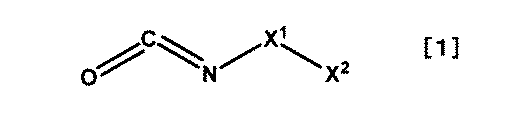
- component (A) Component A compound represented by the following formula [1].
- X 1 represents a divalent organic group having an aliphatic hydrocarbon group having 1 to 20 carbon atoms, or a divalent organic group having 6 to 24 carbon atoms having a benzene ring or a cyclohexane ring
- X 2 represents A structure selected from the following formulas [1-1] to [1-5] is shown.
- W 1 represents a hydrogen atom or a benzene ring.
- X 1 in the formula [1] is an alkylene group having 1 to 10 carbon atoms.
- X 2 in the formula [1] is a structure selected from the formula [1-1], the formula [1-2] and the formula [1-4], according to the above (1) or (2) Liquid crystal alignment treatment agent.
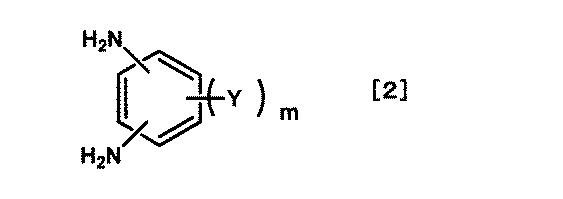
- the diamine component in the polymer of the component (B) includes at least one diamine compound having a structure represented by the following formula [2], according to any one of the above (1) to (3) Liquid crystal alignment treatment agent.
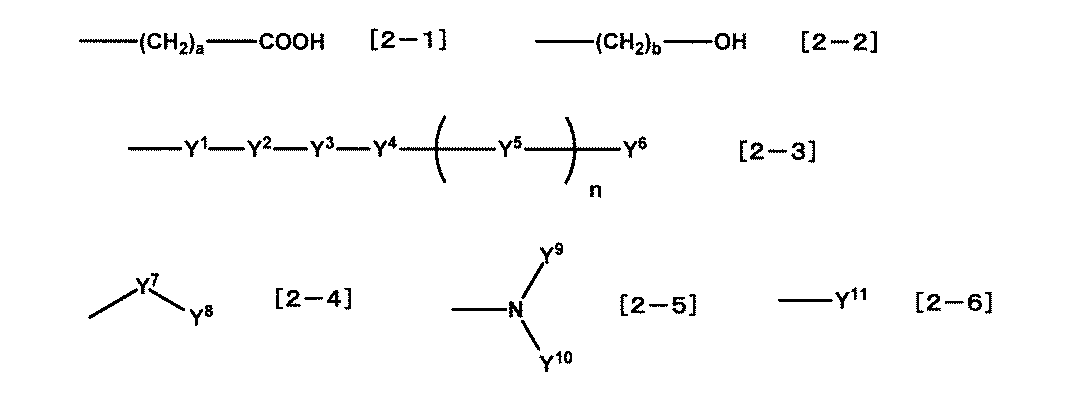
- Y represents a substituent having a structure selected from the following formulas [2-1] to [2-6], and m represents an integer of 1 to 4.
- A represents an integer of 0 to 4, and b represents an integer of 0 to 4.
- Y 1 represents a single bond, — (CH 2 ) a — (a is an integer of 1 to 15), —O—, —CH 2 O—, —COO— or OCO—, and Y 2 represents a single bond or — (CH 2 ) b — (b is an integer of 1 to 15), Y 3 is a single bond, — (CH 2 ) c — (c is an integer of 1 to 15), —O—, —CH 2 O—, —COO— or —OCO—, wherein Y 4 is a divalent cyclic group selected from a benzene ring, a cyclohexane ring and a heterocyclic ring, or a divalent divalent group having 12 to 25 carbon atoms having a steroid skeleton.
- An organic group, and an arbitrary hydrogen atom on the cyclic group includes an alkyl group having 1 to 3 carbon atoms, an alkoxyl group having 1 to 3 carbon atoms, a fluorine-containing alkyl group having 1 to 3 carbon atoms, and 1 to 3 carbon atoms may be substituted with a fluorine-containing alkoxyl group or a fluorine atom
- Y 5 is a benzene ring, a cycloalkyl
- a divalent cyclic group selected from a xanth ring and a heterocyclic ring, and any hydrogen atom on these cyclic groups is an alkyl group having 1 to 3 carbon atoms, an alkoxyl group having 1 to 3 carbon atoms, or 1 to 3 carbon atoms
- 3 is a fluorine-containing alkyl group, may be substituted with a fluorine-containing alkoxyl group having 1 to 3 carbon atoms or a fluorine atom
- n is
- a liquid crystal composition having a liquid crystal layer between a pair of substrates provided with electrodes and including a polymerizable compound that is polymerized by at least one of active energy rays and heat is disposed between the pair of substrates,
- a liquid crystal alignment layer having a liquid crystal layer between a pair of substrates provided with electrodes and including a polymerizable group that is polymerized by at least one of active energy rays and heat is disposed between the pair of substrates,
- the liquid crystal alignment treatment agent containing a compound having a specific structure and at least one polymer selected from the group consisting of a polyimide precursor and a polyimide has an adhesive property between the sealant and the liquid crystal alignment film. Even under high temperature and high humidity conditions, it is possible to form a liquid crystal alignment film that can suppress the occurrence of display unevenness in the vicinity of the frame of the liquid crystal display element and suppress the decrease in voltage holding ratio. That is, a liquid crystal display element having a liquid crystal alignment film obtained from the liquid crystal alignment treatment agent of the present invention has excellent reliability and can be suitably used for a large-screen, high-definition liquid crystal television.
- the present invention is a liquid crystal aligning agent containing the following components (A) and (B), a liquid crystal aligning film obtained using the liquid crystal aligning agent, and a liquid crystal display element having the liquid crystal aligning film.
- Component (A) a compound represented by the following formula [1] (also referred to as a specific compound).
- X 1 represents a divalent organic group having an aliphatic hydrocarbon group having 1 to 20 carbon atoms, or a divalent organic group having 6 to 24 carbon atoms having a benzene ring or a cyclohexane ring
- X 2 represents A structure selected from the following formulas [1-1] to [1-5] is shown.
- W 1 represents a hydrogen atom or a benzene ring).
- the O ⁇ C ⁇ N— group (also referred to as an isocyanate group) in the specific compound is a heating step for preparing the liquid crystal aligning agent or a baking step for preparing the liquid crystal aligning film. Therefore, it is considered that it is chemically bonded to the carboxyl group in the specific polymer. Therefore, in spite of the simple means of mixing in an organic solvent, the liquid crystal alignment treatment agent of the present invention efficiently binds the specific compound and the specific polymer in the liquid crystal alignment film obtained therefrom. I think.
- the double bond site of the formula [1-1] to the formula [1-5] which is X 2 in the specific compound reacts when irradiated with heat or ultraviolet rays. Further, these double binding sites are sites that are also included in the compound contained in the sealant.
- the double bond site in the liquid crystal alignment film and the sealant are obtained by the curing process of the sealant when producing the liquid crystal display element, that is, the ultraviolet irradiation process or the baking process.
- a chemical reaction with the compound therein causes a chemical bond between the sealing agent and the liquid crystal alignment film, thereby enhancing their adhesion.
- the liquid crystal aligning agent containing the specific compound and specific polymer of the present invention has high adhesion to the sealant, and display irregularities near the frame of the liquid crystal display element even under high temperature and high humidity conditions. It is possible to form a liquid crystal alignment film that can suppress generation and suppress a decrease in voltage holding ratio.
- the specific compound of the present invention is a compound represented by the following formula [1].
- X 1 and X 2 have the same meaning as defined above, and X 2 represents a structure selected from the following formulas [1-1] to [1-5].
- W 1 represents a hydrogen atom or a benzene ring.
- X 1 represents a divalent organic group having an aliphatic hydrocarbon group having 1 to 20 carbon atoms or a divalent organic group having 6 to 24 carbon atoms having a benzene ring or a cyclohexane ring. .
- an alkylene group having 1 to 10 carbon atoms is preferable, and an alkylene group having 1 to 5 carbon atoms is more preferable.
- X 2 is a structure selected from the formulas [1-1] to [1-5].
- W 1 represents a hydrogen atom or a benzene ring. Of these, a hydrogen atom is preferable.
- X 2 is preferably a structure represented by the formula [1-1], the formula [1-2] or the formula [1-4] from the viewpoint of reactivity by heat or ultraviolet irradiation.
- X 3 represents an alkylene group having 1 to 5 carbon atoms, a benzene ring or a cyclohexane ring
- X 4 represents an alkylene group having 1 to 5 carbon atoms, a benzene ring or a cyclohexane ring
- X 5 represents an alkylene group having 1 to 5 carbon atoms, a benzene ring or a cyclohexane ring
- X 6 represents an alkylene group having 1 to 5 carbon atoms, a benzene ring or a cyclohexane ring.
- the specific polymer which is the component (B) of the present invention is at least one polymer selected from the group consisting of a polyimide precursor obtained by reacting a diamine component and a tetracarboxylic acid component and a polyimide.
- the polyimide precursor has a structure represented by the following formula [A].
- R 1 is a tetravalent organic group
- R 2 is a divalent organic group
- a 1 and A 2 represent a hydrogen atom or an alkyl group having 1 to 8 carbon atoms, which may be the same or different.
- a 3 and A 4 may represent a hydrogen atom, an alkyl group having 1 to 5 carbon atoms, or an acetyl group, and may be the same or different, and n represents a positive integer.
- the diamine component is a diamine compound having two primary or secondary amino groups in the molecule
- the tetracarboxylic acid component is a tetracarboxylic acid compound, tetracarboxylic dianhydride, or tetracarboxylic acid dihalide compound.
- Tetracarboxylic acid dialkyl ester compounds or tetracarboxylic acid dialkyl ester dihalide compounds are examples of the tetracarboxylic acid dialkyl ester compounds.
- the specific polymer can be obtained relatively easily by using a tetracarboxylic dianhydride represented by the following formula [B] and a diamine compound represented by the following formula [C] as raw materials.
- the polyamic acid consisting of the structural formula of the repeating unit represented by the formula [D] or a polyimide obtained by imidizing the polyamic acid is preferable. (R 1 and R 2 are the same as defined in formula [A]).
- the polymer of the formula [D] obtained above by the usual synthesis method is added to the alkyl group having 1 to 8 carbon atoms of A 1 and A 2 represented by the formula [A] and the formula [A]. It is also possible to introduce an alkyl group having 1 to 5 carbon atoms or an acetyl group of A 3 and A 4 shown.
- ⁇ Diamine component> As the diamine component for producing the specific polymer as the component (B), a known diamine compound can be used. Among these, it is preferable to use at least one diamine compound (also referred to as a specific diamine compound) having a structure represented by the following formula [2]. (Y represents a substituent having a structure selected from the following formulas [2-1] to [2-6], and m represents an integer of 1 to 4.)
- a represents an integer of 0 to 4. Among these, 0 or 1 is preferable from the viewpoint of availability of raw materials and ease of synthesis.
- b represents an integer of 0 to 4. Especially, the integer of 0 or 1 is preferable from the point of the availability of a raw material or the ease of a synthesis
- Y 1 is a single bond, — (CH 2 ) a — (a is an integer of 1 to 15), —O—, —CH 2 O—, —COO— or —OCO—. Indicates.
- a single bond — (CH 2 ) a — (a is an integer of 1 to 15), —O—, —CH 2 O— or —COO. -Is preferred. More preferred is a single bond, — (CH 2 ) a — (a is an integer of 1 to 10), —O—, —CH 2 O— or COO—.
- Y 2 represents a single bond or — (CH 2 ) b — (b is an integer of 1 to 15). Among these, a single bond or — (CH 2 ) b — (b is an integer of 1 to 10) is preferable.
- Y 3 is a single bond, — (CH 2 ) c — (c is an integer of 1 to 15), —O—, —CH 2 O—, —COO— or —OCO—. Indicates.
- a single bond — (CH 2 ) c — (c is an integer of 1 to 15), —O—, —CH 2 O— or —COO— is preferable from the viewpoint of ease of synthesis. More preferred is a single bond, — (CH 2 ) c — (c is an integer of 1 to 10), —O—, —CH 2 O— or —COO—.
- Y 4 is a divalent cyclic group selected from a benzene ring, a cyclohexane ring and a heterocyclic ring, and any hydrogen atom on these cyclic groups is an alkyl group having 1 to 3 carbon atoms.
- Y 4 may be a divalent organic group selected from organic groups having 12 to 25 carbon atoms having a steroid skeleton. Of these, an organic group having 12 to 25 carbon atoms having a benzene ring, a cyclohexane ring or a steroid skeleton is preferable from the viewpoint of ease of synthesis.
- Y 5 represents a divalent cyclic group selected from a benzene ring, a cyclohexane ring and a heterocyclic ring, and any hydrogen atom on these cyclic groups is an alkyl group having 1 to 3 carbon atoms.
- n represents an integer of 0 to 4. Among these, 0 to 3 are preferable from the viewpoint of availability of raw materials and ease of synthesis. More preferred is 0-2.
- Y 6 represents an alkyl group having 1 to 18 carbon atoms, a fluorine-containing alkyl group having 1 to 18 carbon atoms, an alkoxyl group having 1 to 18 carbon atoms, or a fluorine-containing alkoxyl group having 1 to 18 carbon atoms. Indicates. Of these, an alkyl group having 1 to 18 carbon atoms, a fluorine-containing alkyl group having 1 to 10 carbon atoms, an alkoxyl group having 1 to 18 carbon atoms, or a fluorine-containing alkoxyl group having 1 to 10 carbon atoms is preferable.
- it is an alkyl group having 1 to 12 carbon atoms or an alkoxyl group having 1 to 12 carbon atoms. Particularly preferred is an alkyl group having 1 to 9 carbon atoms or an alkoxyl group having 1 to 9 carbon atoms.
- Y 8 represents an alkyl group having 8 to 22 carbon atoms.
- Y 9 and Y 10 independently represent a hydrocarbon group having 1 to 12 carbon atoms.
- Y 11 represents an alkyl group having 1 to 5 carbon atoms.
- the method to manufacture the specific diamine compound shown by Formula [2] is not specifically limited, What is shown below is mentioned as a preferable method.
- the specific diamine compound represented by the formula [2] can be obtained by synthesizing a dinitro compound represented by the following formula [2-A] and further reducing the nitro group to convert it to an amino group. .
- the method for reducing the dinitro group of the dinitro compound represented by the formula [2-A] is not particularly limited, and usually in a solvent such as ethyl acetate, toluene, tetrahydrofuran, dioxane, alcohol solvent, palladium-carbon, There is a method in which platinum oxide, Raney nickel, platinum black, rhodium-alumina, platinum sulfide carbon or the like is used as a catalyst and reacted in hydrogen gas, hydrazine or hydrogen chloride.
- Specific examples of the specific diamine compound represented by the formula [2] are shown below, but are not limited to these examples.
- Specific diamine compounds include 2,4-dimethyl-m-phenylenediamine, 2,6-diaminotoluene, 2,4-diaminobenzoic acid, 3,5-diaminobenzoic acid, 2,4-diaminophenol, 3,5 -Diaminophenol, 3,5-diaminobenzyl alcohol, 2,4-diaminobenzyl alcohol, 4,6-diaminoresorcinol, and diamines having structures represented by the following formulas [2-7] to [2-47] A compound can be mentioned.
- a 1 represents an alkyl group having 1 to 22 carbon atoms or a fluorine-containing alkyl group.
- R 1 represents —O—, —OCH 2 —, —CH 2 O—, —COOCH 2 — or —CH 2 OCO—
- R 2 represents an alkyl group having 1 to 22 carbon atoms, an alkoxy group, or a fluorine-containing alkyl. Group or fluorine-containing alkoxy group.
- R 3 represents —COO—, —OCO—, —COOCH 2 —, —CH 2 OCO—, —CH 2 O—, —OCH 2 — or —CH 2 —
- R 4 has 1 to 22 carbon atoms. Represents an alkyl group, an alkoxy group, a fluorine-containing alkyl group or a fluorine-containing alkoxy group.
- R 5 is —COO—, —OCO—, —COOCH 2 —, —CH 2 OCO—, —CH 2 O—, —OCH 2 —, —CH 2 — or —O—
- R 6 is a fluorine group , Cyano group, trifluoromethane group, nitro group, azo group, formyl group, acetyl group, acetoxy group or hydroxyl group.
- R 7 represents an alkyl group having 3 to 12 carbon atoms.
- the cis-trans isomerism of 1,4-cyclohexylene is preferably a trans isomer.
- R 8 represents an alkyl group having 3 to 12 carbon atoms.
- the cis-trans isomerism of 1,4-cyclohexylene is preferably a trans isomer.
- B 4 represents an alkyl group having 3 to 20 carbon atoms which may be substituted with a fluorine atom
- B 3 represents a 1,4-cyclohexylene group or a 1,4-phenylene group
- B 2 represents an oxygen atom.
- —COO— * where a bond marked with “*” is bonded to B 3
- B 1 is an oxygen atom or —COO— * (where a bond marked with “*” is (CH 2 ) is bonded to a 2.
- a 1 represents an integer of 0 or 1
- a 2 represents an integer of 2 to 10
- a 3 represents an integer of 0 or 1.
- the liquid crystal alignment obtained from the specific polymer using the diamine compound having the structure in which the substituent Y in the formula [2] is represented by the formula [2-3] When the liquid crystal alignment film is formed using the treatment agent, the pretilt angle of the liquid crystal can be increased.
- diamine compounds represented by the formulas [2-25] to [2-40] or the formulas [2-43] to [2-47]. More preferred are diamine compounds represented by the formulas [2-29] to [2-40] or the formulas [2-43] to [2-47].
- the amount of the diamine compound used for increasing the pretilt angle is preferably 5 mol% or more and 80 mol% or less of the entire diamine component. More preferably, it is 5 mol% or more and 60 mol% of the whole diamine component from the viewpoint of the coating property of the liquid crystal aligning agent and the electric characteristics as the liquid crystal alignment film.
- the specific diamine compound represented by the formula [2] has a solubility or coating property in a solvent of the specific polymer, liquid crystal alignment in the case of forming a liquid crystal alignment film, voltage holding ratio, accumulated charge, and other characteristics.
- One type or a mixture of two or more types can be used.
- a diamine compound other than the specific diamine compound represented by the formula [2] also referred to as other diamine compound
- Specific examples of other diamine compounds are shown below, but are not limited to these examples.
- diamine compounds examples include those having an alkyl group, a fluorine-containing alkyl group, an aromatic ring, an aliphatic ring or a heterocyclic ring in the diamine side chain, and those having a macrocyclic substituent composed of these groups. You can also. Specifically, diamine compounds represented by the following formulas [DA1] to [DA7] can be exemplified.
- a 1 represents —COO—, —OCO—, —CONH—, —NHCO—, —CH 2 —, —O—, —CO— or —NH—
- a 2 represents a straight chain having 1 to 22 carbon atoms.
- diamine compounds represented by the following formulas [DA8] to [DA13] can also be used as other diamine compounds.
- diamine compounds represented by the following formulas [DA14] to [DA17] can also be used.
- a 1 is a single bond, —CH 2 —, —C 2 H 4 —, —C (CH 3 ) 2 —, —CF 2 —, —C (CF 3 ) 2 —, —O—, —CO—, —NH—, —N (CH 3 ) —, —CONH—, —NHCO—, —CH 2 O—, —OCH 2 —, —COO—, —OCO—, —CON (CH 3 ) — or —N ( CH 3 ) CO—, m 1 and m 2 each represents an integer of 0 to 4, and m 1 + m 2 represents an integer of 1 to 4, and in the formula [DA15], m 3 and m 4 are each In the formula [DA16], A 2 represents a linear or branched alkyl group having 1 to 5 carbon atoms, m 5 represents an integer of 1 to 5, A 3 represents a single bond, CH 2 -, - C 2 H 4 -, -
- a 1 is —O—, —NH—, —N (CH 3 ) —, —CONH—, —NHCO—, —CH 2 O—, —OCO—, —CON (CH 3 ) — and —N (CH 3 ) a divalent organic group selected from CO—
- a 2 is a single bond, an aliphatic hydrocarbon group having 1 to 20 carbon atoms, a non-aromatic cyclic hydrocarbon group or an aromatic hydrocarbon group
- a 3 is a single bond, —O—, —NH—, —N (CH 3 ) —, —CONH—, —NHCO—, —COO—, —OCO—, —CON (CH 3 ) —, —N (CH 3 ) a divalent group selected from CO— and —O (CH 2 ) m — (m is
- the above-mentioned other diamine compounds are soluble in a solvent of a specific polymer, applicability of a liquid crystal alignment treatment agent, liquid crystal alignment properties when used as a liquid crystal alignment film, voltage holding ratio, accumulated charge, etc.
- a liquid crystal alignment treatment agent for a liquid crystal alignment treatment agent
- liquid crystal alignment properties when used as a liquid crystal alignment film for a liquid crystal alignment film
- voltage holding ratio for a liquid crystal alignment film
- accumulated charge etc.
- One type or a mixture of two or more types can also be used.
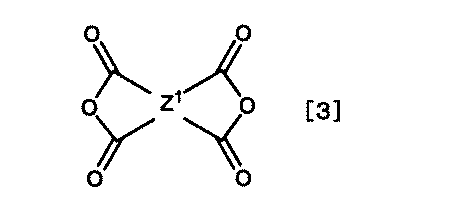
- tetracarboxylic acid component As the tetracarboxylic acid component for producing the specific polymer which is the component (B) of the present invention, a tetracarboxylic dianhydride represented by the following formula [3] or a tetracarboxylic acid which is a tetracarboxylic acid derivative thereof It is preferable to use a tetracarboxylic acid dihalide compound, a tetracarboxylic acid dialkyl ester compound or a tetracarboxylic acid dialkyl ester dihalide compound (all are collectively referred to as a specific tetracarboxylic acid component).
- Z 1 is a group having a structure selected from the following formulas [3a] to [3j].
- Z 2 to Z 5 represent a hydrogen atom, a methyl group, a chlorine atom or a benzene ring, and may be the same or different.
- Z 6 and Z 7 represent a hydrogen atom or a methyl group, and may be the same or different.
- Z 1 is represented by formula [3a]
- a structure represented by [3c], formula [3d], formula [3e], formula [3f] or formula [3g] is preferable. More preferred is a structure represented by formula [3a], formula [3e], formula [3f] or formula [3g], and particularly preferred is formula [3e], formula [3f] or formula [3g].
- the specific tetracarboxylic acid component is preferably 1 mol% or more of the total tetracarboxylic acid component. More preferred is 5 mol% or more, and particularly preferred is 10 mol% or more. Among these, 15 to 100 mol% is more preferable.
- the usage-amount shall be 20 mol% or more of the whole tetracarboxylic acid component. More preferably, it is 30 mol% or more.
- all of the tetracarboxylic acid component may be a tetracarboxylic acid component having a structure of the formula [3e], the formula [3f], or the formula [3g].
- other tetracarboxylic acid components other than the specific tetracarboxylic acid component can be used as long as the effects of the present invention are not impaired.
- tetracarboxylic acid components include the following tetracarboxylic acid compounds, tetracarboxylic dianhydrides, tetracarboxylic acid dihalide compounds, tetracarboxylic acid dialkyl ester compounds, and tetracarboxylic acid dialkyl ester dihalide compounds.
- tetracarboxylic acid components include pyromellitic acid, 2,3,6,7-naphthalenetetracarboxylic acid, 1,2,5,6-naphthalenetetracarboxylic acid, 1,4,5,8-naphthalene.
- Tetracarboxylic acid 2,3,6,7-anthracenetetracarboxylic acid, 1,2,5,6-anthracenetetracarboxylic acid, 3,3 ′, 4,4′-biphenyltetracarboxylic acid, 2,3,3 ', 4-biphenyltetracarboxylic acid, bis (3,4-dicarboxyphenyl) ether, 3,3', 4,4'-benzophenonetetracarboxylic acid, bis (3,4-dicarboxyphenyl) sulfone, bis ( 3,4-dicarboxyphenyl) methane, 2,2-bis (3,4-dicarboxyphenyl) propane, 1,1,1,3,3,3-hexafluoro- , 2-bis (3,4-dicarboxyphenyl) propane, bis (3,4-dicarboxyphenyl) dimethylsilane, bis (3,4-dicarboxyphenyl) diphenylsilane, 2,3,4,5-pyridine Te
- the specific tetracarboxylic acid component and other tetracarboxylic acid components are the solubility of the specific polymer of the present invention in the solvent, the coating property of the liquid crystal aligning agent, the liquid crystal alignment property, and the voltage holding ratio when used as a liquid crystal alignment film. Depending on the characteristics such as accumulated charge, one kind or a mixture of two or more kinds may be used.
- the method for synthesizing the specific polymer is not particularly limited. Usually, it is obtained by reacting a diamine component and a tetracarboxylic acid component. Generally, at least one tetracarboxylic acid component selected from the group consisting of tetracarboxylic acids and derivatives thereof is reacted with a diamine component consisting of one or more diamine compounds to obtain a polyamic acid. Specifically, there are the following methods. (1) A method of obtaining polyamic acid by polycondensation of a tetracarboxylic dianhydride and a primary or secondary diamine compound.
- a method in which a polycarboxylic acid is obtained by subjecting a tetracarboxylic acid and a primary or secondary diamine compound to a dehydration polycondensation reaction (2) A method for obtaining polyamic acid by polycondensation of a tetracarboxylic acid dihalide and a primary or secondary diamine compound.
- a method of polycondensing a tetracarboxylic acid obtained by dialkyl esterifying a carboxylic acid group with a primary or secondary diamine compound, a tetracarboxylic acid dihalide obtained by dialkyl esterifying a carboxylic acid group and 1 A method of polycondensation with a secondary or secondary diamine compound or a method of converting a carboxyl group of a polyamic acid into an ester is used.
- polyimide a method is used in which the polyamic acid or polyamic acid alkyl ester is cyclized to form polyimide.
- the reaction between the diamine component and the tetracarboxylic acid component is usually performed in an organic solvent containing the diamine component and the tetracarboxylic acid component.
- the organic solvent used at that time is not particularly limited as long as the produced polyimide precursor is dissolved. Although the specific example of the organic solvent used for reaction below is given, it is not limited to these examples. Examples include N-methyl-2-pyrrolidone, N-ethyl-2-pyrrolidone or ⁇ -butyrolactone, N, N-dimethylformamide, N, N-dimethylacetamide, dimethyl sulfoxide or 1,3-dimethyl-imidazolidinone. It is done.
- D 1 represents an alkyl group having 1 to 3 carbon atoms
- D 2 represents an alkyl group having 1 to 3 carbon atoms
- D 3 represents an alkyl group having 1 to 4 carbon atoms.
- any method may be used.
- the polymerization temperature can be selected from -20 to 150 ° C., but is preferably in the range of ⁇ 5 to 100 ° C.
- the reaction can be carried out at any concentration, but if the concentration is too low, it is difficult to obtain a high molecular weight polymer, and if the concentration is too high, the viscosity of the reaction solution becomes too high and uniform stirring is difficult. It becomes. Therefore, it is preferably 1 to 50% by mass, more preferably 5 to 30% by mass.
- the initial stage of the reaction is carried out at a high concentration, and then an organic solvent can be added.
- the ratio of the total number of moles of the diamine component to the total number of moles of the tetracarboxylic acid component is preferably 0.8 to 1.2. Similar to a normal polycondensation reaction, the molecular weight of the polyimide precursor produced increases as the molar ratio approaches 1.0.
- the polyimide of the present invention is a polyimide obtained by ring closure of the polyimide precursor, and in this polyimide, the ring closure rate of the amic acid group (also referred to as imidization rate) is not necessarily 100%. It can be arbitrarily adjusted according to the purpose.
- Examples of the method for imidizing the polyimide precursor include thermal imidization in which the polyimide precursor solution is heated as it is or catalyst imidization in which a catalyst is added to the polyimide precursor solution.
- the temperature is 100 to 400 ° C., preferably 120 to 250 ° C., and it is preferable to carry out while removing water generated by the imidization reaction from the system.
- the catalyst imidation of the polyimide precursor can be performed by adding a basic catalyst and an acid anhydride to the polyimide precursor solution and stirring at -20 to 250 ° C, preferably 0 to 180 ° C.
- the amount of the basic catalyst is 0.5 to 30 mol times, preferably 2 to 20 mol times of the amic acid group, and the amount of the acid anhydride is 1 to 50 mol times, preferably 3 to 30 mol of the amido acid group. Is double.
- the basic catalyst include pyridine, triethylamine, trimethylamine, tributylamine, trioctylamine and the like. Among them, pyridine is preferable because it has an appropriate basicity for proceeding with the reaction.
- Examples of the acid anhydride include acetic anhydride, trimellitic anhydride, pyromellitic anhydride, and the like. Among them, use of acetic anhydride is preferable because purification after completion of the reaction is facilitated.
- the imidization rate by catalytic imidation can be controlled by adjusting the amount of catalyst, reaction temperature, and reaction time.
- the reaction solution may be poured into a solvent and precipitated.
- the solvent used for precipitation include methanol, ethanol, isopropyl alcohol, acetone, hexane, butyl cellosolve, heptane, methyl ethyl ketone, methyl isobutyl ketone, toluene, benzene, and water.
- the polymer precipitated in the solvent can be collected by filtration, and then dried by normal temperature or reduced pressure at room temperature or by heating.
- the solvent at this time include alcohols, ketones, hydrocarbons and the like, and it is preferable to use three or more kinds of solvents selected from these because purification efficiency is further improved.
- the molecular weight of the specific polymer is a weight average molecular weight measured by a GPC (Gel Permeation Chromatography) method in consideration of the strength of the liquid crystal alignment film obtained therefrom, workability at the time of forming the liquid crystal alignment film, and coating properties. It is preferably 5,000 to 1,000,000, more preferably 10,000 to 150,000.
- the liquid crystal aligning agent of the present invention is a coating solution for forming a liquid crystal alignment film (also referred to as a resin film), and is a coating solution for forming a liquid crystal alignment film containing a specific compound, a specific polymer and a solvent. is there.
- the content of the specific compound in the liquid crystal aligning agent is 0.1 to 30 parts by mass with respect to 100 parts by mass of the specific polymer. Of these, 0.5 to 30 parts by mass is preferable, and 1 to 20 parts by mass is particularly preferable.
- All the polymer components in the liquid crystal aligning agent may all be the specific polymer of the present invention, or other polymers may be mixed.
- the content of the other polymer is 0.5 to 15 parts by mass, preferably 1 to 10 parts by mass with respect to 100 parts by mass of the specific polymer of the present invention.
- examples of other polymers include polyimide polymers that do not use the diamine compound represented by the formula [2] and the specific tetracarboxylic acid component.
- examples of other polymers include cellulosic polymers, acrylic polymers, methacrylic polymers, polystyrenes, polyamides, and polysiloxanes.
- the solvent in the liquid crystal aligning agent is preferably 70 to 99.9% by mass of the solvent in the liquid crystal aligning agent from the viewpoint of forming a uniform liquid crystal alignment film by coating.
- the mass% is more preferable. This content can be appropriately changed depending on the film thickness of the target liquid crystal alignment film.
- the solvent used for the liquid crystal aligning agent is not particularly limited as long as it is a solvent (also referred to as a good solvent) that dissolves the specific compound and the specific polymer.
- a solvent also referred to as a good solvent
- the specific example of a good solvent is given to the following, it is not limited to these examples.
- N-methyl-2-pyrrolidone, N-ethyl-2-pyrrolidone, or ⁇ -butyrolactone is preferably used.
- the good solvent in the liquid crystal aligning agent is preferably 10 to 100% by mass of the total solvent contained in the liquid crystal aligning agent. Of these, 20 to 90% by mass is preferable. More preferred is 30 to 80% by mass.
- the liquid crystal aligning agent can use a solvent (also referred to as a poor solvent) that improves the coating properties and surface smoothness of the liquid crystal aligning film when the liquid crystal aligning agent is applied.
- a solvent also referred to as a poor solvent
- a poor solvent is given to the following, it is not limited to these examples.
- ethanol isopropyl alcohol, 1-butanol, 2-butanol, isobutyl alcohol, tert-butyl alcohol, 1-pentanol, 2-pentanol, 3-pentanol, 2-methyl-1-butanol, isopentyl alcohol, tert-pentyl alcohol, 3-methyl-2-butanol, neopentyl alcohol, 1-hexanol, 2-methyl-1-pentanol, 2-methyl-2-pentanol, 2-ethyl-1-butanol, 1-heptanol 2-heptanol, 3-heptanol, 1-octanol, 2-octanol, 2-ethyl-1-hexanol, cyclohexanol, 1-methylcyclohexanol, 2-methylcyclohexanol, 3-methylcyclohexanol, 1,2- Ethane All, 1,2-propanediol, 1,3-propan
- a solvent represented by These poor solvents are preferably 1 to 70% by mass of the whole solvent contained in the liquid crystal aligning agent. Among these, 1 to 60% by mass is preferable. More preferred is 5 to 60% by mass.
- the liquid crystal aligning agent is at least selected from the group consisting of a compound having an epoxy group, an isocyanate group, an oxetane group or a cyclocarbonate group, a hydroxyl group, a hydroxyalkyl group and a lower alkoxyalkyl group.
- a compound having one kind of substituent, and a compound having a polymerizable unsaturated bond (also collectively referred to as a crosslinkable compound) can be introduced. It is necessary to have two or more of these substituents and polymerizable unsaturated bonds in the crosslinkable compound.
- crosslinkable compound having an epoxy group or an isocyanate group examples include bisphenolacetone glycidyl ether, phenol novolac epoxy resin, cresol novolac epoxy resin, triglycidyl isocyanurate, tetraglycidylaminodiphenylene, tetraglycidyl-m-xylenediamine, tetra Glycidyl-1,3-bis (aminoethyl) cyclohexane, tetraphenyl glycidyl ether ethane, triphenyl glycidyl ether ethane, bisphenol hexafluoroacetodiglycidyl ether, 1,3-bis (1- (2,3-epoxypropoxy)- 1-trifluoromethyl-2,2,2-trifluoromethyl) benzene, 4,4-bis (2,3-epoxypropoxy) octafluorobiphenyl Triglycidyl-p-amin
- the crosslinkable compound having an oxetane group is a crosslinkable compound having at least two oxetane groups represented by the following formula [4].
- crosslinkable compounds represented by the formulas [4a] to [4k] published on pages 58 to 59 of International Publication No. WO2011 / 132751 (published 2011.10.27).
- the crosslinkable compound having a cyclocarbonate group is a crosslinkable compound having at least two cyclocarbonate groups represented by the following formula [5].
- Examples of the crosslinkable compound having at least one substituent selected from the group consisting of a hydroxyl group and an alkoxyl group include an amino resin having a hydroxyl group or an alkoxyl group, such as a melamine resin, a urea resin, a guanamine resin, and a glycoluril.
- a melamine resin, a urea resin, a guanamine resin, and a glycoluril such as a melamine resin, a urea resin, a guanamine resin, and a glycoluril.
- a melamine derivative, a benzoguanamine derivative, or glycoluril in which a hydrogen atom of an amino group is substituted with a methylol group, an alkoxymethyl group, or both can be used.
- the melamine derivative or benzoguanamine derivative can exist as a dimer or a trimer. These preferably have an average of 3 to 6 methylol groups or alkoxymethyl groups
- Examples of such melamine derivatives or benzoguanamine derivatives include MX-750, which has an average of 3.7 substituted methoxymethyl groups per triazine ring, and an average of 5. methoxymethyl groups per triazine ring.
- benzene having a hydroxyl group or an alkoxyl group, or phenolic compounds examples include 1,3,5-tris (methoxymethyl) benzene, 1,2,4-tris (isopropoxymethyl) benzene, and 1,4-bis. (Sec-butoxymethyl) benzene, 2,6-dihydroxymethyl-p-tert-butylphenol and the like.
- crosslinkable compound having a polymerizable unsaturated bond examples include trimethylolpropane tri (meth) acrylate, pentaerythritol tri (meth) acrylate, dipentaerythritol penta (meth) acrylate, and tri (meth) acryloyloxyethoxytrimethylol.
- Crosslinkable compounds having three polymerizable unsaturated groups in the molecule such as propane and glycerin polyglycidyl ether poly (meth) acrylate; ethylene glycol di (meth) acrylate, diethylene glycol di (meth) acrylate, tetraethylene glycol di (meth) ) Acrylate, polyethylene glycol di (meth) acrylate, propylene glycol di (meth) acrylate, polypropylene glycol di (meth) acrylate, butylene glycol di (me ) Acrylate, neopentyl glycol di (meth) acrylate, ethylene oxide bisphenol A type di (meth) acrylate, propylene oxide bisphenol type di (meth) acrylate, 1,6-hexanediol di (meth) acrylate, glycerin di (meth) ) Acrylate, pentaerythritol di (meth) acrylate, ethylene glycol digly
- E 1 represents a group selected from the group consisting of a cyclohexane ring, a bicyclohexane ring, a benzene ring, a biphenyl ring, a terphenyl ring, a naphthalene ring, a fluorene ring, an anthracene ring and a phenanthrene ring
- E 2 represents the following formula [7a
- n represents an integer of 1 to 4.
- crosslinkable compound used for the liquid-crystal aligning agent of this invention may be 1 type, and may be combined 2 or more types.
- the content of the crosslinkable compound in the liquid crystal aligning agent is preferably 0.1 to 150 parts by mass with respect to 100 parts by mass of all the polymer components.
- the amount is more preferably 0.1 to 100 parts by weight, and most preferably 1 to 50 parts by weight, based on 100 parts by weight of all polymer components.
- liquid crystal alignment treatment agent a compound that improves the uniformity of the film thickness and surface smoothness of the liquid crystal alignment film when the liquid crystal alignment treatment agent is applied can be used as long as the effects of the present invention are not impaired.
- Examples of compounds that improve the film thickness uniformity and surface smoothness of the liquid crystal alignment film include fluorine-based surfactants, silicone-based surfactants, and nonionic surfactants.
- F-top EF301, EF303, EF352 (above, manufactured by Tochem Products), MegaFuck F171, F173, R-30 (above, manufactured by Dainippon Ink), Florard FC430, FC431 (or more) And Asahi Guard AG710, Surflon S-382, SC101, SC102, SC103, SC104, SC105, SC106 (above, manufactured by Asahi Glass Co., Ltd.).
- the use ratio of these surfactants is preferably 0.01 to 2 parts by mass, more preferably 0.01 to 1 part by mass with respect to 100 parts by mass of all the polymer components contained in the liquid crystal aligning agent. It is.
- the liquid crystal alignment treatment agent is a compound that promotes charge transfer in the liquid crystal alignment film and promotes charge release of the device, and is disclosed in International Patent Publication WO2011 / 132751 (published 2011.10.27), pages 69-73. It is also possible to add nitrogen-containing heterocyclic amine compounds represented by the formulas [M1] to [M156] described in This amine compound may be added directly to the liquid crystal aligning agent, but it is preferably added after a solution having a concentration of 0.1 to 10% by mass, preferably 1 to 7% by mass with an appropriate solvent.
- the solvent to be used is not particularly limited as long as it is an organic solvent capable of dissolving the above-described specific polymer.
- liquid crystal alignment treatment agent of the present invention can be used as a liquid crystal alignment film after being applied and baked on a substrate and then subjected to alignment treatment by rubbing treatment or light irradiation. In the case of vertical alignment, etc., it can be used as a liquid crystal alignment film without alignment treatment.
- the substrate used in this case is not particularly limited as long as it is a highly transparent substrate.
- a plastic substrate such as an acrylic substrate or a polycarbonate substrate can also be used.
- a substrate on which an ITO electrode for driving a liquid crystal is formed it is preferable to use a substrate on which an ITO electrode for driving a liquid crystal is formed.
- an opaque substrate such as a silicon wafer can be used if only one substrate is used, and a material that reflects light such as aluminum can be used as an electrode in this case.
- the method for applying the liquid crystal alignment treatment agent is not particularly limited, but industrially, screen printing, offset printing, flexographic printing, inkjet method, and the like are common.
- Other coating methods include a dipping method, a roll coater method, a slit coater method, a spinner method, and a spray method, and these may be used depending on the purpose.
- the liquid crystal aligning agent After applying the liquid crystal aligning agent on the substrate, it is preferably 30 to 300 ° C., depending on the solvent used for the liquid crystal aligning agent, by a heating means such as a hot plate, a thermal circulation oven, or an IR (infrared) oven.
- the liquid crystal alignment film can be obtained by evaporating the solvent at a temperature of 30 to 250 ° C. If the thickness of the liquid crystal alignment film after baking is too thick, it is disadvantageous in terms of power consumption of the liquid crystal display element, and if it is too thin, the reliability of the liquid crystal display element may be lowered. Is 10 to 100 nm. When the liquid crystal is horizontally aligned or tilted, the fired liquid crystal alignment film is treated by rubbing, polarized ultraviolet irradiation, or the like.
- the liquid crystal display element of the present invention is a liquid crystal display element obtained by obtaining a substrate with a liquid crystal alignment film from the liquid crystal alignment treatment agent of the present invention by the above-described method and then preparing a liquid crystal cell by a known method.
- a method for manufacturing a liquid crystal cell prepare a pair of substrates on which a liquid crystal alignment film is formed, spray spacers on the liquid crystal alignment film on one substrate, and place the liquid crystal alignment film surface on the other side. And a method of sealing the substrate by injecting liquid crystal under reduced pressure, or a method of sealing the substrate by bonding the liquid crystal after dropping the liquid crystal on the liquid crystal alignment film surface on which spacers are dispersed.
- the liquid-crystal aligning agent of this invention has a liquid-crystal layer between a pair of board
- the liquid crystal composition is also preferably used for a liquid crystal display device produced by polymerizing a polymerizable compound by at least one of irradiation with active energy rays and heating while applying a voltage between electrodes.
- ultraviolet rays are suitable as the active energy ray.
- the wavelength of ultraviolet rays is 300 to 400 nm, preferably 310 to 360 nm. In the case of polymerization by heating, the heating temperature is 40 to 120 ° C, preferably 60 to 80 ° C. Moreover, you may perform an ultraviolet-ray and a heating simultaneously.
- the above-mentioned liquid crystal display element controls the pretilt angle of liquid crystal molecules by a PSA (Polymer Sustained Alignment) method.
- a PSA method a small amount of a photopolymerizable compound, for example, a photopolymerizable monomer is mixed in a liquid crystal material, and after assembling a liquid crystal cell, a predetermined voltage is applied to the liquid crystal layer and an ultraviolet ray is applied to the photopolymerizable compound.
- the pretilt angle of the liquid crystal molecules is controlled by the produced polymer.
- the PSA method does not require a rubbing process and is suitable for forming a vertical alignment type liquid crystal layer in which it is difficult to control the pretilt angle by the rubbing process.
- the liquid crystal display element of the present invention is obtained by obtaining a substrate with a liquid crystal alignment film from a liquid crystal alignment treatment agent by the above-described method, then preparing a liquid crystal cell, and polymerizing a polymerizable compound by at least one of ultraviolet irradiation and heating. Thus, the orientation of the liquid crystal molecules can be controlled.
- a pair of substrates on which a liquid crystal alignment film is formed is prepared, spacers are dispersed on the liquid crystal alignment film of one substrate, and the liquid crystal alignment film surface is on the inside. Then, the other substrate is bonded, the liquid crystal is injected under reduced pressure and sealed, and the liquid crystal is dropped on the liquid crystal alignment film surface on which the spacers are dispersed, and then the substrate is bonded and sealed. .
- a polymerizable compound that is polymerized by heat or ultraviolet irradiation is mixed.
- the polymerizable compound include compounds having at least one polymerizable unsaturated group such as an acrylate group or a methacrylate group in the molecule.
- the polymerizable compound is preferably 0.01 to 10 parts by mass, more preferably 0.1 to 5 parts by mass with respect to 100 parts by mass of the liquid crystal component.
- the polymerizable compound is less than 0.01 part by mass, the polymerizable compound is not polymerized and the orientation of the liquid crystal cannot be controlled, and when it exceeds 10 parts by mass, the amount of the unreacted polymerizable compound increases and the liquid crystal display element. The seizure characteristics of the steel deteriorate.
- the polymerizable compound After producing the liquid crystal cell, the polymerizable compound is polymerized by irradiating with heat or ultraviolet rays while applying an AC or DC voltage to the liquid crystal cell. Thereby, the alignment of the liquid crystal molecules can be controlled.
- the liquid crystal aligning agent of the present invention has a liquid crystal layer between a pair of substrates provided with electrodes, and a polymerizable group that is polymerized by at least one of active energy rays and heat between the pair of substrates.
- positioning the liquid crystal aligning film containing this, and applying a voltage between electrodes is used preferably.
- ultraviolet rays are suitable as the active energy ray.
- the wavelength of ultraviolet rays is 300 to 400 nm, preferably 310 to 360 nm. In the case of polymerization by heating, the heating temperature is 40 to 120 ° C, preferably 60 to 80 ° C. Moreover, you may perform an ultraviolet-ray and a heating simultaneously.
- liquid crystal aligning agent of the present invention contains a specific compound having a double bond site that reacts by irradiation with heat or ultraviolet rays, the alignment of liquid crystal molecules can be controlled by at least one of ultraviolet irradiation and heating. .
- a liquid crystal display element having a liquid crystal alignment film produced using the liquid crystal alignment treatment agent of the present invention has excellent reliability and can be suitably used for a large-screen high-definition liquid crystal television.
- A1 3,5-Diaminobenzoic acid
- A2 Diamine compound represented by the following formula [A2]
- A3 1,3-diamino-4-octadecyloxybenzene
- A4 1,3-diamino-4- [4- (trans -4-n-heptylcyclohexyl) phenoxy] benzene
- A5 1,3-diamino-4- [4- (trans-4-n-heptylcyclohexyl) phenoxymethyl] benzene
- A6 1,3-diamino- 4- ⁇ 4- [trans-4- (trans-4-n-pentylcyclohexyl) cyclohexyl] phenoxy ⁇ benzene
- A7 diamine compound represented by the following formula [A7]
- C1 1,2,3,4-cyclobutanetetracarboxylic dianhydride
- C2 bicyclo [3,3,0] octane-2,4,6,8-tetracarboxylic dianhydride
- C3 the following formula [C3 ]
- C4 tetracarboxylic dianhydride represented by the following formula [C4]
- NMP N-methyl-2-pyrrolidone
- NEP N-ethyl-2-pyrrolidone
- ⁇ -BL ⁇ -butyrolactone
- ECS ethylene glycol monoethyl ether
- EC diethylene glycol monoethyl ether
- BCS ethylene glycol monobutyl ether
- PB propylene glycol monobutyl ether
- This reaction solution was put into methanol (460 ml), and the resulting precipitate was separated by filtration. This deposit was wash
- the imidation ratio of this polyimide was 55%, the number average molecular weight was 16,100, and the weight average molecular weight was 48,100.
- This reaction solution was put into methanol (460 ml), and the resulting precipitate was separated by filtration. This deposit was wash
- the imidation ratio of this polyimide was 61%, the number average molecular weight was 17,300, and the weight average molecular weight was 51,100.
- the liquid crystal aligning agent was filtered under pressure with a membrane filter having a pore diameter of 1 ⁇ m, and the inkjet coating property was evaluated.
- As the ink jet coater HIS-200 (manufactured by Hitachi Plant Technology) was used. Application is on an ITO (Indium Tin Oxide) vapor-deposited substrate cleaned with pure water and IPA (isopropyl alcohol), the application area is 70 ⁇ 70 mm, the nozzle pitch is 0.423 mm, and the scan pitch is 0.5 mm. The speed was 40 mm / second, the time from application to temporary drying was 60 seconds, and temporary drying was performed on a hot plate at 70 ° C. for 5 minutes.
- the coating properties of the obtained substrate with a liquid crystal alignment film were confirmed. Specifically, the coating film was visually observed under a sodium lamp to confirm the presence or absence of pinholes. As a result, in any of the liquid crystal alignment films obtained in any of the examples, no pinhole was found on the coating film, and a liquid crystal alignment film having excellent coating properties was obtained.
- the surface of the ITO substrate was rubbed using a rayon cloth with a rubbing apparatus having a roll diameter of 120 mm under the conditions of a roll rotation speed of 1000 rpm, a roll traveling speed of 50 mm / sec, and an indentation amount of 0.1 mm.
- Two ITO substrates with the obtained liquid crystal alignment film were prepared, and 6 ⁇ m spacers were scattered on the liquid crystal alignment film surface of one of the substrates with the liquid crystal alignment film. Thereafter, an ultraviolet curable sealant was drawn around the substrate, and liquid crystal was injected by an ODF (One Drop Filling) method to obtain a liquid crystal cell.
- ODF One Drop Filling
- the liquid crystal cell was cut with a wavelength of 310 nm or less using a metal halide lamp with an illuminance of 60 mW, and irradiated with ultraviolet rays of 5 J / cm 2 in terms of 365 nm. Thereafter, heat treatment was performed at 120 ° C. for 60 minutes in a heat-circulating clean oven to obtain a liquid crystal cell (ordinary cell).
- a liquid crystal cell using the liquid crystal aligning agents (1) to (3) obtained in Examples 1 to 3 and the liquid crystal aligning agents (21) to (22) obtained in Comparative Examples 1 to 2 was used.
- liquid crystal aligning agents (4) to (6) obtained in Examples 4 to 6, the liquid crystal aligning agent (8) obtained in Example 8, and the liquid crystal aligning agent obtained in Example 9 ( 9) Liquid crystal aligning agents (11) to (15) obtained in Examples 11 to 15, Liquid crystal aligning agents (17) to (20) obtained in Examples 17 to 20, and Comparative Examples 3 to In the liquid crystal cell using the liquid crystal alignment agents (23) to (24) obtained in Step 4, nematic liquid crystal (MLC-6608) (manufactured by Merck Japan) was used as the liquid crystal.
- MLC-6608 nematic liquid crystal
- the obtained liquid crystal cell (ordinary cell) was visually observed using a polarizing plate and a backlight, and the liquid crystal orientation in the vicinity of the sealant was evaluated. As a result, any liquid crystal obtained in Examples and Comparative Examples was obtained. Both cells showed uniform liquid crystal alignment. Thereafter, the liquid crystal cell was stored in a high-temperature and high-humidity tank having a temperature of 80 ° C. and a humidity of 90% RH for 36 hours, and the liquid crystal orientation in the vicinity of the sealant was evaluated under the same conditions as described above. Specifically, it was determined that the evaluation in which the disorder of the liquid crystal orientation was not observed in the vicinity of the sealant was excellent in this evaluation. In Tables 5 to 7, “O” indicates that the liquid crystal orientation is not disturbed, and “X” indicates that the liquid crystal orientation is not disturbed.
- the surface of the ITO substrate was rubbed using a rayon cloth with a rubbing apparatus having a roll diameter of 120 mm under the conditions of a roll rotation speed of 1000 rpm, a roll traveling speed of 50 mm / sec, and an indentation amount of 0.1 mm.
- a liquid crystal cell (normal cell) was obtained by injecting liquid crystal into this empty cell by a reduced pressure injection method and sealing the injection port.
- the liquid crystal used for manufacturing the liquid crystal cell of each Example and Comparative Example was the same as the above-mentioned “Evaluation of display unevenness characteristics in the vicinity of the frame of the liquid crystal cell after high temperature and high humidity storage (normal cell)”.
- a voltage of 1 V was applied to the obtained liquid crystal cell at a temperature of 80 ° C. for 60 ⁇ s, the voltage after 50 ms was measured, and how much the voltage was held was calculated as a voltage holding ratio (also referred to as VHR).
- the measurement was performed using a voltage holding ratio measuring device (VHR-1) (manufactured by Toyo Technica Co., Ltd.) with settings of Voltage: ⁇ 1 V, Pulse Width: 60 ⁇ s, and Frame Period: 50 ms. Further, the liquid crystal cell whose voltage holding ratio was measured was stored in a high-temperature and high-humidity tank having a temperature of 80 ° C.
- the liquid crystal aligning agent was pressure filtered through a membrane filter having a pore diameter of 1 ⁇ m to prepare a liquid crystal cell and evaluate the liquid crystal alignment (PSA cell).
- This solution was washed with pure water and IPA at the center with a 10 ⁇ 10 mm substrate with an ITO electrode having a pattern spacing of 20 ⁇ m (length 40 mm ⁇ width 30 mm, thickness 0.7 mm) and a substrate with an ITO electrode 10 ⁇ 40 mm at the center.
- the response speed of the liquid crystal before and after the ultraviolet irradiation of the liquid crystal cell was measured. As the response speed, T90 ⁇ T10 from 90% transmittance to 10% transmittance was measured.
- the response speed of the liquid crystal cell after ultraviolet irradiation was faster than that of the liquid crystal cell before ultraviolet irradiation, it was confirmed that the alignment direction of the liquid crystal was controlled. Further, in any liquid crystal cell, it was confirmed by observation with a polarizing microscope (ECLIPSE E600WPOL) (manufactured by Nikon Corporation) that the liquid crystal was uniformly aligned.
- Example 1 NMP (19.9 g) and BCS (11.8 g) were added to the polyamic acid solution (1) (10.0 g) having a resin solid content concentration of 25% by mass obtained in Synthesis Example 1, and the mixture was stirred at 25 ° C. for 2 hours. did. Then, P2 (0.25g) was added to this solution, and it stirred at 60 degreeC for 6 hours, and obtained the liquid-crystal aligning agent (1). Abnormalities such as turbidity and precipitation were not observed in the liquid crystal aligning agent, and it was confirmed that the liquid crystal aligning agent was a uniform solution.
- NEP (18.9 g) and PB (14.4 g) were added to the polyamic acid solution (2) (10.5 g) having a resin solid content concentration of 25% by mass obtained in Synthesis Example 2, and the mixture was stirred at 25 ° C. for 2 hours. did. Then, P2 (0.18g) was added and it stirred at 60 degreeC for 6 hours, and obtained the liquid-crystal aligning agent (2). Abnormalities such as turbidity and precipitation were not observed in the liquid crystal aligning agent, and it was confirmed that the liquid crystal aligning agent was a uniform solution.
- NEP (17.0 g) and PB (7.30 g) were added to the polyimide powder (3) (1.55 g) obtained in Synthesis Example 3, and dissolved by stirring at 70 ° C. for 24 hours. Thereafter, P2 (0.11 g) was added to this solution, and the mixture was stirred at 60 ° C. for 6 hours to obtain a liquid crystal aligning agent (3). Abnormalities such as turbidity and precipitation were not observed in the liquid crystal aligning agent, and it was confirmed that the liquid crystal aligning agent was a uniform solution.
- NEP (19.8 g) and PB (15.1 g) are added to the polyamic acid solution (4) (11.0 g) having a resin solid content concentration of 25% by mass obtained in Synthesis Example 4, and the mixture is stirred at 25 ° C. for 2 hours. did. Then, P2 (0.19g) was added and it stirred at 60 degreeC for 6 hours, and obtained the liquid-crystal aligning agent (4). Abnormalities such as turbidity and precipitation were not observed in the liquid crystal aligning agent, and it was confirmed that the liquid crystal aligning agent was a uniform solution.
- NEP (17.6 g), EC (4.30 g) and PB (12.9 g) were added to the polyamic acid solution (4) (11.0 g) having a resin solid content concentration of 25% by mass obtained in Synthesis Example 4. And stirred at 25 ° C. for 2 hours. Thereafter, P1 (0.41 g) was added and stirred at 60 ° C. for 6 hours to obtain a liquid crystal aligning agent (5). Abnormalities such as turbidity and precipitation were not observed in the liquid crystal aligning agent, and it was confirmed that the liquid crystal aligning agent was a uniform solution.
- NEP (15.3 g) and PB (8.20 g) were added to the polyimide powder (5) (1.50 g) obtained in Synthesis Example 5, and dissolved by stirring at 70 ° C. for 24 hours. Thereafter, P2 (0.11 g) was added to this solution, and the mixture was stirred at 60 ° C. for 6 hours to obtain a liquid crystal aligning agent (6). Abnormalities such as turbidity and precipitation were not observed in the liquid crystal aligning agent, and it was confirmed that the liquid crystal aligning agent was a uniform solution.
- Example 7 NEP (23.1 g) and PB (12.4 g) were added to the polyimide powder (5) (1.10 g) obtained in Synthesis Example 5, and dissolved by stirring at 70 ° C. for 24 hours. Thereafter, P2 (0.077 g) was added to this solution and stirred at 60 ° C. for 6 hours to obtain a liquid crystal aligning agent (7). Abnormalities such as turbidity and precipitation were not observed in the liquid crystal aligning agent, and it was confirmed that the liquid crystal aligning agent was a uniform solution. Using the obtained liquid crystal aligning agent (7), “evaluation of inkjet applicability of liquid crystal aligning agent” was performed.
- Example 8 NMP (13.4 g), EC (2.40 g) and BCS (8.50 g) are added to the polyimide powder (5) (1.55 g) obtained in Synthesis Example 5, and the mixture is stirred at 70 ° C. for 24 hours. And dissolved. Then, P3 (0.23g) was added to this solution, and it stirred at 60 degreeC for 6 hours, and obtained the liquid-crystal aligning agent (8). Abnormalities such as turbidity and precipitation were not observed in the liquid crystal aligning agent, and it was confirmed that the liquid crystal aligning agent was a uniform solution.
- Example 9 NEP (15.5 g) and PB (8.30 g) were added to the polyimide powder (6) (1.52 g) obtained in Synthesis Example 6, and dissolved by stirring at 70 ° C. for 24 hours. Then, P1 (0.26g) was added to this solution, and it stirred at 60 degreeC for 6 hours, and obtained the liquid-crystal aligning agent (9). Abnormalities such as turbidity and precipitation were not observed in the liquid crystal aligning agent, and it was confirmed that the liquid crystal aligning agent was a uniform solution.
- NEP (22.1 g) and PB (11.9 g) were added to the polyimide powder (6) (1.05 g) obtained in Synthesis Example 6, and dissolved by stirring at 70 ° C. for 24 hours. Then, P1 (0.18g) was added to this solution, and it stirred at 60 degreeC for 6 hours, and obtained the liquid-crystal aligning agent (10). Abnormalities such as turbidity and precipitation were not observed in the liquid crystal aligning agent, and it was confirmed that the liquid crystal aligning agent was a uniform solution. Using the obtained liquid crystal aligning agent (10), “evaluation of inkjet applicability of liquid crystal aligning agent” was performed.
- NEP (9.40 g), ⁇ -BL (4.70 g) and BCS (9.40 g) were added to the polyimide powder (7) (1.50 g) obtained in Synthesis Example 7, and the mixture was added at 70 ° C. for 24 hours. Stir to dissolve. Then, P2 (0.075g) was added to this solution, and it stirred at 60 degreeC for 6 hours, and obtained the liquid-crystal aligning agent (11). Abnormalities such as turbidity and precipitation were not observed in the liquid crystal aligning agent, and it was confirmed that the liquid crystal aligning agent was a uniform solution.
- Example 12 NMP (14.1 g), ECS (2.40 g) and BCS (7.10 g) are added to the polyimide powder (7) (1.50 g) obtained in Synthesis Example 7, and the mixture is stirred at 70 ° C. for 24 hours. And dissolved. Then, P1 (0.075g) and P2 (0.15g) were added to this solution, and it stirred at 60 degreeC for 6 hours, and obtained the liquid-crystal aligning agent (12). Abnormalities such as turbidity and precipitation were not observed in the liquid crystal aligning agent, and it was confirmed that the liquid crystal aligning agent was a uniform solution.
- NEP (15.5 g) and PB (8.30 g) were added to the polyimide powder (8) (1.52 g) obtained in Synthesis Example 8, and dissolved by stirring at 70 ° C. for 24 hours. Then, P2 (0.15g) was added to this solution, and it stirred at 60 degreeC for 6 hours, and obtained the liquid-crystal aligning agent (13). Abnormalities such as turbidity and precipitation were not observed in the liquid crystal aligning agent, and it was confirmed that the liquid crystal aligning agent was a uniform solution.
- NEP (15.3 g) and PB (8.20 g) were added to the polyimide powder (8) (1.50 g) obtained in Synthesis Example 8, and dissolved by stirring at 70 ° C. for 24 hours. Then, P1 (0.045g) was added to this solution, and it stirred at 60 degreeC for 6 hours, and obtained the liquid-crystal aligning agent (14). Abnormalities such as turbidity and precipitation were not observed in the liquid crystal aligning agent, and it was confirmed that the liquid crystal aligning agent was a uniform solution.
- Example 15 NEP (11.8 g), ⁇ -BL (2.40 g) and PB (9.40 g) were added to the polyimide powder (9) (1.50 g) obtained in Synthesis Example 9, and the mixture was added at 70 ° C. for 24 hours. Stir to dissolve. Then, P3 (0.15g) was added to this solution, and it stirred at 60 degreeC for 6 hours, and obtained the liquid-crystal aligning agent (15). Abnormalities such as turbidity and precipitation were not observed in the liquid crystal aligning agent, and it was confirmed that the liquid crystal aligning agent was a uniform solution.
- Example 16 NEP (16.2 g), ⁇ -BL (3.20 g) and PB (12.9 g) were added to the polyimide powder (9) (1.00 g) obtained in Synthesis Example 9, and the mixture was added at 70 ° C. for 24 hours. Stir to dissolve. Then, P3 (0.10g) was added to this solution, and it stirred at 60 degreeC for 6 hours, and obtained the liquid-crystal aligning agent (16). Abnormalities such as turbidity and precipitation were not observed in the liquid crystal aligning agent, and it was confirmed that the liquid crystal aligning agent was a uniform solution. Using the obtained liquid crystal aligning agent (16), “evaluation of ink jet coatability of liquid crystal aligning agent” was performed.
- Example 17 NMP (15.8 g) and PB (8.50 g) were added to the polyimide powder (10) (1.55 g) obtained in Synthesis Example 10, and dissolved by stirring at 70 ° C. for 24 hours. Then, P1 (0.23g) was added to this solution, and it stirred at 60 degreeC for 6 hours, and obtained the liquid-crystal aligning agent (17). Abnormalities such as turbidity and precipitation were not observed in the liquid crystal aligning agent, and it was confirmed that the liquid crystal aligning agent was a uniform solution.
- NEP 15.8 g
- PB 8.50 g
- P1 (0.11g) and P2 (0.11g) were added to this solution, and it stirred at 60 degreeC for 6 hours, and obtained the liquid-crystal aligning agent (18).
- Abnormalities such as turbidity and precipitation were not observed in the liquid crystal aligning agent, and it was confirmed that the liquid crystal aligning agent was a uniform solution.
- Example 19 ⁇ -BL (12.9 g), EC (2.40 g) and BCS (8.20 g) were added to the polyimide powder (11) (1.50 g) obtained in Synthesis Example 11, and the mixture was added at 70 ° C. for 24 hours. Stir to dissolve. Then, P3 (0.15g) was added to this solution, and it stirred at 60 degreeC for 6 hours, and obtained the liquid-crystal aligning agent (19). Abnormalities such as turbidity and precipitation were not observed in the liquid crystal aligning agent, and it was confirmed that the liquid crystal aligning agent was a uniform solution.
- Example 20 NMP (14.1 g), ECS (2.40 g) and BCS (7.10 g) are added to the polyimide powder (11) (1.50 g) obtained in Synthesis Example 11, and the mixture is stirred at 70 ° C. for 24 hours. And dissolved. Then, P1 (0.075g) and P2 (0.075g) were added to this solution, and it stirred at 60 degreeC for 6 hours, and obtained the liquid-crystal aligning agent (20). Abnormalities such as turbidity and precipitation were not observed in the liquid crystal aligning agent, and it was confirmed that the liquid crystal aligning agent was a uniform solution.
- the liquid crystal alignment treatment agent of the example is close to the liquid crystal cell sealant even when the liquid crystal cell is stored in a high-temperature and high-humidity tank for a long time compared to the liquid crystal alignment treatment agent of the comparative example
- a liquid crystal alignment film was obtained in which the liquid crystal alignment properties were not disturbed.
- a liquid crystal alignment film capable of suppressing a decrease in voltage holding ratio was obtained.
- the liquid crystal alignment treatment agent of the present invention becomes a liquid crystal alignment film that can suppress the occurrence of display unevenness near the frame of the liquid crystal display element and the decrease in voltage holding ratio under high temperature and high humidity conditions.
- Example 2 and Comparative Example 1 Example 3 and Comparative Example 2, Example 4 and Comparative Example 3, and Example 6 and Comparative Example 4
- Example 6 and Comparative Example 4 is the same as the Example (
- Comparative Example 2 and Comparative Example 1 Example 3 and Comparative Example 2, Example 4 and Comparative Example 3, and Example 6 and Comparative Example 4
- the liquid crystal alignment treatment agent of the comparative example When the liquid crystal alignment treatment agent of the comparative example is used, if the liquid crystal cell is stored in a high-temperature and high-humidity tank for a long time, disorder of the liquid crystal alignment occurs near the sealant of the liquid crystal cell, and the voltage holding ratio is large. Declined.
- a liquid crystal display element having a liquid crystal alignment film formed using the liquid crystal aligning agent of the present invention is excellent in reliability and can be suitably used for a large-screen, high-definition liquid crystal television, and the like.
- TN element, STN element, TFT It is useful as a liquid crystal element, particularly a vertical alignment type liquid crystal display element.
Landscapes
- Physics & Mathematics (AREA)
- Chemical & Material Sciences (AREA)
- Nonlinear Science (AREA)
- Optics & Photonics (AREA)
- Crystallography & Structural Chemistry (AREA)
- General Physics & Mathematics (AREA)
- Mathematical Physics (AREA)
- Health & Medical Sciences (AREA)
- Chemical Kinetics & Catalysis (AREA)
- Medicinal Chemistry (AREA)
- Polymers & Plastics (AREA)
- Organic Chemistry (AREA)
- Spectroscopy & Molecular Physics (AREA)
- Macromolecular Compounds Obtained By Forming Nitrogen-Containing Linkages In General (AREA)
- Liquid Crystal (AREA)
Abstract
Description
(1)下記の(A)成分及び(B)成分を含有することを特徴とする液晶配向処理剤。
(A)成分:下記の式[1]で示される化合物。
(B)成分:ジアミン成分とテトラカルボン酸成分とを反応させて得られるポリイミド前駆体及びポリイミドからなる群から選ばれる少なくとも1種の重合体。
(X1は、炭素数1~20の脂肪族炭化水素基を有する2価の有機基、又はベンゼン環若しくはシクロヘキサン環を有する炭素数6~24の2価の有機基を示し、X2は、下記の式[1-1]~式[1-5]から選ばれる構造を示す。)

(W1は、水素原子又はベンゼン環を示す。)
(3)前記式[1]のX2が、式[1-1]、式[1-2]及び式[1-4]から選ばれる構造である上記(1)又は(2)に記載の液晶配向処理剤。
(Yは下記の式[2-1]~式[2-6]から選ばれる構造の置換基を示し、mは1~4の整数を示す。)
(aは0~4の整数を示し、bは0~4の整数を示す。
Y1は単結合、-(CH2)a-(aは1~15の整数である)、-O-、-CH2O-、-COO-又はOCO-を示し、Y2は単結合又は-(CH2)b-(bは1~15の整数である)を示し、Y3は単結合、-(CH2)c-(cは1~15の整数である)、-O-、-CH2O-、-COO-又は-OCO-を示し、Y4はベンゼン環、シクロヘキサン環及び複素環から選ばれる2価の環状基、又はステロイド骨格を有する炭素数12~25の2価の有機基を示し、前記環状基上の任意の水素原子は、炭素数1~3のアルキル基、炭素数1~3のアルコキシル基、炭素数1~3のフッ素含有アルキル基、炭素数1~3のフッ素含有アルコキシル基又はフッ素原子で置換されていてもよく、Y5はベンゼン環、シクロヘキサン環及び複素環から選ばれる2価の環状基を示し、これらの環状基上の任意の水素原子は、炭素数1~3のアルキル基、炭素数1~3のアルコキシル基、炭素数1~3のフッ素含有アルキル基、炭素数1~3のフッ素含有アルコキシル基又はフッ素原子で置換されていてもよく、nは0~4の整数を示し、Y6は炭素数1~18のアルキル基、炭素数1~18のフッ素含有アルキル基、炭素数1~18のアルコキシル基又は炭素数1~18のフッ素含有アルコキシル基を示し、
Y7は-O-、-CH2O-、-COO-、-OCO-、-CONH-又は-NHCO-を示し、Y8は炭素数8~22のアルキル基を示す。
Y9及びY10はそれぞれ独立して、炭素数1~12の炭化水素基を示し、Y11は炭素数1~5のアルキル基を示す。)
(Z1は下記の式[3a]~式[3j]から選ばれる構造の基である。)
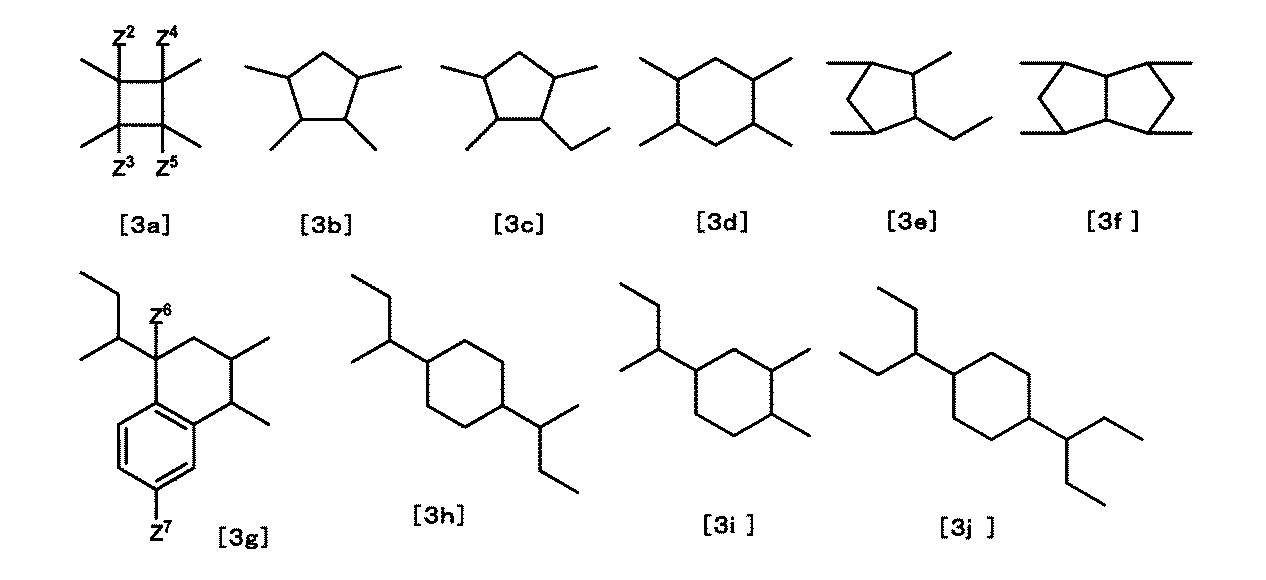
(Z2~Z5は水素原子、メチル基、塩素原子又はベンゼン環を示し、それぞれ同じであっても異なってもよく、Z6及びZ7は水素原子又はメチル基を示し、それぞれ同じであっても異なってもよい。)
(6)前記(B)成分の重合体が、ポリアミド酸を脱水閉環させて得られるポリイミドである上記(1)~(5)のいずれかに記載の液晶配向処理剤。
(7)前記(B)成分の100質量部に対して、前記(A)成分が0.1~30質量部である上記(1)~(6)のいずれかに記載の液晶配向処理剤。
(8)上記(1)~(7)のいずれかに記載の液晶配向処理剤から得られる液晶配向膜。
(9)上記(1)~(7)のいずれかに記載の液晶配向処理剤を用いてインクジェット法にて得られる液晶配向膜。
(10)上記(8)又は(9)に記載の液晶配向膜を有する液晶表示素子。
(12)上記(11)に記載の液晶配向膜を有する液晶表示素子。
(14)上記(13)に記載の液晶配向膜を有する液晶表示素子。
(A)成分:下記の式[1]で示される化合物(特定化合物ともいう)。
(B)成分:ジアミン成分とテトラカルボン酸成分とを反応させて得られるポリイミド前駆体及びポリイミドからなる群から選ばれる少なくとも1種の重合体(特定重合体ともいう)。


また、特定化合物中のX2である式[1-1]~式[1-5]の2重結合部位は、熱や紫外線の照射により、反応することが知られている。また、これら2重結合部位は、シール剤中に含まれる化合物にも含まれている部位である。
以上の点から、本発明の特定化合物及び特定重合体を含有する液晶配向処理剤は、シール剤との密着性が高く、高温高湿条件したにおいても、液晶表示素子の額縁付近の表示ムラの発生を抑制し、かつ電圧保持率の低下を抑制できる液晶配向膜を形成できる。
本発明の特定化合物は、下記の式[1]で示される化合物である。

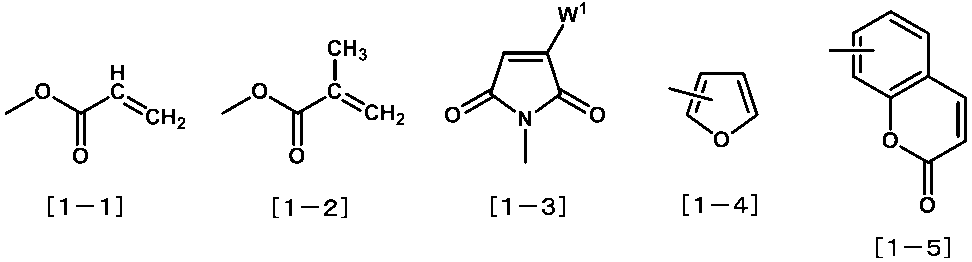
式[1]中、X2は、式[1-1]~式[1-5]から選ばれる構造である。
式[1-3]中、W1は、水素原子又はベンゼン環を示す。なかでも、水素原子が好ましい。
式[1]中、X2は、熱や紫外線の照射による反応性の観点からは、式[1-1]、式[1-2]又は式[1-4]で示される構造が好ましい。

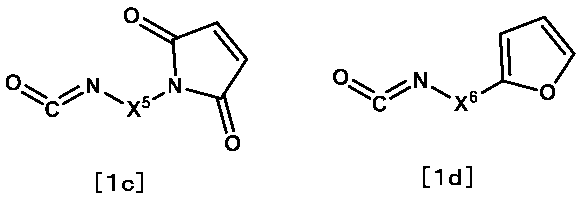
本発明の(B)成分である特定重合体は、ジアミン成分とテトラカルボン酸成分とを反応させて得られるポリイミド前駆体及びポリイミドからなる群から選ばれる少なくとも1種の重合体である。


(B)成分である特定重合体を作製するためのジアミン成分としては、公知のジアミン化合物を用いることができる。
なかでも、下記の式[2]で示される構造を有するジアミン化合物(特定ジアミン化合物ともいう)を少なくとも1種以上用いることが好ましい。
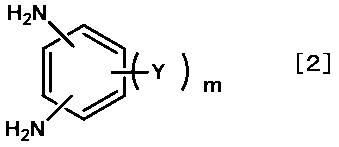

式[2-2]中、bは0~4の整数を示す。なかでも、原料の入手性や合成の容易さの点から、0又は1の整数が好ましい。
式[2-3]中、Y1は単結合、-(CH2)a-(aは1~15の整数である)、-O-、-CH2O-、-COO-又は-OCO-を示す。なかでも、原料の入手性や合成の容易さの点から、単結合、-(CH2)a-(aは1~15の整数である)、-O-、-CH2O-又は-COO-が好ましい。より好ましいのは、単結合、-(CH2)a-(aは1~10の整数である)、-O-、-CH2O-又はCOO-である。
式[2-3]中、Y3は単結合、-(CH2)c-(cは1~15の整数である)、-O-、-CH2O-、-COO-又は-OCO-を示す。なかでも、合成の容易さの点から、単結合、-(CH2)c-(cは1~15の整数である)、-O-、-CH2O-又は-COO-が好ましい。より好ましいのは、単結合、-(CH2)c-(cは1~10の整数である)、-O-、-CH2O-又は-COO-である。
式[2-3]中、nは0~4の整数を示す。なかでも、原料の入手性や合成の容易さの点から、0~3が好ましい。より好ましいのは、0~2である。
式[2-4]中、Y7は-O-、-CH2O-、-COO-、-OCO-、-CONH-又は-NHCO-を示す。なかでも、-O-、-CH2O-、-COO-又は-CONH-が好ましい。より好ましくは、-O-、-COO-又は-CONH-である。
式[2-4]中、Y8は炭素数8~22のアルキル基を示す。
式[2-5]中、Y9及びY10は独立して、炭素数1~12の炭化水素基を示す。
式[2-6]中、Y11は炭素数1~5のアルキル基を示す。
一例として、式[2]で示される特定ジアミン化合物は、下記の式[2-A]で示されるジニトロ体化合物を合成し、さらにそのニトロ基を還元してアミノ基に変換することで得られる。
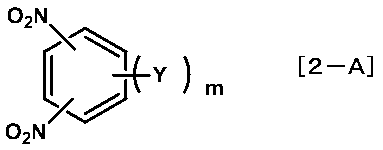
特定ジアミン化合物としては、2,4-ジメチル-m-フェニレンジアミン、2,6-ジアミノトルエン、2,4-ジアミノ安息香酸、3,5-ジアミノ安息香酸、2,4-ジアミノフェノール、3,5-ジアミノフェノール、3,5-ジアミノベンジルアルコール、2,4-ジアミノベンジルアルコール、4,6-ジアミノレゾルシノールの他に、下記の式[2-7]~[2-47]で示される構造のジアミン化合物を挙げることができる。


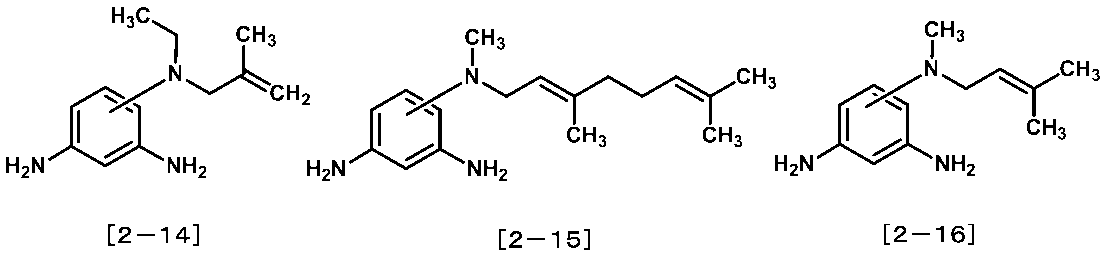
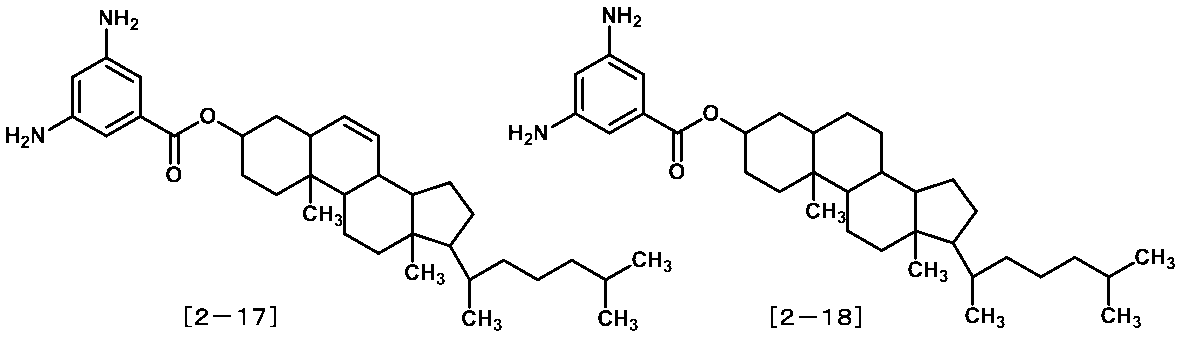

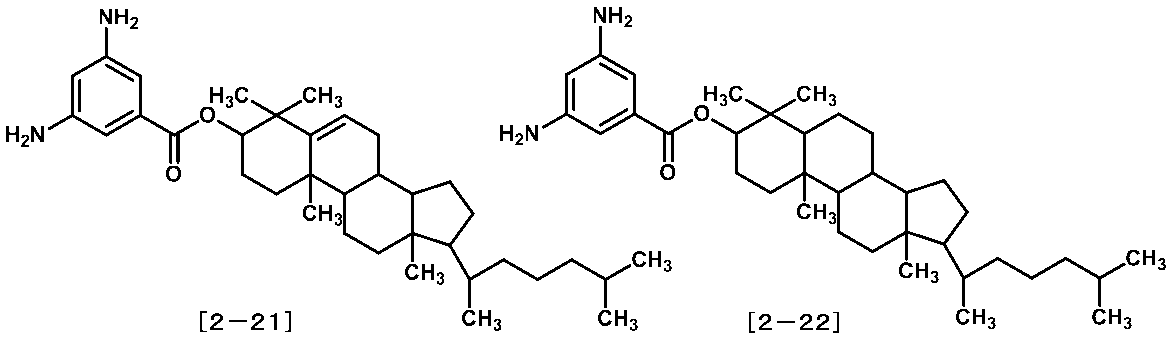
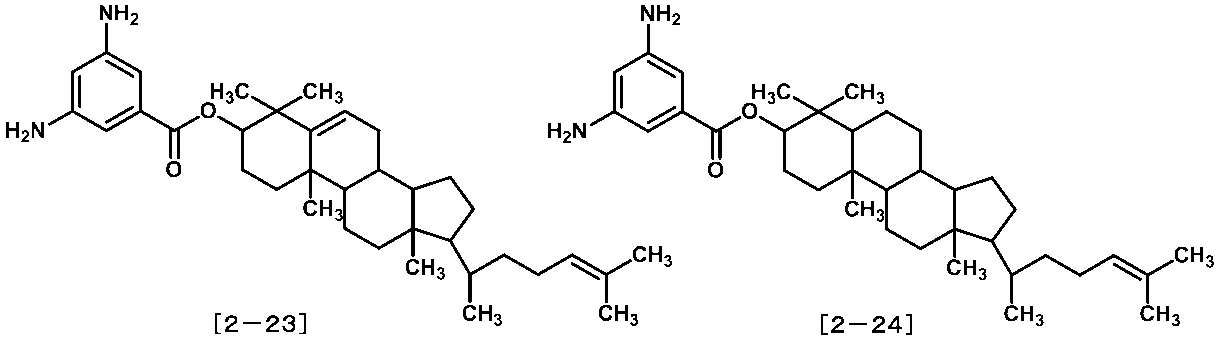
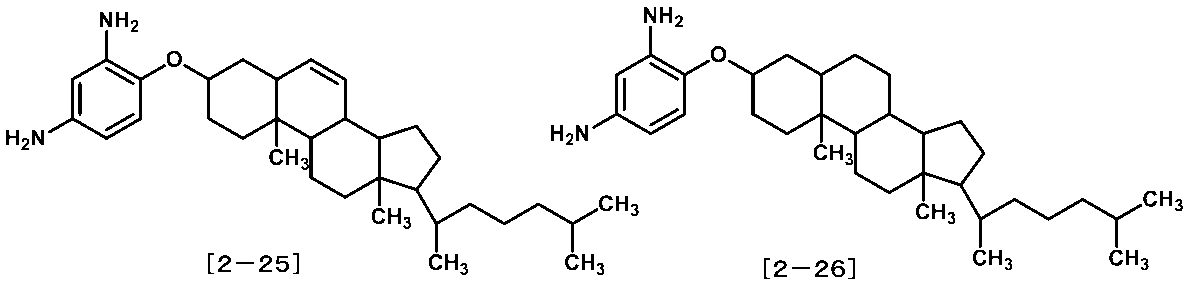


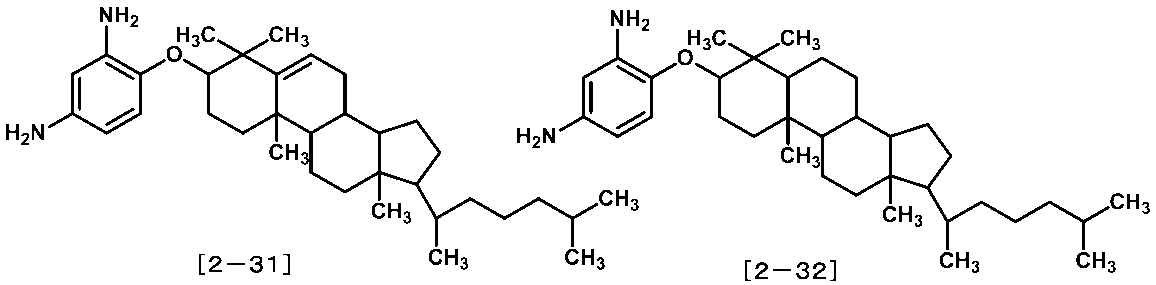
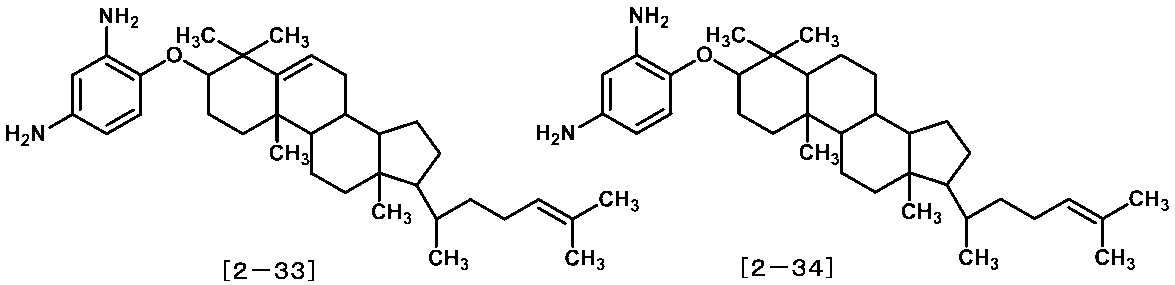

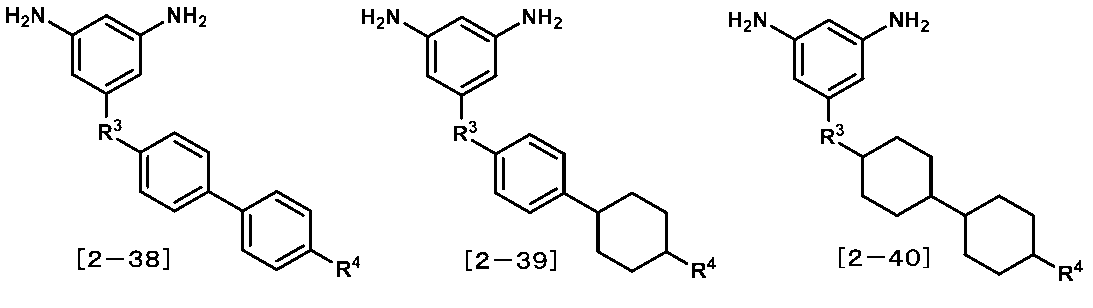
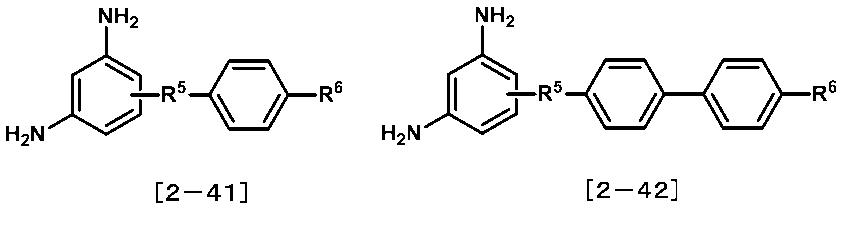
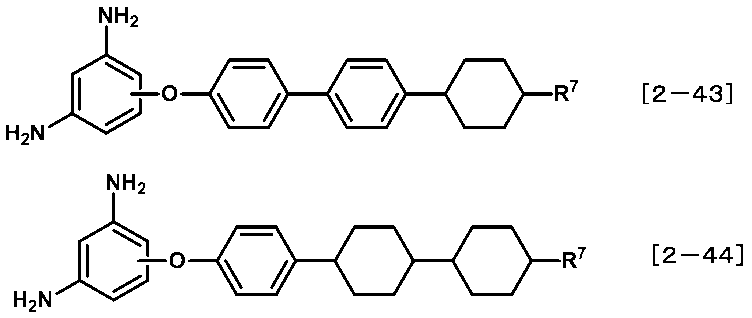
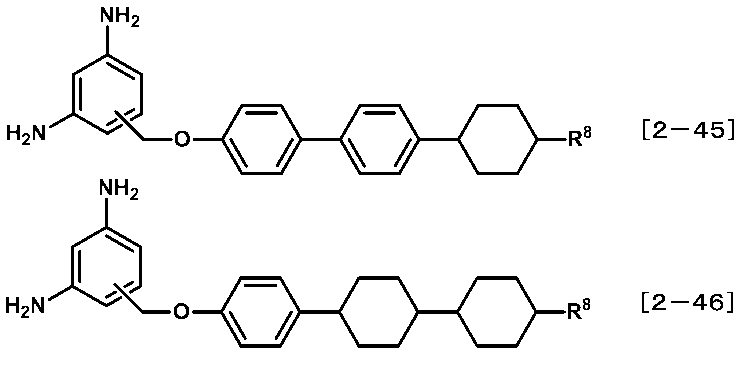
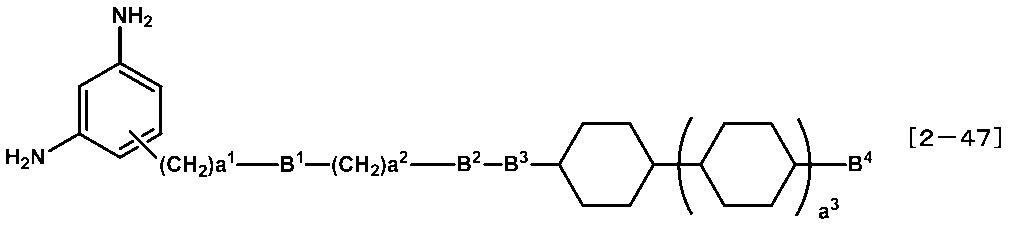
プレチルト角を高めるために用いるジアミン化合物の量は、ジアミン成分全体の5モル%以上80モル%以下であることが好ましい。より好ましくは、液晶配向処理剤の塗布性や液晶配向膜としての電気特性の点から、ジアミン成分全体の5モル%以上60モル%である。
特定重合体を作製するためのジアミン成分としては、式[2]で示される特定ジアミン化合物以外のジアミン化合物(その他ジアミン化合物ともいう)をジアミン成分として用いることができる。下記に、その他ジアミン化合物の具体例を挙げるが、これらの例に限定されるものではない。
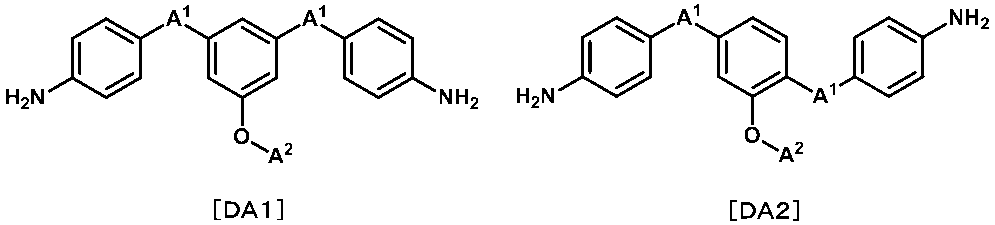


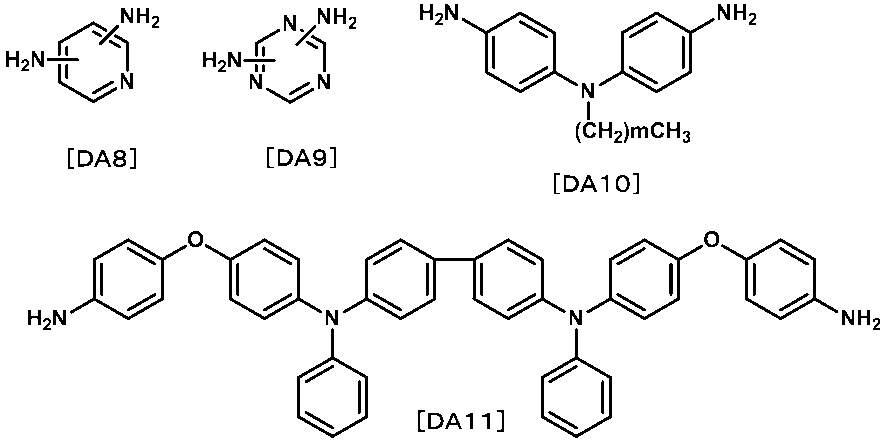
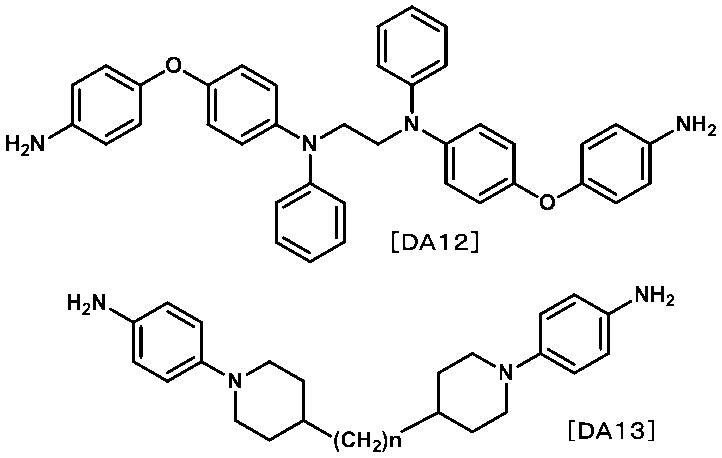
(mは0~3の整数を示し、nは1~5の整数を示す。)
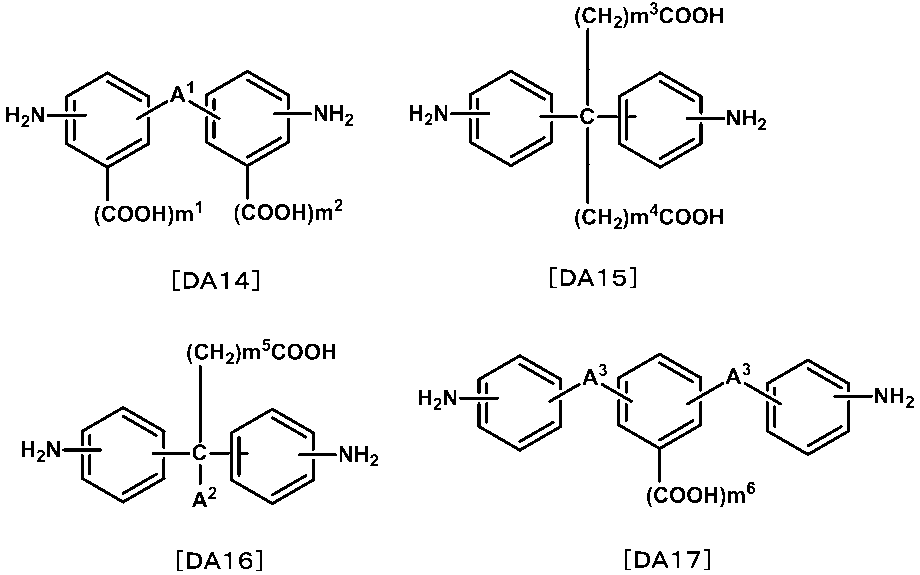
さらに、その他ジアミン化合物として、下記の式[DA18]及び式[DA19]で示されるジアミン化合物を用いることもできる。
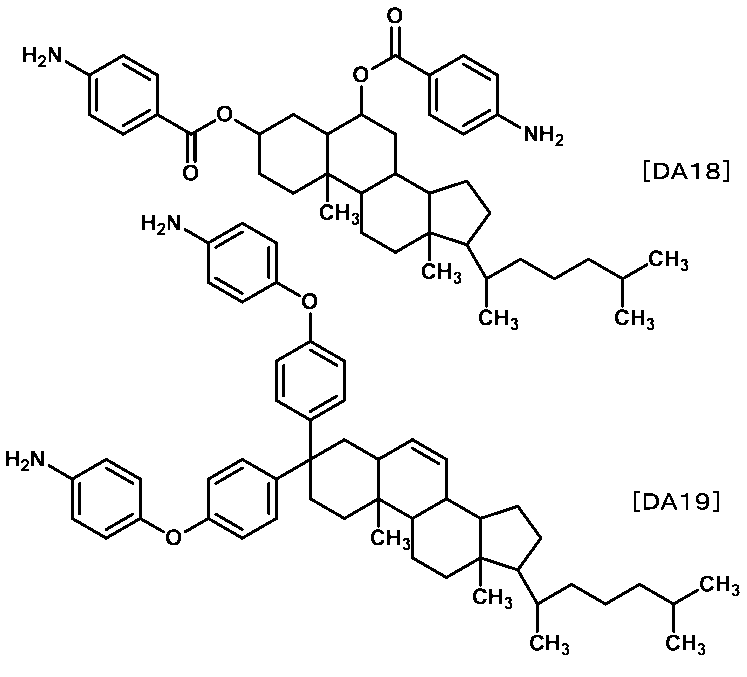

本発明の(B)成分である特定重合体を作製するためのテトラカルボン酸成分としては、下記の式[3]で示されるテトラカルボン酸二無水物やそのテトラカルボン酸誘導体であるテトラカルボン酸、テトラカルボン酸ジハライド化合物、テトラカルボン酸ジアルキルエステル化合物又はテトラカルボン酸ジアルキルエステルジハライド化合物(すべてを総称して特定テトラカルボン酸成分ともいう)を用いることが好ましい。
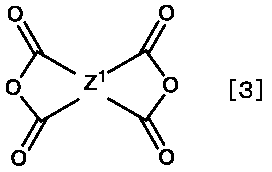

式[3g]中、Z6及びZ7は水素原子又はメチル基を示し、それぞれ同じであっても異なってもよい。
特定テトラカルボン酸成分は、全テトラカルボン酸成分中の1モル%以上であることが好ましい。より好ましいのは、5モル%以上であり、特に好ましいのは、10モル%以上である。中でも、15~100モル%がさらに好ましい。
特定重合体においては、本発明の効果を損なわない限りにおいて、特定テトラカルボン酸成分以外のその他のテトラカルボン酸成分を用いることができる。
その他のテトラカルボン酸成分としては、以下に示すテトラカルボン酸化合物、テトラカルボン酸二無水物、テトラカルボン酸ジハライド化合物、テトラカルボン酸ジアルキルエステル化合物又はテトラカルボン酸ジアルキルエステルジハライド化合物が挙げられる。
特定重合体を合成する方法は特に限定されない。通常、ジアミン成分とテトラカルボン酸成分とを反応させて得られる。一般的には、テトラカルボン酸及びその誘導体からなる群から選ばれる少なくとも1種のテトラカルボン酸成分と、1種又は複数種のジアミン化合物からなるジアミン成分とを反応させて、ポリアミド酸を得る。具体的には、以下のような方法がある。
(1)テトラカルボン酸二無水物と1級又は2級のジアミン化合物とを重縮合させてポリアミド酸を得る方法。
(2)テトラカルボン酸と1級又は2級のジアミン化合物とを脱水重縮合反応させてポリアミド酸を得る方法。
(3)テトラカルボン酸ジハライドと1級又は2級のジアミン化合物とを重縮合させてポリアミド酸を得る方法。
ポリイミドを得るには、前記のポリアミド酸又はポリアミド酸アルキルエステルを閉環させてポリイミドとする方法が用いられる。
例えば、N-メチル-2-ピロリドン、N-エチル-2-ピロリドン又はγ-ブチロラクトン、N,N-ジメチルホルムアミド、N,N-ジメチルアセトアミド、ジメチルスルホキシド又は1,3-ジメチル-イミダゾリジノンが挙げられる。

(1)ジアミン成分を有機溶媒に分散あるいは溶解させた溶液を攪拌させ、テトラカルボン酸成分をそのまま、又は有機溶媒に分散あるいは溶解させて添加する方法。
(2)逆にテトラカルボン酸成分を有機溶媒に分散、あるいは溶解させた溶液にジアミン成分を添加する方法。
(3)ジアミン成分とテトラカルボン酸成分とを交互に添加する方法。
本発明のポリイミドは前記のポリイミド前駆体を閉環させて得られるポリイミドであり、このポリイミドにおいては、アミド酸基の閉環率(イミド化率ともいう)は必ずしも100%である必要はなく、用途や目的に応じて任意に調整することができる。
ポリイミド前駆体を溶液中で熱イミド化させる場合の温度は、100~400℃、好ましくは120~250℃であり、イミド化反応により生成する水を系外に除きながら行う方が好ましい。
本発明の液晶配向処理剤は、液晶配向膜(樹脂被膜ともいう)を形成するための塗布溶液であり、特定化合物、特定重合体及び溶媒を含有する液晶配向膜を形成するための塗布溶液である。
液晶配向処理剤中の特定化合物の含有量は、特定重合体100質量部に対して、0.1~30質量部である。なかでも、0.5~30質量部が好ましく、特に好ましいのは、1~20質量部である。
例えば、N,N-ジメチルホルムアミド、N,N-ジメチルアセトアミド、N-メチル-2-ピロリドン、N-エチル-2-ピロリドン、ジメチルスルホキシド、γ-ブチロラクトン、1,3-ジメチル-イミダゾリジノン、メチルエチルケトン、シクロヘキサノン、シクロペンタノン、4-ヒドロキシ-4-メチル-2-ペンタノンなどである。
液晶配向処理剤における良溶媒は、液晶配向処理剤に含まれる溶媒全体の10~100質量%であることが好ましい。なかでも、20~90質量%が好ましい。より好ましいのは、30~80質量%である。
これらの貧溶媒は、液晶配向処理剤に含まれる溶媒全体の1~70質量%であることが好ましい。なかでも、1~60質量%が好ましい。より好ましいのは5~60質量%である。

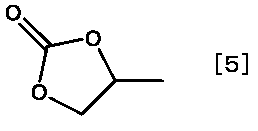


<液晶配向膜・液晶表示素子>
本発明の液晶配向処理剤は、基板上に塗布、焼成した後、ラビング処理や光照射などで配向処理をして、液晶配向膜として用いることができる。また、垂直配向用途などの場合では配向処理なしでも液晶配向膜として用いることができる。この際に用いる基板としては、透明性の高い基板であれば特に限定されず、ガラス基板の他、アクリル基板、ポリカーボネート基板などのプラスチック基板なども用いることができる。プロセスの簡素化の観点からは、液晶駆動のためのITO電極などが形成された基板を用いることが好ましい。また、反射型の液晶表示素子では、片側の基板のみにならばシリコンウェハなどの不透明な基板も使用でき、この場合の電極としてはアルミなどの光を反射する材料も使用できる。
本発明の液晶配向処理剤は、熱や紫外線の照射により、反応する2重結合部位持つ特定化合物を含んでいるため、紫外線の照射及び加熱の少なくとも一方により液晶分子の配向を制御することができる。
「合成例、実施例及び比較例で用いる化合物の略号」
P1:下記の式[P1]で示される化合物
P2:下記の式[P2]で示される化合物
P3:下記の式[P3]で示される化合物

(特定ジアミン化合物)
A1:3,5-ジアミノ安息香酸
A2:下記の式[A2]で示されるジアミン化合物
A3:1,3-ジアミノ-4-オクタデシルオキシベンゼン
A4:1,3-ジアミノ-4-〔4-(トランス-4-n-ヘプチルシクロへキシル)フェノキシ〕ベンゼン
A5:1,3-ジアミノ-4-〔4-(トランス-4-n-ヘプチルシクロへキシル)フェノキシメチル〕ベンゼン
A6:1,3-ジアミノ-4-{4-〔トランス-4-(トランス-4-n-ペンチルシクロへキシル)シクロへキシル〕フェノキシ}ベンゼン
A7:下記の式[A7]で示されるジアミン化合物
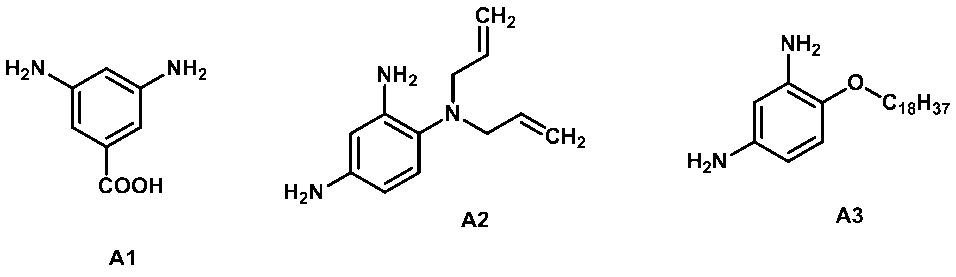


B1:p-フェニレンジアミン
B2:m-フェニレンジアミン
C1:1,2,3,4-シクロブタンテトラカルボン酸二無水物
C2:ビシクロ[3,3,0]オクタン-2,4,6,8-テトラカルボン酸二無水物
C3:下記の式[C3]で示されるテトラカルボン酸二無水物
C4:下記の式[C4]で示されるテトラカルボン酸二無水物
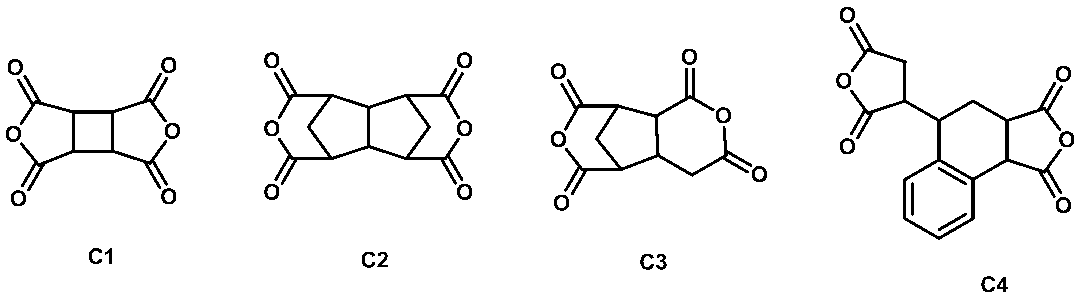
NMP:N-メチル-2-ピロリドン
NEP:N-エチル-2-ピロリドン
γ-BL:γ-ブチロラクトン
ECS:エチレングリコールモノエチルエーテル
EC:ジエチレングリコールモノエチルエーテル
BCS:エチレングリコールモノブチルエーテル
PB:プロピレングリコールモノブチルエーテル
ポリイミド前駆体及びポリイミドの分子量は、常温ゲル浸透クロマトグラフィー(GPC)装置(GPC-101)(昭和電工社製)、カラム(KD-803,KD-805)(Shodex社製)を用いて、以下のようにして測定した。
カラム温度:50℃
溶離液:N,N’-ジメチルホルムアミド(添加剤として、臭化リチウム-水和物(LiBr・H2O)が30mmol/L(リットル)、リン酸・無水結晶(o-リン酸)が30mmol/L、テトラヒドロフラン(THF)が10ml/L)
流速:1.0ml/分
検量線作成用標準サンプル:TSK 標準ポリエチレンオキサイド(分子量;約900,000、150,000、100,000及び30,000)(東ソー社製)及びポリエチレングリコール(分子量;約12,000、4,000及び1,000)(ポリマーラボラトリー社製)。
ポリイミド粉末20mgをNMR(核磁気共鳴)サンプル管(NMRサンプリングチューブスタンダード,φ5(草野科学社製))に入れ、重水素化ジメチルスルホキシド(DMSO-d6,0.05質量%TMS(テトラメチルシラン)混合品)(0.53ml)を添加し、超音波をかけて完全に溶解させた。この溶液をNMR測定機(JNW-ECA500)(日本電子データム社製)にて500MHzのプロトンNMRを測定した。イミド化率は、イミド化前後で変化しない構造に由来するプロトンを基準プロトンとして決め、このプロトンのピーク積算値と、9.5~10.0ppm付近に現れるアミド酸のNH基に由来するプロトンピーク積算値とを用い以下の式によって求めた。
イミド化率(%)=(1-α・x/y)×100
上記式において、xはアミド酸のNH基由来のプロトンピーク積算値、yは基準プロトンのピーク積算値、αはポリアミド酸(イミド化率が0%)の場合におけるアミド酸のNH基プロトン1個に対する基準プロトンの個数割合である。
C1(3.45g,17.6mmol)、A2(0.73g,3.57mmol)及びB1(1.54g,14.3mmol)をNMP(17.2g)中で混合し、40℃で8時間反応させ、樹脂固形分濃度25質量%のポリアミド酸溶液(1)を得た。このポリアミド酸の数平均分子量は、26,600、重量平均分子量は、85,200であった。
C2(3.83g,15.3mmol)、A2(0.93g,4.59mmol)及びB2(2.81g,26.0mmol)をNEP(21.0g)中で混合し、50℃で2時間反応させた。その後、C1(2.91g,14.8mmol)とNEP(10.5g)を加え、40℃で6時間反応させ、樹脂固形分濃度が25質量%のポリアミド酸溶液(2)を得た。このポリアミド酸の数平均分子量は、24,500、重量平均分子量は、71,100であった。
合成例2で得られたポリアミド酸溶液(2)(30.0g)に、NEPを加え6質量%に希釈した後、イミド化触媒として無水酢酸(3.95g)及びピリジン(2.45g)を加え、70℃で3時間反応させた。この反応溶液をメタノール(460ml)中に投入し、得られた沈殿物を濾別した。この沈殿物をメタノールで洗浄し、100℃で減圧乾燥しポリイミド粉末(3)を得た。このポリイミドのイミド化率は70%であり、数平均分子量は22,100、重量平均分子量は60,100であった。
C2(4.47g,17.9mmol)、A1(1.95g,12.8mmol)及びA4(4.85g,12.8mmol)をNEP(25.4g)中で混合し、80℃で5時間反応させた。その後、C1(1.43g,7.30mmol)とNEP(12.7g)を加え、40℃で8時間反応させ、樹脂固形分濃度が25質量%のポリアミド酸溶液(4)を得た。このポリアミド酸の数平均分子量は、23,500、重量平均分子量は、68,600であった。
合成例4で得られたポリアミド酸溶液(4)(30.2g)に、NEPを加え6質量%に希釈した後、イミド化触媒として無水酢酸(3.80g)及びピリジン(2.40g)を加え、70℃で2時間反応させた。この反応溶液をメタノール(460ml)中に投入し、得られた沈殿物を濾別した。この沈殿物をメタノールで洗浄し、100℃で減圧乾燥しポリイミド粉末(5)を得た。このポリイミドのイミド化率は61%であり、数平均分子量は19,900、重量平均分子量は57,100であった。
C2(5.10g,20.4mmol)、A1(1.94g,12.8mmol)、A2(0.52g,2.55mmol)及びA5(4.02g,10.2mmol)をNMP(25.0g)中で混合し、80℃で5時間反応させた。その後、C1(0.93g,4.80mmol)とNMP(12.5g)を加え、40℃で6時間反応させ、樹脂固形分濃度が25質量%のポリアミド酸溶液を得た。
得られたポリアミド酸溶液(30.0g)に、NMPを加え6質量%に希釈した後、イミド化触媒として無水酢酸(4.54g)及びピリジン(3.33g)を加え、80℃で3.5時間反応させた。この反応溶液をメタノール(460ml)中に投入し、得られた沈殿物を濾別した。この沈殿物をメタノールで洗浄し、100℃で減圧乾燥しポリイミド粉末(6)を得た。このポリイミドのイミド化率は85%であり、数平均分子量は16,800、重量平均分子量は50,100であった。
C2(2.42g,9.69mmol)、A1(2.58g,17.0mmol)及びA6(3.14g,7.27mmol)をNEP(21.9g)中で混合し、80℃で5時間反応させた後、C1(2.79g,14.2mmol)とNEP(10.9g)を加え、40℃で6時間反応させ、樹脂固形分濃度が25質量%のポリアミド酸溶液を得た。
得られたポリアミド酸溶液(30.0g)に、NEPを加え6質量%に希釈した後、イミド化触媒として無水酢酸(4.40g)及びピリジン(3.25g)を加え、80℃で3時間反応させた。この反応溶液をメタノール(460ml)中に投入し、得られた沈殿物を濾別した。この沈殿物をメタノールで洗浄し、100℃で減圧乾燥しポリイミド粉末(7)を得た。このポリイミドのイミド化率は81%であり、数平均分子量は17,400、重量平均分子量は52,800であった。
C2(4.32g,17.3mmol)、A1(3.00g,19.7mmol)及びA7(2.43g,4.93mmol)をNMP(22.2g)中で混合し、80℃で5時間反応させた。その後、C1(1.37g,7.00mmol)とNMP(11.1g)を加え、40℃で6時間反応させ、樹脂固形分濃度が25質量%のポリアミド酸溶液を得た。
得られたポリアミド酸溶液(30.5g)に、NMPを加え6質量%に希釈した後、イミド化触媒として無水酢酸(3.90g)及びピリジン(2.55g)を加え、60℃で3時間反応させた。この反応溶液をメタノール(460ml)中に投入し、得られた沈殿物を濾別した。この沈殿物をメタノールで洗浄し、100℃で減圧乾燥しポリイミド粉末(8)を得た。このポリイミドのイミド化率は53%であり、数平均分子量は16,500、重量平均分子量は51,800であった。
C3(5.40g,24.1mmol)、A1(2.43g,15.9mmol)、A2(0.50g,2.45mmol)及びA7(3.02g,6.13mmol)をNMP(34.1g)中で混合し、40℃で8時間反応させ、樹脂固形分濃度が25質量%のポリアミド酸溶液を得た。
得られたポリアミド酸溶液(30.0g)にNMPを加え、6質量%に希釈した後、イミド化触媒として無水酢酸(4.05g)及びピリジン(2.50g)を加え、60℃で2時間反応させた。この反応溶液をメタノール(460ml)中に投入し、得られた沈殿物を濾別した。この沈殿物をメタノールで洗浄し、100℃で減圧乾燥しポリイミド粉末(9)を得た。このポリイミドのイミド化率は55%であり、数平均分子量は16,100、重量平均分子量は48,100であった。
C3(5.38g,24.0mmol)、A1(2.22g,14.6mmol)及びA5(3.84g,9.72mmol)をNMP(34.3g)中で混合し、40℃で8時間反応させ、樹脂固形分濃度が25質量%のポリアミド酸溶液を得た。
得られたポリアミド酸溶液(30.0g)にNMPを加え、6質量%に希釈した後、イミド化触媒として無水酢酸(4.00g)及びピリジン(2.50g)を加え、70℃で2時間反応させた。この反応溶液をメタノール(460ml)中に投入し、得られた沈殿物を濾別した。この沈殿物をメタノールで洗浄し、100℃で減圧乾燥しポリイミド粉末(9)を得た。このポリイミドのイミド化率は61%であり、数平均分子量は17,300、重量平均分子量は51,100であった。
C4(3.48g,11.6mmol)、A1(1.06g,6.95mmol)、A2(0.94g,4.63mmol)及びA3(4.36g,11.6mmol)をNEP(24.1g)中で混合し、40℃で6時間反応させた。その後、C1(2.20g,11.2mmol)とNEP(12.0g)を加え、25℃で8時間反応させ、樹脂固形分濃度が25質量%のポリアミド酸溶液を得た。
得られたポリアミド酸溶液(30.0g)に、NEPを加え6質量%に希釈した後、イミド化触媒として無水酢酸(7.20g)及びピリジン(2.30g)を加え、40℃で1.5時間反応させた。この反応溶液をメタノール(460ml)中に投入し、得られた沈殿物を濾別した。この沈殿物をメタノールで洗浄し、100℃で減圧乾燥しポリイミド粉末(11)を得た。このポリイミドのイミド化率は70%であり、数平均分子量は17,500、重量平均分子量は40,100であった。
ポリイミド系重合体をまとめて表1に示す。
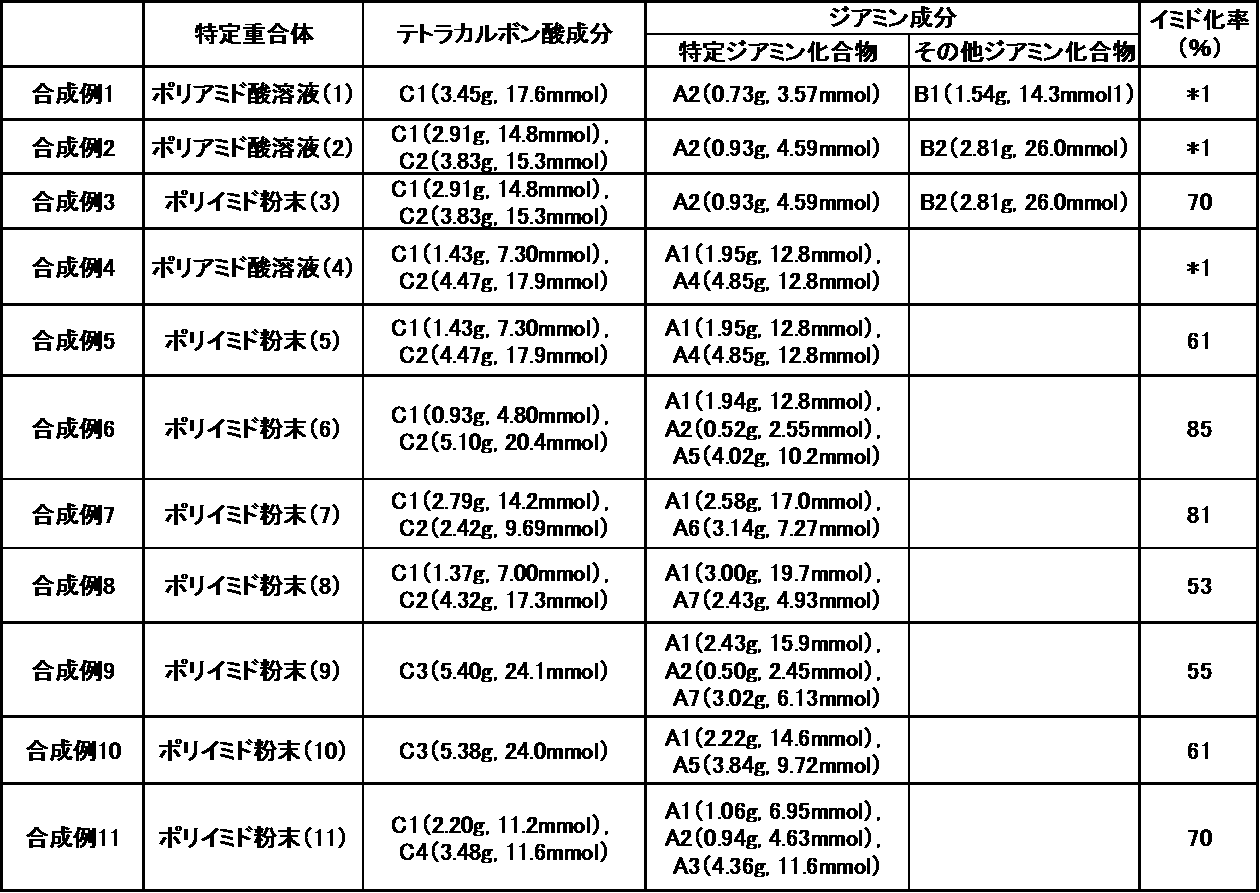
*1:ポリアミド酸。
液晶配向処理剤を、細孔径1μmのメンブランフィルタで加圧濾過し、インクジェット塗布性の評価を行った。インクジェット塗布機には、HIS-200(日立プラントテクノロジー社製)を用いた。塗布は、純水及びIPA(イソプロピルアルコール)にて洗浄を行ったITO(酸化インジウムスズ)蒸着基板上に、塗布面積が70×70mm、ノズルピッチが0.423mm、スキャンピッチが0.5mm、塗布速度が40mm/秒、塗布から仮乾燥までの時間が60秒、仮乾燥がホットプレート上にて70℃で5分間の条件で行った。
得られた液晶配向膜付き基板の塗膜性を確認した。具体的には、塗膜をナトリウムランプの下で目視観察することで行い、ピンホールの有無を確認した。その結果、いずれの実施例で得られた液晶配向膜とも、塗膜上にピンホールは見られず、塗膜性に優れた液晶配向膜が得られた。
晶配向処理剤を、細孔径1μmのメンブランフィルタで加圧濾過し、液晶セルの作製(通常セル)を行った。この溶液を純水及びIPAにて洗浄を行った100×100mmITO電極付き基板(縦100mm×横100mm、厚さ0.7mm)のITO面にスピンコートし、ホットプレート上にて100℃で5分間、熱循環型クリーンオーブンにて230℃で30分間加熱処理をして膜厚が100nmのポリイミド液晶配向膜付きのITO基板を得た。このITO基板の塗膜面をロール径が120mmのラビング装置でレーヨン布を用いて、ロール回転数が1000rpm、ロール進行速度が50mm/sec、押し込み量が0.1mmの条件でラビング処理した。
得られた液晶配向膜付きのITO基板を2枚用意し、その一方の液晶配向膜付き基板の液晶配向膜面に、6μmのスペーサーを散布した。その後、この基板の周囲に紫外線硬化型のシール剤を描画し、ODF(One Drop Filling)法にて液晶を注入して、液晶セルを得た。その後、紫外線硬化型のシール剤を硬化させるため、この液晶セルに、照度60mWのメタルハライドランプを用いて、310nm以下の波長をカットし、365nm換算で5J/cm2の紫外線を照射した。その後、熱循環型クリーンオーブン中にて120℃で60分間加熱処理をして、液晶セル(通常セル)を得た。
また、実施例4~6で得られた液晶配向処理剤(4)~(6)、実施例8で得られた液晶配向処理剤(8)、実施例9で得られた液晶配向処理剤(9)、実施例11~15で得られた液晶配向処理剤(11)~(15)、実施例17~20で得られた液晶配向処理剤(17)~(20)、及び比較例3~4で得られた液晶配向処理剤(23)~(24)を用いたを用いた液晶セルには、液晶としてネマティック液晶(MLC-6608)(メルク・ジャパン社製)を用いた。
その後、液晶セルを温度80℃、湿度90%RHの高温高湿槽内に36時間保管し、上記と同様の条件でシール剤付近の液晶配向性の評価を行った。具体的には、シール剤付近に液晶配向性の乱れが見られていないものほど、本評価に優れるとした。
表5~表7中、液晶配向性の乱れが見られていないものを「○」とし、液晶配向性の乱れが見られたものを「×」とした。
液晶配向処理剤を、細孔径1μmのメンブランフィルタで加圧濾過し、液晶セルの作製(通常セル)を行った。この溶液を純水及びIPAにて洗浄を行った30×40mmITO電極付き基板(縦40mm×横30mm、厚さ0.7mm)のITO面にスピンコートし、ホットプレート上にて100℃で5分間、熱循環型クリーンオーブンにて230℃で30分間加熱処理をして膜厚が100nmのポリイミド液晶配向膜付きのITO基板を得た。このITO基板の塗膜面をロール径が120mmのラビング装置でレーヨン布を用いて、ロール回転数が1000rpm、ロール進行速度が50mm/sec、押し込み量が0.1mmの条件でラビング処理した。
なお、各実施例及び比較例の液晶セルの作製に用いた液晶は、前記の「高温高湿保管後の液晶セルの額縁付近の表示ムラ特性の評価(通常セル)」と同様とした。
さらに、電圧保持率の測定が終わった液晶セルを、温度80℃、湿度90%RHの高温高湿槽内に48時間保管し、再度、上記と同様の条件で電圧保持率の測定を行った。
評価は、液晶セル作製直後の電圧保持率の値に対して、高温高湿槽内保管後の電圧保持率の値の低下が小さいものほど、良好とした(表5~表7)。
液晶配向処理剤を、細孔径1μmのメンブランフィルタで加圧濾過し、液晶セルの作製及び液晶配向性の評価(PSAセル)を行った。この溶液を、純水及びIPAにて洗浄した中心に10×10mmのパターン間隔20μmのITO電極付き基板(縦40mm×横30mm、厚さ0.7mm)と中心に10×40mmのITO電極付き基板(縦40mm×横30mm、厚さ0.7mm)のITO面にスピンコートし、ホットプレート上にて100℃で5分間、熱循環型クリーンオーブンにて230℃で30分間加熱処理をして膜厚が100nmのポリイミド塗膜を得た。
この液晶配向膜付き基板を、液晶配向膜面を内側にして、6μmのスペーサー挟んで組み合わせ、シール剤で周囲を接着して空セルを作製した。この空セルに減圧注入法によって、下記の式で示される重合性化合物(1)を、ネマティック液晶(MLC-6608)(メルク・ジャパン社製)の100質量%に対して0.3質量%混合した液晶混合物を注入し、注入口を封止して、液晶セルを得た。
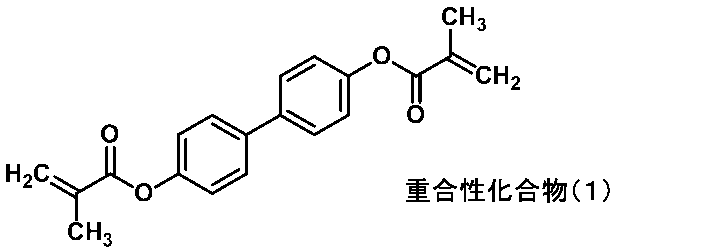
得られた液晶セルに、交流5Vの電圧を印加しながら、照度60mWのメタルハライドランプを用いて、350nm以下の波長をカットし、365nm換算で20J/cm2の紫外線照射を行い、液晶の配向方向が制御された液晶セル(PSAセル)を得た。液晶セルに紫外線を照射している際の照射装置内の温度は、50℃であった。
実施例で得られたPSAセルは、紫外線照射前の液晶セルに比べて、紫外線照射後の液晶セルの応答速度が早くなったことから、液晶の配向方向が制御されたことを確認した。また、いずれの液晶セルとも、偏光顕微鏡(ECLIPSE E600WPOL)(ニコン社製)での観察により、液晶は均一に配向していることを確認した。
合成例1で得られた樹脂固形分濃度25質量%のポリアミド酸溶液(1)(10.0g)に、NMP(19.9g)及びBCS(11.8g)を加え、25℃で2時間攪拌した。その後、この溶液に、P2(0.25g)を加え、60℃で6時間攪拌して、液晶配向処理剤(1)を得た。液晶配向処理剤に、濁りや析出などの異常は見られず、均一な溶液であることが確認された。
得られた液晶配向処理剤(1)を用いて、「高温高湿保管後の液晶セルの額縁付近の表示ムラ特性の評価(通常セル)」及び「高温高湿保管後の電圧保持率の評価(通常セル)」を行った。
合成例2で得られた樹脂固形分濃度25質量%のポリアミド酸溶液(2)(10.5g)に、NEP(18.9g)及びPB(14.4g)を加え、25℃で2時間攪拌した。その後、P2(0.18g)を加え、60℃で6時間攪拌して、液晶配向処理剤(2)を得た。液晶配向処理剤に、濁りや析出などの異常は見られず、均一な溶液であることが確認された。
得られた液晶配向処理剤(2)を用いて、「高温高湿保管後の液晶セルの額縁付近の表示ムラ特性の評価(通常セル)」及び「高温高湿保管後の電圧保持率の評価(通常セル)」を行った。
合成例3で得られたポリイミド粉末(3)(1.55g)に、NEP(17.0g)及びPB(7.30g)を加え、70℃にて24時間攪拌して溶解させた。その後、この溶液に、P2(0.11g)を加え、60℃で6時間攪拌して、液晶配向処理剤(3)を得た。液晶配向処理剤に、濁りや析出などの異常は見られず、均一な溶液であることが確認された。
得られた液晶配向処理剤(3)を用いて、「高温高湿保管後の液晶セルの額縁付近の表示ムラ特性の評価(通常セル)」及び「高温高湿保管後の電圧保持率の評価(通常セル)」を行った。
合成例4で得られた樹脂固形分濃度25質量%のポリアミド酸溶液(4)(11.0g)に、NEP(19.8g)及びPB(15.1g)を加え、25℃で2時間攪拌した。その後、P2(0.19g)を加え、60℃で6時間攪拌して、液晶配向処理剤(4)を得た。液晶配向処理剤に、濁りや析出などの異常は見られず、均一な溶液であることが確認された。
得られた液晶配向処理剤(4)を用いて、「高温高湿保管後の液晶セルの額縁付近の表示ムラ特性の評価(通常セル)」及び「高温高湿保管後の電圧保持率の評価(通常セル)」を行った。
合成例4で得られた樹脂固形分濃度25質量%のポリアミド酸溶液(4)(11.0g)に、NEP(17.6g)、EC(4.30g)及びPB(12.9g)を加え、25℃で2時間攪拌した。その後、P1(0.41g)を加え、60℃で6時間攪拌して、液晶配向処理剤(5)を得た。液晶配向処理剤に、濁りや析出などの異常は見られず、均一な溶液であることが確認された。
得られた液晶配向処理剤(5)を用いて、「高温高湿保管後の液晶セルの額縁付近の表示ムラ特性の評価(通常セル)」及び「高温高湿保管後の電圧保持率の評価(通常セル)」を行った。
合成例5で得られたポリイミド粉末(5)(1.50g)に、NEP(15.3g)及びPB(8.20g)を加え、70℃にて24時間攪拌して溶解させた。その後、この溶液に、P2(0.11g)を加え、60℃で6時間攪拌して、液晶配向処理剤(6)を得た。液晶配向処理剤に、濁りや析出などの異常は見られず、均一な溶液であることが確認された。
得られた液晶配向処理剤(6)を用いて、「高温高湿保管後の液晶セルの額縁付近の表示ムラ特性の評価(通常セル)」、「高温高湿保管後の電圧保持率の評価(通常セル)」及び「液晶セルの作製及び液晶配向性の評価(PSAセル)」を行った。
合成例5で得られたポリイミド粉末(5)(1.10g)に、NEP(23.1g)及びPB(12.4g)を加え、70℃にて24時間攪拌して溶解させた。その後、この溶液に、P2(0.077g)を加え、60℃で6時間攪拌して、液晶配向処理剤(7)を得た。液晶配向処理剤に、濁りや析出などの異常は見られず、均一な溶液であることが確認された。
得られた液晶配向処理剤(7)を用いて、「液晶配向処理剤のインクジェット塗布性の評価」を行った。
合成例5で得られたポリイミド粉末(5)(1.55g)に、NMP(13.4g)、EC(2.40g)及びBCS(8.50g)を加え、70℃にて24時間攪拌して溶解させた。その後、この溶液に、P3(0.23g)を加え、60℃で6時間攪拌して、液晶配向処理剤(8)を得た。液晶配向処理剤に、濁りや析出などの異常は見られず、均一な溶液であることが確認された。
得られた液晶配向処理剤(8)を用いて、「高温高湿保管後の液晶セルの額縁付近の表示ムラ特性の評価(通常セル)」及び「高温高湿保管後の電圧保持率の評価(通常セル)」を行った。
合成例6で得られたポリイミド粉末(6)(1.52g)に、NEP(15.5g)及びPB(8.30g)を加え、70℃にて24時間攪拌して溶解させた。その後、この溶液に、P1(0.26g)を加え、60℃で6時間攪拌して、液晶配向処理剤(9)を得た。液晶配向処理剤に、濁りや析出などの異常は見られず、均一な溶液であることが確認された。
得られた液晶配向処理剤(9)を用いて、「高温高湿保管後の液晶セルの額縁付近の表示ムラ特性の評価(通常セル)」、「高温高湿保管後の電圧保持率の評価(通常セル)」及び「液晶セルの作製及び液晶配向性の評価(PSAセル)」を行った。
合成例6で得られたポリイミド粉末(6)(1.05g)に、NEP(22.1g)及びPB(11.9g)を加え、70℃にて24時間攪拌して溶解させた。その後、この溶液に、P1(0.18g)を加え、60℃で6時間攪拌して、液晶配向処理剤(10)を得た。液晶配向処理剤に、濁りや析出などの異常は見られず、均一な溶液であることが確認された。
得られた液晶配向処理剤(10)を用いて、「液晶配向処理剤のインクジェット塗布性の評価」を行った。
合成例7で得られたポリイミド粉末(7)(1.50g)に、NEP(9.40g)、γ-BL(4.70g)及びBCS(9.40g)を加え、70℃にて24時間攪拌して溶解させた。その後、この溶液に、P2(0.075g)を加え、60℃で6時間攪拌して、液晶配向処理剤(11)を得た。液晶配向処理剤に、濁りや析出などの異常は見られず、均一な溶液であることが確認された。
得られた液晶配向処理剤(11)を用いて、「高温高湿保管後の液晶セルの額縁付近の表示ムラ特性の評価(通常セル)」及び「高温高湿保管後の電圧保持率の評価(通常セル)」を行った。
合成例7で得られたポリイミド粉末(7)(1.50g)に、NMP(14.1g)、ECS(2.40g)及びBCS(7.10g)を加え、70℃にて24時間攪拌して溶解させた。その後、この溶液に、P1(0.075g)及びP2(0.15g)を加え、60℃で6時間攪拌して、液晶配向処理剤(12)を得た。液晶配向処理剤に、濁りや析出などの異常は見られず、均一な溶液であることが確認された。
得られた液晶配向処理剤(12)を用いて、「高温高湿保管後の液晶セルの額縁付近の表示ムラ特性の評価(通常セル)」及び「高温高湿保管後の電圧保持率の評価(通常セル)」を行った。
合成例8で得られたポリイミド粉末(8)(1.52g)に、NEP(15.5g)及びPB(8.30g)を加え、70℃にて24時間攪拌して溶解させた。その後、この溶液に、P2(0.15g)を加え、60℃で6時間攪拌して、液晶配向処理剤(13)を得た。液晶配向処理剤に、濁りや析出などの異常は見られず、均一な溶液であることが確認された。
得られた液晶配向処理剤(13)を用いて、「高温高湿保管後の液晶セルの額縁付近の表示ムラ特性の評価(通常セル)」、「高温高湿保管後の電圧保持率の評価(通常セル)」及び「液晶セルの作製及び液晶配向性の評価(PSAセル)」を行った。
合成例8で得られたポリイミド粉末(8)(1.50g)に、NEP(15.3g)及びPB(8.20g)を加え、70℃にて24時間攪拌して溶解させた。その後、この溶液に、P1(0.045g)を加え、60℃で6時間攪拌して、液晶配向処理剤(14)を得た。液晶配向処理剤に、濁りや析出などの異常は見られず、均一な溶液であることが確認された。
得られた液晶配向処理剤(14)を用いて、「高温高湿保管後の液晶セルの額縁付近の表示ムラ特性の評価(通常セル)」及び「高温高湿保管後の電圧保持率の評価(通常セル)」を行った。
合成例9で得られたポリイミド粉末(9)(1.50g)に、NEP(11.8g)、γ-BL(2.40g)及びPB(9.40g)を加え、70℃にて24時間攪拌して溶解させた。その後、この溶液に、P3(0.15g)を加え、60℃で6時間攪拌して、液晶配向処理剤(15)を得た。液晶配向処理剤に、濁りや析出などの異常は見られず、均一な溶液であることが確認された。
得られた液晶配向処理剤(15)を用いて、「高温高湿保管後の液晶セルの額縁付近の表示ムラ特性の評価(通常セル)」及び「高温高湿保管後の電圧保持率の評価(通常セル)」を行った。
合成例9で得られたポリイミド粉末(9)(1.00g)に、NEP(16.2g)、γ-BL(3.20g)及びPB(12.9g)を加え、70℃にて24時間攪拌して溶解させた。その後、この溶液に、P3(0.10g)を加え、60℃で6時間攪拌して、液晶配向処理剤(16)を得た。液晶配向処理剤に、濁りや析出などの異常は見られず、均一な溶液であることが確認された。
得られた液晶配向処理剤(16)を用いて、「液晶配向処理剤のインクジェット塗布性の評価」を行った。
合成例10で得られたポリイミド粉末(10)(1.55g)に、NMP(15.8g)及びPB(8.50g)を加え、70℃にて24時間攪拌して溶解させた。その後、この溶液に、P1(0.23g)を加え、60℃で6時間攪拌して、液晶配向処理剤(17)を得た。液晶配向処理剤に、濁りや析出などの異常は見られず、均一な溶液であることが確認された。
得られた液晶配向処理剤(17)を用いて、「高温高湿保管後の液晶セルの額縁付近の表示ムラ特性の評価(通常セル)」及び「高温高湿保管後の電圧保持率の評価(通常セル)」を行った。
合成例10で得られたポリイミド粉末(10)(1.55g)に、NEP(15.8g)及びPB(8.50g)を加え、70℃にて24時間攪拌して溶解させた。その後、この溶液に、P1(0.11g)及びP2(0.11g)を加え、60℃で6時間攪拌して、液晶配向処理剤(18)を得た。液晶配向処理剤に、濁りや析出などの異常は見られず、均一な溶液であることが確認された。
得られた液晶配向処理剤(18)を用いて、「高温高湿保管後の液晶セルの額縁付近の表示ムラ特性の評価(通常セル)」、「高温高湿保管後の電圧保持率の評価(通常セル)」及び「液晶セルの作製及び液晶配向性の評価(PSAセル)」を行った。
合成例11で得られたポリイミド粉末(11)(1.50g)に、γ-BL(12.9g)、EC(2.40g)及びBCS(8.20g)を加え、70℃にて24時間攪拌して溶解させた。その後、この溶液に、P3(0.15g)を加え、60℃で6時間攪拌して、液晶配向処理剤(19)を得た。液晶配向処理剤に、濁りや析出などの異常は見られず、均一な溶液であることが確認された。
得られた液晶配向処理剤(19)を用いて、「高温高湿保管後の液晶セルの額縁付近の表示ムラ特性の評価(通常セル)」及び「高温高湿保管後の電圧保持率の評価(通常セル)」を行った。
合成例11で得られたポリイミド粉末(11)(1.50g)に、NMP(14.1g)、ECS(2.40g)及びBCS(7.10g)を加え、70℃にて24時間攪拌して溶解させた。その後、この溶液に、P1(0.075g)及びP2(0.075g)を加え、60℃で6時間攪拌して、液晶配向処理剤(20)を得た。液晶配向処理剤に、濁りや析出などの異常は見られず、均一な溶液であることが確認された。
得られた液晶配向処理剤(20)を用いて、「高温高湿保管後の液晶セルの額縁付近の表示ムラ特性の評価(通常セル)」及び「高温高湿保管後の電圧保持率の評価(通常セル)」を行った。
合成例2で得られた樹脂固形分濃度25質量%のポリアミド酸溶液(2)(10.5g)に、NEP(18.9g)及びPB(14.4g)を加え、25℃で2時間攪拌して、液晶配向処理剤(21)を得た。液晶配向処理剤に、濁りや析出などの異常は見られず、均一な溶液であることが確認された。
得られた液晶配向処理剤(21)を用いて、「高温高湿保管後の液晶セルの額縁付近の表示ムラ特性の評価(通常セル)」及び「高温高湿保管後の電圧保持率の評価(通常セル)」を行った。
合成例3で得られたポリイミド粉末(3)(1.55g)に、NEP(17.0g)及びPB(7.30g)を加え、70℃にて24時間攪拌して溶解させ、液晶配向処理剤(22)を得た。液晶配向処理剤に、濁りや析出などの異常は見られず、均一な溶液であることが確認された。
得られた液晶配向処理剤(22)を用いて、「高温高湿保管後の液晶セルの額縁付近の表示ムラ特性の評価(通常セル)」及び「高温高湿保管後の電圧保持率の評価(通常セル)」を行った。
合成例4で得られた樹脂固形分濃度25質量%のポリアミド酸溶液(4)(11.0g)に、NEP(19.8g)及びPB(15.1g)を加え、25℃で2時間攪拌して、液晶配向処理剤(23)を得た。液晶配向処理剤に、濁りや析出などの異常は見られず、均一な溶液であることが確認された。
得られた液晶配向処理剤(23)を用いて、「高温高湿保管後の液晶セルの額縁付近の表示ムラ特性の評価(通常セル)」及び「高温高湿保管後の電圧保持率の評価(通常セル)」を行った。
合成例5で得られたポリイミド粉末(5)(1.50g)に、NEP(15.3g)及びPB(8.20g)を加え、70℃にて24時間攪拌して溶解させ、液晶配向処理剤(24)を得た。液晶配向処理剤に、濁りや析出などの異常は見られず、均一な溶液であることが確認された。
得られた液晶配向処理剤(24)を用いて、「高温高湿保管後の液晶セルの額縁付近の表示ムラ特性の評価(通常セル)」及び「高温高湿保管後の電圧保持率の評価(通常セル)」を行った。

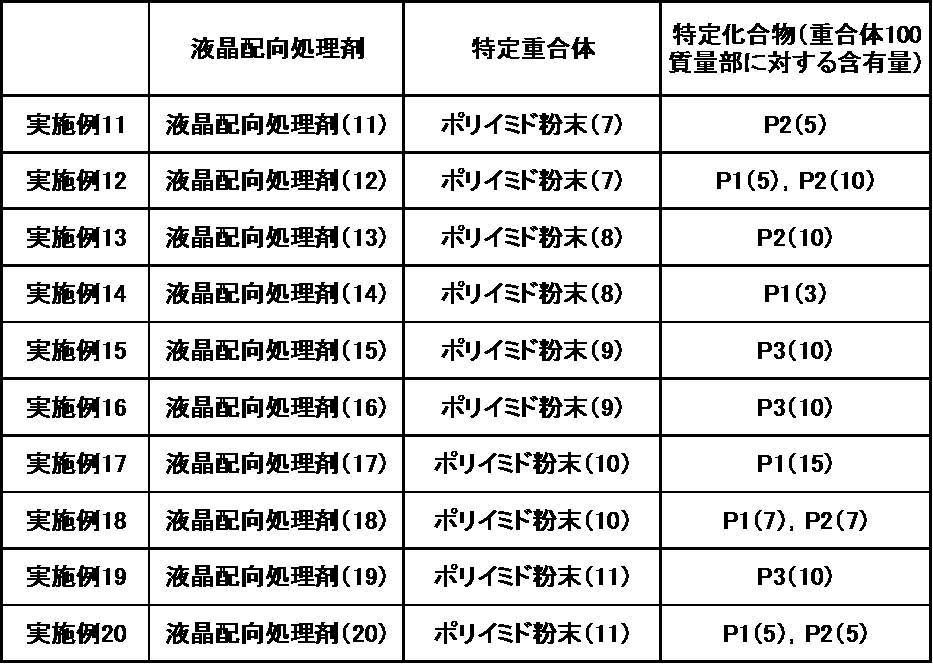


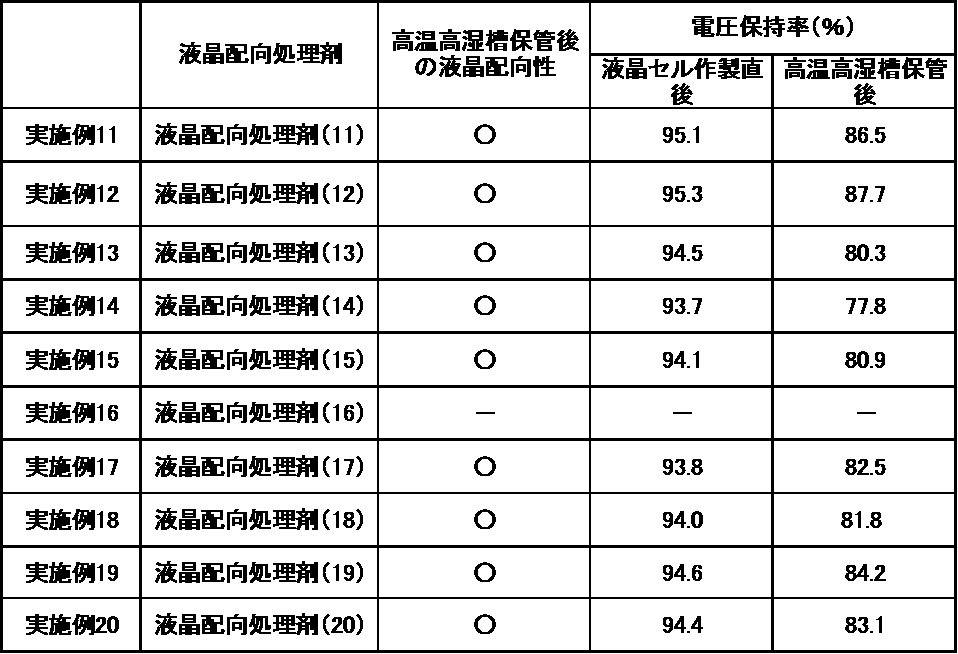

具体的には、実施例2と比較例1、実施例3と比較例2、実施例4と比較例3、及び実施例6と比較例4との比較であり、実施例と、同一の(B)成分である特定重合体を用い、(A)成分である特定化合物を含有していない比較例との比較である。比較例の液晶配向処理剤を用いた場合は、液晶セルを高温高湿槽内で長期間保管すると、液晶セルのシール剤付近に液晶配向性の乱れが発生し、さらに、電圧保持率が大きく低下した。
なお、2013年5月1日に出願された日本特許出願2013-96470号の明細書、特許請求の範囲、及び要約書の全内容をここに引用し、本発明の明細書の開示として、取り入れるものである。
Claims (14)
- 下記の(A)成分及び(B)成分を含有することを特徴とする液晶配向処理剤。
(A)成分:下記の式[1]で示される化合物。
(B)成分:ジアミン成分とテトラカルボン酸成分とを反応させて得られるポリイミド前駆体及びポリイミドからなる群から選ばれる少なくとも1種の重合体。

(X1は、炭素数1~20の脂肪族炭化水素基を有する2価の有機基、又はベンゼン環若しくはシクロヘキサン環を有する炭素数6~24の2価の有機基を示し、X2は、下記の式[1-1]~式[1-5]から選ばれる構造を示す。)
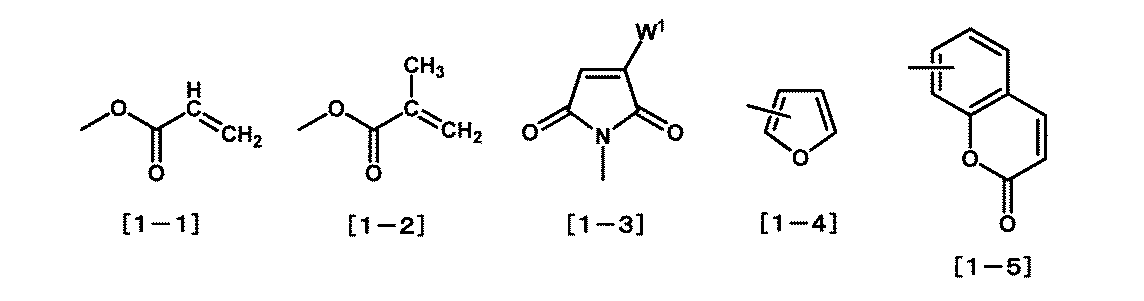
- 前記式[1]のX1が、炭素数1~10のアルキレン基である請求項1に記載の液晶配向処理剤。
- 前記式[1]のX2が、式[1-1]、式[1-2]及び式[1-4]から選ばれる構造である請求項1又は2に記載の液晶配向処理剤。
- 前記(B)成分の重合体におけるジアミン成分が、下記の式[2]で示される構造のジアミン化合物を少なくとも1種以上含む、請求項1~3のいずれか一項に記載の液晶配向処理剤。

(Yは下記の式[2-1]~式[2-6]から選ばれる構造の置換基を示し、mは1~4の整数を示す。)
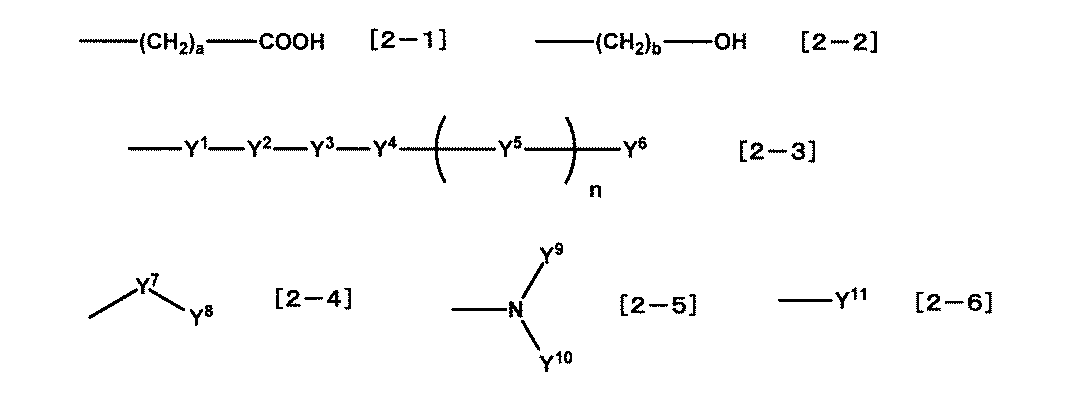
(aは0~4の整数を示し、bは0~4の整数を示す。
Y1は単結合、-(CH2)a-(aは1~15の整数である)、-O-、-CH2O-、-COO-又はOCO-を示し、Y2は単結合又は-(CH2)b-(bは1~15の整数である)を示し、Y3は単結合、-(CH2)c-(cは1~15の整数である)、-O-、-CH2O-、-COO-又は-OCO-を示し、Y4はベンゼン環、シクロヘキサン環及び複素環から選ばれる2価の環状基、又はステロイド骨格を有する炭素数12~25の2価の有機基を示し、前記環状基上の任意の水素原子は、炭素数1~3のアルキル基、炭素数1~3のアルコキシル基、炭素数1~3のフッ素含有アルキル基、炭素数1~3のフッ素含有アルコキシル基又はフッ素原子で置換されていてもよく、Y5はベンゼン環、シクロヘキサン環及び複素環から選ばれる2価の環状基を示し、これらの環状基上の任意の水素原子は、炭素数1~3のアルキル基、炭素数1~3のアルコキシル基、炭素数1~3のフッ素含有アルキル基、炭素数1~3のフッ素含有アルコキシル基又はフッ素原子で置換されていてもよく、nは0~4の整数を示し、Y6は炭素数1~18のアルキル基、炭素数1~18のフッ素含有アルキル基、炭素数1~18のアルコキシル基又は炭素数1~18のフッ素含有アルコキシル基を示し、
Y7は-O-、-CH2O-、-COO-、-OCO-、-CONH-又は-NHCO-を示し、Y8は炭素数8~22のアルキル基を示す。
Y9及びY10はそれぞれ独立して、炭素数1~12の炭化水素基を示し、Y11は炭素数1~5のアルキル基を示す。) - 前記(B)成分の重合体におけるテトラカルボン酸成分に、下記の式[3]で示される化合物を含む、請求項1~4のいずれか一項に記載の液晶配向処理剤。
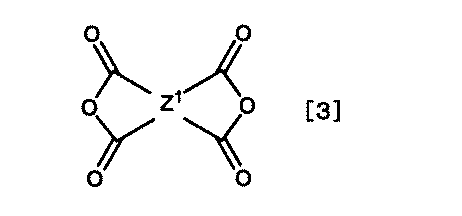
(Z1は下記の式[3a]~式[3j]から選ばれる構造の基である。)
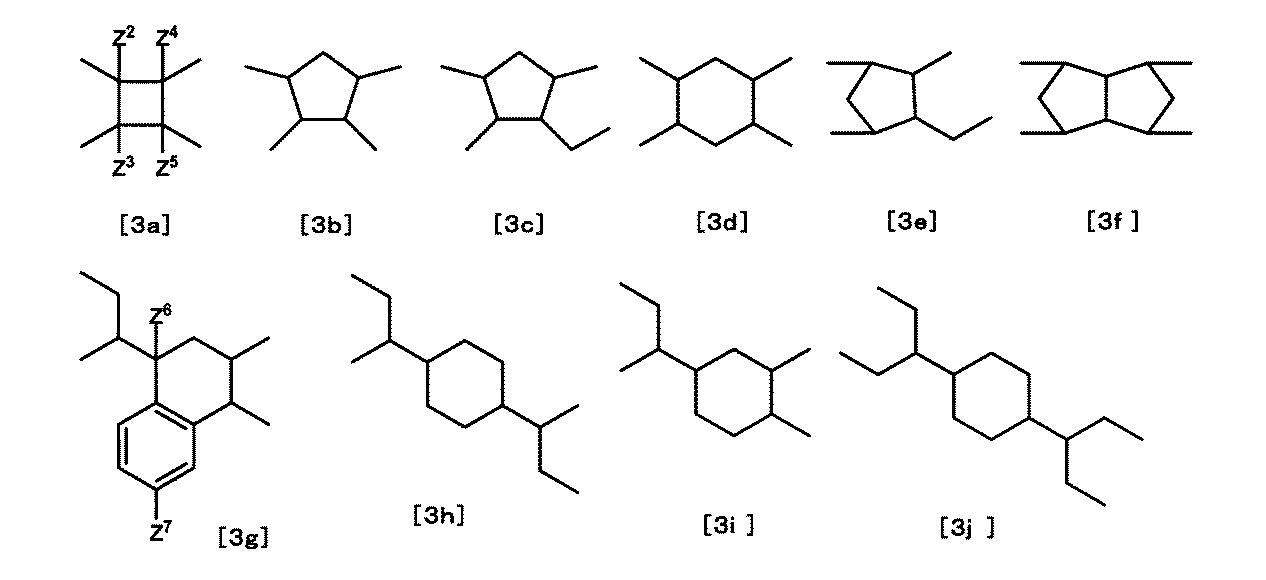
(Z2~Z5は水素原子、メチル基、塩素原子又はベンゼン環を示し、それぞれ同じであっても異なってもよく、Z6及びZ7は水素原子又はメチル基を示し、それぞれ同じであっても異なってもよい。) - 前記(B)成分の重合体が、ポリアミド酸を脱水閉環させて得られるポリイミドである請求項1~5のいずれか一項に記載の液晶配向処理剤。
- 前記(B)成分の100質量部に対して、前記(A)成分が0.1~30質量部である請求項1~6のいずれか一項に記載の液晶配向処理剤。
- 請求項1~7のいずれか一項に記載の液晶配向処理剤から得られる液晶配向膜。
- 請求項1~7のいずれか一項に記載の液晶配向処理剤を用いてインクジェット法にて得られる液晶配向膜。
- 請求項8又は9に記載の液晶配向膜を有する液晶表示素子。
- 電極を備えた一対の基板の間に液晶層を有し、前記一対の基板の間に活性エネルギー線及び熱の少なくとも一方により重合する重合性化合物を含む液晶組成物を配置し、前記電極間に電圧を印加しつつ前記重合性化合物を重合させて製造される液晶表示素子に用いられる、請求項8又は9に記載の液晶配向膜。
- 請求項11に記載の液晶配向膜を有する液晶表示素子。
- 電極を備えた一対の基板の間に液晶層を有し、前記一対の基板の間に活性エネルギー線及び熱の少なくとも一方により重合する重合性基を含む液晶配向膜を配置し、前記電極間に電圧を印加しつつ前記重合性基を重合させて製造される液晶表示素子に用いられる請求項8又は9に記載の液晶配向膜。
- 請求項13に記載の液晶配向膜を有する液晶表示素子。
Priority Applications (3)
| Application Number | Priority Date | Filing Date | Title |
|---|---|---|---|
| KR1020157033665A KR102135493B1 (ko) | 2013-05-01 | 2014-04-30 | 액정 배향 처리제, 액정 배향막 및 액정 표시 소자 |
| CN201480037934.0A CN105359033B (zh) | 2013-05-01 | 2014-04-30 | 液晶取向处理剂、液晶取向膜和液晶表示元件 |
| JP2015514869A JP6281568B2 (ja) | 2013-05-01 | 2014-04-30 | 液晶配向処理剤、液晶配向膜及び液晶表示素子 |
Applications Claiming Priority (2)
| Application Number | Priority Date | Filing Date | Title |
|---|---|---|---|
| JP2013-096470 | 2013-05-01 | ||
| JP2013096470 | 2013-05-01 |
Publications (1)
| Publication Number | Publication Date |
|---|---|
| WO2014178407A1 true WO2014178407A1 (ja) | 2014-11-06 |
Family
ID=51843531
Family Applications (1)
| Application Number | Title | Priority Date | Filing Date |
|---|---|---|---|
| PCT/JP2014/062010 Ceased WO2014178407A1 (ja) | 2013-05-01 | 2014-04-30 | 液晶配向処理剤、液晶配向膜及び液晶表示素子 |
Country Status (5)
| Country | Link |
|---|---|
| JP (1) | JP6281568B2 (ja) |
| KR (1) | KR102135493B1 (ja) |
| CN (1) | CN105359033B (ja) |
| TW (1) | TWI623518B (ja) |
| WO (1) | WO2014178407A1 (ja) |
Cited By (2)
| Publication number | Priority date | Publication date | Assignee | Title |
|---|---|---|---|---|
| WO2016080307A1 (ja) * | 2014-11-18 | 2016-05-26 | シャープ株式会社 | 液晶表示装置 |
| CN107250902A (zh) * | 2015-02-06 | 2017-10-13 | 日产化学工业株式会社 | 液晶取向剂、液晶取向膜和液晶表示元件 |
Families Citing this family (4)
| Publication number | Priority date | Publication date | Assignee | Title |
|---|---|---|---|---|
| CN109564369B (zh) * | 2016-06-14 | 2022-08-26 | 日产化学株式会社 | 液晶取向剂、液晶取向膜和液晶表示元件 |
| KR102604339B1 (ko) * | 2016-12-28 | 2023-11-20 | 닛산 가가쿠 가부시키가이샤 | 액정 배향제, 액정 배향막, 및 액정 표시 소자 |
| US11319488B2 (en) | 2017-03-31 | 2022-05-03 | Sharp Kabushiki Kaisha | Liquid crystal display device, method for manufacturing liquid crystal display device, and electronic apparatus |
| JP7163920B2 (ja) * | 2017-07-28 | 2022-11-01 | 日産化学株式会社 | 液晶配向剤、液晶配向膜及び液晶表示素子 |
Citations (2)
| Publication number | Priority date | Publication date | Assignee | Title |
|---|---|---|---|---|
| JPH1192660A (ja) * | 1997-09-24 | 1999-04-06 | Shin Etsu Chem Co Ltd | 感光性樹脂組成物 |
| CN101807001A (zh) * | 2010-03-17 | 2010-08-18 | 长兴化学工业股份有限公司 | 感光性树脂组合物及其应用 |
Family Cites Families (8)
| Publication number | Priority date | Publication date | Assignee | Title |
|---|---|---|---|---|
| JPS61171762A (ja) | 1985-01-28 | 1986-08-02 | Japan Synthetic Rubber Co Ltd | 可溶性ポリイミド樹脂組成物 |
| JP2980080B2 (ja) | 1997-10-09 | 1999-11-22 | ジェイエスアール株式会社 | 液晶配向剤 |
| WO2008114846A1 (ja) * | 2007-03-19 | 2008-09-25 | Jsr Corporation | 液晶配向剤および液晶表示素子 |
| JP5293943B2 (ja) * | 2007-08-16 | 2013-09-18 | Jnc株式会社 | 液晶配向剤、液晶配向膜および液晶表示素子 |
| KR101589320B1 (ko) * | 2008-01-25 | 2016-01-27 | 닛산 가가쿠 고교 가부시키 가이샤 | 액정 배향제, 및 액정 표시 소자 |
| JP5077583B2 (ja) * | 2008-03-26 | 2012-11-21 | Jsr株式会社 | 液晶配向剤および液晶表示素子 |
| JP5482109B2 (ja) * | 2008-11-25 | 2014-04-23 | Jnc株式会社 | 液晶配向剤、液晶配向膜及び液晶表示素子 |
| CN102667594B (zh) * | 2009-12-25 | 2015-02-18 | 日产化学工业株式会社 | 液晶取向处理剂、液晶取向膜以及使用其的液晶显示元件 |
-
2014
- 2014-04-30 KR KR1020157033665A patent/KR102135493B1/ko active Active
- 2014-04-30 CN CN201480037934.0A patent/CN105359033B/zh active Active
- 2014-04-30 WO PCT/JP2014/062010 patent/WO2014178407A1/ja not_active Ceased
- 2014-04-30 JP JP2015514869A patent/JP6281568B2/ja active Active
- 2014-05-01 TW TW103115697A patent/TWI623518B/zh active
Patent Citations (2)
| Publication number | Priority date | Publication date | Assignee | Title |
|---|---|---|---|---|
| JPH1192660A (ja) * | 1997-09-24 | 1999-04-06 | Shin Etsu Chem Co Ltd | 感光性樹脂組成物 |
| CN101807001A (zh) * | 2010-03-17 | 2010-08-18 | 长兴化学工业股份有限公司 | 感光性树脂组合物及其应用 |
Cited By (3)
| Publication number | Priority date | Publication date | Assignee | Title |
|---|---|---|---|---|
| WO2016080307A1 (ja) * | 2014-11-18 | 2016-05-26 | シャープ株式会社 | 液晶表示装置 |
| JPWO2016080307A1 (ja) * | 2014-11-18 | 2017-08-31 | シャープ株式会社 | 液晶表示装置 |
| CN107250902A (zh) * | 2015-02-06 | 2017-10-13 | 日产化学工业株式会社 | 液晶取向剂、液晶取向膜和液晶表示元件 |
Also Published As
| Publication number | Publication date |
|---|---|
| JPWO2014178407A1 (ja) | 2017-02-23 |
| JP6281568B2 (ja) | 2018-02-21 |
| CN105359033A (zh) | 2016-02-24 |
| TW201512158A (zh) | 2015-04-01 |
| KR102135493B1 (ko) | 2020-08-26 |
| KR20160003120A (ko) | 2016-01-08 |
| CN105359033B (zh) | 2018-03-27 |
| TWI623518B (zh) | 2018-05-11 |
Similar Documents
| Publication | Publication Date | Title |
|---|---|---|
| JP2020056034A (ja) | 組成物、液晶配向処理剤、液晶配向膜及び液晶表示素子 | |
| JP6497520B2 (ja) | 液晶配向処理剤、液晶配向膜および液晶表示素子 | |
| JP6299977B2 (ja) | 液晶配向処理剤、液晶配向膜および液晶表示素子 | |
| JP5930239B2 (ja) | 組成物、液晶配向処理剤、液晶配向膜および液晶表示素子 | |
| WO2015033922A1 (ja) | 液晶配向処理剤、液晶配向膜及び液晶表示素子 | |
| JP6281567B2 (ja) | 液晶配向処理剤、液晶配向膜及び液晶表示素子 | |
| JP6052171B2 (ja) | 組成物、液晶配向処理剤、液晶配向膜及び液晶表示素子 | |
| WO2014061778A1 (ja) | 組成物、液晶配向処理剤、液晶配向膜および液晶表示素子 | |
| WO2014133042A1 (ja) | 重合体、液晶配向処理剤、液晶配向膜および液晶表示素子 | |
| KR102170065B1 (ko) | 액정 배향 처리제, 액정 배향막 및 액정 표시 소자 | |
| JP6281568B2 (ja) | 液晶配向処理剤、液晶配向膜及び液晶表示素子 | |
| JP6331028B2 (ja) | 液晶配向処理剤、液晶配向膜および液晶表示素子 | |
| JP6079627B2 (ja) | 組成物、液晶配向処理剤、液晶配向膜及び液晶表示素子 | |
| KR20160070777A (ko) | 조성물, 액정 배향 처리제, 액정 배향막 및 액정 표시 소자 | |
| JP5930238B2 (ja) | 組成物、液晶配向処理剤、液晶配向膜および液晶表示素子 | |
| WO2014126102A1 (ja) | 液晶配向膜の製造方法、液晶配向膜、液晶表示素子及び液晶配向剤 | |
| WO2012121257A1 (ja) | 組成物、液晶配向処理剤、液晶配向膜、及び液晶表示素子 |
Legal Events
| Date | Code | Title | Description |
|---|---|---|---|
| WWE | Wipo information: entry into national phase |
Ref document number: 201480037934.0 Country of ref document: CN |
|
| 121 | Ep: the epo has been informed by wipo that ep was designated in this application |
Ref document number: 14792197 Country of ref document: EP Kind code of ref document: A1 |
|
| ENP | Entry into the national phase |
Ref document number: 2015514869 Country of ref document: JP Kind code of ref document: A |
|
| NENP | Non-entry into the national phase |
Ref country code: DE |
|
| ENP | Entry into the national phase |
Ref document number: 20157033665 Country of ref document: KR Kind code of ref document: A |
|
| 122 | Ep: pct application non-entry in european phase |
Ref document number: 14792197 Country of ref document: EP Kind code of ref document: A1 |