WO2014163095A1 - ポリエステル化合物 - Google Patents
ポリエステル化合物 Download PDFInfo
- Publication number
- WO2014163095A1 WO2014163095A1 PCT/JP2014/059677 JP2014059677W WO2014163095A1 WO 2014163095 A1 WO2014163095 A1 WO 2014163095A1 JP 2014059677 W JP2014059677 W JP 2014059677W WO 2014163095 A1 WO2014163095 A1 WO 2014163095A1
- Authority
- WO
- WIPO (PCT)
- Prior art keywords
- group
- formula
- substituent
- represented
- compound
- Prior art date
- Legal status (The legal status is an assumption and is not a legal conclusion. Google has not performed a legal analysis and makes no representation as to the accuracy of the status listed.)
- Ceased
Links
- 0 CC(C)([N+](*)[O-])O Chemical compound CC(C)([N+](*)[O-])O 0.000 description 2
- VZHSERPWACQFTI-UHFFFAOYSA-N OC(c(cc1)ccc1-c1nc2cc(C(O)=O)ccc2[o]1)=O Chemical compound OC(c(cc1)ccc1-c1nc2cc(C(O)=O)ccc2[o]1)=O VZHSERPWACQFTI-UHFFFAOYSA-N 0.000 description 1
Classifications
-
- C—CHEMISTRY; METALLURGY
- C08—ORGANIC MACROMOLECULAR COMPOUNDS; THEIR PREPARATION OR CHEMICAL WORKING-UP; COMPOSITIONS BASED THEREON
- C08G—MACROMOLECULAR COMPOUNDS OBTAINED OTHERWISE THAN BY REACTIONS ONLY INVOLVING UNSATURATED CARBON-TO-CARBON BONDS
- C08G63/00—Macromolecular compounds obtained by reactions forming a carboxylic ester link in the main chain of the macromolecule
- C08G63/68—Polyesters containing atoms other than carbon, hydrogen and oxygen
- C08G63/685—Polyesters containing atoms other than carbon, hydrogen and oxygen containing nitrogen
- C08G63/6854—Polyesters containing atoms other than carbon, hydrogen and oxygen containing nitrogen derived from polycarboxylic acids and polyhydroxy compounds
- C08G63/6856—Dicarboxylic acids and dihydroxy compounds
-
- C—CHEMISTRY; METALLURGY
- C08—ORGANIC MACROMOLECULAR COMPOUNDS; THEIR PREPARATION OR CHEMICAL WORKING-UP; COMPOSITIONS BASED THEREON
- C08G—MACROMOLECULAR COMPOUNDS OBTAINED OTHERWISE THAN BY REACTIONS ONLY INVOLVING UNSATURATED CARBON-TO-CARBON BONDS
- C08G63/00—Macromolecular compounds obtained by reactions forming a carboxylic ester link in the main chain of the macromolecule
- C08G63/78—Preparation processes
Definitions
- the present invention relates to polyester compounds.
- Polyester compounds obtained by reacting an aromatic dicarboxylic acid such as terephthalic acid with an aromatic diol such as bisphenol A are used as engineering plastics because they have high heat resistance and excellent strength (for example, patent documents 1 to 3).
- Engineering plastics are used in the fields of automobiles, aircrafts, electrical and electronic devices, machinery and the like, and their application areas are expanding.
- An object of the present invention is to provide a novel polyester compound having excellent heat resistance.
- polyester compounds obtained by reacting a dicarboxylic acid having a specific structure with a diol having a specific structure exhibit high heat resistance as a result of intensive studies on the above-mentioned problems. We came to complete the invention.
- R 1 represents a hydroxy group, a halogen atom, an alkoxy group, a cycloalkyloxy group, an aryloxy group, a group represented by the formula: -OM, or a group represented by the formula: -O-Si (R 2 ) 3
- M is a metal atom
- R 2 is an alkyl group
- X Dc represents a divalent aromatic group which may have a substituent
- n Dc represents an integer of 0 to 2;
- Two R 1 s may be the same or different.
- X Dc is a phenylene group which may have a substituent, a naphthylene group which may have a substituent, an anthracenylene group which may have a substituent, a substituent A furandiyl group which may have a group, a pyridinediyl group which may have a substituent, a thiophenediyl group which may have a substituent, or a quinolinediyl group which may have a substituent
- n is 0 and X is a phenylene group which may have a substituent, or ii) n is 1 and X is a phenylene group which may have a substituent, Y
- the substituent is selected from the group consisting of a halogen atom, an alkyl group, an aryl group, a hydroxy group and an amino group.
- the compound represented by the formula (2) is at least one selected from the group consisting of compounds represented by the following formulas (2-1) to (2-13): The polyester compound as described in any one of [6]. (Wherein, Me represents a methyl group and tBu represents a tert-butyl group) [10]
- the compound represented by the formula (2) is a compound represented by the formula (2-1), the formula (2-2), the formula (2-9), the formula (2-10), the formula (2-11) or the formula
- the polyester compound according to [9] which is a compound represented by (2-12).
- [11] One type selected from the group consisting of a compound represented by the formula (1), a compound represented by the formula (2), an aromatic dicarboxylic acid, a salt thereof, an ester thereof and a halide thereof
- the polyester compound according to any one of [1] to [10] which is obtained by reacting the above with the above.
- [12] obtained by reacting in a molar ratio of [compound represented by formula (1)] / [compound represented by formula (2)] in the range of 10/1 to 1/10, [1 ]
- [13] The polyester compound according to any one of [1] to [12], which is obtained by reacting in the reaction temperature range of -10 to 200 ° C.
- a polyester compound comprising one or more selected from the group consisting of structural units represented by the following formulas (i) to (iv).
- X Dc represents a divalent aromatic group which may have a substituent
- n Dc represents an integer of 0 to 2
- X represents a divalent aromatic group which may have a substituent
- Y represents a methylene group which may have a substituent
- a group represented by the formula: -S ( O) 2- , or a single bond
- Z represents a divalent aromatic group which may have a substituent
- n represents 0 or 1 and * Represents a bond.
- R 1 represents a hydroxy group, a halogen atom, an alkoxy group, a cycloalkyloxy group, an aryloxy group, a group represented by the formula: -OM, or a group represented by the formula: -O-Si (R 2 ) 3
- M is a metal atom
- R 2 is an alkyl group
- X Dc represents a divalent aromatic group which may have a substituent
- n Dc represents an integer of 0 to 2;
- Two R 1 s may be the same or different.
- the molar ratio of [compound represented by formula (1)] / [compound represented by formula (2)] is in the range of 10/1 to 1/10. Production method.
- a novel polyester compound having excellent heat resistance can be provided.
- the “divalent aromatic group” refers to a group obtained by removing two hydrogen atoms from the aromatic ring of an aromatic compound, and includes an arylene group and a heteroarylene group.
- C p ⁇ C q '(p and q are positive integers, p ⁇ satisfies the q.) Term, the number of carbon atoms of the organic groups described immediately following this term p It represents that it is ⁇ q.
- C 1 to C 12 alkyl group indicates an alkyl group having 1 to 12 carbon atoms
- C 1 to C 12 alkyl ester indicates an ester with an alkyl group having 1 to 12 carbon atoms. .
- the term “optionally substituted” immediately preceding a compound or group means that a hydrogen atom of the compound or group is not substituted with a substituent, and By both or when part or all of the hydrogen atoms of a compound or group are substituted by a substituent is meant.
- substituted is a halogen atom, an alkyl group, a cycloalkyl group, an alkoxy group, a cycloalkyloxy group, an aryl group, an aryloxy group, an arylalkyl group, an arylalkoxy. It means a group, monovalent heterocyclic group, alkylidene group, amino group, silyl group, acyl group, acyloxy group, carboxy group, cyano group, nitro group, hydroxy group, mercapto group and oxo group.
- halogen atom used as a substituent, a fluorine atom, a chlorine atom, a bromine atom, and an iodine atom are mentioned, for example.
- the alkyl group used as a substituent may be linear or branched.
- the number of carbon atoms of the alkyl group is preferably 1 to 20, more preferably 1 to 12, and still more preferably 1 to 6.
- the alkyl group for example, methyl group, ethyl group, propyl group, isopropyl group, butyl group, sec-butyl group, isobutyl group, tert-butyl group, pentyl group, hexyl group, heptyl group, octyl group, nonyl group And decyl groups.
- the alkyl group used as a substituent may further have a substituent ("secondary substituent").
- alkyl group which has such a secondary substituent the alkyl group substituted by the halogen atom is mentioned, for example, Specifically, trifluoromethyl group, trichloromethyl group, tetrafluoroethyl group, tetrachloroethyl group etc. Can be mentioned.
- the number of carbon atoms of the cycloalkyl group used as a substituent is preferably 3 to 20, more preferably 3 to 12, and still more preferably 3 to 6.
- Examples of the cycloalkyl group include cyclopropyl group, cyclobutyl group, cyclopentyl group and cyclohexyl group.
- the alkoxy group used as a substituent may be linear or branched.
- the number of carbon atoms of the alkoxy group is preferably 1 to 20, preferably 1 to 12, and more preferably 1 to 6.
- the alkoxy group for example, methoxy group, ethoxy group, propyloxy group, isopropyloxy group, butoxy group, sec-butoxy group, isobutoxy group, tert-butoxy group, pentyloxy group, hexyloxy group, heptyloxy group, The octyloxy group, the nonyloxy group, and the decyloxy group are mentioned.
- the carbon atom number of the cycloalkyloxy group used as a substituent is preferably 3 to 20, more preferably 3 to 12, and still more preferably 3 to 6.
- Examples of the cycloalkyloxy group include cyclopropyloxy group, cyclobutyloxy group, cyclopentyloxy group and cyclohexyloxy group.
- the aryl group used as a substituent is a group obtained by removing one hydrogen atom on an aromatic ring from an aromatic hydrocarbon.
- the number of carbon atoms of the aryl group used as a substituent is preferably 6 to 24, more preferably 6 to 18, still more preferably 6 to 14, still more preferably 6 to 12, and particularly preferably 6 to 10.
- Examples of the aryl group include phenyl group, naphthyl group and anthracenyl group.
- the carbon atom number of the aryloxy group used as a substituent is preferably 6 to 24, more preferably 6 to 18, still more preferably 6 to 14, still more preferably 6 to 12, particularly preferably 6 to 10. .
- Examples of the aryloxy group used as a substituent include phenoxy group, 1-naphthyloxy group, and 2-naphthyloxy group.
- the number of carbon atoms of the arylalkyl group used as a substituent is preferably 7 to 25, more preferably 7 to 19, still more preferably 7 to 15, still more preferably 7 to 13, and particularly preferably 7 to 11.
- Examples of the arylalkyl group include phenyl-C 1 -C 12 alkyl group, naphthyl-C 1 -C 12 alkyl group, and anthracenyl-C 1 -C 12 alkyl group.
- the number of carbon atoms of the arylalkoxy group used as a substituent is preferably 7 to 25, more preferably 7 to 19, still more preferably 7 to 15, still more preferably 7 to 13, and particularly preferably 7 to 11.
- Examples of the arylalkoxy group include phenyl-C 1 -C 12 alkoxy group and naphthyl -C 1 -C 12 alkoxy group.
- the monovalent heterocyclic group used as a substituent means a group obtained by removing one hydrogen atom on the heterocyclic ring from the heterocyclic compound.
- the number of carbon atoms of the monovalent heterocyclic group is preferably 3 to 21, more preferably 3 to 15, and still more preferably 3 to 9.
- the monovalent heterocyclic group also includes a monovalent aromatic heterocyclic group (heteroaryl group).
- Examples of the monovalent heterocyclic ring include thienyl group, pyrrolyl group, furyl group, pyridyl group, pyridazinyl group, pyrimidyl group, pyrazinyl group, triazinyl group, pyrrolidinyl group, piperidyl group, quinolyl group, and isoquinolyl group. .
- the alkylidene group used as a substituent means the group which removed two hydrogen atoms from the same carbon atom of alkane.
- the number of carbon atoms of the alkylidene group is preferably 1 to 20, more preferably 1 to 14, more preferably 1 to 12, still more preferably 1 to 6, and particularly preferably 1 to 3.
- alkylidene group examples include methylidene group, ethylidene group, propylidene group, isopropylidene group, butylidene group, sec-butylidene group, isobutylidene group, tert-butylidene group, pentylidene group, hexylidene group, heptylidene group, octylidene group, nonylidene Groups, and decylidene groups.
- the alkyl group represented by R may be linear or branched.
- a phenyl group, a naphthyl group, and an anthracenyl group are mentioned, for example.
- the number of carbon atoms of the acyl group is preferably 2 to 20, more preferably 2 to 13, and still more preferably 2 to 7.
- Examples of the acyl group include acetyl group, propionyl group, butyryl group, isobutyryl group, pivaloyl group and benzoyl group.
- the alkyl group represented by R may be linear or branched.
- a phenyl group, a naphthyl group, and an anthracenyl group are mentioned, for example.
- the carbon atom number of the acyloxy group is preferably 2 to 20, more preferably 2 to 13, and still more preferably 2 to 7.
- Examples of the acyloxy group include acetoxy group, propionyloxy group, butyryloxy group, isobutyryloxy group, pivaloyloxy group, and benzoyloxy group.
- the above-mentioned substituent may further have a substituent (hereinafter sometimes referred to as "secondary substituent").
- secondary substituent the same as the above-mentioned substituent may be used unless otherwise specified.
- the polyester compound of the present invention is a compound represented by the following formula (1):
- R 1 represents a hydroxy group, a halogen atom, an alkoxy group, a cycloalkyloxy group, an aryloxy group, a group represented by the formula: -OM, or a group represented by the formula: -O-Si (R 2 ) 3
- M is a metal atom
- R 2 is an alkyl group
- X Dc represents a divalent aromatic group which may have a substituent
- n Dc represents an integer of 0 to 2;
- Two R 1 s may be the same or different.
- R 1 represents a hydroxy group, a halogen atom, an alkoxy group, a cycloalkyloxy group, an aryloxy group, a group represented by the formula: -OM, or a formula: -O-Si (R 2 ) 3
- M is a metal atom
- R 2 is an alkyl group.
- Two R 1 s may be the same or different.
- the halogen atom represented by R 1 for example, a fluorine atom, a chlorine atom, a bromine atom, and an iodine atom, a chlorine atom is preferable.
- the alkoxy group represented by R 1 may be linear or branched.
- the number of carbon atoms of the alkoxy group is preferably 1 to 10, more preferably 1 to 6, and still more preferably 1 to 4.
- an alkoxy group represented by R 1 for example, methoxy group, ethoxy group, propoxy group, isopropyloxy group, butoxy group, sec-butyloxy group, isobutyloxy group, tert-butyloxy group, pentyloxy group, hexyloxy group And heptyloxy, octyloxy, nonyloxy and decyl.
- the carbon atom number of the cycloalkyloxy group represented by R 1 is preferably 3 to 10, more preferably 3 to 6.
- Examples of the cycloalkyloxy group represented by R 1 include a cyclopropyloxy group, a cyclobutyloxy group, a cyclopentyloxy group, and a cyclohexyloxy group.
- the carbon atom number of the aryloxy group represented by R 1 is preferably 6 to 18, more preferably 6 to 14, and still more preferably 6 to 10.
- aryloxy group for example, a phenyloxy group, a naphthyloxy group, and an anthracenyloxy group can be mentioned.
- R 1 is a group represented by the formula: -OM (wherein, M is a metal atom)
- M is a metal atom
- examples of the metal atom represented by M include an alkali metal, and a lithium atom, a sodium atom, potassium An atom or a cesium atom is preferred, and a potassium atom is more preferred.
- R 1 is a group represented by the formula: —O—Si (R 2 ) 3 (wherein R 2 is an alkyl group)
- the alkyl group represented by R 2 is either linear or branched. It may be The carbon atom number of the alkyl group represented by R 2 is preferably 1 to 10, more preferably 1 to 6, still more preferably 1 to 4, still more preferably 1 to 3, particularly preferably 1 or 2.
- three R 2 s may be the same or different.
- Preferred specific examples of the group represented by the formula: -O-Si (R 2 ) 3 include trimethylsilyloxy group.
- R 1 is preferably a hydroxy group, a halogen atom or an alkoxy group, more preferably a hydroxy group or a halogen atom, and still more preferably a hydroxy group.
- X Dc represents a divalent aromatic group which may have a substituent.
- Examples of the divalent aromatic group in X Dc include an arylene group and a heteroarylene group, preferably an arylene group having 6 to 24 carbon atoms and a heteroarylene group having 3 to 21 carbon atoms, An arylene group of 6 to 18 and a heteroarylene group having 3 to 15 carbon atoms are more preferable, an arylene group having 6 to 14 carbon atoms and a heteroarylene group having 3 to 9 carbon atoms are more preferable, Even more preferred are 10 arylene groups and C 3 -C 6 heteroarylene groups.
- the number of carbon atoms does not include the number of carbon atoms of the substituent.
- divalent aromatic group in X Dc examples include phenylene group, naphthylene group, anthracenylene group, pyrendiyl group, pyrrolediyl group, furandiyl group, thiophenediyl group, pyridinediyl group, pyridazinediyl group, pyrimidinediyl group, Examples include pyrazine diyl group, triazine diyl group, pyrrolindiyl group, piperidine diyl group, triazole diyl group, purine diyl group, anthraquinone diyl group, carbazole diyl group, fluorenediyl group, quinoline diyl group, and isoquinoline diyl group.
- the divalent aromatic group in X Dc is preferably an arylene group having 6 to 14 carbon atoms or a heteroarylene group having 3 to 9 carbon atoms, and a phenylene group or napthylene
- the group is preferably an anthracenylene group, a furandiyl group, a pyridinediyl group, a thiophenediyl group or a quinolinediyl group, and more preferably a phenylene group or a naphthylene group.
- the substituent which the divalent aromatic group in X Dc may have is as described above.
- the divalent aromatic group in X Dc has a plurality of substituents, they may be the same or different. Among them, at least one group selected from the group consisting of a halogen atom, an alkyl group, an aryl group, a hydroxy group, and an amino group is a substituent that the divalent aromatic group in X Dc may have. preferable.
- a halogen atom a chlorine atom, a fluorine atom or a bromine atom is preferable
- an alkyl group a C 1 to C 6 alkyl group such as a methyl group, an ethyl group, a propyl group, an isopropyl group or a butyl group , A sec-butyl group, an isobutyl group, a tert-butyl group, a pentyl group or a hexyl group is preferable, and in the case of an aryl group, a phenyl group is preferable.
- substituents may have secondary substituents. Therefore, a fluoroalkyl group such as a trifluoromethyl group is naturally included in the substituents of the present invention.
- X Dc is a phenylene group which may have a substituent, a naphthylene group which may have a substituent, an anthracenylene group which may have a substituent, a substituent A furandiyl group which may have, a pyridinediyl group which may have a substituent, a thiophenediyl group which may have a substituent, or a quinolinediyl group which may have a substituent .
- X Dc is a phenylene group which may have a substituent or a naphthylene group which may have a substituent.
- the substituent which the ethenylene group in Y Dc may have is as described above.
- the ethenylene group in Y Dc has a plurality of substituents, they may be the same or different.
- at least one group selected from the group consisting of a halogen atom, an alkyl group, an aryl group, a hydroxy group, and an amino group is preferable as the substituent which the ethenylene group in Y Dc may have.
- a halogen atom a chlorine atom, a fluorine atom or a bromine atom is preferable
- an alkyl group a C 1 to C 6 alkyl group such as a methyl group, an ethyl group, a propyl group, an isopropyl group or a butyl group , A sec-butyl group, an isobutyl group, a tert-butyl group, a pentyl group or a hexyl group is preferable, and in the case of an aryl group, a phenyl group is preferable.
- substituents may have secondary substituents. Therefore, a fluoroalkyl group such as a trifluoromethyl group is naturally included in the substituents of the present invention.
- n Dc represents an integer of 0 to 2, preferably 0 or 1, and more preferably 0.
- X Dc preferably 0 or 1
- Y Dc preferably 0 or 1
- X Dc is a phenylene group which may have a substituent, a naphthylene group which may have a substituent, or a substituent It is preferable that it is a good anthracenylene group, a flangyl group which may have a substituent, a pyridinediyl group which may have a substituent, or a thiophenediyl group which may have a substituent, It is more preferable that it is a phenylene group which may have a group, or a naphthylene group which may have a substituent.
- n Dc is 0 and X Dc is a phenylene group which may have a substituent.
- At least one substituent selected from the group consisting of n Dc is 0 and X Dc is a halogen atom, an alkyl group, an aryl group, a hydroxy group, and an amino group. It is a phenylene group which may have a group.
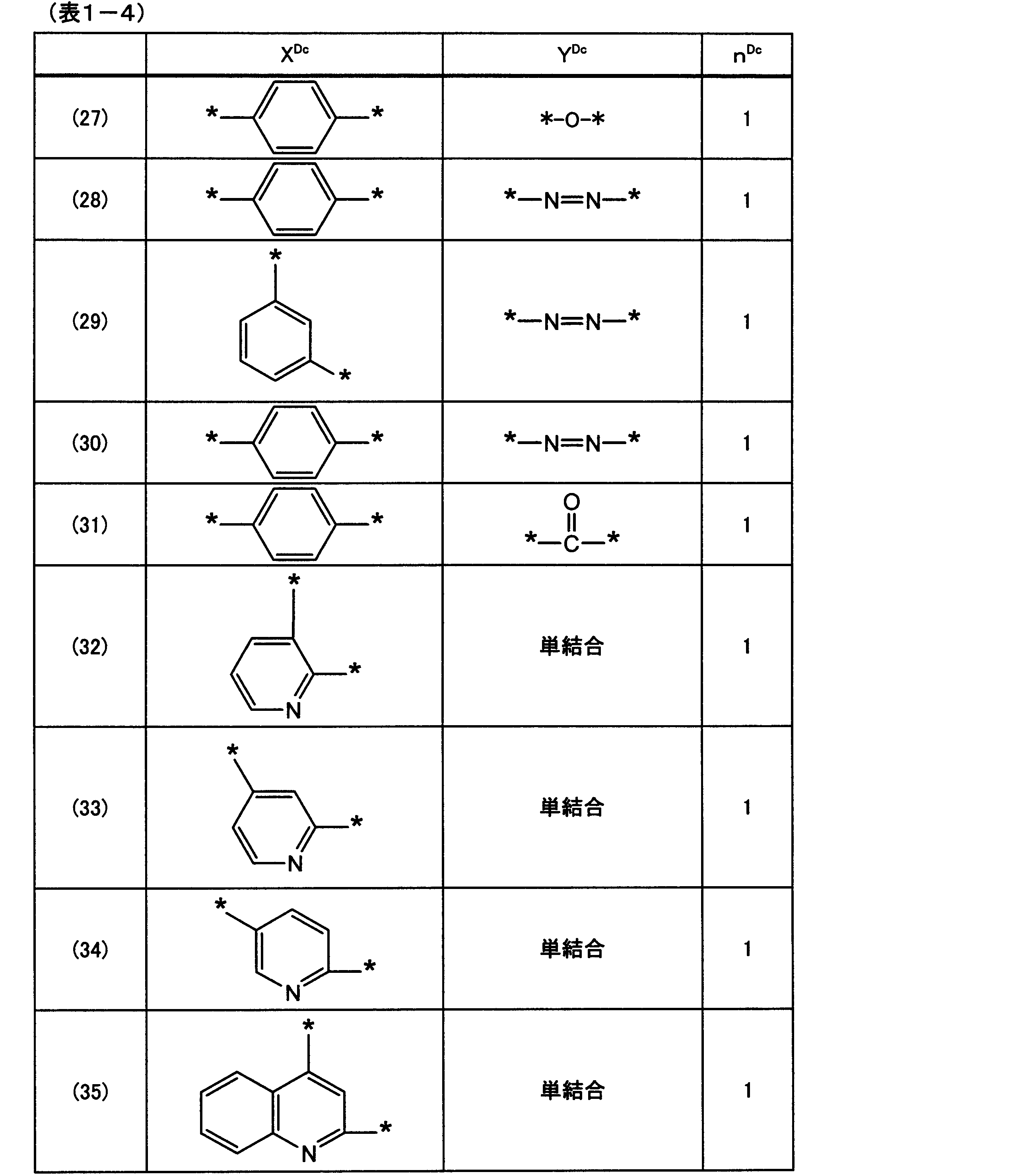
- Examples of preferable combinations of X Dc , Y Dc and n Dc in the formula (1) include combinations of (1) to (35) shown in the following Tables 1-1 to 1-4. In the table, * indicates a bond.
- the divalent group shown as X Dc has a substituent at a specific position, but the position of the substituent is not particularly limited. Groups having different substituent positions may also be suitably used as X Dc .
- the compound represented by Formula (1) is a compound represented by the following Formula (1 ').
- R 1 has the same meaning as described above, R 3 represents a substituent, m represents an integer of 0 to 4; Two R 1 s may be the same or different. When there are a plurality of R 3 's , they may be the same or different. )
- R 3 represents a substituent.
- the substituent represented by R 3 is as described above. Among them, as a substituent represented by R 3 , a halogen atom, an alkyl group, an aryl group, a hydroxy group and an amino group are preferable. These substituents may have secondary substituents.
- m represents an integer of 0 to 4.
- m is preferably 0 to 2, more preferably 0 or 1, and still more preferably 0.
- R 3 's When there are a plurality of R 3 's , they may be the same or different.
- the compound represented by the formula (1) is 2- (4-carboxyphenyl) benzo [d] oxazole-5-carboxylic acid (described below, represented by the following formula (1-1) , And may be abbreviated as "4 CBOC”.
- the compounds represented by the formula (1) may be used alone or in combination of two or more.
- the method for producing the compound represented by the formula (1) is not particularly limited, and the compound may be produced by any conventionally known method.
- 4CBOC can be manufactured by the method described in the examples described later.
- R 4 represents a hydrogen atom, an acyl group, or a group represented by the formula: —Si (R 5 ) 3 .
- R 5 is an alkyl group.
- the alkyl group represented by R may be linear or branched.
- the carbon atom number of the acyl group represented by R 4 is preferably 2 to 5, more preferably 2 or 3, and still more preferably 2.
- Preferred specific examples of the acyl group represented by R 4 include an acetyl group.
- R 4 is a group represented by the formula: —Si (R 5 ) 3 (wherein R 5 is an alkyl group), the alkyl group represented by R 5 is either linear or branched. May be The carbon atom number of the alkyl group represented by R 5 is preferably 1 to 10, more preferably 1 to 6, still more preferably 1 to 4, still more preferably 1 to 3, particularly preferably 1 or 2. . In the group represented by the formula: —Si (R 5 ) 3 , three R 5 s may be the same or different. Preferred specific examples of the group represented by the formula: -Si (R 5 ) 3 include trimethylsilyl group.
- R 4 is preferably a hydrogen atom or an acyl group, and more preferably a hydrogen atom.
- X represents a divalent aromatic group which may have a substituent.
- the divalent aromatic group include an arylene group and a heteroarylene group, and preferred are an arylene group having 6 to 24 carbon atoms and a heteroarylene group having 3 to 21 carbon atoms, and having 6 to 18 carbon atoms.
- the C 3-15 heteroarylene group are more preferable, the C 6-14 arylene group and the C 3-9 heteroarylene group are more preferable, and the C 6-12 arylene group is more preferable.
- Groups and heteroarylene groups having 3 to 9 carbon atoms are even more preferred, and arylene groups having 6 to 10 carbon atoms and heteroarylene groups having 3 to 6 carbon atoms are particularly preferred.
- the number of carbon atoms does not include the number of carbon atoms of the substituent.
- divalent aromatic group in X examples include phenylene group, naphthylene group, anthracenylene group, thiophenediyl group, pyrrolediyl group, furandiyl group, pyridinediyl group, pyridazine diyl group, pyrimidinediyl group, pyrazine diyl group, triazine Examples include diyl group, pyrrolindiyl group, piperidine diyl group, quinoline diyl group, and isoquinoline diyl group.
- X is a phenylene group which may have a substituent or a naphthylene group which may have a substituent.
- the substituent which the divalent aromatic group in X may have is as described above.
- the divalent aromatic group in X has a plurality of substituents, they may be the same or different.
- substituents they may be the same or different.
- one or more groups selected from the group consisting of a halogen atom, an alkyl group, an aryl group, a hydroxy group and an amino group are preferable as the substituent which the divalent aromatic group for X may have, More preferred is one or more groups selected from the group consisting of halogen atoms, alkyl groups, and aryl groups.
- a halogen atom a chlorine atom, a fluorine atom or a bromine atom is preferable
- an alkyl group a C 1 to C 6 alkyl group such as a methyl group, an ethyl group, a propyl group, an isopropyl group or a butyl group , A sec-butyl group, an isobutyl group, a tert-butyl group, a pentyl group or a hexyl group is preferable, and in the case of an aryl group, a phenyl group is preferable.
- substituents may have secondary substituents. Therefore, a fluoroalkyl group such as a trifluoromethyl group is naturally included in the substituents of the present invention.
- the substituent which the methylene group may have is as described above. If the methylene group carries 2 substituents, they may be identical or different. Among them, as a substituent which a methylene group may have, one or more groups selected from the group consisting of a halogen atom, an alkyl group, an aryl group, a hydroxy group and an amino group are preferable, and a halogen atom, an alkyl group, And one or more groups selected from the group consisting of and aryl groups are more preferred.
- halogen atom a chlorine atom, a fluorine atom or a bromine atom is preferable
- alkyl group a C 1 to C 3 alkyl group such as a methyl group, an ethyl group or a propyl group is preferable.
- a phenyl group is preferred.
- substituents may have secondary substituents.
- examples of Y include 9H-fluorene-9,9-diyl group and 1,1-cyclohexanediyl group.
- Z represents a divalent aromatic group which may have a substituent.
- the divalent aromatic group include an arylene group and a heteroarylene group, and preferred are an arylene group having 6 to 24 carbon atoms and a heteroarylene group having 3 to 21 carbon atoms, and having 6 to 18 carbon atoms.
- the C 3-15 heteroarylene group are more preferable, the C 6-14 arylene group and the C 3-9 heteroarylene group are more preferable, and the C 6-12 arylene group is more preferable.
- Groups and heteroarylene groups having 3 to 9 carbon atoms are even more preferred, and arylene groups having 6 to 10 carbon atoms and heteroarylene groups having 3 to 6 carbon atoms are particularly preferred.
- the number of carbon atoms does not include the number of carbon atoms of the substituent.
- divalent aromatic group in Z examples include phenylene group, naphthylene group, anthracenylene group, thiophenediyl group, pyrrolediyl group, furandiyl group, pyridinediyl group, pyridazine diyl group, pyrimidinediyl group, pyrazine diyl group, triazine Examples include diyl group, pyrrolindiyl group, piperidine diyl group, quinoline diyl group, and isoquinoline diyl group.
- the divalent aromatic group for Z is preferably an arylene group having 6 to 12 carbon atoms, more preferably a phenylene group or a naphthylene group, and particularly preferably a phenylene group.
- the substituent which the divalent aromatic group in Z may have is as described above.
- the divalent aromatic group in Z has a plurality of substituents, they may be the same or different.
- substituents they may be the same or different.
- one or more groups selected from the group consisting of a halogen atom, an alkyl group, an aryl group, a hydroxy group and an amino group are preferable as the substituent which the divalent aromatic group for Z may have, More preferred is one or more groups selected from the group consisting of halogen atoms, alkyl groups, and aryl groups.
- a halogen atom a chlorine atom, a fluorine atom or a bromine atom is preferable
- an alkyl group a C 1 to C 6 alkyl group such as a methyl group, an ethyl group, a propyl group, an isopropyl group or a butyl group , A sec-butyl group, an isobutyl group, a tert-butyl group, a pentyl group or a hexyl group is preferable, and in the case of an aryl group, a phenyl group is preferable.
- These substituents may have secondary substituents.
- Z is a phenylene group which may have a substituent.
- n 0 or 1.
- X is preferably a phenylene group which may have a substituent or a naphthylene group which may have a substituent.
- X is a phenylene group which may have a substituent or a naphthylene group which may have a substituent
- Z is a phenylene group which may have a substituent.
- n 0 and X is a phenylene group which may have a substituent, or ii) n is 1 and X is a phenylene group which may have a substituent, Y Is a methylene group or a single bond which may have a substituent, and Z is a phenylene group which may have a substituent.
- n is 0 and X is a phenylene group optionally having one or more substituents selected from the group consisting of a halogen atom, an alkyl group and an aryl group, or ii) n is 1
- X is a phenylene group optionally having one or more substituents selected from the group consisting of a halogen atom, an alkyl group, and an aryl group
- Y is a halogen atom, an alkyl group, and an aryl group
- Z has one or more substituents selected from the group consisting of a halogen atom, an alkyl group, and an aryl group Phenylene which may be substituted.
- the compound represented by the formula (2) is bisphenol which may have a substituent, dihydroxybenzene which may have a substituent, dihydroxynaphthalene which may have a substituent And at least one selected from the group consisting of biphenol which may have a substituent.
- bisphenol refers to bisphenol A, bisphenol AP, bisphenol AF, bisphenol B, bisphenol BP, bisphenol C, bisphenol C, bisphenol E, bisphenol F, bisphenol G, bisphenol S, bisphenol PH, bisphenol TMC, bisphenol Z, etc. It means a bisphenol compound.
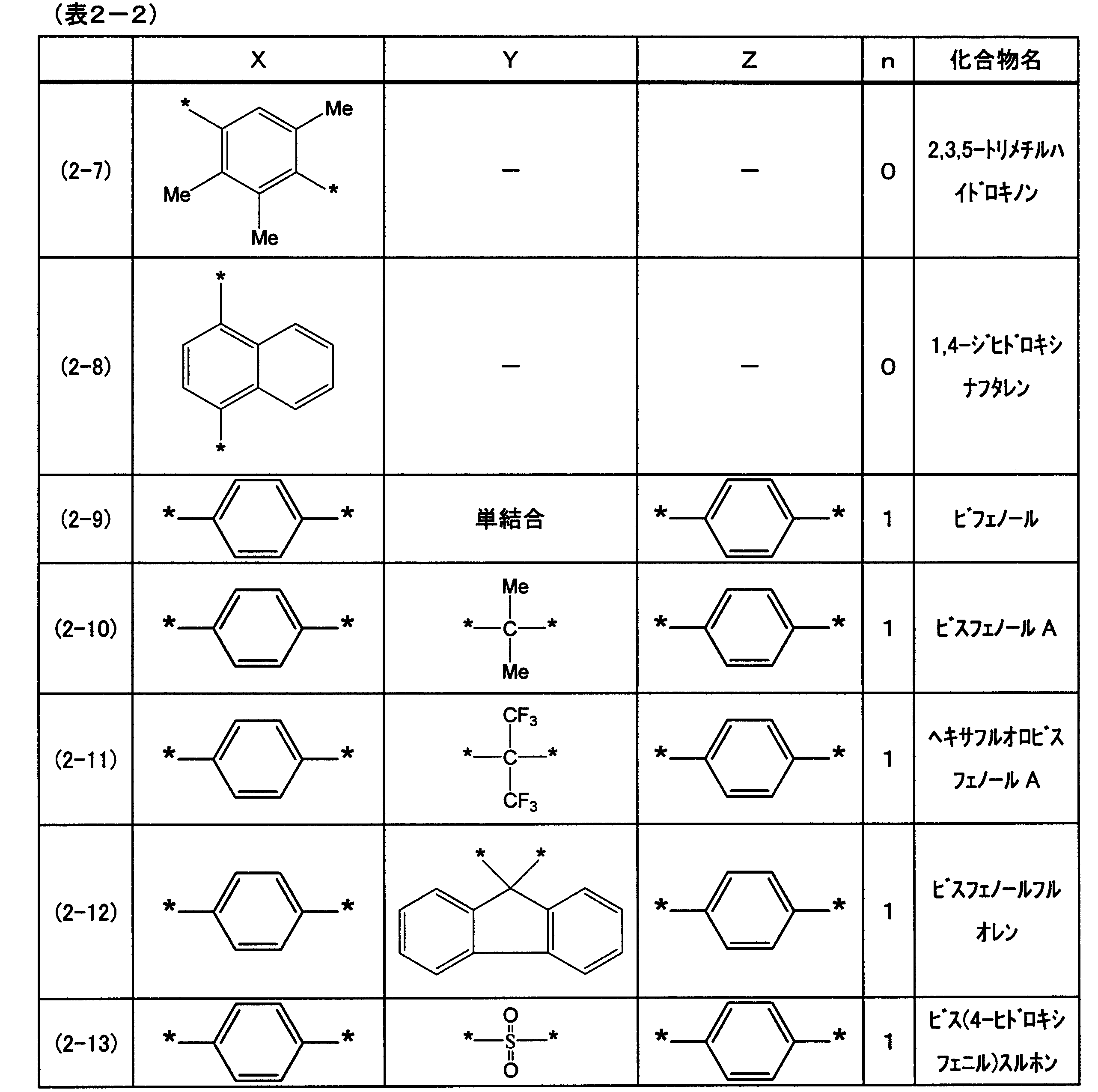
- the compound represented by the formula (2) is at least one selected from the group consisting of compounds represented by the following formulas (2-1) to (2-13).
- the compounds represented by the formula (2) may be used alone or in combination of two or more.
- the compound represented by the formula (2) is a compound represented by the above formula (2-1), formula (2-2), formula (2-9), formula (2-10), formula (2) 2-11) or a compound represented by the formula (2-12).
- the polyester compound of the present invention is produced by using other compounds as raw materials in addition to the compound represented by the formula (1) and the compound represented by the formula (2), as long as the effects of the present invention are not impaired. You may
- the polyester compound of the present invention comprises a compound represented by the formula (1), a compound represented by the formula (2), an aromatic dicarboxylic acid, a salt thereof, an ester thereof and an ester thereof It is obtained by reacting with one or more selected from halides.
- the number of carbon atoms of the aromatic dicarboxylic acid which can be used when producing the polyester compound of the present invention is preferably 8 to 18, more preferably 8 to 16, and further preferably 8 to 14.
- a salt of aromatic dicarboxylic acid an alkali metal salt is mentioned, for example, lithium salt, sodium salt, potassium salt or cesium salt is preferable, and potassium salt is more preferable.
- esters of aromatic dicarboxylic acids for example, C 1 to C 10 alkyl esters (preferably C 1 to C 6 alkyl esters, more preferably C 1 to C 4 alkyl esters), C 6 to C 18 aryl esters (preferably Are C 6 -C 14 aryl esters, more preferably C 6 -C 10 aryl esters).
- halides of aromatic dicarboxylic acids include fluorides, chlorides, bromides and iodides, with chlorides being preferred.
- Examples of the aromatic dicarboxylic acid which can be used in producing the polyester compound of the present invention, a salt thereof, an ester thereof and a halide thereof include terephthalic acid, isophthalic acid, 2,6-naphthalene dicarboxylic acid, 4,4 ′ -Biphenyldicarboxylic acid, 4,4'-dicarboxydiphenylether, 4,4'-dicarboxydiphenylsulfone, dipotassium terephthalate, dipotassium isophthalate, dimethyl terephthalate, dimethyl isophthalate, dimethyl terephthalate, dichloride isophthalate .
- terephthalic acid, isophthalic acid and 2,6-naphthalene dicarboxylic acid are preferable.
- the polyester compound of the present invention contains one or more selected from the group consisting of structural units represented by the following formulas (i) to (iv).
- X Dc , Y Dc , X, Y and Z and preferred ranges of n Dc and n are as described above.
- the polyester compound of this invention when manufacturing the polyester compound of this invention using another compound as a raw material, is said It may further comprise structural units derived from other compounds.
- the polyester compound of the present invention when the above-mentioned aromatic dicarboxylic acid is used as another compound, is one or more selected from the group consisting of structural units represented by the following formulas (v) and (vi) It may further include.
- the arylene group represented by Ar in Formula (v) and (vi) represents the aromatic dicarboxylic acid-derived arylene group used as the "other compound".
- the carbon atom number of the arylene group represented by Ar is preferably 6 to 18, more preferably 6 to 14, and further preferably 6 to 10.
- Preferred specific examples of the arylene group represented by Ar include 1,4-phenylene group, 1,3-phenylene group, and 2,6-naphthalylene group.
- the ratio of the amount (mol) of the other compound to the total amount (mol) of the compound represented by the formula (1) and the compound represented by the formula (2) is preferably 0 in view of obtaining a polyester compound excellent in heat resistance. .5 or less, more preferably 0.3 or less, further preferably 0.2 or less, and still more preferably 0.1 or less.
- the lower limit of the molar ratio is not particularly limited, and may be zero.
- the amount (mol) of the compound represented by the formula (2) relative to the total amount (mol) of the compound represented by the formula (1) and the aromatic dicarboxylic acid is preferably 0.9-1; And more preferably from 0.995 to 1.05.
- the reaction of the compound represented by Formula (1), the compound represented by Formula (2), and the above-mentioned other compounds as necessary may be carried out in the presence of a condensing agent.
- the condensing agent is not particularly limited as long as it promotes an esterification reaction or a transesterification reaction, for example, diphenyl chlorophosphate, tosyl chloride, triphenylphosphine dichloride, thionyl chloride, picryl chloride, hexachlorocyclotriphosphazene, trichloride Phosphorus and triphenyl phosphite can be mentioned.
- the condensing agent may be used alone or in combination of two or more.
- the reaction of the compound represented by the formula (1), the compound represented by the formula (2), and the above-mentioned other compounds as necessary may be carried out in the presence of a catalyst.
- the catalyst is not particularly limited as long as it promotes an esterification reaction or a transesterification reaction, and examples thereof include oxides and salts of metals such as lead, zinc, manganese, calcium, cobalt, magnesium and titanium.
- the catalysts may be used alone or in combination of two or more.
- the condensing agent and the catalyst may be used in combination.
- each may be used alone (ie, a combination of one condensing agent and one catalyst), or two or more may be used in combination (ie, two or more).
- the reaction may be carried out in an organic solvent.
- organic solvent examples include pyridine, N, N-dimethylformamide, N-methyl-2-pyrrolidone, carbon tetrachloride, hexachloroethane, 1,2-dichloroethane, chlorobenzene, o-dichlorobenzene and the like.
- the organic solvents may be used alone or in combination of two or more.
- the reaction is preferably performed under an inert gas atmosphere such as argon or nitrogen, under atmospheric pressure (normal pressure) It is preferred to do.
- an inert gas atmosphere such as argon or nitrogen
- an inert gas atmosphere such as argon or nitrogen. It is preferable to carry out under reduced pressure.
- the pressure is not particularly limited as long as the esterification reaction or transesterification reaction proceeds, but is preferably 750 Torr or less, more preferably 300 Torr or less, still more preferably 50 Torr or less.
- the lower limit of the pressure is not particularly limited, but is usually 0.1 Torr or more.
- the reaction temperature is not particularly limited as long as esterification reaction or transesterification proceeds, but in the case of solution polymerization, it is preferably -10 to 200 ° C, more preferably 0 to 150 ° C, still more preferably 20 to 120 ° C. Even more preferably, it is 20 to 100.degree. In the case of the melt polymerization method, the temperature is preferably 100 to 400 ° C., more preferably 150 to 350 ° C., and still more preferably 150 to 300 ° C.
- the reaction time is preferably 0.1 to 24 hours, more preferably 0.5 to 18 hours, and still more preferably 1 to 12 hours, depending on the type of the raw material, the reaction temperature and the like.
- the extrapolated glass transition start point (T ig ) of the polyester compound of the present invention is preferably 140 ° C. or more, more preferably 145 ° C. or more.
- the polyester compound of the present invention obtained by reacting the compound represented by the formula (1) with the compound represented by the formula (2) has a high T ig , for example, 150 ° C. or more, 155 ° C. or more, 160 ° C. or more, It is possible to realize T ig of 165 ° C. or more and 170 ° C. or more.
- the upper limit of T ig is not particularly limited, but is usually 300 ° C. or less, 285 ° C. or less, 270 ° C. or less, 255 ° C. or less, 240 ° C. or less, 230 ° C. or less.
- T ig can be measured, for example, using a differential scanning calorimeter.
- the intermediate glass transition temperature (T mg ) of the polyester compound of the present invention is preferably 150 ° C. or more, more preferably 155 ° C. or more.
- the polyester compound of the present invention obtained by reacting the compound represented by Formula (1) with the compound represented by Formula (2) has a high T mg , for example, 160 ° C. or more, 165 ° C. or more, or 170 ° C. or more Can achieve T mg .
- the upper limit in particular of T mg is not restrict
- T mg can be measured, for example, using a differential scanning calorimeter.
- the melting point (T m ) of the polyester compound of the present invention is preferably 300 ° C. or more, more preferably 310 ° C. or more.
- the polyester compound of the present invention obtained by reacting the compound represented by Formula (1) with the compound represented by Formula (2) has a high T m , for example, 330 ° C. or more, 340 ° C. or more, 350 ° C. or more Tm of 360 ° C. or more, 370 ° C. or more, 380 ° C. or more, or 390 ° C. or more can be realized.
- the upper limit in particular of Tm is not restrict
- T m can be measured, for example, using a differential scanning calorimeter.
- the polyester compound of the present invention has a 5% mass loss temperature (T d ; a temperature at which the mass of the polyester compound is reduced by 5% when heated from room temperature at a constant temperature rising rate) is preferably 370 ° C. or more, more preferably Is 390 ° C. or higher.
- the polyester compound of the present invention obtained by reacting the compound represented by Formula (1) with the compound represented by Formula (2) has a high T d , for example, 400 ° C. or more, 410 ° C. or more, 420 ° C. or more, Td of 430 ° C. or more, 440 ° C. or more, or 450 ° C. or more can be realized.
- the upper limit of T d is not particularly limited, but is usually 500 ° C. or less, 480 ° C. or less, and the like. T d can be measured, for example, using a thermogravimetric measurement device.
- polyester compound of the present invention is excellent in heat resistance, it can be suitably used as an engineering plastic.
- the polyester compound of the present invention can be suitably used as an engineering plastic in, for example, the fields of energy, automobiles and aircraft, electric and electronic devices, and other fields (medical and care devices, heat resistant sheets, heat resistant fibers, etc.).
- solar cells housings, connectors, module covers, front protective films, back sheets, substrate support members, etc.
- wind power generators matrix resin for blades, etc.
- fuel cells Application material for separator, etc.
- Next-generation battery binder, electrolyte membrane, separator, etc.
- lithium ion battery LED (bulb cover, reflector, socket, sealing material etc.), etc.
- Applications in the automotive and aircraft fields include, for example, exterior parts, connector blocks, relay blocks, interior parts, rear lamps, radiator grills, chain tensioners, wire harnesses, various gears, alternators, fuel pumps, water pumps, seal rings, fuel tubes Sensors, fuses, reflectors, engine related parts, washers, turn lamps, instrument panel lenses, motor insulators, clutches, turbos, etc.
- the present invention also provides a method of producing a polyester compound.
- the method for producing a polyester compound of the present invention comprises the step of reacting the compound represented by the above formula (1) with the compound represented by the above formula (2).
- the compound represented by the formula (1), the compound represented by the formula (2), and the reaction conditions are as described above. .
- the molar ratio of [compound represented by the formula (2)] is from 10/1 to 1/10 from the viewpoint of obtaining a polyester compound excellent in heat resistance.
- the ratio is preferably 3/1 to 1/3, more preferably 1.5 / 1 to 1 / 1.5, and more preferably 1/1.
- polyester compounds of the present invention in addition to the compound represented by the formula (1) and the compound represented by the formula (2), other compounds can be used as raw materials within the range not inhibiting the effects of the present invention. It may be used to produce polyester compounds.
- Such other compounds include, for example, aromatic dicarboxylic acids, their salts, their esters and their halides.
- the method for producing a polyester compound of the present invention comprises a compound represented by the above formula (1), a compound represented by the above formula (2), an aromatic dicarboxylic acid, and a salt thereof And the step of reacting with at least one selected from the ester and the halide thereof.
- aromatic dicarboxylic acids their salts, their esters and their halides are as described above.
- the compound represented by Formula (1), the compound represented by Formula (2), and another compound react as needed, and manufacturing a polyester compound, it esterifies in an organic solvent.
- the melt polymerization method in which the esterification reaction or the ester exchange reaction is performed to use the polycondensation reaction using the raw material in the molten state without using an organic solvent is utilized. Good.
- interfacial polymerization may be used to produce the polyester compound. The procedures and conditions of these polymerization processes are well known in the art.
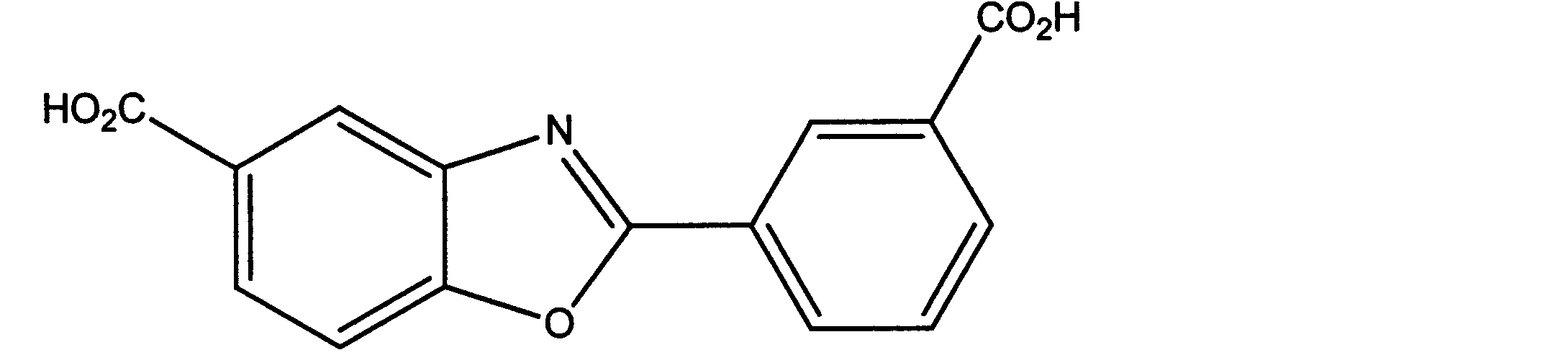
- Synthesis Example 2 Synthesis of 2- (3-Carboxyphenyl) benzo [d] oxazole-5-carboxylic acid (3CBOC) The same as Synthesis Example 1 except that methyl terephthalaldehyde was used instead of methyl isophthalaldehyde The title compound (8.96 g, 31.6 mmol) having the following structure was obtained (overall yield: 71.5%).
- Example 1 Synthesis of Polyester Using 4CBOC and BPA as Monomers 1.89 mL (9.18 mmol) of diphenyl chlorophosphate is dissolved in 20 mL of pyridine, and 0.164 mL (2.12 mmol) of DMF is added. Stir at room temperature for 30 minutes. Then, 1.00 g (3.53 mmol) of 4CBOC was added and stirred at room temperature for 10 minutes. The temperature was raised to 120 ° C., 0.806 g (3.53 mmol) of BPA was added, and the mixture was stirred at 120 ° C. for 12 hours.
- BPA has the following structure.
- the temperature rise from 25 ° C to 420 ° C at a heating rate of 10 ° C / min, the straight line extending the low temperature side baseline of the DSC thermogram to the high temperature side, and the slope of the curve of the step change portion of the glass transition are maximum
- the extrapolated glass transition temperature T ig from the temperature of the intersection point with the tangent drawn at such a point, and the temperature at the inflection point of DSC thermogram (peak top of the differential curve of DSC thermogram) to the intermediate glass transition temperature T mg (° C.) was determined, and the melting point T m (° C.) was determined from the top of the endothermic peak of the DSC thermogram.
- T d Measurement of 5% Mass Loss Temperature T d T d was measured using a thermogravimetric measurement apparatus (“TG / DTA 6200” manufactured by Seiko Instruments Inc.). The furnace was under a nitrogen atmosphere and heated from room temperature to 550 ° C. at a heating rate of 10 ° C./min. From the obtained thermogravimetric curve, the temperature T d (° C.) at which the mass decreased by 5% was determined.
- Example 2 Synthesis of polyester containing 4CBOC and BPAF as monomers
- the target polyester compound (light brown) 1 was operated in the same manner as in Example 1 except that BPAF having the following structure was used instead of BPA. Obtained .61 g (yield 78%).
- Example 3 Synthesis of polyester containing 4CBOC and hydroquinone as monomers
- the target polyester compound (light brown) 1 was manipulated in the same manner as in Example 1 except that hydroquinone having the following structure was used instead of BPA. Obtained .62 g (yield 84%).
- Example 4 Synthesis of Polyester Using 4CBOC and Biphenol as a Monomer
- the target polyester compound (light brown) 1 was manipulated in the same manner as in Example 1 except that biphenol having the following structure was used instead of BPA. Obtained .22 g (yield 97%).
- Example 5 Synthesis of polyester containing 4CBOC and catechol as a monomer
- the target polyester compound (light brown) 0 was processed in the same manner as in Example 1 except that catechol having the following structure was used instead of BPA. Obtained .97 g (yield 77%).
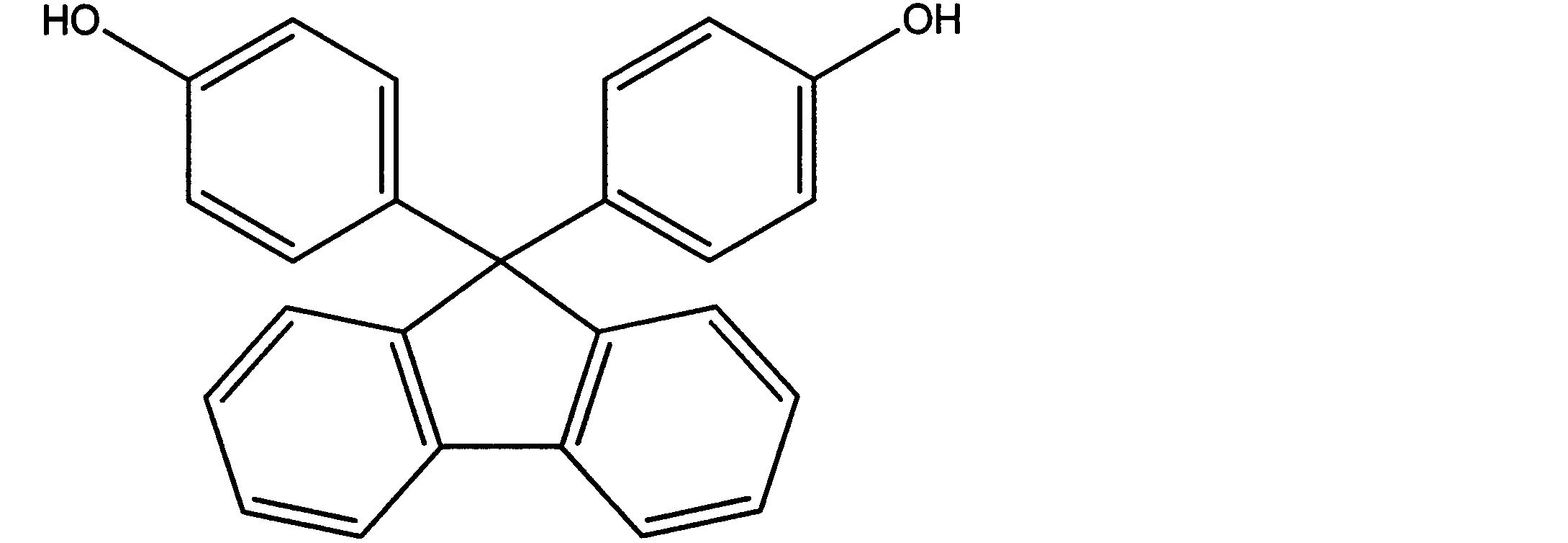
- Example 6 Synthesis of polyester containing 4CBOC and bisphenol fluorene as monomers As a target polyester compound (light brown) in the same manner as in Example 1 except that bisphenol fluorene having the following structure was used instead of BPA. ) (2.1% yield) was obtained.
- Example 7 Synthesis of polyester containing 3CBOC and BPA as monomers The same operation as in Example 1 was carried out except that 3CBOC was used instead of 4CBOC, and 1.12 g of a target aromatic polyester (light brown) was used. Obtained (yield 75%).
Landscapes
- Chemical & Material Sciences (AREA)
- Health & Medical Sciences (AREA)
- Chemical Kinetics & Catalysis (AREA)
- Medicinal Chemistry (AREA)
- Polymers & Plastics (AREA)
- Organic Chemistry (AREA)
- Polyesters Or Polycarbonates (AREA)
- Organic Low-Molecular-Weight Compounds And Preparation Thereof (AREA)
Abstract
Description
[1] 下記式(1)で表される化合物:

R1は、ヒドロキシ基、ハロゲン原子、アルコキシ基、シクロアルキルオキシ基、アリールオキシ基、式:-OMで表される基、又は式:-O-Si(R2)3で表される基を表し、ここで、Mは金属原子であり、R2はアルキル基であり、
XDcは、置換基を有していてもよい2価の芳香族基を表し、
YDcは、式:-O-で表される基、式:-N=N-で表される基、カルボニル基、置換基を有していてもよいエテニレン基、又は単結合を表し、
nDcは、0~2の整数を表す。2個あるR1は、同一でも相異なっていてもよい。XDcが複数個ある場合、それらは同一でも相異なっていてもよく、YDcが複数個ある場合、それらは同一でも相異なっていてもよい。)
と、下記式(2)で表される化合物:

R4は、水素原子、アシル基、又は式:-Si(R5)3で表される基を表し、ここで、R5はアルキル基であり、
Xは、置換基を有していてもよい2価の芳香族基を表し、
Yは、置換基を有していてもよいメチレン基、式:-S(=O)2-で表される基、又は単結合を表し、
Zは、置換基を有していてもよい2価の芳香族基を表し、
nは、0又は1を表す。2個あるR4は、同一でも相異なっていてもよい。)
とを反応させることにより得られるポリエステル化合物。
[2] 式(1)中、XDcが、置換基を有していてもよいフェニレン基、置換基を有していてもよいナフチレン基、置換基を有していてもよいアントラセニレン基、置換基を有していてもよいフランジイル基、置換基を有していてもよいピリジンジイル基、置換基を有していてもよいチオフェンジイル基、又は置換基を有していてもよいキノリンジイル基である、[1]に記載のポリエステル化合物。
[3] 式(2)中、Xが、置換基を有していてもよいフェニレン基又は置換基を有していてもよいナフチレン基である、[1]又は[2]に記載のポリエステル化合物。
[4] 式(2)中、Zが、置換基を有していてもよいフェニレン基である、[1]~[3]のいずれかに記載のポリエステル化合物。
[5] 式(2)で表される化合物が、置換基を有していてもよいビスフェノール、置換基を有していてもよいジヒドロキシベンゼン、置換基を有していてもよいジヒドロキシナフタレン、及び置換基を有していてもよいビフェノールからなる群から選択される1種以上である、[1]~[4]のいずれかに記載のポリエステル化合物。
[6] 式(1)中、nDcが0であり、XDcが置換基を有していてもよいフェニレン基である、[1]~[5]のいずれかに記載のポリエステル化合物。
[7] 式(2)中、
i)nが0であり、Xが置換基を有していてもよいフェニレン基である、又は
ii)nが1であり、Xが置換基を有していてもよいフェニレン基であり、Yが置換基を有していてもよいメチレン基又は単結合であり、Zが置換基を有していてもよいフェニレン基である、[1]~[6]のいずれかに記載のポリエステル化合物。
[8] 置換基が、ハロゲン原子、アルキル基、アリール基、ヒドロキシ基及びアミノ基からなる群から選択される[1]~[7]のいずれかに記載のポリエステル化合物。
[9] 式(2)で表される化合物が、下記式(2-1)~式(2-13)で表される化合物からなる群から選択される1種以上である、[1]~[6]のいずれかに記載のポリエステル化合物。

[10] 式(2)で表される化合物が、式(2-1)、式(2-2)、式(2-9)、式(2-10)、式(2-11)又は式(2-12)で表される化合物である、[9]に記載のポリエステル化合物。
[11] 前記式(1)で表される化合物と、前記式(2)で表される化合物と、芳香族ジカルボン酸、その塩、そのエステル及びそのハロゲン化物からなる群から選択される1種以上とを反応させることにより得られる、[1]~[10]のいずれかに記載のポリエステル化合物。
[12] [式(1)で表される化合物]/[式(2)で表される化合物]のモル比が10/1~1/10の範囲にて反応させることにより得られる、[1]~[11]のいずれかに記載のポリエステル化合物。
[13] 反応温度が-10~200℃の範囲にて反応させることにより得られる、[1]~[12]のいずれかに記載のポリエステル化合物。
[14] 下記式(i)~(iv)で表される構造単位からなる群から選択される1種以上を含む、ポリエステル化合物。
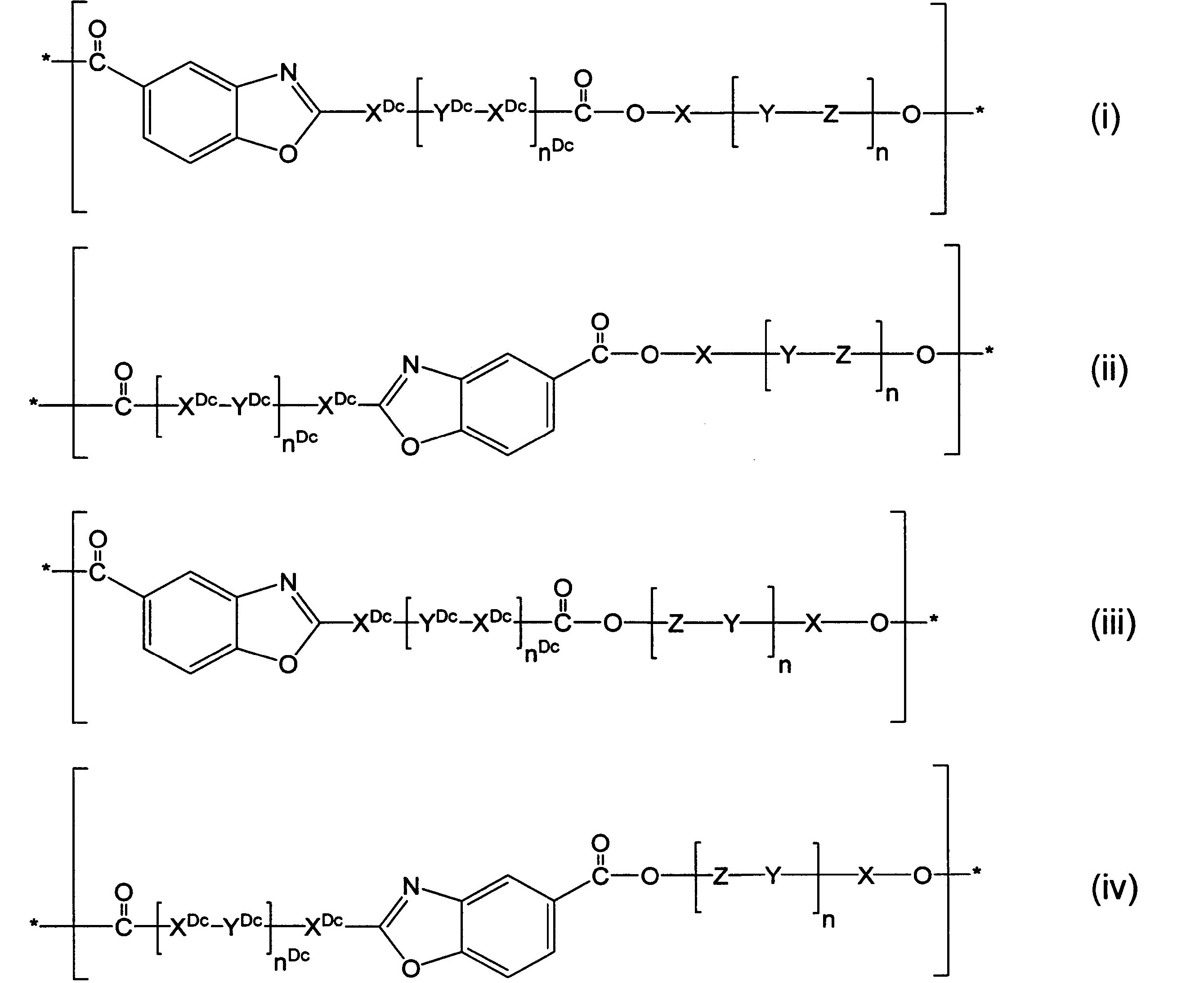
XDcは、置換基を有していてもよい2価の芳香族基を表し、
YDcは、式:-O-で表される基、式:-N=N-で表される基、カルボニル基、置換基を有していてもよいエテニレン基、又は単結合を表し、
nDcは、0~2の整数を表し、
Xは、置換基を有していてもよい2価の芳香族基を表し、
Yは、置換基を有していてもよいメチレン基、式:-S(=O)2-で表される基、又は単結合を表し、
Zは、置換基を有していてもよい2価の芳香族基を表し、
nは、0又は1を表し、
*は、結合手を表す。XDcが複数個ある場合、それらは同一でも相異なっていてもよく、YDcが複数個ある場合、それらは同一でも相異なっていてもよい。)
[15] 中間ガラス転移点(Tmg)が150℃以上300℃以下である、[14]に記載のポリエステル化合物。
[16] 融点(Tm)が300℃以上500℃以下である、[14]又は[15]に記載のポリエステル化合物。
[17] 5%質量減量温度(Td)が370℃以上500℃以下である、[14]~[16]のいずれかに記載のポリエステル化合物。
[18]下記式(1)で表される化合物:

R1は、ヒドロキシ基、ハロゲン原子、アルコキシ基、シクロアルキルオキシ基、アリールオキシ基、式:-OMで表される基、又は式:-O-Si(R2)3で表される基を表し、ここで、Mは金属原子であり、R2はアルキル基であり、
XDcは、置換基を有していてもよい2価の芳香族基を表し、
YDcは、式:-O-で表される基、式:-N=N-で表される基、カルボニル基、置換基を有していてもよいエテニレン基、又は単結合を表し、
nDcは、0~2の整数を表す。2個あるR1は、同一でも相異なっていてもよい。XDcが複数個ある場合、それらは同一でも相異なっていてもよく、YDcが複数個ある場合、それらは同一でも相異なっていてもよい。)
と、下記式(2)で表される化合物:

R4は、水素原子、アシル基、又は式:-Si(R5)3で表される基を表し、ここで、R5はアルキル基であり、
Xは、置換基を有していてもよい2価の芳香族基を表し、
Yは、置換基を有していてもよいメチレン基、式:-S(=O)2-で表される基、又は単結合を表し、
Zは、置換基を有していてもよい2価の芳香族基を表し、
nは、0又は1を表す。2個あるR4は、同一でも相異なっていてもよい。)
とを、[式(1)で表される化合物]/[式(2)で表される化合物]のモル比が10/1~1/10の範囲にて反応させる工程を含む、ポリエステル化合物の製造方法。
本明細書において、「2価の芳香族基」とは、芳香族化合物の芳香環から水素原子を2個除いた基をいい、アリーレン基、ヘテロアリーレン基を含む。
本発明のポリエステル化合物は、下記式(1)で表される化合物:

R1は、ヒドロキシ基、ハロゲン原子、アルコキシ基、シクロアルキルオキシ基、アリールオキシ基、式:-OMで表される基、又は式:-O-Si(R2)3で表される基を表し、ここでMは金属原子であり、R2はアルキル基であり、
XDcは、置換基を有していてもよい2価の芳香族基を表し、
YDcは、式:-O-で表される基、式:-N=N-で表される基、カルボニル基、置換基を有していてもよいエテニレン基、又は単結合を表し、
nDcは、0~2の整数を表す。2個あるR1は、同一でも相異なっていてもよい。XDcが複数個ある場合、それらは同一でも相異なっていてもよく、YDcが複数個ある場合、それらは同一でも相異なっていてもよい。)
と、下記式(2)で表される化合物:

R4は、水素原子、アシル基、又は式:-Si(R5)3で表される基を表し、ここで、R5はアルキル基であり、
Xは、置換基を有していてもよい2価の芳香族基を表し、
Yは、置換基を有していてもよいメチレン基、式:-S(=O)2-で表される基、又は単結合を表し、
Zは、置換基を有していてもよい2価の芳香族基を表し、
nは、0又は1を表す。2個あるR4は、同一でも相異なっていてもよい。)
とを反応させることにより得られる。



R1は前記と同じ意味を表し、
R3は、置換基を表し、
mは、0~4の整数を表す。2個あるR1は、同一でも相異なっていてもよい。R3が複数個ある場合、それらは同一でも相異なっていてもよい。)

i)nが0であり、Xが置換基を有していてもよいフェニレン基である、又は
ii)nが1であり、Xが置換基を有していてもよいフェニレン基であり、Yが置換基を有していてもよいメチレン基又は単結合であり、Zが置換基を有していてもよいフェニレン基である。
i)nが0であり、Xがハロゲン原子、アルキル基、及びアリール基からなる群から選択される1以上の置換基を有していてもよいフェニレン基である、又は
ii)nが1であり、Xがハロゲン原子、アルキル基、及びアリール基からなる群から選択される1以上の置換基を有していてもよいフェニレン基であり、Yがハロゲン原子、アルキル基、及びアリール基からなる群から選択される1以上の置換基を有していてもよいメチレン基又は単結合であり、Zがハロゲン原子、アルキル基、及びアリール基からなる群から選択される1以上の置換基を有していてもよいフェニレン基である。
本発明において、「ビスフェノール」とは、ビスフェノールA、ビスフェノールAP、ビスフェノールAF、ビスフェノールB、ビスフェノールBP、ビスフェノールC、ビスフェノールE、ビスフェノールF、ビスフェノールG、ビスフェノールS、ビスフェノールPH、ビスフェノールTMC及びビスフェノールZ等のビスフェノール化合物を意味する。




また、有機溶媒を用いることなく溶融状態の原料を使用してエステル化反応又はエステル交換反応を行い重縮合する溶融重合法の場合は、アルゴンや窒素などの不活性ガス雰囲気下で行うことが好ましく、減圧下で行うことが好ましい。圧力は、エステル化反応又はエステル交換反応が進行する限り特に限定されないが、好ましくは750Torr以下、より好ましくは300Torr以下、さらに好ましくは50Torr以下である。圧力の下限は特に限定されないが、通常、0.1Torr以上である。
Tigは、例えば、示差走査熱量計を用いて測定することができる。
Tmgは、例えば、示差走査熱量計を用いて測定することができる。
Tmは、例えば、示差走査熱量計を用いて測定することができる。
Tdは、例えば、熱重量測定装置を用いて測定することができる。
本発明はまた、ポリエステル化合物の製造方法を提供する。
4CBOCは、以下の(1)乃至(4)の手順に従って合成した。
32.0g(407mmol)の塩化アセチルを、氷冷下にて250mLのメタノールに滴下した。室温で30分攪拌した後、27.9gの3-アミノ-4-ヒドロキシ安息香酸(182mmol)を加え、溶解した後、80℃で4時間、加熱攪拌した。室温まで冷却後、濃縮し、得られた残渣を250mLの酢酸エチルで洗浄し、0℃まで冷却した後に濾過分離を行い、白色固体を得た。これを50℃、減圧下で終夜乾燥し、表題化合物30.7g(151mmol)を得た(収率83%)。
1H-NMR(400MHz、DMSO-d6) δ :3.81(3H,s),7.14(1H,d,J=8.52Hz),7.78(1H,dd,J=8.52,2.12Hz),7.92(1H,d,J=2.12Hz).
30.7g(151mmol)の3-アミノ-4-ヒドロキシ安息香酸メチル塩酸塩を300mLのメタノールに溶解し、15.6g(154mmol)のトリエチルアミンを滴下した。ここに24.8g(151mmol)のテレフタルアルデヒド酸メチルを加え、室温にて3時間攪拌後、濃縮、乾燥し、黄色固体を得た。これを50℃、減圧下で終夜乾燥し、表題化合物47.2g(151mmol)を得た(収率100%)。
1H-NMR(400MHz、CDCl3) δ :3.92(3H,s),3.97(3H,s),7.06(1H,d,J=8.5Hz),7.59(1H,br),7.95(1H,dd,J=8.52,1.96Hz),8.00-8.02(2H,m),8.07(1H,d,J=1.96Hz),8.16-8.18(2H,m),8.86(1H,s).
47.2g(151mmol)の2-ヒドロキシ-5-メトキシカルボニル-N-(4-メトキシカルボニルベンジリデン)アニリンを500mLのジクロロメタンに溶解し、0℃まで冷却した後に、34.3g(151mmol)の2,3-ジクロロ-5,6-ジシアノ-p-ベンゾキノンを加え、0℃にて1時間攪拌した。濃縮、乾燥して得られた褐色固体を、5wt%炭酸カリウム水溶液1Lを用いて洗浄し、濾過により褐色固体を得た。これを100mLのトルエンを用いて洗浄し、濾過により淡褐色固体を得た。これを50℃、減圧下で終夜乾燥し、表題化合物40.8g(131mmol)を得た(収率87%)。
1H-NMR(400MHz、CDCl3) δ :3.92(3H,s),3.97(3H,s),7.65(1H,d,J=9.12Hz),8.15(1H,dd,J=8.56,1.64Hz),8.20-8.22(2H,m),8.34-8.36(2H,m),8.50(1H,m).
10.0g(32.1mmol)の2-[4-(メトキシカルボニル)フェニル]ベンゾ[d]オキサゾール-5-カルボン酸メチルを100mLの1,4-ジオキサン/水=1/1の溶液に溶解し、ここに3.37g(80.3mmol)の水酸化リチウム一水和物を加え、50℃で1時間、加熱攪拌した。室温まで冷却後、濃縮して得られた残渣を150mLの水に溶解し、濃塩酸でpH3.0まで中和した。これを濾過して得られた固体を100mLのメタノールで洗浄し、淡褐色の固体を得た。これを50℃、減圧下で終夜乾燥し、下記構造を有する表題化合物8.18g(28.9mmol)を得た(収率90%)。
1H-NMR(400MHz、CDCl3) δ :7.94(1H,d,J=8.96Hz),8.09(1H,dd,J=8.52,1.68Hz),8.16-8.18(2H,m),8.34-8.36(3H,m).

テレフタルアルデヒド酸メチルに代えてイソフタルアルデヒド酸メチルを使用した以外は、合成例1と同様に操作して、下記構造を有する標題化合物8.96g(31.6mmol)を得た(全収率:71.5%)。
1H-NMR(400MHz、DMSO-d6) δ :8.75(1H,t,J=1.68Hz),8.46(1H,dt,J=8.16,1.24Hz),8.35(1H,d,J=1.44Hz),8.20(1H,dt,J=7.92,1.24Hz),8.08(1H,dd,J=8.52,1.64Hz),7.94(1H,d,J=8.60Hz),7.79(1H,t,J=7.80Hz).
1.89mL(9.18mmol)のクロロりん酸ジフェニルを20mLのピリジンに溶解し、0.164mL(2.12mmol)のDMFを添加後、室温にて30分攪拌した。次いで、1.00g(3.53mmol)の4CBOCを加え、室温にて10分攪拌した。120℃に昇温し、0.806g(3.53mmol)のBPAを添加した後、120℃にて12時間攪拌した。ここで、BPAは下記構造を有する。反応混合物を室温まで冷却後、10倍容量のメタノールに投入し、濾過により淡褐色固体を得た。これを100mLの沸騰メタノールを用いて洗浄し、濾過により淡褐色固体を得た。これを50℃、減圧下で終夜乾燥し、目的のポリエステル化合物0.82gを得た(収率49%)。

(1)補外ガラス転移開始点Tig、中間ガラス転移点Tmg、融点Tmの測定
Tig、Tmg、Tmは、示差走査熱量計(セイコーインスツルメンツ社製「DSC6200」)を用いて測定した。昇温速度10℃/分で、25℃から420℃まで昇温し、DSCサーモグラムの低温側のベースラインを高温側に延長した直線と、ガラス転移の階段状変化部分の曲線のこう配が最大になるような点で引いた接線との交点の温度から補外ガラス転移開始温度Tigを、DSCサーモグラムの変曲点(DSCサーモグラムの微分曲線のピークトップ)の温度から中間ガラス転移温度Tmg(℃)を、DSCサーモグラムの吸熱ピークの頂点から融点Tm(℃)を、それぞれ求めた。
(2)5%質量減量温度Tdの測定
Tdは、熱重量測定装置(セイコーインスツルメンツ社製「TG/DTA6200」)を用いて測定した。炉内を窒素雰囲気下とし、昇温速度10℃/分で室温から550℃まで加熱した。得られた熱重量曲線から、質量が5%減量した温度Td(℃)を求めた。
BPAに代えて、下記構造を有するBPAFを使用した以外は、実施例1と同様に操作して、目的のポリエステル化合物(淡褐色)1.61gを得た(収率78%)。

BPAに代えて、下記構造を有するハイドロキノンを使用した以外は、実施例1と同様に操作して、目的のポリエステル化合物(淡褐色)1.62gを得た(収率84%)。

BPAに代えて、下記構造を有するビフェノールを使用した以外は、実施例1と同様に操作して、目的のポリエステル化合物(淡褐色)1.22gを得た(収率97%)。

BPAに代えて、下記構造を有するカテコールを使用した以外は、実施例1と同様に操作して、目的のポリエステル化合物(淡褐色)0.97gを得た(収率77%)。

BPAに代えて、下記構造を有するビスフェノールフルオレンを使用した以外は、実施例1と同様に操作して、目的のポリエステル化合物(淡褐色)2.1gを得た(収率99%)。
4CBOCに代えて、3CBOCを使用した以外は、実施例1と同様に操作して、目的の芳香族ポリエステル(淡褐色)1.12gを得た(収率75%)。
1.02g(5.00mmol)のテレフタル酸ジクロリドを10mLのNMPに溶解し、0.808mL(10.0mmol)のピリジンを添加した後、5mLのNMPに溶解した1.14g(5.00mmol)のBPAを添加し、室温にて1時間攪拌した。反応混合物を10倍容量のメタノールに投入し、濾過により白色固体を得た。これを100mLのメタノールを用いて洗浄し、濾過により白色固体を得た。これを50℃、減圧下で終夜乾燥し、ポリエステル化合物(白色)1.75gを得た(収率98%)。

Claims (18)
- 下記式(1)で表される化合物:

R1は、ヒドロキシ基、ハロゲン原子、アルコキシ基、シクロアルキルオキシ基、アリールオキシ基、式:-OMで表される基、又は式:-O-Si(R2)3で表される基を表し、ここで、Mは金属原子であり、R2はアルキル基であり、
XDcは、置換基を有していてもよい2価の芳香族基を表し、
YDcは、式:-O-で表される基、式:-N=N-で表される基、カルボニル基、置換基を有していてもよいエテニレン基、又は単結合を表し、
nDcは、0~2の整数を表す。2個あるR1は、同一でも相異なっていてもよい。XDcが複数個ある場合、それらは同一でも相異なっていてもよく、YDcが複数個ある場合、それらは同一でも相異なっていてもよい。)
と、下記式(2)で表される化合物:

R4は、水素原子、アシル基、又は式:-Si(R5)3で表される基を表し、ここで、R5はアルキル基であり、
Xは、置換基を有していてもよい2価の芳香族基を表し、
Yは、置換基を有していてもよいメチレン基、式:-S(=O)2-で表される基、又は単結合を表し、
Zは、置換基を有していてもよい2価の芳香族基を表し、
nは、0又は1を表す。2個あるR4は、同一でも相異なっていてもよい。)
とを反応させることにより得られるポリエステル化合物。 - 式(1)中、XDcが、置換基を有していてもよいフェニレン基、置換基を有していてもよいナフチレン基、置換基を有していてもよいアントラセニレン基、置換基を有していてもよいフランジイル基、置換基を有していてもよいピリジンジイル基、置換基を有していてもよいチオフェンジイル基、又は置換基を有していてもよいキノリンジイル基である、請求項1に記載のポリエステル化合物。
- 式(2)中、Xが、置換基を有していてもよいフェニレン基又は置換基を有していてもよいナフチレン基である、請求項1又は2に記載のポリエステル化合物。
- 式(2)中、Zが、置換基を有していてもよいフェニレン基である、請求項1~3のいずれか1項に記載のポリエステル化合物。
- 式(2)で表される化合物が、置換基を有していてもよいビスフェノール、置換基を有していてもよいジヒドロキシベンゼン、置換基を有していてもよいジヒドロキシナフタレン、及び置換基を有していてもよいビフェノールからなる群から選択される1種以上である、請求項1~4のいずれか1項に記載のポリエステル化合物。
- 式(1)中、nDcが0であり、XDcが置換基を有していてもよいフェニレン基である、請求項1~5のいずれか1項に記載のポリエステル化合物。
- 式(2)中、
i)nが0であり、Xが置換基を有していてもよいフェニレン基である、又は
ii)nが1であり、Xが置換基を有していてもよいフェニレン基であり、Yが置換基を有していてもよいメチレン基又は単結合であり、Zが置換基を有していてもよいフェニレン基である、請求項1~6のいずれか1項に記載のポリエステル化合物。 - 置換基が、ハロゲン原子、アルキル基、アリール基、ヒドロキシ基及びアミノ基からなる群から選択される、請求項1~7のいずれか1項に記載のポリエステル化合物。
- 式(2)で表される化合物が、下記式(2-1)~式(2-13)で表される化合物からなる群から選択される1種以上である、請求項1~6のいずれか1項に記載のポリエステル化合物。

- 式(2)で表される化合物が、式(2-1)、式(2-2)、式(2-9)、式(2-10)、式(2-11)又は式(2-12)で表される化合物である、請求項9に記載のポリエステル化合物。
- 前記式(1)で表される化合物と、前記式(2)で表される化合物と、芳香族ジカルボン酸、その塩、そのエステル及びそのハロゲン化物からなる群から選択される1種以上とを反応させることにより得られる、請求項1~10のいずれか1項に記載のポリエステル化合物。
- [式(1)で表される化合物]/[式(2)で表される化合物]のモル比が10/1~1/10の範囲にて反応させることにより得られる、請求項1~11のいずれか1項に記載のポリエステル化合物。
- 反応温度が-10~200℃の範囲にて反応させることにより得られる、請求項1~12のいずれか1項に記載のポリエステル化合物。
- 下記式(i)~(iv)で表される構造単位からなる群から選択される1種以上を含む、ポリエステル化合物。
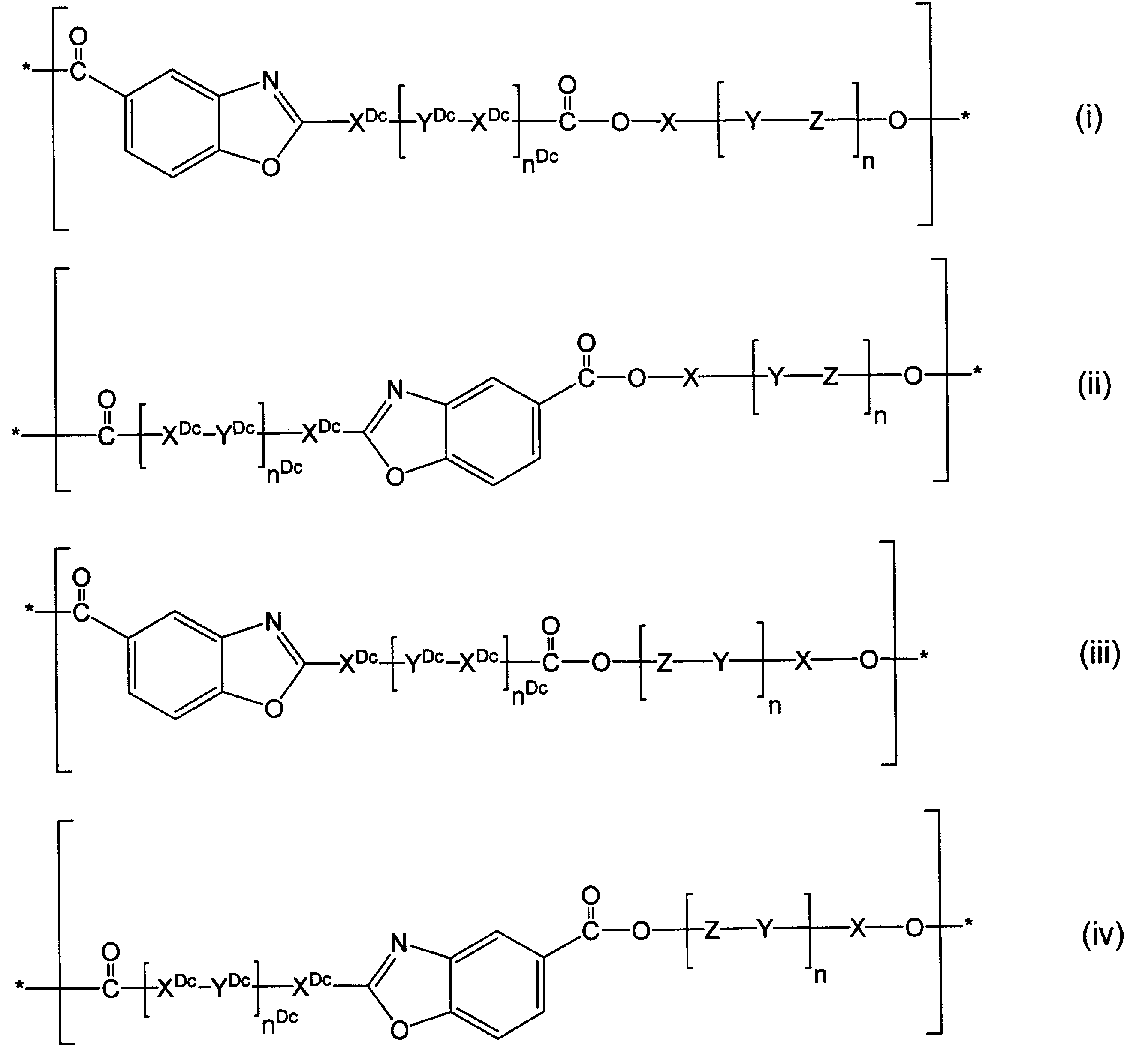
XDcは、置換基を有していてもよい2価の芳香族基を表し、
YDcは、式:-O-で表される基、式:-N=N-で表される基、カルボニル基、置換基を有していてもよいエテニレン基、又は単結合を表し、
nDcは、0~2の整数を表し、
Xは、置換基を有していてもよい2価の芳香族基を表し、
Yは、置換基を有していてもよいメチレン基、式:-S(=O)2-で表される基、又は単結合を表し、
Zは、置換基を有していてもよい2価の芳香族基を表し、
nは、0又は1を表し、
*は、結合手を表す。XDcが複数個ある場合、それらは同一でも相異なっていてもよく、YDcが複数個ある場合、それらは同一でも相異なっていてもよい。) - 中間ガラス転移点(Tmg)が150℃以上300℃以下である、請求項14に記載のポリエステル化合物。
- 融点(Tm)が300℃以上500℃以下である、請求項14又は15に記載のポリエステル化合物。
- 5%質量減量温度(Td)が370℃以上500℃以下である、請求項14~16のいずれか1項に記載のポリエステル化合物。
- 下記式(1)で表される化合物:

R1は、ヒドロキシ基、ハロゲン原子、アルコキシ基、シクロアルキルオキシ基、アリールオキシ基、式:-OMで表される基、又は式:-O-Si(R2)3で表される基を表し、ここで、Mは金属原子であり、R2はアルキル基であり、
XDcは、置換基を有していてもよい2価の芳香族基を表し、
YDcは、式:-O-で表される基、式:-N=N-で表される基、カルボニル基、置換基を有していてもよいエテニレン基、又は単結合を表し、
nDcは、0~2の整数を表す。2個あるR1は、同一でも相異なっていてもよい。XDcが複数個ある場合、それらは同一でも相異なっていてもよく、YDcが複数個ある場合、それらは同一でも相異なっていてもよい。)
と、下記式(2)で表される化合物:

R4は、水素原子、アシル基、又は式:-Si(R5)3で表される基を表し、ここで、R5はアルキル基であり、
Xは、置換基を有していてもよい2価の芳香族基を表し、
Yは、置換基を有していてもよいメチレン基、式:-S(=O)2-で表される基、又は単結合を表し、
Zは、置換基を有していてもよい2価の芳香族基を表し、
nは、0又は1を表す。2個あるR4は、同一でも相異なっていてもよい。)
とを、[式(1)で表される化合物]/[式(2)で表される化合物]のモル比が10/1~1/10の範囲にて反応させる工程を含む、ポリエステル化合物の製造方法。
Priority Applications (4)
| Application Number | Priority Date | Filing Date | Title |
|---|---|---|---|
| KR1020157030038A KR20150139868A (ko) | 2013-04-05 | 2014-04-01 | 폴리에스테르 화합물 |
| JP2015510107A JPWO2014163095A1 (ja) | 2013-04-05 | 2014-04-01 | ポリエステル化合物 |
| CN201480019079.0A CN105073828B (zh) | 2013-04-05 | 2014-04-01 | 聚酯化合物 |
| US14/872,671 US9458288B2 (en) | 2013-04-05 | 2015-10-01 | Polyester compound |
Applications Claiming Priority (2)
| Application Number | Priority Date | Filing Date | Title |
|---|---|---|---|
| JP2013079994 | 2013-04-05 | ||
| JP2013-079994 | 2013-04-05 |
Related Child Applications (1)
| Application Number | Title | Priority Date | Filing Date |
|---|---|---|---|
| US14/872,671 Continuation US9458288B2 (en) | 2013-04-05 | 2015-10-01 | Polyester compound |
Publications (1)
| Publication Number | Publication Date |
|---|---|
| WO2014163095A1 true WO2014163095A1 (ja) | 2014-10-09 |
Family
ID=51658390
Family Applications (1)
| Application Number | Title | Priority Date | Filing Date |
|---|---|---|---|
| PCT/JP2014/059677 Ceased WO2014163095A1 (ja) | 2013-04-05 | 2014-04-01 | ポリエステル化合物 |
Country Status (6)
| Country | Link |
|---|---|
| US (1) | US9458288B2 (ja) |
| JP (1) | JPWO2014163095A1 (ja) |
| KR (1) | KR20150139868A (ja) |
| CN (1) | CN105073828B (ja) |
| TW (1) | TW201504276A (ja) |
| WO (1) | WO2014163095A1 (ja) |
Cited By (1)
| Publication number | Priority date | Publication date | Assignee | Title |
|---|---|---|---|---|
| WO2015182621A1 (ja) * | 2014-05-28 | 2015-12-03 | 味の素株式会社 | ポリエーテルケトン化合物 |
Families Citing this family (1)
| Publication number | Priority date | Publication date | Assignee | Title |
|---|---|---|---|---|
| KR20240162245A (ko) * | 2023-05-08 | 2024-11-15 | 에스케이하이닉스 주식회사 | 부분 라이트 동작을 수행하는 메모리 장치, 메모리 시스템 및 이의 동작 방법 |
Citations (1)
| Publication number | Priority date | Publication date | Assignee | Title |
|---|---|---|---|---|
| JP2006282814A (ja) * | 2005-03-31 | 2006-10-19 | Sumitomo Bakelite Co Ltd | ポリエステル化合物、ポリベンゾオキサゾール樹脂、ワニス、樹脂膜および半導体装置 |
Family Cites Families (5)
| Publication number | Priority date | Publication date | Assignee | Title |
|---|---|---|---|---|
| US5274072A (en) * | 1992-05-04 | 1993-12-28 | Eastman Kodak Company | Polyester composition having copolymerized therein a light absorbing compound |
| JP3022700B2 (ja) | 1993-03-04 | 2000-03-21 | 帝人株式会社 | 芳香族ポリエステルの製造法 |
| JP5448466B2 (ja) | 2009-01-16 | 2014-03-19 | ユニチカ株式会社 | ポリアリレート樹脂組成物およびそれから得られる成形体 |
| JP5334879B2 (ja) | 2010-01-18 | 2013-11-06 | ユニチカ株式会社 | 樹脂組成物および該樹脂組成物からなる成形体 |
| CN103012764B (zh) * | 2012-12-13 | 2013-11-13 | 江苏腾盛纺织科技集团有限公司 | 含噁唑结构的无规共聚酯树脂及其制备方法及高强度共聚酯纤维 |
-
2014
- 2014-04-01 WO PCT/JP2014/059677 patent/WO2014163095A1/ja not_active Ceased
- 2014-04-01 CN CN201480019079.0A patent/CN105073828B/zh not_active Expired - Fee Related
- 2014-04-01 KR KR1020157030038A patent/KR20150139868A/ko not_active Withdrawn
- 2014-04-01 JP JP2015510107A patent/JPWO2014163095A1/ja active Pending
- 2014-04-03 TW TW103112551A patent/TW201504276A/zh unknown
-
2015
- 2015-10-01 US US14/872,671 patent/US9458288B2/en not_active Expired - Fee Related
Patent Citations (1)
| Publication number | Priority date | Publication date | Assignee | Title |
|---|---|---|---|---|
| JP2006282814A (ja) * | 2005-03-31 | 2006-10-19 | Sumitomo Bakelite Co Ltd | ポリエステル化合物、ポリベンゾオキサゾール樹脂、ワニス、樹脂膜および半導体装置 |
Non-Patent Citations (4)
| Title |
|---|
| H.R. KRICHELDORF ET AL.: "New polymer syntheses, 57. Thermotropic polyesters based on 2-(4-carboxyphenyl)benzoxazole-5-carboxylic acid", MAKROMOL. CHEM., vol. 193, no. 9, September 1992 (1992-09-01), pages 2467 - 2476 * |
| H.R. KRICHELDORF ET AL.: "New Polymer Syntheses. 60. Thermostable Polymers of 2- (Hydroxyaryl)benzoxazole-5-Carboxylic Acids", J. POLYM. CHEM. PART A, vol. 29, no. 12, November 1991 (1991-11-01), pages 1751 - 1757 * |
| H.R. KRICHELDORF ET AL.: "Whiskers. 4. Copolyesters of 4-Hydroxybenzoic Acid and 2- (4'-Hydroxyphenyl)benzoxazole-5-carboxylic Acid", MACROMOLECULES, vol. 26, no. 24, November 1993 (1993-11-01), pages 6628 - 6632 * |
| MARCOS-FERNANDEZ ET AL.: "Novel aromatic polyamides with 1,3-benzoazole groups in the main chain. 1. Polymers derived from 2-(4-carboxyphenyl) benzoxazole-5- and 6-carboxylic acids. Synthesis and characterization", POLYMER, vol. 42, no. 19, September 2001 (2001-09-01), pages 7933 - 7941 * |
Cited By (1)
| Publication number | Priority date | Publication date | Assignee | Title |
|---|---|---|---|---|
| WO2015182621A1 (ja) * | 2014-05-28 | 2015-12-03 | 味の素株式会社 | ポリエーテルケトン化合物 |
Also Published As
| Publication number | Publication date |
|---|---|
| KR20150139868A (ko) | 2015-12-14 |
| JPWO2014163095A1 (ja) | 2017-02-16 |
| TW201504276A (zh) | 2015-02-01 |
| CN105073828B (zh) | 2017-06-27 |
| CN105073828A (zh) | 2015-11-18 |
| US9458288B2 (en) | 2016-10-04 |
| US20160024247A1 (en) | 2016-01-28 |
Similar Documents
| Publication | Publication Date | Title |
|---|---|---|
| JPH051079A (ja) | 芳香族ジホスフエートの製造方法と用途 | |
| WO2015182621A1 (ja) | ポリエーテルケトン化合物 | |
| US9458288B2 (en) | Polyester compound | |
| WO2015060361A1 (ja) | ポリアミド化合物 | |
| WO2014163096A1 (ja) | ポリエステル化合物 | |
| CN104193981A (zh) | 一种含磷聚碳酸酯的制备方法 | |
| CA1159076A (en) | Process for the production of diphosphaspiro compounds | |
| NL2007946A (en) | Polyphosphonate, method of preparing the same, and flame retardant thermoplastic resin composition including the same. | |
| JP2825466B2 (ja) | 芳香族ジホスフェート含有難燃性熱安定性樹脂組成物 | |
| KR20250137383A (ko) | 난연제 화합물 및 이를 이용한 난연 수지 조성물, 난연 제품 | |
| KR20250116489A (ko) | 난연제 화합물 및 이를 이용한 난연 수지 조성물, 난연 제품 | |
| CN121712861A (zh) | 阻燃化合物和使用其的阻燃树脂组合物、阻燃产品 | |
| KR20250137509A (ko) | 난연제 화합물 및 이를 이용한 난연 수지 조성물, 난연 제품 | |
| WO2015060362A1 (ja) | ポリエステル又はポリアミドの製造方法 | |
| CN121712860A (zh) | 阻燃化合物和使用其的阻燃树脂组合物、阻燃产品 | |
| JPS585929B2 (ja) | コウブンシリヨウリンガンユウジユウゴウタイノセイゾウホウホウ | |
| JPH0446925A (ja) | 共重合ポリエステル | |
| JPS6330930B2 (ja) | ||
| JPH0220521A (ja) | ベンゾキサゾール基を含有するポリアリーレンエーテルおよびその製造方法 | |
| JP2018135269A (ja) | オキサゾールジカルボン酸化合物の製造方法 | |
| JPS62164724A (ja) | ポリエステルフイルム |
Legal Events
| Date | Code | Title | Description |
|---|---|---|---|
| WWE | Wipo information: entry into national phase |
Ref document number: 201480019079.0 Country of ref document: CN |
|
| 121 | Ep: the epo has been informed by wipo that ep was designated in this application |
Ref document number: 14779241 Country of ref document: EP Kind code of ref document: A1 |
|
| ENP | Entry into the national phase |
Ref document number: 2015510107 Country of ref document: JP Kind code of ref document: A |
|
| NENP | Non-entry into the national phase |
Ref country code: DE |
|
| ENP | Entry into the national phase |
Ref document number: 20157030038 Country of ref document: KR Kind code of ref document: A |
|
| 122 | Ep: pct application non-entry in european phase |
Ref document number: 14779241 Country of ref document: EP Kind code of ref document: A1 |