WO2014163003A1 - 光学用粘着剤組成物、光学用粘着シートおよびその製造方法 - Google Patents
光学用粘着剤組成物、光学用粘着シートおよびその製造方法 Download PDFInfo
- Publication number
- WO2014163003A1 WO2014163003A1 PCT/JP2014/059138 JP2014059138W WO2014163003A1 WO 2014163003 A1 WO2014163003 A1 WO 2014163003A1 JP 2014059138 W JP2014059138 W JP 2014059138W WO 2014163003 A1 WO2014163003 A1 WO 2014163003A1
- Authority
- WO
- WIPO (PCT)
- Prior art keywords
- mass
- sensitive adhesive
- component
- pressure
- monomer
- Prior art date
- Legal status (The legal status is an assumption and is not a legal conclusion. Google has not performed a legal analysis and makes no representation as to the accuracy of the status listed.)
- Ceased
Links
Images
Classifications
-
- C—CHEMISTRY; METALLURGY
- C09—DYES; PAINTS; POLISHES; NATURAL RESINS; ADHESIVES; COMPOSITIONS NOT OTHERWISE PROVIDED FOR; APPLICATIONS OF MATERIALS NOT OTHERWISE PROVIDED FOR
- C09J—ADHESIVES; NON-MECHANICAL ASPECTS OF ADHESIVE PROCESSES IN GENERAL; ADHESIVE PROCESSES NOT PROVIDED FOR ELSEWHERE; USE OF MATERIALS AS ADHESIVES
- C09J133/00—Adhesives based on homopolymers or copolymers of compounds having one or more unsaturated aliphatic radicals, each having only one carbon-to-carbon double bond, and at least one being terminated by only one carboxyl radical, or of salts, anhydrides, esters, amides, imides, or nitriles thereof; Adhesives based on derivatives of such polymers
- C09J133/04—Homopolymers or copolymers of esters
- C09J133/06—Homopolymers or copolymers of esters of esters containing only carbon, hydrogen and oxygen, the oxygen atom being present only as part of the carboxyl radical
- C09J133/062—Copolymers with monomers not covered by C09J133/06
- C09J133/066—Copolymers with monomers not covered by C09J133/06 containing -OH groups
Definitions
- the present invention relates to an optical pressure-sensitive adhesive composition, an optical pressure-sensitive adhesive sheet, and a method for producing the same.
- image display devices have been used under various applications and conditions. For example, they are often used not only under room temperature conditions but also under severe conditions such as high temperature and high temperature and humidity. .
- high temperature or high temperature and humidity condition examples include use in a tropical region, use inside a vehicle, and inside an outdoor measuring instrument.
- Some optical films that make up image display devices shrink under high temperature and high humidity to cause dimensional changes.
- dimensional deformation occurs in the optical film, it is difficult to completely return to the original dimensions even if the temperature and humidity conditions are changed.
- the pressure-sensitive adhesive layer is cracked, peeled off and floated due to the stress caused by the dimensional change of the optical film.
- metal oxides such as an ITO layer used for transparent electrodes are often used in image display devices.
- the adherend contains a metal oxide
- the metal oxide is corroded by an acid component, causing a problem that the resistance value is increased.
- the present invention provides an optical pressure-sensitive adhesive composition, an optical pressure-sensitive adhesive sheet, and a method for producing the same, which can exhibit excellent durability under high temperature and high humidity conditions and do not corrode an adherend.
- the present inventors can obtain a pressure-sensitive adhesive layer having excellent durability and not corroding an adherend by using a pressure-sensitive adhesive composition having a predetermined component. I found out.
- the optical pressure-sensitive adhesive composition according to one embodiment of the present invention includes (A) 100 parts by mass of an acrylic polymer substantially free of a carboxyl group, and (B) a molecular weight having two or more glycidyl groups in one molecule. 1,000 or less compounds 0.3 mass part or more and 20 mass parts or less are included.
- an isocyanate-based crosslinking agent may be further included.
- composition including the partial polymer (A 2 ) further includes (E) a polyfunctional monomer, and the (A) acrylic polymer is It can be obtained from the composition containing the partial polymer (A 2 ) and the (E) polyfunctional monomer.
- optical pressure-sensitive adhesive composition according to any one of 2 to 5 above, wherein the monomer mixture may further contain (a3) a nitrogen atom-containing monomer in an amount of 0.1% by mass to 5% by mass. .
- the gel fraction may be 20% or more and 95% or less.
- optical pressure-sensitive adhesive composition according to any one of 1 to 7, which can be used for bonding members constituting a touch panel type input / output device.
- the optical pressure-sensitive adhesive sheet according to another aspect of the present invention has a pressure-sensitive adhesive layer obtained from the optical pressure-sensitive adhesive composition described in any one of 1 to 7 above.
- the manufacturing method of the optical adhesive sheet which concerns on the other aspect of this invention has (A) 100 mass parts of acrylic polymers which do not contain a carboxyl group substantially, and (B) 2 or more glycidyl groups in 1 molecule.
- the pressure-sensitive adhesive composition may further include (C) an isocyanate-based crosslinking agent.
- the method for producing an optical pressure-sensitive adhesive sheet includes (a1) (meth) acrylic acid alkyl ester monomer 60% by mass to 85% by mass and (a2) hydroxyl group-containing monomer 15% by mass. 100 parts by mass of a partially polymerized monomer mixture (A 2 ) containing 40% by mass or less (wherein (a1) (meth) acrylic acid alkyl ester monomer and (a2) hydroxyl group-containing monomer When the monomer mixture is 100% by mass, the total amount is 75% by mass or more and 100% by mass or less.) (B) Molecular weight 1,000 having two or more glycidyl groups in one molecule.
- the optical pressure-sensitive adhesive composition according to any one of 1 to 8 above (A) 100 parts by mass of an acrylic polymer substantially free of carboxyl groups, and (B) a molecular weight of 1 having two or more glycidyl groups in one molecule. , 000 or less of the compound is contained in an amount of 0.3 to 20 parts by mass, has appropriate adhesiveness, does not corrode the adherend, and is excellent under high temperature conditions or high temperature and high humidity conditions. A coating liquid layer exhibiting high durability (wet heat durability) can be obtained.
- the optical pressure-sensitive adhesive sheet described in 9 has a pressure-sensitive adhesive layer obtained from the optical pressure-sensitive adhesive composition described in any one of 1 to 7, the optical pressure-sensitive adhesive sheet has excellent durability, In addition, the adherend is not corroded. Therefore, the optical pressure-sensitive adhesive sheet can be suitably used for an image display device or an input / output device.
- the method for producing an optical pressure-sensitive adhesive sheet described in 10 and 11 above includes (A) 100 parts by mass of an acrylic polymer that substantially does not contain a carboxyl group, and (B) two or more glycidyl groups in one molecule.
- a step of obtaining a coating liquid layer by applying a pressure-sensitive adhesive composition containing 0.3 to 20 parts by mass of a compound having a molecular weight of 1,000 or less and optionally (C) an isocyanate-based crosslinking agent to the surface of the separator.
- or 13 WHEREIN (a1) (meth) acrylic-acid alkylester monomer 60 mass%-85 mass% and (a2) hydroxyl-containing monomer 15 mass %
- a 2 a partial mixture of a monomer mixture containing from 40% by weight to 40% by weight (wherein (a1) (meth) acrylic acid alkyl ester monomer and (a2) hydroxyl group-containing monomer)
- the total amount of the body is 75% by mass or more and 100% by mass or less when the monomer mixture is 100% by mass.
- B a molecular weight of 1 having 2 or more glycidyl groups in one molecule.
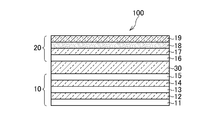
- FIG. 1 is a cross-sectional view schematically showing a configuration of an input / output device (touch panel type input / output device) according to an embodiment of the present invention.
- parts means “parts by mass” and “%” means “mass%” unless otherwise specified.
- optical pressure-sensitive adhesive composition substantially contains (A) a carboxyl group.
- Acrylic polymer hereinafter sometimes simply referred to as “component (A)” 100 parts by mass
- component (B) a compound having a molecular weight of 1,000 or less having two or more glycidyl groups in one molecule ( Hereinafter, it may be simply described as “component (B).” Including 0.3 to 20 parts by mass.
- the “acrylic polymer” includes at least one selected from acrylic acid, acrylic acid salt, acrylic acid ester, methacrylic acid, methacrylic acid salt, and methacrylic acid ester in a structural unit of 50% by mass or more.
- the “acrylic acid ester monomer not containing a hydroxyl group” means an acrylic acid ester monomer having no hydroxyl group in the molecular structure.
- the pressure-sensitive adhesive sheet formed using the pressure-sensitive adhesive composition according to the present embodiment can provide (B) the content of the component (A).
- the content of the component is preferably 0.3 parts by mass or more and 15 parts by mass or less, and more preferably 0.3 parts by mass or more and 10 parts by mass or less with respect to 100 parts by mass of the component (A). More preferred.
- the durability when the content of the component (B) with respect to the content of the component (A) exceeds 20 parts by mass of the component (B) with respect to 100 parts by mass of the component (A), or 0 When the amount is less than 3 parts by mass, the durability may be inferior.
- (A) component may contain the hydroxyl group. More specifically, when the monomer mixture that is the raw material of the component (A) contains a hydroxyl group-containing monomer, the component (A) can contain a hydroxyl group.
- the component having a hydroxyl group for example, can be confirmed by the IR spectrum, the absorption in the range of 3400 cm -1 ⁇ 3200 cm -1 appear about the component (A).
- the component (A) has a hydroxyl group, the hydroxyl group reacts with the later-described component (C), whereby durability can be improved.
- a component can use (a1) (meth) acrylic acid alkyl ester monomer as a main monomer.
- (meth) acrylic acid alkyl ester monomer as main monomer means (meth) acrylic acid alkyl ester among monomers contained in monomer mixture which is a raw material of component (A) The monomer content is the highest.
- the first copolymer is a monomer mixture copolymer (A 1 ) containing a (meth) acrylic acid alkyl ester monomer as a main monomer
- the second copolymer is (meth) acrylic. It is a partial copolymer (A 2 ) of a monomer mixture containing an acid alkyl ester monomer as a main monomer.
- (A 1 ) component (A 1 ) component comprises (a1) (meth) acrylic acid alkyl ester monomer 60% by mass to 85% by mass (preferably 65% by mass to 84.9% by mass) and (a2 ) A copolymer (A 1 ) of a monomer mixture containing 15% by mass to 40% by mass (preferably 15% by mass to 35% by mass) of a hydroxyl group-containing monomer (wherein (a1) The total amount of the (meth) acrylic acid alkyl ester monomer and the (a2) hydroxyl group-containing monomer is 75% by mass or more and 100% by mass or less when the monomer mixture is 100% by mass. Can do.
- the component (A 1 ) can be used, for example, when the optical pressure-sensitive adhesive composition according to this embodiment is used by being dissolved or dispersed in the (H) solvent (hereinafter referred to simply as “(H) component”. (The component (H) will be described in detail later.)
- the optical pressure-sensitive adhesive composition according to this embodiment includes the component (A 1 ), the (C) isocyanate described later. It may further contain a system cross-linking agent (hereinafter sometimes simply referred to as “component (C)”).
- the content of the component (A 1 ) in the pressure-sensitive adhesive composition according to the present embodiment is the same as that of the present embodiment. It can be 80 to 99.7 parts by mass, preferably 90 to 99.5 parts by mass with respect to 100 parts by mass of the pressure-sensitive adhesive composition.
- (A 2 ) component (A 2 ) component is (a1) (meth) acrylic acid alkyl ester monomer (hereinafter sometimes simply referred to as “(a1) component”) 60 mass% or more and 85 mass% (Preferably 65% by mass or more and 84.9% by mass or less) and (a2) a hydroxyl group-containing monomer (hereinafter sometimes simply referred to as “component (a2)”) 15% by mass or more and 40% by mass or less It is obtained from a composition containing a partial polymer (A 2 ) of a monomer mixture containing (preferably 15% by mass or more and 35% by mass or less) (wherein (a1) alkyl (meth) acrylate) The total amount of the ester monomer and the (a2) hydroxyl group-containing monomer can be 75% by mass or more and 100% by mass or less when the monomer mixture is 100% by mass.
- the component (A 2 ) can be used, for example, when the optical pressure-sensitive adhesive composition according to this embodiment is applied in a state that does not substantially contain a solvent.
- “coating the optical pressure-sensitive adhesive composition in a state containing substantially no solvent” means that the solvent content in the coating liquid containing the optical pressure-sensitive adhesive composition is 1% by mass or less. More specifically, it means a case where a solvent is not blended in the coating liquid.
- a thick-film pressure-sensitive adhesive layer can be easily formed.
- (A) if the component obtained from (A 2) component, the content of (A 2) component in the adhesive composition according to the present embodiment, the present embodiment It can be 80 mass parts or more and 99.7 mass parts or less with respect to 100 mass parts of adhesive compositions, and it is preferable that they are 90 mass parts or more and 99.5 mass parts or less.
- (A 2) in terms of ingredients may have an appropriate viscosity, the proportion of residual monomers without polymerization of (A 2) content of the monomer in the component (monomers used ) Is preferably 30% by mass or more and 95% by mass or less, and more preferably 40% by mass or more and 80% by mass or less.
- the polymer component contained in (A 2) component is preferably 5 mass% to 70 mass%, more preferably at most 20 mass% to 60 mass%.
- the optical pressure-sensitive adhesive composition according to the present embodiment comprises (A 2) component described below (C) an isocyanate crosslinking agent (hereinafter, sometimes simply referred to as "component (C)".) May not be substantially included.
- component (C) an isocyanate crosslinking agent
- the optical pressure-sensitive adhesive composition does not substantially contain the component (C) means that the content of the component (C) in the optical pressure-sensitive adhesive composition is 0.1% by mass or less. More specifically, it refers to the case where the component (C) is not added to the optical pressure-sensitive adhesive composition.
- the monomer mixture as the raw material of the component (A 2 ) is (a3) a nitrogen atom-containing monomer (hereinafter sometimes simply referred to as “(a3) component”) 0.1% by mass or more. 5 mass% or less can further be included.
- the monomer mixture contains the component (a3), the whitening resistance of the pressure-sensitive adhesive layer formed from the pressure-sensitive adhesive composition of the present invention can be improved.
- (A1) Component The (a1) component contained in the monomer mixture which is a raw material of the (A 1 ) component and the (A 2 ) component contributes to the adhesiveness and durability of the pressure-sensitive adhesive composition according to this embodiment. be able to.
- (A1) (meth) acrylic acid alkyl ester monomers include, for example, methyl acrylate, methyl methacrylate, ethyl acrylate, ethyl methacrylate, n-propyl acrylate, n-propyl methacrylate, n-butyl acrylate, n-butyl methacrylate, n -Hexyl acrylate, n-hexyl methacrylate, n-pentyl acrylate, n-octyl acrylate, n-octyl methacrylate, n-nonyl acrylate, n-hexadecyl acrylate, n-hexadecyl methacrylate, stearyl acrylate, stearyl methacrylate, n-lauryl (Meth) acrylate alkyl ester having a linear alkyl group such as methacrylate, n-lauryl acrylate
- Termonic monomers branched alkyl groups such as isopropyl acrylate, isobutyl acrylate, t-butyl acrylate, isopropyl methacrylate, isobutyl methacrylate, t-butyl methacrylate, isooctyl acrylate, isooctyl methacrylate, 2-ethylhexyl acrylate, 2-ethylhexyl methacrylate (Meth) acrylic acid alkyl ester monomer having a cyclohexyl acrylate, cyclohexyl methacrylate, isobornyl acrylate, isobornyl methacrylate and the like (meth) acrylic acid alkyl ester monomer; Of these, one can be used alone or two or more can be used in combination.
- the (a1) component is a (meth) acrylic acid alkyl ester linear or branched in that the pressure-sensitive adhesive sheet formed using the pressure-sensitive adhesive composition according to this embodiment is excellent in durability.
- a (meth) acrylic acid alkyl ester monomer having an alkyl group is preferred, and a branched alkyl chain is more preferred.
- the number of carbon atoms of the alkyl group is 1 or more and 20 or less (preferably 1 or more and 10 or less, preferably in terms of the durability of the pressure-sensitive adhesive sheet formed using the pressure-sensitive adhesive composition according to this embodiment. More preferably, it is 1 or more and 8 or less.
- the component (a2) is contained in the monomer mixture which is the raw material of the component (a2) component (A 1 ) and the component (A 2 ), so that the component (A 1 ) and the component (A 2 ) contain a hydroxyl group. be able to.
- a crosslinked structure can be formed by reacting the hydroxyl group contained in the (A 1 ) component and the (A 2 ) component with an isocyanate group contained in the later-described (C) component.
- the component (a2) examples include hydroxyl group-containing compounds (eg, 2-hydroxyethyl acrylate, 2-hydroxyethyl methacrylate, 2-hydroxypropyl acrylate, 2-hydroxypropyl methacrylate, 4-hydroxybutyl acrylate, cyclohexane dimethanol monoacrylate).
- hydroxyl group-containing compounds eg, 2-hydroxyethyl acrylate, 2-hydroxyethyl methacrylate, 2-hydroxypropyl acrylate, 2-hydroxypropyl methacrylate, 4-hydroxybutyl acrylate, cyclohexane dimethanol monoacrylate.
- Acrylic acid ester monomers, N-methylol acrylamide, N-ethylol acrylamide and the like, and among them, one kind or a combination of two or more kinds can be used.
- (A3) by the component (A 1) component and (A 2) to the raw material monomer mixture which is the component (a3) that contains component containing (A 1) component and (A 2) component is a nitrogen atom can do.
- the component (a3) include a nitrogen atom-containing monomer containing at least one group selected from a nitrile group, an amino group, an imide group, an amide group, and the like.
- examples of the component (a3) include amino group-containing monomers such as N, N-dimethylaminoethyl acrylate, N, N-dimethylaminoethyl methacrylate, N, N-diethylaminoethyl methacrylate, Amides such as acrylamide, N, N-dimethylacrylamide, N, N-diethylacrylamide, acryloylmorpholine, N-methoxymethylacrylamide, N-butoxymethylacrylamide, Nt-butylacrylamide, N, N-dimethylaminopropylacrylamide A group containing monomer and acrylonitrile are mentioned, Among these, it can be used 1 type or in combination of 2 or more types. Of these, the component (a3) is more preferably an amide group-containing monomer from the viewpoint of improving the whitening resistance of the pressure-sensitive adhesive layer formed from the pressure-sensitive adhesive composition of the present invention.
- Component (a4) The monomer mixture for obtaining the polymer as component (A) is a monomer other than components (a4), (a1), (a2) and (a3) (hereinafter, (It may be simply described as “component (a4)”).
- component (a4) examples include vinyl acetate, styrene, macromonomer and the like.
- the component (A 1 ) is used from the viewpoint that good adhesiveness and durability can be achieved more reliably.
- the total amount of the component (a1), component (a2), and component (a3) in the monomer mixture for obtaining the component (A 2 ) (when the monomer mixture is 100% by mass) can be 90% by mass or more and 100% by mass or less, and preferably 95% by mass or more and 100% by mass or less.
- the polymerization method of component (A 1 ) is not particularly limited and can be polymerized by a known method such as solution polymerization, emulsion polymerization, suspension polymerization, etc., but was obtained by polymerization.
- a known method such as solution polymerization, emulsion polymerization, suspension polymerization, etc.
- solution polymerization generally, a predetermined organic solvent, each monomer, a polymerization initiator, a chain transfer agent used as necessary, and the like are charged in a polymerization tank, under a nitrogen stream or a reflux temperature of the organic solvent, The reaction is carried out by heating for several hours with stirring.
- the organic solvent include aromatic hydrocarbons such as benzene, toluene, ethylbenzene, n-propylbenzene, t-butylbenzene, o-xylene, m-xylene, p-xylene, tetralin, decalin, aromatic naphtha;
- aromatic hydrocarbons such as benzene, toluene, ethylbenzene, n-propylbenzene, t-butylbenzene, o-xylene, m-xylene, p-xylene, tetralin, decalin, aromatic naphtha
- aliphatic or alicyclic hydrocarbons such as n-hexane, n-heptane, n-octane, isooctane, n-decane, dipentene, petroleum spirit, petroleum naphtha, turpentine oil;
- Esters such as but
- organic solvents for polymerization when polymerizing the component (A 1 ), it is preferable to use an organic solvent that hardly causes chain transfer during the polymerization reaction, for example, esters and ketones, and in particular, (A 1 ) From the viewpoints of solubility of components and ease of polymerization reaction, use of ethyl acetate, methyl ethyl ketone, acetone or the like is preferable.
- organic peroxides and azo compounds that can be used in ordinary solution polymerization.
- organic peroxides include t-butyl hydroperoxide, cumene hydroxide, dicumyl peroxide, benzoyl peroxide, lauroyl peroxide, caproyl peroxide, diisopropyl peroxydicarbonate, and di-2.
- azo compound examples include 2,2′-azobis-isobutyronitrile and 2,2 ′.
- the amount of these polymerization initiators used is usually 0.01 parts by mass or more and 2 parts by mass or less, and preferably 0.02 parts by mass or more and 1.0 parts by mass or less with respect to 100 parts by mass of the total monomer. .
- a chain transfer agent can be used as necessary within a range that does not impair the purpose and effect of the present invention.
- chain transfer agents examples include cyanoacetic acid; alkyl esters having 1 to 8 carbon atoms of cyanoacetic acid; bromoacetic acid; alkyl esters having 1 to 8 carbon atoms of bromoacetic acid; anthracene, phenanthrene, and fluorene.
- Aromatic compounds such as 9-phenylfluorene; aromatic nitro compounds such as p-nitroaniline, nitrobenzene, dinitrobenzene, p-nitrobenzoic acid, p-nitrophenol and p-nitrotoluene; benzoquinone, 2,3, Benzoquinone derivatives such as 5,6-tetramethyl-p-benzoquinone; borane derivatives such as tributylborane; carbon tetrabromide, carbon tetrachloride, 1,1,2,2-tetrabromoethane, tribromoethylene, trichloroethylene, Bromotrichloromethane, tribromomethane, 3- Halogenated hydrocarbons such as Lolo-1-propene; Aldehydes such as chloral and furaldehyde: Alkyl mercaptans having 1 to 18 carbon atoms; Aromatic mercaptans such as thiophenol and toluene mercaptan; Carbon of
- the polymerization temperature of the component (A 1 ) is generally about 30 ° C. or higher and 180 ° C. or lower, preferably 40 ° C. or higher and 150 ° C. or lower, more preferably 50 ° C. or higher and 100 ° C. or lower.
- an unreacted monomer is contained in a polymer obtained by a solution polymerization method or the like, it can be purified by a reprecipitation method using methanol or the like in order to remove the monomer.
- the partial polymer (A 2 ) component can be obtained by partial polymerization so as to have a viscosity that allows the monomer mixture to be applied.
- the production of such a partial polymer is described, for example, in JP-A No. 2001-181589, and the component (A 2 ) can be produced by the method described in JP-A No. 2001-181589.
- the monomer mixture is reacted substantially without using a solvent.
- a specific polymerization initiator as shown below.
- a polymerization initiator having a 10-hour half-life temperature of 41.0 ° C. or lower, preferably 20 ° C. or higher and 37.0 ° C. or lower is preferably used. Is done.
- polymerization initiators examples include isobutyryl peroxide (10-hour half-life temperature: 32.7 ° C.), ⁇ , ⁇ ′-bis (neodecanoylperoxy) diisopropylbenzene (10-hour half-life temperature: 35.9 ° C.), cumyl peroxyneodecanoate (10 hour half-life temperature: 36.5 ° C.), di-n-propyl peroxydicarbonate (10 hour half-life temperature: 40.3 ° C.), diisopropyl per Oxydicarbonate (10-hour half-life temperature: 40.5 ° C), di-sec-butyl peroxydicarbonate (10-hour half-life temperature: 40.5 ° C), 1,1,3,3-tetramethylbutylper Oxyneodecanoate (10-hour half-life temperature: 40.7 ° C), bis (4-butylcyclohexyl) peroxydicarbonate (10-hour half-life temperature: 40.8 ) And 2,2'
- polymerization initiators can be used alone or in combination.
- isobutyryl peroxide (10-hour half-life temperature: 32.7 ° C.)
- ⁇ , ⁇ ′-bis (neodecanoylperoxy) diisopropylbenzene (10-hour half-life temperature: 35.9 ° C.)
- kumi Luperoxyneodecanoate (10-hour half-life temperature: 36.5 ° C)
- 2,2'-azobis (4-methoxy-2,4-dimethylvaleronitrile) (10-hour half-life temperature: 30.0 ° C)
- the monomer mixture is heated or heated to a temperature at which the polymerization reaction can proceed when a polymerization initiator is blended, and the prescribed reaction initiator is added to the monomer mixture in the amount specified above. Then, the polymerization reaction proceeds.
- the temperature of the monomer mixture when adding the polymerization initiator is usually in the range of 20 ° C. or higher and 80 ° C. or lower, preferably 35 ° C. or higher and 70 ° C. or lower, particularly preferably 40 ° C. or higher and 65 ° C. or lower.
- the polymerization initiator is usually added with stirring to the monomer mixture thus heated or heated.
- the Tg of the component (A 1 ) is preferably ⁇ 70 ° C. or more and 0 ° C. or less, from the viewpoint of more reliably achieving good adhesion and durability. More preferably ° C. or higher 0 °C or less, (a 2) components Tg ((Tg of a 2) polymer obtained by polymerizing a component) is preferably not more than 0 °C -70 ° C. or higher, - More preferably, it is 60 ° C. or more and 0 ° C. or less.
- Tg of the components (A 1 ) and (A 2 ) is a value calculated by the following formula (1) (FOX formula).
- Tg A W a1 / Tg a1 + W a2 / Tg a2 + W a3 / Tg a3 + W a4 / Tg a4 (1)
- Tg A represents the glass transition temperature (K) of the component (A)
- Tg a1 , Tg a2 , Tg a3 , and Tg a4 are the constituent monomers (a1), (a2), (a3)
- the glass transition temperature (Tg (K)) of the homopolymer prepared from (a4) is shown, and W a1 , W a2 , W a3 and W a4 are each contained in the component (A), the constituent monomer (a1) , (A2), (a3), (a4) indicates the weight fraction.
- Tg A is calculated as an absolute temperature (K) by the above formula (1), it is converted to a Celsius temperature (° C.) as necessary.
- the glass transition temperatures of homopolymers prepared from typical monomers are shown in Table 1 below. More specifically, for example, Polymer Handbook 4th Edition (Polymer Handbook Third Edition, Wiley-Interscience, 2003) It is described in.
- (A 1) component has a weight average molecular weight (Mw) of 100,000 or more 1,500,000
- the molecular weight in the component (A 2 ) is preferably 10,000 to 1,000,000, and more preferably 10,000 to 1,000,000. More preferably, it is 500,000 or less.
- the weight average molecular weights of the (A 1 ) component and the (A 2 ) component are obtained by obtaining the weight average molecular weight (Mw) in terms of standard polystyrene under the following conditions using GPC (gel permeation chromatography). is there.
- ⁇ GPC measurement conditions Measuring device: HLC-8120GPC (manufactured by Tosoh Corporation) GPC column configuration: The following five columns (all manufactured by Tosoh Corporation) (1) TSK-GEL HXL-H (guard column) (2) TSK-GEL G7000HXL (3) TSK-GEL GMHXL (4) TSK-GEL GMHXL (5) TSK-GEL G2500HXL Diluted with tetrahydrofuran so that the sample concentration is 1.0 mg / cm 3 Mobile phase solvent: Tetrahydrofuran Flow rate: 1.0 cm 3 / min Column temperature: 40 ° C.
- Component (B) The durability which was more excellent by the adhesive sheet formed using the adhesive composition which concerns on this embodiment by constructing a crosslinked structure more reliably in the molecule
- the number of glycidyl groups contained in one molecule of component (B) is preferably 2 or more and 8 or less, and preferably 2 or more and 6 or less.
- the molecular weight of the component (B) is preferably 100 or more and 1000 or less, and may be 100 or more and 600 or less, for example. Moreover, when the molecular weight of the compound having two or more glycidyl groups in one molecule exceeds 1,000, the compatibility of the component (B) with the component (A) is deteriorated, and the density of the glycidyl groups is further reduced. As a result, the reaction between glycidyl groups is less likely to occur, and as a result, a crosslinked structure is hardly formed, resulting in poor durability.
- Examples of the component (B) include 1,6-hexanediol glycidyl ether, 1,4-butanediol diglycidyl ether, and the like.
- Examples of the commercially available component (B) include Tetrad C (Mitsubishi Gas Chemical Co., Ltd.), Tetrad X (Mitsubishi Gas Chemical Co., Ltd.), Denacol EX212L (Nagase ChemteX Corporation), and the like.
- the isocyanate-based crosslinking agent that is the component (C) is not particularly limited as long as it is a crosslinking agent that can be crosslinked with the component (A) at room temperature or under heating.
- isocyanate monomers such as xylylene diisocyanate, tolylene diisocyanate, chlorophenylene diisocyanate, hexamethylene diisocyanate, tetramethylene diisocyanate, isophorone diisocyanate, diphenylmethane diisocyanate, hydrogenated diphenylmethane diisocyanate, and divalent or higher divalents such as trimethylolpropane
- isocyanate compound or an isocyanurate obtained by addition reaction with an alcohol compound or the like is exemplified.
- C examples include Coronate L (Nippon Polyurethane Industry Co., Ltd.), Duranate 24A-100 (Asahi Kasei Co., Ltd.), Takenate D-120N (Mitsui Chemicals Co., Ltd.), Mytec NY260A (Mitsubishi Chemical Corporation). ) And the like.
- urethane prepolymer type isocyanates obtained by addition reaction of isocyanate compounds with known polyether polyols, polyester polyols, acrylic polyols, polybutadiene polyols, polyisoprene polyols, and the like can be mentioned. Of these, xylylene diisocyanate and its derivatives are preferably used.
- the content of the component (C) in the pressure-sensitive adhesive composition according to this embodiment is 0 with respect to 100 parts by mass of the component (A) from the viewpoint of achieving a predetermined gel fraction (for example, 20% to 95%). It can be 1 part by mass or more and 5 parts by mass or less, and preferably 0.1 part by mass or more and 3 parts by mass or less.
- Component (D) (D) a photoinitiator as component, described later (A 2) contained in the component and (B) PSA composition comprising the component, the formation of the pressure-sensitive adhesive sheet using the PSA composition It functions as a reaction initiator.
- the content of the component (D) in the optical pressure-sensitive adhesive composition according to this embodiment is preferably 0.05 parts by mass or more and 5 parts by mass or less with respect to 100 parts by mass of the component (A 2 ). More preferably, it is 1 part by mass or more and 3 parts by mass or less.
- the component (D) is preferably, for example, an ultraviolet polymerization initiator that initiates polymerization by ultraviolet rays.
- component (D) examples include 2,2-dimethoxy-1,2-diphenylethane-1-one, 1-hydroxy-cyclohexyl-phenylketone, 2-hydroxy-1- ⁇ 4- [4- (2- Hydroxy-2-methyl-propionyl) -benzyl] phenyl ⁇ -2-methyl-propan-1-one, 2-hydroxy-2-methyl-1-phenyl-propan-1-one, 1- [4- (2- Hydroxyethoxy) -phenyl] -2-hydroxy-2-methyl-1-propan-1-one, 2-methyl-1 [4- (methylthio) phenyl] -2-morpholinopropan-1-one, 2- Benzyl-2-dimethylamino-1- (4-morpholinophenyl) -butanone-1,6-trimethylbenzoyldiphenylphosphine oxide, benzoin methyl ether , Benzoin ethyl ether, benzoin propyl ether, benzoin isopropyl
- component (E) is a monomer which has 2 or more of (meth) acryloyl groups.
- the polyfunctional monomer as the component (E) can be contained in the pressure-sensitive adhesive composition containing the component (A 2 ) and the component (B).
- the component (E) and the monomer in the component (A 2 ) react with the pressure-sensitive adhesive layer formed from the pressure-sensitive adhesive composition.
- a pressure-sensitive adhesive sheet with superior durability can be obtained.
- the content of the component (E) in the optical pressure-sensitive adhesive composition according to this embodiment is preferably 0.01 parts by mass or more and 10 parts by mass or less with respect to 100 parts by mass of the component (A 2 ). It is more preferable that the amount be 0.01 parts by mass or more and 5 parts by mass or less.
- Examples of the component (E) include pentaerythritol di (meth) acrylate, pentaerythritol tri (meth) acrylate, pentaerythritol tetra (meth) acrylate, dipentaerythritol hexa (meth) acrylate, 1,2-ethylene glycol di ( (Meth) acrylate, 1,6-hexanediol di (meth) acrylate, 1,12-dodecanediol di (meth) acrylate, trimethylolpropane tri (meth) acrylate, tetramethylolmethane tri (meth) acrylate, divinylbenzene, urethane
- Examples include acrylate, butyl di (meth) acrylate, hexyl di (meth) acrylate, and urethane acrylate. These can be used alone or in combination.
- the optical pressure-sensitive adhesive composition according to this embodiment further includes components other than the (A) component, the (B) component, the (C) component, the (D) component, and the (E) component as necessary. Can be included.
- the pressure-sensitive adhesive composition according to the present embodiment includes (F) a silane coupling agent (hereinafter sometimes simply referred to as “component (F)”), as long as the effects of the present invention are not impaired.
- component (F) an ionic compound
- (H) a solvent hereinafter sometimes simply referred to as “(H) component”
- antioxidant antioxidant.
- An agent, an ultraviolet absorber, a tackifier, a plasticizer, and the like may be blended.
- (F) Silane coupling agent The pressure-sensitive adhesive layer formed using the optical pressure-sensitive adhesive composition according to the present embodiment by including the component (F) in the pressure-sensitive adhesive composition for optical films according to the present embodiment. Good adhesion to the adherend can be maintained.
- Component (F) is, for example, a polymerizable unsaturated group-containing silicon compound such as vinyltrimethoxysilane, vinyltriethoxysilane, or methacryloxypropyltrimethoxysilane; 3-glycidoxypropyltrimethoxysilane, 3-glycidoxypropyl Silicon compounds having an epoxy structure such as methyldimethoxysilane and 2- (3,4-epoxycyclohexyl) ethyltrimethoxysilane; 3-aminopropyltrimethoxysilane, N- (2-aminoethyl) 3-aminopropyltrimethoxysilane And amino group-containing silicon compounds such as N- (2-aminoethyl) -3-aminopropylmethyldimethoxysilane; and 3-chloropropyltrimethoxysilane; oligomer-type silane coupling agents, etc.
- the content of the component (F) in the optical film pressure-sensitive adhesive composition according to the present embodiment is 0.000 parts by weight with respect to 100 parts by weight of the component (A) from the viewpoint of maintaining good adhesion to the adherend. It can be from 01 parts by weight to 1 part by weight, and is preferably from 0.05 parts by weight to 1 part by weight.
- the adhesive composition which concerns on this embodiment may contain the ionic compound (G).
- the component (G) include ionic compounds that are liquid or solid at 25 ° C., which are composed of an anion and a cation. Specific examples include alkali metal salts, ionic liquids (liquid at 25 ° C. Shape), surfactants and the like.
- alkali metal salt examples include compounds comprising an alkali metal cation such as lithium, sodium and potassium and an anion.
- cation constituting the ionic liquid piperidinium cation, pyrrolidinium cation, cation having pyrroline skeleton, cation having pyrrole skeleton, imidazolium cation, tetrahydropyrimidinium cation, dihydropyrimidinium cation, pyra Zolium cation, pyrazolinium cation, tetraalkylammonium cation, trialkylsulfonium cation, tetraalkylphosphonium cation and the like.
- anions constituting the ionic liquid include Cl ⁇ , Br ⁇ , I ⁇ , AlCl 4.
- ionic compound it is comprised from these cations and anions, and a liquid ionic compound is mentioned at 25 degreeC.
- ionic compounds include 2-methyl-1-pyrroline tetrafluoroborate, 1-ethyl-2-phenylindole tetrafluoroborate, 1,2-dimethylindole tetrafluoroborate, and 1-ethyl.
- Carbazole tetrafluoroborate 1-ethyl-3-methylimidazolium tetrafluoroborate, 1-ethyl-3-methylimidazolium acetate, 1-ethyl-3-methylimidazolium trifluoroacetate, 1-ethyl-3-methylimidazole Lithium heptafluorobutyrate, 1-ethyl-3-methylimidazolium trifluoromethanesulfonate, 1-ethyl-3-methylimidazolium perfluorobutanesulfonate, 1-ethyl-3-methylimidazolium dicyanamide, 1 Ethyl-3-methylimidazolium bis (trifluoromethanesulfonyl) imide, 1-ethyl-3-methylimidazolium bis (pentafluoroethanesulfonyl) imide, 1-ethyl-3-methylimidazolium tris (trifluoromethanesulf
- any of nonionic surfactants, cationic surfactants, anionic surfactants and amphoteric surfactants can be used.
- nonionic surfactant examples include polyoxyethylene alkyl ethers such as polyoxyethylene lauryl ether and polyoxyethylene stearyl ether, polyoxyethylene alkylphenyls such as polyoxyethylene octylphenyl ether and polyoxyethylene nonielphenyl ether.
- Sorbitan higher fatty acid esters such as ethers, sorbitan monolaurate, sorbitan monostearate, sorbitan trioleate, polyoxyethylene sorbitan higher fatty acid esters such as polyoxyethylene sorbitan monolaurate, polyoxyethylene monolaurate, poly Polyoxyethylene higher fatty acid esters such as oxyethylene monostearate; for example, oleic acid monoglyceride, stearic acid monoglyceride Glycerine higher fatty acid esters such as id, polyoxyethylene, polyoxypropylene, polyoxyalkylenes and their block copolymers of polyoxybutylene and the like.
- cationic surfactant examples include alkyltrimethylammonium chloride, dialkyldimethylammonium chloride, benzalkonium chloride, alkyldimethylammonium ethosulphate and the like.
- anionic surfactant examples include sodium laurate, sodium oleate, N-acyl-N-methylglycine sodium salt, sodium carboxylate such as sodium polyoxyethylene lauryl ether carboxylate, sodium dodecylbenzenesulfonate, dialkylsulfosuccinate.
- amphoteric surfactant examples include carboxybetaine surfactants, aminocarboxylates, imidazolinium petines, lecithins, and alkylamine oxides.
- conductive polymers, conductive carbon, ammonium chloride, aluminum chloride, copper chloride, iron chloride, ammonium sulfate, and the like can be used.
- the optical pressure-sensitive adhesive composition according to this embodiment preferably has a gel fraction of 20% or more and 95% or less, from the viewpoint of being able to form a pressure-sensitive adhesive sheet that is more excellent in adhesion and durability. More preferably, it is 95% or less.
- the gel fraction is, for example, the type and amount of component (a2) in the monomer mixture used when preparing the pressure-sensitive adhesive composition, and (C ) It can be adjusted according to the type of component and the amount used.
- the gel fraction 0.1 g (dry weight (1)) of the crosslinked adhesive was collected in a sample bottle, and 30 cc of ethyl acetate was further added to the sample bottle and shaken for 24 hours. After that, the contents of the sample bottle were filtered with a 200 mesh stainless steel wire mesh, the residue on the wire mesh was dried at 100 ° C. for 2 hours, and the dry weight (dry weight (2)) was measured. 2).
- Gel fraction (%) (dry weight (2) / dry weight (1)) ⁇ 100 (2)
- the 1st manufacturing method concerning one embodiment of the present invention is a manufacturing method of an adhesive sheet using the 1st adhesive composition, and applies the 1st adhesive composition on the surface of a separator, and dries. Obtained. More specifically, the first production method includes a step of applying the first pressure-sensitive adhesive composition to the surface of the separator to obtain a coating liquid layer, removing the solvent from the coating liquid layer, and aging. And obtaining an optical pressure-sensitive adhesive sheet. That is, the 1st manufacturing method differs from the 2nd manufacturing method, and manufactures an adhesive sheet using the adhesive composition containing (H) solvent.
- the first pressure-sensitive adhesive composition includes, for example, 100 parts by mass of (A 1 ) component, 0.3 part by mass to 20 parts by mass of (B) component, and 0.1 part by mass to 5 parts by mass of (C) component. Part or less and (H) 50 parts by mass or more and 300 parts by mass or less of the solvent.
- the component (A 1 ) of the first pressure-sensitive adhesive composition contains a hydroxyl group
- the component (A 2 ) and the component (C) Since a cross-linked structure can be formed by reaction with the isocyanate group therein, a pressure-sensitive adhesive layer having superior durability can be obtained.
- the 2nd manufacturing method which concerns on one Embodiment of this invention is a manufacturing method of the adhesive sheet using the 2nd adhesive composition. Unlike a 1st manufacturing method, a 2nd manufacturing method manufactures an adhesive sheet using the adhesive composition which does not contain a solvent substantially. That is, the second pressure-sensitive adhesive composition contains, for example, 100 parts by mass of the (A 2 ) component and 0.3 parts by mass or more and 20 parts by mass or less of the (B) component, and does not substantially contain (H) the solvent. Is.
- the second pressure-sensitive adhesive composition contains 100 parts by mass of the (A 2 ) component, 0.3 parts by mass or more and 20 parts by mass or less of the (B) component, and does not substantially contain (H) a solvent.
- the pressure-sensitive adhesive layer can be formed in a state where substantially no is present.
- the (A 2 ) component of the first pressure-sensitive adhesive composition contains a hydroxyl group
- the addition of the (C) component in the (A 2 ) component Since the crosslinked structure of the hydroxyl group of this and the isocyanate group in (C) component can be formed, the adhesive layer excellent in durability can be obtained.
- the second production method comprises (a1) (meth) acrylic acid alkyl ester monomer 60% by mass to 85% by mass and (a2) hydroxyl group-containing monomer 15% by mass to 40% by mass.
- the total amount of the (a1) (meth) acrylic acid alkyl ester monomer and the (a2) hydroxyl group-containing monomer is 100% by mass of the (A) acrylic polymer.
- a 2 100 parts by mass of a partial copolymer (A 2 ) of 75% by mass or more and 100% by mass or less), (B) component 0.3 part by mass or more and 20 parts by mass or less, (D) component, A step of applying a coating liquid containing a liquid to the surface of the separator to obtain a coating liquid layer, and a step of irradiating the coating liquid layer with light (for example, ultraviolet rays) to obtain an optical pressure-sensitive adhesive sheet.
- a step of applying a coating liquid containing a liquid to the surface of the separator to obtain a coating liquid layer and a step of irradiating the coating liquid layer with light (for example, ultraviolet rays) to obtain an optical pressure-sensitive adhesive sheet.
- the coating liquid may be prepared by adding the component (D) to the second pressure-sensitive adhesive composition.
- the coating solution may be substantially free of a solvent.
- “the coating solution contains substantially no solvent” means that the content of the solvent contained in the coating solution is 1% by mass or less. Specifically, the coating solution contains a solvent. Means not blended.
- the coating liquid contains the component (A 2 ), the component (B), and the component (D) and does not substantially contain a solvent.
- the coating solution may further include (E) component and / or (C) component. That is, in this case, the second pressure-sensitive adhesive composition is prepared by adding (E) component and (C) component or any one of them.
- the coating liquid layer obtained by applying the coating liquid to the surface of the separator is irradiated with light such as ultraviolet rays to polymerize the polymerizable component in the coating liquid layer. That is, when (A) component and (C) component or any one of the monomers contained in (A 2 ) component are included, (E) component and (C) component or any one and ).
- the irradiation time of light such as ultraviolet rays is usually from 1 second to 300 seconds, preferably from 1 second to 180 seconds.
- the monomer in the component (A 2 ) is polymerized, and the glycidyl groups in the component (B) react with each other (further, the component (A 2 ) contains a hydroxyl group, When the component (C) is further included, the hydroxyl group reacts with the isocyanate group of the component (C).
- the component (E) is included, the reaction between the monomer in the component (A 2 ) and the component (E) ), A cross-linked structure is formed, and thus a pressure-sensitive adhesive sheet having excellent durability can be obtained.
- the said 2nd adhesive composition does not contain a solvent substantially, when manufacturing an adhesive sheet using this composition, the light irradiation process with respect to the coating liquid layer formed using this composition Therefore, the film thickness of the obtained pressure-sensitive adhesive sheet can be predicted in advance.
- the optical pressure-sensitive adhesive composition according to this embodiment can be used for bonding members constituting a touch panel type input / output device.
- the member to be bonded using the optical pressure-sensitive adhesive composition according to this embodiment is an optical member (for example, a polarizing film, a retardation film, an elliptically polarizing film, an antireflection film, a brightness enhancement film, a light diffusion film).
- the optical pressure-sensitive adhesive composition according to this embodiment can be suitably used for bonding members constituting a touch panel type input / output device.
- FIG. 1 is a cross-sectional view schematically showing a configuration of an input / output device (touch panel type input / output device 100) according to an embodiment of the present invention.
- the touch panel type input / output device 100 includes a liquid crystal display device (LCD) 10, a touch panel unit 20, and an adhesive layer 30 provided between the LCD 10 and the touch panel unit 20.
- the pressure-sensitive adhesive layer 30 bonds the LCD 10 and the touch panel unit 20 together.
- the pressure-sensitive adhesive layer 30 is obtained, for example, by applying the first optical pressure-sensitive adhesive composition according to this embodiment on the surface of a separator (not shown) and drying according to the first manufacturing method according to this embodiment.
- the obtained pressure-sensitive adhesive sheet is peeled off from the separator and installed between the LCD 10 and the touch panel 20.
- the pressure-sensitive adhesive layer 30 is prepared by adding the component (D) (and, if necessary, (E) to the second optical pressure-sensitive adhesive composition according to the present embodiment, for example, according to the second production method according to the present embodiment.
- the coating liquid to which the component and the component (C) or any one of them is added is applied to the surface of a separator (not shown) to form a coating liquid layer, and light (for example, ultraviolet rays) is applied to the coating liquid layer.
- light for example, ultraviolet rays
- the LCD 10 is configured by laminating a polarizing plate 11, an adhesive layer 12, a liquid crystal panel 13, an adhesive layer 14, and a polarizing plate 15 in this order.
- the pressure-sensitive adhesive layer 12 bonds the polarizing plate 11 and the liquid crystal panel 13, and the pressure-sensitive adhesive layer 14 bonds the liquid crystal panel 13 and the polarizing plate 15.
- the touch panel unit 20 is configured by a scattering prevention film 16, an adhesive layer 17, an ITO layer 18, and a glass panel 19 laminated in this order.
- the pressure-sensitive adhesive layer 17 bonds the scattering prevention film 16 and the ITO layer 18.
- the pressure-sensitive adhesive layers 12, 14, and 17 are manufactured by the first manufacturing method or the second manufacturing method using the optical pressure-sensitive adhesive composition according to this embodiment, like the pressure-sensitive adhesive layer 30.
- the optical pressure-sensitive adhesive composition according to this embodiment includes (A) component 100 parts by mass and (B) component 0.3 parts by mass or more and 20 parts by mass or less.
- the glycidyl groups in the component (B) react with each other (in addition, when the component (A) includes a hydroxyl group, Since the isocyanate group of component C) reacts to form a crosslinked structure, the pressure-sensitive adhesive sheet is less likely to float or peel off under high humidity conditions and is excellent in durability.
- the optical pressure-sensitive adhesive composition according to this embodiment does not have a property of corroding a metal because the component (A) does not substantially contain a carboxyl group, a touch panel type input containing a metal such as ITO is used. It can be suitably used for bonding members constituting the output device.
- the pressure-sensitive adhesive sheet (optical pressure-sensitive adhesive sheet) according to this embodiment can be obtained, for example, by using the first pressure-sensitive adhesive composition or the second pressure-sensitive adhesive composition by the first manufacturing method or the second manufacturing method. it can.
- the thickness of the pressure-sensitive adhesive sheet is usually from 10 ⁇ m to 500 ⁇ m, preferably from about 20 ⁇ m to 300 ⁇ m.
- the first pressure-sensitive adhesive composition is applied on a substrate with a gravure coater, Mayer bar coater, air knife coater, roll coater, etc., and dried by normal temperature or heating as necessary.
- the adhesive sheet which concerns on a form can be produced.
- a coating liquid containing the second pressure-sensitive adhesive composition is applied by a gravure coater, a Mayer bar coater, an air knife coater, a roll coater, etc., and the coating liquid layer is irradiated with light, thereby relating to the present embodiment.
- An adhesive sheet can be produced.
- the pressure-sensitive adhesive sheet according to the present embodiment it is formed using the pressure-sensitive adhesive composition (the first pressure-sensitive adhesive composition or the second pressure-sensitive adhesive composition) according to the above-described embodiment, thereby improving adhesion and durability. Since it is excellent, the occurrence of floating and peeling under high humidity conditions is reduced, and it does not have the property of corroding metals. Therefore, the pressure-sensitive adhesive sheet according to this embodiment can be suitably used for bonding optical members, and more specifically, can be suitably used for bonding members constituting the touch panel type input / output device.
- An image display device includes the optical pressure-sensitive adhesive sheet according to the above-described embodiment.
- An example of the image display device according to the present embodiment is a liquid crystal display device.
- an input / output device includes the optical pressure-sensitive adhesive sheet according to the above-described embodiment.
- examples of the input / output device include a capacitive touch panel type input / output device.
- Example 1 Production of pressure-sensitive adhesive sheet by the first production method using a pressure-sensitive adhesive composition containing the component (A 1 )) 4.1.1.
- Preparation Example 1 Preparation of acrylic polymer
- a monomer mixture having the blending ratio shown in Table 2 below was charged, and then an equal amount of ethyl acetate and toluene were added to the monomer. The blending amount was 30% by mass of the mixture.
- Example 2 Production of pressure-sensitive adhesive sheet by the second production method using a pressure-sensitive adhesive composition containing the component (A 2 )) 4.2.1.
- Preparation Example 2 Preparation of acrylic polymer
- a monomer mixture having a blending ratio shown in Table 4 below, and normal dodecyl mercaptan, which is a chain transfer agent, are used for polymers 6, 7, and 9.
- a monomer mixture having a blending ratio shown in Table 4 below, and normal dodecyl mercaptan, which is a chain transfer agent are used for polymers 6, 7, and 9.
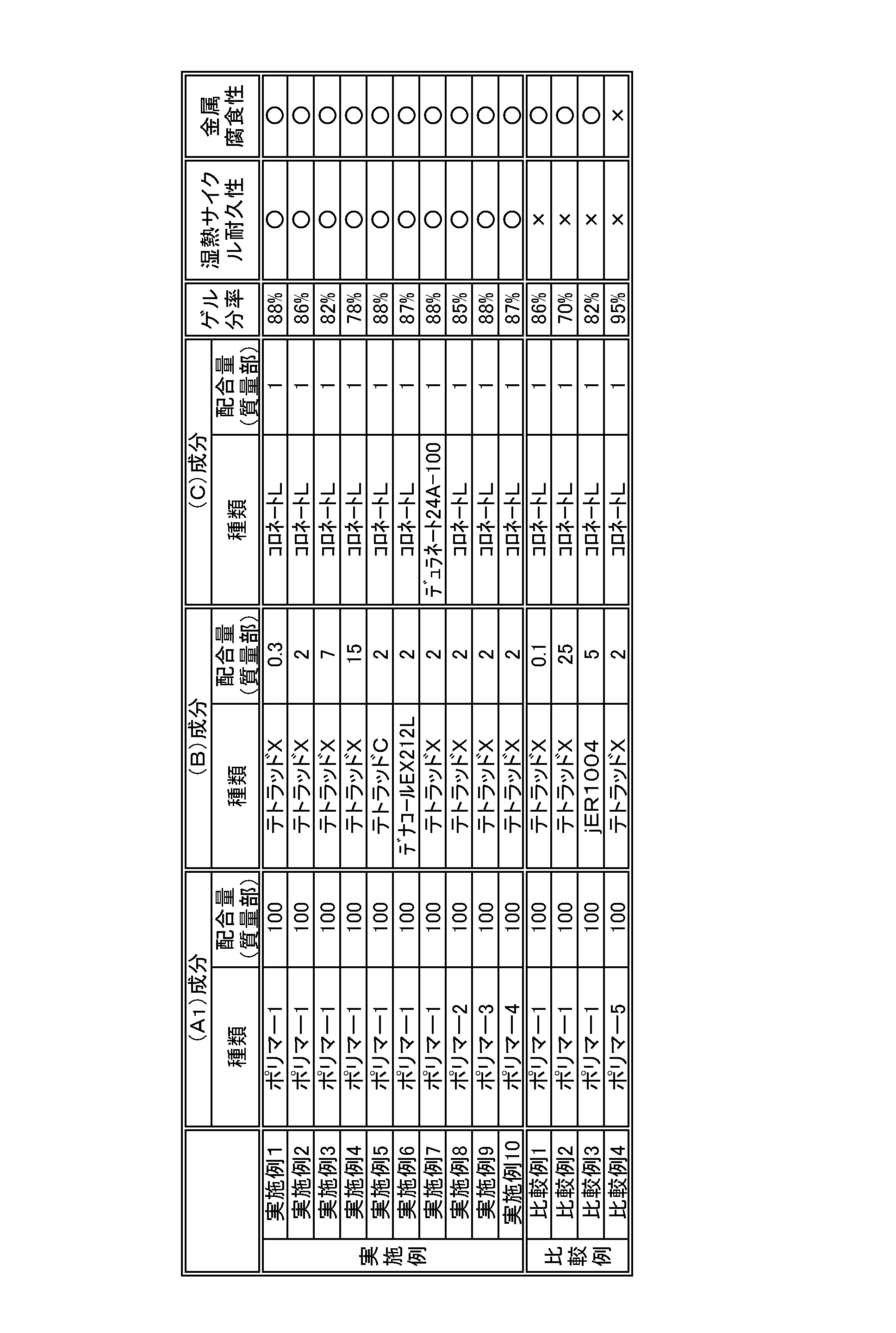
- each adhesive sheet the wet heat durability shown in the said Table 3 and Table 5 and metal corrosivity were evaluated with the following method. Moreover, the gel fraction of each adhesive composition was measured. Moreover, about the adhesive sheet of Example 2, it evaluated about the haze change after a wet heat test. The fact that acrylic polymers 1 to 4 and 6 to 8 have a hydroxyl group was confirmed by, for example, the appearance of absorption at 3400-3200 cm ⁇ 1 in the IR spectrum for each of acrylic polymers 1 to 4 and 6 to 8. .
- the test plate was removed from the test environment and allowed to stand in a 23 ° C./50% RH atmosphere for 1 hour, and then the wet heat cycle test (durability) of the adhesive layer was visually evaluated according to the following evaluation criteria. .
- Metal corrosive pressure-sensitive adhesive sheets obtained by using the compositions of Examples 1 to 14 and Comparative Examples 1 to 5 obtained in Production Example 1 on an ITO vapor-deposited PET film cut to 10 mm x 100 mm, to 10 mm x 60 mm Cut and pasted and autoclaved at 50 ° C. ⁇ 5 atm for 20 minutes. Next, after standing at room temperature for 1 hour, placing it in an environment of 60 ° C. and 90% RH for 500 hours, standing at 23 ° C. and humidity of 65% RH for 1 hour, then the resistance of the ITO deposited film The value was measured and compared with the resistance value before the test measured in advance, and the rate of change of the resistance value with respect to the resistance value before the test was obtained.
- compositions of Examples 1 to 10 above are included in the component (B) by including (A) component 100 parts by mass and (B) component 0.3 parts by mass to 20 parts by mass.
- the glycidyl group reacts within and / or between the molecules, and a cross-linked structure is formed by the reaction between the hydroxyl group contained in the component (A) and the isocyanate group contained in the component (C).
- the pressure-sensitive adhesive sheet formed using is less likely to float or peel off under high humidity conditions, and can achieve high adhesion and excellent durability.
- (A) component does not have a carboxyl group substantially, it does not have a property which corrodes a metal.
- the ratio of the component (B) is not in the range of 0.3 parts by mass or more and 20 parts by mass or less with respect to 100 parts by mass of the component (A).
- the pressure-sensitive adhesive sheet formed using the composition is inferior in durability because it floats or peels off when it is rapidly changed from a high-temperature and high-humidity condition to a high-temperature and low-humidity condition.
- composition of the said comparative example 3 has two or more glycidyl groups in 1 molecule, since the compound exceeding molecular weight 1,000 was used, it originates in the density of the glycidyl group in (B) component being small. Thus, crosslinking by glycidyl groups is unlikely to occur, and as a result, it is estimated that the durability is poor.
- Comparative Example 4 used an acrylic polymer that does not have a hydroxyl group but has a carboxyl group in place of the component (A), the (B) component within and / or between the molecules. Since the glycidyl group in the component (B) and the carboxyl group in the component (A) react excessively in preference to the reaction, the cross-linking becomes too dense and inferior in durability, and the presence of the carboxyl group It is estimated that the metal has corrosive properties.
- the glycidyl group contained in the component (B) reacts within and / or between the molecules, and by containing the component (E), the monomer in the component (A 2 ) reacts with the component (E), Since the cross-linked structure is formed, the pressure-sensitive adhesive sheet formed using the composition is less likely to float or peel off under high humidity conditions, and can achieve high adhesiveness and excellent durability.
- the component (A) since the component (A) has substantially no carboxyl group, it does not have the property of corroding metals. Furthermore, since the compositions of Examples 11 to 19 are substantially free of a solvent, when a pressure-sensitive adhesive sheet is produced using a coating liquid containing the composition, a coating formed using the coating liquid is used. Since the film thickness does not substantially change before and after the light irradiation process for the working liquid layer, the film thickness of the obtained pressure-sensitive adhesive sheet can be predicted in advance.
- compositions of Comparative Examples 5 and 6 have a ratio of the component (B) that is not in the range of 1 part by mass or more and 20 parts by mass or less with respect to 100 parts by mass of the component (A).
- the pressure-sensitive adhesive sheet formed using the material is floated or peeled off under high humidity conditions, and is inferior in durability.
- composition of the said comparative example 7 has two or more glycidyl groups in 1 molecule, since the compound exceeding molecular weight 1,000 was used, it originates in the density of the glycidyl group in (B) component being small. Thus, crosslinking by glycidyl groups is unlikely to occur, and as a result, it is estimated that the durability is poor.
- Comparative Example 8 used an acrylic polymer that does not have a hydroxyl group but has a carboxyl group in place of the component (A), the intramolecular and / or intermolecular components of the component (B) Since the glycidyl group in the component (B) and the carboxyl group in the component (A) react excessively in preference to the reaction, the cross-linking becomes too dense and inferior in durability, and the presence of the carboxyl group It is estimated that the metal has corrosive properties.
Landscapes
- Chemical & Material Sciences (AREA)
- Organic Chemistry (AREA)
- Adhesives Or Adhesive Processes (AREA)
- Adhesive Tapes (AREA)
Abstract
Description
本発明の一実施形態に係る光学用粘着剤組成物(以下、単に「粘着剤組成物」と記載する場合もある。)は、(A)カルボキシル基を実質的に含有しないアクリル系ポリマー(以下、単に「(A)成分」と記載する場合もある。)100質量部と、(B)1分子中にグリシジル基を2個以上有する、分子量1,000以下の化合物(以下、単に「(B)成分」と記載する場合もある。)0.3質量部以上20質量部以下と、を含む。
本発明において、「カルボキシル基を実質的に含有しない」とは、酸価が1以下であることをいい、より具体的には、(A)成分の原料である単量体混合物にカルボキシル基含有単量体を含まない((A)成分の原料である単量体混合物におけるカルボキシル基含有単量体の含有量が0.1質量%以下(好ましくは0質量%)である。)ことをいう。
(A1)成分は、(a1)(メタ)アクリル酸アルキルエステル単量体60質量%以上85質量%以下(好ましくは65質量%以上84.9質量%以下)および(a2)水酸基含有単量体15質量%以上40質量%以下(好ましくは15質量%以上35質量%以下)を含む単量体混合物の共重合体(A1)である(ここで、前記(a1)(メタ)アクリル酸アルキルエステル単量体および前記(a2)水酸基含有単量体の合計量は、前記単量体混合物100質量%とした場合、75質量%以上100質量%以下である。)ことができる。
(A2)成分は、(a1)(メタ)アクリル酸アルキルエステル単量体(以下、単に「(a1)成分」と記載する場合もある。)60質量%以上85質量%以下(好ましくは65質量%以上84.9質量%以下)および(a2)水酸基含有単量体(以下、単に「(a2)成分」と記載する場合もある。)15質量%以上40質量%以下(好ましくは15質量%以上35質量%以下)を含む単量体混合物の部分重合物(A2)を含む組成物より得られるものである(ここで、前記(a1)(メタ)アクリル酸アルキルエステル単量体および前記(a2)水酸基含有単量体の合計量は、前記単量体混合物100質量%とした場合、75質量%以上100質量%以下である。)ことができる。
(A1)成分および(A2)成分の原料である単量体混合物に含まれる(a1)成分は、本実施形態に係る粘着剤組成物の接着性および耐久性に寄与することができる。
(A1)成分および(A2)成分の原料である単量体混合物に(a2)成分が含まれることにより、(A1)成分および(A2)成分が水酸基を含有することができる。この場合、(A1)成分および(A2)成分に含まれる水酸基が後述の(C)成分に含まれるイソシアネート基と反応することにより、架橋構造を形成することができる。
(A1)成分および(A2)成分の原料である単量体混合物に(a3)成分が含まれることにより、(A1)成分および(A2)成分が窒素原子を含有することができる。(a3)成分としては、例えば、ニトリル基、アミノ基、イミド基およびアミド基等から選ばれる少なくとも1種の基を含む窒素原子含有単量体が挙げられる。
また、(A)成分である重合体を得るための前記単量体混合物は、(a4)(a1)成分、(a2)成分および(a3)成分以外の単量体(以下、単に「(a4)成分」と記載する場合もある。)をさらに含むことができる。(a4)成分としては、例えば、酢酸ビニル、スチレン、マクロモノマー等が挙げられる。
本実施形態に係る粘着剤組成物では、良好な接着性および耐久性をより確実に達成できる観点から、(A1)成分または(A2)成分を得るための前記単量体混合物中における前記(a1)成分、(a2)成分、および(a3)成分の合計量(前記単量体混合物を100質量%とした場合)が90質量%以上100質量%以下であることができ、95質量%以上100質量%以下であることが好ましい。
(A1)成分の重合方法は、特に制限されるものではなく、溶液重合、乳化重合、懸濁重合などの公知の方法により重合できるが、重合により得られた共重合体の混合物を用いて、本発明の粘着剤組成物を製造するにあたり、処理工程が比較的簡単でかつ短時間で行える観点から、溶液重合により重合することが好ましい。
(A2)成分である部分重合物は、単量体混合物を塗工できる粘度になるように部分的に重合することにより得ることができる。このような部分重合物の製造は例えば、特開2001-181589号公報に記載されており、(A2)成分は特開2001-181589号公報に記載の方法によって製造することができる。
本実施形態に係る粘着剤組成物では、良好な接着性および耐久性をより確実に達成できる観点から、(A1)成分のTgは-70℃以上0℃以下であることが好ましく、-60℃以上0℃以下であることがより好ましく、(A2)成分のTg((A2)成分を重合して得られるポリマーのTg)は-70℃以上0℃以下であることが好ましく、-60℃以上0℃以下であることがより好ましい。
(式中、TgAは、(A)成分のガラス転移温度(K)を示し、Tga1,Tga2,Tga3,Tga4はそれぞれ、構成モノマー(a1),(a2),(a3),(a4)から調製されたホモポリマーのガラス転移温度(Tg(K))を示し、Wa1,Wa2,Wa3,Wa4はそれぞれ、(A)成分中に含まれる、構成モノマー(a1),(a2),(a3),(a4)の重量分率を示す。)
なお、上記式(1)により、TgAは、絶対温度(K)として算出されるので、必要に応じて摂氏温度(℃)に換算される。

また、本実施形態に係る粘着剤組成物において、良好な接着性および耐久性をより確実に達成できる観点から、(A1)成分は、重量平均分子量(Mw)が10万以上150万以下であることが好ましく、20万以上100万以下であることがより好ましく、(A2)成分中のポリマー分は、重量平均分子量(Mw)が1万以上100万以下であることが好ましく、3万以上50万以下であることがより好ましい。ここで、(A1)成分および(A2)成分の重量平均分子量は、GPC(ゲルパーミエーションクロマトグラフィー)を用い、下記の条件で標準ポリスチレン換算による重量平均分子量(Mw)を求めたものである。
測定装置:HLC-8120GPC(東ソー社製)
GPCカラム構成:以下の5連カラム(すべて東ソー社製)
(1)TSK-GEL HXL-H(ガードカラム)
(2)TSK-GEL G7000HXL
(3)TSK-GEL GMHXL
(4)TSK-GEL GMHXL
(5)TSK-GEL G2500HXL
サンプル濃度:1.0mg/cm3となるように、テトラヒドロフランで希釈
移動相溶媒:テトラヒドロフラン
流量:1.0cm3/分
カラム温度:40℃
(B)成分の分子内および/または分子間で架橋構造をより確実に構築することによって、本実施形態に係る粘着剤組成物を用いて形成される粘着シートにより優れた耐久性を付与できる観点で、(B)成分1分子中に含まれるグリシジル基の数は2個以上8個以下であることが好ましく、2個以上6個以下であることが好ましい。
本実施形態に係る粘着剤組成物において、(C)成分であるイソシアネート系架橋剤は、常温または加熱下で(A)成分と架橋し得る架橋剤であれば特に限定されないが、例えば、キシリレンジイソシアネート、トリレンジイソシアネート、クロルフェニレンジイソシアネート、ヘキサメチレンジイソシアネート、テトラメチレンジイソシアネート、イソホロンジイソシアネート、ジフェニルメタンジイソシアネート、水添されたジフェニルメタンジイソシアネートなどのイソシアネートモノマーや、それらをトリメチロールプロパンなどの2価以上のアルコール化合物等に付加反応させたイソシアネート化合物やイソシアヌレート化物等が例示される。市販の(C)成分としては、例えば、コロネートL(日本ポリウレタン工業株式会社)、デュラネート24A-100(旭化成株式会社)、タケネートD-120N(三井化学株式会社)、マイテックNY260A(三菱化学株式会社)等が挙げられる。
(D)成分である光開始剤は、後述する(A2)成分および(B)成分を含む粘着剤組成物に含有され、該粘着剤組成物を用いた粘着シートの形成の際の反応開始剤としての機能を有する。本実施形態に係る光学用粘着剤組成物中における(D)成分の含有量は、(A2)成分100質量部に対して0.05質量部以上5質量部以下であることが好ましく、0.1質量部以上3質量部以下であることがより好ましい。(D)成分としては、例えば、紫外線によって重合が開始される紫外線重合開始剤であることが好ましい。
(E)成分は、(メタ)アクリロイル基を2個以上有する単量体である。(E)成分である多官能性単量体は、(A2)成分および(B)成分を含む粘着剤組成物に含有させることができる。(E)成分が前記粘着剤組成物に含有されることにより、該粘着剤組成物から形成される粘着剤層に(E)成分と(A2)成分中の単量体とが反応して架橋構造を形成することにより、耐久性により優れた粘着シートを得ることができる。本実施形態に係る光学用粘着剤組成物中における(E)成分の含有量は、(A2)成分100質量部に対して0.01質量部以上10質量部以下であることが好ましく、0.01質量部以上5質量部以下であることがより好ましい。
本実施形態に係る光学用粘着剤組成物は、必要に応じて、(A)成分、(B)成分、(C)成分、(D)成分および(E)成分以外の成分をさらに含むことができる。例えば、本実施形態に係る粘着剤組成物には、本発明の効果を損なわない範囲で、(F)シランカップリング剤(以下、単に「(F)成分」と記載することもある。)、(G)イオン性化合物(以下、単に「(G)成分」と記載する場合もある。)、(H)溶媒(以下、単に「(H)成分」と記載することもある。)、酸化防止剤、紫外線吸収剤、粘着付与剤、可塑剤等が配合されていても良い。
本実施形態に係る光学フィルム用粘着剤組成物が(F)成分を含むことにより、本実施形態に係る光学用粘着剤組成物を用いて形成された粘着剤層と被着体との接着を良好に保つことができる。(F)成分は例えば、ビニルトリメトキシシラン,ビニルトリエトキシシランおよびメタクリロキシプロピルトリメトキシシラン等の重合性不飽和基含有ケイ素化合物;3-グリシドキシプロピルトリメトキシシラン,3-グリシドキシプロピルメチルジメトキシシランおよび2-(3,4-エポキシシクロヘキシル)エチルトリメトキシシラン等のエポキシ構造を有するケイ素化合物;3-アミノプロピルトリメトキシシラン,N-(2-アミノエチル)3-アミノプロピルトリメトキシシランおよびN-(2-アミノエチル)-3-アミノプロピルメチルジメトキシシラン等のアミノ基含有ケイ素化合物;並びに3-クロロプロピルトリメトキシシラン;オリゴマー型シランカップリング剤等であってもよく、中でも、(A)成分中に含まれる官能基および(B)成分に含まれるグリシジル基と反応する官能基を有するシランカップリング剤が湿熱環境下でハガレを生じさせにくいという点で好ましい。
また、本実施形態に係る粘着剤組成物は、イオン性化合物(G)を含んでいてもよい。本実施形態に係る粘着剤組成物が(G)成分を含むことにより、被着体の帯電を効果的に防止することができる。(G)成分としては、例えば、アニオンとカチオンとからなる、25℃で液体状、または固体状のイオン性化合物が挙げられ、具体的には、アルカリ金属塩、イオン性液体(25℃で液体状)、界面活性剤等が挙げられる。
(H)成分である溶媒としては有機溶媒が挙げられる。有機溶媒としては、上述の「1.1.8.(A1)成分の重合方法」欄で例示されたものをそれぞれ単独で、または2種以上混合して用いることができる。
本実施形態に係る光学用粘着剤組成物は、接着性および耐久性により優れた粘着シートを形成できる観点から、ゲル分率が20%以上95%以下であることが好ましく、50%以上95%以下であることがより好ましい。
ゲル分率(%)=(乾燥重量(2)/乾燥重量(1))×100 ・・・(2)
本発明の一実施形態に係る第1製造方法は、第1の粘着剤組成物を用いた粘着シートの製造方法であって、第1の粘着剤組成物をセパレータの表面に塗布し、乾燥して得られる。より具体的には、第1製造方法は、第1の粘着剤組成物をセパレータの表面に塗布して、塗工液層を得る工程と、前記塗工液層から溶剤を除去し、熟成して、光学用粘着シートを得る工程と、を含む。すなわち、第1製造方法は第2製造方法と異なり、(H)溶媒を含む粘着剤組成物を用いて粘着シートを製造する。すなわち、第1の粘着剤組成物は例えば、(A1)成分100質量部と、(B)成分0.3質量部以上20質量部以下と、(C)成分0.1質量部以上5質量部以下と、(H)溶媒50質量部以上300質量部以下とを含む。この場合、第1粘着剤組成物の(A1)成分が水酸基を含有する場合、(B)成分中のグリシジル基同士の反応に加えて、(A2)成分中の水酸基と(C)成分中のイソシアネート基との反応によって、架橋構造を形成することができるため、耐久性により優れた粘着剤層を得ることができる。
本発明の一実施形態に係る第2製造方法は、第2の粘着剤組成物を用いた粘着シートの製造方法である。第2製造方法は第1製造方法と異なり、溶媒を実質的に含まない粘着剤組成物を用いて粘着シートを製造する。すなわち、第2の粘着剤組成物は例えば、(A2)成分100質量部と、(B)成分0.3質量部以上20質量部以下とを含み、(H)溶媒を実質的に含まないものである。第2粘着剤組成物は、(A2)成分100質量部と、(B)成分0.3質量部以上20質量部以下とを含み、(H)溶媒を実質的に含まないことにより、溶媒が実質的に存在しない状態にて粘着剤層を形成することができる。この場合、第1粘着剤組成物の(A2)成分が水酸基を含有する場合、(B)成分中のグリシジル基同士の反応に加えて、(C)成分の添加により(A2)成分中の水酸基と(C)成分中のイソシアネート基との架橋構造を形成することができるため、耐久性により優れた粘着剤層を得ることができる。
本実施形態に係る光学用粘着剤組成物は、タッチパネル式入出力装置を構成する部材の貼り合わせに用いられることができる。本実施形態に係る光学用粘着剤組成物を用いた貼り合わせの対象となる部材は、光学部材(例えば、偏光フィルム、位相差フィルム、楕円偏光フィルム、反射防止フィルム、輝度向上フィルム、光拡散フィルムおよびハードコートフィルムからなる群から選択される光学フィルム)、ITO層等の金属層、または、ガラスまたはプラスチックからなる基材であってもよい。より具体的には、本実施形態に係る光学用粘着剤組成物は、タッチパネル式入出力装置を構成する部材の貼り合わせに好適に用いることができる。
本実施形態に係る光学用粘着剤組成物は、(A)成分100質量部と、(B)成分0.3質量部以上20質量部以下と、を含むことにより、該光学用粘着剤組成物を用いて粘着シートを製造する際に、(B)成分中のグリシジル基同士が反応して(さらには(A)成分が水酸基を含む場合、(C)成分の添加により該水酸基と(C)成分のイソシアネート基が反応して)架橋構造が形成されるため、該粘着シートは高湿度条件下において浮きや剥がれが生じにくく、耐久性に優れている。特に、本実施形態に係る光学用粘着剤組成物は、(A)成分がカルボキシル基を実質的に含まないので、金属を腐食する性質を有さないため、ITO等の金属を含むタッチパネル式入出力装置を構成する部材の貼り合わせに好適に使用することができる。
本実施形態に係る粘着シート(光学用粘着シート)は、例えば、第1粘着剤組成物または第2粘着剤組成物を用いて、上記第1製造方法または第2製造方法によって得ることができる。粘着シートの厚みは、通常は10μm以上500μm以下、好ましくは20μm以上300μm以下程度である。
本発明の別の実施形態に係る画像表示装置は、上記実施形態に係る光学用粘着シートを含む。本実施形態に係る画像表示装置としては、例えば、液晶表示装置が挙げられる。
以下、本発明を下記実施例に基づいて説明するが、本発明は実施例に限定されない。
4.1.1.調製例1(アクリル系ポリマーの調製)
攪拌機、還流冷却器、温度計および窒素導入管を備えた反応装置に、下記表2に示す配合比率を有する単量体混合物を仕込み、次に、等質量の酢酸エチルおよびトルエンを、単量体混合物の濃度が30質量%になる配合量にて仕込んだ。次に、アゾビスイソブチロニトリル0.1質量部を加え、反応容器内の空気を窒素ガスで置換しながら撹拌を行い70℃に昇温した後、6時間反応させた。反応終了後、酢酸エチルで希釈して、アクリル系ポリマー1ないし5を得た。
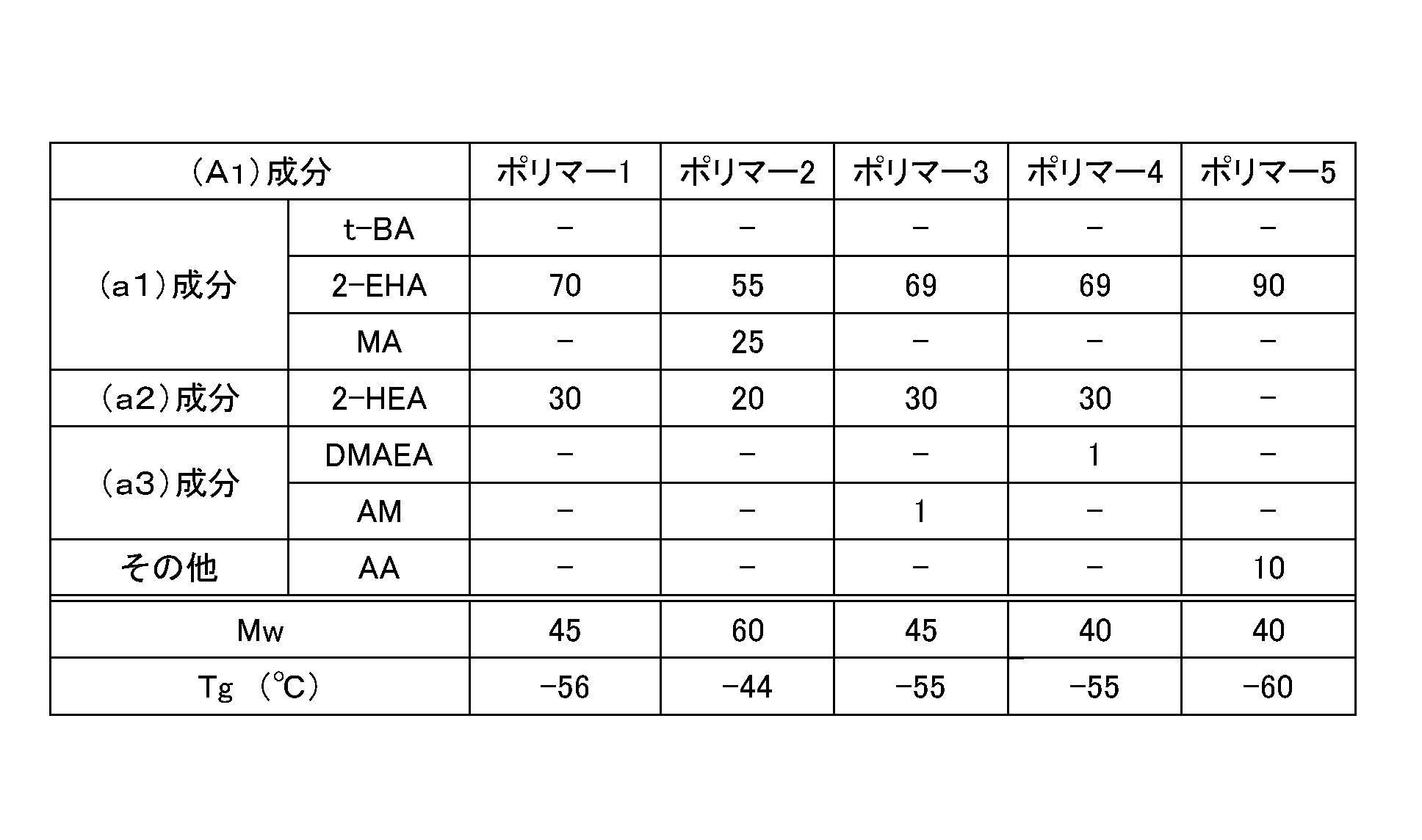
上記4.1.1.で得られたアクリル系ポリマー1ないし5を用いて、下記表3の配合(固形分配合)にて各成分を添加して、実施例1ないし10および比較例1ないし4の粘着剤組成物の溶液を得た。この粘着剤組成物の溶液を剥離処理したポリエステルフィルムの表面に塗布して乾燥させることにより、粘着剤層の厚さ50μmの粘着シートを得た。得られた粘着シートの粘着剤層側に、厚さ100μmのポリエチレンテレフタレートフィルムを貼り合わせて評価用粘着シートを得た。
4.2.1.調製例2(アクリル系ポリマーの調製)
攪拌機、還流冷却器、温度計および窒素導入管を備えた反応装置に、下記表4に示す配合比率を有する単量体混合物、および連鎖移動剤であるノルマルドデシルメルカプタンをポリマー6、7、9については0.05質量部、ポリマー8については1質量部をさらに仕込み、空気を窒素ガスで置換しながら撹拌を行い50℃に昇温した。次いで、2,2’-アゾビス(4-メトキシ-2,4-ジメチルバレロニトリルを反応液が120℃以上140℃以下にまで発熱するよう適量加え重合をおこない、アクリル系ポリマー6ないし9(ポリマー分25%以上60%以下の部分重合物)を得た。なお、アクリル系ポリマーのポリマー分とは、アクリル系ポリマー(部分重合物)を150℃で1時間加熱した場合に残存する固形分の割合(質量%)をいう。なお、表4に示す各ポリマーの「Tg」は、使用した単量体混合物がすべて重合したと仮定した場合のTgの値を示す。

上記4.2.1.で得られたアクリル系ポリマー6ないし9を用いて、下記表5の配合(固形分配合)にて各成分を添加して、実施例11ないし19および比較例5ないし8の粘着剤組成物を含む塗工液を得た。この塗工液を剥離処理したポリエステルフィルムの表面に塗布した後、剥離処理したポリエステルフィルムを被せて塗工液層をサンドし、ブラックライトを強度30mW/cm2で塗工液層の上下両方から180秒間照射することにより、粘着剤層の厚さ150μmの粘着シートを得た。得られた粘着シートの片側のポリエステルフィルムを剥離し、厚さ100μmのポリエチレンテレフタレートフィルムを貼り合わせて評価用粘着シートを得た。

4.3.1.ゲル分率
各粘着剤組成物のゲル分率は、上記実施形態の欄に記載された方法で測定した。
上記4.2.2.で調製された評価用粘着シートを(50mm×60mm)裁断し、剥離処理したポリエステルフィルムを剥がして、厚さ2.0mmのポリカーボネート板の片面に、粘着剤層が前記ポリカーボネート板に接するようにして、ラミネータロールを用いて貼り付けた。貼付後、オートクレーブ(栗原製作所製)にて0.5MPa、50℃、20分の条件で加圧処理して試験用プレートを得た。こうして得られた試験用プレートを60℃/95%RHの条件下に24時間、85℃で乾燥環境下に24時間放置するサイクル試験を100回実施した。試験終了後、試験用プレートを試験環境より取り出し、23℃/50%RH雰囲気下で1時間静置した後、粘着剤層の湿熱サイクル試験(耐久性)を目視により下記評価基準にて評価した。
○:ウキ、ハガレ、発泡等がない
×:ウキ、ハガレ、発泡等がある
10mm×100mmにカットしたITO蒸着PETフィルムに、製造例1で得られた、実施例1ないし14および比較例1ないし5の組成物を用いて得られた粘着シートを10mm×60mmにカットして貼り付け、50℃×5atmで20分間オートクレーブ処理を行った。次いで、1時間室温で静置した後、60℃でかつ90%RHの環境下に500時間置き、23℃でかつ湿度65%RHの条件下に1時間静置した後、ITO蒸着フィルムの抵抗値を測定し、あらかじめ測定しておいた試験前の抵抗値と比較し、試験前の抵抗値に対する抵抗値の変化率を求めた。
上記4.2.2.で調製された評価用粘着シートを、剥離処理したポリエステルフィルムを剥がし、粘着剤層がガラス基板に接するようにラミネータロールを用いて貼り付けて測定試料を作製し、ヘイズメーター(型名「HM-150」、村上色彩技術研究所社製)でヘイズを測定した(初期ヘイズ)。次に、60℃-95%RH条件下で該試料を500時間投入した後、23℃-50%RH条件下に移してから10分後にヘイズを測定した(湿熱試験後ヘイズ)。初期ヘイズ-湿熱試験後ヘイズの値(ヘイズの変化値)が0.5以下であることが望ましい。
AA:アクリル酸
AM:アクリルアミド
BA:n-ブチルアクリレート
t-BA:tert-(ターシャリー)ブチルアクリレート
DMAEA:ジメチルアミノエチルアクリレート
2-EHA:2-エチルヘキシルアクリレート
2-HEA:2-ヒドロキシエチルアクリレート
MA:メチルアクリレート
TMPTA:トリメチロールプロパントリアクリレート
テトラッドC:1,3-ビス(N,N-ジグリシジルアミノメチル)シクロヘキサン(分子量385、1分子に含まれるグリシジル基の数4個、三菱瓦斯化学株式会社製)
テトラッドX:N,N,N’,N’-テトラグリシジル-m-キシレンジアミン(分子量380、1分子に含まれるグリシジル基の数4個、三菱瓦斯化学株式会社製)
デナコールEX212L:1,6-ヘキサンジオールグリシジルエーテル(分子量260、1分子に含まれるグリシジル基の数2個、ナガセケムテックス株式会社製)
jER1004:(分子量1,650、1分子に含まれるグリシジル基の数2個、三菱化学株式会社製)
コロネートL:トリレンジイソシアネ-トのトリメチロールプロパン付加物(日本ポリウレタン工業株式会社製)
デュラネート24A-100:ビウレット型イソシアネート化合物(旭化成株式会社製)
ダロキュア1173:2-ヒドロキシ-2-メチル-1-フェニル-プロパン-1-オン(BASFジャパン株式会社製)
10 液晶表示装置(LCD)
11,15 偏光板
12,14,17 粘着剤層
13 液晶パネル
16 飛散防止フィルム
18 ITO層
19 ガラスパネル
20 タッチパネル部
30 粘着剤層
100 タッチパネル式出入力装置
Claims (13)
- (A)カルボキシル基を実質的に含有しないアクリル系ポリマー100質量部と、
(B)1分子中にグリシジル基を2個以上有する、分子量1,000以下の化合物0.3質量部以上20質量部以下と、を含む、光学用粘着剤組成物。 - 前記(A)アクリル系ポリマーは、(a1)(メタ)アクリル酸アルキルエステル単量体60質量%以上85質量%以下および(a2)水酸基含有単量体15質量%以上40質量%以下を含む単量体混合物の共重合体(A1)である(ここで、前記(a1)(メタ)アクリル酸アルキルエステル単量体および前記(a2)水酸基含有単量体の合計量は、前記単量体混合物100質量%とした場合、75質量%以上100質量%以下である。)、請求項1に記載の光学用粘着剤組成物。
- (C)イソシアネート系架橋剤をさらに含む、請求項1または2に記載の光学用粘着剤組成物。
- 前記(A)アクリル系ポリマーは、(a1)(メタ)アクリル酸アルキルエステル単量体60質量%以上85質量%以下および(a2)水酸基含有単量体15質量%以上40質量%以下を含む単量体混合物の部分重合物(A2)を含む組成物より得られるものである(ここで、前記(a1)(メタ)アクリル酸アルキルエステル単量体および前記(a2)水酸基含有単量体の合計量は、前記単量体混合物100質量%とした場合、75質量%以上100質量%以下である。)、請求項1に記載の光学用粘着剤組成物。
- 前記部分重合物(A2)を含む前記組成物は、(E)多官能性単量体をさらに含み、
前記(A)アクリル系ポリマーは、前記部分重合物(A2)および前記(E)多官能性単量体を含む前記組成物より得られるものである、請求項4に記載の光学用粘着剤組成物。 - 前記単量体混合物は、(a3)窒素原子含有単量体0.1質量%以上5質量%以下をさらに含む、請求項2ないし5のいずれか1項に記載の光学用粘着剤組成物。
- ゲル分率が20%以上95%以下である、請求項1ないし6のいずれか1項に記載の光学用粘着剤組成物。
- タッチパネル式入出力装置を構成する部材の貼り合わせに用いられる、請求項1ないし7のいずれか1項に記載の光学用粘着剤組成物。
- 請求項1ないし7のいずれか1項に記載の光学用粘着剤組成物より得られる粘着剤層を有する、光学用粘着シート。
- (A)カルボキシル基を実質的に含有しないアクリル系ポリマー100質量部と、(B)1分子中にグリシジル基を2個以上有する、分子量1,000以下の化合物0.3質量部以上20質量部以下とを含む粘着剤組成物をセパレータの表面に塗布して、塗工液層を得る工程と、
前記塗工液層から溶剤を除去し、熟成して、光学用粘着シートを得る工程と、を含む、光学用粘着シートの製造方法。 - 前記粘着剤組成物は、(C)イソシアネート系架橋剤をさらに含む、請求項10に記載の光学用粘着シートの製造方法。
- (a1)(メタ)アクリル酸アルキルエステル単量体60質量%以上85質量%以下および(a2)水酸基含有単量体15質量%以上40質量%以下を含む単量体混合物の部分重合物(A2)100質量部(ここで、前記(a1)(メタ)アクリル酸アルキルエステル単量体および前記(a2)水酸基含有単量体の合計量は、前記単量体混合物100質量%とした場合、75質量%以上100質量%以下である。)と、(B)1分子中にグリシジル基を2個以上有する、分子量1,000以下の化合物0.3質量部以上20質量部以下と、(D)光重合開始剤と、を含む塗工液をセパレータの表面に塗布して、塗工液層を得る工程と、
前記塗工液層に光を照射して、光学用粘着シートを得る工程と、を含む、光学用粘着シートの製造方法。 - 前記塗工液は、(E)多官能性単量体をさらに含む、請求項12に記載の光学用粘着シートの製造方法。
Priority Applications (3)
| Application Number | Priority Date | Filing Date | Title |
|---|---|---|---|
| KR1020157031349A KR20150140719A (ko) | 2013-04-02 | 2014-03-28 | 광학용 점착제 조성물, 광학용 점착 시트 및 그 제조 방법 |
| JP2015510055A JPWO2014163003A1 (ja) | 2013-04-02 | 2014-03-28 | 光学用粘着剤組成物、光学用粘着シートおよびその製造方法 |
| CN201480019780.2A CN105073936A (zh) | 2013-04-02 | 2014-03-28 | 光学用粘合剂组合物、光学用粘合片及其制造方法 |
Applications Claiming Priority (2)
| Application Number | Priority Date | Filing Date | Title |
|---|---|---|---|
| JP2013077253 | 2013-04-02 | ||
| JP2013-077253 | 2013-04-02 |
Publications (1)
| Publication Number | Publication Date |
|---|---|
| WO2014163003A1 true WO2014163003A1 (ja) | 2014-10-09 |
Family
ID=51658300
Family Applications (1)
| Application Number | Title | Priority Date | Filing Date |
|---|---|---|---|
| PCT/JP2014/059138 Ceased WO2014163003A1 (ja) | 2013-04-02 | 2014-03-28 | 光学用粘着剤組成物、光学用粘着シートおよびその製造方法 |
Country Status (5)
| Country | Link |
|---|---|
| JP (1) | JPWO2014163003A1 (ja) |
| KR (1) | KR20150140719A (ja) |
| CN (1) | CN105073936A (ja) |
| TW (1) | TW201446911A (ja) |
| WO (1) | WO2014163003A1 (ja) |
Cited By (1)
| Publication number | Priority date | Publication date | Assignee | Title |
|---|---|---|---|---|
| US20220389288A1 (en) * | 2019-11-12 | 2022-12-08 | Samsung Sdi Co., Ltd. | Adhesive sheet, adhesive composition therefor, optical member comprising same, and optical display device comprising same |
Families Citing this family (3)
| Publication number | Priority date | Publication date | Assignee | Title |
|---|---|---|---|---|
| TWI621525B (zh) * | 2015-03-31 | 2018-04-21 | 住友化學股份有限公司 | 光學積層體、液晶顯示裝置、黏著劑組成物及光學膜 |
| TWI562892B (en) * | 2015-10-28 | 2016-12-21 | Sumika Technology Co Ltd | Touch display device |
| CN107142049A (zh) * | 2017-04-28 | 2017-09-08 | 新纶科技(常州)有限公司 | 一种无酸高粘着力丙烯酸胶黏剂及其制备方法 |
Citations (8)
| Publication number | Priority date | Publication date | Assignee | Title |
|---|---|---|---|---|
| JP2002241708A (ja) * | 2001-02-19 | 2002-08-28 | Soken Chem & Eng Co Ltd | 光学部材用アクリル系粘着剤組成物及び該組成物を用いた光学部材用粘着シートの製造方法 |
| JP2005196006A (ja) * | 2004-01-09 | 2005-07-21 | Saiden Chemical Industry Co Ltd | アクリル系粘着剤層を有する偏光板又は位相差板 |
| JP2005298569A (ja) * | 2004-04-07 | 2005-10-27 | Nitto Denko Corp | 粘着剤組成物、およびそれを用いてなる粘着シート類 |
| JP2009132909A (ja) * | 2007-11-07 | 2009-06-18 | Nippon Synthetic Chem Ind Co Ltd:The | 光学部材用粘着剤及び光学部材 |
| JP2010155974A (ja) * | 2008-12-01 | 2010-07-15 | Nitto Denko Corp | アクリル系感圧性接着シート、アクリル系感圧性接着シートの製造方法、及び積層構成 |
| JP2011225835A (ja) * | 2010-03-30 | 2011-11-10 | Nippon Synthetic Chem Ind Co Ltd:The | 粘着剤組成物、粘着剤、両面粘着シート、光学部材用粘着剤、タッチパネル |
| JP2013018871A (ja) * | 2011-07-11 | 2013-01-31 | Nippon Carbide Ind Co Inc | 粘着剤組成物、粘着シート、及び光学用積層シート |
| JP2013122036A (ja) * | 2011-11-10 | 2013-06-20 | Nitto Denko Corp | 粘着シート |
Family Cites Families (1)
| Publication number | Priority date | Publication date | Assignee | Title |
|---|---|---|---|---|
| JP2007169329A (ja) | 2005-12-19 | 2007-07-05 | Saiden Chemical Industry Co Ltd | 光学用粘着剤組成物および粘着シート |
-
2014
- 2014-03-28 CN CN201480019780.2A patent/CN105073936A/zh active Pending
- 2014-03-28 KR KR1020157031349A patent/KR20150140719A/ko not_active Withdrawn
- 2014-03-28 JP JP2015510055A patent/JPWO2014163003A1/ja active Pending
- 2014-03-28 WO PCT/JP2014/059138 patent/WO2014163003A1/ja not_active Ceased
- 2014-04-01 TW TW103112087A patent/TW201446911A/zh unknown
Patent Citations (8)
| Publication number | Priority date | Publication date | Assignee | Title |
|---|---|---|---|---|
| JP2002241708A (ja) * | 2001-02-19 | 2002-08-28 | Soken Chem & Eng Co Ltd | 光学部材用アクリル系粘着剤組成物及び該組成物を用いた光学部材用粘着シートの製造方法 |
| JP2005196006A (ja) * | 2004-01-09 | 2005-07-21 | Saiden Chemical Industry Co Ltd | アクリル系粘着剤層を有する偏光板又は位相差板 |
| JP2005298569A (ja) * | 2004-04-07 | 2005-10-27 | Nitto Denko Corp | 粘着剤組成物、およびそれを用いてなる粘着シート類 |
| JP2009132909A (ja) * | 2007-11-07 | 2009-06-18 | Nippon Synthetic Chem Ind Co Ltd:The | 光学部材用粘着剤及び光学部材 |
| JP2010155974A (ja) * | 2008-12-01 | 2010-07-15 | Nitto Denko Corp | アクリル系感圧性接着シート、アクリル系感圧性接着シートの製造方法、及び積層構成 |
| JP2011225835A (ja) * | 2010-03-30 | 2011-11-10 | Nippon Synthetic Chem Ind Co Ltd:The | 粘着剤組成物、粘着剤、両面粘着シート、光学部材用粘着剤、タッチパネル |
| JP2013018871A (ja) * | 2011-07-11 | 2013-01-31 | Nippon Carbide Ind Co Inc | 粘着剤組成物、粘着シート、及び光学用積層シート |
| JP2013122036A (ja) * | 2011-11-10 | 2013-06-20 | Nitto Denko Corp | 粘着シート |
Cited By (2)
| Publication number | Priority date | Publication date | Assignee | Title |
|---|---|---|---|---|
| US20220389288A1 (en) * | 2019-11-12 | 2022-12-08 | Samsung Sdi Co., Ltd. | Adhesive sheet, adhesive composition therefor, optical member comprising same, and optical display device comprising same |
| US12480026B2 (en) * | 2019-11-12 | 2025-11-25 | Samsung Sdi Co., Ltd. | Adhesive sheet, adhesive composition therefor, optical member comprising same, and optical display device comprising same |
Also Published As
| Publication number | Publication date |
|---|---|
| TW201446911A (zh) | 2014-12-16 |
| JPWO2014163003A1 (ja) | 2017-02-16 |
| CN105073936A (zh) | 2015-11-18 |
| KR20150140719A (ko) | 2015-12-16 |
Similar Documents
| Publication | Publication Date | Title |
|---|---|---|
| JP5887404B2 (ja) | 光学フィルム用粘着剤組成物および粘着型光学フィルム、ならびに積層体 | |
| JP6066937B2 (ja) | 光拡散粘着剤層、及び光拡散粘着フィルム | |
| TWI609062B (zh) | 黏著劑層及黏著膜 | |
| JP6161994B2 (ja) | 光学用粘着剤組成物、光学用粘着シート、画像表示装置および入出力装置 | |
| US20170121565A1 (en) | Transparent resin layer, pressure-sensitive-adhesive-layer-attached polarizing film, and image display device | |
| JP6517150B2 (ja) | 光学フィルム用粘着剤組成物、粘着型光学フィルムおよび積層体 | |
| JP6283355B2 (ja) | 積層体 | |
| JP7372824B2 (ja) | 粘着剤層付き偏光フィルム及び画像表示装置 | |
| TW201706379A (zh) | 光擴散黏著劑層和光擴散黏著膜 | |
| WO2020111232A1 (ja) | 粘着剤層付き偏光フィルム及び画像表示装置 | |
| JP7540874B2 (ja) | 粘着剤層付き偏光フィルム及び画像表示装置 | |
| JPWO2016059979A1 (ja) | 粘着剤層、粘着剤層付き偏光板および積層体 | |
| JP6979104B2 (ja) | タッチセンシング機能付液晶パネル、液晶表示装置および粘着剤層付き偏光フィルム | |
| JP2024097821A (ja) | 粘着剤層付偏光フィルム、画像表示パネル及び画像表示装置 | |
| JP2025089395A (ja) | 粘着剤組成物、タッチパネル用粘着フィルム、粘着剤層付き光学フィルム | |
| JPWO2014163003A1 (ja) | 光学用粘着剤組成物、光学用粘着シートおよびその製造方法 | |
| JP4635151B2 (ja) | 光学部材用粘着剤組成物および光学部材用粘着フィルム、ならびにこれらを用いた光学部材 | |
| JP6321629B2 (ja) | 光学フィルム用粘着剤組成物および粘着型光学フィルム | |
| JP6831423B2 (ja) | 光拡散粘着剤層、及び光拡散粘着フィルム | |
| JP2017082227A (ja) | 光拡散粘着剤層、及び光拡散粘着フィルム | |
| JP7089075B2 (ja) | 光拡散粘着剤層、及び光拡散粘着フィルム | |
| WO2015008384A1 (ja) | 光学部材用粘着剤組成物、粘着シートおよび積層体 | |
| JP7058693B2 (ja) | 光拡散粘着剤層、及び光拡散粘着フィルム | |
| JP6899417B2 (ja) | 透明樹脂層、粘着剤層付偏光フィルムおよび画像表示装置 | |
| WO2023224004A1 (ja) | インセル型液晶パネル |
Legal Events
| Date | Code | Title | Description |
|---|---|---|---|
| WWE | Wipo information: entry into national phase |
Ref document number: 201480019780.2 Country of ref document: CN |
|
| 121 | Ep: the epo has been informed by wipo that ep was designated in this application |
Ref document number: 14778236 Country of ref document: EP Kind code of ref document: A1 |
|
| ENP | Entry into the national phase |
Ref document number: 2015510055 Country of ref document: JP Kind code of ref document: A |
|
| NENP | Non-entry into the national phase |
Ref country code: DE |
|
| ENP | Entry into the national phase |
Ref document number: 20157031349 Country of ref document: KR Kind code of ref document: A |
|
| 122 | Ep: pct application non-entry in european phase |
Ref document number: 14778236 Country of ref document: EP Kind code of ref document: A1 |