WO2014156970A1 - タイヤインナーライナー用シート及びタイヤ - Google Patents
タイヤインナーライナー用シート及びタイヤ Download PDFInfo
- Publication number
- WO2014156970A1 WO2014156970A1 PCT/JP2014/057803 JP2014057803W WO2014156970A1 WO 2014156970 A1 WO2014156970 A1 WO 2014156970A1 JP 2014057803 W JP2014057803 W JP 2014057803W WO 2014156970 A1 WO2014156970 A1 WO 2014156970A1
- Authority
- WO
- WIPO (PCT)
- Prior art keywords
- inner liner
- adhesive layer
- styrene
- tire
- tire inner
- Prior art date
- Legal status (The legal status is an assumption and is not a legal conclusion. Google has not performed a legal analysis and makes no representation as to the accuracy of the status listed.)
- Ceased
Links
Images

Classifications
-
- B—PERFORMING OPERATIONS; TRANSPORTING
- B60—VEHICLES IN GENERAL
- B60C—VEHICLE TYRES; TYRE INFLATION; TYRE CHANGING; CONNECTING VALVES TO INFLATABLE ELASTIC BODIES IN GENERAL; DEVICES OR ARRANGEMENTS RELATED TO TYRES
- B60C5/00—Inflatable pneumatic tyres or inner tubes
- B60C5/12—Inflatable pneumatic tyres or inner tubes without separate inflatable inserts, e.g. tubeless tyres with transverse section open to the rim
- B60C5/14—Inflatable pneumatic tyres or inner tubes without separate inflatable inserts, e.g. tubeless tyres with transverse section open to the rim with impervious liner or coating on the inner wall of the tyre
-
- B—PERFORMING OPERATIONS; TRANSPORTING
- B60—VEHICLES IN GENERAL
- B60C—VEHICLE TYRES; TYRE INFLATION; TYRE CHANGING; CONNECTING VALVES TO INFLATABLE ELASTIC BODIES IN GENERAL; DEVICES OR ARRANGEMENTS RELATED TO TYRES
- B60C1/00—Tyres characterised by the chemical composition or the physical arrangement or mixture of the composition
- B60C1/0008—Compositions of the inner liner
Definitions
- the present disclosure relates to a tire inner liner sheet and a tire.
- This application claims priority based on Japanese Patent Application No. 2013-070808 filed in Japan on March 29, 2013, the contents of which are incorporated herein by reference.
- tire inner liner that is arranged inside the tire radial direction and has the function of preventing air leakage from the inside to the outside of the pneumatic tire, but the tire inner liner also improves gas barrier properties. In order to reduce weight, it has come to be done.
- thermoplastic resin which has better gas barrier properties than butyl rubber and can reduce the thickness of the tire inner liner layer, for the tire inner liner.
- a nylon sheet layer is used in place of a conventional butyl rubber for a tire inner liner (see, for example, Patent Document 1).
- Patent Document 1 in order to form a nylon film layer, after the nylon film is RFL-treated, it is necessary to bond a rubber paste made of a rubber composition, which causes a problem that the process becomes complicated. .
- a bladder body is inserted into an unvulcanized tire (raw tire) housed in a mold, and the bladder body is inflated and pressed against the inner surface of the mold from the inside of the unvulcanized tire.
- the tire vulcanization method that performs vulcanization is adopted, but in the inner liner layer of Patent Document 1, the nylon film layer and the bladder are in contact with each other in a heated state, and the nylon film layer adheres and adheres to the bladder. There is also a problem of being broken.
- an ethylene-vinyl alcohol copolymer layer is used as a tire inner liner instead of a conventional butyl rubber (for example, see Patent Document 2).
- Patent Document 2 the flexibility of the ethylene-vinyl alcohol copolymer is not sufficient, and cracks may occur during running of the tire, causing gas in the tire to leak.
- a polymer sheet for an inner liner is disclosed (for example, Patent Document 3).
- Patent Document 3 the adhesiveness between the adhesive layer and the carcass or the insulation, and the adhesiveness between the adhesive layer and the gas barrier layer are not sufficient. There was a problem that the releasability with the bladder was not sufficient, and the sticking to the bladder occurred.
- Patent Document 4 discloses that a halogenated SIBS in which a halogen group is added to a styrene portion of SIBS is used as an inner liner, and a carcass or insulation is bonded to a halogenated SIBS layer (for example, Patent Document 4).
- a halogenated SIBS in which a halogen group is added to a styrene portion of SIBS is used as an inner liner, and a carcass or insulation is bonded to a halogenated SIBS layer (for example, Patent Document 4).
- the adhesion between the inner liner and the carcass or the insulation is not sufficient, peeling occurs between the layers when the tire is running, and the releasability between the gas barrier layer and the bladder is not sufficient. There is a problem of sticking.
- Patent Document 5 discloses a laminate for improving the adhesion between the inner liner layer and the rubber layer.
- the adhesive layers come into contact with each other at the overlapping part of the inner liner layer, and are firmly bonded by heating, so the gas pressure retention is improved. Yes.
- the adhesive layer for overlapping the inner liner layer comes into contact with the bladder in a heated state in the vulcanization process, and there is a problem of sticking to the bladder.
- the object of the present invention is to improve the adhesion between the layers at the high temperature in the sheet for the inner liner having the gas barrier layer and the adhesive layer, and further, the adhesion at the room temperature and the high temperature between the inner liner and the carcass or the insulation.
- the inner liner sheet and the pneumatic tire using the same have improved the adhesive strength of the overlapping portion of the inner liner, and further improved the releasability of the inner liner with respect to the bladder during tire molding. Is to provide.
- the first adhesive layer or the second adhesive layer has a peroxide
- the intermediate layer comprises a crosslinkable resin (B) having a carbon-carbon double bond or an ethylene structure in the molecule.
- a sheet for a tire inner liner comprising: (2) The tire inner liner sheet according to (1), wherein the first adhesive layer and the second adhesive layer have a peroxide. (3) The tire inner liner sheet according to (1), wherein the one-minute half-life temperature of the peroxide is 130 ° C. or higher and 200 ° C. or lower.
- the peroxide is dicumyl peroxide, 2,5-dimethyl-2,5-di (t-butylperoxy) hexyne-3, 2,5-dimethyl-2,5-di (t-butyl)
- the tire inner liner sheet according to (1) which is at least one selected from the group of peroxy) hexane and 1,1-bis (t-butylperoxy) cyclohexane.
- the crosslinkable resin (A) or the crosslinkable resin (B), or the crosslinkable resin (A) and the crosslinkable resin (B) have a carbon-carbon double bond and an ethylene structure in the molecule.
- the tire inner liner sheet according to (1) (7) In (1), hydrogen in the crosslinkable resin (A) is substituted with at least one of the group of phenyl group, CN group, halogen group, alkyl group and carboxyl group The tire inner liner sheet as described.
- the tire inner liner sheet according to (1), wherein the content of the crosslinkable resin (B) with respect to the entire intermediate layer is 2% by weight or more and 45% by weight or less.
- the intermediate layer further includes at least one selected from the group consisting of ethylene-vinyl alcohol copolymer, polyamide, polyacrylonitrile, polyvinyl alcohol, styrene-isobutylene-styrene copolymer, and styrene-isobutylene copolymer.
- the tire inner liner sheet according to (1) comprising a gas barrier resin.
- the content of the gas barrier resin is 55% by weight or more and 98% by weight relative to the entire intermediate layer, and the content of the crosslinkable resin (B) is 2% by weight or more and 45% by weight or less.
- the crosslinkable resin (A) is ethylene propylene rubber, ethylene propylene diene rubber, polyisoprene rubber, styrene butadiene rubber, butadiene rubber, chloroprene rubber, acrylonitrile butadiene rubber, syndiotactic-1,2-polybutadiene, styrene.
- the crosslinkable resin (B) is ethylene propylene rubber, ethylene propylene diene rubber, polyisoprene rubber, styrene butadiene rubber, butadiene rubber, chloroprene rubber, acrylonitrile butadiene rubber, syndiotactic-1,2-polybutadiene, styrene.
- the tire inner liner sheet according to (1) (14) The tire inner according to (1), wherein the crosslinkable resin (A) is at least one selected from a styrene-isoprene-styrene copolymer and a styrene-isoprene copolymer. Liner sheet.
- the crosslinkable resin (B) is at least one selected from the group consisting of ethylene propylene rubber, ethylene propylene diene rubber, styrene-isoprene-styrene copolymer, and styrene-isoprene copolymer.
- the tire inner liner sheet according to (1) (16) The tire inner liner sheet according to (1), wherein the first adhesive layer and the second adhesive layer are the same layer.
- the first adhesive layer and the second adhesive layer are obtained by applying a solution prepared by dissolving the crosslinkable resin (A) and the peroxide in a solvent to the intermediate layer and drying the solution.
- the tire inner liner sheet according to (1) are obtained by applying a solution prepared by dissolving the crosslinkable resin (A) and the peroxide in a solvent to the intermediate layer and drying the solution.
- the content of the crosslinkable resin (A) with respect to the entire first adhesive layer and the second adhesive layer before coating and drying is 1% by weight or more and 45% by weight or less.
- the content of the peroxide with respect to the entire first adhesive layer and the second adhesive layer before coating and drying is 1% by weight or more and 20% by weight or less (17)
- the adhesion between the layers at the room temperature and the high temperature in the inner liner sheet having the structure having the gas barrier layer and the adhesive layer is improved, and the inner liner and the carcass or the insulation at the high temperature are further improved.
- Adhesive strength is improved, and further, the adhesive strength of the overlapping portion of the inner liner is improved, and further, the inner liner releasability with respect to the bladder at the time of tire molding is improved, and the tire inner liner sheet is used.
- a pneumatic tire can be provided.
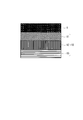
- 1 is a schematic cross-sectional view showing a tire inner liner sheet according to an embodiment of the present invention.
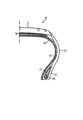
- 1 is a schematic cross-sectional view showing a tire inner liner sheet according to an embodiment of the present invention. It is typical sectional drawing which shows the half of the pneumatic tire which concerns on one embodiment of this invention.
- FIG. 1 is a cross-sectional view of an example of a tire inner liner sheet of the present invention.
- a tire inner liner sheet 10 shown in FIG. 1 is used by adhering to a rubber-like elastic layer 1 constituting the inside of a tire. From the inside of the tire, a first adhesive layer 11, an intermediate layer 12, a second layer are used. The adhesive layer 13 is included in this order.
- the first adhesive layer 11 can be bonded to the intermediate layer 12 which is a gas barrier layer, and in addition, the carcass rubber or the insulation which is the rubber-like elastic layer 1 constituting the inside of the tire. And has the role of being able to adhere to the second adhesive layer 13 at the place where the inner liner sheet is wrapped and overlapped at the time of molding the tire.
- the first adhesive layer 11 includes a crosslinkable resin (A).
- A crosslinkable resin
- the crosslinking reaction proceeds in the first adhesive layer 11 by heating, and the heat resistance of the first adhesive layer 11 can be improved.
- an interlayer bridge is formed between the first adhesive layer 11 and the resin layer adjacent to the first adhesive layer 11 (in FIG. 1, the intermediate layer 12 and the rubber-like elastic layer 1). Adhesive strength can be increased.
- interlayer cross-linking is also formed at a place where the tire inner liner sheet 10 is wrapped around and overlapped, and the adhesive strength with the second adhesive layer 13 can be increased.
- content of crosslinkable resin (A) is although it does not specifically limit, 1 weight% or more and 45 weight% or less with respect to the 1st contact bonding layer 11 whole before coating drying. It is preferably 5 wt% or more and 40 wt% or less.
- content of the crosslinkable resin (A) is less than 1% by weight with respect to the entire first adhesive layer 11 before coating and drying, the adhesive strength between the layers cannot be sufficiently obtained, which is not preferable.
- it is larger than 45% by weight an insoluble content of the crosslinkable resin (A) is generated, which is not preferable.
- the crosslinkable resin (A) may have a carbon-carbon double bond and / or an ethylene structure (structure represented by the chemical formula “—CH 2 —CH 2 —”) in the molecule. preferable.
- the crosslinking reaction proceeds between the carbon-carbon double bond and / or the ethylene structure between the molecules of the crosslinkable resin A in the first adhesive layer 11 by heating, and the heat resistance of the first adhesive layer 11 is increased.
- the sex can be further improved. Further, by heating, between the first adhesive layer 11 and the resin layer adjacent to the first adhesive layer 11 (in FIG.
- interlayer bridge crosslinking can be formed more easily and the adhesive strength between layers can be raised more.
- interlayer cross-linking can be formed relatively easily at a portion where the tire inner liner sheet 10 is wrapped and overlapped, and the adhesive strength with the second adhesive layer 13 can be further increased.
- the crosslinkable resin (A) may be any one having a carbon-carbon double bond and / or an ethylene structure (structure represented by the chemical formula “—CH 2 —CH 2 —”) in the molecule.
- the hydrogen in the crosslinkable resin (A) may be substituted with a phenyl group, a CN group, a halogen group, an alkyl group, or a carboxyl group, and may be substituted with a phenyl group. preferable.
- ethylene propylene rubber ethylene propylene diene rubber, polyisoprene rubber, styrene butadiene rubber, butadiene rubber, chloroprene rubber, acrylonitrile butadiene rubber, syndiotactic-1,2-polybutadiene, styrene-isoprene-styrene copolymer , A styrene-isoprene copolymer, a styrene-butadiene-styrene copolymer, a styrene-butadiene copolymer, and an ethylene-vinyl acetate copolymer, from the viewpoint of solubility in a solvent and thermal stability, A styrene-isoprene-styrene copolymer or a styrene-isoprene copolymer is particularly preferable. These may be used alone or in combination of two or more
- the 1st contact bonding layer 11 has a peroxide. Since the first adhesive layer 11 has a peroxide, the peroxide is radically cleaved by heating in the vulcanization step, and thus a carbon-carbon double bond and / or ethylene in the molecule of the first adhesive layer 11 is formed.
- Crosslinkable resin (A) containing a structure carries out a crosslinking reaction, and can further improve heat resistance. Further, between the molecules of the crosslinkable resin A in the first adhesive layer 11, a crosslinking reaction proceeds relatively easily between the carbon-carbon double bond and / or the ethylene structure. The heat resistance can be further improved.
- the peroxide contained in the 1st contact bonding layer 11 It is 1 weight% or more and 20 weight% or less with respect to the 1st contact bonding layer 1 whole before coating drying. It is preferably 2% by weight or more and 15% by weight or less.
- the peroxide contained in the first adhesive layer 11 is less than 1% by weight with respect to the entire first adhesive layer 1 before coating and drying, an improvement in adhesive strength due to the addition of the peroxide is seen. Since it is not, it is not preferable.
- the amount is more than 20% by weight, the crosslinking density becomes high and the flexibility of the bonded portion becomes low, which is not preferable because the tire may be damaged during running.
- the peroxide is not particularly limited as long as the one-minute half-life temperature is 130 ° C. or higher and 200 ° C. or lower, but is preferably 150 ° C. or higher and 190 ° C. or lower, and 160 ° C. or higher and 180 ° C. or lower. More preferred.
- the half-life temperature for 1 minute is smaller than 130 ° C., radical cleavage occurs before heating in the vulcanization step, which is not preferable.
- the one-minute half-life temperature is higher than 200 ° C., it is necessary to make the vulcanization time in the vulcanization process longer, which is not preferable because of high production cost.
- the 1-minute half-life temperature of the present invention means that a peroxide having a concentration of 0.05 mol / L is prepared using benzene as a solvent, and sealed in a glass tube subjected to nitrogen substitution.
- Decomposition rate constants are determined from the time and concentration when immersed in a thermostat set at 70 ° C. and 70 ° C., and the concentration is half the initial value (0.025 mol / L) per minute. Refers to the value calculated for temperature.
- peroxides include dicumyl peroxide, 2,5-dimethyl-2,5-di (t-butylperoxy) hexyne-3, 2,5-dimethyl-2,5-di (t- Butylperoxy) hexane and 1,1-bis (t-butylperoxy) cyclohexane are preferred, and dicumylperoxyside is more preferred from the viewpoint of being solid at room temperature and easy to handle. These may be used alone or in combination of two or more.
- the said crosslinkable resin (A ) Is more preferably 1% by weight or more and 45% by weight or less, and when the ratio of the peroxide is 2% by weight or more and 15% by weight or less, the ratio of the crosslinkable resin (A) is More preferably, the content is 5% by weight or more and 40% by weight or less.
- the content of the crosslinkable resin (A) is less than 1% by weight with respect to the entire first adhesive layer 1 before coating and drying, it is not preferable because the adhesive strength between the layers cannot be obtained sufficiently.
- it is larger than 45% by weight an insoluble content of the crosslinkable resin (A) is generated, which is not preferable.
- the first adhesive layer 1 may contain other resins in addition to the crosslinkable resin (A) and the peroxide.
- Other resins include petroleum resins, phenolic resins, rosin resins, terpene resins, and liquid petroleum resins, preferably petroleum resins, terpene resins, and liquid petroleum resins, and are petroleum resins and liquid petroleum resins. Is more preferable.
- the 1st contact bonding layer 1 before coating drying consists of a solvent which melt
- the solvent is not particularly limited as long as it can dissolve the crosslinkable resin (A) and the peroxide, but is preferably tetrahydrofuran, toluene, benzene, ethylbenzene, xylene, or cyclohexane, and more preferably tetrahydrofuran or cyclohexane.
- the thickness of the first adhesive layer 11 after coating and drying is not particularly limited, but is preferably 1 ⁇ m or more and 15 ⁇ m or less, and more preferably 3 ⁇ m or more and 10 ⁇ m or less.
- the rubber-like elastic layer 1 and the intermediate layer 12 can be sufficiently bonded in the vulcanization process, and the tire inner liner sheet 10 is circulated and stacked.
- the second adhesive layer 13 can be more strongly bonded at the combined portions. Further, by setting the thickness after coating and drying to 15 ⁇ m or less, the tire inner liner can be thinned and lightened.
- middle layer 12 has a role which prevents the gas in a tire permeate
- the Young's modulus at 23 ° C. of the intermediate layer 12 is 0.1 MPa or more and 500 MPa or less.
- the Young's modulus of the mid layer 12 is 0.1 MPa or more, the necessary elasticity can be given to the tire.
- the Young's modulus of the intermediate layer 12 is 500 MPa or less, the inner liner can be extended at the time of tire molding, and the tire can be molded.
- the Young's modulus (JIS K7161-1994) of the intermediate layer 12 is not particularly limited as long as it is 500 MPa or less, but is preferably 450 MPa or less, and more preferably 400 MPa or less. Moreover, it is preferable that it is 0.1 MPa or more, and it is more preferable that it is 0.2 MPa or more.
- the Young's modulus at 23 ° C. of the intermediate layer 12 of the present invention was measured as follows.
- a film was formed by feeding into an extruder (screw diameter: ⁇ 50 mm, L / D: 28, cylinder temperature: 250 ° C., SNT50-36V extruder, manufactured by SunNT Co., Ltd.) A single-layer film having a thickness of 200 ⁇ m was produced.
- the Young's modulus of the obtained film was determined by measuring with a tensile tester (Tensilon Universal Tester RTG-1310, manufactured by Orientec Co., Ltd.) according to the method of JIS K7161-1994.
- the intermediate layer 12 preferably contains a crosslinkable resin (B).
- the intermediate layer 12 includes the crosslinkable resin (B)
- the intermediate layer 12 and the resin layers adjacent to the intermediate layer 12 are heated.
- Interlayer cross-linking can be formed relatively easily between these layers, and the adhesive strength between the layers can be further increased. Thereby, adhesion with the tire inner surface is ensured even when the tire is running, and burst can be prevented.
- the content of the crosslinkable resin (B) in the intermediate layer 12 is not particularly limited, but is preferably 2 wt% or more and 45 wt% or less with respect to the entire intermediate layer 12. As mentioned above, it is more preferable that it is 35 weight% or less.
- the content of the crosslinkable resin (B) with respect to the entire intermediate layer 12 before coating and drying is less than 2% by weight, the adhesive strength between the layers cannot be obtained sufficiently, which is not preferable.
- content of crosslinkable resin (B) is larger than 45 weight%, since gas barrier property falls, it is unpreferable.
- the crosslinkable resin (B) preferably has a carbon-carbon double bond and / or an ethylene structure in the molecule.
- the crosslinkable resin (B) is not particularly limited as long as it has a carbon-carbon double bond and / or an ethylene structure (structure represented by the chemical formula “—CH 2 —CH 2 —”) in the molecule.
- the hydrogen in the crosslinkable resin (B) may be substituted with a phenyl group, a CN group, a halogen group, an alkyl group, or a carboxyl group, but is preferably not substituted.
- the crosslinkable resin (B) includes ethylene propylene rubber, ethylene propylene diene rubber, polyisoprene rubber, styrene butadiene rubber, butadiene rubber, chloroprene rubber, acrylonitrile butadiene rubber, syndiotactic-1,2- Polybutadiene, styrene-isoprene-styrene copolymer, styrene-isoprene copolymer, styrene-butadiene-styrene copolymer, styrene-butadiene copolymer, ethylene-vinyl acetate copolymer, polyethylene are preferred, sheet processability, From the viewpoints of tire processability, heat resistance, and prevention of cracks during tire running, ethylene propylene rubber, ethylene propylene diene rubber, styrene-isoprene-styrene copolymer, and stty
- middle layer 12 contains gas barrier resin.
- the gas barrier resin is not particularly limited, but preferably contains an ethylene-vinyl alcohol copolymer, polyamide, polyacrylonitrile, polyvinyl alcohol, styrene-isobutylene-styrene copolymer, styrene-isobutylene copolymer, Among these, from the viewpoint of tire workability and prevention of cracks during tire running, it is more preferable to include a styrene-isobutylene-styrene copolymer.
- the said gas barrier resin only 1 type may be used and 2 or more types may be combined and used.
- the intermediate layer 12 preferably contains both the gas barrier resin and the crosslinkable resin (B).
- the content of the gas barrier resin and the crosslinkable resin B is 55% by weight to 98% by weight of the gas barrier resin with respect to the entire intermediate layer 12, and the crosslinkable resin (B).
- the gas barrier resin is 65 wt% or more and 95 wt% or less
- the crosslinkable resin (B) is 5 wt% or more and 35 wt%. More preferably, it is the following.
- the intermediate layer 12 is most preferably composed of only the gas barrier resin and the crosslinkable resin.
- the thickness of the intermediate layer 12 is not particularly limited, but is preferably 300 ⁇ m or more and 600 ⁇ m or less, and more preferably 350 ⁇ m or more and 550 ⁇ m or less.
- the thickness of the intermediate layer 12 is 300 ⁇ m or more, gas permeation can be sufficiently prevented.
- the inner liner is made thinner than 600 ⁇ m, the thickness of the tire can be reduced, and as a result, the fuel efficiency is improved.
- the intermediate layer 12 may contain a resin other than the crosslinkable resin (B) and the gas barrier resin.
- the other resin include polyphenylene ether resin.
- the second adhesive layer 13 can be bonded to the intermediate layer 12 that is a gas barrier layer, and in addition, the inner liner sheet circulated and overlapped during tire molding. It can be bonded to the first adhesive layer 11 at a location and has a role of releasing from the bladder after tire vulcanization molding.
- the second adhesive layer 13 includes a crosslinkable resin (A).
- This crosslinkable resin (A) is the same as the crosslinkable resin (A) contained in the first adhesive layer 11.
- the crosslinking reaction proceeds in the second adhesive layer 13 by heating, and the heat resistance of the second adhesive layer 13 can be improved.
- interlayer crosslinking is relatively easily formed between the second adhesive layer 13 and the resin layer adjacent to the second adhesive layer 13 (intermediate layer 12 in FIG. 1). Can be further enhanced.
- interlayer cross-linking can be formed relatively easily at the portion where the tire inner liner sheet 10 is wrapped and overlapped, and the adhesive strength with the first adhesive layer 11 can be further increased.
- content of the said crosslinkable resin (A) is although it does not specifically limit, 1 weight% or more and 45 weight% with respect to the 2nd adhesive layer 13 whole before coating drying.
- the content is preferably 5% by weight or more and 40% by weight or less.
- the content of the crosslinkable resin (A) is less than 1% by weight with respect to the entire second adhesive layer 13 before coating and drying, it is not preferable because the adhesive strength between the layers cannot be obtained sufficiently.
- it is larger than 45% by weight an insoluble content of the crosslinkable resin (A) is generated, which is not preferable.
- a crosslinking reaction proceeds between the carbon-carbon double bond and / or the ethylene structure between the molecules of the crosslinkable resin (A) in the second adhesive layer 13 by heating, and the second adhesive layer 13
- the heat resistance of can be further improved.
- by heating, between the second adhesive layer 13 and the resin layer adjacent to the second adhesive layer 13 (intermediate layer 12 in FIG. 1) a carbon-carbon double bond and / or an ethylene structure
- interlayer cross-linking is more easily formed, and the adhesive strength between the layers can be further increased.
- interlayer cross-linking can be formed relatively easily at the portion where the tire inner liner sheet 10 is wrapped and overlapped, and the adhesive strength with the first adhesive layer 11 can be further increased.
- the 2nd contact bonding layer 13 is what has a peroxide. This peroxide is the same as the peroxide contained in the first adhesive layer 11.
- the peroxide is radically cleaved by heating in the vulcanization step, and a carbon-carbon double bond and / or ethylene is contained in the molecule of the second adhesive layer 13.
- Crosslinkable resin (A) containing a structure carries out a crosslinking reaction, and can further improve heat resistance. Further, between the molecules of the crosslinkable resin (A) in the second adhesive layer 13, the crosslinking reaction proceeds relatively easily between the carbon-carbon double bond and / or the ethylene structure, and the second adhesive layer The heat resistance of 13 can be further improved.
- interlayer crosslinking is more easily formed, and the adhesive strength between the layers can be further increased.
- interlayer cross-linking can be formed relatively easily at the portion where the tire inner liner sheet 10 is wrapped and overlapped, and the adhesive strength with the first adhesive layer 11 can be further increased.
- the content of the peroxide contained in the second adhesive layer 13 is not particularly limited, but is 1 wt% or more and 20 wt% or less with respect to the entire second adhesive layer 13 before coating and drying. It is preferable that the content is 2% by weight or more and 15% by weight or less.
- the peroxide contained in the second adhesive layer 13 is less than 1% by weight with respect to the entire second adhesive layer 13 before coating and drying, an improvement in adhesive strength due to the addition of the peroxide is seen. It is not preferable because it is not.
- the amount is more than 20% by weight, the crosslinking density becomes high and the flexibility of the bonded portion becomes low, which is not preferable because the tire may be damaged during running.
- the thickness of the second adhesive layer 13 after coating and drying is not particularly limited, but is preferably 1 ⁇ m or more and 15 ⁇ m or less, and more preferably 3 ⁇ m or more and 10 ⁇ m or less.
- the inner liner sheet is circulated and sufficiently adhered to the first adhesive layer 11 at the overlapped position.
- the intermediate layer can be sufficiently adhered, and the tire inner liner sheet 10 can be more strongly adhered to the first adhesive layer 11 at a place where the sheet 10 is wrapped around and overlapped.
- the thickness of the second adhesive layer 13 after coating and drying to 15 ⁇ m or less, it can be released from the bladder, and the inner liner can be thinned and reduced in weight.
- the first adhesive layer and the second adhesive layer of the present invention may be the same layer or different layers, but are preferably the same layer.
- the same layer means that the blending components and blending ratios contained in the adhesive layer are the same.
- the tire inner liner sheet of the present invention may have two or more first adhesive layers, two or more intermediate layers, two or more second adhesive layers, and impairs basic performance. Other resin layers may be included as long as there is no such range.
- the other resin layer may have a crosslinkable functional group (A) or a crosslinkable functional group (B).
- the layer adjacent to the intermediate layer and the layer, and the layer adjacent to the first adhesive layer In addition to the interlayer of the second adhesive layer and the layer adjacent to the second adhesive layer, the interlayer crosslinking is performed between the layers of the other resin layers by the crosslinking reaction of the crosslinkable functional group (A) and the crosslinkable functional group (B). May be.
- the auxiliary adhesive layer 24 is included between the first adhesive layer 21 and the intermediate layer 22, and the auxiliary adhesive layer 25 is included between the second adhesive layer 23 and the intermediate layer 22.
- the first adhesive layer 21 and the auxiliary adhesive layer 24 between the intermediate layer 22 and the auxiliary adhesive layer 24, between the second adhesive layer 23 and the auxiliary adhesive layer 25, and between the intermediate layer 22 and the auxiliary adhesive layer 25.
- Each may be cross-linked between layers.
- the thickness of the tire inner liner sheet after coating and drying is not particularly limited, but is preferably 302 ⁇ m or more and 630 ⁇ m or less, and more preferably 356 ⁇ m or more and 570 ⁇ m or less.
- the thickness after coating and drying is preferably 302 ⁇ m or more, gas barrier properties, adhesiveness, releasability from a bladder, and tire damage prevention properties can be exhibited.
- the inner liner thinner by setting it to 630 ⁇ m or less, the weight of the tire is reduced, and as a result, the fuel efficiency is improved.
- middle layer is mentioned suitably. More specifically, first, the intermediate layer resin containing the crosslinkable resin (B) is formed into a sheet by extrusion with a T-die extruder, and this is cooled to room temperature on a cooling roll. Thereafter, 10% by weight of a crosslinkable resin (A) containing a carbon-carbon double bond and / or an ethylene structure in the molecule and 10% by weight of a peroxide are dissolved in tetrahydrofuran. It is preferable to manufacture by coating with a coater to a wet film thickness of 25 ⁇ m and drying at 80 ° C. for 1 minute.
- the average adhesive force at 23 ° C. between the intermediate layer and the adhesive layer, and between the adhesive layer and the rubber-like elastic layer is 5 N / mm or more, and the average adhesive force at 80 ° C. Is 1.0 N / mm or more, and the average peel force at 23 ° C. with the bladder is preferably 0.5 N / mm or less.
- the pneumatic tire 30 can be used for passenger cars, trucks / buses, heavy machinery and the like.
- the pneumatic tire 30 includes a tread portion 31, a sidewall portion 32, and a bead portion 33. Further, a bead core 34 is embedded in the bead portion 33. Further, a carcass (rubber-like elastic layer) 35 provided from one bead portion 33 to the other bead portion and folded back at both ends to lock the bead core 34, and two plies outside the crown portion of the carcass 35.
- a belt layer 36 is disposed.
- An inner liner 38 extending from one bead portion 33 to the other bead portion 33 is disposed on the inner side in the tire radial direction of the carcass 35.
- the belt layer 36 has two plies made of steel cord or aramid fiber cord arranged so that the plies intersect each other so that the cord is usually at an angle of 5 to 30 ° with respect to the tire circumferential direction. Is done.
- organic fiber cords such as polyester, nylon, and aramid are arranged at approximately 90 ° in the tire circumferential direction.
- a bead extending in the sidewall direction from the upper end of the bead core 34 is located in a region surrounded by the carcass and its folded portion.
- An apex 37 is arranged.
- a tire manufacturing method includes the following steps. Preparing a green tire using the innerliner sheet according to the present disclosure as an innerliner; The raw tire is mounted on a mold and vulcanized while being pressurized with a bladder to obtain a vulcanized tire; The vulcanized tire is cooled at 50 to 120 ° C. for 10 to 300 seconds.
- the tire inner liner sheet according to the present disclosure is disposed in the inner liner portion of the green tire.
- the first adhesive layer 11 is arranged facing outward in the tire radial direction so that the first adhesive layer 11 is adhered to the inner surface of the tire inside the carcass rubber 35.
- the first adhesive layer 11 is disposed toward the outer side in the tire radial direction so as to be in contact with the insulation. It is possible to increase the adhesive strength between the surface 38 and the insulation.
- any gas that can exhibit its function can be used as the gas that maintains the tire internal pressure, and examples thereof include air, nitrogen, and helium.
- Example 1 As the intermediate layer 12, styrene-isobutylene-styrene copolymer (manufactured by Kaneka Corporation, product number: Shibster 103T) and ethylene propylene diene rubber (manufactured by Mitsui Chemicals, product number: Mitsui EPT K-9720) are shown in Table 1.
- the intermediate layer 12 having a thickness of 500 ⁇ m was obtained by cooling and solidifying with a cooling roll (temperature: 25 ° C.).
- a styrene-isoprene-styrene copolymer manufactured by Nippon Zeon Co., Ltd., product number: QUINTAC 3270, dicumyl peroxide (manufactured by Kayaku Akzo Co., Ltd., product number: Perkadox BC) -FF), tetrahydrofuran (manufactured by Kanto Chemical Co., Ltd., product number: special grade of tetrahydrofuran)) were mixed and dissolved in accordance with the formulation shown in Table 1, and this solution was applied to one side of the sheet so as to have a wet film thickness of 25 ⁇ m.
- the other surface of the sheet After coating with a comma coater (M-500, manufactured by Hirano Techseed Co., Ltd.) and drying at 80 ° C. for 1 minute to form the first adhesive layer 11, the other surface of the sheet has a film thickness of 25 ⁇ m.
- the solution is applied with a comma coater and dried at 80 ° C. for 1 minute to form the second adhesive layer 13 to form a sheet having a total thickness of 510 ⁇ m.
- the intermediate layer 12 having a thickness of 500 ⁇ m was obtained by cooling and solidifying with a cooling roll (temperature: 25 ° C.).
- a styrene-isoprene-styrene copolymer manufactured by Nippon Zeon Co., Ltd., product number: QUINTAC 3270
- tetrahydrofuran manufactured by Kanto Chemical Co., Ltd., product number: tetrahydrofuran special grade
- this solution was applied to one side of the sheet with a comma coater (M-500, manufactured by Hirano Techseed Co., Ltd.) so that a wet film thickness of 25 ⁇ m was obtained.
- M-500 manufactured by Hirano Techseed Co., Ltd.
- this solution was applied to the other side of the sheet with a comma coater so as to have a film thickness of 25 ⁇ m and dried at 80 ° C. for 1 minute.
- the second adhesive layer 13 was molded to produce a sheet having a total thickness of 505 ⁇ m.
- (styrene / p-chloromethylstyrene) -isobutylene- (styrene / p-chloromethylstyrene) block copolymer was polymerized by the method described in Patent Document 4, and (styrene / p-chloro).
- Methylstyrene) -isobutylene- (styrene / p-chloromethylstyrene) block copolymer was kneaded using a twin screw extruder (cylinder, die temperature: 170 ° C., KTX-30, manufactured by Kobe Steel, Ltd.) Pellets were obtained.
- the obtained pellets were put into a T-die extruder ( ⁇ screw diameter: ⁇ 50 mm, L / D: 28, cylinder temperature: 180 ° C., SNT50-36V type extruder, manufactured by SunNT Co., Ltd.)) By cooling and solidifying with a cooling roll (temperature: 25 ° C.), a sheet having a total thickness of 400 ⁇ m was obtained.
- the 1-minute half-life temperature of dicumyl peroxide used in the examples was prepared in a glass tube in which dicumyl peroxide having a concentration of 0.05 mol / L was prepared using benzene as a solvent, and nitrogen substitution was performed. Then, from the time and concentration when immersed in a thermostat set at 40 ° C., 55 ° C., and 70 ° C. and thermally decomposed, the decomposition rate constant was obtained, and the concentration was half the initial value (0.025 mol / min) per minute. L) was determined based on the calculated temperature.
- the intermediate layer 12 was 1 mm thick using a T-die extruder (screw diameter: ⁇ 50 mm, L / D: 28, cylinder temperature: 250 ° C., SNT50-36V type extruder, manufactured by SunNT Co., Ltd.). Molded as a sheet.
- the first adhesive layer 11 was formed on the intermediate layer 12 with a bar coater so as to have a wet film thickness of 25 ⁇ m, and dried at 80 ° C. for 1 minute.
- a 1 mm thick sheet of the same intermediate layer is laminated on the surface of the intermediate layer where the first adhesive layer is not molded, and the first adhesive layer side is a 2 mm thick carcass rubber sheet (70 parts of natural rubber, styrene butadiene) 30 parts of rubber, 40 parts of carbon black, 7 parts of process oil, 2 parts of stearic acid, 5 parts of zinc oxide, 3 parts of sulfur, and 1 part of vulcanization accelerator)
- the two-layer sheet was bonded to a thickness of 3.5 mm under the condition of 5 MPa, and a 130 mm long ⁇ 25 mm wide strip was used as a sample for adhesive strength evaluation.
- an SS curve at 23 ° C. and 50% RH with a tensile tester (Tensilon Universal Tester RTG-1310, manufactured by Orientec Co., Ltd.) under the conditions of a chuck interval of 10 mm and a tensile speed of 500 mm / min. (Stress-strain curve) was measured, and the value was divided by the width (25 mm), and the adhesive force was measured to obtain the average adhesive force. When the material broke, the maximum load was taken as the adhesive strength.
- the evaluation results were as follows.
- the intermediate layer 12 was 1 mm thick using a T-die extruder (screw diameter: ⁇ 50 mm, L / D: 28, cylinder temperature: 250 ° C., SNT50-36V type extruder, manufactured by SunNT Co., Ltd.). Molded as a sheet.
- the first adhesive layer 11 was formed on the intermediate layer 12 with a bar coater so as to have a wet film thickness of 25 ⁇ m, and dried at 80 ° C. for 1 minute.
- a 1 mm thick sheet of the same intermediate layer is stacked on the surface of the intermediate layer where the adhesive layer is not formed, and the first adhesive layer side is a 2 mm thick carcass rubber sheet (70 parts natural rubber, styrene butadiene rubber 30 Part, carbon black 40 parts, process oil 7 parts, stearic acid 2 parts, zinc oxide 5 parts, sulfur 3 parts, vulcanization accelerator 1 part) between the first adhesive layer 11 and the rubber sheet
- a PTFE sheet is inserted with a length of about 1 cm so as to be a turning opening, and both outer sides of the intermediate layer 12 and one rubber sheet are sandwiched between metal meshes, 170 ° C., 12 minutes, 5 MPa
- the two-layer sheet was laminated so that the thickness was 3.5 mm under the conditions, and a 130 mm long ⁇ 25 mm wide strip was used as a sample for adhesive strength evaluation.
- the intermediate layer 12 is a sheet having a thickness of 1 mm using a T-die extruder (screw diameter: ⁇ 50 mm, L / D: 28, cylinder temperature: 250 ° C., SNT50-36V extruder, manufactured by SunNT Co., Ltd.) As molded.
- the first adhesive layer 11 was formed on the intermediate layer 12 with a bar coater so as to have a wet film thickness of 25 ⁇ m, and dried at 80 ° C. for 1 minute.
- a sheet of 1 mm thickness of the same intermediate layer is laminated on the surface of the intermediate layer on which the first adhesive layer is not molded, and the first adhesive layer side is a rubber sheet for bladders of 2 mm thickness (95 parts of butyl rubber, chloroprene rubber 5 Part, carbon black 60 parts, castor oil 5 parts, phenol resin 5 parts, zinc oxide 5 parts, pitch-based carbon fiber 5 parts, sulfur 1 part, vulcanization accelerator 0.5 part at 190 ° C., 30 minutes, 5 MPa
- the PTFE sheet is inserted into a part between the first adhesive layer 11 and the rubber sheet for the bladder so as to be a turning opening so as to be in contact with the sheet vulcanized under the condition, and the intermediate layer Two sheets of No.
- Example 1 the tire inner liner sheet of Example 1 in which the first adhesive layer and the intermediate layer were cross-linked was improved in adhesive strength with the rubber sheet at 23 ° C. and 80 ° C. as compared with Comparative Examples 1 and 2. And the peeling force with the bladder at 23 ° C. was reduced.
- the adhesion between the layers at the room temperature and the high temperature in the inner liner sheet having the gas barrier layer and the adhesive layer is improved, and the adhesion at the high temperature between the inner liner and the carcass or the insulation is further improved.
- the adhesive force of the overlapping portion of the inner liner is improved, and further, the inner liner release sheet from the bladder at the time of tire molding is improved, and a pneumatic tire using the tire can be provided. Industrial applicability is high.
Landscapes
- Engineering & Computer Science (AREA)
- Mechanical Engineering (AREA)
- Tires In General (AREA)
- Compositions Of Macromolecular Compounds (AREA)
Abstract
中間層と接着層を有する構成のインナーライナー用シートにおける室温時および高温時の層間の接着力が向上し、さらに、インナーライナーとカーカスまたはインスレーションとの高温時の接着力が向上し、さらに、インナーライナーの重ね合わせ部分の接着力が向上し、さらに、タイヤ成形時のブラダーに対するインナーライナーの離型性が向上したタイヤインナーライナー用シート、及び、それを用いた空気入りタイヤを提供する。タイヤの内側に接着して用いられるタイヤインナーライナー用シートであって、前記タイヤの内側の面から、第1接着層、中間層、第2接着層をこの順で含んで構成され、前記中間層のヤング率が500MPa以下であり、前記第1接着層が、架橋性樹脂(A)を含むことを特徴とするタイヤインナーライナー用シート。
Description
本開示は、タイヤインナーライナー用シート及びタイヤに関する。
本願は、2013年3月29日に、日本に出願された特願2013-070808号に基づき優先権を主張し、その内容をここに援用する。
本願は、2013年3月29日に、日本に出願された特願2013-070808号に基づき優先権を主張し、その内容をここに援用する。
近年の省エネルギーの社会的な要請に伴い、タイヤの薄ゲージ化による軽量化が図られている。タイヤ部材の中に、タイヤ半径方向の内側に配置され、空気入りタイヤの内部から外部への空気漏れを防止する働きをもつタイヤインナーライナーがあるが、タイヤインナーライナーにおいてもガスバリア性を向上して、軽量化を図ることが行われるようになってきた。
タイヤの軽量化を図るために、ブチル系ゴムよりガスバリア性に優れ、タイヤインナーライナー層の厚みを薄くすることができる熱可塑性樹脂を、タイヤインナーライナーに用いることが提案されている。例えば、ナイロンシート層をタイヤインナーライナーの従来のブチル系ゴムの代わりに用いることが開示されている(例えば、特許文献1参照)。しかし、特許文献1の技術においては、ナイロンフィルム層を形成するために、ナイロンフィルムをRFL処理した後、ゴム組成物から成るゴム糊を接着する必要があり、工程が複雑化するという問題がある。さらに、加硫工程では一般に、金型内に収容した未加硫タイヤ(生タイヤ)内にブラダー本体を挿入し、ブラダー本体を膨張させて未加硫タイヤの内側から金型内面に押し付けて加硫成形を行うタイヤ加硫方法が採用されているが、特許文献1のインナーライナー層では、ナイロンフィルム層とブラダーとが加熱状態で接触することになり、ナイロンフィルム層がブラダーに粘着、接着して破れてしまうという問題もある。
また、エチレンービニルアルコール共重合体層をタイヤインナーライナーとして従来のブチル系ゴムの代わりに用いることが開示されている(例えば、特許文献2参照)。しかし、特許文献2の技術においては、エチレン―ビニルアルコール共重合体の柔軟性が十分ではなく、タイヤ走行時にクラックが入り、タイヤ中の気体が漏れることがあった。
また、耐気体透過性(ガスバリア)層としてスチレン-イソブチレン-スチレントリブロック共重合体を含むSIBS層を用い、そのガスバリア層とカーカス又はインスレーションとを接着させる接着層としてシランカップリング剤を用いるタイヤインナーライナー用ポリマーシートが開示されている(例えば、特許文献3)。しかし、このような構成では、接着層とカーカス又はインスレーションとの接着性、および、接着層とガスバリア層との接着性が十分ではなく、タイヤ走行時に各層間で剥離が生じる他、ガスバリア層とブラダーとの離型性が十分ではなく、ブラダーに粘着するという問題があった。
また、特許文献4には、SIBSのスチレン部にハロゲン基を付与したハロゲン化SIBSをインナーライナーとして用い、カーカス又はインスレーションとハロゲン化SIBS層を接着させることが開示されている(例えば、特許文献4)。しかし、このような構成では、インナーライナーとカーカス又はインスレーションとの接着性が十分ではなく、タイヤ走行時に層間で剥離が生じる他、ガスバリア層とブラダーとの離型性が十分ではなく、ブラダーに粘着するという問題がある。
また、特許文献5には、インナーライナー層とゴム層の接着性を改善するための積層体が開示されている。これはインナーライナー層の両側に接着層を設けることで、インナーライナー層の重ね合わせ部において接着層同士が接触するようになり、加熱によって強固に接着されるので、気体圧保持性を向上させている。しかし、このインナーライナー層の重ね合わせのための接着層は、加硫工程においてブラダーと加熱状態で接触することになり、ブラダーに粘着するという問題がある。
本発明の目的は、ガスバリア層と接着層を有する構成のインナーライナー用シートにおける高温時の層間の接着力が向上し、さらに、インナーライナーとカーカスまたはインスレーションとの室温時および高温時の接着力が向上し、さらに、インナーライナーの重ね合わせ部分の接着力が向上し、さらに、タイヤ成形時のブラダーに対するインナーライナーの離型性が向上したタイヤインナーライナー用シート、及びそれを用いた空気入りタイヤを提供することにある。
このような目的は、下記(1)~(20)に記載の本発明により達成される。
(1)タイヤの内側に接着して用いられるタイヤインナーライナー用シートであって、第1接着層、中間層、第2接着層を有し、タイヤの内側の面から、前記第1接着層、前記中間層、及び前記第2接着層の順で積層され、前記第1接着層及び前記第2接着層が、それぞれ分子中に炭素-炭素二重結合またはエチレン構造を有する架橋性樹脂(A)を有し、 前記第1接着層又は前記第2接着層が、過酸化物を有し、前記中間層が、分子中に炭素-炭素二重結合またはエチレン構造を有する架橋性樹脂(B)を有することを特徴とするタイヤインナーライナー用シート。
(2)前記第1接着層及び前記第2接着層が、過酸化物を有することを特徴とする(1)に記載のタイヤインナーライナー用シート。
(3)前記過酸化物の1分間半減期温度が130℃以上及び200℃以下であることを特徴とする(1)に記載のタイヤインナーライナー用シート。
(4)前記過酸化物がジクミルパーオキサイド、2,5―ジメチル―2,5―ジ(t―ブチルパーオキシ)ヘキシン―3、2,5―ジメチル―2,5―ジ(t―ブチルパーオキシ)ヘキサン、及び1,1―ビス(t―ブチルパーオキシ)シクロヘキサン群から選ばれる1種以上であることを特徴とする(1)に記載のタイヤインナーライナー用シート。
(5)前記過酸化物がジクミルパーオキシサイドであることを特徴とする(1)に記載のタイヤインナーライナー用シート。
(6)前記架橋性樹脂(A)又は前記架橋性樹脂(B)、又は、前記架橋性樹脂(A)及び前記架橋性樹脂(B)が、分子中に炭素-炭素二重結合及びエチレン構造を有することを特徴とする(1)に記載のタイヤインナーライナー用シート。
(7)前記架橋性樹脂(A)中の水素がフェニル基、CN基、ハロゲン基、アルキル基、カルボキシル基の群れのいずれか1種以上で置換されていることを特徴とする(1)に記載のタイヤインナーライナー用シート。
(8)前記中間層全体に対する架橋性樹脂(B)の含有量が、2重量%以上及び45重量%以下であることを特徴とする(1)に記載のタイヤインナーライナー用シート。
(9)前記中間層が、さらに、エチレン―ビニルアルコール共重合体、ポリアミド、ポリアクリロニトリル、ポリビニルアルコール、スチレン―イソブチレン―スチレン共重合体、スチレン―イソブチレン共重合体の群から選ばれる1種以上のガスバリア樹脂を有することを特徴とする(1)に記載のタイヤインナーライナー用シート。
(10)前記中間層が、前記ガスバリア性樹脂及び前記架橋性樹脂のみからなることを特徴とする(9)に記載のタイヤインナーライナー用シート。
(11)前記中間層全体に対する、前記ガスバリア性樹脂の含有量が55重量%以上及び98重量%であって、前記架橋性樹脂(B)の含有量が、2重量%以上及び45重量%以下であることを特徴とする(10)に記載のタイヤインナーライナー用シート。
(12)前記架橋性樹脂(A)が、エチレンプロピレンゴム、エチレンプロピレンジエンゴム、ポリイソプレンゴム、スチレンブタジエンゴム、ブタジエンゴム、クロロプレンゴム、アクリロニトリルブタジエンゴム、シンジオタクチック―1,2-ポリブタジエン、スチレン―イソプレン―スチレン共重合体、スチレン―イソプレン共重合体、スチレン―ブタジエン―スチレン共重合体、スチレン―ブタジエン共重合体、及びエチレン―酢酸ビニル共重合体の群から選ばれる1種以上であることを特徴とする(1)に記載のタイヤインナーライナー用シート。
(13)前記架橋性樹脂(B)が、エチレンプロピレンゴム、エチレンプロピレンジエンゴム、ポリイソプレンゴム、スチレンブタジエンゴム、ブタジエンゴム、クロロプレンゴム、アクリロニトリルブタジエンゴム、シンジオタクチック―1,2-ポリブタジエン、スチレン―イソプレン―スチレン共重合体、スチレン―イソプレン共重合体、スチレン―ブタジエン―スチレン共重合体、スチレン―ブタジエン共重合体、エチレン―酢酸ビニル共重合体、及びポリエチレンの群から選ばれる1種以上であることを特徴とする(1)に記載のタイヤインナーライナー用シート。
(14)前記架橋性樹脂(A)が、スチレン―イソプレン―スチレン共重合体、及び、スチレン―イソプレン共重合体から選ばれる1種以上であることを特徴とする(1)に記載のタイヤインナーライナー用シート。
(15)前記架橋性樹脂(B)が、エチレンプロピレンゴム、エチレンプロピレンジエンゴム、スチレン―イソプレン―スチレン共重合体、及びスチレン―イソプレン共重合体の群から選ばれる1種以上であることを特徴とする(1)に記載のタイヤインナーライナー用シート。
(16)前記第1接着層と前記第2接着層が同じ層であることを特徴とする(1)に記載のタイヤインナーライナー用シート。
(17)前記架橋性樹脂(A)及び前記過酸化物を溶媒に溶解させた溶液を前記中間層に塗工し、乾燥させることにより第1接着層及び第2接着層が得られることを特徴とする(1)に記載のタイヤインナーライナー用シート。
(18)塗工乾燥前の前記第1接着層全体及び前記第2接着層それぞれに対する前記架橋性樹脂(A)の含有量が、1重量%以上及び45重量%以下であることを特徴とする(17)に記載のタイヤインナーライナー用シート。
(19)塗工乾燥前の前記第1接着層全体及び前記第2接着層それぞれに対する前記過酸化物の含有量が、1重量%以上及び20重量%以下であることを特徴とする(17)に記載のタイヤインナーライナー用シート。
(20)(1)ないし(19)のいずれかに記載のタイヤインナーライナー用シートを備えるタイヤ。
(1)タイヤの内側に接着して用いられるタイヤインナーライナー用シートであって、第1接着層、中間層、第2接着層を有し、タイヤの内側の面から、前記第1接着層、前記中間層、及び前記第2接着層の順で積層され、前記第1接着層及び前記第2接着層が、それぞれ分子中に炭素-炭素二重結合またはエチレン構造を有する架橋性樹脂(A)を有し、 前記第1接着層又は前記第2接着層が、過酸化物を有し、前記中間層が、分子中に炭素-炭素二重結合またはエチレン構造を有する架橋性樹脂(B)を有することを特徴とするタイヤインナーライナー用シート。
(2)前記第1接着層及び前記第2接着層が、過酸化物を有することを特徴とする(1)に記載のタイヤインナーライナー用シート。
(3)前記過酸化物の1分間半減期温度が130℃以上及び200℃以下であることを特徴とする(1)に記載のタイヤインナーライナー用シート。
(4)前記過酸化物がジクミルパーオキサイド、2,5―ジメチル―2,5―ジ(t―ブチルパーオキシ)ヘキシン―3、2,5―ジメチル―2,5―ジ(t―ブチルパーオキシ)ヘキサン、及び1,1―ビス(t―ブチルパーオキシ)シクロヘキサン群から選ばれる1種以上であることを特徴とする(1)に記載のタイヤインナーライナー用シート。
(5)前記過酸化物がジクミルパーオキシサイドであることを特徴とする(1)に記載のタイヤインナーライナー用シート。
(6)前記架橋性樹脂(A)又は前記架橋性樹脂(B)、又は、前記架橋性樹脂(A)及び前記架橋性樹脂(B)が、分子中に炭素-炭素二重結合及びエチレン構造を有することを特徴とする(1)に記載のタイヤインナーライナー用シート。
(7)前記架橋性樹脂(A)中の水素がフェニル基、CN基、ハロゲン基、アルキル基、カルボキシル基の群れのいずれか1種以上で置換されていることを特徴とする(1)に記載のタイヤインナーライナー用シート。
(8)前記中間層全体に対する架橋性樹脂(B)の含有量が、2重量%以上及び45重量%以下であることを特徴とする(1)に記載のタイヤインナーライナー用シート。
(9)前記中間層が、さらに、エチレン―ビニルアルコール共重合体、ポリアミド、ポリアクリロニトリル、ポリビニルアルコール、スチレン―イソブチレン―スチレン共重合体、スチレン―イソブチレン共重合体の群から選ばれる1種以上のガスバリア樹脂を有することを特徴とする(1)に記載のタイヤインナーライナー用シート。
(10)前記中間層が、前記ガスバリア性樹脂及び前記架橋性樹脂のみからなることを特徴とする(9)に記載のタイヤインナーライナー用シート。
(11)前記中間層全体に対する、前記ガスバリア性樹脂の含有量が55重量%以上及び98重量%であって、前記架橋性樹脂(B)の含有量が、2重量%以上及び45重量%以下であることを特徴とする(10)に記載のタイヤインナーライナー用シート。
(12)前記架橋性樹脂(A)が、エチレンプロピレンゴム、エチレンプロピレンジエンゴム、ポリイソプレンゴム、スチレンブタジエンゴム、ブタジエンゴム、クロロプレンゴム、アクリロニトリルブタジエンゴム、シンジオタクチック―1,2-ポリブタジエン、スチレン―イソプレン―スチレン共重合体、スチレン―イソプレン共重合体、スチレン―ブタジエン―スチレン共重合体、スチレン―ブタジエン共重合体、及びエチレン―酢酸ビニル共重合体の群から選ばれる1種以上であることを特徴とする(1)に記載のタイヤインナーライナー用シート。
(13)前記架橋性樹脂(B)が、エチレンプロピレンゴム、エチレンプロピレンジエンゴム、ポリイソプレンゴム、スチレンブタジエンゴム、ブタジエンゴム、クロロプレンゴム、アクリロニトリルブタジエンゴム、シンジオタクチック―1,2-ポリブタジエン、スチレン―イソプレン―スチレン共重合体、スチレン―イソプレン共重合体、スチレン―ブタジエン―スチレン共重合体、スチレン―ブタジエン共重合体、エチレン―酢酸ビニル共重合体、及びポリエチレンの群から選ばれる1種以上であることを特徴とする(1)に記載のタイヤインナーライナー用シート。
(14)前記架橋性樹脂(A)が、スチレン―イソプレン―スチレン共重合体、及び、スチレン―イソプレン共重合体から選ばれる1種以上であることを特徴とする(1)に記載のタイヤインナーライナー用シート。
(15)前記架橋性樹脂(B)が、エチレンプロピレンゴム、エチレンプロピレンジエンゴム、スチレン―イソプレン―スチレン共重合体、及びスチレン―イソプレン共重合体の群から選ばれる1種以上であることを特徴とする(1)に記載のタイヤインナーライナー用シート。
(16)前記第1接着層と前記第2接着層が同じ層であることを特徴とする(1)に記載のタイヤインナーライナー用シート。
(17)前記架橋性樹脂(A)及び前記過酸化物を溶媒に溶解させた溶液を前記中間層に塗工し、乾燥させることにより第1接着層及び第2接着層が得られることを特徴とする(1)に記載のタイヤインナーライナー用シート。
(18)塗工乾燥前の前記第1接着層全体及び前記第2接着層それぞれに対する前記架橋性樹脂(A)の含有量が、1重量%以上及び45重量%以下であることを特徴とする(17)に記載のタイヤインナーライナー用シート。
(19)塗工乾燥前の前記第1接着層全体及び前記第2接着層それぞれに対する前記過酸化物の含有量が、1重量%以上及び20重量%以下であることを特徴とする(17)に記載のタイヤインナーライナー用シート。
(20)(1)ないし(19)のいずれかに記載のタイヤインナーライナー用シートを備えるタイヤ。
本発明の目的によれば、ガスバリア層と接着層を有する構成のインナーライナー用シートにおける室温時および高温時の層間の接着力が向上し、さらに、インナーライナーとカーカスまたはインスレーションとの高温時の接着力が向上し、さらに、インナーライナーの重ね合わせ部分の接着力が向上し、さらに、タイヤ成形時のブラダーに対するインナーライナーの離型性が向上したタイヤインナーライナー用シート、及び、それを用いた空気入りタイヤを提供できる。
本発明に係るタイヤインナーライナー用シートおよびタイヤインナーライナー用シートを用いたタイヤを、図を参照しながら詳細に説明する。
図1は、本発明のタイヤインナーライナー用シートの一例の断面図である。図1に示すタイヤインナーライナー用シート10は、タイヤの内側を構成するゴム状弾性層1に接着して用いられるものであり、タイヤの内側から、第1接着層11、中間層12、第2接着層13をこの順で含んで構成されるものである。
図1は、本発明のタイヤインナーライナー用シートの一例の断面図である。図1に示すタイヤインナーライナー用シート10は、タイヤの内側を構成するゴム状弾性層1に接着して用いられるものであり、タイヤの内側から、第1接着層11、中間層12、第2接着層13をこの順で含んで構成されるものである。
(第1接着層11)
本発明のタイヤインナーライナー用シート10において、第1接着層11は、ガスバリア層である中間層12との接着ができ、加えてタイヤの内側を構成するゴム状弾性層1であるカーカスゴム又はインスレーションとの接着ができ、かつ、タイヤ成形時にインナーライナー用シートを周回して重ね合わせた箇所において第2接着層13との接着ができる役割を有する。
本発明のタイヤインナーライナー用シート10において、第1接着層11は、ガスバリア層である中間層12との接着ができ、加えてタイヤの内側を構成するゴム状弾性層1であるカーカスゴム又はインスレーションとの接着ができ、かつ、タイヤ成形時にインナーライナー用シートを周回して重ね合わせた箇所において第2接着層13との接着ができる役割を有する。
ここで、第1接着層11は、架橋性樹脂(A)を含む。第1接着層11が架橋性樹脂Aを含むことにより、加熱により第1接着層11中で架橋反応が進行し、第1接着層11の耐熱性を向上させることができる。また、加熱により、第1接着層11と、第1接着層11に隣接する樹脂層(図1においては、中間層12とゴム状弾性層1)との層間で層間架橋が形成され、層間の接着強度を高めることができる。また、タイヤインナーライナー用シート10を周回して重ね合わせた箇所においても層間架橋が形成され、第2接着層13との接着強度を高めることができる。
ここで、第1接着層11において、架橋性樹脂(A)の含有量は、特に限定されないが、塗工乾燥前の第1接着層11全体に対して、1重量%以上、45重量%以下であることが好ましく、5重量%以上、40重量%以下であることがより好ましい。架橋性樹脂(A)の含有量が、塗工乾燥前の第1接着層11全体に対して、1重量%より少ない場合、十分に層間の接着強度が得られないため好ましくない。また、45重量%より大きい場合、架橋性樹脂(A)の不溶分が生じるため好ましくない。
尚、前記架橋性樹脂(A)は、分子中に炭素-炭素二重結合、および/またはエチレン構造(化学式「―CH2―CH2―」で表される構造)を有するものであることが好ましい。これにより、加熱により第1接着層11中の架橋性樹脂Aの分子間において、炭素-炭素二重結合、および/またはエチレン構造との間で架橋反応が進行し、第1接着層11の耐熱性をより向上させることができる。また、加熱により、第1接着層11と、第1接着層11に隣接する樹脂層(図1においては、中間層12とゴム状弾性層1)との層間において、炭素-炭素二重結合、および/またはエチレン構造との間で架橋反応が進行することにより、より容易に層間架橋が形成され、層間の接着強度をより高めることができる。また、タイヤインナーライナー用シート10を周回して重ね合わせた箇所においても層間架橋が比較的容易に形成され、第2接着層13との接着強度をより高めることができる。
また、前記架橋性樹脂(A)としては、分子中に炭素-炭素二重結合、および/またはエチレン構造(化学式「―CH2―CH2―」で表される構造)を有するものであれば、特に限定されなく、前記架橋性樹脂(A)中の水素は、フェニル基、CN基、ハロゲン基、アルキル基、カルボキシル基、で置換されていてもよく、フェニル基で置換されていることが好ましい。具体的には、エチレンプロピレンゴム、エチレンプロピレンジエンゴム、ポリイソプレンゴム、スチレンブタジエンゴム、ブタジエンゴム、クロロプレンゴム、アクリロニトリルブタジエンゴム、シンジオタクチック―1,2-ポリブタジエン、スチレン―イソプレン―スチレン共重合体、スチレン―イソプレン共重合体、スチレン―ブタジエン―スチレン共重合体、スチレン―ブタジエン共重合体、エチレン―酢酸ビニル共重合体であることが好ましく、溶剤への溶解性と熱安定性の観点から、スチレン―イソプレン―スチレン共重合体、または、スチレン―イソプレン共重合体が特に好ましい。これらは、1種類のみ使用されても、2種類以上が組み合わせて使用されてもよい。
さらに第1接着層11は、過酸化物を有することが好ましい。第1接着層11が過酸化物を有することにより、加硫工程の加熱によって過酸化物がラジカル開裂して、第1接着層11中の、分子中に炭素―炭素二重結合および/またはエチレン構造を含む架橋性樹脂(A)同士が架橋反応し、耐熱性をさらに向上させることができる。また、第1接着層11中の架橋性樹脂Aの分子間において、炭素-炭素二重結合、および/またはエチレン構造との間で架橋反応が比較的容易に進行し、第1接着層11の耐熱性をさらに向上させることができる。また、加熱により、第1接着層11と、第1接着層11に隣接する樹脂層(図1においては、中間層12とゴム状弾性層1)との層間において、炭素-炭素二重結合、および/またはエチレン構造との間で架橋反応が比較的容易に進行することにより、さらに容易に層間架橋が形成され、層間の接着強度をより高めることができる。また、タイヤインナーライナー用シート10を周回して重ね合わせた箇所においても層間架橋が比較的容易に形成され、第2接着層13との接着強度をさらに高めることができる。
ここで、第1接着層11に含まれる過酸化物としては、特に限定されないが、塗工乾燥前の第1接着層1全体に対して、1重量%以上、20重量%以下であることが好ましく、2重量%以上、15重量%以下であることがより好ましい。第1接着層11に含まれる過酸化物が、塗工乾燥前の第1接着層1全体に対して、1重量%より少ない場合、過酸化物を添加したことによる接着強度の向上が見られないため好ましくない。また、20重量%より多い場合、架橋密度が高くなり、接着部分の柔軟性が低くなるため、走行中にタイヤが破損する恐れがあり好ましくない。
また、前記過酸化物としては、1分間半減期温度が130℃以上200℃以下のものであれば特に限定されないが、150℃以上190℃以下であることが好ましく、160℃以上180℃以下がより好ましい。1分間半減期温度が130℃より小さい場合には、加硫工程で加熱する前にラジカル開裂が起こってしまい好ましくない。また、1分間半減期温度が200℃より大きい場合には、加硫工程での加硫時間をより長時間にする必要があり、製造コストがかさみ好ましくない。
ここで、本発明の1分間半減期温度とは、ベンゼンを溶媒として、0.05mol/Lの濃度の過酸化物を調製し、窒素置換を行ったガラス管中に密封し、40℃、55℃、および、70℃にセットした恒温槽に浸して熱分解させた時の時間と濃度から、分解速度定数を求めて1分間に濃度が初期の半分(0.025mol/L)になる時の温度を算出した値を指す。
具体的な過酸化物としては、ジクミルパーオキサイド、2,5―ジメチル―2,5―ジ(t―ブチルパーオキシ)ヘキシン―3、2,5―ジメチル―2,5―ジ(t―ブチルパーオキシ)ヘキサン、1,1―ビス(t―ブチルパーオキシ)シクロヘキサンが好ましく、常温で固体であり取り扱いが容易であるとの観点から、ジクミルパーオキシサイドがさらに好ましい。これらは1種類のみ使用されても、2種類以上が組み合わせられ使用されてもよい。
ここで、本発明の1分間半減期温度とは、ベンゼンを溶媒として、0.05mol/Lの濃度の過酸化物を調製し、窒素置換を行ったガラス管中に密封し、40℃、55℃、および、70℃にセットした恒温槽に浸して熱分解させた時の時間と濃度から、分解速度定数を求めて1分間に濃度が初期の半分(0.025mol/L)になる時の温度を算出した値を指す。
具体的な過酸化物としては、ジクミルパーオキサイド、2,5―ジメチル―2,5―ジ(t―ブチルパーオキシ)ヘキシン―3、2,5―ジメチル―2,5―ジ(t―ブチルパーオキシ)ヘキサン、1,1―ビス(t―ブチルパーオキシ)シクロヘキサンが好ましく、常温で固体であり取り扱いが容易であるとの観点から、ジクミルパーオキシサイドがさらに好ましい。これらは1種類のみ使用されても、2種類以上が組み合わせられ使用されてもよい。
尚、塗工乾燥前の第1接着層1全体に対して、第1接着層11に含まれる過酸化物の割合が1重量%以上及び20重量%以下であるとき、前記架橋性樹脂(A)の割合が1重量%以上及び45重量%以下であることがより好ましく、前記過酸化物の割合が2重量%以上及び15重量%以下であるとき、前記架橋性樹脂(A)の割合が5重量%以上及び40重量%以下であることがより一層好ましい。
塗工乾燥前の第1接着層1全体に対して、前記架橋性樹脂(A)の含有量が、1重量%より少ない場合、十分に層間の接着強度が得られないため好ましくない。また、45重量%より大きい場合、架橋性樹脂(A)の不溶分が生じるため好ましくない。
塗工乾燥前の第1接着層1全体に対して、前記架橋性樹脂(A)の含有量が、1重量%より少ない場合、十分に層間の接着強度が得られないため好ましくない。また、45重量%より大きい場合、架橋性樹脂(A)の不溶分が生じるため好ましくない。
第1接着層1は、架橋性樹脂(A)および過酸化物以外に他の樹脂が含まれていてもよい。他の樹脂としては、石油樹脂、フェノール樹脂、ロジン樹脂、テルペン樹脂、液状石油樹脂が挙げられるが、石油樹脂、テルペン樹脂、液状石油樹脂であることが好ましく、石油樹脂、液状石油樹脂であることがさらに好ましい。
また、塗工乾燥前の第1接着層1は、架橋性樹脂(A)及び過酸化物を溶解する溶媒からなる。当該溶媒は、架橋性樹脂(A)および過酸化物を溶解できれば特に限定されないが、テトラヒドロフラン、トルエン、ベンゼン、エチルベンゼン、キシレン、シクロヘキサンであることが好ましく、テトラヒドロフラン、シクロヘキサンであることがさらに好ましい。
ここで第1接着層11の塗工乾燥後の厚さは、特に限定されないが、1μm以上、15μm以下であることが好ましく、3μm以上、10μm以下であることがより好ましい。
塗工乾燥後の厚さを1μm以上にすることにより、加硫工程で十分にゴム状弾性層1と中間層12を接着させることができ、かつ、タイヤインナーライナー用シート10を周回して重ね合わせた箇所において第2接着層13とより強力に接着させることができる。また、塗工乾燥後の厚さを15μm以下にすることにより、タイヤインナーライナーを薄肉化して軽量化することができる。
塗工乾燥後の厚さを1μm以上にすることにより、加硫工程で十分にゴム状弾性層1と中間層12を接着させることができ、かつ、タイヤインナーライナー用シート10を周回して重ね合わせた箇所において第2接着層13とより強力に接着させることができる。また、塗工乾燥後の厚さを15μm以下にすることにより、タイヤインナーライナーを薄肉化して軽量化することができる。
(中間層12)
また、本発明のタイヤインナーライナー用シート10において、中間層12は、タイヤ内の気体がタイヤを透過するのを防ぐ役割を有する。
また、本発明のタイヤインナーライナー用シート10において、中間層12は、タイヤ内の気体がタイヤを透過するのを防ぐ役割を有する。
ここで、中間層12の23℃におけるヤング率は0.1MPa以上及び500MPa以下である。中間層12のヤング率が0.1MPa以上であることにより、タイヤに必要な弾性を与えることができる。また、中間層12のヤング率が500MPa以下であることにより、タイヤ成形時にインナーライナーを伸長させることができ、タイヤ成形が可能となる。
尚、中間層12のヤング率(JIS K7161-1994)は500MPa以下であれば、特に限定されないが、450MPa以下であることが好ましく、400MPa以下であることがより好ましい。また、0.1MPa以上であることが好ましく、0.2MPa以上であることがより好ましい。
なお、本発明の中間層12の23℃におけるヤング率は、次の通り測定した。得られたペレットを用い、押出機(スクリュー径:φ50mm、L/D:28、シリンダー温度:250℃、SNT50-36V型押出機、株式会社サン・エヌ・ティ社製)に投入して製膜し、厚さ200μmの単層フィルムを作製した。得られたフィルムは、JIS K7161-1994の方法に従い、引張り試験機(テンシロン万能試験機 RTG-1310、オリエンテック社製)で測定することによりヤング率を決定した。
なお、本発明の中間層12の23℃におけるヤング率は、次の通り測定した。得られたペレットを用い、押出機(スクリュー径:φ50mm、L/D:28、シリンダー温度:250℃、SNT50-36V型押出機、株式会社サン・エヌ・ティ社製)に投入して製膜し、厚さ200μmの単層フィルムを作製した。得られたフィルムは、JIS K7161-1994の方法に従い、引張り試験機(テンシロン万能試験機 RTG-1310、オリエンテック社製)で測定することによりヤング率を決定した。
ここで、中間層12は、架橋性樹脂(B)を含むことが好ましい。中間層12が架橋性樹脂(B)を含むことにより、加熱により、中間層12と、中間層12に隣接する樹脂層(図1においては、第1接着層11と第2接着層13)との層間で層間架橋が比較的容易に形成され、層間の接着強度をより高めることができる。
これにより、タイヤ走行時にもタイヤ内面との接着が確保され、バーストを防止することができる。
これにより、タイヤ走行時にもタイヤ内面との接着が確保され、バーストを防止することができる。
ここで、中間層12において、架橋性樹脂(B)の含有量は、特に限定されないが、中間層12全体に対して、2重量%以上、45重量%以下であることが好ましく、5重量%以上、35重量%以下であることがより好ましい。塗工乾燥前の中間層12全体に対する架橋性樹脂(B)の含有量が2重量%より小さい場合、層間の接着強度が十分に得られないため好ましくない。また、架橋性樹脂(B)の含有量が45重量%より大きい場合、ガスバリア性が低下するため好ましくない。
尚、前記架橋性樹脂(B)は、分子中に炭素-炭素二重結合、および/またはエチレン構造を有するものであることが好ましい。
これにより、加熱により、中間層12と、中間層12に隣接する樹脂層(図1においては、第1接着層11と第2接着層13)との層間において、炭素-炭素二重結合、および/またはエチレン構造との間で架橋反応が進行することにより、より容易に層間架橋が形成され、層間の接着強度をより高めることができる。また、タイヤ走行時にもタイヤ内面との接着がより十分に確保され、バーストを防止することができる。
これにより、加熱により、中間層12と、中間層12に隣接する樹脂層(図1においては、第1接着層11と第2接着層13)との層間において、炭素-炭素二重結合、および/またはエチレン構造との間で架橋反応が進行することにより、より容易に層間架橋が形成され、層間の接着強度をより高めることができる。また、タイヤ走行時にもタイヤ内面との接着がより十分に確保され、バーストを防止することができる。
前記架橋性樹脂(B)としては、分子中に炭素-炭素二重結合、および/またはエチレン構造(化学式「―CH2―CH2―」で表される構造)を有するものであれば、特に限定されなく、前記架橋性樹脂(B)中の水素は、フェニル基、CN基、ハロゲン基、アルキル基、カルボキシル基で置換されていてもよいが、置換されていないことが好ましい。具体的には、前記架橋性樹脂(B)としては、エチレンプロピレンゴム、エチレンプロピレンジエンゴム、ポリイソプレンゴム、スチレンブタジエンゴム、ブタジエンゴム、クロロプレンゴム、アクリロニトリルブタジエンゴム、シンジオタクチック―1,2-ポリブタジエン、スチレン―イソプレン―スチレン共重合体、スチレン―イソプレン共重合体、スチレン―ブタジエン―スチレン共重合体、スチレン―ブタジエン共重合体、エチレン―酢酸ビニル共重合体、ポリエチレンが好ましく、シート加工性、タイヤ加工性、耐熱性、および、タイヤ走行時のクラック防止の観点からエチレンプロピレンゴム、エチレンプロピレンジエンゴム、スチレン―イソプレン―スチレン共重合体、スチレン―イソプレン共重合体であることがより好ましい。これらは1種類のみ使用されてもよく、2種以上が組み合わせられて使用されてもよい。
また、中間層12は、ガスバリア性樹脂を含むものであることが好ましい。これにより、タイヤ内の気体がタイヤを透過することをより十分に防ぐことができる。
前記ガスバリア性樹脂としては、特に限定されないが、エチレン―ビニルアルコール共重合体、ポリアミド、ポリアクリロニトリル、ポリビニルアルコール、スチレン―イソブチレン―スチレン共重合体、スチレン―イソブチレン共重合体を含むものであることが好ましく、中でもタイヤ加工性、および、タイヤ走行時のクラック防止の観点から、スチレン―イソブチレン―スチレン共重合体を含むものであることがより好ましい。前記ガスバリア樹脂は、1種類のみ使用されてもよく、2種以上が組み合わせられて使用されてもよい。
前記ガスバリア性樹脂としては、特に限定されないが、エチレン―ビニルアルコール共重合体、ポリアミド、ポリアクリロニトリル、ポリビニルアルコール、スチレン―イソブチレン―スチレン共重合体、スチレン―イソブチレン共重合体を含むものであることが好ましく、中でもタイヤ加工性、および、タイヤ走行時のクラック防止の観点から、スチレン―イソブチレン―スチレン共重合体を含むものであることがより好ましい。前記ガスバリア樹脂は、1種類のみ使用されてもよく、2種以上が組み合わせられて使用されてもよい。
ここで、中間層12は、前記ガスバリア性樹脂と前記架橋性樹脂(B)の双方を含むものであることが好ましい。この場合、前記ガスバリア性樹脂と前記架橋性樹脂Bの含有量は、中間層12全体に対して、前記ガスバリア性樹脂が55重量%以上、98重量%以下であり、前記架橋性樹脂(B)が2重量%以上、45重量%以下であることがより好ましく、前記ガスバリア性樹脂が65重量%以上、95重量%以下であり、前記架橋性樹脂(B)が5重量%以上、35重量%以下であることがより一層好ましい。また、中間層12は、前記ガスバリア性樹脂と前記架橋性樹脂のみからなることが最も好ましい。
尚、中間層12の厚さは、特に限定されないが、300μm以上、600μm以下であることが好ましく、350μm以上、550μm以下であることがより好ましい。中間層12の厚さが、300μm以上であることにより十分に気体の透過を防止することができる。また、600μm以下とすることでインナーライナーを薄肉化できることによってタイヤの軽量化につながり、結果として燃費性能が向上する。
中間層12は、架橋性樹脂(B)及びガスバリア樹脂以外の他の樹脂が含まれていてもよい。他の樹脂としては、ポリフェニレンエーテル樹脂が挙げられる。
(第2接着層13)
ここで、本発明のタイヤインナーライナー用シート10において、第2接着層13は、ガスバリア層である中間層12との接着ができ、加えてタイヤ成形時にインナーライナー用シートを周回して重ね合わせた箇所において第1接着層11との接着ができ、かつ、タイヤ加硫成形後はブラダーと離型性する役割を有する。
ここで、本発明のタイヤインナーライナー用シート10において、第2接着層13は、ガスバリア層である中間層12との接着ができ、加えてタイヤ成形時にインナーライナー用シートを周回して重ね合わせた箇所において第1接着層11との接着ができ、かつ、タイヤ加硫成形後はブラダーと離型性する役割を有する。
ここで、第2接着層13は、架橋性樹脂(A)を含むものであることが好ましい。この架橋性樹脂(A)は、第1接着層11に含まれる前記架橋性樹脂(A)と同様である。第2接着層13が架橋性樹脂(A)を含むことにより、加熱により第2接着層13中で架橋反応が進行し、第2接着層13の耐熱性を向上させることができる。また、加熱により、第2接着層13と、第2接着層13に隣接する樹脂層(図1においては、中間層12)との層間で層間架橋が比較的容易に形成され、層間の接着強度をより高めることができる。また、タイヤインナーライナー用シート10を周回して重ね合わせた箇所においても層間架橋が比較的容易に形成され、第1接着層11との接着強度をより高めることができる。
ここで、第2接着層13において、前記架橋性樹脂(A)の含有量は、特に限定されないが、塗工乾燥前の第2接着層13全体に対して、1重量%以上、45重量%以下であることが好ましく、5重量%以上、40重量%以下であることがより好ましい。
塗工乾燥前の第2接着層13全体に対して、前記架橋性樹脂(A)の含有量が、1重量%より少ない場合、十分に層間の接着強度が得られないため好ましくない。また、45重量%より大きい場合、架橋性樹脂(A)の不溶分が生じるため好ましくない。
塗工乾燥前の第2接着層13全体に対して、前記架橋性樹脂(A)の含有量が、1重量%より少ない場合、十分に層間の接着強度が得られないため好ましくない。また、45重量%より大きい場合、架橋性樹脂(A)の不溶分が生じるため好ましくない。
これにより、加熱により第2接着層13中の架橋性樹脂(A)の分子間において、炭素-炭素二重結合、および/またはエチレン構造との間で架橋反応が進行し、第2接着層13の耐熱性をより向上させることができる。また、加熱により、第2接着層13と、第2接着層13に隣接する樹脂層(図1においては、中間層12)との層間において、炭素-炭素二重結合、および/またはエチレン構造との間で架橋反応が進行することにより、より容易に層間架橋が形成され、層間の接着強度をより高めることができる。また、タイヤインナーライナー用シート10を周回して重ね合わせた箇所においても層間架橋が比較的容易に形成され、第1接着層11との接着強度をより高めることができる。
さらに第2接着層13は、過酸化物を有するものであることが好ましい。この過酸化物は、第1接着層11に含まれる過酸化物と同様である。第2接着層13が過酸化物を有することにより、加硫工程の加熱によって過酸化物がラジカル開裂して、第2接着層13中の、分子中に炭素―炭素二重結合および/またはエチレン構造を含む架橋性樹脂(A)同士が架橋反応し、耐熱性をさらに向上させることができる。また、第2接着層13中の架橋性樹脂(A)の分子間において、炭素-炭素二重結合、および/またはエチレン構造との間で架橋反応が比較的容易に進行し、第2接着層13の耐熱性をさらに向上させることができる。また、加熱により、第2接着層13と、第2接着層13に隣接する樹脂層(図1においては、中間層12)との層間において、炭素-炭素二重結合、および/またはエチレン構造との間で架橋反応が比較的容易に進行することにより、さらに容易に層間架橋が形成され、層間の接着強度をより高めることができる。また、タイヤインナーライナー用シート10を周回して重ね合わせた箇所においても層間架橋が比較的容易に形成され、第1接着層11との接着強度をさらに高めることができる。
ここで、第2接着層13に含まれる過酸化物の含有量としては、特に限定されないが、塗工乾燥前の第2接着層13全体に対して、1重量%以上、20重量%以下であることが好ましく、2重量%以上、15重量%以下であることがより好ましい。
第2接着層13に含まれる過酸化物が、塗工乾燥前の第2接着層13全体に対して、1重量%より少ない場合、過酸化物を添加したことによる接着強度の向上が見られないため好ましくない。また、20重量%より多い場合、架橋密度が高くなり、接着部分の柔軟性が低くなるため、走行中にタイヤが破損する恐れがあり好ましくない。
第2接着層13に含まれる過酸化物が、塗工乾燥前の第2接着層13全体に対して、1重量%より少ない場合、過酸化物を添加したことによる接着強度の向上が見られないため好ましくない。また、20重量%より多い場合、架橋密度が高くなり、接着部分の柔軟性が低くなるため、走行中にタイヤが破損する恐れがあり好ましくない。
ここで第2接着層13の塗工乾燥後の厚さは、特に限定されないが、1μm以上、15μm以下であることが好ましく、3μm以上、10μm以下であることがより好ましい。
第2接着層13の塗工乾燥後の厚さを、1μm以上にすることにより加硫工程で、インナーライナー用シートを周回して重ね合わせた箇所で第1接着層11と十分に接着させることができ、かつ、十分に中間層を接着させることができ、かつ、タイヤインナーライナー用シート10を周回して重ね合わせた箇所において第1接着層11とより強力に接着させることができる。また、第2接着層13の塗工乾燥後の厚さを15μm以下にすることにより、ブラダーと離型することができ、かつ、インナーライナー薄肉化して軽量化することができる。
第2接着層13の塗工乾燥後の厚さを、1μm以上にすることにより加硫工程で、インナーライナー用シートを周回して重ね合わせた箇所で第1接着層11と十分に接着させることができ、かつ、十分に中間層を接着させることができ、かつ、タイヤインナーライナー用シート10を周回して重ね合わせた箇所において第1接着層11とより強力に接着させることができる。また、第2接着層13の塗工乾燥後の厚さを15μm以下にすることにより、ブラダーと離型することができ、かつ、インナーライナー薄肉化して軽量化することができる。
なお、本発明の第1接着層及び第2接着層は、同じ層であっても、異なる層であってもよいが、同じ層であることが好ましい。ここでいう同じ層とは、接着層に含まれる配合成分及び配合比が同じであることを意味する。
本発明のタイヤインナーライナー用シートは、2層以上の第1接着層、2層以上の中間層、2層以上の第2接着層を有していても良く、また、基本的な性能を損なわない範囲で、他の樹脂層を有していても良い。前記他の樹脂層は、架橋性官能基(A)又は架橋性官能基(B)を有していても良く、この場合、中間層と隣接する層と層間、第1接着層と隣接する層の層間、および第2接着層と隣接する層の層間のみならず、他の樹脂層間の層間においても、架橋性官能基(A)および架橋性官能基(B)の架橋反応により層間架橋されていてもよい。
例えば、図2に示すタイヤインナーライナー用シート20においては、第1接着層21と中間層22の間に補助接着層24、第2接着層23と中間層22の間に補助接着層25が含まれ、第1接着層21と補助接着層24の層間、中間層22と補助接着層24の層間、第2接着層23と補助接着層25の層間、中間層22と補助接着層25の層間でそれぞれ層間架橋され得る。
本発明のタイヤインナーライナー用シートは、2層以上の第1接着層、2層以上の中間層、2層以上の第2接着層を有していても良く、また、基本的な性能を損なわない範囲で、他の樹脂層を有していても良い。前記他の樹脂層は、架橋性官能基(A)又は架橋性官能基(B)を有していても良く、この場合、中間層と隣接する層と層間、第1接着層と隣接する層の層間、および第2接着層と隣接する層の層間のみならず、他の樹脂層間の層間においても、架橋性官能基(A)および架橋性官能基(B)の架橋反応により層間架橋されていてもよい。
例えば、図2に示すタイヤインナーライナー用シート20においては、第1接着層21と中間層22の間に補助接着層24、第2接着層23と中間層22の間に補助接着層25が含まれ、第1接着層21と補助接着層24の層間、中間層22と補助接着層24の層間、第2接着層23と補助接着層25の層間、中間層22と補助接着層25の層間でそれぞれ層間架橋され得る。
また、タイヤインナーライナー用シートの塗工乾燥後の厚さは、特に限定されないが、302μm以上、630μm以下であることが好ましく、356μm以上、570μm以下であることがより好ましい。塗工乾燥後の厚さを302μm以上にすることによって、ガスバリア性、接着性、ブラダーとの離型性、タイヤ破損防止性を発現することができる。また、630μm以下にすることによってインナーライナーを薄肉化できることによってタイヤの軽量化につながり、結果として燃費性能が向上する。
(タイヤインナーライナー用シートの製造方法)
本開示にかかるタイヤインナーライナー用シートの製造方法としては、特に限定されないが、中間層を形成した後に、第1及び第2に接着層を形成する製造方法が好適に挙げられる。より詳しくは、先ず、架橋性樹脂(B)を含む中間層用樹脂をTダイ押出機で押出によりシート化し、これを冷却ロール上で常温に冷却する。その後、分子中に炭素―炭素二重結合および/またはエチレン構造を含む架橋性樹脂(A)10重量%と過酸化物10重量%をテトラヒドロフランに溶解させ、この溶液を前記シートの両面に、コンマコーターでウェット膜厚25μmとなるように塗工し、80℃で1分間乾燥することにより製造することが好ましい。
本開示にかかるタイヤインナーライナー用シートの製造方法としては、特に限定されないが、中間層を形成した後に、第1及び第2に接着層を形成する製造方法が好適に挙げられる。より詳しくは、先ず、架橋性樹脂(B)を含む中間層用樹脂をTダイ押出機で押出によりシート化し、これを冷却ロール上で常温に冷却する。その後、分子中に炭素―炭素二重結合および/またはエチレン構造を含む架橋性樹脂(A)10重量%と過酸化物10重量%をテトラヒドロフランに溶解させ、この溶液を前記シートの両面に、コンマコーターでウェット膜厚25μmとなるように塗工し、80℃で1分間乾燥することにより製造することが好ましい。
本開示にかかるタイヤインナーライナー用シートにおいて、中間層と接着層、および、接着層とゴム状弾性層との23℃での平均接着力が5N/mm以上であり、80℃での平均接着力が1.0N/mm以上であり、ブラダーとの23℃での平均剥離力が0.5N/mm以下であることが好ましい。
(タイヤ)
ここで、本発明のタイヤインナーライナー用シートを備えるタイヤの一実施形態の構造について、図3を用いて説明する。
ここで、本発明のタイヤインナーライナー用シートを備えるタイヤの一実施形態の構造について、図3を用いて説明する。
空気入りタイヤ30は、これらに限定されないが、乗用車用、トラック・バス用、重機用等として用いることができる。空気入りタイヤ30は、トレッド部31とサイドウォール部32とビード部33とを有している。さらに、ビード部33にはビードコア34が埋設される。
また、一方のビード部33から他方のビード部にわたって設けられ、両端を折り返してビードコア34を係止するカーカス(ゴム状弾性層)35と、該カーカス35のクラウン部外側に2枚のプライよりなるベルト層36とが配置されている。カーカス35のタイヤ半径方向内側には一方のビード部33から他方のビード部33に亘るインナーライナー38が配置されている。ベルト層36は、スチールコード又はアラミド繊維等のコードよりなる2枚のプライを、タイヤ周方向に対してコードが通常5~30°の角度になるようにプライ間で相互に交差するように配置される。
またカーカスはポリエステル、ナイロン、アラミド等の有機繊維コードがタイヤ周方向にほぼ90°に配列されており、カーカスとその折り返し部に囲まれる領域には、ビードコア34の上端からサイドウォール方向に延びるビードエーペックス37が配置される。
また、一方のビード部33から他方のビード部にわたって設けられ、両端を折り返してビードコア34を係止するカーカス(ゴム状弾性層)35と、該カーカス35のクラウン部外側に2枚のプライよりなるベルト層36とが配置されている。カーカス35のタイヤ半径方向内側には一方のビード部33から他方のビード部33に亘るインナーライナー38が配置されている。ベルト層36は、スチールコード又はアラミド繊維等のコードよりなる2枚のプライを、タイヤ周方向に対してコードが通常5~30°の角度になるようにプライ間で相互に交差するように配置される。
またカーカスはポリエステル、ナイロン、アラミド等の有機繊維コードがタイヤ周方向にほぼ90°に配列されており、カーカスとその折り返し部に囲まれる領域には、ビードコア34の上端からサイドウォール方向に延びるビードエーペックス37が配置される。
(タイヤの製造方法)
本開示にかかるタイヤの製造方法は、一実施の形態において、タイヤの製造方法は以下の工程を含む。
本開示にかかるインナーライナー用シートをインナーライナーに用いた生タイヤを準備する;
前記生タイヤを金型に装着し、ブラダーにより加圧しつつ加硫して加硫タイヤを得る;
前記加硫タイヤを50~120℃で10~300秒間冷却する。
本開示にかかるタイヤの製造方法は、一実施の形態において、タイヤの製造方法は以下の工程を含む。
本開示にかかるインナーライナー用シートをインナーライナーに用いた生タイヤを準備する;
前記生タイヤを金型に装着し、ブラダーにより加圧しつつ加硫して加硫タイヤを得る;
前記加硫タイヤを50~120℃で10~300秒間冷却する。
(生タイヤを準備する工程)
本開示にかかるタイヤインナーライナー用シートは生タイヤのインナーライナー部に配置される。図1のタイヤインナーライナー用シート10を配置する場合、第1接着層11がカーカスゴム35の内側のタイヤ内面に接着されるように、第1接着層11をタイヤ半径方向外側に向けて配置する。この配置により、優れた耐気体透過性及び耐久性を有することができる。また、インナーライナー38とカーカス35との間に、インスレーションが配置されている場合も、第1接着層11が、インスレーションに接するようにタイヤ半径方向外側に向けて配置することにより、インナーライナー38とインスレーションとの接着強度を高めることができる。
本開示にかかるタイヤインナーライナー用シートは生タイヤのインナーライナー部に配置される。図1のタイヤインナーライナー用シート10を配置する場合、第1接着層11がカーカスゴム35の内側のタイヤ内面に接着されるように、第1接着層11をタイヤ半径方向外側に向けて配置する。この配置により、優れた耐気体透過性及び耐久性を有することができる。また、インナーライナー38とカーカス35との間に、インスレーションが配置されている場合も、第1接着層11が、インスレーションに接するようにタイヤ半径方向外側に向けて配置することにより、インナーライナー38とインスレーションとの接着強度を高めることができる。
なお、本開示のタイヤにおいて、タイヤ内圧を保持する気体としては、その機能を発揮できる気体であればいずれも用いることができ、例えば、空気、窒素、ヘリウム等が挙げられる。
以下に、実施例及び比較例を挙げて本開示を説明するが、本開示は下記の実施例に限定されるものではない。
(実施例1)
中間層12として、スチレン―イソブチレン―スチレン共重合体(カネカ株式会社製、品番:シブスター103T)、及び、エチレンプロピレンジエンゴム(三井化学株式会社製、品番:三井EPT K-9720)を表1に示す配合処方に従って混合した後、Tダイ押出機(スクリュー径:φ50mm、L/D:28、シリンダー、ダイス温度:250℃、SNT50-36V型押出機、株式会社サン・エヌ・ティ社製)に投入し、シート化された後、冷却ロール(温度:25℃)で冷却、固化することにより、厚み500μmの中間層12が得られた。
第1接着層11、第2接着層13として、スチレン-イソプレン-スチレン共重合体(日本ゼオン株式会社製、品番:クインタック3270、ジクミルパーオキサイド(化薬アクゾ株式会社製、品番:Perkadox BC-FF)、テトラヒドロフラン(関東化学株式会社製、品番:テトラヒドロフラン特級))を表1に示す配合処方に従って混合して溶解させた後、ウェット膜厚25μmとなるようにこの溶液を前記シートの片面にコンマコーター(M-500、株式会社ヒラノテクシード社製))で塗工して80℃で1分間乾燥して第1接着層11を成形した後、前記シートのもう一方の面に膜厚25μmとなるようにこの溶液をコンマコーターで塗工して80℃で1分間乾燥して第2接着層13を成形して総厚み510μmのシートを作製した。
中間層12として、スチレン―イソブチレン―スチレン共重合体(カネカ株式会社製、品番:シブスター103T)、及び、エチレンプロピレンジエンゴム(三井化学株式会社製、品番:三井EPT K-9720)を表1に示す配合処方に従って混合した後、Tダイ押出機(スクリュー径:φ50mm、L/D:28、シリンダー、ダイス温度:250℃、SNT50-36V型押出機、株式会社サン・エヌ・ティ社製)に投入し、シート化された後、冷却ロール(温度:25℃)で冷却、固化することにより、厚み500μmの中間層12が得られた。
第1接着層11、第2接着層13として、スチレン-イソプレン-スチレン共重合体(日本ゼオン株式会社製、品番:クインタック3270、ジクミルパーオキサイド(化薬アクゾ株式会社製、品番:Perkadox BC-FF)、テトラヒドロフラン(関東化学株式会社製、品番:テトラヒドロフラン特級))を表1に示す配合処方に従って混合して溶解させた後、ウェット膜厚25μmとなるようにこの溶液を前記シートの片面にコンマコーター(M-500、株式会社ヒラノテクシード社製))で塗工して80℃で1分間乾燥して第1接着層11を成形した後、前記シートのもう一方の面に膜厚25μmとなるようにこの溶液をコンマコーターで塗工して80℃で1分間乾燥して第2接着層13を成形して総厚み510μmのシートを作製した。
(比較例1)
中間層12として、スチレン―イソブチレン―スチレン共重合体(カネカ株式会社製、品番:シブスター103T)、及び、エチレンプロピレンジエンゴム(三井化学株式会社製、品番:三井EPT K-9720)を表1に示す配合処方に従って混合した後、Tダイ押出機(スクリュー径:φ50mm、L/D:28、シリンダー温度:250℃、SNT50-36V型押出機、株式会社サン・エヌ・ティ社製))に投入し、冷却ロール(温度:25℃)で冷却、固化することにより、厚み500μmの中間層12が得られた。
第1接着層11、第2接着層13として、スチレン-イソプレン-スチレン共重合体(日本ゼオン株式会社製、品番:クインタック3270)、テトラヒドロフラン(関東化学株式会社製、品番:テトラヒドロフラン特級)を表1に示す配合処方に従って混合して溶解させた後、ウェット膜厚25μmとなるようにこの溶液を前記シートの片面にコンマコーター(M-500、株式会社ヒラノテクシード社製))で塗工して80℃で1分間乾燥して第1接着層11を成形した後、前記シートのもう一方の面に膜厚25μmとなるようにこの溶液をコンマコーターで塗工して80℃で1分間乾燥して第2接着層13を成形して総厚み505μmのシートを作製した。
中間層12として、スチレン―イソブチレン―スチレン共重合体(カネカ株式会社製、品番:シブスター103T)、及び、エチレンプロピレンジエンゴム(三井化学株式会社製、品番:三井EPT K-9720)を表1に示す配合処方に従って混合した後、Tダイ押出機(スクリュー径:φ50mm、L/D:28、シリンダー温度:250℃、SNT50-36V型押出機、株式会社サン・エヌ・ティ社製))に投入し、冷却ロール(温度:25℃)で冷却、固化することにより、厚み500μmの中間層12が得られた。
第1接着層11、第2接着層13として、スチレン-イソプレン-スチレン共重合体(日本ゼオン株式会社製、品番:クインタック3270)、テトラヒドロフラン(関東化学株式会社製、品番:テトラヒドロフラン特級)を表1に示す配合処方に従って混合して溶解させた後、ウェット膜厚25μmとなるようにこの溶液を前記シートの片面にコンマコーター(M-500、株式会社ヒラノテクシード社製))で塗工して80℃で1分間乾燥して第1接着層11を成形した後、前記シートのもう一方の面に膜厚25μmとなるようにこの溶液をコンマコーターで塗工して80℃で1分間乾燥して第2接着層13を成形して総厚み505μmのシートを作製した。
(比較例2)
中間層兼接着層として、(スチレン/p-クロロメチルスチレン)-イソブチレン-(スチレン/p-クロロメチルスチレン)ブロック共重合体を特許文献4に記載の方法で重合し、(スチレン/p-クロロメチルスチレン)-イソブチレン-(スチレン/p-クロロメチルスチレン)ブロック共重合体を2軸押出機(シリンダー、ダイス温度:170℃、KTX-30、株式会社神戸製鋼所製)を用いて混練し、ペレットを得た。得られたペレットはTダイ押出機(★スクリュー径:φ50mm、L/D:28、シリンダー温度:180℃、SNT50-36V型押出機、株式会社サン・エヌ・ティ社製))に投入し、冷却ロール(温度:25℃)で冷却、固化することにより総厚み400μmのシートが得られた。
中間層兼接着層として、(スチレン/p-クロロメチルスチレン)-イソブチレン-(スチレン/p-クロロメチルスチレン)ブロック共重合体を特許文献4に記載の方法で重合し、(スチレン/p-クロロメチルスチレン)-イソブチレン-(スチレン/p-クロロメチルスチレン)ブロック共重合体を2軸押出機(シリンダー、ダイス温度:170℃、KTX-30、株式会社神戸製鋼所製)を用いて混練し、ペレットを得た。得られたペレットはTダイ押出機(★スクリュー径:φ50mm、L/D:28、シリンダー温度:180℃、SNT50-36V型押出機、株式会社サン・エヌ・ティ社製))に投入し、冷却ロール(温度:25℃)で冷却、固化することにより総厚み400μmのシートが得られた。
(1分間半減期温度の決定方法)
実施例にて使用されたジクミルパーオキサイドの1分間半減期温度は、ベンゼンを溶媒として、0.05mol/Lの濃度のジクミルパーオキサイドを調製し、窒素置換を行ったガラス管中に密封し、40℃、55℃、および、70℃にセットした恒温槽に浸して熱分解させた時の時間と濃度から、分解速度定数を求めて1分間に濃度が初期の半分(0.025mol/L)になる時の温度を算出した値により決定した。
(接着力の評価)
実施例1及び比較例1、2のタイヤインナーライナー用シートについて以下の条件で接着力を測定した。その結果を下記表1に示す。
(23℃接着力評価方法)
中間層12を、Tダイ押出機(スクリュー径:φ50mm、L/D:28、シリンダー温度:250℃、SNT50-36V型押出機、株式会社サン・エヌ・ティ社製)を用いて1mm厚みのシートとして成形した。この中間層12に第1接着層11をバーコーターでウェット膜厚25μmとなるように成形し、80℃で1分間乾燥した。中間層の面で第1接着層を成形していない側の面に同じ中間層の1mm厚みのシートを重ね、第1接着層側が、2mm厚みのカーカス用ゴムシート(天然ゴム70部、スチレンブタジエンゴム30部、カーボンブラック40部、プロセスオイル7部、ステアリン酸2部、酸化亜鉛5部、硫黄3部、加硫促進剤1部)と接するようにして、第1接着層11とゴムシートの間の一部に、めくり口となるようにPTFEシートを1cm程度の長さで挿入し、中間層12の2枚とゴムシート1枚の両外側を金属メッシュで挟み込み、170℃、12分、5MPaの条件で2層シート厚みが3.5mmとなるように貼り合わせ、130mm長さ×25mm幅の短冊として接着力評価用のサンプルとした。23℃においた後、引張り試験機(テンシロン万能試験機 RTG-1310、オリエンテック社製、)で、チャック間隔10mm、引張速度500mm/分の条件で、23℃、50%RHにおけるS-Sカーブ(応力-歪み曲線)を測定し、その値を幅(25mm)で割って接着力を測定することで平均接着力とした。材料破断した場合は、最大荷重を接着力とした。評価結果は下記の通りとした。
○:5.0N/mm以上
△:2.0N/mm以上、5.0N/mm未満
×:2.0N/mm未満
(80℃接着力評価方法)
中間層12を、Tダイ押出機(スクリュー径:φ50mm、L/D:28、シリンダー温度:250℃、SNT50-36V型押出機、株式会社サン・エヌ・ティ社製)を用いて1mm厚みのシートとして成形した。この中間層12に第1接着層11をバーコーターでウェット膜厚25μmとなるように成形し、80℃で1分間乾燥した。中間層の面で接着層を成形していない側の面に同じ中間層の1mm厚みのシートを重ね、第1接着層側が、2mm厚みのカーカス用ゴムシート(天然ゴム70部、スチレンブタジエンゴム30部、カーボンブラック40部、プロセスオイル7部、ステアリン酸2部、酸化亜鉛5部、硫黄3部、加硫促進剤1部)と接するようにして、第1接着層11とゴムシートの間の一部に、めくり口となるようにPTFEシートを1cm程度の長さで挿入し、中間層12の2枚とゴムシート1枚の両外側を金属メッシュで挟み込み、170℃、12分、5MPaの条件で2層シート厚みが3.5mmとなるように貼り合わせ、130mm長さ×25mm幅の短冊として接着力評価用のサンプルとした。80℃において10分間保持した後、引張り試験機(テンシロン万能試験機 RTG-1310、オリエンテック社製、)で、チャック間隔10mm、引張速度500mm/分の条件で、80℃におけるS-Sカーブ(応力-歪み曲線)を測定し、その値を幅(25mm)で割って接着力を測定することで平均接着力とした。材料破断した場合は、最大荷重を接着力とした。
評価結果は下記の通りとした。
○:1.0N/mm以上
△:0.5N/mm以上、1.0N/mm未満
×:0.5N/mm未満
実施例にて使用されたジクミルパーオキサイドの1分間半減期温度は、ベンゼンを溶媒として、0.05mol/Lの濃度のジクミルパーオキサイドを調製し、窒素置換を行ったガラス管中に密封し、40℃、55℃、および、70℃にセットした恒温槽に浸して熱分解させた時の時間と濃度から、分解速度定数を求めて1分間に濃度が初期の半分(0.025mol/L)になる時の温度を算出した値により決定した。
(接着力の評価)
実施例1及び比較例1、2のタイヤインナーライナー用シートについて以下の条件で接着力を測定した。その結果を下記表1に示す。
(23℃接着力評価方法)
中間層12を、Tダイ押出機(スクリュー径:φ50mm、L/D:28、シリンダー温度:250℃、SNT50-36V型押出機、株式会社サン・エヌ・ティ社製)を用いて1mm厚みのシートとして成形した。この中間層12に第1接着層11をバーコーターでウェット膜厚25μmとなるように成形し、80℃で1分間乾燥した。中間層の面で第1接着層を成形していない側の面に同じ中間層の1mm厚みのシートを重ね、第1接着層側が、2mm厚みのカーカス用ゴムシート(天然ゴム70部、スチレンブタジエンゴム30部、カーボンブラック40部、プロセスオイル7部、ステアリン酸2部、酸化亜鉛5部、硫黄3部、加硫促進剤1部)と接するようにして、第1接着層11とゴムシートの間の一部に、めくり口となるようにPTFEシートを1cm程度の長さで挿入し、中間層12の2枚とゴムシート1枚の両外側を金属メッシュで挟み込み、170℃、12分、5MPaの条件で2層シート厚みが3.5mmとなるように貼り合わせ、130mm長さ×25mm幅の短冊として接着力評価用のサンプルとした。23℃においた後、引張り試験機(テンシロン万能試験機 RTG-1310、オリエンテック社製、)で、チャック間隔10mm、引張速度500mm/分の条件で、23℃、50%RHにおけるS-Sカーブ(応力-歪み曲線)を測定し、その値を幅(25mm)で割って接着力を測定することで平均接着力とした。材料破断した場合は、最大荷重を接着力とした。評価結果は下記の通りとした。
○:5.0N/mm以上
△:2.0N/mm以上、5.0N/mm未満
×:2.0N/mm未満
(80℃接着力評価方法)
中間層12を、Tダイ押出機(スクリュー径:φ50mm、L/D:28、シリンダー温度:250℃、SNT50-36V型押出機、株式会社サン・エヌ・ティ社製)を用いて1mm厚みのシートとして成形した。この中間層12に第1接着層11をバーコーターでウェット膜厚25μmとなるように成形し、80℃で1分間乾燥した。中間層の面で接着層を成形していない側の面に同じ中間層の1mm厚みのシートを重ね、第1接着層側が、2mm厚みのカーカス用ゴムシート(天然ゴム70部、スチレンブタジエンゴム30部、カーボンブラック40部、プロセスオイル7部、ステアリン酸2部、酸化亜鉛5部、硫黄3部、加硫促進剤1部)と接するようにして、第1接着層11とゴムシートの間の一部に、めくり口となるようにPTFEシートを1cm程度の長さで挿入し、中間層12の2枚とゴムシート1枚の両外側を金属メッシュで挟み込み、170℃、12分、5MPaの条件で2層シート厚みが3.5mmとなるように貼り合わせ、130mm長さ×25mm幅の短冊として接着力評価用のサンプルとした。80℃において10分間保持した後、引張り試験機(テンシロン万能試験機 RTG-1310、オリエンテック社製、)で、チャック間隔10mm、引張速度500mm/分の条件で、80℃におけるS-Sカーブ(応力-歪み曲線)を測定し、その値を幅(25mm)で割って接着力を測定することで平均接着力とした。材料破断した場合は、最大荷重を接着力とした。
評価結果は下記の通りとした。
○:1.0N/mm以上
△:0.5N/mm以上、1.0N/mm未満
×:0.5N/mm未満
(剥離力の評価)
実施例1及び比較例1、2のタイヤインナーライナー用シートについて以下の条件で剥離力を測定した。その結果を下記表1に示す。
(剥離力評価方法)
中間層12をTダイ押出機(スクリュー径:φ50mm、L/D:28、シリンダー温度:250℃、SNT50-36V型押出機、株式会社サン・エヌ・ティ社製)を用いて1mm厚みのシートとして成形した。この中間層12に第1接着層11をバーコーターでウェット膜厚25μmとなるように成形し、80℃で1分間乾燥した。中間層の面で第1接着層を成形していない側の面に同じ中間層の1mm厚みのシートを重ね、第1接着層側が、2mm厚みのブラダー用ゴムシート(ブチルゴム95部、クロロプレンゴム5部、カーボンブラック60部、キャスターオイル5部、フェノール樹脂5部、酸化亜鉛5部、ピッチ系炭素繊維5部、硫黄1部、加硫促進剤0.5部を190℃、30分、5MPaの条件で加硫したシート)と接するようにして、第1接着層11とブラダー用ゴムシートの間の一部に、めくり口となるようにPTFEシートを1cm程度の長さで挿入し、中間層12の2枚とブラダー用ゴムシート1枚の両外側を金属メッシュで挟み込み、170℃、12分、5MPaの条件で2層シート厚みが3.5mmとなるように貼り合わせ、130mm長さ×25mm幅の短冊として剥離力評価用のサンプルとした。23℃において、引張り試験機(テンシロン万能試験機 RTG-1310、オリエンテック社製、)で、チャック間隔10mm、引張速度500mm/分の条件で、23℃、50%RHにおけるS-Sカーブ(応力-歪み曲線)を測定し、その値を幅(25mm)で割って(500mm/分)剥離力を測定することで平均剥離力とした。材料破断した場合は、最大荷重を剥離力とした。
評価結果は下記の通りとした。
○:0.5N/mm未満
△:0.5N/mm以上、1.0N/mm未満
×:1.0N/mm以上
実施例1及び比較例1、2のタイヤインナーライナー用シートについて以下の条件で剥離力を測定した。その結果を下記表1に示す。
(剥離力評価方法)
中間層12をTダイ押出機(スクリュー径:φ50mm、L/D:28、シリンダー温度:250℃、SNT50-36V型押出機、株式会社サン・エヌ・ティ社製)を用いて1mm厚みのシートとして成形した。この中間層12に第1接着層11をバーコーターでウェット膜厚25μmとなるように成形し、80℃で1分間乾燥した。中間層の面で第1接着層を成形していない側の面に同じ中間層の1mm厚みのシートを重ね、第1接着層側が、2mm厚みのブラダー用ゴムシート(ブチルゴム95部、クロロプレンゴム5部、カーボンブラック60部、キャスターオイル5部、フェノール樹脂5部、酸化亜鉛5部、ピッチ系炭素繊維5部、硫黄1部、加硫促進剤0.5部を190℃、30分、5MPaの条件で加硫したシート)と接するようにして、第1接着層11とブラダー用ゴムシートの間の一部に、めくり口となるようにPTFEシートを1cm程度の長さで挿入し、中間層12の2枚とブラダー用ゴムシート1枚の両外側を金属メッシュで挟み込み、170℃、12分、5MPaの条件で2層シート厚みが3.5mmとなるように貼り合わせ、130mm長さ×25mm幅の短冊として剥離力評価用のサンプルとした。23℃において、引張り試験機(テンシロン万能試験機 RTG-1310、オリエンテック社製、)で、チャック間隔10mm、引張速度500mm/分の条件で、23℃、50%RHにおけるS-Sカーブ(応力-歪み曲線)を測定し、その値を幅(25mm)で割って(500mm/分)剥離力を測定することで平均剥離力とした。材料破断した場合は、最大荷重を剥離力とした。
評価結果は下記の通りとした。
○:0.5N/mm未満
△:0.5N/mm以上、1.0N/mm未満
×:1.0N/mm以上

表1に示す通り、第1接着層と中間層間が架橋された実施例1のタイヤインナーライナー用シートは、比較例1及び2に比べてゴムシートとの接着力が23℃および80℃で向上し、23℃でのブラダーとの剥離力が低減した。
本ガスバリア層と接着層を有する構成のインナーライナー用シートにおける室温時および高温時の層間の接着力が向上し、さらに、インナーライナーとカーカスまたはインスレーションとの高温時の接着力が向上し、さらに、インナーライナーの重ね合わせ部分の接着力が向上し、さらに、タイヤ成形時のブラダーに対するインナーライナーの離型性が向上したタイヤインナーライナー用シート、及び、それを用いた空気入りタイヤを提供できるため、産業上の利用可能性は高い。
1 ゴム状弾性層
10 タイヤインナーライナー用シート
11 第1接着層
12 中間層
13 第2接着層
20 タイヤインナーライナー用シート
21 第1接着層
22 中間層
23 第2接着層
24 補助接着層
30 空気入りタイヤ
31 トレッド部
32 サイドウォール部
33 ビード部
34 ビードコア部
35 カーカス
36 ベルト層
37 ビードエーペックス
38 インナーライナー
10 タイヤインナーライナー用シート
11 第1接着層
12 中間層
13 第2接着層
20 タイヤインナーライナー用シート
21 第1接着層
22 中間層
23 第2接着層
24 補助接着層
30 空気入りタイヤ
31 トレッド部
32 サイドウォール部
33 ビード部
34 ビードコア部
35 カーカス
36 ベルト層
37 ビードエーペックス
38 インナーライナー
Claims (20)
- タイヤの内側に接着して用いられるタイヤインナーライナー用シートであって、
第1接着層、中間層、第2接着層を有し、
タイヤの内側の面から、前記第1接着層、前記中間層、及び前記第2接着層の順で積層され、
前記第1接着層及び前記第2接着層が、それぞれ分子中に炭素-炭素二重結合またはエチレン構造を有する架橋性樹脂(A)を有し、
前記第1接着層又は前記第2接着層が、過酸化物を有し、
前記中間層が、分子中に炭素-炭素二重結合またはエチレン構造を有する架橋性樹脂(B)を有することを特徴とするタイヤインナーライナー用シート。 - 前記第1接着層及び前記第2接着層が、過酸化物を有することを特徴とする請求項1に記載のタイヤインナーライナー用シート。
- 前記過酸化物の1分間半減期温度が130℃以上及び200℃以下であることを特徴とする請求項1に記載のタイヤインナーライナー用シート。
- 前記過酸化物がジクミルパーオキサイド、2,5―ジメチル―2,5―ジ(t―ブチルパーオキシ)ヘキシン―3、2,5―ジメチル―2,5―ジ(t―ブチルパーオキシ)ヘキサン、及び1,1―ビス(t―ブチルパーオキシ)シクロヘキサン群から選ばれる1種以上であることを特徴とする請求項1に記載のタイヤインナーライナー用シート。
- 前記過酸化物がジクミルパーオキシサイドであることを特徴とする請求項1に記載のタイヤインナーライナー用シート。
- 前記架橋性樹脂(A)又は前記架橋性樹脂(B)、又は、前記架橋性樹脂(A)及び前記架橋性樹脂(B)が、分子中に炭素-炭素二重結合及びエチレン構造を有することを特徴とする請求項1に記載のタイヤインナーライナー用シート。
- 前記架橋性樹脂(A)中の水素がフェニル基、CN基、ハロゲン基、アルキル基、カルボキシル基の群れのいずれか1種以上で置換されていることを特徴とする請求項1に記載のタイヤインナーライナー用シート。
- 前記中間層全体に対する架橋性樹脂(B)の含有量が、2重量%以上及び45重量%以下であることを特徴とする請求項1に記載のタイヤインナーライナー用シート。
- 前記中間層が、さらに、エチレン―ビニルアルコール共重合体、ポリアミド、ポリアクリロニトリル、ポリビニルアルコール、スチレン―イソブチレン―スチレン共重合体、スチレン―イソブチレン共重合体の群から選ばれる1種以上のガスバリア樹脂を有することを特徴とする請求項1に記載のタイヤインナーライナー用シート。
- 前記中間層が、前記ガスバリア性樹脂及び前記架橋性樹脂のみからなることを特徴とする請求項9に記載のタイヤインナーライナー用シート。
- 前記中間層全体に対する、前記ガスバリア性樹脂の含有量が55重量%以上及び98重量%であって、前記架橋性樹脂(B)の含有量が、2重量%以上及び45重量%以下であることを特徴とする請求項10に記載のタイヤインナーライナー用シート。
- 前記架橋性樹脂(A)が、エチレンプロピレンゴム、エチレンプロピレンジエンゴム、ポリイソプレンゴム、スチレンブタジエンゴム、ブタジエンゴム、クロロプレンゴム、アクリロニトリルブタジエンゴム、シンジオタクチック―1,2-ポリブタジエン、スチレン―イソプレン―スチレン共重合体、スチレン―イソプレン共重合体、スチレン―ブタジエン―スチレン共重合体、スチレン―ブタジエン共重合体、及びエチレン―酢酸ビニル共重合体の群から選ばれる1種以上であることを特徴とする請求項1に記載のタイヤインナーライナー用シート。
- 前記架橋性樹脂(B)が、エチレンプロピレンゴム、エチレンプロピレンジエンゴム、ポリイソプレンゴム、スチレンブタジエンゴム、ブタジエンゴム、クロロプレンゴム、アクリロニトリルブタジエンゴム、シンジオタクチック―1,2-ポリブタジエン、スチレン―イソプレン―スチレン共重合体、スチレン―イソプレン共重合体、スチレン―ブタジエン―スチレン共重合体、スチレン―ブタジエン共重合体、エチレン―酢酸ビニル共重合体、及びポリエチレンの群から選ばれる1種以上であることを特徴とする請求項1に記載のタイヤインナーライナー用シート。
- 前記架橋性樹脂(A)が、スチレン―イソプレン―スチレン共重合体、及び、スチレン―イソプレン共重合体から選ばれる1種以上であることを特徴とする請求項1に記載のタイヤインナーライナー用シート。
- 前記架橋性樹脂(B)が、エチレンプロピレンゴム、エチレンプロピレンジエンゴム、スチレン―イソプレン―スチレン共重合体、及びスチレン―イソプレン共重合体の群から選ばれる1種以上であることを特徴とする請求項1に記載のタイヤインナーライナー用シート。
- 前記第1接着層と前記第2接着層が同じ層であることを特徴とする請求項1に記載のタイヤインナーライナー用シート。
- 前記架橋性樹脂(A)及び前記過酸化物を溶媒に溶解させた溶液を前記中間層に塗工し、乾燥させることにより第1接着層及び第2接着層が得られることを特徴とする請求項1に記載のタイヤインナーライナー用シート。
- 塗工乾燥前の前記第1接着層全体及び前記第2接着層それぞれに対する前記架橋性樹脂(A)の含有量が、1重量%以上及び45重量%以下であることを特徴とする請求項17に記載のタイヤインナーライナー用シート。
- 塗工乾燥前の前記第1接着層全体及び前記第2接着層それぞれに対する前記過酸化物の含有量が、1重量%以上及び20重量%以下であることを特徴とする請求項17に記載のタイヤインナーライナー用シート。
- 請求項1ないし19いずれかに記載のタイヤインナーライナー用シートを備えるタイヤ。
Applications Claiming Priority (2)
| Application Number | Priority Date | Filing Date | Title |
|---|---|---|---|
| JP2013070808A JP6060771B2 (ja) | 2013-03-29 | 2013-03-29 | タイヤインナーライナー用シート及びタイヤ |
| JP2013-070808 | 2013-03-29 |
Publications (1)
| Publication Number | Publication Date |
|---|---|
| WO2014156970A1 true WO2014156970A1 (ja) | 2014-10-02 |
Family
ID=51623948
Family Applications (1)
| Application Number | Title | Priority Date | Filing Date |
|---|---|---|---|
| PCT/JP2014/057803 Ceased WO2014156970A1 (ja) | 2013-03-29 | 2014-03-20 | タイヤインナーライナー用シート及びタイヤ |
Country Status (3)
| Country | Link |
|---|---|
| JP (1) | JP6060771B2 (ja) |
| TW (1) | TW201446884A (ja) |
| WO (1) | WO2014156970A1 (ja) |
Citations (3)
| Publication number | Priority date | Publication date | Assignee | Title |
|---|---|---|---|---|
| JPH0919987A (ja) * | 1995-07-07 | 1997-01-21 | Gunze Ltd | 積層体 |
| JP2005103760A (ja) * | 2003-09-26 | 2005-04-21 | Yokohama Rubber Co Ltd:The | 積層体及びそれを用いた空気入りタイヤ |
| JP2013057016A (ja) * | 2011-09-08 | 2013-03-28 | Bridgestone Corp | 粘接着剤組成物及びそれを用いた接着方法 |
Family Cites Families (2)
| Publication number | Priority date | Publication date | Assignee | Title |
|---|---|---|---|---|
| JP5004196B2 (ja) * | 2009-09-18 | 2012-08-22 | 住友ゴム工業株式会社 | 空気入りタイヤの製造方法 |
| JP5048881B1 (ja) * | 2011-05-13 | 2012-10-17 | 住友ゴム工業株式会社 | 空気入りタイヤ |
-
2013
- 2013-03-29 JP JP2013070808A patent/JP6060771B2/ja not_active Expired - Fee Related
-
2014
- 2014-03-20 WO PCT/JP2014/057803 patent/WO2014156970A1/ja not_active Ceased
- 2014-03-26 TW TW103111318A patent/TW201446884A/zh unknown
Patent Citations (3)
| Publication number | Priority date | Publication date | Assignee | Title |
|---|---|---|---|---|
| JPH0919987A (ja) * | 1995-07-07 | 1997-01-21 | Gunze Ltd | 積層体 |
| JP2005103760A (ja) * | 2003-09-26 | 2005-04-21 | Yokohama Rubber Co Ltd:The | 積層体及びそれを用いた空気入りタイヤ |
| JP2013057016A (ja) * | 2011-09-08 | 2013-03-28 | Bridgestone Corp | 粘接着剤組成物及びそれを用いた接着方法 |
Also Published As
| Publication number | Publication date |
|---|---|
| JP2016074231A (ja) | 2016-05-12 |
| JP6060771B2 (ja) | 2017-01-18 |
| TW201446884A (zh) | 2014-12-16 |
Similar Documents
| Publication | Publication Date | Title |
|---|---|---|
| CN101432150B (zh) | 充气轮胎和其制造方法 | |
| CN101674947B (zh) | 充气轮胎及其制造方法 | |
| CN104507707B (zh) | 气密层用层压体和使用其的轮胎 | |
| CN103619583B (zh) | 层压体、轮胎和轮胎的制造方法 | |
| WO2008013152A1 (en) | Multilayer body, method for producing the same, inner liner for pneumatic tire and pneumatic tire | |
| CN103476893A (zh) | 粘合剂组合物、粘接方法和充气轮胎 | |
| US10046532B2 (en) | Method for manufacturing pneumatic tire | |
| JP6163721B2 (ja) | タイヤインナーライナー用シート及びタイヤ | |
| CN103596774B (zh) | 充气轮胎 | |
| JP2009220793A (ja) | タイヤ | |
| JP5811030B2 (ja) | タイヤインナーライナー用シート及びタイヤ | |
| JP5108201B2 (ja) | 粘接着剤組成物、接合体の製造方法及びゴム用セメント | |
| JP2010247618A (ja) | 空気入りタイヤおよびその製造方法 | |
| WO1997043136A1 (en) | Pneumatic tyre | |
| JP6060771B2 (ja) | タイヤインナーライナー用シート及びタイヤ | |
| JP5373877B2 (ja) | 空気入りタイヤの製造方法 | |
| JP5319752B2 (ja) | 空気入りタイヤの製造方法 | |
| JP2015027856A (ja) | タイヤインナーライナー用シート及びタイヤ | |
| JP6068005B2 (ja) | 空気入りタイヤ及びその製造方法 | |
| WO2017209205A1 (ja) | 空気入りタイヤのインナーライナー、空気入りタイヤ及び空気入りタイヤの製造方法 | |
| JP2016055715A (ja) | タイヤインナーライナー用シート及びタイヤ | |
| JP2012131432A (ja) | インナーライナー、その製造方法及び空気入りタイヤ | |
| JP5141443B2 (ja) | 空気入りタイヤの製造方法 | |
| JP2010253836A (ja) | 空気入りタイヤの製造方法及び空気入りタイヤ | |
| WO2012157310A1 (ja) | 空気入りタイヤの製造方法 |
Legal Events
| Date | Code | Title | Description |
|---|---|---|---|
| 121 | Ep: the epo has been informed by wipo that ep was designated in this application |
Ref document number: 14774387 Country of ref document: EP Kind code of ref document: A1 |
|
| NENP | Non-entry into the national phase |
Ref country code: DE |
|
| NENP | Non-entry into the national phase |
Ref country code: JP |
|
| 122 | Ep: pct application non-entry in european phase |
Ref document number: 14774387 Country of ref document: EP Kind code of ref document: A1 |